US6172241B1 - Process for the preparation of 1,2-dihydroquinolines - Google Patents
Process for the preparation of 1,2-dihydroquinolines Download PDFInfo
- Publication number
- US6172241B1 US6172241B1 US09/419,049 US41904999A US6172241B1 US 6172241 B1 US6172241 B1 US 6172241B1 US 41904999 A US41904999 A US 41904999A US 6172241 B1 US6172241 B1 US 6172241B1
- Authority
- US
- United States
- Prior art keywords
- substituted
- alkyl
- allyl
- aryl
- heteroaryl
- Prior art date
- Legal status (The legal status is an assumption and is not a legal conclusion. Google has not performed a legal analysis and makes no representation as to the accuracy of the status listed.)
- Expired - Fee Related
Links
- 238000000034 method Methods 0.000 title abstract description 27
- IRFSXVIRXMYULF-UHFFFAOYSA-N 1,2-dihydroquinoline Chemical class C1=CC=C2C=CCNC2=C1 IRFSXVIRXMYULF-UHFFFAOYSA-N 0.000 title abstract description 16
- 238000002360 preparation method Methods 0.000 title description 12
- 230000008569 process Effects 0.000 title description 7
- 125000004169 (C1-C6) alkyl group Chemical group 0.000 claims description 90
- 125000003903 2-propenyl group Chemical group [H]C([*])([H])C([H])=C([H])[H] 0.000 claims description 83
- 125000001072 heteroaryl group Chemical group 0.000 claims description 74
- 150000001875 compounds Chemical class 0.000 claims description 63
- 125000003118 aryl group Chemical group 0.000 claims description 42
- 125000003107 substituted aryl group Chemical group 0.000 claims description 40
- 229910052794 bromium Inorganic materials 0.000 claims description 9
- 229910052731 fluorine Inorganic materials 0.000 claims description 8
- 229910052740 iodine Inorganic materials 0.000 claims description 8
- 125000001246 bromo group Chemical group Br* 0.000 claims description 7
- 229910052801 chlorine Inorganic materials 0.000 claims description 7
- 125000006340 pentafluoro ethyl group Chemical group FC(F)(F)C(F)(F)* 0.000 claims description 7
- 125000001797 benzyl group Chemical group [H]C1=C([H])C([H])=C(C([H])=C1[H])C([H])([H])* 0.000 claims description 6
- 125000001309 chloro group Chemical group Cl* 0.000 claims description 4
- 125000002346 iodo group Chemical group I* 0.000 claims description 4
- PAYRUJLWNCNPSJ-UHFFFAOYSA-N N-phenyl amine Natural products NC1=CC=CC=C1 PAYRUJLWNCNPSJ-UHFFFAOYSA-N 0.000 abstract description 13
- 239000008194 pharmaceutical composition Substances 0.000 abstract description 12
- 150000002576 ketones Chemical class 0.000 abstract description 10
- 239000000543 intermediate Substances 0.000 abstract description 8
- 238000005614 Skraup synthesis reaction Methods 0.000 abstract description 7
- 229940127411 Steroid Receptor Modulators Drugs 0.000 abstract description 7
- 239000002841 Lewis acid Substances 0.000 abstract description 3
- 150000007517 lewis acids Chemical class 0.000 abstract description 3
- XEKOWRVHYACXOJ-UHFFFAOYSA-N Ethyl acetate Chemical compound CCOC(C)=O XEKOWRVHYACXOJ-UHFFFAOYSA-N 0.000 description 34
- VLKZOEOYAKHREP-UHFFFAOYSA-N n-Hexane Chemical compound CCCCCC VLKZOEOYAKHREP-UHFFFAOYSA-N 0.000 description 34
- WEVYAHXRMPXWCK-UHFFFAOYSA-N Acetonitrile Chemical compound CC#N WEVYAHXRMPXWCK-UHFFFAOYSA-N 0.000 description 31
- 239000011541 reaction mixture Substances 0.000 description 30
- YXFVVABEGXRONW-UHFFFAOYSA-N Toluene Chemical compound CC1=CC=CC=C1 YXFVVABEGXRONW-UHFFFAOYSA-N 0.000 description 21
- 108010085012 Steroid Receptors Proteins 0.000 description 19
- 102000005969 steroid hormone receptors Human genes 0.000 description 19
- 235000019439 ethyl acetate Nutrition 0.000 description 17
- 102000003998 progesterone receptors Human genes 0.000 description 17
- 108090000468 progesterone receptors Proteins 0.000 description 17
- 239000007787 solid Substances 0.000 description 15
- YMWUJEATGCHHMB-UHFFFAOYSA-N Dichloromethane Chemical compound ClCCl YMWUJEATGCHHMB-UHFFFAOYSA-N 0.000 description 12
- CSCPPACGZOOCGX-WFGJKAKNSA-N acetone d6 Chemical compound [2H]C([2H])([2H])C(=O)C([2H])([2H])[2H] CSCPPACGZOOCGX-WFGJKAKNSA-N 0.000 description 12
- 239000000284 extract Substances 0.000 description 12
- 238000010992 reflux Methods 0.000 description 12
- 238000005160 1H NMR spectroscopy Methods 0.000 description 11
- 238000000746 purification Methods 0.000 description 11
- IJGRMHOSHXDMSA-UHFFFAOYSA-N Atomic nitrogen Chemical compound N#N IJGRMHOSHXDMSA-UHFFFAOYSA-N 0.000 description 10
- 125000001153 fluoro group Chemical group F* 0.000 description 10
- 125000002496 methyl group Chemical group [H]C([H])([H])* 0.000 description 10
- 238000010898 silica gel chromatography Methods 0.000 description 10
- 239000000243 solution Substances 0.000 description 10
- 239000000725 suspension Substances 0.000 description 10
- CSCPPACGZOOCGX-UHFFFAOYSA-N Acetone Chemical compound CC(C)=O CSCPPACGZOOCGX-UHFFFAOYSA-N 0.000 description 9
- 229910052757 nitrogen Inorganic materials 0.000 description 9
- 0 *C1=C2C(=O)OC3=C(C)C(C)=C(C)C(C)=C3C2=C(C)C(C)=C1N.C/C=C(\C)C1=C2C(=O)OC3=C(C)C(C)=C(C)C(C)=C3C2=C(C)C(C)=C1N.CC(C)=O.CC1=C(C)C(C)=C2C(=C1C)OC(=O)C1=C3C(C)=C(C)C(C)(C)NC3=C(C)C(C)=C21.CC1=C(N)C=C2C(=O)OC3=C(C)C(C)=C(C)C(C)=C3C2=C1C.CC=C(C)C Chemical compound *C1=C2C(=O)OC3=C(C)C(C)=C(C)C(C)=C3C2=C(C)C(C)=C1N.C/C=C(\C)C1=C2C(=O)OC3=C(C)C(C)=C(C)C(C)=C3C2=C(C)C(C)=C1N.CC(C)=O.CC1=C(C)C(C)=C2C(=C1C)OC(=O)C1=C3C(C)=C(C)C(C)(C)NC3=C(C)C(C)=C21.CC1=C(N)C=C2C(=O)OC3=C(C)C(C)=C(C)C(C)=C3C2=C1C.CC=C(C)C 0.000 description 8
- SMWDFEZZVXVKRB-UHFFFAOYSA-N Quinoline Chemical compound N1=CC=CC2=CC=CC=C21 SMWDFEZZVXVKRB-UHFFFAOYSA-N 0.000 description 8
- UIIMBOGNXHQVGW-UHFFFAOYSA-M Sodium bicarbonate Chemical compound [Na+].OC([O-])=O UIIMBOGNXHQVGW-UHFFFAOYSA-M 0.000 description 8
- 238000006243 chemical reaction Methods 0.000 description 8
- 239000000203 mixture Substances 0.000 description 8
- 229940075993 receptor modulator Drugs 0.000 description 8
- KZMGYPLQYOPHEL-UHFFFAOYSA-N Boron trifluoride etherate Chemical compound FB(F)F.CCOCC KZMGYPLQYOPHEL-UHFFFAOYSA-N 0.000 description 7
- 239000007832 Na2SO4 Substances 0.000 description 7
- PMZURENOXWZQFD-UHFFFAOYSA-L Sodium Sulfate Chemical compound [Na+].[Na+].[O-]S([O-])(=O)=O PMZURENOXWZQFD-UHFFFAOYSA-L 0.000 description 7
- 239000012267 brine Substances 0.000 description 7
- 229910052938 sodium sulfate Inorganic materials 0.000 description 7
- HPALAKNZSZLMCH-UHFFFAOYSA-M sodium;chloride;hydrate Chemical compound O.[Na+].[Cl-] HPALAKNZSZLMCH-UHFFFAOYSA-M 0.000 description 7
- XLYOFNOQVPJJNP-UHFFFAOYSA-N water Substances O XLYOFNOQVPJJNP-UHFFFAOYSA-N 0.000 description 7
- 238000001644 13C nuclear magnetic resonance spectroscopy Methods 0.000 description 6
- 206010028980 Neoplasm Diseases 0.000 description 6
- ZMANZCXQSJIPKH-UHFFFAOYSA-N Triethylamine Chemical compound CCN(CC)CC ZMANZCXQSJIPKH-UHFFFAOYSA-N 0.000 description 6
- 239000003054 catalyst Substances 0.000 description 6
- 238000006880 cross-coupling reaction Methods 0.000 description 6
- JHIVVAPYMSGYDF-UHFFFAOYSA-N cyclohexanone Chemical compound O=C1CCCCC1 JHIVVAPYMSGYDF-UHFFFAOYSA-N 0.000 description 6
- FDPIMTJIUBPUKL-UHFFFAOYSA-N pentan-3-one Chemical compound CCC(=O)CC FDPIMTJIUBPUKL-UHFFFAOYSA-N 0.000 description 6
- 238000003786 synthesis reaction Methods 0.000 description 6
- KWOLFJPFCHCOCG-UHFFFAOYSA-N Acetophenone Natural products CC(=O)C1=CC=CC=C1 KWOLFJPFCHCOCG-UHFFFAOYSA-N 0.000 description 5
- 229940111121 antirheumatic drug quinolines Drugs 0.000 description 5
- 150000003248 quinolines Chemical class 0.000 description 5
- 150000003839 salts Chemical class 0.000 description 5
- -1 2,2-disubstituted 1,2-dihydroquinolines Chemical class 0.000 description 4
- 102100032187 Androgen receptor Human genes 0.000 description 4
- LFQSCWFLJHTTHZ-UHFFFAOYSA-N Ethanol Chemical compound CCO LFQSCWFLJHTTHZ-UHFFFAOYSA-N 0.000 description 4
- CSNNHWWHGAXBCP-UHFFFAOYSA-L Magnesium sulfate Chemical compound [Mg+2].[O-][S+2]([O-])([O-])[O-] CSNNHWWHGAXBCP-UHFFFAOYSA-L 0.000 description 4
- 108090000375 Mineralocorticoid Receptors Proteins 0.000 description 4
- 102100021316 Mineralocorticoid receptor Human genes 0.000 description 4
- PCLIMKBDDGJMGD-UHFFFAOYSA-N N-bromosuccinimide Chemical compound BrN1C(=O)CCC1=O PCLIMKBDDGJMGD-UHFFFAOYSA-N 0.000 description 4
- HEDRZPFGACZZDS-MICDWDOJSA-N Trichloro(2H)methane Chemical compound [2H]C(Cl)(Cl)Cl HEDRZPFGACZZDS-MICDWDOJSA-N 0.000 description 4
- 239000000556 agonist Substances 0.000 description 4
- 150000001336 alkenes Chemical class 0.000 description 4
- 108010080146 androgen receptors Proteins 0.000 description 4
- 239000005557 antagonist Substances 0.000 description 4
- 239000012298 atmosphere Substances 0.000 description 4
- 230000015572 biosynthetic process Effects 0.000 description 4
- 229910052799 carbon Inorganic materials 0.000 description 4
- 230000000694 effects Effects 0.000 description 4
- 102000015694 estrogen receptors Human genes 0.000 description 4
- 108010038795 estrogen receptors Proteins 0.000 description 4
- 239000000463 material Substances 0.000 description 4
- QJGQUHMNIGDVPM-UHFFFAOYSA-N nitrogen group Chemical group [N] QJGQUHMNIGDVPM-UHFFFAOYSA-N 0.000 description 4
- JRZJOMJEPLMPRA-UHFFFAOYSA-N olefin Natural products CCCCCCCC=C JRZJOMJEPLMPRA-UHFFFAOYSA-N 0.000 description 4
- 239000007858 starting material Substances 0.000 description 4
- PUMSLVXNEXVCIC-UHFFFAOYSA-N tributyl(prop-1-en-2-yl)stannane Chemical compound CCCC[Sn](CCCC)(CCCC)C(C)=C PUMSLVXNEXVCIC-UHFFFAOYSA-N 0.000 description 4
- DLQYXUGCCKQSRJ-UHFFFAOYSA-N tris(furan-2-yl)phosphane Chemical compound C1=COC(P(C=2OC=CC=2)C=2OC=CC=2)=C1 DLQYXUGCCKQSRJ-UHFFFAOYSA-N 0.000 description 4
- AOSZTAHDEDLTLQ-AZKQZHLXSA-N (1S,2S,4R,8S,9S,11S,12R,13S,19S)-6-[(3-chlorophenyl)methyl]-12,19-difluoro-11-hydroxy-8-(2-hydroxyacetyl)-9,13-dimethyl-6-azapentacyclo[10.8.0.02,9.04,8.013,18]icosa-14,17-dien-16-one Chemical compound C([C@@H]1C[C@H]2[C@H]3[C@]([C@]4(C=CC(=O)C=C4[C@@H](F)C3)C)(F)[C@@H](O)C[C@@]2([C@@]1(C1)C(=O)CO)C)N1CC1=CC=CC(Cl)=C1 AOSZTAHDEDLTLQ-AZKQZHLXSA-N 0.000 description 3
- CYPYTURSJDMMMP-WVCUSYJESA-N (1e,4e)-1,5-diphenylpenta-1,4-dien-3-one;palladium Chemical compound [Pd].[Pd].C=1C=CC=CC=1\C=C\C(=O)\C=C\C1=CC=CC=C1.C=1C=CC=CC=1\C=C\C(=O)\C=C\C1=CC=CC=C1.C=1C=CC=CC=1\C=C\C(=O)\C=C\C1=CC=CC=C1 CYPYTURSJDMMMP-WVCUSYJESA-N 0.000 description 3
- MIOPJNTWMNEORI-GMSGAONNSA-N (S)-camphorsulfonic acid Chemical compound C1C[C@@]2(CS(O)(=O)=O)C(=O)C[C@@H]1C2(C)C MIOPJNTWMNEORI-GMSGAONNSA-N 0.000 description 3
- HEDYZFYQYPWWCC-UHFFFAOYSA-N 2-prop-1-en-2-ylaniline Chemical compound CC(=C)C1=CC=CC=C1N HEDYZFYQYPWWCC-UHFFFAOYSA-N 0.000 description 3
- 229910015900 BF3 Inorganic materials 0.000 description 3
- OKTJSMMVPCPJKN-UHFFFAOYSA-N Carbon Chemical compound [C] OKTJSMMVPCPJKN-UHFFFAOYSA-N 0.000 description 3
- 229940126657 Compound 17 Drugs 0.000 description 3
- RTZKZFJDLAIYFH-UHFFFAOYSA-N Diethyl ether Chemical compound CCOCC RTZKZFJDLAIYFH-UHFFFAOYSA-N 0.000 description 3
- VYPSYNLAJGMNEJ-UHFFFAOYSA-N Silicium dioxide Chemical compound O=[Si]=O VYPSYNLAJGMNEJ-UHFFFAOYSA-N 0.000 description 3
- HEMHJVSKTPXQMS-UHFFFAOYSA-M Sodium hydroxide Chemical compound [OH-].[Na+] HEMHJVSKTPXQMS-UHFFFAOYSA-M 0.000 description 3
- LNUFLCYMSVYYNW-ZPJMAFJPSA-N [(2r,3r,4s,5r,6r)-2-[(2r,3r,4s,5r,6r)-6-[(2r,3r,4s,5r,6r)-6-[(2r,3r,4s,5r,6r)-6-[[(3s,5s,8r,9s,10s,13r,14s,17r)-10,13-dimethyl-17-[(2r)-6-methylheptan-2-yl]-2,3,4,5,6,7,8,9,11,12,14,15,16,17-tetradecahydro-1h-cyclopenta[a]phenanthren-3-yl]oxy]-4,5-disulfo Chemical compound O([C@@H]1[C@@H](COS(O)(=O)=O)O[C@@H]([C@@H]([C@H]1OS(O)(=O)=O)OS(O)(=O)=O)O[C@@H]1[C@@H](COS(O)(=O)=O)O[C@@H]([C@@H]([C@H]1OS(O)(=O)=O)OS(O)(=O)=O)O[C@@H]1[C@@H](COS(O)(=O)=O)O[C@H]([C@@H]([C@H]1OS(O)(=O)=O)OS(O)(=O)=O)O[C@@H]1C[C@@H]2CC[C@H]3[C@@H]4CC[C@@H]([C@]4(CC[C@@H]3[C@@]2(C)CC1)C)[C@H](C)CCCC(C)C)[C@H]1O[C@H](COS(O)(=O)=O)[C@@H](OS(O)(=O)=O)[C@H](OS(O)(=O)=O)[C@H]1OS(O)(=O)=O LNUFLCYMSVYYNW-ZPJMAFJPSA-N 0.000 description 3
- 239000002775 capsule Substances 0.000 description 3
- 239000003795 chemical substances by application Substances 0.000 description 3
- 239000006071 cream Substances 0.000 description 3
- 208000037265 diseases, disorders, signs and symptoms Diseases 0.000 description 3
- 125000005842 heteroatom Chemical group 0.000 description 3
- 125000000623 heterocyclic group Chemical group 0.000 description 3
- 239000005556 hormone Substances 0.000 description 3
- 229940088597 hormone Drugs 0.000 description 3
- 201000010260 leiomyoma Diseases 0.000 description 3
- 239000004031 partial agonist Substances 0.000 description 3
- 239000000047 product Substances 0.000 description 3
- 102000005962 receptors Human genes 0.000 description 3
- 108020003175 receptors Proteins 0.000 description 3
- 238000000926 separation method Methods 0.000 description 3
- 150000003431 steroids Chemical class 0.000 description 3
- 239000003826 tablet Substances 0.000 description 3
- ONBQEOIKXPHGMB-VBSBHUPXSA-N 1-[2-[(2s,3r,4s,5r)-3,4-dihydroxy-5-(hydroxymethyl)oxolan-2-yl]oxy-4,6-dihydroxyphenyl]-3-(4-hydroxyphenyl)propan-1-one Chemical compound O[C@@H]1[C@H](O)[C@@H](CO)O[C@H]1OC1=CC(O)=CC(O)=C1C(=O)CCC1=CC=C(O)C=C1 ONBQEOIKXPHGMB-VBSBHUPXSA-N 0.000 description 2
- ZTNANFDSJRRZRJ-UHFFFAOYSA-N 2,4-dimethylquinoline Chemical compound C1=CC=CC2=NC(C)=CC(C)=C21 ZTNANFDSJRRZRJ-UHFFFAOYSA-N 0.000 description 2
- HCFAJYNVAYBARA-UHFFFAOYSA-N 4-heptanone Chemical compound CCCC(=O)CCC HCFAJYNVAYBARA-UHFFFAOYSA-N 0.000 description 2
- 208000002874 Acne Vulgaris Diseases 0.000 description 2
- WKBOTKDWSSQWDR-UHFFFAOYSA-N Bromine atom Chemical compound [Br] WKBOTKDWSSQWDR-UHFFFAOYSA-N 0.000 description 2
- 208000024172 Cardiovascular disease Diseases 0.000 description 2
- IAZDPXIOMUYVGZ-WFGJKAKNSA-N Dimethyl sulfoxide Chemical compound [2H]C([2H])([2H])S(=O)C([2H])([2H])[2H] IAZDPXIOMUYVGZ-WFGJKAKNSA-N 0.000 description 2
- 206010013908 Dysfunctional uterine bleeding Diseases 0.000 description 2
- 208000005171 Dysmenorrhea Diseases 0.000 description 2
- 206010013935 Dysmenorrhoea Diseases 0.000 description 2
- 201000009273 Endometriosis Diseases 0.000 description 2
- 206010027514 Metrorrhagia Diseases 0.000 description 2
- 208000019022 Mood disease Diseases 0.000 description 2
- KDLHZDBZIXYQEI-UHFFFAOYSA-N Palladium Chemical compound [Pd] KDLHZDBZIXYQEI-UHFFFAOYSA-N 0.000 description 2
- 239000004264 Petrolatum Substances 0.000 description 2
- GLUUGHFHXGJENI-UHFFFAOYSA-N Piperazine Chemical compound C1CNCCN1 GLUUGHFHXGJENI-UHFFFAOYSA-N 0.000 description 2
- JUJWROOIHBZHMG-UHFFFAOYSA-N Pyridine Chemical compound C1=CC=NC=C1 JUJWROOIHBZHMG-UHFFFAOYSA-N 0.000 description 2
- NINIDFKCEFEMDL-UHFFFAOYSA-N Sulfur Chemical compound [S] NINIDFKCEFEMDL-UHFFFAOYSA-N 0.000 description 2
- 206010000496 acne Diseases 0.000 description 2
- 125000000217 alkyl group Chemical group 0.000 description 2
- 150000001448 anilines Chemical class 0.000 description 2
- QVGXLLKOCUKJST-UHFFFAOYSA-N atomic oxygen Chemical compound [O] QVGXLLKOCUKJST-UHFFFAOYSA-N 0.000 description 2
- UHOVQNZJYSORNB-MZWXYZOWSA-N benzene-d6 Chemical compound [2H]C1=C([2H])C([2H])=C([2H])C([2H])=C1[2H] UHOVQNZJYSORNB-MZWXYZOWSA-N 0.000 description 2
- 230000004071 biological effect Effects 0.000 description 2
- 230000037396 body weight Effects 0.000 description 2
- 210000000481 breast Anatomy 0.000 description 2
- GDTBXPJZTBHREO-UHFFFAOYSA-N bromine Substances BrBr GDTBXPJZTBHREO-UHFFFAOYSA-N 0.000 description 2
- 239000000969 carrier Substances 0.000 description 2
- 238000006555 catalytic reaction Methods 0.000 description 2
- 210000003169 central nervous system Anatomy 0.000 description 2
- 238000010568 chiral column chromatography Methods 0.000 description 2
- IJOOHPMOJXWVHK-UHFFFAOYSA-N chlorotrimethylsilane Chemical compound C[Si](C)(C)Cl IJOOHPMOJXWVHK-UHFFFAOYSA-N 0.000 description 2
- 239000012230 colorless oil Substances 0.000 description 2
- 229940126142 compound 16 Drugs 0.000 description 2
- LSXDOTMGLUJQCM-UHFFFAOYSA-M copper(i) iodide Chemical compound I[Cu] LSXDOTMGLUJQCM-UHFFFAOYSA-M 0.000 description 2
- 238000005859 coupling reaction Methods 0.000 description 2
- 229940127089 cytotoxic agent Drugs 0.000 description 2
- 230000001419 dependent effect Effects 0.000 description 2
- 201000010099 disease Diseases 0.000 description 2
- 239000003937 drug carrier Substances 0.000 description 2
- 210000004696 endometrium Anatomy 0.000 description 2
- 230000035558 fertility Effects 0.000 description 2
- 238000001914 filtration Methods 0.000 description 2
- 238000001640 fractional crystallisation Methods 0.000 description 2
- 150000004820 halides Chemical class 0.000 description 2
- 238000002657 hormone replacement therapy Methods 0.000 description 2
- WGJJZRVGLPOKQT-UHFFFAOYSA-K lanthanum(3+);trifluoromethanesulfonate Chemical compound [La+3].[O-]S(=O)(=O)C(F)(F)F.[O-]S(=O)(=O)C(F)(F)F.[O-]S(=O)(=O)C(F)(F)F WGJJZRVGLPOKQT-UHFFFAOYSA-K 0.000 description 2
- 239000003446 ligand Substances 0.000 description 2
- 229910052943 magnesium sulfate Inorganic materials 0.000 description 2
- 238000009115 maintenance therapy Methods 0.000 description 2
- 125000004433 nitrogen atom Chemical group N* 0.000 description 2
- 239000003921 oil Substances 0.000 description 2
- 210000001672 ovary Anatomy 0.000 description 2
- 229910052760 oxygen Inorganic materials 0.000 description 2
- 239000001301 oxygen Substances 0.000 description 2
- NFHFRUOZVGFOOS-UHFFFAOYSA-N palladium;triphenylphosphane Chemical compound [Pd].C1=CC=CC=C1P(C=1C=CC=CC=1)C1=CC=CC=C1.C1=CC=CC=C1P(C=1C=CC=CC=1)C1=CC=CC=C1.C1=CC=CC=C1P(C=1C=CC=CC=1)C1=CC=CC=C1.C1=CC=CC=C1P(C=1C=CC=CC=1)C1=CC=CC=C1 NFHFRUOZVGFOOS-UHFFFAOYSA-N 0.000 description 2
- 229940066842 petrolatum Drugs 0.000 description 2
- 235000019271 petrolatum Nutrition 0.000 description 2
- 125000001997 phenyl group Chemical group [H]C1=C([H])C([H])=C(*)C([H])=C1[H] 0.000 description 2
- HXITXNWTGFUOAU-UHFFFAOYSA-N phenylboronic acid Chemical compound OB(O)C1=CC=CC=C1 HXITXNWTGFUOAU-UHFFFAOYSA-N 0.000 description 2
- 125000003367 polycyclic group Chemical group 0.000 description 2
- 230000035935 pregnancy Effects 0.000 description 2
- 239000003755 preservative agent Substances 0.000 description 2
- 210000002307 prostate Anatomy 0.000 description 2
- 125000001424 substituent group Chemical group 0.000 description 2
- 229910052717 sulfur Inorganic materials 0.000 description 2
- 239000011593 sulfur Substances 0.000 description 2
- QAEDZJGFFMLHHQ-UHFFFAOYSA-N trifluoroacetic anhydride Chemical compound FC(F)(F)C(=O)OC(=O)C(F)(F)F QAEDZJGFFMLHHQ-UHFFFAOYSA-N 0.000 description 2
- SIOVKLKJSOKLIF-HJWRWDBZSA-N trimethylsilyl (1z)-n-trimethylsilylethanimidate Chemical compound C[Si](C)(C)OC(/C)=N\[Si](C)(C)C SIOVKLKJSOKLIF-HJWRWDBZSA-N 0.000 description 2
- ITOFPJRDSCGOSA-KZLRUDJFSA-N (2s)-2-[[(4r)-4-[(3r,5r,8r,9s,10s,13r,14s,17r)-3-hydroxy-10,13-dimethyl-2,3,4,5,6,7,8,9,11,12,14,15,16,17-tetradecahydro-1h-cyclopenta[a]phenanthren-17-yl]pentanoyl]amino]-3-(1h-indol-3-yl)propanoic acid Chemical compound C([C@H]1CC2)[C@H](O)CC[C@]1(C)[C@@H](CC[C@]13C)[C@@H]2[C@@H]3CC[C@@H]1[C@H](C)CCC(=O)N[C@H](C(O)=O)CC1=CNC2=CC=CC=C12 ITOFPJRDSCGOSA-KZLRUDJFSA-N 0.000 description 1
- WWTBZEKOSBFBEM-SPWPXUSOSA-N (2s)-2-[[2-benzyl-3-[hydroxy-[(1r)-2-phenyl-1-(phenylmethoxycarbonylamino)ethyl]phosphoryl]propanoyl]amino]-3-(1h-indol-3-yl)propanoic acid Chemical compound N([C@@H](CC=1C2=CC=CC=C2NC=1)C(=O)O)C(=O)C(CP(O)(=O)[C@H](CC=1C=CC=CC=1)NC(=O)OCC=1C=CC=CC=1)CC1=CC=CC=C1 WWTBZEKOSBFBEM-SPWPXUSOSA-N 0.000 description 1
- IWZSHWBGHQBIML-ZGGLMWTQSA-N (3S,8S,10R,13S,14S,17S)-17-isoquinolin-7-yl-N,N,10,13-tetramethyl-2,3,4,7,8,9,11,12,14,15,16,17-dodecahydro-1H-cyclopenta[a]phenanthren-3-amine Chemical compound CN(C)[C@H]1CC[C@]2(C)C3CC[C@@]4(C)[C@@H](CC[C@@H]4c4ccc5ccncc5c4)[C@@H]3CC=C2C1 IWZSHWBGHQBIML-ZGGLMWTQSA-N 0.000 description 1
- RYHBNJHYFVUHQT-UHFFFAOYSA-N 1,4-Dioxane Chemical compound C1COCCO1 RYHBNJHYFVUHQT-UHFFFAOYSA-N 0.000 description 1
- QTFCXFVPBHPCAI-UHFFFAOYSA-N 1-methoxyethenylboronic acid Chemical compound COC(=C)B(O)O QTFCXFVPBHPCAI-UHFFFAOYSA-N 0.000 description 1
- IEHLGJVSTYXCHN-UHFFFAOYSA-N 2,3-dihydrochromen-4-one 2,3-dihydro-1H-quinolin-4-one Chemical class C1=CC=C2C(=O)CCNC2=C1.C1=CC=C2C(=O)CCOC2=C1 IEHLGJVSTYXCHN-UHFFFAOYSA-N 0.000 description 1
- XEPJQRGOLPCFKE-UHFFFAOYSA-N 2,4-dimethyl-2-phenyl-1h-quinoline Chemical compound N1C2=CC=CC=C2C(C)=CC1(C)C1=CC=CC=C1 XEPJQRGOLPCFKE-UHFFFAOYSA-N 0.000 description 1
- AOPBDRUWRLBSDB-UHFFFAOYSA-N 2-bromoaniline Chemical class NC1=CC=CC=C1Br AOPBDRUWRLBSDB-UHFFFAOYSA-N 0.000 description 1
- KURPPWHPIYBYBS-UHFFFAOYSA-N 2-ethenylaniline Chemical class NC1=CC=CC=C1C=C KURPPWHPIYBYBS-UHFFFAOYSA-N 0.000 description 1
- QBWKPGNFQQJGFY-QLFBSQMISA-N 3-[(1r)-1-[(2r,6s)-2,6-dimethylmorpholin-4-yl]ethyl]-n-[6-methyl-3-(1h-pyrazol-4-yl)imidazo[1,2-a]pyrazin-8-yl]-1,2-thiazol-5-amine Chemical compound N1([C@H](C)C2=NSC(NC=3C4=NC=C(N4C=C(C)N=3)C3=CNN=C3)=C2)C[C@H](C)O[C@H](C)C1 QBWKPGNFQQJGFY-QLFBSQMISA-N 0.000 description 1
- YCPQKFACWAYLRN-UHFFFAOYSA-N 4-methyl-2,2-dipropyl-1h-quinoline Chemical compound C1=CC=C2C(C)=CC(CCC)(CCC)NC2=C1 YCPQKFACWAYLRN-UHFFFAOYSA-N 0.000 description 1
- ZCYVEMRRCGMTRW-UHFFFAOYSA-N 7553-56-2 Chemical compound [I] ZCYVEMRRCGMTRW-UHFFFAOYSA-N 0.000 description 1
- NLXLAEXVIDQMFP-UHFFFAOYSA-N Ammonia chloride Chemical class [NH4+].[Cl-] NLXLAEXVIDQMFP-UHFFFAOYSA-N 0.000 description 1
- QGZKDVFQNNGYKY-UHFFFAOYSA-O Ammonium Chemical compound [NH4+] QGZKDVFQNNGYKY-UHFFFAOYSA-O 0.000 description 1
- COVZYZSDYWQREU-UHFFFAOYSA-N Busulfan Chemical compound CS(=O)(=O)OCCCCOS(C)(=O)=O COVZYZSDYWQREU-UHFFFAOYSA-N 0.000 description 1
- ZWZOFZUMMZZSQT-BVUSFOFSSA-N C/C=C(\C)C1=C(C)C(C)=C(C)C(C)=C1N.CC(C)=O.CC1=C(C)C(C)=C2C(C)=C(C)C(C)(C)NC2=C1C Chemical compound C/C=C(\C)C1=C(C)C(C)=C(C)C(C)=C1N.CC(C)=O.CC1=C(C)C(C)=C2C(C)=C(C)C(C)(C)NC2=C1C ZWZOFZUMMZZSQT-BVUSFOFSSA-N 0.000 description 1
- KTOSPIJXVISDQW-MDZDMXLPSA-N C/C=C(\C)C1=C2C(=O)OC3=C(C)C(C)=C(C)C(C)=C3C2=C(C)C(C)=C1N Chemical compound C/C=C(\C)C1=C2C(=O)OC3=C(C)C(C)=C(C)C(C)=C3C2=C(C)C(C)=C1N KTOSPIJXVISDQW-MDZDMXLPSA-N 0.000 description 1
- XTZAJNYPMYNVCC-CTZXAQIWSA-N C/C=C(\C)C1=C2C(=O)OC3=C(C)C(C)=C(C)C(C)=C3C2=C(C)C(C)=C1N.CC(C)=O.CC1=C(C)C(C)=C2C(=C1C)OC(=O)C1=C3C(C)=C(C)C(C)(C)NC3=C(C)C(C)=C21 Chemical compound C/C=C(\C)C1=C2C(=O)OC3=C(C)C(C)=C(C)C(C)=C3C2=C(C)C(C)=C1N.CC(C)=O.CC1=C(C)C(C)=C2C(=C1C)OC(=O)C1=C3C(C)=C(C)C(C)(C)NC3=C(C)C(C)=C21 XTZAJNYPMYNVCC-CTZXAQIWSA-N 0.000 description 1
- UPHPKWAUNOSSLF-UHFFFAOYSA-N CC1=C(C)C(C)=C2C(=C1C)OC(=O)C1=C3C(C)=C(C)C(C)(C)NC3=C(C)C(C)=C21 Chemical compound CC1=C(C)C(C)=C2C(=C1C)OC(=O)C1=C3C(C)=C(C)C(C)(C)NC3=C(C)C(C)=C21 UPHPKWAUNOSSLF-UHFFFAOYSA-N 0.000 description 1
- SFFIDKQBYHYMTF-UHFFFAOYSA-N CC1=C(N)C=C2C(=O)OC3=C(C)C(C)=C(C)C(C)=C3C2=C1C.CCC(=O)CC.CCC1=C(C)C(CC)(CC)CC2=C(C)C(C)=C3C4=C(C)C(C)=C(C)C(C)=C4OC(=O)C3=C21.COC(=O)C1=CC([N+](=O)[O-])=C(C)C(C)=C1Br.COC(=O)C1=CC([N+](=O)[O-])=C(C)C(C)=C1C1=C(C)C(C)=C(C)C(C)=C1OC.COC1=C(C)C(C)=C(C)C(C)=C1B(O)O.COC1=C(C)C(C)=C(C)C(C)=C1Br Chemical compound CC1=C(N)C=C2C(=O)OC3=C(C)C(C)=C(C)C(C)=C3C2=C1C.CCC(=O)CC.CCC1=C(C)C(CC)(CC)CC2=C(C)C(C)=C3C4=C(C)C(C)=C(C)C(C)=C4OC(=O)C3=C21.COC(=O)C1=CC([N+](=O)[O-])=C(C)C(C)=C1Br.COC(=O)C1=CC([N+](=O)[O-])=C(C)C(C)=C1C1=C(C)C(C)=C(C)C(C)=C1OC.COC1=C(C)C(C)=C(C)C(C)=C1B(O)O.COC1=C(C)C(C)=C(C)C(C)=C1Br SFFIDKQBYHYMTF-UHFFFAOYSA-N 0.000 description 1
- KCBAMQOKOLXLOX-BSZYMOERSA-N CC1=C(SC=N1)C2=CC=C(C=C2)[C@H](C)NC(=O)[C@@H]3C[C@H](CN3C(=O)[C@H](C(C)(C)C)NC(=O)CCCCCCCCCCNCCCONC(=O)C4=C(C(=C(C=C4)F)F)NC5=C(C=C(C=C5)I)F)O Chemical compound CC1=C(SC=N1)C2=CC=C(C=C2)[C@H](C)NC(=O)[C@@H]3C[C@H](CN3C(=O)[C@H](C(C)(C)C)NC(=O)CCCCCCCCCCNCCCONC(=O)C4=C(C(=C(C=C4)F)F)NC5=C(C=C(C=C5)I)F)O KCBAMQOKOLXLOX-BSZYMOERSA-N 0.000 description 1
- OYPRJOBELJOOCE-UHFFFAOYSA-N Calcium Chemical compound [Ca] OYPRJOBELJOOCE-UHFFFAOYSA-N 0.000 description 1
- RYGMFSIKBFXOCR-UHFFFAOYSA-N Copper Chemical compound [Cu] RYGMFSIKBFXOCR-UHFFFAOYSA-N 0.000 description 1
- 229910021595 Copper(I) iodide Inorganic materials 0.000 description 1
- 102000004127 Cytokines Human genes 0.000 description 1
- 108090000695 Cytokines Proteins 0.000 description 1
- PXGOKWXKJXAPGV-UHFFFAOYSA-N Fluorine Chemical compound FF PXGOKWXKJXAPGV-UHFFFAOYSA-N 0.000 description 1
- UFHFLCQGNIYNRP-UHFFFAOYSA-N Hydrogen Chemical compound [H][H] UFHFLCQGNIYNRP-UHFFFAOYSA-N 0.000 description 1
- DGAQECJNVWCQMB-PUAWFVPOSA-M Ilexoside XXIX Chemical compound C[C@@H]1CC[C@@]2(CC[C@@]3(C(=CC[C@H]4[C@]3(CC[C@@H]5[C@@]4(CC[C@@H](C5(C)C)OS(=O)(=O)[O-])C)C)[C@@H]2[C@]1(C)O)C)C(=O)O[C@H]6[C@@H]([C@H]([C@@H]([C@H](O6)CO)O)O)O.[Na+] DGAQECJNVWCQMB-PUAWFVPOSA-M 0.000 description 1
- 102000014150 Interferons Human genes 0.000 description 1
- 108010050904 Interferons Proteins 0.000 description 1
- 102000015696 Interleukins Human genes 0.000 description 1
- 108010063738 Interleukins Proteins 0.000 description 1
- 239000004166 Lanolin Substances 0.000 description 1
- WHXSMMKQMYFTQS-UHFFFAOYSA-N Lithium Chemical compound [Li] WHXSMMKQMYFTQS-UHFFFAOYSA-N 0.000 description 1
- FYYHWMGAXLPEAU-UHFFFAOYSA-N Magnesium Chemical compound [Mg] FYYHWMGAXLPEAU-UHFFFAOYSA-N 0.000 description 1
- BAVYZALUXZFZLV-UHFFFAOYSA-N Methylamine Chemical compound NC BAVYZALUXZFZLV-UHFFFAOYSA-N 0.000 description 1
- SECXISVLQFMRJM-UHFFFAOYSA-N N-Methylpyrrolidone Chemical compound CN1CCCC1=O SECXISVLQFMRJM-UHFFFAOYSA-N 0.000 description 1
- OPFJDXRVMFKJJO-ZHHKINOHSA-N N-{[3-(2-benzamido-4-methyl-1,3-thiazol-5-yl)-pyrazol-5-yl]carbonyl}-G-dR-G-dD-dD-dD-NH2 Chemical compound S1C(C=2NN=C(C=2)C(=O)NCC(=O)N[C@H](CCCN=C(N)N)C(=O)NCC(=O)N[C@H](CC(O)=O)C(=O)N[C@H](CC(O)=O)C(=O)N[C@H](CC(O)=O)C(N)=O)=C(C)N=C1NC(=O)C1=CC=CC=C1 OPFJDXRVMFKJJO-ZHHKINOHSA-N 0.000 description 1
- 238000006411 Negishi coupling reaction Methods 0.000 description 1
- IATIOVYTTLRROX-UHFFFAOYSA-N O=C1OC2=C(C=CC=C2)C2=CC=C3NCC=CC3=C12 Chemical compound O=C1OC2=C(C=CC=C2)C2=CC=C3NCC=CC3=C12 IATIOVYTTLRROX-UHFFFAOYSA-N 0.000 description 1
- OAICVXFJPJFONN-UHFFFAOYSA-N Phosphorus Chemical compound [P] OAICVXFJPJFONN-UHFFFAOYSA-N 0.000 description 1
- ZLMJMSJWJFRBEC-UHFFFAOYSA-N Potassium Chemical compound [K] ZLMJMSJWJFRBEC-UHFFFAOYSA-N 0.000 description 1
- RJKFOVLPORLFTN-LEKSSAKUSA-N Progesterone Chemical class C1CC2=CC(=O)CC[C@]2(C)[C@@H]2[C@@H]1[C@@H]1CC[C@H](C(=O)C)[C@@]1(C)CC2 RJKFOVLPORLFTN-LEKSSAKUSA-N 0.000 description 1
- 229920002472 Starch Polymers 0.000 description 1
- 238000006619 Stille reaction Methods 0.000 description 1
- 238000006069 Suzuki reaction reaction Methods 0.000 description 1
- ATJFFYVFTNAWJD-UHFFFAOYSA-N Tin Chemical class [Sn] ATJFFYVFTNAWJD-UHFFFAOYSA-N 0.000 description 1
- 239000007983 Tris buffer Substances 0.000 description 1
- XSQUKJJJFZCRTK-UHFFFAOYSA-N Urea Chemical compound NC(N)=O XSQUKJJJFZCRTK-UHFFFAOYSA-N 0.000 description 1
- 206010046798 Uterine leiomyoma Diseases 0.000 description 1
- HCHKCACWOHOZIP-UHFFFAOYSA-N Zinc Chemical compound [Zn] HCHKCACWOHOZIP-UHFFFAOYSA-N 0.000 description 1
- DFPAKSUCGFBDDF-ZQBYOMGUSA-N [14c]-nicotinamide Chemical compound N[14C](=O)C1=CC=CN=C1 DFPAKSUCGFBDDF-ZQBYOMGUSA-N 0.000 description 1
- HKNSIVFWRXBWCK-UHFFFAOYSA-N [N].NC1=CC=CC=C1 Chemical compound [N].NC1=CC=CC=C1 HKNSIVFWRXBWCK-UHFFFAOYSA-N 0.000 description 1
- 239000004015 abortifacient agent Substances 0.000 description 1
- 231100000641 abortifacient agent Toxicity 0.000 description 1
- 150000008062 acetophenones Chemical class 0.000 description 1
- 239000002253 acid Substances 0.000 description 1
- 150000001298 alcohols Chemical class 0.000 description 1
- 239000002246 antineoplastic agent Substances 0.000 description 1
- 150000001502 aryl halides Chemical class 0.000 description 1
- 238000003556 assay Methods 0.000 description 1
- XRWSZZJLZRKHHD-WVWIJVSJSA-N asunaprevir Chemical compound O=C([C@@H]1C[C@H](CN1C(=O)[C@@H](NC(=O)OC(C)(C)C)C(C)(C)C)OC1=NC=C(C2=CC=C(Cl)C=C21)OC)N[C@]1(C(=O)NS(=O)(=O)C2CC2)C[C@H]1C=C XRWSZZJLZRKHHD-WVWIJVSJSA-N 0.000 description 1
- WXNOJTUTEXAZLD-UHFFFAOYSA-L benzonitrile;dichloropalladium Chemical compound Cl[Pd]Cl.N#CC1=CC=CC=C1.N#CC1=CC=CC=C1 WXNOJTUTEXAZLD-UHFFFAOYSA-L 0.000 description 1
- 239000011230 binding agent Substances 0.000 description 1
- 238000009835 boiling Methods 0.000 description 1
- 239000011575 calcium Substances 0.000 description 1
- 229910052791 calcium Inorganic materials 0.000 description 1
- 239000004202 carbamide Substances 0.000 description 1
- 150000001721 carbon Chemical group 0.000 description 1
- 238000001460 carbon-13 nuclear magnetic resonance spectrum Methods 0.000 description 1
- 238000005119 centrifugation Methods 0.000 description 1
- IFMWVBVPVXRZHE-UHFFFAOYSA-M chlorotitanium(3+);propan-2-olate Chemical compound [Cl-].[Ti+4].CC(C)[O-].CC(C)[O-].CC(C)[O-] IFMWVBVPVXRZHE-UHFFFAOYSA-M 0.000 description 1
- 239000008294 cold cream Substances 0.000 description 1
- 239000003086 colorant Substances 0.000 description 1
- 238000002648 combination therapy Methods 0.000 description 1
- 230000000536 complexating effect Effects 0.000 description 1
- 229940125810 compound 20 Drugs 0.000 description 1
- 229940126086 compound 21 Drugs 0.000 description 1
- 229940126208 compound 22 Drugs 0.000 description 1
- 229940125833 compound 23 Drugs 0.000 description 1
- 229940125961 compound 24 Drugs 0.000 description 1
- 229940125846 compound 25 Drugs 0.000 description 1
- 239000003433 contraceptive agent Substances 0.000 description 1
- 229940124558 contraceptive agent Drugs 0.000 description 1
- 229910052802 copper Inorganic materials 0.000 description 1
- 239000010949 copper Substances 0.000 description 1
- 230000008878 coupling Effects 0.000 description 1
- 238000010168 coupling process Methods 0.000 description 1
- 239000013058 crude material Substances 0.000 description 1
- 239000012043 crude product Substances 0.000 description 1
- 125000004122 cyclic group Chemical group 0.000 description 1
- YKFKEYKJGVSEIX-UHFFFAOYSA-N cyclohexanone, 4-(1,1-dimethylethyl)- Chemical compound CC(C)(C)C1CCC(=O)CC1 YKFKEYKJGVSEIX-UHFFFAOYSA-N 0.000 description 1
- 239000000824 cytostatic agent Substances 0.000 description 1
- 230000001085 cytostatic effect Effects 0.000 description 1
- 239000002254 cytotoxic agent Substances 0.000 description 1
- 231100000599 cytotoxic agent Toxicity 0.000 description 1
- HPNMFZURTQLUMO-UHFFFAOYSA-N diethylamine Chemical compound CCNCC HPNMFZURTQLUMO-UHFFFAOYSA-N 0.000 description 1
- 239000003085 diluting agent Substances 0.000 description 1
- 125000002147 dimethylamino group Chemical group [H]C([H])([H])N(*)C([H])([H])[H] 0.000 description 1
- 208000035475 disorder Diseases 0.000 description 1
- 229940079593 drug Drugs 0.000 description 1
- 239000003814 drug Substances 0.000 description 1
- 239000000839 emulsion Substances 0.000 description 1
- 125000001495 ethyl group Chemical group [H]C([H])([H])C([H])([H])* 0.000 description 1
- 125000000816 ethylene group Chemical group [H]C([H])([*:1])C([H])([H])[*:2] 0.000 description 1
- 239000012065 filter cake Substances 0.000 description 1
- 239000000796 flavoring agent Substances 0.000 description 1
- 239000011737 fluorine Substances 0.000 description 1
- 235000013355 food flavoring agent Nutrition 0.000 description 1
- 238000009472 formulation Methods 0.000 description 1
- 230000008570 general process Effects 0.000 description 1
- 150000002334 glycols Chemical class 0.000 description 1
- 239000003979 granulating agent Substances 0.000 description 1
- 239000000122 growth hormone Substances 0.000 description 1
- 125000005843 halogen group Chemical group 0.000 description 1
- 230000002140 halogenating effect Effects 0.000 description 1
- 238000001794 hormone therapy Methods 0.000 description 1
- 239000001257 hydrogen Substances 0.000 description 1
- 229910052739 hydrogen Inorganic materials 0.000 description 1
- 239000008311 hydrophilic ointment Substances 0.000 description 1
- 230000001900 immune effect Effects 0.000 description 1
- 238000000338 in vitro Methods 0.000 description 1
- 238000010348 incorporation Methods 0.000 description 1
- 150000002475 indoles Chemical class 0.000 description 1
- 239000004615 ingredient Substances 0.000 description 1
- 229940047124 interferons Drugs 0.000 description 1
- 229940047122 interleukins Drugs 0.000 description 1
- 102000027411 intracellular receptors Human genes 0.000 description 1
- 108091008582 intracellular receptors Proteins 0.000 description 1
- 238000001990 intravenous administration Methods 0.000 description 1
- 239000011630 iodine Substances 0.000 description 1
- 229940039717 lanolin Drugs 0.000 description 1
- 235000019388 lanolin Nutrition 0.000 description 1
- 239000007788 liquid Substances 0.000 description 1
- 239000008297 liquid dosage form Substances 0.000 description 1
- 229910052744 lithium Inorganic materials 0.000 description 1
- 239000000314 lubricant Substances 0.000 description 1
- 239000011777 magnesium Substances 0.000 description 1
- 229910052749 magnesium Inorganic materials 0.000 description 1
- 235000019341 magnesium sulphate Nutrition 0.000 description 1
- 230000001404 mediated effect Effects 0.000 description 1
- 206010027191 meningioma Diseases 0.000 description 1
- QSHDDOUJBYECFT-UHFFFAOYSA-N mercury Chemical compound [Hg] QSHDDOUJBYECFT-UHFFFAOYSA-N 0.000 description 1
- 229910052753 mercury Inorganic materials 0.000 description 1
- 125000000250 methylamino group Chemical group [H]N(*)C([H])([H])[H] 0.000 description 1
- 238000002156 mixing Methods 0.000 description 1
- 239000003607 modifier Substances 0.000 description 1
- 230000003020 moisturizing effect Effects 0.000 description 1
- 125000004123 n-propyl group Chemical group [H]C([H])([H])C([H])([H])C([H])([H])* 0.000 description 1
- 239000002674 ointment Substances 0.000 description 1
- 239000003883 ointment base Substances 0.000 description 1
- 239000006186 oral dosage form Substances 0.000 description 1
- 239000008184 oral solid dosage form Substances 0.000 description 1
- 238000006053 organic reaction Methods 0.000 description 1
- 229910052763 palladium Inorganic materials 0.000 description 1
- YJVFFLUZDVXJQI-UHFFFAOYSA-L palladium(ii) acetate Chemical compound [Pd+2].CC([O-])=O.CC([O-])=O YJVFFLUZDVXJQI-UHFFFAOYSA-L 0.000 description 1
- 238000010651 palladium-catalyzed cross coupling reaction Methods 0.000 description 1
- 238000007911 parenteral administration Methods 0.000 description 1
- WLJVXDMOQOGPHL-UHFFFAOYSA-N phenylacetic acid Chemical compound OC(=O)CC1=CC=CC=C1 WLJVXDMOQOGPHL-UHFFFAOYSA-N 0.000 description 1
- 229910052698 phosphorus Inorganic materials 0.000 description 1
- 239000011574 phosphorus Substances 0.000 description 1
- 229920001296 polysiloxane Polymers 0.000 description 1
- 239000011591 potassium Substances 0.000 description 1
- 229910052700 potassium Inorganic materials 0.000 description 1
- 239000000843 powder Substances 0.000 description 1
- 239000000186 progesterone Substances 0.000 description 1
- 239000000583 progesterone congener Substances 0.000 description 1
- 238000000425 proton nuclear magnetic resonance spectrum Methods 0.000 description 1
- UMJSCPRVCHMLSP-UHFFFAOYSA-N pyridine Natural products COC1=CC=CN=C1 UMJSCPRVCHMLSP-UHFFFAOYSA-N 0.000 description 1
- ZDYVRSLAEXCVBX-UHFFFAOYSA-N pyridinium p-toluenesulfonate Chemical compound C1=CC=[NH+]C=C1.CC1=CC=C(S([O-])(=O)=O)C=C1 ZDYVRSLAEXCVBX-UHFFFAOYSA-N 0.000 description 1
- 238000001959 radiotherapy Methods 0.000 description 1
- 230000008707 rearrangement Effects 0.000 description 1
- 238000001953 recrystallisation Methods 0.000 description 1
- 238000002390 rotary evaporation Methods 0.000 description 1
- 239000011734 sodium Substances 0.000 description 1
- 229910052708 sodium Inorganic materials 0.000 description 1
- 229910000030 sodium bicarbonate Inorganic materials 0.000 description 1
- 235000017557 sodium bicarbonate Nutrition 0.000 description 1
- XZPVPNZTYPUODG-UHFFFAOYSA-M sodium;chloride;dihydrate Chemical compound O.O.[Na+].[Cl-] XZPVPNZTYPUODG-UHFFFAOYSA-M 0.000 description 1
- 239000002904 solvent Substances 0.000 description 1
- 235000019698 starch Nutrition 0.000 description 1
- 239000008223 sterile water Substances 0.000 description 1
- 238000003756 stirring Methods 0.000 description 1
- 238000006467 substitution reaction Methods 0.000 description 1
- 235000000346 sugar Nutrition 0.000 description 1
- 150000008163 sugars Chemical class 0.000 description 1
- 239000000829 suppository Substances 0.000 description 1
- 238000001356 surgical procedure Methods 0.000 description 1
- 239000000375 suspending agent Substances 0.000 description 1
- 125000000999 tert-butyl group Chemical group [H]C([H])([H])C(*)(C([H])([H])[H])C([H])([H])[H] 0.000 description 1
- 230000001225 therapeutic effect Effects 0.000 description 1
- 238000002560 therapeutic procedure Methods 0.000 description 1
- 238000011200 topical administration Methods 0.000 description 1
- 230000000699 topical effect Effects 0.000 description 1
- 125000004044 trifluoroacetyl group Chemical group FC(C(=O)*)(F)F 0.000 description 1
- 229910052725 zinc Inorganic materials 0.000 description 1
- 239000011701 zinc Substances 0.000 description 1
Classifications
-
- C—CHEMISTRY; METALLURGY
- C07—ORGANIC CHEMISTRY
- C07D—HETEROCYCLIC COMPOUNDS
- C07D311/00—Heterocyclic compounds containing six-membered rings having one oxygen atom as the only hetero atom, condensed with other rings
- C07D311/02—Heterocyclic compounds containing six-membered rings having one oxygen atom as the only hetero atom, condensed with other rings ortho- or peri-condensed with carbocyclic rings or ring systems
- C07D311/04—Benzo[b]pyrans, not hydrogenated in the carbocyclic ring
- C07D311/06—Benzo[b]pyrans, not hydrogenated in the carbocyclic ring with oxygen or sulfur atoms directly attached in position 2
- C07D311/20—Benzo[b]pyrans, not hydrogenated in the carbocyclic ring with oxygen or sulfur atoms directly attached in position 2 hydrogenated in the hetero ring
-
- C—CHEMISTRY; METALLURGY
- C07—ORGANIC CHEMISTRY
- C07D—HETEROCYCLIC COMPOUNDS
- C07D311/00—Heterocyclic compounds containing six-membered rings having one oxygen atom as the only hetero atom, condensed with other rings
- C07D311/02—Heterocyclic compounds containing six-membered rings having one oxygen atom as the only hetero atom, condensed with other rings ortho- or peri-condensed with carbocyclic rings or ring systems
Definitions
- This invention relates to 1,2-dihydroquinoline compounds that are useful as steroid receptor modulators and as key intermediates in the preparation of steroid receptor modulators, and methods for their synthesis.
- Tetracyclic 1,2-dihydroquinolines of structure 7 are key intermediates in the preparation of a number of steroid receptor modulating compounds ⁇ see for example: “Preparation of Quinolines and Fused Quinolines as Steroid Receptor Modulators”, T. K. Jones, M. E. Goldman, C. L. F. Pooley, D. T. Winn, J. P. Edwards, S. J. West, C. M. Tegley, L. Zhi, L. G. Hamanm, R. L. Davis, L. J. Farmer, PCT Int. Appl. Pub. No. WO 96/19458; “Steroid Receptor Modulator Compounds and Methods”, T. K. Jones, C. M.
- 1,2-dihydroquinolines of structure 7 are themselves steroid receptor modulating compounds.
- Steroid Receptor Modulators See for example: “Preparation of Quinolines and Fused Quinolines as Steroid Receptor Modulators”, T. K. Jones, M. E. Goldman, C. L. F. Pooley, D. T. Winn, J. P. Edwards, S. J. West, C. M. Tegley, L. Zhi, L. G. Hamann, R. L. Davis, L. J. Farmer, PCT Int. Appl. Pub. No. WO 96/19458; “Steroid Receptor Modulator Compounds and Methods”, T. K. Jones, L. Zhi, C. M. Tegley, D. T.
- the present invention provides a novel route for the conversion of anilines 5 to 1,2-dihydroquinolines 12 (the set of compounds represented by general structure 7 being recognized as a subset of the set of compounds represented by general structure 12) in which the substituents on C(2)-C(4) can be varied independently:
- Performing a cross-coupling reaction of 8 (or an N-protected analogue of 8) with an appropriately substituted metalated olefin 9 affords an ortho-alkenyl aniline 10, by a process known as a Stille, Suzuki, or Negishi coupling.
- a cross-coupling reaction of 8 (or an N-protected analogue of 8) with an appropriately substituted metalated olefin 9 affords an ortho-alkenyl aniline 10, by a process known as a Stille, Suzuki, or Negishi coupling.
- the present invention is directed to methods for the preparation of 1,2-dihydroquinolines, some of which are key intermediates in the preparation of steroid receptor modulating compounds and/or are themselves steroid receptor modulators.
- the invention provides a novel route to compounds of structure 12 and, more particularly, to 1,2-dihydroquinolines that are not accessible from a previously disclosed route.
- Intermediate compounds prepared enroute to 1,2-dihydroquinolines of structure 12 as well as compounds of structure 12 that cannot be synthesized via the traditional Skraup reaction (i.e. the reaction that yields 7 directly from 5) are also within the scope of this invention.
- alkyl and allyl refer to straight-chain, branched-chain, and cyclic structures, and combinations thereof. These “alkyl” and “allyl” structures may be optionally substituted with one or more heteroatoms, including for example, without limitation, fluorine, oxygen, nitrogen, phosphorus and sulfur.
- aryl refers to an optionally substituted, six-membered aromatic ring, including polyaromatic rings.
- heteroaryrl refers to an optionally substituted, five-membered heterocyclic ring containing one or more heteroatoms selected from the group consisting of carbon, oxygen, nitrogen and sulfur, including polycyclic rings or six-membered heterocyclic rings containing one or more heteroatoms selected from the group consisting of carbon and nitrogen, including polycyclic rings.
- a 1,2-dihydroquinoline is defined by the following structure:
- a 1,2-dihydro-5-coumarino[3,4-f]quinoline is defined by the following structure:
- the novel process for the preparation of a 1,2-dihydroquinoline of structure 12 comprises a multi-step process initiated by treating an aniline 5, the preparation of which has been previously disclosed ⁇ see for example: “Preparation of Quinolines and Fused Quinolines as Steroid Receptor Modulators”, T. K Jones, M. E. Goldman, C. L. F. Pooley, D. T. Winn, J. P. Edwards, S. J. West, C. M. Tegley, L. Zhi, L. G. Hamann, R. L. Davis, L. J. Farmer, PCT Int. Appl. Pub. No. WO 96/19458; “Steroid Receptor Modulator Compounds and Methods”, T. K. Jones, L.
- R 1-6 independently represent H, C 1 -C 6 alkyl, substituted C 1 -C 6 alkyl, F, Cl, Br, I, CN, CF 3 , CF 2 CF 3 , CO 2 R 7 (where R 7 represents H, C 1 -C 6 alkyl, substituted C 1 -C 6 alkyl, allyl, substituted allyl, aryl, substituted aryl, heteroaryl or substituted heteroaryl), CONR 7 R 8 (where R 8 represents H, C 1 -C 6 alkyl, substituted C 1 -C 6 alkyl, allyl, substituted allyl, aryl, substituted aryl, heteroaryl or substituted heteroaryl; or where, alternatively, R 7 and R 8 combine to form a four- to seven-membered ring), OR 9 (where R 9 represents C 1 -C 6 alkyl, substituted C 1 -C 6 alkyl, allyl, substituted allyl, aryl, substituted ary
- the nitrogen atom of the ortho-haloaniline may be protected, especially as an N-trimethylsilyl or as an N-trifluoroacetyl analogue:
- P represents SiR 10 OR 11 R 12 (where R 10-12 independently represent C 1 -C 6 alkyl, substituted C 1 -C 6 alkyl, allyl, substituted allyl, aryl, substituted aryl, heteroaryl or substituted heteroaryl); COR 13 (where R 13 represents CF 3 , C 1 -C 6 alkyl, substituted C 1 -C 6 alkyl, aryl or substituted aryl); CO 2 R 14 (where R 14 represents C 1 -C 6 alkyl, substituted C 1 -C 6 alkyl, allyl, substituted allyl, aryl, substituted aryl, heteroaryl or substituted heteroaryl); CONR 14 R 15 (where R 15 represents H, C 1 -C 6 alkyl, substituted C 1 -C 6 alkyl, allyl, substituted allyl, aryl, substituted aryl, heteroaryl or substituted heteroaryl; or where R 14 and R 15 taken together form a five- to seven
- an ortho-haloaniline 8 or N-protected ortho-haloaniline 13 is treated with a metallated olefin 9, especially 2-(tributylstannyl)propene or 1-methoxy-1-ethenylboronic acid, in the presence of a catalyst or catalysts, especially tetrakis(triphenylphosphine)palladium (0) or palladium acetate/tri(2-furyl)phosphine/copper(l) iodide, to afford an ortho-alkenylaniline.
- the cross-coupling product 10 is obtained directly.
- the cross-coupling product 10 is obtained after a de-protection step:
- R 16-17 independently represent H, C 1 -C 6 alkyl, substituted C 1 -C 6 alkyl, allyl, substituted allyl, aryl, substituted aryl, heteroaryl, substituted heteroaryl, OR 14 or Cl; or where R 16 and R 17 taken together form a five- to seven-membered, optionally substituted ring. It will be recognized by those skilled in the art that the geometry of 9 can be either E or Z or a mixture of both, affording compounds 10 as either E or Z isomers, or a mixture of both.
- an aniline 10 is treated with a ketone 11, especially acetone, cyclohexanone or 3-pentanone, in the presence of a catalyst, especially camphor sulfonic acid, boron trifluoride etherate or lanthanum tris(trifluoromethanesulfonate), to afford the 1,2-dihydroquinoline 12:
- a catalyst especially camphor sulfonic acid, boron trifluoride etherate or lanthanum tris(trifluoromethanesulfonate
- R 18-19 independently represent C 1 -C 6 alkyl, substituted C 1 -C 6 alkyl, allyl, substituted allyl, aryl, substituted aryl, heteroaryl or substituted heteroaryl; or where R 18 and R 19 taken together form a three- to eight-membered (preferably five- to eight-membered), optionally substituted ring.
- an optionally substituted aniline (with hydrogen at an ortho position) can be halogenated to form an ortho-haloaniline that is subsequently treated with a metallated olefin in the presence of a catalyst or catalysts to form an ortho-alkenyl aniline of structure 14 (wherein: R 16 and R 17 have the definitions detailed above; and R 20-23 independently represent H, C 1 -C 6 alkyl, substituted C 1 -C 6 alkyl, F, Cl, Br, I, CN, CF 3 , CF 2 CF 3 , CO 2 R 7 , CONR 7 R 8 (where R 7 and R 8 have the definitions detailed above), allyl, substituted allyl, aryl, substituted aryl, heteroaryl or substituted heteroaryl; or where R 20 and R 21 OR R 21 and R 22 OR R 22 and R 23 taken together form a five- to seven-membered ring).
- the ortho-alkenyl aniline of structure 14 may be converted to an optionally substituted 2,2-disubstituted 1,2-dihydroquinoline by treatment of 14 with a ketone 11 (wherein R 18 and R 19 have the definitions detailed above, especially acetone, cyclohexanone, 3-pentanone or an optionally substituted acetophenone) and a Lewis acid (especially boron trifluoride etherate, lanthanum tris(trifluoromethanesulfonate) or chlorotitanium triisopropoxide) to afford the 1,2-dihydroquinoline 15.
- a ketone 11 wherein R 18 and R 19 have the definitions detailed above, especially acetone, cyclohexanone, 3-pentanone or an optionally substituted acetophenone
- a Lewis acid especially boron trifluoride etherate, lanthanum tris(trifluoromethanesulfonate) or chlorotitanium triis
- the nitrogen atom of the ortho-haloaniline may be protected prior to treatment with a metallated olefin, in which case the cross-coupling product 14 is obtained after a de-protection step.
- the 1,2-dihydroquinolines 12 are useful for the preparation of steroid receptor modulating compounds that have a variety of therapeutic applications, depending upon their specific biological activity.
- R 1-6 independently represent H, C 1 -C 6 alkyl, substituted C 1 -C 6 alkyl, F, Cl, Br, I, CN, CF 3 , CF 2 CF 3 ,CO 2 R 7 (where R 7 represents H, C 1 -C 6 alkyl, substituted C 1 -C 6 alkyl, allyl, substituted allyl, aryl, substituted aryl, heteroaryl or substituted heteroaryl), CONR 7 R 8 (where R 8 represents H, C 1 -C 6 alkyl, substituted C 1 -C 6 alkyl, allyl, substituted allyl, aryl, substituted aryl, heteroaryl or substituted heteroaryl; or where, alternatively, R 7 and R 8 combine to form a four- to seven-membered ring), OR 9 (where R 9 represents C 1 -C 6 alkyl, substituted C 1 -C 6 alkyl, allyl, substituted allyl, aryl, substituted ary
- R 16 represents H, C 1 -C 6 alkyl, substituted C 1 -C 6 alkyl, allyl, substituted allyl, aryl, substituted aryl, heteroaryl, substituted heteroaryl, OR 14 (where R 14 represents C 1 -C 6 alkyl, substituted C 1 -C 6 alkyl, allyl, substituted allyl, aryl, substituted aryl, heteroaryl or substituted heteroaryl) or Cl; R 17 represents C 1 -C 6 alkyl, substituted C 1 -C 6 alkyl, allyl, substituted allyl, aryl, substituted aryl, heteroaryl, substituted heteroaryl, OR 14 or Cl; or where R 16 and R 17 taken together form a five- to seven-membered, optionally substituted ring;
- R 18-9 independently represent C 1 -C 6 alkyl, substituted C 1 -C 6 allyl, allyl, substituted allyl, aryl, substituted aryl, heteroaryl or substituted heteroaryl; or where R 18 and R 19 taken together form a three- to eight-membered (preferably five- to eight-membered), optionally substituted ring.
- the compounds of the present invention also include racemates, stereoisomers and mixtures of said compounds.
- Such isomers can be isolated by standard resolution techniques, including fractional crystallization and chiral column chromatography.
- structure 12 compounds of the present invention comprise steroid receptor modulators. More preferably, structure 12 compounds of the present invention comprise progesterone receptor (PR) modulators (agonists, partial agonists and antagonists).
- PR progesterone receptor
- the present invention comprises a method of modulating processes mediated by steroid receptors comprising administering to a patient an effective amount of a compound of the structure 12, wherein R 1 through R 19 have the definitions given above for compounds of the present invention.
- the progesterone receptor (PR) modulator compounds of the present invention are particularly useful for hormone replacement therapy and as modulators of fertility (e.g., as contraceptives, contragestational agents or abortifacients), either alone or in conjunction with estrogen receptor (ER) modulators.
- the PR active compounds are also useful in pregnancy maintenance therapy; the treatment of dysfunctional uterine bleeding, dysmenorrhea, endometriosis, leiomyomas (uterine fibroids), mood disorders and cardiovascular disease; treating tumors of the central nervous system, such as meningiomas; as well as treating various hormone-dependent cancers, including, without limitation, cancers of the breast, ovaries, endometrium and prostate.
- a compound with a mixed steroid receptor profile is preferred, including, without limitation, mixed PR/AR, PR/MR or PR/GR modulators.
- a PR agonist i.e., progestin
- PR/MR mixed steroid receptor
- a compound that is primarily a PR agonist, but also displays some androgen receptor (AR) and mineralocorticoid receptor (MR) antagonist activity may prove useful.
- the mixed MR effects would be useful to control water balance in the body, while the AR effects would help to control any acne flare-ups that occur.
- the present invention also provides a pharmaceutical composition
- a pharmaceutical composition comprising an effective amount of a steroid receptor-modulating structure 12 compound of the present invention, or a pharmaceutically acceptable salt thereof, and a pharmaceutically acceptable carrier.
- any of the compounds of the present invention can be synthesized as pharmaceutically acceptable salts for incorporation into various pharmaceutical compositions.
- pharmaceutically acceptable salts include, but are not limited to, hydrochloric, hydrobromic, hydroiodic, hydrofluoric, sulfuric, citric, maleic, acetic, lactic, nicotinic, succinic, oxalic, phosphoric, malonic, salicylic, phenylacetic, stearic, pyridine, ammonium, piperazine, diethylamine, nicotinamide, formic, urea, sodium, potassium, calcium, magnesium, zinc, lithium, cinnamic, methylamino, methanesulfonic, picric, tartaric, triethylamino, dimethylamino and tris(hydoxymethyl)aminomethane. Additional pharmaceutically acceptable salts are known to those skilled in the art.
- any of the steroid receptor-modulating compounds of the present invention, or the pharmaceutically acceptable salts thereof can be combined in a mixture with a pharmaceutically acceptable carrier to provide compositions useful for treating the biological conditions or disorders noted herein in mammalian, and more preferably, in human patients.
- a pharmaceutically acceptable carrier employed in these pharmaceutical compositions may take a wide variety of forms depending upon the type of administration desired, e.g., intravenous, oral, topical, suppository or parenteral.
- compositions or compounds in oral liquid dosage forms e.g., suspensions, elixirs and solutions
- typical pharmaceutical media such as water, glycols, oils, alcohols, flavoring agents, preservatives, coloring agents and the like can be employed.
- oral solid dosage forms e.g., powders, tablets and capsules
- carriers such as starches, sugars, diluents, granulating agents, lubricants, binders, disintegrating agents and the like will be employed. Due to their ease of administration, tablets and capsules represent the most advantageous oral dosage form for the pharmaceutical compositions or compounds of the present invention.
- the carrier will typically comprise sterile water, although other ingredients that aid in solubility or serve as preservatives may also be included.
- injectable suspensions may also be prepared, in which case appropriate liquid carriers, suspending agents and the like will be employed.
- compositions and compounds of the present invention may be formulated using bland, moisturizing bases, such as ointments or creams.
- suitable ointment bases are petrolatum, petrolatum plus volatile silicones, lanolin, and water-in-oil emulsions such as EucerinTM (Beiersdorf).
- suitable cream bases are NiveaTM Cream (Beiersdorf), cold cream (USP), Purpose CreamTM (Johnson & Johnson) hydrophilic ointment (USP), and LubridermTM (Warner-Lambert).
- compositions and compounds of the present invention will generally be administered in the form of a dosage unit (e.g., tablet, capsule etc.) from about 1 ⁇ g/kg of body weight to about 500 mg/kg of body weight, more preferably from about 10 ⁇ g/kg to about 250 mg/kg, and most preferably from about 20 ⁇ g/kg to about 100 mg/kg.
- a dosage unit e.g., tablet, capsule etc.
- the particular quantity of pharmaceutical composition administered to a patient, according to the present invention will depend upon a number of factors, including, without limitation, the biological activity desired, the condition of the patient, and tolerance for the drug.
- compositions and compounds of the present invention can advantageously be used in the treatment of the diseases and conditions described herein.
- the compositions and compounds of the present invention will prove particularly useful in hormone replacement therapy and modulating fertility, either alone or in conjunction with estrogen receptor (ER) modulators.
- ER estrogen receptor
- the PR active compounds are also useful in pregnancy maintenance therapy; the treatment of dysfunctional uterine bleeding, dysmenorrhea, endometriosis, leiomyomas, mood disorders and cardiovascular disease; treating tumors of the central nervous system; and treating hormone-dependent cancers, such as cancers of the breast, ovaries, endometrium and prostate.
- the compounds of the present invention can be used in a wide variety of combination therapies to treat the conditions and diseases described above.
- the compounds of the present invention can be used in combination with other hormones and other therapies, including, without limitation, chemotherapeutic agents such as cytostatic and cytotoxic agents, immunological modifiers such as interferons, interleukins, growth hormones and other cytokines, hormone therapies, surgery and radiation therapy.
- the compounds of this invention also have utility when radio- or isotopically-labeled as ligands for use in assays to determine the presence of steroid receptors in a cell background or extract. They are particularly useful due to their ability to selectively activate progesterone receptors (PR), and can therefore be used to determine the presence of such receptors in the presence of other steroid receptors or related intracellular receptors.
- PR progesterone receptors
- these compounds can be used to purify samples of PR in vitro.
- purification can be carried out by mixing samples containing steroid receptors with one or more of the compounds of the present invention so that the compounds bind to the receptor of choice, and then separating out the bound ligand/receptor combination by separation techniques that are known to those of skill in the art These techniques include column separation, filtration, centrifugation, tagging and physical separation, and antibody complexing, among others.
- the present invention provides novel intermediates useful in the preparation of the steroid modulator compounds of structure 12.
- the intermediates of the present invention are defined as those having the structural formulas:
- R 1-6 independently represent H, C 1 -C 6 alkyl, substituted C 1 -C 6 alkyl, F, Cl, Br, I, CN, CF 3 , CF 2 CF 3 , CO 2 R 7 (where R 7 represents H, C 1 -C 6 alkyl, substituted C 1 -C 6 alkyl, allyl, substituted allyl, aryl, substituted aryl, heteroaryl or substituted heteroaryl), CONR 7 R 8 (where R 8 represents H, C 1 -C 6 alkyl, substituted C 1 -C 6 alkyl, allyl, substituted allyl, aryl, substituted aryl, heteroaryl or substituted heteroaryl; or where, alternatively, R 7 and R 8 combine to form a four- to seven-membered ring), OR 9 (where R 9 represents C 1 -C 6 alkyl, substituted C 1 -C 6 alkyl, allyl, substituted allyl, aryl, substituted ary
- X represents chloro, bromo, or iodo
- P represents SiR 10 R 11 R 12 (where R 10-12 independently represent C 1 -C 6 alkyl, substituted C 1 -C 6 alkyl, allyl, substituted allyl, aryl, substituted aryl, heteroaryl or substituted heteroaryl); COR 13 (where R 13 represents CF 3 , C 1 -C 6 alkyl, substituted C 1 -C 6 alkyl, aryl or substituted aryl); CO 2 R 14 (where R 14 represents C 3 -C 6 alkyl, substituted C 1 -C 6 alkyl, allyl, substituted allyl, aryl, substituted aryl, heteroaryl or substituted heteroaryl); CONR 4 R 15 (where R 15 represents H, C 1 -C 6 alkyl, substituted C 1 -C 6 alkyl, allyl, substituted allyl, aryl, substituted aryl, heteroaryl or substituted heteroaryl; or where R 14 and R 15 taken together form a five- to seven
- R 16-17 independently represent H, C 1 -C 6 alkyl, substituted C 1 -C 6 alkyl, allyl, substituted allyl, aryl, substituted aryl, heteroaryl, substituted heteroaryl, OR 14 or Cl; or where R 16 and R 17 taken together form a five- to seven-membered, optionally substituted ring.
- the intermediates of the present invention also include racemates, stereoisomers and mixtures of said compounds.
- Such isomers can be isolated by standard resolution techniques, including fractional crystallization and chiral column chromatography.
- reaction mixture was treated with 2% NaOH (100 mL).
- the resulting orange solid was collected by filtration, washed with hexane (100 mL), and dried in vacuo to afford 0.72 g (60%) of 16 as an orange solid.
- Tris(dibenzylideneacetone)dipalladium (9.2 mg, 0.010 mmol, 3.3 mol %), tri(2-furyl)phosphine (10.2 mg, 0.0439 mmol, 14.7 mol %), copper(I) iodide (20.1 mg, 0.106 mmol, 35.4 mol %), and 2-(tributylstannyl)propene (0.11 g, 0.33 mmol, 1.1 equiv) were added, and the reaction mixture heated to 80° C. for 6 h. The reaction mixture was allowed to cool to rt and treated with 1 M KF for 1 h, poured into saturated NH 4 Cl (5 mL), and extracted with EtOAc (3 ⁇ 4 mL).
- reaction mixture was poured into H 2 O/brine (1:1, 200 mL) and the crude product extracted with CH 2 Cl 2 (2 ⁇ 100 mL). The combined organic extracts were washed with H 2 O brine (1:1, 100 mL), dried (Na 2 SO 4 ), filtered, and concentrated to afford 1.31 g (quant) of 19 as a light brown solid.
- the suspension was heated to reflux, and BF 3 Et 2 O (0.046 mL, 0.04 mmol, 0.10 eq) was added under positive pressure of N 2 .
- the reaction mixture was stirred at reflux 3 h, until TLC indicated consumption of the starting material.
- the reaction mixture was cooled to rt and poured onto EtOAc (40 mL) and saturated sodium bicarbonate (30 mL). The aqueous layer was extracted with EtOAc (3 ⁇ 10 mL), and the combined organic extracts were dried (Na 2 SO 4 ), filtered, and concentrated.
- reaction mixture was stirred at reflux 16 h, until TLC indicated consumption of the starting material.
- the reaction mixture was cooled to rt and the solvent was removed by rotary evaporation. Purification by silica gel chromatography (hexanes:EtOAc, 80:1) afforded 566 mg (67%) of 24 as a colorless oil.
- reaction mixture was stirred at reflux 3 h, until TLC indicated consumption of the starting material.
- the reaction mixture was cooled to rt and poured onto Et 2 O (40 mL) and saturated sodium bicarbonate (30 111L).
- the aqueous layer was extracted with Et 2 O (3 ⁇ 10 mL), and the combined organic extracts were washed with brine, dried (Na 2 SO 4 ), filtered, and concentrated. Purification by silica gel chromatography (hexanes:Et 2 O, 70:1) afforded 421 mg (49%) of 25 as a crystalline white solid.
Landscapes
- Chemical & Material Sciences (AREA)
- Organic Chemistry (AREA)
- Plural Heterocyclic Compounds (AREA)
Abstract
A method for preparing 1,2-dihydroquinolines that is more flexible than the Skraup reaction is provided. The method comprises treating an ortho-alkenyl aniline with a ketone in the presence of a Lewis acid. Novel intermediates and products of this method useful as steroid receptor modulators, as well as pharmaceutical compositions and methods of use thereof are also claimed.
Description
This invention relates to 1,2-dihydroquinoline compounds that are useful as steroid receptor modulators and as key intermediates in the preparation of steroid receptor modulators, and methods for their synthesis.
Tetracyclic 1,2-dihydroquinolines of structure 7 are key intermediates in the preparation of a number of steroid receptor modulating compounds {see for example: “Preparation of Quinolines and Fused Quinolines as Steroid Receptor Modulators”, T. K. Jones, M. E. Goldman, C. L. F. Pooley, D. T. Winn, J. P. Edwards, S. J. West, C. M. Tegley, L. Zhi, L. G. Hamanm, R. L. Davis, L. J. Farmer, PCT Int. Appl. Pub. No. WO 96/19458; “Steroid Receptor Modulator Compounds and Methods”, T. K. Jones, C. M. Tegley, L. Zhi, J. P. Edwards, S. J. West, U.S. Pat. No. 5,693,646; “Steroid Receptor Modulator Compounds and Methods”, T. K. Jones, L. Zhi, 3. P. Edwards, C. M. Tegley, S. J. West, U.S. Pat. No. 5,696,127), and are prepared by a multi-step route culminating in the treatment of an aniline of structure 5 with a ketone and iodine at elevated temperatures in a process known as the Skraup reaction {see: “The Skraup Synthesis of Quinolines”, R. H. F. Manske and M. Kulka, Organic Reactions, 7 (1953) 59-98; “2,4-Dimethylquinoline”, W. R. Vaughan, Org. Synth. Coll. Vol III, (1955) 329-332}: 
Many 1,2-dihydroquinolines of structure 7 are themselves steroid receptor modulating compounds. (See for example: “Preparation of Quinolines and Fused Quinolines as Steroid Receptor Modulators”, T. K. Jones, M. E. Goldman, C. L. F. Pooley, D. T. Winn, J. P. Edwards, S. J. West, C. M. Tegley, L. Zhi, L. G. Hamann, R. L. Davis, L. J. Farmer, PCT Int. Appl. Pub. No. WO 96/19458; “Steroid Receptor Modulator Compounds and Methods”, T. K. Jones, L. Zhi, C. M. Tegley, D. T. Winn, L. G. Hamann, J. P. Edwards, S. J. West, U.S. Pat. No. 5,693,647. } Other 2,2-disubstituted 1,2-dihydroquinolines are also modulators of steroid receptors. (See for example: “Preparation of Quinolines and Fused Quinolines as Steroid Receptor Modulators”, T. K. Jones, M. E. Goldman, C. L. F. Pooley, D. T. Winn, J. P. Edwards, S. J. West, C. M. Tegley, L. Zhi, L. G. Hamann, R. L. Davis, L. J. Farmer, PCT Int. Appl. Pub. No. WO 96/19458; “Steroid Receptor Modulator Compounds and Methods”, T. K. Jones, D. T. Winn, L. Zhi, L. G. Hamann, C. M. Tegley, C. L. F. Pooley, U.S. Pat. No. 5,688,808; “Steroid Receptor Modulator Compounds and Methods”, T. K. Jones, M. E. Goldman, C. L. F. Pooley, D. T. Winn, J. P. Edwards, S. J. West, C. M. Tegley, L. Zhi, U.S. Pat. No. 5,688,810; “Steroid Receptor Modulator Compounds and Methods”, T. K. Jones, D. T. Winn, M. E. Goldman, L. G. Hamann, L. Zhi, L. J. Farmer, R. L. Davis, U.S. Pat. No. 5,696,130; “Steroid Receptor Modulator Compounds and Methods”, T. K. Jones, M. E. Goldman, C. L. F. Pooley, D. T. Winn, J. P. Edwards, S. J. West, C. M. Tegley, L. Zhi, L. G. Hamann, L. J. Farmer, R. L. Davis, U.S. Pat. No. 5,696,133.}
The conversion of 5 to 7 utilizing a Skraup reaction limits the variety of compounds that can be prepared by this route due to the need to use a ketone (6) as one of the reaction partners; the substituents on C(2)-C(4) cannot be varied independently. The present invention addresses this limiting aspect of the Skraup reaction.
The present invention provides a novel route for the conversion of anilines 5 to 1,2-dihydroquinolines 12 (the set of compounds represented by general structure 7 being recognized as a subset of the set of compounds represented by general structure 12) in which the substituents on C(2)-C(4) can be varied independently: 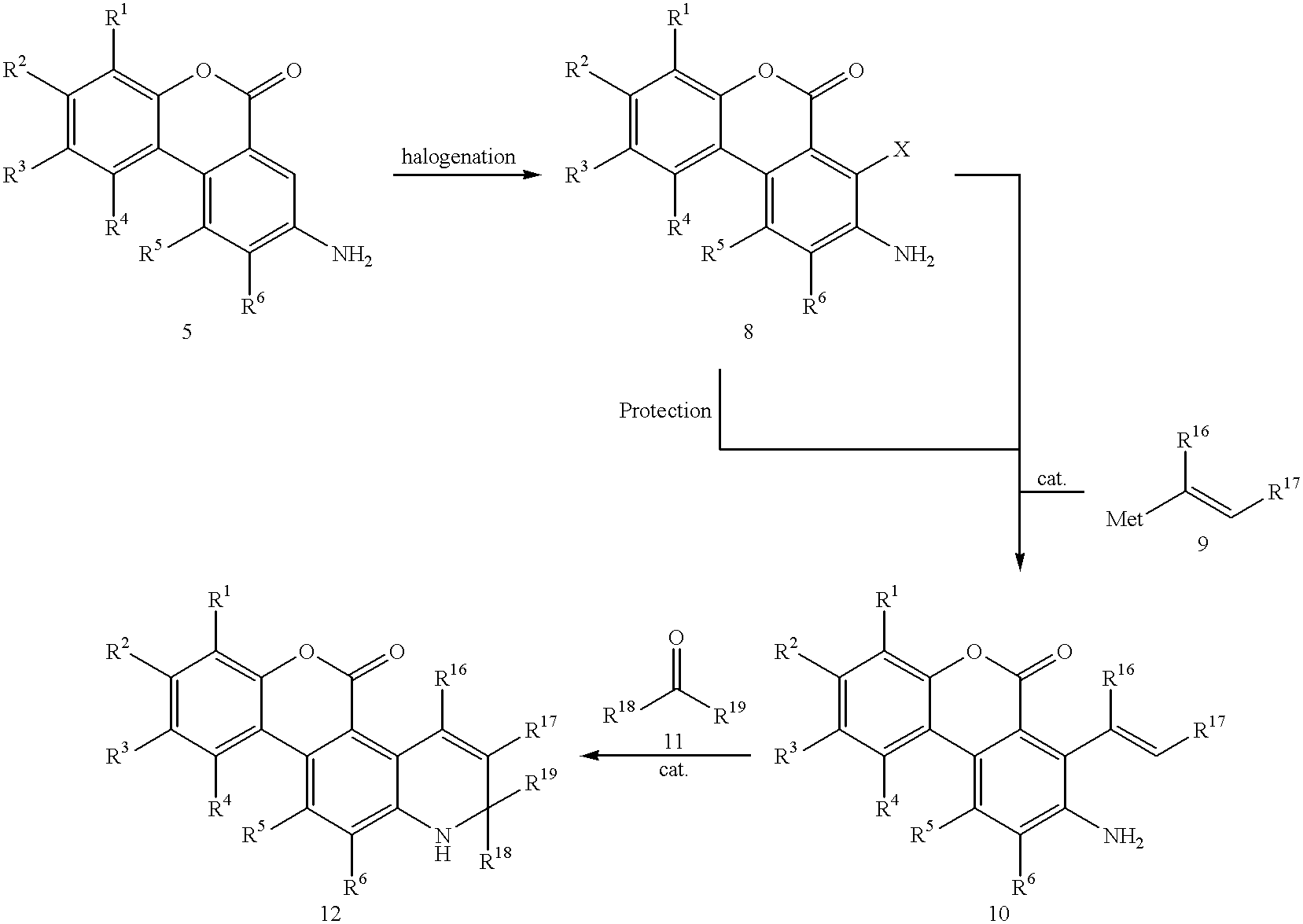
First the carbon atom flanked by the aniline nitrogen and lactone carbonyl is functionalized with a halogen atom, forming a compound of structure 8. Performing a cross-coupling reaction of 8 (or an N-protected analogue of 8) with an appropriately substituted metalated olefin 9 affords an ortho-alkenyl aniline 10, by a process known as a Stille, Suzuki, or Negishi coupling. (See for example: “Coupling Reactions Between sp2 Carbon Centers”, D. W. Knight, In Comprehensive Organic Synthesis: Selectivity, Strategy & Efficiency in Modern Organic Chemistry Vol. 3, B. M. Trost (Ed.), Pergamon: New York, (1991) 481-520; “Palladium-Catalysed Reactions of Organotin Compounds”, T. N. Mitchell, Synthesis, (1992) 803-815; “Palladium-Catalyzed Coupling of 2-Bromoanilines with Vinyistannanes—A Regiocontrolled Synthesis of Substituted Indoles”, M. E. Krolski, A. F. Renaldo, D. E. Rudisill and J. K. Stille, J. Org. Chem., 53 (1988) 1170-1176; “The Cross-Coupling Reactions of Organic Halides with Organic Derivatives of Tin, Mercury, and Copper Catalyzed by Palladium”, I. P. Beletskaya, J. Organomet. Chem., 250 (1983) 551-564; “The Palladium-Catalyzed Cross-Coupling Reaction of Phenylboronic Acid with Haloarenes in the Presence of Bases”, N. Miyaura, T. Yanagi and A. Suzuki, Synth. Commun., 11 (1981) 513-519; “Synthetic Studies via the Cross-coupling Reaction of Organoboron Derivatives with Organic Halides”, A. Suzuki., Pure Appl. Chem., 63 (1991) 419422.} An ortho-alkenyl aniline 10 can be converted to the target compounds 12 by reaction with a ketone 11 and an appropriate catalyst. (See for example: “Eine Neue Einfache Synthese Spirocyclischer 1H-Chinolin-Derivatives”, H. Walter, Helv. Chim. Acta, 75 (1992) 1274-1280; “Acid Catalyzed Reactions of 2-Vinylaniline Derivatives with Cylic Ketones of the Tetralone-, Chroman-4-one- and 2,3-Dihydro-1H-Quinolin-4-ones Series. N(O)-Heterocycles via 6π Electronic Rearrangements or [1,5] Dipolar Electrocyclizations. Part 3″, H. Walter and J. Schneider, Heterocycles, 41 (1995) 1251-1269.}. Using this alternative procedure, compounds with substitution patterns not available from the traditional Skraup reaction route are now readily accessible.
The present invention is directed to methods for the preparation of 1,2-dihydroquinolines, some of which are key intermediates in the preparation of steroid receptor modulating compounds and/or are themselves steroid receptor modulators. The invention provides a novel route to compounds of structure 12 and, more particularly, to 1,2-dihydroquinolines that are not accessible from a previously disclosed route. Intermediate compounds prepared enroute to 1,2-dihydroquinolines of structure 12 as well as compounds of structure 12 that cannot be synthesized via the traditional Skraup reaction (i.e. the reaction that yields 7 directly from 5) are also within the scope of this invention. In addition, the general process consisting of the preparation of 2,2-disubstituted 1,2-dihydroquinolines optionally substituted at C(3) and/or C(4) by treatment of an ortho-alkenyl aniline with a ketone in the presence of a Lewis acid is also within the scope of this invention.
In accordance with the present invention and as used herein, the following terms are defined with the following meanings, unless explicitly stated otherwise.
The terms “alkyl” and “allyl” refer to straight-chain, branched-chain, and cyclic structures, and combinations thereof. These “alkyl” and “allyl” structures may be optionally substituted with one or more heteroatoms, including for example, without limitation, fluorine, oxygen, nitrogen, phosphorus and sulfur.
The term “aryl” refers to an optionally substituted, six-membered aromatic ring, including polyaromatic rings.
The term “heteroaryrl” refers to an optionally substituted, five-membered heterocyclic ring containing one or more heteroatoms selected from the group consisting of carbon, oxygen, nitrogen and sulfur, including polycyclic rings or six-membered heterocyclic rings containing one or more heteroatoms selected from the group consisting of carbon and nitrogen, including polycyclic rings.
A 1,2-dihydroquinoline is defined by the following structure: 
A 1,2-dihydro-5-coumarino[3,4-f]quinoline is defined by the following structure: 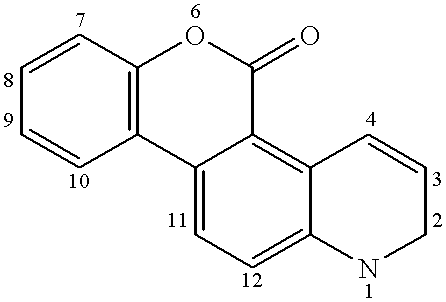
The novel process for the preparation of a 1,2-dihydroquinoline of structure 12 comprises a multi-step process initiated by treating an aniline 5, the preparation of which has been previously disclosed {see for example: “Preparation of Quinolines and Fused Quinolines as Steroid Receptor Modulators”, T. K Jones, M. E. Goldman, C. L. F. Pooley, D. T. Winn, J. P. Edwards, S. J. West, C. M. Tegley, L. Zhi, L. G. Hamann, R. L. Davis, L. J. Farmer, PCT Int. Appl. Pub. No. WO 96/19458; “Steroid Receptor Modulator Compounds and Methods”, T. K. Jones, L. Zhi, C. M. Tegley, D. T. Winn, L. G. Hamann, J. P. Edwards, S. J. West, U.S. Pat. No. 5,693,647 }, with a halogenating agent, especially bromine or N-bromosuccinimide: 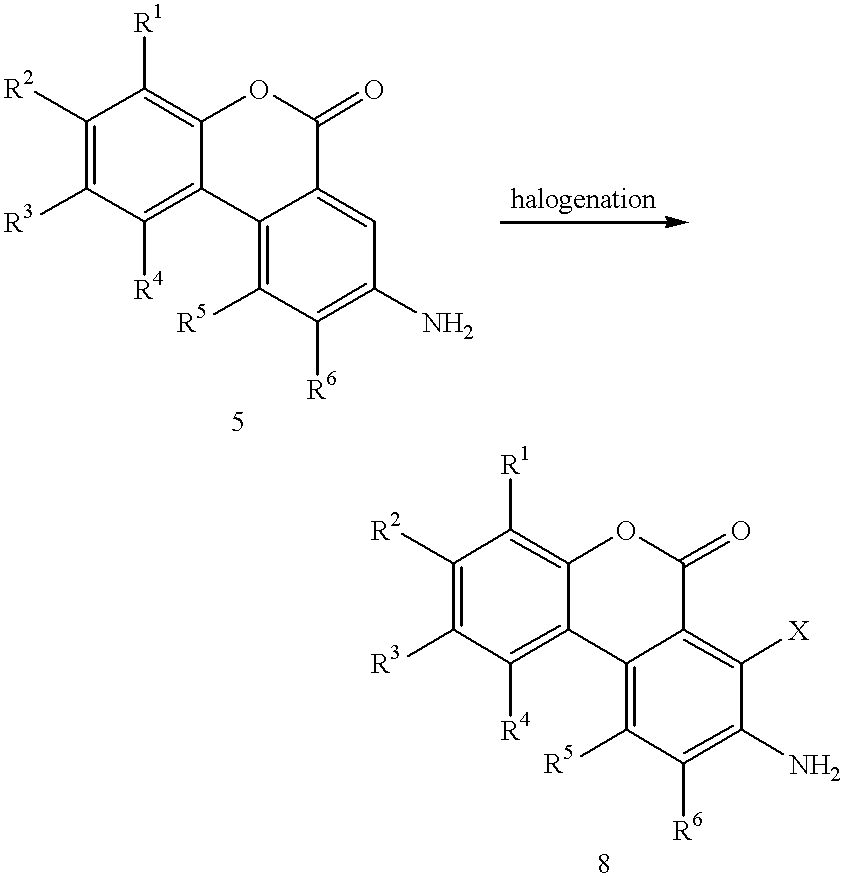
wherein
R1-6 independently represent H, C1-C6 alkyl, substituted C1-C6 alkyl, F, Cl, Br, I, CN, CF3, CF2CF3, CO2R7 (where R7 represents H, C1-C6 alkyl, substituted C1-C6 alkyl, allyl, substituted allyl, aryl, substituted aryl, heteroaryl or substituted heteroaryl), CONR7R8 (where R8 represents H, C1-C6 alkyl, substituted C1-C6 alkyl, allyl, substituted allyl, aryl, substituted aryl, heteroaryl or substituted heteroaryl; or where, alternatively, R7 and R8 combine to form a four- to seven-membered ring), OR9 (where R9 represents C1-C6 alkyl, substituted C1-C6 alkyl, allyl, substituted allyl, aryl, substituted aryl, heteroaryl or substituted heteroaryl), NR7R9, SR9, SOR9, or SO2R9; and X represents chloro, bromo, or iodo.
In an optional second step, the nitrogen atom of the ortho-haloaniline may be protected, especially as an N-trimethylsilyl or as an N-trifluoroacetyl analogue: 
wherein
P represents SiR10OR11R12 (where R10-12 independently represent C1-C6 alkyl, substituted C1-C6 alkyl, allyl, substituted allyl, aryl, substituted aryl, heteroaryl or substituted heteroaryl); COR13 (where R13 represents CF3, C1-C6 alkyl, substituted C1-C6 alkyl, aryl or substituted aryl); CO2R14 (where R14 represents C1-C6 alkyl, substituted C1-C6 alkyl, allyl, substituted allyl, aryl, substituted aryl, heteroaryl or substituted heteroaryl); CONR14R15 (where R15 represents H, C1-C6 alkyl, substituted C1-C6 alkyl, allyl, substituted allyl, aryl, substituted aryl, heteroaryl or substituted heteroaryl; or where R14 and R15 taken together form a five- to seven-membered ring); benzyl or substituted benzyl; or allyl or substituted allyl.
In a subsequent step, an ortho-haloaniline 8 or N-protected ortho-haloaniline 13 is treated with a metallated olefin 9, especially 2-(tributylstannyl)propene or 1-methoxy-1-ethenylboronic acid, in the presence of a catalyst or catalysts, especially tetrakis(triphenylphosphine)palladium (0) or palladium acetate/tri(2-furyl)phosphine/copper(l) iodide, to afford an ortho-alkenylaniline. In the case of 8, the cross-coupling product 10 is obtained directly. In the case of 13, the cross-coupling product 10 is obtained after a de-protection step: 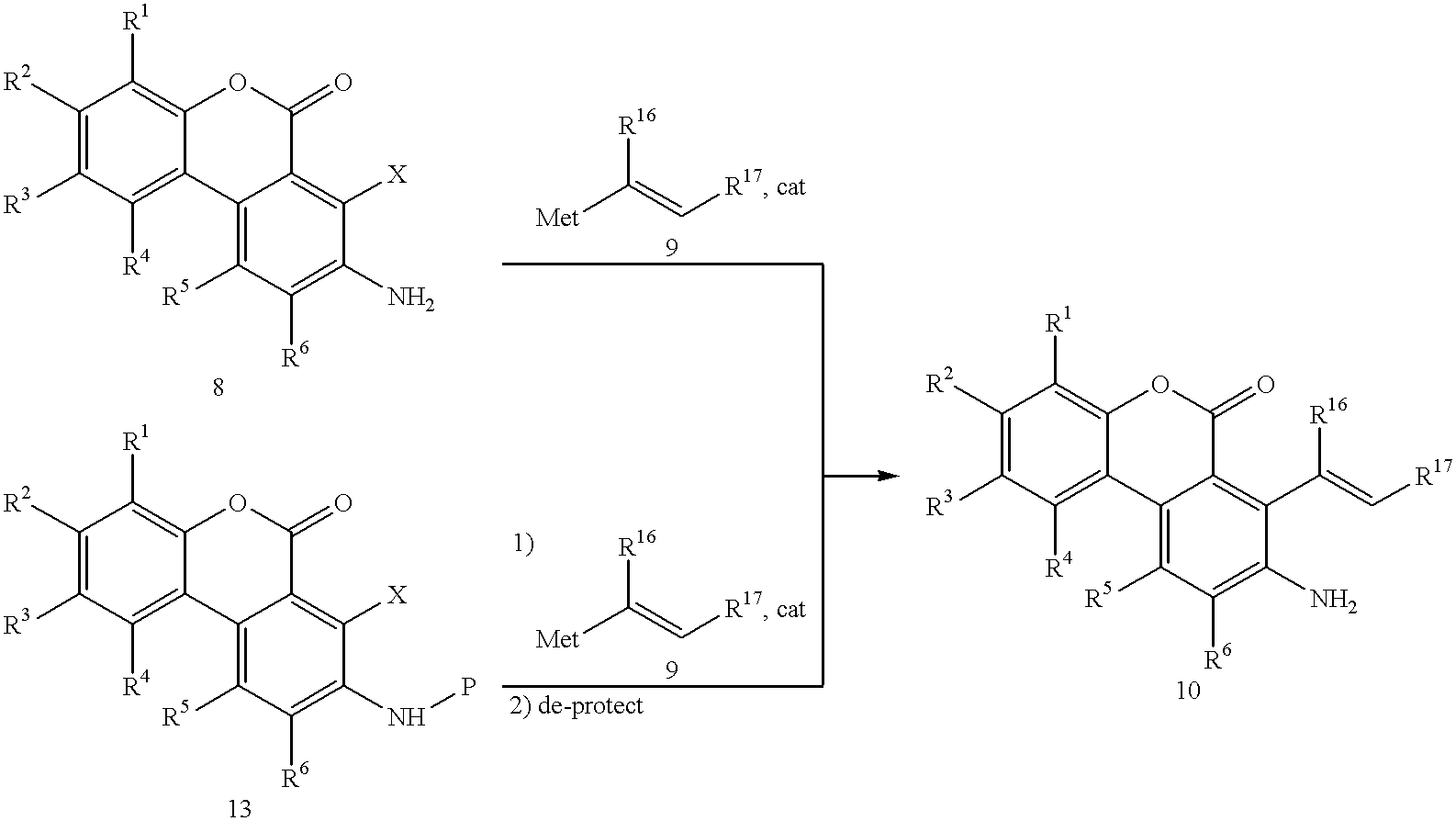
wherein
R16-17 independently represent H, C1-C6 alkyl, substituted C1-C6 alkyl, allyl, substituted allyl, aryl, substituted aryl, heteroaryl, substituted heteroaryl, OR14 or Cl; or where R16 and R17 taken together form a five- to seven-membered, optionally substituted ring. It will be recognized by those skilled in the art that the geometry of 9 can be either E or Z or a mixture of both, affording compounds 10 as either E or Z isomers, or a mixture of both.
In the final step of this novel process, an aniline 10 is treated with a ketone 11, especially acetone, cyclohexanone or 3-pentanone, in the presence of a catalyst, especially camphor sulfonic acid, boron trifluoride etherate or lanthanum tris(trifluoromethanesulfonate), to afford the 1,2-dihydroquinoline 12: 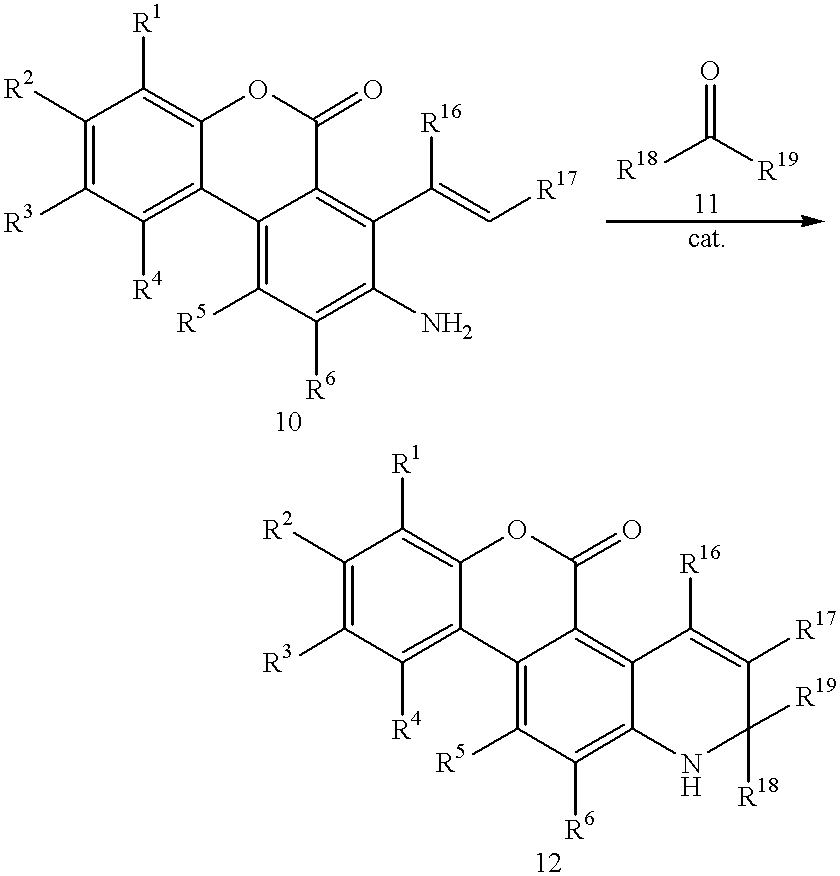
wherein
R18-19 independently represent C1-C6 alkyl, substituted C1-C6 alkyl, allyl, substituted allyl, aryl, substituted aryl, heteroaryl or substituted heteroaryl; or where R18 and R19 taken together form a three- to eight-membered (preferably five- to eight-membered), optionally substituted ring.
In a more general sense, an optionally substituted aniline (with hydrogen at an ortho position) can be halogenated to form an ortho-haloaniline that is subsequently treated with a metallated olefin in the presence of a catalyst or catalysts to form an ortho-alkenyl aniline of structure 14 (wherein: R16 and R17 have the definitions detailed above; and R20-23 independently represent H, C1-C6 alkyl, substituted C1-C6 alkyl, F, Cl, Br, I, CN, CF3, CF2CF3, CO2R7, CONR7R8 (where R7 and R8 have the definitions detailed above), allyl, substituted allyl, aryl, substituted aryl, heteroaryl or substituted heteroaryl; or where R20 and R21 OR R21 and R22 OR R22 and R23 taken together form a five- to seven-membered ring). The ortho-alkenyl aniline of structure 14 may be converted to an optionally substituted 2,2-disubstituted 1,2-dihydroquinoline by treatment of 14 with a ketone 11 (wherein R18 and R19 have the definitions detailed above, especially acetone, cyclohexanone, 3-pentanone or an optionally substituted acetophenone) and a Lewis acid (especially boron trifluoride etherate, lanthanum tris(trifluoromethanesulfonate) or chlorotitanium triisopropoxide) to afford the 1,2-dihydroquinoline 15. 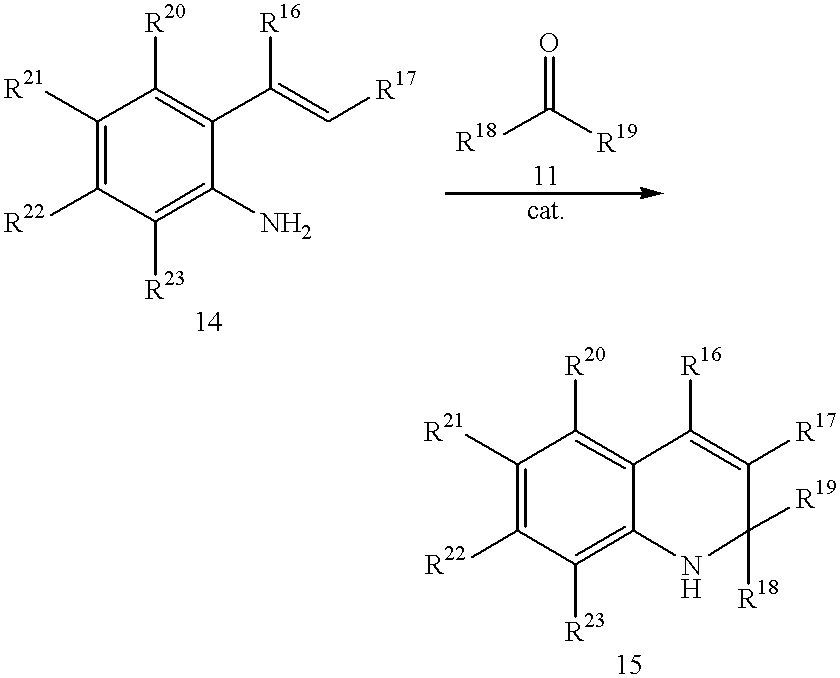
The nitrogen atom of the ortho-haloaniline may be protected prior to treatment with a metallated olefin, in which case the cross-coupling product 14 is obtained after a de-protection step.
The 1,2-dihydroquinolines 12 are useful for the preparation of steroid receptor modulating compounds that have a variety of therapeutic applications, depending upon their specific biological activity. {See for example: “Preparation of Quinolines and Fused Quinolines as Steroid Receptor Modulators”, T. K. Jones, M. E. Goldman, C. L. F. Pooley, D. T. Winn, J. P. Edwards, S. J. West, C. M. Tegley, L. Zhi, L. G. Hamann, R. L. Davis, L. J. Farmer, PCT Int. Appl. Pub. No. WO 96/19458; “Steroid Receptor Modulator Compounds and Methods”, T. K. Jones, C. M. Tegley, L. Zhi, J. P. Edwards, S. J. West, U.S. Pat. No. 5,693,646; “Steroid Receptor Modulator Compounds and Methods”, T. K. Jones, L. Zhi, J. P. Edwards, C. M. Tegley, S. J. West, U.S. Pat. No. 5,696,127} Many 1,2-dihydroquinolines of structure 7, a subset of the compounds represented by structure 12, are themselves steroid receptor modulating compounds. In particular, several compounds of structure 7 are known to be progesterone receptor (PR) modulators (i.e., PR agonists, partial agonists, and antagonists). {See for example: “Steroid Receptor Modulator Compounds and Methods”, T. K. Jones, L. Zhi, C. M. Tegley, D. T. Winn, L. G. Hamann, J. P. Edwards, S. J. West, U.S. Pat. No. 5,693,647.}
Compounds of the present invention, the synthesis of which is made possible by the methods taught herein, are defined as those having the structural formula: 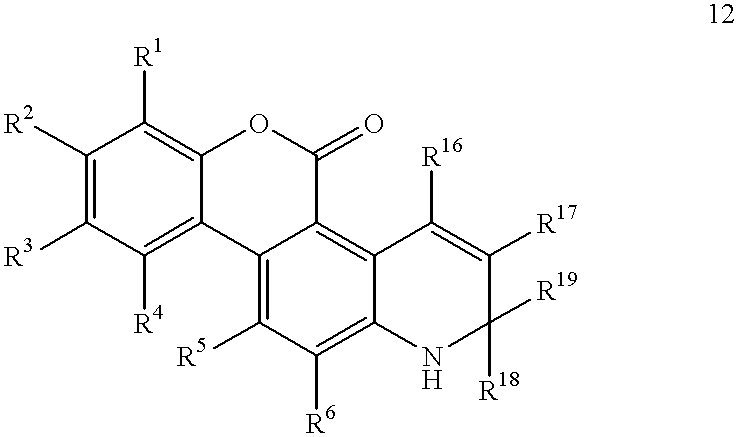
wherein
R1-6 independently represent H, C1-C6 alkyl, substituted C1-C6 alkyl, F, Cl, Br, I, CN, CF3, CF2CF3,CO2R7 (where R7 represents H, C1-C6 alkyl, substituted C1-C6 alkyl, allyl, substituted allyl, aryl, substituted aryl, heteroaryl or substituted heteroaryl), CONR7R8 (where R8 represents H, C1-C6 alkyl, substituted C1-C6 alkyl, allyl, substituted allyl, aryl, substituted aryl, heteroaryl or substituted heteroaryl; or where, alternatively, R7 and R8 combine to form a four- to seven-membered ring), OR9 (where R9 represents C1-C6 alkyl, substituted C1-C6 alkyl, allyl, substituted allyl, aryl, substituted aryl, heteroaryl or substituted heteroaryl), NR7R9, SR9, SOR9, or SO2R9;
R16 represents H, C1-C6 alkyl, substituted C1-C6 alkyl, allyl, substituted allyl, aryl, substituted aryl, heteroaryl, substituted heteroaryl, OR14 (where R14 represents C1-C6 alkyl, substituted C1-C6 alkyl, allyl, substituted allyl, aryl, substituted aryl, heteroaryl or substituted heteroaryl) or Cl; R17 represents C1-C6 alkyl, substituted C1-C6 alkyl, allyl, substituted allyl, aryl, substituted aryl, heteroaryl, substituted heteroaryl, OR14 or Cl; or where R16 and R17 taken together form a five- to seven-membered, optionally substituted ring;
and R18-9 independently represent C1-C6 alkyl, substituted C1-C6 allyl, allyl, substituted allyl, aryl, substituted aryl, heteroaryl or substituted heteroaryl; or where R18 and R19 taken together form a three- to eight-membered (preferably five- to eight-membered), optionally substituted ring.
The compounds of the present invention also include racemates, stereoisomers and mixtures of said compounds. Such isomers can be isolated by standard resolution techniques, including fractional crystallization and chiral column chromatography.
Preferably, structure 12 compounds of the present invention, defined immediately above, comprise steroid receptor modulators. More preferably, structure 12 compounds of the present invention comprise progesterone receptor (PR) modulators (agonists, partial agonists and antagonists).
In a further preferred aspect, the present invention comprises a method of modulating processes mediated by steroid receptors comprising administering to a patient an effective amount of a compound of the structure 12, wherein R1 through R19 have the definitions given above for compounds of the present invention.
The progesterone receptor (PR) modulator compounds of the present invention are particularly useful for hormone replacement therapy and as modulators of fertility (e.g., as contraceptives, contragestational agents or abortifacients), either alone or in conjunction with estrogen receptor (ER) modulators. The PR active compounds are also useful in pregnancy maintenance therapy; the treatment of dysfunctional uterine bleeding, dysmenorrhea, endometriosis, leiomyomas (uterine fibroids), mood disorders and cardiovascular disease; treating tumors of the central nervous system, such as meningiomas; as well as treating various hormone-dependent cancers, including, without limitation, cancers of the breast, ovaries, endometrium and prostate. {See for example: “Preparation of Quinolines and Fused Quinolines as Steroid Receptor Modulators”, T. K. Jones, M. E. Goldman, C. L. F. Pooley, D. T. Winn, J. P. Edwards, S. J. West, C. M. Tegley, L. Zhi, L. G. Hamann, R. L. Davis, L. J. Farmer, PCT Int. Appl. Pub. No. WO 96/19458; “Steroid Receptor Modulator Compounds and Methods”, T. K. Jones, L. Zhi, C. M. Tegley, D. T. Winn, L. G. Hamann, J. P. Edwards, S. J. West, U.S. Pat. No. 5,693,647.}
It will be understood by those skilled in the art that, while the compounds of the present invention will typically be employed as selective agonists, partial agonists or antagonists, there may be instances where a compound with a mixed steroid receptor profile is preferred, including, without limitation, mixed PR/AR, PR/MR or PR/GR modulators. For example, use of a PR agonist (i.e., progestin) in female contraception often leads to the undesired effects of increased water retention and acne flare-ups. In this instance, a compound that is primarily a PR agonist, but also displays some androgen receptor (AR) and mineralocorticoid receptor (MR) antagonist activity, may prove useful. Specifically, the mixed MR effects would be useful to control water balance in the body, while the AR effects would help to control any acne flare-ups that occur.
The present invention also provides a pharmaceutical composition comprising an effective amount of a steroid receptor-modulating structure 12 compound of the present invention, or a pharmaceutically acceptable salt thereof, and a pharmaceutically acceptable carrier.
Any of the compounds of the present invention can be synthesized as pharmaceutically acceptable salts for incorporation into various pharmaceutical compositions. As used herein, pharmaceutically acceptable salts include, but are not limited to, hydrochloric, hydrobromic, hydroiodic, hydrofluoric, sulfuric, citric, maleic, acetic, lactic, nicotinic, succinic, oxalic, phosphoric, malonic, salicylic, phenylacetic, stearic, pyridine, ammonium, piperazine, diethylamine, nicotinamide, formic, urea, sodium, potassium, calcium, magnesium, zinc, lithium, cinnamic, methylamino, methanesulfonic, picric, tartaric, triethylamino, dimethylamino and tris(hydoxymethyl)aminomethane. Additional pharmaceutically acceptable salts are known to those skilled in the art.
As noted above, any of the steroid receptor-modulating compounds of the present invention, or the pharmaceutically acceptable salts thereof, can be combined in a mixture with a pharmaceutically acceptable carrier to provide compositions useful for treating the biological conditions or disorders noted herein in mammalian, and more preferably, in human patients. The particular carrier employed in these pharmaceutical compositions may take a wide variety of forms depending upon the type of administration desired, e.g., intravenous, oral, topical, suppository or parenteral.
In preparing the pharmaceutical compositions or compounds in oral liquid dosage forms (e.g., suspensions, elixirs and solutions), typical pharmaceutical media such as water, glycols, oils, alcohols, flavoring agents, preservatives, coloring agents and the like can be employed. Similarly when preparing oral solid dosage forms (e.g., powders, tablets and capsules), carriers such as starches, sugars, diluents, granulating agents, lubricants, binders, disintegrating agents and the like will be employed. Due to their ease of administration, tablets and capsules represent the most advantageous oral dosage form for the pharmaceutical compositions or compounds of the present invention.
For parenteral administration the carrier will typically comprise sterile water, although other ingredients that aid in solubility or serve as preservatives may also be included. Furthermore, injectable suspensions may also be prepared, in which case appropriate liquid carriers, suspending agents and the like will be employed.
For topical administration, the pharmaceutical compositions and compounds of the present invention may be formulated using bland, moisturizing bases, such as ointments or creams. Examples of suitable ointment bases are petrolatum, petrolatum plus volatile silicones, lanolin, and water-in-oil emulsions such as Eucerin™ (Beiersdorf). Examples of suitable cream bases are Nivea™ Cream (Beiersdorf), cold cream (USP), Purpose Cream™ (Johnson & Johnson) hydrophilic ointment (USP), and Lubriderm™ (Warner-Lambert).
The pharmaceutical compositions and compounds of the present invention will generally be administered in the form of a dosage unit (e.g., tablet, capsule etc.) from about 1 μg/kg of body weight to about 500 mg/kg of body weight, more preferably from about 10 μg/kg to about 250 mg/kg, and most preferably from about 20 μg/kg to about 100 mg/kg. As recognized by those skilled in the art, the particular quantity of pharmaceutical composition administered to a patient, according to the present invention, will depend upon a number of factors, including, without limitation, the biological activity desired, the condition of the patient, and tolerance for the drug.
The pharmaceutical compositions and compounds of the present invention can advantageously be used in the treatment of the diseases and conditions described herein. In this regard, the compositions and compounds of the present invention will prove particularly useful in hormone replacement therapy and modulating fertility, either alone or in conjunction with estrogen receptor (ER) modulators. The PR active compounds are also useful in pregnancy maintenance therapy; the treatment of dysfunctional uterine bleeding, dysmenorrhea, endometriosis, leiomyomas, mood disorders and cardiovascular disease; treating tumors of the central nervous system; and treating hormone-dependent cancers, such as cancers of the breast, ovaries, endometrium and prostate.
Furthermore, it will be understood by those skilled in the art that the compounds of the present invention, including pharmaceutical compositions and formulations containing these compounds, can be used in a wide variety of combination therapies to treat the conditions and diseases described above. Thus, the compounds of the present invention can be used in combination with other hormones and other therapies, including, without limitation, chemotherapeutic agents such as cytostatic and cytotoxic agents, immunological modifiers such as interferons, interleukins, growth hormones and other cytokines, hormone therapies, surgery and radiation therapy.
The compounds of this invention also have utility when radio- or isotopically-labeled as ligands for use in assays to determine the presence of steroid receptors in a cell background or extract. They are particularly useful due to their ability to selectively activate progesterone receptors (PR), and can therefore be used to determine the presence of such receptors in the presence of other steroid receptors or related intracellular receptors.
Due to the selective specificity of many of the compounds of this invention for PR, these compounds can be used to purify samples of PR in vitro. Such purification can be carried out by mixing samples containing steroid receptors with one or more of the compounds of the present invention so that the compounds bind to the receptor of choice, and then separating out the bound ligand/receptor combination by separation techniques that are known to those of skill in the art These techniques include column separation, filtration, centrifugation, tagging and physical separation, and antibody complexing, among others.
In yet another aspect, the present invention provides novel intermediates useful in the preparation of the steroid modulator compounds of structure 12. The intermediates of the present invention are defined as those having the structural formulas: 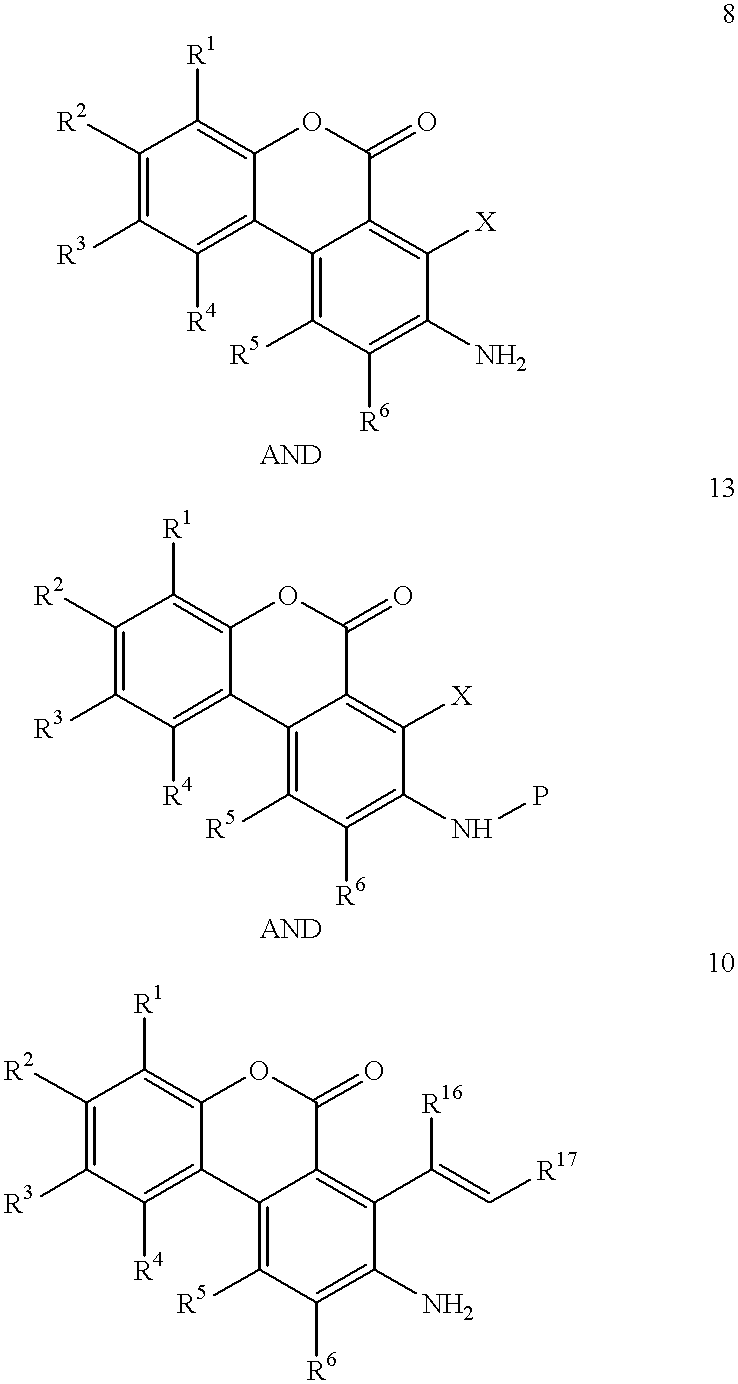
wherein
R1-6 independently represent H, C1-C6 alkyl, substituted C1-C6 alkyl, F, Cl, Br, I, CN, CF3, CF2CF3, CO2R7 (where R7 represents H, C1-C6 alkyl, substituted C1-C6 alkyl, allyl, substituted allyl, aryl, substituted aryl, heteroaryl or substituted heteroaryl), CONR7R8 (where R8 represents H, C1-C6 alkyl, substituted C1-C6 alkyl, allyl, substituted allyl, aryl, substituted aryl, heteroaryl or substituted heteroaryl; or where, alternatively, R7 and R8 combine to form a four- to seven-membered ring), OR9 (where R9 represents C1-C6 alkyl, substituted C1-C6 alkyl, allyl, substituted allyl, aryl, substituted aryl, heteroaryl or substituted heteroaryl), NR7R9, SR9, SOR9, or SO2R9;
X represents chloro, bromo, or iodo;
P represents SiR10R11R12 (where R10-12 independently represent C1-C6 alkyl, substituted C1-C6 alkyl, allyl, substituted allyl, aryl, substituted aryl, heteroaryl or substituted heteroaryl); COR13 (where R13 represents CF3, C1-C6 alkyl, substituted C1-C6 alkyl, aryl or substituted aryl); CO2R14 (where R14 represents C3-C6 alkyl, substituted C1-C6 alkyl, allyl, substituted allyl, aryl, substituted aryl, heteroaryl or substituted heteroaryl); CONR4R15 (where R15 represents H, C1-C6 alkyl, substituted C1-C6 alkyl, allyl, substituted allyl, aryl, substituted aryl, heteroaryl or substituted heteroaryl; or where R14 and R15 taken together form a five- to seven-membered ring); benzyl or substituted benzyl; or allyl or substituted allyl;
and R16-17 independently represent H, C1-C6 alkyl, substituted C1-C6 alkyl, allyl, substituted allyl, aryl, substituted aryl, heteroaryl, substituted heteroaryl, OR14 or Cl; or where R16 and R17 taken together form a five- to seven-membered, optionally substituted ring.
The intermediates of the present invention also include racemates, stereoisomers and mixtures of said compounds. Such isomers can be isolated by standard resolution techniques, including fractional crystallization and chiral column chromatography.
All cited publications are incorporated by reference herein. All the compounds disclosed in the cited publications are incorporated by reference herein, including those compounds disclosed and referred to in articles cited by the publications mentioned herein.
2-Amino-1-bromo-6-fluoro-3,4-benzocoumarin (compound 16, structure 8 where R1-2 R4-6 H; R3=fluoro; X=bromo). In a 200-mL r.b. flask, a suspension of 2-amino-6-fluoro-3,4-benzocoumarin (0.89 g, 3.9 mmol) in acetonitrile (40 mL) was cooled to 0° C., and a solution of bromine (620 mg, 3.9 mmol, 1.0 equiv) in CH2Cl2 (5 mL) was added dropwise over a 5 min period. The reaction mixture was stirred for 10 min at 0° C. and allowed to warm to rt. The reaction mixture was treated with 2% NaOH (100 mL). The resulting orange solid was collected by filtration, washed with hexane (100 mL), and dried in vacuo to afford 0.72 g (60%) of 16 as an orange solid. Data for 16: 1H NMR (400 MHz, acetone-d6) 8.16 (d, J=8.7, 1H), 7.89 (dd, J=10.0, 2.9, 1H), 7.47 (d, J=8.7, 1H), 7.32 (dd, J=9.1, 4.9, 1H), 7.12 (td, J=8.0, 3.0, 1H), 5.86 (br exch s, 2H); 13C NMR (DMSO-d6): 158.7 (d, JC-F=9), 157.4, 148.8, 145.5, 124.5, 123.2, 121.5, 119.7 (d, JC-F=9), 119.3, 118.1 (d, JC-F=9), 115.5 (d, JC-F=25), 108.5 (d, JC-F=25), 105.9.
2-Amino-6-fluoro-1-(2-propenyl)-3,4-benzocoumarin (compound 17, structure 10 where R1-2=R4-6=R7=H; R3=fluoro; R16=methyl). In a 20 mL r.b. flask, a solution of 16 (92 mg, 0.30 mmol) in N-methylpyrrolidone (3 mL) was treated with N,O-bis(trimethylsilyl)acetamide (80 μL, 0.32 mmol, 1.1 equiv) and stirred at rt for 2 h. Tris(dibenzylideneacetone)dipalladium (9.2 mg, 0.010 mmol, 3.3 mol %), tri(2-furyl)phosphine (10.2 mg, 0.0439 mmol, 14.7 mol %), copper(I) iodide (20.1 mg, 0.106 mmol, 35.4 mol %), and 2-(tributylstannyl)propene (0.11 g, 0.33 mmol, 1.1 equiv) were added, and the reaction mixture heated to 80° C. for 6 h. The reaction mixture was allowed to cool to rt and treated with 1 M KF for 1 h, poured into saturated NH4Cl (5 mL), and extracted with EtOAc (3×4 mL). The extracts were washed with brine (1×5 mL), combined, dried (MgSO4), filtered, and concentrated. Purification by silica gel chromatography (hexane/EtOAc, 2:1) afforded 20 mg (25%) of 17 as an orange solid. Data for 17: 1H NMR (400 MHz, acetone-d6) 8.06 (d, J=8.7, 1H), 7.87 (dd, J=10.1, 2.9, 1H), 7.37 (d, J=8.7, 1H), 7.28 (dd, J=9.0, 4.9, 1H), 7.16 (td, J=8.1, 2.9, 1H), 5.30 (q, J=1.5, 1H), 5.20 (exch s, 1H), 4.82 (q, J=1.2, 1H), 2.08 (s, 3H); 13C NMR (acetone-d6): 160.2 (d, JC-F=239), 159.3, 147.7, 147.3, 144.4, 129.9, 124.6 (d, JC-F=2), 123.5, 122.6, 121.5 (d, JC-F=239), 120.1, 119.1 (d, JC-F=9), 115.8 (d, JC-F=25), 114.6, 108.8 (d, JC-F=25), 23.1.
9-Fluoro-1,2-dihydro-2,2,4-trimethyl-5-coumarino[3,4-f]quinoline (compound 18, structure 12, where R1-2=R4-6=R17=H; R3=fluoro; R16=R18-19=methyl). In a 20-mL resealable pressure tube, a solution of 17 (25 mg) was dissolved in toluene (2 mL) and treated with acetone (0.5 mL) and camphor sulfonic acid (2 mg). The pressure tube was sealed and heated to 115° C. for 10 h. The reaction mixture was cooled to rt, poured into H2O (5 mL), and extracted with EtOAc (3×6 mL). The extracts were washed with brine (1×5 mL), combined, dried (MgSO4), filtered, and concentrated to afforded an orange solid. Purification by silica gel chromatography (CH2Cl2/hexanes, 1:1 to 1.5:1 gradient) afforded 15 mg (50%) of compound 18 as a bright yellow solid. Data for Compound 18: 1H NMR (acetone-d6): 7.95 (d, J=8.7, 1H); 7.83 (dd, J=10.1, 2.9, 1H); 7.29 (dd, J=9.0, 4.9, 1H); 7.22 (d, J=8.7, 1H); 7.17 (m, 1H); 6.25 (br s, 1H); 5.54 (t, J=1.2, 1H); 2.06 (s, 3H), 1.30 (s, 6H); 13C NMR (acetone-d6): 160.2 (d, JC-F=239), 159.9, 148.2, 147.3, 132.9, 131.7, 125.3, 123.0, 121.9, 121.8, 119.1, 118.9 (d, JC-F=9.0), 115.6 (d, JC-F=25), 108.9 (d, JC-F=26), 51.0, 28.5, 21.6.
2-Amino-1-bromo-6-fluoro-3,4-benzocoumarin (compound 16, structure 8 where R1-2=R4-6=H; R3=fluoro; X=bromo). In an oven-dried 250-mL flask was weighed out 2-amino-6-fluoro-3,4-benzocoumarin (2.58 g, 11.3 mmol). The flask was evacuated and the atmosphere -20 replaced with nitrogen. Anhydrous DMF was added (100 mL), and to the resulting solution was added dropwise a solution of N-bromosuccinimide (2.00 g, 11.3 mmol, 1.00 equiv) in anhydrous DMF (50 mL) over a period of 25 min. The reaction was monitored by TLC and appeared complete after 15 min. After stirring the reaction mixture an additional 45 min at rt, H2O (100 mL) was added. The reaction mixture was filtered on a B{umlaut over (u)}chner funnel, and the filter cake and paper were added to boiling EtOH/CH3CN (4:1, 500 mL). The resulting suspension was filtered hot, and recrystallization from this solution afforded 1.84 g (53%) of 16 as copper-colored needles. An additional 0.99 g (29%) of 16 was obtained from the concentrated mother liquors. The 1H and 13C NMR spectra of both samples were identical to those of material prepared above.
1-Bromo-6-fluoro-2-trifluoroacetamido-3,4-benzocoumarin (compound 19, structure 13 where R12=R4-6=H; R3=fluoro; P=trifluoroacetyl: X=bromo). To a suspension of 16 (1.00 g, 3.25 mmol) in CH2Cl2 (100 mL) at rt was added Et3N (1.4 mL, 9.4 mmol, 3.0 equiv). Trifluoroacetic anhydride (1.15 mL, 8.13 mmol, 2.50 eq) was added dropwise and the reaction mixture was stirred for 15 min. The reaction mixture was poured into H2O/brine (1:1, 200 mL) and the crude product extracted with CH2Cl2 (2×100 mL). The combined organic extracts were washed with H2O brine (1:1, 100 mL), dried (Na2SO4), filtered, and concentrated to afford 1.31 g (quant) of 19 as a light brown solid. Data for 19: 1H NMR (400 MHz, benzene-d6): 8.63 (br s, 1H); 8.35 (d, J=9.0, 11H); 7.00 (dd, J=9.2, 2.9, 11H); 6.87 (d, J=9.0, 1H); 6.66 (dd, J=8.9, 4.7, 11H); 6.56 (td, J=8.3, 2.1, 1H)
2-Amino-6-fluoro-1-(2-propenyl)-3,4-benzocoumarin (compound 17, structure 10 where R1-2=R4-6=R17 H; R3=fluoro; R16=methyl). In an oven-dried 100-mL 3-neck flask, a solution of 19 (500 mg, 1.24 mmol), tri(2-furyl)phosphine (58 mg, 0.25 mmol, 20 mol %), and 2-(tributylstannyl)propene (0.422 mL, 1.36 mmol, 1.10 equiv) in dioxane (40 mL) was degassed by freeze/pump/thaw three times. Bis(benzonitrile)dichloropalladium(II) (48 mg, 0.12 mmol, 10 mol %) was added under positive pressure of N2, and the reaction mixture was heated to reflux for 13.5 h. The reaction mixture was poured into acetonitrile (50 mL), and the acetonitrile layer was washed with hexanes (3×50 mL). The hexane layer was extracted with acetonitrile (1×20 mL), and the combined acetonitrile extracts were filtered and concentrated to afford 750 mg of a brown semi-solid. This material was suspended in 95:5 EtOH:H2O (20 mL) and heated to reflux for 16 h. Only partial conversion was indicated by TLC, so sodium bicarbonate (416 mg, 4.96 mmol, 4.0 equiv) was added and the reaction mixture was heated at reflux until TLC showed full conversion (6.5 h). The reaction mixture was cooled to rt, poured onto saturated NaHCO3 (50 mL), and was extracted with EtOAc (3×50 mL). The combined organic extracts were dried (Na2SO4), filtered, and concentrated to afford a brown solid. Purification by silica gel chromatography (hexanes/EtOAc, 3:1 with 2% Et3N) afforded 200 mg (60%, 2 steps) of 17 as a light yellow crystalline solid. Data for 17: 1H NMR(400 MHz, benzene-d6): 7.20 (dd, J=9.6, 2.8, 1H); 7.07 (d, J=8.6, 1H); 6.77 (dd, J=8.9, 4.6, 1H); 6.56 (td, J=8.4, 2.1, 1H); 6.38 (d, J=8.6, 1H); 5.24 (t, J=1.4, 1H); 4.79 (s, 1H); 3.50 (br s, 2H); 2.14 (s, 3H);
2,2-Diethyl-9-fluoro-1,2-dihydro-4-methyl-5-coumarino[3,4-f]quinoline (compound 20. structure 12, where R1-2=R4-6=R17=H; R3=fluoro; R16=methyl; R18-19=ethyl). In a 25-mL 2-neck flask was weighed out 17 (100 mg, 0.371 mmol) and camphorsulfonic acid (9 mg, 0.04 mmol, 10 mol %). The flask was evacuated, and the atmosphere replaced with nitrogen. Anhydrous toluene (8 mL) was added followed by 3-pentanone (0.056 mL, 0.56 mmol, 1.5 equiv). The suspension was heated to reflux for 1.5 h; the reaction mixture became homogeneous. BF3-Et2O (0.005 mL, 0.04 mmol, 10 mol %) was added, and the reaction mixture was heated an additional 2.5 h. The reaction mixture was cooled to rt and poured onto saturated NaHCO3 (50 mL). The aqueous layer was extracted with EtOAc (3×50 mL), and the combined organic extracts were washed with brine, dried (Na2SO4), filtered, and concentrated onto 20 mL Celite. Purification by silica gel chromatography (hexanes/CH2Cl2, 1:1 with 10% EtOAc) afforded 61 mg (50%) of 20 as a yellow solid. Data for 20: 1H NMR (400 MHz, acetone-d6): 7.92 (d, J=8.6, 1H); 7.80 (dd, J=10.1, 2.9, 1H); 7.28 (dd, J=9.1, 4.9, 1H); 7.24 (d, J=8.9, 1H); 7.14 (td, J=8.5, 2.2, 1H); 6.12 (br s, 1H); 5.49 (br d, J=1.1, 1H); 2.10 (d, J=1.2, 3H); 1.61 (q, J=7.3, 4H); 0.91 (t, J=7.5, 3H);
2-Amino-6-fluoro-1-(2-propenyl)-3,4-benzocoumarin (compound 17, structure 10 where R1-2=R4-6=R17=H; R3=fluoro; R16=methyl). In an oven-dried 500 mL flask, a solution of 16 (1.075 g, 3.49 mmol) and N,O-bis(trimethylsilyl)acetamide (1.73 mL, 6.98 mmol, 2.0 equiv) in acetonitrile (200 mL) was treated with chlorotrimethylsilane (10 drops) and stirred 21 h at rt. The reaction mixture was concentrated to afford an orange solid, and was heated slightly in vacuo to remove any volatile material. The crude material was dissolved in DME (100 mL), tri(2-furyl)phosphine (162 mg, 0.698 mmol, 20 mol %) and 2-(tributylstannyl)propene (1.30 mL, -4.19 mmol, 1.2 equiv) were added, and the solution was degassed by freeze/pump/thaw three times. Tris(dibenzylideneacetone)dipalladium(0) (160 mg, 0.175 mmol, 0.05 eq) was added under positive N2 pressure, and the reaction mixture was heated to reflux for 13 h. The cooled reaction mixture was poured into acetonitrile (100 mL), and the acetonitrile layer was washed with hexanes (3×100 mL). The hexane layer was extracted with acetonitrile (1×50 ml), and the combined acetonitrile extracts were filtered and concentrated. Purification by silica gel chromatography (hexanes:EtOAc, 3:1 with 2% TEA) afforded 450 mg (48%) of 17 as a yellow solid, identical to the material prepared previously.
9-Fluoro-1,2-dihydro-4-methyl-5-coumarino[3,4-f]quinoline-2-spiro-1 ′-cyclohexane (compound 21, structure 12, where R1-2=R4-6=R17=H; R3=fluoro; R16=methyl; R18-19=spiro-(CH2)5). In a 25 mL 2-neck flask was weighed out 17 (170 mg, 0.631 mmol). The flask was evacuated, and the atmosphere was replaced with nitrogen. Anhydrous toluene (8 mL) was added, followed by cyclohexanone (0.262 mL, 2.53 mmol, 4.0 eq) and BF3-Et2O (0.008 mL, 0.06 mmol, 10 mol %). The reaction mixture was then heated to 80° C., and TLC indicated completion after 3.5 h. The reaction mixture was cooled to rt and poured onto saturated NaHCO3 (50 mL). The aqueous layer was extracted with EtOAc (3×50 mL), and the combined organic extracts were washed with brine, dried (Na2SO4), filtered, and concentrated onto 20 mL Celite. Purification by silica gel chromatography (hexanes/CH2Cl2,3:1 with 3% EtOAc) afforded 125 mg (57%) of 21 as a yellow solid. Data for 21: 1H NMR (400 MHz, acetone-d6): 7.96 (d, J=8.6, 11H); 7.83 (dd, J=10.0, 2.9, 11H); 7.31 (d, J=8.6, 11H); 7.29 (dd, J=9.1, 4.6, 1H); 7.16 (td, J=8.5, 2.2, 1H); 6.24 (br s, 1H); 5.66 (br s, 1H); 2.08 (d, J=1.4, 3H); 1.82-1.35 (br m, 10H); 13C NMR (acetone-d6): 160.2 (d, JC-F=239), 160.0, 148.0, 147.3, 132.1, 131.3, 125.3 (d, JC-F=2), 124.1, 123.0, 122.1, 121.8 (d, JC-F=9), 119.1, 119.0 (d, JC-F=9), 115.6 (d, JC-F=25), 108.9 (d, JC-F=25), 53.1, 37.4, 25.4, 22.3, 21.8.
9-Fluoro-1,2-dihydro-2,4-dimethyl-2-phenyl-5-coumarino[3,4-f]quinoline (compound 22, structure 12, where R1-2=R4-6=R17=H; R3=fluoro; R16=R18=methyl; R19=phenyl). In a 25-mL oven-dried 2-neck flask was weighed out 17 (106 mg, 0.394 mmol) and pyridinium p-toluenesulfonate (5 mg, 0.04 mmol, 0.1 eq). The flask was evacuated, and the atmosphere was replaced with nitrogen. Anhydrous toluene (8 mL) was added, followed by acetophenone (0.184 mL, 1.58 mmol, 4.0 eq). The suspension was heated to reflux for 45 min, and the reaction mixture became cloudy. BF3-Et2O (0.005 mL, 0.04 mmol, 0.10 eq) was added under positive pressure of N2, and the reaction mixture was heated an additional 1.5 h, until TLC indicated consumption of the starting material. The reaction mixture was cooled to rt and poured onto EtOAc (20 mL) and saturated NaHCO3 (20 mL). The aqueous layer was extracted with EtOAc (3×10 mL), and the combined organic extracts were washed with brine (1×10 mL), dried (Na2SO4), filtered, and concentrated onto 20 mL Celite. Purification by silica gel chromatography (hexanes:CH2Cl2, 3:1 with 3% EtOAc) afforded 98 mg (67%) of 22 as a yellow solid. Data for 22: 1H NMR (400 MHz, acetone-d6): 7.96 (d, J=8.7, 1H); 7.81 (dd, J=10.0, 2.8, 1H); 7.51 (d, J=7.8, 2H); 7.38 (d, J=8.6, 1H); 7.24 (m, 3H); 7.13 (m, 2H); 6.96 (br s, 1H); 5.91 (s, 1H); 2.16 (d, J=1.0, 3H); 1.70 (s, 3H); 13C NMR (acetone-d6): 160.2 (d, JC-F=239), 159.8, 149.3, 148.0, 147.4, 132.8, 131,8, 128.9, 127.4, 126.4, 125.8, 123.8, 123.2, 122.1, 121.6 (d, JC-F=9), 119.1, 119.0 (d, JC-F=9), 115.8 (d, JC-F=24), 109.0 (d, JC-F=25), 56.4, 30.9, 21.7.
1,2-dihydro-4-methyl-2-spiro-1′-(4′-tert-butyl)-cyclohexane (compound 23, structure 15, where R16=methyl, R18-19=[CH2CH2CH(t-Bu)CH2CH2], R17=R20-23=H). In a 25-mL oven-dried 2-neck flask under N2 was combined 2-isopropenylaniline (0.500 mL, 3.67 mmol), 4-tert-butylcyclohexanone (735 mg, 4.77 mmol, 1.3 eq), and anhydrous toluene (10 mL). The suspension was heated to reflux, and BF3Et2O (0.046 mL, 0.04 mmol, 0.10 eq) was added under positive pressure of N2. The reaction mixture was stirred at reflux 3 h, until TLC indicated consumption of the starting material. The reaction mixture was cooled to rt and poured onto EtOAc (40 mL) and saturated sodium bicarbonate (30 mL). The aqueous layer was extracted with EtOAc (3×10 mL), and the combined organic extracts were dried (Na2SO4), filtered, and concentrated. Purification by silica gel chromatography (hexanes:EtOAc, 80:1) afforded 813 mg (82%, 7:1 mixture of two diastereomers) of 23 as a colorless oil. Data for 23: 1H NMR (400 MHz, CDCl3): (major isomer) 7.05 (d, J=7.4, 1H); 6.97 (td, J=7.6, 0.5, 1H); 6.64 (t, J=7.2, 1H); 6.51 (d, J=7.9, 1H); 5.19 (s, 1H); 4.26 (br s, 1H); 2.05 (d, J=11.6, 2H); 1.99 (d, J=1.0, 3H); 1.63 (d, J=12.7, 2H); 1.30-1.10 (m, 4H); 1.04-0.94 (m, 1H); 0.90 (s, 9H)
1,2-dihydro-4-methyl-2,2-di-n-propylquinoline (compound 24, structure 15, where R16=methyl, R18-19=n-propyl, R17=R20-23=H). In a 25-mL oven-dried 2-neck flask under N2 was combined 2-isopropenylaniline (0.500 mL, 3.67 mmol), 4-heptanone (0.667 mL, 4.77 mmol, 1.3 eq), and anhydrous toluene (10 mL). The suspension was heated to reflux, and BF3Et2O (0.046 mL, 0.04 mmol, 0.10 eq) was added under positive pressure of N2. The reaction mixture was stirred at reflux 16 h, until TLC indicated consumption of the starting material. The reaction mixture was cooled to rt and the solvent was removed by rotary evaporation. Purification by silica gel chromatography (hexanes:EtOAc, 80:1) afforded 566 mg (67%) of 24 as a colorless oil. Data for 24: 1H NMR (400 MHz, CDCl3): 6.96 (dd, J=7.4, 1.0, 1H); 6.93 (td, J=7.6, 0.6, 1H); 6.53 (td, J=7.5, 0.4, 1H); 6.25 (d, J=7.9, 1H); 5.09 (s, 1H); 3.47 (br s, 1H); 1.98 (d, J=1.1, 3H); 1.46-1.30 (m, 8H); 0.88 (td, J=5.4, 1.0, 6H)
1,2-dihydro-2,4-dimethyl-2-phenylquinoline (compound 25, structure 15, where R16=R18=methyl, R19=phenyl, R17=R20-23=H). In a 25-11L oven-dried 2-neck flask under N2 was combined 2-isopropenylaniline (0.500 mL, 3.67 mmol), acetophenone (0.860 mL, 7.34 mmol, 2.0 eq), and anhydrous toluene (10 mL). The suspension was heated to reflux, and BF3Et2O (0.090 mL, 0.04 mmol, 0.20 eq) was added under positive pressure of N2. The reaction mixture was stirred at reflux 3 h, until TLC indicated consumption of the starting material. The reaction mixture was cooled to rt and poured onto Et2O (40 mL) and saturated sodium bicarbonate (30 111L). The aqueous layer was extracted with Et2O (3×10 mL), and the combined organic extracts were washed with brine, dried (Na2SO4), filtered, and concentrated. Purification by silica gel chromatography (hexanes:Et2O, 70:1) afforded 421 mg (49%) of 25 as a crystalline white solid. Data for 25: 1H NMR (400 MHz, acetone-d6): 7.51 (d, J=7.2, 2H); 7.28 (t, J=7.7, 2H); 7.15 (t, J=7.3, 1H); 7.00 (d, J=7.5, 1H); 6.94 (td, J=7.6, 0.6, 1H); 6.72 (dd, J=7.9, 0.9, 1H); 6.51 (td, 7.3, 0.8, 1H); 5.64 (br s, 1H); 5.58 (s, 1H); 1.97 (d, J=1.46, 3H); 1.64 (s, 3H); 13C NMR (acetone-d6): 151.1, 145.0, 129.5, 129.1, 128.9, 128.3, 127.1, 126.1, 124.4, 121.6, 117.1, 113.4, 57.5, 31.5, 18.8.
Claims (3)
1. A compound having the formula: 
wherein
R1-6 independently represent H, C1-C6 alkyl, substituted C1-C6 alkyl, F, Cl, Br, I, CN, CF3, CF2CF3, CO2R7 (where R7 represents H, C1-C6 alkyl, substituted C1-C6 alkyl, allyl, substituted allyl, aryl, substituted aryl, heteroaryl or substituted heteroaryl), CONR7R8 (where R8 represents H, C1-C6 alkyl, substituted C1-C6 alkyl, allyl, substituted allyl, aryl, substituted aryl, heteroaryl or substituted heteroaryl; or where, alternatively, R7 and R8 combine to form a four- to seven-membered ring), OR9 (where R9 represents C1-C6 alkyl, substituted C1-C6 alkyl, allyl, substituted allyl, aryl, substituted aryl, heteroaryl or substituted heteroaryl), NR7R9, SR9, SOR9, or SO2R9;
and X represents chloro, bromo, or iodo.
2. A compound having the formula: 
wherein
R1-6 independently represent H, C1-C6 alkyl, substituted C1-C6 alkyl, F, Cl, Br, I, CN, CF3, CF2CF3, CO2R7 (where R7 represents H, C1-C6 alkyl, substituted C1-C6 alkyl, allyl, substituted allyl, aryl, substituted aryl, heteroaryl or substituted heteroaryl), CONR7R8 (where R8 represents H, C1-C6 alkyl, substituted C1-C6 alkyl, allyl, substituted allyl, aryl, substituted aryl, heteroaryl or substituted heteroaryl; or where, alternatively, R7 and R8 combine to form a four- to seven-membered ring), OR9 (where R9 represents C1-C6 alkyl, substituted C1-C6 alkyl, allyl, substituted allyl, aryl, substituted aryl, heteroaryl or substituted heteroaryl), NR7R9, SR9, SOR9, or SO2R9;
X represents chloro, bromo, or iodo;
and P represents SiR10R11R12 (where R10-12 independently represent C1-C6 alkyl, substituted C1-C6 alkyl, allyl, substituted allyl, aryl, substituted aryl, heteroaryl or substituted heteroaryl); COR13 (where R13 represents CF3, C1-C6 alkyl, substituted C1-C6 alkyl, aryl or substituted aryl); CO2R14 (where R14 represents C1-C6 alkyl, substituted C1-C6 alkyl, allyl, substituted allyl, aryl, substituted aryl, heteroaryl or substituted heteroaryl); CONR14R15 (where R15 represents H, C1-C6 alkyl, substituted C1-C6 alkyl, allyl, substituted allyl, aryl, substituted aryl, heteroaryl or substituted heteroaryl; or where R14 and R15 taken together form a five- to seven-membered ring); benzyl or substituted benzyl; or allyl or substituted allyl.
3. A compound having the formula: 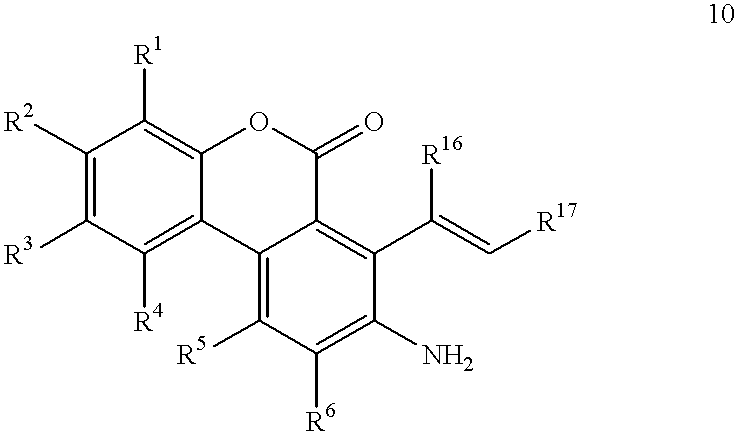
wherein
R1-6 independently represent H, C1-C6 alkyl, substituted C1-C6 alkyl, F, Cl, Br, I, CN, CF3, CF2CF3, CO2R7 (where R7 represents H, C1-C6 alkyl, substituted C1-C6 alkyl, allyl, substituted allyl, aryl, substituted aryl, heteroaryl or substituted heteroaryl), CONR7R8 (where R8 represents H, C1-C6 alkyl, substituted C1-C6 alkyl, allyl, substituted allyl, aryl, substituted aryl, heteroaryl or substituted heteroaryl; or where, alternatively, R7 and R8 combine to form a four- to seven-membered ring), OR9 (where R9 represents C1-C6 alkyl, substituted C1-C6 alkyl, allyl, substituted allyl, aryl, substituted aryl, heteroaryl or substituted heteroaryl), NR7R9, SR9, SOR9, or SO2R9;
and R16-17 independently represent H, C1-C6 alkyl, substituted C1-C6 alkyl, allyl, substituted allyl, aryl, substituted aryl, heteroaryl, substituted heteroaryl, OR14 (where R14 represents C1-C6 alkyl, substituted C1-C6 alkyl, allyl, substituted allyl, aryl, substituted aryl, heteroaryl or substituted heteroaryl) or Cl; or where R16 and R17 taken together form a five- to seven-membered, optionally substituted ring.
Priority Applications (1)
| Application Number | Priority Date | Filing Date | Title |
|---|---|---|---|
| US09/419,049 US6172241B1 (en) | 1999-10-15 | 1999-10-15 | Process for the preparation of 1,2-dihydroquinolines |
Applications Claiming Priority (1)
| Application Number | Priority Date | Filing Date | Title |
|---|---|---|---|
| US09/419,049 US6172241B1 (en) | 1999-10-15 | 1999-10-15 | Process for the preparation of 1,2-dihydroquinolines |
Publications (1)
| Publication Number | Publication Date |
|---|---|
| US6172241B1 true US6172241B1 (en) | 2001-01-09 |
Family
ID=23660592
Family Applications (1)
| Application Number | Title | Priority Date | Filing Date |
|---|---|---|---|
| US09/419,049 Expired - Fee Related US6172241B1 (en) | 1999-10-15 | 1999-10-15 | Process for the preparation of 1,2-dihydroquinolines |
Country Status (1)
| Country | Link |
|---|---|
| US (1) | US6172241B1 (en) |
Cited By (10)
| Publication number | Priority date | Publication date | Assignee | Title |
|---|---|---|---|---|
| US20020183314A1 (en) * | 2001-02-23 | 2002-12-05 | Ligand Pharmaceuticals Incorporated | Tricyclic quinolinone and tricyclic quinoline androgen receptor modulator compounds and methods |
| US20040147530A1 (en) * | 2002-10-11 | 2004-07-29 | Lin Zhi | 5-(1',1'-cycloalkyl/alkenyl)methylidene 1,2-dihydro-5H-chromeno[3,4-f]quinolines as selective progesterone receptor modulator compounds |
| US20040152718A1 (en) * | 2002-10-11 | 2004-08-05 | Lin Zhi | 5-cycloalkenyl 5H-chromeno[3,4-f]quinoline derivatives as selective progesterone receptor modulator compounds |
| US6964973B2 (en) | 1999-08-27 | 2005-11-15 | Ligand Pharmaceuticals Incorporated | Bicyclic androgen and progesterone receptor modulator compounds and methods |
| US20070167445A1 (en) * | 1999-08-27 | 2007-07-19 | Higuchi Robert I | Androgen receptor modulator compounds and methods |
| US20100210678A1 (en) * | 2001-02-23 | 2010-08-19 | Lin Zhi | Tricyclic androgen receptor modulator compounds and methods |
| CN102702095A (en) * | 2012-06-13 | 2012-10-03 | 常州大学 | Method for synthesizing 2-hydro-2-substitued-quinoline derivative compound |
| CN102702100A (en) * | 2012-06-13 | 2012-10-03 | 常州大学 | Method for synthesizing N-substituted-2-hydro-2-substituted-quinoline derivative compound |
| US20140100270A1 (en) * | 2011-02-16 | 2014-04-10 | David I. Sherris | Radiation countermeasure agents |
| WO2017184498A1 (en) * | 2016-04-18 | 2017-10-26 | Novus International Inc. | Substituted 1,2-dihydroquinolines with low contaminant levels and processes for preparing |
Citations (1)
| Publication number | Priority date | Publication date | Assignee | Title |
|---|---|---|---|---|
| US5688808A (en) * | 1994-12-22 | 1997-11-18 | Ligand Pharmaceuticals Incorporated | Steroid receptor modulator compounds and methods |
-
1999
- 1999-10-15 US US09/419,049 patent/US6172241B1/en not_active Expired - Fee Related
Patent Citations (1)
| Publication number | Priority date | Publication date | Assignee | Title |
|---|---|---|---|---|
| US5688808A (en) * | 1994-12-22 | 1997-11-18 | Ligand Pharmaceuticals Incorporated | Steroid receptor modulator compounds and methods |
Cited By (21)
| Publication number | Priority date | Publication date | Assignee | Title |
|---|---|---|---|---|
| US7696246B2 (en) | 1999-08-27 | 2010-04-13 | Ligand Pharmaceuticals Incorporated | Bicyclic androgen and progesterone receptor modulator compounds and methods |
| US6964973B2 (en) | 1999-08-27 | 2005-11-15 | Ligand Pharmaceuticals Incorporated | Bicyclic androgen and progesterone receptor modulator compounds and methods |
| US20050288350A1 (en) * | 1999-08-27 | 2005-12-29 | Lin Zhi | Bicyclic androgen and progesterone receptor modulator compounds and methods |
| US20070167445A1 (en) * | 1999-08-27 | 2007-07-19 | Higuchi Robert I | Androgen receptor modulator compounds and methods |
| US20070072849A1 (en) * | 2001-02-23 | 2007-03-29 | Higuchi Robert I | Tricyclic quinolinone and tricyclic quinoline androgen receptor modulator compounds and methods |
| US20100210678A1 (en) * | 2001-02-23 | 2010-08-19 | Lin Zhi | Tricyclic androgen receptor modulator compounds and methods |
| US20020183314A1 (en) * | 2001-02-23 | 2002-12-05 | Ligand Pharmaceuticals Incorporated | Tricyclic quinolinone and tricyclic quinoline androgen receptor modulator compounds and methods |
| US20080300241A9 (en) * | 2001-02-23 | 2008-12-04 | Higuchi Robert I | Tricyclic quinolinone and tricyclic quinoline androgen receptor modulator compounds and methods |
| US7214690B2 (en) | 2001-02-23 | 2007-05-08 | Ligand Pharmaceuticals Incorporated | Tricyclic quinolinone and tricyclic quinoline androgen receptor modulator compounds and methods |
| US7071205B2 (en) | 2002-10-11 | 2006-07-04 | Ligand Pharmaceuticals Incorporated | 5-cycloalkenyl 5H-chromeno[3,4-f]quinoline derivatives as selective progesterone receptor modulator compounds |
| US20060223839A1 (en) * | 2002-10-11 | 2006-10-05 | Lin Zhi | 5-(1',1'-cycloalkyl/alkenyl)methylidene 1,2-dihydro-5H-chromeno-[3,4-f]-quinolines as selective progesterone receptor modulator compounds |
| US20060194827A1 (en) * | 2002-10-11 | 2006-08-31 | Lin Zhi | 5-Cycloalkenyl 5H-chromeno[3,4-f]quinoline derivatives as selective progesterone receptor modulator compounds |
| US7084151B2 (en) | 2002-10-11 | 2006-08-01 | Ligand Pharmaceuticals Incorporated | 5-(1',1'-cycloalkyl/alkenyl)methylidene 1,2-dihydro-5H-chromeno[3,4-ƒ]quinolines as selective progesterone receptor modulator compounds |
| US20040152718A1 (en) * | 2002-10-11 | 2004-08-05 | Lin Zhi | 5-cycloalkenyl 5H-chromeno[3,4-f]quinoline derivatives as selective progesterone receptor modulator compounds |
| US20040147530A1 (en) * | 2002-10-11 | 2004-07-29 | Lin Zhi | 5-(1',1'-cycloalkyl/alkenyl)methylidene 1,2-dihydro-5H-chromeno[3,4-f]quinolines as selective progesterone receptor modulator compounds |
| US20140100270A1 (en) * | 2011-02-16 | 2014-04-10 | David I. Sherris | Radiation countermeasure agents |
| US9381187B2 (en) * | 2011-02-16 | 2016-07-05 | Paloma Pharmaceuticals, Inc. | Radiation countermeasure agents |
| CN102702095A (en) * | 2012-06-13 | 2012-10-03 | 常州大学 | Method for synthesizing 2-hydro-2-substitued-quinoline derivative compound |
| CN102702100A (en) * | 2012-06-13 | 2012-10-03 | 常州大学 | Method for synthesizing N-substituted-2-hydro-2-substituted-quinoline derivative compound |
| WO2017184498A1 (en) * | 2016-04-18 | 2017-10-26 | Novus International Inc. | Substituted 1,2-dihydroquinolines with low contaminant levels and processes for preparing |
| CN107304184A (en) * | 2016-04-18 | 2017-10-31 | 诺华丝国际股份有限公司 | Method for removing pollutant from 1,2 substituted EEDQs |
Similar Documents
| Publication | Publication Date | Title |
|---|---|---|
| US6180794B1 (en) | Process for the preparation of 1,2-dihydroquinolines | |
| DE69533180T2 (en) | Steroid receptor modulator compounds and methods | |
| DE3834204C2 (en) | ||
| EP1175422A2 (en) | Tetracyclic progesterone receptor modulator compounds and methods | |
| JPH01157983A (en) | Tetrahydro-fluoro and-thieno (2, 3-c)pyridines, pharmaceutical preparation containing the same and production thereof | |
| US6172241B1 (en) | Process for the preparation of 1,2-dihydroquinolines | |
| JP2003508397A (en) | 8-Substituted-6-trifluoromethyl-9-pyrido [3,2-G] quinoline compounds as androgen receptor modulators | |
| JP6793657B2 (en) | Substituted tricyclic heterocyclic compounds | |
| Baum et al. | Nickel-catalyzed transformations of 2, 1-benzisoxazoles with organozinc reagents | |
| JP2002543204A (en) | Tetracyclic progesterone receptor modulatory compounds and methods | |
| TW202328127A (en) | A substituted 1,4-dihydro-1,6-naphthyridinamide and uses thereof | |
| JP2022530718A (en) | Tricyclic compounds and their manufacturing methods and uses | |
| CN106831793A (en) | A kind of synthesis technique for treating ovarian cancer Rucaparib intermediates | |
| Chen et al. | CuI catalyzed domino coupling–cyclization of 2-iodo-phenols and 1-alkynes to the synthesis of 2-substituted benzo [b] furans/furo-pyridines | |
| CN115197153B (en) | Preparation method of 1, 4-diazacycloalkane compound | |
| CN108314658A (en) | A kind of preparation method of Duo substituted oxazoles derivative | |
| Tomanová et al. | Synthesis of 4-substituted pyrazole-3, 5-diamines via Suzuki–Miyaura coupling and iron-catalyzed reduction | |
| US7071205B2 (en) | 5-cycloalkenyl 5H-chromeno[3,4-f]quinoline derivatives as selective progesterone receptor modulator compounds | |
| CN109705133B (en) | A Class of Selective Estrogen Receptor Modulator Compounds Containing Phenylselenide Group and Its Application in Anti-breast Cancer Drugs | |
| Schaub et al. | A convenient synthesis of biphenylene | |
| CN109020895B (en) | Synthesis method of metal-catalyzed 1-benzylamino-substituted benzimidazole | |
| CN107382858B (en) | A series of 1,2,3,4-tetrahydroisoquinolin-4-one compounds and their synthetic methods and applications | |
| CN107098902B (en) | A kind of synthetic method of pyrrolo[1,2-a]quinoline derivative | |
| CA2501833A1 (en) | 5-(1',1'-cycloalkyl/alkenyl)methylidene 1,2-dihydro-5h-chromeno[3,4-f]quinolines as selective progesterone receptor modulator compounds | |
| JP2007519640A (en) | Non-nucleoside reverse transcriptase inhibitors |
Legal Events
| Date | Code | Title | Description |
|---|---|---|---|
| FEPP | Fee payment procedure |
Free format text: PAYOR NUMBER ASSIGNED (ORIGINAL EVENT CODE: ASPN); ENTITY STATUS OF PATENT OWNER: LARGE ENTITY |
|
| FPAY | Fee payment |
Year of fee payment: 4 |
|
| FPAY | Fee payment |
Year of fee payment: 8 |
|
| REMI | Maintenance fee reminder mailed | ||
| LAPS | Lapse for failure to pay maintenance fees | ||
| STCH | Information on status: patent discontinuation |
Free format text: PATENT EXPIRED DUE TO NONPAYMENT OF MAINTENANCE FEES UNDER 37 CFR 1.362 |
|
| FP | Lapsed due to failure to pay maintenance fee |
Effective date: 20130109 |