US5378348A - Distillate fuel production from Fischer-Tropsch wax - Google Patents
Distillate fuel production from Fischer-Tropsch wax Download PDFInfo
- Publication number
- US5378348A US5378348A US08/096,129 US9612993A US5378348A US 5378348 A US5378348 A US 5378348A US 9612993 A US9612993 A US 9612993A US 5378348 A US5378348 A US 5378348A
- Authority
- US
- United States
- Prior art keywords
- product
- fraction
- range
- sub
- boils
- Prior art date
- Legal status (The legal status is an assumption and is not a legal conclusion. Google has not performed a legal analysis and makes no representation as to the accuracy of the status listed.)
- Expired - Lifetime
Links
Images
Classifications
-
- C—CHEMISTRY; METALLURGY
- C10—PETROLEUM, GAS OR COKE INDUSTRIES; TECHNICAL GASES CONTAINING CARBON MONOXIDE; FUELS; LUBRICANTS; PEAT
- C10G—CRACKING HYDROCARBON OILS; PRODUCTION OF LIQUID HYDROCARBON MIXTURES, e.g. BY DESTRUCTIVE HYDROGENATION, OLIGOMERISATION, POLYMERISATION; RECOVERY OF HYDROCARBON OILS FROM OIL-SHALE, OIL-SAND, OR GASES; REFINING MIXTURES MAINLY CONSISTING OF HYDROCARBONS; REFORMING OF NAPHTHA; MINERAL WAXES
- C10G65/00—Treatment of hydrocarbon oils by two or more hydrotreatment processes only
-
- F—MECHANICAL ENGINEERING; LIGHTING; HEATING; WEAPONS; BLASTING
- F02—COMBUSTION ENGINES; HOT-GAS OR COMBUSTION-PRODUCT ENGINE PLANTS
- F02B—INTERNAL-COMBUSTION PISTON ENGINES; COMBUSTION ENGINES IN GENERAL
- F02B3/00—Engines characterised by air compression and subsequent fuel addition
- F02B3/06—Engines characterised by air compression and subsequent fuel addition with compression ignition
-
- Y—GENERAL TAGGING OF NEW TECHNOLOGICAL DEVELOPMENTS; GENERAL TAGGING OF CROSS-SECTIONAL TECHNOLOGIES SPANNING OVER SEVERAL SECTIONS OF THE IPC; TECHNICAL SUBJECTS COVERED BY FORMER USPC CROSS-REFERENCE ART COLLECTIONS [XRACs] AND DIGESTS
- Y10—TECHNICAL SUBJECTS COVERED BY FORMER USPC
- Y10S—TECHNICAL SUBJECTS COVERED BY FORMER USPC CROSS-REFERENCE ART COLLECTIONS [XRACs] AND DIGESTS
- Y10S208/00—Mineral oils: processes and products
- Y10S208/95—Processing of "fischer-tropsch" crude
Definitions
- This invention relates to the production of middle distillates useful as diesel or jet fuels and having excellent low temperature properties. More particularly, this invention relates to the production of distillate fuels from a waxy hydrocarbon produced by the reaction of CO and hydrogen, the Fischer-Tropsch hydrocarbon synthesis process. Still more particularly, this invention relates to a process whereby the wax feed is separated into at least two fractions, a heavier fraction which is hydroisomerized without intermediate hydrotreatment, and at least one lighter fraction which is hydrotreated prior to hydroisomerization.
- the waxy product of a hydrocarbon synthesis product particularly the product from a cobalt based catalyst process, contains a high proportion of normal paraffins. Nevertheless, the products from hydrocarbon synthesis must be useful in a wide variety of applications, just as are the products from naturally occurring petroleum. Indeed, the products must be fungible and the application must not be affected by the source of the product. Waxy products provide notoriously poor cold flow properties making such products difficult or impossible to use where cold flow properties are vital, e.g., lubes, diesel fuels, jet fuels.
- materials useful as diesel and jet fuels or as blending components for diesel and jet fuels are produced from waxy Fischer-Tropsch products by a process comprising: separating (by fractionation) the waxy Fischer-Tropsch product into a heavier fraction boiling above about 500° F. and at least one lighter fraction boiling below about 500° F., for example, a 320°/500° F. fraction but preferably an all remaining liquid, at atmospheric pressure, fraction, i.e., a C 5 /500° F. fraction.
- the heavier fraction is catalytically hydroisomerized, preferably in the absence of intermediate hydrotreating, and produces products with excellent cold flow characteristics that can be used as jet fuels and diesel fuels or as blending components therefor.
- this isomerized material produces jet fuels having a freeze point of about -40° F. or lower and diesel fuels having low cloud points, and cetane ratings less than that of the corresponding normal paraffins; thus, indicating increased product branching relative to the waxy paraffin feed.
- the lighter fraction either the 320/500 cut or the C 5 /500 cut, is first subjected to mild catalytic hydrotreating to remove hetero-atom compounds, such as oxygenates, followed by catalytic hydroisomerization thereby producing materials also useful as diesel and jet fuels or useful as blending components therefor.
- all or a part of each product stream can be combined or blended and used as diesel or jet fuels or further blended for such use.
- the catalysts useful in each hydrotreating and hydroisomerization can be selected to improve the qualities of the products.
- any 700° F.+ materials produced from either hydroisomerization step can be recycled or fed to the hydroisomerization step for the heavier fraction for further conversion and isomerization of the 700° F.+ fraction.
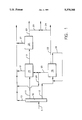
- FIG. 1 is a schematic arrangement of the process and its embodiments.
- the Fischer-Tropsch process can produce a wide variety of materials depending on catalyst and process conditions.
- preferred catalysts include cobalt, ruthenium and iron. Cobalt and ruthenium make primarily paraffinic products, cobalt tending towards a heavier product slate, e.g., containing C 20+ , while ruthenium tends to produce more distillate type paraffins, e.g., C 5 -C 20 .
- the high proportion of normal paraffins in the product must be converted into more useable products, such as transportation fuels. This conversion is accomplished primarily by hydrogen treatments involving hydrotreating, hydroisomerization, and hydrocracking.
- the feed stock for this invention can be described as a waxy Fischer-Tropsch product, and this product can contain C 5+ materials, preferably C 10+ , more preferably C 20+ materials, a substantial portion of which are normal paraffins.
- a typical product slate is shown below, which can vary by ⁇ 10% for each fraction.
- the feed stock is separated, usually by fractionation into a heavier fraction and at least one lighter fraction.
- the heavier fraction preferably a 500° F.+ fraction is substantially free of 500° F- materials.
- the heavier fraction contains less than about 3 wt % 500° F.-.
- Hydroisomerization is a well known process and its conditions can vary widely.
- Table B lists some broad and preferred conditions for this step.
- catalysts containing a supported Group VIII noble metal e.g., platinum or palladium
- catalysts containing one or more Group VIII base metals e.g., nickel, cobalt, which may or may not also include a Group VI metal, e.g., molybdenum.
- the support for the metals can be any refractory oxide or zeolite or mixtures thereof.
- Preferred supports include silica, alumina, titania, zirconia, vanadia and other Group III, IV, VA or VI oxides, as well as Y sieves, such as ultrastable Y sieves.
- Preferred supports include alumina and silica-alumina where the silica concentration of the bulk support is less than about 50 wt %, preferably less than about 35 wt %. More preferred supports are those described in U.S. Pat. No. 5,187,138 incorporated herein by reference. Briefly, the catalysts described therein contain one or more Group VIII metals on alumina or silica-alumina supports where the surface of the support is modified by addition of a silica precursor, e.g., S i (OC 2 H 5 ) 4 . Silica addition is at least 0.5 wt % preferably at least 2 wt %, more preferably about 2-25 wt %.
- a silica precursor e.g., S i (OC 2 H 5 ) 4 .
- Silica addition is at least 0.5 wt % preferably at least 2 wt %, more preferably about 2-25 wt %.
- the cold flow properties of the resulting jet fuel (320°/500° F.) fraction and diesel fuel (500°/700° F.) fraction are excellent, making the products useful as blending stocks to make jet and diesel fuels.
- At least one lighter fraction boiling below 500° F. is also recovered and treated.
- the lighter fraction can be a 320°-500° fraction or preferably the entire liquid fraction boiling below 500° F., that is, the C 5 /500° fraction. In either case the treatment steps are the same.
- the lighter fraction is hydrotreated to remove hetero-atom compounds, usually oxygenates formed in the hydrocarbon synthesis process. Hydrotreating temperatures can range from about 350°-600° F., pressures from about 100-3000 psig and hydrogen consumption rates of about 200-800 SCF/B feed.
- Catalysts for this step are well known and include any catalyst having a hydrogenation function, e.g., Group VIII noble or non-noble metal or Group VI metals, or combinations thereof, supported on refractory oxides or zeolites, e.g, alumina, silica, silica-alumina; alumina being a preferred support.
- a hydrogenation function e.g., Group VIII noble or non-noble metal or Group VI metals, or combinations thereof
- refractory oxides or zeolites e.g, alumina, silica, silica-alumina; alumina being a preferred support.
- hydrogen and CO enter Fischer-Tropsch reactor 10 where the synthesis gas is converted to C 5+ hydrocarbons.
- a heavier fraction is recovered in line 12 and hydroisomerized in reactor 16.
- the useful product, a 320-700 fraction is recovered in line 22 and may be used as diesel or jet fuel or as blending components therefore, after fractionation (not shown).
- the 700° F.+ material is recovered from the product in line 18 and recycled to the reactor 16.
- the light naphtha, e.g., C 5 /320 fraction is flashed in line 20 and sent to hydrotreater 15 or optionally by line 26 to the overhead line 13 containing C 5 /320 naphtha for collection and storage.
- the light fraction, in line 11 may be a 320/500 fraction or a C 5 /500 fraction.
- overhead line 13 does not exist, in the former it collects the light naphtha, i.e., the C 5 /320 fraction.
- the lighter fraction is hydrotreated in hydrotreater 15 and the resulting light naphtha is flashed in line 17 to line 13.
- the 320/500 fraction is recovered in line 19 and hydroisomerized in reactor 21.
- the resulting product in line 23 may be used as jet fuel or as a blending agent therefor, and optionally may be combined via line 25 with product from reactor 16 in line 24.
- Light naphtha is flashed from reactor 21 and recovered in line 27.
- the catalyst can be any catalyst useful in hydroisomerization of light fractions, e.g., 320/500 fractions, and preferably contains a supported Group VIII noble metal.
- the noble metal catalysts containing platinum or palladium as described in U.S. Pat. No. 5,187,138 are preferred.
- feed cracking should be maintained as low as possible, usually less than 20% cracking, preferably less than 10%, more preferably less than about 5%.
- a series of six catalysts was investigated for isomerization of a non-hydrotreated Fischer-Tropsch wax material with an initial boiling point of about 500° F. and an oxygen content of about 0.45 wt %. All of the catalysts were prepared according to conventional procedures using commercially available materials well known in the art. (Catalysts I through N were used in later experiments.) The tests were conducted in a small upflow pilot plant unit at 1000 psig, 0.5 LHSV, with a hydrogen treat gas rate near 3000 SCF/Bbl, and at temperatures of 650° to 750° F. Material balances were collected at a series of increasing temperatures with operation periods of 100 to 250 hours at each condition. The composition of the catalysts is outlined in Table 1.
- Table 1 also indicates the relative activity of the catalysts expressed as the reaction temperature needed to achieve 40-50% conversion of feed hydrocarbons boiling above 700° F. to hydrocarbons boiling below 700° F.
- Catalysts described as being surface impregnated with silica were prepared in accordance with U.S. Pat. No. 5,187,138.
- Table 2 provides a comparison of product distributions, jet fuel freeze points, diesel pour points, and cetane ratings for operations carried out at 40-50% 700° F.+ conversion. All the catalysts considered in this example showed more-or-less similar boiling range product distributions characterized by high selectivity to 320°/500° F. jet fuel range hydrocarbons with low gas and naphtha make. Other catalysts (not shown) were also examined which did not show such favorable selectivities.
- Table 2 shows that only certain catalysts combine high activity and jet/diesel selectivity in achieving cold flow properties. Specifically, Catalyst A was not able to produce jet fuel with acceptable cold flow properties. However, catalysts containing the same metal combination and loadings on silica-alumina supports with 20-30 wt % silica content (B and C) provided acceptable performance. Also, CoNiMo/10% SiO 2 -Al 2 O 3 catalysts which were modified by the addition of an additional 4-16 wt % silica as surface impregnated silica (catalysts D-F) also provided good performance. Good performance was also recognized with surface silica modified catalysts containing platinum or palladium (G,H) in place of CoNiMo. These types of catalysts (represented by B-H) produced products of similar overall quality and are strongly preferred for the wax isomerization step for 500° F.+ material.
- Catalyst D (4% SiO 2 /CoNiMo/10% SiO 2 -Al 2 O 3 ) was tested for 500° F.+ wax conversion activity, selectivity, and product quality under several different sets of processing conditions. In these tests, the catalyst was in the form of 1/20" quadrilobe extrudates in a 200 cc pilot plant reactor. Table 3 summarizes results of these studies which employed the same non-hydrotreated wax feed as in Example 1. Activity was improved with equivalent selectivity and jet fuel quality when the pressure was lowered to 500 psig and space velocity was increased to 1.0 LHSV.
- results from these tests are compared with single stage isomerization operations in Table 4.
- the reactivity of the Fischer-Tropsch wax for conversion during isomerization was increased greatly by prehydrotreating. For example, 50% 700° F.+ conversion was achieved near 600° F. with the hydrotreated wax versus a temperature requirement near 700° F. with the non-hydrotreated wax.
- the quality of the jet fuel produced with hydrotreating followed by isomerization was not as good as that achieved with single stage operations. Based on this behavior, wax isomerization is preferably carried out using non-hydrotreated 500° F.+ Fischer-Tropsch product.
- Tests were also carried out using Fischer-Tropsch wax feeds with variable contents of 500° F.- hydrocarbons. As shown in Table 5 for similar levels of 700° F.+ feed conversion, the quality of the 320°/500° F. jet fuel (judged from freeze point measurements) improved as the 500° F.- content on feed decreased. In order to meet jet fuel freeze point specifications at 700° F.+ conversion levels near 50-60%, the content of 500° F.- hydrocarbons on wax feed is less than about 6%, preferably less than 4 wt %, and most preferably less than 2 wt %.
- Catalyst H of Example 1 and catalyst I were evaluated for isomerization of a light oil Fischer-Tropsch product boiling between 100° F. and 500° F. (approximating a C 5 /500 fraction). The reaction conditions were similar to those described in Example 1.
- Catalyst I was a commercially available hydrocracking catalyst containing 0.5 wt % Pd dispersed on a particulate support material containing about 80 wt % ultrastable-Y zeolite and 20 wt % alumina. Little or no conversion of this feed could be accomplished with either catalyst for reaction temperatures up to 750° F.
- Example 4 The same feed employed in Example 4 was subjected to hydrotreating and fractionation before isomerization tests were conducted. Hydrotreating was carried out at 350 psig, 450° F., and 3 LHSV using a 50% Ni/Al 2 O 3 catalyst. After hydrotreating, the feed was topped to an initial boiling point of about 350° F. prior to isomerization tests. The isomerization tests were carried out at 350-600 psig, 550°-700° F., and 1 LHSV using catalysts J and L described in Table 1. In contrast to Example 4, the hydrotreated distillate feed showed good reactivity for conversion to naphtha and isomerized distillate range hydrocarbons that are suitable for use as diesel and jet fuel blending components.
- the 320°/500° F. product produced over catalyst J was suitable for use as jet fuel without further blending.
- This catalyst contained 0.3 wt % palladium dispersed on a 10% SiO 2 -Al 2 O 3 support which was further modified by the addition of 6 wt % surface silica derived from impregnation of Si(OC 2 H 5 ) 4 .
- This catalyst displayed a superior selectivity for jet fuel production versus gas and naphtha as compared to the more active catalysts K and L which contained 0.5% palladium dispersed on supports containing 75% SiO 2 -Al 2 O 3 and ultrastable-Y zeolite, respectively.
- Table 6 compares product distributions and jet quality at several conversion levels.
- This catalyst was dried and calcined in air at 450° C. for 3-4 hours prior to use.
- the test goal was to maximize the yield of 320°-500° F. boiling range distillate satisfying a freeze point specification of -50° F.
- Table 7 compares product yields under these conditions of constant product quality. It can be seen that the catalyst produced using the 20 wt % silica support provided improved distillate yield and reduced gas and naphtha make as compared to the catalyst produced using the high (75 wt %) silica content support, although both catalysts provided effective performance.
- Catalyst M containing 0.6% Pt dispersed on a fluorided alumina showed good activity combined with good selectivity for producing isomerized hydrocarbons in the jet fuel boiling range.
- the best selectivities for producing 320°/500° F. hydrocarbons versus gas and naphtha were obtained with noble metal catalysts containing 0.6 wt % Pt or 0.7 wt % Pd dispersed on a 10% SiO 2 -Al 2 O 3 support which was further modified by the addition of 4 wt % surface silica derived from impregnation with Si(OC 2 H 5 ) 4 .
Landscapes
- Chemical & Material Sciences (AREA)
- Oil, Petroleum & Natural Gas (AREA)
- Engineering & Computer Science (AREA)
- Chemical Kinetics & Catalysis (AREA)
- General Chemical & Material Sciences (AREA)
- Organic Chemistry (AREA)
- Production Of Liquid Hydrocarbon Mixture For Refining Petroleum (AREA)
Abstract
Distillate fuels with excellent cold flow properties are produced from waxy Fischer-Tropsch products by separating the product into a heavier and a lighter fraction, isomerizing the heavier fraction, hydrotreating and isomerizing the lighter fraction, and recovering products in jet and diesel fuel ranges.
Description
This invention relates to the production of middle distillates useful as diesel or jet fuels and having excellent low temperature properties. More particularly, this invention relates to the production of distillate fuels from a waxy hydrocarbon produced by the reaction of CO and hydrogen, the Fischer-Tropsch hydrocarbon synthesis process. Still more particularly, this invention relates to a process whereby the wax feed is separated into at least two fractions, a heavier fraction which is hydroisomerized without intermediate hydrotreatment, and at least one lighter fraction which is hydrotreated prior to hydroisomerization.
The waxy product of a hydrocarbon synthesis product, particularly the product from a cobalt based catalyst process, contains a high proportion of normal paraffins. Nevertheless, the products from hydrocarbon synthesis must be useful in a wide variety of applications, just as are the products from naturally occurring petroleum. Indeed, the products must be fungible and the application must not be affected by the source of the product. Waxy products provide notoriously poor cold flow properties making such products difficult or impossible to use where cold flow properties are vital, e.g., lubes, diesel fuels, jet fuels.
Cold flow properties can be improved by increasing the branching of distillates within the proper boiling range as well as by hydrocracking heavier components. Hydrocracking, however, produces gaseous and light products that tend to reduce the yield of valuable distillates, and there remains a desire for maximizing distillates obtained from Fischer-Tropsch waxes.
This process tends to increase the yield of distillates, such as kerosene, diesels, and lube base stocks as well as providing excellent cold flow properties that are essential for the utility of these materials. In accordance with this invention, materials useful as diesel and jet fuels or as blending components for diesel and jet fuels are produced from waxy Fischer-Tropsch products by a process comprising: separating (by fractionation) the waxy Fischer-Tropsch product into a heavier fraction boiling above about 500° F. and at least one lighter fraction boiling below about 500° F., for example, a 320°/500° F. fraction but preferably an all remaining liquid, at atmospheric pressure, fraction, i.e., a C5 /500° F. fraction.
The heavier fraction is catalytically hydroisomerized, preferably in the absence of intermediate hydrotreating, and produces products with excellent cold flow characteristics that can be used as jet fuels and diesel fuels or as blending components therefor. Preferably this isomerized material produces jet fuels having a freeze point of about -40° F. or lower and diesel fuels having low cloud points, and cetane ratings less than that of the corresponding normal paraffins; thus, indicating increased product branching relative to the waxy paraffin feed.
The lighter fraction, either the 320/500 cut or the C5 /500 cut, is first subjected to mild catalytic hydrotreating to remove hetero-atom compounds, such as oxygenates, followed by catalytic hydroisomerization thereby producing materials also useful as diesel and jet fuels or useful as blending components therefor. Optionally, all or a part of each product stream can be combined or blended and used as diesel or jet fuels or further blended for such use.
The catalysts useful in each hydrotreating and hydroisomerization can be selected to improve the qualities of the products.
In one embodiment of this invention, any 700° F.+ materials produced from either hydroisomerization step can be recycled or fed to the hydroisomerization step for the heavier fraction for further conversion and isomerization of the 700° F.+ fraction.
FIG. 1 is a schematic arrangement of the process and its embodiments.
The Fischer-Tropsch process can produce a wide variety of materials depending on catalyst and process conditions. Currently, preferred catalysts include cobalt, ruthenium and iron. Cobalt and ruthenium make primarily paraffinic products, cobalt tending towards a heavier product slate, e.g., containing C20+, while ruthenium tends to produce more distillate type paraffins, e.g., C5 -C20. Regardless of the catalyst or conditions employed, however, the high proportion of normal paraffins in the product must be converted into more useable products, such as transportation fuels. This conversion is accomplished primarily by hydrogen treatments involving hydrotreating, hydroisomerization, and hydrocracking. Nevertheless, the feed stock for this invention can be described as a waxy Fischer-Tropsch product, and this product can contain C5+ materials, preferably C10+, more preferably C20+ materials, a substantial portion of which are normal paraffins. A typical product slate is shown below, which can vary by ±10% for each fraction.
              TABLE A
______________________________________
Typical product slate from F/T process liquids:
              Wt %
______________________________________
       IBP-320° F.
                13
       320-500° F.
                23
       500-700° F.
                19
        700-1050° F.
                34
       1050° F.+
                11
                100
______________________________________
The feed stock is separated, usually by fractionation into a heavier fraction and at least one lighter fraction. The heavier fraction, preferably a 500° F.+ fraction is substantially free of 500° F- materials. Preferably, the heavier fraction contains less than about 3 wt % 500° F.-. We have found that hydrotreatment of this fraction, while allowing for increased conversion upon hydroisomerization, does not provide the excellent cold flow properties that can be obtained by hydroisomerization of an untreated fraction. Consequently, the heavier fraction is preferably subjected to catalytic hydroisomerization in the absence of any prior hydrotreating step. In other words the heavier fraction is not subjected to any chemical or catalytic treatment prior to hydroisomerization.
Hydroisomerization is a well known process and its conditions can vary widely. For example, Table B below lists some broad and preferred conditions for this step.
              TABLE B
______________________________________
                   BROAD     PREFERRED
CONDITION          RANGE     RANGE
______________________________________
temperature, °F.
                   300-800   650-750
pressure, psig      0-2500    500-1200
hydrogen treat rate, SCF/B
                   500-5000  2000-4000
hydrogen consumption rate, SCF/B
                   50-500    100-300
______________________________________
While virtually any catalyst may be satisfactory for this step, some catalysts perform better than others and are preferred. For example, catalysts containing a supported Group VIII noble metal, e.g., platinum or palladium, are useful as are catalysts containing one or more Group VIII base metals, e.g., nickel, cobalt, which may or may not also include a Group VI metal, e.g., molybdenum. The support for the metals can be any refractory oxide or zeolite or mixtures thereof. Preferred supports include silica, alumina, titania, zirconia, vanadia and other Group III, IV, VA or VI oxides, as well as Y sieves, such as ultrastable Y sieves. Preferred supports include alumina and silica-alumina where the silica concentration of the bulk support is less than about 50 wt %, preferably less than about 35 wt %. More preferred supports are those described in U.S. Pat. No. 5,187,138 incorporated herein by reference. Briefly, the catalysts described therein contain one or more Group VIII metals on alumina or silica-alumina supports where the surface of the support is modified by addition of a silica precursor, e.g., Si (OC2 H5)4. Silica addition is at least 0.5 wt % preferably at least 2 wt %, more preferably about 2-25 wt %.
One factor to be kept in mind in hydroisomerization processes is that increasing conversion tends to increase cracking with resultant higher yields of gases and lower yields of distillate fuels. Consequently, conversion is usually maintained at about 35-80% of feed hydrocarbons boiling above 700° F. converted to hydrocarbons boiling below 700° F.
The cold flow properties of the resulting jet fuel (320°/500° F.) fraction and diesel fuel (500°/700° F.) fraction are excellent, making the products useful as blending stocks to make jet and diesel fuels.
At least one lighter fraction boiling below 500° F. is also recovered and treated. The lighter fraction can be a 320°-500° fraction or preferably the entire liquid fraction boiling below 500° F., that is, the C5 /500° fraction. In either case the treatment steps are the same. First, the lighter fraction is hydrotreated to remove hetero-atom compounds, usually oxygenates formed in the hydrocarbon synthesis process. Hydrotreating temperatures can range from about 350°-600° F., pressures from about 100-3000 psig and hydrogen consumption rates of about 200-800 SCF/B feed. Catalysts for this step are well known and include any catalyst having a hydrogenation function, e.g., Group VIII noble or non-noble metal or Group VI metals, or combinations thereof, supported on refractory oxides or zeolites, e.g, alumina, silica, silica-alumina; alumina being a preferred support.
Turning to the drawing, hydrogen and CO enter Fischer-Tropsch reactor 10 where the synthesis gas is converted to C5+ hydrocarbons. A heavier fraction is recovered in line 12 and hydroisomerized in reactor 16. The useful product, a 320-700 fraction is recovered in line 22 and may be used as diesel or jet fuel or as blending components therefore, after fractionation (not shown). In one embodiment, the 700° F.+ material is recovered from the product in line 18 and recycled to the reactor 16. In another embodiment the light naphtha, e.g., C5 /320 fraction is flashed in line 20 and sent to hydrotreater 15 or optionally by line 26 to the overhead line 13 containing C5 /320 naphtha for collection and storage.
The light fraction, in line 11 may be a 320/500 fraction or a C5 /500 fraction. In the latter case overhead line 13 does not exist, in the former it collects the light naphtha, i.e., the C5 /320 fraction. The lighter fraction is hydrotreated in hydrotreater 15 and the resulting light naphtha is flashed in line 17 to line 13. The 320/500 fraction is recovered in line 19 and hydroisomerized in reactor 21. The resulting product in line 23 may be used as jet fuel or as a blending agent therefor, and optionally may be combined via line 25 with product from reactor 16 in line 24. Light naphtha is flashed from reactor 21 and recovered in line 27.
After hydrotreating the lighter fraction, the light naphtha is flashed off and the remaining material is subjected to hydroisomerization. The catalyst can be any catalyst useful in hydroisomerization of light fractions, e.g., 320/500 fractions, and preferably contains a supported Group VIII noble metal. The noble metal catalysts containing platinum or palladium as described in U.S. Pat. No. 5,187,138 are preferred.
              TABLE C
______________________________________
                   BROAD     PREFERRED
CONDITION          RANGE     RANGE
______________________________________
temperature, °F.
                   300-800   600-750
pressure, psig      50-2000   700-1200
hydrogen treat rate, SCF/B
                   500-5000  2000-4000
hydrogen consumption rate, SCF/B
                   50-500    100-300
______________________________________
In catalytic hydroisomerization reactions feed cracking should be maintained as low as possible, usually less than 20% cracking, preferably less than 10%, more preferably less than about 5%.
The following examples will serve to illustrate further this invention.
A series of six catalysts (A-H) was investigated for isomerization of a non-hydrotreated Fischer-Tropsch wax material with an initial boiling point of about 500° F. and an oxygen content of about 0.45 wt %. All of the catalysts were prepared according to conventional procedures using commercially available materials well known in the art. (Catalysts I through N were used in later experiments.) The tests were conducted in a small upflow pilot plant unit at 1000 psig, 0.5 LHSV, with a hydrogen treat gas rate near 3000 SCF/Bbl, and at temperatures of 650° to 750° F. Material balances were collected at a series of increasing temperatures with operation periods of 100 to 250 hours at each condition. The composition of the catalysts is outlined in Table 1. Table 1 also indicates the relative activity of the catalysts expressed as the reaction temperature needed to achieve 40-50% conversion of feed hydrocarbons boiling above 700° F. to hydrocarbons boiling below 700° F. Catalysts described as being surface impregnated with silica were prepared in accordance with U.S. Pat. No. 5,187,138.
              TABLE 1
______________________________________
                                   700° F.+
                          REAC-    CON-
CAT-                      TION     VERSION
ALYST  COMPOSITION        T (°F.)
                                   (WT %)
______________________________________
A      12% Mo-0.5% Ni-3% Co
                          726      46
       on 10% SiO.sub.2 --Al.sub.2 O.sub.3
B      12% Mo-0.5% Ni-3% Co
                          705      46
       on 20% SiO.sub.2 --Al.sub.2 O.sub.3
C      12% Mo-0.5% Ni-3% Co on 27%
                          705      44
       SiO.sub.2 --Al.sub.2 O.sub.3
D      4% surface impregnated silica
                          708      53
       on A
E      8% surface impregnated silica
                          696      44
       on A
F      16% surface impregnated silica
                          668      40
       on A
G      4% surface impregnated silica
                          707      39
       on 0.6% Pt on 10%
       SiO.sub.2 --Al.sub.2 O.sub.3
H      4% surface impregnated silica
                          716      43
       on 0.7% Pd on 10%
       SiO.sub.2 --Al.sub.2 O.sub.3
I      0.5% Pd on composite support
                          --       --
       with 20% Al.sub.2 O.sub.3 and 80%
       ultrastable-Y
J      6% surface impregnated silica
                          --       --
       on 0.3% Pd on 10%
       SiO.sub.2 --Al.sub.2 O.sub.3
K      0.5% Pd on 75% SiO.sub.2 --Al.sub.2 O.sub.3
                          --       --
L      0.5% Pd on composite support
                          --       --
       with 80% high silica zeolite Y
       and 20% Al.sub.2 O.sub.3
M      7.0% F on 0.6% Pt/Al.sub.2 O.sub.3
                          --       --
N      0.5% Pt on ultrastable-Y
                          --       --
       zeolite
______________________________________
Clearly, different catalysts displayed significant differences in wax conversion activity. The most active materials were those produced using a surface silica additive. However, for the purposes of this invention, activity is not a critical factor. More important factors include the selectivity for producing jet fuel and diesel fuel versus gas and naphtha and the quality of the resulting jet fuel and diesel; e.g., these products should approach or meet cold flow property specifications for use as transportation fuels.
Table 2 provides a comparison of product distributions, jet fuel freeze points, diesel pour points, and cetane ratings for operations carried out at 40-50% 700° F.+ conversion. All the catalysts considered in this example showed more-or-less similar boiling range product distributions characterized by high selectivity to 320°/500° F. jet fuel range hydrocarbons with low gas and naphtha make. Other catalysts (not shown) were also examined which did not show such favorable selectivities.
                                  TABLE 2
__________________________________________________________________________
                                  320/500
                                        500/700
       700+                       FREEZE
                                        POUR
       CONV.
            PRODUCT YIELDS        POINT POINT
                                             500/700
CATALYST
       (%)  C1-C4
                C5/320
                    320/500
                         500/700
                              700+
                                  (°F.)
                                        (°F.)
                                             CENTANE
__________________________________________________________________________
A      46   3.4 5.2 20.8 32.9 41.7
                                  -13    27  71
B      46   3.5 5.7 21.8 32.4 41.1
                                  -31   -11  68
C      44   1.6 5.6 20.7 31.4 43.2
                                  -21   -11  68
D      53   2.0 7.3 25.0 32.0 34.8
                                  -47    -6  66
E      44   2.4 4.7 21.1 31.8 43.4
                                  -31   -11  68
F      40   1.7 4.8 21.3 27.9 46.0
                                  -31   -11  68
G      39   3.8 9.7 19.2 19.9 47.8
                                  -26   -17  66
H      43   1.4 6.4 24.9 22.7 44.8
                                  -27   -17  69
__________________________________________________________________________
 @ 1000 psig/0.5 LHSV/2500-3000 SCF/BblH2
Table 2 shows that only certain catalysts combine high activity and jet/diesel selectivity in achieving cold flow properties. Specifically, Catalyst A was not able to produce jet fuel with acceptable cold flow properties. However, catalysts containing the same metal combination and loadings on silica-alumina supports with 20-30 wt % silica content (B and C) provided acceptable performance. Also, CoNiMo/10% SiO2 -Al2 O3 catalysts which were modified by the addition of an additional 4-16 wt % silica as surface impregnated silica (catalysts D-F) also provided good performance. Good performance was also recognized with surface silica modified catalysts containing platinum or palladium (G,H) in place of CoNiMo. These types of catalysts (represented by B-H) produced products of similar overall quality and are strongly preferred for the wax isomerization step for 500° F.+ material.
Catalyst D (4% SiO2 /CoNiMo/10% SiO2 -Al2 O3) was tested for 500° F.+ wax conversion activity, selectivity, and product quality under several different sets of processing conditions. In these tests, the catalyst was in the form of 1/20" quadrilobe extrudates in a 200 cc pilot plant reactor. Table 3 summarizes results of these studies which employed the same non-hydrotreated wax feed as in Example 1. Activity was improved with equivalent selectivity and jet fuel quality when the pressure was lowered to 500 psig and space velocity was increased to 1.0 LHSV. However, when the wax feed rate was increased to 3.0 LHSV and the temperature also increased, the selectivity pattern changed dramatically, e.g., the yield of jet fuel was lowered in favor of gas and naphtha production, and the quality of the jet fuel was also impaired as reflected by an increased freeze point. The detailed reasons for this change in selectivity are not fully understood, although pore diffusion limitations are believed to be a primary factor contributing to the inferior performance at 3 LHSV.
              TABLE 3
______________________________________
             RELATIVE RATE
             CONSTANT FOR
             700° F.+
CONDITIONS   CONVERSION    SELECTIVITY
______________________________________
700° F./
             1.0-Base      Base
1000 psig/0.5 LHSV
700° F./
             2.0           Base
500 psig/1.0 LHSV
725° F./
             4-5           -8% jet/diesel;
1000 psig/3.0 LHSV         +7% gas/naphtha
______________________________________
Several tests were also carried out using a 550° F.+ Fischer-Tropsch wax which was hydrotreated to remove small levels of oxygen-containing hydrocarbons (alcohols, aldehydes, etc.) prior to isomerization. Hydrotreating was carried out at 635° F., 1000 psig, 2500 scf/Bbl H2 treat rate, and at space velocities of 0.5 to 3.0 LHSV using a commercial sulfided NiMo/Al2 O3 catalyst. Wax isomerization and hydrocracking was subsequently carried out using Catalyst B at 1000 psig, 0.5-3.0 LHSV, and 620°-660° F. Results from these tests are compared with single stage isomerization operations in Table 4. The reactivity of the Fischer-Tropsch wax for conversion during isomerization was increased greatly by prehydrotreating. For example, 50% 700° F.+ conversion was achieved near 600° F. with the hydrotreated wax versus a temperature requirement near 700° F. with the non-hydrotreated wax. However, the quality of the jet fuel produced with hydrotreating followed by isomerization was not as good as that achieved with single stage operations. Based on this behavior, wax isomerization is preferably carried out using non-hydrotreated 500° F.+ Fischer-Tropsch product.
              TABLE 4
______________________________________
               700° F.+
                         Product Properties
        Reaction
               Conversion
                         at 75° F.
500° F.+ Feed
          T (°F.)
                   (%)       320/700° F.
                                     700° F.+
______________________________________
Non-      716      57        clear liquid
                                     clear liquid
hydrotreated
Hydrotreated
          608      56        cloudy, hard wax
                             waxy liquid
______________________________________
 @ 1000 psig, 0.5 LHSV, 2500 SCF/Bbl
Tests were also carried out using Fischer-Tropsch wax feeds with variable contents of 500° F.- hydrocarbons. As shown in Table 5 for similar levels of 700° F.+ feed conversion, the quality of the 320°/500° F. jet fuel (judged from freeze point measurements) improved as the 500° F.- content on feed decreased. In order to meet jet fuel freeze point specifications at 700° F.+ conversion levels near 50-60%, the content of 500° F.- hydrocarbons on wax feed is less than about 6%, preferably less than 4 wt %, and most preferably less than 2 wt %.
              TABLE 5
______________________________________
At 50% 700+ F. Conversion to 700- F. Material
Wt % 500° F. in Wax
             Freeze Pt. of 320/500° F. Jet Component
______________________________________
5.5          -33° C. (-27° F.)
1.5          -45° C. (-49° F.)
______________________________________
Catalyst H of Example 1 and catalyst I were evaluated for isomerization of a light oil Fischer-Tropsch product boiling between 100° F. and 500° F. (approximating a C5 /500 fraction). The reaction conditions were similar to those described in Example 1. Catalyst I was a commercially available hydrocracking catalyst containing 0.5 wt % Pd dispersed on a particulate support material containing about 80 wt % ultrastable-Y zeolite and 20 wt % alumina. Little or no conversion of this feed could be accomplished with either catalyst for reaction temperatures up to 750° F.
The same feed employed in Example 4 was subjected to hydrotreating and fractionation before isomerization tests were conducted. Hydrotreating was carried out at 350 psig, 450° F., and 3 LHSV using a 50% Ni/Al2 O3 catalyst. After hydrotreating, the feed was topped to an initial boiling point of about 350° F. prior to isomerization tests. The isomerization tests were carried out at 350-600 psig, 550°-700° F., and 1 LHSV using catalysts J and L described in Table 1. In contrast to Example 4, the hydrotreated distillate feed showed good reactivity for conversion to naphtha and isomerized distillate range hydrocarbons that are suitable for use as diesel and jet fuel blending components. At high levels of 500° F.+ conversion, the 320°/500° F. product produced over catalyst J was suitable for use as jet fuel without further blending. This catalyst contained 0.3 wt % palladium dispersed on a 10% SiO2 -Al2 O3 support which was further modified by the addition of 6 wt % surface silica derived from impregnation of Si(OC2 H5)4. This catalyst displayed a superior selectivity for jet fuel production versus gas and naphtha as compared to the more active catalysts K and L which contained 0.5% palladium dispersed on supports containing 75% SiO2 -Al2 O3 and ultrastable-Y zeolite, respectively. Table 6 compares product distributions and jet quality at several conversion levels.
              TABLE 6
______________________________________
HYDROISOMERIZATION OF HYDROTREATED
350/500 F.- T DISTILLATE
                         PRODUCT     320/500° F.
CAT-     T      NC.sub.10 +
                         YIELDS (WT %)
                                     FREEZE
ALYST    (°F.)
                CONV.    C1/320 320/500
                                       PT (°F.)
______________________________________
Pd/US-Y  588.7  71.6     40.64  59.36  -38
Pd/Si-   599.8  84.1     54.63  45.37  -51
enhanced
TN-8
SiO.sub.2 --Al.sub.2 O.sub.3
(from U.S.
Pat. No.
5,187,138)
______________________________________
Isomerization tests were also carried out with the same hydrotreated 350° F.+ distillate feedstock employed in Example 6 using catalyst K described in Table 1 and a lab catalyst prepared by impregnating 0.5 wt % palladium onto the same 20% SiO2 -Al2 O3 support that was used to produce catalyst B.
This catalyst was dried and calcined in air at 450° C. for 3-4 hours prior to use. In this case, the test goal was to maximize the yield of 320°-500° F. boiling range distillate satisfying a freeze point specification of -50° F. Table 7 compares product yields under these conditions of constant product quality. It can be seen that the catalyst produced using the 20 wt % silica support provided improved distillate yield and reduced gas and naphtha make as compared to the catalyst produced using the high (75 wt %) silica content support, although both catalysts provided effective performance.
              TABLE 7
______________________________________
Hydroisomerization of Hydrotreated 350/500° F.- T Distillate
                 0.5% Pd/20%
                            0.5% Pd/75%
Catalyst         SiO.sub.2 --Al.sub.2 O.sub.3
                            SiO.sub.2 --Al.sub.2 O.sub.3
______________________________________
Yield (wt %) at -50° F.
320/500° F. Freeze Point
C.sub.1 -C.sub.4 Gas
                 1.8        2.6
C.sub.5 /320° F.
                 10.5       13.5
320/500° F.
                 82.5       77.7
500° F.+  5.4        6.5
______________________________________
Isomerization tests were also conducted using a second hydrotreated normal paraffin feedstock containing primarily distillate range hydrocarbons. In this case, six catalysts (A,D,G,H,M,N) were investigated at 1000 psig, 0.5 LHSV, and with temperatures ranging from 400° F. to 700° F. As shown in Table 8, very different activity and selectivity patterns were observed with the different catalysts. Catalysts A and D containing CoNiMo dispersed on silica-alumina supports showed high tendency for C1-C4 gas make. Catalyst N which contained 0.5 wt % platinum on an ultrastable-Y zeolite showed high activity at low temperatures but the products were mostly naphtha range hydrocarbons. Catalyst M containing 0.6% Pt dispersed on a fluorided alumina showed good activity combined with good selectivity for producing isomerized hydrocarbons in the jet fuel boiling range. However, the best selectivities for producing 320°/500° F. hydrocarbons versus gas and naphtha were obtained with noble metal catalysts containing 0.6 wt % Pt or 0.7 wt % Pd dispersed on a 10% SiO2 -Al2 O3 support which was further modified by the addition of 4 wt % surface silica derived from impregnation with Si(OC2 H5)4.
              TABLE 8
______________________________________
         500° F.+
                PRODUCT YIELDS (WT %)
CAT-   RXN     CONV                C5/
ALYST  T(F)    (%)      CH4  C2/C4 320° F.
                                         320/500 F.
______________________________________
A      658     78       4.1  1.6   8.7   69
       674     93       9.1  3.1   14.7  54
D      656     80       2.1  1.4   6.4   77
       674     92       4.7  2.5   14.4  62
G      656     78       0.02 0.65  4.9   84
       672     90       0.04 1.6   11.1  77
H      656     72       0.01 0.61  3.9   84
       671     88       0.01 1.3   9.0   80
M      590     58       0.01 0.85  4.1   79
N      400     52       0.01 7.6   25.4  47
______________________________________
 @ 1000 psig/0.5 LHSV/3000 SCF/BblH.sub.2 ; 32% 550° F.+ on feed
Claims (11)
1. A process for producing middle distillate transportation fuel components from the waxy product of a hydrocarbon synthesis process which comprises:
(a) separating the waxy product into a heavier fraction and at least one lighter fraction;
(b) catalytically isomerizing the heavier fraction in the presence of hydrogen and recovering products with improved cold flow properties;
(c) catalytically hydrotreating the lighter fraction and removing hetero atom compounds therefrom;
(d) catalytically isomerizing the product of step (c) to produce jet fuel component having a freeze point of -30° F. or lower.
2. The process of claim 1 wherein the heavier fraction boils above about 500° F.
3. The process of claim 1 wherein the lighter fraction boils in the range C5 -500° F.
4. The process of claim 3 wherein the lighter fraction boils in the range 320°-500° F.
5. The process of claim 2 wherein the heavier fraction is substantially free of materials boiling below 500° F.
6. The process of claim 5 wherein the heavier fraction contains less than about 3% hydrocarbons boiling below 500° F.
7. The process of claim 2 wherein at least a portion of the product of step (b) is combined with at least a portion of the product of step (d).
8. The process of claim 7 wherein at least a portion of the product boiling in the range 320°-500° F. from step (b) is combined with at least a portion of the product boiling in the range 320°-500° F. of step (d).
9. The process of claim 1 wherein the product recovered from step (b) boils in the range 320°-700° F.
10. The process of claim 9 wherein the recovered product boils in the range 500°-700° F.
11. The process of claim 1 wherein the product recovered from step (d) boils in the range 320°-500° F.
Priority Applications (7)
| Application Number | Priority Date | Filing Date | Title |
|---|---|---|---|
| US08/096,129 US5378348A (en) | 1993-07-22 | 1993-07-22 | Distillate fuel production from Fischer-Tropsch wax |
| CA002127010A CA2127010C (en) | 1993-07-22 | 1994-06-29 | Distillate fuel production from fischer-tropsch wax |
| EP94305037A EP0635557B1 (en) | 1993-07-22 | 1994-07-08 | Middle distillate fuel production |
| DE69423148T DE69423148T2 (en) | 1993-07-22 | 1994-07-08 | Manufacture of middle distillate fuel |
| MYPI94001806A MY111278A (en) | 1993-07-22 | 1994-07-11 | Distillate fuel production from fischer- tropsch wax |
| AU68621/94A AU671224B2 (en) | 1993-07-22 | 1994-07-20 | Distillate fuel production from Fischer-Tropsch wax |
| NO942726A NO309197B1 (en) | 1993-07-22 | 1994-07-21 | Production of distillate fuel from Fischer-Tropsch wax |
Applications Claiming Priority (1)
| Application Number | Priority Date | Filing Date | Title |
|---|---|---|---|
| US08/096,129 US5378348A (en) | 1993-07-22 | 1993-07-22 | Distillate fuel production from Fischer-Tropsch wax |
Publications (1)
| Publication Number | Publication Date |
|---|---|
| US5378348A true US5378348A (en) | 1995-01-03 |
Family
ID=22255585
Family Applications (1)
| Application Number | Title | Priority Date | Filing Date |
|---|---|---|---|
| US08/096,129 Expired - Lifetime US5378348A (en) | 1993-07-22 | 1993-07-22 | Distillate fuel production from Fischer-Tropsch wax |
Country Status (7)
| Country | Link |
|---|---|
| US (1) | US5378348A (en) |
| EP (1) | EP0635557B1 (en) |
| AU (1) | AU671224B2 (en) |
| CA (1) | CA2127010C (en) |
| DE (1) | DE69423148T2 (en) |
| MY (1) | MY111278A (en) |
| NO (1) | NO309197B1 (en) |
Cited By (146)
| Publication number | Priority date | Publication date | Assignee | Title |
|---|---|---|---|---|
| EP0753563A1 (en) * | 1995-07-14 | 1997-01-15 | Exxon Research And Engineering Company | Process for hydroisomerization of waxy hydrocarbon feeds over a slurried catalyst |
| WO1997003750A1 (en) * | 1995-07-14 | 1997-02-06 | Exxon Research & Engineering Company | Supported ni-cu hydroconversion catalyst |
| US5689031A (en) * | 1995-10-17 | 1997-11-18 | Exxon Research & Engineering Company | Synthetic diesel fuel and process for its production |
| US5814109A (en) * | 1997-02-07 | 1998-09-29 | Exxon Research And Engineering Company | Diesel additive for improving cetane, lubricity, and stability |
| US5882505A (en) * | 1997-06-03 | 1999-03-16 | Exxon Research And Engineering Company | Conversion of fisher-tropsch waxes to lubricants by countercurrent processing |
| US5888376A (en) * | 1996-08-23 | 1999-03-30 | Exxon Research And Engineering Co. | Conversion of fischer-tropsch light oil to jet fuel by countercurrent processing |
| US5895506A (en) * | 1998-03-20 | 1999-04-20 | Cook; Bruce Randall | Use of infrared spectroscopy to produce high lubricity, high stability, Fischer-Tropsch diesel fuels and blend stocks |
| WO1999041217A1 (en) | 1998-02-13 | 1999-08-19 | Exxon Research And Engineering Company | Gas conversion using synthesis gas produced hydrogen for catalyst rejuvenation and hydrocarbon conversion |
| US6001142A (en) * | 1998-11-06 | 1999-12-14 | Texaco Inc. | Polyoxyalkylene urethane and fuel composition containing same |
| US6013171A (en) * | 1998-02-03 | 2000-01-11 | Exxon Research And Engineering Co. | Catalytic dewaxing with trivalent rare earth metal ion exchanged ferrierite |
| US6056793A (en) * | 1997-10-28 | 2000-05-02 | University Of Kansas Center For Research, Inc. | Blended compression-ignition fuel containing light synthetic crude and blending stock |
| US6075061A (en) * | 1998-06-30 | 2000-06-13 | Exxon Research And Engineering Company | Integrated process for converting natural gas and gas field condensate into high valued liquid products (law713) |
| US6103773A (en) * | 1998-01-27 | 2000-08-15 | Exxon Research And Engineering Co | Gas conversion using hydrogen produced from syngas for removing sulfur from gas well hydrocarbon liquids |
| WO2000060029A1 (en) * | 1999-04-06 | 2000-10-12 | Sasol Technology (Pty) Ltd | Process for producing synthetic naphtha fuel and synthetic naphtha fuel produced by that process |
| US6180842B1 (en) * | 1998-08-21 | 2001-01-30 | Exxon Research And Engineering Company | Stability fischer-tropsch diesel fuel and a process for its production |
| WO2001012757A1 (en) * | 1999-08-13 | 2001-02-22 | Exxonmobil Research And Engineering Company | Use of 13c nmr spectroscopy to produce optimum fischer-tropsch diesel fuels and blend stocks |
| AU730128B2 (en) * | 1995-10-17 | 2001-02-22 | Exxon Research And Engineering Company | Synthetic diesel fuel and process for its production |
| WO1999061143A3 (en) * | 1998-05-22 | 2001-02-22 | Conoco Inc | Fischer-tropsch processes and catalysts using fluorided alumina supports |
| AU730173B2 (en) * | 1995-10-17 | 2001-03-01 | Exxon Research And Engineering Company | Synthetic diesel fuel and process for its production |
| US6241952B1 (en) | 1997-09-26 | 2001-06-05 | Exxon Research And Engineering Company | Countercurrent reactor with interstage stripping of NH3 and H2S in gas/liquid contacting zones |
| WO2001057160A1 (en) * | 2000-02-03 | 2001-08-09 | Exxonmobil Research And Engineering Company | Single stage multi-zone hydroisomerization process |
| US6274029B1 (en) | 1995-10-17 | 2001-08-14 | Exxon Research And Engineering Company | Synthetic diesel fuel and process for its production |
| US6309432B1 (en) | 1997-02-07 | 2001-10-30 | Exxon Research And Engineering Company | Synthetic jet fuel and process for its production |
| US6313361B1 (en) | 1996-02-13 | 2001-11-06 | Marathon Oil Company | Formation of a stable wax slurry from a Fischer-Tropsch reactor effluent |
| US6325833B1 (en) * | 1997-09-12 | 2001-12-04 | Exxon Research And Engineering Company | Emulsion blends |
| US20020062053A1 (en) * | 2000-05-02 | 2002-05-23 | Berlowitz Paul Joseph | Wide cut Fischer Tropsch diesel fuels |
| GB2371806A (en) * | 2000-11-08 | 2002-08-07 | Chevron Usa Inc | Manufacture of lube base stock from Fischer-Tropsch syncrude |
| WO2002081599A1 (en) * | 2001-04-04 | 2002-10-17 | Chevron U.S.A. Inc. | Liquid or two-phase quenching fluid for multi-bed hydroprocessing reactor |
| US6495029B1 (en) | 1997-08-22 | 2002-12-17 | Exxon Research And Engineering Company | Countercurrent desulfurization process for refractory organosulfur heterocycles |
| US6497812B1 (en) | 1999-12-22 | 2002-12-24 | Chevron U.S.A. Inc. | Conversion of C1-C3 alkanes and fischer-tropsch products to normal alpha olefins and other liquid hydrocarbons |
| US6497810B1 (en) | 1998-12-07 | 2002-12-24 | Larry L. Laccino | Countercurrent hydroprocessing with feedstream quench to control temperature |
| FR2826971A1 (en) * | 2001-07-06 | 2003-01-10 | Inst Francais Du Petrole | PROCESS FOR PRODUCING MEDIUM DISTILLATES BY HYDROISOMERIZATION AND HYDROCRACKING OF LOADS FROM THE FISCHER-TROPSCH PROCESS |
| FR2826973A1 (en) * | 2001-07-06 | 2003-01-10 | Inst Francais Du Petrole | PROCESS FOR THE PRODUCTION OF MEDIUM DISTILLATES BY HYDROISOMERIZATION AND HYDROCRACKING OF 2 FRACTIONS FROM LOADS FROM THE FISCHER-TROPSCH PROCESS |
| FR2826972A1 (en) * | 2001-07-06 | 2003-01-10 | Inst Francais Du Petrole | PROCESS FOR PRODUCING MEDIUM DISTILLATES BY HYDROISOMERIZATION AND HYDROCRACKING OF A HEAVY FRACTION DERIVED FROM AN EFFLUENT PRODUCED BY THE FISCHER-TROPSCH PROCESS |
| FR2826974A1 (en) * | 2001-07-06 | 2003-01-10 | Inst Francais Du Petrole | PROCESS FOR PRODUCING MEDIUM DISTILLATES BY HYDROISOMERIZATION AND HYDROCRACKING IN 2 STEPS OF LOADS FROM THE FISCHER-TROPSCH PROCESS |
| WO2003033622A1 (en) * | 2001-10-17 | 2003-04-24 | Chevron U.S.A. Inc. | Process for converting waxy feeds into low haze heavy base oil |
| US6569314B1 (en) | 1998-12-07 | 2003-05-27 | Exxonmobil Research And Engineering Company | Countercurrent hydroprocessing with trickle bed processing of vapor product stream |
| US6579443B1 (en) | 1998-12-07 | 2003-06-17 | Exxonmobil Research And Engineering Company | Countercurrent hydroprocessing with treatment of feedstream to remove particulates and foulant precursors |
| US6583186B2 (en) | 2001-04-04 | 2003-06-24 | Chevron U.S.A. Inc. | Method for upgrading Fischer-Tropsch wax using split-feed hydrocracking/hydrotreating |
| US20030173253A1 (en) * | 2000-05-25 | 2003-09-18 | Aubin-Maurice Liwanga-Ehumbu | Hydrocracking catalyst and a diesel production process |
| US6623621B1 (en) | 1998-12-07 | 2003-09-23 | Exxonmobil Research And Engineering Company | Control of flooding in a countercurrent flow reactor by use of temperature of liquid product stream |
| US6656342B2 (en) | 2001-04-04 | 2003-12-02 | Chevron U.S.A. Inc. | Graded catalyst bed for split-feed hydrocracking/hydrotreating |
| US6663767B1 (en) * | 2000-05-02 | 2003-12-16 | Exxonmobil Research And Engineering Company | Low sulfur, low emission blends of fischer-tropsch and conventional diesel fuels |
| US20040106690A1 (en) * | 1998-10-05 | 2004-06-03 | Sasol Technology (Pty) Ltd. | Process for producing middle distillates |
| US20040124121A1 (en) * | 2002-10-09 | 2004-07-01 | Chevron U.S.A. Inc. | Low toxicity fischer-tropsch derived fuel and process for making same |
| US6765025B2 (en) | 2002-01-17 | 2004-07-20 | Dalian Institute Of Chemical Physics, Chinese Academy Of Science | Process for direct synthesis of diesel distillates with high quality from synthesis gas through Fischer-Tropsch synthesis |
| US20040144689A1 (en) * | 2000-05-02 | 2004-07-29 | Berlowitz Paul Joseph | Low emissions F-T fuel/cracked stock blends |
| US6774272B2 (en) | 2002-04-18 | 2004-08-10 | Chevron U.S.A. Inc. | Process for converting heavy Fischer Tropsch waxy feeds blended with a waste plastic feedstream into high VI lube oils |
| US20040159582A1 (en) * | 2003-02-18 | 2004-08-19 | Simmons Christopher A. | Process for producing premium fischer-tropsch diesel and lube base oils |
| US6787022B1 (en) | 2000-05-02 | 2004-09-07 | Exxonmobil Research And Engineering Company | Winter diesel fuel production from a fischer-tropsch wax |
| US20040173501A1 (en) * | 2003-03-05 | 2004-09-09 | Conocophillips Company | Methods for treating organic compounds and treated organic compounds |
| US20040194367A1 (en) * | 2002-11-13 | 2004-10-07 | Clark Richard Hugh | Diesel fuel compositions |
| US20040203156A1 (en) * | 2002-11-05 | 2004-10-14 | Maureen Ward | RD114-based retroviral packaging cell line and related compositions and methods |
| US20040206667A1 (en) * | 2001-07-06 | 2004-10-21 | Vincenzo Calemma | Process for the production of paraffinic middle distillates |
| US6835301B1 (en) | 1998-12-08 | 2004-12-28 | Exxon Research And Engineering Company | Production of low sulfur/low aromatics distillates |
| US20050004239A1 (en) * | 2003-07-02 | 2005-01-06 | Chevron U.S.A. Inc. | Acid treatment of a fischer-tropsch derived hydrocarbon stream |
| US20050004415A1 (en) * | 2003-07-02 | 2005-01-06 | Chevron U.S.A. Inc. | Ion exchange methods of treating a Fischer-Tropsch derived hydrocarbon stream |
| US20050004414A1 (en) * | 2003-07-02 | 2005-01-06 | Chevron U.S.A. Inc. | Catalytic filtering of a fischer-tropsch derived hydrocarbon stream |
| US20050004412A1 (en) * | 2003-07-02 | 2005-01-06 | Chevron U.S.A. Inc, | Distillation of a Fischer-Tropsch derived hydrocarbon stream |
| WO2004070189A3 (en) * | 2003-01-31 | 2005-03-24 | Chevron Usa Inc | Production of stable olefinic fischer tropsch fuels with minimum hydrogen consumption |
| KR100457182B1 (en) * | 1995-11-28 | 2005-04-19 | 셀 인터나쵸나아레 레사아치 마아츠샤피 비이부이 | Process for producing lubricating base oil |
| US20050144835A1 (en) * | 2003-11-10 | 2005-07-07 | Groves Adrian P. | Fuel compositions |
| US20050205462A1 (en) * | 2004-03-17 | 2005-09-22 | Conocophillips Company | Hydroprocessing methods and apparatus for use in the preparation of liquid hydrocarbons |
| US20050244764A1 (en) * | 2002-07-19 | 2005-11-03 | Frank Haase | Process for combustion of a liquid hydrocarbon |
| US20050255416A1 (en) * | 2002-07-19 | 2005-11-17 | Frank Haase | Use of a blue flame burner |
| US20050271991A1 (en) * | 2002-07-19 | 2005-12-08 | Guenther Ingrid M | Process for operating a yellow flame burner |
| US20060006098A1 (en) * | 2004-07-08 | 2006-01-12 | Conocophillips Company | Synthetic hydrocarbon products |
| WO2005047424A3 (en) * | 2003-11-05 | 2006-02-02 | Chevron Usa Inc | Integrated process for the production of lubricating base oils and liquid fuels from fischer-tropsch materials using split feed hydroprocessing |
| US20060037233A1 (en) * | 2002-07-19 | 2006-02-23 | Guenther Ingrid M | Process to generate heat |
| US20060070913A1 (en) * | 2002-07-19 | 2006-04-06 | Shell Oil Company | Use of a fischer-tropsch derived fuel in a condensing boiler |
| EP1652904A1 (en) | 1998-09-04 | 2006-05-03 | ExxonMobil Research and Engineering Company | Premium synthetic lubricant base stock |
| US20060156619A1 (en) * | 2004-12-24 | 2006-07-20 | Crawshaw Elizabeth H | Altering properties of fuel compositions |
| US20060156620A1 (en) * | 2004-12-23 | 2006-07-20 | Clayton Christopher W | Fuels for compression-ignition engines |
| US20060163113A1 (en) * | 2004-12-23 | 2006-07-27 | Clayton Christopher W | Fuel Compositions |
| US20060258577A1 (en) * | 2003-04-28 | 2006-11-16 | Erickson John W | Antiviral agents for the treatment, control and prevention of infections by coronaviruses |
| FR2888584A1 (en) * | 2005-07-18 | 2007-01-19 | Inst Francais Du Petrole | PROCESS FOR THE PRODUCTION OF MEDIUM DISTILLATES BY HYDROISOMERIZATION AND HYDROCRACKING OF FISCHER-TROPSCH PROCESSES USING A MULTIFUNCTIONAL GUARD BED |
| US20070021636A1 (en) * | 2003-05-22 | 2007-01-25 | Willem Bosch | Process to upgrade kerosenes and a gasoils from naphthenic and aromatic crude petroleum sources |
| US20070094919A1 (en) * | 2005-07-25 | 2007-05-03 | Haan Johannes P | Fuel compositions |
| WO2007066721A1 (en) * | 2005-12-09 | 2007-06-14 | Nippon Oil Corporation | Hydrorefining method |
| US20070175090A1 (en) * | 2005-07-25 | 2007-08-02 | Haan Johannes P | Fuel compositions |
| WO2007113991A1 (en) * | 2006-03-31 | 2007-10-11 | Nippon Oil Corporation | Method for hydrocracking wax and method for producing fuel base material |
| AU2005201627B2 (en) * | 2000-11-08 | 2007-11-22 | Chevron U.S.A. Inc. | Manufacture of lubricants from Fischer-Tropsch syncrude |
| CN100389181C (en) * | 2005-04-29 | 2008-05-21 | 中国石油化工股份有限公司 | A method for producing more middle distillates from Fischer-Tropsch synthetic oil |
| FR2909097A1 (en) * | 2006-11-27 | 2008-05-30 | Inst Francais Du Petrole | PROCESS FOR CONVERTING GAS INTO LIQUIDS WITH SIMPLIFIED LOGISTICS |
| CN100395315C (en) * | 2005-04-29 | 2008-06-18 | 中国石油化工股份有限公司 | A combined process method for Fischer-Tropsch synthesis hydrogenation upgrading |
| WO2008087897A1 (en) * | 2007-01-15 | 2008-07-24 | Nippon Oil Corporation | Processes for production of liquid fuel |
| JP2008169355A (en) * | 2007-01-15 | 2008-07-24 | Nippon Oil Corp | Method for producing liquid fuel |
| US20090012342A1 (en) * | 2004-10-11 | 2009-01-08 | Johannes Leendert Den Boestert | Process to prepare a haze free base oil |
| US20090020485A1 (en) * | 2004-10-11 | 2009-01-22 | Paulus Theodorus Maria Van Brugge | Process to prepare a haze free base oil |
| WO2009038965A1 (en) * | 2007-09-20 | 2009-03-26 | Uop Llc | Production of diesel fuel from biorenewable feedstocks |
| WO2009039347A1 (en) * | 2007-09-20 | 2009-03-26 | Uop Llc | Production of diesel fuel from biorenewable feedstocks with lower hydrogen consumption |
| US20090151230A1 (en) * | 2007-10-30 | 2009-06-18 | Clayton Christopher William | Blends for use in fuel compositions |
| EP2078744A1 (en) | 2008-01-10 | 2009-07-15 | Shell Internationale Researchmaatschappij B.V. | Fuel compositions |
| US7642294B2 (en) | 2004-10-08 | 2010-01-05 | Shell Oil Company | Process to prepare lower olefins from a carbon containing feedstock |
| US20100000484A1 (en) * | 2008-07-02 | 2010-01-07 | Alison Felix-Moore | Liquid fuel compositions |
| US20100000483A1 (en) * | 2008-07-02 | 2010-01-07 | Lionel Clarke | Gasoline compositions |
| US20100024287A1 (en) * | 2008-07-31 | 2010-02-04 | Smith Susan Jane | Liquid fuel compositions |
| US20100024286A1 (en) * | 2008-07-31 | 2010-02-04 | Smith Susan Jane | Liquid fuel compositions |
| US20100154733A1 (en) * | 2007-05-08 | 2010-06-24 | Mark Lawrence Brewer | Diesel fuel compositions comprising a gas oil base fuel and a fatty acid alkyl ester |
| WO2010076304A1 (en) | 2008-12-29 | 2010-07-08 | Shell Internationale Research Maatschappij B.V. | Fuel compositions |
| WO2010076303A1 (en) | 2008-12-29 | 2010-07-08 | Shell Internationale Research Maatschappij B.V. | Fuel compositions |
| US20100256028A1 (en) * | 2007-10-19 | 2010-10-07 | Mark Lawrence Brewer | Functional fluids for internal combustion engines |
| US20100307428A1 (en) * | 2007-05-11 | 2010-12-09 | Christiane Behrendt | Fuel composition |
| CN101928600A (en) * | 2009-06-25 | 2010-12-29 | 中国石油化工股份有限公司 | A method for producing diesel or diesel blending components |
| US20110000124A1 (en) * | 2009-07-01 | 2011-01-06 | Jurgen Johannes Jacobus Louis | Gasoline compositions |
| WO2011014612A3 (en) * | 2009-07-31 | 2011-06-09 | Chevron U.S.A. Inc. | Distillate production in a hydrocarbon synthesis process |
| WO2011076948A1 (en) | 2009-12-24 | 2011-06-30 | Shell Internationale Research Maatschappij B.V. | Liquid fuel compositions |
| WO2011080250A1 (en) | 2009-12-29 | 2011-07-07 | Shell Internationale Research Maatschappij B.V. | Liquid fuel compositions |
| RU2446136C1 (en) * | 2010-09-30 | 2012-03-27 | Общество с ограниченной ответственностью "СинТоп" | Method of hydrogenating olefins and oxygen-containing compounds in synthetic liquid hydrocarbons obtained via fischer-tropsch method and catalyst for realising said method |
| EP2468839A1 (en) * | 2010-12-27 | 2012-06-27 | Shell Internationale Research Maatschappij B.V. | Process for producing hydrocarbons from syngas |
| WO2012163935A2 (en) | 2011-05-30 | 2012-12-06 | Shell Internationale Research Maatschappij B.V. | Liquid fuel compositions |
| RU2473664C1 (en) * | 2011-12-05 | 2013-01-27 | Общество с ограниченной ответственностью "Объединенный центр исследований и разработок" | Method of producing synthetic aviation fuel from hydrocarbons obtained via fischer-tropsch method and catalyst for realising said method |
| WO2013034617A1 (en) | 2011-09-06 | 2013-03-14 | Shell Internationale Research Maatschappij B.V. | Liquid fuel compositions |
| WO2013033812A1 (en) | 2011-09-08 | 2013-03-14 | Steve Kresnyak | Enhancement of fischer-tropsch process for hydrocarbon fuel formulation in a gtl environment |
| RU2493237C2 (en) * | 2011-07-26 | 2013-09-20 | Общество с ограниченной ответственностью "СинТоп" | Method for obtaining diesel fuel from solid synthetic hydrocarbons obtained as per fischer-tropsch method, and catalyser for its obtaining |
| US8591861B2 (en) | 2007-04-18 | 2013-11-26 | Schlumberger Technology Corporation | Hydrogenating pre-reformer in synthesis gas production processes |
| WO2014096234A1 (en) | 2012-12-21 | 2014-06-26 | Shell Internationale Research Maatschappij B.V. | Liquid diesel fuel compositions containing organic sunscreen compounds |
| US8889746B2 (en) | 2011-09-08 | 2014-11-18 | Expander Energy Inc. | Enhancement of Fischer-Tropsch process for hydrocarbon fuel formulation in a GTL environment |
| US8969259B2 (en) | 2013-04-05 | 2015-03-03 | Reg Synthetic Fuels, Llc | Bio-based synthetic fluids |
| US9061951B2 (en) | 2008-06-04 | 2015-06-23 | Reg Synthetic Fuels, Llc | Biorenewable naphtha composition |
| WO2015091458A1 (en) | 2013-12-16 | 2015-06-25 | Shell Internationale Research Maatschappij B.V. | Liquid fuel compositions |
| US9115324B2 (en) | 2011-02-10 | 2015-08-25 | Expander Energy Inc. | Enhancement of Fischer-Tropsch process for hydrocarbon fuel formulation |
| US9133080B2 (en) | 2008-06-04 | 2015-09-15 | Reg Synthetic Fuels, Llc | Biorenewable naphtha |
| US9156691B2 (en) | 2011-04-20 | 2015-10-13 | Expander Energy Inc. | Process for co-producing commercially valuable products from byproducts of heavy oil and bitumen upgrading process |
| WO2015157207A1 (en) | 2014-04-08 | 2015-10-15 | Shell Oil Company | Diesel fuel with improved ignition characteristics |
| US9169443B2 (en) | 2011-04-20 | 2015-10-27 | Expander Energy Inc. | Process for heavy oil and bitumen upgrading |
| EP2949732A1 (en) | 2014-05-28 | 2015-12-02 | Shell Internationale Research Maatschappij B.V. | Use of an oxanilide compound in a diesel fuel composition for the purpose of modifying the ignition delay and/or the burn period |
| US9212319B2 (en) | 2012-05-09 | 2015-12-15 | Expander Energy Inc. | Enhancement of Fischer-Tropsch process for hydrocarbon fuel formulation in a GTL environment |
| US9266730B2 (en) | 2013-03-13 | 2016-02-23 | Expander Energy Inc. | Partial upgrading process for heavy oil and bitumen |
| US9315452B2 (en) | 2011-09-08 | 2016-04-19 | Expander Energy Inc. | Process for co-producing commercially valuable products from byproducts of fischer-tropsch process for hydrocarbon fuel formulation in a GTL environment |
| US9328291B2 (en) | 2013-05-24 | 2016-05-03 | Expander Energy Inc. | Refinery process for heavy oil and bitumen |
| US9447356B2 (en) | 2013-02-20 | 2016-09-20 | Shell Oil Company | Diesel fuel with improved ignition characteristics |
| US9453169B2 (en) | 2013-09-13 | 2016-09-27 | Uop Llc | Process for converting fischer-tropsch liquids and waxes into lubricant base stock and/or transportation fuels |
| WO2017081199A1 (en) | 2015-11-11 | 2017-05-18 | Shell Internationale Research Maatschappij B.V. | Process for preparing a diesel fuel composition |
| US9663735B2 (en) | 2013-10-24 | 2017-05-30 | Shell Oil Company | Liquid fuel compositions |
| EP3184612A1 (en) | 2015-12-21 | 2017-06-28 | Shell Internationale Research Maatschappij B.V. | Process for preparing a diesel fuel composition |
| WO2018077976A1 (en) | 2016-10-27 | 2018-05-03 | Shell Internationale Research Maatschappij B.V. | Process for preparing an automotive gasoil |
| US9963401B2 (en) | 2008-12-10 | 2018-05-08 | Reg Synthetic Fuels, Llc | Even carbon number paraffin composition and method of manufacturing same |
| WO2018206729A1 (en) | 2017-05-11 | 2018-11-15 | Shell Internationale Research Maatschappij B.V. | Process for preparing an automotive gas oil fraction |
| WO2019201630A1 (en) | 2018-04-20 | 2019-10-24 | Shell Internationale Research Maatschappij B.V. | Diesel fuel with improved ignition characteristics |
| WO2020007790A1 (en) | 2018-07-02 | 2020-01-09 | Shell Internationale Research Maatschappij B.V. | Liquid fuel compositions |
| US10723955B2 (en) | 2002-09-06 | 2020-07-28 | Neste Oyj | Fuel composition for a diesel engine |
| WO2022228990A1 (en) | 2021-04-26 | 2022-11-03 | Shell Internationale Research Maatschappij B.V. | Fuel compositions |
| WO2022228989A1 (en) | 2021-04-26 | 2022-11-03 | Shell Internationale Research Maatschappij B.V. | Fuel compositions |
| CN116603475A (en) * | 2023-06-20 | 2023-08-18 | 国家能源集团宁夏煤业有限责任公司 | Fischer-Tropsch wax oxidation reaction device and preparation method |
| WO2024249094A1 (en) | 2023-05-30 | 2024-12-05 | Arcadia eFuels US Inc. | Production of synthetic hydrocarbons |
Families Citing this family (17)
| Publication number | Priority date | Publication date | Assignee | Title |
|---|---|---|---|---|
| NO305288B1 (en) † | 1992-08-18 | 1999-05-03 | Shell Int Research | Process for the production of hydrocarbon fuels |
| US5833839A (en) | 1995-12-08 | 1998-11-10 | Exxon Research And Engineering Company | High purity paraffinic solvent compositions, and process for their manufacture |
| US7344631B2 (en) | 2002-10-08 | 2008-03-18 | Exxonmobil Research And Engineering Company | Oxygenate treatment of dewaxing catalyst for greater yield of dewaxed product |
| US6951605B2 (en) | 2002-10-08 | 2005-10-04 | Exxonmobil Research And Engineering Company | Method for making lube basestocks |
| US6846778B2 (en) | 2002-10-08 | 2005-01-25 | Exxonmobil Research And Engineering Company | Synthetic isoparaffinic premium heavy lubricant base stock |
| US7132042B2 (en) | 2002-10-08 | 2006-11-07 | Exxonmobil Research And Engineering Company | Production of fuels and lube oils from fischer-tropsch wax |
| US7087152B2 (en) | 2002-10-08 | 2006-08-08 | Exxonmobil Research And Engineering Company | Wax isomerate yield enhancement by oxygenate pretreatment of feed |
| US7282137B2 (en) | 2002-10-08 | 2007-10-16 | Exxonmobil Research And Engineering Company | Process for preparing basestocks having high VI |
| US7125818B2 (en) | 2002-10-08 | 2006-10-24 | Exxonmobil Research & Engineering Co. | Catalyst for wax isomerate yield enhancement by oxygenate pretreatment |
| US7704379B2 (en) | 2002-10-08 | 2010-04-27 | Exxonmobil Research And Engineering Company | Dual catalyst system for hydroisomerization of Fischer-Tropsch wax and waxy raffinate |
| US7220350B2 (en) | 2002-10-08 | 2007-05-22 | Exxonmobil Research And Engineering Company | Wax isomerate yield enhancement by oxygenate pretreatment of catalyst |
| US7077947B2 (en) | 2002-10-08 | 2006-07-18 | Exxonmobil Research And Engineering Company | Process for preparing basestocks having high VI using oxygenated dewaxing catalyst |
| US7201838B2 (en) | 2002-10-08 | 2007-04-10 | Exxonmobil Research And Engineering Company | Oxygenate treatment of dewaxing catalyst for greater yield of dewaxed product |
| WO2007055935A2 (en) | 2005-11-03 | 2007-05-18 | Chevron U.S.A. Inc. | Fischer-tropsch derived turbine fuel and process for making same |
| SG186668A1 (en) * | 2007-12-31 | 2013-01-30 | Exxonmobil Res & Eng Co | Integrated two-stage desulfurization/dewaxing with stripping high-temperature separator |
| MY157216A (en) * | 2009-04-24 | 2016-05-13 | Sasol Chemical Ind Ltd | Waxes |
| CN104611056B (en) * | 2015-02-11 | 2017-03-08 | 武汉凯迪工程技术研究总院有限公司 | A kind of hydrotreating method of Low Temperature Fischer Tropsch synthetic product |
Citations (4)
| Publication number | Priority date | Publication date | Assignee | Title |
|---|---|---|---|---|
| US4125566A (en) * | 1976-08-17 | 1978-11-14 | Institut Francais Du Petrole | Process for upgrading effluents from syntheses of the Fischer-Tropsch type |
| US4919786A (en) * | 1987-12-18 | 1990-04-24 | Exxon Research And Engineering Company | Process for the hydroisomerization of was to produce middle distillate products (OP-3403) |
| US4943672A (en) * | 1987-12-18 | 1990-07-24 | Exxon Research And Engineering Company | Process for the hydroisomerization of Fischer-Tropsch wax to produce lubricating oil (OP-3403) |
| US5059299A (en) * | 1987-12-18 | 1991-10-22 | Exxon Research And Engineering Company | Method for isomerizing wax to lube base oils |
Family Cites Families (4)
| Publication number | Priority date | Publication date | Assignee | Title |
|---|---|---|---|---|
| US3681232A (en) * | 1970-11-27 | 1972-08-01 | Chevron Res | Combined hydrocracking and catalytic dewaxing process |
| EP0161833B1 (en) * | 1984-05-03 | 1994-08-03 | Mobil Oil Corporation | Catalytic dewaxing of light and heavy oils in dual parallel reactors |
| CA1282363C (en) * | 1985-12-24 | 1991-04-02 | Bruce H.C. Winquist | Process for catalytic dewaxing of more than one refinery-derived lubricating base oil precursor |
| NO885553L (en) * | 1987-12-18 | 1989-06-19 | Exxon Research Engineering Co | CATALYST FOR HYDROISOMERIZATION AND HYDROCRAFTING OF WAX FOR AA PRODUCING LIQUID HYDROCARBON FUEL. |
-
1993
- 1993-07-22 US US08/096,129 patent/US5378348A/en not_active Expired - Lifetime
-
1994
- 1994-06-29 CA CA002127010A patent/CA2127010C/en not_active Expired - Fee Related
- 1994-07-08 EP EP94305037A patent/EP0635557B1/en not_active Expired - Lifetime
- 1994-07-08 DE DE69423148T patent/DE69423148T2/en not_active Expired - Lifetime
- 1994-07-11 MY MYPI94001806A patent/MY111278A/en unknown
- 1994-07-20 AU AU68621/94A patent/AU671224B2/en not_active Ceased
- 1994-07-21 NO NO942726A patent/NO309197B1/en unknown
Patent Citations (4)
| Publication number | Priority date | Publication date | Assignee | Title |
|---|---|---|---|---|
| US4125566A (en) * | 1976-08-17 | 1978-11-14 | Institut Francais Du Petrole | Process for upgrading effluents from syntheses of the Fischer-Tropsch type |
| US4919786A (en) * | 1987-12-18 | 1990-04-24 | Exxon Research And Engineering Company | Process for the hydroisomerization of was to produce middle distillate products (OP-3403) |
| US4943672A (en) * | 1987-12-18 | 1990-07-24 | Exxon Research And Engineering Company | Process for the hydroisomerization of Fischer-Tropsch wax to produce lubricating oil (OP-3403) |
| US5059299A (en) * | 1987-12-18 | 1991-10-22 | Exxon Research And Engineering Company | Method for isomerizing wax to lube base oils |
Cited By (245)
| Publication number | Priority date | Publication date | Assignee | Title |
|---|---|---|---|---|
| EP0753563A1 (en) * | 1995-07-14 | 1997-01-15 | Exxon Research And Engineering Company | Process for hydroisomerization of waxy hydrocarbon feeds over a slurried catalyst |
| WO1997003750A1 (en) * | 1995-07-14 | 1997-02-06 | Exxon Research & Engineering Company | Supported ni-cu hydroconversion catalyst |
| CN1088619C (en) * | 1995-07-14 | 2002-08-07 | 埃克森研究工程公司 | Supported Ni-Cu hydroconversion catalyst |
| US6296757B1 (en) | 1995-10-17 | 2001-10-02 | Exxon Research And Engineering Company | Synthetic diesel fuel and process for its production |
| US5689031A (en) * | 1995-10-17 | 1997-11-18 | Exxon Research & Engineering Company | Synthetic diesel fuel and process for its production |
| US6822131B1 (en) * | 1995-10-17 | 2004-11-23 | Exxonmobil Reasearch And Engineering Company | Synthetic diesel fuel and process for its production |
| AU730128B2 (en) * | 1995-10-17 | 2001-02-22 | Exxon Research And Engineering Company | Synthetic diesel fuel and process for its production |
| US6274029B1 (en) | 1995-10-17 | 2001-08-14 | Exxon Research And Engineering Company | Synthetic diesel fuel and process for its production |
| US6607568B2 (en) | 1995-10-17 | 2003-08-19 | Exxonmobil Research And Engineering Company | Synthetic diesel fuel and process for its production (law3 1 1) |
| AU730173B2 (en) * | 1995-10-17 | 2001-03-01 | Exxon Research And Engineering Company | Synthetic diesel fuel and process for its production |
| KR100457182B1 (en) * | 1995-11-28 | 2005-04-19 | 셀 인터나쵸나아레 레사아치 마아츠샤피 비이부이 | Process for producing lubricating base oil |
| US6313361B1 (en) | 1996-02-13 | 2001-11-06 | Marathon Oil Company | Formation of a stable wax slurry from a Fischer-Tropsch reactor effluent |
| US5888376A (en) * | 1996-08-23 | 1999-03-30 | Exxon Research And Engineering Co. | Conversion of fischer-tropsch light oil to jet fuel by countercurrent processing |
| US6309432B1 (en) | 1997-02-07 | 2001-10-30 | Exxon Research And Engineering Company | Synthetic jet fuel and process for its production |
| US6669743B2 (en) | 1997-02-07 | 2003-12-30 | Exxonmobil Research And Engineering Company | Synthetic jet fuel and process for its production (law724) |
| US5814109A (en) * | 1997-02-07 | 1998-09-29 | Exxon Research And Engineering Company | Diesel additive for improving cetane, lubricity, and stability |
| US5882505A (en) * | 1997-06-03 | 1999-03-16 | Exxon Research And Engineering Company | Conversion of fisher-tropsch waxes to lubricants by countercurrent processing |
| US6495029B1 (en) | 1997-08-22 | 2002-12-17 | Exxon Research And Engineering Company | Countercurrent desulfurization process for refractory organosulfur heterocycles |
| US6325833B1 (en) * | 1997-09-12 | 2001-12-04 | Exxon Research And Engineering Company | Emulsion blends |
| US6241952B1 (en) | 1997-09-26 | 2001-06-05 | Exxon Research And Engineering Company | Countercurrent reactor with interstage stripping of NH3 and H2S in gas/liquid contacting zones |
| US6056793A (en) * | 1997-10-28 | 2000-05-02 | University Of Kansas Center For Research, Inc. | Blended compression-ignition fuel containing light synthetic crude and blending stock |
| US6103773A (en) * | 1998-01-27 | 2000-08-15 | Exxon Research And Engineering Co | Gas conversion using hydrogen produced from syngas for removing sulfur from gas well hydrocarbon liquids |
| US6013171A (en) * | 1998-02-03 | 2000-01-11 | Exxon Research And Engineering Co. | Catalytic dewaxing with trivalent rare earth metal ion exchanged ferrierite |
| WO1999041217A1 (en) | 1998-02-13 | 1999-08-19 | Exxon Research And Engineering Company | Gas conversion using synthesis gas produced hydrogen for catalyst rejuvenation and hydrocarbon conversion |
| US5895506A (en) * | 1998-03-20 | 1999-04-20 | Cook; Bruce Randall | Use of infrared spectroscopy to produce high lubricity, high stability, Fischer-Tropsch diesel fuels and blend stocks |
| WO1999061143A3 (en) * | 1998-05-22 | 2001-02-22 | Conoco Inc | Fischer-tropsch processes and catalysts using fluorided alumina supports |
| US6075061A (en) * | 1998-06-30 | 2000-06-13 | Exxon Research And Engineering Company | Integrated process for converting natural gas and gas field condensate into high valued liquid products (law713) |
| US6180842B1 (en) * | 1998-08-21 | 2001-01-30 | Exxon Research And Engineering Company | Stability fischer-tropsch diesel fuel and a process for its production |
| MY120820A (en) * | 1998-08-21 | 2005-11-30 | Exxon Research Engineering Co | Stability fischer-tropsch diesel fuel and a process for its production. |
| US6755961B1 (en) | 1998-08-21 | 2004-06-29 | Exxonmobil Research And Engineering Company | Stability Fischer-Tropsch diesel fuel and a process for its production (LAW725) |
| EP1652904A1 (en) | 1998-09-04 | 2006-05-03 | ExxonMobil Research and Engineering Company | Premium synthetic lubricant base stock |
| US7294253B2 (en) | 1998-10-05 | 2007-11-13 | Sasol Technology (Pty) Ltd. | Process for producing middle distillates |
| US7217852B1 (en) | 1998-10-05 | 2007-05-15 | Sasol Technology (Pty) Ltd. | Process for producing middle distillates and middle distillates produced by that process |
| US20040106690A1 (en) * | 1998-10-05 | 2004-06-03 | Sasol Technology (Pty) Ltd. | Process for producing middle distillates |
| US6001142A (en) * | 1998-11-06 | 1999-12-14 | Texaco Inc. | Polyoxyalkylene urethane and fuel composition containing same |
| US6569314B1 (en) | 1998-12-07 | 2003-05-27 | Exxonmobil Research And Engineering Company | Countercurrent hydroprocessing with trickle bed processing of vapor product stream |
| US6497810B1 (en) | 1998-12-07 | 2002-12-24 | Larry L. Laccino | Countercurrent hydroprocessing with feedstream quench to control temperature |
| US6623621B1 (en) | 1998-12-07 | 2003-09-23 | Exxonmobil Research And Engineering Company | Control of flooding in a countercurrent flow reactor by use of temperature of liquid product stream |
| US6579443B1 (en) | 1998-12-07 | 2003-06-17 | Exxonmobil Research And Engineering Company | Countercurrent hydroprocessing with treatment of feedstream to remove particulates and foulant precursors |
| US6835301B1 (en) | 1998-12-08 | 2004-12-28 | Exxon Research And Engineering Company | Production of low sulfur/low aromatics distillates |
| WO2000060029A1 (en) * | 1999-04-06 | 2000-10-12 | Sasol Technology (Pty) Ltd | Process for producing synthetic naphtha fuel and synthetic naphtha fuel produced by that process |
| US6656343B2 (en) | 1999-04-06 | 2003-12-02 | Sasol Technology (Pty) Ltd. | Process for producing synthetic naphtha fuel and synthetic naphtha fuel produced by that process |
| US6475375B1 (en) | 1999-04-06 | 2002-11-05 | Sasol Technology (Pty)Ltd. | Process for producing synthetic naphtha fuel and synthetic naphtha fuel produced by that process |
| GB2364066A (en) * | 1999-04-06 | 2002-01-16 | Sasol Technology | Process for producing synthetic naphtha fuel and synthetic naphtha fuel produced by that process |
| WO2001012757A1 (en) * | 1999-08-13 | 2001-02-22 | Exxonmobil Research And Engineering Company | Use of 13c nmr spectroscopy to produce optimum fischer-tropsch diesel fuels and blend stocks |
| US6210559B1 (en) * | 1999-08-13 | 2001-04-03 | Exxon Research And Engineering Company | Use of 13C NMR spectroscopy to produce optimum fischer-tropsch diesel fuels and blend stocks |
| US6497812B1 (en) | 1999-12-22 | 2002-12-24 | Chevron U.S.A. Inc. | Conversion of C1-C3 alkanes and fischer-tropsch products to normal alpha olefins and other liquid hydrocarbons |
| WO2001057160A1 (en) * | 2000-02-03 | 2001-08-09 | Exxonmobil Research And Engineering Company | Single stage multi-zone hydroisomerization process |
| US6860909B2 (en) * | 2000-05-02 | 2005-03-01 | Exxonmobil Research And Engineering Company | Low emissions F-T fuel/cracked stock blends |
| US20020062053A1 (en) * | 2000-05-02 | 2002-05-23 | Berlowitz Paul Joseph | Wide cut Fischer Tropsch diesel fuels |
| US6833064B2 (en) | 2000-05-02 | 2004-12-21 | Exxonmobil Research And Engineering Company | Wide cut Fischer Tropsch diesel fuels |
| US20040144689A1 (en) * | 2000-05-02 | 2004-07-29 | Berlowitz Paul Joseph | Low emissions F-T fuel/cracked stock blends |
| US6787022B1 (en) | 2000-05-02 | 2004-09-07 | Exxonmobil Research And Engineering Company | Winter diesel fuel production from a fischer-tropsch wax |
| US6663767B1 (en) * | 2000-05-02 | 2003-12-16 | Exxonmobil Research And Engineering Company | Low sulfur, low emission blends of fischer-tropsch and conventional diesel fuels |
| US8455389B2 (en) * | 2000-05-25 | 2013-06-04 | Sasol Technology (Pty) Ltd. | Hydrocracking catalyst and a diesel production process |
| US20030173253A1 (en) * | 2000-05-25 | 2003-09-18 | Aubin-Maurice Liwanga-Ehumbu | Hydrocracking catalyst and a diesel production process |
| AU781716B2 (en) * | 2000-11-08 | 2005-06-09 | Chevron U.S.A. Inc. | Manufacture of lubricants from Fischer-Tropsch syncrude |
| GB2371806B (en) * | 2000-11-08 | 2003-08-06 | Chevron Usa Inc | Manufacture of lubricants from fischer-tropsch syncrude |
| GB2371806A (en) * | 2000-11-08 | 2002-08-07 | Chevron Usa Inc | Manufacture of lube base stock from Fischer-Tropsch syncrude |
| AU2005201627B2 (en) * | 2000-11-08 | 2007-11-22 | Chevron U.S.A. Inc. | Manufacture of lubricants from Fischer-Tropsch syncrude |
| US6656342B2 (en) | 2001-04-04 | 2003-12-02 | Chevron U.S.A. Inc. | Graded catalyst bed for split-feed hydrocracking/hydrotreating |
| US6589415B2 (en) | 2001-04-04 | 2003-07-08 | Chevron U.S.A., Inc. | Liquid or two-phase quenching fluid for multi-bed hydroprocessing reactor |
| US6583186B2 (en) | 2001-04-04 | 2003-06-24 | Chevron U.S.A. Inc. | Method for upgrading Fischer-Tropsch wax using split-feed hydrocracking/hydrotreating |
| WO2002081599A1 (en) * | 2001-04-04 | 2002-10-17 | Chevron U.S.A. Inc. | Liquid or two-phase quenching fluid for multi-bed hydroprocessing reactor |
| US7220349B2 (en) | 2001-07-06 | 2007-05-22 | Institut Francais Du Petrole | Process for the production of middle distillates by two-step hydroisomerisation and hydrocracking of feeds from the Fischer-Tropsch process |
| FR2826971A1 (en) * | 2001-07-06 | 2003-01-10 | Inst Francais Du Petrole | PROCESS FOR PRODUCING MEDIUM DISTILLATES BY HYDROISOMERIZATION AND HYDROCRACKING OF LOADS FROM THE FISCHER-TROPSCH PROCESS |
| US7427348B2 (en) * | 2001-07-06 | 2008-09-23 | Eni S.P.A. | Process for the production of paraffinic middle distillates |
| US7404890B2 (en) | 2001-07-06 | 2008-07-29 | Institut Francais Du Petrole | Process for the production of middle distillates by hydroisomerisation and hydrocracking feeds from the Fischer-Tropsch process |
| US7326331B2 (en) | 2001-07-06 | 2008-02-05 | Institut Francais Du Petrole | Process for the production of middle distillates by hydroisomerisation and hydrocracking feeds from the fischer-tropsch process |
| FR2826973A1 (en) * | 2001-07-06 | 2003-01-10 | Inst Francais Du Petrole | PROCESS FOR THE PRODUCTION OF MEDIUM DISTILLATES BY HYDROISOMERIZATION AND HYDROCRACKING OF 2 FRACTIONS FROM LOADS FROM THE FISCHER-TROPSCH PROCESS |
| FR2826972A1 (en) * | 2001-07-06 | 2003-01-10 | Inst Francais Du Petrole | PROCESS FOR PRODUCING MEDIUM DISTILLATES BY HYDROISOMERIZATION AND HYDROCRACKING OF A HEAVY FRACTION DERIVED FROM AN EFFLUENT PRODUCED BY THE FISCHER-TROPSCH PROCESS |
| NO337123B1 (en) * | 2001-07-06 | 2016-01-25 | Eni Spa | Process for preparing intermediate distillates by two-stage hydroisomerization and hydrocracking of feed streams from the Fischer-Tropsch process. |
| FR2826974A1 (en) * | 2001-07-06 | 2003-01-10 | Inst Francais Du Petrole | PROCESS FOR PRODUCING MEDIUM DISTILLATES BY HYDROISOMERIZATION AND HYDROCRACKING IN 2 STEPS OF LOADS FROM THE FISCHER-TROPSCH PROCESS |
| WO2003004587A1 (en) * | 2001-07-06 | 2003-01-16 | Institut Francais Du Petrole | Method for production of medium distillates by hydroisomerisation and hydrocracking in two stages of material from the fischer-tropsch process |
| US20040206667A1 (en) * | 2001-07-06 | 2004-10-21 | Vincenzo Calemma | Process for the production of paraffinic middle distillates |
| RU2291184C2 (en) * | 2001-07-06 | 2007-01-10 | Энститю Франсэ Дю Петроль | Process of production of middle distillates via two-stage hydroisomerization and hydrocracking of feedstock obtained by fischer-tropsch synthesis and installation for implementation of the process |
| US20030057135A1 (en) * | 2001-07-06 | 2003-03-27 | Institut Francais Du Petrole | Process for the production of middle distillates by hydroisomerisation and hydrocracking feeds from the fischer-tropsch process |
| US20030057133A1 (en) * | 2001-07-06 | 2003-03-27 | Institut Francais Du Petrole | Process for the production of middle distillates by hydroisomerisation and hydrocracking of two fractions from feeds originating from the Fischer-Tropsch process |
| US7156978B2 (en) | 2001-07-06 | 2007-01-02 | Institut Francais Du Petrole | Process for the production of middle distillates by hydroisomerisation and hydrocracking of two fractions from feeds originating from the fischer-tropsch process |
| RU2283857C2 (en) * | 2001-07-06 | 2006-09-20 | Энститю Франсэ Дю Петроль | Process of producing middle distillates via hydroisomerization and hydrocracking of heavy fraction form products obtained in fischer-tropsch process and apparatus for implementation of the process |
| RU2283858C2 (en) * | 2001-07-06 | 2006-09-20 | Энститю Франсэ Дю Петроль | Process of producing middle distillates via hydroisomerization and hydrocracking of two fractions of products obtained in fischer-tropsch process and apparatus for implementation of the process |
| RU2283339C2 (en) * | 2001-07-06 | 2006-09-10 | Энститю Франсэ Дю Петроль | Method of production of the mean distillates by hydroisomerization and hydrocracking of the raw materials produced by fisher-tropsh synthesis and the installation for the method realization |
| RU2281315C2 (en) * | 2001-07-06 | 2006-08-10 | Эни С.П.А. | Method 0f producing middle paraffin distillates |
| WO2003004584A1 (en) * | 2001-07-06 | 2003-01-16 | Institut Francais Du Petrole | Method for production of medium distillates by hydroisomerisation and hydrocracking of two fractions from material produced by the fischer-tropsch process |
| US20030057134A1 (en) * | 2001-07-06 | 2003-03-27 | Institut Francais Du Petrole | Process for the production of middle distillates by hydroisomerisation and hydrocracking feeds from the fischer-tropsch process |
| WO2003004583A1 (en) * | 2001-07-06 | 2003-01-16 | Institut Francais Du Petrole | Method for production of medium distillates by hydroisomerisation and hydrocracking of material produced by the fischer-tropsch process |
| US20030019788A1 (en) * | 2001-07-06 | 2003-01-30 | Institut Francais Du Petrole | Process for the production of middle distillates by two-step hydroisomerisation and hydrocracking of feeds from the fischer-tropsch process |
| WO2003004586A1 (en) * | 2001-07-06 | 2003-01-16 | Institut Francais Du Petrole | Method for production of medium distillates by hydroisomerisation and hydrocracking of a heavy fraction from the residue obtained by the fischer-tropsch process |
| US6699385B2 (en) | 2001-10-17 | 2004-03-02 | Chevron U.S.A. Inc. | Process for converting waxy feeds into low haze heavy base oil |
| WO2003033622A1 (en) * | 2001-10-17 | 2003-04-24 | Chevron U.S.A. Inc. | Process for converting waxy feeds into low haze heavy base oil |
| US6765025B2 (en) | 2002-01-17 | 2004-07-20 | Dalian Institute Of Chemical Physics, Chinese Academy Of Science | Process for direct synthesis of diesel distillates with high quality from synthesis gas through Fischer-Tropsch synthesis |
| US6774272B2 (en) | 2002-04-18 | 2004-08-10 | Chevron U.S.A. Inc. | Process for converting heavy Fischer Tropsch waxy feeds blended with a waste plastic feedstream into high VI lube oils |
| US20050255416A1 (en) * | 2002-07-19 | 2005-11-17 | Frank Haase | Use of a blue flame burner |
| US20050244764A1 (en) * | 2002-07-19 | 2005-11-03 | Frank Haase | Process for combustion of a liquid hydrocarbon |
| US20060070913A1 (en) * | 2002-07-19 | 2006-04-06 | Shell Oil Company | Use of a fischer-tropsch derived fuel in a condensing boiler |
| US20050271991A1 (en) * | 2002-07-19 | 2005-12-08 | Guenther Ingrid M | Process for operating a yellow flame burner |
| US7704375B2 (en) | 2002-07-19 | 2010-04-27 | Shell Oil Company | Process for reducing corrosion in a condensing boiler burning liquid fuel |
| US20060037233A1 (en) * | 2002-07-19 | 2006-02-23 | Guenther Ingrid M | Process to generate heat |
| US10941349B2 (en) | 2002-09-06 | 2021-03-09 | Neste Oyj | Fuel composition for a diesel engine |
| US10723955B2 (en) | 2002-09-06 | 2020-07-28 | Neste Oyj | Fuel composition for a diesel engine |
| US11384290B2 (en) | 2002-09-06 | 2022-07-12 | Neste Oyj | Fuel composition for a diesel engine |
| JP2006503169A (en) * | 2002-10-09 | 2006-01-26 | シェブロン ユー.エス.エー. インコーポレイテッド | Low toxicity Fischer-Tropsch derived fuel and process for producing the same |
| WO2004033513A3 (en) * | 2002-10-09 | 2004-12-29 | Chevron Usa Inc | A low toxicity fischer-tropsch derived fuel and process for making same |
| AU2003252338B2 (en) * | 2002-10-09 | 2009-07-02 | Chevron U.S.A. Inc. | A low toxicity Fischer-Tropsch derived fuel and process for making same |
| US20040124121A1 (en) * | 2002-10-09 | 2004-07-01 | Chevron U.S.A. Inc. | Low toxicity fischer-tropsch derived fuel and process for making same |
| US20050224393A1 (en) * | 2002-10-09 | 2005-10-13 | Chevron U.S.A. Inc. | Low toxicity fischer-tropsch derived fuel and process for making same |
| US6949180B2 (en) * | 2002-10-09 | 2005-09-27 | Chevron U.S.A. Inc. | Low toxicity Fischer-Tropsch derived fuel and process for making same |
| US20040203156A1 (en) * | 2002-11-05 | 2004-10-14 | Maureen Ward | RD114-based retroviral packaging cell line and related compositions and methods |
| US7229481B2 (en) | 2002-11-13 | 2007-06-12 | Shell Oil Company | Diesel fuel compositions |
| US20040194367A1 (en) * | 2002-11-13 | 2004-10-07 | Clark Richard Hugh | Diesel fuel compositions |
| WO2004070189A3 (en) * | 2003-01-31 | 2005-03-24 | Chevron Usa Inc | Production of stable olefinic fischer tropsch fuels with minimum hydrogen consumption |
| US20040159582A1 (en) * | 2003-02-18 | 2004-08-19 | Simmons Christopher A. | Process for producing premium fischer-tropsch diesel and lube base oils |
| WO2004074406A1 (en) * | 2003-02-18 | 2004-09-02 | Chevron U.S.A. Inc. | Process for producing premium fischer-tropsch diesel and lube base oils |
| US20040173501A1 (en) * | 2003-03-05 | 2004-09-09 | Conocophillips Company | Methods for treating organic compounds and treated organic compounds |
| US20050145544A1 (en) * | 2003-03-05 | 2005-07-07 | Conocophillips Company | Methods for treating organic compounds and treated organic compounds |
| US7151163B2 (en) | 2003-04-28 | 2006-12-19 | Sequoia Pharmaceuticals, Inc. | Antiviral agents for the treatment, control and prevention of infections by coronaviruses |
| US20060258577A1 (en) * | 2003-04-28 | 2006-11-16 | Erickson John W | Antiviral agents for the treatment, control and prevention of infections by coronaviruses |
| US20070021636A1 (en) * | 2003-05-22 | 2007-01-25 | Willem Bosch | Process to upgrade kerosenes and a gasoils from naphthenic and aromatic crude petroleum sources |
| CN1829787B (en) * | 2003-07-02 | 2011-05-25 | 切夫里昂美国公司 | Acid treatment of a fischer-tropsch derived hydrocarbon stream |
| WO2005003259A1 (en) * | 2003-07-02 | 2005-01-13 | Chevron U.S.A. Inc. | Acid treatment of a fischer-tropsch derived hydrovarbon stream |
| US7150823B2 (en) | 2003-07-02 | 2006-12-19 | Chevron U.S.A. Inc. | Catalytic filtering of a Fischer-Tropsch derived hydrocarbon stream |
| US20050004412A1 (en) * | 2003-07-02 | 2005-01-06 | Chevron U.S.A. Inc, | Distillation of a Fischer-Tropsch derived hydrocarbon stream |
| US20050004239A1 (en) * | 2003-07-02 | 2005-01-06 | Chevron U.S.A. Inc. | Acid treatment of a fischer-tropsch derived hydrocarbon stream |
| AU2004253963B2 (en) * | 2003-07-02 | 2010-02-25 | Sasol Technology (Pty) Ltd | Acid treatment of a Fischer-Tropsch derived hydrocarbon stream |
| GB2421249B (en) * | 2003-07-02 | 2009-01-14 | Chevron Usa Inc | Acid treatment of a fischer-tropsch derived hydrocarbon stream |
| US20050004414A1 (en) * | 2003-07-02 | 2005-01-06 | Chevron U.S.A. Inc. | Catalytic filtering of a fischer-tropsch derived hydrocarbon stream |
| GB2421249A (en) * | 2003-07-02 | 2006-06-21 | Chevron Usa Inc | Acid treatment of a fischer-tropsch derived hydrocarbon stream |
| US20050004415A1 (en) * | 2003-07-02 | 2005-01-06 | Chevron U.S.A. Inc. | Ion exchange methods of treating a Fischer-Tropsch derived hydrocarbon stream |
| US8022108B2 (en) * | 2003-07-02 | 2011-09-20 | Chevron U.S.A. Inc. | Acid treatment of a fischer-tropsch derived hydrocarbon stream |
| US8137531B2 (en) | 2003-11-05 | 2012-03-20 | Chevron U.S.A. Inc. | Integrated process for the production of lubricating base oils and liquid fuels from Fischer-Tropsch materials using split feed hydroprocessing |
| WO2005047424A3 (en) * | 2003-11-05 | 2006-02-02 | Chevron Usa Inc | Integrated process for the production of lubricating base oils and liquid fuels from fischer-tropsch materials using split feed hydroprocessing |
| AU2004288897B2 (en) * | 2003-11-05 | 2010-09-30 | Chevron U.S.A. Inc. | Integrated process for the production of lubricating base oils and liquid fuels from Fischer-Tropsch materials using split feed hydroprocessing |
| JP2007510777A (en) * | 2003-11-05 | 2007-04-26 | シェブロン ユー.エス.エー. インコーポレイテッド | An integrated manufacturing method using split feed hydrogenation to produce a lubricating base oil and liquid fuel from Fischer-Tropsch material. |
| US20050144835A1 (en) * | 2003-11-10 | 2005-07-07 | Groves Adrian P. | Fuel compositions |
| US20050205462A1 (en) * | 2004-03-17 | 2005-09-22 | Conocophillips Company | Hydroprocessing methods and apparatus for use in the preparation of liquid hydrocarbons |
| US7354507B2 (en) | 2004-03-17 | 2008-04-08 | Conocophillips Company | Hydroprocessing methods and apparatus for use in the preparation of liquid hydrocarbons |
| WO2005091815A3 (en) * | 2004-03-17 | 2007-02-08 | Conocophillips Co | Hydroprocessing methods and apparatus for use in the preparation of liquid hydrocarbons |
| US7345211B2 (en) * | 2004-07-08 | 2008-03-18 | Conocophillips Company | Synthetic hydrocarbon products |
| US20060006098A1 (en) * | 2004-07-08 | 2006-01-12 | Conocophillips Company | Synthetic hydrocarbon products |
| US7642294B2 (en) | 2004-10-08 | 2010-01-05 | Shell Oil Company | Process to prepare lower olefins from a carbon containing feedstock |
| US20090012342A1 (en) * | 2004-10-11 | 2009-01-08 | Johannes Leendert Den Boestert | Process to prepare a haze free base oil |
| US20090020485A1 (en) * | 2004-10-11 | 2009-01-22 | Paulus Theodorus Maria Van Brugge | Process to prepare a haze free base oil |
| US20060156620A1 (en) * | 2004-12-23 | 2006-07-20 | Clayton Christopher W | Fuels for compression-ignition engines |
| US20060163113A1 (en) * | 2004-12-23 | 2006-07-27 | Clayton Christopher W | Fuel Compositions |
| US20060156619A1 (en) * | 2004-12-24 | 2006-07-20 | Crawshaw Elizabeth H | Altering properties of fuel compositions |
| CN100395315C (en) * | 2005-04-29 | 2008-06-18 | 中国石油化工股份有限公司 | A combined process method for Fischer-Tropsch synthesis hydrogenation upgrading |
| CN100389181C (en) * | 2005-04-29 | 2008-05-21 | 中国石油化工股份有限公司 | A method for producing more middle distillates from Fischer-Tropsch synthetic oil |
| US7658836B2 (en) | 2005-07-18 | 2010-02-09 | Institut Francais Du Petrole | Process for producing middle distillates by hydroisomerizing and hydrocracking feeds from the Fischer-Tropsch process using a multifunctional guard bed |
| WO2007010126A3 (en) * | 2005-07-18 | 2007-03-15 | Inst Francais Du Petrole | Method for producing middle distillates by hydroisomerization and hydrocracking of feeds derived from a fischer-tropsch process using a multifunctional guard bed |
| RU2419650C2 (en) * | 2005-07-18 | 2011-05-27 | Энститю Франсэ Дю Петроль | Method of producing middle distillates via hydroisomerisation and hydrocracking of material coming from fischer-tropsch process, using multifunctional protective layer |
| FR2888584A1 (en) * | 2005-07-18 | 2007-01-19 | Inst Francais Du Petrole | PROCESS FOR THE PRODUCTION OF MEDIUM DISTILLATES BY HYDROISOMERIZATION AND HYDROCRACKING OF FISCHER-TROPSCH PROCESSES USING A MULTIFUNCTIONAL GUARD BED |
| US20070175090A1 (en) * | 2005-07-25 | 2007-08-02 | Haan Johannes P | Fuel compositions |
| US20070094919A1 (en) * | 2005-07-25 | 2007-05-03 | Haan Johannes P | Fuel compositions |
| US8852428B2 (en) | 2005-12-09 | 2014-10-07 | Nippon Oil Corporation | Hydrorefining method |
| EP1959001A4 (en) * | 2005-12-09 | 2015-03-04 | Nippon Oil Corp | HYDROREFINING PROCESS |
| CN101305079B (en) * | 2005-12-09 | 2011-08-10 | 新日本石油株式会社 | Hydrofining method |
| WO2007066721A1 (en) * | 2005-12-09 | 2007-06-14 | Nippon Oil Corporation | Hydrorefining method |
| AU2006323729B2 (en) * | 2005-12-09 | 2012-02-16 | Nippon Oil Corporation | Hydrorefining method |
| WO2007113991A1 (en) * | 2006-03-31 | 2007-10-11 | Nippon Oil Corporation | Method for hydrocracking wax and method for producing fuel base material |
| AU2007232039B2 (en) * | 2006-03-31 | 2011-09-29 | Nippon Oil Corporation | Method for hydrocracking wax and method for producing fuel base material |
| CN101410490B (en) * | 2006-03-31 | 2013-05-29 | 新日本石油株式会社 | Method for hydrocracking wax and method for producing fuel base material |
| WO2008065284A3 (en) * | 2006-11-27 | 2008-11-13 | Inst Francais Du Petrole | Gas-to-lquid conversion method with simplified logistics |
| FR2909097A1 (en) * | 2006-11-27 | 2008-05-30 | Inst Francais Du Petrole | PROCESS FOR CONVERTING GAS INTO LIQUIDS WITH SIMPLIFIED LOGISTICS |
| US20100276334A1 (en) * | 2006-11-27 | 2010-11-04 | Ifp | Process for converting gas into liquids with simplified logistics |
| US8425760B2 (en) | 2006-11-27 | 2013-04-23 | IFP Energies Nouvelles | Process for converting gas into liquids with simplified logistics |
| JP2008169355A (en) * | 2007-01-15 | 2008-07-24 | Nippon Oil Corp | Method for producing liquid fuel |
| WO2008087897A1 (en) * | 2007-01-15 | 2008-07-24 | Nippon Oil Corporation | Processes for production of liquid fuel |
| CN101568623A (en) * | 2007-01-15 | 2009-10-28 | 新日本石油株式会社 | Method for producing liquid fuel |
| US8591861B2 (en) | 2007-04-18 | 2013-11-26 | Schlumberger Technology Corporation | Hydrogenating pre-reformer in synthesis gas production processes |
| US20100154733A1 (en) * | 2007-05-08 | 2010-06-24 | Mark Lawrence Brewer | Diesel fuel compositions comprising a gas oil base fuel and a fatty acid alkyl ester |
| US20100307428A1 (en) * | 2007-05-11 | 2010-12-09 | Christiane Behrendt | Fuel composition |
| US8715371B2 (en) | 2007-05-11 | 2014-05-06 | Shell Oil Company | Fuel composition |
| WO2009039347A1 (en) * | 2007-09-20 | 2009-03-26 | Uop Llc | Production of diesel fuel from biorenewable feedstocks with lower hydrogen consumption |
| WO2009038965A1 (en) * | 2007-09-20 | 2009-03-26 | Uop Llc | Production of diesel fuel from biorenewable feedstocks |
| US20100256028A1 (en) * | 2007-10-19 | 2010-10-07 | Mark Lawrence Brewer | Functional fluids for internal combustion engines |
| US8486876B2 (en) | 2007-10-19 | 2013-07-16 | Shell Oil Company | Functional fluids for internal combustion engines |
| US20090151230A1 (en) * | 2007-10-30 | 2009-06-18 | Clayton Christopher William | Blends for use in fuel compositions |
| EP2078744A1 (en) | 2008-01-10 | 2009-07-15 | Shell Internationale Researchmaatschappij B.V. | Fuel compositions |
| US9133080B2 (en) | 2008-06-04 | 2015-09-15 | Reg Synthetic Fuels, Llc | Biorenewable naphtha |
| US9061951B2 (en) | 2008-06-04 | 2015-06-23 | Reg Synthetic Fuels, Llc | Biorenewable naphtha composition |
| US20100000484A1 (en) * | 2008-07-02 | 2010-01-07 | Alison Felix-Moore | Liquid fuel compositions |
| US20100000483A1 (en) * | 2008-07-02 | 2010-01-07 | Lionel Clarke | Gasoline compositions |
| US20100024287A1 (en) * | 2008-07-31 | 2010-02-04 | Smith Susan Jane | Liquid fuel compositions |
| US20100024286A1 (en) * | 2008-07-31 | 2010-02-04 | Smith Susan Jane | Liquid fuel compositions |
| US9963401B2 (en) | 2008-12-10 | 2018-05-08 | Reg Synthetic Fuels, Llc | Even carbon number paraffin composition and method of manufacturing same |
| US11097994B2 (en) | 2008-12-10 | 2021-08-24 | Reg Synthetic Fuels, Llc | Even carbon number paraffin composition and method of manufacturing same |
| US10717687B2 (en) | 2008-12-10 | 2020-07-21 | Reg Synthetic Fuels, Llc | Even carbon number paraffin composition and method of manufacturing same |
| US12516002B2 (en) | 2008-12-10 | 2026-01-06 | Reg Synthetic Fuels, Llc | Even carbon number paraffin composition and method of manufacturing same |
| US12049434B2 (en) | 2008-12-10 | 2024-07-30 | Reg Synthetic Fuels, Llc | Even carbon number paraffin composition and method of manufacturing same |
| US11623899B2 (en) | 2008-12-10 | 2023-04-11 | Reg Synthetic Fuels, Llc | Even carbon number paraffin composition and method of manufacturing same |
| US9017429B2 (en) | 2008-12-29 | 2015-04-28 | Shell Oil Company | Fuel compositions |
| US8771385B2 (en) | 2008-12-29 | 2014-07-08 | Shell Oil Company | Fuel compositions |
| WO2010076303A1 (en) | 2008-12-29 | 2010-07-08 | Shell Internationale Research Maatschappij B.V. | Fuel compositions |
| WO2010076304A1 (en) | 2008-12-29 | 2010-07-08 | Shell Internationale Research Maatschappij B.V. | Fuel compositions |
| CN101928600B (en) * | 2009-06-25 | 2013-06-05 | 中国石油化工股份有限公司 | Method for producing diesel oil or diesel oil blending component |
| CN101928600A (en) * | 2009-06-25 | 2010-12-29 | 中国石油化工股份有限公司 | A method for producing diesel or diesel blending components |
| US20110000124A1 (en) * | 2009-07-01 | 2011-01-06 | Jurgen Johannes Jacobus Louis | Gasoline compositions |
| WO2011014612A3 (en) * | 2009-07-31 | 2011-06-09 | Chevron U.S.A. Inc. | Distillate production in a hydrocarbon synthesis process |
| WO2011076948A1 (en) | 2009-12-24 | 2011-06-30 | Shell Internationale Research Maatschappij B.V. | Liquid fuel compositions |
| WO2011080250A1 (en) | 2009-12-29 | 2011-07-07 | Shell Internationale Research Maatschappij B.V. | Liquid fuel compositions |
| RU2446136C1 (en) * | 2010-09-30 | 2012-03-27 | Общество с ограниченной ответственностью "СинТоп" | Method of hydrogenating olefins and oxygen-containing compounds in synthetic liquid hydrocarbons obtained via fischer-tropsch method and catalyst for realising said method |
| EP2468839A1 (en) * | 2010-12-27 | 2012-06-27 | Shell Internationale Research Maatschappij B.V. | Process for producing hydrocarbons from syngas |
| US9115324B2 (en) | 2011-02-10 | 2015-08-25 | Expander Energy Inc. | Enhancement of Fischer-Tropsch process for hydrocarbon fuel formulation |
| US9732281B2 (en) | 2011-04-20 | 2017-08-15 | Expander Energy Inc. | Process for co-producing commercially valuable products from byproducts of heavy oil and bitumen upgrading process |
| US9156691B2 (en) | 2011-04-20 | 2015-10-13 | Expander Energy Inc. | Process for co-producing commercially valuable products from byproducts of heavy oil and bitumen upgrading process |
| US9169443B2 (en) | 2011-04-20 | 2015-10-27 | Expander Energy Inc. | Process for heavy oil and bitumen upgrading |
| WO2012163935A2 (en) | 2011-05-30 | 2012-12-06 | Shell Internationale Research Maatschappij B.V. | Liquid fuel compositions |
| RU2493237C2 (en) * | 2011-07-26 | 2013-09-20 | Общество с ограниченной ответственностью "СинТоп" | Method for obtaining diesel fuel from solid synthetic hydrocarbons obtained as per fischer-tropsch method, and catalyser for its obtaining |
| WO2013034617A1 (en) | 2011-09-06 | 2013-03-14 | Shell Internationale Research Maatschappij B.V. | Liquid fuel compositions |
| US8889746B2 (en) | 2011-09-08 | 2014-11-18 | Expander Energy Inc. | Enhancement of Fischer-Tropsch process for hydrocarbon fuel formulation in a GTL environment |
| US9315452B2 (en) | 2011-09-08 | 2016-04-19 | Expander Energy Inc. | Process for co-producing commercially valuable products from byproducts of fischer-tropsch process for hydrocarbon fuel formulation in a GTL environment |
| WO2013033812A1 (en) | 2011-09-08 | 2013-03-14 | Steve Kresnyak | Enhancement of fischer-tropsch process for hydrocarbon fuel formulation in a gtl environment |
| RU2473664C1 (en) * | 2011-12-05 | 2013-01-27 | Общество с ограниченной ответственностью "Объединенный центр исследований и разработок" | Method of producing synthetic aviation fuel from hydrocarbons obtained via fischer-tropsch method and catalyst for realising said method |
| US9212319B2 (en) | 2012-05-09 | 2015-12-15 | Expander Energy Inc. | Enhancement of Fischer-Tropsch process for hydrocarbon fuel formulation in a GTL environment |
| US9222047B2 (en) | 2012-12-21 | 2015-12-29 | Shell Oil Company | Liquid fuel compositions |
| WO2014096234A1 (en) | 2012-12-21 | 2014-06-26 | Shell Internationale Research Maatschappij B.V. | Liquid diesel fuel compositions containing organic sunscreen compounds |
| US9447356B2 (en) | 2013-02-20 | 2016-09-20 | Shell Oil Company | Diesel fuel with improved ignition characteristics |
| US9266730B2 (en) | 2013-03-13 | 2016-02-23 | Expander Energy Inc. | Partial upgrading process for heavy oil and bitumen |
| US10011783B2 (en) | 2013-04-05 | 2018-07-03 | Reg Synthetic Fuels, Llc | Bio-based synthetic fluids |
| US11186785B2 (en) | 2013-04-05 | 2021-11-30 | Reg Synthetic Fuels, Llc | Bio-based synthetic fluids |
| US8969259B2 (en) | 2013-04-05 | 2015-03-03 | Reg Synthetic Fuels, Llc | Bio-based synthetic fluids |
| US9328291B2 (en) | 2013-05-24 | 2016-05-03 | Expander Energy Inc. | Refinery process for heavy oil and bitumen |
| US9340732B2 (en) | 2013-05-24 | 2016-05-17 | Expander Energy Inc. | Refinery process for heavy oil and bitumen |
| EP3044290A4 (en) * | 2013-09-13 | 2017-05-31 | Uop Llc | Process for converting fischer-tropsch liquids and waxes into lubricant base stock and/or transportation fuels |
| US9453169B2 (en) | 2013-09-13 | 2016-09-27 | Uop Llc | Process for converting fischer-tropsch liquids and waxes into lubricant base stock and/or transportation fuels |
| US9663735B2 (en) | 2013-10-24 | 2017-05-30 | Shell Oil Company | Liquid fuel compositions |
| US9587195B2 (en) | 2013-12-16 | 2017-03-07 | Shell Oil Company | Liquid composition |
| WO2015091458A1 (en) | 2013-12-16 | 2015-06-25 | Shell Internationale Research Maatschappij B.V. | Liquid fuel compositions |
| US9862905B2 (en) | 2014-04-08 | 2018-01-09 | Shell Oil Company | Diesel fuel with improved ignition characteristics |
| WO2015157207A1 (en) | 2014-04-08 | 2015-10-15 | Shell Oil Company | Diesel fuel with improved ignition characteristics |
| EP2949732A1 (en) | 2014-05-28 | 2015-12-02 | Shell Internationale Research Maatschappij B.V. | Use of an oxanilide compound in a diesel fuel composition for the purpose of modifying the ignition delay and/or the burn period |
| WO2017081199A1 (en) | 2015-11-11 | 2017-05-18 | Shell Internationale Research Maatschappij B.V. | Process for preparing a diesel fuel composition |
| US11084997B2 (en) | 2015-11-11 | 2021-08-10 | Shell Oil Company | Process for preparing a diesel fuel composition |
| EP3184612A1 (en) | 2015-12-21 | 2017-06-28 | Shell Internationale Research Maatschappij B.V. | Process for preparing a diesel fuel composition |
| WO2018077976A1 (en) | 2016-10-27 | 2018-05-03 | Shell Internationale Research Maatschappij B.V. | Process for preparing an automotive gasoil |
| WO2018206729A1 (en) | 2017-05-11 | 2018-11-15 | Shell Internationale Research Maatschappij B.V. | Process for preparing an automotive gas oil fraction |
| WO2019201630A1 (en) | 2018-04-20 | 2019-10-24 | Shell Internationale Research Maatschappij B.V. | Diesel fuel with improved ignition characteristics |
| US11512261B2 (en) | 2018-04-20 | 2022-11-29 | Shell Usa, Inc. | Diesel fuel with improved ignition characteristics |
| US11499107B2 (en) | 2018-07-02 | 2022-11-15 | Shell Usa, Inc. | Liquid fuel compositions |
| WO2020007790A1 (en) | 2018-07-02 | 2020-01-09 | Shell Internationale Research Maatschappij B.V. | Liquid fuel compositions |
| WO2022228989A1 (en) | 2021-04-26 | 2022-11-03 | Shell Internationale Research Maatschappij B.V. | Fuel compositions |
| WO2022228990A1 (en) | 2021-04-26 | 2022-11-03 | Shell Internationale Research Maatschappij B.V. | Fuel compositions |
| US12338405B2 (en) | 2021-04-26 | 2025-06-24 | Shell Usa Inc. | Fuel compositions |
| WO2024249094A1 (en) | 2023-05-30 | 2024-12-05 | Arcadia eFuels US Inc. | Production of synthetic hydrocarbons |
| CN116603475A (en) * | 2023-06-20 | 2023-08-18 | 国家能源集团宁夏煤业有限责任公司 | Fischer-Tropsch wax oxidation reaction device and preparation method |
Also Published As
| Publication number | Publication date |
|---|---|
| EP0635557A1 (en) | 1995-01-25 |
| NO942726L (en) | 1995-01-23 |
| NO942726D0 (en) | 1994-07-21 |
| AU6862194A (en) | 1995-02-02 |
| AU671224B2 (en) | 1996-08-15 |
| NO309197B1 (en) | 2000-12-27 |
| CA2127010C (en) | 1999-11-09 |
| EP0635557B1 (en) | 2000-03-01 |
| DE69423148D1 (en) | 2000-04-06 |
| DE69423148T2 (en) | 2000-07-13 |
| CA2127010A1 (en) | 1995-01-23 |
| MY111278A (en) | 1999-10-30 |
Similar Documents
| Publication | Publication Date | Title |
|---|---|---|
| US5378348A (en) | Distillate fuel production from Fischer-Tropsch wax | |
| US5766274A (en) | Synthetic jet fuel and process for its production | |
| US5689031A (en) | Synthetic diesel fuel and process for its production | |
| US5814109A (en) | Diesel additive for improving cetane, lubricity, and stability | |
| EP1284281B1 (en) | Synthetic Naphtha Fuel | |
| AU765274B2 (en) | Process for producing middle distillates and middle distillates produced by that process | |
| US7294253B2 (en) | Process for producing middle distillates | |
| GB2385861A (en) | Removal of carbon oxides from Fischer-Tropsch products prior to hydroprocessing | |
| US20020169218A1 (en) | Co-hydroprocessing of fischer-tropsch products and natural gas well condensate | |
| US6515033B2 (en) | Methods for optimizing fischer-tropsch synthesis hydrocarbons in the distillate fuel range | |
| CA2479408C (en) | Synthetic jet fuel and process for its production | |
| AU2003252879B2 (en) | Process for producing synthetic naphtha fuel and synthetic naphtha fuel produced by that process |
Legal Events
| Date | Code | Title | Description |
|---|---|---|---|
| STPP | Information on status: patent application and granting procedure in general |
Free format text: APPLICATION UNDERGOING PREEXAM PROCESSING |
|
| AS | Assignment |
Owner name: EXXON RESEARCH & ENGINEERING CO., NEW JERSEY Free format text: ASSIGNMENT OF ASSIGNORS INTEREST;ASSIGNORS:DAVIS, STEPHEN M.;RYAN, DANIEL F.;REEL/FRAME:007145/0837 Effective date: 19930713 |
|
| FPAY | Fee payment |
Year of fee payment: 4 |
|
| FPAY | Fee payment |
Year of fee payment: 8 |
|
| FPAY | Fee payment |
Year of fee payment: 12 |