US2021698A - Vinyl ester - Google Patents
Vinyl ester Download PDFInfo
- Publication number
- US2021698A US2021698A US2021698DA US2021698A US 2021698 A US2021698 A US 2021698A US 2021698D A US2021698D A US 2021698DA US 2021698 A US2021698 A US 2021698A
- Authority
- US
- United States
- Prior art keywords
- paraldehyde
- anhydride
- vinyl
- mixture
- distillate
- Prior art date
- Legal status (The legal status is an assumption and is not a legal conclusion. Google has not performed a legal analysis and makes no representation as to the accuracy of the status listed.)
- Expired - Lifetime
Links
- 229920001567 vinyl ester resin Polymers 0.000 title description 26
- WFDIJRYMOXRFFG-UHFFFAOYSA-N Acetic anhydride Chemical compound CC(=O)OC(C)=O WFDIJRYMOXRFFG-UHFFFAOYSA-N 0.000 description 40
- SQYNKIJPMDEDEG-UHFFFAOYSA-N paraldehyde Chemical compound CC1OC(C)OC(C)O1 SQYNKIJPMDEDEG-UHFFFAOYSA-N 0.000 description 37
- 229960003868 paraldehyde Drugs 0.000 description 37
- 238000000034 method Methods 0.000 description 31
- QAOWNCQODCNURD-UHFFFAOYSA-N Sulfuric acid Chemical compound OS(O)(=O)=O QAOWNCQODCNURD-UHFFFAOYSA-N 0.000 description 28
- 239000000203 mixture Substances 0.000 description 24
- IKHGUXGNUITLKF-UHFFFAOYSA-N Acetaldehyde Chemical compound CC=O IKHGUXGNUITLKF-UHFFFAOYSA-N 0.000 description 22
- XTXRWKRVRITETP-UHFFFAOYSA-N Vinyl acetate Chemical compound CC(=O)OC=C XTXRWKRVRITETP-UHFFFAOYSA-N 0.000 description 19
- 238000009835 boiling Methods 0.000 description 17
- 238000006243 chemical reaction Methods 0.000 description 14
- 125000000391 vinyl group Chemical group [H]C([*])=C([H])[H] 0.000 description 14
- 239000003377 acid catalyst Substances 0.000 description 12
- 150000007522 mineralic acids Chemical class 0.000 description 11
- 239000003054 catalyst Substances 0.000 description 10
- QTBSBXVTEAMEQO-UHFFFAOYSA-N Acetic acid Chemical compound CC(O)=O QTBSBXVTEAMEQO-UHFFFAOYSA-N 0.000 description 8
- 150000008065 acid anhydrides Chemical class 0.000 description 8
- 150000008064 anhydrides Chemical class 0.000 description 8
- 238000010438 heat treatment Methods 0.000 description 8
- 235000014113 dietary fatty acids Nutrition 0.000 description 7
- MEGHWIAOTJPCHQ-UHFFFAOYSA-N ethenyl butanoate Chemical compound CCCC(=O)OC=C MEGHWIAOTJPCHQ-UHFFFAOYSA-N 0.000 description 7
- UIWXSTHGICQLQT-UHFFFAOYSA-N ethenyl propanoate Chemical compound CCC(=O)OC=C UIWXSTHGICQLQT-UHFFFAOYSA-N 0.000 description 7
- -1 ethylidene diesters Chemical class 0.000 description 7
- 229930195729 fatty acid Natural products 0.000 description 7
- 239000000194 fatty acid Substances 0.000 description 7
- 150000004665 fatty acids Chemical class 0.000 description 7
- 239000006227 byproduct Substances 0.000 description 5
- 239000007788 liquid Substances 0.000 description 5
- RAHZWNYVWXNFOC-UHFFFAOYSA-N Sulphur dioxide Chemical compound O=S=O RAHZWNYVWXNFOC-UHFFFAOYSA-N 0.000 description 4
- 239000002253 acid Substances 0.000 description 4
- YHASWHZGWUONAO-UHFFFAOYSA-N butanoyl butanoate Chemical group CCCC(=O)OC(=O)CCC YHASWHZGWUONAO-UHFFFAOYSA-N 0.000 description 4
- 239000000047 product Substances 0.000 description 4
- WYVAMUWZEOHJOQ-UHFFFAOYSA-N propionic anhydride Chemical group CCC(=O)OC(=O)CC WYVAMUWZEOHJOQ-UHFFFAOYSA-N 0.000 description 4
- VMHLLURERBWHNL-UHFFFAOYSA-M Sodium acetate Chemical compound [Na+].CC([O-])=O VMHLLURERBWHNL-UHFFFAOYSA-M 0.000 description 3
- HSFWRNGVRCDJHI-UHFFFAOYSA-N alpha-acetylene Natural products C#C HSFWRNGVRCDJHI-UHFFFAOYSA-N 0.000 description 3
- 125000002534 ethynyl group Chemical group [H]C#C* 0.000 description 3
- 239000000463 material Substances 0.000 description 3
- 239000002994 raw material Substances 0.000 description 3
- 239000011541 reaction mixture Substances 0.000 description 3
- 239000001632 sodium acetate Substances 0.000 description 3
- 235000017281 sodium acetate Nutrition 0.000 description 3
- VEXZGXHMUGYJMC-UHFFFAOYSA-N Hydrochloric acid Chemical compound Cl VEXZGXHMUGYJMC-UHFFFAOYSA-N 0.000 description 2
- NBIIXXVUZAFLBC-UHFFFAOYSA-N Phosphoric acid Chemical compound OP(O)(O)=O NBIIXXVUZAFLBC-UHFFFAOYSA-N 0.000 description 2
- IKHGUXGNUITLKF-XPULMUKRSA-N acetaldehyde Chemical compound [14CH]([14CH3])=O IKHGUXGNUITLKF-XPULMUKRSA-N 0.000 description 2
- 150000007513 acids Chemical class 0.000 description 2
- 150000007933 aliphatic carboxylic acids Chemical class 0.000 description 2
- 230000015572 biosynthetic process Effects 0.000 description 2
- 150000001244 carboxylic acid anhydrides Chemical class 0.000 description 2
- OPQARKPSCNTWTJ-UHFFFAOYSA-L copper(ii) acetate Chemical compound [Cu+2].CC([O-])=O.CC([O-])=O OPQARKPSCNTWTJ-UHFFFAOYSA-L 0.000 description 2
- 150000002148 esters Chemical class 0.000 description 2
- 125000002485 formyl group Chemical class [H]C(*)=O 0.000 description 2
- 239000000376 reactant Substances 0.000 description 2
- 238000001577 simple distillation Methods 0.000 description 2
- JIAARYAFYJHUJI-UHFFFAOYSA-L zinc dichloride Chemical compound [Cl-].[Cl-].[Zn+2] JIAARYAFYJHUJI-UHFFFAOYSA-L 0.000 description 2
- LBLYYCQCTBFVLH-UHFFFAOYSA-N 2-Methylbenzenesulfonic acid Chemical compound CC1=CC=CC=C1S(O)(=O)=O LBLYYCQCTBFVLH-UHFFFAOYSA-N 0.000 description 1
- GOKCJCODOLGYQD-UHFFFAOYSA-N 4,6-dichloro-2-imidazol-1-ylpyrimidine Chemical compound ClC1=CC(Cl)=NC(N2C=NC=C2)=N1 GOKCJCODOLGYQD-UHFFFAOYSA-N 0.000 description 1
- FERIUCNNQQJTOY-UHFFFAOYSA-N Butyric acid Chemical class CCCC(O)=O FERIUCNNQQJTOY-UHFFFAOYSA-N 0.000 description 1
- OKTJSMMVPCPJKN-UHFFFAOYSA-N Carbon Chemical compound [C] OKTJSMMVPCPJKN-UHFFFAOYSA-N 0.000 description 1
- 238000009825 accumulation Methods 0.000 description 1
- 229910000147 aluminium phosphate Inorganic materials 0.000 description 1
- 229910052799 carbon Inorganic materials 0.000 description 1
- 150000001735 carboxylic acids Chemical class 0.000 description 1
- 239000012295 chemical reaction liquid Substances 0.000 description 1
- 239000000470 constituent Substances 0.000 description 1
- 238000000354 decomposition reaction Methods 0.000 description 1
- 150000005690 diesters Chemical class 0.000 description 1
- 238000004821 distillation Methods 0.000 description 1
- 238000004508 fractional distillation Methods 0.000 description 1
- 238000005194 fractionation Methods 0.000 description 1
- 239000012263 liquid product Substances 0.000 description 1
- 238000002156 mixing Methods 0.000 description 1
- 238000006116 polymerization reaction Methods 0.000 description 1
- 238000010992 reflux Methods 0.000 description 1
- 230000001105 regulatory effect Effects 0.000 description 1
- 150000003839 salts Chemical class 0.000 description 1
- 239000007858 starting material Substances 0.000 description 1
- 239000000126 substance Substances 0.000 description 1
- 239000013638 trimer Substances 0.000 description 1
- 229920002554 vinyl polymer Polymers 0.000 description 1
- 239000011592 zinc chloride Substances 0.000 description 1
- 235000005074 zinc chloride Nutrition 0.000 description 1
Images
Classifications
-
- C—CHEMISTRY; METALLURGY
- C07—ORGANIC CHEMISTRY
- C07C—ACYCLIC OR CARBOCYCLIC COMPOUNDS
- C07C67/00—Preparation of carboxylic acid esters
Definitions
- the invention is a process for making vinyl esters, particularly vinyl esters of the lower aliphatic carboxylic acids.
- the process comprises reacting acetaldehyde with the anhydride of an aliphatic carboxylic acid in the presence of a catalyst, all as more fully hereinafter described.
- CHaCI-IO-f-(CHaCO) 20 CH2 CHOOCCHa-i-CHaCOOH.
- paraldehyde that is, paraacetaldehyde, a liquid trimer of acetaldehyde which boils at 124 C.
- Paraldehyde is readily obtainable by treating acetaldehyde at ordinary temperatures with small amounts of acids, such as sulfuric acid, sulfur dioxide or hydrochloric acid, or salts, such as zinc chloride or sodium acetate.
- the carboxylic acid anhydride may be the anhydride of any acid of which the vinyl ester is desired.
- anhydrides of the lower aliphatic monocarboxylic acids such as acetic, propionic and butyric, may be used, and other carboxylic acid anhydrides are suitable.
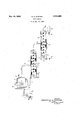
- the process may be conducted by simple distillation of the reactants in the presence of the catalyst, but I prefer to employ special apparatus, one form of which is illustrated diagrammatically in the accompanying drawing.
- Example 1 Vinyl acetate was prepared by mixing 1224 grams (12 mols) of acetic anhydride with 352 grams (8mols) of paraldehyde and 12 grams (0.76% of reactants) of sulfuric acid. The mix- 60 ture was boiled and the volatile products were continually removed through a fractionatlng column, the top of which was regulated to about to 80 C. I
- Example 2 The reaction mixture of paraldehyde, acetic 15 anhydride and sulfuric acid was allowed to stand several hours and it was then boiled in a flask connected for simple distillation, that is, no reflux was returned directly to the boiling flask. The vapors were led to continuous still, being in- 20 troduced at a. point near the middle of the column. The top of the continuous still was kept at about C. so that acetaldehyde, vinyl acetate, and acetic acid passed over in the distillate, while higher boiling and unreacted material 001- 25 lected in the still kettle. This kettle was connected through a liquid seal to the reaction flask, and accumulated liquid was continually returned to the reaction mixture. Toward the end of the reaction the still head temperature was allowed 30 to rise to about C. in order to obtain the desired amount of distillate, as shown in the table.
- the distillate was chilled rapidly to about 35 70 C. and was fractionated after the addition of 1 gram of copper acetate to prevent polymerization of the vinyl acetate and 5 grams of sodium acetate to neutralize some inorganic cata-
- Overall yield is expressed as that percentage of the theoretical amount of vinyl acetate obtained based on the total amount of paraldehyde in the starting materials. Efllciency is that per- 60 centage of the reacted paraldehyde which appeared as vinyl acetate in the products.
- Example 3 A batch of acetic anhydride (12 mols), paraldehyde (8 mols) and sulfuric acid (6 grams) was prepared and heated as in Example 2, but when the still head temperature reached 100 C. a mixture of acetic anhydride (40 mols), paraldehyde (40 mols) and sulfuric acid (30 grams) was added continuously during '7 hours. At the end of the addition, the reaction flask most probably contained substantially the same materials as at the beginning of the reaction plus an accumulation of about 10% of high boiling by-products. In continuous operation these byproducts of high boiling point may be eliminated by drawing off portions of the reaction mixture, continuously if desired, into a tar pot, from which volatile products may be returned directly to the reaction kettle as vapors leaving the high boiling by-products behind.
- Example 4 In this example the same procedure was used as in Example 3, except that the apparatus was still further modified to the preferred form shown in the drawing.
- the raw materials were fed to a reaction kettle I .by a pipe H, and the kettle ID was heated by a steam coil l2.
- the vapors were led directly to a continuous still I 3 by a vapor pipe H.
- the still l3 was provided with a tray-containing column l5 and kettle I6 heated by a steam coil II.
- the vapor pipe I 4 admits vapors near the middle of the column IS.
- the higher boiling constituents of the vapors entering the column l5 accumulate in the kettle l6 and are returned continuously to the kettle II by a pipe I. provided with a liquid seal.
- Vapors from the top of the column l5 pass by a vapor line I! to a second continuous still 20 provided with a traycontaining column 2
- Liquid products in the still 20 are removed as a tails-cut from the kettle 22 by a line 21.
- the vapors from the first continuous still II are fractionated in the second still into a heads-cut containing vinyl acetate 15 and acetaldehyde and a tails-cut containing acetic acid and acetic anhydride.
- the pure components are then separated from these fractions by ordinary fractional distillation.
- This procedure eliminates the necessity for go adding an anti-catalyst, such as sodium acetate (as described in Example 2), to prevent loss of vinyl acetate by combination with acetic acid to form ethylidene diacetate. This combination does not occur to any appreciable extent either in the vapor or in the liquid in the columns.
- an anti-catalyst such as sodium acetate (as described in Example 2)
- the equilibrium mixture of acetaldehyde and paraldehyde obtained by treating acetaldehyde with sulfuric acid, or the similar 30 mixture resulting when the recovered acetaldehyde stands in contact with accompanying traces of sulfur dioxide, may be used.
- the process has been operated satisfactorily to produce vinyl propionate or vinyl butyrate by substituting propionic or butyric anhydride for acetic anhydride in the methods shown in the examples.
- substantially equimolar proportions of the anhydride and paraldehyde are preferred. If other aliphatic carboxylic anhydrides are employed their corresponding vinyl esters may be prepared.
- the process was conducted at pressures equal to or slightly above atmospheric pressure. However, reduced pressures can be employed, and the process can be operated at lower temperatures if subatmospheric pressures are used. This expedient was found to be especially advantageous in making the higher boiling esters, such as vinyl butyrate, in order to avoid excessively high reaction temperatures.
- the reaction temperature should be between about 100 and 200' C. in order to insure adequate reaction velocity without excessive charring.
- the pressure should be such as to allow vigorous boiling at the reaction temperature chosen.
- any non-volatile, inorganic acid may be used which is strong enough to promote decomposition of paraldehyde into acetaldehyde at the boiling point of paraldehyde.
- the catalyst, especially sulfuric acid in an amount equal to 0.25% to 2.0% of the raw material used, and within these limits, 0.5% gives the best results.
- Process for making vinyl esters which comprises heating acetaldehyde with a lower fatty acid anhydride in the presence of a non-volatile.
- Process for making vinyl esters which comprises heating 7 paraldehyde with one of the group consisting of 'anhydrides of acetic, propionic and butyric acids. in the presence of a nonvolatile, inorganic acid catalyst,- and continuously removing the vinyl ester corresponding to said acid anhydride as a distillate during said heating.
- Process for making vinyl esters which comprises heating a mixture containing paraldehyde, a lower fatty acid anhydride, and a non-volatile, inorganic acid catalyst to the boiling point of the mixture, and continuously removing the vinyl ester corresponding to said acid anhydride as a distillate during said heating.
- Process for making vinyl esters which comprises boiling a mixture containing approximately equimolar proportions of paraldehyde and a lower fatty acid anhydride, together with about 0.25% to about 2.0% by weight of the total of a nonvolatile, inorganic acid catalyst which is capable of decomposing paraldehyde into acetaldehyde at the boiling point of said mixture, and continuously removing the vinyl ester corresponding to said acid anhydride from said mixture as a distillate.
- P'ocess for making vinyl esters which comprises boiling a mixture containing approximately equimolar proportions of paraldehyde and a lower fatty acid anhydride, together with a catalyst of the group consisting of sulfuric, phosphoric and toluene-sulfonic acids, and continuously remov-. ing the vinyl ester corresponding to said acid anhydride from said mixture as a distillate.
- Process for making vinyl acetate which comprises distilling a mixture of paraldehyde Y and acetic anhydride in substantially equimolar proportions in the presence of an acid catalyst of the group consisting of sulfuric, phosphoric and toluene-sulfonic acids, and isolating vinyl acetate from the distillate.
- Process for making vinyl acetate which comprises distilling a mixture of paraldehyde and acetic anhydride in the presence of about 0.5% by weight of the total of sulfuric acid, and isolating vinyl acetate from the distillate.
- Process for making vinyl propionate which comprises distilling a mixture of paraldehyde and propionic anhydride in the presence of a nonvolatile, inorganic acid catalyst, and isolating vinyl propionate from the distillate.
- Process for making vinyl propionate which comprises distilling a mixture of paraldehyde and propionic anhydride in substantially equimolar proportions in the presence of an acid catalyst of the group consisting of sulfuric, phosphoric and toluene-sulfonic acids, and isolating vinyl propionate from the distillate.
- Process for making vinyl propionate which comprises distilling a mixture of paraldehyde and propionic anhydride in the presence of about 0.5% by weight of the total of sulfuric acid, and isolating vinyl propionate from the distillate.
- Process for making vinyl hutyrate which comprises distilling a mixture of paraldehyde and butyric anhydride in the presence of a non-volatile, inorganic acid catalyst, and isolating vinyl butyrate from the distillate.
- Process for making vinyl butyrate which comprises distilling a mixture of paraldehyde and butyric anhydride in substantially equimolar proportionsin the presence of an acid catalyst of the group consisting of sulfuric, phosphoric and toluene-sulfonic acids, and isolating vinyl butyrate from the distillate.
- Process for making vinyl butyrate which comprises distilling a mixture of paraldehyde and butyric anhydride in the presence of about 0.5% by weight of the total of sulfuric acid, and isolating vinyl butyrate from the distillate.
Landscapes
- Chemical & Material Sciences (AREA)
- Organic Chemistry (AREA)
- Organic Low-Molecular-Weight Compounds And Preparation Thereof (AREA)
Description
Nov. 19, 1935; G. A. PERKINS VINYL ESTER Filed Jan. 25, 1933' INVENTOR GRANVlLLE A. PER K INS ATTORNEY Patented Nov. 19, 1935 PATENT OFFICE VINYL ESTER Granville A. Perkins, South Charleston, W. Va.,
assignor to Carbide and Carbon Chemicals Corporation, a corporation of New York Application January 25, 1933, Serial No. 653,421 17 Claims. (Cl. 260-108) The invention is a process for making vinyl esters, particularly vinyl esters of the lower aliphatic carboxylic acids. In general, the process comprises reacting acetaldehyde with the anhydride of an aliphatic carboxylic acid in the presence of a catalyst, all as more fully hereinafter described.
Previously proposed processes for making vinyl esters of carboxylic acids almost without exception start with acetylene which is transformed into the unsaturated ester under various conditions and with the aid of various catalysts. Since ethylidene diesters also may be made by these processes employing acetylene, in one instance it has been proposed to decompose the diester to form the vinyl ester.
My new process avoids the use of acetylene as a raw material and represents a departure from all of the previously known methods of making vinyl esters; its advantages will be apparent.
The reaction involved in my new process may be represented by the following equation in which the formation of vinyl acetate is shown by way of illustration:
CHaCI-IO-f-(CHaCO) 20 CH2= CHOOCCHa-i-CHaCOOH.
I prefer to employ paraldehyde, that is, paraacetaldehyde, a liquid trimer of acetaldehyde which boils at 124 C., as the source of the aldehyde in my process. Paraldehyde is readily obtainable by treating acetaldehyde at ordinary temperatures with small amounts of acids, such as sulfuric acid, sulfur dioxide or hydrochloric acid, or salts, such as zinc chloride or sodium acetate. The carboxylic acid anhydride may be the anhydride of any acid of which the vinyl ester is desired. For example, anhydrides of the lower aliphatic monocarboxylic acids, such as acetic, propionic and butyric, may be used, and other carboxylic acid anhydrides are suitable. I prefer to employ strong, non-volatile (by which is meant non-volatile at the reaction temperature), inorganic acids as catalysts: sulfuric, phosphoric and toluene-sulfonic acids are examples of suitable catalysts.
The process may be conducted by simple distillation of the reactants in the presence of the catalyst, but I prefer to employ special apparatus, one form of which is illustrated diagrammatically in the accompanying drawing.
The invention will be illustrated by the following examples:
Example 1 Vinyl acetate was prepared by mixing 1224 grams (12 mols) of acetic anhydride with 352 grams (8mols) of paraldehyde and 12 grams (0.76% of reactants) of sulfuric acid. The mix- 60 ture was boiled and the volatile products were continually removed through a fractionatlng column, the top of which was regulated to about to 80 C. I
The distillate was refractionated several times giving 132 grams of vinyl acetate distilling at 5 to C. This represents an overall yield of 19% from paraldehyde of which an additional 43% was recovered as aldehyde. Most of the unused acetic anhydride was recovered by subsequent distillation of the residue in the reaction 10 vessel, and a small amount of tarry and carbonaceous materialwas left behind.
Example 2 The reaction mixture of paraldehyde, acetic 15 anhydride and sulfuric acid was allowed to stand several hours and it was then boiled in a flask connected for simple distillation, that is, no reflux was returned directly to the boiling flask. The vapors were led to continuous still, being in- 20 troduced at a. point near the middle of the column. The top of the continuous still was kept at about C. so that acetaldehyde, vinyl acetate, and acetic acid passed over in the distillate, while higher boiling and unreacted material 001- 25 lected in the still kettle. This kettle was connected through a liquid seal to the reaction flask, and accumulated liquid was continually returned to the reaction mixture. Toward the end of the reaction the still head temperature was allowed 30 to rise to about C. in order to obtain the desired amount of distillate, as shown in the table.
Considerable acetic anhydride distilled at this increased temperature.
The distillate was chilled rapidly to about 35 70 C. and was fractionated after the addition of 1 gram of copper acetate to prevent polymerization of the vinyl acetate and 5 grams of sodium acetate to neutralize some inorganic cata- Overall yield is expressed as that percentage of the theoretical amount of vinyl acetate obtained based on the total amount of paraldehyde in the starting materials. Efllciency is that per- 60 centage of the reacted paraldehyde which appeared as vinyl acetate in the products.
Example 3 A batch of acetic anhydride (12 mols), paraldehyde (8 mols) and sulfuric acid (6 grams) was prepared and heated as in Example 2, but when the still head temperature reached 100 C. a mixture of acetic anhydride (40 mols), paraldehyde (40 mols) and sulfuric acid (30 grams) was added continuously during '7 hours. At the end of the addition, the reaction flask most probably contained substantially the same materials as at the beginning of the reaction plus an accumulation of about 10% of high boiling by-products. In continuous operation these byproducts of high boiling point may be eliminated by drawing off portions of the reaction mixture, continuously if desired, into a tar pot, from which volatile products may be returned directly to the reaction kettle as vapors leaving the high boiling by-products behind.
Vinyl acetate was obtained from the distillate by fractionation as described in Example 2.
Tabulated data follow;
Acetic anhydride grams 5411 Paraldehyde do 2114 Mol ratio, aldehyde anhydride 0.9 Sulfuric acid .1 grams 36 Copper acetate do 1 Boiled hours '7 Still head temperature C. 105-115 Kettle temperature do 142-143 Distillate grams 5977 Vinyl acetate do 1488 Overall yield from paraldehydemercent- 40 Overall yield from anhydride do 41 Efliciency from paraldehyde 'do 82 Efliciency from anhydride do 68 Overall yields in these data are expressed as the percentages of the theoretical yield' of vinyl acetate obtained based respectively on the total amounts of paraldehyde and acetic anhydride employed. Efllciencies are those percentages of the reacted paraldehyde and acetic anhydride respectively which appeared in the product as vinyl acetate.
From these results it will be seen that continuous operation represents improvement over batch operation.
Example 4 In this example the same procedure was used as in Example 3, except that the apparatus was still further modified to the preferred form shown in the drawing. Referring to the drawing, the raw materials were fed to a reaction kettle I .by a pipe H, and the kettle ID was heated by a steam coil l2. The vapors were led directly to a continuous still I 3 by a vapor pipe H. The still l3 was provided with a tray-containing column l5 and kettle I6 heated by a steam coil II. The vapor pipe I 4 admits vapors near the middle of the column IS. The higher boiling constituents of the vapors entering the column l5 accumulate in the kettle l6 and are returned continuously to the kettle II by a pipe I. provided with a liquid seal. Vapors from the top of the column l5 pass by a vapor line I! to a second continuous still 20 provided with a traycontaining column 2| and a kettle 22 heated by a steam coil 23. From the column 2| vapors are removed by a pipe 24, condensed by a condenser 25 and removed as the heads-cut by a line 26.
Liquid products in the still 20 are removed as a tails-cut from the kettle 22 by a line 21.
High boiling by-products which are formed in the reaction kettle ID are continuously removed and separated by withdrawing portions of the 5 reaction liquid from the kettle It by a pipe 28 into a tar pct 20 heated by a steam coil 30. Materials more volatile than the undesired byproducts are volatilized by means of the steam coil 30 and returned as vapors to the kettle I 0 by a line II. The tar pot 29 is provided with a drain 22.
In operation, the vapors from the first continuous still II are fractionated in the second still into a heads-cut containing vinyl acetate 15 and acetaldehyde and a tails-cut containing acetic acid and acetic anhydride. The pure components are then separated from these fractions by ordinary fractional distillation.
This procedure eliminates the necessity for go adding an anti-catalyst, such as sodium acetate (as described in Example 2), to prevent loss of vinyl acetate by combination with acetic acid to form ethylidene diacetate. This combination does not occur to any appreciable extent either in the vapor or in the liquid in the columns.
Instead of using paraldehyde as the source of acetaldehyde, the equilibrium mixture of acetaldehyde and paraldehyde obtained by treating acetaldehyde with sulfuric acid, or the similar 30 mixture resulting when the recovered acetaldehyde stands in contact with accompanying traces of sulfur dioxide, may be used.
The process has been operated satisfactorily to produce vinyl propionate or vinyl butyrate by substituting propionic or butyric anhydride for acetic anhydride in the methods shown in the examples. In general, in each case substantially equimolar proportions of the anhydride and paraldehyde are preferred. If other aliphatic carboxylic anhydrides are employed their corresponding vinyl esters may be prepared. In the examples given, the process was conducted at pressures equal to or slightly above atmospheric pressure. However, reduced pressures can be employed, and the process can be operated at lower temperatures if subatmospheric pressures are used. This expedient was found to be especially advantageous in making the higher boiling esters, such as vinyl butyrate, in order to avoid excessively high reaction temperatures. In general, the reaction temperature should be between about 100 and 200' C. in order to insure adequate reaction velocity without excessive charring. The pressure should be such as to allow vigorous boiling at the reaction temperature chosen.
As noted above, other strong, non-volatile acids may be substituted for sulfuric acid as catalysts. However, phosphoric acid causes a greater formation of tar and carbonaceous residue, than does sulfuric acid, and toluene-sulfonic acid must be used in amounts equal to about twice the quantities of sulfuric acid required since it is a weaker acid. In general, any non-volatile, inorganic acid may be used which is strong enough to promote decomposition of paraldehyde into acetaldehyde at the boiling point of paraldehyde. I prefer to use the catalyst, especially sulfuric acid, in an amount equal to 0.25% to 2.0% of the raw material used, and within these limits, 0.5% gives the best results.
I claim:
1. Process for making vinyl esters which comprises heating acetaldehyde with a lower fatty acid anhydride in the presence of a non-volatile.
aoancos inorganic acid catalyst, and continuously removing the vinyl ester corresponding to said acid anhydride as a distillate during said heating.
2. Process for making vinyl esters which comprises heating paraldehyde with a lower'fatty acid anhydride in the presence of a non-volatile, inorganic acid catalyst, and continuously removing the vinyl ester corresponding to said acid anhydride as a distillate during said heating.
3. Process for making vinyl esters which comprises heating 7 paraldehyde with one of the group consisting of 'anhydrides of acetic, propionic and butyric acids. in the presence of a nonvolatile, inorganic acid catalyst,- and continuously removing the vinyl ester corresponding to said acid anhydride as a distillate during said heating.
4. Process for making vinyl esters which comprises heating a mixture containing paraldehyde, a lower fatty acid anhydride, and a non-volatile, inorganic acid catalyst to the boiling point of the mixture, and continuously removing the vinyl ester corresponding to said acid anhydride as a distillate during said heating.
5. Process for making vinyl esters which comprises boiling a mixture containing approximately equimolar proportions of paraldehyde and a lower fatty acid anhydride, together with a non-volatile, inorganic acid catalyst which is capable of decomposing paraldehyde into acetaldehyde at the boiling point of said mixture, and continuously removing the vinyl ester corresponding to said acid anhydride from said mixture as a distillate.
6. Process for making vinyl esters which comprises boiling a mixture containing approximately equimolar proportions of paraldehyde and a lower fatty acid anhydride, together with about 0.25% to about 2.0% by weight of the total of a nonvolatile, inorganic acid catalyst which is capable of decomposing paraldehyde into acetaldehyde at the boiling point of said mixture, and continuously removing the vinyl ester corresponding to said acid anhydride from said mixture as a distillate.
'1. P'ocess for making vinyl esters which comprises boiling a mixture containing approximately equimolar proportions of paraldehyde and a lower fatty acid anhydride, together with a catalyst of the group consisting of sulfuric, phosphoric and toluene-sulfonic acids, and continuously remov-. ing the vinyl ester corresponding to said acid anhydride from said mixture as a distillate.
8. Process for making vinyl esters which comprises boiling a mixture containing approximately equimolar proportions of paraldehyde and a lower fatty acid anhydride, together with a catalyst of the group consisting of sulfuric, phosphoric and toluene-sulfonic acids, in an amount equal to v from about 0.25% to about 2.0% by weight'of the total, and continuously removing the vinyl ester corresponding to said acid anhydride from said mixture as a distillate.
9. Process for making vinyl acetate which com- 5 prises distilling a mixture of paraldehyde and acetic anhydride in the presence of a non-volatile, inorganic acid catalyst, and isolating vinyl acetate from the distillate.
10. Process for making vinyl acetate which comprises distilling a mixture of paraldehyde Y and acetic anhydride in substantially equimolar proportions in the presence of an acid catalyst of the group consisting of sulfuric, phosphoric and toluene-sulfonic acids, and isolating vinyl acetate from the distillate.
11. Process for making vinyl acetate which comprises distilling a mixture of paraldehyde and acetic anhydride in the presence of about 0.5% by weight of the total of sulfuric acid, and isolating vinyl acetate from the distillate.
12. Process for making vinyl propionate which comprises distilling a mixture of paraldehyde and propionic anhydride in the presence of a nonvolatile, inorganic acid catalyst, and isolating vinyl propionate from the distillate.
13. Process for making vinyl propionate which comprises distilling a mixture of paraldehyde and propionic anhydride in substantially equimolar proportions in the presence of an acid catalyst of the group consisting of sulfuric, phosphoric and toluene-sulfonic acids, and isolating vinyl propionate from the distillate.
14. Process for making vinyl propionate which comprises distilling a mixture of paraldehyde and propionic anhydride in the presence of about 0.5% by weight of the total of sulfuric acid, and isolating vinyl propionate from the distillate.
15. Process for making vinyl hutyrate which comprises distilling a mixture of paraldehyde and butyric anhydride in the presence of a non-volatile, inorganic acid catalyst, and isolating vinyl butyrate from the distillate.
16. Process for making vinyl butyrate which comprises distilling a mixture of paraldehyde and butyric anhydride in substantially equimolar proportionsin the presence of an acid catalyst of the group consisting of sulfuric, phosphoric and toluene-sulfonic acids, and isolating vinyl butyrate from the distillate. 5 17. Process for making vinyl butyrate which comprises distilling a mixture of paraldehyde and butyric anhydride in the presence of about 0.5% by weight of the total of sulfuric acid, and isolating vinyl butyrate from the distillate. u
. GRANVILLE A. PERKINS.
Publications (1)
| Publication Number | Publication Date |
|---|---|
| US2021698A true US2021698A (en) | 1935-11-19 |
Family
ID=3427506
Family Applications (1)
| Application Number | Title | Priority Date | Filing Date |
|---|---|---|---|
| US2021698D Expired - Lifetime US2021698A (en) | Vinyl ester |
Country Status (1)
| Country | Link |
|---|---|
| US (1) | US2021698A (en) |
Cited By (40)
| Publication number | Priority date | Publication date | Assignee | Title |
|---|---|---|---|---|
| US2421976A (en) * | 1945-11-23 | 1947-06-10 | Eastman Kodak Co | Process for reacting a ketene with an alpha, beta unsaturated aldehyde |
| US2422679A (en) * | 1945-10-03 | 1947-06-24 | Eastman Kodak Co | Process for preparing enol esters of aldehydes |
| US2432394A (en) * | 1946-02-09 | 1947-12-09 | L-acyloxy-z-alkylbtjtadiene-l | |
| US2533544A (en) * | 1945-05-12 | 1950-12-12 | Zavarella Raphael | Rotary hydraulic coupling |
| US2859241A (en) * | 1958-11-04 | Production of vinyl esters | ||
| US4782173A (en) * | 1983-08-03 | 1988-11-01 | The Standard Oil Company | Synthesis of methionine hydroxy analog or derivative, and esters thereof; synthesis of 1-acyloxy-4-hydrocarbylthiopropene, and products |
| US4978778A (en) * | 1980-09-16 | 1990-12-18 | Mitsubishi Gas Chemical Company, Inc. | Process for producing vinyl acetate |
| US5227517A (en) * | 1992-04-15 | 1993-07-13 | Air Products And Chemicals, Inc. | Process for preparing ethylidene diacetate using iodide catalysts |
| US5744637A (en) * | 1996-12-13 | 1998-04-28 | Eastman Chemical Company | Carboxylic acid accelerated formation of diesters |
| US20100121114A1 (en) * | 2008-07-31 | 2010-05-13 | Heiko Weiner | Tunable catalyst gas phase hydrogenation of carboxylic acids |
| US20100125148A1 (en) * | 2008-11-14 | 2010-05-20 | Johnston Victor J | Integrated process for the production of vinyl acetate from acetic acid via ethylene |
| US20100168467A1 (en) * | 2008-12-31 | 2010-07-01 | Johnston Victor J | Integrated process for the production of viny acetate from acetic acid via ethy acetate |
| US20100168466A1 (en) * | 2008-12-31 | 2010-07-01 | Johnston Victor J | Integrated process for the production of vinyl acetate from acetic acid via acetaldehyde |
| US8211821B2 (en) | 2010-02-01 | 2012-07-03 | Celanese International Corporation | Processes for making tin-containing catalysts |
| US8222466B2 (en) | 2010-02-02 | 2012-07-17 | Celanese International Corporation | Process for producing a water stream from ethanol production |
| US8304586B2 (en) | 2010-02-02 | 2012-11-06 | Celanese International Corporation | Process for purifying ethanol |
| US8309773B2 (en) | 2010-02-02 | 2012-11-13 | Calanese International Corporation | Process for recovering ethanol |
| US8314272B2 (en) | 2010-02-02 | 2012-11-20 | Celanese International Corporation | Process for recovering ethanol with vapor separation |
| US8338650B2 (en) | 2008-07-31 | 2012-12-25 | Celanese International Corporation | Palladium catalysts for making ethanol from acetic acid |
| US8344186B2 (en) | 2010-02-02 | 2013-01-01 | Celanese International Corporation | Processes for producing ethanol from acetaldehyde |
| US8350098B2 (en) | 2011-04-04 | 2013-01-08 | Celanese International Corporation | Ethanol production from acetic acid utilizing a molybdenum carbide catalyst |
| US8450535B2 (en) | 2009-07-20 | 2013-05-28 | Celanese International Corporation | Ethanol production from acetic acid utilizing a cobalt catalyst |
| US8471075B2 (en) | 2008-07-31 | 2013-06-25 | Celanese International Corporation | Processes for making ethanol from acetic acid |
| US8501652B2 (en) | 2008-07-31 | 2013-08-06 | Celanese International Corporation | Catalysts for making ethanol from acetic acid |
| US8536382B2 (en) | 2011-10-06 | 2013-09-17 | Celanese International Corporation | Processes for hydrogenating alkanoic acids using catalyst comprising tungsten |
| US8546622B2 (en) | 2008-07-31 | 2013-10-01 | Celanese International Corporation | Process for making ethanol from acetic acid using acidic catalysts |
| US8569549B2 (en) | 2010-02-02 | 2013-10-29 | Celanese International Corporation | Catalyst supports having crystalline support modifiers |
| US8569551B2 (en) | 2010-05-07 | 2013-10-29 | Celanese International Corporation | Alcohol production process integrating acetic acid feed stream comprising water from carbonylation process |
| US8637714B2 (en) | 2008-07-31 | 2014-01-28 | Celanese International Corporation | Process for producing ethanol over catalysts containing platinum and palladium |
| US8658843B2 (en) | 2011-10-06 | 2014-02-25 | Celanese International Corporation | Hydrogenation catalysts prepared from polyoxometalate precursors and process for using same to produce ethanol while minimizing diethyl ether formation |
| US8680321B2 (en) | 2009-10-26 | 2014-03-25 | Celanese International Corporation | Processes for making ethanol from acetic acid using bimetallic catalysts |
| US8680317B2 (en) | 2008-07-31 | 2014-03-25 | Celanese International Corporation | Processes for making ethyl acetate from acetic acid |
| US8680343B2 (en) | 2010-02-02 | 2014-03-25 | Celanese International Corporation | Process for purifying ethanol |
| US8680342B2 (en) | 2010-05-07 | 2014-03-25 | Celanese International Corporation | Process for recovering alcohol produced by hydrogenating an acetic acid feed stream comprising water |
| US8703868B2 (en) | 2011-11-28 | 2014-04-22 | Celanese International Corporation | Integrated process for producing polyvinyl alcohol or a copolymer thereof and ethanol |
| US8710277B2 (en) | 2009-10-26 | 2014-04-29 | Celanese International Corporation | Process for making diethyl ether from acetic acid |
| US8754267B2 (en) | 2010-05-07 | 2014-06-17 | Celanese International Corporation | Process for separating acetaldehyde from ethanol-containing mixtures |
| US8907142B2 (en) | 2011-12-29 | 2014-12-09 | Celanese International Corporation | Process for promoting catalyst activity for ethyl acetate conversion |
| US9000234B2 (en) | 2011-12-22 | 2015-04-07 | Celanese International Corporation | Calcination of modified support to prepare hydrogenation catalysts |
| US9233899B2 (en) | 2011-12-22 | 2016-01-12 | Celanese International Corporation | Hydrogenation catalysts having an amorphous support |
-
0
- US US2021698D patent/US2021698A/en not_active Expired - Lifetime
Cited By (61)
| Publication number | Priority date | Publication date | Assignee | Title |
|---|---|---|---|---|
| US2859241A (en) * | 1958-11-04 | Production of vinyl esters | ||
| US2533544A (en) * | 1945-05-12 | 1950-12-12 | Zavarella Raphael | Rotary hydraulic coupling |
| US2422679A (en) * | 1945-10-03 | 1947-06-24 | Eastman Kodak Co | Process for preparing enol esters of aldehydes |
| US2421976A (en) * | 1945-11-23 | 1947-06-10 | Eastman Kodak Co | Process for reacting a ketene with an alpha, beta unsaturated aldehyde |
| US2432394A (en) * | 1946-02-09 | 1947-12-09 | L-acyloxy-z-alkylbtjtadiene-l | |
| US4978778A (en) * | 1980-09-16 | 1990-12-18 | Mitsubishi Gas Chemical Company, Inc. | Process for producing vinyl acetate |
| US4782173A (en) * | 1983-08-03 | 1988-11-01 | The Standard Oil Company | Synthesis of methionine hydroxy analog or derivative, and esters thereof; synthesis of 1-acyloxy-4-hydrocarbylthiopropene, and products |
| US5227517A (en) * | 1992-04-15 | 1993-07-13 | Air Products And Chemicals, Inc. | Process for preparing ethylidene diacetate using iodide catalysts |
| US5744637A (en) * | 1996-12-13 | 1998-04-28 | Eastman Chemical Company | Carboxylic acid accelerated formation of diesters |
| US8080694B2 (en) | 2008-07-31 | 2011-12-20 | Celanese International Corporation | Catalyst for gas phase hydrogenation of carboxylic acids having a support modified with a reducible metal oxide |
| US8993815B2 (en) | 2008-07-31 | 2015-03-31 | Celanese International Corporation | Process for vapor phase hydrogenation |
| US8637714B2 (en) | 2008-07-31 | 2014-01-28 | Celanese International Corporation | Process for producing ethanol over catalysts containing platinum and palladium |
| US8546622B2 (en) | 2008-07-31 | 2013-10-01 | Celanese International Corporation | Process for making ethanol from acetic acid using acidic catalysts |
| US8501652B2 (en) | 2008-07-31 | 2013-08-06 | Celanese International Corporation | Catalysts for making ethanol from acetic acid |
| US8471075B2 (en) | 2008-07-31 | 2013-06-25 | Celanese International Corporation | Processes for making ethanol from acetic acid |
| US20100121114A1 (en) * | 2008-07-31 | 2010-05-13 | Heiko Weiner | Tunable catalyst gas phase hydrogenation of carboxylic acids |
| US8680317B2 (en) | 2008-07-31 | 2014-03-25 | Celanese International Corporation | Processes for making ethyl acetate from acetic acid |
| US8754270B2 (en) | 2008-07-31 | 2014-06-17 | Celanese International Corporation | Process for vapor phase hydrogenation |
| US8338650B2 (en) | 2008-07-31 | 2012-12-25 | Celanese International Corporation | Palladium catalysts for making ethanol from acetic acid |
| US8802904B2 (en) | 2008-07-31 | 2014-08-12 | Celanese International Corporation | Processes for making ethanol from acetic acid |
| US8309772B2 (en) | 2008-07-31 | 2012-11-13 | Celanese International Corporation | Tunable catalyst gas phase hydrogenation of carboxylic acids |
| US9040443B2 (en) | 2008-07-31 | 2015-05-26 | Celanese International Corporation | Catalysts for making ethanol from acetic acid |
| US9024087B2 (en) | 2008-07-31 | 2015-05-05 | Celanese International Corporation | Process for making ethanol from acetic acid using acidic catalysts |
| US8071806B2 (en) | 2008-11-14 | 2011-12-06 | Celanese International Corporation | Integrated process for the production of vinyl acetate from acetic acid via ethylene |
| US20100125148A1 (en) * | 2008-11-14 | 2010-05-20 | Johnston Victor J | Integrated process for the production of vinyl acetate from acetic acid via ethylene |
| US8309757B2 (en) | 2008-11-14 | 2012-11-13 | Celanese International Corporation | Integrated process for the production of vinyl acetate from acetic acid via ethylene |
| US7855303B2 (en) | 2008-11-14 | 2010-12-21 | Celanese International Corporation | Integrated process for the production of vinyl acetate from acetic acid via ethylene |
| US20110071312A1 (en) * | 2008-11-14 | 2011-03-24 | Celanese International Corporation | Integrated process for the production of vinyl acetate from acetic acid via ethylene |
| US7820853B2 (en) | 2008-12-31 | 2010-10-26 | Celanese International Corporation | Integrated process for the production of vinyl acetate from acetic acid via ethyl acetate |
| US8178715B2 (en) | 2008-12-31 | 2012-05-15 | Celanese International Corporation | Integrated process for the production of vinyl acetate from acetic acid via acetaldehyde |
| WO2010077342A1 (en) | 2008-12-31 | 2010-07-08 | Celanese International Corporation | Integrated process for the production of vinyl acetate from acetic acid via acetaldehyde |
| US20100168466A1 (en) * | 2008-12-31 | 2010-07-01 | Johnston Victor J | Integrated process for the production of vinyl acetate from acetic acid via acetaldehyde |
| US20100168467A1 (en) * | 2008-12-31 | 2010-07-01 | Johnston Victor J | Integrated process for the production of viny acetate from acetic acid via ethy acetate |
| US8450535B2 (en) | 2009-07-20 | 2013-05-28 | Celanese International Corporation | Ethanol production from acetic acid utilizing a cobalt catalyst |
| US8710277B2 (en) | 2009-10-26 | 2014-04-29 | Celanese International Corporation | Process for making diethyl ether from acetic acid |
| US8680321B2 (en) | 2009-10-26 | 2014-03-25 | Celanese International Corporation | Processes for making ethanol from acetic acid using bimetallic catalysts |
| US8569203B2 (en) | 2010-02-01 | 2013-10-29 | Celanese International Corporation | Processes for making tin-containing catalysts |
| US8211821B2 (en) | 2010-02-01 | 2012-07-03 | Celanese International Corporation | Processes for making tin-containing catalysts |
| US8426652B2 (en) | 2010-02-02 | 2013-04-23 | Celanese International Corporation | Processes for producing ethanol from acetaldehyde |
| US8704014B2 (en) | 2010-02-02 | 2014-04-22 | Celansese International Corporation | Process for purifying ethanol |
| US8569549B2 (en) | 2010-02-02 | 2013-10-29 | Celanese International Corporation | Catalyst supports having crystalline support modifiers |
| US8653308B2 (en) | 2010-02-02 | 2014-02-18 | Celanese International Corporation | Process for utilizing a water stream in a hydrolysis reaction to form ethanol |
| US9051238B2 (en) | 2010-02-02 | 2015-06-09 | Celanese International Corporation | Process for recovering ethanol |
| US8222466B2 (en) | 2010-02-02 | 2012-07-17 | Celanese International Corporation | Process for producing a water stream from ethanol production |
| US8399719B2 (en) | 2010-02-02 | 2013-03-19 | Celanese International Corporation | Process for producing a water stream from ethanol production |
| US8680343B2 (en) | 2010-02-02 | 2014-03-25 | Celanese International Corporation | Process for purifying ethanol |
| US8304586B2 (en) | 2010-02-02 | 2012-11-06 | Celanese International Corporation | Process for purifying ethanol |
| US8704015B2 (en) | 2010-02-02 | 2014-04-22 | Celanese International Corporation | Process for recovering ethanol |
| US8309773B2 (en) | 2010-02-02 | 2012-11-13 | Calanese International Corporation | Process for recovering ethanol |
| US8314272B2 (en) | 2010-02-02 | 2012-11-20 | Celanese International Corporation | Process for recovering ethanol with vapor separation |
| US8344186B2 (en) | 2010-02-02 | 2013-01-01 | Celanese International Corporation | Processes for producing ethanol from acetaldehyde |
| US8754267B2 (en) | 2010-05-07 | 2014-06-17 | Celanese International Corporation | Process for separating acetaldehyde from ethanol-containing mixtures |
| US8569551B2 (en) | 2010-05-07 | 2013-10-29 | Celanese International Corporation | Alcohol production process integrating acetic acid feed stream comprising water from carbonylation process |
| US8680342B2 (en) | 2010-05-07 | 2014-03-25 | Celanese International Corporation | Process for recovering alcohol produced by hydrogenating an acetic acid feed stream comprising water |
| US8350098B2 (en) | 2011-04-04 | 2013-01-08 | Celanese International Corporation | Ethanol production from acetic acid utilizing a molybdenum carbide catalyst |
| US8536382B2 (en) | 2011-10-06 | 2013-09-17 | Celanese International Corporation | Processes for hydrogenating alkanoic acids using catalyst comprising tungsten |
| US8658843B2 (en) | 2011-10-06 | 2014-02-25 | Celanese International Corporation | Hydrogenation catalysts prepared from polyoxometalate precursors and process for using same to produce ethanol while minimizing diethyl ether formation |
| US8703868B2 (en) | 2011-11-28 | 2014-04-22 | Celanese International Corporation | Integrated process for producing polyvinyl alcohol or a copolymer thereof and ethanol |
| US9000234B2 (en) | 2011-12-22 | 2015-04-07 | Celanese International Corporation | Calcination of modified support to prepare hydrogenation catalysts |
| US9233899B2 (en) | 2011-12-22 | 2016-01-12 | Celanese International Corporation | Hydrogenation catalysts having an amorphous support |
| US8907142B2 (en) | 2011-12-29 | 2014-12-09 | Celanese International Corporation | Process for promoting catalyst activity for ethyl acetate conversion |
Similar Documents
| Publication | Publication Date | Title |
|---|---|---|
| US2021698A (en) | Vinyl ester | |
| US2164188A (en) | Esterification of allyl type alcohols and products resulting therefrom | |
| CA2078850A1 (en) | Process for the purification of carboxylic acids and/or their anhydrides | |
| JPS61267533A (en) | Production of fluorinated hydrocarbon | |
| US1433308A (en) | Process of obtaining complete alcoholysis | |
| US2251983A (en) | Process for making vinyl esters and other esters of unsaturated alcohols | |
| US2390368A (en) | Production of para-divinylbenzene | |
| CA1077959A (en) | Pyrolysis of limonene-1,2-dialkanoates to give perillyl alkanoates | |
| US3859368A (en) | Method of producing polyhydric compounds such as ethylene glycol by disproportionation of its monoacetate | |
| US2156737A (en) | Process of preparing octadecadiene acid | |
| US2441540A (en) | Production of allyl alcohol | |
| US3086046A (en) | Cleavage of diacrylic acid to form acrylic acid | |
| US2688635A (en) | Process for the production of ketene or acetic anhydride from a mixture of acetic acid and formic acid | |
| US1951747A (en) | Process for the manufacture of esters | |
| US1822525A (en) | Method for the manufacture of esters of vinyl alcohol | |
| US2452672A (en) | Manufacture of unsaturated organic compounds | |
| US2860159A (en) | Decomposition of ethylidene dipropionate | |
| US2373583A (en) | Conversion of methyl formate to formic acid | |
| GB234458A (en) | Improvements in the method for the continuous manufacture of esters of the fatty or the aromatic series | |
| US2174830A (en) | Process for producing unsaturated carbonylic compounds | |
| US4465872A (en) | Process for producing p-cresol | |
| US2162451A (en) | Ester interchange with organic acids | |
| US1972579A (en) | Esters of 2-ethylbutanol-1 | |
| US2178752A (en) | Preparation of anhydrides by the use of ketene | |
| US4035408A (en) | Process for hydroformylation of allyl acetate or 1-propenyl acetate |