US20200385355A1 - Method for synthesis of roxadustat and intermediate compounds thereof - Google Patents
Method for synthesis of roxadustat and intermediate compounds thereof Download PDFInfo
- Publication number
- US20200385355A1 US20200385355A1 US16/772,535 US201816772535A US2020385355A1 US 20200385355 A1 US20200385355 A1 US 20200385355A1 US 201816772535 A US201816772535 A US 201816772535A US 2020385355 A1 US2020385355 A1 US 2020385355A1
- Authority
- US
- United States
- Prior art keywords
- formula
- compound
- roxadustat
- acid
- synthesis
- Prior art date
- Legal status (The legal status is an assumption and is not a legal conclusion. Google has not performed a legal analysis and makes no representation as to the accuracy of the status listed.)
- Granted
Links
- 150000001875 compounds Chemical class 0.000 title claims abstract description 199
- YOZBGTLTNGAVFU-UHFFFAOYSA-N roxadustat Chemical class C1=C2C(C)=NC(C(=O)NCC(O)=O)=C(O)C2=CC=C1OC1=CC=CC=C1 YOZBGTLTNGAVFU-UHFFFAOYSA-N 0.000 title claims abstract description 60
- 229950008113 roxadustat Drugs 0.000 title claims abstract description 58
- 238000000034 method Methods 0.000 title claims abstract description 57
- 230000015572 biosynthetic process Effects 0.000 title claims abstract description 53
- 238000003786 synthesis reaction Methods 0.000 title claims abstract description 49
- DHMQDGOQFOQNFH-UHFFFAOYSA-N Glycine Chemical compound NCC(O)=O DHMQDGOQFOQNFH-UHFFFAOYSA-N 0.000 claims abstract description 22
- ISWSIDIOOBJBQZ-UHFFFAOYSA-N Phenol Chemical compound OC1=CC=CC=C1 ISWSIDIOOBJBQZ-UHFFFAOYSA-N 0.000 claims abstract description 14
- 239000004471 Glycine Substances 0.000 claims abstract description 11
- 239000002253 acid Substances 0.000 claims abstract description 7
- AVXURJPOCDRRFD-UHFFFAOYSA-N Hydroxylamine Chemical compound ON AVXURJPOCDRRFD-UHFFFAOYSA-N 0.000 claims abstract description 6
- 125000004178 (C1-C4) alkyl group Chemical group 0.000 claims description 60
- ZMXDDKWLCZADIW-UHFFFAOYSA-N N,N-Dimethylformamide Chemical compound CN(C)C=O ZMXDDKWLCZADIW-UHFFFAOYSA-N 0.000 claims description 39
- 125000003118 aryl group Chemical group 0.000 claims description 36
- 238000006243 chemical reaction Methods 0.000 claims description 36
- 125000002496 methyl group Chemical group [H]C([H])([H])* 0.000 claims description 30
- BWHMMNNQKKPAPP-UHFFFAOYSA-L potassium carbonate Chemical compound [K+].[K+].[O-]C([O-])=O BWHMMNNQKKPAPP-UHFFFAOYSA-L 0.000 claims description 28
- OKKJLVBELUTLKV-UHFFFAOYSA-N Methanol Chemical compound OC OKKJLVBELUTLKV-UHFFFAOYSA-N 0.000 claims description 27
- 239000000203 mixture Substances 0.000 claims description 25
- -1 alkali metal salts Chemical class 0.000 claims description 23
- 125000004108 n-butyl group Chemical group [H]C([H])([H])C([H])([H])C([H])([H])C([H])([H])* 0.000 claims description 23
- HEMHJVSKTPXQMS-UHFFFAOYSA-M Sodium hydroxide Chemical compound [OH-].[Na+] HEMHJVSKTPXQMS-UHFFFAOYSA-M 0.000 claims description 21
- ZMANZCXQSJIPKH-UHFFFAOYSA-N Triethylamine Chemical compound CCN(CC)CC ZMANZCXQSJIPKH-UHFFFAOYSA-N 0.000 claims description 21
- KWYUFKZDYYNOTN-UHFFFAOYSA-M Potassium hydroxide Chemical compound [OH-].[K+] KWYUFKZDYYNOTN-UHFFFAOYSA-M 0.000 claims description 18
- CDBYLPFSWZWCQE-UHFFFAOYSA-L Sodium Carbonate Chemical compound [Na+].[Na+].[O-]C([O-])=O CDBYLPFSWZWCQE-UHFFFAOYSA-L 0.000 claims description 18
- 239000002585 base Substances 0.000 claims description 18
- 125000001797 benzyl group Chemical group [H]C1=C([H])C([H])=C(C([H])=C1[H])C([H])([H])* 0.000 claims description 18
- 125000001495 ethyl group Chemical group [H]C([H])([H])C([H])([H])* 0.000 claims description 18
- 125000001449 isopropyl group Chemical group [H]C([H])([H])C([H])(*)C([H])([H])[H] 0.000 claims description 18
- HRDXJKGNWSUIBT-UHFFFAOYSA-N methoxybenzene Chemical group [CH2]OC1=CC=CC=C1 HRDXJKGNWSUIBT-UHFFFAOYSA-N 0.000 claims description 18
- 125000004184 methoxymethyl group Chemical group [H]C([H])([H])OC([H])([H])* 0.000 claims description 18
- 125000004123 n-propyl group Chemical group [H]C([H])([H])C([H])([H])C([H])([H])* 0.000 claims description 18
- 125000006503 p-nitrobenzyl group Chemical group [H]C1=C([H])C(=C([H])C([H])=C1[N+]([O-])=O)C([H])([H])* 0.000 claims description 18
- 125000002914 sec-butyl group Chemical group [H]C([H])([H])C([H])([H])C([H])(*)C([H])([H])[H] 0.000 claims description 18
- 125000000999 tert-butyl group Chemical group [H]C([H])([H])C(*)(C([H])([H])[H])C([H])([H])[H] 0.000 claims description 18
- 125000002221 trityl group Chemical group [H]C1=C([H])C([H])=C([H])C([H])=C1C([*])(C1=C(C(=C(C(=C1[H])[H])[H])[H])[H])C1=C([H])C([H])=C([H])C([H])=C1[H] 0.000 claims description 18
- WKBOTKDWSSQWDR-UHFFFAOYSA-N Bromine atom Chemical compound [Br] WKBOTKDWSSQWDR-UHFFFAOYSA-N 0.000 claims description 15
- GDTBXPJZTBHREO-UHFFFAOYSA-N bromine Substances BrBr GDTBXPJZTBHREO-UHFFFAOYSA-N 0.000 claims description 15
- 229910052794 bromium Inorganic materials 0.000 claims description 15
- VEXZGXHMUGYJMC-UHFFFAOYSA-N Hydrochloric acid Chemical compound Cl VEXZGXHMUGYJMC-UHFFFAOYSA-N 0.000 claims description 14
- 229910000027 potassium carbonate Inorganic materials 0.000 claims description 14
- 150000003839 salts Chemical class 0.000 claims description 14
- JGFZNNIVVJXRND-UHFFFAOYSA-N N,N-Diisopropylethylamine (DIPEA) Chemical compound CCN(C(C)C)C(C)C JGFZNNIVVJXRND-UHFFFAOYSA-N 0.000 claims description 13
- YXFVVABEGXRONW-UHFFFAOYSA-N Toluene Natural products CC1=CC=CC=C1 YXFVVABEGXRONW-UHFFFAOYSA-N 0.000 claims description 13
- QTBSBXVTEAMEQO-UHFFFAOYSA-N Acetic acid Chemical compound CC(O)=O QTBSBXVTEAMEQO-UHFFFAOYSA-N 0.000 claims description 12
- WEVYAHXRMPXWCK-UHFFFAOYSA-N Acetonitrile Chemical compound CC#N WEVYAHXRMPXWCK-UHFFFAOYSA-N 0.000 claims description 12
- DTQVDTLACAAQTR-UHFFFAOYSA-N Trifluoroacetic acid Chemical compound OC(=O)C(F)(F)F DTQVDTLACAAQTR-UHFFFAOYSA-N 0.000 claims description 12
- 125000001820 oxy group Chemical group [*:1]O[*:2] 0.000 claims description 12
- RIOQSEWOXXDEQQ-UHFFFAOYSA-N triphenylphosphine Chemical compound C1=CC=CC=C1P(C=1C=CC=CC=1)C1=CC=CC=C1 RIOQSEWOXXDEQQ-UHFFFAOYSA-N 0.000 claims description 12
- 125000000229 (C1-C4)alkoxy group Chemical group 0.000 claims description 11
- 229910052783 alkali metal Inorganic materials 0.000 claims description 11
- 239000003960 organic solvent Substances 0.000 claims description 11
- QAOWNCQODCNURD-UHFFFAOYSA-N Sulfuric acid Chemical compound OS(O)(=O)=O QAOWNCQODCNURD-UHFFFAOYSA-N 0.000 claims description 10
- UZKWTJUDCOPSNM-UHFFFAOYSA-N 1-ethenoxybutane Chemical compound CCCCOC=C UZKWTJUDCOPSNM-UHFFFAOYSA-N 0.000 claims description 9
- CTQNGGLPUBDAKN-UHFFFAOYSA-N O-Xylene Chemical compound CC1=CC=CC=C1C CTQNGGLPUBDAKN-UHFFFAOYSA-N 0.000 claims description 9
- 229910000029 sodium carbonate Inorganic materials 0.000 claims description 9
- ZAMOUSCENKQFHK-UHFFFAOYSA-N Chlorine atom Chemical compound [Cl] ZAMOUSCENKQFHK-UHFFFAOYSA-N 0.000 claims description 8
- VMHLLURERBWHNL-UHFFFAOYSA-M Sodium acetate Chemical compound [Na+].CC([O-])=O VMHLLURERBWHNL-UHFFFAOYSA-M 0.000 claims description 8
- 238000005903 acid hydrolysis reaction Methods 0.000 claims description 8
- 239000000460 chlorine Substances 0.000 claims description 8
- 229910052801 chlorine Inorganic materials 0.000 claims description 8
- FYSNRJHAOHDILO-UHFFFAOYSA-N thionyl chloride Chemical compound ClS(Cl)=O FYSNRJHAOHDILO-UHFFFAOYSA-N 0.000 claims description 8
- ZCYVEMRRCGMTRW-UHFFFAOYSA-N 7553-56-2 Chemical compound [I] ZCYVEMRRCGMTRW-UHFFFAOYSA-N 0.000 claims description 7
- 239000011630 iodine Substances 0.000 claims description 7
- 229910052740 iodine Inorganic materials 0.000 claims description 7
- JENBPOJAZCPSEW-UHFFFAOYSA-N methyl 2-bromo-4-fluorobenzoate Chemical compound COC(=O)C1=CC=C(F)C=C1Br JENBPOJAZCPSEW-UHFFFAOYSA-N 0.000 claims description 7
- YJVFFLUZDVXJQI-UHFFFAOYSA-L palladium(ii) acetate Chemical compound [Pd+2].CC([O-])=O.CC([O-])=O YJVFFLUZDVXJQI-UHFFFAOYSA-L 0.000 claims description 7
- COIOYMYWGDAQPM-UHFFFAOYSA-N tris(2-methylphenyl)phosphane Chemical compound CC1=CC=CC=C1P(C=1C(=CC=CC=1)C)C1=CC=CC=C1C COIOYMYWGDAQPM-UHFFFAOYSA-N 0.000 claims description 7
- 239000008096 xylene Substances 0.000 claims description 7
- RRKPMLZRLKTDQV-UHFFFAOYSA-N 2-bromo-4-fluorobenzoic acid Chemical compound OC(=O)C1=CC=C(F)C=C1Br RRKPMLZRLKTDQV-UHFFFAOYSA-N 0.000 claims description 6
- NBIIXXVUZAFLBC-UHFFFAOYSA-N Phosphoric acid Chemical compound OP(O)(O)=O NBIIXXVUZAFLBC-UHFFFAOYSA-N 0.000 claims description 6
- OAICVXFJPJFONN-UHFFFAOYSA-N Phosphorus Chemical compound [P] OAICVXFJPJFONN-UHFFFAOYSA-N 0.000 claims description 6
- RDOXTESZEPMUJZ-UHFFFAOYSA-N anisole Chemical compound COC1=CC=CC=C1 RDOXTESZEPMUJZ-UHFFFAOYSA-N 0.000 claims description 6
- 238000009835 boiling Methods 0.000 claims description 6
- 239000003054 catalyst Substances 0.000 claims description 6
- 150000007529 inorganic bases Chemical class 0.000 claims description 6
- 239000003446 ligand Substances 0.000 claims description 6
- 229910052751 metal Inorganic materials 0.000 claims description 6
- 239000002184 metal Substances 0.000 claims description 6
- 150000007522 mineralic acids Chemical class 0.000 claims description 6
- 150000007524 organic acids Chemical class 0.000 claims description 6
- 150000007530 organic bases Chemical class 0.000 claims description 6
- PIBWKRNGBLPSSY-UHFFFAOYSA-L palladium(II) chloride Chemical compound Cl[Pd]Cl PIBWKRNGBLPSSY-UHFFFAOYSA-L 0.000 claims description 6
- 239000011574 phosphorus Substances 0.000 claims description 6
- 229910052698 phosphorus Inorganic materials 0.000 claims description 6
- 239000001632 sodium acetate Substances 0.000 claims description 6
- 235000017281 sodium acetate Nutrition 0.000 claims description 6
- 238000006460 hydrolysis reaction Methods 0.000 claims description 5
- KZPYGQFFRCFCPP-UHFFFAOYSA-N 1,1'-bis(diphenylphosphino)ferrocene Chemical compound [Fe+2].C1=CC=C[C-]1P(C=1C=CC=CC=1)C1=CC=CC=C1.C1=CC=C[C-]1P(C=1C=CC=CC=1)C1=CC=CC=C1 KZPYGQFFRCFCPP-UHFFFAOYSA-N 0.000 claims description 3
- NFHFRUOZVGFOOS-UHFFFAOYSA-N Pd(PPh3)4 Substances [Pd].C1=CC=CC=C1P(C=1C=CC=CC=1)C1=CC=CC=C1.C1=CC=CC=C1P(C=1C=CC=CC=1)C1=CC=CC=C1.C1=CC=CC=C1P(C=1C=CC=CC=1)C1=CC=CC=C1.C1=CC=CC=C1P(C=1C=CC=CC=1)C1=CC=CC=C1 NFHFRUOZVGFOOS-UHFFFAOYSA-N 0.000 claims description 3
- 125000002252 acyl group Chemical group 0.000 claims description 3
- 229910000288 alkali metal carbonate Inorganic materials 0.000 claims description 3
- 150000008041 alkali metal carbonates Chemical class 0.000 claims description 3
- 150000008044 alkali metal hydroxides Chemical class 0.000 claims description 3
- PNEYBMLMFCGWSK-UHFFFAOYSA-N aluminium oxide Inorganic materials [O-2].[O-2].[O-2].[Al+3].[Al+3] PNEYBMLMFCGWSK-UHFFFAOYSA-N 0.000 claims description 3
- 229910000147 aluminium phosphate Inorganic materials 0.000 claims description 3
- HQABUPZFAYXKJW-UHFFFAOYSA-N butan-1-amine Chemical compound CCCCN HQABUPZFAYXKJW-UHFFFAOYSA-N 0.000 claims description 3
- 239000003153 chemical reaction reagent Substances 0.000 claims description 3
- 238000005660 chlorination reaction Methods 0.000 claims description 3
- 229910052802 copper Inorganic materials 0.000 claims description 3
- 229910052593 corundum Inorganic materials 0.000 claims description 3
- 238000005886 esterification reaction Methods 0.000 claims description 3
- 229910000000 metal hydroxide Inorganic materials 0.000 claims description 3
- 150000004692 metal hydroxides Chemical class 0.000 claims description 3
- ZBRJXVVKPBZPAN-UHFFFAOYSA-L nickel(2+);triphenylphosphane;dichloride Chemical compound [Cl-].[Cl-].[Ni+2].C1=CC=CC=C1P(C=1C=CC=CC=1)C1=CC=CC=C1.C1=CC=CC=C1P(C=1C=CC=CC=1)C1=CC=CC=C1 ZBRJXVVKPBZPAN-UHFFFAOYSA-L 0.000 claims description 3
- 229910001845 yogo sapphire Inorganic materials 0.000 claims description 3
- 229910052725 zinc Inorganic materials 0.000 claims description 3
- 125000003944 tolyl group Chemical group 0.000 claims 2
- RTZKZFJDLAIYFH-UHFFFAOYSA-N Diethyl ether Chemical compound CCOCC RTZKZFJDLAIYFH-UHFFFAOYSA-N 0.000 abstract description 4
- 239000002994 raw material Substances 0.000 abstract 1
- 125000001424 substituent group Chemical group 0.000 abstract 1
- 125000000391 vinyl group Chemical group [H]C([*])=C([H])[H] 0.000 abstract 1
- 229920002554 vinyl polymer Polymers 0.000 abstract 1
- 0 *OC(=C)C1=CC(OC2=CC=CC=C2)=CC=C1C(=O)O[1*].*OC(=O)C1=CC=C(OC2=CC=CC=C2)C=C1Br.*OC(=O)C1=CC=C(OC2=CC=CC=C2)C=C1C(C)=O.CC(=O)C1=CC=C(OC2=CC=CC=C2)C=C1C(C)=O.CC1=COC(=O)C2=CC=C(OC3=CC=CC=C3)C=C12.[1*]OC(=O)C1=CC=C(F)C=C1C Chemical compound *OC(=C)C1=CC(OC2=CC=CC=C2)=CC=C1C(=O)O[1*].*OC(=O)C1=CC=C(OC2=CC=CC=C2)C=C1Br.*OC(=O)C1=CC=C(OC2=CC=CC=C2)C=C1C(C)=O.CC(=O)C1=CC=C(OC2=CC=CC=C2)C=C1C(C)=O.CC1=COC(=O)C2=CC=C(OC3=CC=CC=C3)C=C12.[1*]OC(=O)C1=CC=C(F)C=C1C 0.000 description 25
- XEKOWRVHYACXOJ-UHFFFAOYSA-N Ethyl acetate Chemical compound CCOC(C)=O XEKOWRVHYACXOJ-UHFFFAOYSA-N 0.000 description 18
- 238000003756 stirring Methods 0.000 description 13
- IAZDPXIOMUYVGZ-WFGJKAKNSA-N Dimethyl sulfoxide Chemical compound [2H]C([2H])([2H])S(=O)C([2H])([2H])[2H] IAZDPXIOMUYVGZ-WFGJKAKNSA-N 0.000 description 12
- 238000002360 preparation method Methods 0.000 description 12
- XLYOFNOQVPJJNP-UHFFFAOYSA-N water Substances O XLYOFNOQVPJJNP-UHFFFAOYSA-N 0.000 description 10
- 239000000543 intermediate Chemical class 0.000 description 9
- 238000005160 1H NMR spectroscopy Methods 0.000 description 7
- 238000001644 13C nuclear magnetic resonance spectroscopy Methods 0.000 description 5
- 239000013078 crystal Substances 0.000 description 5
- 239000012065 filter cake Substances 0.000 description 5
- 238000001914 filtration Methods 0.000 description 5
- 238000000746 purification Methods 0.000 description 5
- LFQSCWFLJHTTHZ-UHFFFAOYSA-N Ethanol Chemical compound CCO LFQSCWFLJHTTHZ-UHFFFAOYSA-N 0.000 description 4
- WTDHULULXKLSOZ-UHFFFAOYSA-N Hydroxylamine hydrochloride Chemical compound Cl.ON WTDHULULXKLSOZ-UHFFFAOYSA-N 0.000 description 4
- WQDUMFSSJAZKTM-UHFFFAOYSA-N Sodium methoxide Chemical compound [Na+].[O-]C WQDUMFSSJAZKTM-UHFFFAOYSA-N 0.000 description 4
- 159000000007 calcium salts Chemical class 0.000 description 4
- AWJUIBRHMBBTKR-UHFFFAOYSA-N isoquinoline Chemical compound C1=NC=CC2=CC=CC=C21 AWJUIBRHMBBTKR-UHFFFAOYSA-N 0.000 description 4
- 125000002183 isoquinolinyl group Chemical group C1(=NC=CC2=CC=CC=C12)* 0.000 description 4
- VLKZOEOYAKHREP-UHFFFAOYSA-N n-Hexane Chemical compound CCCCCC VLKZOEOYAKHREP-UHFFFAOYSA-N 0.000 description 4
- 239000012044 organic layer Substances 0.000 description 4
- 239000007787 solid Substances 0.000 description 4
- CSCPPACGZOOCGX-UHFFFAOYSA-N Acetone Chemical compound CC(C)=O CSCPPACGZOOCGX-UHFFFAOYSA-N 0.000 description 3
- YMWUJEATGCHHMB-UHFFFAOYSA-N Dichloromethane Chemical compound ClCCl YMWUJEATGCHHMB-UHFFFAOYSA-N 0.000 description 3
- PMZURENOXWZQFD-UHFFFAOYSA-L Sodium Sulfate Chemical compound [Na+].[Na+].[O-]S([O-])(=O)=O PMZURENOXWZQFD-UHFFFAOYSA-L 0.000 description 3
- 238000006555 catalytic reaction Methods 0.000 description 3
- 238000004440 column chromatography Methods 0.000 description 3
- 239000000706 filtrate Substances 0.000 description 3
- 239000002904 solvent Substances 0.000 description 3
- WNZQDUSMALZDQF-UHFFFAOYSA-N 2-benzofuran-1(3H)-one Chemical group C1=CC=C2C(=O)OCC2=C1 WNZQDUSMALZDQF-UHFFFAOYSA-N 0.000 description 2
- IJGRMHOSHXDMSA-UHFFFAOYSA-N Atomic nitrogen Chemical compound N#N IJGRMHOSHXDMSA-UHFFFAOYSA-N 0.000 description 2
- VOEVJMZZPULJMN-UHFFFAOYSA-N C=C(OCCCC)C1=CC(OC2=CC=CC=C2)=CC=C1C(=O)OC.CC(=O)C1=CC=C(OC2=CC=CC=C2)C=C1C(C)=O.CC1=COC(=O)C2=CC=C(OC3=CC=CC=C3)C=C12.COC(=O)C1=CC=C(OC2=CC=CC=C2)C=C1Br.COC(=O)C1=CC=C(OC2=CC=CC=C2)C=C1C(C)=O Chemical compound C=C(OCCCC)C1=CC(OC2=CC=CC=C2)=CC=C1C(=O)OC.CC(=O)C1=CC=C(OC2=CC=CC=C2)C=C1C(C)=O.CC1=COC(=O)C2=CC=C(OC3=CC=CC=C3)C=C12.COC(=O)C1=CC=C(OC2=CC=CC=C2)C=C1Br.COC(=O)C1=CC=C(OC2=CC=CC=C2)C=C1C(C)=O VOEVJMZZPULJMN-UHFFFAOYSA-N 0.000 description 2
- LXOFFLMMUNLDFK-UHFFFAOYSA-N C=C(OCCCC)C1=CC(OC2=CC=CC=C2)=CC=C1C(=O)OC.COC(=O)C1=CC=C(OC2=CC=CC=C2)C=C1Br.I.II Chemical compound C=C(OCCCC)C1=CC(OC2=CC=CC=C2)=CC=C1C(=O)OC.COC(=O)C1=CC=C(OC2=CC=CC=C2)C=C1Br.I.II LXOFFLMMUNLDFK-UHFFFAOYSA-N 0.000 description 2
- DTDVXQADCYTCNI-UHFFFAOYSA-N C=C(OCCCC)C1=CC(OC2=CC=CC=C2)=CC=C1C(=O)OC.COC(=O)C1=CC=C(OC2=CC=CC=C2)C=C1C(C)=O.II.I[IH]I Chemical compound C=C(OCCCC)C1=CC(OC2=CC=CC=C2)=CC=C1C(=O)OC.COC(=O)C1=CC=C(OC2=CC=CC=C2)C=C1C(C)=O.II.I[IH]I DTDVXQADCYTCNI-UHFFFAOYSA-N 0.000 description 2
- SIVLJBLQYKMHPR-UHFFFAOYSA-N CC(=O)C1=CC(OC2=CC=CC=C2)=CC=C1C(=O)O Chemical compound CC(=O)C1=CC(OC2=CC=CC=C2)=CC=C1C(=O)O SIVLJBLQYKMHPR-UHFFFAOYSA-N 0.000 description 2
- NRSRIEMXHFYMJK-UHFFFAOYSA-M CC(=O)C1=CC(OC2=CC=CC=C2)=CC=C1C(=O)O.CC1=COC(=O)C2=CC=C(OC3=CC=CC=C3)C=C12.COC(=O)C1=CC=C(OC2=CC=CC=C2)C=C1C(C)=O.I[IH]I.NO.[V].[V]I Chemical compound CC(=O)C1=CC(OC2=CC=CC=C2)=CC=C1C(=O)O.CC1=COC(=O)C2=CC=C(OC3=CC=CC=C3)C=C12.COC(=O)C1=CC=C(OC2=CC=CC=C2)C=C1C(C)=O.I[IH]I.NO.[V].[V]I NRSRIEMXHFYMJK-UHFFFAOYSA-M 0.000 description 2
- WLYMQSUCALQDSM-UHFFFAOYSA-M CC(=O)C1=CC(OC2=CC=CC=C2)=CC=C1C(=O)O.COC(=O)C1=CC=C(OC2=CC=CC=C2)C=C1C(C)=O.I[IH]I.[V]I Chemical compound CC(=O)C1=CC(OC2=CC=CC=C2)=CC=C1C(=O)O.COC(=O)C1=CC=C(OC2=CC=CC=C2)C=C1C(C)=O.I[IH]I.[V]I WLYMQSUCALQDSM-UHFFFAOYSA-M 0.000 description 2
- FEXFFLVAMCNZRE-UHFFFAOYSA-K CC1=NOC(=O)C2=CC=C(OC3=CC=CC=C3)C=C21.COC(=O)C1=C(O)C2=CC=C(OC3=CC=CC=C3)C=C2C(C)=N1.COC(=O)C=P(C1=CC=CC=C1)(C1=CC=CC=C1)C1=CC=CC=C1.I[V]I.[V].[V]I Chemical compound CC1=NOC(=O)C2=CC=C(OC3=CC=CC=C3)C=C21.COC(=O)C1=C(O)C2=CC=C(OC3=CC=CC=C3)C=C2C(C)=N1.COC(=O)C=P(C1=CC=CC=C1)(C1=CC=CC=C1)C1=CC=CC=C1.I[V]I.[V].[V]I FEXFFLVAMCNZRE-UHFFFAOYSA-K 0.000 description 2
- CTVDSXGOTOFGSF-UHFFFAOYSA-N COC(=O)C1=CC=C(F)C=C1Br.COC(=O)C1=CC=C(OC2=CC=CC=C2)C=C1Br.I Chemical compound COC(=O)C1=CC=C(F)C=C1Br.COC(=O)C1=CC=C(OC2=CC=CC=C2)C=C1Br.I CTVDSXGOTOFGSF-UHFFFAOYSA-N 0.000 description 2
- OKKJLVBELUTLKV-MZCSYVLQSA-N Deuterated methanol Chemical compound [2H]OC([2H])([2H])[2H] OKKJLVBELUTLKV-MZCSYVLQSA-N 0.000 description 2
- OAKJQQAXSVQMHS-UHFFFAOYSA-N Hydrazine Chemical compound NN OAKJQQAXSVQMHS-UHFFFAOYSA-N 0.000 description 2
- 101710138860 Hypoxia-inducible factor prolyl hydroxylase Proteins 0.000 description 2
- KFZMGEQAYNKOFK-UHFFFAOYSA-N Isopropanol Chemical compound CC(C)O KFZMGEQAYNKOFK-UHFFFAOYSA-N 0.000 description 2
- URLKBWYHVLBVBO-UHFFFAOYSA-N Para-Xylene Chemical group CC1=CC=C(C)C=C1 URLKBWYHVLBVBO-UHFFFAOYSA-N 0.000 description 2
- KFSLWBXXFJQRDL-UHFFFAOYSA-N Peracetic acid Chemical compound CC(=O)OO KFSLWBXXFJQRDL-UHFFFAOYSA-N 0.000 description 2
- FAPWRFPIFSIZLT-UHFFFAOYSA-M Sodium chloride Chemical class [Na+].[Cl-] FAPWRFPIFSIZLT-UHFFFAOYSA-M 0.000 description 2
- HEDRZPFGACZZDS-MICDWDOJSA-N Trichloro(2H)methane Chemical compound [2H]C(Cl)(Cl)Cl HEDRZPFGACZZDS-MICDWDOJSA-N 0.000 description 2
- 229910052784 alkaline earth metal Inorganic materials 0.000 description 2
- 229940040526 anhydrous sodium acetate Drugs 0.000 description 2
- 239000006227 byproduct Substances 0.000 description 2
- 238000001035 drying Methods 0.000 description 2
- 231100000024 genotoxic Toxicity 0.000 description 2
- 230000001738 genotoxic effect Effects 0.000 description 2
- 125000002887 hydroxy group Chemical group [H]O* 0.000 description 2
- 239000005457 ice water Substances 0.000 description 2
- 239000012535 impurity Substances 0.000 description 2
- 239000010410 layer Substances 0.000 description 2
- 239000012299 nitrogen atmosphere Substances 0.000 description 2
- 229910000510 noble metal Inorganic materials 0.000 description 2
- 239000000047 product Substances 0.000 description 2
- 238000003908 quality control method Methods 0.000 description 2
- 238000007363 ring formation reaction Methods 0.000 description 2
- 238000007142 ring opening reaction Methods 0.000 description 2
- 159000000000 sodium salts Chemical class 0.000 description 2
- 239000000126 substance Substances 0.000 description 2
- VZGDMQKNWNREIO-UHFFFAOYSA-N tetrachloromethane Chemical compound ClC(Cl)(Cl)Cl VZGDMQKNWNREIO-UHFFFAOYSA-N 0.000 description 2
- RYHBNJHYFVUHQT-UHFFFAOYSA-N 1,4-Dioxane Chemical compound C1COCCO1 RYHBNJHYFVUHQT-UHFFFAOYSA-N 0.000 description 1
- IUSPXLCLQIZFHL-UHFFFAOYSA-N 5-bromo-3h-2-benzofuran-1-one Chemical compound BrC1=CC=C2C(=O)OCC2=C1 IUSPXLCLQIZFHL-UHFFFAOYSA-N 0.000 description 1
- UXVMQQNJUSDDNG-UHFFFAOYSA-L Calcium chloride Chemical compound [Cl-].[Cl-].[Ca+2] UXVMQQNJUSDDNG-UHFFFAOYSA-L 0.000 description 1
- OFOBLEOULBTSOW-UHFFFAOYSA-N Malonic acid Chemical compound OC(=O)CC(O)=O OFOBLEOULBTSOW-UHFFFAOYSA-N 0.000 description 1
- VYPSYNLAJGMNEJ-UHFFFAOYSA-N Silicium dioxide Chemical compound O=[Si]=O VYPSYNLAJGMNEJ-UHFFFAOYSA-N 0.000 description 1
- UIIMBOGNXHQVGW-UHFFFAOYSA-M Sodium bicarbonate Chemical class [Na+].OC([O-])=O UIIMBOGNXHQVGW-UHFFFAOYSA-M 0.000 description 1
- 125000003545 alkoxy group Chemical group 0.000 description 1
- SRSXLGNVWSONIS-UHFFFAOYSA-M benzenesulfonate Chemical compound [O-]S(=O)(=O)C1=CC=CC=C1 SRSXLGNVWSONIS-UHFFFAOYSA-M 0.000 description 1
- 229940077388 benzenesulfonate Drugs 0.000 description 1
- 125000001246 bromo group Chemical group Br* 0.000 description 1
- 239000001110 calcium chloride Substances 0.000 description 1
- 229910001628 calcium chloride Inorganic materials 0.000 description 1
- 239000007806 chemical reaction intermediate Substances 0.000 description 1
- 125000001309 chloro group Chemical group Cl* 0.000 description 1
- VVOCYQDSDXLBEA-UHFFFAOYSA-N dimethyl 2-oxopropanedioate Chemical compound COC(=O)C(=O)C(=O)OC VVOCYQDSDXLBEA-UHFFFAOYSA-N 0.000 description 1
- 239000003814 drug Substances 0.000 description 1
- 229940079593 drug Drugs 0.000 description 1
- 238000005516 engineering process Methods 0.000 description 1
- 230000032050 esterification Effects 0.000 description 1
- 125000005843 halogen group Chemical group 0.000 description 1
- 238000005984 hydrogenation reaction Methods 0.000 description 1
- 238000009776 industrial production Methods 0.000 description 1
- 239000003112 inhibitor Substances 0.000 description 1
- PNDPGZBMCMUPRI-UHFFFAOYSA-N iodine Chemical compound II PNDPGZBMCMUPRI-UHFFFAOYSA-N 0.000 description 1
- 125000002346 iodo group Chemical group I* 0.000 description 1
- 238000011031 large-scale manufacturing process Methods 0.000 description 1
- 238000004519 manufacturing process Methods 0.000 description 1
- 230000004048 modification Effects 0.000 description 1
- 238000012986 modification Methods 0.000 description 1
- 238000003541 multi-stage reaction Methods 0.000 description 1
- 239000002547 new drug Substances 0.000 description 1
- 229910052757 nitrogen Inorganic materials 0.000 description 1
- 229940078552 o-xylene Drugs 0.000 description 1
- 235000005985 organic acids Nutrition 0.000 description 1
- 239000012074 organic phase Substances 0.000 description 1
- 230000003647 oxidation Effects 0.000 description 1
- 238000007254 oxidation reaction Methods 0.000 description 1
- KDLHZDBZIXYQEI-UHFFFAOYSA-N palladium Substances [Pd] KDLHZDBZIXYQEI-UHFFFAOYSA-N 0.000 description 1
- 239000012071 phase Substances 0.000 description 1
- 125000001997 phenyl group Chemical group [H]C1=C([H])C([H])=C(*)C([H])=C1[H] 0.000 description 1
- XAEFZNCEHLXOMS-UHFFFAOYSA-M potassium benzoate Chemical compound [K+].[O-]C(=O)C1=CC=CC=C1 XAEFZNCEHLXOMS-UHFFFAOYSA-M 0.000 description 1
- 159000000001 potassium salts Chemical class 0.000 description 1
- 239000010970 precious metal Substances 0.000 description 1
- 125000002924 primary amino group Chemical group [H]N([H])* 0.000 description 1
- 238000010926 purge Methods 0.000 description 1
- 238000001953 recrystallisation Methods 0.000 description 1
- 238000010992 reflux Methods 0.000 description 1
- 238000007086 side reaction Methods 0.000 description 1
- 239000000741 silica gel Substances 0.000 description 1
- 229910002027 silica gel Inorganic materials 0.000 description 1
- 238000006467 substitution reaction Methods 0.000 description 1
- BDHFUVZGWQCTTF-UHFFFAOYSA-M sulfonate Chemical compound [O-]S(=O)=O BDHFUVZGWQCTTF-UHFFFAOYSA-M 0.000 description 1
- 239000003643 water by type Substances 0.000 description 1
Classifications
-
- C—CHEMISTRY; METALLURGY
- C07—ORGANIC CHEMISTRY
- C07D—HETEROCYCLIC COMPOUNDS
- C07D217/00—Heterocyclic compounds containing isoquinoline or hydrogenated isoquinoline ring systems
- C07D217/22—Heterocyclic compounds containing isoquinoline or hydrogenated isoquinoline ring systems with hetero atoms or with carbon atoms having three bonds to hetero atoms with at the most one bond to halogen, e.g. ester or nitrile radicals, directly attached to carbon atoms of the nitrogen-containing ring
- C07D217/26—Carbon atoms having three bonds to hetero atoms with at the most one bond to halogen
-
- C—CHEMISTRY; METALLURGY
- C07—ORGANIC CHEMISTRY
- C07C—ACYCLIC OR CARBOCYCLIC COMPOUNDS
- C07C51/00—Preparation of carboxylic acids or their salts, halides or anhydrides
- C07C51/09—Preparation of carboxylic acids or their salts, halides or anhydrides from carboxylic acid esters or lactones
-
- C—CHEMISTRY; METALLURGY
- C07—ORGANIC CHEMISTRY
- C07C—ACYCLIC OR CARBOCYCLIC COMPOUNDS
- C07C65/00—Compounds having carboxyl groups bound to carbon atoms of six—membered aromatic rings and containing any of the groups OH, O—metal, —CHO, keto, ether, groups, groups, or groups
- C07C65/32—Compounds having carboxyl groups bound to carbon atoms of six—membered aromatic rings and containing any of the groups OH, O—metal, —CHO, keto, ether, groups, groups, or groups containing keto groups
- C07C65/40—Compounds having carboxyl groups bound to carbon atoms of six—membered aromatic rings and containing any of the groups OH, O—metal, —CHO, keto, ether, groups, groups, or groups containing keto groups containing singly bound oxygen-containing groups
-
- C—CHEMISTRY; METALLURGY
- C07—ORGANIC CHEMISTRY
- C07C—ACYCLIC OR CARBOCYCLIC COMPOUNDS
- C07C67/00—Preparation of carboxylic acid esters
- C07C67/30—Preparation of carboxylic acid esters by modifying the acid moiety of the ester, such modification not being an introduction of an ester group
- C07C67/31—Preparation of carboxylic acid esters by modifying the acid moiety of the ester, such modification not being an introduction of an ester group by introduction of functional groups containing oxygen only in singly bound form
-
- C—CHEMISTRY; METALLURGY
- C07—ORGANIC CHEMISTRY
- C07C—ACYCLIC OR CARBOCYCLIC COMPOUNDS
- C07C67/00—Preparation of carboxylic acid esters
- C07C67/30—Preparation of carboxylic acid esters by modifying the acid moiety of the ester, such modification not being an introduction of an ester group
- C07C67/313—Preparation of carboxylic acid esters by modifying the acid moiety of the ester, such modification not being an introduction of an ester group by introduction of doubly bound oxygen containing functional groups, e.g. carboxyl groups
-
- C—CHEMISTRY; METALLURGY
- C07—ORGANIC CHEMISTRY
- C07C—ACYCLIC OR CARBOCYCLIC COMPOUNDS
- C07C67/00—Preparation of carboxylic acid esters
- C07C67/30—Preparation of carboxylic acid esters by modifying the acid moiety of the ester, such modification not being an introduction of an ester group
- C07C67/333—Preparation of carboxylic acid esters by modifying the acid moiety of the ester, such modification not being an introduction of an ester group by isomerisation; by change of size of the carbon skeleton
- C07C67/343—Preparation of carboxylic acid esters by modifying the acid moiety of the ester, such modification not being an introduction of an ester group by isomerisation; by change of size of the carbon skeleton by increase in the number of carbon atoms
- C07C67/347—Preparation of carboxylic acid esters by modifying the acid moiety of the ester, such modification not being an introduction of an ester group by isomerisation; by change of size of the carbon skeleton by increase in the number of carbon atoms by addition to unsaturated carbon-to-carbon bonds
-
- C—CHEMISTRY; METALLURGY
- C07—ORGANIC CHEMISTRY
- C07C—ACYCLIC OR CARBOCYCLIC COMPOUNDS
- C07C69/00—Esters of carboxylic acids; Esters of carbonic or haloformic acids
- C07C69/76—Esters of carboxylic acids having a carboxyl group bound to a carbon atom of a six-membered aromatic ring
- C07C69/84—Esters of carboxylic acids having a carboxyl group bound to a carbon atom of a six-membered aromatic ring of monocyclic hydroxy carboxylic acids, the hydroxy groups and the carboxyl groups of which are bound to carbon atoms of a six-membered aromatic ring
- C07C69/92—Esters of carboxylic acids having a carboxyl group bound to a carbon atom of a six-membered aromatic ring of monocyclic hydroxy carboxylic acids, the hydroxy groups and the carboxyl groups of which are bound to carbon atoms of a six-membered aromatic ring with etherified hydroxyl groups
-
- C—CHEMISTRY; METALLURGY
- C07—ORGANIC CHEMISTRY
- C07C—ACYCLIC OR CARBOCYCLIC COMPOUNDS
- C07C69/00—Esters of carboxylic acids; Esters of carbonic or haloformic acids
- C07C69/76—Esters of carboxylic acids having a carboxyl group bound to a carbon atom of a six-membered aromatic ring
- C07C69/94—Esters of carboxylic acids having a carboxyl group bound to a carbon atom of a six-membered aromatic ring of polycyclic hydroxy carboxylic acids, the hydroxy groups and the carboxyl groups of which are bound to carbon atoms of six-membered aromatic rings
-
- C—CHEMISTRY; METALLURGY
- C07—ORGANIC CHEMISTRY
- C07D—HETEROCYCLIC COMPOUNDS
- C07D265/00—Heterocyclic compounds containing six-membered rings having one nitrogen atom and one oxygen atom as the only ring hetero atoms
- C07D265/02—1,2-Oxazines; Hydrogenated 1,2-oxazines
Definitions
- the present application belongs to but is not limited to the field of medical technology, and more specifically, relates to a method for synthesis of Roxadustat and intermediate compounds thereof.
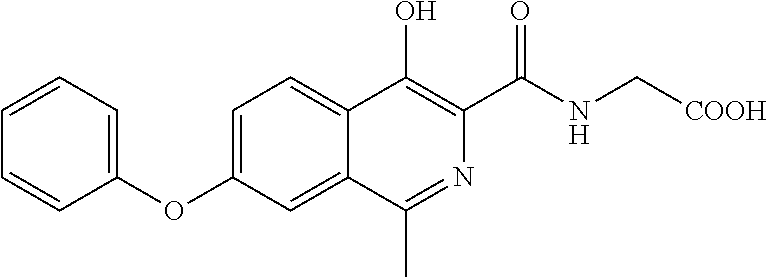
- Roxadustat is an inhibitor of hypoxia-inducible factor-prolyl hydroxylase (HIF-PH), its chemical name is: 2-(4-hydroxy-1-methyl-7-phenoxy isoquinoline-3-carboxamido) acetic acid and its chemical structure is:
- Fibrogen Inc. discloses a process for synthesis of Roxadustat in Chinese patent application CN1816527A.
- This patented process requires a large number of experimental steps to enable the introduction of the 1-position methyl group on the isoquinoline ring, and the introduction process usually requires noble metal catalysis and ultra-low temperature method that have high requirements on equipment; in particular, the third step has harsh reaction conditions, i.e. dicarboxylic acid and glycine are thoroughly ground together and then reacted with stirring at 210° C.
- the step of “ring-opening-ring-forming” to form isoquinoline has poor selectivity, which generates multiple positional isomers that require purification by column chromatography, the disadvantages include low yield, high cost, and unsuitability for large scale production.
- Fibrogen Inc. discloses another process for synthesis of Roxadustat in Chinese patent application CN103435546A.
- the process of forming 5-bromophthalide and phenol into ether has high requirements on moisture, and ring-openings are easy to generate multiple by-products; both the second step of phthalide ring-opening and the step of methyl formation use precious metal Pd for the catalytic reaction, causing high cost; the step of methyl formation uses pressurized hydrogenation reduction, causing low industrial safety.
- Shenzhen TargetRx, Inc. discloses a method for synthesis of Roxadustat in Chinese patent application CN106083720A.
- the patented method has mild reaction conditions, high reaction selectivity, no isomer formation, and no column purification.
- the use of a class of solvents, carbon tetrachloride also results in the formation of the genotoxic impurity benzenesulfonate; the multi-step reaction intermediates are directly fed without purification, which is not conducive to quality control; the route of isoquinoline ring formation basically refers to the preparation route of the original drug.
- This application provides a method for synthesis of Roxadustat, including the following steps:
- the compound of formula (XII) is subjected to hydrolysis reaction to obtain a compound of formula (IV) or a salt thereof;
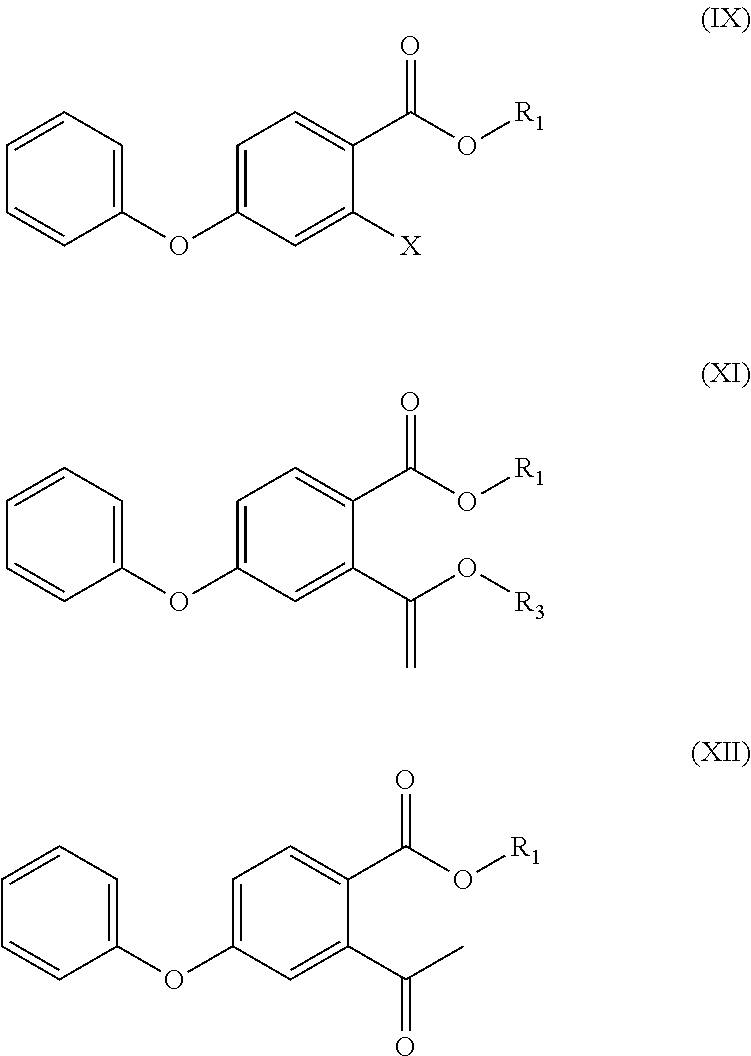
- R 1 in the compound of the formula (VIII), the compound of the formula (IX), the compound of the formula (XI), the compound of the formula (XII), and R 2 in the compound of the formula (XIII) and the compound (XIV) are each independently unsubstituted C 1 -C 4 alkyl (e.g. methyl, ethyl, n-propyl, isopropyl, tert-butyl, sec-butyl or n-butyl), C 1 -C 4 alkyl substituted with C 1 -C 4 alkoxy (e.g. methoxymethyl), C 1 -C 4 alkyl substituted with unsubstituted aromatic group (e.g.
- C 1 -C 4 alkyl e.g. methyl, ethyl, n-propyl, isopropyl, tert-butyl, sec-butyl or n-butyl
- benzyl, or triphenylmethyl C 1 -C 4 alkyl substituted with unsubstituted aromatic oxy group (e.g. phenoxymethyl)), C 1 -C 4 alkyl substituted with substituted aromatic group (e.g. p-nitrobenzyl);
- X in the compound of formula (VIII) and the compound of formula (IX) is bromine, iodine or chlorine;
- R 3 in the compounds of formula (X) and (XI) is unsubstituted C 1 -C 4 alkyl (e.g. methyl, ethyl, n-propyl, isopropyl, tert-butyl, sec-butyl or n-butyl), C 1 -C 4 alkyl substituted with C 1 -C 4 alkoxy (e.g. methoxymethyl), C 1 -C 4 alkyl substituted with unsubstituted aromatic group (e.g. benzyl, or triphenylmethyl), C 1 -C 4 alkyl substituted with unsubstituted aromatic oxy group (e.g. phenoxymethyl), C 1 -C 4 alkyl substituted with substituted aromatic group (e.g. p-nitrobenzyl).
- C 1 -C 4 alkyl e.g. methyl, ethyl, n-propyl, isopropyl, tert-butyl,
- R 1 in formula (IX) is unsubstituted C 1 -C 4 alkyl group (e.g. methyl, ethyl, n-propyl, isopropyl, tert-butyl, sec-butyl, or n-butyl group), C 1 -C 4 alkyl substituted with alkoxy (e.g. methoxymethyl), C 1 -C 4 alkyl substituted with unsubstituted aromatic group (e.g. benzyl, or triphenylmethyl), C 1 -C 4 alkyl substituted with unsubstituted aromatic oxy group (e.g. phenoxymethyl), C 1 -C 4 alkyl substituted with substituted aromatic group (e.g. p-nitrobenzyl);
- C 1 -C 4 alkyl group e.g. methyl, ethyl, n-propyl, isopropyl, tert-butyl, sec-butyl, or n
- X in formula (IX) is bromine, iodine or chlorine.
- the present application provides a method for synthesis of Roxadustat, including the following steps:
- the compound of formula (XII) is subjected to a hydrolysis reaction to obtain a compound of formula (IV) or a salt thereof;
- R 1 in the compound of the formula (VIII), the compound of the formula (IX), the compound of the formula (XI), the compound of the formula (XII), and R 2 in the compound of the formula (XIII) and the compound (XIV) are each independently unsubstituted C 1 -C 4 alkyl (e.g. methyl, ethyl, n-propyl, isopropyl, tert-butyl, sec-butyl or n-butyl), C 1 -C 4 alkyl substituted with C 1 -C 4 alkoxy (e.g. methoxymethyl), C 1 -C 4 alkyl substituted with unsubstituted aromatic group (e.g.
- C 1 -C 4 alkyl e.g. methyl, ethyl, n-propyl, isopropyl, tert-butyl, sec-butyl or n-butyl
- R 1 and R 2 are each independently methyl, ethyl, n-propyl, isopropyl, tert-butyl, sec-butyl, n-butyl, methoxymethyl, benzyl, triphenylmethyl, phenoxymethyl, or p-nitrobenzyl; more preferably, both R 1 and R 2 are methyl;
- X in the compound of formula (VIII) and the compound of formula (IX) is bromine, iodine or chlorine, more preferably bromine;
- R 3 in the compounds of formula (X) and (XI) is unsubstituted C 1 -C 4 alkyl group (e.g. methyl, ethyl, n-propyl, isopropyl, tert-butyl, sec-butyl or n-butyl), C 1 -C 4 alkyl substituted with C 1 -C 4 alkoxy (e.g. methoxymethyl), C 1 -C 4 alkyl substituted with unsubstituted aromatic group (e.g. benzyl, or triphenylmethyl), C 1 -C 4 alkyl substituted with unsubstituted aromatic oxy group (e.g.
- R 3 is methyl, ethyl, n-propyl, isopropyl, tert-butyl, sec-butyl, n-butyl, methoxymethyl, benzyl, triphenylmethyl, phenoxymethyl, or p-nitrobenzyl, more preferably, n-butyl.
- R 1 in the compound of formula (VIII), compound of formula (IX), compound of formula (XI), compound of formula (XII), and R 2 in the compound of formula (XIII) and compound of formula (XIV) are each independently methyl, ethyl, n-propyl, isopropyl, t-butyl, sec-butyl, n-butyl, methoxymethyl, benzyl, triphenylmethyl, phenoxymethyl, or p-nitrobenzyl; more preferably, both R 1 and R 2 are methyl;
- X in the compound of formula (VIII) and the compound of formula (IX) is bromine, iodine or chlorine, more preferably bromine;
- R 3 in the compound of formula (X) and compound of (XI) is methyl, ethyl, n-propyl, isopropyl, t-butyl, sec-butyl, n-butyl, methoxymethyl, benzyl, triphenylmethyl, phenoxymethyl, or p-nitrobenzyl, more preferably, n-butyl.
- R 1 in the compound of formula (VIII), compound of formula (IX), compound of formula (XI), compound of formula (XII), and R 2 in the compounds of formula (XIII) and (XIV) are all methyl;
- R 3 in the compounds of formula (X) and (XI) is n-butyl.
- the salt of the compound of formula (IV) includes but is not limited to an alkali metal salt or an alkaline earth metal salt, such as sodium salt, potassium salt, or calcium salt.
- the present application provides a method for synthesis of Roxadustat, including the following steps:
- the compound of formula (III) is subjected to a hydrolysis reaction to obtain a compound of formula (IV) or a salt thereof;
- the compound of formula (VIII) in step (a), can be obtained by using 2-halo-4-fluorobenzoic acid, (said halo is bromo, chloro or iodo) and alcohol R 1 —OH to perform a conventional esterification reaction, or obtained by firstly reacting 2-bromo-4-fluorobenzoic acid with an acyl chlorination reagent e.g.
- methyl 2-bromo-4-fluorobenzoate can be obtained by using 2-bromo-4-fluorobenzoic acid and methanol by conventional esterification, or obtained by firstly reacting 2-bromo-4-fluorobenzoic acid with an acyl chlorination reagent e.g. thionyl chloride, and then with methanol.
- an acyl chlorination reagent e.g. thionyl chloride
- the reaction in step (a) or step (1) is carried out in the presence of a base;
- the base is selected from alkali metal salts or alkali metal hydroxides
- the alkali metal salts may be selected from alkali metal carbonates e.g. sodium carbonate, or potassium carbonate
- the metal hydroxides may be selected from sodium hydroxide and potassium hydroxide
- the reaction in step (1) is carried out in an aprotic organic solvent selected from dimethylformamide (DMF), and acetonitrile, etc., preferably dimethylformamide (DMF).
- the reaction in step (b) or step (2) is carried out using a metal catalyst and a phosphorus ligand;
- the metal catalyst may be selected from Pd(OAc) 2 , Pd(PPh 3 ) 4 , palladium chloride, 1,1′-bis(diphenylphosphino)ferrocene]palladium dichloride, NiCl 2 (PPh 3 ) 2 /Zn, Cu/Al 2 O 3 , CoCl(PPh 3 ) 3 , preferably Pd(OAc) 2
- the phosphorus ligand can be selected from triphenylphosphine, tri-o-tolylphosphine, preferably tri-o-tolylphosphine.
- the acid hydrolysis reaction in step (c) or step (3) is carried out in the presence of an acid;
- the acid is selected from inorganic acids and organic acids, the inorganic acids are hydrochloric acid, sulfuric acid, or phosphoric acid, preferably hydrochloric acid;
- the organic acid may be selected from acetic acid and trifluoroacetic acid, preferably trifluoroacetic acid.
- the reaction in step (d) or step (4) is carried out in the presence of a base;
- the base is selected from alkali metal salts, e.g. sodium carbonate, sodium acetate, or potassium carbonate, preferably sodium acetate.
- the reaction in step (e) or step (5) is carried out in a high-boiling organic solvent;
- the high-boiling organic solvent is selected from one or more of toluene, xylene (or o-xylene, p-xylene), and anisole, etc., preferably xylene;
- the reaction is carried out in the presence of a base, herein, the base is selected from an organic base and an inorganic base, the organic base may be one or more selected from, for example, triethylamine, N,N-diisopropylethylamine (DIEA), and n-butylamine, preferably triethylamine;
- the inorganic base is one or more selected from potassium carbonate, sodium carbonate, potassium hydroxide, sodium hydroxide and the like, preferably potassium carbonate.
- step (f) in step (f) that the compound of formula (XIV) or its tautomer or a mixture thereof is reacted with glycine, or in step (6) that the compound of formula (VII) or its tautomer or a mixture thereof is reacted with glycine, the compound of formula (XIV) or its tautomer or mixture thereof, or the compound of formula (VII) or its tautomer or a mixture thereof can be reacted with glycine in the presence of sodium methoxide under normal or increased pressure to obtain Roxadustat.
- R 1 in formula (IX) is an unsubstituted C 1 -C 4 alkyl group (e.g. methyl, ethyl, n-propyl, isopropyl, tert-butyl, sec-butyl, or n-butyl), C 1 -C 4 alkyl substituted with C 1 -C 4 alkoxy (e.g. methoxymethyl), C 1 -C 4 alkyl substituted with unsubstituted aromatic group (e.g. benzyl, or triphenylmethyl), C 1 -C 4 alkyl substituted with unsubstituted aromatic oxy group (e.g.
- R 1 is methyl, ethyl, n-propyl, isopropyl, tert-butyl, sec-butyl, n-butyl, methoxymethyl, benzyl, triphenylmethyl, phenoxymethyl, or p-nitrobenzyl, more preferably, methyl;
- X in formula (IX) is bromine, iodine, or chlorine, and more preferably, bromine.
- the present application provides intermediate compounds for synthesis of Roxadustat, as shown in formula (XI):
- R 1 in formula (XI) is unsubstituted C 1 -C 4 alkyl group (e.g. methyl, ethyl, n-propyl, isopropyl, t-butyl, sec-butyl, or n-butyl), C 1 -C 4 alkyl substituted with C 1 -C 4 alkoxy (e.g. methoxymethyl), C 1 -C 4 alkyl substituted with unsubstituted aromatic group (e.g. benzyl, or triphenylmethyl), C 1 -C 4 alkyl substituted with unsubstituted aromatic oxy group (e.g.
- R 1 is methyl, ethyl, n-propyl, isopropyl, tert-butyl, sec-butyl, n-butyl, methoxymethyl, benzyl, triphenylmethyl, phenoxymethyl, or p-nitrobenzyl, more preferably, methyl;
- R 3 in formula (XI) is unsubstituted C 1 -C 4 alkyl (e.g. methyl, ethyl, n-propyl, isopropyl, tert-butyl, sec-butyl, or n-butyl group), C 1 -C 4 alkyl substituted with C 1 -C 4 alkoxy (e.g. methoxymethyl), C 1 -C 4 alkyl substituted with unsubstituted aromatic group (e.g. benzyl, or triphenylmethyl), C 1 -C 4 alkyl substituted with unsubstituted aromatic oxy group (e.g.
- R 3 is methyl, ethyl, n-propyl, isopropyl, tert-butyl, sec-butyl, n-butyl, methoxymethyl, benzyl, triphenylmethyl, phenoxymethyl, or p-nitrobenzyl, more preferably, n-butyl.
- the present application provides intermediate compounds for synthesis of Roxadustat, as shown in formula (XII):
- R 1 in formula (XII) is an unsubstituted C 1 -C 4 alkyl (e.g. methyl, ethyl, n-propyl, isopropyl, tert-butyl, sec-butyl, or n-butyl group), C 1 -C 4 alkyl substituted with C 1 -C 4 alkoxy (e.g. methoxymethyl), C 1 -C 4 alkyl substituted with an unsubstituted aromatic group (e.g. benzyl, or triphenylmethyl), C 1 -C 4 alkyl substituted with an unsubstituted aromatic oxy group (e.g.
- R 1 is methyl, ethyl, n-propyl, isopropyl, tert-butyl, sec-butyl, n-butyl, methoxymethyl, benzyl, triphenylmethyl, phenoxymethyl, or p-nitrobenzyl, more preferably, methyl.
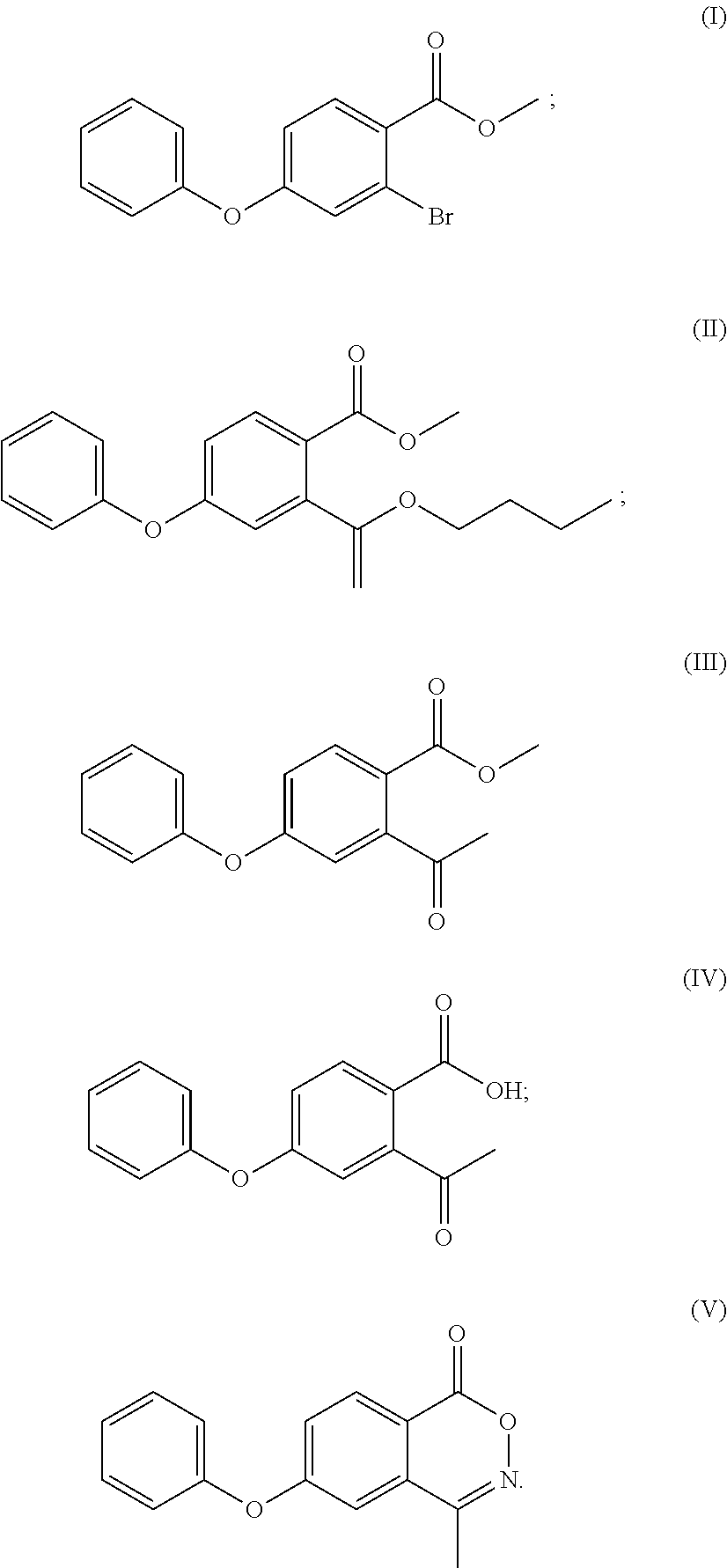
- the present application provides intermediate compounds for synthesis of Roxadustat, which is selected from one of the following compounds:
- the present application provides intermediate compounds for synthesis of Roxadustat, selected from the salts of the following compounds:
- the salts include but are not limited to alkali metal salts or alkaline earth metal salts, e.g. sodium salts, potassium salts, or calcium salts.
- the nuclear magnetic instrument is: bruker Avance 400M, mass spectrometer: Waters tof mass LCT Premier.
Landscapes
- Chemical & Material Sciences (AREA)
- Organic Chemistry (AREA)
- Engineering & Computer Science (AREA)
- Oil, Petroleum & Natural Gas (AREA)
- Organic Low-Molecular-Weight Compounds And Preparation Thereof (AREA)
- Heterocyclic Carbon Compounds Containing A Hetero Ring Having Nitrogen And Oxygen As The Only Ring Hetero Atoms (AREA)
- Low-Molecular Organic Synthesis Reactions Using Catalysts (AREA)
- Pharmaceuticals Containing Other Organic And Inorganic Compounds (AREA)
Abstract
Description
- The present application belongs to but is not limited to the field of medical technology, and more specifically, relates to a method for synthesis of Roxadustat and intermediate compounds thereof.
- Roxadustat is an inhibitor of hypoxia-inducible factor-prolyl hydroxylase (HIF-PH), its chemical name is: 2-(4-hydroxy-1-methyl-7-phenoxy isoquinoline-3-carboxamido) acetic acid and its chemical structure is:
-
- Fibrogen Inc. discloses a process for synthesis of Roxadustat in Chinese patent application CN1816527A. This patented process requires a large number of experimental steps to enable the introduction of the 1-position methyl group on the isoquinoline ring, and the introduction process usually requires noble metal catalysis and ultra-low temperature method that have high requirements on equipment; in particular, the third step has harsh reaction conditions, i.e. dicarboxylic acid and glycine are thoroughly ground together and then reacted with stirring at 210° C. in a molten state; the step of “ring-opening-ring-forming” to form isoquinoline has poor selectivity, which generates multiple positional isomers that require purification by column chromatography, the disadvantages include low yield, high cost, and unsuitability for large scale production.
- Fibrogen Inc. discloses another process for synthesis of Roxadustat in Chinese patent application CN103435546A. In this method, the process of forming 5-bromophthalide and phenol into ether has high requirements on moisture, and ring-openings are easy to generate multiple by-products; both the second step of phthalide ring-opening and the step of methyl formation use precious metal Pd for the catalytic reaction, causing high cost; the step of methyl formation uses pressurized hydrogenation reduction, causing low industrial safety.
- Shanghai Xunhe Pharmaceutical Technology Co., Ltd. discloses a method for synthesis of Roxadustat in Chinese patent application CN106478503A. The patented method has good selectivity and high yield. However, the multi-step intermediates in the reaction process are directly fed without purification, which is not conducive to quality control; and the use of “hydrazine” and “sulfonate” genotoxic impurities in the process increases the risk of safety of final products.
- Beijing Beimetuo New Drug R & D Co., Ltd. discloses a method for synthesis of Roxadustat in its Chinese patent application CN104024227A. The patented method generates isoquinoline under mild reaction conditions, but requires a large number of experimental steps to perform the introduction of the 1-position methyl group on the isoquinoline ring, and the introduction process usually requires noble metal catalysis and ultra-low temperature methods. The yield in some reaction steps is low, and the column chromatography method is used for purification, the preparation cost is high, and it is not easy for scale production.
- Shenzhen TargetRx, Inc. discloses a method for synthesis of Roxadustat in Chinese patent application CN106083720A. The patented method has mild reaction conditions, high reaction selectivity, no isomer formation, and no column purification. However, the use of a class of solvents, carbon tetrachloride, also results in the formation of the genotoxic impurity benzenesulfonate; the multi-step reaction intermediates are directly fed without purification, which is not conducive to quality control; the route of isoquinoline ring formation basically refers to the preparation route of the original drug.
- Suzhou Miracpharma Technology Co., Ltd discloses a method for synthesis of Roxadustat in the Chinese patent application CN104892509A. In this patent method, by-products of the amino substitution product are easily generated during the process of introduction of the phenolic hydroxyl group into the phenyl process; the introduction of 4-position hydroxyl group on the isoquinoline ring adopts peroxyacetic acid oxidation method, which has some side reactions and has great safety risks in the industrial production process.
- Shanghai Xunhe Pharmaceutical Technology Co., Ltd. discloses a method for synthesis of Roxadustat intermediates in its Chinese patent application CN06478503A. This patented method has short reaction steps, but it is not easy to obtain the dimethyl ketomalonate used, and a high temperature of nearly 200° C. is required in the ring-forming reaction, and thus the industrial operation is difficult.
- Here is an overview of the subject matters of the detailed summary of the application. This summary is not intended to limit the scope of protection of the claims.
- This application provides a method for synthesis of Roxadustat, including the following steps:
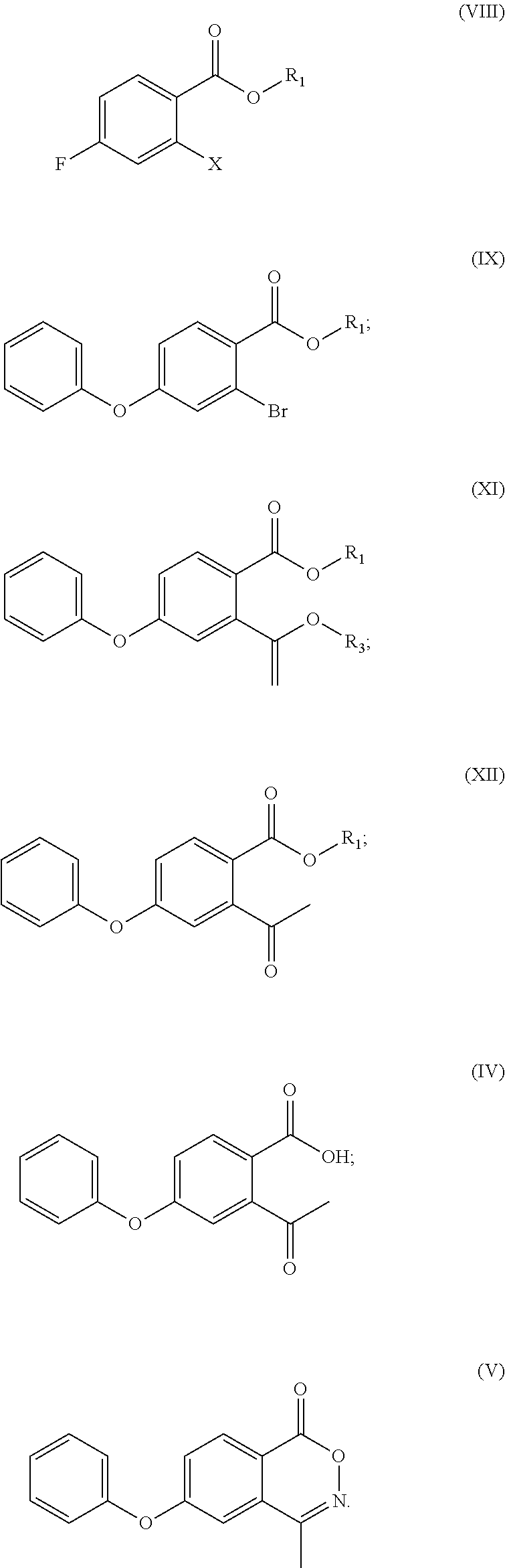
- (a) a compound of formula (VIII) is reacted with phenol to obtain a compound of formula (IX)
-

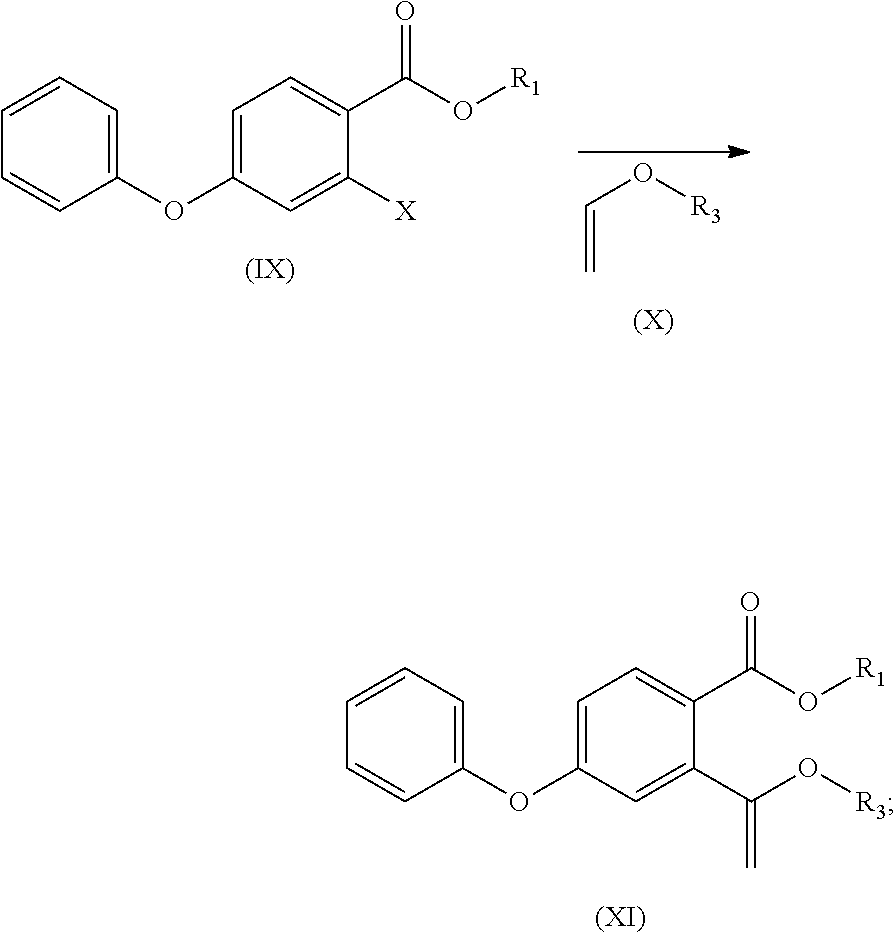
- (b) the compound of formula (IX) is reacted with a compound of formula (X) to obtain a compound of formula (XI)
-

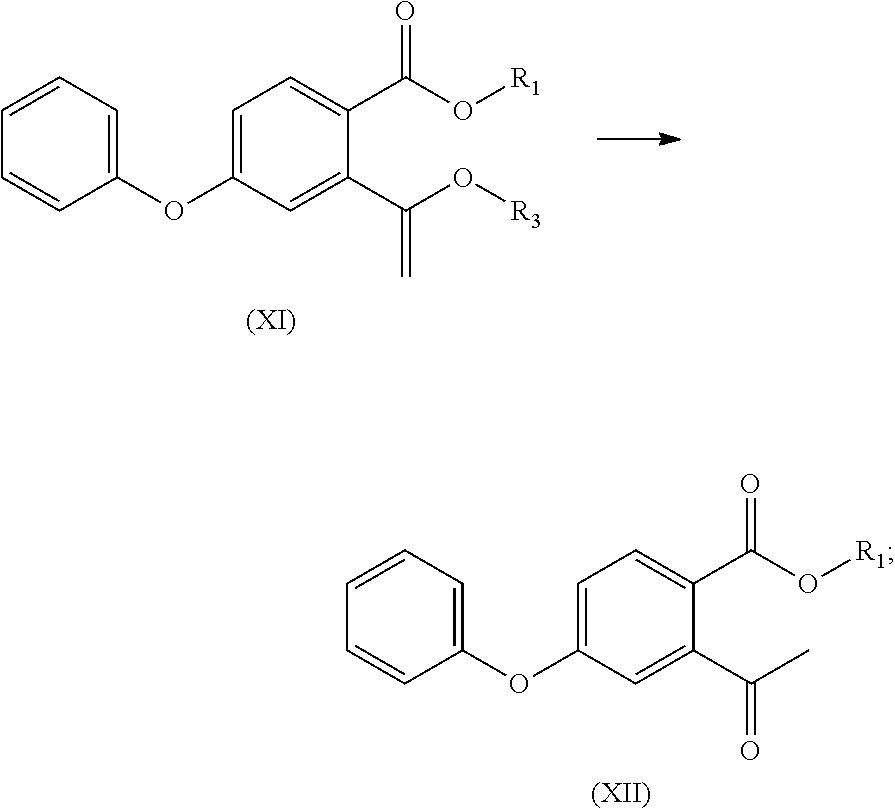
- (c) the compound of formula (XI) is subjected to acid hydrolysis reaction to obtain a compound of formula (XII);
-

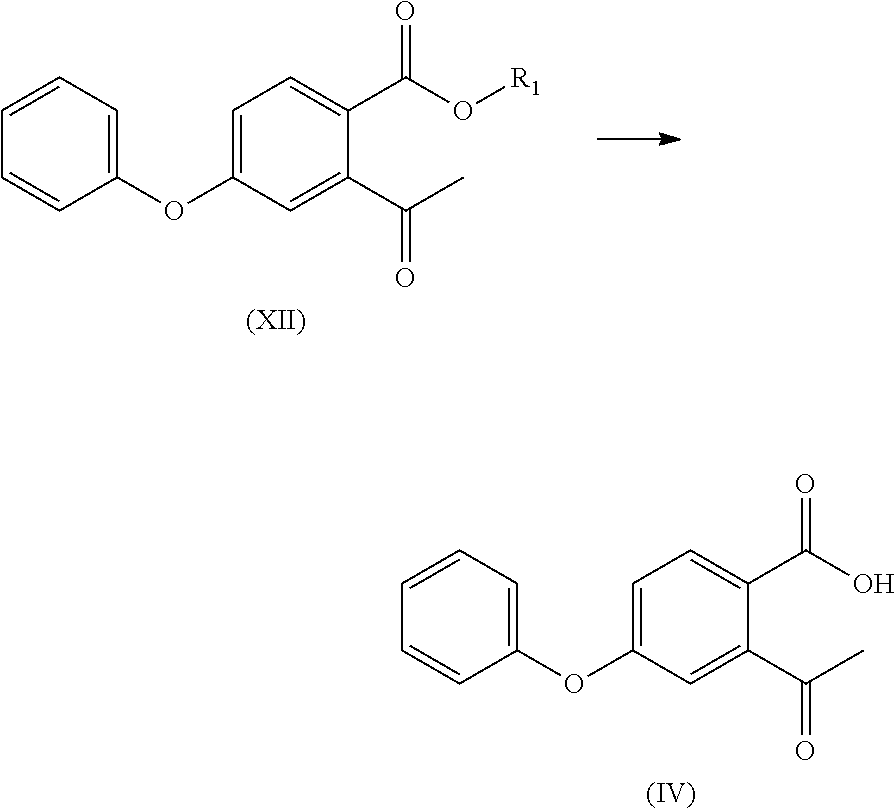
- optionally, the compound of formula (XII) is subjected to hydrolysis reaction to obtain a compound of formula (IV) or a salt thereof;
-
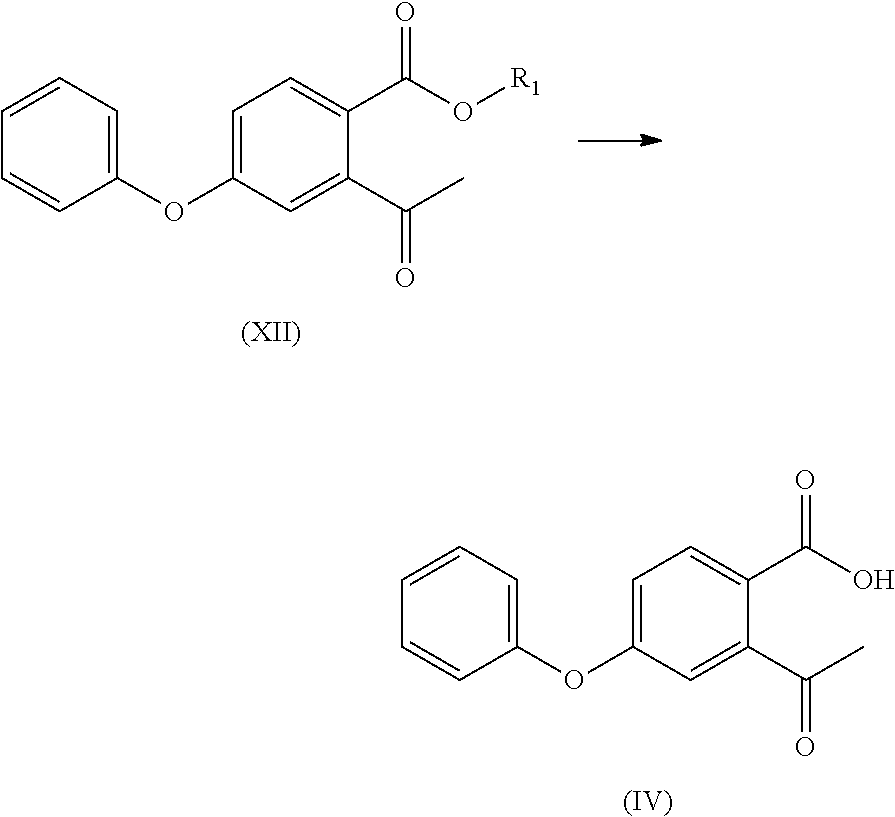
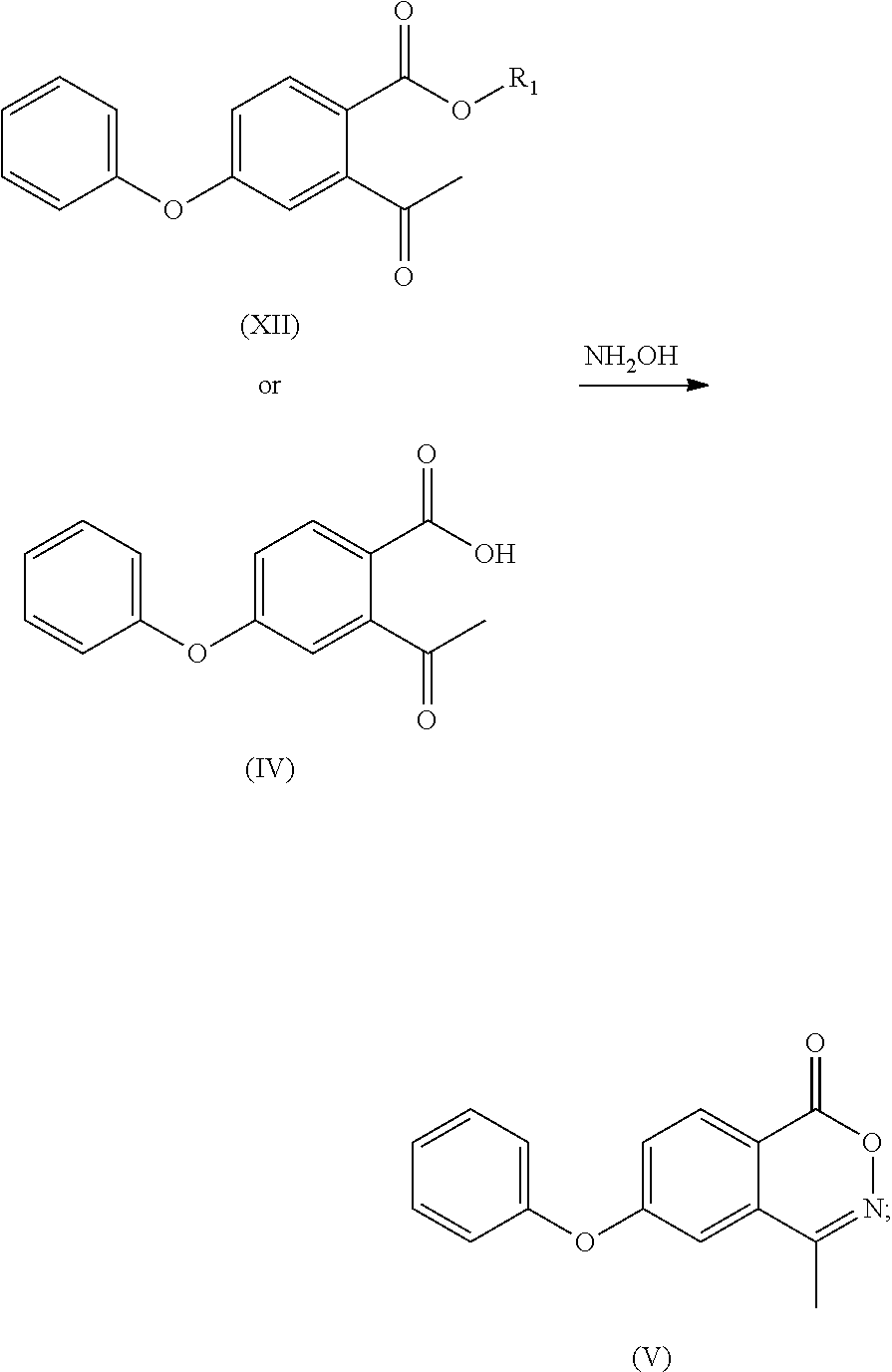
- (d) the compound of formula (XII) or the compound of formula (IV) or a salt thereof is reacted with hydroxylamine to obtain a compound of formula (V);
-

- (e) the compound of formula (V) is reacted with a compound of formula (XIII) to obtain a compound of formula (XIV) or its tautomer or a mixture thereof;
-

- (f) the compound of formula (XIV) or its tautomer or a mixture thereof is reacted with glycine to obtain Roxadustat;
- herein, R1 in the compound of the formula (VIII), the compound of the formula (IX), the compound of the formula (XI), the compound of the formula (XII), and R2 in the compound of the formula (XIII) and the compound (XIV) are each independently unsubstituted C1-C4 alkyl (e.g. methyl, ethyl, n-propyl, isopropyl, tert-butyl, sec-butyl or n-butyl), C1-C4 alkyl substituted with C1-C4 alkoxy (e.g. methoxymethyl), C1-C4 alkyl substituted with unsubstituted aromatic group (e.g. benzyl, or triphenylmethyl), C1-C4 alkyl substituted with unsubstituted aromatic oxy group (e.g. phenoxymethyl)), C1-C4 alkyl substituted with substituted aromatic group (e.g. p-nitrobenzyl);
- X in the compound of formula (VIII) and the compound of formula (IX) is bromine, iodine or chlorine;
- R3 in the compounds of formula (X) and (XI) is unsubstituted C1-C4 alkyl (e.g. methyl, ethyl, n-propyl, isopropyl, tert-butyl, sec-butyl or n-butyl), C1-C4 alkyl substituted with C1-C4 alkoxy (e.g. methoxymethyl), C1-C4 alkyl substituted with unsubstituted aromatic group (e.g. benzyl, or triphenylmethyl), C1-C4 alkyl substituted with unsubstituted aromatic oxy group (e.g. phenoxymethyl), C1-C4 alkyl substituted with substituted aromatic group (e.g. p-nitrobenzyl).
- On the other hand, this application provides intermediate compounds for the synthesis of Roxadustat, as shown in formula (IX):
-

- R1 in formula (IX) is unsubstituted C1-C4 alkyl group (e.g. methyl, ethyl, n-propyl, isopropyl, tert-butyl, sec-butyl, or n-butyl group), C1-C4 alkyl substituted with alkoxy (e.g. methoxymethyl), C1-C4 alkyl substituted with unsubstituted aromatic group (e.g. benzyl, or triphenylmethyl), C1-C4 alkyl substituted with unsubstituted aromatic oxy group (e.g. phenoxymethyl), C1-C4 alkyl substituted with substituted aromatic group (e.g. p-nitrobenzyl);
- X in formula (IX) is bromine, iodine or chlorine.
- In the embodiments of the present application, the present application provides a method for synthesis of Roxadustat, including the following steps:
- (a) a compound of formula (VII) is reacted with phenol to obtain a compound of formula (IX)
-

- (b) the compound of formula (IX) is reacted with a compound of formula (X) to obtain a compound of formula (XI)
-
- (c) the compound of formula (XI) is subjected to acid hydrolysis reaction to obtain a compound of formula (XII);
-

- optionally, the compound of formula (XII) is subjected to a hydrolysis reaction to obtain a compound of formula (IV) or a salt thereof;
-

- (d) the compound of formula (XII) or the compound of formula (IV) or a salt thereof is reacted with hydroxylamine to obtain a compound of formula (V);
-
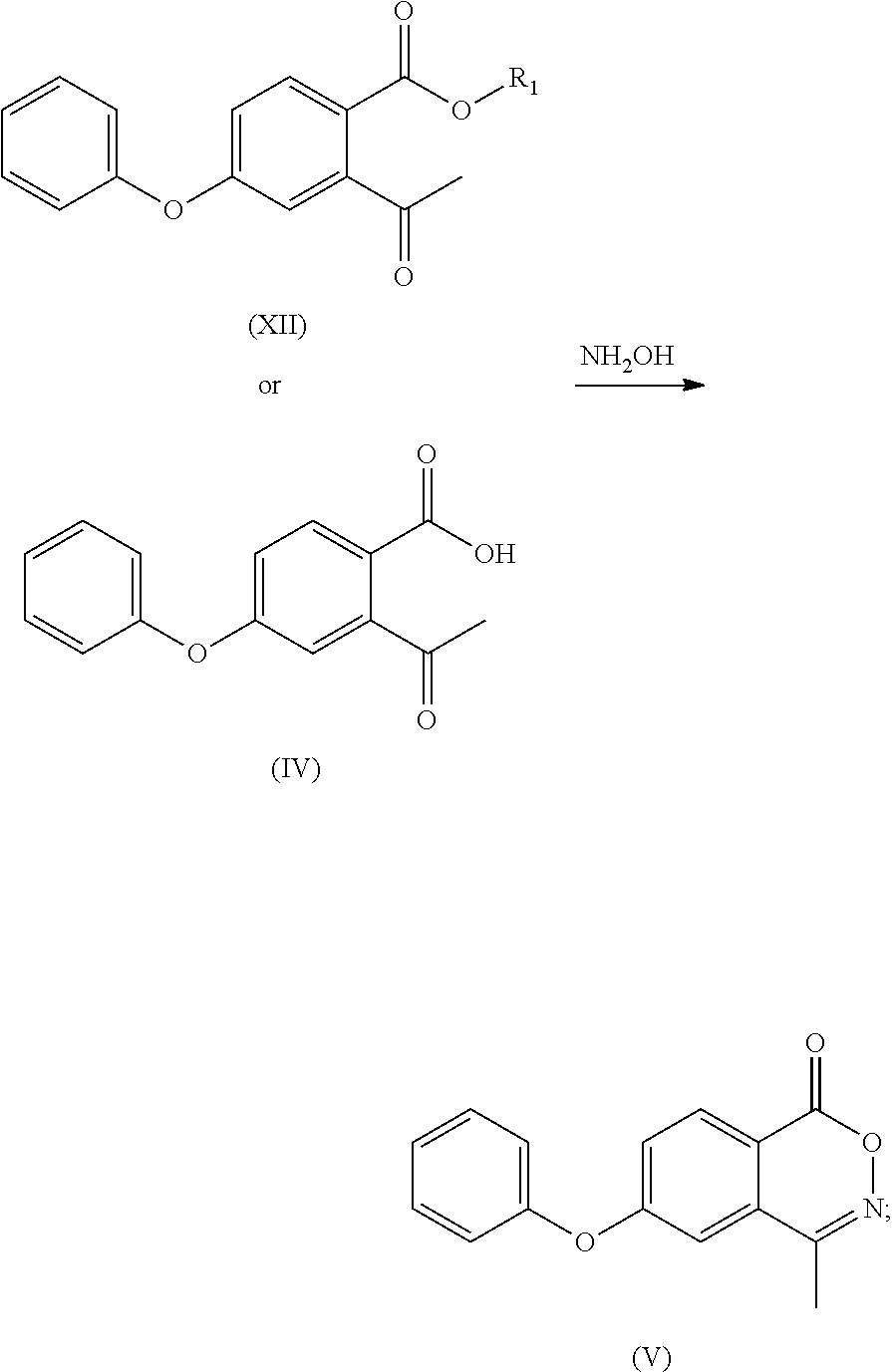
- (e) the compound of formula (V) is reacted with a compound of formula (XIII) to obtain a compound of formula (XIV) or its tautomer or a mixture thereof;
-
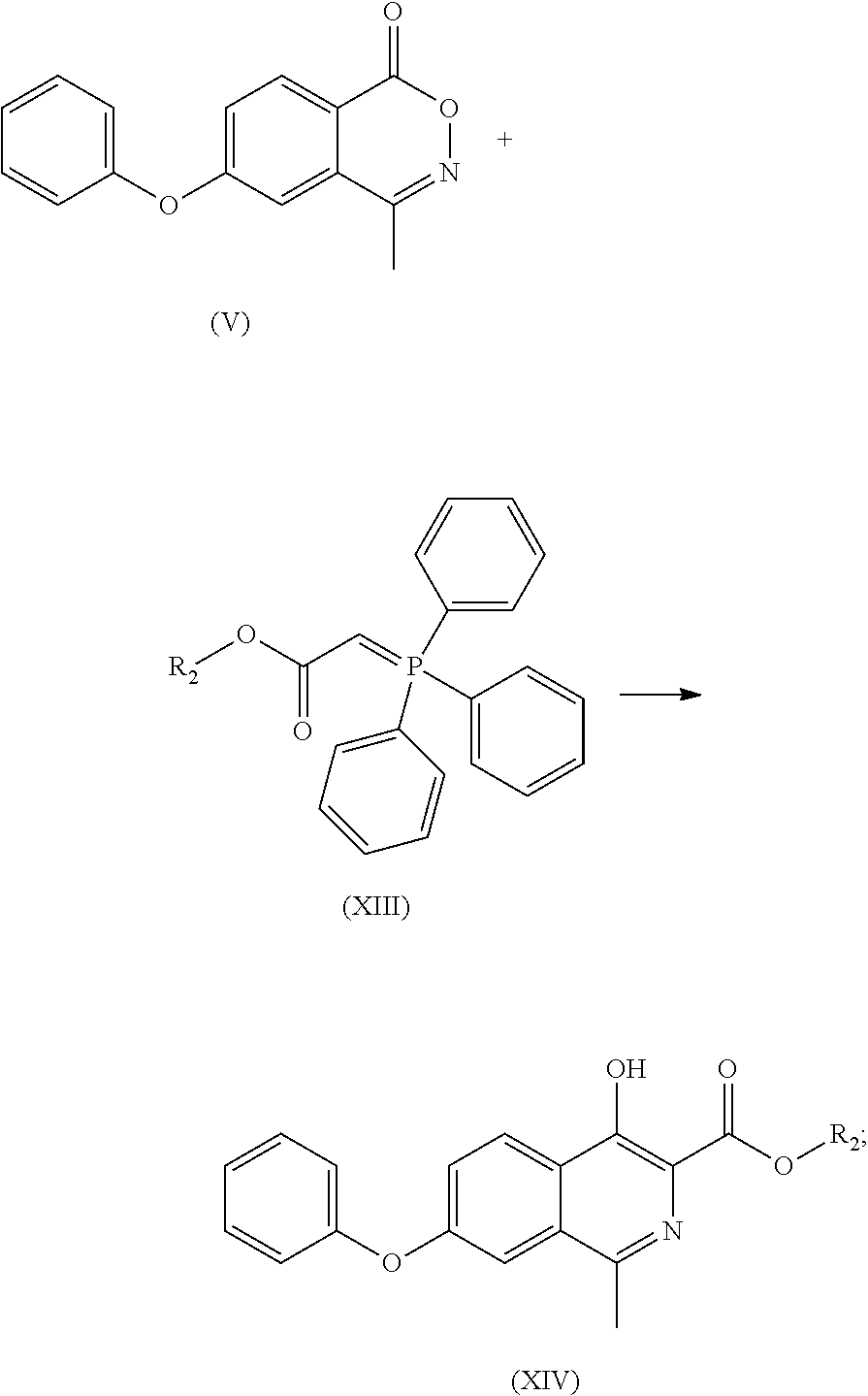
- (f) the compound of formula (XIV) or its tautomer or a mixture thereof is reacted with glycine to obtain Roxadustat;
- herein, R1 in the compound of the formula (VIII), the compound of the formula (IX), the compound of the formula (XI), the compound of the formula (XII), and R2 in the compound of the formula (XIII) and the compound (XIV) are each independently unsubstituted C1-C4 alkyl (e.g. methyl, ethyl, n-propyl, isopropyl, tert-butyl, sec-butyl or n-butyl), C1-C4 alkyl substituted with C1-C4 alkoxy (e.g. methoxymethyl), C1-C4 alkyl substituted with unsubstituted aromatic group (e.g. benzyl, or triphenylmethyl), C1-C4 alkyl substituted with unsubstituted aromatic oxy group (e.g. phenoxymethyl)), C1-C4 alkyl substituted with substituted aromatic group (e.g. p-nitrobenzyl); preferably, R1 and R2 are each independently methyl, ethyl, n-propyl, isopropyl, tert-butyl, sec-butyl, n-butyl, methoxymethyl, benzyl, triphenylmethyl, phenoxymethyl, or p-nitrobenzyl; more preferably, both R1 and R2 are methyl;
- X in the compound of formula (VIII) and the compound of formula (IX) is bromine, iodine or chlorine, more preferably bromine;
- R3 in the compounds of formula (X) and (XI) is unsubstituted C1-C4 alkyl group (e.g. methyl, ethyl, n-propyl, isopropyl, tert-butyl, sec-butyl or n-butyl), C1-C4 alkyl substituted with C1-C4 alkoxy (e.g. methoxymethyl), C1-C4 alkyl substituted with unsubstituted aromatic group (e.g. benzyl, or triphenylmethyl), C1-C4 alkyl substituted with unsubstituted aromatic oxy group (e.g. phenoxymethyl), C1-C4 alkyl substituted with substituted aromatic group (e.g. p-nitrobenzyl); preferably, R3 is methyl, ethyl, n-propyl, isopropyl, tert-butyl, sec-butyl, n-butyl, methoxymethyl, benzyl, triphenylmethyl, phenoxymethyl, or p-nitrobenzyl, more preferably, n-butyl.
- In a preferred embodiment of the present application providing a method for synthesis of Roxadustat, R1 in the compound of formula (VIII), compound of formula (IX), compound of formula (XI), compound of formula (XII), and R2 in the compound of formula (XIII) and compound of formula (XIV) are each independently methyl, ethyl, n-propyl, isopropyl, t-butyl, sec-butyl, n-butyl, methoxymethyl, benzyl, triphenylmethyl, phenoxymethyl, or p-nitrobenzyl; more preferably, both R1 and R2 are methyl;
- X in the compound of formula (VIII) and the compound of formula (IX) is bromine, iodine or chlorine, more preferably bromine;
- R3 in the compound of formula (X) and compound of (XI) is methyl, ethyl, n-propyl, isopropyl, t-butyl, sec-butyl, n-butyl, methoxymethyl, benzyl, triphenylmethyl, phenoxymethyl, or p-nitrobenzyl, more preferably, n-butyl.
- In a more preferred embodiment of the present application providing a method for synthesis of Roxadustat, R1 in the compound of formula (VIII), compound of formula (IX), compound of formula (XI), compound of formula (XII), and R2 in the compounds of formula (XIII) and (XIV) are all methyl;
- X in the compound of formula (VIII) and the compound of formula (IX) is bromine;
- R3 in the compounds of formula (X) and (XI) is n-butyl.
- In an embodiment of the present application providing a method for synthesis of Roxadustat, the salt of the compound of formula (IV) includes but is not limited to an alkali metal salt or an alkaline earth metal salt, such as sodium salt, potassium salt, or calcium salt.
- In a more preferred embodiment of the present application, the present application provides a method for synthesis of Roxadustat, including the following steps:
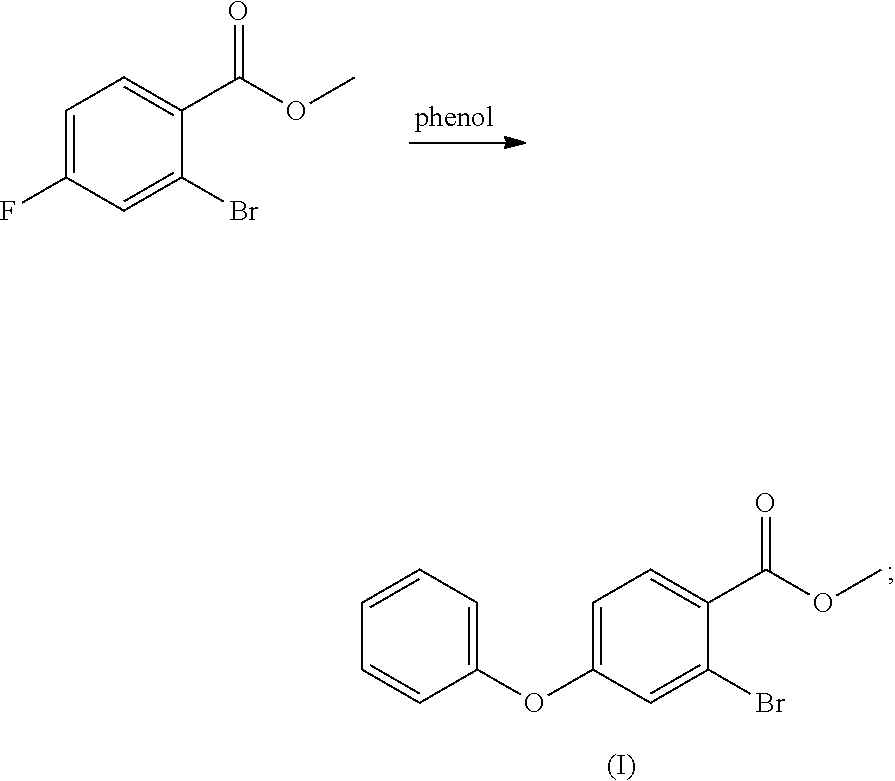
- (1) methyl 2-bromo-4-fluorobenzoate is reacted with phenol to obtain a compound of formula (I)
-

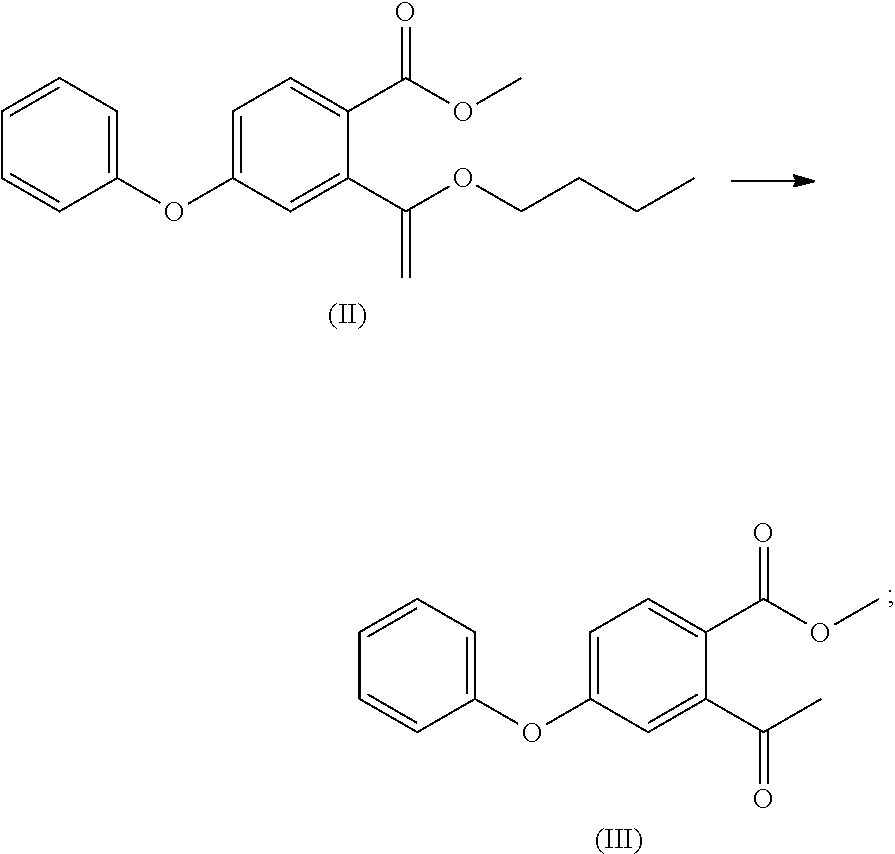
- (2) the compound of formula (I) is reacted with butyl vinyl ether to obtain a compound of formula (II)
-
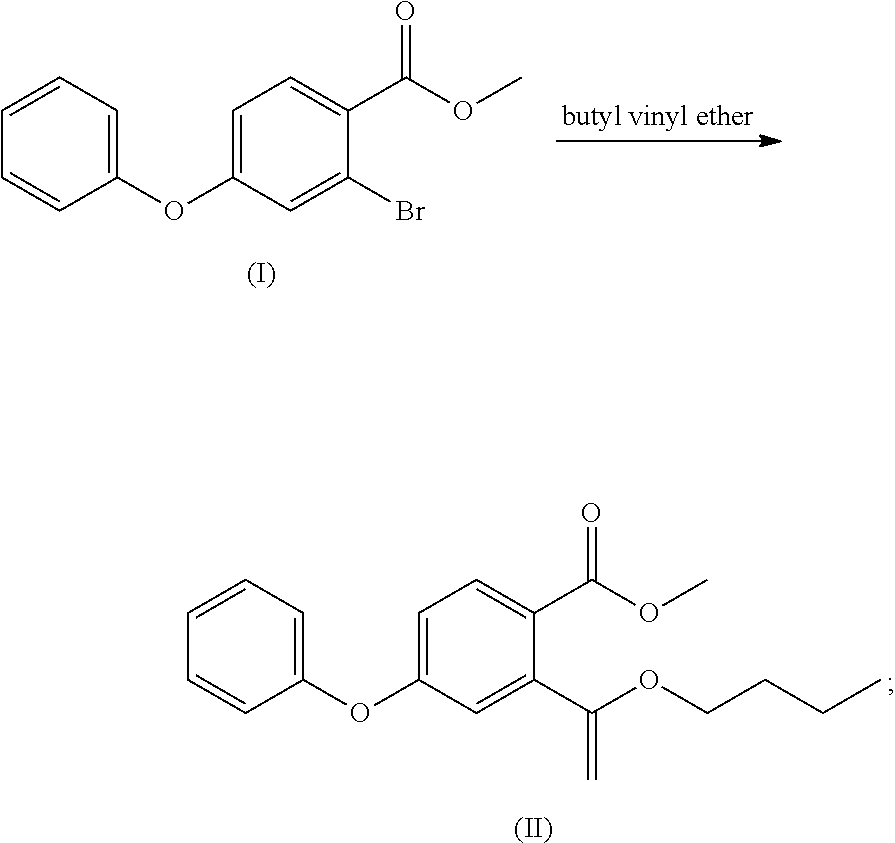
- (3) the compound of formula (II) is subjected to an acid hydrolysis reaction to obtain a compound of formula (III);
-

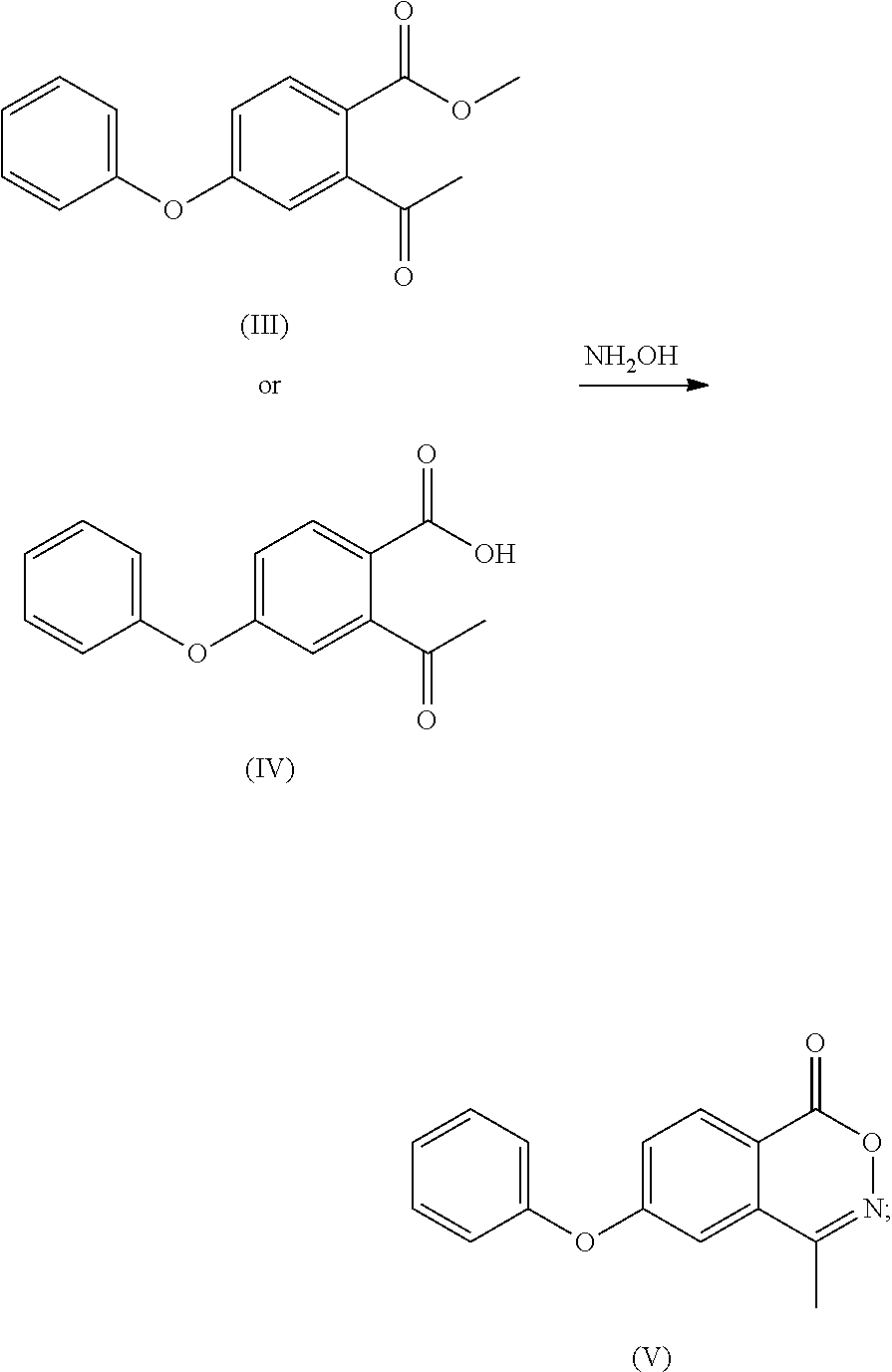
- optionally, the compound of formula (III) is subjected to a hydrolysis reaction to obtain a compound of formula (IV) or a salt thereof;
-

- (4) the compound of formula (III) or the compound of formula (IV) or a salt thereof is reacted with hydroxylamine to obtain a compound of formula (V);
-
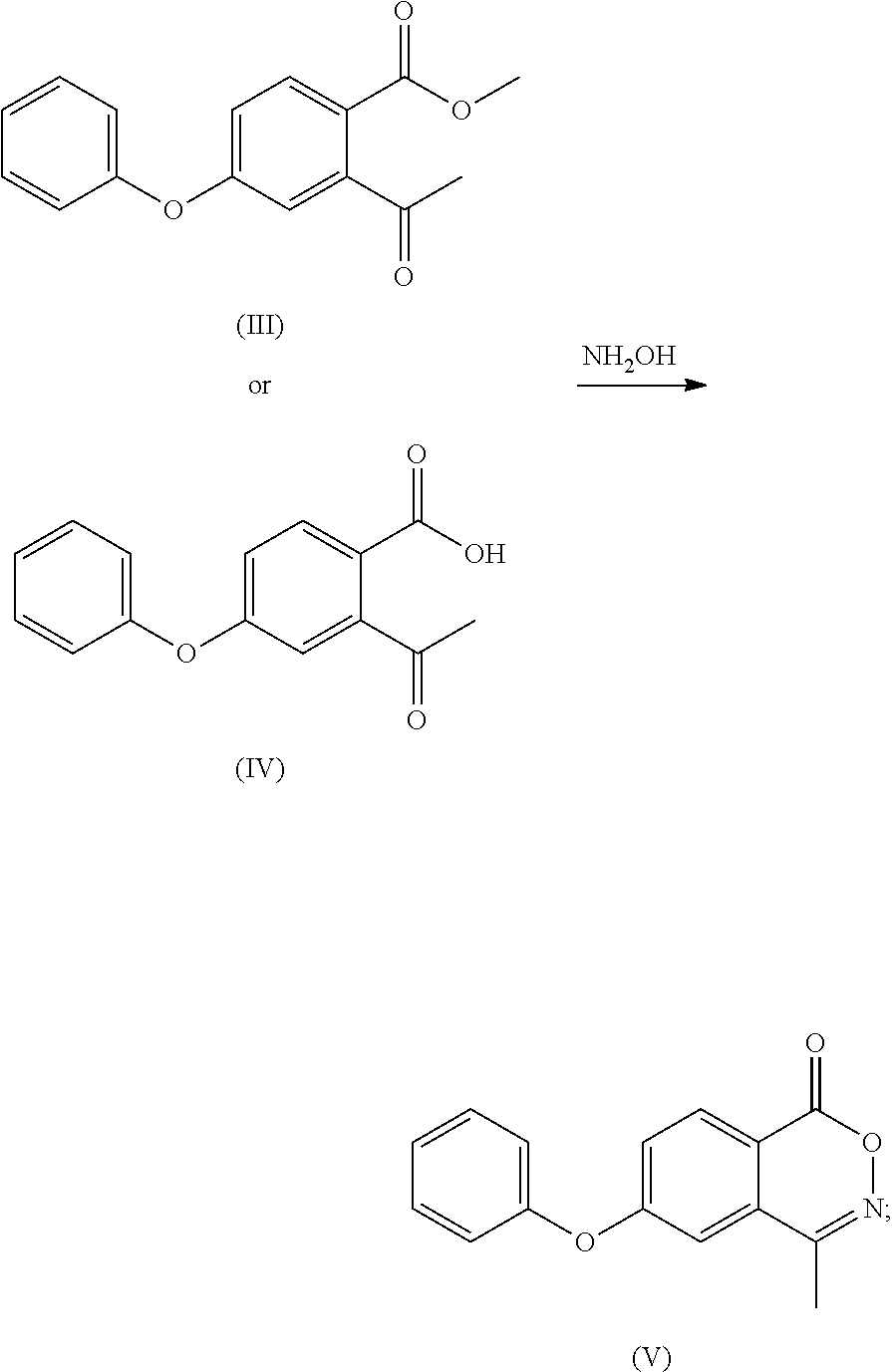
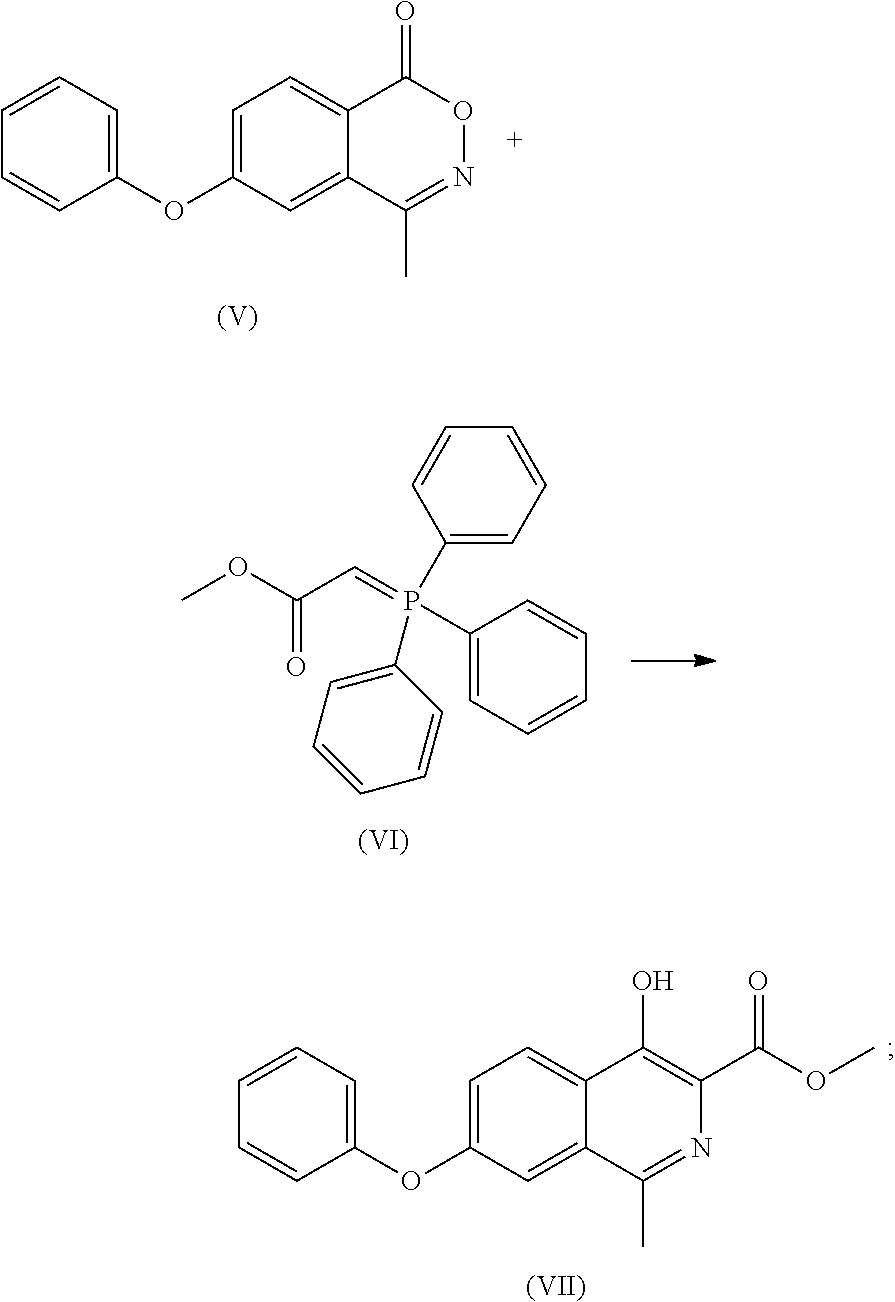
- (5) the compound of formula (V) is reacted with a compound of formula (VI) to obtain a compound of formula (VII) or its tautomer or a mixture thereof;
-
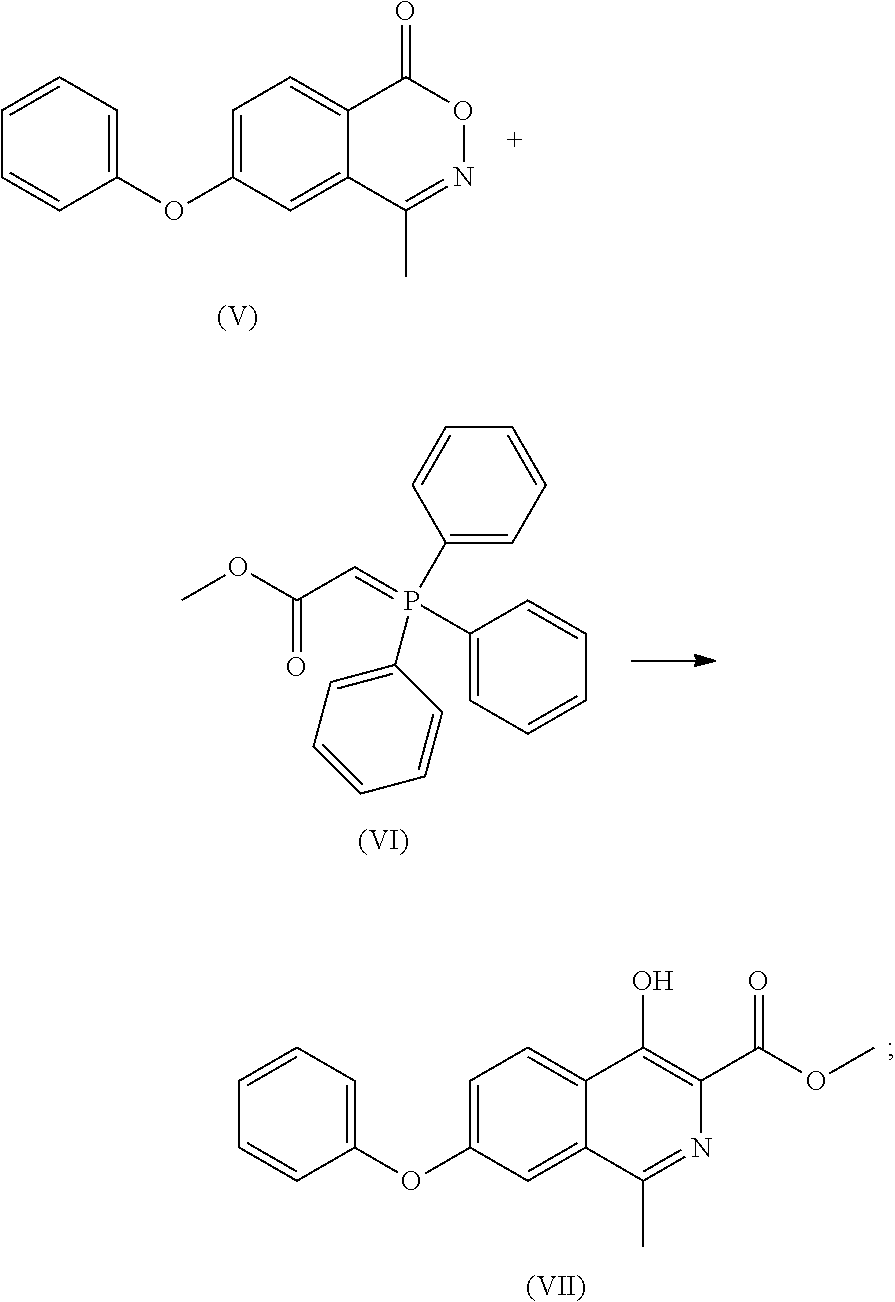
- (6) the compound of formula (VII) or its tautomer or a mixture thereof is reacted with glycine to obtain Roxadustat.
- In an embodiment of the present application providing a method for synthesis of Roxadustat, in step (a), the compound of formula (VIII) can be obtained by using 2-halo-4-fluorobenzoic acid, (said halo is bromo, chloro or iodo) and alcohol R1—OH to perform a conventional esterification reaction, or obtained by firstly reacting 2-bromo-4-fluorobenzoic acid with an acyl chlorination reagent e.g. thionyl chloride, and then with alcohol R1—OH; when X in the compound of formula (VIII) is bromine and R1 is methyl, in step (1), methyl 2-bromo-4-fluorobenzoate can be obtained by using 2-bromo-4-fluorobenzoic acid and methanol by conventional esterification, or obtained by firstly reacting 2-bromo-4-fluorobenzoic acid with an acyl chlorination reagent e.g. thionyl chloride, and then with methanol.
- In the embodiment of the present application providing a method for synthesis of Roxadustat, the reaction in step (a) or step (1) is carried out in the presence of a base; herein, the base is selected from alkali metal salts or alkali metal hydroxides, the alkali metal salts may be selected from alkali metal carbonates e.g. sodium carbonate, or potassium carbonate, and the metal hydroxides may be selected from sodium hydroxide and potassium hydroxide; the reaction in step (1) is carried out in an aprotic organic solvent selected from dimethylformamide (DMF), and acetonitrile, etc., preferably dimethylformamide (DMF).
- In an embodiment of the present application providing a method for synthesis of Roxadustat, the reaction in step (b) or step (2) is carried out using a metal catalyst and a phosphorus ligand; herein, the metal catalyst may be selected from Pd(OAc)2, Pd(PPh3)4, palladium chloride, 1,1′-bis(diphenylphosphino)ferrocene]palladium dichloride, NiCl2(PPh3)2/Zn, Cu/Al2O3, CoCl(PPh3)3, preferably Pd(OAc)2; the phosphorus ligand can be selected from triphenylphosphine, tri-o-tolylphosphine, preferably tri-o-tolylphosphine.
- In an embodiment of the present application providing a method for synthesis of Roxadustat, the acid hydrolysis reaction in step (c) or step (3) is carried out in the presence of an acid; herein, the acid is selected from inorganic acids and organic acids, the inorganic acids are hydrochloric acid, sulfuric acid, or phosphoric acid, preferably hydrochloric acid; the organic acid may be selected from acetic acid and trifluoroacetic acid, preferably trifluoroacetic acid.
- In the embodiment of the present application providing a method for synthesis of Roxadustat, the reaction in step (d) or step (4) is carried out in the presence of a base; herein, the base is selected from alkali metal salts, e.g. sodium carbonate, sodium acetate, or potassium carbonate, preferably sodium acetate.
- In the embodiment of the present application providing a method for synthesis of Roxadustat, the reaction in step (e) or step (5) is carried out in a high-boiling organic solvent; herein, the high-boiling organic solvent is selected from one or more of toluene, xylene (or o-xylene, p-xylene), and anisole, etc., preferably xylene; the reaction is carried out in the presence of a base, herein, the base is selected from an organic base and an inorganic base, the organic base may be one or more selected from, for example, triethylamine, N,N-diisopropylethylamine (DIEA), and n-butylamine, preferably triethylamine; the inorganic base is one or more selected from potassium carbonate, sodium carbonate, potassium hydroxide, sodium hydroxide and the like, preferably potassium carbonate.
- In an embodiment of the present application providing a method for synthesis of Roxadustat, in step (f) that the compound of formula (XIV) or its tautomer or a mixture thereof is reacted with glycine, or in step (6) that the compound of formula (VII) or its tautomer or a mixture thereof is reacted with glycine, the compound of formula (XIV) or its tautomer or mixture thereof, or the compound of formula (VII) or its tautomer or a mixture thereof can be reacted with glycine in the presence of sodium methoxide under normal or increased pressure to obtain Roxadustat.
- On the other hand, this application provides intermediate compounds for synthesis of Roxadustat, as shown in formula (IX):
-

- R1 in formula (IX) is an unsubstituted C1-C4 alkyl group (e.g. methyl, ethyl, n-propyl, isopropyl, tert-butyl, sec-butyl, or n-butyl), C1-C4 alkyl substituted with C1-C4 alkoxy (e.g. methoxymethyl), C1-C4 alkyl substituted with unsubstituted aromatic group (e.g. benzyl, or triphenylmethyl), C1-C4 alkyl substituted with unsubstituted aromatic oxy group (e.g. phenoxymethyl), C1-C4 alkyl substituted with substituted aromatic group (e.g. p-nitrobenzyl); preferably, R1 is methyl, ethyl, n-propyl, isopropyl, tert-butyl, sec-butyl, n-butyl, methoxymethyl, benzyl, triphenylmethyl, phenoxymethyl, or p-nitrobenzyl, more preferably, methyl;
- X in formula (IX) is bromine, iodine, or chlorine, and more preferably, bromine.
- In one embodiment of the present application, the present application provides intermediate compounds for synthesis of Roxadustat, as shown in formula (XI):
-

- R1 in formula (XI) is unsubstituted C1-C4 alkyl group (e.g. methyl, ethyl, n-propyl, isopropyl, t-butyl, sec-butyl, or n-butyl), C1-C4 alkyl substituted with C1-C4 alkoxy (e.g. methoxymethyl), C1-C4 alkyl substituted with unsubstituted aromatic group (e.g. benzyl, or triphenylmethyl), C1-C4 alkyl substituted with unsubstituted aromatic oxy group (e.g. phenoxymethyl), C1-C4 alkyl substituted with substituted aromatic group (e.g. p-nitrobenzyl); preferably, R1 is methyl, ethyl, n-propyl, isopropyl, tert-butyl, sec-butyl, n-butyl, methoxymethyl, benzyl, triphenylmethyl, phenoxymethyl, or p-nitrobenzyl, more preferably, methyl;
- R3 in formula (XI) is unsubstituted C1-C4 alkyl (e.g. methyl, ethyl, n-propyl, isopropyl, tert-butyl, sec-butyl, or n-butyl group), C1-C4 alkyl substituted with C1-C4 alkoxy (e.g. methoxymethyl), C1-C4 alkyl substituted with unsubstituted aromatic group (e.g. benzyl, or triphenylmethyl), C1-C4 alkyl substituted with unsubstituted aromatic oxy group (e.g. phenoxymethyl), C1-C4 alkyl substituted with substituted aromatic group (e.g. p-nitrobenzyl); preferably, R3 is methyl, ethyl, n-propyl, isopropyl, tert-butyl, sec-butyl, n-butyl, methoxymethyl, benzyl, triphenylmethyl, phenoxymethyl, or p-nitrobenzyl, more preferably, n-butyl.
- In one embodiment of the present application, the present application provides intermediate compounds for synthesis of Roxadustat, as shown in formula (XII):
-

- R1 in formula (XII) is an unsubstituted C1-C4 alkyl (e.g. methyl, ethyl, n-propyl, isopropyl, tert-butyl, sec-butyl, or n-butyl group), C1-C4 alkyl substituted with C1-C4 alkoxy (e.g. methoxymethyl), C1-C4 alkyl substituted with an unsubstituted aromatic group (e.g. benzyl, or triphenylmethyl), C1-C4 alkyl substituted with an unsubstituted aromatic oxy group (e.g. phenoxymethyl), C1-C4 alkyl substituted with a substituted aromatic group (e.g. p-nitrobenzyl); preferably, R1 is methyl, ethyl, n-propyl, isopropyl, tert-butyl, sec-butyl, n-butyl, methoxymethyl, benzyl, triphenylmethyl, phenoxymethyl, or p-nitrobenzyl, more preferably, methyl.
- In a preferred embodiment of the present application, the present application provides intermediate compounds for synthesis of Roxadustat, which is selected from one of the following compounds:
-

- In a preferred embodiment of the present application, the present application provides intermediate compounds for synthesis of Roxadustat, selected from the salts of the following compounds:
-

- herein, the salts include but are not limited to alkali metal salts or alkaline earth metal salts, e.g. sodium salts, potassium salts, or calcium salts.
- The embodiments of the present application are illustrated through the following examples. For those skilled in the art, these examples are only exemplary and do not constitute a limitation on the protection scope claimed by the present application.
- In the examples of the present application, the nuclear magnetic instrument is: bruker Avance 400M, mass spectrometer: Waters tof mass LCT Premier.
- Methanol (182 ml) was added to the 500 ml of reaction flask and stirred, the temperature was cooled to 0-5° C. in an ice water bath, and thionyl chloride (17.6 ml) was slowly added dropwise. After the dropwise addition, the ice water bath was removed, 2-bromo-4-fluorobenzoic acid (14.00 g) was added, and the reaction was refluxed for 4 h. The temperature was cooled to room temperature, and methyl 2-bromo-4-fluorobenzoate (14 g, 94%) was obtained after removing the solvent by concentration. Mass: m/z 232.96 [M+H]+.
- To a 250 ml of reaction flask was added dry DMF (40 ml), and, phenol (3.88 g), potassium carbonate (5.70 g), and methyl 2-bromo-4-fluorobenzoate (8.00 g) were added with stirring. The mixture was heated to 70° C. and reacted for 16 h, and the temperature was cooled to room temperature, water (40 ml) was added, the mixture was extracted with ethyl acetate (80 ml), the organic layer was washed with saturated sodium chloride solution, dried over anhydrous sodium sulfate, and concentrated to obtain the compound of formula (I) (10 g, 94%), which can also be used directly in the next step.
- Mass: m/z 307.00[M+H]+; 1H-NMR: (400 MHz, DMSO-d6) 7.844 (d, 1H), 7.478 (m, 2H), 7.270 (m, 2H), 7.160 (m, 2H), 7.024 (m, 1H), 3.829 (s, 3H).
- 13C-NMR: (400 MHz, DMSO-ds) 165.691, 160.760, 154.939, 133.705, 130.953, 130.953, 126.075, 125.716, 122.918, 122.595, 120.675, 120.675, 116.711, 52.884.
- To a 100 ml of reaction flask was added acetonitrile (25 ml), and, the compound of formula (I) (5.00 g), butyl vinyl ether (3.26 g), tri-o-tolylphosphine (0.99 g), palladium acetate 0.11 g), DIPEA (diisopropylethylamine) (6.32 g) were added with stirring under purge nitrogen, and refluxed for 5 h. The solvent was removed by concentration at a cooled temperature, toluene (50 ml) was added, the mixture was filtered with stirring, and the filtrate was collected (the filtrate was concentrated to give compound (II)); 10% hydrochloric acid (40 ml) was added, and the mixture was stirred and reacted for 5 h. The layers were separated, and the organic layer was washed twice with saturated sodium bicarbonate solution (50 ml), dried over anhydrous sodium sulfate, and the organic layer was concentrated to give compound (III) (6.20 g, 88%).
- Mass of the compound of formula (II): m/z 327.17[M+H]+.
- Mass of the compound of formula (III): m/z 271.01 [M+H]+; 1H-NMR: (400 MHz, DMSO-d6) 7.858 (d, 1H), 7.473 (t, 2H), 7.264 (t, 1H), 7.146 (t, 3H), 7.041 (t, 1H), 3.799 (s, 3H), 2.458 (s, 3H).
- 13C-NMR: (400 MHz, DMSO-d6) 166.421, 160.924, 155.136, 146.092, 132.483, 130.891, 130.891, 125.486, 122.203, 120.518, 120.518, 118.233, 115.757, 52.832, 30.428.
- To a 100 ml four-necked flask was added 1,4-dioxane (40 ml), with stirring, the compound of formula (I) (5.00 g), 20% sulfuric acid solution (15 ml) was added and reacted at 55° C. for 16 h. The organic solvent was removed by concentration at cooled temperature, the residue was extracted with ethyl acetate (25 ml), washed twice with saturated sodium chloride solution (40 ml), dried over anhydrous sodium sulfate, and the organic layer was concentrated to give compound (IV) (4.48 g, 94%), compound (IV) (3.1 g, 66%) was obtained by recrystallization using ethyl acetate/n-hexane.
- Mass: m/z 254.81[M−H]−.
- 1H-NMR: (400 MHz, CDCl3) 7.740 (d, 1H), 7.450 (t, 2H), 7.282 (t, 1H), 7.101 (m, 4H), 1.850 (s, 3H).
- To a 100 ml four-necked flask was added 1,4-sioxane (40 ml), and with stirring, the compound of formula (III) (5.00 g), 20% sulfuric acid solution (15 ml) was added and reacted at 55° C. for 16 h. The organic solvent was removed by concentration at a cooled temperature, the residue was extracted with ethyl acetate (25 ml), and water (30 ml) was added. The pH was adjusted to about 8.0 with 10% sodium hydroxide solution, and the mixture was warmed to 70-75° C. in water phase. A solution of calcium chloride (1.83 g) in water (28 ml) was added and the mixture was extracted twice with ethyl acetate (40 ml). The organic phase was concentrated to dryness under reduced pressure, isopropanol (10 ml) was added and stirred for 2 h, and the compound of formula (IV) as a white solid (4.2 g, 77%) was obtained by vacuum filtering.
- 1H-NMR: (400 MHz, CD3OD) 7.886 (d, 1H), 7.410 (t, 2H), 7.197 (t, 1H), 7.049 (d, 2H), 6.950 (d, 1H), 6.829 (d, 1H), 2.471 (s, 3H).
- To the 100 ml reaction flask was added anhydrous ethanol (30 ml), and with stirring the compound of formula (III) (6.20 g) or compound (IV) (5.92 g), hydroxylamine hydrochloride (3.53 g), anhydrous sodium acetate (3.76 g) were added and refluxed for 6 h. The mixture was cooled to room temperature to grow crystal for 1 h. After filtering under vacuum, water (30 ml) was added to the filter cake to beat for 1 h, the compound (3.56 g, 61%) as a white solid was obtained after vacuum filtering and drying. MP: 118° C.;
- Mass: m/z 254.04[M+H]+ 1H-NMR: (400 MHz, DMSO-d6) 8.258 (d, 1H), 7.469 (m, 4H), 7.330 (t, 1H), 7.236 (t, 2H), 2.505 (s, 3H).
- 13C-NMR: (400 MHz, DMSO-d6) 163.556, 163.268, 154.682, 154.083, 131.411, 131.092, 131.092, 129.937, 126.012, 123.010, 120.696, 120.696, 116.492, 114.309, 16.850.
- To a 100 ml of reaction flask was added anhydrous ethanol (40 ml), and with stirring, the calcium salt of the compound of formula (IV) (8 g), hydroxylamine hydrochloride (4.4 g), anhydrous sodium acetate (2.8 g) were added and refluxed for 6 h. The mixture was cooled to room temperature to grow crystal for 1 h and filtered under vacuum, water (40 ml) was added to the filter cake to beat for 1 h, the compound of formula (IV) as a white solid (5.7 g, 77%) was obtained after vacuum filtering and drying.
- To a 100 ml of reaction flask was added dry toluene (10 ml). With stirring, the compound of formula (V) (2.00 g), compound of formula (VI) (2.90 g) and triethylamine (0.40 g) were added and refluxed for 2 days under nitrogen atmosphere. The mixture was cooled to room temperature, and silica gel was added to absorb for 1 hour. After vacuum filtering, the filtrate was concentrated to dryness, then 10 ml of methanol was added, and with stirring, the crystal was precipitated to give 1.81 g of white solid with a yield of 74%. Through column chromatography (dichloromethane/n-hexane 3/7) the compound of formula (VI) was obtained, MP: 110° C.;
- Mass: m/z 310.0[M+H]+ 1H-NMR (400 MHz, DMSO-d) 11.521 (s, 1H), 8.354 (d, 1H), 7.511 (m, 4H), 7.234 (m, 3H), 3.968 (s, 3H), 2.660 (s, 3H).
- 13C-NMR: (400 MHz, DMSO-d) 170.925, 158.919, 155.834, 154.564, 148.325, 132.073, 130.873, 130.873, 126.087, 125.161, 125.161, 123.387, 122.726, 120.082, 120.082, 118.966, 52.901, 21.875.
- To a 10 ml of reaction flask was added dry xylene (10 ml), and with stirring, the compound of formula (V) (2.00 g), compound of formula (VI) (2.90 g), potassium carbonate (0.54 g) was added and refluxed for 3 days under nitrogen atmosphere. The mixture was cooled to room temperature and filtered under vacuum. The filter cake was washed with water, then 10 ml of methanol was added, and with stirring the crystal was precipitated to give 1.7 g of the compound of formula (VII) with a yield of 70%.
- To a 100 ml of reaction flask was added methanol (3 ml). With stirring, the compound of formula (VII) (1.00 g), glycine (0.73 g), sodium methoxide (0.38 g) were added, and the mixture was heated to reflux until the reaction was complete. The reaction solution was cooled to room temperature, filtered under vacuum, and the filter cake was rinsed with methanol, and dried under vacuum. The filter cake was dissolved in water and washed with ethyl acetate. Acetic acid was added to the water layer, crystals were precipitated, stirred at room temperature, filtered under vacuum, washed with water and then cold acetone, and dried under vacuum to give Roxadustat with a yield of 82%.
- Mass: m/z 353.04 [M+H]+; 1H-NMR (400 MHz, DMSO-4) 13.304 (s, 1H), 12.861 (s, 1H), 9.093 (s, 1H), 8.282 (d, 1H), 7.604 (s, 1H), 7.493 (q, 3H), 7.258 (t, 1H), 7.182 (d, 2H), 4.063 (d, 2H), 2.698 (s, 3H).
- 13C-NMR (400 MHz, DMSO-d6) 171.261, 170.399, 158.270, 156.018, 153.297, 147.351, 131.882, 130.855, 130.855, 125.712, 125.031, 125.031, 123.964, 122.862, 119.981, 119.981, 112.573, 41.155, 21.975.
- Although the embodiments disclosed in the present application are described above, the described contents are only the embodiments adopted to facilitate understanding of the present application, and are not intended to limit the present application. Any skilled person in this art to which this application belongs can make any modifications and changes in the form and details of implementation without departing from the spirit and scope disclosed in this application, but the patent protection scope of this application must still be defined by the appended claims.
Claims (19)





Applications Claiming Priority (5)
| Application Number | Priority Date | Filing Date | Title |
|---|---|---|---|
| CN201711370273.5 | 2017-12-14 | ||
| CN201711370273.5A CN109956870A (en) | 2017-12-14 | 2017-12-14 | A kind of Luo Shasi his synthetic method and its midbody compound |
| CN201810519660.9A CN108794397A (en) | 2017-12-14 | 2018-05-22 | A kind of his synthetic methods and its midbody compound of Luo Shasi |
| CN201810519660.9 | 2018-05-22 | ||
| PCT/CN2018/121082 WO2019114811A1 (en) | 2017-12-14 | 2018-12-14 | Method for synthesis of roxadustat and intermediate compounds thereof |
Publications (2)
| Publication Number | Publication Date |
|---|---|
| US20200385355A1 true US20200385355A1 (en) | 2020-12-10 |
| US11465970B2 US11465970B2 (en) | 2022-10-11 |
Family
ID=64090447
Family Applications (1)
| Application Number | Title | Priority Date | Filing Date |
|---|---|---|---|
| US16/772,535 Active 2039-06-19 US11465970B2 (en) | 2017-12-14 | 2018-12-14 | Method for synthesis of Roxadustat and intermediate compounds thereof |
Country Status (6)
| Country | Link |
|---|---|
| US (1) | US11465970B2 (en) |
| EP (1) | EP3712130B1 (en) |
| JP (1) | JP7087103B2 (en) |
| CN (2) | CN109956870A (en) |
| AU (1) | AU2018383864B2 (en) |
| WO (1) | WO2019114811A1 (en) |
Families Citing this family (10)
| Publication number | Priority date | Publication date | Assignee | Title |
|---|---|---|---|---|
| CN109956870A (en) | 2017-12-14 | 2019-07-02 | 南京卡文迪许生物工程技术有限公司 | A kind of Luo Shasi his synthetic method and its midbody compound |
| CN110526813B (en) * | 2018-05-24 | 2022-06-28 | 杭州科巢生物科技有限公司 | The preparation method of isoquinoline compound and its intermediate |
| CN109369525A (en) * | 2018-12-29 | 2019-02-22 | 安礼特(上海)医药科技有限公司 | Its novel crystal forms and preparation method thereof of Luo Shasi |
| CN109776415B (en) * | 2019-03-07 | 2020-11-17 | 福建南方制药股份有限公司 | Preparation method of Roxadustat intermediate |
| RU2709493C1 (en) * | 2019-08-01 | 2019-12-18 | Марат Феликсович Фазылов | Method of producing roxadustat |
| CN112679428A (en) * | 2019-10-17 | 2021-04-20 | 罗欣药业(上海)有限公司 | New crystal form of roxasistat and preparation method thereof |
| CN111533691A (en) * | 2020-06-08 | 2020-08-14 | 重庆三圣实业股份有限公司 | Preparation method of Rosxastat |
| CN112194624A (en) * | 2020-11-18 | 2021-01-08 | 江苏豪森药业集团有限公司 | Crystal form of isoquinoline compound and preparation method thereof |
| CN112500344B (en) * | 2020-11-18 | 2022-07-01 | 江苏豪森药业集团有限公司 | Crystalline form of roxasistat and preparation method thereof |
| CN115724796A (en) * | 2021-08-26 | 2023-03-03 | 成都苑东生物制药股份有限公司 | New crystal form of roxasistat and preparation method thereof |
Family Cites Families (14)
| Publication number | Priority date | Publication date | Assignee | Title |
|---|---|---|---|---|
| DK1644336T3 (en) | 2003-06-06 | 2011-05-09 | Fibrogen Inc | Nitrogen-containing heteroaryl compounds and their use in increasing endogenous erythropoietin |
| US8207341B2 (en) * | 2008-09-04 | 2012-06-26 | Bristol-Myers Squibb Company | Process or synthesizing substituted isoquinolines |
| CN104024227B8 (en) | 2011-07-22 | 2025-07-29 | 北京贝美拓新药研发有限公司 | Crystal forms of compound for inhibiting proline hydroxylase activity and application thereof |
| CA2879238C (en) * | 2012-07-16 | 2021-08-10 | Fibrogen, Inc. | Process for making isoquinoline compounds |
| EP2925731A1 (en) * | 2012-11-27 | 2015-10-07 | Basf Se | Substituted [1,2,4]triazole compounds |
| TWI636056B (en) * | 2014-02-18 | 2018-09-21 | 學校法人關西學院 | Polycyclic aromatic compound and method for production the same, material for organic device and application thereof |
| WO2015179190A1 (en) * | 2014-05-19 | 2015-11-26 | Northeastern University | N-acylethanolamine hydrolyzing acid amidase (naaa) inhibitors and their use thereof |
| CN104892509B (en) | 2015-06-04 | 2018-03-09 | 苏州明锐医药科技有限公司 | Nuo get Si Ta preparation method |
| HRP20230379T1 (en) * | 2015-12-23 | 2023-06-23 | Arqule, Inc. | Tetrahydropyranyl amino-pyrrolopyrimidinone for use in treating btk-mediated disorders |
| CN109180580B (en) | 2016-02-28 | 2021-01-12 | 深圳市塔吉瑞生物医药有限公司 | Substituted heteroaryl compound, composition containing compound and application of compound |
| TW201811759A (en) | 2016-06-29 | 2018-04-01 | 加拿大蒙特利爾大學 | Biarylmethyl heterocycles |
| JP2019530650A (en) * | 2016-08-24 | 2019-10-24 | アークル インコーポレイテッド | Amino-pyrrolopyrimidinone compounds and methods of use thereof |
| CN106478503A (en) | 2016-09-29 | 2017-03-08 | 上海勋和医药科技有限公司 | The preparation method of Roxadustat intermediate |
| CN109956870A (en) * | 2017-12-14 | 2019-07-02 | 南京卡文迪许生物工程技术有限公司 | A kind of Luo Shasi his synthetic method and its midbody compound |
-
2017
- 2017-12-14 CN CN201711370273.5A patent/CN109956870A/en active Pending
-
2018
- 2018-05-22 CN CN201810519660.9A patent/CN108794397A/en active Pending
- 2018-12-14 US US16/772,535 patent/US11465970B2/en active Active
- 2018-12-14 JP JP2020552089A patent/JP7087103B2/en active Active
- 2018-12-14 AU AU2018383864A patent/AU2018383864B2/en active Active
- 2018-12-14 WO PCT/CN2018/121082 patent/WO2019114811A1/en not_active Ceased
- 2018-12-14 EP EP18889120.4A patent/EP3712130B1/en active Active
Also Published As
| Publication number | Publication date |
|---|---|
| CN109956870A (en) | 2019-07-02 |
| AU2018383864B2 (en) | 2021-04-01 |
| EP3712130A4 (en) | 2020-11-18 |
| AU2018383864A1 (en) | 2020-07-30 |
| WO2019114811A1 (en) | 2019-06-20 |
| JP7087103B2 (en) | 2022-06-20 |
| EP3712130A1 (en) | 2020-09-23 |
| US11465970B2 (en) | 2022-10-11 |
| EP3712130B1 (en) | 2022-08-03 |
| JP2021511369A (en) | 2021-05-06 |
| CN108794397A (en) | 2018-11-13 |
Similar Documents
| Publication | Publication Date | Title |
|---|---|---|
| US11465970B2 (en) | Method for synthesis of Roxadustat and intermediate compounds thereof | |
| CN102627573B (en) | Synthesis method for 5-aminolevulinic acid hydrochloride | |
| CN101563312A (en) | Process for producing intermediate of asenapine synthesis | |
| CN111018767B (en) | Preparation method of D-proline derivative and intermediate thereof | |
| US9771317B2 (en) | Process for preparing lacosamide and related compounds | |
| WO2016078505A1 (en) | Preparation method of fluorene ethyl ketone derivative | |
| US10640465B2 (en) | Method for preparing phenylalanine compound | |
| JP7453365B2 (en) | High purity N-(5-methoxy-2-phenoxyphenyl)methanesulfonamide and its production method | |
| CN117964558A (en) | WRN inhibitor drug module 5-hydroxy-6-methylpyrimidine-4-carboxylic acid and synthesis method thereof | |
| CN107674016B (en) | Preparation method of telaprevir intermediate and intermediate thereof | |
| CN111662233B (en) | Method for synthesizing 4-chloro-1H-imidazole-2-carboxylic acid ethyl ester by one-step method | |
| CN101160288B (en) | Process for producing nicotinic acid derivative or salt thereof | |
| JP4032861B2 (en) | Process for producing β-oxonitrile derivative or alkali metal salt thereof | |
| JP2003212861A (en) | Method for producing pyrimidinyl alcohol derivative and synthetic intermediate thereof | |
| CN113816955B (en) | RET kinase inhibitor intermediate and preparation method thereof | |
| CN103864679B (en) | A kind of preparation method of 3-methyl-2-pyridine carboxylic acid methyl esters | |
| CN102143938B (en) | Process for production of alpha-trifluoromethyl-beta-substituted- beta-amino acid | |
| US7915418B2 (en) | Intermediates and process for the production of optically active quinolonecarboxylic acid derivatives | |
| JP2003012647A (en) | Method for producing 2,3-diaminopyridine | |
| JP4587139B2 (en) | A method for producing an aminoalkoxycarbostyril derivative. | |
| EP2216337A1 (en) | Method for producing 4-deoxy-4-fluoro-d-glucose derivative | |
| JP2009126785A (en) | Method for producing 2-iodo-3,4-dimethoxybenzonitrile | |
| CN106749256B (en) | A kind of synthesis technology of entecavir midbodies | |
| CN103965130B (en) | A kind of preparation method of paricalcitol intermediate | |
| JPH0124782B2 (en) |
Legal Events
| Date | Code | Title | Description |
|---|---|---|---|
| FEPP | Fee payment procedure |
Free format text: ENTITY STATUS SET TO UNDISCOUNTED (ORIGINAL EVENT CODE: BIG.); ENTITY STATUS OF PATENT OWNER: SMALL ENTITY |
|
| FEPP | Fee payment procedure |
Free format text: ENTITY STATUS SET TO SMALL (ORIGINAL EVENT CODE: SMAL); ENTITY STATUS OF PATENT OWNER: SMALL ENTITY |
|
| AS | Assignment |
Owner name: XU, YONGXIANG, CHINA Free format text: ASSIGNMENT OF ASSIGNORS INTEREST;ASSIGNOR:XU, YONGXIANG;REEL/FRAME:053026/0859 Effective date: 20200611 Owner name: NANJING CAVENDISH BIO-ENGINEERING TECHNOLOGY CO., LTD., CHINA Free format text: ASSIGNMENT OF ASSIGNORS INTEREST;ASSIGNOR:XU, YONGXIANG;REEL/FRAME:053026/0859 Effective date: 20200611 |
|
| STPP | Information on status: patent application and granting procedure in general |
Free format text: DOCKETED NEW CASE - READY FOR EXAMINATION |
|
| STPP | Information on status: patent application and granting procedure in general |
Free format text: NON FINAL ACTION MAILED |
|
| STPP | Information on status: patent application and granting procedure in general |
Free format text: RESPONSE TO NON-FINAL OFFICE ACTION ENTERED AND FORWARDED TO EXAMINER |
|
| STPP | Information on status: patent application and granting procedure in general |
Free format text: NOTICE OF ALLOWANCE MAILED -- APPLICATION RECEIVED IN OFFICE OF PUBLICATIONS |
|
| STPP | Information on status: patent application and granting procedure in general |
Free format text: NOTICE OF ALLOWANCE MAILED -- APPLICATION RECEIVED IN OFFICE OF PUBLICATIONS Free format text: AWAITING TC RESP., ISSUE FEE NOT PAID |
|
| STPP | Information on status: patent application and granting procedure in general |
Free format text: PUBLICATIONS -- ISSUE FEE PAYMENT VERIFIED |
|
| STCF | Information on status: patent grant |
Free format text: PATENTED CASE |