US20200199496A1 - Use of ionic liquids to control rheology of unit dose detergent compositions - Google Patents
Use of ionic liquids to control rheology of unit dose detergent compositions Download PDFInfo
- Publication number
- US20200199496A1 US20200199496A1 US16/231,232 US201816231232A US2020199496A1 US 20200199496 A1 US20200199496 A1 US 20200199496A1 US 201816231232 A US201816231232 A US 201816231232A US 2020199496 A1 US2020199496 A1 US 2020199496A1
- Authority
- US
- United States
- Prior art keywords
- detergent composition
- alkyl
- ionic liquid
- weight
- water
- Prior art date
- Legal status (The legal status is an assumption and is not a legal conclusion. Google has not performed a legal analysis and makes no representation as to the accuracy of the status listed.)
- Abandoned
Links
- 239000000203 mixture Substances 0.000 title claims abstract description 259
- 239000003599 detergent Substances 0.000 title claims abstract description 151
- 239000002608 ionic liquid Substances 0.000 title claims abstract description 78
- 238000000518 rheometry Methods 0.000 title claims description 28
- -1 alkyl-ether sulfate Chemical class 0.000 claims abstract description 81
- XLYOFNOQVPJJNP-UHFFFAOYSA-N water Substances O XLYOFNOQVPJJNP-UHFFFAOYSA-N 0.000 claims abstract description 75
- 150000002191 fatty alcohols Chemical class 0.000 claims abstract description 27
- 238000000034 method Methods 0.000 claims abstract description 20
- 230000036571 hydration Effects 0.000 claims abstract description 10
- 238000006703 hydration reaction Methods 0.000 claims abstract description 10
- 238000004090 dissolution Methods 0.000 claims abstract description 9
- 239000003795 chemical substances by application Substances 0.000 claims description 53
- DNIAPMSPPWPWGF-UHFFFAOYSA-N Propylene glycol Chemical compound CC(O)CO DNIAPMSPPWPWGF-UHFFFAOYSA-N 0.000 claims description 27
- PEDCQBHIVMGVHV-UHFFFAOYSA-N Glycerine Chemical compound OCC(O)CO PEDCQBHIVMGVHV-UHFFFAOYSA-N 0.000 claims description 23
- 229920005862 polyol Polymers 0.000 claims description 16
- 150000003077 polyols Chemical class 0.000 claims description 16
- 102000004190 Enzymes Human genes 0.000 claims description 15
- 108090000790 Enzymes Proteins 0.000 claims description 15
- 150000004996 alkyl benzenes Chemical class 0.000 claims description 12
- 235000011187 glycerol Nutrition 0.000 claims description 11
- WLTHPEHYBIKNHR-UHFFFAOYSA-M methyl sulfate;tris(2-hydroxyethyl)-methylazanium Chemical compound COS([O-])(=O)=O.OCC[N+](C)(CCO)CCO WLTHPEHYBIKNHR-UHFFFAOYSA-M 0.000 claims description 9
- 229940077388 benzenesulfonate Drugs 0.000 claims description 8
- 150000008051 alkyl sulfates Chemical class 0.000 claims description 7
- 230000002087 whitening effect Effects 0.000 claims description 6
- 125000006539 C12 alkyl group Chemical group [H]C([H])([H])C([H])([H])C([H])([H])C([H])([H])C([H])([H])C([H])([H])C([H])([H])C([H])([H])C([H])([H])C([H])([H])C([H])([H])C([H])([H])* 0.000 claims description 5
- 239000007788 liquid Substances 0.000 description 37
- 238000009472 formulation Methods 0.000 description 30
- 239000003086 colorant Substances 0.000 description 29
- 239000004094 surface-active agent Substances 0.000 description 29
- 125000000217 alkyl group Chemical group 0.000 description 28
- 239000002736 nonionic surfactant Substances 0.000 description 21
- DGAQECJNVWCQMB-PUAWFVPOSA-M Ilexoside XXIX Chemical compound C[C@@H]1CC[C@@]2(CC[C@@]3(C(=CC[C@H]4[C@]3(CC[C@@H]5[C@@]4(CC[C@@H](C5(C)C)OS(=O)(=O)[O-])C)C)[C@@H]2[C@]1(C)O)C)C(=O)O[C@H]6[C@@H]([C@H]([C@@H]([C@H](O6)CO)O)O)O.[Na+] DGAQECJNVWCQMB-PUAWFVPOSA-M 0.000 description 20
- 229910052708 sodium Inorganic materials 0.000 description 20
- 239000003945 anionic surfactant Substances 0.000 description 19
- 150000003839 salts Chemical class 0.000 description 19
- 238000010790 dilution Methods 0.000 description 17
- 239000012895 dilution Substances 0.000 description 17
- 239000000463 material Substances 0.000 description 17
- 239000011734 sodium Substances 0.000 description 17
- 125000004432 carbon atom Chemical group C* 0.000 description 15
- 239000004372 Polyvinyl alcohol Substances 0.000 description 14
- 229940088598 enzyme Drugs 0.000 description 14
- 229920002451 polyvinyl alcohol Polymers 0.000 description 14
- 235000019422 polyvinyl alcohol Nutrition 0.000 description 14
- IAYPIBMASNFSPL-UHFFFAOYSA-N Ethylene oxide Chemical compound C1CO1 IAYPIBMASNFSPL-UHFFFAOYSA-N 0.000 description 13
- 150000001768 cations Chemical class 0.000 description 13
- SMVRDGHCVNAOIN-UHFFFAOYSA-L disodium;1-dodecoxydodecane;sulfate Chemical compound [Na+].[Na+].[O-]S([O-])(=O)=O.CCCCCCCCCCCCOCCCCCCCCCCCC SMVRDGHCVNAOIN-UHFFFAOYSA-L 0.000 description 13
- 239000003906 humectant Substances 0.000 description 13
- 239000002253 acid Substances 0.000 description 11
- 239000002304 perfume Substances 0.000 description 11
- 239000000126 substance Substances 0.000 description 10
- 150000001450 anions Chemical class 0.000 description 9
- 235000014113 dietary fatty acids Nutrition 0.000 description 9
- 150000002148 esters Chemical class 0.000 description 9
- 239000000194 fatty acid Substances 0.000 description 9
- 229930195729 fatty acid Natural products 0.000 description 9
- 239000012530 fluid Substances 0.000 description 9
- 150000004702 methyl esters Chemical class 0.000 description 9
- 239000000047 product Substances 0.000 description 9
- 239000003381 stabilizer Substances 0.000 description 9
- 239000007844 bleaching agent Substances 0.000 description 8
- 239000004615 ingredient Substances 0.000 description 8
- 239000002904 solvent Substances 0.000 description 8
- LFQSCWFLJHTTHZ-UHFFFAOYSA-N Ethanol Chemical compound CCO LFQSCWFLJHTTHZ-UHFFFAOYSA-N 0.000 description 7
- ZLMJMSJWJFRBEC-UHFFFAOYSA-N Potassium Chemical compound [K] ZLMJMSJWJFRBEC-UHFFFAOYSA-N 0.000 description 7
- 229910052783 alkali metal Inorganic materials 0.000 description 7
- 150000001412 amines Chemical class 0.000 description 7
- 229910052700 potassium Inorganic materials 0.000 description 7
- 239000011591 potassium Substances 0.000 description 7
- 229960003975 potassium Drugs 0.000 description 7
- 239000002738 chelating agent Substances 0.000 description 6
- KRKNYBCHXYNGOX-UHFFFAOYSA-N citric acid Chemical compound OC(=O)CC(O)(C(O)=O)CC(O)=O KRKNYBCHXYNGOX-UHFFFAOYSA-N 0.000 description 6
- 125000002887 hydroxy group Chemical group [H]O* 0.000 description 6
- 125000002496 methyl group Chemical group [H]C([H])([H])* 0.000 description 6
- 230000003287 optical effect Effects 0.000 description 6
- 238000003860 storage Methods 0.000 description 6
- QGZKDVFQNNGYKY-UHFFFAOYSA-O Ammonium Chemical compound [NH4+] QGZKDVFQNNGYKY-UHFFFAOYSA-O 0.000 description 5
- 125000003158 alcohol group Polymers 0.000 description 5
- 239000003093 cationic surfactant Substances 0.000 description 5
- VWTINHYPRWEBQY-UHFFFAOYSA-N denatonium Chemical compound [O-]C(=O)C1=CC=CC=C1.C=1C=CC=CC=1C[N+](CC)(CC)CC(=O)NC1=C(C)C=CC=C1C VWTINHYPRWEBQY-UHFFFAOYSA-N 0.000 description 5
- 239000003205 fragrance Substances 0.000 description 5
- 229920000642 polymer Polymers 0.000 description 5
- 239000002888 zwitterionic surfactant Substances 0.000 description 5
- BAVYZALUXZFZLV-UHFFFAOYSA-N Methylamine Chemical compound NC BAVYZALUXZFZLV-UHFFFAOYSA-N 0.000 description 4
- 108091005804 Peptidases Proteins 0.000 description 4
- 239000004365 Protease Substances 0.000 description 4
- 0 [1*]C(C(=O)O[2*])S(=O)(=O)O[3*] Chemical compound [1*]C(C(=O)O[2*])S(=O)(=O)O[3*] 0.000 description 4
- 150000001340 alkali metals Chemical class 0.000 description 4
- 239000002280 amphoteric surfactant Substances 0.000 description 4
- 230000001580 bacterial effect Effects 0.000 description 4
- 229940043264 dodecyl sulfate Drugs 0.000 description 4
- 239000000975 dye Substances 0.000 description 4
- 239000004872 foam stabilizing agent Substances 0.000 description 4
- 230000006870 function Effects 0.000 description 4
- 229910052739 hydrogen Inorganic materials 0.000 description 4
- 239000001257 hydrogen Substances 0.000 description 4
- 238000004519 manufacturing process Methods 0.000 description 4
- 239000000843 powder Substances 0.000 description 4
- 239000007787 solid Substances 0.000 description 4
- 239000000243 solution Substances 0.000 description 4
- 238000006467 substitution reaction Methods 0.000 description 4
- 229920003169 water-soluble polymer Polymers 0.000 description 4
- QTDIEDOANJISNP-UHFFFAOYSA-N 2-dodecoxyethyl hydrogen sulfate Chemical compound CCCCCCCCCCCCOCCOS(O)(=O)=O QTDIEDOANJISNP-UHFFFAOYSA-N 0.000 description 3
- QTBSBXVTEAMEQO-UHFFFAOYSA-N Acetic acid Chemical group CC(O)=O QTBSBXVTEAMEQO-UHFFFAOYSA-N 0.000 description 3
- 108010065511 Amylases Proteins 0.000 description 3
- 102000013142 Amylases Human genes 0.000 description 3
- 102100037486 Reverse transcriptase/ribonuclease H Human genes 0.000 description 3
- QAOWNCQODCNURD-UHFFFAOYSA-L Sulfate Chemical compound [O-]S([O-])(=O)=O QAOWNCQODCNURD-UHFFFAOYSA-L 0.000 description 3
- 125000001931 aliphatic group Chemical group 0.000 description 3
- 150000001408 amides Chemical class 0.000 description 3
- 235000019418 amylase Nutrition 0.000 description 3
- 125000000129 anionic group Chemical group 0.000 description 3
- 238000013459 approach Methods 0.000 description 3
- 229920002678 cellulose Polymers 0.000 description 3
- 238000004140 cleaning Methods 0.000 description 3
- 239000003240 coconut oil Substances 0.000 description 3
- 235000019864 coconut oil Nutrition 0.000 description 3
- 239000003431 cross linking reagent Substances 0.000 description 3
- MTHSVFCYNBDYFN-UHFFFAOYSA-N diethylene glycol Chemical compound OCCOCCO MTHSVFCYNBDYFN-UHFFFAOYSA-N 0.000 description 3
- VVIVVAIHOWVTHB-UHFFFAOYSA-L disodium;3-[[4-amino-9,10-dioxo-3-[2-sulfonato-4-(2,4,4-trimethylpentan-2-yl)phenoxy]anthracen-1-yl]amino]-2,4,6-trimethylbenzenesulfonate Chemical compound [Na+].[Na+].CC1=CC(C)=C(S([O-])(=O)=O)C(C)=C1NC1=CC(OC=2C(=CC(=CC=2)C(C)(C)CC(C)(C)C)S([O-])(=O)=O)=C(N)C2=C1C(=O)C1=CC=CC=C1C2=O VVIVVAIHOWVTHB-UHFFFAOYSA-L 0.000 description 3
- UHXQPQCJDDSMCB-UHFFFAOYSA-L disodium;3-[[9,10-dioxo-4-(2,4,6-trimethyl-3-sulfonatoanilino)anthracen-1-yl]amino]-2,4,6-trimethylbenzenesulfonate Chemical compound [Na+].[Na+].CC1=CC(C)=C(S([O-])(=O)=O)C(C)=C1NC(C=1C(=O)C2=CC=CC=C2C(=O)C=11)=CC=C1NC1=C(C)C=C(C)C(S([O-])(=O)=O)=C1C UHXQPQCJDDSMCB-UHFFFAOYSA-L 0.000 description 3
- RTZKZFJDLAIYFH-UHFFFAOYSA-N ether Substances CCOCC RTZKZFJDLAIYFH-UHFFFAOYSA-N 0.000 description 3
- 150000004665 fatty acids Chemical class 0.000 description 3
- 125000004435 hydrogen atom Chemical group [H]* 0.000 description 3
- 150000002500 ions Chemical class 0.000 description 3
- SXQCTESRRZBPHJ-UHFFFAOYSA-M lissamine rhodamine Chemical compound [Na+].C=12C=CC(=[N+](CC)CC)C=C2OC2=CC(N(CC)CC)=CC=C2C=1C1=CC=C(S([O-])(=O)=O)C=C1S([O-])(=O)=O SXQCTESRRZBPHJ-UHFFFAOYSA-M 0.000 description 3
- 125000002347 octyl group Chemical group [H]C([*])([H])C([H])([H])C([H])([H])C([H])([H])C([H])([H])C([H])([H])C([H])([H])C([H])([H])[H] 0.000 description 3
- 239000003921 oil Substances 0.000 description 3
- 235000019198 oils Nutrition 0.000 description 3
- 238000004806 packaging method and process Methods 0.000 description 3
- 229920002689 polyvinyl acetate Polymers 0.000 description 3
- 239000011118 polyvinyl acetate Substances 0.000 description 3
- 230000008569 process Effects 0.000 description 3
- 125000001453 quaternary ammonium group Chemical group 0.000 description 3
- 239000013042 solid detergent Substances 0.000 description 3
- 238000005063 solubilization Methods 0.000 description 3
- 230000007928 solubilization Effects 0.000 description 3
- MYRTYDVEIRVNKP-UHFFFAOYSA-N 1,2-Divinylbenzene Chemical compound C=CC1=CC=CC=C1C=C MYRTYDVEIRVNKP-UHFFFAOYSA-N 0.000 description 2
- SVTBMSDMJJWYQN-UHFFFAOYSA-N 2-methylpentane-2,4-diol Chemical compound CC(O)CC(C)(C)O SVTBMSDMJJWYQN-UHFFFAOYSA-N 0.000 description 2
- LHTHJEKMSNYGHT-UHFFFAOYSA-N 9-octylheptadecan-9-amine Chemical compound CCCCCCCCC(N)(CCCCCCCC)CCCCCCCC LHTHJEKMSNYGHT-UHFFFAOYSA-N 0.000 description 2
- 208000032484 Accidental exposure to product Diseases 0.000 description 2
- 239000004382 Amylase Substances 0.000 description 2
- FBPFZTCFMRRESA-FSIIMWSLSA-N D-Glucitol Natural products OC[C@H](O)[C@H](O)[C@@H](O)[C@H](O)CO FBPFZTCFMRRESA-FSIIMWSLSA-N 0.000 description 2
- KCXVZYZYPLLWCC-UHFFFAOYSA-N EDTA Chemical compound OC(=O)CN(CC(O)=O)CCN(CC(O)=O)CC(O)=O KCXVZYZYPLLWCC-UHFFFAOYSA-N 0.000 description 2
- DHMQDGOQFOQNFH-UHFFFAOYSA-N Glycine Chemical compound NCC(O)=O DHMQDGOQFOQNFH-UHFFFAOYSA-N 0.000 description 2
- XEEYBQQBJWHFJM-UHFFFAOYSA-N Iron Chemical compound [Fe] XEEYBQQBJWHFJM-UHFFFAOYSA-N 0.000 description 2
- 108090001060 Lipase Proteins 0.000 description 2
- 239000004367 Lipase Substances 0.000 description 2
- 102000004882 Lipase Human genes 0.000 description 2
- 239000004952 Polyamide Substances 0.000 description 2
- CDBYLPFSWZWCQE-UHFFFAOYSA-L Sodium Carbonate Chemical compound [Na+].[Na+].[O-]C([O-])=O CDBYLPFSWZWCQE-UHFFFAOYSA-L 0.000 description 2
- 150000001298 alcohols Polymers 0.000 description 2
- 125000003545 alkoxy group Chemical group 0.000 description 2
- 150000003973 alkyl amines Chemical class 0.000 description 2
- 150000005215 alkyl ethers Chemical class 0.000 description 2
- 239000012298 atmosphere Substances 0.000 description 2
- 230000008901 benefit Effects 0.000 description 2
- 238000005282 brightening Methods 0.000 description 2
- 150000007942 carboxylates Chemical class 0.000 description 2
- 239000001913 cellulose Substances 0.000 description 2
- 239000007795 chemical reaction product Substances 0.000 description 2
- ZRKZFNZPJKEWPC-UHFFFAOYSA-N decylamine-N,N-dimethyl-N-oxide Chemical compound CCCCCCCCCC[N+](C)(C)[O-] ZRKZFNZPJKEWPC-UHFFFAOYSA-N 0.000 description 2
- 229960001610 denatonium benzoate Drugs 0.000 description 2
- 229960000878 docusate sodium Drugs 0.000 description 2
- MOTZDAYCYVMXPC-UHFFFAOYSA-N dodecyl hydrogen sulfate Chemical compound CCCCCCCCCCCCOS(O)(=O)=O MOTZDAYCYVMXPC-UHFFFAOYSA-N 0.000 description 2
- SYELZBGXAIXKHU-UHFFFAOYSA-N dodecyldimethylamine N-oxide Chemical compound CCCCCCCCCCCC[N+](C)(C)[O-] SYELZBGXAIXKHU-UHFFFAOYSA-N 0.000 description 2
- 230000002538 fungal effect Effects 0.000 description 2
- 229940083124 ganglion-blocking antiadrenergic secondary and tertiary amines Drugs 0.000 description 2
- KWIUHFFTVRNATP-UHFFFAOYSA-N glycine betaine Chemical compound C[N+](C)(C)CC([O-])=O KWIUHFFTVRNATP-UHFFFAOYSA-N 0.000 description 2
- 125000000623 heterocyclic group Chemical group 0.000 description 2
- 229930195733 hydrocarbon Natural products 0.000 description 2
- 125000001183 hydrocarbyl group Chemical group 0.000 description 2
- 239000001866 hydroxypropyl methyl cellulose Substances 0.000 description 2
- 229920003088 hydroxypropyl methyl cellulose Polymers 0.000 description 2
- 235000010979 hydroxypropyl methyl cellulose Nutrition 0.000 description 2
- UFVKGYZPFZQRLF-UHFFFAOYSA-N hydroxypropyl methyl cellulose Chemical compound OC1C(O)C(OC)OC(CO)C1OC1C(O)C(O)C(OC2C(C(O)C(OC3C(C(O)C(O)C(CO)O3)O)C(CO)O2)O)C(CO)O1 UFVKGYZPFZQRLF-UHFFFAOYSA-N 0.000 description 2
- 230000006872 improvement Effects 0.000 description 2
- 239000012948 isocyanate Substances 0.000 description 2
- 150000002513 isocyanates Chemical class 0.000 description 2
- 235000019421 lipase Nutrition 0.000 description 2
- 238000005259 measurement Methods 0.000 description 2
- HEBKCHPVOIAQTA-UHFFFAOYSA-N meso ribitol Natural products OCC(O)C(O)C(O)CO HEBKCHPVOIAQTA-UHFFFAOYSA-N 0.000 description 2
- 108010020132 microbial serine proteinases Proteins 0.000 description 2
- 229920001515 polyalkylene glycol Polymers 0.000 description 2
- 229920002647 polyamide Polymers 0.000 description 2
- KYKNRZGSIGMXFH-ZVGUSBNCSA-M potassium bitartrate Chemical compound [K+].OC(=O)[C@H](O)[C@@H](O)C([O-])=O KYKNRZGSIGMXFH-ZVGUSBNCSA-M 0.000 description 2
- BWHMMNNQKKPAPP-UHFFFAOYSA-L potassium carbonate Chemical compound [K+].[K+].[O-]C([O-])=O BWHMMNNQKKPAPP-UHFFFAOYSA-L 0.000 description 2
- 239000001472 potassium tartrate Substances 0.000 description 2
- 229940111695 potassium tartrate Drugs 0.000 description 2
- 235000011005 potassium tartrates Nutrition 0.000 description 2
- 239000002244 precipitate Substances 0.000 description 2
- 238000012545 processing Methods 0.000 description 2
- 229920005989 resin Polymers 0.000 description 2
- 239000011347 resin Substances 0.000 description 2
- 230000004044 response Effects 0.000 description 2
- 229940083542 sodium Drugs 0.000 description 2
- 235000015424 sodium Nutrition 0.000 description 2
- APSBXTVYXVQYAB-UHFFFAOYSA-M sodium docusate Chemical compound [Na+].CCCCC(CC)COC(=O)CC(S([O-])(=O)=O)C(=O)OCC(CC)CCCC APSBXTVYXVQYAB-UHFFFAOYSA-M 0.000 description 2
- 239000001433 sodium tartrate Substances 0.000 description 2
- 229960002167 sodium tartrate Drugs 0.000 description 2
- 235000011004 sodium tartrates Nutrition 0.000 description 2
- 239000002689 soil Substances 0.000 description 2
- 230000003381 solubilizing effect Effects 0.000 description 2
- 239000002195 soluble material Substances 0.000 description 2
- 239000000600 sorbitol Substances 0.000 description 2
- 235000010356 sorbitol Nutrition 0.000 description 2
- 230000000087 stabilizing effect Effects 0.000 description 2
- 150000003440 styrenes Chemical class 0.000 description 2
- BDHFUVZGWQCTTF-UHFFFAOYSA-M sulfonate Chemical compound [O-]S(=O)=O BDHFUVZGWQCTTF-UHFFFAOYSA-M 0.000 description 2
- 238000010998 test method Methods 0.000 description 2
- 238000012360 testing method Methods 0.000 description 2
- 239000000341 volatile oil Substances 0.000 description 2
- 238000005406 washing Methods 0.000 description 2
- PUPZLCDOIYMWBV-UHFFFAOYSA-N (+/-)-1,3-Butanediol Chemical compound CC(O)CCO PUPZLCDOIYMWBV-UHFFFAOYSA-N 0.000 description 1
- ZXMGHDIOOHOAAE-UHFFFAOYSA-N 1,1,1-trifluoro-n-(trifluoromethylsulfonyl)methanesulfonamide Chemical compound FC(F)(F)S(=O)(=O)NS(=O)(=O)C(F)(F)F ZXMGHDIOOHOAAE-UHFFFAOYSA-N 0.000 description 1
- 229940043375 1,5-pentanediol Drugs 0.000 description 1
- PQHYOGIRXOKOEJ-UHFFFAOYSA-N 2-(1,2-dicarboxyethylamino)butanedioic acid Chemical compound OC(=O)CC(C(O)=O)NC(C(O)=O)CC(O)=O PQHYOGIRXOKOEJ-UHFFFAOYSA-N 0.000 description 1
- SMZOUWXMTYCWNB-UHFFFAOYSA-N 2-(2-methoxy-5-methylphenyl)ethanamine Chemical compound COC1=CC=C(C)C=C1CCN SMZOUWXMTYCWNB-UHFFFAOYSA-N 0.000 description 1
- RWLALWYNXFYRGW-UHFFFAOYSA-N 2-Ethyl-1,3-hexanediol Chemical compound CCCC(O)C(CC)CO RWLALWYNXFYRGW-UHFFFAOYSA-N 0.000 description 1
- NIXOWILDQLNWCW-UHFFFAOYSA-N 2-Propenoic acid Natural products OC(=O)C=C NIXOWILDQLNWCW-UHFFFAOYSA-N 0.000 description 1
- UGFSLKRMHPGLFU-UHFFFAOYSA-N 2-[5-(1,3-benzoxazol-2-yl)thiophen-2-yl]-1,3-benzoxazole Chemical compound C1=CC=C2OC(C3=CC=C(S3)C=3OC4=CC=CC=C4N=3)=NC2=C1 UGFSLKRMHPGLFU-UHFFFAOYSA-N 0.000 description 1
- 125000000954 2-hydroxyethyl group Chemical group [H]C([*])([H])C([H])([H])O[H] 0.000 description 1
- QWGRWMMWNDWRQN-UHFFFAOYSA-N 2-methylpropane-1,3-diol Chemical compound OCC(C)CO QWGRWMMWNDWRQN-UHFFFAOYSA-N 0.000 description 1
- REJHVSOVQBJEBF-OWOJBTEDSA-N 5-azaniumyl-2-[(e)-2-(4-azaniumyl-2-sulfonatophenyl)ethenyl]benzenesulfonate Chemical compound OS(=O)(=O)C1=CC(N)=CC=C1\C=C\C1=CC=C(N)C=C1S(O)(=O)=O REJHVSOVQBJEBF-OWOJBTEDSA-N 0.000 description 1
- RZVAJINKPMORJF-UHFFFAOYSA-N Acetaminophen Chemical compound CC(=O)NC1=CC=C(O)C=C1 RZVAJINKPMORJF-UHFFFAOYSA-N 0.000 description 1
- AFHJQYHRLPMKHU-XXWVOBANSA-N Aloin Natural products O=C1c2c(O)cc(CO)cc2[C@H]([C@H]2[C@H](O)[C@@H](O)[C@@H](O)[C@@H](CO)O2)c2c1c(O)ccc2 AFHJQYHRLPMKHU-XXWVOBANSA-N 0.000 description 1
- 206010063659 Aversion Diseases 0.000 description 1
- 241000193422 Bacillus lentus Species 0.000 description 1
- LSNNMFCWUKXFEE-UHFFFAOYSA-M Bisulfite Chemical compound OS([O-])=O LSNNMFCWUKXFEE-UHFFFAOYSA-M 0.000 description 1
- CPELXLSAUQHCOX-UHFFFAOYSA-M Bromide Chemical compound [Br-] CPELXLSAUQHCOX-UHFFFAOYSA-M 0.000 description 1
- GAWIXWVDTYZWAW-UHFFFAOYSA-N C[CH]O Chemical group C[CH]O GAWIXWVDTYZWAW-UHFFFAOYSA-N 0.000 description 1
- OYPRJOBELJOOCE-UHFFFAOYSA-N Calcium Chemical compound [Ca] OYPRJOBELJOOCE-UHFFFAOYSA-N 0.000 description 1
- 239000004215 Carbon black (E152) Substances 0.000 description 1
- 108010059892 Cellulase Proteins 0.000 description 1
- 108010084185 Cellulases Proteins 0.000 description 1
- 102000005575 Cellulases Human genes 0.000 description 1
- VEXZGXHMUGYJMC-UHFFFAOYSA-M Chloride anion Chemical compound [Cl-] VEXZGXHMUGYJMC-UHFFFAOYSA-M 0.000 description 1
- FBPFZTCFMRRESA-KVTDHHQDSA-N D-Mannitol Chemical compound OC[C@@H](O)[C@@H](O)[C@H](O)[C@H](O)CO FBPFZTCFMRRESA-KVTDHHQDSA-N 0.000 description 1
- FBPFZTCFMRRESA-JGWLITMVSA-N D-glucitol Chemical compound OC[C@H](O)[C@@H](O)[C@H](O)[C@H](O)CO FBPFZTCFMRRESA-JGWLITMVSA-N 0.000 description 1
- 229920001353 Dextrin Polymers 0.000 description 1
- 239000004375 Dextrin Substances 0.000 description 1
- 241000196324 Embryophyta Species 0.000 description 1
- 239000004386 Erythritol Substances 0.000 description 1
- UNXHWFMMPAWVPI-UHFFFAOYSA-N Erythritol Natural products OCC(O)C(O)CO UNXHWFMMPAWVPI-UHFFFAOYSA-N 0.000 description 1
- 239000001856 Ethyl cellulose Substances 0.000 description 1
- ZZSNKZQZMQGXPY-UHFFFAOYSA-N Ethyl cellulose Chemical compound CCOCC1OC(OC)C(OCC)C(OCC)C1OC1C(O)C(O)C(OC)C(CO)O1 ZZSNKZQZMQGXPY-UHFFFAOYSA-N 0.000 description 1
- 239000004471 Glycine Substances 0.000 description 1
- SQUHHTBVTRBESD-UHFFFAOYSA-N Hexa-Ac-myo-Inositol Natural products CC(=O)OC1C(OC(C)=O)C(OC(C)=O)C(OC(C)=O)C(OC(C)=O)C1OC(C)=O SQUHHTBVTRBESD-UHFFFAOYSA-N 0.000 description 1
- 239000004354 Hydroxyethyl cellulose Substances 0.000 description 1
- 229920000663 Hydroxyethyl cellulose Polymers 0.000 description 1
- RAXXELZNTBOGNW-UHFFFAOYSA-O Imidazolium Chemical compound C1=C[NH+]=CN1 RAXXELZNTBOGNW-UHFFFAOYSA-O 0.000 description 1
- 235000000177 Indigofera tinctoria Nutrition 0.000 description 1
- WHXSMMKQMYFTQS-UHFFFAOYSA-N Lithium Chemical compound [Li] WHXSMMKQMYFTQS-UHFFFAOYSA-N 0.000 description 1
- FYYHWMGAXLPEAU-UHFFFAOYSA-N Magnesium Chemical compound [Mg] FYYHWMGAXLPEAU-UHFFFAOYSA-N 0.000 description 1
- 229920002774 Maltodextrin Polymers 0.000 description 1
- 239000005913 Maltodextrin Substances 0.000 description 1
- 229930195725 Mannitol Natural products 0.000 description 1
- VVQNEPGJFQJSBK-UHFFFAOYSA-N Methyl methacrylate Chemical class COC(=O)C(C)=C VVQNEPGJFQJSBK-UHFFFAOYSA-N 0.000 description 1
- IGFHQQFPSIBGKE-UHFFFAOYSA-N Nonylphenol Natural products CCCCCCCCCC1=CC=C(O)C=C1 IGFHQQFPSIBGKE-UHFFFAOYSA-N 0.000 description 1
- 229910019142 PO4 Inorganic materials 0.000 description 1
- 235000019482 Palm oil Nutrition 0.000 description 1
- 102000035195 Peptidases Human genes 0.000 description 1
- 229920002732 Polyanhydride Polymers 0.000 description 1
- 239000002202 Polyethylene glycol Substances 0.000 description 1
- 239000004642 Polyimide Substances 0.000 description 1
- 229920000388 Polyphosphate Polymers 0.000 description 1
- OFOBLEOULBTSOW-UHFFFAOYSA-N Propanedioic acid Natural products OC(=O)CC(O)=O OFOBLEOULBTSOW-UHFFFAOYSA-N 0.000 description 1
- GOOHAUXETOMSMM-UHFFFAOYSA-N Propylene oxide Chemical compound CC1CO1 GOOHAUXETOMSMM-UHFFFAOYSA-N 0.000 description 1
- RWRDLPDLKQPQOW-UHFFFAOYSA-O Pyrrolidinium ion Chemical compound C1CC[NH2+]C1 RWRDLPDLKQPQOW-UHFFFAOYSA-O 0.000 description 1
- PMZURENOXWZQFD-UHFFFAOYSA-L Sodium Sulfate Chemical compound [Na+].[Na+].[O-]S([O-])(=O)=O PMZURENOXWZQFD-UHFFFAOYSA-L 0.000 description 1
- UIIMBOGNXHQVGW-DEQYMQKBSA-M Sodium bicarbonate-14C Chemical compound [Na+].O[14C]([O-])=O UIIMBOGNXHQVGW-DEQYMQKBSA-M 0.000 description 1
- FKNQFGJONOIPTF-UHFFFAOYSA-N Sodium cation Chemical compound [Na+] FKNQFGJONOIPTF-UHFFFAOYSA-N 0.000 description 1
- 229920002125 Sokalan® Polymers 0.000 description 1
- 108010056079 Subtilisins Proteins 0.000 description 1
- 102000005158 Subtilisins Human genes 0.000 description 1
- KDYFGRWQOYBRFD-UHFFFAOYSA-N Succinic acid Natural products OC(=O)CCC(O)=O KDYFGRWQOYBRFD-UHFFFAOYSA-N 0.000 description 1
- TVXBFESIOXBWNM-UHFFFAOYSA-N Xylitol Natural products OCCC(O)C(O)C(O)CCO TVXBFESIOXBWNM-UHFFFAOYSA-N 0.000 description 1
- DPXJVFZANSGRMM-UHFFFAOYSA-N acetic acid;2,3,4,5,6-pentahydroxyhexanal;sodium Chemical compound [Na].CC(O)=O.OCC(O)C(O)C(O)C(O)C=O DPXJVFZANSGRMM-UHFFFAOYSA-N 0.000 description 1
- 229920006397 acrylic thermoplastic Polymers 0.000 description 1
- 230000009471 action Effects 0.000 description 1
- 239000012190 activator Substances 0.000 description 1
- 150000001299 aldehydes Chemical class 0.000 description 1
- 229910000288 alkali metal carbonate Inorganic materials 0.000 description 1
- 150000008041 alkali metal carbonates Chemical class 0.000 description 1
- 125000005210 alkyl ammonium group Chemical group 0.000 description 1
- 125000002877 alkyl aryl group Chemical group 0.000 description 1
- 239000002168 alkylating agent Substances 0.000 description 1
- 229940100198 alkylating agent Drugs 0.000 description 1
- CPUHNROBVJNNPW-UHFFFAOYSA-N aloin A Natural products OC1C(O)C(O)C(CO)OC1OC1C2=CC(CO)=CC(O)=C2C(=O)C2=C(O)C=CC=C21 CPUHNROBVJNNPW-UHFFFAOYSA-N 0.000 description 1
- AFHJQYHRLPMKHU-WEZNYRQKSA-N aloin B Chemical compound O[C@@H]1[C@@H](O)[C@H](O)[C@@H](CO)O[C@H]1[C@H]1C2=CC(CO)=CC(O)=C2C(=O)C2=C(O)C=CC=C21 AFHJQYHRLPMKHU-WEZNYRQKSA-N 0.000 description 1
- 125000003368 amide group Chemical group 0.000 description 1
- 125000003277 amino group Chemical group 0.000 description 1
- 150000003863 ammonium salts Chemical class 0.000 description 1
- 229940025131 amylases Drugs 0.000 description 1
- 230000003625 amylolytic effect Effects 0.000 description 1
- 150000001449 anionic compounds Chemical class 0.000 description 1
- 230000001153 anti-wrinkle effect Effects 0.000 description 1
- 239000002518 antifoaming agent Substances 0.000 description 1
- 239000003963 antioxidant agent Substances 0.000 description 1
- 230000003078 antioxidant effect Effects 0.000 description 1
- 235000006708 antioxidants Nutrition 0.000 description 1
- 239000002216 antistatic agent Substances 0.000 description 1
- 239000011013 aquamarine Substances 0.000 description 1
- 239000003125 aqueous solvent Substances 0.000 description 1
- 150000001491 aromatic compounds Chemical class 0.000 description 1
- 229910052788 barium Inorganic materials 0.000 description 1
- DSAJWYNOEDNPEQ-UHFFFAOYSA-N barium atom Chemical compound [Ba] DSAJWYNOEDNPEQ-UHFFFAOYSA-N 0.000 description 1
- 239000002585 base Substances 0.000 description 1
- 229940092714 benzenesulfonic acid Drugs 0.000 description 1
- 229960003237 betaine Drugs 0.000 description 1
- 238000004061 bleaching Methods 0.000 description 1
- 238000007664 blowing Methods 0.000 description 1
- 229910021538 borax Inorganic materials 0.000 description 1
- KGBXLFKZBHKPEV-UHFFFAOYSA-N boric acid Chemical class OB(O)O KGBXLFKZBHKPEV-UHFFFAOYSA-N 0.000 description 1
- 239000004327 boric acid Substances 0.000 description 1
- 125000005619 boric acid group Chemical group 0.000 description 1
- 150000001642 boronic acid derivatives Chemical class 0.000 description 1
- KDYFGRWQOYBRFD-NUQCWPJISA-N butanedioic acid Chemical compound O[14C](=O)CC[14C](O)=O KDYFGRWQOYBRFD-NUQCWPJISA-N 0.000 description 1
- 239000011575 calcium Substances 0.000 description 1
- 229910052791 calcium Inorganic materials 0.000 description 1
- 125000003178 carboxy group Chemical group [H]OC(*)=O 0.000 description 1
- 150000001732 carboxylic acid derivatives Chemical class 0.000 description 1
- 150000001735 carboxylic acids Chemical class 0.000 description 1
- 229920003123 carboxymethyl cellulose sodium Polymers 0.000 description 1
- 229940063834 carboxymethylcellulose sodium Drugs 0.000 description 1
- 238000005266 casting Methods 0.000 description 1
- 239000004359 castor oil Substances 0.000 description 1
- 239000003054 catalyst Substances 0.000 description 1
- 125000002091 cationic group Chemical group 0.000 description 1
- 229940106157 cellulase Drugs 0.000 description 1
- 229920003086 cellulose ether Polymers 0.000 description 1
- YOCIQNIEQYCORH-UHFFFAOYSA-M chembl2028361 Chemical compound [Na+].OC1=CC=C2C=C(S([O-])(=O)=O)C=CC2=C1N=NC1=CC=CC=C1 YOCIQNIEQYCORH-UHFFFAOYSA-M 0.000 description 1
- 239000003638 chemical reducing agent Substances 0.000 description 1
- 150000001804 chlorine Chemical group 0.000 description 1
- DQLATGHUWYMOKM-UHFFFAOYSA-L cisplatin Chemical compound N[Pt](N)(Cl)Cl DQLATGHUWYMOKM-UHFFFAOYSA-L 0.000 description 1
- 229960004316 cisplatin Drugs 0.000 description 1
- 150000001860 citric acid derivatives Chemical class 0.000 description 1
- 150000001875 compounds Chemical class 0.000 description 1
- 230000001010 compromised effect Effects 0.000 description 1
- 239000000470 constituent Substances 0.000 description 1
- 238000010276 construction Methods 0.000 description 1
- 229920001577 copolymer Polymers 0.000 description 1
- 238000005260 corrosion Methods 0.000 description 1
- 239000013078 crystal Substances 0.000 description 1
- 150000007973 cyanuric acids Chemical class 0.000 description 1
- 230000001461 cytolytic effect Effects 0.000 description 1
- 230000007423 decrease Effects 0.000 description 1
- 125000002704 decyl group Chemical group [H]C([H])([H])C([H])([H])C([H])([H])C([H])([H])C([H])([H])C([H])([H])C([H])([H])C([H])([H])C([H])([H])C([H])([H])* 0.000 description 1
- 239000013530 defoamer Substances 0.000 description 1
- 229940006275 denatonium Drugs 0.000 description 1
- 230000001877 deodorizing effect Effects 0.000 description 1
- 235000019425 dextrin Nutrition 0.000 description 1
- 150000002009 diols Chemical class 0.000 description 1
- 238000002845 discoloration Methods 0.000 description 1
- 239000002270 dispersing agent Substances 0.000 description 1
- 238000009826 distribution Methods 0.000 description 1
- 239000003792 electrolyte Substances 0.000 description 1
- 230000007613 environmental effect Effects 0.000 description 1
- UNXHWFMMPAWVPI-ZXZARUISSA-N erythritol Chemical compound OC[C@H](O)[C@H](O)CO UNXHWFMMPAWVPI-ZXZARUISSA-N 0.000 description 1
- 235000019414 erythritol Nutrition 0.000 description 1
- 229940009714 erythritol Drugs 0.000 description 1
- 125000004185 ester group Chemical group 0.000 description 1
- 150000002170 ethers Chemical class 0.000 description 1
- 238000007046 ethoxylation reaction Methods 0.000 description 1
- 229920001249 ethyl cellulose Polymers 0.000 description 1
- 235000019325 ethyl cellulose Nutrition 0.000 description 1
- 125000001495 ethyl group Chemical group [H]C([H])([H])C([H])([H])* 0.000 description 1
- SFNALCNOMXIBKG-UHFFFAOYSA-N ethylene glycol monododecyl ether Chemical compound CCCCCCCCCCCCOCCO SFNALCNOMXIBKG-UHFFFAOYSA-N 0.000 description 1
- 229940071106 ethylenediaminetetraacetate Drugs 0.000 description 1
- 229960005082 etohexadiol Drugs 0.000 description 1
- 238000000605 extraction Methods 0.000 description 1
- 235000019387 fatty acid methyl ester Nutrition 0.000 description 1
- 238000005429 filling process Methods 0.000 description 1
- 239000000796 flavoring agent Substances 0.000 description 1
- 235000019634 flavors Nutrition 0.000 description 1
- 239000006260 foam Substances 0.000 description 1
- 235000013305 food Nutrition 0.000 description 1
- FBPFZTCFMRRESA-GUCUJZIJSA-N galactitol Chemical compound OC[C@H](O)[C@@H](O)[C@@H](O)[C@H](O)CO FBPFZTCFMRRESA-GUCUJZIJSA-N 0.000 description 1
- 239000011521 glass Substances 0.000 description 1
- 150000004676 glycans Chemical class 0.000 description 1
- 125000003827 glycol group Chemical group 0.000 description 1
- 239000003966 growth inhibitor Substances 0.000 description 1
- 229910052736 halogen Inorganic materials 0.000 description 1
- 150000002367 halogens Chemical class 0.000 description 1
- SXCBDZAEHILGLM-UHFFFAOYSA-N heptane-1,7-diol Chemical compound OCCCCCCCO SXCBDZAEHILGLM-UHFFFAOYSA-N 0.000 description 1
- 235000008216 herbs Nutrition 0.000 description 1
- 229940051250 hexylene glycol Drugs 0.000 description 1
- 150000002430 hydrocarbons Chemical class 0.000 description 1
- 230000007062 hydrolysis Effects 0.000 description 1
- 238000006460 hydrolysis reaction Methods 0.000 description 1
- 125000001165 hydrophobic group Chemical group 0.000 description 1
- 239000003752 hydrotrope Substances 0.000 description 1
- 235000019447 hydroxyethyl cellulose Nutrition 0.000 description 1
- 229940097275 indigo Drugs 0.000 description 1
- COHYTHOBJLSHDF-UHFFFAOYSA-N indigo powder Natural products N1C2=CC=CC=C2C(=O)C1=C1C(=O)C2=CC=CC=C2N1 COHYTHOBJLSHDF-UHFFFAOYSA-N 0.000 description 1
- 229910001412 inorganic anion Inorganic materials 0.000 description 1
- CDAISMWEOUEBRE-GPIVLXJGSA-N inositol Chemical compound O[C@H]1[C@H](O)[C@@H](O)[C@H](O)[C@H](O)[C@@H]1O CDAISMWEOUEBRE-GPIVLXJGSA-N 0.000 description 1
- 229960000367 inositol Drugs 0.000 description 1
- 239000002563 ionic surfactant Substances 0.000 description 1
- 229910052742 iron Inorganic materials 0.000 description 1
- 238000010409 ironing Methods 0.000 description 1
- AFHJQYHRLPMKHU-UHFFFAOYSA-N isobarbaloin Natural products OC1C(O)C(O)C(CO)OC1C1C2=CC(CO)=CC(O)=C2C(=O)C2=C(O)C=CC=C21 AFHJQYHRLPMKHU-UHFFFAOYSA-N 0.000 description 1
- 230000002366 lipolytic effect Effects 0.000 description 1
- 239000011244 liquid electrolyte Substances 0.000 description 1
- 239000012669 liquid formulation Substances 0.000 description 1
- 229910052744 lithium Inorganic materials 0.000 description 1
- 239000006210 lotion Substances 0.000 description 1
- 239000011777 magnesium Substances 0.000 description 1
- 229910052749 magnesium Inorganic materials 0.000 description 1
- VZCYOOQTPOCHFL-UPHRSURJSA-N maleic acid Chemical compound OC(=O)\C=C/C(O)=O VZCYOOQTPOCHFL-UPHRSURJSA-N 0.000 description 1
- 229940035034 maltodextrin Drugs 0.000 description 1
- 239000000594 mannitol Substances 0.000 description 1
- 235000010355 mannitol Nutrition 0.000 description 1
- 230000007246 mechanism Effects 0.000 description 1
- 239000000155 melt Substances 0.000 description 1
- 238000002844 melting Methods 0.000 description 1
- 230000008018 melting Effects 0.000 description 1
- 230000003340 mental effect Effects 0.000 description 1
- 108010003855 mesentericopeptidase Proteins 0.000 description 1
- 229910052751 metal Inorganic materials 0.000 description 1
- 239000002184 metal Substances 0.000 description 1
- 229910021645 metal ion Inorganic materials 0.000 description 1
- WSFSSNUMVMOOMR-NJFSPNSNSA-N methanone Chemical compound O=[14CH2] WSFSSNUMVMOOMR-NJFSPNSNSA-N 0.000 description 1
- 229920000609 methyl cellulose Polymers 0.000 description 1
- 239000001923 methylcellulose Substances 0.000 description 1
- 235000010981 methylcellulose Nutrition 0.000 description 1
- 238000002156 mixing Methods 0.000 description 1
- 230000004048 modification Effects 0.000 description 1
- 238000012986 modification Methods 0.000 description 1
- 238000000465 moulding Methods 0.000 description 1
- 229920001206 natural gum Polymers 0.000 description 1
- SNQQPOLDUKLAAF-UHFFFAOYSA-N nonylphenol Chemical compound CCCCCCCCCC1=CC=CC=C1O SNQQPOLDUKLAAF-UHFFFAOYSA-N 0.000 description 1
- 150000002891 organic anions Chemical class 0.000 description 1
- 150000002894 organic compounds Chemical class 0.000 description 1
- 125000000962 organic group Chemical group 0.000 description 1
- 150000002924 oxiranes Chemical class 0.000 description 1
- 125000005429 oxyalkyl group Chemical group 0.000 description 1
- 239000006179 pH buffering agent Substances 0.000 description 1
- 239000003346 palm kernel oil Substances 0.000 description 1
- 235000019865 palm kernel oil Nutrition 0.000 description 1
- 239000002540 palm oil Substances 0.000 description 1
- 239000002245 particle Substances 0.000 description 1
- WCVRQHFDJLLWFE-UHFFFAOYSA-N pentane-1,2-diol Chemical compound CCCC(O)CO WCVRQHFDJLLWFE-UHFFFAOYSA-N 0.000 description 1
- 239000012071 phase Substances 0.000 description 1
- HXITXNWTGFUOAU-UHFFFAOYSA-N phenylboronic acid Chemical class OB(O)C1=CC=CC=C1 HXITXNWTGFUOAU-UHFFFAOYSA-N 0.000 description 1
- 235000021317 phosphate Nutrition 0.000 description 1
- 125000002467 phosphate group Chemical group [H]OP(=O)(O[H])O[*] 0.000 description 1
- XYFCBTPGUUZFHI-UHFFFAOYSA-O phosphonium Chemical compound [PH4+] XYFCBTPGUUZFHI-UHFFFAOYSA-O 0.000 description 1
- 150000003013 phosphoric acid derivatives Chemical class 0.000 description 1
- 229920001983 poloxamer Polymers 0.000 description 1
- 229920000233 poly(alkylene oxides) Polymers 0.000 description 1
- 229920001308 poly(aminoacid) Polymers 0.000 description 1
- 229920003229 poly(methyl methacrylate) Polymers 0.000 description 1
- 229920002401 polyacrylamide Polymers 0.000 description 1
- 229920000058 polyacrylate Polymers 0.000 description 1
- 239000004584 polyacrylic acid Substances 0.000 description 1
- 229920000768 polyamine Polymers 0.000 description 1
- 229920005646 polycarboxylate Polymers 0.000 description 1
- 125000003367 polycyclic group Chemical group 0.000 description 1
- 229920000867 polyelectrolyte Polymers 0.000 description 1
- 229920000728 polyester Polymers 0.000 description 1
- 229920001223 polyethylene glycol Polymers 0.000 description 1
- 229920001721 polyimide Polymers 0.000 description 1
- 229920000193 polymethacrylate Polymers 0.000 description 1
- 229920002503 polyoxyethylene-polyoxypropylene Polymers 0.000 description 1
- 239000001205 polyphosphate Substances 0.000 description 1
- 235000011176 polyphosphates Nutrition 0.000 description 1
- 229920001451 polypropylene glycol Polymers 0.000 description 1
- 229920001282 polysaccharide Polymers 0.000 description 1
- 239000005017 polysaccharide Substances 0.000 description 1
- 239000001267 polyvinylpyrrolidone Substances 0.000 description 1
- 229920000036 polyvinylpyrrolidone Polymers 0.000 description 1
- 235000013855 polyvinylpyrrolidone Nutrition 0.000 description 1
- 239000011736 potassium bicarbonate Substances 0.000 description 1
- 229910000028 potassium bicarbonate Inorganic materials 0.000 description 1
- 235000015497 potassium bicarbonate Nutrition 0.000 description 1
- 229910000027 potassium carbonate Inorganic materials 0.000 description 1
- 235000011181 potassium carbonates Nutrition 0.000 description 1
- 239000001508 potassium citrate Substances 0.000 description 1
- 229960002635 potassium citrate Drugs 0.000 description 1
- QEEAPRPFLLJWCF-UHFFFAOYSA-K potassium citrate (anhydrous) Chemical compound [K+].[K+].[K+].[O-]C(=O)CC(O)(CC([O-])=O)C([O-])=O QEEAPRPFLLJWCF-UHFFFAOYSA-K 0.000 description 1
- 235000011082 potassium citrates Nutrition 0.000 description 1
- TYJJADVDDVDEDZ-UHFFFAOYSA-M potassium hydrogencarbonate Chemical compound [K+].OC([O-])=O TYJJADVDDVDEDZ-UHFFFAOYSA-M 0.000 description 1
- 239000002243 precursor Substances 0.000 description 1
- 239000003755 preservative agent Substances 0.000 description 1
- 230000002335 preservative effect Effects 0.000 description 1
- 230000002797 proteolythic effect Effects 0.000 description 1
- JUJWROOIHBZHMG-UHFFFAOYSA-O pyridinium Chemical compound C1=CC=[NH+]C=C1 JUJWROOIHBZHMG-UHFFFAOYSA-O 0.000 description 1
- 150000003856 quaternary ammonium compounds Chemical class 0.000 description 1
- 150000004023 quaternary phosphonium compounds Chemical class 0.000 description 1
- 230000009467 reduction Effects 0.000 description 1
- 230000003716 rejuvenation Effects 0.000 description 1
- 239000006254 rheological additive Substances 0.000 description 1
- HEBKCHPVOIAQTA-ZXFHETKHSA-N ribitol Chemical compound OC[C@H](O)[C@H](O)[C@H](O)CO HEBKCHPVOIAQTA-ZXFHETKHSA-N 0.000 description 1
- 229920006395 saturated elastomer Polymers 0.000 description 1
- CDAISMWEOUEBRE-UHFFFAOYSA-N scyllo-inosotol Natural products OC1C(O)C(O)C(O)C(O)C1O CDAISMWEOUEBRE-UHFFFAOYSA-N 0.000 description 1
- 239000003352 sequestering agent Substances 0.000 description 1
- 230000035939 shock Effects 0.000 description 1
- 150000004760 silicates Chemical class 0.000 description 1
- 230000008591 skin barrier function Effects 0.000 description 1
- 229910000029 sodium carbonate Inorganic materials 0.000 description 1
- 235000017550 sodium carbonate Nutrition 0.000 description 1
- 239000001509 sodium citrate Substances 0.000 description 1
- FQENQNTWSFEDLI-UHFFFAOYSA-J sodium diphosphate Chemical compound [Na+].[Na+].[Na+].[Na+].[O-]P([O-])(=O)OP([O-])([O-])=O FQENQNTWSFEDLI-UHFFFAOYSA-J 0.000 description 1
- 229940057950 sodium laureth sulfate Drugs 0.000 description 1
- 229940048086 sodium pyrophosphate Drugs 0.000 description 1
- 235000010339 sodium tetraborate Nutrition 0.000 description 1
- 235000019832 sodium triphosphate Nutrition 0.000 description 1
- SXHLENDCVBIJFO-UHFFFAOYSA-M sodium;2-[2-(2-dodecoxyethoxy)ethoxy]ethyl sulfate Chemical compound [Na+].CCCCCCCCCCCCOCCOCCOCCOS([O-])(=O)=O SXHLENDCVBIJFO-UHFFFAOYSA-M 0.000 description 1
- QUCDWLYKDRVKMI-UHFFFAOYSA-M sodium;3,4-dimethylbenzenesulfonate Chemical compound [Na+].CC1=CC=C(S([O-])(=O)=O)C=C1C QUCDWLYKDRVKMI-UHFFFAOYSA-M 0.000 description 1
- 239000007790 solid phase Substances 0.000 description 1
- 238000012358 sourcing Methods 0.000 description 1
- 230000006641 stabilisation Effects 0.000 description 1
- 238000011105 stabilization Methods 0.000 description 1
- 150000005846 sugar alcohols Polymers 0.000 description 1
- 230000019635 sulfation Effects 0.000 description 1
- 238000005670 sulfation reaction Methods 0.000 description 1
- QAOWNCQODCNURD-UHFFFAOYSA-N sulfuric acid Substances OS(O)(=O)=O QAOWNCQODCNURD-UHFFFAOYSA-N 0.000 description 1
- 150000003467 sulfuric acid derivatives Chemical class 0.000 description 1
- 239000002344 surface layer Substances 0.000 description 1
- 108010075550 termamyl Proteins 0.000 description 1
- 150000003505 terpenes Chemical class 0.000 description 1
- 235000007586 terpenes Nutrition 0.000 description 1
- ISXSCDLOGDJUNJ-UHFFFAOYSA-N tert-butyl prop-2-enoate Chemical compound CC(C)(C)OC(=O)C=C ISXSCDLOGDJUNJ-UHFFFAOYSA-N 0.000 description 1
- 150000004026 tertiary sulfonium compounds Chemical class 0.000 description 1
- AABMAPVNIQIMKZ-UHFFFAOYSA-J tetrapotassium 2-(1,2-dicarboxylatoethoxy)butanedioate Chemical class [K+].[K+].[K+].[K+].[O-]C(=O)CC(C([O-])=O)OC(C([O-])=O)CC([O-])=O AABMAPVNIQIMKZ-UHFFFAOYSA-J 0.000 description 1
- JZBRFIUYUGTUGG-UHFFFAOYSA-J tetrapotassium;2-[2-[bis(carboxylatomethyl)amino]ethyl-(carboxylatomethyl)amino]acetate Chemical compound [K+].[K+].[K+].[K+].[O-]C(=O)CN(CC([O-])=O)CCN(CC([O-])=O)CC([O-])=O JZBRFIUYUGTUGG-UHFFFAOYSA-J 0.000 description 1
- RYCLIXPGLDDLTM-UHFFFAOYSA-J tetrapotassium;phosphonato phosphate Chemical compound [K+].[K+].[K+].[K+].[O-]P([O-])(=O)OP([O-])([O-])=O RYCLIXPGLDDLTM-UHFFFAOYSA-J 0.000 description 1
- 235000019818 tetrasodium diphosphate Nutrition 0.000 description 1
- 239000001577 tetrasodium phosphonato phosphate Substances 0.000 description 1
- JOXIMZWYDAKGHI-UHFFFAOYSA-M toluene-4-sulfonate Chemical compound CC1=CC=C(S([O-])(=O)=O)C=C1 JOXIMZWYDAKGHI-UHFFFAOYSA-M 0.000 description 1
- VZCYOOQTPOCHFL-UHFFFAOYSA-N trans-butenedioic acid Natural products OC(=O)C=CC(O)=O VZCYOOQTPOCHFL-UHFFFAOYSA-N 0.000 description 1
- 230000036572 transepidermal water loss Effects 0.000 description 1
- 238000012546 transfer Methods 0.000 description 1
- ZIBGPFATKBEMQZ-UHFFFAOYSA-N triethylene glycol Chemical compound OCCOCCOCCO ZIBGPFATKBEMQZ-UHFFFAOYSA-N 0.000 description 1
- BSVBQGMMJUBVOD-UHFFFAOYSA-N trisodium borate Chemical compound [Na+].[Na+].[Na+].[O-]B([O-])[O-] BSVBQGMMJUBVOD-UHFFFAOYSA-N 0.000 description 1
- 150000003673 urethanes Chemical class 0.000 description 1
- 229920001567 vinyl ester resin Polymers 0.000 description 1
- 125000000391 vinyl group Chemical group [H]C([*])=C([H])[H] 0.000 description 1
- 239000004034 viscosity adjusting agent Substances 0.000 description 1
- 239000002023 wood Substances 0.000 description 1
- 239000000811 xylitol Substances 0.000 description 1
- HEBKCHPVOIAQTA-SCDXWVJYSA-N xylitol Chemical compound OC[C@H](O)[C@@H](O)[C@H](O)CO HEBKCHPVOIAQTA-SCDXWVJYSA-N 0.000 description 1
- 235000010447 xylitol Nutrition 0.000 description 1
- 229960002675 xylitol Drugs 0.000 description 1
Images


Classifications
-
- C—CHEMISTRY; METALLURGY
- C11—ANIMAL OR VEGETABLE OILS, FATS, FATTY SUBSTANCES OR WAXES; FATTY ACIDS THEREFROM; DETERGENTS; CANDLES
- C11D—DETERGENT COMPOSITIONS; USE OF SINGLE SUBSTANCES AS DETERGENTS; SOAP OR SOAP-MAKING; RESIN SOAPS; RECOVERY OF GLYCEROL
- C11D17/00—Detergent materials or soaps characterised by their shape or physical properties
- C11D17/04—Detergent materials or soaps characterised by their shape or physical properties combined with or containing other objects
- C11D17/041—Compositions releasably affixed on a substrate or incorporated into a dispensing means
- C11D17/042—Water soluble or water disintegrable containers or substrates containing cleaning compositions or additives for cleaning compositions
-
- C—CHEMISTRY; METALLURGY
- C11—ANIMAL OR VEGETABLE OILS, FATS, FATTY SUBSTANCES OR WAXES; FATTY ACIDS THEREFROM; DETERGENTS; CANDLES
- C11D—DETERGENT COMPOSITIONS; USE OF SINGLE SUBSTANCES AS DETERGENTS; SOAP OR SOAP-MAKING; RESIN SOAPS; RECOVERY OF GLYCEROL
- C11D3/00—Other compounding ingredients of detergent compositions covered in group C11D1/00
- C11D3/16—Organic compounds
- C11D3/26—Organic compounds containing nitrogen
- C11D3/30—Amines; Substituted amines ; Quaternized amines
-
- C—CHEMISTRY; METALLURGY
- C11—ANIMAL OR VEGETABLE OILS, FATS, FATTY SUBSTANCES OR WAXES; FATTY ACIDS THEREFROM; DETERGENTS; CANDLES
- C11D—DETERGENT COMPOSITIONS; USE OF SINGLE SUBSTANCES AS DETERGENTS; SOAP OR SOAP-MAKING; RESIN SOAPS; RECOVERY OF GLYCEROL
- C11D1/00—Detergent compositions based essentially on surface-active compounds; Use of these compounds as a detergent
- C11D1/66—Non-ionic compounds
- C11D1/83—Mixtures of non-ionic with anionic compounds
-
- C—CHEMISTRY; METALLURGY
- C11—ANIMAL OR VEGETABLE OILS, FATS, FATTY SUBSTANCES OR WAXES; FATTY ACIDS THEREFROM; DETERGENTS; CANDLES
- C11D—DETERGENT COMPOSITIONS; USE OF SINGLE SUBSTANCES AS DETERGENTS; SOAP OR SOAP-MAKING; RESIN SOAPS; RECOVERY OF GLYCEROL
- C11D17/00—Detergent materials or soaps characterised by their shape or physical properties
- C11D17/04—Detergent materials or soaps characterised by their shape or physical properties combined with or containing other objects
- C11D17/041—Compositions releasably affixed on a substrate or incorporated into a dispensing means
- C11D17/042—Water soluble or water disintegrable containers or substrates containing cleaning compositions or additives for cleaning compositions
- C11D17/043—Liquid or thixotropic (gel) compositions
-
- C—CHEMISTRY; METALLURGY
- C11—ANIMAL OR VEGETABLE OILS, FATS, FATTY SUBSTANCES OR WAXES; FATTY ACIDS THEREFROM; DETERGENTS; CANDLES
- C11D—DETERGENT COMPOSITIONS; USE OF SINGLE SUBSTANCES AS DETERGENTS; SOAP OR SOAP-MAKING; RESIN SOAPS; RECOVERY OF GLYCEROL
- C11D3/00—Other compounding ingredients of detergent compositions covered in group C11D1/00
- C11D3/16—Organic compounds
- C11D3/20—Organic compounds containing oxygen
- C11D3/2003—Alcohols; Phenols
- C11D3/2065—Polyhydric alcohols
-
- C—CHEMISTRY; METALLURGY
- C11—ANIMAL OR VEGETABLE OILS, FATS, FATTY SUBSTANCES OR WAXES; FATTY ACIDS THEREFROM; DETERGENTS; CANDLES
- C11D—DETERGENT COMPOSITIONS; USE OF SINGLE SUBSTANCES AS DETERGENTS; SOAP OR SOAP-MAKING; RESIN SOAPS; RECOVERY OF GLYCEROL
- C11D3/00—Other compounding ingredients of detergent compositions covered in group C11D1/00
- C11D3/16—Organic compounds
- C11D3/20—Organic compounds containing oxygen
- C11D3/2068—Ethers
-
- C—CHEMISTRY; METALLURGY
- C11—ANIMAL OR VEGETABLE OILS, FATS, FATTY SUBSTANCES OR WAXES; FATTY ACIDS THEREFROM; DETERGENTS; CANDLES
- C11D—DETERGENT COMPOSITIONS; USE OF SINGLE SUBSTANCES AS DETERGENTS; SOAP OR SOAP-MAKING; RESIN SOAPS; RECOVERY OF GLYCEROL
- C11D3/00—Other compounding ingredients of detergent compositions covered in group C11D1/00
- C11D3/16—Organic compounds
- C11D3/34—Organic compounds containing sulfur
- C11D3/3409—Alkyl -, alkenyl -, cycloalkyl - or terpene sulfates or sulfonates
-
- C—CHEMISTRY; METALLURGY
- C11—ANIMAL OR VEGETABLE OILS, FATS, FATTY SUBSTANCES OR WAXES; FATTY ACIDS THEREFROM; DETERGENTS; CANDLES
- C11D—DETERGENT COMPOSITIONS; USE OF SINGLE SUBSTANCES AS DETERGENTS; SOAP OR SOAP-MAKING; RESIN SOAPS; RECOVERY OF GLYCEROL
- C11D3/00—Other compounding ingredients of detergent compositions covered in group C11D1/00
- C11D3/16—Organic compounds
- C11D3/34—Organic compounds containing sulfur
- C11D3/3418—Toluene -, xylene -, cumene -, benzene - or naphthalene sulfonates or sulfates
-
- C—CHEMISTRY; METALLURGY
- C11—ANIMAL OR VEGETABLE OILS, FATS, FATTY SUBSTANCES OR WAXES; FATTY ACIDS THEREFROM; DETERGENTS; CANDLES
- C11D—DETERGENT COMPOSITIONS; USE OF SINGLE SUBSTANCES AS DETERGENTS; SOAP OR SOAP-MAKING; RESIN SOAPS; RECOVERY OF GLYCEROL
- C11D3/00—Other compounding ingredients of detergent compositions covered in group C11D1/00
- C11D3/16—Organic compounds
- C11D3/34—Organic compounds containing sulfur
- C11D3/349—Organic compounds containing sulfur additionally containing nitrogen atoms, e.g. nitro, nitroso, amino, imino, nitrilo, nitrile groups containing compounds or their derivatives or thio urea
-
- C—CHEMISTRY; METALLURGY
- C11—ANIMAL OR VEGETABLE OILS, FATS, FATTY SUBSTANCES OR WAXES; FATTY ACIDS THEREFROM; DETERGENTS; CANDLES
- C11D—DETERGENT COMPOSITIONS; USE OF SINGLE SUBSTANCES AS DETERGENTS; SOAP OR SOAP-MAKING; RESIN SOAPS; RECOVERY OF GLYCEROL
- C11D1/00—Detergent compositions based essentially on surface-active compounds; Use of these compounds as a detergent
- C11D1/02—Anionic compounds
- C11D1/12—Sulfonic acids or sulfuric acid esters; Salts thereof
- C11D1/14—Sulfonic acids or sulfuric acid esters; Salts thereof derived from aliphatic hydrocarbons or mono-alcohols
- C11D1/146—Sulfuric acid esters
-
- C—CHEMISTRY; METALLURGY
- C11—ANIMAL OR VEGETABLE OILS, FATS, FATTY SUBSTANCES OR WAXES; FATTY ACIDS THEREFROM; DETERGENTS; CANDLES
- C11D—DETERGENT COMPOSITIONS; USE OF SINGLE SUBSTANCES AS DETERGENTS; SOAP OR SOAP-MAKING; RESIN SOAPS; RECOVERY OF GLYCEROL
- C11D1/00—Detergent compositions based essentially on surface-active compounds; Use of these compounds as a detergent
- C11D1/02—Anionic compounds
- C11D1/12—Sulfonic acids or sulfuric acid esters; Salts thereof
- C11D1/22—Sulfonic acids or sulfuric acid esters; Salts thereof derived from aromatic compounds
-
- C—CHEMISTRY; METALLURGY
- C11—ANIMAL OR VEGETABLE OILS, FATS, FATTY SUBSTANCES OR WAXES; FATTY ACIDS THEREFROM; DETERGENTS; CANDLES
- C11D—DETERGENT COMPOSITIONS; USE OF SINGLE SUBSTANCES AS DETERGENTS; SOAP OR SOAP-MAKING; RESIN SOAPS; RECOVERY OF GLYCEROL
- C11D1/00—Detergent compositions based essentially on surface-active compounds; Use of these compounds as a detergent
- C11D1/66—Non-ionic compounds
- C11D1/72—Ethers of polyoxyalkylene glycols
Definitions
- the field of the invention relates to unit dose detergent compositions. Specifically, this invention relates to the inclusion of an ionic liquid which facilitates dilution of the unit dose detergent compositions.
- Unit dose detergent compositions have seen increasing adoption by consumers over the past few years.
- Unit dose detergent compositions include a liquid and/or solid detergent composition which is enclosed in a pouch made of a water soluble polymer film. When the unit dose is placed in a washing machine, the film dissolves, releasing the detergent composition dose into the wash. The detergent composition is then available to perform the desired cleaning and/or other functions.
- Unit dose detergent compositions avoid the need to measure a specific amount of detergent composition into a wash. Unit dose detergent compositions also avoid spills and similar transfer of detergent compositions to the surroundings.
- unit dose detergent compositions have been supplied with powder (solid) and liquid detergent compositions.
- solid detergent compositions must dissolve before the detergent composition becomes available to function in the wash.
- powder detergent compositions may clump and/or otherwise be slowed in dissolving into the wash compared to a broadly distributed powder with more surface area exposed to the water. This reduced dissolution rate may reduce the effectiveness of such powder based unit-dose products.
- the solid detergent composition may only be available in the wash for a part of the desired exposure time.
- liquid detergent compositions in unit dose formulations this problem might appear to be avoided as there is no solid phase to slow the ingress of water.
- many liquid detergent compositions in unit dose include surfactants, such as sodium laureth sulfate.
- Such liquid detergent compositions can also be difficult to dissolve.
- such detergent compositions upon dilution with water, may have viscosities, at one point, approach 400 Pa ⁇ S when measured at a shear rate of 0.42 1/sec using commonly available rheometers.
- the surfactants may not homogeneously and promptly disperse in water when in use and their cleaning effectiveness is compromised. Accordingly, there remains an opportunity for improvement.
- detergent compositions maintains a consistent, low viscosity profile to enhance hydration and dissolution profile.
- this specification describes a method for maintaining a consistent, low viscosity profile of a unit dose detergent composition to enhance its hydration and dissolution, which includes the steps of: providing the detergent composition including: about 5 to about 20 wt. % of an ionic liquid (IL), an alkyl-ether sulfate, a linear alkylbenzene sulfonate, and a fatty alcohol ethoxylate, wherein the alkyl-ether sulfate, linear alkylbenzene sulfonate, and fatty alcohol ethoxylate are collectively present in an amount of 30 to 70 wt. %, by weight of the detergent composition.
- IL ionic liquid
- the ionic liquid may be present in an amount from about 5 to about 20 wt. %, preferably, from about 6 to about 15 wt. %, by weight of the detergent composition, more preferably, from about 8 to about 15 wt. %, by weight of the detergent composition; and even more preferably, from about 10% to about 12.5 wt. %, by weight of the detergent composition. In some preferred embodiments, the ionic liquid may be present in an amount from about 10 to about 20 wt. %.
- the ionic liquid may have a cation and an anion.
- the ionic liquid may be selected from a group consisting of trioctyl methyl amine dioctyl sulfosuccinate, triisooctyl methyl amine C12-C13 methyl branched dodecyl sulfate, tetraoctyl amine dodecyl sulfate, N-dodecyl-N,N-dimethyl-N-hydroxyammonium dodecyleethoxysulfate, N-(dodecylamindopropyl)-N, N-dimethyl-N-carboxymethylammonium, N-(dodecylamindopropyl)-N, N-dimethyl-N-carboxymethylammonium, N-decyl-N,N-dimethyl-N-hydroxyammonium 2,4,8-trimethylnonyl-6-(tri-e
- the detergent composition further includes: 20 to 30 wt. % of a C2 to C5 polyol and 2 to 8 wt. % of a C2 to C5 alkanolamine, and wherein the alkyl-ether sulfate, the linear alkyl benzene sulfonate, and the fatty alcohol ethoxylate are present in a weight ratio of (2 to 5):1:(3 to 10) in the detergent composition.
- the alkyl-ether sulfate (AES) may have a C12 alkyl chain.
- the C2 to C5 polyol may be a mixture of glycerine and propylene glycol, with a ratio of glycerine to propylene glycol in the unit dose detergent compositions between 2:1 to 1:2.
- This specification also describes a detergent composition with a Newtonian or close to Newtonian behavior during hydration, including: 30 to 70 wt. % of a mixture of: an alkyl-ether sulfate, a linear alkylbenzene sulfonate, and a fatty alcohol ethoxylate; and 5 to 20 wt. % of an ionic liquid (IL).
- the detergent composition may be used in a unit dose pack detergent product.
- the ionic liquid includes tris(2-hydroxyethyl) methyl-ammonium methylsulfate.
- the detergent composition may contain less than 20 wt. % water.
- This specification also describes a unit dose detergent product, including: a pouch made of a water soluble film, a detergent composition which is enclosed in the pouch, wherein the detergent composition includes: an ionic liquid in an amount about 5% to about 20 wt. %, by weight of the detergent composition; alkyl-ether sulfates, wherein the alkyl-ether sulfates comprise from about 12 to about 50 wt. %, by weight of the detergent composition; and water, wherein a mixture of 2 parts of the detergent composition to 1 part water has a rheology below 3,000 centipoise.
- the ionic liquid may be present in an amount from about 5 to about 20 wt. %, preferably, from about 6 to about 15 wt. %, by weight of the detergent composition, more preferably, from about 8 to about 15 wt. %, by weight of the detergent composition; and even more preferably, from about 10% to about 12.5 wt. %, by weight of the detergent composition. In some preferred embodiments, the ionic liquid may be present in an amount from about 10 to about 20 wt. %.
- the ionic liquid may have a cation and an anion.
- the ionic liquid may be tris(2-hydroxyethyl) methyl-ammonium methylsulfate.
- the detergent composition may be free of linear alkyl sulfates (LAS).
- the composition may further include a component selected from a group of: a C2 to C5 polyol, a C2 to C5 alkanolamine, an active enzyme, a whitening agent, a bittering agent, a linear alkylbenzene sulfonate, a fatty alcohol ethoxylate, and a combination thereof, wherein the alkyl-ether sulfate, linear alkylbenzene sulfonate, and fatty alcohol ethoxylate are collectively present in an amount of 30 to 70 wt. %, by weight of the detergent composition.
- FIG. 1 shows the viscosity curves for a group of seven formulae having increasing amounts of ionic liquid (IL) in a detergent composition, the viscosity cures are for mixtures of 1 part detergent composition to 0.5 parts additional water, consistent with the present specification.
- IL ionic liquid
- FIG. 2 shows a viscosity curve for a 70:30 mixture of an alkyl-ether sulfate:water.
- wt. % in the specification refers to the weight percentage of an ingredient as compared to the total weight of the detergent composition. Accordingly, the calculation of wt. % for a detergent composition or an ingredient thereof does not include, for example, the weight of the film.
- the wt. % of sodium lauryl ether sulfate (SLES) refers to the weight percentage of the active SLES in the composition.
- the wt. % of the total water in the liquid composition is calculated based on all the water including those added as a part of individual ingredients.
- % of that material added refers to the weight percentage of the mixture.
- a component which is 5 wt. % of the formulation may be added as 5 wt. % of a pure component or 10 wt. % of solution that is 50% component and 50% water. Either result produces the recited 5 wt. % amount of the component in the resulting formulation. All percentages presented in this specification and the associated claims are weight percentages unless explicitly identified otherwise. Mole fractions and volume fractions are not used unless explicitly identified.
- organic molecules may be represented using the notation of the letter C followed by a number, e.g., C12. The number indicates the number of carbon atoms in the associated organic molecule.
- the identified organic molecules need not be hydrocarbons but may include substitutions, for example, C3 polyols would include both glycerin and propylene glycol, both of which have three carbons in their structure and multiple hydroxyl substitutions.
- FIG. 1 shows a set of formulae containing different amounts of ionic liquid (IL) as a rheology control agent.
- FIG. 1 shows the dependence of viscosity on the rheology control agents at a 2:1 detergent composition to water dilution, which has been found to be suitable for modeling the dissolution-viscosity behavior.
- IL ionic liquid
- the rheology control agent is a water soluble material which reduces the free water in the unit-dose detergent composition. It appears that the rheology control agents' reduction in free energy of the water in the formulation facilitates dilution of the detergent composition with water. The reduced free energy of the water due to the rheology control agent, may reduce the tendency to phase separate and facilitate dilution. As a mental model, the rheology control agent can be thought of as stabilizing (by reducing the energy of) the water in the formulation during dilution. Thus, a wide variety of materials may function as rheology control agents based on their ability to reduce the free energy of the water in the detergent composition and their ability to continue to perform this stabilization as water is added to the formulation.
- the detergent composition described exists as a liquid in the unit-dose packet.
- the detergent composition is formulated to be shelf stable, for example, not to undergo unexpected and/or determination changes during shipping, storage, etc. prior to use.
- the detergent composition is substantially free of solids.
- the detergent composition may be substantially free of precipitates.
- the detergent composition may remain free of precipitates and/or other solids during storage and/or environmental testing conditions to simulate storage.
- the detergent composition disperses into the wash liquid.
- the dilution from the detergent composition to the concentration in the wash liquid may be substantial, for example, over multiple orders of magnitude.
- a variety of factors encourage the use of smaller unit dose detergent composition packages, including storage size, cost of the film used to contain the unit dose, etc.
- consumers may prefer smaller detergent composition dose formulations as convenient and storable. Because the goal is to deliver the same amount of detergent compositions and other active components, many unit dose detergent compositions include lower concentrations of solvents, such as water. Unit dose detergent compositions may also use other solvents and/or mixtures of solvents to increase the storage stability of the water soluble film in contact with the detergent composition.
- the detergent composition is stable in its concentrated composition and at its dilute composition.
- Studies of different mixture ratios of detergent composition to water have found a 2:1 ratio provides relevant modeling of its dissolution-viscosity behavior, which may be measured by large increases in viscosity. It has been noticed that once the rheology control agent is added in sufficient quantity, the viscosity behavior ceases to have the observed non-Newtonian shear thinning.
- the rheology control agent changes the type of behavior (non-Newtonian to Newtonian) and prevents the multiple order of magnitude increase in viscosity observed without the rheology control agent.
- the rheology control agent not only effectively prevents increases in viscosity of the formulation during dilution. it actually lowers viscosity of the formulation during dilution to make it easier for dissolution and use.
- ionic liquids may be used as rheology modifying agents.
- An ionic liquid (IL) is a salt in the liquid state. The term may be been restricted to salts whose melting point is below some arbitrary temperature, such as 100° C.
- ionic liquids include salts which are liquid at room temperature or lower, for example, down to ⁇ 20° C. Ionic liquids are largely made of ions and short-lived ion pairs. These substances have been variously called liquid electrolytes, ionic melts, ionic fluids, fused salts, liquid salts, or ionic glasses.
- Ionic liquids are described as having many potential applications. They are powerful solvents and electrically conducting fluids (electrolytes). Salts that are liquid at near-ambient temperature are important for electric battery applications. However, the use of ionic liquids to control viscosity and to facilitate dilution appears to be unknown.
- Ionic liquids are adjustable as they may make use of a variety of groups, including organic groups for the positive or negative ion in the salt. This allows actions like increasing chain length, adding side groups and/or branching to incrementally modify the properties of the ionic liquid.
- Cations for ionic liquids may include: imidazolium, pyridinium, pyrrolidinium, phosphonium, ammonium, and/or sulfonium ions. These cations may be substituted to adjust the properties of the resulting ionic liquid.
- Anions of ionic liquids may be inorganic anions such as: bis(trifluoromethyl-sulfonyl) imide, hexafluorophosphate, tetrafluroborate, and/or halide ions.
- Anions of ionic liquids may be organic anions such as: alkylsulfate, tosylate, and/or methane sulfonate ions.
- Ionic fluids may be formed by mixing and match the cations and anions.
- the ionic fluid is made with a single cation and a single anion.
- multiple cations and/or multiple anions are used. The ability to modify the amounts and substitutions of the anion and/or the cation in ionic liquids makes them versatile materials.
- the ionic liquid is selected from a group consisting of trioctyl methyl amine dioctyl sulfosuccinate, triisooctyl methyl amine C12-C13 methyl branched dodecyl sulfate, tetraoctyl amine dodecyl sulfate, N-dodecyl-N,N-dimethyl-N-hydroxyammonium dodecyleethoxysulfate, N-(dodecylamindopropyl)-N, N-dimethyl-N-carboxymethylammonium, N-(dodecylamindopropyl)-N, N-dimethyl-N-carboxymethylammonium, N-decyl-N,N-dimethyl-N-hydroxyammonium 2,4,8-trimethylnonyl-6-(tri-ethoxysulfate), tris(2-hydroxyethyl)
- the ionic liquid may be present in an amount from about 5 to about 20 wt. %, preferably, from about 6 to about 15 wt. %, by weight of the detergent composition, more preferably, from about 8 to about 15 wt. %, by weight of the detergent composition; and even more preferably, from about 10% to about 12.5 wt. %, by weight of the detergent composition. In some preferred embodiments, the ionic liquid may be present in an amount from about 10 to about 20 wt. %.
- Unit dose detergent compositions may include a variety of components including but not limited to: surfactants (anionic, cationic, non-ionic, zwitterionic and/or amphoteric), humectants, non-aqueous solvents, water, builders, complexers, chelators, enzymes, foam stabilizers, colorants, colorant stabilizers, optical brighteners, whitening agents, bittering agents, perfumes, and other optional components.
- surfactants anionic, cationic, non-ionic, zwitterionic and/or amphoteric
- humectants non-aqueous solvents
- water builders, complexers, chelators, enzymes, foam stabilizers, colorants, colorant stabilizers, optical brighteners, whitening agents, bittering agents, perfumes, and other optional components.
- Useful surfactants in the liquid compositions of the present invention include, for example, an anionic surfactant, a nonionic surfactant, a cationic surfactant, an ampholytic surfactant, a zwitterionic surfactant, and/or mixtures thereof.
- an anionic surfactant for example, an anionic surfactant, a nonionic surfactant, a cationic surfactant, an ampholytic surfactant, a zwitterionic surfactant, and/or mixtures thereof.
- the use of multiple surfactants of a particular type or a distribution of different weights of a surfactant may be particularly useful.
- the categories of surfactants will be discussed individually, below.
- Suitable anionic surfactants include but not limited to those surfactants that contain a long chain hydrocarbon hydrophobic group in their molecular structure and a hydrophilic group, i.e., water solubilizing group including salts such as carboxylate, sulfonate, sulfate, or phosphate groups.
- Suitable anionic surfactant salts include sodium, potassium, calcium, magnesium, barium, iron, ammonium and amine salts.
- Other suitable secondary anionic surfactants include the alkali metal, ammonium and alkanol ammonium salts of organic sulfuric reaction products having in their molecular structure an alkyl, or alkaryl group containing from 8 to 22 carbon atoms and a sulfonic or sulfuric acid ester group.
- the anionic surfactant is a polyethoxylated alcohol sulfate, such as those sold under the trade name CALFOAM® 303 (Pilot Chemical Company, California).
- CALFOAM® 303 sold under the trade name CALFOAM® 303 (Pilot Chemical Company, California).
- Such materials also known as alkyl-ether sulfates (AES) or alkyl polyethoxylate sulfates, are those which correspond to the following formula (I):
- R′ is a C 8 -C 20 alkyl group, n is from 1 to 20, and M′ is a salt-forming cation; preferably, R′ is C 10 -C 18 alkyl, n is from 1 to 15, and M′ is sodium, potassium, ammonium, alkylammonium, or alkanolammonium.
- R′ is a C 12 -C 16 alkyl, n is from 1 to 6 and M′ is sodium.
- the alkyl-ether sulfate has a C 12 alkyl chain, for example, sodium lauryl ether sulphate (SLES).
- the alkyl-ether sulfates will generally be used in the form of mixtures comprising varying R′ chain lengths and varying degrees of ethoxylation.
- Unethoxylated alkyl sulfates may also be added separately to the liquid compositions of this invention.
- Suitable unalkoxylated, e.g., unethoxylated, alkyl-ether sulfate surfactants are those produced by the sulfation of higher C 8 -C 20 fatty alcohols.
- Conventional primary alkyl sulfate surfactants have the general formula of: ROSO 3 M, wherein R is typically a linear C 8 -C 20 hydrocarbyl group, which may be straight chain or branched chain, and M is a water-solubilizing cation; preferably R is a C 10 -C 15 alkyl, and M is alkali metal. In one embodiment, R is C 12 -C 14 and M is sodium. Examples of other anionic surfactants are disclosed in U.S. Pat. No. 6,284,230, the disclosure of which is incorporated by reference herein.
- the anionic surfactant may include a water-soluble salt of an alkyl benzene sulfonate having between 8 and 22 carbon atoms in the alkyl group.
- the anionic surfactant comprises an alkali metal salt of C 10 -16 alkyl benzene sulfonic acids, such as C 11-14 alkyl benzene sulfonic acids.
- the alkyl group is linear and such linear alkyl benzene sulfonates are known in the art as “LAS.”
- Other suitable anionic surfactants include sodium and potassium linear, straight chain alkylbenzene sulfonates in which the average number of carbon atoms in the alkyl group is between 11 and 14.
- Sodium C 11 -C 14 e.g., C 12
- LAS are exemplary of suitable anionic surfactants for use herein.
- the anionic surfactant includes at least one ⁇ -sulfofatty acid ester.
- a sulfofatty acid is typically formed by esterifying a carboxylic acid with an alkanol and then sulfonating the ⁇ -position of the resulting ester.
- the ⁇ -sulfofatty acid ester is typically of the following formula (II):
- R 1 is a linear or branched alkyl
- R 2 is a linear or branched alkyl
- R 3 is hydrogen, a halogen, a mono-valent or di-valent cation, or an unsubstituted or substituted ammonium cation.
- R 1 can be a C 4 to C 24 alkyl, including a C 10 , C 12 , C 14 , C 16 and/or C 18 alkyl.
- R 2 can be a C 1 to C 8 alkyl, including a methyl group.
- R 3 is typically a mono-valent or di-valent cation, such as a cation that forms a water soluble salt with the ⁇ -sulfofatty acid ester (e.g., an alkali metal salt such as sodium, potassium or lithium).
- the ⁇ -sulfofatty acid ester of formula (II) can be a methyl ester sulfonate, such as a C 16 methyl ester sulfonate, a C18 methyl ester sulfonate, or a mixture thereof.
- the ⁇ -sulfofatty acid ester of formula (II) can be a methyl ester sulfonate, such as a mixture of C 12 -C 18 methyl ester sulfonates.
- the ⁇ -sulfofatty acid ester is a salt, such as a salt according to the following formula (III):
- R 1 and R 2 are linear or branched alkyls and M 2 is a monovalent metal.
- R 1 can be a C 4 to C 24 alkyl, including a C 10 , C 12 , C 14 , C 16 , and/or C 18 alkyl.
- R 2 can be a C 1 to C 8 alkyl, including a methyl group.
- M 2 is typically an alkali metal, such as sodium or potassium.
- the ⁇ -sulfofatty acid ester of formula (III) can be a sodium methyl ester sulfonate, such as a sodium C 8 -C 18 methyl ester sulfonate.
- the detergent composition contains about 5 wt. % to about 30 wt. % of one or more anionic surfactants, preferably about 8 wt. % to about 20 wt. %, more preferably about 10 wt. % to about 15 wt. %.
- the anionic surfactant is provided in a solvent.
- Suitable nonionic surfactants include but not limited to alkoxylated fatty alcohols, ethylene oxide (EO)-propylene oxide (PO) block polymers, and amine oxide surfactants. Suitable for use in the liquid compositions herein are those nonionic surfactants which are normally liquid. Suitable nonionic surfactants for use herein include the alcohol alkoxylated nonionic surfactants.
- Alcohol alkoxylates are materials which correspond to the general formula of: R 9 (C m H 2m O) n OH, wherein R 9 is a linear or branched C 8 -C 16 alkyl group, m is from 2 to 4, and n ranges from 2 to 12; alternatively R 9 is a linear or branched C 9-15 or C 10-14 alkyl group.
- the alkoxylated fatty alcohols will be ethoxylated materials that contain from 2 to 12, or 3 to 10, ethylene oxide (EO) moieties per molecule.
- alkoxylated fatty alcohol materials useful in the liquid compositions herein will frequently have a hydrophilic-lipophilic balance (HLB) which ranges from 3 to 17, from 6 to 15, or from 8 to 15.
- HLB hydrophilic-lipophilic balance
- Alkoxylated fatty alcohol nonionic surfactants have been marketed under the tradenames Neodol and Dobanol by the Shell Chemical Company.
- Another nonionic surfactant suitable for use includes ethylene oxide (EO)-propylene oxide (PO) block polymers, such as those marketed under the tradename Pluronic. These materials are formed by adding blocks of ethylene oxide moieties to the ends of polypropylene glycol chains to adjust the surface active properties of the resulting block polymers.
- the nonionic surfactant is C 12 -C 15 alcohol ethoxylate 7EO, that is to say having seven ethylene oxide moieties per molecule.
- the fatty alcohol ethoxylate may have 3 to 17 moles of ethylene oxide units per mole of fatty alcohol ethoxylate.
- nonionic surfactant is alkoxylated, preferably ethoxylated or ethoxylated and propoxylated fatty acid alkyl esters, having from 1 to 4 carbon atoms in the alkyl chain, especially fatty acid methyl esters, as described, for example, in JP58/217598, which is incorporated by reference herein.
- the nonionic surfactant is methyl ester ethoxylate.
- Suitable nonionic surfactants also include polyalkoxylated alkanolamides, which are generally of the following formula (IV):
- R 4 is an alkyl or alkoxy
- R 5 and R 7 are alkyls and n is a positive integer.
- R 4 is typically an alkyl containing 6 to 22 carbon atoms.
- R 5 is typically an alkyl containing 1-8 carbon atoms.
- R 7 is typically an alkyl containing 1 to 4 carbon atoms, and more typically an ethyl group.
- the degree of polyalkoxylation typically ranges from about 1 to about 100, or from about 3 to about 8, or about 5 to about 6.
- R 6 can be hydrogen, an alkyl, an alkoxy group or a polyalkoxylated alkyl.
- the polyalkoxylated alkanolamide is typically a polyalkoxylated mono- or di-alkanolamide, such as a C 16 and/or C 18 ethoxylated monoalkanolamide, or an ethoxylated monoalkanolamide prepared from palm kernel oil or coconut oil.
- a polyalkoxylated mono- or di-alkanolamide such as a C 16 and/or C 18 ethoxylated monoalkanolamide, or an ethoxylated monoalkanolamide prepared from palm kernel oil or coconut oil.
- coconut oil, palm oil, and similar naturally occurring oils as precursors may be favored by consumers.
- nonionic surfactants include those containing an organic hydrophobic group and a hydrophilic group that is a reaction product of a solubilizing group (such as a carboxylate, hydroxyl, amido or amino group) with an alkylating agent, such as ethylene oxide, propylene oxide, or a polyhydration product thereof (such as polyethylene glycol).
- a solubilizing group such as a carboxylate, hydroxyl, amido or amino group
- an alkylating agent such as ethylene oxide, propylene oxide, or a polyhydration product thereof (such as polyethylene glycol).
- nonionic surfactants include, for example, polyoxyalkylene alkyl ethers, polyoxyalkylene alkylphenyl ethers, polyoxyalkylene sorbitan fatty acid esters, polyoxyalkylene sorbitol fatty acid esters, polyalkylene glycol fatty acid esters, alkyl polyalkylene glycol fatty acid esters, polyoxyethylene polyoxypropylene alkyl ethers, polyoxyalkylene castor oils, polyoxyalkylene alkylamines, glycerol fatty acid esters, alkylglucosamides, alkylglucosides, and alkylamine oxides.
- Other suitable surfactants include those disclosed in U.S. Pat. Nos.
- composition is substantially free of nonylphenol nonionic surfactants.
- substantially free means less than about one weight percent.
- Nonionic surfactant useful herein comprises amine oxide surfactants.
- Amine oxides are often referred to in the art as “semi-polar” nonionics, and have the following formula (V):
- R 10 is a hydrocarbyl moiety which can be saturated or unsaturated, linear or branched, and can typically contain from 8 to 24, from 10 to 16 carbon atoms, or a C12-C16 primary alkyl.
- R 11 is a short-chain moiety such as a hydrogen, methyl and —CH 2 OH.
- EO is ethyleneoxy
- PO is propyleneoxy
- BO is butyleneoxy.
- q is the number of water molecules in the surfactant.
- the nonionic surfactant is C 2-14 alkyldimethyl amine oxide.
- the detergent composition includes about 15 wt. % to about 40 wt. % of one or more nonionic surfactants, preferably about 18 wt. % to about 30 wt. %, more preferably about 20 wt. % to about 25 wt. %.
- Suitable zwitterionic and/or amphoteric surfactants include but not limited to derivatives of secondary and tertiary amines, derivatives of heterocyclic secondary and tertiary amines, or derivatives of quaternary ammonium, quaternary phosphonium or tertiary sulfonium compounds, such as those disclosed in U.S. Pat. No. 3,929,678, which is incorporated by reference herein.
- Suitable zwitterionic and/or amphoteric surfactants for uses herein include amido propyl betaines and derivatives of aliphatic or heterocyclic secondary and ternary amines in which the aliphatic moiety can be straight chain or branched and wherein one of the aliphatic substituents contains from 8 to 24 carbon atoms and at least one aliphatic substituent contains an anionic water-solubilizing group.
- zwitterionic and/or amphoteric surfactants typically constitute from 0.01 wt. % to 20 wt. %, preferably, from 0.5 wt. % to 10 wt. %, and most preferably 2 wt. % to 5 wt. % of the formulation by weight.
- Suitable cationic surfactants include but not limited to quaternary ammonium surfactants.
- Suitable quaternary ammonium surfactants include mono C 6 -C 16 , or C 6 -C 10 N-alkyl or alkenyl ammonium surfactants, wherein the remaining N positions are substituted by, e.g., methyl, hydroxyethyl or hydroxypropyl groups.
- Another cationic surfactant is C 6 -C 18 alkyl or alkenyl ester of a quaternary ammonium alcohol, such as quaternary chlorine esters.
- the cationic surfactants have the following formula (VI):
- R 12 is C 8 -C 18 hydrocarbyl and mixtures thereof, or C 8-14 alkyl, or C 8 , C 10 , or C 12 alkyl
- X is an anion such as chloride or bromide
- n is a positive integer.
- the surfactant of the liquid composition of the invention comprises an anionic surfactant, a nonionic surfactant, or mixtures thereof.
- the anionic surfactant is alkyl benzene sulfonic acid, methyl ester sulfate, sodium lauryl ether sulfate, or mixtures thereof.
- the nonionic surfactant is alcohol ethoxylate, methyl ester ethoxylate, or mixtures thereof.
- the surfactants may be a mixture of at least one anionic and at least one nonionic surfactant.
- the anionic surfactant is sodium lauryl ether sulfate.
- the surfactant is a mixture of at least two anionic surfactants.
- the surfactant comprises a mixture of an alkyl benzene sulfonate and an alkyl-ether sulfate.
- the alkyl-ether sulfate is sodium lauryl ether sulphate (SLES).
- the surfactant comprises about 15 wt. % to about 30 wt. % of an anionic surfactant selected from the group consisting of alkyl benzene sulfonate, methyl ester sulfonate, sodium lauryl ether sulphate, and mixtures thereof, and about 15 wt. % to about 30 wt. % of an nonionic surfactant selected from the group consisting of alcohol ethoxylate, methyl ester ethoxylate, and mixtures thereof.
- Surfactants may collectively total more than 30 wt. % of the formulation.
- Surfactants are often the base of detergent compositions, however, other components, such as solvents and humectants may be used to make a liquid formulation rather than a solid formulation.
- the unit dose detergent composition includes an alkyl-ether sulfate, a linear alkylbenze sulfonate, and a fatty alcohol ethoxylate. These three materials may collectively make up no less than 30% of the formulation.
- an alkyl-ether sulfate makes up 5 wt. % to about 30 wt. %, preferably about 8 wt. % to about 20 wt. %, and more preferably about 10 wt. % to about 15 wt. % of the detergent composition.
- a fatty alcohol ethoxylate may makes up about 15 wt. % to about 40 wt., preferably about 18 wt. % to about 30 wt. %, and more preferably about 20 wt. % to about 25 wt. % of the detergent composition.
- a linear alkyl benzene sulfonate may make up about 1 wt. % to about 12 wt.
- the alkyl-ether sulfate, the linear alkyl benzene sulfonate, and the fatty alcohol ethoxylate may be present in a ratio of (2 to 5):1:(3 to 10); preferably in a ratio of (2.5 to 3.5):1:(4 to 6); and most preferably in a ratio of approximately 3:1:5.
- a humectant for purposes of the present invention, is a substance that exhibits high affinity for water, especially attracting water for moisturization and solubilization purposes.
- the water is absorbed into the humectant; not merely adsorbed at a surface layer.
- the water absorbed by the humectant is available to the system; the water is not too tightly bound to the humectant.
- the humectant attracts moisture from the surrounding atmosphere while reducing transepidermal water loss, and makes the water available to the skin barrier.
- Humectants possess hydrophilic groups which form hydrogen bonds with water. Common hydrophilic groups include hydroxyl, carboxyl, ester, and amine functionalities. A humectant can thus act as a solubilizer and moisture regulator in a unit dose formulation. Useful humectants include but not limited to polyols.
- the polyol may be a linear or branched alcohol with two or more hydroxyl groups. Thus diols with two hydroxyl groups attached to separate carbon atoms in an aliphatic chain may also be used.
- the polyol typically includes less than 9 carbon atoms, such as 9, 8, 7, 6, 5, 4, 3, or 2 carbon atoms.
- the polyol includes 3 to 8 carbon atoms. More preferably, the polyol includes 3 to 6 carbon atoms.
- the molecular weight is typically less than 500 g/mol, such as less than 400 g/mol or less than 300 g/mol.
- Suitable polyols include, but not limited to: propylene glycol, butylene glycol, pentylene glycol, hexylene glycol, heptylene glycol, octylene glycol, 2-methyl-1,3-propanediol, xylitol, sorbitol, mannitol, diethylene glycol, triethylene glycol, glycerol, erythritol, dulcitol, inositol, and adonitol.
- the unit dose detergent compositions of the present invention may contain about 5 wt. % to about 75 wt. % of one or more humectants, preferably about 7 wt. % to about 50 w.t %, more preferably about 10 wt. % to about 40 wt. %.
- the liquid composition comprises 20 to 30 wt. % of one or more C 2 to C 5 polyols.
- the C 2 to C 5 polyols comprise a mixture of glycerine and propylene glycol, where the ratio of glycerine to propylene glycol is from 2:1 to 1:2.
- the liquid composition may be substantially free of monoalcohols, for example, the composition may comprise less than 1 wt. % of monoalcohols.
- the unit dose detergent compositions of the present invention may optionally comprise other ingredients that can typically be present in detergent products and/or personal care products to provide further benefits in terms of cleaning power, solubilization, appearance, fragrance, etc. Different groups of such materials are described below.
- Water functions as a solvent and viscosity modifier. Water may be present as no more than 30 wt. % of the unit dose detergent composition. Water may comprise no more than 25 wt. % of the unit dose detergent composition. Water may comprise no more than 20 wt. % of the unit dose detergent composition.
- suitable components include organic or inorganic detergency builders.
- water-soluble inorganic builders that can be used, either alone or in combination with themselves or with organic alkaline sequestrant builder salts, are glycine, alkyl and alkenyl succinates, alkali metal carbonates, alkali metal bicarbonates, phosphates, polyphosphates and silicates.
- Specific examples of such salts are sodium tripolyphosphate, sodium carbonate, potassium carbonate, sodium bicarbonate, potassium bicarbonate, sodium pyrophosphate and potassium pyrophosphate.
- organic builder salts that can be used alone, or in combination with each other, or with the preceding inorganic alkaline builder salts, are alkali metal polycarboxylates, water-soluble citrates such as sodium and potassium citrate, sodium and potassium tartrate, sodium and potassium ethylenediaminetetraacetate (EDTA), sodium and potassium N(2-hydroxyethyl)-nitrilo triacetates, sodium and potassium N-(2-hydroxyethyl)-nitrilo diacetates, sodium and potassium oxydisuccinates, and sodium and potassium tartrate mono- and di-succinates, such as those described in U.S. Pat. No. 4,663,071, the disclosure of which is incorporated herein by reference.
- alkali metal polycarboxylates water-soluble citrates such as sodium and potassium citrate, sodium and potassium tartrate, sodium and potassium ethylenediaminetetraacetate (EDTA), sodium and potassium N(2-hydroxyethyl)-nitrilo
- Complexer and chelators help washing liquids support higher amounts of soils and/or metal ions.
- Complexer and/or chelators may functionally overlap with builders as discussed above. These are often poly carboxylic acids and/or salts thereof. Polyamines also may be used in this role. Suitable examples include iminodisuccinic acid, succinic acid, citric acid, ethylenediaminetetraacetic acid, etc.
- a complexer and/or chelator may make up about 0 to about 5 wt. % of the formulation, preferably about 0.1 to about 3 wt. % of the formulation, and most preferably about 0.5 to about 2 wt. % of the detergent composition.
- Suitable enzymes include those known in the art, such as amylolytic, proteolytic, cellulolytic or lipolytic type, and those listed in U.S. Pat. No. 5,958,864, the disclosure of which is incorporated herein by reference.
- One protease sold under the trade name SAVINASE® by Novozymes A/S, is a subtillase from Bacillus lentus .
- proteases include proteases, amylases, lipases and cellulases, such as ALCALASE® (bacterial protease), EVERLASE® (protein-engineered variant of SAVINASE®), ESPERASE® (bacterial protease), LIPOLASE® (fungal lipase), LIPOLASE ULTRA (Protein-engineered variant of LIPOLASE), LIPOPRIME® (protein-engineered variant of LIPOLASE), TERMAMYL® (bacterial amylase), BAN (Bacterial Amylase Novo), CELLUZYME® (fungal enzyme), and CAREZYME® (monocomponent cellulase).
- ALCALASE® bacterial protease
- EVERLASE® protein-engineered variant of SAVINASE®
- ESPERASE® bacterial protease
- LIPOLASE® fungal lipase
- LIPOLASE ULTRA Protein-engineered variant of LIPOLASE
- Enzymes may be provided with other components, including stabilizers.
- the enzyme material may be approximately 10% by weight of active enzymes.
- the detergent composition may include about 0.01 to about 1.3 wt. %, preferably, 0.05 to 0.50 wt. %, and most preferably, about 0.08 to about 0.3 wt. % of active enzymes.
- Foam stabilizing agents include, but not limited to, a polyalkoxylated alkanolamide, amide, amine oxide, betaine, sultaine, C 8 -C 18 fatty alcohols, and those disclosed in U.S. Pat. No. 5,616,781, the disclosure of which is incorporated by reference herein. Foam stabilizing agents are used, for example, in amounts of about 1 wt. % to about 20 wt. %, and typically about 3. wt. % to about 5 wt. %.
- the composition can further include an auxiliary foam stabilizing surfactant, such as a fatty acid amide surfactant.
- Suitable fatty acid amides are C 8 -C 20 alkanol amides, monoethanolamides, diethanolamides, and isopropanolamides.
- the liquid composition does not contain a colorant.
- the liquid composition contains one or more colorants.
- the colorant(s) can be, for example, polymers.
- the colorant(s) can be, for example, dyes.
- the colorant(s) can be, for example, water-soluble polymeric colorants.
- the colorant(s) can be, for example, water-soluble dyes.
- the colorant(s) can be, for example, colorants that are well-known in the art or commercially available from dye or chemical manufacturers.
- the color of the colorant(s) is not limited, and can be, for example, red, orange, yellow, blue, indigo, violet, or any combination thereof.
- the colorant(s) can be, for example, one or more Milliken LIQUITINT colorants.
- the colorant(s) can be, for example Milliken LIQUITINT: VIOLET LS, ROYAL MC, BLUE HP, BLUE MC, AQUAMARINE, GREEN HMC, BRIGHT YELLOW, YELLOW LP, YELLOW BL, BRILLIANT ORANGE, CRIMSON, RED MX, PINK AL, RED BL, RED ST, or any combination thereof.
- the colorant(s) can be, for example, one or more of Acid Blue 80, Acid Red 52, and Acid Violet 48.
- the colorant(s) are selected from the group consisting of Acid Blue 80, Acid Red 52, and Acid Violet 48
- the liquid composition optionally, does not contain a colorant stabilizer.
- Acid Blue 80, Acid Red 52, and Acid Violet 48 do not display significant discoloration over time, and thus, can be used without (e.g., in the absence of) a colorant stabilizer.
- the colorant may provide a secondary indicator of source for a user.
- the colorant may provide aesthetic or informational value.
- the color of the detergent composition may be used to indicate a preferred water temperature (e.g., red for hot, blue for cold).
- the total amount of the one or more colorant(s) that can be contained in the liquid composition can range from about 0.00001 wt. % to about 0.099 wt. %.
- the total amount of colorant(s) in the liquid composition can be, for example, about 0.0001 wt. %, about 0.001 wt. %, about 0.01 wt. %, about 0.05 wt. %, or about 0.08 wt. %.
- the liquid composition can optionally contain a colorant stabilizer.
- the colorant stabilizer can be citric acid.
- the total amount of the optionally present colorant stabilizer(s) in the liquid composition can range, for example, from about 0.01 wt. % to about 5.0 wt. %.
- the total amount of the colorant stabilizer(s) in the liquid composition can be, for example, about 0.1 wt. %, about 1 wt. %, about 2 wt. %, about 3 wt. %, or about 4 wt. %.
- Optical brighteners and/or whitening agents help washed material appear white, especially under florescent light.
- the particular whitening agent is not believed to be impactful to the shelf stability of the formulations.
- Whitening agents may be complex, polycyclic molecules. Examples of whitening agents include: 4,4′-diamino-2,2′-stilbenedisulfonic acid and 2,5-bis(benzoxazol-2-yl)thiophene. The substitution of similar whitening agents and/or reasonable modifications of their concentration in the formulation should produce similar results.
- An optical brightener and/or whitening agent may make up about 0 to about 5 wt. % of the formulation, preferably about 0.1 to about 3 wt. % of the formulation, and most preferably about 0.5 to about 2 wt. % of the detergent composition.
- Bittering agents may optionally be added to hinder accidental ingestion of the composition.
- Bittering agents are compositions that taste bad, so children and/or others are discouraged from accidental ingestion.
- Exemplary bittering agents include denatonium benzoate, aloin, and others. Denatonium is available under a variety of trade names including: BITTERANT-b, BITTER+PLUS, Bitrex, and/or Aversion.
- Bittering agents may be present in the composition at an amount of from about 0 to about 1 wt. %, preferably from about 0 to about 0.5 wt. %, and most preferably from about 0 to about 0.1 wt. %, based on the total weight of the detergent composition.
- the liquid compositions of the invention may optionally include one or more perfumes or fragrances.
- perfume is used in its ordinary sense to refer to and include any fragrant substance or mixture of substances including natural (obtained by extraction of flowers, herbs, leaves, roots, barks, wood, blossoms or plants), artificial (mixture of natural oils or oil constituents) and synthetically produced odoriferous substances.
- perfumes are complex mixtures of blends of various organic compounds such as alcohols, aldehydes, ethers, aromatic compounds and varying amounts of essential oils (e.g., terpenes) such as from 0 wt. % to 80 wt. %, usually from 1 wt. % to 70 wt.
- perfume ingredients include those disclosed in “Perfume and Flavour Chemicals (Aroma Chemicals)”, published by Steffen Arctander (1969), which is incorporated herein by reference. Perfumes can be present from about 0.1 wt. % to about 10 wt. %, and preferably from about 0.5 wt. % to about 5 wt. % of the detergent composition.
- the liquid compositions may also contain one or more optional ingredients conventionally included in detergent compositions such as a pH buffering agent, a perfume carrier, a fluorescer, a hydrotrope, an antifoaming agent, an antiredeposition agent, a polyelectrolyte, an optical brightening agent, a pearlescer, an anti-shrinking agent, an anti-wrinkle agent, an anti-spotting agent, an anti-corrosion agent, a drape imparting agent, an anti-static agent, an ironing aids crystal growth inhibitor, an anti-oxidant, an anti-reducing agent, a chelating agent, a dispersing agent, a defoamer, a color component, a fragrance component, a bleaching catalyst, a bleaching agent, a bleach activator, a whitening agent, a brightening agent, an anticorrosion agent, a deodorizing agent, a color/texture rejuvenating agent, a soil releasing polymer, a preservative, a bittering agent, and
- the unit dose detergent compositions of the present invention may be enclosed a water-soluble container, also known as a pouch.
- the water soluble pouch is made from a water-soluble material which dissolves, ruptures, disperses, or disintegrates upon contact with water, releasing thereby the liquid composition.
- the water soluble pouch is made from a lower molecular weight water-soluble polyvinyl alcohol film-forming resin.
- the water soluble pouch may be formed from a water soluble polymer selected from the group consisting of polyvinyl alcohol (PVA), polyvinyl pyrrolidone, polyalkylene oxide, polyacrylamide, poly acrylic acid, cellulose, cellulose ether, cellulose ester, cellulose amide, polyvinyl acetate, polycarboxylic acid and salt, polyaminoacid, polyamide, polyanhydride copolymer of maleic/acrylic acid, polysaccharide, natural gums, polyacrylate, water-soluble acrylate copolymer, methylcellulose, carboxymethylcellulose sodium, dextrin, ethylcellulose, hydroxyethyl cellulose, maltodextrin, polymethacrylate, polyvinyl alcohol copolymer, hydroxypropyl methyl cellulose (HPMC), and mixtures thereof.
- PVA polyvinyl alcohol
- HPMC hydroxypropyl methyl cellulose
- Unit dose pouches and methods of manufacture thereof that are suitable for use with the compositions of the present invention include those described, for example, in U.S. Pat. Nos. 3,218,776; 4,776,455; 4,973,416; 6,479,448; 6,727,215; 6,878,679; 7,259,134; 7,282,472; 7,304,025; 7,329,441; 7,439,215; 7,464,519; 7,595,290; 8,551,929; the disclosures of all of which are incorporated herein by reference in their entireties.
- the pouch is a water-soluble, single-chamber pouch, prepared from a water-soluble film.
- the single-chamber pouch is a formed, sealed pouch produced from a water-soluble polymer or film such as polyvinylalcohol (PVA) or a PVA film.
- PVA polyvinylalcohol
- Preferred water soluble polymers for forming the pouch are polyvinyl alcohol (PVA) resins sold under tradename MONOSOL® (MonoSol LLC, Indiana).
- PVA polyvinyl alcohol
- MONOSOL® film having a weight average molecular weight range of about 55,000 to 65,000 and a number average molecular weight range of about 27,000 to 33,000.
- the film material will have a thickness of approximately 3 mil or 75 micrometers.
- commercial grade PVA films are suitable for use in the present invention, such as those that are commercially available from Monosol (Merrillville, Ind.) (e.g., Monosol film M8310) or from Aicello (Aiichi, Japan; North American subsidiary in North Vancouver, BC, Canada) (e.g., Aicello GA or Aicello GS).
- the film is desirably strong, flexible, shock resistant, and non-tacky during storage at both high and low temperatures and high and low humidities.
- the film is initially formed from polyvinyl acetate, and at least a portion of the acetate functional groups are hydrolyzed to produce alcohol groups.
- the film may include polyvinyl alcohol (PVOH), and may include a higher concentration of PVOH than polyvinyl acetate.
- PVOH polyvinyl alcohol
- Such films are commercially available with various levels of hydrolysis, and thus various concentrations of PVOH, and in an exemplary embodiment the film initially has about 85 percent of the acetate groups hydrolyzed to alcohol groups.
- the film may have a thickness of from about 25 to about 200 micrometers ( ⁇ m), or from about 45 to about 100 ⁇ m, or from about 75 to about 90 ⁇ m in various embodiments.
- the water soluble pouch further comprises a cross-linking agent.
- the cross-linking agent is selected from the group consisting of formaldehyde, polyesters, epoxides, isocyanates, vinyl esters, urethanes, polyimides, acrylics with hydroxyl, carboxylic, isocyanate or activated ester groups, bis(methacryloxypropyl)tetramethylsiloxane (styrenes, methylmethacrylates), n-diazopyruvates, phenylboronic acids, cis-platin, divinylbenzene (styrenes, double bonds), polyamides, dialdehydes, triallyl cyanurates, N-(2-ethanesulfonylethyl) pyridinium halides, tetraalkyltitanates, titanates, borates, zirconates, or mixtures thereof.
- the cross-linking agent is selected from the group consisting of formalde
- the water-soluble pouch or film from which it is made can contain one or more additional components, agents or features, such as one or more perfumes or fragrances, one or more enzymes, one or more surfactants, one or more rinse agents, one or more dyes, one or more functional or aesthetic particles, and the like.
- agents or features such as one or more perfumes or fragrances, one or more enzymes, one or more surfactants, one or more rinse agents, one or more dyes, one or more functional or aesthetic particles, and the like.
- Such components, agents or features can be incorporate into or on the film when it is manufactured, or are conveniently introduced onto the film during the process of manufacturing the liquid composition of the present invention, using methods that are known in the film-producing arts.
- the water-soluble container (e.g., pouch) used in association with the present invention may be in any desirable shape and size and may be prepared in any suitable way, such as via molding, casting, extruding or blowing, and is then filled using an automated filling process. Examples of processes for producing and filling water-soluble pouches, suitable for use in accordance with the present invention, are described in U.S. Pat. Nos.
- the pouches are filled with the liquid composition of the present invention using the cavity filling approach described in U.S. Pat. Nos. 3,218,776 and 4,776,455.
- the machinery necessary for carrying out this process is commercially available, e.g., from Cloud Packaging Solutions (Des Plaines, Ill.; a division of Hearthside Food Solutions LLC).
- Unit dose detergent composition formulation is added to additional water (not originally in the formulation) at 2:1 ratio. Viscosity increases have been observed. Unit dose detergent composition formulation is added to additional water (not originally in the formulation) at 2:1 ratio. Viscosity increases have been observed.
- the viscosities of the mixtures and undiluted formulas were measured with a AR2000-EX Rheometer, the shear rate increased from 0.41 to 10 1/s over 5 minutes at 20° C. with a geometry cone of 40 mm, 1:59:49 (degree:min:sec), and a truncation gap of 52 microns. The data from the viscosity testing is available in the table below. The viscosity is in Pascal*seconds on the vertical axis, where 1 Pa*s is equivalent to 1000 cps, and the horizontal axis shows increasing shear rates in revolutions per second.
- FIG. 1 shows viscosity measurements of formulae 1 to 7 according the method described above.
- the formulations contained a variable amount of glycerine to compensate for the variation in ionic liquid rheology control agent.
- Providing over 5 wt. % of the ionic liquid in the formula appears to measurably reduce viscosity during dilution of the formulation, with response becoming significant somewhere between 5 and 7.5 wt. % and reaching completeness somewhere between 7.5 and 10 wt. %. While adding additional ionic liquid beyond 10 wt. % may provide other benefits, the additional impact on the viscosity of the formula during hydration may be limited.
- the response to the ionic liquid appears to be non-linear and small doses (e.g., 2.5 wt. %) may not produce a practical improvement.
- a threshold amount of the ionic liquid (between 5 and 7.5 wt. %), small additional increases in ionic liquid reduce the viscosity during dilution.
- the viscosity curve becomes relatively flat with respect to shear rate, indicating more Newtonian behavior.
- the unit dose detergent compositions without any additional water generally produced viscosities of approximately 200 to 250 cps. With the addition of water, the viscosity of some of the formulas climbed drastically but eventually drops back down.
- FIG. 1 the mixtures of 1 part detergent composition with 0.5 parts of additional water are shown.
- the viscosity of each of Formulae 1 to 5 is greatest at low shear rates and decreases as the shear rate increases. This shear thinning behavior is non-Newtonian.
- Formula 6 (10 wt. % IL) and Formula 7 (12.5 wt. % IL), upon 2:1 dilutions of detergent composition: additional water, perform more like Newtonian fluids.
- Formula 5 (7.5 wt. % IL) performs in between Newtonian and non-Newtonian fluids.
- a Newtonian fluid is a fluid, where the ratio between shear stress changes linearly in proportion to the stress it is exposed to. This proportion is known as viscosity.
- increasing the amount of the ionic liquid rheology controlling agent in the unit dose compositions not only shows a trend of changing the behavior of the fluids (from non-Newtonian to Newtonian) but also lowering the viscosity of the detergent composition, upon dilution with water. Both are advantageous for dissolution of the unit dose detergent production which is exposed to water during use.
- the following table contains the viscosity data measured by using the above described test method.
- the following table contains the data shown in FIG. 1 .
- AES alkyl-ether sulfates
- SLES sodium lauryl ether sulfate
- Formula 8 consists of a mixture of SLES and water in a 7 to 3 ratio by weight. The data for the rheology curve for this mixture is in Table 3, below.
- FIG. 2 contains the data shown in FIG. 2 . This is a 7 parts SLES: 3 parts water mixture. This figure has the same vertical axis as FIG. 1 to allow for ready comparison.
- FIG. 2 shows the high viscosities and non-Newtonian sheer thinning. Accordingly, this data supports the idea that the SLES contributes to and/or is responsible for the viscosity increase observed during initial dilution in the absence of a rheology modifier.
- the present application provides a method for providing a unit dose detergent composition that maintains a consistent, low viscosity profile for enhanced hydration and dissolution.
- the method includes the steps of: providing the detergent composition including: an ionic liquid as a rheology modifying agent; alkyl-ether sulfates, wherein the alkyl-ether sulfates comprise from about 12 to about 50 wt. %, by weight of the detergent composition; and water, wherein a mixture of 2 parts of the detergent composition to 1 part water has a rheology below 3,000 centipoise as measured using an AR2000-EX Rheometer at 20° C. with a geometry cone of 40 mm, 1:59:49 (degree:min:sec), and a truncation gap of 52 microns.
- the alkyl-ether sulfate contains a sodium cation.
- the alkyl-ether sulfate comprises a C12 alkyl chain.
- the alkyl-ether sulfate is sodium laureth ether sulfate (SLES).
- the detergent composition does not include LAS.
- the ionic liquid (IL) may be present in an amount from about 5 to about 20 wt %, preferably, from about 6 to about 15 wt. %, by weight of the detergent composition, and more preferably, from about 8 to about 12 wt. %, by weight of the detergent composition.
- the present application also provides a unit dose detergent product, including: unit dose package comprising a water soluble film, the unit dose packaging enclosing the detergent composition, wherein the detergent composition comprises: an ionic liquid (IL): alkyl-ether sulfates, wherein the alkyl-ether sulfates comprise from about 12 to about 50 wt. %, by weight of the detergent composition; and water, wherein a mixture of 2 parts of the detergent composition to 1 part water has a rheology below 3,000 centipoise as measured using an AR2000-EX Rheometer at 20° C. with a geometry cone of 40 mm, 1:59:49 (degree:min:sec), and a truncation gap of 52 microns.
- IL ionic liquid
- alkyl-ether sulfates comprise from about 12 to about 50 wt. %, by weight of the detergent composition
- water wherein a mixture of 2 parts of the detergent composition to 1 part water has a rhe
- the unit dose detergent product does not include LAS.
- the unit dose detergent product may further include: a C2 to C5 polyol, a C2 to C5 alkanolamine, an active enzyme, a whitening agent, a bittering agent, a linear alkylbenzene sulfonate, and a fatty alcohol ethoxylate, wherein the alkyl-ether sulfate, linear alkylbenzene sulfonate, and fatty alcohol ethoxylate are collectively present in an amount of 30 to 70 wt. %, by weight of the detergent composition.
Landscapes
- Chemical & Material Sciences (AREA)
- Life Sciences & Earth Sciences (AREA)
- Engineering & Computer Science (AREA)
- Chemical Kinetics & Catalysis (AREA)
- Oil, Petroleum & Natural Gas (AREA)
- Wood Science & Technology (AREA)
- Organic Chemistry (AREA)
- Health & Medical Sciences (AREA)
- Emergency Medicine (AREA)
- Dispersion Chemistry (AREA)
- Detergent Compositions (AREA)
Abstract
Description
- The field of the invention relates to unit dose detergent compositions. Specifically, this invention relates to the inclusion of an ionic liquid which facilitates dilution of the unit dose detergent compositions.
- Unit dose detergent compositions have seen increasing adoption by consumers over the past few years. Unit dose detergent compositions include a liquid and/or solid detergent composition which is enclosed in a pouch made of a water soluble polymer film. When the unit dose is placed in a washing machine, the film dissolves, releasing the detergent composition dose into the wash. The detergent composition is then available to perform the desired cleaning and/or other functions. Unit dose detergent compositions avoid the need to measure a specific amount of detergent composition into a wash. Unit dose detergent compositions also avoid spills and similar transfer of detergent compositions to the surroundings.
- As noted above, unit dose detergent compositions have been supplied with powder (solid) and liquid detergent compositions. However, solid detergent compositions must dissolve before the detergent composition becomes available to function in the wash. As the initial opening in the water soluble film may be small, powder detergent compositions may clump and/or otherwise be slowed in dissolving into the wash compared to a broadly distributed powder with more surface area exposed to the water. This reduced dissolution rate may reduce the effectiveness of such powder based unit-dose products. For example, the solid detergent composition may only be available in the wash for a part of the desired exposure time.
- With liquid detergent compositions in unit dose formulations, this problem might appear to be avoided as there is no solid phase to slow the ingress of water. However, many liquid detergent compositions in unit dose include surfactants, such as sodium laureth sulfate. Such liquid detergent compositions can also be difficult to dissolve. For example, such detergent compositions, upon dilution with water, may have viscosities, at one point, approach 400 Pa·S when measured at a shear rate of 0.42 1/sec using commonly available rheometers. As a result, the surfactants may not homogeneously and promptly disperse in water when in use and their cleaning effectiveness is compromised. Accordingly, there remains an opportunity for improvement. It is preferred that detergent compositions maintains a consistent, low viscosity profile to enhance hydration and dissolution profile. Furthermore, other desirable features and characteristics of the present disclosure will become apparent from the subsequent detailed description of the disclosure and the appended claims, taken in conjunction this background of the disclosure.
- Among other embodiments, this specification describes a method for maintaining a consistent, low viscosity profile of a unit dose detergent composition to enhance its hydration and dissolution, which includes the steps of: providing the detergent composition including: about 5 to about 20 wt. % of an ionic liquid (IL), an alkyl-ether sulfate, a linear alkylbenzene sulfonate, and a fatty alcohol ethoxylate, wherein the alkyl-ether sulfate, linear alkylbenzene sulfonate, and fatty alcohol ethoxylate are collectively present in an amount of 30 to 70 wt. %, by weight of the detergent composition.
- The ionic liquid may be present in an amount from about 5 to about 20 wt. %, preferably, from about 6 to about 15 wt. %, by weight of the detergent composition, more preferably, from about 8 to about 15 wt. %, by weight of the detergent composition; and even more preferably, from about 10% to about 12.5 wt. %, by weight of the detergent composition. In some preferred embodiments, the ionic liquid may be present in an amount from about 10 to about 20 wt. %.
- The ionic liquid may have a cation and an anion. The ionic liquid may be selected from a group consisting of trioctyl methyl amine dioctyl sulfosuccinate, triisooctyl methyl amine C12-C13 methyl branched dodecyl sulfate, tetraoctyl amine dodecyl sulfate, N-dodecyl-N,N-dimethyl-N-hydroxyammonium dodecyleethoxysulfate, N-(dodecylamindopropyl)-N, N-dimethyl-N-carboxymethylammonium, N-(dodecylamindopropyl)-N, N-dimethyl-N-carboxymethylammonium, N-decyl-N,N-dimethyl-N-
hydroxyammonium - In some embodiments, the detergent composition further includes: 20 to 30 wt. % of a C2 to C5 polyol and 2 to 8 wt. % of a C2 to C5 alkanolamine, and wherein the alkyl-ether sulfate, the linear alkyl benzene sulfonate, and the fatty alcohol ethoxylate are present in a weight ratio of (2 to 5):1:(3 to 10) in the detergent composition. The alkyl-ether sulfate (AES) may have a C12 alkyl chain. The C2 to C5 polyol may be a mixture of glycerine and propylene glycol, with a ratio of glycerine to propylene glycol in the unit dose detergent compositions between 2:1 to 1:2.
- This specification also describes a detergent composition with a Newtonian or close to Newtonian behavior during hydration, including: 30 to 70 wt. % of a mixture of: an alkyl-ether sulfate, a linear alkylbenzene sulfonate, and a fatty alcohol ethoxylate; and 5 to 20 wt. % of an ionic liquid (IL). The detergent composition may be used in a unit dose pack detergent product.
- In some embodiments, the ionic liquid includes tris(2-hydroxyethyl) methyl-ammonium methylsulfate. The detergent composition may contain less than 20 wt. % water.
- This specification also describes a unit dose detergent product, including: a pouch made of a water soluble film, a detergent composition which is enclosed in the pouch, wherein the detergent composition includes: an ionic liquid in an amount about 5% to about 20 wt. %, by weight of the detergent composition; alkyl-ether sulfates, wherein the alkyl-ether sulfates comprise from about 12 to about 50 wt. %, by weight of the detergent composition; and water, wherein a mixture of 2 parts of the detergent composition to 1 part water has a rheology below 3,000 centipoise.
- The ionic liquid may be present in an amount from about 5 to about 20 wt. %, preferably, from about 6 to about 15 wt. %, by weight of the detergent composition, more preferably, from about 8 to about 15 wt. %, by weight of the detergent composition; and even more preferably, from about 10% to about 12.5 wt. %, by weight of the detergent composition. In some preferred embodiments, the ionic liquid may be present in an amount from about 10 to about 20 wt. %.
- In an embodiment, the ionic liquid may have a cation and an anion. For example, the ionic liquid may be tris(2-hydroxyethyl) methyl-ammonium methylsulfate.
- The detergent composition may be free of linear alkyl sulfates (LAS). The composition. The detergent composition may further include a component selected from a group of: a C2 to C5 polyol, a C2 to C5 alkanolamine, an active enzyme, a whitening agent, a bittering agent, a linear alkylbenzene sulfonate, a fatty alcohol ethoxylate, and a combination thereof, wherein the alkyl-ether sulfate, linear alkylbenzene sulfonate, and fatty alcohol ethoxylate are collectively present in an amount of 30 to 70 wt. %, by weight of the detergent composition.
- The accompanying drawings illustrate various examples of the principles described herein and are a part of the specification. The illustrated examples do not limit the scope of the claims.
-
FIG. 1 shows the viscosity curves for a group of seven formulae having increasing amounts of ionic liquid (IL) in a detergent composition, the viscosity cures are for mixtures of 1 part detergent composition to 0.5 parts additional water, consistent with the present specification. -
FIG. 2 shows a viscosity curve for a 70:30 mixture of an alkyl-ether sulfate:water. - The following description provides specific details, such as materials and amounts, to provide a thorough understanding of the present invention. The skilled artisan, however, will appreciate that the present invention can be practiced without employing these specific details. Indeed, the present invention can be practiced in conjunction with processing, manufacturing or fabricating techniques conventionally used in the detergent composition industry.
- Absent explicit statement to the contrary, wt. % in the specification refers to the weight percentage of an ingredient as compared to the total weight of the detergent composition. Accordingly, the calculation of wt. % for a detergent composition or an ingredient thereof does not include, for example, the weight of the film. For example, the wt. % of sodium lauryl ether sulfate (SLES) refers to the weight percentage of the active SLES in the composition. The wt. % of the total water in the liquid composition is calculated based on all the water including those added as a part of individual ingredients. When an ingredient added to make the liquid composition is not 100% pure and used as a mixture, e.g., in a form of a solution, the wt. % of that material added refers to the weight percentage of the mixture. Thus, a component which is 5 wt. % of the formulation, may be added as 5 wt. % of a pure component or 10 wt. % of solution that is 50% component and 50% water. Either result produces the recited 5 wt. % amount of the component in the resulting formulation. All percentages presented in this specification and the associated claims are weight percentages unless explicitly identified otherwise. Mole fractions and volume fractions are not used unless explicitly identified.
- As used in this specification and the associated claims, organic molecules may be represented using the notation of the letter C followed by a number, e.g., C12. The number indicates the number of carbon atoms in the associated organic molecule. The identified organic molecules need not be hydrocarbons but may include substitutions, for example, C3 polyols would include both glycerin and propylene glycol, both of which have three carbons in their structure and multiple hydroxyl substitutions.
- Rheology Control Agent:
- The present invention uses a rheology control agent, also referred as a rheology modifying agent, to adjust (e.g., lower) viscosity during dilution of the unit-dose detergent composition. The mechanism is not fully understood; however, the effectiveness of this approach is demonstrated, for example, by the results shown in the figures.
FIG. 1 shows a set of formulae containing different amounts of ionic liquid (IL) as a rheology control agent.FIG. 1 shows the dependence of viscosity on the rheology control agents at a 2:1 detergent composition to water dilution, which has been found to be suitable for modeling the dissolution-viscosity behavior. - The rheology control agent is a water soluble material which reduces the free water in the unit-dose detergent composition. It appears that the rheology control agents' reduction in free energy of the water in the formulation facilitates dilution of the detergent composition with water. The reduced free energy of the water due to the rheology control agent, may reduce the tendency to phase separate and facilitate dilution. As a mental model, the rheology control agent can be thought of as stabilizing (by reducing the energy of) the water in the formulation during dilution. Thus, a wide variety of materials may function as rheology control agents based on their ability to reduce the free energy of the water in the detergent composition and their ability to continue to perform this stabilization as water is added to the formulation.
- The detergent composition described exists as a liquid in the unit-dose packet. The detergent composition is formulated to be shelf stable, for example, not to undergo unexpected and/or determination changes during shipping, storage, etc. prior to use. In some embodiments, the detergent composition is substantially free of solids. The detergent composition may be substantially free of precipitates. The detergent composition may remain free of precipitates and/or other solids during storage and/or environmental testing conditions to simulate storage.
- The detergent composition disperses into the wash liquid. The dilution from the detergent composition to the concentration in the wash liquid may be substantial, for example, over multiple orders of magnitude. A variety of factors encourage the use of smaller unit dose detergent composition packages, including storage size, cost of the film used to contain the unit dose, etc. Generally speaking, consumers may prefer smaller detergent composition dose formulations as convenient and storable. Because the goal is to deliver the same amount of detergent compositions and other active components, many unit dose detergent compositions include lower concentrations of solvents, such as water. Unit dose detergent compositions may also use other solvents and/or mixtures of solvents to increase the storage stability of the water soluble film in contact with the detergent composition.
- Accordingly, the detergent composition is stable in its concentrated composition and at its dilute composition. Studies of different mixture ratios of detergent composition to water have found a 2:1 ratio provides relevant modeling of its dissolution-viscosity behavior, which may be measured by large increases in viscosity. It has been noticed that once the rheology control agent is added in sufficient quantity, the viscosity behavior ceases to have the observed non-Newtonian shear thinning. Thus, the rheology control agent changes the type of behavior (non-Newtonian to Newtonian) and prevents the multiple order of magnitude increase in viscosity observed without the rheology control agent. In the present formulations, the rheology control agent not only effectively prevents increases in viscosity of the formulation during dilution. it actually lowers viscosity of the formulation during dilution to make it easier for dissolution and use.
- While not wishing to be bound by a particular theory, it appears that the basis of stability in the concentrated condition and the dilute (normal use) condition are different and that passing through the intermediate concentration places the formulation outside the regions of stability which define the behavior of the concentrated and dilute formulations. Adding a rheology control agent helps to maintain a consistent, low viscosity profile to enhance hydration and dissolution profile.
- It has been unexpectedly discovered that ionic liquids may be used as rheology modifying agents. An ionic liquid (IL) is a salt in the liquid state. The term may be been restricted to salts whose melting point is below some arbitrary temperature, such as 100° C. In practice, ionic liquids include salts which are liquid at room temperature or lower, for example, down to −20° C. Ionic liquids are largely made of ions and short-lived ion pairs. These substances have been variously called liquid electrolytes, ionic melts, ionic fluids, fused salts, liquid salts, or ionic glasses.
- Ionic liquids are described as having many potential applications. They are powerful solvents and electrically conducting fluids (electrolytes). Salts that are liquid at near-ambient temperature are important for electric battery applications. However, the use of ionic liquids to control viscosity and to facilitate dilution appears to be unknown.
- Ionic liquids are adjustable as they may make use of a variety of groups, including organic groups for the positive or negative ion in the salt. This allows actions like increasing chain length, adding side groups and/or branching to incrementally modify the properties of the ionic liquid.
- Cations for ionic liquids may include: imidazolium, pyridinium, pyrrolidinium, phosphonium, ammonium, and/or sulfonium ions. These cations may be substituted to adjust the properties of the resulting ionic liquid. Anions of ionic liquids may be inorganic anions such as: bis(trifluoromethyl-sulfonyl) imide, hexafluorophosphate, tetrafluroborate, and/or halide ions. Anions of ionic liquids may be organic anions such as: alkylsulfate, tosylate, and/or methane sulfonate ions. Ionic fluids may be formed by mixing and match the cations and anions. In some examples, the ionic fluid is made with a single cation and a single anion. In other examples, multiple cations and/or multiple anions are used. The ability to modify the amounts and substitutions of the anion and/or the cation in ionic liquids makes them versatile materials.
- In one embodiment, the ionic liquid is selected from a group consisting of trioctyl methyl amine dioctyl sulfosuccinate, triisooctyl methyl amine C12-C13 methyl branched dodecyl sulfate, tetraoctyl amine dodecyl sulfate, N-dodecyl-N,N-dimethyl-N-hydroxyammonium dodecyleethoxysulfate, N-(dodecylamindopropyl)-N, N-dimethyl-N-carboxymethylammonium, N-(dodecylamindopropyl)-N, N-dimethyl-N-carboxymethylammonium, N-decyl-N,N-dimethyl-N-
hydroxyammonium - The ionic liquid may be present in an amount from about 5 to about 20 wt. %, preferably, from about 6 to about 15 wt. %, by weight of the detergent composition, more preferably, from about 8 to about 15 wt. %, by weight of the detergent composition; and even more preferably, from about 10% to about 12.5 wt. %, by weight of the detergent composition. In some preferred embodiments, the ionic liquid may be present in an amount from about 10 to about 20 wt. %.
- Unit dose detergent compositions may include a variety of components including but not limited to: surfactants (anionic, cationic, non-ionic, zwitterionic and/or amphoteric), humectants, non-aqueous solvents, water, builders, complexers, chelators, enzymes, foam stabilizers, colorants, colorant stabilizers, optical brighteners, whitening agents, bittering agents, perfumes, and other optional components.
- Surfactants:
- Useful surfactants in the liquid compositions of the present invention include, for example, an anionic surfactant, a nonionic surfactant, a cationic surfactant, an ampholytic surfactant, a zwitterionic surfactant, and/or mixtures thereof. The use of multiple surfactants of a particular type or a distribution of different weights of a surfactant may be particularly useful. The categories of surfactants will be discussed individually, below.
- Anionic Surfactants:
- Suitable anionic surfactants include but not limited to those surfactants that contain a long chain hydrocarbon hydrophobic group in their molecular structure and a hydrophilic group, i.e., water solubilizing group including salts such as carboxylate, sulfonate, sulfate, or phosphate groups. Suitable anionic surfactant salts include sodium, potassium, calcium, magnesium, barium, iron, ammonium and amine salts. Other suitable secondary anionic surfactants include the alkali metal, ammonium and alkanol ammonium salts of organic sulfuric reaction products having in their molecular structure an alkyl, or alkaryl group containing from 8 to 22 carbon atoms and a sulfonic or sulfuric acid ester group.
- In one embodiment, the anionic surfactant is a polyethoxylated alcohol sulfate, such as those sold under the trade name CALFOAM® 303 (Pilot Chemical Company, California). Such materials, also known as alkyl-ether sulfates (AES) or alkyl polyethoxylate sulfates, are those which correspond to the following formula (I):
-
R′—O—(C2H4O)—SO3M′ (I) - wherein R′ is a C8-C20 alkyl group, n is from 1 to 20, and M′ is a salt-forming cation; preferably, R′ is C10-C18 alkyl, n is from 1 to 15, and M′ is sodium, potassium, ammonium, alkylammonium, or alkanolammonium. In an embodiment, R′ is a C12-C16 alkyl, n is from 1 to 6 and M′ is sodium. In one preferred embodiment, the alkyl-ether sulfate has a C12 alkyl chain, for example, sodium lauryl ether sulphate (SLES).
- The alkyl-ether sulfates will generally be used in the form of mixtures comprising varying R′ chain lengths and varying degrees of ethoxylation. The heterogeneity of chain length may be due to the sourcing of the material and/or the processing of the material. Frequently such mixtures will inevitably also contain some unethoxylated alkyl sulfate materials, i.e., surfactants of the above ethoxylated alkyl sulfate formula wherein n=0. Unethoxylated alkyl sulfates may also be added separately to the liquid compositions of this invention. Suitable unalkoxylated, e.g., unethoxylated, alkyl-ether sulfate surfactants are those produced by the sulfation of higher C8-C20 fatty alcohols. Conventional primary alkyl sulfate surfactants have the general formula of: ROSO3M, wherein R is typically a linear C8-C20 hydrocarbyl group, which may be straight chain or branched chain, and M is a water-solubilizing cation; preferably R is a C10-C15 alkyl, and M is alkali metal. In one embodiment, R is C12-C14 and M is sodium. Examples of other anionic surfactants are disclosed in U.S. Pat. No. 6,284,230, the disclosure of which is incorporated by reference herein.
- The anionic surfactant may include a water-soluble salt of an alkyl benzene sulfonate having between 8 and 22 carbon atoms in the alkyl group. In one embodiment, the anionic surfactant comprises an alkali metal salt of C10-16 alkyl benzene sulfonic acids, such as C11-14 alkyl benzene sulfonic acids. In one embodiment, the alkyl group is linear and such linear alkyl benzene sulfonates are known in the art as “LAS.” Other suitable anionic surfactants include sodium and potassium linear, straight chain alkylbenzene sulfonates in which the average number of carbon atoms in the alkyl group is between 11 and 14. Sodium C11-C14, e.g., C12, LAS are exemplary of suitable anionic surfactants for use herein.
- In one embodiment, the anionic surfactant includes at least one α-sulfofatty acid ester. Such a sulfofatty acid is typically formed by esterifying a carboxylic acid with an alkanol and then sulfonating the α-position of the resulting ester. The α-sulfofatty acid ester is typically of the following formula (II):
-

- wherein R1 is a linear or branched alkyl, R2 is a linear or branched alkyl, and R3 is hydrogen, a halogen, a mono-valent or di-valent cation, or an unsubstituted or substituted ammonium cation. R1 can be a C4 to C24 alkyl, including a C10, C12, C14, C16 and/or C18 alkyl. R2 can be a C1 to C8 alkyl, including a methyl group. R3 is typically a mono-valent or di-valent cation, such as a cation that forms a water soluble salt with the α-sulfofatty acid ester (e.g., an alkali metal salt such as sodium, potassium or lithium). The α-sulfofatty acid ester of formula (II) can be a methyl ester sulfonate, such as a C16 methyl ester sulfonate, a C18 methyl ester sulfonate, or a mixture thereof. In another embodiment, the α-sulfofatty acid ester of formula (II) can be a methyl ester sulfonate, such as a mixture of C12-C18 methyl ester sulfonates.
- More typically, the α-sulfofatty acid ester is a salt, such as a salt according to the following formula (III):
-

- wherein R1 and R2 are linear or branched alkyls and M2 is a monovalent metal. R1 can be a C4 to C24 alkyl, including a C10, C12, C14, C16, and/or C18 alkyl. R2 can be a C1 to C8 alkyl, including a methyl group. M2 is typically an alkali metal, such as sodium or potassium. The α-sulfofatty acid ester of formula (III) can be a sodium methyl ester sulfonate, such as a sodium C8-C18 methyl ester sulfonate.
- In one embodiment, the detergent composition contains about 5 wt. % to about 30 wt. % of one or more anionic surfactants, preferably about 8 wt. % to about 20 wt. %, more preferably about 10 wt. % to about 15 wt. %. In some embodiments, the anionic surfactant is provided in a solvent.
- Suitable nonionic surfactants include but not limited to alkoxylated fatty alcohols, ethylene oxide (EO)-propylene oxide (PO) block polymers, and amine oxide surfactants. Suitable for use in the liquid compositions herein are those nonionic surfactants which are normally liquid. Suitable nonionic surfactants for use herein include the alcohol alkoxylated nonionic surfactants. Alcohol alkoxylates are materials which correspond to the general formula of: R9(CmH2mO)nOH, wherein R9 is a linear or branched C8-C16 alkyl group, m is from 2 to 4, and n ranges from 2 to 12; alternatively R9 is a linear or branched C9-15 or C10-14 alkyl group. In another embodiment, the alkoxylated fatty alcohols will be ethoxylated materials that contain from 2 to 12, or 3 to 10, ethylene oxide (EO) moieties per molecule. The alkoxylated fatty alcohol materials useful in the liquid compositions herein will frequently have a hydrophilic-lipophilic balance (HLB) which ranges from 3 to 17, from 6 to 15, or from 8 to 15. Alkoxylated fatty alcohol nonionic surfactants have been marketed under the tradenames Neodol and Dobanol by the Shell Chemical Company. Another nonionic surfactant suitable for use includes ethylene oxide (EO)-propylene oxide (PO) block polymers, such as those marketed under the tradename Pluronic. These materials are formed by adding blocks of ethylene oxide moieties to the ends of polypropylene glycol chains to adjust the surface active properties of the resulting block polymers. In one embodiment, the nonionic surfactant is C12-C15 alcohol ethoxylate 7EO, that is to say having seven ethylene oxide moieties per molecule. The fatty alcohol ethoxylate may have 3 to 17 moles of ethylene oxide units per mole of fatty alcohol ethoxylate.
- Another embodiment of a nonionic surfactant is alkoxylated, preferably ethoxylated or ethoxylated and propoxylated fatty acid alkyl esters, having from 1 to 4 carbon atoms in the alkyl chain, especially fatty acid methyl esters, as described, for example, in JP58/217598, which is incorporated by reference herein. In one embodiment, the nonionic surfactant is methyl ester ethoxylate.
- Suitable nonionic surfactants also include polyalkoxylated alkanolamides, which are generally of the following formula (IV):
-
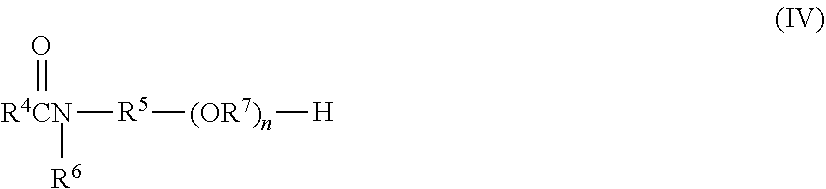
- wherein R4 is an alkyl or alkoxy, R5 and R7 are alkyls and n is a positive integer. R4 is typically an alkyl containing 6 to 22 carbon atoms. R5 is typically an alkyl containing 1-8 carbon atoms. R7 is typically an alkyl containing 1 to 4 carbon atoms, and more typically an ethyl group. The degree of polyalkoxylation (the molar ratio of the oxyalkyl groups per mole of alkanolamide) typically ranges from about 1 to about 100, or from about 3 to about 8, or about 5 to about 6. R6 can be hydrogen, an alkyl, an alkoxy group or a polyalkoxylated alkyl. The polyalkoxylated alkanolamide is typically a polyalkoxylated mono- or di-alkanolamide, such as a C16 and/or C18 ethoxylated monoalkanolamide, or an ethoxylated monoalkanolamide prepared from palm kernel oil or coconut oil. The use of coconut oil, palm oil, and similar naturally occurring oils as precursors may be favored by consumers.
- Other suitable nonionic surfactants include those containing an organic hydrophobic group and a hydrophilic group that is a reaction product of a solubilizing group (such as a carboxylate, hydroxyl, amido or amino group) with an alkylating agent, such as ethylene oxide, propylene oxide, or a polyhydration product thereof (such as polyethylene glycol). Such nonionic surfactants include, for example, polyoxyalkylene alkyl ethers, polyoxyalkylene alkylphenyl ethers, polyoxyalkylene sorbitan fatty acid esters, polyoxyalkylene sorbitol fatty acid esters, polyalkylene glycol fatty acid esters, alkyl polyalkylene glycol fatty acid esters, polyoxyethylene polyoxypropylene alkyl ethers, polyoxyalkylene castor oils, polyoxyalkylene alkylamines, glycerol fatty acid esters, alkylglucosamides, alkylglucosides, and alkylamine oxides. Other suitable surfactants include those disclosed in U.S. Pat. Nos. 5,945,394 and 6,046,149, the disclosures of which are incorporated herein by reference. In another embodiment, the composition is substantially free of nonylphenol nonionic surfactants. In this context, the term “substantially free” means less than about one weight percent.
- Yet another nonionic surfactant useful herein comprises amine oxide surfactants. Amine oxides are often referred to in the art as “semi-polar” nonionics, and have the following formula (V):
-
R′10(EO)x(PO)y(BO)zN(O)(CH2R11)2.qH2O (V) - wherein R10 is a hydrocarbyl moiety which can be saturated or unsaturated, linear or branched, and can typically contain from 8 to 24, from 10 to 16 carbon atoms, or a C12-C16 primary alkyl. R11 is a short-chain moiety such as a hydrogen, methyl and —CH2OH. When x+y+z is greater than 0, EO is ethyleneoxy, PO is propyleneoxy and BO is butyleneoxy. In this formula, q is the number of water molecules in the surfactant. In one embodiment, the nonionic surfactant is C2-14 alkyldimethyl amine oxide.
- In one embodiment, the detergent composition includes about 15 wt. % to about 40 wt. % of one or more nonionic surfactants, preferably about 18 wt. % to about 30 wt. %, more preferably about 20 wt. % to about 25 wt. %.
- Zwitterionic and/or Amphoteric Surfactants:
- Suitable zwitterionic and/or amphoteric surfactants include but not limited to derivatives of secondary and tertiary amines, derivatives of heterocyclic secondary and tertiary amines, or derivatives of quaternary ammonium, quaternary phosphonium or tertiary sulfonium compounds, such as those disclosed in U.S. Pat. No. 3,929,678, which is incorporated by reference herein.
- Suitable zwitterionic and/or amphoteric surfactants for uses herein include amido propyl betaines and derivatives of aliphatic or heterocyclic secondary and ternary amines in which the aliphatic moiety can be straight chain or branched and wherein one of the aliphatic substituents contains from 8 to 24 carbon atoms and at least one aliphatic substituent contains an anionic water-solubilizing group. When present, zwitterionic and/or amphoteric surfactants typically constitute from 0.01 wt. % to 20 wt. %, preferably, from 0.5 wt. % to 10 wt. %, and most preferably 2 wt. % to 5 wt. % of the formulation by weight.
- Cationic Surfactants:
- Suitable cationic surfactants include but not limited to quaternary ammonium surfactants. Suitable quaternary ammonium surfactants include mono C6-C16, or C6-C10 N-alkyl or alkenyl ammonium surfactants, wherein the remaining N positions are substituted by, e.g., methyl, hydroxyethyl or hydroxypropyl groups. Another cationic surfactant is C6-C18 alkyl or alkenyl ester of a quaternary ammonium alcohol, such as quaternary chlorine esters. In another embodiment, the cationic surfactants have the following formula (VI):
-
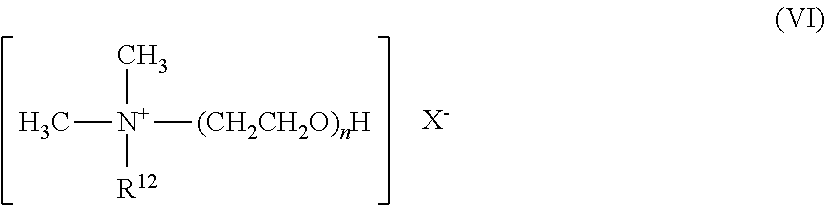
- wherein R12 is C8-C18 hydrocarbyl and mixtures thereof, or C8-14 alkyl, or C8, C10, or C12 alkyl, X is an anion such as chloride or bromide, and n is a positive integer.
- In one embodiment, the surfactant of the liquid composition of the invention comprises an anionic surfactant, a nonionic surfactant, or mixtures thereof. In another embodiment, the anionic surfactant is alkyl benzene sulfonic acid, methyl ester sulfate, sodium lauryl ether sulfate, or mixtures thereof. In another embodiment, the nonionic surfactant is alcohol ethoxylate, methyl ester ethoxylate, or mixtures thereof.
- The surfactants may be a mixture of at least one anionic and at least one nonionic surfactant. In another embodiment, the anionic surfactant is sodium lauryl ether sulfate. In another embodiment, the surfactant is a mixture of at least two anionic surfactants. In one embodiment, the surfactant comprises a mixture of an alkyl benzene sulfonate and an alkyl-ether sulfate. In another embodiment, and the alkyl-ether sulfate is sodium lauryl ether sulphate (SLES).
- In certain embodiments, the surfactant comprises about 15 wt. % to about 30 wt. % of an anionic surfactant selected from the group consisting of alkyl benzene sulfonate, methyl ester sulfonate, sodium lauryl ether sulphate, and mixtures thereof, and about 15 wt. % to about 30 wt. % of an nonionic surfactant selected from the group consisting of alcohol ethoxylate, methyl ester ethoxylate, and mixtures thereof. Surfactants may collectively total more than 30 wt. % of the formulation. Surfactants are often the base of detergent compositions, however, other components, such as solvents and humectants may be used to make a liquid formulation rather than a solid formulation.
- In an embodiment, the unit dose detergent composition includes an alkyl-ether sulfate, a linear alkylbenze sulfonate, and a fatty alcohol ethoxylate. These three materials may collectively make up no less than 30% of the formulation.
- In an embodiment, an alkyl-ether sulfate makes up 5 wt. % to about 30 wt. %, preferably about 8 wt. % to about 20 wt. %, and more preferably about 10 wt. % to about 15 wt. % of the detergent composition. A fatty alcohol ethoxylate may makes up about 15 wt. % to about 40 wt., preferably about 18 wt. % to about 30 wt. %, and more preferably about 20 wt. % to about 25 wt. % of the detergent composition. A linear alkyl benzene sulfonate may make up about 1 wt. % to about 12 wt. %, preferably about 2 wt. % to about 8 wt. %, and most preferably, about 4 wt. % to about 6 wt. % of the detergent composition. In some preferred embodiments, the alkyl-ether sulfate, the linear alkyl benzene sulfonate, and the fatty alcohol ethoxylate may be present in a ratio of (2 to 5):1:(3 to 10); preferably in a ratio of (2.5 to 3.5):1:(4 to 6); and most preferably in a ratio of approximately 3:1:5.
- Humectants:
- A humectant, for purposes of the present invention, is a substance that exhibits high affinity for water, especially attracting water for moisturization and solubilization purposes. The water is absorbed into the humectant; not merely adsorbed at a surface layer. The water absorbed by the humectant is available to the system; the water is not too tightly bound to the humectant. For example, in a skin lotion, the humectant attracts moisture from the surrounding atmosphere while reducing transepidermal water loss, and makes the water available to the skin barrier. Similarly, the humectant in a single dose liquid formula will not trap all the water needed for solubilization of other formula components—it will help to maintain the water balance between the formula, the film, and the atmosphere. Humectants possess hydrophilic groups which form hydrogen bonds with water. Common hydrophilic groups include hydroxyl, carboxyl, ester, and amine functionalities. A humectant can thus act as a solubilizer and moisture regulator in a unit dose formulation. Useful humectants include but not limited to polyols.
- The polyol (or polyhydric alcohol) may be a linear or branched alcohol with two or more hydroxyl groups. Thus diols with two hydroxyl groups attached to separate carbon atoms in an aliphatic chain may also be used. The polyol typically includes less than 9 carbon atoms, such as 9, 8, 7, 6, 5, 4, 3, or 2 carbon atoms. Preferably, the polyol includes 3 to 8 carbon atoms. More preferably, the polyol includes 3 to 6 carbon atoms. The molecular weight is typically less than 500 g/mol, such as less than 400 g/mol or less than 300 g/mol.
- Embodiments of suitable polyols include, but not limited to: propylene glycol, butylene glycol, pentylene glycol, hexylene glycol, heptylene glycol, octylene glycol, 2-methyl-1,3-propanediol, xylitol, sorbitol, mannitol, diethylene glycol, triethylene glycol, glycerol, erythritol, dulcitol, inositol, and adonitol.
- The unit dose detergent compositions of the present invention may contain about 5 wt. % to about 75 wt. % of one or more humectants, preferably about 7 wt. % to about 50 w.t %, more preferably about 10 wt. % to about 40 wt. %. In one preferred embodiment, the liquid composition comprises 20 to 30 wt. % of one or more C2 to C5 polyols. Preferably, the C2 to C5 polyols comprise a mixture of glycerine and propylene glycol, where the ratio of glycerine to propylene glycol is from 2:1 to 1:2. The liquid composition may be substantially free of monoalcohols, for example, the composition may comprise less than 1 wt. % of monoalcohols.
- The unit dose detergent compositions of the present invention may optionally comprise other ingredients that can typically be present in detergent products and/or personal care products to provide further benefits in terms of cleaning power, solubilization, appearance, fragrance, etc. Different groups of such materials are described below.
- Water:
- Water functions as a solvent and viscosity modifier. Water may be present as no more than 30 wt. % of the unit dose detergent composition. Water may comprise no more than 25 wt. % of the unit dose detergent composition. Water may comprise no more than 20 wt. % of the unit dose detergent composition.
- Builders:
- Other suitable components include organic or inorganic detergency builders. Examples of water-soluble inorganic builders that can be used, either alone or in combination with themselves or with organic alkaline sequestrant builder salts, are glycine, alkyl and alkenyl succinates, alkali metal carbonates, alkali metal bicarbonates, phosphates, polyphosphates and silicates. Specific examples of such salts are sodium tripolyphosphate, sodium carbonate, potassium carbonate, sodium bicarbonate, potassium bicarbonate, sodium pyrophosphate and potassium pyrophosphate. Examples of organic builder salts that can be used alone, or in combination with each other, or with the preceding inorganic alkaline builder salts, are alkali metal polycarboxylates, water-soluble citrates such as sodium and potassium citrate, sodium and potassium tartrate, sodium and potassium ethylenediaminetetraacetate (EDTA), sodium and potassium N(2-hydroxyethyl)-nitrilo triacetates, sodium and potassium N-(2-hydroxyethyl)-nitrilo diacetates, sodium and potassium oxydisuccinates, and sodium and potassium tartrate mono- and di-succinates, such as those described in U.S. Pat. No. 4,663,071, the disclosure of which is incorporated herein by reference.
- Complexer/Chelator.
- Complexer and chelators help washing liquids support higher amounts of soils and/or metal ions. Complexer and/or chelators may functionally overlap with builders as discussed above. These are often poly carboxylic acids and/or salts thereof. Polyamines also may be used in this role. Suitable examples include iminodisuccinic acid, succinic acid, citric acid, ethylenediaminetetraacetic acid, etc. A complexer and/or chelator may make up about 0 to about 5 wt. % of the formulation, preferably about 0.1 to about 3 wt. % of the formulation, and most preferably about 0.5 to about 2 wt. % of the detergent composition.
- Enzymes.
- Suitable enzymes include those known in the art, such as amylolytic, proteolytic, cellulolytic or lipolytic type, and those listed in U.S. Pat. No. 5,958,864, the disclosure of which is incorporated herein by reference. One protease, sold under the trade name SAVINASE® by Novozymes A/S, is a subtillase from Bacillus lentus. Other suitable enzymes include proteases, amylases, lipases and cellulases, such as ALCALASE® (bacterial protease), EVERLASE® (protein-engineered variant of SAVINASE®), ESPERASE® (bacterial protease), LIPOLASE® (fungal lipase), LIPOLASE ULTRA (Protein-engineered variant of LIPOLASE), LIPOPRIME® (protein-engineered variant of LIPOLASE), TERMAMYL® (bacterial amylase), BAN (Bacterial Amylase Novo), CELLUZYME® (fungal enzyme), and CAREZYME® (monocomponent cellulase). Additional enzymes of these classes suitable for use in accordance with the present invention will be well-known to those of ordinary skill in the art, and are available from a variety of commercial suppliers. Enzymes may be provided with other components, including stabilizers. In an embodiment, the enzyme material may be approximately 10% by weight of active enzymes. The detergent composition may include about 0.01 to about 1.3 wt. %, preferably, 0.05 to 0.50 wt. %, and most preferably, about 0.08 to about 0.3 wt. % of active enzymes.
- Foam Stabilizers.
- Foam stabilizing agents include, but not limited to, a polyalkoxylated alkanolamide, amide, amine oxide, betaine, sultaine, C8-C18 fatty alcohols, and those disclosed in U.S. Pat. No. 5,616,781, the disclosure of which is incorporated by reference herein. Foam stabilizing agents are used, for example, in amounts of about 1 wt. % to about 20 wt. %, and typically about 3. wt. % to about 5 wt. %. The composition can further include an auxiliary foam stabilizing surfactant, such as a fatty acid amide surfactant. Suitable fatty acid amides are C8-C20 alkanol amides, monoethanolamides, diethanolamides, and isopropanolamides.
- Colorants.
- In some embodiments, the liquid composition does not contain a colorant. In some embodiments, the liquid composition contains one or more colorants. The colorant(s) can be, for example, polymers. The colorant(s) can be, for example, dyes. The colorant(s) can be, for example, water-soluble polymeric colorants. The colorant(s) can be, for example, water-soluble dyes. The colorant(s) can be, for example, colorants that are well-known in the art or commercially available from dye or chemical manufacturers.
- The color of the colorant(s) is not limited, and can be, for example, red, orange, yellow, blue, indigo, violet, or any combination thereof. The colorant(s) can be, for example, one or more Milliken LIQUITINT colorants. The colorant(s) can be, for example Milliken LIQUITINT: VIOLET LS, ROYAL MC, BLUE HP, BLUE MC, AQUAMARINE, GREEN HMC, BRIGHT YELLOW, YELLOW LP, YELLOW BL, BRILLIANT ORANGE, CRIMSON, RED MX, PINK AL, RED BL, RED ST, or any combination thereof.
- The colorant(s) can be, for example, one or more of
Acid Blue 80, Acid Red 52, and Acid Violet 48. When the colorant(s) are selected from the group consisting ofAcid Blue 80, Acid Red 52, and Acid Violet 48, the liquid composition, optionally, does not contain a colorant stabilizer. Surprisingly, it has been found thatAcid Blue 80, Acid Red 52, and Acid Violet 48, do not display significant discoloration over time, and thus, can be used without (e.g., in the absence of) a colorant stabilizer. - The colorant may provide a secondary indicator of source for a user. The colorant may provide aesthetic or informational value. For example, the color of the detergent composition may be used to indicate a preferred water temperature (e.g., red for hot, blue for cold).
- The total amount of the one or more colorant(s) that can be contained in the liquid composition, for example, can range from about 0.00001 wt. % to about 0.099 wt. %. The total amount of colorant(s) in the liquid composition can be, for example, about 0.0001 wt. %, about 0.001 wt. %, about 0.01 wt. %, about 0.05 wt. %, or about 0.08 wt. %.
- Colorant Stabilizer(s).
- In some embodiments, the liquid composition can optionally contain a colorant stabilizer. In some embodiments, the colorant stabilizer can be citric acid. The total amount of the optionally present colorant stabilizer(s) in the liquid composition can range, for example, from about 0.01 wt. % to about 5.0 wt. %. The total amount of the colorant stabilizer(s) in the liquid composition can be, for example, about 0.1 wt. %, about 1 wt. %, about 2 wt. %, about 3 wt. %, or about 4 wt. %.
- Optical Brightener/Whitening Agents.
- Optical brighteners and/or whitening agents help washed material appear white, especially under florescent light. The particular whitening agent is not believed to be impactful to the shelf stability of the formulations. Whitening agents may be complex, polycyclic molecules. Examples of whitening agents include: 4,4′-diamino-2,2′-stilbenedisulfonic acid and 2,5-bis(benzoxazol-2-yl)thiophene. The substitution of similar whitening agents and/or reasonable modifications of their concentration in the formulation should produce similar results. An optical brightener and/or whitening agent may make up about 0 to about 5 wt. % of the formulation, preferably about 0.1 to about 3 wt. % of the formulation, and most preferably about 0.5 to about 2 wt. % of the detergent composition.
- Bittering Agent.
- Bittering agents may optionally be added to hinder accidental ingestion of the composition. Bittering agents are compositions that taste bad, so children and/or others are discouraged from accidental ingestion. Exemplary bittering agents include denatonium benzoate, aloin, and others. Denatonium is available under a variety of trade names including: BITTERANT-b, BITTER+PLUS, Bitrex, and/or Aversion. Bittering agents may be present in the composition at an amount of from about 0 to about 1 wt. %, preferably from about 0 to about 0.5 wt. %, and most preferably from about 0 to about 0.1 wt. %, based on the total weight of the detergent composition.
- Perfumes.
- The liquid compositions of the invention may optionally include one or more perfumes or fragrances. As used herein, the term “perfume” is used in its ordinary sense to refer to and include any fragrant substance or mixture of substances including natural (obtained by extraction of flowers, herbs, leaves, roots, barks, wood, blossoms or plants), artificial (mixture of natural oils or oil constituents) and synthetically produced odoriferous substances. Typically, perfumes are complex mixtures of blends of various organic compounds such as alcohols, aldehydes, ethers, aromatic compounds and varying amounts of essential oils (e.g., terpenes) such as from 0 wt. % to 80 wt. %, usually from 1 wt. % to 70 wt. %, the essential oils themselves being volatile odoriferous compounds and also serving to dissolve the other components of the perfume. Suitable perfume ingredients include those disclosed in “Perfume and Flavour Chemicals (Aroma Chemicals)”, published by Steffen Arctander (1969), which is incorporated herein by reference. Perfumes can be present from about 0.1 wt. % to about 10 wt. %, and preferably from about 0.5 wt. % to about 5 wt. % of the detergent composition.
- Other Optional Ingredients.
- The liquid compositions may also contain one or more optional ingredients conventionally included in detergent compositions such as a pH buffering agent, a perfume carrier, a fluorescer, a hydrotrope, an antifoaming agent, an antiredeposition agent, a polyelectrolyte, an optical brightening agent, a pearlescer, an anti-shrinking agent, an anti-wrinkle agent, an anti-spotting agent, an anti-corrosion agent, a drape imparting agent, an anti-static agent, an ironing aids crystal growth inhibitor, an anti-oxidant, an anti-reducing agent, a chelating agent, a dispersing agent, a defoamer, a color component, a fragrance component, a bleaching catalyst, a bleaching agent, a bleach activator, a whitening agent, a brightening agent, an anticorrosion agent, a deodorizing agent, a color/texture rejuvenating agent, a soil releasing polymer, a preservative, a bittering agent, and a mixture thereof. Examples and sources of suitable such components are well-known in the art and/or are described herein. For example, a preferred bittering agent is denatonium benzoate, sold under the tradename Bitrex® (Johnson Matthey).
- Water-Soluble Pouch.
- The unit dose detergent compositions of the present invention may be enclosed a water-soluble container, also known as a pouch. The water soluble pouch is made from a water-soluble material which dissolves, ruptures, disperses, or disintegrates upon contact with water, releasing thereby the liquid composition. In one embodiment, the water soluble pouch is made from a lower molecular weight water-soluble polyvinyl alcohol film-forming resin.
- The water soluble pouch may be formed from a water soluble polymer selected from the group consisting of polyvinyl alcohol (PVA), polyvinyl pyrrolidone, polyalkylene oxide, polyacrylamide, poly acrylic acid, cellulose, cellulose ether, cellulose ester, cellulose amide, polyvinyl acetate, polycarboxylic acid and salt, polyaminoacid, polyamide, polyanhydride copolymer of maleic/acrylic acid, polysaccharide, natural gums, polyacrylate, water-soluble acrylate copolymer, methylcellulose, carboxymethylcellulose sodium, dextrin, ethylcellulose, hydroxyethyl cellulose, maltodextrin, polymethacrylate, polyvinyl alcohol copolymer, hydroxypropyl methyl cellulose (HPMC), and mixtures thereof.
- Unit dose pouches and methods of manufacture thereof that are suitable for use with the compositions of the present invention include those described, for example, in U.S. Pat. Nos. 3,218,776; 4,776,455; 4,973,416; 6,479,448; 6,727,215; 6,878,679; 7,259,134; 7,282,472; 7,304,025; 7,329,441; 7,439,215; 7,464,519; 7,595,290; 8,551,929; the disclosures of all of which are incorporated herein by reference in their entireties. In some embodiments, the pouch is a water-soluble, single-chamber pouch, prepared from a water-soluble film. According to one such aspect of the invention, the single-chamber pouch is a formed, sealed pouch produced from a water-soluble polymer or film such as polyvinylalcohol (PVA) or a PVA film.
- Preferred water soluble polymers for forming the pouch are polyvinyl alcohol (PVA) resins sold under tradename MONOSOL® (MonoSol LLC, Indiana). The preferred grade is MONOSOL® film having a weight average molecular weight range of about 55,000 to 65,000 and a number average molecular weight range of about 27,000 to 33,000. Preferably, the film material will have a thickness of approximately 3 mil or 75 micrometers. Alternatively, commercial grade PVA films are suitable for use in the present invention, such as those that are commercially available from Monosol (Merrillville, Ind.) (e.g., Monosol film M8310) or from Aicello (Aiichi, Japan; North American subsidiary in North Vancouver, BC, Canada) (e.g., Aicello GA or Aicello GS).
- In various embodiments, the film is desirably strong, flexible, shock resistant, and non-tacky during storage at both high and low temperatures and high and low humidities. In one embodiment, the film is initially formed from polyvinyl acetate, and at least a portion of the acetate functional groups are hydrolyzed to produce alcohol groups. The film may include polyvinyl alcohol (PVOH), and may include a higher concentration of PVOH than polyvinyl acetate. Such films are commercially available with various levels of hydrolysis, and thus various concentrations of PVOH, and in an exemplary embodiment the film initially has about 85 percent of the acetate groups hydrolyzed to alcohol groups. Some of the acetate groups may further hydrolyze in use, so the final concentration of alcohol groups may be higher than the concentration at the time of packaging. The film may have a thickness of from about 25 to about 200 micrometers (μm), or from about 45 to about 100 μm, or from about 75 to about 90 μm in various embodiments.
- In some embodiments, the water soluble pouch further comprises a cross-linking agent. In some embodiments, the cross-linking agent is selected from the group consisting of formaldehyde, polyesters, epoxides, isocyanates, vinyl esters, urethanes, polyimides, acrylics with hydroxyl, carboxylic, isocyanate or activated ester groups, bis(methacryloxypropyl)tetramethylsiloxane (styrenes, methylmethacrylates), n-diazopyruvates, phenylboronic acids, cis-platin, divinylbenzene (styrenes, double bonds), polyamides, dialdehydes, triallyl cyanurates, N-(2-ethanesulfonylethyl) pyridinium halides, tetraalkyltitanates, titanates, borates, zirconates, or mixtures thereof. In one embodiment, the cross-linking agent is boric acid or a boric acid salt such as sodium borate.
- In additional embodiments, the water-soluble pouch or film from which it is made can contain one or more additional components, agents or features, such as one or more perfumes or fragrances, one or more enzymes, one or more surfactants, one or more rinse agents, one or more dyes, one or more functional or aesthetic particles, and the like. Such components, agents or features can be incorporate into or on the film when it is manufactured, or are conveniently introduced onto the film during the process of manufacturing the liquid composition of the present invention, using methods that are known in the film-producing arts.
- The water-soluble container (e.g., pouch) used in association with the present invention may be in any desirable shape and size and may be prepared in any suitable way, such as via molding, casting, extruding or blowing, and is then filled using an automated filling process. Examples of processes for producing and filling water-soluble pouches, suitable for use in accordance with the present invention, are described in U.S. Pat. Nos. 3,218,776; 3,453,779; 4,776,455; 5,699,653; 5,722,217; 6,037,319; 6,727,215; 6,878,679; 7,259,134; 7,282,472; 7,304,025; 7,329,441; 7,439,215; 7,464,519; and 7,595,290; the disclosures of all of which are incorporated herein by reference in their entireties. In preferred embodiments, the pouches are filled with the liquid composition of the present invention using the cavity filling approach described in U.S. Pat. Nos. 3,218,776 and 4,776,455. The machinery necessary for carrying out this process is commercially available, e.g., from Cloud Packaging Solutions (Des Plaines, Ill.; a division of Hearthside Food Solutions LLC).
- Example Formulations:
- Seven formulae with variable amounts (0 to 12.5 wt. %) of an ionic liquid rheology control (rheology modifying agent) agent are documented below. The viscosities of mixtures of 1 part detergent composition to 0.5 parts additional water were measured according to the method described below. The viscosity measurements are charted in
FIG. 1 . -
TABLE 1 Formula 1Formula 2Formula 3 Formula 4Formula 5Formula 6Formula 7 Component wt. % wt. % wt. % wt. % wt. % wt. % wt. % Ionic Liquid Efka IO 6273 0 1 2.5 5 7.5 10 12.5 Glycerine 14.87 13.87 12.37 9.87 7.37 4.87 2.37 Propylene Glycol 8.21 8.21 8.21 8.21 8.21 8.21 8.21 AES (60% active) 26 26 26 26 26 26 26 C12-C15 Alcohol 23.07 23.07 23.07 23.07 23.07 23.07 23.07 Ethoxylate 7EO Coconut Oil Fatty Acid 10 10 10 10 10 10 10 Water 5.7 5.7 5.7 5.7 5.7 5.7 5.7 2-Phenyl Sulfonic Acid 5.0 5.0 5.0 5.0 5 5 5 (LAS) Alkanolamine 3.15 3.15 3.15 3.15 3.15 3.15 3.15 Enzymes (10 % active) 1.85 1.85 1.85 1.85 1.85 1.85 1.85 Fragrance 1.0 1.0 1.0 1.0 1.0 1.0 1.0 Builder (33% active) 0.9 0.9 0.9 0.9 0.9 0.9 0.9 Optical Brightener 0.2 0.2 0.2 0.2 0.2 0.2 0.2 Bittering Agent 0.05 0.05 0.05 0.05 0.05 0.05 0.05 - Test Method:
- Unit dose detergent composition formulation is added to additional water (not originally in the formulation) at 2:1 ratio. Viscosity increases have been observed. Unit dose detergent composition formulation is added to additional water (not originally in the formulation) at 2:1 ratio. Viscosity increases have been observed. The viscosities of the mixtures and undiluted formulas were measured with a AR2000-EX Rheometer, the shear rate increased from 0.41 to 10 1/s over 5 minutes at 20° C. with a geometry cone of 40 mm, 1:59:49 (degree:min:sec), and a truncation gap of 52 microns. The data from the viscosity testing is available in the table below. The viscosity is in Pascal*seconds on the vertical axis, where 1 Pa*s is equivalent to 1000 cps, and the horizontal axis shows increasing shear rates in revolutions per second.
-
FIG. 1 shows viscosity measurements offormulae 1 to 7 according the method described above. The formulations contained a variable amount of glycerine to compensate for the variation in ionic liquid rheology control agent. Providing over 5 wt. % of the ionic liquid in the formula appears to measurably reduce viscosity during dilution of the formulation, with response becoming significant somewhere between 5 and 7.5 wt. % and reaching completeness somewhere between 7.5 and 10 wt. %. While adding additional ionic liquid beyond 10 wt. % may provide other benefits, the additional impact on the viscosity of the formula during hydration may be limited. - The response to the ionic liquid appears to be non-linear and small doses (e.g., 2.5 wt. %) may not produce a practical improvement. Once a threshold amount of the ionic liquid is reached (between 5 and 7.5 wt. %), small additional increases in ionic liquid reduce the viscosity during dilution. At a concentration between 7.5 wt. % and 10 wt. % ionic liquid the viscosity curve becomes relatively flat with respect to shear rate, indicating more Newtonian behavior.
- The unit dose detergent compositions without any additional water generally produced viscosities of approximately 200 to 250 cps. With the addition of water, the viscosity of some of the formulas climbed drastically but eventually drops back down.
- In
FIG. 1 , the mixtures of 1 part detergent composition with 0.5 parts of additional water are shown. The viscosity of each ofFormulae 1 to 5 is greatest at low shear rates and decreases as the shear rate increases. This shear thinning behavior is non-Newtonian. In contrast, Formula 6 (10 wt. % IL) and Formula 7 (12.5 wt. % IL), upon 2:1 dilutions of detergent composition: additional water, perform more like Newtonian fluids. Formula 5 (7.5 wt. % IL) performs in between Newtonian and non-Newtonian fluids. - A Newtonian fluid is a fluid, where the ratio between shear stress changes linearly in proportion to the stress it is exposed to. This proportion is known as viscosity. As shown in the viscosity curves of Formulae 1-5, increasing the amount of the ionic liquid rheology controlling agent in the unit dose compositions not only shows a trend of changing the behavior of the fluids (from non-Newtonian to Newtonian) but also lowering the viscosity of the detergent composition, upon dilution with water. Both are advantageous for dissolution of the unit dose detergent production which is exposed to water during use.
- The following table contains the viscosity data measured by using the above described test method.
- The following table contains the data shown in
FIG. 1 . -
TABLE 2 Rheology of Mixtures of 1 part Formula to 0.5 parts Additional Water 0 % IL 1% IL 2.5 % IL 5% IL 7.5 % IL 10% IL 12.5% IL Shear Rate Formula 1 Formula 2Formula 3 Formula 4Formula 5Formula 6Formula 7 (1/s) Viscosity (Pa · S) 0.41 808 828 553.4 400 136.5 2.751 0.733 0.75 388.4 360.3 267.1 211.1 81.08 2.135 0.664 1.08 245.1 219.4 172.3 134.1 58.44 1.837 0.634 1.41 178.8 158.9 128.3 97.76 46.87 1.663 0.614 1.73 141.2 126.9 103.2 77.8 39.59 1.555 0.601 2.06 115.7 105.6 86.76 64.79 34.43 1.456 0.589 2.39 97.30 88.17 72.95 57.16 31.01 1.405 0.575 2.72 86.07 75.89 65.67 50.22 28.2 1.361 0.567 3.06 71.28 67.23 57.71 43.38 25.63 1.342 0.568 3.39 62.99 60.68 51.91 37.62 23.86 1.331 0.571 3.71 54.93 52.82 46.13 33.28 22.21 1.343 0.573 4.05 52.65 49.32 42.46 31.00 20.70 1.338 0.567 4.37 50.07 45.04 40.23 30.13 19.42 1.326 0.560 4.71 46.19 40.54 36.83 28.99 18.20 1.316 0.560 5.03 39.97 37.66 34.46 28.15 16.86 1.317 0.566 5.37 38.16 37.94 33.02 25.6 15.63 1.312 0.559 5.70 36.65 34.03 29.98 24.27 14.47 1.294 0.553 6.03 37.34 32.81 28.82 22.11 13.72 1.284 0.561 6.36 33.41 29.75 28.46 21.62 13.54 1.277 0.555 6.68 31.94 27.66 26.97 20.91 13.31 1.262 0.551 7.02 29.98 27.53 24.67 20.63 12.85 1.258 0.557 7.35 29.19 26.94 23.88 20.06 12.26 1.243 0.551 7.68 27.54 26.63 23.43 18.92 12.17 1.228 0.552 8.01 25.74 24.57 21.98 17.94 11.73 1.224 0.550 8.34 24.97 24.16 21.9 17.32 11.23 1.201 0.549 8.67 23.39 22.44 21.18 17.29 10.79 1.203 0.552 8.99 24.75 21.04 20.75 16.23 10.58 1.18 0.547 9.32 24.62 21.48 20.70 16.42 10.23 1.176 0.550 9.66 23.24 21.22 20.36 16.26 9.875 1.162 0.546 9.99 23.06 20.91 19.13 16.22 9.709 1.167 0.546 - Without wishing to be bound by theory, it is believed that it is the alkyl-ether sulfates (AES) such as sodium lauryl ether sulfate (SLES) in a unit dose composition that mainly contributes to the initial increase of viscosity during dilution. As shown in the below study,
Formula 8 consists of a mixture of SLES and water in a 7 to 3 ratio by weight. The data for the rheology curve for this mixture is in Table 3, below. - The following table contains the data shown in
FIG. 2 . This is a 7 parts SLES: 3 parts water mixture. This figure has the same vertical axis asFIG. 1 to allow for ready comparison. -
TABLE 3 Mixture of 7 parts AES (SLES) to 3 parts water Shear Formula 8 Rate Viscosity (1/s) (Pa · S) 0.41 95.51 0.75 49.48 1.08 32.98 1.41 24.73 1.73 19.84 2.06 16.66 2.39 14.55 2.72 12.92 3.06 11.77 3.39 10.64 3.71 9.708 4.05 9.031 4.37 8.616 4.71 8.195 5.03 7.684 5.37 7.263 5.70 6.970 6.03 6.687 6.36 6.276 6.68 6.086 7.02 5.888 7.35 5.652 7.68 5.586 8.01 5.383 8.34 5.295 8.67 5.093 8.99 4.923 9.32 4.756 9.66 4.613 9.99 4.483 - The viscosity data of Table 3 has been graphed as
FIG. 2 .FIG. 2 shows the high viscosities and non-Newtonian sheer thinning. Accordingly, this data supports the idea that the SLES contributes to and/or is responsible for the viscosity increase observed during initial dilution in the absence of a rheology modifier. - Accordingly, the present application provides a method for providing a unit dose detergent composition that maintains a consistent, low viscosity profile for enhanced hydration and dissolution. The method includes the steps of: providing the detergent composition including: an ionic liquid as a rheology modifying agent; alkyl-ether sulfates, wherein the alkyl-ether sulfates comprise from about 12 to about 50 wt. %, by weight of the detergent composition; and water, wherein a mixture of 2 parts of the detergent composition to 1 part water has a rheology below 3,000 centipoise as measured using an AR2000-EX Rheometer at 20° C. with a geometry cone of 40 mm, 1:59:49 (degree:min:sec), and a truncation gap of 52 microns.
- Preferably, the alkyl-ether sulfate (AES) contains a sodium cation. Preferably, the alkyl-ether sulfate comprises a C12 alkyl chain. Most preferably, the alkyl-ether sulfate is sodium laureth ether sulfate (SLES). In some embodiments, the detergent composition does not include LAS.
- The ionic liquid (IL) may be present in an amount from about 5 to about 20 wt %, preferably, from about 6 to about 15 wt. %, by weight of the detergent composition, and more preferably, from about 8 to about 12 wt. %, by weight of the detergent composition.
- The present application also provides a unit dose detergent product, including: unit dose package comprising a water soluble film, the unit dose packaging enclosing the detergent composition, wherein the detergent composition comprises: an ionic liquid (IL): alkyl-ether sulfates, wherein the alkyl-ether sulfates comprise from about 12 to about 50 wt. %, by weight of the detergent composition; and water, wherein a mixture of 2 parts of the detergent composition to 1 part water has a rheology below 3,000 centipoise as measured using an AR2000-EX Rheometer at 20° C. with a geometry cone of 40 mm, 1:59:49 (degree:min:sec), and a truncation gap of 52 microns.
- In some embodiments, the unit dose detergent product does not include LAS. The unit dose detergent product may further include: a C2 to C5 polyol, a C2 to C5 alkanolamine, an active enzyme, a whitening agent, a bittering agent, a linear alkylbenzene sulfonate, and a fatty alcohol ethoxylate, wherein the alkyl-ether sulfate, linear alkylbenzene sulfonate, and fatty alcohol ethoxylate are collectively present in an amount of 30 to 70 wt. %, by weight of the detergent composition.
- It will be appreciated that, within the principles described by this specification, a vast number of variations exist. It should also be appreciated that the embodiments described are only embodiments, and are not intended to limit the scope, applicability, or construction of the claims in any way.
Claims (20)
Priority Applications (2)
| Application Number | Priority Date | Filing Date | Title |
|---|---|---|---|
| US16/231,232 US20200199496A1 (en) | 2018-12-21 | 2018-12-21 | Use of ionic liquids to control rheology of unit dose detergent compositions |
| EP19211758.8A EP3670638A1 (en) | 2018-12-21 | 2019-11-27 | Use of ionic liquids to control rheology of unit dose detergent compositions |
Applications Claiming Priority (1)
| Application Number | Priority Date | Filing Date | Title |
|---|---|---|---|
| US16/231,232 US20200199496A1 (en) | 2018-12-21 | 2018-12-21 | Use of ionic liquids to control rheology of unit dose detergent compositions |
Publications (1)
| Publication Number | Publication Date |
|---|---|
| US20200199496A1 true US20200199496A1 (en) | 2020-06-25 |
Family
ID=68699296
Family Applications (1)
| Application Number | Title | Priority Date | Filing Date |
|---|---|---|---|
| US16/231,232 Abandoned US20200199496A1 (en) | 2018-12-21 | 2018-12-21 | Use of ionic liquids to control rheology of unit dose detergent compositions |
Country Status (2)
| Country | Link |
|---|---|
| US (1) | US20200199496A1 (en) |
| EP (1) | EP3670638A1 (en) |
Cited By (2)
| Publication number | Priority date | Publication date | Assignee | Title |
|---|---|---|---|---|
| US20210277338A1 (en) * | 2020-03-09 | 2021-09-09 | Korex Canada Company | Concentrated high performance multipurpose cleaning compositions in unit dose packets or pouches |
| CN114774210A (en) * | 2021-05-26 | 2022-07-22 | 郭建华 | Low temperature stable unit dose detergent compositions |
Families Citing this family (1)
| Publication number | Priority date | Publication date | Assignee | Title |
|---|---|---|---|---|
| DE102022205390A1 (en) | 2022-05-30 | 2023-11-30 | Henkel Ag & Co. Kgaa | Detergent-active compounds |
Citations (2)
| Publication number | Priority date | Publication date | Assignee | Title |
|---|---|---|---|---|
| WO2017156141A1 (en) * | 2016-03-09 | 2017-09-14 | Basf Se | Encapsulated laundry cleaning composition |
| US20170283748A1 (en) * | 2014-09-10 | 2017-10-05 | Basf Se | Encapsulated cleaning composition |
Family Cites Families (27)
| Publication number | Priority date | Publication date | Assignee | Title |
|---|---|---|---|---|
| US3218776A (en) | 1961-09-11 | 1965-11-23 | Cloud Machine Corp | Packaging method and apparatus |
| US3453779A (en) | 1968-01-23 | 1969-07-08 | Westinghouse Electric Corp | Appliance swing-down door counterbalance arrangement |
| DE2437090A1 (en) | 1974-08-01 | 1976-02-19 | Hoechst Ag | CLEANING SUPPLIES |
| JPS58217598A (en) | 1982-06-10 | 1983-12-17 | 日本油脂株式会社 | Detergent composition |
| US4663071A (en) | 1986-01-30 | 1987-05-05 | The Procter & Gamble Company | Ether carboxylate detergent builders and process for their preparation |
| GB8605734D0 (en) | 1986-03-07 | 1986-04-16 | Unilever Plc | Dispensing treatment agents |
| US4973416A (en) | 1988-10-14 | 1990-11-27 | The Procter & Gamble Company | Liquid laundry detergent in water-soluble package |
| WO1995010585A1 (en) | 1993-10-12 | 1995-04-20 | Stepan Company | Liquid detergent compositions comprising salts of alpha sulfonated fatty acid methyl esters, and anionic surfactants |
| DE19533790A1 (en) | 1995-09-13 | 1997-03-20 | Henkel Kgaa | Process for the preparation of an amorphous alkali silicate with impregnation |
| US5945394A (en) | 1995-09-18 | 1999-08-31 | Stepan Company | Heavy duty liquid detergent compositions comprising salts of α-sulfonated fatty acid methyl esters and use of α-sulphonated fatty acid salts to inhibit redeposition of soil on fabric |
| US5699653A (en) | 1995-11-06 | 1997-12-23 | Cloud Corporation | Pouch machine for making maximum volume pouch |
| US5722217A (en) | 1995-11-17 | 1998-03-03 | Cloud Corporation | Method and apparatus for continuosusly forming, filling and sealing packages while linked together |
| US6046149A (en) | 1996-04-17 | 2000-04-04 | Procter & Gamble Company | Detergent compositions |
| US6284230B1 (en) | 1996-12-30 | 2001-09-04 | The Procter & Gamble Company | Hair conditioning shampoo compositions comprising primary anionic surfactant |
| US6037319A (en) | 1997-04-01 | 2000-03-14 | Dickler Chemical Laboratories, Inc. | Water-soluble packets containing liquid cleaning concentrates |
| US6878679B2 (en) | 2000-04-28 | 2005-04-12 | The Procter & Gamble Company | Pouched compositions |
| US7595290B2 (en) | 2000-04-28 | 2009-09-29 | The Procter & Gamble Company | Water-soluble stretchable pouches containing compositions |
| ES2217162T3 (en) | 2000-05-15 | 2004-11-01 | Unilever N.V. | DETERGENT LIQUID COMPOSITION. |
| GB2365018A (en) | 2000-07-24 | 2002-02-13 | Procter & Gamble | Water soluble pouches |
| US7125828B2 (en) | 2000-11-27 | 2006-10-24 | The Procter & Gamble Company | Detergent products, methods and manufacture |
| US7013623B2 (en) | 2001-10-08 | 2006-03-21 | The Procter & Gamble Company | Process for production of pouches |
| EP1444318B1 (en) | 2001-11-14 | 2009-07-01 | The Procter & Gamble Company | Automatic dishwashing composition in unit dose form comprising an anti-scaling polymer |
| ES2260191T3 (en) | 2001-11-23 | 2006-11-01 | THE PROCTER & GAMBLE COMPANY | WATER SOLUBLE BAG. |
| CA2527316C (en) | 2003-06-03 | 2011-08-16 | The Procter & Gamble Company | Detergent pouch |
| DE602004031090D1 (en) | 2004-06-08 | 2011-03-03 | Procter & Gamble | detergent pack |
| US20060094621A1 (en) * | 2004-11-01 | 2006-05-04 | Jordan Glenn T Iv | Process for improving processability of a concentrate and compositions made by the same |
| CA2808843C (en) | 2010-08-23 | 2018-05-01 | The Sun Products Corporation | Unit dose detergent compositions and methods of production and use thereof |
-
2018
- 2018-12-21 US US16/231,232 patent/US20200199496A1/en not_active Abandoned
-
2019
- 2019-11-27 EP EP19211758.8A patent/EP3670638A1/en not_active Withdrawn
Patent Citations (2)
| Publication number | Priority date | Publication date | Assignee | Title |
|---|---|---|---|---|
| US20170283748A1 (en) * | 2014-09-10 | 2017-10-05 | Basf Se | Encapsulated cleaning composition |
| WO2017156141A1 (en) * | 2016-03-09 | 2017-09-14 | Basf Se | Encapsulated laundry cleaning composition |
Cited By (3)
| Publication number | Priority date | Publication date | Assignee | Title |
|---|---|---|---|---|
| US20210277338A1 (en) * | 2020-03-09 | 2021-09-09 | Korex Canada Company | Concentrated high performance multipurpose cleaning compositions in unit dose packets or pouches |
| US12415974B2 (en) * | 2020-03-09 | 2025-09-16 | Korex Canada Company | Unit-dose concentrated high performance multipurpose cleaning compositions comprising an antimicrobial/disinfectant mixture |
| CN114774210A (en) * | 2021-05-26 | 2022-07-22 | 郭建华 | Low temperature stable unit dose detergent compositions |
Also Published As
| Publication number | Publication date |
|---|---|
| EP3670638A1 (en) | 2020-06-24 |
Similar Documents
| Publication | Publication Date | Title |
|---|---|---|
| US10745654B2 (en) | Unit dose detergent compositions | |
| US11118141B2 (en) | Use of alkoxylated polyamines to control rheology of unit dose detergent compositions | |
| US11046915B2 (en) | Use of polyglycols to control rheology of unit dose detergent compositions | |
| EP3574079B1 (en) | Stable unit dose compositions with high water content and structured surfactants | |
| US12084633B2 (en) | Unit dose laundry detergent compositions containing soil release polymers | |
| US11427794B2 (en) | Low density unit dose detergents based on butyl cellosolve with encapsulated fragrance | |
| EP3670636A1 (en) | Unit dose detergent with zinc ricinoleate | |
| CN109477038A (en) | Encapsulated Laundry Cleaning Compositions | |
| US20140243253A1 (en) | Structured detergent or cleaning agent having a flow limit | |
| EP3898917A1 (en) | Use of ethyleneoxy and propyleneoxy copolymer to control rheology of unit dose detergent pack | |
| EP3670638A1 (en) | Use of ionic liquids to control rheology of unit dose detergent compositions | |
| US11795416B2 (en) | Synergistic effects of iminodisuccinic acid on an ethanol and PEG400 blend for rheology control | |
| ES3042585T3 (en) | Water-soluble unit dose article comprising an ethoxylated alcohol non-ionic surfactant | |
| US11427786B2 (en) | Detergent composition including a functional material encapsulated in polyvinyl alcohol particles | |
| US11629313B2 (en) | Use of tertiary amine to control rheology of unit dose detergent pack |
Legal Events
| Date | Code | Title | Description |
|---|---|---|---|
| AS | Assignment |
Owner name: HENKEL IP & HOLDING GMBH, GERMANY Free format text: ASSIGNMENT OF ASSIGNORS INTEREST;ASSIGNORS:PIORKOWSKI, DANIEL T.;STOTT, DAVID S.;SIGNING DATES FROM 20181219 TO 20181221;REEL/FRAME:047893/0947 |
|
| STPP | Information on status: patent application and granting procedure in general |
Free format text: NON FINAL ACTION MAILED |
|
| STPP | Information on status: patent application and granting procedure in general |
Free format text: FINAL REJECTION MAILED |
|
| STPP | Information on status: patent application and granting procedure in general |
Free format text: DOCKETED NEW CASE - READY FOR EXAMINATION |
|
| STPP | Information on status: patent application and granting procedure in general |
Free format text: NON FINAL ACTION MAILED |
|
| STCB | Information on status: application discontinuation |
Free format text: ABANDONED -- FAILURE TO RESPOND TO AN OFFICE ACTION |