US20200078460A1 - Activatable Two-Component Photosensitizers - Google Patents
Activatable Two-Component Photosensitizers Download PDFInfo
- Publication number
- US20200078460A1 US20200078460A1 US16/568,886 US201916568886A US2020078460A1 US 20200078460 A1 US20200078460 A1 US 20200078460A1 US 201916568886 A US201916568886 A US 201916568886A US 2020078460 A1 US2020078460 A1 US 2020078460A1
- Authority
- US
- United States
- Prior art keywords
- activator
- malachite green
- cells
- heavy atom
- alkyl
- Prior art date
- Legal status (The legal status is an assumption and is not a legal conclusion. Google has not performed a legal analysis and makes no representation as to the accuracy of the status listed.)
- Granted
Links
- 239000003504 photosensitizing agent Substances 0.000 title abstract description 37
- MYMOFIZGZYHOMD-UHFFFAOYSA-N Dioxygen Chemical compound O=O MYMOFIZGZYHOMD-UHFFFAOYSA-N 0.000 claims abstract description 39
- 230000005284 excitation Effects 0.000 claims abstract description 30
- 239000012190 activator Substances 0.000 claims description 161
- 230000008685 targeting Effects 0.000 claims description 132
- FDZZZRQASAIRJF-UHFFFAOYSA-M malachite green Chemical class [Cl-].C1=CC(N(C)C)=CC=C1C(C=1C=CC=CC=1)=C1C=CC(=[N+](C)C)C=C1 FDZZZRQASAIRJF-UHFFFAOYSA-M 0.000 claims description 94
- -1 wherein when R11 Chemical compound 0.000 claims description 93
- 108090000765 processed proteins & peptides Proteins 0.000 claims description 68
- 125000002496 methyl group Chemical group [H]C([H])([H])* 0.000 claims description 34
- LYCAIKOWRPUZTN-UHFFFAOYSA-N ethylene glycol Natural products OCCO LYCAIKOWRPUZTN-UHFFFAOYSA-N 0.000 claims description 31
- WGCNASOHLSPBMP-UHFFFAOYSA-N hydroxyacetaldehyde Natural products OCC=O WGCNASOHLSPBMP-UHFFFAOYSA-N 0.000 claims description 30
- 150000001875 compounds Chemical class 0.000 claims description 28
- 150000001408 amides Chemical group 0.000 claims description 27
- 108020001507 fusion proteins Proteins 0.000 claims description 22
- 102000037865 fusion proteins Human genes 0.000 claims description 22
- 102000001301 EGF receptor Human genes 0.000 claims description 19
- 125000000217 alkyl group Chemical group 0.000 claims description 19
- 125000004429 atom Chemical group 0.000 claims description 17
- 101001012157 Homo sapiens Receptor tyrosine-protein kinase erbB-2 Proteins 0.000 claims description 16
- 102100030086 Receptor tyrosine-protein kinase erbB-2 Human genes 0.000 claims description 16
- 229910052740 iodine Inorganic materials 0.000 claims description 16
- 229910052794 bromium Inorganic materials 0.000 claims description 15
- 125000004169 (C1-C6) alkyl group Chemical group 0.000 claims description 14
- NOWKCMXCCJGMRR-UHFFFAOYSA-N Aziridine Chemical compound C1CN1 NOWKCMXCCJGMRR-UHFFFAOYSA-N 0.000 claims description 14
- RTZKZFJDLAIYFH-UHFFFAOYSA-N Diethyl ether Chemical compound CCOCC RTZKZFJDLAIYFH-UHFFFAOYSA-N 0.000 claims description 14
- HONIICLYMWZJFZ-UHFFFAOYSA-N azetidine Chemical compound C1CNC1 HONIICLYMWZJFZ-UHFFFAOYSA-N 0.000 claims description 14
- 229920000359 diblock copolymer Polymers 0.000 claims description 14
- HNAGHMKIPMKKBB-UHFFFAOYSA-N 1-benzylpyrrolidine-3-carboxamide Chemical compound C1C(C(=O)N)CCN1CC1=CC=CC=C1 HNAGHMKIPMKKBB-UHFFFAOYSA-N 0.000 claims description 13
- OBNCKNCVKJNDBV-UHFFFAOYSA-N butanoic acid ethyl ester Natural products CCCC(=O)OCC OBNCKNCVKJNDBV-UHFFFAOYSA-N 0.000 claims description 13
- 108060006698 EGF receptor Proteins 0.000 claims description 11
- 229920000570 polyether Polymers 0.000 claims description 11
- 239000004721 Polyphenylene oxide Substances 0.000 claims description 10
- 229910052731 fluorine Inorganic materials 0.000 claims description 9
- 229910052739 hydrogen Inorganic materials 0.000 claims description 9
- 229910052757 nitrogen Inorganic materials 0.000 claims description 8
- 101000851181 Homo sapiens Epidermal growth factor receptor Proteins 0.000 claims description 7
- 229910052785 arsenic Inorganic materials 0.000 claims description 7
- 125000000837 carbohydrate group Chemical group 0.000 claims description 7
- 125000004093 cyano group Chemical group *C#N 0.000 claims description 7
- 229910052732 germanium Inorganic materials 0.000 claims description 7
- 125000004433 nitrogen atom Chemical group N* 0.000 claims description 7
- 125000004430 oxygen atom Chemical group O* 0.000 claims description 7
- 229910052717 sulfur Inorganic materials 0.000 claims description 7
- 125000004434 sulfur atom Chemical group 0.000 claims description 7
- 238000000034 method Methods 0.000 abstract description 105
- 206010028980 Neoplasm Diseases 0.000 abstract description 28
- 230000002147 killing effect Effects 0.000 abstract description 19
- 201000011510 cancer Diseases 0.000 abstract description 16
- 230000004913 activation Effects 0.000 abstract description 14
- 230000002165 photosensitisation Effects 0.000 abstract description 3
- 231100000956 nontoxicity Toxicity 0.000 abstract description 2
- 210000004027 cell Anatomy 0.000 description 169
- 108090000623 proteins and genes Proteins 0.000 description 66
- 230000027455 binding Effects 0.000 description 57
- 102000004196 processed proteins & peptides Human genes 0.000 description 48
- 102000004169 proteins and genes Human genes 0.000 description 45
- 229920001184 polypeptide Polymers 0.000 description 40
- 150000007523 nucleic acids Chemical class 0.000 description 37
- 108020004707 nucleic acids Proteins 0.000 description 37
- 102000039446 nucleic acids Human genes 0.000 description 37
- 235000018102 proteins Nutrition 0.000 description 33
- 239000000203 mixture Substances 0.000 description 28
- 238000005286 illumination Methods 0.000 description 27
- 239000012634 fragment Substances 0.000 description 26
- 230000014509 gene expression Effects 0.000 description 22
- 239000003446 ligand Substances 0.000 description 22
- 239000013598 vector Substances 0.000 description 19
- 108020004414 DNA Proteins 0.000 description 18
- 238000012986 modification Methods 0.000 description 18
- 230000004048 modification Effects 0.000 description 18
- 229920000642 polymer Polymers 0.000 description 17
- 229910019142 PO4 Inorganic materials 0.000 description 15
- 230000004927 fusion Effects 0.000 description 15
- 238000000338 in vitro Methods 0.000 description 15
- 108010021625 Immunoglobulin Fragments Proteins 0.000 description 14
- 102000008394 Immunoglobulin Fragments Human genes 0.000 description 14
- 230000000694 effects Effects 0.000 description 14
- 238000004519 manufacturing process Methods 0.000 description 14
- 239000003642 reactive oxygen metabolite Substances 0.000 description 14
- 230000002163 immunogen Effects 0.000 description 13
- 239000000047 product Substances 0.000 description 13
- HEDRZPFGACZZDS-MICDWDOJSA-N Trichloro(2H)methane Chemical compound [2H]C(Cl)(Cl)Cl HEDRZPFGACZZDS-MICDWDOJSA-N 0.000 description 12
- 230000008569 process Effects 0.000 description 12
- 239000000523 sample Substances 0.000 description 12
- 241001465754 Metazoa Species 0.000 description 11
- 241000700605 Viruses Species 0.000 description 11
- 150000001413 amino acids Chemical group 0.000 description 11
- 238000001727 in vivo Methods 0.000 description 11
- 125000005647 linker group Chemical group 0.000 description 11
- 238000002428 photodynamic therapy Methods 0.000 description 11
- 238000003752 polymerase chain reaction Methods 0.000 description 11
- XYJODUBPWNZLML-UHFFFAOYSA-N 5-ethyl-6-phenyl-6h-phenanthridine-3,8-diamine Chemical compound C12=CC(N)=CC=C2C2=CC=C(N)C=C2N(CC)C1C1=CC=CC=C1 XYJODUBPWNZLML-UHFFFAOYSA-N 0.000 description 10
- 239000000427 antigen Substances 0.000 description 10
- 102000036639 antigens Human genes 0.000 description 10
- 108091007433 antigens Proteins 0.000 description 10
- 239000000975 dye Substances 0.000 description 10
- 239000012528 membrane Substances 0.000 description 10
- 150000003839 salts Chemical class 0.000 description 10
- 210000001519 tissue Anatomy 0.000 description 10
- 0 *C1=C(C)C([2*])=C(/C(C2=C([5*])C([6*])=C(N([13*])[14*])C([3*])=C2[4*])=C2\C([7*])=C([8*])/C(=N(/[11*])[12*])C([9*])=C2[10*])C([1*])=C1C Chemical compound *C1=C(C)C([2*])=C(/C(C2=C([5*])C([6*])=C(N([13*])[14*])C([3*])=C2[4*])=C2\C([7*])=C([8*])/C(=N(/[11*])[12*])C([9*])=C2[10*])C([1*])=C1C 0.000 description 9
- 108091023037 Aptamer Proteins 0.000 description 9
- 125000002947 alkylene group Chemical group 0.000 description 9
- 235000001014 amino acid Nutrition 0.000 description 9
- 239000002299 complementary DNA Substances 0.000 description 9
- 239000000178 monomer Substances 0.000 description 9
- 238000002823 phage display Methods 0.000 description 9
- 238000002818 protein evolution Methods 0.000 description 9
- 238000006862 quantum yield reaction Methods 0.000 description 9
- 241000252212 Danio rerio Species 0.000 description 8
- 108091005804 Peptidases Proteins 0.000 description 8
- PXIPVTKHYLBLMZ-UHFFFAOYSA-N Sodium azide Chemical compound [Na+].[N-]=[N+]=[N-] PXIPVTKHYLBLMZ-UHFFFAOYSA-N 0.000 description 8
- 230000001580 bacterial effect Effects 0.000 description 8
- 230000001965 increasing effect Effects 0.000 description 8
- 238000005259 measurement Methods 0.000 description 8
- 108020004999 messenger RNA Proteins 0.000 description 8
- 239000000546 pharmaceutical excipient Substances 0.000 description 8
- 102220032020 rs72554318 Human genes 0.000 description 8
- 239000013603 viral vector Substances 0.000 description 8
- 108091032973 (ribonucleotides)n+m Proteins 0.000 description 7
- 241000588724 Escherichia coli Species 0.000 description 7
- 239000004365 Protease Substances 0.000 description 7
- FAPWRFPIFSIZLT-UHFFFAOYSA-M Sodium chloride Chemical compound [Na+].[Cl-] FAPWRFPIFSIZLT-UHFFFAOYSA-M 0.000 description 7
- 238000003314 affinity selection Methods 0.000 description 7
- 239000011324 bead Substances 0.000 description 7
- 230000008859 change Effects 0.000 description 7
- 239000003153 chemical reaction reagent Substances 0.000 description 7
- 239000013612 plasmid Substances 0.000 description 7
- 239000000243 solution Substances 0.000 description 7
- 238000006467 substitution reaction Methods 0.000 description 7
- 241000701161 unidentified adenovirus Species 0.000 description 7
- 241000196324 Embryophyta Species 0.000 description 6
- XEKOWRVHYACXOJ-UHFFFAOYSA-N Ethyl acetate Chemical compound CCOC(C)=O XEKOWRVHYACXOJ-UHFFFAOYSA-N 0.000 description 6
- 125000003118 aryl group Chemical group 0.000 description 6
- 210000003719 b-lymphocyte Anatomy 0.000 description 6
- 230000030833 cell death Effects 0.000 description 6
- 231100000135 cytotoxicity Toxicity 0.000 description 6
- 230000003013 cytotoxicity Effects 0.000 description 6
- 230000006378 damage Effects 0.000 description 6
- LOKCTEFSRHRXRJ-UHFFFAOYSA-I dipotassium trisodium dihydrogen phosphate hydrogen phosphate dichloride Chemical compound P(=O)(O)(O)[O-].[K+].P(=O)(O)([O-])[O-].[Na+].[Na+].[Cl-].[K+].[Cl-].[Na+] LOKCTEFSRHRXRJ-UHFFFAOYSA-I 0.000 description 6
- 102000052116 epidermal growth factor receptor activity proteins Human genes 0.000 description 6
- 108700015053 epidermal growth factor receptor activity proteins Proteins 0.000 description 6
- 238000002703 mutagenesis Methods 0.000 description 6
- 231100000350 mutagenesis Toxicity 0.000 description 6
- VLKZOEOYAKHREP-UHFFFAOYSA-N n-Hexane Chemical compound CCCCCC VLKZOEOYAKHREP-UHFFFAOYSA-N 0.000 description 6
- YOHYSYJDKVYCJI-UHFFFAOYSA-N n-[3-[[6-[3-(trifluoromethyl)anilino]pyrimidin-4-yl]amino]phenyl]cyclopropanecarboxamide Chemical compound FC(F)(F)C1=CC=CC(NC=2N=CN=C(NC=3C=C(NC(=O)C4CC4)C=CC=3)C=2)=C1 YOHYSYJDKVYCJI-UHFFFAOYSA-N 0.000 description 6
- 239000002245 particle Substances 0.000 description 6
- 210000003705 ribosome Anatomy 0.000 description 6
- 239000000126 substance Substances 0.000 description 6
- 125000000472 sulfonyl group Chemical group *S(*)(=O)=O 0.000 description 6
- 229960003080 taurine Drugs 0.000 description 6
- 230000009261 transgenic effect Effects 0.000 description 6
- 230000003612 virological effect Effects 0.000 description 6
- QTBSBXVTEAMEQO-UHFFFAOYSA-N Acetic acid Chemical compound CC(O)=O QTBSBXVTEAMEQO-UHFFFAOYSA-N 0.000 description 5
- 241000894006 Bacteria Species 0.000 description 5
- 102000005720 Glutathione transferase Human genes 0.000 description 5
- 108010070675 Glutathione transferase Proteins 0.000 description 5
- 241000238631 Hexapoda Species 0.000 description 5
- 108010052285 Membrane Proteins Proteins 0.000 description 5
- 206010034972 Photosensitivity reaction Diseases 0.000 description 5
- 102100037486 Reverse transcriptase/ribonuclease H Human genes 0.000 description 5
- VYPSYNLAJGMNEJ-UHFFFAOYSA-N Silicium dioxide Chemical compound O=[Si]=O VYPSYNLAJGMNEJ-UHFFFAOYSA-N 0.000 description 5
- 125000000732 arylene group Chemical group 0.000 description 5
- 239000011230 binding agent Substances 0.000 description 5
- 238000011161 development Methods 0.000 description 5
- 238000010494 dissociation reaction Methods 0.000 description 5
- 230000005593 dissociations Effects 0.000 description 5
- 238000001476 gene delivery Methods 0.000 description 5
- 230000003993 interaction Effects 0.000 description 5
- 239000003550 marker Substances 0.000 description 5
- 239000002953 phosphate buffered saline Substances 0.000 description 5
- 238000002360 preparation method Methods 0.000 description 5
- 235000019419 proteases Nutrition 0.000 description 5
- 238000012360 testing method Methods 0.000 description 5
- 230000031998 transcytosis Effects 0.000 description 5
- 238000011282 treatment Methods 0.000 description 5
- 239000011534 wash buffer Substances 0.000 description 5
- YVYMWMASCIJAEK-UHFFFAOYSA-N C.C=S(=O)([O-])CCCC(=O)CCC(=O)NCCCCC(NC(=O)CCC(=O)NCCS(=O)(=O)O)C(=O)NCCNC(=O)CCCOC1=C(C)C=C(C(C2=CC=C(N(C)C)C=C2)=C2C=CC(=[N+](C)C)C=C2)C=C1C.CCOC(=O)CCCOC1=C(I)C=C(C(C2=CC=C(N(C)C)C=C2)=C2C=CC(=[N+](C)C)C=C2)C=C1I Chemical compound C.C=S(=O)([O-])CCCC(=O)CCC(=O)NCCCCC(NC(=O)CCC(=O)NCCS(=O)(=O)O)C(=O)NCCNC(=O)CCCOC1=C(C)C=C(C(C2=CC=C(N(C)C)C=C2)=C2C=CC(=[N+](C)C)C=C2)C=C1C.CCOC(=O)CCCOC1=C(I)C=C(C(C2=CC=C(N(C)C)C=C2)=C2C=CC(=[N+](C)C)C=C2)C=C1I YVYMWMASCIJAEK-UHFFFAOYSA-N 0.000 description 4
- LFQSCWFLJHTTHZ-UHFFFAOYSA-N Ethanol Chemical compound CCO LFQSCWFLJHTTHZ-UHFFFAOYSA-N 0.000 description 4
- 102000018697 Membrane Proteins Human genes 0.000 description 4
- 241000699660 Mus musculus Species 0.000 description 4
- 108010076504 Protein Sorting Signals Proteins 0.000 description 4
- 240000004808 Saccharomyces cerevisiae Species 0.000 description 4
- 230000003213 activating effect Effects 0.000 description 4
- 239000002585 base Substances 0.000 description 4
- 230000008901 benefit Effects 0.000 description 4
- 239000000872 buffer Substances 0.000 description 4
- 230000001413 cellular effect Effects 0.000 description 4
- 238000010276 construction Methods 0.000 description 4
- 230000003247 decreasing effect Effects 0.000 description 4
- 238000001514 detection method Methods 0.000 description 4
- 231100000673 dose–response relationship Toxicity 0.000 description 4
- 238000005516 engineering process Methods 0.000 description 4
- 150000002148 esters Chemical class 0.000 description 4
- 238000001943 fluorescence-activated cell sorting Methods 0.000 description 4
- 210000004408 hybridoma Anatomy 0.000 description 4
- 230000002779 inactivation Effects 0.000 description 4
- 238000001990 intravenous administration Methods 0.000 description 4
- 239000006166 lysate Substances 0.000 description 4
- 239000000463 material Substances 0.000 description 4
- 239000002773 nucleotide Substances 0.000 description 4
- 125000003729 nucleotide group Chemical group 0.000 description 4
- 238000004806 packaging method and process Methods 0.000 description 4
- 208000017983 photosensitivity disease Diseases 0.000 description 4
- 231100000434 photosensitization Toxicity 0.000 description 4
- 208000007578 phototoxic dermatitis Diseases 0.000 description 4
- 231100000018 phototoxicity Toxicity 0.000 description 4
- 108091033319 polynucleotide Proteins 0.000 description 4
- 102000040430 polynucleotide Human genes 0.000 description 4
- 239000002157 polynucleotide Substances 0.000 description 4
- 238000000746 purification Methods 0.000 description 4
- 238000010791 quenching Methods 0.000 description 4
- 102000005962 receptors Human genes 0.000 description 4
- 108020003175 receptors Proteins 0.000 description 4
- 230000010076 replication Effects 0.000 description 4
- 238000002702 ribosome display Methods 0.000 description 4
- 239000011780 sodium chloride Substances 0.000 description 4
- 125000000547 substituted alkyl group Chemical group 0.000 description 4
- 125000003107 substituted aryl group Chemical group 0.000 description 4
- 238000012546 transfer Methods 0.000 description 4
- 230000004614 tumor growth Effects 0.000 description 4
- 238000005406 washing Methods 0.000 description 4
- 238000001644 13C nuclear magnetic resonance spectroscopy Methods 0.000 description 3
- 238000005160 1H NMR spectroscopy Methods 0.000 description 3
- 102000014914 Carrier Proteins Human genes 0.000 description 3
- 102000016938 Catalase Human genes 0.000 description 3
- 108010053835 Catalase Proteins 0.000 description 3
- 241000702421 Dependoparvovirus Species 0.000 description 3
- PEDCQBHIVMGVHV-UHFFFAOYSA-N Glycerine Chemical compound OCC(O)CO PEDCQBHIVMGVHV-UHFFFAOYSA-N 0.000 description 3
- 108060003951 Immunoglobulin Proteins 0.000 description 3
- 108010054477 Immunoglobulin Fab Fragments Proteins 0.000 description 3
- 102000001706 Immunoglobulin Fab Fragments Human genes 0.000 description 3
- OKKJLVBELUTLKV-UHFFFAOYSA-N Methanol Chemical compound OC OKKJLVBELUTLKV-UHFFFAOYSA-N 0.000 description 3
- 241000699670 Mus sp. Species 0.000 description 3
- 108010077850 Nuclear Localization Signals Proteins 0.000 description 3
- 108091028043 Nucleic acid sequence Proteins 0.000 description 3
- 108091034117 Oligonucleotide Proteins 0.000 description 3
- 241000283973 Oryctolagus cuniculus Species 0.000 description 3
- 102000035195 Peptidases Human genes 0.000 description 3
- 108010039918 Polylysine Proteins 0.000 description 3
- 108010008281 Recombinant Fusion Proteins Proteins 0.000 description 3
- 102000007056 Recombinant Fusion Proteins Human genes 0.000 description 3
- JLCPHMBAVCMARE-UHFFFAOYSA-N [3-[[3-[[3-[[3-[[3-[[3-[[3-[[3-[[3-[[3-[[3-[[5-(2-amino-6-oxo-1H-purin-9-yl)-3-[[3-[[3-[[3-[[3-[[3-[[5-(2-amino-6-oxo-1H-purin-9-yl)-3-[[5-(2-amino-6-oxo-1H-purin-9-yl)-3-hydroxyoxolan-2-yl]methoxy-hydroxyphosphoryl]oxyoxolan-2-yl]methoxy-hydroxyphosphoryl]oxy-5-(5-methyl-2,4-dioxopyrimidin-1-yl)oxolan-2-yl]methoxy-hydroxyphosphoryl]oxy-5-(6-aminopurin-9-yl)oxolan-2-yl]methoxy-hydroxyphosphoryl]oxy-5-(6-aminopurin-9-yl)oxolan-2-yl]methoxy-hydroxyphosphoryl]oxy-5-(6-aminopurin-9-yl)oxolan-2-yl]methoxy-hydroxyphosphoryl]oxy-5-(6-aminopurin-9-yl)oxolan-2-yl]methoxy-hydroxyphosphoryl]oxyoxolan-2-yl]methoxy-hydroxyphosphoryl]oxy-5-(5-methyl-2,4-dioxopyrimidin-1-yl)oxolan-2-yl]methoxy-hydroxyphosphoryl]oxy-5-(4-amino-2-oxopyrimidin-1-yl)oxolan-2-yl]methoxy-hydroxyphosphoryl]oxy-5-(5-methyl-2,4-dioxopyrimidin-1-yl)oxolan-2-yl]methoxy-hydroxyphosphoryl]oxy-5-(5-methyl-2,4-dioxopyrimidin-1-yl)oxolan-2-yl]methoxy-hydroxyphosphoryl]oxy-5-(6-aminopurin-9-yl)oxolan-2-yl]methoxy-hydroxyphosphoryl]oxy-5-(6-aminopurin-9-yl)oxolan-2-yl]methoxy-hydroxyphosphoryl]oxy-5-(4-amino-2-oxopyrimidin-1-yl)oxolan-2-yl]methoxy-hydroxyphosphoryl]oxy-5-(4-amino-2-oxopyrimidin-1-yl)oxolan-2-yl]methoxy-hydroxyphosphoryl]oxy-5-(4-amino-2-oxopyrimidin-1-yl)oxolan-2-yl]methoxy-hydroxyphosphoryl]oxy-5-(6-aminopurin-9-yl)oxolan-2-yl]methoxy-hydroxyphosphoryl]oxy-5-(4-amino-2-oxopyrimidin-1-yl)oxolan-2-yl]methyl [5-(6-aminopurin-9-yl)-2-(hydroxymethyl)oxolan-3-yl] hydrogen phosphate Polymers Cc1cn(C2CC(OP(O)(=O)OCC3OC(CC3OP(O)(=O)OCC3OC(CC3O)n3cnc4c3nc(N)[nH]c4=O)n3cnc4c3nc(N)[nH]c4=O)C(COP(O)(=O)OC3CC(OC3COP(O)(=O)OC3CC(OC3COP(O)(=O)OC3CC(OC3COP(O)(=O)OC3CC(OC3COP(O)(=O)OC3CC(OC3COP(O)(=O)OC3CC(OC3COP(O)(=O)OC3CC(OC3COP(O)(=O)OC3CC(OC3COP(O)(=O)OC3CC(OC3COP(O)(=O)OC3CC(OC3COP(O)(=O)OC3CC(OC3COP(O)(=O)OC3CC(OC3COP(O)(=O)OC3CC(OC3COP(O)(=O)OC3CC(OC3COP(O)(=O)OC3CC(OC3COP(O)(=O)OC3CC(OC3COP(O)(=O)OC3CC(OC3CO)n3cnc4c(N)ncnc34)n3ccc(N)nc3=O)n3cnc4c(N)ncnc34)n3ccc(N)nc3=O)n3ccc(N)nc3=O)n3ccc(N)nc3=O)n3cnc4c(N)ncnc34)n3cnc4c(N)ncnc34)n3cc(C)c(=O)[nH]c3=O)n3cc(C)c(=O)[nH]c3=O)n3ccc(N)nc3=O)n3cc(C)c(=O)[nH]c3=O)n3cnc4c3nc(N)[nH]c4=O)n3cnc4c(N)ncnc34)n3cnc4c(N)ncnc34)n3cnc4c(N)ncnc34)n3cnc4c(N)ncnc34)O2)c(=O)[nH]c1=O JLCPHMBAVCMARE-UHFFFAOYSA-N 0.000 description 3
- 238000010521 absorption reaction Methods 0.000 description 3
- 238000000862 absorption spectrum Methods 0.000 description 3
- 239000002253 acid Substances 0.000 description 3
- 239000004480 active ingredient Substances 0.000 description 3
- 238000013459 approach Methods 0.000 description 3
- 230000001588 bifunctional effect Effects 0.000 description 3
- 108091008324 binding proteins Proteins 0.000 description 3
- 238000004061 bleaching Methods 0.000 description 3
- 150000001720 carbohydrates Chemical class 0.000 description 3
- 235000014633 carbohydrates Nutrition 0.000 description 3
- 238000004113 cell culture Methods 0.000 description 3
- 238000006243 chemical reaction Methods 0.000 description 3
- 230000001086 cytosolic effect Effects 0.000 description 3
- 230000029087 digestion Effects 0.000 description 3
- 229940126534 drug product Drugs 0.000 description 3
- 238000002330 electrospray ionisation mass spectrometry Methods 0.000 description 3
- 238000002474 experimental method Methods 0.000 description 3
- 239000013604 expression vector Substances 0.000 description 3
- 238000002189 fluorescence spectrum Methods 0.000 description 3
- 230000002068 genetic effect Effects 0.000 description 3
- 230000012010 growth Effects 0.000 description 3
- 238000003384 imaging method Methods 0.000 description 3
- RAXXELZNTBOGNW-UHFFFAOYSA-N imidazole Natural products C1=CNC=N1 RAXXELZNTBOGNW-UHFFFAOYSA-N 0.000 description 3
- 102000018358 immunoglobulin Human genes 0.000 description 3
- 230000001939 inductive effect Effects 0.000 description 3
- 208000015181 infectious disease Diseases 0.000 description 3
- BPHPUYQFMNQIOC-NXRLNHOXSA-N isopropyl beta-D-thiogalactopyranoside Chemical compound CC(C)S[C@@H]1O[C@H](CO)[C@H](O)[C@H](O)[C@H]1O BPHPUYQFMNQIOC-NXRLNHOXSA-N 0.000 description 3
- 238000002372 labelling Methods 0.000 description 3
- 230000007246 mechanism Effects 0.000 description 3
- 230000001404 mediated effect Effects 0.000 description 3
- 230000035772 mutation Effects 0.000 description 3
- 238000011580 nude mouse model Methods 0.000 description 3
- 238000004091 panning Methods 0.000 description 3
- 239000000825 pharmaceutical preparation Substances 0.000 description 3
- 239000010452 phosphate Chemical group 0.000 description 3
- 229920000656 polylysine Polymers 0.000 description 3
- 239000011541 reaction mixture Substances 0.000 description 3
- 230000002829 reductive effect Effects 0.000 description 3
- 238000010992 reflux Methods 0.000 description 3
- 238000000926 separation method Methods 0.000 description 3
- 239000000741 silica gel Substances 0.000 description 3
- 229910002027 silica gel Inorganic materials 0.000 description 3
- 239000002904 solvent Substances 0.000 description 3
- 238000001228 spectrum Methods 0.000 description 3
- 210000004988 splenocyte Anatomy 0.000 description 3
- 238000010561 standard procedure Methods 0.000 description 3
- 125000001424 substituent group Chemical group 0.000 description 3
- 238000002560 therapeutic procedure Methods 0.000 description 3
- 230000001988 toxicity Effects 0.000 description 3
- 231100000419 toxicity Toxicity 0.000 description 3
- 210000004881 tumor cell Anatomy 0.000 description 3
- WHLUEIMENHLCMY-UHFFFAOYSA-N 4-hydroxy-3,5-diiodobenzaldehyde Chemical compound OC1=C(I)C=C(C=O)C=C1I WHLUEIMENHLCMY-UHFFFAOYSA-N 0.000 description 2
- KDCGOANMDULRCW-UHFFFAOYSA-N 7H-purine Chemical compound N1=CNC2=NC=NC2=C1 KDCGOANMDULRCW-UHFFFAOYSA-N 0.000 description 2
- 239000013607 AAV vector Substances 0.000 description 2
- WEVYAHXRMPXWCK-UHFFFAOYSA-N Acetonitrile Chemical compound CC#N WEVYAHXRMPXWCK-UHFFFAOYSA-N 0.000 description 2
- 241000201370 Autographa californica nucleopolyhedrovirus Species 0.000 description 2
- AMLRLDKYUCDVOZ-UHFFFAOYSA-N C.C=S(=O)([O-])CCCC(=O)CCC(=O)NCCCCC(NC(=O)CCC(=O)NCCS(=O)(=O)O)C(=O)NCCNC(=O)CCCOC1=C(C)C=C(C(C2=CC=C(N(C)C)C=C2)=C2C=CC(=[N+](C)C)C=C2)C=C1C.CCOC(=O)CCCOC1=C(I)C=C(C(C2=CC=C(N(C)C)C=C2)=C2C=CC(=N(C)C)C=C2)C=C1I Chemical compound C.C=S(=O)([O-])CCCC(=O)CCC(=O)NCCCCC(NC(=O)CCC(=O)NCCS(=O)(=O)O)C(=O)NCCNC(=O)CCCOC1=C(C)C=C(C(C2=CC=C(N(C)C)C=C2)=C2C=CC(=[N+](C)C)C=C2)C=C1C.CCOC(=O)CCCOC1=C(I)C=C(C(C2=CC=C(N(C)C)C=C2)=C2C=CC(=N(C)C)C=C2)C=C1I AMLRLDKYUCDVOZ-UHFFFAOYSA-N 0.000 description 2
- HEDRZPFGACZZDS-UHFFFAOYSA-N Chloroform Chemical compound ClC(Cl)Cl HEDRZPFGACZZDS-UHFFFAOYSA-N 0.000 description 2
- 150000008574 D-amino acids Chemical class 0.000 description 2
- 108700022150 Designed Ankyrin Repeat Proteins Proteins 0.000 description 2
- 108700006830 Drosophila Antp Proteins 0.000 description 2
- MDCTVRUPVLZSPG-BQBZGAKWSA-N His-Asp Chemical compound OC(=O)C[C@@H](C(O)=O)NC(=O)[C@@H](N)CC1=CNC=N1 MDCTVRUPVLZSPG-BQBZGAKWSA-N 0.000 description 2
- VEXZGXHMUGYJMC-UHFFFAOYSA-N Hydrochloric acid Chemical compound Cl VEXZGXHMUGYJMC-UHFFFAOYSA-N 0.000 description 2
- 108010067060 Immunoglobulin Variable Region Proteins 0.000 description 2
- 102000017727 Immunoglobulin Variable Region Human genes 0.000 description 2
- 108090000723 Insulin-Like Growth Factor I Proteins 0.000 description 2
- 101710175625 Maltose/maltodextrin-binding periplasmic protein Proteins 0.000 description 2
- 241000124008 Mammalia Species 0.000 description 2
- 241001529936 Murinae Species 0.000 description 2
- JLTDJTHDQAWBAV-UHFFFAOYSA-N N,N-dimethylaniline Chemical compound CN(C)C1=CC=CC=C1 JLTDJTHDQAWBAV-UHFFFAOYSA-N 0.000 description 2
- 238000005481 NMR spectroscopy Methods 0.000 description 2
- 208000009869 Neu-Laxova syndrome Diseases 0.000 description 2
- 108090000526 Papain Proteins 0.000 description 2
- 108091027981 Response element Proteins 0.000 description 2
- 102000013275 Somatomedins Human genes 0.000 description 2
- 241000256251 Spodoptera frugiperda Species 0.000 description 2
- QAOWNCQODCNURD-UHFFFAOYSA-N Sulfuric acid Chemical compound OS(O)(=O)=O QAOWNCQODCNURD-UHFFFAOYSA-N 0.000 description 2
- 102000002933 Thioredoxin Human genes 0.000 description 2
- 101710120037 Toxin CcdB Proteins 0.000 description 2
- 108091023040 Transcription factor Proteins 0.000 description 2
- 102000040945 Transcription factor Human genes 0.000 description 2
- 238000002835 absorbance Methods 0.000 description 2
- 150000007513 acids Chemical class 0.000 description 2
- HUVXQFBFIFIDDU-UHFFFAOYSA-N aluminum phthalocyanine Chemical class [Al+3].C12=CC=CC=C2C(N=C2[N-]C(C3=CC=CC=C32)=N2)=NC1=NC([C]1C=CC=CC1=1)=NC=1N=C1[C]3C=CC=CC3=C2[N-]1 HUVXQFBFIFIDDU-UHFFFAOYSA-N 0.000 description 2
- 230000003321 amplification Effects 0.000 description 2
- 230000015572 biosynthetic process Effects 0.000 description 2
- 125000004432 carbon atom Chemical group C* 0.000 description 2
- 150000001768 cations Chemical class 0.000 description 2
- 230000022534 cell killing Effects 0.000 description 2
- 239000013592 cell lysate Substances 0.000 description 2
- 150000005829 chemical entities Chemical class 0.000 description 2
- 125000003636 chemical group Chemical group 0.000 description 2
- 238000003776 cleavage reaction Methods 0.000 description 2
- 238000010367 cloning Methods 0.000 description 2
- 230000000295 complement effect Effects 0.000 description 2
- 229920001577 copolymer Polymers 0.000 description 2
- 125000000753 cycloalkyl group Chemical group 0.000 description 2
- 231100000433 cytotoxic Toxicity 0.000 description 2
- 230000034994 death Effects 0.000 description 2
- 230000002950 deficient Effects 0.000 description 2
- 238000013461 design Methods 0.000 description 2
- 230000004069 differentiation Effects 0.000 description 2
- 238000009826 distribution Methods 0.000 description 2
- 229940079593 drug Drugs 0.000 description 2
- 239000003814 drug Substances 0.000 description 2
- 239000003480 eluent Substances 0.000 description 2
- 238000010828 elution Methods 0.000 description 2
- 239000003995 emulsifying agent Substances 0.000 description 2
- 230000012202 endocytosis Effects 0.000 description 2
- 108010048367 enhanced green fluorescent protein Proteins 0.000 description 2
- 239000003623 enhancer Substances 0.000 description 2
- 238000000695 excitation spectrum Methods 0.000 description 2
- 230000002964 excitative effect Effects 0.000 description 2
- 239000011737 fluorine Substances 0.000 description 2
- 125000001153 fluoro group Chemical group F* 0.000 description 2
- 230000002538 fungal effect Effects 0.000 description 2
- 150000004676 glycans Chemical class 0.000 description 2
- 229910052736 halogen Inorganic materials 0.000 description 2
- 150000002367 halogens Chemical class 0.000 description 2
- 230000004217 heart function Effects 0.000 description 2
- 229920001519 homopolymer Polymers 0.000 description 2
- 239000001257 hydrogen Substances 0.000 description 2
- 125000004464 hydroxyphenyl group Chemical group 0.000 description 2
- 210000002865 immune cell Anatomy 0.000 description 2
- 230000006872 improvement Effects 0.000 description 2
- 238000010348 incorporation Methods 0.000 description 2
- 238000011534 incubation Methods 0.000 description 2
- 230000026045 iodination Effects 0.000 description 2
- 238000006192 iodination reaction Methods 0.000 description 2
- 238000002955 isolation Methods 0.000 description 2
- 230000001418 larval effect Effects 0.000 description 2
- 239000002502 liposome Substances 0.000 description 2
- 239000007788 liquid Substances 0.000 description 2
- 238000002824 mRNA display Methods 0.000 description 2
- 239000002609 medium Substances 0.000 description 2
- 230000000813 microbial effect Effects 0.000 description 2
- 238000012544 monitoring process Methods 0.000 description 2
- 238000003199 nucleic acid amplification method Methods 0.000 description 2
- 244000045947 parasite Species 0.000 description 2
- 125000001997 phenyl group Chemical group [H]C1=C([H])C([H])=C(*)C([H])=C1[H] 0.000 description 2
- NBIIXXVUZAFLBC-UHFFFAOYSA-K phosphate Chemical group [O-]P([O-])([O-])=O NBIIXXVUZAFLBC-UHFFFAOYSA-K 0.000 description 2
- 239000004033 plastic Substances 0.000 description 2
- 229920003023 plastic Polymers 0.000 description 2
- 229920000724 poly(L-arginine) polymer Polymers 0.000 description 2
- 108010011110 polyarginine Proteins 0.000 description 2
- 229920001223 polyethylene glycol Polymers 0.000 description 2
- 229920001282 polysaccharide Polymers 0.000 description 2
- 239000005017 polysaccharide Substances 0.000 description 2
- BWHMMNNQKKPAPP-UHFFFAOYSA-L potassium carbonate Chemical compound [K+].[K+].[O-]C([O-])=O BWHMMNNQKKPAPP-UHFFFAOYSA-L 0.000 description 2
- 230000026447 protein localization Effects 0.000 description 2
- 230000017854 proteolysis Effects 0.000 description 2
- 230000000171 quenching effect Effects 0.000 description 2
- 230000001105 regulatory effect Effects 0.000 description 2
- 239000011347 resin Substances 0.000 description 2
- 229920005989 resin Polymers 0.000 description 2
- 230000000717 retained effect Effects 0.000 description 2
- 230000002441 reversible effect Effects 0.000 description 2
- 230000007017 scission Effects 0.000 description 2
- 238000012216 screening Methods 0.000 description 2
- 230000028327 secretion Effects 0.000 description 2
- 150000003384 small molecules Chemical class 0.000 description 2
- 125000006850 spacer group Chemical group 0.000 description 2
- 230000009870 specific binding Effects 0.000 description 2
- 238000003786 synthesis reaction Methods 0.000 description 2
- 150000003573 thiols Chemical group 0.000 description 2
- 108060008226 thioredoxin Proteins 0.000 description 2
- 229940094937 thioredoxin Drugs 0.000 description 2
- JOXIMZWYDAKGHI-UHFFFAOYSA-N toluene-4-sulfonic acid Chemical compound CC1=CC=C(S(O)(=O)=O)C=C1 JOXIMZWYDAKGHI-UHFFFAOYSA-N 0.000 description 2
- 230000002103 transcriptional effect Effects 0.000 description 2
- 230000009466 transformation Effects 0.000 description 2
- LENZDBCJOHFCAS-UHFFFAOYSA-N tris Chemical compound OCC(N)(CO)CO LENZDBCJOHFCAS-UHFFFAOYSA-N 0.000 description 2
- 241001529453 unidentified herpesvirus Species 0.000 description 2
- 238000012800 visualization Methods 0.000 description 2
- XLYOFNOQVPJJNP-UHFFFAOYSA-N water Substances O XLYOFNOQVPJJNP-UHFFFAOYSA-N 0.000 description 2
- 239000012224 working solution Substances 0.000 description 2
- 210000005253 yeast cell Anatomy 0.000 description 2
- HFVMEOPYDLEHBR-UHFFFAOYSA-N (2-fluorophenyl)-phenylmethanol Chemical compound C=1C=CC=C(F)C=1C(O)C1=CC=CC=C1 HFVMEOPYDLEHBR-UHFFFAOYSA-N 0.000 description 1
- BJEPYKJPYRNKOW-REOHCLBHSA-N (S)-malic acid Chemical compound OC(=O)[C@@H](O)CC(O)=O BJEPYKJPYRNKOW-REOHCLBHSA-N 0.000 description 1
- DPZHKLJPVMYFCU-UHFFFAOYSA-N 2-(5-bromopyridin-2-yl)acetonitrile Chemical compound BrC1=CC=C(CC#N)N=C1 DPZHKLJPVMYFCU-UHFFFAOYSA-N 0.000 description 1
- RGNOTKMIMZMNRX-XVFCMESISA-N 2-amino-1-[(2r,3r,4s,5r)-3,4-dihydroxy-5-(hydroxymethyl)oxolan-2-yl]pyrimidin-4-one Chemical compound NC1=NC(=O)C=CN1[C@H]1[C@H](O)[C@H](O)[C@@H](CO)O1 RGNOTKMIMZMNRX-XVFCMESISA-N 0.000 description 1
- VJDVWBDSMDTODO-UHFFFAOYSA-N 2-methoxyethyl 4-amino-4-oxobutanoate Chemical compound COCCOC(=O)CCC(N)=O VJDVWBDSMDTODO-UHFFFAOYSA-N 0.000 description 1
- QZGDUYKVUMMZQQ-UHFFFAOYSA-O 3,8-diamino-5-ethyl-6-phenylphenanthridin-5-ium-2-ol Chemical compound C12=CC(N)=CC=C2C2=CC(O)=C(N)C=C2[N+](CC)=C1C1=CC=CC=C1 QZGDUYKVUMMZQQ-UHFFFAOYSA-O 0.000 description 1
- PHRHANASDXMZLU-UHFFFAOYSA-N 3-[10-(2-carboxyethyl)anthracen-9-yl]propanoic acid Chemical compound C1=CC=C2C(CCC(=O)O)=C(C=CC=C3)C3=C(CCC(O)=O)C2=C1 PHRHANASDXMZLU-UHFFFAOYSA-N 0.000 description 1
- BMYNFMYTOJXKLE-UHFFFAOYSA-N 3-azaniumyl-2-hydroxypropanoate Chemical compound NCC(O)C(O)=O BMYNFMYTOJXKLE-UHFFFAOYSA-N 0.000 description 1
- UOQHWNPVNXSDDO-UHFFFAOYSA-N 3-bromoimidazo[1,2-a]pyridine-6-carbonitrile Chemical compound C1=CC(C#N)=CN2C(Br)=CN=C21 UOQHWNPVNXSDDO-UHFFFAOYSA-N 0.000 description 1
- ZLOIGESWDJYCTF-UHFFFAOYSA-N 4-Thiouridine Natural products OC1C(O)C(CO)OC1N1C(=O)NC(=S)C=C1 ZLOIGESWDJYCTF-UHFFFAOYSA-N 0.000 description 1
- QISOBCMNUJQOJU-UHFFFAOYSA-N 4-bromo-1h-pyrazole-5-carboxylic acid Chemical compound OC(=O)C=1NN=CC=1Br QISOBCMNUJQOJU-UHFFFAOYSA-N 0.000 description 1
- ZLOIGESWDJYCTF-XVFCMESISA-N 4-thiouridine Chemical class O[C@@H]1[C@H](O)[C@@H](CO)O[C@H]1N1C(=O)NC(=S)C=C1 ZLOIGESWDJYCTF-XVFCMESISA-N 0.000 description 1
- PXRKCOCTEMYUEG-UHFFFAOYSA-N 5-aminoisoindole-1,3-dione Chemical compound NC1=CC=C2C(=O)NC(=O)C2=C1 PXRKCOCTEMYUEG-UHFFFAOYSA-N 0.000 description 1
- LQLQRFGHAALLLE-UHFFFAOYSA-N 5-bromouracil Chemical class BrC1=CNC(=O)NC1=O LQLQRFGHAALLLE-UHFFFAOYSA-N 0.000 description 1
- AGFIRQJZCNVMCW-UAKXSSHOSA-N 5-bromouridine Chemical compound O[C@@H]1[C@H](O)[C@@H](CO)O[C@H]1N1C(=O)NC(=O)C(Br)=C1 AGFIRQJZCNVMCW-UAKXSSHOSA-N 0.000 description 1
- KSNXJLQDQOIRIP-UHFFFAOYSA-N 5-iodouracil Chemical class IC1=CNC(=O)NC1=O KSNXJLQDQOIRIP-UHFFFAOYSA-N 0.000 description 1
- 229920000936 Agarose Polymers 0.000 description 1
- 108700031308 Antennapedia Homeodomain Proteins 0.000 description 1
- 108010032595 Antibody Binding Sites Proteins 0.000 description 1
- 108010002913 Asialoglycoproteins Proteins 0.000 description 1
- 208000023275 Autoimmune disease Diseases 0.000 description 1
- 241000271566 Aves Species 0.000 description 1
- 108090001008 Avidin Proteins 0.000 description 1
- 229920002799 BoPET Polymers 0.000 description 1
- 108091003079 Bovine Serum Albumin Proteins 0.000 description 1
- COVZYZSDYWQREU-UHFFFAOYSA-N Busulfan Chemical compound CS(=O)(=O)OCCCCOS(C)(=O)=O COVZYZSDYWQREU-UHFFFAOYSA-N 0.000 description 1
- BBFCEQFUUOTJPD-UHFFFAOYSA-N CC(C)(C)N1CC1 Chemical compound CC(C)(C)N1CC1 BBFCEQFUUOTJPD-UHFFFAOYSA-N 0.000 description 1
- XUIKGNBNCYLDNK-UHFFFAOYSA-N CC(C)(C)N1CCC1 Chemical compound CC(C)(C)N1CCC1 XUIKGNBNCYLDNK-UHFFFAOYSA-N 0.000 description 1
- 101100314454 Caenorhabditis elegans tra-1 gene Proteins 0.000 description 1
- 102000000584 Calmodulin Human genes 0.000 description 1
- 108010041952 Calmodulin Proteins 0.000 description 1
- 241000283707 Capra Species 0.000 description 1
- 101710132601 Capsid protein Proteins 0.000 description 1
- 239000004215 Carbon black (E152) Substances 0.000 description 1
- 208000009447 Cardiac Edema Diseases 0.000 description 1
- 108091062157 Cis-regulatory element Proteins 0.000 description 1
- 101710094648 Coat protein Proteins 0.000 description 1
- 108020004705 Codon Proteins 0.000 description 1
- 108010047041 Complementarity Determining Regions Proteins 0.000 description 1
- 241000766026 Coregonus nasus Species 0.000 description 1
- 108090000695 Cytokines Proteins 0.000 description 1
- 102000004127 Cytokines Human genes 0.000 description 1
- HMFHBZSHGGEWLO-SOOFDHNKSA-N D-ribofuranose Chemical group OC[C@H]1OC(O)[C@H](O)[C@@H]1O HMFHBZSHGGEWLO-SOOFDHNKSA-N 0.000 description 1
- 102000004163 DNA-directed RNA polymerases Human genes 0.000 description 1
- 108090000626 DNA-directed RNA polymerases Proteins 0.000 description 1
- FEWJPZIEWOKRBE-JCYAYHJZSA-N Dextrotartaric acid Chemical compound OC(=O)[C@H](O)[C@@H](O)C(O)=O FEWJPZIEWOKRBE-JCYAYHJZSA-N 0.000 description 1
- BWGNESOTFCXPMA-UHFFFAOYSA-N Dihydrogen disulfide Chemical compound SS BWGNESOTFCXPMA-UHFFFAOYSA-N 0.000 description 1
- SNRUBQQJIBEYMU-UHFFFAOYSA-N Dodecane Natural products CCCCCCCCCCCC SNRUBQQJIBEYMU-UHFFFAOYSA-N 0.000 description 1
- 239000006144 Dulbecco’s modified Eagle's medium Substances 0.000 description 1
- 238000002965 ELISA Methods 0.000 description 1
- 102000004533 Endonucleases Human genes 0.000 description 1
- 108010042407 Endonucleases Proteins 0.000 description 1
- 241000701988 Escherichia virus T5 Species 0.000 description 1
- VGGSQFUCUMXWEO-UHFFFAOYSA-N Ethene Chemical compound C=C VGGSQFUCUMXWEO-UHFFFAOYSA-N 0.000 description 1
- 239000005977 Ethylene Substances 0.000 description 1
- PIICEJLVQHRZGT-UHFFFAOYSA-N Ethylenediamine Chemical class NCCN PIICEJLVQHRZGT-UHFFFAOYSA-N 0.000 description 1
- 108091029865 Exogenous DNA Proteins 0.000 description 1
- 108060002716 Exonuclease Proteins 0.000 description 1
- 241000724791 Filamentous phage Species 0.000 description 1
- 101710160621 Fusion glycoprotein F0 Proteins 0.000 description 1
- WQZGKKKJIJFFOK-GASJEMHNSA-N Glucose Natural products OC[C@H]1OC(O)[C@H](O)[C@@H](O)[C@@H]1O WQZGKKKJIJFFOK-GASJEMHNSA-N 0.000 description 1
- 244000068988 Glycine max Species 0.000 description 1
- 235000010469 Glycine max Nutrition 0.000 description 1
- AEMRFAOFKBGASW-UHFFFAOYSA-N Glycolic acid Chemical compound OCC(O)=O AEMRFAOFKBGASW-UHFFFAOYSA-N 0.000 description 1
- 244000060234 Gmelina philippensis Species 0.000 description 1
- 102100021181 Golgi phosphoprotein 3 Human genes 0.000 description 1
- 101150039660 HA gene Proteins 0.000 description 1
- 108010048671 Homeodomain Proteins Proteins 0.000 description 1
- 102000009331 Homeodomain Proteins Human genes 0.000 description 1
- 241000282412 Homo Species 0.000 description 1
- 101001120813 Homo sapiens Myosin regulatory light chain 2, atrial isoform Proteins 0.000 description 1
- 108010071893 Human Immunodeficiency Virus rev Gene Products Proteins 0.000 description 1
- UFHFLCQGNIYNRP-UHFFFAOYSA-N Hydrogen Chemical compound [H][H] UFHFLCQGNIYNRP-UHFFFAOYSA-N 0.000 description 1
- DGAQECJNVWCQMB-PUAWFVPOSA-M Ilexoside XXIX Chemical compound C[C@@H]1CC[C@@]2(CC[C@@]3(C(=CC[C@H]4[C@]3(CC[C@@H]5[C@@]4(CC[C@@H](C5(C)C)OS(=O)(=O)[O-])C)C)[C@@H]2[C@]1(C)O)C)C(=O)O[C@H]6[C@@H]([C@H]([C@@H]([C@H](O6)CO)O)O)O.[Na+] DGAQECJNVWCQMB-PUAWFVPOSA-M 0.000 description 1
- 102000018071 Immunoglobulin Fc Fragments Human genes 0.000 description 1
- 108010091135 Immunoglobulin Fc Fragments Proteins 0.000 description 1
- ROHFNLRQFUQHCH-YFKPBYRVSA-N L-leucine Chemical compound CC(C)C[C@H](N)C(O)=O ROHFNLRQFUQHCH-YFKPBYRVSA-N 0.000 description 1
- KDXKERNSBIXSRK-YFKPBYRVSA-N L-lysine Chemical class NCCCC[C@H](N)C(O)=O KDXKERNSBIXSRK-YFKPBYRVSA-N 0.000 description 1
- COLNVLDHVKWLRT-QMMMGPOBSA-N L-phenylalanine Chemical compound OC(=O)[C@@H](N)CC1=CC=CC=C1 COLNVLDHVKWLRT-QMMMGPOBSA-N 0.000 description 1
- QIVBCDIJIAJPQS-VIFPVBQESA-N L-tryptophane Chemical compound C1=CC=C2C(C[C@H](N)C(O)=O)=CNC2=C1 QIVBCDIJIAJPQS-VIFPVBQESA-N 0.000 description 1
- 108010054278 Lac Repressors Proteins 0.000 description 1
- ROHFNLRQFUQHCH-UHFFFAOYSA-N Leucine Natural products CC(C)CC(N)C(O)=O ROHFNLRQFUQHCH-UHFFFAOYSA-N 0.000 description 1
- 102000004895 Lipoproteins Human genes 0.000 description 1
- 108090001030 Lipoproteins Proteins 0.000 description 1
- 239000004472 Lysine Chemical class 0.000 description 1
- KDXKERNSBIXSRK-UHFFFAOYSA-N Lysine Chemical class NCCCCC(N)C(O)=O KDXKERNSBIXSRK-UHFFFAOYSA-N 0.000 description 1
- FYYHWMGAXLPEAU-UHFFFAOYSA-N Magnesium Chemical compound [Mg] FYYHWMGAXLPEAU-UHFFFAOYSA-N 0.000 description 1
- 101710125418 Major capsid protein Proteins 0.000 description 1
- UEZVMMHDMIWARA-UHFFFAOYSA-N Metaphosphoric acid Chemical compound OP(=O)=O UEZVMMHDMIWARA-UHFFFAOYSA-N 0.000 description 1
- 241000699666 Mus <mouse, genus> Species 0.000 description 1
- 101710135898 Myc proto-oncogene protein Proteins 0.000 description 1
- 102100038895 Myc proto-oncogene protein Human genes 0.000 description 1
- 239000005041 Mylar™ Substances 0.000 description 1
- 102100026057 Myosin regulatory light chain 2, atrial isoform Human genes 0.000 description 1
- 208000003788 Neoplasm Micrometastasis Diseases 0.000 description 1
- GRYLNZFGIOXLOG-UHFFFAOYSA-N Nitric acid Chemical compound O[N+]([O-])=O GRYLNZFGIOXLOG-UHFFFAOYSA-N 0.000 description 1
- 101710141454 Nucleoprotein Proteins 0.000 description 1
- 108010038807 Oligopeptides Proteins 0.000 description 1
- 102000015636 Oligopeptides Human genes 0.000 description 1
- 108700026244 Open Reading Frames Proteins 0.000 description 1
- 229940123973 Oxygen scavenger Drugs 0.000 description 1
- 102000057297 Pepsin A Human genes 0.000 description 1
- 108090000284 Pepsin A Proteins 0.000 description 1
- 108010079855 Peptide Aptamers Proteins 0.000 description 1
- 102000007079 Peptide Fragments Human genes 0.000 description 1
- 108010033276 Peptide Fragments Proteins 0.000 description 1
- 108091093037 Peptide nucleic acid Proteins 0.000 description 1
- 229920002352 Peptidyl-tRNA Polymers 0.000 description 1
- NBIIXXVUZAFLBC-UHFFFAOYSA-N Phosphoric acid Chemical compound OP(O)(O)=O NBIIXXVUZAFLBC-UHFFFAOYSA-N 0.000 description 1
- 102000010995 Pleckstrin homology domains Human genes 0.000 description 1
- 108050001185 Pleckstrin homology domains Proteins 0.000 description 1
- 239000002202 Polyethylene glycol Substances 0.000 description 1
- 101710182846 Polyhedrin Proteins 0.000 description 1
- 229920001213 Polysorbate 20 Polymers 0.000 description 1
- 101710083689 Probable capsid protein Proteins 0.000 description 1
- CZPWVGJYEJSRLH-UHFFFAOYSA-N Pyrimidine Chemical compound C1=CN=CN=C1 CZPWVGJYEJSRLH-UHFFFAOYSA-N 0.000 description 1
- PYMYPHUHKUWMLA-LMVFSUKVSA-N Ribose Natural products OC[C@@H](O)[C@@H](O)[C@@H](O)C=O PYMYPHUHKUWMLA-LMVFSUKVSA-N 0.000 description 1
- 108010003581 Ribulose-bisphosphate carboxylase Proteins 0.000 description 1
- 241000607142 Salmonella Species 0.000 description 1
- 101100406813 Salmonella typhimurium (strain LT2 / SGSC1412 / ATCC 700720) pagC gene Proteins 0.000 description 1
- 241000607768 Shigella Species 0.000 description 1
- XUIMIQQOPSSXEZ-UHFFFAOYSA-N Silicon Chemical compound [Si] XUIMIQQOPSSXEZ-UHFFFAOYSA-N 0.000 description 1
- 108010003723 Single-Domain Antibodies Proteins 0.000 description 1
- 108010090804 Streptavidin Proteins 0.000 description 1
- KDYFGRWQOYBRFD-UHFFFAOYSA-N Succinic acid Natural products OC(=O)CCC(O)=O KDYFGRWQOYBRFD-UHFFFAOYSA-N 0.000 description 1
- 239000012505 Superdex™ Substances 0.000 description 1
- OUUQCZGPVNCOIJ-UHFFFAOYSA-M Superoxide Chemical compound [O-][O] OUUQCZGPVNCOIJ-UHFFFAOYSA-M 0.000 description 1
- 102000019197 Superoxide Dismutase Human genes 0.000 description 1
- 108010012715 Superoxide dismutase Proteins 0.000 description 1
- 108010006785 Taq Polymerase Proteins 0.000 description 1
- FEWJPZIEWOKRBE-UHFFFAOYSA-N Tartaric acid Natural products [H+].[H+].[O-]C(=O)C(O)C(O)C([O-])=O FEWJPZIEWOKRBE-UHFFFAOYSA-N 0.000 description 1
- 239000004098 Tetracycline Substances 0.000 description 1
- 101710150448 Transcriptional regulator Myc Proteins 0.000 description 1
- 241000209140 Triticum Species 0.000 description 1
- 235000021307 Triticum Nutrition 0.000 description 1
- 239000013504 Triton X-100 Substances 0.000 description 1
- 229920004890 Triton X-100 Polymers 0.000 description 1
- QIVBCDIJIAJPQS-UHFFFAOYSA-N Tryptophan Natural products C1=CC=C2C(CC(N)C(O)=O)=CNC2=C1 QIVBCDIJIAJPQS-UHFFFAOYSA-N 0.000 description 1
- 241000700618 Vaccinia virus Species 0.000 description 1
- 241000607626 Vibrio cholerae Species 0.000 description 1
- 108700005077 Viral Genes Proteins 0.000 description 1
- 238000002679 ablation Methods 0.000 description 1
- 230000002159 abnormal effect Effects 0.000 description 1
- 230000009471 action Effects 0.000 description 1
- 230000001154 acute effect Effects 0.000 description 1
- 238000001042 affinity chromatography Methods 0.000 description 1
- 238000012867 alanine scanning Methods 0.000 description 1
- 229910052783 alkali metal Inorganic materials 0.000 description 1
- 150000001447 alkali salts Chemical class 0.000 description 1
- 229910052784 alkaline earth metal Inorganic materials 0.000 description 1
- 230000000735 allogeneic effect Effects 0.000 description 1
- HMFHBZSHGGEWLO-UHFFFAOYSA-N alpha-D-Furanose-Ribose Natural products OCC1OC(O)C(O)C1O HMFHBZSHGGEWLO-UHFFFAOYSA-N 0.000 description 1
- VREFGVBLTWBCJP-UHFFFAOYSA-N alprazolam Chemical compound C12=CC(Cl)=CC=C2N2C(C)=NN=C2CN=C1C1=CC=CC=C1 VREFGVBLTWBCJP-UHFFFAOYSA-N 0.000 description 1
- PNEYBMLMFCGWSK-UHFFFAOYSA-N aluminium oxide Inorganic materials [O-2].[O-2].[O-2].[Al+3].[Al+3] PNEYBMLMFCGWSK-UHFFFAOYSA-N 0.000 description 1
- 150000001412 amines Chemical class 0.000 description 1
- 125000000539 amino acid group Chemical group 0.000 description 1
- 125000003277 amino group Chemical group 0.000 description 1
- 150000003863 ammonium salts Chemical class 0.000 description 1
- 229960000723 ampicillin Drugs 0.000 description 1
- AVKUERGKIZMTKX-NJBDSQKTSA-N ampicillin Chemical compound C1([C@@H](N)C(=O)N[C@H]2[C@H]3SC([C@@H](N3C2=O)C(O)=O)(C)C)=CC=CC=C1 AVKUERGKIZMTKX-NJBDSQKTSA-N 0.000 description 1
- 150000001450 anions Chemical class 0.000 description 1
- 230000000181 anti-adherent effect Effects 0.000 description 1
- 239000003911 antiadherent Substances 0.000 description 1
- 238000003452 antibody preparation method Methods 0.000 description 1
- 229910052787 antimony Inorganic materials 0.000 description 1
- 239000003963 antioxidant agent Substances 0.000 description 1
- 230000006907 apoptotic process Effects 0.000 description 1
- 238000003491 array Methods 0.000 description 1
- 238000003556 assay Methods 0.000 description 1
- 238000002819 bacterial display Methods 0.000 description 1
- 150000007514 bases Chemical class 0.000 description 1
- SRSXLGNVWSONIS-UHFFFAOYSA-N benzenesulfonic acid Chemical compound OS(=O)(=O)C1=CC=CC=C1 SRSXLGNVWSONIS-UHFFFAOYSA-N 0.000 description 1
- WPYMKLBDIGXBTP-UHFFFAOYSA-N benzoic acid Chemical compound OC(=O)C1=CC=CC=C1 WPYMKLBDIGXBTP-UHFFFAOYSA-N 0.000 description 1
- WQZGKKKJIJFFOK-FPRJBGLDSA-N beta-D-galactose Chemical compound OC[C@H]1O[C@@H](O)[C@H](O)[C@@H](O)[C@H]1O WQZGKKKJIJFFOK-FPRJBGLDSA-N 0.000 description 1
- 229920001400 block copolymer Polymers 0.000 description 1
- 210000004369 blood Anatomy 0.000 description 1
- 239000008280 blood Substances 0.000 description 1
- 230000017531 blood circulation Effects 0.000 description 1
- 210000000988 bone and bone Anatomy 0.000 description 1
- 230000003139 buffering effect Effects 0.000 description 1
- KDYFGRWQOYBRFD-NUQCWPJISA-N butanedioic acid Chemical compound O[14C](=O)CC[14C](O)=O KDYFGRWQOYBRFD-NUQCWPJISA-N 0.000 description 1
- 125000000484 butyl group Chemical group [H]C([*])([H])C([H])([H])C([H])([H])C([H])([H])[H] 0.000 description 1
- 210000004899 c-terminal region Anatomy 0.000 description 1
- BQRGNLJZBFXNCZ-UHFFFAOYSA-N calcein am Chemical compound O1C(=O)C2=CC=CC=C2C21C1=CC(CN(CC(=O)OCOC(C)=O)CC(=O)OCOC(C)=O)=C(OC(C)=O)C=C1OC1=C2C=C(CN(CC(=O)OCOC(C)=O)CC(=O)OCOC(=O)C)C(OC(C)=O)=C1 BQRGNLJZBFXNCZ-UHFFFAOYSA-N 0.000 description 1
- 159000000007 calcium salts Chemical class 0.000 description 1
- BPKIGYQJPYCAOW-FFJTTWKXSA-I calcium;potassium;disodium;(2s)-2-hydroxypropanoate;dichloride;dihydroxide;hydrate Chemical compound O.[OH-].[OH-].[Na+].[Na+].[Cl-].[Cl-].[K+].[Ca+2].C[C@H](O)C([O-])=O BPKIGYQJPYCAOW-FFJTTWKXSA-I 0.000 description 1
- 102000028861 calmodulin binding Human genes 0.000 description 1
- 108091000084 calmodulin binding Proteins 0.000 description 1
- 230000005880 cancer cell killing Effects 0.000 description 1
- 229940041514 candida albicans extract Drugs 0.000 description 1
- 229910052799 carbon Inorganic materials 0.000 description 1
- 210000005242 cardiac chamber Anatomy 0.000 description 1
- 108010051874 catalase-polyethylene glycol Proteins 0.000 description 1
- 239000006143 cell culture medium Substances 0.000 description 1
- 230000032823 cell division Effects 0.000 description 1
- 230000003915 cell function Effects 0.000 description 1
- 230000009087 cell motility Effects 0.000 description 1
- 230000003833 cell viability Effects 0.000 description 1
- 238000003570 cell viability assay Methods 0.000 description 1
- 238000012200 cell viability kit Methods 0.000 description 1
- 238000013043 cell viability test Methods 0.000 description 1
- 230000010267 cellular communication Effects 0.000 description 1
- 230000019522 cellular metabolic process Effects 0.000 description 1
- 230000033077 cellular process Effects 0.000 description 1
- 230000007541 cellular toxicity Effects 0.000 description 1
- 238000012512 characterization method Methods 0.000 description 1
- 239000002738 chelating agent Substances 0.000 description 1
- 239000003795 chemical substances by application Substances 0.000 description 1
- 229960005091 chloramphenicol Drugs 0.000 description 1
- WIIZWVCIJKGZOK-RKDXNWHRSA-N chloramphenicol Chemical compound ClC(Cl)C(=O)N[C@H](CO)[C@H](O)C1=CC=C([N+]([O-])=O)C=C1 WIIZWVCIJKGZOK-RKDXNWHRSA-N 0.000 description 1
- 238000004587 chromatography analysis Methods 0.000 description 1
- 239000013611 chromosomal DNA Substances 0.000 description 1
- 238000000576 coating method Methods 0.000 description 1
- 239000003086 colorant Substances 0.000 description 1
- 238000004440 column chromatography Methods 0.000 description 1
- 238000003271 compound fluorescence assay Methods 0.000 description 1
- 238000013329 compounding Methods 0.000 description 1
- 230000001010 compromised effect Effects 0.000 description 1
- 230000001268 conjugating effect Effects 0.000 description 1
- 230000001276 controlling effect Effects 0.000 description 1
- 230000008878 coupling Effects 0.000 description 1
- 238000010168 coupling process Methods 0.000 description 1
- 238000005859 coupling reaction Methods 0.000 description 1
- 239000006071 cream Substances 0.000 description 1
- 239000012043 crude product Substances 0.000 description 1
- 210000004748 cultured cell Anatomy 0.000 description 1
- 125000004122 cyclic group Chemical group 0.000 description 1
- 125000000151 cysteine group Chemical group N[C@@H](CS)C(=O)* 0.000 description 1
- 210000000805 cytoplasm Anatomy 0.000 description 1
- 230000001472 cytotoxic effect Effects 0.000 description 1
- 125000002704 decyl group Chemical group [H]C([H])([H])C([H])([H])C([H])([H])C([H])([H])C([H])([H])C([H])([H])C([H])([H])C([H])([H])C([H])([H])C([H])([H])* 0.000 description 1
- 230000007547 defect Effects 0.000 description 1
- ZBCBWPMODOFKDW-UHFFFAOYSA-N diethanolamine Chemical class OCCNCCO ZBCBWPMODOFKDW-UHFFFAOYSA-N 0.000 description 1
- 239000003085 diluting agent Substances 0.000 description 1
- 238000010790 dilution Methods 0.000 description 1
- 239000012895 dilution Substances 0.000 description 1
- 230000008034 disappearance Effects 0.000 description 1
- 239000007884 disintegrant Substances 0.000 description 1
- HYTWSZKAHPYXCU-UHFFFAOYSA-L disodium;3-[10-(2-carboxylatoethyl)anthracen-9-yl]propanoate Chemical compound [Na+].[Na+].C1=CC=C2C(CCC(=O)[O-])=C(C=CC=C3)C3=C(CCC([O-])=O)C2=C1 HYTWSZKAHPYXCU-UHFFFAOYSA-L 0.000 description 1
- 125000003438 dodecyl group Chemical group [H]C([H])([H])C([H])([H])C([H])([H])C([H])([H])C([H])([H])C([H])([H])C([H])([H])C([H])([H])C([H])([H])C([H])([H])C([H])([H])C([H])([H])* 0.000 description 1
- 239000002552 dosage form Substances 0.000 description 1
- 239000003937 drug carrier Substances 0.000 description 1
- 238000009510 drug design Methods 0.000 description 1
- 241001493065 dsRNA viruses Species 0.000 description 1
- 238000004520 electroporation Methods 0.000 description 1
- 230000009881 electrostatic interaction Effects 0.000 description 1
- 210000002257 embryonic structure Anatomy 0.000 description 1
- 230000002121 endocytic effect Effects 0.000 description 1
- 210000001163 endosome Anatomy 0.000 description 1
- 210000002889 endothelial cell Anatomy 0.000 description 1
- 239000002158 endotoxin Substances 0.000 description 1
- 238000011013 endotoxin removal Methods 0.000 description 1
- 230000007515 enzymatic degradation Effects 0.000 description 1
- 210000000981 epithelium Anatomy 0.000 description 1
- CCIVGXIOQKPBKL-UHFFFAOYSA-M ethanesulfonate Chemical compound CCS([O-])(=O)=O CCIVGXIOQKPBKL-UHFFFAOYSA-M 0.000 description 1
- 125000001033 ether group Chemical group 0.000 description 1
- CUTGDLYLVMOKTD-UHFFFAOYSA-N ethyl 4-(4-formyl-2,6-diiodophenoxy)butanoate Chemical compound IC1=C(OCCCC(=O)OCC)C(=CC(=C1)C=O)I CUTGDLYLVMOKTD-UHFFFAOYSA-N 0.000 description 1
- JWPDBBMNTMJZNT-UHFFFAOYSA-N ethyl 4-[4-chloro-3,5-bis[4-(dimethylamino)phenyl]-2,6-diiodophenyl]butanoate Chemical compound CN(C1=CC=C(C=C1)C1=C(C(=C(C(=C1Cl)C1=CC=C(C=C1)N(C)C)I)CCCC(=O)OCC)I)C JWPDBBMNTMJZNT-UHFFFAOYSA-N 0.000 description 1
- 125000001495 ethyl group Chemical group [H]C([H])([H])C([H])([H])* 0.000 description 1
- 210000003527 eukaryotic cell Anatomy 0.000 description 1
- 238000011156 evaluation Methods 0.000 description 1
- 230000005281 excited state Effects 0.000 description 1
- 102000013165 exonuclease Human genes 0.000 description 1
- 239000000284 extract Substances 0.000 description 1
- 239000012091 fetal bovine serum Substances 0.000 description 1
- 239000000945 filler Substances 0.000 description 1
- 239000000796 flavoring agent Substances 0.000 description 1
- 235000019634 flavors Nutrition 0.000 description 1
- GNBHRKFJIUUOQI-UHFFFAOYSA-N fluorescein Chemical compound O1C(=O)C2=CC=CC=C2C21C1=CC=C(O)C=C1OC1=CC(O)=CC=C21 GNBHRKFJIUUOQI-UHFFFAOYSA-N 0.000 description 1
- 238000001506 fluorescence spectroscopy Methods 0.000 description 1
- 238000012632 fluorescent imaging Methods 0.000 description 1
- 238000003682 fluorination reaction Methods 0.000 description 1
- 239000011888 foil Substances 0.000 description 1
- 235000003599 food sweetener Nutrition 0.000 description 1
- 230000008014 freezing Effects 0.000 description 1
- 238000007710 freezing Methods 0.000 description 1
- 230000006870 function Effects 0.000 description 1
- 230000000799 fusogenic effect Effects 0.000 description 1
- 210000001035 gastrointestinal tract Anatomy 0.000 description 1
- 239000000499 gel Substances 0.000 description 1
- 238000001502 gel electrophoresis Methods 0.000 description 1
- 238000002523 gelfiltration Methods 0.000 description 1
- 239000008103 glucose Substances 0.000 description 1
- 239000003102 growth factor Substances 0.000 description 1
- 150000004820 halides Chemical class 0.000 description 1
- 125000005843 halogen group Chemical group 0.000 description 1
- 230000036541 health Effects 0.000 description 1
- 210000003709 heart valve Anatomy 0.000 description 1
- 210000003494 hepatocyte Anatomy 0.000 description 1
- 125000003187 heptyl group Chemical group [H]C([*])([H])C([H])([H])C([H])([H])C([H])([H])C([H])([H])C([H])([H])C([H])([H])[H] 0.000 description 1
- 229920000140 heteropolymer Polymers 0.000 description 1
- 125000004051 hexyl group Chemical group [H]C([H])([H])C([H])([H])C([H])([H])C([H])([H])C([H])([H])C([H])([H])* 0.000 description 1
- 210000005260 human cell Anatomy 0.000 description 1
- 229930195733 hydrocarbon Natural products 0.000 description 1
- 150000002430 hydrocarbons Chemical class 0.000 description 1
- 125000004435 hydrogen atom Chemical group [H]* 0.000 description 1
- 206010020718 hyperplasia Diseases 0.000 description 1
- 208000026278 immune system disease Diseases 0.000 description 1
- 230000003053 immunization Effects 0.000 description 1
- 238000002649 immunization Methods 0.000 description 1
- 229940127121 immunoconjugate Drugs 0.000 description 1
- 230000016784 immunoglobulin production Effects 0.000 description 1
- 238000007373 indentation Methods 0.000 description 1
- 239000000411 inducer Substances 0.000 description 1
- 206010022000 influenza Diseases 0.000 description 1
- 239000004615 ingredient Substances 0.000 description 1
- 230000005764 inhibitory process Effects 0.000 description 1
- 229940102223 injectable solution Drugs 0.000 description 1
- 239000007924 injection Substances 0.000 description 1
- 238000002347 injection Methods 0.000 description 1
- 238000003780 insertion Methods 0.000 description 1
- 230000037431 insertion Effects 0.000 description 1
- 238000002743 insertional mutagenesis Methods 0.000 description 1
- 230000010354 integration Effects 0.000 description 1
- 238000009830 intercalation Methods 0.000 description 1
- 239000013067 intermediate product Substances 0.000 description 1
- 230000010189 intracellular transport Effects 0.000 description 1
- 238000007918 intramuscular administration Methods 0.000 description 1
- 238000007912 intraperitoneal administration Methods 0.000 description 1
- 230000009545 invasion Effects 0.000 description 1
- 125000002346 iodo group Chemical group I* 0.000 description 1
- 238000005040 ion trap Methods 0.000 description 1
- SUMDYPCJJOFFON-UHFFFAOYSA-N isethionic acid Chemical compound OCCS(O)(=O)=O SUMDYPCJJOFFON-UHFFFAOYSA-N 0.000 description 1
- JVTAAEKCZFNVCJ-UHFFFAOYSA-N lactic acid Chemical compound CC(O)C(O)=O JVTAAEKCZFNVCJ-UHFFFAOYSA-N 0.000 description 1
- 230000000670 limiting effect Effects 0.000 description 1
- 150000002632 lipids Chemical class 0.000 description 1
- 238000001638 lipofection Methods 0.000 description 1
- 238000004811 liquid chromatography Methods 0.000 description 1
- 238000010859 live-cell imaging Methods 0.000 description 1
- 230000004807 localization Effects 0.000 description 1
- 239000000314 lubricant Substances 0.000 description 1
- 210000004698 lymphocyte Anatomy 0.000 description 1
- 230000007347 lysosomal proteolysis Effects 0.000 description 1
- 229920002521 macromolecule Polymers 0.000 description 1
- 239000011777 magnesium Substances 0.000 description 1
- 229910052749 magnesium Inorganic materials 0.000 description 1
- 238000007885 magnetic separation Methods 0.000 description 1
- 229940107698 malachite green Drugs 0.000 description 1
- VZCYOOQTPOCHFL-UPHRSURJSA-N maleic acid Chemical compound OC(=O)\C=C/C(O)=O VZCYOOQTPOCHFL-UPHRSURJSA-N 0.000 description 1
- 239000011976 maleic acid Substances 0.000 description 1
- 125000005439 maleimidyl group Chemical group C1(C=CC(N1*)=O)=O 0.000 description 1
- 239000001630 malic acid Substances 0.000 description 1
- 230000003211 malignant effect Effects 0.000 description 1
- 210000004962 mammalian cell Anatomy 0.000 description 1
- 238000001819 mass spectrum Methods 0.000 description 1
- 239000011159 matrix material Substances 0.000 description 1
- 210000004779 membrane envelope Anatomy 0.000 description 1
- 239000002207 metabolite Substances 0.000 description 1
- 229910052751 metal Inorganic materials 0.000 description 1
- 239000002184 metal Substances 0.000 description 1
- AFVFQIVMOAPDHO-UHFFFAOYSA-N methanesulfonic acid Substances CS(O)(=O)=O AFVFQIVMOAPDHO-UHFFFAOYSA-N 0.000 description 1
- 230000011987 methylation Effects 0.000 description 1
- 238000007069 methylation reaction Methods 0.000 description 1
- JUHDUIDUEUEQND-UHFFFAOYSA-N methylium Chemical compound [CH3+] JUHDUIDUEUEQND-UHFFFAOYSA-N 0.000 description 1
- 244000005700 microbiome Species 0.000 description 1
- 238000000520 microinjection Methods 0.000 description 1
- 235000013336 milk Nutrition 0.000 description 1
- 239000008267 milk Substances 0.000 description 1
- 210000004080 milk Anatomy 0.000 description 1
- 150000007522 mineralic acids Chemical class 0.000 description 1
- 210000003470 mitochondria Anatomy 0.000 description 1
- 230000002438 mitochondrial effect Effects 0.000 description 1
- 239000003068 molecular probe Substances 0.000 description 1
- 230000001002 morphogenetic effect Effects 0.000 description 1
- 230000000921 morphogenic effect Effects 0.000 description 1
- 210000000663 muscle cell Anatomy 0.000 description 1
- 210000004160 naive b lymphocyte Anatomy 0.000 description 1
- 125000001624 naphthyl group Chemical group 0.000 description 1
- 230000017074 necrotic cell death Effects 0.000 description 1
- 239000002858 neurotransmitter agent Substances 0.000 description 1
- 230000007935 neutral effect Effects 0.000 description 1
- 239000001272 nitrous oxide Substances 0.000 description 1
- 125000001400 nonyl group Chemical group [H]C([*])([H])C([H])([H])C([H])([H])C([H])([H])C([H])([H])C([H])([H])C([H])([H])C([H])([H])C([H])([H])[H] 0.000 description 1
- 125000002347 octyl group Chemical group [H]C([*])([H])C([H])([H])C([H])([H])C([H])([H])C([H])([H])C([H])([H])C([H])([H])C([H])([H])[H] 0.000 description 1
- 239000003921 oil Substances 0.000 description 1
- 239000002674 ointment Substances 0.000 description 1
- 238000011275 oncology therapy Methods 0.000 description 1
- 210000000287 oocyte Anatomy 0.000 description 1
- 230000003287 optical effect Effects 0.000 description 1
- 239000007935 oral tablet Substances 0.000 description 1
- 150000007524 organic acids Chemical class 0.000 description 1
- 235000005985 organic acids Nutrition 0.000 description 1
- 150000002894 organic compounds Chemical class 0.000 description 1
- 210000004798 organs belonging to the digestive system Anatomy 0.000 description 1
- 230000002611 ovarian Effects 0.000 description 1
- 235000019834 papain Nutrition 0.000 description 1
- 229940055729 papain Drugs 0.000 description 1
- 239000000123 paper Substances 0.000 description 1
- 208000003154 papilloma Diseases 0.000 description 1
- 230000036961 partial effect Effects 0.000 description 1
- 230000037361 pathway Effects 0.000 description 1
- 239000008188 pellet Substances 0.000 description 1
- 230000035515 penetration Effects 0.000 description 1
- 125000001147 pentyl group Chemical group C(CCCC)* 0.000 description 1
- 150000002978 peroxides Chemical class 0.000 description 1
- ISWSIDIOOBJBQZ-UHFFFAOYSA-N phenol group Chemical group C1(=CC=CC=C1)O ISWSIDIOOBJBQZ-UHFFFAOYSA-N 0.000 description 1
- COLNVLDHVKWLRT-UHFFFAOYSA-N phenylalanine Natural products OC(=O)C(N)CC1=CC=CC=C1 COLNVLDHVKWLRT-UHFFFAOYSA-N 0.000 description 1
- DCWXELXMIBXGTH-UHFFFAOYSA-N phosphotyrosine Chemical compound OC(=O)C(N)CC1=CC=C(OP(O)(O)=O)C=C1 DCWXELXMIBXGTH-UHFFFAOYSA-N 0.000 description 1
- 230000036211 photosensitivity Effects 0.000 description 1
- 239000006187 pill Substances 0.000 description 1
- 239000013600 plasmid vector Substances 0.000 description 1
- 230000008488 polyadenylation Effects 0.000 description 1
- 108010012938 polyethylene glycol-superoxide dismutase Proteins 0.000 description 1
- 238000006116 polymerization reaction Methods 0.000 description 1
- 239000000256 polyoxyethylene sorbitan monolaurate Substances 0.000 description 1
- 235000010486 polyoxyethylene sorbitan monolaurate Nutrition 0.000 description 1
- 230000000270 postfertilization Effects 0.000 description 1
- 229910000027 potassium carbonate Inorganic materials 0.000 description 1
- 159000000001 potassium salts Chemical class 0.000 description 1
- 239000002244 precipitate Substances 0.000 description 1
- 239000003755 preservative agent Substances 0.000 description 1
- 210000001236 prokaryotic cell Anatomy 0.000 description 1
- XJMOSONTPMZWPB-UHFFFAOYSA-M propidium iodide Chemical compound [I-].[I-].C12=CC(N)=CC=C2C2=CC=C(N)C=C2[N+](CCC[N+](C)(CC)CC)=C1C1=CC=CC=C1 XJMOSONTPMZWPB-UHFFFAOYSA-M 0.000 description 1
- 125000001436 propyl group Chemical group [H]C([*])([H])C([H])([H])C([H])([H])[H] 0.000 description 1
- 235000019833 protease Nutrition 0.000 description 1
- 238000002331 protein detection Methods 0.000 description 1
- 238000001243 protein synthesis Methods 0.000 description 1
- 230000018883 protein targeting Effects 0.000 description 1
- 230000002797 proteolythic effect Effects 0.000 description 1
- 229940024999 proteolytic enzymes for treatment of wounds and ulcers Drugs 0.000 description 1
- 125000000714 pyrimidinyl group Chemical group 0.000 description 1
- 239000002096 quantum dot Substances 0.000 description 1
- 238000002708 random mutagenesis Methods 0.000 description 1
- 230000022532 regulation of transcription, DNA-dependent Effects 0.000 description 1
- 230000004044 response Effects 0.000 description 1
- 230000000452 restraining effect Effects 0.000 description 1
- 210000001995 reticulocyte Anatomy 0.000 description 1
- 230000001177 retroviral effect Effects 0.000 description 1
- 238000004366 reverse phase liquid chromatography Methods 0.000 description 1
- 238000003757 reverse transcription PCR Methods 0.000 description 1
- 238000012552 review Methods 0.000 description 1
- 239000006254 rheological additive Substances 0.000 description 1
- 230000035945 sensitivity Effects 0.000 description 1
- 210000002966 serum Anatomy 0.000 description 1
- 230000035939 shock Effects 0.000 description 1
- 229910052710 silicon Inorganic materials 0.000 description 1
- 239000010703 silicon Substances 0.000 description 1
- 239000000377 silicon dioxide Substances 0.000 description 1
- 229910052708 sodium Inorganic materials 0.000 description 1
- 239000011734 sodium Substances 0.000 description 1
- 238000002415 sodium dodecyl sulfate polyacrylamide gel electrophoresis Methods 0.000 description 1
- 239000007787 solid Substances 0.000 description 1
- 238000000638 solvent extraction Methods 0.000 description 1
- 239000002594 sorbent Substances 0.000 description 1
- 241000894007 species Species 0.000 description 1
- 210000004989 spleen cell Anatomy 0.000 description 1
- 238000010186 staining Methods 0.000 description 1
- 239000008174 sterile solution Substances 0.000 description 1
- 230000000638 stimulation Effects 0.000 description 1
- 210000002784 stomach Anatomy 0.000 description 1
- 239000001384 succinic acid Substances 0.000 description 1
- 239000006228 supernatant Substances 0.000 description 1
- 239000003765 sweetening agent Substances 0.000 description 1
- 230000008961 swelling Effects 0.000 description 1
- 238000010189 synthetic method Methods 0.000 description 1
- 235000002906 tartaric acid Nutrition 0.000 description 1
- 239000011975 tartaric acid Substances 0.000 description 1
- UGNWTBMOAKPKBL-UHFFFAOYSA-N tetrachloro-1,4-benzoquinone Chemical compound ClC1=C(Cl)C(=O)C(Cl)=C(Cl)C1=O UGNWTBMOAKPKBL-UHFFFAOYSA-N 0.000 description 1
- 229960002180 tetracycline Drugs 0.000 description 1
- 229930101283 tetracycline Natural products 0.000 description 1
- 235000019364 tetracycline Nutrition 0.000 description 1
- 150000003522 tetracyclines Chemical class 0.000 description 1
- RYYWUUFWQRZTIU-UHFFFAOYSA-K thiophosphate Chemical compound [O-]P([O-])([O-])=S RYYWUUFWQRZTIU-UHFFFAOYSA-K 0.000 description 1
- 238000004448 titration Methods 0.000 description 1
- 230000000699 topical effect Effects 0.000 description 1
- 238000013518 transcription Methods 0.000 description 1
- 230000035897 transcription Effects 0.000 description 1
- 238000001890 transfection Methods 0.000 description 1
- 230000001131 transforming effect Effects 0.000 description 1
- 238000011830 transgenic mouse model Methods 0.000 description 1
- 230000014616 translation Effects 0.000 description 1
- 230000005945 translocation Effects 0.000 description 1
- 229960000281 trometamol Drugs 0.000 description 1
- 239000012137 tryptone Substances 0.000 description 1
- 238000004704 ultra performance liquid chromatography Methods 0.000 description 1
- 125000002948 undecyl group Chemical group [H]C([*])([H])C([H])([H])C([H])([H])C([H])([H])C([H])([H])C([H])([H])C([H])([H])C([H])([H])C([H])([H])C([H])([H])C([H])([H])[H] 0.000 description 1
- 241001430294 unidentified retrovirus Species 0.000 description 1
- 230000035899 viability Effects 0.000 description 1
- 210000002845 virion Anatomy 0.000 description 1
- 239000011782 vitamin Substances 0.000 description 1
- 235000013343 vitamin Nutrition 0.000 description 1
- 229940088594 vitamin Drugs 0.000 description 1
- 229930003231 vitamin Natural products 0.000 description 1
- 239000012138 yeast extract Substances 0.000 description 1
- 239000011592 zinc chloride Substances 0.000 description 1
- JIAARYAFYJHUJI-UHFFFAOYSA-L zinc dichloride Chemical compound [Cl-].[Cl-].[Zn+2] JIAARYAFYJHUJI-UHFFFAOYSA-L 0.000 description 1
Images


Classifications
-
- C—CHEMISTRY; METALLURGY
- C09—DYES; PAINTS; POLISHES; NATURAL RESINS; ADHESIVES; COMPOSITIONS NOT OTHERWISE PROVIDED FOR; APPLICATIONS OF MATERIALS NOT OTHERWISE PROVIDED FOR
- C09B—ORGANIC DYES OR CLOSELY-RELATED COMPOUNDS FOR PRODUCING DYES, e.g. PIGMENTS; MORDANTS; LAKES
- C09B11/00—Diaryl- or thriarylmethane dyes
- C09B11/04—Diaryl- or thriarylmethane dyes derived from triarylmethanes, i.e. central C-atom is substituted by amino, cyano, alkyl
- C09B11/10—Amino derivatives of triarylmethanes
-
- A—HUMAN NECESSITIES
- A61—MEDICAL OR VETERINARY SCIENCE; HYGIENE
- A61K—PREPARATIONS FOR MEDICAL, DENTAL OR TOILETRY PURPOSES
- A61K41/00—Medicinal preparations obtained by treating materials with wave energy or particle radiation ; Therapies using these preparations
- A61K41/0057—Photodynamic therapy with a photosensitizer, i.e. agent able to produce reactive oxygen species upon exposure to light or radiation, e.g. UV or visible light; photocleavage of nucleic acids with an agent
-
- A—HUMAN NECESSITIES
- A61—MEDICAL OR VETERINARY SCIENCE; HYGIENE
- A61K—PREPARATIONS FOR MEDICAL, DENTAL OR TOILETRY PURPOSES
- A61K47/00—Medicinal preparations characterised by the non-active ingredients used, e.g. carriers or inert additives; Targeting or modifying agents chemically bound to the active ingredient
- A61K47/50—Medicinal preparations characterised by the non-active ingredients used, e.g. carriers or inert additives; Targeting or modifying agents chemically bound to the active ingredient the non-active ingredient being chemically bound to the active ingredient, e.g. polymer-drug conjugates
- A61K47/51—Medicinal preparations characterised by the non-active ingredients used, e.g. carriers or inert additives; Targeting or modifying agents chemically bound to the active ingredient the non-active ingredient being chemically bound to the active ingredient, e.g. polymer-drug conjugates the non-active ingredient being a modifying agent
- A61K47/62—Medicinal preparations characterised by the non-active ingredients used, e.g. carriers or inert additives; Targeting or modifying agents chemically bound to the active ingredient the non-active ingredient being chemically bound to the active ingredient, e.g. polymer-drug conjugates the non-active ingredient being a modifying agent the modifying agent being a protein, peptide or polyamino acid
- A61K47/64—Drug-peptide, drug-protein or drug-polyamino acid conjugates, i.e. the modifying agent being a peptide, protein or polyamino acid which is covalently bonded or complexed to a therapeutically active agent
-
- A—HUMAN NECESSITIES
- A61—MEDICAL OR VETERINARY SCIENCE; HYGIENE
- A61N—ELECTROTHERAPY; MAGNETOTHERAPY; RADIATION THERAPY; ULTRASOUND THERAPY
- A61N5/00—Radiation therapy
- A61N5/06—Radiation therapy using light
- A61N5/0613—Apparatus adapted for a specific treatment
- A61N5/062—Photodynamic therapy, i.e. excitation of an agent
-
- A—HUMAN NECESSITIES
- A61—MEDICAL OR VETERINARY SCIENCE; HYGIENE
- A61P—SPECIFIC THERAPEUTIC ACTIVITY OF CHEMICAL COMPOUNDS OR MEDICINAL PREPARATIONS
- A61P35/00—Antineoplastic agents
-
- C—CHEMISTRY; METALLURGY
- C07—ORGANIC CHEMISTRY
- C07C—ACYCLIC OR CARBOCYCLIC COMPOUNDS
- C07C211/00—Compounds containing amino groups bound to a carbon skeleton
- C07C211/43—Compounds containing amino groups bound to a carbon skeleton having amino groups bound to carbon atoms of six-membered aromatic rings of the carbon skeleton
-
- C—CHEMISTRY; METALLURGY
- C07—ORGANIC CHEMISTRY
- C07C—ACYCLIC OR CARBOCYCLIC COMPOUNDS
- C07C233/00—Carboxylic acid amides
- C07C233/01—Carboxylic acid amides having carbon atoms of carboxamide groups bound to hydrogen atoms or to acyclic carbon atoms
- C07C233/34—Carboxylic acid amides having carbon atoms of carboxamide groups bound to hydrogen atoms or to acyclic carbon atoms having the nitrogen atom of at least one of the carboxamide groups bound to a carbon atom of a hydrocarbon radical substituted by amino groups
- C07C233/35—Carboxylic acid amides having carbon atoms of carboxamide groups bound to hydrogen atoms or to acyclic carbon atoms having the nitrogen atom of at least one of the carboxamide groups bound to a carbon atom of a hydrocarbon radical substituted by amino groups with the substituted hydrocarbon radical bound to the nitrogen atom of the carboxamide group by an acyclic carbon atom
- C07C233/36—Carboxylic acid amides having carbon atoms of carboxamide groups bound to hydrogen atoms or to acyclic carbon atoms having the nitrogen atom of at least one of the carboxamide groups bound to a carbon atom of a hydrocarbon radical substituted by amino groups with the substituted hydrocarbon radical bound to the nitrogen atom of the carboxamide group by an acyclic carbon atom having the carbon atom of the carboxamide group bound to a hydrogen atom or to a carbon atom of an acyclic saturated carbon skeleton
-
- C—CHEMISTRY; METALLURGY
- C07—ORGANIC CHEMISTRY
- C07C—ACYCLIC OR CARBOCYCLIC COMPOUNDS
- C07C233/00—Carboxylic acid amides
- C07C233/01—Carboxylic acid amides having carbon atoms of carboxamide groups bound to hydrogen atoms or to acyclic carbon atoms
- C07C233/34—Carboxylic acid amides having carbon atoms of carboxamide groups bound to hydrogen atoms or to acyclic carbon atoms having the nitrogen atom of at least one of the carboxamide groups bound to a carbon atom of a hydrocarbon radical substituted by amino groups
- C07C233/35—Carboxylic acid amides having carbon atoms of carboxamide groups bound to hydrogen atoms or to acyclic carbon atoms having the nitrogen atom of at least one of the carboxamide groups bound to a carbon atom of a hydrocarbon radical substituted by amino groups with the substituted hydrocarbon radical bound to the nitrogen atom of the carboxamide group by an acyclic carbon atom
- C07C233/40—Carboxylic acid amides having carbon atoms of carboxamide groups bound to hydrogen atoms or to acyclic carbon atoms having the nitrogen atom of at least one of the carboxamide groups bound to a carbon atom of a hydrocarbon radical substituted by amino groups with the substituted hydrocarbon radical bound to the nitrogen atom of the carboxamide group by an acyclic carbon atom having the carbon atom of the carboxamide group bound to an acyclic carbon atom of a carbon skeleton containing six-membered aromatic rings
-
- C—CHEMISTRY; METALLURGY
- C07—ORGANIC CHEMISTRY
- C07K—PEPTIDES
- C07K14/00—Peptides having more than 20 amino acids; Gastrins; Somatostatins; Melanotropins; Derivatives thereof
- C07K14/001—Peptides having more than 20 amino acids; Gastrins; Somatostatins; Melanotropins; Derivatives thereof by chemical synthesis
-
- C—CHEMISTRY; METALLURGY
- C07—ORGANIC CHEMISTRY
- C07K—PEPTIDES
- C07K14/00—Peptides having more than 20 amino acids; Gastrins; Somatostatins; Melanotropins; Derivatives thereof
- C07K14/435—Peptides having more than 20 amino acids; Gastrins; Somatostatins; Melanotropins; Derivatives thereof from animals; from humans
- C07K14/705—Receptors; Cell surface antigens; Cell surface determinants
- C07K14/71—Receptors; Cell surface antigens; Cell surface determinants for growth factors; for growth regulators
-
- C—CHEMISTRY; METALLURGY
- C09—DYES; PAINTS; POLISHES; NATURAL RESINS; ADHESIVES; COMPOSITIONS NOT OTHERWISE PROVIDED FOR; APPLICATIONS OF MATERIALS NOT OTHERWISE PROVIDED FOR
- C09B—ORGANIC DYES OR CLOSELY-RELATED COMPOUNDS FOR PRODUCING DYES, e.g. PIGMENTS; MORDANTS; LAKES
- C09B11/00—Diaryl- or thriarylmethane dyes
- C09B11/04—Diaryl- or thriarylmethane dyes derived from triarylmethanes, i.e. central C-atom is substituted by amino, cyano, alkyl
- C09B11/10—Amino derivatives of triarylmethanes
- C09B11/22—Amino derivatives of triarylmethanes containing OH groups bound to an aryl nucleus and their ethers and esters
-
- A—HUMAN NECESSITIES
- A61—MEDICAL OR VETERINARY SCIENCE; HYGIENE
- A61N—ELECTROTHERAPY; MAGNETOTHERAPY; RADIATION THERAPY; ULTRASOUND THERAPY
- A61N5/00—Radiation therapy
- A61N5/06—Radiation therapy using light
- A61N2005/0658—Radiation therapy using light characterised by the wavelength of light used
- A61N2005/0659—Radiation therapy using light characterised by the wavelength of light used infrared
-
- C—CHEMISTRY; METALLURGY
- C07—ORGANIC CHEMISTRY
- C07K—PEPTIDES
- C07K2317/00—Immunoglobulins specific features
- C07K2317/60—Immunoglobulins specific features characterized by non-natural combinations of immunoglobulin fragments
- C07K2317/62—Immunoglobulins specific features characterized by non-natural combinations of immunoglobulin fragments comprising only variable region components
- C07K2317/622—Single chain antibody (scFv)
-
- C—CHEMISTRY; METALLURGY
- C07—ORGANIC CHEMISTRY
- C07K—PEPTIDES
- C07K2319/00—Fusion polypeptide
- C07K2319/01—Fusion polypeptide containing a localisation/targetting motif
- C07K2319/035—Fusion polypeptide containing a localisation/targetting motif containing a signal for targeting to the external surface of a cell, e.g. to the outer membrane of Gram negative bacteria, GPI- anchored eukaryote proteins
-
- C—CHEMISTRY; METALLURGY
- C07—ORGANIC CHEMISTRY
- C07K—PEPTIDES
- C07K2319/00—Fusion polypeptide
- C07K2319/30—Non-immunoglobulin-derived peptide or protein having an immunoglobulin constant or Fc region, or a fragment thereof, attached thereto
Definitions
- compositions useful in photodynamic therapy are provided, as well as related methods.
- Photodynamic therapy is one of the least invasive and most site-specific treatments for cancer, which utilizes the light-inducible toxicity of photosensitizers to reduce cancer development.
- a photosensitizer When being exposed to light of corresponding wavelength(s), a photosensitizer is able to produce reactive oxygen species (ROS) that interfere with many key processes in cell metabolism to cause cell necrosis and/or apoptosis, and to eventually result in destruction of the target tissues.
- ROS reactive oxygen species
- the minimal invasion and off-site toxicity of photodynamic therapy offers great alternatives in treatment for localized superficial malignant and premalignant tumors.
- one approach is to develop photosensitizers that can only be activated for ROS generation with the presence of both light illumination and cell-specific targeting.
- the cell-targeting step provides a controllable photodynamic therapy by guiding ROS generation and restraining damage to abnormal tissues. Therefore, the damage to the surrounding non-targeted tissue is minimized due to low cytotoxicity of inactive photosensitizer.
- Spring B. Q., et al. reported an activatable photoimmunetherapy for targeting A431 cancer cell, in which multiple self-quenching photosensitizer were conjugated to antibody against EGFR.
- the present invention includes activatable genetically encoded dye-protein two-component photosensitizers.
- an exemplary di-iodide modified malachite green fluorogen (MG2I) bound by a fluorogen-activating protein (FAP dL5 ) is able to generate singlet oxygen, which induces acute cytotoxity and leads to cell death.
- M2I di-iodide modified malachite green fluorogen
- FAP dL5 fluorogen-activating protein
- the utility of the two-component photosensitizer described herein is demonstrated by effective and specific cell killing properties with FAP genetically targeted to different cellular compartments, and has been successfully used to photo-ablate heart functions of larval/adult zebrafish.
- a FAP-tagged affinity probe was applied in the system to selectively kill cancer cells.
- a heavy atom-modified malachite green derivative having the structure:
- R11, R12, R13 and R14 are, independently, methyl, H, aziridine or azetidine, wherein when R11, R12, R13, and/or R14 are aziridine or azetidine, R11 and R12 form a single ring and/or R13 and R14 form a single ring, and where R is selected from —H, —OH, —COO ⁇ , —SO 3 ⁇ , —PO 4 ⁇ , —NO 2 , —NH 2 , —N(CH 3 )(R15), —OR16, alkyl, ether, polyether, PEG 1-30 , —(C 1 -C 4 alkyl)-R17, heterocyles containing N, S or O atoms, substituted acetylenic groups,
- R1, R2, R3, R4, R5, R6, R7, R8, R9, and R10 are H.
- X and X′ are independently Br, I, As, Se, Ga, Ge, or Sb, for example X and X′ are independently Br or I, or X and X′ are I.
- R11, R12, R13 and R14 are, independently, methyl or H, or R11, R12, R13 and R14 are methyl.
- R is —OR16, and R16 is ethylbutyrate.
- the heavy atom-modified malachite green derivative has the structure:
- a method of targeting and killing cells comprising: contacting cells with a targeting activator composition comprising a targeting moiety that selectively binds a target compound of the cell, and an activator moiety that selectively binds a heavy atom-modified malachite green derivative according to any aspect described herein, having an excitation wavelength so that the heavy atom-modified malachite green derivative produces singlet oxygen when bound by the targeting activator and exposed to light at the excitation wavelength; contacting cells with the heavy atom-modified malachite green derivative; and exposing the cells to light at an excitation wavelength of the targeting activator-bound heavy atom-modified malachite green derivative.
- the activator moiety is fusion protein of an scFv activator moiety and an affibody targeting moiety.
- the scFv is an L5-MG scFv peptide, optionally SEQ ID NOS: 1-4.
- the targeting moiety is selective for (binds selectively to in the context of the described use) an epidermal growth factor receptor, for example, HER1 (human epidermal growth factor receptor 1) or HER2 (human epidermal growth factor receptor 2).
- the targeting activator comprises a sequence selected from SEQ ID NOS: 1-4, 10-15, 17 and 18.
- a kit comprising: a first vessel containing the heavy atom-modified malachite green derivative according to any aspect described herein; and a targeting activator composition in the first vessel or in a second vessel, containing comprising a targeting moiety that selectively binds a target compound of a cell, and an activator moiety that selectively binds a heavy atom-modified malachite green derivative having an excitation wavelength so that the heavy atom-modified malachite green derivative produces singlet oxygen when bound by the targeting activator and exposed to light at the excitation wavelength in a pharmaceutically-acceptable excipient.
- the activator moiety is fusion protein of an scFv activator moiety and an affibody targeting moiety.
- the scFv is an L5-MG scFv peptide, optionally SEQ ID NOS: 1-4.
- the targeting moiety is selective for (binds selectively to in the context of the described use) an epidermal growth factor receptor, for example, HER1 (human epidermal growth factor receptor 1) or HER2 (human epidermal growth factor receptor 2).
- the targeting activator comprises a sequence selected from SEQ ID NOS: 1-4, 10-15, 17 and 18.
- a method of targeting and killing cells in a patient comprising: administering to the patient an effective amount of a targeting activator composition comprising a targeting moiety that selectively binds to targeted cells, and an activator moiety that selectively binds the heavy atom-modified malachite green derivative according to any aspect described herein, having an excitation wavelength so that the heavy atom-modified malachite green derivative produces singlet oxygen when bound by the targeting activator and exposed to light at the excitation wavelength; administering to the patient an effective amount of the heavy atom-modified malachite green derivative; and exposing the cells to light at an excitation wavelength of the targeting activator-bound heavy atom-modified malachite green derivative, thereby killing the cells.
- the activator moiety is fusion protein of an scFv activator moiety and an affibody targeting moiety.
- the scFv is an L5-MG scFv peptide, optionally SEQ ID NOS: 1-4.
- the targeting moiety is selective for (binds selectively to in the context of the described use) an epidermal growth factor receptor, for example, HER1 (human epidermal growth factor receptor 1) or HER2 (human epidermal growth factor receptor 2).
- the targeting activator comprises a sequence selected from SEQ ID NOS: 1-4, 10-15, 17 and 18.
- FIGS. 1A and 1B provide two aspects of a heavy atom-modified malachite green derivative, as descried herein.
- FIGS. 2A and 2B provide exemplary peptide sequences for biosensor-activating scFvs (SEQ ID NOS: 1-4). Hyphens designate the core sequences. Additional FAPs are provided in FIG. 1B (SEQ ID NOS: 5-7).
- FIG. 3A depicts the DNA sequence of a construct encoding the L5-MG E52D pPNL6 fusion protein (SEQ ID NO: 8).
- FIGS. 3B and 3C depict the construct pPNL6 L5-MG E52D.
- FIGS. 3D and 3E together depict region of the construct encoding L5-MG E52D mapped onto the nucleotide sequence of the relevant portion of pPNL6 L5-MG E52D (SEQ ID NO: 9).
- FIG. 4 shows the chemical structure of MG and MG2I ester, and the mechanism of the two-component photosensitizer described in the present invention.
- FIG. 5 depicts Scheme I, a method of Synthesis of MG2I, as described in the Examples.
- FIG. 6 shows normalized fluorescence spectrum of the MG2I-FAP complex.
- FIGS. 7A -7C FIG. 7A KD measurement of MG-dL5 and MG2I-dL5, FIG. 7B ) absorption spectra of 1 ⁇ M MG2I and MG2I with 5 ⁇ M dL5 (shorter wavelength absorption peak), FIG. 7C ): fluorescence quantum yield measurement of MG2I-dL5 (squares) using Cy5 as standard (circles).
- FIG. 8 shows singlet oxygen quantum yield measurement of MG2I-FAP complex.
- FIGS. 9A and 9B show FAP-TAPs mediated light-induced protein inactivation of the PLC M PH domain.
- FIG. 10 shows the photosensitization of MG2I with membrane expressed dL5 (40 ⁇ objective, 42 J/cm 2 ).
- FIG. 11 illustrates the MG2I-FAP complex induced cellular death with FAP expressed in mitochondria (mito-dL5) and nucleus (nls-dL5) (640 nm, 40 ⁇ objective, 120J/cm 2 ).
- FIG. 12 shows dose dependent killing effect of membrane targeted MG2I-FAP.
- FIG. 13 shows singlet oxygen induced cellular phototoxicity effect that can be inhibited by sodium azide but not catalase nor superoxide dismutase.
- FIG. 14 illustrates nuclear ROS detection using DHE.
- FIG. 15 illustrates the method of the cancer cell targeting activatable photodynamic therapy achievable with the two-component FAP photosensitizer.
- FIGS. 16A and 16B provide sequences of AffiFAP peptides as described below (SEQ ID NOS: 10-15).
- FIG. 17 shows the selective cancer cell killing effect.
- AffiFAP/ FAP was added first and allow cell targeting for 30 minutes, MG2I/MG-ester was then added and incubated for another 30 minutes (No washing is needed in the process).
- lmin illumination 60 ⁇ objective, 2.43 W/cm 2
- Dead/Live working solution was used to replace the cell culture medium.
- Two-color viability fluorescence assay was performed after 1 hr staining
- FIG. 18 shows the selective killing of SKBR3 cancer cells.
- 100 nM HER2 conjugated dL5 was first added to the cells following by 100 nM MG2I.
- FIG. 19 shows Phenotype development from Ohpi (hour post illumination) to 96 hpi of larval zebrafish.
- MG2I-FAP induced photo-ablation of cardiac function of transgenic zebrafish.
- the larvae developed a range of visible defects: large cardiac edema, small eyes, and collapsed, nonfunctional heart chambers.
- Scale Bar 1000 ⁇ m and applied to all images.
- FIG. 20 shows in vivo photodynamic therapy application of MG2I-AffiFAP, which reduce the A431 tumor growth of a nude mice model.
- any numerical range recited herein is intended to include all sub-ranges subsumed therein.
- a range of “1 to 10” is intended to include all sub-ranges between and including the recited minimum value of 1 and the recited maximum value of 10, that is, having a minimum value equal to or greater than 1 and a maximum value of equal to or less than 10.
- polymer composition is a composition comprising one or more polymers.
- polymers includes, without limitation, homopolymers, heteropolymers, co-polymers, block polymers, block co-polymers and can be both natural and synthetic.
- homopolymers contain one type of building block, or monomer, whereas co-polymers contain more than one type of monomer.
- the incorporated monomer that the polymer comprises is not the same as the monomer prior to incorporation into the polymer, in that at the very least, during incorporation of the monomer, certain groups, e.g. terminal groups, that are modified during polymerization are changed, removed, and/or relocated, and certain bonds may be added, removed, and/or modified.
- An incorporated monomer is referred to as a “residue” of that monomer.
- a polymer is said to comprise a specific type of linkage if that linkage is present in the polymer.
- molecular weight for polymer compositions refers to weight average molecular weight (M W ).
- M W weight average molecular weight
- a “moiety” is a portion of a molecule, compound or composition, and includes a residue or group of residues within a larger polymer, for example as described below.
- Alkyl refers to straight, branched chain, or cyclic hydrocarbon groups including from 1 to about 20 carbon atoms, for example and without limitation C 1-3 , C 1-6 , C 1-10 groups, for example and without limitation, straight, branched chain alkyl groups such as methyl, ethyl, propyl, butyl, pentyl, hexyl, heptyl, octyl, nonyl, decyl, undecyl, dodecyl, and the like.
- Substituted alkyl refers to alkyl substituted at 1 or more, e.g., 1, 2, 3, 4, 5, or even 6 positions, which substituents are attached at any available atom to produce a stable compound, with substitution as described herein.
- Optionally substituted alkyl refers to alkyl or substituted alkyl.
- Halogen,” “halide,” and “halo” refers to —F, —Cl, —Br, and/or —I.
- Hydrogen fluoride
- Halocarbon refers to a compound, group or moiety solely consisting of C and H atoms.
- Alkylene and “substituted alkylene” refer to divalent alkyl and divalent substituted alkyl, respectively, including, without limitation, ethylene (—CH 2 —CH 2 —). “Optionally substituted alkylene” refers to alkylene or substituted alkylene.
- a polyether is a polymer comprising a plurality of ether groups, such as poly(alklyene oxides), comprising the moiety —[O—R—]n, in which n is an integer of from 2 to 100 or greater, for example 2 to 100, or 5-20, or from 2 to any integer less than 25.
- n is calculated in reference to a polydisperse population of molecules, with n being representative of the average number of units of a referenced moiety, determined by reference to the M W of the polyether or polymer composition.
- the population of molecules has a dispersity (dispersity, calculated by dividing the weight average molecular weight by the number average molecular weight) within tolerances acceptable for production of a composition as described herein, for example for gas-separation purposes.
- Aryl alone or in combination refers to an aromatic monocyclic or bicyclic ring system such as phenyl or naphthyl. “Aryl” also includes aromatic ring systems that are optionally fused with a cycloalkyl ring.
- a “substituted aryl” is an aryl that is independently substituted with one or more substituents attached at any available atom to produce a stable compound, wherein the substituents are as described herein.
- Optionally substituted aryl refers to aryl or substituted aryl.
- Arylene denotes divalent aryl
- substituted arylene refers to divalent substituted aryl.
- Optionally substituted arylene refers to arylene or substituted arylene.
- a “phenol” group is hydroxyphenyl, for example a peptide backbone comprising a hydroxyphenyl group.
- a “polyether” may be any poly(alkylene glycol), and in one aspect, a poly(C 2 -C 6 alkylene glycol), having the structure —[R1—O] n —, where R1 is linear or branched alkylene, such as a C2-C8 alkylene, or mixtures of two or more different alkylenes, such as C 2 -C 8 alkylenes.
- n can vary, depending on the ultimate use of the composition, for example from 2 to 100, from 2 to 50, from 2 to 25, from 5 to 20, or from 8 to 15.
- a “heavy atom-modified malachite green derivative” is a composition having the structure:
- X and X′ are, independently, heavy atoms.
- “heavy atoms” it is meant an atom that produces the heavy atom effect on fluorescence (See, e.g., Guilbault, G. G., Ed., Practical Fluorescence , Second Edition, Marcel Dekker, Inc. New York, N.Y. (1990), pp. 88-92).
- heavy atoms have the generalized effect of decreased quantum yield, and an increase in intersystem crossing. Examples of such heavy atoms include the halogens Br, and I, and other atoms, such as As, Se, Ga, Ge, and Sb.
- the heavy atom is Br or I, and in another, X and X′ are both I.
- R1, R2, R3, R4, R5, R6, R7, R8, R9, and R10 are, independently H or F, in any combination or permutation.
- F at one or more of R1, R2, R3, R4, R5, R6, R7, R8, R9, and R10 has the effect of at least shifting the absorbance and excitation spectra of the composition.
- R1, R2, R3, R4, R5, R6, R7, R8, R9, and R10 are all H. Other examples are illustrated in the following table:
- Fluorinations on MG have caused various red shifts of the x band, from 10 to 80 nm. While the shift of y band depends on the fluorinated position, a blue shift with decreased intensity is observed when fluorine substitution is on the phenyl ring. If hydrogen of the diamino ring is replaced with fluorine, the y band is red shifted with an increase of intensity, and the x and y band are brought closer.
- R11, R12, R13 and R14 are, independently, methyl, H, aziridine or azetidine. Where R11, R12, R13, and/or R14 are aziridine
- R11 and R12 form a single ring and/or R13 and R14 form a single ring.
- R is selected from —H, —OH, —COO ⁇ , —SO 3 ⁇ , —PO 4 ⁇ , —NO 2 , —NH 2 , —N(CH 3 )(R15), —OR16, alkyl, ether, polyether, PEG 1-30 , —(C 1 -C 4 alkyl)-R17, heterocyles containing N, S or O atoms, substituted acetylenic groups, cyano, and carbohydrate groups, wherein R15 and R16 are: straight- or branched-chain alkyl; straight or branched-chain C 1-6 alkyl; straight-chain or branched poly(C 1 -C 4 alkyl amide); straight-chain or branched poly(C 1 -C 4 alkyl amide) having from 2 to 6 amide moieties; poly(C 1
- Non-limiting examples of the compound are structures (III) and (IV):
- Non-limiting examples of additional compounds are shown in FIGS. 1A and 1B , wherein X and X′ are, independently, heavy atoms, and in one aspect, X and X′ are, independently Br and/or I, and in another aspect, both X and X′ are iodo.
- a method of targeting and killing cells comprises contacting cells with a targeting activator composition comprising a targeting moiety that selectively binds a target compound of the cell, and an activator moiety that selectively binds a heavy atom-modified malachite green derivative having an excitation wavelength so that the heavy atom-modified malachite green derivative produces singlet oxygen when bound by the targeting activator and exposed to light at the excitation wavelength; contacting cells with the heavy atom-modified malachite green derivative; and exposing the cells to light at an excitation wavelength of the targeting activator-bound heavy atom-modified malachite green derivative.
- the heavy atom-modified malachite green derivative is any heavy atom-modified malachite green derivative.
- a method of targeting and killing cells in a patient for, e.g., treatment of cancer, hyperplasia, autoimmune diseases, immune disorders, and infections.
- a “cell” may be autologous, allogeneic, or xenogeneic, such as cancer cells, immune cells, bacteria cells, fungal cells, parasite cells, and viral-infected cells.
- the targeted activator and the heavy atom-modified malachite green derivative is used/administered in an amount effective to selectively kill the targeted cells.
- the effective amounts may vary, and amounts/dosages, as with any drug product, are limited by minimum effective dosage and maximum safe dosage.
- the effective range for the targeted activator and heavy atom-modified malachite green derivative ranges from 1 pM (picomolar, that is picomoles liter ⁇ 1 ) and 10 mM (millimolar), for example, between 1 nM (nanomolar) and 1 mM, or from 100 ⁇ M (micromolar) to 1 mM, including increments therein, such as 100 ⁇ M, 200 ⁇ M, 250 ⁇ M, 300 ⁇ M, 400 ⁇ M, 500 ⁇ M, 600 ⁇ M, 700 ⁇ M, 750 ⁇ M, 800 ⁇ M, 900 ⁇ M or 1 mM.
- the amount of targeted activator and heavy atom-modified malachite green derivative may be the same or different. In one aspect, the targeted activator and heavy atom-modified malachite green derivative are combined prior to administration to the patient or contacting with cells.
- the targeting activator When administering to cells in vitro, the targeting activator is added to the culture, and then is optionally washed from the cells by any method.
- the heavy atom-modified malachite green derivative is then added to the culture and also is optionally washed from the cells by any method.
- the cells are then exposed to light within the excitation spectrum of the bound heavy atom-modified malachite green derivative, at an intensity and for a duration effective to kill the targeted cells, preferably with minimal impact on non-targeted cells.
- the timing of each addition, duration of contact between the cells and the administered compositions, and of the exposure to a source of the light is such that efficacy of the method is retained and can vary greatly.
- compositions When administering to a patient, the compositions are provided in a pharmaceutically-acceptable carrier or excipient.
- An excipient is an inactive substance used as a carrier for the active ingredients of a medication. Although “inactive,” excipients may facilitate and aid in increasing the delivery or bioavailability of an active ingredient in a drug product.
- Non-limiting examples of useful excipients include: antiadherents, binders, rheology modifiers, coatings, disintegrants, emulsifiers, oils, buffers, salts, acids, bases, fillers, diluents, solvents, flavors, colorants, glidants, lubricants, preservatives, antioxidants, sorbents, vitamins, sweeteners, etc., as are available in the pharmaceutical/compounding arts.
- the compound is a sterile solution comprising the active ingredient (that is, the targeted activator and heavy atom-modified malachite green derivative), and a solvent, such as water, saline, lactated Ringer's solution, or phosphate-buffered saline (PBS).
- the active ingredient that is, the targeted activator and heavy atom-modified malachite green derivative
- a solvent such as water, saline, lactated Ringer's solution, or phosphate-buffered saline (PBS).
- the composition is an injectable solution or gel, which is injected at a site in which cell targeting is desired, such as at the site of a tumor.
- the heavy atom-modified malachite green derivative may be provided as pharmaceutically acceptable salts.
- Pharmaceutically acceptable salts are, because their solubility in water is greater than that of the initial or basic compounds, particularly suitable for medical applications. These salts have a pharmaceutically acceptable anion or cation.
- exchange chromatography can be used to change the counterion of the composition.
- Suitable pharmaceutically acceptable acid addition salts include, without limitation, salts of inorganic acids such as hydrochloric acid, hydrobromic, phosphoric, metaphosphoric, nitric and sulfuric acid, and of organic acids such as, for example, acetic acid, benzenesulfonic, benzoic, citric, ethanesulfonic, fumaric, gluconic, glycolic, isethionic, lactic, lactobionic, maleic, malic, methanesulfonic, succinic, p-toluenesulfonic and tartaric acid.
- inorganic acids such as hydrochloric acid, hydrobromic, phosphoric, metaphosphoric, nitric and sulfuric acid
- organic acids such as, for example, acetic acid, benzenesulfonic, benzoic, citric, ethanesulfonic, fumaric, gluconic, glycolic, isethionic, lactic, lactobionic, maleic, mal
- Suitable pharmaceutically acceptable basic salts include without limitation, ammonium salts, alkali metal salts (such as sodium and potassium salts), alkaline earth metal salts (such as magnesium and calcium salts), and salts of trometamol (2-amino-2-hydroxymethyl-1,3-propanediol), diethanolamine, lysine or ethylenediamine
- alkali metal salts such as sodium and potassium salts
- alkaline earth metal salts such as magnesium and calcium salts
- diethanolamine lysine or ethylenediamine
- Pharmaceutically acceptable salts may be prepared from the described compounds by any useful method, as are well known in the chemistry and pharmaceutical arts.
- the targeted activator and heavy atom-modified malachite green derivative may be administered to a patient once, twice, or multiple times, for example, as is needed to effectively treat the patient. More than one different targeted activators, having different targeting moieties, but the same or different activator moieties, may be administered at the same time or at different times. Using more than one targeted activators with different targeting moieties allows targeting of more than one marker on cells in a patient, thereby increasing efficacy and decreasing the ability of cancer cells to evade treatment. A benefit of the present therapy is that a large number of different targeting activators may be produced, with different targeting moieties targeting different determinants on the same or a different marker of/on a target cell. As such, a variety of progressions of or combination of targeting activators may be available for different therapies.
- the targeting activator is first administered to a patient, followed by administration of the heavy atom-modified malachite green derivative to the patient.
- the targeted activator and heavy atom-modified malachite green derivative are pre-combined before administration to a patient.
- kits comprises packaging suitable for, for example: using, storing, and distributing elements of a kit.
- Packaging includes boxes (e.g., plastic, metal, and/or cardboard, etc.), containers, pouches (e.g., plastic, paper, and/or foil/Mylar), tubes, etc.
- Elements of the kit can be in any form.
- Chemical compounds, such as the targeting activator and/or the heavy atom-modified malachite green derivative can be shipped in liquid, dry, lyophilized, crystalline, glassified, or any suitable form.
- Chemical compounds of the kit are typically distributed in a vessel, which is any suitable container for shipping, storing and optionally using the compound, such as a bottle, flask, vial, test tube, microcentrifuge tube, medical/dosing syringe, intravenous (IV) bag, etc.
- a vessel which is any suitable container for shipping, storing and optionally using the compound, such as a bottle, flask, vial, test tube, microcentrifuge tube, medical/dosing syringe, intravenous (IV) bag, etc.
- a targeted activator is a divalent binding composition comprising an activator moiety (activator) capable of binding the malachite green derivative such that when the malachite green derivative is bound by the targeted activator and illuminated with light within the excitatory spectrum for the derivative, wavelength, an ROS, namely singlet oxygen, is produced.
- the targeted activator also comprises a targeting moiety for binding to a target, such as a compound or marker characteristic of a cancerous cell; a viral, bacterial, fungal, or parasite antigen; a receptor; a cell-bound immunoglobulin, a cluster of differentiation (CD) marker/antigen, etc.
- a target such as a compound or marker characteristic of a cancerous cell; a viral, bacterial, fungal, or parasite antigen; a receptor; a cell-bound immunoglobulin, a cluster of differentiation (CD) marker/antigen, etc.
- Both the activator, and the targeting moiety may be any type of binding reagent, such as, without limitation, antibodies (polyclonal or monoclonal), antibody fragments, antibody mimetics such as affibodies, affilins, affimers, affitins, alphabodies, anticalins, avimers, DARPins, fynomers, monobodies, nucleic acid ligands (e.g., aptamers), engineered proteins, antigens, epitopes, haptens, or any target-specific binding reagent.
- binding reagent such as, without limitation, antibodies (polyclonal or monoclonal), antibody fragments, antibody mimetics such as affibodies, affilins, affimers, affitins, alphabodies, anticalins, avimers, DARPins, fynomers, monobodies, nucleic acid ligands (e.g., apta
- the targeted activator is a single fusion protein, comprising both the activator moiety and the targeting moiety, as shown in the examples below, combining the scFv FAP with the targeting affibody in a single fusion protein.
- the activator moiety may be linked to the targeting moiety by any effective chemistry, or even by affinity.
- the activator moiety is an scFv fragment, such as an L5-MG scFv fragment of one of SEQ ID NOS: 1-4 (collectively, L5-MG scFv peptides, see, FIG. 2A ), or tandem or multiple repeats thereof, and optionally further comprising an amino acid sequence of the targeting moiety (also referred to as a selectivity component).
- scFv fragments are shown in FIG. 2B (SEQ ID NOS: 5-7).
- Tandem or multiple iterations of the activator and, when present, the targeting moiety may be either directly linked via a peptide bond, or may comprise an intervening linker between the repeats which does not substantially impact the binding and activating function of the activator and, when present, the targeting moiety.
- suitable linkers are short peptide sequences encoded contiguously with the activator and, optionally, the targeting moiety, such as G4S (GGGGS, SEQ ID NO: 16).
- the activator comprises a single-chain antibody, and in another, the activator comprises an engineered combination of linked antibody heavy and/or light chain components comprising an antibody antigen binding site (paratope).
- the activator moiety is covalently attached to the targeting moiety.
- the activator can be covalently attached to the targeting moiety using any of a variety of standard techniques.
- the activator may be directly attached to the targeting moiety by forming a chemical bond between one or more reactive groups on the two molecules.
- a thiol reactive group on the activator is attached to a cysteine residue (or other thiol containing molecule) on the targeting moiety.
- the activator moiety may be attached to the targeting moiety via an amino group on the targeting moiety.
- the activator and targeting moiety are presented on a contiguous fusion protein.
- the activator is attached to the targeting moiety via a linker group.
- Suitable linkers include, for example, chemical groups, an amino acid or chain of two or more amino acids, a nucleotide or chain of two or more polynucleotides, polymer chains, and polysaccharides.
- the activator is attached to the targeting moiety using a linker having a maleimide moiety.
- Linkers may be, for example, homofunctional (containing reactive groups of the same type), heterofunctional (containing different reactive groups), or photoreactive (containing groups that become reactive on illumination). A variety of photoreactive groups are known, for example, groups in the nitrene family.
- One or more activators may be attached at one or more locations on the targeting moiety. For example, two or more molecules of the same activator may be attached at different locations on a single targeting moiety molecule. Alternatively, two or more different activators may be attached at different locations on a single targeting moiety molecule. For example, 2, 3, 4, 5, 6, 7, 8, 9, 10 or more activators are attached at different sites on the targeting moiety. The one or more activators may be attached to the targeting moiety so as to maintain the activity of the activators and the targeting moiety.
- the activator further comprises a moiety that is specific for the targeting moiety.
- the activator may be linked to a hapten, an antibody fragment or other binding reagent, etc. that is specific for the targeting moiety.
- the activator is a binding reagent, binding partner, ligand, FAP, or the like that interacts in any manner with the malachite green derivative, such as by binding the malachite green derivative, to cause the malachite green derivative to produce singlet oxygen.
- the malachite green derivative will not produce singlet oxygen, or produce singlet oxygen insubstantially when not bound to the activator. It should be recognized that there may be low-level singlet oxygen production in the absence of binding of the malachite green derivative by the activator, but that background production should be significantly less than the level of production obtained when the malachite green derivative is bound by the activator.
- the “gain” in singlet oxygen production of activator-bound malachite green derivative to non-activator-bound malachite green derivative is at least 10-fold, 100-fold, 1000-fold, 10,000-fold, or even greater.
- the malachite green derivative will not produce singlet oxygen unless bound by the activator, or, as is more likely in the real world, will not substantially produce singlet oxygen unless bound by the activator. In practical use, there will be a certain level of background singlet oxygen production, though it is preferably insubstantial.
- one non-limiting embodiment of the activator is an FAP (fluorogen activating peptide), a peptide produced by any useful means that binds to the malachite green derivative compound so as to increase the production of singlet oxygen by the derivative at a given excitatory wavelength and intensity.
- FAP fluorogen activating peptide
- One embodiment of the FAP is an scFv fragment, obtained from a yeast cell surface display library, and which activates the acceptor so that it fluoresces.
- the use of a yeast display library, and identification of a specific clone that expresses an FAP permits directed evolution of the specific clone to produce derivatives with more desirable activity in a given malachite green derivative.
- An example of that is described below in relation to parent scFV L5-MG and evolved derivatives FAPs L5-MG E52D, L5-MG L91S, and L5-MG E52D L91S.
- activators can be peptides, but also can be other molecules, such as nucleic acids and derivatives thereof, such as aptamers.
- Molecular libraries such as libraries of small molecules, natural molecules, synthetic molecules, etc., also can readily be screened for activation of the acceptor by simply exposing the malachite green derivative to a compound and determining if the compound can effectively activate the malachite green derivative as described herein.
- the malachite green derivative may be screened against libraries of random polypeptides, or libraries of binding agents, such as scFv fragments or other antibody fragments.
- Expression libraries of protein/peptide fragments or aptamers, expressed by bacteria, yeast, phage, etc. can be screened by colony fluorescence, fluorescence-activated cell sorting (FACS) or by affinity to surface-bound malachite green derivative and subsequent amplification of retained phage, cells, etc.
- FACS fluorescence-activated cell sorting
- the activator may be any molecule, compound or composition which is capable of selectively interacting with the malachite green derivative to cause the malachite green derivative to produce singlet oxygen.
- Non-limiting examples of the activator include: polypeptides, nucleic acids (such as oligonucleotides, cDNA molecules or genomic DNA fragments), carbohydrates, or other suitable organic or inorganic molecules.
- the targeting moiety binds, interacts with, or duplicates one or more components of a cell or organism.
- target molecules for the targeting moiety include, for example, molecules involved in tissue differentiation and/or growth, cellular communication, cell division, cell motility, cancer cell markers and other cellular functions that take place within or between cells, including regulatory molecules such as growth factors, cytokines, morphogenetic factors, neurotransmitters, and the like.
- target molecules may be bone morphogenic protein, insulin-like growth factor (IGF), and/or members of the hedgehog and Wnt polypeptide families
- the activator and targeting moiety may be part of a bifunctional compound, such as a fusion (chimeric) protein, or a combination of mono-functional components, such as a cross-linked composition in which an activator is linked by a linking group to a targeting moiety.
- the activator and targeting moiety may be similar chemical entities, as in the case of a bifunctional chimeric protein, two linked scFv fragments or an scFv activator linked to a protein, antibody or other polypeptide.
- the activator being a polypeptide, such as an scFv fragment
- the targeting moiety is a nucleic acid, such as an aptamer, a template imprinted material, a metabolite, a lipid, a polysaccharide, a virion, etc.
- the activator and/or the targeting moiety are an antibody or an antibody fragment.
- activators may be monoclonal antibodies, or derivatives or analogs thereof, including without limitation: Fv fragments, single chain Fv (scFv) fragments, Fab′ fragments, F(ab′) 2 fragments, single domain antibodies, camelized antibodies and antibody fragments, humanized antibodies and antibody fragments, and multivalent versions of the foregoing; multivalent activators including without limitation: monospecific or bispecific antibodies, such as disulfide stabilized Fv fragments, scFv tandems ((scFv) 2 fragments), diabodies, tribodies or tetrabodies, which typically are covalently linked or otherwise stabilized (i.e., leucine zipper or helix stabilized) scFv fragments; receptor molecules which naturally interact with a desired target molecule.
- the activator and/or the targeting moiety is an antibody.
- Preparation of antibodies may be accomplished by any number of well-known methods for generating monoclonal antibodies. These methods typically include the step of immunization of animals, typically mice; with a desired immunogen (e.g., a desired target molecule-or fragment thereof). Once the mice have been immunized, and preferably boosted one or more times with the desired immunogen(s), monoclonal antibody-producing hybridomas may be prepared and screened according to well-known methods (see, for example, Kuby, Janis, IMMUNOLOGY, Third Edition, pp. 131-139, W. H. Freeman & Co. (1997), for a general overview of monoclonal antibody production).
- Binding epitopes range in size from small organic compounds such as bromo uridine and phosphotyrosine to oligopeptides on the order of 7-9 amino acids in length.
- the activator and/or the targeting moiety is an antibody fragment. Selection and preparation of antibody fragments may be accomplished by any number of well-known methods. Phage display, bacterial display, yeast display, mRNA display and ribosomal display methodologies may be utilized to identify and clone desired antibody fragments. Recombinant technology may be used to generate antibody fragment activators that are specific for a desired target molecule, including, for example, Fab fragments, Fvs with an engineered intermolecular disulfide bond to stabilize the V H -VL pair, scFvs, or diabody fragments.
- the activator comprises a polypeptide sequence having at least about 85%, at least about 90%, at least about 95%, about 96%, about 97%, about 98%, about 99% or about 100% sequence identity to any of the polypeptide sequences of FIG. 2A .
- Vectors to produce the activator may be prepared as described in WO 08/092041, with the nucleic acid encoding the polypeptide of FIG. 2A or other activator sequences inserted in frame between flanking HA and c-myc epitopes of the pPNL6 plasmid and its homologs (for example, SEQ ID NO: 9 in FIGS. 3A-3E ), and used to transfect host cells as described herein and in WO 08/092041.
- scFv antibody fragments using display methods, including phage, bacterial, yeast, ribosomal and mRNA display methods can be employed to produce the activator and/or targeting moiety, as described herein.
- yeast display methods were used to produce an activator described below.
- Yeast display methods are described, for example, in Boder, et al. (2000) Proc. Natl. Acad. Sci USA 97:10701-5; Swers, et al. (2004) Nucl. Acids. Res. 32:e36; and Yeast Display scFv Antibody Library User's Manual, Pacific Northwest National Laboratory, Richland, Wash. 99352, Revision Date: MF031112.
- Ribosome display also is a useful method for producing the activator and/or the targeting moiety.
- Ribosome display is a technique used to perform in vitro protein evolution to create proteins that can bind to a desired ligand. The process results in translated proteins that are associated with their mRNA progenitor which is used, as a complex, to bind to an immobilized ligand in a selection step.
- the mRNA encodes random polypeptides, and the diversity can far exceed that of phage and yeast display systems.
- the mRNA-protein hybrids that bind well to a ligand are then reverse transcribed to cDNA and their sequence amplified via PCR. The end result is a nucleotide sequence that can be used to create tightly binding proteins.
- Ribosome display either begins with a DNA sequence or naive library of sequences coding for a specific protein. The sequence is transcribed, and then translated in vitro into protein. However, the DNA library coding for a particular library of binding proteins is genetically fused to a spacer sequence lacking a stop codon. This spacer sequence, when translated, is still attached to the peptidyl tRNA and occupies the ribosomal tunnel, and thus allows the protein of interest to protrude out of the ribosome and fold. What results is a complex of mRNA, ribosome, and protein which can bind to surface-bound ligand. This complex is stabilized with the lowering of temperature and the addition of cations such as Mg 2+ .
- the ribosome complex is introduced to surface-bound ligand.
- This can be accomplished several ways, for example using an affinity chromatography column with a resin bed containing ligand, a 96-well plate with immobilized surface-bound ligand, or magnetic beads that have been coated with ligand.
- the complexes that bind well are immobilized.
- Subsequent elution of the binders via high salt concentrations, chelating agents, or mobile ligands which complex with the binding motif of the protein allow dissociation of the mRNA.
- the mRNA can then be reverse transcribed back into cDNA, undergo mutagenesis, and iteratively fed into the process with greater selective pressure to isolate even better binders.
- ribosomal display methods As it is performed entirely in vitro, there are two main advantages of ribosomal display methods over other selection technologies.
- the diversity of the library is not limited by the transformation efficiency of bacterial cells, but only by the number of ribosomes and different mRNA molecules present in the test tube.
- random mutations can be introduced easily after each selection round, as no library must be transformed after any diversification step. This allows facile directed evolution of binding proteins over several generations.
- a library of V H and V L chains are prepared from mRNA of B-cells either na ⁇ ve or immunized animals (such as a mouse, rabbit, goat or other animal), or even from polyclonal or monoclonal hybridoma.
- the mRNA is reverse-transcribed by known methods using either a polyA primer or murine immunoglobulin-specific primer(s), typically specific to sequences adjacent to the desired VH and V L chains, to yield cDNA.
- the desired V H and V L chains are amplified by polymerase chain reaction (PCR) typically using V H and V L specific primer sets, and are ligated together, separated by a linker.
- PCR polymerase chain reaction
- V H and V L specific primer sets are commercially available, for instance from Stratagene, Inc. of La Jolla, Calif.
- Assembled V H -linker-V L product (encoding an scFv fragment) is selected for and amplified by PCR. Restriction sites are introduced into the ends of the V H -linker-V L product by PCR with primers including restriction sites and the scFv fragment is inserted into a suitable expression vector (typically a plasmid) for phage display.
- a suitable expression vector typically a plasmid
- Other fragments, such as an Fab′ fragment may be cloned into phage display vectors for surface expression on phage particles.
- the phage may be any phage, such as lambda, but typically is a filamentous phage, such as fd and M13, typically M13.
- the V H -linker-V L sequence is cloned into a surface protein (e.g., for M13, the surface proteins g3p (pHI) or g8p, most typically g3p).
- Display systems also include phagemid systems, which are based on a phagemid plasmid vector containing the phage surface protein genes (for example, g3p and g8p of M13) and the phage origin of replication. To produce phage particles, cells containing the phagemid are rescued with helper phage providing the remaining proteins needed for the generation of phage.
- Phagemid packaging systems for production of antibodies are commercially available.
- One example of a commercially available phagemid packaging system that also permits production of soluble ScFv fragments in bacteria cells is the Recombinant Phage Antibody System (RPAS), commercially available from GE Healthcare, Piscataway, NJ, and the pSKAN Phagemid Display System, commercially available from MoBiTec (Boca Scientific, Boca Raton, Fla.).
- RPAS Recombinant Phage Antibody System
- Phage display systems, their construction and screening methods are described in detail in, among others, U.S. Pat. Nos. 5,702,892, 5,750,373, 5,821,047 and 6,127,132, each of which are incorporated herein by reference in their entirety.
- epitope specific clones are selected by their affinity for the desired immunogen and, optionally, their lack be used for physically separating immunogen-binding clones from non-binding clones.
- the immunogen is fixed to a surface and the clones are contacted with the surface. Non-binding clones are washed away while binding clones remain bound. Bound clones are eluted and propogated to amplify the selected clones.
- a number of iterative rounds of affinity selection typically are used, often increasingly higher stringency washes, to amplify immunogen binding clones of increasing affinity.
- Negative selection techniques also may be used to select for lack of binding to a desired target. In that case, un-bound (washed) clones are amplified.
- fluorescence of bound dyedron can be used as a selectable marker for identifying clones.
- High throughput methods such as FACS, may initially be employed to select clones, followed, optionally by detection of fluorescence in plated colonies by fluorescent imaging techniques.
- spleen cells and/or B-lymphocytes from animals preimmunized with a desired immunogen as a source of cDNA from which the sequences of the V H and V L chains are amplified by RT-PCR
- naive (un-immunized with the target immunogen) splenocytes and/or B-cells may be used as a source of cDNA to produce a polyclonal set of VH and V L chains that are selected in vitro by affinity, typically by the above-described phage display (phagemid) method.
- B-cells When naive B-cells are used, during affinity selection, the washing of the first selection step typically is of very high stringency so as to avoid loss of any single clone that may be present in very low copy number in the polyclonal phage library.
- B-cells may be obtained from any polyclonal source
- B-cell or splenocyte cDNA libraries also are a source of cDNA from which the VH and V L chains may be amplified.
- suitable murine and human B-cell, lymphocyte and splenocyte cDNA libraries are commercially available.
- the activator and/or the targeting moiety do not have to originate from biological sources, such as from naive or immunized immune cells of animals or humans
- the activator and/or the targeting moiety may be screened from a combinatorial library of synthetic peptides.
- One such method is described in U.S. Pat. No. 5,948,635, incorporated herein by reference, which described the production of phagemid libraries having random amino acid insertions in the pill gene of M13. These phage may be clonally amplified by affinity selection as described above.
- Panning in a culture dish or flask is one way to physically separate binding clones from non-binding clones
- Panning may be carried out in 96 well plates in which desired immunogen structures have been immobilized.
- Functionalized 96 well plates typically used as ELISA plates, may be purchased from Pierce of Rockwell, Ill.
- Other affinity methods for isolating clones having a desired specificity include affixing a target molecule to beads.
- the beads may be placed in a column and clones may be bound to the column, washed and eluted according to standard procedures. Alternatively, the beads may be magnetic so as to permit magnetic separation of the binding particles from the non-binding particles.
- the immunogen also may be affixed to a porous membrane or matrix, permitting easy washing and elution of the binding clones.
- activator-displaying clones may be contacted with a surface functionalized with molecules distinct from the target molecule or reporter molecule. Clones are washed from the surface and non-binding clones are grown to clonally expand the population of non-binding clones thereby deselecting clones that are not specific for the desired target molecule.
- random synthetic peptides may be used in the negative selection step.
- one or more immunogens having structural similarity to the malachite green derivative may be used in the negative selection step.
- This may be accomplished by any standard mutagenesis technique, such as by PCR with Taq polymerase under conditions that cause errors.
- the PCR primers could be used to amplify scFv- or binding reagent-encoding sequences of (e.g.) phagemid plasmids under conditions that would cause mutations.
- the PCR product may then be cloned into a (e.g.) phagemid vector and screened for the desired specificity, as described above.
- Mutants may be generated and isolated from a library by screening using, for example, alanine scanning mutagenesis and the like, by linker scanning mutagenesis; by saturation mutagenesis; by PCR mutagenesis; or by random mutagenesis.
- Linker scanning mutagenesis particularly in a combinatorial setting, is an attractive method for identifying activators.
- the activators and/or targeting moieties may be modified to make them more resistant to cleavage by proteases.
- the stability of the activators of the present invention that comprise polypeptides may be increased by substituting one or more of the naturally occurring amino acids in the (L) configuration with D-amino acids.
- at least 1%, 5%, 10%, 20%, 50%, 80%, 90% or 100% of the amino acid residues of the activators may be of the D configuration.
- the switch from L to D amino acids neutralizes the digestion capabilities of many of the ubiquitous peptidases found in the digestive tract.
- enhanced stability of the activators of the invention may be achieved by the introduction of modifications of the traditional peptide linkages.
- enhanced stability of the activators may be achieved by intercalating one or more dextrorotatory amino acids (such as, dextrorotatory phenylalanine or dextrorotatory tryptophan) between the amino acids of the activator, hi exemplary embodiments, such modifications increase the protease resistance of the activators without affecting their activity or specificity of interaction with a desired target molecule or reporter molecule.
- dextrorotatory amino acids such as, dextrorotatory phenylalanine or dextrorotatory tryptophan
- the antibodies or variants thereof may be modified to make them less immunogenic if and when administered to a subject.
- the antibody may be “humanized”; where the complementarity determining region(s) of the hybridoma-derived antibody has been transplanted into a human monoclonal antibody, for example as described in U.S. Pat. No. 6,407,213.
- transgenic mice, or other mammals may be used to express humanized antibodies. Such humanization may be partial or complete.
- the activator is a Fab fragment.
- Fab antibody fragments may be obtained by proteolysis of an immunoglobulin molecule using the protease papain. Papain digestion yields two identical antigen-binding fragments, termed “Fab fragments”, each with a single antigen-binding site, and a residual “Fc fragment”.
- the activator is a F(ab′)2 fragment.
- F(ab′) 2 antibody fragments may be prepared from IgG molecules using limited proteolysis with the enzyme pepsin.
- the activator may be an aptamer, also known as a nucleic acid ligand.
- Aptamers are oligonucleotides that are selected to bind specifically to a desired molecular structure.
- Aptamers typically are the products of an affinity selection process similar to the affinity selection of phage display (also known as in vitro molecular evolution). The process involves performing several tandem iterations of affinity separation, e.g., using a solid support to which the desired immunogen is bound, followed by polymerase chain reaction (PCR) to amplify nucleic acids that bound to the immunogens. Each round of affinity separation thus enriches the nucleic acid population for molecules that successfully bind the desired immunogen.
- affinity separation e.g., using a solid support to which the desired immunogen is bound, followed by polymerase chain reaction (PCR) to amplify nucleic acids that bound to the immunogens.
- PCR polymerase chain reaction
- a random pool of nucleic acids may be “educated” to yield aptamers that specifically bind target molecules.
- Aptamers typically are RNA, but may be DNA or analogs or derivatives thereof, such as, without limitation, peptide nucleic acids and phosphorothioate nucleic acids.
- Aptamers may be prepared using the “SELEX” methodology which involves selection of nucleic acid ligands which interact with a target in a desirable manner combined with amplification of those selected nucleic acids. The SELEX process is described in U.S. Pat. Nos. 5,475,096 and 5,270,163 and International Application No. WO 91/19813.
- the SELEX process provides a class of products which are nucleic acid molecules, each having a unique sequence, and each of which has the property of binding specifically to a desired target compound or molecule.
- target molecules may be, for example, proteins, carbohydrates, peptidoglycans or small molecules.
- SELEX methodology can also be used to target biological structures, such as cell surfaces or viruses, through specific interaction with a molecule that is an integral part of that biological structure.
- U.S. Pat. No. 5,707,796 describes the use of the SELEX process in conjunction with gel electrophoresis to select nucleic acid molecules with specific structural characteristics, such as bent DNA.
- U.S. Pat. No. 5,580,737 describes a method for identifying highly specific nucleic acid ligands able to discriminate between closely related molecules, termed CounterSELEX.
- U.S. Pat. No. 5,567,588 describes a SELEX-based method which achieves highly efficient partitioning between oligonucleotides having high and low affinity for a target molecule.
- U.S. Pat. Nos. 5,496,938 and 5,683,867 describe methods for obtaining improved nucleic acid ligands after SELEX has been performed.
- nucleic acid ligands as described herein may comprise modifications that increase their stability, including, for example, modifications that provide increased resistance to degradation by enzymes such as endonucleases and exonucleases, and/or modifications that enhance or mediate the delivery of the nucleic acid ligand (see, e.g., U.S. Pat. Nos. 5,660,985 and 5,637,459).
- modifications of the nucleic acid ligands may include, but are not limited to, those which provide other chemical groups that incorporate additional charge, polarizability, hydrophobicity, hydrogen bonding, electrostatic interaction, and fluxionality to the nucleic acid ligand bases or to the nucleic acid ligand as a whole.
- Such modifications include, but are not limited to, 2′-position sugar modifications, 5-position pyrimidine modifications, 8-position purine modifications, modifications at exocyclic amines, substitution of 4-thiouridine, substitution of 5-bromo or 5-iodo-uracil; backbone modifications, phosphorothioate or alkyl phosphate modifications, methylations, unusual base-pairing combinations such as the isobases isocytidine and isoguanidine and the like. Modifications may also include 3′ and 5′ modifications such as capping.
- the nucleic acid ligands are RNA molecules that are 2′-fluoro (2′-F) modified on the sugar moiety of pyrimidine residues.
- the activators and/or targeting moiety may be template imprinted material.
- Template imprinted materials are structures which have an outer sugar layer and an underlying plasma-deposited layer.
- the outer sugar layer contains indentations or imprints which are complementary in shape to a desired target molecule or template so as to allow specific interaction between the template-imprinted structure and the target molecule to which it is complementary.
- Template imprinting can be utilized on the surface of a variety of structures, including, for example, medical prostheses (such as artificial heart valves, artificial limb joints, contact lenses and stents), microchips (preferably silicon-based microchips) and components of diagnostic equipment designed to detect specific microorganisms, such as viruses or bacteria.
- Template-imprinted materials are discussed in U.S. Pat. No. 6,131,580, which is hereby incorporated by reference in its entirety.
- an activator may contain a tag or handle which facilitates its isolation, immobilization, identification, or detection and/or which increases its solubility.
- the tag may be a polypeptide, a polynucleotide, a carbohydrate, a polymer, or a chemical moiety and combinations or variants thereof.
- exemplary chemical handles include, for example, glutathione S-transferase (GST); protein A, protein G, calmodulin- binding peptide, thioredoxin, maltose binding protein, HA, myc, poly arginine, poly His, poly His-Asp or FLAG tags.
- Additional exemplary tags include polypeptides that alter protein localization in vivo, such as signal peptides, type III secretion system-targeting peptides, transcytosis domains, nuclear localization signals, etc.
- an activator and/or targeting moiety may be modified so that its rate of traversing the cellular membrane is increased.
- the activator may be attached to a peptide which promotes “transcytosis,” e.g., uptake of a polypeptide by cells.
- the peptide may be a portion of the HIV transactivator (TAT) protein, such as the fragment corresponding to residues 37-62 or 48-60 of TAT, portions which have been observed to be rapidly taken up by a cell in vitro (Green and Loewenstein, (1989) Cell 55:1179-1188).
- TAT HIV transactivator
- the internalizing peptide may be derived from the Drosophila antennapedia protein, or homologs thereof.
- the 60 amino acid long homeodomain of the homeo-protein antennapedia has been demonstrated to translocate through biological membranes and can facilitate the translocation of heterologous polypeptides to which it-is coupled.
- activators may be fused to a peptide consisting of about amino acids 42-58 of Drosophila antennapedia or shorter fragments for transcytosis (Derossi et al. (1996) and J Biol Chem 271:18188-18193).
- the transcytosis polypeptide may also be a non-naturally-occurring membrane-translocating sequence (MTS), such as the peptide sequences disclosed in U.S. Pat. No. 6,248,558.
- MTS membrane-translocating sequence
- the activator/targeting moiety is bivalent, comprising both the activator and targeting moiety in one contiguous polypeptide sequence in the form of a fusion (chimeric) protein comprising any suitable polypeptide activator and targeting moiety.
- the fusion protein may comprise at least one domain which increases its solubility and/or facilitates its purification, identification, detection, targeting and/or delivery.
- Exemplary domains include, for example, glutathione S-transferase (GST), protein A, protein G, calmodulin-binding peptide, thioredoxin, maltose binding protein, HA, myc, poly arginine, poly His, poly His-Asp or FLAG fusion proteins and tags.
- Additional exemplary domains include domains that alter protein localization in vivo, such as signal peptides, type III secretion system-targeting peptides, transcytosis domains, nuclear localization signals, and targeting moieties, i.e. proteins specific for a target molecule, etc.
- a polypeptide of the invention may comprise one or more heterologous fusions. Polypeptides may contain multiple copies of the same fusion domain or may contain fusions to two or more different domains. The fusions may occur at the N-terminus of the polypeptide, at the C-terminus of the polypeptide, or at both the N- and C-terminus of the polypeptide. Linker sequences between an activator and/or targeting moiety polypeptide may be included in order to facilitate construction of the fusion protein or to optimize protein expression or structural constraints of the fusion protein. Exemplary, proof of concept fusion proteins are described below.
- nucleic acid encoding activators and targeting moieties can be introduced into a host cell, such as by transfection or infection, and the host cell is cultured under conditions allowing expression of the activator.
- Methods of introducing nucleic acids into prokaryotic and eukaryotic cells are well known in the art. Suitable media for mammalian and prokaryotic host cell culture are well known in the art.
- the nucleic acid encoding the subject polypeptide is under the control of an inducible promoter, which is induced once the host cells comprising the nucleic acid have divided a certain number of times.
- IPTG isopropyl beta-D-thiogalactopyranoside
- the targeting moiety is an antibody mimetic—an engineered protein with binding specificity.
- Engineered protein targeting moietys may be affibodies, affilins, affimers, affitins, alphabodies, anticalins, avimers, DARPins, fynomers, monobodies.
- the targeting moiety is an affibody.
- Affibodies are small proteins originally based on the triple-alpha helix Z domain of S. aureus protein A.
- Affibodies are commercially available to many major targets, and are expressed in soluble, stable forms via any number of host cells/expression systems, and are selectable by affinity binding to a target compound, as with other binding reagents, and their binding is altered by altering their primary sequence according to broadly-known methods.
- Exemplary affibodies include:
- her2 Z HER2:342 : (SEQ ID NO: 17) VENKFNKEMRNAYWEIALLPNLNNQQKRAFIRSLYDDP SQSANLLAEAKKLNDAQAPK; EGFR (Z EGFR:1907 ): (SEQ ID NO: 18) AEAKYAKEMWAAWEEIRNLPNLTGWQMTAFIAK LVDDPSQSSELLSEAKKLNDSQAPK
- a nucleotide sequence encoding all or part of an activator and targeting moiety may be used to produce a recombinant form of an activators and targeting moiety via microbial or eukaryotic cellular processes.
- Ligating the sequence into a polynucleotide construct, such as an expression vector, and transforming, infecting, or transfecting into hosts, either eukaryotic (yeast, avian, insect or mammalian) or prokaryotic (bacterial cells), are standard procedures. Similar procedures, or modifications thereof, may be employed to prepare recombinant polypeptides by microbial means or tissue-culture technology in accord with the subject invention.
- expression it is meant the overall flow of information from a gene (without limitation, a functional genetic unit for producing a gene product, typically encoded on DNA or RNA, for some viruses, and comprising a transcriptional promoter, and other cis-acting elements, such as response elements and/or enhancers, an expressed sequence that typically encodes a protein (open-reading frame or ORF) or functional/structural RNA, and a polyadenylation sequence), to produce a gene product (typically a protein, optionally post-translationally modified or a functional/structural RNA).
- a gene product typically encoded on DNA or RNA, for some viruses, and comprising a transcriptional promoter, and other cis-acting elements, such as response elements and/or enhancers, an expressed sequence that typically encodes a protein (open-reading frame or ORF) or functional/structural RNA, and a polyadenylation sequence
- the designated sequence may be all or part of the transcriptional elements (without limitation, promoters, enhancers and response elements), and may wholly or partially regulate and/or affect transcription of a gene.
- a “gene for expression of” a stated gene product is a gene capable of expressing that stated gene product when placed in a suitable environment—that is, for example, when transformed, transfected of transduced into a cell, and subjected to suitable conditions for expression.
- suitable conditions means that the gene typically need only be introduced into a host cell.
- suitable conditions means when an amount of the respective inducer is administered to the expression system (e.g., cell) effective to cause expression of the gene. All nucleotide sequences described herein are provided in a 5′-to-3′ direction and all amino acid sequences described herein are provided in an N-terminal-to-C-terminal direction.
- nucleic acid sequences encoding the activator and targeting moiety as well as vectors, host cells, cultures thereof, and methods of making fusion proteins are described below or in WO 2008/092041.
- a nucleic acid encoding an activator and/or targeting moiety can be operably linked to a bacterial promoter, e.g., the anaerobic E. coli , NirB promoter or the E. coli lipoprotein lip; Salmonella pagC promoter, Shigella ent promoter, the tet promoter of Tn10, or the ctx promoter of Vibrio cholera . Any other promoter can be used.
- the bacterial promoter can be a constitutive promoter or an inducible promoter.
- a signal peptide sequence may be added to the construct, such that the activator is secreted from cells.
- Such signal peptides are well known in the art.
- the phage T5 promoter that is recognized by E. coli RNA polymerase is used together with a lac operator repression module to provide tightly regulated, high level expression or recombinant proteins in E. coli . In this system, protein expression is blocked in the presence of high levels of lac repressor.
- a huge variety of methods and genetic constructs are available commercially and are otherwise known by or available to those of ordinary skill in the art, for production of recombinant proteins and polypeptides.
- eukaryotic lysates such as rabbit reticulocyte lysates, rabbit oocyte lysates, human cell lysates, insect cell lysates and wheat germ extracts or even synthetic methods, as are broadly known, can be employed to produce the polypeptides described herein.
- Plant expression vectors can be used.
- viral promoters such as the 35S RNA and 19S RNA promoters of CaMV, or the coat protein promoter of TMV may be used; alternatively, plant promoters such as the small subunit of RUBISCO; or heat shock promoters, e.g., soybean hsp 17.5-E or hsp 17.3-B may be used.
- These constructs can be introduced into plant cells using Ti plasmids, Ri plasmids, plant virus vectors; direct DNA transformation; microinjection, electroporation, etc.
- Weissbach & Weissbach 1988, Methods for Plant Molecular Biology., Academic Press, New York, Section VIII, pp.
- insect systems can be employed to produce the polypeptides described herein.
- Autographa californica nuclear polyhedrosis virus (AcNPV) is used as a vector to express foreign genes. The virus grows in Spodoptera frugiperda cells.
- the DNA encoding the subject polypeptide is cloned into the pBlueBacIII recombinant transfer vector (Invitrogen, San Diego, Calif.) downstream of the polyhedrin promoter and transfected into Sf9 insect cells (derived from S.
- the subject polypeptides are prepared in transgenic animals, such that in certain embodiments, the polypeptide is secreted, e.g., in the milk of a female animal.
- Viral vectors useful for introducing genetic material into a cell, are broadly known in the relevant arts, many of which are available commercially, may also be used for efficient in vitro introduction of a nucleic acid into a cell. Infection of cells with a viral vector has the advantage that a large proportion of the targeted cells can receive the nucleic acid. Additionally, polypeptides encoded by genetic material in the viral vector, e.g., by a nucleic acid contained in the viral vector, are expressed efficiently in cells that have taken up viral vector nucleic acid.
- useful viral vector systems include retrovirus, adenovirus and adeno-associated virus vectors are generally understood to be useful for the transfer of exogenous genes in vivo, particularly into mammals These vectors provide efficient delivery of genes into cells, and the transferred nucleic acids typically are stably integrated into the chromosomal DNA of the host (see Miller, A. D. (1990) Blood 76:271).
- adenovirus-derived vectors Suitable adenoviral vectors derived from the adenovirus strain Ad type 5 d1324 or other strains of adenovirus (e.g., Ad2, Ad3, Ad7, etc.) are well known to those skilled in the art. Recombinant adenoviruses can be advantageous in certain circumstances in that they are capable of infecting non-dividing cells and can be used to infect a wide variety of cell types, including airway epithelium, endothelial cells, hepatocytes and muscle cells. Furthermore, the virus particle is relatively stable and amenable to purification and concentration, and, as above, can be modified so as to affect the spectrum of infectivity.
- introduced adenoviral DNA (and foreign DNA contained therein) is not integrated into the genome of a host cell but remains episomal, thereby avoiding potential problems that can occur as a result of insertional mutagenesis in situations where introduced DNA becomes integrated into the host genome (e.g., retroviral DNA).
- the carrying capacity of the adenoviral genome for foreign DNA is large (up to 8 kilobases) relative to other gene delivery vectors.
- Most replication- defective adenoviral vectors currently in use and therefore favored by the present invention are deleted for all or parts of the viral E1 and E3 genes but retain as much as 80% of the adenoviral genetic material.
- Expression of the inserted genetic material can be under control of, for example, the EIA promoter, the major late promoter (MLP) and associated leader sequences, the E3 promoter, or exogenously added promoter sequences.
- MLP major late promoter
- Adeno-associated virus is a naturally occurring defective virus that requires another virus, such as an adenovirus or a herpes virus, as a helper virus for efficient replication and a productive life cycle. It is also one of the few viruses that may integrate its DNA into non-dividing cells, and exhibits a high frequency of stable integration. Vectors comprising as little as 300 base pairs of AAV can be packaged and can integrate. Space for exogenous DNA is limited to about 4.5 kb.
- An AAV vector such as that described in Tratschin et al. (1985) Mol. Cell. Biol. 5:3251-3260 can be used to introduce DNA into cells.
- AAV vectors A variety of nucleic acids have been introduced into different cell types using AAV vectors (see for example Hermonat et al. (1984) Proc. Natl. Acad. Sci. USA 81:6466-6470 and Flotte et al. (1993) J. Biol. Chem. 268:3781-3790).
- Other viral vector systems may be derived from herpes virus, vaccinia virus, and several RNA viruses.
- non-viral methods can also be employed to cause expression of nucleic acids encoding the subject polypeptides, e.g. in a cell in vitro or in the tissue of an animal
- Most non-viral methods of gene transfer rely on normal mechanisms used by mammalian cells for the uptake and intracellular transport of macromolecules.
- Non-viral gene delivery systems may rely on endocytic pathways for the uptake of genetic material by the targeted cell.
- Exemplary gene delivery systems of this type include liposomal derived systems, polylysine conjugates, and artificial viral envelopes.
- genetic material can be entrapped in liposomes bearing positive charges on their surface (e.g., lipofectins) and, optionally, which are tagged with antibodies against cell surface antigens of the target tissue (Mizuno et al. (1992) No Shinkei Geka 20:547-551; PCT publication WO 91/06309; Japanese patent application 1047381; and European patent publication EP-A-43075).
- lipofection of papilloma-infected cells can be carried out using liposomes tagged with monoclonal antibodies against PV-associated antigen (see Viae et al. (1978) J Invest Dermatol 70:263- 266; see also Mizuno et al. (1992) Neurol. Med. Chir. 32:873-876).
- the gene delivery system comprises an antibody or cell surface ligand which is cross-linked with a gene binding agent such as polylysine (see, for example, PCT publication WO93/04701).
- a gene binding agent such as polylysine
- genetic material can be used to transfect cells in vivo using a soluble polynucleotide carrier comprising an asialoglycoprotein conjugated to a polycation, e.g., polylysine (see U.S. Pat. No. 5,166,320).
- effective delivery of the nucleic acid constructs via mediated endocytosis can be improved using agents which enhance escape of the gene from the endosomal structures.
- whole adenovirus or fusogenic peptides of the influenza HA gene product can be used as part of the delivery system to induce efficient disruption of DNA-comprising endosomes (Mulligan et al. (1993) Science 260-926; Wagner et al. (1992) Proc. Natl. Acad. ScL USA 89:7934; and Christiano et al. (1993) Proc. Natl. Acad. Sci. USA 90:2122).
- MG/dL5 fluoromodule as one of the reported fluorogen-FAP complexes has a picomolar affinity and thousands-fold activation of fluorescence upon binding (Szent-Gyorgyi, C., et al. Fluorogen-activating single-chain antibodies for imaging cell surface proteins. Nat Biotechnol. 26, 235-240 (2008)). With rational design, fluorogen derivatives binding to FAP have revealed distinct applications in single molecule imaging (Saurabh, S., et al., Multiplexed Modular Genetic Targeting of Quantum Dots . ACS Nano, 2014), receptor tracking through pH sensitivity (Grover, A., et al. Genetically Encoded pH Sensor for Tracking Surface Proteins through Endocytosis.
- the 3, 5-diiodo-4-hydroxybenzaldehyde, anthracene-9, 10-dipropionic acid disodium salt ADPA were purchased from VWR international and Sigma-Aldrich, tetrasulfonated aluminum phthalocyanine AlPcS4 from frontier scientific, PEG-catalase, PEG-SOD, hoechst dye 33342, live/dead cell viability/cytotoxicity kit L-3224 and dihydroethidium (hydroethidine) D11347 were from Molecular Probes. Basic media was from Invitrogen. H NMR and C NMR data are recorded from Bruker AvanceTM 300 MHz and 500 MHz.
- Mass spectra are obtained from Thermo-Fisher LCQ ESI/APCI Ion Trap. Final products are purified by silica, neutral alumina and reverse-phase chromatography, purity were tested by UPLC. Raw absorbance values of respective free dyes and dye-FAP complex were measured on a PerkinElmer Lambda45 spectrophotometer. Fluorogenic enhancement was measured in 96 well microplates on a Tecan Safire2 reader. Quantum yields were determined by comparing integrated spectra of MG2I-dL5 complexes with Cy5 in PBS7.4 on a Quantamaster monochromator fluorimeter (Photon Technology International).
- HEK, A431 and SKBR3 cells were cultured in DMEM (Thermo Fisher) supplemented with 10% fetal bovine serum (FisherBrand).
- DMEM Thermo Fisher
- FAP fetal bovine serum
- HEK cells were transfected with pcDNA plasmid using Lipofactamine 2000 (Invitrogen). The transfected cells were selected by G418 for two weeks and then sorted into clone for stable cell line.
- L5 was cloned to PGFR-derived transmembrane domain for membrane surface localization, to nuclear localization signal for nucleus targeting and COX signal for mitochondrial labeling.
- PBS 7.4 solution contains 0.1 mM ADPA and optically matched samples are illuminated from a 660 nm LED source, at different time point, its fluorescence decrease at 374/402nm was recorded, the data was then fitted into a linear plot, the ⁇ ⁇ was then calculated from the slopes using the equation below.
- Dead/Live cell viability assay 400 nM dye (MG/MG-2I) was pre-complex with cells for 30 mins. After illumination, the buffer was replaced with 2 ⁇ M calcein AM and 4 ⁇ M EthD-1 working solution. After 30 min incubation at room temperature, the two-color fluorescence cell viability test was conducted with the cells.
- MG/MG2I was added to the cells 30 minutes before illumination (for A431 and SKBR3 cells, affibody conjugated FAP was added 1 hour prior to illumination).
- Microscope and light box are used as illumination source, different light dose are achieved by changing of light intensity or illumination time.
- death cell counting the medium was replaced with PBS containing 1 uM propidium iodide and 8 uM Hoechst right after illumination. After 30 min incubation, cells were counted and the death cell ratio is determined by the ratio of PI to Hoechst.
- Dihydroethidium In the presence of O 2 , DHE is oxidized to 2-Hydroethidium (EOH) and intermediate products which bind to DNA giving rise to a fluorescent signal. The EOH fluorescence is measured at an excitation and emission wavelength of 488 and 567 nm, respectively. Cells were exposed to 2 ⁇ M dihydroethidium in 10 minutes prior to illumination.
- EOH 2-Hydroethidium
- FIG. 7A K D measurement of MG-dL5 and MG2I-dL5
- FIG. 7B absorption spectra of 1 ⁇ M MG2I and MG2I with 5 ⁇ M dL5 (shorter wavelength absorption peak)
- FIG. 7C fluorescence quantum yield measurement of MG2I-dL5 (squares) using Cy5 as standard (circles).
- halogenated malachite green derivatives examples include Br and I with directed FAP selection. Potential FAPs can be found that bind with these derivatives to form similar patterns with equivalent or better photosensitivity.
- anthracene-9, 10-dipropionic acid (ADPA), a commonly used singlet oxygen scavenger, was used. This was done by monitoring the fluorescence disappearance of ADPA at 374/402nm.
- Optically matched solutions of MG2I-dL5 and AlPcS 4 at 660 nm are compared and the singlet oxygen quantum yield of the two-component FAP photosensitizer is estimated to be 0.13 ( FIG. 8 ).
- D 2 O was used instead of H2O; D 2 O is known to greatly increase the lifetime of 1 O 2 (4 ⁇ s to 52 ⁇ s), and has little effect toward other reactive oxygen species.
- the bleaching rate of ADPA by two-component FAP photosensitizer increased significantly.
- both the fluorescent quantum yield and the singlet oxygen quantum yield of free dyes are not detectable under normal excitation conditions, due to the very short excited state lifetime ( ⁇ 1 photosensitizer). This ensures that free dye is both non-fluorescent and non-photosensitizing, which is a substantial difference compared to other dye-targeting approaches ( FIG. 4 ).
- this genetically encoded complex is accessible for a range of tumors and can also be used as tool for tumor visualization with fair fluorescence.
- the fluorescence of KillerRed is significantly bleached (>75%) after 1 min illumination.
- MG2I-FAP illumination resulted in a 33% ratio change after 10 s of 640 nm laser illumination (60 ⁇ objective, 2.07 W/cm 2 ).
- Further illumination of MG2I-FAP induced no EGFP ratio change but noticeable morphology change and minor photobleaching.
- the potential collateral damage was also assayed by co-expressing EGFP-PH with PH-KillerRed/PH-FAP.
- Photosensitization of the MG2I-dL5 complex does not result in dramatic self-bleaching, allowing high-dose delivery and real time evaluation of drug uptake and efficacy of therapy.
- a light box was built with light-emitting diodes arrays (LED) that emit light at 660 nm (0.089 W/cm 2 ); the light distribution was examined to be almost homogeneous from a 96-well cy5 bleaching experiment and the temperature in the box stays around 35° C. up to 1 hour illumination. The light dose required to kill half of the cells using microscope or light box are around the same value, 50 J/cm 2 .
- LED light-emitting diodes arrays
- a light dose dependent killing effect (change of time or light intensity) was also only observed with cells expressing FAP treating with MG2I exposed under light box ( FIG. 12 ). While change of time gives a linear-like dose dependent response, change of light intensity implies a more complicated process.
- Our understanding is that cells have a threshold concentration of singlet oxygen buffering, so, when the amount of singlet oxygen generation exceeds the threshold, extended time with low intensity irradiation is going to destroy the cells as well.
- DHE Dihydroethidium
- HEK cells that were transfected with dL5 in the nucleus.
- DHE is cell permeable and can react with O 2 ⁇ to form 2-hydroxyethidium, which can intercalate with DNA to provide fluorescence at 520/610 nm.
- Very specific and clear DHE signal increase has been seen only in MG2I-dL5 labeled cells ( FIG. 14 ).
- the two-component FAP photosensitizer was targeted to cancer cells through FAP-conjugated affibodies to study its phototoxicity towards cancer cells ( FIG. 15 ).
- the Escherichia coli ( E. coli ) bacterial strain MACH1-T1 (Invitrogen) was used as the host for cloning.
- the pET21a vector was modified to include an N-terminal 10XHis and GST followed by an HRV3C protease cleavage site. Multiple cloning sites were introduced after the HRV3C protease site in the order of HindIII, NheI, BamHI, SpeI, KpnI, and XhoI from 5′ to 3′. Fragments of FAP dL5** and affibody Z EGFR:1907 were amplified from pPNL6 and pJET1.2, respectively.
- affibody was inserted into the modified pET21a vector using HindIII and XhoI sites.
- FAP was inserted between NheI and BamHI sites to make construct FAP dL5:** .
- FAP was In construct FAP dL5** -Z EGFR:1907 , FAP was introduced into the vector between HindIII and NheI sites; affibody was inserted between KpnI and XhoI sites.
- FAP and affibody were introduced using KpnI, XhoI, HindIII, and NheI sites.
- affibody was introduced into Z EGFR:1907 -FAP dL5** -Z EGFR:1907 .
- affibody constructs of Z HER2:342 were built on Z EGFR:1907 constructs by replacing affibody fragment.
- Full sequences for various “AffiFAP” polypeptides are provided in FIGS. 16A and 16B (SEQ ID NOS: 10-15).
- the 5 mL cultures were then added to 500 mL LB+GB (10 g/L tryptone, 5 g/L yeast extract, 4 g/L NaCl with 100 mM phosphate pH 7.2 and supplemented with 20 mM succinic acid, 0.4% glycerol) to an OD of 0.8 at 37° C., the temperature was dropped to 22° C. for 1 h and then cultures were induced with 500 ⁇ M IPTG and supplemented with 0.4% glucose for 18 h growth at 22° C. Cells were pelleted and washed once with cold PBS before freezing at ⁇ 20° C.
- the pellets were resuspended in 3 mL of wash buffer A (50 mM Tris-Cl pH 7.5, 750 mM NaCl, 0.1% Triton X-100, 0.02% Tween-20, 50 mM imidazole) and sonicated with 10, 15 s pulses prior to dilution with 15 mL of wash buffer A.
- wash buffer A 50 mM Tris-Cl pH 7.5, 750 mM NaCl, 0.1% Triton X-100, 0.02% Tween-20, 50 mM imidazole
- This lysate was centrifuged 30 min at 20 000 g and the supernatant was incubated with Ni-NTA agarose beads (Thermo Fisher) for 2 h at 4° C. with rocking.
- Endotoxin was removed from the purified protein by endotoxin removal resin (Thermo Fisher). Purity was evaluated using SDS-PAGE and protein was quantified using a DU730 UV/vis spectrophotometer based on the absorbance at 280 nm (Beckman Coulter Inc.).
- FAP-conjugated HER1 affibody was used to target EGFR over-expressing tumor cells A431 in cell cultures mixed with wild-type HEK cells. 250 nM affiFAP was first added to label A431 cells, followed by 250 nM MG2I/MG. As shown in FIG. 17 , neither dye with FAP (no EFGR binding) nor affiFAP with MG caused any significant kill upon illumination; however, when affiFAP and MG2I together were added, and the mixed cells were illuminated, only the EGFR1-expressing tumor cells were killed; adjacent normal HEK cells were unharmed.
- N and C-terminal fusions were evaluated, as well as a single FAP flanked by two affibodies for their properties to bind and activate MG-fluorogens as well as their binding to target receptors on cultured cells.
- fluorescence scans of all three Z EGFR:1907 fusion probes AF, FA and AFA featured a major and a minor excitation peak at 636 nm and 480 nm, and a single emission peak at 664 nm, which are consistent with the fluorescence spectra of F.
- FA and AFA probes showed an enhanced fluorescence intensity compared to F and AF.
- cell surface EGFR by Z EGFR:1907 fusion probes was tested with A431 cells, a cell line that expressed EGFR at high levels, ⁇ 2000000/cell. Based on live-cell imaging, three fusion probes AF, FA and AFA all showed clear cell surface labeling, and control protein F failed to target to the cell surface. By equilibrium binding fluorescence, the cell surface dissociation constant was estimated to be 122 ⁇ 16 nM for AF, 101 ⁇ 17 nM for FA and 37 ⁇ 6 nM for AFA.
- cell surface Ka was measured as 8.4 ⁇ 1.6 nM for AF, 25.3 ⁇ 4.7 nM for FA and 6.1 ⁇ 1.8 nM for AFA.
- the binding specificity of the FAP/affibody fusion was confirmed by a competition assay, where unlabeled A was titrated into constant concentration of AFA.
- transgenic zebrafish lines were produced that expressed a cytoplasmic FAP-mCerulean3 (FAP-mCer3) tandem protein under control of the heart-specific myosin light chain 7 (my17, also known as cm1c2) promoter, Tg(my17: FAP-mCer3).
- FAP-mCer3 cytoplasmic FAP-mCerulean3
- cm1c2 myosin light chain 7
- FIG. 19 are photomicrographs of zebrafish larvae as described above. White denotes the presence of cytoplasmic FAP-mCerulean3 in live cells.
- MG2I-AffiFAP the effectiveness of MG2I-AffiFAP was evaluated by nude mice bearing A431 tumors. MG2I pre-complexed with EGFR AffiFAP was tail-injected to give a final concentration of 500 nM. Three (3) hours after injection, the tumor site of mice was subjected to a 659 nm laser illumination (242 mW/cm 2 ) for 1 hour. Tumor growth was then followed up to 12 days ( FIG. 20 ). The result of this experiment has shown that MG2I-AffiFAP can effectively reduce the tumor growth.
- a two-component photosensitizer which demonstrated robust and selective killing effects for transfected HEK cells and affibody targeted A431 cancer cells both in vitro and in vivo when exposed to near infrared light excitation is described herein.
- Free MG2I is a pure and stable fluorogen; it is facile to synthesize and modify, and has no toxicity to cells.
- the dye and FAP itself have no photosensitizing effect until they are bound.
- the activation step is achieved by adding the fluorogen, not the presence of the targeted molecule, so that the leaving of the quenching group can happen; an ‘active’ activation instead of a ‘passive’ activation.
- This method offers the ability to locally “switch on” and selectively generate singlet oxygen at the target site.
- this photosensitizer system can be used for a wide variety of molecular targets.
- the invention can be further characterized in the following numbered clauses.
- a targeting activator composition comprising a targeting moiety that selectively binds a target compound of the cell, and an activator moiety that selectively binds a heavy atom-modified malachite green derivative having an excitation wavelength so that the heavy atom-modified malachite green derivative produces singlet oxygen when bound by the targeting activator and exposed to light at the excitation wavelength;
- R11, R12, R13 and R14 are, independently, methyl, H, aziridine or azetidine, wherein when R11, R12, R13, and/or R14 are aziridine or azetidine, R11 and R12 form a single ring and/or R13 and R14 form a single ring, and where R is selected from —H, —OH, —COO ⁇ , —SO 3 ⁇ , —PO 4 ⁇ , —NO 2 , —NH 2 , —N(CH 3 )(R15), —OR16, alkyl, ether, polyether, PEG 1-30 , —(C 1 -C 4 alkyl)-R17, heterocyles containing N, S or O atoms, substituted acetylenic groups,
- R11, R12, R13 and R14 are, independently, methyl, H, aziridine or azetidine, wherein when R11, R12, R13, and/or R14 are aziridine or azetidine, R11 and R12 form a single ring and/or R13 and R14 form a single ring, and where R is selected from —H, —OH, —COO ⁇ , —SO 3 ⁇ , —PO 4 ⁇ , —NO 2 , —NH 2 , —N(CH 3 )(R15), —OR16, alkyl, ether, polyether, PEG 1-30 , —(C 1 -C 4 alkyl)-R17, heterocyles containing N, S or O atoms, substituted acetylenic groups,
- R11, R12, R13 and R14 are, independently, methyl, H, aziridine or azetidine, wherein when R11, R12, R13, and/or R14 are aziridine or azetidine, R11 and R12 form a single ring and/or R13 and R14 form a single ring, and where R is selected from —H, —OH, —COO ⁇ , —SO 3 ⁇ , —PO 4 ⁇ , —NO 2 , —NH 2 , —N(CH 3 )(R15), —OR16, alkyl, ether, polyether, PEG 1-30 , —(C 1 -C 4 alkyl)-R17, heterocyles containing N, S or O atoms, substituted acetylenic groups,
- a targeting activator composition in the first vessel or in a second vessel containing comprising a targeting moiety that selectively binds a target compound of a cell, and an activator moiety that selectively binds a heavy atom-modified malachite green derivative having an excitation wavelength so that the heavy atom-modified malachite green derivative produces singlet oxygen when bound by the targeting activator and exposed to light at the excitation wavelength in a pharmaceutically-acceptable excipient.
- a targeting activator composition comprising a targeting moiety that selectively binds to targeted cells, and an activator moiety that selectively binds a heavy atom-modified malachite green derivative having an excitation wavelength so that the heavy atom-modified malachite green derivative produces singlet oxygen when bound by the targeting activator and exposed to light at the excitation wavelength;
- R11, R12, R13 and R14 are, independently, methyl, H, aziridine or azetidine, wherein when R11, R12, R13, and/or R14 are aziridine or azetidine, R11 and R12 form a single ring and/or R13 and R14 form a single ring, and where R is selected from —H, —OH, —COO ⁇ , —SO 3 ⁇ , —PO 4 ⁇ , —NO 2 , —NH 2 , —N(CH 3 )(R15), —OR16, alkyl, ether, polyether, PEG 1-30 , —(C 1 -C 4 alkyl)-R17, heterocyles containing N, S or O atoms, substituted acetylenic groups,
Landscapes
- Chemical & Material Sciences (AREA)
- Health & Medical Sciences (AREA)
- Organic Chemistry (AREA)
- Life Sciences & Earth Sciences (AREA)
- General Health & Medical Sciences (AREA)
- Medicinal Chemistry (AREA)
- Molecular Biology (AREA)
- Veterinary Medicine (AREA)
- Public Health (AREA)
- Animal Behavior & Ethology (AREA)
- Engineering & Computer Science (AREA)
- Proteomics, Peptides & Aminoacids (AREA)
- Pharmacology & Pharmacy (AREA)
- Biochemistry (AREA)
- Epidemiology (AREA)
- Bioinformatics & Cheminformatics (AREA)
- Biophysics (AREA)
- Gastroenterology & Hepatology (AREA)
- Biomedical Technology (AREA)
- Genetics & Genomics (AREA)
- Chemical Kinetics & Catalysis (AREA)
- General Chemical & Material Sciences (AREA)
- Nuclear Medicine, Radiotherapy & Molecular Imaging (AREA)
- Toxicology (AREA)
- Zoology (AREA)
- Immunology (AREA)
- Cell Biology (AREA)
- Pathology (AREA)
- Radiology & Medical Imaging (AREA)
- Medicines That Contain Protein Lipid Enzymes And Other Medicines (AREA)
- Pharmaceuticals Containing Other Organic And Inorganic Compounds (AREA)
- Medicinal Preparation (AREA)
Abstract
Description
- This application is a continuation of U.S. patent application Ser. No. 15/527,061, filed May 16, 2017, which is a national phase of International Patent Application No. PCT/US2015/061051, filed Nov. 17, 2015, which claims the benefit of United States Provisional Patent Application No. 62/123,489, filed Nov. 17, 2014, each of which is incorporated herein by reference in its entirety.
- This invention was made with government support under Grant No. 1R01EB017268, awarded by the National Institutes of Health. The government has certain rights in this invention.
- The Sequence Listing associated with this application is filed in electronic format via EFS-Web and is hereby incorporated by reference into the specification in its entirety. The name of the text file containing the Sequence Listing is 1904760_ST25.txt. The size of the text file is 32,183 bytes, and the text file was created on Sep. 5, 2019.
- Compositions useful in photodynamic therapy are provided, as well as related methods.
- Photodynamic therapy is one of the least invasive and most site-specific treatments for cancer, which utilizes the light-inducible toxicity of photosensitizers to reduce cancer development. When being exposed to light of corresponding wavelength(s), a photosensitizer is able to produce reactive oxygen species (ROS) that interfere with many key processes in cell metabolism to cause cell necrosis and/or apoptosis, and to eventually result in destruction of the target tissues. In particular, the minimal invasion and off-site toxicity of photodynamic therapy offers great alternatives in treatment for localized superficial malignant and premalignant tumors.
- Conventional photosensitizers show the disadvantage of lack of tumor selectivity, which results in serious off-target damage to normal tissues and limits its applications in oncologic therapy. Researchers have recently tried to improve tumor specificity by conjugating photosensitizers to tumor-associating moieties (3rd generation photosensitizer). For example, the photosensitizer has been coupled to monoclonal antibodies (mAbs) specific to tumor-associated antigens, so that photosensitizer-mAbs can be selectively delivered to the tumor site. However, the large size of antibody results in slow clearance rate and limited tissue penetration. Moreover, the highly specific antigen recognition by mAbs is often compromised by the high ratio of photosensitizer substitution, which alters the overall charge and bio-distribution of these conjugates.
- To reduce nonspecific phototoxicity to nearby normal tissue, one approach is to develop photosensitizers that can only be activated for ROS generation with the presence of both light illumination and cell-specific targeting. The cell-targeting step provides a controllable photodynamic therapy by guiding ROS generation and restraining damage to abnormal tissues. Therefore, the damage to the surrounding non-targeted tissue is minimized due to low cytotoxicity of inactive photosensitizer. Spring B. Q., et al. reported an activatable photoimmunetherapy for targeting A431 cancer cell, in which multiple self-quenching photosensitizer were conjugated to antibody against EGFR. Upon binding, the phototoxicity and fluorescence of photosensitizer are activated by lysosomal proteolysis (Spring B. Q., et al. Selective treatment and monitoring of disseminated cancer micrometastases in vivo using dual-function, activatable immunoconjugates. Proc. Natl. Acad. Sci. U.S.A. 111, E933-E942 (2014)) with 7-fold enhancement. Efficient, safe and effective photodynamic therapies are needed. Improvements to photosensitizers toward higher ROS-generating efficiency, better photostability, specificity and greater versatility are urgently needed.
- To address these issues, the present invention includes activatable genetically encoded dye-protein two-component photosensitizers. Upon near infrared illumination, an exemplary di-iodide modified malachite green fluorogen (MG2I) bound by a fluorogen-activating protein (FAPdL5) is able to generate singlet oxygen, which induces acute cytotoxity and leads to cell death. The utility of the two-component photosensitizer described herein is demonstrated by effective and specific cell killing properties with FAP genetically targeted to different cellular compartments, and has been successfully used to photo-ablate heart functions of larval/adult zebrafish. In another example, a FAP-tagged affinity probe was applied in the system to selectively kill cancer cells. In vivo study has shown that compounds and methods described herein can effectively reduce A431 tumor growth in nude mice. Overall, the targeted photodynamic therapy strategy and design of the two-component photosensitizer system allows for its application in tissues and in vivo visualization during photodynamic therapy due to near infrared absorption and fluorescent readout. It can also facilitate the selection of stable cells and transgenic animals, which are primed for imaging, photoablation or photosensitization studies, depending on the dye and light-dose employed in the study.
- According to one aspect of the invention, a heavy atom-modified malachite green derivative is provided, having the structure:
-

- where X and X′ are, independently, heavy atoms, R1, R2, R3, R4, R5, R6, R7, R8, R9, and R10 are, independently H or F, R11, R12, R13 and R14 are, independently, methyl, H, aziridine or azetidine, wherein when R11, R12, R13, and/or R14 are aziridine or azetidine, R11 and R12 form a single ring and/or R13 and R14 form a single ring, and where R is selected from —H, —OH, —COO−, —SO3 −, —PO4 −, —NO2, —NH2, —N(CH3)(R15), —OR16, alkyl, ether, polyether, PEG1-30, —(C1-C4 alkyl)-R17, heterocyles containing N, S or O atoms, substituted acetylenic groups, cyano, and carbohydrate groups, wherein R15 and R16 are: straight- or branched-chain alkyl; straight or branched-chain C1-6 alkyl; straight-chain or branched poly(C1-C4 alkyl amide); straight-chain or branched poly(C1-C4 alkyl amide) having from 2 to 6 amide moieties; poly(C1-C4 alkylene glycol); poly(C1-C4 alkylene glycol) having from 2 to 30 or from 2-10 C1-C4 alkylene glycol moieties; straight-chain or branched poly(C1-C4 alkyl amide):poly(C1-C4 alkylene glycol) diblock copolymer; straight-chain or branched poly(C1-C4 alkyl amide):poly(C1-C4 alkylene glycol) diblock copolymer having from 2 to 6 amide moieties and from 2 to 10 C1-C4 alkylene glycol moieties; sulfonyl or bis-sulfonyl-terminated straight-chain or branched poly(C1-C4 alkyl amide), optionally having from 2 to 6 amide moieties; bis-taurine branched poly(C1-C4 alkyl amide), optionally having from 2 to 6 amide moieties; ethyl butyrate; C1-6 alkyl C1-6 alkanoate; —(CH2)n—C(O)—O—(CH2)m—CH3, where n=1-4 and m=0-3, and wherein R17 is selected from H, —OH, —COO−, —SO3 −, —PO4 −, —NO2, or —NH2. In one aspect, R1, R2, R3, R4, R5, R6, R7, R8, R9, and R10 are H. In another aspect, X and X′ are independently Br, I, As, Se, Ga, Ge, or Sb, for example X and X′ are independently Br or I, or X and X′ are I. In another aspect, R11, R12, R13 and R14 are, independently, methyl or H, or R11, R12, R13 and R14 are methyl. In yet another aspect, R is —OR16, and R16 is ethylbutyrate. In another aspect, the heavy atom-modified malachite green derivative has the structure:
-

- In another aspect, a method of targeting and killing cells is provided, comprising: contacting cells with a targeting activator composition comprising a targeting moiety that selectively binds a target compound of the cell, and an activator moiety that selectively binds a heavy atom-modified malachite green derivative according to any aspect described herein, having an excitation wavelength so that the heavy atom-modified malachite green derivative produces singlet oxygen when bound by the targeting activator and exposed to light at the excitation wavelength; contacting cells with the heavy atom-modified malachite green derivative; and exposing the cells to light at an excitation wavelength of the targeting activator-bound heavy atom-modified malachite green derivative. The light can be produced by any light-emitting device, such as a lamp, a light-emitting diode, or a laser, as are broadly known by those of skill in the art. According to one aspect, the activator moiety is fusion protein of an scFv activator moiety and an affibody targeting moiety. In one aspect, the scFv is an L5-MG scFv peptide, optionally SEQ ID NOS: 1-4. In another aspect, the targeting moiety is selective for (binds selectively to in the context of the described use) an epidermal growth factor receptor, for example, HER1 (human epidermal growth factor receptor 1) or HER2 (human epidermal growth factor receptor 2). In one aspect, the targeting activator comprises a sequence selected from SEQ ID NOS: 1-4, 10-15, 17 and 18.
- According to a further aspect of the invention, a kit is provided, comprising: a first vessel containing the heavy atom-modified malachite green derivative according to any aspect described herein; and a targeting activator composition in the first vessel or in a second vessel, containing comprising a targeting moiety that selectively binds a target compound of a cell, and an activator moiety that selectively binds a heavy atom-modified malachite green derivative having an excitation wavelength so that the heavy atom-modified malachite green derivative produces singlet oxygen when bound by the targeting activator and exposed to light at the excitation wavelength in a pharmaceutically-acceptable excipient. According to one aspect, the activator moiety is fusion protein of an scFv activator moiety and an affibody targeting moiety. In one aspect, the scFv is an L5-MG scFv peptide, optionally SEQ ID NOS: 1-4. In another aspect, the targeting moiety is selective for (binds selectively to in the context of the described use) an epidermal growth factor receptor, for example, HER1 (human epidermal growth factor receptor 1) or HER2 (human epidermal growth factor receptor 2). In one aspect, the targeting activator comprises a sequence selected from SEQ ID NOS: 1-4, 10-15, 17 and 18.
- In another aspect, a method of targeting and killing cells in a patient is provided, comprising: administering to the patient an effective amount of a targeting activator composition comprising a targeting moiety that selectively binds to targeted cells, and an activator moiety that selectively binds the heavy atom-modified malachite green derivative according to any aspect described herein, having an excitation wavelength so that the heavy atom-modified malachite green derivative produces singlet oxygen when bound by the targeting activator and exposed to light at the excitation wavelength; administering to the patient an effective amount of the heavy atom-modified malachite green derivative; and exposing the cells to light at an excitation wavelength of the targeting activator-bound heavy atom-modified malachite green derivative, thereby killing the cells. According to one aspect, the activator moiety is fusion protein of an scFv activator moiety and an affibody targeting moiety. In one aspect, the scFv is an L5-MG scFv peptide, optionally SEQ ID NOS: 1-4. In another aspect, the targeting moiety is selective for (binds selectively to in the context of the described use) an epidermal growth factor receptor, for example, HER1 (human epidermal growth factor receptor 1) or HER2 (human epidermal growth factor receptor 2). In one aspect, the targeting activator comprises a sequence selected from SEQ ID NOS: 1-4, 10-15, 17 and 18.
-
FIGS. 1A and 1B provide two aspects of a heavy atom-modified malachite green derivative, as descried herein. -
FIGS. 2A and 2B provide exemplary peptide sequences for biosensor-activating scFvs (SEQ ID NOS: 1-4). Hyphens designate the core sequences. Additional FAPs are provided inFIG. 1B (SEQ ID NOS: 5-7). -
FIG. 3A depicts the DNA sequence of a construct encoding the L5-MG E52D pPNL6 fusion protein (SEQ ID NO: 8).FIGS. 3B and 3C depict the construct pPNL6 L5-MG E52D.FIGS. 3D and 3E together depict region of the construct encoding L5-MG E52D mapped onto the nucleotide sequence of the relevant portion of pPNL6 L5-MG E52D (SEQ ID NO: 9). -
FIG. 4 shows the chemical structure of MG and MG2I ester, and the mechanism of the two-component photosensitizer described in the present invention. -
FIG. 5 depicts Scheme I, a method of Synthesis of MG2I, as described in the Examples. -
FIG. 6 shows normalized fluorescence spectrum of the MG2I-FAP complex. -
FIGS. 7A -7C:FIG. 7A ) KD measurement of MG-dL5 and MG2I-dL5,FIG. 7B ) absorption spectra of 1 μM MG2I and MG2I with 5 μM dL5 (shorter wavelength absorption peak),FIG. 7C ): fluorescence quantum yield measurement of MG2I-dL5 (squares) using Cy5 as standard (circles). -
FIG. 8 shows singlet oxygen quantum yield measurement of MG2I-FAP complex. -
FIGS. 9A and 9B show FAP-TAPs mediated light-induced protein inactivation of the PLC M PH domain. -
FIG. 10 shows the photosensitization of MG2I with membrane expressed dL5 (40× objective, 42 J/cm2). -
FIG. 11 illustrates the MG2I-FAP complex induced cellular death with FAP expressed in mitochondria (mito-dL5) and nucleus (nls-dL5) (640 nm, 40× objective, 120J/cm2). -
FIG. 12 shows dose dependent killing effect of membrane targeted MG2I-FAP. -
FIG. 13 shows singlet oxygen induced cellular phototoxicity effect that can be inhibited by sodium azide but not catalase nor superoxide dismutase. -
FIG. 14 illustrates nuclear ROS detection using DHE. -
FIG. 15 illustrates the method of the cancer cell targeting activatable photodynamic therapy achievable with the two-component FAP photosensitizer. -
FIGS. 16A and 16B provide sequences of AffiFAP peptides as described below (SEQ ID NOS: 10-15). -
FIG. 17 shows the selective cancer cell killing effect. AffiFAP/ FAP was added first and allow cell targeting for 30 minutes, MG2I/MG-ester was then added and incubated for another 30 minutes (No washing is needed in the process). After lmin illumination (60× objective, 2.43 W/cm2), Dead/Live working solution was used to replace the cell culture medium. Two-color viability fluorescence assay was performed after 1 hr staining -
FIG. 18 shows the selective killing of SKBR3 cancer cells. 100 nM HER2 conjugated dL5 was first added to the cells following by 100 nM MG2I. -
FIG. 19 shows Phenotype development from Ohpi (hour post illumination) to 96 hpi of larval zebrafish. MG2I-FAP induced photo-ablation of cardiac function of transgenic zebrafish. In MG2I-FAP group, the larvae developed a range of visible defects: large cardiac edema, small eyes, and collapsed, nonfunctional heart chambers. In both control groups, development proceeded normally. Scale Bar=1000 μm and applied to all images. -
FIG. 20 shows in vivo photodynamic therapy application of MG2I-AffiFAP, which reduce the A431 tumor growth of a nude mice model. - Other than in the operating examples, or where otherwise indicated, all numbers expressing quantities of ingredients, reaction conditions, and so forth used in the specification and claims are to be understood as being modified in all instances by the term “about”. Accordingly, unless indicated to the contrary, the numerical parameters set forth in the following specification and attached claims are approximations that may vary depending upon the desired properties sought to be obtained by the present invention. At the very least, and not as an attempt to limit the application of the doctrine of equivalents to the scope of the claims, each numerical parameter should at least be construed in light of the number of reported significant digits and by applying ordinary rounding techniques.
- Notwithstanding that the numerical ranges and parameters setting forth the broad scope of the invention are approximations, the numerical values set forth in the specific examples are reported as precisely as possible. Any numerical values, however, inherently contain certain errors necessarily resulting from the standard deviation found in their respective testing measurements. Furthermore, when numerical ranges of varying scope are set forth herein, it is contemplated that any combination of these values inclusive of the recited values may be used.
- Also, it should be understood that any numerical range recited herein is intended to include all sub-ranges subsumed therein. For example, a range of “1 to 10” is intended to include all sub-ranges between and including the recited minimum value of 1 and the recited maximum value of 10, that is, having a minimum value equal to or greater than 1 and a maximum value of equal to or less than 10.
- For definitions provided herein, those definitions refer to word forms, cognates and grammatical variants of those words or phrases.
- As used herein, the term “polymer composition” is a composition comprising one or more polymers. As a class, “polymers” includes, without limitation, homopolymers, heteropolymers, co-polymers, block polymers, block co-polymers and can be both natural and synthetic. Homopolymers contain one type of building block, or monomer, whereas co-polymers contain more than one type of monomer.
- A polymer “comprises” or is “derived from” a stated monomer if that monomer is incorporated into the polymer. Thus, the incorporated monomer that the polymer comprises is not the same as the monomer prior to incorporation into the polymer, in that at the very least, during incorporation of the monomer, certain groups, e.g. terminal groups, that are modified during polymerization are changed, removed, and/or relocated, and certain bonds may be added, removed, and/or modified. An incorporated monomer is referred to as a “residue” of that monomer. A polymer is said to comprise a specific type of linkage if that linkage is present in the polymer. Unless otherwise specified, molecular weight for polymer compositions refers to weight average molecular weight (MW). As an example, the molecular weight of poly(ethylene glycol), having an average of 11 ethylene glycol residues, is expressed in terms of MW. A “moiety” is a portion of a molecule, compound or composition, and includes a residue or group of residues within a larger polymer, for example as described below.
- “Alkyl” refers to straight, branched chain, or cyclic hydrocarbon groups including from 1 to about 20 carbon atoms, for example and without limitation C1-3, C1-6, C1-10 groups, for example and without limitation, straight, branched chain alkyl groups such as methyl, ethyl, propyl, butyl, pentyl, hexyl, heptyl, octyl, nonyl, decyl, undecyl, dodecyl, and the like. “Substituted alkyl” refers to alkyl substituted at 1 or more, e.g., 1, 2, 3, 4, 5, or even 6 positions, which substituents are attached at any available atom to produce a stable compound, with substitution as described herein. “Optionally substituted alkyl” refers to alkyl or substituted alkyl. “Halogen,” “halide,” and “halo” refers to —F, —Cl, —Br, and/or —I. “Hydrocarbon” refers to a compound, group or moiety solely consisting of C and H atoms.
- “Alkylene” and “substituted alkylene” refer to divalent alkyl and divalent substituted alkyl, respectively, including, without limitation, ethylene (—CH2—CH2—). “Optionally substituted alkylene” refers to alkylene or substituted alkylene. A polyether is a polymer comprising a plurality of ether groups, such as poly(alklyene oxides), comprising the moiety —[O—R—]n, in which n is an integer of from 2 to 100 or greater, for example 2 to 100, or 5-20, or from 2 to any integer less than 25. As would be recognized for polyethers, as with any polymer composition referenced herein, n, or like references, is calculated in reference to a polydisperse population of molecules, with n being representative of the average number of units of a referenced moiety, determined by reference to the MW of the polyether or polymer composition. The population of molecules has a dispersity (dispersity, calculated by dividing the weight average molecular weight by the number average molecular weight) within tolerances acceptable for production of a composition as described herein, for example for gas-separation purposes.
- “Aryl,” alone or in combination refers to an aromatic monocyclic or bicyclic ring system such as phenyl or naphthyl. “Aryl” also includes aromatic ring systems that are optionally fused with a cycloalkyl ring. A “substituted aryl” is an aryl that is independently substituted with one or more substituents attached at any available atom to produce a stable compound, wherein the substituents are as described herein. “Optionally substituted aryl” refers to aryl or substituted aryl. “Arylene” denotes divalent aryl, and “substituted arylene” refers to divalent substituted aryl. “Optionally substituted arylene” refers to arylene or substituted arylene. As used herein, a “phenol” group is hydroxyphenyl, for example a peptide backbone comprising a hydroxyphenyl group.
- A “polyether” may be any poly(alkylene glycol), and in one aspect, a poly(C2-C6 alkylene glycol), having the structure —[R1—O]n—, where R1 is linear or branched alkylene, such as a C2-C8 alkylene, or mixtures of two or more different alkylenes, such as C2-C8 alkylenes. n can vary, depending on the ultimate use of the composition, for example from 2 to 100, from 2 to 50, from 2 to 25, from 5 to 20, or from 8 to 15.
- A “heavy atom-modified malachite green derivative” is a composition having the structure:
-

- where X and X′ are, independently, heavy atoms. By “heavy atoms” it is meant an atom that produces the heavy atom effect on fluorescence (See, e.g., Guilbault, G. G., Ed., Practical Fluorescence, Second Edition, Marcel Dekker, Inc. New York, N.Y. (1990), pp. 88-92). Specifically, heavy atoms have the generalized effect of decreased quantum yield, and an increase in intersystem crossing. Examples of such heavy atoms include the halogens Br, and I, and other atoms, such as As, Se, Ga, Ge, and Sb. In one aspect, the heavy atom is Br or I, and in another, X and X′ are both I.
- R1, R2, R3, R4, R5, R6, R7, R8, R9, and R10 are, independently H or F, in any combination or permutation. F at one or more of R1, R2, R3, R4, R5, R6, R7, R8, R9, and R10 has the effect of at least shifting the absorbance and excitation spectra of the composition. In one aspect, R1, R2, R3, R4, R5, R6, R7, R8, R9, and R10 are all H. Other examples are illustrated in the following table:
-
TABLE 1 R1 R2 R3 R4 R5 R6 R7 R8 R9 R10 F F H H H H H H H H H H H F H H F H H H H H H F H F F H F H H H H F F H F F H H H H F H H H H F H H - The following provides properties of various fluorinated malachite green derivatives.
-
TABLE 2 +dL5 y band abs x band abs fluor ex +dL5 fluor em Fluorinated position max (nm) max (nm) (nm) (nm) None (Standard) 466 606 636 (482) 668 R1, R2-2F 439 630 678 712 R1, R2, X, X′-4F 430 652 712 750 R4, R7-2F 480 618 644 678 R4, R6, R7, R9-4F 516 628 644 (530) 686 R4, R5, R7, R8-4F 504 636 none none R3, R8 510 630 none none R1, R2-2F, X, X′-2I ~430 ~652 ~712 ~750 (expected) X, X′-2I 440 628 666 693 X, X′-2F 440 630 678 712 - Fluorinations on MG have caused various red shifts of the x band, from 10 to 80 nm. While the shift of y band depends on the fluorinated position, a blue shift with decreased intensity is observed when fluorine substitution is on the phenyl ring. If hydrogen of the diamino ring is replaced with fluorine, the y band is red shifted with an increase of intensity, and the x and y band are brought closer. MG-4F (R1, R2, X, X′=F) ester has an emission maximum at 750nm when bound with dL5.
- R11, R12, R13 and R14 are, independently, methyl, H, aziridine or azetidine. Where R11, R12, R13, and/or R14 are aziridine
-

- or azetidine
-

- R11 and R12 form a single ring and/or R13 and R14 form a single ring. R is selected from —H, —OH, —COO−, —SO3 −, —PO4 −, —NO2, —NH2, —N(CH3)(R15), —OR16, alkyl, ether, polyether, PEG1-30, —(C1-C4 alkyl)-R17, heterocyles containing N, S or O atoms, substituted acetylenic groups, cyano, and carbohydrate groups, wherein R15 and R16 are: straight- or branched-chain alkyl; straight or branched-chain C1-6 alkyl; straight-chain or branched poly(C1-C4 alkyl amide); straight-chain or branched poly(C1-C4 alkyl amide) having from 2 to 6 amide moieties; poly(C1-C4 alkylene glycol); poly(C1-C4 alkylene glycol) having from 2 to 30, e.g., from 2-10 C1-C4 alkylene glycol moieties; straight-chain or branched poly(C1-C4 alkyl amide):poly(C1-C4 alkylene glycol) diblock copolymer; straight-chain or branched poly(C1-C4 alkyl amide):poly(C1-C4 alkylene glycol) diblock copolymer having from 2 to 6 amide moieties and from 2 to 10 C1-C4 alkylene glycol moieties; sulfonyl or bis-sulfonyl-terminated straight-chain or branched poly(C1-C4 alkyl amide), optionally having from 2 to 6 amide moieties; bis-taurine branched poly(C1-C4 alkyl amide), optionally having from 2 to 6 amide moieties; ethyl butyrate; C1-6 alkyl C1-6 alkanoate; —(CH2)n—C(O)—O—(CH2)m—CH3, where n=1-4 and m=0-3, wherein R17 is selected from H, —OH, —COO−, —SO3 −, —PO4 −, —NO2, or —NH2.
- Non-limiting examples of the compound are structures (III) and (IV):
-

- Non-limiting examples of additional compounds are shown in
FIGS. 1A and 1B , wherein X and X′ are, independently, heavy atoms, and in one aspect, X and X′ are, independently Br and/or I, and in another aspect, both X and X′ are iodo. - Provided herein are methods of killing cells in vitro or in vivo, and compounds and compositions useful in killing cells. According to one aspect of the invention, a method of targeting and killing cells is provided. The method comprises contacting cells with a targeting activator composition comprising a targeting moiety that selectively binds a target compound of the cell, and an activator moiety that selectively binds a heavy atom-modified malachite green derivative having an excitation wavelength so that the heavy atom-modified malachite green derivative produces singlet oxygen when bound by the targeting activator and exposed to light at the excitation wavelength; contacting cells with the heavy atom-modified malachite green derivative; and exposing the cells to light at an excitation wavelength of the targeting activator-bound heavy atom-modified malachite green derivative. The heavy atom-modified malachite green derivative is any heavy atom-modified malachite green derivative. In another aspect, a method of targeting and killing cells in a patient is provided, for, e.g., treatment of cancer, hyperplasia, autoimmune diseases, immune disorders, and infections.
- As used herein, a “cell” may be autologous, allogeneic, or xenogeneic, such as cancer cells, immune cells, bacteria cells, fungal cells, parasite cells, and viral-infected cells.
- In the methods described herein for targeting and killing cells, the targeted activator and the heavy atom-modified malachite green derivative is used/administered in an amount effective to selectively kill the targeted cells. For each specific targeted activator and heavy atom-modified malachite green derivative, the effective amounts may vary, and amounts/dosages, as with any drug product, are limited by minimum effective dosage and maximum safe dosage. The effective range for the targeted activator and heavy atom-modified malachite green derivative ranges from 1 pM (picomolar, that is picomoles liter−1) and 10 mM (millimolar), for example, between 1 nM (nanomolar) and 1 mM, or from 100 μM (micromolar) to 1 mM, including increments therein, such as 100 μM, 200 μM, 250 μM, 300 μM, 400 μM, 500 μM, 600 μM, 700 μM, 750 μM, 800 μM, 900 μM or 1 mM. The amount of targeted activator and heavy atom-modified malachite green derivative may be the same or different. In one aspect, the targeted activator and heavy atom-modified malachite green derivative are combined prior to administration to the patient or contacting with cells.
- When administering to cells in vitro, the targeting activator is added to the culture, and then is optionally washed from the cells by any method. The heavy atom-modified malachite green derivative is then added to the culture and also is optionally washed from the cells by any method. The cells are then exposed to light within the excitation spectrum of the bound heavy atom-modified malachite green derivative, at an intensity and for a duration effective to kill the targeted cells, preferably with minimal impact on non-targeted cells. The timing of each addition, duration of contact between the cells and the administered compositions, and of the exposure to a source of the light is such that efficacy of the method is retained and can vary greatly.
- When administering to a patient, the compositions are provided in a pharmaceutically-acceptable carrier or excipient. An excipient is an inactive substance used as a carrier for the active ingredients of a medication. Although “inactive,” excipients may facilitate and aid in increasing the delivery or bioavailability of an active ingredient in a drug product. Non-limiting examples of useful excipients include: antiadherents, binders, rheology modifiers, coatings, disintegrants, emulsifiers, oils, buffers, salts, acids, bases, fillers, diluents, solvents, flavors, colorants, glidants, lubricants, preservatives, antioxidants, sorbents, vitamins, sweeteners, etc., as are available in the pharmaceutical/compounding arts.
- Useful dosage forms for delivery of drug products include: intravenous, intramuscular, or intraperitoneal solutions, oral tablets or liquids, topical ointments or creams and transdermal devices (e.g., patches). Although virtually any delivery route may prove useful for the compounds and compositions described herein, parenteral delivery is contemplated. In one embodiment, the compound is a sterile solution comprising the active ingredient (that is, the targeted activator and heavy atom-modified malachite green derivative), and a solvent, such as water, saline, lactated Ringer's solution, or phosphate-buffered saline (PBS). Additional excipients, such as polyethylene glycol, emulsifiers, salts and buffers may be included in the solution. In one embodiment, the composition is an injectable solution or gel, which is injected at a site in which cell targeting is desired, such as at the site of a tumor.
- The heavy atom-modified malachite green derivative, may be provided as pharmaceutically acceptable salts. Pharmaceutically acceptable salts are, because their solubility in water is greater than that of the initial or basic compounds, particularly suitable for medical applications. These salts have a pharmaceutically acceptable anion or cation. In addition, exchange chromatography can be used to change the counterion of the composition. Suitable pharmaceutically acceptable acid addition salts include, without limitation, salts of inorganic acids such as hydrochloric acid, hydrobromic, phosphoric, metaphosphoric, nitric and sulfuric acid, and of organic acids such as, for example, acetic acid, benzenesulfonic, benzoic, citric, ethanesulfonic, fumaric, gluconic, glycolic, isethionic, lactic, lactobionic, maleic, malic, methanesulfonic, succinic, p-toluenesulfonic and tartaric acid. Suitable pharmaceutically acceptable basic salts include without limitation, ammonium salts, alkali metal salts (such as sodium and potassium salts), alkaline earth metal salts (such as magnesium and calcium salts), and salts of trometamol (2-amino-2-hydroxymethyl-1,3-propanediol), diethanolamine, lysine or ethylenediamine Pharmaceutically acceptable salts may be prepared from the described compounds by any useful method, as are well known in the chemistry and pharmaceutical arts.
- The targeted activator and heavy atom-modified malachite green derivative may be administered to a patient once, twice, or multiple times, for example, as is needed to effectively treat the patient. More than one different targeted activators, having different targeting moieties, but the same or different activator moieties, may be administered at the same time or at different times. Using more than one targeted activators with different targeting moieties allows targeting of more than one marker on cells in a patient, thereby increasing efficacy and decreasing the ability of cancer cells to evade treatment. A benefit of the present therapy is that a large number of different targeting activators may be produced, with different targeting moieties targeting different determinants on the same or a different marker of/on a target cell. As such, a variety of progressions of or combination of targeting activators may be available for different therapies.
- As indicated above, in one aspect, the targeting activator is first administered to a patient, followed by administration of the heavy atom-modified malachite green derivative to the patient. In another aspect, the targeted activator and heavy atom-modified malachite green derivative are pre-combined before administration to a patient.
- According to another aspect of the invention, a “kit” is provided. A kit comprises packaging suitable for, for example: using, storing, and distributing elements of a kit. Packaging includes boxes (e.g., plastic, metal, and/or cardboard, etc.), containers, pouches (e.g., plastic, paper, and/or foil/Mylar), tubes, etc. Elements of the kit can be in any form. Chemical compounds, such as the targeting activator and/or the heavy atom-modified malachite green derivative can be shipped in liquid, dry, lyophilized, crystalline, glassified, or any suitable form. Chemical compounds of the kit are typically distributed in a vessel, which is any suitable container for shipping, storing and optionally using the compound, such as a bottle, flask, vial, test tube, microcentrifuge tube, medical/dosing syringe, intravenous (IV) bag, etc.
- A targeted activator is a divalent binding composition comprising an activator moiety (activator) capable of binding the malachite green derivative such that when the malachite green derivative is bound by the targeted activator and illuminated with light within the excitatory spectrum for the derivative, wavelength, an ROS, namely singlet oxygen, is produced. The targeted activator also comprises a targeting moiety for binding to a target, such as a compound or marker characteristic of a cancerous cell; a viral, bacterial, fungal, or parasite antigen; a receptor; a cell-bound immunoglobulin, a cluster of differentiation (CD) marker/antigen, etc. Both the activator, and the targeting moiety may be any type of binding reagent, such as, without limitation, antibodies (polyclonal or monoclonal), antibody fragments, antibody mimetics such as affibodies, affilins, affimers, affitins, alphabodies, anticalins, avimers, DARPins, fynomers, monobodies, nucleic acid ligands (e.g., aptamers), engineered proteins, antigens, epitopes, haptens, or any target-specific binding reagent. Further, in one aspect, the targeted activator is a single fusion protein, comprising both the activator moiety and the targeting moiety, as shown in the examples below, combining the scFv FAP with the targeting affibody in a single fusion protein. Alternately, the activator moiety may be linked to the targeting moiety by any effective chemistry, or even by affinity.
- In one embodiment, the activator moiety is an scFv fragment, such as an L5-MG scFv fragment of one of SEQ ID NOS: 1-4 (collectively, L5-MG scFv peptides, see,
FIG. 2A ), or tandem or multiple repeats thereof, and optionally further comprising an amino acid sequence of the targeting moiety (also referred to as a selectivity component). Other scFv fragments are shown inFIG. 2B (SEQ ID NOS: 5-7). Tandem or multiple iterations of the activator and, when present, the targeting moiety may be either directly linked via a peptide bond, or may comprise an intervening linker between the repeats which does not substantially impact the binding and activating function of the activator and, when present, the targeting moiety. Examples of suitable linkers are short peptide sequences encoded contiguously with the activator and, optionally, the targeting moiety, such as G4S (GGGGS, SEQ ID NO: 16). In another embodiment, the activator comprises a single-chain antibody, and in another, the activator comprises an engineered combination of linked antibody heavy and/or light chain components comprising an antibody antigen binding site (paratope). - In one aspect, the activator moiety is covalently attached to the targeting moiety. The activator can be covalently attached to the targeting moiety using any of a variety of standard techniques. For example, the activator may be directly attached to the targeting moiety by forming a chemical bond between one or more reactive groups on the two molecules. For example, a thiol reactive group on the activator is attached to a cysteine residue (or other thiol containing molecule) on the targeting moiety. Alternatively, the activator moiety may be attached to the targeting moiety via an amino group on the targeting moiety. In another embodiment, the activator and targeting moiety are presented on a contiguous fusion protein. In other embodiments, the activator is attached to the targeting moiety via a linker group. Suitable linkers include, for example, chemical groups, an amino acid or chain of two or more amino acids, a nucleotide or chain of two or more polynucleotides, polymer chains, and polysaccharides. In one example, the activator is attached to the targeting moiety using a linker having a maleimide moiety. Linkers may be, for example, homofunctional (containing reactive groups of the same type), heterofunctional (containing different reactive groups), or photoreactive (containing groups that become reactive on illumination). A variety of photoreactive groups are known, for example, groups in the nitrene family.
- One or more activators may be attached at one or more locations on the targeting moiety. For example, two or more molecules of the same activator may be attached at different locations on a single targeting moiety molecule. Alternatively, two or more different activators may be attached at different locations on a single targeting moiety molecule. For example, 2, 3, 4, 5, 6, 7, 8, 9, 10 or more activators are attached at different sites on the targeting moiety. The one or more activators may be attached to the targeting moiety so as to maintain the activity of the activators and the targeting moiety. In certain embodiments, the activator further comprises a moiety that is specific for the targeting moiety. For example, the activator may be linked to a hapten, an antibody fragment or other binding reagent, etc. that is specific for the targeting moiety.
- In one aspect, the activator is a binding reagent, binding partner, ligand, FAP, or the like that interacts in any manner with the malachite green derivative, such as by binding the malachite green derivative, to cause the malachite green derivative to produce singlet oxygen. Optimally, absent binding of the activator to the malachite green derivative, the malachite green derivative will not produce singlet oxygen, or produce singlet oxygen insubstantially when not bound to the activator. It should be recognized that there may be low-level singlet oxygen production in the absence of binding of the malachite green derivative by the activator, but that background production should be significantly less than the level of production obtained when the malachite green derivative is bound by the activator. Preferably, the “gain” in singlet oxygen production of activator-bound malachite green derivative to non-activator-bound malachite green derivative is at least 10-fold, 100-fold, 1000-fold, 10,000-fold, or even greater. In an optimal embodiment, the malachite green derivative will not produce singlet oxygen unless bound by the activator, or, as is more likely in the real world, will not substantially produce singlet oxygen unless bound by the activator. In practical use, there will be a certain level of background singlet oxygen production, though it is preferably insubstantial.
- As described in the examples herein, one non-limiting embodiment of the activator is an FAP (fluorogen activating peptide), a peptide produced by any useful means that binds to the malachite green derivative compound so as to increase the production of singlet oxygen by the derivative at a given excitatory wavelength and intensity. One embodiment of the FAP is an scFv fragment, obtained from a yeast cell surface display library, and which activates the acceptor so that it fluoresces. The use of a yeast display library, and identification of a specific clone that expresses an FAP, permits directed evolution of the specific clone to produce derivatives with more desirable activity in a given malachite green derivative. An example of that is described below in relation to parent scFV L5-MG and evolved derivatives FAPs L5-MG E52D, L5-MG L91S, and L5-MG E52D L91S.
- As would be readily evident to those of ordinary skill in the art, there are a multitude of methods for generating suitable activators and targeting moieties. Selection and evolution using yeast display libraries is an effective mechanism for generating useful FAPs, as indicated by the development of scFV L5-MG and evolved derivatives FAPs L5-MG E52D, L5-MG L91S, and L5-MG E52D L91S. Further details regarding preparation of and development of these polypeptides are provided in WO 2008/092041. It should be evident that activators can be peptides, but also can be other molecules, such as nucleic acids and derivatives thereof, such as aptamers. Molecular libraries, such as libraries of small molecules, natural molecules, synthetic molecules, etc., also can readily be screened for activation of the acceptor by simply exposing the malachite green derivative to a compound and determining if the compound can effectively activate the malachite green derivative as described herein. The malachite green derivative may be screened against libraries of random polypeptides, or libraries of binding agents, such as scFv fragments or other antibody fragments. Expression libraries of protein/peptide fragments or aptamers, expressed by bacteria, yeast, phage, etc. can be screened by colony fluorescence, fluorescence-activated cell sorting (FACS) or by affinity to surface-bound malachite green derivative and subsequent amplification of retained phage, cells, etc. The growth, propagation, selection, and mutation of display/expression libraries is well known. Many commercial display/expression libraries are available and use thereof are well within the skill of the ordinary artisan.
- International Patent Application Publication No. WO 2008/092041, incorporated herein by reference in its entirety, describes in detail not only the preparation of the L5-MG FAP, but a large number of other methods by which activators (selectivity component as described in that publication) are selected, evaluated and used. In that reference, a yeast cell surface display library of recombinant human scFvs, obtained from Pacific Northwest National Laboratory was obtained and clones were initially sorted by one or more rounds of FACS, isolating cells that activate a desired fluorogen. Later, the FACS-screened cells were further enriched by affinity selection or further cell sorting.
- The activator may be any molecule, compound or composition which is capable of selectively interacting with the malachite green derivative to cause the malachite green derivative to produce singlet oxygen. Non-limiting examples of the activator include: polypeptides, nucleic acids (such as oligonucleotides, cDNA molecules or genomic DNA fragments), carbohydrates, or other suitable organic or inorganic molecules.
- The targeting moiety binds, interacts with, or duplicates one or more components of a cell or organism. Exemplary target molecules for the targeting moiety include, for example, molecules involved in tissue differentiation and/or growth, cellular communication, cell division, cell motility, cancer cell markers and other cellular functions that take place within or between cells, including regulatory molecules such as growth factors, cytokines, morphogenetic factors, neurotransmitters, and the like. In certain embodiments, target molecules may be bone morphogenic protein, insulin-like growth factor (IGF), and/or members of the hedgehog and Wnt polypeptide families
- The activator and targeting moiety may be part of a bifunctional compound, such as a fusion (chimeric) protein, or a combination of mono-functional components, such as a cross-linked composition in which an activator is linked by a linking group to a targeting moiety. The activator and targeting moiety may be similar chemical entities, as in the case of a bifunctional chimeric protein, two linked scFv fragments or an scFv activator linked to a protein, antibody or other polypeptide. They also may be different chemical entities, as in the case of the activator being a polypeptide, such as an scFv fragment, and the targeting moiety is a nucleic acid, such as an aptamer, a template imprinted material, a metabolite, a lipid, a polysaccharide, a virion, etc.
- In certain embodiments, the activator and/or the targeting moiety are an antibody or an antibody fragment. For example, activators may be monoclonal antibodies, or derivatives or analogs thereof, including without limitation: Fv fragments, single chain Fv (scFv) fragments, Fab′ fragments, F(ab′)2 fragments, single domain antibodies, camelized antibodies and antibody fragments, humanized antibodies and antibody fragments, and multivalent versions of the foregoing; multivalent activators including without limitation: monospecific or bispecific antibodies, such as disulfide stabilized Fv fragments, scFv tandems ((scFv)2 fragments), diabodies, tribodies or tetrabodies, which typically are covalently linked or otherwise stabilized (i.e., leucine zipper or helix stabilized) scFv fragments; receptor molecules which naturally interact with a desired target molecule.
- In one embodiment, the activator and/or the targeting moiety is an antibody. Preparation of antibodies may be accomplished by any number of well-known methods for generating monoclonal antibodies. These methods typically include the step of immunization of animals, typically mice; with a desired immunogen (e.g., a desired target molecule-or fragment thereof). Once the mice have been immunized, and preferably boosted one or more times with the desired immunogen(s), monoclonal antibody-producing hybridomas may be prepared and screened according to well-known methods (see, for example, Kuby, Janis, IMMUNOLOGY, Third Edition, pp. 131-139, W. H. Freeman & Co. (1997), for a general overview of monoclonal antibody production).
- Production of antibodies and other binding reagents have become extremely robust. In vitro methods that combine antibody recognition and phage display techniques allow one to amplify and select antibodies or other binding reagents with very specific binding capabilities. These methods typically are much less cumbersome than preparation of hybridomas by traditional monoclonal antibody preparation methods. Binding epitopes range in size from small organic compounds such as bromo uridine and phosphotyrosine to oligopeptides on the order of 7-9 amino acids in length.
- In one aspect, the activator and/or the targeting moiety is an antibody fragment. Selection and preparation of antibody fragments may be accomplished by any number of well-known methods. Phage display, bacterial display, yeast display, mRNA display and ribosomal display methodologies may be utilized to identify and clone desired antibody fragments. Recombinant technology may be used to generate antibody fragment activators that are specific for a desired target molecule, including, for example, Fab fragments, Fvs with an engineered intermolecular disulfide bond to stabilize the VH-VL pair, scFvs, or diabody fragments.
- In certain embodiments, the activator comprises a polypeptide sequence having at least about 85%, at least about 90%, at least about 95%, about 96%, about 97%, about 98%, about 99% or about 100% sequence identity to any of the polypeptide sequences of
FIG. 2A . Vectors to produce the activator may be prepared as described in WO 08/092041, with the nucleic acid encoding the polypeptide ofFIG. 2A or other activator sequences inserted in frame between flanking HA and c-myc epitopes of the pPNL6 plasmid and its homologs (for example, SEQ ID NO: 9 inFIGS. 3A-3E ), and used to transfect host cells as described herein and in WO 08/092041. - Production of scFv antibody fragments using display methods, including phage, bacterial, yeast, ribosomal and mRNA display methods can be employed to produce the activator and/or targeting moiety, as described herein. As described below, yeast display methods were used to produce an activator described below. Yeast display methods are described, for example, in Boder, et al. (2000) Proc. Natl. Acad. Sci USA 97:10701-5; Swers, et al. (2004) Nucl. Acids. Res. 32:e36; and Yeast Display scFv Antibody Library User's Manual, Pacific Northwest National Laboratory, Richland, Wash. 99352, Revision Date: MF031112.
- Ribosome display also is a useful method for producing the activator and/or the targeting moiety. Ribosome display is a technique used to perform in vitro protein evolution to create proteins that can bind to a desired ligand. The process results in translated proteins that are associated with their mRNA progenitor which is used, as a complex, to bind to an immobilized ligand in a selection step. The mRNA encodes random polypeptides, and the diversity can far exceed that of phage and yeast display systems. The mRNA-protein hybrids that bind well to a ligand are then reverse transcribed to cDNA and their sequence amplified via PCR. The end result is a nucleotide sequence that can be used to create tightly binding proteins. (see, e.g., Hanes J, Plückthun A (1997) Proc Natl Acad Sci USA 91:4937-4942; He M, Taussig M J (1997) Nucleic Acids Res 25:5132-5134; and In Vitro Protein Expression Guide, PROMEGA (2005), pp-29-33,
Chapter 6, Ribosome Display)) - Ribosome display either begins with a DNA sequence or naive library of sequences coding for a specific protein. The sequence is transcribed, and then translated in vitro into protein. However, the DNA library coding for a particular library of binding proteins is genetically fused to a spacer sequence lacking a stop codon. This spacer sequence, when translated, is still attached to the peptidyl tRNA and occupies the ribosomal tunnel, and thus allows the protein of interest to protrude out of the ribosome and fold. What results is a complex of mRNA, ribosome, and protein which can bind to surface-bound ligand. This complex is stabilized with the lowering of temperature and the addition of cations such as Mg2+.
- During the subsequent binding, or panning, stages, the ribosome complex is introduced to surface-bound ligand. This can be accomplished several ways, for example using an affinity chromatography column with a resin bed containing ligand, a 96-well plate with immobilized surface-bound ligand, or magnetic beads that have been coated with ligand. The complexes that bind well are immobilized. Subsequent elution of the binders via high salt concentrations, chelating agents, or mobile ligands which complex with the binding motif of the protein allow dissociation of the mRNA. The mRNA can then be reverse transcribed back into cDNA, undergo mutagenesis, and iteratively fed into the process with greater selective pressure to isolate even better binders.
- As it is performed entirely in vitro, there are two main advantages of ribosomal display methods over other selection technologies. First, the diversity of the library is not limited by the transformation efficiency of bacterial cells, but only by the number of ribosomes and different mRNA molecules present in the test tube. Second, random mutations can be introduced easily after each selection round, as no library must be transformed after any diversification step. This allows facile directed evolution of binding proteins over several generations.
- In certain display methods, such as phage and yeast display, a library of VH and VL chains are prepared from mRNA of B-cells either naïve or immunized animals (such as a mouse, rabbit, goat or other animal), or even from polyclonal or monoclonal hybridoma. The mRNA is reverse-transcribed by known methods using either a polyA primer or murine immunoglobulin-specific primer(s), typically specific to sequences adjacent to the desired VH and VL chains, to yield cDNA. The desired VH and VL chains are amplified by polymerase chain reaction (PCR) typically using VH and VL specific primer sets, and are ligated together, separated by a linker. VH and VL specific primer sets are commercially available, for instance from Stratagene, Inc. of La Jolla, Calif. Assembled VH-linker-VL product (encoding an scFv fragment) is selected for and amplified by PCR. Restriction sites are introduced into the ends of the VH-linker-VL product by PCR with primers including restriction sites and the scFv fragment is inserted into a suitable expression vector (typically a plasmid) for phage display. Other fragments, such as an Fab′ fragment, may be cloned into phage display vectors for surface expression on phage particles. The phage may be any phage, such as lambda, but typically is a filamentous phage, such as fd and M13, typically M13.
- In display vectors, the VH-linker-VL sequence is cloned into a surface protein (e.g., for M13, the surface proteins g3p (pHI) or g8p, most typically g3p). Display systems also include phagemid systems, which are based on a phagemid plasmid vector containing the phage surface protein genes (for example, g3p and g8p of M13) and the phage origin of replication. To produce phage particles, cells containing the phagemid are rescued with helper phage providing the remaining proteins needed for the generation of phage. Only the phagemid vector is packaged in the resulting phage particles because replication of the phagemid is grossly favored over replication of the helper phage DNA. Phagemid packaging systems for production of antibodies are commercially available. One example of a commercially available phagemid packaging system that also permits production of soluble ScFv fragments in bacteria cells is the Recombinant Phage Antibody System (RPAS), commercially available from GE Healthcare, Piscataway, NJ, and the pSKAN Phagemid Display System, commercially available from MoBiTec (Boca Scientific, Boca Raton, Fla.). Phage display systems, their construction and screening methods are described in detail in, among others, U.S. Pat. Nos. 5,702,892, 5,750,373, 5,821,047 and 6,127,132, each of which are incorporated herein by reference in their entirety.
- Typically, once a population of clones, such as phage, yeast, bacteria, ribosomes, etc., are produced that display a desired polypeptide, such as an antibody fragment, epitope specific clones are selected by their affinity for the desired immunogen and, optionally, their lack be used for physically separating immunogen-binding clones from non-binding clones. Typically the immunogen is fixed to a surface and the clones are contacted with the surface. Non-binding clones are washed away while binding clones remain bound. Bound clones are eluted and propogated to amplify the selected clones. A number of iterative rounds of affinity selection typically are used, often increasingly higher stringency washes, to amplify immunogen binding clones of increasing affinity. Negative selection techniques also may be used to select for lack of binding to a desired target. In that case, un-bound (washed) clones are amplified. In the context of the present invention, fluorescence of bound dyedron can be used as a selectable marker for identifying clones. High throughput methods, such as FACS, may initially be employed to select clones, followed, optionally by detection of fluorescence in plated colonies by fluorescent imaging techniques.
- Although it is preferred to use spleen cells and/or B-lymphocytes from animals preimmunized with a desired immunogen as a source of cDNA from which the sequences of the VH and VL chains are amplified by RT-PCR, naive (un-immunized with the target immunogen) splenocytes and/or B-cells may be used as a source of cDNA to produce a polyclonal set of VH and VL chains that are selected in vitro by affinity, typically by the above-described phage display (phagemid) method. When naive B-cells are used, during affinity selection, the washing of the first selection step typically is of very high stringency so as to avoid loss of any single clone that may be present in very low copy number in the polyclonal phage library. By this naive method, B-cells may be obtained from any polyclonal source, B-cell or splenocyte cDNA libraries also are a source of cDNA from which the VH and VL chains may be amplified. For example, suitable murine and human B-cell, lymphocyte and splenocyte cDNA libraries are commercially available.
- The activator and/or the targeting moiety do not have to originate from biological sources, such as from naive or immunized immune cells of animals or humans The activator and/or the targeting moiety may be screened from a combinatorial library of synthetic peptides. One such method is described in U.S. Pat. No. 5,948,635, incorporated herein by reference, which described the production of phagemid libraries having random amino acid insertions in the pill gene of M13. These phage may be clonally amplified by affinity selection as described above.
- Panning in a culture dish or flask is one way to physically separate binding clones from non-binding clones Panning may be carried out in 96 well plates in which desired immunogen structures have been immobilized. Functionalized 96 well plates, typically used as ELISA plates, may be purchased from Pierce of Rockwell, Ill. Other affinity methods for isolating clones having a desired specificity include affixing a target molecule to beads. The beads may be placed in a column and clones may be bound to the column, washed and eluted according to standard procedures. Alternatively, the beads may be magnetic so as to permit magnetic separation of the binding particles from the non-binding particles. The immunogen also may be affixed to a porous membrane or matrix, permitting easy washing and elution of the binding clones.
- In certain embodiments, it may be desirable to increase the specificity of the activator for a given target molecule or reporter molecule using a negative selection step in the affinity selection process. For example, activator-displaying clones may be contacted with a surface functionalized with molecules distinct from the target molecule or reporter molecule. Clones are washed from the surface and non-binding clones are grown to clonally expand the population of non-binding clones thereby deselecting clones that are not specific for the desired target molecule. In certain embodiments, random synthetic peptides may be used in the negative selection step. In other embodiments, one or more immunogens having structural similarity to the malachite green derivative may be used in the negative selection step.
- In certain embodiments, it may be desirable to mutate the binding region of the activator and/or targeting moiety and select for activators and/or targeting moieties with superior binding characteristics as compared to the un-mutated activator. This may be accomplished by any standard mutagenesis technique, such as by PCR with Taq polymerase under conditions that cause errors. In such a case, the PCR primers could be used to amplify scFv- or binding reagent-encoding sequences of (e.g.) phagemid plasmids under conditions that would cause mutations.
- The PCR product may then be cloned into a (e.g.) phagemid vector and screened for the desired specificity, as described above. Mutants may be generated and isolated from a library by screening using, for example, alanine scanning mutagenesis and the like, by linker scanning mutagenesis; by saturation mutagenesis; by PCR mutagenesis; or by random mutagenesis. Linker scanning mutagenesis, particularly in a combinatorial setting, is an attractive method for identifying activators.
- In other embodiments, the activators and/or targeting moieties may be modified to make them more resistant to cleavage by proteases. For example, the stability of the activators of the present invention that comprise polypeptides may be increased by substituting one or more of the naturally occurring amino acids in the (L) configuration with D-amino acids. In various embodiments, at least 1%, 5%, 10%, 20%, 50%, 80%, 90% or 100% of the amino acid residues of the activators may be of the D configuration. The switch from L to D amino acids neutralizes the digestion capabilities of many of the ubiquitous peptidases found in the digestive tract. Alternatively, enhanced stability of the activators of the invention may be achieved by the introduction of modifications of the traditional peptide linkages. For example, the-introduction of a cyclic ring within the polypeptide backbone may confer enhanced stability in order to circumvent the effect of many proteolytic enzymes known to digest polypeptides in the stomach or other digestive organs and in serum. In still other embodiments, enhanced stability of the activators may be achieved by intercalating one or more dextrorotatory amino acids (such as, dextrorotatory phenylalanine or dextrorotatory tryptophan) between the amino acids of the activator, hi exemplary embodiments, such modifications increase the protease resistance of the activators without affecting their activity or specificity of interaction with a desired target molecule or reporter molecule.
- In certain embodiments, the antibodies or variants thereof, may be modified to make them less immunogenic if and when administered to a subject. For example, if the subject is human, the antibody may be “humanized”; where the complementarity determining region(s) of the hybridoma-derived antibody has been transplanted into a human monoclonal antibody, for example as described in U.S. Pat. No. 6,407,213. Also, transgenic mice, or other mammals, may be used to express humanized antibodies. Such humanization may be partial or complete.
- In another embodiment, the activator is a Fab fragment. Fab antibody fragments may be obtained by proteolysis of an immunoglobulin molecule using the protease papain. Papain digestion yields two identical antigen-binding fragments, termed “Fab fragments”, each with a single antigen-binding site, and a residual “Fc fragment”. In still another embodiment, the activator is a F(ab′)2 fragment. F(ab′)2 antibody fragments may be prepared from IgG molecules using limited proteolysis with the enzyme pepsin.
- In still other embodiments, the activator may be an aptamer, also known as a nucleic acid ligand. Aptamers are oligonucleotides that are selected to bind specifically to a desired molecular structure. Aptamers typically are the products of an affinity selection process similar to the affinity selection of phage display (also known as in vitro molecular evolution). The process involves performing several tandem iterations of affinity separation, e.g., using a solid support to which the desired immunogen is bound, followed by polymerase chain reaction (PCR) to amplify nucleic acids that bound to the immunogens. Each round of affinity separation thus enriches the nucleic acid population for molecules that successfully bind the desired immunogen. In this manner, a random pool of nucleic acids may be “educated” to yield aptamers that specifically bind target molecules. Aptamers typically are RNA, but may be DNA or analogs or derivatives thereof, such as, without limitation, peptide nucleic acids and phosphorothioate nucleic acids. Aptamers, may be prepared using the “SELEX” methodology which involves selection of nucleic acid ligands which interact with a target in a desirable manner combined with amplification of those selected nucleic acids. The SELEX process is described in U.S. Pat. Nos. 5,475,096 and 5,270,163 and International Application No. WO 91/19813.
- The SELEX process provides a class of products which are nucleic acid molecules, each having a unique sequence, and each of which has the property of binding specifically to a desired target compound or molecule. In various embodiments, target molecules may be, for example, proteins, carbohydrates, peptidoglycans or small molecules. SELEX methodology can also be used to target biological structures, such as cell surfaces or viruses, through specific interaction with a molecule that is an integral part of that biological structure.
- The basic SELEX method has been modified to achieve a number of specific objectives. For example, U.S. Pat. No. 5,707,796 describes the use of the SELEX process in conjunction with gel electrophoresis to select nucleic acid molecules with specific structural characteristics, such as bent DNA. U.S. Pat. No. 5,580,737 describes a method for identifying highly specific nucleic acid ligands able to discriminate between closely related molecules, termed CounterSELEX. U.S. Pat. No. 5,567,588 describes a SELEX-based method which achieves highly efficient partitioning between oligonucleotides having high and low affinity for a target molecule. U.S. Pat. Nos. 5,496,938 and 5,683,867 describe methods for obtaining improved nucleic acid ligands after SELEX has been performed.
- In certain embodiments, nucleic acid ligands as described herein may comprise modifications that increase their stability, including, for example, modifications that provide increased resistance to degradation by enzymes such as endonucleases and exonucleases, and/or modifications that enhance or mediate the delivery of the nucleic acid ligand (see, e.g., U.S. Pat. Nos. 5,660,985 and 5,637,459). Examples of such modifications include chemical substitutions at the ribose and/or phosphate and/or base positions, hi various embodiments, modifications of the nucleic acid ligands may include, but are not limited to, those which provide other chemical groups that incorporate additional charge, polarizability, hydrophobicity, hydrogen bonding, electrostatic interaction, and fluxionality to the nucleic acid ligand bases or to the nucleic acid ligand as a whole. Such modifications include, but are not limited to, 2′-position sugar modifications, 5-position pyrimidine modifications, 8-position purine modifications, modifications at exocyclic amines, substitution of 4-thiouridine, substitution of 5-bromo or 5-iodo-uracil; backbone modifications, phosphorothioate or alkyl phosphate modifications, methylations, unusual base-pairing combinations such as the isobases isocytidine and isoguanidine and the like. Modifications may also include 3′ and 5′ modifications such as capping. In exemplary embodiments, the nucleic acid ligands are RNA molecules that are 2′-fluoro (2′-F) modified on the sugar moiety of pyrimidine residues.
- The activators and/or targeting moiety may be template imprinted material. Template imprinted materials are structures which have an outer sugar layer and an underlying plasma-deposited layer. The outer sugar layer contains indentations or imprints which are complementary in shape to a desired target molecule or template so as to allow specific interaction between the template-imprinted structure and the target molecule to which it is complementary. Template imprinting can be utilized on the surface of a variety of structures, including, for example, medical prostheses (such as artificial heart valves, artificial limb joints, contact lenses and stents), microchips (preferably silicon-based microchips) and components of diagnostic equipment designed to detect specific microorganisms, such as viruses or bacteria. Template-imprinted materials are discussed in U.S. Pat. No. 6,131,580, which is hereby incorporated by reference in its entirety.
- In certain embodiments, an activator may contain a tag or handle which facilitates its isolation, immobilization, identification, or detection and/or which increases its solubility. In various embodiments, the tag may be a polypeptide, a polynucleotide, a carbohydrate, a polymer, or a chemical moiety and combinations or variants thereof. In certain embodiments, exemplary chemical handles, include, for example, glutathione S-transferase (GST); protein A, protein G, calmodulin- binding peptide, thioredoxin, maltose binding protein, HA, myc, poly arginine, poly His, poly His-Asp or FLAG tags. Additional exemplary tags include polypeptides that alter protein localization in vivo, such as signal peptides, type III secretion system-targeting peptides, transcytosis domains, nuclear localization signals, etc.
- In another embodiment, an activator and/or targeting moiety may be modified so that its rate of traversing the cellular membrane is increased. For example, the activator may be attached to a peptide which promotes “transcytosis,” e.g., uptake of a polypeptide by cells. The peptide may be a portion of the HIV transactivator (TAT) protein, such as the fragment corresponding to residues 37-62 or 48-60 of TAT, portions which have been observed to be rapidly taken up by a cell in vitro (Green and Loewenstein, (1989) Cell 55:1179-1188). Alternatively, the internalizing peptide may be derived from the Drosophila antennapedia protein, or homologs thereof. The 60 amino acid long homeodomain of the homeo-protein antennapedia has been demonstrated to translocate through biological membranes and can facilitate the translocation of heterologous polypeptides to which it-is coupled. Thus, activators may be fused to a peptide consisting of about amino acids 42-58 of Drosophila antennapedia or shorter fragments for transcytosis (Derossi et al. (1996) and J Biol Chem 271:18188-18193). The transcytosis polypeptide may also be a non-naturally-occurring membrane-translocating sequence (MTS), such as the peptide sequences disclosed in U.S. Pat. No. 6,248,558.
- In one aspect, the activator/targeting moiety is bivalent, comprising both the activator and targeting moiety in one contiguous polypeptide sequence in the form of a fusion (chimeric) protein comprising any suitable polypeptide activator and targeting moiety. As above, the fusion protein may comprise at least one domain which increases its solubility and/or facilitates its purification, identification, detection, targeting and/or delivery. Exemplary domains, include, for example, glutathione S-transferase (GST), protein A, protein G, calmodulin-binding peptide, thioredoxin, maltose binding protein, HA, myc, poly arginine, poly His, poly His-Asp or FLAG fusion proteins and tags. Additional exemplary domains include domains that alter protein localization in vivo, such as signal peptides, type III secretion system-targeting peptides, transcytosis domains, nuclear localization signals, and targeting moieties, i.e. proteins specific for a target molecule, etc. In various embodiments, a polypeptide of the invention may comprise one or more heterologous fusions. Polypeptides may contain multiple copies of the same fusion domain or may contain fusions to two or more different domains. The fusions may occur at the N-terminus of the polypeptide, at the C-terminus of the polypeptide, or at both the N- and C-terminus of the polypeptide. Linker sequences between an activator and/or targeting moiety polypeptide may be included in order to facilitate construction of the fusion protein or to optimize protein expression or structural constraints of the fusion protein. Exemplary, proof of concept fusion proteins are described below.
- Generally, nucleic acid encoding activators and targeting moieties can be introduced into a host cell, such as by transfection or infection, and the host cell is cultured under conditions allowing expression of the activator. Methods of introducing nucleic acids into prokaryotic and eukaryotic cells are well known in the art. Suitable media for mammalian and prokaryotic host cell culture are well known in the art. In some instances, the nucleic acid encoding the subject polypeptide is under the control of an inducible promoter, which is induced once the host cells comprising the nucleic acid have divided a certain number of times. For example, where a nucleic acid is under the control of a beta-galactose operator and repressor, isopropyl beta-D-thiogalactopyranoside (IPTG) is added to the culture when the bacterial host cells have attained a density of about OD6O0 0.45-0.60. The culture is then grown for some more time to give the host cell the time to synthesize the polypeptide. Cultures are then typically frozen and may be stored frozen for some time, prior to isolation and purification of the polypeptide.
- According to one aspect of the invention, the targeting moiety is an antibody mimetic—an engineered protein with binding specificity. Engineered protein targeting moietys may be affibodies, affilins, affimers, affitins, alphabodies, anticalins, avimers, DARPins, fynomers, monobodies. In one aspect, the targeting moiety is an affibody. Affibodies are small proteins originally based on the triple-alpha helix Z domain of S. aureus protein A. Affibodies are commercially available to many major targets, and are expressed in soluble, stable forms via any number of host cells/expression systems, and are selectable by affinity binding to a target compound, as with other binding reagents, and their binding is altered by altering their primary sequence according to broadly-known methods. Exemplary affibodies include:
-
her2 (ZHER2:342): (SEQ ID NO: 17) VENKFNKEMRNAYWEIALLPNLNNQQKRAFIRSLYDDP SQSANLLAEAKKLNDAQAPK; EGFR (ZEGFR:1907): (SEQ ID NO: 18) AEAKYAKEMWAAWEEIRNLPNLTGWQMTAFIAK LVDDPSQSSELLSEAKKLNDSQAPK - Thus, a nucleotide sequence encoding all or part of an activator and targeting moiety may be used to produce a recombinant form of an activators and targeting moiety via microbial or eukaryotic cellular processes. Ligating the sequence into a polynucleotide construct, such as an expression vector, and transforming, infecting, or transfecting into hosts, either eukaryotic (yeast, avian, insect or mammalian) or prokaryotic (bacterial cells), are standard procedures. Similar procedures, or modifications thereof, may be employed to prepare recombinant polypeptides by microbial means or tissue-culture technology in accord with the subject invention.
- By “expression” it is meant the overall flow of information from a gene (without limitation, a functional genetic unit for producing a gene product, typically encoded on DNA or RNA, for some viruses, and comprising a transcriptional promoter, and other cis-acting elements, such as response elements and/or enhancers, an expressed sequence that typically encodes a protein (open-reading frame or ORF) or functional/structural RNA, and a polyadenylation sequence), to produce a gene product (typically a protein, optionally post-translationally modified or a functional/structural RNA). By “expression of genes under transcriptional control of,” or alternately “subject to control by,” a designated sequence, it is meant gene expression from a gene containing the designated sequence operably linked (functionally attached, typically in cis) to the gene. The designated sequence may be all or part of the transcriptional elements (without limitation, promoters, enhancers and response elements), and may wholly or partially regulate and/or affect transcription of a gene. A “gene for expression of” a stated gene product is a gene capable of expressing that stated gene product when placed in a suitable environment—that is, for example, when transformed, transfected of transduced into a cell, and subjected to suitable conditions for expression. In the case of a constitutive promoter “suitable conditions” means that the gene typically need only be introduced into a host cell. In the case of an inducible promoter, “suitable conditions” means when an amount of the respective inducer is administered to the expression system (e.g., cell) effective to cause expression of the gene. All nucleotide sequences described herein are provided in a 5′-to-3′ direction and all amino acid sequences described herein are provided in an N-terminal-to-C-terminal direction.
- Other embodiments of nucleic acid sequences encoding the activator and targeting moiety, as well as vectors, host cells, cultures thereof, and methods of making fusion proteins are described below or in WO 2008/092041. A nucleic acid encoding an activator and/or targeting moiety can be operably linked to a bacterial promoter, e.g., the anaerobic E. coli, NirB promoter or the E. coli lipoprotein lip; Salmonella pagC promoter, Shigella ent promoter, the tet promoter of Tn10, or the ctx promoter of Vibrio cholera. Any other promoter can be used. The bacterial promoter can be a constitutive promoter or an inducible promoter. A signal peptide sequence may be added to the construct, such that the activator is secreted from cells. Such signal peptides are well known in the art. In one embodiment, the phage T5 promoter that is recognized by E. coli RNA polymerase is used together with a lac operator repression module to provide tightly regulated, high level expression or recombinant proteins in E. coli. In this system, protein expression is blocked in the presence of high levels of lac repressor. A huge variety of methods and genetic constructs are available commercially and are otherwise known by or available to those of ordinary skill in the art, for production of recombinant proteins and polypeptides. In vitro protein synthesis using, e.g., eukaryotic lysates, such as rabbit reticulocyte lysates, rabbit oocyte lysates, human cell lysates, insect cell lysates and wheat germ extracts or even synthetic methods, as are broadly known, can be employed to produce the polypeptides described herein.
- Plant expression vectors can be used. For example, viral promoters such as the 35S RNA and 19S RNA promoters of CaMV, or the coat protein promoter of TMV may be used; alternatively, plant promoters such as the small subunit of RUBISCO; or heat shock promoters, e.g., soybean hsp 17.5-E or hsp 17.3-B may be used. These constructs can be introduced into plant cells using Ti plasmids, Ri plasmids, plant virus vectors; direct DNA transformation; microinjection, electroporation, etc. For reviews of such techniques see, for example, Weissbach & Weissbach, 1988, Methods for Plant Molecular Biology., Academic Press, New York, Section VIII, pp. 421-463; and Grierson & Corey, 1988, Plant Molecular Biology, 2d Ed., Blackie, London, Ch. 7-9. Alternately, insect systems can be employed to produce the polypeptides described herein. In one such system, Autographa californica nuclear polyhedrosis virus (AcNPV) is used as a vector to express foreign genes. The virus grows in Spodoptera frugiperda cells. In another embodiment of an insect system, the DNA encoding the subject polypeptide is cloned into the pBlueBacIII recombinant transfer vector (Invitrogen, San Diego, Calif.) downstream of the polyhedrin promoter and transfected into Sf9 insect cells (derived from S. frugiperda ovarian cells, available from Invitrogen, San Diego, Calif.) to generate recombinant virus. In another embodiment, the subject polypeptides are prepared in transgenic animals, such that in certain embodiments, the polypeptide is secreted, e.g., in the milk of a female animal.
- Viral vectors, useful for introducing genetic material into a cell, are broadly known in the relevant arts, many of which are available commercially, may also be used for efficient in vitro introduction of a nucleic acid into a cell. Infection of cells with a viral vector has the advantage that a large proportion of the targeted cells can receive the nucleic acid. Additionally, polypeptides encoded by genetic material in the viral vector, e.g., by a nucleic acid contained in the viral vector, are expressed efficiently in cells that have taken up viral vector nucleic acid. Examples of useful viral vector systems include retrovirus, adenovirus and adeno-associated virus vectors are generally understood to be useful for the transfer of exogenous genes in vivo, particularly into mammals These vectors provide efficient delivery of genes into cells, and the transferred nucleic acids typically are stably integrated into the chromosomal DNA of the host (see Miller, A. D. (1990) Blood 76:271).
- Another viral gene delivery system utilizes adenovirus-derived vectors. Suitable adenoviral vectors derived from the adenovirus strain Ad type 5 d1324 or other strains of adenovirus (e.g., Ad2, Ad3, Ad7, etc.) are well known to those skilled in the art. Recombinant adenoviruses can be advantageous in certain circumstances in that they are capable of infecting non-dividing cells and can be used to infect a wide variety of cell types, including airway epithelium, endothelial cells, hepatocytes and muscle cells. Furthermore, the virus particle is relatively stable and amenable to purification and concentration, and, as above, can be modified so as to affect the spectrum of infectivity. Additionally, introduced adenoviral DNA (and foreign DNA contained therein) is not integrated into the genome of a host cell but remains episomal, thereby avoiding potential problems that can occur as a result of insertional mutagenesis in situations where introduced DNA becomes integrated into the host genome (e.g., retroviral DNA). Moreover, the carrying capacity of the adenoviral genome for foreign DNA is large (up to 8 kilobases) relative to other gene delivery vectors. Most replication- defective adenoviral vectors currently in use and therefore favored by the present invention are deleted for all or parts of the viral E1 and E3 genes but retain as much as 80% of the adenoviral genetic material. Expression of the inserted genetic material can be under control of, for example, the EIA promoter, the major late promoter (MLP) and associated leader sequences, the E3 promoter, or exogenously added promoter sequences.
- Yet another viral vector system useful for delivery of genetic material encoding the subject polypeptides is the adeno-associated virus (AAV). Adeno-associated virus is a naturally occurring defective virus that requires another virus, such as an adenovirus or a herpes virus, as a helper virus for efficient replication and a productive life cycle. It is also one of the few viruses that may integrate its DNA into non-dividing cells, and exhibits a high frequency of stable integration. Vectors comprising as little as 300 base pairs of AAV can be packaged and can integrate. Space for exogenous DNA is limited to about 4.5 kb. An AAV vector such as that described in Tratschin et al. (1985) Mol. Cell. Biol. 5:3251-3260 can be used to introduce DNA into cells. A variety of nucleic acids have been introduced into different cell types using AAV vectors (see for example Hermonat et al. (1984) Proc. Natl. Acad. Sci. USA 81:6466-6470 and Flotte et al. (1993) J. Biol. Chem. 268:3781-3790). Other viral vector systems may be derived from herpes virus, vaccinia virus, and several RNA viruses.
- In addition to viral transfer methods, such as those illustrated above, non-viral methods can also be employed to cause expression of nucleic acids encoding the subject polypeptides, e.g. in a cell in vitro or in the tissue of an animal Most non-viral methods of gene transfer rely on normal mechanisms used by mammalian cells for the uptake and intracellular transport of macromolecules. Non-viral gene delivery systems may rely on endocytic pathways for the uptake of genetic material by the targeted cell. Exemplary gene delivery systems of this type include liposomal derived systems, polylysine conjugates, and artificial viral envelopes. For example, genetic material can be entrapped in liposomes bearing positive charges on their surface (e.g., lipofectins) and, optionally, which are tagged with antibodies against cell surface antigens of the target tissue (Mizuno et al. (1992) No Shinkei Geka 20:547-551; PCT publication WO 91/06309; Japanese patent application 1047381; and European patent publication EP-A-43075). For example, lipofection of papilloma-infected cells can be carried out using liposomes tagged with monoclonal antibodies against PV-associated antigen (see Viae et al. (1978) J Invest Dermatol 70:263- 266; see also Mizuno et al. (1992) Neurol. Med. Chir. 32:873-876).
- For example, the gene delivery system comprises an antibody or cell surface ligand which is cross-linked with a gene binding agent such as polylysine (see, for example, PCT publication WO93/04701). For example, genetic material can be used to transfect cells in vivo using a soluble polynucleotide carrier comprising an asialoglycoprotein conjugated to a polycation, e.g., polylysine (see U.S. Pat. No. 5,166,320). It will also be appreciated that effective delivery of the nucleic acid constructs via mediated endocytosis can be improved using agents which enhance escape of the gene from the endosomal structures. For instance, whole adenovirus or fusogenic peptides of the influenza HA gene product can be used as part of the delivery system to induce efficient disruption of DNA-comprising endosomes (Mulligan et al. (1993) Science 260-926; Wagner et al. (1992) Proc. Natl. Acad. ScL USA 89:7934; and Christiano et al. (1993) Proc. Natl. Acad. Sci. USA 90:2122).
- MG/dL5 fluoromodule as one of the reported fluorogen-FAP complexes has a picomolar affinity and thousands-fold activation of fluorescence upon binding (Szent-Gyorgyi, C., et al. Fluorogen-activating single-chain antibodies for imaging cell surface proteins. Nat Biotechnol. 26, 235-240 (2008)). With rational design, fluorogen derivatives binding to FAP have revealed distinct applications in single molecule imaging (Saurabh, S., et al., Multiplexed Modular Genetic Targeting of Quantum Dots. ACS Nano, 2014), receptor tracking through pH sensitivity (Grover, A., et al. Genetically Encoded pH Sensor for Tracking Surface Proteins through Endocytosis. Angew. Chem. Int. Ed. 51, 4838-4842 (2012)) and protein detection as recombinant affinity probes (Saunders, M. J., et al., A Bifunctional Converter: Fluorescein Quenching scFv/Fluorogen Activating Protein for Photostability and Improved Signal to Noise in Fluorescence Experiments. Bioconjug Chem, 2014 and Gallo, E., et al., Fluorogen-activating scFv biosensors target surface markers on live cells via streptavidin or single-chain avidin. Mol Biotechnol, 2014. 56(7): 585-90).
- The 3, 5-diiodo-4-hydroxybenzaldehyde, anthracene-9, 10-dipropionic acid disodium salt ADPA, were purchased from VWR international and Sigma-Aldrich, tetrasulfonated aluminum phthalocyanine AlPcS4 from frontier scientific, PEG-catalase, PEG-SOD, hoechst dye 33342, live/dead cell viability/cytotoxicity kit L-3224 and dihydroethidium (hydroethidine) D11347 were from Molecular Probes. Basic media was from Invitrogen. H NMR and C NMR data are recorded from Bruker Avance™ 300 MHz and 500 MHz. Mass spectra are obtained from Thermo-Fisher LCQ ESI/APCI Ion Trap. Final products are purified by silica, neutral alumina and reverse-phase chromatography, purity were tested by UPLC. Raw absorbance values of respective free dyes and dye-FAP complex were measured on a PerkinElmer Lambda45 spectrophotometer. Fluorogenic enhancement was measured in 96 well microplates on a Tecan Safire2 reader. Quantum yields were determined by comparing integrated spectra of MG2I-dL5 complexes with Cy5 in PBS7.4 on a Quantamaster monochromator fluorimeter (Photon Technology International).
- Cell culture: HEK, A431 and SKBR3 cells (ATCC) were cultured in DMEM (Thermo Fisher) supplemented with 10% fetal bovine serum (FisherBrand). To construct cell lines expressing FAP in different cellular compartment, HEK cells were transfected with pcDNA plasmid using Lipofactamine 2000 (Invitrogen). The transfected cells were selected by G418 for two weeks and then sorted into clone for stable cell line. In pcDNA, L5 was cloned to PGFR-derived transmembrane domain for membrane surface localization, to nuclear localization signal for nucleus targeting and COX signal for mitochondrial labeling.
- Determination of singlet oxygen quantum yield: PBS 7.4 solution contains 0.1 mM ADPA and optically matched samples are illuminated from a 660 nm LED source, at different time point, its fluorescence decrease at 374/402nm was recorded, the data was then fitted into a linear plot, the ψΔ was then calculated from the slopes using the equation below.
-
- Dead/Live cell viability assay: 400 nM dye (MG/MG-2I) was pre-complex with cells for 30 mins. After illumination, the buffer was replaced with 2 μM calcein AM and 4 μM EthD-1 working solution. After 30 min incubation at room temperature, the two-color fluorescence cell viability test was conducted with the cells.
- Cell killing experiment and cell death count: MG/MG2I was added to the cells 30 minutes before illumination (for A431 and SKBR3 cells, affibody conjugated FAP was added 1 hour prior to illumination). Microscope and light box are used as illumination source, different light dose are achieved by changing of light intensity or illumination time. For death cell counting, the medium was replaced with PBS containing 1 uM propidium iodide and 8 uM Hoechst right after illumination. After 30 min incubation, cells were counted and the death cell ratio is determined by the ratio of PI to Hoechst.
- Dihydroethidium: In the presence of O2, DHE is oxidized to 2-Hydroethidium (EOH) and intermediate products which bind to DNA giving rise to a fluorescent signal. The EOH fluorescence is measured at an excitation and emission wavelength of 488 and 567 nm, respectively. Cells were exposed to 2 μM dihydroethidium in 10 minutes prior to illumination.
- Synthesis of MG2I: The approach herein was to design novel modifications to fluorogens which can greatly increase the triplet state lifetime of the molecules and thus create a ROS activatable photosensitizer. In one example, Methylium, bis[4-(dimethylamino)phenyl](4 -(3-carboethoxypropyl)-3,5-diiodo-phenyl)-chloride (MG2I,
FIG. 4 ), a derivative from MG ester, was synthesized as shown in Scheme 1 (FIG. 5 ). - (1) from Scheme 1: 10
mmol 3, 5-Diiodo-4-hydroxybenzaldehyde was dissolved in dry 5 ml DMF, added 1.1 eq of finely powdered K2CO3 and heated to 80° C. for 3 hours, the reaction mixture was cooled to room temperature and filtered the precipitate, The solvent was then removed under reduced pressure to afford the crude product, which was purified by column chromatography on silica gel using hexane/Ethyl acetate (4/1), yield: 94%. 1H NMR (300 MHz, CDCl3): δ 9.82;(s, 1H), 8.38;(s, 2H), 4.17;(q, 2H), 4.11;(t, 2H), 2.72;(t, 2H), 2.58;(m, 2H), 1.29;(t, 3H), 13C NMR (100 MHz, CDCl3): δ 188.1, 173.3, 162.7, 141.6, 135.4, 91.7, 72.4, 60.4, 80.6, 25.3, 14.4, MS (EI): m/z (%): 488.2. - 5 mmol of Ethyl 4-(2,6-diiodo-4-formylphenoxy)butanoate and 10 mmol N,N-dimethylaniline were dissolved in 50 ml dry EtOH, 5 mmol ZnCl2 were added to the solution, it was heated to reflux for 2 days. After the reaction is finished, the reaction mixture was dried under reduced pressure, purified with silica gel (Eluent: Ethyl acetate/Hexane: 1/1), yield: 65%. 1H NMR (300 MHz, CDCl3): δ 7.55;(s, 2H), 6.96;(d, 4H), 6.69;(d, 4H), 5.25;(s, 1H), 4.19;(q, 2H), 4.03;(t, 2H), 2.96;(s, 12H), 2.71;(t, 2H), 2.26;(m, 2H), 1.3;(t, 2H), 13C NMR (100 MHz, CDCl3): δ155.6, 149.4, 145.7, 140.7, 131.5, 129.8, 112.8, 90.7, 71.9, 60.5, 53.7, 40.9, 31.2, 25.5, 14.4, MS (EI): m/z (%): 712.3.
- 1 mmol MG[H]-2I ester was dissolved in MeCN and heated to reflux, 1.1 mmol p-chloranil was dissolved in hot MeCN and added to the reaction, it was allowed to further reflux for 2-3 hours. The reaction mixture was dried under reduced pressure, purified with silica gel (Eluent: CHCl3: MeOH (4:1)), yield: 90%. 1H NMR (300 MHz, CDCl3): δ 7.68;(s, 2H), 7.35;(d, 4H), 7.02;(d, 4H), 4.17;(m, 4H) 3.41;(s, 12H), 2.7;(t, 2H), 2.26;(m, 2H), 1.28;(t, 3H), 13C NMR (100 MHz, CDCl3): δ 174.2, 171.7, 161.3, 157.2, 145, 140.6, 138.9, 128, 114.4, 91.3, 72.8, 61.6, 41.5, 30.9, 25.5, 14.6, MS (EI): m/z (%): 710.3.
- It is noted that heavy-atom substitutions, which are known to increase the spin-orbit coupling for efficient intersystem crossing, do not abolish FAP-fluorogen interactions and dramatically increase the rate of singlet oxygen generations. The iodination effect produces a 22 nm bathochromic shift of the x band of free MG while maintaining the FAP-fluorogen interactions. The iodination also renders the excitation maximum of MG2I-dL5 to 666 nm (compare to MG-dL5 at 633 nm), into the near infrared range (Table 1). The normalized fluorescence spectrum of the MG2I-FAP complex is provided in
FIG. 6 .FIGS. 7A-7C depict (FIG. 7A ) KD measurement of MG-dL5 and MG2I-dL5, (FIG. 7B ) absorption spectra of 1 μM MG2I and MG2I with 5 μM dL5 (shorter wavelength absorption peak), and (FIG. 7C ) fluorescence quantum yield measurement of MG2I-dL5 (squares) using Cy5 as standard (circles). - Utilizing the concept, a series of halogenated malachite green derivatives can be made (examples include Br and I with directed FAP selection. Potential FAPs can be found that bind with these derivatives to form similar patterns with equivalent or better photosensitivity.
-
TABLE 3 Properties of FAP-Fluorogen λAbs (nm) λex λem KD ε Fluorogen (Fluorogen) (nm) (nm) (pM) (104 M−1cm−1) ΦF ΦΔ MG 606 633 668 5 10.3(9.18) 0.123 <0.005 MG2I 628 666 693 73 10.1(9.02) 0.037 0.13 - To test the two-component FAP photosensitizer ability to generate singlet oxygen, anthracene-9, 10-dipropionic acid (ADPA), a commonly used singlet oxygen scavenger, was used. This was done by monitoring the fluorescence disappearance of ADPA at 374/402nm. Aluminum phthalocyanine tetrasulfonate (AlPcS4) was used as the standard for the measurement of 1O2 generation (ψΔ=0.34). Optically matched solutions of MG2I-dL5 and AlPcS4 at 660 nm are compared and the singlet oxygen quantum yield of the two-component FAP photosensitizer is estimated to be 0.13 (
FIG. 8 ). To further prove the generation of singlet oxygen, D2O was used instead of H2O; D2O is known to greatly increase the lifetime of 1O2 (4 μs to 52 μs), and has little effect toward other reactive oxygen species. In deuterated PBS buffer, the bleaching rate of ADPA by two-component FAP photosensitizer increased significantly. This confirmed the specific generation of singlet oxygen from the complex. Importantly, both the fluorescent quantum yield and the singlet oxygen quantum yield of free dyes are not detectable under normal excitation conditions, due to the very short excited state lifetime (<1 photosensitizer). This ensures that free dye is both non-fluorescent and non-photosensitizing, which is a substantial difference compared to other dye-targeting approaches (FIG. 4 ). Moreover, with near infrared excitation, this genetically encoded complex is accessible for a range of tumors and can also be used as tool for tumor visualization with fair fluorescence. - To assess FAP-TAPs utility for targeted protein inactivation, we compared release from the membrane of EGFP-PH-KillerRed and EGFP-PH-dL5 fusion proteins upon suitable illumination in HEK 293 cells. When the pleckstrin homology (PH) domain from PLC δ1 is inactivated by CALI, it translocates from the membrane to the cytoplasm, increasing the cytoplasmic/membrane EGFP signal (
FIG. 9A ). As shown inFIG. 9B , after 5 min illumination with 560 nm (60× objective, 2.03 W/cm2), the cytoplasm-to-membrane signal ratio changed 37% under KillerRed-mediated CALI, similar to previous reports. The fluorescence of KillerRed is significantly bleached (>75%) after 1 min illumination. In contrast, MG2I-FAP illumination resulted in a 33% ratio change after 10 s of 640 nm laser illumination (60× objective, 2.07 W/cm2). Further illumination of MG2I-FAP induced no EGFP ratio change but noticeable morphology change and minor photobleaching. The potential collateral damage was also assayed by co-expressing EGFP-PH with PH-KillerRed/PH-FAP. Although the timescales of illumination were ˜30-fold different, both KillerRed and MG2I-FAP induced similar inactivation of EGFP-PH in proportion to the amount of target inactivation, indicating the MG2I-FAP are spatially restricted similarly to KillerRed under CALI conditions. - The light induced cytotoxicity of two-component FAP photosensitizer on HEK cells, which were transfected to express FAP on cell surface, was tested. 400 nM MG2I/MG was added to the cell medium 30 minutes prior to illumination; 1 minute of continuous red light illumination from a confocal microscope was applied to cells (40× objective, 640 nm excitation, 0.76 W/cm2). Only labeled cells that were treated with MG2I and exposed to illumination are stained dead within 30 minutes using LIVE/DEAD cell viability kit, while cells that are not labeled remain healthy (
FIG. 10 ). The labeled cells begin to lose cell morphology with swelling and blistering within a very short period. This demonstrated selective killing effect from the two-component FAP photosensitizer. MG-dL5 and MG2I alone with wild-type HEK cells produced no observed light-induced cytotoxicity. Moreover, Non-targeting FAP photosensitizer also has little effect in destroying cells with the same light dose applied. Similar selective killing results were observed for mitochondrial- and nuclear-targeted FAP-transfected HEK cells (FIG. 11 ). - Photosensitization of the MG2I-dL5 complex does not result in dramatic self-bleaching, allowing high-dose delivery and real time evaluation of drug uptake and efficacy of therapy. A light box was built with light-emitting diodes arrays (LED) that emit light at 660 nm (0.089 W/cm2); the light distribution was examined to be almost homogeneous from a 96-well cy5 bleaching experiment and the temperature in the box stays around 35° C. up to 1 hour illumination. The light dose required to kill half of the cells using microscope or light box are around the same value, 50 J/cm2. A light dose dependent killing effect (change of time or light intensity) was also only observed with cells expressing FAP treating with MG2I exposed under light box (
FIG. 12 ). While change of time gives a linear-like dose dependent response, change of light intensity implies a more complicated process. Our understanding is that cells have a threshold concentration of singlet oxygen buffering, so, when the amount of singlet oxygen generation exceeds the threshold, extended time with low intensity irradiation is going to destroy the cells as well. - The cause of MG2I-dL5 induced cell cytotoxicity was further delineated by adding different ROS quenchers to the solutions. When looking at the effects at microscope scale, sodium azide (NaN3) showed a dose-dependent inhibition of cellular death; at concentrations higher than 10 mM, the cytotoxicity effects in the same time frame were totally inhibited. Meanwhile, catalase up to 1000 U/mL has very little effect in rescuing cell death (
FIG. 13 ). Since sodium azide is known to strongly quench singlet oxygen, catalase and SOD are more of superoxide-specific quenchers, the results suggest singlet oxygen is the dominating ROS that causes cellular toxicity towards cell death. Singlet oxygen is believed to first react with nearby organic molecules, and produce one of the many peroxide species as initial products; these generated precursory ROS will propagate to produce other reactive products, leading to cascade cytotoxicity in a wide physiological range. Hence, different ROS sensors can be used to identify the follow-up generation of ROS after photosensitization of the two-component FAP photosensitizer. Dihydroethidium (DHE) as a ROS sensor was chosen herein using HEK cells that were transfected with dL5 in the nucleus. DHE is cell permeable and can react with O2 − to form 2-hydroxyethidium, which can intercalate with DNA to provide fluorescence at 520/610 nm. Very specific and clear DHE signal increase has been seen only in MG2I-dL5 labeled cells (FIG. 14 ). - The two-component FAP photosensitizer was targeted to cancer cells through FAP-conjugated affibodies to study its phototoxicity towards cancer cells (
FIG. 15 ). - DNA Construction. The Escherichia coli (E. coli) bacterial strain MACH1-T1 (Invitrogen) was used as the host for cloning. The pET21a vector was modified to include an N-terminal 10XHis and GST followed by an HRV3C protease cleavage site. Multiple cloning sites were introduced after the HRV3C protease site in the order of HindIII, NheI, BamHI, SpeI, KpnI, and XhoI from 5′ to 3′. Fragments of FAPdL5** and affibody ZEGFR:1907 were amplified from pPNL6 and pJET1.2, respectively. In construct ZEGFR:1907, affibody was inserted into the modified pET21a vector using HindIII and XhoI sites. FAP was inserted between NheI and BamHI sites to make construct FAPdL5:**. FAP was In construct FAPdL5**-ZEGFR:1907, FAP was introduced into the vector between HindIII and NheI sites; affibody was inserted between KpnI and XhoI sites. In constructs ZEGFR: 1907-FAPdL5**, FAP and affibody were introduced using KpnI, XhoI, HindIII, and NheI sites. For construct ZEGFR:1907-FAPdL5**-ZEGFR:1907, affibody was introduced into ZEGFR:1907-APdL5** construct through HindIII and BamHI sites. Affibody constructs of ZHER2:342 were built on ZEGFR:1907 constructs by replacing affibody fragment. Full sequences for various “AffiFAP” polypeptides are provided in
FIGS. 16A and 16B (SEQ ID NOS: 10-15). - Protein Expression and Purification. Expression of recombinant proteins was carried out in the E. coli strain Rosetta-gami 2 (DE3) (Novagen). The plasmids were transformed into competent cells and fresh colonies were grown in 5 mL overnights with 12.5 μg/mL tetracycline, 34 μg/mL chloramphenicol, and 50 μg/mL ampicillin. The 5 mL cultures were then added to 500 mL LB+GB (10 g/L tryptone, 5 g/L yeast extract, 4 g/L NaCl with 100 mM phosphate pH 7.2 and supplemented with 20 mM succinic acid, 0.4% glycerol) to an OD of 0.8 at 37° C., the temperature was dropped to 22° C. for 1 h and then cultures were induced with 500 μM IPTG and supplemented with 0.4% glucose for 18 h growth at 22° C. Cells were pelleted and washed once with cold PBS before freezing at −20° C. The pellets were resuspended in 3 mL of wash buffer A (50 mM Tris-Cl pH 7.5, 750 mM NaCl, 0.1% Triton X-100, 0.02% Tween-20, 50 mM imidazole) and sonicated with 10, 15 s pulses prior to dilution with 15 mL of wash buffer A. This lysate was centrifuged 30 min at 20 000 g and the supernatant was incubated with Ni-NTA agarose beads (Thermo Fisher) for 2 h at 4° C. with rocking. After binding, beads were washed with 10 mL of wash buffer A and then put on a column and washed with wash buffer 150 (same as wash buffer A but with 150 mM NaCl). His tagged HRV 3C protease was used to cleave the FAP—affibody away from His-GST at 4° C. overnight and protease was then removed by incubating with additional Ni-NTA beads at 4° C. for 2 h. Protein released by the proteolytic digestion was collected as flowthrough and was then purified on Superdex 75 Gel Filtration Colume (GE Healthcare) by fast protein liquid chromatography (BioLogic DuoFlow, Biorad). Endotoxin was removed from the purified protein by endotoxin removal resin (Thermo Fisher). Purity was evaluated using SDS-PAGE and protein was quantified using a DU730 UV/vis spectrophotometer based on the absorbance at 280 nm (Beckman Coulter Inc.).
- FAP-conjugated HER1 affibody was used to target EGFR over-expressing tumor cells A431 in cell cultures mixed with wild-type HEK cells. 250 nM affiFAP was first added to label A431 cells, followed by 250 nM MG2I/MG. As shown in
FIG. 17 , neither dye with FAP (no EFGR binding) nor affiFAP with MG caused any significant kill upon illumination; however, when affiFAP and MG2I together were added, and the mixed cells were illuminated, only the EGFR1-expressing tumor cells were killed; adjacent normal HEK cells were unharmed. The results that nonbinding FAP photosensitizer exhibits no obvious toxicity in cells indicate close contact to critical target site is necessary for effective killing; this is because the singlet oxygen has a very short radius of action (<0.02 μm). It is shown that the tumor cells need to be targeted first by the HER1-dL5 affibody, and become accessible to photosentisization only after MG2I is added and bound to the affiFAP. Similar results were seen in FAP conjugated HER2 affibody-labeled SKBR3 cancer cells (FIG. 18 ). Thus, by controlling the specific generation of singlet oxygen on the tumor site, we can eliminate the nonspecific damage to normal cells. Moreover, the whole process requires no washing and has a fast binding time, while the affibody is reported to have a short clearance time (for example: Affibody-DyLight750 half-life of 37.5±2.8 min). This improvement to the current state-of-the-art photodynamic therapy will be of great utility, for example with the methods and modularity described herein. - N and C-terminal fusions were evaluated, as well as a single FAP flanked by two affibodies for their properties to bind and activate MG-fluorogens as well as their binding to target receptors on cultured cells. In the presence of MG, fluorescence scans of all three ZEGFR:1907 fusion probes AF, FA and AFA featured a major and a minor excitation peak at 636 nm and 480 nm, and a single emission peak at 664 nm, which are consistent with the fluorescence spectra of F. FA and AFA probes showed an enhanced fluorescence intensity compared to F and AF. Based on the measurement of fluorescence under equilibrium binding conditions, these three probes possessed sub-nanomolar dissociation constants, which were comparable to F alone. A small, but significant decrease in association rate was observed in all FAP-affibody fusion proteins compared to the F only. No detectable fluorescence activation or fluorogen binding by affibody alone were observed. Hence, all fusion proteins preserve the fluorogen activating properties of the unmodified FAP, and the affibody alone does not interfere with fluorogen activation.
-
TABLE 4 Kd (nM) Recombinant Ex/Em Cell kon probes (nm) Kd (nM) surface (*106M−1S−1) F 633/666 0.70 ± 0.08 4.7 ± 1 1.38 AF 634/664 0.43 ± 0.12 122 ± 16 1.05 FA 634/664 0.28 ± 0.10 101 ± 17 1.03 AFA 634/666 0.53 ± 0.11 37 ± 6 1.02 - Characterization of recombinant probes affibody ZEGFR:1907 (A) and FAPdL5** (F) binding to malachite green.
- For FAP/ZHER2:342 probes, the fluorescence excitation and emission scans were compared to F. The dye-only control showed no detectable fluorescence. The constructs A and AA also showed no significant fluorescence activation of MG. The fusion of affibody to dL5** decreased fluorescence activation by about 25%. A red shift was also observed with the affibody-FAP fusion constructs. In order to test the binding of dye to the fusion proteins, the dissociation constant of probes binding to MG-Btau were measured. Constructs A and AA showed no significant binding of MG upon titrations. The fusion of affibody to dL5** slightly lowered down the affinity of FAP binding to MG, but the dissociation constants of all the constructs were still in the nanomolar range.
- The labeling of cell surface EGFR by ZEGFR:1907 fusion probes was tested with A431 cells, a cell line that expressed EGFR at high levels, ˜2000000/cell. Based on live-cell imaging, three fusion probes AF, FA and AFA all showed clear cell surface labeling, and control protein F failed to target to the cell surface. By equilibrium binding fluorescence, the cell surface dissociation constant was estimated to be 122±16 nM for AF, 101±17 nM for FA and 37±6 nM for AFA.
- To validate the ZHER2:342 affibody in the fusion probes, cell surface Ka was measured as 8.4±1.6 nM for AF, 25.3±4.7 nM for FA and 6.1±1.8 nM for AFA. The binding specificity of the FAP/affibody fusion was confirmed by a competition assay, where unlabeled A was titrated into constant concentration of AFA.
- We have conducted two animal studies to validate the effectiveness of this method in vivo.
- First, transgenic zebrafish lines were produced that expressed a cytoplasmic FAP-mCerulean3 (FAP-mCer3) tandem protein under control of the heart-specific myosin light chain 7 (my17, also known as cm1c2) promoter, Tg(my17: FAP-mCer3). Zebrafish embryos at 48 hour post fertilization (hpf) were treated with 500 nM fluorogen (MG2I or MG-ester) for 3 hours followed by 12 minutes laser illumination (659 nm, 242 mW/cm2) Immediately after illumination, transgenic zebrafish treated with MG2I showed no sign of heart beat or blood circulation, while MG-ester treated transgenic larvae and wild-type zebrafish treated with MG2I were normal (
FIG. 19 ). This indicated that the cytotoxic effects are a result of the optical stimulation of the MG2I-FAP in the expressing cells.FIG. 19 are photomicrographs of zebrafish larvae as described above. White denotes the presence of cytoplasmic FAP-mCerulean3 in live cells. - Second, the effectiveness of MG2I-AffiFAP was evaluated by nude mice bearing A431 tumors. MG2I pre-complexed with EGFR AffiFAP was tail-injected to give a final concentration of 500 nM. Three (3) hours after injection, the tumor site of mice was subjected to a 659 nm laser illumination (242 mW/cm2) for 1 hour. Tumor growth was then followed up to 12 days (
FIG. 20 ). The result of this experiment has shown that MG2I-AffiFAP can effectively reduce the tumor growth. - A two-component photosensitizer, which demonstrated robust and selective killing effects for transfected HEK cells and affibody targeted A431 cancer cells both in vitro and in vivo when exposed to near infrared light excitation is described herein. Free MG2I is a pure and stable fluorogen; it is facile to synthesize and modify, and has no toxicity to cells. Unlike conventional photosensitizers, the dye and FAP itself have no photosensitizing effect until they are bound. Different than other activation methods, the activation step is achieved by adding the fluorogen, not the presence of the targeted molecule, so that the leaving of the quenching group can happen; an ‘active’ activation instead of a ‘passive’ activation. This method offers the ability to locally “switch on” and selectively generate singlet oxygen at the target site. Importantly, this photosensitizer system can be used for a wide variety of molecular targets.
- This invention differs from widely-known methods of photodynamic therapy and general photosensitizer compounds, and has been demonstrated and described in accordance with several examples, which are intended to be illustrative in all aspects rather than restrictive. Thus, the present invention is capable of many variations in detailed implementation, which may be derived from the description contained herein by a person of ordinary skill in the art.
- The invention can be further characterized in the following numbered clauses.
- Clause 1. A method of targeting and killing cells, comprising:
- a. contacting cells with a targeting activator composition comprising a targeting moiety that selectively binds a target compound of the cell, and an activator moiety that selectively binds a heavy atom-modified malachite green derivative having an excitation wavelength so that the heavy atom-modified malachite green derivative produces singlet oxygen when bound by the targeting activator and exposed to light at the excitation wavelength;
- b. contacting cells with the heavy atom-modified malachite green derivative;
- c. exposing the cells to light at an excitation wavelength of the targeting activator-bound heavy atom-modified malachite green derivative wherein the heavy atom-modified malachite green derivative has the structure:
-

- where X and X′ are, independently, heavy atoms, R1, R2, R3, R4, R5, R6, R7, R8, R9, and R10 are, independently H or F, R11, R12, R13 and R14 are, independently, methyl, H, aziridine or azetidine, wherein when R11, R12, R13, and/or R14 are aziridine or azetidine, R11 and R12 form a single ring and/or R13 and R14 form a single ring, and where R is selected from —H, —OH, —COO−, —SO3 −, —PO4 −, —NO2, —NH2, —N(CH3)(R15), —OR16, alkyl, ether, polyether, PEG1-30, —(C1-C4 alkyl)-R17, heterocyles containing N, S or O atoms, substituted acetylenic groups, cyano, and carbohydrate groups, wherein R15 and R16 are: straight- or branched-chain alkyl; straight or branched-chain C1-6 alkyl; straight-chain or branched poly(C1-C4 alkyl amide); straight-chain or branched poly(C1-C4 alkyl amide) having from 2 to 6 amide moieties; poly(C1-C4 alkylene glycol); poly(C1-C4 alkylene glycol) having from 2 to 30 or from 2-10 C1-C4 alkylene glycol moieties; straight-chain or branched poly(C1-C4 alkyl amide):poly(C1-C4 alkylene glycol) diblock copolymer; straight-chain or branched poly(C1-C4 alkyl amide):poly(C1-C4 alkylene glycol) diblock copolymer having from 2 to 6 amide moieties and from 2 to 10 C1-C4 alkylene glycol moieties; sulfonyl or bis-sulfonyl-terminated straight-chain or branched poly(C1-C4 alkyl amide), optionally having from 2 to 6 amide moieties; bis-taurine branched poly(C1-C4 alkyl amide), optionally having from 2 to 6 amide moieties; ethyl butyrate; C1-6 alkyl C1-6 alkanoate; —(CH2)n——(CH2)n—C(O)—O—(CH2)m—CH3, where n=1-4 and m=0-3, and wherein R17 is selected from H, —OH, —COO−, —SO3 −, —PO4 −, —NO2, or —NH2.
-
Clause 2. The method ofclaim 1, in which R1, R2, R3, R4, R5, R6, R7, R8, R9, and R10 are H. -
Clause 3. The method ofclause -
Clause 4. The method ofclause - Clause 5. The method of
clause 3, in which X and X′ are I. -
Clause 6. The method ofclauses - Clause 7. The method of any one of clauses 1-5 in which R is —OR16, and R16 is ethylbutyrate.
- Clause 8. The method of clause 1, in which the heavy atom-modified malachite green derivative is:
-

- Clause 9. The method of any one of clauses 1-8, in which the activator moiety is fusion protein of an scFv activator moiety and an affibody targeting moiety.
-
Clause 10. The method of clause 9, in which the scFv is an L5-MG scFv peptide, optionally SEQ ID NOS: 1-4. - Clause 11. The method of any one of clauses 1-10, in which the targeting moiety is selective for an epidermal growth factor receptor.
-
Clause 12. The method ofclause 10, in which the epidermal growth factor receptor is HER1 (human epidermal growth factor receptor 1) or HER2 (human epidermal growth factor receptor 2). - Clause 13. The method of any of clauses 1-12, in which the targeting activator comprises a sequence selected from SEQ ID NOS: 1-4, 10-15, 17 and 18.
- Clause 14. A heavy atom-modified malachite green derivative having the structure:
-

- where X and X′ are, independently, heavy atoms, R1, R2, R3, R4, R5, R6, R7, R8, R9, and R10 are, independently H or F, R11, R12, R13 and R14 are, independently, methyl, H, aziridine or azetidine, wherein when R11, R12, R13, and/or R14 are aziridine or azetidine, R11 and R12 form a single ring and/or R13 and R14 form a single ring, and where R is selected from —H, —OH, —COO−, —SO3 −, —PO4 −, —NO2, —NH2, —N(CH3)(R15), —OR16, alkyl, ether, polyether, PEG1-30, —(C1-C4 alkyl)-R17, heterocyles containing N, S or O atoms, substituted acetylenic groups, cyano, and carbohydrate groups, wherein R15 and R16 are: straight- or branched-chain alkyl; straight or branched-chain C1-6 alkyl; straight-chain or branched poly(C1-C4 alkyl amide); straight-chain or branched poly(C1-C4 alkyl amide) having from 2 to 6 amide moieties; poly(C1-C4 alkylene glycol); poly(C1-C4 alkylene glycol) having from 2 to 30 or from 2-10 C1-C4 alkylene glycol moieties; straight-chain or branched poly(C1-C4 alkyl amide):poly(C1-C4 alkylene glycol) diblock copolymer; straight-chain or branched poly(C1-C4 alkyl amide):poly(C1-C4 alkylene glycol) diblock copolymer having from 2 to 6 amide moieties and from 2 to 10 C1-C4 alkylene glycol moieties; sulfonyl or bis-sulfonyl-terminated straight-chain or branched poly(C1-C4 alkyl amide), optionally having from 2 to 6 amide moieties; bis-taurine branched poly(C1-C4 alkyl amide), optionally having from 2 to 6 amide moieties; ethyl butyrate; C1-6 alkyl C1-6 alkanoate; —(CH2)n—C(O)—O—(CH2)m—CH3, where n=1-4 and m=0-3, and wherein R17 is selected from H, —OH, —COO−, —SO3 −, —PO4 −, —NO2, or —NH2.
-
Clause 15. The heavy atom-modified malachite green derivative of clause 14, in which R1, R2, R3, R4, R5, R6, R7, R8, R9, and R10 are H. - Clause 16. The heavy atom-modified malachite green derivative of
clause 14 or 15, in which in which X and X′ are independently Br, I, As, Se, Ga, Ge, or Sb. - Clause 17. The heavy atom-modified malachite green derivative of
clause 14 or 15, in which X and X′ are independently Br or I. - Clause 18. The heavy atom-modified malachite green derivative of clause 17, in which X and X′ are I.
- Clause 19. The heavy atom-modified malachite green derivative of
clause 14 or 15, in which R11, R12, R13 and R14 are, independently, methyl or H, or R11, R12, R13 and R14 are methyl. -
Clause 20. The heavy atom-modified malachite green derivative of any one of clauses 14-19 in which R is —OR16, and R16 is ethylbutyrate. - Clause 21. The heavy atom-modified malachite green derivative of clause 14, in which the heavy atom-modified malachite green derivative is:
-

- Clause 22. A kit comprising:
- a. a first vessel containing the heavy atom-modified malachite green derivative having the structure:
-

- where X and X′ are, independently, heavy atoms, R1, R2, R3, R4, R5, R6, R7, R8, R9, and R10 are, independently H or F, R11, R12, R13 and R14 are, independently, methyl, H, aziridine or azetidine, wherein when R11, R12, R13, and/or R14 are aziridine or azetidine, R11 and R12 form a single ring and/or R13 and R14 form a single ring, and where R is selected from —H, —OH, —COO−, —SO3 −, —PO4 −, —NO2, —NH2, —N(CH3)(R15), —OR16, alkyl, ether, polyether, PEG1-30, —(C1-C4 alkyl)-R17, heterocyles containing N, S or O atoms, substituted acetylenic groups, cyano, and carbohydrate groups, wherein R15 and R16 are: straight- or branched-chain alkyl; straight or branched-chain C1-6 alkyl; straight-chain or branched poly(C1-C4 alkyl amide); straight-chain or branched poly(C1-C4 alkyl amide) having from 2 to 6 amide moieties; poly(C1-C4 alkylene glycol); poly(C1-C4 alkylene glycol) having from 2 to 30 or from 2-10 C1-C4 alkylene glycol moieties; straight-chain or branched poly(C1-C4 alkyl amide):poly(C1-C4 alkylene glycol) diblock copolymer; straight-chain or branched poly(C1-C4 alkyl amide):poly(C1-C4 alkylene glycol) diblock copolymer having from 2 to 6 amide moieties and from 2 to 10 C1-C4 alkylene glycol moieties; sulfonyl or bis-sulfonyl-terminated straight-chain or branched poly(C1-C4 alkyl amide), optionally having from 2 to 6 amide moieties; bis-taurine branched poly(C1-C4 alkyl amide), optionally having from 2 to 6 amide moieties; ethyl butyrate; C1-6 alkyl C1-6 alkanoate; —(CH2)n—C(O)—O—(CH2)n—CH3, where n=1-4 and m=0-3, and wherein R17 is selected from H, —OH, —COO−, —SO3 −, —PO4 −, —NO2, or —NH2, in a pharmaceutically-acceptable excipient; and
- b. a targeting activator composition in the first vessel or in a second vessel containing comprising a targeting moiety that selectively binds a target compound of a cell, and an activator moiety that selectively binds a heavy atom-modified malachite green derivative having an excitation wavelength so that the heavy atom-modified malachite green derivative produces singlet oxygen when bound by the targeting activator and exposed to light at the excitation wavelength in a pharmaceutically-acceptable excipient.
- Clause 23. The kit of clause 22, in which R1, R2, R3, R4, R5, R6, R7, R8, R9, and R10 are H.
- Clause 24. The kit of clause 22 or 23, in which in which X and X′ are independently Br, I, As, Se, Ga, Ge, or Sb.
- Clause 25. The kit of clause 22 or 23, in which X and X′ are independently Br or I.
- Clause 26. The kit of clause 25, in which X and X′ are I.
- Clause 27. The kit of clause 22 or 23, in which R11, R12, R13 and R14 are, independently, methyl or H, or R11, R12, R13 and R14 are methyl.
- Clause 28. The kit of any one of clauses 22-27, in which R is —OR16, and R16 is ethylbutyrate.
- Clause 29. The kit of clause 22, in which the heavy atom-modified malachite green derivative is:
-

- Clause 30. The kit of any one of clauses 22-29, in which the activator moiety is fusion protein of an scFv activator moiety and an affibody targeting moiety.
- Clause 31. The kit of clause 30, in which the scFv is an L5-MG scFv peptide, optionally SEQ ID NOS: 1-4.
- Clause 32. The kit of any one of clauses 22-31, in which the targeting moiety is selective for an epidermal growth factor receptor.
- Clause 33. The kit of clause 32, in which the epidermal growth factor receptor is HER1 (human epidermal growth factor receptor 1) or HER2 (human epidermal growth factor receptor 2).
- Clause 34. The kit of any of clauses 22-33, in which the targeting activator comprises a sequence selected from SEQ ID NOS: 1-4, 10-15, 17 and 18.
- Clause 35. A method of targeting and killing cells in a patient, comprising
- a. administering to the patient an effective amount of a targeting activator composition comprising a targeting moiety that selectively binds to targeted cells, and an activator moiety that selectively binds a heavy atom-modified malachite green derivative having an excitation wavelength so that the heavy atom-modified malachite green derivative produces singlet oxygen when bound by the targeting activator and exposed to light at the excitation wavelength;
- b. administering to the patient an effective amount of the heavy atom-modified malachite green derivative; and
- c. exposing the cells to light at an excitation wavelength of the targeting activator-bound heavy atom-modified malachite green derivative, thereby killing the cells, wherein the heavy atom-modified malachite green derivative has the structure:
-
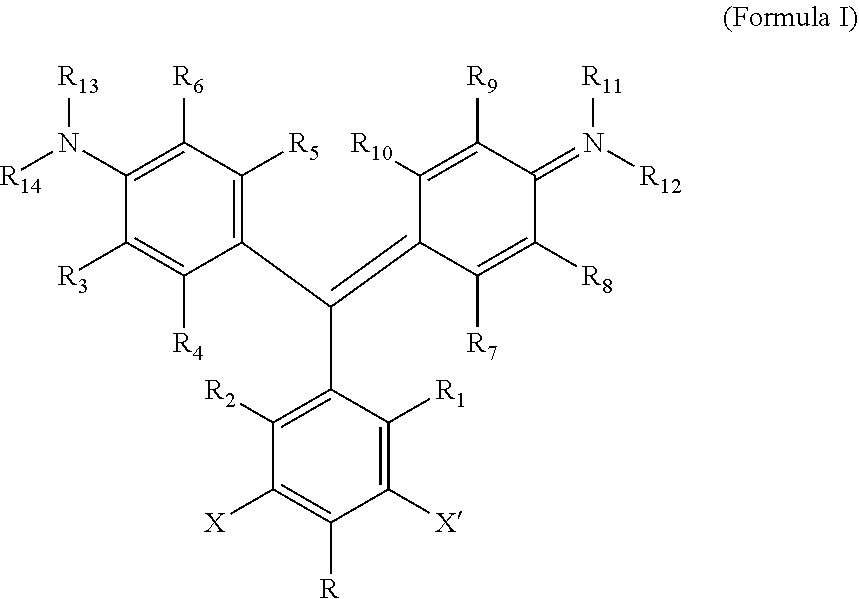
- where X and X′ are, independently, heavy atoms, R1, R2, R3, R4, R5, R6, R7, R8, R9, and R10 are, independently H or F, R11, R12, R13 and R14 are, independently, methyl, H, aziridine or azetidine, wherein when R11, R12, R13, and/or R14 are aziridine or azetidine, R11 and R12 form a single ring and/or R13 and R14 form a single ring, and where R is selected from —H, —OH, —COO−, —SO3 −, —PO4 −, —NO2, —NH2, —N(CH3)(R15), —OR16, alkyl, ether, polyether, PEG1-30, —(C1-C4 alkyl)-R17, heterocyles containing N, S or O atoms, substituted acetylenic groups, cyano, and carbohydrate groups, wherein R15 and R16 are: straight- or branched-chain alkyl; straight or branched-chain C1-6 alkyl; straight-chain or branched poly(C1-C4 alkyl amide); straight-chain or branched poly(C1-C4 alkyl amide) having from 2 to 6 amide moieties; poly(C1-C4 alkylene glycol); poly(C1-C4 alkylene glycol) having from 2 to 30 or from 2-10 C1-C4 alkylene glycol moieties; straight-chain or branched poly(C1-C4 alkyl amide):poly(C1-C4 alkylene glycol) diblock copolymer; straight-chain or branched poly(C1-C4 alkyl amide):poly(C1-C4 alkylene glycol) diblock copolymer having from 2 to 6 amide moieties and from 2 to 10 C1-C4 alkylene glycol moieties; sulfonyl or bis-sulfonyl-terminated straight-chain or branched poly(C1-C4 alkyl amide), optionally having from 2 to 6 amide moieties; bis-taurine branched poly(C1-C4 alkyl amide), optionally having from 2 to 6 amide moieties; ethyl butyrate; C1-6 alkyl C1-6 alkanoate; —(CH2)n—C(O)—O—(CH2)m—CH3, where n=1-4 and m=0-3, and wherein R17 is selected from H, —OH, —COO−, —SO3 −, —PO4 −, —NO2, or —NH2.
- Clause 36. The method of clause 35, in which R1, R2, R3, R4, R5, R6, R7, R8, R9, and R10 are H.
- Clause 37. The method of clause 35 or 36, in which in which X and X′ are independently Br, I, As, Se, Ga, Ge, or Sb.
- Clause 38. The method of clause 35 or 36, in which X and X′ are independently Br or I.
- Clause 39. The method of clause 38, in which X and X′ are I.
-
Clause 40. The method of clause 35 or 36, in which R11, R12, R13 and R14 are, independently, methyl or H, or R11, R12, R13 and R14 are methyl. - Clause 41. The method of any one of clauses 35-40, in which R is —OR16, and R16 is ethylbutyrate.
- Clause 42. The method of clause 35, in which the heavy atom-modified malachite green derivative is:
-

- Clause 43. The method of any one of clauses 35-42, in which the activator moiety is fusion protein of an scFv and an affibody.
- Clause 44. The method of clause 43, in which the scFv is an L5-MG scFv peptide, optionally SEQ ID NOS: 1-4.
- Clause 45. The method of any one of clauses 35-44, in which the targeting moiety is selective for an epidermal growth factor receptor.
- Clause 46. The method of clause 45, in which the epidermal growth factor receptor is HER1 (human epidermal growth factor receptor 1) or HER2 (human epidermal growth factor receptor 2).
- Clause 47. The method of any of clauses 35-46, in which the targeting activator comprises a sequence selected from SEQ ID NOS: 1-4, 10-15, 17 and 18.
Claims (18)


Priority Applications (1)
| Application Number | Priority Date | Filing Date | Title |
|---|---|---|---|
| US16/568,886 US10946098B2 (en) | 2014-11-17 | 2019-09-12 | Activatable two-component photosensitizers |
Applications Claiming Priority (4)
| Application Number | Priority Date | Filing Date | Title |
|---|---|---|---|
| US201462123489P | 2014-11-17 | 2014-11-17 | |
| PCT/US2015/061051 WO2016081440A1 (en) | 2014-11-17 | 2015-11-17 | Activatable two-component photosensitizers |
| US201715527061A | 2017-05-16 | 2017-05-16 | |
| US16/568,886 US10946098B2 (en) | 2014-11-17 | 2019-09-12 | Activatable two-component photosensitizers |
Related Parent Applications (2)
| Application Number | Title | Priority Date | Filing Date |
|---|---|---|---|
| PCT/US2015/061051 Division WO2016081440A1 (en) | 2014-11-17 | 2015-11-17 | Activatable two-component photosensitizers |
| US15/527,061 Division US10434177B2 (en) | 2014-11-17 | 2015-11-17 | Activatable two-component photosensitizers |
Publications (2)
| Publication Number | Publication Date |
|---|---|
| US20200078460A1 true US20200078460A1 (en) | 2020-03-12 |
| US10946098B2 US10946098B2 (en) | 2021-03-16 |
Family
ID=56014447
Family Applications (2)
| Application Number | Title | Priority Date | Filing Date |
|---|---|---|---|
| US15/527,061 Active 2036-03-20 US10434177B2 (en) | 2014-11-17 | 2015-11-17 | Activatable two-component photosensitizers |
| US16/568,886 Active US10946098B2 (en) | 2014-11-17 | 2019-09-12 | Activatable two-component photosensitizers |
Family Applications Before (1)
| Application Number | Title | Priority Date | Filing Date |
|---|---|---|---|
| US15/527,061 Active 2036-03-20 US10434177B2 (en) | 2014-11-17 | 2015-11-17 | Activatable two-component photosensitizers |
Country Status (3)
| Country | Link |
|---|---|
| US (2) | US10434177B2 (en) |
| CN (1) | CN107429075B (en) |
| WO (1) | WO2016081440A1 (en) |
Families Citing this family (4)
| Publication number | Priority date | Publication date | Assignee | Title |
|---|---|---|---|---|
| US20220040304A1 (en) * | 2018-10-22 | 2022-02-10 | Industry-University Cooperation Foundation Hanyang University | A composition for cancer cell death and its use |
| WO2021013232A1 (en) * | 2019-07-25 | 2021-01-28 | The Hong Kong University Of Science And Technology | Aie-active photosensitizer for selective bacterial elimination and cancer cell ablation |
| CN110658190A (en) * | 2019-08-28 | 2020-01-07 | 湖北工业大学 | An LED light based on optogenetics to kill cells |
| CN114949258B (en) * | 2022-06-17 | 2024-06-07 | 南开大学 | Preparation method and application of a ROS-responsive self-fluorescent metal-coordinated multifunctional cluster-modified gene vector |
Family Cites Families (50)
| Publication number | Priority date | Publication date | Assignee | Title |
|---|---|---|---|---|
| DE2747824A1 (en) | 1977-10-26 | 1979-05-03 | Bayer Ag | PROCESS FOR THE PREPARATION OF HALOGENVINYL GAMMA BUTYROLACTONE |
| DE3023787A1 (en) | 1980-06-25 | 1982-01-21 | Studiengesellschaft Kohle mbH, 4330 Mülheim | METHOD FOR INCREASING THE INCORPORATION AND EXPRESSION OF GENETIC MATERIAL IN THE CORE OF INTACT CELLS BY LIPOSOME |
| US4355023A (en) | 1980-09-30 | 1982-10-19 | The Massachusetts General Hospital | Antibody fragment compositions and process |
| US4462334A (en) | 1982-08-19 | 1984-07-31 | Kim Ho K | Solar animal structure |
| US4745051A (en) | 1983-05-27 | 1988-05-17 | The Texas A&M University System | Method for producing a recombinant baculovirus expression vector |
| US4704962A (en) | 1985-10-15 | 1987-11-10 | Robert Healey | Printing machine |
| WO1988001649A1 (en) | 1986-09-02 | 1988-03-10 | Genex Corporation | Single polypeptide chain binding molecules |
| US4946778A (en) | 1987-09-21 | 1990-08-07 | Genex Corporation | Single polypeptide chain binding molecules |
| US5166320A (en) | 1987-04-22 | 1992-11-24 | University Of Connecticut | Carrier system and method for the introduction of genes into mammalian cells |
| JP2627899B2 (en) | 1987-08-19 | 1997-07-09 | 株式会社 ビタミン研究所 | Production method of gene-encapsulated liposome |
| US5223409A (en) | 1988-09-02 | 1993-06-29 | Protein Engineering Corp. | Directed evolution of novel binding proteins |
| WO1990005144A1 (en) | 1988-11-11 | 1990-05-17 | Medical Research Council | Single domain ligands, receptors comprising said ligands, methods for their production, and use of said ligands and receptors |
| US5198346A (en) | 1989-01-06 | 1993-03-30 | Protein Engineering Corp. | Generation and selection of novel DNA-binding proteins and polypeptides |
| US5096815A (en) | 1989-01-06 | 1992-03-17 | Protein Engineering Corporation | Generation and selection of novel dna-binding proteins and polypeptides |
| DE3920358A1 (en) | 1989-06-22 | 1991-01-17 | Behringwerke Ag | BISPECIFIC AND OLIGO-SPECIFIC, MONO- AND OLIGOVALENT ANTI-BODY CONSTRUCTS, THEIR PRODUCTION AND USE |
| US5196193A (en) | 1989-10-31 | 1993-03-23 | Ophidian Pharmaceuticals, Inc. | Antivenoms and methods for making antivenoms |
| US5747334A (en) | 1990-02-15 | 1998-05-05 | The University Of North Carolina At Chapel Hill | Random peptide library |
| US5580737A (en) | 1990-06-11 | 1996-12-03 | Nexstar Pharmaceuticals, Inc. | High-affinity nucleic acid ligands that discriminate between theophylline and caffeine |
| US5637459A (en) | 1990-06-11 | 1997-06-10 | Nexstar Pharmaceuticals, Inc. | Systematic evolution of ligands by exponential enrichment: chimeric selex |
| US5707796A (en) | 1990-06-11 | 1998-01-13 | Nexstar Pharmaceuticals, Inc. | Method for selecting nucleic acids on the basis of structure |
| US5683867A (en) | 1990-06-11 | 1997-11-04 | Nexstar Pharmaceuticals, Inc. | Systematic evolution of ligands by exponential enrichment: blended SELEX |
| CA2084987C (en) | 1990-06-11 | 2007-02-13 | Larry Gold | Nucleic acid ligands |
| US5496938A (en) | 1990-06-11 | 1996-03-05 | Nexstar Pharmaceuticals, Inc. | Nucleic acid ligands to HIV-RT and HIV-1 rev |
| US5660985A (en) | 1990-06-11 | 1997-08-26 | Nexstar Pharmaceuticals, Inc. | High affinity nucleic acid ligands containing modified nucleotides |
| US5270163A (en) | 1990-06-11 | 1993-12-14 | University Research Corporation | Methods for identifying nucleic acid ligands |
| US5567588A (en) | 1990-06-11 | 1996-10-22 | University Research Corporation | Systematic evolution of ligands by exponential enrichment: Solution SELEX |
| AU660629B2 (en) | 1990-10-01 | 1995-07-06 | University Of Connecticut, The | Targeting viruses and cells for selective internalization by cells |
| DE69129154T2 (en) | 1990-12-03 | 1998-08-20 | Genentech, Inc., South San Francisco, Calif. | METHOD FOR ENRICHING PROTEIN VARIANTS WITH CHANGED BINDING PROPERTIES |
| AU1922092A (en) | 1991-05-03 | 1992-12-21 | Albert Einstein College Of Medicine Of Yeshiva University | Targeted delivery of genes encoding cell surface receptors |
| JPH06510524A (en) | 1991-05-14 | 1994-11-24 | ユニバーシティ オブ コネチカット | Targeted delivery of genes encoding immunogenic proteins |
| DE69231385T2 (en) | 1991-06-05 | 2001-04-12 | The Board Of Regents Acting For And On Behalf Of The Unversity Of Michigan, Ann Arbor | TARGETED RELEASE OF GENES ENCODING SECRETORIC PROTEINS |
| JP4124480B2 (en) | 1991-06-14 | 2008-07-23 | ジェネンテック・インコーポレーテッド | Immunoglobulin variants |
| DE4122599C2 (en) | 1991-07-08 | 1993-11-11 | Deutsches Krebsforsch | Phagemid for screening antibodies |
| KR100252547B1 (en) | 1991-09-05 | 2000-09-01 | 프레드 마리얀스키 | Targeted Delivery of Poly- or Oligonucleotides to Cells |
| WO1993011161A1 (en) | 1991-11-25 | 1993-06-10 | Enzon, Inc. | Multivalent antigen-binding proteins |
| US6238931B1 (en) | 1993-09-24 | 2001-05-29 | Biosite Diagnostics, Inc. | Fluorescence energy transfer in particles |
| US5702892A (en) | 1995-05-09 | 1997-12-30 | The United States Of America As Represented By The Department Of Health And Human Services | Phage-display of immunoglobulin heavy chain libraries |
| US6008373A (en) | 1995-06-07 | 1999-12-28 | Carnegie Mellon University | Fluorescent labeling complexes with large stokes shift formed by coupling together cyanine and other fluorochromes capable of resonance energy transfer |
| US6248558B1 (en) | 1998-03-31 | 2001-06-19 | Vanderbilt University | Sequence and method for genetic engineering of proteins with cell membrane translocating activity |
| US6131580A (en) | 1998-04-17 | 2000-10-17 | The University Of Washington | Template imprinted materials by RFGD plasma deposition |
| US6358684B1 (en) | 1999-08-27 | 2002-03-19 | Pe Corporation | UV excitable fluorescent energy transfer dyes |
| GB0119001D0 (en) | 2001-08-03 | 2001-09-26 | Amersham Pharm Biotech Uk Ltd | Use of dendrimers and poly-branched molecules to enhance signal in fluorescent assay systems |
| US20030165918A1 (en) | 2001-08-17 | 2003-09-04 | Fuji Photo Film Co., Ltd. | Method for detecting nucleic acid |
| AU2003278832A1 (en) | 2002-09-13 | 2004-04-30 | Carnegie Mellon University | Optical biosensors and methods of use thereof |
| US20070254323A1 (en) * | 2006-04-21 | 2007-11-01 | Jun Wang | Malachite green derivatives for immunoassay reagents to detect malachite green |
| EP2061884A4 (en) | 2006-08-11 | 2010-03-24 | Life Technologies Corp | Sensor proteins and assay methods |
| WO2008092041A2 (en) | 2007-01-24 | 2008-07-31 | Carnegie Mellon University | Optical biosensors |
| DE102008058088A1 (en) | 2008-11-18 | 2010-05-20 | Leica Microsystems Cms Gmbh | Method for spatially high-resolution examination of a substance-labeled structure of a sample |
| CA2752854A1 (en) | 2009-02-18 | 2010-08-26 | Carnegie Mellon University | Quenched dendrimeric dyes for bright detection |
| EP2577309B1 (en) | 2010-05-25 | 2016-11-23 | Carnegie Mellon University | Targeted probes of cellular physiology |
-
2015
- 2015-11-17 CN CN201580073178.1A patent/CN107429075B/en not_active Expired - Fee Related
- 2015-11-17 US US15/527,061 patent/US10434177B2/en active Active
- 2015-11-17 WO PCT/US2015/061051 patent/WO2016081440A1/en not_active Ceased
-
2019
- 2019-09-12 US US16/568,886 patent/US10946098B2/en active Active
Also Published As
| Publication number | Publication date |
|---|---|
| WO2016081440A1 (en) | 2016-05-26 |
| US20180280510A1 (en) | 2018-10-04 |
| CN107429075B (en) | 2022-11-01 |
| CN107429075A (en) | 2017-12-01 |
| US10946098B2 (en) | 2021-03-16 |
| US10434177B2 (en) | 2019-10-08 |
Similar Documents
| Publication | Publication Date | Title |
|---|---|---|
| US10946098B2 (en) | Activatable two-component photosensitizers | |
| EP2577309B1 (en) | Targeted probes of cellular physiology | |
| EP1084145B1 (en) | Antibodies to the ed-b domain of fibronectin, conjugates containing them and use thereof for diagnosis and therapy of tumors and diseases associated with angiogenesis | |
| JP6271476B2 (en) | Modified antibody composition and methods of making and using the same | |
| EP2398860B1 (en) | Quenched dendrimeric dyes for fluorescence detection | |
| KR100744370B1 (en) | Specific binding molecules for scintography, conjugates containing them and methods of treating angiogenesis | |
| JPH03505586A (en) | Immunoconjugates and prodrugs Their use in connection with drug release | |
| US11998612B2 (en) | Method for conjugating antibody and physiologically active substance | |
| CN117586359A (en) | Respiratory Syncytial Virus (RSV) polypeptides having immunogenicity | |
| US20240018508A1 (en) | Phage cyclisation assay | |
| EP2953977B1 (en) | Immuno imaging agent for use with antibody-drug conjugate therapy | |
| EP2953975B1 (en) | Immuno imaging agent for use with antibody-drug conjugate therapy | |
| Bruce | Protein Based Technologies to Identify, Study, and Control Intracellular Processes | |
| JP2003516145A (en) | Molecular display on multimeric protein backbone | |
| CN117050169A (en) | Monoclonal antibody for UreA protein and application thereof | |
| CN121159709A (en) | Fusion protein for photodynamic therapy targeting cancer cells | |
| JP2016515093A (en) | Immunoimaging agents for use with antibody-drug conjugate therapy |
Legal Events
| Date | Code | Title | Description |
|---|---|---|---|
| AS | Assignment |
Owner name: CARNEGIE MELLON UNIVERSITY, PENNSYLVANIA Free format text: ASSIGNMENT OF ASSIGNORS INTEREST;ASSIGNORS:BRUCHEZ, MARCEL P.;HE, JIANJUN;WANG, YI;SIGNING DATES FROM 20170517 TO 20190703;REEL/FRAME:050359/0131 |
|
| FEPP | Fee payment procedure |
Free format text: ENTITY STATUS SET TO UNDISCOUNTED (ORIGINAL EVENT CODE: BIG.); ENTITY STATUS OF PATENT OWNER: SMALL ENTITY |
|
| FEPP | Fee payment procedure |
Free format text: ENTITY STATUS SET TO SMALL (ORIGINAL EVENT CODE: SMAL); ENTITY STATUS OF PATENT OWNER: SMALL ENTITY |
|
| STPP | Information on status: patent application and granting procedure in general |
Free format text: NON FINAL ACTION COUNTED, NOT YET MAILED |
|
| AS | Assignment |
Owner name: NATIONAL INSTITUTES OF HEALTH (NIH), U.S. DEPT. OF HEALTH AND HUMAN SERVICES (DHHS), U.S. GOVERNMENT, MARYLAND Free format text: CONFIRMATORY LICENSE;ASSIGNOR:CARFNEGIE-MELLON UNIVERSITY;REEL/FRAME:053507/0963 Effective date: 20200812 |
|
| STCF | Information on status: patent grant |
Free format text: PATENTED CASE |
|
| CC | Certificate of correction | ||
| MAFP | Maintenance fee payment |
Free format text: PAYMENT OF MAINTENANCE FEE, 4TH YR, SMALL ENTITY (ORIGINAL EVENT CODE: M2551); ENTITY STATUS OF PATENT OWNER: SMALL ENTITY Year of fee payment: 4 |