US20200013957A1 - Organic light emitting device - Google Patents
Organic light emitting device Download PDFInfo
- Publication number
- US20200013957A1 US20200013957A1 US16/490,050 US201816490050A US2020013957A1 US 20200013957 A1 US20200013957 A1 US 20200013957A1 US 201816490050 A US201816490050 A US 201816490050A US 2020013957 A1 US2020013957 A1 US 2020013957A1
- Authority
- US
- United States
- Prior art keywords
- compound
- group
- light emitting
- organic light
- emitting device
- Prior art date
- Legal status (The legal status is an assumption and is not a legal conclusion. Google has not performed a legal analysis and makes no representation as to the accuracy of the status listed.)
- Abandoned
Links
- 0 C([C@](c1ccccc1)c(cc1)ccc1-c(cc12)ccc1[o]c1c2c(-c2ccc(*(c3ccccc3)c3ccccc3)cc2)ccc1)c1ccccc1 Chemical compound C([C@](c1ccccc1)c(cc1)ccc1-c(cc12)ccc1[o]c1c2c(-c2ccc(*(c3ccccc3)c3ccccc3)cc2)ccc1)c1ccccc1 0.000 description 13
- YQWBGWRMUIOAJD-UHFFFAOYSA-N C1=CC=C(C2=CC=C(N(C3=CC=C(C4=CC=CC=C4)C=C3)C3=CC4=C(C=C3)N(C3=C5C=CC=CC5=CC=C3)/C3=C/C=C(N(C5=CC=C(C6=CC=CC=C6)C=C5)C5=CC=C(C6=CC=CC=C6)C=C5)\C=C\43)C=C2)C=C1.C1=CC=C(C2=CC=C(N(C3=CC=CC=C3)C3=CC4=C(C=C3)N(C3=C5C=CC=CC5=CC=C3)/C3=C/C=C(N(C5=CC=CC=C5)C5=CC=C(C6=CC=CC=C6)C=C5)\C=C\43)C=C2)C=C1.C1=CC=C(N(C2=CC=CC=C2)C2=CC3=C(C=C2)N(C2=C4C=CC=CC4=CC=C2)/C2=C/C=C(N(C4=CC=CC=C4)C4=CC=CC=C4)\C=C\32)C=C1.C1=CC=C(N(C2=CC=CC=C2)C2=CC=C(C3=CC4=C(C=C3)N(C3=C5C=CC=CC5=CC=C3)/C3=C/C=C(C5=CC=C(N(C6=CC=CC=C6)C6=CC=CC=C6)C=C5)\C=C\43)C=C2)C=C1 Chemical compound C1=CC=C(C2=CC=C(N(C3=CC=C(C4=CC=CC=C4)C=C3)C3=CC4=C(C=C3)N(C3=C5C=CC=CC5=CC=C3)/C3=C/C=C(N(C5=CC=C(C6=CC=CC=C6)C=C5)C5=CC=C(C6=CC=CC=C6)C=C5)\C=C\43)C=C2)C=C1.C1=CC=C(C2=CC=C(N(C3=CC=CC=C3)C3=CC4=C(C=C3)N(C3=C5C=CC=CC5=CC=C3)/C3=C/C=C(N(C5=CC=CC=C5)C5=CC=C(C6=CC=CC=C6)C=C5)\C=C\43)C=C2)C=C1.C1=CC=C(N(C2=CC=CC=C2)C2=CC3=C(C=C2)N(C2=C4C=CC=CC4=CC=C2)/C2=C/C=C(N(C4=CC=CC=C4)C4=CC=CC=C4)\C=C\32)C=C1.C1=CC=C(N(C2=CC=CC=C2)C2=CC=C(C3=CC4=C(C=C3)N(C3=C5C=CC=CC5=CC=C3)/C3=C/C=C(C5=CC=C(N(C6=CC=CC=C6)C6=CC=CC=C6)C=C5)\C=C\43)C=C2)C=C1 YQWBGWRMUIOAJD-UHFFFAOYSA-N 0.000 description 3
- SNTVCVZPOSEDCJ-UHFFFAOYSA-N CC1(C)C2=C(C=CC(N(C3=CC=C(C4=CC=CC=C4)C=C3)C3=CC=C(C4=CC=CC=C4)C=C3)=C2)C2=C\C=C(N(C3=CC=C(C4=CC=CC=C4)C=C3)C3=CC=C(C4=CC=CC=C4)C=C3)/C=C\21.CC1(C)C2=C(C=CC(N(C3=CC=CC=C3)C3=CC=C(C4=CC=CC=C4)C=C3)=C2)C2=C\C=C(N(C3=CC=CC=C3)C3=CC=C(C4=CC=CC=C4)C=C3)/C=C\21.CC1(C)C2=C(C=CC(N(C3=CC=CC=C3)C3=CC=CC=C3)=C2)C2=C\C=C(N(C3=CC=CC=C3)C3=CC=C(C4=CC=CC=C4)C=C3)/C=C\21.CC1(C)C2=C(C=CC(N(C3=CC=CC=C3)C3=CC=CC=C3)=C2)C2=C\C=C(N(C3=CC=CC=C3)C3=CC=CC=C3)/C=C\21 Chemical compound CC1(C)C2=C(C=CC(N(C3=CC=C(C4=CC=CC=C4)C=C3)C3=CC=C(C4=CC=CC=C4)C=C3)=C2)C2=C\C=C(N(C3=CC=C(C4=CC=CC=C4)C=C3)C3=CC=C(C4=CC=CC=C4)C=C3)/C=C\21.CC1(C)C2=C(C=CC(N(C3=CC=CC=C3)C3=CC=C(C4=CC=CC=C4)C=C3)=C2)C2=C\C=C(N(C3=CC=CC=C3)C3=CC=C(C4=CC=CC=C4)C=C3)/C=C\21.CC1(C)C2=C(C=CC(N(C3=CC=CC=C3)C3=CC=CC=C3)=C2)C2=C\C=C(N(C3=CC=CC=C3)C3=CC=C(C4=CC=CC=C4)C=C3)/C=C\21.CC1(C)C2=C(C=CC(N(C3=CC=CC=C3)C3=CC=CC=C3)=C2)C2=C\C=C(N(C3=CC=CC=C3)C3=CC=CC=C3)/C=C\21 SNTVCVZPOSEDCJ-UHFFFAOYSA-N 0.000 description 3
- YXFVVABEGXRONW-UHFFFAOYSA-N Cc1ccccc1 Chemical compound Cc1ccccc1 YXFVVABEGXRONW-UHFFFAOYSA-N 0.000 description 3
- YYLIFDDQWCJWHQ-UHFFFAOYSA-N C1=CC2=C(C=C1)C(C1=C3C=CC=CC3=C(C3=CC4=C(C=C3)C3=C(C=CC=C3)O4)C3=C1C=CC=C3)=CC=C2.C1=CC2=C(C=C1)C(C1=C3C=CC=CC3=C(C3=CC4=C(C=C3)OC3=C4C=CC=C3)C3=C1C=CC=C3)=CC=C2.C1=CC2=C(C=C1)C(C1=C3C=CC=CC3=C(C3=CC=CC4=C3C3=C(C=CC=C3)O4)C3=C1C=CC=C3)=CC=C2.C1=CC2=C(C=C1)C(C1=C3C=CC=CC3=C(C3=CC=CC4=C3OC3=C4C=CC=C3)C3=C1C=CC=C3)=CC=C2 Chemical compound C1=CC2=C(C=C1)C(C1=C3C=CC=CC3=C(C3=CC4=C(C=C3)C3=C(C=CC=C3)O4)C3=C1C=CC=C3)=CC=C2.C1=CC2=C(C=C1)C(C1=C3C=CC=CC3=C(C3=CC4=C(C=C3)OC3=C4C=CC=C3)C3=C1C=CC=C3)=CC=C2.C1=CC2=C(C=C1)C(C1=C3C=CC=CC3=C(C3=CC=CC4=C3C3=C(C=CC=C3)O4)C3=C1C=CC=C3)=CC=C2.C1=CC2=C(C=C1)C(C1=C3C=CC=CC3=C(C3=CC=CC4=C3OC3=C4C=CC=C3)C3=C1C=CC=C3)=CC=C2 YYLIFDDQWCJWHQ-UHFFFAOYSA-N 0.000 description 2
- QSCQCCXDTPGRET-UHFFFAOYSA-N C1=CC2=C(C=C1)C(C1=C3C=CC=CC3=C(C3=CC4=C(C=C3)C3=C(C=CC=C3)S4)C3=C1C=CC=C3)=CC=C2.C1=CC2=C(C=C1)C(C1=C3C=CC=CC3=C(C3=CC4=C(C=C3)SC3=C4C=CC=C3)C3=C1C=CC=C3)=CC=C2.C1=CC2=C(C=C1)C(C1=C3C=CC=CC3=C(C3=CC=CC4=C3C3=C(C=CC=C3)S4)C3=C1C=CC=C3)=CC=C2.C1=CC2=C(C=C1)C(C1=C3C=CC=CC3=C(C3=CC=CC4=C3SC3=C4C=CC=C3)C3=C1C=CC=C3)=CC=C2 Chemical compound C1=CC2=C(C=C1)C(C1=C3C=CC=CC3=C(C3=CC4=C(C=C3)C3=C(C=CC=C3)S4)C3=C1C=CC=C3)=CC=C2.C1=CC2=C(C=C1)C(C1=C3C=CC=CC3=C(C3=CC4=C(C=C3)SC3=C4C=CC=C3)C3=C1C=CC=C3)=CC=C2.C1=CC2=C(C=C1)C(C1=C3C=CC=CC3=C(C3=CC=CC4=C3C3=C(C=CC=C3)S4)C3=C1C=CC=C3)=CC=C2.C1=CC2=C(C=C1)C(C1=C3C=CC=CC3=C(C3=CC=CC4=C3SC3=C4C=CC=C3)C3=C1C=CC=C3)=CC=C2 QSCQCCXDTPGRET-UHFFFAOYSA-N 0.000 description 2
- XUXDKCULYFOCOY-UHFFFAOYSA-N C1=CC2=C(C=C1)C(C1=CC=C(C3=C4C=CC=CC4=C(C4=CC5=C(C=C4)C4=C(C=CC=C4)O5)C4=C3C=CC=C4)C=C1)=CC=C2.C1=CC2=C(C=C1)C(C1=CC=C(C3=C4C=CC=CC4=C(C4=CC5=C(C=C4)OC4=C5C=CC=C4)C4=C3C=CC=C4)C=C1)=CC=C2.C1=CC2=C(C=C1)C(C1=CC=C(C3=C4C=CC=CC4=C(C4=CC=CC5=C4C4=C(C=CC=C4)O5)C4=C3C=CC=C4)C=C1)=CC=C2.C1=CC2=C(C=C1)C(C1=CC=C(C3=C4C=CC=CC4=C(C4=CC=CC5=C4OC4=C5C=CC=C4)C4=C3C=CC=C4)C=C1)=CC=C2 Chemical compound C1=CC2=C(C=C1)C(C1=CC=C(C3=C4C=CC=CC4=C(C4=CC5=C(C=C4)C4=C(C=CC=C4)O5)C4=C3C=CC=C4)C=C1)=CC=C2.C1=CC2=C(C=C1)C(C1=CC=C(C3=C4C=CC=CC4=C(C4=CC5=C(C=C4)OC4=C5C=CC=C4)C4=C3C=CC=C4)C=C1)=CC=C2.C1=CC2=C(C=C1)C(C1=CC=C(C3=C4C=CC=CC4=C(C4=CC=CC5=C4C4=C(C=CC=C4)O5)C4=C3C=CC=C4)C=C1)=CC=C2.C1=CC2=C(C=C1)C(C1=CC=C(C3=C4C=CC=CC4=C(C4=CC=CC5=C4OC4=C5C=CC=C4)C4=C3C=CC=C4)C=C1)=CC=C2 XUXDKCULYFOCOY-UHFFFAOYSA-N 0.000 description 2
- RHHGHCXCZJFIIN-UHFFFAOYSA-N C1=CC2=C(C=C1)C(C1=CC=C(C3=C4C=CC=CC4=C(C4=CC5=C(C=C4)C4=C(C=CC=C4)S5)C4=C3C=CC=C4)C=C1)=CC=C2.C1=CC2=C(C=C1)C(C1=CC=C(C3=C4C=CC=CC4=C(C4=CC5=C(C=C4)SC4=C5C=CC=C4)C4=C3C=CC=C4)C=C1)=CC=C2.C1=CC2=C(C=C1)C(C1=CC=C(C3=C4C=CC=CC4=C(C4=CC=CC5=C4C4=C(C=CC=C4)S5)C4=C3C=CC=C4)C=C1)=CC=C2.C1=CC2=C(C=C1)C(C1=CC=C(C3=C4C=CC=CC4=C(C4=CC=CC5=C4SC4=C5C=CC=C4)C4=C3C=CC=C4)C=C1)=CC=C2 Chemical compound C1=CC2=C(C=C1)C(C1=CC=C(C3=C4C=CC=CC4=C(C4=CC5=C(C=C4)C4=C(C=CC=C4)S5)C4=C3C=CC=C4)C=C1)=CC=C2.C1=CC2=C(C=C1)C(C1=CC=C(C3=C4C=CC=CC4=C(C4=CC5=C(C=C4)SC4=C5C=CC=C4)C4=C3C=CC=C4)C=C1)=CC=C2.C1=CC2=C(C=C1)C(C1=CC=C(C3=C4C=CC=CC4=C(C4=CC=CC5=C4C4=C(C=CC=C4)S5)C4=C3C=CC=C4)C=C1)=CC=C2.C1=CC2=C(C=C1)C(C1=CC=C(C3=C4C=CC=CC4=C(C4=CC=CC5=C4SC4=C5C=CC=C4)C4=C3C=CC=C4)C=C1)=CC=C2 RHHGHCXCZJFIIN-UHFFFAOYSA-N 0.000 description 2
- XYILYRVOZVFWGF-UHFFFAOYSA-N C1=CC2=C(C=C1)C1=C(/C=C\C=C/1)[Y]2.CCN(C)[Ar].CCN(C)[Ar].[Ar].[Ar].[Ar].[Ar] Chemical compound C1=CC2=C(C=C1)C1=C(/C=C\C=C/1)[Y]2.CCN(C)[Ar].CCN(C)[Ar].[Ar].[Ar].[Ar].[Ar] XYILYRVOZVFWGF-UHFFFAOYSA-N 0.000 description 2
- SXBBCJFSIFCNCI-UHFFFAOYSA-N C1=CC2=CC(C3=C4C=CC=CC4=C(C4=CC5=C(C=C4)C4=C(C=CC=C4)O5)C4=C3C=CC=C4)=C3C=CC=CC3=C2C=C1.C1=CC2=CC(C3=C4C=CC=CC4=C(C4=CC5=C(C=C4)OC4=C5C=CC=C4)C4=C3C=CC=C4)=C3C=CC=CC3=C2C=C1.C1=CC2=CC(C3=C4C=CC=CC4=C(C4=CC=CC5=C4C4=C(C=CC=C4)O5)C4=C3C=CC=C4)=C3C=CC=CC3=C2C=C1.C1=CC2=CC(C3=C4C=CC=CC4=C(C4=CC=CC5=C4OC4=C5C=CC=C4)C4=C3C=CC=C4)=C3C=CC=CC3=C2C=C1 Chemical compound C1=CC2=CC(C3=C4C=CC=CC4=C(C4=CC5=C(C=C4)C4=C(C=CC=C4)O5)C4=C3C=CC=C4)=C3C=CC=CC3=C2C=C1.C1=CC2=CC(C3=C4C=CC=CC4=C(C4=CC5=C(C=C4)OC4=C5C=CC=C4)C4=C3C=CC=C4)=C3C=CC=CC3=C2C=C1.C1=CC2=CC(C3=C4C=CC=CC4=C(C4=CC=CC5=C4C4=C(C=CC=C4)O5)C4=C3C=CC=C4)=C3C=CC=CC3=C2C=C1.C1=CC2=CC(C3=C4C=CC=CC4=C(C4=CC=CC5=C4OC4=C5C=CC=C4)C4=C3C=CC=C4)=C3C=CC=CC3=C2C=C1 SXBBCJFSIFCNCI-UHFFFAOYSA-N 0.000 description 2
- AFXPNIKHFMOVMD-UHFFFAOYSA-N C1=CC2=CC(C3=C4C=CC=CC4=C(C4=CC5=C(C=C4)C4=C(C=CC=C4)S5)C4=C3C=CC=C4)=C3C=CC=CC3=C2C=C1.C1=CC2=CC(C3=C4C=CC=CC4=C(C4=CC5=C(C=C4)SC4=C5C=CC=C4)C4=C3C=CC=C4)=C3C=CC=CC3=C2C=C1.C1=CC2=CC(C3=C4C=CC=CC4=C(C4=CC=CC5=C4C4=C(C=CC=C4)S5)C4=C3C=CC=C4)=C3C=CC=CC3=C2C=C1.C1=CC2=CC(C3=C4C=CC=CC4=C(C4=CC=CC5=C4SC4=C5C=CC=C4)C4=C3C=CC=C4)=C3C=CC=CC3=C2C=C1 Chemical compound C1=CC2=CC(C3=C4C=CC=CC4=C(C4=CC5=C(C=C4)C4=C(C=CC=C4)S5)C4=C3C=CC=C4)=C3C=CC=CC3=C2C=C1.C1=CC2=CC(C3=C4C=CC=CC4=C(C4=CC5=C(C=C4)SC4=C5C=CC=C4)C4=C3C=CC=C4)=C3C=CC=CC3=C2C=C1.C1=CC2=CC(C3=C4C=CC=CC4=C(C4=CC=CC5=C4C4=C(C=CC=C4)S5)C4=C3C=CC=C4)=C3C=CC=CC3=C2C=C1.C1=CC2=CC(C3=C4C=CC=CC4=C(C4=CC=CC5=C4SC4=C5C=CC=C4)C4=C3C=CC=C4)=C3C=CC=CC3=C2C=C1 AFXPNIKHFMOVMD-UHFFFAOYSA-N 0.000 description 2
- UKQZDXSTUBDRSP-UHFFFAOYSA-N C1=CC2=CC=C(C3=C4C=CC=CC4=C(C4=CC5=C(C=C4)C4=C(C=CC=C4)O5)C4=C3C=CC=C4)C=C2C=C1.C1=CC2=CC=C(C3=C4C=CC=CC4=C(C4=CC5=C(C=C4)OC4=C5C=CC=C4)C4=C3C=CC=C4)C=C2C=C1.C1=CC2=CC=C(C3=C4C=CC=CC4=C(C4=CC=CC5=C4C4=C(C=CC=C4)O5)C4=C3C=CC=C4)C=C2C=C1.C1=CC2=CC=C(C3=C4C=CC=CC4=C(C4=CC=CC5=C4OC4=C5C=CC=C4)C4=C3C=CC=C4)C=C2C=C1 Chemical compound C1=CC2=CC=C(C3=C4C=CC=CC4=C(C4=CC5=C(C=C4)C4=C(C=CC=C4)O5)C4=C3C=CC=C4)C=C2C=C1.C1=CC2=CC=C(C3=C4C=CC=CC4=C(C4=CC5=C(C=C4)OC4=C5C=CC=C4)C4=C3C=CC=C4)C=C2C=C1.C1=CC2=CC=C(C3=C4C=CC=CC4=C(C4=CC=CC5=C4C4=C(C=CC=C4)O5)C4=C3C=CC=C4)C=C2C=C1.C1=CC2=CC=C(C3=C4C=CC=CC4=C(C4=CC=CC5=C4OC4=C5C=CC=C4)C4=C3C=CC=C4)C=C2C=C1 UKQZDXSTUBDRSP-UHFFFAOYSA-N 0.000 description 2
- DPSNLUDQNFUFOZ-UHFFFAOYSA-N C1=CC2=CC=C(C3=C4C=CC=CC4=C(C4=CC5=C(C=C4)C4=C(C=CC=C4)S5)C4=C3C=CC=C4)C=C2C=C1.C1=CC2=CC=C(C3=C4C=CC=CC4=C(C4=CC5=C(C=C4)SC4=C5C=CC=C4)C4=C3C=CC=C4)C=C2C=C1.C1=CC2=CC=C(C3=C4C=CC=CC4=C(C4=CC=CC5=C4C4=C(C=CC=C4)S5)C4=C3C=CC=C4)C=C2C=C1.C1=CC2=CC=C(C3=C4C=CC=CC4=C(C4=CC=CC5=C4SC4=C5C=CC=C4)C4=C3C=CC=C4)C=C2C=C1 Chemical compound C1=CC2=CC=C(C3=C4C=CC=CC4=C(C4=CC5=C(C=C4)C4=C(C=CC=C4)S5)C4=C3C=CC=C4)C=C2C=C1.C1=CC2=CC=C(C3=C4C=CC=CC4=C(C4=CC5=C(C=C4)SC4=C5C=CC=C4)C4=C3C=CC=C4)C=C2C=C1.C1=CC2=CC=C(C3=C4C=CC=CC4=C(C4=CC=CC5=C4C4=C(C=CC=C4)S5)C4=C3C=CC=C4)C=C2C=C1.C1=CC2=CC=C(C3=C4C=CC=CC4=C(C4=CC=CC5=C4SC4=C5C=CC=C4)C4=C3C=CC=C4)C=C2C=C1 DPSNLUDQNFUFOZ-UHFFFAOYSA-N 0.000 description 2
- YYGQZOYAAJWLMU-UHFFFAOYSA-N C1=CC2=CC=C(C3=CC=C(C4=C5C=CC=CC5=C(C5=CC6=C(C=C5)C5=C(C=CC=C5)O6)C5=C4C=CC=C5)C=C3)C=C2C=C1.C1=CC2=CC=C(C3=CC=C(C4=C5C=CC=CC5=C(C5=CC6=C(C=C5)OC5=C6C=CC=C5)C5=C4C=CC=C5)C=C3)C=C2C=C1.C1=CC2=CC=C(C3=CC=C(C4=C5C=CC=CC5=C(C5=CC=CC6=C5C5=C(C=CC=C5)O6)C5=C4C=CC=C5)C=C3)C=C2C=C1.C1=CC2=CC=C(C3=CC=C(C4=C5C=CC=CC5=C(C5=CC=CC6=C5OC5=C6C=CC=C5)C5=C4C=CC=C5)C=C3)C=C2C=C1 Chemical compound C1=CC2=CC=C(C3=CC=C(C4=C5C=CC=CC5=C(C5=CC6=C(C=C5)C5=C(C=CC=C5)O6)C5=C4C=CC=C5)C=C3)C=C2C=C1.C1=CC2=CC=C(C3=CC=C(C4=C5C=CC=CC5=C(C5=CC6=C(C=C5)OC5=C6C=CC=C5)C5=C4C=CC=C5)C=C3)C=C2C=C1.C1=CC2=CC=C(C3=CC=C(C4=C5C=CC=CC5=C(C5=CC=CC6=C5C5=C(C=CC=C5)O6)C5=C4C=CC=C5)C=C3)C=C2C=C1.C1=CC2=CC=C(C3=CC=C(C4=C5C=CC=CC5=C(C5=CC=CC6=C5OC5=C6C=CC=C5)C5=C4C=CC=C5)C=C3)C=C2C=C1 YYGQZOYAAJWLMU-UHFFFAOYSA-N 0.000 description 2
- GGFHGABNHIOGSZ-UHFFFAOYSA-N C1=CC2=CC=C(C3=CC=C(C4=C5C=CC=CC5=C(C5=CC6=C(C=C5)C5=C(C=CC=C5)S6)C5=C4C=CC=C5)C=C3)C=C2C=C1.C1=CC2=CC=C(C3=CC=C(C4=C5C=CC=CC5=C(C5=CC6=C(C=C5)SC5=C6C=CC=C5)C5=C4C=CC=C5)C=C3)C=C2C=C1.C1=CC2=CC=C(C3=CC=C(C4=C5C=CC=CC5=C(C5=CC=CC6=C5C5=C(C=CC=C5)S6)C5=C4C=CC=C5)C=C3)C=C2C=C1.C1=CC2=CC=C(C3=CC=C(C4=C5C=CC=CC5=C(C5=CC=CC6=C5SC5=C6C=CC=C5)C5=C4C=CC=C5)C=C3)C=C2C=C1 Chemical compound C1=CC2=CC=C(C3=CC=C(C4=C5C=CC=CC5=C(C5=CC6=C(C=C5)C5=C(C=CC=C5)S6)C5=C4C=CC=C5)C=C3)C=C2C=C1.C1=CC2=CC=C(C3=CC=C(C4=C5C=CC=CC5=C(C5=CC6=C(C=C5)SC5=C6C=CC=C5)C5=C4C=CC=C5)C=C3)C=C2C=C1.C1=CC2=CC=C(C3=CC=C(C4=C5C=CC=CC5=C(C5=CC=CC6=C5C5=C(C=CC=C5)S6)C5=C4C=CC=C5)C=C3)C=C2C=C1.C1=CC2=CC=C(C3=CC=C(C4=C5C=CC=CC5=C(C5=CC=CC6=C5SC5=C6C=CC=C5)C5=C4C=CC=C5)C=C3)C=C2C=C1 GGFHGABNHIOGSZ-UHFFFAOYSA-N 0.000 description 2
- IQYQOOHMACROAN-UHFFFAOYSA-N C1=CC=C(C2=C(C3=CC=CC=C3)C3=C(C=C2)C2=C(C=CC(C4=C5C=CC=CC5=C(C5=CC=CC6=C5C=CC=C6)C5=C4C=CC=C5)=C2)O3)C=C1.C1=CC=C(C2=CC(C3=CC4=C(C=C3)OC3=C4C=C(C4=C5C=CC=CC5=C(C5=CC=CC=C5C5=CC=C6C=CC=CC6=C5)C5=C4C=CC=C5)C=C3)=CC=C2)C=C1.C1=CC=C(C2=CC3=CC=C(C4=C5C=CC=CC5=C(C5=CC6=C(C=C5)OC5=C6C(C6=CC=CC=C6)=CC=C5)C5=C4C=CC=C5)C=C3C=C2)C=C1.C1=CC=C(C2=CC=CC=C2C2=CC3=C(C=C2)C2=C(C=CC(C4=C5C=CC=CC5=C(C5=C6C=CC=CC6=C6C=CC=CC6=C5)C5=C4C=CC=C5)=C2)O3)C=C1 Chemical compound C1=CC=C(C2=C(C3=CC=CC=C3)C3=C(C=C2)C2=C(C=CC(C4=C5C=CC=CC5=C(C5=CC=CC6=C5C=CC=C6)C5=C4C=CC=C5)=C2)O3)C=C1.C1=CC=C(C2=CC(C3=CC4=C(C=C3)OC3=C4C=C(C4=C5C=CC=CC5=C(C5=CC=CC=C5C5=CC=C6C=CC=CC6=C5)C5=C4C=CC=C5)C=C3)=CC=C2)C=C1.C1=CC=C(C2=CC3=CC=C(C4=C5C=CC=CC5=C(C5=CC6=C(C=C5)OC5=C6C(C6=CC=CC=C6)=CC=C5)C5=C4C=CC=C5)C=C3C=C2)C=C1.C1=CC=C(C2=CC=CC=C2C2=CC3=C(C=C2)C2=C(C=CC(C4=C5C=CC=CC5=C(C5=C6C=CC=CC6=C6C=CC=CC6=C5)C5=C4C=CC=C5)=C2)O3)C=C1 IQYQOOHMACROAN-UHFFFAOYSA-N 0.000 description 2
- KYUCAHYERMANDB-UHFFFAOYSA-N C1=CC=C(C2=C(C3=CC=CC=C3)C3=C(C=C2)C2=C(C=CC(C4=C5C=CC=CC5=C(C5=CC=CC=C5)C5=C4C=CC=C5)=C2)O3)C=C1.C1=CC=C(C2=C3C=CC=CC3=C(C3=CC4=C(C=C3)OC3=C4C=C(C4=CC=C5C=CC=CC5=C4)C=C3)C3=C2C=CC=C3)C=C1.C1=CC=C(C2=C3C=CC=CC3=C(C3=CC=C(C4=CC=C5C=CC=CC5=C4)C4=C3C3=C(C=CC=C3)O4)C3=C2C=CC=C3)C=C1.C1=CC=C(C2=CC(C3=CC=C(C4=C5C=CC=CC5=C(C5=C6C=CC=CC6=CC=C5)C5=C4C=CC=C5)C4=C3OC3=C4C=CC=C3)=CC3=C2C=CC=C3)C=C1 Chemical compound C1=CC=C(C2=C(C3=CC=CC=C3)C3=C(C=C2)C2=C(C=CC(C4=C5C=CC=CC5=C(C5=CC=CC=C5)C5=C4C=CC=C5)=C2)O3)C=C1.C1=CC=C(C2=C3C=CC=CC3=C(C3=CC4=C(C=C3)OC3=C4C=C(C4=CC=C5C=CC=CC5=C4)C=C3)C3=C2C=CC=C3)C=C1.C1=CC=C(C2=C3C=CC=CC3=C(C3=CC=C(C4=CC=C5C=CC=CC5=C4)C4=C3C3=C(C=CC=C3)O4)C3=C2C=CC=C3)C=C1.C1=CC=C(C2=CC(C3=CC=C(C4=C5C=CC=CC5=C(C5=C6C=CC=CC6=CC=C5)C5=C4C=CC=C5)C4=C3OC3=C4C=CC=C3)=CC3=C2C=CC=C3)C=C1 KYUCAHYERMANDB-UHFFFAOYSA-N 0.000 description 2
- QRQFYWOVOJKVRV-UHFFFAOYSA-N C1=CC=C(C2=C(C3=CC=CC=C3)C3=C(C=C2)OC2=C3C=C(C3=C4C=CC=CC4=C(C4=CC=CC=C4)C4=C3C=CC=C4)C=C2)C=C1.C1=CC=C(C2=C3C=CC=CC3=C(C3=CC=CC4=C3C3=C(C=C(C5=CC6=C(C=CC=C6)C=C5)C=C3)O4)C3=C2C=CC=C3)C=C1.C1=CC=C(C2=CC3=C(C(C4=CC=CC=C4)=C2)C2=C(C=CC(C4=C5C=CC=CC5=C(C5=CC=CC=C5)C5=C4C=CC=C5)=C2)O3)C=C1.C1=CC=C(C2=CC=C(C3=CC=CC=C3)C3=C2OC2=C3C=C(C3=C4C=CC=CC4=C(C4=CC=CC=C4)C4=C3C=CC=C4)C=C2)C=C1 Chemical compound C1=CC=C(C2=C(C3=CC=CC=C3)C3=C(C=C2)OC2=C3C=C(C3=C4C=CC=CC4=C(C4=CC=CC=C4)C4=C3C=CC=C4)C=C2)C=C1.C1=CC=C(C2=C3C=CC=CC3=C(C3=CC=CC4=C3C3=C(C=C(C5=CC6=C(C=CC=C6)C=C5)C=C3)O4)C3=C2C=CC=C3)C=C1.C1=CC=C(C2=CC3=C(C(C4=CC=CC=C4)=C2)C2=C(C=CC(C4=C5C=CC=CC5=C(C5=CC=CC=C5)C5=C4C=CC=C5)=C2)O3)C=C1.C1=CC=C(C2=CC=C(C3=CC=CC=C3)C3=C2OC2=C3C=C(C3=C4C=CC=CC4=C(C4=CC=CC=C4)C4=C3C=CC=C4)C=C2)C=C1 QRQFYWOVOJKVRV-UHFFFAOYSA-N 0.000 description 2
- DKQKZZWZGZLTTQ-UHFFFAOYSA-N C1=CC=C(C2=C3C=CC=CC3=C(C3=CC4=C(C=C3)C3=C(C=C(C5=CC=C6C=CC=CC6=C5)C=C3)O4)C3=C2C=CC=C3)C=C1.C1=CC=C(C2=C3C=CC=CC3=C(C3=CC4=C(OC5=C4C=CC=C5)C(C4=CC5=C(C=CC=C5)C=C4)=C3)C3=C2C=CC=C3)C=C1.C1=CC=C(C2=C3C=CC=CC3=C(C3=CC=C(C4=CC5=C(C=CC=C5)C=C4)C4=C3C3=C(C=CC=C3)O4)C3=C2C=CC=C3)C=C1.C1=CC=C(C2=C3C=CC=CC3=C(C3=CC=C(C4=CC5=C(C=CC=C5)C=C4)C4=C3OC3=C4C=CC=C3)C3=C2C=CC=C3)C=C1 Chemical compound C1=CC=C(C2=C3C=CC=CC3=C(C3=CC4=C(C=C3)C3=C(C=C(C5=CC=C6C=CC=CC6=C5)C=C3)O4)C3=C2C=CC=C3)C=C1.C1=CC=C(C2=C3C=CC=CC3=C(C3=CC4=C(OC5=C4C=CC=C5)C(C4=CC5=C(C=CC=C5)C=C4)=C3)C3=C2C=CC=C3)C=C1.C1=CC=C(C2=C3C=CC=CC3=C(C3=CC=C(C4=CC5=C(C=CC=C5)C=C4)C4=C3C3=C(C=CC=C3)O4)C3=C2C=CC=C3)C=C1.C1=CC=C(C2=C3C=CC=CC3=C(C3=CC=C(C4=CC5=C(C=CC=C5)C=C4)C4=C3OC3=C4C=CC=C3)C3=C2C=CC=C3)C=C1 DKQKZZWZGZLTTQ-UHFFFAOYSA-N 0.000 description 2
- ARDBKNFWVJMVLB-UHFFFAOYSA-N C1=CC=C(C2=C3C=CC=CC3=C(C3=CC4=C(C=C3)C3=C(C=C(C5=CC=CC6=C5C=CC=C6)C=C3)O4)C3=C2C=CC=C3)C=C1.C1=CC=C(C2=C3C=CC=CC3=C(C3=CC4=C(OC5=C4C=CC=C5)C(C4=C5C=CC=CC5=CC=C4)=C3)C3=C2C=CC=C3)C=C1.C1=CC=C(C2=C3C=CC=CC3=C(C3=CC=C(C4=C5C=CC=CC5=CC=C4)C4=C3OC3=C4C=CC=C3)C3=C2C=CC=C3)C=C1.C1=CC=C(C2=C3C=CC=CC3=C(C3=CC=C(C4=CC=CC5=C4C=CC=C5)C4=C3C3=C(C=CC=C3)O4)C3=C2C=CC=C3)C=C1 Chemical compound C1=CC=C(C2=C3C=CC=CC3=C(C3=CC4=C(C=C3)C3=C(C=C(C5=CC=CC6=C5C=CC=C6)C=C3)O4)C3=C2C=CC=C3)C=C1.C1=CC=C(C2=C3C=CC=CC3=C(C3=CC4=C(OC5=C4C=CC=C5)C(C4=C5C=CC=CC5=CC=C4)=C3)C3=C2C=CC=C3)C=C1.C1=CC=C(C2=C3C=CC=CC3=C(C3=CC=C(C4=C5C=CC=CC5=CC=C4)C4=C3OC3=C4C=CC=C3)C3=C2C=CC=C3)C=C1.C1=CC=C(C2=C3C=CC=CC3=C(C3=CC=C(C4=CC=CC5=C4C=CC=C5)C4=C3C3=C(C=CC=C3)O4)C3=C2C=CC=C3)C=C1 ARDBKNFWVJMVLB-UHFFFAOYSA-N 0.000 description 2
- ONWUBHLPCBVXQH-UHFFFAOYSA-N C1=CC=C(C2=C3C=CC=CC3=C(C3=CC4=C(C=C3)C3=C(C=CC=C3)O4)C3=C2C=CC=C3)C=C1.C1=CC=C(C2=C3C=CC=CC3=C(C3=CC4=C(C=C3)OC3=C4C=CC=C3)C3=C2C=CC=C3)C=C1.C1=CC=C(C2=C3C=CC=CC3=C(C3=CC=CC4=C3C3=C(C=CC=C3)O4)C3=C2C=CC=C3)C=C1.C1=CC=C(C2=C3C=CC=CC3=C(C3=CC=CC4=C3OC3=C4C=CC=C3)C3=C2C=CC=C3)C=C1 Chemical compound C1=CC=C(C2=C3C=CC=CC3=C(C3=CC4=C(C=C3)C3=C(C=CC=C3)O4)C3=C2C=CC=C3)C=C1.C1=CC=C(C2=C3C=CC=CC3=C(C3=CC4=C(C=C3)OC3=C4C=CC=C3)C3=C2C=CC=C3)C=C1.C1=CC=C(C2=C3C=CC=CC3=C(C3=CC=CC4=C3C3=C(C=CC=C3)O4)C3=C2C=CC=C3)C=C1.C1=CC=C(C2=C3C=CC=CC3=C(C3=CC=CC4=C3OC3=C4C=CC=C3)C3=C2C=CC=C3)C=C1 ONWUBHLPCBVXQH-UHFFFAOYSA-N 0.000 description 2
- QQPQNANNTWEFGY-UHFFFAOYSA-N C1=CC=C(C2=C3C=CC=CC3=C(C3=CC4=C(C=C3)C3=C(C=CC=C3)S4)C3=C2C=CC=C3)C=C1.C1=CC=C(C2=C3C=CC=CC3=C(C3=CC4=C(C=C3)SC3=C4C=CC=C3)C3=C2C=CC=C3)C=C1.C1=CC=C(C2=C3C=CC=CC3=C(C3=CC=CC4=C3C3=C(C=CC=C3)S4)C3=C2C=CC=C3)C=C1.C1=CC=C(C2=C3C=CC=CC3=C(C3=CC=CC4=C3SC3=C4C=CC=C3)C3=C2C=CC=C3)C=C1 Chemical compound C1=CC=C(C2=C3C=CC=CC3=C(C3=CC4=C(C=C3)C3=C(C=CC=C3)S4)C3=C2C=CC=C3)C=C1.C1=CC=C(C2=C3C=CC=CC3=C(C3=CC4=C(C=C3)SC3=C4C=CC=C3)C3=C2C=CC=C3)C=C1.C1=CC=C(C2=C3C=CC=CC3=C(C3=CC=CC4=C3C3=C(C=CC=C3)S4)C3=C2C=CC=C3)C=C1.C1=CC=C(C2=C3C=CC=CC3=C(C3=CC=CC4=C3SC3=C4C=CC=C3)C3=C2C=CC=C3)C=C1 QQPQNANNTWEFGY-UHFFFAOYSA-N 0.000 description 2
- ZJQNCLPCDYXYCY-UHFFFAOYSA-N C1=CC=C(C2=C3C=CC=CC3=C(C3=CC4=C(C=C3)C3=C(S4)C(C4=C5C=CC=CC5=CC=C4)=CC=C3)C3=C2C=CC=C3)C=C1.C1=CC=C(C2=C3C=CC=CC3=C(C3=CC4=C(C=C3)SC3=C4C=C(C4=CC=CC5=C4C=CC=C5)C=C3)C3=C2C=CC=C3)C=C1.C1=CC=C(C2=C3C=CC=CC3=C(C3=CC=CC4=C3C3=C(S4)C(C4=CC=CC5=C4C=CC=C5)=CC=C3)C3=C2C=CC=C3)C=C1.C1=CC=C(C2=C3C=CC=CC3=C(C3=CC=CC4=C3SC3=C4C=CC=C3C3=C4C=CC=CC4=CC=C3)C3=C2C=CC=C3)C=C1 Chemical compound C1=CC=C(C2=C3C=CC=CC3=C(C3=CC4=C(C=C3)C3=C(S4)C(C4=C5C=CC=CC5=CC=C4)=CC=C3)C3=C2C=CC=C3)C=C1.C1=CC=C(C2=C3C=CC=CC3=C(C3=CC4=C(C=C3)SC3=C4C=C(C4=CC=CC5=C4C=CC=C5)C=C3)C3=C2C=CC=C3)C=C1.C1=CC=C(C2=C3C=CC=CC3=C(C3=CC=CC4=C3C3=C(S4)C(C4=CC=CC5=C4C=CC=C5)=CC=C3)C3=C2C=CC=C3)C=C1.C1=CC=C(C2=C3C=CC=CC3=C(C3=CC=CC4=C3SC3=C4C=CC=C3C3=C4C=CC=CC4=CC=C3)C3=C2C=CC=C3)C=C1 ZJQNCLPCDYXYCY-UHFFFAOYSA-N 0.000 description 2
- WXUXWTAFQOEZAQ-UHFFFAOYSA-N C1=CC=C(C2=C3C=CC=CC3=C(C3=CC4=C(C=C3)C3=C(S4)C(C4=CC5=C(C=CC=C5)C=C4)=CC=C3)C3=C2C=CC=C3)C=C1.C1=CC=C(C2=C3C=CC=CC3=C(C3=CC4=C(C=C3)SC3=C4C=C(C4=CC=C5C=CC=CC5=C4)C=C3)C3=C2C=CC=C3)C=C1.C1=CC=C(C2=C3C=CC=CC3=C(C3=CC=CC4=C3C3=C(S4)C(C4=CC=C5C=CC=CC5=C4)=CC=C3)C3=C2C=CC=C3)C=C1.C1=CC=C(C2=C3C=CC=CC3=C(C3=CC=CC4=C3SC3=C4C=CC=C3C3=CC4=C(C=CC=C4)C=C3)C3=C2C=CC=C3)C=C1 Chemical compound C1=CC=C(C2=C3C=CC=CC3=C(C3=CC4=C(C=C3)C3=C(S4)C(C4=CC5=C(C=CC=C5)C=C4)=CC=C3)C3=C2C=CC=C3)C=C1.C1=CC=C(C2=C3C=CC=CC3=C(C3=CC4=C(C=C3)SC3=C4C=C(C4=CC=C5C=CC=CC5=C4)C=C3)C3=C2C=CC=C3)C=C1.C1=CC=C(C2=C3C=CC=CC3=C(C3=CC=CC4=C3C3=C(S4)C(C4=CC=C5C=CC=CC5=C4)=CC=C3)C3=C2C=CC=C3)C=C1.C1=CC=C(C2=C3C=CC=CC3=C(C3=CC=CC4=C3SC3=C4C=CC=C3C3=CC4=C(C=CC=C4)C=C3)C3=C2C=CC=C3)C=C1 WXUXWTAFQOEZAQ-UHFFFAOYSA-N 0.000 description 2
- QPEMIYPGXLQCFB-UHFFFAOYSA-N C1=CC=C(C2=C3C=CC=CC3=C(C3=CC4=C(C=C3)OC3=C4C(C4=C5C=CC=CC5=CC=C4)=CC=C3)C3=C2C=CC=C3)C=C1.C1=CC=C(C2=CC(C3=CC=CC4=C3C3=C(C=CC=C3C3=C5C=CC=CC5=C(C5=CC=CC=C5)C5=C3C=CC=C5)O4)=CC=C2)C=C1.C1=CC=C(C2=CC=CC(C3=CC4=C(C=C3)C3=C(C=CC=C3C3=C5C=CC=CC5=C(C5=CC=CC=C5)C5=C3C=CC=C5)O4)=C2)C=C1.C1=CC=C(C2=CC=CC(C3=CC=CC4=C3C3=C(C=CC(C5=C6C=CC=CC6=C(C6=CC=CC=C6)C6=C5C=CC=C6)=C3)O4)=C2)C=C1 Chemical compound C1=CC=C(C2=C3C=CC=CC3=C(C3=CC4=C(C=C3)OC3=C4C(C4=C5C=CC=CC5=CC=C4)=CC=C3)C3=C2C=CC=C3)C=C1.C1=CC=C(C2=CC(C3=CC=CC4=C3C3=C(C=CC=C3C3=C5C=CC=CC5=C(C5=CC=CC=C5)C5=C3C=CC=C5)O4)=CC=C2)C=C1.C1=CC=C(C2=CC=CC(C3=CC4=C(C=C3)C3=C(C=CC=C3C3=C5C=CC=CC5=C(C5=CC=CC=C5)C5=C3C=CC=C5)O4)=C2)C=C1.C1=CC=C(C2=CC=CC(C3=CC=CC4=C3C3=C(C=CC(C5=C6C=CC=CC6=C(C6=CC=CC=C6)C6=C5C=CC=C6)=C3)O4)=C2)C=C1 QPEMIYPGXLQCFB-UHFFFAOYSA-N 0.000 description 2
- BRWYKVSDYKXSIG-UHFFFAOYSA-N C1=CC=C(C2=CC(C3=C4C=CC=CC4=C(C4=CC5=C(C=C4)C4=C(C=CC=C4)O5)C4=C3C=CC=C4)=CC=C2)C=C1.C1=CC=C(C2=CC(C3=C4C=CC=CC4=C(C4=CC5=C(C=C4)OC4=C5C=CC=C4)C4=C3C=CC=C4)=CC=C2)C=C1.C1=CC=C(C2=CC(C3=C4C=CC=CC4=C(C4=CC=CC5=C4C4=C(C=CC=C4)O5)C4=C3C=CC=C4)=CC=C2)C=C1.C1=CC=C(C2=CC(C3=C4C=CC=CC4=C(C4=CC=CC5=C4OC4=C5C=CC=C4)C4=C3C=CC=C4)=CC=C2)C=C1 Chemical compound C1=CC=C(C2=CC(C3=C4C=CC=CC4=C(C4=CC5=C(C=C4)C4=C(C=CC=C4)O5)C4=C3C=CC=C4)=CC=C2)C=C1.C1=CC=C(C2=CC(C3=C4C=CC=CC4=C(C4=CC5=C(C=C4)OC4=C5C=CC=C4)C4=C3C=CC=C4)=CC=C2)C=C1.C1=CC=C(C2=CC(C3=C4C=CC=CC4=C(C4=CC=CC5=C4C4=C(C=CC=C4)O5)C4=C3C=CC=C4)=CC=C2)C=C1.C1=CC=C(C2=CC(C3=C4C=CC=CC4=C(C4=CC=CC5=C4OC4=C5C=CC=C4)C4=C3C=CC=C4)=CC=C2)C=C1 BRWYKVSDYKXSIG-UHFFFAOYSA-N 0.000 description 2
- MJVNXBFBXYZUHC-UHFFFAOYSA-N C1=CC=C(C2=CC(C3=C4C=CC=CC4=C(C4=CC5=C(C=C4)C4=C(C=CC=C4)S5)C4=C3C=CC=C4)=CC=C2)C=C1.C1=CC=C(C2=CC(C3=C4C=CC=CC4=C(C4=CC5=C(C=C4)SC4=C5C=CC=C4)C4=C3C=CC=C4)=CC=C2)C=C1.C1=CC=C(C2=CC(C3=C4C=CC=CC4=C(C4=CC=CC5=C4C4=C(C=CC=C4)S5)C4=C3C=CC=C4)=CC=C2)C=C1.C1=CC=C(C2=CC(C3=C4C=CC=CC4=C(C4=CC=CC5=C4SC4=C5C=CC=C4)C4=C3C=CC=C4)=CC=C2)C=C1 Chemical compound C1=CC=C(C2=CC(C3=C4C=CC=CC4=C(C4=CC5=C(C=C4)C4=C(C=CC=C4)S5)C4=C3C=CC=C4)=CC=C2)C=C1.C1=CC=C(C2=CC(C3=C4C=CC=CC4=C(C4=CC5=C(C=C4)SC4=C5C=CC=C4)C4=C3C=CC=C4)=CC=C2)C=C1.C1=CC=C(C2=CC(C3=C4C=CC=CC4=C(C4=CC=CC5=C4C4=C(C=CC=C4)S5)C4=C3C=CC=C4)=CC=C2)C=C1.C1=CC=C(C2=CC(C3=C4C=CC=CC4=C(C4=CC=CC5=C4SC4=C5C=CC=C4)C4=C3C=CC=C4)=CC=C2)C=C1 MJVNXBFBXYZUHC-UHFFFAOYSA-N 0.000 description 2
- IDQFLTOYFSRUEK-UHFFFAOYSA-N C1=CC=C(C2=CC(C3=C4C=CC=CC4=C(C4=CC=CC=C4)C4=C3C=CC=C4)=CC3=C2OC2=C3C=CC=C2)C=C1.C1=CC=C(C2=CC3=C(C=C2)C2=C(C=C(C4=C5C=CC=CC5=C(C5=CC=CC=C5)C5=C4C=CC=C5)C=C2)O3)C=C1.C1=CC=C(C2=CC=C(C3=C4C=CC=CC4=C(C4=CC=CC=C4)C4=C3C=CC=C4)C3=C2OC2=C3C=CC=C2)C=C1.C1=CC=C(C2=CC=C(C3=CC=C(C4=C5C=CC=CC5=C(C5=CC=CC=C5)C5=C4C=CC=C5)C4=C3C3=C(C=CC=C3)O4)C=C2)C=C1 Chemical compound C1=CC=C(C2=CC(C3=C4C=CC=CC4=C(C4=CC=CC=C4)C4=C3C=CC=C4)=CC3=C2OC2=C3C=CC=C2)C=C1.C1=CC=C(C2=CC3=C(C=C2)C2=C(C=C(C4=C5C=CC=CC5=C(C5=CC=CC=C5)C5=C4C=CC=C5)C=C2)O3)C=C1.C1=CC=C(C2=CC=C(C3=C4C=CC=CC4=C(C4=CC=CC=C4)C4=C3C=CC=C4)C3=C2OC2=C3C=CC=C2)C=C1.C1=CC=C(C2=CC=C(C3=CC=C(C4=C5C=CC=CC5=C(C5=CC=CC=C5)C5=C4C=CC=C5)C4=C3C3=C(C=CC=C3)O4)C=C2)C=C1 IDQFLTOYFSRUEK-UHFFFAOYSA-N 0.000 description 2
- BZEWOQZVRGQRDA-UHFFFAOYSA-N C1=CC=C(C2=CC(C3=CC4=C(C=C3)OC3=C4C=C(C4=C5C=CC=CC5=C(C5=CC=CC=C5)C5=C4C=CC=C5)C=C3)=CC=C2)C=C1.C1=CC=C(C2=CC3=C(C=C2)C2=C(C=CC=C2C2=C4C=CC=CC4=C(C4=C(C5=CC=CC=C5)C=CC=C4C4=CC=CC=C4)C4=C2C=CC=C4)O3)C=C1.C1=CC=C(C2=CC=C(C3=CC4=C(C=C3)OC3=C4C(C4=C5C=CC=CC5=C(C5=CC=CC=C5)C5=C4C=CC=C5)=CC=C3)C=C2)C=C1.C1=CC=C(C2=CC=CC=C2C2=CC3=C(C=C2)C2=C(C=CC(C4=C5C=CC=CC5=C(C5=CC=CC=C5)C5=C4C=CC=C5)=C2)O3)C=C1 Chemical compound C1=CC=C(C2=CC(C3=CC4=C(C=C3)OC3=C4C=C(C4=C5C=CC=CC5=C(C5=CC=CC=C5)C5=C4C=CC=C5)C=C3)=CC=C2)C=C1.C1=CC=C(C2=CC3=C(C=C2)C2=C(C=CC=C2C2=C4C=CC=CC4=C(C4=C(C5=CC=CC=C5)C=CC=C4C4=CC=CC=C4)C4=C2C=CC=C4)O3)C=C1.C1=CC=C(C2=CC=C(C3=CC4=C(C=C3)OC3=C4C(C4=C5C=CC=CC5=C(C5=CC=CC=C5)C5=C4C=CC=C5)=CC=C3)C=C2)C=C1.C1=CC=C(C2=CC=CC=C2C2=CC3=C(C=C2)C2=C(C=CC(C4=C5C=CC=CC5=C(C5=CC=CC=C5)C5=C4C=CC=C5)=C2)O3)C=C1 BZEWOQZVRGQRDA-UHFFFAOYSA-N 0.000 description 2
- KZFLGAIDBMPWOR-UHFFFAOYSA-N C1=CC=C(C2=CC(C3=CC=CC4=C3C3=C(C=CC=C3C3=C5C=CC=CC5=C(C5=C6C=CC=CC6=C(C6=CC=CC=C6)C=C5)C5=C3C=CC=C5)O4)=CC=C2)C=C1.C1=CC=C(C2=CC=C(C3=CC4=C(C=C3)OC3=C4C(C4=C5C=CC=CC5=C(C5=CC(C6=CC=CC=C6)=CC=C5)C5=C4C=CC=C5)=CC=C3)C=C2)C=C1.C1=CC=C(C2=CC=CC(C3=CC4=C(C=C3)C3=C(C=CC=C3C3=C5C=CC=CC5=C(C5=CC=C(C6=C7C=CC=CC7=CC=C6)C=C5)C5=C3C=CC=C5)O4)=C2)C=C1.C1=CC=C(C2=CC=CC(C3=CC=CC4=C3C3=C(C=CC(C5=C6C=CC=CC6=C(C6=CC=C7C=CC=CC7=C6C6=CC=CC=C6)C6=C5C=CC=C6)=C3)O4)=C2)C=C1 Chemical compound C1=CC=C(C2=CC(C3=CC=CC4=C3C3=C(C=CC=C3C3=C5C=CC=CC5=C(C5=C6C=CC=CC6=C(C6=CC=CC=C6)C=C5)C5=C3C=CC=C5)O4)=CC=C2)C=C1.C1=CC=C(C2=CC=C(C3=CC4=C(C=C3)OC3=C4C(C4=C5C=CC=CC5=C(C5=CC(C6=CC=CC=C6)=CC=C5)C5=C4C=CC=C5)=CC=C3)C=C2)C=C1.C1=CC=C(C2=CC=CC(C3=CC4=C(C=C3)C3=C(C=CC=C3C3=C5C=CC=CC5=C(C5=CC=C(C6=C7C=CC=CC7=CC=C6)C=C5)C5=C3C=CC=C5)O4)=C2)C=C1.C1=CC=C(C2=CC=CC(C3=CC=CC4=C3C3=C(C=CC(C5=C6C=CC=CC6=C(C6=CC=C7C=CC=CC7=C6C6=CC=CC=C6)C6=C5C=CC=C6)=C3)O4)=C2)C=C1 KZFLGAIDBMPWOR-UHFFFAOYSA-N 0.000 description 2
- PZJOYOOOENXIQS-UHFFFAOYSA-N C1=CC=C(C2=CC(C3=CC=CC4=C3SC3=C4C(C4=C5C=CC=CC5=C(C5=CC=CC=C5)C5=C4C=CC=C5)=CC=C3)=CC=C2)C=C1.C1=CC=C(C2=CC3=C(C=C2)SC2=C3C=C(C3=C4C=CC=CC4=C(C4=CC=CC=C4)C4=C3C=CC=C4)C=C2)C=C1.C1=CC=C(C2=CC=CC3=C2SC2=C3C=CC(C3=C4C=CC=CC4=C(C4=CC=CC=C4)C4=C3C=CC=C4)=C2)C=C1.C1=CC=C(C2=CC=CC3=C2SC2=C3C=CC=C2C2=C3C=CC=CC3=C(C3=CC=CC=C3)C3=C2C=CC=C3)C=C1 Chemical compound C1=CC=C(C2=CC(C3=CC=CC4=C3SC3=C4C(C4=C5C=CC=CC5=C(C5=CC=CC=C5)C5=C4C=CC=C5)=CC=C3)=CC=C2)C=C1.C1=CC=C(C2=CC3=C(C=C2)SC2=C3C=C(C3=C4C=CC=CC4=C(C4=CC=CC=C4)C4=C3C=CC=C4)C=C2)C=C1.C1=CC=C(C2=CC=CC3=C2SC2=C3C=CC(C3=C4C=CC=CC4=C(C4=CC=CC=C4)C4=C3C=CC=C4)=C2)C=C1.C1=CC=C(C2=CC=CC3=C2SC2=C3C=CC=C2C2=C3C=CC=CC3=C(C3=CC=CC=C3)C3=C2C=CC=C3)C=C1 PZJOYOOOENXIQS-UHFFFAOYSA-N 0.000 description 2
- QHAMTAZUXOUYQG-UHFFFAOYSA-N C1=CC=C(C2=CC(C3=CC=CC=C3)=CC(C3=C4C=CC=CC4=C(C4=CC5=C(C=C4)C4=C(C=CC=C4)O5)C4=C3C=CC=C4)=C2)C=C1.C1=CC=C(C2=CC(C3=CC=CC=C3)=CC(C3=C4C=CC=CC4=C(C4=CC5=C(C=C4)OC4=C5C=CC=C4)C4=C3C=CC=C4)=C2)C=C1.C1=CC=C(C2=CC(C3=CC=CC=C3)=CC(C3=C4C=CC=CC4=C(C4=CC=CC5=C4C4=C(C=CC=C4)O5)C4=C3C=CC=C4)=C2)C=C1.C1=CC=C(C2=CC(C3=CC=CC=C3)=CC(C3=C4C=CC=CC4=C(C4=CC=CC5=C4OC4=C5C=CC=C4)C4=C3C=CC=C4)=C2)C=C1 Chemical compound C1=CC=C(C2=CC(C3=CC=CC=C3)=CC(C3=C4C=CC=CC4=C(C4=CC5=C(C=C4)C4=C(C=CC=C4)O5)C4=C3C=CC=C4)=C2)C=C1.C1=CC=C(C2=CC(C3=CC=CC=C3)=CC(C3=C4C=CC=CC4=C(C4=CC5=C(C=C4)OC4=C5C=CC=C4)C4=C3C=CC=C4)=C2)C=C1.C1=CC=C(C2=CC(C3=CC=CC=C3)=CC(C3=C4C=CC=CC4=C(C4=CC=CC5=C4C4=C(C=CC=C4)O5)C4=C3C=CC=C4)=C2)C=C1.C1=CC=C(C2=CC(C3=CC=CC=C3)=CC(C3=C4C=CC=CC4=C(C4=CC=CC5=C4OC4=C5C=CC=C4)C4=C3C=CC=C4)=C2)C=C1 QHAMTAZUXOUYQG-UHFFFAOYSA-N 0.000 description 2
- QESZEUAUTIVGIN-UHFFFAOYSA-N C1=CC=C(C2=CC(C3=CC=CC=C3)=CC(C3=C4C=CC=CC4=C(C4=CC5=C(C=C4)C4=C(C=CC=C4)S5)C4=C3C=CC=C4)=C2)C=C1.C1=CC=C(C2=CC(C3=CC=CC=C3)=CC(C3=C4C=CC=CC4=C(C4=CC5=C(C=C4)SC4=C5C=CC=C4)C4=C3C=CC=C4)=C2)C=C1.C1=CC=C(C2=CC(C3=CC=CC=C3)=CC(C3=C4C=CC=CC4=C(C4=CC=CC5=C4C4=C(C=CC=C4)S5)C4=C3C=CC=C4)=C2)C=C1.C1=CC=C(C2=CC(C3=CC=CC=C3)=CC(C3=C4C=CC=CC4=C(C4=CC=CC5=C4SC4=C5C=CC=C4)C4=C3C=CC=C4)=C2)C=C1 Chemical compound C1=CC=C(C2=CC(C3=CC=CC=C3)=CC(C3=C4C=CC=CC4=C(C4=CC5=C(C=C4)C4=C(C=CC=C4)S5)C4=C3C=CC=C4)=C2)C=C1.C1=CC=C(C2=CC(C3=CC=CC=C3)=CC(C3=C4C=CC=CC4=C(C4=CC5=C(C=C4)SC4=C5C=CC=C4)C4=C3C=CC=C4)=C2)C=C1.C1=CC=C(C2=CC(C3=CC=CC=C3)=CC(C3=C4C=CC=CC4=C(C4=CC=CC5=C4C4=C(C=CC=C4)S5)C4=C3C=CC=C4)=C2)C=C1.C1=CC=C(C2=CC(C3=CC=CC=C3)=CC(C3=C4C=CC=CC4=C(C4=CC=CC5=C4SC4=C5C=CC=C4)C4=C3C=CC=C4)=C2)C=C1 QESZEUAUTIVGIN-UHFFFAOYSA-N 0.000 description 2
- QAMVVAXSBJFJJT-UHFFFAOYSA-N C1=CC=C(C2=CC3=C(C=C2)C2=C(C=CC=C2C2=C4C=CC=CC4=C(C4=CC=CC=C4)C4=C2C=CC=C4)O3)C=C1.C1=CC=C(C2=CC3=C(C=C2)OC2=C3C(C3=C4C=CC=CC4=C(C4=CC=CC=C4)C4=C3C=CC=C4)=CC=C2)C=C1.C1=CC=C(C2=CC=CC3=C2C2=C(C=CC(C4=C5C=CC=CC5=C(C5=CC=CC=C5)C5=C4C=CC=C5)=C2)O3)C=C1.C1=CC=C(C2=CC=CC3=C2C2=C(C=CC=C2C2=C4C=CC=CC4=C(C4=CC=CC=C4)C4=C2C=CC=C4)O3)C=C1 Chemical compound C1=CC=C(C2=CC3=C(C=C2)C2=C(C=CC=C2C2=C4C=CC=CC4=C(C4=CC=CC=C4)C4=C2C=CC=C4)O3)C=C1.C1=CC=C(C2=CC3=C(C=C2)OC2=C3C(C3=C4C=CC=CC4=C(C4=CC=CC=C4)C4=C3C=CC=C4)=CC=C2)C=C1.C1=CC=C(C2=CC=CC3=C2C2=C(C=CC(C4=C5C=CC=CC5=C(C5=CC=CC=C5)C5=C4C=CC=C5)=C2)O3)C=C1.C1=CC=C(C2=CC=CC3=C2C2=C(C=CC=C2C2=C4C=CC=CC4=C(C4=CC=CC=C4)C4=C2C=CC=C4)O3)C=C1 QAMVVAXSBJFJJT-UHFFFAOYSA-N 0.000 description 2
- JTTAPJJZDVTOOI-UHFFFAOYSA-N C1=CC=C(C2=CC=C(C3=C4C=CC=CC4=C(C4=CC5=C(C=C4)C4=C(C=CC=C4)O5)C4=C3C=CC=C4)C3=C2C=CC=C3)C=C1.C1=CC=C(C2=CC=C(C3=C4C=CC=CC4=C(C4=CC5=C(C=C4)OC4=C5C=CC=C4)C4=C3C=CC=C4)C3=C2C=CC=C3)C=C1.C1=CC=C(C2=CC=C(C3=C4C=CC=CC4=C(C4=CC=CC5=C4C4=C(C=CC=C4)O5)C4=C3C=CC=C4)C3=C2C=CC=C3)C=C1.C1=CC=C(C2=CC=C(C3=C4C=CC=CC4=C(C4=CC=CC5=C4OC4=C5C=CC=C4)C4=C3C=CC=C4)C3=C2C=CC=C3)C=C1 Chemical compound C1=CC=C(C2=CC=C(C3=C4C=CC=CC4=C(C4=CC5=C(C=C4)C4=C(C=CC=C4)O5)C4=C3C=CC=C4)C3=C2C=CC=C3)C=C1.C1=CC=C(C2=CC=C(C3=C4C=CC=CC4=C(C4=CC5=C(C=C4)OC4=C5C=CC=C4)C4=C3C=CC=C4)C3=C2C=CC=C3)C=C1.C1=CC=C(C2=CC=C(C3=C4C=CC=CC4=C(C4=CC=CC5=C4C4=C(C=CC=C4)O5)C4=C3C=CC=C4)C3=C2C=CC=C3)C=C1.C1=CC=C(C2=CC=C(C3=C4C=CC=CC4=C(C4=CC=CC5=C4OC4=C5C=CC=C4)C4=C3C=CC=C4)C3=C2C=CC=C3)C=C1 JTTAPJJZDVTOOI-UHFFFAOYSA-N 0.000 description 2
- WQLGWDJLVRQFIB-UHFFFAOYSA-N C1=CC=C(C2=CC=C(C3=C4C=CC=CC4=C(C4=CC5=C(C=C4)C4=C(C=CC=C4)O5)C4=C3C=CC=C4)C=C2)C=C1.C1=CC=C(C2=CC=C(C3=C4C=CC=CC4=C(C4=CC5=C(C=C4)OC4=C5C=CC=C4)C4=C3C=CC=C4)C=C2)C=C1.C1=CC=C(C2=CC=C(C3=C4C=CC=CC4=C(C4=CC=CC5=C4C4=C(C=CC=C4)O5)C4=C3C=CC=C4)C=C2)C=C1.C1=CC=C(C2=CC=C(C3=C4C=CC=CC4=C(C4=CC=CC5=C4OC4=C5C=CC=C4)C4=C3C=CC=C4)C=C2)C=C1 Chemical compound C1=CC=C(C2=CC=C(C3=C4C=CC=CC4=C(C4=CC5=C(C=C4)C4=C(C=CC=C4)O5)C4=C3C=CC=C4)C=C2)C=C1.C1=CC=C(C2=CC=C(C3=C4C=CC=CC4=C(C4=CC5=C(C=C4)OC4=C5C=CC=C4)C4=C3C=CC=C4)C=C2)C=C1.C1=CC=C(C2=CC=C(C3=C4C=CC=CC4=C(C4=CC=CC5=C4C4=C(C=CC=C4)O5)C4=C3C=CC=C4)C=C2)C=C1.C1=CC=C(C2=CC=C(C3=C4C=CC=CC4=C(C4=CC=CC5=C4OC4=C5C=CC=C4)C4=C3C=CC=C4)C=C2)C=C1 WQLGWDJLVRQFIB-UHFFFAOYSA-N 0.000 description 2
- RPTRKHUHCSFDFA-UHFFFAOYSA-N C1=CC=C(C2=CC=C(C3=C4C=CC=CC4=C(C4=CC5=C(C=C4)C4=C(C=CC=C4)S5)C4=C3C=CC=C4)C3=C2C=CC=C3)C=C1.C1=CC=C(C2=CC=C(C3=C4C=CC=CC4=C(C4=CC5=C(C=C4)SC4=C5C=CC=C4)C4=C3C=CC=C4)C3=C2C=CC=C3)C=C1.C1=CC=C(C2=CC=C(C3=C4C=CC=CC4=C(C4=CC=CC5=C4C4=C(C=CC=C4)S5)C4=C3C=CC=C4)C3=C2C=CC=C3)C=C1.C1=CC=C(C2=CC=C(C3=C4C=CC=CC4=C(C4=CC=CC5=C4SC4=C5C=CC=C4)C4=C3C=CC=C4)C3=C2C=CC=C3)C=C1 Chemical compound C1=CC=C(C2=CC=C(C3=C4C=CC=CC4=C(C4=CC5=C(C=C4)C4=C(C=CC=C4)S5)C4=C3C=CC=C4)C3=C2C=CC=C3)C=C1.C1=CC=C(C2=CC=C(C3=C4C=CC=CC4=C(C4=CC5=C(C=C4)SC4=C5C=CC=C4)C4=C3C=CC=C4)C3=C2C=CC=C3)C=C1.C1=CC=C(C2=CC=C(C3=C4C=CC=CC4=C(C4=CC=CC5=C4C4=C(C=CC=C4)S5)C4=C3C=CC=C4)C3=C2C=CC=C3)C=C1.C1=CC=C(C2=CC=C(C3=C4C=CC=CC4=C(C4=CC=CC5=C4SC4=C5C=CC=C4)C4=C3C=CC=C4)C3=C2C=CC=C3)C=C1 RPTRKHUHCSFDFA-UHFFFAOYSA-N 0.000 description 2
- LEOSWUASTFJODN-UHFFFAOYSA-N C1=CC=C(C2=CC=C(C3=C4C=CC=CC4=C(C4=CC5=C(C=C4)C4=C(C=CC=C4)S5)C4=C3C=CC=C4)C=C2)C=C1.C1=CC=C(C2=CC=C(C3=C4C=CC=CC4=C(C4=CC5=C(C=C4)SC4=C5C=CC=C4)C4=C3C=CC=C4)C=C2)C=C1.C1=CC=C(C2=CC=C(C3=C4C=CC=CC4=C(C4=CC=CC5=C4C4=C(C=CC=C4)S5)C4=C3C=CC=C4)C=C2)C=C1.C1=CC=C(C2=CC=C(C3=C4C=CC=CC4=C(C4=CC=CC5=C4SC4=C5C=CC=C4)C4=C3C=CC=C4)C=C2)C=C1 Chemical compound C1=CC=C(C2=CC=C(C3=C4C=CC=CC4=C(C4=CC5=C(C=C4)C4=C(C=CC=C4)S5)C4=C3C=CC=C4)C=C2)C=C1.C1=CC=C(C2=CC=C(C3=C4C=CC=CC4=C(C4=CC5=C(C=C4)SC4=C5C=CC=C4)C4=C3C=CC=C4)C=C2)C=C1.C1=CC=C(C2=CC=C(C3=C4C=CC=CC4=C(C4=CC=CC5=C4C4=C(C=CC=C4)S5)C4=C3C=CC=C4)C=C2)C=C1.C1=CC=C(C2=CC=C(C3=C4C=CC=CC4=C(C4=CC=CC5=C4SC4=C5C=CC=C4)C4=C3C=CC=C4)C=C2)C=C1 LEOSWUASTFJODN-UHFFFAOYSA-N 0.000 description 2
- AQPFVURKEQPOCT-UHFFFAOYSA-N C1=CC=C(C2=CC=C(N(C3=CC=C(C4=CC=CC=C4)C=C3)C3=CC4=C(C=C3)C3=C\C=C(N(C5=CC=C(C6=CC=CC=C6)C=C5)C5=CC=C(C6=CC=CC=C6)C=C5)/C=C\3C4(C3=CC=CC=C3)C3=CC=CC=C3)C=C2)C=C1.C1=CC=C(C2=CC=C(N(C3=CC=CC=C3)C3=C/C=C4\C5=C(C=C(N(C6=CC=CC=C6)C6=CC=CC=C6)C=C5)C(C5=CC=CC=C5)(C5=CC=CC=C5)\C4=C\3)C=C2)C=C1.C1=CC=C(N(C2=CC=CC=C2)C2=CC=C(C3=CC4=C(C=C3)C3=C\C=C(C5=CC=C(N(C6=CC=CC=C6)C6=CC=CC=C6)C=C5)/C=C\3C4(C3=CC=CC=C3)C3=CC=CC=C3)C=C2)C=C1.CC1(C)C2=C(C=CC(C3=CC=C(N(C4=CC=CC=C4)C4=CC=C(C5=CC=CC=C5)C=C4)C=C3)=C2)C2=C\C=C(C3=CC=C(N(C4=CC=CC=C4)C4=CC=C(C5=CC=CC=C5)C=C4)C=C3)/C=C\21 Chemical compound C1=CC=C(C2=CC=C(N(C3=CC=C(C4=CC=CC=C4)C=C3)C3=CC4=C(C=C3)C3=C\C=C(N(C5=CC=C(C6=CC=CC=C6)C=C5)C5=CC=C(C6=CC=CC=C6)C=C5)/C=C\3C4(C3=CC=CC=C3)C3=CC=CC=C3)C=C2)C=C1.C1=CC=C(C2=CC=C(N(C3=CC=CC=C3)C3=C/C=C4\C5=C(C=C(N(C6=CC=CC=C6)C6=CC=CC=C6)C=C5)C(C5=CC=CC=C5)(C5=CC=CC=C5)\C4=C\3)C=C2)C=C1.C1=CC=C(N(C2=CC=CC=C2)C2=CC=C(C3=CC4=C(C=C3)C3=C\C=C(C5=CC=C(N(C6=CC=CC=C6)C6=CC=CC=C6)C=C5)/C=C\3C4(C3=CC=CC=C3)C3=CC=CC=C3)C=C2)C=C1.CC1(C)C2=C(C=CC(C3=CC=C(N(C4=CC=CC=C4)C4=CC=C(C5=CC=CC=C5)C=C4)C=C3)=C2)C2=C\C=C(C3=CC=C(N(C4=CC=CC=C4)C4=CC=C(C5=CC=CC=C5)C=C4)C=C3)/C=C\21 AQPFVURKEQPOCT-UHFFFAOYSA-N 0.000 description 2
- VWLMVFAIIAPMJG-UHFFFAOYSA-N C1=CC=C(C2=CC=C(N(C3=CC=C(C4=CC=CC=C4)C=C3)C3=CC4=C(C=C3)N(C3=C5C=CC=CC5=C5C=CC=CC5=C3)/C3=C/C=C(N(C5=CC=C(C6=CC=CC=C6)C=C5)C5=CC=C(C6=CC=CC=C6)C=C5)\C=C\43)C=C2)C=C1.C1=CC=C(C2=CC=C(N(C3=CC=CC=C3)C3=CC4=C(C=C3)N(C3=C5C=CC=CC5=C5C=CC=CC5=C3)/C3=C/C=C(N(C5=CC=CC=C5)C5=CC=C(C6=CC=CC=C6)C=C5)\C=C\43)C=C2)C=C1.C1=CC=C(N(C2=CC=CC=C2)C2=CC3=C(C=C2)N(C2=C4C=CC=CC4=C4C=CC=CC4=C2)/C2=C/C=C(N(C4=CC=CC=C4)C4=CC=CC=C4)\C=C\32)C=C1.C1=CC=C(N(C2=CC=CC=C2)C2=CC=C(C3=CC4=C(C=C3)N(C3=C5C=CC=CC5=C5C=CC=CC5=C3)/C3=C/C=C(C5=CC=C(N(C6=CC=CC=C6)C6=CC=CC=C6)C=C5)\C=C\43)C=C2)C=C1 Chemical compound C1=CC=C(C2=CC=C(N(C3=CC=C(C4=CC=CC=C4)C=C3)C3=CC4=C(C=C3)N(C3=C5C=CC=CC5=C5C=CC=CC5=C3)/C3=C/C=C(N(C5=CC=C(C6=CC=CC=C6)C=C5)C5=CC=C(C6=CC=CC=C6)C=C5)\C=C\43)C=C2)C=C1.C1=CC=C(C2=CC=C(N(C3=CC=CC=C3)C3=CC4=C(C=C3)N(C3=C5C=CC=CC5=C5C=CC=CC5=C3)/C3=C/C=C(N(C5=CC=CC=C5)C5=CC=C(C6=CC=CC=C6)C=C5)\C=C\43)C=C2)C=C1.C1=CC=C(N(C2=CC=CC=C2)C2=CC3=C(C=C2)N(C2=C4C=CC=CC4=C4C=CC=CC4=C2)/C2=C/C=C(N(C4=CC=CC=C4)C4=CC=CC=C4)\C=C\32)C=C1.C1=CC=C(N(C2=CC=CC=C2)C2=CC=C(C3=CC4=C(C=C3)N(C3=C5C=CC=CC5=C5C=CC=CC5=C3)/C3=C/C=C(C5=CC=C(N(C6=CC=CC=C6)C6=CC=CC=C6)C=C5)\C=C\43)C=C2)C=C1 VWLMVFAIIAPMJG-UHFFFAOYSA-N 0.000 description 2
- UVGRELPSXNCFBR-UHFFFAOYSA-N C1=CC=C(C2=CC=C(N(C3=CC=C(C4=CC=CC=C4)C=C3)C3=CC4=C(C=C3)N(C3=C5OC6=C(C=CC=C6)C5=CC=C3)/C3=C/C=C(N(C5=CC=C(C6=CC=CC=C6)C=C5)C5=CC=C(C6=CC=CC=C6)C=C5)\C=C\43)C=C2)C=C1.C1=CC=C(C2=CC=C(N(C3=CC=CC=C3)C3=CC4=C(C=C3)N(C3=C5OC6=C(C=CC=C6)C5=CC=C3)/C3=C/C=C(N(C5=CC=CC=C5)C5=CC=C(C6=CC=CC=C6)C=C5)\C=C\43)C=C2)C=C1.C1=CC=C(N(C2=CC=CC=C2)C2=CC3=C(C=C2)N(C2=C4OC5=C(C=CC=C5)C4=CC=C2)/C2=C/C=C(N(C4=CC=CC=C4)C4=CC=CC=C4)\C=C\32)C=C1.C1=CC=C(N(C2=CC=CC=C2)C2=CC=C(C3=CC4=C(C=C3)N(C3=C5OC6=C(C=CC=C6)C5=CC=C3)/C3=C/C=C(C5=CC=C(N(C6=CC=CC=C6)C6=CC=CC=C6)C=C5)\C=C\43)C=C2)C=C1 Chemical compound C1=CC=C(C2=CC=C(N(C3=CC=C(C4=CC=CC=C4)C=C3)C3=CC4=C(C=C3)N(C3=C5OC6=C(C=CC=C6)C5=CC=C3)/C3=C/C=C(N(C5=CC=C(C6=CC=CC=C6)C=C5)C5=CC=C(C6=CC=CC=C6)C=C5)\C=C\43)C=C2)C=C1.C1=CC=C(C2=CC=C(N(C3=CC=CC=C3)C3=CC4=C(C=C3)N(C3=C5OC6=C(C=CC=C6)C5=CC=C3)/C3=C/C=C(N(C5=CC=CC=C5)C5=CC=C(C6=CC=CC=C6)C=C5)\C=C\43)C=C2)C=C1.C1=CC=C(N(C2=CC=CC=C2)C2=CC3=C(C=C2)N(C2=C4OC5=C(C=CC=C5)C4=CC=C2)/C2=C/C=C(N(C4=CC=CC=C4)C4=CC=CC=C4)\C=C\32)C=C1.C1=CC=C(N(C2=CC=CC=C2)C2=CC=C(C3=CC4=C(C=C3)N(C3=C5OC6=C(C=CC=C6)C5=CC=C3)/C3=C/C=C(C5=CC=C(N(C6=CC=CC=C6)C6=CC=CC=C6)C=C5)\C=C\43)C=C2)C=C1 UVGRELPSXNCFBR-UHFFFAOYSA-N 0.000 description 2
- BVIZPMANWJLDHT-UHFFFAOYSA-N C1=CC=C(C2=CC=C(N(C3=CC=C(C4=CC=CC=C4)C=C3)C3=CC4=C(C=C3)N(C3=CC5=C(C=C3)OC3=C5C=CC=C3)/C3=C/C=C(N(C5=CC=C(C6=CC=CC=C6)C=C5)C5=CC=C(C6=CC=CC=C6)C=C5)\C=C\43)C=C2)C=C1.C1=CC=C(C2=CC=C(N(C3=CC=CC=C3)C3=CC4=C(C=C3)N(C3=CC5=C(C=C3)OC3=C5C=CC=C3)/C3=C/C=C(N(C5=CC=CC=C5)C5=CC=C(C6=CC=CC=C6)C=C5)\C=C\43)C=C2)C=C1.C1=CC=C(N(C2=CC=CC=C2)C2=CC3=C(C=C2)N(C2=CC4=C(C=C2)OC2=C4C=CC=C2)/C2=C/C=C(N(C4=CC=CC=C4)C4=CC=CC=C4)\C=C\32)C=C1.C1=CC=C(N(C2=CC=CC=C2)C2=CC=C(C3=CC4=C(C=C3)N(C3=CC5=C(C=C3)OC3=C5C=CC=C3)/C3=C/C=C(C5=CC=C(N(C6=CC=CC=C6)C6=CC=CC=C6)C=C5)\C=C\43)C=C2)C=C1 Chemical compound C1=CC=C(C2=CC=C(N(C3=CC=C(C4=CC=CC=C4)C=C3)C3=CC4=C(C=C3)N(C3=CC5=C(C=C3)OC3=C5C=CC=C3)/C3=C/C=C(N(C5=CC=C(C6=CC=CC=C6)C=C5)C5=CC=C(C6=CC=CC=C6)C=C5)\C=C\43)C=C2)C=C1.C1=CC=C(C2=CC=C(N(C3=CC=CC=C3)C3=CC4=C(C=C3)N(C3=CC5=C(C=C3)OC3=C5C=CC=C3)/C3=C/C=C(N(C5=CC=CC=C5)C5=CC=C(C6=CC=CC=C6)C=C5)\C=C\43)C=C2)C=C1.C1=CC=C(N(C2=CC=CC=C2)C2=CC3=C(C=C2)N(C2=CC4=C(C=C2)OC2=C4C=CC=C2)/C2=C/C=C(N(C4=CC=CC=C4)C4=CC=CC=C4)\C=C\32)C=C1.C1=CC=C(N(C2=CC=CC=C2)C2=CC=C(C3=CC4=C(C=C3)N(C3=CC5=C(C=C3)OC3=C5C=CC=C3)/C3=C/C=C(C5=CC=C(N(C6=CC=CC=C6)C6=CC=CC=C6)C=C5)\C=C\43)C=C2)C=C1 BVIZPMANWJLDHT-UHFFFAOYSA-N 0.000 description 2
- NJUNGDMSZQPTQM-UHFFFAOYSA-N C1=CC=C(C2=CC=C(N(C3=CC=C(C4=CC=CC=C4)C=C3)C3=CC4=C(C=C3)N(C3=CC5=C(C=CC=C5)C=C3)/C3=C/C=C(N(C5=CC=C(C6=CC=CC=C6)C=C5)C5=CC=C(C6=CC=CC=C6)C=C5)\C=C\43)C=C2)C=C1.C1=CC=C(C2=CC=C(N(C3=CC=CC=C3)C3=CC4=C(C=C3)N(C3=CC5=C(C=CC=C5)C=C3)/C3=C/C=C(N(C5=CC=CC=C5)C5=CC=C(C6=CC=CC=C6)C=C5)\C=C\43)C=C2)C=C1.C1=CC=C(N(C2=CC=CC=C2)C2=CC3=C(C=C2)N(C2=CC4=C(C=CC=C4)C=C2)/C2=C/C=C(N(C4=CC=CC=C4)C4=CC=CC=C4)\C=C\32)C=C1.C1=CC=C(N(C2=CC=CC=C2)C2=CC=C(C3=CC4=C(C=C3)N(C3=CC5=C(C=CC=C5)C=C3)/C3=C/C=C(C5=CC=C(N(C6=CC=CC=C6)C6=CC=CC=C6)C=C5)\C=C\43)C=C2)C=C1 Chemical compound C1=CC=C(C2=CC=C(N(C3=CC=C(C4=CC=CC=C4)C=C3)C3=CC4=C(C=C3)N(C3=CC5=C(C=CC=C5)C=C3)/C3=C/C=C(N(C5=CC=C(C6=CC=CC=C6)C=C5)C5=CC=C(C6=CC=CC=C6)C=C5)\C=C\43)C=C2)C=C1.C1=CC=C(C2=CC=C(N(C3=CC=CC=C3)C3=CC4=C(C=C3)N(C3=CC5=C(C=CC=C5)C=C3)/C3=C/C=C(N(C5=CC=CC=C5)C5=CC=C(C6=CC=CC=C6)C=C5)\C=C\43)C=C2)C=C1.C1=CC=C(N(C2=CC=CC=C2)C2=CC3=C(C=C2)N(C2=CC4=C(C=CC=C4)C=C2)/C2=C/C=C(N(C4=CC=CC=C4)C4=CC=CC=C4)\C=C\32)C=C1.C1=CC=C(N(C2=CC=CC=C2)C2=CC=C(C3=CC4=C(C=C3)N(C3=CC5=C(C=CC=C5)C=C3)/C3=C/C=C(C5=CC=C(N(C6=CC=CC=C6)C6=CC=CC=C6)C=C5)\C=C\43)C=C2)C=C1 NJUNGDMSZQPTQM-UHFFFAOYSA-N 0.000 description 2
- KQVPWKKEYDOQJZ-UHFFFAOYSA-N C1=CC=C(C2=CC=C(N(C3=CC=C(C4=CC=CC=C4)C=C3)C3=CC4=C(C=C3)N(C3=CC=CC=C3)/C3=C/C=C(N(C5=CC=C(C6=CC=CC=C6)C=C5)C5=CC=C(C6=CC=CC=C6)C=C5)\C=C\43)C=C2)C=C1.C1=CC=C(C2=CC=C(N(C3=CC=CC=C3)C3=CC4=C(C=C3)N(C3=CC=CC=C3)/C3=C/C=C(N(C5=CC=CC=C5)C5=CC=C(C6=CC=CC=C6)C=C5)\C=C\43)C=C2)C=C1.C1=CC=C(N(C2=CC=CC=C2)C2=CC3=C(C=C2)N(C2=CC=CC=C2)/C2=C/C=C(N(C4=CC=CC=C4)C4=CC=CC=C4)\C=C\32)C=C1.C1=CC=C(N(C2=CC=CC=C2)C2=CC=C(C3=CC4=C(C=C3)N(C3=CC=CC=C3)/C3=C/C=C(C5=CC=C(N(C6=CC=CC=C6)C6=CC=CC=C6)C=C5)\C=C\43)C=C2)C=C1 Chemical compound C1=CC=C(C2=CC=C(N(C3=CC=C(C4=CC=CC=C4)C=C3)C3=CC4=C(C=C3)N(C3=CC=CC=C3)/C3=C/C=C(N(C5=CC=C(C6=CC=CC=C6)C=C5)C5=CC=C(C6=CC=CC=C6)C=C5)\C=C\43)C=C2)C=C1.C1=CC=C(C2=CC=C(N(C3=CC=CC=C3)C3=CC4=C(C=C3)N(C3=CC=CC=C3)/C3=C/C=C(N(C5=CC=CC=C5)C5=CC=C(C6=CC=CC=C6)C=C5)\C=C\43)C=C2)C=C1.C1=CC=C(N(C2=CC=CC=C2)C2=CC3=C(C=C2)N(C2=CC=CC=C2)/C2=C/C=C(N(C4=CC=CC=C4)C4=CC=CC=C4)\C=C\32)C=C1.C1=CC=C(N(C2=CC=CC=C2)C2=CC=C(C3=CC4=C(C=C3)N(C3=CC=CC=C3)/C3=C/C=C(C5=CC=C(N(C6=CC=CC=C6)C6=CC=CC=C6)C=C5)\C=C\43)C=C2)C=C1 KQVPWKKEYDOQJZ-UHFFFAOYSA-N 0.000 description 2
- HCMQTYWMPUJZLX-UHFFFAOYSA-N C1=CC=C(C2=CC=C(N(C3=CC=CC=C3)C3=CC4=C(C=C3)C3=C\C=C(N(C5=CC=CC=C5)C5=CC=C(C6=CC=CC=C6)C=C5)/C=C\3C4(C3=CC=CC=C3)C3=CC=CC=C3)C=C2)C=C1.C1=CC=C(N(C2=CC=CC=C2)C2=CC3=C(C=C2)C2=C\C=C(N(C4=CC=CC=C4)C4=CC=CC=C4)/C=C\2C3(C2=CC=CC=C2)C2=CC=CC=C2)C=C1.CC1(C)C2=C(C=CC(C3=CC=C(N(C4=CC=CC=C4)C4=CC=CC=C4)C=C3)=C2)C2=C\C=C(C3=CC=C(N(C4=CC=CC=C4)C4=CC=CC=C4)C=C3)/C=C\21.CC1(C)C2=C(C=CC(N(C3=CC=C(C4=CC=CC=C4)C=C3)C3=CC=C(C4=CC=CC=C4)C=C3)=C2)C2=C\C=C(N(C3=CC=CC=C3)C3=CC=C(C4=CC=C(C5=CC=CC=C5)C=C4)C=C3)/C=C\21 Chemical compound C1=CC=C(C2=CC=C(N(C3=CC=CC=C3)C3=CC4=C(C=C3)C3=C\C=C(N(C5=CC=CC=C5)C5=CC=C(C6=CC=CC=C6)C=C5)/C=C\3C4(C3=CC=CC=C3)C3=CC=CC=C3)C=C2)C=C1.C1=CC=C(N(C2=CC=CC=C2)C2=CC3=C(C=C2)C2=C\C=C(N(C4=CC=CC=C4)C4=CC=CC=C4)/C=C\2C3(C2=CC=CC=C2)C2=CC=CC=C2)C=C1.CC1(C)C2=C(C=CC(C3=CC=C(N(C4=CC=CC=C4)C4=CC=CC=C4)C=C3)=C2)C2=C\C=C(C3=CC=C(N(C4=CC=CC=C4)C4=CC=CC=C4)C=C3)/C=C\21.CC1(C)C2=C(C=CC(N(C3=CC=C(C4=CC=CC=C4)C=C3)C3=CC=C(C4=CC=CC=C4)C=C3)=C2)C2=C\C=C(N(C3=CC=CC=C3)C3=CC=C(C4=CC=C(C5=CC=CC=C5)C=C4)C=C3)/C=C\21 HCMQTYWMPUJZLX-UHFFFAOYSA-N 0.000 description 2
- APOLYYYWMYMRRW-UHFFFAOYSA-N C1=CC=C(C2=CC=C(N(C3=CC=CC=C3)C3=CC4=C(C=C3)C3=C\C=C(N(C5=CC=CC=C5)C5=CC=C(C6=CC=CC=C6)C=C5)/C=C\3[Si]4(C3=CC=CC=C3)C3=CC=CC=C3)C=C2)C=C1.C1=CC=C(N(C2=CC=CC=C2)C2=CC3=C(C=C2)C2=C\C=C(N(C4=CC=CC=C4)C4=CC=CC=C4)/C=C\2[Si]3(C2=CC=CC=C2)C2=CC=CC=C2)C=C1.C[Si]1(C)C2=C(C=CC(C3=CC=C(N(C4=CC=CC=C4)C4=CC=CC=C4)C=C3)=C2)C2=C\C=C(C3=CC=C(N(C4=CC=CC=C4)C4=CC=CC=C4)C=C3)/C=C\21.C[Si]1(C)C2=C(C=CC(N(C3=CC=C(C4=CC=CC=C4)C=C3)C3=CC=C(C4=CC=CC=C4)C=C3)=C2)C2=C\C=C(N(C3=CC=CC=C3)C3=CC=C(C4=CC=C(C5=CC=CC=C5)C=C4)C=C3)/C=C\21 Chemical compound C1=CC=C(C2=CC=C(N(C3=CC=CC=C3)C3=CC4=C(C=C3)C3=C\C=C(N(C5=CC=CC=C5)C5=CC=C(C6=CC=CC=C6)C=C5)/C=C\3[Si]4(C3=CC=CC=C3)C3=CC=CC=C3)C=C2)C=C1.C1=CC=C(N(C2=CC=CC=C2)C2=CC3=C(C=C2)C2=C\C=C(N(C4=CC=CC=C4)C4=CC=CC=C4)/C=C\2[Si]3(C2=CC=CC=C2)C2=CC=CC=C2)C=C1.C[Si]1(C)C2=C(C=CC(C3=CC=C(N(C4=CC=CC=C4)C4=CC=CC=C4)C=C3)=C2)C2=C\C=C(C3=CC=C(N(C4=CC=CC=C4)C4=CC=CC=C4)C=C3)/C=C\21.C[Si]1(C)C2=C(C=CC(N(C3=CC=C(C4=CC=CC=C4)C=C3)C3=CC=C(C4=CC=CC=C4)C=C3)=C2)C2=C\C=C(N(C3=CC=CC=C3)C3=CC=C(C4=CC=C(C5=CC=CC=C5)C=C4)C=C3)/C=C\21 APOLYYYWMYMRRW-UHFFFAOYSA-N 0.000 description 2
- YFYCVBYWQYMGGH-UHFFFAOYSA-N C1=CC=C(C2=CC=CC=C2C2=C3C=CC=CC3=C(C3=CC4=C(C=C3)C3=C(C=CC=C3)O4)C3=C2C=CC=C3)C=C1.C1=CC=C(C2=CC=CC=C2C2=C3C=CC=CC3=C(C3=CC4=C(C=C3)OC3=C4C=CC=C3)C3=C2C=CC=C3)C=C1.C1=CC=C(C2=CC=CC=C2C2=C3C=CC=CC3=C(C3=CC=CC4=C3C3=C(C=CC=C3)O4)C3=C2C=CC=C3)C=C1.C1=CC=C(C2=CC=CC=C2C2=C3C=CC=CC3=C(C3=CC=CC4=C3OC3=C4C=CC=C3)C3=C2C=CC=C3)C=C1 Chemical compound C1=CC=C(C2=CC=CC=C2C2=C3C=CC=CC3=C(C3=CC4=C(C=C3)C3=C(C=CC=C3)O4)C3=C2C=CC=C3)C=C1.C1=CC=C(C2=CC=CC=C2C2=C3C=CC=CC3=C(C3=CC4=C(C=C3)OC3=C4C=CC=C3)C3=C2C=CC=C3)C=C1.C1=CC=C(C2=CC=CC=C2C2=C3C=CC=CC3=C(C3=CC=CC4=C3C3=C(C=CC=C3)O4)C3=C2C=CC=C3)C=C1.C1=CC=C(C2=CC=CC=C2C2=C3C=CC=CC3=C(C3=CC=CC4=C3OC3=C4C=CC=C3)C3=C2C=CC=C3)C=C1 YFYCVBYWQYMGGH-UHFFFAOYSA-N 0.000 description 2
- WPHBYAHZVMOEIX-UHFFFAOYSA-N C1=CC=C(C2=CC=CC=C2C2=C3C=CC=CC3=C(C3=CC4=C(C=C3)C3=C(C=CC=C3)S4)C3=C2C=CC=C3)C=C1.C1=CC=C(C2=CC=CC=C2C2=C3C=CC=CC3=C(C3=CC4=C(C=C3)SC3=C4C=CC=C3)C3=C2C=CC=C3)C=C1.C1=CC=C(C2=CC=CC=C2C2=C3C=CC=CC3=C(C3=CC=CC4=C3C3=C(C=CC=C3)S4)C3=C2C=CC=C3)C=C1.C1=CC=C(C2=CC=CC=C2C2=C3C=CC=CC3=C(C3=CC=CC4=C3SC3=C4C=CC=C3)C3=C2C=CC=C3)C=C1 Chemical compound C1=CC=C(C2=CC=CC=C2C2=C3C=CC=CC3=C(C3=CC4=C(C=C3)C3=C(C=CC=C3)S4)C3=C2C=CC=C3)C=C1.C1=CC=C(C2=CC=CC=C2C2=C3C=CC=CC3=C(C3=CC4=C(C=C3)SC3=C4C=CC=C3)C3=C2C=CC=C3)C=C1.C1=CC=C(C2=CC=CC=C2C2=C3C=CC=CC3=C(C3=CC=CC4=C3C3=C(C=CC=C3)S4)C3=C2C=CC=C3)C=C1.C1=CC=C(C2=CC=CC=C2C2=C3C=CC=CC3=C(C3=CC=CC4=C3SC3=C4C=CC=C3)C3=C2C=CC=C3)C=C1 WPHBYAHZVMOEIX-UHFFFAOYSA-N 0.000 description 2
- FHJJXGVLZOQYJR-UHFFFAOYSA-N C1=CC=C(N(C2=CC=CC=C2)C2=CC=C(C3=CC4=C(C=C3)N(C3=CC=C(C5=C6C=CC=CC6=CC=C5)C=C3)/C3=C/C=C(C5=CC=C(N(C6=CC=CC=C6)C6=CC=CC=C6)C=C5)\C=C\43)C=C2)C=C1.C1=CC=C(N(C2=CC=CC=C2)C2=CC=C(C3=CC4=C(C=C3)N(C3=CC=C(C5=C6OC7=C(C=CC=C7)C6=CC=C5)C=C3)/C3=C/C=C(C5=CC=C(N(C6=CC=CC=C6)C6=CC=CC=C6)C=C5)\C=C\43)C=C2)C=C1.C1=CC=C(N(C2=CC=CC=C2)C2=CC=C(C3=CC4=C(C=C3)N(C3=CC=C(C5=CC6=C(C=CC=C6)C=C5)C=C3)/C3=C/C=C(C5=CC=C(N(C6=CC=CC=C6)C6=CC=CC=C6)C=C5)\C=C\43)C=C2)C=C1 Chemical compound C1=CC=C(N(C2=CC=CC=C2)C2=CC=C(C3=CC4=C(C=C3)N(C3=CC=C(C5=C6C=CC=CC6=CC=C5)C=C3)/C3=C/C=C(C5=CC=C(N(C6=CC=CC=C6)C6=CC=CC=C6)C=C5)\C=C\43)C=C2)C=C1.C1=CC=C(N(C2=CC=CC=C2)C2=CC=C(C3=CC4=C(C=C3)N(C3=CC=C(C5=C6OC7=C(C=CC=C7)C6=CC=C5)C=C3)/C3=C/C=C(C5=CC=C(N(C6=CC=CC=C6)C6=CC=CC=C6)C=C5)\C=C\43)C=C2)C=C1.C1=CC=C(N(C2=CC=CC=C2)C2=CC=C(C3=CC4=C(C=C3)N(C3=CC=C(C5=CC6=C(C=CC=C6)C=C5)C=C3)/C3=C/C=C(C5=CC=C(N(C6=CC=CC=C6)C6=CC=CC=C6)C=C5)\C=C\43)C=C2)C=C1 FHJJXGVLZOQYJR-UHFFFAOYSA-N 0.000 description 2
- BJOCOZYGEUCAIK-UHFFFAOYSA-N C[Si]1(C)C2=C(C=CC(N(C3=CC=C(C4=CC=CC=C4)C=C3)C3=CC=C(C4=CC=CC=C4)C=C3)=C2)C2=C\C=C(N(C3=CC=C(C4=CC=CC=C4)C=C3)C3=CC=C(C4=CC=CC=C4)C=C3)/C=C\21.C[Si]1(C)C2=C(C=CC(N(C3=CC=CC=C3)C3=CC=C(C4=CC=CC=C4)C=C3)=C2)C2=C\C=C(N(C3=CC=CC=C3)C3=CC=C(C4=CC=CC=C4)C=C3)/C=C\21.C[Si]1(C)C2=C(C=CC(N(C3=CC=CC=C3)C3=CC=CC=C3)=C2)C2=C\C=C(N(C3=CC=CC=C3)C3=CC=C(C4=CC=CC=C4)C=C3)/C=C\21.C[Si]1(C)C2=C(C=CC(N(C3=CC=CC=C3)C3=CC=CC=C3)=C2)C2=C\C=C(N(C3=CC=CC=C3)C3=CC=CC=C3)/C=C\21 Chemical compound C[Si]1(C)C2=C(C=CC(N(C3=CC=C(C4=CC=CC=C4)C=C3)C3=CC=C(C4=CC=CC=C4)C=C3)=C2)C2=C\C=C(N(C3=CC=C(C4=CC=CC=C4)C=C3)C3=CC=C(C4=CC=CC=C4)C=C3)/C=C\21.C[Si]1(C)C2=C(C=CC(N(C3=CC=CC=C3)C3=CC=C(C4=CC=CC=C4)C=C3)=C2)C2=C\C=C(N(C3=CC=CC=C3)C3=CC=C(C4=CC=CC=C4)C=C3)/C=C\21.C[Si]1(C)C2=C(C=CC(N(C3=CC=CC=C3)C3=CC=CC=C3)=C2)C2=C\C=C(N(C3=CC=CC=C3)C3=CC=C(C4=CC=CC=C4)C=C3)/C=C\21.C[Si]1(C)C2=C(C=CC(N(C3=CC=CC=C3)C3=CC=CC=C3)=C2)C2=C\C=C(N(C3=CC=CC=C3)C3=CC=CC=C3)/C=C\21 BJOCOZYGEUCAIK-UHFFFAOYSA-N 0.000 description 2
- YYLIFDDQWCJWHQ-MOUCYIFJSA-N [2H]C1=C([2H])C(C2=C3C=CC=CC3=C(C3=CC=CC4=C3C=CC=C4)C3=C2C=CC=C3)=C([2H])C2=C1OC1=C2C=CC=C1.[2H]C1=C([2H])C2=C(C3=C(C=CC=C3)O2)C(C2=C3C=CC=CC3=C(C3=CC=CC4=C3C=CC=C4)C3=C2C=CC=C3)=C1[2H].[2H]C1=C([2H])C2=C(OC3=C2C=CC=C3)C(C2=C3C=CC=CC3=C(C3=CC=CC4=C3C=CC=C4)C3=C2C=CC=C3)=C1[2H].[2H]C1=C([2H])C2=C(OC3=C2C=CC=C3)C([2H])=C1C1=C2C=CC=CC2=C(C2=CC=CC3=C2C=CC=C3)C2=C1C=CC=C2 Chemical compound [2H]C1=C([2H])C(C2=C3C=CC=CC3=C(C3=CC=CC4=C3C=CC=C4)C3=C2C=CC=C3)=C([2H])C2=C1OC1=C2C=CC=C1.[2H]C1=C([2H])C2=C(C3=C(C=CC=C3)O2)C(C2=C3C=CC=CC3=C(C3=CC=CC4=C3C=CC=C4)C3=C2C=CC=C3)=C1[2H].[2H]C1=C([2H])C2=C(OC3=C2C=CC=C3)C(C2=C3C=CC=CC3=C(C3=CC=CC4=C3C=CC=C4)C3=C2C=CC=C3)=C1[2H].[2H]C1=C([2H])C2=C(OC3=C2C=CC=C3)C([2H])=C1C1=C2C=CC=CC2=C(C2=CC=CC3=C2C=CC=C3)C2=C1C=CC=C2 YYLIFDDQWCJWHQ-MOUCYIFJSA-N 0.000 description 2
- ONWUBHLPCBVXQH-CZCIOIHNSA-N [2H]C1=C([2H])C2=C(C([2H])=C1[2H])C1=C(O2)C(C2=C3C=CC=CC3=C(C3=CC=CC=C3)C3=C2C=CC=C3)=C([2H])C([2H])=C1[2H].[2H]C1=C([2H])C2=C(C([2H])=C1[2H])C1=C(O2)C([2H])=C(C2=C3C=CC=CC3=C(C3=CC=CC=C3)C3=C2C=CC=C3)C([2H])=C1[2H].[2H]C1=C([2H])C2=C(C([2H])=C1[2H])C1=C(O2)C([2H])=C([2H])C(C2=C3C=CC=CC3=C(C3=CC=CC=C3)C3=C2C=CC=C3)=C1[2H].[2H]C1=C([2H])C2=C(C([2H])=C1[2H])C1=C(O2)C([2H])=C([2H])C([2H])=C1C1=C2C=CC=CC2=C(C2=CC=CC=C2)C2=C1C=CC=C2 Chemical compound [2H]C1=C([2H])C2=C(C([2H])=C1[2H])C1=C(O2)C(C2=C3C=CC=CC3=C(C3=CC=CC=C3)C3=C2C=CC=C3)=C([2H])C([2H])=C1[2H].[2H]C1=C([2H])C2=C(C([2H])=C1[2H])C1=C(O2)C([2H])=C(C2=C3C=CC=CC3=C(C3=CC=CC=C3)C3=C2C=CC=C3)C([2H])=C1[2H].[2H]C1=C([2H])C2=C(C([2H])=C1[2H])C1=C(O2)C([2H])=C([2H])C(C2=C3C=CC=CC3=C(C3=CC=CC=C3)C3=C2C=CC=C3)=C1[2H].[2H]C1=C([2H])C2=C(C([2H])=C1[2H])C1=C(O2)C([2H])=C([2H])C([2H])=C1C1=C2C=CC=CC2=C(C2=CC=CC=C2)C2=C1C=CC=C2 ONWUBHLPCBVXQH-CZCIOIHNSA-N 0.000 description 2
- MJVNXBFBXYZUHC-MTZKSWJCSA-N [2H]C1=C([2H])C2=C(C([2H])=C1[2H])C1=C(S2)C(C2=C3C=CC=CC3=C(C3=CC=CC(C4=CC=CC=C4)=C3)C3=C2C=CC=C3)=C([2H])C([2H])=C1[2H].[2H]C1=CC2=C(C=C1)SC1=C2C(C2=C3C=CC=CC3=C(C3=CC=CC(C4=CC=CC=C4)=C3)C3=C2C=CC=C3)=CC=C1.[2H]C1=CC2=C(C=C1)SC1=C2C=C(C2=C3C=CC=CC3=C(C3=CC=CC(C4=CC=CC=C4)=C3)C3=C2C=CC=C3)C=C1.[2H]C1=CC2=C(C=C1)SC1=C2C=CC(C2=C3C=CC=CC3=C(C3=CC=CC(C4=CC=CC=C4)=C3)C3=C2C=CC=C3)=C1 Chemical compound [2H]C1=C([2H])C2=C(C([2H])=C1[2H])C1=C(S2)C(C2=C3C=CC=CC3=C(C3=CC=CC(C4=CC=CC=C4)=C3)C3=C2C=CC=C3)=C([2H])C([2H])=C1[2H].[2H]C1=CC2=C(C=C1)SC1=C2C(C2=C3C=CC=CC3=C(C3=CC=CC(C4=CC=CC=C4)=C3)C3=C2C=CC=C3)=CC=C1.[2H]C1=CC2=C(C=C1)SC1=C2C=C(C2=C3C=CC=CC3=C(C3=CC=CC(C4=CC=CC=C4)=C3)C3=C2C=CC=C3)C=C1.[2H]C1=CC2=C(C=C1)SC1=C2C=CC(C2=C3C=CC=CC3=C(C3=CC=CC(C4=CC=CC=C4)=C3)C3=C2C=CC=C3)=C1 MJVNXBFBXYZUHC-MTZKSWJCSA-N 0.000 description 2
- DPSNLUDQNFUFOZ-XWXUISQQSA-N [2H]C1=CC=CC2=C1SC1=C2C(C2=C3C=CC=CC3=C(C3=CC=C4C=CC=CC4=C3)C3=C2C=CC=C3)=CC=C1.[2H]C1=CC=CC2=C1SC1=C2C=C(C2=C3C=CC=CC3=C(C3=CC=C4C=CC=CC4=C3)C3=C2C=CC=C3)C=C1.[2H]C1=CC=CC2=C1SC1=C2C=CC(C2=C3C=CC=CC3=C(C3=CC=C4C=CC=CC4=C3)C3=C2C=CC=C3)=C1.[2H]C1=CC=CC2=C1SC1=C2C=CC=C1C1=C2C=CC=CC2=C(C2=CC=C3C=CC=CC3=C2)C2=C1C=CC=C2 Chemical compound [2H]C1=CC=CC2=C1SC1=C2C(C2=C3C=CC=CC3=C(C3=CC=C4C=CC=CC4=C3)C3=C2C=CC=C3)=CC=C1.[2H]C1=CC=CC2=C1SC1=C2C=C(C2=C3C=CC=CC3=C(C3=CC=C4C=CC=CC4=C3)C3=C2C=CC=C3)C=C1.[2H]C1=CC=CC2=C1SC1=C2C=CC(C2=C3C=CC=CC3=C(C3=CC=C4C=CC=CC4=C3)C3=C2C=CC=C3)=C1.[2H]C1=CC=CC2=C1SC1=C2C=CC=C1C1=C2C=CC=CC2=C(C2=CC=C3C=CC=CC3=C2)C2=C1C=CC=C2 DPSNLUDQNFUFOZ-XWXUISQQSA-N 0.000 description 2
- OCPCSUYXXNHLQG-UHFFFAOYSA-N c(cc1)ccc1-c(cc1)ccc1N(c1ccccc1)c(cc1c2c3ccc(N(c4ccccc4)c(cc4)ccc4-c4ccccc4)c2)ccc1[n]3-c1cccc2c1[o]c1ccccc21 Chemical compound c(cc1)ccc1-c(cc1)ccc1N(c1ccccc1)c(cc1c2c3ccc(N(c4ccccc4)c(cc4)ccc4-c4ccccc4)c2)ccc1[n]3-c1cccc2c1[o]c1ccccc21 OCPCSUYXXNHLQG-UHFFFAOYSA-N 0.000 description 2
- ZNXCOBIOALOFSG-UHFFFAOYSA-N c(cc1)ccc1N(c1ccccc1)c(cc1)cc(c2cc(N(c3ccccc3)c3ccccc3)ccc22)c1[n]2-c1cccc2c1[o]c1ccccc21 Chemical compound c(cc1)ccc1N(c1ccccc1)c(cc1)cc(c2cc(N(c3ccccc3)c3ccccc3)ccc22)c1[n]2-c1cccc2c1[o]c1ccccc21 ZNXCOBIOALOFSG-UHFFFAOYSA-N 0.000 description 2
- ROTORJHWZDPEJF-UHFFFAOYSA-N c(cc1)ccc1N(c1ccccc1)c(cc1)ccc1-c(cc1)cc(c2c3ccc(-c(cc4)ccc4N(c4ccccc4)c4ccccc4)c2)c1[n]3-c1cc2ccccc2cc1 Chemical compound c(cc1)ccc1N(c1ccccc1)c(cc1)ccc1-c(cc1)cc(c2c3ccc(-c(cc4)ccc4N(c4ccccc4)c4ccccc4)c2)c1[n]3-c1cc2ccccc2cc1 ROTORJHWZDPEJF-UHFFFAOYSA-N 0.000 description 2
- CEXAROFJIVMXOI-UHFFFAOYSA-N *.B.BN=P.C1=CC=C(C2=C3C=CC=CC3=C(C3=CC=C(C4=CC=CC5=C4C=CC=C5)C=C3)C3=CC=CC=C32)C=C1.C1=CC=C(C2=CC=C(N(C3=CC=C(C4=CC=CC=C4)C=C3)C3=CC=C(C4=CC=C(N(C5=CC=C(C6=CC=CC=C6)C=C5)C5=CC=C(C6=CC=CC=C6)C=C5)C=C4)C=C3)C=C2)C=C1.C1=CC=C(N(C2=CC=C(C3=CC=C(N(C4=CC=CC=C4)C4=C5C=CC=CC5=CC=C4)C=C3)C=C2)C2=CC=CC3=C2C=CC=C3)C=C1.C1=CC=C(N(C2=CC=CC=C2)C2=CC=C(C3=CC(C4=CC=C(N(C5=CC=CC=C5)C5=CC=CC=C5)C=C4)=C4OC5=C(C=CC=C5)C4=C3)C=C2)C=C1.[HH].[HH] Chemical compound *.B.BN=P.C1=CC=C(C2=C3C=CC=CC3=C(C3=CC=C(C4=CC=CC5=C4C=CC=C5)C=C3)C3=CC=CC=C32)C=C1.C1=CC=C(C2=CC=C(N(C3=CC=C(C4=CC=CC=C4)C=C3)C3=CC=C(C4=CC=C(N(C5=CC=C(C6=CC=CC=C6)C=C5)C5=CC=C(C6=CC=CC=C6)C=C5)C=C4)C=C3)C=C2)C=C1.C1=CC=C(N(C2=CC=C(C3=CC=C(N(C4=CC=CC=C4)C4=C5C=CC=CC5=CC=C4)C=C3)C=C2)C2=CC=CC3=C2C=CC=C3)C=C1.C1=CC=C(N(C2=CC=CC=C2)C2=CC=C(C3=CC(C4=CC=C(N(C5=CC=CC=C5)C5=CC=CC=C5)C=C4)=C4OC5=C(C=CC=C5)C4=C3)C=C2)C=C1.[HH].[HH] CEXAROFJIVMXOI-UHFFFAOYSA-N 0.000 description 1
- QLXHEGHYYFWANF-XZVVQQHRSA-N B=NS.BrC1=C2C=CC=CC2=C(C2=CC=C(C3=CC=CC=C3)C3=C2C=CC=C3)C2=C1C=CC=C2.C1=CC=C(C2=CC=C(C3=C4C=CC=CC4=CC4=C3C=CC=C4)C3=C2C=CC=C3)C=C1.[2H]CF Chemical compound B=NS.BrC1=C2C=CC=CC2=C(C2=CC=C(C3=CC=CC=C3)C3=C2C=CC=C3)C2=C1C=CC=C2.C1=CC=C(C2=CC=C(C3=C4C=CC=CC4=CC4=C3C=CC=C4)C3=C2C=CC=C3)C=C1.[2H]CF QLXHEGHYYFWANF-XZVVQQHRSA-N 0.000 description 1
- WSOHBPOKXGMHEW-XZVVQQHRSA-N B=NS.BrC1=C2C=CC=CC2=C(C2=CC=C3C=CC=CC3=C2)C2=C1C=CC=C2.C1=CC2=CC=C(C3=C4C=CC=CC4=CC4=C3C=CC=C4)C=C2C=C1.[2H]CF Chemical compound B=NS.BrC1=C2C=CC=CC2=C(C2=CC=C3C=CC=CC3=C2)C2=C1C=CC=C2.C1=CC2=CC=C(C3=C4C=CC=CC4=CC4=C3C=CC=C4)C=C2C=C1.[2H]CF WSOHBPOKXGMHEW-XZVVQQHRSA-N 0.000 description 1
- KGKWXQXTPUNXAC-XZVVQQHRSA-N B=NS.BrC1=C2C=CC=CC2=C(C2=CC=CC=C2)C2=C1C=CC=C2.C1=CC=C(C2=C3C=CC=CC3=CC3=C2C=CC=C3)C=C1.[2H]CF Chemical compound B=NS.BrC1=C2C=CC=CC2=C(C2=CC=CC=C2)C2=C1C=CC=C2.C1=CC=C(C2=C3C=CC=CC3=CC3=C2C=CC=C3)C=C1.[2H]CF KGKWXQXTPUNXAC-XZVVQQHRSA-N 0.000 description 1
- UOBZVTKJVMYQOA-XZVVQQHRSA-N B=NS.BrC1=C2C=CC=CC2=C(C2=CC=CC=C2C2=CC=CC=C2)C2=C1C=CC=C2.C1=CC=C(C2=CC=CC=C2C2=C3C=CC=CC3=CC3=C2C=CC=C3)C=C1.[2H]CF Chemical compound B=NS.BrC1=C2C=CC=CC2=C(C2=CC=CC=C2C2=CC=CC=C2)C2=C1C=CC=C2.C1=CC=C(C2=CC=CC=C2C2=C3C=CC=CC3=CC3=C2C=CC=C3)C=C1.[2H]CF UOBZVTKJVMYQOA-XZVVQQHRSA-N 0.000 description 1
- NBCNCLROBOSZLG-UHFFFAOYSA-N BrC1=C2C=CC=CC2=C(C2=CC=C(C3=CC=CC=C3)C3=C2C=CC=C3)C2=C1C=CC=C2.C.C1=CC=C(C2=CC=C(C3=C4C=CC=CC4=C(C4=CC=CC5=C4SC4=C5C=CC=C4)C4=C3C=CC=C4)C3=C2C=CC=C3)C=C1.OB(O)C1=C2SC3=C(/C=C\C=C/3)C2=CC=C1 Chemical compound BrC1=C2C=CC=CC2=C(C2=CC=C(C3=CC=CC=C3)C3=C2C=CC=C3)C2=C1C=CC=C2.C.C1=CC=C(C2=CC=C(C3=C4C=CC=CC4=C(C4=CC=CC5=C4SC4=C5C=CC=C4)C4=C3C=CC=C4)C3=C2C=CC=C3)C=C1.OB(O)C1=C2SC3=C(/C=C\C=C/3)C2=CC=C1 NBCNCLROBOSZLG-UHFFFAOYSA-N 0.000 description 1
- FBDKFHDPFBZHSJ-UHFFFAOYSA-N BrC1=C2C=CC=CC2=C(C2=CC=C3C=CC=CC3=C2)C2=C1C=CC=C2.C1=CC2=CC=C(C3=C4C=CC=CC4=C(C4=CC5=C(C=C4)OC4=C5C=CC=C4)C4=C3C=CC=C4)C=C2C=C1.CC1(C)OB(C2=CC=C3OC4=C(/C=C\C=C/4)C3=C2)OC1(C)C Chemical compound BrC1=C2C=CC=CC2=C(C2=CC=C3C=CC=CC3=C2)C2=C1C=CC=C2.C1=CC2=CC=C(C3=C4C=CC=CC4=C(C4=CC5=C(C=C4)OC4=C5C=CC=C4)C4=C3C=CC=C4)C=C2C=C1.CC1(C)OB(C2=CC=C3OC4=C(/C=C\C=C/4)C3=C2)OC1(C)C FBDKFHDPFBZHSJ-UHFFFAOYSA-N 0.000 description 1
- VWBCGVPWBFBJRJ-UHFFFAOYSA-N BrC1=C2C=CC=CC2=C(C2=CC=CC=C2)C2=C1C=CC=C2.C.C1=CC=C(C2=CC=CC3=C2OC2=C3C(C3=C4C=CC=CC4=C(C4=CC=CC=C4)C4=C3C=CC=C4)=CC=C2)C=C1.CC1(C)OB(C2=C3C(=CC=C2)O/C2=C(C4=CC=CC=C4)/C=C/C=C\32)OC1(C)C Chemical compound BrC1=C2C=CC=CC2=C(C2=CC=CC=C2)C2=C1C=CC=C2.C.C1=CC=C(C2=CC=CC3=C2OC2=C3C(C3=C4C=CC=CC4=C(C4=CC=CC=C4)C4=C3C=CC=C4)=CC=C2)C=C1.CC1(C)OB(C2=C3C(=CC=C2)O/C2=C(C4=CC=CC=C4)/C=C/C=C\32)OC1(C)C VWBCGVPWBFBJRJ-UHFFFAOYSA-N 0.000 description 1
- AHZXQUHCBOOWJH-UHFFFAOYSA-N BrC1=C2C=CC=CC2=C(C2=CC=CC=C2C2=CC=CC=C2)C2=C1C=CC=C2.C.C1=CC=C(C2=CC=CC=C2C2=C3C=CC=CC3=C(C3=CC=C4C(=C3)OC3=C4C=CC=C3)C3=C2C=CC=C3)C=C1.OB(O)C1=CC=C2C(=C1)OC1=C2/C=C\C=C/1 Chemical compound BrC1=C2C=CC=CC2=C(C2=CC=CC=C2C2=CC=CC=C2)C2=C1C=CC=C2.C.C1=CC=C(C2=CC=CC=C2C2=C3C=CC=CC3=C(C3=CC=C4C(=C3)OC3=C4C=CC=C3)C3=C2C=CC=C3)C=C1.OB(O)C1=CC=C2C(=C1)OC1=C2/C=C\C=C/1 AHZXQUHCBOOWJH-UHFFFAOYSA-N 0.000 description 1
- VLFUPNBOCBPFRA-UHFFFAOYSA-N BrC1=C2C=CC=CC2=[C+]C2=C1C=CC=C2.C1=CC2=CC=C(C3=C4C=CC=CC4=CC4=C3C=CC=C4)C=C2C=C1.OB(O)C1=CC2=C(C=CC=C2)C=C1 Chemical compound BrC1=C2C=CC=CC2=[C+]C2=C1C=CC=C2.C1=CC2=CC=C(C3=C4C=CC=CC4=CC4=C3C=CC=C4)C=C2C=C1.OB(O)C1=CC2=C(C=CC=C2)C=C1 VLFUPNBOCBPFRA-UHFFFAOYSA-N 0.000 description 1
- UDKHUMVEZWETKD-UHFFFAOYSA-N BrC1=C2C=CC=CC2=[C+]C2=C1C=CC=C2.C1=CC=C(C2=C3C=CC=CC3=CC3=C2C=CC=C3)C=C1.OB(O)C1=CC=CC=C1 Chemical compound BrC1=C2C=CC=CC2=[C+]C2=C1C=CC=C2.C1=CC=C(C2=C3C=CC=CC3=CC3=C2C=CC=C3)C=C1.OB(O)C1=CC=CC=C1 UDKHUMVEZWETKD-UHFFFAOYSA-N 0.000 description 1
- QJPJFYRRNCIRQM-UHFFFAOYSA-N BrC1=C2C=CC=CC2=[C+]C2=C1C=CC=C2.C1=CC=C(C2=CC=C(C3=C4C=CC=CC4=CC4=C3C=CC=C4)C3=C2C=CC=C3)C=C1.OB(O)C1=C2C=CC=CC2=C(C2=CC=CC=C2)C=C1 Chemical compound BrC1=C2C=CC=CC2=[C+]C2=C1C=CC=C2.C1=CC=C(C2=CC=C(C3=C4C=CC=CC4=CC4=C3C=CC=C4)C3=C2C=CC=C3)C=C1.OB(O)C1=C2C=CC=CC2=C(C2=CC=CC=C2)C=C1 QJPJFYRRNCIRQM-UHFFFAOYSA-N 0.000 description 1
- NUNJDRFYKBJAEA-UHFFFAOYSA-N BrC1=C2C=CC=CC2=[C+]C2=C1C=CC=C2.C1=CC=C(C2=CC=CC=C2C2=C3C=CC=CC3=CC3=C2C=CC=C3)C=C1.OB(O)C1=CC=CC=C1C1=CC=CC=C1 Chemical compound BrC1=C2C=CC=CC2=[C+]C2=C1C=CC=C2.C1=CC=C(C2=CC=CC=C2C2=C3C=CC=CC3=CC3=C2C=CC=C3)C=C1.OB(O)C1=CC=CC=C1C1=CC=CC=C1 NUNJDRFYKBJAEA-UHFFFAOYSA-N 0.000 description 1
- CLWOBQCMAQXDNJ-UHFFFAOYSA-N BrC1=CC2=C(C=C1)C1=C\C=C(Br)/C=C\1C2(C1=CC=CC=C1)C1=CC=CC=C1.C.C1=CC=C(C2=CC=C(N(C3=CC=CC=C3)C3=CC4=C(C=C3)C3=C\C=C(N(C5=CC=CC=C5)C5=CC=C(C6=CC=CC=C6)C=C5)/C=C\3C4(C3=CC=CC=C3)C3=CC=CC=C3)C=C2)C=C1.C1=CC=C(CC2=CC=C(C3=CC=CC=C3)C=C2)C=C1 Chemical compound BrC1=CC2=C(C=C1)C1=C\C=C(Br)/C=C\1C2(C1=CC=CC=C1)C1=CC=CC=C1.C.C1=CC=C(C2=CC=C(N(C3=CC=CC=C3)C3=CC4=C(C=C3)C3=C\C=C(N(C5=CC=CC=C5)C5=CC=C(C6=CC=CC=C6)C=C5)/C=C\3C4(C3=CC=CC=C3)C3=CC=CC=C3)C=C2)C=C1.C1=CC=C(CC2=CC=C(C3=CC=CC=C3)C=C2)C=C1 CLWOBQCMAQXDNJ-UHFFFAOYSA-N 0.000 description 1
- RRJYDWGTUSMJPR-UHFFFAOYSA-N BrC1=CC2=C(C=C1)N(C1=CC=C3C=CC=CC3=C1)/C1=C/C=C(Br)\C=C\21.C.C1=CC=C(N(C2=CC=CC=C2)C2=CC=C(C3=CC4=C(C=C3)N(C3=CC=C5C=CC=CC5=C3)/C3=C/C=C(C5=CC=C(N(C6=CC=CC=C6)C6=CC=CC=C6)C=C5)\C=C\43)C=C2)C=C1.OB(O)C1=CC=C(N(C2=CC=CC=C2)C2=CC=CC=C2)C=C1 Chemical compound BrC1=CC2=C(C=C1)N(C1=CC=C3C=CC=CC3=C1)/C1=C/C=C(Br)\C=C\21.C.C1=CC=C(N(C2=CC=CC=C2)C2=CC=C(C3=CC4=C(C=C3)N(C3=CC=C5C=CC=CC5=C3)/C3=C/C=C(C5=CC=C(N(C6=CC=CC=C6)C6=CC=CC=C6)C=C5)\C=C\43)C=C2)C=C1.OB(O)C1=CC=C(N(C2=CC=CC=C2)C2=CC=CC=C2)C=C1 RRJYDWGTUSMJPR-UHFFFAOYSA-N 0.000 description 1
- LUKBNJUQRQVGLT-UHFFFAOYSA-N BrC1=CC2=C(C=C1)O/C1=C/C=C(Br)\C=C\21.C.C1=CC=C(C2=CC=C(N(C3=CC=CC=C3)C3=CC=C(C4=CC5=C(C=C4)O/C4=C/C=C(C6=CC=C(N(C7=CC=CC=C7)C7=CC=C(C8=CC=CC=C8)C=C7)C=C6)\C=C\54)C=C3)C=C2)C=C1.OB(O)C1=CC=C(N(C2=CC=CC=C2)C2=CC=C(C3=CC=CC=C3)C=C2)C=C1 Chemical compound BrC1=CC2=C(C=C1)O/C1=C/C=C(Br)\C=C\21.C.C1=CC=C(C2=CC=C(N(C3=CC=CC=C3)C3=CC=C(C4=CC5=C(C=C4)O/C4=C/C=C(C6=CC=C(N(C7=CC=CC=C7)C7=CC=C(C8=CC=CC=C8)C=C7)C=C6)\C=C\54)C=C3)C=C2)C=C1.OB(O)C1=CC=C(N(C2=CC=CC=C2)C2=CC=C(C3=CC=CC=C3)C=C2)C=C1 LUKBNJUQRQVGLT-UHFFFAOYSA-N 0.000 description 1
- NXVGZHKWBHWTFB-UHFFFAOYSA-N C.C.C.C1=CC=C(C2=CC=C(N(C3=CC=C(C4=CC=CC=C4)C=C3)C3=CC=CC4=C3C3=C\C=C(N(C5=CC=C(C6=CC=CC=C6)C=C5)C5=CC=C(C6=CC=CC=C6)C=C5)/C=C\3[Si]4(C3=CC=CC=C3)C3=CC=CC=C3)C=C2)C=C1.C1=CC=C(N(C2=CC=CC=C2)C2=CC=C(C3=CC=CC4=C3C3=C(/C=C(C5=CC=C(N(C6=CC=CC=C6)C6=CC=CC=C6)C=C5)\C=C/3)[Si]4(C3=CC=CC=C3)C3=CC=CC=C3)C=C2)C=C1.C1=CC=C(N(C2=CC=CC=C2)C2=CC=C(C3=CC=CC4=C3C3=C(/C=C\C(C5=CC=C(N(C6=CC=CC=C6)C6=CC=CC=C6)C=C5)=C/3)O4)C=C2)C=C1.C[Si]1(C)C2=C(C(C3=CC=C(N(C4=CC=CC=C4)C4=CC=C(C5=CC=CC=C5)C=C4)C=C3)=CC=C2)C2=C1/C=C(C1=CC=C(N(C3=CC=CC=C3)C3=CC=C(C4=CC=CC=C4)C=C3)C=C1)\C=C/2 Chemical compound C.C.C.C1=CC=C(C2=CC=C(N(C3=CC=C(C4=CC=CC=C4)C=C3)C3=CC=CC4=C3C3=C\C=C(N(C5=CC=C(C6=CC=CC=C6)C=C5)C5=CC=C(C6=CC=CC=C6)C=C5)/C=C\3[Si]4(C3=CC=CC=C3)C3=CC=CC=C3)C=C2)C=C1.C1=CC=C(N(C2=CC=CC=C2)C2=CC=C(C3=CC=CC4=C3C3=C(/C=C(C5=CC=C(N(C6=CC=CC=C6)C6=CC=CC=C6)C=C5)\C=C/3)[Si]4(C3=CC=CC=C3)C3=CC=CC=C3)C=C2)C=C1.C1=CC=C(N(C2=CC=CC=C2)C2=CC=C(C3=CC=CC4=C3C3=C(/C=C\C(C5=CC=C(N(C6=CC=CC=C6)C6=CC=CC=C6)C=C5)=C/3)O4)C=C2)C=C1.C[Si]1(C)C2=C(C(C3=CC=C(N(C4=CC=CC=C4)C4=CC=C(C5=CC=CC=C5)C=C4)C=C3)=CC=C2)C2=C1/C=C(C1=CC=C(N(C3=CC=CC=C3)C3=CC=C(C4=CC=CC=C4)C=C3)C=C1)\C=C/2 NXVGZHKWBHWTFB-UHFFFAOYSA-N 0.000 description 1
- UVZAHKCWNRVJTC-UHFFFAOYSA-N C.C.C.C1=CC=C(C2=CC=C(N(C3=CC=CC=C3)C3=C/C=C4\C5=C(C=CC=C5N(C5=CC=CC=C5)C5=CC=CC=C5)C(C5=CC=CC=C5)(C5=CC=CC=C5)\C4=C\3)C=C2)C=C1.C1=CC=C(C2=CC=C(N(C3=CC=CC=C3)C3=CC=CC4=C3C3=C\C=C(N(C5=CC=CC=C5)C5=CC=C(C6=CC=CC=C6)C=C5)/C=C\3C4(C3=CC=CC=C3)C3=CC=CC=C3)C=C2)C=C1.C1=CC=C(N(C2=CC=CC=C2)C2=CC=CC3=C2C2=C\C=C(N(C4=CC=CC=C4)C4=CC=CC=C4)/C=C\2C3(C2=CC=CC=C2)C2=CC=CC=C2)C=C1.CC1(C)C2=C(C(C3=CC=C(N(C4=CC=CC=C4)C4=CC=CC=C4)C=C3)=CC=C2)C2=C\C=C(C3=CC=C(N(C4=CC=CC=C4)C4=CC=CC=C4)C=C3)/C=C\21.CC1(C)C2=C(C(N(C3=CC=C(C4=CC=CC=C4)C=C3)C3=CC=C(C4=CC=CC=C4)C=C3)=CC=C2)C2=C\C=C(N(C3=CC=C(C4=CC=CC=C4)C=C3)C3=CC=C(C4=CC=CC=C4)C=C3)/C=C\21.CC1(C)C2=C(C(N(C3=CC=C(C4=CC=CC=C4)C=C3)C3=CC=C(C4=CC=CC=C4)C=C3)=CC=C2)C2=C\C=C(N(C3=CC=CC=C3)C3=CC=C(C4=CC=C(C5=CC=CC=C5)C=C4)C=C3)/C=C\21 Chemical compound C.C.C.C1=CC=C(C2=CC=C(N(C3=CC=CC=C3)C3=C/C=C4\C5=C(C=CC=C5N(C5=CC=CC=C5)C5=CC=CC=C5)C(C5=CC=CC=C5)(C5=CC=CC=C5)\C4=C\3)C=C2)C=C1.C1=CC=C(C2=CC=C(N(C3=CC=CC=C3)C3=CC=CC4=C3C3=C\C=C(N(C5=CC=CC=C5)C5=CC=C(C6=CC=CC=C6)C=C5)/C=C\3C4(C3=CC=CC=C3)C3=CC=CC=C3)C=C2)C=C1.C1=CC=C(N(C2=CC=CC=C2)C2=CC=CC3=C2C2=C\C=C(N(C4=CC=CC=C4)C4=CC=CC=C4)/C=C\2C3(C2=CC=CC=C2)C2=CC=CC=C2)C=C1.CC1(C)C2=C(C(C3=CC=C(N(C4=CC=CC=C4)C4=CC=CC=C4)C=C3)=CC=C2)C2=C\C=C(C3=CC=C(N(C4=CC=CC=C4)C4=CC=CC=C4)C=C3)/C=C\21.CC1(C)C2=C(C(N(C3=CC=C(C4=CC=CC=C4)C=C3)C3=CC=C(C4=CC=CC=C4)C=C3)=CC=C2)C2=C\C=C(N(C3=CC=C(C4=CC=CC=C4)C=C3)C3=CC=C(C4=CC=CC=C4)C=C3)/C=C\21.CC1(C)C2=C(C(N(C3=CC=C(C4=CC=CC=C4)C=C3)C3=CC=C(C4=CC=CC=C4)C=C3)=CC=C2)C2=C\C=C(N(C3=CC=CC=C3)C3=CC=C(C4=CC=C(C5=CC=CC=C5)C=C4)C=C3)/C=C\21 UVZAHKCWNRVJTC-UHFFFAOYSA-N 0.000 description 1
- DDCJGJGPORRLQL-UHFFFAOYSA-N C.C1=CC2=CC=C(C3=CC4=C(C=C3)OC3=C4C=C(C4=C5C=CC=CC5=C(C5=CC=C6C(=C5)C=CC5=C6C=CC=C5)C5=C4C=CC=C5)C=C3)C=C2C=C1.C1=CC=C(C2=C3C=CC=CC3=C(C3=CC4=C(C=C3)OC3=C4C(C4=C5C=CC=CC5=CC=C4)=CC=C3)C3=C2C=CC=C3)C(C2=CC=CC3=C2C=CC=C3)=C1.C1=CC=C(C2=CC3=C(OC4=C3C=C(C3=C5C=CC=CC5=C(C5=CC=C6C=CC=CC6=C5)C5=C3C=CC=C5)C=C4)C(C3=CC=CC=C3)=C2)C=C1 Chemical compound C.C1=CC2=CC=C(C3=CC4=C(C=C3)OC3=C4C=C(C4=C5C=CC=CC5=C(C5=CC=C6C(=C5)C=CC5=C6C=CC=C5)C5=C4C=CC=C5)C=C3)C=C2C=C1.C1=CC=C(C2=C3C=CC=CC3=C(C3=CC4=C(C=C3)OC3=C4C(C4=C5C=CC=CC5=CC=C4)=CC=C3)C3=C2C=CC=C3)C(C2=CC=CC3=C2C=CC=C3)=C1.C1=CC=C(C2=CC3=C(OC4=C3C=C(C3=C5C=CC=CC5=C(C5=CC=C6C=CC=CC6=C5)C5=C3C=CC=C5)C=C4)C(C3=CC=CC=C3)=C2)C=C1 DDCJGJGPORRLQL-UHFFFAOYSA-N 0.000 description 1
- HSJGWJAFRHLGKM-UHFFFAOYSA-N C.OB(O)C1=C(F)C=CC=C1Cl.OC1=C(C2=CC=CC=C2)C=CC=C1Br.OC1=C(C2=CC=CC=C2)C=CC=C1C1=C(Cl)C=CC=C1F Chemical compound C.OB(O)C1=C(F)C=CC=C1Cl.OC1=C(C2=CC=CC=C2)C=CC=C1Br.OC1=C(C2=CC=CC=C2)C=CC=C1C1=C(Cl)C=CC=C1F HSJGWJAFRHLGKM-UHFFFAOYSA-N 0.000 description 1
- PYZGNKOOYQWTTG-UHFFFAOYSA-N C1=CC2=C(C=C1)C1(C3=C2C=CC=C3)C2=C(C=CC=C2)C2=C1/C=C\C=C/2.C1=CC2=C(C=C1)C1(CCCC1)C1=C2/C=C\C=C/1.C1=CC2=C(C=C1)N1C3=C(C=CC=C3)C3(C4=C(C=CC=C4)C4=C3/C=C\C=C/4)C3=C1C2=CC=C3.C1=CC=C(C2(C3=CC=CC=C3)C3=C(C=CC=C3)C3=C2/C=C\C=C/3)C=C1.CC1(C)C2=C(C=CC=C2)C2=C1/C=C\C=C/2 Chemical compound C1=CC2=C(C=C1)C1(C3=C2C=CC=C3)C2=C(C=CC=C2)C2=C1/C=C\C=C/2.C1=CC2=C(C=C1)C1(CCCC1)C1=C2/C=C\C=C/1.C1=CC2=C(C=C1)N1C3=C(C=CC=C3)C3(C4=C(C=CC=C4)C4=C3/C=C\C=C/4)C3=C1C2=CC=C3.C1=CC=C(C2(C3=CC=CC=C3)C3=C(C=CC=C3)C3=C2/C=C\C=C/3)C=C1.CC1(C)C2=C(C=CC=C2)C2=C1/C=C\C=C/2 PYZGNKOOYQWTTG-UHFFFAOYSA-N 0.000 description 1
- UVCWHAPEIUSNHX-UHFFFAOYSA-N C1=CC2=C(C=C1)C1=C(/C=C\C=C/1)[Y]2.C1=CC2=C(C=C1)C1=C(/C=C\C=C/1)[Y]2.C1=CC2=C(C=C1)C1=C(/C=C\C=C/1)[Y]2.CBr.CBr.CCBr.CCBr.CCN(C)[Ar].CCN([Ar])[Ar].OB(O)CN([Ar])[Ar].OB(O)CN([Ar])[Ar].[Ar].[Ar].[Ar].[Ar].[Ar].[Ar].[Ar].[Ar].[Ar].[Ar].[Ar].[Ar].[Ar].[Ar].[Ar].[Ar].[Ar].[Ar].[Ar]N[Ar].[Ar]N[Ar] Chemical compound C1=CC2=C(C=C1)C1=C(/C=C\C=C/1)[Y]2.C1=CC2=C(C=C1)C1=C(/C=C\C=C/1)[Y]2.C1=CC2=C(C=C1)C1=C(/C=C\C=C/1)[Y]2.CBr.CBr.CCBr.CCBr.CCN(C)[Ar].CCN([Ar])[Ar].OB(O)CN([Ar])[Ar].OB(O)CN([Ar])[Ar].[Ar].[Ar].[Ar].[Ar].[Ar].[Ar].[Ar].[Ar].[Ar].[Ar].[Ar].[Ar].[Ar].[Ar].[Ar].[Ar].[Ar].[Ar].[Ar]N[Ar].[Ar]N[Ar] UVCWHAPEIUSNHX-UHFFFAOYSA-N 0.000 description 1
- WREQJRUFRZSXOP-UHFFFAOYSA-N C1=CC2=C(C=C1)C1=C(/C=C\C=C/1)[Y]2.CCN(C)[Ar].CCN([Ar])[Ar].[Ar].[Ar].[Ar].[Ar].[Ar].[Ar] Chemical compound C1=CC2=C(C=C1)C1=C(/C=C\C=C/1)[Y]2.CCN(C)[Ar].CCN([Ar])[Ar].[Ar].[Ar].[Ar].[Ar].[Ar].[Ar] WREQJRUFRZSXOP-UHFFFAOYSA-N 0.000 description 1
- KXJLTLASPGNVGE-UHFFFAOYSA-N C1=CC2=CC=C(C3=C4C=CC=CC4=C(C4=CC5=C(C=C4)OC4=C5C=CC=C4)C4=C3C=CC=C4)C=C2C=C1.C1=CC=C(C2=CC=C(N(C3=CC=CC=C3)C3=CC4=C(C=C3)C3=C(/C=C(N(C5=CC=CC=C5)C5=CC=C(C6=CC=CC=C6)C=C5)\C=C/3)C4(C3=CC=CC=C3)C3=CC=CC=C3)C=C2)C=C1.C1=CC=C(N(C2=CC3=C(C=C2)N(C2=CC=CC=C2)C2=C3C=CC=C2)C2=CC3=C(C=C2)C2=C(C=C(N(C4=CC=CC=C4)C4=C/C5=C(\C=C/4)N(C4=CC=CC=C4)C4=C5C=CC=C4)C=C2)C32C3=C(C=CC=C3)N3C4=C(C=CC=C4)C4=CC=CC2=C43)C=C1.C1=CC=C(N(C2=CC=C(C3=CC=C(N(C4=CC=CC=C4)C4=C5C=CC=CC5=CC=C4)C=C3)C=C2)C2=C3C=CC=CC3=CC=C2)C=C1.C1=CC=C(N2C(C3=CC=C(C4=CC5=C(C6=CC7=C(C=CC=C7)C=C6)C6=C(C=CC=C6)C(C6=CC7=C(C=CC=C7)C=C6)=C5C=C4)C=C3)=NC3=C2C=CC=C3)C=C1.C[Ge](C)(C)C1=CC=C(N(C2=CC=CC=C2)C2=CC=C3/C=C\C4=C(N(C5=CC=CC=C5)C5=CC=C([Ge](C)(C)C)C=C5)C=CC5=C4C3=C2C=C5)C=C1.[C-]#[N+]C1=NC2=C(N=C1C#N)C1=C(N=C(C#N)C(C#N)=N1)C1=C2/N=C([N+]#[C-])\C([N+]#[C-])=N/1 Chemical compound C1=CC2=CC=C(C3=C4C=CC=CC4=C(C4=CC5=C(C=C4)OC4=C5C=CC=C4)C4=C3C=CC=C4)C=C2C=C1.C1=CC=C(C2=CC=C(N(C3=CC=CC=C3)C3=CC4=C(C=C3)C3=C(/C=C(N(C5=CC=CC=C5)C5=CC=C(C6=CC=CC=C6)C=C5)\C=C/3)C4(C3=CC=CC=C3)C3=CC=CC=C3)C=C2)C=C1.C1=CC=C(N(C2=CC3=C(C=C2)N(C2=CC=CC=C2)C2=C3C=CC=C2)C2=CC3=C(C=C2)C2=C(C=C(N(C4=CC=CC=C4)C4=C/C5=C(\C=C/4)N(C4=CC=CC=C4)C4=C5C=CC=C4)C=C2)C32C3=C(C=CC=C3)N3C4=C(C=CC=C4)C4=CC=CC2=C43)C=C1.C1=CC=C(N(C2=CC=C(C3=CC=C(N(C4=CC=CC=C4)C4=C5C=CC=CC5=CC=C4)C=C3)C=C2)C2=C3C=CC=CC3=CC=C2)C=C1.C1=CC=C(N2C(C3=CC=C(C4=CC5=C(C6=CC7=C(C=CC=C7)C=C6)C6=C(C=CC=C6)C(C6=CC7=C(C=CC=C7)C=C6)=C5C=C4)C=C3)=NC3=C2C=CC=C3)C=C1.C[Ge](C)(C)C1=CC=C(N(C2=CC=CC=C2)C2=CC=C3/C=C\C4=C(N(C5=CC=CC=C5)C5=CC=C([Ge](C)(C)C)C=C5)C=CC5=C4C3=C2C=C5)C=C1.[C-]#[N+]C1=NC2=C(N=C1C#N)C1=C(N=C(C#N)C(C#N)=N1)C1=C2/N=C([N+]#[C-])\C([N+]#[C-])=N/1 KXJLTLASPGNVGE-UHFFFAOYSA-N 0.000 description 1
- UFROOPMUCRQPRY-KBJZJHATSA-N C1=CC2=CC=C(C3=C4C=CC=CC4=C(C4=CC5=C(C=C4)OC4=C5C=CC=C4)C4=C3C=CC=C4)C=C2C=C1.C1=CC=C(N2C3=C(C=CC=C3)/N=C\2C2=CC=C(C3=CC4=C(C5=CC6=CC=CC=C6C=C5)C5=CC=CC=C5C(C5=CC6=CC=CC=C6C=C5)=C4C=C3)C=C2)C=C1.COC1=C2C=CC=CC2=CC=C1.C[Si](C)(C)C1=CC=C(N(C2=CC=CC=C2)C2=C3/C=C\C4=C\C=C(\N(C5=CC=CC=C5)C5=CC=C([Si](C)(C)C)C=C5)C5=C4C3=C(C=C5)C=C2)C=C1.[2H]B Chemical compound C1=CC2=CC=C(C3=C4C=CC=CC4=C(C4=CC5=C(C=C4)OC4=C5C=CC=C4)C4=C3C=CC=C4)C=C2C=C1.C1=CC=C(N2C3=C(C=CC=C3)/N=C\2C2=CC=C(C3=CC4=C(C5=CC6=CC=CC=C6C=C5)C5=CC=CC=C5C(C5=CC6=CC=CC=C6C=C5)=C4C=C3)C=C2)C=C1.COC1=C2C=CC=CC2=CC=C1.C[Si](C)(C)C1=CC=C(N(C2=CC=CC=C2)C2=C3/C=C\C4=C\C=C(\N(C5=CC=CC=C5)C5=CC=C([Si](C)(C)C)C=C5)C5=C4C3=C(C=C5)C=C2)C=C1.[2H]B UFROOPMUCRQPRY-KBJZJHATSA-N 0.000 description 1
- KWVFRGXMKNGKKW-UHFFFAOYSA-N C1=CC2=CC=C(C3=CC4=C(C=C3)OC3=C4C=C(C4=C5C=CC=CC5=C(C5=CC=C6C(=C5)C=CC5=C6C=CC=C5)C5=C4C=CC=C5)C=C3)C=C2C=C1.C1=CC=C(C2=C3C=CC=CC3=C(C3=CC4=C(C=C3)OC3=C4C(C4=C5C=CC=CC5=CC=C4)=CC=C3)C3=C2C=CC=C3)C(C2=CC=CC3=C2C=CC=C3)=C1.C1=CC=C(C2=CC3=C(OC4=C3C=C(C3=C5C=CC=CC5=C(C5=CC=C6C=CC=CC6=C5)C5=C3C=CC=C5)C=C4)C(C3=CC=CC=C3)=C2)C=C1 Chemical compound C1=CC2=CC=C(C3=CC4=C(C=C3)OC3=C4C=C(C4=C5C=CC=CC5=C(C5=CC=C6C(=C5)C=CC5=C6C=CC=C5)C5=C4C=CC=C5)C=C3)C=C2C=C1.C1=CC=C(C2=C3C=CC=CC3=C(C3=CC4=C(C=C3)OC3=C4C(C4=C5C=CC=CC5=CC=C4)=CC=C3)C3=C2C=CC=C3)C(C2=CC=CC3=C2C=CC=C3)=C1.C1=CC=C(C2=CC3=C(OC4=C3C=C(C3=C5C=CC=CC5=C(C5=CC=C6C=CC=CC6=C5)C5=C3C=CC=C5)C=C4)C(C3=CC=CC=C3)=C2)C=C1 KWVFRGXMKNGKKW-UHFFFAOYSA-N 0.000 description 1
- MWJYKINXBFYLIR-UHFFFAOYSA-N C1=CC=C(C2=CC3=C(C=C2)C2=C(C=CC=C2C2=C4C=CC=CC4=C(C4=CC=C(C5=CC6=C(C=CC=C6)C=C5)C=C4)C4=C2C=CC=C4)O3)C=C1.C1=CC=C(C2=CC3=C(C=C2)C2=C(C=CC=C2C2=C4C=CC=CC4=C(C4=CC=C(C5=CC6=C(C=CC=C6)C=C5)C=C4)C4=C2C=CC=C4)O3)C=C1.C1=CC=C(C2=CC3=C(OC4=C3C=C(C3=C5C=CC=CC5=C(C5=CC=CC=C5)C5=C3C=CC=C5)C=C4)C(C3=CC=CC=C3)=C2)C=C1.C1=CC=C(C2=CC=C(C3=C4C=CC=CC4=C(C4=CC=CC5=C4C4=C(C=CC(C6=CC=CC=C6)=C4)O5)C4=C3C=CC=C4)C=C2)C=C1.C1=CC=C(C2=CC=C(C3=C4C=CC=CC4=C(C4=CC=CC5=C4C4=C(C=CC(C6=CC=CC=C6)=C4)O5)C4=C3C=CC=C4)C=C2)C=C1.C1=CC=C(C2=CC=CC3=C2C2=C(C=CC=C2C2=C4C=CC=CC4=C(C4=C(C5=CC=CC=C5)C=CC=C4)C4=C2C=CC=C4)O3)C=C1.C1=CC=C(C2=CC=CC3=C2C2=C(C=CC=C2C2=C4C=CC=CC4=C(C4=C(C5=CC=CC=C5)C=CC=C4)C4=C2C=CC=C4)O3)C=C1 Chemical compound C1=CC=C(C2=CC3=C(C=C2)C2=C(C=CC=C2C2=C4C=CC=CC4=C(C4=CC=C(C5=CC6=C(C=CC=C6)C=C5)C=C4)C4=C2C=CC=C4)O3)C=C1.C1=CC=C(C2=CC3=C(C=C2)C2=C(C=CC=C2C2=C4C=CC=CC4=C(C4=CC=C(C5=CC6=C(C=CC=C6)C=C5)C=C4)C4=C2C=CC=C4)O3)C=C1.C1=CC=C(C2=CC3=C(OC4=C3C=C(C3=C5C=CC=CC5=C(C5=CC=CC=C5)C5=C3C=CC=C5)C=C4)C(C3=CC=CC=C3)=C2)C=C1.C1=CC=C(C2=CC=C(C3=C4C=CC=CC4=C(C4=CC=CC5=C4C4=C(C=CC(C6=CC=CC=C6)=C4)O5)C4=C3C=CC=C4)C=C2)C=C1.C1=CC=C(C2=CC=C(C3=C4C=CC=CC4=C(C4=CC=CC5=C4C4=C(C=CC(C6=CC=CC=C6)=C4)O5)C4=C3C=CC=C4)C=C2)C=C1.C1=CC=C(C2=CC=CC3=C2C2=C(C=CC=C2C2=C4C=CC=CC4=C(C4=C(C5=CC=CC=C5)C=CC=C4)C4=C2C=CC=C4)O3)C=C1.C1=CC=C(C2=CC=CC3=C2C2=C(C=CC=C2C2=C4C=CC=CC4=C(C4=C(C5=CC=CC=C5)C=CC=C4)C4=C2C=CC=C4)O3)C=C1 MWJYKINXBFYLIR-UHFFFAOYSA-N 0.000 description 1
- CXCSUECRZCWRAY-UHFFFAOYSA-N C1=CC=C(C2=CC3=C(C=C2)C2=C(C=CC=C2C2=C4C=CC=CC4=C(C4=CC=C(C5=CC6=C(C=CC=C6)C=C5)C=C4)C4=C2C=CC=C4)O3)C=C1.C1=CC=C(C2=CC3=C(OC4=C3C=C(C3=C5C=CC=CC5=C(C5=CC=CC=C5)C5=C3C=CC=C5)C=C4)C(C3=CC=CC=C3)=C2)C=C1.C1=CC=C(C2=CC=C(C3=C4C=CC=CC4=C(C4=CC=CC5=C4C4=C(C=CC(C6=CC=CC=C6)=C4)O5)C4=C3C=CC=C4)C=C2)C=C1.C1=CC=C(C2=CC=CC3=C2C2=C(C=CC=C2C2=C4C=CC=CC4=C(C4=C(C5=CC=CC=C5)C=CC=C4)C4=C2C=CC=C4)O3)C=C1 Chemical compound C1=CC=C(C2=CC3=C(C=C2)C2=C(C=CC=C2C2=C4C=CC=CC4=C(C4=CC=C(C5=CC6=C(C=CC=C6)C=C5)C=C4)C4=C2C=CC=C4)O3)C=C1.C1=CC=C(C2=CC3=C(OC4=C3C=C(C3=C5C=CC=CC5=C(C5=CC=CC=C5)C5=C3C=CC=C5)C=C4)C(C3=CC=CC=C3)=C2)C=C1.C1=CC=C(C2=CC=C(C3=C4C=CC=CC4=C(C4=CC=CC5=C4C4=C(C=CC(C6=CC=CC=C6)=C4)O5)C4=C3C=CC=C4)C=C2)C=C1.C1=CC=C(C2=CC=CC3=C2C2=C(C=CC=C2C2=C4C=CC=CC4=C(C4=C(C5=CC=CC=C5)C=CC=C4)C4=C2C=CC=C4)O3)C=C1 CXCSUECRZCWRAY-UHFFFAOYSA-N 0.000 description 1
- ZANFZFQKMFWIGJ-UHFFFAOYSA-N C1=CC=C(C2=CC=C(C3=CC=C(N(C4=CC=C(C5=CC=CC6=C5OC5=C6C=CC=C5)C=C4)C4=CC=C(C5=C6OC7=C(C=CC=C7)C6=CC=C5)C=C4)C=C3)C=C2)C=C1.C1=CC=C(C2=CC=C(N(C3=CC=C(C4=CC=CC=C4)C=C3)C3=CC=C(C4=CC=C(N(C5=CC=C(C6=CC=CC=C6)C=C5)C5=CC=C(C6=CC=CC=C6)C=C5)C=C4)C=C3)C=C2)C=C1.C1=CC=C(C2=CC=C(N(C3=CC=C(C4=CC=CC=C4)C=C3)C3=CC=C(C4=CC=C(N5C6=C(C=CC=C6)C6=C5C=CC=C6)C=C4)C=C3)C=C2)C=C1.C1=CC=C(N(C2=CC=CC=C2)C2=CC=C(C3=CC(C4=CC=C(N(C5=CC=CC=C5)C5=CC=CC=C5)C=C4)=C4OC5=C(C=CC=C5)C4=C3)C=C2)C=C1 Chemical compound C1=CC=C(C2=CC=C(C3=CC=C(N(C4=CC=C(C5=CC=CC6=C5OC5=C6C=CC=C5)C=C4)C4=CC=C(C5=C6OC7=C(C=CC=C7)C6=CC=C5)C=C4)C=C3)C=C2)C=C1.C1=CC=C(C2=CC=C(N(C3=CC=C(C4=CC=CC=C4)C=C3)C3=CC=C(C4=CC=C(N(C5=CC=C(C6=CC=CC=C6)C=C5)C5=CC=C(C6=CC=CC=C6)C=C5)C=C4)C=C3)C=C2)C=C1.C1=CC=C(C2=CC=C(N(C3=CC=C(C4=CC=CC=C4)C=C3)C3=CC=C(C4=CC=C(N5C6=C(C=CC=C6)C6=C5C=CC=C6)C=C4)C=C3)C=C2)C=C1.C1=CC=C(N(C2=CC=CC=C2)C2=CC=C(C3=CC(C4=CC=C(N(C5=CC=CC=C5)C5=CC=CC=C5)C=C4)=C4OC5=C(C=CC=C5)C4=C3)C=C2)C=C1 ZANFZFQKMFWIGJ-UHFFFAOYSA-N 0.000 description 1
- HSMKEXWKLAHQSD-UHFFFAOYSA-N C1=CC=C(C2=CC=C(N(C3=CC=C(C4=CC=CC=C4)C=C3)C3=CC4=C(C=C3)C3=C\C=C(N(C5=CC=C(C6=CC=CC=C6)C=C5)C5=CC=C(C6=CC=CC=C6)C=C5)/C=C\3C4(C3=CC=CC=C3)C3=CC=CC=C3)C=C2)C=C1.C1=CC=C(C2=CC=C(N(C3=CC=CC=C3)C3=C/C=C4\C5=C(C=C(N(C6=CC=CC=C6)C6=CC=CC=C6)C=C5)C(C5=CC=CC=C5)(C5=CC=CC=C5)\C4=C\3)C=C2)C=C1.C1=CC=C(N(C2=CC=CC=C2)C2=CC=C(C3=CC4=C(C=C3)C3=C\C=C(C5=CC=C(N(C6=CC=CC=C6)C6=CC=CC=C6)C=C5)/C=C\3C4(C3=CC=CC=C3)C3=CC=CC=C3)C=C2)C=C1.C[Si]1(C)C2=C(C=CC(C3=CC=C(N(C4=CC=CC=C4)C4=CC=C(C5=CC=CC=C5)C=C4)C=C3)=C2)C2=C\C=C(C3=CC=C(N(C4=CC=CC=C4)C4=CC=C(C5=CC=CC=C5)C=C4)C=C3)/C=C\21 Chemical compound C1=CC=C(C2=CC=C(N(C3=CC=C(C4=CC=CC=C4)C=C3)C3=CC4=C(C=C3)C3=C\C=C(N(C5=CC=C(C6=CC=CC=C6)C=C5)C5=CC=C(C6=CC=CC=C6)C=C5)/C=C\3C4(C3=CC=CC=C3)C3=CC=CC=C3)C=C2)C=C1.C1=CC=C(C2=CC=C(N(C3=CC=CC=C3)C3=C/C=C4\C5=C(C=C(N(C6=CC=CC=C6)C6=CC=CC=C6)C=C5)C(C5=CC=CC=C5)(C5=CC=CC=C5)\C4=C\3)C=C2)C=C1.C1=CC=C(N(C2=CC=CC=C2)C2=CC=C(C3=CC4=C(C=C3)C3=C\C=C(C5=CC=C(N(C6=CC=CC=C6)C6=CC=CC=C6)C=C5)/C=C\3C4(C3=CC=CC=C3)C3=CC=CC=C3)C=C2)C=C1.C[Si]1(C)C2=C(C=CC(C3=CC=C(N(C4=CC=CC=C4)C4=CC=C(C5=CC=CC=C5)C=C4)C=C3)=C2)C2=C\C=C(C3=CC=C(N(C4=CC=CC=C4)C4=CC=C(C5=CC=CC=C5)C=C4)C=C3)/C=C\21 HSMKEXWKLAHQSD-UHFFFAOYSA-N 0.000 description 1
- CZBHTURTCWTUNP-UHFFFAOYSA-N C1=CC=C(C2=CC=C(N(C3=CC=C(C4=CC=CC=C4)C=C3)C3=CC4=C(C=C3)C3=C\C=C(N(C5=CC=C(C6=CC=CC=C6)C=C5)C5=CC=C(C6=CC=CC=C6)C=C5)/C=C\3C4(C3=CC=CC=C3)C3=CC=CC=C3)C=C2)C=C1.C1=CC=C(N(C2=CC=CC=C2)C2=CC=C(C3=CC4=C(C=C3)C3=C\C=C(C5=CC=C(N(C6=CC=CC=C6)C6=CC=CC=C6)C=C5)/C=C\3C4(C3=CC=CC=C3)C3=CC=CC=C3)C=C2)C=C1.CC1(C)C2=C(C=CC(C3=CC=C(N(C4=CC=CC=C4)C4=CC=C(C5=CC=CC=C5)C=C4)C=C3)=C2)C2=C\C=C(C3=CC=C(N(C4=CC=CC=C4)C4=CC=C(C5=CC=CC=C5)C=C4)C=C3)/C=C\21.C[Si]1(C)C2=C(C=CC(N(C3=CC=CC=C3)C3=CC=C(C4=CC=CC=C4)C=C3)=C2)C2=C\C=C(N(C3=CC=CC=C3)C3=CC=C(C4=CC=CC=C4)C=C3)/C=C\21.C[Si]1(C)C2=C(C=CC(N(C3=CC=CC=C3)C3=CC=CC=C3)=C2)C2=C\C=C(N(C3=CC=CC=C3)C3=CC=CC=C3)/C=C\21 Chemical compound C1=CC=C(C2=CC=C(N(C3=CC=C(C4=CC=CC=C4)C=C3)C3=CC4=C(C=C3)C3=C\C=C(N(C5=CC=C(C6=CC=CC=C6)C=C5)C5=CC=C(C6=CC=CC=C6)C=C5)/C=C\3C4(C3=CC=CC=C3)C3=CC=CC=C3)C=C2)C=C1.C1=CC=C(N(C2=CC=CC=C2)C2=CC=C(C3=CC4=C(C=C3)C3=C\C=C(C5=CC=C(N(C6=CC=CC=C6)C6=CC=CC=C6)C=C5)/C=C\3C4(C3=CC=CC=C3)C3=CC=CC=C3)C=C2)C=C1.CC1(C)C2=C(C=CC(C3=CC=C(N(C4=CC=CC=C4)C4=CC=C(C5=CC=CC=C5)C=C4)C=C3)=C2)C2=C\C=C(C3=CC=C(N(C4=CC=CC=C4)C4=CC=C(C5=CC=CC=C5)C=C4)C=C3)/C=C\21.C[Si]1(C)C2=C(C=CC(N(C3=CC=CC=C3)C3=CC=C(C4=CC=CC=C4)C=C3)=C2)C2=C\C=C(N(C3=CC=CC=C3)C3=CC=C(C4=CC=CC=C4)C=C3)/C=C\21.C[Si]1(C)C2=C(C=CC(N(C3=CC=CC=C3)C3=CC=CC=C3)=C2)C2=C\C=C(N(C3=CC=CC=C3)C3=CC=CC=C3)/C=C\21 CZBHTURTCWTUNP-UHFFFAOYSA-N 0.000 description 1
- XRMHUYLPXNMRKT-UHFFFAOYSA-N C1=CC=C(C2=CC=C(N(C3=CC=C(C4=CC=CC=C4)C=C3)C3=CC4=C(C=C3)C3=C\C=C(N(C5=CC=C(C6=CC=CC=C6)C=C5)C5=CC=C(C6=CC=CC=C6)C=C5)/C=C\3[Si]4(C3=CC=CC=C3)C3=CC=CC=C3)C=C2)C=C1.C1=CC=C(C2=CC=C(N(C3=CC=CC=C3)C3=C/C=C4\C5=C(C=C(N(C6=CC=CC=C6)C6=CC=CC=C6)C=C5)[Si](C5=CC=CC=C5)(C5=CC=CC=C5)\C4=C\3)C=C2)C=C1.C1=CC=C(C2=CC=C(N(C3=CC=CC=C3)C3=CC4=C(C=C3)C3=C\C=C(N(C5=CC=CC=C5)C5=CC=C(C6=CC=CC=C6)C=C5)/C=C\3[Si]4(C3=CC=CC=C3)C3=CC=CC=C3)C=C2)C=C1.C1=CC=C(N(C2=CC=CC=C2)C2=CC3=C(C=C2)C2=C\C=C(N(C4=CC=CC=C4)C4=CC=CC=C4)/C=C\2[Si]3(C2=CC=CC=C2)C2=CC=CC=C2)C=C1.C1=CC=C(N(C2=CC=CC=C2)C2=CC=C(C3=CC4=C(C=C3)C3=C\C=C(C5=CC=C(N(C6=CC=CC=C6)C6=CC=CC=C6)C=C5)/C=C\3[Si]4(C3=CC=CC=C3)C3=CC=CC=C3)C=C2)C=C1 Chemical compound C1=CC=C(C2=CC=C(N(C3=CC=C(C4=CC=CC=C4)C=C3)C3=CC4=C(C=C3)C3=C\C=C(N(C5=CC=C(C6=CC=CC=C6)C=C5)C5=CC=C(C6=CC=CC=C6)C=C5)/C=C\3[Si]4(C3=CC=CC=C3)C3=CC=CC=C3)C=C2)C=C1.C1=CC=C(C2=CC=C(N(C3=CC=CC=C3)C3=C/C=C4\C5=C(C=C(N(C6=CC=CC=C6)C6=CC=CC=C6)C=C5)[Si](C5=CC=CC=C5)(C5=CC=CC=C5)\C4=C\3)C=C2)C=C1.C1=CC=C(C2=CC=C(N(C3=CC=CC=C3)C3=CC4=C(C=C3)C3=C\C=C(N(C5=CC=CC=C5)C5=CC=C(C6=CC=CC=C6)C=C5)/C=C\3[Si]4(C3=CC=CC=C3)C3=CC=CC=C3)C=C2)C=C1.C1=CC=C(N(C2=CC=CC=C2)C2=CC3=C(C=C2)C2=C\C=C(N(C4=CC=CC=C4)C4=CC=CC=C4)/C=C\2[Si]3(C2=CC=CC=C2)C2=CC=CC=C2)C=C1.C1=CC=C(N(C2=CC=CC=C2)C2=CC=C(C3=CC4=C(C=C3)C3=C\C=C(C5=CC=C(N(C6=CC=CC=C6)C6=CC=CC=C6)C=C5)/C=C\3[Si]4(C3=CC=CC=C3)C3=CC=CC=C3)C=C2)C=C1 XRMHUYLPXNMRKT-UHFFFAOYSA-N 0.000 description 1
- VMEMBLXRSYIEPR-UHFFFAOYSA-N C1=CC=C(C2=CC=C(N(C3=CC=C(C4=CC=CC=C4)C=C3)C3=CC4=C(C=C3)C3=C\C=C(N(C5=CC=C(C6=CC=CC=C6)C=C5)C5=CC=C(C6=CC=CC=C6)C=C5)/C=C\3[Si]4(C3=CC=CC=C3)C3=CC=CC=C3)C=C2)C=C1.C1=CC=C(C2=CC=C(N(C3=CC=CC=C3)C3=C/C=C4\C5=C(C=C(N(C6=CC=CC=C6)C6=CC=CC=C6)C=C5)[Si](C5=CC=CC=C5)(C5=CC=CC=C5)\C4=C\3)C=C2)C=C1.C1=CC=C(N(C2=CC=CC=C2)C2=CC=C(C3=CC4=C(C=C3)C3=C\C=C(C5=CC=C(N(C6=CC=CC=C6)C6=CC=CC=C6)C=C5)/C=C\3[Si]4(C3=CC=CC=C3)C3=CC=CC=C3)C=C2)C=C1.C[Si]1(C)C2=C(C=CC(C3=CC=C(N(C4=CC=CC=C4)C4=CC=C(C5=CC=CC=C5)C=C4)C=C3)=C2)C2=C\C=C(C3=CC=C(N(C4=CC=CC=C4)C4=CC=C(C5=CC=CC=C5)C=C4)C=C3)/C=C\21 Chemical compound C1=CC=C(C2=CC=C(N(C3=CC=C(C4=CC=CC=C4)C=C3)C3=CC4=C(C=C3)C3=C\C=C(N(C5=CC=C(C6=CC=CC=C6)C=C5)C5=CC=C(C6=CC=CC=C6)C=C5)/C=C\3[Si]4(C3=CC=CC=C3)C3=CC=CC=C3)C=C2)C=C1.C1=CC=C(C2=CC=C(N(C3=CC=CC=C3)C3=C/C=C4\C5=C(C=C(N(C6=CC=CC=C6)C6=CC=CC=C6)C=C5)[Si](C5=CC=CC=C5)(C5=CC=CC=C5)\C4=C\3)C=C2)C=C1.C1=CC=C(N(C2=CC=CC=C2)C2=CC=C(C3=CC4=C(C=C3)C3=C\C=C(C5=CC=C(N(C6=CC=CC=C6)C6=CC=CC=C6)C=C5)/C=C\3[Si]4(C3=CC=CC=C3)C3=CC=CC=C3)C=C2)C=C1.C[Si]1(C)C2=C(C=CC(C3=CC=C(N(C4=CC=CC=C4)C4=CC=C(C5=CC=CC=C5)C=C4)C=C3)=C2)C2=C\C=C(C3=CC=C(N(C4=CC=CC=C4)C4=CC=C(C5=CC=CC=C5)C=C4)C=C3)/C=C\21 VMEMBLXRSYIEPR-UHFFFAOYSA-N 0.000 description 1
- COIKURLCLFSACW-UHFFFAOYSA-N C1=CC=C(C2=CC=C(N(C3=CC=C(C4=CC=CC=C4)C=C3)C3=CC4=C(C=C3)N(C3=C5C=CC=CC5=C5C=CC=CC5=C3)/C3=C/C=C(N(C5=CC=C(C6=CC=CC=C6)C=C5)C5=CC=C(C6=CC=CC=C6)C=C5)\C=C\43)C=C2)C=C1.C1=CC=C(N(C2=CC=CC=C2)C2=CC=C(C3=CC4=C(C=C3)N(C3=C5C=CC=CC5=C5C=CC=CC5=C3)/C3=C/C=C(C5=CC=C(N(C6=CC=CC=C6)C6=CC=CC=C6)C=C5)\C=C\43)C=C2)C=C1 Chemical compound C1=CC=C(C2=CC=C(N(C3=CC=C(C4=CC=CC=C4)C=C3)C3=CC4=C(C=C3)N(C3=C5C=CC=CC5=C5C=CC=CC5=C3)/C3=C/C=C(N(C5=CC=C(C6=CC=CC=C6)C=C5)C5=CC=C(C6=CC=CC=C6)C=C5)\C=C\43)C=C2)C=C1.C1=CC=C(N(C2=CC=CC=C2)C2=CC=C(C3=CC4=C(C=C3)N(C3=C5C=CC=CC5=C5C=CC=CC5=C3)/C3=C/C=C(C5=CC=C(N(C6=CC=CC=C6)C6=CC=CC=C6)C=C5)\C=C\43)C=C2)C=C1 COIKURLCLFSACW-UHFFFAOYSA-N 0.000 description 1
- UANCWHMRDDPDIU-UHFFFAOYSA-N C1=CC=C(C2=CC=C(N(C3=CC=C(C4=CC=CC=C4)C=C3)C3=CC4=C(C=C3)N(C3=C5OC6=C(C=CC=C6)C5=CC=C3)/C3=C/C=C(N(C5=CC=C(C6=CC=CC=C6)C=C5)C5=CC=C(C6=CC=CC=C6)C=C5)\C=C\43)C=C2)C=C1.C1=CC=C(N(C2=CC=CC=C2)C2=CC=C(C3=CC4=C(C=C3)N(C3=C5OC6=C(C=CC=C6)C5=CC=C3)/C3=C/C=C(C5=CC=C(N(C6=CC=CC=C6)C6=CC=CC=C6)C=C5)\C=C\43)C=C2)C=C1 Chemical compound C1=CC=C(C2=CC=C(N(C3=CC=C(C4=CC=CC=C4)C=C3)C3=CC4=C(C=C3)N(C3=C5OC6=C(C=CC=C6)C5=CC=C3)/C3=C/C=C(N(C5=CC=C(C6=CC=CC=C6)C=C5)C5=CC=C(C6=CC=CC=C6)C=C5)\C=C\43)C=C2)C=C1.C1=CC=C(N(C2=CC=CC=C2)C2=CC=C(C3=CC4=C(C=C3)N(C3=C5OC6=C(C=CC=C6)C5=CC=C3)/C3=C/C=C(C5=CC=C(N(C6=CC=CC=C6)C6=CC=CC=C6)C=C5)\C=C\43)C=C2)C=C1 UANCWHMRDDPDIU-UHFFFAOYSA-N 0.000 description 1
- WXNFEJWBBVYUOX-UHFFFAOYSA-N C1=CC=C(C2=CC=C(N(C3=CC=C(C4=CC=CC=C4)C=C3)C3=CC4=C(C=C3)N(C3=CC5=C(C=C3)OC3=C5C=CC=C3)/C3=C/C=C(N(C5=CC=C(C6=CC=CC=C6)C=C5)C5=CC=C(C6=CC=CC=C6)C=C5)\C=C\43)C=C2)C=C1.C1=CC=C(N(C2=CC=CC=C2)C2=CC=C(C3=CC4=C(C=C3)N(C3=CC5=C(C=C3)OC3=C5C=CC=C3)/C3=C/C=C(C5=CC=C(N(C6=CC=CC=C6)C6=CC=CC=C6)C=C5)\C=C\43)C=C2)C=C1 Chemical compound C1=CC=C(C2=CC=C(N(C3=CC=C(C4=CC=CC=C4)C=C3)C3=CC4=C(C=C3)N(C3=CC5=C(C=C3)OC3=C5C=CC=C3)/C3=C/C=C(N(C5=CC=C(C6=CC=CC=C6)C=C5)C5=CC=C(C6=CC=CC=C6)C=C5)\C=C\43)C=C2)C=C1.C1=CC=C(N(C2=CC=CC=C2)C2=CC=C(C3=CC4=C(C=C3)N(C3=CC5=C(C=C3)OC3=C5C=CC=C3)/C3=C/C=C(C5=CC=C(N(C6=CC=CC=C6)C6=CC=CC=C6)C=C5)\C=C\43)C=C2)C=C1 WXNFEJWBBVYUOX-UHFFFAOYSA-N 0.000 description 1
- LBFHCWGALXTESN-UHFFFAOYSA-N C1=CC=C(C2=CC=C(N(C3=CC=C(C4=CC=CC=C4)C=C3)C3=CC4=C(C=C3)N(C3=CC5=C(C=CC=C5)C=C3)/C3=C/C=C(N(C5=CC=C(C6=CC=CC=C6)C=C5)C5=CC=C(C6=CC=CC=C6)C=C5)\C=C\43)C=C2)C=C1.C1=CC=C(C2=CC=C(N(C3=CC=CC=C3)C3=CC4=C(C=C3)N(C3=CC5=C(C=CC=C5)C=C3)/C3=C/C=C(N(C5=CC=CC=C5)C5=CC=C(C6=CC=CC=C6)C=C5)\C=C\43)C=C2)C=C1.C1=CC=C(N(C2=CC=CC=C2)C2=CC3=C(C=C2)N(C2=CC4=C(C=CC=C4)C=C2)/C2=C/C=C(N(C4=CC=CC=C4)C4=CC=CC=C4)\C=C\32)C=C1 Chemical compound C1=CC=C(C2=CC=C(N(C3=CC=C(C4=CC=CC=C4)C=C3)C3=CC4=C(C=C3)N(C3=CC5=C(C=CC=C5)C=C3)/C3=C/C=C(N(C5=CC=C(C6=CC=CC=C6)C=C5)C5=CC=C(C6=CC=CC=C6)C=C5)\C=C\43)C=C2)C=C1.C1=CC=C(C2=CC=C(N(C3=CC=CC=C3)C3=CC4=C(C=C3)N(C3=CC5=C(C=CC=C5)C=C3)/C3=C/C=C(N(C5=CC=CC=C5)C5=CC=C(C6=CC=CC=C6)C=C5)\C=C\43)C=C2)C=C1.C1=CC=C(N(C2=CC=CC=C2)C2=CC3=C(C=C2)N(C2=CC4=C(C=CC=C4)C=C2)/C2=C/C=C(N(C4=CC=CC=C4)C4=CC=CC=C4)\C=C\32)C=C1 LBFHCWGALXTESN-UHFFFAOYSA-N 0.000 description 1
- DQCLXSFXQXATEI-UHFFFAOYSA-N C1=CC=C(C2=CC=C(N(C3=CC=C(C4=CC=CC=C4)C=C3)C3=CC4=C(C=C3)N(C3=CC=CC=C3)/C3=C/C=C(N(C5=CC=C(C6=CC=CC=C6)C=C5)C5=CC=C(C6=CC=CC=C6)C=C5)\C=C\43)C=C2)C=C1.C1=CC=C(C2=CC=C(N(C3=CC=CC=C3)C3=CC4=C(C=C3)N(C3=CC=CC=C3)/C3=C/C=C(N(C5=CC=CC=C5)C5=CC=C(C6=CC=CC=C6)C=C5)\C=C\43)C=C2)C=C1.C1=CC=C(N(C2=CC=CC=C2)C2=CC3=C(C=C2)N(C2=CC=CC=C2)/C2=C/C=C(N(C4=CC=CC=C4)C4=CC=CC=C4)\C=C\32)C=C1.C1=CC=C(N(C2=CC=CC=C2)C2=CC=C(C3=CC4=C(C=C3)N(C3=CC=CC=C3)/C3=C/C=C(C5=CC=C(N(C6=CC=CC=C6)C6=CC=CC=C6)C=C5)\C=C\43)C=C2)C=C1.C[Si]1(C)C2=C(C=CC(C3=CC=C(N(C4=CC=CC=C4)C4=CC=C(C5=CC=CC=C5)C=C4)C=C3)=C2)C2=C\C=C(C3=CC=C(N(C4=CC=CC=C4)C4=CC=C(C5=CC=CC=C5)C=C4)C=C3)/C=C\21 Chemical compound C1=CC=C(C2=CC=C(N(C3=CC=C(C4=CC=CC=C4)C=C3)C3=CC4=C(C=C3)N(C3=CC=CC=C3)/C3=C/C=C(N(C5=CC=C(C6=CC=CC=C6)C=C5)C5=CC=C(C6=CC=CC=C6)C=C5)\C=C\43)C=C2)C=C1.C1=CC=C(C2=CC=C(N(C3=CC=CC=C3)C3=CC4=C(C=C3)N(C3=CC=CC=C3)/C3=C/C=C(N(C5=CC=CC=C5)C5=CC=C(C6=CC=CC=C6)C=C5)\C=C\43)C=C2)C=C1.C1=CC=C(N(C2=CC=CC=C2)C2=CC3=C(C=C2)N(C2=CC=CC=C2)/C2=C/C=C(N(C4=CC=CC=C4)C4=CC=CC=C4)\C=C\32)C=C1.C1=CC=C(N(C2=CC=CC=C2)C2=CC=C(C3=CC4=C(C=C3)N(C3=CC=CC=C3)/C3=C/C=C(C5=CC=C(N(C6=CC=CC=C6)C6=CC=CC=C6)C=C5)\C=C\43)C=C2)C=C1.C[Si]1(C)C2=C(C=CC(C3=CC=C(N(C4=CC=CC=C4)C4=CC=C(C5=CC=CC=C5)C=C4)C=C3)=C2)C2=C\C=C(C3=CC=C(N(C4=CC=CC=C4)C4=CC=C(C5=CC=CC=C5)C=C4)C=C3)/C=C\21 DQCLXSFXQXATEI-UHFFFAOYSA-N 0.000 description 1
- YCXWCMQKBGXKII-UHFFFAOYSA-N C1=CC=C(C2=CC=C(N(C3=CC=C(C4=CC=CC=C4)C=C3)C3=CC4=C(C=C3)O/C3=C/C=C(N(C5=CC=C(C6=CC=CC=C6)C=C5)C5=CC=C(C6=CC=CC=C6)C=C5)\C=C\43)C=C2)C=C1.C1=CC=C(C2=CC=C(N(C3=CC=CC=C3)C3=CC4=C(C=C3)O/C3=C/C=C(N(C5=CC=CC=C5)C5=CC=C(C6=CC=CC=C6)C=C5)\C=C\43)C=C2)C=C1.C1=CC=C(N(C2=CC=CC=C2)C2=CC3=C(C=C2)O/C2=C/C=C(N(C4=CC=CC=C4)C4=CC=CC=C4)\C=C\32)C=C1.C1=CC=C(N(C2=CC=CC=C2)C2=CC=C(C3=CC4=C(C=C3)N(C3=CC=C(C5=CC6=C(C=C5)OC5=C6C=CC=C5)C=C3)/C3=C/C=C(C5=CC=C(N(C6=CC=CC=C6)C6=CC=CC=C6)C=C5)\C=C\43)C=C2)C=C1 Chemical compound C1=CC=C(C2=CC=C(N(C3=CC=C(C4=CC=CC=C4)C=C3)C3=CC4=C(C=C3)O/C3=C/C=C(N(C5=CC=C(C6=CC=CC=C6)C=C5)C5=CC=C(C6=CC=CC=C6)C=C5)\C=C\43)C=C2)C=C1.C1=CC=C(C2=CC=C(N(C3=CC=CC=C3)C3=CC4=C(C=C3)O/C3=C/C=C(N(C5=CC=CC=C5)C5=CC=C(C6=CC=CC=C6)C=C5)\C=C\43)C=C2)C=C1.C1=CC=C(N(C2=CC=CC=C2)C2=CC3=C(C=C2)O/C2=C/C=C(N(C4=CC=CC=C4)C4=CC=CC=C4)\C=C\32)C=C1.C1=CC=C(N(C2=CC=CC=C2)C2=CC=C(C3=CC4=C(C=C3)N(C3=CC=C(C5=CC6=C(C=C5)OC5=C6C=CC=C5)C=C3)/C3=C/C=C(C5=CC=C(N(C6=CC=CC=C6)C6=CC=CC=C6)C=C5)\C=C\43)C=C2)C=C1 YCXWCMQKBGXKII-UHFFFAOYSA-N 0.000 description 1
- UHQRVXLKOPEWCM-UHFFFAOYSA-N C1=CC=C(C2=CC=C(N(C3=CC=C(C4=CC=CC=C4)C=C3)C3=CC4=C(C=C3)O/C3=C/C=C(N(C5=CC=C(C6=CC=CC=C6)C=C5)C5=CC=C(C6=CC=CC=C6)C=C5)\C=C\43)C=C2)C=C1.C1=CC=C(C2=CC=C(N(C3=CC=CC=C3)C3=CC4=C(C=C3)O/C3=C/C=C(N(C5=CC=CC=C5)C5=CC=C(C6=CC=CC=C6)C=C5)\C=C\43)C=C2)C=C1.C1=CC=C(N(C2=CC=CC=C2)C2=CC3=C(C=C2)O/C2=C/C=C(N(C4=CC=CC=C4)C4=CC=CC=C4)\C=C\32)C=C1.C1=CC=C(N(C2=CC=CC=C2)C2=CC=C(C3=CC4=C(C=C3)N(C3=CC=C(C5=CC6=C(C=C5)OC5=C6C=CC=C5)C=C3)/C3=C/C=C(C5=CC=C(N(C6=CC=CC=C6)C6=CC=CC=C6)C=C5)\C=C\43)C=C2)C=C1.C1=CC=C(N(C2=CC=CC=C2)C2=CC=C(C3=CC4=C(C=C3)O/C3=C/C=C(C5=CC=C(N(C6=CC=CC=C6)C6=CC=CC=C6)C=C5)\C=C\43)C=C2)C=C1 Chemical compound C1=CC=C(C2=CC=C(N(C3=CC=C(C4=CC=CC=C4)C=C3)C3=CC4=C(C=C3)O/C3=C/C=C(N(C5=CC=C(C6=CC=CC=C6)C=C5)C5=CC=C(C6=CC=CC=C6)C=C5)\C=C\43)C=C2)C=C1.C1=CC=C(C2=CC=C(N(C3=CC=CC=C3)C3=CC4=C(C=C3)O/C3=C/C=C(N(C5=CC=CC=C5)C5=CC=C(C6=CC=CC=C6)C=C5)\C=C\43)C=C2)C=C1.C1=CC=C(N(C2=CC=CC=C2)C2=CC3=C(C=C2)O/C2=C/C=C(N(C4=CC=CC=C4)C4=CC=CC=C4)\C=C\32)C=C1.C1=CC=C(N(C2=CC=CC=C2)C2=CC=C(C3=CC4=C(C=C3)N(C3=CC=C(C5=CC6=C(C=C5)OC5=C6C=CC=C5)C=C3)/C3=C/C=C(C5=CC=C(N(C6=CC=CC=C6)C6=CC=CC=C6)C=C5)\C=C\43)C=C2)C=C1.C1=CC=C(N(C2=CC=CC=C2)C2=CC=C(C3=CC4=C(C=C3)O/C3=C/C=C(C5=CC=C(N(C6=CC=CC=C6)C6=CC=CC=C6)C=C5)\C=C\43)C=C2)C=C1 UHQRVXLKOPEWCM-UHFFFAOYSA-N 0.000 description 1
- VVJLTOSVZYHNTQ-UHFFFAOYSA-N C1=CC=C(C2=CC=C(N(C3=CC=C(C4=CC=CC=C4)C=C3)C3=CC4=C(C=C3)O/C3=C/C=C(N(C5=CC=C(C6=CC=CC=C6)C=C5)C5=CC=C(C6=CC=CC=C6)C=C5)\C=C\43)C=C2)C=C1.C1=CC=C(C2=CC=C(N(C3=CC=CC=C3)C3=CC4=C(C=C3)O/C3=C/C=C(N(C5=CC=CC=C5)C5=CC=C(C6=CC=CC=C6)C=C5)\C=C\43)C=C2)C=C1.C1=CC=C(N(C2=CC=CC=C2)C2=CC=C(C3=CC4=C(C=C3)O/C3=C/C=C(C5=CC=C(N(C6=CC=CC=C6)C6=CC=CC=C6)C=C5)\C=C\43)C=C2)C=C1 Chemical compound C1=CC=C(C2=CC=C(N(C3=CC=C(C4=CC=CC=C4)C=C3)C3=CC4=C(C=C3)O/C3=C/C=C(N(C5=CC=C(C6=CC=CC=C6)C=C5)C5=CC=C(C6=CC=CC=C6)C=C5)\C=C\43)C=C2)C=C1.C1=CC=C(C2=CC=C(N(C3=CC=CC=C3)C3=CC4=C(C=C3)O/C3=C/C=C(N(C5=CC=CC=C5)C5=CC=C(C6=CC=CC=C6)C=C5)\C=C\43)C=C2)C=C1.C1=CC=C(N(C2=CC=CC=C2)C2=CC=C(C3=CC4=C(C=C3)O/C3=C/C=C(C5=CC=C(N(C6=CC=CC=C6)C6=CC=CC=C6)C=C5)\C=C\43)C=C2)C=C1 VVJLTOSVZYHNTQ-UHFFFAOYSA-N 0.000 description 1
- JKPRRZJXYIJFLJ-UHFFFAOYSA-N C1=CC=C(C2=CC=C(N(C3=CC=C(C4=CC=CC=C4)C=C3)C3=CC4=C(C=C3)S/C3=C/C=C(N(C5=CC=C(C6=CC=CC=C6)C=C5)C5=CC=C(C6=CC=CC=C6)C=C5)\C=C\43)C=C2)C=C1.C1=CC=C(C2=CC=C(N(C3=CC=CC=C3)C3=CC4=C(C=C3)S/C3=C/C=C(N(C5=CC=CC=C5)C5=CC=C(C6=CC=CC=C6)C=C5)\C=C\43)C=C2)C=C1.C1=CC=C(C2=CC=C(N(C3=CC=CC=C3)C3=CC=C(C4=CC5=C(C=C4)O/C4=C/C=C(C6=CC=C(N(C7=CC=CC=C7)C7=CC=C(C8=CC=CC=C8)C=C7)C=C6)\C=C\54)C=C3)C=C2)C=C1.C1=CC=C(N(C2=CC=CC=C2)C2=CC3=C(C=C2)S/C2=C/C=C(N(C4=CC=CC=C4)C4=CC=CC=C4)\C=C\32)C=C1 Chemical compound C1=CC=C(C2=CC=C(N(C3=CC=C(C4=CC=CC=C4)C=C3)C3=CC4=C(C=C3)S/C3=C/C=C(N(C5=CC=C(C6=CC=CC=C6)C=C5)C5=CC=C(C6=CC=CC=C6)C=C5)\C=C\43)C=C2)C=C1.C1=CC=C(C2=CC=C(N(C3=CC=CC=C3)C3=CC4=C(C=C3)S/C3=C/C=C(N(C5=CC=CC=C5)C5=CC=C(C6=CC=CC=C6)C=C5)\C=C\43)C=C2)C=C1.C1=CC=C(C2=CC=C(N(C3=CC=CC=C3)C3=CC=C(C4=CC5=C(C=C4)O/C4=C/C=C(C6=CC=C(N(C7=CC=CC=C7)C7=CC=C(C8=CC=CC=C8)C=C7)C=C6)\C=C\54)C=C3)C=C2)C=C1.C1=CC=C(N(C2=CC=CC=C2)C2=CC3=C(C=C2)S/C2=C/C=C(N(C4=CC=CC=C4)C4=CC=CC=C4)\C=C\32)C=C1 JKPRRZJXYIJFLJ-UHFFFAOYSA-N 0.000 description 1
- PPEQYHBYEYBWFH-UHFFFAOYSA-N C1=CC=C(C2=CC=C(N(C3=CC=C(C4=CC=CC=C4)C=C3)C3=CC4=C(C=C3)S/C3=C/C=C(N(C5=CC=C(C6=CC=CC=C6)C=C5)C5=CC=C(C6=CC=CC=C6)C=C5)\C=C\43)C=C2)C=C1.C1=CC=C(C2=CC=C(N(C3=CC=CC=C3)C3=CC4=C(C=C3)S/C3=C/C=C(N(C5=CC=CC=C5)C5=CC=C(C6=CC=CC=C6)C=C5)\C=C\43)C=C2)C=C1.C1=CC=C(C2=CC=C(N(C3=CC=CC=C3)C3=CC=C(C4=CC5=C(C=C4)O/C4=C/C=C(C6=CC=C(N(C7=CC=CC=C7)C7=CC=C(C8=CC=CC=C8)C=C7)C=C6)\C=C\54)C=C3)C=C2)C=C1.C1=CC=C(N(C2=CC=CC=C2)C2=CC3=C(C=C2)S/C2=C/C=C(N(C4=CC=CC=C4)C4=CC=CC=C4)\C=C\32)C=C1.C1=CC=C(N(C2=CC=CC=C2)C2=CC=C(C3=CC4=C(C=C3)O/C3=C/C=C(C5=CC=C(N(C6=CC=CC=C6)C6=CC=CC=C6)C=C5)\C=C\43)C=C2)C=C1 Chemical compound C1=CC=C(C2=CC=C(N(C3=CC=C(C4=CC=CC=C4)C=C3)C3=CC4=C(C=C3)S/C3=C/C=C(N(C5=CC=C(C6=CC=CC=C6)C=C5)C5=CC=C(C6=CC=CC=C6)C=C5)\C=C\43)C=C2)C=C1.C1=CC=C(C2=CC=C(N(C3=CC=CC=C3)C3=CC4=C(C=C3)S/C3=C/C=C(N(C5=CC=CC=C5)C5=CC=C(C6=CC=CC=C6)C=C5)\C=C\43)C=C2)C=C1.C1=CC=C(C2=CC=C(N(C3=CC=CC=C3)C3=CC=C(C4=CC5=C(C=C4)O/C4=C/C=C(C6=CC=C(N(C7=CC=CC=C7)C7=CC=C(C8=CC=CC=C8)C=C7)C=C6)\C=C\54)C=C3)C=C2)C=C1.C1=CC=C(N(C2=CC=CC=C2)C2=CC3=C(C=C2)S/C2=C/C=C(N(C4=CC=CC=C4)C4=CC=CC=C4)\C=C\32)C=C1.C1=CC=C(N(C2=CC=CC=C2)C2=CC=C(C3=CC4=C(C=C3)O/C3=C/C=C(C5=CC=C(N(C6=CC=CC=C6)C6=CC=CC=C6)C=C5)\C=C\43)C=C2)C=C1 PPEQYHBYEYBWFH-UHFFFAOYSA-N 0.000 description 1
- RTXLHWQIZOTIBJ-UHFFFAOYSA-N C1=CC=C(C2=CC=C(N(C3=CC=C(C4=CC=CC=C4)C=C3)C3=CC4=C(C=C3)S/C3=C/C=C(N(C5=CC=C(C6=CC=CC=C6)C=C5)C5=CC=C(C6=CC=CC=C6)C=C5)\C=C\43)C=C2)C=C1.C1=CC=C(C2=CC=C(N(C3=CC=CC=C3)C3=CC4=C(C=C3)S/C3=C/C=C(N(C5=CC=CC=C5)C5=CC=C(C6=CC=CC=C6)C=C5)\C=C\43)C=C2)C=C1.C1=CC=C(C2=CC=C(N(C3=CC=CC=C3)C3=CC=C(C4=CC5=C(C=C4)O/C4=C/C=C(C6=CC=C(N(C7=CC=CC=C7)C7=CC=C(C8=CC=CC=C8)C=C7)C=C6)\C=C\54)C=C3)C=C2)C=C1.C1=CC=C(N(C2=CC=CC=C2)C2=CC3=C(C=C2)S/C2=C/C=C(N(C4=CC=CC=C4)C4=CC=CC=C4)\C=C\32)C=C1.C1=CC=C(N(C2=CC=CC=C2)C2=CC=C(C3=CC4=C(C=C3)S/C3=C/C=C(C5=CC=C(N(C6=CC=CC=C6)C6=CC=CC=C6)C=C5)\C=C\43)C=C2)C=C1 Chemical compound C1=CC=C(C2=CC=C(N(C3=CC=C(C4=CC=CC=C4)C=C3)C3=CC4=C(C=C3)S/C3=C/C=C(N(C5=CC=C(C6=CC=CC=C6)C=C5)C5=CC=C(C6=CC=CC=C6)C=C5)\C=C\43)C=C2)C=C1.C1=CC=C(C2=CC=C(N(C3=CC=CC=C3)C3=CC4=C(C=C3)S/C3=C/C=C(N(C5=CC=CC=C5)C5=CC=C(C6=CC=CC=C6)C=C5)\C=C\43)C=C2)C=C1.C1=CC=C(C2=CC=C(N(C3=CC=CC=C3)C3=CC=C(C4=CC5=C(C=C4)O/C4=C/C=C(C6=CC=C(N(C7=CC=CC=C7)C7=CC=C(C8=CC=CC=C8)C=C7)C=C6)\C=C\54)C=C3)C=C2)C=C1.C1=CC=C(N(C2=CC=CC=C2)C2=CC3=C(C=C2)S/C2=C/C=C(N(C4=CC=CC=C4)C4=CC=CC=C4)\C=C\32)C=C1.C1=CC=C(N(C2=CC=CC=C2)C2=CC=C(C3=CC4=C(C=C3)S/C3=C/C=C(C5=CC=C(N(C6=CC=CC=C6)C6=CC=CC=C6)C=C5)\C=C\43)C=C2)C=C1 RTXLHWQIZOTIBJ-UHFFFAOYSA-N 0.000 description 1
- MARVPBGPCNFBEU-UHFFFAOYSA-N C1=CC=C(C2=CC=C(N(C3=CC=C(C4=CC=CC=C4)C=C3)C3=CC=CC4=C3C3=C\C=C(N(C5=CC=C(C6=CC=CC=C6)C=C5)C5=CC=C(C6=CC=CC=C6)C=C5)/C=C\3C4(C3=CC=CC=C3)C3=CC=CC=C3)C=C2)C=C1.C1=CC=C(C2=CC=C(N(C3=CC=CC=C3)C3=C/C=C4\C5=C(C=CC=C5N(C5=CC=CC=C5)C5=CC=CC=C5)C(C5=CC=CC=C5)(C5=CC=CC=C5)\C4=C\3)C=C2)C=C1.C1=CC=C(N(C2=CC=CC=C2)C2=CC=C(C3=CC=CC4=C3C3=C\C=C(C5=CC=C(N(C6=CC=CC=C6)C6=CC=CC=C6)C=C5)/C=C\3C4(C3=CC=CC=C3)C3=CC=CC=C3)C=C2)C=C1 Chemical compound C1=CC=C(C2=CC=C(N(C3=CC=C(C4=CC=CC=C4)C=C3)C3=CC=CC4=C3C3=C\C=C(N(C5=CC=C(C6=CC=CC=C6)C=C5)C5=CC=C(C6=CC=CC=C6)C=C5)/C=C\3C4(C3=CC=CC=C3)C3=CC=CC=C3)C=C2)C=C1.C1=CC=C(C2=CC=C(N(C3=CC=CC=C3)C3=C/C=C4\C5=C(C=CC=C5N(C5=CC=CC=C5)C5=CC=CC=C5)C(C5=CC=CC=C5)(C5=CC=CC=C5)\C4=C\3)C=C2)C=C1.C1=CC=C(N(C2=CC=CC=C2)C2=CC=C(C3=CC=CC4=C3C3=C\C=C(C5=CC=C(N(C6=CC=CC=C6)C6=CC=CC=C6)C=C5)/C=C\3C4(C3=CC=CC=C3)C3=CC=CC=C3)C=C2)C=C1 MARVPBGPCNFBEU-UHFFFAOYSA-N 0.000 description 1
- ROAQIDPJGMVJHE-UHFFFAOYSA-N C1=CC=C(C2=CC=C(N(C3=CC=C(C4=CC=CC=C4)C=C3)C3=CC=CC4=C3C3=C\C=C(N(C5=CC=C(C6=CC=CC=C6)C=C5)C5=CC=C(C6=CC=CC=C6)C=C5)/C=C\3C4(C3=CC=CC=C3)C3=CC=CC=C3)C=C2)C=C1.C1=CC=C(N(C2=CC=CC=C2)C2=CC=C(C3=CC=CC4=C3C3=C\C=C(C5=CC=C(N(C6=CC=CC=C6)C6=CC=CC=C6)C=C5)/C=C\3C4(C3=CC=CC=C3)C3=CC=CC=C3)C=C2)C=C1.CC1(C)C2=C(C(C3=CC=C(N(C4=CC=CC=C4)C4=CC=C(C5=CC=CC=C5)C=C4)C=C3)=CC=C2)C2=C\C=C(C3=CC=C(N(C4=CC=CC=C4)C4=CC=C(C5=CC=CC=C5)C=C4)C=C3)/C=C\21 Chemical compound C1=CC=C(C2=CC=C(N(C3=CC=C(C4=CC=CC=C4)C=C3)C3=CC=CC4=C3C3=C\C=C(N(C5=CC=C(C6=CC=CC=C6)C=C5)C5=CC=C(C6=CC=CC=C6)C=C5)/C=C\3C4(C3=CC=CC=C3)C3=CC=CC=C3)C=C2)C=C1.C1=CC=C(N(C2=CC=CC=C2)C2=CC=C(C3=CC=CC4=C3C3=C\C=C(C5=CC=C(N(C6=CC=CC=C6)C6=CC=CC=C6)C=C5)/C=C\3C4(C3=CC=CC=C3)C3=CC=CC=C3)C=C2)C=C1.CC1(C)C2=C(C(C3=CC=C(N(C4=CC=CC=C4)C4=CC=C(C5=CC=CC=C5)C=C4)C=C3)=CC=C2)C2=C\C=C(C3=CC=C(N(C4=CC=CC=C4)C4=CC=C(C5=CC=CC=C5)C=C4)C=C3)/C=C\21 ROAQIDPJGMVJHE-UHFFFAOYSA-N 0.000 description 1
- MWZCIDSRHGTNSV-UHFFFAOYSA-N C1=CC=C(C2=CC=C(N(C3=CC=C(C4=CC=CC=C4)C=C3)C3=CC=CC4=C3C3=C\C=C(N(C5=CC=C(C6=CC=CC=C6)C=C5)C5=CC=C(C6=CC=CC=C6)C=C5)/C=C\3C4(C3=CC=CC=C3)C3=CC=CC=C3)C=C2)C=C1.C1=CC=C(N(C2=CC=CC=C2)C2=CC=C(C3=CC=CC4=C3C3=C\C=C(C5=CC=C(N(C6=CC=CC=C6)C6=CC=CC=C6)C=C5)/C=C\3C4(C3=CC=CC=C3)C3=CC=CC=C3)C=C2)C=C1.CC1(C)C2=C(C(C3=CC=C(N(C4=CC=CC=C4)C4=CC=C(C5=CC=CC=C5)C=C4)C=C3)=CC=C2)C2=C\C=C(C3=CC=C(N(C4=CC=CC=C4)C4=CC=C(C5=CC=CC=C5)C=C4)C=C3)/C=C\21.C[Si]1(C)C2=C(C(N(C3=CC=CC=C3)C3=CC=C(C4=CC=CC=C4)C=C3)=CC=C2)C2=C\C=C(N(C3=CC=CC=C3)C3=CC=C(C4=CC=CC=C4)C=C3)/C=C\21.C[Si]1(C)C2=C(C(N(C3=CC=CC=C3)C3=CC=CC=C3)=CC=C2)C2=C\C=C(N(C3=CC=CC=C3)C3=CC=C(C4=CC=CC=C4)C=C3)/C=C\21.C[Si]1(C)C2=C(C(N(C3=CC=CC=C3)C3=CC=CC=C3)=CC=C2)C2=C\C=C(N(C3=CC=CC=C3)C3=CC=CC=C3)/C=C\21 Chemical compound C1=CC=C(C2=CC=C(N(C3=CC=C(C4=CC=CC=C4)C=C3)C3=CC=CC4=C3C3=C\C=C(N(C5=CC=C(C6=CC=CC=C6)C=C5)C5=CC=C(C6=CC=CC=C6)C=C5)/C=C\3C4(C3=CC=CC=C3)C3=CC=CC=C3)C=C2)C=C1.C1=CC=C(N(C2=CC=CC=C2)C2=CC=C(C3=CC=CC4=C3C3=C\C=C(C5=CC=C(N(C6=CC=CC=C6)C6=CC=CC=C6)C=C5)/C=C\3C4(C3=CC=CC=C3)C3=CC=CC=C3)C=C2)C=C1.CC1(C)C2=C(C(C3=CC=C(N(C4=CC=CC=C4)C4=CC=C(C5=CC=CC=C5)C=C4)C=C3)=CC=C2)C2=C\C=C(C3=CC=C(N(C4=CC=CC=C4)C4=CC=C(C5=CC=CC=C5)C=C4)C=C3)/C=C\21.C[Si]1(C)C2=C(C(N(C3=CC=CC=C3)C3=CC=C(C4=CC=CC=C4)C=C3)=CC=C2)C2=C\C=C(N(C3=CC=CC=C3)C3=CC=C(C4=CC=CC=C4)C=C3)/C=C\21.C[Si]1(C)C2=C(C(N(C3=CC=CC=C3)C3=CC=CC=C3)=CC=C2)C2=C\C=C(N(C3=CC=CC=C3)C3=CC=C(C4=CC=CC=C4)C=C3)/C=C\21.C[Si]1(C)C2=C(C(N(C3=CC=CC=C3)C3=CC=CC=C3)=CC=C2)C2=C\C=C(N(C3=CC=CC=C3)C3=CC=CC=C3)/C=C\21 MWZCIDSRHGTNSV-UHFFFAOYSA-N 0.000 description 1
- NFASPEOTMYTZNU-UHFFFAOYSA-N C1=CC=C(C2=CC=C(N(C3=CC=C(C4=CC=CC=C4)C=C3)C3=CC=CC4=C3C3=C\C=C(N(C5=CC=C(C6=CC=CC=C6)C=C5)C5=CC=C(C6=CC=CC=C6)C=C5)/C=C\3[Si]4(C3=CC=CC=C3)C3=CC=CC=C3)C=C2)C=C1.C1=CC=C(C2=CC=C(N(C3=CC=CC=C3)C3=C/C=C4\C5=C(C=CC=C5N(C5=CC=CC=C5)C5=CC=CC=C5)[Si](C5=CC=CC=C5)(C5=CC=CC=C5)\C4=C\3)C=C2)C=C1.C1=CC=C(N(C2=CC=CC=C2)C2=CC=C(C3=CC=CC4=C3C3=C\C=C(C5=CC=C(N(C6=CC=CC=C6)C6=CC=CC=C6)C=C5)/C=C\3[Si]4(C3=CC=CC=C3)C3=CC=CC=C3)C=C2)C=C1 Chemical compound C1=CC=C(C2=CC=C(N(C3=CC=C(C4=CC=CC=C4)C=C3)C3=CC=CC4=C3C3=C\C=C(N(C5=CC=C(C6=CC=CC=C6)C=C5)C5=CC=C(C6=CC=CC=C6)C=C5)/C=C\3[Si]4(C3=CC=CC=C3)C3=CC=CC=C3)C=C2)C=C1.C1=CC=C(C2=CC=C(N(C3=CC=CC=C3)C3=C/C=C4\C5=C(C=CC=C5N(C5=CC=CC=C5)C5=CC=CC=C5)[Si](C5=CC=CC=C5)(C5=CC=CC=C5)\C4=C\3)C=C2)C=C1.C1=CC=C(N(C2=CC=CC=C2)C2=CC=C(C3=CC=CC4=C3C3=C\C=C(C5=CC=C(N(C6=CC=CC=C6)C6=CC=CC=C6)C=C5)/C=C\3[Si]4(C3=CC=CC=C3)C3=CC=CC=C3)C=C2)C=C1 NFASPEOTMYTZNU-UHFFFAOYSA-N 0.000 description 1
- BDMWYTORYOCOES-UHFFFAOYSA-N C1=CC=C(C2=CC=C(N(C3=CC=C(C4=CC=CC=C4)C=C3)C3=CC=CC4=C3C3=C\C=C(N(C5=CC=C(C6=CC=CC=C6)C=C5)C5=CC=C(C6=CC=CC=C6)C=C5)/C=C\3[Si]4(C3=CC=CC=C3)C3=CC=CC=C3)C=C2)C=C1.C1=CC=C(N(C2=CC=CC=C2)C2=CC=C(C3=CC=CC4=C3C3=C\C=C(C5=CC=C(N(C6=CC=CC=C6)C6=CC=CC=C6)C=C5)/C=C\3[Si]4(C3=CC=CC=C3)C3=CC=CC=C3)C=C2)C=C1.C[Si]1(C)C2=C(C(C3=CC=C(N(C4=CC=CC=C4)C4=CC=C(C5=CC=CC=C5)C=C4)C=C3)=CC=C2)C2=C\C=C(C3=CC=C(N(C4=CC=CC=C4)C4=CC=C(C5=CC=CC=C5)C=C4)C=C3)/C=C\21 Chemical compound C1=CC=C(C2=CC=C(N(C3=CC=C(C4=CC=CC=C4)C=C3)C3=CC=CC4=C3C3=C\C=C(N(C5=CC=C(C6=CC=CC=C6)C=C5)C5=CC=C(C6=CC=CC=C6)C=C5)/C=C\3[Si]4(C3=CC=CC=C3)C3=CC=CC=C3)C=C2)C=C1.C1=CC=C(N(C2=CC=CC=C2)C2=CC=C(C3=CC=CC4=C3C3=C\C=C(C5=CC=C(N(C6=CC=CC=C6)C6=CC=CC=C6)C=C5)/C=C\3[Si]4(C3=CC=CC=C3)C3=CC=CC=C3)C=C2)C=C1.C[Si]1(C)C2=C(C(C3=CC=C(N(C4=CC=CC=C4)C4=CC=C(C5=CC=CC=C5)C=C4)C=C3)=CC=C2)C2=C\C=C(C3=CC=C(N(C4=CC=CC=C4)C4=CC=C(C5=CC=CC=C5)C=C4)C=C3)/C=C\21 BDMWYTORYOCOES-UHFFFAOYSA-N 0.000 description 1
- MHDHLRHUHIVQLO-UHFFFAOYSA-N C1=CC=C(C2=CC=C(N(C3=CC=CC=C3)C3=C/C=C4\C5=C(C=C(N(C6=CC=CC=C6)C6=CC=CC=C6)C=C5)C(C5=CC=CC=C5)(C5=CC=CC=C5)\C4=C\3)C=C2)C=C1.C1=CC=C(C2=CC=C(N(C3=CC=CC=C3)C3=CC4=C(C=C3)C3=C\C=C(N(C5=CC=CC=C5)C5=CC=C(C6=CC=CC=C6)C=C5)/C=C\3C4(C3=CC=CC=C3)C3=CC=CC=C3)C=C2)C=C1.C1=CC=C(N(C2=CC=CC=C2)C2=CC3=C(C=C2)C2=C\C=C(N(C4=CC=CC=C4)C4=CC=CC=C4)/C=C\2C3(C2=CC=CC=C2)C2=CC=CC=C2)C=C1.CC1(C)C2=C(C=CC(C3=CC=C(N(C4=CC=CC=C4)C4=CC=CC=C4)C=C3)=C2)C2=C\C=C(C3=CC=C(N(C4=CC=CC=C4)C4=CC=CC=C4)C=C3)/C=C\21.CC1(C)C2=C(C=CC(N(C3=CC=C(C4=CC=CC=C4)C=C3)C3=CC=C(C4=CC=CC=C4)C=C3)=C2)C2=C\C=C(N(C3=CC=CC=C3)C3=CC=C(C4=CC=C(C5=CC=CC=C5)C=C4)C=C3)/C=C\21 Chemical compound C1=CC=C(C2=CC=C(N(C3=CC=CC=C3)C3=C/C=C4\C5=C(C=C(N(C6=CC=CC=C6)C6=CC=CC=C6)C=C5)C(C5=CC=CC=C5)(C5=CC=CC=C5)\C4=C\3)C=C2)C=C1.C1=CC=C(C2=CC=C(N(C3=CC=CC=C3)C3=CC4=C(C=C3)C3=C\C=C(N(C5=CC=CC=C5)C5=CC=C(C6=CC=CC=C6)C=C5)/C=C\3C4(C3=CC=CC=C3)C3=CC=CC=C3)C=C2)C=C1.C1=CC=C(N(C2=CC=CC=C2)C2=CC3=C(C=C2)C2=C\C=C(N(C4=CC=CC=C4)C4=CC=CC=C4)/C=C\2C3(C2=CC=CC=C2)C2=CC=CC=C2)C=C1.CC1(C)C2=C(C=CC(C3=CC=C(N(C4=CC=CC=C4)C4=CC=CC=C4)C=C3)=C2)C2=C\C=C(C3=CC=C(N(C4=CC=CC=C4)C4=CC=CC=C4)C=C3)/C=C\21.CC1(C)C2=C(C=CC(N(C3=CC=C(C4=CC=CC=C4)C=C3)C3=CC=C(C4=CC=CC=C4)C=C3)=C2)C2=C\C=C(N(C3=CC=CC=C3)C3=CC=C(C4=CC=C(C5=CC=CC=C5)C=C4)C=C3)/C=C\21 MHDHLRHUHIVQLO-UHFFFAOYSA-N 0.000 description 1
- OBLJJZIBZSZROP-UHFFFAOYSA-N C1=CC=C(C2=CC=C(N(C3=CC=CC=C3)C3=C/C=C4\C5=C(C=CC=C5N(C5=CC=CC=C5)C5=CC=CC=C5)C(C5=CC=CC=C5)(C5=CC=CC=C5)\C4=C\3)C=C2)C=C1.C1=CC=C(C2=CC=C(N(C3=CC=CC=C3)C3=CC=CC4=C3C3=C\C=C(N(C5=CC=CC=C5)C5=CC=C(C6=CC=CC=C6)C=C5)/C=C\3C4(C3=CC=CC=C3)C3=CC=CC=C3)C=C2)C=C1.C1=CC=C(N(C2=CC=CC=C2)C2=CC=CC3=C2C2=C\C=C(N(C4=CC=CC=C4)C4=CC=CC=C4)/C=C\2C3(C2=CC=CC=C2)C2=CC=CC=C2)C=C1 Chemical compound C1=CC=C(C2=CC=C(N(C3=CC=CC=C3)C3=C/C=C4\C5=C(C=CC=C5N(C5=CC=CC=C5)C5=CC=CC=C5)C(C5=CC=CC=C5)(C5=CC=CC=C5)\C4=C\3)C=C2)C=C1.C1=CC=C(C2=CC=C(N(C3=CC=CC=C3)C3=CC=CC4=C3C3=C\C=C(N(C5=CC=CC=C5)C5=CC=C(C6=CC=CC=C6)C=C5)/C=C\3C4(C3=CC=CC=C3)C3=CC=CC=C3)C=C2)C=C1.C1=CC=C(N(C2=CC=CC=C2)C2=CC=CC3=C2C2=C\C=C(N(C4=CC=CC=C4)C4=CC=CC=C4)/C=C\2C3(C2=CC=CC=C2)C2=CC=CC=C2)C=C1 OBLJJZIBZSZROP-UHFFFAOYSA-N 0.000 description 1
- DLZHPHQSFOCGOR-UHFFFAOYSA-N C1=CC=C(C2=CC=C(N(C3=CC=CC=C3)C3=C/C=C4\C5=C(C=CC=C5N(C5=CC=CC=C5)C5=CC=CC=C5)[Si](C5=CC=CC=C5)(C5=CC=CC=C5)\C4=C\3)C=C2)C=C1.C1=CC=C(C2=CC=C(N(C3=CC=CC=C3)C3=CC=CC4=C3C3=C\C=C(N(C5=CC=CC=C5)C5=CC=C(C6=CC=CC=C6)C=C5)/C=C\3[Si]4(C3=CC=CC=C3)C3=CC=CC=C3)C=C2)C=C1.C1=CC=C(N(C2=CC=CC=C2)C2=CC=CC3=C2C2=C(/C=C(N(C4=CC=CC=C4)C4=CC=CC=C4)\C=C/2)[Si]3(C2=CC=CC=C2)C2=CC=CC=C2)C=C1.C[Si]1(C)C2=C(C(C3=CC=C(N(C4=CC=CC=C4)C4=CC=CC=C4)C=C3)=CC=C2)C2=C\C=C(C3=CC=C(N(C4=CC=CC=C4)C4=CC=CC=C4)C=C3)/C=C\21.C[Si]1(C)C2=C(C(N(C3=CC=C(C4=CC=CC=C4)C=C3)C3=CC=C(C4=CC=CC=C4)C=C3)=CC=C2)C2=C\C=C(N(C3=CC=C(C4=CC=CC=C4)C=C3)C3=CC=C(C4=CC=CC=C4)C=C3)/C=C\21.C[Si]1(C)C2=C(C(N(C3=CC=C(C4=CC=CC=C4)C=C3)C3=CC=C(C4=CC=CC=C4)C=C3)=CC=C2)C2=C\C=C(N(C3=CC=CC=C3)C3=CC=C(C4=CC=C(C5=CC=CC=C5)C=C4)C=C3)/C=C\21 Chemical compound C1=CC=C(C2=CC=C(N(C3=CC=CC=C3)C3=C/C=C4\C5=C(C=CC=C5N(C5=CC=CC=C5)C5=CC=CC=C5)[Si](C5=CC=CC=C5)(C5=CC=CC=C5)\C4=C\3)C=C2)C=C1.C1=CC=C(C2=CC=C(N(C3=CC=CC=C3)C3=CC=CC4=C3C3=C\C=C(N(C5=CC=CC=C5)C5=CC=C(C6=CC=CC=C6)C=C5)/C=C\3[Si]4(C3=CC=CC=C3)C3=CC=CC=C3)C=C2)C=C1.C1=CC=C(N(C2=CC=CC=C2)C2=CC=CC3=C2C2=C(/C=C(N(C4=CC=CC=C4)C4=CC=CC=C4)\C=C/2)[Si]3(C2=CC=CC=C2)C2=CC=CC=C2)C=C1.C[Si]1(C)C2=C(C(C3=CC=C(N(C4=CC=CC=C4)C4=CC=CC=C4)C=C3)=CC=C2)C2=C\C=C(C3=CC=C(N(C4=CC=CC=C4)C4=CC=CC=C4)C=C3)/C=C\21.C[Si]1(C)C2=C(C(N(C3=CC=C(C4=CC=CC=C4)C=C3)C3=CC=C(C4=CC=CC=C4)C=C3)=CC=C2)C2=C\C=C(N(C3=CC=C(C4=CC=CC=C4)C=C3)C3=CC=C(C4=CC=CC=C4)C=C3)/C=C\21.C[Si]1(C)C2=C(C(N(C3=CC=C(C4=CC=CC=C4)C=C3)C3=CC=C(C4=CC=CC=C4)C=C3)=CC=C2)C2=C\C=C(N(C3=CC=CC=C3)C3=CC=C(C4=CC=C(C5=CC=CC=C5)C=C4)C=C3)/C=C\21 DLZHPHQSFOCGOR-UHFFFAOYSA-N 0.000 description 1
- POXORGFFOHAXAN-UHFFFAOYSA-N C1=CC=C(C2=CC=C(N(C3=CC=CC=C3)C3=C/C=C4\C5=C(C=CC=C5N(C5=CC=CC=C5)C5=CC=CC=C5)[Si](C5=CC=CC=C5)(C5=CC=CC=C5)\C4=C\3)C=C2)C=C1.C1=CC=C(C2=CC=C(N(C3=CC=CC=C3)C3=CC=CC4=C3C3=C\C=C(N(C5=CC=CC=C5)C5=CC=C(C6=CC=CC=C6)C=C5)/C=C\3[Si]4(C3=CC=CC=C3)C3=CC=CC=C3)C=C2)C=C1.C1=CC=C(N(C2=CC=CC=C2)C2=CC=CC3=C2C2=C\C=C(N(C4=CC=CC=C4)C4=CC=CC=C4)/C=C\2[Si]3(C2=CC=CC=C2)C2=CC=CC=C2)C=C1 Chemical compound C1=CC=C(C2=CC=C(N(C3=CC=CC=C3)C3=C/C=C4\C5=C(C=CC=C5N(C5=CC=CC=C5)C5=CC=CC=C5)[Si](C5=CC=CC=C5)(C5=CC=CC=C5)\C4=C\3)C=C2)C=C1.C1=CC=C(C2=CC=C(N(C3=CC=CC=C3)C3=CC=CC4=C3C3=C\C=C(N(C5=CC=CC=C5)C5=CC=C(C6=CC=CC=C6)C=C5)/C=C\3[Si]4(C3=CC=CC=C3)C3=CC=CC=C3)C=C2)C=C1.C1=CC=C(N(C2=CC=CC=C2)C2=CC=CC3=C2C2=C\C=C(N(C4=CC=CC=C4)C4=CC=CC=C4)/C=C\2[Si]3(C2=CC=CC=C2)C2=CC=CC=C2)C=C1 POXORGFFOHAXAN-UHFFFAOYSA-N 0.000 description 1
- BFMKRHLLDDJPJU-UHFFFAOYSA-N C1=CC=C(C2=CC=C(N(C3=CC=CC=C3)C3=CC4=C(C=C3)N(C3=C5C=CC=CC5=C5C=CC=CC5=C3)/C3=C/C=C(N(C5=CC=CC=C5)C5=CC=C(C6=CC=CC=C6)C=C5)\C=C\43)C=C2)C=C1.C1=CC=C(N(C2=CC=CC=C2)C2=CC3=C(C=C2)N(C2=C4C=CC=CC4=C4C=CC=CC4=C2)/C2=C/C=C(N(C4=CC=CC=C4)C4=CC=CC=C4)\C=C\32)C=C1 Chemical compound C1=CC=C(C2=CC=C(N(C3=CC=CC=C3)C3=CC4=C(C=C3)N(C3=C5C=CC=CC5=C5C=CC=CC5=C3)/C3=C/C=C(N(C5=CC=CC=C5)C5=CC=C(C6=CC=CC=C6)C=C5)\C=C\43)C=C2)C=C1.C1=CC=C(N(C2=CC=CC=C2)C2=CC3=C(C=C2)N(C2=C4C=CC=CC4=C4C=CC=CC4=C2)/C2=C/C=C(N(C4=CC=CC=C4)C4=CC=CC=C4)\C=C\32)C=C1 BFMKRHLLDDJPJU-UHFFFAOYSA-N 0.000 description 1
- KMWQHJBXTOQFLG-UHFFFAOYSA-N C1=CC=C(C2=CC=C(N(C3=CC=CC=C3)C3=CC4=C(C=C3)N(C3=C5OC6=C(C=CC=C6)C5=CC=C3)/C3=C/C=C(N(C5=CC=CC=C5)C5=CC=C(C6=CC=CC=C6)C=C5)\C=C\43)C=C2)C=C1.C1=CC=C(N(C2=CC=CC=C2)C2=CC3=C(C=C2)N(C2=C4OC5=C(C=CC=C5)C4=CC=C2)/C2=C/C=C(N(C4=CC=CC=C4)C4=CC=CC=C4)\C=C\32)C=C1 Chemical compound C1=CC=C(C2=CC=C(N(C3=CC=CC=C3)C3=CC4=C(C=C3)N(C3=C5OC6=C(C=CC=C6)C5=CC=C3)/C3=C/C=C(N(C5=CC=CC=C5)C5=CC=C(C6=CC=CC=C6)C=C5)\C=C\43)C=C2)C=C1.C1=CC=C(N(C2=CC=CC=C2)C2=CC3=C(C=C2)N(C2=C4OC5=C(C=CC=C5)C4=CC=C2)/C2=C/C=C(N(C4=CC=CC=C4)C4=CC=CC=C4)\C=C\32)C=C1 KMWQHJBXTOQFLG-UHFFFAOYSA-N 0.000 description 1
- AQLRIJDBJPMVFX-UHFFFAOYSA-N C1=CC=C(C2=CC=C(N(C3=CC=CC=C3)C3=CC4=C(C=C3)N(C3=CC5=C(C=C3)OC3=C5C=CC=C3)/C3=C/C=C(N(C5=CC=CC=C5)C5=CC=C(C6=CC=CC=C6)C=C5)\C=C\43)C=C2)C=C1.C1=CC=C(N(C2=CC=CC=C2)C2=CC3=C(C=C2)N(C2=CC4=C(C=C2)OC2=C4C=CC=C2)/C2=C/C=C(N(C4=CC=CC=C4)C4=CC=CC=C4)\C=C\32)C=C1 Chemical compound C1=CC=C(C2=CC=C(N(C3=CC=CC=C3)C3=CC4=C(C=C3)N(C3=CC5=C(C=C3)OC3=C5C=CC=C3)/C3=C/C=C(N(C5=CC=CC=C5)C5=CC=C(C6=CC=CC=C6)C=C5)\C=C\43)C=C2)C=C1.C1=CC=C(N(C2=CC=CC=C2)C2=CC3=C(C=C2)N(C2=CC4=C(C=C2)OC2=C4C=CC=C2)/C2=C/C=C(N(C4=CC=CC=C4)C4=CC=CC=C4)\C=C\32)C=C1 AQLRIJDBJPMVFX-UHFFFAOYSA-N 0.000 description 1
- RUDOHWGSTAGAOV-UHFFFAOYSA-N C1=CC=C(C2=CC=C(N(C3=CC=CC=C3)C3=CC=C(C4=CC5=C(C=C4)S/C4=C/C=C(C6=CC=C(N(C7=CC=CC=C7)C7=CC=C(C8=CC=CC=C8)C=C7)C=C6)\C=C\54)C=C3)C=C2)C=C1.C1=CC=C(N(C2=CC=CC=C2)C2=CC=C(C3=CC4=C(C=C3)S/C3=C/C=C(C5=CC=C(N(C6=CC=CC=C6)C6=CC=CC=C6)C=C5)\C=C\43)C=C2)C=C1.CC1(C)C2=C(C(N(C3=CC=CC=C3)C3=CC=C(C4=CC=CC=C4)C=C3)=CC=C2)C2=C\C=C(N(C3=CC=CC=C3)C3=CC=C(C4=CC=CC=C4)C=C3)/C=C\21.CC1(C)C2=C(C(N(C3=CC=CC=C3)C3=CC=CC=C3)=CC=C2)C2=C\C=C(N(C3=CC=CC=C3)C3=CC=C(C4=CC=CC=C4)C=C3)/C=C\21.CC1(C)C2=C(C(N(C3=CC=CC=C3)C3=CC=CC=C3)=CC=C2)C2=C\C=C(N(C3=CC=CC=C3)C3=CC=CC=C3)/C=C\21 Chemical compound C1=CC=C(C2=CC=C(N(C3=CC=CC=C3)C3=CC=C(C4=CC5=C(C=C4)S/C4=C/C=C(C6=CC=C(N(C7=CC=CC=C7)C7=CC=C(C8=CC=CC=C8)C=C7)C=C6)\C=C\54)C=C3)C=C2)C=C1.C1=CC=C(N(C2=CC=CC=C2)C2=CC=C(C3=CC4=C(C=C3)S/C3=C/C=C(C5=CC=C(N(C6=CC=CC=C6)C6=CC=CC=C6)C=C5)\C=C\43)C=C2)C=C1.CC1(C)C2=C(C(N(C3=CC=CC=C3)C3=CC=C(C4=CC=CC=C4)C=C3)=CC=C2)C2=C\C=C(N(C3=CC=CC=C3)C3=CC=C(C4=CC=CC=C4)C=C3)/C=C\21.CC1(C)C2=C(C(N(C3=CC=CC=C3)C3=CC=CC=C3)=CC=C2)C2=C\C=C(N(C3=CC=CC=C3)C3=CC=C(C4=CC=CC=C4)C=C3)/C=C\21.CC1(C)C2=C(C(N(C3=CC=CC=C3)C3=CC=CC=C3)=CC=C2)C2=C\C=C(N(C3=CC=CC=C3)C3=CC=CC=C3)/C=C\21 RUDOHWGSTAGAOV-UHFFFAOYSA-N 0.000 description 1
- HEGOHMYOYPQRFE-UHFFFAOYSA-N C1=CC=C(C2=CC=C(N(C3=CC=CC=C3)C3=CC=C(C4=CC5=C(C=C4)S/C4=C/C=C(C6=CC=C(N(C7=CC=CC=C7)C7=CC=C(C8=CC=CC=C8)C=C7)C=C6)\C=C\54)C=C3)C=C2)C=C1.C1=CC=C(N(C2=CC=CC=C2)C2=CC=C(C3=CC4=C(C=C3)S/C3=C/C=C(C5=CC=C(N(C6=CC=CC=C6)C6=CC=CC=C6)C=C5)\C=C\43)C=C2)C=C1.CC1(C)C2=C(C(N(C3=CC=CC=C3)C3=CC=C(C4=CC=CC=C4)C=C3)=CC=C2)C2=C\C=C(N(C3=CC=CC=C3)C3=CC=C(C4=CC=CC=C4)C=C3)/C=C\21.CC1(C)C2=C(C(N(C3=CC=CC=C3)C3=CC=CC=C3)=CC=C2)C2=C\C=C(N(C3=CC=CC=C3)C3=CC=CC=C3)/C=C\21 Chemical compound C1=CC=C(C2=CC=C(N(C3=CC=CC=C3)C3=CC=C(C4=CC5=C(C=C4)S/C4=C/C=C(C6=CC=C(N(C7=CC=CC=C7)C7=CC=C(C8=CC=CC=C8)C=C7)C=C6)\C=C\54)C=C3)C=C2)C=C1.C1=CC=C(N(C2=CC=CC=C2)C2=CC=C(C3=CC4=C(C=C3)S/C3=C/C=C(C5=CC=C(N(C6=CC=CC=C6)C6=CC=CC=C6)C=C5)\C=C\43)C=C2)C=C1.CC1(C)C2=C(C(N(C3=CC=CC=C3)C3=CC=C(C4=CC=CC=C4)C=C3)=CC=C2)C2=C\C=C(N(C3=CC=CC=C3)C3=CC=C(C4=CC=CC=C4)C=C3)/C=C\21.CC1(C)C2=C(C(N(C3=CC=CC=C3)C3=CC=CC=C3)=CC=C2)C2=C\C=C(N(C3=CC=CC=C3)C3=CC=CC=C3)/C=C\21 HEGOHMYOYPQRFE-UHFFFAOYSA-N 0.000 description 1
- WDLDCFCBNTXHOC-UHFFFAOYSA-N C1=CC=C(C2=CC=C(N(C3=CC=CC=C3)C3=CC=C(C4=CC5=C(C=C4)S/C4=C/C=C(C6=CC=C(N(C7=CC=CC=C7)C7=CC=C(C8=CC=CC=C8)C=C7)C=C6)\C=C\54)C=C3)C=C2)C=C1.CC1(C)C2=C(C(N(C3=CC=CC=C3)C3=CC=C(C4=CC=CC=C4)C=C3)=CC=C2)C2=C\C=C(N(C3=CC=CC=C3)C3=CC=C(C4=CC=CC=C4)C=C3)/C=C\21.CC1(C)C2=C(C(N(C3=CC=CC=C3)C3=CC=CC=C3)=CC=C2)C2=C\C=C(N(C3=CC=CC=C3)C3=CC=C(C4=CC=CC=C4)C=C3)/C=C\21.CC1(C)C2=C(C(N(C3=CC=CC=C3)C3=CC=CC=C3)=CC=C2)C2=C\C=C(N(C3=CC=CC=C3)C3=CC=CC=C3)/C=C\21 Chemical compound C1=CC=C(C2=CC=C(N(C3=CC=CC=C3)C3=CC=C(C4=CC5=C(C=C4)S/C4=C/C=C(C6=CC=C(N(C7=CC=CC=C7)C7=CC=C(C8=CC=CC=C8)C=C7)C=C6)\C=C\54)C=C3)C=C2)C=C1.CC1(C)C2=C(C(N(C3=CC=CC=C3)C3=CC=C(C4=CC=CC=C4)C=C3)=CC=C2)C2=C\C=C(N(C3=CC=CC=C3)C3=CC=C(C4=CC=CC=C4)C=C3)/C=C\21.CC1(C)C2=C(C(N(C3=CC=CC=C3)C3=CC=CC=C3)=CC=C2)C2=C\C=C(N(C3=CC=CC=C3)C3=CC=C(C4=CC=CC=C4)C=C3)/C=C\21.CC1(C)C2=C(C(N(C3=CC=CC=C3)C3=CC=CC=C3)=CC=C2)C2=C\C=C(N(C3=CC=CC=C3)C3=CC=CC=C3)/C=C\21 WDLDCFCBNTXHOC-UHFFFAOYSA-N 0.000 description 1
- DNBSMPXQDXKMTJ-UHFFFAOYSA-N C1=CC=C(C2=CC=C(N(C3=CC=CC=C3)C3=CC=CC4=C3C3=C\C=C(N(C5=CC=CC=C5)C5=CC=C(C6=CC=CC=C6)C=C5)/C=C\3C4(C3=CC=CC=C3)C3=CC=CC=C3)C=C2)C=C1.C1=CC=C(N(C2=CC=CC=C2)C2=CC=CC3=C2C2=C\C=C(N(C4=CC=CC=C4)C4=CC=CC=C4)/C=C\2C3(C2=CC=CC=C2)C2=CC=CC=C2)C=C1.CC1(C)C2=C(C(C3=CC=C(N(C4=CC=CC=C4)C4=CC=CC=C4)C=C3)=CC=C2)C2=C\C=C(C3=CC=C(N(C4=CC=CC=C4)C4=CC=CC=C4)C=C3)/C=C\21 Chemical compound C1=CC=C(C2=CC=C(N(C3=CC=CC=C3)C3=CC=CC4=C3C3=C\C=C(N(C5=CC=CC=C5)C5=CC=C(C6=CC=CC=C6)C=C5)/C=C\3C4(C3=CC=CC=C3)C3=CC=CC=C3)C=C2)C=C1.C1=CC=C(N(C2=CC=CC=C2)C2=CC=CC3=C2C2=C\C=C(N(C4=CC=CC=C4)C4=CC=CC=C4)/C=C\2C3(C2=CC=CC=C2)C2=CC=CC=C2)C=C1.CC1(C)C2=C(C(C3=CC=C(N(C4=CC=CC=C4)C4=CC=CC=C4)C=C3)=CC=C2)C2=C\C=C(C3=CC=C(N(C4=CC=CC=C4)C4=CC=CC=C4)C=C3)/C=C\21 DNBSMPXQDXKMTJ-UHFFFAOYSA-N 0.000 description 1
- DEYZLVXKOJOWFW-UHFFFAOYSA-N C1=CC=C(C2=CC=C(N(C3=CC=CC=C3)C3=CC=CC4=C3C3=C\C=C(N(C5=CC=CC=C5)C5=CC=C(C6=CC=CC=C6)C=C5)/C=C\3[Si]4(C3=CC=CC=C3)C3=CC=CC=C3)C=C2)C=C1.C1=CC=C(N(C2=CC=CC=C2)C2=CC=CC3=C2C2=C\C=C(N(C4=CC=CC=C4)C4=CC=CC=C4)/C=C\2[Si]3(C2=CC=CC=C2)C2=CC=CC=C2)C=C1.C[Si]1(C)C2=C(C(C3=CC=C(N(C4=CC=CC=C4)C4=CC=CC=C4)C=C3)=CC=C2)C2=C\C=C(C3=CC=C(N(C4=CC=CC=C4)C4=CC=CC=C4)C=C3)/C=C\21 Chemical compound C1=CC=C(C2=CC=C(N(C3=CC=CC=C3)C3=CC=CC4=C3C3=C\C=C(N(C5=CC=CC=C5)C5=CC=C(C6=CC=CC=C6)C=C5)/C=C\3[Si]4(C3=CC=CC=C3)C3=CC=CC=C3)C=C2)C=C1.C1=CC=C(N(C2=CC=CC=C2)C2=CC=CC3=C2C2=C\C=C(N(C4=CC=CC=C4)C4=CC=CC=C4)/C=C\2[Si]3(C2=CC=CC=C2)C2=CC=CC=C2)C=C1.C[Si]1(C)C2=C(C(C3=CC=C(N(C4=CC=CC=C4)C4=CC=CC=C4)C=C3)=CC=C2)C2=C\C=C(C3=CC=C(N(C4=CC=CC=C4)C4=CC=CC=C4)C=C3)/C=C\21 DEYZLVXKOJOWFW-UHFFFAOYSA-N 0.000 description 1
- AMNAHEPXJRQWMS-UHFFFAOYSA-N C1=CC=C(N(C2=CC=CC=C2)C2=CC3=C(C=C2)O/C2=C/C=C(N(C4=CC=CC=C4)C4=CC=CC=C4)\C=C\32)C=C1.C1=CC=C(N(C2=CC=CC=C2)C2=CC=C(C3=CC4=C(C=C3)N(C3=CC=C(C5=C6OC7=C(C=CC=C7)C6=CC=C5)C=C3)/C3=C/C=C(C5=CC=C(N(C6=CC=CC=C6)C6=CC=CC=C6)C=C5)\C=C\43)C=C2)C=C1.C1=CC=C(N(C2=CC=CC=C2)C2=CC=C(C3=CC4=C(C=C3)N(C3=CC=C(C5=CC6=C(C=C5)OC5=C6C=CC=C5)C=C3)/C3=C/C=C(C5=CC=C(N(C6=CC=CC=C6)C6=CC=CC=C6)C=C5)\C=C\43)C=C2)C=C1 Chemical compound C1=CC=C(N(C2=CC=CC=C2)C2=CC3=C(C=C2)O/C2=C/C=C(N(C4=CC=CC=C4)C4=CC=CC=C4)\C=C\32)C=C1.C1=CC=C(N(C2=CC=CC=C2)C2=CC=C(C3=CC4=C(C=C3)N(C3=CC=C(C5=C6OC7=C(C=CC=C7)C6=CC=C5)C=C3)/C3=C/C=C(C5=CC=C(N(C6=CC=CC=C6)C6=CC=CC=C6)C=C5)\C=C\43)C=C2)C=C1.C1=CC=C(N(C2=CC=CC=C2)C2=CC=C(C3=CC4=C(C=C3)N(C3=CC=C(C5=CC6=C(C=C5)OC5=C6C=CC=C5)C=C3)/C3=C/C=C(C5=CC=C(N(C6=CC=CC=C6)C6=CC=CC=C6)C=C5)\C=C\43)C=C2)C=C1 AMNAHEPXJRQWMS-UHFFFAOYSA-N 0.000 description 1
- FPLOAPVFTAPGQN-UHFFFAOYSA-N C1=CC=C(N(C2=CC=CC=C2)C2=CC=C(C3=CC4=C(C=C3)N(C3=CC=C(C5=C6C=CC=CC6=CC=C5)C=C3)/C3=C/C=C(C5=CC=C(N(C6=CC=CC=C6)C6=CC=CC=C6)C=C5)\C=C\43)C=C2)C=C1.C1=CC=C(N(C2=CC=CC=C2)C2=CC=C(C3=CC4=C(C=C3)N(C3=CC=C(C5=CC6=C(C=CC=C6)C=C5)C=C3)/C3=C/C=C(C5=CC=C(N(C6=CC=CC=C6)C6=CC=CC=C6)C=C5)\C=C\43)C=C2)C=C1 Chemical compound C1=CC=C(N(C2=CC=CC=C2)C2=CC=C(C3=CC4=C(C=C3)N(C3=CC=C(C5=C6C=CC=CC6=CC=C5)C=C3)/C3=C/C=C(C5=CC=C(N(C6=CC=CC=C6)C6=CC=CC=C6)C=C5)\C=C\43)C=C2)C=C1.C1=CC=C(N(C2=CC=CC=C2)C2=CC=C(C3=CC4=C(C=C3)N(C3=CC=C(C5=CC6=C(C=CC=C6)C=C5)C=C3)/C3=C/C=C(C5=CC=C(N(C6=CC=CC=C6)C6=CC=CC=C6)C=C5)\C=C\43)C=C2)C=C1 FPLOAPVFTAPGQN-UHFFFAOYSA-N 0.000 description 1
- ZMVDXNSMFQSZHR-UHFFFAOYSA-N C1=CC=C(N(C2=CC=CC=C2)C2=CC=C(C3=CC=C4C(=C3)C3=C(/C(C5=CC=C(N(C6=CC=CC=C6)C6=CC=CC=C6)C=C5)=C\C=C/3)N4C3=CC=C4C=CC=CC4=C3)C=C2)C=C1.C1=CC=C(N(C2=CC=CC=C2)C2=CC=C(C3=CC=CC4=C3N(C3=C5C=CC=CC5=CC=C3)/C3=C/C=C(C5=CC=C(N(C6=CC=CC=C6)C6=CC=CC=C6)C=C5)\C=C\43)C=C2)C=C1 Chemical compound C1=CC=C(N(C2=CC=CC=C2)C2=CC=C(C3=CC=C4C(=C3)C3=C(/C(C5=CC=C(N(C6=CC=CC=C6)C6=CC=CC=C6)C=C5)=C\C=C/3)N4C3=CC=C4C=CC=CC4=C3)C=C2)C=C1.C1=CC=C(N(C2=CC=CC=C2)C2=CC=C(C3=CC=CC4=C3N(C3=C5C=CC=CC5=CC=C3)/C3=C/C=C(C5=CC=C(N(C6=CC=CC=C6)C6=CC=CC=C6)C=C5)\C=C\43)C=C2)C=C1 ZMVDXNSMFQSZHR-UHFFFAOYSA-N 0.000 description 1
- DAUMBSXJKVLMMU-UHFFFAOYSA-N C1=CC=C(N(C2=CC=CC=C2)C2=CC=C(C3=CC=C4C(=C3)C3=C(C(C5=CC=C(N(C6=CC=CC=C6)C6=CC=CC=C6)C=C5)=CC=C3)N4C3=CC=C(C4=C/C5=C(\C=C/4)OC4=C5C=CC=C4)C=C3)C=C2)C=C1.C1=CC=C(N(C2=CC=CC=C2)C2=CC=C(C3=CC=CC4=C3S/C3=C/C=C(C5=CC=C(N(C6=CC=CC=C6)C6=CC=CC=C6)C=C5)\C=C\43)C=C2)C=C1 Chemical compound C1=CC=C(N(C2=CC=CC=C2)C2=CC=C(C3=CC=C4C(=C3)C3=C(C(C5=CC=C(N(C6=CC=CC=C6)C6=CC=CC=C6)C=C5)=CC=C3)N4C3=CC=C(C4=C/C5=C(\C=C/4)OC4=C5C=CC=C4)C=C3)C=C2)C=C1.C1=CC=C(N(C2=CC=CC=C2)C2=CC=C(C3=CC=CC4=C3S/C3=C/C=C(C5=CC=C(N(C6=CC=CC=C6)C6=CC=CC=C6)C=C5)\C=C\43)C=C2)C=C1 DAUMBSXJKVLMMU-UHFFFAOYSA-N 0.000 description 1
- IPHHNAVYGQXEIF-UHFFFAOYSA-N C1=CC=C(N(C2=CC=CC=C2)C2=CC=C(C3=CC=C4C(=C3)C3=CC=CC(C5=CC=C(N(C6=CC=CC=C6)C6=CC=CC=C6)C=C5)=C3N4C3=CC=C(C4=CC5=C(C=C4)OC4=C5C=CC=C4)C=C3)C=C2)C=C1.C1=CC=C(N(C2=CC=CC=C2)C2=CC=C(C3=CC=CC4=C3N(C3=C5C=CC=CC5=CC=C3)/C3=C/C=C(C5=CC=C(N(C6=CC=CC=C6)C6=CC=CC=C6)C=C5)\C=C\43)C=C2)C=C1.C1=CC=C(N(C2=CC=CC=C2)C2=CC=C(C3=CC=CC4=C3N(C3=CC=C5C=CC=CC5=C3)/C3=C/C=C(C5=CC=C(N(C6=CC=CC=C6)C6=CC=CC=C6)C=C5)\C=C\43)C=C2)C=C1.C1=CC=C(N(C2=CC=CC=C2)C2=CC=C(C3=CC=CC4=C3N(C3=CC=CC=C3)/C3=C/C=C(C5=CC=C(N(C6=CC=CC=C6)C6=CC=CC=C6)C=C5)\C=C\43)C=C2)C=C1 Chemical compound C1=CC=C(N(C2=CC=CC=C2)C2=CC=C(C3=CC=C4C(=C3)C3=CC=CC(C5=CC=C(N(C6=CC=CC=C6)C6=CC=CC=C6)C=C5)=C3N4C3=CC=C(C4=CC5=C(C=C4)OC4=C5C=CC=C4)C=C3)C=C2)C=C1.C1=CC=C(N(C2=CC=CC=C2)C2=CC=C(C3=CC=CC4=C3N(C3=C5C=CC=CC5=CC=C3)/C3=C/C=C(C5=CC=C(N(C6=CC=CC=C6)C6=CC=CC=C6)C=C5)\C=C\43)C=C2)C=C1.C1=CC=C(N(C2=CC=CC=C2)C2=CC=C(C3=CC=CC4=C3N(C3=CC=C5C=CC=CC5=C3)/C3=C/C=C(C5=CC=C(N(C6=CC=CC=C6)C6=CC=CC=C6)C=C5)\C=C\43)C=C2)C=C1.C1=CC=C(N(C2=CC=CC=C2)C2=CC=C(C3=CC=CC4=C3N(C3=CC=CC=C3)/C3=C/C=C(C5=CC=C(N(C6=CC=CC=C6)C6=CC=CC=C6)C=C5)\C=C\43)C=C2)C=C1 IPHHNAVYGQXEIF-UHFFFAOYSA-N 0.000 description 1
- PMFSGIWTFYGDGK-UHFFFAOYSA-N C1=CC=C(N(C2=CC=CC=C2)C2=CC=C(C3=CC=CC4=C3C3=C\C(C5=CC=C(N(C6=CC=CC=C6)C6=CC=CC=C6)C=C5)=C/C=C\3O4)C=C2)C=C1.C1=CC=C(N(C2=CC=CC=C2)C2=CC=C(C3=CC=CC4=C3N(C3=C5C=CC=CC5=CC=C3)/C3=C/C=C(C5=CC=C(N(C6=CC=CC=C6)C6=CC=CC=C6)C=C5)\C=C\43)C=C2)C=C1.C1=CC=C(N(C2=CC=CC=C2)C2=CC=C(C3=CC=CC4=C3N(C3=CC=CC=C3)/C3=C/C=C(C5=CC=C(N(C6=CC=CC=C6)C6=CC=CC=C6)C=C5)\C=C\43)C=C2)C=C1 Chemical compound C1=CC=C(N(C2=CC=CC=C2)C2=CC=C(C3=CC=CC4=C3C3=C\C(C5=CC=C(N(C6=CC=CC=C6)C6=CC=CC=C6)C=C5)=C/C=C\3O4)C=C2)C=C1.C1=CC=C(N(C2=CC=CC=C2)C2=CC=C(C3=CC=CC4=C3N(C3=C5C=CC=CC5=CC=C3)/C3=C/C=C(C5=CC=C(N(C6=CC=CC=C6)C6=CC=CC=C6)C=C5)\C=C\43)C=C2)C=C1.C1=CC=C(N(C2=CC=CC=C2)C2=CC=C(C3=CC=CC4=C3N(C3=CC=CC=C3)/C3=C/C=C(C5=CC=C(N(C6=CC=CC=C6)C6=CC=CC=C6)C=C5)\C=C\43)C=C2)C=C1 PMFSGIWTFYGDGK-UHFFFAOYSA-N 0.000 description 1
- WYNUBMOBSUEGEG-UHFFFAOYSA-N C1=CC=C(N(C2=CC=CC=C2)C2=CC=C(C3=CC=CC4=C3C3=C\C(C5=CC=C(N(C6=CC=CC=C6)C6=CC=CC=C6)C=C5)=C/C=C\3O4)C=C2)C=C1.C1=CC=C(N(C2=CC=CC=C2)C2=CC=C(C3=CC=CC4=C3N(C3=CC=CC=C3)/C3=C/C=C(C5=CC=C(N(C6=CC=CC=C6)C6=CC=CC=C6)C=C5)\C=C\43)C=C2)C=C1.C[Si]1(C)C2=C(C(C3=CC=C(N(C4=CC=CC=C4)C4=CC=C(C5=CC=CC=C5)C=C4)C=C3)=CC=C2)C2=C\C=C(C3=CC=C(N(C4=CC=CC=C4)C4=CC=C(C5=CC=CC=C5)C=C4)C=C3)/C=C\21 Chemical compound C1=CC=C(N(C2=CC=CC=C2)C2=CC=C(C3=CC=CC4=C3C3=C\C(C5=CC=C(N(C6=CC=CC=C6)C6=CC=CC=C6)C=C5)=C/C=C\3O4)C=C2)C=C1.C1=CC=C(N(C2=CC=CC=C2)C2=CC=C(C3=CC=CC4=C3N(C3=CC=CC=C3)/C3=C/C=C(C5=CC=C(N(C6=CC=CC=C6)C6=CC=CC=C6)C=C5)\C=C\43)C=C2)C=C1.C[Si]1(C)C2=C(C(C3=CC=C(N(C4=CC=CC=C4)C4=CC=C(C5=CC=CC=C5)C=C4)C=C3)=CC=C2)C2=C\C=C(C3=CC=C(N(C4=CC=CC=C4)C4=CC=C(C5=CC=CC=C5)C=C4)C=C3)/C=C\21 WYNUBMOBSUEGEG-UHFFFAOYSA-N 0.000 description 1
- CJVGZDYGTXZRJF-UHFFFAOYSA-N C1=CC=C(N(C2=CC=CC=C2)C2=CC=C(C3=CC=CC4=C3N(C3=CC=C(C5=CC6=C(C=C5)OC5=C6C=CC=C5)C=C3)/C3=C/C=C(C5=CC=C(N(C6=CC=CC=C6)C6=CC=CC=C6)C=C5)\C=C\43)C=C2)C=C1.C1=CC=C(N(C2=CC=CC=C2)C2=CC=C(C3=CC=CC4=C3N(C3=CC=C5C=CC=CC5=C3)/C3=C/C=C(C5=CC=C(N(C6=CC=CC=C6)C6=CC=CC=C6)C=C5)\C=C\43)C=C2)C=C1.C1=CC=C(N(C2=CC=CC=C2)C2=CC=C(C3=CC=CC4=C3S/C3=C/C=C(C5=CC=C(N(C6=CC=CC=C6)C6=CC=CC=C6)C=C5)\C=C\43)C=C2)C=C1 Chemical compound C1=CC=C(N(C2=CC=CC=C2)C2=CC=C(C3=CC=CC4=C3N(C3=CC=C(C5=CC6=C(C=C5)OC5=C6C=CC=C5)C=C3)/C3=C/C=C(C5=CC=C(N(C6=CC=CC=C6)C6=CC=CC=C6)C=C5)\C=C\43)C=C2)C=C1.C1=CC=C(N(C2=CC=CC=C2)C2=CC=C(C3=CC=CC4=C3N(C3=CC=C5C=CC=CC5=C3)/C3=C/C=C(C5=CC=C(N(C6=CC=CC=C6)C6=CC=CC=C6)C=C5)\C=C\43)C=C2)C=C1.C1=CC=C(N(C2=CC=CC=C2)C2=CC=C(C3=CC=CC4=C3S/C3=C/C=C(C5=CC=C(N(C6=CC=CC=C6)C6=CC=CC=C6)C=C5)\C=C\43)C=C2)C=C1 CJVGZDYGTXZRJF-UHFFFAOYSA-N 0.000 description 1
- JHVBBYCMWITZHG-UHFFFAOYSA-N C1=CC=C(N(C2=CC=CC=C2)C2=CC=C(C3=CC=CC4=C3S/C3=C/C=C(C5=CC=C(N(C6=CC=CC=C6)C6=CC=CC=C6)C=C5)\C=C\43)C=C2)C=C1 Chemical compound C1=CC=C(N(C2=CC=CC=C2)C2=CC=C(C3=CC=CC4=C3S/C3=C/C=C(C5=CC=C(N(C6=CC=CC=C6)C6=CC=CC=C6)C=C5)\C=C\43)C=C2)C=C1 JHVBBYCMWITZHG-UHFFFAOYSA-N 0.000 description 1
- YLHVBWGRAMNHFP-UHFFFAOYSA-N C1=CC=C(N(C2=CC=CC=C2)C2=CC=C(C3=CC=CC4=C3S/C3=C/C=C(C5=CC=C(N(C6=CC=CC=C6)C6=CC=CC=C6)C=C5)\C=C\43)C=C2)C=C1.ClC1=CC=CC2=C1S/C1=C/C=C(Br)\C=C\21.OB(O)C1=CC=C(N(C2=CC=CC=C2)C2=CC=CC=C2)C=C1 Chemical compound C1=CC=C(N(C2=CC=CC=C2)C2=CC=C(C3=CC=CC4=C3S/C3=C/C=C(C5=CC=C(N(C6=CC=CC=C6)C6=CC=CC=C6)C=C5)\C=C\43)C=C2)C=C1.ClC1=CC=CC2=C1S/C1=C/C=C(Br)\C=C\21.OB(O)C1=CC=C(N(C2=CC=CC=C2)C2=CC=CC=C2)C=C1 YLHVBWGRAMNHFP-UHFFFAOYSA-N 0.000 description 1
- JQOFKEWBVFTWOW-UHFFFAOYSA-N CC(=O)C(C)(C)C.CC(C)(C)C(=O)C1=CC=CC=C1.CC(C)(C)C(=O)C1CCCC1.CC(C)(C)C(=O)CC1=CC=CC=C1.CC(C)C(=O)C(C)(C)C.CCC(=O)C(C)(C)C.[H]C(=O)C(C)(C)C Chemical compound CC(=O)C(C)(C)C.CC(C)(C)C(=O)C1=CC=CC=C1.CC(C)(C)C(=O)C1CCCC1.CC(C)(C)C(=O)CC1=CC=CC=C1.CC(C)C(=O)C(C)(C)C.CCC(=O)C(C)(C)C.[H]C(=O)C(C)(C)C JQOFKEWBVFTWOW-UHFFFAOYSA-N 0.000 description 1
- NLRUXYIWARRWGF-UHFFFAOYSA-N CC(=O)N(C(C)=O)C(C)(C)C.CC(=O)N(C)C(=O)C(C)(C)C.CCC(=O)N(CC)C(=O)C(C)(C)C.CN(C(=O)C1=CC=CC=C1)C(=O)C(C)(C)C.CN(C(=O)C1CCCC1)C(=O)C(C)(C)C Chemical compound CC(=O)N(C(C)=O)C(C)(C)C.CC(=O)N(C)C(=O)C(C)(C)C.CCC(=O)N(CC)C(=O)C(C)(C)C.CN(C(=O)C1=CC=CC=C1)C(=O)C(C)(C)C.CN(C(=O)C1CCCC1)C(=O)C(C)(C)C NLRUXYIWARRWGF-UHFFFAOYSA-N 0.000 description 1
- XFJZWYLSJGJAQW-UHFFFAOYSA-N CC(=O)OC(C)(C)C.CC(C)(C)C(=O)OC1=CC=CC=C1.CC(C)(C)C(=O)OC1CCCC1.CC(C)(C)OC(=O)C1=CC=CC=C1.CC(C)(C)OC(=O)C1CCCC1.CC(C)C(=O)OC(C)(C)C.CC(C)OC(=O)C(C)(C)C.CCC(=O)OC(C)(C)C.CCOC(=O)C(C)(C)C.COC(=O)C(C)(C)C Chemical compound CC(=O)OC(C)(C)C.CC(C)(C)C(=O)OC1=CC=CC=C1.CC(C)(C)C(=O)OC1CCCC1.CC(C)(C)OC(=O)C1=CC=CC=C1.CC(C)(C)OC(=O)C1CCCC1.CC(C)C(=O)OC(C)(C)C.CC(C)OC(=O)C(C)(C)C.CCC(=O)OC(C)(C)C.CCOC(=O)C(C)(C)C.COC(=O)C(C)(C)C XFJZWYLSJGJAQW-UHFFFAOYSA-N 0.000 description 1
- JRMSOLGVLZNPDZ-UHFFFAOYSA-N CC1(C)C2=C(C(C3=CC=C(N(C4=CC=CC=C4)C4=CC=CC=C4)C=C3)=CC=C2)C2=C\C=C(C3=CC=C(N(C4=CC=CC=C4)C4=CC=CC=C4)C=C3)/C=C\21.CC1(C)C2=C(C(N(C3=CC=C(C4=CC=CC=C4)C=C3)C3=CC=C(C4=CC=CC=C4)C=C3)=CC=C2)C2=C\C=C(N(C3=CC=C(C4=CC=CC=C4)C=C3)C3=CC=C(C4=CC=CC=C4)C=C3)/C=C\21.CC1(C)C2=C(C(N(C3=CC=C(C4=CC=CC=C4)C=C3)C3=CC=C(C4=CC=CC=C4)C=C3)=CC=C2)C2=C\C=C(N(C3=CC=CC=C3)C3=CC=C(C4=CC=C(C5=CC=CC=C5)C=C4)C=C3)/C=C\21 Chemical compound CC1(C)C2=C(C(C3=CC=C(N(C4=CC=CC=C4)C4=CC=CC=C4)C=C3)=CC=C2)C2=C\C=C(C3=CC=C(N(C4=CC=CC=C4)C4=CC=CC=C4)C=C3)/C=C\21.CC1(C)C2=C(C(N(C3=CC=C(C4=CC=CC=C4)C=C3)C3=CC=C(C4=CC=CC=C4)C=C3)=CC=C2)C2=C\C=C(N(C3=CC=C(C4=CC=CC=C4)C=C3)C3=CC=C(C4=CC=CC=C4)C=C3)/C=C\21.CC1(C)C2=C(C(N(C3=CC=C(C4=CC=CC=C4)C=C3)C3=CC=C(C4=CC=CC=C4)C=C3)=CC=C2)C2=C\C=C(N(C3=CC=CC=C3)C3=CC=C(C4=CC=C(C5=CC=CC=C5)C=C4)C=C3)/C=C\21 JRMSOLGVLZNPDZ-UHFFFAOYSA-N 0.000 description 1
- PYOIWLKATYSVRY-UHFFFAOYSA-N CC1(C)C2=C(C(N(C3=CC=C(C4=CC=CC=C4)C=C3)C3=CC=C(C4=CC=CC=C4)C=C3)=CC=C2)C2=C\C=C(N(C3=CC=C(C4=CC=CC=C4)C=C3)C3=CC=C(C4=CC=CC=C4)C=C3)/C=C\21.CC1(C)C2=C(C(N(C3=CC=C(C4=CC=CC=C4)C=C3)C3=CC=C(C4=CC=CC=C4)C=C3)=CC=C2)C2=C\C=C(N(C3=CC=CC=C3)C3=CC=C(C4=CC=C(C5=CC=CC=C5)C=C4)C=C3)/C=C\21.CC1(C)C2=C(C(N(C3=CC=CC=C3)C3=CC=CC=C3)=CC=C2)C2=C\C=C(N(C3=CC=CC=C3)C3=CC=C(C4=CC=CC=C4)C=C3)/C=C\21 Chemical compound CC1(C)C2=C(C(N(C3=CC=C(C4=CC=CC=C4)C=C3)C3=CC=C(C4=CC=CC=C4)C=C3)=CC=C2)C2=C\C=C(N(C3=CC=C(C4=CC=CC=C4)C=C3)C3=CC=C(C4=CC=CC=C4)C=C3)/C=C\21.CC1(C)C2=C(C(N(C3=CC=C(C4=CC=CC=C4)C=C3)C3=CC=C(C4=CC=CC=C4)C=C3)=CC=C2)C2=C\C=C(N(C3=CC=CC=C3)C3=CC=C(C4=CC=C(C5=CC=CC=C5)C=C4)C=C3)/C=C\21.CC1(C)C2=C(C(N(C3=CC=CC=C3)C3=CC=CC=C3)=CC=C2)C2=C\C=C(N(C3=CC=CC=C3)C3=CC=C(C4=CC=CC=C4)C=C3)/C=C\21 PYOIWLKATYSVRY-UHFFFAOYSA-N 0.000 description 1
- ZETLCRQHWRRGMA-UHFFFAOYSA-N CC1(C)C2=C(C(N(C3=CC=CC=C3)C3=CC=C(C4=CC=CC=C4)C=C3)=CC=C2)C2=C\C=C(C3=CC=C(N(C4=CC=CC=C4)C4=CC=C(C5=CC=CC=C5)C=C4)C=C3)/C=C\21.C[Si]1(C)C2=C(C(N(C3=CC=CC=C3)C3=CC=C(C4=CC=CC=C4)C=C3)=CC=C2)C2=C\C=C(N(C3=CC=CC=C3)C3=CC=C(C4=CC=CC=C4)C=C3)/C=C\21.C[Si]1(C)C2=C(C(N(C3=CC=CC=C3)C3=CC=CC=C3)=CC=C2)C2=C\C=C(N(C3=CC=CC=C3)C3=CC=CC=C3)/C=C\21 Chemical compound CC1(C)C2=C(C(N(C3=CC=CC=C3)C3=CC=C(C4=CC=CC=C4)C=C3)=CC=C2)C2=C\C=C(C3=CC=C(N(C4=CC=CC=C4)C4=CC=C(C5=CC=CC=C5)C=C4)C=C3)/C=C\21.C[Si]1(C)C2=C(C(N(C3=CC=CC=C3)C3=CC=C(C4=CC=CC=C4)C=C3)=CC=C2)C2=C\C=C(N(C3=CC=CC=C3)C3=CC=C(C4=CC=CC=C4)C=C3)/C=C\21.C[Si]1(C)C2=C(C(N(C3=CC=CC=C3)C3=CC=CC=C3)=CC=C2)C2=C\C=C(N(C3=CC=CC=C3)C3=CC=CC=C3)/C=C\21 ZETLCRQHWRRGMA-UHFFFAOYSA-N 0.000 description 1
- SUCFZMGJOVUXAH-UHFFFAOYSA-N CC1(C)OB(B2OC(C)(C)C(C)(C)O2)OC1(C)C.CC1(C)OB(C2=C3C(=CC=C2)O/C2=C(C4=CC=CC=C4)/C=C/C=C\32)OC1(C)C.ClC1=C2C(=C[C+]=C1)O/C1=C(C3=CC=CC=C3)/C=C/C=C\21 Chemical compound CC1(C)OB(B2OC(C)(C)C(C)(C)O2)OC1(C)C.CC1(C)OB(C2=C3C(=CC=C2)O/C2=C(C4=CC=CC=C4)/C=C/C=C\32)OC1(C)C.ClC1=C2C(=C[C+]=C1)O/C1=C(C3=CC=CC=C3)/C=C/C=C\21 SUCFZMGJOVUXAH-UHFFFAOYSA-N 0.000 description 1
- YNQLUTRBYVCPMQ-UHFFFAOYSA-N CCc1ccccc1 Chemical compound CCc1ccccc1 YNQLUTRBYVCPMQ-UHFFFAOYSA-N 0.000 description 1
- GGKNUYNPXBNPQZ-UHFFFAOYSA-N COB(c1ccc(cccc2)c2c1)O Chemical compound COB(c1ccc(cccc2)c2c1)O GGKNUYNPXBNPQZ-UHFFFAOYSA-N 0.000 description 1
- SALKTRVJAMRQEB-UHFFFAOYSA-O C[SH+](C)(c1ccc2)c3cc(N(c4ccccc4)c(cc4)ccc4-c4ccccc4)ccc3-c1c2N(c1ccccc1)c1ccccc1 Chemical compound C[SH+](C)(c1ccc2)c3cc(N(c4ccccc4)c(cc4)ccc4-c4ccccc4)ccc3-c1c2N(c1ccccc1)c1ccccc1 SALKTRVJAMRQEB-UHFFFAOYSA-O 0.000 description 1
- KMUWZZUDHPOBBZ-UHFFFAOYSA-N C[Si]1(C)C2=C(C(C3=CC=C(N(C4=CC=CC=C4)C4=CC=CC=C4)C=C3)=CC=C2)C2=C\C=C(C3=CC=C(N(C4=CC=CC=C4)C4=CC=CC=C4)C=C3)/C=C\21.C[Si]1(C)C2=C(C(N(C3=CC=C(C4=CC=CC=C4)C=C3)C3=CC=C(C4=CC=CC=C4)C=C3)=CC=C2)C2=C\C=C(N(C3=CC=C(C4=CC=CC=C4)C=C3)C3=CC=C(C4=CC=CC=C4)C=C3)/C=C\21.C[Si]1(C)C2=C(C(N(C3=CC=C(C4=CC=CC=C4)C=C3)C3=CC=C(C4=CC=CC=C4)C=C3)=CC=C2)C2=C\C=C(N(C3=CC=CC=C3)C3=CC=C(C4=CC=C(C5=CC=CC=C5)C=C4)C=C3)/C=C\21 Chemical compound C[Si]1(C)C2=C(C(C3=CC=C(N(C4=CC=CC=C4)C4=CC=CC=C4)C=C3)=CC=C2)C2=C\C=C(C3=CC=C(N(C4=CC=CC=C4)C4=CC=CC=C4)C=C3)/C=C\21.C[Si]1(C)C2=C(C(N(C3=CC=C(C4=CC=CC=C4)C=C3)C3=CC=C(C4=CC=CC=C4)C=C3)=CC=C2)C2=C\C=C(N(C3=CC=C(C4=CC=CC=C4)C=C3)C3=CC=C(C4=CC=CC=C4)C=C3)/C=C\21.C[Si]1(C)C2=C(C(N(C3=CC=C(C4=CC=CC=C4)C=C3)C3=CC=C(C4=CC=CC=C4)C=C3)=CC=C2)C2=C\C=C(N(C3=CC=CC=C3)C3=CC=C(C4=CC=C(C5=CC=CC=C5)C=C4)C=C3)/C=C\21 KMUWZZUDHPOBBZ-UHFFFAOYSA-N 0.000 description 1
- WHBHMRFSBUCNGV-UHFFFAOYSA-N C[Si]1(C)C2=C(C(N(C3=CC=C(C4=CC=CC=C4)C=C3)C3=CC=C(C4=CC=CC=C4)C=C3)=CC=C2)C2=C\C=C(N(C3=CC=C(C4=CC=CC=C4)C=C3)C3=CC=C(C4=CC=CC=C4)C=C3)/C=C\21.C[Si]1(C)C2=C(C(N(C3=CC=C(C4=CC=CC=C4)C=C3)C3=CC=C(C4=CC=CC=C4)C=C3)=CC=C2)C2=C\C=C(N(C3=CC=CC=C3)C3=CC=C(C4=CC=C(C5=CC=CC=C5)C=C4)C=C3)/C=C\21.C[Si]1(C)C2=C(C(N(C3=CC=CC=C3)C3=CC=CC=C3)=CC=C2)C2=C\C=C(N(C3=CC=CC=C3)C3=CC=C(C4=CC=CC=C4)C=C3)/C=C\21 Chemical compound C[Si]1(C)C2=C(C(N(C3=CC=C(C4=CC=CC=C4)C=C3)C3=CC=C(C4=CC=CC=C4)C=C3)=CC=C2)C2=C\C=C(N(C3=CC=C(C4=CC=CC=C4)C=C3)C3=CC=C(C4=CC=CC=C4)C=C3)/C=C\21.C[Si]1(C)C2=C(C(N(C3=CC=C(C4=CC=CC=C4)C=C3)C3=CC=C(C4=CC=CC=C4)C=C3)=CC=C2)C2=C\C=C(N(C3=CC=CC=C3)C3=CC=C(C4=CC=C(C5=CC=CC=C5)C=C4)C=C3)/C=C\21.C[Si]1(C)C2=C(C(N(C3=CC=CC=C3)C3=CC=CC=C3)=CC=C2)C2=C\C=C(N(C3=CC=CC=C3)C3=CC=C(C4=CC=CC=C4)C=C3)/C=C\21 WHBHMRFSBUCNGV-UHFFFAOYSA-N 0.000 description 1
- URYZJIOBOLFVJZ-UHFFFAOYSA-N C[Si]1(C)C2=C(C(N(C3=CC=CC=C3)C3=CC=C(C4=CC=CC=C4)C=C3)=CC=C2)C2=C\C=C(N(C3=CC=CC=C3)C3=CC=C(C4=CC=CC=C4)C=C3)/C=C\21.C[Si]1(C)C2=C(C(N(C3=CC=CC=C3)C3=CC=CC=C3)=CC=C2)C2=C\C=C(N(C3=CC=CC=C3)C3=CC=C(C4=CC=CC=C4)C=C3)/C=C\21.C[Si]1(C)C2=C(C(N(C3=CC=CC=C3)C3=CC=CC=C3)=CC=C2)C2=C\C=C(N(C3=CC=CC=C3)C3=CC=CC=C3)/C=C\21 Chemical compound C[Si]1(C)C2=C(C(N(C3=CC=CC=C3)C3=CC=C(C4=CC=CC=C4)C=C3)=CC=C2)C2=C\C=C(N(C3=CC=CC=C3)C3=CC=C(C4=CC=CC=C4)C=C3)/C=C\21.C[Si]1(C)C2=C(C(N(C3=CC=CC=C3)C3=CC=CC=C3)=CC=C2)C2=C\C=C(N(C3=CC=CC=C3)C3=CC=C(C4=CC=CC=C4)C=C3)/C=C\21.C[Si]1(C)C2=C(C(N(C3=CC=CC=C3)C3=CC=CC=C3)=CC=C2)C2=C\C=C(N(C3=CC=CC=C3)C3=CC=CC=C3)/C=C\21 URYZJIOBOLFVJZ-UHFFFAOYSA-N 0.000 description 1
- WVRVZAGATBWHHA-UHFFFAOYSA-N C[Si]1(C)C2=C(C=CC(C3=CC=C(N(C4=CC=CC=C4)C4=CC=CC=C4)C=C3)=C2)C2=C\C=C(C3=CC=C(N(C4=CC=CC=C4)C4=CC=CC=C4)C=C3)/C=C\21.C[Si]1(C)C2=C(C=CC(N(C3=CC=C(C4=CC=CC=C4)C=C3)C3=CC=C(C4=CC=CC=C4)C=C3)=C2)C2=C\C=C(N(C3=CC=C(C4=CC=CC=C4)C=C3)C3=CC=C(C4=CC=CC=C4)C=C3)/C=C\21.C[Si]1(C)C2=C(C=CC(N(C3=CC=C(C4=CC=CC=C4)C=C3)C3=CC=C(C4=CC=CC=C4)C=C3)=C2)C2=C\C=C(N(C3=CC=CC=C3)C3=CC=C(C4=CC=C(C5=CC=CC=C5)C=C4)C=C3)/C=C\21.C[Si]1(C)C2=C(C=CC(N(C3=CC=CC=C3)C3=CC=CC=C3)=C2)C2=C\C=C(N(C3=CC=CC=C3)C3=CC=C(C4=CC=CC=C4)C=C3)/C=C\21 Chemical compound C[Si]1(C)C2=C(C=CC(C3=CC=C(N(C4=CC=CC=C4)C4=CC=CC=C4)C=C3)=C2)C2=C\C=C(C3=CC=C(N(C4=CC=CC=C4)C4=CC=CC=C4)C=C3)/C=C\21.C[Si]1(C)C2=C(C=CC(N(C3=CC=C(C4=CC=CC=C4)C=C3)C3=CC=C(C4=CC=CC=C4)C=C3)=C2)C2=C\C=C(N(C3=CC=C(C4=CC=CC=C4)C=C3)C3=CC=C(C4=CC=CC=C4)C=C3)/C=C\21.C[Si]1(C)C2=C(C=CC(N(C3=CC=C(C4=CC=CC=C4)C=C3)C3=CC=C(C4=CC=CC=C4)C=C3)=C2)C2=C\C=C(N(C3=CC=CC=C3)C3=CC=C(C4=CC=C(C5=CC=CC=C5)C=C4)C=C3)/C=C\21.C[Si]1(C)C2=C(C=CC(N(C3=CC=CC=C3)C3=CC=CC=C3)=C2)C2=C\C=C(N(C3=CC=CC=C3)C3=CC=C(C4=CC=CC=C4)C=C3)/C=C\21 WVRVZAGATBWHHA-UHFFFAOYSA-N 0.000 description 1
- MGCLNYUNKVCZIM-UHFFFAOYSA-N Cc(c(C)c(c(O)c1Cc2c(c(O)c3O)O)-c4c(cccc5)c5c(-c5ccccc5)c5c4cccc5)c1-c2c3O Chemical compound Cc(c(C)c(c(O)c1Cc2c(c(O)c3O)O)-c4c(cccc5)c5c(-c5ccccc5)c5c4cccc5)c1-c2c3O MGCLNYUNKVCZIM-UHFFFAOYSA-N 0.000 description 1
- PTESKFXHROFPDH-UHFFFAOYSA-N Cc(c([o]c(c1c(c(I)c2O)O)c2O)c1c(-c1c(cccc2)c2c(-c2ccccc2)c2c1cccc2)c1O)c1O Chemical compound Cc(c([o]c(c1c(c(I)c2O)O)c2O)c1c(-c1c(cccc2)c2c(-c2ccccc2)c2c1cccc2)c1O)c1O PTESKFXHROFPDH-UHFFFAOYSA-N 0.000 description 1
- HJTNSTWVQNTBKZ-UHFFFAOYSA-N Cc1c(C)c(O)c(c(c(O)c(C=C)c(O)c2O)c2[o]2)c2c1-c1c(cccc2)c2c(-c2ccccc2)c2c1cccc2 Chemical compound Cc1c(C)c(O)c(c(c(O)c(C=C)c(O)c2O)c2[o]2)c2c1-c1c(cccc2)c2c(-c2ccccc2)c2c1cccc2 HJTNSTWVQNTBKZ-UHFFFAOYSA-N 0.000 description 1
- PCGAMGUSTAFJPI-UHFFFAOYSA-M ClC1=C2C(=CC=C1)O/C1=C(C3=CC=CC=C3)/C=C/C=C\21.O=COO[K].OC1=C(C2=CC=CC=C2)C=CC=C1C1=C(Cl)C=CC=C1F.[KH] Chemical compound ClC1=C2C(=CC=C1)O/C1=C(C3=CC=CC=C3)/C=C/C=C\21.O=COO[K].OC1=C(C2=CC=CC=C2)C=CC=C1C1=C(Cl)C=CC=C1F.[KH] PCGAMGUSTAFJPI-UHFFFAOYSA-M 0.000 description 1
- DGIGAJIPXLSLQV-UHFFFAOYSA-N Oc(c(O)c1-c2c(cccc3)c3c(-c3ccccc3)c3c2cccc3)c(Cc(c-2c(c(O)c3O)[U])c3O)c-2c1O Chemical compound Oc(c(O)c1-c2c(cccc3)c3c(-c3ccccc3)c3c2cccc3)c(Cc(c-2c(c(O)c3O)[U])c3O)c-2c1O DGIGAJIPXLSLQV-UHFFFAOYSA-N 0.000 description 1
- WLBFYKVMRJJWQU-UHFFFAOYSA-M [Li]OC1=C2C=CC=CC2=CC=C1 Chemical compound [Li]OC1=C2C=CC=CC2=CC=C1 WLBFYKVMRJJWQU-UHFFFAOYSA-M 0.000 description 1
- SACQPHYQJNBLTP-UHFFFAOYSA-N c(cc1)ccc1-c(c(-c1ccccc1)c1c2c3)ccc1[o]c2ccc3-c1c(cccc2)c2c(-c2ccccc2)c(cc2)c1cc2-c1cc2cc(-c(cc3)cc4c3c(c(-c3c(cccc5)c5c(-c5ccccc5)c5c3cccc5)ccc3)c3[o]4)ccc2cc1 Chemical compound c(cc1)ccc1-c(c(-c1ccccc1)c1c2c3)ccc1[o]c2ccc3-c1c(cccc2)c2c(-c2ccccc2)c(cc2)c1cc2-c1cc2cc(-c(cc3)cc4c3c(c(-c3c(cccc5)c5c(-c5ccccc5)c5c3cccc5)ccc3)c3[o]4)ccc2cc1 SACQPHYQJNBLTP-UHFFFAOYSA-N 0.000 description 1
- PNTRWDUMIRFEIX-UHFFFAOYSA-N c(cc1)ccc1-c(cc1)ccc1-c1c(cccc2)c2c(-c2c(c(cc(cc3)-c4ccccc4)c3[o]3)c3ccc2)c2c1cccc2 Chemical compound c(cc1)ccc1-c(cc1)ccc1-c1c(cccc2)c2c(-c2c(c(cc(cc3)-c4ccccc4)c3[o]3)c3ccc2)c2c1cccc2 PNTRWDUMIRFEIX-UHFFFAOYSA-N 0.000 description 1
- COVXHCOVAGAFKK-UHFFFAOYSA-N c(cc1)ccc1-c(cc1)ccc1N(c(cc1)ccc1-c1ccccc1)c(cc1)cc(c2c3ccc(N(c(cc4)ccc4-c4ccccc4)c(cc4)ccc4-c4ccccc4)c2)c1[n]3-c1ccc2[o]c(cccc3)c3c2c1 Chemical compound c(cc1)ccc1-c(cc1)ccc1N(c(cc1)ccc1-c1ccccc1)c(cc1)cc(c2c3ccc(N(c(cc4)ccc4-c4ccccc4)c(cc4)ccc4-c4ccccc4)c2)c1[n]3-c1ccc2[o]c(cccc3)c3c2c1 COVXHCOVAGAFKK-UHFFFAOYSA-N 0.000 description 1
- JKCBZKCYCIBHSM-UHFFFAOYSA-N c(cc1)ccc1-c(cc1)ccc1N(c(cc1)ccc1-c1ccccc1)c(cc1)cc(c2cc(N(c(cc3)ccc3-c3ccccc3)c(cc3)ccc3-c3ccccc3)ccc22)c1[n]2-c1cc(cccc2)c2cc1 Chemical compound c(cc1)ccc1-c(cc1)ccc1N(c(cc1)ccc1-c1ccccc1)c(cc1)cc(c2cc(N(c(cc3)ccc3-c3ccccc3)c(cc3)ccc3-c3ccccc3)ccc22)c1[n]2-c1cc(cccc2)c2cc1 JKCBZKCYCIBHSM-UHFFFAOYSA-N 0.000 description 1
- KLIADJXHEJFDTO-UHFFFAOYSA-N c(cc1)ccc1-c(cc1)ccc1N(c(cc1)ccc1-c1ccccc1)c(cc1)cc(c2cc(N(c(cc3)ccc3-c3ccccc3)c(cc3)ccc3-c3ccccc3)ccc22)c1[n]2-c1cccc2c1[o]c1ccccc21 Chemical compound c(cc1)ccc1-c(cc1)ccc1N(c(cc1)ccc1-c1ccccc1)c(cc1)cc(c2cc(N(c(cc3)ccc3-c3ccccc3)c(cc3)ccc3-c3ccccc3)ccc22)c1[n]2-c1cccc2c1[o]c1ccccc21 KLIADJXHEJFDTO-UHFFFAOYSA-N 0.000 description 1
- JMFQEGZXNQPDQS-UHFFFAOYSA-N c(cc1)ccc1-c(cc1)ccc1N(c(cc1)ccc1-c1ccccc1)c(cc1)cc(c2cc(N(c(cc3)ccc3-c3ccccc3)c(cc3)ccc3-c3ccccc3)ccc22)c1[n]2-c1ccccc1 Chemical compound c(cc1)ccc1-c(cc1)ccc1N(c(cc1)ccc1-c1ccccc1)c(cc1)cc(c2cc(N(c(cc3)ccc3-c3ccccc3)c(cc3)ccc3-c3ccccc3)ccc22)c1[n]2-c1ccccc1 JMFQEGZXNQPDQS-UHFFFAOYSA-N 0.000 description 1
- KLIADJXHEJFDTO-UHFFFAOYSA-O c(cc1)ccc1-c(cc1)ccc1N(c(cc1)ccc1-c1ccccc1)c(cc1)cc(c2cc([NH+](c(cc3)ccc3-c3ccccc3)c(cc3)ccc3-c3ccccc3)ccc22)c1[n]2-c1cccc2c1[o]c1ccccc21 Chemical compound c(cc1)ccc1-c(cc1)ccc1N(c(cc1)ccc1-c1ccccc1)c(cc1)cc(c2cc([NH+](c(cc3)ccc3-c3ccccc3)c(cc3)ccc3-c3ccccc3)ccc22)c1[n]2-c1cccc2c1[o]c1ccccc21 KLIADJXHEJFDTO-UHFFFAOYSA-O 0.000 description 1
- WQWZKTALZJRUDN-UHFFFAOYSA-N c(cc1)ccc1-c(cc1)ccc1N(c1ccccc1)c(cc1)cc(c2cc(N(c3ccccc3)c(cc3)ccc3-c3ccccc3)ccc22)c1[n]2-c1ccccc1 Chemical compound c(cc1)ccc1-c(cc1)ccc1N(c1ccccc1)c(cc1)cc(c2cc(N(c3ccccc3)c(cc3)ccc3-c3ccccc3)ccc22)c1[n]2-c1ccccc1 WQWZKTALZJRUDN-UHFFFAOYSA-N 0.000 description 1
- XFFBGFQRBOIYDI-UHFFFAOYSA-N c(cc1)ccc1-c(cc1)ccc1N(c1ccccc1)c(cc1)ccc1-c(cc1c2c3)ccc1[o]c2ccc3-c(cc1)ccc1N(c(cc1)ccc1-c(cc1)ccc1-c1c2[s]c(ccc(N(c3ccccc3)c(cc3)ccc3-c3ccccc3)c3)c3c2cc(N(c2ccccc2)c(cc2)ccc2-c2ccccc2)c1)c(cc1)ccc1-c(cc1)ccc1N(c1ccccc1)c1ccc2[s]c(ccc(N(c3ccccc3)c3ccccc3)c3)c3c2c1 Chemical compound c(cc1)ccc1-c(cc1)ccc1N(c1ccccc1)c(cc1)ccc1-c(cc1c2c3)ccc1[o]c2ccc3-c(cc1)ccc1N(c(cc1)ccc1-c(cc1)ccc1-c1c2[s]c(ccc(N(c3ccccc3)c(cc3)ccc3-c3ccccc3)c3)c3c2cc(N(c2ccccc2)c(cc2)ccc2-c2ccccc2)c1)c(cc1)ccc1-c(cc1)ccc1N(c1ccccc1)c1ccc2[s]c(ccc(N(c3ccccc3)c3ccccc3)c3)c3c2c1 XFFBGFQRBOIYDI-UHFFFAOYSA-N 0.000 description 1
- UIUBMZWXMBHBPH-UHFFFAOYSA-N c(cc1)ccc1-c(cc1)ccc1N(c1ccccc1)c(cc1c2cc(N(c3ccccc3)c(cc3)ccc3-c3ccccc3)ccc22)ccc1[n]2-c1cc2ccccc2cc1 Chemical compound c(cc1)ccc1-c(cc1)ccc1N(c1ccccc1)c(cc1c2cc(N(c3ccccc3)c(cc3)ccc3-c3ccccc3)ccc22)ccc1[n]2-c1cc2ccccc2cc1 UIUBMZWXMBHBPH-UHFFFAOYSA-N 0.000 description 1
- HCAXKTKLFVYRKD-UHFFFAOYSA-N c(cc1)ccc1-c(cc1-c2ccccc2)cc(c2c3)c1[o]c2ccc3-c1c(cccc2)c2c(-c2ccccc2)c2c1cccc2 Chemical compound c(cc1)ccc1-c(cc1-c2ccccc2)cc(c2c3)c1[o]c2ccc3-c1c(cccc2)c2c(-c2ccccc2)c2c1cccc2 HCAXKTKLFVYRKD-UHFFFAOYSA-N 0.000 description 1
- YMUUKSLNSXNQPQ-UHFFFAOYSA-N c(cc1)ccc1N(c1ccccc1)c(cc1)cc(c2cc(N(c3ccccc3)c3ccccc3)ccc22)c1[n]2-c1cc(cccc2)c2c2c1cccc2 Chemical compound c(cc1)ccc1N(c1ccccc1)c(cc1)cc(c2cc(N(c3ccccc3)c3ccccc3)ccc22)c1[n]2-c1cc(cccc2)c2c2c1cccc2 YMUUKSLNSXNQPQ-UHFFFAOYSA-N 0.000 description 1
- XNWYCWAJPWCEIQ-UHFFFAOYSA-N c(cc1)ccc1N(c1ccccc1)c(cc1)cc(c2cc(N(c3ccccc3)c3ccccc3)ccc22)c1[n]2-c1cc(cccc2)c2cc1 Chemical compound c(cc1)ccc1N(c1ccccc1)c(cc1)cc(c2cc(N(c3ccccc3)c3ccccc3)ccc22)c1[n]2-c1cc(cccc2)c2cc1 XNWYCWAJPWCEIQ-UHFFFAOYSA-N 0.000 description 1
- OTEXMJTYVRSOQQ-UHFFFAOYSA-N c(cc1)ccc1N(c1ccccc1)c(cc1)ccc1-c(cc1)cc(c2c3)c1[s]c2ccc3-c(cc1)ccc1N(c1ccccc1)c1ccccc1 Chemical compound c(cc1)ccc1N(c1ccccc1)c(cc1)ccc1-c(cc1)cc(c2c3)c1[s]c2ccc3-c(cc1)ccc1N(c1ccccc1)c1ccccc1 OTEXMJTYVRSOQQ-UHFFFAOYSA-N 0.000 description 1
- MGPQTYMSRJZNJW-UHFFFAOYSA-N c(cc1)ccc1N(c1ccccc1)c(cc1)ccc1-c(cc1)cc(c2cc(-c(cc3)ccc3N(c3ccccc3)c3ccccc3)ccc22)c1[n]2-c1ccccc1 Chemical compound c(cc1)ccc1N(c1ccccc1)c(cc1)ccc1-c(cc1)cc(c2cc(-c(cc3)ccc3N(c3ccccc3)c3ccccc3)ccc22)c1[n]2-c1ccccc1 MGPQTYMSRJZNJW-UHFFFAOYSA-N 0.000 description 1
- SDKZCIAHUABZPF-UHFFFAOYSA-N c(cc1)ccc1N(c1ccccc1)c(cc1)ccc1-c(cc1c2cc(-c(cc3)ccc3N(c3ccccc3)c3ccccc3)ccc22)ccc1[n]2-c1cccc2c1[o]c1c2cccc1 Chemical compound c(cc1)ccc1N(c1ccccc1)c(cc1)ccc1-c(cc1c2cc(-c(cc3)ccc3N(c3ccccc3)c3ccccc3)ccc22)ccc1[n]2-c1cccc2c1[o]c1c2cccc1 SDKZCIAHUABZPF-UHFFFAOYSA-N 0.000 description 1
- VEAXVDSGOPPSRN-UHFFFAOYSA-N c(cc1)ccc1N(c1ccccc1)c(cc1c2c3ccc(N(c4ccccc4)c4ccccc4)c2)ccc1[n]3-c1cccc2c1cccc2 Chemical compound c(cc1)ccc1N(c1ccccc1)c(cc1c2c3ccc(N(c4ccccc4)c4ccccc4)c2)ccc1[n]3-c1cccc2c1cccc2 VEAXVDSGOPPSRN-UHFFFAOYSA-N 0.000 description 1
Images


Classifications
-
- H01L51/0052—
-
- H—ELECTRICITY
- H10—SEMICONDUCTOR DEVICES; ELECTRIC SOLID-STATE DEVICES NOT OTHERWISE PROVIDED FOR
- H10K—ORGANIC ELECTRIC SOLID-STATE DEVICES
- H10K85/00—Organic materials used in the body or electrodes of devices covered by this subclass
- H10K85/60—Organic compounds having low molecular weight
- H10K85/649—Aromatic compounds comprising a hetero atom
- H10K85/657—Polycyclic condensed heteroaromatic hydrocarbons
- H10K85/6574—Polycyclic condensed heteroaromatic hydrocarbons comprising only oxygen in the heteroaromatic polycondensed ring system, e.g. cumarine dyes
-
- H—ELECTRICITY
- H10—SEMICONDUCTOR DEVICES; ELECTRIC SOLID-STATE DEVICES NOT OTHERWISE PROVIDED FOR
- H10K—ORGANIC ELECTRIC SOLID-STATE DEVICES
- H10K85/00—Organic materials used in the body or electrodes of devices covered by this subclass
- H10K85/60—Organic compounds having low molecular weight
- H10K85/631—Amine compounds having at least two aryl rest on at least one amine-nitrogen atom, e.g. triphenylamine
- H10K85/633—Amine compounds having at least two aryl rest on at least one amine-nitrogen atom, e.g. triphenylamine comprising polycyclic condensed aromatic hydrocarbons as substituents on the nitrogen atom
-
- C—CHEMISTRY; METALLURGY
- C09—DYES; PAINTS; POLISHES; NATURAL RESINS; ADHESIVES; COMPOSITIONS NOT OTHERWISE PROVIDED FOR; APPLICATIONS OF MATERIALS NOT OTHERWISE PROVIDED FOR
- C09K—MATERIALS FOR MISCELLANEOUS APPLICATIONS, NOT PROVIDED FOR ELSEWHERE
- C09K11/00—Luminescent, e.g. electroluminescent, chemiluminescent materials
- C09K11/06—Luminescent, e.g. electroluminescent, chemiluminescent materials containing organic luminescent materials
-
- H01L51/0059—
-
- H01L51/0065—
-
- H01L51/0067—
-
- H01L51/0068—
-
- H01L51/0094—
-
- H—ELECTRICITY
- H10—SEMICONDUCTOR DEVICES; ELECTRIC SOLID-STATE DEVICES NOT OTHERWISE PROVIDED FOR
- H10K—ORGANIC ELECTRIC SOLID-STATE DEVICES
- H10K50/00—Organic light-emitting devices
- H10K50/10—OLEDs or polymer light-emitting diodes [PLED]
- H10K50/11—OLEDs or polymer light-emitting diodes [PLED] characterised by the electroluminescent [EL] layers
-
- H—ELECTRICITY
- H10—SEMICONDUCTOR DEVICES; ELECTRIC SOLID-STATE DEVICES NOT OTHERWISE PROVIDED FOR
- H10K—ORGANIC ELECTRIC SOLID-STATE DEVICES
- H10K50/00—Organic light-emitting devices
- H10K50/10—OLEDs or polymer light-emitting diodes [PLED]
- H10K50/14—Carrier transporting layers
- H10K50/15—Hole transporting layers
-
- H—ELECTRICITY
- H10—SEMICONDUCTOR DEVICES; ELECTRIC SOLID-STATE DEVICES NOT OTHERWISE PROVIDED FOR
- H10K—ORGANIC ELECTRIC SOLID-STATE DEVICES
- H10K50/00—Organic light-emitting devices
- H10K50/10—OLEDs or polymer light-emitting diodes [PLED]
- H10K50/18—Carrier blocking layers
-
- H—ELECTRICITY
- H10—SEMICONDUCTOR DEVICES; ELECTRIC SOLID-STATE DEVICES NOT OTHERWISE PROVIDED FOR
- H10K—ORGANIC ELECTRIC SOLID-STATE DEVICES
- H10K85/00—Organic materials used in the body or electrodes of devices covered by this subclass
- H10K85/40—Organosilicon compounds, e.g. TIPS pentacene
-
- H—ELECTRICITY
- H10—SEMICONDUCTOR DEVICES; ELECTRIC SOLID-STATE DEVICES NOT OTHERWISE PROVIDED FOR
- H10K—ORGANIC ELECTRIC SOLID-STATE DEVICES
- H10K85/00—Organic materials used in the body or electrodes of devices covered by this subclass
- H10K85/60—Organic compounds having low molecular weight
- H10K85/615—Polycyclic condensed aromatic hydrocarbons, e.g. anthracene
-
- H—ELECTRICITY
- H10—SEMICONDUCTOR DEVICES; ELECTRIC SOLID-STATE DEVICES NOT OTHERWISE PROVIDED FOR
- H10K—ORGANIC ELECTRIC SOLID-STATE DEVICES
- H10K85/00—Organic materials used in the body or electrodes of devices covered by this subclass
- H10K85/60—Organic compounds having low molecular weight
- H10K85/631—Amine compounds having at least two aryl rest on at least one amine-nitrogen atom, e.g. triphenylamine
-
- H—ELECTRICITY
- H10—SEMICONDUCTOR DEVICES; ELECTRIC SOLID-STATE DEVICES NOT OTHERWISE PROVIDED FOR
- H10K—ORGANIC ELECTRIC SOLID-STATE DEVICES
- H10K85/00—Organic materials used in the body or electrodes of devices covered by this subclass
- H10K85/60—Organic compounds having low molecular weight
- H10K85/649—Aromatic compounds comprising a hetero atom
- H10K85/653—Aromatic compounds comprising a hetero atom comprising only oxygen as heteroatom
-
- H—ELECTRICITY
- H10—SEMICONDUCTOR DEVICES; ELECTRIC SOLID-STATE DEVICES NOT OTHERWISE PROVIDED FOR
- H10K—ORGANIC ELECTRIC SOLID-STATE DEVICES
- H10K85/00—Organic materials used in the body or electrodes of devices covered by this subclass
- H10K85/60—Organic compounds having low molecular weight
- H10K85/649—Aromatic compounds comprising a hetero atom
- H10K85/654—Aromatic compounds comprising a hetero atom comprising only nitrogen as heteroatom
-
- H—ELECTRICITY
- H10—SEMICONDUCTOR DEVICES; ELECTRIC SOLID-STATE DEVICES NOT OTHERWISE PROVIDED FOR
- H10K—ORGANIC ELECTRIC SOLID-STATE DEVICES
- H10K85/00—Organic materials used in the body or electrodes of devices covered by this subclass
- H10K85/60—Organic compounds having low molecular weight
- H10K85/649—Aromatic compounds comprising a hetero atom
- H10K85/655—Aromatic compounds comprising a hetero atom comprising only sulfur as heteroatom
-
- H—ELECTRICITY
- H10—SEMICONDUCTOR DEVICES; ELECTRIC SOLID-STATE DEVICES NOT OTHERWISE PROVIDED FOR
- H10K—ORGANIC ELECTRIC SOLID-STATE DEVICES
- H10K85/00—Organic materials used in the body or electrodes of devices covered by this subclass
- H10K85/60—Organic compounds having low molecular weight
- H10K85/649—Aromatic compounds comprising a hetero atom
- H10K85/657—Polycyclic condensed heteroaromatic hydrocarbons
- H10K85/6572—Polycyclic condensed heteroaromatic hydrocarbons comprising only nitrogen in the heteroaromatic polycondensed ring system, e.g. phenanthroline or carbazole
-
- H—ELECTRICITY
- H10—SEMICONDUCTOR DEVICES; ELECTRIC SOLID-STATE DEVICES NOT OTHERWISE PROVIDED FOR
- H10K—ORGANIC ELECTRIC SOLID-STATE DEVICES
- H10K85/00—Organic materials used in the body or electrodes of devices covered by this subclass
- H10K85/60—Organic compounds having low molecular weight
- H10K85/649—Aromatic compounds comprising a hetero atom
- H10K85/657—Polycyclic condensed heteroaromatic hydrocarbons
- H10K85/6576—Polycyclic condensed heteroaromatic hydrocarbons comprising only sulfur in the heteroaromatic polycondensed ring system, e.g. benzothiophene
-
- C—CHEMISTRY; METALLURGY
- C09—DYES; PAINTS; POLISHES; NATURAL RESINS; ADHESIVES; COMPOSITIONS NOT OTHERWISE PROVIDED FOR; APPLICATIONS OF MATERIALS NOT OTHERWISE PROVIDED FOR
- C09K—MATERIALS FOR MISCELLANEOUS APPLICATIONS, NOT PROVIDED FOR ELSEWHERE
- C09K2211/00—Chemical nature of organic luminescent or tenebrescent compounds
- C09K2211/10—Non-macromolecular compounds
- C09K2211/1018—Heterocyclic compounds
- C09K2211/1025—Heterocyclic compounds characterised by ligands
- C09K2211/1088—Heterocyclic compounds characterised by ligands containing oxygen as the only heteroatom
-
- C—CHEMISTRY; METALLURGY
- C09—DYES; PAINTS; POLISHES; NATURAL RESINS; ADHESIVES; COMPOSITIONS NOT OTHERWISE PROVIDED FOR; APPLICATIONS OF MATERIALS NOT OTHERWISE PROVIDED FOR
- C09K—MATERIALS FOR MISCELLANEOUS APPLICATIONS, NOT PROVIDED FOR ELSEWHERE
- C09K2211/00—Chemical nature of organic luminescent or tenebrescent compounds
- C09K2211/10—Non-macromolecular compounds
- C09K2211/1018—Heterocyclic compounds
- C09K2211/1025—Heterocyclic compounds characterised by ligands
- C09K2211/1092—Heterocyclic compounds characterised by ligands containing sulfur as the only heteroatom
-
- H01L51/5206—
-
- H—ELECTRICITY
- H10—SEMICONDUCTOR DEVICES; ELECTRIC SOLID-STATE DEVICES NOT OTHERWISE PROVIDED FOR
- H10K—ORGANIC ELECTRIC SOLID-STATE DEVICES
- H10K50/00—Organic light-emitting devices
- H10K50/10—OLEDs or polymer light-emitting diodes [PLED]
- H10K50/18—Carrier blocking layers
- H10K50/181—Electron blocking layers
-
- H—ELECTRICITY
- H10—SEMICONDUCTOR DEVICES; ELECTRIC SOLID-STATE DEVICES NOT OTHERWISE PROVIDED FOR
- H10K—ORGANIC ELECTRIC SOLID-STATE DEVICES
- H10K50/00—Organic light-emitting devices
- H10K50/80—Constructional details
- H10K50/805—Electrodes
- H10K50/81—Anodes
-
- H—ELECTRICITY
- H10—SEMICONDUCTOR DEVICES; ELECTRIC SOLID-STATE DEVICES NOT OTHERWISE PROVIDED FOR
- H10K—ORGANIC ELECTRIC SOLID-STATE DEVICES
- H10K50/00—Organic light-emitting devices
- H10K50/80—Constructional details
- H10K50/805—Electrodes
- H10K50/82—Cathodes
Definitions
- the present invention relates to an organic light emitting device having improved driving voltage, efficiency and lifetime.
- an organic light emitting phenomenon refers to a phenomenon where electric energy is converted into light energy by using an organic material.
- the organic light emitting device using the organic light emitting phenomenon has characteristics such as a wide viewing angle, an excellent contrast, a fast response time, an excellent luminance, driving voltage and response speed, and thus many studies have proceeded.
- the organic light emitting device generally has a structure which comprises an anode, a cathode, and an organic material layer interposed between the anode and the cathode.
- the organic material layer frequently has a multilayered structure that comprises different materials in order to enhance efficiency and stability of the organic light emitting device, and for example, the organic material layer can be formed of a hole injection layer, a hole transport layer, a light emitting layer, an electron transport layer, an electron injection layer and the like.
- the holes are injected from an anode into the organic material layer and the electrons are injected from the cathode into the organic material layer, and when the injected holes and electrons meet each other, an exciton is formed, and light is emitted when the exciton falls to a ground state again.
- Patent Literature 0001 Korean Patent Laid-open Publication No. 10-2000-0051826
- an organic light emitting device including:
- the light emitting layer comprises a compound represented by the following Chemical Formula 1, and
- the hole transport region comprises a compound represented by the following Chemical Formula 2:
- X is O, or S
- L is a bond; or a substituted or unsubstituted C 6-60 arylene,
- Ar is a substituted or unsubstituted C 6-60 aryl
- R and R′ are each independently hydrogen; deuterium; halogen; nitrile; nitro; amino; a substituted or unsubstituted C 1-60 alkyl; a substituted or unsubstituted C 3-60 cycloalkyl; a substituted or unsubstituted C 2-60 alkenyl group; a substituted or unsubstituted C 6-60 aryl; or a substituted or unsubstituted C 2-60 heteroaryl containing at least one heteroatom selected from the group consisting of N, O and S,
- n1 is an integer of 0 to 3
- n2 is an integer of 0 to 4,
- L 1 and L 2 are each independently a bond; or a substituted or unsubstituted C 6-60 arylene,
- Ar 1 to Ar 4 are each independently a substituted or unsubstituted C 6-60 aryl
- Y is CR 1 R 2 , NR 1 , O, S, or SiR 1 R 2 ,
- R 1 and R 2 are each independently a substituted or unsubstituted C 1-60 alkyl, or -L 3 -Ar 5 ,
- L 3 is a bond; or a substituted or unsubstituted C 6-60 arylene, and
- Ar 5 is a substituted or unsubstituted C 6-60 aryl, or a substituted or unsubstituted C 2-60 heteroaryl containing at least one heteroatom selected from the group consisting of N, O and S.
- the organic light emitting device described above is excellent in driving voltage, efficiency and lifetime.
- FIG. 1 shows an example of an organic light emitting device comprising a substrate 1 , an anode 2 , a hole transport region 3 , a light emitting layer 4 , and a cathode 5 .
- FIG. 2 shows an example of an organic light emitting device comprising a substrate 1 , an anode 2 , a hole transport layer 6 , an electron blocking layer 7 , a light emitting layer 4 , and a cathode 5 .
- FIG. 3 shows an example of an organic light emitting device comprising a substrate 1 , an anode 2 , a hole transport layer 6 , an electron blocking layer 7 , a light emitting layer 4 , an electron transport layer 8 , and a cathode 5 .
- the notation means a bond linked to another substituent group.
- substituted or unsubstituted means being unsubstituted or substituted with one or more substituents selected from the group consisting of deuterium; a halogen group; a nitrile group; a nitro group; a hydroxy group; a carbonyl group; an ester group; an imide group; an amino group; a phosphine oxide group; an alkoxy group; an aryloxy group; an alkylthioxy group; an arylthioxy group; an alkylsulfoxy group; an arylsulfoxy group; a silyl group; a boron group; an alkyl group; a cycloalkyl group; an alkenyl group; an aryl group; an aralkyl group; an aralkenyl group; an alkylaryl group; an alkylamine group; an aralkylamine group; a heteroarylamine group; an arylamine group;
- the substituent to which two or more substituents are linked can be a biphenyl group. That is, the biphenyl group can also be an aryl group, and can be interpreted as a substituent to which two phenyl groups are linked.
- the number of carbon atoms of a carbonyl group is not particularly limited, but is preferably 1 to 40.
- the carbonyl group can be a compound having the following structural formulae, but is not limited thereto.
- the oxygen of the ester group can be substituted with a straight-chain, branched-chain, or cyclic alkyl group having 1 to 25 carbon atoms, or an aryl group having 6 to 25 carbon atoms.
- the ester group can be a compound having the following structural formulae, but is not limited thereto.
- the number of carbon atoms of an imide group is not particularly limited, but is preferably 1 to 25.
- the imide group can be a compound having the following structural formulae, but is not limited thereto.
- a silyl group specifically includes a trimethylsilyl group, a triethylsilyl group, a t-butyldimethylsilyl group, a vinyldimethylsilyl group, a propyldimethylsilyl group, a triphenylsilyl group, a diphenylsilyl group, a phenylsilyl group and the like, but is not limited thereto.
- a boron group specifically includes a trimethylboron group, a triethylboron group, a t-butyldimethylboron group, a triphenylboron group, and a phenylboron group, but is not limited thereto.
- examples of a halogen group include fluorine, chlorine, bromine, or iodine.
- the alkyl group can be a straight chain or branched chain, and the number of carbon atoms thereof is not particularly limited, but is preferably 1 to 40. According to one embodiment, the number of carbon atoms of the alkyl group is 1 to 20. According to another embodiment, the number of carbon atoms of the alkyl group is 1 to 10. According to another embodiment, the number of carbon atoms of the alkyl group is 1 to 6.
- alkyl group examples include methyl, ethyl, propyl, n-propyl, isopropyl, butyl, n-butyl, isobutyl, tert-butyl, sec-butyl, 1-methyl-butyl, 1-ethyl-butyl, pentyl, n-pentyl, isopentyl, neopentyl, tert-pentyl, hexyl, n-hexyl, 1-methylpentyl, 2-methylpentyl, 4-methyl-2-pentyl, 3,3-dimethylbutyl, 2-ethylbutyl, heptyl, n-heptyl, 1-methylhexyl, cyclopentylmethyl, cycloheptylmethyl, octyl, n-octyl, tert-octyl, 1-methylheptyl, 2-ethylhexyl, 2-
- the alkenyl group can be a straight chain or branched chain, and the number of carbon atoms thereof is not particularly limited, but is preferably 2 to 40. According to one embodiment, the number of carbon atoms of the alkenyl group is 2 to 20. According to another embodiment, the number of carbon atoms of the alkenyl group is 2 to 10. According to still another embodiment, the number of carbon atoms of the alkenyl group is 2 to 6.
- Specific examples thereof include vinyl, 1-propenyl, isopropenyl, 1-butenyl, 2-butenyl, 3-butenyl, 1-pentenyl, 2-pentenyl, 3-pentenyl, 3-methyl-1-butenyl, 1,3-butadienyl, allyl, 1-phenylvinyl-1-yl, 2-phenylvinyl-1-yl, 2,2-diphenylvinyl-1-yl, 2-phenyl-2-(naphthyl-1-yl)vinyl-1-yl, 2,2-bis(diphenyl-1-yl)vinyl-1-yl, a stilbenyl group, a styrenyl group, and the like, but are not limited thereto.
- a cycloalkyl group is not particularly limited, but the number of carbon atoms thereof is preferably 3 to 60. According to one embodiment, the number of carbon atoms of the cycloalkyl group is 3 to 30. According to another embodiment, the number of carbon atoms of the cycloalkyl group is 3 to 20. According to still another embodiment, the number of carbon atoms of the cycloalkyl group is 3 to 6.
- cyclopropyl examples thereof include cyclopropyl, cyclobutyl, cyclopentyl, 3-methylcyclopentyl, 2,3-dimethylcyclopentyl, cyclohexyl, 3-methylcyclohexyl, 4-methylcyclohexyl, 2,3-dimethylcyclohexyl, 3,4,5-trimethylcyclohexyl, 4-tert-butylcyclohexyl, cycloheptyl, cyclooctyl, and the like, but are not limited thereto.
- an aryl group is not particularly limited, but preferably has 6 to 60 carbon atoms, and can be a monocyclic aryl group or a polycyclic aryl group. According to one embodiment, the number of carbon atoms of the aryl group is 6 to 30. According to one embodiment, the number of carbon atoms of the aryl group is 6 to 20.
- the aryl group can be a phenyl group, a biphenyl group, a terphenyl group or the like as the monocyclic aryl group, but is not limited thereto.
- polycyclic aryl group examples include a naphthyl group, an anthracenyl group, a phenanthryl group, a pyrenyl group, a perylenyl group, a chrysenyl group and a fluorenyl group or the like, but is not limited thereto.
- a fluorenyl group can be substituted, and two substituent groups can be bonded to each other to form a spiro structure.
- the fluorenyl group is substituted,
- a heterocyclic group is a heterocyclic group including one or more of O, N, Si and S as a heteroatom, and the number of carbon atoms thereof is not particularly limited, but is preferably 2 to 60.
- the heterocyclic group include a thiophene group, a furan group, a pyrrole group, an imidazole group, a thiazole group, an oxazol group, an oxadiazol group, a triazol group, a pyridyl group, a bipyridyl group, a pyrimidyl group, a triazine group, an acridyl group, a pyridazine group, a pyrazinyl group, a quinolinyl group, a quinazoline group, a quinoxalinyl group, a phthalazinyl group, a pyridopyrimidinyl group, a pyridopyra
- the aryl group in the aralkyl group, the aralkenyl group, the alkylaryl group, and the arylamine group is the same as the aforementioned examples of the aryl group.
- the alkyl group in the aralkyl group, the alkylaryl group and the alkylamine group is the same as the aforementioned examples of the alkyl group.
- the heteroaryl in the heteroarylamine can be applied to the aforementioned description of the heterocyclic group.
- the alkenyl group in the aralkenyl group is the same as the aforementioned examples of the alkenyl group.
- the aforementioned description of the aryl group can be applied except that the arylene is a divalent group.
- the aforementioned description of the heterocyclic group can be applied except that the heteroarylene is a divalent group.
- the aforementioned description of the aryl group or cycloalkyl group can be applied except that the hydrocarbon ring is not a monovalent group but formed by combining two substituent groups.
- the aforementioned description of the heterocyclic group can be applied, except that the heterocycle is not a monovalent group but formed by combining two substituent groups.
- the anode and cathode used in the present invention mean electrodes used in an organic light emitting device.
- anode material generally, a material having a large work function is preferably used so that holes can be smoothly injected into the organic material layer.
- the anode material include metals such as vanadium, chrome, copper, zinc, and gold, or an alloy thereof; metal oxides such as zinc oxides, indium oxides, indium tin oxides (ITO), and indium zinc oxides (IZO); a combination of metals and oxides, such as ZnO:Al or SNO 2 :Sb; conductive polymers such as poly(3-methylthiophene), poly[3,4-(ethylene-1,2-dioxy)thiophene](PEDOT), polypyrrole, and polyaniline, and the like, but are not limited thereto.
- the cathode material generally, a material having a small work function is preferably used so that electrons can be easily injected into the organic material layer.
- the cathode material include metals such as magnesium, calcium, sodium, potassium, titanium, indium, yttrium, lithium, gadolinium, aluminum, silver, tin, and lead, or an alloy thereof; a multilayered structure material such as LiF/Al or LiO 2 /Al, and the like, but are not limited thereto.
- the organic light emitting device according to the present invention can further comprise a hole injection layer between the anode and a hole transport region described below.
- the hole injection layer is a layer injecting holes from an electrode
- the hole injection material is preferably a compound which has an ability of transporting the holes, a hole injection effect in the anode and an excellent hole injection effect to the light emitting layer or the light emitting material, prevents movement of an exciton generated in the light emitting layer to the electron injection layer or the electron injection material, and has an excellent thin film forming ability.
- a HOMO (highest occupied molecular orbital) of the hole injection material is between the work function of the anode material and a HOMO of a peripheral organic material layer.
- the hole injection material examples include metal porphyrin, oligothiophene, an arylamine-based organic material, a hexanitrile-hexaazatriphenylene-based organic material, a quinacridone-based organic material, a perylene-based organic material, anthraquinone, polyaniline and polythiophene-based conductive polymer, and the like, but are not limited thereto.
- the hole transport layer used in the present invention is a region that receives holes from an anode or a hole injection layer formed on the anode and transports the holes to the light emitting layer.
- the hole transport region comprises a hole transport layer, or comprises a hole transport layer and an electron blocking layer.
- the hole transport region comprises a hole transport layer and an electron blocking layer, preferably, the light emitting layer and the electron blocking layer are positioned adjacent to each other.
- the material used in the hole transport region is suitably a material having large mobility to the holes.
- the compound represented by Chemical Formula 2 is used as a hole transport material.
- the hole transport region comprises a hole transport layer
- the hole transport layer comprises the compound represented by Chemical Formula 2
- the hole transport region comprises a hole transport layer and an electron blocking layer
- the electron blocking layer comprises the compound represented by Chemical Formula 2.
- L 1 and L 2 are each independently a bond, or phenylene.
- Ar 1 to Ar 4 are each independently phenyl, biphenylyl, or terphenylyl.
- R 1 and R 2 are each independently methyl, phenyl, naphthyl, benzofuranyl, phenanthrenyl, naphthylphenyl, or benzofuranylphenyl.
- the compound represented by Chemical Formula 2 can be prepared by a method as shown in the following Reaction Scheme 2.
- the above reaction utilizes a Suzuki coupling reaction or an amine substitution reaction, which can be further specified in Examples to be described later.
- the light emitting layer used in the present invention is a layer that can emit light in the visible light region by combining holes and electrons transported from the anode and the cathode, and is preferably a material having good quantum efficiency for fluorescence or phosphorescence.
- the light emitting layer comprises a host material and a dopant material
- the present invention comprises the compound represented by the Chemical Formula 1 as a host
- L is a bond, phenylene, biphenylylene, naphthylene, or anthracenylene.
- Ar is phenyl, biphenylyl, terphenylyl, naphthyl, phenylnaphthyl, naphthylphenyl, or phenanthrenyl.
- R and R′ are each independently hydrogen, deuterium, phenyl, biphenylyl, or naphthyl.
- the compound represented by Chemical Formula 1 can be prepared by a method as shown in the following Reaction Scheme 1.
- the above reaction utilizes a Suzuki coupling reaction and can be further specified in Examples to be described later.
- the dopant material is not particularly limited as long as it is a material used for the organic light emitting device.
- an aromatic amine derivative, a styrylamine compound, a boron complex, a fluoranthene compound, a metal complex, and the like can be mentioned.
- Specific examples of the aromatic amine derivatives include substituted or unsubstituted fused aromatic ring derivatives having an arylamino group, examples thereof include pyrene, anthracene, chrysene, and periflanthene having the arylamino group, and the like.
- the styrylamine compound is a compound where at least one arylvinyl group is substituted in substituted or unsubstituted arylamine, in which one or two or more substituent groups selected from the group consisting of an aryl group, a silyl group, an alkyl group, a cycloalkyl group, and an arylamino group are substituted or unsubstituted.
- substituent groups selected from the group consisting of an aryl group, a silyl group, an alkyl group, a cycloalkyl group, and an arylamino group are substituted or unsubstituted.
- Specific examples thereof include styrylamine, styryldiamine, styryltriamine, styryltetramine, and the like, but are not limited thereto.
- the metal complex include an iridium complex, a platinum complex, and the like, but are not limited thereto.
- the organic light emitting device according to the present invention can comprise an electron transport layer between the light emitting layer and the cathode.
- the electron transport layer is a layer that receives the electrons from the electron injection layer formed on the cathode and anode and transports the electrons to the light emitting layer, and that suppress the transfer of holes from the light emitting layer
- an electron transport material is suitably a material which can receive electrons well from a cathode and transfer the electrons to a light emitting layer, and has a large mobility for electrons.
- the electron transport material include: an Al complex of 8-hydroxyquinoline; a complex including Alq 3 ; an organic radical compound; a hydroxyflavone-metal complex, and the like, but are not limited thereto.
- the electron transport layer can be used with any desired cathode material, as used according to a conventional technique.
- appropriate examples of the cathode material are a typical material which has a low work function, followed by an aluminum layer or a silver layer.
- Specific examples thereof include cesium, barium, calcium, ytterbium, and samarium, in each case followed by an aluminum layer or a silver layer.
- the organic light emitting device can further comprise an electron injection layer between the electron transport layer and the anode.
- the electron injection layer is a layer which injects electrons from an electrode, and is preferably a compound which has a capability of transporting electrons, has an effect of injecting electrons from a cathode and an excellent effect of injecting electrons into a light emitting layer or a light emitting material, prevents excitons produced from the light emitting layer from moving to a hole injection layer, and is also excellent in the ability to form a thin film.
- the electron injection layer include fluorenone, anthraquinodimethane, diphenoquinone, thiopyran dioxide, oxazole, oxadiazole, triazole, imidazole, perylenetetracarboxylic acid, fluorenylidene methane, anthrone, and the like, and derivatives thereof, a metal complex compound, a nitrogen-containing 5-membered ring derivative, and the like, but are not limited thereto.
- Examples of the metal complex compound include 8-hydroxyquinolinato lithium, bis(8-hydroxyquinolinato)zinc, bis(8-hydroxyquinolinato)copper, bis(8-hydroxyquinolinato)manganese, tris(8-hydroxyquinolinato)aluminum, tris(2-methyl-8-hydroxyquinolinato)aluminum, tris(8-hydroxyquinolinato)gallium, bis(10-hydroxybenzo[h]quinolinato)beryllium, bis(10-hydroxybenzo[h]quinolinato)zinc, bis(2-methyl-8-quinolinato)chlorogallium, bis(2-methyl-8-quinolinato)(o-cresolato)gallium, bis(2-methyl-8-quinolinato)(1-naphtholato)aluminum, bis(2-methyl-8-quinolinato)(2-naphtholato)gallium, and the like, but are not limited thereto.
- FIG. 1 shows an example of an organic light emitting device comprising a substrate 1 , an anode 2 , a hole transport region 3 , a light emitting layer 4 , and a cathode 5 .
- FIG. 2 shows an example of an organic light emitting device comprising a substrate 1 , an anode 2 , a hole transport layer 6 , an electron blocking layer 7 , a light emitting layer 4 , and a cathode 5 .
- FIG. 1 shows an example of an organic light emitting device comprising a substrate 1 , an anode 2 , a hole transport layer 6 , an electron blocking layer 7 , a light emitting layer 4 , and a cathode 5 .
- FIG. 3 shows an example of an organic light emitting device comprising a substrate 1 , an anode 2 , a hole transport layer 6 , an electron blocking layer 7 , a light emitting layer 4 , an electron transport layer 8 , and a cathode 5 .
- the organic light emitting device according to the present invention can be manufactured by sequentially stacking the above-described structures.
- the organic light emitting device can be manufactured by depositing a metal, metal oxides having conductivity, or an alloy thereof on the substrate by using a PVD (physical vapor deposition) method such as a sputtering method or an e-beam evaporation method to form the anode, forming the respective layers described above thereon, and then depositing a material that can be used as the cathode thereon.
- a PVD physical vapor deposition
- the organic light emitting device can be manufactured by sequentially depositing a cathode material, an organic material layer and an anode material on a substrate.
- the light emitting layer can be formed by subjecting hosts and dopants to a vacuum deposition method and a solution coating method.
- the solution coating method means a spin coating, a dip coating, a doctor blading, an inkjet printing, a screen printing, a spray method, a roll coating, or the like, but is not limited thereto.
- the organic light emitting device can be manufactured by sequentially depositing a cathode material, an organic material layer, and an anode material on a substrate (International Publication WO 2003/012890).
- the manufacturing method is not limited thereto.
- the organic light emitting device can be a front side emission type, a back side emission type, or a double side emission type according to the used material.
- a glass substrate on which ITO (indium tin oxide) was coated as a thin film to a thickness of 1,400 ⁇ was put into distilled water in which a detergent was dissolved, and ultrasonically cleaned.
- a product manufactured by Fischer Co. was used as the detergent, and as the distilled water, distilled water filtered twice using a filter manufactured by Millipore Co., was used.
- the ITO was cleaned for 30 minutes, ultrasonic cleaning was repeated twice using distilled water for 10 minutes.
- the substrate was ultrasonically cleaned with solvents of isopropyl alcohol, acetone, and methanol, then dried, and then transferred to a plasma cleaner. In addition, the substrate was cleaned for 5 minutes using oxygen plasma, and then transferred to a vacuum depositor.
- a compound represented by Formula HI-A below and a compound represented by Formula HAT below were sequentially subjected to thermal vacuum-deposition in a thickness of 650 ⁇ and 50 ⁇ , respectively, to form a hole injection layer.
- Compound 2-1 prepared in the previous Preparation Example 2-1 was vacuum-deposited thereon in a thickness of 600 ⁇ as a hole transport layer, and then a compound represented by Formula EB-1 below was thermally vacuum-deposited in a thickness of 50 ⁇ as an electron blocking layer.
- the Compound 1-1 prepared in the previous Preparation Example 1-1 and a compound represented by Formula BD below were vacuum-deposited at a weight ratio of 96:4 as a light emitting layer in a thickness of 200 ⁇ .
- a compound represented by Formula ET-A below and a compound represented by Formula Liq below were thermally vacuum-deposited at a weight ratio of 1:1 in a thickness of 360 ⁇ as an electron transport layer and an electron injection layer, and then the compound represented by Formula Liq below was vacuum-deposited in a thickness of 5 ⁇ .
- Magnesium and silver were sequentially deposited at a weight ratio of 10:1 on the electron injection layer in a thickness of 220 ⁇ , and aluminum was deposited in a thickness of 1000 ⁇ to form a cathode, thereby manufacturing an organic light emitting device.
- An organic light emitting device was manufactured in the same manner as in Example 1-1, except that the compounds shown in Table 1 below were used as the hole transport layer materials and the host materials in Example 1-1.
- Example 1-1 An organic light emitting device was manufactured in the same manner as in Example 1-1, except that the compounds shown in Table 1 below were used as the hole transport layer materials and the host materials in Example 1-1.
- Table 1 NPB, HT-A, HT-B and BH-A are as follows, respectively.
- the device performance was measured at the current density of 10 mA/cm 2 for the organic light emitting devices manufactured in Examples and Comparative Examples, and the time required for the initial luminance to decrease to 98% of its initial value at a current density of 20 mA/cm 2 was measured.
- the results are shown in Table 1 below.
- the compounds represented by Chemical Formula 1 of the present invention exhibits low voltage characteristics when used as a host material in the light emitting layer.
- the compounds represented by Chemical Formula 2 have excellent electron transporting characteristics, and when applied to an electron transport layer, a highly efficient device can be obtained. Particularly, when both of them are applied at the same time, it was confirmed that balance of the hole and electron in the light emitting layer is well matched, so that it has remarkable effect in not only voltage and efficiency but also lifetime,
- a glass substrate on which ITO (indium tin oxide) was coated as a thin film to a thickness of 1,400 ⁇ was put into distilled water in which a detergent was dissolved, and ultrasonically cleaned.
- a product manufactured by Fischer Co. was used as the detergent, and as the distilled water, distilled water filtered twice using a filter manufactured by Millipore Co., was used.
- the ITO was cleaned for 30 minutes, ultrasonic cleaning was repeated twice using distilled water for 10 minutes.
- the substrate was ultrasonically cleaned with solvents of isopropyl alcohol, acetone, and methanol, then dried, and then transferred to a plasma cleaner. In addition, the substrate was cleaned for 5 minutes using oxygen plasma, and then transferred to a vacuum depositor.
- a compound represented by Formula HI-A below and a compound represented by Formula HAT below were sequentially subjected to thermal vacuum-deposition in a thickness of 650 ⁇ and 50 ⁇ , respectively, to form a hole injection layer.
- a compound represented by Formula NBP below was vacuum-deposited thereon in a thickness of 600 ⁇ as a hole transport layer, and then Compound 2-1 prepared in the previous Preparation Example 2-1 was thermally vacuum-deposited in a thickness of 50 ⁇ as an electron blocking layer.
- the Compound 1-1 prepared in the previous Preparation Example 1-1 and a compound represented by Formula BD below were vacuum-deposited at a weight ratio of 96:4 as a light emitting layer in a thickness of 200 ⁇ .
- a compound represented by Formula ET-A below and a compound represented by Formula Liq below were thermally vacuum-deposited at a weight ratio of 1:1 in a thickness of 360 ⁇ as an electron transport layer and an electron injection layer, and then a compound represented by Formula Liq below was vacuum-deposited in a thickness of 5 ⁇ .
- Magnesium and silver were sequentially deposited at a weight ratio of 10:1 on the electron injection layer in a thickness of 220 ⁇ , and aluminum was deposited in a thickness of 1000 ⁇ to form a cathode, thereby manufacturing an organic light emitting device.
- An organic light emitting device was manufactured in the same manner as in Example 2-1, except that the compounds shown in Table 2 below were used as the electron blocking layer materials and the host materials in Example 2-1.
- the organic light emitting device was manufactured in the same manner as in Example 2-1, except that the compounds shown in Table 2 below were used as the electron blocking layer materials and the host materials in Example 2-1.
- Table 2 EB-A, EB-B, HT-A, HT-B, and BH-A are as follows, respectively.
- the device performance was measured at the current density of 10 mA/cm 2 for the organic light emitting devices manufactured in Examples and Comparative Examples, and the time required for the initial luminance to decrease to 90% of its initial value at a current density of 20 mA/cm 2 was measured.
- the results are shown in Table 2 below.
- Example 2-1 Compound Compound 3.65 5.15 0.138 0.130 151 2-1 1-1
- Example 2-2 Compound Compound 3.66 5.16 0.138 0.129 146 2-1 1-2
- Example 2-3 Compound Compound 3.51 5.13 0.138 0.130 150 2-2 1-2
- Example 2-4 Compound Compound 3.52 5.28 0.139 0.130 164 2-2 1-4
- Example 2-5 Compound Compound 3.66 5.18 0.137 0.130 144 2-3 1-1
- Example 2-6 Compound Compound 3.58 5.27 0.139 0.131 152 2-3 1-3
- Example 2-7 Compound Compound 3.71 5.10 0.138 0.130 154 2-4 1-3
- Example 2-8 Compound Compound 3.50 5.10 0.138 0.131 151 2-4 1-4 Comparative EB-A BH-A 4.35 4.83 0.138 0.130 86
- Example 2-1 Comparative EB-B BH-A 4.21 4.78 0.140 0.134 80
Landscapes
- Chemical & Material Sciences (AREA)
- Engineering & Computer Science (AREA)
- Materials Engineering (AREA)
- Physics & Mathematics (AREA)
- Spectroscopy & Molecular Physics (AREA)
- Optics & Photonics (AREA)
- Organic Chemistry (AREA)
- Electroluminescent Light Sources (AREA)
Abstract
Description
- This application claims the benefit of the filing date of Korean Patent Application No. 10-2017-0030167 filed with Korean Intellectual Property Office on Mar. 9, 2017, the entire content of which is incorporated herein by reference.
- The present invention relates to an organic light emitting device having improved driving voltage, efficiency and lifetime.
- In general, an organic light emitting phenomenon refers to a phenomenon where electric energy is converted into light energy by using an organic material. The organic light emitting device using the organic light emitting phenomenon has characteristics such as a wide viewing angle, an excellent contrast, a fast response time, an excellent luminance, driving voltage and response speed, and thus many studies have proceeded.
- The organic light emitting device generally has a structure which comprises an anode, a cathode, and an organic material layer interposed between the anode and the cathode. The organic material layer frequently has a multilayered structure that comprises different materials in order to enhance efficiency and stability of the organic light emitting device, and for example, the organic material layer can be formed of a hole injection layer, a hole transport layer, a light emitting layer, an electron transport layer, an electron injection layer and the like. In the structure of the organic light emitting device, if a voltage is applied between two electrodes, the holes are injected from an anode into the organic material layer and the electrons are injected from the cathode into the organic material layer, and when the injected holes and electrons meet each other, an exciton is formed, and light is emitted when the exciton falls to a ground state again.
- In the organic light emitting device as described above, there is a continuing demand for developing an organic light emitting device having improved driving voltage, efficiency and lifetime.
- (Patent Literature 0001) Korean Patent Laid-open Publication No. 10-2000-0051826
- It is an object of the present invention to provide an organic light emitting device having improved driving voltage, efficiency and lifetime.
- In one aspect of the invention, there is provided an organic light emitting device including:
- an anode;
- a cathode;
- a light emitting layer disposed between the anode and the cathode; and
- a hole transport region between the anode and the light emitting layer,
- wherein the light emitting layer comprises a compound represented by the following Chemical Formula 1, and
- wherein the hole transport region comprises a compound represented by the following Chemical Formula 2:
-

- in Chemical Formula 1,
- X is O, or S,
- L is a bond; or a substituted or unsubstituted C6-60 arylene,
- Ar is a substituted or unsubstituted C6-60 aryl,
- R and R′ are each independently hydrogen; deuterium; halogen; nitrile; nitro; amino; a substituted or unsubstituted C1-60 alkyl; a substituted or unsubstituted C3-60 cycloalkyl; a substituted or unsubstituted C2-60 alkenyl group; a substituted or unsubstituted C6-60 aryl; or a substituted or unsubstituted C2-60 heteroaryl containing at least one heteroatom selected from the group consisting of N, O and S,
- n1 is an integer of 0 to 3, and
- n2 is an integer of 0 to 4,
-

- in Chemical Formula 2,
- L1 and L2 are each independently a bond; or a substituted or unsubstituted C6-60 arylene,
- Ar1 to Ar4 are each independently a substituted or unsubstituted C6-60 aryl,
- Y is CR1R2, NR1, O, S, or SiR1R2,
- R1 and R2 are each independently a substituted or unsubstituted C1-60 alkyl, or -L3-Ar5,
- L3 is a bond; or a substituted or unsubstituted C6-60 arylene, and
- Ar5 is a substituted or unsubstituted C6-60 aryl, or a substituted or unsubstituted C2-60 heteroaryl containing at least one heteroatom selected from the group consisting of N, O and S.
- The organic light emitting device described above is excellent in driving voltage, efficiency and lifetime.
-
FIG. 1 shows an example of an organic light emitting device comprising asubstrate 1, ananode 2, ahole transport region 3, alight emitting layer 4, and a cathode 5. -
FIG. 2 shows an example of an organic light emitting device comprising asubstrate 1, ananode 2, ahole transport layer 6, anelectron blocking layer 7, alight emitting layer 4, and a cathode 5. -
FIG. 3 shows an example of an organic light emitting device comprising asubstrate 1, ananode 2, ahole transport layer 6, anelectron blocking layer 7, alight emitting layer 4, anelectron transport layer 8, and a cathode 5. - Hereinafter, the present invention will be described in more detail to help understanding of the present invention.
- As used herein, the notationmeans a bond linked to another substituent group.

- As used herein, the term “substituted or unsubstituted” means being unsubstituted or substituted with one or more substituents selected from the group consisting of deuterium; a halogen group; a nitrile group; a nitro group; a hydroxy group; a carbonyl group; an ester group; an imide group; an amino group; a phosphine oxide group; an alkoxy group; an aryloxy group; an alkylthioxy group; an arylthioxy group; an alkylsulfoxy group; an arylsulfoxy group; a silyl group; a boron group; an alkyl group; a cycloalkyl group; an alkenyl group; an aryl group; an aralkyl group; an aralkenyl group; an alkylaryl group; an alkylamine group; an aralkylamine group; a heteroarylamine group; an arylamine group; an arylphosphine group; and a heterocyclic group containing at least one of N, O and S atoms, or being unsubstituted or substituted with a substituent to which two or more substituents are linked among the substituents exemplified above. For example, “the substituent to which two or more substituents are linked” can be a biphenyl group. That is, the biphenyl group can also be an aryl group, and can be interpreted as a substituent to which two phenyl groups are linked.
- In the present specification, the number of carbon atoms of a carbonyl group is not particularly limited, but is preferably 1 to 40. Specifically, the carbonyl group can be a compound having the following structural formulae, but is not limited thereto.
-

- In the present specification, for an ester group, the oxygen of the ester group can be substituted with a straight-chain, branched-chain, or cyclic alkyl group having 1 to 25 carbon atoms, or an aryl group having 6 to 25 carbon atoms. Specifically, the ester group can be a compound having the following structural formulae, but is not limited thereto.
-

- In the present specification, the number of carbon atoms of an imide group is not particularly limited, but is preferably 1 to 25. Specifically, the imide group can be a compound having the following structural formulae, but is not limited thereto.
-

- In the present specification, a silyl group specifically includes a trimethylsilyl group, a triethylsilyl group, a t-butyldimethylsilyl group, a vinyldimethylsilyl group, a propyldimethylsilyl group, a triphenylsilyl group, a diphenylsilyl group, a phenylsilyl group and the like, but is not limited thereto.
- In the present specification, a boron group specifically includes a trimethylboron group, a triethylboron group, a t-butyldimethylboron group, a triphenylboron group, and a phenylboron group, but is not limited thereto.
- In the present specification, examples of a halogen group include fluorine, chlorine, bromine, or iodine.
- In the present specification, the alkyl group can be a straight chain or branched chain, and the number of carbon atoms thereof is not particularly limited, but is preferably 1 to 40. According to one embodiment, the number of carbon atoms of the alkyl group is 1 to 20. According to another embodiment, the number of carbon atoms of the alkyl group is 1 to 10. According to another embodiment, the number of carbon atoms of the alkyl group is 1 to 6. Specific examples of the alkyl group include methyl, ethyl, propyl, n-propyl, isopropyl, butyl, n-butyl, isobutyl, tert-butyl, sec-butyl, 1-methyl-butyl, 1-ethyl-butyl, pentyl, n-pentyl, isopentyl, neopentyl, tert-pentyl, hexyl, n-hexyl, 1-methylpentyl, 2-methylpentyl, 4-methyl-2-pentyl, 3,3-dimethylbutyl, 2-ethylbutyl, heptyl, n-heptyl, 1-methylhexyl, cyclopentylmethyl, cycloheptylmethyl, octyl, n-octyl, tert-octyl, 1-methylheptyl, 2-ethylhexyl, 2-propylpentyl, n-nonyl, 2,2-dimethylheptyl, 1-ethyl-propyl, 1,1-dimethyl-propyl, isohexyl, 2-methylpentyl, 4-methylhexyl, 5-methylhexyl, and the like, but are not limited thereto.
- In the present specification, the alkenyl group can be a straight chain or branched chain, and the number of carbon atoms thereof is not particularly limited, but is preferably 2 to 40. According to one embodiment, the number of carbon atoms of the alkenyl group is 2 to 20. According to another embodiment, the number of carbon atoms of the alkenyl group is 2 to 10. According to still another embodiment, the number of carbon atoms of the alkenyl group is 2 to 6. Specific examples thereof include vinyl, 1-propenyl, isopropenyl, 1-butenyl, 2-butenyl, 3-butenyl, 1-pentenyl, 2-pentenyl, 3-pentenyl, 3-methyl-1-butenyl, 1,3-butadienyl, allyl, 1-phenylvinyl-1-yl, 2-phenylvinyl-1-yl, 2,2-diphenylvinyl-1-yl, 2-phenyl-2-(naphthyl-1-yl)vinyl-1-yl, 2,2-bis(diphenyl-1-yl)vinyl-1-yl, a stilbenyl group, a styrenyl group, and the like, but are not limited thereto.
- In the present specification, a cycloalkyl group is not particularly limited, but the number of carbon atoms thereof is preferably 3 to 60. According to one embodiment, the number of carbon atoms of the cycloalkyl group is 3 to 30. According to another embodiment, the number of carbon atoms of the cycloalkyl group is 3 to 20. According to still another embodiment, the number of carbon atoms of the cycloalkyl group is 3 to 6. Specific examples thereof include cyclopropyl, cyclobutyl, cyclopentyl, 3-methylcyclopentyl, 2,3-dimethylcyclopentyl, cyclohexyl, 3-methylcyclohexyl, 4-methylcyclohexyl, 2,3-dimethylcyclohexyl, 3,4,5-trimethylcyclohexyl, 4-tert-butylcyclohexyl, cycloheptyl, cyclooctyl, and the like, but are not limited thereto.
- In the present specification, an aryl group is not particularly limited, but preferably has 6 to 60 carbon atoms, and can be a monocyclic aryl group or a polycyclic aryl group. According to one embodiment, the number of carbon atoms of the aryl group is 6 to 30. According to one embodiment, the number of carbon atoms of the aryl group is 6 to 20. The aryl group can be a phenyl group, a biphenyl group, a terphenyl group or the like as the monocyclic aryl group, but is not limited thereto. Examples of the polycyclic aryl group include a naphthyl group, an anthracenyl group, a phenanthryl group, a pyrenyl group, a perylenyl group, a chrysenyl group and a fluorenyl group or the like, but is not limited thereto.
- In the present specification, a fluorenyl group can be substituted, and two substituent groups can be bonded to each other to form a spiro structure. In the case where the fluorenyl group is substituted,
-

- and the like can be formed. However, the structure is not limited thereto.
- In the present specification, a heterocyclic group is a heterocyclic group including one or more of O, N, Si and S as a heteroatom, and the number of carbon atoms thereof is not particularly limited, but is preferably 2 to 60. Examples of the heterocyclic group include a thiophene group, a furan group, a pyrrole group, an imidazole group, a thiazole group, an oxazol group, an oxadiazol group, a triazol group, a pyridyl group, a bipyridyl group, a pyrimidyl group, a triazine group, an acridyl group, a pyridazine group, a pyrazinyl group, a quinolinyl group, a quinazoline group, a quinoxalinyl group, a phthalazinyl group, a pyridopyrimidinyl group, a pyridopyrazinyl group, a pyrazinopyrazinyl group, an isoquinoline group, an indole group, a carbazole group, a benzoxazole group, a benzimidazole group, a benzothiazol group, a benzocarbazole group, a benzothiophene group, a dibenzothiophene group, a benzofuranyl group, a phenanthroline group, an isoxazolyl group, a thiadiazolyl group, a phenothiazinyl group, a dibenzofuranyl group, and the like, but are not limited thereto.
- In the present specification, the aryl group in the aralkyl group, the aralkenyl group, the alkylaryl group, and the arylamine group is the same as the aforementioned examples of the aryl group. In the present specification, the alkyl group in the aralkyl group, the alkylaryl group and the alkylamine group is the same as the aforementioned examples of the alkyl group. In the present specification, the heteroaryl in the heteroarylamine can be applied to the aforementioned description of the heterocyclic group. In the present specification, the alkenyl group in the aralkenyl group is the same as the aforementioned examples of the alkenyl group. In the present specification, the aforementioned description of the aryl group can be applied except that the arylene is a divalent group. In the present specification, the aforementioned description of the heterocyclic group can be applied except that the heteroarylene is a divalent group. In the present specification, the aforementioned description of the aryl group or cycloalkyl group can be applied except that the hydrocarbon ring is not a monovalent group but formed by combining two substituent groups. In the present specification, the aforementioned description of the heterocyclic group can be applied, except that the heterocycle is not a monovalent group but formed by combining two substituent groups.
- Hereinafter, the present invention will be described in detail for each configuration.
- Anode and Cathode
- The anode and cathode used in the present invention mean electrodes used in an organic light emitting device.
- As the anode material, generally, a material having a large work function is preferably used so that holes can be smoothly injected into the organic material layer. Specific examples of the anode material include metals such as vanadium, chrome, copper, zinc, and gold, or an alloy thereof; metal oxides such as zinc oxides, indium oxides, indium tin oxides (ITO), and indium zinc oxides (IZO); a combination of metals and oxides, such as ZnO:Al or SNO2:Sb; conductive polymers such as poly(3-methylthiophene), poly[3,4-(ethylene-1,2-dioxy)thiophene](PEDOT), polypyrrole, and polyaniline, and the like, but are not limited thereto.
- As the cathode material, generally, a material having a small work function is preferably used so that electrons can be easily injected into the organic material layer. Specific examples of the cathode material include metals such as magnesium, calcium, sodium, potassium, titanium, indium, yttrium, lithium, gadolinium, aluminum, silver, tin, and lead, or an alloy thereof; a multilayered structure material such as LiF/Al or LiO2/Al, and the like, but are not limited thereto.
- Hole Injection Layer
- The organic light emitting device according to the present invention can further comprise a hole injection layer between the anode and a hole transport region described below.
- The hole injection layer is a layer injecting holes from an electrode, and the hole injection material is preferably a compound which has an ability of transporting the holes, a hole injection effect in the anode and an excellent hole injection effect to the light emitting layer or the light emitting material, prevents movement of an exciton generated in the light emitting layer to the electron injection layer or the electron injection material, and has an excellent thin film forming ability. It is preferable that a HOMO (highest occupied molecular orbital) of the hole injection material is between the work function of the anode material and a HOMO of a peripheral organic material layer.
- Specific examples of the hole injection material include metal porphyrin, oligothiophene, an arylamine-based organic material, a hexanitrile-hexaazatriphenylene-based organic material, a quinacridone-based organic material, a perylene-based organic material, anthraquinone, polyaniline and polythiophene-based conductive polymer, and the like, but are not limited thereto.
- Hole Transport Region
- The hole transport layer used in the present invention is a region that receives holes from an anode or a hole injection layer formed on the anode and transports the holes to the light emitting layer.
- The hole transport region comprises a hole transport layer, or comprises a hole transport layer and an electron blocking layer. When the hole transport region comprises a hole transport layer and an electron blocking layer, preferably, the light emitting layer and the electron blocking layer are positioned adjacent to each other.
- The material used in the hole transport region is suitably a material having large mobility to the holes. In particular, in the present invention, the compound represented by
Chemical Formula 2 is used as a hole transport material. Accordingly, the hole transport region comprises a hole transport layer, the hole transport layer comprises the compound represented byChemical Formula 2, or the hole transport region comprises a hole transport layer and an electron blocking layer, and the electron blocking layer comprises the compound represented byChemical Formula 2. - In
Chemical Formula 2, preferably, L1 and L2 are each independently a bond, or phenylene. - Preferably, Ar1 to Ar4 are each independently phenyl, biphenylyl, or terphenylyl.
- Preferably, R1 and R2 are each independently methyl, phenyl, naphthyl, benzofuranyl, phenanthrenyl, naphthylphenyl, or benzofuranylphenyl.
- Representative examples of the compound represented by Chemical Formula 2 are as follows:
-


- The compound represented by
Chemical Formula 2 can be prepared by a method as shown in the followingReaction Scheme 2. -

- The above reaction utilizes a Suzuki coupling reaction or an amine substitution reaction, which can be further specified in Examples to be described later.
- Light Emitting Layer
- The light emitting layer used in the present invention is a layer that can emit light in the visible light region by combining holes and electrons transported from the anode and the cathode, and is preferably a material having good quantum efficiency for fluorescence or phosphorescence.
- Generally, the light emitting layer comprises a host material and a dopant material, and the present invention comprises the compound represented by the
Chemical Formula 1 as a host - In the
Chemical Formula 1, preferably, L is a bond, phenylene, biphenylylene, naphthylene, or anthracenylene. - Preferably, Ar is phenyl, biphenylyl, terphenylyl, naphthyl, phenylnaphthyl, naphthylphenyl, or phenanthrenyl.
- Preferably, R and R′ are each independently hydrogen, deuterium, phenyl, biphenylyl, or naphthyl.
- Representative examples of the compound represented by the Chemical Formula 1 are as follows:
-


- The compound represented by
Chemical Formula 1 can be prepared by a method as shown in the followingReaction Scheme 1. -

- The above reaction utilizes a Suzuki coupling reaction and can be further specified in Examples to be described later.
- The dopant material is not particularly limited as long as it is a material used for the organic light emitting device. As an example, an aromatic amine derivative, a styrylamine compound, a boron complex, a fluoranthene compound, a metal complex, and the like can be mentioned. Specific examples of the aromatic amine derivatives include substituted or unsubstituted fused aromatic ring derivatives having an arylamino group, examples thereof include pyrene, anthracene, chrysene, and periflanthene having the arylamino group, and the like. The styrylamine compound is a compound where at least one arylvinyl group is substituted in substituted or unsubstituted arylamine, in which one or two or more substituent groups selected from the group consisting of an aryl group, a silyl group, an alkyl group, a cycloalkyl group, and an arylamino group are substituted or unsubstituted. Specific examples thereof include styrylamine, styryldiamine, styryltriamine, styryltetramine, and the like, but are not limited thereto. Further, examples of the metal complex include an iridium complex, a platinum complex, and the like, but are not limited thereto.
- Electron Transport Region
- The organic light emitting device according to the present invention can comprise an electron transport layer between the light emitting layer and the cathode.
- The electron transport layer is a layer that receives the electrons from the electron injection layer formed on the cathode and anode and transports the electrons to the light emitting layer, and that suppress the transfer of holes from the light emitting layer, and an electron transport material is suitably a material which can receive electrons well from a cathode and transfer the electrons to a light emitting layer, and has a large mobility for electrons.
- Specific examples of the electron transport material include: an Al complex of 8-hydroxyquinoline; a complex including Alq3; an organic radical compound; a hydroxyflavone-metal complex, and the like, but are not limited thereto. The electron transport layer can be used with any desired cathode material, as used according to a conventional technique. In particular, appropriate examples of the cathode material are a typical material which has a low work function, followed by an aluminum layer or a silver layer. Specific examples thereof include cesium, barium, calcium, ytterbium, and samarium, in each case followed by an aluminum layer or a silver layer.
- Electron Injection Layer
- The organic light emitting device according to the present invention can further comprise an electron injection layer between the electron transport layer and the anode. The electron injection layer is a layer which injects electrons from an electrode, and is preferably a compound which has a capability of transporting electrons, has an effect of injecting electrons from a cathode and an excellent effect of injecting electrons into a light emitting layer or a light emitting material, prevents excitons produced from the light emitting layer from moving to a hole injection layer, and is also excellent in the ability to form a thin film.
- Specific examples of the electron injection layer include fluorenone, anthraquinodimethane, diphenoquinone, thiopyran dioxide, oxazole, oxadiazole, triazole, imidazole, perylenetetracarboxylic acid, fluorenylidene methane, anthrone, and the like, and derivatives thereof, a metal complex compound, a nitrogen-containing 5-membered ring derivative, and the like, but are not limited thereto.
- Examples of the metal complex compound include 8-hydroxyquinolinato lithium, bis(8-hydroxyquinolinato)zinc, bis(8-hydroxyquinolinato)copper, bis(8-hydroxyquinolinato)manganese, tris(8-hydroxyquinolinato)aluminum, tris(2-methyl-8-hydroxyquinolinato)aluminum, tris(8-hydroxyquinolinato)gallium, bis(10-hydroxybenzo[h]quinolinato)beryllium, bis(10-hydroxybenzo[h]quinolinato)zinc, bis(2-methyl-8-quinolinato)chlorogallium, bis(2-methyl-8-quinolinato)(o-cresolato)gallium, bis(2-methyl-8-quinolinato)(1-naphtholato)aluminum, bis(2-methyl-8-quinolinato)(2-naphtholato)gallium, and the like, but are not limited thereto.
- Organic Light Emitting Device
- The structure of the organic light emitting device according to the present invention is illustrated in
FIG. 1 .FIG. 1 shows an example of an organic light emitting device comprising asubstrate 1, ananode 2, ahole transport region 3, alight emitting layer 4, and a cathode 5. Also,FIG. 2 shows an example of an organic light emitting device comprising asubstrate 1, ananode 2, ahole transport layer 6, anelectron blocking layer 7, alight emitting layer 4, and a cathode 5. In addition,FIG. 3 shows an example of an organic light emitting device comprising asubstrate 1, ananode 2, ahole transport layer 6, anelectron blocking layer 7, alight emitting layer 4, anelectron transport layer 8, and a cathode 5. - The organic light emitting device according to the present invention can be manufactured by sequentially stacking the above-described structures. In this case, the organic light emitting device can be manufactured by depositing a metal, metal oxides having conductivity, or an alloy thereof on the substrate by using a PVD (physical vapor deposition) method such as a sputtering method or an e-beam evaporation method to form the anode, forming the respective layers described above thereon, and then depositing a material that can be used as the cathode thereon. In addition to such a method, the organic light emitting device can be manufactured by sequentially depositing a cathode material, an organic material layer and an anode material on a substrate. Further, the light emitting layer can be formed by subjecting hosts and dopants to a vacuum deposition method and a solution coating method. Herein, the solution coating method means a spin coating, a dip coating, a doctor blading, an inkjet printing, a screen printing, a spray method, a roll coating, or the like, but is not limited thereto.
- In addition to such a method, the organic light emitting device can be manufactured by sequentially depositing a cathode material, an organic material layer, and an anode material on a substrate (International Publication WO 2003/012890). However, the manufacturing method is not limited thereto.
- On the other hand, the organic light emitting device according to the present invention can be a front side emission type, a back side emission type, or a double side emission type according to the used material.
- Hereinafter, preferred examples will be presented to facilitate understanding of the present invention. However, these examples are provided for a better understanding of the present invention only, and are not intended to limit the scope of the present invention.
- Step 1) Preparation of Compound 1-1-a
-

- To a three-necked flask was added a solution where 9-bromoanthracene (20.0 g, 77.8 mmol) and naphthalene-2-ylboronic acid (14.7 g, 85.6 mmol) were dissolved in THF (300 mL) and K2CO3 (43.0 g, 311.1 mmol) was dissolved in water (150 mL). Pd(PPh3)4 (3.6 g, 3.1 mmol) was added thereto, and the reaction mixture was stirred at reflux under an argon atmosphere for 8 hour. After the reaction was completed, the reaction solution was cooled to room temperature, then transferred to a separatory funnel, and extracted with water and ethyl acetate. The extract was dried over MgSO4, filtered, and concentrated. The sample was purified by silica gel column chromatography to obtain Compound 1-1-a (18.5 g, yield 78%, MS: [M+H]+=304).
- Step 2) Preparation of Compound 1-1-b
-

- Compound 1-1-a (15.0 g, 49.3 mmol), NBS (9.2 g, 51.7 mmol) and DMF (300 mL) were added to a two-necked flask, and the mixture was stirred at room temperature under an argon atmosphere for 8 hour. After the reaction was completed, the reaction solution was transferred to a separatory funnel, and the organic layer was extracted with water and ethyl acetate. The extract was dried over MgSO4, filtered, and concentrated. The sample was then purified by silica gel column chromatography to obtain Compound 1-1-b (16.6 g, yield 88%, MS: [M+H]+=383).
- Step 3) Preparation of Compound 1-1
-

- To a three-necked flask was added a solution where Compound 1-1-b (15.0 g, 39.1 mmol), 2-(dibenzo[b,d]furan-2-yl)-4,4,5,5-tetramethyl-1,3,2-dioxaborolane (12.7 g, 43.0 mmol) were dissolved in THF (225 mL) and K2CO3 (21.6 g, 156.5 mmol) was dissolved in water (113 mL). Pd(PPh3)4 (1.8 g, 1.6 mmol) was added thereto, and the reaction mixture was stirred at reflux under an argon atmosphere for 8 hours. After the reaction was completed, the reaction solution was cooled to room temperature, then transferred to a separatory funnel, and extracted with water and ethyl acetate. The extract was dried over MgSO4, filtered, and concentrated. The sample was purified by silica gel column chromatography and then purified by sublimation to obtain Compound 1-1 (6.4 g, yield 35%, MS: [M+H]+=471).
- Step 1) Preparation of Compound 1-2-a
-

- Compound 1-2-a (19.3 g, yield 75%, MS: [M+H]+=330) was prepared in the same manner as in the preparation method of Compound 1-1-a, except that [1,1′-biphenyl]-2-ylboronic acid was used instead of naphthalene-2-ylboronic acid in
Step 1 of Preparation Example 1-1. - Step 2) Preparation of Compound 1-2-b
-

- Compound 1-2-b (16.9 g, yield 91%, MS: [M+H]+=409) was prepared in the same manner as in the preparation method of Compound 1-1-b, except that Compound 1-2-a was used instead of Compound 1-1-a in
Step 2 of Preparation Example 1-1. - Step 3) Preparation of Compound 1-2
-

- Compound 1-2 (5.8 g, yield 32%, MS: [M+H]+=497) was prepared in the same manner as in the preparation method of Compound 1-1, except that Compound 1-2-b was used instead of Compound 1-1-b and dibenzo[b,d]furan-3-ylboronic acid was used instead of 2-(dibenzo[b,d]furan-2-yl)-4,4,5,5-tetramethyl-1,3,2-dioxaborolane, in
Step 3 of Preparation Example 1-1. - Step 1) Preparation of Compound 1-3-a
-

- To a three-necked flask was added a solution where 3-bromo-[1,1′-biphenyl]-2-ol (30.0 g, 120.4 mmol) and (2-chloro-6-fluorophenyl)boronic acid (23.1 g, 132.5 mmol) were dissolved in THF (450 mL) and K2CO3 (66.6 g, 481.7 mmol) was dissolved in water (225 mL). Pd(PPh3)4 (5.6 g, 4.8 mmol) was added thereto, and the mixture was stirred at reflux under argon atmosphere for 8 hours. After the reaction was completed, the reaction solution was cooled to room temperature, transferred to a separatory funnel and then extracted with water and ethyl acetate. The extract was dried over MgSO4, filtered, and concentrated. The sample was then purified by silica gel column chromatography to obtain Compound 1-3-a (27.0 g, yield 75%, MS: [M+H]+=299).
- Step 2) Preparation of Compound 1-3-b
-

- Compound 1-3-a (25.0 g, 83.7 mmol), K2CO3 (23.1 g, 167.4 mmol) and NMP (325 mL) were added to a three-necked flask, and the mixture was stirred at 120° C. overnight. After the reaction was completed, the reaction solution was cooled to room temperature, and water (300 mL) was added dropwise thereto little by little. Then, the reaction solution was transferred to a separatory funnel, and the organic layer was extracted with water and ethyl acetate. The extract was dried over MgSO4, filtered, and concentrated. The sample was then purified by silica gel column chromatography to obtain Compound 1-3-b (19.8 g, yield 85%, MS: [M+H]+=279).
- Step 3) Preparation of Compound 1-3-c
-

- Compound 1-3-b (18.0 g, 64.6 mmol), bis(pinacolato)diboron (19.7 g, 77.5 mmol), Pd(dba)2 (0.7 g, 1.3 mmol), tricyclohexyl phosphine (0.7 g, 2.6 mmol), KOAc (12.7 g, 129.2 mmol), and 1,4-dioxane (270 mL) were added to a three-necked flask and the mixture was stirred a reflux under argon atmosphere for 12 hours. After the reaction was completed, the reaction solution was cooled to room temperature and then transferred to a separatory funnel, to which water (200 mL) was added, and extracted with ethyl acetate. The extract was dried over MgSO4, filtered, and concentrated. The sample was then purified by silica gel column chromatography to obtain Compound 1-3-c (20.5 g, yield 73%, MS: [M+H]+=370)
- Step 4) Preparation of Compound 1-3-d
-

- Compound 1-3-d (15.6 g, yield 79%, MS: [M+H]+=254) was prepared in the same manner as in the preparation method of Compound 1-1-a, except that phenylboronic acid was used instead of naphthalene-2-ylboronic acid in
Step 1 of Preparation Example 1-1. - Step 5) Preparation of Compound 1-3-e
-
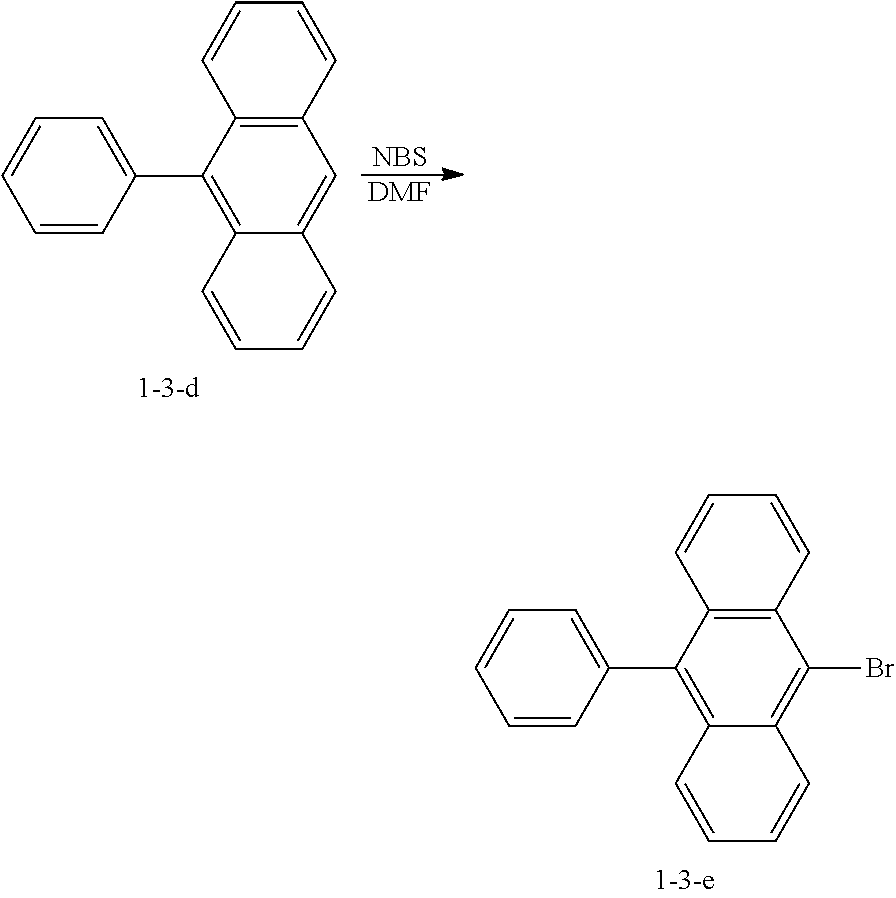
- Compound 1-3-e (17.3 g, yield 88%, MS: [M+H]+=333) was prepared in the same manner as in the preparation method of Compound 1-1-b, except that Compound 1-3-d was used instead of Compound 1-1-a in
Step 2 of Preparation Example 1-1. - Step 6) Preparation of Compound 1-3
-

- Compound 1-3 (7.4 g, yield 32%, MS: [M+H]+=497) was prepared in the same manner as in the preparation method of Compound 1-1, except that Compound 1-3-e was used instead of Compound 1-1-b and Compound 1-3-c was used instead of 2-(dibenzo[b,d]furan-2-yl)-4,4,5,5-tetramethyl-1,3,2-dioxaborolane in
Step 3 of Preparation Example 1-1. - Step 1) Preparation of Compound 1-4-a
-

- Compound 1-4-a (20.1 g, yield 68%, MS: [M+H]+=380) was prepared in the same manner as in the preparation method of Compound 1-1-a, except that (4-phenylnaphthalen-1-yl)boronic acid was used instead of naphthalene-2-yl boronic acid in
Step 1 of Preparation Example 1-1. - Step 2) Preparation of Compound 1-4-b
-

- Compound 1-4-b (15.4 g, yield 85%, MS: [M+H]+=459) was prepared in the same manner as in the preparation method of Compound 1-1-b, except that Compound 1-4-a was used instead of Compound 1-1-a in
Step 2 of Preparation Example 1-1. - Step 3) Preparation of Compound 1-4
-

- Compound 1-4 (5.1 g, yield 28%, MS: [M+H]+=563) was prepared in the same manner as in the preparation method of Compound 1-1, except that Compound 1-4-b was used instead of Compound 1-1-b and dibenzo[b,d]thiophen-4-ylboronic acid was used instead of 2-(dibenzo[b,d]furan-2-yl)-4,4,5,5-tetramethyl-1,3,2-dioxaborolane in
Step 3 of Preparation Example 1-1. -

- In a three-necked flask, 2,7-dibromo-9,9-dimethyl-9H-fluorene (20.0 g, 44.3 mmol) and N-phenyl-[1,1′-biphenyl]-4-amine (30.7 g, 125.0 mmol) were dissolved in xylene (500 mL), and then sodium tert-butoxide (16.4 g, 170.4 mmol) and Pd(P(t-Bu)3)2 (0.3 g, 0.6 mmol) were added thereto. The mixture was stirred at reflux under argon atmosphere for 12 hours. After the reaction was completed, the mixture was cooled to room temperature, and water (300 mL) was added thereto, and the reaction solution was transferred to a separatory funnel, and extracted. The extract was dried over MgSO4, filtered, and concentrated. The sample was purified by silica gel column chromatography and then purified by sublimation to obtain Compound 2-1 (8.1 g, yield 24%, MS: [M+H]+=681).
-

- To a three-necked flask was added a solution where 3,6-dibromo-9-(naphthalen-2-yl)-9H-carbazole (20.0 g, 44.3 mmol) and 4-(diphenyl-amino)phenyl)boronic acid (28.2 g, 97.5 mmol) were dissolved in 1,4-dioxane (400 mL) and K2CO3 (36.8 g, 266.0 mmol) was dissolved in water (200 mL). Pd(P(t-Bu)3)2 (0.2 g, 0.4 mmol) was added thereto, and the mixture was stirred at reflux under an argon atmosphere for 12 hours. After the reaction was completed, the reaction solution was cooled to room temperature, then transferred to a separatory funnel and extracted with water and ethyl acetate. The extract was dried over MgSO4, filtered, and concentrated. The sample was purified by silica gel column chromatography and then purified by sublimation to obtain Compound 2-2 (7.3 g, yield 21% MS: [M+H]+=780).
-

- Compound 2-3 (13.9 g, yield 28%, MS: [M+H]+=807) was prepared in the same manner as in the preparation method of Compound 2-2, except that 2,8-dibromodibenzo[b,d]furan was used instead of 3,6-dibromo-9-(naphthalen-2-yl)-9H-carbazole and (4-([1,1′-biphenyl]-4-yl(phenyl)amino)phenyl)boronic acid was used instead of 4-(diphenylamino)phenyl)boronic acid in Preparation Example 2-2.
-

- Compound 2-4 (14.0 g, yield 31%, MS: [M+H]+=671) was prepared in the same manner as in the preparation method of Compound 2-2, except that 2-bromo-6-chlorodibenzo[b,d]thiophene was used instead of 3,6-dibromo-9-(naphthalen-2-yl)-9H-carbazole in Preparation Example 2-2.
- A glass substrate on which ITO (indium tin oxide) was coated as a thin film to a thickness of 1,400 Å was put into distilled water in which a detergent was dissolved, and ultrasonically cleaned. In this case, a product manufactured by Fischer Co., was used as the detergent, and as the distilled water, distilled water filtered twice using a filter manufactured by Millipore Co., was used. After the ITO was cleaned for 30 minutes, ultrasonic cleaning was repeated twice using distilled water for 10 minutes. After the cleaning with distilled water was completed, the substrate was ultrasonically cleaned with solvents of isopropyl alcohol, acetone, and methanol, then dried, and then transferred to a plasma cleaner. In addition, the substrate was cleaned for 5 minutes using oxygen plasma, and then transferred to a vacuum depositor.
- On the ITO transparent electrode thus prepared, a compound represented by Formula HI-A below and a compound represented by Formula HAT below were sequentially subjected to thermal vacuum-deposition in a thickness of 650 Å and 50 Å, respectively, to form a hole injection layer. Compound 2-1 prepared in the previous Preparation Example 2-1 was vacuum-deposited thereon in a thickness of 600 Å as a hole transport layer, and then a compound represented by Formula EB-1 below was thermally vacuum-deposited in a thickness of 50 Å as an electron blocking layer. Then, the Compound 1-1 prepared in the previous Preparation Example 1-1 and a compound represented by Formula BD below were vacuum-deposited at a weight ratio of 96:4 as a light emitting layer in a thickness of 200 Å. Then, a compound represented by Formula ET-A below and a compound represented by Formula Liq below were thermally vacuum-deposited at a weight ratio of 1:1 in a thickness of 360 Å as an electron transport layer and an electron injection layer, and then the compound represented by Formula Liq below was vacuum-deposited in a thickness of 5 Å. Magnesium and silver were sequentially deposited at a weight ratio of 10:1 on the electron injection layer in a thickness of 220 Å, and aluminum was deposited in a thickness of 1000 Å to form a cathode, thereby manufacturing an organic light emitting device.
-


- An organic light emitting device was manufactured in the same manner as in Example 1-1, except that the compounds shown in Table 1 below were used as the hole transport layer materials and the host materials in Example 1-1.
- An organic light emitting device was manufactured in the same manner as in Example 1-1, except that the compounds shown in Table 1 below were used as the hole transport layer materials and the host materials in Example 1-1. In Table 1, NPB, HT-A, HT-B and BH-A are as follows, respectively.
-

- The device performance was measured at the current density of 10 mA/cm2 for the organic light emitting devices manufactured in Examples and Comparative Examples, and the time required for the initial luminance to decrease to 98% of its initial value at a current density of 20 mA/cm2 was measured. The results are shown in Table 1 below.
-
TABLE 1 Hole transport @10 mA/cm2 @20 mA/cm2 Example layer Host V cd/A CIE-x CIE-y Lifetime (hr) Example 1-1 Compound Compound 3.75 5.21 0.138 0.130 150 2-1 1-1 Example 1-2 Compound Compound 3.83 5.13 0.138 0.130 141 2-1 1-2 Example 1-3 Compound Compound 3.89 5.28 0.139 0.131 166 2-2 1-1 Example 1-4 Compound Compound 3.88 5.31 0.138 0.129 148 2-2 1-2 Example 1-5 Compound Compound 3.90 5.22 0.139 0.131 151 2-2 1-3 Example 1-6 Compound Compound 3.91 5.36 0.137 0.129 152 2-2 1-4 Example 1-7 Compound Compound 3.90 5.24 0.138 0.132 161 2-3 1-3 Example 1-8 Compound Compound 3.91 5.18 0.138 0.131 150 2-3 1-4 Example 1-9 Compound Compound 3.88 5.29 0.137 0.130 140 2-4 1-1 Comparative NPB BH-A 4.54 4.35 0.138 0.130 100 Example 1-1 Comparative Compound BH-A 4.51 4.91 0.138 0.132 60 Example 1-2 2-1 Comparative Compound BH-A 4.67 4.92 0.138 0.130 63 Example 1-3 2-4 Comparative HT-A Compound 3.99 3.15 0.137 0.130 31 Example 1-4 1-1 Comparative HT-B Compound 3.93 4.18 0.140 0.131 55 Example 1-5 1-3 - As shown in Table 1, it was confirmed that the compounds represented by
Chemical Formula 1 of the present invention exhibits low voltage characteristics when used as a host material in the light emitting layer. In addition, the compounds represented byChemical Formula 2 have excellent electron transporting characteristics, and when applied to an electron transport layer, a highly efficient device can be obtained. Particularly, when both of them are applied at the same time, it was confirmed that balance of the hole and electron in the light emitting layer is well matched, so that it has remarkable effect in not only voltage and efficiency but also lifetime, - A glass substrate on which ITO (indium tin oxide) was coated as a thin film to a thickness of 1,400 Å was put into distilled water in which a detergent was dissolved, and ultrasonically cleaned. In this case, a product manufactured by Fischer Co., was used as the detergent, and as the distilled water, distilled water filtered twice using a filter manufactured by Millipore Co., was used. After the ITO was cleaned for 30 minutes, ultrasonic cleaning was repeated twice using distilled water for 10 minutes. After the cleaning with distilled water was completed, the substrate was ultrasonically cleaned with solvents of isopropyl alcohol, acetone, and methanol, then dried, and then transferred to a plasma cleaner. In addition, the substrate was cleaned for 5 minutes using oxygen plasma, and then transferred to a vacuum depositor.
- On the ITO transparent electrode thus prepared, a compound represented by Formula HI-A below and a compound represented by Formula HAT below were sequentially subjected to thermal vacuum-deposition in a thickness of 650 Å and 50 Å, respectively, to form a hole injection layer. A compound represented by Formula NBP below was vacuum-deposited thereon in a thickness of 600 Å as a hole transport layer, and then Compound 2-1 prepared in the previous Preparation Example 2-1 was thermally vacuum-deposited in a thickness of 50 Å as an electron blocking layer. Then, the Compound 1-1 prepared in the previous Preparation Example 1-1 and a compound represented by Formula BD below were vacuum-deposited at a weight ratio of 96:4 as a light emitting layer in a thickness of 200 Å. Then, a compound represented by Formula ET-A below and a compound represented by Formula Liq below were thermally vacuum-deposited at a weight ratio of 1:1 in a thickness of 360 Å as an electron transport layer and an electron injection layer, and then a compound represented by Formula Liq below was vacuum-deposited in a thickness of 5 Å. Magnesium and silver were sequentially deposited at a weight ratio of 10:1 on the electron injection layer in a thickness of 220 Å, and aluminum was deposited in a thickness of 1000 Å to form a cathode, thereby manufacturing an organic light emitting device.
-


- An organic light emitting device was manufactured in the same manner as in Example 2-1, except that the compounds shown in Table 2 below were used as the electron blocking layer materials and the host materials in Example 2-1.
- The organic light emitting device was manufactured in the same manner as in Example 2-1, except that the compounds shown in Table 2 below were used as the electron blocking layer materials and the host materials in Example 2-1. In Table 2, EB-A, EB-B, HT-A, HT-B, and BH-A are as follows, respectively.
-

- The device performance was measured at the current density of 10 mA/cm2 for the organic light emitting devices manufactured in Examples and Comparative Examples, and the time required for the initial luminance to decrease to 90% of its initial value at a current density of 20 mA/cm2 was measured. The results are shown in Table 2 below.
-
TABLE 2 Electron blocking @10 mA/cm2 @20 mA/cm2 Example layer Host V cd/A CIE-x CIE-y Lifetime (hr) Example 2-1 Compound Compound 3.65 5.15 0.138 0.130 151 2-1 1-1 Example 2-2 Compound Compound 3.66 5.16 0.138 0.129 146 2-1 1-2 Example 2-3 Compound Compound 3.51 5.13 0.138 0.130 150 2-2 1-2 Example 2-4 Compound Compound 3.52 5.28 0.139 0.130 164 2-2 1-4 Example 2-5 Compound Compound 3.66 5.18 0.137 0.130 144 2-3 1-1 Example 2-6 Compound Compound 3.58 5.27 0.139 0.131 152 2-3 1-3 Example 2-7 Compound Compound 3.71 5.10 0.138 0.130 154 2-4 1-3 Example 2-8 Compound Compound 3.50 5.10 0.138 0.131 151 2-4 1-4 Comparative EB-A BH-A 4.35 4.83 0.138 0.130 86 Example 2-1 Comparative EB-B BH-A 4.21 4.78 0.140 0.134 80 Example 2-2 Comparative Compound BH-A 3.75 4.01 0.142 0.132 74 Example 2-3 2-1 Comparative Compound BH-A 3.81 4.28 0.139 0.130 76 Example 2-4 2-4 Comparative HT-A Compound 4.57 4.04 0.139 0.141 27 Example 2-5 1-1 Comparative HT-B Compound 4.89 4.55 0.138 0.132 38 Example 2-6 1-2 - As shown in Table 2, it was confirmed that, when the compounds represented by
Chemical Formula 1 of the present invention as a host material is used in combination with the compound represented byChemical Formula 2 as a hole blocking material, a remarkable effect in terms of voltage, efficiency, and lifetime can be obtained. That is, it is confirmed that the efficiency, and lifetime are improved not only when the compounds represented byChemical Formula 2 of the present invention were used as an electron transport layer but also when they are applied as a hole blocking layer. -
[Description of symbols] 1: substrate 2: anode 3: hole transport region 4: light emitting layer 5: cathode 6: hole transport layer 7: electron blocking layer 8: electron transport layer
Claims (13)


Applications Claiming Priority (3)
| Application Number | Priority Date | Filing Date | Title |
|---|---|---|---|
| KR20170030167 | 2017-03-09 | ||
| KR10-2017-0030167 | 2017-03-09 | ||
| PCT/KR2018/002777 WO2018164511A1 (en) | 2017-03-09 | 2018-03-08 | Organic light emitting device |
Related Parent Applications (1)
| Application Number | Title | Priority Date | Filing Date |
|---|---|---|---|
| PCT/KR2018/002777 A-371-Of-International WO2018164511A1 (en) | 2017-03-09 | 2018-03-08 | Organic light emitting device |
Related Child Applications (1)
| Application Number | Title | Priority Date | Filing Date |
|---|---|---|---|
| US17/867,906 Continuation US20220384729A1 (en) | 2017-03-09 | 2022-07-19 | Organic light emitting device |
Publications (1)
| Publication Number | Publication Date |
|---|---|
| US20200013957A1 true US20200013957A1 (en) | 2020-01-09 |
Family
ID=63447939
Family Applications (2)
| Application Number | Title | Priority Date | Filing Date |
|---|---|---|---|
| US16/490,050 Abandoned US20200013957A1 (en) | 2017-03-09 | 2018-03-08 | Organic light emitting device |
| US17/867,906 Abandoned US20220384729A1 (en) | 2017-03-09 | 2022-07-19 | Organic light emitting device |
Family Applications After (1)
| Application Number | Title | Priority Date | Filing Date |
|---|---|---|---|
| US17/867,906 Abandoned US20220384729A1 (en) | 2017-03-09 | 2022-07-19 | Organic light emitting device |
Country Status (6)
| Country | Link |
|---|---|
| US (2) | US20200013957A1 (en) |
| EP (1) | EP3579292B1 (en) |
| JP (1) | JP6772432B2 (en) |
| KR (1) | KR102107087B1 (en) |
| CN (1) | CN109564972B (en) |
| WO (1) | WO2018164511A1 (en) |
Cited By (3)
| Publication number | Priority date | Publication date | Assignee | Title |
|---|---|---|---|---|
| US11864460B2 (en) | 2018-09-20 | 2024-01-02 | Lg Chem, Ltd. | Organic light emitting device |
| US12453284B2 (en) | 2019-10-30 | 2025-10-21 | Lg Chem, Ltd. | Anthracene compound and organic light-emitting device comprising same |
| US12492216B2 (en) | 2021-02-25 | 2025-12-09 | Samsung Sdi Co., Ltd. | Compound for organic optoelectronic device, composition for organic optoelectronic device, organic optoelectronic device and display device |
Families Citing this family (18)
| Publication number | Priority date | Publication date | Assignee | Title |
|---|---|---|---|---|
| US11177446B2 (en) | 2017-09-14 | 2021-11-16 | Beijing Summer Sprout Technology Co., Ltd. | Silicon containing organic fluorescent materials |
| KR102245926B1 (en) * | 2018-09-20 | 2021-04-29 | 주식회사 엘지화학 | Organic light emitting device |
| KR102778223B1 (en) * | 2019-01-28 | 2025-03-10 | 주식회사 엘지화학 | Organic light emitting device |
| CN110128399B (en) * | 2019-05-31 | 2021-11-23 | 常州大学 | Organic molecular material based on dibenzo five-membered aromatic heterocycle, synthetic method thereof and application of organic molecular material as hole transport layer |
| KR102616373B1 (en) * | 2020-01-20 | 2023-12-20 | 주식회사 엘지화학 | Organic electroluminescent device |
| KR102616375B1 (en) * | 2020-01-20 | 2023-12-20 | 주식회사 엘지화학 | Organic electroluminescent device |
| KR102588656B1 (en) * | 2020-03-31 | 2023-10-12 | 주식회사 엘지화학 | Organic light emitting device |
| KR102711427B1 (en) | 2020-06-02 | 2024-09-26 | 삼성에스디아이 주식회사 | Composition for organic optoelectronic device, organic optoelectronic device and display device |
| KR20220034703A (en) * | 2020-09-11 | 2022-03-18 | 주식회사 동진쎄미켐 | New compound for protecting layer of reflective electrode and back-emitting device comprising the same |
| CN115124495B (en) * | 2021-03-29 | 2024-06-11 | 江苏三月科技股份有限公司 | Organic compound and organic electroluminescent device comprising same |
| CN115368326B (en) * | 2021-05-20 | 2024-07-12 | 江苏三月科技股份有限公司 | Indene modified anthracene organic compound and application thereof in organic electroluminescent device |
| CN113582909B (en) * | 2021-07-30 | 2023-04-25 | 上海钥熠电子科技有限公司 | Large steric hindrance carbazole compound and application thereof in organic electroluminescent display device |
| CN114242907B (en) * | 2021-11-03 | 2024-07-26 | 阜阳欣奕华材料科技有限公司 | Organic electroluminescent device and display device |
| CN115872874B (en) * | 2021-12-20 | 2024-11-05 | 阜阳欣奕华新材料科技股份有限公司 | Organic compound and application thereof |
| CN114890986A (en) * | 2022-05-16 | 2022-08-12 | 内蒙古大学 | Preparation method and application of thiafluorenyl aggregation-induced emission compound |
| CN114890985A (en) * | 2022-05-16 | 2022-08-12 | 内蒙古大学 | Preparation method of electron donating group substituted thiafluorene derivative |
| CN114890983A (en) * | 2022-05-16 | 2022-08-12 | 内蒙古大学 | A kind of preparation method of hydroxyl-substituted thiafluorene |
| CN114907394B (en) * | 2022-06-21 | 2025-01-07 | 上海八亿时空先进材料有限公司 | A silane fluorene derivative and an organic electroluminescent element containing the same |
Family Cites Families (15)
| Publication number | Priority date | Publication date | Assignee | Title |
|---|---|---|---|---|
| KR100430549B1 (en) | 1999-01-27 | 2004-05-10 | 주식회사 엘지화학 | New organomattalic complex molecule for the fabrication of organic light emitting diodes |
| DE10135513B4 (en) | 2001-07-20 | 2005-02-24 | Novaled Gmbh | Light-emitting component with organic layers |
| TWI373506B (en) * | 2004-05-21 | 2012-10-01 | Toray Industries | Light-emitting element material and light-emitting material |
| DE602006011734D1 (en) * | 2005-05-30 | 2010-03-04 | Basf Se | ELECTROLUMINESCENT DEVICE |
| JP5079231B2 (en) * | 2005-11-16 | 2012-11-21 | 三井化学株式会社 | Thin film, low molecular organic material, and organic electroluminescent device comprising the thin film comprising the low molecular organic material |
| JP2009170809A (en) * | 2008-01-18 | 2009-07-30 | Mitsui Chemicals Inc | Organic electroluminescent element |
| KR101561479B1 (en) * | 2008-12-05 | 2015-10-19 | 롬엔드하스전자재료코리아유한회사 | Novel organic electroluminescent compounds and organic electroluminescent device using the same |
| KR20130067312A (en) * | 2009-12-16 | 2013-06-21 | 이데미쓰 고산 가부시키가이샤 | Organic light-emitting medium |
| CN107994062B (en) * | 2011-11-11 | 2022-07-01 | 三菱化学株式会社 | Composition for forming light-emitting layer and method for manufacturing organic electroluminescent device |
| US9054323B2 (en) * | 2012-03-15 | 2015-06-09 | Universal Display Corporation | Secondary hole transporting layer with diarylamino-phenyl-carbazole compounds |
| KR102104357B1 (en) * | 2012-12-24 | 2020-04-27 | 엘지디스플레이 주식회사 | Blue Fluorescence Compounds and Organic Light Emitting Diode Device using the same |
| KR102054159B1 (en) * | 2013-07-09 | 2019-12-10 | 덕산네오룩스 주식회사 | An organic electronic element using compound for organic electronic element, and an electronic device thereof |
| CN118530203A (en) * | 2015-04-23 | 2024-08-23 | Sfc株式会社 | Compound for organic light-emitting element and organic light-emitting element including the compound |
| US10367147B2 (en) * | 2015-05-27 | 2019-07-30 | Samsung Display Co., Ltd. | Organic light-emitting device |
| KR102427250B1 (en) * | 2015-11-30 | 2022-08-01 | 삼성디스플레이 주식회사 | Organic light emitting device |
-
2018
- 2018-03-08 US US16/490,050 patent/US20200013957A1/en not_active Abandoned
- 2018-03-08 KR KR1020180027500A patent/KR102107087B1/en active Active
- 2018-03-08 WO PCT/KR2018/002777 patent/WO2018164511A1/en not_active Ceased
- 2018-03-08 CN CN201880002923.7A patent/CN109564972B/en active Active
- 2018-03-08 EP EP18764723.5A patent/EP3579292B1/en active Active
- 2018-03-08 JP JP2019546185A patent/JP6772432B2/en active Active
-
2022
- 2022-07-19 US US17/867,906 patent/US20220384729A1/en not_active Abandoned
Non-Patent Citations (4)
| Title |
|---|
| A screen shot of web page address - https://pubchem.ncbi.nlm.nih.gov/substance/87568875 (Year: 2022) * |
| English translation of JP 2002/234888 A and the original document JP 2002/234888 A, Yoshiyuki Totani, 08/23/2002 (Year: 2002) * |
| English translation of KR 2015/0006722 A and the original document KR 2015/0006722 A, Yun Suk Lee, 01/19/2015 (Year: 2015) * |
| Machine translated English version of JP 2005/112765 A and the original JP 2005/112765 A, Takehiko Shimamura, 04/28/2005 (Year: 2005) * |
Cited By (3)
| Publication number | Priority date | Publication date | Assignee | Title |
|---|---|---|---|---|
| US11864460B2 (en) | 2018-09-20 | 2024-01-02 | Lg Chem, Ltd. | Organic light emitting device |
| US12453284B2 (en) | 2019-10-30 | 2025-10-21 | Lg Chem, Ltd. | Anthracene compound and organic light-emitting device comprising same |
| US12492216B2 (en) | 2021-02-25 | 2025-12-09 | Samsung Sdi Co., Ltd. | Compound for organic optoelectronic device, composition for organic optoelectronic device, organic optoelectronic device and display device |
Also Published As
| Publication number | Publication date |
|---|---|
| JP2020511001A (en) | 2020-04-09 |
| US20220384729A1 (en) | 2022-12-01 |
| CN109564972A (en) | 2019-04-02 |
| JP6772432B2 (en) | 2020-10-21 |
| EP3579292A1 (en) | 2019-12-11 |
| EP3579292A4 (en) | 2020-02-26 |
| KR102107087B1 (en) | 2020-05-06 |
| KR20180103737A (en) | 2018-09-19 |
| WO2018164511A1 (en) | 2018-09-13 |
| EP3579292B1 (en) | 2020-08-05 |
| CN109564972B (en) | 2023-02-03 |
Similar Documents
| Publication | Publication Date | Title |
|---|---|---|
| US20220384729A1 (en) | Organic light emitting device | |
| US12275736B2 (en) | Compound and organic light emitting device comprising the same | |
| US11239425B2 (en) | Organic light emitting device | |
| US12325713B2 (en) | Compound and organic light emitting device comprising the same | |
| US12060372B2 (en) | Compound and organic light emitting device comprising the same | |
| US11211563B2 (en) | Organic light emitting device | |
| US20190214571A1 (en) | Organic light emitting device | |
| US20200207754A1 (en) | Novel heterocyclic compounds and organic light emitting device using the same | |
| US11370782B2 (en) | Compound and organic light emitting device comprising the same | |
| US12250879B2 (en) | Heterocyclic compound and organic light emitting device comprising the same | |
| US20210399234A1 (en) | Organic light emitting device | |
| US20230240140A1 (en) | Organic light emitting device | |
| US12058931B2 (en) | Heterocyclic compound and organic light emitting device comprising same | |
| US11925113B2 (en) | Heterocyclic compound and organic light emitting device comprising the same | |
| US11787818B2 (en) | Compound and organic light emitting device comprising the same | |
| US20240397814A1 (en) | Novel compound and organic light-emitting device comprising the same | |
| US12133459B2 (en) | Heterocyclic compound and organic light emitting device comprising same | |
| US10833278B2 (en) | Compound and organic light emitting device comprising the same | |
| US20250127043A1 (en) | Novel compound and organic light emitting device comprising the same | |
| US11987592B2 (en) | Compound and organic light emitting device comprising the same | |
| US20240251668A1 (en) | Novel compound and organic light-emitting device using same | |
| US11980090B2 (en) | Compound and organic light emitting device comprising the same | |
| US11832517B2 (en) | Heterocyclic compound and organic light emitting device comprising same | |
| US12507589B2 (en) | Organic light emitting device | |
| US20210388001A1 (en) | Novel compound and organic light emitting device comprising the same |
Legal Events
| Date | Code | Title | Description |
|---|---|---|---|
| AS | Assignment |
Owner name: LG CHEM, LTD., KOREA, REPUBLIC OF Free format text: ASSIGNMENT OF ASSIGNORS INTEREST;ASSIGNORS:SUH, SANG DUK;HONG, SUNG KIL;KIM, SEONG SO;REEL/FRAME:050218/0038 Effective date: 20190813 |
|
| STPP | Information on status: patent application and granting procedure in general |
Free format text: NON FINAL ACTION MAILED |
|
| STPP | Information on status: patent application and granting procedure in general |
Free format text: RESPONSE TO NON-FINAL OFFICE ACTION ENTERED AND FORWARDED TO EXAMINER |
|
| STPP | Information on status: patent application and granting procedure in general |
Free format text: FINAL REJECTION MAILED |
|
| STPP | Information on status: patent application and granting procedure in general |
Free format text: DOCKETED NEW CASE - READY FOR EXAMINATION |
|
| STPP | Information on status: patent application and granting procedure in general |
Free format text: NON FINAL ACTION MAILED |
|
| STPP | Information on status: patent application and granting procedure in general |
Free format text: RESPONSE TO NON-FINAL OFFICE ACTION ENTERED AND FORWARDED TO EXAMINER |
|
| STPP | Information on status: patent application and granting procedure in general |
Free format text: FINAL REJECTION MAILED |
|
| STCB | Information on status: application discontinuation |
Free format text: ABANDONED -- FAILURE TO RESPOND TO AN OFFICE ACTION |
|
| STCB | Information on status: application discontinuation |
Free format text: ABANDONED -- FAILURE TO RESPOND TO AN OFFICE ACTION |