US20190284146A1 - M-dihydroxybenzene derivative crystal and salt, and manufacturing method thereof - Google Patents
M-dihydroxybenzene derivative crystal and salt, and manufacturing method thereof Download PDFInfo
- Publication number
- US20190284146A1 US20190284146A1 US16/318,606 US201716318606A US2019284146A1 US 20190284146 A1 US20190284146 A1 US 20190284146A1 US 201716318606 A US201716318606 A US 201716318606A US 2019284146 A1 US2019284146 A1 US 2019284146A1
- Authority
- US
- United States
- Prior art keywords
- compound
- formula
- crystalline form
- salt
- cancer
- Prior art date
- Legal status (The legal status is an assumption and is not a legal conclusion. Google has not performed a legal analysis and makes no representation as to the accuracy of the status listed.)
- Granted
Links
- 150000003839 salts Chemical class 0.000 title claims abstract description 34
- 239000013078 crystal Substances 0.000 title abstract description 147
- 238000004519 manufacturing process Methods 0.000 title abstract description 4
- 150000005207 1,3-dihydroxybenzenes Chemical class 0.000 title abstract description 3
- 101710113864 Heat shock protein 90 Proteins 0.000 claims abstract description 27
- 102100034051 Heat shock protein HSP 90-alpha Human genes 0.000 claims abstract description 27
- 201000010099 disease Diseases 0.000 claims abstract description 13
- 208000037265 diseases, disorders, signs and symptoms Diseases 0.000 claims abstract description 13
- 230000001404 mediated effect Effects 0.000 claims abstract description 9
- 150000001875 compounds Chemical class 0.000 claims description 235
- 239000000203 mixture Substances 0.000 claims description 50
- 238000000034 method Methods 0.000 claims description 34
- 206010028980 Neoplasm Diseases 0.000 claims description 33
- 238000000634 powder X-ray diffraction Methods 0.000 claims description 27
- VEXZGXHMUGYJMC-UHFFFAOYSA-N Hydrochloric acid Chemical compound Cl VEXZGXHMUGYJMC-UHFFFAOYSA-N 0.000 claims description 25
- VZCYOOQTPOCHFL-UHFFFAOYSA-N trans-butenedioic acid Natural products OC(=O)C=CC(O)=O VZCYOOQTPOCHFL-UHFFFAOYSA-N 0.000 claims description 25
- -1 ρ-toluenesulfonate Chemical compound 0.000 claims description 19
- AFVFQIVMOAPDHO-UHFFFAOYSA-N Methanesulfonic acid Chemical compound CS(O)(=O)=O AFVFQIVMOAPDHO-UHFFFAOYSA-N 0.000 claims description 18
- VZCYOOQTPOCHFL-OWOJBTEDSA-N Fumaric acid Chemical compound OC(=O)\C=C\C(O)=O VZCYOOQTPOCHFL-OWOJBTEDSA-N 0.000 claims description 14
- VZCYOOQTPOCHFL-UPHRSURJSA-N maleic acid Chemical compound OC(=O)\C=C/C(O)=O VZCYOOQTPOCHFL-UPHRSURJSA-N 0.000 claims description 14
- QAOWNCQODCNURD-UHFFFAOYSA-N Sulfuric acid Chemical compound OS(O)(=O)=O QAOWNCQODCNURD-UHFFFAOYSA-N 0.000 claims description 12
- KRKNYBCHXYNGOX-UHFFFAOYSA-N citric acid Chemical compound OC(=O)CC(O)(C(O)=O)CC(O)=O KRKNYBCHXYNGOX-UHFFFAOYSA-N 0.000 claims description 12
- 238000001938 differential scanning calorimetry curve Methods 0.000 claims description 12
- DTQVDTLACAAQTR-UHFFFAOYSA-N Trifluoroacetic acid Chemical compound OC(=O)C(F)(F)F DTQVDTLACAAQTR-UHFFFAOYSA-N 0.000 claims description 11
- 201000011510 cancer Diseases 0.000 claims description 11
- 239000008194 pharmaceutical composition Substances 0.000 claims description 11
- QAOWNCQODCNURD-UHFFFAOYSA-L Sulfate Chemical compound [O-]S([O-])(=O)=O QAOWNCQODCNURD-UHFFFAOYSA-L 0.000 claims description 10
- 210000004027 cell Anatomy 0.000 claims description 9
- KRKNYBCHXYNGOX-UHFFFAOYSA-K Citrate Chemical compound [O-]C(=O)CC(O)(CC([O-])=O)C([O-])=O KRKNYBCHXYNGOX-UHFFFAOYSA-K 0.000 claims description 8
- CPELXLSAUQHCOX-UHFFFAOYSA-N Hydrogen bromide Chemical compound Br CPELXLSAUQHCOX-UHFFFAOYSA-N 0.000 claims description 8
- 229910019142 PO4 Inorganic materials 0.000 claims description 8
- DTQVDTLACAAQTR-UHFFFAOYSA-M Trifluoroacetate Chemical compound [O-]C(=O)C(F)(F)F DTQVDTLACAAQTR-UHFFFAOYSA-M 0.000 claims description 8
- NBIIXXVUZAFLBC-UHFFFAOYSA-K phosphate Chemical compound [O-]P([O-])([O-])=O NBIIXXVUZAFLBC-UHFFFAOYSA-K 0.000 claims description 8
- 239000010452 phosphate Substances 0.000 claims description 8
- 206010006187 Breast cancer Diseases 0.000 claims description 6
- 208000026310 Breast neoplasm Diseases 0.000 claims description 6
- NBIIXXVUZAFLBC-UHFFFAOYSA-N Phosphoric acid Chemical compound OP(O)(O)=O NBIIXXVUZAFLBC-UHFFFAOYSA-N 0.000 claims description 6
- JOXIMZWYDAKGHI-UHFFFAOYSA-N toluene-4-sulfonic acid Chemical compound CC1=CC=C(S(O)(=O)=O)C=C1 JOXIMZWYDAKGHI-UHFFFAOYSA-N 0.000 claims description 6
- 208000018737 Parkinson disease Diseases 0.000 claims description 5
- 208000015122 neurodegenerative disease Diseases 0.000 claims description 5
- 208000024893 Acute lymphoblastic leukemia Diseases 0.000 claims description 4
- 208000014697 Acute lymphocytic leukaemia Diseases 0.000 claims description 4
- 208000024827 Alzheimer disease Diseases 0.000 claims description 4
- 208000006664 Precursor Cell Lymphoblastic Leukemia-Lymphoma Diseases 0.000 claims description 4
- OFOBLEOULBTSOW-UHFFFAOYSA-N Propanedioic acid Natural products OC(=O)CC(O)=O OFOBLEOULBTSOW-UHFFFAOYSA-N 0.000 claims description 4
- 239000011976 maleic acid Substances 0.000 claims description 4
- 229940098779 methanesulfonic acid Drugs 0.000 claims description 4
- BMYNFMYTOJXKLE-UHFFFAOYSA-N 3-azaniumyl-2-hydroxypropanoate Chemical compound NCC(O)C(O)=O BMYNFMYTOJXKLE-UHFFFAOYSA-N 0.000 claims description 3
- 102100032187 Androgen receptor Human genes 0.000 claims description 3
- 101000775732 Homo sapiens Androgen receptor Proteins 0.000 claims description 3
- 208000023105 Huntington disease Diseases 0.000 claims description 3
- 206010058467 Lung neoplasm malignant Diseases 0.000 claims description 3
- 208000006269 X-Linked Bulbo-Spinal Atrophy Diseases 0.000 claims description 3
- 229910000147 aluminium phosphate Inorganic materials 0.000 claims description 3
- 239000001530 fumaric acid Substances 0.000 claims description 3
- 201000005202 lung cancer Diseases 0.000 claims description 3
- 208000020816 lung neoplasm Diseases 0.000 claims description 3
- 201000006417 multiple sclerosis Diseases 0.000 claims description 3
- 208000031261 Acute myeloid leukaemia Diseases 0.000 claims description 2
- 208000036762 Acute promyelocytic leukaemia Diseases 0.000 claims description 2
- 206010003571 Astrocytoma Diseases 0.000 claims description 2
- 208000003950 B-cell lymphoma Diseases 0.000 claims description 2
- 208000032791 BCR-ABL1 positive chronic myelogenous leukemia Diseases 0.000 claims description 2
- 206010005003 Bladder cancer Diseases 0.000 claims description 2
- 208000011691 Burkitt lymphomas Diseases 0.000 claims description 2
- 201000009030 Carcinoma Diseases 0.000 claims description 2
- 206010008342 Cervix carcinoma Diseases 0.000 claims description 2
- 208000010833 Chronic myeloid leukaemia Diseases 0.000 claims description 2
- 206010009944 Colon cancer Diseases 0.000 claims description 2
- 208000000461 Esophageal Neoplasms Diseases 0.000 claims description 2
- 201000008808 Fibrosarcoma Diseases 0.000 claims description 2
- 208000022072 Gallbladder Neoplasms Diseases 0.000 claims description 2
- 208000032612 Glial tumor Diseases 0.000 claims description 2
- 206010018338 Glioma Diseases 0.000 claims description 2
- 208000017604 Hodgkin disease Diseases 0.000 claims description 2
- 208000021519 Hodgkin lymphoma Diseases 0.000 claims description 2
- 208000010747 Hodgkins lymphoma Diseases 0.000 claims description 2
- 208000007766 Kaposi sarcoma Diseases 0.000 claims description 2
- 208000008839 Kidney Neoplasms Diseases 0.000 claims description 2
- 206010025323 Lymphomas Diseases 0.000 claims description 2
- 201000003793 Myelodysplastic syndrome Diseases 0.000 claims description 2
- 208000033761 Myelogenous Chronic BCR-ABL Positive Leukemia Diseases 0.000 claims description 2
- 208000033776 Myeloid Acute Leukemia Diseases 0.000 claims description 2
- 208000008846 Neurocytoma Diseases 0.000 claims description 2
- 208000015914 Non-Hodgkin lymphomas Diseases 0.000 claims description 2
- 206010030155 Oesophageal carcinoma Diseases 0.000 claims description 2
- 206010033128 Ovarian cancer Diseases 0.000 claims description 2
- 206010061535 Ovarian neoplasm Diseases 0.000 claims description 2
- 206010061902 Pancreatic neoplasm Diseases 0.000 claims description 2
- 206010060862 Prostate cancer Diseases 0.000 claims description 2
- 208000000236 Prostatic Neoplasms Diseases 0.000 claims description 2
- 206010038389 Renal cancer Diseases 0.000 claims description 2
- 201000010208 Seminoma Diseases 0.000 claims description 2
- 208000000453 Skin Neoplasms Diseases 0.000 claims description 2
- 206010041067 Small cell lung cancer Diseases 0.000 claims description 2
- 208000005718 Stomach Neoplasms Diseases 0.000 claims description 2
- 206010042971 T-cell lymphoma Diseases 0.000 claims description 2
- 208000027585 T-cell non-Hodgkin lymphoma Diseases 0.000 claims description 2
- 208000024770 Thyroid neoplasm Diseases 0.000 claims description 2
- 208000007097 Urinary Bladder Neoplasms Diseases 0.000 claims description 2
- 208000006105 Uterine Cervical Neoplasms Diseases 0.000 claims description 2
- 201000006083 Xeroderma Pigmentosum Diseases 0.000 claims description 2
- 230000001154 acute effect Effects 0.000 claims description 2
- 210000003169 central nervous system Anatomy 0.000 claims description 2
- 201000010881 cervical cancer Diseases 0.000 claims description 2
- 208000029742 colonic neoplasm Diseases 0.000 claims description 2
- 201000004101 esophageal cancer Diseases 0.000 claims description 2
- 201000010175 gallbladder cancer Diseases 0.000 claims description 2
- 201000008361 ganglioneuroma Diseases 0.000 claims description 2
- 206010017758 gastric cancer Diseases 0.000 claims description 2
- 230000003394 haemopoietic effect Effects 0.000 claims description 2
- 201000005787 hematologic cancer Diseases 0.000 claims description 2
- 208000024200 hematopoietic and lymphoid system neoplasm Diseases 0.000 claims description 2
- 201000010982 kidney cancer Diseases 0.000 claims description 2
- 208000032839 leukemia Diseases 0.000 claims description 2
- 201000007270 liver cancer Diseases 0.000 claims description 2
- 208000014018 liver neoplasm Diseases 0.000 claims description 2
- 230000001926 lymphatic effect Effects 0.000 claims description 2
- 208000015486 malignant pancreatic neoplasm Diseases 0.000 claims description 2
- 201000001441 melanoma Diseases 0.000 claims description 2
- 201000008968 osteosarcoma Diseases 0.000 claims description 2
- 201000002528 pancreatic cancer Diseases 0.000 claims description 2
- 208000008443 pancreatic carcinoma Diseases 0.000 claims description 2
- 210000001428 peripheral nervous system Anatomy 0.000 claims description 2
- 201000009410 rhabdomyosarcoma Diseases 0.000 claims description 2
- 201000000849 skin cancer Diseases 0.000 claims description 2
- 208000000587 small cell lung carcinoma Diseases 0.000 claims description 2
- 206010041823 squamous cell carcinoma Diseases 0.000 claims description 2
- 201000011549 stomach cancer Diseases 0.000 claims description 2
- 208000001608 teratocarcinoma Diseases 0.000 claims description 2
- 201000002510 thyroid cancer Diseases 0.000 claims description 2
- 208000030901 thyroid gland follicular carcinoma Diseases 0.000 claims description 2
- 201000005112 urinary bladder cancer Diseases 0.000 claims description 2
- 239000000825 pharmaceutical preparation Substances 0.000 abstract 1
- 229940127557 pharmaceutical product Drugs 0.000 abstract 1
- 239000007787 solid Substances 0.000 description 74
- 239000000243 solution Substances 0.000 description 70
- WYURNTSHIVDZCO-UHFFFAOYSA-N Tetrahydrofuran Chemical compound C1CCOC1 WYURNTSHIVDZCO-UHFFFAOYSA-N 0.000 description 64
- XEKOWRVHYACXOJ-UHFFFAOYSA-N Ethyl acetate Chemical group CCOC(C)=O XEKOWRVHYACXOJ-UHFFFAOYSA-N 0.000 description 50
- YMWUJEATGCHHMB-UHFFFAOYSA-N Dichloromethane Chemical compound ClCCl YMWUJEATGCHHMB-UHFFFAOYSA-N 0.000 description 48
- 238000006243 chemical reaction Methods 0.000 description 45
- OKKJLVBELUTLKV-UHFFFAOYSA-N Methanol Chemical compound OC OKKJLVBELUTLKV-UHFFFAOYSA-N 0.000 description 42
- LFQSCWFLJHTTHZ-UHFFFAOYSA-N Ethanol Chemical compound CCO LFQSCWFLJHTTHZ-UHFFFAOYSA-N 0.000 description 41
- XLYOFNOQVPJJNP-UHFFFAOYSA-N water Substances O XLYOFNOQVPJJNP-UHFFFAOYSA-N 0.000 description 37
- CSCPPACGZOOCGX-UHFFFAOYSA-N Acetone Chemical compound CC(C)=O CSCPPACGZOOCGX-UHFFFAOYSA-N 0.000 description 21
- 239000012043 crude product Substances 0.000 description 20
- WEVYAHXRMPXWCK-UHFFFAOYSA-N Acetonitrile Chemical compound CC#N WEVYAHXRMPXWCK-UHFFFAOYSA-N 0.000 description 18
- 239000002904 solvent Substances 0.000 description 18
- 235000019439 ethyl acetate Nutrition 0.000 description 17
- 238000001914 filtration Methods 0.000 description 17
- 102000004169 proteins and genes Human genes 0.000 description 17
- 108090000623 proteins and genes Proteins 0.000 description 17
- ZMXDDKWLCZADIW-UHFFFAOYSA-N N,N-Dimethylformamide Chemical compound CN(C)C=O ZMXDDKWLCZADIW-UHFFFAOYSA-N 0.000 description 16
- 238000012360 testing method Methods 0.000 description 16
- 239000012074 organic phase Substances 0.000 description 15
- YLQBMQCUIZJEEH-UHFFFAOYSA-N tetrahydrofuran Natural products C=1C=COC=1 YLQBMQCUIZJEEH-UHFFFAOYSA-N 0.000 description 15
- 210000001519 tissue Anatomy 0.000 description 15
- ZMANZCXQSJIPKH-UHFFFAOYSA-N Triethylamine Chemical compound CCN(CC)CC ZMANZCXQSJIPKH-UHFFFAOYSA-N 0.000 description 13
- 238000003756 stirring Methods 0.000 description 13
- 238000001291 vacuum drying Methods 0.000 description 13
- QTBSBXVTEAMEQO-UHFFFAOYSA-N Acetic acid Chemical compound CC(O)=O QTBSBXVTEAMEQO-UHFFFAOYSA-N 0.000 description 12
- IJGRMHOSHXDMSA-UHFFFAOYSA-N Atomic nitrogen Chemical compound N#N IJGRMHOSHXDMSA-UHFFFAOYSA-N 0.000 description 12
- KFZMGEQAYNKOFK-UHFFFAOYSA-N Isopropanol Chemical compound CC(C)O KFZMGEQAYNKOFK-UHFFFAOYSA-N 0.000 description 12
- 238000002360 preparation method Methods 0.000 description 12
- 239000000126 substance Substances 0.000 description 12
- PMZURENOXWZQFD-UHFFFAOYSA-L Sodium Sulfate Chemical compound [Na+].[Na+].[O-]S([O-])(=O)=O PMZURENOXWZQFD-UHFFFAOYSA-L 0.000 description 11
- KDLHZDBZIXYQEI-UHFFFAOYSA-N palladium Substances [Pd] KDLHZDBZIXYQEI-UHFFFAOYSA-N 0.000 description 11
- 239000002244 precipitate Substances 0.000 description 11
- 239000000047 product Substances 0.000 description 11
- JGFZNNIVVJXRND-UHFFFAOYSA-N N,N-Diisopropylethylamine (DIPEA) Chemical compound CCN(C(C)C)C(C)C JGFZNNIVVJXRND-UHFFFAOYSA-N 0.000 description 10
- 241000700159 Rattus Species 0.000 description 10
- FAPWRFPIFSIZLT-UHFFFAOYSA-M Sodium chloride Chemical compound [Na+].[Cl-] FAPWRFPIFSIZLT-UHFFFAOYSA-M 0.000 description 10
- 238000004458 analytical method Methods 0.000 description 10
- 238000010438 heat treatment Methods 0.000 description 10
- RTZKZFJDLAIYFH-UHFFFAOYSA-N Diethyl ether Chemical compound CCOCC RTZKZFJDLAIYFH-UHFFFAOYSA-N 0.000 description 9
- BZLVMXJERCGZMT-UHFFFAOYSA-N Methyl tert-butyl ether Chemical compound COC(C)(C)C BZLVMXJERCGZMT-UHFFFAOYSA-N 0.000 description 9
- UIIMBOGNXHQVGW-UHFFFAOYSA-M Sodium bicarbonate Chemical compound [Na+].OC([O-])=O UIIMBOGNXHQVGW-UHFFFAOYSA-M 0.000 description 9
- YXFVVABEGXRONW-UHFFFAOYSA-N Toluene Chemical compound CC1=CC=CC=C1 YXFVVABEGXRONW-UHFFFAOYSA-N 0.000 description 9
- 230000000694 effects Effects 0.000 description 9
- 239000003481 heat shock protein 90 inhibitor Substances 0.000 description 9
- 239000011541 reaction mixture Substances 0.000 description 9
- 238000001228 spectrum Methods 0.000 description 9
- 239000000872 buffer Substances 0.000 description 8
- 239000002775 capsule Substances 0.000 description 8
- 239000003814 drug Substances 0.000 description 8
- 229950004161 ganetespib Drugs 0.000 description 8
- QTQAWLPCGQOSGP-GBTDJJJQSA-N geldanamycin Chemical compound N1C(=O)\C(C)=C/C=C\[C@@H](OC)[C@H](OC(N)=O)\C(C)=C/[C@@H](C)[C@@H](O)[C@H](OC)C[C@@H](C)CC2=C(OC)C(=O)C=C1C2=O QTQAWLPCGQOSGP-GBTDJJJQSA-N 0.000 description 8
- RIOQSEWOXXDEQQ-UHFFFAOYSA-N triphenylphosphine Chemical compound C1=CC=CC=C1P(C=1C=CC=CC=1)C1=CC=CC=C1 RIOQSEWOXXDEQQ-UHFFFAOYSA-N 0.000 description 8
- MWTUOSWPJOUADP-XDJHFCHBSA-N (5z)-5-(4-hydroxy-6-oxo-3-propan-2-ylcyclohexa-2,4-dien-1-ylidene)-4-(1-methylindol-5-yl)-1,2,4-triazolidin-3-one Chemical compound O=C1C=C(O)C(C(C)C)=C\C1=C\1N(C=2C=C3C=CN(C)C3=CC=2)C(=O)NN/1 MWTUOSWPJOUADP-XDJHFCHBSA-N 0.000 description 7
- JRZJKWGQFNTSRN-UHFFFAOYSA-N Geldanamycin Natural products C1C(C)CC(OC)C(O)C(C)C=C(C)C(OC(N)=O)C(OC)CCC=C(C)C(=O)NC2=CC(=O)C(OC)=C1C2=O JRZJKWGQFNTSRN-UHFFFAOYSA-N 0.000 description 7
- 239000003921 oil Substances 0.000 description 7
- 239000002994 raw material Substances 0.000 description 7
- SWDZPNJZKUGIIH-QQTULTPQSA-N (5z)-n-ethyl-5-(4-hydroxy-6-oxo-3-propan-2-ylcyclohexa-2,4-dien-1-ylidene)-4-[4-(morpholin-4-ylmethyl)phenyl]-2h-1,2-oxazole-3-carboxamide Chemical compound O1NC(C(=O)NCC)=C(C=2C=CC(CN3CCOCC3)=CC=2)\C1=C1/C=C(C(C)C)C(O)=CC1=O SWDZPNJZKUGIIH-QQTULTPQSA-N 0.000 description 6
- IMNFDUFMRHMDMM-UHFFFAOYSA-N N-Heptane Chemical compound CCCCCCC IMNFDUFMRHMDMM-UHFFFAOYSA-N 0.000 description 6
- JRNVZBWKYDBUCA-UHFFFAOYSA-N N-chlorosuccinimide Chemical compound ClN1C(=O)CCC1=O JRNVZBWKYDBUCA-UHFFFAOYSA-N 0.000 description 6
- 210000000481 breast Anatomy 0.000 description 6
- 239000012065 filter cake Substances 0.000 description 6
- 229950005069 luminespib Drugs 0.000 description 6
- 210000004072 lung Anatomy 0.000 description 6
- 238000002844 melting Methods 0.000 description 6
- 230000008018 melting Effects 0.000 description 6
- 229910052757 nitrogen Inorganic materials 0.000 description 6
- 239000003826 tablet Substances 0.000 description 6
- DYHSDKLCOJIUFX-UHFFFAOYSA-N tert-butoxycarbonyl anhydride Chemical compound CC(C)(C)OC(=O)OC(=O)OC(C)(C)C DYHSDKLCOJIUFX-UHFFFAOYSA-N 0.000 description 6
- NLXLAEXVIDQMFP-UHFFFAOYSA-N Ammonia chloride Chemical compound [NH4+].[Cl-] NLXLAEXVIDQMFP-UHFFFAOYSA-N 0.000 description 5
- CWZFXYYTIFQNOK-UHFFFAOYSA-N C.CCNC(=O)C1=C(C2=CC3=C(C=C2)CCCC3)C(C2=C(O)C=C(O)C(C(C)C)=C2)=NO1 Chemical compound C.CCNC(=O)C1=C(C2=CC3=C(C=C2)CCCC3)C(C2=C(O)C=C(O)C(C(C)C)=C2)=NO1 CWZFXYYTIFQNOK-UHFFFAOYSA-N 0.000 description 5
- 241001465754 Metazoa Species 0.000 description 5
- 108010006519 Molecular Chaperones Proteins 0.000 description 5
- 241000699670 Mus sp. Species 0.000 description 5
- 239000013543 active substance Substances 0.000 description 5
- 239000008346 aqueous phase Substances 0.000 description 5
- 239000010779 crude oil Substances 0.000 description 5
- 229940079593 drug Drugs 0.000 description 5
- IXCSERBJSXMMFS-UHFFFAOYSA-N hydrogen chloride Substances Cl.Cl IXCSERBJSXMMFS-UHFFFAOYSA-N 0.000 description 5
- 229910000041 hydrogen chloride Inorganic materials 0.000 description 5
- CTSLXHKWHWQRSH-UHFFFAOYSA-N oxalyl chloride Chemical compound ClC(=O)C(Cl)=O CTSLXHKWHWQRSH-UHFFFAOYSA-N 0.000 description 5
- 230000002829 reductive effect Effects 0.000 description 5
- SUKJFIGYRHOWBL-UHFFFAOYSA-N sodium hypochlorite Chemical compound [Na+].Cl[O-] SUKJFIGYRHOWBL-UHFFFAOYSA-N 0.000 description 5
- RYHBNJHYFVUHQT-UHFFFAOYSA-N 1,4-Dioxane Chemical compound C1COCCO1 RYHBNJHYFVUHQT-UHFFFAOYSA-N 0.000 description 4
- PAQZWJGSJMLPMG-UHFFFAOYSA-N 2,4,6-tripropyl-1,3,5,2$l^{5},4$l^{5},6$l^{5}-trioxatriphosphinane 2,4,6-trioxide Chemical compound CCCP1(=O)OP(=O)(CCC)OP(=O)(CCC)O1 PAQZWJGSJMLPMG-UHFFFAOYSA-N 0.000 description 4
- ZKHQWZAMYRWXGA-KQYNXXCUSA-J ATP(4-) Chemical compound C1=NC=2C(N)=NC=NC=2N1[C@@H]1O[C@H](COP([O-])(=O)OP([O-])(=O)OP([O-])([O-])=O)[C@@H](O)[C@H]1O ZKHQWZAMYRWXGA-KQYNXXCUSA-J 0.000 description 4
- ZKHQWZAMYRWXGA-UHFFFAOYSA-N Adenosine triphosphate Natural products C1=NC=2C(N)=NC=NC=2N1C1OC(COP(O)(=O)OP(O)(=O)OP(O)(O)=O)C(O)C1O ZKHQWZAMYRWXGA-UHFFFAOYSA-N 0.000 description 4
- 101710163595 Chaperone protein DnaK Proteins 0.000 description 4
- IAZDPXIOMUYVGZ-WFGJKAKNSA-N Dimethyl sulfoxide Chemical compound [2H]C([2H])([2H])S(=O)C([2H])([2H])[2H] IAZDPXIOMUYVGZ-WFGJKAKNSA-N 0.000 description 4
- QUSNBJAOOMFDIB-UHFFFAOYSA-N Ethylamine Chemical compound CCN QUSNBJAOOMFDIB-UHFFFAOYSA-N 0.000 description 4
- 101710178376 Heat shock 70 kDa protein Proteins 0.000 description 4
- 101710152018 Heat shock cognate 70 kDa protein Proteins 0.000 description 4
- 102000005431 Molecular Chaperones Human genes 0.000 description 4
- SJRJJKPEHAURKC-UHFFFAOYSA-N N-Methylmorpholine Chemical compound CN1CCOCC1 SJRJJKPEHAURKC-UHFFFAOYSA-N 0.000 description 4
- PCLIMKBDDGJMGD-UHFFFAOYSA-N N-bromosuccinimide Chemical compound BrN1C(=O)CCC1=O PCLIMKBDDGJMGD-UHFFFAOYSA-N 0.000 description 4
- LQZMLBORDGWNPD-UHFFFAOYSA-N N-iodosuccinimide Substances IN1C(=O)CCC1=O LQZMLBORDGWNPD-UHFFFAOYSA-N 0.000 description 4
- CDBYLPFSWZWCQE-UHFFFAOYSA-L Sodium Carbonate Chemical compound [Na+].[Na+].[O-]C([O-])=O CDBYLPFSWZWCQE-UHFFFAOYSA-L 0.000 description 4
- VMHLLURERBWHNL-UHFFFAOYSA-M Sodium acetate Chemical compound [Na+].CC([O-])=O VMHLLURERBWHNL-UHFFFAOYSA-M 0.000 description 4
- 239000005708 Sodium hypochlorite Substances 0.000 description 4
- 229960000583 acetic acid Drugs 0.000 description 4
- 230000027455 binding Effects 0.000 description 4
- 210000004369 blood Anatomy 0.000 description 4
- 239000008280 blood Substances 0.000 description 4
- ILAHWRKJUDSMFH-UHFFFAOYSA-N boron tribromide Chemical compound BrB(Br)Br ILAHWRKJUDSMFH-UHFFFAOYSA-N 0.000 description 4
- 238000011161 development Methods 0.000 description 4
- 230000018109 developmental process Effects 0.000 description 4
- 238000004090 dissolution Methods 0.000 description 4
- 238000011156 evaluation Methods 0.000 description 4
- NUJOXMJBOLGQSY-UHFFFAOYSA-N manganese dioxide Chemical compound O=[Mn]=O NUJOXMJBOLGQSY-UHFFFAOYSA-N 0.000 description 4
- 230000002018 overexpression Effects 0.000 description 4
- 230000003285 pharmacodynamic effect Effects 0.000 description 4
- SCVFZCLFOSHCOH-UHFFFAOYSA-M potassium acetate Chemical compound [K+].CC([O-])=O SCVFZCLFOSHCOH-UHFFFAOYSA-M 0.000 description 4
- BWHMMNNQKKPAPP-UHFFFAOYSA-L potassium carbonate Chemical compound [K+].[K+].[O-]C([O-])=O BWHMMNNQKKPAPP-UHFFFAOYSA-L 0.000 description 4
- 230000005855 radiation Effects 0.000 description 4
- 239000001632 sodium acetate Substances 0.000 description 4
- 235000017281 sodium acetate Nutrition 0.000 description 4
- GEHJYWRUCIMESM-UHFFFAOYSA-L sodium sulfite Chemical compound [Na+].[Na+].[O-]S([O-])=O GEHJYWRUCIMESM-UHFFFAOYSA-L 0.000 description 4
- 238000001179 sorption measurement Methods 0.000 description 4
- FYSNRJHAOHDILO-UHFFFAOYSA-N thionyl chloride Chemical compound ClS(Cl)=O FYSNRJHAOHDILO-UHFFFAOYSA-N 0.000 description 4
- 230000004584 weight gain Effects 0.000 description 4
- 235000019786 weight gain Nutrition 0.000 description 4
- PLRACCBDVIHHLZ-UHFFFAOYSA-N 1-methyl-4-phenyl-1,2,3,6-tetrahydropyridine Chemical compound C1N(C)CCC(C=2C=CC=CC=2)=C1 PLRACCBDVIHHLZ-UHFFFAOYSA-N 0.000 description 3
- 238000005160 1H NMR spectroscopy Methods 0.000 description 3
- SSMNCVKQOUKJJR-UHFFFAOYSA-N 3-[2,4-bis(phenylmethoxy)-5-propan-2-ylphenyl]-4-iodo-1,2-oxazole-5-carboxylic acid Chemical compound C(C1=CC=CC=C1)OC1=C(C=C(C(=C1)OCC1=CC=CC=C1)C(C)C)C1=NOC(=C1I)C(=O)O SSMNCVKQOUKJJR-UHFFFAOYSA-N 0.000 description 3
- KLDLRDSRCMJKGM-UHFFFAOYSA-N 3-[chloro-(2-oxo-1,3-oxazolidin-3-yl)phosphoryl]-1,3-oxazolidin-2-one Chemical compound C1COC(=O)N1P(=O)(Cl)N1CCOC1=O KLDLRDSRCMJKGM-UHFFFAOYSA-N 0.000 description 3
- 108091006112 ATPases Proteins 0.000 description 3
- 102000057290 Adenosine Triphosphatases Human genes 0.000 description 3
- UHOVQNZJYSORNB-UHFFFAOYSA-N Benzene Chemical compound C1=CC=CC=C1 UHOVQNZJYSORNB-UHFFFAOYSA-N 0.000 description 3
- IAZDPXIOMUYVGZ-UHFFFAOYSA-N Dimethylsulphoxide Chemical compound CS(C)=O IAZDPXIOMUYVGZ-UHFFFAOYSA-N 0.000 description 3
- 101150029707 ERBB2 gene Proteins 0.000 description 3
- WQZGKKKJIJFFOK-GASJEMHNSA-N Glucose Natural products OC[C@H]1OC(O)[C@H](O)[C@@H](O)[C@@H]1O WQZGKKKJIJFFOK-GASJEMHNSA-N 0.000 description 3
- HEMHJVSKTPXQMS-UHFFFAOYSA-M Sodium hydroxide Chemical compound [OH-].[Na+] HEMHJVSKTPXQMS-UHFFFAOYSA-M 0.000 description 3
- MUNQVRSQTHQYAO-UHFFFAOYSA-N [3-[2,4-bis(phenylmethoxy)-5-propan-2-ylphenyl]-1,2-oxazol-5-yl]methanol Chemical compound C(C1=CC=CC=C1)OC1=C(C=C(C(=C1)OCC1=CC=CC=C1)C(C)C)C1=NOC(=C1)CO MUNQVRSQTHQYAO-UHFFFAOYSA-N 0.000 description 3
- 238000009825 accumulation Methods 0.000 description 3
- 239000002253 acid Substances 0.000 description 3
- 239000012296 anti-solvent Substances 0.000 description 3
- 230000000259 anti-tumor effect Effects 0.000 description 3
- 239000007864 aqueous solution Substances 0.000 description 3
- 210000004899 c-terminal region Anatomy 0.000 description 3
- 238000004364 calculation method Methods 0.000 description 3
- 230000015556 catabolic process Effects 0.000 description 3
- 239000003153 chemical reaction reagent Substances 0.000 description 3
- 239000003795 chemical substances by application Substances 0.000 description 3
- 238000006731 degradation reaction Methods 0.000 description 3
- 238000009826 distribution Methods 0.000 description 3
- 239000008103 glucose Substances 0.000 description 3
- 238000001727 in vivo Methods 0.000 description 3
- 239000003112 inhibitor Substances 0.000 description 3
- 230000005764 inhibitory process Effects 0.000 description 3
- 238000002347 injection Methods 0.000 description 3
- 239000007924 injection Substances 0.000 description 3
- 238000001294 liquid chromatography-tandem mass spectrometry Methods 0.000 description 3
- 239000013642 negative control Substances 0.000 description 3
- 239000003208 petroleum Substances 0.000 description 3
- BASFCYQUMIYNBI-UHFFFAOYSA-N platinum Substances [Pt] BASFCYQUMIYNBI-UHFFFAOYSA-N 0.000 description 3
- NLKNQRATVPKPDG-UHFFFAOYSA-M potassium iodide Chemical compound [K+].[I-] NLKNQRATVPKPDG-UHFFFAOYSA-M 0.000 description 3
- 229920006395 saturated elastomer Polymers 0.000 description 3
- 229910000030 sodium bicarbonate Inorganic materials 0.000 description 3
- 235000017557 sodium bicarbonate Nutrition 0.000 description 3
- 239000011780 sodium chloride Substances 0.000 description 3
- FAQYAMRNWDIXMY-UHFFFAOYSA-N trichloroborane Chemical compound ClB(Cl)Cl FAQYAMRNWDIXMY-UHFFFAOYSA-N 0.000 description 3
- 210000004881 tumor cell Anatomy 0.000 description 3
- 238000002604 ultrasonography Methods 0.000 description 3
- KZPYGQFFRCFCPP-UHFFFAOYSA-N 1,1'-bis(diphenylphosphino)ferrocene Chemical compound [Fe+2].C1=CC=C[C-]1P(C=1C=CC=CC=1)C1=CC=CC=C1.C1=CC=C[C-]1P(C=1C=CC=CC=1)C1=CC=CC=C1 KZPYGQFFRCFCPP-UHFFFAOYSA-N 0.000 description 2
- DSIBSRXKQRYPJP-UHFFFAOYSA-N 1,2-oxazole-5-carboxamide Chemical compound NC(=O)C1=CC=NO1 DSIBSRXKQRYPJP-UHFFFAOYSA-N 0.000 description 2
- FYUABHFDUHJWOZ-UHFFFAOYSA-N 1-[2,4-bis(phenylmethoxy)phenyl]ethanone Chemical compound C1=C(OCC=2C=CC=CC=2)C(C(=O)C)=CC=C1OCC1=CC=CC=C1 FYUABHFDUHJWOZ-UHFFFAOYSA-N 0.000 description 2
- SULYEHHGGXARJS-UHFFFAOYSA-N 2',4'-dihydroxyacetophenone Chemical compound CC(=O)C1=CC=C(O)C=C1O SULYEHHGGXARJS-UHFFFAOYSA-N 0.000 description 2
- ZWEHNKRNPOVVGH-UHFFFAOYSA-N 2-Butanone Chemical compound CCC(C)=O ZWEHNKRNPOVVGH-UHFFFAOYSA-N 0.000 description 2
- DOCGBVWUOFIWAQ-UHFFFAOYSA-N 2-[2,4-bis(phenylmethoxy)phenyl]propan-2-ol Chemical compound C1=C(OCC=2C=CC=CC=2)C(C(C)(O)C)=CC=C1OCC1=CC=CC=C1 DOCGBVWUOFIWAQ-UHFFFAOYSA-N 0.000 description 2
- YWQJYJZBTNORKJ-UHFFFAOYSA-N 3-[2,4-bis(phenylmethoxy)-5-propan-2-ylphenyl]-N-ethyl-4-(1,2,3,4-tetrahydroisoquinolin-6-yl)-1,2-oxazole-5-carboxamide Chemical compound C=1(ON=C(C=1C1=CC=C2CNCCC2=C1)C1=C(OCC2=CC=CC=C2)C=C(OCC2=CC=CC=C2)C(C(C)C)=C1)C(=O)NCC YWQJYJZBTNORKJ-UHFFFAOYSA-N 0.000 description 2
- URDGCPQHZSDBRG-UHFFFAOYSA-N 6-bromo-1,2,3,4-tetrahydroisoquinoline Chemical compound C1NCCC2=CC(Br)=CC=C21 URDGCPQHZSDBRG-UHFFFAOYSA-N 0.000 description 2
- 102100033793 ALK tyrosine kinase receptor Human genes 0.000 description 2
- 101710168331 ALK tyrosine kinase receptor Proteins 0.000 description 2
- CURLTUGMZLYLDI-UHFFFAOYSA-N Carbon dioxide Chemical compound O=C=O CURLTUGMZLYLDI-UHFFFAOYSA-N 0.000 description 2
- 229910021589 Copper(I) bromide Inorganic materials 0.000 description 2
- 229910021591 Copper(I) chloride Inorganic materials 0.000 description 2
- RVAQIUULWULRNW-UHFFFAOYSA-N Ganetespib Chemical group C1=C(O)C(C(C)C)=CC(C=2N(C(O)=NN=2)C=2C=C3C=CN(C)C3=CC=2)=C1O RVAQIUULWULRNW-UHFFFAOYSA-N 0.000 description 2
- 102000004447 HSP40 Heat-Shock Proteins Human genes 0.000 description 2
- 108010042283 HSP40 Heat-Shock Proteins Proteins 0.000 description 2
- 102100032606 Heat shock factor protein 1 Human genes 0.000 description 2
- 102100026973 Heat shock protein 75 kDa, mitochondrial Human genes 0.000 description 2
- 101000867525 Homo sapiens Heat shock factor protein 1 Proteins 0.000 description 2
- WTDHULULXKLSOZ-UHFFFAOYSA-N Hydroxylamine hydrochloride Chemical compound Cl.ON WTDHULULXKLSOZ-UHFFFAOYSA-N 0.000 description 2
- QZRGKCOWNLSUDK-UHFFFAOYSA-N Iodochlorine Chemical compound ICl QZRGKCOWNLSUDK-UHFFFAOYSA-N 0.000 description 2
- 241000699660 Mus musculus Species 0.000 description 2
- 101001135571 Mus musculus Tyrosine-protein phosphatase non-receptor type 2 Proteins 0.000 description 2
- LFTLOKWAGJYHHR-UHFFFAOYSA-N N-methylmorpholine N-oxide Chemical compound CN1(=O)CCOCC1 LFTLOKWAGJYHHR-UHFFFAOYSA-N 0.000 description 2
- NFHFRUOZVGFOOS-UHFFFAOYSA-N Pd(PPh3)4 Substances [Pd].C1=CC=CC=C1P(C=1C=CC=CC=1)C1=CC=CC=C1.C1=CC=CC=C1P(C=1C=CC=CC=1)C1=CC=CC=C1.C1=CC=CC=C1P(C=1C=CC=CC=1)C1=CC=CC=C1.C1=CC=CC=C1P(C=1C=CC=CC=1)C1=CC=CC=C1 NFHFRUOZVGFOOS-UHFFFAOYSA-N 0.000 description 2
- 229920003171 Poly (ethylene oxide) Polymers 0.000 description 2
- VYPSYNLAJGMNEJ-UHFFFAOYSA-N Silicium dioxide Chemical compound O=[Si]=O VYPSYNLAJGMNEJ-UHFFFAOYSA-N 0.000 description 2
- DKGAVHZHDRPRBM-UHFFFAOYSA-N Tert-Butanol Chemical compound CC(C)(C)O DKGAVHZHDRPRBM-UHFFFAOYSA-N 0.000 description 2
- HEDRZPFGACZZDS-MICDWDOJSA-N Trichloro(2H)methane Chemical compound [2H]C(Cl)(Cl)Cl HEDRZPFGACZZDS-MICDWDOJSA-N 0.000 description 2
- HULYZZIESKCGCU-UHFFFAOYSA-N [3-[2,4-bis(phenylmethoxy)-5-propan-2-ylphenyl]-4-iodo-1,2-oxazol-5-yl]methanol Chemical compound C(C1=CC=CC=C1)OC1=C(C=C(C(=C1)OCC1=CC=CC=C1)C(C)C)C1=NOC(=C1I)CO HULYZZIESKCGCU-UHFFFAOYSA-N 0.000 description 2
- 239000004480 active ingredient Substances 0.000 description 2
- YKIOKAURTKXMSB-UHFFFAOYSA-N adams's catalyst Chemical compound O=[Pt]=O YKIOKAURTKXMSB-UHFFFAOYSA-N 0.000 description 2
- OIRDTQYFTABQOQ-KQYNXXCUSA-N adenosine group Chemical group [C@@H]1([C@H](O)[C@H](O)[C@@H](CO)O1)N1C=NC=2C(N)=NC=NC12 OIRDTQYFTABQOQ-KQYNXXCUSA-N 0.000 description 2
- 235000019270 ammonium chloride Nutrition 0.000 description 2
- 230000015572 biosynthetic process Effects 0.000 description 2
- YNHIGQDRGKUECZ-UHFFFAOYSA-L bis(triphenylphosphine)palladium(ii) dichloride Chemical compound [Cl-].[Cl-].[Pd+2].C1=CC=CC=C1P(C=1C=CC=CC=1)C1=CC=CC=C1.C1=CC=CC=C1P(C=1C=CC=CC=1)C1=CC=CC=C1 YNHIGQDRGKUECZ-UHFFFAOYSA-L 0.000 description 2
- 239000004359 castor oil Substances 0.000 description 2
- 235000019438 castor oil Nutrition 0.000 description 2
- 238000013270 controlled release Methods 0.000 description 2
- 239000010949 copper Substances 0.000 description 2
- OXBLHERUFWYNTN-UHFFFAOYSA-M copper(I) chloride Chemical compound [Cu]Cl OXBLHERUFWYNTN-UHFFFAOYSA-M 0.000 description 2
- BERDEBHAJNAUOM-UHFFFAOYSA-N copper(I) oxide Inorganic materials [Cu]O[Cu] BERDEBHAJNAUOM-UHFFFAOYSA-N 0.000 description 2
- KRFJLUBVMFXRPN-UHFFFAOYSA-N cuprous oxide Chemical compound [O-2].[Cu+].[Cu+] KRFJLUBVMFXRPN-UHFFFAOYSA-N 0.000 description 2
- 238000001035 drying Methods 0.000 description 2
- ZEMPKEQAKRGZGQ-XOQCFJPHSA-N glycerol triricinoleate Natural products CCCCCC[C@@H](O)CC=CCCCCCCCC(=O)OC[C@@H](COC(=O)CCCCCCCC=CC[C@@H](O)CCCCCC)OC(=O)CCCCCCCC=CC[C@H](O)CCCCCC ZEMPKEQAKRGZGQ-XOQCFJPHSA-N 0.000 description 2
- 230000001965 increasing effect Effects 0.000 description 2
- 230000002401 inhibitory effect Effects 0.000 description 2
- 239000000463 material Substances 0.000 description 2
- GDOPTJXRTPNYNR-UHFFFAOYSA-N methyl-cyclopentane Natural products CC1CCCC1 GDOPTJXRTPNYNR-UHFFFAOYSA-N 0.000 description 2
- 238000010172 mouse model Methods 0.000 description 2
- 230000035772 mutation Effects 0.000 description 2
- 238000011580 nude mouse model Methods 0.000 description 2
- PIBWKRNGBLPSSY-UHFFFAOYSA-L palladium(II) chloride Chemical compound Cl[Pd]Cl PIBWKRNGBLPSSY-UHFFFAOYSA-L 0.000 description 2
- YJVFFLUZDVXJQI-UHFFFAOYSA-L palladium(ii) acetate Chemical compound [Pd+2].CC([O-])=O.CC([O-])=O YJVFFLUZDVXJQI-UHFFFAOYSA-L 0.000 description 2
- 229940083251 peripheral vasodilators purine derivative Drugs 0.000 description 2
- XHXFXVLFKHQFAL-UHFFFAOYSA-N phosphoryl trichloride Chemical compound ClP(Cl)(Cl)=O XHXFXVLFKHQFAL-UHFFFAOYSA-N 0.000 description 2
- 210000002381 plasma Anatomy 0.000 description 2
- 229910000027 potassium carbonate Inorganic materials 0.000 description 2
- 239000012286 potassium permanganate Substances 0.000 description 2
- LPNYRYFBWFDTMA-UHFFFAOYSA-N potassium tert-butoxide Chemical compound [K+].CC(C)(C)[O-] LPNYRYFBWFDTMA-UHFFFAOYSA-N 0.000 description 2
- 239000000843 powder Substances 0.000 description 2
- 230000008569 process Effects 0.000 description 2
- 230000035755 proliferation Effects 0.000 description 2
- TVDSBUOJIPERQY-UHFFFAOYSA-N prop-2-yn-1-ol Chemical compound OCC#C TVDSBUOJIPERQY-UHFFFAOYSA-N 0.000 description 2
- 125000006239 protecting group Chemical group 0.000 description 2
- 238000000746 purification Methods 0.000 description 2
- 150000003212 purines Chemical class 0.000 description 2
- 230000001105 regulatory effect Effects 0.000 description 2
- 239000010948 rhodium Substances 0.000 description 2
- 229910000029 sodium carbonate Inorganic materials 0.000 description 2
- UKLNMMHNWFDKNT-UHFFFAOYSA-M sodium chlorite Chemical compound [Na+].[O-]Cl=O UKLNMMHNWFDKNT-UHFFFAOYSA-M 0.000 description 2
- 235000010265 sodium sulphite Nutrition 0.000 description 2
- 238000005063 solubilization Methods 0.000 description 2
- 238000003786 synthesis reaction Methods 0.000 description 2
- AYUNIORJHRXIBJ-TXHRRWQRSA-N tanespimycin Chemical compound N1C(=O)\C(C)=C\C=C/[C@H](OC)[C@@H](OC(N)=O)\C(C)=C\[C@H](C)[C@@H](O)[C@@H](OC)C[C@H](C)CC2=C(NCC=C)C(=O)C=C1C2=O AYUNIORJHRXIBJ-TXHRRWQRSA-N 0.000 description 2
- LPCZUBQFSBAHID-UHFFFAOYSA-N tert-butyl 6-(4,4,5,5-tetramethyl-1,3,2-dioxaborolan-2-yl)-3,4-dihydro-1h-isoquinoline-2-carboxylate Chemical compound C=1C=C2CN(C(=O)OC(C)(C)C)CCC2=CC=1B1OC(C)(C)C(C)(C)O1 LPCZUBQFSBAHID-UHFFFAOYSA-N 0.000 description 2
- FQMYTSGSKBHXBZ-UHFFFAOYSA-N tert-butyl 6-[3-[2,4-bis(phenylmethoxy)-5-propan-2-ylphenyl]-5-(ethylcarbamoyl)-1,2-oxazol-4-yl]-3,4-dihydro-1H-isoquinoline-2-carboxylate Chemical compound CCNC(=O)c1onc(c1-c1ccc2CN(CCc2c1)C(=O)OC(C)(C)C)-c1cc(C(C)C)c(OCc2ccccc2)cc1OCc1ccccc1 FQMYTSGSKBHXBZ-UHFFFAOYSA-N 0.000 description 2
- SZIPGDGOBMFCEH-UHFFFAOYSA-N tert-butyl 6-bromo-3,4-dihydro-1h-isoquinoline-2-carboxylate Chemical compound BrC1=CC=C2CN(C(=O)OC(C)(C)C)CCC2=C1 SZIPGDGOBMFCEH-UHFFFAOYSA-N 0.000 description 2
- 238000010998 test method Methods 0.000 description 2
- XJDNKRIXUMDJCW-UHFFFAOYSA-J titanium tetrachloride Chemical compound Cl[Ti](Cl)(Cl)Cl XJDNKRIXUMDJCW-UHFFFAOYSA-J 0.000 description 2
- 231100000331 toxic Toxicity 0.000 description 2
- 230000002588 toxic effect Effects 0.000 description 2
- 230000007704 transition Effects 0.000 description 2
- 239000003981 vehicle Substances 0.000 description 2
- 210000003462 vein Anatomy 0.000 description 2
- CYPYTURSJDMMMP-WVCUSYJESA-N (1e,4e)-1,5-diphenylpenta-1,4-dien-3-one;palladium Chemical compound [Pd].[Pd].C=1C=CC=CC=1\C=C\C(=O)\C=C\C1=CC=CC=C1.C=1C=CC=CC=1\C=C\C(=O)\C=C\C1=CC=CC=C1.C=1C=CC=CC=1\C=C\C(=O)\C=C\C1=CC=CC=C1 CYPYTURSJDMMMP-WVCUSYJESA-N 0.000 description 1
- NXRBIWNAHQMHMU-UHFFFAOYSA-N *.C.CCNC(=O)C1=C(C2=CC3=C(C=C2)CCCC3)C(C2=C(O)C=C(O)C(C(C)C)=C2)=NO1.CCNC(=O)C1=C(C2=CC3=C(C=C2)CCCC3)C(C2=C(O)C=C(O)C(C(C)C)=C2)=NO1.I.II Chemical compound *.C.CCNC(=O)C1=C(C2=CC3=C(C=C2)CCCC3)C(C2=C(O)C=C(O)C(C(C)C)=C2)=NO1.CCNC(=O)C1=C(C2=CC3=C(C=C2)CCCC3)C(C2=C(O)C=C(O)C(C(C)C)=C2)=NO1.I.II NXRBIWNAHQMHMU-UHFFFAOYSA-N 0.000 description 1
- KEQXNNJHMWSZHK-UHFFFAOYSA-L 1,3,2,4$l^{2}-dioxathiaplumbetane 2,2-dioxide Chemical compound [Pb+2].[O-]S([O-])(=O)=O KEQXNNJHMWSZHK-UHFFFAOYSA-L 0.000 description 1
- ASOKPJOREAFHNY-UHFFFAOYSA-N 1-Hydroxybenzotriazole Chemical group C1=CC=C2N(O)N=NC2=C1 ASOKPJOREAFHNY-UHFFFAOYSA-N 0.000 description 1
- VSTXCZGEEVFJES-UHFFFAOYSA-N 1-cycloundecyl-1,5-diazacycloundec-5-ene Chemical compound C1CCCCCC(CCCC1)N1CCCCCC=NCCC1 VSTXCZGEEVFJES-UHFFFAOYSA-N 0.000 description 1
- LMDZBCPBFSXMTL-UHFFFAOYSA-N 1-ethyl-3-(3-dimethylaminopropyl)carbodiimide Chemical compound CCN=C=NCCCN(C)C LMDZBCPBFSXMTL-UHFFFAOYSA-N 0.000 description 1
- KUFRQPKVAWMTJO-QSTRRNJOSA-N 17-dmag Chemical compound N1C(=O)\C(C)=C/C=C\[C@@H](OC)[C@H](OC(N)=O)\C(C)=C/[C@@H](C)[C@@H](O)[C@H](OC)C[C@@H](C)CC2=C(NCCN(C)C)C(=O)C=C1C2=O KUFRQPKVAWMTJO-QSTRRNJOSA-N 0.000 description 1
- JWUJQDFVADABEY-UHFFFAOYSA-N 2-methyltetrahydrofuran Chemical compound CC1CCCO1 JWUJQDFVADABEY-UHFFFAOYSA-N 0.000 description 1
- FPQQSJJWHUJYPU-UHFFFAOYSA-N 3-(dimethylamino)propyliminomethylidene-ethylazanium;chloride Chemical compound Cl.CCN=C=NCCCN(C)C FPQQSJJWHUJYPU-UHFFFAOYSA-N 0.000 description 1
- ZBWMSIRUVBTXEU-UHFFFAOYSA-N 3-[2,4-bis(phenylmethoxy)-5-propan-2-ylphenyl]-N-ethyl-4-iodo-1,2-oxazole-5-carboxamide Chemical compound C(C1=CC=CC=C1)OC1=C(C=C(C(=C1)OCC1=CC=CC=C1)C(C)C)C1=NOC(=C1I)C(=O)NCC ZBWMSIRUVBTXEU-UHFFFAOYSA-N 0.000 description 1
- WEVYNIUIFUYDGI-UHFFFAOYSA-N 3-[6-[4-(trifluoromethoxy)anilino]-4-pyrimidinyl]benzamide Chemical compound NC(=O)C1=CC=CC(C=2N=CN=C(NC=3C=CC(OC(F)(F)F)=CC=3)C=2)=C1 WEVYNIUIFUYDGI-UHFFFAOYSA-N 0.000 description 1
- NHQDETIJWKXCTC-UHFFFAOYSA-N 3-chloroperbenzoic acid Chemical group OOC(=O)C1=CC=CC(Cl)=C1 NHQDETIJWKXCTC-UHFFFAOYSA-N 0.000 description 1
- ZTEATMVVGQUULZ-UHFFFAOYSA-N 6-bromoisoquinoline Chemical compound C1=NC=CC2=CC(Br)=CC=C21 ZTEATMVVGQUULZ-UHFFFAOYSA-N 0.000 description 1
- ZCYVEMRRCGMTRW-UHFFFAOYSA-N 7553-56-2 Chemical compound [I] ZCYVEMRRCGMTRW-UHFFFAOYSA-N 0.000 description 1
- QGZKDVFQNNGYKY-UHFFFAOYSA-O Ammonium Chemical compound [NH4+] QGZKDVFQNNGYKY-UHFFFAOYSA-O 0.000 description 1
- VHUUQVKOLVNVRT-UHFFFAOYSA-N Ammonium hydroxide Chemical compound [NH4+].[OH-] VHUUQVKOLVNVRT-UHFFFAOYSA-N 0.000 description 1
- 208000025978 Athletic injury Diseases 0.000 description 1
- 229910015845 BBr3 Inorganic materials 0.000 description 1
- 229910015844 BCl3 Inorganic materials 0.000 description 1
- 208000035821 Benign schwannoma Diseases 0.000 description 1
- CNPVNCUDCMUYAC-UHFFFAOYSA-N BrC1=CC=C2C=NC=CC2=C1.BrC1=CC=C2CNCCC2=C1.CC(C)(C)OC(=O)N1CCC2=CC(B3OC(C)(C)C(C)(C)O3)=CC=C2C1.CC(C)(C)OC(=O)N1CCC2=CC(Br)=CC=C2C1.CCNC(=O)C1=C(C2=CC3=C(C=C2)CCCC3)C(C2=C(C)C=C(C)C(C(C)C)=C2)=NO1.CCNC(=O)C1=C(C2=CC3=C(C=C2)CCCC3)C(C2=C(O)C=C(O)C(C(C)C)=C2)=NO1.CCNC(=O)C1=C(C2=CC3=C(C=C2)CN(C(=O)OC(C)(C)C)CC3)C(C2=C(C)C=C(C)C(C(C)C)=C2)=NO1.CCNC(=O)C1=C(I)C(C2=C(OCC3=CC=CC=C3)C=C(C)C(C(C)C)=C2)=NO1.I Chemical compound BrC1=CC=C2C=NC=CC2=C1.BrC1=CC=C2CNCCC2=C1.CC(C)(C)OC(=O)N1CCC2=CC(B3OC(C)(C)C(C)(C)O3)=CC=C2C1.CC(C)(C)OC(=O)N1CCC2=CC(Br)=CC=C2C1.CCNC(=O)C1=C(C2=CC3=C(C=C2)CCCC3)C(C2=C(C)C=C(C)C(C(C)C)=C2)=NO1.CCNC(=O)C1=C(C2=CC3=C(C=C2)CCCC3)C(C2=C(O)C=C(O)C(C(C)C)=C2)=NO1.CCNC(=O)C1=C(C2=CC3=C(C=C2)CN(C(=O)OC(C)(C)C)CC3)C(C2=C(C)C=C(C)C(C(C)C)=C2)=NO1.CCNC(=O)C1=C(I)C(C2=C(OCC3=CC=CC=C3)C=C(C)C(C(C)C)=C2)=NO1.I CNPVNCUDCMUYAC-UHFFFAOYSA-N 0.000 description 1
- MFMWVLYINJDJPY-UHFFFAOYSA-N C(C=C/C(=O)O)(=O)O.CS(=O)(=O)O.Cl Chemical compound C(C=C/C(=O)O)(=O)O.CS(=O)(=O)O.Cl MFMWVLYINJDJPY-UHFFFAOYSA-N 0.000 description 1
- XWFVSWOPXSSDOF-UHFFFAOYSA-N C.CCNC(=O)C1=C(C2=CC3=C(C=C2)CCCC3)C(C2=C(O)C=C(O)C(C(C)C)=C2)=NO1.CCNC(=O)C1=C(C2=CC3=C(C=C2)CCCC3)C(C2=C(O)C=C(O)C(C(C)C)=C2)=NO1.CS(=O)(=O)O Chemical compound C.CCNC(=O)C1=C(C2=CC3=C(C=C2)CCCC3)C(C2=C(O)C=C(O)C(C(C)C)=C2)=NO1.CCNC(=O)C1=C(C2=CC3=C(C=C2)CCCC3)C(C2=C(O)C=C(O)C(C(C)C)=C2)=NO1.CS(=O)(=O)O XWFVSWOPXSSDOF-UHFFFAOYSA-N 0.000 description 1
- 239000002126 C01EB10 - Adenosine Substances 0.000 description 1
- RNKGYRVBWLUHFS-VHQSFSTQSA-N CC(=O)C1=C(C)C=C(OCC2=CC=CC=C2)C=C1.CC(=O)C1=C(O)C=C(O)C=C1.CC1=C(C(C)(C)O)C=CC(OCC2=CC=CC=C2)=C1.CC1=CC(OCC2=CC=CC=C2)=C(/C=N/O)C=C1C(C)C.CC1=CC(OCC2=CC=CC=C2)=C(C2=NOC(CO)=C2)C=C1C(C)C.CC1=CC(OCC2=CC=CC=C2)=C(C2=NOC(CO)=C2I)C=C1C(C)C.CC1=CC(OCC2=CC=CC=C2)=C(C=O)C=C1C(C)C.CC1=CC(OCC2=CC=CC=C2)=CC=C1C(C)C Chemical compound CC(=O)C1=C(C)C=C(OCC2=CC=CC=C2)C=C1.CC(=O)C1=C(O)C=C(O)C=C1.CC1=C(C(C)(C)O)C=CC(OCC2=CC=CC=C2)=C1.CC1=CC(OCC2=CC=CC=C2)=C(/C=N/O)C=C1C(C)C.CC1=CC(OCC2=CC=CC=C2)=C(C2=NOC(CO)=C2)C=C1C(C)C.CC1=CC(OCC2=CC=CC=C2)=C(C2=NOC(CO)=C2I)C=C1C(C)C.CC1=CC(OCC2=CC=CC=C2)=C(C=O)C=C1C(C)C.CC1=CC(OCC2=CC=CC=C2)=CC=C1C(C)C RNKGYRVBWLUHFS-VHQSFSTQSA-N 0.000 description 1
- ADIYPUCAEKJDRG-GYTJJPOLSA-N CC1=C(C(C)C)C=C(/C(Cl)=N/O)C(OCC2=CC=CC=C2)=C1.CC1=C(C(C)C)C=C(/C=N/O)C(OCC2=CC=CC=C2)=C1.CC1=C(C(C)C)C=C(C2=NOC(CO)=C2)C(OCC2=CC=CC=C2)=C1 Chemical compound CC1=C(C(C)C)C=C(/C(Cl)=N/O)C(OCC2=CC=CC=C2)=C1.CC1=C(C(C)C)C=C(/C=N/O)C(OCC2=CC=CC=C2)=C1.CC1=C(C(C)C)C=C(C2=NOC(CO)=C2)C(OCC2=CC=CC=C2)=C1 ADIYPUCAEKJDRG-GYTJJPOLSA-N 0.000 description 1
- BSJSOWDFALULBK-UHFFFAOYSA-N CC1=CC(OCC2=CC=CC=C2)=C(C2=NOC(C(=O)O)=C2I)C=C1C(C)C.CCNC(=O)C1=C(I)C(C2=C(OCC3=CC=CC=C3)C=C(C)C(C(C)C)=C2)=NO1 Chemical compound CC1=CC(OCC2=CC=CC=C2)=C(C2=NOC(C(=O)O)=C2I)C=C1C(C)C.CCNC(=O)C1=C(I)C(C2=C(OCC3=CC=CC=C3)C=C(C)C(C(C)C)=C2)=NO1 BSJSOWDFALULBK-UHFFFAOYSA-N 0.000 description 1
- YXVNVVRAMVPZFI-UHFFFAOYSA-N CC1=NOC(C2=CC=C(O)C=C2O)=C1C1=CC2=C(C=C1)OCCO2.CCNC(=O)C1=NOC(C2=CC(Cl)=C(O)C=C2O)=C1C1=CC2=C(C=C1)N=CC=C2 Chemical compound CC1=NOC(C2=CC=C(O)C=C2O)=C1C1=CC2=C(C=C1)OCCO2.CCNC(=O)C1=NOC(C2=CC(Cl)=C(O)C=C2O)=C1C1=CC2=C(C=C1)N=CC=C2 YXVNVVRAMVPZFI-UHFFFAOYSA-N 0.000 description 1
- QSZUUUTWLUXUHJ-UHFFFAOYSA-N CCCC(=O)C1=C(C2=CC3=C(C=C2)CCCC3)C(C2=C(O)C=C(O)C(C(C)C)=C2)=NO1 Chemical compound CCCC(=O)C1=C(C2=CC3=C(C=C2)CCCC3)C(C2=C(O)C=C(O)C(C(C)C)=C2)=NO1 QSZUUUTWLUXUHJ-UHFFFAOYSA-N 0.000 description 1
- WKSCDSPFWXWBEC-UHFFFAOYSA-N CCNC(=O)C1=C(C2=CC3=C(C=C2)CCCC3)C(C2=C(O)C=C(O)C(C(C)C)=C2)=NO1 Chemical compound CCNC(=O)C1=C(C2=CC3=C(C=C2)CCCC3)C(C2=C(O)C=C(O)C(C(C)C)=C2)=NO1 WKSCDSPFWXWBEC-UHFFFAOYSA-N 0.000 description 1
- FQKHRMZPORXQSR-UHFFFAOYSA-N CCNC(=O)C1=NOC(C2=C(O)C=C(O)C(C(C)C)=C2)=C1C1=CC=C(CN2CCCCC2)C=C1 Chemical compound CCNC(=O)C1=NOC(C2=C(O)C=C(O)C(C(C)C)=C2)=C1C1=CC=C(CN2CCCCC2)C=C1 FQKHRMZPORXQSR-UHFFFAOYSA-N 0.000 description 1
- KLNPWDZNWAQJHZ-UHFFFAOYSA-N Cl.CCNC(=O)c1onc(c1-c1ccc2CNCCc2c1)-c1cc(C(C)C)c(O)cc1O Chemical compound Cl.CCNC(=O)c1onc(c1-c1ccc2CNCCc2c1)-c1cc(C(C)C)c(O)cc1O KLNPWDZNWAQJHZ-UHFFFAOYSA-N 0.000 description 1
- RYGMFSIKBFXOCR-UHFFFAOYSA-N Copper Chemical compound [Cu] RYGMFSIKBFXOCR-UHFFFAOYSA-N 0.000 description 1
- 229910021595 Copper(I) iodide Inorganic materials 0.000 description 1
- 108010054814 DNA Gyrase Proteins 0.000 description 1
- FEWJPZIEWOKRBE-JCYAYHJZSA-N Dextrotartaric acid Chemical compound OC(=O)[C@H](O)[C@@H](O)C(O)=O FEWJPZIEWOKRBE-JCYAYHJZSA-N 0.000 description 1
- 206010059866 Drug resistance Diseases 0.000 description 1
- 102100039328 Endoplasmin Human genes 0.000 description 1
- 241000206602 Eukaryota Species 0.000 description 1
- 239000007821 HATU Substances 0.000 description 1
- 229910004373 HOAc Inorganic materials 0.000 description 1
- 108010045100 HSP27 Heat-Shock Proteins Proteins 0.000 description 1
- 102100039165 Heat shock protein beta-1 Human genes 0.000 description 1
- 108010004889 Heat-Shock Proteins Proteins 0.000 description 1
- 102000002812 Heat-Shock Proteins Human genes 0.000 description 1
- 206010019851 Hepatotoxicity Diseases 0.000 description 1
- 108010072039 Histidine kinase Proteins 0.000 description 1
- 101000763352 Homo sapiens Heat shock protein 75 kDa, mitochondrial Proteins 0.000 description 1
- 239000001358 L(+)-tartaric acid Substances 0.000 description 1
- 235000011002 L(+)-tartaric acid Nutrition 0.000 description 1
- FEWJPZIEWOKRBE-LWMBPPNESA-N L-(+)-Tartaric acid Natural products OC(=O)[C@@H](O)[C@H](O)C(O)=O FEWJPZIEWOKRBE-LWMBPPNESA-N 0.000 description 1
- AFVFQIVMOAPDHO-UHFFFAOYSA-M Methanesulfonate Chemical compound CS([O-])(=O)=O AFVFQIVMOAPDHO-UHFFFAOYSA-M 0.000 description 1
- 241000699666 Mus <mouse, genus> Species 0.000 description 1
- 101100335081 Mus musculus Flt3 gene Proteins 0.000 description 1
- 238000005481 NMR spectroscopy Methods 0.000 description 1
- 229910002651 NO3 Inorganic materials 0.000 description 1
- 206010029350 Neurotoxicity Diseases 0.000 description 1
- NHNBFGGVMKEFGY-UHFFFAOYSA-N Nitrate Chemical compound [O-][N+]([O-])=O NHNBFGGVMKEFGY-UHFFFAOYSA-N 0.000 description 1
- YJQPYGGHQPGBLI-UHFFFAOYSA-N Novobiocin Natural products O1C(C)(C)C(OC)C(OC(N)=O)C(O)C1OC1=CC=C(C(O)=C(NC(=O)C=2C=C(CC=C(C)C)C(O)=CC=2)C(=O)O2)C2=C1C YJQPYGGHQPGBLI-UHFFFAOYSA-N 0.000 description 1
- CTQNGGLPUBDAKN-UHFFFAOYSA-N O-Xylene Chemical compound CC1=CC=CC=C1C CTQNGGLPUBDAKN-UHFFFAOYSA-N 0.000 description 1
- 102000043276 Oncogene Human genes 0.000 description 1
- 108700020796 Oncogene Proteins 0.000 description 1
- 229910019213 POCl3 Inorganic materials 0.000 description 1
- 229910002666 PdCl2 Inorganic materials 0.000 description 1
- 108091000080 Phosphotransferase Proteins 0.000 description 1
- 239000004743 Polypropylene Substances 0.000 description 1
- 208000024777 Prion disease Diseases 0.000 description 1
- 108010029485 Protein Isoforms Proteins 0.000 description 1
- 102000001708 Protein Isoforms Human genes 0.000 description 1
- 102000001253 Protein Kinase Human genes 0.000 description 1
- 108091008611 Protein Kinase B Proteins 0.000 description 1
- 102000018471 Proto-Oncogene Proteins B-raf Human genes 0.000 description 1
- 108010091528 Proto-Oncogene Proteins B-raf Proteins 0.000 description 1
- 229910019020 PtO2 Inorganic materials 0.000 description 1
- 229910006124 SOCl2 Inorganic materials 0.000 description 1
- 206010041738 Sports injury Diseases 0.000 description 1
- 238000000692 Student's t-test Methods 0.000 description 1
- FEWJPZIEWOKRBE-UHFFFAOYSA-N Tartaric acid Natural products [H+].[H+].[O-]C(=O)C(O)C(O)C([O-])=O FEWJPZIEWOKRBE-UHFFFAOYSA-N 0.000 description 1
- 108010017842 Telomerase Proteins 0.000 description 1
- 229910003074 TiCl4 Inorganic materials 0.000 description 1
- 206010044221 Toxic encephalopathy Diseases 0.000 description 1
- 108091023040 Transcription factor Proteins 0.000 description 1
- 102000040945 Transcription factor Human genes 0.000 description 1
- 101710204707 Transforming growth factor-beta receptor-associated protein 1 Proteins 0.000 description 1
- 238000002441 X-ray diffraction Methods 0.000 description 1
- 108010046882 ZAP-70 Protein-Tyrosine Kinase Proteins 0.000 description 1
- 102000007624 ZAP-70 Protein-Tyrosine Kinase Human genes 0.000 description 1
- 230000002159 abnormal effect Effects 0.000 description 1
- 125000003668 acetyloxy group Chemical group [H]C([H])([H])C(=O)O[*] 0.000 description 1
- 150000007513 acids Chemical class 0.000 description 1
- 239000008186 active pharmaceutical agent Substances 0.000 description 1
- 229960005305 adenosine Drugs 0.000 description 1
- 230000002776 aggregation Effects 0.000 description 1
- 238000004220 aggregation Methods 0.000 description 1
- XAGFODPZIPBFFR-UHFFFAOYSA-N aluminium Chemical compound [Al] XAGFODPZIPBFFR-UHFFFAOYSA-N 0.000 description 1
- 229910052782 aluminium Inorganic materials 0.000 description 1
- KUFRQPKVAWMTJO-LMZWQJSESA-N alvespimycin Chemical compound N1C(=O)\C(C)=C\C=C/[C@H](OC)[C@@H](OC(N)=O)\C(C)=C\[C@H](C)[C@@H](O)[C@@H](OC)C[C@H](C)CC2=C(NCCN(C)C)C(=O)C=C1C2=O KUFRQPKVAWMTJO-LMZWQJSESA-N 0.000 description 1
- 229950007861 alvespimycin Drugs 0.000 description 1
- 125000006242 amine protecting group Chemical group 0.000 description 1
- 125000003277 amino group Chemical group 0.000 description 1
- QGZKDVFQNNGYKY-UHFFFAOYSA-N ammonia Natural products N QGZKDVFQNNGYKY-UHFFFAOYSA-N 0.000 description 1
- 230000003042 antagnostic effect Effects 0.000 description 1
- 230000009286 beneficial effect Effects 0.000 description 1
- AGEZXYOZHKGVCM-UHFFFAOYSA-N benzyl bromide Chemical compound BrCC1=CC=CC=C1 AGEZXYOZHKGVCM-UHFFFAOYSA-N 0.000 description 1
- 125000001797 benzyl group Chemical group [H]C1=C([H])C([H])=C(C([H])=C1[H])C([H])([H])* 0.000 description 1
- 238000004166 bioassay Methods 0.000 description 1
- IPWKHHSGDUIRAH-UHFFFAOYSA-N bis(pinacolato)diboron Chemical compound O1C(C)(C)C(C)(C)OB1B1OC(C)(C)C(C)(C)O1 IPWKHHSGDUIRAH-UHFFFAOYSA-N 0.000 description 1
- 230000000903 blocking effect Effects 0.000 description 1
- 239000007853 buffer solution Substances 0.000 description 1
- 235000011089 carbon dioxide Nutrition 0.000 description 1
- PFKFTWBEEFSNDU-UHFFFAOYSA-N carbonyldiimidazole Chemical compound C1=CN=CN1C(=O)N1C=CN=C1 PFKFTWBEEFSNDU-UHFFFAOYSA-N 0.000 description 1
- 239000003054 catalyst Substances 0.000 description 1
- 238000004113 cell culture Methods 0.000 description 1
- 238000005119 centrifugation Methods 0.000 description 1
- 238000002512 chemotherapy Methods 0.000 description 1
- 230000009137 competitive binding Effects 0.000 description 1
- 229940125773 compound 10 Drugs 0.000 description 1
- 239000012141 concentrate Substances 0.000 description 1
- 235000008504 concentrate Nutrition 0.000 description 1
- 238000009833 condensation Methods 0.000 description 1
- 230000005494 condensation Effects 0.000 description 1
- 238000001816 cooling Methods 0.000 description 1
- NKNDPYCGAZPOFS-UHFFFAOYSA-M copper(i) bromide Chemical group Br[Cu] NKNDPYCGAZPOFS-UHFFFAOYSA-M 0.000 description 1
- LSXDOTMGLUJQCM-UHFFFAOYSA-M copper(i) iodide Chemical compound I[Cu] LSXDOTMGLUJQCM-UHFFFAOYSA-M 0.000 description 1
- 238000002425 crystallisation Methods 0.000 description 1
- 230000008025 crystallization Effects 0.000 description 1
- 229940045803 cuprous chloride Drugs 0.000 description 1
- 229940112669 cuprous oxide Drugs 0.000 description 1
- NXQGGXCHGDYOHB-UHFFFAOYSA-L cyclopenta-1,4-dien-1-yl(diphenyl)phosphane;dichloropalladium;iron(2+) Chemical compound [Fe+2].Cl[Pd]Cl.[CH-]1C=CC(P(C=2C=CC=CC=2)C=2C=CC=CC=2)=C1.[CH-]1C=CC(P(C=2C=CC=CC=2)C=2C=CC=CC=2)=C1 NXQGGXCHGDYOHB-UHFFFAOYSA-L 0.000 description 1
- 230000001086 cytosolic effect Effects 0.000 description 1
- 238000000354 decomposition reaction Methods 0.000 description 1
- 239000008367 deionised water Substances 0.000 description 1
- 229910021641 deionized water Inorganic materials 0.000 description 1
- 238000001514 detection method Methods 0.000 description 1
- 238000010790 dilution Methods 0.000 description 1
- 239000012895 dilution Substances 0.000 description 1
- BNIILDVGGAEEIG-UHFFFAOYSA-L disodium hydrogen phosphate Chemical compound [Na+].[Na+].OP([O-])([O-])=O BNIILDVGGAEEIG-UHFFFAOYSA-L 0.000 description 1
- 239000007919 dispersible tablet Substances 0.000 description 1
- 239000002552 dosage form Substances 0.000 description 1
- 239000013583 drug formulation Substances 0.000 description 1
- 239000007938 effervescent tablet Substances 0.000 description 1
- 210000002472 endoplasmic reticulum Anatomy 0.000 description 1
- 239000002662 enteric coated tablet Substances 0.000 description 1
- 239000000706 filtrate Substances 0.000 description 1
- 238000009472 formulation Methods 0.000 description 1
- 230000008014 freezing Effects 0.000 description 1
- 238000007710 freezing Methods 0.000 description 1
- 125000000524 functional group Chemical group 0.000 description 1
- 239000007789 gas Substances 0.000 description 1
- 239000000499 gel Substances 0.000 description 1
- 239000012362 glacial acetic acid Substances 0.000 description 1
- 108010017007 glucose-regulated proteins Proteins 0.000 description 1
- 239000008187 granular material Substances 0.000 description 1
- 230000007686 hepatotoxicity Effects 0.000 description 1
- 231100000304 hepatotoxicity Toxicity 0.000 description 1
- 125000000623 heterocyclic group Chemical group 0.000 description 1
- 239000000710 homodimer Substances 0.000 description 1
- 210000005260 human cell Anatomy 0.000 description 1
- NPZTUJOABDZTLV-UHFFFAOYSA-N hydroxybenzotriazole Substances O=C1C=CC=C2NNN=C12 NPZTUJOABDZTLV-UHFFFAOYSA-N 0.000 description 1
- 230000006698 induction Effects 0.000 description 1
- 230000001939 inductive effect Effects 0.000 description 1
- 230000003993 interaction Effects 0.000 description 1
- 238000007918 intramuscular administration Methods 0.000 description 1
- 238000007913 intrathecal administration Methods 0.000 description 1
- 238000001990 intravenous administration Methods 0.000 description 1
- 238000010253 intravenous injection Methods 0.000 description 1
- 238000011835 investigation Methods 0.000 description 1
- 229910052740 iodine Inorganic materials 0.000 description 1
- 239000011630 iodine Substances 0.000 description 1
- 150000002500 ions Chemical class 0.000 description 1
- ZLVXBBHTMQJRSX-VMGNSXQWSA-N jdtic Chemical compound C1([C@]2(C)CCN(C[C@@H]2C)C[C@H](C(C)C)NC(=O)[C@@H]2NCC3=CC(O)=CC=C3C2)=CC=CC(O)=C1 ZLVXBBHTMQJRSX-VMGNSXQWSA-N 0.000 description 1
- 238000004895 liquid chromatography mass spectrometry Methods 0.000 description 1
- NDAZATDQFDPQBD-UHFFFAOYSA-N luminespib Chemical group CCNC(=O)C1=NOC(C=2C(=CC(O)=C(C(C)C)C=2)O)=C1C(C=C1)=CC=C1CN1CCOCC1 NDAZATDQFDPQBD-UHFFFAOYSA-N 0.000 description 1
- NXPHGHWWQRMDIA-UHFFFAOYSA-M magnesium;carbanide;bromide Chemical compound [CH3-].[Mg+2].[Br-] NXPHGHWWQRMDIA-UHFFFAOYSA-M 0.000 description 1
- 230000014759 maintenance of location Effects 0.000 description 1
- 239000003550 marker Substances 0.000 description 1
- 238000001819 mass spectrum Methods 0.000 description 1
- 238000005259 measurement Methods 0.000 description 1
- 238000010309 melting process Methods 0.000 description 1
- 230000004060 metabolic process Effects 0.000 description 1
- 239000002207 metabolite Substances 0.000 description 1
- UKVIEHSSVKSQBA-UHFFFAOYSA-N methane;palladium Chemical compound C.[Pd] UKVIEHSSVKSQBA-UHFFFAOYSA-N 0.000 description 1
- 210000003470 mitochondria Anatomy 0.000 description 1
- 239000012046 mixed solvent Substances 0.000 description 1
- 238000012986 modification Methods 0.000 description 1
- 230000004048 modification Effects 0.000 description 1
- VYGYNVZNSSTDLJ-HKCOAVLJSA-N monorden Natural products CC1CC2OC2C=C/C=C/C(=O)CC3C(C(=CC(=C3Cl)O)O)C(=O)O1 VYGYNVZNSSTDLJ-HKCOAVLJSA-N 0.000 description 1
- 229910000403 monosodium phosphate Inorganic materials 0.000 description 1
- 235000019799 monosodium phosphate Nutrition 0.000 description 1
- 101150049514 mutL gene Proteins 0.000 description 1
- 229930014626 natural product Natural products 0.000 description 1
- 208000007538 neurilemmoma Diseases 0.000 description 1
- 230000004770 neurodegeneration Effects 0.000 description 1
- 210000002569 neuron Anatomy 0.000 description 1
- 230000000324 neuroprotective effect Effects 0.000 description 1
- 230000007135 neurotoxicity Effects 0.000 description 1
- 231100000228 neurotoxicity Toxicity 0.000 description 1
- YJQPYGGHQPGBLI-KGSXXDOSSA-N novobiocin Chemical compound O1C(C)(C)[C@H](OC)[C@@H](OC(N)=O)[C@@H](O)[C@@H]1OC1=CC=C(C(O)=C(NC(=O)C=2C=C(CC=C(C)C)C(O)=CC=2)C(=O)O2)C2=C1C YJQPYGGHQPGBLI-KGSXXDOSSA-N 0.000 description 1
- 229960002950 novobiocin Drugs 0.000 description 1
- 229910052763 palladium Inorganic materials 0.000 description 1
- NXJCBFBQEVOTOW-UHFFFAOYSA-L palladium(2+);dihydroxide Chemical compound O[Pd]O NXJCBFBQEVOTOW-UHFFFAOYSA-L 0.000 description 1
- 239000002245 particle Substances 0.000 description 1
- 239000000546 pharmaceutical excipient Substances 0.000 description 1
- 229940124531 pharmaceutical excipient Drugs 0.000 description 1
- 230000000144 pharmacologic effect Effects 0.000 description 1
- 239000012071 phase Substances 0.000 description 1
- 102000020233 phosphotransferase Human genes 0.000 description 1
- 239000006187 pill Substances 0.000 description 1
- 230000007505 plaque formation Effects 0.000 description 1
- 229910052697 platinum Inorganic materials 0.000 description 1
- 239000008389 polyethoxylated castor oil Substances 0.000 description 1
- 229920001155 polypropylene Polymers 0.000 description 1
- 239000013641 positive control Substances 0.000 description 1
- 235000011056 potassium acetate Nutrition 0.000 description 1
- 230000002062 proliferating effect Effects 0.000 description 1
- 238000003908 quality control method Methods 0.000 description 1
- 125000004151 quinonyl group Chemical group 0.000 description 1
- AECPBJMOGBFQDN-YMYQVXQQSA-N radicicol Chemical compound C1CCCC(=O)C[C@H]2[C@H](Cl)C(=O)CC(=O)[C@H]2C(=O)O[C@H](C)C[C@H]2O[C@@H]21 AECPBJMOGBFQDN-YMYQVXQQSA-N 0.000 description 1
- 229930192524 radicicol Natural products 0.000 description 1
- 238000001959 radiotherapy Methods 0.000 description 1
- 238000011160 research Methods 0.000 description 1
- OAKGNIRUXAZDQF-TXHRRWQRSA-N retaspimycin Chemical compound N1C(=O)\C(C)=C\C=C/[C@H](OC)[C@@H](OC(N)=O)\C(C)=C\[C@H](C)[C@@H](O)[C@@H](OC)C[C@H](C)CC2=C(O)C1=CC(O)=C2NCC=C OAKGNIRUXAZDQF-TXHRRWQRSA-N 0.000 description 1
- 229910052703 rhodium Inorganic materials 0.000 description 1
- MHOVAHRLVXNVSD-UHFFFAOYSA-N rhodium atom Chemical compound [Rh] MHOVAHRLVXNVSD-UHFFFAOYSA-N 0.000 description 1
- 206010039667 schwannoma Diseases 0.000 description 1
- 230000035945 sensitivity Effects 0.000 description 1
- 238000000926 separation method Methods 0.000 description 1
- 230000019491 signal transduction Effects 0.000 description 1
- 239000000741 silica gel Substances 0.000 description 1
- 229910002027 silica gel Inorganic materials 0.000 description 1
- 239000011734 sodium Substances 0.000 description 1
- 239000012279 sodium borohydride Substances 0.000 description 1
- 229910000033 sodium borohydride Inorganic materials 0.000 description 1
- 229960002218 sodium chlorite Drugs 0.000 description 1
- AJPJDKMHJJGVTQ-UHFFFAOYSA-M sodium dihydrogen phosphate Chemical compound [Na+].OP(O)([O-])=O AJPJDKMHJJGVTQ-UHFFFAOYSA-M 0.000 description 1
- 239000012265 solid product Substances 0.000 description 1
- 230000000087 stabilizing effect Effects 0.000 description 1
- 239000007858 starting material Substances 0.000 description 1
- 238000007920 subcutaneous administration Methods 0.000 description 1
- 238000006467 substitution reaction Methods 0.000 description 1
- 239000000758 substrate Substances 0.000 description 1
- 238000001356 surgical procedure Methods 0.000 description 1
- 238000013268 sustained release Methods 0.000 description 1
- 239000007939 sustained release tablet Substances 0.000 description 1
- 239000012730 sustained-release form Substances 0.000 description 1
- 238000001308 synthesis method Methods 0.000 description 1
- 230000002194 synthesizing effect Effects 0.000 description 1
- 239000006188 syrup Substances 0.000 description 1
- 235000020357 syrup Nutrition 0.000 description 1
- 238000012353 t test Methods 0.000 description 1
- 238000002626 targeted therapy Methods 0.000 description 1
- 125000005931 tert-butyloxycarbonyl group Chemical group [H]C([H])([H])C(OC(*)=O)(C([H])([H])[H])C([H])([H])[H] 0.000 description 1
- CZDYPVPMEAXLPK-UHFFFAOYSA-N tetramethylsilane Chemical compound C[Si](C)(C)C CZDYPVPMEAXLPK-UHFFFAOYSA-N 0.000 description 1
- 230000001225 therapeutic effect Effects 0.000 description 1
- 238000002560 therapeutic procedure Methods 0.000 description 1
- 230000010512 thermal transition Effects 0.000 description 1
- 229940098465 tincture Drugs 0.000 description 1
- 230000000699 topical effect Effects 0.000 description 1
- 230000001988 toxicity Effects 0.000 description 1
- 231100000419 toxicity Toxicity 0.000 description 1
- 230000009466 transformation Effects 0.000 description 1
- AQRLNPVMDITEJU-UHFFFAOYSA-N triethylsilane Chemical compound CC[SiH](CC)CC AQRLNPVMDITEJU-UHFFFAOYSA-N 0.000 description 1
- 230000001960 triggered effect Effects 0.000 description 1
- 230000005748 tumor development Effects 0.000 description 1
- 230000004614 tumor growth Effects 0.000 description 1
- 108020005087 unfolded proteins Proteins 0.000 description 1
- 230000035899 viability Effects 0.000 description 1
- 239000008096 xylene Substances 0.000 description 1
Images


Classifications
-
- C—CHEMISTRY; METALLURGY
- C07—ORGANIC CHEMISTRY
- C07D—HETEROCYCLIC COMPOUNDS
- C07D261/00—Heterocyclic compounds containing 1,2-oxazole or hydrogenated 1,2-oxazole rings
- C07D261/02—Heterocyclic compounds containing 1,2-oxazole or hydrogenated 1,2-oxazole rings not condensed with other rings
- C07D261/06—Heterocyclic compounds containing 1,2-oxazole or hydrogenated 1,2-oxazole rings not condensed with other rings having two or more double bonds between ring members or between ring members and non-ring members
- C07D261/10—Heterocyclic compounds containing 1,2-oxazole or hydrogenated 1,2-oxazole rings not condensed with other rings having two or more double bonds between ring members or between ring members and non-ring members with hetero atoms or with carbon atoms having three bonds to hetero atoms with at the most one bond to halogen, e.g. ester or nitrile radicals, directly attached to ring carbon atoms
- C07D261/18—Carbon atoms having three bonds to hetero atoms, with at the most one bond to halogen
-
- A—HUMAN NECESSITIES
- A61—MEDICAL OR VETERINARY SCIENCE; HYGIENE
- A61K—PREPARATIONS FOR MEDICAL, DENTAL OR TOILETRY PURPOSES
- A61K31/00—Medicinal preparations containing organic active ingredients
- A61K31/33—Heterocyclic compounds
- A61K31/395—Heterocyclic compounds having nitrogen as a ring hetero atom, e.g. guanethidine or rifamycins
- A61K31/41—Heterocyclic compounds having nitrogen as a ring hetero atom, e.g. guanethidine or rifamycins having five-membered rings with two or more ring hetero atoms, at least one of which being nitrogen, e.g. tetrazole
- A61K31/42—Oxazoles
- A61K31/422—Oxazoles not condensed and containing further heterocyclic rings
-
- A—HUMAN NECESSITIES
- A61—MEDICAL OR VETERINARY SCIENCE; HYGIENE
- A61P—SPECIFIC THERAPEUTIC ACTIVITY OF CHEMICAL COMPOUNDS OR MEDICINAL PREPARATIONS
- A61P35/00—Antineoplastic agents
-
- C—CHEMISTRY; METALLURGY
- C07—ORGANIC CHEMISTRY
- C07D—HETEROCYCLIC COMPOUNDS
- C07D261/00—Heterocyclic compounds containing 1,2-oxazole or hydrogenated 1,2-oxazole rings
- C07D261/02—Heterocyclic compounds containing 1,2-oxazole or hydrogenated 1,2-oxazole rings not condensed with other rings
- C07D261/06—Heterocyclic compounds containing 1,2-oxazole or hydrogenated 1,2-oxazole rings not condensed with other rings having two or more double bonds between ring members or between ring members and non-ring members
- C07D261/08—Heterocyclic compounds containing 1,2-oxazole or hydrogenated 1,2-oxazole rings not condensed with other rings having two or more double bonds between ring members or between ring members and non-ring members with only hydrogen atoms, hydrocarbon or substituted hydrocarbon radicals, directly attached to ring carbon atoms
-
- C—CHEMISTRY; METALLURGY
- C07—ORGANIC CHEMISTRY
- C07D—HETEROCYCLIC COMPOUNDS
- C07D413/00—Heterocyclic compounds containing two or more hetero rings, at least one ring having nitrogen and oxygen atoms as the only ring hetero atoms
- C07D413/02—Heterocyclic compounds containing two or more hetero rings, at least one ring having nitrogen and oxygen atoms as the only ring hetero atoms containing two hetero rings
- C07D413/04—Heterocyclic compounds containing two or more hetero rings, at least one ring having nitrogen and oxygen atoms as the only ring hetero atoms containing two hetero rings directly linked by a ring-member-to-ring-member bond
-
- C—CHEMISTRY; METALLURGY
- C07—ORGANIC CHEMISTRY
- C07B—GENERAL METHODS OF ORGANIC CHEMISTRY; APPARATUS THEREFOR
- C07B2200/00—Indexing scheme relating to specific properties of organic compounds
- C07B2200/13—Crystalline forms, e.g. polymorphs
Definitions
- the present invention relates to a crystal and salt of an m-dihydroxybenzene derivative, as well as a manufacturing method thereof.
- targeted therapies for cancer are based on the identification of specific proteins that promote tumor development, and the identification of specific agents that are capable of exerting the effect of antagonizing these proteins.
- Pharmaceutical industry mostly concentrates efforts on a very limited number of well-validated protein targets.
- a common drawback lies in that the frequent occurrence of drug-resistant mutations is found in cancer patients treated with these specific inhibitors.
- simultaneous blocking of signaling pathways involved in cancer development is expected to be able to facilitate better anti-tumor effects, and also reduce the likelihood of drug-resistance development.
- HSP90 belongs to a small family of proteins (GHKL, derived from DNA gyrase, HSP90, histidine kinase, mutL) that generally share a very specific C-type pattern (Bergerat fold) linked to adenosine triphosphate.
- HSP90 is one of the most abundant proteins in cells and is essential for the viability of eukaryotes.
- Human cells contain four HSP90 isoforms: constitutively expressed cytosolic ⁇ -isoform, inducible ⁇ -form, GRP94/gp96 in endoplasmic reticulum, and TRAP1/HSP75 in mitochondria. The ⁇ - and ⁇ -forms show 85% sequence homology.
- HSP90 is a key component of a chaperone structure, and catalyzes the folding of a so called client protein of HSP90 and the quality control in normal cells and under stress conditions.
- the activity of a molecular chaperone which strictly depends on the activity of adenosine triphosphatase, is closely modulated by the binding of other regulatory co-chaperone molecules.
- HSP90 becomes critical due to mutations or overexpression of particular oncogenes, or due to tumors often having overloaded, misfolded proteins (which leads to an increased demand for the molecular chaperone function).
- HSP90 is a homodimer composed of three kinds of main domains in structure: a very conserved N-terminal domain, an intermediate domain of adenosine triphosphatase domain and a C-terminal domain.
- the N- and C-terminal domains can bind to adenosine triphosphate.
- Most currently known inhibitors such as geldanamycin, radicicol, diarylpyrazole and purine derivatives, exhibit competitive binding to the adenosine triphosphate at the N-terminal adenosine-binding site, while novobiocin is the prototype of an inhibitor that binds to the C-terminal pocket.
- the client proteins of HSP90 currently reported are increasing (Jolly et at., J. Natl. Cancer Inst. 92; 1564-1572 (2000)), and the client proteins of HSP90 belong to kinase family (Her2, B-RAF V600E, bcr-Abl, Flt3, NPM-ALK, Akt, Npm-Alk, ZAP-70), transcription factor (p53, HIF), telomerase, and other molecular chaperones, most of which are closely related to the development of cancer.
- the ability of HSP90 for inhibiting damaged fold or stabilizing client proteins thereof results in proteasebased degradation of these unfolded proteins.
- the degradation of these client proteins is often used as a marker for HSP90 inhibition, and cells that overexpress Her2 are typically used, such as BT474 breast cancer cells, in which Her2 are degraded after treatment with compounds.
- the natural compound geldanamycin can indeed block the proliferation of a variety of tumor cells through its abilities of competitively binding to the N-terminal adenosine triphosphate binding site and inhibiting the activity of HSP90 adenosine triphosphatase, which initially caused a lot of researches in the field of HSP90 inhibitors.
- this compound is inactive in normal cells, which may be because that HSP90 is present in an active complex (with high affinity to geldanamycin) only existed in tumor cells (Kamal et al., Nature 425, 407-410 (2003)).
- Another possible reason for their selective sensitivity to tumors is the tumor retention exhibited by many HSP90 inhibitors.
- HSF1 can induce HSP
- HSF1 is closely regulated by HSP90 in normal cells.
- HSP90 inhibitors such as geldanamycin and 17-AAG derivatives
- HSP90 inhibitors can disrupt this interaction and lead to HSP induction, and then lead to neuroprotective activity as well as re-solubilization and depolymerization of misfolded proteins.
- Overexpression of HSP90 can significantly reduce the accumulation of misfolded proteins which is the cause of Alzheimer's disease.
- there is an anticorrelation between the levels of HSP70/90 and aggregated tau Overexpression of HSP70, HSP27 and HSP40 can reduce abnormal tau aggregation (by degradation), which is triggered by an inhibition of HSP90.
- HSP90 inhibitors are used for treating Parkinson's disease.
- GDA protects neurons from MPTP-induced toxicity, which is closely related to elevated levels of HSP70.
- overexpression of HSP90 can significantly reduce the accumulation of misfolded proteins, which is the cause of sports injury, multiple sclerosis, spinal and bulbar muscular atrophy, and other diseases.
- Phenyl-heterocyclic compounds all of which are characterized by a specific substitution pattern with a five-membered heterocycle, are described as HSP90 inhibitors in other patent applications, for example, WO2006/101052 with the applicant of Nippon Kayaku Kabushiki Kaisha; WO2005/000300, WO2004/072051 and WO2004/056782 with the applicant of Vernalis; WO2003/055860 with the applicant of Ribotargets; WO2008/097640 with the applicant of Synta Pharmaceuticals, and WO2005/063222 with the applicant of Kyowa Hakko Kogyo.
- WO2004072051 relates to a class of HSP90 inhibitors, including Luminespib:
- WO2006055760A1 reports some compounds, such as,
- CN1771235A discloses some compounds, such as,
- the present invention provides a compound of formula (I) in crystalline form
- the present invention provides a compound of formula (I) in crystalline form, and the crystalline form is A-type crystal.
- a X-ray powder diffraction pattern for the A-type crystal of the compound of formula (I) has diffraction peaks at the following 2 ⁇ angles: 10.66 ⁇ 0.2°, 15.09 ⁇ 0.2°, 19.17 ⁇ 0.2°.
- the X-ray powder diffraction pattern for the A-type crystal of the compound of formula (I) has diffraction peaks at the following 2 ⁇ angles: 10.66 ⁇ 0.2°, 11.41 ⁇ 0.2°, 15.09 ⁇ 0.2°, 19.17 ⁇ 0.2°, 20.43 ⁇ 0.2°, 22.19 ⁇ 0.2°, 25.76 ⁇ 0.2°.
- the X-ray powder diffraction pattern for the A-type crystal of the compound of formula (I) has diffraction peaks at the following 2 ⁇ angles: 10.66 ⁇ 0.2°, 11.41 ⁇ 0.2°, 15.09 ⁇ 0.2°, 17.85 ⁇ 0.2°, 19.17 ⁇ 0.2°, 19.60 ⁇ 0.2°, 20.43 ⁇ 0.2°, 21.81 ⁇ 0.2°, 22.19 ⁇ 0.2°, 25.76 ⁇ 0.2°.
- the X-ray powder diffraction pattern for the A-type crystal of the compound of formula (I) has diffraction peaks at the following 2 ⁇ angles: 10.66 ⁇ 0.2°, 11.41 ⁇ 0.2°, 15.09 ⁇ 0.2°, 15.84 ⁇ 0.2°, 17.85 ⁇ 0.2°, 18.22 ⁇ 0.2°, 19.17 ⁇ 0.2°, 19.60 ⁇ 0.2°, 20.19 ⁇ 0.2°, 20.43 ⁇ 0.2°, 21.81 ⁇ 0.2°, 22.19 ⁇ 0.2°, 22.86 ⁇ 0.2°, 24.57 ⁇ 0.2°, 25.76 ⁇ 0.2°, 26.05 ⁇ 0.2°, 27.75 ⁇ 0.2°.
- analysis data of the X-ray powder diffraction pattern for the above A-type crystal of the compound of formula (I) are shown in Table 1.
- the X-ray powder diffraction pattern for the above A-type crystal of the compound of formula (I) is shown in FIG. 1 .
- a differential scanning calorimetry curve for the above A-type crystal of the compound of formula (I) has a starting point of endothermic peaks at 198 ⁇ 5° C.
- the differential scanning calorimetry curve for the above A-type crystal of the compound of formula (I) is shown in FIG. 2 .
- the method for preparing the above A-type crystal of the compound of formula (I) comprises the following steps:
- the solvent is water, methanol, ethanol, isopropanol, tert-butanol, acetone, 2butanone, benzene, toluene, xylene, diethyl ether, tert-butyl methyl ether, tetrahydrofuran, 2methyltetrahydrofuran or 1,4dioxane.
- the method for preparing the above A-type crystal of the compound of formula (I) comprises the following steps:
- the solvent is a single solvent selected from acetone, methanol, ethanol, isopropanol, tetrahydrofuran or 1,4dioxane; or a mixed solvent of water and any one of solvents each independently selected from methanol, ethanol, acetonitrile and isopropanol; in one embodiment of the present invention, the volume ratio of any one of methanol, ethanol, acetonitrile and isopropanol to water is 3:1.
- the present invention also provides a crystalline composition of the above A-type crystal.
- the crystalline composition of the A-type crystal means that with respect to the total weight of the composition, the weight of the A-type crystal of the compound of formula (I) in the composition is 50% or more, preferably 70% or more, more preferably 90% or more, and most preferably 95% or more, while a small amount of other crystals or amorphous substances of the compound of formula (I) may be included in the composition, including but not limited to, B-type crystal, C-type crystal, D-type crystal or amorphous substances of the compound of formula (I).
- the present invention provides a compound of formula (I) in crystalline form, and said crystal is a B-type crystal.
- a X-ray powder diffraction pattern for the B-type crystal of the compound of formula (I) has diffraction peaks at the following 2 ⁇ angles: 7.34 ⁇ 0.2°, 14.69 ⁇ 0.2°, 22.15 ⁇ 0.2°.
- the X-ray powder diffraction pattern for the B-type crystal of the compound of formula (I) has diffraction peaks at the following 2 ⁇ angles: 7.34 ⁇ 0.2°, 12.23 ⁇ 0.2°, 12.53 ⁇ 0.2°, 14.69 ⁇ 0.2°, 18.72 ⁇ 0.2°, 19.03 ⁇ 0.2°, 20.67 ⁇ 0.2°, 22.15 ⁇ 0.2°.
- analysis data of the X-ray powder diffraction pattern for the above B-type crystal of the compound of the formula (I) is shown in Table 2.
- the X-ray powder diffraction pattern for the above B-type crystal of the compound of formula (I) is shown in FIG. 3 .
- a differential scanning calorimetry curve for the above B-type crystal of the compound of Formula (I) has a starting point of endothermic peaks at 55 ⁇ 5° C.
- the differential scanning calorimetry curve for the above B-type crystal of the compound of formula (I) is shown in FIG. 4 .
- the present invention also provides a crystalline composition of the above B-type crystal.
- the crystalline composition of the B-type crystal means that with respect to the total weight of the composition, the weight of the B-type crystal of the compound of formula (I) in the composition is 50% or more, preferably 70% or more, more preferably 90% or more, and most preferably 95% or more, while a small amount of other crystals or amorphous substances of the compound of formula (I) may be included in the composition, including but not limited to, A-type crystal, C-type crystal, D-type crystal or amorphous substances of the compound of formula (I).
- the present invention provides a compound of formula (I) in crystalline form, and said crystal is a C-type crystal.
- a X-ray powder diffraction pattern for the C-type crystal of the compound of formula (I) has diffraction peaks at the following 2 ⁇ angles: 6.45 ⁇ 0.2°, 7.68 ⁇ 0.2°, 12.91 ⁇ 0.2°, 13.58 ⁇ 0.2°.
- the X-ray powder diffraction pattern for the C-type crystal of the compound of formula (I) has diffraction peaks at the following 2 ⁇ angles: 6.45 ⁇ 0.2°, 7.68 ⁇ 0.2°, 10.56 ⁇ 0.2°, 12.91 ⁇ 0.2°, 13.58 ⁇ 0.2°, 15.40 ⁇ 0.2°, 21.14 ⁇ 0.2°, 26.32 ⁇ 0.2°.
- the X-ray powder diffraction pattern for the C-type crystal of the compound of formula (I) has diffraction peaks at the following 2 ⁇ angles: 6.45 ⁇ 0.2°, 7.68 ⁇ 0.2°, 10.56 ⁇ 0.2°, 12.91 ⁇ 0.2°, 13.58 ⁇ 0.2°, 15.40 ⁇ 0.2°, 16.72 ⁇ 0.2°, 21.14 ⁇ 0.2°, 23.16 ⁇ 0.2°, 25.74 ⁇ 0.2°, 26.32 ⁇ 0.2°.
- analysis data of the X-ray powder diffraction pattern for the above C-type crystal of the compound of formula (I) is shown in Table 3.
- the X-ray powder diffraction pattern for the above C-type crystal of the compound of formula (I) is shown in FIG. 5 .
- a differential scanning calorimetry curve for the above C-type crystal of the compound of Formula (I) has a starting point of endothermic peaks at 108 ⁇ 5° C.
- the differential scanning calorimetry curve for the above C-type crystal of the compound of Formula (I) is shown in FIG. 6 .
- the present invention also provides a crystalline composition of the above C-type crystal.
- the crystalline composition of the C-type crystal means that with respect to the total weight of the composition, the weight of the C-type crystal of the compound of formula (I) in the composition is 50% or more, preferably 70% or more, more preferably 90% or more, and most preferably 95% or more, while a small amount of other crystals or amorphous substances of the compound of formula (I) may be included in the composition, including but not limited to, A-type crystal, B-type crystal, D-type crystal or amorphous substances of the compound of formula (I).
- the present invention provides a compound of formula (I) in crystalline form, and said crystal is a D-type crystal.
- a X-ray powder diffraction pattern for the D-type crystal of the compound of formula (I) has diffraction peaks at the following 2 ⁇ angles: 5.96 ⁇ 0.2°, 9.53 ⁇ 0.2°, 19.43 ⁇ 0.2°.
- the X-ray powder diffraction pattern for the D-type crystal of the compound of formula (I) has diffraction peaks at the following 2 ⁇ angles: 5.96 ⁇ 0.2°, 9.53 ⁇ 0.2°, 9.65 ⁇ 0.2°, 11.94 ⁇ 0.2°, 16.42 ⁇ 0.2°, 19.43 ⁇ 0.2°, 22.01 ⁇ 0.2°, 25.49 ⁇ 0.2°.
- the X-ray powder diffraction pattern for the D-type crystal of the compound of formula (I) has diffraction peaks at the following 2 ⁇ angles: 5.96 ⁇ 0.2°, 9.53 ⁇ 0.2°, 9.65 ⁇ 0.2°, 11.94 ⁇ 0.2°, 12.46 ⁇ 0.2°, 14.43 ⁇ 0.2°, 14.92 ⁇ 0.2°, 16.42 ⁇ 0.2°, 19.43 ⁇ 0.2°, 20.26 ⁇ 0.2°, 22.01 ⁇ 0.2°, 23.06 ⁇ 0.2°, 25.49 ⁇ 0.2°, 27.15 ⁇ 0.2°.
- analysis data of the X-ray powder diffraction pattern for the above D-type crystal of the compound of formula (I) is shown in Table 4.
- the X-ray powder diffraction pattern for the above D-type crystal of the compound of formula (I) is shown in FIG. 7 .
- a differential scanning calorimetry curve for the above D-type crystal of the compound of formula (I) has a starting point of the endothermic peaks at 141 ⁇ 5° C.
- the differential scanning calorimetry curve for the above D-type crystal of the compound of formula (I) is shown in FIG. 8 .
- the present invention also provides a crystalline composition of the above D-type crystal.
- the crystalline composition of the D-type crystal means that with respect to the weight of the composition, a weight of the D-type crystal of the compound of formula (I) in the composition is 50% or more, preferably 70% or more, more preferably 90% or more, and most preferably 95% or more, while a small amount of other crystals or amorphous substances of the compound of formula (I) may be included in the composition, including but not limited to, A-type crystal, B-type crystal, C-type crystal or amorphous substances of the compound of formula (I).
- the active substance of the present invention can be administrated by any administration routes suitable for the diseases to be treated, including the administration routes such as oral, topical (e.g., buccal, sublingual, etc.), parenteral (e.g., subcutaneous, intramuscular, intravenous, spinal, intradermal, intrathecal, etc.), rectal, vaginal.
- administration routes such as oral, topical (e.g., buccal, sublingual, etc.), parenteral (e.g., subcutaneous, intramuscular, intravenous, spinal, intradermal, intrathecal, etc.), rectal, vaginal.
- the active substance of the present invention can be administrated in the form of a pure substance, it is usually administrated in the form of a pharmaceutical composition.
- the pharmaceutical composition of the active substance of the present invention further comprises one or more pharmaceutical excipients, and may further comprise other therapeutically active ingredients if needed. It can also be administrated in combination with the therapy of chemotherapy, radiation therapy, and surgery.
- Dosage forms of the pharmaceutical compositions suitable for oral administration include tablet, capsule, powder, granule, dripping pill, paste, pulvis, tincture, syrup and the like, preferably tablet and capsule.
- the tablet may be a common tablet, a dispersible tablet, an effervescent tablet, a sustained-release tablet, a controlled-release tablet or an enteric-coated tablet
- the capsule may be a common capsule, a sustained-release capsule, a controlled-release capsule or an enteric-coated capsule.
- the amount of the active substance of the present invention in unit formulation of the tablets and capsules for oral administration may vary depending on the treatment status of patients and specific administration routes.
- the present invention provides a salt of the above compound of formula (I), which may be selected from trifluoroacetate, methanesulfonate, ⁇ -toluenesulfonate, citrate, maleate, fumarate, hydrobromide, phosphate and sulfate.
- a salt of the above compound of formula (I) which may be selected from trifluoroacetate, methanesulfonate, ⁇ -toluenesulfonate, citrate, maleate, fumarate, hydrobromide, phosphate and sulfate.
- the compound of formula (I) and acids may be present in any proportion which is chemically reasonable.
- the present invention also provides a salt of the compound of formula (I) represented by the following formula (II),
- HA is selected from trifluoroacetic acid, methanesulfonic acid, ⁇ -toluenesulfonic acid, citric acid, maleic acid, fumaric acid, hydrochloric acid, hydrobromic acid, phosphoric acid and sulfuric acid.
- the compound of the formula (I) and the acid may be present in any proportion which is chemically reasonable, for example, the ratio of the compound of the formula (I) to the acid is 1:1 or 1:0.5.
- the present invention also provides a method for preparing the above salt of the compound of formula (I) (that is, a compound of formula (II)),
- HA is selected from trifluoroacetic acid, methanesulfonic acid, ⁇ -toluenesulfonic acid, citric acid, maleic acid, fumaric acid, hydrochloric acid, hydrobromic acid, phosphoric acid and sulfuric acid.
- the present invention also provides a compound represented by formula (II-1):
- the present invention also provides a compound represented by formula (II-2):
- the present invention also provides a pharmaceutical composition comprising the above compound of formula (I) in the crystalline form, and the crystalline composition.
- the present invention also provides a pharmaceutical composition
- a pharmaceutical composition comprising the following: trifluoroacetate, methanesulfonate, ⁇ -toluenesulfonate, citrate, maleate, fumarate, hydrobromide, phosphate or sulfate of the compound of formula (I), or the compound of formula (II) such as the compound of formula (II-1) or the compound of formula (II-2).
- the present invention also provides the above compound of formula (I) in crystalline form, or the crystalline composition, or the salt of the compound of formula (I), or the pharmaceutical composition thereof for use in the treatment of a HSP90-mediated disease; wherein the salt of the compound of formula (I) can be selected from trifluoroacetate, methanesulfonate, ⁇ -toluenesulfonate, citrate, maleate, fumarate, hydrobromide, phosphate or sulfate of the compound of formula (I), or the compound of the formula (II) such as the compound of formula (II-1) or the compound of formula (II-2).
- the present invention also provides use of the above compound of formula (I) in crystalline form, or the crystalline composition, or the pharmaceutical composition thereof in the preparation of a medicament for the treatment of a HSP90-mediated disease.
- the present invention also provides use of the trifluoroacetate, methanesulfonate, ⁇ -toluenesulfonate, citrate, maleate, fumarate, hydrobromide, phosphate or sulfate of the compound of formula (I), or the compound of formula (II) such as the compound of formula (II-1) or the compound of formula (II-2), or the pharmaceutical composition thereof in the preparation of a medicament for the treatment of a HSP90-mediated disease.
- the present invention also provides a method for treating a HSP90-mediated disease, wherein the method comprises administering the above compound of formula (I) in crystalline form, or the crystalline composition, or the pharmaceutical composition to a subject in need thereof.
- the present invention also provides a method for treating a HSP90-mediated disease, wherein the method comprises administering the above trifluoroacetate, methanesulfonate, ⁇ -toluenesulfonate, citrate, maleate, fumarate, hydrobromide, phosphate or sulfate of the compound of formula (I), or the compound of formula (II) such as the compound of formula (II-1) or the compound of formula (II-2), or the pharmaceutical composition thereof to a subject in need thereof.
- the HSP90-mediated disease according to the present invention is selected from cancer and neurodegenerative disorder.
- the cancer includes, but is not limited to, bladder cancer, breast cancer, colon cancer, kidney cancer, liver cancer, lung cancer including small cell lung cancer, esophageal cancer, gallbladder cancer, ovarian cancer, pancreatic cancer, gastric cancer, cervical cancer, thyroid cancer, prostate cancer, and skin cancer including squamous cell carcinoma; lymphatic hematopoietic tumors, including leukemia, acute lymphocytic leukemia, acute lymphoblastic leukemia, B-cell lymphoma, T-cell lymphoma, Hodgkin's lymphoma, non-Hodgkin's lymphoma, hairy cell lymphoma, and Burkitt's lymphoma; myeloid hematopoietic carcinomas, including acute and chronic myelogenous leukemia, myelodysplastic syndrome and promyelocytic leukemia; mesenchyme-derived cancer including
- the intermediate compounds of the present invention can be prepared by a variety of synthesis methods well known by the skilled in the art, including the following exemplified embodiments, embodiments formed by combining the above embodiments with other chemical synthesis methods, and equivalent alternatives well known to the skilled in the art, and preferred embodiments include, but are not limited to, the examples of the present invention.
- DCM dichloromethane
- PE petroleum ether
- EA ethyl acetate
- DMF N,N-dimethylformamide
- EtOAc ethyl acetate
- tol toluene
- THF tetrahydrofuran
- EtOH represents ethanol
- MeOH represents methanol
- OTf trifluoroacetoxy
- MTBE represents methyl tert-butyl ether
- Bn represents benzyl
- Boc represents tert-butyloxycarbonyl, an amine protecting group
- Boc 2 O represents di-tert-butyl dicarbonate
- HCl (g) represents hydrogen chloride gas
- H 2 SO 4 represents sulfuric acid
- HOAc represents acetic acid
- TFA represents trifluoroacetic acid
- TsOH represents ⁇ -toluenesulfonic acid
- mCPBA m-chloroperoxybenzoic acid
- CAN ammonium ce
- the compounds are named manually or by the ChemDraw® software, and the supplier's catalog names are used for the commercially available compounds.
- the process for synthesizing the compound of formula (I) and the intermediate thereof provided by the present invention has the following beneficial effects: the starting materials are cheap and easy to obtain; and disadvantages, such as high toxic reagents being used, harsh reaction conditions, low yields of routes, difficulties in separation, purification and industrialization, are overcome.
- the raw materials used in the method for preparing the compound of formula (I) in the present invention are conventional or common reagents, which are readily available on the market and cheap;
- the A-, B-, C- and D-type crystals of the compound of formula (I) provided by the present invention have stable properties, good solubility and hygroscopicity, as well as good prospects for druggability.
- the A-type crystal of the compound of formula (I) has no crystal transformation.
- the wet weight gain ⁇ W % of the A-type crystal of the compound of formula (I) at 25 ⁇ 1° C. and 80 ⁇ 2% RH is about 0.45%, as shown in FIG. 9 .
- the trifluoroacetate, methanesulfonate, ⁇ -toluenesulfonate, citrate, maleate, fumarate, hydrobromide, phosphate and sulfate of the above compound of formula (I) provided by the present invention have stable properties and good hygroscopicity.
- the wet weight gain ⁇ W % of the methylsulfonate of the compound of formula (I) is about 1.742%, as shown in FIG. 10 ;
- the wet weight gain ⁇ W % of the maleate of the compound of formula (I) is about 0.379%, as shown in FIG. 11 ;
- the wet weight gain ⁇ W % of the sulfate of the compound of formula (I) is about 0.081%, as shown in FIG. 12 .
- Tube voltage 40 kV
- tube current 40 mA.
- Anti-scatter slit 7.10 mm
- Rotation speed of sample tray 15 rpm.
- the diffraction spectrum obtained from a crystalline compound is often characteristic for a specific crystal, wherein relative intensities of the bands (especially at low angles) may vary depending on preferential orientation effects resulting from the differences in crystallization conditions, particle sizes and others measurement conditions. Therefore, relative intensities of diffraction peaks are not characteristic for the targeted crystal, and it is the relative positions of the peaks rather than the relative intensities thereof to which more attention should be paid when judging whether crystals are the same as the known crystals.
- the position of a peak is usually expressed in terms of 2 ⁇ angle or interplanar spacing d. Since 2 ⁇ angle is related to the wavelength of incident X-ray, expressing in terms of interplanar spacing d is more representative.
- Test method samples ( ⁇ 1 mg) were taken and placed in a DSC aluminum pan for testing, and heated from 25° C. to 350° C. at a heating rate of 10° C./min under 50 mL/min of N 2 .
- DSC measures the transition temperature when a crystal absorbs or releases heat due to changes in crystal structure thereof or crystal melting.
- the error of the thermal transition temperature and melting point is typically within about 5° C., typically within about 3° C.
- DSC peak or melting point is within ⁇ 3° C.
- DSC provides an auxiliary method for distinguishing different crystals. Different crystalline forms can be identified based on their characteristically different transition temperatures. It should be noted that, the DSC peak or melting point of a mixture may vary over a wider range. In addition, because of the decomposition accompanied the melting process of substances, the melting temperature is closely related to the heating rate.
- FIG. 1 is the XRPD spectrum of Cu-K ⁇ radiation for A-type crystal of the compound of formula (I).
- FIG. 2 is the DSC spectrum for A-type crystal of the compound of formula (I).
- FIG. 3 is the XRPD spectrum of Cu-K ⁇ radiation for B-type crystal of the compound of formula (I).
- FIG. 4 is the DSC spectrum for B-type crystal of the compound of formula (I).
- FIG. 5 is the XRPD spectrum of Cu-K ⁇ radiation for C-type crystal of the compound of formula (I).
- FIG. 6 is the DSC spectrum for C-type crystal of the compound of formula (I).
- FIG. 7 is the XRPD spectrum of Cu-K ⁇ radiation for D-type crystal of the compound of Formula (I).
- FIG. 8 is the DSC spectrum for D-type crystal of the compound of formula (I).
- FIG. 9 is the dynamic vapour sorption (DVS) plot for A-type crystal of the compound of formula (I).
- FIG. 10 is the dynamic vapour sorption (DVS) plot for the methanesulfonate of the compound of formula (I).
- FIG. 11 is the dynamic vapour sorption (DVS) plot for the maleate of the compound of formula (I).
- FIG. 12 is the dynamic vapour sorption (DVS) plot for the sulfate of the compound of formula (I).
- benzyl bromide (8.66 kg, 50.61 mol, 6.01 L, 2.20 equivalents), potassium iodide (190.93 g, 1.15 mol, 0.05 equivalents) and potassium carbonate (9.54 kg, 69.01 mol, 3.00 equivalents) were added to a solution of 1-(2,4dihydroxyphenyl)ethanone (3.50 kg, 23.00 mol, 2.97 L, 1.00 equivalent) in acetonitrile (24 L), and then heated to 85° C. and stirred for 16 hours. After the reaction was completed, the reaction solution was filtered through Buchner funnel and concentrated to give a crude oil. Petroleum ether (12.8 L) was added to the crude product, and then stirred at 45° C.
- methylmagnesium bromide (3.0 mol, 8.61 L, 1.30 equivalents) was slowly added dropwise to a solution of 1-(2,4dibenzyloxyphenyl)ethanone (7.00 kg, 19.88 mol, 1.00 equivalent) in tetrahydrofuran (24 L), followed by stirring for further 0.5 hour at a temperature in the range of 0-40° C.
- a saturated aqueous ammonium chloride solution (30 L) and aqueous ammonia (90 mL) were added dropwise to the reaction solution while the temperature was controlled between 25° C.
- trifluoroacetic acid (328.38 g, 2.88 mol, 213.23 ml, 2.00 equivalents) was slowly added dropwise into a solution of 2-(2,4dibenzyloxyphenyl)propan-2ol (500.00 g, 1.44 mol, 1.00 equivalent) in dichloromethane (3.5 L) while the temperature was controlled between ⁇ 65° C. and ⁇ 68° C., and then stirred for 0.5 h.
- Triethylsilyl hydride (217.68 g, 1.87 mol, 298.19 mL, 1.30 equivalents) was slowly added dropwise while the temperature was controlled between ⁇ 65° C.
- hydroxylamine hydrochloride (1.54 kg, 22.20 mol, 2.00 equivalents) and DIEA (2.15 kg, 16.65 mol, 2.91 L, 1.50 equivalents) were added to a solution of 2,4-benzyloxy-5-isopropyl-benzaldehyde (4.00 kg, 11.10 mol, 1.00 equivalent) in ethanol (30 L), and then heated to 80° C. and stirred for 3 hours. After the reaction was completed, the reaction solution was cooled to room temperature, and water (30 L) was added thereto.
- TEMPO 70.95 g, 451.21 mmol, 0.07 equivalents
- disodium hydrogen phosphate 0.4 M, 4.67 L, 0.29 equivalents
- sodium dihydrogen phosphate 0.4 M, 6.12 L, 0.38 equivalents
- This intermediate was dissolved in a solution of dichloromethane (30 L), to which ethylamine (1.54 kg, 34.25 mol, 2.24 L, 5.00 equivalents) was added at 0° C. After being stirred at 0° C. for 1 hour, the mixture was poured into saturated sodium bicarbonate aqueous solution (30 L). Then the organic phase was washed with saturated sodium bicarbonate aqueous solution (30 L ⁇ 3). The organic phase was dried over anhydrous sodium sulfate, filtered and concentrated under vacuum to give a crude product.
- diisopropylethylamine 90.79 mg, 702.51 ⁇ mol, 122.69 ⁇ L, 2.00 equivalents
- bis(2-oxo-3-oxazolidinyl)phosphinic chloride 107.30 mg, 421.50 ⁇ mol, 1.20 equivalents
- 3-(2,4-dibenzyloxy-5-isopropylphenyl)-4-iodo-isoxazole-5-carboxylic acid (200.00 mg, 351.25 ⁇ mol, 1.00 equivalent) in N,N-dimethylformamide (5.00 mL).
- the mixture was stirred at 0° C.
- the solution was separated, and the organic phase was sequentially washed with an aqueous hydrochloric acid solution (0.3 mol/L, 17.6 L), an aqueous hydrochloric acid solution (0.1 mol/L, 17.6 L), a solution of sodium carbonate (800 g) in water (17.6 L) and a solution of sodium chloride (4 kg) in water (16 L).
- the reaction mixture was naturally cooled to 15-30° C. with stirring, and then stirred at 15-30° C., 12 hours in total.
- the solid was collected by filtration, and the solid was rinsed twice with water (90 mL) and dried under vacuum at 40-45° C. to give a white solid (38 g). After identification by XRPD, the solid crystal was A-type crystal.
- the solid crystal was A-type crystal.
- the solubilities of the A-type crystal of the compound of formula (I) and various salts thereof under different conditions were determined, so as to develop crystal, salt and dissolution system with the optimal solubility for the compound.
- Hydrochloric acid acetic acid, sodium acetate, sodium chloride, 5% glucose solution, water (buffer is a buffer solution of acetic acid/sodium acetate).
- the compound of formula (I) has a higher solubility in the buffer of pH 3.5-4.5, and the hydrochloride and methanesulfonate of the compound have significantly higher solubilities than that of the A-type crystal of the compound.
- SD rats were used as test animals, and the drug concentrations in plasma, lung and breast tissues of rats at different times after administrating the compound of formula (I) via the injection in tail vein were measured by using LC/MS/MS method.
- the tissue distribution of the compound of the present invention in rats was investigated, and pharmacokinetic characteristics thereof were evaluated.
- Luminespib, Ganetespib and the compound of formula (I) of the present invention were respectively formulated into a clear solution with a concentration of 2.5 mg/mL for intravenous injection, wherein the solvent was consisted of 10% (v/v) of DMSO, 14% (v/v) of polyoxyethylene hydrogenated castor oil 40, and 76% (v/v) of 5% aqueous glucose solution.
- Samples of blood, lung and breast tissues were collected from the rats in three groups at 0.5, 6, and 24 hours after administration, respectively.
- the blood sample was separated by centrifugation at 4° C., 3000 rpm/min for 15 min within half an hour after collection, so as to obtain plasma sample.
- the resulting plasma sample was deposited in polypropylene tubes and stored at 80° C. for LC/MS/MS analysis.
- the animals were sacrificed with CO 2 , and the tissue samples were collected. Each tissue sample was washed twice with cold deionized water and adhered onto filter paper.
- test compounds in the plasma, lung and breast tissues of the rats after the administration by injection were measured with LC/MS/MS method.
- the compound of formula (I) When the compound of formula (I) was administered at an injection dose of 1 mg/kg, the blood concentrations in the lung and breast tissues of rats were significantly higher compared with Luminespib and Ganetespib at the same dose, and the tissue exposures were also significantly greater, indicating that the compound of formula (I) has better application prospects in cancers such as lung cancer and breast cancer and the like.
- BT-474 tumor cells were subcutaneously inoculated into the right axillary fossa of nude mice at 5 ⁇ 10 6 /mouse to form transplanted tumors.
- the animals were randomly grouped based on tumor volumes: 6 mice in negative control group; 6 mice in positive control group; and 6 mice in each test group.
- the mice in the treatment groups were intravenously injected with different concentrations of positive drug Ganetespib (20 mg/kg) and the compound of formula (I) (10 mg/kg and 20 mg/kg) three times a week, and the mice in the negative control group were administrated with equal amount of vehicles at the same time.
- Therapeutic efficacy evaluation criteria T/C %>60% was ineffective; T/C % ⁇ 60% with P ⁇ 0.05 after being statistically processed was effective.
- the calculation formula of the tumor growth inhibition rate (TGI) was as follows:
- TGI (%) ⁇ [( CV t ⁇ CV 0 ) ⁇ ( TV t ⁇ TV 0 )]/( CV t ⁇ CV 0 ) ⁇ 100%
- CV t was the tumor volume at the end of administration in the control group
- CV 0 was the tumor volume before administration to each cage in the control group
- TV t was the tumor volume at the end of administration in the administration group
- TV 0 was the tumor volume before administration to each cage in the administration group.
- a t-test was performed for the difference in tumor volumes between the administration group and the control group.
- the nude mice in each group were weighed twice a week to preliminarily evaluate the toxic side effects of the drugs.
- the pharmacodynamic results of each compound in this model were shown in Table 7 below.
- the compound of formula (I) Compared with 20 mpk of the known HSP90 inhibitor Ganetespib, the compound of formula (I) has a significantly superior antitumor effect in the BT-474 breast cancer cell transplanted mouse model at 10 mpk.
Landscapes
- Chemical & Material Sciences (AREA)
- Organic Chemistry (AREA)
- Health & Medical Sciences (AREA)
- Animal Behavior & Ethology (AREA)
- Life Sciences & Earth Sciences (AREA)
- Pharmacology & Pharmacy (AREA)
- General Health & Medical Sciences (AREA)
- Public Health (AREA)
- Veterinary Medicine (AREA)
- Medicinal Chemistry (AREA)
- Chemical Kinetics & Catalysis (AREA)
- General Chemical & Material Sciences (AREA)
- Nuclear Medicine, Radiotherapy & Molecular Imaging (AREA)
- Epidemiology (AREA)
- Pharmaceuticals Containing Other Organic And Inorganic Compounds (AREA)
Abstract
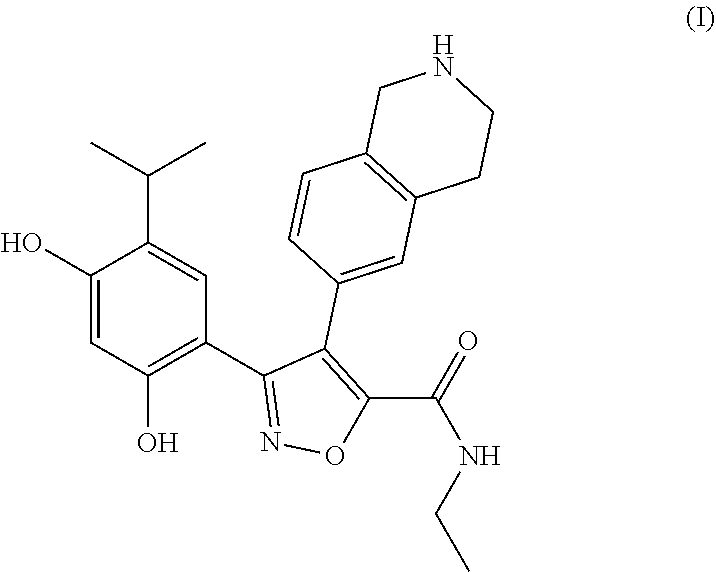
Description
- The present invention relates to a crystal and salt of an m-dihydroxybenzene derivative, as well as a manufacturing method thereof.
- Currently, targeted therapies for cancer are based on the identification of specific proteins that promote tumor development, and the identification of specific agents that are capable of exerting the effect of antagonizing these proteins. Pharmaceutical industry mostly concentrates efforts on a very limited number of well-validated protein targets. A common drawback lies in that the frequent occurrence of drug-resistant mutations is found in cancer patients treated with these specific inhibitors. Recently, it is generally considered that simultaneous blocking of signaling pathways involved in cancer development is expected to be able to facilitate better anti-tumor effects, and also reduce the likelihood of drug-resistance development. HSP90 belongs to a small family of proteins (GHKL, derived from DNA gyrase, HSP90, histidine kinase, mutL) that generally share a very specific C-type pattern (Bergerat fold) linked to adenosine triphosphate. HSP90 is one of the most abundant proteins in cells and is essential for the viability of eukaryotes. Human cells contain four HSP90 isoforms: constitutively expressed cytosolic β-isoform, inducible α-form, GRP94/gp96 in endoplasmic reticulum, and TRAP1/HSP75 in mitochondria. The α- and β-forms show 85% sequence homology.
- HSP90 is a key component of a chaperone structure, and catalyzes the folding of a so called client protein of HSP90 and the quality control in normal cells and under stress conditions. The activity of a molecular chaperone, which strictly depends on the activity of adenosine triphosphatase, is closely modulated by the binding of other regulatory co-chaperone molecules. There is strong evidence demonstrating that, in the case of disease states, for example, cancers or other proliferative diseases, HSP90 becomes critical due to mutations or overexpression of particular oncogenes, or due to tumors often having overloaded, misfolded proteins (which leads to an increased demand for the molecular chaperone function).
- HSP90 is a homodimer composed of three kinds of main domains in structure: a very conserved N-terminal domain, an intermediate domain of adenosine triphosphatase domain and a C-terminal domain. The N- and C-terminal domains can bind to adenosine triphosphate. Most currently known inhibitors, such as geldanamycin, radicicol, diarylpyrazole and purine derivatives, exhibit competitive binding to the adenosine triphosphate at the N-terminal adenosine-binding site, while novobiocin is the prototype of an inhibitor that binds to the C-terminal pocket.
- The client proteins of HSP90 currently reported are increasing (Jolly et at., J. Natl. Cancer Inst. 92; 1564-1572 (2000)), and the client proteins of HSP90 belong to kinase family (Her2, B-RAF V600E, bcr-Abl, Flt3, NPM-ALK, Akt, Npm-Alk, ZAP-70), transcription factor (p53, HIF), telomerase, and other molecular chaperones, most of which are closely related to the development of cancer. The ability of HSP90 for inhibiting damaged fold or stabilizing client proteins thereof results in proteasebased degradation of these unfolded proteins. The degradation of these client proteins is often used as a marker for HSP90 inhibition, and cells that overexpress Her2 are typically used, such as BT474 breast cancer cells, in which Her2 are degraded after treatment with compounds.
- It has been demonstrated that, the natural compound geldanamycin can indeed block the proliferation of a variety of tumor cells through its abilities of competitively binding to the N-terminal adenosine triphosphate binding site and inhibiting the activity of HSP90 adenosine triphosphatase, which initially caused a lot of researches in the field of HSP90 inhibitors. Surprisingly, this compound is inactive in normal cells, which may be because that HSP90 is present in an active complex (with high affinity to geldanamycin) only existed in tumor cells (Kamal et al., Nature 425, 407-410 (2003)). Another possible reason for their selective sensitivity to tumors is the tumor retention exhibited by many HSP90 inhibitors.
- A large number of clinical evaluations on semisynthetic derivatives of geldanamycin (GDA), tanespimycin (17AAG), and other related derivatives (alvespimycin, 17DMAG, IPI-504) are ongoing, but the effects thereof appear to be limited by a number of factors: complex preparations, production of active metabolites depending on metabolism, lack of enrichment of patients, and hepatotoxicity that may be associated with quinone moiety. This results in a great deal of effort to identify second-generation HSP90 inhibitors with better druglike characteristics and better tolerance. This leads to the identification of purine derivatives and substituted aryl-resorcinol derivatives.
- The main cause of neurodegenerative diseases such as Alzheimer's disease, Parkinson's disease, Huntington's disease and Prion disease is that the accumulation of misfolded proteins leads to the formation of plaque. These misfolded proteins undergo rematuration, depolymerization, and re-solubilization of protein aggregates depending on molecule chaperones (HSP70, HSP40, etc.). Heat shock proteins have been shown to provide this function in a variety of cell culture models. HSF1 can induce HSP, and HSF1 is closely regulated by HSP90 in normal cells. It has been proved that HSP90 inhibitors, such as geldanamycin and 17-AAG derivatives, can disrupt this interaction and lead to HSP induction, and then lead to neuroprotective activity as well as re-solubilization and depolymerization of misfolded proteins. Overexpression of HSP90 can significantly reduce the accumulation of misfolded proteins which is the cause of Alzheimer's disease. In fact, it has been proven that there is an anticorrelation between the levels of HSP70/90 and aggregated tau. Overexpression of HSP70, HSP27 and HSP40 can reduce abnormal tau aggregation (by degradation), which is triggered by an inhibition of HSP90. Based on the in vivo effect of GDA on neurotoxicity induced by 1methyl-4phenyl-1,2,3,6tetrahydropyridine (MPTP) in a mouse model of Parkinson's disease, HSP90 inhibitors are used for treating Parkinson's disease. GDA protects neurons from MPTP-induced toxicity, which is closely related to elevated levels of HSP70. In addition, it has also been shown that overexpression of HSP90 can significantly reduce the accumulation of misfolded proteins, which is the cause of sports injury, multiple sclerosis, spinal and bulbar muscular atrophy, and other diseases.
- 4,6-Disubstituted resorcinol compound with pharmacological activity is disclosed in GB 1,406,345. Phenyl-heterocyclic compounds, all of which are characterized by a specific substitution pattern with a five-membered heterocycle, are described as HSP90 inhibitors in other patent applications, for example, WO2006/101052 with the applicant of Nippon Kayaku Kabushiki Kaisha; WO2005/000300, WO2004/072051 and WO2004/056782 with the applicant of Vernalis; WO2003/055860 with the applicant of Ribotargets; WO2008/097640 with the applicant of Synta Pharmaceuticals, and WO2005/063222 with the applicant of Kyowa Hakko Kogyo.
- WO2004072051 relates to a class of HSP90 inhibitors, including Luminespib:
-

- WO2006055760A1 reports some compounds, such as,
-
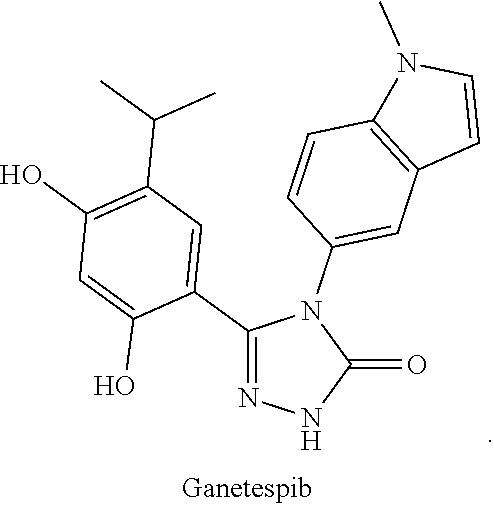
- CN1771235A discloses some compounds, such as,
-
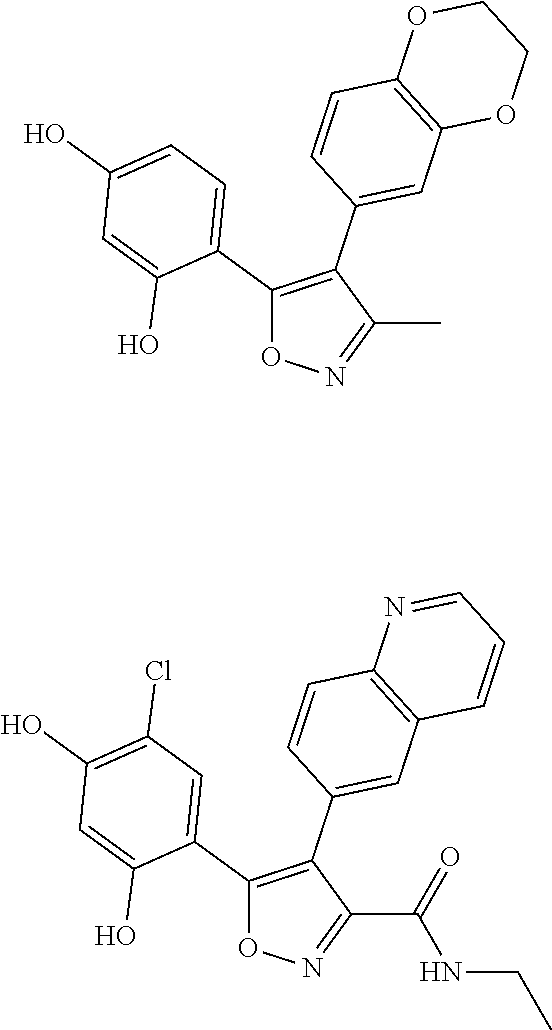
- These compounds are not desirable in terms of efficacy, pharmacokinetics, water solubility, druggability and the like. Despite the above developments, there is still a need to develop HSP90 inhibitors that are more effective and lower side effects.
- The present invention provides a compound of formula (I) in crystalline form,
-

- In one embodiment, the present invention provides a compound of formula (I) in crystalline form, and the crystalline form is A-type crystal.
- In some embodiments of the present invention, a X-ray powder diffraction pattern for the A-type crystal of the compound of formula (I) has diffraction peaks at the following 2θ angles: 10.66±0.2°, 15.09±0.2°, 19.17±0.2°.
- In some embodiments of the present invention, the X-ray powder diffraction pattern for the A-type crystal of the compound of formula (I) has diffraction peaks at the following 2θ angles: 10.66±0.2°, 11.41±0.2°, 15.09±0.2°, 19.17±0.2°, 20.43±0.2°, 22.19±0.2°, 25.76±0.2°.
- In some embodiments of the present invention, the X-ray powder diffraction pattern for the A-type crystal of the compound of formula (I) has diffraction peaks at the following 2θ angles: 10.66±0.2°, 11.41±0.2°, 15.09±0.2°, 17.85±0.2°, 19.17±0.2°, 19.60±0.2°, 20.43±0.2°, 21.81±0.2°, 22.19±0.2°, 25.76±0.2°.
- In some embodiments of the present invention, the X-ray powder diffraction pattern for the A-type crystal of the compound of formula (I) has diffraction peaks at the following 2θ angles: 10.66±0.2°, 11.41±0.2°, 15.09±0.2°, 15.84±0.2°, 17.85±0.2°, 18.22±0.2°, 19.17±0.2°, 19.60±0.2°, 20.19±0.2°, 20.43±0.2°, 21.81±0.2°, 22.19±0.2°, 22.86±0.2°, 24.57±0.2°, 25.76±0.2°, 26.05±0.2°, 27.75±0.2°.
- In some embodiments of the present invention, analysis data of the X-ray powder diffraction pattern for the above A-type crystal of the compound of formula (I) are shown in Table 1.
- In some embodiments of the present invention, the X-ray powder diffraction pattern for the above A-type crystal of the compound of formula (I) is shown in
FIG. 1 . - In some embodiments of the present invention, a differential scanning calorimetry curve for the above A-type crystal of the compound of formula (I) has a starting point of endothermic peaks at 198±5° C.
- In some embodiments of the present invention, the differential scanning calorimetry curve for the above A-type crystal of the compound of formula (I) is shown in
FIG. 2 . - In some embodiments of the present invention, the method for preparing the above A-type crystal of the compound of formula (I) comprises the following steps:
- (1) adding the compound of formula (I) into a solvent, stirring at 70-100° C. until completely dissolved;
- (2) naturally cooling to 0-30° C. under stirring, and continuing to stir and crystallize under such temperature condition;
- (3) filtering, collecting the solids and drying the same.
- Wherein, the solvent is water, methanol, ethanol, isopropanol, tert-butanol, acetone, 2butanone, benzene, toluene, xylene, diethyl ether, tert-butyl methyl ether, tetrahydrofuran, 2methyltetrahydrofuran or 1,4dioxane.
- In some embodiments of the present invention, the method for preparing the above A-type crystal of the compound of formula (I) comprises the following steps:
- (1) adding the compound of formula (I) into a solvent, stirring at 15-40° C. for 1-48 hours and then centrifuging;
- (2) filtering, collecting the solids and drying the same.
- Wherein, the solvent is a single solvent selected from acetone, methanol, ethanol, isopropanol, tetrahydrofuran or 1,4dioxane; or a mixed solvent of water and any one of solvents each independently selected from methanol, ethanol, acetonitrile and isopropanol; in one embodiment of the present invention, the volume ratio of any one of methanol, ethanol, acetonitrile and isopropanol to water is 3:1.
- The present invention also provides a crystalline composition of the above A-type crystal. Wherein, the crystalline composition of the A-type crystal means that with respect to the total weight of the composition, the weight of the A-type crystal of the compound of formula (I) in the composition is 50% or more, preferably 70% or more, more preferably 90% or more, and most preferably 95% or more, while a small amount of other crystals or amorphous substances of the compound of formula (I) may be included in the composition, including but not limited to, B-type crystal, C-type crystal, D-type crystal or amorphous substances of the compound of formula (I).
- In one embodiment, the present invention provides a compound of formula (I) in crystalline form, and said crystal is a B-type crystal.
- In some embodiments of the present invention, a X-ray powder diffraction pattern for the B-type crystal of the compound of formula (I) has diffraction peaks at the following 2θ angles: 7.34±0.2°, 14.69±0.2°, 22.15±0.2°.
- In some embodiments of the present invention, the X-ray powder diffraction pattern for the B-type crystal of the compound of formula (I) has diffraction peaks at the following 2θ angles: 7.34±0.2°, 12.23±0.2°, 12.53±0.2°, 14.69±0.2°, 18.72±0.2°, 19.03±0.2°, 20.67±0.2°, 22.15±0.2°.
- In some embodiments of the present invention, analysis data of the X-ray powder diffraction pattern for the above B-type crystal of the compound of the formula (I) is shown in Table 2.
- In some embodiments of the present invention, the X-ray powder diffraction pattern for the above B-type crystal of the compound of formula (I) is shown in
FIG. 3 . - In some embodiments of the present invention, a differential scanning calorimetry curve for the above B-type crystal of the compound of Formula (I) has a starting point of endothermic peaks at 55±5° C.
- In some embodiments of the present invention, the differential scanning calorimetry curve for the above B-type crystal of the compound of formula (I) is shown in
FIG. 4 . - The present invention also provides a crystalline composition of the above B-type crystal. Wherein, the crystalline composition of the B-type crystal means that with respect to the total weight of the composition, the weight of the B-type crystal of the compound of formula (I) in the composition is 50% or more, preferably 70% or more, more preferably 90% or more, and most preferably 95% or more, while a small amount of other crystals or amorphous substances of the compound of formula (I) may be included in the composition, including but not limited to, A-type crystal, C-type crystal, D-type crystal or amorphous substances of the compound of formula (I).
- In one embodiment, the present invention provides a compound of formula (I) in crystalline form, and said crystal is a C-type crystal.
- In some embodiments of the present invention, a X-ray powder diffraction pattern for the C-type crystal of the compound of formula (I) has diffraction peaks at the following 2θ angles: 6.45±0.2°, 7.68±0.2°, 12.91±0.2°, 13.58±0.2°.
- In some embodiments of the present invention, the X-ray powder diffraction pattern for the C-type crystal of the compound of formula (I) has diffraction peaks at the following 2θ angles: 6.45±0.2°, 7.68±0.2°, 10.56±0.2°, 12.91±0.2°, 13.58±0.2°, 15.40±0.2°, 21.14±0.2°, 26.32±0.2°.
- In some embodiments of the present invention, the X-ray powder diffraction pattern for the C-type crystal of the compound of formula (I) has diffraction peaks at the following 2θ angles: 6.45±0.2°, 7.68±0.2°, 10.56±0.2°, 12.91±0.2°, 13.58±0.2°, 15.40±0.2°, 16.72±0.2°, 21.14±0.2°, 23.16±0.2°, 25.74±0.2°, 26.32±0.2°.
- In some embodiments of the present invention, analysis data of the X-ray powder diffraction pattern for the above C-type crystal of the compound of formula (I) is shown in Table 3.
- In some embodiments of the present invention, the X-ray powder diffraction pattern for the above C-type crystal of the compound of formula (I) is shown in
FIG. 5 . - In some embodiments of the present invention, a differential scanning calorimetry curve for the above C-type crystal of the compound of Formula (I) has a starting point of endothermic peaks at 108±5° C.
- In some embodiments of the present invention, the differential scanning calorimetry curve for the above C-type crystal of the compound of Formula (I) is shown in
FIG. 6 . - The present invention also provides a crystalline composition of the above C-type crystal. Wherein, the crystalline composition of the C-type crystal means that with respect to the total weight of the composition, the weight of the C-type crystal of the compound of formula (I) in the composition is 50% or more, preferably 70% or more, more preferably 90% or more, and most preferably 95% or more, while a small amount of other crystals or amorphous substances of the compound of formula (I) may be included in the composition, including but not limited to, A-type crystal, B-type crystal, D-type crystal or amorphous substances of the compound of formula (I).
- In one embodiment, the present invention provides a compound of formula (I) in crystalline form, and said crystal is a D-type crystal.
- In some embodiments of the present invention, a X-ray powder diffraction pattern for the D-type crystal of the compound of formula (I) has diffraction peaks at the following 2θ angles: 5.96±0.2°, 9.53±0.2°, 19.43±0.2°.
- In some embodiments of the present invention, the X-ray powder diffraction pattern for the D-type crystal of the compound of formula (I) has diffraction peaks at the following 2θ angles: 5.96±0.2°, 9.53±0.2°, 9.65±0.2°, 11.94±0.2°, 16.42±0.2°, 19.43±0.2°, 22.01±0.2°, 25.49±0.2°.
- In some embodiments of the present invention, the X-ray powder diffraction pattern for the D-type crystal of the compound of formula (I) has diffraction peaks at the following 2θ angles: 5.96±0.2°, 9.53±0.2°, 9.65±0.2°, 11.94±0.2°, 12.46±0.2°, 14.43±0.2°, 14.92±0.2°, 16.42±0.2°, 19.43±0.2°, 20.26±0.2°, 22.01±0.2°, 23.06±0.2°, 25.49±0.2°, 27.15±0.2°.
- In some embodiments of the present invention, analysis data of the X-ray powder diffraction pattern for the above D-type crystal of the compound of formula (I) is shown in Table 4.
- In some embodiments of the present invention, the X-ray powder diffraction pattern for the above D-type crystal of the compound of formula (I) is shown in
FIG. 7 . - In some embodiments of the present invention, a differential scanning calorimetry curve for the above D-type crystal of the compound of formula (I) has a starting point of the endothermic peaks at 141±5° C.
- In some embodiments of the present invention, the differential scanning calorimetry curve for the above D-type crystal of the compound of formula (I) is shown in
FIG. 8 . - The present invention also provides a crystalline composition of the above D-type crystal. Wherein, the crystalline composition of the D-type crystal means that with respect to the weight of the composition, a weight of the D-type crystal of the compound of formula (I) in the composition is 50% or more, preferably 70% or more, more preferably 90% or more, and most preferably 95% or more, while a small amount of other crystals or amorphous substances of the compound of formula (I) may be included in the composition, including but not limited to, A-type crystal, B-type crystal, C-type crystal or amorphous substances of the compound of formula (I).
- Hereinafter, A-type crystal or the crystalline composition of A-type crystal, B-type crystal or the crystalline composition of B-type crystal, C-type crystal or the crystalline composition of C-type crystal, D-type crystal or the crystalline composition of D-type crystal of the compound of formula (I); trifluoroacetate, methanesulfonate, ρ-toluenesulfonate, citrate, maleate, fumarate, hydrobromide, phosphate and sulfate of the compound of formula (I); the compound of formula (II) such as the compound of formula (II-1) or formula (II-2) in the present invention are collectively refers to as “the active substance of the present invention”.
- The active substance of the present invention can be administrated by any administration routes suitable for the diseases to be treated, including the administration routes such as oral, topical (e.g., buccal, sublingual, etc.), parenteral (e.g., subcutaneous, intramuscular, intravenous, spinal, intradermal, intrathecal, etc.), rectal, vaginal.
- Although the active substance of the present invention can be administrated in the form of a pure substance, it is usually administrated in the form of a pharmaceutical composition. The pharmaceutical composition of the active substance of the present invention further comprises one or more pharmaceutical excipients, and may further comprise other therapeutically active ingredients if needed. It can also be administrated in combination with the therapy of chemotherapy, radiation therapy, and surgery.
- Dosage forms of the pharmaceutical compositions suitable for oral administration include tablet, capsule, powder, granule, dripping pill, paste, pulvis, tincture, syrup and the like, preferably tablet and capsule. Wherein, the tablet may be a common tablet, a dispersible tablet, an effervescent tablet, a sustained-release tablet, a controlled-release tablet or an enteric-coated tablet, and the capsule may be a common capsule, a sustained-release capsule, a controlled-release capsule or an enteric-coated capsule.
- The amount of the active substance of the present invention in unit formulation of the tablets and capsules for oral administration may vary depending on the treatment status of patients and specific administration routes.
- The present invention provides a salt of the above compound of formula (I), which may be selected from trifluoroacetate, methanesulfonate, ρ-toluenesulfonate, citrate, maleate, fumarate, hydrobromide, phosphate and sulfate. The skilled in the art can understand that in the above salts, the compound of formula (I) and acids may be present in any proportion which is chemically reasonable.
- The present invention also provides a salt of the compound of formula (I) represented by the following formula (II),
-
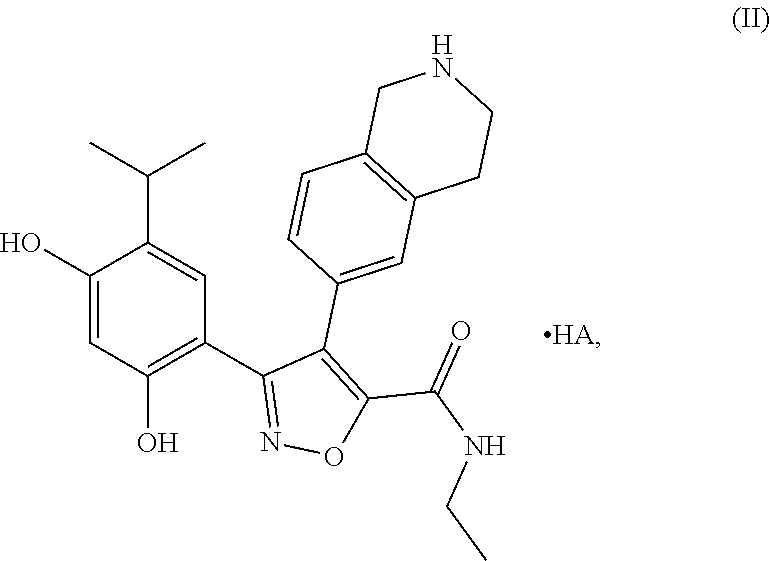
- wherein, HA is selected from trifluoroacetic acid, methanesulfonic acid, ρ-toluenesulfonic acid, citric acid, maleic acid, fumaric acid, hydrochloric acid, hydrobromic acid, phosphoric acid and sulfuric acid.
- The skilled in the art can understand that in the above compound of formula (II), the compound of the formula (I) and the acid may be present in any proportion which is chemically reasonable, for example, the ratio of the compound of the formula (I) to the acid is 1:1 or 1:0.5.
- The present invention also provides a method for preparing the above salt of the compound of formula (I) (that is, a compound of formula (II)),
-

- comprising the following steps:
-

- wherein, HA is selected from trifluoroacetic acid, methanesulfonic acid, ρ-toluenesulfonic acid, citric acid, maleic acid, fumaric acid, hydrochloric acid, hydrobromic acid, phosphoric acid and sulfuric acid.
- The present invention also provides a compound represented by formula (II-1):
-
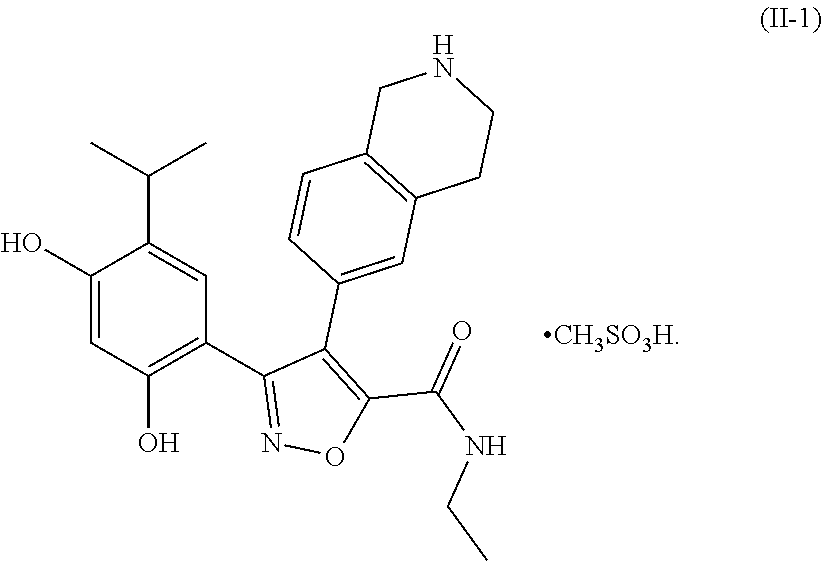
- The present invention also provides a compound represented by formula (II-2):
-

- The present invention also provides a pharmaceutical composition comprising the above compound of formula (I) in the crystalline form, and the crystalline composition.
- The present invention also provides a pharmaceutical composition comprising the following: trifluoroacetate, methanesulfonate, ρ-toluenesulfonate, citrate, maleate, fumarate, hydrobromide, phosphate or sulfate of the compound of formula (I), or the compound of formula (II) such as the compound of formula (II-1) or the compound of formula (II-2).
- The present invention also provides the above compound of formula (I) in crystalline form, or the crystalline composition, or the salt of the compound of formula (I), or the pharmaceutical composition thereof for use in the treatment of a HSP90-mediated disease; wherein the salt of the compound of formula (I) can be selected from trifluoroacetate, methanesulfonate, ρ-toluenesulfonate, citrate, maleate, fumarate, hydrobromide, phosphate or sulfate of the compound of formula (I), or the compound of the formula (II) such as the compound of formula (II-1) or the compound of formula (II-2).
- The present invention also provides use of the above compound of formula (I) in crystalline form, or the crystalline composition, or the pharmaceutical composition thereof in the preparation of a medicament for the treatment of a HSP90-mediated disease.
- The present invention also provides use of the trifluoroacetate, methanesulfonate, ρ-toluenesulfonate, citrate, maleate, fumarate, hydrobromide, phosphate or sulfate of the compound of formula (I), or the compound of formula (II) such as the compound of formula (II-1) or the compound of formula (II-2), or the pharmaceutical composition thereof in the preparation of a medicament for the treatment of a HSP90-mediated disease.
- The present invention also provides a method for treating a HSP90-mediated disease, wherein the method comprises administering the above compound of formula (I) in crystalline form, or the crystalline composition, or the pharmaceutical composition to a subject in need thereof.
- The present invention also provides a method for treating a HSP90-mediated disease, wherein the method comprises administering the above trifluoroacetate, methanesulfonate, ρ-toluenesulfonate, citrate, maleate, fumarate, hydrobromide, phosphate or sulfate of the compound of formula (I), or the compound of formula (II) such as the compound of formula (II-1) or the compound of formula (II-2), or the pharmaceutical composition thereof to a subject in need thereof.
- The HSP90-mediated disease according to the present invention is selected from cancer and neurodegenerative disorder. Wherein, the cancer includes, but is not limited to, bladder cancer, breast cancer, colon cancer, kidney cancer, liver cancer, lung cancer including small cell lung cancer, esophageal cancer, gallbladder cancer, ovarian cancer, pancreatic cancer, gastric cancer, cervical cancer, thyroid cancer, prostate cancer, and skin cancer including squamous cell carcinoma; lymphatic hematopoietic tumors, including leukemia, acute lymphocytic leukemia, acute lymphoblastic leukemia, B-cell lymphoma, T-cell lymphoma, Hodgkin's lymphoma, non-Hodgkin's lymphoma, hairy cell lymphoma, and Burkitt's lymphoma; myeloid hematopoietic carcinomas, including acute and chronic myelogenous leukemia, myelodysplastic syndrome and promyelocytic leukemia; mesenchyme-derived cancer including fibrosarcoma and rhabdomyosarcoma; cancers of central and peripheral nervous system, including astrocytoma, neurocytoma, glioma, and neurilemmoma; and other cancers, including melanoma, seminoma, teratocarcinoma, osteosarcoma, xeroderma pigmentosum, keratoxanthoma, thyroid follicular carcinoma, and Kaposi's sarcoma. Wherein, the neurodegenerative disorder includes, but is not limited to, Alzheimer's disease, Parkinson's disease, Huntington's disease, multiple sclerosis, and spinal and bulbar muscular atrophy.
- Definitions and Introductions
- Unless otherwise indicated, the following terms and phrases as used herein are intended to have the following meanings. A particular phrase or term should not be considered to be indefinite or unclear in the absence of a specific definition, but should be interpreted as its ordinary meanings. When a trade name appears herein, it is intended to refer to the corresponding commodity or active ingredient thereof.
- The intermediate compounds of the present invention can be prepared by a variety of synthesis methods well known by the skilled in the art, including the following exemplified embodiments, embodiments formed by combining the above embodiments with other chemical synthesis methods, and equivalent alternatives well known to the skilled in the art, and preferred embodiments include, but are not limited to, the examples of the present invention.
- The chemical reactions in the specific embodiments of the present invention are completed in appropriate solvents, which should be suitable for the chemical changes of the present invention as well as the required reagents and materials thereof. In order to obtain the compounds of the present invention, sometimes the skilled in the art needs to make modifications or alternatives to synthetic steps or reaction processes on the basis of existing embodiments.
- One important consideration factor in any synthetic route planning in this field is selecting suitable protecting groups for reactive functional groups (such as an amino group in the present invention). For the skilled artisan, “Greene and Wuts, Protective Groups In Organic Synthesis, Wiley and Sons, 1991” is authoritative in this regard. All references cited in the present invention are incorporated into the present invention in their entirety.
- The present invention will be specifically described by examples below, which do not mean any limitations to the present invention.
- All solvents used in the present invention are commercially available and can be used without further purification. Reactions are generally carried out under inert nitrogen in an anhydrous solvent. Proton nuclear magnetic resonance data are recorded on Bruker Avance III 400 (400 MHz) spectrometer, and chemical shift is expressed in ppm at downfield from tetramethylsilane. Mass spectra are measured on Agilent 1200 Series Plus 6110 (&1956A). LC/MS or Shimadzu MS contains one DAD detector: SPDM20A (LC) and Shimadzu Micromass 2020 detector. The mass spectrometer is equipped with an electrospray ion source (ESI) operated in positive or negative mode.
- The present invention employs the following abbreviations: DCM represents dichloromethane; PE represents petroleum ether; EA represents ethyl acetate; DMF represents N,N-dimethylformamide; EtOAc represents ethyl acetate; tol represents toluene; THF represents tetrahydrofuran; EtOH represents ethanol; MeOH represents methanol; OTf represents trifluoroacetoxy; MTBE represents methyl tert-butyl ether; Bn represents benzyl; Boc represents tert-butyloxycarbonyl, an amine protecting group; Boc2O represents di-tert-butyl dicarbonate; HCl (g) represents hydrogen chloride gas; H2SO4 represents sulfuric acid; HOAc represents acetic acid; TFA represents trifluoroacetic acid; TsOH represents ρ-toluenesulfonic acid; mCPBA represents m-chloroperoxybenzoic acid; CAN represents ammonium ceric nitrate; BCl3 represents boron trichloride; BBr3 represents boron tribromide; TiCl4 represents titanium tetrachloride; SOCl2 represents thionyl chloride; (COCl)2 represents oxalyl chloride; DIPEA represents diisopropylethylamine; DIEA represents diisopropylethylamine; NMM represents N-methylmorpholine; DBU represents 1,8diazabicycloundec-7ene; Et3N represents triethylamine; TEA represents triethylamine; t-BuOK represents potassium t-butoxide; KOAc represents potassium acetate; OAc represents acetoxy; NaClO represents sodium hypochlorite; NaClO2 represents sodium chlorite; KMnO4 represents potassium permanganate; MnO2 represents manganese dioxide; HATU represents O-(7azabenzotriazol-1-yl)-N,N,N′,N′-tetramethyluronium hexafluorophosphate; HOBt represents 1-hydroxybenzotriazole; EDCl represents 1-(3dimethylam inopropyl)-3-ethylcarbodiimide; BOP-Cl represents bis(2oxo-3oxazolidinyl)phosphinic chloride; CDl represents carbonyldiimidazole; T3P represents 2,4,6Tripropyl-1,3,5,2,4,6-trioxatriphosphinane 2,4,6trioxide; NH4Cl represents ammonium chloride; PPh3 represents triphenylphosphine; NCS represents N-chlorosuccinimide; NBS represents N-bromosuccinimide; NIS represents N-iodosuccinimide; ICl represents iodine chloride; I2 represents iodine; TEMPO represents 2,2,6,6-tetramethylpiperidinooxy; Pd represents palladium; Pd/C represents palladium carbon; Pt represents platinum; Rh represents rhodium; PtO2 represents platinum dioxide; Pd(OH)2 represents palladium hydroxide; Pd2(dba)3 represents tris(dibenzylideneacetone) dipalladium; Pd(PPh3)4 represents tetrakistriphenylphosphine palladium; Pd(dppf)Cl2 represents 1,1′-bis(diphenylphosphino)ferrocene dichloropalladium (II); Pd(PPh3)2Cl2 represents bis(triphenylphosphine)palladium(II) dichloride; Pd(OAc)2 represents palladium acetate; PdCl2 represents palladium chloride; Cul represents cuprous iodide; CuBr represents cuprous bromide; CuCl represents cuprous chloride; Cu represents copper powder; Cu2O represents cuprous oxide; NMO represents N-methylmorpholine N-oxide; Luminespib represents 5[2,4dihydroxy-5-isopropylphenyl]-N-ethyl-4[4-(4-morpholinylmethyl)phenyl]-3-isoxazolecarboxamide; Ganetespib represents 3(2,4dihydroxy-5-isopropylphenyl)-4-(1methylindol-5-yl)-5-hydroxy-4H-1,2,4triazole; Cremophor represents polyoxyethylene castor oil.
- The compounds are named manually or by the ChemDraw® software, and the supplier's catalog names are used for the commercially available compounds.
- The process for synthesizing the compound of formula (I) and the intermediate thereof provided by the present invention has the following beneficial effects: the starting materials are cheap and easy to obtain; and disadvantages, such as high toxic reagents being used, harsh reaction conditions, low yields of routes, difficulties in separation, purification and industrialization, are overcome.
- Specifically:
- 1) The raw materials used in the method for preparing the compound of formula (I) in the present invention are conventional or common reagents, which are readily available on the market and cheap;
- 2) The water solubility of the compound of formula (I) in the present invention can be effectively improved by forming salts thereof when preparing it;
- 3) The A-, B-, C- and D-type crystals of the compound of formula (I) provided by the present invention have stable properties, good solubility and hygroscopicity, as well as good prospects for druggability. Wherein, under the conditions of RT/92.5% RH (placed for 5 days), RT/92.5% RH (placed for 10 days), 60° C. (placed for 5 days), 60° C. (placed for 10 days), being grinded (investigation time: 10 min/20 min/30 min), respectively, the A-type crystal of the compound of formula (I) has no crystal transformation. Further, the wet weight gain ΔW % of the A-type crystal of the compound of formula (I) at 25±1° C. and 80±2% RH is about 0.45%, as shown in
FIG. 9 . - The trifluoroacetate, methanesulfonate, ρ-toluenesulfonate, citrate, maleate, fumarate, hydrobromide, phosphate and sulfate of the above compound of formula (I) provided by the present invention have stable properties and good hygroscopicity. Wherein, under the condition of 25±1° C. and 80±2% RH, the wet weight gain ΔW % of the methylsulfonate of the compound of formula (I) is about 1.742%, as shown in
FIG. 10 ; the wet weight gain ΔW % of the maleate of the compound of formula (I) is about 0.379%, as shown inFIG. 11 ; and the wet weight gain ΔW % of the sulfate of the compound of formula (I) is about 0.081%, as shown inFIG. 12 . - Method for X-ray powder diffractometer (XRPD) of the present invention
- Instrument model: Bruker D8 advance X-ray diffractometer
- Test conditions: Detailed XRPD parameters are as follows:
- X-ray generator: Cu, kα, (λ=1.54056 Å)
- Tube voltage: 40 kV, tube current: 40 mA.
- Divergence slit: 0.60 mm
- Detector slit: 10.50 mm
- Anti-scatter slit: 7.10 mm
- Scaning range: 4-40 deg
- Step diameter: 0.02 deg
- Step length: 0.12 seconds
- Rotation speed of sample tray: 15 rpm.
- It should be noted that, in XRD, the diffraction spectrum obtained from a crystalline compound is often characteristic for a specific crystal, wherein relative intensities of the bands (especially at low angles) may vary depending on preferential orientation effects resulting from the differences in crystallization conditions, particle sizes and others measurement conditions. Therefore, relative intensities of diffraction peaks are not characteristic for the targeted crystal, and it is the relative positions of the peaks rather than the relative intensities thereof to which more attention should be paid when judging whether crystals are the same as the known crystals. In XRD pattern, the position of a peak is usually expressed in terms of 2θ angle or interplanar spacing d. Since 2θ angle is related to the wavelength of incident X-ray, expressing in terms of interplanar spacing d is more representative. There is a simple conversion relationship between the two parameters: d=λ/2 sin θ, wherein d represents the interplanar spacing, λ, represents the wavelength of the incident X-ray, and θ represents the diffraction angle. It should also be noted that, in the identification of a mixture, some of diffracted rays are missing due to factors such as a decrease in content. At this time, even several bands may be characteristic for a given crystal without depending on the whole bands observed in a high purity sample.
- Method of differential Scanning calorimeter (DSC) of the present invention
- Instrument model: TA Q2000 Differential Scanning calorimeter
- Test method: samples (˜1 mg) were taken and placed in a DSC aluminum pan for testing, and heated from 25° C. to 350° C. at a heating rate of 10° C./min under 50 mL/min of N2.
- DSC measures the transition temperature when a crystal absorbs or releases heat due to changes in crystal structure thereof or crystal melting. In a continuous analysis for the same kind of crystal of the same compound, the error of the thermal transition temperature and melting point is typically within about 5° C., typically within about 3° C. When referring to a compound with a given DSC peak or melting point, this means that the DSC peak or melting point is within±3° C. DSC provides an auxiliary method for distinguishing different crystals. Different crystalline forms can be identified based on their characteristically different transition temperatures. It should be noted that, the DSC peak or melting point of a mixture may vary over a wider range. In addition, because of the decomposition accompanied the melting process of substances, the melting temperature is closely related to the heating rate.
-
FIG. 1 is the XRPD spectrum of Cu-Kα radiation for A-type crystal of the compound of formula (I). -
FIG. 2 is the DSC spectrum for A-type crystal of the compound of formula (I). -
FIG. 3 is the XRPD spectrum of Cu-Kα radiation for B-type crystal of the compound of formula (I). -
FIG. 4 is the DSC spectrum for B-type crystal of the compound of formula (I). -
FIG. 5 is the XRPD spectrum of Cu-Kα radiation for C-type crystal of the compound of formula (I). -
FIG. 6 is the DSC spectrum for C-type crystal of the compound of formula (I). -
FIG. 7 is the XRPD spectrum of Cu-Kα radiation for D-type crystal of the compound of Formula (I). -
FIG. 8 is the DSC spectrum for D-type crystal of the compound of formula (I). -
FIG. 9 is the dynamic vapour sorption (DVS) plot for A-type crystal of the compound of formula (I). -
FIG. 10 is the dynamic vapour sorption (DVS) plot for the methanesulfonate of the compound of formula (I). -
FIG. 11 is the dynamic vapour sorption (DVS) plot for the maleate of the compound of formula (I). -
FIG. 12 is the dynamic vapour sorption (DVS) plot for the sulfate of the compound of formula (I). - Hereinafter, in order to better understand the content of the present invention, further illustrations are made in combination with the specific Examples. However, the specific Examples are not intended to limit the scope of the present invention.
- Preparation of Compound 10:
-


- Step 1:
- At room temperature, benzyl bromide (8.66 kg, 50.61 mol, 6.01 L, 2.20 equivalents), potassium iodide (190.93 g, 1.15 mol, 0.05 equivalents) and potassium carbonate (9.54 kg, 69.01 mol, 3.00 equivalents) were added to a solution of 1-(2,4dihydroxyphenyl)ethanone (3.50 kg, 23.00 mol, 2.97 L, 1.00 equivalent) in acetonitrile (24 L), and then heated to 85° C. and stirred for 16 hours. After the reaction was completed, the reaction solution was filtered through Buchner funnel and concentrated to give a crude oil. Petroleum ether (12.8 L) was added to the crude product, and then stirred at 45° C. for 1 hour, slowly cooled to room temperature over about 1 hour, and filtered to give 1-(2,4-dibenzyloxyphenyl)ethanone (7 kg, yield of 87.4%, purity of 95.4%) as a milk-white solid. m/z 333 [M+H]+.
- Step 2:
- The internal temperature was controlled between 0° C. and 40° C. under the protection of nitrogen, methylmagnesium bromide (3.0 mol, 8.61 L, 1.30 equivalents) was slowly added dropwise to a solution of 1-(2,4dibenzyloxyphenyl)ethanone (7.00 kg, 19.88 mol, 1.00 equivalent) in tetrahydrofuran (24 L), followed by stirring for further 0.5 hour at a temperature in the range of 0-40° C. After the reaction was completed, a saturated aqueous ammonium chloride solution (30 L) and aqueous ammonia (90 mL) were added dropwise to the reaction solution while the temperature was controlled between 25° C. and 40° C., diluted with ethyl acetate (10 L), and then the organic phase and aqueous phase were separated, and the aqueous phase was extracted with ethyl acetate (10 L) again. The organic phases were combined and dried over anhydrous sodium sulfate, filtered and concentrated to give a crude oil. The oil was allowed to stand for 16 hours to generate a solid, to which dichloromethane (50 L) was added, and then washed with saturated aqueous sodium bicarbonate solution (30 L), water (30 L) and saturated aqueous sodium chloride solution (30 L). The organic phase was dried over anhydrous sodium sulfate, and then filtered and concentrated to give 2-(2,4-dibenzyloxyphenyl)propan-2ol (7.00 kg, 17.62 mol, yield of 88.63%, purity of 87.7%) as a white solid, which was directly used in the next step. m/z 331 [M+H-18]+.
- Step 3:
- At −70° C. and under the protection of nitrogen, trifluoroacetic acid (328.38 g, 2.88 mol, 213.23 ml, 2.00 equivalents) was slowly added dropwise into a solution of 2-(2,4dibenzyloxyphenyl)propan-2ol (500.00 g, 1.44 mol, 1.00 equivalent) in dichloromethane (3.5 L) while the temperature was controlled between −65° C. and −68° C., and then stirred for 0.5 h. Triethylsilyl hydride (217.68 g, 1.87 mol, 298.19 mL, 1.30 equivalents) was slowly added dropwise while the temperature was controlled between −65° C. and −68° C., and after the completion of the dropwise addition, the reaction was stirred for 4 hours at −65° C. to −70° C. After the reaction was completed, saturated sodium bicarbonate (2.4 L) was added dropwise to the reaction solution over about 1 hour, and after the completion of the dropwise addition, the reaction was stirred for another 1 hour, extracted once with dichloromethane (2 L), and washed once with water (2 L). The organic phase was dried over anhydrous sodium sulfate, filtered and concentrated to give 2,4-benzyloxy-1-isopropyl-benzene (500 g, crude, purity of 86.8%) as a yellow crude oil, which was directly used in the next step. m/z 333 [M+H]+.
- Step 4:
- At about 5° C., 2.53 kg of POCl3 (2.53 kg, 16.48 mol, 1.63 equivalents) was added dropwise to 12 L of N,N-dimethylformamide, and the temperature was controlled within 15° C., and the addition was completed in about one hour. After being stirred for 30 minutes, the substrate of 2,4benzyloxy-1-isopropyl-benzene (3.36 kg, 10.11 mol, 1.00 equivalent) was added to the reaction solution. The reaction solution was dark red, and the reactor was heated to 80° C. and the stirring was continued for 2 hours. After the reaction was completed, the reaction mixture was added dropwise to sodium acetate aqueous solution (10 kg of sodium acetate/36 L of water) to give a bright yellow solid. The solid was filtered and respectively washed twice with water (10 L) and ethanol (10 L). The filter cake was taken out and concentrated under reduced pressure to give 2,4benzyloxy-5isopropyl-benzaldehyde (3.40 kg, 8.95 mol, yield of 88.53%, purity of 94.9%) as a white solid. m/z 361 [M+H]+, 383 [M+Na]+.
- Step 5:
- At room temperature, hydroxylamine hydrochloride (1.54 kg, 22.20 mol, 2.00 equivalents) and DIEA (2.15 kg, 16.65 mol, 2.91 L, 1.50 equivalents) were added to a solution of 2,4-benzyloxy-5-isopropyl-benzaldehyde (4.00 kg, 11.10 mol, 1.00 equivalent) in ethanol (30 L), and then heated to 80° C. and stirred for 3 hours. After the reaction was completed, the reaction solution was cooled to room temperature, and water (30 L) was added thereto. The mixture was stirred for 3 h, and then filtered, and the filter cake was washed twice with water (30 L) to give (1E)-2,4-benzyloxy-5-isopropyl-benzaldehyde oxime (5.8 kg, crude product, purity of 95%) as a crude white solid, which was directly used in the next step. m/z 376 [M+H]+.
- Step 6:
- At 25° C., propargyl alcohol (1.49 kg, 26.63 mol, 1.57 L, 2.50 equivalents) was added to a solution of (1 E)-2,4-benzyloxy-5-isopropyl-benzaldehyde oxime (4 kg, 10.65 mol, 1.00 equivalent) in tetrahydrofuran (20 L), and slowly added dropwise with sodium hypochlorite solution (20 L), and the reaction solution was stirred at 25° C. for 12 hours. After the reaction was completed, the reaction solution was extracted by adding ethyl acetate (10 L), and the aqueous phase was extracted with ethyl acetate (20 L) once. The organic phases were combined, dried over anhydrous sodium sulfate, filtered and concentrated to give a black oil. The oil was dispersed by adding dichloromethane (5 L) and petroleum ether (15 L), then concentrated under reduced pressure to give [3-(2,4-dibenzyloxy-5-isopropyl-phenyl)isoxazol-5-yl]methanol (4.56 kg, 9.36 mol, yield of 87.90%, purity of 88.17%) as a crude yellow solid, which was directly used in the next step. m/z 430 [M+H]+.
- Step 7:
- At 15° C., NIS (2.83 kg, 12.57 mol, 1.50 equivalents) and concentrated sulfuric acid (167.77 g, 1.68 mol, 91.18 ml, purity of 98%, 0.20 equivalents) were added to a solution of [3-(2,4-dibenzyloxy-5-isopropyl-phenyl)isoxazol-5-yl]methanol (4.00 kg, 8.38 mol, 1.00 equivalent) in acetonitrile (36 L), and the reaction solution was stirred at 15° C. for 4 hours. After the reaction was completed, the reaction solution was poured into a solution of sodium sulfite (1.06 kg) in water (20 L) and stirred for 1 hour. The reaction solution was extracted with ethyl acetate (10 L), and extracted once more with ethyl acetate (10 L). The organic phases were combined and washed with saturated saline solution (15 L) three times at each time. The organic phase was dried over anhydrous sodium sulfate, filtered and concentrated to give [3-(2,4-dibenzyloxy-5-isopropyl-phenyl)-4-iodo-isoxazol-5-yl]methanol (5.00 kg, crude product, purity of 71%) as a crude yellow solid, which was directly used in the next step. m/z 556 [M+H]+.
- Step 8:
- At 9° C., TEMPO (70.95 g, 451.21 mmol, 0.07 equivalents), disodium hydrogen phosphate (0.4 M, 4.67 L, 0.29 equivalents) and sodium dihydrogen phosphate (0.4 M, 6.12 L, 0.38 equivalents) were added to a solution of [3-(2,4-dibenzyloxy-5-isopropyl-phenyl)-4-iodo-isoxazol-5-yl]methanol (5.00 kg, 6.45 mol, 1.00 equivalent) in acetonitrile (24 L). Then, a solution of sodium hypochlorite (1.71 kg, 16.11 mol, purity of 85%, 2.50 equivalents) in water (5.6 L) was added in four portions at a temperature not more than 40° C. over 2 hours, and a solution of sodium hypochlorite (287.90 g, 193.37 mmol, 237.93 mL, purity of 5%, 0.03 equivalents) in water (1.1 L) was added at the same time. The reaction solution was stirred at 30-35° C. for 3 hours. After the reaction was completed, the reaction solution was poured into a solution of sodium sulfite (1.95 kg) in water (12 L), and stirred for 12 h, and extracted with ethyl acetate (20 L). The organic phase was washed with saturated saline solution (15 L, twice), and finally dried over anhydrous sodium sulfate, filtered and concentrated under reduced pressure to give 3-(2,4-dibenzyloxy-5-isopropylphenyl)-4-iodo-isoxazole-5-carboxylic acid (3.95 kg, crude product, purity of 74.3%) as a yellow gel, which was directly used in the next step. m/z 570 [M+H]+.
- Step 9, Method 1: (acylating agent)
- At 0° C., oxalyl chloride (2.17 kg, 17.13 mol, 1.50 L, 2.50 equivalents) and N,N-dimethylformamide (50.06 g, 685.00 mmol, 52.69 mL, 0.10 equivalents) were added to a solution of 3-(2,4-dibenzyloxy-5-isopropylphenyl)-4-iodo-isoxazole-5-carboxylic acid (3.90 kg, 6.85 mol, 1.00 equivalent) in dichloromethane (30 L). After the mixture was stirred at 0° C. for 1 hour, the reaction solution was concentrated under vacuum to give an intermediate. This intermediate was dissolved in a solution of dichloromethane (30 L), to which ethylamine (1.54 kg, 34.25 mol, 2.24 L, 5.00 equivalents) was added at 0° C. After being stirred at 0° C. for 1 hour, the mixture was poured into saturated sodium bicarbonate aqueous solution (30 L). Then the organic phase was washed with saturated sodium bicarbonate aqueous solution (30 L×3). The organic phase was dried over anhydrous sodium sulfate, filtered and concentrated under vacuum to give a crude product. Ethyl acetate (10 L) was added to the crude product, and then concentrated until it was almost dried completely, to which ethyl acetate (5 L) was added and then it was further concentrated to give a crude product (6.5 kg). Ethanol (3.5 L) was added thereto and stirred for 12 hours and filtered. The filter cake was washed with ethanol (1 L×2) to give 3-(2,4-dibenzyloxy-5-isopropylphenyl)-N-ethyl-4-iodo-isoxazole-5-carboxamide (1.30 kg, 2.05 mol, yield of 29.91%, purity of 94%) as a white solid product. m/z 597 [M+H]+; 1H NMR (400 MHz, DMSO-d6) δ=7.37 (m, 10H), 7.17 (s, 1H), 6.62 (m, 2H), 3.52 (td, 2H), 3.34 (m, 1 H), 1.29 (t, 3H), 1.23 (d, 6H).
- Step 9, Method 2: (condensation agent)
- At 0° C., diisopropylethylamine (90.79 mg, 702.51 μmol, 122.69 μL, 2.00 equivalents) and bis(2-oxo-3-oxazolidinyl)phosphinic chloride (107.30 mg, 421.50 μmol, 1.20 equivalents) were added to a solution of 3-(2,4-dibenzyloxy-5-isopropylphenyl)-4-iodo-isoxazole-5-carboxylic acid (200.00 mg, 351.25 μmol, 1.00 equivalent) in N,N-dimethylformamide (5.00 mL). The mixture was stirred at 0° C. for 1 hour, and then ethylamine (47.50 mg, 1.05 mmol, 68.85 μL, 3.00 equivalents) was added to the reaction mixture at 0° C. The mixture was heated to 80° C. and stirred at 80° C. for 11 hours. The reaction solution was concentrated to give 3(2,4dibenzyloxy-5isopropylphenyl)-N-ethyl-4iodo-isoxazole-5-carboxamide (400 mg, crude product, purity of 30%) as a yellow oil. m/z 597 [M+H]+.
- Preparation of Compound 7:
-
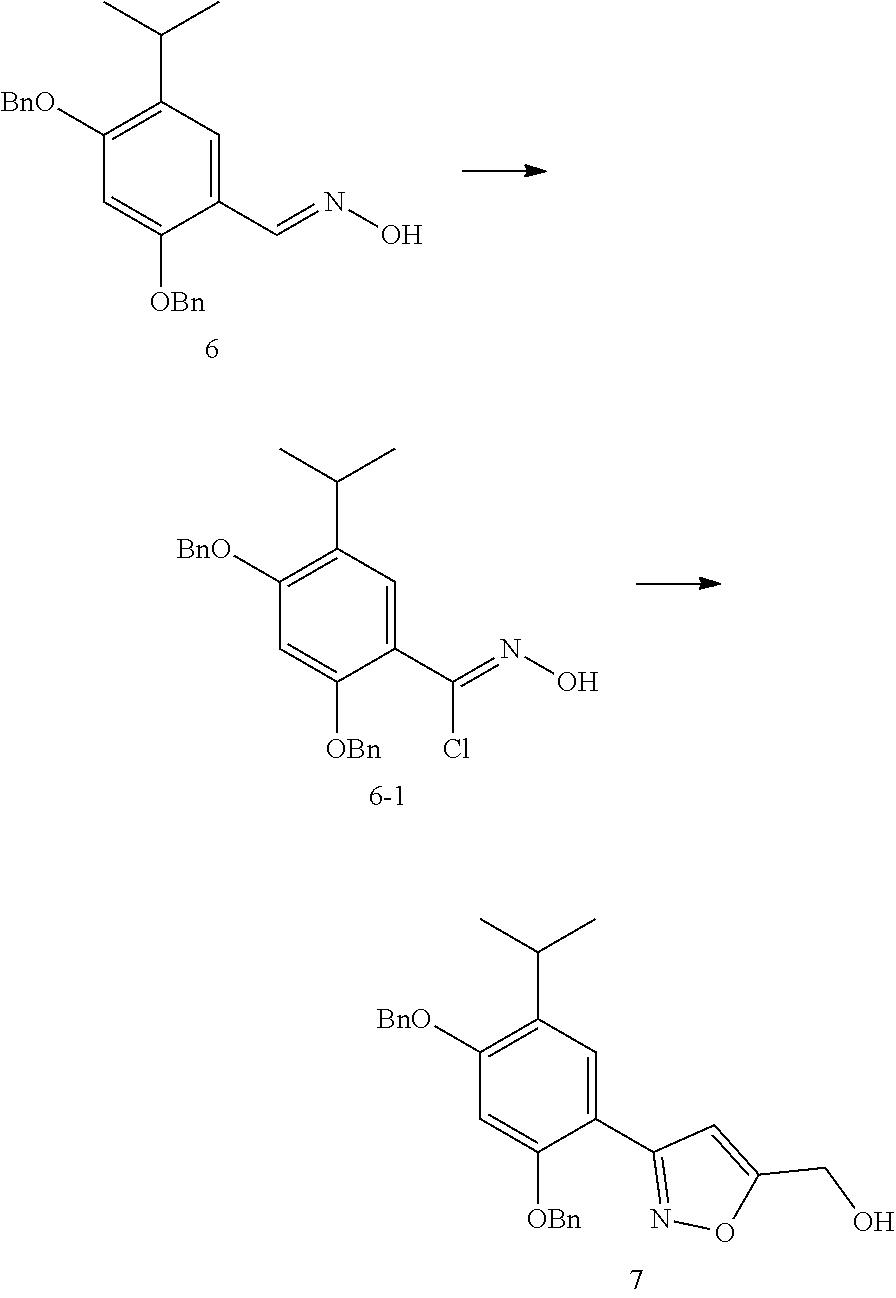
- Step 1:
- (1E)-2,4dibenzyloxy-5isopropyl-benzaldehyde oxime (8.50 g, 22.64 mmol, 1.00 equivalent) was added to dichloromethane (160 mL), and NCS (4.53 g, 33.96 mmol, 1.50 equivalents) was slowly added dropwise at 0° C. and stirred at this temperature for 2 hours. Then the reaction was slowly heated to 20° C. and further stirred for 10 hours. The reaction solution was concentrated under reduced pressure to give (1Z)-2,4dibenzyloxy-N-hydroxy-5isopropyl-benzimidoyl chloride (9.30 g, crude product) as a yellow crude oil, which was directly used in the next step. m/z 410 [M+H]+.
- Step 2:
- At 20° C., (1Z)-2,4dibenzyloxy-N-hydroxy-5isopropyl-benzimidoyl chloride (9.30 g, 22.69 mmol, 1.00 equivalent) and propargyl alcohol (1.91 g, 34.03 mmol, 1.50 equivalents) were added to toluene (100 mL), to which triethylamine (2.53 g, 24.96 mmol, 1.10 equivalents) was slowly added. The reaction solution was stirred at 20° C. for 12 hours. After the reaction was completed, water (50 mL) was added to the reaction solution, and it was extracted with ethyl acetate (25 mL×3). The organic phases were combined and washed with saturated saline solution (25 mL×2), and then dried over anhydrous sodium sulfate, filtered and concentrated under reduced pressure to give a crude product. The crude product was isolated and purified by silica gel column (100-200 mesh, PE/EA=20/1-4/1) to give [3(2,4-dibenzyloxy-5-isopropyl-phenyl)isoxazol-5-yl]methanol (3.80 g, 8.85 mmol, yield of 38.99%) as a yellow oil. m/z 430 [M+H]+.
- Preparation of the compound of formula (I):
-

- Step 1:
- 25 L of melted glacial acetic acid and 2.5 L of water were added to a 50 L reactor, and 6-bromoisoquinoline (2.5 kg, 12.02 mol, 1.00 equivalent) was added to the reactor. The reaction temperature was adjusted to 10° C. At 10-15° C., 1.43 kg of sodium borohydride was added in portions, and after feeding was finished over 7 hours, it was further stirred for 2 hours. After the reaction was completed, the reaction solution was slowly added dropwise to a solution of sodium hydroxide (17.5 kg) in water (87.5 L) at 5-15° C. After the completion of the dropwise addition, the mixture was stirred at room temperature for 10 hours, and filtered to give 6-bromo-1,2,3,4tetrahydroisoquinoline (8 kg, watercontaining crude product, purity of 95%) as a white solid, which was directly used in the next step. m/z 212, 214 (1:1) [M+H]+.
- Step 2:
- Sodium bicarbonate (1.21 kg) and Boc2O (2.62 kg) were added to a solution of 6-bromo-1,2,3,4tetrahydroisoquinoline (2.55 kg, 12.02 mol, 1.00 equivalent) in ethyl acetate (12.5 L) and water (12.5 L) at 20° C., and the reaction solution was stirred at 20° C. for 12 hours. After the reaction was completed, the reaction mixture was allowed to stand for layering, and the aqueous phase was extracted again with ethyl acetate (10 L×2). The organic phases were combined and washed once with water (10 L), dried over anhydrous sodium sulfate, filtered and concentrated to give N-tert-butoxycarbonyl-6bromo-1,2,3,4-tetrahydroisoquinoline (3.5 kg, 11.21 mol, yield of 91.4%, purity of 98%) as a yellow oil. m/z 256, 258 (1:1) [M+H-56]+; 1H NMR (400 MHz, CDCl3) δ=7.29 (m, 2H), 6.98 (d, 1H), 4.51 (s, 2H), 3.63 (t, 2H), 2.81 (t, 2H), 1.49 (s, 9H).
- Step 3:
- Bis(pinacolato)diboron (975 g) and KOAc (940 g) were added to a solution of N-tert-butoxycarbonyl-6bromo-1,2,3,4-tetrahydroisoquinoline (1 kg) in dioxane (10 L) under the protection of nitrogen at 25° C., to which the catalyst Pd(dppf)Cl2 (13 g) was subsequently added. The mixture was stirred at 25° C. for 10 min, and then heated to 80° C. and stirred for 12 hours. After the reaction was completed, the mixture was filtered through diatomite put on Buchner funnel, rinsed with ethyl acetate (2.5 L×2), and the filtrate was concentrated to give N-tert-butoxycarbonyl-6-(4,4,5,5tetramethyl-1,3,2-dioxaborolan-2-yl)-1,2,3,4-tetrahydroisoquinoline (2.04 kg, crude product, purity of 85%) as a black crude oil, which was directly used in the next step. m/z 304 [M+H-56]+.
- Step 4:
- Potassium carbonate (1.31 kg) and Pd(PPh3)2Cl2 (69.6 g) were added to a solution of crude N-tert-butoxycarbonyl-6(4,4,5,5tetramethyl-1,3,2dioxaborolan-2-yl)-1,2,3,4tetrahydroisoquinoline (1.15 kg, 3.2 mol, 1.00 equivalent) and 3(2,4-dibenzyloxy-5-isopropylphenyl)-N-ethyl-4iodo-isoxazole-5-carboxamide (2 kg, 3.2 mol, 1.00 equivalent) in DMF (20 L) and water (4 L) under the protection of nitrogen at 25° C. The mixture was stirred at 25° C. for 10 minutes, and then heated to 60° C. and stirred for 12 hours. After the reaction was completed, the mixture was cooled to 25° C., and the mixture was added to aqueous hydrochloric acid solution (0.4 mol, 30 L). Solid was precipitated, spin-dried with a centrifuge, washed with water (15 L×2), and then spin-dried to give tert-butyl 6(3-(2,4-dibenzyloxy-5-isopropyl-phenyl)-5-(ethylcarbamoyl)isoxazol-4-yl)-1,2,3,4-tetrahydroisoquinoline-2carboxylate (2.32 kg, crude product, purity of 75%) as a crude black solid, which was directly used in the next step. m/z 702 [M+H]+.
- Step 5:
- At room temperature, a solution of hydrogen chloride in ethyl acetate (4 mol, 5 L) was slowly added dropwise to a solution of tert-butyl 6-(3-(2,4dibenzyloxy-5-isopropyl-phenyl)-5(ethylcarbamoyl)isoxazol-4-yl)-1,2,3,4-tetrahydroisoquinoline-2carboxylate (2.21 kg, 3.15 mol, 1.00 equivalent) in methyl tert-butyl ether (5 L), and the temperature was not more than 25° C. The mixture was stirred at room temperature for 12 hours. After the reaction was completed, the mixture was filtered through Buchner funnel to give the hydrochloride of the product, and the filter cake was washed with EA/MTBE=1/1 (2.5 L×2). The crude product was dissolved in a solution of DCM/MeOH=10/1 (17.6 L), and a solution of sodium carbonate (800 g) in water (16 L) was added to the organic phase and stirred for 1 hour. The solution was separated, and the organic phase was sequentially washed with an aqueous hydrochloric acid solution (0.3 mol/L, 17.6 L), an aqueous hydrochloric acid solution (0.1 mol/L, 17.6 L), a solution of sodium carbonate (800 g) in water (17.6 L) and a solution of sodium chloride (4 kg) in water (16 L). Finally, the mixture was dried over anhydrous sodium sulfate, and filtered and concentrated to give 3-(2,4-dibenzyloxy-5-isopropylphenyl)-N-ethyl-4(1,2,3,4-tetrahydroisoquinolin-6-yl)isoxazole-5-carboxamide (1.44 kg, crude product, purity of 90%) as a brown oil, which was directly used in the next step. m/z 602 [M+H]+.
- Step 6:
- A solution of boron trichloride in dichloromethane (18.5 L, 1 mol of DCM solution) was slowly added to a solution of 3-(2,4-dibenzyloxy-5-isopropylphenyl)-N-ethyl-4(1,2,3,4tetrahydroisoquinolin-6-yl)isoxazole-5-carboxamide (1.44 kg, 2.39 mol, 1.00 equivalent) in dichloromethane (63 L) under the protection of nitrogen at −10° C. After being further stirred at 0° C. for 1 hour, the reaction mixture was heated to room temperature and stirred for 2 hours. The reaction solution was cooled to −10° C., and then the reaction was quenched by adding methanol (18 L). The reaction mixture was concentrated under vacuum to give a crude product. The crude product was slurried with dichloromethane/acetone=1/1 (14 L), filtered through Buchner funnel, and the filter cake was washed with dichloromethane/acetone=1/1 (1 L×2) to give a hydrochloride. 3-(2,4-dihydroxy-5-isopropylphenyl)-N-ethyl-4-(1,2,3,4tetrahydroisoquinolin-6-yl)isoxazole-5-carboxamide hydrochloride (747 g) was obtained as a yellow solid. 3(2,4dihydroxy-5isopropylphenyl)-N-ethyl-4-(1,2,3,4tetrahydroisoquinolin-6-yl)isoxazole-5-carboxamide hydrochloride (560 g) was added to a solution of dichloromethane/methanol=6/1 (36 L), and then added to a solution of sodium bicarbonate (500 g) in water (5 L) and stirred at room temperature for 1 hour. The solution was separated, and the aqueous phase was extracted with dichloromethane/methanol=7/1 (10 L×2). The organic phases were combined, dried over anhydrous sodium sulfate, filtered and concentrated to give a crude product (480 g). At 80° C., the solid crude product was completely dissolved in tetrahydrofuran (9 L), and tetrahydrofuran (5 L) was distilled off under atmospheric pressure. Then, it was slowly cooled to room temperature and stirred for 12 hours, cooled to 0° C. and stirred for 2 hours, and filtered. The filter cake was washed with iced tetrahydrofuran (500 mL×2) to give 3(2,4dihydroxy-5-isopropylphenyl)-N-ethyl-4(1,2,3,4-tetrahydroisoquinolin-6-yl)isoxazole-5-carboxamide (432 g, yield of 42%, purity of 98.8%) as a white solid. m/z 422 [M+H]+; 1H NMR (400 MHz, DMSO-d6) δ=9.51 (d, 2H), 8.85 (t, 1H), 6.94 (m, 3H), 6.84 (m, 1H), 6.33 (s, 1H), 3.76 (s, 2H), 3.22 (m, 2H), 3.04 (m, 1H), 2.86 (m, 2H), 2.54 (m, 2H), 1.08 (t, 3H), 1.04 (d, 6H).
- Preparation of the A-type crystal:
- Method 1:
- 20 g of the compound of formula (I) was taken, to which 400 mL of tetrahydrofuran was added, and stirred at 80° C. for about 1 hour until it was completely dissolved. Then, it was cooled to 40° C., and distilled to 100 mL under atmospheric pressure at 40° C. The reaction mixture was naturally cooled to 15-30° C. with stirring, and then stirred at 15-30° C., 12 hours in total. The solid was collected by filtration, and the solid was rinsed twice with 20 mL of tetrahydrofuran, and dried under vacuum at 40-45° C. to give 13 g of a white solid. After identification by XRPD, the solid crystal was A-type crystal.
- Method 2:
- 54 g of the compound of formula (I) was taken, to which 1100 mL of tetrahydrofuran was added, and stirred at 70° C. until it was completely dissolved. Then, it was cooled to 40° C., and distilled to 300 mL under atmospheric pressure at 40° C. The reaction mixture was naturally cooled to 15-30° C. with stirring, and then stirred at 15-30° C., 12 hours in total. The solid was collected by filtration, and the solid was rinsed twice with 50 mL of tetrahydrofuran, and dried under vacuum (40-45° C.) to give a product (45 g). 450 mL of water was added to the product, and it was stirred at 60-80° C. for 6 hours. The reaction mixture was naturally cooled to 15-30° C. with stirring, and then stirred at 15-30° C., 12 hours in total. The solid was collected by filtration, and the solid was rinsed twice with water (90 mL) and dried under vacuum at 40-45° C. to give a white solid (38 g). After identification by XRPD, the solid crystal was A-type crystal.
- Method 3:
- 35 g of the compound of formula (I) was taken, to which 700 mL of ethanol was added, and stirred at 80° C. until it was completely dissolved. Then at 80° C., 35 mL of water was added dropwise to the solution. The reaction mixture was naturally cooled to 15-30° C. with stirring, and then stirred at 15-30° C., 12 hours in total. The solid was collected by filtration, and the solid was rinsed twice with 70 mL of ethanol, and dried under vacuum at 40-45° C. to give 10 g of a white solid. After identification by XRPD, the solid crystal was A-type crystal.
- Method 4:
- 5 g of the compound of the formula (I) was taken, to which 50 mL of acetone was added, and stirred at 15-30° C. for 12 hours. The solid was collected by filtration, and the solid was rinsed twice with 10 mL of acetone, dried under vacuum (40-45° C.) to give 4 g of a white solid. After identification by XRPD, the solid crystal was A-type crystal.
- Method 5:
- 50 mg of the compound of formula (I) was taken, to which 0.35 mL of methanol was added, stirred at 40° C. for 2 days, and then centrifuged. The solid was collected by filtration, and dried in a vacuum drying oven (30° C.) overnight to give a white solid. After identification by XRPD, the solid crystal was A-type crystal.
- Method 6:
- 50 mg of the compound of formula (I) was taken, to which 0.35 mL of ethanol was added, stirred at 40° C. for 2 days, and then centrifuged. The solid was collected by filtration and dried in a vacuum drying oven (30° C.) overnight to give a white solid. After identification by XRPD, the solid crystal was A-type crystal.
- Method 7:
- 50 mg of the compound of formula (I) was taken, to which 0.35 mL of isopropanol was added, stirred at 40° C. for 2 days, and then centrifuged. The solid was collected by filtration and dried in a vacuum drying oven (30° C.) overnight to give a white solid. After identification by XRPD, the solid crystal was A-type crystal.
- Method 8:
- 50 mg of the compound of formula (I) was taken, to which 0.35 mL of acetone was added, stirred at 40° C. for 2 days, and then centrifuged. The solid was collected by filtration and dried in a vacuum drying oven (30° C.) overnight to give a white solid.
- After identification by XRPD, the solid crystal was A-type crystal.
- Method 9:
- 50 mg of the compound of formula (I) was taken, to which 0.35 mL of tetrahydrofuran was added, stirred at 40° C. for 2 days, and then centrifuged. The solid was collected by filtration and dried in a vacuum drying oven (30° C.) overnight to give a white solid. After identification by XRPD, the solid crystal was A-type crystal.
- Method 10:
- 50 mg of the compound of formula (I) was taken, to which 0.35 mL of 1,4-dioxane was added, stirred at 40° C. for 2 days, and then centrifuged. The solid was collected by filtration and dried in a vacuum drying oven (30° C.) overnight to give a white solid. After identification by XRPD, the solid crystal was A-type crystal.
- Method 11:
- 50 mg of the compound of formula (I) was taken, to which 0.35 mL of methanol:water=3:1 was added, stirred at 40° C. for 2 days, and then centrifuged. The solid was collected by filtration and dried in a vacuum drying oven (30° C.) overnight to give a white solid. After identification by XRPD, the solid crystal was A-type crystal.
- Method 12:
- 50 mg of the compound of formula (I) was taken, to which 0.35 mL of ethanol:water=3:1 was added, stirred at 40° C. for 2 days, and then centrifuged. The solid was collected by filtration and dried in a vacuum drying oven (30° C.) overnight to give a white solid. After identification by XRPD, the solid crystal was A-type crystal.
- Method 13:
- 50 mg of the compound of formula (I) was taken, to which 0.35 mL of acetonitrile:water=3:1 was added, stirred at 40° C. for 2 days, and then centrifuged. The solid was collected by filtration and dried in a vacuum drying oven (30° C.) overnight to give a white solid. After identification by XRPD, the solid crystal was A-type crystal.
- Method 14:
- 50 mg of the compound of formula (I) was taken, to which 0.35 mL of isopropanol:water=3:1 was added, stirred at 40° C. for 2 days, and then centrifuged. The solid was collected by filtration and dried in a vacuum drying oven (30° C.) overnight to give a white solid. After identification by XRPD, the solid crystal was A-type crystal.
- Preparation of B-type crystal:
- About 35 mg of the compound of formula (I) was taken, to which 1.5 mL of tetrahydrofuran was added. Ultrasound was used for dissolution, and 6 mL of anti-solvent water was added with stirring. The precipitated solid sample was dried in a vacuum drying oven (40° C.) overnight to give a white solid. After identification by XRPD, the solid crystal was B-type crystal.
- Preparation of C-type crystal:
- About 35 mg of the compound of formula (I) was taken, to which 1.5 mL of tetrahydrofuran was added. Ultrasound was used for dissolution, and 7 mL of anti-solvent methyl tert-butyl ether was added with stirring. The precipitated solid sample was dried in a vacuum drying oven (40° C.) overnight to give a white solid. After identification by XRPD, the solid crystal was C-type crystal.
- Preparation of D-type crystal:
- About 35 mg of the compound of formula (I) was taken, to which 5 mL of 2-butanone was added. Ultrasound was used for dissolution, and 5 mL of anti-solvent n-heptane was added with stirring. The precipitated solid sample was dried in a vacuum drying oven (40° C.) overnight to give a white solid. After identification by XRPD, the solid crystal was D-type crystal.
-
TABLE 1 XRPD analysis data for A-type crystal of the compound of formula (I) 2θ angle Interplanar Relative No. (°) spacing (Å) intensity (%) 1 10.664 8.289 100 2 11.413 7.7468 11.9 3 12.66 6.9865 3.1 4 13.482 6.5622 2.6 5 15.085 5.8684 23.6 6 15.841 5.5899 5.2 7 16.364 5.4124 3.7 8 17.476 5.0706 3.5 9 17.85 4.9651 11 10 18.219 4.8653 6.8 11 18.709 4.7389 1 12 19.165 4.6271 33.4 13 19.596 4.5263 11.5 14 20.193 4.3939 4.7 15 20.43 4.3435 12.6 16 20.744 4.2783 4.9 17 21.332 4.1619 2 18 21.808 4.072 10.7 19 22.186 4.0035 15.1 20 22.857 3.8874 9.7 21 23.091 3.8485 5.9 22 23.614 3.7646 1.6 23 23.844 3.7288 1.8 24 24.567 3.6205 4.3 25 25.24 3.5256 2.3 26 25.756 3.4561 19.1 27 26.051 3.4176 7.5 28 27.153 3.2814 4.2 29 27.748 3.2123 6.8 30 28.455 3.1341 2.2 31 29.641 3.0114 2.3 32 30.739 2.9062 2 33 32.083 2.7875 2.3 -
TABLE 2 XRPD analysis data for B-type crystal of the compound of formula (I) 2θ angle Interplanar Relative No. (°) spacing (Å) intensity (%) 1 7.339 12.0351 100 2 12.233 7.2294 2.1 3 12.527 7.0605 3.4 4 14.685 6.0271 8.9 5 17.036 5.2003 0.7 6 18.196 4.8715 0.7 7 18.716 4.7371 1.5 8 19.026 4.6607 2.6 9 19.539 4.5395 0.6 10 20.668 4.294 4.2 11 22.149 4.01 6.1 -
TABLE 3 XRPD analysis data for C-type crystal of the compound of formula (I) 2θ angle Interplanar Relative No. (°) spacing (Å) intensity (%) 1 6.449 13.6932 100 2 7.676 11.5081 88.8 3 10.08 8.7677 3.3 4 10.557 8.3728 39.7 5 12.908 6.8528 91.5 6 13.578 6.5161 90.4 7 14.092 6.2794 2.9 8 15.395 5.7508 45.2 9 16.72 5.2981 9.9 10 17.786 4.9828 9.6 11 18.298 4.8445 12 12 18.753 4.7278 1.6 13 19.409 4.5696 2.4 14 19.717 4.4988 3.2 15 21.141 4.199 31.6 16 21.636 4.104 6.6 17 23.157 3.8378 17.1 18 25.744 3.4577 20 19 26.317 3.3837 55.4 20 29.953 2.9807 2.6 21 32.872 2.7224 3.4 22 33.702 2.6572 4.2 23 35.087 2.5555 2.4 24 39.43 2.2834 2.9 -
TABLE 4 XRPD analysis data for D-type crystal of the compound of formula (I) 2θ angle Interplanar Relative No. (°) spacing (Å) intensity (%) 1 5.955 14.8283 100 2 7.497 11.7815 3.2 3 9.53 9.2726 27.4 4 9.649 9.1583 21.1 5 10.576 8.3577 1.9 6 11.939 7.4069 17.7 7 12.455 7.1008 6.6 8 13.873 6.378 4.4 9 14.427 6.1343 14 10 14.92 5.9326 9.4 11 16.423 5.3932 13.5 12 17.352 5.1064 7.2 13 17.567 5.0442 5.4 14 19.148 4.6313 9.5 15 19.425 4.5659 45.4 16 20.255 4.3806 6 17 20.507 4.3273 3.3 18 21.182 4.191 1.8 19 22.009 4.0354 22.9 20 22.367 3.9715 5.7 21 22.684 3.9167 2.1 22 23.061 3.8535 7.6 23 23.694 3.7519 5 24 24.064 3.6951 3 25 24.563 3.6212 5.1 26 25.113 3.5431 3.9 27 25.487 3.4919 14.1 28 25.822 3.4474 5.1 29 27.147 3.2821 9 30 28.356 3.1449 3.2 31 28.69 3.109 2 32 29.085 3.0677 1.1 33 29.396 3.0359 1.8 34 30.761 2.9042 4.5 35 32.813 2.7272 1.7 36 33.263 2.6913 2 37 33.663 2.6602 3.5 38 36.427 2.4644 2.2 - About 84 mg of the compound of formula (I) was weighed, added to an 8 mL vial, dissolved by adding 3 mL of THF and heating to 50° C., to which 17.5 μL of hydrochloric acid (diluted 10 times with THF, slowly added in its corresponding volume) was then slowly added. Phenomenon was observed. It was stirred at 25° C. overnight. The sample with the generated precipitates was quickly centrifuged to obtain a salt-forming product.
- About 84 mg of the compound of formula (I) was weighed, added to an 8 mL vial, dissolved by adding 3 mL of THF and heating to 50° C., to which 11.4 μL of sulfuric acid (diluted 10 times with THF, slowly added in its corresponding volume) was then slowly added. Phenomenon was observed. It was stirred at 25° C. overnight. The sample with the generated precipitates was quickly centrifuged to obtain a salt-forming product.
- About 84 mg of the compound of formula (I) was weighed, added to an 8 mL vial, dissolved by adding 3 mL of THF and heating to 50° C., to which 13.6 μL of methanesulfonic acid (diluted 10 times with THF, slowly added in its corresponding volume) was then slowly added. Phenomenon was observed. It was stirred at 25° C. overnight. The sample with the generated precipitates was quickly centrifuged to obtain a salt-forming product.
- About 84 mg of the compound of formula (I) was weighed, added to an 8 mL vial, dissolved by adding 3 mL of THF and heating to 50° C., to which 40.12 mg of ρ-toluenesulfonic acid (2 times the weight of it was weighed and dissolved in 1m L of THF, and 500 μL of the resulting solution was taken and added slowly) was then slowly added. Phenomenon was observed. It was stirred at 25° C. overnight. The sample with the generated precipitates was quickly centrifuged to obtain a salt-forming product.
- About 84 mg of the compound of formula (I) was weighed, added to an 8 mL vial, dissolved by adding 3 mL of THF and heating to 50° C., to which 24.52 mg of maleic acid (2 times the weight of it was weighed and dissolved in 1mL of THF, and 500 μL of the resulting solution was taken and added slowly) was then slowly added. Phenomenon was observed. It was stirred at 25° C. overnight. The sample with the generated precipitates was quickly centrifuged to obtain a salt-forming product.
- About 84 mg of the compound of formula (I) was weighed, added to an 8 mL vial, dissolved by adding 3 mL of THF and heating to 50° C., to which 40.07 mg of citric acid (2 times the weight of it was weighed and dissolved in 1mL of THF, and 500 μL of the resulting solution was taken and added slowly) was then slowly added. Phenomenon was observed. It was stirred at 25° C. overnight. No precipitate appeared. N-heptane was added until precipitate appeared, and the sample was quickly centrifuged to obtain a salt-forming product.
- About 84 mg of the compound of formula (I) was weighed, added to an 8 mL vial, dissolved by adding 3 mL of THF and heating to 50° C., to which 31.45 mg of L(+)-tartaric acid (2 times the weight of it was weighed and dissolved in 1mL of THF, and 500 μL of the resulting solution was taken and added slowly) was then slowly added. Phenomenon was observed. It was stirred at 25° C. overnight. No precipitate appeared. N-heptane was added until precipitate appeared, and the sample was quickly centrifuged to obtain a salt-forming product.
- About 84 mg of the compound of formula (I) was weighed, added to an 8 mL vial, dissolved by adding 3 mL of THF and heating to 50° C., to which 84 mg of API (2 times the weight of it was weighed and dissolved in 1m L of THF, and 500 μL of the resulting solution was taken and added slowly) was then slowly added. Phenomenon was observed. It was stirred at 25° C. overnight. No precipitate appeared. N-heptane was added until precipitate appeared, and the sample was quickly centrifuged to obtain a salt-forming product.
- Test purposes:
- The solubilities of the A-type crystal of the compound of formula (I) and various salts thereof under different conditions were determined, so as to develop crystal, salt and dissolution system with the optimal solubility for the compound.
- Test materials:
- Hydrochloric acid, acetic acid, sodium acetate, sodium chloride, 5% glucose solution, water (buffer is a buffer solution of acetic acid/sodium acetate).
- Test method:
- 2 mg of a sample was weighed, and dissolved by adding a solvent (10 μL) thereto at room temperature. Whether the raw material was dissolved was observed: if the raw material was completely dissolved, the solubility (2 mg/solvent volume) was calculated; if the raw material was not completely dissolved, the solvent was added in portions, 10 μL of the solvent per time, until the raw material was completely dissolved, and the solubility was calculated. The total amount of the added solvents was up to 2 mL. If the total amount of the added solvents reached 2 mL and the raw material was still not completely dissolved, the solubility of the raw material in the solvent was defined as being less than 1 mg/mL.
- Test results:
- The test results of the rough solubility for the compounds of formula (I) were shown in Table 5.
- Conclusions:
- The compound of formula (I) has a higher solubility in the buffer of pH 3.5-4.5, and the hydrochloride and methanesulfonate of the compound have significantly higher solubilities than that of the A-type crystal of the compound.
-
TABLE 5 Test results of the rough solubility for the compounds of formula (I) Approximate solubility (mg/mL)* A-type solvent crystal hydrochloride methanesulfonate maleate water <1 5.3-6.3 6.3-8.6 2.2-2.6 0.9% NaCl <1 <2 <2 <2 solution 5% glucose <1 4.6-5.5 6.5-8.7 2.1-2.3 solution pH 3.5 buffer 80-100 9.5-14.2 43.5-65.3 6.5-7.5 pH 4.5 buffer 30-50 5.8-7.3 17.6-26.4 3.4-3.9 pH 5.5 buffer <1 <2 <2 <2 pH 6.5 buffer <1 N/A N/A N/A pH 7.5 buffer <1 <2 <2 <2 pH 6.8 buffer <1 <2 <2 <2 0.1N HCl <1 N/A N/A N/A 0.01N HCl 0.8-1 N/A N/A N/A - 1. Summary
- SD rats were used as test animals, and the drug concentrations in plasma, lung and breast tissues of rats at different times after administrating the compound of formula (I) via the injection in tail vein were measured by using LC/MS/MS method. The tissue distribution of the compound of the present invention in rats was investigated, and pharmacokinetic characteristics thereof were evaluated.
- 2. Test protocol
- 2.1 Test drugs:
- Luminespib, Ganetespib and the compound of formula (I).
- 2.2 Test animals:
- 100-200 g of healthy adult male SD rats, 9 in total, purchased from Shanghai SLAC Laboratory Animal Co., Ltd.
- 2.3 Drug formulation:
- Appropriate amounts of samples were weighed, and Luminespib, Ganetespib and the compound of formula (I) of the present invention were respectively formulated into a clear solution with a concentration of 2.5 mg/mL for intravenous injection, wherein the solvent was consisted of 10% (v/v) of DMSO, 14% (v/v) of polyoxyethylene hydrogenated
castor oil 40, and 76% (v/v) of 5% aqueous glucose solution. - 2.4 Administration:
- 9 SD male rats were divided into three groups, three rats per group. The rats were administered intravenously through tail vein at a dose of 1 mg/kg after being normally fed.
- 3. Operation
- Samples of blood, lung and breast tissues were collected from the rats in three groups at 0.5, 6, and 24 hours after administration, respectively. The blood sample was separated by centrifugation at 4° C., 3000 rpm/min for 15 min within half an hour after collection, so as to obtain plasma sample. The resulting plasma sample was deposited in polypropylene tubes and stored at 80° C. for LC/MS/MS analysis. After blood sample was collected, the animals were sacrificed with CO2, and the tissue samples were collected. Each tissue sample was washed twice with cold deionized water and adhered onto filter paper. Each tissue sample was then homogenized several times in MeOH/15 mM PBS (1:2) (5 mL MeOH/15 mM PBS (1:2) per gram of tissue, with dilution coefficient of 6), to ensure the formation of homogeneous phase. The whole process was carried out at a freezing point temperature. The homogenized samples were quickly frozen by using dry ice and stored at −80° C. for bioassay.
- The contents of the test compounds in the plasma, lung and breast tissues of the rats after the administration by injection were measured with LC/MS/MS method.
- 4. Pharmacokinetic parameter results
- See Table 6.
-
TABLE 6 Tissue distribution results of the compound of formula (I) Compound of Tissue Time (h) Luminespib Ganetespib formula (I) Plasma 0.5 67.1 267 115 concentration 6 ND 4.46 9.98 (nM) 24 ND ND 3.72 Plasma exposure (nM · h) ND ND 415 Lung 0.5 1002 1010 3036 concentration 6 257 101 1534 (nM) 24 35.9 ND 613 Lung exposure (nM · h) 5284 ND 30933 Breast tissue 0.5 104 352 395 concentration 6 61.4 70.9 376 (nM) 24 ND ND 199 Breast tissue exposure ND ND 7226 (nM · h) Note: ND indicates beyond the detection limit of the instrument, and no relevant data were detected. - 5. Conclusions
- When the compound of formula (I) was administered at an injection dose of 1 mg/kg, the blood concentrations in the lung and breast tissues of rats were significantly higher compared with Luminespib and Ganetespib at the same dose, and the tissue exposures were also significantly greater, indicating that the compound of formula (I) has better application prospects in cancers such as lung cancer and breast cancer and the like.
- BT-474 tumor cells were subcutaneously inoculated into the right axillary fossa of nude mice at 5×10⁶/mouse to form transplanted tumors. When the volume thereof reached 100-200 mm3, the animals were randomly grouped based on tumor volumes: 6 mice in negative control group; 6 mice in positive control group; and 6 mice in each test group. The mice in the treatment groups were intravenously injected with different concentrations of positive drug Ganetespib (20 mg/kg) and the compound of formula (I) (10 mg/kg and 20 mg/kg) three times a week, and the mice in the negative control group were administrated with equal amount of vehicles at the same time. The length (A) and width (B) of the tumor were measured twice a week by using a vernier caliper, and the tumor volume V=A×B2/2 was thereby calculated. The calculation of relative tumor volume (RTV) follows: RTV=Vt/V0, wherein Vt was the tumor volume at the end of administration, and V0 was the tumor volume measured before administration to each cage. The pharmacodynamic evaluation index of antitumor activity was the relative tumor proliferation rate T/C (%), and the calculation formula was: TIC (%)=TRTV/CRTV×100%, wherein TRTV: RTV of the treatment group; CRTV: RTV of the negative control group. Therapeutic efficacy evaluation criteria: T/C %>60% was ineffective; T/C %≤60% with P<0.05 after being statistically processed was effective. The calculation formula of the tumor growth inhibition rate (TGI) was as follows:
-
TGI (%)={[(CV t −CV 0)−(TV t −TV 0)]/(CV t −CV 0)}×100% - CVt was the tumor volume at the end of administration in the control group, CV0 was the tumor volume before administration to each cage in the control group, TVt was the tumor volume at the end of administration in the administration group, and TV0 was the tumor volume before administration to each cage in the administration group. A t-test was performed for the difference in tumor volumes between the administration group and the control group. At the same time, the nude mice in each group were weighed twice a week to preliminarily evaluate the toxic side effects of the drugs. The pharmacodynamic results of each compound in this model were shown in Table 7 below.
- Compared with 20 mpk of the known HSP90 inhibitor Ganetespib, the compound of formula (I) has a significantly superior antitumor effect in the BT-474 breast cancer cell transplanted mouse model at 10 mpk.
-
TABLE 7 In vivo pharmacodynamic test results of the compound of formula (I) TGI (%) day 18 Test samples day0 day 7 day 11 (stop administration) day 21 day 35Vehicle — — — — — — Ganetespib (20 mpk) — — — — 124 108 Compound of formula — — — — 137 120 (I) (10 mpk) Compound of formula — — — — 135 129 (I) (20 mpk)
Claims (23)


Applications Claiming Priority (4)
| Application Number | Priority Date | Filing Date | Title |
|---|---|---|---|
| CN201610581808.2 | 2016-07-21 | ||
| CN201610581808 | 2016-07-21 | ||
| CN201610581808 | 2016-07-21 | ||
| PCT/CN2017/093674 WO2018014858A1 (en) | 2016-07-21 | 2017-07-20 | M-dihydroxybenzene derivative crystal and salt, and manufacturing method thereof |
Publications (2)
| Publication Number | Publication Date |
|---|---|
| US20190284146A1 true US20190284146A1 (en) | 2019-09-19 |
| US10851071B2 US10851071B2 (en) | 2020-12-01 |
Family
ID=60991957
Family Applications (1)
| Application Number | Title | Priority Date | Filing Date |
|---|---|---|---|
| US16/318,606 Expired - Fee Related US10851071B2 (en) | 2016-07-21 | 2017-07-20 | M-dihydroxybenzene derivative crystal and salt, and manufacturing method thereof |
Country Status (3)
| Country | Link |
|---|---|
| US (1) | US10851071B2 (en) |
| CN (1) | CN109641858B (en) |
| WO (1) | WO2018014858A1 (en) |
Cited By (5)
| Publication number | Priority date | Publication date | Assignee | Title |
|---|---|---|---|---|
| WO2022216900A3 (en) * | 2021-04-09 | 2022-12-22 | Revolution Medicines, Inc. | Synthesis of rapamycin analog compounds |
| US11685749B2 (en) | 2018-05-01 | 2023-06-27 | Revolution Medicines, Inc. | C26-linked rapamycin analogs as mTOR inhibitors |
| US12048749B2 (en) | 2018-05-01 | 2024-07-30 | Revolution Medicines, Inc. | C40-, C28-, and C-32-linked rapamycin analogs as mTOR inhibitors |
| US12121522B2 (en) | 2022-05-25 | 2024-10-22 | Revolution Medicines, Inc. | Methods of treating cancer with an mTOR inhibitor |
| US12544448B2 (en) | 2024-04-30 | 2026-02-10 | Revolution Medicines, Inc. | C40-, C28-, and C-32-linked rapamycin analogs as mTOR inhibitors |
Family Cites Families (4)
| Publication number | Priority date | Publication date | Assignee | Title |
|---|---|---|---|---|
| EA009919B1 (en) | 2003-02-11 | 2008-04-28 | Вернэлис (Кембридж) Лимитед | Isoxazole compounds |
| EP1934185A1 (en) * | 2005-08-12 | 2008-06-25 | Synta Pharmaceuticals Corporation | Pyrazole compounds that modulate hsp90 activity |
| CN103724269B (en) * | 2012-10-11 | 2016-12-21 | 中国科学院上海药物研究所 | Phenyl 1, 2-isoxazole or phenyl 1, 2-pyrazole compound and application thereof |
| US10035792B2 (en) * | 2015-01-22 | 2018-07-31 | Chia Tai Tianqing Pharmaceutical Group Co., Ltd. | Resorcinol derivative as HSP90 inhibitor |
-
2017
- 2017-07-20 WO PCT/CN2017/093674 patent/WO2018014858A1/en not_active Ceased
- 2017-07-20 US US16/318,606 patent/US10851071B2/en not_active Expired - Fee Related
- 2017-07-20 CN CN201780044038.0A patent/CN109641858B/en active Active
Cited By (7)
| Publication number | Priority date | Publication date | Assignee | Title |
|---|---|---|---|---|
| US11685749B2 (en) | 2018-05-01 | 2023-06-27 | Revolution Medicines, Inc. | C26-linked rapamycin analogs as mTOR inhibitors |
| US12048749B2 (en) | 2018-05-01 | 2024-07-30 | Revolution Medicines, Inc. | C40-, C28-, and C-32-linked rapamycin analogs as mTOR inhibitors |
| US12187746B2 (en) | 2018-05-01 | 2025-01-07 | Revolution Medicines, Inc. | C26-linked rapamycin analogs as mTOR inhibitors |
| WO2022216900A3 (en) * | 2021-04-09 | 2022-12-22 | Revolution Medicines, Inc. | Synthesis of rapamycin analog compounds |
| US12121522B2 (en) | 2022-05-25 | 2024-10-22 | Revolution Medicines, Inc. | Methods of treating cancer with an mTOR inhibitor |
| US12539305B2 (en) | 2022-05-25 | 2026-02-03 | Revolution Medicines, Inc. | Methods of treating cancer with an mTOR inhibitor |
| US12544448B2 (en) | 2024-04-30 | 2026-02-10 | Revolution Medicines, Inc. | C40-, C28-, and C-32-linked rapamycin analogs as mTOR inhibitors |
Also Published As
| Publication number | Publication date |
|---|---|
| US10851071B2 (en) | 2020-12-01 |
| WO2018014858A1 (en) | 2018-01-25 |
| CN109641858A (en) | 2019-04-16 |
| CN109641858B (en) | 2021-06-25 |
Similar Documents
| Publication | Publication Date | Title |
|---|---|---|
| AU2021204278B2 (en) | Crystalline solid forms of n-{4-[(6,7-dimethoxyquinolin-4-yl)oxy]phenyl}-n'-(4-fluorophenyl) cyclopropane-1,1-dicarboxamide, processes for making, and methods of use | |
| TWI753918B (en) | Crystallization of Pyrrolopyrimidine Compounds as JAK Inhibitors | |
| RU2602071C2 (en) | Method of producing n-[5-(3,5-diftorbenzil)-1h-indazole-3-yl]-4-(4-methylpiperazine-1-yl)-2-(tetrahydropyran-4-ylamino)benzamide | |
| CN110003204B (en) | A kind of BET protein inhibitor, its preparation method and use | |
| JP6059723B2 (en) | 4- (8-Methoxy-1-((1-methoxypropan-2-yl) -2- (tetrahydro-2H-pyran-4-yl) -1H-imidazo [4,5-c] quinolin-7-yl ) -3,5-dimethylisoxazole and its use as a bromodomain inhibitor | |
| JP2021525717A (en) | Therapeutic compounds | |
| US10851071B2 (en) | M-dihydroxybenzene derivative crystal and salt, and manufacturing method thereof | |
| CN108558835B (en) | A crystal form, preparation method and use of deuterated AZD9291 | |
| SG185594A1 (en) | A crystalline form of (r)-7-chloro-n-(quinuclidin-3-yl)benzo[b]thiophene-2-carboxamide hydrochloride monohydrate | |
| KR20120113760A (en) | Purified pyrroloquinolinyl-pyrrolidine-2,5-dione compositions and methods for preparing and using same | |
| TW202142541A (en) | Compound used as kinase inhibitor and application thereof | |
| KR20210131371A (en) | 1-(1-oxo-1,2-dihydroisoquinolin-5-yl)-5-(trifluoromethyl)-N-(2-(trifluoromethyl)pyridin-4-yl)-1H- Crystalline form of pyrazole-4-carboxamide monohydrate | |
| US20210315899A1 (en) | Substituted pyrazolopyrimidines useful as kinases inhibitors | |
| US10227311B2 (en) | Solid forms of substituted 5,6-dihydro-6-phenylbenzo[F]isoquinolin-2-amine compounds | |
| JP7603613B2 (en) | Small molecule bromodomain inhibitors and their uses | |
| TW201733992A (en) | Method for preparing substituted 5,6-dihydro-6-phenylbenzo[F]isoquinolin-2-amine | |
| TW201920160A (en) | Solid forms of 2-(5-(4-(2-morpholinoethoxy) phenyl) pyridin-2-yl)-N-benzylacetamide | |
| EP3630751B1 (en) | Crystalline forms of 5-bromo-2,6-di(1 h-pyrazol-1-yl)pyrimidin-4-amine and new salts | |
| WO2013131465A1 (en) | Polymorphs of n-(4-(3-fluorobenzyloxy)-3-chlorophenyl)-6-(5-((2-(methylsulfinyl)ethylamino)methyl)-2-furanyl)-quinazoline-4-aminexylene sulfonate and preparation method and uses thereof | |
| TW201817733A (en) | Polymorphism of GnRH receptor antagonist and a preparation method thereof | |
| CN115466251A (en) | Fused heterocyclic compound, preparation method thereof, pharmaceutical composition and application | |
| CN106349180B (en) | 4,5-Diphenylisoxazole derivatives and preparation method and application thereof | |
| CN102666528A (en) | Crystalline CDC7 inhibitor salts | |
| WO2025021218A1 (en) | Cystal form of propenone-containing biological inhibitor, and preparation method therefor and use thereof | |
| TW202342041A (en) | Pharmaceutical composition and method for preparing active ingredient compound thereof |
Legal Events
| Date | Code | Title | Description |
|---|---|---|---|
| AS | Assignment |
Owner name: CHIA TAI TIANQING PHARMACEUTICAL GROUP CO., LTD., Free format text: ASSIGNMENT OF ASSIGNORS INTEREST;ASSIGNORS:YAN, XIAOBING;HUANG, WEI;LI, DAN;AND OTHERS;REEL/FRAME:048052/0112 Effective date: 20181218 Owner name: CHIA TAI TIANQING PHARMACEUTICAL GROUP CO., LTD., CHINA Free format text: ASSIGNMENT OF ASSIGNORS INTEREST;ASSIGNORS:YAN, XIAOBING;HUANG, WEI;LI, DAN;AND OTHERS;REEL/FRAME:048052/0112 Effective date: 20181218 |
|
| FEPP | Fee payment procedure |
Free format text: ENTITY STATUS SET TO UNDISCOUNTED (ORIGINAL EVENT CODE: BIG.); ENTITY STATUS OF PATENT OWNER: LARGE ENTITY |
|
| STPP | Information on status: patent application and granting procedure in general |
Free format text: APPLICATION DISPATCHED FROM PREEXAM, NOT YET DOCKETED |
|
| STPP | Information on status: patent application and granting procedure in general |
Free format text: DOCKETED NEW CASE - READY FOR EXAMINATION |
|
| STPP | Information on status: patent application and granting procedure in general |
Free format text: NOTICE OF ALLOWANCE MAILED -- APPLICATION RECEIVED IN OFFICE OF PUBLICATIONS |
|
| STPP | Information on status: patent application and granting procedure in general |
Free format text: PUBLICATIONS -- ISSUE FEE PAYMENT VERIFIED |
|
| STCF | Information on status: patent grant |
Free format text: PATENTED CASE |
|
| CC | Certificate of correction | ||
| FEPP | Fee payment procedure |
Free format text: MAINTENANCE FEE REMINDER MAILED (ORIGINAL EVENT CODE: REM.); ENTITY STATUS OF PATENT OWNER: LARGE ENTITY |
|
| LAPS | Lapse for failure to pay maintenance fees |
Free format text: PATENT EXPIRED FOR FAILURE TO PAY MAINTENANCE FEES (ORIGINAL EVENT CODE: EXP.); ENTITY STATUS OF PATENT OWNER: LARGE ENTITY |
|
| STCH | Information on status: patent discontinuation |
Free format text: PATENT EXPIRED DUE TO NONPAYMENT OF MAINTENANCE FEES UNDER 37 CFR 1.362 |
|
| FP | Lapsed due to failure to pay maintenance fee |
Effective date: 20241201 |