US20180021452A1 - Bacterium-containing hydrogel and method of making the same - Google Patents
Bacterium-containing hydrogel and method of making the same Download PDFInfo
- Publication number
- US20180021452A1 US20180021452A1 US15/655,915 US201715655915A US2018021452A1 US 20180021452 A1 US20180021452 A1 US 20180021452A1 US 201715655915 A US201715655915 A US 201715655915A US 2018021452 A1 US2018021452 A1 US 2018021452A1
- Authority
- US
- United States
- Prior art keywords
- hydrogel
- bacteria
- bacterium
- polyethylene glycol
- polymer
- Prior art date
- Legal status (The legal status is an assumption and is not a legal conclusion. Google has not performed a legal analysis and makes no representation as to the accuracy of the status listed.)
- Granted
Links
- 239000000017 hydrogel Substances 0.000 title claims abstract description 138
- 241000894006 Bacteria Species 0.000 title claims abstract description 108
- 238000004519 manufacturing process Methods 0.000 title description 5
- 239000002202 Polyethylene glycol Substances 0.000 claims abstract description 78
- 229920001223 polyethylene glycol Polymers 0.000 claims abstract description 78
- 229920000642 polymer Polymers 0.000 claims abstract description 71
- 238000000855 fermentation Methods 0.000 claims abstract description 38
- 230000004151 fermentation Effects 0.000 claims abstract description 38
- 239000002207 metabolite Substances 0.000 claims abstract description 24
- 238000000034 method Methods 0.000 claims abstract description 20
- OKTJSMMVPCPJKN-UHFFFAOYSA-N Carbon Chemical compound [C] OKTJSMMVPCPJKN-UHFFFAOYSA-N 0.000 claims abstract description 18
- 229910052799 carbon Inorganic materials 0.000 claims abstract description 18
- 125000003827 glycol group Chemical group 0.000 claims abstract description 17
- STVZJERGLQHEKB-UHFFFAOYSA-N ethylene glycol dimethacrylate Chemical compound CC(=C)C(=O)OCCOC(=O)C(C)=C STVZJERGLQHEKB-UHFFFAOYSA-N 0.000 claims description 60
- 241000191963 Staphylococcus epidermidis Species 0.000 claims description 59
- 150000004666 short chain fatty acids Chemical class 0.000 claims description 24
- 241000186427 Cutibacterium acnes Species 0.000 claims description 17
- 238000006243 chemical reaction Methods 0.000 claims description 15
- 238000004132 cross linking Methods 0.000 claims description 14
- KWYHDKDOAIKMQN-UHFFFAOYSA-N N,N,N',N'-tetramethylethylenediamine Chemical compound CN(C)CCN(C)C KWYHDKDOAIKMQN-UHFFFAOYSA-N 0.000 claims description 9
- 125000002843 carboxylic acid group Chemical group 0.000 claims description 9
- ROOXNKNUYICQNP-UHFFFAOYSA-N ammonium persulfate Chemical compound [NH4+].[NH4+].[O-]S(=O)(=O)OOS([O-])(=O)=O ROOXNKNUYICQNP-UHFFFAOYSA-N 0.000 claims description 8
- 125000000837 carbohydrate group Chemical group 0.000 claims description 8
- 239000000243 solution Substances 0.000 claims description 8
- 239000007864 aqueous solution Substances 0.000 claims description 7
- 239000006041 probiotic Substances 0.000 claims description 7
- 235000018291 probiotics Nutrition 0.000 claims description 7
- 125000003473 lipid group Chemical group 0.000 claims description 6
- 230000001939 inductive effect Effects 0.000 claims description 5
- -1 polyethylene chain Polymers 0.000 claims description 5
- 229910001870 ammonium persulfate Inorganic materials 0.000 claims description 4
- 235000019395 ammonium persulphate Nutrition 0.000 claims description 4
- 239000002243 precursor Substances 0.000 claims description 4
- 229940055019 propionibacterium acne Drugs 0.000 claims description 4
- WOBHKFSMXKNTIM-UHFFFAOYSA-N Hydroxyethyl methacrylate Chemical compound CC(=C)C(=O)OCCO WOBHKFSMXKNTIM-UHFFFAOYSA-N 0.000 claims description 3
- 125000004386 diacrylate group Chemical group 0.000 claims description 3
- CHDKQNHKDMEASZ-UHFFFAOYSA-N n-prop-2-enoylprop-2-enamide Chemical compound C=CC(=O)NC(=O)C=C CHDKQNHKDMEASZ-UHFFFAOYSA-N 0.000 claims description 3
- 238000002156 mixing Methods 0.000 claims description 2
- BAPJBEWLBFYGME-UHFFFAOYSA-N Methyl acrylate Chemical compound COC(=O)C=C BAPJBEWLBFYGME-UHFFFAOYSA-N 0.000 claims 2
- 125000004432 carbon atom Chemical group C* 0.000 claims 2
- 230000001678 irradiating effect Effects 0.000 claims 1
- 235000015097 nutrients Nutrition 0.000 claims 1
- 238000002474 experimental method Methods 0.000 description 45
- QTBSBXVTEAMEQO-UHFFFAOYSA-N Acetic acid Chemical compound CC(O)=O QTBSBXVTEAMEQO-UHFFFAOYSA-N 0.000 description 34
- FERIUCNNQQJTOY-UHFFFAOYSA-N Butyric acid Chemical compound CCCC(O)=O FERIUCNNQQJTOY-UHFFFAOYSA-N 0.000 description 22
- 235000021391 short chain fatty acids Nutrition 0.000 description 22
- 239000002609 medium Substances 0.000 description 21
- 230000001580 bacterial effect Effects 0.000 description 20
- 206010052428 Wound Diseases 0.000 description 19
- 208000027418 Wounds and injury Diseases 0.000 description 19
- 239000007787 solid Substances 0.000 description 16
- XBDQKXXYIPTUBI-UHFFFAOYSA-N dimethylselenoniopropionate Natural products CCC(O)=O XBDQKXXYIPTUBI-UHFFFAOYSA-N 0.000 description 12
- 239000007788 liquid Substances 0.000 description 12
- 229920001817 Agar Polymers 0.000 description 11
- BELBBZDIHDAJOR-UHFFFAOYSA-N Phenolsulfonephthalein Chemical compound C1=CC(O)=CC=C1C1(C=2C=CC(O)=CC=2)C2=CC=CC=C2S(=O)(=O)O1 BELBBZDIHDAJOR-UHFFFAOYSA-N 0.000 description 11
- 239000008272 agar Substances 0.000 description 11
- 150000001875 compounds Chemical class 0.000 description 11
- 239000000499 gel Substances 0.000 description 11
- 229960003531 phenolsulfonphthalein Drugs 0.000 description 11
- HRPVXLWXLXDGHG-UHFFFAOYSA-N Acrylamide Chemical compound NC(=O)C=C HRPVXLWXLXDGHG-UHFFFAOYSA-N 0.000 description 10
- KQNPFQTWMSNSAP-UHFFFAOYSA-N isobutyric acid Chemical compound CC(C)C(O)=O KQNPFQTWMSNSAP-UHFFFAOYSA-N 0.000 description 10
- 239000000047 product Substances 0.000 description 10
- 241000699670 Mus sp. Species 0.000 description 9
- 125000003178 carboxy group Chemical group [H]OC(*)=O 0.000 description 9
- 108090000790 Enzymes Proteins 0.000 description 8
- 102000004190 Enzymes Human genes 0.000 description 8
- LOKCTEFSRHRXRJ-UHFFFAOYSA-I dipotassium trisodium dihydrogen phosphate hydrogen phosphate dichloride Chemical compound P(=O)(O)(O)[O-].[K+].P(=O)(O)([O-])[O-].[Na+].[Na+].[Cl-].[K+].[Cl-].[Na+] LOKCTEFSRHRXRJ-UHFFFAOYSA-I 0.000 description 8
- 230000000694 effects Effects 0.000 description 8
- 239000002953 phosphate buffered saline Substances 0.000 description 8
- 239000003242 anti bacterial agent Substances 0.000 description 7
- 229940088710 antibiotic agent Drugs 0.000 description 7
- 239000003999 initiator Substances 0.000 description 6
- 230000002503 metabolic effect Effects 0.000 description 6
- 239000000203 mixture Substances 0.000 description 6
- 235000019260 propionic acid Nutrition 0.000 description 6
- IUVKMZGDUIUOCP-BTNSXGMBSA-N quinbolone Chemical compound O([C@H]1CC[C@H]2[C@H]3[C@@H]([C@]4(C=CC(=O)C=C4CC3)C)CC[C@@]21C)C1=CCCC1 IUVKMZGDUIUOCP-BTNSXGMBSA-N 0.000 description 6
- XLYOFNOQVPJJNP-UHFFFAOYSA-N water Substances O XLYOFNOQVPJJNP-UHFFFAOYSA-N 0.000 description 6
- XYHKNCXZYYTLRG-UHFFFAOYSA-N 1h-imidazole-2-carbaldehyde Chemical compound O=CC1=NC=CN1 XYHKNCXZYYTLRG-UHFFFAOYSA-N 0.000 description 5
- GWYFCOCPABKNJV-UHFFFAOYSA-M 3-Methylbutanoic acid Natural products CC(C)CC([O-])=O GWYFCOCPABKNJV-UHFFFAOYSA-M 0.000 description 5
- 229940126062 Compound A Drugs 0.000 description 5
- NLDMNSXOCDLTTB-UHFFFAOYSA-N Heterophylliin A Natural products O1C2COC(=O)C3=CC(O)=C(O)C(O)=C3C3=C(O)C(O)=C(O)C=C3C(=O)OC2C(OC(=O)C=2C=C(O)C(O)=C(O)C=2)C(O)C1OC(=O)C1=CC(O)=C(O)C(O)=C1 NLDMNSXOCDLTTB-UHFFFAOYSA-N 0.000 description 5
- 241000699666 Mus <mouse, genus> Species 0.000 description 5
- 230000000844 anti-bacterial effect Effects 0.000 description 5
- GWYFCOCPABKNJV-UHFFFAOYSA-N beta-methyl-butyric acid Natural products CC(C)CC(O)=O GWYFCOCPABKNJV-UHFFFAOYSA-N 0.000 description 5
- 238000002290 gas chromatography-mass spectrometry Methods 0.000 description 5
- 230000001717 pathogenic effect Effects 0.000 description 5
- 150000003254 radicals Chemical class 0.000 description 5
- LFQSCWFLJHTTHZ-UHFFFAOYSA-N Ethanol Chemical compound CCO LFQSCWFLJHTTHZ-UHFFFAOYSA-N 0.000 description 4
- 238000010586 diagram Methods 0.000 description 4
- 239000001963 growth medium Substances 0.000 description 4
- 238000011534 incubation Methods 0.000 description 4
- JVTAAEKCZFNVCJ-UHFFFAOYSA-N lactic acid Chemical compound CC(O)C(O)=O JVTAAEKCZFNVCJ-UHFFFAOYSA-N 0.000 description 4
- 239000000126 substance Substances 0.000 description 4
- 239000006228 supernatant Substances 0.000 description 4
- 238000012360 testing method Methods 0.000 description 4
- RJQXTJLFIWVMTO-TYNCELHUSA-N Methicillin Chemical compound COC1=CC=CC(OC)=C1C(=O)N[C@@H]1C(=O)N2[C@@H](C(O)=O)C(C)(C)S[C@@H]21 RJQXTJLFIWVMTO-TYNCELHUSA-N 0.000 description 3
- 239000004743 Polypropylene Substances 0.000 description 3
- 238000000692 Student's t-test Methods 0.000 description 3
- 238000003556 assay Methods 0.000 description 3
- 230000009286 beneficial effect Effects 0.000 description 3
- 239000003054 catalyst Substances 0.000 description 3
- 238000009795 derivation Methods 0.000 description 3
- 239000011521 glass Substances 0.000 description 3
- 208000015181 infectious disease Diseases 0.000 description 3
- 230000000977 initiatory effect Effects 0.000 description 3
- 229960003085 meticillin Drugs 0.000 description 3
- 244000052769 pathogen Species 0.000 description 3
- 238000006116 polymerization reaction Methods 0.000 description 3
- 229920001155 polypropylene Polymers 0.000 description 3
- 239000000758 substrate Substances 0.000 description 3
- 238000012353 t test Methods 0.000 description 3
- IKHGUXGNUITLKF-UHFFFAOYSA-N Acetaldehyde Natural products CC=O IKHGUXGNUITLKF-UHFFFAOYSA-N 0.000 description 2
- IJGRMHOSHXDMSA-UHFFFAOYSA-N Atomic nitrogen Chemical compound N#N IJGRMHOSHXDMSA-UHFFFAOYSA-N 0.000 description 2
- WQZGKKKJIJFFOK-GASJEMHNSA-N Glucose Natural products OC[C@H]1OC(O)[C@H](O)[C@@H](O)[C@@H]1O WQZGKKKJIJFFOK-GASJEMHNSA-N 0.000 description 2
- 102000003964 Histone deacetylase Human genes 0.000 description 2
- 108090000353 Histone deacetylase Proteins 0.000 description 2
- 239000006156 Mannitol salt agar Substances 0.000 description 2
- 241001465754 Metazoa Species 0.000 description 2
- 229930182555 Penicillin Natural products 0.000 description 2
- JGSARLDLIJGVTE-MBNYWOFBSA-N Penicillin G Chemical compound N([C@H]1[C@H]2SC([C@@H](N2C1=O)C(O)=O)(C)C)C(=O)CC1=CC=CC=C1 JGSARLDLIJGVTE-MBNYWOFBSA-N 0.000 description 2
- LCTONWCANYUPML-UHFFFAOYSA-N Pyruvic acid Chemical compound CC(=O)C(O)=O LCTONWCANYUPML-UHFFFAOYSA-N 0.000 description 2
- 241000191967 Staphylococcus aureus Species 0.000 description 2
- 239000002253 acid Substances 0.000 description 2
- 230000002378 acidificating effect Effects 0.000 description 2
- 238000004458 analytical method Methods 0.000 description 2
- 244000052616 bacterial pathogen Species 0.000 description 2
- WQZGKKKJIJFFOK-VFUOTHLCSA-N beta-D-glucose Chemical compound OC[C@H]1O[C@@H](O)[C@H](O)[C@@H](O)[C@@H]1O WQZGKKKJIJFFOK-VFUOTHLCSA-N 0.000 description 2
- 150000001732 carboxylic acid derivatives Chemical class 0.000 description 2
- 238000005119 centrifugation Methods 0.000 description 2
- 238000012258 culturing Methods 0.000 description 2
- 235000014113 dietary fatty acids Nutrition 0.000 description 2
- 229930195729 fatty acid Natural products 0.000 description 2
- 239000000194 fatty acid Substances 0.000 description 2
- 150000004665 fatty acids Chemical class 0.000 description 2
- 239000008103 glucose Substances 0.000 description 2
- 238000000338 in vitro Methods 0.000 description 2
- 238000001727 in vivo Methods 0.000 description 2
- 230000002401 inhibitory effect Effects 0.000 description 2
- 239000004310 lactic acid Substances 0.000 description 2
- 235000014655 lactic acid Nutrition 0.000 description 2
- 238000001819 mass spectrum Methods 0.000 description 2
- 150000002772 monosaccharides Chemical group 0.000 description 2
- 229940049954 penicillin Drugs 0.000 description 2
- 229920001296 polysiloxane Polymers 0.000 description 2
- 230000008569 process Effects 0.000 description 2
- 238000011002 quantification Methods 0.000 description 2
- 238000007348 radical reaction Methods 0.000 description 2
- 230000002829 reductive effect Effects 0.000 description 2
- 229930000044 secondary metabolite Natural products 0.000 description 2
- CHQMHPLRPQMAMX-UHFFFAOYSA-L sodium persulfate Chemical compound [Na+].[Na+].[O-]S(=O)(=O)OOS([O-])(=O)=O CHQMHPLRPQMAMX-UHFFFAOYSA-L 0.000 description 2
- GEHJYWRUCIMESM-UHFFFAOYSA-L sodium sulfite Chemical compound [Na+].[Na+].[O-]S([O-])=O GEHJYWRUCIMESM-UHFFFAOYSA-L 0.000 description 2
- 238000001228 spectrum Methods 0.000 description 2
- 230000001954 sterilising effect Effects 0.000 description 2
- 238000004659 sterilization and disinfection Methods 0.000 description 2
- 210000001519 tissue Anatomy 0.000 description 2
- 241001156739 Actinobacteria <phylum> Species 0.000 description 1
- 108010062877 Bacteriocins Proteins 0.000 description 1
- QZJHREOKMZFHTH-UHFFFAOYSA-N C#CCOCCOCCOCCOCCOC1OC(CO)C(O)C(O)C1O Chemical compound C#CCOCCOCCOCCOCCOC1OC(CO)C(O)C(O)C1O QZJHREOKMZFHTH-UHFFFAOYSA-N 0.000 description 1
- NMLLLCLUEFTAGU-UHFFFAOYSA-N C#CCOCCOCCOCCOCCOC1OC(COC(C)=O)C(C)C(C)C1OC(C)=O Chemical compound C#CCOCCOCCOCCOCCOC1OC(COC(C)=O)C(C)C(C)C1OC(C)=O NMLLLCLUEFTAGU-UHFFFAOYSA-N 0.000 description 1
- ACTIUHUUMQJHFO-UHFFFAOYSA-N Coenzym Q10 Natural products COC1=C(OC)C(=O)C(CC=C(C)CCC=C(C)CCC=C(C)CCC=C(C)CCC=C(C)CCC=C(C)CCC=C(C)CCC=C(C)CCC=C(C)CCC=C(C)C)=C(C)C1=O ACTIUHUUMQJHFO-UHFFFAOYSA-N 0.000 description 1
- UFHFLCQGNIYNRP-UHFFFAOYSA-N Hydrogen Chemical compound [H][H] UFHFLCQGNIYNRP-UHFFFAOYSA-N 0.000 description 1
- 206010061218 Inflammation Diseases 0.000 description 1
- PIWKPBJCKXDKJR-UHFFFAOYSA-N Isoflurane Chemical compound FC(F)OC(Cl)C(F)(F)F PIWKPBJCKXDKJR-UHFFFAOYSA-N 0.000 description 1
- 239000007836 KH2PO4 Substances 0.000 description 1
- 108090000856 Lyases Proteins 0.000 description 1
- 102000004317 Lyases Human genes 0.000 description 1
- RVGRUAULSDPKGF-UHFFFAOYSA-N Poloxamer Chemical compound C1CO1.CC1CO1 RVGRUAULSDPKGF-UHFFFAOYSA-N 0.000 description 1
- 229920000463 Poly(ethylene glycol)-block-poly(propylene glycol)-block-poly(ethylene glycol) Polymers 0.000 description 1
- 108010065027 Propanediol Dehydratase Proteins 0.000 description 1
- XUIMIQQOPSSXEZ-UHFFFAOYSA-N Silicon Chemical compound [Si] XUIMIQQOPSSXEZ-UHFFFAOYSA-N 0.000 description 1
- 206010072170 Skin wound Diseases 0.000 description 1
- 206010041925 Staphylococcal infections Diseases 0.000 description 1
- KDYFGRWQOYBRFD-UHFFFAOYSA-N Succinic acid Natural products OC(=O)CCC(O)=O KDYFGRWQOYBRFD-UHFFFAOYSA-N 0.000 description 1
- NINIDFKCEFEMDL-UHFFFAOYSA-N Sulfur Chemical compound [S] NINIDFKCEFEMDL-UHFFFAOYSA-N 0.000 description 1
- 102000004142 Trypsin Human genes 0.000 description 1
- 108090000631 Trypsin Proteins 0.000 description 1
- CNRIPWFWQBSXLJ-UHFFFAOYSA-N [H]OCCOC(C)COCCC(=O)O Chemical compound [H]OCCOC(C)COCCC(=O)O CNRIPWFWQBSXLJ-UHFFFAOYSA-N 0.000 description 1
- OQNWUUGFAWNUME-UHFFFAOYSA-N [H]OCCOC(C)COCCO Chemical compound [H]OCCOC(C)COCCO OQNWUUGFAWNUME-UHFFFAOYSA-N 0.000 description 1
- 238000002835 absorbance Methods 0.000 description 1
- TUCNEACPLKLKNU-UHFFFAOYSA-N acetyl Chemical compound C[C]=O TUCNEACPLKLKNU-UHFFFAOYSA-N 0.000 description 1
- 150000007513 acids Chemical class 0.000 description 1
- 238000011360 adjunctive therapy Methods 0.000 description 1
- 239000002671 adjuvant Substances 0.000 description 1
- 150000001413 amino acids Chemical class 0.000 description 1
- 230000015572 biosynthetic process Effects 0.000 description 1
- 239000000872 buffer Substances 0.000 description 1
- KDYFGRWQOYBRFD-NUQCWPJISA-N butanedioic acid Chemical compound O[14C](=O)CC[14C](O)=O KDYFGRWQOYBRFD-NUQCWPJISA-N 0.000 description 1
- 229940041514 candida albicans extract Drugs 0.000 description 1
- 150000001793 charged compounds Chemical class 0.000 description 1
- 238000010382 chemical cross-linking Methods 0.000 description 1
- 238000005345 coagulation Methods 0.000 description 1
- 230000015271 coagulation Effects 0.000 description 1
- ACTIUHUUMQJHFO-UPTCCGCDSA-N coenzyme Q10 Chemical compound COC1=C(OC)C(=O)C(C\C=C(/C)CC\C=C(/C)CC\C=C(/C)CC\C=C(/C)CC\C=C(/C)CC\C=C(/C)CC\C=C(/C)CC\C=C(/C)CC\C=C(/C)CCC=C(C)C)=C(C)C1=O ACTIUHUUMQJHFO-UPTCCGCDSA-N 0.000 description 1
- 235000017471 coenzyme Q10 Nutrition 0.000 description 1
- 229940110767 coenzyme Q10 Drugs 0.000 description 1
- 230000001332 colony forming effect Effects 0.000 description 1
- 239000003086 colorant Substances 0.000 description 1
- 229920001577 copolymer Polymers 0.000 description 1
- 230000003247 decreasing effect Effects 0.000 description 1
- 238000010790 dilution Methods 0.000 description 1
- 239000012895 dilution Substances 0.000 description 1
- 230000003292 diminished effect Effects 0.000 description 1
- ZPWVASYFFYYZEW-UHFFFAOYSA-L dipotassium hydrogen phosphate Chemical compound [K+].[K+].OP([O-])([O-])=O ZPWVASYFFYYZEW-UHFFFAOYSA-L 0.000 description 1
- 229910000396 dipotassium phosphate Inorganic materials 0.000 description 1
- 235000019797 dipotassium phosphate Nutrition 0.000 description 1
- 238000012279 drainage procedure Methods 0.000 description 1
- 229940079593 drug Drugs 0.000 description 1
- 239000003814 drug Substances 0.000 description 1
- 238000005516 engineering process Methods 0.000 description 1
- 238000000605 extraction Methods 0.000 description 1
- 238000009472 formulation Methods 0.000 description 1
- 230000005251 gamma ray Effects 0.000 description 1
- 210000001035 gastrointestinal tract Anatomy 0.000 description 1
- 230000036541 health Effects 0.000 description 1
- BHEPBYXIRTUNPN-UHFFFAOYSA-N hydridophosphorus(.) (triplet) Chemical compound [PH] BHEPBYXIRTUNPN-UHFFFAOYSA-N 0.000 description 1
- 229910052739 hydrogen Inorganic materials 0.000 description 1
- 239000001257 hydrogen Substances 0.000 description 1
- 125000002887 hydroxy group Chemical group [H]O* 0.000 description 1
- 238000005286 illumination Methods 0.000 description 1
- 230000004054 inflammatory process Effects 0.000 description 1
- 239000004615 ingredient Substances 0.000 description 1
- 239000003112 inhibitor Substances 0.000 description 1
- 230000005764 inhibitory process Effects 0.000 description 1
- 229910017053 inorganic salt Inorganic materials 0.000 description 1
- 230000003834 intracellular effect Effects 0.000 description 1
- 229960002725 isoflurane Drugs 0.000 description 1
- 230000002147 killing effect Effects 0.000 description 1
- 238000009630 liquid culture Methods 0.000 description 1
- 230000007774 longterm Effects 0.000 description 1
- 231100000053 low toxicity Toxicity 0.000 description 1
- 230000028744 lysogeny Effects 0.000 description 1
- 239000000463 material Substances 0.000 description 1
- 239000012567 medical material Substances 0.000 description 1
- 208000015688 methicillin-resistant staphylococcus aureus infectious disease Diseases 0.000 description 1
- 230000000813 microbial effect Effects 0.000 description 1
- 238000012986 modification Methods 0.000 description 1
- 230000004048 modification Effects 0.000 description 1
- 229910000402 monopotassium phosphate Inorganic materials 0.000 description 1
- 235000019796 monopotassium phosphate Nutrition 0.000 description 1
- 210000004877 mucosa Anatomy 0.000 description 1
- 229910052757 nitrogen Inorganic materials 0.000 description 1
- 230000003287 optical effect Effects 0.000 description 1
- 230000007918 pathogenicity Effects 0.000 description 1
- JRKICGRDRMAZLK-UHFFFAOYSA-L peroxydisulfate Chemical compound [O-]S(=O)(=O)OOS([O-])(=O)=O JRKICGRDRMAZLK-UHFFFAOYSA-L 0.000 description 1
- 229920001983 poloxamer Polymers 0.000 description 1
- 229960000502 poloxamer Drugs 0.000 description 1
- 229920000671 polyethylene glycol diacrylate Polymers 0.000 description 1
- GNSKLFRGEWLPPA-UHFFFAOYSA-M potassium dihydrogen phosphate Chemical compound [K+].OP(O)([O-])=O GNSKLFRGEWLPPA-UHFFFAOYSA-M 0.000 description 1
- USHAGKDGDHPEEY-UHFFFAOYSA-L potassium persulfate Chemical compound [K+].[K+].[O-]S(=O)(=O)OOS([O-])(=O)=O USHAGKDGDHPEEY-UHFFFAOYSA-L 0.000 description 1
- 235000019394 potassium persulphate Nutrition 0.000 description 1
- 238000002360 preparation method Methods 0.000 description 1
- 229930010796 primary metabolite Natural products 0.000 description 1
- 230000000529 probiotic effect Effects 0.000 description 1
- 238000000746 purification Methods 0.000 description 1
- 229940107700 pyruvic acid Drugs 0.000 description 1
- 230000005855 radiation Effects 0.000 description 1
- 238000007670 refining Methods 0.000 description 1
- 238000011160 research Methods 0.000 description 1
- 210000002345 respiratory system Anatomy 0.000 description 1
- 150000003839 salts Chemical class 0.000 description 1
- 238000000926 separation method Methods 0.000 description 1
- 238000013207 serial dilution Methods 0.000 description 1
- 229910052710 silicon Inorganic materials 0.000 description 1
- 239000010703 silicon Substances 0.000 description 1
- 235000010265 sodium sulphite Nutrition 0.000 description 1
- 230000007480 spreading Effects 0.000 description 1
- 238000003892 spreading Methods 0.000 description 1
- 229910052717 sulfur Inorganic materials 0.000 description 1
- 239000011593 sulfur Substances 0.000 description 1
- 230000008961 swelling Effects 0.000 description 1
- 235000013619 trace mineral Nutrition 0.000 description 1
- 239000011573 trace mineral Substances 0.000 description 1
- 230000001960 triggered effect Effects 0.000 description 1
- 239000012588 trypsin Substances 0.000 description 1
- 239000001974 tryptic soy broth Substances 0.000 description 1
- 108010050327 trypticase-soy broth Proteins 0.000 description 1
- 239000012138 yeast extract Substances 0.000 description 1
Images


Classifications
-
- A—HUMAN NECESSITIES
- A61—MEDICAL OR VETERINARY SCIENCE; HYGIENE
- A61K—PREPARATIONS FOR MEDICAL, DENTAL OR TOILETRY PURPOSES
- A61K47/00—Medicinal preparations characterised by the non-active ingredients used, e.g. carriers or inert additives; Targeting or modifying agents chemically bound to the active ingredient
- A61K47/50—Medicinal preparations characterised by the non-active ingredients used, e.g. carriers or inert additives; Targeting or modifying agents chemically bound to the active ingredient the non-active ingredient being chemically bound to the active ingredient, e.g. polymer-drug conjugates
- A61K47/69—Medicinal preparations characterised by the non-active ingredients used, e.g. carriers or inert additives; Targeting or modifying agents chemically bound to the active ingredient the non-active ingredient being chemically bound to the active ingredient, e.g. polymer-drug conjugates the conjugate being characterised by physical or galenical forms, e.g. emulsion, particle, inclusion complex, stent or kit
- A61K47/6903—Medicinal preparations characterised by the non-active ingredients used, e.g. carriers or inert additives; Targeting or modifying agents chemically bound to the active ingredient the non-active ingredient being chemically bound to the active ingredient, e.g. polymer-drug conjugates the conjugate being characterised by physical or galenical forms, e.g. emulsion, particle, inclusion complex, stent or kit the form being semi-solid, e.g. an ointment, a gel, a hydrogel or a solidifying gel
-
- A—HUMAN NECESSITIES
- A61—MEDICAL OR VETERINARY SCIENCE; HYGIENE
- A61K—PREPARATIONS FOR MEDICAL, DENTAL OR TOILETRY PURPOSES
- A61K35/00—Medicinal preparations containing materials or reaction products thereof with undetermined constitution
- A61K35/66—Microorganisms or materials therefrom
-
- A—HUMAN NECESSITIES
- A61—MEDICAL OR VETERINARY SCIENCE; HYGIENE
- A61K—PREPARATIONS FOR MEDICAL, DENTAL OR TOILETRY PURPOSES
- A61K35/00—Medicinal preparations containing materials or reaction products thereof with undetermined constitution
- A61K35/66—Microorganisms or materials therefrom
- A61K35/74—Bacteria
-
- A—HUMAN NECESSITIES
- A61—MEDICAL OR VETERINARY SCIENCE; HYGIENE
- A61K—PREPARATIONS FOR MEDICAL, DENTAL OR TOILETRY PURPOSES
- A61K47/00—Medicinal preparations characterised by the non-active ingredients used, e.g. carriers or inert additives; Targeting or modifying agents chemically bound to the active ingredient
- A61K47/30—Macromolecular organic or inorganic compounds, e.g. inorganic polyphosphates
- A61K47/34—Macromolecular compounds obtained otherwise than by reactions only involving carbon-to-carbon unsaturated bonds, e.g. polyesters, polyamino acids, polysiloxanes, polyphosphazines, copolymers of polyalkylene glycol or poloxamers
-
- A—HUMAN NECESSITIES
- A61—MEDICAL OR VETERINARY SCIENCE; HYGIENE
- A61K—PREPARATIONS FOR MEDICAL, DENTAL OR TOILETRY PURPOSES
- A61K9/00—Medicinal preparations characterised by special physical form
- A61K9/0012—Galenical forms characterised by the site of application
- A61K9/0014—Skin, i.e. galenical aspects of topical compositions
-
- A—HUMAN NECESSITIES
- A61—MEDICAL OR VETERINARY SCIENCE; HYGIENE
- A61K—PREPARATIONS FOR MEDICAL, DENTAL OR TOILETRY PURPOSES
- A61K9/00—Medicinal preparations characterised by special physical form
- A61K9/06—Ointments; Bases therefor; Other semi-solid forms, e.g. creams, sticks, gels
-
- A—HUMAN NECESSITIES
- A61—MEDICAL OR VETERINARY SCIENCE; HYGIENE
- A61L—METHODS OR APPARATUS FOR STERILISING MATERIALS OR OBJECTS IN GENERAL; DISINFECTION, STERILISATION OR DEODORISATION OF AIR; CHEMICAL ASPECTS OF BANDAGES, DRESSINGS, ABSORBENT PADS OR SURGICAL ARTICLES; MATERIALS FOR BANDAGES, DRESSINGS, ABSORBENT PADS OR SURGICAL ARTICLES
- A61L15/00—Chemical aspects of, or use of materials for, bandages, dressings or absorbent pads
- A61L15/16—Bandages, dressings or absorbent pads for physiological fluids such as urine or blood, e.g. sanitary towels, tampons
- A61L15/36—Bandages, dressings or absorbent pads for physiological fluids such as urine or blood, e.g. sanitary towels, tampons containing microorganisms
-
- A—HUMAN NECESSITIES
- A61—MEDICAL OR VETERINARY SCIENCE; HYGIENE
- A61L—METHODS OR APPARATUS FOR STERILISING MATERIALS OR OBJECTS IN GENERAL; DISINFECTION, STERILISATION OR DEODORISATION OF AIR; CHEMICAL ASPECTS OF BANDAGES, DRESSINGS, ABSORBENT PADS OR SURGICAL ARTICLES; MATERIALS FOR BANDAGES, DRESSINGS, ABSORBENT PADS OR SURGICAL ARTICLES
- A61L15/00—Chemical aspects of, or use of materials for, bandages, dressings or absorbent pads
- A61L15/16—Bandages, dressings or absorbent pads for physiological fluids such as urine or blood, e.g. sanitary towels, tampons
- A61L15/42—Use of materials characterised by their function or physical properties
- A61L15/60—Liquid-swellable gel-forming materials, e.g. super-absorbents
-
- A—HUMAN NECESSITIES
- A61—MEDICAL OR VETERINARY SCIENCE; HYGIENE
- A61P—SPECIFIC THERAPEUTIC ACTIVITY OF CHEMICAL COMPOUNDS OR MEDICINAL PREPARATIONS
- A61P31/00—Antiinfectives, i.e. antibiotics, antiseptics, chemotherapeutics
- A61P31/04—Antibacterial agents
-
- C—CHEMISTRY; METALLURGY
- C12—BIOCHEMISTRY; BEER; SPIRITS; WINE; VINEGAR; MICROBIOLOGY; ENZYMOLOGY; MUTATION OR GENETIC ENGINEERING
- C12N—MICROORGANISMS OR ENZYMES; COMPOSITIONS THEREOF; PROPAGATING, PRESERVING, OR MAINTAINING MICROORGANISMS; MUTATION OR GENETIC ENGINEERING; CULTURE MEDIA
- C12N1/00—Microorganisms, e.g. protozoa; Compositions thereof; Processes of propagating, maintaining or preserving microorganisms or compositions thereof; Processes of preparing or isolating a composition containing a microorganism; Culture media therefor
- C12N1/20—Bacteria; Culture media therefor
- C12N1/205—Bacterial isolates
-
- C—CHEMISTRY; METALLURGY
- C12—BIOCHEMISTRY; BEER; SPIRITS; WINE; VINEGAR; MICROBIOLOGY; ENZYMOLOGY; MUTATION OR GENETIC ENGINEERING
- C12N—MICROORGANISMS OR ENZYMES; COMPOSITIONS THEREOF; PROPAGATING, PRESERVING, OR MAINTAINING MICROORGANISMS; MUTATION OR GENETIC ENGINEERING; CULTURE MEDIA
- C12N11/00—Carrier-bound or immobilised enzymes; Carrier-bound or immobilised microbial cells; Preparation thereof
- C12N11/02—Enzymes or microbial cells immobilised on or in an organic carrier
-
- C12R1/45—
-
- A—HUMAN NECESSITIES
- A61—MEDICAL OR VETERINARY SCIENCE; HYGIENE
- A61K—PREPARATIONS FOR MEDICAL, DENTAL OR TOILETRY PURPOSES
- A61K9/00—Medicinal preparations characterised by special physical form
- A61K9/70—Web, sheet or filament bases ; Films; Fibres of the matrix type containing drug
- A61K9/7023—Transdermal patches and similar drug-containing composite devices, e.g. cataplasms
-
- C—CHEMISTRY; METALLURGY
- C12—BIOCHEMISTRY; BEER; SPIRITS; WINE; VINEGAR; MICROBIOLOGY; ENZYMOLOGY; MUTATION OR GENETIC ENGINEERING
- C12R—INDEXING SCHEME ASSOCIATED WITH SUBCLASSES C12C - C12Q, RELATING TO MICROORGANISMS
- C12R2001/00—Microorganisms ; Processes using microorganisms
- C12R2001/01—Bacteria or Actinomycetales ; using bacteria or Actinomycetales
- C12R2001/44—Staphylococcus
- C12R2001/45—Staphylococcus epidermidis
Definitions
- the present invention relates to a hydrogel. More particularly, the present invention relates to a hydrogel containing bacteria and metabolites of the bacteria.
- the present disclosure provides a hydrogel, which encapsulates bacteria in a three-dimensional network structure inside the hydrogel, and the bacteria can use the components of the gel body of the hydrogel for fermentation, and the metabolites produced can be directly released from the hydrogel.
- a bacterium-contained hydrogel which includes: a hydrogel, which includes a plurality of polymer chains crosslinked with each other, each of the polymer chains include at least one polyethylene glycol chain; bacteria, which are located inside the hydrogel, and the bacteria use the polymer chain as a carbon source for fermentation; and metabolites, which are produced from the fermentation of the bacteria using the polymer chains as a carbon source, and the metabolites are distributed in the hydrogel.
- One embodiment of the present disclosure provides a method for preparing a hydrogel, the method includes: providing or receiving an aqueous polymer solution, the aqueous polymer solution containing a polymer having at least one polyethylene glycol chain; mixing bacteria with the aqueous polymer solution containing the polymer having the polyethylene glycol chain; inducing a crosslinking reaction within the aqueous solution containing the bacteria and the polymer having the polyethylene glycol chain, and forming a hydrogel containing the bacteria; and incubating the bacteria in the hydrogel, wherein the bacteria produce metabolites through using the polymer having the polyethylene chain as a carbon source for fermentation.
- FIG. 1A is a schematic diagram of a hydrogel according to some embodiments.
- FIG. 1B is a schematic diagram of a hydrogel according to some embodiments.
- FIG. 2 is a bar chart of bacteria colony numbers according to one experiment.
- FIG. 3A is a spectrum of gas chromatography mass spectrometry analysis according to one experiment.
- FIG. 3B is a bar chart of the amounts of short-chain fatty acids according to one experiment.
- FIG. 3C shows the mass spectra of each of the short chain fatty acids molecules according to one experiment.
- FIG. 4A shows images of bacterial growth on culture plates according to one experiment.
- FIG. 4B shows a bar chart of the bacterial colony numbers according to one experiment.
- FIG. 4C shows images of bacterial growth on culture plates according to one experiment.
- FIG. 4D is a bar chart of bacterial colony numbers according to one experiment.
- FIG. 5A shows images of bacterial growth on culture plates according to one experiment.
- FIG. 5B is a bar chart of bacterial colony numbers according to one experiment.
- FIG. 5C shows images of bacterial growth on culture plates according to one experiment.
- FIG. 5D is a bar chart of bacteria colony numbers according to one experiment.
- FIG. 5E shows images of bacterial growth on culture plates according to one experiment.
- FIG. 5F is a bar chart of bacteria colony numbers according to one experiment.
- FIG. 1A is a schematic diagram of a hydrogel according to some embodiments, the figure illustrates the structure of a bacterium-encapsulated hydrogel just after formation.
- the hydrogel 100 is formed by a crosslinking reaction of polymer chains 102 , which contains a polyethylene glycol (PEG) chain, and water 104 is inside the hydrogel.
- Bacteria 106 are encapsulated in the three-dimensional network of hydrogel 100 .
- FIG. 1B is a schematic diagram of a hydrogel according to one embodiment, the figure illustrates the structure of a bacterium encapsulated hydrogel after the initiation of fermentation.
- Hydrogel 200 is formed by a crosslinking reaction of polymer chains 202 , which contain a polyethylene glycol (PEG) chain, and water 204 is inside the hydrogel.
- Bacteria 206 decompose the polymer chain 202 , the polymer chain 202 serving as a carbon source for fermentation, and produce metabolites 208 , and some of metabolites 208 may be released to the outside of the hydrogel 200 .
- PEG polyethylene glycol
- Embodiments of the present disclosure use polymers (polymer chains) having a PEG chain to form hydrogels.
- Polyethylene glycol (PEG) is a water-soluble polyether-type polymer, it has been widely attended in the biomedical application, and it has been recognized by the US Food and Drug Administration (FDA).
- PEG has many advantages, such as low toxicity, non-coagulation, and biocompatibility.
- FDA US Food and Drug Administration
- PEG has many advantages, such as low toxicity, non-coagulation, and biocompatibility.
- PEG is crosslinked with other molecules or forms copolymers, many advantages of the excellent properties of PEG will be transferred to the conjugates. Therefore, polymers with PEG base are ideal substrates for hydrogel preparation.
- the polymer chains may be PEG or derivatives of PEG.
- PEG-based hydrogels can be formed from derivatives of PEG by physical or chemical crosslinking reactions, which crosslink the portion of PEG or the terminal groups; therefore, comparing to PEG, derivatives of PEG have more crosslinking ways; accordingly, many hydrogels with different structures and functions can be achieved.
- polymers having a PEG chain may be polyethylene glycol (PEG), polyethylene glycol dimethacrylate (PEG-DMA), polyethylene glycol diacrylate (PEG-DA), polyethylene glycol methacrylate (PEG-MA), polyethylene glycol diacrylamide (PEG-DAA), or a combination thereof.
- PEG polyethylene glycol
- PEG-DMA polyethylene glycol dimethacrylate
- PEG-DA polyethylene glycol diacrylate
- PEG-MA polyethylene glycol methacrylate
- PEG-DAA polyethylene glycol diacrylamide
- the molecular weight of the PEG in the polymer may be about 250 to about 10,000, for example, molecular weight of 250, 500, 1000, 2000, 5000, 8000, or 10000.
- the polymer having a PEG chain may contain a carbohydrate group, a lipid group, or a carboxylic acid group.
- the carboxylic acid group, the lipid group, and the carbohydrate group are boned to the PEG chain.
- a polymer having a PEG chain and a carbohydrate group may be Propargyl-PEG5-beta-D-glucose, or PEG5-tetra-Ac-beta-D-glucose.
- a polymer chain having a PEG chain and a carboxylic acid group is F68-COOH.
- the hydrogels are formed by crosslinking of different derivatives having a PEG chain; and the hydrogels can be used to screen specific bacterium species which can ferment the hydrogels, or produce different metabolites.
- the hardness, swelling degree and water content of the hydrogel can be controlled by adjusting the concentration of the polymer chain having a PEG chain in the aqueous solution, or by grafting other carbon-containing molecules.
- the mixture is injected into a mold before the crosslinking reaction of the polymer chains having a PEG chain.
- the mold is a U-shape mold composed of glass clamps, silicon strips, and fixing clamps; wherein the silicone strips are placed between the glass clips, and the glass clips are clamped with the silicone strips by fixing clamps.
- the crosslinking reaction can be induced by adding an initiator, which may be salts of peroxydisulfate, such as sodium peroxydisulfate, potassium peroxydisulfate, or ammonium peroxydisulfate.
- an initiator which may be salts of peroxydisulfate, such as sodium peroxydisulfate, potassium peroxydisulfate, or ammonium peroxydisulfate.
- a free radical-generating catalyst may be added, such as, sodium sulfite or tetramethylethylenediamine (N,N,N′,N′-tetramethyl-ethane-1,2-diamine, referred to as TEMED).
- TEMED tetramethylethylenediamine
- the hydrogel contains an indicator ingredient, such as phenol red, in which the color of the phenol red depends on the pH value in the hydrogel.
- the phenol red exhibits a yellow color, it suggests the hydrogel contains acidic bacterial fermentation products.
- UV light can be used to initiate the crosslinking reaction of the polymer chain with a PEG chain.
- polymer chain having a PEG chain such as PEG-DMA
- a photoinitiator and bacterial liquid are added to the aqueous solution.
- the PEG-DMA/photoinitiator/bacteria precursor
- the UV irradiated time do not exceed the time which significantly kill the bacteria, for example, the irradiation time do not exceed 8 minutes.
- the photoinitator is a compound which can generate free radicals under light for inducing polymerization.
- the bacterium species in the hydrogel are commensal bacterium species of a host (e.g., human), for example, Staphylococcus epidermidis ( S. epidermidis ) or Propionibacterium acnes ( P. acnes ).
- a host e.g., human
- Staphylococcus epidermidis S. epidermidis
- Propionibacterium acnes P. acnes
- the bacteria encapsulated in the hydrogel are probiotics.
- Probiotics are prevalent in the skin, gastrointestinal tract, the upper respiratory tract of a host; the probiotics belong to the normal flora symbiotic with a host, have no or low pathogenicity, and can compete with pathogenic pathogens to improve the balance of the microbial flora of a host; therefore, probiotics are beneficial to the health of a host.
- the bacteria in the hydrogel have enzymes which can digest PEG chains, for example, diol dehydratase, PEG acetaldehyde lyase, or other enzymes which can decompose polymer chains having a PEG chain.
- the bacteria may secrete these enzymes to the outside of their body, and convert the PEG chain into metabolic products; alternatively, the bacteria may take in a portion of a polymer chain having a PEG chain, covert the polymer into metabolic products inside the bacteria.
- the addition of bacteria may be at before the initiation of polymerization, or after the initiation of polymerization but the gel body is not fully solidify.
- the bacteria after the bacterial are encapsulated in the hydrogel, the bacteria begin to ferment the PEG-based hydrogel.
- the bacterium-contained hydrogel can be stored at a lower temperature, for example, 2° C. to 10° C.
- the hydrogel is stored preferably for 1 to 14 days, more preferably for 1 to 10 days, and further more preferably for to 7 days.
- the bacterium-encapsulated hydrogels can be placed in liquid culture media to maintain the activity of the bacteria.
- the temperature for incubating bacteria may be at 20° C. to 40° C., such as 20° C. to 25° C., 25° C. to 30° C., 30° C. to 35° C., and 35° C. to 40° C.
- the incubating time is 12 hours to 96 hours, preferably 24 to 70 hours, more preferably 48 to 72 hours.
- the culture media contain carbon source, nitrogen source, sulfur source, phosphorous source, inorganic salt, and trace elements; for example, the culturing medium containing trypsin soy broth (TSB), or Lysogeny broth (LB).
- the encapsulated bacteria are still alive; therefore, the bacteria continuously ferment and produce metabolites; As a result, the fresh components of the products of the bacteria fermentation can be used, and some easily degradable products are continuously made in the gel body and released.
- the hydrogel may be sterilized optionally; for example, by radiation sterilization (such as UV, X-ray, or gamma ray), high temperature steam, chemical treatment (such as alcohol), so that the hydrogel has no bacterial activity before being applied to human body, and the metabolites of fermentation still remain in the hydrogel.
- radiation sterilization such as UV, X-ray, or gamma ray
- high temperature steam such as high temperature steam
- chemical treatment such as alcohol
- the polymer (polymer chain) having a PEG chain in the hydrogel is a selective fermentation initiator (SFI) of bacteria.
- SFI selective fermentation initiator
- the metabolic components released from the hydrogel have beneficial efficacies for the hosts, for example, the components can inhibit the growth of pathogens on the surface or in the mucosa of the hosts.
- the metabolic products of the hydrogel includes antibacterial substance, such as bacteriocin, or short-chain fatty acids (SCFAs), e.g., acetic acid, propionic acid, butyric acid, isobutyric acid, or isovaleric acid.
- antibacterial substance such as bacteriocin, or short-chain fatty acids (SCFAs), e.g., acetic acid, propionic acid, butyric acid, isobutyric acid, or isovaleric acid.
- SCFAs short-chain fatty acids
- TLB tryptic soy broth
- PBS phosphate buffered saline
- S. epidermidis ATCC No. 12228
- P. acnes ATCC No. 6919
- USA300 a strain of pathogenic Staphylococcus aureus
- the media contain 2% w/v agar, and rich components of medium were added: 10 g/L yeast extract (Biokar Diagnostics, Beauvais, France), 3 g/L TSB, 2.5 g/l K2HPO4, and 1.5 g/l KH2PO4).
- 10 g/L yeast extract Biokar Diagnostics, Beauvais, France
- 3 g/L TSB 3 g/L K2HPO4, and 1.5 g/l KH2PO4
- 0.002% w/v phenol red was added to the media; the color of phenol red changed from red or red-orange to yellow indicates that acid substance were generated in the media.
- n is the integers corresponding to the molecular weight.
- the way for adding the bacteria for testing into the solid media are described as follows: after the agar media were heated and cooled down to 45° C., the bacteria were added and mixed evenly; after the agar media solidified, the bacteria were distributed in the solid media. The amount of the added bacteria was 10 6 colony-forming units (CFU) per 200 ⁇ l solid medium.
- CFU colony-forming units
- the bacteria were cultured in 96-well V-bottom polypropylene (PP) microplate (Corning®, Corning, N.Y.). The volume of solid medium in each well was 200 ⁇ l.
- the control groups included the conditions that the rich agar medium plus only PEG-DMA, or plus only bacteria. The bacteria were incubated at 37° C. for 2 days.
- the polymers having a PEG chain and a monosaccharide group to be tested are compound A and compound B.
- Compound A is propargyl-PEG5-beta-D-glucose (molecular weight 394.4), which structural formula is as follows:
- Compound B is PEG5-tetra-Ac-beta-D-glucose (molecular weight 562.6), which structural formula is as follows:
- the experimental method is described as follows: compound A and compound B were respectively added to the solid agar media, and S. epidermidis or P. acnes were added to the media, then the bacteria were incubated, and then the color of phenol red in the media were recorded.
- Poloxamer also called Poly (ethylene glycol)-block-poly (propylene glycol)-block-poly (ethylene glycol), is a polymer having a PEG chain.
- the structure formula of F68 (molecular weight 8400, catalog No. 412325, SIGMA-ALDRICH) is as follows:
- F68 with carboxylic acid F68-COOH
- P. acnes . were added to the liquid medium and incubated.
- Table 3 shows the conditions and results of the experiment, wherein “ ⁇ ” means that no F68-COOH or no bacterium in the liquid medium, “+” means that F68-COOH or bacteria were in the liquid medium.
- F68-COOH is a selective fermentation initiator.
- Steps of the experiments are described as follows. Rich agar media were prepared, in which include 2% w/v agar. The media were heated and cool down to 45° C., the USA300 were added; the amount of added bacteria is 10 5 CFU USA300 per 200 ⁇ l medium.
- the figure shows the bar chart of the numbers of USA300 colonies in solid media, the numbers are the mean value plus/minus standard derivation (SD) from three independent experiments, the “**” symbol in the figure indicates the p value is less than 0.01 in double tailed t-test.
- SD standard derivation
- FIG. 2 shows that the colony numbers of USA300 in media containing PEG-DMA were significantly less than the colony numbers of USA 300 in media without PEG-DMA. Therefore, existence of PEG-DMA can promote the inhibiting USA300 growth effect of S. epidermidis . Moreover, the S. epidermidis on the solid media can ferment PEG-DMA and generate components which can suppress the growth of USA300; the components were diffused into the solid medium, and then diminished the growth of the USA300 colonies inside the solid media.
- the machine for GC-MS assay is Agilent 5890 Series II GC conjugated with 5971 MS detector (Agilent Technologies, Inc., Palo Alto, Calif.).
- S. epidermidis (ATCC No. 12228) was cultured in liquid media containing 2% PEG-DMA.
- the liquid media contained no PEG-DMA, and the bacteria were incubated at 37° C. for two days. Then the supernatants were harvested by centrifugation at 5000 ⁇ g for 10 minutes. The remaining bacteria in supernatants were further removed by 0.22 micron filters. The short-chain fatty acids in the supernatants were detected by gas chromatography-mass spectrometry, and 2 H 7 -butyric acid was an internal standard.
- the SCFAs were acetic acid (Ac), propionic acid (PA), isobutyric acid (Iso-BA), butyric acid (BA), and isovaleric acid (Iso-VA), wherein the “*” symbol represents the peak of the standard ( 2 H 7 -butyric acid).
- FIG. 3B which shows a bar chart of the amounts of the SCFAs (unit: micrograms/milliliter).
- FIG. 3B shows that the sample contained acetic acid (592.1 ⁇ g/ml), propionic acid (7.8 ⁇ g/ml), isobutyric acid (8.3 ⁇ g/ml), butyric acid (3.8 ⁇ g/ml), isovaleric acid (11.9 ⁇ g/ml).
- FIG. 3C shows the mass spectra of the five identified short-chain fatty acids (Ac, PA, Iso-BA, BA, and Iso-VA), for example, molecular ions at 31, 43, 45 and 60 m/z respectively corresponding to NCO + , CH 3 CHO + , CH 3 CO + , and CH 3 COOH for acetic acid were detected in a MS spectrum.
- USA 300 (10 6 CFU/m L) were respectively incubated with different concentrations of butyric acid or acetic acid on 96-well microtiter plates overnight; the testing concentrations of acetic acid and butyric acid were from 0.02 mM to 100 mM, each well was respectively added 100 microliters of acetic acid or butyric acid with different concentrations. In the control groups, only PBS was added to the wells. After incubation, the USA300 was diluted 1:10 0 to 1:10 5 with PBS, 5 ⁇ l of the dilution was spread to the agar plate; after overnight incubation, colonies (CFU) on the algal plate were counted. MBC is defined as the degree of sterilization at 99.9% (greater than one log 10 colony/mL).
- FIG. 4A through FIG. 4D show the images of bacterial growth on culture plates.
- FIG. 4B and FIG. 4D are bar chars of quantification results according to three independent experiments, and the figures show the mean value plus/minus standard derivation.
- the symbol “***” indicates that the p-value is less than 0.001 in two-tailed t-test.
- UD means undetectable.
- Propionic acid can suppress the growth of USA300 in vitro and in vivo.
- the anti-USA300 activity of propionic acid is derived from its ability to reduce the intracellular pH of USA300.
- acetic acid and butyric acid are two of the most abundant SCFAs in the media of PEG-DMA fermentation of S. epidermidis .
- the anti-USA300 activities of acetic and butyric acid were examined in vitro and in vivo in this experiment. The results show that these two short chain fatty acids had excellent efficacy of anti-USA300 growth.
- hydrogels were placed in liquid media containing TBS, and were incubated at 37° C. for three days.
- Table 4 shows that the colors of hydrogels after two days of incubation; the color of phenol red relates to the fermentation reaction inside the hydrogel.
- the symbol “ ⁇ ” means that there was no S. epidermidis in the hydrogel, and the symbol “+” means that there were S. epidermidis encapsulated in the hydrogel.
- Table 4 shows that in the conditions of PEG-DMA hydrogel encapsulating S. epidermidis , the color of the phenol red in hydrogels changed from red-orange to yellow; meanwhile, acrylamide hydrogels and hydrogels without S. epidermidis did not show this phenomenon. Therefore, S. epidermidis can metabolize PEG-DMA inside the hydrogel.
- mice were performed at the University of California, San Diego (UCSD).
- the UCSC ethics committee approved this study under an approved Institutional Animal Care and Use Committee (IACUC) protocol (no. S10058).
- IACUC Institutional Animal Care and Use Committee
- mice Animals in the experiment were Institute of Cancer Research (ICR) mice (2 to 3 months-old female) (Harlan Labs, Placentia, Calif., USA). The mice were anesthetized with isoflurane, two 1 mm wounds were respectively made on the left and right sides of the dorsal skin of the mice by electric scissors; the wounds are the first wound, and the second wound, respectively.
- ICR Institute of Cancer Research
- the buffer with USA300 (10 8 CFU dissolved in 10 ⁇ l PBS) was applied to the wounds.
- mice were conducted in a biosafety level 2 (BSL-2) facilities.
- the infected wounds were excised 24 hours following infection of USA300.
- the excised skin was homogenized in 500 ⁇ l PBS with a tissue grinder.
- the tissue homogenates were serially diluted, then were spread on a phenol-red supplemented mannitol salt agar (MSA) plate (BD, Sparks, Md., USA).
- MSA mannitol salt agar
- FIG. 5A through FIG. 5F in which FIG. 5A , FIG. 5C , and FIG. 5E are images of bacterial growth at different serial dilution concertation.
- FIG. 5B , FIG. 5D , and FIG. 5F are the quantification results from three independent experiments, wherein the mouse number of each group is three.
- the figures show the average colony numbers plus/minus standard derivation of USA300 (yellow colony).
- the symbol “***” indicates that the p-value is less than 0.001 in two-tailed t-test.
- FIG. 5A and FIG. 5B show that the number (7.5 ⁇ 1.2 ⁇ 10 5 CFU) of USA300 in the wound covered by a PEG-DMA gel with S. epidermidis was significantly less than that (5.0 ⁇ 1.5 ⁇ 10 5 CFU) in the wound covered by a PEG-DMA-hydrogel without S. epidermidis .
- the results demonstrate that PEG-DMA hydrogel encapsulating S. epidermidis possess the probiotics activity against USA300 in wounds.
- FIG. 5C and FIG. 5D show the experiment results of control group 1, PEG-DMA hydrogel did not diminish the growth of USA300 in wounds; the result means that PEG-DMA hydrogel per se did not affect the colonization of USA300 in wounds.
- the symbol “ns” in FIG. 5D means the statistical result is not significant.
- FIG. 5E and FIG. 5F show the experiment results of control group 2, for the growth of the USA300 in wounds, there was no significant difference between the acrylamide gel containing S. epidermidis . and the acrylamide gel containing no S. epidermidis .
- the symbol “ns” in the FIG. 5F means the statistical result is not significant.
- the hydrogel of the present disclosure can maintain a large amount of water in the three-dimensional structure of the gel body, and can maintain a fixed shape; therefore, the hydrogel is used as a carrier to provide or maintain the humidity of the covered site, and to slowly release active molecules from the hydrogel.
- the PEG-based hydrogel in the present disclosure can be a carbon-rich microenvironment, which can not only for bacteria to survive in, but it also can induce bacteria to use polymer having a PEG chain as a carbon source for fermentation, and release functional products of fermentation.
- the results of the experiments of the present disclosure show that PEG-DMA encapsulating S. epidermidis specifically ferment and metabolize PEG-DMA into specific SCFAs, and the hydrogel has excellent antibacterial activity.
- SCFAs are fatty acids generally contain two to six carbons, and they are also called as volatile fatty acids; SCFAs are volatile compounds with short half-life and can be metabolized quickly. SCFAs not only can inhibit the growth of pathogenic bacteria, but they can also be inhibitors of class I and class II histone deacetylase (HDAC); furthermore, they can inhibit inflammation reactions.
- HDAC histone deacetylase
- one of the uses of the hydrogel of the present disclosure is a novel antibacterial hydrogel for application in biomedical field, such as for skin care products (e.g., masks, gels), or for medical materials (e.g., dressing, patch).
- biomedical field such as for skin care products (e.g., masks, gels), or for medical materials (e.g., dressing, patch).
- S. epidermidis S. epidermidis
- P. acnes P. acnes
- pathogenic S. aureus S. aureus
- commensal bacteria and pathogenic bacteria may exclude each other via production of SCFAs by fermentation of glucose.
- S. aureus survives after the bacterial interference, the infection will proceed to continue to damage the host. Examples of the present disclosure show that the fermentation of S. epidermidis is specifically triggered by a SFI; therefore, the probiotic effect of S. epidermidis against pathogenic S. aureus can be amplified.
- Methicillin-resistant S. aureus or multiple-resistant S. aureus , is a unique strain of S. aureus and it is resistant to almost all penicillin antibiotics including Methicillin and other anti- ⁇ -lactamase Penicillin. MRSA was first discovered in 1961 in UK and is now widely distributed, and in hospital the strain of bacteria is called “super bacteria”.
- antibiotics are usually given as adjunctive therapy.
- the bacteria may evolve abilities to neutralize the antibiotics.
- the use of antibiotics increases the risk of generating resistant bacteria and non-specifically kills commensal bacteria of hosts.
- the hydrogel of the present disclosure can be applied as an adjuvant to reduce the amounts of antibiotics in antibiotics treatment; therefore, the chance of generating resistant bacteria is reduced, and the killing effect for nonpathogenic commensal bacteria is also reduced.
- the hydrogel of the present disclosure can be applied to the patch formulation of transdermal administration.
- the delivering system of transdermal administration can slowly release functional molecules in a long term.
- some functional secondary metabolites of bacteria have short half-life; hence, the functional molecules can be continuously produced and released by fermentation of bacteria inside the gel body.
Landscapes
- Health & Medical Sciences (AREA)
- Life Sciences & Earth Sciences (AREA)
- Chemical & Material Sciences (AREA)
- General Health & Medical Sciences (AREA)
- Animal Behavior & Ethology (AREA)
- Veterinary Medicine (AREA)
- Public Health (AREA)
- Epidemiology (AREA)
- Medicinal Chemistry (AREA)
- Pharmacology & Pharmacy (AREA)
- Engineering & Computer Science (AREA)
- Microbiology (AREA)
- Organic Chemistry (AREA)
- Bioinformatics & Cheminformatics (AREA)
- Hematology (AREA)
- Materials Engineering (AREA)
- Wood Science & Technology (AREA)
- Genetics & Genomics (AREA)
- Zoology (AREA)
- Biotechnology (AREA)
- Dermatology (AREA)
- Inorganic Chemistry (AREA)
- General Chemical & Material Sciences (AREA)
- Nuclear Medicine, Radiotherapy & Molecular Imaging (AREA)
- Oncology (AREA)
- Chemical Kinetics & Catalysis (AREA)
- Communicable Diseases (AREA)
- Proteomics, Peptides & Aminoacids (AREA)
- Mycology (AREA)
- Dispersion Chemistry (AREA)
- General Engineering & Computer Science (AREA)
- Biomedical Technology (AREA)
- Biochemistry (AREA)
- Molecular Biology (AREA)
- Tropical Medicine & Parasitology (AREA)
- Virology (AREA)
- Medicinal Preparation (AREA)
- Medicines Containing Material From Animals Or Micro-Organisms (AREA)
- Preparation Of Compounds By Using Micro-Organisms (AREA)
Abstract
Description
- This application claims priority to U.S. Provisional Application Ser. No. 62/365,392, filed Jul. 22, 2016, which is herein incorporated by reference.
- The present invention relates to a hydrogel. More particularly, the present invention relates to a hydrogel containing bacteria and metabolites of the bacteria.
- It has been a long time for using fermentation of bacteria to acquire the metabolites of bacteria, for example, culturing lactic acid bacteria, acetic acid bacteria, filamentous bacteria, or actinobacteria. By the enzymes within the bacteria, the substrates in the medium can be converted into primary metabolites, secondary metabolites, or small active molecules, such as ethanol, lactic acid, amino acids, succinic acid, pyruvic acid, or coenzyme Q10.
- Most of the metabolic mixtures after fermentation need subsequent processes such as separation, extraction, refining, or purification processes, but these processes may result in the loss of some metabolites. Alternatively, as the physical and chemical properties of some metabolites are unstable, the metabolites tend to violate, degrade, or inactivate. Moreover, if it is necessary to more completely preserve the composition and the activities of the metabolites, high techniques or cost may be required.
- In order to improve the above-mentioned problems, the present disclosure provides a hydrogel, which encapsulates bacteria in a three-dimensional network structure inside the hydrogel, and the bacteria can use the components of the gel body of the hydrogel for fermentation, and the metabolites produced can be directly released from the hydrogel.
- One embodiment of the present disclosure provides a bacterium-contained hydrogel, which includes: a hydrogel, which includes a plurality of polymer chains crosslinked with each other, each of the polymer chains include at least one polyethylene glycol chain; bacteria, which are located inside the hydrogel, and the bacteria use the polymer chain as a carbon source for fermentation; and metabolites, which are produced from the fermentation of the bacteria using the polymer chains as a carbon source, and the metabolites are distributed in the hydrogel.
- One embodiment of the present disclosure provides a method for preparing a hydrogel, the method includes: providing or receiving an aqueous polymer solution, the aqueous polymer solution containing a polymer having at least one polyethylene glycol chain; mixing bacteria with the aqueous polymer solution containing the polymer having the polyethylene glycol chain; inducing a crosslinking reaction within the aqueous solution containing the bacteria and the polymer having the polyethylene glycol chain, and forming a hydrogel containing the bacteria; and incubating the bacteria in the hydrogel, wherein the bacteria produce metabolites through using the polymer having the polyethylene chain as a carbon source for fermentation.
-
FIG. 1A is a schematic diagram of a hydrogel according to some embodiments. -
FIG. 1B is a schematic diagram of a hydrogel according to some embodiments. -
FIG. 2 is a bar chart of bacteria colony numbers according to one experiment. -
FIG. 3A is a spectrum of gas chromatography mass spectrometry analysis according to one experiment. -
FIG. 3B is a bar chart of the amounts of short-chain fatty acids according to one experiment. -
FIG. 3C shows the mass spectra of each of the short chain fatty acids molecules according to one experiment. -
FIG. 4A shows images of bacterial growth on culture plates according to one experiment. -
FIG. 4B shows a bar chart of the bacterial colony numbers according to one experiment. -
FIG. 4C shows images of bacterial growth on culture plates according to one experiment. -
FIG. 4D is a bar chart of bacterial colony numbers according to one experiment. -
FIG. 5A shows images of bacterial growth on culture plates according to one experiment. -
FIG. 5B is a bar chart of bacterial colony numbers according to one experiment. -
FIG. 5C shows images of bacterial growth on culture plates according to one experiment. -
FIG. 5D is a bar chart of bacteria colony numbers according to one experiment. -
FIG. 5E shows images of bacterial growth on culture plates according to one experiment. -
FIG. 5F is a bar chart of bacteria colony numbers according to one experiment. - In order to make the description of the present disclosure more detailed and complete, the following description of the present disclosure and the specific examples is presented with illustrative description; but these embodiments and examples are not the only forms to apply or use the embodiments of the present disclosure. The examples disclosed below may be combined or substituted with each other in a beneficial situation, and other examples may be added to one example without further description or explanation.
- In the following description, numerous specific details will be described, so that readers will be able to fully understand the following examples. However, embodiments of the present invention may be practiced without such specific details. For simplicity, well-known structures or devices are illustrated schematically in the drawings. It is noted that the dimensions of the elements in the drawings may be arbitrarily increased or decreased for the clarity of the features in the drawings.
- Referring to
FIG. 1A , which is a schematic diagram of a hydrogel according to some embodiments, the figure illustrates the structure of a bacterium-encapsulated hydrogel just after formation. Thehydrogel 100 is formed by a crosslinking reaction ofpolymer chains 102, which contains a polyethylene glycol (PEG) chain, andwater 104 is inside the hydrogel.Bacteria 106 are encapsulated in the three-dimensional network ofhydrogel 100. - Referring to
FIG. 1B , which is a schematic diagram of a hydrogel according to one embodiment, the figure illustrates the structure of a bacterium encapsulated hydrogel after the initiation of fermentation.Hydrogel 200 is formed by a crosslinking reaction ofpolymer chains 202, which contain a polyethylene glycol (PEG) chain, andwater 204 is inside the hydrogel. Bacteria 206 decompose thepolymer chain 202, thepolymer chain 202 serving as a carbon source for fermentation, and producemetabolites 208, and some ofmetabolites 208 may be released to the outside of thehydrogel 200. - Embodiments of the present disclosure use polymers (polymer chains) having a PEG chain to form hydrogels. Polyethylene glycol (PEG) is a water-soluble polyether-type polymer, it has been widely attended in the biomedical application, and it has been recognized by the US Food and Drug Administration (FDA). PEG has many advantages, such as low toxicity, non-coagulation, and biocompatibility. When PEG is crosslinked with other molecules or forms copolymers, many advantages of the excellent properties of PEG will be transferred to the conjugates. Therefore, polymers with PEG base are ideal substrates for hydrogel preparation.
- The polymer chains may be PEG or derivatives of PEG. PEG-based hydrogels can be formed from derivatives of PEG by physical or chemical crosslinking reactions, which crosslink the portion of PEG or the terminal groups; therefore, comparing to PEG, derivatives of PEG have more crosslinking ways; accordingly, many hydrogels with different structures and functions can be achieved.
- According to some embodiments, polymers having a PEG chain may be polyethylene glycol (PEG), polyethylene glycol dimethacrylate (PEG-DMA), polyethylene glycol diacrylate (PEG-DA), polyethylene glycol methacrylate (PEG-MA), polyethylene glycol diacrylamide (PEG-DAA), or a combination thereof.
- According to some embodiments, the molecular weight of the PEG in the polymer may be about 250 to about 10,000, for example, molecular weight of 250, 500, 1000, 2000, 5000, 8000, or 10000.
- According to some embodiments, the polymer having a PEG chain may contain a carbohydrate group, a lipid group, or a carboxylic acid group. The carboxylic acid group, the lipid group, and the carbohydrate group are boned to the PEG chain.
- According to one embodiment, a polymer having a PEG chain and a carbohydrate group may be Propargyl-PEG5-beta-D-glucose, or PEG5-tetra-Ac-beta-D-glucose.
- According to one embodiment, a polymer chain having a PEG chain and a carboxylic acid group is F68-COOH.
- According to some embodiments, the hydrogels are formed by crosslinking of different derivatives having a PEG chain; and the hydrogels can be used to screen specific bacterium species which can ferment the hydrogels, or produce different metabolites.
- According to one embodiment, the hardness, swelling degree and water content of the hydrogel can be controlled by adjusting the concentration of the polymer chain having a PEG chain in the aqueous solution, or by grafting other carbon-containing molecules.
- In some embodiments, for forming a hydrogel with particular shape or thickness, the mixture is injected into a mold before the crosslinking reaction of the polymer chains having a PEG chain. For example, the mold is a U-shape mold composed of glass clamps, silicon strips, and fixing clamps; wherein the silicone strips are placed between the glass clips, and the glass clips are clamped with the silicone strips by fixing clamps.
- According to some embodiments, the crosslinking reaction can be induced by adding an initiator, which may be salts of peroxydisulfate, such as sodium peroxydisulfate, potassium peroxydisulfate, or ammonium peroxydisulfate.
- According to some embodiments, in preparing the hydrogel, a free radical-generating catalyst may be added, such as, sodium sulfite or tetramethylethylenediamine (N,N,N′,N′-tetramethyl-ethane-1,2-diamine, referred to as TEMED).
- According to one embodiment, the hydrogel contains an indicator ingredient, such as phenol red, in which the color of the phenol red depends on the pH value in the hydrogel. When the phenol red exhibits a yellow color, it suggests the hydrogel contains acidic bacterial fermentation products.
- According to one embodiment, for forming a hydrogel, UV light can be used to initiate the crosslinking reaction of the polymer chain with a PEG chain. For example, polymer chain having a PEG chain (such as PEG-DMA) is dissolved in an aqueous solution, and then a photoinitiator and bacterial liquid are added to the aqueous solution. The PEG-DMA/photoinitiator/bacteria (precursor) are mixed evenly in the dark and injected to a mold. When irradiated the precursor with UV light for the crosslinking reaction, the UV irradiated time do not exceed the time which significantly kill the bacteria, for example, the irradiation time do not exceed 8 minutes. After the illumination of the UV light, the polymer chains having a PEG chain are crosslinked and form a hydrogel, and meanwhile the bacteria are encapsulated in the hydrogel. The photoinitator is a compound which can generate free radicals under light for inducing polymerization.
- According to one embodiment, the bacterium species in the hydrogel are commensal bacterium species of a host (e.g., human), for example, Staphylococcus epidermidis (S. epidermidis) or Propionibacterium acnes (P. acnes).
- According to one embodiment, the bacteria encapsulated in the hydrogel are probiotics. Probiotics are prevalent in the skin, gastrointestinal tract, the upper respiratory tract of a host; the probiotics belong to the normal flora symbiotic with a host, have no or low pathogenicity, and can compete with pathogenic pathogens to improve the balance of the microbial flora of a host; therefore, probiotics are beneficial to the health of a host.
- According to one embodiment, the bacteria in the hydrogel have enzymes which can digest PEG chains, for example, diol dehydratase, PEG acetaldehyde lyase, or other enzymes which can decompose polymer chains having a PEG chain. The bacteria may secrete these enzymes to the outside of their body, and convert the PEG chain into metabolic products; alternatively, the bacteria may take in a portion of a polymer chain having a PEG chain, covert the polymer into metabolic products inside the bacteria.
- According to some embodiments, the addition of bacteria may be at before the initiation of polymerization, or after the initiation of polymerization but the gel body is not fully solidify.
- According to one embodiment, after the bacterial are encapsulated in the hydrogel, the bacteria begin to ferment the PEG-based hydrogel.
- According to one embodiment, the bacterium-contained hydrogel can be stored at a lower temperature, for example, 2° C. to 10° C. The hydrogel is stored preferably for 1 to 14 days, more preferably for 1 to 10 days, and further more preferably for to 7 days.
- According to one embodiment, the bacterium-encapsulated hydrogels can be placed in liquid culture media to maintain the activity of the bacteria. The temperature for incubating bacteria may be at 20° C. to 40° C., such as 20° C. to 25° C., 25° C. to 30° C., 30° C. to 35° C., and 35° C. to 40° C. The incubating time is 12 hours to 96 hours, preferably 24 to 70 hours, more preferably 48 to 72 hours. The culture media contain carbon source, nitrogen source, sulfur source, phosphorous source, inorganic salt, and trace elements; for example, the culturing medium containing trypsin soy broth (TSB), or Lysogeny broth (LB).
- According to one embodiment, in using the PEG-based hydrogen gel (such as covering the surface of skin), the encapsulated bacteria are still alive; therefore, the bacteria continuously ferment and produce metabolites; As a result, the fresh components of the products of the bacteria fermentation can be used, and some easily degradable products are continuously made in the gel body and released.
- According to one embodiment, after fermentation and production of metabolites, the hydrogel may be sterilized optionally; for example, by radiation sterilization (such as UV, X-ray, or gamma ray), high temperature steam, chemical treatment (such as alcohol), so that the hydrogel has no bacterial activity before being applied to human body, and the metabolites of fermentation still remain in the hydrogel.
- According to one embodiment of the present disclosure, the polymer (polymer chain) having a PEG chain in the hydrogel is a selective fermentation initiator (SFI) of bacteria. In other words, specific bacteria containing enzymes which can decompose and metabolize the polymer chain having a PEG chain can use the hydrogel for fermentation.
- According to one embodiment of the present disclosure, the metabolic components released from the hydrogel have beneficial efficacies for the hosts, for example, the components can inhibit the growth of pathogens on the surface or in the mucosa of the hosts.
- According to one embodiment, the metabolic products of the hydrogel includes antibacterial substance, such as bacteriocin, or short-chain fatty acids (SCFAs), e.g., acetic acid, propionic acid, butyric acid, isobutyric acid, or isovaleric acid.
- The following content illustrates the disclosure of the application through experiments and examples, but the scopes of the claims are not limited by the experiments and examples.
- Bacterial Incubation:
- Bacteria were cultured in media of tryptic soy broth (TSB) (Sigma, St. Louis, Mo., USA). Overnight cultures were diluted 100 times, and re-cultured to an absorbance at optical density OD600 were 1.0. The bacteria were harvested by centrifugation at 5000×g for 10 minutes, washed with phosphate buffered saline (PBS), and suspended in PBS for further experiments.
- Methods: S. epidermidis (ATCC No. 12228), P. acnes (ATCC No. 6919), and USA300 (a strain of pathogenic Staphylococcus aureus) were tested. The three bacteria were respectively cultured in solid media without PEG-DMA, and in solid media with PEG-DMA; then the fermentation status of these strains under different experimental conditions were examined.
- Experimental Materials:
- 1. Preparing rich agar media. The media contain 2% w/v agar, and rich components of medium were added: 10 g/L yeast extract (Biokar Diagnostics, Beauvais, France), 3 g/L TSB, 2.5 g/l K2HPO4, and 1.5 g/l KH2PO4). In addition, 0.002% w/v phenol red was added to the media; the color of phenol red changed from red or red-orange to yellow indicates that acid substance were generated in the media.
- 2. Preparing media with PEG-DMA. The recipe contains the above mentioned rich agar media and 2% w/v PEG-DMA (number-average Mn=550, catalog number: 25852-47-5, Sigma). The structure formula of PEG-DMA is as follows:
-
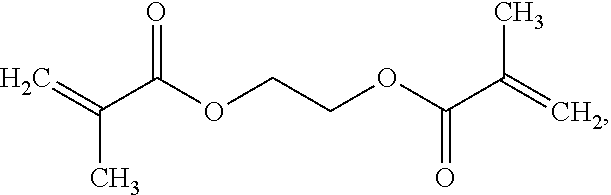
- wherein n is the integers corresponding to the molecular weight.
- The way for adding the bacteria for testing into the solid media are described as follows: after the agar media were heated and cooled down to 45° C., the bacteria were added and mixed evenly; after the agar media solidified, the bacteria were distributed in the solid media. The amount of the added bacteria was 106 colony-forming units (CFU) per 200 μl solid medium.
- The bacteria were cultured in 96-well V-bottom polypropylene (PP) microplate (Corning®, Corning, N.Y.). The volume of solid medium in each well was 200 μl. The control groups included the conditions that the rich agar medium plus only PEG-DMA, or plus only bacteria. The bacteria were incubated at 37° C. for 2 days.
- The results of the experiment are shown in the below table 1, wherein “−” means no such component or no bacterium in the culture medium, and “+” means that the component or the bacteria were added into the culture medium. Table 1 shows that, after two days, in the conditions that S. epidermidis cultured in medium with PEG-DMA, the color of phenol red in the solid medium turned to yellow. In the conditions that P. acnes and USA300 in medium with PEG-DMA, the medium did not be fermented and not turn to yellow. Therefore, PEG-DMA selectively induced the fermentation of S. epidermidis, but not P. acnes and USA300. Moreover, different bacterium species can produce different enzymes to ferment specific substrates, table 1 shows that among the three bacterium species, S. epidermidis has enzymes for PEG-DMA fermentation.
-
TABLE 1 Group 1Group 2Group 3 bacteria(−) bacteria(+) bacteria(+) PEG-DMA(+) PEG-DMA(+) PEG-DMA(+) S. epidermidis Red-orange Red-orange yellow P. acnes Red-orange Red-orange Red-orange USA300 Red-orange Red-orange Red-orange - The polymers having a PEG chain and a monosaccharide group to be tested are compound A and compound B. Compound A is propargyl-PEG5-beta-D-glucose (molecular weight 394.4), which structural formula is as follows:
-

- Compound B is PEG5-tetra-Ac-beta-D-glucose (molecular weight 562.6), which structural formula is as follows:
-

- The experimental method is described as follows: compound A and compound B were respectively added to the solid agar media, and S. epidermidis or P. acnes were added to the media, then the bacteria were incubated, and then the color of phenol red in the media were recorded.
- The results of the experiment are shown in below Table 2, wherein “−” means that no such component in the medium, and “+” means that the component was added in the medium. Table 2 shows that S. epidermidis can ferment compound A and compound B, but P. acnes cannot ferment compounds A and compounds B. Accordingly, these two polymers having a PEG chain can be a selective fermentation initiator (SFI) of S. epidermidis.
-
TABLE 2 Compound Compound Compound Compound A(−) A(+) B(−) B(+) S. epidermidis Red Yellow Red Yellow P. acnes Red Red Red Red - Poloxamer (F68), also called Poly (ethylene glycol)-block-poly (propylene glycol)-block-poly (ethylene glycol), is a polymer having a PEG chain. The structure formula of F68 (molecular weight 8400, catalog No. 412325, SIGMA-ALDRICH) is as follows:
-

- The hydroxyl group (—OH group) at the terminal of F68 were modified to a carboxylic acid (—COOH group), and the structural formula is as follows:
-

- F68 with carboxylic acid (F68-COOH) was added to the TSB liquid medium, and P. acnes. were added to the liquid medium and incubated. The below table 3 shows the conditions and results of the experiment, wherein “−” means that no F68-COOH or no bacterium in the liquid medium, “+” means that F68-COOH or bacteria were in the liquid medium.
-
TABLE 3 F68-COOH − + − + P. acnes − − + + Color of the liquid red Red-orange red yellow medium after two days - The above results show that when F68-COOH was in the liquid medium, P. acnes can metabolize F68-COOH to generate acidic metabolic products. Therefore, for P. acnes, F68-COOH is a selective fermentation initiator.
- Steps of the experiments are described as follows. Rich agar media were prepared, in which include 2% w/v agar. The media were heated and cool down to 45° C., the USA300 were added; the amount of added bacteria is 105 CFU USA300 per 200 μl medium.
- In the experimental group, 2% PEG-DMA was added to the solid media; in the control group, no PEG-DMA was added to the solid media. Bacteria were incubated in 96-well V-bottom PP microplate, and 200 μl medium with USA300 was added to each well. S. epidermidis were spread on the upper surface of the solid media having USA300; the amount of S. epidermidis for spreading is 105 CFU in 20 μl PBS.
- After the bacteria were incubated at 37° C. for two days, the agar image of each culture well was taken and the USA300 colonies (larger than 0.005 mm2) in the solid media were counted by Image J software (NIH, Bethesda, Md., USA).
- Referring to
FIG. 2 , the figure shows the bar chart of the numbers of USA300 colonies in solid media, the numbers are the mean value plus/minus standard derivation (SD) from three independent experiments, the “**” symbol in the figure indicates the p value is less than 0.01 in double tailed t-test. -
FIG. 2 shows that the colony numbers of USA300 in media containing PEG-DMA were significantly less than the colony numbers of USA 300 in media without PEG-DMA. Therefore, existence of PEG-DMA can promote the inhibiting USA300 growth effect of S. epidermidis. Moreover, the S. epidermidis on the solid media can ferment PEG-DMA and generate components which can suppress the growth of USA300; the components were diffused into the solid medium, and then diminished the growth of the USA300 colonies inside the solid media. - The machine for GC-MS assay is Agilent 5890 Series II GC conjugated with 5971 MS detector (Agilent Technologies, Inc., Palo Alto, Calif.).
- Experimental steps are described as follows. S. epidermidis (ATCC No. 12228) was cultured in liquid media containing 2% PEG-DMA. In the control group, the liquid media contained no PEG-DMA, and the bacteria were incubated at 37° C. for two days. Then the supernatants were harvested by centrifugation at 5000×g for 10 minutes. The remaining bacteria in supernatants were further removed by 0.22 micron filters. The short-chain fatty acids in the supernatants were detected by gas chromatography-mass spectrometry, and 2H7-butyric acid was an internal standard.
- Many antibacterial components of bacterial fermentation are short-chain fatty acids; therefore, the components of the short-chain fatty acids of the products of PEG-DMA metabolized by S. epidermidis were analyzed. The results show that, in the supernatants from liquid media without PEG-DMA, only extreme low levels (less than 0.1 μg/ml) of SCFAs were detected. Referring to
FIG. 3A , the result of gas chromatography mass spectrometry shows that there were five major SCFAs produced in the PEG-DMA fermentation by S. epidermidis, the SCFAs were acetic acid (Ac), propionic acid (PA), isobutyric acid (Iso-BA), butyric acid (BA), and isovaleric acid (Iso-VA), wherein the “*” symbol represents the peak of the standard (2H7-butyric acid). Referring toFIG. 3B , which shows a bar chart of the amounts of the SCFAs (unit: micrograms/milliliter).FIG. 3B shows that the sample contained acetic acid (592.1 μg/ml), propionic acid (7.8 μg/ml), isobutyric acid (8.3 μg/ml), butyric acid (3.8 μg/ml), isovaleric acid (11.9 μg/ml).FIG. 3C shows the mass spectra of the five identified short-chain fatty acids (Ac, PA, Iso-BA, BA, and Iso-VA), for example, molecular ions at 31, 43, 45 and 60 m/z respectively corresponding to NCO+, CH3CHO+, CH3CO+, and CH3COOH for acetic acid were detected in a MS spectrum. - These results show that S. epidermidis ferments and metabolizes PEG-DMA to specific components of SCFAs.
- Experimental method: USA 300 (106 CFU/m L) were respectively incubated with different concentrations of butyric acid or acetic acid on 96-well microtiter plates overnight; the testing concentrations of acetic acid and butyric acid were from 0.02 mM to 100 mM, each well was respectively added 100 microliters of acetic acid or butyric acid with different concentrations. In the control groups, only PBS was added to the wells. After incubation, the USA300 was diluted 1:100 to 1:105 with PBS, 5 μl of the dilution was spread to the agar plate; after overnight incubation, colonies (CFU) on the algal plate were counted. MBC is defined as the degree of sterilization at 99.9% (greater than one log10 colony/mL).
- Referring to
FIG. 4A throughFIG. 4D .FIG. 4A andFIG. 4C show the images of bacterial growth on culture plates.FIG. 4B andFIG. 4D are bar chars of quantification results according to three independent experiments, and the figures show the mean value plus/minus standard derivation. The symbol “***” indicates that the p-value is less than 0.001 in two-tailed t-test. UD means undetectable. - The results show that the MBC value of butyric acid and the MBC value of acetic acid were 10 mM, and the concentration of the two acids for complete inhibition was 50 mM.
- It has been known that Propionic acid can suppress the growth of USA300 in vitro and in vivo. The anti-USA300 activity of propionic acid is derived from its ability to reduce the intracellular pH of USA300. In the experiment, since acetic acid and butyric acid are two of the most abundant SCFAs in the media of PEG-DMA fermentation of S. epidermidis, the anti-USA300 activities of acetic and butyric acid were examined in vitro and in vivo in this experiment. The results show that these two short chain fatty acids had excellent efficacy of anti-USA300 growth.
- Hydrogel fabrication method: 10% weight/volume (w/v) of PEG-DMA (number-average Mn=550, catalog number: 25852-47-5, Sigma) were dissolved in water, then 0.002% w/v of phenol red was added for serving as an indicator, 0.001% of ammonium peroxydisulfate was added to serve as an initiator of free radicals, and S. epidermidis (2×10⁸ CFU/mL) were added to the mixture, then components were mixed evenly. Then TEMED was added to the mixture for serving as a catalyst for free radical reaction, TEMED induced the crosslinking reaction of PEG-DMA to form hydrogels and S. epidermidis were encapsulated in the hydrogels. Moreover, the hydrogel gels of control groups were prepared, for example, hydrogels without S. epidermidis, acrylamide hydrogels without S. epidermidis, and acrylamide hydrogels encapsulating S. epidermidis.
- Then the hydrogels were placed in liquid media containing TBS, and were incubated at 37° C. for three days.
- Table 4 shows that the colors of hydrogels after two days of incubation; the color of phenol red relates to the fermentation reaction inside the hydrogel. The symbol “−” means that there was no S. epidermidis in the hydrogel, and the symbol “+” means that there were S. epidermidis encapsulated in the hydrogel. Table 4 shows that in the conditions of PEG-DMA hydrogel encapsulating S. epidermidis, the color of the phenol red in hydrogels changed from red-orange to yellow; meanwhile, acrylamide hydrogels and hydrogels without S. epidermidis did not show this phenomenon. Therefore, S. epidermidis can metabolize PEG-DMA inside the hydrogel.
-
TABLE 4 S. epidermidis (−) S. epidermidis(+) PEG-DMA hydrogel Red-orange Yellow Acrylamide hydrogel Red-orange Red-orange - Experiments involving mice were performed at the University of California, San Diego (UCSD). The UCSC ethics committee approved this study under an approved Institutional Animal Care and Use Committee (IACUC) protocol (no. S10058).
- Hydrogel fabrication method: 10% weight/volume (w/v) of PEG-DMA (number-average Mn=550, catalog number: 25852-47-5, Sigma) were dissolved in water, 0.001% of ammonium peroxydisulfate was added for serving as an initiator of free radicals, and S. epidermidis (2×10⁸ CFU/mL) was added, then the components were mixed evenly. Then TEMED was added for serving as a catalyst for free radical reaction, TEMED induced the crosslinking reaction of PEG-DMA to form hydrogels and S. epidermidis were encapsulated in the hydrogels. Then the hydrogels were placed in liquid media with TBS. In addition, PEG-DMA hydrogels without S. epidermidis, acrylamide hydrogels without S. epidermidis, and acrylamide hydrogels encapsulating S. epidermidis were prepared.
- Animals in the experiment were Institute of Cancer Research (ICR) mice (2 to 3 months-old female) (Harlan Labs, Placentia, Calif., USA). The mice were anesthetized with isoflurane, two 1 mm wounds were respectively made on the left and right sides of the dorsal skin of the mice by electric scissors; the wounds are the first wound, and the second wound, respectively. To recapitulate the infection of methicillin-resistant Staphylococcus aureus (MRSA), the buffer with USA300 (108 CFU dissolved in 10 μl PBS) was applied to the wounds.
- In the experiment group, 10 minutes after the mice were infected with USA300, a PEG-DMA hydrogel (without S. epidermidis) was applied over the first wound, and a PEG-DMA hydrogel encapsulating S. epidermidis was applied over the second wound of the same mouse.
- In the
control group - In the
control group - The experiment was performed three times independently; the mouse number in each group of every experiment is three. All experiments using mice were conducted in a biosafety level 2 (BSL-2) facilities.
- To determine the USA300 counts, the infected wounds were excised 24 hours following infection of USA300. The excised skin was homogenized in 500 μl PBS with a tissue grinder. The tissue homogenates were serially diluted, then were spread on a phenol-red supplemented mannitol salt agar (MSA) plate (BD, Sparks, Md., USA). The plates were incubated at 37° C. for 24 hours, and then the colonies on the plates were counted, wherein the yellow colonies were recognized as USA300 colonies.
- Referring to
FIG. 5A throughFIG. 5F , in whichFIG. 5A ,FIG. 5C , andFIG. 5E are images of bacterial growth at different serial dilution concertation.FIG. 5B ,FIG. 5D , andFIG. 5F are the quantification results from three independent experiments, wherein the mouse number of each group is three. The figures show the average colony numbers plus/minus standard derivation of USA300 (yellow colony). The symbol “***” indicates that the p-value is less than 0.001 in two-tailed t-test. -
FIG. 5A andFIG. 5B show that the number (7.5±1.2×10⁵ CFU) of USA300 in the wound covered by a PEG-DMA gel with S. epidermidis was significantly less than that (5.0±1.5×10⁵ CFU) in the wound covered by a PEG-DMA-hydrogel without S. epidermidis. The results demonstrate that PEG-DMA hydrogel encapsulating S. epidermidis possess the probiotics activity against USA300 in wounds. -
FIG. 5C andFIG. 5D show the experiment results ofcontrol group 1, PEG-DMA hydrogel did not diminish the growth of USA300 in wounds; the result means that PEG-DMA hydrogel per se did not affect the colonization of USA300 in wounds. The symbol “ns” inFIG. 5D means the statistical result is not significant. -
FIG. 5E andFIG. 5F show the experiment results ofcontrol group 2, for the growth of the USA300 in wounds, there was no significant difference between the acrylamide gel containing S. epidermidis. and the acrylamide gel containing no S. epidermidis. The symbol “ns” in theFIG. 5F means the statistical result is not significant. - The above results show that after PEG-DMA fermentation in the hydrogel, the hydrogel has efficacy of inhibiting the growth of pathogen USA300 in wounds.
- The efficacies of the present disclosure:
- The hydrogel of the present disclosure can maintain a large amount of water in the three-dimensional structure of the gel body, and can maintain a fixed shape; therefore, the hydrogel is used as a carrier to provide or maintain the humidity of the covered site, and to slowly release active molecules from the hydrogel.
- The PEG-based hydrogel in the present disclosure can be a carbon-rich microenvironment, which can not only for bacteria to survive in, but it also can induce bacteria to use polymer having a PEG chain as a carbon source for fermentation, and release functional products of fermentation. For example, the results of the experiments of the present disclosure show that PEG-DMA encapsulating S. epidermidis specifically ferment and metabolize PEG-DMA into specific SCFAs, and the hydrogel has excellent antibacterial activity. SCFAs are fatty acids generally contain two to six carbons, and they are also called as volatile fatty acids; SCFAs are volatile compounds with short half-life and can be metabolized quickly. SCFAs not only can inhibit the growth of pathogenic bacteria, but they can also be inhibitors of class I and class II histone deacetylase (HDAC); furthermore, they can inhibit inflammation reactions.
- Accordingly, one of the uses of the hydrogel of the present disclosure is a novel antibacterial hydrogel for application in biomedical field, such as for skin care products (e.g., masks, gels), or for medical materials (e.g., dressing, patch).
- Different bacterium species in hosts can produce different specific enzymes to metabolize specific carbon sources. Most of the skin commensal bacteria include S. epidermidis, P. acnes, and pathogenic S. aureus; these bacteria can metabolize the same carbon source such as glucose to SCFAs. To gain maximum chances to survive, commensal bacteria and pathogenic bacteria may exclude each other via production of SCFAs by fermentation of glucose. When S. aureus survives after the bacterial interference, the infection will proceed to continue to damage the host. Examples of the present disclosure show that the fermentation of S. epidermidis is specifically triggered by a SFI; therefore, the probiotic effect of S. epidermidis against pathogenic S. aureus can be amplified.
- Methicillin-resistant S. aureus (MRSA), or multiple-resistant S. aureus, is a unique strain of S. aureus and it is resistant to almost all penicillin antibiotics including Methicillin and other anti-β-lactamase Penicillin. MRSA was first discovered in 1961 in UK and is now widely distributed, and in hospital the strain of bacteria is called “super bacteria”.
- Although an incision and drainage procedure was performed for the majority of MRSA-infected patients, antibiotics are usually given as adjunctive therapy. However, through antibiotics for MRSA treatment, the bacteria may evolve abilities to neutralize the antibiotics. In other words, the use of antibiotics increases the risk of generating resistant bacteria and non-specifically kills commensal bacteria of hosts.
- The hydrogel of the present disclosure can be applied as an adjuvant to reduce the amounts of antibiotics in antibiotics treatment; therefore, the chance of generating resistant bacteria is reduced, and the killing effect for nonpathogenic commensal bacteria is also reduced.
- The hydrogel of the present disclosure can be applied to the patch formulation of transdermal administration. The delivering system of transdermal administration can slowly release functional molecules in a long term. However, some functional secondary metabolites of bacteria have short half-life; hence, the functional molecules can be continuously produced and released by fermentation of bacteria inside the gel body.
- Although the present invention has been described in considerable detail with reference to certain embodiments thereof. The appended claims should not be limited to the description of the embodiments contained herein. It will be apparent to those skilled in the art that various modifications and variations can be made without departing from the scope or spirit of the invention. Therefore, the scopes of the claims depend on what defined in the claims.
Claims (20)
Priority Applications (1)
| Application Number | Priority Date | Filing Date | Title |
|---|---|---|---|
| US15/655,915 US10617769B2 (en) | 2016-07-22 | 2017-07-21 | Bacterium-contained hydrogel and method of making the same |
Applications Claiming Priority (2)
| Application Number | Priority Date | Filing Date | Title |
|---|---|---|---|
| US201662365392P | 2016-07-22 | 2016-07-22 | |
| US15/655,915 US10617769B2 (en) | 2016-07-22 | 2017-07-21 | Bacterium-contained hydrogel and method of making the same |
Publications (2)
| Publication Number | Publication Date |
|---|---|
| US20180021452A1 true US20180021452A1 (en) | 2018-01-25 |
| US10617769B2 US10617769B2 (en) | 2020-04-14 |
Family
ID=60989862
Family Applications (1)
| Application Number | Title | Priority Date | Filing Date |
|---|---|---|---|
| US15/655,915 Active 2037-10-17 US10617769B2 (en) | 2016-07-22 | 2017-07-21 | Bacterium-contained hydrogel and method of making the same |
Country Status (3)
| Country | Link |
|---|---|
| US (1) | US10617769B2 (en) |
| CN (1) | CN107638588B (en) |
| TW (1) | TWI673056B (en) |
Cited By (6)
| Publication number | Priority date | Publication date | Assignee | Title |
|---|---|---|---|---|
| WO2019089596A1 (en) * | 2017-10-30 | 2019-05-09 | Lawrence Livermore National Security, Llc | Polymeric encapsulation of whole cells as bioreactors |
| GB2623078A (en) * | 2022-10-03 | 2024-04-10 | Univ Brunel | Prevention and/or treatment of wound infection |
| US12263193B2 (en) | 2018-10-12 | 2025-04-01 | University Of Washington | System and method for removing uremic toxins from a patient's body |
| US12269764B2 (en) | 2019-10-14 | 2025-04-08 | University Of Washington | Hydrogels for the entrapment of bacteria |
| WO2025076586A1 (en) * | 2023-10-09 | 2025-04-17 | Hydgene Renewables Pty Ltd | Generator system |
| WO2025151767A1 (en) * | 2024-01-10 | 2025-07-17 | The University Of Chicago | Active biointegrated living electronics for managing inflammation |
Families Citing this family (23)
| Publication number | Priority date | Publication date | Assignee | Title |
|---|---|---|---|---|
| GB0808376D0 (en) | 2008-05-08 | 2008-06-18 | Bristol Myers Squibb Co | Wound dressing |
| GB0817796D0 (en) | 2008-09-29 | 2008-11-05 | Convatec Inc | wound dressing |
| GB201020236D0 (en) | 2010-11-30 | 2011-01-12 | Convatec Technologies Inc | A composition for detecting biofilms on viable tissues |
| WO2012078723A1 (en) | 2010-12-08 | 2012-06-14 | Convatec Technologies Inc. | Method and system for removing exudates from a wound site |
| CA2819475C (en) | 2010-12-08 | 2019-02-12 | Convatec Technologies Inc. | Integrated system for assessing wound exudates |
| US9526816B2 (en) | 2010-12-08 | 2016-12-27 | Convatec Technologies Inc. | Wound exudate monitor accessory |
| GB201115182D0 (en) | 2011-09-02 | 2011-10-19 | Trio Healthcare Ltd | Skin contact material |
| GB2497406A (en) | 2011-11-29 | 2013-06-12 | Webtec Converting Llc | Dressing with a perforated binder layer |
| CA2895896A1 (en) | 2012-12-20 | 2014-06-26 | Convatec Technologies Inc. | Processing of chemically modified cellulosic fibres |
| GB2543544A (en) | 2015-10-21 | 2017-04-26 | Brightwake Ltd | Wound dressing |
| KR20190015210A (en) | 2016-03-30 | 2019-02-13 | 퀄리자임 다이아그노스틱스 게엠베하 엔드 코 카게 | Detection of microbial infection in wound |
| EP3435941B1 (en) | 2016-03-30 | 2021-09-01 | ConvaTec Technologies Inc. | Detecting microbial infections in wounds |
| GB201608099D0 (en) | 2016-05-09 | 2016-06-22 | Convatec Technologies Inc | Negative pressure wound dressing |
| PL3481360T3 (en) | 2016-07-08 | 2022-05-02 | Convatec Technologies Inc. | Fluid flow sensing |
| CN109688991B (en) | 2016-07-08 | 2021-10-29 | 康沃特克科技公司 | Flexible negative pressure system |
| CN109640904A (en) | 2016-07-08 | 2019-04-16 | 康沃特克科技公司 | fluid collection equipment |
| US12161792B2 (en) | 2017-11-16 | 2024-12-10 | Convatec Limited | Fluid collection apparatus |
| WO2020245656A1 (en) | 2019-06-03 | 2020-12-10 | Convatec Limited | Methods and devices to disrupt and contain pathogens |
| US11331221B2 (en) | 2019-12-27 | 2022-05-17 | Convatec Limited | Negative pressure wound dressing |
| US11771819B2 (en) | 2019-12-27 | 2023-10-03 | Convatec Limited | Low profile filter devices suitable for use in negative pressure wound therapy systems |
| CN111704802A (en) * | 2020-07-09 | 2020-09-25 | 中国科学院大学温州研究院(温州生物材料与工程研究所) | A kind of probiotic metabolite-based hydrogel and preparation method thereof |
| CN114874935A (en) * | 2022-04-26 | 2022-08-09 | 南京北极光生物科技有限公司 | High-activity probiotic preparation composition and preparation method thereof |
| CN116083240B (en) * | 2023-04-07 | 2023-08-29 | 深圳市第二人民医院(深圳市转化医学研究院) | Engineered bacteria, preparation method and application thereof |
Family Cites Families (22)
| Publication number | Priority date | Publication date | Assignee | Title |
|---|---|---|---|---|
| WO2000078141A1 (en) | 1999-06-23 | 2000-12-28 | The Dial Corporation | Antibacterial compositions |
| US8541021B2 (en) * | 2001-05-01 | 2013-09-24 | A.V. Topchiev Institute Of Petrochemical Synthesis | Hydrogel compositions demonstrating phase separation on contact with aqueous media |
| WO2003061585A2 (en) | 2002-01-22 | 2003-07-31 | The Penn State Research Foundation | Drug candidate screening systems based on micropatterned hydrogels and microfluidic systems |
| US7419593B2 (en) * | 2003-11-19 | 2008-09-02 | Amcol International Corp. | Bioremediation mat and method of manufacture and use |
| ES2235642B2 (en) * | 2003-12-18 | 2006-03-01 | Gat Formulation Gmbh | CONTINUOUS MULTI-MICROENCAPSULATION PROCESS FOR THE IMPROVEMENT OF STABILITY AND STORAGE OF BIOLOGICALLY ACTIVE INGREDIENTS. |
| WO2006050625A2 (en) * | 2004-11-15 | 2006-05-18 | Drm, Dr. Müller Ag | Method for removing bacteria from a fermentation broth |
| US8734823B2 (en) * | 2005-12-14 | 2014-05-27 | The Invention Science Fund I, Llc | Device including altered microorganisms, and methods and systems of use |
| US8682619B2 (en) * | 2005-12-14 | 2014-03-25 | The Invention Science Fund I, Llc | Device including altered microorganisms, and methods and systems of use |
| CN101641121A (en) * | 2006-12-19 | 2010-02-03 | 弗罗桑公司 | Wound or tissue dressings containing lactic acid bacteria |
| RU2009127718A (en) * | 2006-12-19 | 2011-01-27 | Ферросан А/С (Dk) | WOUND OR TISSUE BANDING MATERIAL CONTAINING LACTIC ACID BACTERIA |
| WO2012068179A1 (en) * | 2010-11-15 | 2012-05-24 | Rutgers, The State University Of New Jersey | Multifunctional biodegradable peg nanocarrier-based hydrogels for preventing hiv transmission |
| US8367109B2 (en) * | 2008-04-09 | 2013-02-05 | Brookhaven Science Associates, Llc | Microbes encapsulated within crosslinkable polymers |
| DE102008063821A1 (en) * | 2008-12-19 | 2010-06-24 | Philipps-Universität Marburg | Electrospun polymer fibers comprising particles of bacteria-containing hydrogels |
| TWM446986U (en) * | 2012-07-13 | 2013-02-11 | Hon Hai Prec Ind Co Ltd | Electrical connector |
| CN103230619B (en) * | 2013-05-15 | 2014-11-26 | 南京斯瑞奇医疗用品有限公司 | Composite hydrogel dressing and preparation method thereof |
| JP2016534357A (en) | 2013-09-04 | 2016-11-04 | クレド バイオメディカル ピーティーイー リミテッド | Assay test device, kit, and method of use thereof |
| CN103755981A (en) * | 2014-01-14 | 2014-04-30 | 西北大学 | Hydrogel used as skin filling material and preparation method thereof |
| NL2013203B1 (en) * | 2014-07-17 | 2016-05-19 | Univ Delft Tech | Process for the production of cementious material. |
| CN104099283B (en) * | 2014-07-22 | 2017-01-18 | 张维 | Temperature-sensitive hydrogel microorganism culture medium and preparation method thereof |
| EP3285778A2 (en) * | 2015-04-23 | 2018-02-28 | Kaleido Biosciences, Inc. | Microbiome regulators and related uses thereof |
| CN107771083A (en) * | 2015-04-23 | 2018-03-06 | 卡莱多生物科技有限公司 | Glycan therapeutics and methods of treatment |
| CN111888369A (en) * | 2015-08-25 | 2020-11-06 | 卡莱多生物科技有限公司 | Glycan composition and use thereof |
-
2017
- 2017-07-20 TW TW106124404A patent/TWI673056B/en active
- 2017-07-21 US US15/655,915 patent/US10617769B2/en active Active
- 2017-07-21 CN CN201710599652.5A patent/CN107638588B/en active Active
Cited By (8)
| Publication number | Priority date | Publication date | Assignee | Title |
|---|---|---|---|---|
| WO2019089596A1 (en) * | 2017-10-30 | 2019-05-09 | Lawrence Livermore National Security, Llc | Polymeric encapsulation of whole cells as bioreactors |
| US12263193B2 (en) | 2018-10-12 | 2025-04-01 | University Of Washington | System and method for removing uremic toxins from a patient's body |
| US12269764B2 (en) | 2019-10-14 | 2025-04-08 | University Of Washington | Hydrogels for the entrapment of bacteria |
| GB2623078A (en) * | 2022-10-03 | 2024-04-10 | Univ Brunel | Prevention and/or treatment of wound infection |
| WO2024074803A1 (en) * | 2022-10-03 | 2024-04-11 | Brunel University London | Prevention and/or treatment of wound infection |
| GB2623078B (en) * | 2022-10-03 | 2025-04-16 | Univ Brunel | Prevention and/or treatment of wound infection |
| WO2025076586A1 (en) * | 2023-10-09 | 2025-04-17 | Hydgene Renewables Pty Ltd | Generator system |
| WO2025151767A1 (en) * | 2024-01-10 | 2025-07-17 | The University Of Chicago | Active biointegrated living electronics for managing inflammation |
Also Published As
| Publication number | Publication date |
|---|---|
| TW201803575A (en) | 2018-02-01 |
| CN107638588B (en) | 2020-10-30 |
| TWI673056B (en) | 2019-10-01 |
| US10617769B2 (en) | 2020-04-14 |
| CN107638588A (en) | 2018-01-30 |
Similar Documents
| Publication | Publication Date | Title |
|---|---|---|
| US10617769B2 (en) | Bacterium-contained hydrogel and method of making the same | |
| Savitskaya et al. | Antimicrobial and wound healing properties of a bacterial cellulose based material containing B. subtilis cells | |
| Kao et al. | Microbiome precision editing: Using PEG as a selective fermentation initiator against methicillin‐resistant Staphylococcus aureus | |
| AU2013298182B2 (en) | Antibacterial composition for topical use | |
| JP2023533202A (en) | probiotic skin preparation | |
| Lang et al. | Tyrothricin–an underrated agent for the treatment of bacterial skin infections and superficial wounds? | |
| CN109529045B (en) | Application of rifamycin-quinazinone coupling molecule and pharmaceutically acceptable salt thereof | |
| AU2010238765A1 (en) | Methods of treating a pulmonary bacterial infection using fluoro-quinolones | |
| Grønseth et al. | Lugol's solution and Gentian violet eradicate methicillin‐resistant Staphylococcus aureus biofilm in skin wound infections | |
| CN120643667A (en) | Pharmaceutical composition, glycyrrhizic acid and polymyxin B self-assembled carrier-free hydrogel and preparation method and application | |
| Kao et al. | The mPEG-PCL copolymer for selective fermentation of Staphylococcus lugdunensis against Candida parapsilosis in the human microbiome | |
| Sallade et al. | Antimicrobial effectiveness testing of resorbable electrospun fiber matrix per United States Pharmacopeia (USP)< 51 | |
| Lanqiao et al. | Natural medicine can substitute antibiotics in animal husbandry: protective effects and mechanisms of rosewood essential oil against Salmonella infection | |
| Daniel et al. | EPS9. 09 Pilot study to evaluate the use of dry chlorine dioxide gas for sterilisation of virtual reality headsets | |
| RU2017145630A (en) | COMPOSITIONS AND METHODS FOR APPLICATION OF LAMELLARIAN BODIES FOR THERAPEUTIC PURPOSES | |
| KR102098029B1 (en) | A composition comprising chitosan for ehancing the the photodynamic therapy against Helicobacter pylori | |
| KR101954511B1 (en) | A composition comprising chitosan for enhancing the photodynamic therapy against Clostridium difficile | |
| Durr | Development of Antibacterial Hydrogels with Regenerative Benefits for Infected Wound Healing | |
| CN1210030C (en) | Antimicrobial composition and mthod for producing same | |
| Jung et al. | Reduction in Antimicrobial Resistance Prevalence in Escherichia coli and Enterococcus Species from a Swine Farm in Korea following All-In/All-Out Management | |
| RU2404751C2 (en) | Wound healing agent | |
| CN1234372C (en) | Use of bioactive fractions from cow urine distillates ('GO-mutra') as bioenhancers for anti-infectives, anti-cancer agents and nutrients | |
| Capper-Parkin | Development of Antimicrobial Impregnated Catheter Coatings to Prevent Uropathogenic Escherichia coli Infections | |
| 최진욱 | The protective effects of Mycobacterium-mediated gut microbial alteration on the colitis-associated colorectal cancer | |
| Rodrigues et al. | Safranine-O Incorporated in F127 Nanocarriers Reduces the Contamination of Staphylococcus aureus in Sheep’s Milk |
Legal Events
| Date | Code | Title | Description |
|---|---|---|---|
| AS | Assignment |
Owner name: NATIONAL CENTRAL UNIVERSITY, TAIWAN Free format text: ASSIGNMENT OF ASSIGNORS INTEREST;ASSIGNOR:HUANG, CHUN-MING;REEL/FRAME:044219/0541 Effective date: 20171016 |
|
| AS | Assignment |
Owner name: TCI CO., LTD., TAIWAN Free format text: ASSIGNMENT OF ASSIGNORS INTEREST;ASSIGNOR:NATIONAL CENTRAL UNIVERSITY;REEL/FRAME:046977/0237 Effective date: 20180702 |
|
| FEPP | Fee payment procedure |
Free format text: ENTITY STATUS SET TO UNDISCOUNTED (ORIGINAL EVENT CODE: BIG.); ENTITY STATUS OF PATENT OWNER: LARGE ENTITY |
|
| STPP | Information on status: patent application and granting procedure in general |
Free format text: NON FINAL ACTION MAILED |
|
| STPP | Information on status: patent application and granting procedure in general |
Free format text: NON FINAL ACTION MAILED |
|
| STPP | Information on status: patent application and granting procedure in general |
Free format text: RESPONSE TO NON-FINAL OFFICE ACTION ENTERED AND FORWARDED TO EXAMINER |
|
| STPP | Information on status: patent application and granting procedure in general |
Free format text: NOTICE OF ALLOWANCE MAILED -- APPLICATION RECEIVED IN OFFICE OF PUBLICATIONS |
|
| STPP | Information on status: patent application and granting procedure in general |
Free format text: AWAITING TC RESP., ISSUE FEE NOT PAID |
|
| STCF | Information on status: patent grant |
Free format text: PATENTED CASE |
|
| MAFP | Maintenance fee payment |
Free format text: PAYMENT OF MAINTENANCE FEE, 4TH YEAR, LARGE ENTITY (ORIGINAL EVENT CODE: M1551); ENTITY STATUS OF PATENT OWNER: LARGE ENTITY Year of fee payment: 4 |