US20170014468A1 - Methods of use for therapeutics targeting the pathogen porphyromonas gingivalis - Google Patents
Methods of use for therapeutics targeting the pathogen porphyromonas gingivalis Download PDFInfo
- Publication number
- US20170014468A1 US20170014468A1 US14/699,898 US201514699898A US2017014468A1 US 20170014468 A1 US20170014468 A1 US 20170014468A1 US 201514699898 A US201514699898 A US 201514699898A US 2017014468 A1 US2017014468 A1 US 2017014468A1
- Authority
- US
- United States
- Prior art keywords
- substituted
- kgp
- disease
- unsubstituted
- alkyl
- Prior art date
- Legal status (The legal status is an assumption and is not a legal conclusion. Google has not performed a legal analysis and makes no representation as to the accuracy of the status listed.)
- Abandoned
Links
- 238000000034 method Methods 0.000 title claims abstract description 75
- 239000003814 drug Substances 0.000 title claims abstract description 22
- 230000008685 targeting Effects 0.000 title claims description 7
- 241000605862 Porphyromonas gingivalis Species 0.000 title description 96
- 244000052769 pathogen Species 0.000 title description 4
- 230000001717 pathogenic effect Effects 0.000 title description 4
- 208000014644 Brain disease Diseases 0.000 claims abstract description 51
- 238000011282 treatment Methods 0.000 claims abstract description 49
- 208000024827 Alzheimer disease Diseases 0.000 claims abstract description 41
- 230000002265 prevention Effects 0.000 claims abstract description 17
- 241001465754 Metazoa Species 0.000 claims abstract description 10
- 208000037265 diseases, disorders, signs and symptoms Diseases 0.000 claims abstract description 9
- 208000035475 disorder Diseases 0.000 claims abstract description 7
- -1 carbonylaminoethylanilinyl Chemical group 0.000 claims description 143
- 108091020100 Gingipain Cysteine Endopeptidases Proteins 0.000 claims description 108
- 101150011052 kgp gene Proteins 0.000 claims description 100
- 150000001875 compounds Chemical class 0.000 claims description 62
- 125000000217 alkyl group Chemical group 0.000 claims description 57
- 239000003795 chemical substances by application Substances 0.000 claims description 52
- 125000003178 carboxy group Chemical group [H]OC(*)=O 0.000 claims description 40
- 230000000694 effects Effects 0.000 claims description 34
- 125000002887 hydroxy group Chemical group [H]O* 0.000 claims description 34
- 125000004453 alkoxycarbonyl group Chemical group 0.000 claims description 32
- 125000006239 protecting group Chemical group 0.000 claims description 30
- 125000003118 aryl group Chemical group 0.000 claims description 26
- 125000001584 benzyloxycarbonyl group Chemical group C(=O)(OCC1=CC=CC=C1)* 0.000 claims description 26
- 125000005740 oxycarbonyl group Chemical group [*:1]OC([*:2])=O 0.000 claims description 26
- 208000010877 cognitive disease Diseases 0.000 claims description 25
- 125000003545 alkoxy group Chemical group 0.000 claims description 24
- 235000008206 alpha-amino acids Nutrition 0.000 claims description 24
- UYWQUFXKFGHYNT-UHFFFAOYSA-N phenylmethyl ester of formic acid Natural products O=COCC1=CC=CC=C1 UYWQUFXKFGHYNT-UHFFFAOYSA-N 0.000 claims description 24
- 125000004183 alkoxy alkyl group Chemical group 0.000 claims description 20
- 125000002877 alkyl aryl group Chemical group 0.000 claims description 19
- 125000003710 aryl alkyl group Chemical group 0.000 claims description 18
- 125000004181 carboxyalkyl group Chemical group 0.000 claims description 17
- 125000000753 cycloalkyl group Chemical group 0.000 claims description 17
- 239000001257 hydrogen Substances 0.000 claims description 17
- 229910052739 hydrogen Inorganic materials 0.000 claims description 17
- 125000002924 primary amino group Chemical group [H]N([H])* 0.000 claims description 17
- 125000004171 alkoxy aryl group Chemical group 0.000 claims description 16
- 125000005026 carboxyaryl group Chemical group 0.000 claims description 16
- 125000004193 piperazinyl group Chemical group 0.000 claims description 16
- 208000009829 Lewy Body Disease Diseases 0.000 claims description 15
- 201000002832 Lewy body dementia Diseases 0.000 claims description 15
- 125000001797 benzyl group Chemical group [H]C1=C([H])C([H])=C(C([H])=C1[H])C([H])([H])* 0.000 claims description 14
- 208000004051 Chronic Traumatic Encephalopathy Diseases 0.000 claims description 13
- OAKJQQAXSVQMHS-UHFFFAOYSA-N Hydrazine Chemical compound NN OAKJQQAXSVQMHS-UHFFFAOYSA-N 0.000 claims description 13
- 208000006011 Stroke Diseases 0.000 claims description 13
- 125000003368 amide group Chemical group 0.000 claims description 13
- 125000004103 aminoalkyl group Chemical group 0.000 claims description 13
- 208000017004 dementia pugilistica Diseases 0.000 claims description 13
- 150000003839 salts Chemical class 0.000 claims description 13
- 229910052736 halogen Inorganic materials 0.000 claims description 12
- 150000002367 halogens Chemical class 0.000 claims description 12
- 150000002431 hydrogen Chemical class 0.000 claims description 12
- 206010003805 Autism Diseases 0.000 claims description 11
- 208000020706 Autistic disease Diseases 0.000 claims description 11
- 206010015037 epilepsy Diseases 0.000 claims description 11
- 208000027061 mild cognitive impairment Diseases 0.000 claims description 11
- 201000002212 progressive supranuclear palsy Diseases 0.000 claims description 11
- 201000010374 Down Syndrome Diseases 0.000 claims description 10
- 206010044688 Trisomy 21 Diseases 0.000 claims description 10
- 201000006517 essential tremor Diseases 0.000 claims description 10
- 206010027175 memory impairment Diseases 0.000 claims description 10
- 201000000980 schizophrenia Diseases 0.000 claims description 10
- 208000023105 Huntington disease Diseases 0.000 claims description 9
- 208000001089 Multiple system atrophy Diseases 0.000 claims description 9
- 206010002026 amyotrophic lateral sclerosis Diseases 0.000 claims description 9
- ZRALSGWEFCBTJO-UHFFFAOYSA-N Guanidine Chemical compound NC(N)=N ZRALSGWEFCBTJO-UHFFFAOYSA-N 0.000 claims description 8
- 208000018737 Parkinson disease Diseases 0.000 claims description 8
- 102000004142 Trypsin Human genes 0.000 claims description 8
- 108090000631 Trypsin Proteins 0.000 claims description 8
- 239000012588 trypsin Substances 0.000 claims description 8
- 108090000624 Cathepsin L Proteins 0.000 claims description 7
- 102000004172 Cathepsin L Human genes 0.000 claims description 7
- 201000011240 Frontotemporal dementia Diseases 0.000 claims description 7
- 125000000959 isobutyl group Chemical group [H]C([H])([H])C([H])(C([H])([H])[H])C([H])([H])* 0.000 claims description 7
- 201000006417 multiple sclerosis Diseases 0.000 claims description 7
- 125000004042 4-aminobutyl group Chemical group [H]C([*])([H])C([H])([H])C([H])([H])C([H])([H])N([H])[H] 0.000 claims description 6
- 108010048201 carbobenzoxy-Glu-Lys-CO-Arg-CO-NH(CH2)2Ph Proteins 0.000 claims description 6
- 125000000143 2-carboxyethyl group Chemical group [H]OC(=O)C([H])([H])C([H])([H])* 0.000 claims description 5
- UFHFLCQGNIYNRP-UHFFFAOYSA-N Hydrogen Chemical compound [H][H] UFHFLCQGNIYNRP-UHFFFAOYSA-N 0.000 claims description 4
- CHJJGSNFBQVOTG-UHFFFAOYSA-N N-methyl-guanidine Natural products CNC(N)=N CHJJGSNFBQVOTG-UHFFFAOYSA-N 0.000 claims description 4
- AFBPFSWMIHJQDM-UHFFFAOYSA-N N-methylaniline Chemical compound CNC1=CC=CC=C1 AFBPFSWMIHJQDM-UHFFFAOYSA-N 0.000 claims description 4
- 125000003342 alkenyl group Chemical group 0.000 claims description 4
- 150000001412 amines Chemical class 0.000 claims description 4
- 125000002147 dimethylamino group Chemical group [H]C([H])([H])N(*)C([H])([H])[H] 0.000 claims description 4
- SWSQBOPZIKWTGO-UHFFFAOYSA-N dimethylaminoamidine Natural products CN(C)C(N)=N SWSQBOPZIKWTGO-UHFFFAOYSA-N 0.000 claims description 4
- 125000004448 alkyl carbonyl group Chemical group 0.000 claims description 3
- AQTFKGDWFRRIHR-UHFFFAOYSA-L 3-[18-(2-carboxylatoethyl)-8,13-bis(ethenyl)-3,7,12,17-tetramethylporphyrin-21,24-diid-2-yl]propanoate;cobalt(2+);hydron Chemical compound [Co+2].[N-]1C(C=C2C(=C(C)C(C=C3C(=C(C)C(=C4)[N-]3)C=C)=N2)C=C)=C(C)C(CCC(O)=O)=C1C=C1C(CCC(O)=O)=C(C)C4=N1 AQTFKGDWFRRIHR-UHFFFAOYSA-L 0.000 claims description 2
- 208000020401 Depressive disease Diseases 0.000 claims description 2
- 108010021625 Immunoglobulin Fragments Proteins 0.000 claims description 2
- 102000008394 Immunoglobulin Fragments Human genes 0.000 claims description 2
- 125000000250 methylamino group Chemical group [H]N(*)C([H])([H])[H] 0.000 claims description 2
- PYHOFAHZHOBVGV-UHFFFAOYSA-N triazane Chemical compound NNN PYHOFAHZHOBVGV-UHFFFAOYSA-N 0.000 claims description 2
- 150000001371 alpha-amino acids Chemical class 0.000 claims 9
- 125000000547 substituted alkyl group Chemical group 0.000 claims 5
- 208000024172 Cardiovascular disease Diseases 0.000 abstract description 23
- 206010012601 diabetes mellitus Diseases 0.000 abstract description 23
- 239000000203 mixture Substances 0.000 abstract description 23
- 229960005486 vaccine Drugs 0.000 abstract description 18
- 208000017442 Retinal disease Diseases 0.000 abstract description 15
- 206010003246 arthritis Diseases 0.000 abstract description 15
- 230000032683 aging Effects 0.000 abstract description 10
- 238000011161 development Methods 0.000 abstract description 6
- 230000018109 developmental process Effects 0.000 abstract description 6
- 238000009472 formulation Methods 0.000 abstract description 6
- 238000012360 testing method Methods 0.000 abstract description 5
- 238000010171 animal model Methods 0.000 abstract description 3
- 210000004556 brain Anatomy 0.000 description 73
- 241000699670 Mus sp. Species 0.000 description 33
- 241000282472 Canis lupus familiaris Species 0.000 description 27
- 241000894006 Bacteria Species 0.000 description 24
- 239000003112 inhibitor Substances 0.000 description 22
- 230000004770 neurodegeneration Effects 0.000 description 20
- 150000001370 alpha-amino acid derivatives Chemical class 0.000 description 17
- 238000010186 staining Methods 0.000 description 17
- KDXKERNSBIXSRK-UHFFFAOYSA-N Lysine Natural products NCCCCC(N)C(O)=O KDXKERNSBIXSRK-UHFFFAOYSA-N 0.000 description 16
- 235000018102 proteins Nutrition 0.000 description 15
- 108090000623 proteins and genes Proteins 0.000 description 15
- 102000004169 proteins and genes Human genes 0.000 description 15
- 208000015181 infectious disease Diseases 0.000 description 14
- 230000008595 infiltration Effects 0.000 description 14
- 238000001764 infiltration Methods 0.000 description 14
- 206010012289 Dementia Diseases 0.000 description 13
- 230000005764 inhibitory process Effects 0.000 description 13
- 239000004472 Lysine Substances 0.000 description 12
- 210000004027 cell Anatomy 0.000 description 12
- 102000035195 Peptidases Human genes 0.000 description 11
- 108091005804 Peptidases Proteins 0.000 description 11
- 239000003242 anti bacterial agent Substances 0.000 description 11
- 230000008499 blood brain barrier function Effects 0.000 description 11
- 210000001218 blood-brain barrier Anatomy 0.000 description 11
- 230000030833 cell death Effects 0.000 description 11
- 108700026503 phenylalanyl-ureido-citrullinyl-valinyl-cycloarginal Proteins 0.000 description 11
- 210000001519 tissue Anatomy 0.000 description 11
- 239000004475 Arginine Substances 0.000 description 10
- 208000028698 Cognitive impairment Diseases 0.000 description 10
- ODKSFYDXXFIFQN-BYPYZUCNSA-P L-argininium(2+) Chemical compound NC(=[NH2+])NCCC[C@H]([NH3+])C(O)=O ODKSFYDXXFIFQN-BYPYZUCNSA-P 0.000 description 10
- 239000004098 Tetracycline Substances 0.000 description 10
- ODKSFYDXXFIFQN-UHFFFAOYSA-N arginine Natural products OC(=O)C(N)CCCNC(N)=N ODKSFYDXXFIFQN-UHFFFAOYSA-N 0.000 description 10
- 235000019364 tetracycline Nutrition 0.000 description 10
- 150000003522 tetracyclines Chemical class 0.000 description 10
- 238000012384 transportation and delivery Methods 0.000 description 10
- 239000004365 Protease Substances 0.000 description 9
- 230000003115 biocidal effect Effects 0.000 description 9
- 230000003053 immunization Effects 0.000 description 9
- 238000002649 immunization Methods 0.000 description 9
- 125000001997 phenyl group Chemical group [H]C1=C([H])C([H])=C(*)C([H])=C1[H] 0.000 description 9
- 229940124597 therapeutic agent Drugs 0.000 description 9
- 241000282412 Homo Species 0.000 description 8
- JGSARLDLIJGVTE-MBNYWOFBSA-N Penicillin G Chemical compound N([C@H]1[C@H]2SC([C@@H](N2C1=O)C(O)=O)(C)C)C(=O)CC1=CC=CC=C1 JGSARLDLIJGVTE-MBNYWOFBSA-N 0.000 description 8
- NCDNCNXCDXHOMX-UHFFFAOYSA-N Ritonavir Natural products C=1C=CC=CC=1CC(NC(=O)OCC=1SC=NC=1)C(O)CC(CC=1C=CC=CC=1)NC(=O)C(C(C)C)NC(=O)N(C)CC1=CSC(C(C)C)=N1 NCDNCNXCDXHOMX-UHFFFAOYSA-N 0.000 description 8
- 210000002569 neuron Anatomy 0.000 description 8
- 230000003239 periodontal effect Effects 0.000 description 8
- 108090000765 processed proteins & peptides Proteins 0.000 description 8
- 229960000311 ritonavir Drugs 0.000 description 8
- NCDNCNXCDXHOMX-XGKFQTDJSA-N ritonavir Chemical compound N([C@@H](C(C)C)C(=O)N[C@H](C[C@H](O)[C@H](CC=1C=CC=CC=1)NC(=O)OCC=1SC=NC=1)CC=1C=CC=CC=1)C(=O)N(C)CC1=CSC(C(C)C)=N1 NCDNCNXCDXHOMX-XGKFQTDJSA-N 0.000 description 8
- 125000001424 substituent group Chemical group 0.000 description 8
- 125000000094 2-phenylethyl group Chemical group [H]C1=C([H])C([H])=C(C([H])=C1[H])C([H])([H])C([H])([H])* 0.000 description 7
- 102000001554 Hemoglobins Human genes 0.000 description 7
- 108010054147 Hemoglobins Proteins 0.000 description 7
- 240000001717 Vaccinium macrocarpon Species 0.000 description 7
- 235000012545 Vaccinium macrocarpon Nutrition 0.000 description 7
- 235000002118 Vaccinium oxycoccus Nutrition 0.000 description 7
- 0 [1*]N[2*]C(CC[7*])C(=O)NC([3*])CC(=O)NC([4*])CC(=O)N([5*])[6*] Chemical compound [1*]N[2*]C(CC[7*])C(=O)NC([3*])CC(=O)NC([4*])CC(=O)N([5*])[6*] 0.000 description 7
- 235000004634 cranberry Nutrition 0.000 description 7
- 210000001320 hippocampus Anatomy 0.000 description 7
- 238000003364 immunohistochemistry Methods 0.000 description 7
- 125000002496 methyl group Chemical group [H]C([H])([H])* 0.000 description 7
- 230000002093 peripheral effect Effects 0.000 description 7
- 206010039073 rheumatoid arthritis Diseases 0.000 description 7
- 239000000758 substrate Substances 0.000 description 7
- 229960002180 tetracycline Drugs 0.000 description 7
- 229930101283 tetracycline Natural products 0.000 description 7
- 241000124008 Mammalia Species 0.000 description 6
- 241000699666 Mus <mouse, genus> Species 0.000 description 6
- 239000000370 acceptor Substances 0.000 description 6
- 125000005098 aryl alkoxy carbonyl group Chemical group 0.000 description 6
- 230000003385 bacteriostatic effect Effects 0.000 description 6
- 238000004519 manufacturing process Methods 0.000 description 6
- 125000000449 nitro group Chemical group [O-][N+](*)=O 0.000 description 6
- 230000007170 pathology Effects 0.000 description 6
- XDRYMKDFEDOLFX-UHFFFAOYSA-N pentamidine Chemical compound C1=CC(C(=N)N)=CC=C1OCCCCCOC1=CC=C(C(N)=N)C=C1 XDRYMKDFEDOLFX-UHFFFAOYSA-N 0.000 description 6
- 229960004448 pentamidine Drugs 0.000 description 6
- 208000028169 periodontal disease Diseases 0.000 description 6
- 230000004044 response Effects 0.000 description 6
- 125000000472 sulfonyl group Chemical group *S(*)(=O)=O 0.000 description 6
- SGKRLCUYIXIAHR-AKNGSSGZSA-N (4s,4ar,5s,5ar,6r,12ar)-4-(dimethylamino)-1,5,10,11,12a-pentahydroxy-6-methyl-3,12-dioxo-4a,5,5a,6-tetrahydro-4h-tetracene-2-carboxamide Chemical compound C1=CC=C2[C@H](C)[C@@H]([C@H](O)[C@@H]3[C@](C(O)=C(C(N)=O)C(=O)[C@H]3N(C)C)(O)C3=O)C3=C(O)C2=C1O SGKRLCUYIXIAHR-AKNGSSGZSA-N 0.000 description 5
- GHXZTYHSJHQHIJ-UHFFFAOYSA-N Chlorhexidine Chemical compound C=1C=C(Cl)C=CC=1NC(N)=NC(N)=NCCCCCCN=C(N)N=C(N)NC1=CC=C(Cl)C=C1 GHXZTYHSJHQHIJ-UHFFFAOYSA-N 0.000 description 5
- 229930182555 Penicillin Natural products 0.000 description 5
- 208000030886 Traumatic Brain injury Diseases 0.000 description 5
- 206010064930 age-related macular degeneration Diseases 0.000 description 5
- LSQZJLSUYDQPKJ-NJBDSQKTSA-N amoxicillin Chemical compound C1([C@@H](N)C(=O)N[C@H]2[C@H]3SC([C@@H](N3C2=O)C(O)=O)(C)C)=CC=C(O)C=C1 LSQZJLSUYDQPKJ-NJBDSQKTSA-N 0.000 description 5
- 229960003022 amoxicillin Drugs 0.000 description 5
- 229940088710 antibiotic agent Drugs 0.000 description 5
- 150000001483 arginine derivatives Chemical class 0.000 description 5
- 230000001580 bacterial effect Effects 0.000 description 5
- 230000015572 biosynthetic process Effects 0.000 description 5
- 238000006243 chemical reaction Methods 0.000 description 5
- 229960003260 chlorhexidine Drugs 0.000 description 5
- 210000004351 coronary vessel Anatomy 0.000 description 5
- 229960003722 doxycycline Drugs 0.000 description 5
- 125000001495 ethyl group Chemical group [H]C([H])([H])C([H])([H])* 0.000 description 5
- 125000005843 halogen group Chemical group 0.000 description 5
- 230000002401 inhibitory effect Effects 0.000 description 5
- PGLTVOMIXTUURA-UHFFFAOYSA-N iodoacetamide Chemical compound NC(=O)CI PGLTVOMIXTUURA-UHFFFAOYSA-N 0.000 description 5
- 125000001449 isopropyl group Chemical group [H]C([H])([H])C([H])(*)C([H])([H])[H] 0.000 description 5
- 208000002780 macular degeneration Diseases 0.000 description 5
- 229960000282 metronidazole Drugs 0.000 description 5
- VAOCPAMSLUNLGC-UHFFFAOYSA-N metronidazole Chemical compound CC1=NC=C([N+]([O-])=O)N1CCO VAOCPAMSLUNLGC-UHFFFAOYSA-N 0.000 description 5
- 208000015122 neurodegenerative disease Diseases 0.000 description 5
- LSQZJLSUYDQPKJ-UHFFFAOYSA-N p-Hydroxyampicillin Natural products O=C1N2C(C(O)=O)C(C)(C)SC2C1NC(=O)C(N)C1=CC=C(O)C=C1 LSQZJLSUYDQPKJ-UHFFFAOYSA-N 0.000 description 5
- 230000001575 pathological effect Effects 0.000 description 5
- 150000008442 polyphenolic compounds Chemical class 0.000 description 5
- 102000004196 processed proteins & peptides Human genes 0.000 description 5
- 238000007920 subcutaneous administration Methods 0.000 description 5
- 239000000126 substance Substances 0.000 description 5
- 230000001839 systemic circulation Effects 0.000 description 5
- 102000013498 tau Proteins Human genes 0.000 description 5
- 108010026424 tau Proteins Proteins 0.000 description 5
- 238000002560 therapeutic procedure Methods 0.000 description 5
- 230000009529 traumatic brain injury Effects 0.000 description 5
- 238000002255 vaccination Methods 0.000 description 5
- 239000011701 zinc Substances 0.000 description 5
- FFTVPQUHLQBXQZ-KVUCHLLUSA-N (4s,4as,5ar,12ar)-4,7-bis(dimethylamino)-1,10,11,12a-tetrahydroxy-3,12-dioxo-4a,5,5a,6-tetrahydro-4h-tetracene-2-carboxamide Chemical compound C1C2=C(N(C)C)C=CC(O)=C2C(O)=C2[C@@H]1C[C@H]1[C@H](N(C)C)C(=O)C(C(N)=O)=C(O)[C@@]1(O)C2=O FFTVPQUHLQBXQZ-KVUCHLLUSA-N 0.000 description 4
- 208000002679 Alveolar Bone Loss Diseases 0.000 description 4
- IJGRMHOSHXDMSA-UHFFFAOYSA-N Atomic nitrogen Chemical compound N#N IJGRMHOSHXDMSA-UHFFFAOYSA-N 0.000 description 4
- ULGZDMOVFRHVEP-RWJQBGPGSA-N Erythromycin Chemical compound O([C@@H]1[C@@H](C)C(=O)O[C@@H]([C@@]([C@H](O)[C@@H](C)C(=O)[C@H](C)C[C@@](C)(O)[C@H](O[C@H]2[C@@H]([C@H](C[C@@H](C)O2)N(C)C)O)[C@H]1C)(C)O)CC)[C@H]1C[C@@](C)(OC)[C@@H](O)[C@H](C)O1 ULGZDMOVFRHVEP-RWJQBGPGSA-N 0.000 description 4
- DHMQDGOQFOQNFH-UHFFFAOYSA-N Glycine Chemical compound NCC(O)=O DHMQDGOQFOQNFH-UHFFFAOYSA-N 0.000 description 4
- 102400000777 His3-(20-43)-peptide Human genes 0.000 description 4
- 101000898505 Homo sapiens Histatin-3 Proteins 0.000 description 4
- 206010061218 Inflammation Diseases 0.000 description 4
- CKLJMWTZIZZHCS-REOHCLBHSA-N L-aspartic acid Chemical compound OC(=O)[C@@H](N)CC(O)=O CKLJMWTZIZZHCS-REOHCLBHSA-N 0.000 description 4
- ZOIORXHNWRGPMV-UHFFFAOYSA-N acetic acid;zinc Chemical compound [Zn].CC(O)=O.CC(O)=O ZOIORXHNWRGPMV-UHFFFAOYSA-N 0.000 description 4
- 230000002411 adverse Effects 0.000 description 4
- 125000003277 amino group Chemical group 0.000 description 4
- PXXJHWLDUBFPOL-UHFFFAOYSA-N benzamidine Chemical compound NC(=N)C1=CC=CC=C1 PXXJHWLDUBFPOL-UHFFFAOYSA-N 0.000 description 4
- 230000003197 catalytic effect Effects 0.000 description 4
- HLFSMUUOKPBTSM-ISIOAQNYSA-N chembl1951095 Chemical compound C([C@H]1C[C@H]2[C@@H](C(=C(C(N)=O)C(=O)[C@@]2(O)C(O)=C1C(=O)C1=C2O)O)N(C)C)C1=C(F)C=C2NC(=O)CN1CCCC1 HLFSMUUOKPBTSM-ISIOAQNYSA-N 0.000 description 4
- MYSWGUAQZAJSOK-UHFFFAOYSA-N ciprofloxacin Chemical compound C12=CC(N3CCNCC3)=C(F)C=C2C(=O)C(C(=O)O)=CN1C1CC1 MYSWGUAQZAJSOK-UHFFFAOYSA-N 0.000 description 4
- 229950004877 eravacycline Drugs 0.000 description 4
- KSXBMTJGDUPBBN-VPKNIDFUSA-N histatin 5 Chemical compound C([C@@H](C(=O)N[C@@H](C)C(=O)N[C@@H](CCCCN)C(=O)N[C@@H](CCCNC(N)=N)C(=O)N[C@@H](CC=1NC=NC=1)C(=O)N[C@@H](CC=1NC=NC=1)C(=O)NCC(=O)N[C@@H](CC=1C=CC(O)=CC=1)C(=O)N[C@@H](CCCCN)C(=O)N[C@@H](CCCNC(N)=N)C(=O)N[C@@H](CCCCN)C(=O)N[C@@H](CC=1C=CC=CC=1)C(=O)N[C@@H](CC=1NC=NC=1)C(=O)N[C@@H](CCC(O)=O)C(=O)N[C@@H](CCCCN)C(=O)N[C@@H](CC=1NC=NC=1)C(=O)N[C@@H](CC=1NC=NC=1)C(=O)N[C@@H](CO)C(=O)N[C@@H](CC=1NC=NC=1)C(=O)N[C@@H](CCCNC(N)=N)C(=O)NCC(=O)N[C@@H](CC=1C=CC(O)=CC=1)C(O)=O)NC(=O)[C@H](CO)NC(=O)[C@@H](N)CC(O)=O)C1=CN=CN1 KSXBMTJGDUPBBN-VPKNIDFUSA-N 0.000 description 4
- 229940027941 immunoglobulin g Drugs 0.000 description 4
- 230000004054 inflammatory process Effects 0.000 description 4
- 238000002347 injection Methods 0.000 description 4
- 239000007924 injection Substances 0.000 description 4
- 208000014674 injury Diseases 0.000 description 4
- 229960004023 minocycline Drugs 0.000 description 4
- 210000000496 pancreas Anatomy 0.000 description 4
- 230000035515 penetration Effects 0.000 description 4
- 229940049954 penicillin Drugs 0.000 description 4
- 230000003389 potentiating effect Effects 0.000 description 4
- 208000020016 psychiatric disease Diseases 0.000 description 4
- 210000001525 retina Anatomy 0.000 description 4
- 210000002966 serum Anatomy 0.000 description 4
- 125000000999 tert-butyl group Chemical group [H]C([H])([H])C(*)(C([H])([H])[H])C([H])([H])[H] 0.000 description 4
- 230000005945 translocation Effects 0.000 description 4
- 230000008736 traumatic injury Effects 0.000 description 4
- 239000004246 zinc acetate Substances 0.000 description 4
- DGVVWUTYPXICAM-UHFFFAOYSA-N β‐Mercaptoethanol Chemical compound OCCS DGVVWUTYPXICAM-UHFFFAOYSA-N 0.000 description 4
- LJCBAPRMNYSDOP-LVCYMWGESA-N (2s)-3-(7-carbamimidoylnaphthalen-2-yl)-2-[4-[(3s)-1-ethanimidoylpyrrolidin-3-yl]oxyphenyl]propanoic acid;hydron;chloride;pentahydrate Chemical compound O.O.O.O.O.Cl.C1N(C(=N)C)CC[C@@H]1OC1=CC=C([C@H](CC=2C=C3C=C(C=CC3=CC=2)C(N)=N)C(O)=O)C=C1 LJCBAPRMNYSDOP-LVCYMWGESA-N 0.000 description 3
- BSSNZUFKXJJCBG-OWOJBTEDSA-N (e)-but-2-enediamide Chemical compound NC(=O)\C=C\C(N)=O BSSNZUFKXJJCBG-OWOJBTEDSA-N 0.000 description 3
- LQQKDSXCDXHLLF-UHFFFAOYSA-N 1,3-dibromopropan-2-one Chemical class BrCC(=O)CBr LQQKDSXCDXHLLF-UHFFFAOYSA-N 0.000 description 3
- SUNMBRGCANLOEG-UHFFFAOYSA-N 1,3-dichloroacetone Chemical class ClCC(=O)CCl SUNMBRGCANLOEG-UHFFFAOYSA-N 0.000 description 3
- HKIPCXRNASWFRU-UHFFFAOYSA-N 1,3-difluoropropan-2-one Chemical class FCC(=O)CF HKIPCXRNASWFRU-UHFFFAOYSA-N 0.000 description 3
- FNSHYEAUAUHIMB-UHFFFAOYSA-N 1-(1-methyl-5-nitroimidazol-2-yl)-3-methylsulfonylimidazolidin-2-one Chemical compound C1=C([N+]([O-])=O)N(C)C(N2C(N(CC2)S(C)(=O)=O)=O)=N1 FNSHYEAUAUHIMB-UHFFFAOYSA-N 0.000 description 3
- NVEPPWDVLBMNMB-SNAWJCMRSA-N 1-methyl-2-[(e)-2-(3-methylthiophen-2-yl)ethenyl]-5,6-dihydro-4h-pyrimidine Chemical compound CN1CCCN=C1\C=C\C1=C(C)C=CS1 NVEPPWDVLBMNMB-SNAWJCMRSA-N 0.000 description 3
- GSORQAQTLZEOPZ-UHFFFAOYSA-N 4-[[3-[(4-carbamimidoylphenyl)methyl]-2-oxocyclohexyl]methyl]benzenecarboximidamide Chemical compound C1=CC(C(=N)N)=CC=C1CC1C(=O)C(CC=2C=CC(=CC=2)C(N)=N)CCC1 GSORQAQTLZEOPZ-UHFFFAOYSA-N 0.000 description 3
- HBAQYPYDRFILMT-UHFFFAOYSA-N 8-[3-(1-cyclopropylpyrazol-4-yl)-1H-pyrazolo[4,3-d]pyrimidin-5-yl]-3-methyl-3,8-diazabicyclo[3.2.1]octan-2-one Chemical class C1(CC1)N1N=CC(=C1)C1=NNC2=C1N=C(N=C2)N1C2C(N(CC1CC2)C)=O HBAQYPYDRFILMT-UHFFFAOYSA-N 0.000 description 3
- CSCPPACGZOOCGX-UHFFFAOYSA-N Acetone Chemical compound CC(C)=O CSCPPACGZOOCGX-UHFFFAOYSA-N 0.000 description 3
- 208000037259 Amyloid Plaque Diseases 0.000 description 3
- 108700032588 Baculovirus p35 Proteins 0.000 description 3
- 102000004127 Cytokines Human genes 0.000 description 3
- 108090000695 Cytokines Proteins 0.000 description 3
- IAZDPXIOMUYVGZ-UHFFFAOYSA-N Dimethylsulphoxide Chemical compound CS(C)=O IAZDPXIOMUYVGZ-UHFFFAOYSA-N 0.000 description 3
- LTLYEAJONXGNFG-DCAQKATOSA-N E64 Chemical compound NC(=N)NCCCCNC(=O)[C@H](CC(C)C)NC(=O)[C@H]1O[C@@H]1C(O)=O LTLYEAJONXGNFG-DCAQKATOSA-N 0.000 description 3
- 229940122564 Factor X inhibitor Drugs 0.000 description 3
- 108010074860 Factor Xa Proteins 0.000 description 3
- 108060003951 Immunoglobulin Proteins 0.000 description 3
- REYAIBDIAJVDPO-IAXKEJLGSA-N N-[(2S)-5-amino-1-(1,3-benzothiazol-2-yl)-1-oxopentan-2-yl]-1-(3-phenylpropanoyl)piperidine-3-carboxamide Chemical compound NCCC[C@@H](C(=O)C=1SC2=C(N=1)C=CC=C2)NC(=O)C1CN(CCC1)C(CCC1=CC=CC=C1)=O REYAIBDIAJVDPO-IAXKEJLGSA-N 0.000 description 3
- 206010048685 Oral infection Diseases 0.000 description 3
- 101710126321 Pancreatic trypsin inhibitor Proteins 0.000 description 3
- HCHKCACWOHOZIP-UHFFFAOYSA-N Zinc Chemical compound [Zn] HCHKCACWOHOZIP-UHFFFAOYSA-N 0.000 description 3
- 150000001413 amino acids Chemical class 0.000 description 3
- 208000007502 anemia Diseases 0.000 description 3
- 108091007433 antigens Proteins 0.000 description 3
- 102000036639 antigens Human genes 0.000 description 3
- 230000002238 attenuated effect Effects 0.000 description 3
- 150000003937 benzamidines Chemical class 0.000 description 3
- BXYGSMRTHHSAHZ-WOJBJXKFSA-N bis-benzamidine Chemical class C1=CC(C(=N)N)=CC=C1C[C@@H]1C(=O)[C@@H](CC=2C=CC(=CC=2)C(N)=N)CCCC1 BXYGSMRTHHSAHZ-WOJBJXKFSA-N 0.000 description 3
- 210000004204 blood vessel Anatomy 0.000 description 3
- 239000000872 buffer Substances 0.000 description 3
- 229910052799 carbon Inorganic materials 0.000 description 3
- 125000004432 carbon atom Chemical group C* 0.000 description 3
- 125000004218 chloromethyl group Chemical group [H]C([H])(Cl)* 0.000 description 3
- 229960002227 clindamycin Drugs 0.000 description 3
- KDLRVYVGXIQJDK-AWPVFWJPSA-N clindamycin Chemical compound CN1C[C@H](CCC)C[C@H]1C(=O)N[C@H]([C@H](C)Cl)[C@@H]1[C@H](O)[C@H](O)[C@@H](O)[C@@H](SC)O1 KDLRVYVGXIQJDK-AWPVFWJPSA-N 0.000 description 3
- 230000003920 cognitive function Effects 0.000 description 3
- 201000003740 cowpox Diseases 0.000 description 3
- 239000002158 endotoxin Substances 0.000 description 3
- 230000012010 growth Effects 0.000 description 3
- 239000003102 growth factor Substances 0.000 description 3
- 125000002795 guanidino group Chemical group C(N)(=N)N* 0.000 description 3
- 230000002163 immunogen Effects 0.000 description 3
- 102000018358 immunoglobulin Human genes 0.000 description 3
- 108010027775 interleukin-1beta-converting enzyme inhibitor Proteins 0.000 description 3
- 238000007913 intrathecal administration Methods 0.000 description 3
- 238000001990 intravenous administration Methods 0.000 description 3
- 229920006008 lipopolysaccharide Polymers 0.000 description 3
- 150000002668 lysine derivatives Chemical class 0.000 description 3
- 239000012528 membrane Substances 0.000 description 3
- 239000003607 modifier Substances 0.000 description 3
- 229960005121 morantel Drugs 0.000 description 3
- 125000004108 n-butyl group Chemical group [H]C([H])([H])C([H])([H])C([H])([H])C([H])([H])* 0.000 description 3
- 229910052757 nitrogen Inorganic materials 0.000 description 3
- VRYKTHBAWRESFI-VOTSOKGWSA-N oxantel Chemical compound CN1CCCN=C1\C=C\C1=CC=CC(O)=C1 VRYKTHBAWRESFI-VOTSOKGWSA-N 0.000 description 3
- 229960000535 oxantel Drugs 0.000 description 3
- 239000000137 peptide hydrolase inhibitor Substances 0.000 description 3
- 210000000578 peripheral nerve Anatomy 0.000 description 3
- 239000000546 pharmaceutical excipient Substances 0.000 description 3
- 125000003170 phenylsulfonyl group Chemical group C1(=CC=CC=C1)S(=O)(=O)* 0.000 description 3
- 239000002953 phosphate buffered saline Substances 0.000 description 3
- 238000003752 polymerase chain reaction Methods 0.000 description 3
- 235000013824 polyphenols Nutrition 0.000 description 3
- 238000002360 preparation method Methods 0.000 description 3
- 230000001681 protective effect Effects 0.000 description 3
- 102000001235 protein arginine deiminase Human genes 0.000 description 3
- 108060006632 protein arginine deiminase Proteins 0.000 description 3
- 230000009467 reduction Effects 0.000 description 3
- 230000002829 reductive effect Effects 0.000 description 3
- 229950010638 satranidazole Drugs 0.000 description 3
- 210000003491 skin Anatomy 0.000 description 3
- 208000024891 symptom Diseases 0.000 description 3
- 229940040944 tetracyclines Drugs 0.000 description 3
- WJCNZQLZVWNLKY-UHFFFAOYSA-N thiabendazole Chemical compound S1C=NC(C=2NC3=CC=CC=C3N=2)=C1 WJCNZQLZVWNLKY-UHFFFAOYSA-N 0.000 description 3
- 229960004546 thiabendazole Drugs 0.000 description 3
- 235000010296 thiabendazole Nutrition 0.000 description 3
- 239000004308 thiabendazole Substances 0.000 description 3
- 230000032258 transport Effects 0.000 description 3
- 230000003612 virological effect Effects 0.000 description 3
- 229910052725 zinc Inorganic materials 0.000 description 3
- 125000006218 1-ethylbutyl group Chemical group [H]C([H])([H])C([H])([H])C([H])([H])C([H])(*)C([H])([H])C([H])([H])[H] 0.000 description 2
- MPORYQCGWFQFLA-ONPDANIMSA-N 7-[(7s)-7-amino-5-azaspiro[2.4]heptan-5-yl]-8-chloro-6-fluoro-1-[(1r,2s)-2-fluorocyclopropyl]-4-oxoquinoline-3-carboxylic acid;trihydrate Chemical compound O.O.O.C([C@H]1N)N(C=2C(=C3C(C(C(C(O)=O)=CN3[C@H]3[C@H](C3)F)=O)=CC=2F)Cl)CC11CC1.C([C@H]1N)N(C=2C(=C3C(C(C(C(O)=O)=CN3[C@H]3[C@H](C3)F)=O)=CC=2F)Cl)CC11CC1 MPORYQCGWFQFLA-ONPDANIMSA-N 0.000 description 2
- 102000013455 Amyloid beta-Peptides Human genes 0.000 description 2
- 108010090849 Amyloid beta-Peptides Proteins 0.000 description 2
- 206010059245 Angiopathy Diseases 0.000 description 2
- 108700042778 Antimicrobial Peptides Proteins 0.000 description 2
- 102000044503 Antimicrobial Peptides Human genes 0.000 description 2
- VGGGPCQERPFHOB-MCIONIFRSA-N Bestatin Chemical compound CC(C)C[C@H](C(O)=O)NC(=O)[C@@H](O)[C@H](N)CC1=CC=CC=C1 VGGGPCQERPFHOB-MCIONIFRSA-N 0.000 description 2
- VGGGPCQERPFHOB-UHFFFAOYSA-N Bestatin Natural products CC(C)CC(C(O)=O)NC(=O)C(O)C(N)CC1=CC=CC=C1 VGGGPCQERPFHOB-UHFFFAOYSA-N 0.000 description 2
- 241000282465 Canis Species 0.000 description 2
- 102000011632 Caseins Human genes 0.000 description 2
- 108010076119 Caseins Proteins 0.000 description 2
- 229930186147 Cephalosporin Natural products 0.000 description 2
- HEDRZPFGACZZDS-UHFFFAOYSA-N Chloroform Chemical compound ClC(Cl)Cl HEDRZPFGACZZDS-UHFFFAOYSA-N 0.000 description 2
- 208000035473 Communicable disease Diseases 0.000 description 2
- 108010005843 Cysteine Proteases Proteins 0.000 description 2
- 102000005927 Cysteine Proteases Human genes 0.000 description 2
- 108010041986 DNA Vaccines Proteins 0.000 description 2
- 229940021995 DNA vaccine Drugs 0.000 description 2
- RTZKZFJDLAIYFH-UHFFFAOYSA-N Diethyl ether Chemical compound CCOCC RTZKZFJDLAIYFH-UHFFFAOYSA-N 0.000 description 2
- 102000004190 Enzymes Human genes 0.000 description 2
- 108090000790 Enzymes Proteins 0.000 description 2
- QUSNBJAOOMFDIB-UHFFFAOYSA-N Ethylamine Chemical compound CCN QUSNBJAOOMFDIB-UHFFFAOYSA-N 0.000 description 2
- WSFSSNUMVMOOMR-UHFFFAOYSA-N Formaldehyde Chemical compound O=C WSFSSNUMVMOOMR-UHFFFAOYSA-N 0.000 description 2
- 239000004471 Glycine Substances 0.000 description 2
- JUZNIMUFDBIJCM-ANEDZVCMSA-N Invanz Chemical compound O=C([C@H]1NC[C@H](C1)SC=1[C@H](C)[C@@H]2[C@H](C(N2C=1C(O)=O)=O)[C@H](O)C)NC1=CC=CC(C(O)=O)=C1 JUZNIMUFDBIJCM-ANEDZVCMSA-N 0.000 description 2
- 101710183654 Keratin, type I cytoskeletal 25 Proteins 0.000 description 2
- QNAYBMKLOCPYGJ-REOHCLBHSA-N L-alanine Chemical compound C[C@H](N)C(O)=O QNAYBMKLOCPYGJ-REOHCLBHSA-N 0.000 description 2
- KZSNJWFQEVHDMF-BYPYZUCNSA-N L-valine Chemical compound CC(C)[C@H](N)C(O)=O KZSNJWFQEVHDMF-BYPYZUCNSA-N 0.000 description 2
- HCOZRFYGIFMIEX-UHFFFAOYSA-N Malabaricone C Chemical compound C1=C(O)C(O)=CC=C1CCCCCCCCC(=O)C1=C(O)C=CC=C1O HCOZRFYGIFMIEX-UHFFFAOYSA-N 0.000 description 2
- BAVYZALUXZFZLV-UHFFFAOYSA-N Methylamine Chemical compound NC BAVYZALUXZFZLV-UHFFFAOYSA-N 0.000 description 2
- 208000012902 Nervous system disease Diseases 0.000 description 2
- 208000036110 Neuroinflammatory disease Diseases 0.000 description 2
- 208000025966 Neurological disease Diseases 0.000 description 2
- 206010035664 Pneumonia Diseases 0.000 description 2
- 241000700159 Rattus Species 0.000 description 2
- 241000283984 Rodentia Species 0.000 description 2
- BQCADISMDOOEFD-UHFFFAOYSA-N Silver Chemical compound [Ag] BQCADISMDOOEFD-UHFFFAOYSA-N 0.000 description 2
- WKDDRNSBRWANNC-UHFFFAOYSA-N Thienamycin Natural products C1C(SCCN)=C(C(O)=O)N2C(=O)C(C(O)C)C21 WKDDRNSBRWANNC-UHFFFAOYSA-N 0.000 description 2
- 102220470368 Thymosin beta-10_K25A_mutation Human genes 0.000 description 2
- KZSNJWFQEVHDMF-UHFFFAOYSA-N Valine Natural products CC(C)C(N)C(O)=O KZSNJWFQEVHDMF-UHFFFAOYSA-N 0.000 description 2
- 239000002253 acid Substances 0.000 description 2
- 230000009056 active transport Effects 0.000 description 2
- 235000004279 alanine Nutrition 0.000 description 2
- 125000004466 alkoxycarbonylamino group Chemical group 0.000 description 2
- 150000003973 alkyl amines Chemical group 0.000 description 2
- 235000001014 amino acid Nutrition 0.000 description 2
- 229940024606 amino acid Drugs 0.000 description 2
- 238000004458 analytical method Methods 0.000 description 2
- 239000000427 antigen Substances 0.000 description 2
- 238000003556 assay Methods 0.000 description 2
- 238000011888 autopsy Methods 0.000 description 2
- 210000003050 axon Anatomy 0.000 description 2
- 229960004099 azithromycin Drugs 0.000 description 2
- MQTOSJVFKKJCRP-BICOPXKESA-N azithromycin Chemical compound O([C@@H]1[C@@H](C)C(=O)O[C@@H]([C@@]([C@H](O)[C@@H](C)N(C)C[C@H](C)C[C@@](C)(O)[C@H](O[C@H]2[C@@H]([C@H](C[C@@H](C)O2)N(C)C)O)[C@H]1C)(C)O)CC)[C@H]1C[C@@](C)(OC)[C@@H](O)[C@H](C)O1 MQTOSJVFKKJCRP-BICOPXKESA-N 0.000 description 2
- 230000009286 beneficial effect Effects 0.000 description 2
- 230000005540 biological transmission Effects 0.000 description 2
- HQABUPZFAYXKJW-UHFFFAOYSA-N butan-1-amine Chemical compound CCCCN HQABUPZFAYXKJW-UHFFFAOYSA-N 0.000 description 2
- VAAUVRVFOQPIGI-SPQHTLEESA-N ceftriaxone Chemical compound S([C@@H]1[C@@H](C(N1C=1C(O)=O)=O)NC(=O)\C(=N/OC)C=2N=C(N)SC=2)CC=1CSC1=NC(=O)C(=O)NN1C VAAUVRVFOQPIGI-SPQHTLEESA-N 0.000 description 2
- 229960004755 ceftriaxone Drugs 0.000 description 2
- 229940124587 cephalosporin Drugs 0.000 description 2
- 150000001780 cephalosporins Chemical class 0.000 description 2
- 239000003638 chemical reducing agent Substances 0.000 description 2
- 239000000460 chlorine Substances 0.000 description 2
- 229960003405 ciprofloxacin Drugs 0.000 description 2
- 229960002626 clarithromycin Drugs 0.000 description 2
- AGOYDEPGAOXOCK-KCBOHYOISA-N clarithromycin Chemical compound O([C@@H]1[C@@H](C)C(=O)O[C@@H]([C@@]([C@H](O)[C@@H](C)C(=O)[C@H](C)C[C@](C)([C@H](O[C@H]2[C@@H]([C@H](C[C@@H](C)O2)N(C)C)O)[C@H]1C)OC)(C)O)CC)[C@H]1C[C@@](C)(OC)[C@@H](O)[C@H](C)O1 AGOYDEPGAOXOCK-KCBOHYOISA-N 0.000 description 2
- 229940090805 clavulanate Drugs 0.000 description 2
- 230000015271 coagulation Effects 0.000 description 2
- 238000005345 coagulation Methods 0.000 description 2
- 230000006999 cognitive decline Effects 0.000 description 2
- 238000013270 controlled release Methods 0.000 description 2
- 125000004122 cyclic group Chemical group 0.000 description 2
- XUJNEKJLAYXESH-UHFFFAOYSA-N cysteine Natural products SCC(N)C(O)=O XUJNEKJLAYXESH-UHFFFAOYSA-N 0.000 description 2
- 230000006378 damage Effects 0.000 description 2
- 230000003247 decreasing effect Effects 0.000 description 2
- 230000006735 deficit Effects 0.000 description 2
- 230000007850 degeneration Effects 0.000 description 2
- 201000010099 disease Diseases 0.000 description 2
- 238000011833 dog model Methods 0.000 description 2
- AVAACINZEOAHHE-VFZPANTDSA-N doripenem Chemical compound C=1([C@H](C)[C@@H]2[C@H](C(N2C=1C(O)=O)=O)[C@H](O)C)S[C@@H]1CN[C@H](CNS(N)(=O)=O)C1 AVAACINZEOAHHE-VFZPANTDSA-N 0.000 description 2
- 229960000895 doripenem Drugs 0.000 description 2
- 231100000673 dose–response relationship Toxicity 0.000 description 2
- 210000002889 endothelial cell Anatomy 0.000 description 2
- 210000001353 entorhinal cortex Anatomy 0.000 description 2
- 229940088598 enzyme Drugs 0.000 description 2
- 229960002770 ertapenem Drugs 0.000 description 2
- 229960003276 erythromycin Drugs 0.000 description 2
- 125000003754 ethoxycarbonyl group Chemical group C(=O)(OCC)* 0.000 description 2
- MHMNJMPURVTYEJ-UHFFFAOYSA-N fluorescein-5-isothiocyanate Chemical compound O1C(=O)C2=CC(N=C=S)=CC=C2C21C1=CC=C(O)C=C1OC1=CC(O)=CC=C21 MHMNJMPURVTYEJ-UHFFFAOYSA-N 0.000 description 2
- 239000012634 fragment Substances 0.000 description 2
- 229960003170 gemifloxacin Drugs 0.000 description 2
- ZRCVYEYHRGVLOC-HYARGMPZSA-N gemifloxacin Chemical compound C1C(CN)C(=N/OC)/CN1C(C(=C1)F)=NC2=C1C(=O)C(C(O)=O)=CN2C1CC1 ZRCVYEYHRGVLOC-HYARGMPZSA-N 0.000 description 2
- 238000005534 hematocrit Methods 0.000 description 2
- 125000004051 hexyl group Chemical group [H]C([H])([H])C([H])([H])C([H])([H])C([H])([H])C([H])([H])C([H])([H])* 0.000 description 2
- 150000004677 hydrates Chemical class 0.000 description 2
- 125000004435 hydrogen atom Chemical group [H]* 0.000 description 2
- 229960002182 imipenem Drugs 0.000 description 2
- ZSKVGTPCRGIANV-ZXFLCMHBSA-N imipenem Chemical compound C1C(SCC\N=C\N)=C(C(O)=O)N2C(=O)[C@H]([C@H](O)C)[C@H]21 ZSKVGTPCRGIANV-ZXFLCMHBSA-N 0.000 description 2
- 239000004615 ingredient Substances 0.000 description 2
- 230000003834 intracellular effect Effects 0.000 description 2
- 238000007917 intracranial administration Methods 0.000 description 2
- 125000004491 isohexyl group Chemical group C(CCC(C)C)* 0.000 description 2
- 125000001972 isopentyl group Chemical group [H]C([H])([H])C([H])(C([H])([H])[H])C([H])([H])C([H])([H])* 0.000 description 2
- 239000010977 jade Substances 0.000 description 2
- 230000004807 localization Effects 0.000 description 2
- 230000002101 lytic effect Effects 0.000 description 2
- 239000003120 macrolide antibiotic agent Substances 0.000 description 2
- 230000007246 mechanism Effects 0.000 description 2
- 230000001404 mediated effect Effects 0.000 description 2
- 125000001160 methoxycarbonyl group Chemical group [H]C([H])([H])OC(*)=O 0.000 description 2
- 125000004170 methylsulfonyl group Chemical group [H]C([H])([H])S(*)(=O)=O 0.000 description 2
- 238000010172 mouse model Methods 0.000 description 2
- 125000004123 n-propyl group Chemical group [H]C([H])([H])C([H])([H])C([H])([H])* 0.000 description 2
- 230000001537 neural effect Effects 0.000 description 2
- 230000003959 neuroinflammation Effects 0.000 description 2
- 230000007171 neuropathology Effects 0.000 description 2
- 230000002887 neurotoxic effect Effects 0.000 description 2
- 230000003204 osmotic effect Effects 0.000 description 2
- 229940056360 penicillin g Drugs 0.000 description 2
- 238000001066 phage therapy Methods 0.000 description 2
- 230000036470 plasma concentration Effects 0.000 description 2
- 125000001436 propyl group Chemical group [H]C([*])([H])C([H])([H])C([H])([H])[H] 0.000 description 2
- WGYKZJWCGVVSQN-UHFFFAOYSA-N propylamine Chemical compound CCCN WGYKZJWCGVVSQN-UHFFFAOYSA-N 0.000 description 2
- 235000019833 protease Nutrition 0.000 description 2
- 230000002797 proteolythic effect Effects 0.000 description 2
- 102000005962 receptors Human genes 0.000 description 2
- 108020003175 receptors Proteins 0.000 description 2
- 125000002914 sec-butyl group Chemical group [H]C([H])([H])C([H])([H])C([H])(*)C([H])([H])[H] 0.000 description 2
- 229910052709 silver Inorganic materials 0.000 description 2
- 239000004332 silver Substances 0.000 description 2
- 229960003177 sitafloxacin Drugs 0.000 description 2
- 210000002027 skeletal muscle Anatomy 0.000 description 2
- TUPFOYXHAYOHIB-WZGOVNIISA-M sodium;(2s,5r,6r)-6-[[(2s)-2-[(4-ethyl-2,3-dioxopiperazine-1-carbonyl)amino]-2-phenylacetyl]amino]-3,3-dimethyl-7-oxo-4-thia-1-azabicyclo[3.2.0]heptane-2-carboxylate;(2s,3s,5r)-3-methyl-4,4,7-trioxo-3-(triazol-1-ylmethyl)-4$l^{6}-thia-1-azabicyclo[3.2.0]h Chemical compound [Na+].C([C@]1(C)S([C@H]2N(C(C2)=O)[C@H]1C(O)=O)(=O)=O)N1C=CN=N1.O=C1C(=O)N(CC)CCN1C(=O)N[C@@H](C=1C=CC=CC=1)C(=O)N[C@@H]1C(=O)N2[C@@H](C([O-])=O)C(C)(C)S[C@@H]21 TUPFOYXHAYOHIB-WZGOVNIISA-M 0.000 description 2
- 239000012453 solvate Substances 0.000 description 2
- 238000001228 spectrum Methods 0.000 description 2
- 230000004936 stimulating effect Effects 0.000 description 2
- 230000004083 survival effect Effects 0.000 description 2
- 230000002459 sustained effect Effects 0.000 description 2
- 238000013268 sustained release Methods 0.000 description 2
- 239000012730 sustained-release form Substances 0.000 description 2
- 230000002195 synergetic effect Effects 0.000 description 2
- 238000003786 synthesis reaction Methods 0.000 description 2
- 230000002123 temporal effect Effects 0.000 description 2
- 230000001225 therapeutic effect Effects 0.000 description 2
- 231100000419 toxicity Toxicity 0.000 description 2
- 230000001988 toxicity Effects 0.000 description 2
- 229960000497 trovafloxacin Drugs 0.000 description 2
- WVPSKSLAZQPAKQ-CDMJZVDBSA-N trovafloxacin Chemical compound C([C@H]1[C@@H]([C@H]1C1)N)N1C(C(=CC=1C(=O)C(C(O)=O)=C2)F)=NC=1N2C1=CC=C(F)C=C1F WVPSKSLAZQPAKQ-CDMJZVDBSA-N 0.000 description 2
- 229950009811 ubenimex Drugs 0.000 description 2
- 239000004474 valine Substances 0.000 description 2
- 150000003952 β-lactams Chemical class 0.000 description 2
- OQEBIHBLFRADNM-UOWFLXDJSA-N (2r,3r,4r)-2-(hydroxymethyl)pyrrolidine-3,4-diol Chemical compound OC[C@H]1NC[C@@H](O)[C@@H]1O OQEBIHBLFRADNM-UOWFLXDJSA-N 0.000 description 1
- 125000003088 (fluoren-9-ylmethoxy)carbonyl group Chemical group 0.000 description 1
- 125000005918 1,2-dimethylbutyl group Chemical group 0.000 description 1
- 125000004066 1-hydroxyethyl group Chemical group [H]OC([H])([*])C([H])([H])[H] 0.000 description 1
- LJCZNYWLQZZIOS-UHFFFAOYSA-N 2,2,2-trichlorethoxycarbonyl chloride Chemical compound ClC(=O)OCC(Cl)(Cl)Cl LJCZNYWLQZZIOS-UHFFFAOYSA-N 0.000 description 1
- NHBKXEKEPDILRR-UHFFFAOYSA-N 2,3-bis(butanoylsulfanyl)propyl butanoate Chemical compound CCCC(=O)OCC(SC(=O)CCC)CSC(=O)CCC NHBKXEKEPDILRR-UHFFFAOYSA-N 0.000 description 1
- 125000000022 2-aminoethyl group Chemical group [H]C([*])([H])C([H])([H])N([H])[H] 0.000 description 1
- 125000006176 2-ethylbutyl group Chemical group [H]C([H])([H])C([H])([H])C([H])(C([H])([H])*)C([H])([H])C([H])([H])[H] 0.000 description 1
- 125000004493 2-methylbut-1-yl group Chemical group CC(C*)CC 0.000 description 1
- 125000003229 2-methylhexyl group Chemical group [H]C([H])([H])C([H])([H])C([H])([H])C([H])([H])C([H])(C([H])([H])[H])C([H])([H])* 0.000 description 1
- 125000005916 2-methylpentyl group Chemical group 0.000 description 1
- 125000003974 3-carbamimidamidopropyl group Chemical group C(N)(=N)NCCC* 0.000 description 1
- 125000003542 3-methylbutan-2-yl group Chemical group [H]C([H])([H])C([H])(*)C([H])(C([H])([H])[H])C([H])([H])[H] 0.000 description 1
- 125000003469 3-methylhexyl group Chemical group [H]C([H])([H])C([H])([H])C([H])([H])C([H])(C([H])([H])[H])C([H])([H])C([H])([H])* 0.000 description 1
- 125000005917 3-methylpentyl group Chemical group 0.000 description 1
- 125000003143 4-hydroxybenzyl group Chemical group [H]C([*])([H])C1=C([H])C([H])=C(O[H])C([H])=C1[H] 0.000 description 1
- 102100038222 60 kDa heat shock protein, mitochondrial Human genes 0.000 description 1
- ZCYVEMRRCGMTRW-UHFFFAOYSA-N 7553-56-2 Chemical compound [I] ZCYVEMRRCGMTRW-UHFFFAOYSA-N 0.000 description 1
- 102100033350 ATP-dependent translocase ABCB1 Human genes 0.000 description 1
- 229920001817 Agar Polymers 0.000 description 1
- 241000606749 Aggregatibacter actinomycetemcomitans Species 0.000 description 1
- 208000022099 Alzheimer disease 2 Diseases 0.000 description 1
- 206010002091 Anaesthesia Diseases 0.000 description 1
- 102000013918 Apolipoproteins E Human genes 0.000 description 1
- 108010025628 Apolipoproteins E Proteins 0.000 description 1
- 206010003210 Arteriosclerosis Diseases 0.000 description 1
- DCXYFEDJOCDNAF-UHFFFAOYSA-N Asparagine Natural products OC(=O)C(N)CC(N)=O DCXYFEDJOCDNAF-UHFFFAOYSA-N 0.000 description 1
- 208000037260 Atherosclerotic Plaque Diseases 0.000 description 1
- 230000007351 Aβ plaque formation Effects 0.000 description 1
- 239000007989 BIS-Tris Propane buffer Substances 0.000 description 1
- 208000035143 Bacterial infection Diseases 0.000 description 1
- 208000006386 Bone Resorption Diseases 0.000 description 1
- 206010065687 Bone loss Diseases 0.000 description 1
- WKBOTKDWSSQWDR-UHFFFAOYSA-N Bromine atom Chemical compound [Br] WKBOTKDWSSQWDR-UHFFFAOYSA-N 0.000 description 1
- VWYJVODCTOTSRX-VJBWXMMDSA-N C/N=C(/N)NCCC[C@H](NC(=O)C(=O)[C@H](CCCCN)NC(=O)[C@H](CCC(=O)O)CC(=O)OCC1=CC=CC=C1)C(=O)N(C)C.Cl Chemical compound C/N=C(/N)NCCC[C@H](NC(=O)C(=O)[C@H](CCCCN)NC(=O)[C@H](CCC(=O)O)CC(=O)OCC1=CC=CC=C1)C(=O)N(C)C.Cl VWYJVODCTOTSRX-VJBWXMMDSA-N 0.000 description 1
- BREVXMIRJHXYJE-DGPALRBDSA-N CN(NC(=O)CC[C@H](CC(=O)OCC1=CC=CC=C1)C(=O)N[C@@H](CCCCN)C(=O)C(=O)NCC1=CC=CC=C1)C1=CC=CC=C1.Cl.Cl Chemical compound CN(NC(=O)CC[C@H](CC(=O)OCC1=CC=CC=C1)C(=O)N[C@@H](CCCCN)C(=O)C(=O)NCC1=CC=CC=C1)C1=CC=CC=C1.Cl.Cl BREVXMIRJHXYJE-DGPALRBDSA-N 0.000 description 1
- UXVMQQNJUSDDNG-UHFFFAOYSA-L Calcium chloride Chemical compound [Cl-].[Cl-].[Ca+2] UXVMQQNJUSDDNG-UHFFFAOYSA-L 0.000 description 1
- 108010078791 Carrier Proteins Proteins 0.000 description 1
- 102000014914 Carrier Proteins Human genes 0.000 description 1
- 108010058432 Chaperonin 60 Proteins 0.000 description 1
- ZAMOUSCENKQFHK-UHFFFAOYSA-N Chlorine atom Chemical compound [Cl] ZAMOUSCENKQFHK-UHFFFAOYSA-N 0.000 description 1
- 102000009016 Cholera Toxin Human genes 0.000 description 1
- 108010049048 Cholera Toxin Proteins 0.000 description 1
- 102000008186 Collagen Human genes 0.000 description 1
- 108010035532 Collagen Proteins 0.000 description 1
- 108010060123 Conjugate Vaccines Proteins 0.000 description 1
- OQEBIHBLFRADNM-UHFFFAOYSA-N D-iminoxylitol Natural products OCC1NCC(O)C1O OQEBIHBLFRADNM-UHFFFAOYSA-N 0.000 description 1
- 108010016626 Dipeptides Proteins 0.000 description 1
- KCXVZYZYPLLWCC-UHFFFAOYSA-N EDTA Chemical compound OC(=O)CN(CC(O)=O)CCN(CC(O)=O)CC(O)=O KCXVZYZYPLLWCC-UHFFFAOYSA-N 0.000 description 1
- 241000196324 Embryophyta Species 0.000 description 1
- 241000588724 Escherichia coli Species 0.000 description 1
- 101710089384 Extracellular protease Proteins 0.000 description 1
- 101710177917 Fimbrial protein Proteins 0.000 description 1
- PXGOKWXKJXAPGV-UHFFFAOYSA-N Fluorine Chemical compound FF PXGOKWXKJXAPGV-UHFFFAOYSA-N 0.000 description 1
- 208000003098 Ganglion Cysts Diseases 0.000 description 1
- 229940123188 Gingipain inhibitor Drugs 0.000 description 1
- 208000010412 Glaucoma Diseases 0.000 description 1
- WHUUTDBJXJRKMK-UHFFFAOYSA-N Glutamic acid Natural products OC(=O)C(N)CCC(O)=O WHUUTDBJXJRKMK-UHFFFAOYSA-N 0.000 description 1
- 206010018901 Haemoglobinaemia Diseases 0.000 description 1
- 101100118545 Holotrichia diomphalia EGF-like gene Proteins 0.000 description 1
- 235000008694 Humulus lupulus Nutrition 0.000 description 1
- 244000025221 Humulus lupulus Species 0.000 description 1
- 208000035150 Hypercholesterolemia Diseases 0.000 description 1
- 206010020772 Hypertension Diseases 0.000 description 1
- DGAQECJNVWCQMB-PUAWFVPOSA-M Ilexoside XXIX Chemical compound C[C@@H]1CC[C@@]2(CC[C@@]3(C(=CC[C@H]4[C@]3(CC[C@@H]5[C@@]4(CC[C@@H](C5(C)C)OS(=O)(=O)[O-])C)C)[C@@H]2[C@]1(C)O)C)C(=O)O[C@H]6[C@@H]([C@H]([C@@H]([C@H](O6)CO)O)O)O.[Na+] DGAQECJNVWCQMB-PUAWFVPOSA-M 0.000 description 1
- 102000005755 Intercellular Signaling Peptides and Proteins Human genes 0.000 description 1
- 108010070716 Intercellular Signaling Peptides and Proteins Proteins 0.000 description 1
- DCXYFEDJOCDNAF-REOHCLBHSA-N L-asparagine Chemical compound OC(=O)[C@@H](N)CC(N)=O DCXYFEDJOCDNAF-REOHCLBHSA-N 0.000 description 1
- AGPKZVBTJJNPAG-WHFBIAKZSA-N L-isoleucine Chemical compound CC[C@H](C)[C@H](N)C(O)=O AGPKZVBTJJNPAG-WHFBIAKZSA-N 0.000 description 1
- ROHFNLRQFUQHCH-YFKPBYRVSA-N L-leucine Chemical compound CC(C)C[C@H](N)C(O)=O ROHFNLRQFUQHCH-YFKPBYRVSA-N 0.000 description 1
- FFEARJCKVFRZRR-BYPYZUCNSA-N L-methionine Chemical compound CSCC[C@H](N)C(O)=O FFEARJCKVFRZRR-BYPYZUCNSA-N 0.000 description 1
- LRQKBLKVPFOOQJ-YFKPBYRVSA-N L-norleucine Chemical compound CCCC[C@H]([NH3+])C([O-])=O LRQKBLKVPFOOQJ-YFKPBYRVSA-N 0.000 description 1
- COLNVLDHVKWLRT-QMMMGPOBSA-N L-phenylalanine Chemical compound OC(=O)[C@@H](N)CC1=CC=CC=C1 COLNVLDHVKWLRT-QMMMGPOBSA-N 0.000 description 1
- 241000272168 Laridae Species 0.000 description 1
- ROHFNLRQFUQHCH-UHFFFAOYSA-N Leucine Natural products CC(C)CC(N)C(O)=O ROHFNLRQFUQHCH-UHFFFAOYSA-N 0.000 description 1
- 102220595577 Major vault protein_R24A_mutation Human genes 0.000 description 1
- 235000011430 Malus pumila Nutrition 0.000 description 1
- 235000015103 Malus silvestris Nutrition 0.000 description 1
- 108010047230 Member 1 Subfamily B ATP Binding Cassette Transporter Proteins 0.000 description 1
- 201000009906 Meningitis Diseases 0.000 description 1
- 208000036626 Mental retardation Diseases 0.000 description 1
- 102000029749 Microtubule Human genes 0.000 description 1
- 108091022875 Microtubule Proteins 0.000 description 1
- 241000581835 Monodora junodii Species 0.000 description 1
- 102000006386 Myelin Proteins Human genes 0.000 description 1
- 108010083674 Myelin Proteins Proteins 0.000 description 1
- 244000270834 Myristica fragrans Species 0.000 description 1
- 235000009421 Myristica fragrans Nutrition 0.000 description 1
- HOKKHZGPKSLGJE-GSVOUGTGSA-N N-Methyl-D-aspartic acid Chemical compound CN[C@@H](C(O)=O)CC(O)=O HOKKHZGPKSLGJE-GSVOUGTGSA-N 0.000 description 1
- 206010029260 Neuroblastoma Diseases 0.000 description 1
- 208000008589 Obesity Diseases 0.000 description 1
- 241000605894 Porphyromonas Species 0.000 description 1
- 241000288906 Primates Species 0.000 description 1
- 229940124158 Protease/peptidase inhibitor Drugs 0.000 description 1
- 208000035415 Reinfection Diseases 0.000 description 1
- 201000007737 Retinal degeneration Diseases 0.000 description 1
- MTCFGRXMJLQNBG-UHFFFAOYSA-N Serine Natural products OCC(N)C(O)=O MTCFGRXMJLQNBG-UHFFFAOYSA-N 0.000 description 1
- 108010003723 Single-Domain Antibodies Proteins 0.000 description 1
- 241000187747 Streptomyces Species 0.000 description 1
- 208000005400 Synovial Cyst Diseases 0.000 description 1
- 210000001744 T-lymphocyte Anatomy 0.000 description 1
- 244000269722 Thea sinensis Species 0.000 description 1
- AYFVYJQAPQTCCC-UHFFFAOYSA-N Threonine Natural products CC(O)C(N)C(O)=O AYFVYJQAPQTCCC-UHFFFAOYSA-N 0.000 description 1
- 239000004473 Threonine Substances 0.000 description 1
- RTAQQCXQSZGOHL-UHFFFAOYSA-N Titanium Chemical compound [Ti] RTAQQCXQSZGOHL-UHFFFAOYSA-N 0.000 description 1
- 102000007238 Transferrin Receptors Human genes 0.000 description 1
- 108010033576 Transferrin Receptors Proteins 0.000 description 1
- DTQVDTLACAAQTR-UHFFFAOYSA-N Trifluoroacetic acid Chemical class OC(=O)C(F)(F)F DTQVDTLACAAQTR-UHFFFAOYSA-N 0.000 description 1
- 229920004890 Triton X-100 Polymers 0.000 description 1
- 239000013504 Triton X-100 Substances 0.000 description 1
- DLELKZFCVLJXKZ-GOTSBHOMSA-N Z-Arg-Arg-NHMec Chemical compound N([C@@H](CCCN=C(N)N)C(=O)N[C@@H](CCCN=C(N)N)C(=O)NC1=CC=2OC(=O)C=C(C=2C=C1)C)C(=O)OCC1=CC=CC=C1 DLELKZFCVLJXKZ-GOTSBHOMSA-N 0.000 description 1
- 150000001242 acetic acid derivatives Chemical class 0.000 description 1
- 125000002777 acetyl group Chemical group [H]C([H])([H])C(*)=O 0.000 description 1
- 150000007513 acids Chemical class 0.000 description 1
- 230000004913 activation Effects 0.000 description 1
- 125000005041 acyloxyalkyl group Chemical group 0.000 description 1
- 125000005073 adamantyl group Chemical group C12(CC3CC(CC(C1)C3)C2)* 0.000 description 1
- 239000002671 adjuvant Substances 0.000 description 1
- 239000008272 agar Substances 0.000 description 1
- SHGAZHPCJJPHSC-YCNIQYBTSA-N all-trans-retinoic acid Chemical compound OC(=O)\C=C(/C)\C=C\C=C(/C)\C=C\C1=C(C)CCCC1(C)C SHGAZHPCJJPHSC-YCNIQYBTSA-N 0.000 description 1
- 102000003802 alpha-Synuclein Human genes 0.000 description 1
- 108090000185 alpha-Synuclein Proteins 0.000 description 1
- NMPVEAUIHMEAQP-UHFFFAOYSA-N alpha-bromo-acetaldehyde Natural products BrCC=O NMPVEAUIHMEAQP-UHFFFAOYSA-N 0.000 description 1
- 230000003024 amidolytic effect Effects 0.000 description 1
- 230000037005 anaesthesia Effects 0.000 description 1
- 230000003698 anagen phase Effects 0.000 description 1
- 239000005557 antagonist Substances 0.000 description 1
- 230000003466 anti-cipated effect Effects 0.000 description 1
- 229940019748 antifibrinolytic proteinase inhibitors Drugs 0.000 description 1
- 230000000890 antigenic effect Effects 0.000 description 1
- 210000000709 aorta Anatomy 0.000 description 1
- 208000011775 arteriosclerosis disease Diseases 0.000 description 1
- 235000009582 asparagine Nutrition 0.000 description 1
- 229960001230 asparagine Drugs 0.000 description 1
- 235000003704 aspartic acid Nutrition 0.000 description 1
- 229910052789 astatine Inorganic materials 0.000 description 1
- RYXHOMYVWAEKHL-UHFFFAOYSA-N astatine atom Chemical compound [At] RYXHOMYVWAEKHL-UHFFFAOYSA-N 0.000 description 1
- QVGXLLKOCUKJST-UHFFFAOYSA-N atomic oxygen Chemical compound [O] QVGXLLKOCUKJST-UHFFFAOYSA-N 0.000 description 1
- 230000004900 autophagic degradation Effects 0.000 description 1
- 208000022362 bacterial infectious disease Diseases 0.000 description 1
- 239000003899 bactericide agent Substances 0.000 description 1
- 239000000022 bacteriostatic agent Substances 0.000 description 1
- 230000004888 barrier function Effects 0.000 description 1
- SXTGIAYWYXVNLT-NRFANRHFSA-N benzyl n-[2-[[2-[[(2s)-5-(diaminomethylideneamino)-1-[(4-methyl-2-oxochromen-7-yl)amino]-1-oxopentan-2-yl]amino]-2-oxoethyl]amino]-2-oxoethyl]carbamate Chemical compound N([C@@H](CCCNC(N)=N)C(=O)NC1=CC=2OC(=O)C=C(C=2C=C1)C)C(=O)CNC(=O)CNC(=O)OCC1=CC=CC=C1 SXTGIAYWYXVNLT-NRFANRHFSA-N 0.000 description 1
- AHRSQSTVNGDOMZ-UHFFFAOYSA-N benzyl n-[5-(diaminomethylideneamino)-1-[(4-methyl-2-oxochromen-7-yl)amino]-1-oxopentan-2-yl]carbamate Chemical compound C1=CC=2C(C)=CC(=O)OC=2C=C1NC(=O)C(CCCN=C(N)N)NC(=O)OCC1=CC=CC=C1 AHRSQSTVNGDOMZ-UHFFFAOYSA-N 0.000 description 1
- 108010079115 benzyloxycarbonyl-glycyl-glycyl-arginine-4-methylcoumaryl-7-amide Proteins 0.000 description 1
- OQFSQFPPLPISGP-UHFFFAOYSA-N beta-carboxyaspartic acid Natural products OC(=O)C(N)C(C(O)=O)C(O)=O OQFSQFPPLPISGP-UHFFFAOYSA-N 0.000 description 1
- 229960000074 biopharmaceutical Drugs 0.000 description 1
- HHKZCCWKTZRCCL-UHFFFAOYSA-N bis-tris propane Chemical compound OCC(CO)(CO)NCCCNC(CO)(CO)CO HHKZCCWKTZRCCL-UHFFFAOYSA-N 0.000 description 1
- 210000004369 blood Anatomy 0.000 description 1
- 239000008280 blood Substances 0.000 description 1
- 230000023555 blood coagulation Effects 0.000 description 1
- 210000000988 bone and bone Anatomy 0.000 description 1
- 230000024279 bone resorption Effects 0.000 description 1
- 210000005013 brain tissue Anatomy 0.000 description 1
- GDTBXPJZTBHREO-UHFFFAOYSA-N bromine Substances BrBr GDTBXPJZTBHREO-UHFFFAOYSA-N 0.000 description 1
- 229910052794 bromium Inorganic materials 0.000 description 1
- 125000000484 butyl group Chemical group [H]C([*])([H])C([H])([H])C([H])([H])C([H])([H])[H] 0.000 description 1
- 239000001110 calcium chloride Substances 0.000 description 1
- 229910001628 calcium chloride Inorganic materials 0.000 description 1
- 238000004364 calculation method Methods 0.000 description 1
- 239000002775 capsule Substances 0.000 description 1
- YZBQHRLRFGPBSL-RXMQYKEDSA-N carbapenem Chemical compound C1C=CN2C(=O)C[C@H]21 YZBQHRLRFGPBSL-RXMQYKEDSA-N 0.000 description 1
- 229940041011 carbapenems Drugs 0.000 description 1
- 108010035639 carbobenzoxy-histidyl-glutamyl-lysyl-4-methyl-coumaryl-7-amide Proteins 0.000 description 1
- 229910002091 carbon monoxide Inorganic materials 0.000 description 1
- 125000002057 carboxymethyl group Chemical group [H]OC(=O)C([H])([H])[*] 0.000 description 1
- 210000005056 cell body Anatomy 0.000 description 1
- 238000002659 cell therapy Methods 0.000 description 1
- 238000005119 centrifugation Methods 0.000 description 1
- 238000012512 characterization method Methods 0.000 description 1
- 229910052801 chlorine Inorganic materials 0.000 description 1
- 239000000544 cholinesterase inhibitor Substances 0.000 description 1
- 125000003016 chromanyl group Chemical group O1C(CCC2=CC=CC=C12)* 0.000 description 1
- 208000034391 chronic adult periodontitis Diseases 0.000 description 1
- 230000001684 chronic effect Effects 0.000 description 1
- 208000001277 chronic periodontitis Diseases 0.000 description 1
- 230000001149 cognitive effect Effects 0.000 description 1
- 229920001436 collagen Polymers 0.000 description 1
- 229960005188 collagen Drugs 0.000 description 1
- 238000011284 combination treatment Methods 0.000 description 1
- 230000002860 competitive effect Effects 0.000 description 1
- 230000024203 complement activation Effects 0.000 description 1
- 229940031670 conjugate vaccine Drugs 0.000 description 1
- 210000002808 connective tissue Anatomy 0.000 description 1
- 230000002596 correlated effect Effects 0.000 description 1
- 230000000875 corresponding effect Effects 0.000 description 1
- 239000012228 culture supernatant Substances 0.000 description 1
- 238000012258 culturing Methods 0.000 description 1
- 235000018417 cysteine Nutrition 0.000 description 1
- 238000007405 data analysis Methods 0.000 description 1
- 230000007423 decrease Effects 0.000 description 1
- 230000007123 defense Effects 0.000 description 1
- 230000000593 degrading effect Effects 0.000 description 1
- 230000003111 delayed effect Effects 0.000 description 1
- 210000001787 dendrite Anatomy 0.000 description 1
- 230000001419 dependent effect Effects 0.000 description 1
- 238000001514 detection method Methods 0.000 description 1
- 230000001627 detrimental effect Effects 0.000 description 1
- 235000005911 diet Nutrition 0.000 description 1
- 230000037213 diet Effects 0.000 description 1
- 230000004069 differentiation Effects 0.000 description 1
- 238000010790 dilution Methods 0.000 description 1
- 239000012895 dilution Substances 0.000 description 1
- 125000005982 diphenylmethyl group Chemical group [H]C1=C([H])C([H])=C(C([H])=C1[H])C([H])(*)C1=C([H])C([H])=C([H])C([H])=C1[H] 0.000 description 1
- LOKCTEFSRHRXRJ-UHFFFAOYSA-I dipotassium trisodium dihydrogen phosphate hydrogen phosphate dichloride Chemical compound P(=O)(O)(O)[O-].[K+].P(=O)(O)([O-])[O-].[Na+].[Na+].[Cl-].[K+].[Cl-].[Na+] LOKCTEFSRHRXRJ-UHFFFAOYSA-I 0.000 description 1
- 229940042399 direct acting antivirals protease inhibitors Drugs 0.000 description 1
- 238000010494 dissociation reaction Methods 0.000 description 1
- 230000005593 dissociations Effects 0.000 description 1
- 239000002552 dosage form Substances 0.000 description 1
- 229940079593 drug Drugs 0.000 description 1
- 229940125436 dual inhibitor Drugs 0.000 description 1
- 238000005538 encapsulation Methods 0.000 description 1
- 238000005516 engineering process Methods 0.000 description 1
- 210000002919 epithelial cell Anatomy 0.000 description 1
- 150000002148 esters Chemical class 0.000 description 1
- 125000005745 ethoxymethyl group Chemical group [H]C([H])([H])C([H])([H])OC([H])([H])* 0.000 description 1
- 238000002474 experimental method Methods 0.000 description 1
- 238000013265 extended release Methods 0.000 description 1
- 108010072250 fimbrillin Proteins 0.000 description 1
- 238000010579 first pass effect Methods 0.000 description 1
- GNBHRKFJIUUOQI-UHFFFAOYSA-N fluorescein Chemical compound O1C(=O)C2=CC=CC=C2C21C1=CC=C(O)C=C1OC1=CC(O)=CC=C21 GNBHRKFJIUUOQI-UHFFFAOYSA-N 0.000 description 1
- 229910052731 fluorine Inorganic materials 0.000 description 1
- 239000011737 fluorine Substances 0.000 description 1
- 150000004675 formic acid derivatives Chemical class 0.000 description 1
- 210000005153 frontal cortex Anatomy 0.000 description 1
- 210000001652 frontal lobe Anatomy 0.000 description 1
- VZCYOOQTPOCHFL-OWOJBTEDSA-L fumarate(2-) Chemical class [O-]C(=O)\C=C\C([O-])=O VZCYOOQTPOCHFL-OWOJBTEDSA-L 0.000 description 1
- 230000006870 function Effects 0.000 description 1
- 229960003692 gamma aminobutyric acid Drugs 0.000 description 1
- BTCSSZJGUNDROE-UHFFFAOYSA-N gamma-aminobutyric acid Chemical compound NCCCC(O)=O BTCSSZJGUNDROE-UHFFFAOYSA-N 0.000 description 1
- 238000001415 gene therapy Methods 0.000 description 1
- 235000013922 glutamic acid Nutrition 0.000 description 1
- 239000004220 glutamic acid Substances 0.000 description 1
- ZDXPYRJPNDTMRX-UHFFFAOYSA-N glutamine Natural products OC(=O)C(N)CCC(N)=O ZDXPYRJPNDTMRX-UHFFFAOYSA-N 0.000 description 1
- 108010062890 glutathione transporter Proteins 0.000 description 1
- 150000004676 glycans Chemical class 0.000 description 1
- 210000003714 granulocyte Anatomy 0.000 description 1
- 235000009569 green tea Nutrition 0.000 description 1
- 230000009036 growth inhibition Effects 0.000 description 1
- 210000002443 helper t lymphocyte Anatomy 0.000 description 1
- 230000000971 hippocampal effect Effects 0.000 description 1
- 239000004030 hiv protease inhibitor Substances 0.000 description 1
- 125000000717 hydrazino group Chemical group [H]N([*])N([H])[H] 0.000 description 1
- 150000003840 hydrochlorides Chemical class 0.000 description 1
- 125000004029 hydroxymethyl group Chemical group [H]OC([H])([H])* 0.000 description 1
- 238000003384 imaging method Methods 0.000 description 1
- 230000001900 immune effect Effects 0.000 description 1
- 230000028993 immune response Effects 0.000 description 1
- 210000000987 immune system Anatomy 0.000 description 1
- 229940072221 immunoglobulins Drugs 0.000 description 1
- 230000002055 immunohistochemical effect Effects 0.000 description 1
- 238000011532 immunohistochemical staining Methods 0.000 description 1
- 230000001771 impaired effect Effects 0.000 description 1
- 239000007943 implant Substances 0.000 description 1
- 230000002757 inflammatory effect Effects 0.000 description 1
- 230000028709 inflammatory response Effects 0.000 description 1
- 238000007914 intraventricular administration Methods 0.000 description 1
- 230000009545 invasion Effects 0.000 description 1
- 230000026045 iodination Effects 0.000 description 1
- 238000006192 iodination reaction Methods 0.000 description 1
- 229910052740 iodine Inorganic materials 0.000 description 1
- 239000011630 iodine Substances 0.000 description 1
- 239000013038 irreversible inhibitor Substances 0.000 description 1
- 125000006316 iso-butyl amino group Chemical group [H]N(*)C([H])([H])C([H])(C([H])([H])[H])C([H])([H])[H] 0.000 description 1
- 229960000310 isoleucine Drugs 0.000 description 1
- AGPKZVBTJJNPAG-UHFFFAOYSA-N isoleucine Natural products CCC(C)C(N)C(O)=O AGPKZVBTJJNPAG-UHFFFAOYSA-N 0.000 description 1
- 230000002147 killing effect Effects 0.000 description 1
- 230000003902 lesion Effects 0.000 description 1
- 239000002502 liposome Substances 0.000 description 1
- 210000004185 liver Anatomy 0.000 description 1
- 229940041033 macrolides Drugs 0.000 description 1
- 210000002540 macrophage Anatomy 0.000 description 1
- 150000002688 maleic acid derivatives Chemical class 0.000 description 1
- 238000002483 medication Methods 0.000 description 1
- BUGYDGFZZOZRHP-UHFFFAOYSA-N memantine Chemical compound C1C(C2)CC3(C)CC1(C)CC2(N)C3 BUGYDGFZZOZRHP-UHFFFAOYSA-N 0.000 description 1
- 229960004640 memantine Drugs 0.000 description 1
- AFVFQIVMOAPDHO-UHFFFAOYSA-M methanesulfonate group Chemical class CS(=O)(=O)[O-] AFVFQIVMOAPDHO-UHFFFAOYSA-M 0.000 description 1
- 229930182817 methionine Natural products 0.000 description 1
- 125000004184 methoxymethyl group Chemical group [H]C([H])([H])OC([H])([H])* 0.000 description 1
- 210000004688 microtubule Anatomy 0.000 description 1
- 230000004048 modification Effects 0.000 description 1
- 238000012986 modification Methods 0.000 description 1
- 210000000214 mouth Anatomy 0.000 description 1
- 210000003205 muscle Anatomy 0.000 description 1
- 210000005012 myelin Anatomy 0.000 description 1
- 125000001280 n-hexyl group Chemical group C(CCCCC)* 0.000 description 1
- 125000000740 n-pentyl group Chemical group [H]C([H])([H])C([H])([H])C([H])([H])C([H])([H])C([H])([H])* 0.000 description 1
- 239000002105 nanoparticle Substances 0.000 description 1
- 125000005184 naphthylamino group Chemical group C1(=CC=CC2=CC=CC=C12)N* 0.000 description 1
- 230000000626 neurodegenerative effect Effects 0.000 description 1
- 210000002682 neurofibrillary tangle Anatomy 0.000 description 1
- 230000014511 neuron projection development Effects 0.000 description 1
- 230000000324 neuroprotective effect Effects 0.000 description 1
- 230000007135 neurotoxicity Effects 0.000 description 1
- 239000002858 neurotransmitter agent Substances 0.000 description 1
- 239000001702 nutmeg Substances 0.000 description 1
- 235000020824 obesity Nutrition 0.000 description 1
- 230000000625 opsonophagocytic effect Effects 0.000 description 1
- 210000001328 optic nerve Anatomy 0.000 description 1
- 229910052760 oxygen Inorganic materials 0.000 description 1
- 239000001301 oxygen Substances 0.000 description 1
- RARSHUDCJQSEFJ-UHFFFAOYSA-N p-Hydroxypropiophenone Chemical compound CCC(=O)C1=CC=C(O)C=C1 RARSHUDCJQSEFJ-UHFFFAOYSA-N 0.000 description 1
- 125000006503 p-nitrobenzyl group Chemical group [H]C1=C([H])C(=C([H])C([H])=C1[N+]([O-])=O)C([H])([H])* 0.000 description 1
- 230000009057 passive transport Effects 0.000 description 1
- 230000000149 penetrating effect Effects 0.000 description 1
- 150000002960 penicillins Chemical class 0.000 description 1
- 125000003538 pentan-3-yl group Chemical group [H]C([H])([H])C([H])([H])C([H])(*)C([H])([H])C([H])([H])[H] 0.000 description 1
- 201000001245 periodontitis Diseases 0.000 description 1
- 208000033808 peripheral neuropathy Diseases 0.000 description 1
- 230000002399 phagocytotic effect Effects 0.000 description 1
- 239000008177 pharmaceutical agent Substances 0.000 description 1
- 229940124531 pharmaceutical excipient Drugs 0.000 description 1
- COLNVLDHVKWLRT-UHFFFAOYSA-N phenylalanine Natural products OC(=O)C(N)CC1=CC=CC=C1 COLNVLDHVKWLRT-UHFFFAOYSA-N 0.000 description 1
- 108091008695 photoreceptors Proteins 0.000 description 1
- 238000000053 physical method Methods 0.000 description 1
- 230000035790 physiological processes and functions Effects 0.000 description 1
- 230000007505 plaque formation Effects 0.000 description 1
- 229920000642 polymer Polymers 0.000 description 1
- 229920001282 polysaccharide Polymers 0.000 description 1
- 239000005017 polysaccharide Substances 0.000 description 1
- 239000013641 positive control Substances 0.000 description 1
- 238000002600 positron emission tomography Methods 0.000 description 1
- DWHGNUUWCJZQHO-ZVDZYBSKSA-M potassium;(2s,5r,6r)-6-[[(2r)-2-amino-2-(4-hydroxyphenyl)acetyl]amino]-3,3-dimethyl-7-oxo-4-thia-1-azabicyclo[3.2.0]heptane-2-carboxylic acid;(2r,3z,5r)-3-(2-hydroxyethylidene)-7-oxo-4-oxa-1-azabicyclo[3.2.0]heptane-2-carboxylate Chemical compound [K+].[O-]C(=O)[C@H]1C(=C/CO)/O[C@@H]2CC(=O)N21.C1([C@@H](N)C(=O)N[C@H]2[C@H]3SC([C@@H](N3C2=O)C(O)=O)(C)C)=CC=C(O)C=C1 DWHGNUUWCJZQHO-ZVDZYBSKSA-M 0.000 description 1
- 230000000750 progressive effect Effects 0.000 description 1
- 230000007101 progressive neurodegeneration Effects 0.000 description 1
- 230000000069 prophylactic effect Effects 0.000 description 1
- 125000004673 propylcarbonyl group Chemical group 0.000 description 1
- 235000019419 proteases Nutrition 0.000 description 1
- LISFMEBWQUVKPJ-UHFFFAOYSA-N quinolin-2-ol Chemical compound C1=CC=C2NC(=O)C=CC2=C1 LISFMEBWQUVKPJ-UHFFFAOYSA-N 0.000 description 1
- 150000007660 quinolones Chemical class 0.000 description 1
- 238000011552 rat model Methods 0.000 description 1
- 238000011084 recovery Methods 0.000 description 1
- 238000000611 regression analysis Methods 0.000 description 1
- 230000004258 retinal degeneration Effects 0.000 description 1
- 229930002330 retinoic acid Natural products 0.000 description 1
- 230000002441 reversible effect Effects 0.000 description 1
- 101150047215 rgpA gene Proteins 0.000 description 1
- 101150111442 rgpB gene Proteins 0.000 description 1
- 238000011808 rodent model Methods 0.000 description 1
- XMVJITFPVVRMHC-UHFFFAOYSA-N roxarsone Chemical group OC1=CC=C([As](O)(O)=O)C=C1[N+]([O-])=O XMVJITFPVVRMHC-UHFFFAOYSA-N 0.000 description 1
- 210000003296 saliva Anatomy 0.000 description 1
- 125000003548 sec-pentyl group Chemical group [H]C([H])([H])C([H])([H])C([H])([H])C([H])(*)C([H])([H])[H] 0.000 description 1
- 230000003248 secreting effect Effects 0.000 description 1
- 238000002603 single-photon emission computed tomography Methods 0.000 description 1
- 230000000391 smoking effect Effects 0.000 description 1
- 239000011734 sodium Substances 0.000 description 1
- 229910052708 sodium Inorganic materials 0.000 description 1
- 235000021058 soft food Nutrition 0.000 description 1
- 241000894007 species Species 0.000 description 1
- 239000003381 stabilizer Substances 0.000 description 1
- 210000000130 stem cell Anatomy 0.000 description 1
- 230000000638 stimulation Effects 0.000 description 1
- 150000003890 succinate salts Chemical class 0.000 description 1
- 229910052717 sulfur Inorganic materials 0.000 description 1
- 150000003467 sulfuric acid derivatives Chemical class 0.000 description 1
- 238000001356 surgical procedure Methods 0.000 description 1
- 238000012385 systemic delivery Methods 0.000 description 1
- 230000009885 systemic effect Effects 0.000 description 1
- 238000002626 targeted therapy Methods 0.000 description 1
- 150000003892 tartrate salts Chemical class 0.000 description 1
- JLKJMNJZJBEYLQ-SDHOMARFSA-N tert-butyl n-[(2s)-1-[[(2s)-1-[[(2s)-5-(diaminomethylideneamino)-1-[(4-methyl-2-oxochromen-7-yl)amino]-1-oxopentan-2-yl]amino]-3-hydroxy-1-oxopropan-2-yl]amino]-1-oxo-3-phenylpropan-2-yl]carbamate Chemical compound C([C@@H](C(=O)N[C@@H](CO)C(=O)N[C@@H](CCCN=C(N)N)C(=O)NC1=CC=2OC(=O)C=C(C=2C=C1)C)NC(=O)OC(C)(C)C)C1=CC=CC=C1 JLKJMNJZJBEYLQ-SDHOMARFSA-N 0.000 description 1
- 125000001973 tert-pentyl group Chemical group [H]C([H])([H])C([H])([H])C(*)(C([H])([H])[H])C([H])([H])[H] 0.000 description 1
- 108010064020 tertiary-butyloxycarbonyl-phenylalanyl-seryl-arginyl-4-methylcoumarin-7-amide Proteins 0.000 description 1
- 125000001412 tetrahydropyranyl group Chemical group 0.000 description 1
- 230000004797 therapeutic response Effects 0.000 description 1
- 125000003944 tolyl group Chemical group 0.000 description 1
- 230000000699 topical effect Effects 0.000 description 1
- 125000002088 tosyl group Chemical group [H]C1=C([H])C(=C([H])C([H])=C1C([H])([H])[H])S(*)(=O)=O 0.000 description 1
- 231100000331 toxic Toxicity 0.000 description 1
- 230000002588 toxic effect Effects 0.000 description 1
- 238000012546 transfer Methods 0.000 description 1
- 230000009261 transgenic effect Effects 0.000 description 1
- 230000000472 traumatic effect Effects 0.000 description 1
- 229960001727 tretinoin Drugs 0.000 description 1
- 125000006000 trichloroethyl group Chemical group 0.000 description 1
- PPDADIYYMSXQJK-UHFFFAOYSA-N trichlorosilicon Chemical group Cl[Si](Cl)Cl PPDADIYYMSXQJK-UHFFFAOYSA-N 0.000 description 1
- 230000001810 trypsinlike Effects 0.000 description 1
- 201000008827 tuberculosis Diseases 0.000 description 1
- 238000002604 ultrasonography Methods 0.000 description 1
- 230000036967 uncompetitive effect Effects 0.000 description 1
- 241001515965 unidentified phage Species 0.000 description 1
- 229940125575 vaccine candidate Drugs 0.000 description 1
- 230000002792 vascular Effects 0.000 description 1
- 239000003981 vehicle Substances 0.000 description 1
- 230000001018 virulence Effects 0.000 description 1
- 238000005406 washing Methods 0.000 description 1
- 239000002023 wood Substances 0.000 description 1
- 235000021246 κ-casein Nutrition 0.000 description 1
Images


Classifications
-
- A—HUMAN NECESSITIES
- A61—MEDICAL OR VETERINARY SCIENCE; HYGIENE
- A61K—PREPARATIONS FOR MEDICAL, DENTAL OR TOILETRY PURPOSES
- A61K38/00—Medicinal preparations containing peptides
- A61K38/04—Peptides having up to 20 amino acids in a fully defined sequence; Derivatives thereof
- A61K38/05—Dipeptides
-
- A—HUMAN NECESSITIES
- A61—MEDICAL OR VETERINARY SCIENCE; HYGIENE
- A61K—PREPARATIONS FOR MEDICAL, DENTAL OR TOILETRY PURPOSES
- A61K31/00—Medicinal preparations containing organic active ingredients
- A61K31/16—Amides, e.g. hydroxamic acids
-
- A—HUMAN NECESSITIES
- A61—MEDICAL OR VETERINARY SCIENCE; HYGIENE
- A61K—PREPARATIONS FOR MEDICAL, DENTAL OR TOILETRY PURPOSES
- A61K31/00—Medicinal preparations containing organic active ingredients
- A61K31/16—Amides, e.g. hydroxamic acids
- A61K31/164—Amides, e.g. hydroxamic acids of a carboxylic acid with an aminoalcohol, e.g. ceramides
-
- A—HUMAN NECESSITIES
- A61—MEDICAL OR VETERINARY SCIENCE; HYGIENE
- A61K—PREPARATIONS FOR MEDICAL, DENTAL OR TOILETRY PURPOSES
- A61K31/00—Medicinal preparations containing organic active ingredients
- A61K31/21—Esters, e.g. nitroglycerine, selenocyanates
- A61K31/27—Esters, e.g. nitroglycerine, selenocyanates of carbamic or thiocarbamic acids, meprobamate, carbachol, neostigmine
-
- A—HUMAN NECESSITIES
- A61—MEDICAL OR VETERINARY SCIENCE; HYGIENE
- A61K—PREPARATIONS FOR MEDICAL, DENTAL OR TOILETRY PURPOSES
- A61K45/00—Medicinal preparations containing active ingredients not provided for in groups A61K31/00 - A61K41/00
- A61K45/06—Mixtures of active ingredients without chemical characterisation, e.g. antiphlogistics and cardiaca
-
- C—CHEMISTRY; METALLURGY
- C07—ORGANIC CHEMISTRY
- C07K—PEPTIDES
- C07K16/00—Immunoglobulins [IGs], e.g. monoclonal or polyclonal antibodies
- C07K16/40—Immunoglobulins [IGs], e.g. monoclonal or polyclonal antibodies against enzymes
-
- C—CHEMISTRY; METALLURGY
- C07—ORGANIC CHEMISTRY
- C07K—PEPTIDES
- C07K2317/00—Immunoglobulins specific features
- C07K2317/70—Immunoglobulins specific features characterized by effect upon binding to a cell or to an antigen
- C07K2317/76—Antagonist effect on antigen, e.g. neutralization or inhibition of binding
Definitions
- the invention relates to compositions, formulations, vaccines and antibodies for the prevention and/or treatment of aging and brain disorders, including Alzheimer's disease, diabetes, cardiovascular disease, retinal disorders and arthritis.
- the invention also provides methods of treatment of aging disorders, brain disorders, including Alzheimer's disease, diabetes, cardiovascular disease, arthritis, and retinal disorders by administering compositions, formulations, vaccines and antibodies described below.
- the invention further provides methods for diagnosing or assessing risk of development of brain disorders in humans and animals.
- the invention further provides animal models for testing novel therapeutics for brain and retinal disorders.
- Periodontal disease has been identified as a risk factor for several conditions including retinal disorders[1], stroke[2], cardiovascular disease[3], diabetes [4], retinal disorders [5] and rheumatoid arthritis[7]. Limited studies have investigated periodontal disease as a potential risk factor for dementia.
- Stein et al.[9] also found a low number of teeth (9 or fewer) to be associated with increased risk of dementia in a subset of Nun Study participants.
- Age has been shown to be strongly associated with the carriage of P. gingivalis in the oral cavity, with individuals 30-39 years-old having a carriage rate of 20%, and individuals 60-69 years of age having carriage rates of over 50%[12]. In individuals 60 years old and older, P. gingivalis has been shown to be significantly associated with cognitive impairment[10].
- the present invention is directed in part to a method of treating a brain disorder (e.g., a neurodegenerative disease (e g, Alzheimer's disease, Down's syndrome, epilepsy, autism, Parkinson's disease, essential tremor, dementias (e.g., fronto-temporal dementia, dementia with Lewy Body disease), progressive supranuclear palsy, amyotrophic lateral sclerosis, Huntington's disease, multiple sclerosis, mild cognitive impairment, age associated memory impairment, chronic traumatic encephalopathy, Lewy Body disease, multiple system atrophy), (e.g., a traumatic injury (e.g., traumatic brain injury, stroke)), (e.g., psychiatric disorder (e.g., schizophrenia, depression, etc.)), comprising administering to a subject in need thereof a therapeutically effective amount(s) of one or more of the following: (i) one or more compound(s) of Formula I, II, III, or IV, as defined below,
- gingivalis ; (iii) one or more antibodies which bind to RgpA and/or RgpB and/or Kgp and/or other P. gingivalis proteins; (iv) an active vaccine comprising a P. gingivalis protein other than RgpA and/or RgpB and/or Kgp, or an immunogenic fragment thereof; (v) naturally and unnaturally occurring antimicrobial peptides; (vi) malabaricone C; (vii) polyphenolic compounds; (viii) 42 FA-70C1; (ix) a lysine derivative; (x) an arginine derivative; (xi) a compound selected from the group consisting of histatin 5, baculovirus p35, a single point mutant of cowpox viral cytokine-response modifier (CrmA (Asp>Lys)), phenylalanyl-ureido-citrullinyl-valyl-cycloarginal (FA
- Methods of this embodiment of the present invention encompass administration of any one or all of the foregoing in combination with one or more additional therapeutic agents indicated for the treatment and/or prevention of brain disorders (e.g., Alzheimer's disease).
- the agent(s) preferably reduce(s) the circulating activity or level(s) of active RgpAand/or RgpB and/or Kgp and/or the activity or levels of active RgpB and/or Kgp in the brain and/or pathological effects of active RgpA and/or RgpB and/or Kgp in the subject, and therefore may be useful for the prevention and/or treatment of aging and brain disorders, including Alzheimer's disease, diabetes, cardiovascular disease, and arthritis in the subject.
- the pharmaceutically acceptable agent is preferably selective for RgpA and/or RgpB and/or Kgp such that it does not affect or substantially affect activity of human proteases other than RgpA and/or RgpB and/or Kgp when administered at a therapeutically effective dose for the treatment of brain disorders (e.g., AD), diabetes, cardiovascular disease, arthritis or retinal disorders by reducing the circulating activity or level(s) of active RgpB and/or Kgp and/or the activity or levels of active RgpA and/or RgpB and/or Kgp in the brain of a mammal, including humans and dogs.
- the pharmaceutically acceptable agent is preferably selective only for RgpA, In certain embodiments, the pharmaceutically acceptable agent is preferably selective only for RgpB, In certain embodiments, the pharmaceutically acceptable agent is preferably selective only for Kgp.
- the pharmaceutically acceptable agent is at least 30 times for selective for RgpA and/or RgpB and/or Kgp than for trypsin and cathepsin L (e.g., the Ki for Kgp is 0.9 nM and the Ki for trypsin is 30 nM or more and Ki for cathepsin L is 30 nM or more (e.g., 115 ⁇ M).
- the pharmaceutically acceptable agent(s) of the invention does not adversely affect the coagulation cascade.
- the present invention is also directed in part to a method of treating diabetes, cardiovascular disease, and arthritis comprising administering to a subject in need thereof a therapeutically effective amount of a pharmaceutically acceptable agent or compound which has a Ki of Arginine Gingipain A (RgpA), Arginine Gingipain B (RgpB) and/or Lysine Gingipain (Kgp) of less than 10 nanomolar (nM).
- the pharmaceutically acceptable agent may have the Ki of from about 1 picomolar (pM) to about 10 nanomolar (nM), from about 10 pM to about 10 nM, from about 100 pM to about 10 nM, or from about 100 pM to about 9 nM.
- the pharmaceutically acceptable agent is at least 30 times for selective for RgpA and/or RgpB and/or Kgp than for trypsin and cathepsin L (e.g., the Ki for Kgp is 0.9 nM and the Ki for trypsin is 30 nM or more and Ki for cathepsin L is 30 nM or more (e.g., 115 ⁇ M).
- the pharmaceutically acceptable agent(s) of the invention does not adversely affect the coagulation cascade.
- Administration of the pharmaceutically acceptable agent may reduce neurotoxic effects of RgpA and/or RgpB and/or Kgp, e.g, by reducing the circulating activity or level(s) of active RgpA and/or RgpB and/or Kgp and/or the activity or levels of RgpB and/or Kgp in the brain.
- Administration of the compound may also enhance the phagocytotic capacity of granulocytes to P. gingivalis thereby further reducing the circulating activity or level(s) of active RgpA and/or RgpB and/or Kgp and/or the activity or levels of RgpB and/or Kgp in the brain.
- the pharmaceutically acceptable agent is preferably selective for RgpA and/or RgpB and/or Kgp such that it does not affect or substantially affects activity of proteases other than RgpA and/or RgpB and/or Kgp when administered at the therapeutically effective amount, and, in the preferred embodiments, is neuroprotective.
- the present invention is specifically directed in part to a method of treating Alzheimer's disease comprising administering to a subject in need thereof a therapeutically effective amount of one or more compound(s) of Formula I, II, III, IV, or pharmaceutically acceptable salt(s) thereof, as defined below.
- the pharmaceutically acceptable agent may be selective for Kgp (Ki of 10 nM or less) and show no inhibition or substantially no inhibition (e.g., no therapeutically significant inhibition) of RgpB and/or Kgp at concentrations up to 90 ⁇ M.
- the pharmaceutically effective agent may also be selective for RgpB (Ki 10 nM or less) and show no inhibition or substantially no inhibition (e.g., no therapeutically significant inhibition) of RgpA and/or Kgp at concentrations up to 90 ⁇ M.
- the pharmaceutically effective agent may also be selective for RgpA (Ki 10 nM or less) and show no inhibition or substantially no inhibition (e.g., no therapeutically significant inhibition) of RgpB and/or Kgp at concentrations up to 90 ⁇ M.
- the pharmaceutically acceptable agent(s) the pharmaceutically acceptable agent(s) preferably have a Ki of Kgp of less than 10 nanomolar (nM), less than 8 nM, less than 6 nM, or less than 4 nM.
- the present invention is also directed in part to a method of treating a brain disorder (e.g., a neurodegenerative disease), comprising administering to a subject in need thereof a therapeutically effective amount(s) of an antibiotic(s) to reduce the circulating activity or level(s) RgpB and/or Kgp and/or the activity or levels of RgpB and/or Kgp in the brain of a mammal (e.g., a human or an animal (e.g., a dog)).
- the antibiotic(s) reduces the circulating activity or level of RgpA, in addition to or instead of RgpB and/or Kgp.
- the antibiotic has inhibitory activity against gram negative bacteria.
- the antibiotic may, for example, be a quinolone (e.g., gemifloxacin, ciprofloxacin, oflaxacin, trovafloxacin, sitafloxacin, etc.), a ⁇ -lactam (e.g., a penicillin (e.g., amoxicillin, amoxacilin-clavulanate, piperacillin-tazobactam, penicillin G, etc.), a cephalosporin (e.g., ceftriaxone, etc.)), a macrolide (e.g., erythromycin, azithromycin, clarithromycin, etc.), a carbapenem (e.g., doripenem, imipenem, meropinem, ertapenem, etc.), a thiazolide (e.g, tizoxanidine, nitazoxanidine, RM 4807, RM 4809, etc.), a tetracycline (e.g
- a combination of a penicillin (e.g., amoxicillin) and metronidazole or a combination of penicillin (e.g., amoxicillin), metronidazole and a tetracycline is used.
- Chlorhexidine e.g., chlorhexidine digluconate
- Zn e.g., zinc acetate
- the antibiotic may have an MIC 50 of P. gingivalis of less than 25 ⁇ g/ml.
- the antibiotic may have an MIC 50 of P.
- the antibiotic may have an MIC 50 of P. gingivalis of less than 1 ⁇ g/ml or less than 0.2 ⁇ g/ml.
- the invention provides a method of treating or preventing a brain disorder comprising administering to a subject in need thereof, one or more compound(s) of formula (I):
- R 1 , R 2 , R 5 , and R 6 is each independently a bond, hydrogen, an amino protecting group, hydroxyl, COOH, COH, carbonylaminoethylanilinyl, an alkyl (e.g., a lower alkyl (C 1 -C 7 )), a cycloalkyl, an alkenyl, an aryl (e.g., phenyl, benzyl, etc.), an alkylaryl, an arylalkyl (e.g., phenethyl), an alkoxyalkyl, an alkoxyaryl, an alkoxyalkylaryl, an alkoxyarylalkyl, an alkyloxycarbonyl, a carboxyalkyl, a carboxyaryl, a carboxyalkylaryl, a carboxyarylalkyl, a heterocycle radical (e.g., piperazinyl), an oxycarbonyl, benzyloxycarbonyl, amid
- R 3 and R 4 is each independently a bond, hydrogen, hydroxyl, —COOH, —COH, —(CH 2 ) n —NR 8 R 9 , an alkyl, an aminoalkyl, a cycloalkyl, an aryl, an alkylaryl, an arylalkyl, an alkoxyalkyl (a lower alkoxyalkyl (e.g., C 1 -C 7 )), an alkoxyaryl, an alkoxyalkylaryl, an alkoxyarylalkyl, a alkyloxycarbonyl, a carboxyalkyl, a carboxyaryl, a carboxyalkylaryl, a carboxyarylalkyl, a heterocycle radical (e.g., piperazinyl), oxycarbonyl, amido, carboxyl, guanidine, a side chain of an ⁇ -amino acid (e.g., lysine, arginine, etc.), iso
- R 7 is a bond, hydrogen, hydroxyl, COOH, COR 8 , an alkyl (e.g., a lower alkyl (C 1 -C 7 )), a cycloalkyl, an aryl, an alkylaryl, an arylalkyl, an alkoxyalkyl (e.g., a lower alkoxyalkyl (e.g., C 1 -C 7 ), e.g., methoxy, ethoxy, etc.), an alkoxyaryl, an alkoxyalkylaryl, an alkoxyarylalkyl, an alkyloxycarbonyl, a carboxyalkyl (e.g., a lower carboxyalkyl(C 1 -C 7 )), a carboxyaryl, a carboxyalkylaryl, a carboxyarylalkyl, a heterocycle radical (e.g., piperazinyl), oxycarbonyl, amino, methylamino, amido
- R 8 , R 9 and R 10 is each independently a bond, hydrogen, hydroxyl, —COOH, —COH, —NH, —NH 2 , —CNHNH 2 , —CNH 2 NNO 2 , an alkyl (e.g., a lower alkyl (C 1 -C 7 )), a cycloalkyl, an aryl, an alkylaryl, an arylalkyl, an alkoxyalkyl (e.g., a lower alkoxyalkyl (C 1 -C 7 )), an alkoxyaryl, an alkoxyalkylaryl, an alkoxyarylalkyl, a carboxyalkyl, a carboxyaryl, a carboxyalkylaryl, a carboxyarylalkyl, a heterocycle radical (e.g., piperazinyl), oxycarbonyl, an alkyloxycarbonyl, an amino, hydrazine, or a side chain of an
- X 1 , X 2 , X 3 is each independently a bond, —CH, —O—, —S, N, —CHOH—, —COO— or —CO—;
- n is an integer from 1 to 6;
- p is an integer from 0 to 4.
- q is an integer from 0 to 2
- R 1 and/or R 2 may form a cyclic structure with R 7 .
- R 5 and R 6 may also form a cyclic structure in certain embodiments.
- one of R 3 and R 4 is the side chain of lysine the amino group of which may or may not be protected with a protecting group and the other of R3 and R4 is the side chain of argininine the guanidino group of which may or may not be protected with a nitro group.
- R 1 or R 2 is unsubstituted benzyloxycarbonyl or benzyloxycarbonyl substituted with one or more groups described above;
- R 3 and R 4 is each independently a bond, hydrogen, hydroxyl, carboxyl, an aminoalkyl, a side chain of an ⁇ -amino acid (e.g., lysine, arginine, etc.), the hydroxyl, the carboxyl, the aminoalkyl, the side chain of an ⁇ -amino acid may be unsubstituted or substituted with one or more groups discussed above;
- R 5 and R 6 is independently a bond, H, hydroxyl, carboxyl, a lower alkyl (e.g., C 1 -C 7 ), alkylaryl (e.g., methylphenyl, ethylphenyl, etc.), the hydroxyl, the carboxyl, the lower alkyl, the alkylaryl may be unsubstituted or substituted with
- Administration of these compounds may result in at least a 20% reduction of circulating levels of active Arginine Gingipain A (RgpA), Arginine Gingipain B (RgpB) and/or Lysine Gingipain (Kgp) and/or a 20% reduction of circulating levels of active Arginine Gingipain A (RgpA) and/or Arginine Gingipain B (RgpB) and/or Lysine Gingipain (Kgp) in the brain.
- RgpA active Arginine Gingipain A
- RgpB Arginine Gingipain B
- Kgp Lysine Gingipain
- the circulating levels of active proteases and/or the levels of these active proteases in the brain may be reduced by from about 25% to about 95%, from about 35% to about 95%, from about 40% to about 85%, or from about 40% to about 80% as compared to the corresponding levels of these proteases 24 hours prior to the first administration of these compounds.
- Methods of the present invention encompass administration of the compounds of Formula I in combination with one or more additional therapeutic agents indicated for the treatment and/or prevention of brain disorders (e.g., Alzheimer's disease).
- brain disorders e.g., Alzheimer's disease
- the methods of treating or preventing a brain disorder in accordance with the present invention encompasses methods comprising administering to a subject in need thereof, one or more compounds of Formula II:
- X 2 and X 3 is each independently —CHOH— or —CO—;
- R 1 and R 7 each is independently hydrogen and/or oxycarbonyl which may be unsubstituted or substituted with one or more group(s) described above;
- R 3 is oxycarbonyl substituted with one or more of amino, amide, halogen(s), amitidine, hydroxyl, a lower alkoxy (e.g., C 1 -C 7 ), a lower carboxy (e.g., C 1 -C 7 ), —NR 9 R 10 , phenyl, benzyl, phenethyl, or a protecting group(s);
- R 4 is hydroxyl, lower alkoxy (e.g.
- R 5 is a R-group side chain of an ⁇ -amino acid optionally protected by a protective group
- R 6 is hydroxyl, lower alkoxy (e.g., C 1 -C 7 )
- m is 0 or 1
- n is an integer of 2 to 6; or a pharmaceutically acceptable salt thereof.
- the methods of treating or preventing a brain disorder in accordance with the present invention also encompass methods comprising administering to a subject in need thereof, one or more compounds of Formula III
- R 1 and R 7 is each independently hydrogen, an unsubstituted carboxyl group, a carboxyl group substituted with one or more group(s) described above, hydroxyl, an unsubstituted oxycarbonyl, or an oxycarbonyl substituted with one or more group(s) described above;
- R 3 is an oxycarbonyl substituted with one or more group(s) described above, an unsubstituted alkyl, an alkyl substituted with one or more groups described above, an unsubstituted oxycarbonyl, an oxycarbonyl substituted with one or more groups described above, an unsubstituted aminoalkyl, an aminoalkyl substituted with one or more group(s) described above, or hydroxyl;
- R 4 is an unsubstituted alkyl, an alkyl substituted with one or more group(s) described above, an aminoalkyl, an aminoalkyl substituted with one or more groups described above, hydroxyl, a lower alkoxy (C 1 -C 7 ), a six-membered unsubstituted heterocycle radical (e.g., a piperazinyl), a six-membered heterocycle radical (e.g., a piperazinyl) substituted with one or more group(s) described above;
- R 5 is an unsubstituted alkyl, an alkyl substituted with one or more group(s) described above, hydrogen or a R-group side chain of an ⁇ -amino acid optionally protected by a protective group;
- R 6 is an unsubstituted alkyl, and alkyl substituted with one or more group(s) described above, hydroxyl, or a lower alkoxy.
- the methods of treating or preventing a brain disorder in accordance with the present invention also encompass methods comprising administering to a subject in need thereof, one or more compounds of Formula IV:
- the present invention encompasses the use of compounds described in U.S. Pat. Nos. 7,067,476 and 6,951,843, herein incorporated by reference, for treating or preventing brain disorders (e.g., Alzheimer's Disease), diabetes, retinal disorders, arthritis and/or cardiovascular diseases comprising administering these compounds to a subject in need thereof.
- the invention also provides methods for improving systemic and brain delivery of compounds for treatment of brain disorders by administering one or more compound(s) of Formulas I, II, III, or IV, or mixtures thereof, to a subject in need thereof.
- the present invention is also directed in part to a method of treating a brain disorder (e.g., a neurodegenerative disease (e.g., Alzheimer's disease, Down's syndrome, epilepsy, Parkinson's disease, essential tremor, dementias (e.g., fronto-temporal dementia, dementia with Lewy Body disease), progressive supranuclear palsy, amyotrophic lateral sclerosis, Huntington's disease, multiple sclerosis, mild cognitive impairment, age associated memory impairment, chronic traumatic encephalopathy, Lewy Body disease, multiple system atrophy), (e.g., a traumatic injury (e.g., traumatic brain injury, stroke)), (e.g., psychiatric disorder (e.g., schizophrenia, autism, depression, etc.)), diabetes, cardiovascular disease, retinal disorders and arthritis comprising administering to a subject in need thereof a therapeutically effective amount of a lysine derivative, an arginine derivative, histatin 5, baculovirus p35, a
- Benzamidine compounds include, e.g., the following compounds and derivatives thereof:
- the present invention is also directed in part to a method of treating progressive supranuclear palsy, amyotrophic lateral sclerosis, Huntington's disease, mild cognitive impairment, age associated memory impairment, chronic traumatic encephalopathy, a psychiatric disorder (e.g., schizophrenia, autism, depression, etc.)), diabetes, cardiovascular disease, retinal disorders, and arthritis comprising administering to a subject in need thereof a therapeutically effective amount of an arginine derivative.
- a psychiatric disorder e.g., schizophrenia, autism, depression, etc.
- the invention provides a method of treating diabetes comprising administering to a subject in need thereof, compounds in the same chemical series. Further, the invention provides a method of treating cardiovascular disease comprising administering to a subject in need thereof, one or more compound(s) in the same chemical series as Formulas I, II, III or IV. In yet another embodiment, the invention provides a method of treating retinal disorders comprising administering to a subject in need thereof, compounds in the same chemical series.
- the pharmaceutically acceptable agent used in the methods of present invention is Kyt-1, Kyt-36, and/or Kyt-41.
- K-casein(109-107) is known to inhibit proteolytic activity associated with P. gingivalis whole cells, purified RgpA-gp proteinase-adhesion complexes, and purified RgpB. It has exhibited synergism with ZN(ii) against both Arg- and Lys-specific proteinases. Antimicrob Agents Chemother. 2011 March; 55(3):155-61.
- a brain disorder e.g., a neurodegenerative disease (e g, Alzheimer's disease, Down's syndrome, epilepsy, Parkinson's disease, essential tremor, dementias (e.g., fronto-temporal dementia, dementia with Lewy Body disease), progressive supranuclear palsy, amyotrophic lateral sclerosis, Huntington's disease, multiple sclerosis, mild cognitive impairment, age associated memory impairment, chronic traumatic encephalopathy, Lewy Body disease, multiple system atrophy), (e.g., a traumatic injury (e.g., traumatic brain injury, stroke)), (e.g., psychiatric disorder (e.g., schizophrenia, autism, depression, etc.)), diabetes, cardiovascular disease, and arthritis is encompassed by the present invention.
- a neurodegenerative disease e.g, Alzheimer's disease, Down's syndrome, epilepsy, Parkinson's disease, essential tremor
- dementias e.g., fronto-temporal dementia, dementia with Lew
- the invention also provides a method of preventing or treating brain disorders by vaccination with proteins expressed by P. gingivalis other than Kgp and/or RgpA and/or RgpB, and immunogenic fragments thereof.
- the invention also provides a method of preventing or treating brain disorders by administration of antibodies specific for gingipain epitopes or other proteins expressed by P. gingivalis.
- the invention encompasses treatment with antibodies that bind to gingipains including, e.g., 18E6, 7B9, 61Bg 1.3, 1B5, 7B4, 15C8, humanized versions thereof, and other structurally or functionally similar antibodies.
- the Kgp-specific monoclonal antibody, 7B9 recognizes an epitope within the Kgp catalytic domain[18].
- the RgpA antibody 61Bg 1.3 has been shown in humans to reduce reinfection with P. gingivalis with respect to periodontal disease[19].
- the invention also provides for the use of antibiotics and other bacteriocidal or bacteriostatic compounds with efficacy against P. gingivalis in the treatment of brain disorders.
- the invention encompasses the use of antibiotics effective against P. gingivalis , alone and in combination with gingipain inhibitors and/or other treatments for Alzheimer's and other disorders.
- the compositions and methods of treatment may apply to treatment and prevention of brain disorders in mammals, including humans and animals (e.g., canines).
- the invention is directed in part to a method of treating diabetes comprising administering to a subject in need thereof a therapeutically effective amount(s) of (i) a pharmaceutically acceptable agent which inhibits Arginine Gingipain A (RgpA) and/or Arginine Gingipain B (RgpB) and/or Lysine Gingipain (Kgp) production, translocation of RgpB and/or Kgp into systemic circulation, and/or pathological effects of RgpA and/or RgpB and/or Kgp in a mammal; (ii) an antibacterial agent which is bacteriostatic or bacteriocidal with respect to P.
- a pharmaceutically acceptable agent which inhibits Arginine Gingipain A (RgpA) and/or Arginine Gingipain B (RgpB) and/or Lysine Gingipain (Kgp) production, translocation of RgpB and/or Kgp into systemic circulation
- gingivalis (iii) one or more antibodies which bind to RgpA and/or RgpB and/or Kgp; (iv) a vaccine (passive or active) having specificity with respect to RgpA and/or RgpB and/or Kgp or other P. gingivalis proteins; and (v) combinations of any of the foregoing.
- Methods of this embodiment of the present invention encompass administration of any one or all of the foregoing in combination with one or more additional therapeutic agents indicated for the treatment and/or prevention of diabetes.
- the agent(s) preferably reduces the circulating activity or level(s) of active RgpA and/or RgpB and/or Kgp and/or the activity or levels of active RgpB and/or Kgp in the pancreas.
- a therapeutically effective amount(s) of one or more compounds of formula I, II, III, and IV is administered alone or in combination with additional therapeutic agents indicated for the treatment and/or prevention of diabetes.
- the invention is directed in part to a method of treating cardiovascular disease comprising administering to a subject in need thereof a therapeutically effective amount(s) of (i) a pharmaceutically acceptable agent which inhibits Arginine Gingipain A (RgpA) and/or Arginine Gingipain B (RgpB) and/or Lysine Gingipain (Kgp) activity or production, translocation of RgpB and/or Kgp into systemic circulation, and/or pathological effects of RgpA and/or RgpB and/or Kgp in a mammal; (ii) an antibacterial agent which is bacteriostatic or bacteriocidal with respect to P.
- a pharmaceutically acceptable agent which inhibits Arginine Gingipain A (RgpA) and/or Arginine Gingipain B (RgpB) and/or Lysine Gingipain (Kgp) activity or production, translocation of RgpB and/or Kg
- gingivalis (iii) one or more antibodies which bind to RgpA and/or RgpB and/or Kgp; (iv) a vaccine (passive or active) having specificity with respect to RgpA and/or RgpB and/or Kgp or other P. gingivalis proteins; and (v) combinations of any of the foregoing.
- Methods of this embodiment of the present invention encompass administration of any one or all of the foregoing in combination with one or more additional therapeutic agents indicated for the treatment and/or prevention of cardiovascular disease.
- the agent(s) preferably reduces the circulating activity or level(s) of active RgpA and/or RgpB and/or Kgp.
- a therapeutically effective amount(s) of one or more compounds of formula I, II, III, and IV is administered alone or in combination with additional therapeutic agents indicated for the treatment and/or prevention of cardiovascular disease.
- the invention is directed in part to a method of treating rheumatoid arthritis comprising administering to a subject in need thereof a therapeutically effective amount(s) of (i) a pharmaceutically acceptable agent which inhibits Arginine Gingipain A (RgpA) and/or Arginine Gingipain B (RgpB) and/or Lysine Gingipain (Kgp) activity or production, translocation of RgpB and/or Kgp into systemic circulation, and/or pathological effects of RgpA and/or RgpB and/or Kgp in a mammal; (ii) an antibacterial agent which is bacteriostatic or bacteriocidal with respect to P.
- a pharmaceutically acceptable agent which inhibits Arginine Gingipain A (RgpA) and/or Arginine Gingipain B (RgpB) and/or Lysine Gingipain (Kgp) activity or production, translocation of Rg
- gingivalis (iii) one or more antibodies which bind to RgpA and/or RgpB and/or Kgp; (iv) a vaccine (passive or active) having specificity with respect to RgpA and/or RgpB and/or Kgp or other P. gingivalis proteins; and (v) combinations of any of the foregoing.
- Methods of this embodiment of the present invention encompass administration of any one or all of the foregoing in combination with one or more additional therapeutic agents indicated for the treatment and/or prevention of arthritis.
- the agent(s) preferably reduces the circulating activity or level(s) of active RgpA and/or RgpB and/or Kgp.
- a therapeutically effective amount(s) of one or more compounds of formula I, II, III, and IV is administered alone or in combination with additional therapeutic agents indicated for the treatment and/or prevention of rheumatoid arthritis.
- the invention is also directed to the compounds of formulas I, II, III, and IV for use in treatment of Alzheimer's disease, Down's syndrome, epilepsy, autism, Parkinson's disease, essential tremor, fronto-temporal dementia, progressive supranuclear palsy, amyotrophic lateral sclerosis, Huntington's disease, multiple sclerosis, mild cognitive impairment, age associated memory impairment, chronic traumatic encephalopathy, stroke, Lewy Body disease, multiple system atrophy, schizophrenia, depression, diabetes, cardiovascular disease, and/or rheumatoid arthritis.
- the invention is further directed to a lysine derivative, an arginine derivative, histatin 5, baculovirus p35, a single point mutant of cowpox viral cytokine-response modifier (CrmA (Asp>Lys)), phenylalanyl-ureido-citrullinyl-valyl-cycloarginal (FA-70C1), (acycloxy)methyl ketone (Cbz-Phe-Lys-CH 2 OCO-2,4,6-Me 3 Ph), peptidyl chloro-methyl ketones (e.g., chloromethyl of arginine, chloromethyl ketones of lysine, etc.); fluoro-methyl ketones, bromo-methyl ketones, ketopeptides, 1-(3-phenylpropionyl)piperidine-3(R,S)-carboxylic acid [4-amino-1(S)-(benzothiazole-2-carbonyl)buty
- the invention is further directed to an arginine derivative in treatment of autism, Parkinson's disease, essential tremor, progressive supranuclear palsy, amyotrophic lateral sclerosis, Huntington's disease, chronic traumatic encephalopathy, stroke, multiple system atrophy, schizophrenia, depression, diabetes, cardiovascular disease, and/or rheumatoid arthritis.
- the present invention establishes the presence of gingipains in the brain of cognitively impaired dogs.
- the invention is directed in part to rodent and canine models for the discovery of therapeutics targeting the brain.
- the invention is directed to mouse, rat and dog model of brain disorder are created by natural or artificial infection with P. gingivalis.
- active protease means a protein that can hydrolyze peptide bonds in a relevant substrate.
- active RgpB means the protein RgpB that can hydrolyze peptide bonds including after the arginine in the substrate Boc-Phe-Ser-Arg-MCA; and the term “active Kgp” means the protein Kgp that can hydrolyze peptide bonds including after the lysine in Z-His-Glu-Lys-MCA.
- Ki means inhibition constant. Ki can be measured as follows. Fifty microliters of an enzyme (1 nM in 50 mM bis-Tris propane [pH 8.0] containing 1% [vol/vol] Triton X-100 and 5 mM 2-mercaptoethanol) is added to columns 1 to 11 of a 96-well plate, and 100 ⁇ l was added to column 12. Two microliters a the therapeutically effective agent (100 ⁇ l in 100% DMSO) is added to column 12, the sample is mixed three times by pipetting. Then, a doubling dilution is prepared across the plate by serial transfer into adjacent wells.
- the substrate could be Z-Arg-AMC
- the buffer could be 10 mM Tris-10 mM CaCl 2 (pH 8.0) and the substrate could be Z-Gly-Gly-Arg-AMC
- the buffer could be 50 mM sodium phosphate-1 mM EDTA (pH 6.25)-10 mM 2-mercaptoethanol and the substrate could be Z-Arg-Arg-AMC. Trypsin (human, iodination grade).
- the inhibition constants can then be calculated by using the following equation, with an assumption that inhibition is fully competitive:
- V i ( V max [S ])/([ S]+K m (1+[ I]/K i )
- V i is the observed residual activity
- [S] is the substrate concentration used in the assay
- V max is the maximal velocity at an inhibitor concentration of zero
- K i is the inhibitor dissociation constant
- [I] is the inhibitor concentration. Curves then can be fitted by nonlinear regression analysis by using fixed values for the substrate concentration and the value of the Michaelis constant (K m ). Data analysis can be carried out by using Prism v 2.01 (GraphPad, San Diego, Calif.).
- MIC 50 means minimum effective concentration required to inhibit the growth of 50% of the organisms.
- gingipains means RgpA, RgpB, Kgp and combinations thereof.
- a “therapeutically effective amount” in the present invention may vary according to factors such as the disease state, age, sex, and weight of the individual, and the ability of the agent to elicit a desired response in the individual. Dosage regimens may be adjusted to provide the optimum therapeutic response. A therapeutically effective amount is also one in which any toxic or detrimental effects of the modulator are outweighed by the therapeutically beneficial effects. The therapeutically effective amount can be determined by one of ordinary skill in the art without undue experimentation in view of the information provided in the present specification and knowledge available in the art. The experimentation required to determine the therapeutically effective amount is routine in view of the information contained in the present specification.
- a protective group as used in the present specification is not specifically limited as long as it does not adversely affect living organisms and synthetic reactions. It includes any group which may be suitable to protect an element or group of interest (e.g., oxygen, nitrogen, amino, guaninidino, hydrazino, etc.) from taking part in the reaction, and which may be removed after the reaction. Examples of protecting groups (e.g., amino protective groups) are described in T. W. Greene, “Protective groups in Organic Synthesis”, A Wiley-Interscience Publication, John-Wiley & Sons, New York, 1981, pp. 218-287, herein incorporated by reference.
- Protective groups and amino protective groups include, e.g., nitro, tert-butyloxycarbonyl (Boc), 9-fluorenylmethyloxycarbonyl (Fmoc), Alloc, tosyl, benzenesulfonyl, trifluoromethylcarbonyl, 2,2,2-trichloroethoxycarbonyl (TroC), aralkyloxycarbonyl, alkyloxycarbonyl, sulfonyl, acetyl, benzyl, 1-adamantyloxycarbonyl, aralkyloxycarbonyl, cyclopentyloxycarbonyl, which could be unsubstituted or substituted with, e.g., one or more of the following halogen(s), sulfa, amino, nitro, alkyl, aryl.
- aralkyloxycarbonyl groups include benzyloxycarbonyl (Cbz); benzyloxycarbonyl substituted with 1 to 3 C 1-4 lower alkoxy groups, e.g., p-methoxybenzyloxycarbonyl and p-ethoxybenzyloxycarbonyl; benzyloxycarbonyl substituted with a nitro group, e.g., p-nitrobenzyloxycarbonyl; benzyloxycarbonyl substituted with 1 to 3 halogen atoms, e.g., p-bromobenzyloxycarbonyl and 2,4-dichlorobenzyloxycarbonyl; diphenylmethoxycarbonyl.
- Cbz benzyloxycarbonyl
- benzyloxycarbonyl substituted with 1 to 3 C 1-4 lower alkoxy groups e.g., p-methoxybenzyloxycarbonyl and p-ethoxybenzyloxycarbonyl
- optionally substituted lower alkyloxycarbonyl groups include C 2-7 straight or branched chain lower alkyloxycarbonyl optionally substituted with 1 to 3 halogen atoms, e.g., methoxycarbonyl, ethoxycarbonyl, t-butoxycarbonyl (Boc), 9-fluorenylmethyloxycarbonyl and 2,2,2-trichloroethyloxycarbonyl.
- halogen atoms e.g., methoxycarbonyl, ethoxycarbonyl, t-butoxycarbonyl (Boc), 9-fluorenylmethyloxycarbonyl and 2,2,2-trichloroethyloxycarbonyl.
- substituted sulfonyl group examples include sulfonyl having one substituent, e.g., a C 1-6 straight or branched chain lower alkyl group or a phenyl group optionally substituted with 1 to 3 C 1-6 straight or branched chain lower alkyl groups, e.g., benzenesulfonyl, p-toluenesulfonyl and methanesulfonyl.
- aralkyloxycarbonyl group or an optionally substituted lower alkyloxycarbonyl group include optionally lower alkoxy-, nitro- or halogen-substituted benzyloxycarbonyl, and optionally halogen-substituted C 2-7 straight or branched chain lower alkyloxycarbonyl (e.g., benzyloxycarbonyl or 2,2,2-trichloroethyloxycarbonyl).
- substituted aralkyloxycarbonyl groups include benzyloxycarbonyl (Cbz); benzyloxycarbonyl substituted with 1 to 3 C 1-4 lower alkoxy groups, e.g., p-methoxybenzyloxycarbonyl and p-ethoxybenzyloxycarbonyl; benzyloxycarbonyl substituted with 1 to 3 nitro group, e.g., p-nitrobenzyloxycarbonyl; benzyloxycarbonyl substituted with 1 to 3 halogen atoms, e.g., p-bromobenzyloxycarbonyl and 2,4-dichlorobenzyloxycarbonyl; diphenylmethoxycarbonyl, etc.
- benzyloxycarbonyl Cbz
- benzyloxycarbonyl substituted with 1 to 3 C 1-4 lower alkoxy groups e.g., p-methoxybenzyloxycarbonyl and p-ethoxybenzyl
- substituted lower alkyloxycarbonyl groups include C 2-7 straight or branched chain lower alkyloxycarbonyl which may or may not be substituted with 1 to 3 halogen atoms, e.g., methoxycarbonyl, ethoxycarbonyl, t-butoxycarbonyl (Boc), 9-fluorenylmethyloxycarbonyl and 2,2,2-trichloroethyloxycarbonyl, benzyloxycarbonyl which may or may not have 1 or 2 substituents selected from the group consisting of lower alkoxy, nitro and halogen.
- halogen atoms e.g., methoxycarbonyl, ethoxycarbonyl, t-butoxycarbonyl (Boc), 9-fluorenylmethyloxycarbonyl and 2,2,2-trichloroethyloxycarbonyl, benzyloxycarbonyl which may or may not have 1 or 2 substituents selected from the group consisting of lower alkoxy,
- Examples of the lower alkoxy group include C 1-4 , C 1-7 or C 1-6 straight-chain or branched-chain lower alkoxy, e.g., methoxy, ethoxy, n-propoxy, isopropoxy, n-butoxy, isobutoxy, t-butoxy, n-pentyloxy, isopentyloxy, n-hexyloxy and isohexyloxy, t-butoxy, C 1-7 or C 1-6 straight-chain or branched-chain lower alkyl groups having amino or C 2-5 lower alkoxycarbonylamino as a substituent.
- substituted piperazinyl group examples include piperazinyl; piperazinyl substituted with C 1-4 straight-chain or branched-chain lower alkyl, e.g., as N-methylpiperazinyl, N-ethylpiperazinyl and N-t-butylpiperazinyl; piperazinyl substituted with C 2-5 straight-chain or branched-chain lower alkoxycarbonyl, e.g., N-methoxycarbonylpiperazinyl, N-ethoxycarbonylpiperazinyl and N-t-butoxycarbonylpiperazinyl; N-benzyloxycarbonylpiperazinyl.
- Examples of the optionally substituted lower alkyl group include, e.g., C 1-7 or C 1-6 straight-chain or branched-chain lower alkyl groups optionally having amino or C 2-5 lower alkoxycarbonylamino as a substituent.
- Specific examples include methyl, ethyl, n-propyl, isopropyl, n-butyl, isobutyl, t-butyl, hexyl, aminoethyl, aminopropyl, aminobutyl, methoxycarbonylaminomethyl, ethoxycarbonylaminoethyl and t-butoxycarbonylaminoethyl.
- amino group optionally substituted with lower alkyl(s) or aryl(s) examples include amino, methylamino, dimethylamino, ethylamino, diethylamino, n-propylamino, isopropylamino, n-butylamino and isobutylamino and like amino having 1 or 2 C 1-4 straight-chain or branched-chain lower alkyl groups; phenylamino, N-methyl-N-phenylamino, N-ethyl-N-phenylamino, N,N-diphenylamino, naphthylamino.
- substituted sulfonyl group examples include sulfonyl having one substituent, e.g., a C 1-6 straight or branched chain lower alkyl group, a phenyl group optionally substituted with 1 to 3 C 1-6 straight or branched chain lower alkyl groups, e.g., benzenesulfonyl, p-toluenesulfonyl and methanesulfonyl.
- amino protecting group examples include substituted aralkyloxycarbonyl group or an optionally substituted lower alkyloxycarbonyl group, e.g., a lower alkoxy-, nitro- or halogen-substituted benzyloxycarbonyl, or optionally halogen-substituted C 2-7 straight or branched chain lower alkyloxycarbonyl, and 2,2,2-trichloroethyloxycarbonyl.
- substituted aralkyloxycarbonyl group or an optionally substituted lower alkyloxycarbonyl group e.g., a lower alkoxy-, nitro- or halogen-substituted benzyloxycarbonyl, or optionally halogen-substituted C 2-7 straight or branched chain lower alkyloxycarbonyl, and 2,2,2-trichloroethyloxycarbonyl.
- lower alkoxy groups include C 1-4 , C 1-7 or C 1-6 straight or branched chain lower alkoxy groups, e.g., methoxy, ethoxy, n-propoxy, isopropoxy, n-butoxy, isobutoxy, t-butoxy, etc.
- a side chain of the ⁇ -amino acid means a side chain or residue attached to the ⁇ -carbon atom of an ⁇ -amino acid.
- the side chain for glycine is hydrogen; for alanine it is methyl; and for valine it is isopropyl.
- the ⁇ -amino acid side chain can be any known naturally occurring ⁇ -amino acid side chain.
- Such side chains include, for example, hydrogen (for glycine), methyl (for alanine), isopropyl (for valine), n-butyl (norleucine), isobutyl (for leucine), 1-methylpropyl (for isoleucine), hydroxymethyl (for serine), 1-hydroxyethyl (for threonine), mercaptomethyl (for cysteine), 2-methylthioethyl (for methionine), carbamoylmethyl (for asparagine), carboxymethyl (for aspartic acid), 2-carboxyethyl (for glutamic acid), 2-carbamoylethyl (for glutamine), 4-aminobutyl (for lysine), benzyl (for phenylalanine) and 4-hydroxybenzyl (for thyrosin).
- hydrogen for glycine
- methyl for alanine
- isopropyl for valine
- the side chain of lysine means the side chain or residue bonded to the ⁇ -carbon atom of lysine, i.e., 4-aminobutyl.
- the amino group of the side chain may be protected with a protecting group.
- useful amino protecting groups are the above-mentioned amino protecting groups and include a C 2-7 straight or branched chain lower alkyloxycarbonyl groups which may or may not be substituted with 1 to 3 halogen atoms, unsubstituted C 2-7 straight or branched chain lower alkyloxycarbonyl groups, t-butoxycarbonyl, etc.
- the protective group for carboxyl on the above side chain is not specifically limited as long as it is a conventional protective group known to form an ester or an ether with a carboxyl group.
- Examples include C 1-6 straight-chain or branched-chain substituted or unsubstituted lower alkyl groups, e.g., methyl, ethyl, propyl, butyl, t-butyl, hexyl and trichloroethyl; substituted or unsubstituted aralkyl groups, e.g., benzyl, p-nitrobenzyl, p-methoxybenzyl and diphenylmethyl; acyloxyalkyl groups, e.g., acetoxymethyl, acetoxyethyl, propionyloxyethyl, pivaloyloxypropyl, benzoyloxymethyl, benzoyloxyethyl, benzylcarbonyloxymethyl and cyclohex
- the side chain of arginine means the side chain or residue bonded to the ⁇ -carbon atom of arginine, i.e., 3-guanidinopropyl.
- the guanidino group of the side chain may be protected with a protecting group.
- the protecting group is not specifically limited as long as it does not adversely affect living organisms and synthetic reactions. Commonly used guanidino protecting groups are described, e.g., in T. W. Greene, “Protective groups in Organic Synthesis”, A Wiley-Interscience Publication, John-Wiley & Sons, New York, 1981, pp. 218-287, herein incorporated by reference.
- nitro examples include nitro; sulfonyl substituted with one substituent, e.g., phenyl optionally substituted with 1 to 3 C 1-6 straight or branched chain lower alkyl groups, or chromane optionally substituted with 1 to 6 C 1-6 straight or branched chain lower alkyl groups, e.g., p-toluenesulfonyl and 2,2,5,7,8-pentamethylchromane-6-sulfonyl; and oxycarbonyl groups substituted with one substituent, e.g., as aralkyl or adamantyl, e.g., benzyloxycarbonyl, phenethyloxycarbonyl and 1-adamantyloxycarbonyl.
- nitro is preferred.
- lower alkyl groups include C 1 -C 7 straight or branched chain lower alkyl groups, e.g., methyl, ethyl, n-propyl, isopropyl, n-butyl, isobutyl, s-butyl, t-butyl, n-pentyl, isopentyl, 1-ethylpropyl, n-hexyl, isohexyl, 1-ethylbutyl and the like.
- Preferable are methyl and ethyl.
- aralalkyl groups include phenyl C 1 -C 6 alkyl, e.g., benzyl and phenethyl.
- (C 1 -C 7 ) means a straight chain or branched non-cyclic hydrocarbon having 1, 2, 3, 4, 5, 6, or 7 carbon atoms.
- Representative straight chain —(C 1 -C 7 )alkyls include -methyl, -ethyl, -n-propyl, -n-butyl, -n-pentyl, -n-hexyl, and -n-heptyl.
- a branched alkyl means that one or more straight chain —(C1-C5)alkyl groups, e.g., methyl, ethyl or propyl, replace one or both hydrogens in one or more —CH2- groups of a straight chain alkyl.
- the total number of C atoms in a branched chain alkyl is from 3 to 7 C atoms.
- Representative branched —(C 1 -C 7 )alkyls include -iso-propyl, -sec-butyl, -iso-butyl, -tert-butyl, -iso-pentyl, -neopentyl, 1-methylbutyl, 2-methylbutyl, 3-methylbutyl, 1,1-dimethylpropyl, 1,2-dimethylpropyl, 1-methylpentyl, 2-methylpentyl, 3-methylpentyl, 4-methylpentyl, 1-ethylbutyl, 2-ethylbutyl, 3-ethylbutyl, 1,1-dimethylbutyl, 1,2-dimethylbutyl, 1,3-dimethylbutyl, 2,2-dimethylbutyl, 2,3-dimethylbutyl, 3,3-dimethylbutyl,
- a side chain of the ⁇ -amino acid encompasses, e.g., side chains of lysine and arginine.
- halogen includes, e.g., fluorine (F), chlorine (Cl), bromine (Br), iodine (I), and astatine (At).
- pharmaceutically acceptable salt encompasses hydrates and solvates of the pharmaceutically acceptable salts.
- pharmaceutically acceptable salts include acid addition salts formed by reacting the compounds of the invention with pharmaceutically acceptable acids. Specific examples include inorganic acid salts, e.g., hydrochlorides and sulfates; and organic acid salts, e.g., formates, trifluoroacetates, acetates, tartrates, maleates, fumarates, succinates and methanesulfonates.
- the compounds of the invention or pharmaceutically acceptable salts thereof may be in the form of solvates, e.g., hydrates.
- the compounds of the invention and methods of the invention encompass the use of therapeutically active enantiomers or diastereoisomers of the described compounds. All such enantiomers and diastereoisomers are included in the scope of the invention. Such compounds can be used as is as racemic mixtures or as optically resolved enantiomers or diastereoisomers.
- Agents that inhibit/interfere with formation of biofilm of anaerobic gram negative bacteria include, e.g., oxantel, morantel or thiabendazole and other agents described in International Publication No. WO 2009/006699, hereby incorporated by reference.
- FIG. 1 Examples of A) RgpB, B) Kgp, and C) RgpA staining in the Alzheimer's hippocampus compared to control hippocampus.
- FIG. 2 Example of gingipain staining localization with pathology including beta amyloid plaques, alpha synuclein deposits, phospho tau, and neurodegeneration.
- FIG. 3 Summary of results of findings of gingipains in postmortem brains from patients with brain disorders compared to control brains.
- FIG. 4 Peripheral tissues from a patient with late onset Alzheimer's disease (Case #3) showed positive staining for gingipains.
- FIG. 5 Example of perivascular immunohistochemical staining of gingipains in human brain indicating potential point of entry.
- FIG. 6 Chemical structures of certain gingipain inhibitors
- FIG. 7 Intrahippocampal injection of gingipains into mouse brain causes neurodegeneration after 7 days.
- FIG. 8 Differentiated neuronal SH-SY5Y cells show A) a dose dependent cell death in response to exposure to RgpB and Kgp. Iodoacetamide (IAM) which destroys the catalytic activity of the proteins prevents this effect. B) Kyt-1 and Kyt-36 can protect neurons individually and together. C) Antibodies 18E6 and 7B9 provide protection against gingipain induced cell death.
- IAM Iodoacetamide
- FIG. 9 BalbC mice were infected with P. gingivalis orally for 6 weeks. RgpB brain infiltration overlaps with neurodegeneration of the subgranular zone in the hippocampus.
- FIG. 10 Wild Type mice infected with P. gingivalis show cognitive impairment on the Novel Object Recognition task at the 6 week time point.
- FIG. 11 DAB-1 mice were infected twice with P. gingivalis using the chamber method. The time gap between the first and second infection was four weeks. The RgpB brain infiltration overlaps with neurodegeneration of the CA3/CA2 granular cell zone of the hippocampus.
- FIG. 12 Pharmacokinetic data of Kyt-36 intravenous, subcutaneous, oral and oral+Ritonavir. Ritonavir increases the half-life of oral Kyt-36.
- FIG. 13 Aged dogs with cognitive impairment all strongly positive for brain Kgp. Young dog hippocampus and entorhinal cortex are negative for Kgp.
- Porphyromonas gingivalis is an anaerobic gram-negative rod.
- P. gingivalis produces several extracellular proteases, including, e.g., Arginine Gingipain A (RgpA), Arginine Gingipain B (RgpB) and Lysine Gingipain (Kgp).
- These proteases may degrade a broad range of proteins of connective tissue and plasma (e.g., immunoglobulins, proteinase inhibitors and collagen, etc.), get into systemic circulation and/or enter the brain.
- These proteases may also cause disruption to kallikrein—kinin cascade, blood coagulation, and the host defense systems.
- LPS lipopolysaccharide
- RgpB is a lower molecular weight form of RgpA[23].
- the RgpB-specific monoclonal antibody, 18E6 is specific for the first half of the immunoglobulin domain of RgpB[17].
- the Kgp-specific monoclonal antibody, 7B9 recognizes an epitope within the Kgp catalytic domain[18].
- FIG. 3 presents a summary of human autopsy immunohistochemistry findings.
- Kgp has been positively identified in brain samples from patients with neurological disorders as follows: 40/40 Alzheimer's disease patients, 10/10 reportedly presymptomatic patients with Alzheimer's pathology (abeta plaques), 1/1 progressive supranuclear palsy patient with co-morbid Alzhemier's, 1/1 frontal temporal dementia patient, 1/1 Parkinson's patient with co-morbid Alzheimer's and Lewy body disease, 4/4 patients with dementia with Lewy body disease (2 with co-morbid Alzheimer's), 1/1 essential tremor patient with depression, 2/2 Down's syndrome patients 33-34 years of age, 4/4 epilepsy patients.
- 5/13 brains were negative for staining
- 4/13 brains have trace staining
- the remaining 4/13 had Kgp levels higher than trace levels, but lower than cases with brain disease ( FIG. 3 ).
- Kgp was positively identified in brain samples from five beagle dogs with canine cognitive disorder (CCD) ( FIG. 13 ) but it was absent from 3 young cognitively normal dogs
- Gingipains can be secreted, transported to outer membrane surfaces of Porphyromonas gingivalis , or released in outer membrane vesicles by the bacterium[24]. Porphyromonas gingivalis has previously been identified in periodontal tissues[25], coronary arteries[26], aorta[27], and recently, the liver[28]. Release of gingipains from any of these niches into the systemic circulation could result in translocation of gingipains to the brain or retina.
- AMD age-related macular degeneration
- the retina is composed of light sensitive neurons (photoreceptors) which transmit information through several neuronal layers to the brain via the optic nerve.
- the retina is usually protected by the blood ocular barrier, similar to the blood brain barrier, which could be breached by P. gingivalis due to aging, inflammation or progressive gingipain induced degeneration[31].
- AMD and glaucoma share a number of clinical and pathological features with Alzheimer's disease [32] including inflammation, progressive neuronal degeneration, activation of the immunological complement pathway [33] and protein deposits. Aging, hypercholesterolaemia, hypertension, obesity, arteriosclerosis, and smoking are risk factors to for both AMD and AD. Oral inflammatory infections have been associated with AMD[5].
- gingipains may be widely dispersed throughout the body, as gingipains were identified not only in brain tissue, but also in tissue from coronary arteries, pancreas, peripheral nerve, skeletal muscle, and skin ( FIG. 4 ). Localization in these tissue can contribute to the peripheral disorders discussed herein. While not wanting to be bound to a particular theory, the identification of gingipains deep in the media of coronary blood vessels as seen in FIG. 4 , could indicate a mechanism by which gingipains can burrow through blood vessels in the brain and breach the blood-brain barrier. In support of this concept, immunohistochemical evidence was found of perivascular staining of gingipains around blood vessels in the brain, with a pattern of gingipain staining radiating out from penetrating vessels ( FIG. 5 ).
- Gingipains may enter the brain by degrading endothelial cells protecting the blood brain barrier, or by a traumatic event such as a stroke or traumatic brain injury, which permanently or transiently reduces the integrity of the blood brain barrier.
- a disruption, in traumatic brain injury may contribute to the infiltration of gingipains in infected individuals and subsequent development of chronic neurodegenerative conditions like chronic traumatic encephalopathy (CTE) in athletes and military personnel.
- CTE chronic traumatic encephalopathy
- Gingipains may also reach the brain through other mechanisms including active transport, passive transport or macrophage delivery.
- Such “accelerated aging” may be limited to the brain or may be experienced in a variety of tissue types accessible to the circulatory system.
- dogs with gingipains in their brain and circulatory system may experience mild cognitive impairment, age associated memory impairments or generalized accelerated aging due to gingipain induced cell death, which could be treated or prevented with compounds and compositions that inhibit gingipains (e.g., Kyt-41, Kyt-1, Kyt-36, compounds of Formulas I, II, III, or IV, and other compounds described above) or act as bacteriocidal or bacteriostatic agents of P. Gingivalis .
- tetracyclines at 100 ⁇ M totally inhibited the amidolytic activity of arginine-specific gingipains (HRgpA and RgpB).
- HRgpA and RgpB arginine-specific gingipains
- the most potent gingipain inhibitor was doxycycline, followed by tetracycline and minocycline.
- RgpB was inhibited by doxycycline in an uncompetitive and reversible manner with a 50% inhibitory concentration of 3 ⁇ M.
- One embodiment of the invention encompasses the use of P. gingivalis exposed or infected rodent and dog as models of brain disorders. These models are valuable for the understanding of brain disorders and the testing of therapeutics for efficacy.
- dogs are naturally predisposed to infection with P. gingivalis and incidence of this infection is increased through direct exposure, feeding of soft food, and/or lack of dental care.[14, 15]
- Aged dogs spontaneously develop many features of AD including cognitive decline and brain neuropathology[13].
- Analysis of the brains of aged dogs with cognitive impairment and pathology show the presence of brain lysine gingipains, while younger dogs do not have brain gingipain ( FIG. 13 ).
- One embodiment of the invention encompasses the use of gingipain inhibitors to treat or prevent brain disorders in dogs.
- dogs with natural or purposeful P. gingivalis infection can be useful as models for studying the efficacy of therapeutics for humans.
- Bacteriocidal and bacteriostatic compounds like antibiotics can be used to reduce bacterial levels and resulting gingipain and inflammation induced neurodegeneration.
- an antibiotic used for treatment of brain disorders would have selectivity for P. gingivalis over other bacteria so as to preserve beneficial bacteria.
- Candidates include but are not limited to quinolones (e.g., gemifloxacin, ciprofloxacin, oflaxacin, trovafloxacin, sitafloxacin, etc.), ⁇ -lactams (e.g., a penicillin (e.g., amoxicillin, amoxacilin-clavulanate, piperacillin-tazobactam, penicillin G, etc.), cephalosporins (e.g., ceftriaxone, etc.)), macrolides (e.g., erythromycin, azithromycin, clarithromycin, etc.), carbapenems (e.g., doripenem, imipenem, meropinem, ertapenem, etc.), thiazolides (e.g, tizoxanidine, nitazoxanidine, RM 4807, RM 4809, etc.), tetracyclines (e.g., tetracycline, mino
- the compound is selected from the group consisting of tetracyclines (e.g., minocycline, doxycycline, etc.), penicillins (e.g., amoxicillin/clavulanic acid combinations), metronidazole, eravacycline, clindamycin, amoxicillin, eravacycline, satranidazole, and combinations of the foregoing.
- tetracyclines e.g., minocycline, doxycycline, etc.
- penicillins e.g., amoxicillin/clavulanic acid combinations
- metronidazole e.g., eravacycline, clindamycin, amoxicillin, eravacycline, satranidazole, and combinations of the foregoing.
- FA-70C1 isolated from the culture supernatant of Streptomyces species strain FA-70, is a potent Rgp inhibitor and also exhibits growth-inhibitory activity against P. gingivalis (REF).
- dipeptide bestatin selectively inhibits growth of P. gingivalis by affecting the intracellular uptake of amino acids and peptides, which serve as energy and nitrogen sources for this bacterial species (Labbe et al, 2001). Bestatin or similar compounds could be used to treat brain disorders, diabetes, arthritis, cardiovascular disease, or pneumonia.
- a treatment can be targeted to inhibit the gingipains in order to simultaneously block gingipain induced cell death and act as a narrow spectrum antibiotic.
- FIG. 6 provides structures of some of the compounds.
- Kyt-41 was found to be a potent and specific dual inhibitor of Kgp and RgpB that was found to be effective in treating periodontal symptoms in dogs 26 .
- the present invention encompasses the use of compounds described herein to treat or prevent a variety of brain disorders including, but not limited, to Alzheimer's, stroke, Parkinson's, Lewy body disease, epilepsy, chronic traumatic encephalopathy, depression, schizophrenia, autism, multiple system atrophy and others. It is conceivable that any number of brain disorders could be caused by the infiltration of gingipains into the brain, depending on the site and amount of infiltration.
- Kyt-41, Kyt-1 or Kyt-36, or other compounds in the series might be used alone or in combination to be effective[39]′ 26 .
- Kyt-1 and Kyt-36 have been tested in a cell model of gingipain neuronal toxicity.
- Kyt 36 alone, and Kyt-1 together with Kyt-36 prevented gingipain induced neurodegeneration ( FIG. 8 ).
- other unrelated therapeutic agents can be administered in combination with the Kyt or related compounds.
- the present invention encompasses various administration modes by which the compounds might be delivered to increase bioavailability or blood brain barrier penetration, not previously conceived for the compounds, including but not limited to, intravenous, intranasal, intrathecal, subcutaneous, intracranial, buccal and oral.
- the invention also encompasses pharmaceutically acceptable compositions, formulations or dosage forms comprising one or more pharmaceutically active compound(s) described herein and one or more pharmaceutically acceptable excipients for treatment of a brain disorder (e.g., a neurodegenerative disease (e.g., Alzheimer's disease, Down's syndrome, epilepsy, autism, Parkinson's disease, essential tremor, fronto-temporal dementia, progressive supranuclear palsy, amyotrophic lateral sclerosis, Huntington's disease, multiple sclerosis, mild cognitive impairment, age associated memory impairment, chronic traumatic encephalopathy, stroke, Lewy Body disease, multiple system atrophy, schizophrenia and depression, etc.), diabetes, cardiovascular disease, and arthritis.
- a brain disorder e.g., a neurodegenerative disease (e.g., Alzheimer's disease, Down's syndrome, epilepsy, autism, Parkinson's disease, essential tremor, fronto-temporal dementia, progressive supranuclear palsy, amyotrophic lateral s
- SR sustained-release
- SA sustained-action
- ER extended-release
- ER extended-release
- TR timed-release
- CR controlled-release
- MR modified release
- continuous-release osmotic release and slow release implants.
- Time release technology can be used to increase bioavailability in certain embodiments.
- hybrid molecules to promote active transport or nanoparticles might be used to increase blood brain barrier transport in certain embodiments of the invention.
- liposomes, proteins, engineered peptide compounds or antibodies that bind to the receptors that transport proteins across the blood brain barrier including LPR-1 receptor, transferrin receptor, EGF-like growth factor or glutathione transporter may be used to increase penetration into the brain.
- Physical techniques including osmotic opening, ultrasound, lasers, sphenopalantine ganglion stimulation, direct intracranial, intrathecal, or intraventricular delivery via a pump might be used. Because it was unknown that gingipain inhibitors could be used to treat brain disorders, inventions related to blood brain barrier transport had not been anticipated previously.
- Effective doses of the compounds or compositions of the present invention, for the treatment of the above described conditions vary depending upon many different factors, including means of administration, target site, physiological state of the patient, other medications administered, and whether treatment is prophylactic or therapeutic. Treatment dosages need to be titrated to optimize safety and efficacy. In view of the information provided in the specification and the knowledge currently available in the art, effective doses and amount could be determined by one of ordinary skill in the art without undue experimentation. The experimentation required to determine the effective doses/amounts would be routine in view of the present specification.
- “boosting” of gingipain protease inhibitor compounds with ritonavir may be used to increase bioavailability and increase blood brain barrier penetration.
- ritonavir is commonly combined with oral peptidic HIV protease inhibitors to increase plasma levels by inhibiting the P450 3A4 enzyme and thus decreasing first-pass metabolism[40].
- RTV binds to P-glycoprotein, a transmembrane efflux pump that is found in many tissues, including the blood brain barrier, allowing co-administered compounds better access to the brain[41]. Therefore, a combination of RTV and gingipain protease inhibitors might be used to increase plasma concentrations and brain levels of the gingipain inhibitors. It is shown herein that oral administration of RTV 15 minutes prior to Kyt-36 increases the half life ( FIG. 12 ). In another embodiment, a course of antibiotics might be paired with gingipain inhibitors to jump start treatment.
- the efficacy of the administration/treatment may be accessed by measuring levels of circulating levels of RgpA and/or RgpB and/or Kgp. Based on this assessment, the dose and/or frequency of administration may be adjusted.
- the efficacy of the administration/treatment may be accessed by measuring levels of circulating levels hemoglobin. Based on this assessment, the dose and/or frequency of administration may be adjusted.
- natural gingipain inhibitors including melabaricone C, isolated from nutmeg or polyphenolic compounds derived from plants, such as cranberry, green tea, apple, and hops could be formulated for treatment or prevention of brain disorders (Tanaguchi et al. 2014) for use alone or in combination with each other or the compounds described above.
- Naturally and unnaturally occurring antimicrobial peptides including: ⁇ -casein peptide (109-137) 34, histatin 5, and CL(14-25), CL(K25A) and CL(R24A, K25A) (Taniguchi et al. 2014) alone or in combination with each other or the compounds described above. he efficacy of the administration/treatment may be accessed.
- bacteriophage therapy against P. gingivalis can be used as a treatment for brain and other disorders [42]. Phages specifically infect their target bacteria, replicate and then lyse those bacteria, releasing progeny that can continue the cycle, including migrating to other sites of infection anywhere in the body including the brain [43]. Phages only minimally impact non-target bacteria or body tissues.
- Phage therapy for brain disorders may be cocktails of phages purified from oral preparations that display a wider spectrum of activity than for P. gingivalis or may be highly specific for P. gingivalis .
- Lytic (as opposed to temperate) phages suitable for therapeutic purposes can be isolated from oral tissue or saliva of periodontal patients by methods known to those in the art and as described in Mancuca et al. 2010. [44] Briefly, P. gingivalis and its phages can be isolated by culturing the human samples in selective Bacteroides gingivalis agar[45] or by enriching for P. gingivalis by adding culture of P. gingivalis to the sample to ampilify the specific phages.
- Phage are then isolated by centrifugation followed by filtraition or chloroform step to separate phages from bacterial hosts.
- the phage are then applied to a lawn of bacteria and lytic plaques are selected for further characterization.
- multiple phage from diverse strains of P. gingivalis or even multiple types of oral bacteria would be combined for a more effective therapy.
- the choice of phage strain and the methods of phage preparation are critical to the success or failure of phage therapy. Insufficiently virulent phages or poorly prepared phage stocks can result in ineffective therapy[46].
- antibodies targeting gingipains or other P. gingivalis protein could be used as therapeutics.
- Antibodies may rely on damage to the blood brain barrier for access to the brain or peripheral interference with gingpains and P. gingivalis propagation. Antibodies may also help to stimulate the efficacy of the immune system in clearing the bacteria.
- New or existing antibodies to RgpA and/or RgpB and/or Kgp can be utilized including, e.g., 18E6 and 7B9 described above. It has been demonstrated that 18E6 and 7B9 protect cells from gingipain induced cell death ( FIG. 8C ).
- An RgpA antibody 61BG1.3 has previously demonstrated efficacy topically in prevention of recolonization by P.
- Additional antibodies which may be used in the methods of present invention include, e.g., RgpA MAb 1B5, RgpA Mab 7B4, and Kgp antibody 15C8, as well as structurally and/or functionally similar antibodies.
- Antibodies would preferably be humanized for use in humans.
- Methods known to those in the field for delivery of biologics to improve half-life and brain penetration can be used including, but not limited to, intravenous delivery, subcutaneous delivery, intranasal delivery, intrathecal delivery, vector transport, and direct brain delivery. Treatments for the retina may be delivered directly to the eye.
- vaccines have been used to treat a disease in progress and a vaccine could be administered to a person with a brain disorder to disrupt progression.
- a variety of vaccine strategies are known to those in the art. These strategies could be used for the treatment and prevention of brain disorders as described in the present specification[20].
- one or more gingipains are used for immunization, it may be preferably to inactivate their proteolytic activity, using iodoacetamide or other method, prior to administering.
- a conjugate vaccine incorporating both fimbriae and P. gingivalis capsular polysaccharide (CPS) has been introduced in a study that led to the production of a high IgG response and which was effective in protecting against P. gingivalis infection [22].
- CPS P. gingivalis capsular polysaccharide
- P. gingivalis CPS alone has nevertheless, been used as an immunogen, and it has been reported to result in an elevated production of serum IgG and IgM that provided protection against P. gingivalis -induced bone loss.
- Vaccination can also be accomplished with live attenuated or killed P. gingivalis .
- Preparation of killed bacteria for vaccination involves growth of the bacteria in standard conditions, and collection during the log-arithmic growth phase. The bacteria are then centrifuged, washed three times, and resuspended in sterile phosphate-buffered saline (PBS, pH 7.4).
- PBS sterile phosphate-buffered saline
- Bacteria can be killed by fixation with 0.8% formalin at 4° C. for 24 h followed by washing, and resuspension in sterile PBS or heated to 95 deg C. for 10 minutes[53, 54]. Bacteria can be plated and incubated for 7 days to ensure effective killing. Approximately, 2.5 ⁇ 109 cells/mL or other effective dose can be used for vaccination. Live attenuated bacteria may be the most effective vaccine for intracellular bacteria as is the case for tuberculosis. P. gingivalis may be attenuated by knocking out gingpains or other methods known to those in the art.
- Vaccination in accordance with the present invention also encompasses passive immunization, namely direct administration of antibodies against gingipains.
- the antibodies 7B9, 18E6 or 61Bg 1.3, 1B5, 7B4, 15C8, or a structurally and/or functionally similar antibodies could be used in the methods of the present invention, e.g., to treat or prevent Alzheimer's disease or determine if a subject possibly has Alzheimer's disease, is at risk of developing the Alzheimer's disease, as well as to monitor the efficacy of the treatment of Alzheimer's disease. Humanized versions of these antibodies, nanobodies, or antibody fragments of these antibodies could also be used. Efficacy of 7B9 and 18E6 in prevention of gingipain induced cell death is shown in FIG. 8 C.
- the passive immunization prevents or treats infection of P. gingivalis and therefore prevent brain infiltration of gingipains. Since colonization with P. gingivalis can occur during the first few years of life[55], a vaccine against gingipains or other components of Porphyromonas gingivalis may provide life-long protection against gingipain-induced neurodegeneration. Transmission of Porphyromonas gingivalis is thought to occur through intimate contact, including from an infected parent to a child[56-58]. This could explain symptoms seen in disorders such as mental retardation, autism and Down's syndrome, in addition to pediatric epilepsy.
- P. gingivalis targeted therapies i.e., therapies using the compound(s) described above.
- P. gingivalis targeted treatments can be used in fixed or variable dose combination with cholinesterase inhibitors (like donezepil), NMDA antagonists (like memantine), and/or development stage therapeutics targeting abeta, tau, ApoE or neuroinflammation.
- a ⁇ peptides level reducers A ⁇ peptides level reducers, pathogenic level tau reducers, microtubule stabilizers, agents capable or removing atherosclerotic plaques, agents that lower circulating levels of ⁇ -amyloid and tau, modulators of autophagy, neurotransmitter level regulators, GABA(A) ⁇ 5 receptors inhibitors, and additional agents that help maintain and/or restore cognitive function and functional deficits of Alzheimer's disease, and/or slow down decline in cognitive functions and functional deficits in Alzheimer's disease.
- Combination treatments are also envisioned with treatments that promote neuroplasticity and recovery of the brain, including but not limited to growth factors, growth factor mimetics, stem cells, gene therapy and encapsulated cell therapy.
- the invention is directed in part to a method of identifying a subject as possibly having or at risk of developing Alzheimer's disease comprising determining whether a subject has a low hemoglobin level, low cell hematocrit and/or an anemia.
- a low level hemoglobin level for an adult male is a level of below 13.5 g/dL.
- a low level for a non-pregnant adult woman is a level below 11.9 g/dL.
- a low level for a pregnant woman is a level below 10.8 g/dL.
- the detection of low hemoglobin level, low hematocrit, or anemia indicates that the subject possibly has or at risk of developing Alzheimer's disease or other brain or retinal disorder.
- the invention is directed in part to a method of treating a subject diagnosed with Alzheimer's disease comprising periodically determining a serum hemoglobin level in a subject, and adjusting and/or changing the treatment if the level of hemoglobin is increasing or decreasing. Adjusting treatment means increasing the dose of a pharmaceutically acceptable agent. Changing treatment means replacing one of the pharmaceutically acceptable agent(s) with a different pharmaceutically acceptable agent or adding an additional pharmaceutically acceptable agent.
- the present invention also provides for a diagnostic based on imaging gingpains in the human brain.
- Any agent that binds to gingipains including but not limited to Kyt-41, Kyt-1, Kyt-36 and other compounds in FIG. 6 and described in this invention or elsewhere, can be labeled with F18, I124 or other radiographic markers and visualized using positron emission tomography (PET) or SPECT scanning
- FIGS. 1 & 3 present examples and a summary of human autopsy immunohistochemistry findings, respectively.
- Kgp has been positively identified in brain samples from patients with neurological disorders as follows: 40/40 Alzheimer's disease patients, 10/10 reportedly presymptomatic patients with Alzheimer's pathology (abeta plaques), 2/2 progressive supranuclear palsy patients with co-morbid Alzheimer's, 1/1 frontal temporal dementia patient, 1/1 Parkinson's patient with co-morbid Alzheimer's and Lewy body disease, 4/4 patients with dementia with Lewy body disease (2 with co-morbid Alzheimer's), 1/1 essential tremor patient with depression, 2/2 Down's syndrome patients with abeta plaques 33-34 years of age, 4/4 epilepsy patients.
- Peripheral tissue specimens including skin, pancreas, coronary artery, muscle and peripheral nerve were selected from an 89 year old Alzheimer's patient analyzed with immunohistochemistry for Kgp and RgpB.
- the pathology report states that the hippocampus and entorhinal cortex, contained frequent neuritic plaques and tau proteins frontal lobe cortex. Frontal Cortex contains neuritic plaques, neurofibrillary tangles, and amyloid angiopathy.
- SH-SY5Y neuroblastoma cells were cultured and differentiated in the presence of 5 uM retinoic acid based on established methods [62]. Differentiation into neuronal cells was verified by observation of neurite outgrowth. The differentiated cells were exposed to 100 nM Kgp and/or RgpB for 24 hours, in the presence or absence of gingipain inhibitors. Results were recorded using a digital microscope camera. An irreversible inhibitor of Kgp and RgpB, iodoacetamide (IAM), blocks toxicity from combined Kgp and RgpB ( FIG. 12A ). The Kgp-specific inhibitor Kyt-36 also largely blocks gingipain induced toxicity. The Rgp inhibitor Kyt-1 was also effective but less so ( FIG. 8 ).
- IAM iodoacetamide
- mice Female Balb/c mice were obtained from Harlan Laboratories (USA) and allowed to acclimate. 8 week old mice were challenged orally with 10 9 CFU W83 P. gingivalis in 2% Na-CMC, 2 times per week for 6 weeks. Control mice received mock challenge with 2% Na-CMC only. 6 weeks after initial infection, mice were sacrificed, perfused and brains dissected. Brains were embedded and sectioned by Neuroscience Associates. 18E6 immunohistochemistry for RgpB showed brain infiltration in 3/6 mice. De Olmos silver stain for neurodegeneration showed staining in 2 of the 3 mice with infiltration ( FIG. 7 ).
- DBA-1 mice were obtained from Harlan Laboratories (USA) and allowed to acclimate. Mice were infected using the chamber method (Titanium wire coils (10 mm ⁇ 5 mm) were implanted subcutaneously in the dorso-lumbar region of each mouse following anesthesia. Incisions were closed using 4.0 G silk sutures and the animals were allowed to rest for 14 days to heal completely to allow for the formation of a fibrous capsule surrounding the coils, thereby, creating chambers into which bacteria P. gingivalis was inoculated) with strain W83 2 ⁇ (1 ⁇ 10 8 ) CFU/ml, at day 0 and again after 4 weeks (into the second chamber, which was implanted after 3 weeks).
- the chamber method Tianium wire coils (10 mm ⁇ 5 mm) were implanted subcutaneously in the dorso-lumbar region of each mouse following anesthesia. Incisions were closed using 4.0 G silk sutures and the animals were allowed to rest for 14 days to heal completely to allow for the formation of
- mice After 6 weeks, mice were sacrificed, perfused and brains dissected. Brains were embedded and sectioned by Neuroscience Associates. Two of four infected mice showed some level of gingipain infiltration based on immunohistochemistry with 18E6. 1 of 4 mice showed neurodegeneration with silver stain ( FIG. 9 ).
- mice Female Balb/cJ mice were obtained from Taconic and allowed to acclimate. 8 week old mice were challenged orally with 10 9 CFU W83 P. gingivalis every 3 rd day for 4 administrations.
- Novel object recognition test for cognitive function was initiated 6 weeks after the initial infection. Mice were familiarized with the test cage for 2 min the day prior to object familiarization. On the day of familiarization, mice were presented with two wooden blue rectangles for 5 minutes. 24 h later mice were presented with one blue rectangle (right side) and one pink heart (left side, both objects made of wood) for the duration of 3 min. The time during which the mouse directed its nose within 2 cm of an object was recorded. Mock infected mice on average spent more time exploring the novel object compared to infected mice who on average spent equal time on both objects indicating cognitive dysfunction ( FIG. 8 ).
- Brain sections from aged dogs were provided by Intervivo along with data from cognitive assessments. Dogs were assessed by Intervivo for cognitive impairment as described in Araujo et al, 2011[63]. Brains were embedded and sliced by Neuroscience Associates and assessed for gingipain infiltration as described in Example 1 with 7B9 antibody. All 5 aged dogs with cognitive impairment showed hippocampal staining indicating Lysine gingipain infiltration, while all 3 young dogs showed no staining ( FIG. 13 ). The level of gingpain staining roughly correlates with cognitive impairment. It is expected that treatment of aged dogs with lysine gingipain inhibitors or other treatments targeted to P. gingvalis described herein would block ongoing neurodegeneration and cognitive impairment
Landscapes
- Health & Medical Sciences (AREA)
- Chemical & Material Sciences (AREA)
- Life Sciences & Earth Sciences (AREA)
- General Health & Medical Sciences (AREA)
- Medicinal Chemistry (AREA)
- Epidemiology (AREA)
- Veterinary Medicine (AREA)
- Public Health (AREA)
- Pharmacology & Pharmacy (AREA)
- Animal Behavior & Ethology (AREA)
- Immunology (AREA)
- Proteomics, Peptides & Aminoacids (AREA)
- Organic Chemistry (AREA)
- Bioinformatics & Cheminformatics (AREA)
- Engineering & Computer Science (AREA)
- Gastroenterology & Hepatology (AREA)
- Biochemistry (AREA)
- Biophysics (AREA)
- Genetics & Genomics (AREA)
- Molecular Biology (AREA)
- Emergency Medicine (AREA)
- Pharmaceuticals Containing Other Organic And Inorganic Compounds (AREA)
Abstract
The invention relates to compositions, formulations, vaccines and antibodies for the prevention and/or treatment of aging and brain disorders, including Alzheimer's disease, diabetes, cardiovascular disease, retinal disorders and arthritis. The invention also provides methods of treatment of aging disorders, brain disorders, including Alzheimer's disease, diabetes, cardiovascular disease, retinal disorders, and arthritis by administering compositions, formulations, vaccines and antibodies described in the specification. The invention further provides methods for diagnosing or assessing risk of development of brain disorders in humans and animals. The invention further provides animal models for testing novel therapeutics for brain disorders.
Description
- The present application claims priority from U.S. Provisional Application Ser. No. 61/986,022, filed on Apr. 29, 2014, and U.S. Provisional Application Ser. No. 62/060,437, filed on Oct. 6, 2014.
- The invention relates to compositions, formulations, vaccines and antibodies for the prevention and/or treatment of aging and brain disorders, including Alzheimer's disease, diabetes, cardiovascular disease, retinal disorders and arthritis. The invention also provides methods of treatment of aging disorders, brain disorders, including Alzheimer's disease, diabetes, cardiovascular disease, arthritis, and retinal disorders by administering compositions, formulations, vaccines and antibodies described below. The invention further provides methods for diagnosing or assessing risk of development of brain disorders in humans and animals. The invention further provides animal models for testing novel therapeutics for brain and retinal disorders.
- Researchers have previously noted a correlation between periodontal disease and dementia, but have failed to establish a direct connection between brain disorders and a pathogenic moiety or methods for developing treatments or diagnostics based on a specific target.
- Periodontal disease has been identified as a risk factor for several conditions including retinal disorders[1], stroke[2], cardiovascular disease[3], diabetes [4], retinal disorders [5] and rheumatoid arthritis[7]. Limited studies have investigated periodontal disease as a potential risk factor for dementia. A twin study conducted by Gatz et al.[8] found that those who had lost more than half their teeth at age 35 had a greater risk of developing Alzheimer's disease later in life. Stein et al.[9] also found a low number of teeth (9 or fewer) to be associated with increased risk of dementia in a subset of Nun Study participants. Using data from NHANES III, Noble et al.[10] found those participants with the highest levels of serum antibodies to periodontal bacteria to have significantly lower scores on delayed word recall and calculation tasks. Parks-Stein et al. found that elevated serum antibodies to P. gingivalis correlated to the later development of Alzheimer's but not to mild cognitive impairment[11].
- Age has been shown to be strongly associated with the carriage of P. gingivalis in the oral cavity, with individuals 30-39 years-old having a carriage rate of 20%, and individuals 60-69 years of age having carriage rates of over 50%[12]. In
individuals 60 years old and older, P. gingivalis has been shown to be significantly associated with cognitive impairment[10]. - In addition to humans, aged dogs spontaneously develop many features of AD including cognitive decline and brain neuropathology[13]. Similar to humans, periodontal disease is one of the most common infectious diseases affecting adult dogs[14, 15]. Recently, using adult beagle dogs, researchers demonstrated the existence of Arg-gingipains in plaque samples taken from beagle dogs given a specific soft diet to increase plaque formation on tooth surfaces.[16]
- It is an object of the present invention to provide methods for treating or preventing a brain disorder.
- It is another object of the present invention to provide compositions and/or methods for treating or preventing Alzheimer's disease.
- It is another object of the present invention to provide compositions and/or methods for treating or preventing diabetes.
- It is another object of the present invention to provide compositions and/or methods for treating or preventing cardiovascular diseases.
- It is another object of the present invention to provide compositions and/or methods for treating or preventing rheumatoid arthritis.
- It is another object of the present invention to provide compositions and/or methods for treating or preventing retinal disorders.
- It is another object of the present invention to provide compositions and/or methods for identifying an individual having, possibly having, or at risk of developing, Alzheimer's disease or other brain disorder.
- It is yet another object of the present invention to provide animal models for the discovery of pharmaceutical agents (therapeutics) targeting the brain.
- In accordance with the above objects, the present invention is directed in part to a method of treating a brain disorder (e.g., a neurodegenerative disease (e g, Alzheimer's disease, Down's syndrome, epilepsy, autism, Parkinson's disease, essential tremor, dementias (e.g., fronto-temporal dementia, dementia with Lewy Body disease), progressive supranuclear palsy, amyotrophic lateral sclerosis, Huntington's disease, multiple sclerosis, mild cognitive impairment, age associated memory impairment, chronic traumatic encephalopathy, Lewy Body disease, multiple system atrophy), (e.g., a traumatic injury (e.g., traumatic brain injury, stroke)), (e.g., psychiatric disorder (e.g., schizophrenia, depression, etc.)), comprising administering to a subject in need thereof a therapeutically effective amount(s) of one or more of the following: (i) one or more compound(s) of Formula I, II, III, or IV, as defined below, or a pharmaceutically acceptable salt(s) of any of the foregoing; (ii) an antibacterial agent which is bacteriostatic or bacteriocidal with respect to P. gingivalis; (iii) one or more antibodies which bind to RgpA and/or RgpB and/or Kgp and/or other P. gingivalis proteins; (iv) an active vaccine comprising a P. gingivalis protein other than RgpA and/or RgpB and/or Kgp, or an immunogenic fragment thereof; (v) naturally and unnaturally occurring antimicrobial peptides; (vi) malabaricone C; (vii) polyphenolic compounds; (viii) 42 FA-70C1; (ix) a lysine derivative; (x) an arginine derivative; (xi) a compound selected from the group consisting of
histatin 5, baculovirus p35, a single point mutant of cowpox viral cytokine-response modifier (CrmA (Asp>Lys)), phenylalanyl-ureido-citrullinyl-valyl-cycloarginal (FA-70C1), (acycloxy)methyl ketone (Cbz-Phe-Lys-CH2OCO-2,4,6-Me3Ph), peptidyl chloro-methyl ketones (e.g., chloromethyl of arginine, chloromethyl ketones of lysine, etc.); fluoro-methyl ketones, bromo-methyl ketones, ketopeptides, 1-(3-phenylpropionyl)piperidine-3(R,S)-carboxylic acid [4-amino-1(S)-(benzothiazole-2-carbonyl)butyl]amide (A71561), azapeptide fumaramide, aza-peptide Michael acceptors (e.g., Aza-Orn and Aza-Lys Michael acceptors, (PhCH2CH2CO-Leu-ALys-CHCHCOOEt, etc.), benzamidine compounds (e.g., pentamidine, benzamidine, bis-benzamidine derivatives with a pentamidine-related structure, 2,6-bis-(4-amidinobenzyl)-cyclohexanone, etc.), phenylalanyl-ureido-citrullinyl-valinyl-cycloarginal (C27H43N9O7) (FA-70C1), acyclomethylketone, activated factor X inhibitors (e.g., DX-9065a), cranberry nondialysable fraction, cranberry polyphenol fraction, pancreatic trypsin inhibitor, Cbz-Phe-Lys-CH2O—CO-2,4,6-Me3-Ph, E-64, chlorhexidine, zinc (e.g., zinc acetate); and mixtures thereof; and (xii) combinations of any of the foregoing. Methods of this embodiment of the present invention encompass administration of any one or all of the foregoing in combination with one or more additional therapeutic agents indicated for the treatment and/or prevention of brain disorders (e.g., Alzheimer's disease). The agent(s) preferably reduce(s) the circulating activity or level(s) of active RgpAand/or RgpB and/or Kgp and/or the activity or levels of active RgpB and/or Kgp in the brain and/or pathological effects of active RgpA and/or RgpB and/or Kgp in the subject, and therefore may be useful for the prevention and/or treatment of aging and brain disorders, including Alzheimer's disease, diabetes, cardiovascular disease, and arthritis in the subject. - In some of the embodiments, the pharmaceutically acceptable agent is preferably selective for RgpA and/or RgpB and/or Kgp such that it does not affect or substantially affect activity of human proteases other than RgpA and/or RgpB and/or Kgp when administered at a therapeutically effective dose for the treatment of brain disorders (e.g., AD), diabetes, cardiovascular disease, arthritis or retinal disorders by reducing the circulating activity or level(s) of active RgpB and/or Kgp and/or the activity or levels of active RgpA and/or RgpB and/or Kgp in the brain of a mammal, including humans and dogs. In certain embodiments, the pharmaceutically acceptable agent is preferably selective only for RgpA, In certain embodiments, the pharmaceutically acceptable agent is preferably selective only for RgpB, In certain embodiments, the pharmaceutically acceptable agent is preferably selective only for Kgp.
- In some of the embodiments, the pharmaceutically acceptable agent is at least 30 times for selective for RgpA and/or RgpB and/or Kgp than for trypsin and cathepsin L (e.g., the Ki for Kgp is 0.9 nM and the Ki for trypsin is 30 nM or more and Ki for cathepsin L is 30 nM or more (e.g., 115 μM). Preferably, the pharmaceutically acceptable agent(s) of the invention does not adversely affect the coagulation cascade.
- The present invention is also directed in part to a method of treating diabetes, cardiovascular disease, and arthritis comprising administering to a subject in need thereof a therapeutically effective amount of a pharmaceutically acceptable agent or compound which has a Ki of Arginine Gingipain A (RgpA), Arginine Gingipain B (RgpB) and/or Lysine Gingipain (Kgp) of less than 10 nanomolar (nM). For example, the pharmaceutically acceptable agent may have the Ki of from about 1 picomolar (pM) to about 10 nanomolar (nM), from about 10 pM to about 10 nM, from about 100 pM to about 10 nM, or from about 100 pM to about 9 nM. Preferably, the pharmaceutically acceptable agent is at least 30 times for selective for RgpA and/or RgpB and/or Kgp than for trypsin and cathepsin L (e.g., the Ki for Kgp is 0.9 nM and the Ki for trypsin is 30 nM or more and Ki for cathepsin L is 30 nM or more (e.g., 115 μM). Preferably, the pharmaceutically acceptable agent(s) of the invention does not adversely affect the coagulation cascade.
- Administration of the pharmaceutically acceptable agent may reduce neurotoxic effects of RgpA and/or RgpB and/or Kgp, e.g, by reducing the circulating activity or level(s) of active RgpA and/or RgpB and/or Kgp and/or the activity or levels of RgpB and/or Kgp in the brain. Administration of the compound may also enhance the phagocytotic capacity of granulocytes to P. gingivalis thereby further reducing the circulating activity or level(s) of active RgpA and/or RgpB and/or Kgp and/or the activity or levels of RgpB and/or Kgp in the brain. The pharmaceutically acceptable agent is preferably selective for RgpA and/or RgpB and/or Kgp such that it does not affect or substantially affects activity of proteases other than RgpA and/or RgpB and/or Kgp when administered at the therapeutically effective amount, and, in the preferred embodiments, is neuroprotective.
- The present invention is specifically directed in part to a method of treating Alzheimer's disease comprising administering to a subject in need thereof a therapeutically effective amount of one or more compound(s) of Formula I, II, III, IV, or pharmaceutically acceptable salt(s) thereof, as defined below. The pharmaceutically acceptable agent may be selective for Kgp (Ki of 10 nM or less) and show no inhibition or substantially no inhibition (e.g., no therapeutically significant inhibition) of RgpB and/or Kgp at concentrations up to 90 μM. The pharmaceutically effective agent may also be selective for RgpB (
Ki 10 nM or less) and show no inhibition or substantially no inhibition (e.g., no therapeutically significant inhibition) of RgpA and/or Kgp at concentrations up to 90 μM. In yet other embodiments, the pharmaceutically effective agent may also be selective for RgpA (Ki 10 nM or less) and show no inhibition or substantially no inhibition (e.g., no therapeutically significant inhibition) of RgpB and/or Kgp at concentrations up to 90 μM. - In certain preferred embodiments, the pharmaceutically acceptable agent(s) the pharmaceutically acceptable agent(s) preferably have a Ki of Kgp of less than 10 nanomolar (nM), less than 8 nM, less than 6 nM, or less than 4 nM.
- The present invention is also directed in part to a method of treating a brain disorder (e.g., a neurodegenerative disease), comprising administering to a subject in need thereof a therapeutically effective amount(s) of an antibiotic(s) to reduce the circulating activity or level(s) RgpB and/or Kgp and/or the activity or levels of RgpB and/or Kgp in the brain of a mammal (e.g., a human or an animal (e.g., a dog)). In certain embodiments, the antibiotic(s) reduces the circulating activity or level of RgpA, in addition to or instead of RgpB and/or Kgp. The antibiotic has inhibitory activity against gram negative bacteria. The antibiotic may, for example, be a quinolone (e.g., gemifloxacin, ciprofloxacin, oflaxacin, trovafloxacin, sitafloxacin, etc.), a β-lactam (e.g., a penicillin (e.g., amoxicillin, amoxacilin-clavulanate, piperacillin-tazobactam, penicillin G, etc.), a cephalosporin (e.g., ceftriaxone, etc.)), a macrolide (e.g., erythromycin, azithromycin, clarithromycin, etc.), a carbapenem (e.g., doripenem, imipenem, meropinem, ertapenem, etc.), a thiazolide (e.g, tizoxanidine, nitazoxanidine, RM 4807, RM 4809, etc.), a tetracycline (e.g., tetracycline, minocycline, doxycycline, eravacycline, etc.), clindamycin, metronidazole, satranidazole, an agent that inhibits/interferes with formation of a biofilm of anaerobic gram negative bacteria (e.g., oxantel, morantel or thiabendazole, etc), and combinations of two, three, four, five, six, or more of any of the foregoing agents. In certain embodiments, a combination of a penicillin (e.g., amoxicillin) and metronidazole or a combination of penicillin (e.g., amoxicillin), metronidazole and a tetracycline is used. Chlorhexidine (e.g., chlorhexidine digluconate), alone or in combination with Zn (e.g., zinc acetate), may also be used in combination with the administered antibiotics. The antibiotic may have an MIC50 of P. gingivalis of less than 25 μg/ml. For example, the antibiotic may have an MIC50 of P. gingivalis of less than 20 μg/ml, less than 15 μg/ml, less than 10 μg/ml, less than 8 μg/ml, less than 6 μg/ml, or less than 5 μg/ml. In certain embodiments, the antibiotic may have an MIC50 of P. gingivalis of less than 1 μg/ml or less than 0.2 μg/ml.
- In one embodiment, the invention provides a method of treating or preventing a brain disorder comprising administering to a subject in need thereof, one or more compound(s) of formula (I):
-

- wherein
- R1, R2, R5, and R6 is each independently a bond, hydrogen, an amino protecting group, hydroxyl, COOH, COH, carbonylaminoethylanilinyl, an alkyl (e.g., a lower alkyl (C1-C7)), a cycloalkyl, an alkenyl, an aryl (e.g., phenyl, benzyl, etc.), an alkylaryl, an arylalkyl (e.g., phenethyl), an alkoxyalkyl, an alkoxyaryl, an alkoxyalkylaryl, an alkoxyarylalkyl, an alkyloxycarbonyl, a carboxyalkyl, a carboxyaryl, a carboxyalkylaryl, a carboxyarylalkyl, a heterocycle radical (e.g., piperazinyl), an oxycarbonyl, benzyloxycarbonyl, amido, methylphenyamide, methylphenylamine, amine, carboxyl, alkyloxycarbonyl, or a side chain of an α-amino acid; the carbonylaminoethylanilinyl, the alkyl; the cycloalkyl, the alkenyl, the aryl, the alkylaryl, the arylalkyl, the alkoxyalkyl, the alkoxyaryl, the alkoxyalkylaryl, the alkoxyarylalkyl, the alkyloxycarbonyl, the carboxyalkyl, the carboxyaryl, the carboxyalkylaryl, the carboxyarylalkyl, the heterocycle radical (e.g., piperazinyl), the oxycarbonyl, the benzyloxycarbonyl, the amido, the methylphenyamide, the methylphenylamine, the amine, the carboxyl, the alkyloxycarbonyl, the side chain of the α-amino acid is each independently unsubstituted or substituted with one or more of amino, amide, halogen(s), hydroxyl, amitidine, a lower alkoxy (e.g., C1-C7), a lower carboxy (e.g., C1-C7), a lower alkyl (e.g., C1-C7), aryl (e.g., phenyl, benzyl, phenethyl), —NR8R9′ a loweralkoxycarbonylamino, (C1-C7), or a protecting group(s);
- R3 and R4 is each independently a bond, hydrogen, hydroxyl, —COOH, —COH, —(CH2)n—NR8R9, an alkyl, an aminoalkyl, a cycloalkyl, an aryl, an alkylaryl, an arylalkyl, an alkoxyalkyl (a lower alkoxyalkyl (e.g., C1-C7)), an alkoxyaryl, an alkoxyalkylaryl, an alkoxyarylalkyl, a alkyloxycarbonyl, a carboxyalkyl, a carboxyaryl, a carboxyalkylaryl, a carboxyarylalkyl, a heterocycle radical (e.g., piperazinyl), oxycarbonyl, amido, carboxyl, guanidine, a side chain of an α-amino acid (e.g., lysine, arginine, etc.), isobutyl, carbamoylmethyl, 2-carboxyethyl, 4-aminobutyl, or benzyl; the hydroxyl, the —(CH2)n—NR8R9, the alkyl, the aminoalkyl, the cycloalkyl, the aryl, the alkylaryl, the arylalkyl, the alkoxyalkyl, the alkoxyaryl, the alkoxyalkylaryl, the alkoxyarylalkyl, the alkyloxycarbonyl, the carboxyalkyl, the carboxyaryl, the carboxyalkylaryl, the carboxyarylalkyl, the heterocycle radical (e.g., piperazinyl), the oxycarbonyl, the amido, the carboxyl, the guanidine, the side chain of the α-amino acid, the isobutyl, the carbamoylmethyl, the 2-carboxyethyl, the 4-aminobutyl, and benzyl is unsubstituted or substituted with one or more of amino, amide, halogen(s), hydroxyl, amitidine, a lower alkoxy (e.g., C1-C7), a lower carboxy (e.g., C1-C7), a lower alkyl (e.g., C1-C7), aryl (e.g., phenyl, benzyl, phenethyl), a loweralkoxycarbonylamino (C1-C7), or protective group(s);
- R7 is a bond, hydrogen, hydroxyl, COOH, COR8, an alkyl (e.g., a lower alkyl (C1-C7)), a cycloalkyl, an aryl, an alkylaryl, an arylalkyl, an alkoxyalkyl (e.g., a lower alkoxyalkyl (e.g., C1-C7), e.g., methoxy, ethoxy, etc.), an alkoxyaryl, an alkoxyalkylaryl, an alkoxyarylalkyl, an alkyloxycarbonyl, a carboxyalkyl (e.g., a lower carboxyalkyl(C1-C7)), a carboxyaryl, a carboxyalkylaryl, a carboxyarylalkyl, a heterocycle radical (e.g., piperazinyl), oxycarbonyl, amino, methylamino, amido, dimethylamino, (2-aminoethyl)amino, 1,1-dimethylhydrazino, 1-methyl-1-phenylhydrazino, or benzyloxycarbonyl, a side chain of an α-amino acid, or carboxyl; the COR8, the alkyl, the cycloalkyl, the aryl, the alkylaryl, the arylalkyl, the alkoxyalkyl, the alkoxyaryl, the alkoxyalkylaryl, the alkoxyarylalkyl, alkyloxycarbonyl, the carboxyalkyl, the carboxyaryl, the carboxyalkylaryl, the carboxyarylalkyl, the heterocycle radical (e.g., piperazinyl), the oxycarbonyl, the amino, the methylamino, the amido, the dimethylamino, the (2-aminoethyl)amino, the 1,1-dimethylhydrazino, the 1-methyl-1-phenylhydrazino, the benzyloxycarbonyl, the carboxyl, the side chain of the α-amino acid is each independently unsubstituted or substituted with one or more of amino, amide, halogen(s), amitidine, hydroxyl, a lower alkoxy (e.g., C1-C7), a lower carboxy (e.g., C1-C7), a lower alkyl (C1-C7), —NR9R10, aryl (e.g., phenyl, benzyl, phenethyl), loweralkoxycarbonylamino, (C1-C7), or a protecting group(s);
- R8, R9 and R10 is each independently a bond, hydrogen, hydroxyl, —COOH, —COH, —NH, —NH2, —CNHNH2, —CNH2NNO2, an alkyl (e.g., a lower alkyl (C1-C7)), a cycloalkyl, an aryl, an alkylaryl, an arylalkyl, an alkoxyalkyl (e.g., a lower alkoxyalkyl (C1-C7)), an alkoxyaryl, an alkoxyalkylaryl, an alkoxyarylalkyl, a carboxyalkyl, a carboxyaryl, a carboxyalkylaryl, a carboxyarylalkyl, a heterocycle radical (e.g., piperazinyl), oxycarbonyl, an alkyloxycarbonyl, an amino, hydrazine, or a side chain of an α-amino acid; the alkyl, the cycloalkyl, the aryl, the alkylaryl, the arylalkyl, the alkoxyalkyl, the alkoxyaryl, the alkoxyalkylaryl, the alkoxyarylalkyl, the carboxyalkyl, the carboxyaryl, the carboxyalkylaryl, the carboxyarylalkyl, the heterocycle radical (e.g., piperazinyl), the oxycarbonyl, the alkyloxycarbonyl, the hydrazine, the amino, the side chain of the α-amino acid independently unsubstituted or substituted with one or more of amino, amide, hydroxyl, halogen(s), amitidine, a lower alkoxy (e.g., C1-C7), a lower carboxy (e.g., C1-C7), a lower alkyl (C1-C7), aryl (e.g., phenyl, benzyl, phenethyl, etc.), loweralkoxycarbonylamino, (C1-C7) or a protective group(s);
- X1, X2, X3 is each independently a bond, —CH, —O—, —S, N, —CHOH—, —COO— or —CO—;
- n is an integer from 1 to 6;
- p is an integer from 0 to 4; and
- q is an integer from 0 to 2,
- or a pharmaceutically acceptable salt thereof. In certain embodiments, R1 and/or R2 may form a cyclic structure with R7. R5 and R6 may also form a cyclic structure in certain embodiments. In certain embodiments, one of R3 and R4 is the side chain of lysine the amino group of which may or may not be protected with a protecting group and the other of R3 and R4 is the side chain of argininine the guanidino group of which may or may not be protected with a nitro group.
- In some of the embodiments, R1 or R2 is unsubstituted benzyloxycarbonyl or benzyloxycarbonyl substituted with one or more groups described above; R3 and R4 is each independently a bond, hydrogen, hydroxyl, carboxyl, an aminoalkyl, a side chain of an α-amino acid (e.g., lysine, arginine, etc.), the hydroxyl, the carboxyl, the aminoalkyl, the side chain of an α-amino acid may be unsubstituted or substituted with one or more groups discussed above; R5 and R6 is independently a bond, H, hydroxyl, carboxyl, a lower alkyl (e.g., C1-C7), alkylaryl (e.g., methylphenyl, ethylphenyl, etc.), the hydroxyl, the carboxyl, the lower alkyl, the alkylaryl may be unsubstituted or substituted with one or more group(s) described above; R7 is alkyl amine (e.g., methylamine, ethylamine, propylamine, butyl amine), 1-methyl-1-phenyl-hydrozinocarbonyl, alkylcarbonyl (e.g., propylcarbonyl), the alkyl amine, 1-methyl-1-phenyl-hydrozinocarbonyl, alkylcarbonyl may be unsubstituted or substituted with one or more groups described above; X1 is CH, X2 and X3 are both CO, p is an integer from 1 to 4; and q is 1.
- Administration of these compounds may result in at least a 20% reduction of circulating levels of active Arginine Gingipain A (RgpA), Arginine Gingipain B (RgpB) and/or Lysine Gingipain (Kgp) and/or a 20% reduction of circulating levels of active Arginine Gingipain A (RgpA) and/or Arginine Gingipain B (RgpB) and/or Lysine Gingipain (Kgp) in the brain. For example, after administration of these compounds, the circulating levels of active proteases and/or the levels of these active proteases in the brain may be reduced by from about 25% to about 95%, from about 35% to about 95%, from about 40% to about 85%, or from about 40% to about 80% as compared to the corresponding levels of these
proteases 24 hours prior to the first administration of these compounds. - Methods of the present invention encompass administration of the compounds of Formula I in combination with one or more additional therapeutic agents indicated for the treatment and/or prevention of brain disorders (e.g., Alzheimer's disease).
- The methods of treating or preventing a brain disorder in accordance with the present invention encompasses methods comprising administering to a subject in need thereof, one or more compounds of Formula II:
-
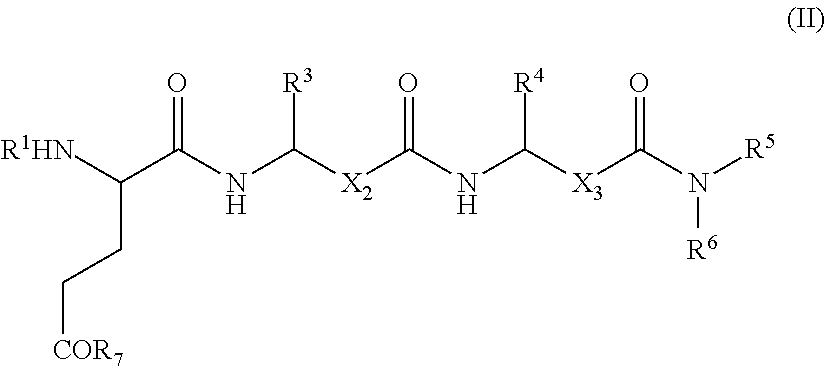
- wherein X2 and X3 is each independently —CHOH— or —CO—; R1 and R7 each is independently hydrogen and/or oxycarbonyl which may be unsubstituted or substituted with one or more group(s) described above; R3 is oxycarbonyl substituted with one or more of amino, amide, halogen(s), amitidine, hydroxyl, a lower alkoxy (e.g., C1-C7), a lower carboxy (e.g., C1-C7), —NR9R10, phenyl, benzyl, phenethyl, or a protecting group(s); R4 is hydroxyl, lower alkoxy (e.g. C1-C7), optionally substituted a six-membered heterocycle radical (e.g., piperazinyl); R5 is a R-group side chain of an α-amino acid optionally protected by a protective group, R6 is hydroxyl, lower alkoxy (e.g., C1-C7); m is 0 or 1; and n is an integer of 2 to 6; or a pharmaceutically acceptable salt thereof.
- The methods of treating or preventing a brain disorder in accordance with the present invention also encompass methods comprising administering to a subject in need thereof, one or more compounds of Formula III
-
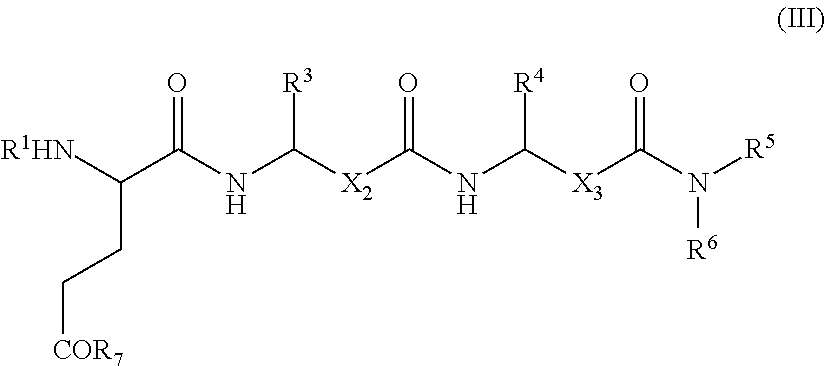
-
- or a pharmaceutically acceptable salt thereof, wherein:
X2 and X3 is each independently a bond, —CHOH— or —CO—;
- or a pharmaceutically acceptable salt thereof, wherein:
- R1 and R7 is each independently hydrogen, an unsubstituted carboxyl group, a carboxyl group substituted with one or more group(s) described above, hydroxyl, an unsubstituted oxycarbonyl, or an oxycarbonyl substituted with one or more group(s) described above; R3 is an oxycarbonyl substituted with one or more group(s) described above, an unsubstituted alkyl, an alkyl substituted with one or more groups described above, an unsubstituted oxycarbonyl, an oxycarbonyl substituted with one or more groups described above, an unsubstituted aminoalkyl, an aminoalkyl substituted with one or more group(s) described above, or hydroxyl;
- R4 is an unsubstituted alkyl, an alkyl substituted with one or more group(s) described above, an aminoalkyl, an aminoalkyl substituted with one or more groups described above, hydroxyl, a lower alkoxy (C1-C7), a six-membered unsubstituted heterocycle radical (e.g., a piperazinyl), a six-membered heterocycle radical (e.g., a piperazinyl) substituted with one or more group(s) described above;
- R5 is an unsubstituted alkyl, an alkyl substituted with one or more group(s) described above, hydrogen or a R-group side chain of an α-amino acid optionally protected by a protective group;
- R6 is an unsubstituted alkyl, and alkyl substituted with one or more group(s) described above, hydroxyl, or a lower alkoxy.
- The methods of treating or preventing a brain disorder in accordance with the present invention also encompass methods comprising administering to a subject in need thereof, one or more compounds of Formula IV:
-

-
- or a pharmaceutically acceptable salt thereof, wherein:
R7 is an unsubstituted amino, an amino substituted with one or more substituents described above, —COR2 or an amido optionally substituted with one or more groups described above;
p is an integer from 1 to 4; and
q is an integer from 0 to 2.
- or a pharmaceutically acceptable salt thereof, wherein:
- The present invention encompasses the use of compounds described in U.S. Pat. Nos. 7,067,476 and 6,951,843, herein incorporated by reference, for treating or preventing brain disorders (e.g., Alzheimer's Disease), diabetes, retinal disorders, arthritis and/or cardiovascular diseases comprising administering these compounds to a subject in need thereof. The invention also provides methods for improving systemic and brain delivery of compounds for treatment of brain disorders by administering one or more compound(s) of Formulas I, II, III, or IV, or mixtures thereof, to a subject in need thereof.
- The present invention is also directed in part to a method of treating a brain disorder (e.g., a neurodegenerative disease (e.g., Alzheimer's disease, Down's syndrome, epilepsy, Parkinson's disease, essential tremor, dementias (e.g., fronto-temporal dementia, dementia with Lewy Body disease), progressive supranuclear palsy, amyotrophic lateral sclerosis, Huntington's disease, multiple sclerosis, mild cognitive impairment, age associated memory impairment, chronic traumatic encephalopathy, Lewy Body disease, multiple system atrophy), (e.g., a traumatic injury (e.g., traumatic brain injury, stroke)), (e.g., psychiatric disorder (e.g., schizophrenia, autism, depression, etc.)), diabetes, cardiovascular disease, retinal disorders and arthritis comprising administering to a subject in need thereof a therapeutically effective amount of a lysine derivative, an arginine derivative, histatin 5, baculovirus p35, a single point mutant of cowpox viral cytokine-response modifier (CrmA (Asp>Lys)), phenylalanyl-ureido-citrullinyl-valyl-cycloarginal (FA-70C1), (acycloxy)methyl ketone (Cbz-Phe-Lys-CH2OCO-2,4,6-Me3Ph), peptidyl chloro-methyl ketone(s) (e.g., chloromethyl of arginine, chloromethyl ketones of lysine, etc.); fluoro-methyl ketone(s), bromo-methyl ketone(s), ketopeptide(s), 1-(3-phenylpropionyl)piperidine-3(R,S)-carboxylic acid [4-amino-1(S)-(benzothiazole-2-carbonyl)butyl]amide (A71561), azapeptide fumaramide, aza-peptide Michael acceptor(s) (e.g., Aza-Orn and Aza-Lys Michael acceptors, (PhCH2CH2CO-Leu-ALys-CHCHCOOEt, etc.), benzamidine compound(s) (e.g., pentamidine, benzamidine, bis-benzamidine derivative(s) with a pentamidine-related structure, 2,6-bis-(4-amidinobenzyl)-cyclohexanone, etc.), phenylalanyl-ureido-citrullinyl-valinyl-cycloarginal (C27H43N9O7) (FA-70C1), acyclomethylketone, activated factor X inhibitors (e.g., DX-9065a), cranberry nondialysable fraction, cranberry polyphenol fraction, pancreatic trypsin inhibitor, Cbz-Phe-Lys-CH2O—CO-2,4,6-Me3-Ph, E-64, chlorhexidine, zinc (e.g., zinc acetate), or a combination of two, three or more of any of foregoing. In some of these embodiments, Zn may enhance potency and selectivity of the compounds (e.g., chlorhexidine, benzamidine, etc.) used in the methods of the invention.
- Benzamidine compounds include, e.g., the following compounds and derivatives thereof:
-

- The present invention is also directed in part to a method of treating progressive supranuclear palsy, amyotrophic lateral sclerosis, Huntington's disease, mild cognitive impairment, age associated memory impairment, chronic traumatic encephalopathy, a psychiatric disorder (e.g., schizophrenia, autism, depression, etc.)), diabetes, cardiovascular disease, retinal disorders, and arthritis comprising administering to a subject in need thereof a therapeutically effective amount of an arginine derivative.
- In yet another embodiment, the invention provides a method of treating diabetes comprising administering to a subject in need thereof, compounds in the same chemical series. Further, the invention provides a method of treating cardiovascular disease comprising administering to a subject in need thereof, one or more compound(s) in the same chemical series as Formulas I, II, III or IV. In yet another embodiment, the invention provides a method of treating retinal disorders comprising administering to a subject in need thereof, compounds in the same chemical series.
- In certain embodiments, the pharmaceutically acceptable agent used in the methods of present invention is Kyt-1, Kyt-36, and/or Kyt-41.
- One skilled in the art will appreciate that other peptides not specifically described in the chemical series as Formulas I, II, III or IV may also have inhibitory activity against P. gingivalis by themselves or synergistically in combination with another ingredient. For example, K-casein(109-107) is known to inhibit proteolytic activity associated with P. gingivalis whole cells, purified RgpA-gp proteinase-adhesion complexes, and purified RgpB. It has exhibited synergism with ZN(ii) against both Arg- and Lys-specific proteinases. Antimicrob Agents Chemother. 2011 March; 55(3):155-61. Administration of such inhibiting peptides, with or without synergistic ingredients such as (ZN(II)) for the treatment of a brain disorder (e.g., a neurodegenerative disease (e g, Alzheimer's disease, Down's syndrome, epilepsy, Parkinson's disease, essential tremor, dementias (e.g., fronto-temporal dementia, dementia with Lewy Body disease), progressive supranuclear palsy, amyotrophic lateral sclerosis, Huntington's disease, multiple sclerosis, mild cognitive impairment, age associated memory impairment, chronic traumatic encephalopathy, Lewy Body disease, multiple system atrophy), (e.g., a traumatic injury (e.g., traumatic brain injury, stroke)), (e.g., psychiatric disorder (e.g., schizophrenia, autism, depression, etc.)), diabetes, cardiovascular disease, and arthritis is encompassed by the present invention.
- The invention also provides a method of preventing or treating brain disorders by vaccination with proteins expressed by P. gingivalis other than Kgp and/or RgpA and/or RgpB, and immunogenic fragments thereof.
- The invention also provides a method of preventing or treating brain disorders by administration of antibodies specific for gingipain epitopes or other proteins expressed by P. gingivalis.
- The invention encompasses treatment with antibodies that bind to gingipains including, e.g., 18E6, 7B9, 61Bg 1.3, 1B5, 7B4, 15C8, humanized versions thereof, and other structurally or functionally similar antibodies. The RgpB-specific monoclonal antibody, 18E6, which binds to the first half of the immunoglobulin domain of RgpB[17]. The Kgp-specific monoclonal antibody, 7B9, recognizes an epitope within the Kgp catalytic domain[18]. The RgpA antibody 61Bg 1.3 has been shown in humans to reduce reinfection with P. gingivalis with respect to periodontal disease[19].
- The invention also provides for the use of antibiotics and other bacteriocidal or bacteriostatic compounds with efficacy against P. gingivalis in the treatment of brain disorders.
- The invention encompasses the use of antibiotics effective against P. gingivalis, alone and in combination with gingipain inhibitors and/or other treatments for Alzheimer's and other disorders. The compositions and methods of treatment may apply to treatment and prevention of brain disorders in mammals, including humans and animals (e.g., canines).
- In an another aspect, the invention is directed in part to a method of treating diabetes comprising administering to a subject in need thereof a therapeutically effective amount(s) of (i) a pharmaceutically acceptable agent which inhibits Arginine Gingipain A (RgpA) and/or Arginine Gingipain B (RgpB) and/or Lysine Gingipain (Kgp) production, translocation of RgpB and/or Kgp into systemic circulation, and/or pathological effects of RgpA and/or RgpB and/or Kgp in a mammal; (ii) an antibacterial agent which is bacteriostatic or bacteriocidal with respect to P. gingivalis; (iii) one or more antibodies which bind to RgpA and/or RgpB and/or Kgp; (iv) a vaccine (passive or active) having specificity with respect to RgpA and/or RgpB and/or Kgp or other P. gingivalis proteins; and (v) combinations of any of the foregoing. Methods of this embodiment of the present invention encompass administration of any one or all of the foregoing in combination with one or more additional therapeutic agents indicated for the treatment and/or prevention of diabetes. The agent(s) preferably reduces the circulating activity or level(s) of active RgpA and/or RgpB and/or Kgp and/or the activity or levels of active RgpB and/or Kgp in the pancreas. In some of these embodiments, a therapeutically effective amount(s) of one or more compounds of formula I, II, III, and IV is administered alone or in combination with additional therapeutic agents indicated for the treatment and/or prevention of diabetes.
- In yet another aspect, the invention is directed in part to a method of treating cardiovascular disease comprising administering to a subject in need thereof a therapeutically effective amount(s) of (i) a pharmaceutically acceptable agent which inhibits Arginine Gingipain A (RgpA) and/or Arginine Gingipain B (RgpB) and/or Lysine Gingipain (Kgp) activity or production, translocation of RgpB and/or Kgp into systemic circulation, and/or pathological effects of RgpA and/or RgpB and/or Kgp in a mammal; (ii) an antibacterial agent which is bacteriostatic or bacteriocidal with respect to P. gingivalis; (iii) one or more antibodies which bind to RgpA and/or RgpB and/or Kgp; (iv) a vaccine (passive or active) having specificity with respect to RgpA and/or RgpB and/or Kgp or other P. gingivalis proteins; and (v) combinations of any of the foregoing. Methods of this embodiment of the present invention encompass administration of any one or all of the foregoing in combination with one or more additional therapeutic agents indicated for the treatment and/or prevention of cardiovascular disease. The agent(s) preferably reduces the circulating activity or level(s) of active RgpA and/or RgpB and/or Kgp. In some of these embodiments, a therapeutically effective amount(s) of one or more compounds of formula I, II, III, and IV is administered alone or in combination with additional therapeutic agents indicated for the treatment and/or prevention of cardiovascular disease.
- In yet another aspect, the invention is directed in part to a method of treating rheumatoid arthritis comprising administering to a subject in need thereof a therapeutically effective amount(s) of (i) a pharmaceutically acceptable agent which inhibits Arginine Gingipain A (RgpA) and/or Arginine Gingipain B (RgpB) and/or Lysine Gingipain (Kgp) activity or production, translocation of RgpB and/or Kgp into systemic circulation, and/or pathological effects of RgpA and/or RgpB and/or Kgp in a mammal; (ii) an antibacterial agent which is bacteriostatic or bacteriocidal with respect to P. gingivalis; (iii) one or more antibodies which bind to RgpA and/or RgpB and/or Kgp; (iv) a vaccine (passive or active) having specificity with respect to RgpA and/or RgpB and/or Kgp or other P. gingivalis proteins; and (v) combinations of any of the foregoing. Methods of this embodiment of the present invention encompass administration of any one or all of the foregoing in combination with one or more additional therapeutic agents indicated for the treatment and/or prevention of arthritis. The agent(s) preferably reduces the circulating activity or level(s) of active RgpA and/or RgpB and/or Kgp. In some of these embodiments, a therapeutically effective amount(s) of one or more compounds of formula I, II, III, and IV is administered alone or in combination with additional therapeutic agents indicated for the treatment and/or prevention of rheumatoid arthritis.
- The invention is also directed to the compounds of formulas I, II, III, and IV for use in treatment of Alzheimer's disease, Down's syndrome, epilepsy, autism, Parkinson's disease, essential tremor, fronto-temporal dementia, progressive supranuclear palsy, amyotrophic lateral sclerosis, Huntington's disease, multiple sclerosis, mild cognitive impairment, age associated memory impairment, chronic traumatic encephalopathy, stroke, Lewy Body disease, multiple system atrophy, schizophrenia, depression, diabetes, cardiovascular disease, and/or rheumatoid arthritis.
- The invention is further directed to a lysine derivative, an arginine derivative, histatin 5, baculovirus p35, a single point mutant of cowpox viral cytokine-response modifier (CrmA (Asp>Lys)), phenylalanyl-ureido-citrullinyl-valyl-cycloarginal (FA-70C1), (acycloxy)methyl ketone (Cbz-Phe-Lys-CH2OCO-2,4,6-Me3Ph), peptidyl chloro-methyl ketones (e.g., chloromethyl of arginine, chloromethyl ketones of lysine, etc.); fluoro-methyl ketones, bromo-methyl ketones, ketopeptides, 1-(3-phenylpropionyl)piperidine-3(R,S)-carboxylic acid [4-amino-1(S)-(benzothiazole-2-carbonyl)butyl]amide (A71561), azapeptide fumaramide, aza-peptide Michael acceptors (e.g., Aza-Orn and Aza-Lys Michael acceptors, (PhCH2CH2CO-Leu-ALys-CHCHCOOEt, etc.), benzamidine compounds (e.g., pentamidine, benzamidine, bis-benzamidine derivatives with a pentamidine-related structure, 2,6-bis-(4-amidinobenzyl)-cyclohexanone, etc.), phenylalanyl-ureido-citrullinyl-valinyl-cycloarginal (C27H43N9O7) (FA-70C1), acyclomethylketone, activated factor X inhibitors (e.g., DX-9065a), cranberry nondialysable fraction, cranberry polyphenol fraction, pancreatic trypsin inhibitor, Cbz-Phe-Lys-CH2O—CO-2,4,6-Me3-Ph, E-64, chlorhexidine, zinc (e.g., zinc acetate), or a combination of two, three or more of any of foregoing for in treatment of Alzheimer's disease, Down's syndrome, epilepsy, autism, Parkinson's disease, essential tremor, fronto-temporal dementia, progressive supranuclear palsy, amyotrophic lateral sclerosis, Huntington's disease, multiple sclerosis, mild cognitive impairment, age associated memory impairment, chronic traumatic encephalopathy, stroke, Lewy Body disease, multiple system atrophy, schizophrenia, depression, diabetes, cardiovascular disease, and/or rheumatoid arthritis.
- The invention is further directed to an arginine derivative in treatment of autism, Parkinson's disease, essential tremor, progressive supranuclear palsy, amyotrophic lateral sclerosis, Huntington's disease, chronic traumatic encephalopathy, stroke, multiple system atrophy, schizophrenia, depression, diabetes, cardiovascular disease, and/or rheumatoid arthritis.
- In an additional aspect, the present invention establishes the presence of gingipains in the brain of cognitively impaired dogs.
- In a further aspect, the invention is directed in part to rodent and canine models for the discovery of therapeutics targeting the brain. In some of the embodiments, the invention is directed to mouse, rat and dog model of brain disorder are created by natural or artificial infection with P. gingivalis.
- As used in the present specification the term “active protease” means a protein that can hydrolyze peptide bonds in a relevant substrate. For example, the term “active RgpB” means the protein RgpB that can hydrolyze peptide bonds including after the arginine in the substrate Boc-Phe-Ser-Arg-MCA; and the term “active Kgp” means the protein Kgp that can hydrolyze peptide bonds including after the lysine in Z-His-Glu-Lys-MCA.
- The abbreviation “Ki” means inhibition constant. Ki can be measured as follows. Fifty microliters of an enzyme (1 nM in 50 mM bis-Tris propane [pH 8.0] containing 1% [vol/vol] Triton X-100 and 5 mM 2-mercaptoethanol) is added to
columns 1 to 11 of a 96-well plate, and 100 μl was added tocolumn 12. Two microliters a the therapeutically effective agent (100 μl in 100% DMSO) is added tocolumn 12, the sample is mixed three times by pipetting. Then, a doubling dilution is prepared across the plate by serial transfer into adjacent wells. Fifty microliters of succinyl-Ala-Phe-Lys-(7-amido-4-methylcoumarin) (40 μM in buffer) is added to all wells, and the contents are mixed. The reaction is monitored for AMC fluorescence for 15 min at 25° C., and the progress curves are automatically converted to rates by the Fluoroskan Ascent software. This method can be used to assay, e.g., Kgp, RgpB, RgpA, trypsin, and cathepsin L. for RgpA and RgpB the substrate could be Z-Arg-AMC, for trypsin the buffer could be 10 mM Tris-10 mM CaCl2 (pH 8.0) and the substrate could be Z-Gly-Gly-Arg-AMC, and for cathepsin L the buffer could be 50 mM sodium phosphate-1 mM EDTA (pH 6.25)-10 mM 2-mercaptoethanol and the substrate could be Z-Arg-Arg-AMC. Trypsin (human, iodination grade). The inhibition constants can then be calculated by using the following equation, with an assumption that inhibition is fully competitive: -
V i=(V max [S])/([S]+K m(1+[I]/K i) - where Vi is the observed residual activity, [S] is the substrate concentration used in the assay, Vmax is the maximal velocity at an inhibitor concentration of zero, Ki is the inhibitor dissociation constant, and [I] is the inhibitor concentration. Curves then can be fitted by nonlinear regression analysis by using fixed values for the substrate concentration and the value of the Michaelis constant (Km). Data analysis can be carried out by using Prism v 2.01 (GraphPad, San Diego, Calif.).
- The term “MIC50” means minimum effective concentration required to inhibit the growth of 50% of the organisms.
- The term “gingipains” means RgpA, RgpB, Kgp and combinations thereof.
- A “therapeutically effective amount” in the present invention may vary according to factors such as the disease state, age, sex, and weight of the individual, and the ability of the agent to elicit a desired response in the individual. Dosage regimens may be adjusted to provide the optimum therapeutic response. A therapeutically effective amount is also one in which any toxic or detrimental effects of the modulator are outweighed by the therapeutically beneficial effects. The therapeutically effective amount can be determined by one of ordinary skill in the art without undue experimentation in view of the information provided in the present specification and knowledge available in the art. The experimentation required to determine the therapeutically effective amount is routine in view of the information contained in the present specification.
- As used in connection with the compounds of formula I, II, III, and IV of the present invention, the terms used herein having following meaning:
- “A protective group” as used in the present specification is not specifically limited as long as it does not adversely affect living organisms and synthetic reactions. It includes any group which may be suitable to protect an element or group of interest (e.g., oxygen, nitrogen, amino, guaninidino, hydrazino, etc.) from taking part in the reaction, and which may be removed after the reaction. Examples of protecting groups (e.g., amino protective groups) are described in T. W. Greene, “Protective groups in Organic Synthesis”, A Wiley-Interscience Publication, John-Wiley & Sons, New York, 1981, pp. 218-287, herein incorporated by reference. Protective groups and amino protective groups include, e.g., nitro, tert-butyloxycarbonyl (Boc), 9-fluorenylmethyloxycarbonyl (Fmoc), Alloc, tosyl, benzenesulfonyl, trifluoromethylcarbonyl, 2,2,2-trichloroethoxycarbonyl (TroC), aralkyloxycarbonyl, alkyloxycarbonyl, sulfonyl, acetyl, benzyl, 1-adamantyloxycarbonyl, aralkyloxycarbonyl, cyclopentyloxycarbonyl, which could be unsubstituted or substituted with, e.g., one or more of the following halogen(s), sulfa, amino, nitro, alkyl, aryl. Examples of aralkyloxycarbonyl groups include benzyloxycarbonyl (Cbz); benzyloxycarbonyl substituted with 1 to 3 C1-4 lower alkoxy groups, e.g., p-methoxybenzyloxycarbonyl and p-ethoxybenzyloxycarbonyl; benzyloxycarbonyl substituted with a nitro group, e.g., p-nitrobenzyloxycarbonyl; benzyloxycarbonyl substituted with 1 to 3 halogen atoms, e.g., p-bromobenzyloxycarbonyl and 2,4-dichlorobenzyloxycarbonyl; diphenylmethoxycarbonyl. Examples of optionally substituted lower alkyloxycarbonyl groups include C2-7 straight or branched chain lower alkyloxycarbonyl optionally substituted with 1 to 3 halogen atoms, e.g., methoxycarbonyl, ethoxycarbonyl, t-butoxycarbonyl (Boc), 9-fluorenylmethyloxycarbonyl and 2,2,2-trichloroethyloxycarbonyl.
- Examples of the substituted sulfonyl group include sulfonyl having one substituent, e.g., a C1-6 straight or branched chain lower alkyl group or a phenyl group optionally substituted with 1 to 3 C1-6 straight or branched chain lower alkyl groups, e.g., benzenesulfonyl, p-toluenesulfonyl and methanesulfonyl. Examples of aralkyloxycarbonyl group or an optionally substituted lower alkyloxycarbonyl group include optionally lower alkoxy-, nitro- or halogen-substituted benzyloxycarbonyl, and optionally halogen-substituted C2-7 straight or branched chain lower alkyloxycarbonyl (e.g., benzyloxycarbonyl or 2,2,2-trichloroethyloxycarbonyl).
- Examples of substituted aralkyloxycarbonyl groups include benzyloxycarbonyl (Cbz); benzyloxycarbonyl substituted with 1 to 3 C1-4 lower alkoxy groups, e.g., p-methoxybenzyloxycarbonyl and p-ethoxybenzyloxycarbonyl; benzyloxycarbonyl substituted with 1 to 3 nitro group, e.g., p-nitrobenzyloxycarbonyl; benzyloxycarbonyl substituted with 1 to 3 halogen atoms, e.g., p-bromobenzyloxycarbonyl and 2,4-dichlorobenzyloxycarbonyl; diphenylmethoxycarbonyl, etc.
- Examples of substituted lower alkyloxycarbonyl groups include C2-7 straight or branched chain lower alkyloxycarbonyl which may or may not be substituted with 1 to 3 halogen atoms, e.g., methoxycarbonyl, ethoxycarbonyl, t-butoxycarbonyl (Boc), 9-fluorenylmethyloxycarbonyl and 2,2,2-trichloroethyloxycarbonyl, benzyloxycarbonyl which may or may not have 1 or 2 substituents selected from the group consisting of lower alkoxy, nitro and halogen.
- Examples of the lower alkoxy group include C1-4, C1-7 or C1-6 straight-chain or branched-chain lower alkoxy, e.g., methoxy, ethoxy, n-propoxy, isopropoxy, n-butoxy, isobutoxy, t-butoxy, n-pentyloxy, isopentyloxy, n-hexyloxy and isohexyloxy, t-butoxy, C1-7 or C1-6 straight-chain or branched-chain lower alkyl groups having amino or C2-5 lower alkoxycarbonylamino as a substituent.
- Examples of the substituted piperazinyl group include piperazinyl; piperazinyl substituted with C1-4 straight-chain or branched-chain lower alkyl, e.g., as N-methylpiperazinyl, N-ethylpiperazinyl and N-t-butylpiperazinyl; piperazinyl substituted with C2-5 straight-chain or branched-chain lower alkoxycarbonyl, e.g., N-methoxycarbonylpiperazinyl, N-ethoxycarbonylpiperazinyl and N-t-butoxycarbonylpiperazinyl; N-benzyloxycarbonylpiperazinyl.
- Examples of the optionally substituted lower alkyl group include, e.g., C1-7 or C1-6 straight-chain or branched-chain lower alkyl groups optionally having amino or C2-5 lower alkoxycarbonylamino as a substituent. Specific examples include methyl, ethyl, n-propyl, isopropyl, n-butyl, isobutyl, t-butyl, hexyl, aminoethyl, aminopropyl, aminobutyl, methoxycarbonylaminomethyl, ethoxycarbonylaminoethyl and t-butoxycarbonylaminoethyl.
- Examples of the amino group optionally substituted with lower alkyl(s) or aryl(s) include amino, methylamino, dimethylamino, ethylamino, diethylamino, n-propylamino, isopropylamino, n-butylamino and isobutylamino and like amino having 1 or 2 C1-4 straight-chain or branched-chain lower alkyl groups; phenylamino, N-methyl-N-phenylamino, N-ethyl-N-phenylamino, N,N-diphenylamino, naphthylamino.
- Examples of the substituted sulfonyl group include sulfonyl having one substituent, e.g., a C1-6 straight or branched chain lower alkyl group, a phenyl group optionally substituted with 1 to 3 C1-6 straight or branched chain lower alkyl groups, e.g., benzenesulfonyl, p-toluenesulfonyl and methanesulfonyl.
- Examples of the amino protecting group include substituted aralkyloxycarbonyl group or an optionally substituted lower alkyloxycarbonyl group, e.g., a lower alkoxy-, nitro- or halogen-substituted benzyloxycarbonyl, or optionally halogen-substituted C2-7 straight or branched chain lower alkyloxycarbonyl, and 2,2,2-trichloroethyloxycarbonyl.
- Examples of lower alkoxy groups include C1-4, C1-7 or C1-6 straight or branched chain lower alkoxy groups, e.g., methoxy, ethoxy, n-propoxy, isopropoxy, n-butoxy, isobutoxy, t-butoxy, etc.
- “A side chain of the α-amino acid” means a side chain or residue attached to the α-carbon atom of an α-amino acid. For example, the side chain for glycine is hydrogen; for alanine it is methyl; and for valine it is isopropyl. The α-amino acid side chain can be any known naturally occurring α-amino acid side chain. Such side chains include, for example, hydrogen (for glycine), methyl (for alanine), isopropyl (for valine), n-butyl (norleucine), isobutyl (for leucine), 1-methylpropyl (for isoleucine), hydroxymethyl (for serine), 1-hydroxyethyl (for threonine), mercaptomethyl (for cysteine), 2-methylthioethyl (for methionine), carbamoylmethyl (for asparagine), carboxymethyl (for aspartic acid), 2-carboxyethyl (for glutamic acid), 2-carbamoylethyl (for glutamine), 4-aminobutyl (for lysine), benzyl (for phenylalanine) and 4-hydroxybenzyl (for thyrosin).
- The side chain of lysine means the side chain or residue bonded to the α-carbon atom of lysine, i.e., 4-aminobutyl. The amino group of the side chain may be protected with a protecting group. Examples of useful amino protecting groups are the above-mentioned amino protecting groups and include a C2-7 straight or branched chain lower alkyloxycarbonyl groups which may or may not be substituted with 1 to 3 halogen atoms, unsubstituted C2-7 straight or branched chain lower alkyloxycarbonyl groups, t-butoxycarbonyl, etc.
- The protective group for carboxyl on the above side chain is not specifically limited as long as it is a conventional protective group known to form an ester or an ether with a carboxyl group. Examples include C1-6 straight-chain or branched-chain substituted or unsubstituted lower alkyl groups, e.g., methyl, ethyl, propyl, butyl, t-butyl, hexyl and trichloroethyl; substituted or unsubstituted aralkyl groups, e.g., benzyl, p-nitrobenzyl, p-methoxybenzyl and diphenylmethyl; acyloxyalkyl groups, e.g., acetoxymethyl, acetoxyethyl, propionyloxyethyl, pivaloyloxypropyl, benzoyloxymethyl, benzoyloxyethyl, benzylcarbonyloxymethyl and cyclohexylcarbonyloxymethyl; alkoxyalkyl groups, e.g., methoxymethyl, ethoxymethyl and benzyloxymethyl; and other groups, e.g., tetrahydropyranyl, dimethylaminoethyl, dimethylchlorosilyl and trichlorosilyl.
- The side chain of arginine means the side chain or residue bonded to the α-carbon atom of arginine, i.e., 3-guanidinopropyl. The guanidino group of the side chain may be protected with a protecting group. The protecting group is not specifically limited as long as it does not adversely affect living organisms and synthetic reactions. Commonly used guanidino protecting groups are described, e.g., in T. W. Greene, “Protective groups in Organic Synthesis”, A Wiley-Interscience Publication, John-Wiley & Sons, New York, 1981, pp. 218-287, herein incorporated by reference. Specific examples include nitro; sulfonyl substituted with one substituent, e.g., phenyl optionally substituted with 1 to 3 C1-6 straight or branched chain lower alkyl groups, or chromane optionally substituted with 1 to 6 C1-6 straight or branched chain lower alkyl groups, e.g., p-toluenesulfonyl and 2,2,5,7,8-pentamethylchromane-6-sulfonyl; and oxycarbonyl groups substituted with one substituent, e.g., as aralkyl or adamantyl, e.g., benzyloxycarbonyl, phenethyloxycarbonyl and 1-adamantyloxycarbonyl. In certain embodiment, nitro is preferred.
- Examples of lower alkyl groups include C1-C7 straight or branched chain lower alkyl groups, e.g., methyl, ethyl, n-propyl, isopropyl, n-butyl, isobutyl, s-butyl, t-butyl, n-pentyl, isopentyl, 1-ethylpropyl, n-hexyl, isohexyl, 1-ethylbutyl and the like. Preferable are methyl and ethyl.
- Examples of aralalkyl groups include phenyl C1-C6 alkyl, e.g., benzyl and phenethyl.
- “(C1-C7)” means a straight chain or branched non-cyclic hydrocarbon having 1, 2, 3, 4, 5, 6, or 7 carbon atoms. Representative straight chain —(C1-C7)alkyls include -methyl, -ethyl, -n-propyl, -n-butyl, -n-pentyl, -n-hexyl, and -n-heptyl. A branched alkyl means that one or more straight chain —(C1-C5)alkyl groups, e.g., methyl, ethyl or propyl, replace one or both hydrogens in one or more —CH2- groups of a straight chain alkyl. The total number of C atoms in a branched chain alkyl is from 3 to 7 C atoms. Representative branched —(C1-C7)alkyls include -iso-propyl, -sec-butyl, -iso-butyl, -tert-butyl, -iso-pentyl, -neopentyl, 1-methylbutyl, 2-methylbutyl, 3-methylbutyl, 1,1-dimethylpropyl, 1,2-dimethylpropyl, 1-methylpentyl, 2-methylpentyl, 3-methylpentyl, 4-methylpentyl, 1-ethylbutyl, 2-ethylbutyl, 3-ethylbutyl, 1,1-dimethylbutyl, 1,2-dimethylbutyl, 1,3-dimethylbutyl, 2,2-dimethylbutyl, 2,3-dimethylbutyl, 3,3-dimethylbutyl, 1-methylhexyl, 2-methylhexyl, 3-methylhexyl, 4-methylhexyl, 5-methylhexyl, 1,2-dimethylpentyl, and 1,3-dimethylpentyl.
- The term “a side chain of the α-amino acid” encompasses, e.g., side chains of lysine and arginine.
- The term “halogen” includes, e.g., fluorine (F), chlorine (Cl), bromine (Br), iodine (I), and astatine (At).
- The term “pharmaceutically acceptable salt” encompasses hydrates and solvates of the pharmaceutically acceptable salts. Examples of pharmaceutically acceptable salts include acid addition salts formed by reacting the compounds of the invention with pharmaceutically acceptable acids. Specific examples include inorganic acid salts, e.g., hydrochlorides and sulfates; and organic acid salts, e.g., formates, trifluoroacetates, acetates, tartrates, maleates, fumarates, succinates and methanesulfonates. The compounds of the invention or pharmaceutically acceptable salts thereof may be in the form of solvates, e.g., hydrates.
- The compounds of the invention and methods of the invention encompass the use of therapeutically active enantiomers or diastereoisomers of the described compounds. All such enantiomers and diastereoisomers are included in the scope of the invention. Such compounds can be used as is as racemic mixtures or as optically resolved enantiomers or diastereoisomers.
- Agents that inhibit/interfere with formation of biofilm of anaerobic gram negative bacteria include, e.g., oxantel, morantel or thiabendazole and other agents described in International Publication No. WO 2009/006699, hereby incorporated by reference.
-
FIG. 1 : Examples of A) RgpB, B) Kgp, and C) RgpA staining in the Alzheimer's hippocampus compared to control hippocampus. -
FIG. 2 : Example of gingipain staining localization with pathology including beta amyloid plaques, alpha synuclein deposits, phospho tau, and neurodegeneration. -
FIG. 3 : Summary of results of findings of gingipains in postmortem brains from patients with brain disorders compared to control brains. -
FIG. 4 : Peripheral tissues from a patient with late onset Alzheimer's disease (Case #3) showed positive staining for gingipains. The following peripheral tissues stained positive for both Rgp and Kgp: right coronary artery, left anterior descending coronary artery, pancreas, peripheral nerve, skeletal muscle, and skin. -
FIG. 5 : Example of perivascular immunohistochemical staining of gingipains in human brain indicating potential point of entry. -
FIG. 6 : Chemical structures of certain gingipain inhibitors -
FIG. 7 : Intrahippocampal injection of gingipains into mouse brain causes neurodegeneration after 7 days. -
FIG. 8 : Differentiated neuronal SH-SY5Y cells show A) a dose dependent cell death in response to exposure to RgpB and Kgp. Iodoacetamide (IAM) which destroys the catalytic activity of the proteins prevents this effect. B) Kyt-1 and Kyt-36 can protect neurons individually and together. C) Antibodies 18E6 and 7B9 provide protection against gingipain induced cell death. -
FIG. 9 : BalbC mice were infected with P. gingivalis orally for 6 weeks. RgpB brain infiltration overlaps with neurodegeneration of the subgranular zone in the hippocampus. -
FIG. 10 : Wild Type mice infected with P. gingivalis show cognitive impairment on the Novel Object Recognition task at the 6 week time point. A) Infected mice spend equal amounts of time exploring a novel and familiar object, while normal mice spend increased time on the novel object. B) Discrimination index (TNovel−Tfamiliar)/Ttotal -
FIG. 11 : DAB-1 mice were infected twice with P. gingivalis using the chamber method. The time gap between the first and second infection was four weeks. The RgpB brain infiltration overlaps with neurodegeneration of the CA3/CA2 granular cell zone of the hippocampus. -
FIG. 12 : Pharmacokinetic data of Kyt-36 intravenous, subcutaneous, oral and oral+Ritonavir. Ritonavir increases the half-life of oral Kyt-36. -
FIG. 13 : Aged dogs with cognitive impairment all strongly positive for brain Kgp. Young dog hippocampus and entorhinal cortex are negative for Kgp. - Porphyromonas gingivalis (P. gingivalis) is an anaerobic gram-negative rod. P. gingivalis produces several extracellular proteases, including, e.g., Arginine Gingipain A (RgpA), Arginine Gingipain B (RgpB) and Lysine Gingipain (Kgp). These proteases may degrade a broad range of proteins of connective tissue and plasma (e.g., immunoglobulins, proteinase inhibitors and collagen, etc.), get into systemic circulation and/or enter the brain. These proteases may also cause disruption to kallikrein—kinin cascade, blood coagulation, and the host defense systems.
- Recently, lipopolysaccharide (LPS) from the periodontal pathogen P. gingivalis was discovered in 4 out of 10 AD brains[20]. The same study, utilizing two different antibodies, failed to localize one of the three P. gingivalis associated cysteine proteases, Arginine gingipain A, by immunohistochemistry in any of the Alzheimer's brains. It is possible that the antibodies used were inactive or too dilute as no positive controls were described. A study published as an abstract at the Alzheimer's Association International Conference in 2013 found that oral infection of transgenic APP mice (J20 mice) with P. gingivalis triggers abeta plaque formation (a hallmark of Alzheimer's disease), neuroinflammation and cognitive impairment [21]. The authors concluded that inflammation may be a target for therapy. A study by Poole et al. found that P. gingivalis DNA could be found in the brains of 50% of ApoE−/− mice after oral infection[22] This indicates that the bacteria can infiltrate the brain.
- As described herein, through human and dog brain immunohistochemistry studies, all three P. gingivalis expressed cysteine proteases, known as Arginine Gingipain A (RgpA) Arginine Gingipain B (RgpB) and Lysine Gingipain (Kgp), can infiltrate the human brain, and depending on the amount and location of this infiltration, can cause or contribute to various brain disorders. The gingipains contribute to many functions of the organism including its survival and virulence.
- RgpB is a lower molecular weight form of RgpA[23]. The RgpB-specific monoclonal antibody, 18E6, is specific for the first half of the immunoglobulin domain of RgpB[17]. The Kgp-specific monoclonal antibody, 7B9, recognizes an epitope within the Kgp catalytic domain[18].
-
FIG. 3 presents a summary of human autopsy immunohistochemistry findings. Kgp has been positively identified in brain samples from patients with neurological disorders as follows: 40/40 Alzheimer's disease patients, 10/10 reportedly presymptomatic patients with Alzheimer's pathology (abeta plaques), 1/1 progressive supranuclear palsy patient with co-morbid Alzhemier's, 1/1 frontal temporal dementia patient, 1/1 Parkinson's patient with co-morbid Alzheimer's and Lewy body disease, 4/4 patients with dementia with Lewy body disease (2 with co-morbid Alzheimer's), 1/1 essential tremor patient with depression, 2/2 Down's syndrome patients 33-34 years of age, 4/4 epilepsy patients. In reportedly healthy controls: 5/13 brains were negative for staining, 4/13 brains have trace staining, and the remaining 4/13 had Kgp levels higher than trace levels, but lower than cases with brain disease (FIG. 3 ). - In addition, Kgp was positively identified in brain samples from five beagle dogs with canine cognitive disorder (CCD) (
FIG. 13 ) but it was absent from 3 young cognitively normal dogs - Gingipains can be secreted, transported to outer membrane surfaces of Porphyromonas gingivalis, or released in outer membrane vesicles by the bacterium[24]. Porphyromonas gingivalis has previously been identified in periodontal tissues[25], coronary arteries[26], aorta[27], and recently, the liver[28]. Release of gingipains from any of these niches into the systemic circulation could result in translocation of gingipains to the brain or retina.
- Alzheimer's is associated with retinal degeneration[29] and it has been proposed that age-related macular degeneration (AMD) is an “Alzheimer's disease of the eye” [30]. The retina is composed of light sensitive neurons (photoreceptors) which transmit information through several neuronal layers to the brain via the optic nerve. The retina is usually protected by the blood ocular barrier, similar to the blood brain barrier, which could be breached by P. gingivalis due to aging, inflammation or progressive gingipain induced degeneration[31]. AMD and glaucoma share a number of clinical and pathological features with Alzheimer's disease [32] including inflammation, progressive neuronal degeneration, activation of the immunological complement pathway [33] and protein deposits. Aging, hypercholesterolaemia, hypertension, obesity, arteriosclerosis, and smoking are risk factors to for both AMD and AD. Oral inflammatory infections have been associated with AMD[5].
- In the present invention, evidence is provided from an 89-year-old Alzheimer's subject that gingipains may be widely dispersed throughout the body, as gingipains were identified not only in brain tissue, but also in tissue from coronary arteries, pancreas, peripheral nerve, skeletal muscle, and skin (
FIG. 4 ). Localization in these tissue can contribute to the peripheral disorders discussed herein. While not wanting to be bound to a particular theory, the identification of gingipains deep in the media of coronary blood vessels as seen inFIG. 4 , could indicate a mechanism by which gingipains can burrow through blood vessels in the brain and breach the blood-brain barrier. In support of this concept, immunohistochemical evidence was found of perivascular staining of gingipains around blood vessels in the brain, with a pattern of gingipain staining radiating out from penetrating vessels (FIG. 5 ). - Gingipains may enter the brain by degrading endothelial cells protecting the blood brain barrier, or by a traumatic event such as a stroke or traumatic brain injury, which permanently or transiently reduces the integrity of the blood brain barrier. Such a disruption, in traumatic brain injury, for example, may contribute to the infiltration of gingipains in infected individuals and subsequent development of chronic neurodegenerative conditions like chronic traumatic encephalopathy (CTE) in athletes and military personnel. People who are at a high risk of traumatic injury or stroke could be preventatively treated with gingipain inhibitors to reduce the risk of CTE or stroke induced pathology.
- Gingipains may also reach the brain through other mechanisms including active transport, passive transport or macrophage delivery.
- Patients with gingipains in their brain and circulatory system may experience mild cognitive impairment, age associated memory impairments or generalized accelerated aging due to gingipain induced cell death which could be treated or prevented with compounds that inhibit gingipains, including the compounds described above.
- Such “accelerated aging” may be limited to the brain or may be experienced in a variety of tissue types accessible to the circulatory system. Similarly, dogs with gingipains in their brain and circulatory system may experience mild cognitive impairment, age associated memory impairments or generalized accelerated aging due to gingipain induced cell death, which could be treated or prevented with compounds and compositions that inhibit gingipains (e.g., Kyt-41, Kyt-1, Kyt-36, compounds of Formulas I, II, III, or IV, and other compounds described above) or act as bacteriocidal or bacteriostatic agents of P. Gingivalis. For example, it has been reported that tetracyclines at 100 μM totally inhibited the amidolytic activity of arginine-specific gingipains (HRgpA and RgpB). Among tetracycline derivatives, the most potent gingipain inhibitor was doxycycline, followed by tetracycline and minocycline. RgpB was inhibited by doxycycline in an uncompetitive and reversible manner with a 50% inhibitory concentration of 3 μM. Imamura, et al.; Inhibition of Trypsin-Like Cystein Proteinases (Gingipains) from Porphyromonas ginivalis by Tetracycline and its Analogues, October 2001 vol. 45 no. 10 2 871-2876. Stathopoulou et al. found that small peptide derived inhibitors of Rgp or Kgp can prevent gingipain induced epithelial cell death.[34] Rgp and Kgp induced cell death has also been demonstrated in endothelial cells and other cell types.[35, 36]
- As demonstrated herein, exposure of differentiated SH-SY5Y neuronal cells to gingipains caused dose dependent cell death within 24 hours (
FIG. 8 ). It was shown for the first time that a Kgp inhibitor has a stronger neurotoxic effect on neurons than an Rgp inhibitor, and that Kgp inhibitors (e.g.: Kyt-36) are more protective than Rgp inhibitors. Knock out of Kgp from P. gingivalis has a more potent effect on bacterial growth inhibition than knock out of RgpB and resulted in a synergistic 50% reduction of RgpB activity after 6 days potentially due to reduced export [37]. Intrahippocampal injection into the mouse brain of gingipains resulted in visible neurodegeneration within 7 days (FIG. 7 ). Oral infection of BALB/C mice resulted in gingipain infiltration and correlating neurodegeneration after 6 weeks (FIG. 9 ) as well as cognitive impairment on the novel object recognition task (FIG. 10 ). Infection of DBA-1 mice with Porphyromonas gingivalis using the chamber model[38] also resulted in brain gingipain infiltration and correlating neurodegeneration after two bacterial injections to the subcutaneous chamber separated by 4 weeks (FIG. 11 ). The presence of these proteases in the brain and their proven capability to produce cell death indicates that they play a role in neurodegeneration. - One embodiment of the invention encompasses the use of P. gingivalis exposed or infected rodent and dog as models of brain disorders. These models are valuable for the understanding of brain disorders and the testing of therapeutics for efficacy.
- As described previously, dogs are naturally predisposed to infection with P. gingivalis and incidence of this infection is increased through direct exposure, feeding of soft food, and/or lack of dental care.[14, 15] Aged dogs spontaneously develop many features of AD including cognitive decline and brain neuropathology[13]. Analysis of the brains of aged dogs with cognitive impairment and pathology show the presence of brain lysine gingipains, while younger dogs do not have brain gingipain (
FIG. 13 ). One embodiment of the invention encompasses the use of gingipain inhibitors to treat or prevent brain disorders in dogs. Additionally, dogs with natural or purposeful P. gingivalis infection can be useful as models for studying the efficacy of therapeutics for humans. - Bacteriocidal and bacteriostatic compounds like antibiotics can be used to reduce bacterial levels and resulting gingipain and inflammation induced neurodegeneration. Preferably an antibiotic used for treatment of brain disorders would have selectivity for P. gingivalis over other bacteria so as to preserve beneficial bacteria. Candidates include but are not limited to quinolones (e.g., gemifloxacin, ciprofloxacin, oflaxacin, trovafloxacin, sitafloxacin, etc.), β-lactams (e.g., a penicillin (e.g., amoxicillin, amoxacilin-clavulanate, piperacillin-tazobactam, penicillin G, etc.), cephalosporins (e.g., ceftriaxone, etc.)), macrolides (e.g., erythromycin, azithromycin, clarithromycin, etc.), carbapenems (e.g., doripenem, imipenem, meropinem, ertapenem, etc.), thiazolides (e.g, tizoxanidine, nitazoxanidine, RM 4807, RM 4809, etc.), tetracyclines (e.g., tetracycline, minocycline, doxycycline, eravacycline, etc.), clindamycin, metronidazole, satranidazole, agents that inhibit/interfere with formation of biofilm of anaerobic gram negative bacteria (e.g., oxantel, morantel or thiabendazole, etc), combinations of two, three, four, five, six, or more of any of the foregoing agents, etc. In certain embodiments, the compound is selected from the group consisting of tetracyclines (e.g., minocycline, doxycycline, etc.), penicillins (e.g., amoxicillin/clavulanic acid combinations), metronidazole, eravacycline, clindamycin, amoxicillin, eravacycline, satranidazole, and combinations of the foregoing.
- FA-70C1, isolated from the culture supernatant of Streptomyces species strain FA-70, is a potent Rgp inhibitor and also exhibits growth-inhibitory activity against P. gingivalis (REF).
- Experiments have shown that the dipeptide bestatin selectively inhibits growth of P. gingivalis by affecting the intracellular uptake of amino acids and peptides, which serve as energy and nitrogen sources for this bacterial species (Labbe et al, 2001). Bestatin or similar compounds could be used to treat brain disorders, diabetes, arthritis, cardiovascular disease, or pneumonia.
- Alternatively, a treatment can be targeted to inhibit the gingipains in order to simultaneously block gingipain induced cell death and act as a narrow spectrum antibiotic.
- Several series of compounds, in particular, have been identified with the ability to inhibit gingipains.
FIG. 6 provides structures of some of the compounds. Kyt-41 was found to be a potent and specific dual inhibitor of Kgp and RgpB that was found to be effective in treating periodontal symptoms in dogs26. - The present invention encompasses the use of compounds described herein to treat or prevent a variety of brain disorders including, but not limited, to Alzheimer's, stroke, Parkinson's, Lewy body disease, epilepsy, chronic traumatic encephalopathy, depression, schizophrenia, autism, multiple system atrophy and others. It is conceivable that any number of brain disorders could be caused by the infiltration of gingipains into the brain, depending on the site and amount of infiltration.
- Based on data published by Kadowaki et al. and Katoaka et al. it is believed that Kyt-41, Kyt-1 or Kyt-36, or other compounds in the series might be used alone or in combination to be effective[39]′26. Kyt-1 and Kyt-36 have been tested in a cell model of gingipain neuronal toxicity.
Kyt 36 alone, and Kyt-1 together with Kyt-36 prevented gingipain induced neurodegeneration (FIG. 8 ). Further, other unrelated therapeutic agents can be administered in combination with the Kyt or related compounds. - Additionally, the present invention encompasses various administration modes by which the compounds might be delivered to increase bioavailability or blood brain barrier penetration, not previously conceived for the compounds, including but not limited to, intravenous, intranasal, intrathecal, subcutaneous, intracranial, buccal and oral.
- The invention also encompasses pharmaceutically acceptable compositions, formulations or dosage forms comprising one or more pharmaceutically active compound(s) described herein and one or more pharmaceutically acceptable excipients for treatment of a brain disorder (e.g., a neurodegenerative disease (e.g., Alzheimer's disease, Down's syndrome, epilepsy, autism, Parkinson's disease, essential tremor, fronto-temporal dementia, progressive supranuclear palsy, amyotrophic lateral sclerosis, Huntington's disease, multiple sclerosis, mild cognitive impairment, age associated memory impairment, chronic traumatic encephalopathy, stroke, Lewy Body disease, multiple system atrophy, schizophrenia and depression, etc.), diabetes, cardiovascular disease, and arthritis. The pharmaceutically acceptable excipients are described in Handbook of Pharmaceutical Excipients, 4th Edition, 2003, herein incorporated by reference.
- For example, formulations for sustained-release (SR), sustained-action (SA), extended-release (ER, XR, XL) timed-release (TR), controlled-release (CR), modified release (MR), continuous-release, osmotic release and slow release implants. Time release technology can be used to increase bioavailability in certain embodiments. These alternative routes of administration were not previously considered for some of the disclosed compounds, the compounds which were primarily contemplated to be formulated for topical gingival delivery and not for systemic delivery.
- The use of hybrid molecules to promote active transport or nanoparticles might be used to increase blood brain barrier transport in certain embodiments of the invention. For example liposomes, proteins, engineered peptide compounds or antibodies that bind to the receptors that transport proteins across the blood brain barrier including LPR-1 receptor, transferrin receptor, EGF-like growth factor or glutathione transporter may be used to increase penetration into the brain. Physical techniques including osmotic opening, ultrasound, lasers, sphenopalantine ganglion stimulation, direct intracranial, intrathecal, or intraventricular delivery via a pump might be used. Because it was unknown that gingipain inhibitors could be used to treat brain disorders, inventions related to blood brain barrier transport had not been anticipated previously.
- Effective doses of the compounds or compositions of the present invention, for the treatment of the above described conditions vary depending upon many different factors, including means of administration, target site, physiological state of the patient, other medications administered, and whether treatment is prophylactic or therapeutic. Treatment dosages need to be titrated to optimize safety and efficacy. In view of the information provided in the specification and the knowledge currently available in the art, effective doses and amount could be determined by one of ordinary skill in the art without undue experimentation. The experimentation required to determine the effective doses/amounts would be routine in view of the present specification.
- In another embodiment, “boosting” of gingipain protease inhibitor compounds with ritonavir (RTV) may be used to increase bioavailability and increase blood brain barrier penetration. For example, ritonavir is commonly combined with oral peptidic HIV protease inhibitors to increase plasma levels by inhibiting the P450 3A4 enzyme and thus decreasing first-pass metabolism[40]. In addition, RTV binds to P-glycoprotein, a transmembrane efflux pump that is found in many tissues, including the blood brain barrier, allowing co-administered compounds better access to the brain[41]. Therefore, a combination of RTV and gingipain protease inhibitors might be used to increase plasma concentrations and brain levels of the gingipain inhibitors. It is shown herein that oral administration of RTV 15 minutes prior to Kyt-36 increases the half life (
FIG. 12 ). In another embodiment, a course of antibiotics might be paired with gingipain inhibitors to jump start treatment. - The efficacy of the administration/treatment may be accessed by measuring levels of circulating levels of RgpA and/or RgpB and/or Kgp. Based on this assessment, the dose and/or frequency of administration may be adjusted.
- The efficacy of the administration/treatment may be accessed by measuring levels of circulating levels hemoglobin. Based on this assessment, the dose and/or frequency of administration may be adjusted.
- In another embodiment natural gingipain inhibitors including melabaricone C, isolated from nutmeg or polyphenolic compounds derived from plants, such as cranberry, green tea, apple, and hops could be formulated for treatment or prevention of brain disorders (Tanaguchi et al. 2014) for use alone or in combination with each other or the compounds described above. Naturally and unnaturally occurring antimicrobial peptides including: κ-casein peptide (109-137) 34,
histatin 5, and CL(14-25), CL(K25A) and CL(R24A, K25A) (Taniguchi et al. 2014) alone or in combination with each other or the compounds described above. he efficacy of the administration/treatment may be accessed. - In another embodiment bacteriophage therapy against P. gingivalis can be used as a treatment for brain and other disorders [42]. Phages specifically infect their target bacteria, replicate and then lyse those bacteria, releasing progeny that can continue the cycle, including migrating to other sites of infection anywhere in the body including the brain [43]. Phages only minimally impact non-target bacteria or body tissues.
- Phage therapy for brain disorders may be cocktails of phages purified from oral preparations that display a wider spectrum of activity than for P. gingivalis or may be highly specific for P. gingivalis. Lytic (as opposed to temperate) phages suitable for therapeutic purposes can be isolated from oral tissue or saliva of periodontal patients by methods known to those in the art and as described in Mancuca et al. 2010. [44] Briefly, P. gingivalis and its phages can be isolated by culturing the human samples in selective Bacteroides gingivalis agar[45] or by enriching for P. gingivalis by adding culture of P. gingivalis to the sample to ampilify the specific phages. The Phage are then isolated by centrifugation followed by filtraition or chloroform step to separate phages from bacterial hosts. The phage are then applied to a lawn of bacteria and lytic plaques are selected for further characterization. Ideally multiple phage from diverse strains of P. gingivalis or even multiple types of oral bacteria would be combined for a more effective therapy. The choice of phage strain and the methods of phage preparation are critical to the success or failure of phage therapy. Insufficiently virulent phages or poorly prepared phage stocks can result in ineffective therapy[46].
- In another embodiment, antibodies targeting gingipains or other P. gingivalis protein could be used as therapeutics. Antibodies may rely on damage to the blood brain barrier for access to the brain or peripheral interference with gingpains and P. gingivalis propagation. Antibodies may also help to stimulate the efficacy of the immune system in clearing the bacteria. New or existing antibodies to RgpA and/or RgpB and/or Kgp can be utilized including, e.g., 18E6 and 7B9 described above. It has been demonstrated that 18E6 and 7B9 protect cells from gingipain induced cell death (
FIG. 8C ). An RgpA antibody 61BG1.3 has previously demonstrated efficacy topically in prevention of recolonization by P. gingivalis after periodontal treatment [19]. Additional antibodies which may be used in the methods of present invention include, e.g., RgpA MAb 1B5, RgpA Mab 7B4, and Kgp antibody 15C8, as well as structurally and/or functionally similar antibodies. - Antibodies would preferably be humanized for use in humans.
- Methods known to those in the field for delivery of biologics to improve half-life and brain penetration can be used including, but not limited to, intravenous delivery, subcutaneous delivery, intranasal delivery, intrathecal delivery, vector transport, and direct brain delivery. Treatments for the retina may be delivered directly to the eye.
- Additionally, vaccines have been used to treat a disease in progress and a vaccine could be administered to a person with a brain disorder to disrupt progression. A variety of vaccine strategies are known to those in the art. These strategies could be used for the treatment and prevention of brain disorders as described in the present specification[20].
- Genco et al. immunized mice with a 20 amino acid synthetic peptides derived from the catalytic domain of RgpA having the amino acid sequence YTPVEEKQNGRMIVIVAKKY [47]. Mice vaccinated with this synthetic gingipain epitope were protected from P. gingivalis invasion in the mouse chamber model. In another study, mice immunized with purified RgpA protein were protected from P. gingivalis-mediated periodontal disease, suggesting that it was the production of antibodies against the hemaglutinin domain of RgpA that were protective[48]. If one or more gingipains are used for immunization, it may be preferably to inactivate their proteolytic activity, using iodoacetamide or other method, prior to administering. Recombinant gingipains, produced by E. Coli for example, have little or no activity compared to gingipains produced by P. gingivalis and can be used for this purpose.
- Page et al. have shown that immunization of nonhuman primates with purified gingipains inhibited alveolar bone destruction, and that the vaccine was well tolerated by the animals[49]. Gingipain DNA vaccines were tested by Guo et al. who found that Kgp and RgpA, but not RgpB DNA vaccines were effective in preventing periodontal symptoms in dogs [50]. The kgp, rgpA, and rgpB genes were amplified by polymerase chain reaction (PCR) from Porphyromonas gingivalis (Pg) ATCC 33277 and cloned into the pVAX1 vector.
- Lee et al. 2006 immunized rats with P. gingivalis HSP60, and experimental alveolar bone loss was induced by infection with multiple periodontopathogenic bacteria. There was a very strong inverse relationship between postimmune anti-P. gingivalis HSP immunoglobulin G (IgG) levels and the amount of alveolar bone loss induced by either P. gingivalis or multiple bacterial infection (p=0.007). Polymerase chain reaction data indicated that the vaccine successfully eradicated the multiple pathogenic species.
- Intranasal administration of P. gingivalis fimbrial antigen with recombinant cholera toxin B subunit also induced a significant immune response (fimbrial-specific secretory IgA-sIgA) in mice, which could reduce P. gingivalis-mediated alveolar bone loss. It is also possible that this mucosal immunization resulted in peripheral tolerance and hence a reduced inflammatory response and alveolar bone loss. However, it has further been demonstrated that immunization with 43-kDa fimbrillin polymer of P. gingivalis did not show satisfactory levels of protection against all strains of P. gingivalis tested [21]. The feasibility of this fimbrial protein of P. gingivalis as a vaccine candidate antigen may therefore be dependent on its effectiveness in protecting against all the P. gingivalis strains.
- A conjugate vaccine incorporating both fimbriae and P. gingivalis capsular polysaccharide (CPS) has been introduced in a study that led to the production of a high IgG response and which was effective in protecting against P. gingivalis infection [22]. However, in this study it was not clear whether the protection came from the CPS or fimbriae. CPS, by virtue of its encapsulation and antigenic shift, constitutes a robust strategy for P. gingivalis survival against opsonophagocytic activity. Due to its poor T-cell stimulating ability, however, CPS of other Gram-negative bacteria is usually conjugated to a protein antigen (for stimulating helper T-cells) in many vaccine trials in infectious diseases, such as pneumonia and meningitis. More recently, P. gingivalis CPS alone has nevertheless, been used as an immunogen, and it has been reported to result in an elevated production of serum IgG and IgM that provided protection against P. gingivalis-induced bone loss.
- Zhu et al. 2013 tested a vaccine of peptidylarginine deiminase (PAD) from P. gingivalis in a mouse model. Compared with animal immunization with incomplete Freund's adjuvant (IFA) alone, PAD group significantly inhibited (P<0.05) bone resorption. It is contemplated that these vaccine strategies could be used in the methods of the present invention, e.g., to treat or prevent Alzheimer's disease [51].
- Vaccination can also be accomplished with live attenuated or killed P. gingivalis. Comparisons of the protective effects of subcutaneous immunization among formalin-killed P. gingivalis, heat-killed P. gingivalis, outer membrane fraction, and lipopolysaccharide revealed that immunization with killed P. gingivalis provides the greatest protection from lesion formation induced by P. gingivalis [52]. Preparation of killed bacteria for vaccination involves growth of the bacteria in standard conditions, and collection during the log-arithmic growth phase. The bacteria are then centrifuged, washed three times, and resuspended in sterile phosphate-buffered saline (PBS, pH 7.4). Bacteria can be killed by fixation with 0.8% formalin at 4° C. for 24 h followed by washing, and resuspension in sterile PBS or heated to 95 deg C. for 10 minutes[53, 54]. Bacteria can be plated and incubated for 7 days to ensure effective killing. Approximately, 2.5×10⁹ cells/mL or other effective dose can be used for vaccination. Live attenuated bacteria may be the most effective vaccine for intracellular bacteria as is the case for tuberculosis. P. gingivalis may be attenuated by knocking out gingpains or other methods known to those in the art.
- Vaccination in accordance with the present invention also encompasses passive immunization, namely direct administration of antibodies against gingipains. The antibodies 7B9, 18E6 or 61Bg 1.3, 1B5, 7B4, 15C8, or a structurally and/or functionally similar antibodies, could be used in the methods of the present invention, e.g., to treat or prevent Alzheimer's disease or determine if a subject possibly has Alzheimer's disease, is at risk of developing the Alzheimer's disease, as well as to monitor the efficacy of the treatment of Alzheimer's disease. Humanized versions of these antibodies, nanobodies, or antibody fragments of these antibodies could also be used. Efficacy of 7B9 and 18E6 in prevention of gingipain induced cell death is shown in
FIG. 8 C. - In some of the embodiments, the passive immunization prevents or treats infection of P. gingivalis and therefore prevent brain infiltration of gingipains. Since colonization with P. gingivalis can occur during the first few years of life[55], a vaccine against gingipains or other components of Porphyromonas gingivalis may provide life-long protection against gingipain-induced neurodegeneration. Transmission of Porphyromonas gingivalis is thought to occur through intimate contact, including from an infected parent to a child[56-58]. This could explain symptoms seen in disorders such as mental retardation, autism and Down's syndrome, in addition to pediatric epilepsy.
- Several therapeutics are on the market and in development for Alzheimer's disease. It is envisioned that these therapeutics can be used in combination with P. gingivalis targeted therapies (i.e., therapies using the compound(s) described above). Specifically, P. gingivalis targeted treatments can be used in fixed or variable dose combination with cholinesterase inhibitors (like donezepil), NMDA antagonists (like memantine), and/or development stage therapeutics targeting abeta, tau, ApoE or neuroinflammation. The use of the compounds of formula (I), (II), (III) and (IV) in combination with one or more of the following is also envisioned: Aβ peptides level reducers, pathogenic level tau reducers, microtubule stabilizers, agents capable or removing atherosclerotic plaques, agents that lower circulating levels of β-amyloid and tau, modulators of autophagy, neurotransmitter level regulators, GABA(A) α5 receptors inhibitors, and additional agents that help maintain and/or restore cognitive function and functional deficits of Alzheimer's disease, and/or slow down decline in cognitive functions and functional deficits in Alzheimer's disease. Combination treatments are also envisioned with treatments that promote neuroplasticity and recovery of the brain, including but not limited to growth factors, growth factor mimetics, stem cells, gene therapy and encapsulated cell therapy.
- Low levels of hemoglobin and/or anemia is associated with Alzheimer's disease and may be caused by P. Gingivalis infection [59] [60]. Thus, in a further aspect, the invention is directed in part to a method of identifying a subject as possibly having or at risk of developing Alzheimer's disease comprising determining whether a subject has a low hemoglobin level, low cell hematocrit and/or an anemia. A low level hemoglobin level for an adult male is a level of below 13.5 g/dL. A low level for a non-pregnant adult woman is a level below 11.9 g/dL. A low level for a pregnant woman is a level below 10.8 g/dL. The detection of low hemoglobin level, low hematocrit, or anemia indicates that the subject possibly has or at risk of developing Alzheimer's disease or other brain or retinal disorder.
- In a further aspect, the invention is directed in part to a method of treating a subject diagnosed with Alzheimer's disease comprising periodically determining a serum hemoglobin level in a subject, and adjusting and/or changing the treatment if the level of hemoglobin is increasing or decreasing. Adjusting treatment means increasing the dose of a pharmaceutically acceptable agent. Changing treatment means replacing one of the pharmaceutically acceptable agent(s) with a different pharmaceutically acceptable agent or adding an additional pharmaceutically acceptable agent.
- The present invention also provides for a diagnostic based on imaging gingpains in the human brain. Any agent that binds to gingipains, including but not limited to Kyt-41, Kyt-1, Kyt-36 and other compounds in
FIG. 6 and described in this invention or elsewhere, can be labeled with F18, I124 or other radiographic markers and visualized using positron emission tomography (PET) or SPECT scanning -
FIGS. 1 & 3 present examples and a summary of human autopsy immunohistochemistry findings, respectively. Kgp has been positively identified in brain samples from patients with neurological disorders as follows: 40/40 Alzheimer's disease patients, 10/10 reportedly presymptomatic patients with Alzheimer's pathology (abeta plaques), 2/2 progressive supranuclear palsy patients with co-morbid Alzheimer's, 1/1 frontal temporal dementia patient, 1/1 Parkinson's patient with co-morbid Alzheimer's and Lewy body disease, 4/4 patients with dementia with Lewy body disease (2 with co-morbid Alzheimer's), 1/1 essential tremor patient with depression, 2/2 Down's syndrome patients with abeta plaques 33-34 years of age, 4/4 epilepsy patients. In reportedly healthy controls (age 11-74 years old): 5/13 brains were negative for staining, 4/13 brains have trace staining, and the remaining 4/13 had Kgp staining higher than trace levels, but lower than cases with brain disease (FIG. 3 ). - Peripheral tissue specimens including skin, pancreas, coronary artery, muscle and peripheral nerve were selected from an 89 year old Alzheimer's patient analyzed with immunohistochemistry for Kgp and RgpB. The pathology report states that the hippocampus and entorhinal cortex, contained frequent neuritic plaques and tau proteins frontal lobe cortex. Frontal Cortex contains neuritic plaques, neurofibrillary tangles, and amyloid angiopathy. CERAD Stage VI, BRAAK Stage 6, and amyloid angiopathy of small vessels in the brain. All peripheral tissues show staining for Kgp and RgpB indicating that gingipain induced cell degeneration may be responsible for co-mordities of Alzheimer's including cardiovascular disease, diabetes, arthritis, retinal disorders and peripheral nerve disorders (
FIG. 2 ). - Adult male mice (CD-1, 25 g approximately) n=6 per group were anaesthetized and injected unilaterally intrahippocampally using standard stereotaxic techniques. Gingipains RgpB and Kgp, purified from P. gingivalis and provided by Dr. Jan and Barbara Potempa, were diluted prior to injection to 10 ug/ml. Seven days post-surgery the animals were anaesthetized, perfused and humanely killed and brains removed and sectioned for histological analysis. Fluoro-Jade staining was then be performed on sections of hippocampus to assess for neurodegeneration (Schmued L C and Hopkins K J, 2000). Fluoro-Jade staining identifies cell bodies, dendrites, axons and axons terminals of degenerating neurons but does not stain healthy neurons, myelin, or vascular elements.
- Brain sections were examined with an epifluorescence microscope (Nikon Microphot FXA) using a filter system suitable for visualizing fluorescein or fluorescein isothiocyanate (FITC). Images were acquired with a Leica DC Camera and an Image Analysis software (Leica IM50). Fluoro-Jade C-positive degenerating neurons appeared bright yellow-green against a dark background and were clearly identified in the animal groups treated with Gingipains. No Fluoro-Jade C-positive cells were observed in vehicle-treated group. (
FIG. 5 ). - SH-SY5Y neuroblastoma cells were cultured and differentiated in the presence of 5 uM retinoic acid based on established methods [62]. Differentiation into neuronal cells was verified by observation of neurite outgrowth. The differentiated cells were exposed to 100 nM Kgp and/or RgpB for 24 hours, in the presence or absence of gingipain inhibitors. Results were recorded using a digital microscope camera. An irreversible inhibitor of Kgp and RgpB, iodoacetamide (IAM), blocks toxicity from combined Kgp and RgpB (
FIG. 12A ). The Kgp-specific inhibitor Kyt-36 also largely blocks gingipain induced toxicity. The Rgp inhibitor Kyt-1 was also effective but less so (FIG. 8 ). - Female Balb/c mice were obtained from Harlan Laboratories (USA) and allowed to acclimate. 8 week old mice were challenged orally with 109 CFU W83 P. gingivalis in 2% Na-CMC, 2 times per week for 6 weeks. Control mice received mock challenge with 2% Na-CMC only. 6 weeks after initial infection, mice were sacrificed, perfused and brains dissected. Brains were embedded and sectioned by Neuroscience Associates. 18E6 immunohistochemistry for RgpB showed brain infiltration in 3/6 mice. De Olmos silver stain for neurodegeneration showed staining in 2 of the 3 mice with infiltration (
FIG. 7 ). - DBA-1 mice were obtained from Harlan Laboratories (USA) and allowed to acclimate. Mice were infected using the chamber method (Titanium wire coils (10 mm×5 mm) were implanted subcutaneously in the dorso-lumbar region of each mouse following anesthesia. Incisions were closed using 4.0 G silk sutures and the animals were allowed to rest for 14 days to heal completely to allow for the formation of a fibrous capsule surrounding the coils, thereby, creating chambers into which bacteria P. gingivalis was inoculated) with strain W83 2×(1×108) CFU/ml, at
day 0 and again after 4 weeks (into the second chamber, which was implanted after 3 weeks). After 6 weeks, mice were sacrificed, perfused and brains dissected. Brains were embedded and sectioned by Neuroscience Associates. Two of four infected mice showed some level of gingipain infiltration based on immunohistochemistry with 18E6. 1 of 4 mice showed neurodegeneration with silver stain (FIG. 9 ). - Female Balb/cJ mice were obtained from Taconic and allowed to acclimate. 8 week old mice were challenged orally with 109 CFU W83 P. gingivalis every 3rd day for 4 administrations.
- Novel object recognition test for cognitive function was initiated 6 weeks after the initial infection. Mice were familiarized with the test cage for 2 min the day prior to object familiarization. On the day of familiarization, mice were presented with two wooden blue rectangles for 5 minutes. 24 h later mice were presented with one blue rectangle (right side) and one pink heart (left side, both objects made of wood) for the duration of 3 min. The time during which the mouse directed its nose within 2 cm of an object was recorded. Mock infected mice on average spent more time exploring the novel object compared to infected mice who on average spent equal time on both objects indicating cognitive dysfunction (
FIG. 8 ). - Brain sections from aged dogs were provided by Intervivo along with data from cognitive assessments. Dogs were assessed by Intervivo for cognitive impairment as described in Araujo et al, 2011[63]. Brains were embedded and sliced by Neuroscience Associates and assessed for gingipain infiltration as described in Example 1 with 7B9 antibody. All 5 aged dogs with cognitive impairment showed hippocampal staining indicating Lysine gingipain infiltration, while all 3 young dogs showed no staining (
FIG. 13 ). The level of gingpain staining roughly correlates with cognitive impairment. It is expected that treatment of aged dogs with lysine gingipain inhibitors or other treatments targeted to P. gingvalis described herein would block ongoing neurodegeneration and cognitive impairment -
- 1. Berisha, F., et al., Retinal abnormalities in early Alzheimer's disease. Invest Ophthalmol Vis Sci, 2007. 48(5): p. 2285-9.
- 2. Grau, A. J., et al., Periodontal disease as a risk factor for ischemic stroke. Stroke, 2004. 35(2): p. 496-501.
- 3. Genco, R., S. Offenbacher, and J. Beck, Periodontal disease and cardiovascular disease: epidemiology and possible mechanisms. J Am Dent Assoc, 2002. 133 Suppl: p. 14S-22S.
- 4. Mealey, B., Diabetes and periodontal diseases. J Periodontol, 1999. 70(8): p. 935-49.
- 5. Brzozowska, A. and L. Puchalska-Niedbal, [Oral status as a potential source of infection in AMD patients—introduction]. Klin Oczna, 2012. 114(1): p. 29-32.
- 6. Ercan, E., et al., Evaluation of periodontal pathogens in amniotic fluid and the role of periodontal disease in pre-term birth and low birth weight. Acta Odontol Scand, 2013. 71(3-4): p. 553-9.
- 7. Koziel, J., P. Mydel, and J. Potempa, The link between periodontal disease and rheumatoid arthritis: an updated review. Curr Rheumatol Rep, 2014. 16(3): p. 408.
- 8. Gatz, M., et al., Potentially modifiable risk factors for dementia in identical twins. Alzheimers Dement, 2006. 2(2): p. 110-7.
- 9. Stein, P. S., et al., Tooth loss, dementia and neuropathology in the Nun study. J Am Dent Assoc, 2007. 138(10): p. 1314-22; quiz 1381-2.
- 10. Noble, J. M., et al., Periodontitis is associated with cognitive impairment among older adults: analysis of NHANES-III. J Neurol Neurosurg Psychiatry, 2009. 80(11): p. 1206-11.
- 11. Sparks Stein, P., et al., Serum antibodies to periodontal pathogens are a risk factor for Alzheimer's disease. Alzheimers Dement, 2012. 8(3): p. 196-203.
- 12. Kononen, E., et al., Population-based study of salivary carriage of periodontal pathogens in adults. J Clin Microbiol, 2007. 45(8): p. 2446-51.
- 13. Davis, P. R. and E. Head, Prevention approaches in a preclinical canine model of Alzheimer's disease: benefits and challenges. Front Pharmacol, 2014. 5: p. 47.
- 14. Berglundh, T., J. Lindhe, and J. D. Sterrett, Clinical and structural characteristics of periodontal tissues in young and old dogs. J Clin Periodontol, 1991. 18(8): p. 616-23.
- 15. Albuquerque, C., et al., Canine periodontitis: the dog as an important model for periodontal studies. Vet J, 2012. 191(3): p. 299-305.
- 16. Kataoka, S., et al., A novel, potent dual inhibitor of Arg-gingipains and Lys-gingipain as a promising agent for periodontal disease therapy. FASEB J, 2014.
- 17. Nguyen, K. A., J. Travis, and J. Potempa, Does the importance of the C-terminal residues in the maturation of RgpB from Porphyromonas gingivalis reveal a novel mechanism for protein export in a subgroup of Gram-Negative bacteria? J Bacteriol, 2007. 189(3): p. 833-43.
- 18. Sztukowska, M., et al., The C-terminal domains of the gingipain K polyprotein are necessary for assembly of the active enzyme and expression of associated activities. Mol Microbiol, 2004. 54(5): p. 1393-408.
- 19. Booth, V., F. P. Ashley, and T. Lehner, Passive immunization with monoclonal antibodies against Porphyromonas gingivalis in patients with periodontitis. Infect Immun, 1996. 64(2): p. 422-7.
- 20. Poole, S., et al., Determining the presence of periodontopathic virulence factors in short- term postmortem Alzheimer's disease brain tissue. J Alzheimers Dis, 2013. 36(4): p. 665-77.
- 21. Ishida, N., et al., Periodontitis induced by bacterial infection exacerbates features of Alzheimer's disease in transgenic mice. Alzheimer's & Dementia: The Journal of the Alzheimer's Association. 9(4): p. P851.
- 22. Poole, S., et al., Active Invasion of Porphyromonas gingivalis and Infection-Induced Complement Activation in ApoE−/−Mice Brains. J Alzheimers Dis, 2014.
- 23. Guo, Y., K. A. Nguyen, and J. Potempa, Dichotomy of gingipains action as virulence factors: from cleaving substrates with the precision of a surgeon's knife to a meat chopper-like brutal degradation of proteins. Periodontol 2000, 2010. 54(1): p. 15-44.
- 24. Travis, J., A. Banbula, and J. Potempa, The role of bacterial and host proteinases in periodontal disease. Adv Exp Med Biol, 2000. 477: p. 455-65.
- 25. Byrne, S. J., et al., Progression of chronic periodontitis can be predicted by the levels of Porphyromonas gingivalis and Treponema denticola in subgingival plaque. Oral Microbiol Immunol, 2009. 24(6): p. 469-77.
- 26. Mahendra, J., et al., Prevalence of periodontal pathogens in coronary atherosclerotic plaque of patients undergoing coronary artery bypass graft surgery. J Maxillofac Oral Surg, 2009. 8(2): p. 108-13.
- 27. Stelzel, M., et al., Detection of Porphyromonas gingivalis DNA in aortic tissue by PCR. J Periodontol, 2002. 73(8): p. 868-70.
- 28. Ishikawa, M., et al., Oral Porphyromonas gingivalis translocates to the liver and regulates hepatic glycogen synthesis through the Akt/GSK-3beta signaling pathway. Biochim Biophys Acta, 2013. 1832(12): p. 2035-2043.
- 29. Guo, L., J. Duggan, and M. F. Cordeiro, Alzheimer's disease and retinal neurodegeneration. Curr Alzheimer Res, 2010. 7(1): p. 3-14.
- 30. Kaarniranta, K., et al., Age-related macular degeneration (AMD): Alzheimer's disease in the eye? J Alzheimers Dis, 2011. 24(4): p. 615-31.
- 31. Toda, R., et al., Comparison of drug permeabilities across the blood-retinal barrier, blood-aqueous humor barrier, and blood-brain barrier. J Pharm Sci, 2011. 100(9): p. 3904-11.
- 32. Sivak, J. M., The aging eye: common degenerative mechanisms between the Alzheimer's brain and retinal disease. Invest Ophthalmol Vis Sci, 2013. 54(1): p. 871-80.
- 33. Harvey, H. and S. Durant, The role of glial cells and the complement system in retinal diseases and Alzheimer's disease: common neural degeneration mechanisms. Exp Brain Res, 2014.
- 34. Stathopoulou, P. G., et al., Porphyromonas gingivalis induce apoptosis in human gingival epithelial cells through a gingipain-dependent mechanism. BMC Microbiol, 2009. 9: p. 107.
- 35. Sheets, S. M., et al., Gingipains from Porphyromonas gingivalis W83 induce cell adhesion molecule cleavage and apoptosis in endothelial cells. Infect Immun, 2005. 73(3): p. 1543-52.
- 36. Sheets, S. M., et al., Gingipains from Porphyromonas gingivalis W83 synergistically disrupt endothelial cell adhesion and can induce caspase-independent apoptosis. Infect Immun, 2006. 74(10): p. 5667-78.
- 37. Aduse-Opoku, J., et al., Generation of lys-gingipain protease activity in Porphyromonas gingivalis W50 is independent of Arg-gingipain protease activities. Microbiology, 2000. 146 (Pt 8): p. 1933-40.
- 38. Graves, D. T., et al., The use of rodent models to investigate host-bacteria interactions related to periodontal diseases. J Clin Periodontol, 2008. 35(2): p. 89-105.
- 39. Kadowaki, T., et al., Suppression of pathogenicity of Porphyromonas gingivalis by newly developed gingipain inhibitors. Mol Pharmacol, 2004. 66(6): p. 1599-606.
- 40. Walmsley, S., et al., Lopinavir-ritonavir versus nelfinavir for the initial treatment of HIV infection. N Engl J Med, 2002. 346(26): p. 2039-46.
- 41. Marzolini, C., et al., The brain entry of HIV-1 protease inhibitors is facilitated when used in combination. Mol Pharm, 2013. 10(6): p. 2340-9.
- 42. Abedon, S. T., et al., Phage treatment of human infections. Bacteriophage, 2011. 1(2): p. 66-85.
- 43. Dubos, R. J., J. H. Straus, and C. Pierce, THE MULTIPLICATION OF BACTERIOPHAGE IN VIVO AND ITS PROTECTIVE EFFECT AGAINST AN EXPERIMENTAL INFECTION WITH SHIGELLA DYSENTERIAE. J Exp Med, 1943. 78(3): p. 161-8.
- 44. Machuca, P., et al., Isolation of a novel bacteriophage specific for the periodontal pathogen Fusobacterium nucleatum. Appl Environ Microbiol, 2010. 76(21): p. 7243-50.
- 45. Hunt, D. E., J. V. Jones, and V. R. Dowell, Selective medium for the isolation of Bacteroides gingivalis. Journal of Clinical Microbiology, 1986. 23(3): p. 441-445.
- 46. Gill, J. J. and P. Hyman, Phage choice, isolation, and preparation for phage therapy. Curr Pharm Biotechnol, 2010. 11(1): p. 2-14.
- 47. Genco, C. A., et al., A peptide domain on gingipain R which confers immunity against Porphyromonas gingivalis infection in mice. Infect Immun, 1998. 66(9): p. 4108-14.
- 48. Gibson, F. C., 3rd and C. A. Genco, Prevention of Porphyromonas gingivalis-induced oral bone loss following immunization with gingipain R1. Infect Immun, 2001. 69(12): p. 7959-63.
- 49. Page, R. C., et al., Immunization of Macaca fascicularis against experimental periodontitis using a vaccine containing cysteine proteases purified from Porphyromonas gingivalis. Oral Microbiol Immunol, 2007. 22(3): p. 162-8.
- 50. Guo, M., et al., kgp, rgpA, and rgpB DNA vaccines induce antibody responses in experimental peri-implantitis. J Periodontol, 2014. 85(11): p. 1575-81.
- 51. Zhu, C., et al., Induction of immune response and prevention of alveolar bone loss with recombinant Porphyromonas gingivalis peptidylarginine deiminase. Arch Oral Biol, 2013. 58(12): p. 1777-83.
- 52. Kesavalu, L., et al., Porphyromonas gingivalis virulence in mice: induction of immunity to bacterial components. Infect Immun, 1992. 60(4): p. 1455-64.
- 53. Wang, L., et al., Subcutaneous vaccination with Porphyromonas gingivalis ameliorates periodontitis by modulating Th17/Treg imbalance in a murine model. Int Immunopharmacol, 2015.
- 54. Genco, C. A., et al., Influence of immunization on Porphyromonas gingivalis colonization and invasion in the mouse chamber model. Infection and Immunity, 1992. 60(4): p. 1447-1454.
- 55. McClellan, D. L., A. L. Griffen, and E. J. Leys, Age and prevalence of Porphyromonas gingivalis in children. J Clin Microbiol, 1996. 34(8): p. 2017-9.
- 56. Petit, M. D., et al., Epidemiology and transmission of Porphyromonas gingivalis and
- Actinobacillus actinomycetemcomitans among children and their family members. A report of 4 surveys. J Clin Periodontol, 1993. 20(9): p. 641-50.
- 57. Petit, M. D., et al., Prevalence of periodontitis and suspected periodontal pathogens in families of adult periodontitis patients. J Clin Periodontol, 1994. 21(2): p. 76-85.
- 58. Tuite-McDonnell, M., et al., Concordance of Porphyromonas gingivalis colonization in families. J Clin Microbiol, 1997. 35(2): p. 455-61.
- 59. Faux, N. G., et al., An anemia of Alzheimer's disease. Mol Psychiatry, 2014.
- 60. Dashper, S. G., et al., Hemoglobin hydrolysis and heme acquisition by Porphyromonas gingivalis. Oral Microbiol Immunol, 2004. 19(1): p. 50-6.
- 61. Tian, H., et al., Radio-deoxynucleoside Analogs used for Imaging tk Expression in a Transgenic Mouse Model of Induced Hepatocellular Carcinoma. Theranostics, 2012. 2(6): p. 597-606.
- 62. •, S.S.Y.P.D.M.C. and C. Goldsbury, Human Chorionic Gonadotropin Increases b- Cleavage of Amyloid Precursor Protein in SH-SY5Y Cells.
Cell Mol Neurobiol 2013. 33(747-751). - 63. Araujo, J. A., et al., Cholinesterase inhibitors improve both memory and complex learning in aged beagle dogs. J Alzheimers Dis, 2011. 26(1): p. 143-55.
- Those of skill in the art should, in light of the present disclosure, appreciate that many changes can be made in the specific embodiments which are disclosed and still obtain a like or similar result without departing from the spirit and scope of the invention. The present invention is not to be limited in scope by the specific embodiments described herein, which are intended as single illustrations of individual aspects of the invention, and functionally equivalent methods and components are within the scope of the invention. Indeed, various modifications of the invention, in addition to those shown and described herein, will become apparent to those skilled in the art from the foregoing description. Accordingly, the invention is limited only by the following claims. All of the foregoing references are hereby incorporated by reference herein.
Claims (23)
1. A method of treating a brain disorder comprising administering to a subject in need thereof a therapeutically effective amount of a pharmaceutically acceptable agent which inhibits Lysine Gingipain (Kgp) activity.
2. The method of claim 1 , wherein the brain disorder is Alzheimer's disease.
3. (canceled)
4. The method of claim 1 , wherein the pharmaceutically acceptable agent is at least 30 times more selective for Kgp than for trypsin and cathepsin L.
5-10. (canceled)
11. The method of claim 1 , wherein the pharmaceutically acceptable agent which inhibits Kgp activity is delivered orally, intranasally, subcutaneously, intravenously, intracranially, or topically to the eye.
12-13. (canceled)
14. The method of claim 1 , wherein the subject is an animal or a human.
15-20. (canceled)
21. The method of claim 1 , further comprising administration of one or more additional therapeutic agent(s) indicated for the treatment and/or prevention of brain disorders (e.g., Alzheimer's disease).
22. The method of claim 1 , wherein the agent which inhibits Kgp activity is a compound of formula (I):
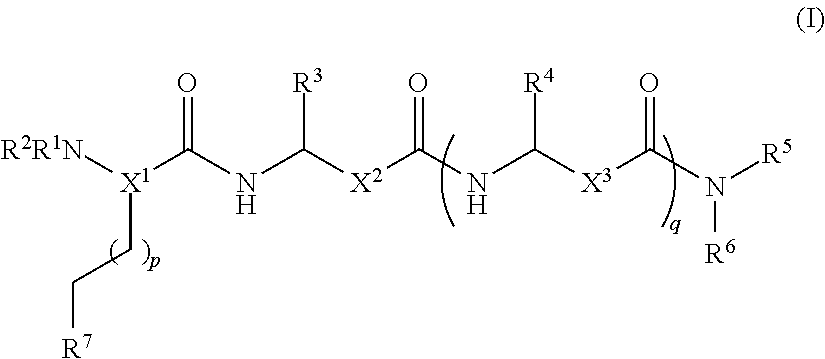
wherein
R1, R2, R5, and R6 is each independently a bond, hydrogen, an amino protecting group, hydroxyl, COOH, COH, carbonylaminoethylanilinyl, an alkyl, a cycloalkyl, an alkenyl, an aryl, an alkylaryl, an arylalkyl, an alkoxyalkyl, an alkoxyaryl, an alkoxyalkylaryl, an alkoxyarylalkyl, an alkyloxycarbonyl, a carboxyalkyl, a carboxyaryl, a carboxyalkylaryl, a carboxyarylalkyl, a heterocycle radical, an oxycarbonyl, benzyloxycarbonyl, amido, methylphenyamide, methylphenylamine, amine, carboxyl, alkyloxycarbonyl, or a side chain of an α-amino acid;
where in R1, R2, R5, and R6, each of the carbonylaminoethylanilinyl, the alkyl; the cycloalkyl, the alkenyl, the aryl, the alkylaryl, the arylalkyl, the alkoxyalkyl, the alkoxyaryl, the alkoxyalkylaryl, the alkoxyarylalkyl, the alkyloxycarbonyl, the carboxyalkyl, the carboxyaryl, the carboxyalkylaryl, the carboxyarylalkyl, the heterocycle radical, the oxycarbonyl, the benzyloxycarbonyl, the amido, the methylphenyamide, the methylphenylamine, the amine, the carboxyl, the alkyloxycarbonyl, and the side chain of the α-amino acid is independently unsubstituted or substituted with one or more of amino, amide, halogen, hydroxyl, amitidine, a lower alkoxy, a lower carboxy, a lower alkyl, aryl, —NR8R9, a loweralkoxycarbonylamino, or a protecting group;
R3 and R4 is each independently a bond, hydrogen, hydroxyl, —COOH, —COH, —(CH2)n—NR8R9, an alkyl, an aminoalkyl, a cycloalkyl, an aryl, an alkylaryl, an arylalkyl, an alkoxyalkyl, an alkoxyaryl, an alkoxyalkylaryl, an alkoxyarylalkyl, a alkyloxycarbonyl, a carboxyalkyl, a carboxyaryl, a carboxyalkylaryl, a carboxyarylalkyl, a heterocycle radical, oxycarbonyl, amido, carboxyl, guanidine, a side chain of an α-amino acid, isobutyl, carbamoylmethyl, 2-carboxyethyl, 4-aminobutyl, or benzyl;
where in R3 and R4, each of the hydroxyl, the —(CH2)n—NR8R9, the alkyl, the aminoalkyl, the cycloalkyl, the aryl, the alkylaryl, the arylalkyl, the alkoxyalkyl, the alkoxyaryl, the alkoxyalkylaryl, the alkoxyarylalkyl, the alkyloxycarbonyl, the carboxyalkyl, the carboxyaryl, the carboxyalkylaryl, the carboxyarylalkyl, the heterocycle radical, the oxycarbonyl, the amido, the carboxyl, the guanidine, the side chain of the α-amino acid, the isobutyl, the carbamoylmethyl, the 2-carboxyethyl, the 4-aminobutyl, and benzyl is independently unsubstituted or substituted with one or more of amino, amide, halogen, hydroxyl, amitidine, a lower alkoxy, a lower carboxy, a lower alkyl, aryl, a loweralkoxycarbonylamino, or a protecting group;
R7 is a bond, hydrogen, hydroxyl, COOH, COR8, an alkyl, a cycloalkyl, an aryl, an alkylaryl, an arylalkyl, an alkoxyalkyl, an alkoxyaryl, an alkoxyalkylaryl, an alkoxyarylalkyl, an alkyloxycarbonyl, a carboxyalkyl, a carboxyaryl, a carboxyalkylaryl, a carboxyarylalkyl, a heterocycle radical, oxycarbonyl, amino, methylamino, amido, dimethylamino, (2-aminoethyl)amino, 1,1-dimethylhydrazino, 1-methyl-1-phenylhydrazino, or benzyloxycarbonyl, a side chain of an α-amino acid, or carboxyl;
where in R7, each of the COR8, the alkyl, the cycloalkyl, the aryl, the alkylaryl, the arylalkyl, the alkoxyalkyl, the alkoxyaryl, the alkoxyalkylaryl, the alkoxyarylalkyl, alkyloxycarbonyl, the carboxyalkyl, the carboxyaryl, the carboxyalkylaryl, the carboxyarylalkyl, the heterocycle radical, the oxycarbonyl, the amino, the methylamino, the amido, the dimethylamino, the (2-aminoethyl)amino, the 1,1-dimethylhydrazino, the 1-methyl-1-phenylhydrazino, the benzyloxycarbonyl, the carboxyl, and the side chain of the α-amino acid is independently unsubstituted or substituted with one or more of amino, amide, halogen, amitidine, hydroxyl, a lower alkoxy, a lower carboxy, a lower alkyl (C1-C7), —NR9R10, aryl, loweralkoxycarbonylamino, or a protecting group;
R8, R9 and R10 is each independently a bond, hydrogen, hydroxyl, —COOH, —COH, —NH, —NH2, —CNHNH2, —CNH2NNO2, an alkyl, a cycloalkyl, an aryl, an alkylaryl, an arylalkyl, an alkoxyalkyl, an alkoxyaryl, an alkoxyalkylaryl, an alkoxyarylalkyl, a carboxyalkyl, a carboxyaryl, a carboxyalkylaryl, a carboxyarylalkyl, a heterocycle radical, oxycarbonyl, an alkyloxycarbonyl, an amino, hydrazine, or a side chain of an α-amino acid;
where in R8, R9, and R10, each of the alkyl, the cycloalkyl, the aryl, the alkylaryl, the arylalkyl, the alkoxyalkyl, the alkoxyaryl, the alkoxyalkylaryl, the alkoxyarylalkyl, the carboxyalkyl, the carboxyaryl, the carboxyalkylaryl, the carboxyarylalkyl, the heterocycle radical, the oxycarbonyl, the alkyloxycarbonyl, the hydrazine, the amino, the side chain of the α-amino acid independently unsubstituted or substituted with one or more of amino, amide, hydroxyl, halogen, amitidine, a lower alkoxy, a lower carboxy, a lower alkyl, aryl, loweralkoxycarbonylamino, or a protecting group;
X1 is —CH—;
X2 and X3 are each independently a bond, —CH—, —O—, —S—, N, —CHOH—, —COO— or —CO—;
n is an integer from 1 to 6;
p is an integer from 0 to 4; and
q is an integer from 0 to 2,
or a pharmaceutically acceptable salt thereof.
23. The method of claim 22 , wherein
R1 or R2 is unsubstituted or substituted benzyloxycarbonyl;
R3 and R4 is each independently a bond, hydrogen, unsubstituted or substituted hydroxyl, unsubstituted or substituted carboxyl, an unsubstituted or substituted aminoalkyl, or an unsubstituted or substituted side chain of an α-amino acid;
R5 and R6 is independently a bond, H, unsubstituted or substituted hydroxyl, unsubstituted or substituted carboxyl, unsubstituted or substituted lower alkyl, or unsubstituted or substituted alkylaryl;
R7 is unsubstituted or substituted alkyl amine, unsubstituted or substituted 1-methyl-1-phenyl-hydrozinocarbonyl, or unsubstituted or substituted alkylcarbonyl;
X2 and X3 are both —CO—;
p is an integer from 1 to 4; and
q is 1.
24. The method of claim 1 , wherein the agent which inhibits Kgp activity is a compound of formula (II):
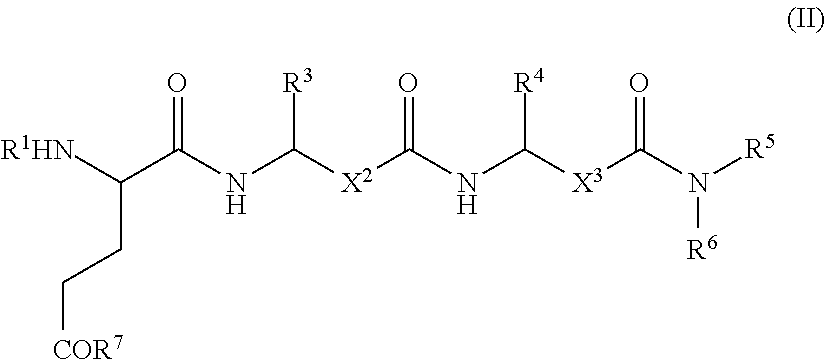
or a pharmaceutically acceptable salt thereof, wherein:
X2 and X3 is each independently a bond, —CHOH— or —CO—;
R1 and R7 is each independently hydrogen, an optionally substituted carboxyl group, hydroxyl or substituted oxycarbonyl;
R3 is substituted oxycarbonyl, optionally substituted alkyl or optionally substituted aminoalkyl;
R4 is optionally substituted alkyl, optionally substituted aminoalkyl, hydroxyl, lower alkoxy, optionally substituted piperazinyl or the like;
R5 is optionally substituted alkyl, hydrogen or a R-group side chain of an .alpha.-amino acid optionally protected by a protective group; and
R6 is optionally substituted alkyl, hydroxyl, or lower alkoxy.
25-29. (canceled)
30. The method of claim 22 , wherein the agent which inhibits Kgp activity is Kyt-36 having the structure:
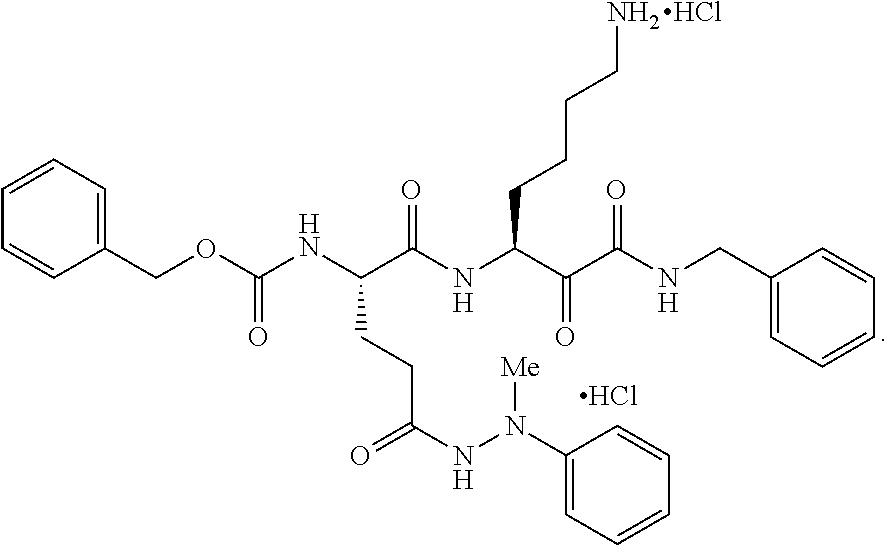
31. The method of claim 24 , wherein the agent which inhibits Kgp activity is Kyt-41 having the structure:
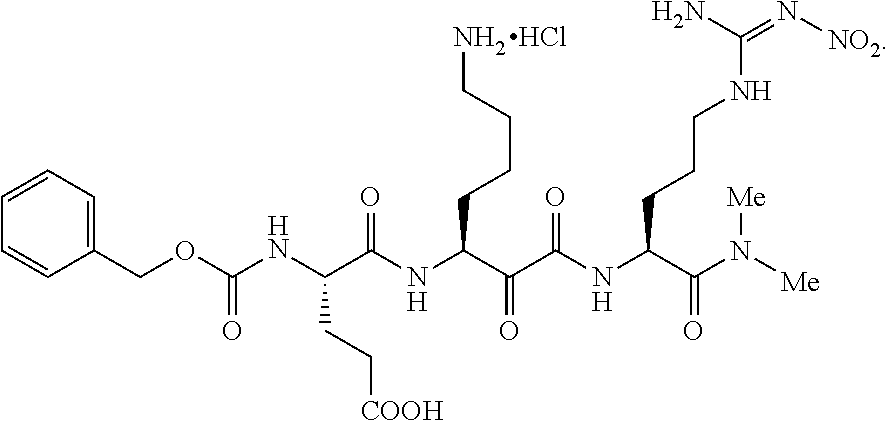
32-34. (canceled)
35. The method of claim 1 , wherein the disorder is selected from the group consisting of Alzheimer's disease, Down's syndrome, epilepsy, autism, Parkinson's disease, essential tremor, fronto-temporal dementia, progressive supranuclear palsy, amyotrophic lateral sclerosis, Huntington's disease, multiple sclerosis, mild cognitive impairment, age associated memory impairment, chronic traumatic encephalopathy, stroke, Lewy Body disease, multiple system atrophy, schizophrenia and depression.
36-41. (canceled)
42. The method of claim 1 , wherein the agent which inhibits Kgp activity is an antibody targeting gingipains or an antibody fragment targeting gingipains.
43. The method of claim 42 , wherein the agent which inhibits Kgp activity is selected from 7B9 and 15C8.
44-95. (canceled)
96. The method of claim 1 , wherein the pharmaceutically acceptable agent has a Ki of Lysine Gingipain (Kgp) of less than or equal to 10 nanomolar (nM).
Priority Applications (1)
| Application Number | Priority Date | Filing Date | Title |
|---|---|---|---|
| US14/699,898 US20170014468A1 (en) | 2014-04-29 | 2015-04-29 | Methods of use for therapeutics targeting the pathogen porphyromonas gingivalis |
Applications Claiming Priority (4)
| Application Number | Priority Date | Filing Date | Title |
|---|---|---|---|
| US201461986022P | 2014-04-29 | 2014-04-29 | |
| US201462020304P | 2014-07-02 | 2014-07-02 | |
| US201462060437P | 2014-10-06 | 2014-10-06 | |
| US14/699,898 US20170014468A1 (en) | 2014-04-29 | 2015-04-29 | Methods of use for therapeutics targeting the pathogen porphyromonas gingivalis |
Publications (1)
| Publication Number | Publication Date |
|---|---|
| US20170014468A1 true US20170014468A1 (en) | 2017-01-19 |
Family
ID=57775472
Family Applications (1)
| Application Number | Title | Priority Date | Filing Date |
|---|---|---|---|
| US14/699,898 Abandoned US20170014468A1 (en) | 2014-04-29 | 2015-04-29 | Methods of use for therapeutics targeting the pathogen porphyromonas gingivalis |
Country Status (1)
| Country | Link |
|---|---|
| US (1) | US20170014468A1 (en) |
Cited By (7)
| Publication number | Priority date | Publication date | Assignee | Title |
|---|---|---|---|---|
| US20180369353A1 (en) * | 2015-12-15 | 2018-12-27 | Institut National De La Sante Et De La Recherche Medicale (Inserm) | Vaccination against diabetes, obesity and complications thereof |
| US10278957B2 (en) | 2017-09-11 | 2019-05-07 | Protagonist Therapeutics, Inc. | Opioid agonist peptides and uses thereof |
| US10906881B2 (en) | 2015-11-09 | 2021-02-02 | Cortexyme, Inc. | Inhibitors of arginine gingipain |
| US11059786B2 (en) * | 2017-05-10 | 2021-07-13 | Cortexyme, Inc. | Aminopyridine compounds and methods for the preparation and use thereof |
| US11623003B2 (en) * | 2015-12-15 | 2023-04-11 | Institut National De La Sante Et De La Recherche Medicale (Inserm) | Vaccination against diabetes, obesity and complications thereof |
| US12036286B2 (en) | 2021-03-18 | 2024-07-16 | Seagen Inc. | Selective drug release from internalized conjugates of biologically active compounds |
| WO2025019902A1 (en) * | 2023-07-26 | 2025-01-30 | Denteric Pty Ltd | Methods of treatment |
-
2015
- 2015-04-29 US US14/699,898 patent/US20170014468A1/en not_active Abandoned
Cited By (9)
| Publication number | Priority date | Publication date | Assignee | Title |
|---|---|---|---|---|
| US10906881B2 (en) | 2015-11-09 | 2021-02-02 | Cortexyme, Inc. | Inhibitors of arginine gingipain |
| US20180369353A1 (en) * | 2015-12-15 | 2018-12-27 | Institut National De La Sante Et De La Recherche Medicale (Inserm) | Vaccination against diabetes, obesity and complications thereof |
| US10925951B2 (en) * | 2015-12-15 | 2021-02-23 | Institut National De La Sante Et De La Recherche Medicale (Inserm) | Vaccination against diabetes, obesity and complications thereof |
| US11623003B2 (en) * | 2015-12-15 | 2023-04-11 | Institut National De La Sante Et De La Recherche Medicale (Inserm) | Vaccination against diabetes, obesity and complications thereof |
| US11059786B2 (en) * | 2017-05-10 | 2021-07-13 | Cortexyme, Inc. | Aminopyridine compounds and methods for the preparation and use thereof |
| US10278957B2 (en) | 2017-09-11 | 2019-05-07 | Protagonist Therapeutics, Inc. | Opioid agonist peptides and uses thereof |
| US10729676B2 (en) | 2017-09-11 | 2020-08-04 | Protagonist Theraputics, Inc. | Opioid agonist peptides and uses thereof |
| US12036286B2 (en) | 2021-03-18 | 2024-07-16 | Seagen Inc. | Selective drug release from internalized conjugates of biologically active compounds |
| WO2025019902A1 (en) * | 2023-07-26 | 2025-01-30 | Denteric Pty Ltd | Methods of treatment |
Similar Documents
| Publication | Publication Date | Title |
|---|---|---|
| US20170014468A1 (en) | Methods of use for therapeutics targeting the pathogen porphyromonas gingivalis | |
| CN107249578B (en) | Method for treating envenomation and related pharmaceutical composition, system and kit | |
| ES2432369T3 (en) | Compositions and methods to treat neurological disorders | |
| Keita et al. | Trypanosoma brucei brucei: a long-term model of human African trypanosomiasis in mice, meningo-encephalitis, astrocytosis, and neurological disorders | |
| JP6877424B2 (en) | Inhibitor of arginine gingipain | |
| JP6642948B2 (en) | Inhibitors of ricindin dipain | |
| US20220016146A1 (en) | Method of treating age-related macular degeneration | |
| CN112166111A (en) | Methods of treating fibrotic diseases | |
| JP2007529556A (en) | Acetylcholinesterase inhibitors and N-methyl-D-aspartate antagonists useful for the treatment of cognitive impairment | |
| RU2617399C2 (en) | Treatment or prevention of infection | |
| AU2014352716A1 (en) | Use of indolyl and idolinyl hydroxamates for treating neurodegenerative disorders or cognitive deficits | |
| US11598774B2 (en) | Methods of diagnosis and treatment of Alzheimer's Disease | |
| Dunne et al. | A phase 1 study to assess the pharmacokinetics of sulopenem etzadroxil (PF-03709270) | |
| MX2014015310A (en) | Prophylactic and/or therapeutic agent for mild cognitive impairment. | |
| EP3512846B1 (en) | Ketone inhibitors of lysine gingipain | |
| US20150246095A1 (en) | Methods and pharmaceutical compositions for the prophylactic treatment of bacterial superinfections post-influenza | |
| WO2022028243A1 (en) | Use of compound amino acids in preparation of drugs enhancing sensitivity of bacteria to antibiotics | |
| CN107847502A (en) | Bactericidal composition | |
| ES3023183T3 (en) | Compositions and methods for treating neurological and other disorders | |
| US7319086B1 (en) | Method of prophylaxis and treatment and agents useful for same | |
| US20020177614A1 (en) | Methods for treating nuerodegenerative diseases including alzheimer's | |
| US20240316143A1 (en) | Therapeutic agents and/or pharmaceutical compositions for neurocognitive disorders | |
| US20200054646A1 (en) | Use of phenothiazine derivative in the treatment of infectious purpura or purpura fulminans | |
| CN107835686A (en) | antibacterial composition | |
| JP7687699B2 (en) | Immunogenic compositions targeting phosphorylated tau protein |
Legal Events
| Date | Code | Title | Description |
|---|---|---|---|
| AS | Assignment |
Owner name: CORTEXYME, INC., CALIFORNIA Free format text: ASSIGNMENT OF ASSIGNORS INTEREST;ASSIGNORS:DOMINY, STEPHEN S.;CRAWFORD LYNCH, CASEY;REEL/FRAME:037075/0419 Effective date: 20150924 |
|
| STCB | Information on status: application discontinuation |
Free format text: ABANDONED -- FAILURE TO RESPOND TO AN OFFICE ACTION |