US20150313903A1 - Methods of treating cognitive impairment associated with neurodegenerative disorders - Google Patents
Methods of treating cognitive impairment associated with neurodegenerative disorders Download PDFInfo
- Publication number
- US20150313903A1 US20150313903A1 US14/704,021 US201514704021A US2015313903A1 US 20150313903 A1 US20150313903 A1 US 20150313903A1 US 201514704021 A US201514704021 A US 201514704021A US 2015313903 A1 US2015313903 A1 US 2015313903A1
- Authority
- US
- United States
- Prior art keywords
- subject
- disease
- piperidinylalkyl
- sleep
- symptoms
- Prior art date
- Legal status (The legal status is an assumption and is not a legal conclusion. Google has not performed a legal analysis and makes no representation as to the accuracy of the status listed.)
- Abandoned
Links
- 238000000034 method Methods 0.000 title claims abstract description 98
- 208000015122 neurodegenerative disease Diseases 0.000 title claims abstract description 72
- 208000010877 cognitive disease Diseases 0.000 title claims abstract description 34
- 208000028698 Cognitive impairment Diseases 0.000 title claims abstract description 27
- 208000024891 symptom Diseases 0.000 claims abstract description 135
- JUQLTPCYUFPYKE-UHFFFAOYSA-N ritanserin Chemical compound CC=1N=C2SC=CN2C(=O)C=1CCN(CC1)CCC1=C(C=1C=CC(F)=CC=1)C1=CC=C(F)C=C1 JUQLTPCYUFPYKE-UHFFFAOYSA-N 0.000 claims abstract description 81
- 229950009626 ritanserin Drugs 0.000 claims abstract description 79
- 230000004770 neurodegeneration Effects 0.000 claims abstract description 61
- VTGOHKSTWXHQJK-UHFFFAOYSA-N pyrimidin-2-ol Chemical class OC1=NC=CC=N1 VTGOHKSTWXHQJK-UHFFFAOYSA-N 0.000 claims abstract description 56
- 150000003839 salts Chemical class 0.000 claims abstract description 43
- 210000004556 brain Anatomy 0.000 claims abstract description 34
- 230000037322 slow-wave sleep Effects 0.000 claims abstract description 34
- VYFYYTLLBUKUHU-UHFFFAOYSA-N dopamine Chemical compound NCCC1=CC=C(O)C(O)=C1 VYFYYTLLBUKUHU-UHFFFAOYSA-N 0.000 claims abstract description 28
- 239000008194 pharmaceutical composition Substances 0.000 claims abstract description 23
- 239000000546 pharmaceutical excipient Substances 0.000 claims abstract description 20
- 229960003638 dopamine Drugs 0.000 claims abstract description 14
- 102000004219 Brain-derived neurotrophic factor Human genes 0.000 claims abstract description 13
- 108090000715 Brain-derived neurotrophic factor Proteins 0.000 claims abstract description 13
- 230000014509 gene expression Effects 0.000 claims abstract description 13
- 210000002442 prefrontal cortex Anatomy 0.000 claims abstract description 11
- 230000011664 signaling Effects 0.000 claims abstract description 9
- 239000003937 drug carrier Substances 0.000 claims abstract description 6
- 210000001320 hippocampus Anatomy 0.000 claims abstract description 6
- 208000037265 diseases, disorders, signs and symptoms Diseases 0.000 claims description 84
- 208000023105 Huntington disease Diseases 0.000 claims description 49
- 206010002026 amyotrophic lateral sclerosis Diseases 0.000 claims description 39
- 208000018737 Parkinson disease Diseases 0.000 claims description 36
- 201000002832 Lewy body dementia Diseases 0.000 claims description 32
- 208000024827 Alzheimer disease Diseases 0.000 claims description 28
- 208000035475 disorder Diseases 0.000 claims description 28
- 206010067889 Dementia with Lewy bodies Diseases 0.000 claims description 27
- 239000013543 active substance Substances 0.000 claims description 24
- 230000002829 reductive effect Effects 0.000 claims description 22
- 206010012289 Dementia Diseases 0.000 claims description 18
- 238000013265 extended release Methods 0.000 claims description 17
- 208000028017 Psychotic disease Diseases 0.000 claims description 16
- 208000015114 central nervous system disease Diseases 0.000 claims description 14
- 230000003111 delayed effect Effects 0.000 claims description 14
- 238000003745 diagnosis Methods 0.000 claims description 14
- 208000012902 Nervous system disease Diseases 0.000 claims description 11
- 208000025535 REM sleep behavior disease Diseases 0.000 claims description 10
- 208000000044 Amnesia Diseases 0.000 claims description 9
- 230000009471 action Effects 0.000 claims description 9
- 208000001089 Multiple system atrophy Diseases 0.000 claims description 8
- 230000001149 cognitive effect Effects 0.000 claims description 8
- 208000009829 Lewy Body Disease Diseases 0.000 claims description 7
- 208000004547 Hallucinations Diseases 0.000 claims description 6
- 208000026139 Memory disease Diseases 0.000 claims description 6
- 230000006399 behavior Effects 0.000 claims description 6
- 238000004519 manufacturing process Methods 0.000 claims description 6
- 230000006984 memory degeneration Effects 0.000 claims description 6
- 208000023060 memory loss Diseases 0.000 claims description 6
- 208000005264 motor neuron disease Diseases 0.000 claims description 6
- 230000001953 sensory effect Effects 0.000 claims description 6
- 230000000977 initiatory effect Effects 0.000 claims description 5
- 230000008449 language Effects 0.000 claims description 5
- 238000013439 planning Methods 0.000 claims description 5
- 230000008448 thought Effects 0.000 claims description 5
- 102000014461 Ataxins Human genes 0.000 claims description 4
- 108010078286 Ataxins Proteins 0.000 claims description 4
- 206010008025 Cerebellar ataxia Diseases 0.000 claims description 4
- 208000011990 Corticobasal Degeneration Diseases 0.000 claims description 4
- 208000009415 Spinocerebellar Ataxias Diseases 0.000 claims description 4
- 201000004562 autosomal dominant cerebellar ataxia Diseases 0.000 claims description 4
- 201000006417 multiple sclerosis Diseases 0.000 claims description 4
- 208000002320 spinal muscular atrophy Diseases 0.000 claims description 4
- 230000003936 working memory Effects 0.000 claims description 4
- 206010070246 Executive dysfunction Diseases 0.000 claims description 3
- 206010019075 Hallucination, visual Diseases 0.000 claims description 3
- 230000036648 cognitive speed Effects 0.000 claims description 3
- 230000002401 inhibitory effect Effects 0.000 claims description 3
- 230000036651 mood Effects 0.000 claims description 3
- 208000036022 Alpers' disease Diseases 0.000 claims description 2
- 208000031277 Amaurotic familial idiocy Diseases 0.000 claims description 2
- 206010002942 Apathy Diseases 0.000 claims description 2
- 208000016560 COFS syndrome Diseases 0.000 claims description 2
- 208000020406 Creutzfeldt Jacob disease Diseases 0.000 claims description 2
- 208000003407 Creutzfeldt-Jakob Syndrome Diseases 0.000 claims description 2
- 208000010859 Creutzfeldt-Jakob disease Diseases 0.000 claims description 2
- 208000004986 Diffuse Cerebral Sclerosis of Schilder Diseases 0.000 claims description 2
- 208000026097 Factitious disease Diseases 0.000 claims description 2
- 208000024412 Friedreich ataxia Diseases 0.000 claims description 2
- 201000011240 Frontotemporal dementia Diseases 0.000 claims description 2
- 208000003736 Gerstmann-Straussler-Scheinker Disease Diseases 0.000 claims description 2
- 206010072075 Gerstmann-Straussler-Scheinker syndrome Diseases 0.000 claims description 2
- 206010021703 Indifference Diseases 0.000 claims description 2
- 208000006264 Korsakoff syndrome Diseases 0.000 claims description 2
- 208000004552 Lacunar Stroke Diseases 0.000 claims description 2
- 208000006136 Leigh Disease Diseases 0.000 claims description 2
- 208000017507 Leigh syndrome Diseases 0.000 claims description 2
- 206010069681 Monomelic amyotrophy Diseases 0.000 claims description 2
- 206010028980 Neoplasm Diseases 0.000 claims description 2
- 208000002537 Neuronal Ceroid-Lipofuscinoses Diseases 0.000 claims description 2
- 206010053854 Opsoclonus myoclonus Diseases 0.000 claims description 2
- 208000005225 Opsoclonus-Myoclonus Syndrome Diseases 0.000 claims description 2
- 206010031127 Orthostatic hypotension Diseases 0.000 claims description 2
- 208000024777 Prion disease Diseases 0.000 claims description 2
- 206010052276 Pseudodementia Diseases 0.000 claims description 2
- 208000009106 Shy-Drager Syndrome Diseases 0.000 claims description 2
- 201000004810 Vascular dementia Diseases 0.000 claims description 2
- 201000008485 Wernicke-Korsakoff syndrome Diseases 0.000 claims description 2
- 201000011510 cancer Diseases 0.000 claims description 2
- 238000002512 chemotherapy Methods 0.000 claims description 2
- 208000003906 hydrocephalus Diseases 0.000 claims description 2
- 208000017476 juvenile neuronal ceroid lipofuscinosis Diseases 0.000 claims description 2
- 208000027061 mild cognitive impairment Diseases 0.000 claims description 2
- 201000007601 neurodegeneration with brain iron accumulation Diseases 0.000 claims description 2
- 201000007607 neuronal ceroid lipofuscinosis 3 Diseases 0.000 claims description 2
- 238000011275 oncology therapy Methods 0.000 claims description 2
- 208000014670 posterior cortical atrophy Diseases 0.000 claims description 2
- 208000001282 primary progressive aphasia Diseases 0.000 claims description 2
- 206010036807 progressive multifocal leukoencephalopathy Diseases 0.000 claims description 2
- 201000002212 progressive supranuclear palsy Diseases 0.000 claims description 2
- 229940077737 brain-derived neurotrophic factor Drugs 0.000 claims 4
- 150000001875 compounds Chemical class 0.000 abstract description 25
- 239000000203 mixture Substances 0.000 description 98
- 239000003814 drug Substances 0.000 description 93
- 229940079593 drug Drugs 0.000 description 90
- 230000007958 sleep Effects 0.000 description 82
- 201000010099 disease Diseases 0.000 description 56
- 235000002639 sodium chloride Nutrition 0.000 description 45
- 238000009472 formulation Methods 0.000 description 40
- -1 for example Chemical group 0.000 description 33
- 238000011282 treatment Methods 0.000 description 33
- 239000000463 material Substances 0.000 description 30
- 230000000694 effects Effects 0.000 description 29
- 239000012071 phase Substances 0.000 description 28
- 239000003826 tablet Substances 0.000 description 27
- 239000003795 chemical substances by application Substances 0.000 description 25
- 239000002552 dosage form Substances 0.000 description 25
- 238000012360 testing method Methods 0.000 description 25
- 238000000576 coating method Methods 0.000 description 24
- 239000011248 coating agent Substances 0.000 description 23
- 239000007788 liquid Substances 0.000 description 23
- 239000002245 particle Substances 0.000 description 21
- LFQSCWFLJHTTHZ-UHFFFAOYSA-N Ethanol Chemical compound CCO LFQSCWFLJHTTHZ-UHFFFAOYSA-N 0.000 description 19
- 230000019771 cognition Effects 0.000 description 19
- DNIAPMSPPWPWGF-UHFFFAOYSA-N Propylene glycol Chemical compound CC(O)CO DNIAPMSPPWPWGF-UHFFFAOYSA-N 0.000 description 18
- 239000000839 emulsion Substances 0.000 description 18
- 230000001965 increasing effect Effects 0.000 description 18
- 230000033001 locomotion Effects 0.000 description 18
- 230000015654 memory Effects 0.000 description 18
- 239000003921 oil Substances 0.000 description 18
- 229920000642 polymer Polymers 0.000 description 18
- 239000000243 solution Substances 0.000 description 18
- 235000019198 oils Nutrition 0.000 description 17
- 230000007423 decrease Effects 0.000 description 16
- 239000003995 emulsifying agent Substances 0.000 description 16
- 239000004094 surface-active agent Substances 0.000 description 16
- 210000003491 skin Anatomy 0.000 description 15
- 239000011324 bead Substances 0.000 description 14
- 239000000306 component Substances 0.000 description 14
- 239000010410 layer Substances 0.000 description 14
- 230000036385 rapid eye movement (rem) sleep Effects 0.000 description 14
- 239000000725 suspension Substances 0.000 description 14
- 230000002354 daily effect Effects 0.000 description 13
- 230000035772 mutation Effects 0.000 description 13
- 108090000623 proteins and genes Proteins 0.000 description 12
- 239000002904 solvent Substances 0.000 description 12
- 239000000126 substance Substances 0.000 description 12
- VBICKXHEKHSIBG-UHFFFAOYSA-N 1-monostearoylglycerol Chemical compound CCCCCCCCCCCCCCCCCC(=O)OCC(O)CO VBICKXHEKHSIBG-UHFFFAOYSA-N 0.000 description 11
- 241000282414 Homo sapiens Species 0.000 description 11
- 238000003759 clinical diagnosis Methods 0.000 description 11
- 230000003920 cognitive function Effects 0.000 description 11
- 239000011159 matrix material Substances 0.000 description 11
- 238000012384 transportation and delivery Methods 0.000 description 11
- XLYOFNOQVPJJNP-UHFFFAOYSA-N water Chemical compound O XLYOFNOQVPJJNP-UHFFFAOYSA-N 0.000 description 11
- 239000002775 capsule Substances 0.000 description 10
- 239000003085 diluting agent Substances 0.000 description 10
- 235000019441 ethanol Nutrition 0.000 description 10
- 239000008187 granular material Substances 0.000 description 10
- 230000007246 mechanism Effects 0.000 description 10
- 230000008569 process Effects 0.000 description 10
- 239000003381 stabilizer Substances 0.000 description 10
- FAPWRFPIFSIZLT-UHFFFAOYSA-M Sodium chloride Chemical compound [Na+].[Cl-] FAPWRFPIFSIZLT-UHFFFAOYSA-M 0.000 description 9
- 229920002472 Starch Polymers 0.000 description 9
- 208000030886 Traumatic Brain injury Diseases 0.000 description 9
- 239000007864 aqueous solution Substances 0.000 description 9
- 239000000872 buffer Substances 0.000 description 9
- 230000001771 impaired effect Effects 0.000 description 9
- 239000006210 lotion Substances 0.000 description 9
- 239000000314 lubricant Substances 0.000 description 9
- 210000004072 lung Anatomy 0.000 description 9
- 210000002161 motor neuron Anatomy 0.000 description 9
- 208000019116 sleep disease Diseases 0.000 description 9
- 235000019698 starch Nutrition 0.000 description 9
- 230000009529 traumatic brain injury Effects 0.000 description 9
- 108700028369 Alleles Proteins 0.000 description 8
- 208000019901 Anxiety disease Diseases 0.000 description 8
- 229920003171 Poly (ethylene oxide) Polymers 0.000 description 8
- 239000011230 binding agent Substances 0.000 description 8
- 239000001913 cellulose Substances 0.000 description 8
- 235000010980 cellulose Nutrition 0.000 description 8
- 229920002678 cellulose Polymers 0.000 description 8
- 230000001747 exhibiting effect Effects 0.000 description 8
- 230000006870 function Effects 0.000 description 8
- 230000002068 genetic effect Effects 0.000 description 8
- 239000002674 ointment Substances 0.000 description 8
- 230000000144 pharmacologic effect Effects 0.000 description 8
- 235000013855 polyvinylpyrrolidone Nutrition 0.000 description 8
- 239000003380 propellant Substances 0.000 description 8
- 238000011160 research Methods 0.000 description 8
- 239000007787 solid Substances 0.000 description 8
- 239000008107 starch Substances 0.000 description 8
- 229940032147 starch Drugs 0.000 description 8
- LYCAIKOWRPUZTN-UHFFFAOYSA-N Ethylene glycol Chemical compound OCCO LYCAIKOWRPUZTN-UHFFFAOYSA-N 0.000 description 7
- 239000000443 aerosol Substances 0.000 description 7
- 230000036506 anxiety Effects 0.000 description 7
- 239000000969 carrier Substances 0.000 description 7
- 230000008859 change Effects 0.000 description 7
- 239000006071 cream Substances 0.000 description 7
- 239000000499 gel Substances 0.000 description 7
- 239000012729 immediate-release (IR) formulation Substances 0.000 description 7
- 206010022437 insomnia Diseases 0.000 description 7
- 230000013016 learning Effects 0.000 description 7
- HQKMJHAJHXVSDF-UHFFFAOYSA-L magnesium stearate Chemical compound [Mg+2].CCCCCCCCCCCCCCCCCC([O-])=O.CCCCCCCCCCCCCCCCCC([O-])=O HQKMJHAJHXVSDF-UHFFFAOYSA-L 0.000 description 7
- 229920000036 polyvinylpyrrolidone Polymers 0.000 description 7
- 230000002685 pulmonary effect Effects 0.000 description 7
- 230000001225 therapeutic effect Effects 0.000 description 7
- 239000003981 vehicle Substances 0.000 description 7
- 208000007590 Disorders of Excessive Somnolence Diseases 0.000 description 6
- XEKOWRVHYACXOJ-UHFFFAOYSA-N Ethyl acetate Chemical compound CCOC(C)=O XEKOWRVHYACXOJ-UHFFFAOYSA-N 0.000 description 6
- 229920003134 Eudragit® polymer Polymers 0.000 description 6
- 229920002153 Hydroxypropyl cellulose Polymers 0.000 description 6
- GUBGYTABKSRVRQ-QKKXKWKRSA-N Lactose Natural products OC[C@H]1O[C@@H](O[C@H]2[C@H](O)[C@@H](O)C(O)O[C@@H]2CO)[C@H](O)[C@@H](O)[C@H]1O GUBGYTABKSRVRQ-QKKXKWKRSA-N 0.000 description 6
- 239000002202 Polyethylene glycol Substances 0.000 description 6
- 208000013738 Sleep Initiation and Maintenance disease Diseases 0.000 description 6
- 239000002253 acid Substances 0.000 description 6
- VREFGVBLTWBCJP-UHFFFAOYSA-N alprazolam Chemical compound C12=CC(Cl)=CC=C2N2C(C)=NN=C2CN=C1C1=CC=CC=C1 VREFGVBLTWBCJP-UHFFFAOYSA-N 0.000 description 6
- 239000004359 castor oil Substances 0.000 description 6
- 235000019438 castor oil Nutrition 0.000 description 6
- 230000002060 circadian Effects 0.000 description 6
- 229920001577 copolymer Polymers 0.000 description 6
- 230000004064 dysfunction Effects 0.000 description 6
- ZEMPKEQAKRGZGQ-XOQCFJPHSA-N glycerol triricinoleate Natural products CCCCCC[C@@H](O)CC=CCCCCCCCC(=O)OC[C@@H](COC(=O)CCCCCCCC=CC[C@@H](O)CCCCCC)OC(=O)CCCCCCCC=CC[C@H](O)CCCCCC ZEMPKEQAKRGZGQ-XOQCFJPHSA-N 0.000 description 6
- 235000010977 hydroxypropyl cellulose Nutrition 0.000 description 6
- 239000001863 hydroxypropyl cellulose Substances 0.000 description 6
- 239000008101 lactose Substances 0.000 description 6
- 239000004014 plasticizer Substances 0.000 description 6
- 229920001223 polyethylene glycol Polymers 0.000 description 6
- 239000001267 polyvinylpyrrolidone Substances 0.000 description 6
- 239000000843 powder Substances 0.000 description 6
- 239000003755 preservative agent Substances 0.000 description 6
- 229960004063 propylene glycol Drugs 0.000 description 6
- 210000002345 respiratory system Anatomy 0.000 description 6
- 239000012896 selective serotonin reuptake inhibitor Substances 0.000 description 6
- 235000000346 sugar Nutrition 0.000 description 6
- JNYAEWCLZODPBN-JGWLITMVSA-N (2r,3r,4s)-2-[(1r)-1,2-dihydroxyethyl]oxolane-3,4-diol Chemical compound OC[C@@H](O)[C@H]1OC[C@H](O)[C@H]1O JNYAEWCLZODPBN-JGWLITMVSA-N 0.000 description 5
- LNAZSHAWQACDHT-XIYTZBAFSA-N (2r,3r,4s,5r,6s)-4,5-dimethoxy-2-(methoxymethyl)-3-[(2s,3r,4s,5r,6r)-3,4,5-trimethoxy-6-(methoxymethyl)oxan-2-yl]oxy-6-[(2r,3r,4s,5r,6r)-4,5,6-trimethoxy-2-(methoxymethyl)oxan-3-yl]oxyoxane Chemical compound CO[C@@H]1[C@@H](OC)[C@H](OC)[C@@H](COC)O[C@H]1O[C@H]1[C@H](OC)[C@@H](OC)[C@H](O[C@H]2[C@@H]([C@@H](OC)[C@H](OC)O[C@@H]2COC)OC)O[C@@H]1COC LNAZSHAWQACDHT-XIYTZBAFSA-N 0.000 description 5
- GUBGYTABKSRVRQ-XLOQQCSPSA-N Alpha-Lactose Chemical compound O[C@@H]1[C@@H](O)[C@@H](O)[C@@H](CO)O[C@H]1O[C@@H]1[C@@H](CO)O[C@H](O)[C@H](O)[C@H]1O GUBGYTABKSRVRQ-XLOQQCSPSA-N 0.000 description 5
- 108010010803 Gelatin Proteins 0.000 description 5
- 208000002740 Muscle Rigidity Diseases 0.000 description 5
- 208000027089 Parkinsonian disease Diseases 0.000 description 5
- 206010034010 Parkinsonism Diseases 0.000 description 5
- 229920002125 Sokalan® Polymers 0.000 description 5
- 206010041349 Somnolence Diseases 0.000 description 5
- 238000010521 absorption reaction Methods 0.000 description 5
- 239000000654 additive Substances 0.000 description 5
- 239000012790 adhesive layer Substances 0.000 description 5
- 230000032683 aging Effects 0.000 description 5
- 239000000556 agonist Substances 0.000 description 5
- 125000000217 alkyl group Chemical group 0.000 description 5
- DKNWSYNQZKUICI-UHFFFAOYSA-N amantadine Chemical compound C1C(C2)CC3CC2CC1(N)C3 DKNWSYNQZKUICI-UHFFFAOYSA-N 0.000 description 5
- 229960003805 amantadine Drugs 0.000 description 5
- 239000000164 antipsychotic agent Substances 0.000 description 5
- 230000008901 benefit Effects 0.000 description 5
- 230000015572 biosynthetic process Effects 0.000 description 5
- 239000003086 colorant Substances 0.000 description 5
- 230000006735 deficit Effects 0.000 description 5
- 238000012377 drug delivery Methods 0.000 description 5
- 206010016256 fatigue Diseases 0.000 description 5
- 239000008273 gelatin Substances 0.000 description 5
- 229920000159 gelatin Polymers 0.000 description 5
- 235000019322 gelatine Nutrition 0.000 description 5
- 235000011852 gelatine desserts Nutrition 0.000 description 5
- 235000010979 hydroxypropyl methyl cellulose Nutrition 0.000 description 5
- 229920003088 hydroxypropyl methyl cellulose Polymers 0.000 description 5
- 239000001866 hydroxypropyl methyl cellulose Substances 0.000 description 5
- 210000004379 membrane Anatomy 0.000 description 5
- 239000012528 membrane Substances 0.000 description 5
- 229920000609 methyl cellulose Polymers 0.000 description 5
- 235000010981 methylcellulose Nutrition 0.000 description 5
- 239000001923 methylcellulose Substances 0.000 description 5
- 229960002900 methylcellulose Drugs 0.000 description 5
- 239000002480 mineral oil Substances 0.000 description 5
- 229940042472 mineral oil Drugs 0.000 description 5
- 235000010446 mineral oil Nutrition 0.000 description 5
- 229960001785 mirtazapine Drugs 0.000 description 5
- RONZAEMNMFQXRA-UHFFFAOYSA-N mirtazapine Chemical compound C1C2=CC=CN=C2N2CCN(C)CC2C2=CC=CC=C21 RONZAEMNMFQXRA-UHFFFAOYSA-N 0.000 description 5
- 210000003205 muscle Anatomy 0.000 description 5
- 239000002736 nonionic surfactant Substances 0.000 description 5
- GLDOVTGHNKAZLK-UHFFFAOYSA-N octadecan-1-ol Chemical compound CCCCCCCCCCCCCCCCCCO GLDOVTGHNKAZLK-UHFFFAOYSA-N 0.000 description 5
- 230000007170 pathology Effects 0.000 description 5
- 235000019271 petrolatum Nutrition 0.000 description 5
- 229920000136 polysorbate Polymers 0.000 description 5
- 238000002360 preparation method Methods 0.000 description 5
- 201000000980 schizophrenia Diseases 0.000 description 5
- 230000008667 sleep stage Effects 0.000 description 5
- 239000011734 sodium Substances 0.000 description 5
- 229910052708 sodium Inorganic materials 0.000 description 5
- 229940083542 sodium Drugs 0.000 description 5
- 239000011780 sodium chloride Substances 0.000 description 5
- 239000000454 talc Substances 0.000 description 5
- 229910052623 talc Inorganic materials 0.000 description 5
- 235000012222 talc Nutrition 0.000 description 5
- 239000001993 wax Substances 0.000 description 5
- 239000000263 2,3-dihydroxypropyl (Z)-octadec-9-enoate Substances 0.000 description 4
- RZRNAYUHWVFMIP-GDCKJWNLSA-N 3-oleoyl-sn-glycerol Chemical compound CCCCCCCC\C=C/CCCCCCCC(=O)OC[C@H](O)CO RZRNAYUHWVFMIP-GDCKJWNLSA-N 0.000 description 4
- HEDRZPFGACZZDS-UHFFFAOYSA-N Chloroform Chemical compound ClC(Cl)Cl HEDRZPFGACZZDS-UHFFFAOYSA-N 0.000 description 4
- FBPFZTCFMRRESA-KVTDHHQDSA-N D-Mannitol Chemical compound OC[C@@H](O)[C@@H](O)[C@H](O)[C@H](O)CO FBPFZTCFMRRESA-KVTDHHQDSA-N 0.000 description 4
- RTZKZFJDLAIYFH-UHFFFAOYSA-N Diethyl ether Chemical compound CCOCC RTZKZFJDLAIYFH-UHFFFAOYSA-N 0.000 description 4
- ZZSNKZQZMQGXPY-UHFFFAOYSA-N Ethyl cellulose Chemical compound CCOCC1OC(OC)C(OCC)C(OCC)C1OC1C(O)C(O)C(OC)C(CO)O1 ZZSNKZQZMQGXPY-UHFFFAOYSA-N 0.000 description 4
- 239000001856 Ethyl cellulose Substances 0.000 description 4
- UFHFLCQGNIYNRP-UHFFFAOYSA-N Hydrogen Chemical compound [H][H] UFHFLCQGNIYNRP-UHFFFAOYSA-N 0.000 description 4
- DGAQECJNVWCQMB-PUAWFVPOSA-M Ilexoside XXIX Chemical compound C[C@@H]1CC[C@@]2(CC[C@@]3(C(=CC[C@H]4[C@]3(CC[C@@H]5[C@@]4(CC[C@@H](C5(C)C)OS(=O)(=O)[O-])C)C)[C@@H]2[C@]1(C)O)C)C(=O)O[C@H]6[C@@H]([C@H]([C@@H]([C@H](O6)CO)O)O)O.[Na+] DGAQECJNVWCQMB-PUAWFVPOSA-M 0.000 description 4
- 206010022998 Irritability Diseases 0.000 description 4
- WTDRDQBEARUVNC-LURJTMIESA-N L-DOPA Chemical compound OC(=O)[C@@H](N)CC1=CC=C(O)C(O)=C1 WTDRDQBEARUVNC-LURJTMIESA-N 0.000 description 4
- WTDRDQBEARUVNC-UHFFFAOYSA-N L-Dopa Natural products OC(=O)C(N)CC1=CC=C(O)C(O)=C1 WTDRDQBEARUVNC-UHFFFAOYSA-N 0.000 description 4
- 229930195725 Mannitol Natural products 0.000 description 4
- 241000699670 Mus sp. Species 0.000 description 4
- 239000004264 Petrolatum Substances 0.000 description 4
- 206010037180 Psychiatric symptoms Diseases 0.000 description 4
- 208000010340 Sleep Deprivation Diseases 0.000 description 4
- 208000006011 Stroke Diseases 0.000 description 4
- CZMRCDWAGMRECN-UGDNZRGBSA-N Sucrose Chemical compound O[C@H]1[C@H](O)[C@@H](CO)O[C@@]1(CO)O[C@@H]1[C@H](O)[C@@H](O)[C@H](O)[C@@H](CO)O1 CZMRCDWAGMRECN-UGDNZRGBSA-N 0.000 description 4
- 229930006000 Sucrose Natural products 0.000 description 4
- XSQUKJJJFZCRTK-UHFFFAOYSA-N Urea Chemical compound NC(N)=O XSQUKJJJFZCRTK-UHFFFAOYSA-N 0.000 description 4
- 230000005856 abnormality Effects 0.000 description 4
- 239000004480 active ingredient Substances 0.000 description 4
- 239000000853 adhesive Substances 0.000 description 4
- 239000005557 antagonist Substances 0.000 description 4
- 230000000561 anti-psychotic effect Effects 0.000 description 4
- 230000003542 behavioural effect Effects 0.000 description 4
- CJZGTCYPCWQAJB-UHFFFAOYSA-L calcium stearate Chemical compound [Ca+2].CCCCCCCCCCCCCCCCCC([O-])=O.CCCCCCCCCCCCCCCCCC([O-])=O CJZGTCYPCWQAJB-UHFFFAOYSA-L 0.000 description 4
- HVYWMOMLDIMFJA-DPAQBDIFSA-N cholesterol Chemical compound C1C=C2C[C@@H](O)CC[C@]2(C)[C@@H]2[C@@H]1[C@@H]1CC[C@H]([C@H](C)CCCC(C)C)[C@@]1(C)CC2 HVYWMOMLDIMFJA-DPAQBDIFSA-N 0.000 description 4
- 239000000544 cholinesterase inhibitor Substances 0.000 description 4
- 239000008199 coating composition Substances 0.000 description 4
- 238000007906 compression Methods 0.000 description 4
- 230000034994 death Effects 0.000 description 4
- LOKCTEFSRHRXRJ-UHFFFAOYSA-I dipotassium trisodium dihydrogen phosphate hydrogen phosphate dichloride Chemical compound P(=O)(O)(O)[O-].[K+].P(=O)(O)([O-])[O-].[Na+].[Na+].[Cl-].[K+].[Cl-].[Na+] LOKCTEFSRHRXRJ-UHFFFAOYSA-I 0.000 description 4
- 239000007884 disintegrant Substances 0.000 description 4
- 239000006185 dispersion Substances 0.000 description 4
- ADEBPBSSDYVVLD-UHFFFAOYSA-N donepezil Chemical compound O=C1C=2C=C(OC)C(OC)=CC=2CC1CC(CC1)CCN1CC1=CC=CC=C1 ADEBPBSSDYVVLD-UHFFFAOYSA-N 0.000 description 4
- 239000008387 emulsifying waxe Substances 0.000 description 4
- 235000019325 ethyl cellulose Nutrition 0.000 description 4
- 229920001249 ethyl cellulose Polymers 0.000 description 4
- 239000012530 fluid Substances 0.000 description 4
- 230000004907 flux Effects 0.000 description 4
- ASUTZQLVASHGKV-JDFRZJQESA-N galanthamine Chemical compound O1C(=C23)C(OC)=CC=C2CN(C)CC[C@]23[C@@H]1C[C@@H](O)C=C2 ASUTZQLVASHGKV-JDFRZJQESA-N 0.000 description 4
- BXWNKGSJHAJOGX-UHFFFAOYSA-N hexadecan-1-ol Chemical compound CCCCCCCCCCCCCCCCO BXWNKGSJHAJOGX-UHFFFAOYSA-N 0.000 description 4
- 150000005828 hydrofluoroalkanes Chemical class 0.000 description 4
- 239000001257 hydrogen Substances 0.000 description 4
- 229910052739 hydrogen Inorganic materials 0.000 description 4
- 229920001477 hydrophilic polymer Polymers 0.000 description 4
- UFVKGYZPFZQRLF-UHFFFAOYSA-N hydroxypropyl methyl cellulose Chemical compound OC1C(O)C(OC)OC(CO)C1OC1C(O)C(O)C(OC2C(C(O)C(OC3C(C(O)C(O)C(CO)O3)O)C(CO)O2)O)C(CO)O1 UFVKGYZPFZQRLF-UHFFFAOYSA-N 0.000 description 4
- 239000003112 inhibitor Substances 0.000 description 4
- 229940099367 lanolin alcohols Drugs 0.000 description 4
- 235000010445 lecithin Nutrition 0.000 description 4
- 239000000787 lecithin Substances 0.000 description 4
- 150000002632 lipids Chemical class 0.000 description 4
- 235000019359 magnesium stearate Nutrition 0.000 description 4
- 238000002595 magnetic resonance imaging Methods 0.000 description 4
- 238000007726 management method Methods 0.000 description 4
- 239000000594 mannitol Substances 0.000 description 4
- 235000010355 mannitol Nutrition 0.000 description 4
- 239000011859 microparticle Substances 0.000 description 4
- RZRNAYUHWVFMIP-UHFFFAOYSA-N monoelaidin Natural products CCCCCCCCC=CCCCCCCCC(=O)OCC(O)CO RZRNAYUHWVFMIP-UHFFFAOYSA-N 0.000 description 4
- 230000004112 neuroprotection Effects 0.000 description 4
- 230000000422 nocturnal effect Effects 0.000 description 4
- 230000035515 penetration Effects 0.000 description 4
- 229940066842 petrolatum Drugs 0.000 description 4
- 239000002953 phosphate buffered saline Substances 0.000 description 4
- 239000000049 pigment Substances 0.000 description 4
- RKEWSXXUOLRFBX-UHFFFAOYSA-N pimavanserin Chemical compound C1=CC(OCC(C)C)=CC=C1CNC(=O)N(C1CCN(C)CC1)CC1=CC=C(F)C=C1 RKEWSXXUOLRFBX-UHFFFAOYSA-N 0.000 description 4
- 229960003300 pimavanserin Drugs 0.000 description 4
- 229920001983 poloxamer Polymers 0.000 description 4
- QELSKZZBTMNZEB-UHFFFAOYSA-N propylparaben Chemical compound CCCOC(=O)C1=CC=C(O)C=C1 QELSKZZBTMNZEB-UHFFFAOYSA-N 0.000 description 4
- 150000003254 radicals Chemical class 0.000 description 4
- 230000004461 rapid eye movement Effects 0.000 description 4
- 230000000241 respiratory effect Effects 0.000 description 4
- 229940124834 selective serotonin reuptake inhibitor Drugs 0.000 description 4
- 230000035882 stress Effects 0.000 description 4
- 239000005720 sucrose Substances 0.000 description 4
- 230000005062 synaptic transmission Effects 0.000 description 4
- 238000002560 therapeutic procedure Methods 0.000 description 4
- IIZPXYDJLKNOIY-JXPKJXOSSA-N 1-palmitoyl-2-arachidonoyl-sn-glycero-3-phosphocholine Chemical compound CCCCCCCCCCCCCCCC(=O)OC[C@H](COP([O-])(=O)OCC[N+](C)(C)C)OC(=O)CCC\C=C/C\C=C/C\C=C/C\C=C/CCCCC IIZPXYDJLKNOIY-JXPKJXOSSA-N 0.000 description 3
- HIQIXEFWDLTDED-UHFFFAOYSA-N 4-hydroxy-1-piperidin-4-ylpyrrolidin-2-one Chemical compound O=C1CC(O)CN1C1CCNCC1 HIQIXEFWDLTDED-UHFFFAOYSA-N 0.000 description 3
- 102000056834 5-HT2 Serotonin Receptors Human genes 0.000 description 3
- 108091005479 5-HT2 receptors Proteins 0.000 description 3
- 102000049773 5-HT2A Serotonin Receptor Human genes 0.000 description 3
- 108010072553 5-HT2C Serotonin Receptor Proteins 0.000 description 3
- 102000006902 5-HT2C Serotonin Receptor Human genes 0.000 description 3
- 206010000117 Abnormal behaviour Diseases 0.000 description 3
- CSCPPACGZOOCGX-UHFFFAOYSA-N Acetone Chemical compound CC(C)=O CSCPPACGZOOCGX-UHFFFAOYSA-N 0.000 description 3
- 229920002126 Acrylic acid copolymer Polymers 0.000 description 3
- 241000416162 Astragalus gummifer Species 0.000 description 3
- WVDDGKGOMKODPV-UHFFFAOYSA-N Benzyl alcohol Chemical compound OCC1=CC=CC=C1 WVDDGKGOMKODPV-UHFFFAOYSA-N 0.000 description 3
- 102000011727 Caspases Human genes 0.000 description 3
- 108010076667 Caspases Proteins 0.000 description 3
- 206010008748 Chorea Diseases 0.000 description 3
- 206010010904 Convulsion Diseases 0.000 description 3
- 208000012661 Dyskinesia Diseases 0.000 description 3
- 241000722985 Fidia Species 0.000 description 3
- WQZGKKKJIJFFOK-GASJEMHNSA-N Glucose Natural products OC[C@H]1OC(O)[C@H](O)[C@@H](O)[C@@H]1O WQZGKKKJIJFFOK-GASJEMHNSA-N 0.000 description 3
- KFZMGEQAYNKOFK-UHFFFAOYSA-N Isopropanol Chemical compound CC(C)O KFZMGEQAYNKOFK-UHFFFAOYSA-N 0.000 description 3
- 239000004166 Lanolin Substances 0.000 description 3
- 235000010643 Leucaena leucocephala Nutrition 0.000 description 3
- 240000007472 Leucaena leucocephala Species 0.000 description 3
- YJPIGAIKUZMOQA-UHFFFAOYSA-N Melatonin Natural products COC1=CC=C2N(C(C)=O)C=C(CCN)C2=C1 YJPIGAIKUZMOQA-UHFFFAOYSA-N 0.000 description 3
- 102100024930 Melatonin receptor type 1A Human genes 0.000 description 3
- 101710098568 Melatonin receptor type 1A Proteins 0.000 description 3
- 229920000168 Microcrystalline cellulose Polymers 0.000 description 3
- 229920000881 Modified starch Polymers 0.000 description 3
- 208000007101 Muscle Cramp Diseases 0.000 description 3
- 206010028289 Muscle atrophy Diseases 0.000 description 3
- 208000025966 Neurological disease Diseases 0.000 description 3
- 208000002193 Pain Diseases 0.000 description 3
- RVGRUAULSDPKGF-UHFFFAOYSA-N Poloxamer Chemical compound C1CO1.CC1CO1 RVGRUAULSDPKGF-UHFFFAOYSA-N 0.000 description 3
- 206010062519 Poor quality sleep Diseases 0.000 description 3
- FTALBRSUTCGOEG-UHFFFAOYSA-N Riluzole Chemical compound C1=C(OC(F)(F)F)C=C2SC(N)=NC2=C1 FTALBRSUTCGOEG-UHFFFAOYSA-N 0.000 description 3
- 206010039966 Senile dementia Diseases 0.000 description 3
- 235000021355 Stearic acid Nutrition 0.000 description 3
- 241000906446 Theraps Species 0.000 description 3
- GWEVSGVZZGPLCZ-UHFFFAOYSA-N Titan oxide Chemical compound O=[Ti]=O GWEVSGVZZGPLCZ-UHFFFAOYSA-N 0.000 description 3
- 229920001615 Tragacanth Polymers 0.000 description 3
- 206010044565 Tremor Diseases 0.000 description 3
- DPXJVFZANSGRMM-UHFFFAOYSA-N acetic acid;2,3,4,5,6-pentahydroxyhexanal;sodium Chemical compound [Na].CC(O)=O.OCC(O)C(O)C(O)C(O)C=O DPXJVFZANSGRMM-UHFFFAOYSA-N 0.000 description 3
- 150000007513 acids Chemical class 0.000 description 3
- 230000004913 activation Effects 0.000 description 3
- 230000002411 adverse Effects 0.000 description 3
- 229960000836 amitriptyline Drugs 0.000 description 3
- KRMDCWKBEZIMAB-UHFFFAOYSA-N amitriptyline Chemical compound C1CC2=CC=CC=C2C(=CCCN(C)C)C2=CC=CC=C21 KRMDCWKBEZIMAB-UHFFFAOYSA-N 0.000 description 3
- 229940005529 antipsychotics Drugs 0.000 description 3
- WQZGKKKJIJFFOK-VFUOTHLCSA-N beta-D-glucose Chemical compound OC[C@H]1O[C@@H](O)[C@H](O)[C@@H](O)[C@@H]1O WQZGKKKJIJFFOK-VFUOTHLCSA-N 0.000 description 3
- 239000008280 blood Substances 0.000 description 3
- 210000004369 blood Anatomy 0.000 description 3
- 235000013539 calcium stearate Nutrition 0.000 description 3
- 239000008116 calcium stearate Substances 0.000 description 3
- OSGAYBCDTDRGGQ-UHFFFAOYSA-L calcium sulfate Chemical compound [Ca+2].[O-]S([O-])(=O)=O OSGAYBCDTDRGGQ-UHFFFAOYSA-L 0.000 description 3
- 210000004027 cell Anatomy 0.000 description 3
- 208000012601 choreatic disease Diseases 0.000 description 3
- 229960004170 clozapine Drugs 0.000 description 3
- QZUDBNBUXVUHMW-UHFFFAOYSA-N clozapine Chemical compound C1CN(C)CCN1C1=NC2=CC(Cl)=CC=C2NC2=CC=CC=C12 QZUDBNBUXVUHMW-UHFFFAOYSA-N 0.000 description 3
- 238000002648 combination therapy Methods 0.000 description 3
- 230000006835 compression Effects 0.000 description 3
- 238000013270 controlled release Methods 0.000 description 3
- 230000007850 degeneration Effects 0.000 description 3
- 229920006237 degradable polymer Polymers 0.000 description 3
- 230000001419 dependent effect Effects 0.000 description 3
- 238000011161 development Methods 0.000 description 3
- 230000018109 developmental process Effects 0.000 description 3
- 235000014113 dietary fatty acids Nutrition 0.000 description 3
- 238000009792 diffusion process Methods 0.000 description 3
- 208000037765 diseases and disorders Diseases 0.000 description 3
- 239000002612 dispersion medium Substances 0.000 description 3
- 238000007908 dry granulation Methods 0.000 description 3
- QELUYTUMUWHWMC-UHFFFAOYSA-N edaravone Chemical compound O=C1CC(C)=NN1C1=CC=CC=C1 QELUYTUMUWHWMC-UHFFFAOYSA-N 0.000 description 3
- 230000002526 effect on cardiovascular system Effects 0.000 description 3
- 239000003623 enhancer Substances 0.000 description 3
- 125000001495 ethyl group Chemical group [H]C([H])([H])C([H])([H])* 0.000 description 3
- 239000000194 fatty acid Substances 0.000 description 3
- 229930195729 fatty acid Natural products 0.000 description 3
- 239000000945 filler Substances 0.000 description 3
- 239000010408 film Substances 0.000 description 3
- 239000007789 gas Substances 0.000 description 3
- 150000002334 glycols Chemical class 0.000 description 3
- 125000005843 halogen group Chemical group 0.000 description 3
- 238000001990 intravenous administration Methods 0.000 description 3
- 229940125425 inverse agonist Drugs 0.000 description 3
- 229940039717 lanolin Drugs 0.000 description 3
- 235000019388 lanolin Nutrition 0.000 description 3
- 229940067606 lecithin Drugs 0.000 description 3
- 229960004502 levodopa Drugs 0.000 description 3
- 230000027928 long-term synaptic potentiation Effects 0.000 description 3
- 229960003987 melatonin Drugs 0.000 description 3
- DRLFMBDRBRZALE-UHFFFAOYSA-N melatonin Chemical compound COC1=CC=C2NC=C(CCNC(C)=O)C2=C1 DRLFMBDRBRZALE-UHFFFAOYSA-N 0.000 description 3
- BUGYDGFZZOZRHP-UHFFFAOYSA-N memantine Chemical compound C1C(C2)CC3(C)CC1(C)CC2(N)C3 BUGYDGFZZOZRHP-UHFFFAOYSA-N 0.000 description 3
- 229960004640 memantine Drugs 0.000 description 3
- 229940016286 microcrystalline cellulose Drugs 0.000 description 3
- 235000019813 microcrystalline cellulose Nutrition 0.000 description 3
- 239000008108 microcrystalline cellulose Substances 0.000 description 3
- 238000002156 mixing Methods 0.000 description 3
- 238000012544 monitoring process Methods 0.000 description 3
- 201000000585 muscular atrophy Diseases 0.000 description 3
- 230000000926 neurological effect Effects 0.000 description 3
- 210000002569 neuron Anatomy 0.000 description 3
- 239000004090 neuroprotective agent Substances 0.000 description 3
- QIQXTHQIDYTFRH-UHFFFAOYSA-N octadecanoic acid Chemical compound CCCCCCCCCCCCCCCCCC(O)=O QIQXTHQIDYTFRH-UHFFFAOYSA-N 0.000 description 3
- OQCDKBAXFALNLD-UHFFFAOYSA-N octadecanoic acid Natural products CCCCCCCC(C)CCCCCCCCC(O)=O OQCDKBAXFALNLD-UHFFFAOYSA-N 0.000 description 3
- 229960000502 poloxamer Drugs 0.000 description 3
- 230000000750 progressive effect Effects 0.000 description 3
- 102000004169 proteins and genes Human genes 0.000 description 3
- 230000009467 reduction Effects 0.000 description 3
- 230000029058 respiratory gaseous exchange Effects 0.000 description 3
- 239000007909 solid dosage form Substances 0.000 description 3
- 239000007921 spray Substances 0.000 description 3
- 239000008117 stearic acid Substances 0.000 description 3
- 125000004079 stearyl group Chemical group [H]C([*])([H])C([H])([H])C([H])([H])C([H])([H])C([H])([H])C([H])([H])C([H])([H])C([H])([H])C([H])([H])C([H])([H])C([H])([H])C([H])([H])C([H])([H])C([H])([H])C([H])([H])C([H])([H])C([H])([H])C([H])([H])[H] 0.000 description 3
- 150000008163 sugars Chemical class 0.000 description 3
- 230000009747 swallowing Effects 0.000 description 3
- 208000011580 syndromic disease Diseases 0.000 description 3
- PNVNVHUZROJLTJ-UHFFFAOYSA-N venlafaxine Chemical compound C1=CC(OC)=CC=C1C(CN(C)C)C1(O)CCCCC1 PNVNVHUZROJLTJ-UHFFFAOYSA-N 0.000 description 3
- 229960004688 venlafaxine Drugs 0.000 description 3
- 208000016261 weight loss Diseases 0.000 description 3
- 230000004580 weight loss Effects 0.000 description 3
- 238000005550 wet granulation Methods 0.000 description 3
- WRIDQFICGBMAFQ-UHFFFAOYSA-N (E)-8-Octadecenoic acid Natural products CCCCCCCCCC=CCCCCCCC(O)=O WRIDQFICGBMAFQ-UHFFFAOYSA-N 0.000 description 2
- ODIGIKRIUKFKHP-UHFFFAOYSA-N (n-propan-2-yloxycarbonylanilino) acetate Chemical compound CC(C)OC(=O)N(OC(C)=O)C1=CC=CC=C1 ODIGIKRIUKFKHP-UHFFFAOYSA-N 0.000 description 2
- GVJHHUAWPYXKBD-UHFFFAOYSA-N (±)-α-Tocopherol Chemical compound OC1=C(C)C(C)=C2OC(CCCC(C)CCCC(C)CCCC(C)C)(C)CCC2=C1C GVJHHUAWPYXKBD-UHFFFAOYSA-N 0.000 description 2
- 0 *.*C.[1*]C1=C(CN2CCC(=C(C)C)CC2)C(=O)NC(C)=N1 Chemical compound *.*C.[1*]C1=C(CN2CCC(=C(C)C)CC2)C(=O)NC(C)=N1 0.000 description 2
- YFMFNYKEUDLDTL-UHFFFAOYSA-N 1,1,1,2,3,3,3-heptafluoropropane Chemical compound FC(F)(F)C(F)C(F)(F)F YFMFNYKEUDLDTL-UHFFFAOYSA-N 0.000 description 2
- LVGUZGTVOIAKKC-UHFFFAOYSA-N 1,1,1,2-tetrafluoroethane Chemical compound FCC(F)(F)F LVGUZGTVOIAKKC-UHFFFAOYSA-N 0.000 description 2
- IXPNQXFRVYWDDI-UHFFFAOYSA-N 1-methyl-2,4-dioxo-1,3-diazinane-5-carboximidamide Chemical compound CN1CC(C(N)=N)C(=O)NC1=O IXPNQXFRVYWDDI-UHFFFAOYSA-N 0.000 description 2
- PLRACCBDVIHHLZ-UHFFFAOYSA-N 1-methyl-4-phenyl-1,2,3,6-tetrahydropyridine Chemical compound C1N(C)CCC(C=2C=CC=CC=2)=C1 PLRACCBDVIHHLZ-UHFFFAOYSA-N 0.000 description 2
- SMZOUWXMTYCWNB-UHFFFAOYSA-N 2-(2-methoxy-5-methylphenyl)ethanamine Chemical compound COC1=CC=C(C)C=C1CCN SMZOUWXMTYCWNB-UHFFFAOYSA-N 0.000 description 2
- NIXOWILDQLNWCW-UHFFFAOYSA-N 2-Propenoic acid Natural products OC(=O)C=C NIXOWILDQLNWCW-UHFFFAOYSA-N 0.000 description 2
- YFGHCGITMMYXAQ-UHFFFAOYSA-N 2-[(diphenylmethyl)sulfinyl]acetamide Chemical compound C=1C=CC=CC=1C(S(=O)CC(=O)N)C1=CC=CC=C1 YFGHCGITMMYXAQ-UHFFFAOYSA-N 0.000 description 2
- WRMNZCZEMHIOCP-UHFFFAOYSA-N 2-phenylethanol Chemical compound OCCC1=CC=CC=C1 WRMNZCZEMHIOCP-UHFFFAOYSA-N 0.000 description 2
- LQJBNNIYVWPHFW-UHFFFAOYSA-N 20:1omega9c fatty acid Natural products CCCCCCCCCCC=CCCCCCCCC(O)=O LQJBNNIYVWPHFW-UHFFFAOYSA-N 0.000 description 2
- 102000006969 5-HT2B Serotonin Receptor Human genes 0.000 description 2
- 108091032151 5-hydroxytryptamine receptor family Proteins 0.000 description 2
- QSBYPNXLFMSGKH-UHFFFAOYSA-N 9-Heptadecensaeure Natural products CCCCCCCC=CCCCCCCCC(O)=O QSBYPNXLFMSGKH-UHFFFAOYSA-N 0.000 description 2
- 229930000680 A04AD01 - Scopolamine Natural products 0.000 description 2
- 208000000187 Abnormal Reflex Diseases 0.000 description 2
- 229940100578 Acetylcholinesterase inhibitor Drugs 0.000 description 2
- 239000005995 Aluminium silicate Substances 0.000 description 2
- CIWBSHSKHKDKBQ-JLAZNSOCSA-N Ascorbic acid Chemical compound OC[C@H](O)[C@H]1OC(=O)C(O)=C1O CIWBSHSKHKDKBQ-JLAZNSOCSA-N 0.000 description 2
- IJGRMHOSHXDMSA-UHFFFAOYSA-N Atomic nitrogen Chemical compound N#N IJGRMHOSHXDMSA-UHFFFAOYSA-N 0.000 description 2
- QFOHBWFCKVYLES-UHFFFAOYSA-N Butylparaben Chemical compound CCCCOC(=O)C1=CC=C(O)C=C1 QFOHBWFCKVYLES-UHFFFAOYSA-N 0.000 description 2
- QLMMOGWZCFQAPU-UHFFFAOYSA-N CGP-3466 Chemical compound C#CCN(C)CC1=CC2=CC=CC=C2OC2=CC=CC=C12 QLMMOGWZCFQAPU-UHFFFAOYSA-N 0.000 description 2
- 239000004215 Carbon black (E152) Substances 0.000 description 2
- 229920000623 Cellulose acetate phthalate Polymers 0.000 description 2
- 206010010071 Coma Diseases 0.000 description 2
- FBPFZTCFMRRESA-FSIIMWSLSA-N D-Glucitol Natural products OC[C@H](O)[C@H](O)[C@@H](O)[C@H](O)CO FBPFZTCFMRRESA-FSIIMWSLSA-N 0.000 description 2
- FBPFZTCFMRRESA-JGWLITMVSA-N D-glucitol Chemical compound OC[C@H](O)[C@@H](O)[C@H](O)[C@H](O)CO FBPFZTCFMRRESA-JGWLITMVSA-N 0.000 description 2
- 229940081615 DOPA decarboxylase inhibitor Drugs 0.000 description 2
- XMSXQFUHVRWGNA-UHFFFAOYSA-N Decamethylcyclopentasiloxane Chemical compound C[Si]1(C)O[Si](C)(C)O[Si](C)(C)O[Si](C)(C)O[Si](C)(C)O1 XMSXQFUHVRWGNA-UHFFFAOYSA-N 0.000 description 2
- 208000019505 Deglutition disease Diseases 0.000 description 2
- NIQCNGHVCWTJSM-UHFFFAOYSA-N Dimethyl phthalate Chemical compound COC(=O)C1=CC=CC=C1C(=O)OC NIQCNGHVCWTJSM-UHFFFAOYSA-N 0.000 description 2
- BVTJGGGYKAMDBN-UHFFFAOYSA-N Dioxetane Chemical compound C1COO1 BVTJGGGYKAMDBN-UHFFFAOYSA-N 0.000 description 2
- 206010061818 Disease progression Diseases 0.000 description 2
- 206010013887 Dysarthria Diseases 0.000 description 2
- 208000001308 Fasciculation Diseases 0.000 description 2
- 229930091371 Fructose Natural products 0.000 description 2
- 239000005715 Fructose Substances 0.000 description 2
- RFSUNEUAIZKAJO-ARQDHWQXSA-N Fructose Chemical compound OC[C@H]1O[C@](O)(CO)[C@@H](O)[C@@H]1O RFSUNEUAIZKAJO-ARQDHWQXSA-N 0.000 description 2
- 102000014630 G protein-coupled serotonin receptor activity proteins Human genes 0.000 description 2
- PEDCQBHIVMGVHV-UHFFFAOYSA-N Glycerine Chemical compound OCC(O)CO PEDCQBHIVMGVHV-UHFFFAOYSA-N 0.000 description 2
- 101150104779 HTR2A gene Proteins 0.000 description 2
- 102000003964 Histone deacetylase Human genes 0.000 description 2
- 108090000353 Histone deacetylase Proteins 0.000 description 2
- 101000599951 Homo sapiens Insulin-like growth factor I Proteins 0.000 description 2
- 239000004354 Hydroxyethyl cellulose Substances 0.000 description 2
- 229920000663 Hydroxyethyl cellulose Polymers 0.000 description 2
- STECJAGHUSJQJN-GAUPFVANSA-N Hyoscine Natural products C1([C@H](CO)C(=O)OC2C[C@@H]3N([C@H](C2)[C@@H]2[C@H]3O2)C)=CC=CC=C1 STECJAGHUSJQJN-GAUPFVANSA-N 0.000 description 2
- 208000006083 Hypokinesia Diseases 0.000 description 2
- 208000026350 Inborn Genetic disease Diseases 0.000 description 2
- 102100037852 Insulin-like growth factor I Human genes 0.000 description 2
- XEEYBQQBJWHFJM-UHFFFAOYSA-N Iron Chemical compound [Fe] XEEYBQQBJWHFJM-UHFFFAOYSA-N 0.000 description 2
- VAYOSLLFUXYJDT-RDTXWAMCSA-N Lysergic acid diethylamide Chemical compound C1=CC(C=2[C@H](N(C)C[C@@H](C=2)C(=O)N(CC)CC)C2)=C3C2=CNC3=C1 VAYOSLLFUXYJDT-RDTXWAMCSA-N 0.000 description 2
- 208000002720 Malnutrition Diseases 0.000 description 2
- 102000001419 Melatonin receptor Human genes 0.000 description 2
- 108050009605 Melatonin receptor Proteins 0.000 description 2
- 241001465754 Metazoa Species 0.000 description 2
- BAPJBEWLBFYGME-UHFFFAOYSA-N Methyl acrylate Chemical compound COC(=O)C=C BAPJBEWLBFYGME-UHFFFAOYSA-N 0.000 description 2
- 102000010909 Monoamine Oxidase Human genes 0.000 description 2
- 108010062431 Monoamine oxidase Proteins 0.000 description 2
- 206010027951 Mood swings Diseases 0.000 description 2
- 208000016285 Movement disease Diseases 0.000 description 2
- 208000008238 Muscle Spasticity Diseases 0.000 description 2
- 208000010428 Muscle Weakness Diseases 0.000 description 2
- 206010028372 Muscular weakness Diseases 0.000 description 2
- STECJAGHUSJQJN-UHFFFAOYSA-N N-Methyl-scopolamin Natural products C1C(C2C3O2)N(C)C3CC1OC(=O)C(CO)C1=CC=CC=C1 STECJAGHUSJQJN-UHFFFAOYSA-N 0.000 description 2
- SECXISVLQFMRJM-UHFFFAOYSA-N N-Methylpyrrolidone Chemical compound CN1CCCC1=O SECXISVLQFMRJM-UHFFFAOYSA-N 0.000 description 2
- WHNWPMSKXPGLAX-UHFFFAOYSA-N N-Vinyl-2-pyrrolidone Chemical compound C=CN1CCCC1=O WHNWPMSKXPGLAX-UHFFFAOYSA-N 0.000 description 2
- 229940099433 NMDA receptor antagonist Drugs 0.000 description 2
- 208000008589 Obesity Diseases 0.000 description 2
- 239000005642 Oleic acid Substances 0.000 description 2
- ZQPPMHVWECSIRJ-UHFFFAOYSA-N Oleic acid Natural products CCCCCCCCC=CCCCCCCCC(O)=O ZQPPMHVWECSIRJ-UHFFFAOYSA-N 0.000 description 2
- 102100032341 PCNA-interacting partner Human genes 0.000 description 2
- 101710196737 PCNA-interacting partner Proteins 0.000 description 2
- 206010033864 Paranoia Diseases 0.000 description 2
- 208000027099 Paranoid disease Diseases 0.000 description 2
- 206010034719 Personality change Diseases 0.000 description 2
- ISWSIDIOOBJBQZ-UHFFFAOYSA-N Phenol Chemical compound OC1=CC=CC=C1 ISWSIDIOOBJBQZ-UHFFFAOYSA-N 0.000 description 2
- NBIIXXVUZAFLBC-UHFFFAOYSA-N Phosphoric acid Chemical compound OP(O)(O)=O NBIIXXVUZAFLBC-UHFFFAOYSA-N 0.000 description 2
- 208000004756 Respiratory Insufficiency Diseases 0.000 description 2
- 208000005793 Restless legs syndrome Diseases 0.000 description 2
- XSVMFMHYUFZWBK-NSHDSACASA-N Rivastigmine Chemical compound CCN(C)C(=O)OC1=CC=CC([C@H](C)N(C)C)=C1 XSVMFMHYUFZWBK-NSHDSACASA-N 0.000 description 2
- 206010039424 Salivary hypersecretion Diseases 0.000 description 2
- 206010039897 Sedation Diseases 0.000 description 2
- 229920001800 Shellac Polymers 0.000 description 2
- 208000008630 Sialorrhea Diseases 0.000 description 2
- VYPSYNLAJGMNEJ-UHFFFAOYSA-N Silicium dioxide Chemical compound O=[Si]=O VYPSYNLAJGMNEJ-UHFFFAOYSA-N 0.000 description 2
- DBMJMQXJHONAFJ-UHFFFAOYSA-M Sodium laurylsulphate Chemical compound [Na+].CCCCCCCCCCCCOS([O-])(=O)=O DBMJMQXJHONAFJ-UHFFFAOYSA-M 0.000 description 2
- QAOWNCQODCNURD-UHFFFAOYSA-L Sulfate Chemical compound [O-]S([O-])(=O)=O QAOWNCQODCNURD-UHFFFAOYSA-L 0.000 description 2
- QAOWNCQODCNURD-UHFFFAOYSA-N Sulfuric acid Chemical compound OS(O)(=O)=O QAOWNCQODCNURD-UHFFFAOYSA-N 0.000 description 2
- 235000019486 Sunflower oil Nutrition 0.000 description 2
- 102000008221 Superoxide Dismutase-1 Human genes 0.000 description 2
- 108010021188 Superoxide Dismutase-1 Proteins 0.000 description 2
- BHTRKEVKTKCXOH-UHFFFAOYSA-N Taurochenodesoxycholsaeure Natural products OC1CC2CC(O)CCC2(C)C2C1C1CCC(C(CCC(=O)NCCS(O)(=O)=O)C)C1(C)CC2 BHTRKEVKTKCXOH-UHFFFAOYSA-N 0.000 description 2
- WYURNTSHIVDZCO-UHFFFAOYSA-N Tetrahydrofuran Chemical compound C1CCOC1 WYURNTSHIVDZCO-UHFFFAOYSA-N 0.000 description 2
- ZFOZVQLOBQUTQQ-UHFFFAOYSA-N Tributyl citrate Chemical compound CCCCOC(=O)CC(O)(C(=O)OCCCC)CC(=O)OCCCC ZFOZVQLOBQUTQQ-UHFFFAOYSA-N 0.000 description 2
- GSEJCLTVZPLZKY-UHFFFAOYSA-N Triethanolamine Chemical compound OCCN(CCO)CCO GSEJCLTVZPLZKY-UHFFFAOYSA-N 0.000 description 2
- 108010073929 Vascular Endothelial Growth Factor A Proteins 0.000 description 2
- 102000005789 Vascular Endothelial Growth Factors Human genes 0.000 description 2
- 108010019530 Vascular Endothelial Growth Factors Proteins 0.000 description 2
- 229920002494 Zein Polymers 0.000 description 2
- 229940081735 acetylcellulose Drugs 0.000 description 2
- 230000000996 additive effect Effects 0.000 description 2
- 238000012387 aerosolization Methods 0.000 description 2
- 230000002776 aggregation Effects 0.000 description 2
- 238000004220 aggregation Methods 0.000 description 2
- 150000001298 alcohols Chemical class 0.000 description 2
- 125000003545 alkoxy group Chemical group 0.000 description 2
- 150000005215 alkyl ethers Chemical class 0.000 description 2
- 235000012211 aluminium silicate Nutrition 0.000 description 2
- 238000004458 analytical method Methods 0.000 description 2
- 125000000129 anionic group Chemical group 0.000 description 2
- 239000003945 anionic surfactant Substances 0.000 description 2
- 229940065524 anticholinergics inhalants for obstructive airway diseases Drugs 0.000 description 2
- 239000003963 antioxidant agent Substances 0.000 description 2
- 235000006708 antioxidants Nutrition 0.000 description 2
- 230000006907 apoptotic process Effects 0.000 description 2
- 239000008346 aqueous phase Substances 0.000 description 2
- 239000007900 aqueous suspension Substances 0.000 description 2
- 239000008135 aqueous vehicle Substances 0.000 description 2
- 230000037444 atrophy Effects 0.000 description 2
- 230000004900 autophagic degradation Effects 0.000 description 2
- 231100000871 behavioral problem Toxicity 0.000 description 2
- 229960000686 benzalkonium chloride Drugs 0.000 description 2
- UREZNYTWGJKWBI-UHFFFAOYSA-M benzethonium chloride Chemical compound [Cl-].C1=CC(C(C)(C)CC(C)(C)C)=CC=C1OCCOCC[N+](C)(C)CC1=CC=CC=C1 UREZNYTWGJKWBI-UHFFFAOYSA-M 0.000 description 2
- 229960001950 benzethonium chloride Drugs 0.000 description 2
- 229940049706 benzodiazepine Drugs 0.000 description 2
- 150000001557 benzodiazepines Chemical class 0.000 description 2
- WPYMKLBDIGXBTP-UHFFFAOYSA-N benzoic acid Chemical compound OC(=O)C1=CC=CC=C1 WPYMKLBDIGXBTP-UHFFFAOYSA-N 0.000 description 2
- SESFRYSPDFLNCH-UHFFFAOYSA-N benzyl benzoate Chemical compound C=1C=CC=CC=1C(=O)OCC1=CC=CC=C1 SESFRYSPDFLNCH-UHFFFAOYSA-N 0.000 description 2
- CADWTSSKOVRVJC-UHFFFAOYSA-N benzyl(dimethyl)azanium;chloride Chemical compound [Cl-].C[NH+](C)CC1=CC=CC=C1 CADWTSSKOVRVJC-UHFFFAOYSA-N 0.000 description 2
- SNPPWIUOZRMYNY-UHFFFAOYSA-N bupropion Chemical compound CC(C)(C)NC(C)C(=O)C1=CC=CC(Cl)=C1 SNPPWIUOZRMYNY-UHFFFAOYSA-N 0.000 description 2
- 125000000484 butyl group Chemical group [H]C([*])([H])C([H])([H])C([H])([H])C([H])([H])[H] 0.000 description 2
- 235000013877 carbamide Nutrition 0.000 description 2
- 125000004432 carbon atom Chemical group C* 0.000 description 2
- 239000001768 carboxy methyl cellulose Substances 0.000 description 2
- 239000003543 catechol methyltransferase inhibitor Substances 0.000 description 2
- 230000030833 cell death Effects 0.000 description 2
- 229920002301 cellulose acetate Polymers 0.000 description 2
- 229940081734 cellulose acetate phthalate Drugs 0.000 description 2
- 229960000541 cetyl alcohol Drugs 0.000 description 2
- OSASVXMJTNOKOY-UHFFFAOYSA-N chlorobutanol Chemical compound CC(C)(O)C(Cl)(Cl)Cl OSASVXMJTNOKOY-UHFFFAOYSA-N 0.000 description 2
- 235000012000 cholesterol Nutrition 0.000 description 2
- 229940107161 cholesterol Drugs 0.000 description 2
- 239000000812 cholinergic antagonist Substances 0.000 description 2
- 210000000349 chromosome Anatomy 0.000 description 2
- 230000005895 circadian behavior Effects 0.000 description 2
- 230000027288 circadian rhythm Effects 0.000 description 2
- 239000000084 colloidal system Substances 0.000 description 2
- 238000007796 conventional method Methods 0.000 description 2
- 230000036461 convulsion Effects 0.000 description 2
- 239000008358 core component Substances 0.000 description 2
- 229940086555 cyclomethicone Drugs 0.000 description 2
- 230000003247 decreasing effect Effects 0.000 description 2
- 230000007547 defect Effects 0.000 description 2
- 239000003599 detergent Substances 0.000 description 2
- FASDKYOPVNHBLU-SSDOTTSWSA-N dexpramipexole Chemical compound C1[C@H](NCCC)CCC2=C1SC(N)=N2 FASDKYOPVNHBLU-SSDOTTSWSA-N 0.000 description 2
- NIJJYAXOARWZEE-UHFFFAOYSA-N di-n-propyl-acetic acid Natural products CCCC(C(O)=O)CCC NIJJYAXOARWZEE-UHFFFAOYSA-N 0.000 description 2
- 229960003529 diazepam Drugs 0.000 description 2
- AAOVKJBEBIDNHE-UHFFFAOYSA-N diazepam Chemical compound N=1CC(=O)N(C)C2=CC=C(Cl)C=C2C=1C1=CC=CC=C1 AAOVKJBEBIDNHE-UHFFFAOYSA-N 0.000 description 2
- DOIRQSBPFJWKBE-UHFFFAOYSA-N dibutyl phthalate Chemical compound CCCCOC(=O)C1=CC=CC=C1C(=O)OCCCC DOIRQSBPFJWKBE-UHFFFAOYSA-N 0.000 description 2
- RBLGLDWTCZMLRW-UHFFFAOYSA-K dicalcium;phosphate;dihydrate Chemical compound O.O.[Ca+2].[Ca+2].[O-]P([O-])([O-])=O RBLGLDWTCZMLRW-UHFFFAOYSA-K 0.000 description 2
- FLKPEMZONWLCSK-UHFFFAOYSA-N diethyl phthalate Chemical compound CCOC(=O)C1=CC=CC=C1C(=O)OCC FLKPEMZONWLCSK-UHFFFAOYSA-N 0.000 description 2
- 230000005750 disease progression Effects 0.000 description 2
- GVGUFUZHNYFZLC-UHFFFAOYSA-N dodecyl benzenesulfonate;sodium Chemical compound [Na].CCCCCCCCCCCCOS(=O)(=O)C1=CC=CC=C1 GVGUFUZHNYFZLC-UHFFFAOYSA-N 0.000 description 2
- 229960003530 donepezil Drugs 0.000 description 2
- 239000000534 dopa decarboxylase inhibitor Substances 0.000 description 2
- 239000003136 dopamine receptor stimulating agent Substances 0.000 description 2
- 238000001035 drying Methods 0.000 description 2
- 210000005069 ears Anatomy 0.000 description 2
- 239000003974 emollient agent Substances 0.000 description 2
- 238000005516 engineering process Methods 0.000 description 2
- 230000003203 everyday effect Effects 0.000 description 2
- 230000003492 excitotoxic effect Effects 0.000 description 2
- 231100000063 excitotoxicity Toxicity 0.000 description 2
- 239000002360 explosive Substances 0.000 description 2
- 238000010579 first pass effect Methods 0.000 description 2
- 230000005021 gait Effects 0.000 description 2
- 229960003980 galantamine Drugs 0.000 description 2
- ASUTZQLVASHGKV-UHFFFAOYSA-N galanthamine hydrochloride Natural products O1C(=C23)C(OC)=CC=C2CN(C)CCC23C1CC(O)C=C2 ASUTZQLVASHGKV-UHFFFAOYSA-N 0.000 description 2
- 208000016361 genetic disease Diseases 0.000 description 2
- 239000008103 glucose Substances 0.000 description 2
- 229940075507 glyceryl monostearate Drugs 0.000 description 2
- LNEPOXFFQSENCJ-UHFFFAOYSA-N haloperidol Chemical compound C1CC(O)(C=2C=CC(Cl)=CC=2)CCN1CCCC(=O)C1=CC=C(F)C=C1 LNEPOXFFQSENCJ-UHFFFAOYSA-N 0.000 description 2
- 230000036541 health Effects 0.000 description 2
- 229930195733 hydrocarbon Natural products 0.000 description 2
- 150000002430 hydrocarbons Chemical class 0.000 description 2
- 150000002431 hydrogen Chemical group 0.000 description 2
- 125000004356 hydroxy functional group Chemical group O* 0.000 description 2
- 235000019447 hydroxyethyl cellulose Nutrition 0.000 description 2
- 229920003132 hydroxypropyl methylcellulose phthalate Polymers 0.000 description 2
- 229940031704 hydroxypropyl methylcellulose phthalate Drugs 0.000 description 2
- 229920000639 hydroxypropylmethylcellulose acetate succinate Polymers 0.000 description 2
- 206010020745 hyperreflexia Diseases 0.000 description 2
- 208000034783 hypoesthesia Diseases 0.000 description 2
- 210000000987 immune system Anatomy 0.000 description 2
- 238000010348 incorporation Methods 0.000 description 2
- 239000000411 inducer Substances 0.000 description 2
- 230000001939 inductive effect Effects 0.000 description 2
- 238000002347 injection Methods 0.000 description 2
- 239000007924 injection Substances 0.000 description 2
- 238000007918 intramuscular administration Methods 0.000 description 2
- 238000011835 investigation Methods 0.000 description 2
- QXJSBBXBKPUZAA-UHFFFAOYSA-N isooleic acid Natural products CCCCCCCC=CCCCCCCCCC(O)=O QXJSBBXBKPUZAA-UHFFFAOYSA-N 0.000 description 2
- 125000001449 isopropyl group Chemical group [H]C([H])([H])C([H])(*)C([H])([H])[H] 0.000 description 2
- 229940074928 isopropyl myristate Drugs 0.000 description 2
- XUGNVMKQXJXZCD-UHFFFAOYSA-N isopropyl palmitate Chemical compound CCCCCCCCCCCCCCCC(=O)OC(C)C XUGNVMKQXJXZCD-UHFFFAOYSA-N 0.000 description 2
- 229940075495 isopropyl palmitate Drugs 0.000 description 2
- NLYAJNPCOHFWQQ-UHFFFAOYSA-N kaolin Chemical compound O.O.O=[Al]O[Si](=O)O[Si](=O)O[Al]=O NLYAJNPCOHFWQQ-UHFFFAOYSA-N 0.000 description 2
- 230000003902 lesion Effects 0.000 description 2
- 210000003750 lower gastrointestinal tract Anatomy 0.000 description 2
- 229950002454 lysergide Drugs 0.000 description 2
- 230000001071 malnutrition Effects 0.000 description 2
- 235000000824 malnutrition Nutrition 0.000 description 2
- 238000002483 medication Methods 0.000 description 2
- 229940057917 medium chain triglycerides Drugs 0.000 description 2
- 230000003340 mental effect Effects 0.000 description 2
- 229920003145 methacrylic acid copolymer Polymers 0.000 description 2
- 125000005395 methacrylic acid group Chemical group 0.000 description 2
- 125000002496 methyl group Chemical group [H]C([H])([H])* 0.000 description 2
- 125000001570 methylene group Chemical group [H]C([H])([*:1])[*:2] 0.000 description 2
- LXCFILQKKLGQFO-UHFFFAOYSA-N methylparaben Chemical compound COC(=O)C1=CC=C(O)C=C1 LXCFILQKKLGQFO-UHFFFAOYSA-N 0.000 description 2
- 239000000693 micelle Substances 0.000 description 2
- 210000003470 mitochondria Anatomy 0.000 description 2
- 230000004065 mitochondrial dysfunction Effects 0.000 description 2
- 229960001165 modafinil Drugs 0.000 description 2
- 239000001788 mono and diglycerides of fatty acids Substances 0.000 description 2
- 238000000465 moulding Methods 0.000 description 2
- 230000020763 muscle atrophy Effects 0.000 description 2
- 239000003703 n methyl dextro aspartic acid receptor blocking agent Substances 0.000 description 2
- GOQYKNQRPGWPLP-UHFFFAOYSA-N n-heptadecyl alcohol Natural products CCCCCCCCCCCCCCCCCO GOQYKNQRPGWPLP-UHFFFAOYSA-N 0.000 description 2
- 239000002105 nanoparticle Substances 0.000 description 2
- 230000000626 neurodegenerative effect Effects 0.000 description 2
- 238000010984 neurological examination Methods 0.000 description 2
- 230000004693 neuron damage Effects 0.000 description 2
- 230000008452 non REM sleep Effects 0.000 description 2
- 231100000252 nontoxic Toxicity 0.000 description 2
- 230000003000 nontoxic effect Effects 0.000 description 2
- 208000015380 nutritional deficiency disease Diseases 0.000 description 2
- 239000007764 o/w emulsion Substances 0.000 description 2
- 235000020824 obesity Nutrition 0.000 description 2
- 239000003883 ointment base Substances 0.000 description 2
- ZQPPMHVWECSIRJ-KTKRTIGZSA-N oleic acid Chemical compound CCCCCCCC\C=C/CCCCCCCC(O)=O ZQPPMHVWECSIRJ-KTKRTIGZSA-N 0.000 description 2
- 239000006186 oral dosage form Substances 0.000 description 2
- 239000003960 organic solvent Substances 0.000 description 2
- 230000003204 osmotic effect Effects 0.000 description 2
- 230000036542 oxidative stress Effects 0.000 description 2
- 239000003961 penetration enhancing agent Substances 0.000 description 2
- 230000008447 perception Effects 0.000 description 2
- 230000000737 periodic effect Effects 0.000 description 2
- 229940124531 pharmaceutical excipient Drugs 0.000 description 2
- WVDDGKGOMKODPV-ZQBYOMGUSA-N phenyl(114C)methanol Chemical compound O[14CH2]C1=CC=CC=C1 WVDDGKGOMKODPV-ZQBYOMGUSA-N 0.000 description 2
- 229920003023 plastic Polymers 0.000 description 2
- 239000004033 plastic Substances 0.000 description 2
- 229920000747 poly(lactic acid) Polymers 0.000 description 2
- 229920001606 poly(lactic acid-co-glycolic acid) Polymers 0.000 description 2
- 229920002791 poly-4-hydroxybutyrate Polymers 0.000 description 2
- 229940068965 polysorbates Drugs 0.000 description 2
- 230000003389 potentiating effect Effects 0.000 description 2
- 230000002265 prevention Effects 0.000 description 2
- 238000004393 prognosis Methods 0.000 description 2
- 125000001436 propyl group Chemical group [H]C([*])([H])C([H])([H])C([H])([H])[H] 0.000 description 2
- 102000005962 receptors Human genes 0.000 description 2
- 108020003175 receptors Proteins 0.000 description 2
- 229920005989 resin Polymers 0.000 description 2
- 239000011347 resin Substances 0.000 description 2
- 201000004193 respiratory failure Diseases 0.000 description 2
- 230000002441 reversible effect Effects 0.000 description 2
- RAPZEAPATHNIPO-UHFFFAOYSA-N risperidone Chemical compound FC1=CC=C2C(C3CCN(CC3)CCC=3C(=O)N4CCCCC4=NC=3C)=NOC2=C1 RAPZEAPATHNIPO-UHFFFAOYSA-N 0.000 description 2
- 229960001534 risperidone Drugs 0.000 description 2
- 229960004136 rivastigmine Drugs 0.000 description 2
- STECJAGHUSJQJN-FWXGHANASA-N scopolamine Chemical compound C1([C@@H](CO)C(=O)O[C@H]2C[C@@H]3N([C@H](C2)[C@@H]2[C@H]3O2)C)=CC=CC=C1 STECJAGHUSJQJN-FWXGHANASA-N 0.000 description 2
- 229960002646 scopolamine Drugs 0.000 description 2
- 230000028327 secretion Effects 0.000 description 2
- 230000035945 sensitivity Effects 0.000 description 2
- QZAYGJVTTNCVMB-UHFFFAOYSA-N serotonin Chemical compound C1=C(O)C=C2C(CCN)=CNC2=C1 QZAYGJVTTNCVMB-UHFFFAOYSA-N 0.000 description 2
- 239000008159 sesame oil Substances 0.000 description 2
- 235000011803 sesame oil Nutrition 0.000 description 2
- 239000004208 shellac Substances 0.000 description 2
- 229940113147 shellac Drugs 0.000 description 2
- ZLGIYFNHBLSMPS-ATJNOEHPSA-N shellac Chemical compound OCCCCCC(O)C(O)CCCCCCCC(O)=O.C1C23[C@H](C(O)=O)CCC2[C@](C)(CO)[C@@H]1C(C(O)=O)=C[C@@H]3O ZLGIYFNHBLSMPS-ATJNOEHPSA-N 0.000 description 2
- 235000013874 shellac Nutrition 0.000 description 2
- 239000002356 single layer Substances 0.000 description 2
- 208000022925 sleep disturbance Diseases 0.000 description 2
- 235000010413 sodium alginate Nutrition 0.000 description 2
- 239000000661 sodium alginate Substances 0.000 description 2
- 229940005550 sodium alginate Drugs 0.000 description 2
- 235000019812 sodium carboxymethyl cellulose Nutrition 0.000 description 2
- 229920001027 sodium carboxymethylcellulose Polymers 0.000 description 2
- 229940080264 sodium dodecylbenzenesulfonate Drugs 0.000 description 2
- 235000019333 sodium laurylsulphate Nutrition 0.000 description 2
- WQQPDTLGLVLNOH-UHFFFAOYSA-M sodium;4-hydroxy-4-oxo-3-sulfobutanoate Chemical class [Na+].OC(=O)CC(C([O-])=O)S(O)(=O)=O WQQPDTLGLVLNOH-UHFFFAOYSA-M 0.000 description 2
- 239000012453 solvate Substances 0.000 description 2
- 238000000935 solvent evaporation Methods 0.000 description 2
- 239000000600 sorbitol Substances 0.000 description 2
- 235000010356 sorbitol Nutrition 0.000 description 2
- 208000018198 spasticity Diseases 0.000 description 2
- 238000001694 spray drying Methods 0.000 description 2
- 238000005507 spraying Methods 0.000 description 2
- PRAKJMSDJKAYCZ-UHFFFAOYSA-N squalane Chemical compound CC(C)CCCC(C)CCCC(C)CCCCC(C)CCCC(C)CCCC(C)C PRAKJMSDJKAYCZ-UHFFFAOYSA-N 0.000 description 2
- 230000006641 stabilisation Effects 0.000 description 2
- 238000011105 stabilization Methods 0.000 description 2
- 239000002600 sunflower oil Substances 0.000 description 2
- 239000013589 supplement Substances 0.000 description 2
- 238000001356 surgical procedure Methods 0.000 description 2
- 239000000375 suspending agent Substances 0.000 description 2
- 229960001685 tacrine Drugs 0.000 description 2
- YLJREFDVOIBQDA-UHFFFAOYSA-N tacrine Chemical compound C1=CC=C2C(N)=C(CCCC3)C3=NC2=C1 YLJREFDVOIBQDA-UHFFFAOYSA-N 0.000 description 2
- BHTRKEVKTKCXOH-LBSADWJPSA-N tauroursodeoxycholic acid Chemical compound C([C@H]1C[C@@H]2O)[C@H](O)CC[C@]1(C)[C@@H]1[C@@H]2[C@@H]2CC[C@H]([C@@H](CCC(=O)NCCS(O)(=O)=O)C)[C@@]2(C)CC1 BHTRKEVKTKCXOH-LBSADWJPSA-N 0.000 description 2
- 229940124597 therapeutic agent Drugs 0.000 description 2
- 238000003325 tomography Methods 0.000 description 2
- 235000010487 tragacanth Nutrition 0.000 description 2
- 239000000196 tragacanth Substances 0.000 description 2
- 229940116362 tragacanth Drugs 0.000 description 2
- 230000037317 transdermal delivery Effects 0.000 description 2
- 238000013271 transdermal drug delivery Methods 0.000 description 2
- 230000000472 traumatic effect Effects 0.000 description 2
- URAYPUMNDPQOKB-UHFFFAOYSA-N triacetin Chemical compound CC(=O)OCC(OC(C)=O)COC(C)=O URAYPUMNDPQOKB-UHFFFAOYSA-N 0.000 description 2
- DCXXMTOCNZCJGO-UHFFFAOYSA-N tristearoylglycerol Chemical compound CCCCCCCCCCCCCCCCCC(=O)OCC(OC(=O)CCCCCCCCCCCCCCCCC)COC(=O)CCCCCCCCCCCCCCCCC DCXXMTOCNZCJGO-UHFFFAOYSA-N 0.000 description 2
- MSRILKIQRXUYCT-UHFFFAOYSA-M valproate semisodium Chemical compound [Na+].CCCC(C(O)=O)CCC.CCCC(C([O-])=O)CCC MSRILKIQRXUYCT-UHFFFAOYSA-M 0.000 description 2
- 229960000604 valproic acid Drugs 0.000 description 2
- 235000015112 vegetable and seed oil Nutrition 0.000 description 2
- 239000008158 vegetable oil Substances 0.000 description 2
- 229920002554 vinyl polymer Polymers 0.000 description 2
- 239000007762 w/o emulsion Substances 0.000 description 2
- 230000004584 weight gain Effects 0.000 description 2
- 235000019786 weight gain Nutrition 0.000 description 2
- 238000009736 wetting Methods 0.000 description 2
- 239000000080 wetting agent Substances 0.000 description 2
- 239000005019 zein Substances 0.000 description 2
- 229940093612 zein Drugs 0.000 description 2
- AHOUBRCZNHFOSL-YOEHRIQHSA-N (+)-Casbol Chemical compound C1=CC(F)=CC=C1[C@H]1[C@H](COC=2C=C3OCOC3=CC=2)CNCC1 AHOUBRCZNHFOSL-YOEHRIQHSA-N 0.000 description 1
- OTHYPAMNTUGKDK-UHFFFAOYSA-N (3-acetylphenyl) acetate Chemical compound CC(=O)OC1=CC=CC(C(C)=O)=C1 OTHYPAMNTUGKDK-UHFFFAOYSA-N 0.000 description 1
- MKJIEFSOBYUXJB-HOCLYGCPSA-N (3S,11bS)-9,10-dimethoxy-3-isobutyl-1,3,4,6,7,11b-hexahydro-2H-pyrido[2,1-a]isoquinolin-2-one Chemical compound C1CN2C[C@H](CC(C)C)C(=O)C[C@H]2C2=C1C=C(OC)C(OC)=C2 MKJIEFSOBYUXJB-HOCLYGCPSA-N 0.000 description 1
- SGEIEGAXKLMUIZ-ZPTIMJQQSA-N (3e)-n-[(2r)-2-hydroxy-3-piperidin-1-ylpropoxy]-1-oxidopyridin-1-ium-3-carboximidoyl chloride Chemical compound C([C@H](O)CN1CCCCC1)O\N=C(\Cl)C1=CC=C[N+]([O-])=C1 SGEIEGAXKLMUIZ-ZPTIMJQQSA-N 0.000 description 1
- DIWRORZWFLOCLC-HNNXBMFYSA-N (3s)-7-chloro-5-(2-chlorophenyl)-3-hydroxy-1,3-dihydro-1,4-benzodiazepin-2-one Chemical compound N([C@H](C(NC1=CC=C(Cl)C=C11)=O)O)=C1C1=CC=CC=C1Cl DIWRORZWFLOCLC-HNNXBMFYSA-N 0.000 description 1
- MEJYDZQQVZJMPP-ULAWRXDQSA-N (3s,3ar,6r,6ar)-3,6-dimethoxy-2,3,3a,5,6,6a-hexahydrofuro[3,2-b]furan Chemical compound CO[C@H]1CO[C@@H]2[C@H](OC)CO[C@@H]21 MEJYDZQQVZJMPP-ULAWRXDQSA-N 0.000 description 1
- WSEQXVZVJXJVFP-HXUWFJFHSA-N (R)-citalopram Chemical compound C1([C@@]2(C3=CC=C(C=C3CO2)C#N)CCCN(C)C)=CC=C(F)C=C1 WSEQXVZVJXJVFP-HXUWFJFHSA-N 0.000 description 1
- RTHCYVBBDHJXIQ-MRXNPFEDSA-N (R)-fluoxetine Chemical compound O([C@H](CCNC)C=1C=CC=CC=1)C1=CC=C(C(F)(F)F)C=C1 RTHCYVBBDHJXIQ-MRXNPFEDSA-N 0.000 description 1
- ZORQXIQZAOLNGE-UHFFFAOYSA-N 1,1-difluorocyclohexane Chemical compound FC1(F)CCCCC1 ZORQXIQZAOLNGE-UHFFFAOYSA-N 0.000 description 1
- OZOMQRBLCMDCEG-CHHVJCJISA-N 1-[(z)-[5-(4-nitrophenyl)furan-2-yl]methylideneamino]imidazolidine-2,4-dione Chemical compound C1=CC([N+](=O)[O-])=CC=C1C(O1)=CC=C1\C=N/N1C(=O)NC(=O)C1 OZOMQRBLCMDCEG-CHHVJCJISA-N 0.000 description 1
- OKMWKBLSFKFYGZ-UHFFFAOYSA-N 1-behenoylglycerol Chemical compound CCCCCCCCCCCCCCCCCCCCCC(=O)OCC(O)CO OKMWKBLSFKFYGZ-UHFFFAOYSA-N 0.000 description 1
- FDCJDKXCCYFOCV-UHFFFAOYSA-N 1-hexadecoxyhexadecane Chemical compound CCCCCCCCCCCCCCCCOCCCCCCCCCCCCCCCC FDCJDKXCCYFOCV-UHFFFAOYSA-N 0.000 description 1
- UEJJHQNACJXSKW-UHFFFAOYSA-N 2-(2,6-dioxopiperidin-3-yl)-1H-isoindole-1,3(2H)-dione Chemical compound O=C1C2=CC=CC=C2C(=O)N1C1CCC(=O)NC1=O UEJJHQNACJXSKW-UHFFFAOYSA-N 0.000 description 1
- HZAXFHJVJLSVMW-UHFFFAOYSA-N 2-Aminoethan-1-ol Chemical compound NCCO HZAXFHJVJLSVMW-UHFFFAOYSA-N 0.000 description 1
- QKNYBSVHEMOAJP-UHFFFAOYSA-N 2-amino-2-(hydroxymethyl)propane-1,3-diol;hydron;chloride Chemical compound Cl.OCC(N)(CO)CO QKNYBSVHEMOAJP-UHFFFAOYSA-N 0.000 description 1
- YSGASDXSLKIKOD-UHFFFAOYSA-N 2-amino-N-(1,2-diphenylpropan-2-yl)acetamide Chemical compound C=1C=CC=CC=1C(C)(NC(=O)CN)CC1=CC=CC=C1 YSGASDXSLKIKOD-UHFFFAOYSA-N 0.000 description 1
- SPCKHVPPRJWQRZ-UHFFFAOYSA-N 2-benzhydryloxy-n,n-dimethylethanamine;2-hydroxypropane-1,2,3-tricarboxylic acid Chemical compound OC(=O)CC(O)(C(O)=O)CC(O)=O.C=1C=CC=CC=1C(OCCN(C)C)C1=CC=CC=C1 SPCKHVPPRJWQRZ-UHFFFAOYSA-N 0.000 description 1
- POAOYUHQDCAZBD-UHFFFAOYSA-N 2-butoxyethanol Chemical compound CCCCOCCO POAOYUHQDCAZBD-UHFFFAOYSA-N 0.000 description 1
- OPJWPPVYCOPDCM-UHFFFAOYSA-N 2-ethylhexyl octadecanoate Chemical compound CCCCCCCCCCCCCCCCCC(=O)OCC(CC)CCCC OPJWPPVYCOPDCM-UHFFFAOYSA-N 0.000 description 1
- CTXGTHVAWRBISV-UHFFFAOYSA-N 2-hydroxyethyl dodecanoate Chemical compound CCCCCCCCCCCC(=O)OCCO CTXGTHVAWRBISV-UHFFFAOYSA-N 0.000 description 1
- RFVNOJDQRGSOEL-UHFFFAOYSA-N 2-hydroxyethyl octadecanoate Chemical compound CCCCCCCCCCCCCCCCCC(=O)OCCO RFVNOJDQRGSOEL-UHFFFAOYSA-N 0.000 description 1
- BHIZVZJETFVJMJ-UHFFFAOYSA-N 2-hydroxypropyl dodecanoate Chemical compound CCCCCCCCCCCC(=O)OCC(C)O BHIZVZJETFVJMJ-UHFFFAOYSA-N 0.000 description 1
- VCNPGCHIKPSUSP-UHFFFAOYSA-N 2-hydroxypropyl tetradecanoate Chemical compound CCCCCCCCCCCCCC(=O)OCC(C)O VCNPGCHIKPSUSP-UHFFFAOYSA-N 0.000 description 1
- WLAMNBDJUVNPJU-UHFFFAOYSA-N 2-methylbutyric acid Chemical compound CCC(C)C(O)=O WLAMNBDJUVNPJU-UHFFFAOYSA-N 0.000 description 1
- AEDQNOLIADXSBB-UHFFFAOYSA-N 3-(dodecylazaniumyl)propanoate Chemical compound CCCCCCCCCCCCNCCC(O)=O AEDQNOLIADXSBB-UHFFFAOYSA-N 0.000 description 1
- HBTAOSGHCXUEKI-UHFFFAOYSA-N 4-chloro-n,n-dimethyl-3-nitrobenzenesulfonamide Chemical compound CN(C)S(=O)(=O)C1=CC=C(Cl)C([N+]([O-])=O)=C1 HBTAOSGHCXUEKI-UHFFFAOYSA-N 0.000 description 1
- 108010072564 5-HT2A Serotonin Receptor Proteins 0.000 description 1
- 108010072584 5-HT2B Serotonin Receptor Proteins 0.000 description 1
- 102100036321 5-hydroxytryptamine receptor 2A Human genes 0.000 description 1
- 101710138091 5-hydroxytryptamine receptor 2A Proteins 0.000 description 1
- AMEMLELAMQEAIA-UHFFFAOYSA-N 6-(tert-butyl)thieno[3,2-d]pyrimidin-4(3H)-one Chemical compound N1C=NC(=O)C2=C1C=C(C(C)(C)C)S2 AMEMLELAMQEAIA-UHFFFAOYSA-N 0.000 description 1
- XZIIFPSPUDAGJM-UHFFFAOYSA-N 6-chloro-2-n,2-n-diethylpyrimidine-2,4-diamine Chemical compound CCN(CC)C1=NC(N)=CC(Cl)=N1 XZIIFPSPUDAGJM-UHFFFAOYSA-N 0.000 description 1
- LMBRMGBMWZLWDO-UHFFFAOYSA-N 8-methyl-6,7-dihydro-[1,3]dioxolo[4,5-i][2,3]benzodiazepine Chemical compound C1=NN(C)CCC2=CC=C(OCO3)C3=C21 LMBRMGBMWZLWDO-UHFFFAOYSA-N 0.000 description 1
- QTBSBXVTEAMEQO-UHFFFAOYSA-M Acetate Chemical compound CC([O-])=O QTBSBXVTEAMEQO-UHFFFAOYSA-M 0.000 description 1
- 206010001423 Advanced sleep phase Diseases 0.000 description 1
- 206010054196 Affect lability Diseases 0.000 description 1
- 208000000884 Airway Obstruction Diseases 0.000 description 1
- 206010001541 Akinesia Diseases 0.000 description 1
- 208000007848 Alcoholism Diseases 0.000 description 1
- 235000019489 Almond oil Nutrition 0.000 description 1
- QGZKDVFQNNGYKY-UHFFFAOYSA-O Ammonium Chemical compound [NH4+] QGZKDVFQNNGYKY-UHFFFAOYSA-O 0.000 description 1
- 229920000856 Amylose Polymers 0.000 description 1
- 208000027559 Appetite disease Diseases 0.000 description 1
- 206010003591 Ataxia Diseases 0.000 description 1
- 206010003694 Atrophy Diseases 0.000 description 1
- KPYSYYIEGFHWSV-UHFFFAOYSA-N Baclofen Chemical compound OC(=O)CC(CN)C1=CC=C(Cl)C=C1 KPYSYYIEGFHWSV-UHFFFAOYSA-N 0.000 description 1
- 241000894006 Bacteria Species 0.000 description 1
- 239000005711 Benzoic acid Substances 0.000 description 1
- 102100028728 Bone morphogenetic protein 1 Human genes 0.000 description 1
- 206010006100 Bradykinesia Diseases 0.000 description 1
- COVZYZSDYWQREU-UHFFFAOYSA-N Busulfan Chemical compound CS(=O)(=O)OCCCCOS(C)(=O)=O COVZYZSDYWQREU-UHFFFAOYSA-N 0.000 description 1
- OYPRJOBELJOOCE-UHFFFAOYSA-N Calcium Chemical compound [Ca] OYPRJOBELJOOCE-UHFFFAOYSA-N 0.000 description 1
- OKTJSMMVPCPJKN-UHFFFAOYSA-N Carbon Chemical compound [C] OKTJSMMVPCPJKN-UHFFFAOYSA-N 0.000 description 1
- PTHCMJGKKRQCBF-UHFFFAOYSA-N Cellulose, microcrystalline Chemical compound OC1C(O)C(OC)OC(CO)C1OC1C(O)C(O)C(OC)C(CO)O1 PTHCMJGKKRQCBF-UHFFFAOYSA-N 0.000 description 1
- 229930186147 Cephalosporin Natural products 0.000 description 1
- 235000013913 Ceratonia Nutrition 0.000 description 1
- 241001060815 Ceratonia Species 0.000 description 1
- LZZYPRNAOMGNLH-UHFFFAOYSA-M Cetrimonium bromide Chemical compound [Br-].CCCCCCCCCCCCCCCC[N+](C)(C)C LZZYPRNAOMGNLH-UHFFFAOYSA-M 0.000 description 1
- 229920001661 Chitosan Polymers 0.000 description 1
- 206010008589 Choking Diseases 0.000 description 1
- 208000017164 Chronobiology disease Diseases 0.000 description 1
- 244000060011 Cocos nucifera Species 0.000 description 1
- 235000013162 Cocos nucifera Nutrition 0.000 description 1
- ACTIUHUUMQJHFO-UHFFFAOYSA-N Coenzym Q10 Natural products COC1=C(OC)C(=O)C(CC=C(C)CCC=C(C)CCC=C(C)CCC=C(C)CCC=C(C)CCC=C(C)CCC=C(C)CCC=C(C)CCC=C(C)CCC=C(C)C)=C(C)C1=O ACTIUHUUMQJHFO-UHFFFAOYSA-N 0.000 description 1
- 206010010144 Completed suicide Diseases 0.000 description 1
- 206010010947 Coordination abnormal Diseases 0.000 description 1
- 241000557626 Corvus corax Species 0.000 description 1
- 206010011469 Crying Diseases 0.000 description 1
- 229920000858 Cyclodextrin Polymers 0.000 description 1
- 206010011971 Decreased interest Diseases 0.000 description 1
- 208000016192 Demyelinating disease Diseases 0.000 description 1
- 206010012305 Demyelination Diseases 0.000 description 1
- 206010012374 Depressed mood Diseases 0.000 description 1
- PYGXAGIECVVIOZ-UHFFFAOYSA-N Dibutyl decanedioate Chemical compound CCCCOC(=O)CCCCCCCCC(=O)OCCCC PYGXAGIECVVIOZ-UHFFFAOYSA-N 0.000 description 1
- XIQVNETUBQGFHX-UHFFFAOYSA-N Ditropan Chemical compound C=1C=CC=CC=1C(O)(C(=O)OCC#CCN(CC)CC)C1CCCCC1 XIQVNETUBQGFHX-UHFFFAOYSA-N 0.000 description 1
- 102000006441 Dopamine Plasma Membrane Transport Proteins Human genes 0.000 description 1
- 108010044266 Dopamine Plasma Membrane Transport Proteins Proteins 0.000 description 1
- 206010013911 Dysgeusia Diseases 0.000 description 1
- LVGKNOAMLMIIKO-UHFFFAOYSA-N Elaidinsaeure-aethylester Natural products CCCCCCCCC=CCCCCCCCC(=O)OCC LVGKNOAMLMIIKO-UHFFFAOYSA-N 0.000 description 1
- 208000027534 Emotional disease Diseases 0.000 description 1
- 102000004190 Enzymes Human genes 0.000 description 1
- 108090000790 Enzymes Proteins 0.000 description 1
- 102000003951 Erythropoietin Human genes 0.000 description 1
- 108090000394 Erythropoietin Proteins 0.000 description 1
- JIGUQPWFLRLWPJ-UHFFFAOYSA-N Ethyl acrylate Chemical compound CCOC(=O)C=C JIGUQPWFLRLWPJ-UHFFFAOYSA-N 0.000 description 1
- 208000019454 Feeding and Eating disease Diseases 0.000 description 1
- 241000233866 Fungi Species 0.000 description 1
- 206010017577 Gait disturbance Diseases 0.000 description 1
- 208000011688 Generalised anxiety disease Diseases 0.000 description 1
- 208000002705 Glucose Intolerance Diseases 0.000 description 1
- 229940122459 Glutamate antagonist Drugs 0.000 description 1
- 206010018762 Grunting Diseases 0.000 description 1
- 229920002907 Guar gum Polymers 0.000 description 1
- 206010019196 Head injury Diseases 0.000 description 1
- 206010019233 Headaches Diseases 0.000 description 1
- 206010019280 Heart failures Diseases 0.000 description 1
- 102000002812 Heat-Shock Proteins Human genes 0.000 description 1
- 108010004889 Heat-Shock Proteins Proteins 0.000 description 1
- 241000282412 Homo Species 0.000 description 1
- 101150043003 Htt gene Proteins 0.000 description 1
- 102000016252 Huntingtin Human genes 0.000 description 1
- 108050004784 Huntingtin Proteins 0.000 description 1
- 206010020651 Hyperkinesia Diseases 0.000 description 1
- 208000000269 Hyperkinesis Diseases 0.000 description 1
- 206010020751 Hypersensitivity Diseases 0.000 description 1
- 238000012695 Interfacial polymerization Methods 0.000 description 1
- 208000015592 Involuntary movements Diseases 0.000 description 1
- 108090001030 Lipoproteins Proteins 0.000 description 1
- 102000004895 Lipoproteins Human genes 0.000 description 1
- WHXSMMKQMYFTQS-UHFFFAOYSA-N Lithium Chemical compound [Li] WHXSMMKQMYFTQS-UHFFFAOYSA-N 0.000 description 1
- FYYHWMGAXLPEAU-UHFFFAOYSA-N Magnesium Chemical compound [Mg] FYYHWMGAXLPEAU-UHFFFAOYSA-N 0.000 description 1
- CERQOIWHTDAKMF-UHFFFAOYSA-N Methacrylic acid Chemical compound CC(=C)C(O)=O CERQOIWHTDAKMF-UHFFFAOYSA-N 0.000 description 1
- VVQNEPGJFQJSBK-UHFFFAOYSA-N Methyl methacrylate Chemical compound COC(=O)C(C)=C VVQNEPGJFQJSBK-UHFFFAOYSA-N 0.000 description 1
- 206010027566 Micturition urgency Diseases 0.000 description 1
- 206010027590 Middle insomnia Diseases 0.000 description 1
- 208000019695 Migraine disease Diseases 0.000 description 1
- 206010027783 Moaning Diseases 0.000 description 1
- 206010027940 Mood altered Diseases 0.000 description 1
- 208000026072 Motor neurone disease Diseases 0.000 description 1
- 206010028347 Muscle twitching Diseases 0.000 description 1
- 241000238367 Mya arenaria Species 0.000 description 1
- MMOXZBCLCQITDF-UHFFFAOYSA-N N,N-diethyl-m-toluamide Chemical class CCN(CC)C(=O)C1=CC=CC(C)=C1 MMOXZBCLCQITDF-UHFFFAOYSA-N 0.000 description 1
- SUAKHGWARZSWIH-UHFFFAOYSA-N N,N‐diethylformamide Chemical compound CCN(CC)C=O SUAKHGWARZSWIH-UHFFFAOYSA-N 0.000 description 1
- 206010028813 Nausea Diseases 0.000 description 1
- 206010056677 Nerve degeneration Diseases 0.000 description 1
- 208000009668 Neurobehavioral Manifestations Diseases 0.000 description 1
- 208000036110 Neuroinflammatory disease Diseases 0.000 description 1
- 208000011644 Neurologic Gait disease Diseases 0.000 description 1
- GRYLNZFGIOXLOG-UHFFFAOYSA-N Nitric acid Chemical compound O[N+]([O-])=O GRYLNZFGIOXLOG-UHFFFAOYSA-N 0.000 description 1
- 208000001132 Osteoporosis Diseases 0.000 description 1
- 229910019142 PO4 Inorganic materials 0.000 description 1
- OQILCOQZDHPEAZ-UHFFFAOYSA-N Palmitinsaeure-octylester Natural products CCCCCCCCCCCCCCCC(=O)OCCCCCCCC OQILCOQZDHPEAZ-UHFFFAOYSA-N 0.000 description 1
- 206010033664 Panic attack Diseases 0.000 description 1
- AHOUBRCZNHFOSL-UHFFFAOYSA-N Paroxetine hydrochloride Natural products C1=CC(F)=CC=C1C1C(COC=2C=C3OCOC3=CC=2)CNCC1 AHOUBRCZNHFOSL-UHFFFAOYSA-N 0.000 description 1
- 206010057249 Phagocytosis Diseases 0.000 description 1
- CXOFVDLJLONNDW-UHFFFAOYSA-N Phenytoin Chemical compound N1C(=O)NC(=O)C1(C=1C=CC=CC=1)C1=CC=CC=C1 CXOFVDLJLONNDW-UHFFFAOYSA-N 0.000 description 1
- 229920002845 Poly(methacrylic acid) Polymers 0.000 description 1
- 229920002732 Polyanhydride Polymers 0.000 description 1
- 239000004698 Polyethylene Substances 0.000 description 1
- 229920001273 Polyhydroxy acid Polymers 0.000 description 1
- 229920001213 Polysorbate 20 Polymers 0.000 description 1
- 229920001214 Polysorbate 60 Polymers 0.000 description 1
- ZLMJMSJWJFRBEC-UHFFFAOYSA-N Potassium Chemical compound [K] ZLMJMSJWJFRBEC-UHFFFAOYSA-N 0.000 description 1
- HDSBZMRLPLPFLQ-UHFFFAOYSA-N Propylene glycol alginate Chemical compound OC1C(O)C(OC)OC(C(O)=O)C1OC1C(O)C(O)C(C)C(C(=O)OCC(C)O)O1 HDSBZMRLPLPFLQ-UHFFFAOYSA-N 0.000 description 1
- 208000001431 Psychomotor Agitation Diseases 0.000 description 1
- RVOLLAQWKVFTGE-UHFFFAOYSA-N Pyridostigmine Chemical compound CN(C)C(=O)OC1=CC=C[N+](C)=C1 RVOLLAQWKVFTGE-UHFFFAOYSA-N 0.000 description 1
- 241000700159 Rattus Species 0.000 description 1
- 206010038254 Reflexes abnormal Diseases 0.000 description 1
- 206010038743 Restlessness Diseases 0.000 description 1
- 201000001880 Sexual dysfunction Diseases 0.000 description 1
- 208000028979 Skull fracture Diseases 0.000 description 1
- 206010041591 Spinal osteoarthritis Diseases 0.000 description 1
- 206010042458 Suicidal ideation Diseases 0.000 description 1
- 206010042464 Suicide attempt Diseases 0.000 description 1
- 101710150875 TAR DNA-binding protein 43 Proteins 0.000 description 1
- 102100040347 TAR DNA-binding protein 43 Human genes 0.000 description 1
- JACAAXNEHGBPOQ-LLVKDONJSA-N Talampanel Chemical compound C([C@H](N(N=1)C(C)=O)C)C2=CC=3OCOC=3C=C2C=1C1=CC=C(N)C=C1 JACAAXNEHGBPOQ-LLVKDONJSA-N 0.000 description 1
- 206010043298 Testicular atrophy Diseases 0.000 description 1
- 229940123445 Tricyclic antidepressant Drugs 0.000 description 1
- DOOTYTYQINUNNV-UHFFFAOYSA-N Triethyl citrate Chemical compound CCOC(=O)CC(O)(C(=O)OCC)CC(=O)OCC DOOTYTYQINUNNV-UHFFFAOYSA-N 0.000 description 1
- 208000003443 Unconsciousness Diseases 0.000 description 1
- XTXRWKRVRITETP-UHFFFAOYSA-N Vinyl acetate Chemical compound CC(=O)OC=C XTXRWKRVRITETP-UHFFFAOYSA-N 0.000 description 1
- 206010047513 Vision blurred Diseases 0.000 description 1
- 229930003427 Vitamin E Natural products 0.000 description 1
- 206010047700 Vomiting Diseases 0.000 description 1
- TVXBFESIOXBWNM-UHFFFAOYSA-N Xylitol Natural products OCCC(O)C(O)C(O)CCO TVXBFESIOXBWNM-UHFFFAOYSA-N 0.000 description 1
- JPKKQJKQTPNWTR-KQAYXBCTSA-N [(1r,5s)-8-methyl-8-azabicyclo[3.2.1]octan-3-yl] (2r)-3-hydroxy-2-phenylpropanoate;sulfuric acid;hydrate Chemical compound O.OS(O)(=O)=O.C1([C@H](CO)C(=O)OC2C[C@H]3CC[C@@H](C2)N3C)=CC=CC=C1.C1([C@H](CO)C(=O)OC2C[C@H]3CC[C@@H](C2)N3C)=CC=CC=C1 JPKKQJKQTPNWTR-KQAYXBCTSA-N 0.000 description 1
- 238000002679 ablation Methods 0.000 description 1
- 230000002159 abnormal effect Effects 0.000 description 1
- 238000009825 accumulation Methods 0.000 description 1
- 239000008186 active pharmaceutical agent Substances 0.000 description 1
- 230000001154 acute effect Effects 0.000 description 1
- 230000002730 additional effect Effects 0.000 description 1
- 230000001070 adhesive effect Effects 0.000 description 1
- 239000002671 adjuvant Substances 0.000 description 1
- 230000016571 aggressive behavior Effects 0.000 description 1
- 238000013019 agitation Methods 0.000 description 1
- 201000007930 alcohol dependence Diseases 0.000 description 1
- 235000010443 alginic acid Nutrition 0.000 description 1
- 229920000615 alginic acid Polymers 0.000 description 1
- 150000008055 alkyl aryl sulfonates Chemical class 0.000 description 1
- 150000008051 alkyl sulfates Chemical class 0.000 description 1
- 229940045714 alkyl sulfonate alkylating agent Drugs 0.000 description 1
- 150000008052 alkyl sulfonates Chemical class 0.000 description 1
- 230000007815 allergy Effects 0.000 description 1
- 239000008168 almond oil Substances 0.000 description 1
- 230000004075 alteration Effects 0.000 description 1
- XAGFODPZIPBFFR-UHFFFAOYSA-N aluminium Chemical compound [Al] XAGFODPZIPBFFR-UHFFFAOYSA-N 0.000 description 1
- 229910000147 aluminium phosphate Inorganic materials 0.000 description 1
- SNAAJJQQZSMGQD-UHFFFAOYSA-N aluminum magnesium Chemical compound [Mg].[Al] SNAAJJQQZSMGQD-UHFFFAOYSA-N 0.000 description 1
- 150000001408 amides Chemical class 0.000 description 1
- 150000001412 amines Chemical class 0.000 description 1
- 239000003194 amino acid receptor blocking agent Substances 0.000 description 1
- 229920003144 amino alkyl methacrylate copolymer Polymers 0.000 description 1
- 239000002280 amphoteric surfactant Substances 0.000 description 1
- 229940031955 anhydrous lanolin Drugs 0.000 description 1
- 239000010775 animal oil Substances 0.000 description 1
- 230000000049 anti-anxiety effect Effects 0.000 description 1
- 230000000843 anti-fungal effect Effects 0.000 description 1
- 229940035678 anti-parkinson drug Drugs 0.000 description 1
- 239000002518 antifoaming agent Substances 0.000 description 1
- 239000003429 antifungal agent Substances 0.000 description 1
- 229940121375 antifungal agent Drugs 0.000 description 1
- 239000004599 antimicrobial Substances 0.000 description 1
- 229940027983 antiseptic and disinfectant quaternary ammonium compound Drugs 0.000 description 1
- 239000002249 anxiolytic agent Substances 0.000 description 1
- 238000003782 apoptosis assay Methods 0.000 description 1
- 239000012736 aqueous medium Substances 0.000 description 1
- 239000003125 aqueous solvent Substances 0.000 description 1
- 229950011582 arimoclomol Drugs 0.000 description 1
- 235000010323 ascorbic acid Nutrition 0.000 description 1
- 229960005070 ascorbic acid Drugs 0.000 description 1
- 239000011668 ascorbic acid Substances 0.000 description 1
- 230000035045 associative learning Effects 0.000 description 1
- 208000006673 asthma Diseases 0.000 description 1
- 239000012298 atmosphere Substances 0.000 description 1
- QVGXLLKOCUKJST-UHFFFAOYSA-N atomic oxygen Chemical compound [O] QVGXLLKOCUKJST-UHFFFAOYSA-N 0.000 description 1
- 201000010788 atrophy of testis Diseases 0.000 description 1
- 239000003693 atypical antipsychotic agent Substances 0.000 description 1
- 229940127236 atypical antipsychotics Drugs 0.000 description 1
- 230000008335 axon cargo transport Effects 0.000 description 1
- 229960000794 baclofen Drugs 0.000 description 1
- 230000001580 bacterial effect Effects 0.000 description 1
- 230000004888 barrier function Effects 0.000 description 1
- 210000002469 basement membrane Anatomy 0.000 description 1
- 230000009286 beneficial effect Effects 0.000 description 1
- 235000010233 benzoic acid Nutrition 0.000 description 1
- 229960004365 benzoic acid Drugs 0.000 description 1
- 235000019445 benzyl alcohol Nutrition 0.000 description 1
- 229960002903 benzyl benzoate Drugs 0.000 description 1
- 230000002146 bilateral effect Effects 0.000 description 1
- 230000004071 biological effect Effects 0.000 description 1
- 230000031018 biological processes and functions Effects 0.000 description 1
- 230000000903 blocking effect Effects 0.000 description 1
- 230000017531 blood circulation Effects 0.000 description 1
- 230000036765 blood level Effects 0.000 description 1
- 230000036772 blood pressure Effects 0.000 description 1
- 238000009534 blood test Methods 0.000 description 1
- 230000036760 body temperature Effects 0.000 description 1
- 230000005978 brain dysfunction Effects 0.000 description 1
- 208000029028 brain injury Diseases 0.000 description 1
- 210000000133 brain stem Anatomy 0.000 description 1
- 210000005013 brain tissue Anatomy 0.000 description 1
- 125000001246 bromo group Chemical group Br* 0.000 description 1
- 210000000621 bronchi Anatomy 0.000 description 1
- 210000003123 bronchiole Anatomy 0.000 description 1
- 239000007975 buffered saline Substances 0.000 description 1
- 229960001058 bupropion Drugs 0.000 description 1
- QWCRAEMEVRGPNT-UHFFFAOYSA-N buspirone Chemical compound C1C(=O)N(CCCCN2CCN(CC2)C=2N=CC=CN=2)C(=O)CC21CCCC2 QWCRAEMEVRGPNT-UHFFFAOYSA-N 0.000 description 1
- 229960002495 buspirone Drugs 0.000 description 1
- SXFILQHETIJGQZ-UHFFFAOYSA-N but-3-enoic acid;phthalic acid Chemical compound OC(=O)CC=C.OC(=O)C1=CC=CC=C1C(O)=O SXFILQHETIJGQZ-UHFFFAOYSA-N 0.000 description 1
- 235000014121 butter Nutrition 0.000 description 1
- 229940067596 butylparaben Drugs 0.000 description 1
- 239000011575 calcium Substances 0.000 description 1
- 229910052791 calcium Inorganic materials 0.000 description 1
- 239000001506 calcium phosphate Substances 0.000 description 1
- 229910000389 calcium phosphate Inorganic materials 0.000 description 1
- 235000011010 calcium phosphates Nutrition 0.000 description 1
- 239000004202 carbamide Substances 0.000 description 1
- 239000002041 carbon nanotube Substances 0.000 description 1
- 229910021393 carbon nanotube Inorganic materials 0.000 description 1
- 150000007942 carboxylates Chemical class 0.000 description 1
- 229920003123 carboxymethyl cellulose sodium Polymers 0.000 description 1
- 229940063834 carboxymethylcellulose sodium Drugs 0.000 description 1
- 239000004203 carnauba wax Substances 0.000 description 1
- 235000013869 carnauba wax Nutrition 0.000 description 1
- 230000015556 catabolic process Effects 0.000 description 1
- 125000002091 cationic group Chemical group 0.000 description 1
- 239000003093 cationic surfactant Substances 0.000 description 1
- 210000001159 caudate nucleus Anatomy 0.000 description 1
- VAAUVRVFOQPIGI-SPQHTLEESA-N ceftriaxone Chemical compound S([C@@H]1[C@@H](C(N1C=1C(O)=O)=O)NC(=O)\C(=N/OC)C=2N=C(N)SC=2)CC=1CSC1=NC(=O)C(=O)NN1C VAAUVRVFOQPIGI-SPQHTLEESA-N 0.000 description 1
- 229960004755 ceftriaxone Drugs 0.000 description 1
- 210000003169 central nervous system Anatomy 0.000 description 1
- 229940124587 cephalosporin Drugs 0.000 description 1
- 150000001780 cephalosporins Chemical class 0.000 description 1
- 229940043431 ceratonia Drugs 0.000 description 1
- 235000013339 cereals Nutrition 0.000 description 1
- 230000002490 cerebral effect Effects 0.000 description 1
- 208000036319 cervical spondylosis Diseases 0.000 description 1
- 229940082500 cetostearyl alcohol Drugs 0.000 description 1
- 229960000800 cetrimonium bromide Drugs 0.000 description 1
- 229960001927 cetylpyridinium chloride Drugs 0.000 description 1
- NFCRBQADEGXVDL-UHFFFAOYSA-M cetylpyridinium chloride monohydrate Chemical compound O.[Cl-].CCCCCCCCCCCCCCCC[N+]1=CC=CC=C1 NFCRBQADEGXVDL-UHFFFAOYSA-M 0.000 description 1
- 238000006243 chemical reaction Methods 0.000 description 1
- 125000001309 chloro group Chemical group Cl* 0.000 description 1
- 229960004926 chlorobutanol Drugs 0.000 description 1
- 230000001684 chronic effect Effects 0.000 description 1
- 210000004081 cilia Anatomy 0.000 description 1
- 230000004087 circulation Effects 0.000 description 1
- 229960001653 citalopram Drugs 0.000 description 1
- KRKNYBCHXYNGOX-UHFFFAOYSA-N citric acid Chemical compound OC(=O)CC(O)(C(O)=O)CC(O)=O KRKNYBCHXYNGOX-UHFFFAOYSA-N 0.000 description 1
- DGBIGWXXNGSACT-UHFFFAOYSA-N clonazepam Chemical compound C12=CC([N+](=O)[O-])=CC=C2NC(=O)CN=C1C1=CC=CC=C1Cl DGBIGWXXNGSACT-UHFFFAOYSA-N 0.000 description 1
- 229960003120 clonazepam Drugs 0.000 description 1
- 238000005354 coacervation Methods 0.000 description 1
- 235000017471 coenzyme Q10 Nutrition 0.000 description 1
- 229940110767 coenzyme Q10 Drugs 0.000 description 1
- ACTIUHUUMQJHFO-UPTCCGCDSA-N coenzyme Q10 Chemical compound COC1=C(OC)C(=O)C(C\C=C(/C)CC\C=C(/C)CC\C=C(/C)CC\C=C(/C)CC\C=C(/C)CC\C=C(/C)CC\C=C(/C)CC\C=C(/C)CC\C=C(/C)CCC=C(C)C)=C(C)C1=O ACTIUHUUMQJHFO-UPTCCGCDSA-N 0.000 description 1
- 230000006999 cognitive decline Effects 0.000 description 1
- 230000037411 cognitive enhancing Effects 0.000 description 1
- 239000008294 cold cream Substances 0.000 description 1
- 210000001072 colon Anatomy 0.000 description 1
- 238000004891 communication Methods 0.000 description 1
- 239000008139 complexing agent Substances 0.000 description 1
- 238000002591 computed tomography Methods 0.000 description 1
- 230000037011 constitutive activity Effects 0.000 description 1
- 239000012050 conventional carrier Substances 0.000 description 1
- 239000002285 corn oil Substances 0.000 description 1
- 235000005687 corn oil Nutrition 0.000 description 1
- 230000001054 cortical effect Effects 0.000 description 1
- 235000012343 cottonseed oil Nutrition 0.000 description 1
- 239000002385 cottonseed oil Substances 0.000 description 1
- 238000009223 counseling Methods 0.000 description 1
- 238000011262 co‐therapy Methods 0.000 description 1
- 229920006037 cross link polymer Polymers 0.000 description 1
- 230000001351 cycling effect Effects 0.000 description 1
- 229940097362 cyclodextrins Drugs 0.000 description 1
- HCAJEUSONLESMK-UHFFFAOYSA-N cyclohexylsulfamic acid Chemical compound OS(=O)(=O)NC1CCCCC1 HCAJEUSONLESMK-UHFFFAOYSA-N 0.000 description 1
- 230000001086 cytosolic effect Effects 0.000 description 1
- 230000006378 damage Effects 0.000 description 1
- 229960001987 dantrolene Drugs 0.000 description 1
- 238000000354 decomposition reaction Methods 0.000 description 1
- 230000002950 deficient Effects 0.000 description 1
- 230000003412 degenerative effect Effects 0.000 description 1
- 238000006731 degradation reaction Methods 0.000 description 1
- 239000008367 deionised water Substances 0.000 description 1
- 230000000994 depressogenic effect Effects 0.000 description 1
- 230000007682 dermal toxicity Effects 0.000 description 1
- 229940037876 dextromethorphan / quinidine Drugs 0.000 description 1
- 239000008121 dextrose Substances 0.000 description 1
- 206010012601 diabetes mellitus Diseases 0.000 description 1
- 229940099371 diacetylated monoglycerides Drugs 0.000 description 1
- 238000002059 diagnostic imaging Methods 0.000 description 1
- 238000002405 diagnostic procedure Methods 0.000 description 1
- 235000021045 dietary change Nutrition 0.000 description 1
- 235000015872 dietary supplement Nutrition 0.000 description 1
- ZBCBWPMODOFKDW-UHFFFAOYSA-N diethanolamine Chemical compound OCCNCCO ZBCBWPMODOFKDW-UHFFFAOYSA-N 0.000 description 1
- 229940043237 diethanolamine Drugs 0.000 description 1
- XXJWXESWEXIICW-UHFFFAOYSA-N diethylene glycol monoethyl ether Chemical compound CCOCCOCCO XXJWXESWEXIICW-UHFFFAOYSA-N 0.000 description 1
- 210000002249 digestive system Anatomy 0.000 description 1
- 229940031578 diisopropyl adipate Drugs 0.000 description 1
- 230000010339 dilation Effects 0.000 description 1
- FBSAITBEAPNWJG-UHFFFAOYSA-N dimethyl phthalate Natural products CC(=O)OC1=CC=CC=C1OC(C)=O FBSAITBEAPNWJG-UHFFFAOYSA-N 0.000 description 1
- 229960001826 dimethylphthalate Drugs 0.000 description 1
- 230000003292 diminished effect Effects 0.000 description 1
- AMTWCFIAVKBGOD-UHFFFAOYSA-N dioxosilane;methoxy-dimethyl-trimethylsilyloxysilane Chemical compound O=[Si]=O.CO[Si](C)(C)O[Si](C)(C)C AMTWCFIAVKBGOD-UHFFFAOYSA-N 0.000 description 1
- 229960000520 diphenhydramine Drugs 0.000 description 1
- 238000007907 direct compression Methods 0.000 description 1
- 239000002270 dispersing agent Substances 0.000 description 1
- 239000012153 distilled water Substances 0.000 description 1
- 238000009826 distribution Methods 0.000 description 1
- 239000002934 diuretic Substances 0.000 description 1
- 229940030606 diuretics Drugs 0.000 description 1
- 208000002173 dizziness Diseases 0.000 description 1
- POULHZVOKOAJMA-UHFFFAOYSA-M dodecanoate Chemical compound CCCCCCCCCCCC([O-])=O POULHZVOKOAJMA-UHFFFAOYSA-M 0.000 description 1
- 229940052760 dopamine agonists Drugs 0.000 description 1
- 230000003291 dopaminomimetic effect Effects 0.000 description 1
- 239000000975 dye Substances 0.000 description 1
- 208000024732 dysthymic disease Diseases 0.000 description 1
- 229950009041 edaravone Drugs 0.000 description 1
- 230000002500 effect on skin Effects 0.000 description 1
- 238000002567 electromyography Methods 0.000 description 1
- 238000004520 electroporation Methods 0.000 description 1
- 230000008451 emotion Effects 0.000 description 1
- 230000001804 emulsifying effect Effects 0.000 description 1
- 230000003511 endothelial effect Effects 0.000 description 1
- 230000002708 enhancing effect Effects 0.000 description 1
- 230000007515 enzymatic degradation Effects 0.000 description 1
- 229940088598 enzyme Drugs 0.000 description 1
- 206010015037 epilepsy Diseases 0.000 description 1
- 210000000981 epithelium Anatomy 0.000 description 1
- 229940105423 erythropoietin Drugs 0.000 description 1
- 229960004341 escitalopram Drugs 0.000 description 1
- WSEQXVZVJXJVFP-FQEVSTJZSA-N escitalopram Chemical compound C1([C@]2(C3=CC=C(C=C3CO2)C#N)CCCN(C)C)=CC=C(F)C=C1 WSEQXVZVJXJVFP-FQEVSTJZSA-N 0.000 description 1
- 230000032050 esterification Effects 0.000 description 1
- 238000005886 esterification reaction Methods 0.000 description 1
- 150000002148 esters Chemical class 0.000 description 1
- SUPCQIBBMFXVTL-UHFFFAOYSA-N ethyl 2-methylprop-2-enoate Chemical compound CCOC(=O)C(C)=C SUPCQIBBMFXVTL-UHFFFAOYSA-N 0.000 description 1
- 229960004667 ethyl cellulose Drugs 0.000 description 1
- 229960001617 ethyl hydroxybenzoate Drugs 0.000 description 1
- LVGKNOAMLMIIKO-QXMHVHEDSA-N ethyl oleate Chemical compound CCCCCCCC\C=C/CCCCCCCC(=O)OCC LVGKNOAMLMIIKO-QXMHVHEDSA-N 0.000 description 1
- 229940093471 ethyl oleate Drugs 0.000 description 1
- 235000010228 ethyl p-hydroxybenzoate Nutrition 0.000 description 1
- 239000004403 ethyl p-hydroxybenzoate Substances 0.000 description 1
- 229940093476 ethylene glycol Drugs 0.000 description 1
- 239000005038 ethylene vinyl acetate Substances 0.000 description 1
- GJQLBGWSDGMZKM-UHFFFAOYSA-N ethylhexyl palmitate Chemical compound CCCCCCCCCCCCCCCC(=O)OC(CC)CCCCC GJQLBGWSDGMZKM-UHFFFAOYSA-N 0.000 description 1
- NUVBSKCKDOMJSU-UHFFFAOYSA-N ethylparaben Chemical compound CCOC(=O)C1=CC=C(O)C=C1 NUVBSKCKDOMJSU-UHFFFAOYSA-N 0.000 description 1
- 239000000284 extract Substances 0.000 description 1
- 210000003414 extremity Anatomy 0.000 description 1
- 229940012356 eye drops Drugs 0.000 description 1
- 230000001815 facial effect Effects 0.000 description 1
- 239000003925 fat Substances 0.000 description 1
- 235000019197 fats Nutrition 0.000 description 1
- 150000004665 fatty acids Chemical class 0.000 description 1
- 238000001914 filtration Methods 0.000 description 1
- 235000013312 flour Nutrition 0.000 description 1
- 125000001153 fluoro group Chemical group F* 0.000 description 1
- 229960002464 fluoxetine Drugs 0.000 description 1
- 239000006260 foam Substances 0.000 description 1
- 238000005187 foaming Methods 0.000 description 1
- 235000013305 food Nutrition 0.000 description 1
- 238000004108 freeze drying Methods 0.000 description 1
- 238000002599 functional magnetic resonance imaging Methods 0.000 description 1
- 101150101373 fus gene Proteins 0.000 description 1
- WIGCFUFOHFEKBI-UHFFFAOYSA-N gamma-tocopherol Natural products CC(C)CCCC(C)CCCC(C)CCCC1CCC2C(C)C(O)C(C)C(C)C2O1 WIGCFUFOHFEKBI-UHFFFAOYSA-N 0.000 description 1
- 230000002496 gastric effect Effects 0.000 description 1
- 210000001035 gastrointestinal tract Anatomy 0.000 description 1
- 239000007903 gelatin capsule Substances 0.000 description 1
- 239000003349 gelling agent Substances 0.000 description 1
- 238000001415 gene therapy Methods 0.000 description 1
- 208000029364 generalized anxiety disease Diseases 0.000 description 1
- 239000011521 glass Substances 0.000 description 1
- ZDXPYRJPNDTMRX-UHFFFAOYSA-N glutamine Natural products OC(=O)C(N)CCC(N)=O ZDXPYRJPNDTMRX-UHFFFAOYSA-N 0.000 description 1
- 150000004676 glycans Chemical class 0.000 description 1
- 235000011187 glycerol Nutrition 0.000 description 1
- 229940075529 glyceryl stearate Drugs 0.000 description 1
- 239000001087 glyceryl triacetate Substances 0.000 description 1
- 235000013773 glyceryl triacetate Nutrition 0.000 description 1
- 230000012010 growth Effects 0.000 description 1
- 235000010417 guar gum Nutrition 0.000 description 1
- 239000000665 guar gum Substances 0.000 description 1
- 229960002154 guar gum Drugs 0.000 description 1
- 229940093915 gynecological organic acid Drugs 0.000 description 1
- 229960003878 haloperidol Drugs 0.000 description 1
- 239000007902 hard capsule Substances 0.000 description 1
- 210000003128 head Anatomy 0.000 description 1
- 231100000869 headache Toxicity 0.000 description 1
- 238000010438 heat treatment Methods 0.000 description 1
- 230000002440 hepatic effect Effects 0.000 description 1
- 125000004051 hexyl group Chemical group [H]C([H])([H])C([H])([H])C([H])([H])C([H])([H])C([H])([H])C([H])([H])* 0.000 description 1
- 230000000971 hippocampal effect Effects 0.000 description 1
- 229920001519 homopolymer Polymers 0.000 description 1
- 229940088597 hormone Drugs 0.000 description 1
- 239000005556 hormone Substances 0.000 description 1
- 101150075901 htr2 gene Proteins 0.000 description 1
- 150000004677 hydrates Chemical class 0.000 description 1
- 239000008172 hydrogenated vegetable oil Substances 0.000 description 1
- 230000007062 hydrolysis Effects 0.000 description 1
- 238000006460 hydrolysis reaction Methods 0.000 description 1
- 239000008311 hydrophilic ointment Substances 0.000 description 1
- 230000002209 hydrophobic effect Effects 0.000 description 1
- 229920003063 hydroxymethyl cellulose Polymers 0.000 description 1
- 229940031574 hydroxymethyl cellulose Drugs 0.000 description 1
- 229960001550 hyoscyamine sulfate Drugs 0.000 description 1
- 230000035859 hyperreflexia Effects 0.000 description 1
- 206010020765 hypersomnia Diseases 0.000 description 1
- 230000003483 hypokinetic effect Effects 0.000 description 1
- 210000003016 hypothalamus Anatomy 0.000 description 1
- 230000002631 hypothermal effect Effects 0.000 description 1
- 229960003943 hypromellose Drugs 0.000 description 1
- 238000003384 imaging method Methods 0.000 description 1
- ZCTXEAQXZGPWFG-UHFFFAOYSA-N imidurea Chemical compound O=C1NC(=O)N(CO)C1NC(=O)NCNC(=O)NC1C(=O)NC(=O)N1CO ZCTXEAQXZGPWFG-UHFFFAOYSA-N 0.000 description 1
- 229940113174 imidurea Drugs 0.000 description 1
- 238000000338 in vitro Methods 0.000 description 1
- 238000001727 in vivo Methods 0.000 description 1
- 239000005414 inactive ingredient Substances 0.000 description 1
- 230000006698 induction Effects 0.000 description 1
- 230000002757 inflammatory effect Effects 0.000 description 1
- 239000004615 ingredient Substances 0.000 description 1
- 238000002664 inhalation therapy Methods 0.000 description 1
- 208000014674 injury Diseases 0.000 description 1
- 230000003993 interaction Effects 0.000 description 1
- 230000008316 intracellular mechanism Effects 0.000 description 1
- 238000007917 intracranial administration Methods 0.000 description 1
- 238000007912 intraperitoneal administration Methods 0.000 description 1
- 125000002346 iodo group Chemical group I* 0.000 description 1
- 229910052742 iron Inorganic materials 0.000 description 1
- 230000001678 irradiating effect Effects 0.000 description 1
- 229940033357 isopropyl laurate Drugs 0.000 description 1
- 235000015110 jellies Nutrition 0.000 description 1
- 239000008274 jelly Substances 0.000 description 1
- 230000000366 juvenile effect Effects 0.000 description 1
- 238000009533 lab test Methods 0.000 description 1
- 208000028756 lack of coordination Diseases 0.000 description 1
- 150000002605 large molecules Chemical class 0.000 description 1
- 210000000867 larynx Anatomy 0.000 description 1
- 229940070765 laurate Drugs 0.000 description 1
- 229940094506 lauryl betaine Drugs 0.000 description 1
- IZWSFJTYBVKZNK-UHFFFAOYSA-N lauryl sulfobetaine Chemical compound CCCCCCCCCCCC[N+](C)(C)CCCS([O-])(=O)=O IZWSFJTYBVKZNK-UHFFFAOYSA-N 0.000 description 1
- 239000003446 ligand Substances 0.000 description 1
- 229940059904 light mineral oil Drugs 0.000 description 1
- 239000012669 liquid formulation Substances 0.000 description 1
- 229910052744 lithium Inorganic materials 0.000 description 1
- 210000004185 liver Anatomy 0.000 description 1
- 229960004391 lorazepam Drugs 0.000 description 1
- XTTZERNUQAFMOF-QMMMGPOBSA-N lorcaserin Chemical compound C[C@H]1CNCCC2=CC=C(Cl)C=C12 XTTZERNUQAFMOF-QMMMGPOBSA-N 0.000 description 1
- 229960005060 lorcaserin Drugs 0.000 description 1
- 208000018883 loss of balance Diseases 0.000 description 1
- 231100000863 loss of memory Toxicity 0.000 description 1
- 231100000053 low toxicity Toxicity 0.000 description 1
- 239000007937 lozenge Substances 0.000 description 1
- 229920002521 macromolecule Polymers 0.000 description 1
- 229910052749 magnesium Inorganic materials 0.000 description 1
- 210000001161 mammalian embryo Anatomy 0.000 description 1
- 230000010534 mechanism of action Effects 0.000 description 1
- 230000001404 mediated effect Effects 0.000 description 1
- 238000002844 melting Methods 0.000 description 1
- 230000008018 melting Effects 0.000 description 1
- 230000006386 memory function Effects 0.000 description 1
- 230000005039 memory span Effects 0.000 description 1
- 210000001259 mesencephalon Anatomy 0.000 description 1
- HEBKCHPVOIAQTA-UHFFFAOYSA-N meso ribitol Natural products OCC(O)C(O)C(O)CO HEBKCHPVOIAQTA-UHFFFAOYSA-N 0.000 description 1
- NXMXPVQZFYYPGD-UHFFFAOYSA-N methyl 2-methylprop-2-enoate;methyl prop-2-enoate Chemical compound COC(=O)C=C.COC(=O)C(C)=C NXMXPVQZFYYPGD-UHFFFAOYSA-N 0.000 description 1
- 235000010270 methyl p-hydroxybenzoate Nutrition 0.000 description 1
- 239000004292 methyl p-hydroxybenzoate Substances 0.000 description 1
- IQSHMXAZFHORGY-UHFFFAOYSA-N methyl prop-2-enoate;2-methylprop-2-enoic acid Chemical compound COC(=O)C=C.CC(=C)C(O)=O IQSHMXAZFHORGY-UHFFFAOYSA-N 0.000 description 1
- 229960002216 methylparaben Drugs 0.000 description 1
- 244000005700 microbiome Species 0.000 description 1
- 239000003094 microcapsule Substances 0.000 description 1
- 239000004005 microsphere Substances 0.000 description 1
- 210000000110 microvilli Anatomy 0.000 description 1
- 206010027599 migraine Diseases 0.000 description 1
- 230000009525 mild injury Effects 0.000 description 1
- 150000007522 mineralic acids Chemical class 0.000 description 1
- DYKFCLLONBREIL-KVUCHLLUSA-N minocycline Chemical compound C([C@H]1C2)C3=C(N(C)C)C=CC(O)=C3C(=O)C1=C(O)[C@@]1(O)[C@@H]2[C@H](N(C)C)C(O)=C(C(N)=O)C1=O DYKFCLLONBREIL-KVUCHLLUSA-N 0.000 description 1
- 229960004023 minocycline Drugs 0.000 description 1
- 239000003595 mist Substances 0.000 description 1
- 230000037230 mobility Effects 0.000 description 1
- 229940045641 monobasic sodium phosphate Drugs 0.000 description 1
- 229910000403 monosodium phosphate Inorganic materials 0.000 description 1
- 235000019799 monosodium phosphate Nutrition 0.000 description 1
- 230000007510 mood change Effects 0.000 description 1
- 210000004877 mucosa Anatomy 0.000 description 1
- 210000003097 mucus Anatomy 0.000 description 1
- 206010065579 multifocal motor neuropathy Diseases 0.000 description 1
- 230000017311 musculoskeletal movement, spinal reflex action Effects 0.000 description 1
- 230000002151 myoclonic effect Effects 0.000 description 1
- 239000003706 n methyl dextro aspartic acid receptor stimulating agent Substances 0.000 description 1
- QCTVGFNUKWXQNN-UHFFFAOYSA-N n-(2-hydroxypropyl)octadecanamide Chemical compound CCCCCCCCCCCCCCCCCC(=O)NCC(C)O QCTVGFNUKWXQNN-UHFFFAOYSA-N 0.000 description 1
- JXTPJDDICSTXJX-UHFFFAOYSA-N n-Triacontane Natural products CCCCCCCCCCCCCCCCCCCCCCCCCCCCCC JXTPJDDICSTXJX-UHFFFAOYSA-N 0.000 description 1
- DVEKCXOJTLDBFE-UHFFFAOYSA-N n-dodecyl-n,n-dimethylglycinate Chemical compound CCCCCCCCCCCC[N+](C)(C)CC([O-])=O DVEKCXOJTLDBFE-UHFFFAOYSA-N 0.000 description 1
- 239000000133 nasal decongestant Substances 0.000 description 1
- 230000008693 nausea Effects 0.000 description 1
- 239000006199 nebulizer Substances 0.000 description 1
- 210000005036 nerve Anatomy 0.000 description 1
- 210000000653 nervous system Anatomy 0.000 description 1
- 230000001537 neural effect Effects 0.000 description 1
- 238000002610 neuroimaging Methods 0.000 description 1
- 230000003959 neuroinflammation Effects 0.000 description 1
- 238000010855 neuropsychological testing Methods 0.000 description 1
- 239000003076 neurotropic agent Substances 0.000 description 1
- 230000007935 neutral effect Effects 0.000 description 1
- 229910017604 nitric acid Inorganic materials 0.000 description 1
- 229910052757 nitrogen Inorganic materials 0.000 description 1
- 206010029446 nocturia Diseases 0.000 description 1
- 239000008388 non-ionic emulsifying wax Substances 0.000 description 1
- 239000002767 noradrenalin uptake inhibitor Substances 0.000 description 1
- MRUNQKQTAMUPRF-PUTLROBFSA-N nuedexta Chemical compound Br.OS(O)(=O)=O.C([C@@H]12)CCC[C@]11CCN(C)[C@H]2CC2=CC=C(OC)C=C21.C1C([C@H](C2)C=C)CCN2[C@H]1[C@@H](O)C1=CC=NC2=CC=C(OC)C=C21.C1C([C@H](C2)C=C)CCN2[C@H]1[C@@H](O)C1=CC=NC2=CC=C(OC)C=C21 MRUNQKQTAMUPRF-PUTLROBFSA-N 0.000 description 1
- 230000000474 nursing effect Effects 0.000 description 1
- GYCKQBWUSACYIF-UHFFFAOYSA-N o-hydroxybenzoic acid ethyl ester Natural products CCOC(=O)C1=CC=CC=C1O GYCKQBWUSACYIF-UHFFFAOYSA-N 0.000 description 1
- 238000001584 occupational therapy Methods 0.000 description 1
- 229920002114 octoxynol-9 Polymers 0.000 description 1
- 229960005017 olanzapine Drugs 0.000 description 1
- KVWDHTXUZHCGIO-UHFFFAOYSA-N olanzapine Chemical compound C1CN(C)CCN1C1=NC2=CC=CC=C2NC2=C1C=C(C)S2 KVWDHTXUZHCGIO-UHFFFAOYSA-N 0.000 description 1
- 125000001117 oleyl group Chemical group [H]C([*])([H])C([H])([H])C([H])([H])C([H])([H])C([H])([H])C([H])([H])C([H])([H])C([H])([H])/C([H])=C([H])\C([H])([H])C([H])([H])C([H])([H])C([H])([H])C([H])([H])C([H])([H])C([H])([H])C([H])([H])[H] 0.000 description 1
- 239000004006 olive oil Substances 0.000 description 1
- 235000008390 olive oil Nutrition 0.000 description 1
- 150000007524 organic acids Chemical class 0.000 description 1
- 235000005985 organic acids Nutrition 0.000 description 1
- 150000002895 organic esters Chemical class 0.000 description 1
- 210000003300 oropharynx Anatomy 0.000 description 1
- 230000001590 oxidative effect Effects 0.000 description 1
- 229960005434 oxybutynin Drugs 0.000 description 1
- 239000001301 oxygen Substances 0.000 description 1
- 229910052760 oxygen Inorganic materials 0.000 description 1
- 239000006179 pH buffering agent Substances 0.000 description 1
- 208000019906 panic disease Diseases 0.000 description 1
- 238000007911 parenteral administration Methods 0.000 description 1
- 229960002296 paroxetine Drugs 0.000 description 1
- 230000001717 pathogenic effect Effects 0.000 description 1
- 231100000915 pathological change Toxicity 0.000 description 1
- 230000036285 pathological change Effects 0.000 description 1
- 230000001575 pathological effect Effects 0.000 description 1
- 230000001991 pathophysiological effect Effects 0.000 description 1
- 230000037361 pathway Effects 0.000 description 1
- 229920001277 pectin Polymers 0.000 description 1
- 235000010987 pectin Nutrition 0.000 description 1
- 239000001814 pectin Substances 0.000 description 1
- NRNCYVBFPDDJNE-UHFFFAOYSA-N pemoline Chemical compound O1C(N)=NC(=O)C1C1=CC=CC=C1 NRNCYVBFPDDJNE-UHFFFAOYSA-N 0.000 description 1
- 229960000761 pemoline Drugs 0.000 description 1
- 125000001147 pentyl group Chemical group C(CCCC)* 0.000 description 1
- PNJWIWWMYCMZRO-UHFFFAOYSA-N pent‐4‐en‐2‐one Natural products CC(=O)CC=C PNJWIWWMYCMZRO-UHFFFAOYSA-N 0.000 description 1
- 230000002093 peripheral effect Effects 0.000 description 1
- 230000035699 permeability Effects 0.000 description 1
- 230000002085 persistent effect Effects 0.000 description 1
- 230000008782 phagocytosis Effects 0.000 description 1
- 238000005191 phase separation Methods 0.000 description 1
- 229960003742 phenol Drugs 0.000 description 1
- 125000001997 phenyl group Chemical group [H]C1=C([H])C([H])=C(*)C([H])=C1[H] 0.000 description 1
- 229940067107 phenylethyl alcohol Drugs 0.000 description 1
- 229960002036 phenytoin Drugs 0.000 description 1
- NBIIXXVUZAFLBC-UHFFFAOYSA-K phosphate Chemical compound [O-]P([O-])([O-])=O NBIIXXVUZAFLBC-UHFFFAOYSA-K 0.000 description 1
- 239000010452 phosphate Substances 0.000 description 1
- 239000008363 phosphate buffer Substances 0.000 description 1
- 150000003904 phospholipids Chemical class 0.000 description 1
- 238000001126 phototherapy Methods 0.000 description 1
- 230000000704 physical effect Effects 0.000 description 1
- 238000000554 physical therapy Methods 0.000 description 1
- 230000001766 physiological effect Effects 0.000 description 1
- 229940068196 placebo Drugs 0.000 description 1
- 239000000902 placebo Substances 0.000 description 1
- 229920001200 poly(ethylene-vinyl acetate) Polymers 0.000 description 1
- 239000004584 polyacrylic acid Substances 0.000 description 1
- 229920001610 polycaprolactone Polymers 0.000 description 1
- 239000004632 polycaprolactone Substances 0.000 description 1
- 229920000573 polyethylene Polymers 0.000 description 1
- 229920002523 polyethylene Glycol 1000 Polymers 0.000 description 1
- 229920002643 polyglutamic acid Polymers 0.000 description 1
- 229940056099 polyglyceryl-4 oleate Drugs 0.000 description 1
- 235000010486 polyoxyethylene sorbitan monolaurate Nutrition 0.000 description 1
- 239000000256 polyoxyethylene sorbitan monolaurate Substances 0.000 description 1
- 235000010482 polyoxyethylene sorbitan monooleate Nutrition 0.000 description 1
- 239000000244 polyoxyethylene sorbitan monooleate Substances 0.000 description 1
- 229920001451 polypropylene glycol Polymers 0.000 description 1
- 229920001282 polysaccharide Polymers 0.000 description 1
- 239000005017 polysaccharide Substances 0.000 description 1
- 229920001296 polysiloxane Polymers 0.000 description 1
- 229950008882 polysorbate Drugs 0.000 description 1
- 229940068977 polysorbate 20 Drugs 0.000 description 1
- 229940068968 polysorbate 80 Drugs 0.000 description 1
- 229920000053 polysorbate 80 Polymers 0.000 description 1
- 229940100467 polyvinyl acetate phthalate Drugs 0.000 description 1
- 229920000915 polyvinyl chloride Polymers 0.000 description 1
- 239000004800 polyvinyl chloride Substances 0.000 description 1
- 229920006316 polyvinylpyrrolidine Polymers 0.000 description 1
- 239000011148 porous material Substances 0.000 description 1
- 230000001144 postural effect Effects 0.000 description 1
- 239000011591 potassium Substances 0.000 description 1
- 229910052700 potassium Inorganic materials 0.000 description 1
- OXCMYAYHXIHQOA-UHFFFAOYSA-N potassium;[2-butyl-5-chloro-3-[[4-[2-(1,2,4-triaza-3-azanidacyclopenta-1,4-dien-5-yl)phenyl]phenyl]methyl]imidazol-4-yl]methanol Chemical compound [K+].CCCCC1=NC(Cl)=C(CO)N1CC1=CC=C(C=2C(=CC=CC=2)C2=N[N-]N=N2)C=C1 OXCMYAYHXIHQOA-UHFFFAOYSA-N 0.000 description 1
- 229940069328 povidone Drugs 0.000 description 1
- 229920003124 powdered cellulose Polymers 0.000 description 1
- 235000019814 powdered cellulose Nutrition 0.000 description 1
- 201000009104 prediabetes syndrome Diseases 0.000 description 1
- 230000002360 prefrontal effect Effects 0.000 description 1
- 125000002924 primary amino group Chemical group [H]N([H])* 0.000 description 1
- 238000012545 processing Methods 0.000 description 1
- 239000000047 product Substances 0.000 description 1
- 230000005522 programmed cell death Effects 0.000 description 1
- 230000002035 prolonged effect Effects 0.000 description 1
- BDERNNFJNOPAEC-UHFFFAOYSA-N propan-1-ol Chemical compound CCCO BDERNNFJNOPAEC-UHFFFAOYSA-N 0.000 description 1
- 235000010409 propane-1,2-diol alginate Nutrition 0.000 description 1
- 239000000770 propane-1,2-diol alginate Substances 0.000 description 1
- 239000004405 propyl p-hydroxybenzoate Substances 0.000 description 1
- 235000010232 propyl p-hydroxybenzoate Nutrition 0.000 description 1
- 229940026235 propylene glycol monolaurate Drugs 0.000 description 1
- 229960003415 propylparaben Drugs 0.000 description 1
- 230000004845 protein aggregation Effects 0.000 description 1
- 230000017854 proteolysis Effects 0.000 description 1
- 230000004800 psychological effect Effects 0.000 description 1
- 210000001747 pupil Anatomy 0.000 description 1
- 210000002804 pyramidal tract Anatomy 0.000 description 1
- 229960002290 pyridostigmine Drugs 0.000 description 1
- 125000004076 pyridyl group Chemical group 0.000 description 1
- HNJBEVLQSNELDL-UHFFFAOYSA-N pyrrolidin-2-one Chemical class O=C1CCCN1 HNJBEVLQSNELDL-UHFFFAOYSA-N 0.000 description 1
- 150000003856 quaternary ammonium compounds Chemical class 0.000 description 1
- 229960004431 quetiapine Drugs 0.000 description 1
- URKOMYMAXPYINW-UHFFFAOYSA-N quetiapine Chemical compound C1CN(CCOCCO)CCN1C1=NC2=CC=CC=C2SC2=CC=CC=C12 URKOMYMAXPYINW-UHFFFAOYSA-N 0.000 description 1
- ZAHRKKWIAAJSAO-UHFFFAOYSA-N rapamycin Natural products COCC(O)C(=C/C(C)C(=O)CC(OC(=O)C1CCCCN1C(=O)C(=O)C2(O)OC(CC(OC)C(=CC=CC=CC(C)CC(C)C(=O)C)C)CCC2C)C(C)CC3CCC(O)C(C3)OC)C ZAHRKKWIAAJSAO-UHFFFAOYSA-N 0.000 description 1
- 230000035484 reaction time Effects 0.000 description 1
- 229940044551 receptor antagonist Drugs 0.000 description 1
- 239000002464 receptor antagonist Substances 0.000 description 1
- 230000011514 reflex Effects 0.000 description 1
- 230000008929 regeneration Effects 0.000 description 1
- 238000011069 regeneration method Methods 0.000 description 1
- 230000003893 regulation of appetite Effects 0.000 description 1
- 229950000659 remacemide Drugs 0.000 description 1
- 230000008439 repair process Effects 0.000 description 1
- 239000013557 residual solvent Substances 0.000 description 1
- 210000003019 respiratory muscle Anatomy 0.000 description 1
- 238000012552 review Methods 0.000 description 1
- 230000033764 rhythmic process Effects 0.000 description 1
- 229940072169 rilutek Drugs 0.000 description 1
- 229960004181 riluzole Drugs 0.000 description 1
- 229940096364 riluzole 50 mg Drugs 0.000 description 1
- 229930195734 saturated hydrocarbon Natural products 0.000 description 1
- 208000012672 seasonal affective disease Diseases 0.000 description 1
- 230000036280 sedation Effects 0.000 description 1
- MEZLKOACVSPNER-GFCCVEGCSA-N selegiline Chemical compound C#CCN(C)[C@H](C)CC1=CC=CC=C1 MEZLKOACVSPNER-GFCCVEGCSA-N 0.000 description 1
- 229960003946 selegiline Drugs 0.000 description 1
- 239000012056 semi-solid material Substances 0.000 description 1
- 229940076279 serotonin Drugs 0.000 description 1
- 108010010573 serotonin 1C receptor Proteins 0.000 description 1
- 239000003772 serotonin uptake inhibitor Substances 0.000 description 1
- 230000002295 serotoninergic effect Effects 0.000 description 1
- 229960002073 sertraline Drugs 0.000 description 1
- VGKDLMBJGBXTGI-SJCJKPOMSA-N sertraline Chemical compound C1([C@@H]2CC[C@@H](C3=CC=CC=C32)NC)=CC=C(Cl)C(Cl)=C1 VGKDLMBJGBXTGI-SJCJKPOMSA-N 0.000 description 1
- 231100000872 sexual dysfunction Toxicity 0.000 description 1
- 230000006403 short-term memory Effects 0.000 description 1
- 229940083037 simethicone Drugs 0.000 description 1
- 238000009097 single-agent therapy Methods 0.000 description 1
- QFJCIRLUMZQUOT-HPLJOQBZSA-N sirolimus Chemical compound C1C[C@@H](O)[C@H](OC)C[C@@H]1C[C@@H](C)[C@H]1OC(=O)[C@@H]2CCCCN2C(=O)C(=O)[C@](O)(O2)[C@H](C)CC[C@H]2C[C@H](OC)/C(C)=C/C=C/C=C/[C@@H](C)C[C@@H](C)C(=O)[C@H](OC)[C@H](O)/C(C)=C/[C@@H](C)C(=O)C1 QFJCIRLUMZQUOT-HPLJOQBZSA-N 0.000 description 1
- 229960002930 sirolimus Drugs 0.000 description 1
- 230000036556 skin irritation Effects 0.000 description 1
- 231100000438 skin toxicity Toxicity 0.000 description 1
- 210000003625 skull Anatomy 0.000 description 1
- 208000024450 sleep related movement disease Diseases 0.000 description 1
- 230000004622 sleep time Effects 0.000 description 1
- 230000004627 sleep-enhancing effect Effects 0.000 description 1
- 208000020685 sleep-wake disease Diseases 0.000 description 1
- 230000037046 slow wave activity Effects 0.000 description 1
- 208000026473 slurred speech Diseases 0.000 description 1
- 210000000813 small intestine Anatomy 0.000 description 1
- 229940126586 small molecule drug Drugs 0.000 description 1
- 150000003384 small molecules Chemical class 0.000 description 1
- 239000000344 soap Substances 0.000 description 1
- WXMKPNITSTVMEF-UHFFFAOYSA-M sodium benzoate Chemical compound [Na+].[O-]C(=O)C1=CC=CC=C1 WXMKPNITSTVMEF-UHFFFAOYSA-M 0.000 description 1
- 235000010234 sodium benzoate Nutrition 0.000 description 1
- 239000004299 sodium benzoate Substances 0.000 description 1
- 229960003885 sodium benzoate Drugs 0.000 description 1
- 239000001509 sodium citrate Substances 0.000 description 1
- NLJMYIDDQXHKNR-UHFFFAOYSA-K sodium citrate Chemical compound O.O.[Na+].[Na+].[Na+].[O-]C(=O)CC(O)(CC([O-])=O)C([O-])=O NLJMYIDDQXHKNR-UHFFFAOYSA-K 0.000 description 1
- AJPJDKMHJJGVTQ-UHFFFAOYSA-M sodium dihydrogen phosphate Chemical compound [Na+].OP(O)([O-])=O AJPJDKMHJJGVTQ-UHFFFAOYSA-M 0.000 description 1
- HRZFUMHJMZEROT-UHFFFAOYSA-L sodium disulfite Chemical compound [Na+].[Na+].[O-]S(=O)S([O-])(=O)=O HRZFUMHJMZEROT-UHFFFAOYSA-L 0.000 description 1
- 229940001584 sodium metabisulfite Drugs 0.000 description 1
- 235000010262 sodium metabisulphite Nutrition 0.000 description 1
- JXKPEJDQGNYQSM-UHFFFAOYSA-M sodium propionate Chemical compound [Na+].CCC([O-])=O JXKPEJDQGNYQSM-UHFFFAOYSA-M 0.000 description 1
- 235000010334 sodium propionate Nutrition 0.000 description 1
- 239000004324 sodium propionate Substances 0.000 description 1
- 229960003212 sodium propionate Drugs 0.000 description 1
- 229920003109 sodium starch glycolate Polymers 0.000 description 1
- 239000008109 sodium starch glycolate Substances 0.000 description 1
- 229940079832 sodium starch glycolate Drugs 0.000 description 1
- IDXHDUOOTUFFOX-UHFFFAOYSA-M sodium;2-[2-hydroxyethyl-[2-(tetradecanoylamino)ethyl]amino]acetate Chemical compound [Na+].CCCCCCCCCCCCCC(=O)NCCN(CCO)CC([O-])=O IDXHDUOOTUFFOX-UHFFFAOYSA-M 0.000 description 1
- 239000007901 soft capsule Substances 0.000 description 1
- 238000000638 solvent extraction Methods 0.000 description 1
- 229940100515 sorbitan Drugs 0.000 description 1
- 229940035044 sorbitan monolaurate Drugs 0.000 description 1
- 235000011069 sorbitan monooleate Nutrition 0.000 description 1
- 239000001593 sorbitan monooleate Substances 0.000 description 1
- 229940035049 sorbitan monooleate Drugs 0.000 description 1
- 239000003549 soybean oil Substances 0.000 description 1
- 235000012424 soybean oil Nutrition 0.000 description 1
- 238000002630 speech therapy Methods 0.000 description 1
- 210000000278 spinal cord Anatomy 0.000 description 1
- 208000020431 spinal cord injury Diseases 0.000 description 1
- 208000005801 spondylosis Diseases 0.000 description 1
- 238000003892 spreading Methods 0.000 description 1
- 230000007480 spreading Effects 0.000 description 1
- 229940032094 squalane Drugs 0.000 description 1
- 238000010561 standard procedure Methods 0.000 description 1
- SFVFIFLLYFPGHH-UHFFFAOYSA-M stearalkonium chloride Chemical compound [Cl-].CCCCCCCCCCCCCCCCCC[N+](C)(C)CC1=CC=CC=C1 SFVFIFLLYFPGHH-UHFFFAOYSA-M 0.000 description 1
- 210000000130 stem cell Anatomy 0.000 description 1
- 239000008223 sterile water Substances 0.000 description 1
- 239000003206 sterilizing agent Substances 0.000 description 1
- 230000000638 stimulation Effects 0.000 description 1
- 210000002784 stomach Anatomy 0.000 description 1
- 238000003860 storage Methods 0.000 description 1
- 210000000434 stratum corneum Anatomy 0.000 description 1
- 238000010254 subcutaneous injection Methods 0.000 description 1
- 239000007929 subcutaneous injection Substances 0.000 description 1
- 210000003523 substantia nigra Anatomy 0.000 description 1
- BDHFUVZGWQCTTF-UHFFFAOYSA-M sulfonate Chemical compound [O-]S(=O)=O BDHFUVZGWQCTTF-UHFFFAOYSA-M 0.000 description 1
- 210000000221 suprachiasmatic nucleus Anatomy 0.000 description 1
- 230000003746 surface roughness Effects 0.000 description 1
- 230000004083 survival effect Effects 0.000 description 1
- 230000003956 synaptic plasticity Effects 0.000 description 1
- 229920001059 synthetic polymer Polymers 0.000 description 1
- 239000006188 syrup Substances 0.000 description 1
- 235000020357 syrup Nutrition 0.000 description 1
- 230000001839 systemic circulation Effects 0.000 description 1
- 230000009885 systemic effect Effects 0.000 description 1
- 239000007916 tablet composition Substances 0.000 description 1
- 229950004608 talampanel Drugs 0.000 description 1
- 239000003760 tallow Substances 0.000 description 1
- 125000000999 tert-butyl group Chemical group [H]C([H])([H])C(*)(C([H])([H])[H])C([H])([H])[H] 0.000 description 1
- 231100001044 testicular atrophy Toxicity 0.000 description 1
- 229960005333 tetrabenazine Drugs 0.000 description 1
- MHXBHWLGRWOABW-UHFFFAOYSA-N tetradecyl octadecanoate Chemical compound CCCCCCCCCCCCCCCCCC(=O)OCCCCCCCCCCCCCC MHXBHWLGRWOABW-UHFFFAOYSA-N 0.000 description 1
- YLQBMQCUIZJEEH-UHFFFAOYSA-N tetrahydrofuran Natural products C=1C=COC=1 YLQBMQCUIZJEEH-UHFFFAOYSA-N 0.000 description 1
- OULAJFUGPPVRBK-UHFFFAOYSA-N tetratriacontyl alcohol Natural products CCCCCCCCCCCCCCCCCCCCCCCCCCCCCCCCCCO OULAJFUGPPVRBK-UHFFFAOYSA-N 0.000 description 1
- 210000001103 thalamus Anatomy 0.000 description 1
- 229960003433 thalidomide Drugs 0.000 description 1
- 239000002562 thickening agent Substances 0.000 description 1
- 125000001544 thienyl group Chemical group 0.000 description 1
- RTKIYNMVFMVABJ-UHFFFAOYSA-L thimerosal Chemical compound [Na+].CC[Hg]SC1=CC=CC=C1C([O-])=O RTKIYNMVFMVABJ-UHFFFAOYSA-L 0.000 description 1
- 229940033663 thimerosal Drugs 0.000 description 1
- 239000010409 thin film Substances 0.000 description 1
- 230000003867 tiredness Effects 0.000 description 1
- 208000016255 tiredness Diseases 0.000 description 1
- 210000001519 tissue Anatomy 0.000 description 1
- 239000004408 titanium dioxide Substances 0.000 description 1
- OGIDPMRJRNCKJF-UHFFFAOYSA-N titanium oxide Inorganic materials [Ti]=O OGIDPMRJRNCKJF-UHFFFAOYSA-N 0.000 description 1
- 229960000488 tizanidine Drugs 0.000 description 1
- XFYDIVBRZNQMJC-UHFFFAOYSA-N tizanidine Chemical compound ClC=1C=CC2=NSN=C2C=1NC1=NCCN1 XFYDIVBRZNQMJC-UHFFFAOYSA-N 0.000 description 1
- 210000003371 toe Anatomy 0.000 description 1
- OOGJQPCLVADCPB-HXUWFJFHSA-N tolterodine Chemical compound C1([C@@H](CCN(C(C)C)C(C)C)C=2C(=CC=C(C)C=2)O)=CC=CC=C1 OOGJQPCLVADCPB-HXUWFJFHSA-N 0.000 description 1
- 229960004045 tolterodine Drugs 0.000 description 1
- 230000001256 tonic effect Effects 0.000 description 1
- 230000000699 topical effect Effects 0.000 description 1
- 231100000419 toxicity Toxicity 0.000 description 1
- 230000001988 toxicity Effects 0.000 description 1
- 210000003437 trachea Anatomy 0.000 description 1
- 230000008733 trauma Effects 0.000 description 1
- 229960002622 triacetin Drugs 0.000 description 1
- 150000003626 triacylglycerols Chemical class 0.000 description 1
- QORWJWZARLRLPR-UHFFFAOYSA-H tricalcium bis(phosphate) Chemical compound [Ca+2].[Ca+2].[Ca+2].[O-]P([O-])([O-])=O.[O-]P([O-])([O-])=O QORWJWZARLRLPR-UHFFFAOYSA-H 0.000 description 1
- 239000003029 tricyclic antidepressant agent Substances 0.000 description 1
- WEAPVABOECTMGR-UHFFFAOYSA-N triethyl 2-acetyloxypropane-1,2,3-tricarboxylate Chemical compound CCOC(=O)CC(C(=O)OCC)(OC(C)=O)CC(=O)OCC WEAPVABOECTMGR-UHFFFAOYSA-N 0.000 description 1
- 239000001069 triethyl citrate Substances 0.000 description 1
- VMYFZRTXGLUXMZ-UHFFFAOYSA-N triethyl citrate Natural products CCOC(=O)C(O)(C(=O)OCC)C(=O)OCC VMYFZRTXGLUXMZ-UHFFFAOYSA-N 0.000 description 1
- 235000013769 triethyl citrate Nutrition 0.000 description 1
- 125000002023 trifluoromethyl group Chemical group FC(F)(F)* 0.000 description 1
- 125000005591 trimellitate group Chemical group 0.000 description 1
- 229960004418 trolamine Drugs 0.000 description 1
- 230000001228 trophic effect Effects 0.000 description 1
- 229910021642 ultra pure water Inorganic materials 0.000 description 1
- 239000012498 ultrapure water Substances 0.000 description 1
- 238000002525 ultrasonication Methods 0.000 description 1
- BDIAUFOIMFAIPU-UHFFFAOYSA-N valepotriate Natural products CC(C)CC(=O)OC1C=C(C(=COC2OC(=O)CC(C)C)COC(C)=O)C2C11CO1 BDIAUFOIMFAIPU-UHFFFAOYSA-N 0.000 description 1
- 238000009423 ventilation Methods 0.000 description 1
- 108700026220 vif Genes Proteins 0.000 description 1
- 229940117958 vinyl acetate Drugs 0.000 description 1
- 229920006163 vinyl copolymer Polymers 0.000 description 1
- 125000000391 vinyl group Chemical group [H]C([*])=C([H])[H] 0.000 description 1
- 230000000007 visual effect Effects 0.000 description 1
- 235000019165 vitamin E Nutrition 0.000 description 1
- 229940046009 vitamin E Drugs 0.000 description 1
- 239000011709 vitamin E Substances 0.000 description 1
- 230000001755 vocal effect Effects 0.000 description 1
- 230000008673 vomiting Effects 0.000 description 1
- 229920003176 water-insoluble polymer Polymers 0.000 description 1
- 239000003871 white petrolatum Substances 0.000 description 1
- 235000010493 xanthan gum Nutrition 0.000 description 1
- 239000000230 xanthan gum Substances 0.000 description 1
- 229920001285 xanthan gum Polymers 0.000 description 1
- 229940082509 xanthan gum Drugs 0.000 description 1
- 239000000811 xylitol Substances 0.000 description 1
- HEBKCHPVOIAQTA-SCDXWVJYSA-N xylitol Chemical compound OC[C@H](O)[C@@H](O)[C@H](O)CO HEBKCHPVOIAQTA-SCDXWVJYSA-N 0.000 description 1
- 235000010447 xylitol Nutrition 0.000 description 1
- 229960002675 xylitol Drugs 0.000 description 1
Classifications
-
- A—HUMAN NECESSITIES
- A61—MEDICAL OR VETERINARY SCIENCE; HYGIENE
- A61K—PREPARATIONS FOR MEDICAL, DENTAL OR TOILETRY PURPOSES
- A61K31/00—Medicinal preparations containing organic active ingredients
- A61K31/33—Heterocyclic compounds
- A61K31/395—Heterocyclic compounds having nitrogen as a ring hetero atom, e.g. guanethidine or rifamycins
- A61K31/495—Heterocyclic compounds having nitrogen as a ring hetero atom, e.g. guanethidine or rifamycins having six-membered rings with two or more nitrogen atoms as the only ring heteroatoms, e.g. piperazine or tetrazines
- A61K31/505—Pyrimidines; Hydrogenated pyrimidines, e.g. trimethoprim
- A61K31/519—Pyrimidines; Hydrogenated pyrimidines, e.g. trimethoprim ortho- or peri-condensed with heterocyclic rings
-
- A—HUMAN NECESSITIES
- A61—MEDICAL OR VETERINARY SCIENCE; HYGIENE
- A61P—SPECIFIC THERAPEUTIC ACTIVITY OF CHEMICAL COMPOUNDS OR MEDICINAL PREPARATIONS
- A61P25/00—Drugs for disorders of the nervous system
-
- A—HUMAN NECESSITIES
- A61—MEDICAL OR VETERINARY SCIENCE; HYGIENE
- A61P—SPECIFIC THERAPEUTIC ACTIVITY OF CHEMICAL COMPOUNDS OR MEDICINAL PREPARATIONS
- A61P25/00—Drugs for disorders of the nervous system
- A61P25/18—Antipsychotics, i.e. neuroleptics; Drugs for mania or schizophrenia
-
- A—HUMAN NECESSITIES
- A61—MEDICAL OR VETERINARY SCIENCE; HYGIENE
- A61P—SPECIFIC THERAPEUTIC ACTIVITY OF CHEMICAL COMPOUNDS OR MEDICINAL PREPARATIONS
- A61P25/00—Drugs for disorders of the nervous system
- A61P25/28—Drugs for disorders of the nervous system for treating neurodegenerative disorders of the central nervous system, e.g. nootropic agents, cognition enhancers, drugs for treating Alzheimer's disease or other forms of dementia
Definitions
- the field of the invention generally relates to methods of treating cognitive impairment associated with a neurodegenerative disease or disorder using a composition including a [[bis(aryl)methylene]-1-piperidinyl]alkyl-pyrimidinone.
- neurodegenerative disease is an umbrella term for a range of conditions which primarily affect the neurons in the human brain.
- diseases and disorders are linked by one or more sleep-related disorders, such as insomnia, sleep-disordered breathing, hypersomnia, a circadian rhythm disorder, parasomia, REM sleep behavior disorder, and sleep-related movement disorders (Jennum, et al., “CHAPTER 39: Sleep disorders in neurodegenerative disorders and stroke”, European Handbook of Neurological Management , Volume 1, 2nd Edition (Ed. Gilhus, et al.) Blackwell Publishing Ltd. 2011).
- sleep-related disorders such as insomnia, sleep-disordered breathing, hypersomnia, a circadian rhythm disorder, parasomia, REM sleep behavior disorder, and sleep-related movement disorders
- Other common symptoms include cognitive impairments or dysfunctions, for example, a decline in memory or the ability to learn.
- Methods of treating a subject with a neurodegenerative disease, and methods of reducing, delaying, or preventing one or more symptoms of a neurodegenerative disease in a subject are disclosed.
- the methods typically include administering the subject an effective amount of a (1-piperidinylalkyl)pyrimidinone derivative to increase cognition or reduce a decline in cognition, increase a cognitive function or reduce a decline in a cognitive function, increase memory or reduce a decline in memory, increase the ability or capacity to learn or reduce a decline in the ability or capacity to learn, or a combination thereof.
- the methods are effective to reduce, delay, or prevent one or more other clinical symptoms of a neurodegenerative disease.
- the pharmaceutical composition is formulated for extended release. In a preferred embodiment, the composition is only administered to the subject once every 24 to 48 hours. In some embodiments the composition is administered to the subject by a transdermal route. In a particular embodiment, the composition is administered to the subject by contacting a transdermal patch with the skin of the subject.
- Exemplary neurodegenerative diseases to be treated include, but are not limited to, Huntington's disease, Parkinson's disease, Amyotrophic lateral sclerosis, Alzheimer's disease, and dementia with Lewy bodies.
- carrier or “excipient” refers to an organic or inorganic ingredient, natural or synthetic inactive ingredient in a formulation, with which one or more active ingredients are combined.
- prevention means to administer a composition to a subject or a system at risk for or having a predisposition for one or more symptom caused by a disease or disorder to cause cessation of a particular symptom of the disease or disorder, a reduction or prevention of one or more symptoms of the disease or disorder, a reduction in the severity of the disease or disorder, the complete ablation of the disease or disorder, stabilization or delay of the development or progression of the disease or disorder.
- compositions for Use in Methods of Treating Neurodegenerative Diseases and Central Nervous System Disorders II. Compositions for Use in Methods of Treating Neurodegenerative Diseases and Central Nervous System Disorders
- Methods for treating neurodegenerative diseases and central nervous system disorders by reducing or preventing cognitive impairment and/or one or more neuropsychiatric morbidities in a subject with a neurodegenerative disease or disorder are disclosed.
- the methods typically include administering a subject in need thereof an effective amount of a [[bis(aryl)methylene]-1-piperidinyl]alkyl-pyrimidinone or derivative thereof, preferably ritanserin.
- X is a member selected from the group consisting of —S—, —CH 2 — and —C(R 2 ) ⁇ C(R 3 )—, said R 2 and R 3 being each independently hydrogen or lower alkyl;
- R 4 and R 5 are each independently selected from the group consisting of hydrogen, halo, amino and lower alkyl;
- Ar 1 and Ar 2 are each independently selected from the group consisting of pyridinyl, thienyl and phenyl, being optionally substituted with halo, hydroxy, lower alkyloxy, lower alkyl and trifluoromethyl.
- halo is generic to fluoro, chloro, bromo and iodo
- lower alkyl is meant to include straight and branched saturated hydrocarbon radicals, having from 1 to 6 carbon atoms, such as, for example, methyl, ethyl, 1-methylethyl, 1,1-dimethylethyl, propyl, butyl, pentyl, hexyl and the like
- lower alkanediyl is meant to include bivalent straight or branch chained alkanediyl radicals having from 1 to 6 carbon atoms.
- Preferred compounds within the scope of the present invention are those wherein Alk is an 1,2-ethanediyl radical.
- the most preferred compound is 6-[2-[4-[bis(4-fluorophenyl)methylene]-1-piperidinyl]ethyl]-7-methyl-5H-thiazolo[3,2-a]pyrimidin-5-one, having the structure
- ritanserin also referred to herein as ritanserin
- Methods of making ritanserin and other (1-piperidinylalkyl)pyrimidinone derivatives are known in the art. See, for example, U.S. Pat. No. 4,485,107.
- hydrochloric, hydrobromic and the like acids sulfuric acid, nitric acid, phosphoric acid and the like; or organic acids, such as, for example, acetic, propanoic, hydroxyacetic, 2-hydroxypropanoic, 2-oxopropanoic, ethanedioic, propanedioic, butanedioic, (Z)-2-butenedioic, (E)-2-butenedioic, 2-hydroxybutanedioic, 2,3-dihydroxybutanedioic, 2-hydroxy-1,2,3-propanetricarboxylic, methanesulfonic, ethanesulfonic, benzenesulfonic, 4-methylbenzenesulfonic, cyclohexanesulfamic, 2-hydroxybenzoic, 4-amino-2-hydroxybenzoic and the like acids.
- organic acids such as, for example, acetic, propanoic, hydroxyacetic, 2-hydroxypropanoic
- pharmaceutically acceptable acid addition salt also includes the solvates which the (1-piperidinylalkyl)pyrimidinone derivative, preferably ritanserin, may form.
- solvates which the (1-piperidinylalkyl)pyrimidinone derivative, preferably ritanserin, may form. Examples of such solvates are e.g. the hydrates, alcoholates and the like.
- Methods of use are discussed in more detail below, and typically include administering a subject in need thereof an effective amount of a (1-piperidinylalkyl)pyrimidinone derivative, preferably ritanserin or a pharmaceutically acceptable salt thereof.
- the method includes administering a subject in need thereof a pharmaceutical composition including an effective amount of one or more active agents wherein at least one of the active agents is a (1-piperidinylalkyl)pyrimidinone derivative, preferably ritanserin or a pharmaceutically acceptable salt thereof or a pharmaceutically acceptable salt thereof.
- Suitable formulations and routes of administration are discussed below.
- the methods can include administering to the subject an effective amount of a (1-piperidinylalkyl)pyrimidinone derivative preferably ritanserin or a pharmaceutically acceptable salt thereof to decrease sleep disruption, increase slow wave sleep, normalize sleep architecture, increase cognition or reduce a decline in cognition, increase a cognitive function or reduce a decline in a cognitive function, increase memory or reduce a decline in memory, increase the ability or capacity to learn or reduce a decline the ability or capacity to learn, or a combination thereof.
- the methods are effective to reduce, delay, or prevent one or more other clinical symptoms of a neurodegenerative disease or central nervous system disease or disorder.
- compositions can be for administration by parenteral (intramuscular, intraperitoneal, intravenous (IV) or subcutaneous injection), enteral, transdermal (either passively or using iontophoresis or electroporation), or transmucosal (nasal, pulmonary, vaginal, rectal, or sublingual) routes of administration or using bioerodible inserts and can be formulated in dosage forms appropriate for each route of administration.
- parenteral intramuscular, intraperitoneal, intravenous (IV) or subcutaneous injection
- enteral enteral
- transdermal either passively or using iontophoresis or electroporation
- transmucosal nasal, pulmonary, vaginal, rectal, or sublingual routes of administration or using bioerodible inserts and can be formulated in dosage forms appropriate for each route of administration.
- compositions can be administered systemically.
- Drugs can be formulated for immediate release, extended release, or modified release.
- a delayed release dosage form is one that releases a drug (or drugs) at a time other than promptly after administration.
- An extended release dosage form is one that allows at least a twofold reduction in dosing frequency as compared to that drug presented as a conventional dosage form (e.g. as a solution or prompt drug-releasing, conventional solid dosage form).
- a modified release dosage form is one for which the drug release characteristics of time course and/or location are chosen to accomplish therapeutic or convenience objectives not offered by conventional dosage forms such as solutions, ointments, or promptly dissolving dosage forms. Delayed release and extended release dosage forms and their combinations are types of modified release dosage forms.
- Formulations are prepared using a pharmaceutically acceptable “carrier” composed of materials that are considered safe and effective and may be administered to an individual without causing undesirable biological side effects or unwanted interactions.
- the “carrier” is all components present in the pharmaceutical formulation other than the active ingredient or ingredients.
- carrier includes, but is not limited to, diluents, binders, lubricants, desintegrators, fillers, and coating compositions.
- Carrier also includes all components of the coating composition which may include plasticizers, pigments, colorants, stabilizing agents, and glidants.
- the delayed release dosage formulations may be prepared as described in references such as “Pharmaceutical dosage form tablets”, eds. Liberman et. al. (New York, Marcel Dekker, Inc., 1989), “Remington—The science and practice of pharmacy”, 20th ed., Lippincott Williams & Wilkins, Baltimore, Md., 2000, and “Pharmaceutical dosage forms and drug delivery systems”, 6 th Edition, Ansel et. al., (Media, Pa.: Williams and Wilkins, 1995) which provides information on carriers, materials, equipment and process for preparing tablets and capsules and delayed release dosage forms of tablets, capsules, and granules.
- the compound can be administered to a subject with or without the aid of a delivery vehicle.
- Appropriate delivery vehicles for the compounds are known in the art and can be selected to suit the particular active agent.
- the active agent(s) is incorporated into or encapsulated by, or bound to, a nanoparticle, microparticle, micelle, synthetic lipoprotein particle, or carbon nanotube.
- the compositions can be incorporated into a vehicle such as polymeric microparticles which provide controlled release of the active agent(s).
- release of the drug(s) is controlled by diffusion of the active agent(s) out of the microparticles and/or degradation of the polymeric particles by hydrolysis and/or enzymatic degradation.
- Suitable polymers include ethylcellulose and other natural or synthetic cellulose derivatives. Polymers which are slowly soluble and form a gel in an aqueous environment, such as hydroxypropyl methylcellulose or polyethylene oxide, may also be suitable as materials for drug containing microparticles or particles.
- Other polymers include, but are not limited to, polyanhydrides, poly (ester anhydrides), polyhydroxy acids, such as polylactide (PLA), polyglycolide (PGA), poly(lactide-co-glycolide) (PLGA), poly-3-hydroxybut rate (PHB) and copolymers thereof, poly-4-hydroxybutyrate (P4HB) and copolymers thereof, polycaprolactone and copolymers thereof, and combinations thereof.
- both agents are incorporated into the same particles and are formulated for release at different times and/or over different time periods. For example, in some embodiments, one of the agents is released entirely from the particles before release of the second agent begins. In other embodiments, release of the first agent begins followed by release of the second agent before the all of the first agent is released. In still other embodiments, both agents are released at the same time over the same period of time or over different periods of time.
- compositions can be administered in an aqueous solution, by parenteral injection.
- the formulation may also be in the form of a suspension or emulsion.
- pharmaceutical compositions are provided including effective amounts of the active agent(s) and optionally include pharmaceutically acceptable diluents, preservatives, solubilizers, emulsifiers, adjuvants and/or carriers.
- compositions include diluents sterile water, buffered saline of various buffer content (e.g., Tris-HCl, acetate, phosphate), pH and ionic strength; and optionally, additives such as detergents and solubilizing agents (e.g., TWEEN® 20, TWEEN® 80 also referred to as polysorbate 20 or 80), anti-oxidants (e.g., ascorbic acid, sodium metabisulfite), and preservatives (e.g., Thimersol, benzyl alcohol) and bulking substances (e.g., lactose, mannitol).
- buffered saline of various buffer content e.g., Tris-HCl, acetate, phosphate
- pH and ionic strength e.g., Tris-HCl, acetate, phosphate
- additives e.g., TWEEN® 20, TWEEN® 80 also referred to as polysorbate 20 or 80
- non-aqueous solvents or vehicles examples include propylene glycol, polyethylene glycol, vegetable oils, such as olive oil and corn oil, gelatin, and injectable organic esters such as ethyl oleate.
- the formulations may be lyophilized and redissolved/resuspended immediately before use.
- the formulation may be sterilized by, for example, filtration through a bacteria retaining filter, by incorporating sterilizing agents into the compositions, by irradiating the compositions, or by heating the compositions.
- Suitable oral dosage forms include tablets, capsules, solutions, suspensions, syrups, and lozenges. Tablets can be made using compression or molding techniques well known in the art. Gelatin or non-gelatin capsules can prepared as hard or soft capsule shells, which can encapsulate liquid, solid, and semi-solid fill materials, using techniques well known in the art.
- suitable coating materials include, but are not limited to, cellulose polymers such as cellulose acetate phthalate, hydroxypropyl cellulose, hydroxypropyl methylcellulose, hydroxypropyl methylcellulose phthalate and hydroxypropyl methylcellulose acetate succinate; polyvinyl acetate phthalate, acrylic acid polymers and copolymers, and methacrylic resins that are commercially available under the trade name Eudragit® (Roth Pharma, Westerstadt, Germany), Zein, shellac, and polysaccharides.
- cellulose polymers such as cellulose acetate phthalate, hydroxypropyl cellulose, hydroxypropyl methylcellulose, hydroxypropyl methylcellulose phthalate and hydroxypropyl methylcellulose acetate succinate
- polyvinyl acetate phthalate acrylic acid polymers and copolymers
- methacrylic resins that are commercially available under the trade name Eudragit® (Roth Pharma, Westerstadt, Germany), Zein, shella
- the coating material may contain conventional carriers such as plasticizers, pigments, colorants, glidants, stabilization agents, pore formers and surfactants.
- Optional pharmaceutically acceptable excipients present in the drug-containing tablets, beads, granules or particles include, but are not limited to, diluents, binders, lubricants, disintegrants, colorants, stabilizers, and surfactants.
- Diluents are typically necessary to increase the bulk of a solid dosage form so that a practical size is provided for compression of tablets or formation of beads and granules.
- Suitable diluents include, but are not limited to, dicalcium phosphate dihydrate, calcium sulfate, lactose, sucrose, mannitol, sorbitol, cellulose, microcrystalline cellulose, kaolin, sodium chloride, dry starch, hydrolyzed starches, pregelatinized starch, silicone dioxide, titanium oxide, magnesium aluminum silicate and powder sugar.
- Binders are used to impart cohesive qualities to a solid dosage formulation, and thus ensure that a tablet or bead or granule remains intact after the formation of the dosage forms.
- Suitable binder materials include, but are not limited to, starch, pregelatinized starch, gelatin, sugars (including sucrose, glucose, dextrose, lactose and sorbitol), polyethylene glycol, waxes, natural and synthetic gums such as acacia, tragacanth, sodium alginate, cellulose, including hydorxypropylmethylcellulose, hydroxypropylcellulose, ethylcellulose, and veegum, and synthetic polymers such as acrylic acid and methacrylic acid copolymers, methacrylic acid copolymers, methyl methacrylate copolymers, aminoalkyl methacrylate copolymers, polyacrylic acid/polymethacrylic acid and polyvinylpyrrolidone.
- Lubricants are used to facilitate tablet manufacture.
- suitable lubricants include, but are not limited to, magnesium stearate, calcium stearate, stearic acid, glycerol behenate, polyethylene glycol, talc, and mineral oil.
- Disintegrants are used to facilitate dosage form disintegration or “breakup” after administration, and generally include, but are not limited to, starch, sodium starch glycolate, sodium carboxymethyl starch, sodium carboxymethylcellulose, hydroxypropyl cellulose, pregelatinized starch, clays, cellulose, alginine, gums or cross linked polymers, such as cross-linked PVP (Polyplasdone XL from GAF Chemical Corp).
- starch sodium starch glycolate, sodium carboxymethyl starch, sodium carboxymethylcellulose, hydroxypropyl cellulose, pregelatinized starch, clays, cellulose, alginine, gums or cross linked polymers, such as cross-linked PVP (Polyplasdone XL from GAF Chemical Corp).
- Stabilizers are used to inhibit or retard drug decomposition reactions which include, by way of example, oxidative reactions.
- Surfactants may be anionic, cationic, amphoteric or nonionic surface active agents.
- Suitable anionic surfactants include, but are not limited to, those containing carboxylate, sulfonate and sulfate ions.
- anionic surfactants include sodium, potassium, ammonium of long chain alkyl sulfonates and alkyl aryl sulfonates such as sodium dodecylbenzene sulfonate; dialkyl sodium sulfosuccinates, such as sodium dodecylbenzene sulfonate; dialkyl sodium sulfosuccinates, such as sodium bis-(2-ethylthioxyl)-sulfosuccinate; and alkyl sulfates such as sodium lauryl sulfate.
- Cationic surfactants include, but are not limited to, quaternary ammonium compounds such as benzalkonium chloride, benzethonium chloride, cetrimonium bromide, stearyl dimethylbenzyl ammonium chloride, polyoxyethylene and coconut amine.
- nonionic surfactants include ethylene glycol monostearate, propylene glycol myristate, glyceryl monostearate, glyceryl stearate, polyglyceryl-4-oleate, sorbitan acylate, sucrose acylate, PEG-150 laurate, PEG-400 monolaurate, polyoxyethylene monolaurate, polysorbates, polyoxyethylene octylphenylether, PEG-1000 cetyl ether, polyoxyethylene tridecyl ether, polypropylene glycol butyl ether, Poloxamer® 401, stearoyl monoisopropanolamide, and polyoxyethylene hydrogenated tallow amide.
- amphoteric surfactants include sodium N-dodecyl-.beta.-alanine, sodium N-lauryl-.beta.-iminodipropionate, myristoamphoacetate, lauryl betaine and lauryl sulfobetaine.
- the tablets, beads granules or particles may also contain minor amount of nontoxic auxiliary substances such as wetting or emulsifying agents, dyes, pH buffering agents, and preservatives.
- the extended release formulations are generally prepared as diffusion or osmotic systems, for example, as described in “Remington—The science and practice of pharmacy” (20th ed., Lippincott Williams & Wilkins, Baltimore, Md., 2000).
- a diffusion system typically consists of two types of devices, reservoir and matrix, and is well known and described in the art.
- the matrix devices are generally prepared by compressing the drug with a slowly dissolving polymer carrier into a tablet form.
- the three major types of materials used in the preparation of matrix devices are insoluble plastics, hydrophilic polymers, and fatty compounds.
- Plastic matrices include, but not limited to, methyl acrylate-methyl methacrylate, polyvinyl chloride, and polyethylene.
- extended release formulations can be prepared using osmotic systems or by applying a semi-permeable coating to the dosage form.
- the desired drug release profile can be achieved by combining low permeable and high permeable coating materials in suitable proportion.
- the devices with different drug release mechanisms described above could be combined in a final dosage form comprising single or multiple units.
- Examples of multiple units include multilayer tablets, capsules containing tablets, beads, granules, etc.
- An immediate release portion can be added to the extended release system by means of either applying an immediate release layer on top of the extended release core using coating or compression process or in a multiple unit system such as a capsule containing extended and immediate release beads.
- Extended release tablets containing hydrophilic polymers are prepared by techniques commonly known in the art such as direct compression, wet granulation, or dry granulation processes. Their formulations usually incorporate polymers, diluents, binders, and lubricants as well as the active pharmaceutical ingredient.
- the usual diluents include inert powdered substances such as any of many different kinds of starch, powdered cellulose, especially crystalline and microcrystalline cellulose, sugars such as fructose, mannitol and sucrose, grain flours and similar edible powders.
- Typical diluents include, for example, various types of starch, lactose, mannitol, kaolin, calcium phosphate or sulfate, inorganic salts such as sodium chloride and powdered sugar. Powdered cellulose derivatives are also useful.
- Typical tablet binders include substances such as starch, gelatin and sugars such as lactose, fructose, and glucose. Natural and synthetic gums, including acacia, alginates, methylcellulose, and polyvinylpyrrolidine can also be used. Polyethylene glycol, hydrophilic polymers, ethylcellulose and waxes can also serve as binders.
- a lubricant is necessary in a tablet formulation to prevent the tablet and punches from sticking in the die. The lubricant is chosen from such slippery solids as talc, magnesium and calcium stearate, stearic acid and hydrogenated vegetable oils.
- Extended release tablets containing wax materials are generally prepared using methods known in the art such as a direct blend method, a congealing method, and an aqueous dispersion method.
- a congealing method the drug is mixed with a wax material and either spray-congealed or congealed and screened and processed.
- Delayed release formulations are created by coating a solid dosage form with a film of a polymer which is insoluble in the acid environment of the stomach, and soluble in the neutral environment of small intestines.
- the delayed release dosage units can be prepared, for example, by coating a drug or a drug-containing composition with a selected coating material.
- the drug-containing composition may be, e.g., a tablet for incorporation into a capsule, a tablet for use as an inner core in a “coated core” dosage form, or a plurality of drug-containing beads, particles or granules, for incorporation into either a tablet or capsule.
- Preferred coating materials include bioerodible, gradually hydrolyzable, gradually water-soluble, and/or enzymatically degradable polymers, and may be conventional “enteric” polymers.
- Enteric polymers become soluble in the higher pH environment of the lower gastrointestinal tract or slowly erode as the dosage form passes through the gastrointestinal tract, while enzymatically degradable polymers are degraded by bacterial enzymes present in the lower gastrointestinal tract, particularly in the colon.
- Suitable coating materials for effecting delayed release include, but are not limited to, cellulosic polymers such as hydroxypropyl cellulose, hydroxyethyl cellulose, hydroxymethyl cellulose, hydroxypropyl methyl cellulose, hydroxypropyl methyl cellulose acetate succinate, hydroxypropylmethyl cellulose phthalate, methylcellulose, ethyl cellulose, cellulose acetate, cellulose acetate phthalate, cellulose acetate trimellitate and carboxymethylcellulose sodium; acrylic acid polymers and copolymers, preferably formed from acrylic acid, methacrylic acid, methyl acrylate, ethyl acrylate, methyl methacrylate and/or ethyl methacrylate, and other methacrylic resins that are commercially available under the tradename Eudragit®.
- cellulosic polymers such as hydroxypropyl cellulose, hydroxyethyl cellulose, hydroxymethyl cellulose, hydroxypropyl methyl cellulose, hydroxyprop
- Eudragit® (Rohm Pharma; Westerstadt, Germany), including Eudragit®. L30D-55 and L100-55 (soluble at pH 5.5 and above), Eudragit®. L-100 (soluble at pH 6.0 and above), Eudragit®. S (soluble at pH 7.0 and above, as a result of a higher degree of esterification), and Eudragits®.
- NE, RL and RS water-insoluble polymers having different degrees of permeability and expandability
- vinyl polymers and copolymers such as polyvinyl pyrrolidone, vinyl acetate, vinylacetate phthalate, vinylacetate crotonic acid copolymer, and ethylene-vinyl acetate copolymer
- enzymatically degradable polymers such as azo polymers, pectin, chitosan, amylose and guar gum
- zein and shellac Combinations of different coating materials may also be used. Multi-layer coatings using different polymers may also be applied.
- the preferred coating weights for particular coating materials may be readily determined by those skilled in the art by evaluating individual release profiles for tablets, beads and granules prepared with different quantities of various coating materials. It is the combination of materials, method and form of application that produce the desired release characteristics, which one can determine only from the clinical studies.
- the coating composition may include conventional additives, such as plasticizers, pigments, colorants, stabilizing agents, glidants, etc.
- a plasticizer is normally present to reduce the fragility of the coating, and will generally represent about 10 wt. % to 50 wt. % relative to the dry weight of the polymer.
- typical plasticizers include polyethylene glycol, propylene glycol, triacetin, dimethyl phthalate, diethyl phthalate, dibutyl phthalate, dibutyl sebacate, triethyl citrate, tributyl citrate, triethyl acetyl citrate, castor oil and acetylated monoglycerides.
- a stabilizing agent is preferably used to stabilize particles in the dispersion.
- Typical stabilizing agents are nonionic emulsifiers such as sorbitan esters, polysorbates and polyvinylpyrrolidone. Glidants are recommended to reduce sticking effects during film formation and drying, and will generally represent approximately 25 wt. % to 100 wt. % of the polymer weight in the coating solution.
- One effective glidant is talc.
- Other glidants such as magnesium stearate and glycerol monostearates may also be used.
- Pigments such as titanium dioxide may also be used.
- Small quantities of an anti-foaming agent such as a silicone (e.g., simethicone), may also be added to the coating composition.
- Such methods include, but are not limited to, the following: coating a drug or drug-containing composition with an appropriate coating material, typically although not necessarily incorporating a polymeric material, increasing drug particle size, placing the drug within a matrix, and forming complexes of the drug with a suitable complexing agent.
- the delayed release dosage units may be coated with the delayed release polymer coating using conventional techniques, e.g., using a conventional coating pan, an airless spray technique, fluidized bed coating equipment (with or without a Wurster insert).
- a conventional coating pan e.g., an airless spray technique, fluidized bed coating equipment (with or without a Wurster insert).
- a preferred method for preparing extended release tablets is by compressing a drug-containing blend, e.g., blend of granules, prepared using a direct blend, wet-granulation, or dry-granulation process.
- Extended release tablets may also be molded rather than compressed, starting with a moist material containing a suitable water-soluble lubricant. However, tablets are preferably manufactured using compression rather than molding.
- a preferred method for forming extended release drug-containing blend is to mix drug particles directly with one or more excipients such as diluents (or fillers), binders, disintegrants, lubricants, glidants, and colorants.
- a drug-containing blend may be prepared by using wet-granulation or dry-granulation processes.
- Beads containing the active agent may also be prepared by any one of a number of conventional techniques, typically starting from a fluid dispersion.
- a typical method for preparing drug-containing beads involves dispersing or dissolving the active agent in a coating suspension or solution containing pharmaceutical excipients such as polyvinylpyrrolidone, methylcellulose, talc, metallic stearates, silicone dioxide, plasticizers or the like.
- the admixture is used to coat a bead core such as a sugar sphere (or so-called “non-pareil”) having a size of approximately 60 to 20 mesh.
- An alternative procedure for preparing drug beads is by blending drug with one or more pharmaceutically acceptable excipients, such as microcrystalline cellulose, lactose, cellulose, polyvinyl pyrrolidone, talc, magnesium stearate, a disintegrant, etc., extruding the blend, spheronizing the extrudate, drying and optionally coating to form the immediate release beads.
- excipients such as microcrystalline cellulose, lactose, cellulose, polyvinyl pyrrolidone, talc, magnesium stearate, a disintegrant, etc.
- Active agent(s) and compositions thereof can be formulated for pulmonary or mucosal administration.
- the administration can include delivery of the composition to the lungs, nasal, oral (sublingual, buccal), vaginal, or rectal mucosa.
- the composition is formulated for and delivered to the subject sublingually.
- the compounds are formulated for pulmonary delivery, such as intranasal administration or oral inhalation.
- the respiratory tract is the structure involved in the exchange of gases between the atmosphere and the blood stream.
- the lungs are branching structures ultimately ending with the alveoli where the exchange of gases occurs.
- the alveolar surface area is the largest in the respiratory system and is where drug absorption occurs.
- the alveoli are covered by a thin epithelium without cilia or a mucus blanket and secrete surfactant phospholipids.
- the respiratory tract encompasses the upper airways, including the oropharynx and larynx, followed by the lower airways, which include the trachea followed by bifurcations into the bronchi and bronchioli.
- the upper and lower airways are called the conducting airways.
- the terminal bronchioli then divide into respiratory bronchiole, which then lead to the ultimate respiratory zone, the alveoli, or deep lung.
- the deep lung, or alveoli is the primary target of inhaled therapeutic aerosols for systemic drug delivery.
- Pulmonary administration of therapeutic compositions comprised of low molecular weight drugs has been observed, for example, beta-androgenic antagonists to treat asthma.
- Other therapeutic agents that are active in the lungs have been administered systemically and targeted via pulmonary absorption.
- Nasal delivery is considered to be a promising technique for administration of therapeutics for the following reasons: the nose has a large surface area available for drug absorption due to the coverage of the epithelial surface by numerous microvilli, the subepithelial layer is highly vascularized, the venous blood from the nose passes directly into the systemic circulation and therefore avoids the loss of drug by first-pass metabolism in the liver, it offers lower doses, more rapid attainment of therapeutic blood levels, quicker onset of pharmacological activity, fewer side effects, high total blood flow per cm 3 , porous endothelial basement membrane, and it is easily accessible.
- aerosol refers to any preparation of a fine mist of particles, which can be in solution or a suspension, whether or not it is produced using a propellant. Aerosols can be produced using standard techniques, such as ultrasonication or high-pressure treatment.
- Carriers for pulmonary formulations can be divided into those for dry powder formulations and for administration as solutions. Aerosols for the delivery of therapeutic agents to the respiratory tract are known in the art.
- the formulation can be formulated into a solution, e.g., water or isotonic saline, buffered or un-buffered, or as a suspension, for intranasal administration as drops or as a spray.
- solutions or suspensions are isotonic relative to nasal secretions and of about the same pH, ranging e.g., from about pH 4.0 to about pH 7.4 or, from pH 6.0 to pH 7.0.
- Buffers should be physiologically compatible and include, simply by way of example, phosphate buffers.
- a representative nasal decongestant is described as being buffered to a pH of about 6.2.
- a suitable saline content and pH for an innocuous aqueous solution for nasal and/or upper respiratory administration is described.
- the aqueous solution is water, physiologically acceptable aqueous solutions containing salts and/or buffers, such as phosphate buffered saline (PBS), or any other aqueous solution acceptable for administration to an animal or human.
- PBS phosphate buffered saline
- Such solutions are well known to a person skilled in the art and include, but are not limited to, distilled water, de-ionized water, pure or ultrapure water, saline, phosphate-buffered saline (PBS).
- Other suitable aqueous vehicles include, but are not limited to, Ringer's solution and isotonic sodium chloride.
- Aqueous suspensions may include suspending agents such as cellulose derivatives, sodium alginate, polyvinyl-pyrrolidone and gum tragacanth, and a wetting agent such as lecithin.
- suspending agents such as cellulose derivatives, sodium alginate, polyvinyl-pyrrolidone and gum tragacanth
- a wetting agent such as lecithin.
- Suitable preservatives for aqueous suspensions include ethyl and n-propyl p-hydroxybenzoate.
- solvents that are low toxicity organic (i.e. nonaqueous) class 3 residual solvents such as ethanol, acetone, ethyl acetate, tetrahydrofuran, ethyl ether, and propanol may be used for the formulations.
- the solvent is selected based on its ability to readily aerosolize the formulation.
- the solvent should not detrimentally react with the compounds.
- An appropriate solvent should be used that dissolves the compounds or forms a suspension of the compounds.
- the solvent should be sufficiently volatile to enable formation of an aerosol of the solution or suspension. Additional solvents or aerosolizing agents, such as freons, can be added as desired to increase the volatility of the solution or suspension.
- compositions may contain minor amounts of polymers, surfactants, or other excipients well known to those of the art.
- minor amounts means no excipients are present that might affect or mediate uptake of the compounds in the lungs and that the excipients that are present are present in amount that do not adversely affect uptake of compounds in the lungs.
- Dry lipid powders can be directly dispersed in ethanol because of their hydrophobic character.
- organic solvents such as chloroform
- the desired quantity of solution is placed in a vial, and the chloroform is evaporated under a stream of nitrogen to form a dry thin film on the surface of a glass vial.
- the film swells easily when reconstituted with ethanol.
- the suspension is sonicated.
- Nonaqueous suspensions of lipids can also be prepared in absolute ethanol using a reusable PARI LC Jet+ nebulizer (PARI Respiratory Equipment, Monterey, Calif.).
- Dry powder formulations with large particle size have improved flowability characteristics, such as less aggregation, easier aerosolization, and potentially less phagocytosis.
- Dry powder aerosols for inhalation therapy are generally produced with mean diameters primarily in the range of less than 5 microns, although a preferred range is between one and ten microns in aerodynamic diameter.
- Large “carrier” particles (containing no drug) have been co-delivered with therapeutic aerosols to aid in achieving efficient aerosolization among other possible benefits.
- Polymeric particles may be prepared using single and double emulsion solvent evaporation, spray drying, solvent extraction, solvent evaporation, phase separation, simple and complex coacervation, interfacial polymerization, and other methods well known to those of ordinary skill in the art.
- Particles may be made using methods for making microspheres or microcapsules known in the art.
- the preferred methods of manufacture are by spray drying and freeze drying, which entails using a solution containing the surfactant, spraying to form droplets of the desired size, and removing the solvent.
- the particles may be fabricated with the appropriate material, surface roughness, diameter and tap density for localized delivery to selected regions of the respiratory tract such as the deep lung or upper airways. For example, higher density or larger particles may be used for upper airway delivery. Similarly, a mixture of different sized particles, provided with the same or different active agents may be administered to target different regions of the lung in one administration.
- Transdermal formulations may also be prepared. These will typically be gels, ointments, lotions, sprays, or patches, all of which can be prepared using standard technology. Transdermal formulations can include penetration enhancers.
- a “gel” is a colloid in which the dispersed phase has combined with the continuous phase to produce a semisolid material, such as jelly.
- An “oil” is a composition containing at least 95% wt of a lipophilic substance.
- lipophilic substances include but are not limited to naturally occurring and synthetic oils, fats, fatty acids, lecithins, triglycerides and combinations thereof
- a “continuous phase” refers to the liquid in which solids are suspended or droplets of another liquid are dispersed, and is sometimes called the external phase. This also refers to the fluid phase of a colloid within which solid or fluid particles are distributed. If the continuous phase is water (or another hydrophilic solvent), water-soluble or hydrophilic drugs will dissolve in the continuous phase (as opposed to being dispersed). In a multiphase formulation (e.g., an emulsion), the discreet phase is suspended or dispersed in the continuous phase.
- An “emulsion” is a composition containing a mixture of non-miscible components homogenously blended together.
- the non-miscible components include a lipophilic component and an aqueous component.
- An emulsion is a preparation of one liquid distributed in small globules throughout the body of a second liquid. The dispersed liquid is the discontinuous phase, and the dispersion medium is the continuous phase.
- oil is the dispersed liquid and an aqueous solution is the continuous phase, it is known as an oil-in-water emulsion
- water or aqueous solution is the dispersed phase and oil or oleaginous substance is the continuous phase
- water-in-oil emulsion When oil is the dispersed liquid and an aqueous solution is the continuous phase, it is known as an oil-in-water emulsion, whereas when water or aqueous solution is the dispersed phase and oil or oleaginous substance is the continuous phase, it is known as a water
- Either or both of the oil phase and the aqueous phase may contain one or more surfactants, emulsifiers, emulsion stabilizers, buffers, and other excipients.
- Preferred excipients include surfactants, especially non-ionic surfactants; emulsifying agents, especially emulsifying waxes; and liquid non-volatile non-aqueous materials, particularly glycols such as propylene glycol.
- the oil phase may contain other oily pharmaceutically approved excipients. For example, materials such as hydroxylated castor oil or sesame oil may be used in the oil phase as surfactants or emulsifiers.
- “Emollients” are an externally applied agent that softens or soothes skin and are generally known in the art and listed in compendia, such as the “Handbook of Pharmaceutical Excipients”, 4 th Ed., Pharmaceutical Press, 2003. These include, without limitation, almond oil, castor oil, ceratonia extract, cetostearoyl alcohol, cetyl alcohol, cetyl esters wax, cholesterol, cottonseed oil, cyclomethicone, ethylene glycol palmitostearate, glycerin, glycerin monostearate, glyceryl monooleate, isopropyl myristate, isopropyl palmitate, lanolin, lecithin, light mineral oil, medium-chain triglycerides, mineral oil and lanolin alcohols, petrolatum, petrolatum and lanolin alcohols, soybean oil, starch, stearyl alcohol, sunflower oil, xylitol and combinations thereof. In one embodiment, the emollients are ethy
- “Surfactants” are surface-active agents that lower surface tension and thereby increase the emulsifying, foaming, dispersing, spreading and wetting properties of a product.
- Suitable non-ionic surfactants include emulsifying wax, glyceryl monooleate, polyoxyethylene alkyl ethers, polyoxyethylene castor oil derivatives, polysorbate, sorbitan esters, benzyl alcohol, benzyl benzoate, cyclodextrins, glycerin monostearate, poloxamer, povidone and combinations thereof.
- the non-ionic surfactant is stearyl alcohol.
- Emmulsifiers are surface active substances which promote the suspension of one liquid in another and promote the formation of a stable mixture, or emulsion, of oil and water. Common emulsifiers are: metallic soaps, certain animal and vegetable oils, and various polar compounds.
- Suitable emulsifiers include acacia, anionic emulsifying wax, calcium stearate, carbomers, cetostearyl alcohol, cetyl alcohol, cholesterol, diethanolamine, ethylene glycol palmitostearate, glycerin monostearate, glyceryl monooleate, hydroxpropyl cellulose, hypromellose, lanolin, hydrous, lanolin alcohols, lecithin, medium-chain triglycerides, methylcellulose, mineral oil and lanolin alcohols, monobasic sodium phosphate, monoethanolamine, nonionic emulsifying wax, oleic acid, poloxamer, poloxamers, polyoxyethylene alkyl ethers, polyoxyethylene castor oil derivatives, polyoxyethylene sorbitan fatty acid esters, polyoxyethylene stearates, propylene glycol alginate, self-emulsifying glyceryl monostearate, sodium citrate dehydrate, sodium lauryl sulf
- a “lotion” is a low- to medium-viscosity liquid formulation.
- a lotion can contain finely powdered substances that are in soluble in the dispersion medium through the use of suspending agents and dispersing agents.
- lotions can have as the dispersed phase liquid substances that are immiscible with the vehicle and are usually dispersed by means of emulsifying agents or other suitable stabilizers.
- the lotion is in the form of an emulsion having a viscosity of between 100 and 1000 centistokes. The fluidity of lotions permits rapid and uniform application over a wide surface area. Lotions are typically intended to dry on the skin leaving a thin coat of their medicinal components on the skin's surface.
- a “cream” is a viscous liquid or semi-solid emulsion of either the “oil-in-water” or “water-in-oil type”. Creams may contain emulsifying agents and/or other stabilizing agents. In one embodiment, the formulation is in the form of a cream having a viscosity of greater than 1000 centistokes, typically in the range of 20,000-50,000 centistokes. Creams are often time preferred over ointments as they are generally easier to spread and easier to remove.
- An emulsion is a preparation of one liquid distributed in small globules throughout the body of a second liquid.
- the dispersed liquid is the discontinuous phase, and the dispersion medium is the continuous phase.
- oil is the dispersed liquid and an aqueous solution is the continuous phase, it is known as an oil-in-water emulsion
- water or aqueous solution is the dispersed phase and oil or oleaginous substance is the continuous phase
- the oil phase may consist at least in part of a propellant, such as an HFA propellant.
- Either or both of the oil phase and the aqueous phase may contain one or more surfactants, emulsifiers, emulsion stabilizers, buffers, and other excipients.
- Preferred excipients include surfactants, especially non-ionic surfactants; emulsifying agents, especially emulsifying waxes; and liquid non-volatile non-aqueous materials, particularly glycols such as propylene glycol.
- the oil phase may contain other oily pharmaceutically approved excipients. For example, materials such as hydroxylated castor oil or sesame oil may be used in the oil phase as surfactants or emulsifiers.
- a sub-set of emulsions are the self-emulsifying systems.
- These drug delivery systems are typically capsules (hard shell or soft shell) comprised of the drug dispersed or dissolved in a mixture of surfactant(s) and lipophillic liquids such as oils or other water immiscible liquids.
- capsules hard shell or soft shell
- surfactant(s) and lipophillic liquids such as oils or other water immiscible liquids.
- Creams are typically thicker than lotions, may have various uses and often one uses more varied oils/butters, depending upon the desired effect upon the skin.
- the water-base percentage is about 60-75% and the oil-base is about 20-30% of the total, with the other percentages being the emulsifier agent, preservatives and additives for a total of 100%.
- an “ointment” is a semisolid preparation containing an ointment base and optionally one or more active agents.
- suitable ointment bases include hydrocarbon bases (e.g., petrolatum, white petrolatum, yellow ointment, and mineral oil); absorption bases (hydrophilic petrolatum, anhydrous lanolin, lanolin, and cold cream); water-removable bases (e.g., hydrophilic ointment), and water-soluble bases (e.g., polyethylene glycol ointments).
- Pastes typically differ from ointments in that they contain a larger percentage of solids. Pastes are typically more absorptive and less greasy that ointments prepared with the same components.
- a “gel” is a semisolid system containing dispersions of small or large molecules in a liquid vehicle that is rendered semisolid by the action of a thickening agent or polymeric material dissolved or suspended in the liquid vehicle.
- the liquid may include a lipophilic component, an aqueous component or both.
- Some emulsions may be gels or otherwise include a gel component. Some gels, however, are not emulsions because they do not contain a homogenized blend of immiscible components.
- Suitable gelling agents include, but are not limited to, modified celluloses, such as hydroxypropyl cellulose and hydroxyethyl cellulose; Carbopol homopolymers and copolymers; and combinations thereof.
- Suitable solvents in the liquid vehicle include, but are not limited to, diglycol monoethyl ether; alklene glycols, such as propylene glycol; dimethyl isosorbide; alcohols, such as isopropyl alcohol and ethanol. The solvents are typically selected for their ability to dissolve the drug.
- Other additives which improve the skin feel and/or emolliency of the formulation, may also be incorporated.
- additives include, but are not limited, isopropyl myristate, ethyl acetate, C12-C15 alkyl benzoates, mineral oil, squalane, cyclomethicone, capric/caprylic triglycerides, and combinations thereof.
- Foams consist of an emulsion in combination with a gaseous propellant.
- the gaseous propellant consists primarily of hydrofluoroalkanes (HFAs).
- HFAs hydrofluoroalkanes
- Suitable propellants include HFAs such as 1,1,1,2-tetrafluoroethane (HFA 134a) and 1,1,1,2,3,3,3-heptafluoropropane (HFA 227), but mixtures and admixtures of these and other HFAs that are currently approved or may become approved for medical use are suitable.
- the propellants preferably are not hydrocarbon propellant gases which can produce flammable or explosive vapors during spraying.
- the compositions preferably contain no volatile alcohols, which can produce flammable or explosive vapors during use.
- Buffers are used to control pH of a composition.
- the buffers buffer the composition from a pH of about 4 to a pH of about 7.5, more preferably from a pH of about 4 to a pH of about 7, and most preferably from a pH of about 5 to a pH of about 7.
- the buffer is triethanolamine.
- Preservatives can be used to prevent the growth of fungi and microorganisms.
- Suitable antifungal and antimicrobial agents include, but are not limited to, benzoic acid, butylparaben, ethyl paraben, methyl paraben, propylparaben, sodium benzoate, sodium propionate, benzalkonium chloride, benzethonium chloride, benzyl alcohol, cetylpyridinium chloride, chlorobutanol, phenol, phenylethyl alcohol, and thimerosal.
- penetration enhancers Additional agents that can be added to the formulation include penetration enhancers.
- the penetration enhancer increases the solubility of the drug, improves transdermal delivery of the drug across the skin, in particular across the stratum corneum, or a combination thereof.
- Some penetration enhancers cause dermal irritation, dermal toxicity and dermal allergies.
- urea (carbonyldiamide), imidurea, N, N-diethylformamide, N-methyl-2-pyrrolidone, 1-dodecal-azacyclopheptane-2-one, calcium thioglycate, 2-pyrrolidone, N,N-diethyl-m-toluamide, oleic acid and its ester derivatives, such as methyl, ethyl, propyl, isopropyl, butyl, vinyl and glycerylmonooleate, sorbitan esters, such as sorbitan monolaurate and sorbitan monooleate, other fatty acid esters such as isopropyl laurate, isopropyl myristate, isopropyl palmitate, diisopropyl adipate, propylene glycol monolaurate, propylene glycol monooleatea and non-ionic detergents such as BRIJ® 76 (stearyl
- the penetration enhancer is, or includes, an alcohol such ethanol, or others disclosed herein or known in the art.
- transdermal drug delivery compared to other types of medication delivery such as oral, intravenous, intramuscular, etc., include avoidance of hepatic first pass metabolism, ability to discontinue administration by removal of the system, the ability to control drug delivery for a longer time than the usual gastrointestinal transit of oral dosage form, and the ability to modify the properties of the biological barrier to absorption.
- Controlled release transdermal devices rely for their effect on delivery of a known flux of drug to the skin for a prolonged period of time, generally a day, several days, or a week.
- Two mechanisms are used to regulate the drug flux: either the drug is contained within a drug reservoir, which is separated from the skin of the wearer by a synthetic membrane, through which the drug diffuses; or the drug is held dissolved or suspended in a polymer matrix, through which the drug diffuses to the skin.
- Devices incorporating a reservoir will deliver a steady drug flux across the membrane as long as excess undissolved drug remains in the reservoir; matrix or monolithic devices are typically characterized by a falling drug flux with time, as the matrix layers closer to the skin are depleted of drug.
- reservoir patches include a porous membrane covering the reservoir of medication which can control release, while heat melting thin layers of medication embedded in the polymer matrix (e.g., the adhesive layer), can control release of drug from matrix or monolithic devices. Accordingly, the active agent can be released from a patch in a controlled fashion without necessarily being in a controlled release formulation.
- Patches can include a liner which protects the patch during storage and is removed prior to use; drug or drug solution in direct contact with release liner; adhesive which serves to adhere the components of the patch together along with adhering the patch to the skin; one or more membranes, which can separate other layers, control the release of the drug from the reservoir and multi-layer patches, etc., and backing which protects the patch from the outer environment.
- transdermal patches include, but are not limited to, single-layer drug-in-adhesive patches, wherein the adhesive layer contains the drug and serves to adhere the various layers of the patch together, along with the entire system to the skin, but is also responsible for the releasing of the drug; multi-layer drug-in-adhesive, wherein which is similar to a single-layer drug-in-adhesive patch, but contains multiple layers, for example, a layer for immediate release of the drug and another layer for control release of drug from the reservoir; reservoir patches wherein the drug layer is a liquid compartment containing a drug solution or suspension separated by the adhesive layer; matrix patches, wherein a drug layer of a semisolid matrix containing a drug solution or suspension which is surrounded and partially overlaid by the adhesive layer; and vapor patches, wherein an adhesive layer not only serves to adhere the various layers together but also to release vapor.
- Methods for making transdermal patches are described in U.S. Pat. Nos. 6,461,644, 6,676,961, 5,98
- the (1-piperidinylalkyl)pyrimidinone derivative preferably ritanserin or a pharmaceutically acceptable salt thereof or a pharmaceutically acceptable salt thereof
- the formulation, the patch, or both are designed for extended release of the (1-piperidinylalkyl)pyrimidinone derivative, preferably ritanserin or a pharmaceutically acceptable salt thereof or a pharmaceutically acceptable salt thereof.
- Ritanserin is a small molecule drug first synthesized in 1982 during a search to find a new antipsychotic agent which would have similar efficacy to first generation antipsychotics such as haloperidol but without the adverse events, particularly the extrapyramidal parkinsonian-like effects.
- ritanserin was shown to have potent affinity to the 5HT2 receptor (or serotonin-S 2 ), and categorized as a receptor antagonist (Leysen, et al., Molecular Pharmacology, 27:600-611 (1985)).
- the drug may be useful for treating dysthymia and anxiety disorder (Ceulemans, et al., Collegium Internationale Neruo - Psychopharmocologicum, 14 th Congress, Book of Abstracts , (G. Racagni, ed.). Fidia Research Biomedical Information, Abano Peme, 945 (1984); Reyntjens, et al., Collegium Internationale Neruo - Psychopharmocologicum, 14 th Congress, Book of Abstracts , (G. Racagni, ed.).
- the 5HT2 receptor was reclassified as the 5HT2A receptor, and the former 5HT1C receptor was reclassified as the 5HT2C receptor.
- the 5HT2B receptor was cloned (Loric et al., FEBS Lett., 312(2-3):203-7. 1992).
- Ritanserin was later reclassified as an inverse agonist at all three 5HT2 receptors because they each have constitutive activity in the absence of ligand (Bonhaus, et al., British Journal of Pharmacology, 115:622-628 (1995), Rouser, et al., Journal of Pharm. Exper.
- ritanserin lysergic acid diethylamide
- Pimavanserin a highly selective 5HT2A inverse agonist, has been shown to be effective in psychosis associated with Parkinson's disease.
- the effectiveness of pimavanersin has been linked to its selectivity in part because other drugs, which are less effective, are also less specific.
- Pimavanserin does not appear to have effects on learning and memory, and in one study where it was evaluated for reversing PCP-induced deficits, it had no activity (Horiguchi Psychopharmacology ( Berl ), 221(2):205-15 (2012)).
- Other 5-HT receptor modulators are described in U.S. Published Application Nos. 2008/0280886, 2008/0214559, and 2005/0203130.
- Ritanserin modulates 5HT2A receptors, but also 5HT2B and 2C receptors. Like pimavanersin, ritanserin also failed to show a major benefit in cognitive or psychiatric function in normal individuals, in alcoholics, and in other patient groups studied. For example, Harvey, Learning and Memory , 10:355-362 (2003), reviews studies which show that ritanserin and related 5HT1A inverse agonists impair learning in a classical conditioning model. Other studies indicate that 5HT 2A receptors agonists facilitate memory. Based on these studies, ritanserin would not be considered a good candidate for a cognitive enhancing agent and might be contraindicated for neurodegenerative disease due to the possibility of further increasing impaired cognition in diseased individuals.
- 5HT2C agonists at 5HT2C can be effective for inducing weight loss.
- Lorcaserin is one such drug and is used for treatment of obesity. Therefore, it believed that 5HT2C antagonists (and inverse agonists) may contribute to weight gain.
- ritanserin can be used to reduce the neuropsychiatric morbidity of neurodegenerative disorders.
- Ritanserin is highly potent at increasing slow wave sleep (SWS) (Idzikowski et al., Br. J. Clin. Pharmac., 31:193-96 (1991), Idzikowski, et al., Brain Res., 16:164-168 (1986), Declerck, et al., Curr Ther Res., 41:427-432 (1987)), and at clinical doses can double SWS duration.
- SWS slow wave sleep
- the effects of ritanserin on increasing slow-wave sleep appear to be dose-related, with the effects increasing across a dose range from 1 mg to 10 mg (Idzikowski et al., Br. J. Clin. Pharmac., 31:193-96 (1991), Sharpley, et al., Psychopharmacology, 101:568-569 (1990)).
- ritanserin increases the expression of brain (hippocampal) BDNF (Chlan-Fourney, et al., Brain Research, 954:11-20 (2002)). Expression of BDNF within the hippocampus is believed to facilitate cognitive function, and the combination of increased BDNF expression and increased SWS is a desirable combination.
- ritanserin has been shown to selectively inhibit the dopamine transporter within the prefrontal cortex (PFC) (Ruin, et al., Molecular Psychiatry, 5:673-677 (2000)). As a result, it facilitates PFC dopamine neurotransmission.
- PFC prefrontal cortex
- Prefrontal cortex dopamine is important for cognition in neurodegenerative disorders. For example in Huntington's disease models, there is impaired PFC long term potentiation (LTP), a physiological model of synaptic plasticity and learning, and activation of dopamine neurotransmission reverses this impaired LTP (Dallerac et al., Neurodegener Dis., 8(4):230-9, (2011)).
- LTP long term potentiation
- ritanserin a cognitive impairment observed in Parkinson's disease is associated with impaired prefrontal cortex dopamine signaling. Additional studies include direct injection of ritanserin into the hippocampus with rats. One study reports an effect in a spatial maze task (Naghdi et al., Behavioral Brain Res., 157:205-210 (2005)). A second report investigated the ability intrahippocampal ritanserin to reverse the deficits associated with scopolamine (Naghdi, et al., Behav Brain Res., 168(2):215-20 (2006)). Ritanserin was also shown to inhibit learning in these models.
- ritanserin exhibits a combination of mechanisms of actions wherein it enhances prefrontal cortex dopamine neurotransmission, enhances SWS, and increases BDNF induction.
- ritanserin Weight gain is not observed in subjects taking ritanserin.
- 5HT2B receptors are found not only in the nervous system but also in the heart, and are believed to mediate some of the cardiovascular adverse effects of serotoninergic drugs.
- ritanserin is believed to have little or no cardiovascular side effects.
- pimavanserin which is a highly selective 5HT2A inverse agonist
- the ability of ritaserin to inverse agonize the 5HT2C receptor is believed to impart ritaserin with additional properties.
- Certain (1-piperidinylalkyl)pyrimidinone derivatives such as ritanserin have properties which indicate that they can alleviate one or more of symptoms of a neurodegenerative disorder and/or reduce or prevent the progression of the disease. Therefore, methods for treating neurodegenerative diseases and central nervous system disorders by reducing or preventing cognitive impairment and/or one or more neuropsychiatric morbidities in a subject with a neurodegenerative disease or disorder are disclosed.
- the methods typically include administering a subject in need thereof an effective amount of a (1-piperidinylalkyl)pyrimidinone derivative, preferably ritanserin or a pharmaceutically acceptable salt thereof.
- the method includes administering a subject in need thereof a pharmaceutical composition including an effective amount of one or more active agents wherein at least one of the active agents is a (1-piperidinylalkyl)pyrimidinone derivative, preferably ritanserin or a pharmaceutically acceptable salt thereof. Suitable formulations and routes of administration are discussed above.
- the effective amount or therapeutically effective amount is typically a dosage sufficient to reduce or prevent cognitive impairment, and/or reduce or prevent one or more neuropsychiatric morbidities in a subject with a neurodegenerative disease or disorder.
- the amount can be effective to treat or prevent one or more symptoms of a neurodegenerative disease or central nervous system disorder, or to otherwise provide a desired pharmacologic and/or physiologic effect, for example.
- is amount is effective to reduce or prevent cognitive impairment, and/or reduce or prevent one or more neuropsychiatric morbidities, such as disorders of speech, cognition, mood, behavior, thought, REM Sleep Behavior Disorder, apathy, fatigue, indifference and lack of social engagement, dullness and disinterest in ones surrounds.
- Cognition is the process by which the sensory input is transformed, reduced, elaborated, stored, recovered, and used, and is typically associated with the mental, cognitive functions such as the attention of working memory, comprehending and producing language, calculating, reasoning, problem solving, and decision making
- Methods of measuring and monitoring a subject's cognition, memory and cognitive function are also known in the art and include, but are not limited to serial position testing which focuses on human memory processes (Surterrorism, Perception and Psychophysics, 63(4): 737-745 (2001)), word superiority testing which focuses on human speech and language (Krueger, Memory & Cognition, 20(6):685-694 (1992)), the Brown-Peterson test which focuses on human short-term memory (Nairne, et al., Quarterly Journal of Experimental Psychology A: Human Experimental Psychology, 52:241-251 (1999)), memory span testing (May, et al., Memory & Cognition, 27(5):759-767 (1999)), visual search testing (Wolfe, et al., Journal of Experimental Psychology: Human Perception and Performance, 15(3):419-433 (1989)), and knowledge representation (e.g., semantic network) testing.
- serial position testing which focuses on human memory processes
- word superiority testing which
- the precise dosage will vary according to a variety of factors such as subject-dependent variables (e.g., age, immune system health, clinical symptoms etc.). Exemplary dosages, symptoms, pharmacologic, and physiologic effects are discussed in more detail below.
- the (1-piperidinylalkyl)pyrimidinone derivative preferably ritanserin or a pharmaceutically acceptable salt thereof, is administered to the subject in an effective amount to increase slow wave sleep; to increase dopamine signaling, preferably in the brain, more preferably in the prefrontal cortex; to increase the expression of BDNF preferably in the brain, more preferably in the hippocampus; or a combination thereof
- Slow wave sleep, dopamine signaling and/or expression of BDNF can be increased in an amount effective to improve cognition or a cognitive function, to increase memory, to reduce decline in cognition or cognitive function, to reduce memory loss, to increase the ability to learn, to reduce a decline in the ability to learn, to reduce or prevent one or more neuropsychiatric morbidities, or a combination thereof.
- Particularly preferred embodiments include formulations for extended release.
- the formulation can suitable for administration once daily or less.
- the composition is only administered to the subject once every 24-48 hours.
- the (1-piperidinylalkyl)pyrimidinone derivative, preferably ritanserin or a pharmaceutically acceptable salt thereof is administered at night before sleep.
- the (1-piperidinylalkyl)pyrimidinone derivative, preferably ritanserin or a pharmaceutically acceptable salt thereof is administered in morning, or at least several hours before sleep.
- a preferred route of administration is transdermal, for example, a transdermal patch that is contacted with the skin of the subject.
- the transdermal formulation is administered to a subject at night, prior to the subject going to sleep using a transdermal patch.
- the transdermal formulation is administered to a subject in the morning using a transdermal patch.
- a subject with a neurodegenerative disease or central nervous system disorder is transdermally administered an amount of a (1-piperidinylalkyl)pyrimidinone derivative, preferably ritanserin or a pharmaceutically acceptable salt thereof effective to decrease sleep disruption or increase slow wave sleep in the subject.
- dosage forms useful in the disclosed methods can include doses in the range of 0.1 to 1,000 mg, 1 to 200 mg, 5 to 175 mg, 7.5 to 150 mg, or 10 to 125 mg, or 12.5 to 150 mg, or 15 to 125 mg, or 17.5 to 100 mg, or 20 to 75 mg, or 22.5 to 60 mg, or 25 to 50 mg, with doses of 1 mg, 5 mg, 10 mg, 15 mg, 20 mg, 25 mg, 30 mg, 35 mg, 40 mg, 45 mg, 50 mg, 55 mg, 60 mg, 75 mg, and 100 mg being specific examples of preferred doses.
- dosages are administered once, twice, or three times daily, or every other day to a human.
- the dosage is 0.01-100 mg, 0.5-50 mg/kg, 0.5-10 mg/kg or 25-50 mg once or twice daily.
- the dosage is 0.5 mg/kg, 1 mg/kg, 5 mg/kg, 7.5 mg/kg, 25 mg, 50 mg/kg or 100 mg once or twice daily.
- a subject is administered a dose of 1 mg to 50 mg of ritanserin once, twice (e.g., b.i.d.), or three times (e.g., t.i.d.) daily.
- the total amount administered to a subject in 24 hour period is 1 mg to 50 mg.
- the subject is started at a low dose and the dosage is escalated in the drug is well tolerated in the subject.
- the effect of the composition on a subject is compared to a control.
- the effect of the composition on a particular symptom, pharmacologic, or physiologic indicator can be compared to an untreated subject, or the condition of the subject prior to treatment.
- the symptom, pharmacologic, or physiologic indicator is measured in a subject prior to treatment, and again one or more times after treatment is initiated.
- the control is a reference level, or average determined based on measuring the symptom, pharmacologic, or physiologic indicator in one or more subjects that do not have the disease or condition to be treated (e.g., healthy subjects).
- the effect of the treatment is compared to a conventional treatment that is known the art, such as one of those discussed herein.
- compositions are typically administered to subjects with a neurodegenerative disease or disorder or central nervous system disorder, particularly those characterized by impaired cognition, sleep disorder or related deficits, or a combination thereof.
- Neurodegeneration refers to the progressive loss of structure or function of neurons, including death of neurons. Exemplary diseases and disorders are provided below.
- the compositions are administered to subjects that do not have a neurodegenerative disease or disorder.
- Neurodegeneration, and diseases and disorders thereof can be caused by a genetic mutation or mutations; protein misfolding; intracellular mechanisms such as dysregulated protein degradation pathways, membrane damage, mitochondrial dysfunction, or defects in axonal transport; defects in programmed cell death mechanisms including apoptosis, autophagy, cytoplasmic cell death; and combinations thereof. More specific mechanisms common to neurodegenerative disorders include, for example, oxidative stress, mitochondrial dysfunction, excitotoxicity, inflammatory changes, iron accumulation, and/or protein aggregation.
- the subject suffers from or at risk of developing reduced or impaired cognition, cognitive function, or memory.
- the subject suffers from or is likely to develop a reduced capacity to learn.
- the subject has or is at risk of developing a reduced working memory, reduced or delayed language comprehension or production, or calculating, reasoning, problem solving, decision making, or combinations thereof.
- Other cognitive disturbances include executive dysfunction, which can include problems with planning, cognitive flexibility, abstract thinking, rule acquisition, initiating appropriate actions and inhibiting inappropriate actions, and selecting relevant sensory information; fluctuations in attention and slowed cognitive speed; and memory loss.
- the subject exhibits impaired prefrontal cortical dopamine neurotransmission.
- Indicators and tests of cognitive impairment are known in the art, and can be measured or analyzed using known methods. For example, processing speed, reaction time, i.e. clock speed; flexibility and ability to adapt to changes in task rules; attention, focus and concentration; problem solving; memory; verbal fluency, can be measured and compared to a control or a standard to identify cognitive impairment in the subject. In other embodiments such indicators can be measured before and after treatment with the disclosed compositions to demonstrate efficacy. There are a number of instruments and methods that can be employed to measure these parameters. Examples include traditional IQ tests like the WAIS and Progressive Ravens Matrices, and the battery of tests available through Luminosity (Lumos Labs, Inc.) which are increasingly being used to assess different aspects of cognition.
- the subject has or is at risk for developing reduced slow wave sleep, disrupted sleep architecture, or would otherwise benefit from increased slow wave sleep. Therefore, in some embodiments, the compositions are administered in an effective amount to reduce, alleviated, or prevent one or more sleep related symptoms.
- Sleep is an active process generated and modulated by a complex set of neural systems located mainly in the hypothalamus, brainstem, and thalamus. Sleep is altered in many neurological diseases due to mechanisms including lesions of the brain areas that control sleep and wakefulness, lesions or diseases that produce pain, reduced mobility, and treatments.
- EDS daytime sleepiness
- SDB sleep-disordered breathing
- REM rapid eye movement
- PLMS periodic leg movement syndrome
- the sleep phenotype of Huntington's disease may also include insomnia, advanced sleep phase, periodic leg movements, sleep behaviour disorder (RBD), and reduced REM sleep.
- Reduced REM sleep may precede chorea, and mutant huntingtin may exert an effect on REM sleep and motor control during sleep.
- ALS amyotrophic lateral sclerosis
- Sleep and circadian dysfunction may be caused by other symptoms of the neurodegenerative disease, or may be caused by factors that are independent of the disease. Sleep and circadian dysfunction can be caused by personal habits, lifestyle or environment, for example, staying up too late, getting up too early, taking drugs that interfere with sleep, and/or over-stimulation due to late-night activities such as work, television, etc. Sleep and circadian disturbance in neurodegenerative disease patients are likely to contribute to disease symptoms that are worsened by sleep deprivation, such as irritability and anxiety, and may precede and influence the disease course involving daytime functioning, quality of life, morbidity, and mortality. For example, sleep disturbances have been reported to gradually worsen with disease progression in ALS, indicating a relationship between the severity of disease and the neurodegenerative process. Furthermore, subjects with a neurodegenerative disease may not have the same neurological reserves to handle sleep deprivation that healthy subjects rely upon.
- Poor sleep can also be a consequence of several disturbances such as anxiety, depression, pain, choking, sialorrhea, fasciculations, cramps, nocturia and the inability to get comfortable and move freely in bed. Sleep disorders may have many reflections on patients including excessive daytime somnolence, fatigue, impaired cognition, reduced quality of life and survival (Lo Coco, et al., Neurodegenerative Disease Management, 2(3):315-324 (2012)).
- Circadian rhythms and sleep are two different processes, although the terms are often used interchangeably.
- Circadian rhythms are biological processes that change roughly every 24 hours. They are orchestrated by a small part of the brain known as the suprachiasmatic nucleus or SCN, which regulates the body's activities including when to get up and when to go to bed. Sleep is a circadian behavior, but is just one of many circadian behaviors that are influenced by the SCN. Others include heart rate, hormone secretion, blood pressure and body temperature.
- Non-REM sleep During the night, sleep follows a predictable pattern, moving back and forth between deep restorative sleep (deep sleep) and more alert stages (collective referred to as Non-REM or NREM) and dreaming (REM sleep).
- the sleep cycle includes stages W (wakefulness), N1 (NREM 1), N2 (NREM 2), N3 (NREM3), and R (REM).
- Sleep stages can be identified by monitoring a subject's brain electrical activity (e.g., brain waves). The criteria for each stage, and methods for determining the stage of a sleeping subject, and profiling a subject's sleep architecture are described in Iber, et al., “The AASM Manual for the Scoring of Sleep and Associated Events, American Academy of Sleep Medicine”, pg. 1-57 (2007), which is specifically incorporated by reference herein in its entirety.
- REM and non-REM sleep form a complete sleep cycle.
- Each cycle typically lasts about 90 minutes and repeats four to six times over the course of a typical night's sleep.
- a normal adult spends approximately 50% of total sleep time in Stage 2 sleep, 20% in REM sleep, and 30% in the remaining stages, including deep sleep.
- a typical first sleep cycle, N1 is characterized by a low-voltage, mixed-frequency pattern, and may last for about 1 to about 10 minutes.
- the second stage, N2 comes next is characterized by sleep spindles and/or K complexes in the EEG recording.
- N2 generally lasts about 10 to about 25 minutes.
- N3 sleep there is a gradual appearance of the high-voltage, slow-wave activity characteristic of N3, the third stage of NREM sleep. This stage, which generally lasts about 20 to about 40 minutes, is referred to as “slow-wave,” “delta,” or “deep” sleep. Following the N3 stage of sleep, a series of body movements usually signals an “ascent” to lighter NREM sleep stages. Typically, a 5 to 10 minute period of N2 precedes the initial REM sleep episode. REM sleep episodes, the first of which may last only one to five minutes, generally become longer through the night. During a typical night, N3 sleep occupies less time in the second cycle than the first and may disappear altogether from later cycles.
- the average length of the first NREM-REM sleep cycle is between 70 and 100 minutes; the average length of the second and later cycles is about 90 to 120 minutes.
- REM sleep makes up about 20 to 25 percent of total sleep in typical healthy adults (“Natural Patterns of Sleep” healthysleep.med.harvard.edu/healthy/science/what/sleep-patterns-rem-nrem, A resource from the Division of Sleep Medicine at Harvard Medical School (2007)).
- the duration of the stages of the sleep cycle alone, or in combination with the cycling of the stages can be referred to as a subject's sleep architecture.
- neurodegenerative disease subjects have disrupted sleep architecture, for example, an alteration in the duration of one or more sleep cycles, an alternation in the duration or number of sleep cycles, or any combination thereof compared to a control or reference value.
- a control or reference value in this case can be, for example, an average, normal duration for the stage, or average normal duration or number of cycles in subject or subjects that do not suffer from disrupted or disturbed sleep architecture (e.g., a healthy subject).
- a (1-piperidinylalkyl)pyrimidinone derivative preferably ritanserin or a pharmaceutically acceptable salt thereof is administered to a subject in an effective amount to normalize a subject's sleep architecture, for example, by bring one or more aspects of the subject's sleep architecture into closer alignment with that of a normal subject.
- Slow-wave sleep often referred to as deep sleep, consists of N3, non-rapid eye movement sleep.
- the 1968 categorization of the combined Sleep Stages 3-4 was reclassified in 2007 as Stage N3.
- An epoch (30 seconds of sleep) which consists of 20% or more of slow wave (delta) sleep, is now considered to be stage 3 (Gazzaniga, Just the Facts 101 , e - Study Guide for: Psychological Science , Content Technologies Inc., 2014).
- Slow-wave sleep is believed to be important to consolidate new memories, and sleep deprivation studies with humans indicate that among other things, an important function of slow-wave sleep may be to allow the brain to recover from its daily activities.
- Rapid eye movement (REM) sleep is a stage of sleep characterized by the rapid and random movement of the eyes and can be classified into two categories: tonic and phasic. Criteria for REM sleep includes rapid eye movement, low muscle tone and a rapid, low-voltage EEG—features which can be identified by polysomnogram. REM sleep typically occupies 20-25% of total sleep, about 90-120 minutes of a night's sleep.
- a (1-piperidinylalkyl)pyrimidinone derivative preferably ritanserin or a pharmaceutically acceptable salt thereof is administered to a subject in an effective amount in increase the length of one or more N3 stages during a subject's sleep, increase the number of N3 stages during a subject's sleep, or a combination thereof.
- the compositions increase slow wave sleep by at least 15 minutes, at least 30 minutes, at least 45 minutes, at least 60 minutes, at least 75 minutes, at least 90 minutes, or at least 120 minutes over the course of the sleeping period (e.g., overnight). In some embodiments the compositions double or more the amount of slow wave sleep in the subject.
- a (1-piperidinylalkyl)pyrimidinone derivative preferably ritanserin or a pharmaceutically acceptable salt thereof, is administered in an effective amount to decrease sleep disruption, increase slow wave sleep, normalize sleep architecture, or a combination thereof in the subject preferably in an amount effective to reduce or prevent one or more other clinical symptoms of a neurodegenerative.
- the disclosed compositions are administered to a subject in need thereof in an effective amount to reduce or prevent one or more molecular or clinical symptoms of a neurodegenerative disease, or one or more mechanisms that cause neurodegeneration.
- Symptoms of neurodegenerative diseases are known in the art and vary from disease to disease.
- the disease exhibits or is characterized by one or any combination of the following symptoms or diseases: stress, anxiety, seasonal depression, insomnia and tiredness, schizophrenia, panic attacks, melancholy, dysfunction in the regulation of appetite, insomnia, psychotic problems, epilepsy, senile dementia, various disorders resulting from normal or pathological aging, migraine, memory loss, disorders of cerebral circulation, cardiovascular pathologies, pathologies of the digestive system, fatigue due to appetite disorders, obesity, pain, psychotic disorders, diabetes, senile dementia, or sexual dysfunction.
- the subject does not exhibit one or more of the preceding symptoms.
- the subject has been medically diagnosed as having a neurodegenerative disease or a condition in need of neuroprotection by exhibiting clinical (e.g., physical) symptoms of the disease.
- clinical e.g., physical
- the compounds or compositions disclosed herein are administered prior to a clinical diagnosis of a disease or condition.
- a genetic test indicates that the subject has one or more genetic mutations associated with a neurodegenerative disease or central nervous system disorder.
- Neurodegenerative diseases are typically more common in aged individuals. Therefore in some embodiments, the subject is greater the 40, 45, 50, 55, 60, 65, 70, 75, 80, 85, 90, 95, 100 years in age.
- neurodegenerative diseases include, but are not limited to, Parkinson's Disease (PD) and PD-related disorders, Huntington's Disease (HD), Amyotrophic Lateral Sclerosis (ALS), Alzheimer's Disease (AD) and other dementias, Prion Diseases such as Creutzfeldt-Jakob Disease, Corticobasal Degeneration, Frontotemporal Dementia, HIV-Related Cognitive Impairment, Mild Cognitive Impairment, Motor Neuron Diseases (MND), Spinocerebellar Ataxia (SCA), Spinal Muscular Atrophy (SMA), Friedreich's Ataxia, Lewy Body Disease, Alpers' Disease, Batten Disease, Cerebro-Oculo-Facio-Skeletal Syndrome, Corticobasal Degeneration, Gerstmann-Straussler-Scheinker Disease, Kuru, Leigh's Disease, Monomelic Amyotrophy, Multiple System Atrophy, Multiple System Atrophy With Orthostatic
- the subject has a central nervous system disorder or is in need of neuroprotection.
- exemplary conditions and/or subjects include, but are not limited to, subjects having had, subjects with, or subjects likely to develop or suffer from a stroke, a traumatic brain injury, a spinal cord injury, Post Traumatic Stress syndrome, or a combination thereof.
- HD Huntington's disease
- HTT Huntingtin
- Huntingtin protein (mHtt).
- the differing functions of these proteins are the cause of pathological changes which in turn cause the disease symptoms.
- the Huntington's disease mutation is genetically dominant and almost fully penetrant. Mutation of either of a person's HTT genes can cause the disease. Physical symptoms of Huntington's disease can begin at any age from infancy to old age, but usually begin between 35 and 44 years of age (Walker, et al., Lancet , 369(9557):218-28 (2007)).
- the subject exhibits one or more of the HD clinical symptoms, one or more HD molecular symptoms, or a combination thereof, such as those discussed herein and elsewhere.
- Clinical symptoms of HD are known in the art and include behavioral disturbances including, but not limited to, hallucinations, irritability, moodiness, restlessness, fidgeting, paranoia, psychosis, suicidal thoughts, and suicide attempts; abnormal and/or unusual movements including, but not limited to, chorea, facial movements such as grimaces, head turning to shift eye position, quick, sudden, sometimes wild jerking movements of the arms, legs, face, and other body parts, slow, uncontrolled movements, unsteady gait, small unintentionally initiated or uncompleted motions, and lack of coordination; cognitive impairment and/or dementia-related symptoms including, but not limited to, disorientation and/or confusion, loss of judgment, loss of memory, personality changes, and speech changes; and other symptoms including anxiety, stress, tension, difficulty swallowing, speech impairment, rigidity, slow movements, tremor, malnutrition
- Mutant Huntingtin is expressed throughout the body and associated with abnormalities in peripheral tissues that are directly caused by such expression outside the brain. These abnormalities include muscle atrophy, cardiac failure, impaired glucose tolerance, weight loss, osteoporosis and testicular atrophy.
- the compounds and compositions disclosed herein are administered to a subject with HD in an effective amount to treat one or more molecular symptoms of HD, for example, to reduce, delay or inhibit mutant htt-induced caspase activation; to reduce or prevent loss of MT1 receptor expression, particularly in the mitochondria of cell of the subject; or a combination thereof
- the subject exhibits one or more symptoms discussed herein, but does not exhibit all of the symptoms. Therefore, in some embodiments, the subject does not have one or more of the symptoms disclosed herein or elsewhere.
- the subject has been medically diagnosed as having HD by exhibiting clinical (e.g., physical) symptoms of the disease. Excessive unintentional movements of any part of the body are often the first clinical symptoms. If these are abrupt and have random timing and distribution, they suggest a diagnosis of HD. Cognitive or psychiatric symptoms are rarely the first diagnosed and are most typically only recognized in hindsight or when they develop further. Disease progression can be measured using the unified Huntington's disease rating scale which provides an overall rating system based on motor, behavioral, cognitive, and functional assessments (Huntington Study Group, Movement Disorders, 11(2):136-142 (1996)).
- Medical imaging such as computerized tomography (CT) and magnetic resonance imaging (MRI), and functional neuroimaging techniques, such as fMRI and PET, can supplement analysis of physical symptoms but are typically not diagnostic alone.
- CT computerized tomography
- MRI magnetic resonance imaging
- fMRI functional neuroimaging techniques
- PET can supplement analysis of physical symptoms but are typically not diagnostic alone.
- Genetic testing can be used to confirm a physical diagnosis if there is no family history of HD. Even before the onset of symptoms, genetic testing can confirm if an individual or embryo carries an expanded copy of the trinucleotide repeat in the HTT gene that causes the disease.
- the gene/locus is huntingtin (HTT), and is located on Chromosome 4p16.3 with the Gene/Locus MIM number of 613004.
- HD Huntington disease
- CAG trinucleotide repeat
- HTT huntingtin
- Cutoffs for genetic testing are given as follows according to De Die-Smulders, et al., Human Reproduction Update, 19(3):304-315 (2013).
- a “positive test” or “positive result” generally refers to this case. A person who tests positive for the disease will develop HD sometime within their lifetime, provided he or she lives long enough for the disease to appear.
- RPA penetrance allele
- IA intermediate allele
- a positive result is considered different than a clinical diagnosis, since it may be obtained decades before the symptoms begin.
- the test can tell a person who originally had a 50 percent chance of inheriting the disease if their risk goes up to 100 percent or is eliminated.
- the subject has a “positive result”, or is determined to have incomplete or reduced penetrance allele (RPA), or is determined to have intermediate allele (IA), or large normal allele by genetic testing, but does not exhibit any of the clinical symptoms, or the clinical symptoms are too mild for an affirmative medical diagnosis.
- the subject has a “positive result” but does not exhibit any of the clinical symptoms, or the clinical symptoms are too mild for an affirmative medical diagnosis.
- the compounds or compositions disclosed herein are administered prior to a clinical diagnosis of HD.
- the disclosed compositions are used to treat a subject with Parkinson's disease or suffering from parkinsonism or parkinson's syndrome.
- PD is a degenerative disorder of the central nervous system.
- the subject exhibits one or more of the PD clinical symptoms, one or more PD molecular symptoms, or a combination thereof, such as those discussed herein and elsewhere.
- Symptoms of PD are well known in the art and reviewed in Jankovic, et al., J. Neurol. Neurosurg. Psychiatr., 79(4): 368-76 (2007).
- the motor symptoms of Parkinson's disease result from the death of dopamine-generating cells in the substantia nigra, a region of the midbrain.
- the cause of the cell death remains unknown.
- the most obvious symptoms are movement-related and include, but are not limited to, shaking, rigidity, slowness of movement and difficulty with walking and gait.
- four motor symptoms considered hallmarks of PD are tremor, rigidity, slowness of movement, and postural instability.
- the main motor symptoms are collectively called parkinsonism, or a “parkinsonian syndrome”.
- Cognitive disturbances which can occur in the initial stages of the disease and sometimes prior to diagnosis, include executive dysfunction, which can include problems with planning, cognitive flexibility, abstract thinking, rule acquisition, initiating appropriate actions and inhibiting inappropriate actions, and selecting relevant sensory information; fluctuations in attention and slowed cognitive speed; and memory loss.
- a physician's diagnosis of PD typically comes from a combination of medical history and neurological examination. Brain scans of people with PD typically look normal, but can be used to rule out disorders that could give rise to similar symptoms. Although no lab test exists for PD, medical organizations have created diagnostic criteria to facilitate and standardize the diagnostic process. See, for example, the UK Parkinson's Disease Society Brain Bank, the U.S. National Institute of Neurological Disorders and Stroke, and the PD Society Brain Bank which all provide criteria for diagnosing PD.
- Parkinson's disease is more common in older people, with most cases occurring after the age of 50. There is no cure for PD, and the disease is most typically managed using one or a combination of levodopa (usually combined with a dopa decarboxylase inhibitor or COMT inhibitor), dopamine agonists and MAO-B inhibitors. Other common agents include amantadine and anticholinergics for treating motor symptoms, clozapine for treating psychosis, cholinesterase inhibitors for treating dementia, and modafinil for treating daytime sleepiness. Surgery and deep brain stimulation can be used, most typically when drugs are no longer effective. Gene therapies, stem cell transplants, neuroprotective agents, are also being developed as treatment options for PD.
- the subject exhibits one or more of the PD clinical symptoms, one or more ALS molecular symptoms, or a combination thereof, such as those discussed herein and elsewhere. In some embodiments, the subject exhibits one or more symptoms discussed herein, but does not exhibit all of the symptoms. Therefore, in some embodiments, the subject does not have one or more of the symptoms disclosed herein or elsewhere.
- the subject has been medically diagnosed as having PD by exhibiting clinical (e.g., physical) symptoms of the disease.
- the subject exhibits one or more symptoms discussed herein, but does not exhibit all of the symptoms. Therefore, in some embodiments, the subject does not have one or more of the symptoms disclosed herein or elsewhere.
- the subject has been medically diagnosed as having PD by exhibiting clinical (e.g., physical) symptoms of the disease.
- clinical symptoms of the disease e.g., physical symptoms of the disease.
- the appearance of a sleep-related disorder precedes a clinical diagnosis of PD. Therefore, in some embodiments, the compounds or compositions disclosed herein are administered prior to a clinical diagnosis of PD.
- ALS amyotrophic lateral sclerosis
- SOD1 superoxide dismutase 1
- the subject exhibits one or more of the ALS clinical symptoms, one or more ALS molecular symptoms, or a combination thereof, such as those discussed herein and elsewhere.
- Clinical symptoms of ALS are known in the art.
- the earliest symptoms of ALS are typically weakness and/or muscle atrophy.
- Other early symptoms include trouble swallowing, cramping, or stiffness of affected muscles; muscle weakness affecting an arm or a leg; and/or slurred and nasal speech, and in some cases dementia.
- ALS To be diagnosed with ALS, a patient must have signs and symptoms of both upper and lower motor neuron damage that cannot be attributed to other causes. The diagnosis depends on progressive degeneration of upper (UMN) and lower (LMN) motor neurons findings by history and examination and is accurate 95% of the time when made by an experienced clinician (Gordon, Aging and Disease, 4(5):295-310 (2013)). Electromyography can be used to confirm widespread lower motor neuron disease and exclude other diseases such as multifocal motor neuropathy with conduction block. Brain and spinal MRI rule out conditions that affect the UMN, including cervical spondylosis. Occasionally the brain MRI shows bilateral signal changes within the corticospinal tracts, a finding that is pathognomonic of ALS. The El Escorial criteria help standardize diagnosis for clinical research studies (Brooks, et al., Amyotroph Lateral Scler Other Motor Neuron Disord, 1:293-299 (2000)).
- Symptoms of upper motor neuron involvement include tight and stiff muscles (spasticity) and exaggerated reflexes (hyperreflexia) including an overactive gag reflex.
- An abnormal reflex commonly called Babinski's sign also indicates upper motor neuron damage.
- Symptoms of lower motor neuron degeneration include muscle weakness and atrophy, muscle cramps, and fleeting twitches of muscles that can be seen under the skin (fasciculations). Degeneration of bulbar upper motor neurons can cause exaggeration of motor expressions of emotion.
- ALS Functional Rating Scale Revised a 12-item instrument administered as a clinical interview or patient-reported questionnaire that produces a score between 48 (normal function) and 0 (severe disability).
- a (1-piperidinylalkyl)pyrimidinone derivative preferably ritanserin or a pharmaceutically acceptable salt thereof, is administered to a subject an amount effective to change in the slope of the ALSFRS-R of a subject 1%, 5%, 10%, 15%, 20%, or more.
- the ALSFRS-R score of the subject is taken prior to, and one or more after initiation of treatment. In some embodiments, the ALSFRS-R score takes day, weeks, months, or more to improve.
- the subject exhibits one or more of the ALS clinical symptoms, one or more ALS molecular symptoms, or a combination thereof, such as those discussed herein and elsewhere. In some embodiments, the subject exhibits one or more symptoms discussed herein, but does not exhibit all of the symptoms. Therefore, in some embodiments, the subject does not have one or more of the symptoms disclosed herein or elsewhere.
- the subject has been medically diagnosed as having ALS by exhibiting clinical (e.g., physical) symptoms of the disease.
- the subject exhibits one or more symptoms discussed herein, but does not exhibit all of the symptoms. Therefore, in some embodiments, the subject does not have one or more of the symptoms disclosed herein or elsewhere.
- the subject has been medically diagnosed as having ALS by exhibiting clinical (e.g., physical) symptoms of the disease.
- clinical e.g., physical
- the compounds or compositions disclosed herein are administered prior to a clinical diagnosis of ALS.
- a genetic test indicates that the subject has one or more genetic mutations associated with ALS.
- AD Alzheimer's disease
- AD Alzheimer's disease
- Current treatments only help with the symptoms of the disease and there are no available treatments that stop or reverse the progression of the disease.
- the subject exhibits one or more of the AD clinical symptoms, one or more AD molecular symptoms, or a combination thereof, such as those discussed herein and elsewhere.
- Clinical symptoms of AD are known in the art. Although Alzheimer's disease develops differently for every individual, there are many common symptoms. Early symptoms are often mistakenly thought to be “age-related” concerns, or manifestations of stress. One of the most common early symptoms is short term memory loss. Moderate stage symptoms can include, for example, increased memory loss and confusion, problems recognizing family and friends, continuously repeating stories, favorite wants, or motions, difficulty doing things that have multiple steps, like getting dressed, and/or lack of concern for hygiene and appearance.
- Severe stage symptoms can include, for example, inability to recognize oneself or family, inability to communicate, lack of control over bowel and bladder, groaning, moaning, or grunting, and/or needing help with all activities of daily living.
- Other common symptoms can include confusion, irritability, aggression, mood swings, trouble with language, and long-term memory loss. Gradually, bodily functions are lost, ultimately leading to death.
- AD Alzheimer's disease
- cognitive testing behavior and thinking abilities
- MMSE mini-mental state examination
- AD Alzheimer's disease
- the subject exhibits one or more of the AD clinical symptoms, one or more ALS molecular symptoms, or a combination thereof, such as those discussed herein and elsewhere. In some embodiments, the subject exhibits one or more symptoms discussed herein, but does not exhibit all of the symptoms. Therefore, in some embodiments, the subject does not have one or more of the symptoms disclosed herein or elsewhere.
- the subject has been medically diagnosed as having AD by exhibiting clinical (e.g., physical) symptoms of the disease.
- the subject exhibits one or more symptoms discussed herein, but does not exhibit all of the symptoms. Therefore, in some embodiments, the subject does not have one or more of the symptoms disclosed herein or elsewhere.
- the subject has been medically diagnosed as having AD by exhibiting clinical (e.g., physical) symptoms of the disease.
- clinical symptoms of the disease e.g., physical symptoms of the disease.
- the appearance of sleep-related disorder precede a clinical diagnosis of AD. Therefore, in some embodiments, the compounds or compositions disclosed herein are administered prior to a clinical diagnosis of AD.
- compositions are used to treat a subject suffering from traumatic brain injury (TBI).
- TBI traumatic brain injury
- Traumatic brain injury occurs when an external mechanical force, typically head trauma, causes brain dysfunction.
- Traumatic brain injury can have wide-ranging physical and psychological effects. Some signs or symptoms may appear immediately after the traumatic event, while others may not appear until days or weeks later. Symptoms of TBI include, but are not limited to, loss of consciousness; a state of being dazed, confused or disoriented; memory or concentration problems; headache, dizziness or loss of balance; nausea or vomiting; sensory problems such as blurred vision, ringing in the ears or a bad taste in the mouth; sensitivity to light or sound; mood changes or mood swings; feeling depressed or anxious; fatigue or drowsiness; difficulty sleeping; sleeping more than usual, agitation, combativeness or other unusual behavior; slurred speech; inability to awaken from sleep; weakness or numbness in fingers and toes; loss of coordination; convulsions or seizures, dilation of one or both pupils of the eyes; and/or clear fluids draining from the nose or ears. In children, additional symptoms include change in eating or nursing habits; persistent crying and inability to be consoled; unusual or easy irritability
- TBI can be diagnosed using the Glasgow Coma Scale, a 15-point test that helps a doctor or other emergency medical personnel assess the initial severity of a brain injury by checking a person's ability to follow directions and move their eyes and limbs. The coherence of speech also provides important clues. Abilities are scored numerically with higher scores indicating more mild injury. Imaging such as computerized tomography (CT) and magnetic resonance imaging (MRI), as well as intracranial pressure monitoring can also be used to assist in the diagnoses by helping to identify the local(s) and extent of the trauma.
- CT computerized tomography
- MRI magnetic resonance imaging
- intracranial pressure monitoring can also be used to assist in the diagnoses by helping to identify the local(s) and extent of the trauma.
- TBI Treatment for TBI include administration of agents such as diuretics, anti-seizer drugs, and coma-inducing drugs; surgery to remove clotted blood, repair skull fractures, and/or relieve pressure inside the skull.
- agents such as diuretics, anti-seizer drugs, and coma-inducing drugs
- the disclosed compositions are used to treat a subject suffering from dementia with Lewy bodies (DLB) (also referred to as Lewy body dementia (LBD), diffuse Lewy body disease, cortical Lewy body disease, and senile dementia of Lewy type).
- LLB Lewy body dementia
- DLB is now routinely defined by clinical symptoms, and can be clearly diagnosed as probable DLB in the absence of a histological diagnosis.
- the central, core, and suggestive features of DLB are known and described in, for example, (Bear, et al., Neuroscience: exploring the brain, 3rd ed.
- the diagnostic criteria include a Parkinsonian movement disorder that either follows dementia (or does not precede it by more than one year), plus dementia, plus psychosis.
- ritanserin will be as effective as pimavanserin in treating psychosis, and indeed, has undergone several trials in schizophrenia which show it has anti-psychotic activity.
- the only trial that did not demonstrate efficacy was one where, in addition to using very low doses (10 mg), also enrolled subjects with active and very severe psychosis who were concomitantly receiving a wide range of established antipsychotics.
- very low doses 10 mg
- ritanserin was used as monotherapy, it did show efficacy in schizophrenia.
- a (1-piperidinylalkyl)pyrimidinone derivative preferably ritanserin or a pharmaceutically acceptable salt thereof, is administered in an effective amount to treat DLB.
- a (1-piperidinylalkyl)pyrimidinone derivative preferably ritanserin or a pharmaceutically acceptable salt thereof, is administered in an effective amount to reduce or prevent psychosis or one or more symptoms of psychosis in a subject DLB.
- DLB is the one where psychosis, particularly visual hallucinations, is a core component of the syndrome, and a key criterion for the clinical diagnosis.
- the hallucinations are often regular or recurring visual hallucinations with intense and detailed pictures.
- REM sleep behavior disorder (RBD) is also a common and early symptom of LBD.
- RBD includes vivid dreaming, with persistent dreams, purposeful or violent movements, falling out of bed, and other characteristics known in the art and discussed herein.
- a (1-piperidinylalkyl)pyrimidinone derivative preferably ritanserin or a pharmaceutically acceptable salt thereof, is administered in an effective amount to reduce or prevent hallucination, RBD, or a combination thereof in a subject DLB.
- a (1-piperidinylalkyl)pyrimidinone derivative preferably ritanserin or a pharmaceutically acceptable salt thereof is administered in combination with one or more additional active agents.
- the combination therapies can include administration of the active agents together in the same admixture, or in separate admixtures. Therefore, in some embodiments, the pharmaceutical composition includes two, three, or more active agents.
- Such formulations typically include an effective amount of a (1-piperidinylalkyl)pyrimidinone derivative, preferably ritanserin or a pharmaceutically acceptable salt thereof.
- the different active agents can have the same, or different mechanisms of action.
- the combination results in an additive effect on the treatment of the disease or disorder. In some embodiments, the combinations results in a more than additive effect on the treatment of the disease or disorder.
- compositions can be formulated as a pharmaceutical dosage unit, also referred to as a unit dosage form.
- a (1-piperidinylalkyl)pyrimidinone derivative, preferably ritanserin or a pharmaceutically acceptable salt thereof can be the singular active agent administered to increase slow wave sleep, to reduce or prevent cognitive impairment, to treat a neurodegenerative disease, a central nervous system disorder, or a symptom or pathology thereof; or the (1-piperidinylalkyl)pyrimidinone derivative, preferably ritanserin or a pharmaceutically acceptable salt thereof can be administered in combination with another agent increase slow wave sleep, to reduce or prevent cognitive impairment, to treat a neurodegenerative disease, a central nervous system disorder, or a symptom or pathology thereof.
- a combination therapy includes a (1-piperidinylalkyl)pyrimidinone derivative, preferably ritanserin or a pharmaceutically acceptable salt thereof and one or more conventional treatments for neurodegeneration, or for increasing or enhancing neuroprotection, such as those discussed herein.
- exemplary neuroprotective agents are known in the art and include, for example, glutamate antagonists, antioxidants, and NMDA receptor stimulants.
- Other neuroprotective agents and treatments include caspase inhibitors, trophic factors, anti-protein aggregation agents, therapeutic hypothermia, and erythropoietin.
- a (1-piperidinylalkyl)pyrimidinone derivative, preferably ritanserin or a pharmaceutically acceptable salt thereof is administered to a subject in combination with a treatment that increase nerve regeneration.
- a (1-piperidinylalkyl)pyrimidinone derivative preferably ritanserin or a pharmaceutically acceptable salt thereof is administered to a subject in combination with a conventional treatment for Huntington's disease, such as a dopamine blocker to help reduce abnormal behaviors and movements, or a drug such as amantadine and tetrabenazine to control movement, etc.
- a conventional treatment for Huntington's disease such as a dopamine blocker to help reduce abnormal behaviors and movements, or a drug such as amantadine and tetrabenazine to control movement, etc.
- Other drugs that help to reduce chorea include neuroleptics and benzodiazepines. Compounds such as amantadine or remacemide have shown preliminary positive results.
- Psychiatric symptoms can be treated with medications similar to those used in the general population. Selective serotonin reuptake inhibitors and mirtazapine have been recommended for depression, while atypical antipsychotic drugs are recommended for psychosis and behavioral problems.
- a (1-piperidinylalkyl)pyrimidinone derivative preferably ritanserin or a pharmaceutically acceptable salt thereof is administered to a subject in combination with a conventional treatment for Parkinson's disease, such as levodopa (usually combined with a dopa decarboxylase inhibitor or COMT inhibitor), a dopamine agonist, or an MAO-B inhibitor.
- a conventional treatment for Parkinson's disease such as levodopa (usually combined with a dopa decarboxylase inhibitor or COMT inhibitor), a dopamine agonist, or an MAO-B inhibitor.
- Other common agents that can be used in combination the disclosed combinations include amantadine and anticholinergics for treating motor symptoms, clozapine for treating psychosis, cholinesterase inhibitors for treating dementia, and modafinil for treating daytime sleepiness.
- a (1-piperidinylalkyl)pyrimidinone derivative preferably ritanserin or a pharmaceutically acceptable salt thereof is administered to a subject in combination with a conventional treatment for ALS such as the antiexcitotoxin riluzole (RILUTEK®) (2-amino-6-(trifluoromethoxy) benzothiazole).
- RILUTEK® antiexcitotoxin riluzole
- Other medications, most used off-label, and interventions can reduce symptoms due to ALS. Some treatments improve quality of life and a few appear to extend life.
- Common ALS-related therapies are reviewed in Gordon, Aging and Disease, 4(5):295-310 (2013), which is specifically incorporated by reference herein in its entirety. Exemplary ALS treatments and interventions are provided in Table 1, below, which is adapted from Gordon, Aging and Disease, 4(5):295-310 (2013).
- Treatments for ALS (Gordon, Aging and Disease , 4(5): 295-310 (2013)).
- Treatment Administration Indication *Riluzole 50 mg bid ALS *Multidisciplinary care Every three monthly visits All symptoms of ALS *Non-invasive ventilation Nighttime and during Respiratory insufficiency symptoms at least 4 hours/day Gastrostomy Daily calorie supplements Dysphagia and malnutrition *Dextromethorphan/quinidine 20 mg/10 mg bid Pseudobulbar affect Diaphragm Pacing Up to 24 hours/day Respiratory insufficiency Brain-computer interface Experimental Communication Amitriptyline 12.5-125 mg qhs Anxiety SSRI antidepressants 20-100 mg qd Mirtazapine 15-30 mg qhs Buspirone 10 mg tid Diazepam 2-10 mg tid Lorazepam 0.5-2 mg tid Mirtazapine 15-30 mg qhs SSRI antidepressants 10-100 mg qd Diazepam 2
- a (1-piperidinylalkyl)pyrimidinone derivative preferably ritanserin or a pharmaceutically acceptable salt thereof
- an agent that reduces excitotoxicity such as talampanel (8-methyl-7H-1,3-dioxolo(2,3)benzodiazepine), a cephalosporin such as ceftriaxone, or memantine
- an agent that reduces oxidative stress such as coenzyme Q10, manganoporphyrins, KNS-760704 [(6R)-4,5,6,7-tetrahydro-N6-propyl-2,6-benzothiazole-diamine dihydrochloride, RPPX], or
- a (1-piperidinylalkyl)pyrimidinone derivative preferably ritanserin or a pharmaceutically acceptable salt thereof is administered to a subject in combination with a conventional treatment for AD, for example, acetylcholinesterase inhibitor such as tacrine, rivastigmine, galantamine or donepezil; or an NMDA receptor antagonist such as memantine, or an antipsychotic drug.
- a conventional treatment for AD for example, acetylcholinesterase inhibitor such as tacrine, rivastigmine, galantamine or donepezil; or an NMDA receptor antagonist such as memantine, or an antipsychotic drug.
- a (1-piperidinylalkyl)pyrimidinone derivative preferably ritanserin or a pharmaceutically acceptable salt thereof is administered to a subject in combination with a conventional treatment for DLB, for example, an acetylcholinesterase inhibitor such as tacrine, rivastigmine, galantamine or donepezil; the N-methyl d-aspartate receptor antagonist memantine; dopaminergic therapy, for example, levodopa or selegiline; antipsychotics such as olanzapine or clozapine; REM disorder therapies such as clonazepam, melatonin, or quetiapine; anti-depression and antianxiety therapies such as selective serotonin reuptake inhibitors (citalopram, escitalopram, sertraline, paroxetine, etc.) or serotonin and noradrenaline reuptake inhibitors (venlafaxine, mirtazapine, and bupro
- the active agent(s) is administered in combination with a co-therapy such as dietary changes with or without dietary supplements, exercise, psychological and/or psychosocial counseling, physical therapy, occupational therapy, and speech therapy.
- a co-therapy such as dietary changes with or without dietary supplements, exercise, psychological and/or psychosocial counseling, physical therapy, occupational therapy, and speech therapy.
Landscapes
- Health & Medical Sciences (AREA)
- Animal Behavior & Ethology (AREA)
- Public Health (AREA)
- Veterinary Medicine (AREA)
- General Health & Medical Sciences (AREA)
- Life Sciences & Earth Sciences (AREA)
- Medicinal Chemistry (AREA)
- Chemical & Material Sciences (AREA)
- Pharmacology & Pharmacy (AREA)
- Engineering & Computer Science (AREA)
- Bioinformatics & Cheminformatics (AREA)
- Neurology (AREA)
- Biomedical Technology (AREA)
- Neurosurgery (AREA)
- Organic Chemistry (AREA)
- General Chemical & Material Sciences (AREA)
- Nuclear Medicine, Radiotherapy & Molecular Imaging (AREA)
- Chemical Kinetics & Catalysis (AREA)
- Epidemiology (AREA)
- Psychiatry (AREA)
- Hospice & Palliative Care (AREA)
- Pharmaceuticals Containing Other Organic And Inorganic Compounds (AREA)
- Medicinal Preparation (AREA)
Abstract
Description
- This application claims the benefit of and priority to U.S. Provisional Patent Application Ser. No. 61/988,549, filed May 5, 2014, and which is incorporated by reference herein in its entirety.
- The field of the invention generally relates to methods of treating cognitive impairment associated with a neurodegenerative disease or disorder using a composition including a [[bis(aryl)methylene]-1-piperidinyl]alkyl-pyrimidinone.
- The term neurodegenerative disease is an umbrella term for a range of conditions which primarily affect the neurons in the human brain. Although different neurodegenerative diseases are characterized by a broad range of symptoms, many of the diseases and disorders are linked by one or more sleep-related disorders, such as insomnia, sleep-disordered breathing, hypersomnia, a circadian rhythm disorder, parasomia, REM sleep behavior disorder, and sleep-related movement disorders (Jennum, et al., “CHAPTER 39: Sleep disorders in neurodegenerative disorders and stroke”, European Handbook of Neurological Management, Volume 1, 2nd Edition (Ed. Gilhus, et al.) Blackwell Publishing Ltd. 2011). Other common symptoms include cognitive impairments or dysfunctions, for example, a decline in memory or the ability to learn.
- Although many advances have been made, the treatments for neurodegenerative diseases remain largely inadequate. For diseases such as Huntington's disease, Parkinson's disease, Amyotrophic Lateral Sclerosis, Alzheimer's disease, and dementia with Lewy bodies (DLB) treatments are very limited and cures do not exist.
- Therefore, there is a need for additional therapeutic options for treating neurodegenerative diseases and other central nervous system disorders.
- Accordingly, it is an object of the invention to provide methods for treating and preventing sleep related disorders, such as reduced slow wave sleep; and cognitive impairment that can be associated with neurodegenerative diseases.
- Methods of treating a subject with a neurodegenerative disease, and methods of reducing, delaying, or preventing one or more symptoms of a neurodegenerative disease in a subject are disclosed. The methods typically include administering the subject an effective amount of a (1-piperidinylalkyl)pyrimidinone derivative to increase cognition or reduce a decline in cognition, increase a cognitive function or reduce a decline in a cognitive function, increase memory or reduce a decline in memory, increase the ability or capacity to learn or reduce a decline in the ability or capacity to learn, or a combination thereof. In some embodiments, the (1-piperidinylalkyl)pyrimidinone derivative is administered to the subject in an effective amount to decrease sleep disruption, increase slow wave sleep, normalize sleep architecture, increase BDNF expression, particularly in the hippocampus, increase dopamine signaling, particularly in the prefrontal cortex, or a combination thereof.
- In some embodiments, the methods are effective to reduce, delay, or prevent one or more other clinical symptoms of a neurodegenerative disease.
- A preferred derivative of (1-piperidinylalkyl)pyrimidinone derivative is ritanserin, or a pharmaceutically acceptable salt thereof. Typically, the compound is administered in a pharmaceutical composition including a pharmaceutically acceptable carrier or excipient. The (1-piperidinylalkyl)pyrimidinone derivative can be the singular active agent in the pharmaceutical composition.
- In some embodiments, the pharmaceutical composition is formulated for extended release. In a preferred embodiment, the composition is only administered to the subject once every 24 to 48 hours. In some embodiments the composition is administered to the subject by a transdermal route. In a particular embodiment, the composition is administered to the subject by contacting a transdermal patch with the skin of the subject.
- Exemplary neurodegenerative diseases to be treated include, but are not limited to, Huntington's disease, Parkinson's disease, Amyotrophic lateral sclerosis, Alzheimer's disease, and dementia with Lewy bodies.
- As used herein, the term “carrier” or “excipient” refers to an organic or inorganic ingredient, natural or synthetic inactive ingredient in a formulation, with which one or more active ingredients are combined.
- As used herein, the term “pharmaceutically acceptable” means a non-toxic material that does not interfere with the effectiveness of the biological activity of the active ingredients.
- As used herein, the terms “effective amount” or “therapeutically effective amount” means a dosage sufficient to alleviate one or more symptoms of a disorder, disease, or condition being treated, or to otherwise provide a desired pharmacologic and/or physiologic effect. The precise dosage will vary according to a variety of factors such as subject-dependent variables (e.g., age, immune system health, etc.), the disease or disorder being treated, as well as the route of administration and the pharmacokinetics of the agent being administered.
- As used herein, the term “prevention” or “preventing” means to administer a composition to a subject or a system at risk for or having a predisposition for one or more symptom caused by a disease or disorder to cause cessation of a particular symptom of the disease or disorder, a reduction or prevention of one or more symptoms of the disease or disorder, a reduction in the severity of the disease or disorder, the complete ablation of the disease or disorder, stabilization or delay of the development or progression of the disease or disorder.
- Methods for treating neurodegenerative diseases and central nervous system disorders by reducing or preventing cognitive impairment and/or one or more neuropsychiatric morbidities in a subject with a neurodegenerative disease or disorder are disclosed. As discussed in more detail below, the methods typically include administering a subject in need thereof an effective amount of a [[bis(aryl)methylene]-1-piperidinyl]alkyl-pyrimidinone or derivative thereof, preferably ritanserin.
- A. (1-piperidinylalkyl)pyrimidinones
- The compositions for use in the disclosed methods of treating neurodegenerative diseases and central nervous system disorders, and for increasing neuroprotection include (1-piperidinylalkyl)pyrimidinone derivatives, such as those disclosed in U.S. Pat. No. 4,485,107, which is specifically incorporated by reference herein in its entirety.
- The compound can be structurally represented by the formula
-
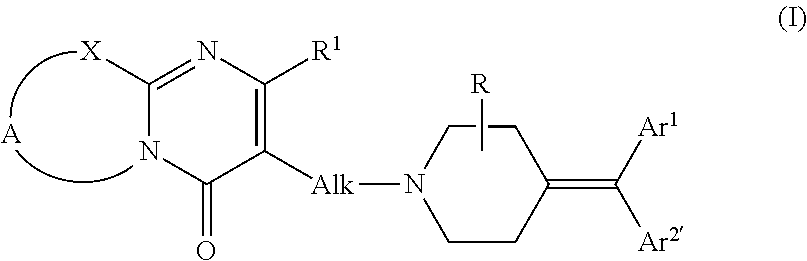
- the possible stereochemically isomeric forms and the pharmaceutically acceptable acid-addition salts thereof, wherein:
- R is hydrogen, hydroxy or lower alkyloxy;
- R1 is a member selected from the group consisting of hydrogen and lower alkyl;
- Alk is a lower alkanediyl radical;
- X is a member selected from the group consisting of —S—, —CH2— and —C(R2)═C(R3)—, said R2 and R3 being each independently hydrogen or lower alkyl;
- A is a bivalent radical having the formula —CH2—CH2—, —CH2—CH2—CH2— or
-

- wherein R4 and R5 are each independently selected from the group consisting of hydrogen, halo, amino and lower alkyl;
- and Ar1 and Ar2 are each independently selected from the group consisting of pyridinyl, thienyl and phenyl, being optionally substituted with halo, hydroxy, lower alkyloxy, lower alkyl and trifluoromethyl.
- In the foregoing definitions the term halo is generic to fluoro, chloro, bromo and iodo; “lower alkyl” is meant to include straight and branched saturated hydrocarbon radicals, having from 1 to 6 carbon atoms, such as, for example, methyl, ethyl, 1-methylethyl, 1,1-dimethylethyl, propyl, butyl, pentyl, hexyl and the like; and “lower alkanediyl” is meant to include bivalent straight or branch chained alkanediyl radicals having from 1 to 6 carbon atoms.
- Preferred compounds within the scope of the present invention are those wherein Alk is an 1,2-ethanediyl radical.
- The most preferred compound is 6-[2-[4-[bis(4-fluorophenyl)methylene]-1-piperidinyl]ethyl]-7-methyl-5H-thiazolo[3,2-a]pyrimidin-5-one, having the structure
-

- (also referred to herein as ritanserin), or an isomer, epimer, or diastereoisomer thereof. Ritanserin is a 5-HT2A (Ki=0.45 nM) and 5-HT2C receptor (Ki=0.71 nM) antagonist, with higher affinity for the former site (Akhondzadeh, et al., Progress in Neuro-Psychopharmacology & Biological Psychiatry, 32(8):1879-83 (2008)). Methods of making ritanserin and other (1-piperidinylalkyl)pyrimidinone derivatives are known in the art. See, for example, U.S. Pat. No. 4,485,107.
- In some embodiments, the compound is a pharmaceutically acceptable acid addition salt of a (1-piperidinylalkyl)pyrimidinone derivative, preferably ritanserin, for example, those salts obtained by treating the base form of the (1-piperidinylalkyl)pyrimidinone derivative, preferably ritanserin, with appropriate acids, such as, for example, inorganic acids, e.g. hydrochloric, hydrobromic and the like acids, sulfuric acid, nitric acid, phosphoric acid and the like; or organic acids, such as, for example, acetic, propanoic, hydroxyacetic, 2-hydroxypropanoic, 2-oxopropanoic, ethanedioic, propanedioic, butanedioic, (Z)-2-butenedioic, (E)-2-butenedioic, 2-hydroxybutanedioic, 2,3-dihydroxybutanedioic, 2-hydroxy-1,2,3-propanetricarboxylic, methanesulfonic, ethanesulfonic, benzenesulfonic, 4-methylbenzenesulfonic, cyclohexanesulfamic, 2-hydroxybenzoic, 4-amino-2-hydroxybenzoic and the like acids. The term “pharmaceutically acceptable acid addition salt” also includes the solvates which the (1-piperidinylalkyl)pyrimidinone derivative, preferably ritanserin, may form. Examples of such solvates are e.g. the hydrates, alcoholates and the like.
- Methods of use are discussed in more detail below, and typically include administering a subject in need thereof an effective amount of a (1-piperidinylalkyl)pyrimidinone derivative, preferably ritanserin or a pharmaceutically acceptable salt thereof. For example, in some embodiments, the method includes administering a subject in need thereof a pharmaceutical composition including an effective amount of one or more active agents wherein at least one of the active agents is a (1-piperidinylalkyl)pyrimidinone derivative, preferably ritanserin or a pharmaceutically acceptable salt thereof or a pharmaceutically acceptable salt thereof. Suitable formulations and routes of administration are discussed below.
- The methods can include administering to the subject an effective amount of a (1-piperidinylalkyl)pyrimidinone derivative preferably ritanserin or a pharmaceutically acceptable salt thereof to decrease sleep disruption, increase slow wave sleep, normalize sleep architecture, increase cognition or reduce a decline in cognition, increase a cognitive function or reduce a decline in a cognitive function, increase memory or reduce a decline in memory, increase the ability or capacity to learn or reduce a decline the ability or capacity to learn, or a combination thereof. In some embodiments, the methods are effective to reduce, delay, or prevent one or more other clinical symptoms of a neurodegenerative disease or central nervous system disease or disorder.
- B. Formulations
- Pharmaceutical compositions can be for administration by parenteral (intramuscular, intraperitoneal, intravenous (IV) or subcutaneous injection), enteral, transdermal (either passively or using iontophoresis or electroporation), or transmucosal (nasal, pulmonary, vaginal, rectal, or sublingual) routes of administration or using bioerodible inserts and can be formulated in dosage forms appropriate for each route of administration.
- The compositions can be administered systemically.
- Drugs can be formulated for immediate release, extended release, or modified release. A delayed release dosage form is one that releases a drug (or drugs) at a time other than promptly after administration. An extended release dosage form is one that allows at least a twofold reduction in dosing frequency as compared to that drug presented as a conventional dosage form (e.g. as a solution or prompt drug-releasing, conventional solid dosage form). A modified release dosage form is one for which the drug release characteristics of time course and/or location are chosen to accomplish therapeutic or convenience objectives not offered by conventional dosage forms such as solutions, ointments, or promptly dissolving dosage forms. Delayed release and extended release dosage forms and their combinations are types of modified release dosage forms.
- Formulations are prepared using a pharmaceutically acceptable “carrier” composed of materials that are considered safe and effective and may be administered to an individual without causing undesirable biological side effects or unwanted interactions. The “carrier” is all components present in the pharmaceutical formulation other than the active ingredient or ingredients. The term “carrier” includes, but is not limited to, diluents, binders, lubricants, desintegrators, fillers, and coating compositions.
- “Carrier” also includes all components of the coating composition which may include plasticizers, pigments, colorants, stabilizing agents, and glidants. The delayed release dosage formulations may be prepared as described in references such as “Pharmaceutical dosage form tablets”, eds. Liberman et. al. (New York, Marcel Dekker, Inc., 1989), “Remington—The science and practice of pharmacy”, 20th ed., Lippincott Williams & Wilkins, Baltimore, Md., 2000, and “Pharmaceutical dosage forms and drug delivery systems”, 6th Edition, Ansel et. al., (Media, Pa.: Williams and Wilkins, 1995) which provides information on carriers, materials, equipment and process for preparing tablets and capsules and delayed release dosage forms of tablets, capsules, and granules.
- The compound can be administered to a subject with or without the aid of a delivery vehicle. Appropriate delivery vehicles for the compounds are known in the art and can be selected to suit the particular active agent. For example, in some embodiments, the active agent(s) is incorporated into or encapsulated by, or bound to, a nanoparticle, microparticle, micelle, synthetic lipoprotein particle, or carbon nanotube. For example, the compositions can be incorporated into a vehicle such as polymeric microparticles which provide controlled release of the active agent(s). In some embodiments, release of the drug(s) is controlled by diffusion of the active agent(s) out of the microparticles and/or degradation of the polymeric particles by hydrolysis and/or enzymatic degradation.
- Suitable polymers include ethylcellulose and other natural or synthetic cellulose derivatives. Polymers which are slowly soluble and form a gel in an aqueous environment, such as hydroxypropyl methylcellulose or polyethylene oxide, may also be suitable as materials for drug containing microparticles or particles. Other polymers include, but are not limited to, polyanhydrides, poly (ester anhydrides), polyhydroxy acids, such as polylactide (PLA), polyglycolide (PGA), poly(lactide-co-glycolide) (PLGA), poly-3-hydroxybut rate (PHB) and copolymers thereof, poly-4-hydroxybutyrate (P4HB) and copolymers thereof, polycaprolactone and copolymers thereof, and combinations thereof. In some embodiments, both agents are incorporated into the same particles and are formulated for release at different times and/or over different time periods. For example, in some embodiments, one of the agents is released entirely from the particles before release of the second agent begins. In other embodiments, release of the first agent begins followed by release of the second agent before the all of the first agent is released. In still other embodiments, both agents are released at the same time over the same period of time or over different periods of time.
- 1. Formulations for Parenteral Administration
- Compounds and pharmaceutical compositions thereof can be administered in an aqueous solution, by parenteral injection. The formulation may also be in the form of a suspension or emulsion. In general, pharmaceutical compositions are provided including effective amounts of the active agent(s) and optionally include pharmaceutically acceptable diluents, preservatives, solubilizers, emulsifiers, adjuvants and/or carriers. Such compositions include diluents sterile water, buffered saline of various buffer content (e.g., Tris-HCl, acetate, phosphate), pH and ionic strength; and optionally, additives such as detergents and solubilizing agents (e.g., TWEEN® 20, TWEEN® 80 also referred to as polysorbate 20 or 80), anti-oxidants (e.g., ascorbic acid, sodium metabisulfite), and preservatives (e.g., Thimersol, benzyl alcohol) and bulking substances (e.g., lactose, mannitol). Examples of non-aqueous solvents or vehicles are propylene glycol, polyethylene glycol, vegetable oils, such as olive oil and corn oil, gelatin, and injectable organic esters such as ethyl oleate. The formulations may be lyophilized and redissolved/resuspended immediately before use. The formulation may be sterilized by, for example, filtration through a bacteria retaining filter, by incorporating sterilizing agents into the compositions, by irradiating the compositions, or by heating the compositions.
- 2. Oral Immediate Release Formulations
- Suitable oral dosage forms include tablets, capsules, solutions, suspensions, syrups, and lozenges. Tablets can be made using compression or molding techniques well known in the art. Gelatin or non-gelatin capsules can prepared as hard or soft capsule shells, which can encapsulate liquid, solid, and semi-solid fill materials, using techniques well known in the art.
- Examples of suitable coating materials include, but are not limited to, cellulose polymers such as cellulose acetate phthalate, hydroxypropyl cellulose, hydroxypropyl methylcellulose, hydroxypropyl methylcellulose phthalate and hydroxypropyl methylcellulose acetate succinate; polyvinyl acetate phthalate, acrylic acid polymers and copolymers, and methacrylic resins that are commercially available under the trade name Eudragit® (Roth Pharma, Westerstadt, Germany), Zein, shellac, and polysaccharides.
- Additionally, the coating material may contain conventional carriers such as plasticizers, pigments, colorants, glidants, stabilization agents, pore formers and surfactants.
- Optional pharmaceutically acceptable excipients present in the drug-containing tablets, beads, granules or particles include, but are not limited to, diluents, binders, lubricants, disintegrants, colorants, stabilizers, and surfactants.
- Diluents, also termed “fillers,” are typically necessary to increase the bulk of a solid dosage form so that a practical size is provided for compression of tablets or formation of beads and granules. Suitable diluents include, but are not limited to, dicalcium phosphate dihydrate, calcium sulfate, lactose, sucrose, mannitol, sorbitol, cellulose, microcrystalline cellulose, kaolin, sodium chloride, dry starch, hydrolyzed starches, pregelatinized starch, silicone dioxide, titanium oxide, magnesium aluminum silicate and powder sugar.
- Binders are used to impart cohesive qualities to a solid dosage formulation, and thus ensure that a tablet or bead or granule remains intact after the formation of the dosage forms. Suitable binder materials include, but are not limited to, starch, pregelatinized starch, gelatin, sugars (including sucrose, glucose, dextrose, lactose and sorbitol), polyethylene glycol, waxes, natural and synthetic gums such as acacia, tragacanth, sodium alginate, cellulose, including hydorxypropylmethylcellulose, hydroxypropylcellulose, ethylcellulose, and veegum, and synthetic polymers such as acrylic acid and methacrylic acid copolymers, methacrylic acid copolymers, methyl methacrylate copolymers, aminoalkyl methacrylate copolymers, polyacrylic acid/polymethacrylic acid and polyvinylpyrrolidone.
- Lubricants are used to facilitate tablet manufacture. Examples of suitable lubricants include, but are not limited to, magnesium stearate, calcium stearate, stearic acid, glycerol behenate, polyethylene glycol, talc, and mineral oil.
- Disintegrants are used to facilitate dosage form disintegration or “breakup” after administration, and generally include, but are not limited to, starch, sodium starch glycolate, sodium carboxymethyl starch, sodium carboxymethylcellulose, hydroxypropyl cellulose, pregelatinized starch, clays, cellulose, alginine, gums or cross linked polymers, such as cross-linked PVP (Polyplasdone XL from GAF Chemical Corp).
- Stabilizers are used to inhibit or retard drug decomposition reactions which include, by way of example, oxidative reactions.
- Surfactants may be anionic, cationic, amphoteric or nonionic surface active agents. Suitable anionic surfactants include, but are not limited to, those containing carboxylate, sulfonate and sulfate ions. Examples of anionic surfactants include sodium, potassium, ammonium of long chain alkyl sulfonates and alkyl aryl sulfonates such as sodium dodecylbenzene sulfonate; dialkyl sodium sulfosuccinates, such as sodium dodecylbenzene sulfonate; dialkyl sodium sulfosuccinates, such as sodium bis-(2-ethylthioxyl)-sulfosuccinate; and alkyl sulfates such as sodium lauryl sulfate. Cationic surfactants include, but are not limited to, quaternary ammonium compounds such as benzalkonium chloride, benzethonium chloride, cetrimonium bromide, stearyl dimethylbenzyl ammonium chloride, polyoxyethylene and coconut amine. Examples of nonionic surfactants include ethylene glycol monostearate, propylene glycol myristate, glyceryl monostearate, glyceryl stearate, polyglyceryl-4-oleate, sorbitan acylate, sucrose acylate, PEG-150 laurate, PEG-400 monolaurate, polyoxyethylene monolaurate, polysorbates, polyoxyethylene octylphenylether, PEG-1000 cetyl ether, polyoxyethylene tridecyl ether, polypropylene glycol butyl ether, Poloxamer® 401, stearoyl monoisopropanolamide, and polyoxyethylene hydrogenated tallow amide. Examples of amphoteric surfactants include sodium N-dodecyl-.beta.-alanine, sodium N-lauryl-.beta.-iminodipropionate, myristoamphoacetate, lauryl betaine and lauryl sulfobetaine.
- If desired, the tablets, beads granules or particles may also contain minor amount of nontoxic auxiliary substances such as wetting or emulsifying agents, dyes, pH buffering agents, and preservatives.
- 3. Extended Release Dosage Forms
- The extended release formulations are generally prepared as diffusion or osmotic systems, for example, as described in “Remington—The science and practice of pharmacy” (20th ed., Lippincott Williams & Wilkins, Baltimore, Md., 2000). A diffusion system typically consists of two types of devices, reservoir and matrix, and is well known and described in the art. The matrix devices are generally prepared by compressing the drug with a slowly dissolving polymer carrier into a tablet form. The three major types of materials used in the preparation of matrix devices are insoluble plastics, hydrophilic polymers, and fatty compounds. Plastic matrices include, but not limited to, methyl acrylate-methyl methacrylate, polyvinyl chloride, and polyethylene. Hydrophilic polymers include, but are not limited to, methylcellulose, hydroxypropylcellulose, hydroxypropylmethylcellulose, sodium carboxymethylcellulose, and carbopol 934, polyethylene oxides. Fatty compounds include, but are not limited to, various waxes such as carnauba wax and glyceryl tristearate.
- Alternatively, extended release formulations can be prepared using osmotic systems or by applying a semi-permeable coating to the dosage form. In the latter case, the desired drug release profile can be achieved by combining low permeable and high permeable coating materials in suitable proportion.
- The devices with different drug release mechanisms described above could be combined in a final dosage form comprising single or multiple units. Examples of multiple units include multilayer tablets, capsules containing tablets, beads, granules, etc.
- An immediate release portion can be added to the extended release system by means of either applying an immediate release layer on top of the extended release core using coating or compression process or in a multiple unit system such as a capsule containing extended and immediate release beads.
- Extended release tablets containing hydrophilic polymers are prepared by techniques commonly known in the art such as direct compression, wet granulation, or dry granulation processes. Their formulations usually incorporate polymers, diluents, binders, and lubricants as well as the active pharmaceutical ingredient. The usual diluents include inert powdered substances such as any of many different kinds of starch, powdered cellulose, especially crystalline and microcrystalline cellulose, sugars such as fructose, mannitol and sucrose, grain flours and similar edible powders. Typical diluents include, for example, various types of starch, lactose, mannitol, kaolin, calcium phosphate or sulfate, inorganic salts such as sodium chloride and powdered sugar. Powdered cellulose derivatives are also useful. Typical tablet binders include substances such as starch, gelatin and sugars such as lactose, fructose, and glucose. Natural and synthetic gums, including acacia, alginates, methylcellulose, and polyvinylpyrrolidine can also be used. Polyethylene glycol, hydrophilic polymers, ethylcellulose and waxes can also serve as binders. A lubricant is necessary in a tablet formulation to prevent the tablet and punches from sticking in the die. The lubricant is chosen from such slippery solids as talc, magnesium and calcium stearate, stearic acid and hydrogenated vegetable oils.
- Extended release tablets containing wax materials are generally prepared using methods known in the art such as a direct blend method, a congealing method, and an aqueous dispersion method. In a congealing method, the drug is mixed with a wax material and either spray-congealed or congealed and screened and processed.
- 4. Delayed Release Dosage Forms
- Delayed release formulations are created by coating a solid dosage form with a film of a polymer which is insoluble in the acid environment of the stomach, and soluble in the neutral environment of small intestines.
- The delayed release dosage units can be prepared, for example, by coating a drug or a drug-containing composition with a selected coating material. The drug-containing composition may be, e.g., a tablet for incorporation into a capsule, a tablet for use as an inner core in a “coated core” dosage form, or a plurality of drug-containing beads, particles or granules, for incorporation into either a tablet or capsule. Preferred coating materials include bioerodible, gradually hydrolyzable, gradually water-soluble, and/or enzymatically degradable polymers, and may be conventional “enteric” polymers. Enteric polymers, as will be appreciated by those skilled in the art, become soluble in the higher pH environment of the lower gastrointestinal tract or slowly erode as the dosage form passes through the gastrointestinal tract, while enzymatically degradable polymers are degraded by bacterial enzymes present in the lower gastrointestinal tract, particularly in the colon. Suitable coating materials for effecting delayed release include, but are not limited to, cellulosic polymers such as hydroxypropyl cellulose, hydroxyethyl cellulose, hydroxymethyl cellulose, hydroxypropyl methyl cellulose, hydroxypropyl methyl cellulose acetate succinate, hydroxypropylmethyl cellulose phthalate, methylcellulose, ethyl cellulose, cellulose acetate, cellulose acetate phthalate, cellulose acetate trimellitate and carboxymethylcellulose sodium; acrylic acid polymers and copolymers, preferably formed from acrylic acid, methacrylic acid, methyl acrylate, ethyl acrylate, methyl methacrylate and/or ethyl methacrylate, and other methacrylic resins that are commercially available under the tradename Eudragit®. (Rohm Pharma; Westerstadt, Germany), including Eudragit®. L30D-55 and L100-55 (soluble at pH 5.5 and above), Eudragit®. L-100 (soluble at pH 6.0 and above), Eudragit®. S (soluble at pH 7.0 and above, as a result of a higher degree of esterification), and Eudragits®. NE, RL and RS (water-insoluble polymers having different degrees of permeability and expandability); vinyl polymers and copolymers such as polyvinyl pyrrolidone, vinyl acetate, vinylacetate phthalate, vinylacetate crotonic acid copolymer, and ethylene-vinyl acetate copolymer; enzymatically degradable polymers such as azo polymers, pectin, chitosan, amylose and guar gum; zein and shellac. Combinations of different coating materials may also be used. Multi-layer coatings using different polymers may also be applied.
- The preferred coating weights for particular coating materials may be readily determined by those skilled in the art by evaluating individual release profiles for tablets, beads and granules prepared with different quantities of various coating materials. It is the combination of materials, method and form of application that produce the desired release characteristics, which one can determine only from the clinical studies.
- The coating composition may include conventional additives, such as plasticizers, pigments, colorants, stabilizing agents, glidants, etc. A plasticizer is normally present to reduce the fragility of the coating, and will generally represent about 10 wt. % to 50 wt. % relative to the dry weight of the polymer. Examples of typical plasticizers include polyethylene glycol, propylene glycol, triacetin, dimethyl phthalate, diethyl phthalate, dibutyl phthalate, dibutyl sebacate, triethyl citrate, tributyl citrate, triethyl acetyl citrate, castor oil and acetylated monoglycerides. A stabilizing agent is preferably used to stabilize particles in the dispersion. Typical stabilizing agents are nonionic emulsifiers such as sorbitan esters, polysorbates and polyvinylpyrrolidone. Glidants are recommended to reduce sticking effects during film formation and drying, and will generally represent approximately 25 wt. % to 100 wt. % of the polymer weight in the coating solution. One effective glidant is talc. Other glidants such as magnesium stearate and glycerol monostearates may also be used. Pigments such as titanium dioxide may also be used. Small quantities of an anti-foaming agent, such as a silicone (e.g., simethicone), may also be added to the coating composition.
- Methods of Manufacturing
- As will be appreciated by those skilled in the art and as described in the pertinent texts and literature, a number of methods are available for preparing drug-containing tablets, beads, granules or particles that provide a variety of drug release profiles. Such methods include, but are not limited to, the following: coating a drug or drug-containing composition with an appropriate coating material, typically although not necessarily incorporating a polymeric material, increasing drug particle size, placing the drug within a matrix, and forming complexes of the drug with a suitable complexing agent.
- The delayed release dosage units may be coated with the delayed release polymer coating using conventional techniques, e.g., using a conventional coating pan, an airless spray technique, fluidized bed coating equipment (with or without a Wurster insert). For detailed information concerning materials, equipment and processes for preparing tablets and delayed release dosage forms, see Pharmaceutical Dosage Forms: Tablets, eds. Lieberman et al. (New York: Marcel Dekker, Inc., 1989), and Ansel et al., Pharmaceutical Dosage Forms and Drug Delivery Systems, 6.sup.th Ed. (Media, Pa.: Williams & Wilkins, 1995).
- A preferred method for preparing extended release tablets is by compressing a drug-containing blend, e.g., blend of granules, prepared using a direct blend, wet-granulation, or dry-granulation process. Extended release tablets may also be molded rather than compressed, starting with a moist material containing a suitable water-soluble lubricant. However, tablets are preferably manufactured using compression rather than molding. A preferred method for forming extended release drug-containing blend is to mix drug particles directly with one or more excipients such as diluents (or fillers), binders, disintegrants, lubricants, glidants, and colorants. As an alternative to direct blending, a drug-containing blend may be prepared by using wet-granulation or dry-granulation processes. Beads containing the active agent may also be prepared by any one of a number of conventional techniques, typically starting from a fluid dispersion. For example, a typical method for preparing drug-containing beads involves dispersing or dissolving the active agent in a coating suspension or solution containing pharmaceutical excipients such as polyvinylpyrrolidone, methylcellulose, talc, metallic stearates, silicone dioxide, plasticizers or the like. The admixture is used to coat a bead core such as a sugar sphere (or so-called “non-pareil”) having a size of approximately 60 to 20 mesh.
- An alternative procedure for preparing drug beads is by blending drug with one or more pharmaceutically acceptable excipients, such as microcrystalline cellulose, lactose, cellulose, polyvinyl pyrrolidone, talc, magnesium stearate, a disintegrant, etc., extruding the blend, spheronizing the extrudate, drying and optionally coating to form the immediate release beads.
- 5. Formulations for Mucosal and Pulmonary Administration
- Active agent(s) and compositions thereof can be formulated for pulmonary or mucosal administration. The administration can include delivery of the composition to the lungs, nasal, oral (sublingual, buccal), vaginal, or rectal mucosa. In a particular embodiment, the composition is formulated for and delivered to the subject sublingually.
- In one embodiment, the compounds are formulated for pulmonary delivery, such as intranasal administration or oral inhalation. The respiratory tract is the structure involved in the exchange of gases between the atmosphere and the blood stream. The lungs are branching structures ultimately ending with the alveoli where the exchange of gases occurs. The alveolar surface area is the largest in the respiratory system and is where drug absorption occurs. The alveoli are covered by a thin epithelium without cilia or a mucus blanket and secrete surfactant phospholipids. The respiratory tract encompasses the upper airways, including the oropharynx and larynx, followed by the lower airways, which include the trachea followed by bifurcations into the bronchi and bronchioli. The upper and lower airways are called the conducting airways. The terminal bronchioli then divide into respiratory bronchiole, which then lead to the ultimate respiratory zone, the alveoli, or deep lung. The deep lung, or alveoli, is the primary target of inhaled therapeutic aerosols for systemic drug delivery.
- Pulmonary administration of therapeutic compositions comprised of low molecular weight drugs has been observed, for example, beta-androgenic antagonists to treat asthma. Other therapeutic agents that are active in the lungs have been administered systemically and targeted via pulmonary absorption. Nasal delivery is considered to be a promising technique for administration of therapeutics for the following reasons: the nose has a large surface area available for drug absorption due to the coverage of the epithelial surface by numerous microvilli, the subepithelial layer is highly vascularized, the venous blood from the nose passes directly into the systemic circulation and therefore avoids the loss of drug by first-pass metabolism in the liver, it offers lower doses, more rapid attainment of therapeutic blood levels, quicker onset of pharmacological activity, fewer side effects, high total blood flow per cm3, porous endothelial basement membrane, and it is easily accessible.
- The term aerosol as used herein refers to any preparation of a fine mist of particles, which can be in solution or a suspension, whether or not it is produced using a propellant. Aerosols can be produced using standard techniques, such as ultrasonication or high-pressure treatment.
- Carriers for pulmonary formulations can be divided into those for dry powder formulations and for administration as solutions. Aerosols for the delivery of therapeutic agents to the respiratory tract are known in the art. For administration via the upper respiratory tract, the formulation can be formulated into a solution, e.g., water or isotonic saline, buffered or un-buffered, or as a suspension, for intranasal administration as drops or as a spray. Preferably, such solutions or suspensions are isotonic relative to nasal secretions and of about the same pH, ranging e.g., from about pH 4.0 to about pH 7.4 or, from pH 6.0 to pH 7.0. Buffers should be physiologically compatible and include, simply by way of example, phosphate buffers. For example, a representative nasal decongestant is described as being buffered to a pH of about 6.2. One skilled in the art can readily determine a suitable saline content and pH for an innocuous aqueous solution for nasal and/or upper respiratory administration.
- Preferably, the aqueous solution is water, physiologically acceptable aqueous solutions containing salts and/or buffers, such as phosphate buffered saline (PBS), or any other aqueous solution acceptable for administration to an animal or human. Such solutions are well known to a person skilled in the art and include, but are not limited to, distilled water, de-ionized water, pure or ultrapure water, saline, phosphate-buffered saline (PBS). Other suitable aqueous vehicles include, but are not limited to, Ringer's solution and isotonic sodium chloride. Aqueous suspensions may include suspending agents such as cellulose derivatives, sodium alginate, polyvinyl-pyrrolidone and gum tragacanth, and a wetting agent such as lecithin. Suitable preservatives for aqueous suspensions include ethyl and n-propyl p-hydroxybenzoate.
- In another embodiment, solvents that are low toxicity organic (i.e. nonaqueous) class 3 residual solvents, such as ethanol, acetone, ethyl acetate, tetrahydrofuran, ethyl ether, and propanol may be used for the formulations. The solvent is selected based on its ability to readily aerosolize the formulation. The solvent should not detrimentally react with the compounds. An appropriate solvent should be used that dissolves the compounds or forms a suspension of the compounds. The solvent should be sufficiently volatile to enable formation of an aerosol of the solution or suspension. Additional solvents or aerosolizing agents, such as freons, can be added as desired to increase the volatility of the solution or suspension.
- In one embodiment, compositions may contain minor amounts of polymers, surfactants, or other excipients well known to those of the art. In this context, “minor amounts” means no excipients are present that might affect or mediate uptake of the compounds in the lungs and that the excipients that are present are present in amount that do not adversely affect uptake of compounds in the lungs.
- Dry lipid powders can be directly dispersed in ethanol because of their hydrophobic character. For lipids stored in organic solvents such as chloroform, the desired quantity of solution is placed in a vial, and the chloroform is evaporated under a stream of nitrogen to form a dry thin film on the surface of a glass vial. The film swells easily when reconstituted with ethanol. To fully disperse the lipid molecules in the organic solvent, the suspension is sonicated. Nonaqueous suspensions of lipids can also be prepared in absolute ethanol using a reusable PARI LC Jet+ nebulizer (PARI Respiratory Equipment, Monterey, Calif.).
- Dry powder formulations (“DPFs”) with large particle size have improved flowability characteristics, such as less aggregation, easier aerosolization, and potentially less phagocytosis. Dry powder aerosols for inhalation therapy are generally produced with mean diameters primarily in the range of less than 5 microns, although a preferred range is between one and ten microns in aerodynamic diameter. Large “carrier” particles (containing no drug) have been co-delivered with therapeutic aerosols to aid in achieving efficient aerosolization among other possible benefits.
- Polymeric particles may be prepared using single and double emulsion solvent evaporation, spray drying, solvent extraction, solvent evaporation, phase separation, simple and complex coacervation, interfacial polymerization, and other methods well known to those of ordinary skill in the art. Particles may be made using methods for making microspheres or microcapsules known in the art. The preferred methods of manufacture are by spray drying and freeze drying, which entails using a solution containing the surfactant, spraying to form droplets of the desired size, and removing the solvent.
- The particles may be fabricated with the appropriate material, surface roughness, diameter and tap density for localized delivery to selected regions of the respiratory tract such as the deep lung or upper airways. For example, higher density or larger particles may be used for upper airway delivery. Similarly, a mixture of different sized particles, provided with the same or different active agents may be administered to target different regions of the lung in one administration.
- 6. Topical and Transdermal Formulations
- Transdermal formulations may also be prepared. These will typically be gels, ointments, lotions, sprays, or patches, all of which can be prepared using standard technology. Transdermal formulations can include penetration enhancers.
- A “gel” is a colloid in which the dispersed phase has combined with the continuous phase to produce a semisolid material, such as jelly.
- An “oil” is a composition containing at least 95% wt of a lipophilic substance. Examples of lipophilic substances include but are not limited to naturally occurring and synthetic oils, fats, fatty acids, lecithins, triglycerides and combinations thereof
- A “continuous phase” refers to the liquid in which solids are suspended or droplets of another liquid are dispersed, and is sometimes called the external phase. This also refers to the fluid phase of a colloid within which solid or fluid particles are distributed. If the continuous phase is water (or another hydrophilic solvent), water-soluble or hydrophilic drugs will dissolve in the continuous phase (as opposed to being dispersed). In a multiphase formulation (e.g., an emulsion), the discreet phase is suspended or dispersed in the continuous phase.
- An “emulsion” is a composition containing a mixture of non-miscible components homogenously blended together. In particular embodiments, the non-miscible components include a lipophilic component and an aqueous component. An emulsion is a preparation of one liquid distributed in small globules throughout the body of a second liquid. The dispersed liquid is the discontinuous phase, and the dispersion medium is the continuous phase. When oil is the dispersed liquid and an aqueous solution is the continuous phase, it is known as an oil-in-water emulsion, whereas when water or aqueous solution is the dispersed phase and oil or oleaginous substance is the continuous phase, it is known as a water-in-oil emulsion. Either or both of the oil phase and the aqueous phase may contain one or more surfactants, emulsifiers, emulsion stabilizers, buffers, and other excipients. Preferred excipients include surfactants, especially non-ionic surfactants; emulsifying agents, especially emulsifying waxes; and liquid non-volatile non-aqueous materials, particularly glycols such as propylene glycol. The oil phase may contain other oily pharmaceutically approved excipients. For example, materials such as hydroxylated castor oil or sesame oil may be used in the oil phase as surfactants or emulsifiers.
- “Emollients” are an externally applied agent that softens or soothes skin and are generally known in the art and listed in compendia, such as the “Handbook of Pharmaceutical Excipients”, 4th Ed., Pharmaceutical Press, 2003. These include, without limitation, almond oil, castor oil, ceratonia extract, cetostearoyl alcohol, cetyl alcohol, cetyl esters wax, cholesterol, cottonseed oil, cyclomethicone, ethylene glycol palmitostearate, glycerin, glycerin monostearate, glyceryl monooleate, isopropyl myristate, isopropyl palmitate, lanolin, lecithin, light mineral oil, medium-chain triglycerides, mineral oil and lanolin alcohols, petrolatum, petrolatum and lanolin alcohols, soybean oil, starch, stearyl alcohol, sunflower oil, xylitol and combinations thereof. In one embodiment, the emollients are ethylhexylstearate and ethylhexyl palmitate.
- “Surfactants” are surface-active agents that lower surface tension and thereby increase the emulsifying, foaming, dispersing, spreading and wetting properties of a product. Suitable non-ionic surfactants include emulsifying wax, glyceryl monooleate, polyoxyethylene alkyl ethers, polyoxyethylene castor oil derivatives, polysorbate, sorbitan esters, benzyl alcohol, benzyl benzoate, cyclodextrins, glycerin monostearate, poloxamer, povidone and combinations thereof. In one embodiment, the non-ionic surfactant is stearyl alcohol.
- “Emulsifiers” are surface active substances which promote the suspension of one liquid in another and promote the formation of a stable mixture, or emulsion, of oil and water. Common emulsifiers are: metallic soaps, certain animal and vegetable oils, and various polar compounds. Suitable emulsifiers include acacia, anionic emulsifying wax, calcium stearate, carbomers, cetostearyl alcohol, cetyl alcohol, cholesterol, diethanolamine, ethylene glycol palmitostearate, glycerin monostearate, glyceryl monooleate, hydroxpropyl cellulose, hypromellose, lanolin, hydrous, lanolin alcohols, lecithin, medium-chain triglycerides, methylcellulose, mineral oil and lanolin alcohols, monobasic sodium phosphate, monoethanolamine, nonionic emulsifying wax, oleic acid, poloxamer, poloxamers, polyoxyethylene alkyl ethers, polyoxyethylene castor oil derivatives, polyoxyethylene sorbitan fatty acid esters, polyoxyethylene stearates, propylene glycol alginate, self-emulsifying glyceryl monostearate, sodium citrate dehydrate, sodium lauryl sulfate, sorbitan esters, stearic acid, sunflower oil, tragacanth, triethanolamine, xanthan gum and combinations thereof. In one embodiment, the emulsifier is glycerol stearate.
- A “lotion” is a low- to medium-viscosity liquid formulation. A lotion can contain finely powdered substances that are in soluble in the dispersion medium through the use of suspending agents and dispersing agents. Alternatively, lotions can have as the dispersed phase liquid substances that are immiscible with the vehicle and are usually dispersed by means of emulsifying agents or other suitable stabilizers. In one embodiment, the lotion is in the form of an emulsion having a viscosity of between 100 and 1000 centistokes. The fluidity of lotions permits rapid and uniform application over a wide surface area. Lotions are typically intended to dry on the skin leaving a thin coat of their medicinal components on the skin's surface.
- A “cream” is a viscous liquid or semi-solid emulsion of either the “oil-in-water” or “water-in-oil type”. Creams may contain emulsifying agents and/or other stabilizing agents. In one embodiment, the formulation is in the form of a cream having a viscosity of greater than 1000 centistokes, typically in the range of 20,000-50,000 centistokes. Creams are often time preferred over ointments as they are generally easier to spread and easier to remove.
- An emulsion is a preparation of one liquid distributed in small globules throughout the body of a second liquid. The dispersed liquid is the discontinuous phase, and the dispersion medium is the continuous phase. When oil is the dispersed liquid and an aqueous solution is the continuous phase, it is known as an oil-in-water emulsion, whereas when water or aqueous solution is the dispersed phase and oil or oleaginous substance is the continuous phase, it is known as a water-in-oil emulsion. The oil phase may consist at least in part of a propellant, such as an HFA propellant. Either or both of the oil phase and the aqueous phase may contain one or more surfactants, emulsifiers, emulsion stabilizers, buffers, and other excipients. Preferred excipients include surfactants, especially non-ionic surfactants; emulsifying agents, especially emulsifying waxes; and liquid non-volatile non-aqueous materials, particularly glycols such as propylene glycol. The oil phase may contain other oily pharmaceutically approved excipients. For example, materials such as hydroxylated castor oil or sesame oil may be used in the oil phase as surfactants or emulsifiers.
- A sub-set of emulsions are the self-emulsifying systems. These drug delivery systems are typically capsules (hard shell or soft shell) comprised of the drug dispersed or dissolved in a mixture of surfactant(s) and lipophillic liquids such as oils or other water immiscible liquids. When the capsule is exposed to an aqueous environment and the outer gelatin shell dissolves, contact between the aqueous medium and the capsule contents instantly generates very small emulsion droplets. These typically are in the size range of micelles or nanoparticles. No mixing force is required to generate the emulsion as is typically the case in emulsion formulation processes.
- The basic difference between a cream and a lotion is the viscosity, which is dependent on the amount/use of various oils and the percentage of water used to prepare the formulations. Creams are typically thicker than lotions, may have various uses and often one uses more varied oils/butters, depending upon the desired effect upon the skin. In a cream formulation, the water-base percentage is about 60-75% and the oil-base is about 20-30% of the total, with the other percentages being the emulsifier agent, preservatives and additives for a total of 100%.
- An “ointment” is a semisolid preparation containing an ointment base and optionally one or more active agents. Examples of suitable ointment bases include hydrocarbon bases (e.g., petrolatum, white petrolatum, yellow ointment, and mineral oil); absorption bases (hydrophilic petrolatum, anhydrous lanolin, lanolin, and cold cream); water-removable bases (e.g., hydrophilic ointment), and water-soluble bases (e.g., polyethylene glycol ointments). Pastes typically differ from ointments in that they contain a larger percentage of solids. Pastes are typically more absorptive and less greasy that ointments prepared with the same components.
- A “gel” is a semisolid system containing dispersions of small or large molecules in a liquid vehicle that is rendered semisolid by the action of a thickening agent or polymeric material dissolved or suspended in the liquid vehicle. The liquid may include a lipophilic component, an aqueous component or both. Some emulsions may be gels or otherwise include a gel component. Some gels, however, are not emulsions because they do not contain a homogenized blend of immiscible components.
- Suitable gelling agents include, but are not limited to, modified celluloses, such as hydroxypropyl cellulose and hydroxyethyl cellulose; Carbopol homopolymers and copolymers; and combinations thereof. Suitable solvents in the liquid vehicle include, but are not limited to, diglycol monoethyl ether; alklene glycols, such as propylene glycol; dimethyl isosorbide; alcohols, such as isopropyl alcohol and ethanol. The solvents are typically selected for their ability to dissolve the drug. Other additives, which improve the skin feel and/or emolliency of the formulation, may also be incorporated. Examples of such additives include, but are not limited, isopropyl myristate, ethyl acetate, C12-C15 alkyl benzoates, mineral oil, squalane, cyclomethicone, capric/caprylic triglycerides, and combinations thereof.
- Foams consist of an emulsion in combination with a gaseous propellant. The gaseous propellant consists primarily of hydrofluoroalkanes (HFAs). Suitable propellants include HFAs such as 1,1,1,2-tetrafluoroethane (HFA 134a) and 1,1,1,2,3,3,3-heptafluoropropane (HFA 227), but mixtures and admixtures of these and other HFAs that are currently approved or may become approved for medical use are suitable. The propellants preferably are not hydrocarbon propellant gases which can produce flammable or explosive vapors during spraying. Furthermore, the compositions preferably contain no volatile alcohols, which can produce flammable or explosive vapors during use.
- Buffers are used to control pH of a composition. Preferably, the buffers buffer the composition from a pH of about 4 to a pH of about 7.5, more preferably from a pH of about 4 to a pH of about 7, and most preferably from a pH of about 5 to a pH of about 7. In a preferred embodiment, the buffer is triethanolamine.
- Preservatives can be used to prevent the growth of fungi and microorganisms. Suitable antifungal and antimicrobial agents include, but are not limited to, benzoic acid, butylparaben, ethyl paraben, methyl paraben, propylparaben, sodium benzoate, sodium propionate, benzalkonium chloride, benzethonium chloride, benzyl alcohol, cetylpyridinium chloride, chlorobutanol, phenol, phenylethyl alcohol, and thimerosal.
- Additional agents that can be added to the formulation include penetration enhancers. In some embodiments, the penetration enhancer increases the solubility of the drug, improves transdermal delivery of the drug across the skin, in particular across the stratum corneum, or a combination thereof. Some penetration enhancers cause dermal irritation, dermal toxicity and dermal allergies. However, the more commonly used ones include urea, (carbonyldiamide), imidurea, N, N-diethylformamide, N-methyl-2-pyrrolidone, 1-dodecal-azacyclopheptane-2-one, calcium thioglycate, 2-pyrrolidone, N,N-diethyl-m-toluamide, oleic acid and its ester derivatives, such as methyl, ethyl, propyl, isopropyl, butyl, vinyl and glycerylmonooleate, sorbitan esters, such as sorbitan monolaurate and sorbitan monooleate, other fatty acid esters such as isopropyl laurate, isopropyl myristate, isopropyl palmitate, diisopropyl adipate, propylene glycol monolaurate, propylene glycol monooleatea and non-ionic detergents such as BRIJ® 76 (stearyl poly(10 oxyethylene ether), BRIJ® 78 (stearyl poly(20)oxyethylene ether), BRIJ® 96 (oleyl poly(10)oxyethylene ether), and BRIJ® 721 (stearyl poly (21) oxyethylene ether) (ICI Americas Inc. Corp.). Chemical penetrations and methods of increasing transdermal drug delivery are described in Inayat, et al., Tropical Journal of Pharmaceutical Research, 8(2):173-179 (2009) and Fox, et al., Molecules, 16:10507-10540 (2011). In some embodiments, the penetration enhancer is, or includes, an alcohol such ethanol, or others disclosed herein or known in the art.
- Delivery of drugs by the transdermal route has been known for many years. Advantages of a transdermal drug delivery compared to other types of medication delivery such as oral, intravenous, intramuscular, etc., include avoidance of hepatic first pass metabolism, ability to discontinue administration by removal of the system, the ability to control drug delivery for a longer time than the usual gastrointestinal transit of oral dosage form, and the ability to modify the properties of the biological barrier to absorption.
- Controlled release transdermal devices rely for their effect on delivery of a known flux of drug to the skin for a prolonged period of time, generally a day, several days, or a week. Two mechanisms are used to regulate the drug flux: either the drug is contained within a drug reservoir, which is separated from the skin of the wearer by a synthetic membrane, through which the drug diffuses; or the drug is held dissolved or suspended in a polymer matrix, through which the drug diffuses to the skin. Devices incorporating a reservoir will deliver a steady drug flux across the membrane as long as excess undissolved drug remains in the reservoir; matrix or monolithic devices are typically characterized by a falling drug flux with time, as the matrix layers closer to the skin are depleted of drug. Usually, reservoir patches include a porous membrane covering the reservoir of medication which can control release, while heat melting thin layers of medication embedded in the polymer matrix (e.g., the adhesive layer), can control release of drug from matrix or monolithic devices. Accordingly, the active agent can be released from a patch in a controlled fashion without necessarily being in a controlled release formulation.
- Patches can include a liner which protects the patch during storage and is removed prior to use; drug or drug solution in direct contact with release liner; adhesive which serves to adhere the components of the patch together along with adhering the patch to the skin; one or more membranes, which can separate other layers, control the release of the drug from the reservoir and multi-layer patches, etc., and backing which protects the patch from the outer environment.
- Common types of transdermal patches include, but are not limited to, single-layer drug-in-adhesive patches, wherein the adhesive layer contains the drug and serves to adhere the various layers of the patch together, along with the entire system to the skin, but is also responsible for the releasing of the drug; multi-layer drug-in-adhesive, wherein which is similar to a single-layer drug-in-adhesive patch, but contains multiple layers, for example, a layer for immediate release of the drug and another layer for control release of drug from the reservoir; reservoir patches wherein the drug layer is a liquid compartment containing a drug solution or suspension separated by the adhesive layer; matrix patches, wherein a drug layer of a semisolid matrix containing a drug solution or suspension which is surrounded and partially overlaid by the adhesive layer; and vapor patches, wherein an adhesive layer not only serves to adhere the various layers together but also to release vapor. Methods for making transdermal patches are described in U.S. Pat. Nos. 6,461,644, 6,676,961, 5,985,311, and 5,948,433.
- In a particularly preferred embodiment, the (1-piperidinylalkyl)pyrimidinone derivative, preferably ritanserin or a pharmaceutically acceptable salt thereof or a pharmaceutically acceptable salt thereof, is formulated for transdermal delivery and administered using a transdermal patch. In some embodiments, the formulation, the patch, or both are designed for extended release of the (1-piperidinylalkyl)pyrimidinone derivative, preferably ritanserin or a pharmaceutically acceptable salt thereof or a pharmaceutically acceptable salt thereof.
- Exemplary symptoms, pharmacologic, and physiologic effects are discussed in more detail below.
- A. Treatment Rationale
- 1. Development of Ritanserin
- Ritanserin is a small molecule drug first synthesized in 1982 during a search to find a new antipsychotic agent which would have similar efficacy to first generation antipsychotics such as haloperidol but without the adverse events, particularly the extrapyramidal parkinsonian-like effects. Originally, ritanserin was shown to have potent affinity to the 5HT2 receptor (or serotonin-S2), and categorized as a receptor antagonist (Leysen, et al., Molecular Pharmacology, 27:600-611 (1985)). Early studies reported the in vitro and in vivo binding characteristics ritanserin (e.g., 50% serotonin-S2 receptor occupation at dose as low as 0.08 m/kg) (Leysen, et al., Molecular Pharmacology, 27:600-611 (1985)).
- Early clinical investigations indicated that the drug may be useful for treating dysthymia and anxiety disorder (Ceulemans, et al., Collegium Internationale Neruo-Psychopharmocologicum, 14th Congress, Book of Abstracts, (G. Racagni, ed.). Fidia Research Biomedical Information, Abano Peme, 945 (1984); Reyntjens, et al., Collegium Internationale Neruo-Psychopharmocologicum, 14th Congress, Book of Abstracts, (G. Racagni, ed.). Fidia Research Biomedical Information, Abano Peme, 586 (1984); and Arriaga, et al., Collegium Internationale Neruo-Psychopharmocologicum, 14th Congress, Book of Abstracts, (G. Racagni, ed.). Fidia Research Biomedical Information, Abano Peme, 944 (1984)). A placebo-controlled trial investigating ritanserin in the treatment of generalized anxiety disorders found that the subjects treated with the drug rated themselves as calmer, more relaxed, and more energetic than control subjects (Langi and Jansen, et al., Human Psychopharmacology, 3:207-212 (1998)). However, an open pilot trial of ritsanerin for treating Parkinsonism revealed that although the drug reduced L-Dopa-induced dyskinesia in parkinsonian patients, no significant modifying of tremor, rigidity, or akinesia were reported. Later studies reported that ritanserin reduced bradykinesia (Henderson, et al., Clin. Exp. Neurol., 29:277-282 (1992)) and improved gait in Parkinson's patients, and reduced motor deficit in a 1-methyl-4-phenyl-1,2,3,6-tetrahydropyridine (MPTP) model of parkinsonism in mice (Ferguson, et al., Neuropharmacology, 59:31-36 (2009))
- Subsequently, the 5HT2 receptor was reclassified as the 5HT2A receptor, and the former 5HT1C receptor was reclassified as the 5HT2C receptor. In 1992 the 5HT2B receptor was cloned (Loric et al., FEBS Lett., 312(2-3):203-7. 1992). Ritanserin was later reclassified as an inverse agonist at all three 5HT2 receptors because they each have constitutive activity in the absence of ligand (Bonhaus, et al., British Journal of Pharmacology, 115:622-628 (1995), Rouser, et al., Journal of Pharm. Exper. Therap., 299(1):83-89 (2001), Aloyo, et al., Pharm. Therap, 121:160-173 (2009), Vanover, et al., Journal of Pharm. Exper. Therap., 317(2):910-18 (2006)).
- Investigation into the activity of ritanserin reveled it has some activity in blocking the physiological effects of lysergic acid diethylamide (LSD), but was not considered sufficiently active as an antipsychotic for primary psychotic disorders (e.g. Schizophrenia). Shortly after its development, interest in ritanserin was largely replaced by risperidone, a drug which went on to become a very successful antipsychotic.
- Ritanserin was later investigated in some open label studies which indicated that it might increase alcohol abstinence in alcoholics, and became the subject of patents claiming the same (see, for example, EP 0461705 and U.S. Pat. No. 5,397,782). Large clinical trials were designed to further investigate this indication, however, the drug failed a Phase 3 trial (Wiesbeck et al., Alcoholism: Clinical and Experimental Research, 23(2):230-35 (1999)).
- 2. 5HT Inverse Agonists
- Pimavanserin, a highly selective 5HT2A inverse agonist, has been shown to be effective in psychosis associated with Parkinson's disease. The effectiveness of pimavanersin has been linked to its selectivity in part because other drugs, which are less effective, are also less specific. Pimavanserin does not appear to have effects on learning and memory, and in one study where it was evaluated for reversing PCP-induced deficits, it had no activity (Horiguchi Psychopharmacology (Berl), 221(2):205-15 (2012)). Other 5-HT receptor modulators are described in U.S. Published Application Nos. 2008/0280886, 2008/0214559, and 2005/0203130.
- Ritanserin modulates 5HT2A receptors, but also 5HT2B and 2C receptors. Like pimavanersin, ritanserin also failed to show a major benefit in cognitive or psychiatric function in normal individuals, in alcoholics, and in other patient groups studied. For example, Harvey, Learning and Memory, 10:355-362 (2003), reviews studies which show that ritanserin and related 5HT1A inverse agonists impair learning in a classical conditioning model. Other studies indicate that 5HT 2A receptors agonists facilitate memory. Based on these studies, ritanserin would not be considered a good candidate for a cognitive enhancing agent and might be contraindicated for neurodegenerative disease due to the possibility of further increasing impaired cognition in diseased individuals.
- Furthermore, although the role of each of the 5HT receptor subtypes is not well known, agonists at 5HT2C can be effective for inducing weight loss. Lorcaserin is one such drug and is used for treatment of obesity. Therefore, it believed that 5HT2C antagonists (and inverse agonists) may contribute to weight gain.
- 3. Mechanism of Action of Ritanserin
- Despite the previous data describing the shorting comings of ritanserin, it has now been discovered that ritanserin can be used to reduce the neuropsychiatric morbidity of neurodegenerative disorders.
- Ritanserin is highly potent at increasing slow wave sleep (SWS) (Idzikowski et al., Br. J. Clin. Pharmac., 31:193-96 (1991), Idzikowski, et al., Brain Res., 16:164-168 (1986), Declerck, et al., Curr Ther Res., 41:427-432 (1987)), and at clinical doses can double SWS duration. For example, an acute dose of ritanserin 10 mg increased slow-wave sleep (Stage 3 F[3,24]=14.12, P<0.01; Stage 4 F[3,24]=10.67, P<0.01) in healthy volunteers (Idzikowski, et al., Brain Res., 16:164-168 (1986)). The increase in slow-wave sleep occurred at the expense of decreased Stage 2 sleep (F[3,24]=18.25, P<0.01) and decreased REM sleep (F[3,24]=4.10, P<0.05). The effects of ritanserin on increasing slow-wave sleep appear to be dose-related, with the effects increasing across a dose range from 1 mg to 10 mg (Idzikowski et al., Br. J. Clin. Pharmac., 31:193-96 (1991), Sharpley, et al., Psychopharmacology, 101:568-569 (1990)). Ritanserin increased slow-wave sleep by an average of 53 minutes, 82 minutes, 101 minutes, and 136.5 minutes at doses of 1, 3, 10, and 30 mg (F[5,54]=26.75, P<0.001) (Idzikowski, et al., Psychopharmacology, 93:416-420 (1987)). There appears to be no tolerance to the sleep-enhancing effects of ritanserin after repeated administration. Morning administration of ritanserin showed larger increases in SWS during the night (increase of about 94 minutes on average) than when ritanserin was administered just before bedtime (increase of about 52 minutes on average) (Idzikowski, et al., Brain Res., 16:164-168 (1986)). There was no psychomotor sedation during the day after morning administration of ritanserin, indicating that ritanserin was acting by mechanisms that selectively mediate SWS and do not affect sleep initiation.
- For normal individuals, this property is of little significance. However, recent data indicates that in individuals with neurodegenerative disease, for example Parkinson's disease, the duration of slow wave sleep is positively associated with working memory and cognition (Scullin, et al., Brain, 135(Pt 9):2789-97 2012).
- Additionally, unlike established antipsychotic agents like risperidone, ritanserin increases the expression of brain (hippocampal) BDNF (Chlan-Fourney, et al., Brain Research, 954:11-20 (2002)). Expression of BDNF within the hippocampus is believed to facilitate cognitive function, and the combination of increased BDNF expression and increased SWS is a desirable combination.
- Furthermore, ritanserin has been shown to selectively inhibit the dopamine transporter within the prefrontal cortex (PFC) (Ruin, et al., Molecular Psychiatry, 5:673-677 (2000)). As a result, it facilitates PFC dopamine neurotransmission. Prefrontal cortex dopamine is important for cognition in neurodegenerative disorders. For example in Huntington's disease models, there is impaired PFC long term potentiation (LTP), a physiological model of synaptic plasticity and learning, and activation of dopamine neurotransmission reverses this impaired LTP (Dallerac et al., Neurodegener Dis., 8(4):230-9, (2011)). Moreover, the cognitive impairment observed in Parkinson's disease is associated with impaired prefrontal cortex dopamine signaling. Additional studies include direct injection of ritanserin into the hippocampus with rats. One study reports an effect in a spatial maze task (Naghdi et al., Behavioral Brain Res., 157:205-210 (2005)). A second report investigated the ability intrahippocampal ritanserin to reverse the deficits associated with scopolamine (Naghdi, et al., Behav Brain Res., 168(2):215-20 (2006)). Ritanserin was also shown to inhibit learning in these models.
- Neurodegenerative disorders are often characterized by impaired BDNF signaling and SWS is typically diminished in individuals with neurodegeneration. Therefore, ritanserin exhibits a combination of mechanisms of actions wherein it enhances prefrontal cortex dopamine neurotransmission, enhances SWS, and increases BDNF induction.
- Weight gain is not observed in subjects taking ritanserin. Furthermore, 5HT2B receptors are found not only in the nervous system but also in the heart, and are believed to mediate some of the cardiovascular adverse effects of serotoninergic drugs. As an antagonist at 5HT2B, ritanserin is believed to have little or no cardiovascular side effects. Furthermore, unlike pimavanserin which is a highly selective 5HT2A inverse agonist, the ability of ritaserin to inverse agonize the 5HT2C receptor is believed to impart ritaserin with additional properties.
- B. Treatment Protocol
- Certain (1-piperidinylalkyl)pyrimidinone derivatives such as ritanserin have properties which indicate that they can alleviate one or more of symptoms of a neurodegenerative disorder and/or reduce or prevent the progression of the disease. Therefore, methods for treating neurodegenerative diseases and central nervous system disorders by reducing or preventing cognitive impairment and/or one or more neuropsychiatric morbidities in a subject with a neurodegenerative disease or disorder are disclosed.
- The methods typically include administering a subject in need thereof an effective amount of a (1-piperidinylalkyl)pyrimidinone derivative, preferably ritanserin or a pharmaceutically acceptable salt thereof. For example, in some embodiments, the method includes administering a subject in need thereof a pharmaceutical composition including an effective amount of one or more active agents wherein at least one of the active agents is a (1-piperidinylalkyl)pyrimidinone derivative, preferably ritanserin or a pharmaceutically acceptable salt thereof. Suitable formulations and routes of administration are discussed above.
- The effective amount or therapeutically effective amount is typically a dosage sufficient to reduce or prevent cognitive impairment, and/or reduce or prevent one or more neuropsychiatric morbidities in a subject with a neurodegenerative disease or disorder. The amount can be effective to treat or prevent one or more symptoms of a neurodegenerative disease or central nervous system disorder, or to otherwise provide a desired pharmacologic and/or physiologic effect, for example. In a particularly preferred embodiment is amount is effective to reduce or prevent cognitive impairment, and/or reduce or prevent one or more neuropsychiatric morbidities, such as disorders of speech, cognition, mood, behavior, thought, REM Sleep Behavior Disorder, apathy, fatigue, indifference and lack of social engagement, dullness and disinterest in ones surrounds.
- Cognition is the process by which the sensory input is transformed, reduced, elaborated, stored, recovered, and used, and is typically associated with the mental, cognitive functions such as the attention of working memory, comprehending and producing language, calculating, reasoning, problem solving, and decision making
- Methods of measuring and monitoring a subject's cognition, memory and cognitive function are also known in the art and include, but are not limited to serial position testing which focuses on human memory processes (Surprenant, Perception and Psychophysics, 63(4): 737-745 (2001)), word superiority testing which focuses on human speech and language (Krueger, Memory & Cognition, 20(6):685-694 (1992)), the Brown-Peterson test which focuses on human short-term memory (Nairne, et al., Quarterly Journal of Experimental Psychology A: Human Experimental Psychology, 52:241-251 (1999)), memory span testing (May, et al., Memory & Cognition, 27(5):759-767 (1999)), visual search testing (Wolfe, et al., Journal of Experimental Psychology: Human Perception and Performance, 15(3):419-433 (1989)), and knowledge representation (e.g., semantic network) testing.
- The precise dosage will vary according to a variety of factors such as subject-dependent variables (e.g., age, immune system health, clinical symptoms etc.). Exemplary dosages, symptoms, pharmacologic, and physiologic effects are discussed in more detail below.
- In some embodiments, the (1-piperidinylalkyl)pyrimidinone derivative, preferably ritanserin or a pharmaceutically acceptable salt thereof, is administered to the subject in an effective amount to increase slow wave sleep; to increase dopamine signaling, preferably in the brain, more preferably in the prefrontal cortex; to increase the expression of BDNF preferably in the brain, more preferably in the hippocampus; or a combination thereof
- Slow wave sleep, dopamine signaling and/or expression of BDNF can be increased in an amount effective to improve cognition or a cognitive function, to increase memory, to reduce decline in cognition or cognitive function, to reduce memory loss, to increase the ability to learn, to reduce a decline in the ability to learn, to reduce or prevent one or more neuropsychiatric morbidities, or a combination thereof.
- Particularly preferred embodiments include formulations for extended release. For example, the formulation can suitable for administration once daily or less. In some embodiments, the composition is only administered to the subject once every 24-48 hours. In some embodiments, the (1-piperidinylalkyl)pyrimidinone derivative, preferably ritanserin or a pharmaceutically acceptable salt thereof is administered at night before sleep. In other embodiments, the (1-piperidinylalkyl)pyrimidinone derivative, preferably ritanserin or a pharmaceutically acceptable salt thereof is administered in morning, or at least several hours before sleep.
- A preferred route of administration is transdermal, for example, a transdermal patch that is contacted with the skin of the subject. In a particular embodiment, the transdermal formulation is administered to a subject at night, prior to the subject going to sleep using a transdermal patch. In another particular embodiment, the transdermal formulation is administered to a subject in the morning using a transdermal patch. As discussed in more detail below, in some methods a subject with a neurodegenerative disease or central nervous system disorder is transdermally administered an amount of a (1-piperidinylalkyl)pyrimidinone derivative, preferably ritanserin or a pharmaceutically acceptable salt thereof effective to decrease sleep disruption or increase slow wave sleep in the subject.
- In general, by way of example only, dosage forms useful in the disclosed methods can include doses in the range of 0.1 to 1,000 mg, 1 to 200 mg, 5 to 175 mg, 7.5 to 150 mg, or 10 to 125 mg, or 12.5 to 150 mg, or 15 to 125 mg, or 17.5 to 100 mg, or 20 to 75 mg, or 22.5 to 60 mg, or 25 to 50 mg, with doses of 1 mg, 5 mg, 10 mg, 15 mg, 20 mg, 25 mg, 30 mg, 35 mg, 40 mg, 45 mg, 50 mg, 55 mg, 60 mg, 75 mg, and 100 mg being specific examples of preferred doses. Typically, such dosages are administered once, twice, or three times daily, or every other day to a human. In some embodiments, the dosage is 0.01-100 mg, 0.5-50 mg/kg, 0.5-10 mg/kg or 25-50 mg once or twice daily. For example, in some embodiments, the dosage is 0.5 mg/kg, 1 mg/kg, 5 mg/kg, 7.5 mg/kg, 25 mg, 50 mg/kg or 100 mg once or twice daily. In a particular embodiment a subject is administered a dose of 1 mg to 50 mg of ritanserin once, twice (e.g., b.i.d.), or three times (e.g., t.i.d.) daily. In some embodiments, the total amount administered to a subject in 24 hour period is 1 mg to 50 mg. In some embodiments, the subject is started at a low dose and the dosage is escalated in the drug is well tolerated in the subject.
- In some embodiments, the effect of the composition on a subject is compared to a control. For example, the effect of the composition on a particular symptom, pharmacologic, or physiologic indicator can be compared to an untreated subject, or the condition of the subject prior to treatment. In some embodiments, the symptom, pharmacologic, or physiologic indicator is measured in a subject prior to treatment, and again one or more times after treatment is initiated. In some embodiments, the control is a reference level, or average determined based on measuring the symptom, pharmacologic, or physiologic indicator in one or more subjects that do not have the disease or condition to be treated (e.g., healthy subjects). In some embodiments, the effect of the treatment is compared to a conventional treatment that is known the art, such as one of those discussed herein.
- C. Conditions, Symptoms, Subjects, and Diseases to be Treated
- 1. Conditions to be Treated
- The disclosed compositions are typically administered to subjects with a neurodegenerative disease or disorder or central nervous system disorder, particularly those characterized by impaired cognition, sleep disorder or related deficits, or a combination thereof. Neurodegeneration refers to the progressive loss of structure or function of neurons, including death of neurons. Exemplary diseases and disorders are provided below. In some embodiments, the compositions are administered to subjects that do not have a neurodegenerative disease or disorder.
- Neurodegeneration, and diseases and disorders thereof, can be caused by a genetic mutation or mutations; protein misfolding; intracellular mechanisms such as dysregulated protein degradation pathways, membrane damage, mitochondrial dysfunction, or defects in axonal transport; defects in programmed cell death mechanisms including apoptosis, autophagy, cytoplasmic cell death; and combinations thereof. More specific mechanisms common to neurodegenerative disorders include, for example, oxidative stress, mitochondrial dysfunction, excitotoxicity, inflammatory changes, iron accumulation, and/or protein aggregation.
- a. Cognitive Impairment
- In some embodiments, the subject suffers from or at risk of developing reduced or impaired cognition, cognitive function, or memory. In a particular embodiment the subject suffers from or is likely to develop a reduced capacity to learn. For example, in some embodiments, the subject has or is at risk of developing a reduced working memory, reduced or delayed language comprehension or production, or calculating, reasoning, problem solving, decision making, or combinations thereof. Other cognitive disturbances include executive dysfunction, which can include problems with planning, cognitive flexibility, abstract thinking, rule acquisition, initiating appropriate actions and inhibiting inappropriate actions, and selecting relevant sensory information; fluctuations in attention and slowed cognitive speed; and memory loss. In particular embodiments, the subject exhibits impaired prefrontal cortical dopamine neurotransmission.
- Indicators and tests of cognitive impairment are known in the art, and can be measured or analyzed using known methods. For example, processing speed, reaction time, i.e. clock speed; flexibility and ability to adapt to changes in task rules; attention, focus and concentration; problem solving; memory; verbal fluency, can be measured and compared to a control or a standard to identify cognitive impairment in the subject. In other embodiments such indicators can be measured before and after treatment with the disclosed compositions to demonstrate efficacy. There are a number of instruments and methods that can be employed to measure these parameters. Examples include traditional IQ tests like the WAIS and Progressive Ravens Matrices, and the battery of tests available through Luminosity (Lumos Labs, Inc.) which are increasingly being used to assess different aspects of cognition.
- b. Sleep Related Disorders
- In some embodiments, the subject has or is at risk for developing reduced slow wave sleep, disrupted sleep architecture, or would otherwise benefit from increased slow wave sleep. Therefore, in some embodiments, the compositions are administered in an effective amount to reduce, alleviated, or prevent one or more sleep related symptoms.
- Sleep is an active process generated and modulated by a complex set of neural systems located mainly in the hypothalamus, brainstem, and thalamus. Sleep is altered in many neurological diseases due to mechanisms including lesions of the brain areas that control sleep and wakefulness, lesions or diseases that produce pain, reduced mobility, and treatments. Excessive daytime sleepiness (EDS), sleep fragmentation, insomnia, sleep-disordered breathing (SDB), nocturnal behavioral phenomena such as rapid eye movement (REM) sleep behavior disorder or nocturnal seizures, restless legs syndrome, and periodic leg movement syndrome (PLMS) are common symptoms and findings in neurological disorders (Jennum, et al., “CHAPTER 39: Sleep disorders in neurodegenerative disorders and stroke”, European Handbook of Neurological Management, Volume 1, 2nd Edition (Ed. Gilhus, et al.) Blackwell Publishing Ltd. 2011), which is specifically incorporated by reference herein in its entirety. In some cases, sleep disorders precede and influence the disease course in neurological diseases, particularly those involving daytime functioning, quality of life, morbidity, and mortality.
- Evidence is also emerging that subjects with HD can suffer from abnormalities in both sleep and in the control of daily or ‘circadian’ rhythms (Morton, “HDBuzz Special Feature: Huntington's disease and sleep” HDbuzz.net/115, (ed., Wild), Feb. 6, 2013). Therefore, sleep and circadian dysfunction are symptoms of HD. Other sleep-related symptoms in patients with Huntington's disease in the diminishment of involuntary movements tend to diminish during sleep, sleep disturbances, including disturbed sleep pattern with an increased sleep onset latency, reduced sleep efficiency, frequent nocturnal awakenings, and more time spent awake with less slow wave sleep. These abnormalities can correlate in part with the duration of illness, severity of clinical symptoms, and degree of atrophy of the caudate nucleus. The sleep phenotype of Huntington's disease may also include insomnia, advanced sleep phase, periodic leg movements, sleep behaviour disorder (RBD), and reduced REM sleep. Reduced REM sleep may precede chorea, and mutant huntingtin may exert an effect on REM sleep and motor control during sleep.
- Sleep-wake problems are also frequent, although often unrecognized, complications of amyotrophic lateral sclerosis (ALS). Sleep disorders such as insomnia, sleep-disordered breathing and restless legs syndrome have all been reported in patients with ALS, despite the limited number of studies and the small populations investigated so far (Lo Coco, et al., Neurodegenerative Disease Management, 2(3):315-324 (2012)). The prognosis in ALS is closely related to respiratory muscle strength, and sudden nocturnal death often occurs during sleep. Respiratory indices such as low nocturnal oxygen saturation are associated with a poorer prognosis. Patients with diaphragmatic involvement may have significantly reduced REM sleep. Patients with dementias often present circadian disturbances which have been treated with melatonin and light therapy.
- Sleep and circadian dysfunction may be caused by other symptoms of the neurodegenerative disease, or may be caused by factors that are independent of the disease. Sleep and circadian dysfunction can be caused by personal habits, lifestyle or environment, for example, staying up too late, getting up too early, taking drugs that interfere with sleep, and/or over-stimulation due to late-night activities such as work, television, etc. Sleep and circadian disturbance in neurodegenerative disease patients are likely to contribute to disease symptoms that are worsened by sleep deprivation, such as irritability and anxiety, and may precede and influence the disease course involving daytime functioning, quality of life, morbidity, and mortality. For example, sleep disturbances have been reported to gradually worsen with disease progression in ALS, indicating a relationship between the severity of disease and the neurodegenerative process. Furthermore, subjects with a neurodegenerative disease may not have the same neurological reserves to handle sleep deprivation that healthy subjects rely upon.
- Poor sleep can also be a consequence of several disturbances such as anxiety, depression, pain, choking, sialorrhea, fasciculations, cramps, nocturia and the inability to get comfortable and move freely in bed. Sleep disorders may have many reflections on patients including excessive daytime somnolence, fatigue, impaired cognition, reduced quality of life and survival (Lo Coco, et al., Neurodegenerative Disease Management, 2(3):315-324 (2012)).
- Circadian rhythms and sleep are two different processes, although the terms are often used interchangeably. Circadian rhythms are biological processes that change roughly every 24 hours. They are orchestrated by a small part of the brain known as the suprachiasmatic nucleus or SCN, which regulates the body's activities including when to get up and when to go to bed. Sleep is a circadian behavior, but is just one of many circadian behaviors that are influenced by the SCN. Others include heart rate, hormone secretion, blood pressure and body temperature.
- During the night, sleep follows a predictable pattern, moving back and forth between deep restorative sleep (deep sleep) and more alert stages (collective referred to as Non-REM or NREM) and dreaming (REM sleep). Specifically, the sleep cycle includes stages W (wakefulness), N1 (NREM 1), N2 (NREM 2), N3 (NREM3), and R (REM). Sleep stages can be identified by monitoring a subject's brain electrical activity (e.g., brain waves). The criteria for each stage, and methods for determining the stage of a sleeping subject, and profiling a subject's sleep architecture are described in Iber, et al., “The AASM Manual for the Scoring of Sleep and Associated Events, American Academy of Sleep Medicine”, pg. 1-57 (2007), which is specifically incorporated by reference herein in its entirety.
- Together, the stages of REM and non-REM sleep form a complete sleep cycle. Each cycle typically lasts about 90 minutes and repeats four to six times over the course of a typical night's sleep. A normal adult spends approximately 50% of total sleep time in Stage 2 sleep, 20% in REM sleep, and 30% in the remaining stages, including deep sleep. For example, a typical first sleep cycle, N1, is characterized by a low-voltage, mixed-frequency pattern, and may last for about 1 to about 10 minutes. The second stage, N2, comes next is characterized by sleep spindles and/or K complexes in the EEG recording. N2 generally lasts about 10 to about 25 minutes. As N2 sleep progresses, there is a gradual appearance of the high-voltage, slow-wave activity characteristic of N3, the third stage of NREM sleep. This stage, which generally lasts about 20 to about 40 minutes, is referred to as “slow-wave,” “delta,” or “deep” sleep. Following the N3 stage of sleep, a series of body movements usually signals an “ascent” to lighter NREM sleep stages. Typically, a 5 to 10 minute period of N2 precedes the initial REM sleep episode. REM sleep episodes, the first of which may last only one to five minutes, generally become longer through the night. During a typical night, N3 sleep occupies less time in the second cycle than the first and may disappear altogether from later cycles. The average length of the first NREM-REM sleep cycle is between 70 and 100 minutes; the average length of the second and later cycles is about 90 to 120 minutes. REM sleep makes up about 20 to 25 percent of total sleep in typical healthy adults (“Natural Patterns of Sleep” healthysleep.med.harvard.edu/healthy/science/what/sleep-patterns-rem-nrem, A resource from the Division of Sleep Medicine at Harvard Medical School (2007)).
- The duration of the stages of the sleep cycle alone, or in combination with the cycling of the stages can be referred to as a subject's sleep architecture. In some embodiments, neurodegenerative disease subjects have disrupted sleep architecture, for example, an alteration in the duration of one or more sleep cycles, an alternation in the duration or number of sleep cycles, or any combination thereof compared to a control or reference value. A control or reference value in this case can be, for example, an average, normal duration for the stage, or average normal duration or number of cycles in subject or subjects that do not suffer from disrupted or disturbed sleep architecture (e.g., a healthy subject).
- Therefore, in some embodiments, a (1-piperidinylalkyl)pyrimidinone derivative, preferably ritanserin or a pharmaceutically acceptable salt thereof is administered to a subject in an effective amount to normalize a subject's sleep architecture, for example, by bring one or more aspects of the subject's sleep architecture into closer alignment with that of a normal subject.
- Slow-wave sleep (SWS), often referred to as deep sleep, consists of N3, non-rapid eye movement sleep. The 1968 categorization of the combined Sleep Stages 3-4 was reclassified in 2007 as Stage N3. An epoch (30 seconds of sleep) which consists of 20% or more of slow wave (delta) sleep, is now considered to be stage 3 (Gazzaniga, Just the Facts 101, e-Study Guide for: Psychological Science, Content Technologies Inc., 2014). Slow-wave sleep is believed to be important to consolidate new memories, and sleep deprivation studies with humans indicate that among other things, an important function of slow-wave sleep may be to allow the brain to recover from its daily activities.
- Rapid eye movement (REM) sleep is a stage of sleep characterized by the rapid and random movement of the eyes and can be classified into two categories: tonic and phasic. Criteria for REM sleep includes rapid eye movement, low muscle tone and a rapid, low-voltage EEG—features which can be identified by polysomnogram. REM sleep typically occupies 20-25% of total sleep, about 90-120 minutes of a night's sleep.
- In some embodiments a (1-piperidinylalkyl)pyrimidinone derivative, preferably ritanserin or a pharmaceutically acceptable salt thereof is administered to a subject in an effective amount in increase the length of one or more N3 stages during a subject's sleep, increase the number of N3 stages during a subject's sleep, or a combination thereof. In some embodiments, the compositions increase slow wave sleep by at least 15 minutes, at least 30 minutes, at least 45 minutes, at least 60 minutes, at least 75 minutes, at least 90 minutes, or at least 120 minutes over the course of the sleeping period (e.g., overnight). In some embodiments the compositions double or more the amount of slow wave sleep in the subject.
- In some embodiments, a (1-piperidinylalkyl)pyrimidinone derivative, preferably ritanserin or a pharmaceutically acceptable salt thereof, is administered in an effective amount to decrease sleep disruption, increase slow wave sleep, normalize sleep architecture, or a combination thereof in the subject preferably in an amount effective to reduce or prevent one or more other clinical symptoms of a neurodegenerative.
- c. Other Symptoms
- In some embodiments, the disclosed compositions are administered to a subject in need thereof in an effective amount to reduce or prevent one or more molecular or clinical symptoms of a neurodegenerative disease, or one or more mechanisms that cause neurodegeneration. Symptoms of neurodegenerative diseases are known in the art and vary from disease to disease. In some embodiments, the disease exhibits or is characterized by one or any combination of the following symptoms or diseases: stress, anxiety, seasonal depression, insomnia and tiredness, schizophrenia, panic attacks, melancholy, dysfunction in the regulation of appetite, insomnia, psychotic problems, epilepsy, senile dementia, various disorders resulting from normal or pathological aging, migraine, memory loss, disorders of cerebral circulation, cardiovascular pathologies, pathologies of the digestive system, fatigue due to appetite disorders, obesity, pain, psychotic disorders, diabetes, senile dementia, or sexual dysfunction. In some embodiments, the subject does not exhibit one or more of the preceding symptoms.
- In some embodiments, the subject has been medically diagnosed as having a neurodegenerative disease or a condition in need of neuroprotection by exhibiting clinical (e.g., physical) symptoms of the disease. As discussed above, in some patients the appearance of sleep-related disorder precedes a clinical diagnosis of a disease. Therefore, in some embodiments, the compounds or compositions disclosed herein are administered prior to a clinical diagnosis of a disease or condition. In some embodiments, a genetic test indicates that the subject has one or more genetic mutations associated with a neurodegenerative disease or central nervous system disorder.
- Neurodegenerative diseases are typically more common in aged individuals. Therefore in some embodiments, the subject is greater the 40, 45, 50, 55, 60, 65, 70, 75, 80, 85, 90, 95, 100 years in age.
- 2. Disease to be Treated
- The methods disclosed herein can be used to treat subjects with a neurodegenerative disease or disorder. Exemplary neurodegenerative diseases include, but are not limited to, Parkinson's Disease (PD) and PD-related disorders, Huntington's Disease (HD), Amyotrophic Lateral Sclerosis (ALS), Alzheimer's Disease (AD) and other dementias, Prion Diseases such as Creutzfeldt-Jakob Disease, Corticobasal Degeneration, Frontotemporal Dementia, HIV-Related Cognitive Impairment, Mild Cognitive Impairment, Motor Neuron Diseases (MND), Spinocerebellar Ataxia (SCA), Spinal Muscular Atrophy (SMA), Friedreich's Ataxia, Lewy Body Disease, Alpers' Disease, Batten Disease, Cerebro-Oculo-Facio-Skeletal Syndrome, Corticobasal Degeneration, Gerstmann-Straussler-Scheinker Disease, Kuru, Leigh's Disease, Monomelic Amyotrophy, Multiple System Atrophy, Multiple System Atrophy With Orthostatic Hypotension (Shy-Drager Syndrome), Multiple Sclerosis (MS), Neurodegeneration with Brain Iron Accumulation, Opsoclonus Myoclonus, Posterior Cortical Atrophy, Primary Progressive Aphasia, Progressive Supranuclear Palsy, Vascular Dementia, Progressive Multifocal Leukoencephalopathy, Dementia with Lewy Bodies, Lacunar syndromes, Hydrocephalus, Wernicke-Korsakoff's syndrome, post-encephalitic dementia, cancer and chemotherapy-associated cognitive impairment and dementia, and depression-induced dementia and pseudodementia.
- In some embodiments, the subject has a central nervous system disorder or is in need of neuroprotection. Exemplary conditions and/or subjects include, but are not limited to, subjects having had, subjects with, or subjects likely to develop or suffer from a stroke, a traumatic brain injury, a spinal cord injury, Post Traumatic Stress syndrome, or a combination thereof.
- a. Huntington's Disease
- The methods disclosed herein can be used to treat subjects with Huntington's disease. Huntington's disease (HD) is a neurodegenerative genetic disorder that affects muscle coordination and leads to cognitive decline and psychiatric problems. The chronic pathology in HD leads to numerous associated troubles including cognitive dysfunctions, more specifically dysfunction in thought and mental representations, changes in reasoning, in judgment. HD is caused by an autosomal dominant mutation in either of an individual's two copies of the Huntingtin (HTT) gene. Part of this gene is a repeated section called a trinucleotide repeat, which varies in length between individuals and may change length between generations. If the repeat is present in a healthy gene, a dynamic mutation may increase the repeat count and result in a defective gene. When the length of this repeated section reaches a certain threshold, it produces an altered form of the protein, called mutant Huntingtin protein (mHtt). The differing functions of these proteins are the cause of pathological changes which in turn cause the disease symptoms. The Huntington's disease mutation is genetically dominant and almost fully penetrant. Mutation of either of a person's HTT genes can cause the disease. Physical symptoms of Huntington's disease can begin at any age from infancy to old age, but usually begin between 35 and 44 years of age (Walker, et al., Lancet, 369(9557):218-28 (2007)).
- In some embodiments, the subject exhibits one or more of the HD clinical symptoms, one or more HD molecular symptoms, or a combination thereof, such as those discussed herein and elsewhere. Clinical symptoms of HD are known in the art and include behavioral disturbances including, but not limited to, hallucinations, irritability, moodiness, restlessness, fidgeting, paranoia, psychosis, suicidal thoughts, and suicide attempts; abnormal and/or unusual movements including, but not limited to, chorea, facial movements such as grimaces, head turning to shift eye position, quick, sudden, sometimes wild jerking movements of the arms, legs, face, and other body parts, slow, uncontrolled movements, unsteady gait, small unintentionally initiated or uncompleted motions, and lack of coordination; cognitive impairment and/or dementia-related symptoms including, but not limited to, disorientation and/or confusion, loss of judgment, loss of memory, personality changes, and speech changes; and other symptoms including anxiety, stress, tension, difficulty swallowing, speech impairment, rigidity, slow movements, tremor, malnutrition, and weight loss. Neuropsychiatric features are a core component of the disease.
- Mutant Huntingtin is expressed throughout the body and associated with abnormalities in peripheral tissues that are directly caused by such expression outside the brain. These abnormalities include muscle atrophy, cardiac failure, impaired glucose tolerance, weight loss, osteoporosis and testicular atrophy.
- A number of studies have examined the prevalence of the myriad of symptoms in subjects with Huntington's disease. Shiwach, Acta Psychiatr Scand, 90(4):241-6 (1994) reports the results of a retrospective study of 110 patients with Huntington disease in 30 families. The study found the minimal lifetime prevalence of depression to be 39%. The frequency of symptomatic schizophrenia was 9%, and significant personality change was found in 72% of the sample. The age at onset was highly variable. Some showed signs in the first decade and some not until over 60 years of age.
- Rosenberg, et al., J Med Genet., 32(8):600-4 (1995) describes a double-blind study on 33 persons at risk for HD who had applied for genetic testing. Significantly inferior cognitive functioning was disclosed in gene carriers by a battery of neuropsychologic tests covering attentional, visuospatial, learning, memory, and planning functions. Primarily, attentional, learning, and planning functions were affected.
- Bamford, et al., Neurology, 45(10):1867-73 (1995) reports a prospective analysis of neuropsychologic performance and CT scans of 60 individuals with Huntington's disease. The study found that psychomotor skills showed the most significant consistent decline among cognitive functions assessed.
- Marshall, et al., Arch Neurol., 64(1):116-21 (2007) reports a study comparing psychiatric manifestations among 29 HD mutation carriers with no clinical symptoms, 20 HD mutation carriers with mild motor symptoms, 34 manifesting HD patients, and 171 nonmutation controls. The mild motor symptoms group and the manifesting HD group showed significantly higher scores for obsessive-compulsive behavior, interpersonal sensitivity, anxiety, paranoia, and psychoticism compared to the nonmutation control group. The mutation carriers without symptoms had higher scores for anxiety, paranoid ideation, and psychoticism compared to the nonmutation control group. The results indicated that individuals in the preclinical stage of HD exhibit specific psychiatric symptoms, and that additional symptoms may manifest later in the disease course. Suicidal ideation is a frequent finding in Huntington disease and physicians should be aware of increased suicide risk both in asymptomatic at-risk patients and symptomatic patients (Walker, et al., Lancet, 369(9557):218-28 (2007)).
- The mechanisms underlying HD are explored in Wang, et al., Journal of Neuroscience, 31(41):14496-14507 (2011), which is discussed in more detail below. The study shows that mutant huntingtin (htt)-mediated toxicity in cells, mice, and humansis associated with loss of the type 1 melatonin receptor (MT1). High levels of MT1 receptor were found in mitochondria from the brains of wild-type mice but much less in brains from HD mice, melatonin inhibited mutant htt-induced caspase activation and preserved MT1 receptor expression. Therefore, in some embodiments, the compounds and compositions disclosed herein are administered to a subject with HD in an effective amount to treat one or more molecular symptoms of HD, for example, to reduce, delay or inhibit mutant htt-induced caspase activation; to reduce or prevent loss of MT1 receptor expression, particularly in the mitochondria of cell of the subject; or a combination thereof
- In some embodiments, the subject exhibits one or more symptoms discussed herein, but does not exhibit all of the symptoms. Therefore, in some embodiments, the subject does not have one or more of the symptoms disclosed herein or elsewhere.
- In some embodiments, the subject has been medically diagnosed as having HD by exhibiting clinical (e.g., physical) symptoms of the disease. Excessive unintentional movements of any part of the body are often the first clinical symptoms. If these are abrupt and have random timing and distribution, they suggest a diagnosis of HD. Cognitive or psychiatric symptoms are rarely the first diagnosed and are most typically only recognized in hindsight or when they develop further. Disease progression can be measured using the unified Huntington's disease rating scale which provides an overall rating system based on motor, behavioral, cognitive, and functional assessments (Huntington Study Group, Movement Disorders, 11(2):136-142 (1996)).
- Medical imaging, such as computerized tomography (CT) and magnetic resonance imaging (MRI), and functional neuroimaging techniques, such as fMRI and PET, can supplement analysis of physical symptoms but are typically not diagnostic alone.
- Genetic testing can be used to confirm a physical diagnosis if there is no family history of HD. Even before the onset of symptoms, genetic testing can confirm if an individual or embryo carries an expanded copy of the trinucleotide repeat in the HTT gene that causes the disease. The U.S. government sponsored genetic disease compendium, the Online Mendelian Inheritance in Man (OMIM) database, gives HD a phenotype number #143100. The gene/locus is huntingtin (HTT), and is located on Chromosome 4p16.3 with the Gene/Locus MIM number of 613004. Assignment of the 143100 number to the OMIM entry is because Huntington disease (HD) is a monogenetic disorder caused by an expanded trinucleotide repeat (CAG)n, encoding glutamine, in the gene encoding huntingtin (HTT; 613004) on chromosome 4p16.3. The genetic test for HD consists of a blood test which counts the numbers of CAG repeats in each of the HTT alleles.
- Cutoffs for genetic testing are given as follows according to De Die-Smulders, et al., Human Reproduction Update, 19(3):304-315 (2013).
- 40 or more CAG repeats: full penetrance allele (FPA). A “positive test” or “positive result” generally refers to this case. A person who tests positive for the disease will develop HD sometime within their lifetime, provided he or she lives long enough for the disease to appear.
- 36 to 39 repeats: incomplete or reduced penetrance allele (RPA). It may cause symptoms, usually later in the adult life. There is a maximum risk of 60% that a person with an RPA will be symptomatic at the age of 65 years, and a 70% risk of being symptomatic at the age of 75 years.
- 27 to 35 repeats: intermediate allele (IA), or large normal allele. It is not associated with symptomatic disease in the tested individual, but may expand upon further inheritance to give symptoms in offspring.
- 26 or less repeats: Not associated with HD.
- A positive result is considered different than a clinical diagnosis, since it may be obtained decades before the symptoms begin. The test can tell a person who originally had a 50 percent chance of inheriting the disease if their risk goes up to 100 percent or is eliminated.
- Elsewhere, the range of repeat numbers for normal individual is 9 to 36, and 37 or greater in HD individuals (Duyao et al., Nat Genet., 4(4):387-92 (1993)).
- Therefore, in some embodiments, the subject has a “positive result”, or is determined to have incomplete or reduced penetrance allele (RPA), or is determined to have intermediate allele (IA), or large normal allele by genetic testing, but does not exhibit any of the clinical symptoms, or the clinical symptoms are too mild for an affirmative medical diagnosis. In a particular embodiment, the subject has a “positive result” but does not exhibit any of the clinical symptoms, or the clinical symptoms are too mild for an affirmative medical diagnosis. Accordingly, in some embodiments, the compounds or compositions disclosed herein are administered prior to a clinical diagnosis of HD.
- b. Parkinson's Disease
- In a particular embodiment, the disclosed compositions are used to treat a subject with Parkinson's disease or suffering from parkinsonism or parkinson's syndrome. PD is a degenerative disorder of the central nervous system. In some embodiments, the subject exhibits one or more of the PD clinical symptoms, one or more PD molecular symptoms, or a combination thereof, such as those discussed herein and elsewhere. Symptoms of PD are well known in the art and reviewed in Jankovic, et al., J. Neurol. Neurosurg. Psychiatr., 79(4): 368-76 (2007). The motor symptoms of Parkinson's disease result from the death of dopamine-generating cells in the substantia nigra, a region of the midbrain. The cause of the cell death remains unknown. Early in the course of the disease, the most obvious symptoms are movement-related and include, but are not limited to, shaking, rigidity, slowness of movement and difficulty with walking and gait. In particular, four motor symptoms considered hallmarks of PD are tremor, rigidity, slowness of movement, and postural instability. The main motor symptoms are collectively called parkinsonism, or a “parkinsonian syndrome”.
- Later, thinking and behavioral problems may arise and can range from mild to severe, with dementia commonly occurring in the advanced stages of the disease, whereas depression is the most common psychiatric symptom. Other common neuropsychiatric disturbances include disorders of speech, cognition, mood, behavior, and thought. Cognitive disturbances, which can occur in the initial stages of the disease and sometimes prior to diagnosis, include executive dysfunction, which can include problems with planning, cognitive flexibility, abstract thinking, rule acquisition, initiating appropriate actions and inhibiting inappropriate actions, and selecting relevant sensory information; fluctuations in attention and slowed cognitive speed; and memory loss.
- Other symptoms include sensory, sleep and emotional problems. In fact, disturbances of sleep and wake are among the most common and disabling non-motor manifestations of PD, affecting as many as 90% of patients (Videnovic, et al., JAMA Neurol. doi:10.1001/jamaneurol.2013.6239, published online Feb. 24, 2014).
- A physician's diagnosis of PD typically comes from a combination of medical history and neurological examination. Brain scans of people with PD typically look normal, but can be used to rule out disorders that could give rise to similar symptoms. Although no lab test exists for PD, medical organizations have created diagnostic criteria to facilitate and standardize the diagnostic process. See, for example, the UK Parkinson's Disease Society Brain Bank, the U.S. National Institute of Neurological Disorders and Stroke, and the PD Society Brain Bank which all provide criteria for diagnosing PD.
- Parkinson's disease is more common in older people, with most cases occurring after the age of 50. There is no cure for PD, and the disease is most typically managed using one or a combination of levodopa (usually combined with a dopa decarboxylase inhibitor or COMT inhibitor), dopamine agonists and MAO-B inhibitors. Other common agents include amantadine and anticholinergics for treating motor symptoms, clozapine for treating psychosis, cholinesterase inhibitors for treating dementia, and modafinil for treating daytime sleepiness. Surgery and deep brain stimulation can be used, most typically when drugs are no longer effective. Gene therapies, stem cell transplants, neuroprotective agents, are also being developed as treatment options for PD.
- In some embodiments, the subject exhibits one or more of the PD clinical symptoms, one or more ALS molecular symptoms, or a combination thereof, such as those discussed herein and elsewhere. In some embodiments, the subject exhibits one or more symptoms discussed herein, but does not exhibit all of the symptoms. Therefore, in some embodiments, the subject does not have one or more of the symptoms disclosed herein or elsewhere.
- In some embodiments, the subject has been medically diagnosed as having PD by exhibiting clinical (e.g., physical) symptoms of the disease. In some embodiments, the subject exhibits one or more symptoms discussed herein, but does not exhibit all of the symptoms. Therefore, in some embodiments, the subject does not have one or more of the symptoms disclosed herein or elsewhere.
- In some embodiments, the subject has been medically diagnosed as having PD by exhibiting clinical (e.g., physical) symptoms of the disease. In some patients the appearance of a sleep-related disorder precedes a clinical diagnosis of PD. Therefore, in some embodiments, the compounds or compositions disclosed herein are administered prior to a clinical diagnosis of PD.
- c. Amyotrophic Lateral Sclerosis
- The methods disclosed herein can be used to treat a subject with amyotrophic lateral sclerosis. Amyotrophic lateral sclerosis (ALS) is a fatal motor neuron disease, affecting both the first and second order motor neurons. The progression of ALS is characterized by a degeneration of motor neurons associated with a demyelination in the anterior horn of the spinal cord. The etiology is only partially understood. Of the 5-10% familial cases, 20% carry a mutation of the superoxide dismutase 1 (SOD1) gene. Such a mutation is also present in 5% of the sporadic cases (Rowland, et al., New Engl J Med, 44:1688-1700 (2001)). Three to four percent 3%-4% of familial cases are due to pathogenic variants in either the TDP-43 or FUS gene (Mackenzie, et al., Lancet Neurol., 9:995-1007 (2010)).
- In some embodiments, the subject exhibits one or more of the ALS clinical symptoms, one or more ALS molecular symptoms, or a combination thereof, such as those discussed herein and elsewhere. Clinical symptoms of ALS are known in the art. For example, the earliest symptoms of ALS are typically weakness and/or muscle atrophy. Other early symptoms include trouble swallowing, cramping, or stiffness of affected muscles; muscle weakness affecting an arm or a leg; and/or slurred and nasal speech, and in some cases dementia.
- To be diagnosed with ALS, a patient must have signs and symptoms of both upper and lower motor neuron damage that cannot be attributed to other causes. The diagnosis depends on progressive degeneration of upper (UMN) and lower (LMN) motor neurons findings by history and examination and is accurate 95% of the time when made by an experienced clinician (Gordon, Aging and Disease, 4(5):295-310 (2013)). Electromyography can be used to confirm widespread lower motor neuron disease and exclude other diseases such as multifocal motor neuropathy with conduction block. Brain and spinal MRI rule out conditions that affect the UMN, including cervical spondylosis. Occasionally the brain MRI shows bilateral signal changes within the corticospinal tracts, a finding that is pathognomonic of ALS. The El Escorial criteria help standardize diagnosis for clinical research studies (Brooks, et al., Amyotroph Lateral Scler Other Motor Neuron Disord, 1:293-299 (2000)).
- Over time, patients experience increasing difficulty moving, swallowing (dysphagia), and speaking or forming words (dysarthria). Symptoms of upper motor neuron involvement include tight and stiff muscles (spasticity) and exaggerated reflexes (hyperreflexia) including an overactive gag reflex. An abnormal reflex commonly called Babinski's sign also indicates upper motor neuron damage. Symptoms of lower motor neuron degeneration include muscle weakness and atrophy, muscle cramps, and fleeting twitches of muscles that can be seen under the skin (fasciculations). Degeneration of bulbar upper motor neurons can cause exaggeration of motor expressions of emotion.
- Progression is subject-specific, however, eventually most patients are not able to walk or use their hands and arms. They also lose the ability to speak and swallow their food, and most end on a portable ventilator. The rate of progression can be measured using an outcome measure called the “ALS Functional Rating Scale Revised (ALSFRS-R)”, a 12-item instrument administered as a clinical interview or patient-reported questionnaire that produces a score between 48 (normal function) and 0 (severe disability).
- A survey-based study amongst clinicians showed that they rated a 20% change in the slope of the ALSFRS-R would be clinically meaningful (Castrillo-Viguera, et al., Amyotroph Lateral Scler, 11(1-2):178-80 (2010)). Therefore, in some embodiments, a (1-piperidinylalkyl)pyrimidinone derivative, preferably ritanserin or a pharmaceutically acceptable salt thereof, is administered to a subject an amount effective to change in the slope of the ALSFRS-R of a subject 1%, 5%, 10%, 15%, 20%, or more. In some embodiments, the ALSFRS-R score of the subject is taken prior to, and one or more after initiation of treatment. In some embodiments, the ALSFRS-R score takes day, weeks, months, or more to improve.
- In some embodiments, the subject exhibits one or more of the ALS clinical symptoms, one or more ALS molecular symptoms, or a combination thereof, such as those discussed herein and elsewhere. In some embodiments, the subject exhibits one or more symptoms discussed herein, but does not exhibit all of the symptoms. Therefore, in some embodiments, the subject does not have one or more of the symptoms disclosed herein or elsewhere.
- In some embodiments, the subject has been medically diagnosed as having ALS by exhibiting clinical (e.g., physical) symptoms of the disease. In some embodiments, the subject exhibits one or more symptoms discussed herein, but does not exhibit all of the symptoms. Therefore, in some embodiments, the subject does not have one or more of the symptoms disclosed herein or elsewhere.
- In some embodiments, the subject has been medically diagnosed as having ALS by exhibiting clinical (e.g., physical) symptoms of the disease. In some patients the appearance of sleep-related disorder precedes a clinical diagnosis of ALS. Therefore, in some embodiments, the compounds or compositions disclosed herein are administered prior to a clinical diagnosis of ALS. In some embodiments, a genetic test indicates that the subject has one or more genetic mutations associated with ALS.
- d. Alzheimer's Disease
- The methods disclosed herein can be used to treat a subject with Alzheimer's disease. Alzheimer's disease (AD) is the most common form of dementia. Although the cause and progression of AD are not entirely understood, research indicates plaques and tangles in the brain play a pathophysiological role. Current treatments only help with the symptoms of the disease and there are no available treatments that stop or reverse the progression of the disease.
- In some embodiments, the subject exhibits one or more of the AD clinical symptoms, one or more AD molecular symptoms, or a combination thereof, such as those discussed herein and elsewhere. Clinical symptoms of AD are known in the art. Although Alzheimer's disease develops differently for every individual, there are many common symptoms. Early symptoms are often mistakenly thought to be “age-related” concerns, or manifestations of stress. One of the most common early symptoms is short term memory loss. Moderate stage symptoms can include, for example, increased memory loss and confusion, problems recognizing family and friends, continuously repeating stories, favorite wants, or motions, difficulty doing things that have multiple steps, like getting dressed, and/or lack of concern for hygiene and appearance. Severe stage symptoms can include, for example, inability to recognize oneself or family, inability to communicate, lack of control over bowel and bladder, groaning, moaning, or grunting, and/or needing help with all activities of daily living. Other common symptoms can include confusion, irritability, aggression, mood swings, trouble with language, and long-term memory loss. Gradually, bodily functions are lost, ultimately leading to death.
- When AD is suspected, the diagnosis is usually confirmed with tests that evaluate behavior and thinking abilities (e.g., cognitive testing), often followed by a brain scan if available. Assessment of intellectual functioning including memory testing and neuropsychological tests such as the mini-mental state examination (MMSE) are widely used to evaluate the cognitive impairments needed for diagnosis (Waldemar, et al., Eur J Neurol. 14(1):e1-26 (2007)). Neurological examination in early AD will usually provide normal results, except for obvious cognitive impairment, which may not differ from that resulting from other diseases processes, including other causes of dementia.
- Examination of brain tissue can lead to a definitive diagnosis. AD develops for an unknown and variable amount of time before becoming fully apparent, and it can progress undiagnosed for years.
- In some embodiments, the subject exhibits one or more of the AD clinical symptoms, one or more ALS molecular symptoms, or a combination thereof, such as those discussed herein and elsewhere. In some embodiments, the subject exhibits one or more symptoms discussed herein, but does not exhibit all of the symptoms. Therefore, in some embodiments, the subject does not have one or more of the symptoms disclosed herein or elsewhere.
- In some embodiments, the subject has been medically diagnosed as having AD by exhibiting clinical (e.g., physical) symptoms of the disease. In some embodiments, the subject exhibits one or more symptoms discussed herein, but does not exhibit all of the symptoms. Therefore, in some embodiments, the subject does not have one or more of the symptoms disclosed herein or elsewhere.
- In some embodiments, the subject has been medically diagnosed as having AD by exhibiting clinical (e.g., physical) symptoms of the disease. In some patients the appearance of sleep-related disorder precede a clinical diagnosis of AD. Therefore, in some embodiments, the compounds or compositions disclosed herein are administered prior to a clinical diagnosis of AD.
- e. Traumatic Brain Injury
- In another particular embodiment, the disclosed compositions are used to treat a subject suffering from traumatic brain injury (TBI). Traumatic brain injury occurs when an external mechanical force, typically head trauma, causes brain dysfunction.
- Traumatic brain injury can have wide-ranging physical and psychological effects. Some signs or symptoms may appear immediately after the traumatic event, while others may not appear until days or weeks later. Symptoms of TBI include, but are not limited to, loss of consciousness; a state of being dazed, confused or disoriented; memory or concentration problems; headache, dizziness or loss of balance; nausea or vomiting; sensory problems such as blurred vision, ringing in the ears or a bad taste in the mouth; sensitivity to light or sound; mood changes or mood swings; feeling depressed or anxious; fatigue or drowsiness; difficulty sleeping; sleeping more than usual, agitation, combativeness or other unusual behavior; slurred speech; inability to awaken from sleep; weakness or numbness in fingers and toes; loss of coordination; convulsions or seizures, dilation of one or both pupils of the eyes; and/or clear fluids draining from the nose or ears. In children, additional symptoms include change in eating or nursing habits; persistent crying and inability to be consoled; unusual or easy irritability; change in ability to pay attention; change in sleep habits; sad or depressed mood; and/or loss of interest in favorite toys or activities.
- TBI can be diagnosed using the Glasgow Coma Scale, a 15-point test that helps a doctor or other emergency medical personnel assess the initial severity of a brain injury by checking a person's ability to follow directions and move their eyes and limbs. The coherence of speech also provides important clues. Abilities are scored numerically with higher scores indicating more mild injury. Imaging such as computerized tomography (CT) and magnetic resonance imaging (MRI), as well as intracranial pressure monitoring can also be used to assist in the diagnoses by helping to identify the local(s) and extent of the trauma.
- Conventional treatments for TBI include administration of agents such as diuretics, anti-seizer drugs, and coma-inducing drugs; surgery to remove clotted blood, repair skull fractures, and/or relieve pressure inside the skull.
- f. Dementia with Lewy Bodies
- In another particular embodiment, the disclosed compositions are used to treat a subject suffering from dementia with Lewy bodies (DLB) (also referred to as Lewy body dementia (LBD), diffuse Lewy body disease, cortical Lewy body disease, and senile dementia of Lewy type). Despite a name that suggests a histological diagnosis, DLB is now routinely defined by clinical symptoms, and can be clearly diagnosed as probable DLB in the absence of a histological diagnosis. The central, core, and suggestive features of DLB are known and described in, for example, (Bear, et al., Neuroscience: exploring the brain, 3rd ed. Philadelphia, Pa.: Lippincott Williams and Wilkins Publishers; (2007), Macijauskiene, et al., Medicina (Kaunas), 48(1):1-8 (2012)). Generally, the diagnostic criteria include a Parkinsonian movement disorder that either follows dementia (or does not precede it by more than one year), plus dementia, plus psychosis.
- Psychosis is a key component of DLB. It is believed that ritanserin will be as effective as pimavanserin in treating psychosis, and indeed, has undergone several trials in schizophrenia which show it has anti-psychotic activity. The only trial that did not demonstrate efficacy was one where, in addition to using very low doses (10 mg), also enrolled subjects with active and very severe psychosis who were concomitantly receiving a wide range of established antipsychotics. In several trials where ritanserin was used as monotherapy, it did show efficacy in schizophrenia.
- Accordingly, in some embodiments, a (1-piperidinylalkyl)pyrimidinone derivative, preferably ritanserin or a pharmaceutically acceptable salt thereof, is administered in an effective amount to treat DLB. In a particular embodiment, a (1-piperidinylalkyl)pyrimidinone derivative, preferably ritanserin or a pharmaceutically acceptable salt thereof, is administered in an effective amount to reduce or prevent psychosis or one or more symptoms of psychosis in a subject DLB.
- Of all the neurodegenerative disorders, DLB is the one where psychosis, particularly visual hallucinations, is a core component of the syndrome, and a key criterion for the clinical diagnosis. The hallucinations are often regular or recurring visual hallucinations with intense and detailed pictures. REM sleep behavior disorder (RBD) is also a common and early symptom of LBD. RBD includes vivid dreaming, with persistent dreams, purposeful or violent movements, falling out of bed, and other characteristics known in the art and discussed herein. In some embodiments, a (1-piperidinylalkyl)pyrimidinone derivative, preferably ritanserin or a pharmaceutically acceptable salt thereof, is administered in an effective amount to reduce or prevent hallucination, RBD, or a combination thereof in a subject DLB.
- D. Combination Therapies
- In some embodiments, a (1-piperidinylalkyl)pyrimidinone derivative, preferably ritanserin or a pharmaceutically acceptable salt thereof is administered in combination with one or more additional active agents. The combination therapies can include administration of the active agents together in the same admixture, or in separate admixtures. Therefore, in some embodiments, the pharmaceutical composition includes two, three, or more active agents. Such formulations typically include an effective amount of a (1-piperidinylalkyl)pyrimidinone derivative, preferably ritanserin or a pharmaceutically acceptable salt thereof. The different active agents can have the same, or different mechanisms of action. In some embodiments, the combination results in an additive effect on the treatment of the disease or disorder. In some embodiments, the combinations results in a more than additive effect on the treatment of the disease or disorder.
- The pharmaceutical compositions can be formulated as a pharmaceutical dosage unit, also referred to as a unit dosage form.
- A (1-piperidinylalkyl)pyrimidinone derivative, preferably ritanserin or a pharmaceutically acceptable salt thereof can be the singular active agent administered to increase slow wave sleep, to reduce or prevent cognitive impairment, to treat a neurodegenerative disease, a central nervous system disorder, or a symptom or pathology thereof; or the (1-piperidinylalkyl)pyrimidinone derivative, preferably ritanserin or a pharmaceutically acceptable salt thereof can be administered in combination with another agent increase slow wave sleep, to reduce or prevent cognitive impairment, to treat a neurodegenerative disease, a central nervous system disorder, or a symptom or pathology thereof.
- In particular embodiments, a combination therapy includes a (1-piperidinylalkyl)pyrimidinone derivative, preferably ritanserin or a pharmaceutically acceptable salt thereof and one or more conventional treatments for neurodegeneration, or for increasing or enhancing neuroprotection, such as those discussed herein. Exemplary neuroprotective agents are known in the art and include, for example, glutamate antagonists, antioxidants, and NMDA receptor stimulants. Other neuroprotective agents and treatments include caspase inhibitors, trophic factors, anti-protein aggregation agents, therapeutic hypothermia, and erythropoietin. In some embodiments, a (1-piperidinylalkyl)pyrimidinone derivative, preferably ritanserin or a pharmaceutically acceptable salt thereof is administered to a subject in combination with a treatment that increase nerve regeneration.
- In a particular embodiment, a (1-piperidinylalkyl)pyrimidinone derivative, preferably ritanserin or a pharmaceutically acceptable salt thereof is administered to a subject in combination with a conventional treatment for Huntington's disease, such as a dopamine blocker to help reduce abnormal behaviors and movements, or a drug such as amantadine and tetrabenazine to control movement, etc. Other drugs that help to reduce chorea include neuroleptics and benzodiazepines. Compounds such as amantadine or remacemide have shown preliminary positive results. Hypokinesia and rigidity, especially in juvenile cases, can be treated with antiparkinsonian drugs, and myoclonic hyperkinesia can be treated with valproic acid. Psychiatric symptoms can be treated with medications similar to those used in the general population. Selective serotonin reuptake inhibitors and mirtazapine have been recommended for depression, while atypical antipsychotic drugs are recommended for psychosis and behavioral problems.
- In another particular embodiment, a (1-piperidinylalkyl)pyrimidinone derivative, preferably ritanserin or a pharmaceutically acceptable salt thereof is administered to a subject in combination with a conventional treatment for Parkinson's disease, such as levodopa (usually combined with a dopa decarboxylase inhibitor or COMT inhibitor), a dopamine agonist, or an MAO-B inhibitor. Other common agents that can be used in combination the disclosed combinations include amantadine and anticholinergics for treating motor symptoms, clozapine for treating psychosis, cholinesterase inhibitors for treating dementia, and modafinil for treating daytime sleepiness.
- In another particular embodiment, a (1-piperidinylalkyl)pyrimidinone derivative, preferably ritanserin or a pharmaceutically acceptable salt thereof is administered to a subject in combination with a conventional treatment for ALS such as the antiexcitotoxin riluzole (RILUTEK®) (2-amino-6-(trifluoromethoxy) benzothiazole). Other medications, most used off-label, and interventions can reduce symptoms due to ALS. Some treatments improve quality of life and a few appear to extend life. Common ALS-related therapies are reviewed in Gordon, Aging and Disease, 4(5):295-310 (2013), which is specifically incorporated by reference herein in its entirety. Exemplary ALS treatments and interventions are provided in Table 1, below, which is adapted from Gordon, Aging and Disease, 4(5):295-310 (2013).
-
TABLE 1 Treatments for ALS (Gordon, Aging and Disease, 4(5): 295-310 (2013)). Treatment Administration Indication *Riluzole 50 mg bid ALS *Multidisciplinary care Every three monthly visits All symptoms of ALS *Non-invasive ventilation Nighttime and during Respiratory insufficiency symptoms at least 4 hours/day Gastrostomy Daily calorie supplements Dysphagia and malnutrition *Dextromethorphan/quinidine 20 mg/10 mg bid Pseudobulbar affect Diaphragm Pacing Up to 24 hours/day Respiratory insufficiency Brain-computer interface Experimental Communication Amitriptyline 12.5-125 mg qhs Anxiety SSRI antidepressants 20-100 mg qd Mirtazapine 15-30 mg qhs Buspirone 10 mg tid Diazepam 2-10 mg tid Lorazepam 0.5-2 mg tid Mirtazapine 15-30 mg qhs SSRI antidepressants 10-100 mg qd Diazepam 2-10 mg tid Cramps Phenytoin 100-300 mg qhs Vitamin E 400 IU tid Mirtazapine 15-30 mg qhs Depression SSRI antidepressants 20-100 mg qd Tricyclic antidepressants 12.5-150 mg qhs Venlafaxine 37.5-75 mg qd Amantadine 100 mg qAM, qnoon Fatigue Bupropion SR 150-450 mg qd Fluoxetine 20-80 mg qd Pemoline 18.75-93.75 mg qd Pyridostigmine 60 mg tid Venlafaxine 75-225 mg qd Amitriptyline 12.5-125 mg qhs Sialorrhea Atropine sulphate 0.4 mg q4-6h 1-2 ophthalmic drops SL q4-6h Diphenhydramine 25-50 mg tid Hyoscyamine sulfate 0.125-0.25 mg q4h Scopolamine transdermal patch 0.5 mg q72h Baclofen 10-60 mg tid Spasticity Benzodiazepines 2-10 mg tid Dantrolene 25-100 mg tid Tizanidine 2-8 mg tid Amitriptyline 12.5-75 mg qhs Urinary urgency Oxybutynin 2.5-5 mg bid 3.9 mg patch qd Tolterodine 1-2 mg bid Bid = twice daily; IU = international units; qAM = every morning; qd = daily; qhs = every day; qt = bedtime; qid = four times daily; qnoon = every day at noon; qxh = every x hours; SL = sublingual; SR = slow release; SSRI = serotonin-specific reuptake inhibitor; tid = three times daily. *shown to have a beneficial effect in ALS - A number of other agents have been tested in one or more clinical trials with efficacies ranging from non-efficacious to promising. Exemplary agents are reviewed in Carlesi, et al., Archives Italiennes de Biologie, 149:151-167 (2011). For example, in some embodiments, a (1-piperidinylalkyl)pyrimidinone derivative, preferably ritanserin or a pharmaceutically acceptable salt thereof, is administered to a subject in combination with an agent that reduces excitotoxicity such as talampanel (8-methyl-7H-1,3-dioxolo(2,3)benzodiazepine), a cephalosporin such as ceftriaxone, or memantine; an agent that reduces oxidative stress such as coenzyme Q10, manganoporphyrins, KNS-760704 [(6R)-4,5,6,7-tetrahydro-N6-propyl-2,6-benzothiazole-diamine dihydrochloride, RPPX], or edaravone (3-methyl-1-phenyl-2-pyrazolin-5-one, MCI-186); an agent that reduces apoptosis such as histone deacetylase (HDAC) inhibitors including valproic acid, TCH346 (Dibenzo(b,f)oxepin-10-ylmethyl-methylprop-2-ynylamine), minocycline, or tauroursodeoxycholic Acid (TUDCA); an agent that reduces neuroinflammation such as thalidomide and celastol; a neurotropic agent such as insulin-like growth factor 1 (IGF-1) or vascular endothelial growth factor (VEGF); a heat shock protein inducer such as arimoclomol; or an autophagy inducer such as rapamycin or lithium.
- In another particular embodiment, a (1-piperidinylalkyl)pyrimidinone derivative, preferably ritanserin or a pharmaceutically acceptable salt thereof is administered to a subject in combination with a conventional treatment for AD, for example, acetylcholinesterase inhibitor such as tacrine, rivastigmine, galantamine or donepezil; or an NMDA receptor antagonist such as memantine, or an antipsychotic drug.
- In another particular embodiment, a (1-piperidinylalkyl)pyrimidinone derivative, preferably ritanserin or a pharmaceutically acceptable salt thereof is administered to a subject in combination with a conventional treatment for DLB, for example, an acetylcholinesterase inhibitor such as tacrine, rivastigmine, galantamine or donepezil; the N-methyl d-aspartate receptor antagonist memantine; dopaminergic therapy, for example, levodopa or selegiline; antipsychotics such as olanzapine or clozapine; REM disorder therapies such as clonazepam, melatonin, or quetiapine; anti-depression and antianxiety therapies such as selective serotonin reuptake inhibitors (citalopram, escitalopram, sertraline, paroxetine, etc.) or serotonin and noradrenaline reuptake inhibitors (venlafaxine, mirtazapine, and bupropion) Macijauskiene, et al., Medicina (Kaunas), 48(1):1-8 (2012).
- In some embodiments, the active agent(s) is administered in combination with a co-therapy such as dietary changes with or without dietary supplements, exercise, psychological and/or psychosocial counseling, physical therapy, occupational therapy, and speech therapy.
- Unless defined otherwise, all technical and scientific terms used herein have the same meanings as commonly understood by one of skill in the art to which the disclosed invention belongs. Publications cited herein and the materials for which they are cited are specifically incorporated by reference.
- Those skilled in the art will recognize, or be able to ascertain using no more than routine experimentation, many equivalents to the specific embodiments of the invention described herein. Such equivalents are intended to be encompassed by the following claims.
Claims (32)
Priority Applications (1)
| Application Number | Priority Date | Filing Date | Title |
|---|---|---|---|
| US14/704,021 US20150313903A1 (en) | 2014-05-05 | 2015-05-05 | Methods of treating cognitive impairment associated with neurodegenerative disorders |
Applications Claiming Priority (2)
| Application Number | Priority Date | Filing Date | Title |
|---|---|---|---|
| US201461988549P | 2014-05-05 | 2014-05-05 | |
| US14/704,021 US20150313903A1 (en) | 2014-05-05 | 2015-05-05 | Methods of treating cognitive impairment associated with neurodegenerative disorders |
Publications (1)
| Publication Number | Publication Date |
|---|---|
| US20150313903A1 true US20150313903A1 (en) | 2015-11-05 |
Family
ID=53175668
Family Applications (1)
| Application Number | Title | Priority Date | Filing Date |
|---|---|---|---|
| US14/704,021 Abandoned US20150313903A1 (en) | 2014-05-05 | 2015-05-05 | Methods of treating cognitive impairment associated with neurodegenerative disorders |
Country Status (2)
| Country | Link |
|---|---|
| US (1) | US20150313903A1 (en) |
| WO (1) | WO2015171547A1 (en) |
Cited By (6)
| Publication number | Priority date | Publication date | Assignee | Title |
|---|---|---|---|---|
| WO2019016357A1 (en) | 2017-07-20 | 2019-01-24 | Neurolixis | Use of selective serotonin 5-ht1a receptor agonists for treating side-effects of vmat inhibitors |
| WO2019040586A1 (en) * | 2017-08-25 | 2019-02-28 | Ovid Therapeutics Inc. | Recombinant adeno-associated vectors |
| WO2020085935A1 (en) * | 2018-10-24 | 2020-04-30 | Общество С Ограниченнной Ответственностью "Май Брэйн" | Method for the automated restoration of brain functions |
| US11123332B2 (en) | 2018-11-21 | 2021-09-21 | Certego Therapeutics Inc. | Gaboxadol for reducing risk of suicide and rapid relief of depression |
| US11597726B2 (en) | 2020-05-20 | 2023-03-07 | Certego Therapeutics Inc. | Ring deuterated gaboxadol and its use for the treatment of psychiatric disorders |
| US11786694B2 (en) | 2019-05-24 | 2023-10-17 | NeuroLight, Inc. | Device, method, and app for facilitating sleep |
Families Citing this family (4)
| Publication number | Priority date | Publication date | Assignee | Title |
|---|---|---|---|---|
| WO2009123714A2 (en) | 2008-04-02 | 2009-10-08 | Arena Pharmaceuticals, Inc. | Processes for the preparation of pyrazole derivatives useful as modulators of the 5-ht2a serotonin receptor |
| US9034911B2 (en) | 2008-10-28 | 2015-05-19 | Arena Pharmaceuticals, Inc. | Composition of a 5-HT2A serotonin receptor modulator useful for the treatment of disorders related thereto |
| MX388281B (en) * | 2015-06-12 | 2025-03-11 | Axovant Sciences Gmbh | Diaryl and arylheteroaryl urea derivatives useful for the prophylaxis and treatment of rem sleep behavior disorder |
| CA2992518A1 (en) | 2015-07-15 | 2017-01-19 | Axovant Sciences Gmbh | Diaryl and arylheteroaryl urea derivatives as modulators of the 5-ht2a serotonin receptor useful for the prophylaxis and treatment of hallucinations associated with a neurodegenerative disease |
-
2015
- 2015-05-05 US US14/704,021 patent/US20150313903A1/en not_active Abandoned
- 2015-05-05 WO PCT/US2015/029155 patent/WO2015171547A1/en not_active Ceased
Non-Patent Citations (5)
| Title |
|---|
| Akhondzadeh et al. Progress in Neuro-Psychopharmacology & Biological Psychiatry 2008, 32, 1879-1883 * |
| Ballanger et al. Arch. Neurol. 2010, 67 (4), 416-421 * |
| Bersani et al. Clinical Neuropharmacology 1990, 13 (6), 500-506 * |
| Henderson et al. Clinical and experimental neurology 1992, 29, 277-282 * |
| Wiesel et al. Psychopharmacology 1994, 114, 31-38 * |
Cited By (7)
| Publication number | Priority date | Publication date | Assignee | Title |
|---|---|---|---|---|
| WO2019016357A1 (en) | 2017-07-20 | 2019-01-24 | Neurolixis | Use of selective serotonin 5-ht1a receptor agonists for treating side-effects of vmat inhibitors |
| US11191758B2 (en) | 2017-07-20 | 2021-12-07 | Neurolixis | Use of selective serotonin 5-HT1A receptor agonists for treating side-effects of VMAT inhibitors |
| WO2019040586A1 (en) * | 2017-08-25 | 2019-02-28 | Ovid Therapeutics Inc. | Recombinant adeno-associated vectors |
| WO2020085935A1 (en) * | 2018-10-24 | 2020-04-30 | Общество С Ограниченнной Ответственностью "Май Брэйн" | Method for the automated restoration of brain functions |
| US11123332B2 (en) | 2018-11-21 | 2021-09-21 | Certego Therapeutics Inc. | Gaboxadol for reducing risk of suicide and rapid relief of depression |
| US11786694B2 (en) | 2019-05-24 | 2023-10-17 | NeuroLight, Inc. | Device, method, and app for facilitating sleep |
| US11597726B2 (en) | 2020-05-20 | 2023-03-07 | Certego Therapeutics Inc. | Ring deuterated gaboxadol and its use for the treatment of psychiatric disorders |
Also Published As
| Publication number | Publication date |
|---|---|
| WO2015171547A1 (en) | 2015-11-12 |
Similar Documents
| Publication | Publication Date | Title |
|---|---|---|
| US20250025448A1 (en) | Methods of increasing tonic inhibition and treating secondary insomnia | |
| US20150313903A1 (en) | Methods of treating cognitive impairment associated with neurodegenerative disorders | |
| JP2022031433A (en) | VMAT2 inhibitors for treating neurological disorders or disorders | |
| KR20200085837A (en) | Use of ganasolone for use in the treatment of genetic epilepsy | |
| CN119278036A (en) | 5-MeO-DMT for Sleep Disorders | |
| CN119095595A (en) | 5-MEO-DMT for Sleep Disorders | |
| JP2025111439A (en) | Treating cognitive disorders using trapidil | |
| JP2025530256A (en) | Use of MDMA for the treatment of stress-related disorders | |
| WO2015153971A1 (en) | Methods of treating sleep disorders associated with neurodegenerative diseases | |
| CN118973570A (en) | Treatment of anxiety | |
| TW202539621A (en) | Therapeutic agents for treating parkinson's disease | |
| CN118946352A (en) | 5-methoxy-N,N-dimethyltryptamine for anxiety |
Legal Events
| Date | Code | Title | Description |
|---|---|---|---|
| AS | Assignment |
Owner name: OVID THERAPEUTICS INC., NEW YORK Free format text: ASSIGNMENT OF ASSIGNORS INTEREST;ASSIGNOR:DURING, MATTHEW;REEL/FRAME:036135/0519 Effective date: 20150720 |
|
| AS | Assignment |
Owner name: OVID THERAPEUTICS INC., NEW YORK Free format text: CORRECTIVE ASSIGNMENT TO CORRECT THE INCORRECT APPL. NO. 14/702,021 PREVIOUSLY RECORDED AT REEL: 036135 FRAME: 0519. ASSIGNOR(S) HEREBY CONFIRMS THE ASSIGNMENT;ASSIGNOR:DURING, MATTHEW;REEL/FRAME:036180/0629 Effective date: 20150720 |
|
| STCB | Information on status: application discontinuation |
Free format text: ABANDONED -- FAILURE TO RESPOND TO AN OFFICE ACTION |