US20150232724A1 - Wood adhesive, method for adhering wood materials using the same, and composite wood structure using the same - Google Patents
Wood adhesive, method for adhering wood materials using the same, and composite wood structure using the same Download PDFInfo
- Publication number
- US20150232724A1 US20150232724A1 US14/509,746 US201414509746A US2015232724A1 US 20150232724 A1 US20150232724 A1 US 20150232724A1 US 201414509746 A US201414509746 A US 201414509746A US 2015232724 A1 US2015232724 A1 US 2015232724A1
- Authority
- US
- United States
- Prior art keywords
- wood
- adhesive
- agent
- sheets
- test
- Prior art date
- Legal status (The legal status is an assumption and is not a legal conclusion. Google has not performed a legal analysis and makes no representation as to the accuracy of the status listed.)
- Abandoned
Links
- 239000002023 wood Substances 0.000 title claims abstract description 459
- 239000000853 adhesive Substances 0.000 title claims abstract description 201
- 230000001070 adhesive effect Effects 0.000 title claims abstract description 201
- 239000000463 material Substances 0.000 title claims abstract description 27
- 238000000034 method Methods 0.000 title claims abstract description 19
- 239000002131 composite material Substances 0.000 title claims abstract description 15
- 239000003795 chemical substances by application Substances 0.000 claims abstract description 98
- DPXJVFZANSGRMM-UHFFFAOYSA-N acetic acid;2,3,4,5,6-pentahydroxyhexanal;sodium Chemical compound [Na].CC(O)=O.OCC(O)C(O)C(O)C(O)C=O DPXJVFZANSGRMM-UHFFFAOYSA-N 0.000 claims abstract description 41
- 239000001768 carboxy methyl cellulose Substances 0.000 claims abstract description 41
- 235000019812 sodium carboxymethyl cellulose Nutrition 0.000 claims abstract description 41
- 229920001027 sodium carboxymethylcellulose Polymers 0.000 claims abstract description 41
- 238000006467 substitution reaction Methods 0.000 claims abstract description 21
- 125000003277 amino group Chemical group 0.000 claims abstract 6
- 238000002156 mixing Methods 0.000 claims description 38
- XLYOFNOQVPJJNP-UHFFFAOYSA-N water Substances O XLYOFNOQVPJJNP-UHFFFAOYSA-N 0.000 claims description 38
- 239000008346 aqueous phase Substances 0.000 claims description 7
- 239000011094 fiberboard Substances 0.000 claims description 3
- 239000011120 plywood Substances 0.000 claims description 3
- BRLQWZUYTZBJKN-UHFFFAOYSA-N Epichlorohydrin Chemical compound ClCC1CO1 BRLQWZUYTZBJKN-UHFFFAOYSA-N 0.000 claims description 2
- 229920000962 poly(amidoamine) Polymers 0.000 claims description 2
- 238000010438 heat treatment Methods 0.000 claims 1
- 238000012360 testing method Methods 0.000 description 188
- 230000000052 comparative effect Effects 0.000 description 40
- 238000001035 drying Methods 0.000 description 26
- 239000000243 solution Substances 0.000 description 24
- HEMHJVSKTPXQMS-UHFFFAOYSA-M Sodium hydroxide Chemical compound [OH-].[Na+] HEMHJVSKTPXQMS-UHFFFAOYSA-M 0.000 description 22
- 238000006243 chemical reaction Methods 0.000 description 18
- 230000008859 change Effects 0.000 description 17
- 238000005259 measurement Methods 0.000 description 17
- 150000001412 amines Chemical group 0.000 description 15
- 239000002028 Biomass Substances 0.000 description 13
- WSFSSNUMVMOOMR-UHFFFAOYSA-N formaldehyde Substances O=C WSFSSNUMVMOOMR-UHFFFAOYSA-N 0.000 description 13
- 108010073771 Soybean Proteins Proteins 0.000 description 9
- 229920002678 cellulose Polymers 0.000 description 9
- 239000001913 cellulose Substances 0.000 description 9
- 229940001941 soy protein Drugs 0.000 description 9
- 238000001816 cooling Methods 0.000 description 7
- 239000008367 deionised water Substances 0.000 description 7
- 229910021641 deionized water Inorganic materials 0.000 description 7
- 239000003921 oil Substances 0.000 description 7
- 238000003756 stirring Methods 0.000 description 7
- 239000000126 substance Substances 0.000 description 5
- 235000010469 Glycine max Nutrition 0.000 description 4
- 239000000203 mixture Substances 0.000 description 4
- 244000068988 Glycine max Species 0.000 description 3
- VEXZGXHMUGYJMC-UHFFFAOYSA-N Hydrochloric acid Chemical compound Cl VEXZGXHMUGYJMC-UHFFFAOYSA-N 0.000 description 3
- MUMGGOZAMZWBJJ-DYKIIFRCSA-N Testostosterone Chemical compound O=C1CC[C@]2(C)[C@H]3CC[C@](C)([C@H](CC4)O)[C@@H]4[C@@H]3CCC2=C1 MUMGGOZAMZWBJJ-DYKIIFRCSA-N 0.000 description 3
- 239000000654 additive Substances 0.000 description 3
- 239000000945 filler Substances 0.000 description 3
- 125000002887 hydroxy group Chemical group [H]O* 0.000 description 3
- 230000007246 mechanism Effects 0.000 description 3
- 229920005989 resin Polymers 0.000 description 3
- 239000011347 resin Substances 0.000 description 3
- 0 *OCC1OC(C)C(O*)C(*O)C1OC Chemical compound *OCC1OC(C)C(O*)C(*O)C1OC 0.000 description 2
- 230000000694 effects Effects 0.000 description 2
- 238000002360 preparation method Methods 0.000 description 2
- 239000012460 protein solution Substances 0.000 description 2
- OHVLMTFVQDZYHP-UHFFFAOYSA-N 1-(2,4,6,7-tetrahydrotriazolo[4,5-c]pyridin-5-yl)-2-[4-[2-[[3-(trifluoromethoxy)phenyl]methylamino]pyrimidin-5-yl]piperazin-1-yl]ethanone Chemical compound N1N=NC=2CN(CCC=21)C(CN1CCN(CC1)C=1C=NC(=NC=1)NCC1=CC(=CC=C1)OC(F)(F)F)=O OHVLMTFVQDZYHP-UHFFFAOYSA-N 0.000 description 1
- DBGSRZSKGVSXRK-UHFFFAOYSA-N 1-[2-[5-[2-(2,3-dihydro-1H-inden-2-ylamino)pyrimidin-5-yl]-1,3,4-oxadiazol-2-yl]acetyl]-3,6-dihydro-2H-pyridine-4-carboxylic acid Chemical compound C1C(CC2=CC=CC=C12)NC1=NC=C(C=N1)C1=NN=C(O1)CC(=O)N1CCC(=CC1)C(=O)O DBGSRZSKGVSXRK-UHFFFAOYSA-N 0.000 description 1
- VZSRBBMJRBPUNF-UHFFFAOYSA-N 2-(2,3-dihydro-1H-inden-2-ylamino)-N-[3-oxo-3-(2,4,6,7-tetrahydrotriazolo[4,5-c]pyridin-5-yl)propyl]pyrimidine-5-carboxamide Chemical compound C1C(CC2=CC=CC=C12)NC1=NC=C(C=N1)C(=O)NCCC(N1CC2=C(CC1)NN=N2)=O VZSRBBMJRBPUNF-UHFFFAOYSA-N 0.000 description 1
- YLZOPXRUQYQQID-UHFFFAOYSA-N 3-(2,4,6,7-tetrahydrotriazolo[4,5-c]pyridin-5-yl)-1-[4-[2-[[3-(trifluoromethoxy)phenyl]methylamino]pyrimidin-5-yl]piperazin-1-yl]propan-1-one Chemical compound N1N=NC=2CN(CCC=21)CCC(=O)N1CCN(CC1)C=1C=NC(=NC=1)NCC1=CC(=CC=C1)OC(F)(F)F YLZOPXRUQYQQID-UHFFFAOYSA-N 0.000 description 1
- PQVHMOLNSYFXIJ-UHFFFAOYSA-N 4-[2-(2,3-dihydro-1H-inden-2-ylamino)pyrimidin-5-yl]-1-[2-oxo-2-(2,4,6,7-tetrahydrotriazolo[4,5-c]pyridin-5-yl)ethyl]pyrazole-3-carboxylic acid Chemical compound C1C(CC2=CC=CC=C12)NC1=NC=C(C=N1)C=1C(=NN(C=1)CC(N1CC2=C(CC1)NN=N2)=O)C(=O)O PQVHMOLNSYFXIJ-UHFFFAOYSA-N 0.000 description 1
- LLQHSBBZNDXTIV-UHFFFAOYSA-N 6-[5-[[4-[2-(2,3-dihydro-1H-inden-2-ylamino)pyrimidin-5-yl]piperazin-1-yl]methyl]-4,5-dihydro-1,2-oxazol-3-yl]-3H-1,3-benzoxazol-2-one Chemical compound C1C(CC2=CC=CC=C12)NC1=NC=C(C=N1)N1CCN(CC1)CC1CC(=NO1)C1=CC2=C(NC(O2)=O)C=C1 LLQHSBBZNDXTIV-UHFFFAOYSA-N 0.000 description 1
- 241000238631 Hexapoda Species 0.000 description 1
- 229920002472 Starch Polymers 0.000 description 1
- 229920001807 Urea-formaldehyde Polymers 0.000 description 1
- HTRBYAPUBITVGK-UHFFFAOYSA-M [Cl-].[H]N(C)CCN1(CCN([H])C(=O)CCCCC(C)=O)CC(O)C1 Chemical compound [Cl-].[H]N(C)CCN1(CCN([H])C(=O)CCCCC(C)=O)CC(O)C1 HTRBYAPUBITVGK-UHFFFAOYSA-M 0.000 description 1
- PDTMIBMXRJXPKU-UHFFFAOYSA-N [H]N(C)CCN(CCN([H])C(=O)CCCCC(C)=O)CC(O)CC Chemical compound [H]N(C)CCN(CCN([H])C(=O)CCCCC(C)=O)CC(O)CC PDTMIBMXRJXPKU-UHFFFAOYSA-N 0.000 description 1
- GIGGZLIUVYXLGH-UHFFFAOYSA-N [H]N(C)CCN(CCN([H])C(=O)CCCCC(C)=O)CC(O)CN(C)C Chemical compound [H]N(C)CCN(CCN([H])C(=O)CCCCC(C)=O)CC(O)CN(C)C GIGGZLIUVYXLGH-UHFFFAOYSA-N 0.000 description 1
- AZCAYBNZUXVWIZ-UHFFFAOYSA-N [H]N(C)CCN(CCN([H])C(=O)CCCCC(C)=O)CC(O)COC(C)=O Chemical compound [H]N(C)CCN(CCN([H])C(=O)CCCCC(C)=O)CC(O)COC(C)=O AZCAYBNZUXVWIZ-UHFFFAOYSA-N 0.000 description 1
- 230000002378 acidificating effect Effects 0.000 description 1
- GZCGUPFRVQAUEE-SLPGGIOYSA-N aldehydo-D-glucose Chemical compound OC[C@@H](O)[C@@H](O)[C@H](O)[C@@H](O)C=O GZCGUPFRVQAUEE-SLPGGIOYSA-N 0.000 description 1
- -1 carboxylate anion Chemical class 0.000 description 1
- 125000002057 carboxymethyl group Chemical group [H]OC(=O)C([H])([H])[*] 0.000 description 1
- 239000011248 coating agent Substances 0.000 description 1
- 238000000576 coating method Methods 0.000 description 1
- 230000002860 competitive effect Effects 0.000 description 1
- 150000001875 compounds Chemical class 0.000 description 1
- 238000004132 cross linking Methods 0.000 description 1
- 235000013601 eggs Nutrition 0.000 description 1
- 235000013305 food Nutrition 0.000 description 1
- 125000002791 glucosyl group Chemical group C1([C@H](O)[C@@H](O)[C@H](O)[C@H](O1)CO)* 0.000 description 1
- 230000036541 health Effects 0.000 description 1
- 238000012986 modification Methods 0.000 description 1
- 230000004048 modification Effects 0.000 description 1
- 238000005191 phase separation Methods 0.000 description 1
- 229920000642 polymer Polymers 0.000 description 1
- 229910052708 sodium Inorganic materials 0.000 description 1
- 239000011734 sodium Substances 0.000 description 1
- 239000008107 starch Substances 0.000 description 1
- 235000019698 starch Nutrition 0.000 description 1
- 239000000341 volatile oil Substances 0.000 description 1
Classifications
-
- C—CHEMISTRY; METALLURGY
- C09—DYES; PAINTS; POLISHES; NATURAL RESINS; ADHESIVES; COMPOSITIONS NOT OTHERWISE PROVIDED FOR; APPLICATIONS OF MATERIALS NOT OTHERWISE PROVIDED FOR
- C09J—ADHESIVES; NON-MECHANICAL ASPECTS OF ADHESIVE PROCESSES IN GENERAL; ADHESIVE PROCESSES NOT PROVIDED FOR ELSEWHERE; USE OF MATERIALS AS ADHESIVES
- C09J179/00—Adhesives based on macromolecular compounds obtained by reactions forming in the main chain of the macromolecule a linkage containing nitrogen, with or without oxygen, or carbon only, not provided for in groups C09J161/00 - C09J177/00
- C09J179/04—Polycondensates having nitrogen-containing heterocyclic rings in the main chain; Polyhydrazides; Polyamide acids or similar polyimide precursors
-
- B—PERFORMING OPERATIONS; TRANSPORTING
- B32—LAYERED PRODUCTS
- B32B—LAYERED PRODUCTS, i.e. PRODUCTS BUILT-UP OF STRATA OF FLAT OR NON-FLAT, e.g. CELLULAR OR HONEYCOMB, FORM
- B32B21/00—Layered products comprising a layer of wood, e.g. wood board, veneer, wood particle board
-
- B—PERFORMING OPERATIONS; TRANSPORTING
- B32—LAYERED PRODUCTS
- B32B—LAYERED PRODUCTS, i.e. PRODUCTS BUILT-UP OF STRATA OF FLAT OR NON-FLAT, e.g. CELLULAR OR HONEYCOMB, FORM
- B32B21/00—Layered products comprising a layer of wood, e.g. wood board, veneer, wood particle board
- B32B21/02—Layered products comprising a layer of wood, e.g. wood board, veneer, wood particle board the layer being formed of fibres, chips, or particles, e.g. MDF, HDF, OSB, chipboard, particle board, hardboard
-
- B—PERFORMING OPERATIONS; TRANSPORTING
- B32—LAYERED PRODUCTS
- B32B—LAYERED PRODUCTS, i.e. PRODUCTS BUILT-UP OF STRATA OF FLAT OR NON-FLAT, e.g. CELLULAR OR HONEYCOMB, FORM
- B32B21/00—Layered products comprising a layer of wood, e.g. wood board, veneer, wood particle board
- B32B21/04—Layered products comprising a layer of wood, e.g. wood board, veneer, wood particle board comprising wood as the main or only constituent of a layer, which is next to another layer of the same or of a different material
-
- B—PERFORMING OPERATIONS; TRANSPORTING
- B32—LAYERED PRODUCTS
- B32B—LAYERED PRODUCTS, i.e. PRODUCTS BUILT-UP OF STRATA OF FLAT OR NON-FLAT, e.g. CELLULAR OR HONEYCOMB, FORM
- B32B21/00—Layered products comprising a layer of wood, e.g. wood board, veneer, wood particle board
- B32B21/04—Layered products comprising a layer of wood, e.g. wood board, veneer, wood particle board comprising wood as the main or only constituent of a layer, which is next to another layer of the same or of a different material
- B32B21/042—Layered products comprising a layer of wood, e.g. wood board, veneer, wood particle board comprising wood as the main or only constituent of a layer, which is next to another layer of the same or of a different material of wood
-
- B—PERFORMING OPERATIONS; TRANSPORTING
- B32—LAYERED PRODUCTS
- B32B—LAYERED PRODUCTS, i.e. PRODUCTS BUILT-UP OF STRATA OF FLAT OR NON-FLAT, e.g. CELLULAR OR HONEYCOMB, FORM
- B32B23/00—Layered products comprising a layer of cellulosic plastic substances, i.e. substances obtained by chemical modification of cellulose, e.g. cellulose ethers, cellulose esters, viscose
-
- B—PERFORMING OPERATIONS; TRANSPORTING
- B32—LAYERED PRODUCTS
- B32B—LAYERED PRODUCTS, i.e. PRODUCTS BUILT-UP OF STRATA OF FLAT OR NON-FLAT, e.g. CELLULAR OR HONEYCOMB, FORM
- B32B23/00—Layered products comprising a layer of cellulosic plastic substances, i.e. substances obtained by chemical modification of cellulose, e.g. cellulose ethers, cellulose esters, viscose
- B32B23/04—Layered products comprising a layer of cellulosic plastic substances, i.e. substances obtained by chemical modification of cellulose, e.g. cellulose ethers, cellulose esters, viscose comprising such cellulosic plastic substance as the main or only constituent of a layer, which is next to another layer of the same or of a different material
-
- B—PERFORMING OPERATIONS; TRANSPORTING
- B32—LAYERED PRODUCTS
- B32B—LAYERED PRODUCTS, i.e. PRODUCTS BUILT-UP OF STRATA OF FLAT OR NON-FLAT, e.g. CELLULAR OR HONEYCOMB, FORM
- B32B23/00—Layered products comprising a layer of cellulosic plastic substances, i.e. substances obtained by chemical modification of cellulose, e.g. cellulose ethers, cellulose esters, viscose
- B32B23/04—Layered products comprising a layer of cellulosic plastic substances, i.e. substances obtained by chemical modification of cellulose, e.g. cellulose ethers, cellulose esters, viscose comprising such cellulosic plastic substance as the main or only constituent of a layer, which is next to another layer of the same or of a different material
- B32B23/044—Layered products comprising a layer of cellulosic plastic substances, i.e. substances obtained by chemical modification of cellulose, e.g. cellulose ethers, cellulose esters, viscose comprising such cellulosic plastic substance as the main or only constituent of a layer, which is next to another layer of the same or of a different material of wood
-
- B—PERFORMING OPERATIONS; TRANSPORTING
- B32—LAYERED PRODUCTS
- B32B—LAYERED PRODUCTS, i.e. PRODUCTS BUILT-UP OF STRATA OF FLAT OR NON-FLAT, e.g. CELLULAR OR HONEYCOMB, FORM
- B32B23/00—Layered products comprising a layer of cellulosic plastic substances, i.e. substances obtained by chemical modification of cellulose, e.g. cellulose ethers, cellulose esters, viscose
- B32B23/14—Layered products comprising a layer of cellulosic plastic substances, i.e. substances obtained by chemical modification of cellulose, e.g. cellulose ethers, cellulose esters, viscose characterised by containing special compounding ingredients
-
- B—PERFORMING OPERATIONS; TRANSPORTING
- B32—LAYERED PRODUCTS
- B32B—LAYERED PRODUCTS, i.e. PRODUCTS BUILT-UP OF STRATA OF FLAT OR NON-FLAT, e.g. CELLULAR OR HONEYCOMB, FORM
- B32B37/00—Methods or apparatus for laminating, e.g. by curing or by ultrasonic bonding
- B32B37/12—Methods or apparatus for laminating, e.g. by curing or by ultrasonic bonding characterised by using adhesives
-
- B—PERFORMING OPERATIONS; TRANSPORTING
- B32—LAYERED PRODUCTS
- B32B—LAYERED PRODUCTS, i.e. PRODUCTS BUILT-UP OF STRATA OF FLAT OR NON-FLAT, e.g. CELLULAR OR HONEYCOMB, FORM
- B32B37/00—Methods or apparatus for laminating, e.g. by curing or by ultrasonic bonding
- B32B37/14—Methods or apparatus for laminating, e.g. by curing or by ultrasonic bonding characterised by the properties of the layers
- B32B37/16—Methods or apparatus for laminating, e.g. by curing or by ultrasonic bonding characterised by the properties of the layers with all layers existing as coherent layers before laminating
- B32B37/18—Methods or apparatus for laminating, e.g. by curing or by ultrasonic bonding characterised by the properties of the layers with all layers existing as coherent layers before laminating involving the assembly of discrete sheets or panels only
-
- B—PERFORMING OPERATIONS; TRANSPORTING
- B32—LAYERED PRODUCTS
- B32B—LAYERED PRODUCTS, i.e. PRODUCTS BUILT-UP OF STRATA OF FLAT OR NON-FLAT, e.g. CELLULAR OR HONEYCOMB, FORM
- B32B7/00—Layered products characterised by the relation between layers; Layered products characterised by the relative orientation of features between layers, or by the relative values of a measurable parameter between layers, i.e. products comprising layers having different physical, chemical or physicochemical properties; Layered products characterised by the interconnection of layers
-
- B—PERFORMING OPERATIONS; TRANSPORTING
- B32—LAYERED PRODUCTS
- B32B—LAYERED PRODUCTS, i.e. PRODUCTS BUILT-UP OF STRATA OF FLAT OR NON-FLAT, e.g. CELLULAR OR HONEYCOMB, FORM
- B32B7/00—Layered products characterised by the relation between layers; Layered products characterised by the relative orientation of features between layers, or by the relative values of a measurable parameter between layers, i.e. products comprising layers having different physical, chemical or physicochemical properties; Layered products characterised by the interconnection of layers
- B32B7/04—Interconnection of layers
- B32B7/12—Interconnection of layers using interposed adhesives or interposed materials with bonding properties
-
- C—CHEMISTRY; METALLURGY
- C08—ORGANIC MACROMOLECULAR COMPOUNDS; THEIR PREPARATION OR CHEMICAL WORKING-UP; COMPOSITIONS BASED THEREON
- C08G—MACROMOLECULAR COMPOUNDS OBTAINED OTHERWISE THAN BY REACTIONS ONLY INVOLVING UNSATURATED CARBON-TO-CARBON BONDS
- C08G73/00—Macromolecular compounds obtained by reactions forming a linkage containing nitrogen with or without oxygen or carbon in the main chain of the macromolecule, not provided for in groups C08G12/00 - C08G71/00
- C08G73/02—Polyamines
- C08G73/028—Polyamidoamines
- C08G73/0286—Preparatory process from polyamidoamines and epihalohydrins
-
- C—CHEMISTRY; METALLURGY
- C08—ORGANIC MACROMOLECULAR COMPOUNDS; THEIR PREPARATION OR CHEMICAL WORKING-UP; COMPOSITIONS BASED THEREON
- C08G—MACROMOLECULAR COMPOUNDS OBTAINED OTHERWISE THAN BY REACTIONS ONLY INVOLVING UNSATURATED CARBON-TO-CARBON BONDS
- C08G73/00—Macromolecular compounds obtained by reactions forming a linkage containing nitrogen with or without oxygen or carbon in the main chain of the macromolecule, not provided for in groups C08G12/00 - C08G71/00
- C08G73/02—Polyamines
- C08G73/028—Polyamidoamines
- C08G73/0293—Quaternisation of polyamidoamines
-
- C—CHEMISTRY; METALLURGY
- C08—ORGANIC MACROMOLECULAR COMPOUNDS; THEIR PREPARATION OR CHEMICAL WORKING-UP; COMPOSITIONS BASED THEREON
- C08L—COMPOSITIONS OF MACROMOLECULAR COMPOUNDS
- C08L1/00—Compositions of cellulose, modified cellulose or cellulose derivatives
- C08L1/08—Cellulose derivatives
- C08L1/26—Cellulose ethers
- C08L1/28—Alkyl ethers
- C08L1/286—Alkyl ethers substituted with acid radicals, e.g. carboxymethyl cellulose [CMC]
-
- C—CHEMISTRY; METALLURGY
- C09—DYES; PAINTS; POLISHES; NATURAL RESINS; ADHESIVES; COMPOSITIONS NOT OTHERWISE PROVIDED FOR; APPLICATIONS OF MATERIALS NOT OTHERWISE PROVIDED FOR
- C09J—ADHESIVES; NON-MECHANICAL ASPECTS OF ADHESIVE PROCESSES IN GENERAL; ADHESIVE PROCESSES NOT PROVIDED FOR ELSEWHERE; USE OF MATERIALS AS ADHESIVES
- C09J101/00—Adhesives based on cellulose, modified cellulose, or cellulose derivatives
- C09J101/08—Cellulose derivatives
- C09J101/10—Esters of organic acids
-
- C—CHEMISTRY; METALLURGY
- C09—DYES; PAINTS; POLISHES; NATURAL RESINS; ADHESIVES; COMPOSITIONS NOT OTHERWISE PROVIDED FOR; APPLICATIONS OF MATERIALS NOT OTHERWISE PROVIDED FOR
- C09J—ADHESIVES; NON-MECHANICAL ASPECTS OF ADHESIVE PROCESSES IN GENERAL; ADHESIVE PROCESSES NOT PROVIDED FOR ELSEWHERE; USE OF MATERIALS AS ADHESIVES
- C09J101/00—Adhesives based on cellulose, modified cellulose, or cellulose derivatives
- C09J101/08—Cellulose derivatives
- C09J101/26—Cellulose ethers
- C09J101/28—Alkyl ethers
- C09J101/286—Alkyl ethers substituted with acid radicals
-
- C—CHEMISTRY; METALLURGY
- C09—DYES; PAINTS; POLISHES; NATURAL RESINS; ADHESIVES; COMPOSITIONS NOT OTHERWISE PROVIDED FOR; APPLICATIONS OF MATERIALS NOT OTHERWISE PROVIDED FOR
- C09J—ADHESIVES; NON-MECHANICAL ASPECTS OF ADHESIVE PROCESSES IN GENERAL; ADHESIVE PROCESSES NOT PROVIDED FOR ELSEWHERE; USE OF MATERIALS AS ADHESIVES
- C09J179/00—Adhesives based on macromolecular compounds obtained by reactions forming in the main chain of the macromolecule a linkage containing nitrogen, with or without oxygen, or carbon only, not provided for in groups C09J161/00 - C09J177/00
- C09J179/02—Polyamines
-
- C—CHEMISTRY; METALLURGY
- C09—DYES; PAINTS; POLISHES; NATURAL RESINS; ADHESIVES; COMPOSITIONS NOT OTHERWISE PROVIDED FOR; APPLICATIONS OF MATERIALS NOT OTHERWISE PROVIDED FOR
- C09J—ADHESIVES; NON-MECHANICAL ASPECTS OF ADHESIVE PROCESSES IN GENERAL; ADHESIVE PROCESSES NOT PROVIDED FOR ELSEWHERE; USE OF MATERIALS AS ADHESIVES
- C09J5/00—Adhesive processes in general; Adhesive processes not provided for elsewhere, e.g. relating to primers
-
- B—PERFORMING OPERATIONS; TRANSPORTING
- B32—LAYERED PRODUCTS
- B32B—LAYERED PRODUCTS, i.e. PRODUCTS BUILT-UP OF STRATA OF FLAT OR NON-FLAT, e.g. CELLULAR OR HONEYCOMB, FORM
- B32B2250/00—Layers arrangement
- B32B2250/02—2 layers
-
- B—PERFORMING OPERATIONS; TRANSPORTING
- B32—LAYERED PRODUCTS
- B32B—LAYERED PRODUCTS, i.e. PRODUCTS BUILT-UP OF STRATA OF FLAT OR NON-FLAT, e.g. CELLULAR OR HONEYCOMB, FORM
- B32B2255/00—Coating on the layer surface
- B32B2255/08—Coating on the layer surface on wood layer
-
- Y—GENERAL TAGGING OF NEW TECHNOLOGICAL DEVELOPMENTS; GENERAL TAGGING OF CROSS-SECTIONAL TECHNOLOGIES SPANNING OVER SEVERAL SECTIONS OF THE IPC; TECHNICAL SUBJECTS COVERED BY FORMER USPC CROSS-REFERENCE ART COLLECTIONS [XRACs] AND DIGESTS
- Y10—TECHNICAL SUBJECTS COVERED BY FORMER USPC
- Y10T—TECHNICAL SUBJECTS COVERED BY FORMER US CLASSIFICATION
- Y10T428/00—Stock material or miscellaneous articles
- Y10T428/31504—Composite [nonstructural laminate]
- Y10T428/31511—Of epoxy ether
- Y10T428/31515—As intermediate layer
Definitions
- the disclosure relates to an adhesive, a method for adhering materials using the same, and a composite structure using the same. More particularly, the disclosure relates to a wood adhesive, a method for adhering wood materials using the same, and a composite wood structure using the same.
- Wood adhesive is the most widely used adhesive, and its consumption is more than half of the total consumption of the adhesives. Over 80% of the wood adhesive comprises at least one of urea-formaldehyde resin and phenolic-formaldehyde resin as the main agent. However, such resins will release formaldehyde for up to even over ten years due to their curing mechanism, thus cause pollution and health damage. As such, it is the trend of times to solving the formaldehyde release and pollution problem of the wood adhesive.
- a wood adhesive using a biomass material is provided.
- the biomass material to be used is cellulose derivative.
- a method for adhering wood materials using the wood adhesive and a composite wood structure using the wood adhesive are also provided.
- the wood adhesive comprises a first agent and a second agent.
- the first agent comprises sodium carboxymethyl cellulose having a molecular weight from about 15,000 to about 500,000 and a degree of substitution from about 0.4 to about 2.
- the second agent comprises polymeric quaternary amine.
- the method for adhering wood materials comprises the following steps. At first, a first wood block and a second wood block are provided. Then, the first wood block is bonded with the second wood block by a wood adhesive, wherein the wood adhesive comprises a first agent and a second agent, the first agent comprises sodium carboxymethyl cellulose having a molecular weight from about 15,000 to about 500,000 and a degree of substitution from about 0.4 to about 2, and the second agent comprises polymeric quaternary amine.
- the composite wood structure comprises a first wood block, a second wood block and an adhesion layer.
- the adhesion layer bonds the first wood block with the second wood block.
- the adhesion layer is formed by mixing a first agent and a second agent of a wood adhesive and curing the wood adhesive, wherein the first agent of the wood adhesive comprises sodium carboxymethyl cellulose having a molecular weight from about 15,000 to about 500,000 and a degree of substitution from about 0.4 to about 2, and the second agent of the wood adhesive comprises polymeric quaternary amine.
- a wood adhesive using a cellulose derivative is provided.
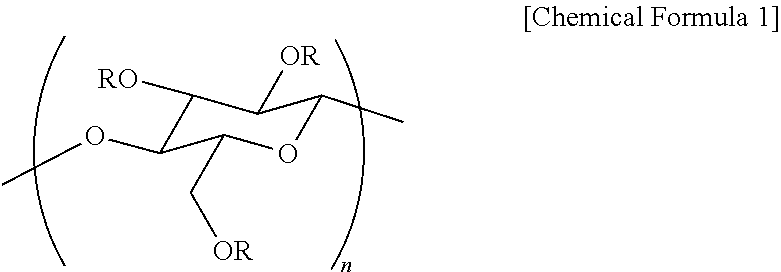
- the cellulose derivative has a structure as shown in Chemical Formula 1, wherein R is H or CH 2 CO 2 Na, n is an integer.
- the wood adhesive comprises a first agent and a second agent.
- the first agent and the second agent may be stored separately, and not be mixed until the wood adhesive is needed to be used.
- the embodiments are not limited thereto.
- the first agent may be a main agent.
- the first agent comprises sodium carboxymethyl cellulose having a molecular weight from about 15,000 to about 500,000 and a degree of substitution from about 0.4 to about 2.
- degree of substitution is defined as the average number of carboxymethyl group in each glucose unit.
- the first agent may further comprise water.
- the first agent exists as an aqueous phase, and the sodium carboxymethyl cellulose is present in the aqueous phase.
- the embodiments are not limited thereto.
- the second agent may be a curing agent.
- the second agent comprises polymeric quaternary amine.
- the polymeric quaternary amine may be reacted from polyamidoamine and epichlorohydrin.
- Such polymeric quaternary amine comprises a unit as shown in Chemical Formula 2, wherein m is an integer.
- the second agent may further comprise water.
- the second agent exists as an aqueous phase, and the polymeric quaternary amine is present in the aqueous phase.
- the embodiments are not limited thereto.
- the wood adhesive may further comprise various additives.
- the wood adhesive may further comprise at least one of fillers and a flame resisting agent.
- the fillers may comprise at least one kind of starch and wood chips. These additives may be added into the first agent, the second agent, or the mixed wood adhesive.
- the pH value of the wood adhesive may be changed to about 2 to about 12.
- the pH value of the mixed wood adhesive may be changed.
- the embodiments are not limited thereto.
- the biomass material is used as the main agent. As such, the formaldehyde release problem is solved. Further, the use of the wood adhesive according to the above embodiments will not be affected by the shortage of the petrochemical materials.
- the cellulose derivative is used. Compared to the commonly used soy protein, which is the most widely used biomass material, the cellulose derivatives are more abundant in nature, and not needed to be obtained from food crops. Further, compared to the wood adhesive using the soy protein, the wood adhesive according to the above embodiments is less likely to rot and gives no soybean odor.
- a method for adhering wood materials using a wood adhesive may comprise providing a first wood block and a second wood block, and bonding the first wood block with the second wood block by the wood adhesive.
- the wood adhesive may comprise a first agent and a second agent, the first agent comprises sodium carboxymethyl cellulose having a molecular weight from about 15,000 to about 500,000 and a degree of substitution from about 0.4 to about 2, and the second agent comprises polymeric quaternary amine.
- the first wood block and the second wood block may be pre-treated, such as be heated for a period of time so as to remove water, essential oils, volatile compounds and the like, and kill insect eggs.
- the first agent and the second agent may be mixed.
- the first agent and the second agent may be mixed at a ratio from about 0.25:1 to about 1:0.1, or from about 0.7:1 to about 1:0.2.
- the mixed wood adhesive is applied (such as by coating) to the surface(s) of the first wood block and the second wood block to be bonded.
- the wood adhesive may be applied to both of the surfaces to be bonded, or only one of the surfaces to be bonded.
- the wood adhesive may be cured by applying a pressure.
- a pressure of about 10 kg/cm 2 may be applied at about 5° C. to 45° C. for about 10 to 30 minutes, and then a pressure of about 10 kg/cm 2 may be applied at about 90° C. to 230° C. for about 3 to 25 minutes. As such, the curing of the wood adhesive is accelerated.
- the curing of the wood adhesive according to the embodiments is through various reaction mechanisms.
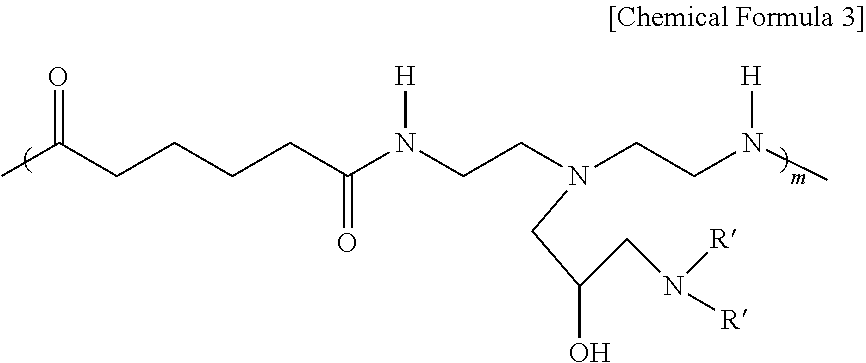
- One is the cross-linking of the polymeric quaternary amine itself, the product is shown in Chemical Formula 3, wherein R′ is the polymeric quaternary amine.
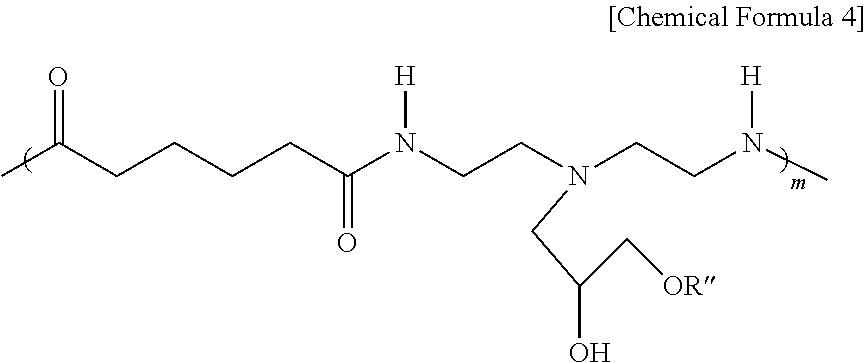
- One is the reaction between the polymeric quaternary amine and the hydroxyl group of the sodium carboxymethyl cellulose, the hydroxyl group of the cellulose in the first wood block, or the hydroxyl group of the cellulose in the second wood block, to form an “—O—” connection.
- the product is shown in Chemical Formula 4, wherein R′′ is the sodium carboxymethyl cellulose, the cellulose or the like.
- the first wood block and the second wood block comprises a particleboard, an oriented strand board, a fiberboard, a plywood, a block board, or a laminate.
- the first agent and the second agent of the wood adhesive may exist as aqueous phases.
- the wood adhesive may further comprise various additives.
- the wood adhesive may further comprise fillers or a flame resisting agent.
- the wood adhesive may have a pH value from about 2 to 12, or from about 3 to 11.53.
- a composite wood structure using a wood adhesive according to any one of the above embodiments may be bonded by a method for adhering wood materials according to any one of the above embodiments.
- a composite wood structure may comprise a first wood block, a second wood block and an adhesion layer bonding the first wood block with the second wood block.
- the adhesion layer is formed by mixing a first agent and a second agent of a wood adhesive according to any one of the above embodiments, and curing the wood adhesive.
- the wood adhesive may comprise a first agent and a second agent
- the first agent comprises sodium carboxymethyl cellulose having a molecular weight from about 15,000 to about 500,000 and a degree of substitution from about 0.4 to about 2
- the second agent comprises polymeric quaternary amine.
- the wood adhesive according to the embodiment may provide a good bonding characteristic to the composite wood structure.
- at least one of the first wood block and the second wood block comprises a particleboard, an oriented strand board, a fiberboard, a plywood, a block board, or a laminate.
- a four-neck reaction flask was provided, and 880 g of deionized water was added therein. Then, 120 g of sodium carboxymethyl cellulose (C5678, SIGMA-ALDRICH) having a molecular weight of 90,000 and a degree of substitution from 0.65 to 0.9 was added. The reaction flask was placed in an oil bath controlled at 50° C. A stirring speed of 250 rpm was applied for over 24 hours for dissolving. After cooling, a 12 wt % sodium carboxymethyl cellulose solution 1-1 (hereinafter Aqua 1-1) was obtained.
- Aqua 1-1 12 wt % sodium carboxymethyl cellulose solution 1-1
- a four-neck reaction flask was provided, and 937 g of deionized water was added therein. Then, 62.7 g of sodium carboxymethyl cellulose (C4888, SIGMA-ALDRICH) having a molecular weight of 250,000 and a degree of substitution of 0.7 was added. The reaction flask was placed in an oil bath controlled at 50° C. A stirring speed of 250 rpm was applied for over 24 hours for dissolving. After cooling, a 6.27 wt% sodium carboxymethyl cellulose solution 1-2 (hereinafter Aqua 1-2) was obtained.
- Aqua 1-2 a 6.27 wt% sodium carboxymethyl cellulose solution 1-2
- a four-neck reaction flask was provided, and 960 g of deionized water was added therein. Then, 40 g of sodium carboxymethyl cellulose (C5013, SIGMA-ALDRICH) having a molecular weight of 700,000 and a degree of substitution from 0.65 to 0.85 was added. The reaction flask was placed in an oil bath controlled at 50° C. A stirring speed of 250 rpm was applied for over 24 hours for dissolving. After cooling, a 4 wt % sodium carboxymethyl cellulose solution 1-3 (hereinafter Aqua 1-3) was obtained.
- Aqua 1-3 sodium carboxymethyl cellulose solution 1-3
- a four-neck reaction flask was provided, and 900 g of deionized water was added therein. Then, 100 g of sodium carboxymethyl cellulose (PR, Dai-ichi Kogyo Seiyaku Co., Ltd.) having a molecular weight of 47,000 and a degree of substitution from 0.6 to 0.7 was added. The reaction flask was placed in an oil bath controlled at 50° C. A stirring speed of 250 rpm was applied for over 24 hours for dissolving. After cooling, a 10 wt % sodium carboxymethyl cellulose solution 1-4 (hereinafter Aqua 1-4) was obtained.
- Aqua 1-4 sodium carboxymethyl cellulose solution 1-4
- a four-neck reaction flask was provided, and 880 g of deionized water was added therein. Then, 120 g of sodium carboxymethyl cellulose (7A, Dai-ichi Kogyo Seiyaku Co., Ltd.) having a molecular weight from 27,000 to 33,000 and a degree of substitution from 0.7 to 0.8 was added. The reaction flask was placed in an oil bath controlled at 50° C. A stirring speed of 250 rpm was applied for over 24 hours for dissolving. After cooling, a 12 wt % sodium carboxymethyl cellulose solution 1-5 (hereinafter Aqua 1-5) was obtained.
- Aqua 1-5 12 wt % sodium carboxymethyl cellulose solution 1-5
- a four-neck reaction flask was provided, and 880 g of deionized water was added therein. Then, 120 g of sodium carboxymethyl cellulose (6A, Dai-ichi Kogyo Seiyaku Co., Ltd.) having a molecular weight smaller than 27,000 and a degree of substitution from 0.7 to 0.8 was added. The reaction flask was placed in an oil bath controlled at 50° C. A stirring speed of 250 rpm was applied for over 24 hours for dissolving. After cooling, a 12 wt % sodium carboxymethyl cellulose solution 1-6 (hereinafter Aqua 1-6) was obtained.
- Aqua 1-6 sodium carboxymethyl cellulose solution 1-6
- a four-neck reaction flask was provided, and 893 g of deionized water was added therein. Then, 107 g of sodium carboxymethyl cellulose (PL-15, Dai-ichi Kogyo Seiyaku Co., Ltd.) having a degree of substitution from 0.45 to 0.55 was added. The reaction flask was placed in an oil bath controlled at 50° C. A stirring speed of 250 rpm was applied for over 24 hours for dissolving. After cooling, a 10.7 wt % sodium carboxymethyl cellulose solution 1-7 (hereinafter Aqua 1-7) was obtained.
- Aqua 1-7 sodium carboxymethyl cellulose
- Polyamidoamine-epichlorohydrin resin (Kymene®557H, Hercules) was used, hereinafter Aqua 2. It is a 12.5 wt % solution having a pH value of about 4.
- Wood Adhesive 1 was coated between two wood sheets. The wood sheets were configured to have a 10 cm*1 cm strip shape for the following pull test using a double column pull testing machine. The coated area was 1 cm 2 . The wood sheets were overlapped, and a pressure of 200 psi was applied at 120° C. for 20 minutes to cure the wood adhesive. As such, the wood sheets were attached to each other. Two tests were carried out for the bonded wood sheets. In Test 1, a pull test was carried out right after the attachment of the wood sheets. In Test 2, the bonded wood sheets were soaked in water at room temperature (such as 25° C.) for 24 hours, and then the bonded wood sheets were dried at the room temperature for 2 days. After drying, the pull test was carried out. The pull tests were carried out using a double column pull testing machine (Cometech Testing machines Co., Ltd.).
- Wood Adhesive 2 was coated between two wood sheets.
- the wood sheets were configured to have a 10 cm*1 cm strip shape for the following pull test.
- the coated area was 1 cm 2 .
- the wood sheets were overlapped, and a pressure of 200 psi was applied at 120° C. for 20 minutes to cure the wood adhesive. As such, the wood sheets were attached to each other.
- Two tests were carried out for the bonded wood sheets. In Test 1, a pull test was carried out right after the attachment of the wood sheets. In Test 2, the bonded wood sheets were soaked in water at room temperature for 24 hours, and then the bonded wood sheets were dried at the room temperature for 2 days. After drying, the pull test was carried out.
- Wood Adhesive 3 was coated between two wood sheets.
- the wood sheets were configured to have a 10 cm*1 cm strip shape for the following pull test.
- the coated area was 1 cm 2 .
- the wood sheets were overlapped, and a pressure of 200 psi was applied at 120° C. for 20 minutes to cure the wood adhesive. As such, the wood sheets were attached to each other.
- Two tests were carried out for the bonded wood sheets. In Test 1, a pull test was carried out right after the attachment of the wood sheets. In Test 2, the bonded wood sheets were soaked in water at room temperature for 24 hours, and then the bonded wood sheets were dried at the room temperature for 2 days. After drying, the pull test was carried out.
- Aqua 2 was coated between two wood sheets.
- the wood sheets were configured to have a 10 cm*1 cm strip shape for the following pull test.
- the coated area was 1 cm 2 .
- the wood sheets were overlapped, and a pressure of 200 psi was applied at 120° C. for 20 minutes to cure the wood adhesive. As such, the wood sheets were attached to each other.
- Two tests were carried out for the bonded wood sheets. In Test 1, a pull test was carried out right after the attachment of the wood sheets. In Test 2, the bonded wood sheets were soaked in water at room temperature for 24 hours, and then the bonded wood sheets were dried at the room temperature for 2 days. After drying, the pull test was carried out.
- Aqua 1-1 was coated between two wood sheets.
- the wood sheets were configured to have a 10 cm*1 cm strip shape for the following pull test.
- the coated area was 1 cm 2 .
- the wood sheets were overlapped, and a pressure of 200 psi was applied at 120° C. for 20 minutes to cure the wood adhesive. As such, the wood sheets were attached to each other.
- Two tests were carried out for the bonded wood sheets. In Test 1, a pull test was carried out right after the attachment of the wood sheets. In Test 2, the bonded wood sheets were soaked in water at room temperature for 24 hours, and then the bonded wood sheets were dried at the room temperature for 2 days. After drying, the pull test was carried out.
- the test results of the Examples and the Comparative Examples described above were listed in Table 1.
- the term “percentage of biomass material” means the percentage of biomass material (at here and most of the following Examples and Comparative Examples, the biomass material is sodium carboxymethyl cellulose, and in some of the Comparative Examples, the biomass material is soy protein) in total weight. Parts of the pull test results were shown as larger than a certain value. It means that, when the pull force was at said value, the woods were broken, and thus the pull force needed to depart the adhesive cannot be measured out.
- Wood Adhesive 4 was coated between two wood sheets.
- the wood sheets were configured to have a 10 cm*1 cm strip shape for the following pull test.
- the coated area was 1 cm 2 .
- the wood sheets were overlapped, and a pressure of 200 psi was applied at 120° C. for 20 minutes to cure the wood adhesive. As such, the wood sheets were attached to each other.
- Two tests were carried out for the bonded wood sheets. In Test 1, a pull test was carried out right after the attachment of the wood sheets. In Test 2, the bonded wood sheets were soaked in water at room temperature for 24 hours, and then the bonded wood sheets were dried at the room temperature for 2 days. After drying, the pull test was carried out.
- Wood Adhesive 5 was coated between two wood sheets.
- the wood sheets were configured to have a 10 cm*1 cm strip shape for the following pull test.
- the coated area was 1 cm 2 .
- the wood sheets were overlapped, and a pressure of 200 psi was applied at 120° C. for 20 minutes to cure the wood adhesive. As such, the wood sheets were attached to each other.
- Two tests were carried out for the bonded wood sheets. In Test 1, a pull test was carried out right after the attachment of the wood sheets. In Test 2, the bonded wood sheets were soaked in water at room temperature for 24 hours, and then the bonded wood sheets were dried at the room temperature for 2 days. After drying, the pull test was carried out.
- Aqua 1-2 was coated between two wood sheets.
- the wood sheets were configured to have a 10 cm*1 cm strip shape for the following pull test.
- the coated area was 1 cm 2 .
- the wood sheets were overlapped, and a pressure of 200 psi was applied at 120° C. for 20 minutes to cure the wood adhesive. As such, the wood sheets were attached to each other.
- Two tests were carried out for the bonded wood sheets. In Test 1, a pull test was carried out right after the attachment of the wood sheets. In Test 2, the bonded wood sheets were soaked in water at room temperature for 24 hours, and then the bonded wood sheets were dried at the room temperature for 2 days. After drying, the pull test was carried out.
- Wood Adhesive 6 was coated between two wood sheets. The wood sheets were configured to have a 10 cm*1 cm strip shape for the following pull test. The coated area was 1 cm 2 . The wood sheets were overlapped, and a pressure of 200 psi was applied at 120° C. for 20 minutes to cure the wood adhesive. As such, the wood sheets were attached to each other. Two tests were carried out for the bonded wood sheets.
- Test 1 a pull test was carried out right after the attachment of the wood sheets.
- Test 2 the bonded wood sheets were soaked in water at room temperature for 24 hours, and then a pull test was carried out without drying. Further, after the two agents were mixed, the pH value and the pot life at 25° C. of Wood Adhesive 6 were measured. The pH value was measured using a pH meter (pH meter 6250, JENCO electronics). In the measurement of pot life, the viscosity of Wood Adhesive 6 was measured at 30 minutes after mixing and 5 hours after mixing, respectively, using Spindle 28 of a viscometer (DV-III, BROOK Field) at 30 rpm, and then the change of the viscosity was calculated.
- a viscometer DV-III, BROOK Field
- Wood Adhesive 7 was coated between two wood sheets. The wood sheets were configured to have a 10 cm*1 cm strip shape for the following pull test. The coated area was 1 cm 2 . The wood sheets were overlapped, and a pressure of 200 psi was applied at 120° C. for 20 minutes to cure the wood adhesive. As such, the wood sheets were attached to each other. Two tests were carried out for the bonded wood sheets. In Test 1, a pull test was carried out right after the attachment of the wood sheets.
- Test 2 the bonded wood sheets were soaked in water at room temperature for 24 hours, and then a pull test was carried out without drying. Further, after the two agents were mixed, the pH value and the pot life at 25° C. of Wood Adhesive 7 were measured. The pH value was measured using the pH meter. In the measurement of pot life, the viscosity of Wood Adhesive 7 was measured at 30 minutes after mixing and 5 hours after mixing, respectively, using Spindle 29 of the viscometer at 60 rpm, and then the change of the viscosity was calculated.
- Wood Adhesive 8 was coated between two wood sheets.
- the wood sheets were configured to have a 10 cm*1 cm strip shape for the following pull test.
- the coated area was 1 cm 2 .
- the wood sheets were overlapped, and a pressure of 200 psi was applied at 120° C. for 20 minutes to cure the wood adhesive. As such, the wood sheets were attached to each other.
- Two tests were carried out for the bonded wood sheets. In Test 1, a pull test was carried out right after the attachment of the wood sheets. In Test 2, the bonded wood sheets were soaked in water at room temperature for 24 hours, and then a pull test was carried out without drying.
- the pH value and the pot life at 25° C. of Wood Adhesive 8 were measured.
- the pH value was measured using the pH meter.
- the viscosity of Wood Adhesive 8 was measured at 30 minutes after mixing and 5 hours after mixing, respectively, using Spindle 28 of the viscometer at 30 rpm, and then the change of the viscosity was calculated.
- Wood Adhesive 9 was coated between two wood sheets. The wood sheets were configured to have a 10 cm*1 cm strip shape for the following pull test. The coated area was 1 cm 2 . The wood sheets were overlapped, and a pressure of 200 psi was applied at 120° C. for 20 minutes to cure the wood adhesive. As such, the wood sheets were attached to each other. Two tests were carried out for the bonded wood sheets. In Test 1, a pull test was carried out right after the attachment of the wood sheets.
- a NaOH solution a dilute solution in which concentrated sodium hydroxide solution is 10 wt %, hereinafter NaOH (aq)
- Test 2 the bonded wood sheets were soaked in water at room temperature for 24 hours, and then a pull test was carried out without drying. Further, after the two agents were mixed, the pH value and the pot life at 25° C. of Wood Adhesive 9 were measured. The pH value was measured using the pH meter. In the measurement of pot life, the viscosity of Wood Adhesive 9 was measured at 30 minutes after mixing and 5 hours after mixing, respectively, using Spindle 28 of the viscometer at 30 rpm, and then the change of the viscosity was calculated.
- Wood Adhesive 10 was coated between two wood sheets.
- the wood sheets were configured to have a 10 cm*1 cm strip shape for the following pull test.
- the coated area was 1 cm 2 .
- the wood sheets were overlapped, and a pressure of 200 psi was applied at 120° C. for 20 minutes to cure the wood adhesive. As such, the wood sheets were attached to each other.
- Two tests were carried out for the bonded wood sheets. In Test 1, a pull test was carried out right after the attachment of the wood sheets. In Test 2, the bonded wood sheets were soaked in water at room temperature for 24 hours, and then a pull test was carried out without drying.
- the pH value and the pot life at 25° C. of Wood Adhesive 10 were measured.
- the pH value was measured using the pH meter.
- the viscosity of Wood Adhesive 10 was measured at 30 minutes after mixing and 5 hours after mixing, respectively, using Spindle 28 of the viscometer at 30 rpm, and then the change of the viscosity was calculated.
- Wood Adhesive 11 was coated between two wood sheets.
- the wood sheets were configured to have a 10 cm*1 cm strip shape for the following pull test.
- the coated area was 1 cm 2 .
- the wood sheets were overlapped, and a pressure of 200 psi was applied at 120° C. for 20 minutes to cure the wood adhesive. As such, the wood sheets were attached to each other.
- Two tests were carried out for the bonded wood sheets. In Test 1, a pull test was carried out right after the attachment of the wood sheets. In Test 2, the bonded wood sheets were soaked in water at room temperature for 24 hours, and then a pull test was carried out without drying.
- the pH value and the pot life at 25° C. of Wood Adhesive 11 were measured.
- the pH value was measured using the pH meter.
- the viscosity of Wood Adhesive 11 was measured at 30 minutes after mixing and 5 hours after mixing, respectively, using Spindle 29 of the viscometer at 60 rpm, and then the change of the viscosity was calculated.
- Wood Adhesive 12 was coated between two wood sheets. The wood sheets were configured to have a 10 cm*1 cm strip shape for the following pull test. The coated area was 1 cm 2 . The wood sheets were overlapped, and a pressure of 200 psi was applied at 120° C. for 20 minutes to cure the wood adhesive. As such, the wood sheets were attached to each other. Two tests were carried out for the bonded wood sheets. In Test 1, a pull test was carried out right after the attachment of the wood sheets.
- Test 2 the bonded wood sheets were soaked in water at room temperature for 24 hours, and then a pull test was carried out without drying. Further, after the two agents were mixed, the pH value and the pot life at 25° C. of Wood Adhesive 12 were measured. The pH value was measured using the pH meter. In the measurement of pot life, the viscosity of Wood Adhesive 12 was measured at 30 minutes after mixing and 5 hours after mixing, respectively, using Spindle 28 of the viscometer at 30 rpm, and then the change of the viscosity was calculated.
- Wood Adhesive 13 was coated between two wood sheets.
- the wood sheets were configured to have a 10 cm*1 cm strip shape for the following pull test.
- the coated area was 1 cm 2 .
- the wood sheets were overlapped, and a pressure of 200 psi was applied at 120° C. for 20 minutes to cure the wood adhesive. As such, the wood sheets were attached to each other.
- Two tests were carried out for the bonded wood sheets. In Test 1, a pull test was carried out right after the attachment of the wood sheets. In Test 2, the bonded wood sheets were soaked in water at room temperature for 24 hours, and then a pull test was carried out without drying.
- the pH value and the pot life at 25° C. of Wood Adhesive 13 were measured.
- the pH value was measured using the pH meter.
- the viscosity of Wood Adhesive 13 was measured at 30 minutes after mixing and 5 hours after mixing, respectively, using Spindle 29 of the viscometer at 60 rpm, and then the change of the viscosity was calculated.
- a comparative wood adhesive 15.0 g of Aqua 1-1, 5.0 g of Aqua 2 and 2 g of HCl (aq) were uniformly mixed to form a comparative wood adhesive.
- the comparative wood adhesive was coated between two wood sheets.
- the wood sheets were configured to have a 10 cm*1 cm strip shape for the following pull test.
- the coated area was 1 cm 2 .
- the wood sheets were overlapped, and a pressure of 200 psi was applied at 120° C. for 20 minutes to cure the wood adhesive. As such, the wood sheets were attached to each other.
- Two tests were carried out for the bonded wood sheets. In Test 1, a pull test was carried out right after the attachment of the wood sheets. In Test 2, the bonded wood sheets were soaked in water at room temperature for 24 hours, and then a pull test was carried out without drying. Further, after the two agents were mixed, the pH value of the comparative wood adhesive was measured. The pH value was measured using the pH meter. The pot life of this comparative wood adhesive was not measured due to
- a comparative wood adhesive 15.0 g of Aqua 1-1, 5.0 g of Aqua 2 and 2.54 g of NaOH (aq) were uniformly mixed to form a comparative wood adhesive.
- the comparative wood adhesive was coated between two wood sheets.
- the wood sheets were configured to have a 10 cm*1 cm strip shape for the following pull test.
- the coated area was 1 cm 2 .
- the wood sheets were overlapped, and a pressure of 200 psi was applied at 120° C. for 20 minutes to cure the wood adhesive. As such, the wood sheets were attached to each other. Two tests were carried out for the bonded wood sheets. In Test 1, a pull test was carried out right after the attachment of the wood sheets. In Test 2, the bonded wood sheets were soaked in water at room temperature for 24 hours, and then a pull test was carried out without drying.
- the pH value and the pot life at 25° C. of the comparative wood adhesive were measured.
- the pH value was measured using the pH meter.
- the viscosity of the comparative wood adhesive was measured at 30 minutes after mixing and 5 hours after mixing, respectively, using Spindle 29 of the viscometer at 60 rpm, and then the change of the viscosity was calculated.
- the test results of the Examples and the Comparative Examples described above were listed in Table 3. Only ranges for the results of pot life and pull test were shown due to sample deviation.
- the results of the pot life is very good for lower than or equal to 50%, good for higher than 50% while lower than 100%, usable for higher than or equal to 100%.
- the user may choose anyone according to his or her need. However, the ones having a pot life higher than 200% are not suitable for use.
- the results of the pull test is very good for higher than or equal to 15 kg/cm 2 , good for lower than 15 kg/cm 2 while higher than 8 kg/cm 2 , usable for lower than or equal to 8 kg/cm 2 while higher than 3 kg/cm 2 .
- the user may choose anyone according to his or her need.
- Wood Adhesive 14 was coated between two wood sheets.
- the wood sheets were configured to have a 10 cm*1 cm strip shape for the following pull test. The coated area was 1 cm 2 .
- the wood sheets were overlapped, and a pressure of 200 psi was applied at 120° C. for 20 minutes to cure the wood adhesive. As such, the wood sheets were attached to each other. Two tests were carried out for the bonded wood sheets. In Test 1, a pull test was carried out right after the attachment of the wood sheets. In Test 2, the bonded wood sheets were soaked in water at room temperature for 24 hours, and then a pull test was carried out without drying.
- the pH value and the pot life at 25° C. of Wood Adhesive 14 were measured.
- the pH value was measured using the pH meter.
- the viscosity of Wood Adhesive 14 was measured at 30 minutes after mixing and 5 hours after mixing, respectively, using Spindle 28 of the viscometer at 15 rpm, and then the change of the viscosity was calculated.
- Wood Adhesive 15 was coated between two wood sheets.
- the wood sheets were configured to have a 10 cm*1 cm strip shape for the following pull test.
- the coated area was 1 cm 2 .
- the wood sheets were overlapped, and a pressure of 200 psi was applied at 120° C. for 20 minutes to cure the wood adhesive. As such, the wood sheets were attached to each other.
- Two tests were carried out for the bonded wood sheets. In Test 1, a pull test was carried out right after the attachment of the wood sheets. In Test 2, the bonded wood sheets were soaked in water at room temperature for 24 hours, and then a pull test was carried out without drying.
- the pH value and the pot life at 25° C. of Wood Adhesive 15 were measured.
- the pH value was measured using the pH meter.
- the viscosity of Wood Adhesive 15 was measured at 30 minutes after mixing and 5 hours after mixing, respectively, using Spindle 28 of the viscometer at 30 rpm, and then the change of the viscosity was calculated.
- Wood Adhesive 16 was coated between two wood sheets.
- the wood sheets were configured to have a 10 cm*1 cm strip shape for the following pull test. The coated area was 1 cm 2 .
- the wood sheets were overlapped, and a pressure of 200 psi was applied at 120° C. for 20 minutes to cure the wood adhesive. As such, the wood sheets were attached to each other. Two tests were carried out for the bonded wood sheets. In Test 1, a pull test was carried out right after the attachment of the wood sheets. In Test 2, the bonded wood sheets were soaked in water at room temperature for 24 hours, and then a pull test was carried out without drying.
- the pH value and the pot life at 25° C. of Wood Adhesive 16 were measured.
- the pH value was measured using the pH meter.
- the viscosity of Wood Adhesive 16 was measured at 30 minutes after mixing and 5 hours after mixing, respectively, using Spindle 28 of the viscometer at 30 rpm, and then the change of the viscosity was calculated.
- Wood Adhesive 17 was coated between two wood sheets.
- the wood sheets were configured to have a 10 cm*1 cm strip shape for the following pull test.
- the coated area was 1 cm2.
- the wood sheets were overlapped, and a pressure of 200 psi was applied at 120° C. for 20 minutes to cure the wood adhesive. As such, the wood sheets were attached to each other.
- Two tests were carried out for the bonded wood sheets. In Test 1, a pull test was carried out right after the attachment of the wood sheets. In Test 2, the bonded wood sheets were soaked in water at room temperature for 24 hours, and then a pull test was carried out without drying.
- the pH value and the pot life at 25° C. of Wood Adhesive 17 were measured.
- the pH value was measured using the pH meter.
- the viscosity of Wood Adhesive 17 was measured at 30 minutes after mixing and 5 hours after mixing, respectively, using Spindle 28 of the viscometer at 60 rpm, and then the change of the viscosity was calculated.
- Wood Adhesive 18 was coated between two wood sheets.
- the wood sheets were configured to have a 10 cm*1 cm strip shape for the following pull test.
- the coated area was 1 cm2.
- the wood sheets were overlapped, and a pressure of 200 psi was applied at 120° C. for 20 minutes to cure the wood adhesive. As such, the wood sheets were attached to each other. Two tests were carried out for the bonded wood sheets. In Test 1, a pull test was carried out right after the attachment of the wood sheets. In Test 2, the bonded wood sheets were soaked in water at room temperature for 24 hours, and then a pull test was carried out without drying.
- the pH value and the pot life at 25° C. of Wood Adhesive 18 were measured.
- the pH value was measured using the pH meter.
- the viscosity of Wood Adhesive 18 was measured at 30 minutes after mixing and 5 hours after mixing, respectively, using Spindle 29 of the viscometer at 100 rpm, and then the change of the viscosity was calculated.
- Wood Adhesive 19 was coated between two wood sheets.
- the wood sheets were configured to have a 10 cm*1 cm strip shape for the following pull test. The coated area was 1 cm2.
- the wood sheets were overlapped, and a pressure of 200 psi was applied at 120° C. for 20 minutes to cure the wood adhesive. As such, the wood sheets were attached to each other. Two tests were carried out for the bonded wood sheets. In Test 1, a pull test was carried out right after the attachment of the wood sheets. In Test 2, the bonded wood sheets were soaked in water at room temperature for 24 hours, and then a pull test was carried out without drying.
- the pH value and the pot life at 25° C. of Wood Adhesive 19 were measured.
- the pH value was measured using the pH meter.
- the viscosity of Wood Adhesive 19 was measured at 30 minutes after mixing and 5 hours after mixing, respectively, using Spindle 29 of the viscometer at 60 rpm, and then the change of the viscosity was calculated.
- the comparative wood adhesive was coated between two wood sheets.
- the wood sheets were configured to have a 10 cm*1 cm strip shape for the following pull test.
- the coated area was 1 cm2.
- the wood sheets were overlapped, and a pressure of 200 psi was applied at 120° C. for 20 minutes to cure the wood adhesive. As such, the wood sheets were attached to each other. Two tests were carried out for the bonded wood sheets. In Test 1, a pull test was carried out right after the attachment of the wood sheets. In Test 2, the bonded wood sheets were soaked in water at room temperature for 24 hours, and then a pull test was carried out without drying.
- the pH value and the pot life at 25° C. of the comparative wood adhesive were measured.
- the pH value was measured using the pH meter.
- the viscosity of the comparative wood adhesive was measured at 30 minutes after mixing and 5 hours after mixing, respectively, using Spindle 29 of the viscometer at 40 rpm, and then the change of the viscosity was calculated.
- soy protein Preparing a 26 wt % soy protein solution using soy protein (Dupont® Soy polymer, LVH). 7.5 g of the soy protein solution, 5.0 g of Aqua 2 and 0.5 g of NaOH (aq) were uniformly mixed to form a comparative wood adhesive.
- the comparative wood adhesive was coated between two wood sheets. The wood sheets were configured to have a 10 cm*1 cm strip shape for the following pull test. The coated area was 1 cm2. The wood sheets were overlapped, and a pressure of 200 psi was applied at 120° C. for 20 minutes to cure the wood adhesive. As such, the wood sheets were attached to each other. Two tests were carried out for the bonded wood sheets.
- Test 1 a pull test was carried out right after the attachment of the wood sheets.
- Test 2 the bonded wood sheets were soaked in water at room temperature for 24 hours, and then a pull test was carried out without drying. Further, after the two agents were mixed, the pH value and the pot life at 25° C. of the comparative wood adhesive were measured. The pH value was measured using the pH meter. In the measurement of pot life, the viscosity of the comparative wood adhesive was measured at 30 minutes after mixing and 5 hours after mixing, respectively, using Spindle 29 of the viscometer at 40 rpm, and then the change of the viscosity was calculated.
- the test results of the Examples and the Comparative Examples described above were listed in Table 4. Only ranges for the results of pot life and pull test were shown due to sample deviation.
- the results of the pot life is very good for lower than or equal to 50%, good for higher than 50% while lower than 100%, usable for higher than or equal to 100%.
- the user may choose anyone according to his or her need. However, the ones having a pot life higher than 200% are not suitable for use.
- the results of the pull test is very good for higher than or equal to 15 kg/cm 2 , good for lower than 15 kg/cm 2 while higher than 8 kg/cm 2 , usable for lower than or equal to 8 kg/cm 2 while higher than 3 kg/cm 2 .
- the user may choose anyone according to his or her need.
- the ones having a pull test result lower than or equal to 3 kg/cm 2 are not suitable for use.
- Good bonding results were obtained for the wood adhesives according to the Examples in a wide molecular weight range and a wide degree-of-substitution range. In particular, it is good to have a molecular weight from about 15,000 to about 250,000 and a degree of substitution higher than 0.4. Further, even in the case being soaked for 24 hours, good bonding results were still obtained for the wood adhesives according to the Examples.
- the wood adhesive using the soy protein were listed as a comparative example (Comparative Example 7).
- the wood adhesive according to the Examples is competitive to the wood adhesive using the soy protein.
- the biomass material is used as the main agent in the wood adhesive according to embodiments, the formaldehyde release problem is solved, and the use of the wood adhesive will not be affected by the shortage of the petrochemical materials.
- the cellulose derivative is used in the wood adhesive according to embodiments, compared to the commonly used soy protein, the wood adhesive according to embodiments is less likely to rot and gives no soybean odor. Further, the wood adhesive according to embodiments has a good moisture resistance and a good bonding effect.
- the composite wood structure using said wood adhesive is less likely to rot and gives no soybean odor. Further, the composite wood structure has a good moisture resistance and a good bonding effect.
Landscapes
- Chemical & Material Sciences (AREA)
- Organic Chemistry (AREA)
- Life Sciences & Earth Sciences (AREA)
- Engineering & Computer Science (AREA)
- Wood Science & Technology (AREA)
- Chemical Kinetics & Catalysis (AREA)
- Health & Medical Sciences (AREA)
- Medicinal Chemistry (AREA)
- Polymers & Plastics (AREA)
- Adhesives Or Adhesive Processes (AREA)
- Chemical And Physical Treatments For Wood And The Like (AREA)
Abstract
A wood adhesive, a method for adhering wood materials using the same, and a composite wood structure using the same are disclosed. The wood adhesive comprises a first agent and a second agent, wherein the first agent comprises sodium carboxymethyl cellulose having a molecular weight from about 15,000 to about 500,000 and a degree of substitution from about 0.4 to about 2, and the second agent comprises polymeric quaternary amine.
Description
- This application claims the benefits of U.S. provisional application Ser. No. 61/940,862, filed Feb. 18, 2014, and Taiwan application Serial No. 103116383, filed May 8, 2014, the disclosures of which are incorporated by reference herein in their entirety.
- The disclosure relates to an adhesive, a method for adhering materials using the same, and a composite structure using the same. More particularly, the disclosure relates to a wood adhesive, a method for adhering wood materials using the same, and a composite wood structure using the same.
- Wood adhesive is the most widely used adhesive, and its consumption is more than half of the total consumption of the adhesives. Over 80% of the wood adhesive comprises at least one of urea-formaldehyde resin and phenolic-formaldehyde resin as the main agent. However, such resins will release formaldehyde for up to even over ten years due to their curing mechanism, thus cause pollution and health damage. As such, it is the trend of times to solving the formaldehyde release and pollution problem of the wood adhesive.
- In this disclosure, a wood adhesive using a biomass material is provided. The biomass material to be used is cellulose derivative. In this disclosure, a method for adhering wood materials using the wood adhesive and a composite wood structure using the wood adhesive are also provided.
- According to some embodiments, the wood adhesive comprises a first agent and a second agent. The first agent comprises sodium carboxymethyl cellulose having a molecular weight from about 15,000 to about 500,000 and a degree of substitution from about 0.4 to about 2. The second agent comprises polymeric quaternary amine.
- According to some embodiments, the method for adhering wood materials comprises the following steps. At first, a first wood block and a second wood block are provided. Then, the first wood block is bonded with the second wood block by a wood adhesive, wherein the wood adhesive comprises a first agent and a second agent, the first agent comprises sodium carboxymethyl cellulose having a molecular weight from about 15,000 to about 500,000 and a degree of substitution from about 0.4 to about 2, and the second agent comprises polymeric quaternary amine.
- According to some embodiments, the composite wood structure comprises a first wood block, a second wood block and an adhesion layer. The adhesion layer bonds the first wood block with the second wood block. The adhesion layer is formed by mixing a first agent and a second agent of a wood adhesive and curing the wood adhesive, wherein the first agent of the wood adhesive comprises sodium carboxymethyl cellulose having a molecular weight from about 15,000 to about 500,000 and a degree of substitution from about 0.4 to about 2, and the second agent of the wood adhesive comprises polymeric quaternary amine.
- None.
- Below, exemplary embodiments will be described in detail with reference to accompanying drawings so as to be easily realized by a person having ordinary knowledge in the art. The inventive concept may be embodied in various forms without being limited to the exemplary embodiments set forth herein. Descriptions of well-known parts are omitted for clarity, and like reference numerals refer to like elements throughout.
- In this disclosure, a wood adhesive using a cellulose derivative is provided. The cellulose derivative has a structure as shown in Chemical Formula 1, wherein R is H or CH2CO2Na, n is an integer.
-
- According to some embodiments, the wood adhesive comprises a first agent and a second agent. The first agent and the second agent may be stored separately, and not be mixed until the wood adhesive is needed to be used. However, the embodiments are not limited thereto.
- The first agent may be a main agent. The first agent comprises sodium carboxymethyl cellulose having a molecular weight from about 15,000 to about 500,000 and a degree of substitution from about 0.4 to about 2. The term “degree of substitution” is defined as the average number of carboxymethyl group in each glucose unit. In some embodiments, the first agent may further comprise water. The first agent exists as an aqueous phase, and the sodium carboxymethyl cellulose is present in the aqueous phase. However, the embodiments are not limited thereto.
- The second agent may be a curing agent. The second agent comprises polymeric quaternary amine. In some embodiments, the polymeric quaternary amine may be reacted from polyamidoamine and epichlorohydrin. Such polymeric quaternary amine comprises a unit as shown in Chemical Formula 2, wherein m is an integer.
-

- In some embodiments, the second agent may further comprise water. The second agent exists as an aqueous phase, and the polymeric quaternary amine is present in the aqueous phase. However, the embodiments are not limited thereto.
- In some embodiments, the wood adhesive may further comprise various additives. For example, the wood adhesive may further comprise at least one of fillers and a flame resisting agent. The fillers may comprise at least one kind of starch and wood chips. These additives may be added into the first agent, the second agent, or the mixed wood adhesive. In some embodiments, the pH value of the wood adhesive may be changed to about 2 to about 12. For example, the pH value of the mixed wood adhesive may be changed. However, the embodiments are not limited thereto.
- In the wood adhesive according to the above embodiments, the biomass material is used as the main agent. As such, the formaldehyde release problem is solved. Further, the use of the wood adhesive according to the above embodiments will not be affected by the shortage of the petrochemical materials.
- In the wood adhesive according to the above embodiments, the cellulose derivative is used. Compared to the commonly used soy protein, which is the most widely used biomass material, the cellulose derivatives are more abundant in nature, and not needed to be obtained from food crops. Further, compared to the wood adhesive using the soy protein, the wood adhesive according to the above embodiments is less likely to rot and gives no soybean odor.
- A method for adhering wood materials using a wood adhesive according to any one of the above embodiments may comprise providing a first wood block and a second wood block, and bonding the first wood block with the second wood block by the wood adhesive. For example, the wood adhesive may comprise a first agent and a second agent, the first agent comprises sodium carboxymethyl cellulose having a molecular weight from about 15,000 to about 500,000 and a degree of substitution from about 0.4 to about 2, and the second agent comprises polymeric quaternary amine.
- More specifically, the first wood block and the second wood block may be pre-treated, such as be heated for a period of time so as to remove water, essential oils, volatile compounds and the like, and kill insect eggs. When intending to bond the first wood block with the second wood block, the first agent and the second agent may be mixed. In some embodiments, the first agent and the second agent may be mixed at a ratio from about 0.25:1 to about 1:0.1, or from about 0.7:1 to about 1:0.2. Then, the mixed wood adhesive is applied (such as by coating) to the surface(s) of the first wood block and the second wood block to be bonded. The wood adhesive may be applied to both of the surfaces to be bonded, or only one of the surfaces to be bonded. Thereafter, the wood adhesive may be cured by applying a pressure. In some embodiments, a pressure of about 10 kg/cm2 may be applied at about 5° C. to 45° C. for about 10 to 30 minutes, and then a pressure of about 10 kg/cm2 may be applied at about 90° C. to 230° C. for about 3 to 25 minutes. As such, the curing of the wood adhesive is accelerated.
- The curing of the wood adhesive according to the embodiments is through various reaction mechanisms. One is the cross-linking of the polymeric quaternary amine itself, the product is shown in Chemical Formula 3, wherein R′ is the polymeric quaternary amine.
-
- One is the reaction between the polymeric quaternary amine and the hydroxyl group of the sodium carboxymethyl cellulose, the hydroxyl group of the cellulose in the first wood block, or the hydroxyl group of the cellulose in the second wood block, to form an “—O—” connection. The product is shown in Chemical Formula 4, wherein R″ is the sodium carboxymethyl cellulose, the cellulose or the like.
-
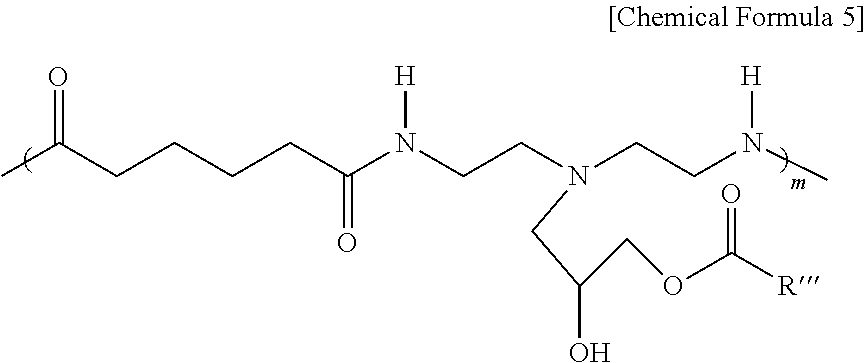
- Another one is the reaction between the polymeric quaternary amine and the carboxylate anion of the sodium carboxymethyl cellulose, to form a “—COO—” connection. The product is shown in Chemical Formula 5, wherein R′″ is the sodium carboxymethyl cellulose.
-
- Since the wood blocks are bonded with the wood adhesive by various reaction mechanisms, a good bonding characteristic is obtained through the method for adhering wood materials according to the embodiments.
- In some embodiments, at least one of the first wood block and the second wood block comprises a particleboard, an oriented strand board, a fiberboard, a plywood, a block board, or a laminate. In some embodiments, the first agent and the second agent of the wood adhesive may exist as aqueous phases. In some embodiments, the wood adhesive may further comprise various additives. For example, the wood adhesive may further comprise fillers or a flame resisting agent. In some embodiments, the wood adhesive may have a pH value from about 2 to 12, or from about 3 to 11.53.
- A composite wood structure using a wood adhesive according to any one of the above embodiments may be bonded by a method for adhering wood materials according to any one of the above embodiments. According to some embodiments, a composite wood structure may comprise a first wood block, a second wood block and an adhesion layer bonding the first wood block with the second wood block. The adhesion layer is formed by mixing a first agent and a second agent of a wood adhesive according to any one of the above embodiments, and curing the wood adhesive. For example, the wood adhesive may comprise a first agent and a second agent, the first agent comprises sodium carboxymethyl cellulose having a molecular weight from about 15,000 to about 500,000 and a degree of substitution from about 0.4 to about 2, and the second agent comprises polymeric quaternary amine. The wood adhesive according to the embodiment may provide a good bonding characteristic to the composite wood structure. In some embodiments, at least one of the first wood block and the second wood block comprises a particleboard, an oriented strand board, a fiberboard, a plywood, a block board, or a laminate.
- A plurality of embodiments of the wood adhesive, the method for adhering wood materials and the composite wood structure have been described. For a more clear and specific understanding to the wood adhesive, the method for adhering wood materials and the composite wood structure according to the embodiments, several examples and comparative examples are provided for detailed illustration.
- Preparation of First Agent (Aqua 1)
- [Sodium Carboxymethyl Cellulose Solution 1-1]
- A four-neck reaction flask was provided, and 880 g of deionized water was added therein. Then, 120 g of sodium carboxymethyl cellulose (C5678, SIGMA-ALDRICH) having a molecular weight of 90,000 and a degree of substitution from 0.65 to 0.9 was added. The reaction flask was placed in an oil bath controlled at 50° C. A stirring speed of 250 rpm was applied for over 24 hours for dissolving. After cooling, a 12 wt % sodium carboxymethyl cellulose solution 1-1 (hereinafter Aqua 1-1) was obtained.
- [Sodium Carboxymethyl Cellulose Solution 1-2]
- A four-neck reaction flask was provided, and 937 g of deionized water was added therein. Then, 62.7 g of sodium carboxymethyl cellulose (C4888, SIGMA-ALDRICH) having a molecular weight of 250,000 and a degree of substitution of 0.7 was added. The reaction flask was placed in an oil bath controlled at 50° C. A stirring speed of 250 rpm was applied for over 24 hours for dissolving. After cooling, a 6.27 wt% sodium carboxymethyl cellulose solution 1-2 (hereinafter Aqua 1-2) was obtained.
- [Sodium Carboxymethyl Cellulose Solution 1-3]
- A four-neck reaction flask was provided, and 960 g of deionized water was added therein. Then, 40 g of sodium carboxymethyl cellulose (C5013, SIGMA-ALDRICH) having a molecular weight of 700,000 and a degree of substitution from 0.65 to 0.85 was added. The reaction flask was placed in an oil bath controlled at 50° C. A stirring speed of 250 rpm was applied for over 24 hours for dissolving. After cooling, a 4 wt % sodium carboxymethyl cellulose solution 1-3 (hereinafter Aqua 1-3) was obtained.
- [Sodium Carboxymethyl Cellulose Solution 1-4]
- A four-neck reaction flask was provided, and 900 g of deionized water was added therein. Then, 100 g of sodium carboxymethyl cellulose (PR, Dai-ichi Kogyo Seiyaku Co., Ltd.) having a molecular weight of 47,000 and a degree of substitution from 0.6 to 0.7 was added. The reaction flask was placed in an oil bath controlled at 50° C. A stirring speed of 250 rpm was applied for over 24 hours for dissolving. After cooling, a 10 wt % sodium carboxymethyl cellulose solution 1-4 (hereinafter Aqua 1-4) was obtained.
- [Sodium Carboxymethyl Cellulose Solution 1-5]
- A four-neck reaction flask was provided, and 880 g of deionized water was added therein. Then, 120 g of sodium carboxymethyl cellulose (7A, Dai-ichi Kogyo Seiyaku Co., Ltd.) having a molecular weight from 27,000 to 33,000 and a degree of substitution from 0.7 to 0.8 was added. The reaction flask was placed in an oil bath controlled at 50° C. A stirring speed of 250 rpm was applied for over 24 hours for dissolving. After cooling, a 12 wt % sodium carboxymethyl cellulose solution 1-5 (hereinafter Aqua 1-5) was obtained.
- [Sodium Carboxymethyl Cellulose Solution 1-6]
- A four-neck reaction flask was provided, and 880 g of deionized water was added therein. Then, 120 g of sodium carboxymethyl cellulose (6A, Dai-ichi Kogyo Seiyaku Co., Ltd.) having a molecular weight smaller than 27,000 and a degree of substitution from 0.7 to 0.8 was added. The reaction flask was placed in an oil bath controlled at 50° C. A stirring speed of 250 rpm was applied for over 24 hours for dissolving. After cooling, a 12 wt % sodium carboxymethyl cellulose solution 1-6 (hereinafter Aqua 1-6) was obtained.
- [Sodium Carboxymethyl Cellulose Solution 1-7]
- A four-neck reaction flask was provided, and 893 g of deionized water was added therein. Then, 107 g of sodium carboxymethyl cellulose (PL-15, Dai-ichi Kogyo Seiyaku Co., Ltd.) having a degree of substitution from 0.45 to 0.55 was added. The reaction flask was placed in an oil bath controlled at 50° C. A stirring speed of 250 rpm was applied for over 24 hours for dissolving. After cooling, a 10.7 wt % sodium carboxymethyl cellulose solution 1-7 (hereinafter Aqua 1-7) was obtained.
- Preparation of Second Agent (Aqua 2)
- Polyamidoamine-epichlorohydrin resin (Kymene®557H, Hercules) was used, hereinafter Aqua 2. It is a 12.5 wt % solution having a pH value of about 4.
- Tests for the Ratio of First Agent (Aqua 1) and Second Agent (Aqua 2)
- 1.0 g of Aqua 1-1 and 3.0 g of Aqua 2 were uniformly mixed to form
- Wood Adhesive 1. Wood Adhesive 1 was coated between two wood sheets. The wood sheets were configured to have a 10 cm*1 cm strip shape for the following pull test using a double column pull testing machine. The coated area was 1 cm2. The wood sheets were overlapped, and a pressure of 200 psi was applied at 120° C. for 20 minutes to cure the wood adhesive. As such, the wood sheets were attached to each other. Two tests were carried out for the bonded wood sheets. In Test 1, a pull test was carried out right after the attachment of the wood sheets. In Test 2, the bonded wood sheets were soaked in water at room temperature (such as 25° C.) for 24 hours, and then the bonded wood sheets were dried at the room temperature for 2 days. After drying, the pull test was carried out. The pull tests were carried out using a double column pull testing machine (Cometech Testing machines Co., Ltd.).
- 2.0 g of Aqua 1-1 and 2.0 g of Aqua 2 were uniformly mixed to form Wood Adhesive 2. Wood Adhesive 2 was coated between two wood sheets. The wood sheets were configured to have a 10 cm*1 cm strip shape for the following pull test. The coated area was 1 cm2. The wood sheets were overlapped, and a pressure of 200 psi was applied at 120° C. for 20 minutes to cure the wood adhesive. As such, the wood sheets were attached to each other. Two tests were carried out for the bonded wood sheets. In Test 1, a pull test was carried out right after the attachment of the wood sheets. In Test 2, the bonded wood sheets were soaked in water at room temperature for 24 hours, and then the bonded wood sheets were dried at the room temperature for 2 days. After drying, the pull test was carried out.
- 3.0 g of Aqua 1-1 and 1.0 g of Aqua 2 were uniformly mixed to form Wood Adhesive 3. Wood Adhesive 3 was coated between two wood sheets.
- The wood sheets were configured to have a 10 cm*1 cm strip shape for the following pull test. The coated area was 1 cm2. The wood sheets were overlapped, and a pressure of 200 psi was applied at 120° C. for 20 minutes to cure the wood adhesive. As such, the wood sheets were attached to each other. Two tests were carried out for the bonded wood sheets. In Test 1, a pull test was carried out right after the attachment of the wood sheets. In Test 2, the bonded wood sheets were soaked in water at room temperature for 24 hours, and then the bonded wood sheets were dried at the room temperature for 2 days. After drying, the pull test was carried out.
- Aqua 2 was coated between two wood sheets. The wood sheets were configured to have a 10 cm*1 cm strip shape for the following pull test. The coated area was 1 cm2. The wood sheets were overlapped, and a pressure of 200 psi was applied at 120° C. for 20 minutes to cure the wood adhesive. As such, the wood sheets were attached to each other. Two tests were carried out for the bonded wood sheets. In Test 1, a pull test was carried out right after the attachment of the wood sheets. In Test 2, the bonded wood sheets were soaked in water at room temperature for 24 hours, and then the bonded wood sheets were dried at the room temperature for 2 days. After drying, the pull test was carried out.
- Aqua 1-1was coated between two wood sheets. The wood sheets were configured to have a 10 cm*1 cm strip shape for the following pull test. The coated area was 1 cm2. The wood sheets were overlapped, and a pressure of 200 psi was applied at 120° C. for 20 minutes to cure the wood adhesive. As such, the wood sheets were attached to each other. Two tests were carried out for the bonded wood sheets. In Test 1, a pull test was carried out right after the attachment of the wood sheets. In Test 2, the bonded wood sheets were soaked in water at room temperature for 24 hours, and then the bonded wood sheets were dried at the room temperature for 2 days. After drying, the pull test was carried out.
- [Test Results]
- The test results of the Examples and the Comparative Examples described above were listed in Table 1. The term “percentage of biomass material” means the percentage of biomass material (at here and most of the following Examples and Comparative Examples, the biomass material is sodium carboxymethyl cellulose, and in some of the Comparative Examples, the biomass material is soy protein) in total weight. Parts of the pull test results were shown as larger than a certain value. It means that, when the pull force was at said value, the woods were broken, and thus the pull force needed to depart the adhesive cannot be measured out. No good bonding results were obtained in the case that only Aqua 1-1 was used, i.e., the second agent (polymeric quaternary amine solution) was not used, or in the case that only Aqua 2 was used, i.e., the first agent (sodium carboxymethyl cellulose solution) was not used. While good bonding results were obtained for the wood adhesives according to the Examples in a wide component ratio range. Further, even in the case being soaked for 24 hours, good bonding results were still obtained for the wood adhesives according to the Examples. That is, the wood adhesives according to the embodiments and Examples have a moisture resistance to some extent.
-
TABLE 1 Composition of wood adhesive Percentage Pull test results Aqua 1-1 Aqua 2 of biomass Test 1 Test 2 (g) (g) material (kg/cm2) (kg/cm2) Comparative 0 1 0 wt % 5.46 separate Example 1 Example 1 1 3 24 wt % >27.8 30.25 Example 2 2 2 49 wt % >24.8 >25.4 Example 3 3 1 74 wt % >23.1 18.9 Comparative 1 0 100 wt % >32 separate Example 2 - 2.0 g of Aqua 1-2 and 1.0 g of Aqua 2 were uniformly mixed to form Wood Adhesive 4. Wood Adhesive 4 was coated between two wood sheets. The wood sheets were configured to have a 10 cm*1 cm strip shape for the following pull test. The coated area was 1 cm2. The wood sheets were overlapped, and a pressure of 200 psi was applied at 120° C. for 20 minutes to cure the wood adhesive. As such, the wood sheets were attached to each other. Two tests were carried out for the bonded wood sheets. In Test 1, a pull test was carried out right after the attachment of the wood sheets. In Test 2, the bonded wood sheets were soaked in water at room temperature for 24 hours, and then the bonded wood sheets were dried at the room temperature for 2 days. After drying, the pull test was carried out.
- 6.0 g of Aqua 1-2 and 1.0 g of Aqua 2 were uniformly mixed to form Wood Adhesive 5. Wood Adhesive 5 was coated between two wood sheets. The wood sheets were configured to have a 10 cm*1 cm strip shape for the following pull test. The coated area was 1 cm2. The wood sheets were overlapped, and a pressure of 200 psi was applied at 120° C. for 20 minutes to cure the wood adhesive. As such, the wood sheets were attached to each other. Two tests were carried out for the bonded wood sheets. In Test 1, a pull test was carried out right after the attachment of the wood sheets. In Test 2, the bonded wood sheets were soaked in water at room temperature for 24 hours, and then the bonded wood sheets were dried at the room temperature for 2 days. After drying, the pull test was carried out.
- Aqua 1-2 was coated between two wood sheets. The wood sheets were configured to have a 10 cm*1 cm strip shape for the following pull test. The coated area was 1 cm2. The wood sheets were overlapped, and a pressure of 200 psi was applied at 120° C. for 20 minutes to cure the wood adhesive. As such, the wood sheets were attached to each other. Two tests were carried out for the bonded wood sheets. In Test 1, a pull test was carried out right after the attachment of the wood sheets. In Test 2, the bonded wood sheets were soaked in water at room temperature for 24 hours, and then the bonded wood sheets were dried at the room temperature for 2 days. After drying, the pull test was carried out.
- [Test Results]
- The test results of the Examples and the Comparative Examples described above were listed in Table 2. Parts of the pull test results were shown as larger than a certain value. It means that, when the pull force was at said value, the woods were broken, and thus the pull force needed to depart the adhesive cannot be measured out. No good bonding results were obtained in the case that only Aqua 1-2 was used, i.e., the second agent (polymeric quaternary amine solution) was not used, or in the case that only Aqua 2 was used, i.e., the first agent (sodium carboxymethyl cellulose solution) was not used. While good bonding results were obtained for the wood adhesives according to the Examples in a wide component ratio range. Further, even in the case being soaked for 24 hours, good bonding results were still obtained for the wood adhesives according to the Examples. That is, the wood adhesives according to the embodiments and Examples have a moisture resistance to some extent.
-
TABLE 2 Composition of wood adhesive Percentage Pull test Aqua 1-2 Aqua 2 of biomass Test 1 Test 2 (g) (g) material (kg/cm2) (kg/cm2) Comparative 0 1 0 wt % 5.46 separate Example 1 Example 4 2 1 50 wt % 21.46 >25 Example 5 6 1 74 wt % >12 >15.45 Comparative 1 0 100 wt % >25.4 separate Example 3 - Tests for the pH Value of Wood Adhesive
- 15.0 g of Aqua 1-1, 5.0 g of Aqua 2 and 0.88 g of a HCl solution (a dilute solution in which concentrated hydrochloric acid is 18.5 wt %, hereinafter HCl(aq)) were uniformly mixed to form Wood Adhesive 6. Wood Adhesive 6 was coated between two wood sheets. The wood sheets were configured to have a 10 cm*1 cm strip shape for the following pull test. The coated area was 1 cm2. The wood sheets were overlapped, and a pressure of 200 psi was applied at 120° C. for 20 minutes to cure the wood adhesive. As such, the wood sheets were attached to each other. Two tests were carried out for the bonded wood sheets. In Test 1, a pull test was carried out right after the attachment of the wood sheets. In Test 2, the bonded wood sheets were soaked in water at room temperature for 24 hours, and then a pull test was carried out without drying. Further, after the two agents were mixed, the pH value and the pot life at 25° C. of Wood Adhesive 6 were measured. The pH value was measured using a pH meter (pH meter 6250, JENCO electronics). In the measurement of pot life, the viscosity of Wood Adhesive 6 was measured at 30 minutes after mixing and 5 hours after mixing, respectively, using Spindle 28 of a viscometer (DV-III, BROOK Field) at 30 rpm, and then the change of the viscosity was calculated.
- 15.0 g of Aqua 1-1, 5.0 g of Aqua 2 and 0.385 of a HCl(aq) were uniformly mixed to form Wood Adhesive 7. Wood Adhesive 7 was coated between two wood sheets. The wood sheets were configured to have a 10 cm*1 cm strip shape for the following pull test. The coated area was 1 cm2. The wood sheets were overlapped, and a pressure of 200 psi was applied at 120° C. for 20 minutes to cure the wood adhesive. As such, the wood sheets were attached to each other. Two tests were carried out for the bonded wood sheets. In Test 1, a pull test was carried out right after the attachment of the wood sheets. In Test 2, the bonded wood sheets were soaked in water at room temperature for 24 hours, and then a pull test was carried out without drying. Further, after the two agents were mixed, the pH value and the pot life at 25° C. of Wood Adhesive 7 were measured. The pH value was measured using the pH meter. In the measurement of pot life, the viscosity of Wood Adhesive 7 was measured at 30 minutes after mixing and 5 hours after mixing, respectively, using Spindle 29 of the viscometer at 60 rpm, and then the change of the viscosity was calculated.
- 15.0 g of Aqua 1-1 and 5.0 g of Aqua 2 were uniformly mixed to form Wood Adhesive 8. Wood Adhesive 8 was coated between two wood sheets. The wood sheets were configured to have a 10 cm*1 cm strip shape for the following pull test. The coated area was 1 cm2. The wood sheets were overlapped, and a pressure of 200 psi was applied at 120° C. for 20 minutes to cure the wood adhesive. As such, the wood sheets were attached to each other. Two tests were carried out for the bonded wood sheets. In Test 1, a pull test was carried out right after the attachment of the wood sheets. In Test 2, the bonded wood sheets were soaked in water at room temperature for 24 hours, and then a pull test was carried out without drying. Further, after the two agents were mixed, the pH value and the pot life at 25° C. of Wood Adhesive 8 were measured. The pH value was measured using the pH meter. In the measurement of pot life, the viscosity of Wood Adhesive 8 was measured at 30 minutes after mixing and 5 hours after mixing, respectively, using Spindle 28 of the viscometer at 30 rpm, and then the change of the viscosity was calculated.
- 15.0 g of Aqua 1-1, 5.0 g of Aqua 2 and 0.206 g of a NaOH solution (a dilute solution in which concentrated sodium hydroxide solution is 10 wt %, hereinafter NaOH(aq)) were uniformly mixed to form Wood Adhesive 9. Wood Adhesive 9 was coated between two wood sheets. The wood sheets were configured to have a 10 cm*1 cm strip shape for the following pull test. The coated area was 1 cm2. The wood sheets were overlapped, and a pressure of 200 psi was applied at 120° C. for 20 minutes to cure the wood adhesive. As such, the wood sheets were attached to each other. Two tests were carried out for the bonded wood sheets. In Test 1, a pull test was carried out right after the attachment of the wood sheets. In Test 2, the bonded wood sheets were soaked in water at room temperature for 24 hours, and then a pull test was carried out without drying. Further, after the two agents were mixed, the pH value and the pot life at 25° C. of Wood Adhesive 9 were measured. The pH value was measured using the pH meter. In the measurement of pot life, the viscosity of Wood Adhesive 9 was measured at 30 minutes after mixing and 5 hours after mixing, respectively, using Spindle 28 of the viscometer at 30 rpm, and then the change of the viscosity was calculated.
- 15.0 g of Aqua 1-1, 5.0 g of Aqua 2 and 0.5 g of NaOH(aq) were uniformly mixed to form Wood Adhesive 10. Wood Adhesive 10 was coated between two wood sheets. The wood sheets were configured to have a 10 cm*1 cm strip shape for the following pull test. The coated area was 1 cm2. The wood sheets were overlapped, and a pressure of 200 psi was applied at 120° C. for 20 minutes to cure the wood adhesive. As such, the wood sheets were attached to each other. Two tests were carried out for the bonded wood sheets. In Test 1, a pull test was carried out right after the attachment of the wood sheets. In Test 2, the bonded wood sheets were soaked in water at room temperature for 24 hours, and then a pull test was carried out without drying. Further, after the two agents were mixed, the pH value and the pot life at 25° C. of Wood Adhesive 10 were measured. The pH value was measured using the pH meter. In the measurement of pot life, the viscosity of Wood Adhesive 10 was measured at 30 minutes after mixing and 5 hours after mixing, respectively, using Spindle 28 of the viscometer at 30 rpm, and then the change of the viscosity was calculated.
- 15.0 g of Aqua 1-1, 5.0 g of Aqua 2 and 0.69 g of NaOH(aq) were uniformly mixed to form Wood Adhesive 11. Wood Adhesive 11 was coated between two wood sheets. The wood sheets were configured to have a 10 cm*1 cm strip shape for the following pull test. The coated area was 1 cm2. The wood sheets were overlapped, and a pressure of 200 psi was applied at 120° C. for 20 minutes to cure the wood adhesive. As such, the wood sheets were attached to each other. Two tests were carried out for the bonded wood sheets. In Test 1, a pull test was carried out right after the attachment of the wood sheets. In Test 2, the bonded wood sheets were soaked in water at room temperature for 24 hours, and then a pull test was carried out without drying. Further, after the two agents were mixed, the pH value and the pot life at 25° C. of Wood Adhesive 11 were measured. The pH value was measured using the pH meter. In the measurement of pot life, the viscosity of Wood Adhesive 11 was measured at 30 minutes after mixing and 5 hours after mixing, respectively, using Spindle 29 of the viscometer at 60 rpm, and then the change of the viscosity was calculated.
- 15.0 g of Aqua 1-1, 5.0 g of Aqua 2 and 1.039 g of NaOH(aq) were uniformly mixed to form Wood Adhesive 12. Wood Adhesive 12 was coated between two wood sheets. The wood sheets were configured to have a 10 cm*1 cm strip shape for the following pull test. The coated area was 1 cm2. The wood sheets were overlapped, and a pressure of 200 psi was applied at 120° C. for 20 minutes to cure the wood adhesive. As such, the wood sheets were attached to each other. Two tests were carried out for the bonded wood sheets. In Test 1, a pull test was carried out right after the attachment of the wood sheets. In Test 2, the bonded wood sheets were soaked in water at room temperature for 24 hours, and then a pull test was carried out without drying. Further, after the two agents were mixed, the pH value and the pot life at 25° C. of Wood Adhesive 12 were measured. The pH value was measured using the pH meter. In the measurement of pot life, the viscosity of Wood Adhesive 12 was measured at 30 minutes after mixing and 5 hours after mixing, respectively, using Spindle 28 of the viscometer at 30 rpm, and then the change of the viscosity was calculated.
- 15.0 g of Aqua 1-1, 5.0 g of Aqua 2 and 1.5 g of NaOH(aq) were uniformly mixed to form Wood Adhesive 13. Wood Adhesive 13 was coated between two wood sheets. The wood sheets were configured to have a 10 cm*1 cm strip shape for the following pull test. The coated area was 1 cm2. The wood sheets were overlapped, and a pressure of 200 psi was applied at 120° C. for 20 minutes to cure the wood adhesive. As such, the wood sheets were attached to each other. Two tests were carried out for the bonded wood sheets. In Test 1, a pull test was carried out right after the attachment of the wood sheets. In Test 2, the bonded wood sheets were soaked in water at room temperature for 24 hours, and then a pull test was carried out without drying. Further, after the two agents were mixed, the pH value and the pot life at 25° C. of Wood Adhesive 13 were measured. The pH value was measured using the pH meter. In the measurement of pot life, the viscosity of Wood Adhesive 13 was measured at 30 minutes after mixing and 5 hours after mixing, respectively, using Spindle 29 of the viscometer at 60 rpm, and then the change of the viscosity was calculated.
- 15.0 g of Aqua 1-1, 5.0 g of Aqua 2 and 2 g of HCl(aq) were uniformly mixed to form a comparative wood adhesive. The comparative wood adhesive was coated between two wood sheets. The wood sheets were configured to have a 10 cm*1 cm strip shape for the following pull test. The coated area was 1 cm2. The wood sheets were overlapped, and a pressure of 200 psi was applied at 120° C. for 20 minutes to cure the wood adhesive. As such, the wood sheets were attached to each other. Two tests were carried out for the bonded wood sheets. In Test 1, a pull test was carried out right after the attachment of the wood sheets. In Test 2, the bonded wood sheets were soaked in water at room temperature for 24 hours, and then a pull test was carried out without drying. Further, after the two agents were mixed, the pH value of the comparative wood adhesive was measured. The pH value was measured using the pH meter. The pot life of this comparative wood adhesive was not measured due to phase separation.
- 15.0 g of Aqua 1-1, 5.0 g of Aqua 2 and 2.54 g of NaOH(aq) were uniformly mixed to form a comparative wood adhesive. The comparative wood adhesive was coated between two wood sheets. The wood sheets were configured to have a 10 cm*1 cm strip shape for the following pull test. The coated area was 1 cm2. The wood sheets were overlapped, and a pressure of 200 psi was applied at 120° C. for 20 minutes to cure the wood adhesive. As such, the wood sheets were attached to each other. Two tests were carried out for the bonded wood sheets. In Test 1, a pull test was carried out right after the attachment of the wood sheets. In Test 2, the bonded wood sheets were soaked in water at room temperature for 24 hours, and then a pull test was carried out without drying. Further, after the two agents were mixed, the pH value and the pot life at 25° C. of the comparative wood adhesive were measured. The pH value was measured using the pH meter. In the measurement of pot life, the viscosity of the comparative wood adhesive was measured at 30 minutes after mixing and 5 hours after mixing, respectively, using Spindle 29 of the viscometer at 60 rpm, and then the change of the viscosity was calculated.
- [Test Results]
- The test results of the Examples and the Comparative Examples described above were listed in Table 3. Only ranges for the results of pot life and pull test were shown due to sample deviation. The results of the pot life is very good for lower than or equal to 50%, good for higher than 50% while lower than 100%, usable for higher than or equal to 100%. The user may choose anyone according to his or her need. However, the ones having a pot life higher than 200% are not suitable for use. The results of the pull test is very good for higher than or equal to 15 kg/cm2, good for lower than 15 kg/cm2 while higher than 8 kg/cm2, usable for lower than or equal to 8 kg/cm2 while higher than 3 kg/cm2. The user may choose anyone according to his or her need. However, the ones having a pull test result lower than or equal to 3 kg/cm2 are not suitable for use. No good bonding results were obtained in the case too acidic or too basic. While good bonding results were obtained for the wood adhesives according to the Examples in a wide pH range, in particular good for pH value in a range from about 2 to about 12. Further, even in the case being soaked for 24 hours, good bonding results were still obtained for the wood adhesives according to the Examples.
-
TABLE 3 Composition of wood adhesive Pot life HCl(aq)/ Percentage Result Result Pot Pull test Aqua 1-1 Aqua 2 NaOH(aq) of biomass pH of 30 min of 5 hr life Test 1 Test 2 (g) (g) (g) material value (cps) (cps) (%) (kg/cm2) (kg/cm2) Comparative 15 5 2 74 wt % 1.01 — — — ≦3 ≦3 Example 4 Example 6 15 5 0.88 74 wt % 2.87 20903 38108 82 8 to 15 3 to 8 Example 7 15 5 0.385 74 wt % 3.81 16200 20000 23 8 to 15 8 to 15 Example 8 15 5 — 74 wt % 5.3 17633 28900 63 ≧15 8 to 15 Example 9 15 5 0.206 74 wt % 6.85 14067 22000 26 ≧15 8 to 15 Example 10 15 5 0.5 74 wt % 8.06 13100 15200 16 ≧15 8 to 15 Example 11 15 5 0.69 74 wt % 9.57 10300 12400 20 ≧15 8 to 15 Example 12 15 5 1.039 74 wt % 11.53 9113 12067 32 ≧15 8 to 15 Example 13 15 5 1.5 74 wt % 11.96 5867 10000 70 ≧15 3 to 8 Comparative 15 5 2.539 74 wt % 12.08 2475 5200 220 ≧15 ≦3 Example 5 - Tests for Molecular Weight and Degree of Substitution of Sodium Carboxymethyl Cellulose of First Agent (Aqua 1)
- 30.0 g of Aqua 1-2, 5.0 g of Aqua 2 and 0.5 g of NaOH(aq) were uniformly mixed to form Wood Adhesive 14. Wood Adhesive 14 was coated between two wood sheets. The wood sheets were configured to have a 10 cm*1 cm strip shape for the following pull test. The coated area was 1 cm2. The wood sheets were overlapped, and a pressure of 200 psi was applied at 120° C. for 20 minutes to cure the wood adhesive. As such, the wood sheets were attached to each other. Two tests were carried out for the bonded wood sheets. In Test 1, a pull test was carried out right after the attachment of the wood sheets. In Test 2, the bonded wood sheets were soaked in water at room temperature for 24 hours, and then a pull test was carried out without drying. Further, after the two agents were mixed, the pH value and the pot life at 25° C. of Wood Adhesive 14 were measured. The pH value was measured using the pH meter. In the measurement of pot life, the viscosity of Wood Adhesive 14 was measured at 30 minutes after mixing and 5 hours after mixing, respectively, using Spindle 28 of the viscometer at 15 rpm, and then the change of the viscosity was calculated.
- 15.0 g of Aqua 1-1, 5.0 g of Aqua 2 and 0.5 g of NaOH(aq) were uniformly mixed to form Wood Adhesive 15. Wood Adhesive 15 was coated between two wood sheets. The wood sheets were configured to have a 10 cm*1 cm strip shape for the following pull test. The coated area was 1 cm2. The wood sheets were overlapped, and a pressure of 200 psi was applied at 120° C. for 20 minutes to cure the wood adhesive. As such, the wood sheets were attached to each other. Two tests were carried out for the bonded wood sheets. In Test 1, a pull test was carried out right after the attachment of the wood sheets. In Test 2, the bonded wood sheets were soaked in water at room temperature for 24 hours, and then a pull test was carried out without drying. Further, after the two agents were mixed, the pH value and the pot life at 25° C. of Wood Adhesive 15 were measured. The pH value was measured using the pH meter. In the measurement of pot life, the viscosity of Wood Adhesive 15 was measured at 30 minutes after mixing and 5 hours after mixing, respectively, using Spindle 28 of the viscometer at 30 rpm, and then the change of the viscosity was calculated.
- 18.75 g of Aqua 1-4, 5.0 g of Aqua 2 and 0.5 g of NaOH(aq) were uniformly mixed to form Wood Adhesive 16. Wood Adhesive 16 was coated between two wood sheets. The wood sheets were configured to have a 10 cm*1 cm strip shape for the following pull test. The coated area was 1 cm2. The wood sheets were overlapped, and a pressure of 200 psi was applied at 120° C. for 20 minutes to cure the wood adhesive. As such, the wood sheets were attached to each other. Two tests were carried out for the bonded wood sheets. In Test 1, a pull test was carried out right after the attachment of the wood sheets. In Test 2, the bonded wood sheets were soaked in water at room temperature for 24 hours, and then a pull test was carried out without drying. Further, after the two agents were mixed, the pH value and the pot life at 25° C. of Wood Adhesive 16 were measured. The pH value was measured using the pH meter. In the measurement of pot life, the viscosity of Wood Adhesive 16 was measured at 30 minutes after mixing and 5 hours after mixing, respectively, using Spindle 28 of the viscometer at 30 rpm, and then the change of the viscosity was calculated.
- 15.0 g of Aqua 1-5, 5.0 g of Aqua 2 and 0.5 g of NaOH(aq) were uniformly mixed to form Wood Adhesive 17. Wood Adhesive 17 was coated between two wood sheets. The wood sheets were configured to have a 10 cm*1 cm strip shape for the following pull test. The coated area was 1 cm2. The wood sheets were overlapped, and a pressure of 200 psi was applied at 120° C. for 20 minutes to cure the wood adhesive. As such, the wood sheets were attached to each other. Two tests were carried out for the bonded wood sheets. In Test 1, a pull test was carried out right after the attachment of the wood sheets. In Test 2, the bonded wood sheets were soaked in water at room temperature for 24 hours, and then a pull test was carried out without drying. Further, after the two agents were mixed, the pH value and the pot life at 25° C. of Wood Adhesive 17 were measured. The pH value was measured using the pH meter. In the measurement of pot life, the viscosity of Wood Adhesive 17 was measured at 30 minutes after mixing and 5 hours after mixing, respectively, using Spindle 28 of the viscometer at 60 rpm, and then the change of the viscosity was calculated.
- 15.0 g of Aqua 1-6, 5.0 g of Aqua 2 and 0.5 g of NaOH(aq) were uniformly mixed to form Wood Adhesive 18. Wood Adhesive 18 was coated between two wood sheets. The wood sheets were configured to have a 10 cm*1 cm strip shape for the following pull test. The coated area was 1 cm2. The wood sheets were overlapped, and a pressure of 200 psi was applied at 120° C. for 20 minutes to cure the wood adhesive. As such, the wood sheets were attached to each other. Two tests were carried out for the bonded wood sheets. In Test 1, a pull test was carried out right after the attachment of the wood sheets. In Test 2, the bonded wood sheets were soaked in water at room temperature for 24 hours, and then a pull test was carried out without drying. Further, after the two agents were mixed, the pH value and the pot life at 25° C. of Wood Adhesive 18 were measured. The pH value was measured using the pH meter. In the measurement of pot life, the viscosity of Wood Adhesive 18 was measured at 30 minutes after mixing and 5 hours after mixing, respectively, using Spindle 29 of the viscometer at 100 rpm, and then the change of the viscosity was calculated.
- 16.8 g of Aqua 1-7, 5.0 g of Aqua 2 and 0.5 g of NaOH(aq) were uniformly mixed to form Wood Adhesive 19. Wood Adhesive 19 was coated between two wood sheets. The wood sheets were configured to have a 10 cm*1 cm strip shape for the following pull test. The coated area was 1 cm2. The wood sheets were overlapped, and a pressure of 200 psi was applied at 120° C. for 20 minutes to cure the wood adhesive. As such, the wood sheets were attached to each other. Two tests were carried out for the bonded wood sheets. In Test 1, a pull test was carried out right after the attachment of the wood sheets. In Test 2, the bonded wood sheets were soaked in water at room temperature for 24 hours, and then a pull test was carried out without drying. Further, after the two agents were mixed, the pH value and the pot life at 25° C. of Wood Adhesive 19 were measured. The pH value was measured using the pH meter. In the measurement of pot life, the viscosity of Wood Adhesive 19 was measured at 30 minutes after mixing and 5 hours after mixing, respectively, using Spindle 29 of the viscometer at 60 rpm, and then the change of the viscosity was calculated.
- 45.0 g of Aqua 1-3, 5.0 g of Aqua 2 and 0.5 g of NaOH(aq) were uniformly mixed to form a comparative wood adhesive. The comparative wood adhesive was coated between two wood sheets. The wood sheets were configured to have a 10 cm*1 cm strip shape for the following pull test. The coated area was 1 cm2. The wood sheets were overlapped, and a pressure of 200 psi was applied at 120° C. for 20 minutes to cure the wood adhesive. As such, the wood sheets were attached to each other. Two tests were carried out for the bonded wood sheets. In Test 1, a pull test was carried out right after the attachment of the wood sheets. In Test 2, the bonded wood sheets were soaked in water at room temperature for 24 hours, and then a pull test was carried out without drying. Further, after the two agents were mixed, the pH value and the pot life at 25° C. of the comparative wood adhesive were measured. The pH value was measured using the pH meter. In the measurement of pot life, the viscosity of the comparative wood adhesive was measured at 30 minutes after mixing and 5 hours after mixing, respectively, using Spindle 29 of the viscometer at 40 rpm, and then the change of the viscosity was calculated.
- Preparing a 26 wt % soy protein solution using soy protein (Dupont® Soy polymer, LVH). 7.5 g of the soy protein solution, 5.0 g of Aqua 2 and 0.5 g of NaOH(aq) were uniformly mixed to form a comparative wood adhesive. The comparative wood adhesive was coated between two wood sheets. The wood sheets were configured to have a 10 cm*1 cm strip shape for the following pull test. The coated area was 1 cm2. The wood sheets were overlapped, and a pressure of 200 psi was applied at 120° C. for 20 minutes to cure the wood adhesive. As such, the wood sheets were attached to each other. Two tests were carried out for the bonded wood sheets. In Test 1, a pull test was carried out right after the attachment of the wood sheets. In Test 2, the bonded wood sheets were soaked in water at room temperature for 24 hours, and then a pull test was carried out without drying. Further, after the two agents were mixed, the pH value and the pot life at 25° C. of the comparative wood adhesive were measured. The pH value was measured using the pH meter. In the measurement of pot life, the viscosity of the comparative wood adhesive was measured at 30 minutes after mixing and 5 hours after mixing, respectively, using Spindle 29 of the viscometer at 40 rpm, and then the change of the viscosity was calculated.
- [Test Results]
- The test results of the Examples and the Comparative Examples described above were listed in Table 4. Only ranges for the results of pot life and pull test were shown due to sample deviation. The results of the pot life is very good for lower than or equal to 50%, good for higher than 50% while lower than 100%, usable for higher than or equal to 100%. The user may choose anyone according to his or her need. However, the ones having a pot life higher than 200% are not suitable for use. The results of the pull test is very good for higher than or equal to 15 kg/cm2, good for lower than 15 kg/cm2 while higher than 8 kg/cm2, usable for lower than or equal to 8 kg/cm2 while higher than 3 kg/cm2. The user may choose anyone according to his or her need. However, the ones having a pull test result lower than or equal to 3 kg/cm2 are not suitable for use. Good bonding results were obtained for the wood adhesives according to the Examples in a wide molecular weight range and a wide degree-of-substitution range. In particular, it is good to have a molecular weight from about 15,000 to about 250,000 and a degree of substitution higher than 0.4. Further, even in the case being soaked for 24 hours, good bonding results were still obtained for the wood adhesives according to the Examples. The wood adhesive using the soy protein were listed as a comparative example (Comparative Example 7). The wood adhesive according to the Examples is competitive to the wood adhesive using the soy protein.
-
TABLE 4 Composition of Pot life wood adhesive Percentage Result Result Pot Pull test Aqua 1 Aqua 2 NaOH(aq) of biomass pH of 30 min of 5 hr life Test 1 Test 2 (g) (g) (g) material value (cps) (cps) (%) (kg/cm2) (kg/cm2) Comparative 45 5 0.5 74 wt % 8 to 10 37500 340000 806 ≧15 8 to 15 Example 6 Example 14 30 5 0.5 74 wt % 52100 92000 76 ≧15 8 to 15 Example 15 15 5 0.5 74 wt % 13100 15200 16 ≧15 8 to 15 Example 16 18.75 5 0.5 74 wt % 16167 27500 70 ≧15 8 to 15 Example 17 15 5 0.5 74 wt % 2033 2350 15 ≧15 8 to 15 Example 18 15 5 0.5 74 wt % 240 260 8 ≧15 3 to 8 Example 19 16.8 5 0.5 74 wt % 10100 12500 23 ≧15 3 to 8 Comparative 7.5 5 0.5 74 wt % 5200 6200 25 ≧15 3 to 8 Example 7 - In summary, since the biomass material is used as the main agent in the wood adhesive according to embodiments, the formaldehyde release problem is solved, and the use of the wood adhesive will not be affected by the shortage of the petrochemical materials. In addition, since the cellulose derivative is used in the wood adhesive according to embodiments, compared to the commonly used soy protein, the wood adhesive according to embodiments is less likely to rot and gives no soybean odor. Further, the wood adhesive according to embodiments has a good moisture resistance and a good bonding effect.
- The composite wood structure using said wood adhesive is less likely to rot and gives no soybean odor. Further, the composite wood structure has a good moisture resistance and a good bonding effect.
- It will be apparent to those skilled in the art that various modifications and variations can be made to the disclosed embodiments. It is intended that the specification and examples be considered as exemplary only, with a true scope of the disclosure being indicated by the following claims and their equivalents.
Claims (14)
1. A wood adhesive, comprising:
a first agent, comprising:
sodium carboxymethyl cellulose having a molecular weight from 15,000 to 500,000 and a degree of substitution from 0.4 to 2; and
a second agent, comprising:
polymeric quaternary amine.
2. The wood adhesive according to claim 1 , wherein the polymeric quaternary amine is reacted from polyamidoamine and epichlorohydrin.
3. The wood adhesive according to claim 1 , wherein
the first agent further comprises water, and the sodium carboxymethyl cellulose is present in the aqueous phase, and
the second agent further comprises water, and the polymeric quaternary amine is present in the aqueous phase.
4. The wood adhesive according to claim 1 , having a pH value from 2 to 12.
5. A method for adhering wood materials, comprising:
providing a first wood block and a second wood block; and
bonding the first wood block with the second wood block by a wood adhesive, wherein the wood adhesive comprises a first agent and a second agent, the first agent comprises sodium carboxymethyl cellulose having a molecular weight from 15,000 to 500,000 and a degree of substitution from 0.4 to 2, and the second agent comprises polymeric quaternary amine.
6. The method according to claim 5 , wherein the bonding the first wood block with the second wood block step comprises:
mixing the first agent and the second agent;
applying the wood adhesive to at least one of the first wood block and the second wood block; and
curing the wood adhesive.
7. The method according to claim 6 , wherein the first agent and the second agent is mixed at a ratio from 0.25:1 to 1:0.1.
8. The method according to claim 6 , wherein the first agent and the second agent is mixed at a ratio from 0.7:1 to 1:0.2.
9. The method according to claim 6 , wherein the curing the wood adhesive step comprises applying a pressure of 10 kg/cm2 at 5° C. to 45° C. for 10 minutes to 30 minutes.
10. The method according to claim 9 , wherein the curing the wood adhesive step further comprises applying a pressure of 10 kg/cm2 at 90° C. to 230° C. for 3 minutes to 25 minutes.
11. The method according to claim 5 , further comprising pre-treating the first wood block and the second wood block.
12. The method according to claim 11 , wherein the pre-treating the first wood block and the second wood block step comprises heating.
13. A composite wood structure, comprising:
a first wood block;
a second wood block; and
an adhesion layer bonding the first wood block with the second wood block, the adhesion layer is formed by mixing a first agent and a second agent of a wood adhesive and curing the wood adhesive, wherein the first agent of the wood adhesive comprises sodium carboxymethyl cellulose having a molecular weight from 15,000 to 500,000 and a degree of substitution from 0.4 to 2, and the second agent of the wood adhesive comprises polymeric quaternary amine.
14. The composite wood structure according to claim 13 , wherein at least one of the first wood block and the second wood block comprises a particleboard, an oriented strand board, a fiberboard, a plywood, a block board, or a laminate.
Priority Applications (2)
| Application Number | Priority Date | Filing Date | Title |
|---|---|---|---|
| US14/509,746 US20150232724A1 (en) | 2014-02-18 | 2014-10-08 | Wood adhesive, method for adhering wood materials using the same, and composite wood structure using the same |
| US16/059,539 US10759148B2 (en) | 2014-02-18 | 2018-08-09 | Wood adhesive, method for adhering wood materials using the same, and composite wood structure using the same |
Applications Claiming Priority (4)
| Application Number | Priority Date | Filing Date | Title |
|---|---|---|---|
| US201461940862P | 2014-02-18 | 2014-02-18 | |
| TW103116383A TWI506106B (en) | 2014-02-18 | 2014-05-08 | Wood adhesive, method for bonding wood materials using the same, and composite wood structure using the same |
| TW103116383 | 2014-05-08 | ||
| US14/509,746 US20150232724A1 (en) | 2014-02-18 | 2014-10-08 | Wood adhesive, method for adhering wood materials using the same, and composite wood structure using the same |
Related Child Applications (1)
| Application Number | Title | Priority Date | Filing Date |
|---|---|---|---|
| US16/059,539 Division US10759148B2 (en) | 2014-02-18 | 2018-08-09 | Wood adhesive, method for adhering wood materials using the same, and composite wood structure using the same |
Publications (1)
| Publication Number | Publication Date |
|---|---|
| US20150232724A1 true US20150232724A1 (en) | 2015-08-20 |
Family
ID=53797536
Family Applications (2)
| Application Number | Title | Priority Date | Filing Date |
|---|---|---|---|
| US14/509,746 Abandoned US20150232724A1 (en) | 2014-02-18 | 2014-10-08 | Wood adhesive, method for adhering wood materials using the same, and composite wood structure using the same |
| US16/059,539 Active 2035-03-05 US10759148B2 (en) | 2014-02-18 | 2018-08-09 | Wood adhesive, method for adhering wood materials using the same, and composite wood structure using the same |
Family Applications After (1)
| Application Number | Title | Priority Date | Filing Date |
|---|---|---|---|
| US16/059,539 Active 2035-03-05 US10759148B2 (en) | 2014-02-18 | 2018-08-09 | Wood adhesive, method for adhering wood materials using the same, and composite wood structure using the same |
Country Status (2)
| Country | Link |
|---|---|
| US (2) | US20150232724A1 (en) |
| CN (1) | CN104845549B (en) |
Cited By (4)
| Publication number | Priority date | Publication date | Assignee | Title |
|---|---|---|---|---|
| DE102015115804B3 (en) * | 2015-09-18 | 2016-09-29 | Se Tylose Gmbh & Co. Kg | Use of cellulose ethers with 3-azido-hydroxyalkyl groups in water-insoluble adhesives |
| CN106283698A (en) * | 2016-08-15 | 2017-01-04 | 安徽省银锐玻璃机械有限公司 | For making the elastic gel of glass cutting machine work top |
| EP3144363A1 (en) * | 2015-09-18 | 2017-03-22 | Industrial Technology Research Institute | Wood adhesive |
| US10759148B2 (en) | 2014-02-18 | 2020-09-01 | Industrial Technology Research Institute | Wood adhesive, method for adhering wood materials using the same, and composite wood structure using the same |
Citations (3)
| Publication number | Priority date | Publication date | Assignee | Title |
|---|---|---|---|---|
| US6359040B1 (en) * | 1998-05-12 | 2002-03-19 | Hercules Incorporated | Aqueous systems comprising an ionic polymer and a viscosity promoter, processes for their preparation, and uses thereof |
| US6585997B2 (en) * | 2001-08-16 | 2003-07-01 | Access Pharmaceuticals, Inc. | Mucoadhesive erodible drug delivery device for controlled administration of pharmaceuticals and other active compounds |
| US6960617B2 (en) * | 2002-04-22 | 2005-11-01 | Purdue Research Foundation | Hydrogels having enhanced elasticity and mechanical strength properties |
Family Cites Families (25)
| Publication number | Priority date | Publication date | Assignee | Title |
|---|---|---|---|---|
| JPS5130577B2 (en) | 1972-08-05 | 1976-09-01 | ||
| JPS555937A (en) | 1978-06-27 | 1980-01-17 | Koyo Sangyo Kk | Adhesive composition |
| TW554025B (en) | 2000-04-13 | 2003-09-21 | Lintec Corp | Adhesive compositions and adhesive optical elements using thereof |
| EP1180559A1 (en) * | 2000-08-04 | 2002-02-20 | Armstrong World Industries, Inc. | Binder composition for fibrous sheet |
| GB0207655D0 (en) | 2002-04-02 | 2002-05-15 | Avecia Ltd | Compositions and processes |
| US7060798B2 (en) | 2002-05-13 | 2006-06-13 | State Of Oregon Acting By And Through The Oregon State Board Of Higher Education On Behalf Of Oregon State University | Modified protein adhesives and lignocellulosic composites made from the adhesives |
| US7252735B2 (en) | 2002-05-13 | 2007-08-07 | State Of Oregon Acting By And Through The Oregon State Board Of Higher Education On Behalf Of Oregon State University | Formaldehyde-free lignocellulosic adhesives and composites made from the adhesives |
| US7265169B2 (en) | 2003-03-20 | 2007-09-04 | State of Oregon Acting by and trhough the State Board of Higher Education on Behalf of Oregon State University | Adhesive compositions and methods of using and making the same |
| DE10343090A1 (en) * | 2003-09-17 | 2005-04-14 | Henkel Kgaa | 2-component assembly adhesive with high initial adhesion |
| US7416598B2 (en) | 2003-12-31 | 2008-08-26 | Kansas State University Research Foundation | Adhesives from modified soy protein |
| CA2458159A1 (en) | 2004-01-22 | 2005-07-22 | The State Of Oregon Acting By And Through The State Board Of Higher Educ Ation On Behalf Of Oregon State University | Formaldehyde-free adhesives and lignocellulosic composites made from the adhesives |
| US7736559B2 (en) * | 2004-05-20 | 2010-06-15 | Georgia-Pacific Chemicals Llc | Binding wood using a thermosetting adhesive composition comprising a protein-based component and a polymeric quaternary amine cure accelerant |
| JP2007131747A (en) | 2005-11-10 | 2007-05-31 | Seiko Pmc Corp | Adhesive composition |
| PL2032656T5 (en) | 2006-06-23 | 2017-01-31 | Akzo Nobel Coatings Int Bv | Adhesive system and method of producing a wood based product |
| BRPI0716586B1 (en) | 2006-08-24 | 2019-04-09 | Solenis Technologies Cayman, L.P. | ADHESIVE COMPOSITION OF POLYAMINOPOLYAMIDE-EPIALOIDRINE POLYMER OF LOW MOLECULAR AND PROTEIN WEIGHT, USE OF SUCH COMPOSITION AND WOOD PRODUCTS |
| JP2008189839A (en) | 2007-02-06 | 2008-08-21 | Oshika:Kk | Water-based adhesive composition |
| CN101497772B (en) | 2008-12-29 | 2013-06-12 | 山东万得福实业集团有限公司 | Preparation of timber adhesive |
| US20120183794A1 (en) | 2009-04-13 | 2012-07-19 | The University Of Vermont And State Agricultural College | Whey-protein based environmentally friendly wood adhesives and methods of producing and using the same |
| US20120115992A1 (en) | 2009-07-20 | 2012-05-10 | Akzo Nobel Coatings International B.V. | Adhesive system and method of producting a wood based product |
| WO2011063818A1 (en) | 2009-11-27 | 2011-06-03 | Coloplast A/S | A body waste collecting device |
| WO2011147029A1 (en) | 2010-05-27 | 2011-12-01 | Fpinnovations | Adhesion with nanocrystalline cellulose |
| US8440747B2 (en) | 2010-09-30 | 2013-05-14 | Bayer Materialscience Llc | Cold-pressed mats of lignocellulosic material having improved cold tack and a process for their production |
| CN104845549B (en) | 2014-02-18 | 2019-07-12 | 财团法人工业技术研究院 | Wood adhesive, wood adhesion method using same and wood joint structure |
| TWI506106B (en) | 2014-02-18 | 2015-11-01 | Ind Tech Res Inst | Wood adhesive, method for bonding wood materials using the same, and composite wood structure using the same |
| CN104479596B (en) | 2014-12-03 | 2017-02-22 | 徐州工程学院 | Water-based environment-friendly plate splicing adhesive and preparation method thereof |
-
2014
- 2014-05-30 CN CN201410238554.5A patent/CN104845549B/en active Active
- 2014-10-08 US US14/509,746 patent/US20150232724A1/en not_active Abandoned
-
2018
- 2018-08-09 US US16/059,539 patent/US10759148B2/en active Active
Patent Citations (3)
| Publication number | Priority date | Publication date | Assignee | Title |
|---|---|---|---|---|
| US6359040B1 (en) * | 1998-05-12 | 2002-03-19 | Hercules Incorporated | Aqueous systems comprising an ionic polymer and a viscosity promoter, processes for their preparation, and uses thereof |
| US6585997B2 (en) * | 2001-08-16 | 2003-07-01 | Access Pharmaceuticals, Inc. | Mucoadhesive erodible drug delivery device for controlled administration of pharmaceuticals and other active compounds |
| US6960617B2 (en) * | 2002-04-22 | 2005-11-01 | Purdue Research Foundation | Hydrogels having enhanced elasticity and mechanical strength properties |
Non-Patent Citations (1)
| Title |
|---|
| Hercules Aqualon Sodium Carboxymethylcellulose Physical and Chemical Properties (April 2002) * |
Cited By (6)
| Publication number | Priority date | Publication date | Assignee | Title |
|---|---|---|---|---|
| US10759148B2 (en) | 2014-02-18 | 2020-09-01 | Industrial Technology Research Institute | Wood adhesive, method for adhering wood materials using the same, and composite wood structure using the same |
| DE102015115804B3 (en) * | 2015-09-18 | 2016-09-29 | Se Tylose Gmbh & Co. Kg | Use of cellulose ethers with 3-azido-hydroxyalkyl groups in water-insoluble adhesives |
| EP3144363A1 (en) * | 2015-09-18 | 2017-03-22 | Industrial Technology Research Institute | Wood adhesive |
| US10190026B2 (en) | 2015-09-18 | 2019-01-29 | Industrial Technology Research Institute | Wood adhesive |
| US10351737B2 (en) | 2015-09-18 | 2019-07-16 | Industrial Technology Research Institute | Wood adhesive |
| CN106283698A (en) * | 2016-08-15 | 2017-01-04 | 安徽省银锐玻璃机械有限公司 | For making the elastic gel of glass cutting machine work top |
Also Published As
| Publication number | Publication date |
|---|---|
| US20180345632A1 (en) | 2018-12-06 |
| CN104845549A (en) | 2015-08-19 |
| US10759148B2 (en) | 2020-09-01 |
| CN104845549B (en) | 2019-07-12 |
Similar Documents
| Publication | Publication Date | Title |
|---|---|---|
| US10759148B2 (en) | Wood adhesive, method for adhering wood materials using the same, and composite wood structure using the same | |
| US8147968B2 (en) | Diluents for crosslinker-containing adhesive compositions | |
| RU2011109219A (en) | ADHESIVE SYSTEM WITH LOW EMISSION FORMALDEHYDE | |
| CN104774588B (en) | A kind of albumen base timber adhesive and its preparation method and application and application method | |
| US20130224482A1 (en) | Diluents for crosslinker-containing adhesive compositions | |
| CN102822303B (en) | Curing agent composition for epoxy resin based adhesive, and adhesive for porous materials | |
| US10351737B2 (en) | Wood adhesive | |
| TWI506106B (en) | Wood adhesive, method for bonding wood materials using the same, and composite wood structure using the same | |
| CN118006296B (en) | Plasma modified chitosan cured epoxy soybean oil wood adhesive and preparation method and application thereof | |
| US12036694B2 (en) | Green wood adhesive | |
| EP4305120B1 (en) | Adhesive composition comprising lupine protein and lignin | |
| TWI857619B (en) | Water-based adhesive applied for wood and bamboo | |
| CN102101907B (en) | Diphenol propane-formaldehyde resin and preparation method thereof | |
| JP2004167792A (en) | Manufacturing method for laminated sheet and laminated sheet manufactured thereby | |
| JP2004167791A (en) | Manufacturing method for laminated sheet and laminated sheet manufactured thereby | |
| JP2002283314A (en) | Plywood and its manufacturing method | |
| WO2020043745A1 (en) | Novel coated articles and their method of manufacturing and use | |
| JPH1036803A (en) | Adhesive composition for fancy veneer overlaid plywood and fancy veneer overlaid plywood prepared by using the same | |
| JPH1036812A (en) | Adhesive composition for fancy veneer overlaid plywood and fancy veneer overlaid plywood prepared by using the same |
Legal Events
| Date | Code | Title | Description |
|---|---|---|---|
| AS | Assignment |
Owner name: INDUSTRIAL TECHNOLOGY RESEARCH INSTITUTE, TAIWAN Free format text: ASSIGNMENT OF ASSIGNORS INTEREST;ASSIGNORS:CHEN, MAN-LIN;LIN, HSIEN-KUANG;CHEN, SUE-MAY;AND OTHERS;REEL/FRAME:033981/0662 Effective date: 20140930 |
|
| STPP | Information on status: patent application and granting procedure in general |
Free format text: FINAL REJECTION MAILED |
|
| STCB | Information on status: application discontinuation |
Free format text: ABANDONED -- FAILURE TO RESPOND TO AN OFFICE ACTION |