US20150174194A1 - Methods for treating liver transplant recipients - Google Patents
Methods for treating liver transplant recipients Download PDFInfo
- Publication number
- US20150174194A1 US20150174194A1 US14/574,654 US201414574654A US2015174194A1 US 20150174194 A1 US20150174194 A1 US 20150174194A1 US 201414574654 A US201414574654 A US 201414574654A US 2015174194 A1 US2015174194 A1 US 2015174194A1
- Authority
- US
- United States
- Prior art keywords
- compound
- preference
- feature described
- combination
- treatment
- Prior art date
- Legal status (The legal status is an assumption and is not a legal conclusion. Google has not performed a legal analysis and makes no representation as to the accuracy of the status listed.)
- Abandoned
Links
- 210000004185 liver Anatomy 0.000 title claims abstract description 30
- 238000000034 method Methods 0.000 title claims description 12
- 208000015181 infectious disease Diseases 0.000 claims abstract description 28
- 229940125904 compound 1 Drugs 0.000 claims abstract description 14
- NCDNCNXCDXHOMX-UHFFFAOYSA-N Ritonavir Natural products C=1C=CC=CC=1CC(NC(=O)OCC=1SC=NC=1)C(O)CC(CC=1C=CC=CC=1)NC(=O)C(C(C)C)NC(=O)N(C)CC1=CSC(C(C)C)=N1 NCDNCNXCDXHOMX-UHFFFAOYSA-N 0.000 claims abstract description 13
- 150000001875 compounds Chemical class 0.000 claims abstract description 13
- 229960000311 ritonavir Drugs 0.000 claims abstract description 13
- NCDNCNXCDXHOMX-XGKFQTDJSA-N ritonavir Chemical compound N([C@@H](C(C)C)C(=O)N[C@H](C[C@H](O)[C@H](CC=1C=CC=CC=1)NC(=O)OCC=1SC=NC=1)CC=1C=CC=CC=1)C(=O)N(C)CC1=CSC(C(C)C)=N1 NCDNCNXCDXHOMX-XGKFQTDJSA-N 0.000 claims abstract description 13
- 229940125782 compound 2 Drugs 0.000 claims abstract description 10
- 238000002054 transplantation Methods 0.000 claims abstract description 10
- IWUCXVSUMQZMFG-AFCXAGJDSA-N Ribavirin Chemical compound N1=C(C(=O)N)N=CN1[C@H]1[C@H](O)[C@H](O)[C@@H](CO)O1 IWUCXVSUMQZMFG-AFCXAGJDSA-N 0.000 claims description 29
- 229960000329 ribavirin Drugs 0.000 claims description 16
- HZCAHMRRMINHDJ-DBRKOABJSA-N ribavirin Natural products O[C@@H]1[C@H](O)[C@@H](CO)O[C@H]1N1N=CN=C1 HZCAHMRRMINHDJ-DBRKOABJSA-N 0.000 claims description 16
- 108010050904 Interferons Proteins 0.000 claims description 3
- 102000014150 Interferons Human genes 0.000 claims description 3
- 229940079322 interferon Drugs 0.000 claims description 3
- 238000002560 therapeutic procedure Methods 0.000 abstract description 8
- 230000002265 prevention Effects 0.000 abstract description 4
- 241000711549 Hepacivirus C Species 0.000 description 28
- QJJXYPPXXYFBGM-LFZNUXCKSA-N Tacrolimus Chemical compound C1C[C@@H](O)[C@H](OC)C[C@@H]1\C=C(/C)[C@@H]1[C@H](C)[C@@H](O)CC(=O)[C@H](CC=C)/C=C(C)/C[C@H](C)C[C@H](OC)[C@H]([C@H](C[C@H]2C)OC)O[C@@]2(O)C(=O)C(=O)N2CCCC[C@H]2C(=O)O1 QJJXYPPXXYFBGM-LFZNUXCKSA-N 0.000 description 21
- 229960001967 tacrolimus Drugs 0.000 description 21
- QJJXYPPXXYFBGM-SHYZHZOCSA-N tacrolimus Natural products CO[C@H]1C[C@H](CC[C@@H]1O)C=C(C)[C@H]2OC(=O)[C@H]3CCCCN3C(=O)C(=O)[C@@]4(O)O[C@@H]([C@H](C[C@H]4C)OC)[C@@H](C[C@H](C)CC(=C[C@@H](CC=C)C(=O)C[C@H](O)[C@H]2C)C)OC QJJXYPPXXYFBGM-SHYZHZOCSA-N 0.000 description 21
- PMATZTZNYRCHOR-CGLBZJNRSA-N Cyclosporin A Chemical compound CC[C@@H]1NC(=O)[C@H]([C@H](O)[C@H](C)C\C=C\C)N(C)C(=O)[C@H](C(C)C)N(C)C(=O)[C@H](CC(C)C)N(C)C(=O)[C@H](CC(C)C)N(C)C(=O)[C@@H](C)NC(=O)[C@H](C)NC(=O)[C@H](CC(C)C)N(C)C(=O)[C@H](C(C)C)NC(=O)[C@H](CC(C)C)N(C)C(=O)CN(C)C1=O PMATZTZNYRCHOR-CGLBZJNRSA-N 0.000 description 10
- 238000009472 formulation Methods 0.000 description 6
- 239000000203 mixture Substances 0.000 description 6
- 229940053146 rebetol Drugs 0.000 description 6
- NHKZSTHOYNWEEZ-AFCXAGJDSA-N taribavirin Chemical compound N1=C(C(=N)N)N=CN1[C@H]1[C@H](O)[C@H](O)[C@@H](CO)O1 NHKZSTHOYNWEEZ-AFCXAGJDSA-N 0.000 description 5
- 229940055354 copegus Drugs 0.000 description 4
- 229960002063 sofosbuvir Drugs 0.000 description 4
- TTZHDVOVKQGIBA-IQWMDFIBSA-N sofosbuvir Chemical compound N1([C@@H]2O[C@@H]([C@H]([C@]2(F)C)O)CO[P@@](=O)(N[C@@H](C)C(=O)OC(C)C)OC=2C=CC=CC=2)C=CC(=O)NC1=O TTZHDVOVKQGIBA-IQWMDFIBSA-N 0.000 description 4
- 101100077952 Arabidopsis thaliana MRL7 gene Proteins 0.000 description 3
- 241000700605 Viruses Species 0.000 description 3
- 238000012986 modification Methods 0.000 description 3
- 230000004048 modification Effects 0.000 description 3
- 229950006081 taribavirin Drugs 0.000 description 3
- 230000003612 virological effect Effects 0.000 description 3
- 108010036949 Cyclosporine Proteins 0.000 description 2
- 206010016654 Fibrosis Diseases 0.000 description 2
- 108700026244 Open Reading Frames Proteins 0.000 description 2
- 108010076039 Polyproteins Proteins 0.000 description 2
- 229960001265 ciclosporin Drugs 0.000 description 2
- 229930182912 cyclosporin Natural products 0.000 description 2
- FKRSSPOQAMALKA-CUPIEXAXSA-N daclatasvir Chemical compound COC(=O)N[C@@H](C(C)C)C(=O)N1CCC[C@H]1C1=NC(C=2C=CC(=CC=2)C=2C=CC(=CC=2)C=2N=C(NC=2)[C@H]2N(CCC2)C(=O)[C@@H](NC(=O)OC)C(C)C)=CN1 FKRSSPOQAMALKA-CUPIEXAXSA-N 0.000 description 2
- 229960005449 daclatasvir Drugs 0.000 description 2
- 230000000694 effects Effects 0.000 description 2
- 230000000306 recurrent effect Effects 0.000 description 2
- 108091032973 (ribonucleotides)n+m Proteins 0.000 description 1
- 102000040650 (ribonucleotides)n+m Human genes 0.000 description 1
- -1 4,1-phenylene Chemical group 0.000 description 1
- CPAGTXACDANDGO-FXUGCKJDSA-N CC1=CN=C(C(=O)N[C@H]2CCCCC/C=C\[C@@H]3C[C@@]3(C(=O)NS(=O)(=O)C3CC3)CC(=O)[C@@H]3C[C@@H](OC4=NC5=C(C=CC=C5)C5=C4C=CC=C5)CN3C2=O)C=N1 Chemical compound CC1=CN=C(C(=O)N[C@H]2CCCCC/C=C\[C@@H]3C[C@@]3(C(=O)NS(=O)(=O)C3CC3)CC(=O)[C@@H]3C[C@@H](OC4=NC5=C(C=CC=C5)C5=C4C=CC=C5)CN3C2=O)C=N1 CPAGTXACDANDGO-FXUGCKJDSA-N 0.000 description 1
- HZNXPILUDQMZGC-FQEQRRFLSA-N COC(=O)C[C@H](C(=O)N1CCC[C@H]1C(=O)CC1=CC=C([C@@H]2CC[C@@H](C3=CC=C(CC(=O)[C@@H]4CCCN4C(=O)[C@@H](CC(=O)OC)C(C)C)C=C3)N2C2=CC=C(C(C)(C)C)C=C2)C=C1)C(C)C Chemical compound COC(=O)C[C@H](C(=O)N1CCC[C@H]1C(=O)CC1=CC=C([C@@H]2CC[C@@H](C3=CC=C(CC(=O)[C@@H]4CCCN4C(=O)[C@@H](CC(=O)OC)C(C)C)C=C3)N2C2=CC=C(C(C)(C)C)C=C2)C=C1)C(C)C HZNXPILUDQMZGC-FQEQRRFLSA-N 0.000 description 1
- SNFIBKZIEGOAFD-UHFFFAOYSA-N COC1=C(C(C)(C)C)C=C(N2C=CC(=O)CC2=O)C=C1C1=CC2=C(C=C1)C=C(NS(C)(=O)=O)C=C2 Chemical compound COC1=C(C(C)(C)C)C=C(N2C=CC(=O)CC2=O)C=C1C1=CC2=C(C=C1)C=C(NS(C)(=O)=O)C=C2 SNFIBKZIEGOAFD-UHFFFAOYSA-N 0.000 description 1
- 229940122739 Calcineurin inhibitor Drugs 0.000 description 1
- 101710192106 Calcineurin-binding protein cabin-1 Proteins 0.000 description 1
- 102100024123 Calcineurin-binding protein cabin-1 Human genes 0.000 description 1
- 101710167800 Capsid assembly scaffolding protein Proteins 0.000 description 1
- 101710132601 Capsid protein Proteins 0.000 description 1
- 208000006154 Chronic hepatitis C Diseases 0.000 description 1
- 101710118188 DNA-binding protein HU-alpha Proteins 0.000 description 1
- 101710091045 Envelope protein Proteins 0.000 description 1
- 102000003951 Erythropoietin Human genes 0.000 description 1
- 108090000394 Erythropoietin Proteins 0.000 description 1
- 241000710781 Flaviviridae Species 0.000 description 1
- 206010048748 Graft loss Diseases 0.000 description 1
- 241000711557 Hepacivirus Species 0.000 description 1
- 208000005176 Hepatitis C Diseases 0.000 description 1
- 101001002466 Homo sapiens Interferon lambda-3 Proteins 0.000 description 1
- 102100020992 Interferon lambda-3 Human genes 0.000 description 1
- 101710144128 Non-structural protein 2 Proteins 0.000 description 1
- 101710144111 Non-structural protein 3 Proteins 0.000 description 1
- 101800001020 Non-structural protein 4A Proteins 0.000 description 1
- 101800001019 Non-structural protein 4B Proteins 0.000 description 1
- 101800001014 Non-structural protein 5A Proteins 0.000 description 1
- 101710199667 Nuclear export protein Proteins 0.000 description 1
- 101710188315 Protein X Proteins 0.000 description 1
- 101800001554 RNA-directed RNA polymerase Proteins 0.000 description 1
- 101710172711 Structural protein Proteins 0.000 description 1
- 102100021696 Syncytin-1 Human genes 0.000 description 1
- 238000010521 absorption reaction Methods 0.000 description 1
- 230000002411 adverse Effects 0.000 description 1
- 150000001413 amino acids Chemical class 0.000 description 1
- 239000003443 antiviral agent Substances 0.000 description 1
- XRWSZZJLZRKHHD-WVWIJVSJSA-N asunaprevir Chemical compound O=C([C@@H]1C[C@H](CN1C(=O)[C@@H](NC(=O)OC(C)(C)C)C(C)(C)C)OC1=NC=C(C2=CC=C(Cl)C=C21)OC)N[C@]1(C(=O)NS(=O)(=O)C2CC2)C[C@H]1C=C XRWSZZJLZRKHHD-WVWIJVSJSA-N 0.000 description 1
- 229960002118 asunaprevir Drugs 0.000 description 1
- 238000001574 biopsy Methods 0.000 description 1
- 230000015572 biosynthetic process Effects 0.000 description 1
- 239000008280 blood Substances 0.000 description 1
- 210000004369 blood Anatomy 0.000 description 1
- 230000001684 chronic effect Effects 0.000 description 1
- 230000007882 cirrhosis Effects 0.000 description 1
- 208000019425 cirrhosis of liver Diseases 0.000 description 1
- 230000001419 dependent effect Effects 0.000 description 1
- 125000000118 dimethyl group Chemical group [H]C([H])([H])* 0.000 description 1
- 229940079593 drug Drugs 0.000 description 1
- 239000003814 drug Substances 0.000 description 1
- 241001493065 dsRNA viruses Species 0.000 description 1
- 230000008030 elimination Effects 0.000 description 1
- 238000003379 elimination reaction Methods 0.000 description 1
- 229940105423 erythropoietin Drugs 0.000 description 1
- 230000004761 fibrosis Effects 0.000 description 1
- WSFSSNUMVMOOMR-UHFFFAOYSA-N formaldehyde Natural products O=C WSFSSNUMVMOOMR-UHFFFAOYSA-N 0.000 description 1
- 208000010710 hepatitis C virus infection Diseases 0.000 description 1
- 206010073071 hepatocellular carcinoma Diseases 0.000 description 1
- 231100000844 hepatocellular carcinoma Toxicity 0.000 description 1
- 230000001506 immunosuppresive effect Effects 0.000 description 1
- 229960003444 immunosuppressant agent Drugs 0.000 description 1
- 239000003018 immunosuppressive agent Substances 0.000 description 1
- 230000003993 interaction Effects 0.000 description 1
- 239000012528 membrane Substances 0.000 description 1
- HNQIVZYLYMDVSB-UHFFFAOYSA-N methanesulfonimidic acid Chemical compound CS(N)(=O)=O HNQIVZYLYMDVSB-UHFFFAOYSA-N 0.000 description 1
- 239000002773 nucleotide Substances 0.000 description 1
- 125000003729 nucleotide group Chemical group 0.000 description 1
- AICOOMRHRUFYCM-ZRRPKQBOSA-N oxazine, 1 Chemical compound C([C@@H]1[C@H](C(C[C@]2(C)[C@@H]([C@H](C)N(C)C)[C@H](O)C[C@]21C)=O)CC1=CC2)C[C@H]1[C@@]1(C)[C@H]2N=C(C(C)C)OC1 AICOOMRHRUFYCM-ZRRPKQBOSA-N 0.000 description 1
- 230000007170 pathology Effects 0.000 description 1
- OXCMYAYHXIHQOA-UHFFFAOYSA-N potassium;[2-butyl-5-chloro-3-[[4-[2-(1,2,4-triaza-3-azanidacyclopenta-1,4-dien-5-yl)phenyl]phenyl]methyl]imidazol-4-yl]methanol Chemical compound [K+].CCCCC1=NC(Cl)=C(CO)N1CC1=CC=C(C=2C(=CC=CC=2)C2=N[N-]N=N2)C=C1 OXCMYAYHXIHQOA-UHFFFAOYSA-N 0.000 description 1
- 229940002612 prodrug Drugs 0.000 description 1
- 239000000651 prodrug Substances 0.000 description 1
- 230000000750 progressive effect Effects 0.000 description 1
- 102000004169 proteins and genes Human genes 0.000 description 1
- 108090000623 proteins and genes Proteins 0.000 description 1
- 229940073086 ribasphere Drugs 0.000 description 1
- 150000003839 salts Chemical group 0.000 description 1
- 238000012216 screening Methods 0.000 description 1
- 229960002091 simeprevir Drugs 0.000 description 1
- JTZZSQYMACOLNN-VDWJNHBNSA-N simeprevir Chemical compound O=C([C@@]12C[C@H]1\C=C/CCCCN(C)C(=O)[C@H]1[C@H](C(N2)=O)C[C@H](C1)OC=1C2=CC=C(C(=C2N=C(C=1)C=1SC=C(N=1)C(C)C)C)OC)NS(=O)(=O)C1CC1 JTZZSQYMACOLNN-VDWJNHBNSA-N 0.000 description 1
- 238000004088 simulation Methods 0.000 description 1
- 239000000126 substance Substances 0.000 description 1
- 238000003786 synthesis reaction Methods 0.000 description 1
- 230000001225 therapeutic effect Effects 0.000 description 1
- 231100000419 toxicity Toxicity 0.000 description 1
- 230000001988 toxicity Effects 0.000 description 1
- UAUIUKWPKRJZJV-QPLHLKROSA-N veruprevir Chemical compound C1=NC(C)=CN=C1C(=O)N[C@@H]1C(=O)N2C[C@H](OC=3C4=CC=CC=C4C4=CC=CC=C4N=3)C[C@H]2C(=O)N[C@]2(C(=O)NS(=O)(=O)C3CC3)C[C@H]2\C=C/CCCCC1 UAUIUKWPKRJZJV-QPLHLKROSA-N 0.000 description 1
- 210000002845 virion Anatomy 0.000 description 1
Classifications
-
- A—HUMAN NECESSITIES
- A61—MEDICAL OR VETERINARY SCIENCE; HYGIENE
- A61K—PREPARATIONS FOR MEDICAL, DENTAL OR TOILETRY PURPOSES
- A61K31/00—Medicinal preparations containing organic active ingredients
- A61K31/33—Heterocyclic compounds
- A61K31/395—Heterocyclic compounds having nitrogen as a ring hetero atom, e.g. guanethidine or rifamycins
- A61K31/495—Heterocyclic compounds having nitrogen as a ring hetero atom, e.g. guanethidine or rifamycins having six-membered rings with two or more nitrogen atoms as the only ring heteroatoms, e.g. piperazine or tetrazines
- A61K31/4965—Non-condensed pyrazines
-
- A—HUMAN NECESSITIES
- A61—MEDICAL OR VETERINARY SCIENCE; HYGIENE
- A61K—PREPARATIONS FOR MEDICAL, DENTAL OR TOILETRY PURPOSES
- A61K38/00—Medicinal preparations containing peptides
- A61K38/04—Peptides having up to 20 amino acids in a fully defined sequence; Derivatives thereof
- A61K38/07—Tetrapeptides
-
- A—HUMAN NECESSITIES
- A61—MEDICAL OR VETERINARY SCIENCE; HYGIENE
- A61K—PREPARATIONS FOR MEDICAL, DENTAL OR TOILETRY PURPOSES
- A61K31/00—Medicinal preparations containing organic active ingredients
- A61K31/33—Heterocyclic compounds
- A61K31/395—Heterocyclic compounds having nitrogen as a ring hetero atom, e.g. guanethidine or rifamycins
- A61K31/41—Heterocyclic compounds having nitrogen as a ring hetero atom, e.g. guanethidine or rifamycins having five-membered rings with two or more ring hetero atoms, at least one of which being nitrogen, e.g. tetrazole
- A61K31/425—Thiazoles
- A61K31/427—Thiazoles not condensed and containing further heterocyclic rings
-
- A—HUMAN NECESSITIES
- A61—MEDICAL OR VETERINARY SCIENCE; HYGIENE
- A61K—PREPARATIONS FOR MEDICAL, DENTAL OR TOILETRY PURPOSES
- A61K31/00—Medicinal preparations containing organic active ingredients
- A61K31/33—Heterocyclic compounds
- A61K31/395—Heterocyclic compounds having nitrogen as a ring hetero atom, e.g. guanethidine or rifamycins
- A61K31/495—Heterocyclic compounds having nitrogen as a ring hetero atom, e.g. guanethidine or rifamycins having six-membered rings with two or more nitrogen atoms as the only ring heteroatoms, e.g. piperazine or tetrazines
- A61K31/505—Pyrimidines; Hydrogenated pyrimidines, e.g. trimethoprim
- A61K31/513—Pyrimidines; Hydrogenated pyrimidines, e.g. trimethoprim having oxo groups directly attached to the heterocyclic ring, e.g. cytosine
-
- A—HUMAN NECESSITIES
- A61—MEDICAL OR VETERINARY SCIENCE; HYGIENE
- A61K—PREPARATIONS FOR MEDICAL, DENTAL OR TOILETRY PURPOSES
- A61K31/00—Medicinal preparations containing organic active ingredients
- A61K31/70—Carbohydrates; Sugars; Derivatives thereof
- A61K31/7042—Compounds having saccharide radicals and heterocyclic rings
- A61K31/7052—Compounds having saccharide radicals and heterocyclic rings having nitrogen as a ring hetero atom, e.g. nucleosides, nucleotides
- A61K31/7056—Compounds having saccharide radicals and heterocyclic rings having nitrogen as a ring hetero atom, e.g. nucleosides, nucleotides containing five-membered rings with nitrogen as a ring hetero atom
-
- A—HUMAN NECESSITIES
- A61—MEDICAL OR VETERINARY SCIENCE; HYGIENE
- A61K—PREPARATIONS FOR MEDICAL, DENTAL OR TOILETRY PURPOSES
- A61K38/00—Medicinal preparations containing peptides
- A61K38/04—Peptides having up to 20 amino acids in a fully defined sequence; Derivatives thereof
- A61K38/06—Tripeptides
-
- A—HUMAN NECESSITIES
- A61—MEDICAL OR VETERINARY SCIENCE; HYGIENE
- A61P—SPECIFIC THERAPEUTIC ACTIVITY OF CHEMICAL COMPOUNDS OR MEDICINAL PREPARATIONS
- A61P31/00—Antiinfectives, i.e. antibiotics, antiseptics, chemotherapeutics
- A61P31/12—Antivirals
- A61P31/14—Antivirals for RNA viruses
Definitions
- This application relates to interferon-free treatment of liver transplant recipients for the prevention or treatment of hepatitis C virus (HCV) infection.
- HCV hepatitis C virus
- the HCV is an RNA virus belonging to the Hepacivirus genus in the Flaviviridae family.
- the enveloped HCV virion contains a positive stranded RNA genome encoding all known virus-specific proteins in a single, uninterrupted, open reading frame.
- the open reading frame comprises approximately 9500 nucleotides and encodes a single large polyprotein of about 3000 amino acids.
- the polyprotein comprises a core protein, envelope proteins E1 and E2, a membrane bound protein p7, and the non-structural proteins NS2, NS3, NS4A, NS4B, NS5A and NS5B.
- Chronic HCV infection is associated with progressive liver pathology, including cirrhosis and hepatocellular carcinoma.
- Chronic hepatitis C may be treated with peginterferon-alpha in combination with ribavirin.
- Substantial limitations to efficacy and tolerability remain as many users suffer from side effects, and viral elimination from the body is often incomplete.
- the application features the use of a combination of direct acting antiviral agents (DAAs), without the use of interferon, to treat liver transplant recipients for the prevention or treatment of HCV infection.
- DAAs direct acting antiviral agents
- the methods comprise administering a combination of DAAs to a liver transplant recipient.
- the DAA combinations can be used, for example, with ribavirin. In any aspect, embodiment, example, preference or feature described herein, the DAA combinations can be used, for example, without ribavirin.
- the treatment of liver transplant recipients can last from 4 to 20 weeks.
- the treatment lasts for 4 weeks.
- the treatment lasts for 5 weeks.
- the treatment lasts for 6 weeks.
- the treatment lasts for 7 weeks.
- the treatment lasts for 8 weeks.
- the treatment lasts for 9 weeks.
- the treatment lasts for 10 weeks. For another example, in any aspect, embodiment, example, preference or feature described herein, the treatment lasts for 11 weeks. For another example, in any aspect, embodiment, example, preference or feature described herein, the treatment lasts for 12 weeks. For another example, in any aspect, embodiment, example, preference or feature described herein, the treatment lasts for 13 weeks. For another example, in any aspect, embodiment, example, preference or feature described herein, the treatment lasts for 14 weeks. For another example, in any aspect, embodiment, example, preference or feature described herein, the treatment lasts for 15 weeks. For another example, in any aspect, embodiment, example, preference or feature described herein, the treatment lasts for 16 weeks.
- the treatment lasts for 17 weeks. For another example, in any aspect, embodiment, example, preference or feature described herein, the treatment lasts for 18 weeks. For another example, in any aspect, embodiment, example, preference or feature described herein, the treatment lasts for 19 weeks. For another example, in any aspect, embodiment, example, preference or feature described herein, the treatment lasts for 20 weeks. For another example, in any aspect, embodiment, example, preference or feature described herein, the treatment lasts for 21 weeks. For another example, in any aspect, embodiment, example, preference or feature described herein, the treatment lasts for 22 weeks. For another example, in any aspect, embodiment, example, preference or feature described herein, the treatment lasts for 23 weeks. For another example, in any aspect, embodiment, example, preference or feature described herein, the treatment lasts for 24 weeks.
- any DAA combination known in the art can be used to treat liver transplant recipients.
- suitable DAA combinations can comprise one of the following combinations:
- ritonavir is not a DAA; instead, it is used to enhance the pharmacokinetics of Compound 1.
- each DAA in the DAA combination can be, for example, dosed separately from the other DAA(s) in the DAA combination. In any aspect, embodiment, example, preference or feature described herein, each DAA in the DAA combination can be, for example, dosed together with the other DAA(s) in the DAA combination.
- each DAA in the DAA combination can be, for example, formulated separately from the other DAA(s) in the DAA combination.
- all DAAs in the DAA combination can be, for example, formulated together in a single formulation.
- one or more DAAs in the DAA combination can be, for example, dosed once daily (QD), and the other DAA(s) in the combination can be dosed twice daily (BID).
- all DAAs in the DAA combination can be, for example, dosed once daily.
- a DAA can be in a pharmaceutically acceptable salt form.
- the DAA combination used to treat liver transplant recipients is a combination of Compound 1, ritonavir and Compound 4, all of which are formulated together in a single formulation and dosed once daily.
- the DAA combination used to treat liver transplant recipients is a combination of Compound 1, ritonavir and Compound 4, together with Compound 2, where Compound 1/ritonavir/Compound 4 are formulated together in a single formulation and dosed once daily, and Compound 2 is formulated separately and dosed twice daily.
- Compound 1 can be used, for example, from 100-200 mg QD, preferably 150 mg QD.
- Compound 2 can be used, for example, from 100 to 600 mg BID, preferably 250 mg BID.
- Compound 4 can be used, for example, from 10 to 50 mg QD, preferably 25 mg BID.
- ritonavir can be used, for example, from 50 to 200 mg QD, preferably 100 mg QD.
- the DAA combination can be used with ribavirin (including a pro-drug thereof).
- Ribavirin may include any suitable form or formulation of ribavirin. Exemplary formulations of ribavirin include COPEGUS®, REBETOL® and RIBASPHERE®.
- An exemplary pro-drug of ribavirin is taribavirin having the chemical name of 1- ⁇ -D-ribofuranosyl-1,2,4-triazole-3-carboxamidine. Ribavirin and taribavirin may be administered in accordance with ribavirin and taribavirin administration well known in the art.
- COPEGUS® or REBETOL® is administered in a daily dosage amount of from about 500 mg to about 1500 mg in one dose or in divided doses. In some embodiments, COPEGUS® or REBETOL® is administered in a daily dosage amount of about 800 mg. In some embodiments, REBETOL® is administered in a daily dosage amount of about 1000 mg. In some embodiments, COPEGUS® or REBETOL® is administered in a daily dosage amount of about 1200 mg. In some embodiments, REBETOL® is administered in a daily dosage amount of about 1400 mg. Suitable dosages of ribavirin are dependent on the weight of the subject, for example about 1000-1200 mg.
- Suitable total daily dosages of ribavirin include, but are not limited to about 400 mg to about 1400 mg a day, alternatively about 800 mg to about 1400 mg per day, alternatively about 400 mg to about 1200 mg, alternatively about 800 mg to about 1200 mg.
- the DAA combination can be administered to liver transplant recipients before, during, or after liver transplantation for the prevention or treatment of HCV infection.
- the HCV infection to be treated or prevented can be, for example, genotype 1 infection.
- the HCV infection can also be, for example, genotype 2 infection.
- the HCV infection can also be, for example, genotype 3 infection.
- the HCV infection can also be, for example, genotype 4 infection.
- the HCV infection can also be, for example, genotype 5 infection.
- the HCV infection can also be, for example, genotype 6 infection.
- the HCV infection can also be, for example, genotype la infection.
- the HCV infection can also be, for example, genotype 1b infection.
- the DAA combination is administered to liver transplant recipients after liver transplantation.
- the liver transplant recipient is infected with HCV genotype 1.
- the liver transplant recipient can be cirrhotic or non-cirrhotic.
- the liver transplant recipient can be, for example, either HCV-free or infected with HCV prior to the liver transplantation.
- the liver transplantation can, for example, be a transplantation of the whole liver organ or a portion thereof.
- RVR rapid virological response
- EOT end of therapy
- SVR detectable virus at the end of therapy
- SVRx a number of weeks after the end of therapy
- non-cirrhotic liver transplant recipients with recurrent HCV genotype 1 (GT1) infection received co-formulated Compound 1/ritonavir/Compound 4 (150 mg/100 mg/25 mg QD), together with Compound 2 (250 mg BID) and ribavirin, for 24 weeks.
- GT1 HCV genotype 1
- Compound 2 250 mg BID
- ribavirin ribavirin
- Example 1 showed the safety and efficacy of 3D+RBV (i.e., co-formulated Compound 1/ritonavir/Compound 4 (150 mg/100 mg/25 mg QD), together with Compound 2 (250mg BID) and ribavirin) in liver transplant (LT) recipients with GT1 HCV infection.
- 3D+RBV i.e., co-formulated Compound 1/ritonavir/Compound 4 (150 mg/100 mg/25 mg QD)
- Compound 2 250mg BID
- ribavirin ribavirin
- the Example summarizes the management of concentrations of the immunosuppressants, tacrolimus (TAC) and cyclosporine (CSA) during the treatment.
- TAC tacrolimus
- CSA cyclosporine
- a nonlinear mixed effects model was used to characterize TAC concentration-time profiles using NONMEM software.
- a one compartment pharmacokinetic (PK) model with first order oral absorption and between subject variability on apparent clearance was used to describe the TAC data.
- the model estimated TAC PK parameters were used to predict TAC concentration-time profiles in order to evaluate TAC dosing strategies when co-dosed with 3D.
- TAC blood concentrations of TAC (median: 4.6 ng/ml (interquartile range (IQR): 3.3-6.6 ng/ml, dose: 0.2-1 mg)) and CSA (median: 111 ng/ml (IQR: 92-138 ng/ml, dose: 25-75 mg)) were maintained when co-dosed with 3D.
- the median dosing interval was 10 days for TAC, and 1 day for CsA. Simulations demonstrated that subjects with a stable prestudy TAC C trough of 6 ng/mL, while receiving the 3D with TAC 0.5 mg every 7 days or 14 days, would have TAC C trough in the range of 6-9 ng/ml and 2-4 ng/ml, respectively.
- the recommended CSA or TAC dose modifications yielded concentrations within the therapeutic range.
- the present application also features the following:
Landscapes
- Health & Medical Sciences (AREA)
- Life Sciences & Earth Sciences (AREA)
- Chemical & Material Sciences (AREA)
- Medicinal Chemistry (AREA)
- Pharmacology & Pharmacy (AREA)
- Animal Behavior & Ethology (AREA)
- General Health & Medical Sciences (AREA)
- Public Health (AREA)
- Veterinary Medicine (AREA)
- Epidemiology (AREA)
- Molecular Biology (AREA)
- Gastroenterology & Hepatology (AREA)
- Engineering & Computer Science (AREA)
- Proteomics, Peptides & Aminoacids (AREA)
- Immunology (AREA)
- Bioinformatics & Cheminformatics (AREA)
- Virology (AREA)
- Organic Chemistry (AREA)
- Communicable Diseases (AREA)
- Nuclear Medicine, Radiotherapy & Molecular Imaging (AREA)
- General Chemical & Material Sciences (AREA)
- Chemical Kinetics & Catalysis (AREA)
- Oncology (AREA)
- Pharmaceuticals Containing Other Organic And Inorganic Compounds (AREA)
- Medicines That Contain Protein Lipid Enzymes And Other Medicines (AREA)
Abstract
This application features interferon-free therapies for the prevention or treatment of HCV infection in liver transplant recipient. In one aspect, the treatment comprises administering a DAA combination to a liver transplant recipient after liver transplantation, wherein the DAA combination comprises Compound 1, ritonavir, Compound 2 and Compound 4.
Description
- This application relates to interferon-free treatment of liver transplant recipients for the prevention or treatment of hepatitis C virus (HCV) infection.
- The HCV is an RNA virus belonging to the Hepacivirus genus in the Flaviviridae family. The enveloped HCV virion contains a positive stranded RNA genome encoding all known virus-specific proteins in a single, uninterrupted, open reading frame. The open reading frame comprises approximately 9500 nucleotides and encodes a single large polyprotein of about 3000 amino acids. The polyprotein comprises a core protein, envelope proteins E1 and E2, a membrane bound protein p7, and the non-structural proteins NS2, NS3, NS4A, NS4B, NS5A and NS5B.
- Chronic HCV infection is associated with progressive liver pathology, including cirrhosis and hepatocellular carcinoma. Chronic hepatitis C may be treated with peginterferon-alpha in combination with ribavirin. Substantial limitations to efficacy and tolerability remain as many users suffer from side effects, and viral elimination from the body is often incomplete.
- Recurrence of HCV infection after liver transplantation is universal and is a primary cause of graft loss. Current interferon-based HCV therapies have been associated with treatment-limiting toxicities and low efficacy. The application features the use of a combination of direct acting antiviral agents (DAAs), without the use of interferon, to treat liver transplant recipients for the prevention or treatment of HCV infection. The methods comprise administering a combination of DAAs to a liver transplant recipient.
- In any aspect, embodiment, example, preference or feature described herein, the DAA combinations can be used, for example, with ribavirin. In any aspect, embodiment, example, preference or feature described herein, the DAA combinations can be used, for example, without ribavirin.
- In any aspect, embodiment, example, preference or feature described herein, the treatment of liver transplant recipients can last from 4 to 20 weeks. For example, in any aspect, embodiment, example, preference or feature described herein, the treatment lasts for 4 weeks. For another example, in any aspect, embodiment, example, preference or feature described herein, the treatment lasts for 5 weeks. For another example, in any aspect, embodiment, example, preference or feature described herein, the treatment lasts for 6 weeks. For another example, in any aspect, embodiment, example, preference or feature described herein, the treatment lasts for 7 weeks. For another example, in any aspect, embodiment, example, preference or feature described herein, the treatment lasts for 8 weeks. For another example, in any aspect, embodiment, example, preference or feature described herein, the treatment lasts for 9 weeks. For another example, in any aspect, embodiment, example, preference or feature described herein, the treatment lasts for 10 weeks. For another example, in any aspect, embodiment, example, preference or feature described herein, the treatment lasts for 11 weeks. For another example, in any aspect, embodiment, example, preference or feature described herein, the treatment lasts for 12 weeks. For another example, in any aspect, embodiment, example, preference or feature described herein, the treatment lasts for 13 weeks. For another example, in any aspect, embodiment, example, preference or feature described herein, the treatment lasts for 14 weeks. For another example, in any aspect, embodiment, example, preference or feature described herein, the treatment lasts for 15 weeks. For another example, in any aspect, embodiment, example, preference or feature described herein, the treatment lasts for 16 weeks. For another example, in any aspect, embodiment, example, preference or feature described herein, the treatment lasts for 17 weeks. For another example, in any aspect, embodiment, example, preference or feature described herein, the treatment lasts for 18 weeks. For another example, in any aspect, embodiment, example, preference or feature described herein, the treatment lasts for 19 weeks. For another example, in any aspect, embodiment, example, preference or feature described herein, the treatment lasts for 20 weeks. For another example, in any aspect, embodiment, example, preference or feature described herein, the treatment lasts for 21 weeks. For another example, in any aspect, embodiment, example, preference or feature described herein, the treatment lasts for 22 weeks. For another example, in any aspect, embodiment, example, preference or feature described herein, the treatment lasts for 23 weeks. For another example, in any aspect, embodiment, example, preference or feature described herein, the treatment lasts for 24 weeks.
- In any aspect, embodiment, example, preference or feature described herein, any DAA combination known in the art can be used to treat liver transplant recipients. Non-limiting examples of suitable DAA combinations can comprise one of the following combinations:
-
- a combination of Compound 1, ritonavir, and Compound 4;
- a combination of Compound 1, ritonavir, Compound 4 and Compound 2;
- a combination of PSI-7977 and GS-5885;
- a combination of PSI-7977 and TMC-435;
- a combination of PSI-7977 and GS-5816;
- a combination of PSI-7977 and BMS-790052;
- a combination of BMS-790052 and BMS-650032;
- a combination of GS-5885, GS-9190, and GS-9451; or
- a combination of BI-201335 and BI-207127.
- As used herein, ritonavir is not a DAA; instead, it is used to enhance the pharmacokinetics of Compound 1.
- In any aspect, embodiment, example, preference or feature described herein, each DAA in the DAA combination can be, for example, dosed separately from the other DAA(s) in the DAA combination. In any aspect, embodiment, example, preference or feature described herein, each DAA in the DAA combination can be, for example, dosed together with the other DAA(s) in the DAA combination.
- In any aspect, embodiment, example, preference or feature described herein, each DAA in the DAA combination can be, for example, formulated separately from the other DAA(s) in the DAA combination. In any aspect, embodiment, example, preference or feature described herein, all DAAs in the DAA combination can be, for example, formulated together in a single formulation.
- In any aspect, embodiment, example, preference or feature described herein, one or more DAAs in the DAA combination can be, for example, dosed once daily (QD), and the other DAA(s) in the combination can be dosed twice daily (BID). In any aspect, embodiment, example, preference or feature described herein, all DAAs in the DAA combination can be, for example, dosed once daily.
- In any aspect, embodiment, example, preference or feature described herein, a DAA can be in a pharmaceutically acceptable salt form.
- Preferably, in any aspect, embodiment, example, preference or feature described herein, the DAA combination used to treat liver transplant recipients is a combination of Compound 1, ritonavir and Compound 4, all of which are formulated together in a single formulation and dosed once daily.
- Also, preferably, in any aspect, embodiment, example, preference or feature described herein, the DAA combination used to treat liver transplant recipients is a combination of Compound 1, ritonavir and Compound 4, together with Compound 2, where Compound 1/ritonavir/Compound 4 are formulated together in a single formulation and dosed once daily, and Compound 2 is formulated separately and dosed twice daily.
- In any aspect, embodiment, example, preference or feature described herein, Compound 1 can be used, for example, from 100-200 mg QD, preferably 150 mg QD.
- In any aspect, embodiment, example, preference or feature described herein, Compound 2 can be used, for example, from 100 to 600 mg BID, preferably 250 mg BID.
- In any aspect, embodiment, example, preference or feature described herein, Compound 4 can be used, for example, from 10 to 50 mg QD, preferably 25 mg BID.
- In any aspect, embodiment, example, preference or feature described herein, ritonavir can be used, for example, from 50 to 200 mg QD, preferably 100 mg QD.
- Compound 1
-

- is known as (2R,6S,13aS,14aR,16aS,Z)-N-(cyclopropylsulfonyl)-6-(5-methylpyrazine-2-carboxamido)-5,16-dioxo-2-(phenanthridin-6-yloxy)-1,2,3,5,6,7,8,9,10,11,13a,14,14a,15,16,16a-hexadecahydrocyclopropa[e]pyrrolo[1,2-a][1,4]diazacyclopentadecine-14a-carboxamide. The synthesis and formulation of Compound 1 are described in U.S. Patent Application Publication Nos. 2010/0144608 and 2011/0312973 filed on Mar. 8, 2011, respectively.
- Compound 2
-
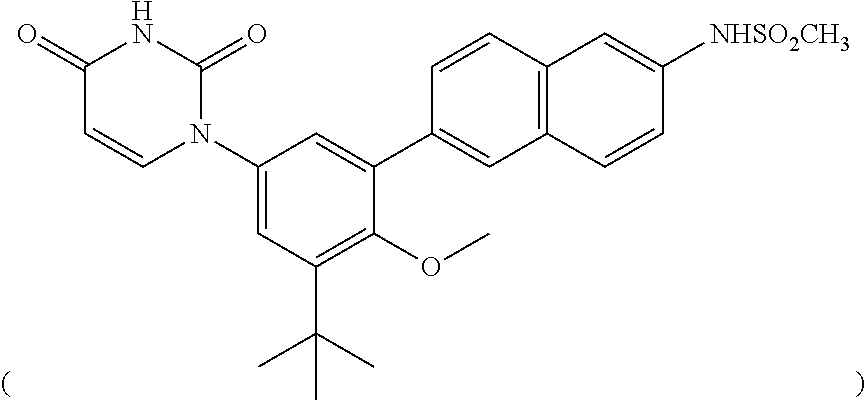
- is known as N-(6-(3-tert-butyl-5-(2,4-dioxo-3,4-dihydropyrimidin-1(2H)-yl)-2-methoxyphenyOnaphthalen-2-yl)methanesulfonamide and is described in International Application Publication No. W02009/039127.
- Compound 4
-
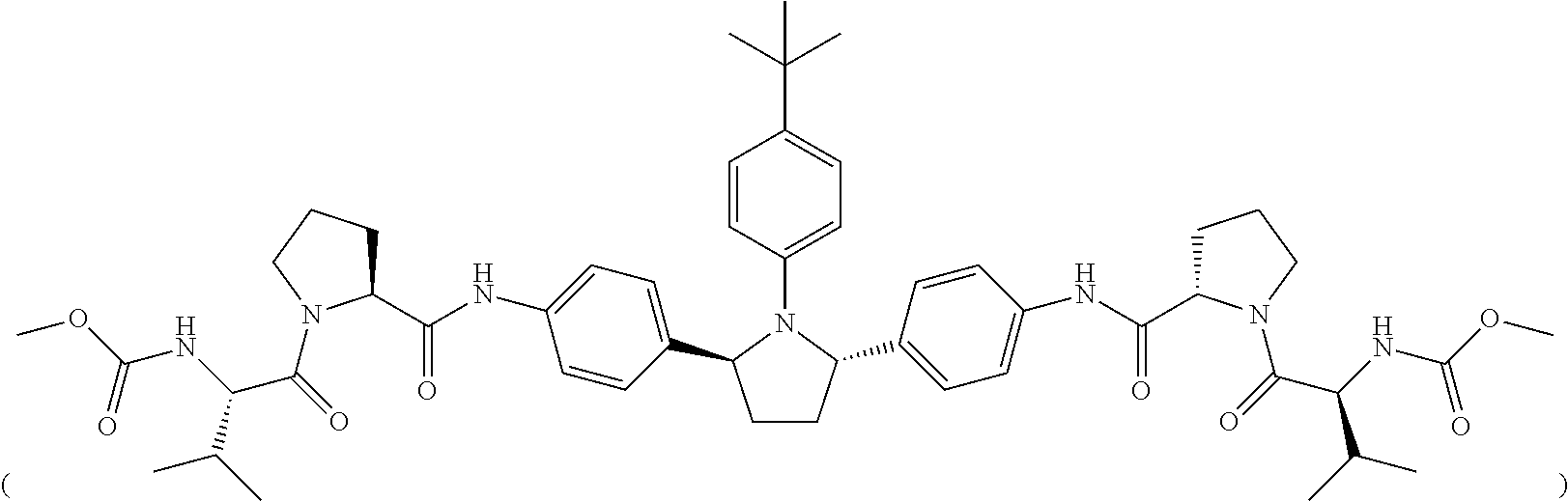
- is known as dimethyl (2S,2′S)-1,1′-((2S,2′S)-2,2′-(4,4′-((2S,5S)-1-(4-tert-butylphenyl)pyrrolidine-2,5,diyl)bis(4,1-phenylene))bis(azanediyl)bis(oxomethylene)bis(pyrrolidine-2,1-diyObis(3 -methyl-1-oxobutane-2,1-diyl)dicarbamate, and is described in U.S. Publication No. 2010/0317568.
- In any aspect, embodiment, example, preference or feature described herein, the DAA combination can be used with ribavirin (including a pro-drug thereof). Ribavirin may include any suitable form or formulation of ribavirin. Exemplary formulations of ribavirin include COPEGUS®, REBETOL® and RIBASPHERE®. An exemplary pro-drug of ribavirin is taribavirin having the chemical name of 1-β-D-ribofuranosyl-1,2,4-triazole-3-carboxamidine. Ribavirin and taribavirin may be administered in accordance with ribavirin and taribavirin administration well known in the art. In some embodiments, COPEGUS® or REBETOL® is administered in a daily dosage amount of from about 500 mg to about 1500 mg in one dose or in divided doses. In some embodiments, COPEGUS® or REBETOL® is administered in a daily dosage amount of about 800 mg. In some embodiments, REBETOL® is administered in a daily dosage amount of about 1000 mg. In some embodiments, COPEGUS® or REBETOL® is administered in a daily dosage amount of about 1200 mg. In some embodiments, REBETOL® is administered in a daily dosage amount of about 1400 mg. Suitable dosages of ribavirin are dependent on the weight of the subject, for example about 1000-1200 mg. Suitable total daily dosages of ribavirin include, but are not limited to about 400 mg to about 1400 mg a day, alternatively about 800 mg to about 1400 mg per day, alternatively about 400 mg to about 1200 mg, alternatively about 800 mg to about 1200 mg.
- In any aspect, embodiment, example, preference or feature described herein, the DAA combination can be administered to liver transplant recipients before, during, or after liver transplantation for the prevention or treatment of HCV infection.
- In any aspect, embodiment, example, preference or feature described herein, the HCV infection to be treated or prevented can be, for example, genotype 1 infection. The HCV infection can also be, for example, genotype 2 infection. The HCV infection can also be, for example, genotype 3 infection. The HCV infection can also be, for example, genotype 4 infection. The HCV infection can also be, for example, genotype 5 infection. The HCV infection can also be, for example, genotype 6 infection. The HCV infection can also be, for example, genotype la infection. The HCV infection can also be, for example, genotype 1b infection.
- Preferably, in any aspect, embodiment, example, preference or feature described herein, the DAA combination is administered to liver transplant recipients after liver transplantation.
- Preferably, in any aspect, embodiment, example, preference or feature described herein, the liver transplant recipient is infected with HCV genotype 1.
- In any aspect, embodiment, example, preference or feature described herein, the liver transplant recipient can be cirrhotic or non-cirrhotic.
- In any aspect, embodiment, example, preference or feature described herein, the liver transplant recipient can be, for example, either HCV-free or infected with HCV prior to the liver transplantation.
- In any aspect, embodiment, example, preference or feature described herein, the liver transplantation can, for example, be a transplantation of the whole liver organ or a portion thereof.
- Various measures may be used to express the effectiveness of the present methods of HCV treatment. One such measure is rapid virological response (RVR), meaning that HCV is undetectable in the subject after 4 weeks of treatment, for example, after 4 weeks of administration of two or more of DAAs and ribavirin. Another measure is the presence or absence of detectable virus at the end of therapy (EOT or EOTR). Another measure is (SVR), which, as used herein, means that the virus is undetectable at the end of therapy and for at least a number of weeks after the end of therapy (i.e., SVRx, where x is the number of weeks after the end of therapy).
- It should be understood that the above-described embodiments and the following examples are given by way of illustration, not limitation. Various changes and modifications within the scope of the present application will become apparent to those skilled in the art from the present description.
- In an ongoing open-label phase 2 study, non-cirrhotic liver transplant recipients with recurrent HCV genotype 1 (GT1) infection received co-formulated Compound 1/ritonavir/Compound 4 (150 mg/100 mg/25 mg QD), together with Compound 2 (250 mg BID) and ribavirin, for 24 weeks. The patients were >12 months post-liver transplant, had not received treatment for HCV infection after transplantation, and had a screening biopsy confirmed Metavir score<F2. Because of potential interaction between the calcineurin inhibitor(CNI) and the therapy, the CNI dose was adjusted accordingly.
- Thirty-four patients were enrolled in the study. Baseline characteristics/efficacy are in the table. Treatment-emergent adverse events were observed in 88.2% of patients and were generally mild with no severe events. One patient discontinued. Three patients received erythropoietin and none underwent transfusion. There were no episodes of rejection.
- The result in Table 1 showed that the interferon-free regimen of Compound 1/ritonavir/Compound 4 plus Compound 2 and ribavirin, was generally well-tolerated and achieved high RVR, EOTR, and SVR4 rates in liver transplant recipients with recurrent HCV GT1 infection. High SVR12 rate is expected.
- Further analysis showed that 96.8% of patients (30 out of the total 31 patients tested) achieved SVR4 and 95% (19 out of the total 20 patients tested) achieved SVR12.
-
TABLE 1 Baseline characteristics and efficacy. Patients N = 34 Time since transplantation - months, median (range) 39.5 (12.9-136.4) Male, n (%) 27 (79.4) Age - 3 yr, median (range) 60.0 (30.0-71.0) Race, n (%) Black race 4 (11.8) White race 29 (85.3) Hispanic or Latino ethnicity, n (%) 6 (17.6) BMI - kg/m2, median (range) 30.1 (19.3-36.9) HCV subtype, n (%) GT 1a 29 (85.3) GT1b 5 (14.7) Immunosuppressive medication, n (%) Tacrolimus 29 (85.3) Cyclosporine 5 (14.7) IL28B CC, n (%) 8 (23.5) Baseline HCV viral load - log10 IU/mL, median 6.7 (5.3-7.6) (range) RVR, n/N (%) 34/34 (100) EOTR, n/N (%) 13/13 (100) SVR4, n/N (%) 12/13 (92.3) Breakthrough, n 0 Relapse, n 1 - Example 1 showed the safety and efficacy of 3D+RBV (i.e., co-formulated Compound 1/ritonavir/Compound 4 (150 mg/100 mg/25 mg QD), together with Compound 2 (250mg BID) and ribavirin) in liver transplant (LT) recipients with GT1 HCV infection.
- The Example summarizes the management of concentrations of the immunosuppressants, tacrolimus (TAC) and cyclosporine (CSA) during the treatment. In healthy volunteers, the TAC and CSA concentrations, 24 hours after co-dosing with 3D, showed a 17- and 16-fold increase, respectively, necessitating dose adjustment.
- Patients (n=34) on stable TAC or CSA therapy, at least 12 months post-LT, fibrosis stage <F2, received 3D +RBV for 24 weeks. When co-dosed with 3D, it was recommended that the prestudy total CSA daily dose be reduced to one-fifth and given QD. For TAC, a dose of 0.5 mg/7 days or 0.2 mg/3 days was recommended. Subsequent dose and dosing frequency modifications in TAC were made based on the individual TAC levels. Observed CSA trough concentrations (Ctrough) were summarized for CSA recipients (n=5) while TAC data (n=29) were interrogated further to profile on-study TAC Ctroughs. A nonlinear mixed effects model was used to characterize TAC concentration-time profiles using NONMEM software. A one compartment pharmacokinetic (PK) model with first order oral absorption and between subject variability on apparent clearance was used to describe the TAC data. The model estimated TAC PK parameters were used to predict TAC concentration-time profiles in order to evaluate TAC dosing strategies when co-dosed with 3D.
- Blood concentrations of TAC (median: 4.6 ng/ml (interquartile range (IQR): 3.3-6.6 ng/ml, dose: 0.2-1 mg)) and CSA (median: 111 ng/ml (IQR: 92-138 ng/ml, dose: 25-75 mg)) were maintained when co-dosed with 3D. The median dosing interval was 10 days for TAC, and 1 day for CsA. Simulations demonstrated that subjects with a stable prestudy TAC Ctrough of 6 ng/mL, while receiving the 3D with TAC 0.5 mg every 7 days or 14 days, would have TAC Ctrough in the range of 6-9 ng/ml and 2-4 ng/ml, respectively. For LT recipients with GT1 HCV infection receiving 3D, the recommended CSA or TAC dose modifications yielded concentrations within the therapeutic range.
- The present application also features the following:
Claims (9)
1. A method of treatment for preventing or treating HCV infection in a liver transplant recipient, comprising administering a combination of DAAs to said recipient, wherein said treatment does not comprise the use of interferon, and said treatment last from 4 to 24 weeks.
2. The method of claim 1 , wherein said combination of DAAs comprises Compound 1, ritonavir, and Compound 4.
3. The method of claim 1 , wherein said combination of DAAs comprises Compound 1, ritonavir, Compound 4 and Compound 2.
4. The method of claim 3 , wherein the treatment lasts for 12 week.
5. The method of claim 3 , wherein the treatment lasts for 24 week.
6. The method of claim 3 , wherein the treatment comprises administering ribavirin to said recipient.
7. The method of claim 3 , wherein the combination of DAAs is administered to said recipient after liver transplantation on said recipient.
8. The method of claim 3 , wherein the recipient is HCV-free prior to receiving said liver transplant.
9. The method of claim 3 , wherein the recipient is infected with HCV prior to receiving said liver transplant.
Priority Applications (1)
| Application Number | Priority Date | Filing Date | Title |
|---|---|---|---|
| US14/574,654 US20150174194A1 (en) | 2013-12-19 | 2014-12-18 | Methods for treating liver transplant recipients |
Applications Claiming Priority (4)
| Application Number | Priority Date | Filing Date | Title |
|---|---|---|---|
| US201361918264P | 2013-12-19 | 2013-12-19 | |
| US201461972866P | 2014-03-31 | 2014-03-31 | |
| US201462008784P | 2014-06-06 | 2014-06-06 | |
| US14/574,654 US20150174194A1 (en) | 2013-12-19 | 2014-12-18 | Methods for treating liver transplant recipients |
Publications (1)
| Publication Number | Publication Date |
|---|---|
| US20150174194A1 true US20150174194A1 (en) | 2015-06-25 |
Family
ID=52302391
Family Applications (1)
| Application Number | Title | Priority Date | Filing Date |
|---|---|---|---|
| US14/574,654 Abandoned US20150174194A1 (en) | 2013-12-19 | 2014-12-18 | Methods for treating liver transplant recipients |
Country Status (3)
| Country | Link |
|---|---|
| US (1) | US20150174194A1 (en) |
| EP (1) | EP3082808A1 (en) |
| WO (1) | WO2015095572A1 (en) |
Cited By (1)
| Publication number | Priority date | Publication date | Assignee | Title |
|---|---|---|---|---|
| WO2017189978A1 (en) | 2016-04-28 | 2017-11-02 | Emory University | Alkyne containing nucleotide and nucleoside therapeutic compositions and uses related thereto |
Families Citing this family (1)
| Publication number | Priority date | Publication date | Assignee | Title |
|---|---|---|---|---|
| FR3087448B1 (en) | 2018-10-23 | 2023-10-13 | Pdc Line Pharma | PDC LINE MODIFIED TO SECRET A CYTOKINE |
Citations (12)
| Publication number | Priority date | Publication date | Assignee | Title |
|---|---|---|---|---|
| US20130072528A1 (en) * | 2011-09-16 | 2013-03-21 | Abbvie Inc. | Methods for Treating HCV |
| US20130102558A1 (en) * | 2011-10-21 | 2013-04-25 | Abbvie Inc. | Methods for Treating HCV |
| US20130102525A1 (en) * | 2011-10-21 | 2013-04-25 | Abbvie Inc. | Methods for Treating HCV |
| US20130102526A1 (en) * | 2011-10-21 | 2013-04-25 | Abbvie Inc. | Methods for Treating HCV |
| US20130102557A1 (en) * | 2011-10-21 | 2013-04-25 | Abbvie Inc. | Methods for Treating HCV |
| US20140024613A1 (en) * | 2012-06-27 | 2014-01-23 | Abbvie Inc. | Methods for Treating HCV |
| US20140274934A1 (en) * | 2013-03-14 | 2014-09-18 | Abbvie Inc. | Methods for treating hcv |
| US20140275099A1 (en) * | 2013-03-14 | 2014-09-18 | Abbvie Inc. | Methods for treating hcv |
| US20140357595A1 (en) * | 2013-06-04 | 2014-12-04 | Gilead Pharmasset Llc | Methods of preventing and treating recurrence of a hepatitis c virus infection in a subject after the subject has received a liver transplant |
| US20150011481A1 (en) * | 2013-07-02 | 2015-01-08 | Abbvie Inc. | Methods for Treating HCV |
| US9044480B1 (en) * | 2011-03-03 | 2015-06-02 | Abbvie Inc. | Compositions and methods for treating HCV |
| US20150150897A1 (en) * | 2013-12-02 | 2015-06-04 | Gilead Pharmasset Llc | Methods of treating hepatitis c virus infection in subjects with cirrhosis |
-
2014
- 2014-12-18 US US14/574,654 patent/US20150174194A1/en not_active Abandoned
- 2014-12-18 WO PCT/US2014/071239 patent/WO2015095572A1/en not_active Ceased
- 2014-12-18 EP EP14825050.9A patent/EP3082808A1/en not_active Withdrawn
Patent Citations (15)
| Publication number | Priority date | Publication date | Assignee | Title |
|---|---|---|---|---|
| US9044480B1 (en) * | 2011-03-03 | 2015-06-02 | Abbvie Inc. | Compositions and methods for treating HCV |
| US20130072528A1 (en) * | 2011-09-16 | 2013-03-21 | Abbvie Inc. | Methods for Treating HCV |
| US8853176B2 (en) * | 2011-10-21 | 2014-10-07 | Abbvie Inc. | Methods for treating HCV |
| US20130102558A1 (en) * | 2011-10-21 | 2013-04-25 | Abbvie Inc. | Methods for Treating HCV |
| US20130102525A1 (en) * | 2011-10-21 | 2013-04-25 | Abbvie Inc. | Methods for Treating HCV |
| US20130102526A1 (en) * | 2011-10-21 | 2013-04-25 | Abbvie Inc. | Methods for Treating HCV |
| US20130102557A1 (en) * | 2011-10-21 | 2013-04-25 | Abbvie Inc. | Methods for Treating HCV |
| US8492386B2 (en) * | 2011-10-21 | 2013-07-23 | Abbvie Inc. | Methods for treating HCV |
| US8809265B2 (en) * | 2011-10-21 | 2014-08-19 | Abbvie Inc. | Methods for treating HCV |
| US20140024613A1 (en) * | 2012-06-27 | 2014-01-23 | Abbvie Inc. | Methods for Treating HCV |
| US20140275099A1 (en) * | 2013-03-14 | 2014-09-18 | Abbvie Inc. | Methods for treating hcv |
| US20140274934A1 (en) * | 2013-03-14 | 2014-09-18 | Abbvie Inc. | Methods for treating hcv |
| US20140357595A1 (en) * | 2013-06-04 | 2014-12-04 | Gilead Pharmasset Llc | Methods of preventing and treating recurrence of a hepatitis c virus infection in a subject after the subject has received a liver transplant |
| US20150011481A1 (en) * | 2013-07-02 | 2015-01-08 | Abbvie Inc. | Methods for Treating HCV |
| US20150150897A1 (en) * | 2013-12-02 | 2015-06-04 | Gilead Pharmasset Llc | Methods of treating hepatitis c virus infection in subjects with cirrhosis |
Non-Patent Citations (2)
| Title |
|---|
| Abbott Press Release "Abbott Presents Promising Phase 2b Interferon-free Hepatitis C Results at 2012 Liver Meeting" Published 10 November 2012. * |
| AbbVie "A Study to Evaluate Chronic Hepatitis C Infection in Adult Transplant Recipients (CORAL-I)" ClincialTrials.gov Identifier: NCT01782495. Published 22 January 2013. * |
Cited By (2)
| Publication number | Priority date | Publication date | Assignee | Title |
|---|---|---|---|---|
| WO2017189978A1 (en) | 2016-04-28 | 2017-11-02 | Emory University | Alkyne containing nucleotide and nucleoside therapeutic compositions and uses related thereto |
| US11192914B2 (en) | 2016-04-28 | 2021-12-07 | Emory University | Alkyne containing nucleotide and nucleoside therapeutic compositions and uses related thereto |
Also Published As
| Publication number | Publication date |
|---|---|
| EP3082808A1 (en) | 2016-10-26 |
| WO2015095572A1 (en) | 2015-06-25 |
Similar Documents
| Publication | Publication Date | Title |
|---|---|---|
| US9060971B2 (en) | Combination pharmaceutical agents as inhibitors of HCV replication | |
| KR101755058B1 (en) | Combinations of a specific hcv ns5a inhibitor and an hcv ns3 protease inhibitor | |
| US20110020272A1 (en) | Combination therapy for treating hepatitis viral infection | |
| CN104023726A (en) | Combination therapy with one or more DAAs used to treat HCV (eg, with ABT-072 or ABT-333) | |
| KR20140002611A (en) | Combinations of hepatitis c virus inhibitors | |
| US20050112093A1 (en) | Combination therapy for HCV infection | |
| CA2908313A1 (en) | Hepatitis c viral infection treatment using a combination of compounds | |
| KR20110116136A (en) | Cyclosporine Derivatives for Use in the Treatment of HCV and HIV Infections | |
| Poordad et al. | Emerging therapeutic options in hepatitis C virus infection | |
| US20150174194A1 (en) | Methods for treating liver transplant recipients | |
| JP2016153402A (en) | New treatments of hepatitis c virus infection | |
| US20170360783A1 (en) | Methods for Treating HCV | |
| US20170312297A1 (en) | Long Acting Pharmaceutical Compositions For Hepatitis C | |
| JP6110791B2 (en) | New treatment of hepatitis C virus infection | |
| US20170333428A1 (en) | Methods for Treating HCV | |
| US20140018289A1 (en) | New treatments of Hepatitis C virus infection | |
| US20240082245A1 (en) | Methods for Treating HCV | |
| US20180177778A1 (en) | Methods for Treating HCV | |
| Reviriego | Daclatasvir dihydrochloride | |
| US10201541B1 (en) | Compositions and methods for treating HCV | |
| US20200330460A1 (en) | Methods for Treating HCV | |
| Weisberg et al. | New treatments for hepatitis C: Life cycle lessons | |
| JP2017514834A (en) | Combination therapy for treating HCV infection | |
| Sodhi et al. | New Horizons and Perspectives in the Management of Chronic Hepatitis C | |
| US20200222397A1 (en) | Methods for Treating HCV |
Legal Events
| Date | Code | Title | Description |
|---|---|---|---|
| AS | Assignment |
Owner name: ABBVIE INC., ILLINOIS Free format text: ASSIGNMENT OF ASSIGNORS INTEREST;ASSIGNORS:BERNSTEIN, BARRY M.;COAKLEY, EOIN;VILCHEZ, REGIS A.;SIGNING DATES FROM 20150127 TO 20150128;REEL/FRAME:034828/0855 |
|
| STCB | Information on status: application discontinuation |
Free format text: ABANDONED -- FAILURE TO RESPOND TO AN OFFICE ACTION |