US20150034119A1 - Hair Color Smoothing Compositions and Methods - Google Patents
Hair Color Smoothing Compositions and Methods Download PDFInfo
- Publication number
- US20150034119A1 US20150034119A1 US14/257,089 US201414257089A US2015034119A1 US 20150034119 A1 US20150034119 A1 US 20150034119A1 US 201414257089 A US201414257089 A US 201414257089A US 2015034119 A1 US2015034119 A1 US 2015034119A1
- Authority
- US
- United States
- Prior art keywords
- group
- hair
- formulation
- crosslinking agent
- agents
- Prior art date
- Legal status (The legal status is an assumption and is not a legal conclusion. Google has not performed a legal analysis and makes no representation as to the accuracy of the status listed.)
- Abandoned
Links
- 239000000203 mixture Substances 0.000 title claims abstract description 219
- 238000000034 method Methods 0.000 title claims abstract description 51
- 230000037308 hair color Effects 0.000 title claims abstract description 37
- 238000009499 grossing Methods 0.000 title 1
- 210000004209 hair Anatomy 0.000 claims abstract description 160
- 125000003396 thiol group Chemical group [H]S* 0.000 claims abstract description 29
- 238000009472 formulation Methods 0.000 claims description 173
- 239000003431 cross linking reagent Substances 0.000 claims description 98
- -1 succinimidyl Chemical group 0.000 claims description 84
- 125000000217 alkyl group Chemical group 0.000 claims description 43
- 229920000642 polymer Polymers 0.000 claims description 42
- 239000003795 chemical substances by application Substances 0.000 claims description 32
- 125000003118 aryl group Chemical group 0.000 claims description 30
- 239000002453 shampoo Substances 0.000 claims description 29
- 238000004040 coloring Methods 0.000 claims description 25
- 125000001072 heteroaryl group Chemical group 0.000 claims description 25
- XLYOFNOQVPJJNP-UHFFFAOYSA-N water Substances O XLYOFNOQVPJJNP-UHFFFAOYSA-N 0.000 claims description 22
- 125000003545 alkoxy group Chemical group 0.000 claims description 18
- 125000001424 substituent group Chemical group 0.000 claims description 17
- RTZKZFJDLAIYFH-UHFFFAOYSA-N Diethyl ether Chemical compound CCOCC RTZKZFJDLAIYFH-UHFFFAOYSA-N 0.000 claims description 16
- 125000003342 alkenyl group Chemical group 0.000 claims description 16
- 229910052736 halogen Inorganic materials 0.000 claims description 16
- 150000002367 halogens Chemical class 0.000 claims description 16
- 239000003755 preservative agent Substances 0.000 claims description 16
- 239000004094 surface-active agent Substances 0.000 claims description 16
- 230000003750 conditioning effect Effects 0.000 claims description 14
- 239000006071 cream Substances 0.000 claims description 14
- 125000000753 cycloalkyl group Chemical group 0.000 claims description 14
- 239000000546 pharmaceutical excipient Substances 0.000 claims description 14
- 239000007788 liquid Substances 0.000 claims description 13
- 239000003380 propellant Substances 0.000 claims description 13
- IJGRMHOSHXDMSA-UHFFFAOYSA-N Atomic nitrogen Chemical compound N#N IJGRMHOSHXDMSA-UHFFFAOYSA-N 0.000 claims description 12
- 125000002887 hydroxy group Chemical group [H]O* 0.000 claims description 12
- 125000003178 carboxy group Chemical group [H]OC(*)=O 0.000 claims description 11
- 125000000304 alkynyl group Chemical group 0.000 claims description 10
- 150000001412 amines Chemical class 0.000 claims description 10
- 239000003638 chemical reducing agent Substances 0.000 claims description 10
- 239000003086 colorant Substances 0.000 claims description 10
- 239000003974 emollient agent Substances 0.000 claims description 10
- 239000003205 fragrance Substances 0.000 claims description 10
- 125000000592 heterocycloalkyl group Chemical group 0.000 claims description 10
- 229910052760 oxygen Inorganic materials 0.000 claims description 10
- 125000000392 cycloalkenyl group Chemical group 0.000 claims description 9
- 229910052739 hydrogen Inorganic materials 0.000 claims description 9
- 239000003995 emulsifying agent Substances 0.000 claims description 8
- 125000004185 ester group Chemical group 0.000 claims description 8
- 239000000126 substance Substances 0.000 claims description 8
- 229910052717 sulfur Inorganic materials 0.000 claims description 8
- 125000003903 2-propenyl group Chemical group [H]C([*])([H])C([H])=C([H])[H] 0.000 claims description 7
- QVGXLLKOCUKJST-UHFFFAOYSA-N atomic oxygen Chemical group [O] QVGXLLKOCUKJST-UHFFFAOYSA-N 0.000 claims description 7
- 239000001257 hydrogen Substances 0.000 claims description 7
- YQCIWBXEVYWRCW-UHFFFAOYSA-N methane;sulfane Chemical compound C.S YQCIWBXEVYWRCW-UHFFFAOYSA-N 0.000 claims description 7
- 239000001301 oxygen Substances 0.000 claims description 7
- 125000000472 sulfonyl group Chemical group *S(*)(=O)=O 0.000 claims description 7
- ATVJXMYDOSMEPO-UHFFFAOYSA-N 3-prop-2-enoxyprop-1-ene Chemical group C=CCOCC=C ATVJXMYDOSMEPO-UHFFFAOYSA-N 0.000 claims description 6
- OKTJSMMVPCPJKN-UHFFFAOYSA-N Carbon Chemical compound [C] OKTJSMMVPCPJKN-UHFFFAOYSA-N 0.000 claims description 6
- VZCYOOQTPOCHFL-OWOJBTEDSA-N Fumaric acid Chemical group OC(=O)\C=C\C(O)=O VZCYOOQTPOCHFL-OWOJBTEDSA-N 0.000 claims description 6
- NINIDFKCEFEMDL-UHFFFAOYSA-N Sulfur Chemical compound [S] NINIDFKCEFEMDL-UHFFFAOYSA-N 0.000 claims description 6
- NIXOWILDQLNWCW-UHFFFAOYSA-M acrylate group Chemical group C(C=C)(=O)[O-] NIXOWILDQLNWCW-UHFFFAOYSA-M 0.000 claims description 6
- 150000001413 amino acids Chemical class 0.000 claims description 6
- AFOSIXZFDONLBT-UHFFFAOYSA-N divinyl sulfone Chemical compound C=CS(=O)(=O)C=C AFOSIXZFDONLBT-UHFFFAOYSA-N 0.000 claims description 6
- 229910052757 nitrogen Inorganic materials 0.000 claims description 6
- 239000011593 sulfur Substances 0.000 claims description 6
- VZFBQGDTDXXFAI-UHFFFAOYSA-N C=CS(=N)=O Chemical compound C=CS(=N)=O VZFBQGDTDXXFAI-UHFFFAOYSA-N 0.000 claims description 5
- 239000003963 antioxidant agent Substances 0.000 claims description 5
- 229910052799 carbon Inorganic materials 0.000 claims description 5
- 150000007942 carboxylates Chemical class 0.000 claims description 5
- 150000001732 carboxylic acid derivatives Chemical class 0.000 claims description 5
- 125000004093 cyano group Chemical group *C#N 0.000 claims description 5
- VZCYOOQTPOCHFL-UPHRSURJSA-N maleic acid Chemical group OC(=O)\C=C/C(O)=O VZCYOOQTPOCHFL-UPHRSURJSA-N 0.000 claims description 5
- HRPVXLWXLXDGHG-UHFFFAOYSA-N Acrylamide Chemical group NC(=O)C=C HRPVXLWXLXDGHG-UHFFFAOYSA-N 0.000 claims description 4
- QYKIQEUNHZKYBP-UHFFFAOYSA-N Vinyl ether Chemical group C=COC=C QYKIQEUNHZKYBP-UHFFFAOYSA-N 0.000 claims description 4
- 125000004104 aryloxy group Chemical group 0.000 claims description 4
- 239000000499 gel Substances 0.000 claims description 4
- LVHBHZANLOWSRM-UHFFFAOYSA-N itaconic acid Chemical group OC(=O)CC(=C)C(O)=O LVHBHZANLOWSRM-UHFFFAOYSA-N 0.000 claims description 4
- 239000006210 lotion Substances 0.000 claims description 4
- FQPSGWSUVKBHSU-UHFFFAOYSA-N methacrylamide Chemical group CC(=C)C(N)=O FQPSGWSUVKBHSU-UHFFFAOYSA-N 0.000 claims description 4
- CERQOIWHTDAKMF-UHFFFAOYSA-M methacrylate group Chemical group C(C(=C)C)(=O)[O-] CERQOIWHTDAKMF-UHFFFAOYSA-M 0.000 claims description 4
- 125000003011 styrenyl group Chemical group [H]\C(*)=C(/[H])C1=C([H])C([H])=C([H])C([H])=C1[H] 0.000 claims description 4
- 239000002562 thickening agent Substances 0.000 claims description 4
- 125000004385 trihaloalkyl group Chemical group 0.000 claims description 4
- 229920001567 vinyl ester resin Chemical group 0.000 claims description 4
- IEJPPSMHUUQABK-UHFFFAOYSA-N 2,4-diphenyl-4h-1,3-oxazol-5-one Chemical compound O=C1OC(C=2C=CC=CC=2)=NC1C1=CC=CC=C1 IEJPPSMHUUQABK-UHFFFAOYSA-N 0.000 claims description 3
- HQQTZCPKNZVLFF-UHFFFAOYSA-N 4h-1,2-benzoxazin-3-one Chemical class C1=CC=C2ONC(=O)CC2=C1 HQQTZCPKNZVLFF-UHFFFAOYSA-N 0.000 claims description 3
- 125000002252 acyl group Chemical group 0.000 claims description 3
- 125000004453 alkoxycarbonyl group Chemical group 0.000 claims description 3
- 239000002216 antistatic agent Substances 0.000 claims description 3
- 239000000284 extract Substances 0.000 claims description 3
- 239000003906 humectant Substances 0.000 claims description 3
- 239000012948 isocyanate Substances 0.000 claims description 3
- 150000002513 isocyanates Chemical class 0.000 claims description 3
- 230000003472 neutralizing effect Effects 0.000 claims description 3
- 108090000623 proteins and genes Proteins 0.000 claims description 3
- 102000004169 proteins and genes Human genes 0.000 claims description 3
- 150000003839 salts Chemical class 0.000 claims description 3
- 239000011782 vitamin Substances 0.000 claims description 3
- 235000013343 vitamin Nutrition 0.000 claims description 3
- 229930003231 vitamin Natural products 0.000 claims description 3
- 229940088594 vitamin Drugs 0.000 claims description 3
- ZOXJGFHDIHLPTG-UHFFFAOYSA-N Boron Chemical compound [B] ZOXJGFHDIHLPTG-UHFFFAOYSA-N 0.000 claims description 2
- 208000001840 Dandruff Diseases 0.000 claims description 2
- 125000004457 alkyl amino carbonyl group Chemical group 0.000 claims description 2
- 125000003282 alkyl amino group Chemical group 0.000 claims description 2
- 229910052796 boron Inorganic materials 0.000 claims description 2
- 239000000872 buffer Substances 0.000 claims description 2
- 125000003917 carbamoyl group Chemical group [H]N([H])C(*)=O 0.000 claims description 2
- 239000000969 carrier Substances 0.000 claims description 2
- 239000002738 chelating agent Substances 0.000 claims description 2
- 125000004663 dialkyl amino group Chemical group 0.000 claims description 2
- 125000004473 dialkylaminocarbonyl group Chemical group 0.000 claims description 2
- 239000000834 fixative Substances 0.000 claims description 2
- 125000001188 haloalkyl group Chemical group 0.000 claims description 2
- 125000002768 hydroxyalkyl group Chemical group 0.000 claims description 2
- 239000003002 pH adjusting agent Substances 0.000 claims description 2
- 239000002304 perfume Substances 0.000 claims description 2
- 229940124531 pharmaceutical excipient Drugs 0.000 claims description 2
- 150000003140 primary amides Chemical class 0.000 claims description 2
- 150000003334 secondary amides Chemical class 0.000 claims description 2
- 125000000475 sulfinyl group Chemical group [*:2]S([*:1])=O 0.000 claims description 2
- 239000003981 vehicle Substances 0.000 claims description 2
- 239000004034 viscosity adjusting agent Substances 0.000 claims description 2
- 150000002118 epoxides Chemical class 0.000 claims 2
- 150000002431 hydrogen Chemical class 0.000 claims 2
- 238000004132 cross linking Methods 0.000 abstract description 48
- 238000011282 treatment Methods 0.000 abstract description 29
- 150000001875 compounds Chemical class 0.000 abstract description 22
- 238000005406 washing Methods 0.000 abstract description 6
- 230000007062 hydrolysis Effects 0.000 abstract description 2
- 238000006460 hydrolysis reaction Methods 0.000 abstract description 2
- 230000009467 reduction Effects 0.000 abstract description 2
- 150000003573 thiols Chemical class 0.000 description 26
- QGZKDVFQNNGYKY-UHFFFAOYSA-O Ammonium Chemical compound [NH4+] QGZKDVFQNNGYKY-UHFFFAOYSA-O 0.000 description 22
- 125000005647 linker group Chemical group 0.000 description 22
- 239000000370 acceptor Substances 0.000 description 19
- PEDCQBHIVMGVHV-UHFFFAOYSA-N Glycerine Chemical compound OCC(O)CO PEDCQBHIVMGVHV-UHFFFAOYSA-N 0.000 description 18
- 239000000975 dye Substances 0.000 description 16
- QAOWNCQODCNURD-UHFFFAOYSA-L Sulfate Chemical group [O-]S([O-])(=O)=O QAOWNCQODCNURD-UHFFFAOYSA-L 0.000 description 14
- 231100000640 hair analysis Toxicity 0.000 description 14
- 125000000623 heterocyclic group Chemical group 0.000 description 14
- 239000000178 monomer Substances 0.000 description 13
- MHAJPDPJQMAIIY-UHFFFAOYSA-N Hydrogen peroxide Chemical compound OO MHAJPDPJQMAIIY-UHFFFAOYSA-N 0.000 description 10
- 238000006243 chemical reaction Methods 0.000 description 10
- 125000005842 heteroatom Chemical group 0.000 description 10
- 239000007921 spray Substances 0.000 description 10
- FERLGYOHRKHQJP-UHFFFAOYSA-N 1-[2-[2-[2-(2,5-dioxopyrrol-1-yl)ethoxy]ethoxy]ethyl]pyrrole-2,5-dione Chemical compound O=C1C=CC(=O)N1CCOCCOCCN1C(=O)C=CC1=O FERLGYOHRKHQJP-UHFFFAOYSA-N 0.000 description 9
- 125000004429 atom Chemical group 0.000 description 9
- 239000002243 precursor Substances 0.000 description 9
- 230000002335 preservative effect Effects 0.000 description 9
- 150000001204 N-oxides Chemical class 0.000 description 8
- 125000004432 carbon atom Chemical group C* 0.000 description 8
- 150000002148 esters Chemical group 0.000 description 8
- KWIUHFFTVRNATP-UHFFFAOYSA-N glycine betaine Chemical compound C[N+](C)(C)CC([O-])=O KWIUHFFTVRNATP-UHFFFAOYSA-N 0.000 description 8
- 230000000887 hydrating effect Effects 0.000 description 8
- 230000008569 process Effects 0.000 description 8
- 0 CC(CC1)C(CCC2)[C@]1C2=** Chemical compound CC(CC1)C(CCC2)[C@]1C2=** 0.000 description 7
- 241000282414 Homo sapiens Species 0.000 description 7
- 239000002202 Polyethylene glycol Substances 0.000 description 7
- 125000003368 amide group Chemical group 0.000 description 7
- 125000002091 cationic group Chemical group 0.000 description 7
- 229920001577 copolymer Polymers 0.000 description 7
- 235000011187 glycerol Nutrition 0.000 description 7
- 239000000463 material Substances 0.000 description 7
- 229920001223 polyethylene glycol Polymers 0.000 description 7
- CIWBSHSKHKDKBQ-JLAZNSOCSA-N Ascorbic acid Chemical compound OC[C@H](O)[C@H]1OC(=O)C(O)=C1O CIWBSHSKHKDKBQ-JLAZNSOCSA-N 0.000 description 6
- KAKZBPTYRLMSJV-UHFFFAOYSA-N Butadiene Chemical compound C=CC=C KAKZBPTYRLMSJV-UHFFFAOYSA-N 0.000 description 6
- ZJCCRDAZUWHFQH-UHFFFAOYSA-N Trimethylolpropane Chemical class CCC(CO)(CO)CO ZJCCRDAZUWHFQH-UHFFFAOYSA-N 0.000 description 6
- 125000004414 alkyl thio group Chemical group 0.000 description 6
- 125000002915 carbonyl group Chemical group [*:2]C([*:1])=O 0.000 description 6
- KRKNYBCHXYNGOX-UHFFFAOYSA-N citric acid Chemical compound OC(=O)CC(O)(C(O)=O)CC(O)=O KRKNYBCHXYNGOX-UHFFFAOYSA-N 0.000 description 6
- 229940008099 dimethicone Drugs 0.000 description 6
- 239000004205 dimethyl polysiloxane Substances 0.000 description 6
- 235000013870 dimethyl polysiloxane Nutrition 0.000 description 6
- 210000004919 hair shaft Anatomy 0.000 description 6
- 239000004615 ingredient Substances 0.000 description 6
- 150000002978 peroxides Chemical class 0.000 description 6
- 125000001997 phenyl group Chemical group [H]C1=C([H])C([H])=C(*)C([H])=C1[H] 0.000 description 6
- 229920000435 poly(dimethylsiloxane) Polymers 0.000 description 6
- 239000000047 product Substances 0.000 description 6
- 150000003254 radicals Chemical class 0.000 description 6
- 210000003491 skin Anatomy 0.000 description 6
- XMSXQFUHVRWGNA-UHFFFAOYSA-N Decamethylcyclopentasiloxane Chemical compound C[Si]1(C)O[Si](C)(C)O[Si](C)(C)O[Si](C)(C)O[Si](C)(C)O1 XMSXQFUHVRWGNA-UHFFFAOYSA-N 0.000 description 5
- 229910052783 alkali metal Inorganic materials 0.000 description 5
- 235000001014 amino acid Nutrition 0.000 description 5
- 239000007844 bleaching agent Substances 0.000 description 5
- 125000004122 cyclic group Chemical group 0.000 description 5
- 239000012039 electrophile Substances 0.000 description 5
- 125000000524 functional group Chemical group 0.000 description 5
- 150000002314 glycerols Chemical class 0.000 description 5
- 239000003999 initiator Substances 0.000 description 5
- 239000000543 intermediate Substances 0.000 description 5
- LFGREXWGYUGZLY-UHFFFAOYSA-N phosphoryl Chemical group [P]=O LFGREXWGYUGZLY-UHFFFAOYSA-N 0.000 description 5
- 229920001296 polysiloxane Polymers 0.000 description 5
- 108090000765 processed proteins & peptides Chemical group 0.000 description 5
- 230000008439 repair process Effects 0.000 description 5
- LEJBBGNFPAFPKQ-UHFFFAOYSA-N 2-(2-prop-2-enoyloxyethoxy)ethyl prop-2-enoate Chemical compound C=CC(=O)OCCOCCOC(=O)C=C LEJBBGNFPAFPKQ-UHFFFAOYSA-N 0.000 description 4
- QGZKDVFQNNGYKY-UHFFFAOYSA-N Ammonia Chemical compound N QGZKDVFQNNGYKY-UHFFFAOYSA-N 0.000 description 4
- 244000144725 Amygdalus communis Species 0.000 description 4
- 235000011437 Amygdalus communis Nutrition 0.000 description 4
- LYCAIKOWRPUZTN-UHFFFAOYSA-N Ethylene glycol Chemical compound OCCO LYCAIKOWRPUZTN-UHFFFAOYSA-N 0.000 description 4
- ATUOYWHBWRKTHZ-UHFFFAOYSA-N Propane Chemical compound CCC ATUOYWHBWRKTHZ-UHFFFAOYSA-N 0.000 description 4
- DAKWPKUUDNSNPN-UHFFFAOYSA-N Trimethylolpropane triacrylate Chemical compound C=CC(=O)OCC(CC)(COC(=O)C=C)COC(=O)C=C DAKWPKUUDNSNPN-UHFFFAOYSA-N 0.000 description 4
- XSQUKJJJFZCRTK-UHFFFAOYSA-N Urea Chemical compound NC(N)=O XSQUKJJJFZCRTK-UHFFFAOYSA-N 0.000 description 4
- 229910052782 aluminium Inorganic materials 0.000 description 4
- XAGFODPZIPBFFR-UHFFFAOYSA-N aluminium Chemical compound [Al] XAGFODPZIPBFFR-UHFFFAOYSA-N 0.000 description 4
- 150000001408 amides Chemical class 0.000 description 4
- 235000006708 antioxidants Nutrition 0.000 description 4
- 125000005110 aryl thio group Chemical group 0.000 description 4
- 229960003237 betaine Drugs 0.000 description 4
- 239000002537 cosmetic Substances 0.000 description 4
- 238000009792 diffusion process Methods 0.000 description 4
- 239000003085 diluting agent Substances 0.000 description 4
- 239000000835 fiber Substances 0.000 description 4
- 239000011888 foil Substances 0.000 description 4
- 230000014759 maintenance of location Effects 0.000 description 4
- 239000003921 oil Substances 0.000 description 4
- 235000019198 oils Nutrition 0.000 description 4
- 230000003647 oxidation Effects 0.000 description 4
- 238000007254 oxidation reaction Methods 0.000 description 4
- 230000001590 oxidative effect Effects 0.000 description 4
- 230000035515 penetration Effects 0.000 description 4
- 125000005499 phosphonyl group Chemical group 0.000 description 4
- 239000000843 powder Substances 0.000 description 4
- 125000004076 pyridyl group Chemical group 0.000 description 4
- 125000000714 pyrimidinyl group Chemical group 0.000 description 4
- 125000006413 ring segment Chemical group 0.000 description 4
- 238000006467 substitution reaction Methods 0.000 description 4
- 125000000999 tert-butyl group Chemical group [H]C([H])([H])C(*)(C([H])([H])[H])C([H])([H])[H] 0.000 description 4
- CWERGRDVMFNCDR-UHFFFAOYSA-N thioglycolic acid Chemical compound OC(=O)CS CWERGRDVMFNCDR-UHFFFAOYSA-N 0.000 description 4
- GVJHHUAWPYXKBD-UHFFFAOYSA-N (±)-α-Tocopherol Chemical compound OC1=C(C)C(C)=C2OC(CCCC(C)CCCC(C)CCCC(C)C)(C)CCC2=C1C GVJHHUAWPYXKBD-UHFFFAOYSA-N 0.000 description 3
- VBICKXHEKHSIBG-UHFFFAOYSA-N 1-monostearoylglycerol Chemical compound CCCCCCCCCCCCCCCCCC(=O)OCC(O)CO VBICKXHEKHSIBG-UHFFFAOYSA-N 0.000 description 3
- BXAAQNFGSQKPDZ-UHFFFAOYSA-N 3-[1,2,2-tris(prop-2-enoxy)ethoxy]prop-1-ene Chemical compound C=CCOC(OCC=C)C(OCC=C)OCC=C BXAAQNFGSQKPDZ-UHFFFAOYSA-N 0.000 description 3
- DBCAQXHNJOFNGC-UHFFFAOYSA-N 4-bromo-1,1,1-trifluorobutane Chemical compound FC(F)(F)CCCBr DBCAQXHNJOFNGC-UHFFFAOYSA-N 0.000 description 3
- UHOVQNZJYSORNB-UHFFFAOYSA-N Benzene Chemical compound C1=CC=CC=C1 UHOVQNZJYSORNB-UHFFFAOYSA-N 0.000 description 3
- CRSOQBOWXPBRES-UHFFFAOYSA-N CC(C)(C)C Chemical compound CC(C)(C)C CRSOQBOWXPBRES-UHFFFAOYSA-N 0.000 description 3
- LFQSCWFLJHTTHZ-UHFFFAOYSA-N Ethanol Chemical compound CCO LFQSCWFLJHTTHZ-UHFFFAOYSA-N 0.000 description 3
- VGGSQFUCUMXWEO-UHFFFAOYSA-N Ethene Chemical compound C=C VGGSQFUCUMXWEO-UHFFFAOYSA-N 0.000 description 3
- 239000005977 Ethylene Substances 0.000 description 3
- YLQBMQCUIZJEEH-UHFFFAOYSA-N Furan Chemical compound C=1C=COC=1 YLQBMQCUIZJEEH-UHFFFAOYSA-N 0.000 description 3
- DGAQECJNVWCQMB-PUAWFVPOSA-M Ilexoside XXIX Chemical compound C[C@@H]1CC[C@@]2(CC[C@@]3(C(=CC[C@H]4[C@]3(CC[C@@H]5[C@@]4(CC[C@@H](C5(C)C)OS(=O)(=O)[O-])C)C)[C@@H]2[C@]1(C)O)C)C(=O)O[C@H]6[C@@H]([C@H]([C@@H]([C@H](O6)CO)O)O)O.[Na+] DGAQECJNVWCQMB-PUAWFVPOSA-M 0.000 description 3
- KFZMGEQAYNKOFK-UHFFFAOYSA-N Isopropanol Chemical compound CC(C)O KFZMGEQAYNKOFK-UHFFFAOYSA-N 0.000 description 3
- 229910019142 PO4 Inorganic materials 0.000 description 3
- 229920003171 Poly (ethylene oxide) Polymers 0.000 description 3
- ZLMJMSJWJFRBEC-UHFFFAOYSA-N Potassium Chemical compound [K] ZLMJMSJWJFRBEC-UHFFFAOYSA-N 0.000 description 3
- DNIAPMSPPWPWGF-UHFFFAOYSA-N Propylene glycol Chemical compound CC(O)CO DNIAPMSPPWPWGF-UHFFFAOYSA-N 0.000 description 3
- 206010044625 Trichorrhexis Diseases 0.000 description 3
- 230000009471 action Effects 0.000 description 3
- 150000001299 aldehydes Chemical group 0.000 description 3
- 230000003113 alkalizing effect Effects 0.000 description 3
- 150000008051 alkyl sulfates Chemical class 0.000 description 3
- 235000020224 almond Nutrition 0.000 description 3
- 235000010323 ascorbic acid Nutrition 0.000 description 3
- 239000011668 ascorbic acid Substances 0.000 description 3
- 230000008901 benefit Effects 0.000 description 3
- 238000004061 bleaching Methods 0.000 description 3
- 125000002837 carbocyclic group Chemical group 0.000 description 3
- 230000001143 conditioned effect Effects 0.000 description 3
- 230000006378 damage Effects 0.000 description 3
- 239000003599 detergent Substances 0.000 description 3
- 238000004043 dyeing Methods 0.000 description 3
- 235000019441 ethanol Nutrition 0.000 description 3
- STVZJERGLQHEKB-UHFFFAOYSA-N ethylene glycol dimethacrylate Substances CC(=C)C(=O)OCCOC(=O)C(C)=C STVZJERGLQHEKB-UHFFFAOYSA-N 0.000 description 3
- 125000002541 furyl group Chemical group 0.000 description 3
- 239000008266 hair spray Substances 0.000 description 3
- 125000004435 hydrogen atom Chemical group [H]* 0.000 description 3
- RAXXELZNTBOGNW-UHFFFAOYSA-N imidazole Natural products C1=CNC=N1 RAXXELZNTBOGNW-UHFFFAOYSA-N 0.000 description 3
- 125000002883 imidazolyl group Chemical group 0.000 description 3
- 125000001041 indolyl group Chemical group 0.000 description 3
- NBIIXXVUZAFLBC-UHFFFAOYSA-K phosphate Chemical compound [O-]P([O-])([O-])=O NBIIXXVUZAFLBC-UHFFFAOYSA-K 0.000 description 3
- 239000010452 phosphate Substances 0.000 description 3
- ACVYVLVWPXVTIT-UHFFFAOYSA-M phosphinate Chemical group [O-][PH2]=O ACVYVLVWPXVTIT-UHFFFAOYSA-M 0.000 description 3
- 239000000419 plant extract Substances 0.000 description 3
- 229910052700 potassium Inorganic materials 0.000 description 3
- 239000011591 potassium Substances 0.000 description 3
- 125000003373 pyrazinyl group Chemical group 0.000 description 3
- 125000000168 pyrrolyl group Chemical group 0.000 description 3
- 229910052708 sodium Inorganic materials 0.000 description 3
- 239000011734 sodium Substances 0.000 description 3
- HRZFUMHJMZEROT-UHFFFAOYSA-L sodium disulfite Chemical compound [Na+].[Na+].[O-]S(=O)S([O-])(=O)=O HRZFUMHJMZEROT-UHFFFAOYSA-L 0.000 description 3
- 229940001584 sodium metabisulfite Drugs 0.000 description 3
- 235000010262 sodium metabisulphite Nutrition 0.000 description 3
- 239000000243 solution Substances 0.000 description 3
- 125000000547 substituted alkyl group Chemical group 0.000 description 3
- 229920001059 synthetic polymer Polymers 0.000 description 3
- 125000003831 tetrazolyl group Chemical group 0.000 description 3
- 125000000335 thiazolyl group Chemical group 0.000 description 3
- 125000001544 thienyl group Chemical group 0.000 description 3
- VPYJNCGUESNPMV-UHFFFAOYSA-N triallylamine Chemical compound C=CCN(CC=C)CC=C VPYJNCGUESNPMV-UHFFFAOYSA-N 0.000 description 3
- QXJQHYBHAIHNGG-UHFFFAOYSA-N trimethylolethane Chemical class OCC(C)(CO)CO QXJQHYBHAIHNGG-UHFFFAOYSA-N 0.000 description 3
- PUPZLCDOIYMWBV-UHFFFAOYSA-N (+/-)-1,3-Butanediol Chemical compound CC(O)CCO PUPZLCDOIYMWBV-UHFFFAOYSA-N 0.000 description 2
- ODIGIKRIUKFKHP-UHFFFAOYSA-N (n-propan-2-yloxycarbonylanilino) acetate Chemical compound CC(C)OC(=O)N(OC(C)=O)C1=CC=CC=C1 ODIGIKRIUKFKHP-UHFFFAOYSA-N 0.000 description 2
- HSOOIVBINKDISP-UHFFFAOYSA-N 1-(2-methylprop-2-enoyloxy)butyl 2-methylprop-2-enoate Chemical compound CC(=C)C(=O)OC(CCC)OC(=O)C(C)=C HSOOIVBINKDISP-UHFFFAOYSA-N 0.000 description 2
- XQUPVDVFXZDTLT-UHFFFAOYSA-N 1-[4-[[4-(2,5-dioxopyrrol-1-yl)phenyl]methyl]phenyl]pyrrole-2,5-dione Chemical compound O=C1C=CC(=O)N1C(C=C1)=CC=C1CC1=CC=C(N2C(C=CC2=O)=O)C=C1 XQUPVDVFXZDTLT-UHFFFAOYSA-N 0.000 description 2
- JHSWSKVODYPNDV-UHFFFAOYSA-N 2,2-bis(prop-2-enoxymethyl)propane-1,3-diol Chemical compound C=CCOCC(CO)(CO)COCC=C JHSWSKVODYPNDV-UHFFFAOYSA-N 0.000 description 2
- BWDHJINUKACSDS-UHFFFAOYSA-N 2,3-bis(prop-2-enoxy)propan-1-ol Chemical compound C=CCOC(CO)COCC=C BWDHJINUKACSDS-UHFFFAOYSA-N 0.000 description 2
- BJELTSYBAHKXRW-UHFFFAOYSA-N 2,4,6-triallyloxy-1,3,5-triazine Chemical compound C=CCOC1=NC(OCC=C)=NC(OCC=C)=N1 BJELTSYBAHKXRW-UHFFFAOYSA-N 0.000 description 2
- OZAIFHULBGXAKX-UHFFFAOYSA-N 2-(2-cyanopropan-2-yldiazenyl)-2-methylpropanenitrile Chemical compound N#CC(C)(C)N=NC(C)(C)C#N OZAIFHULBGXAKX-UHFFFAOYSA-N 0.000 description 2
- HZAXFHJVJLSVMW-UHFFFAOYSA-N 2-Aminoethan-1-ol Chemical compound NCCO HZAXFHJVJLSVMW-UHFFFAOYSA-N 0.000 description 2
- NIXOWILDQLNWCW-UHFFFAOYSA-N 2-Propenoic acid Natural products OC(=O)C=C NIXOWILDQLNWCW-UHFFFAOYSA-N 0.000 description 2
- RFVNOJDQRGSOEL-UHFFFAOYSA-N 2-hydroxyethyl octadecanoate Chemical compound CCCCCCCCCCCCCCCCCC(=O)OCCO RFVNOJDQRGSOEL-UHFFFAOYSA-N 0.000 description 2
- PMNLUUOXGOOLSP-UHFFFAOYSA-N 2-mercaptopropanoic acid Chemical compound CC(S)C(O)=O PMNLUUOXGOOLSP-UHFFFAOYSA-N 0.000 description 2
- TURITJIWSQEMDB-UHFFFAOYSA-N 2-methyl-n-[(2-methylprop-2-enoylamino)methyl]prop-2-enamide Chemical compound CC(=C)C(=O)NCNC(=O)C(C)=C TURITJIWSQEMDB-UHFFFAOYSA-N 0.000 description 2
- SVTBMSDMJJWYQN-UHFFFAOYSA-N 2-methylpentane-2,4-diol Chemical compound CC(O)CC(C)(C)O SVTBMSDMJJWYQN-UHFFFAOYSA-N 0.000 description 2
- KUDUQBURMYMBIJ-UHFFFAOYSA-N 2-prop-2-enoyloxyethyl prop-2-enoate Chemical compound C=CC(=O)OCCOC(=O)C=C KUDUQBURMYMBIJ-UHFFFAOYSA-N 0.000 description 2
- CARNFEUGBMWTON-UHFFFAOYSA-N 3-(2-prop-2-enoxyethoxy)prop-1-ene Chemical compound C=CCOCCOCC=C CARNFEUGBMWTON-UHFFFAOYSA-N 0.000 description 2
- JHWGFJBTMHEZME-UHFFFAOYSA-N 4-prop-2-enoyloxybutyl prop-2-enoate Chemical compound C=CC(=O)OCCCCOC(=O)C=C JHWGFJBTMHEZME-UHFFFAOYSA-N 0.000 description 2
- LSNNMFCWUKXFEE-UHFFFAOYSA-M Bisulfite Chemical compound OS([O-])=O LSNNMFCWUKXFEE-UHFFFAOYSA-M 0.000 description 2
- WKBOTKDWSSQWDR-UHFFFAOYSA-N Bromine atom Chemical compound [Br] WKBOTKDWSSQWDR-UHFFFAOYSA-N 0.000 description 2
- 241000195940 Bryophyta Species 0.000 description 2
- QFOHBWFCKVYLES-UHFFFAOYSA-N Butylparaben Chemical compound CCCCOC(=O)C1=CC=C(O)C=C1 QFOHBWFCKVYLES-UHFFFAOYSA-N 0.000 description 2
- FBPFZTCFMRRESA-FSIIMWSLSA-N D-Glucitol Natural products OC[C@H](O)[C@H](O)[C@@H](O)[C@H](O)CO FBPFZTCFMRRESA-FSIIMWSLSA-N 0.000 description 2
- FBPFZTCFMRRESA-JGWLITMVSA-N D-glucitol Chemical compound OC[C@H](O)[C@@H](O)[C@H](O)[C@H](O)CO FBPFZTCFMRRESA-JGWLITMVSA-N 0.000 description 2
- SNPLKNRPJHDVJA-ZETCQYMHSA-N D-panthenol Chemical compound OCC(C)(C)[C@@H](O)C(=O)NCCCO SNPLKNRPJHDVJA-ZETCQYMHSA-N 0.000 description 2
- BWGNESOTFCXPMA-UHFFFAOYSA-N Dihydrogen disulfide Chemical compound SS BWGNESOTFCXPMA-UHFFFAOYSA-N 0.000 description 2
- LCGLNKUTAGEVQW-UHFFFAOYSA-N Dimethyl ether Chemical compound COC LCGLNKUTAGEVQW-UHFFFAOYSA-N 0.000 description 2
- ORAWFNKFUWGRJG-UHFFFAOYSA-N Docosanamide Chemical compound CCCCCCCCCCCCCCCCCCCCCC(N)=O ORAWFNKFUWGRJG-UHFFFAOYSA-N 0.000 description 2
- KCXVZYZYPLLWCC-UHFFFAOYSA-N EDTA Chemical compound OC(=O)CN(CC(O)=O)CCN(CC(O)=O)CC(O)=O KCXVZYZYPLLWCC-UHFFFAOYSA-N 0.000 description 2
- UFHFLCQGNIYNRP-UHFFFAOYSA-N Hydrogen Chemical compound [H][H] UFHFLCQGNIYNRP-UHFFFAOYSA-N 0.000 description 2
- QIGBRXMKCJKVMJ-UHFFFAOYSA-N Hydroquinone Chemical compound OC1=CC=C(O)C=C1 QIGBRXMKCJKVMJ-UHFFFAOYSA-N 0.000 description 2
- 108010076876 Keratins Proteins 0.000 description 2
- 102000011782 Keratins Human genes 0.000 description 2
- XIERPJZEPXDCHP-UHFFFAOYSA-N O=C1C=CC(=O)N1CCN(CCN1C(=O)C=CC1=O)CCN1C(=O)C=CC1=O.O=C1C=CC(=O)N1CCOCCOCCN1C(=O)C=CC1=O Chemical compound O=C1C=CC(=O)N1CCN(CCN1C(=O)C=CC1=O)CCN1C(=O)C=CC1=O.O=C1C=CC(=O)N1CCOCCOCCN1C(=O)C=CC1=O XIERPJZEPXDCHP-UHFFFAOYSA-N 0.000 description 2
- NBIIXXVUZAFLBC-UHFFFAOYSA-N Phosphoric acid Chemical compound OP(O)(O)=O NBIIXXVUZAFLBC-UHFFFAOYSA-N 0.000 description 2
- 244000018633 Prunus armeniaca Species 0.000 description 2
- 235000009827 Prunus armeniaca Nutrition 0.000 description 2
- KYQCOXFCLRTKLS-UHFFFAOYSA-N Pyrazine Chemical compound C1=CN=CC=N1 KYQCOXFCLRTKLS-UHFFFAOYSA-N 0.000 description 2
- JUJWROOIHBZHMG-UHFFFAOYSA-N Pyridine Chemical compound C1=CC=NC=C1 JUJWROOIHBZHMG-UHFFFAOYSA-N 0.000 description 2
- KAESVJOAVNADME-UHFFFAOYSA-N Pyrrole Chemical compound C=1C=CNC=1 KAESVJOAVNADME-UHFFFAOYSA-N 0.000 description 2
- VYGQUTWHTHXGQB-FFHKNEKCSA-N Retinol Palmitate Chemical compound CCCCCCCCCCCCCCCC(=O)OC\C=C(/C)\C=C\C=C(/C)\C=C\C1=C(C)CCCC1(C)C VYGQUTWHTHXGQB-FFHKNEKCSA-N 0.000 description 2
- DWAQJAXMDSEUJJ-UHFFFAOYSA-M Sodium bisulfite Chemical compound [Na+].OS([O-])=O DWAQJAXMDSEUJJ-UHFFFAOYSA-M 0.000 description 2
- FAPWRFPIFSIZLT-UHFFFAOYSA-M Sodium chloride Chemical compound [Na+].[Cl-] FAPWRFPIFSIZLT-UHFFFAOYSA-M 0.000 description 2
- DBMJMQXJHONAFJ-UHFFFAOYSA-M Sodium laurylsulphate Chemical compound [Na+].CCCCCCCCCCCCOS([O-])(=O)=O DBMJMQXJHONAFJ-UHFFFAOYSA-M 0.000 description 2
- PPBRXRYQALVLMV-UHFFFAOYSA-N Styrene Chemical compound C=CC1=CC=CC=C1 PPBRXRYQALVLMV-UHFFFAOYSA-N 0.000 description 2
- WYURNTSHIVDZCO-UHFFFAOYSA-N Tetrahydrofuran Chemical compound C1CCOC1 WYURNTSHIVDZCO-UHFFFAOYSA-N 0.000 description 2
- YTPLMLYBLZKORZ-UHFFFAOYSA-N Thiophene Chemical compound C=1C=CSC=1 YTPLMLYBLZKORZ-UHFFFAOYSA-N 0.000 description 2
- HCHKCACWOHOZIP-UHFFFAOYSA-N Zinc Chemical compound [Zn] HCHKCACWOHOZIP-UHFFFAOYSA-N 0.000 description 2
- 239000002253 acid Substances 0.000 description 2
- 239000013543 active substance Substances 0.000 description 2
- 239000000443 aerosol Substances 0.000 description 2
- 239000004479 aerosol dispenser Substances 0.000 description 2
- 235000010443 alginic acid Nutrition 0.000 description 2
- 229920000615 alginic acid Polymers 0.000 description 2
- 125000001931 aliphatic group Chemical group 0.000 description 2
- 125000002877 alkyl aryl group Chemical group 0.000 description 2
- 239000001140 aloe barbadensis leaf extract Substances 0.000 description 2
- 229910021529 ammonia Inorganic materials 0.000 description 2
- XYXNTHIYBIDHGM-UHFFFAOYSA-N ammonium thiosulfate Chemical compound [NH4+].[NH4+].[O-]S([O-])(=O)=S XYXNTHIYBIDHGM-UHFFFAOYSA-N 0.000 description 2
- 229940047662 ammonium xylenesulfonate Drugs 0.000 description 2
- 239000002280 amphoteric surfactant Substances 0.000 description 2
- 239000003945 anionic surfactant Substances 0.000 description 2
- 125000003710 aryl alkyl group Chemical group 0.000 description 2
- 229960005070 ascorbic acid Drugs 0.000 description 2
- 229960000686 benzalkonium chloride Drugs 0.000 description 2
- 125000001797 benzyl group Chemical group [H]C1=C([H])C([H])=C(C([H])=C1[H])C([H])([H])* 0.000 description 2
- CADWTSSKOVRVJC-UHFFFAOYSA-N benzyl(dimethyl)azanium;chloride Chemical compound [Cl-].C[NH+](C)CC1=CC=CC=C1 CADWTSSKOVRVJC-UHFFFAOYSA-N 0.000 description 2
- 230000015572 biosynthetic process Effects 0.000 description 2
- ZPOLOEWJWXZUSP-WAYWQWQTSA-N bis(prop-2-enyl) (z)-but-2-enedioate Chemical compound C=CCOC(=O)\C=C/C(=O)OCC=C ZPOLOEWJWXZUSP-WAYWQWQTSA-N 0.000 description 2
- GDTBXPJZTBHREO-UHFFFAOYSA-N bromine Substances BrBr GDTBXPJZTBHREO-UHFFFAOYSA-N 0.000 description 2
- 229910052794 bromium Inorganic materials 0.000 description 2
- 239000006227 byproduct Substances 0.000 description 2
- 239000004202 carbamide Substances 0.000 description 2
- 239000003054 catalyst Substances 0.000 description 2
- 229920006317 cationic polymer Polymers 0.000 description 2
- 239000003093 cationic surfactant Substances 0.000 description 2
- 235000010980 cellulose Nutrition 0.000 description 2
- 239000001913 cellulose Substances 0.000 description 2
- 229920002678 cellulose Polymers 0.000 description 2
- 229940073669 ceteareth 20 Drugs 0.000 description 2
- 229940081733 cetearyl alcohol Drugs 0.000 description 2
- 239000000460 chlorine Substances 0.000 description 2
- 229910052801 chlorine Inorganic materials 0.000 description 2
- 238000005859 coupling reaction Methods 0.000 description 2
- 230000007423 decrease Effects 0.000 description 2
- GVGUFUZHNYFZLC-UHFFFAOYSA-N dodecyl benzenesulfonate;sodium Chemical compound [Na].CCCCCCCCCCCCOS(=O)(=O)C1=CC=CC=C1 GVGUFUZHNYFZLC-UHFFFAOYSA-N 0.000 description 2
- 229960001484 edetic acid Drugs 0.000 description 2
- 230000003700 hair damage Effects 0.000 description 2
- 210000003780 hair follicle Anatomy 0.000 description 2
- 125000005843 halogen group Chemical group 0.000 description 2
- UBHWBODXJBSFLH-UHFFFAOYSA-N hexadecan-1-ol;octadecan-1-ol Chemical compound CCCCCCCCCCCCCCCCO.CCCCCCCCCCCCCCCCCCO UBHWBODXJBSFLH-UHFFFAOYSA-N 0.000 description 2
- 150000002430 hydrocarbons Chemical group 0.000 description 2
- BJRNKVDFDLYUGJ-RMPHRYRLSA-N hydroquinone O-beta-D-glucopyranoside Chemical compound O[C@@H]1[C@@H](O)[C@H](O)[C@@H](CO)O[C@H]1OC1=CC=C(O)C=C1 BJRNKVDFDLYUGJ-RMPHRYRLSA-N 0.000 description 2
- 230000007794 irritation Effects 0.000 description 2
- NNPPMTNAJDCUHE-UHFFFAOYSA-N isobutane Chemical compound CC(C)C NNPPMTNAJDCUHE-UHFFFAOYSA-N 0.000 description 2
- 125000002462 isocyano group Chemical group *[N+]#[C-] 0.000 description 2
- 125000005956 isoquinolyl group Chemical group 0.000 description 2
- 150000002576 ketones Chemical class 0.000 description 2
- JVTAAEKCZFNVCJ-UHFFFAOYSA-N lactic acid Chemical compound CC(O)C(O)=O JVTAAEKCZFNVCJ-UHFFFAOYSA-N 0.000 description 2
- AMXOYNBUYSYVKV-UHFFFAOYSA-M lithium bromide Chemical compound [Li+].[Br-] AMXOYNBUYSYVKV-UHFFFAOYSA-M 0.000 description 2
- 239000000314 lubricant Substances 0.000 description 2
- LXCFILQKKLGQFO-UHFFFAOYSA-N methylparaben Chemical compound COC(=O)C1=CC=C(O)C=C1 LXCFILQKKLGQFO-UHFFFAOYSA-N 0.000 description 2
- 235000013336 milk Nutrition 0.000 description 2
- 210000004080 milk Anatomy 0.000 description 2
- 238000002156 mixing Methods 0.000 description 2
- 125000002950 monocyclic group Chemical group 0.000 description 2
- 235000011929 mousse Nutrition 0.000 description 2
- ZIUHHBKFKCYYJD-UHFFFAOYSA-N n,n'-methylenebisacrylamide Chemical compound C=CC(=O)NCNC(=O)C=C ZIUHHBKFKCYYJD-UHFFFAOYSA-N 0.000 description 2
- QYZFTMMPKCOTAN-UHFFFAOYSA-N n-[2-(2-hydroxyethylamino)ethyl]-2-[[1-[2-(2-hydroxyethylamino)ethylamino]-2-methyl-1-oxopropan-2-yl]diazenyl]-2-methylpropanamide Chemical compound OCCNCCNC(=O)C(C)(C)N=NC(C)(C)C(=O)NCCNCCO QYZFTMMPKCOTAN-UHFFFAOYSA-N 0.000 description 2
- HESSGHHCXGBPAJ-UHFFFAOYSA-N n-[3,5,6-trihydroxy-1-oxo-4-[3,4,5-trihydroxy-6-(hydroxymethyl)oxan-2-yl]oxyhexan-2-yl]acetamide Chemical compound CC(=O)NC(C=O)C(O)C(C(O)CO)OC1OC(CO)C(O)C(O)C1O HESSGHHCXGBPAJ-UHFFFAOYSA-N 0.000 description 2
- 230000007935 neutral effect Effects 0.000 description 2
- 150000002894 organic compounds Chemical class 0.000 description 2
- 239000007800 oxidant agent Substances 0.000 description 2
- 229940101267 panthenol Drugs 0.000 description 2
- 235000020957 pantothenol Nutrition 0.000 description 2
- 239000011619 pantothenol Substances 0.000 description 2
- FJKROLUGYXJWQN-UHFFFAOYSA-N papa-hydroxy-benzoic acid Natural products OC(=O)C1=CC=C(O)C=C1 FJKROLUGYXJWQN-UHFFFAOYSA-N 0.000 description 2
- 239000001024 permanent hair color Substances 0.000 description 2
- UEZVMMHDMIWARA-UHFFFAOYSA-M phosphonate Chemical compound [O-]P(=O)=O UEZVMMHDMIWARA-UHFFFAOYSA-M 0.000 description 2
- 239000000049 pigment Substances 0.000 description 2
- 229920001983 poloxamer Polymers 0.000 description 2
- 229920003192 poly(bis maleimide) Polymers 0.000 description 2
- 229920000058 polyacrylate Polymers 0.000 description 2
- 238000006116 polymerization reaction Methods 0.000 description 2
- 229920005862 polyol Polymers 0.000 description 2
- 150000003077 polyols Chemical class 0.000 description 2
- 229920001184 polypeptide Chemical group 0.000 description 2
- 229920001451 polypropylene glycol Polymers 0.000 description 2
- 102000004196 processed proteins & peptides Human genes 0.000 description 2
- FBCQUCJYYPMKRO-UHFFFAOYSA-N prop-2-enyl 2-methylprop-2-enoate Chemical compound CC(=C)C(=O)OCC=C FBCQUCJYYPMKRO-UHFFFAOYSA-N 0.000 description 2
- 239000001294 propane Substances 0.000 description 2
- QELSKZZBTMNZEB-UHFFFAOYSA-N propylparaben Chemical compound CCCOC(=O)C1=CC=C(O)C=C1 QELSKZZBTMNZEB-UHFFFAOYSA-N 0.000 description 2
- 235000018102 proteins Nutrition 0.000 description 2
- 125000003226 pyrazolyl group Chemical group 0.000 description 2
- 125000005493 quinolyl group Chemical group 0.000 description 2
- 239000000985 reactive dye Substances 0.000 description 2
- 239000012966 redox initiator Substances 0.000 description 2
- YGSDEFSMJLZEOE-UHFFFAOYSA-N salicylic acid Chemical compound OC(=O)C1=CC=CC=C1O YGSDEFSMJLZEOE-UHFFFAOYSA-N 0.000 description 2
- 210000004761 scalp Anatomy 0.000 description 2
- 230000035945 sensitivity Effects 0.000 description 2
- 239000000344 soap Substances 0.000 description 2
- 229940080264 sodium dodecylbenzenesulfonate Drugs 0.000 description 2
- 235000010267 sodium hydrogen sulphite Nutrition 0.000 description 2
- 235000019333 sodium laurylsulphate Nutrition 0.000 description 2
- GEHJYWRUCIMESM-UHFFFAOYSA-L sodium sulfite Chemical compound [Na+].[Na+].[O-]S([O-])=O GEHJYWRUCIMESM-UHFFFAOYSA-L 0.000 description 2
- WQQPDTLGLVLNOH-UHFFFAOYSA-M sodium;4-hydroxy-4-oxo-3-sulfobutanoate Chemical class [Na+].OC(=O)CC(C([O-])=O)S(O)(=O)=O WQQPDTLGLVLNOH-UHFFFAOYSA-M 0.000 description 2
- 239000007787 solid Substances 0.000 description 2
- 239000000600 sorbitol Substances 0.000 description 2
- SFVFIFLLYFPGHH-UHFFFAOYSA-M stearalkonium chloride Chemical compound [Cl-].CCCCCCCCCCCCCCCCCC[N+](C)(C)CC1=CC=CC=C1 SFVFIFLLYFPGHH-UHFFFAOYSA-M 0.000 description 2
- 238000005728 strengthening Methods 0.000 description 2
- 125000005017 substituted alkenyl group Chemical group 0.000 description 2
- 125000005415 substituted alkoxy group Chemical group 0.000 description 2
- 125000004426 substituted alkynyl group Chemical group 0.000 description 2
- 125000003107 substituted aryl group Chemical group 0.000 description 2
- BDHFUVZGWQCTTF-UHFFFAOYSA-M sulfonate Chemical group [O-]S(=O)=O BDHFUVZGWQCTTF-UHFFFAOYSA-M 0.000 description 2
- 239000000516 sunscreening agent Substances 0.000 description 2
- 239000003760 tallow Substances 0.000 description 2
- CIHOLLKRGTVIJN-UHFFFAOYSA-N tert‐butyl hydroperoxide Chemical compound CC(C)(C)OO CIHOLLKRGTVIJN-UHFFFAOYSA-N 0.000 description 2
- 150000007970 thio esters Chemical class 0.000 description 2
- VZCYOOQTPOCHFL-UHFFFAOYSA-N trans-butenedioic acid Natural products OC(=O)C=CC(O)=O VZCYOOQTPOCHFL-UHFFFAOYSA-N 0.000 description 2
- 125000004306 triazinyl group Chemical group 0.000 description 2
- 125000001425 triazolyl group Chemical group 0.000 description 2
- JOYRKODLDBILNP-UHFFFAOYSA-N urethane group Chemical group NC(=O)OCC JOYRKODLDBILNP-UHFFFAOYSA-N 0.000 description 2
- 235000015112 vegetable and seed oil Nutrition 0.000 description 2
- 125000000391 vinyl group Chemical group [H]C([*])=C([H])[H] 0.000 description 2
- JNYAEWCLZODPBN-JGWLITMVSA-N (2r,3r,4s)-2-[(1r)-1,2-dihydroxyethyl]oxolane-3,4-diol Chemical compound OC[C@@H](O)[C@H]1OC[C@H](O)[C@H]1O JNYAEWCLZODPBN-JGWLITMVSA-N 0.000 description 1
- JKQIRCYJESXZOC-SFHVURJKSA-N (2s)-5-amino-2-[3-aminopropyl(dodecyl)amino]-5-oxopentanoic acid Chemical compound CCCCCCCCCCCCN(CCCN)[C@@H](CCC(N)=O)C(O)=O JKQIRCYJESXZOC-SFHVURJKSA-N 0.000 description 1
- NOBYOEQUFMGXBP-UHFFFAOYSA-N (4-tert-butylcyclohexyl) (4-tert-butylcyclohexyl)oxycarbonyloxy carbonate Chemical compound C1CC(C(C)(C)C)CCC1OC(=O)OOC(=O)OC1CCC(C(C)(C)C)CC1 NOBYOEQUFMGXBP-UHFFFAOYSA-N 0.000 description 1
- 125000004178 (C1-C4) alkyl group Chemical group 0.000 description 1
- 125000004209 (C1-C8) alkyl group Chemical group 0.000 description 1
- RQHGZNBWBKINOY-PLNGDYQASA-N (z)-4-tert-butylperoxy-4-oxobut-2-enoic acid Chemical compound CC(C)(C)OOC(=O)\C=C/C(O)=O RQHGZNBWBKINOY-PLNGDYQASA-N 0.000 description 1
- BEQKKZICTDFVMG-UHFFFAOYSA-N 1,2,3,4,6-pentaoxepane-5,7-dione Chemical compound O=C1OOOOC(=O)O1 BEQKKZICTDFVMG-UHFFFAOYSA-N 0.000 description 1
- 125000004502 1,2,3-oxadiazolyl group Chemical group 0.000 description 1
- 125000004511 1,2,3-thiadiazolyl group Chemical group 0.000 description 1
- 125000004504 1,2,4-oxadiazolyl group Chemical group 0.000 description 1
- 125000004514 1,2,4-thiadiazolyl group Chemical group 0.000 description 1
- 125000004506 1,2,5-oxadiazolyl group Chemical group 0.000 description 1
- 125000004517 1,2,5-thiadiazolyl group Chemical group 0.000 description 1
- 125000001781 1,3,4-oxadiazolyl group Chemical group 0.000 description 1
- 125000004520 1,3,4-thiadiazolyl group Chemical group 0.000 description 1
- TYMYJUHDFROXOO-UHFFFAOYSA-N 1,3-bis(prop-2-enoxy)-2,2-bis(prop-2-enoxymethyl)propane Chemical compound C=CCOCC(COCC=C)(COCC=C)COCC=C TYMYJUHDFROXOO-UHFFFAOYSA-N 0.000 description 1
- LDVVTQMJQSCDMK-UHFFFAOYSA-N 1,3-dihydroxypropan-2-yl formate Chemical compound OCC(CO)OC=O LDVVTQMJQSCDMK-UHFFFAOYSA-N 0.000 description 1
- AOSFMYBATFLTAQ-UHFFFAOYSA-N 1-amino-3-(benzimidazol-1-yl)propan-2-ol Chemical compound C1=CC=C2N(CC(O)CN)C=NC2=C1 AOSFMYBATFLTAQ-UHFFFAOYSA-N 0.000 description 1
- LGJCFVYMIJLQJO-UHFFFAOYSA-N 1-dodecylperoxydodecane Chemical compound CCCCCCCCCCCCOOCCCCCCCCCCCC LGJCFVYMIJLQJO-UHFFFAOYSA-N 0.000 description 1
- FDCJDKXCCYFOCV-UHFFFAOYSA-N 1-hexadecoxyhexadecane Chemical compound CCCCCCCCCCCCCCCCOCCCCCCCCCCCCCCCC FDCJDKXCCYFOCV-UHFFFAOYSA-N 0.000 description 1
- IXPNQXFRVYWDDI-UHFFFAOYSA-N 1-methyl-2,4-dioxo-1,3-diazinane-5-carboximidamide Chemical compound CN1CC(C(N)=N)C(=O)NC1=O IXPNQXFRVYWDDI-UHFFFAOYSA-N 0.000 description 1
- IIZPXYDJLKNOIY-JXPKJXOSSA-N 1-palmitoyl-2-arachidonoyl-sn-glycero-3-phosphocholine Chemical compound CCCCCCCCCCCCCCCC(=O)OC[C@H](COP([O-])(=O)OCC[N+](C)(C)C)OC(=O)CCC\C=C/C\C=C/C\C=C/C\C=C/CCCCC IIZPXYDJLKNOIY-JXPKJXOSSA-N 0.000 description 1
- KZVIUXKOLXVBPC-UHFFFAOYSA-N 16-methylheptadecanamide Chemical compound CC(C)CCCCCCCCCCCCCCC(N)=O KZVIUXKOLXVBPC-UHFFFAOYSA-N 0.000 description 1
- 125000005955 1H-indazolyl group Chemical group 0.000 description 1
- CHHHXKFHOYLYRE-UHFFFAOYSA-M 2,4-Hexadienoic acid, potassium salt (1:1), (2E,4E)- Chemical compound [K+].CC=CC=CC([O-])=O CHHHXKFHOYLYRE-UHFFFAOYSA-M 0.000 description 1
- SMZOUWXMTYCWNB-UHFFFAOYSA-N 2-(2-methoxy-5-methylphenyl)ethanamine Chemical compound COC1=CC=C(C)C=C1CCN SMZOUWXMTYCWNB-UHFFFAOYSA-N 0.000 description 1
- FLPJVCMIKUWSDR-UHFFFAOYSA-N 2-(4-formylphenoxy)acetamide Chemical compound NC(=O)COC1=CC=C(C=O)C=C1 FLPJVCMIKUWSDR-UHFFFAOYSA-N 0.000 description 1
- PFHOSZAOXCYAGJ-UHFFFAOYSA-N 2-[(2-cyano-4-methoxy-4-methylpentan-2-yl)diazenyl]-4-methoxy-2,4-dimethylpentanenitrile Chemical compound COC(C)(C)CC(C)(C#N)N=NC(C)(C#N)CC(C)(C)OC PFHOSZAOXCYAGJ-UHFFFAOYSA-N 0.000 description 1
- WYGWHHGCAGTUCH-UHFFFAOYSA-N 2-[(2-cyano-4-methylpentan-2-yl)diazenyl]-2,4-dimethylpentanenitrile Chemical compound CC(C)CC(C)(C#N)N=NC(C)(C#N)CC(C)C WYGWHHGCAGTUCH-UHFFFAOYSA-N 0.000 description 1
- DWHIUNMOTRUVPG-UHFFFAOYSA-N 2-[2-[2-[2-[2-[2-(2-dodecoxyethoxy)ethoxy]ethoxy]ethoxy]ethoxy]ethoxy]ethanol Chemical compound CCCCCCCCCCCCOCCOCCOCCOCCOCCOCCOCCO DWHIUNMOTRUVPG-UHFFFAOYSA-N 0.000 description 1
- WMPGRAUYWYBJKX-UHFFFAOYSA-N 2-[2-[2-[2-[2-[2-[2-[2-[2-[2-[2-(2-dodecoxyethoxy)ethoxy]ethoxy]ethoxy]ethoxy]ethoxy]ethoxy]ethoxy]ethoxy]ethoxy]ethoxy]ethanol Chemical compound CCCCCCCCCCCCOCCOCCOCCOCCOCCOCCOCCOCCOCCOCCOCCOCCO WMPGRAUYWYBJKX-UHFFFAOYSA-N 0.000 description 1
- MNXZLMCTNGNXNX-UHFFFAOYSA-N 2-[3-(docosanoylamino)propyl-dimethylazaniumyl]acetate Chemical compound CCCCCCCCCCCCCCCCCCCCCC(=O)NCCC[N+](C)(C)CC([O-])=O MNXZLMCTNGNXNX-UHFFFAOYSA-N 0.000 description 1
- OADSZWXMXIWZSQ-UHFFFAOYSA-N 2-bromo-2-nitropropane Chemical compound CC(C)(Br)[N+]([O-])=O OADSZWXMXIWZSQ-UHFFFAOYSA-N 0.000 description 1
- POAOYUHQDCAZBD-UHFFFAOYSA-N 2-butoxyethanol Chemical compound CCCCOCCO POAOYUHQDCAZBD-UHFFFAOYSA-N 0.000 description 1
- ZACVGCNKGYYQHA-UHFFFAOYSA-N 2-ethylhexoxycarbonyloxy 2-ethylhexyl carbonate Chemical compound CCCCC(CC)COC(=O)OOC(=O)OCC(CC)CCCC ZACVGCNKGYYQHA-UHFFFAOYSA-N 0.000 description 1
- WFUGQJXVXHBTEM-UHFFFAOYSA-N 2-hydroperoxy-2-(2-hydroperoxybutan-2-ylperoxy)butane Chemical compound CCC(C)(OO)OOC(C)(CC)OO WFUGQJXVXHBTEM-UHFFFAOYSA-N 0.000 description 1
- OYINQIKIQCNQOX-UHFFFAOYSA-M 2-hydroxybutyl(trimethyl)azanium;chloride Chemical compound [Cl-].CCC(O)C[N+](C)(C)C OYINQIKIQCNQOX-UHFFFAOYSA-M 0.000 description 1
- CTXGTHVAWRBISV-UHFFFAOYSA-N 2-hydroxyethyl dodecanoate Chemical compound CCCCCCCCCCCC(=O)OCCO CTXGTHVAWRBISV-UHFFFAOYSA-N 0.000 description 1
- VCNPGCHIKPSUSP-UHFFFAOYSA-N 2-hydroxypropyl tetradecanoate Chemical compound CCCCCCCCCCCCCC(=O)OCC(C)O VCNPGCHIKPSUSP-UHFFFAOYSA-N 0.000 description 1
- 229940100555 2-methyl-4-isothiazolin-3-one Drugs 0.000 description 1
- QCDWFXQBSFUVSP-UHFFFAOYSA-N 2-phenoxyethanol Chemical compound OCCOC1=CC=CC=C1 QCDWFXQBSFUVSP-UHFFFAOYSA-N 0.000 description 1
- AGBXYHCHUYARJY-UHFFFAOYSA-N 2-phenylethenesulfonic acid Chemical compound OS(=O)(=O)C=CC1=CC=CC=C1 AGBXYHCHUYARJY-UHFFFAOYSA-N 0.000 description 1
- FRIBMENBGGCKPD-UHFFFAOYSA-N 3-(2,3-dimethoxyphenyl)prop-2-enal Chemical compound COC1=CC=CC(C=CC=O)=C1OC FRIBMENBGGCKPD-UHFFFAOYSA-N 0.000 description 1
- NCZPCONIKBICGS-UHFFFAOYSA-N 3-(2-ethylhexoxy)propane-1,2-diol Chemical compound CCCCC(CC)COCC(O)CO NCZPCONIKBICGS-UHFFFAOYSA-N 0.000 description 1
- KOCBGAVFNMQNFV-UHFFFAOYSA-N 3-(docosanoylamino)propyl-(2-hydroxyethyl)-dimethylazanium;chloride Chemical compound [Cl-].CCCCCCCCCCCCCCCCCCCCCC(=O)NCCC[N+](C)(C)CCO KOCBGAVFNMQNFV-UHFFFAOYSA-N 0.000 description 1
- AEDQNOLIADXSBB-UHFFFAOYSA-N 3-(dodecylazaniumyl)propanoate Chemical compound CCCCCCCCCCCCNCCC(O)=O AEDQNOLIADXSBB-UHFFFAOYSA-N 0.000 description 1
- SNKZJIOFVMKAOJ-UHFFFAOYSA-N 3-Aminopropanesulfonate Chemical compound NCCCS(O)(=O)=O SNKZJIOFVMKAOJ-UHFFFAOYSA-N 0.000 description 1
- DKIDEFUBRARXTE-UHFFFAOYSA-N 3-mercaptopropanoic acid Chemical compound OC(=O)CCS DKIDEFUBRARXTE-UHFFFAOYSA-N 0.000 description 1
- XPFCZYUVICHKDS-UHFFFAOYSA-N 3-methylbutane-1,3-diol Chemical compound CC(C)(O)CCO XPFCZYUVICHKDS-UHFFFAOYSA-N 0.000 description 1
- FYRWKWGEFZTOQI-UHFFFAOYSA-N 3-prop-2-enoxy-2,2-bis(prop-2-enoxymethyl)propan-1-ol Chemical compound C=CCOCC(CO)(COCC=C)COCC=C FYRWKWGEFZTOQI-UHFFFAOYSA-N 0.000 description 1
- IHDBZCJYSHDCKF-UHFFFAOYSA-N 4,6-dichlorotriazine Chemical compound ClC1=CC(Cl)=NN=N1 IHDBZCJYSHDCKF-UHFFFAOYSA-N 0.000 description 1
- PLIKAWJENQZMHA-UHFFFAOYSA-N 4-aminophenol Chemical class NC1=CC=C(O)C=C1 PLIKAWJENQZMHA-UHFFFAOYSA-N 0.000 description 1
- GAMYYCRTACQSBR-UHFFFAOYSA-N 4-azabenzimidazole Chemical compound C1=CC=C2NC=NC2=N1 GAMYYCRTACQSBR-UHFFFAOYSA-N 0.000 description 1
- 125000005986 4-piperidonyl group Chemical group 0.000 description 1
- 125000002471 4H-quinolizinyl group Chemical group C=1(C=CCN2C=CC=CC12)* 0.000 description 1
- ZFSPZXXKYPTSTJ-UHFFFAOYSA-N 5-methyl-2-propan-2-yl-4,5-dihydro-1h-imidazole Chemical compound CC(C)C1=NCC(C)N1 ZFSPZXXKYPTSTJ-UHFFFAOYSA-N 0.000 description 1
- FHVDTGUDJYJELY-UHFFFAOYSA-N 6-{[2-carboxy-4,5-dihydroxy-6-(phosphanyloxy)oxan-3-yl]oxy}-4,5-dihydroxy-3-phosphanyloxane-2-carboxylic acid Chemical compound O1C(C(O)=O)C(P)C(O)C(O)C1OC1C(C(O)=O)OC(OP)C(O)C1O FHVDTGUDJYJELY-UHFFFAOYSA-N 0.000 description 1
- ZCYVEMRRCGMTRW-UHFFFAOYSA-N 7553-56-2 Chemical compound [I] ZCYVEMRRCGMTRW-UHFFFAOYSA-N 0.000 description 1
- 206010067484 Adverse reaction Diseases 0.000 description 1
- 241000416162 Astragalus gummifer Species 0.000 description 1
- OMPJBNCRMGITSC-UHFFFAOYSA-N Benzoylperoxide Chemical compound C=1C=CC=CC=1C(=O)OOC(=O)C1=CC=CC=C1 OMPJBNCRMGITSC-UHFFFAOYSA-N 0.000 description 1
- 235000004936 Bromus mango Nutrition 0.000 description 1
- 244000052707 Camellia sinensis Species 0.000 description 1
- 239000004215 Carbon black (E152) Substances 0.000 description 1
- BVKZGUZCCUSVTD-UHFFFAOYSA-L Carbonate Chemical compound [O-]C([O-])=O BVKZGUZCCUSVTD-UHFFFAOYSA-L 0.000 description 1
- 229920002134 Carboxymethyl cellulose Polymers 0.000 description 1
- LZZYPRNAOMGNLH-UHFFFAOYSA-M Cetrimonium bromide Chemical compound [Br-].CCCCCCCCCCCCCCCC[N+](C)(C)C LZZYPRNAOMGNLH-UHFFFAOYSA-M 0.000 description 1
- ZAMOUSCENKQFHK-UHFFFAOYSA-N Chlorine atom Chemical compound [Cl] ZAMOUSCENKQFHK-UHFFFAOYSA-N 0.000 description 1
- 244000060011 Cocos nucifera Species 0.000 description 1
- 235000013162 Cocos nucifera Nutrition 0.000 description 1
- ACTIUHUUMQJHFO-UHFFFAOYSA-N Coenzym Q10 Natural products COC1=C(OC)C(=O)C(CC=C(C)CCC=C(C)CCC=C(C)CCC=C(C)CCC=C(C)CCC=C(C)CCC=C(C)CCC=C(C)CCC=C(C)CCC=C(C)C)=C(C)C1=O ACTIUHUUMQJHFO-UHFFFAOYSA-N 0.000 description 1
- 102000008186 Collagen Human genes 0.000 description 1
- 108010035532 Collagen Proteins 0.000 description 1
- 244000007835 Cyamopsis tetragonoloba Species 0.000 description 1
- 239000004287 Dehydroacetic acid Substances 0.000 description 1
- 229920002307 Dextran Polymers 0.000 description 1
- PQUCIEFHOVEZAU-UHFFFAOYSA-N Diammonium sulfite Chemical compound [NH4+].[NH4+].[O-]S([O-])=O PQUCIEFHOVEZAU-UHFFFAOYSA-N 0.000 description 1
- FPVVYTCTZKCSOJ-UHFFFAOYSA-N Ethylene glycol distearate Chemical compound CCCCCCCCCCCCCCCCCC(=O)OCCOC(=O)CCCCCCCCCCCCCCCCC FPVVYTCTZKCSOJ-UHFFFAOYSA-N 0.000 description 1
- IAYPIBMASNFSPL-UHFFFAOYSA-N Ethylene oxide Chemical group C1CO1 IAYPIBMASNFSPL-UHFFFAOYSA-N 0.000 description 1
- PXGOKWXKJXAPGV-UHFFFAOYSA-N Fluorine Chemical compound FF PXGOKWXKJXAPGV-UHFFFAOYSA-N 0.000 description 1
- 108010010803 Gelatin Proteins 0.000 description 1
- WQZGKKKJIJFFOK-GASJEMHNSA-N Glucose Natural products OC[C@H]1OC(O)[C@H](O)[C@@H](O)[C@@H]1O WQZGKKKJIJFFOK-GASJEMHNSA-N 0.000 description 1
- XPJVKCRENWUEJH-UHFFFAOYSA-N Isobutylparaben Chemical compound CC(C)COC(=O)C1=CC=C(O)C=C1 XPJVKCRENWUEJH-UHFFFAOYSA-N 0.000 description 1
- 239000005058 Isophorone diisocyanate Substances 0.000 description 1
- LKDRXBCSQODPBY-AMVSKUEXSA-N L-(-)-Sorbose Chemical compound OCC1(O)OC[C@H](O)[C@@H](O)[C@@H]1O LKDRXBCSQODPBY-AMVSKUEXSA-N 0.000 description 1
- QAQJMLQRFWZOBN-LAUBAEHRSA-N L-ascorbyl-6-palmitate Chemical compound CCCCCCCCCCCCCCCC(=O)OC[C@H](O)[C@H]1OC(=O)C(O)=C1O QAQJMLQRFWZOBN-LAUBAEHRSA-N 0.000 description 1
- 239000011786 L-ascorbyl-6-palmitate Substances 0.000 description 1
- LEVWYRKDKASIDU-IMJSIDKUSA-N L-cystine Chemical compound [O-]C(=O)[C@@H]([NH3+])CSSC[C@H]([NH3+])C([O-])=O LEVWYRKDKASIDU-IMJSIDKUSA-N 0.000 description 1
- WHUUTDBJXJRKMK-VKHMYHEASA-N L-glutamic acid Chemical compound OC(=O)[C@@H](N)CCC(O)=O WHUUTDBJXJRKMK-VKHMYHEASA-N 0.000 description 1
- 229920002884 Laureth 4 Polymers 0.000 description 1
- 240000007472 Leucaena leucocephala Species 0.000 description 1
- 235000010643 Leucaena leucocephala Nutrition 0.000 description 1
- 229920000161 Locust bean gum Polymers 0.000 description 1
- UPYKUZBSLRQECL-UKMVMLAPSA-N Lycopene Natural products CC(=C/C=C/C=C(C)/C=C/C=C(C)/C=C/C1C(=C)CCCC1(C)C)C=CC=C(/C)C=CC2C(=C)CCCC2(C)C UPYKUZBSLRQECL-UKMVMLAPSA-N 0.000 description 1
- JEVVKJMRZMXFBT-XWDZUXABSA-N Lycophyll Natural products OC/C(=C/CC/C(=C\C=C\C(=C/C=C/C(=C\C=C\C=C(/C=C/C=C(\C=C\C=C(/CC/C=C(/CO)\C)\C)/C)\C)/C)\C)/C)/C JEVVKJMRZMXFBT-XWDZUXABSA-N 0.000 description 1
- KDXKERNSBIXSRK-UHFFFAOYSA-N Lysine Natural products NCCCCC(N)C(O)=O KDXKERNSBIXSRK-UHFFFAOYSA-N 0.000 description 1
- 239000004472 Lysine Substances 0.000 description 1
- 240000007228 Mangifera indica Species 0.000 description 1
- 235000014826 Mangifera indica Nutrition 0.000 description 1
- 241001465754 Metazoa Species 0.000 description 1
- CERQOIWHTDAKMF-UHFFFAOYSA-N Methacrylic acid Chemical compound CC(=C)C(O)=O CERQOIWHTDAKMF-UHFFFAOYSA-N 0.000 description 1
- AFVFQIVMOAPDHO-UHFFFAOYSA-N Methanesulfonic acid Chemical compound CS(O)(=O)=O AFVFQIVMOAPDHO-UHFFFAOYSA-N 0.000 description 1
- 238000006845 Michael addition reaction Methods 0.000 description 1
- 229920000168 Microcrystalline cellulose Polymers 0.000 description 1
- 229920000881 Modified starch Polymers 0.000 description 1
- KBHCPIJKJQNHPN-UHFFFAOYSA-N N=NP(O)=O Chemical group N=NP(O)=O KBHCPIJKJQNHPN-UHFFFAOYSA-N 0.000 description 1
- 229930182559 Natural dye Natural products 0.000 description 1
- ZCQWOFVYLHDMMC-UHFFFAOYSA-N Oxazole Chemical compound C1=COC=N1 ZCQWOFVYLHDMMC-UHFFFAOYSA-N 0.000 description 1
- OQILCOQZDHPEAZ-UHFFFAOYSA-N Palmitinsaeure-octylester Natural products CCCCCCCCCCCCCCCC(=O)OCCCCCCCC OQILCOQZDHPEAZ-UHFFFAOYSA-N 0.000 description 1
- PCNDJXKNXGMECE-UHFFFAOYSA-N Phenazine Natural products C1=CC=CC2=NC3=CC=CC=C3N=C21 PCNDJXKNXGMECE-UHFFFAOYSA-N 0.000 description 1
- RVGRUAULSDPKGF-UHFFFAOYSA-N Poloxamer Chemical compound C1CO1.CC1CO1 RVGRUAULSDPKGF-UHFFFAOYSA-N 0.000 description 1
- 229920001090 Polyaminopropyl biguanide Polymers 0.000 description 1
- 229920002732 Polyanhydride Polymers 0.000 description 1
- 229920002873 Polyethylenimine Polymers 0.000 description 1
- 229920001710 Polyorthoester Polymers 0.000 description 1
- 229920001213 Polysorbate 20 Polymers 0.000 description 1
- 229920001214 Polysorbate 60 Polymers 0.000 description 1
- OFOBLEOULBTSOW-UHFFFAOYSA-N Propanedioic acid Natural products OC(=O)CC(O)=O OFOBLEOULBTSOW-UHFFFAOYSA-N 0.000 description 1
- 208000003251 Pruritus Diseases 0.000 description 1
- WTKZEGDFNFYCGP-UHFFFAOYSA-N Pyrazole Chemical compound C=1C=NNC=1 WTKZEGDFNFYCGP-UHFFFAOYSA-N 0.000 description 1
- CZPWVGJYEJSRLH-UHFFFAOYSA-N Pyrimidine Chemical compound C1=CN=CN=C1 CZPWVGJYEJSRLH-UHFFFAOYSA-N 0.000 description 1
- QNVSXXGDAPORNA-UHFFFAOYSA-N Resveratrol Natural products OC1=CC=CC(C=CC=2C=C(O)C(O)=CC=2)=C1 QNVSXXGDAPORNA-UHFFFAOYSA-N 0.000 description 1
- ZYMFZBIRFVQTBQ-UHFFFAOYSA-N S(=O)(=O)(C1=CC=C(C)C=C1)N=[SH2]=O Chemical group S(=O)(=O)(C1=CC=C(C)C=C1)N=[SH2]=O ZYMFZBIRFVQTBQ-UHFFFAOYSA-N 0.000 description 1
- WBTCZXYOKNRFQX-UHFFFAOYSA-N S1(=O)(=O)NC1=O Chemical group S1(=O)(=O)NC1=O WBTCZXYOKNRFQX-UHFFFAOYSA-N 0.000 description 1
- VYPSYNLAJGMNEJ-UHFFFAOYSA-N Silicium dioxide Chemical compound O=[Si]=O VYPSYNLAJGMNEJ-UHFFFAOYSA-N 0.000 description 1
- 244000044822 Simmondsia californica Species 0.000 description 1
- 235000004433 Simmondsia californica Nutrition 0.000 description 1
- 239000004288 Sodium dehydroacetate Substances 0.000 description 1
- ABBQHOQBGMUPJH-UHFFFAOYSA-M Sodium salicylate Chemical compound [Na+].OC1=CC=CC=C1C([O-])=O ABBQHOQBGMUPJH-UHFFFAOYSA-M 0.000 description 1
- 229920002125 Sokalan® Polymers 0.000 description 1
- 108010073771 Soybean Proteins Proteins 0.000 description 1
- 235000009184 Spondias indica Nutrition 0.000 description 1
- 235000021355 Stearic acid Nutrition 0.000 description 1
- 229930006000 Sucrose Natural products 0.000 description 1
- CZMRCDWAGMRECN-UGDNZRGBSA-N Sucrose Chemical compound O[C@H]1[C@H](O)[C@@H](CO)O[C@@]1(CO)O[C@@H]1[C@H](O)[C@@H](O)[C@H](O)[C@@H](CO)O1 CZMRCDWAGMRECN-UGDNZRGBSA-N 0.000 description 1
- 102000019197 Superoxide Dismutase Human genes 0.000 description 1
- 108010012715 Superoxide dismutase Proteins 0.000 description 1
- 235000006468 Thea sinensis Nutrition 0.000 description 1
- FZWLAAWBMGSTSO-UHFFFAOYSA-N Thiazole Chemical compound C1=CSC=N1 FZWLAAWBMGSTSO-UHFFFAOYSA-N 0.000 description 1
- 229920001615 Tragacanth Polymers 0.000 description 1
- LUKBXSAWLPMMSZ-OWOJBTEDSA-N Trans-resveratrol Chemical compound C1=CC(O)=CC=C1\C=C\C1=CC(O)=CC(O)=C1 LUKBXSAWLPMMSZ-OWOJBTEDSA-N 0.000 description 1
- XEFQLINVKFYRCS-UHFFFAOYSA-N Triclosan Chemical compound OC1=CC(Cl)=CC=C1OC1=CC=C(Cl)C=C1Cl XEFQLINVKFYRCS-UHFFFAOYSA-N 0.000 description 1
- DOOTYTYQINUNNV-UHFFFAOYSA-N Triethyl citrate Chemical compound CCOC(=O)CC(O)(C(=O)OCC)CC(=O)OCC DOOTYTYQINUNNV-UHFFFAOYSA-N 0.000 description 1
- 241000209140 Triticum Species 0.000 description 1
- 235000021307 Triticum Nutrition 0.000 description 1
- 240000000359 Triticum dicoccon Species 0.000 description 1
- 229920001938 Vegetable gum Polymers 0.000 description 1
- XTXRWKRVRITETP-UHFFFAOYSA-N Vinyl acetate Chemical compound CC(=O)OC=C XTXRWKRVRITETP-UHFFFAOYSA-N 0.000 description 1
- 229930003427 Vitamin E Natural products 0.000 description 1
- TVXBFESIOXBWNM-UHFFFAOYSA-N Xylitol Natural products OCCC(O)C(O)C(O)CCO TVXBFESIOXBWNM-UHFFFAOYSA-N 0.000 description 1
- BBAWTPDTGRXPDG-UHFFFAOYSA-N [1,3]thiazolo[4,5-b]pyridine Chemical compound C1=CC=C2SC=NC2=N1 BBAWTPDTGRXPDG-UHFFFAOYSA-N 0.000 description 1
- LXEKPEMOWBOYRF-UHFFFAOYSA-N [2-[(1-azaniumyl-1-imino-2-methylpropan-2-yl)diazenyl]-2-methylpropanimidoyl]azanium;dichloride Chemical compound Cl.Cl.NC(=N)C(C)(C)N=NC(C)(C)C(N)=N LXEKPEMOWBOYRF-UHFFFAOYSA-N 0.000 description 1
- FVFJGQJXAWCHIE-UHFFFAOYSA-N [4-(bromomethyl)phenyl]methanamine Chemical compound NCC1=CC=C(CBr)C=C1 FVFJGQJXAWCHIE-UHFFFAOYSA-N 0.000 description 1
- 239000002250 absorbent Substances 0.000 description 1
- 230000002745 absorbent Effects 0.000 description 1
- YRKCREAYFQTBPV-UHFFFAOYSA-N acetylacetone Natural products CC(=O)CC(C)=O YRKCREAYFQTBPV-UHFFFAOYSA-N 0.000 description 1
- JEAIVVDKUUARLF-UHFFFAOYSA-N acetyloxycarbonylperoxycarbonyl acetate Chemical compound CC(=O)OC(=O)OOC(=O)OC(C)=O JEAIVVDKUUARLF-UHFFFAOYSA-N 0.000 description 1
- 150000007513 acids Chemical class 0.000 description 1
- 150000001252 acrylic acid derivatives Chemical class 0.000 description 1
- 125000002015 acyclic group Chemical group 0.000 description 1
- 230000006838 adverse reaction Effects 0.000 description 1
- 150000001298 alcohols Chemical class 0.000 description 1
- 229940072056 alginate Drugs 0.000 description 1
- 125000002723 alicyclic group Chemical group 0.000 description 1
- 239000003513 alkali Substances 0.000 description 1
- 229910052977 alkali metal sulfide Inorganic materials 0.000 description 1
- 150000001340 alkali metals Chemical class 0.000 description 1
- 125000005250 alkyl acrylate group Chemical group 0.000 description 1
- 150000008055 alkyl aryl sulfonates Chemical class 0.000 description 1
- 229940045714 alkyl sulfonate alkylating agent Drugs 0.000 description 1
- 150000008052 alkyl sulfonates Chemical class 0.000 description 1
- 125000005278 alkyl sulfonyloxy group Chemical group 0.000 description 1
- 125000002947 alkylene group Chemical group 0.000 description 1
- 208000026935 allergic disease Diseases 0.000 description 1
- 239000008168 almond oil Substances 0.000 description 1
- 229910000147 aluminium phosphate Inorganic materials 0.000 description 1
- 150000001409 amidines Chemical group 0.000 description 1
- 125000004397 aminosulfonyl group Chemical group NS(=O)(=O)* 0.000 description 1
- HIVLDXAAFGCOFU-UHFFFAOYSA-N ammonium hydrosulfide Chemical compound [NH4+].[SH-] HIVLDXAAFGCOFU-UHFFFAOYSA-N 0.000 description 1
- BTBJBAZGXNKLQC-UHFFFAOYSA-N ammonium lauryl sulfate Chemical compound [NH4+].CCCCCCCCCCCCOS([O-])(=O)=O BTBJBAZGXNKLQC-UHFFFAOYSA-N 0.000 description 1
- 229940063953 ammonium lauryl sulfate Drugs 0.000 description 1
- 229940088990 ammonium stearate Drugs 0.000 description 1
- BFNBIHQBYMNNAN-UHFFFAOYSA-N ammonium sulfate Chemical compound N.N.OS(O)(=O)=O BFNBIHQBYMNNAN-UHFFFAOYSA-N 0.000 description 1
- 229910052921 ammonium sulfate Inorganic materials 0.000 description 1
- UYJXRRSPUVSSMN-UHFFFAOYSA-P ammonium sulfide Chemical compound [NH4+].[NH4+].[S-2] UYJXRRSPUVSSMN-UHFFFAOYSA-P 0.000 description 1
- 235000011130 ammonium sulphate Nutrition 0.000 description 1
- ZZTCCAPMZLDHFM-UHFFFAOYSA-N ammonium thioglycolate Chemical compound [NH4+].[O-]C(=O)CS ZZTCCAPMZLDHFM-UHFFFAOYSA-N 0.000 description 1
- 229940075861 ammonium thioglycolate Drugs 0.000 description 1
- 125000000129 anionic group Chemical group 0.000 description 1
- 230000003078 antioxidant effect Effects 0.000 description 1
- 229940027983 antiseptic and disinfectant quaternary ammonium compound Drugs 0.000 description 1
- 238000013459 approach Methods 0.000 description 1
- 239000007864 aqueous solution Substances 0.000 description 1
- 229960000271 arbutin Drugs 0.000 description 1
- 125000005279 aryl sulfonyloxy group Chemical group 0.000 description 1
- 229940072107 ascorbate Drugs 0.000 description 1
- 235000010385 ascorbyl palmitate Nutrition 0.000 description 1
- OCSIXPGPUXCISD-UHFFFAOYSA-N azane;2-[dodecanoyl(methyl)amino]acetic acid Chemical compound N.CCCCCCCCCCCC(=O)N(C)CC(O)=O OCSIXPGPUXCISD-UHFFFAOYSA-N 0.000 description 1
- PLUHAVSIMCXBEX-UHFFFAOYSA-N azane;dodecyl benzenesulfonate Chemical compound N.CCCCCCCCCCCCOS(=O)(=O)C1=CC=CC=C1 PLUHAVSIMCXBEX-UHFFFAOYSA-N 0.000 description 1
- JPNZKPRONVOMLL-UHFFFAOYSA-N azane;octadecanoic acid Chemical compound [NH4+].CCCCCCCCCCCCCCCCCC([O-])=O JPNZKPRONVOMLL-UHFFFAOYSA-N 0.000 description 1
- VRQJZPICRKOLGS-UHFFFAOYSA-N azanium 16-methylheptadecanoate Chemical compound N.CC(C)CCCCCCCCCCCCCCC(O)=O VRQJZPICRKOLGS-UHFFFAOYSA-N 0.000 description 1
- 239000001284 azanium sulfanide Substances 0.000 description 1
- RMCWGZGQNDVYCY-UHFFFAOYSA-N azanium;2-(4-nonylphenoxy)ethyl sulfate Chemical compound [NH4+].CCCCCCCCCC1=CC=C(OCCOS([O-])(=O)=O)C=C1 RMCWGZGQNDVYCY-UHFFFAOYSA-N 0.000 description 1
- LUAVFCBYZUMYCE-UHFFFAOYSA-N azanium;2-propan-2-ylbenzenesulfonate Chemical compound [NH4+].CC(C)C1=CC=CC=C1S([O-])(=O)=O LUAVFCBYZUMYCE-UHFFFAOYSA-N 0.000 description 1
- ZWXYEWJNBYQXLK-UHFFFAOYSA-N azanium;4-dodecoxy-4-oxo-3-sulfobutanoate Chemical compound [NH4+].CCCCCCCCCCCCOC(=O)C(S(O)(=O)=O)CC([O-])=O ZWXYEWJNBYQXLK-UHFFFAOYSA-N 0.000 description 1
- AHVCYVORAAEAKW-UHFFFAOYSA-N azanium;tetradecyl sulfate Chemical compound N.CCCCCCCCCCCCCCOS(O)(=O)=O AHVCYVORAAEAKW-UHFFFAOYSA-N 0.000 description 1
- 150000001540 azides Chemical group 0.000 description 1
- 125000000751 azo group Chemical group [*]N=N[*] 0.000 description 1
- 229940095077 behentrimonium methosulfate Drugs 0.000 description 1
- 239000000440 bentonite Substances 0.000 description 1
- 229910000278 bentonite Inorganic materials 0.000 description 1
- 229940092782 bentonite Drugs 0.000 description 1
- SVPXDRXYRYOSEX-UHFFFAOYSA-N bentoquatam Chemical compound O.O=[Si]=O.O=[Al]O[Al]=O SVPXDRXYRYOSEX-UHFFFAOYSA-N 0.000 description 1
- UREZNYTWGJKWBI-UHFFFAOYSA-M benzethonium chloride Chemical compound [Cl-].C1=CC(C(C)(C)CC(C)(C)C)=CC=C1OCCOCC[N+](C)(C)CC1=CC=CC=C1 UREZNYTWGJKWBI-UHFFFAOYSA-M 0.000 description 1
- 229960001950 benzethonium chloride Drugs 0.000 description 1
- 125000003785 benzimidazolyl group Chemical group N1=C(NC2=C1C=CC=C2)* 0.000 description 1
- 125000004604 benzisothiazolyl group Chemical group S1N=C(C2=C1C=CC=C2)* 0.000 description 1
- 125000004603 benzisoxazolyl group Chemical group O1N=C(C2=C1C=CC=C2)* 0.000 description 1
- 125000000499 benzofuranyl group Chemical group O1C(=CC2=C1C=CC=C2)* 0.000 description 1
- 125000001164 benzothiazolyl group Chemical group S1C(=NC2=C1C=CC=C2)* 0.000 description 1
- 125000004196 benzothienyl group Chemical group S1C(=CC2=C1C=CC=C2)* 0.000 description 1
- 125000004935 benzoxazolinyl group Chemical group O1C(=NC2=C1C=CC=C2)* 0.000 description 1
- 125000004541 benzoxazolyl group Chemical group O1C(=NC2=C1C=CC=C2)* 0.000 description 1
- 235000019400 benzoyl peroxide Nutrition 0.000 description 1
- 125000005512 benztetrazolyl group Chemical group 0.000 description 1
- BWNMWDJZWBEKKJ-UHFFFAOYSA-M benzyl-docosyl-dimethylazanium;chloride Chemical compound [Cl-].CCCCCCCCCCCCCCCCCCCCCC[N+](C)(C)CC1=CC=CC=C1 BWNMWDJZWBEKKJ-UHFFFAOYSA-M 0.000 description 1
- WQZGKKKJIJFFOK-VFUOTHLCSA-N beta-D-glucose Chemical compound OC[C@H]1O[C@@H](O)[C@H](O)[C@@H](O)[C@@H]1O WQZGKKKJIJFFOK-VFUOTHLCSA-N 0.000 description 1
- 125000002619 bicyclic group Chemical group 0.000 description 1
- 125000002618 bicyclic heterocycle group Chemical group 0.000 description 1
- 230000001588 bifunctional effect Effects 0.000 description 1
- LBSPZZSGTIBOFG-UHFFFAOYSA-N bis[2-(4,5-dihydro-1h-imidazol-2-yl)propan-2-yl]diazene;dihydrochloride Chemical compound Cl.Cl.N=1CCNC=1C(C)(C)N=NC(C)(C)C1=NCCN1 LBSPZZSGTIBOFG-UHFFFAOYSA-N 0.000 description 1
- 238000000861 blow drying Methods 0.000 description 1
- 230000001680 brushing effect Effects 0.000 description 1
- 235000019437 butane-1,3-diol Nutrition 0.000 description 1
- 235000014121 butter Nutrition 0.000 description 1
- 235000010354 butylated hydroxytoluene Nutrition 0.000 description 1
- 229940067596 butylparaben Drugs 0.000 description 1
- 125000000609 carbazolyl group Chemical group C1(=CC=CC=2C3=CC=CC=C3NC12)* 0.000 description 1
- 125000004623 carbolinyl group Chemical group 0.000 description 1
- 125000005587 carbonate group Chemical group 0.000 description 1
- BVKZGUZCCUSVTD-UHFFFAOYSA-N carbonic acid Chemical compound OC(O)=O BVKZGUZCCUSVTD-UHFFFAOYSA-N 0.000 description 1
- 235000010948 carboxy methyl cellulose Nutrition 0.000 description 1
- 239000001768 carboxy methyl cellulose Substances 0.000 description 1
- 125000002843 carboxylic acid group Chemical group 0.000 description 1
- 239000008112 carboxymethyl-cellulose Substances 0.000 description 1
- 235000021466 carotenoid Nutrition 0.000 description 1
- 150000001747 carotenoids Chemical class 0.000 description 1
- 235000010418 carrageenan Nutrition 0.000 description 1
- 239000000679 carrageenan Substances 0.000 description 1
- 229920001525 carrageenan Polymers 0.000 description 1
- 229940113118 carrageenan Drugs 0.000 description 1
- 229960000800 cetrimonium bromide Drugs 0.000 description 1
- 229940074979 cetyl palmitate Drugs 0.000 description 1
- 230000008859 change Effects 0.000 description 1
- 238000001311 chemical methods and process Methods 0.000 description 1
- 239000003153 chemical reaction reagent Substances 0.000 description 1
- 125000001309 chloro group Chemical group Cl* 0.000 description 1
- 125000003016 chromanyl group Chemical group O1C(CCC2=CC=CC=C12)* 0.000 description 1
- 125000004230 chromenyl group Chemical group O1C(C=CC2=CC=CC=C12)* 0.000 description 1
- 125000000259 cinnolinyl group Chemical group N1=NC(=CC2=CC=CC=C12)* 0.000 description 1
- 229960004106 citric acid Drugs 0.000 description 1
- 235000017471 coenzyme Q10 Nutrition 0.000 description 1
- ACTIUHUUMQJHFO-UPTCCGCDSA-N coenzyme Q10 Chemical compound COC1=C(OC)C(=O)C(C\C=C(/C)CC\C=C(/C)CC\C=C(/C)CC\C=C(/C)CC\C=C(/C)CC\C=C(/C)CC\C=C(/C)CC\C=C(/C)CC\C=C(/C)CCC=C(C)C)=C(C)C1=O ACTIUHUUMQJHFO-UPTCCGCDSA-N 0.000 description 1
- 229920001436 collagen Polymers 0.000 description 1
- 229940075614 colloidal silicon dioxide Drugs 0.000 description 1
- 239000000084 colloidal system Substances 0.000 description 1
- 230000000295 complement effect Effects 0.000 description 1
- 229920006037 cross link polymer Polymers 0.000 description 1
- BLCKNMAZFRMCJJ-UHFFFAOYSA-N cyclohexyl cyclohexyloxycarbonyloxy carbonate Chemical compound C1CCCCC1OC(=O)OOC(=O)OC1CCCCC1 BLCKNMAZFRMCJJ-UHFFFAOYSA-N 0.000 description 1
- BSVQJWUUZCXSOL-UHFFFAOYSA-N cyclohexylsulfonyl ethaneperoxoate Chemical compound CC(=O)OOS(=O)(=O)C1CCCCC1 BSVQJWUUZCXSOL-UHFFFAOYSA-N 0.000 description 1
- 229940086555 cyclomethicone Drugs 0.000 description 1
- 229960003067 cystine Drugs 0.000 description 1
- 125000004856 decahydroquinolinyl group Chemical group N1(CCCC2CCCCC12)* 0.000 description 1
- 229920006237 degradable polymer Polymers 0.000 description 1
- 235000019258 dehydroacetic acid Nutrition 0.000 description 1
- 229940061632 dehydroacetic acid Drugs 0.000 description 1
- JEQRBTDTEKWZBW-UHFFFAOYSA-N dehydroacetic acid Chemical compound CC(=O)C1=C(O)OC(C)=CC1=O JEQRBTDTEKWZBW-UHFFFAOYSA-N 0.000 description 1
- PGRHXDWITVMQBC-UHFFFAOYSA-N dehydroacetic acid Natural products CC(=O)C1C(=O)OC(C)=CC1=O PGRHXDWITVMQBC-UHFFFAOYSA-N 0.000 description 1
- 239000001025 demi permanent hair color Substances 0.000 description 1
- 239000000412 dendrimer Substances 0.000 description 1
- 229920000736 dendritic polymer Polymers 0.000 description 1
- 230000008021 deposition Effects 0.000 description 1
- 229940057404 di-(4-tert-butylcyclohexyl)peroxydicarbonate Drugs 0.000 description 1
- 125000004386 diacrylate group Chemical group 0.000 description 1
- SOROIESOUPGGFO-UHFFFAOYSA-N diazolidinylurea Chemical compound OCNC(=O)N(CO)C1N(CO)C(=O)N(CO)C1=O SOROIESOUPGGFO-UHFFFAOYSA-N 0.000 description 1
- 229960001083 diazolidinylurea Drugs 0.000 description 1
- 235000014113 dietary fatty acids Nutrition 0.000 description 1
- MTHSVFCYNBDYFN-UHFFFAOYSA-N diethylene glycol Chemical compound OCCOCCO MTHSVFCYNBDYFN-UHFFFAOYSA-N 0.000 description 1
- IZFHEQBZOYJLPK-UHFFFAOYSA-M dihydrolipoate Chemical compound [O-]C(=O)CCCCC(S)CCS IZFHEQBZOYJLPK-UHFFFAOYSA-M 0.000 description 1
- SPCNPOWOBZQWJK-UHFFFAOYSA-N dimethoxy-(2-propan-2-ylsulfanylethylsulfanyl)-sulfanylidene-$l^{5}-phosphane Chemical compound COP(=S)(OC)SCCSC(C)C SPCNPOWOBZQWJK-UHFFFAOYSA-N 0.000 description 1
- KZTYYGOKRVBIMI-UHFFFAOYSA-N diphenyl sulfone Chemical compound C=1C=CC=CC=1S(=O)(=O)C1=CC=CC=C1 KZTYYGOKRVBIMI-UHFFFAOYSA-N 0.000 description 1
- PCAXGMRPPOMODZ-UHFFFAOYSA-N disulfurous acid, diammonium salt Chemical compound [NH4+].[NH4+].[O-]S(=O)S([O-])(=O)=O PCAXGMRPPOMODZ-UHFFFAOYSA-N 0.000 description 1
- VHJLVAABSRFDPM-QWWZWVQMSA-N dithiothreitol Chemical compound SC[C@@H](O)[C@H](O)CS VHJLVAABSRFDPM-QWWZWVQMSA-N 0.000 description 1
- WSDISUOETYTPRL-UHFFFAOYSA-N dmdm hydantoin Chemical compound CC1(C)N(CO)C(=O)N(CO)C1=O WSDISUOETYTPRL-UHFFFAOYSA-N 0.000 description 1
- QIVLQXGSQSFTIF-UHFFFAOYSA-M docosyl(trimethyl)azanium;methyl sulfate Chemical compound COS([O-])(=O)=O.CCCCCCCCCCCCCCCCCCCCCC[N+](C)(C)C QIVLQXGSQSFTIF-UHFFFAOYSA-M 0.000 description 1
- LQZZUXJYWNFBMV-UHFFFAOYSA-N dodecan-1-ol Chemical compound CCCCCCCCCCCCO LQZZUXJYWNFBMV-UHFFFAOYSA-N 0.000 description 1
- POULHZVOKOAJMA-UHFFFAOYSA-M dodecanoate Chemical compound CCCCCCCCCCCC([O-])=O POULHZVOKOAJMA-UHFFFAOYSA-M 0.000 description 1
- 239000002552 dosage form Substances 0.000 description 1
- 239000003937 drug carrier Substances 0.000 description 1
- 230000000694 effects Effects 0.000 description 1
- 125000006575 electron-withdrawing group Chemical group 0.000 description 1
- 230000008030 elimination Effects 0.000 description 1
- 238000003379 elimination reaction Methods 0.000 description 1
- WSYUEVRAMDSJKL-UHFFFAOYSA-N ethanolamine-o-sulfate Chemical compound NCCOS(O)(=O)=O WSYUEVRAMDSJKL-UHFFFAOYSA-N 0.000 description 1
- BEFDCLMNVWHSGT-UHFFFAOYSA-N ethenylcyclopentane Chemical compound C=CC1CCCC1 BEFDCLMNVWHSGT-UHFFFAOYSA-N 0.000 description 1
- 150000002170 ethers Chemical class 0.000 description 1
- 229960001617 ethyl hydroxybenzoate Drugs 0.000 description 1
- 235000010228 ethyl p-hydroxybenzoate Nutrition 0.000 description 1
- 239000004403 ethyl p-hydroxybenzoate Substances 0.000 description 1
- GJQLBGWSDGMZKM-UHFFFAOYSA-N ethylhexyl palmitate Chemical compound CCCCCCCCCCCCCCCC(=O)OC(CC)CCCCC GJQLBGWSDGMZKM-UHFFFAOYSA-N 0.000 description 1
- 229940100524 ethylhexylglycerin Drugs 0.000 description 1
- NUVBSKCKDOMJSU-UHFFFAOYSA-N ethylparaben Chemical compound CCOC(=O)C1=CC=C(O)C=C1 NUVBSKCKDOMJSU-UHFFFAOYSA-N 0.000 description 1
- 239000000194 fatty acid Substances 0.000 description 1
- 229930195729 fatty acid Natural products 0.000 description 1
- 150000002191 fatty alcohols Chemical class 0.000 description 1
- 239000011737 fluorine Substances 0.000 description 1
- 229910052731 fluorine Inorganic materials 0.000 description 1
- 125000002485 formyl group Chemical group [H]C(*)=O 0.000 description 1
- 239000001530 fumaric acid Substances 0.000 description 1
- 230000006870 function Effects 0.000 description 1
- 125000003838 furazanyl group Chemical group 0.000 description 1
- WIGCFUFOHFEKBI-UHFFFAOYSA-N gamma-tocopherol Natural products CC(C)CCCC(C)CCCC(C)CCCC1CCC2C(C)C(O)C(C)C(C)C2O1 WIGCFUFOHFEKBI-UHFFFAOYSA-N 0.000 description 1
- 239000007789 gas Substances 0.000 description 1
- 239000008273 gelatin Substances 0.000 description 1
- 229920000159 gelatin Polymers 0.000 description 1
- 235000019322 gelatine Nutrition 0.000 description 1
- 235000011852 gelatine desserts Nutrition 0.000 description 1
- 239000008103 glucose Substances 0.000 description 1
- 229930195712 glutamate Natural products 0.000 description 1
- 150000004676 glycans Chemical class 0.000 description 1
- 229960005150 glycerol Drugs 0.000 description 1
- 125000005908 glyceryl ester group Chemical group 0.000 description 1
- 229940075507 glyceryl monostearate Drugs 0.000 description 1
- 229940075529 glyceryl stearate Drugs 0.000 description 1
- 229940100608 glycol distearate Drugs 0.000 description 1
- 229940100242 glycol stearate Drugs 0.000 description 1
- 229940107702 grapefruit seed extract Drugs 0.000 description 1
- 239000008169 grapeseed oil Substances 0.000 description 1
- 230000003648 hair appearance Effects 0.000 description 1
- 239000000118 hair dye Substances 0.000 description 1
- 210000003128 head Anatomy 0.000 description 1
- 150000002390 heteroarenes Chemical class 0.000 description 1
- PXDJXZJSCPSGGI-UHFFFAOYSA-N hexadecanoic acid hexadecyl ester Natural products CCCCCCCCCCCCCCCCOC(=O)CCCCCCCCCCCCCCC PXDJXZJSCPSGGI-UHFFFAOYSA-N 0.000 description 1
- PMMXXYHTOMKOAZ-UHFFFAOYSA-N hexadecyl 7-methyloctanoate Chemical compound CCCCCCCCCCCCCCCCOC(=O)CCCCCC(C)C PMMXXYHTOMKOAZ-UHFFFAOYSA-N 0.000 description 1
- IIRDTKBZINWQAW-UHFFFAOYSA-N hexaethylene glycol Chemical class OCCOCCOCCOCCOCCOCCO IIRDTKBZINWQAW-UHFFFAOYSA-N 0.000 description 1
- 229940051250 hexylene glycol Drugs 0.000 description 1
- 229920001519 homopolymer Polymers 0.000 description 1
- 229930195733 hydrocarbon Natural products 0.000 description 1
- 150000002432 hydroperoxides Chemical class 0.000 description 1
- 229940091556 hydroxyethyl behenamidopropyl dimonium chloride Drugs 0.000 description 1
- 229920000587 hyperbranched polymer Polymers 0.000 description 1
- 125000002962 imidazol-1-yl group Chemical group [*]N1C([H])=NC([H])=C1[H] 0.000 description 1
- 125000002632 imidazolidinyl group Chemical group 0.000 description 1
- 125000002636 imidazolinyl group Chemical group 0.000 description 1
- 150000003949 imides Chemical class 0.000 description 1
- ZCTXEAQXZGPWFG-UHFFFAOYSA-N imidurea Chemical compound O=C1NC(=O)N(CO)C1NC(=O)NCNC(=O)NC1C(=O)NC(=O)N1CO ZCTXEAQXZGPWFG-UHFFFAOYSA-N 0.000 description 1
- 150000002466 imines Chemical group 0.000 description 1
- 230000006872 improvement Effects 0.000 description 1
- 230000003752 improving hair Effects 0.000 description 1
- 125000004926 indolenyl group Chemical group 0.000 description 1
- 125000003387 indolinyl group Chemical group N1(CCC2=CC=CC=C12)* 0.000 description 1
- 125000003406 indolizinyl group Chemical group C=1(C=CN2C=CC=CC12)* 0.000 description 1
- 239000010954 inorganic particle Substances 0.000 description 1
- PNDPGZBMCMUPRI-UHFFFAOYSA-N iodine Chemical group II PNDPGZBMCMUPRI-UHFFFAOYSA-N 0.000 description 1
- 239000011630 iodine Substances 0.000 description 1
- 229910052740 iodine Inorganic materials 0.000 description 1
- 125000004936 isatinoyl group Chemical group N1(C(=O)C(=O)C2=CC=CC=C12)C(=O)* 0.000 description 1
- 239000001282 iso-butane Substances 0.000 description 1
- 235000013847 iso-butane Nutrition 0.000 description 1
- 125000001977 isobenzofuranyl group Chemical group C=1(OC=C2C=CC=CC12)* 0.000 description 1
- 125000003384 isochromanyl group Chemical group C1(OCCC2=CC=CC=C12)* 0.000 description 1
- 125000005438 isoindazolyl group Chemical group 0.000 description 1
- 125000004594 isoindolinyl group Chemical group C1(NCC2=CC=CC=C12)* 0.000 description 1
- 125000000904 isoindolyl group Chemical group C=1(NC=C2C=CC=CC12)* 0.000 description 1
- NIMLQBUJDJZYEJ-UHFFFAOYSA-N isophorone diisocyanate Chemical compound CC1(C)CC(N=C=O)CC(C)(CN=C=O)C1 NIMLQBUJDJZYEJ-UHFFFAOYSA-N 0.000 description 1
- 125000002183 isoquinolinyl group Chemical group C1(=NC=CC2=CC=CC=C12)* 0.000 description 1
- 125000001786 isothiazolyl group Chemical group 0.000 description 1
- 125000000842 isoxazolyl group Chemical group 0.000 description 1
- 230000007803 itching Effects 0.000 description 1
- BEJNERDRQOWKJM-UHFFFAOYSA-N kojic acid Chemical compound OCC1=CC(=O)C(O)=CO1 BEJNERDRQOWKJM-UHFFFAOYSA-N 0.000 description 1
- 229960004705 kojic acid Drugs 0.000 description 1
- WZNJWVWKTVETCG-UHFFFAOYSA-N kojic acid Natural products OC(=O)C(N)CN1C=CC(=O)C(O)=C1 WZNJWVWKTVETCG-UHFFFAOYSA-N 0.000 description 1
- 235000014655 lactic acid Nutrition 0.000 description 1
- 239000004310 lactic acid Substances 0.000 description 1
- 229940070765 laurate Drugs 0.000 description 1
- LAPRIVJANDLWOK-UHFFFAOYSA-N laureth-5 Chemical compound CCCCCCCCCCCCOCCOCCOCCOCCOCCO LAPRIVJANDLWOK-UHFFFAOYSA-N 0.000 description 1
- 229940031674 laureth-7 Drugs 0.000 description 1
- 229940062711 laureth-9 Drugs 0.000 description 1
- 229940094506 lauryl betaine Drugs 0.000 description 1
- IZWSFJTYBVKZNK-UHFFFAOYSA-N lauryl sulfobetaine Chemical compound CCCCCCCCCCCC[N+](C)(C)CCCS([O-])(=O)=O IZWSFJTYBVKZNK-UHFFFAOYSA-N 0.000 description 1
- 235000010445 lecithin Nutrition 0.000 description 1
- 239000000787 lecithin Substances 0.000 description 1
- 229940067606 lecithin Drugs 0.000 description 1
- 235000010420 locust bean gum Nutrition 0.000 description 1
- 239000000711 locust bean gum Substances 0.000 description 1
- 235000012661 lycopene Nutrition 0.000 description 1
- 229960004999 lycopene Drugs 0.000 description 1
- OAIJSZIZWZSQBC-GYZMGTAESA-N lycopene Chemical compound CC(C)=CCC\C(C)=C\C=C\C(\C)=C\C=C\C(\C)=C\C=C\C=C(/C)\C=C\C=C(/C)\C=C\C=C(/C)CCC=C(C)C OAIJSZIZWZSQBC-GYZMGTAESA-N 0.000 description 1
- 239000001751 lycopene Substances 0.000 description 1
- 229940078752 magnesium ascorbyl phosphate Drugs 0.000 description 1
- 239000011976 maleic acid Substances 0.000 description 1
- 239000010487 meadowfoam seed oil Substances 0.000 description 1
- 230000007246 mechanism Effects 0.000 description 1
- HEBKCHPVOIAQTA-UHFFFAOYSA-N meso ribitol Natural products OCC(O)C(O)C(O)CO HEBKCHPVOIAQTA-UHFFFAOYSA-N 0.000 description 1
- 125000005905 mesyloxy group Chemical group 0.000 description 1
- AWIJRPNMLHPLNC-UHFFFAOYSA-N methanethioic s-acid Chemical compound SC=O AWIJRPNMLHPLNC-UHFFFAOYSA-N 0.000 description 1
- DUVTXUGBACWHBP-UHFFFAOYSA-N methyl 2-(1h-benzimidazol-2-ylmethoxy)benzoate Chemical compound COC(=O)C1=CC=CC=C1OCC1=NC2=CC=CC=C2N1 DUVTXUGBACWHBP-UHFFFAOYSA-N 0.000 description 1
- 235000010270 methyl p-hydroxybenzoate Nutrition 0.000 description 1
- 239000004292 methyl p-hydroxybenzoate Substances 0.000 description 1
- BEGLCMHJXHIJLR-UHFFFAOYSA-N methylisothiazolinone Chemical compound CN1SC=CC1=O BEGLCMHJXHIJLR-UHFFFAOYSA-N 0.000 description 1
- 229960002216 methylparaben Drugs 0.000 description 1
- 239000008108 microcrystalline cellulose Substances 0.000 description 1
- 229940016286 microcrystalline cellulose Drugs 0.000 description 1
- 235000019813 microcrystalline cellulose Nutrition 0.000 description 1
- 235000019426 modified starch Nutrition 0.000 description 1
- 239000001788 mono and diglycerides of fatty acids Substances 0.000 description 1
- PJUIMOJAAPLTRJ-UHFFFAOYSA-N monothioglycerol Chemical compound OCC(O)CS PJUIMOJAAPLTRJ-UHFFFAOYSA-N 0.000 description 1
- 125000002757 morpholinyl group Chemical group 0.000 description 1
- GORUZQZCUPHPAX-UHFFFAOYSA-N n,n-dimethyldocosan-1-amine oxide Chemical compound CCCCCCCCCCCCCCCCCCCCCC[N+](C)(C)[O-] GORUZQZCUPHPAX-UHFFFAOYSA-N 0.000 description 1
- QCTVGFNUKWXQNN-UHFFFAOYSA-N n-(2-hydroxypropyl)octadecanamide Chemical compound CCCCCCCCCCCCCCCCCC(=O)NCC(C)O QCTVGFNUKWXQNN-UHFFFAOYSA-N 0.000 description 1
- 229940049292 n-(3-(dimethylamino)propyl)octadecanamide Drugs 0.000 description 1
- BOUCRWJEKAGKKG-UHFFFAOYSA-N n-[3-(diethylaminomethyl)-4-hydroxyphenyl]acetamide Chemical compound CCN(CC)CC1=CC(NC(C)=O)=CC=C1O BOUCRWJEKAGKKG-UHFFFAOYSA-N 0.000 description 1
- WWVIUVHFPSALDO-UHFFFAOYSA-N n-[3-(dimethylamino)propyl]octadecanamide Chemical compound CCCCCCCCCCCCCCCCCC(=O)NCCCN(C)C WWVIUVHFPSALDO-UHFFFAOYSA-N 0.000 description 1
- IJDNQMDRQITEOD-UHFFFAOYSA-N n-butane Chemical compound CCCC IJDNQMDRQITEOD-UHFFFAOYSA-N 0.000 description 1
- DVEKCXOJTLDBFE-UHFFFAOYSA-N n-dodecyl-n,n-dimethylglycinate Chemical compound CCCCCCCCCCCC[N+](C)(C)CC([O-])=O DVEKCXOJTLDBFE-UHFFFAOYSA-N 0.000 description 1
- 125000004593 naphthyridinyl group Chemical group N1=C(C=CC2=CC=CN=C12)* 0.000 description 1
- 239000000978 natural dye Substances 0.000 description 1
- 229920005615 natural polymer Polymers 0.000 description 1
- 239000002018 neem oil Substances 0.000 description 1
- 125000002560 nitrile group Chemical group 0.000 description 1
- 125000000449 nitro group Chemical group [O-][N+](*)=O 0.000 description 1
- 239000002736 nonionic surfactant Substances 0.000 description 1
- 229940073554 nonoxynol-30 Drugs 0.000 description 1
- 239000012038 nucleophile Substances 0.000 description 1
- 238000005935 nucleophilic addition reaction Methods 0.000 description 1
- 230000000269 nucleophilic effect Effects 0.000 description 1
- QIQXTHQIDYTFRH-UHFFFAOYSA-N octadecanoic acid Chemical compound CCCCCCCCCCCCCCCCCC(O)=O QIQXTHQIDYTFRH-UHFFFAOYSA-N 0.000 description 1
- OQCDKBAXFALNLD-UHFFFAOYSA-N octadecanoic acid Natural products CCCCCCCC(C)CCCCCCCCC(O)=O OQCDKBAXFALNLD-UHFFFAOYSA-N 0.000 description 1
- 125000004930 octahydroisoquinolinyl group Chemical group C1(NCCC2CCCC=C12)* 0.000 description 1
- AEIJTFQOBWATKX-UHFFFAOYSA-N octane-1,2-diol Chemical compound CCCCCCC(O)CO AEIJTFQOBWATKX-UHFFFAOYSA-N 0.000 description 1
- WWZKQHOCKIZLMA-UHFFFAOYSA-N octanoic acid Chemical compound CCCCCCCC(O)=O WWZKQHOCKIZLMA-UHFFFAOYSA-N 0.000 description 1
- 229920002114 octoxynol-9 Polymers 0.000 description 1
- 150000001451 organic peroxides Chemical class 0.000 description 1
- 125000001181 organosilyl group Chemical group [SiH3]* 0.000 description 1
- 125000001715 oxadiazolyl group Chemical group 0.000 description 1
- 125000000160 oxazolidinyl group Chemical group 0.000 description 1
- QNNHQVPFZIFNFK-UHFFFAOYSA-N oxazolo[4,5-b]pyridine Chemical compound C1=CC=C2OC=NC2=N1 QNNHQVPFZIFNFK-UHFFFAOYSA-N 0.000 description 1
- 125000002971 oxazolyl group Chemical group 0.000 description 1
- 125000004095 oxindolyl group Chemical group N1(C(CC2=CC=CC=C12)=O)* 0.000 description 1
- 150000002924 oxiranes Chemical class 0.000 description 1
- RARSHUDCJQSEFJ-UHFFFAOYSA-N p-Hydroxypropiophenone Chemical compound CCC(=O)C1=CC=C(O)C=C1 RARSHUDCJQSEFJ-UHFFFAOYSA-N 0.000 description 1
- BJRNKVDFDLYUGJ-UHFFFAOYSA-N p-hydroxyphenyl beta-D-alloside Natural products OC1C(O)C(O)C(CO)OC1OC1=CC=C(O)C=C1 BJRNKVDFDLYUGJ-UHFFFAOYSA-N 0.000 description 1
- 239000002245 particle Substances 0.000 description 1
- WXZMFSXDPGVJKK-UHFFFAOYSA-N pentaerythritol Chemical compound OCC(CO)(CO)CO WXZMFSXDPGVJKK-UHFFFAOYSA-N 0.000 description 1
- JRKICGRDRMAZLK-UHFFFAOYSA-L persulfate group Chemical group S(=O)(=O)([O-])OOS(=O)(=O)[O-] JRKICGRDRMAZLK-UHFFFAOYSA-L 0.000 description 1
- 235000019271 petrolatum Nutrition 0.000 description 1
- 125000004934 phenanthridinyl group Chemical group C1(=CC=CC2=NC=C3C=CC=CC3=C12)* 0.000 description 1
- 125000004625 phenanthrolinyl group Chemical group N1=C(C=CC2=CC=C3C=CC=NC3=C12)* 0.000 description 1
- 125000001791 phenazinyl group Chemical group C1(=CC=CC2=NC3=CC=CC=C3N=C12)* 0.000 description 1
- 125000001484 phenothiazinyl group Chemical group C1(=CC=CC=2SC3=CC=CC=C3NC12)* 0.000 description 1
- 125000004932 phenoxathinyl group Chemical group 0.000 description 1
- 125000001644 phenoxazinyl group Chemical group C1(=CC=CC=2OC3=CC=CC=C3NC12)* 0.000 description 1
- 229960005323 phenoxyethanol Drugs 0.000 description 1
- WVDDGKGOMKODPV-ZQBYOMGUSA-N phenyl(114C)methanol Chemical compound O[14CH2]C1=CC=CC=C1 WVDDGKGOMKODPV-ZQBYOMGUSA-N 0.000 description 1
- XYFCBTPGUUZFHI-UHFFFAOYSA-O phosphonium Chemical compound [PH4+] XYFCBTPGUUZFHI-UHFFFAOYSA-O 0.000 description 1
- 125000004592 phthalazinyl group Chemical group C1(=NN=CC2=CC=CC=C12)* 0.000 description 1
- CGIHFIDULQUVJG-UHFFFAOYSA-N phytantriol Chemical compound CC(C)CCCC(C)CCCC(C)CCCC(C)(O)C(O)CO CGIHFIDULQUVJG-UHFFFAOYSA-N 0.000 description 1
- CGIHFIDULQUVJG-VNTMZGSJSA-N phytantriol Natural products CC(C)CCC[C@H](C)CCC[C@H](C)CCC[C@@](C)(O)[C@H](O)CO CGIHFIDULQUVJG-VNTMZGSJSA-N 0.000 description 1
- 125000004193 piperazinyl group Chemical group 0.000 description 1
- 125000003386 piperidinyl group Chemical group 0.000 description 1
- 125000004928 piperidonyl group Chemical group 0.000 description 1
- 229960005235 piperonyl butoxide Drugs 0.000 description 1
- 125000004591 piperonyl group Chemical group C(C1=CC=2OCOC2C=C1)* 0.000 description 1
- ONJQDTZCDSESIW-UHFFFAOYSA-N polidocanol Chemical compound CCCCCCCCCCCCOCCOCCOCCOCCOCCOCCOCCOCCOCCO ONJQDTZCDSESIW-UHFFFAOYSA-N 0.000 description 1
- 229960000502 poloxamer Drugs 0.000 description 1
- 229920002401 polyacrylamide Polymers 0.000 description 1
- 229920001281 polyalkylene Polymers 0.000 description 1
- 229940093424 polyaminopropyl biguanide Drugs 0.000 description 1
- 229920002523 polyethylene Glycol 1000 Polymers 0.000 description 1
- 229920000059 polyethylene glycol stearate Polymers 0.000 description 1
- 229940056099 polyglyceryl-4 oleate Drugs 0.000 description 1
- 229920000193 polymethacrylate Polymers 0.000 description 1
- 235000010486 polyoxyethylene sorbitan monolaurate Nutrition 0.000 description 1
- 239000000256 polyoxyethylene sorbitan monolaurate Substances 0.000 description 1
- 235000010482 polyoxyethylene sorbitan monooleate Nutrition 0.000 description 1
- 239000000244 polyoxyethylene sorbitan monooleate Substances 0.000 description 1
- 235000010989 polyoxyethylene sorbitan monostearate Nutrition 0.000 description 1
- 239000001818 polyoxyethylene sorbitan monostearate Substances 0.000 description 1
- 229920001282 polysaccharide Polymers 0.000 description 1
- 239000005017 polysaccharide Substances 0.000 description 1
- 229920000136 polysorbate Polymers 0.000 description 1
- 229940068977 polysorbate 20 Drugs 0.000 description 1
- 229940113124 polysorbate 60 Drugs 0.000 description 1
- 229940068968 polysorbate 80 Drugs 0.000 description 1
- 229920000053 polysorbate 80 Polymers 0.000 description 1
- 229940068965 polysorbates Drugs 0.000 description 1
- 229920002689 polyvinyl acetate Polymers 0.000 description 1
- 239000011118 polyvinyl acetate Substances 0.000 description 1
- 229920000036 polyvinylpyrrolidone Polymers 0.000 description 1
- 239000001267 polyvinylpyrrolidone Substances 0.000 description 1
- 235000013855 polyvinylpyrrolidone Nutrition 0.000 description 1
- 229960003975 potassium Drugs 0.000 description 1
- 235000010241 potassium sorbate Nutrition 0.000 description 1
- 239000004302 potassium sorbate Substances 0.000 description 1
- 229940069338 potassium sorbate Drugs 0.000 description 1
- 238000002360 preparation method Methods 0.000 description 1
- 125000002924 primary amino group Chemical group [H]N([H])* 0.000 description 1
- 235000010232 propyl p-hydroxybenzoate Nutrition 0.000 description 1
- 239000004405 propyl p-hydroxybenzoate Substances 0.000 description 1
- 229960003415 propylparaben Drugs 0.000 description 1
- 239000001944 prunus armeniaca kernel oil Substances 0.000 description 1
- 125000001042 pteridinyl group Chemical group N1=C(N=CC2=NC=CN=C12)* 0.000 description 1
- 125000000561 purinyl group Chemical group N1=C(N=C2N=CNC2=C1)* 0.000 description 1
- 125000004309 pyranyl group Chemical group O1C(C=CC=C1)* 0.000 description 1
- 125000003072 pyrazolidinyl group Chemical group 0.000 description 1
- 125000002755 pyrazolinyl group Chemical group 0.000 description 1
- PBMFSQRYOILNGV-UHFFFAOYSA-N pyridazine Chemical compound C1=CC=NN=C1 PBMFSQRYOILNGV-UHFFFAOYSA-N 0.000 description 1
- 125000002098 pyridazinyl group Chemical group 0.000 description 1
- UMJSCPRVCHMLSP-UHFFFAOYSA-N pyridine Natural products COC1=CC=CN=C1 UMJSCPRVCHMLSP-UHFFFAOYSA-N 0.000 description 1
- 125000000719 pyrrolidinyl group Chemical group 0.000 description 1
- 125000001422 pyrrolinyl group Chemical group 0.000 description 1
- 150000003856 quaternary ammonium compounds Chemical class 0.000 description 1
- 229940096792 quaternium-15 Drugs 0.000 description 1
- UKHVLWKBNNSRRR-TYYBGVCCSA-M quaternium-15 Chemical compound [Cl-].C1N(C2)CN3CN2C[N+]1(C/C=C/Cl)C3 UKHVLWKBNNSRRR-TYYBGVCCSA-M 0.000 description 1
- 229940117934 quaternium-91 Drugs 0.000 description 1
- 125000002294 quinazolinyl group Chemical group N1=C(N=CC2=CC=CC=C12)* 0.000 description 1
- 125000002943 quinolinyl group Chemical group N1=C(C=CC2=CC=CC=C12)* 0.000 description 1
- 125000001567 quinoxalinyl group Chemical group N1=C(C=NC2=CC=CC=C12)* 0.000 description 1
- 125000004621 quinuclidinyl group Chemical group N12C(CC(CC1)CC2)* 0.000 description 1
- 230000008707 rearrangement Effects 0.000 description 1
- NPCOQXAVBJJZBQ-UHFFFAOYSA-N reduced coenzyme Q9 Natural products COC1=C(O)C(C)=C(CC=C(C)CCC=C(C)CCC=C(C)CCC=C(C)CCC=C(C)CCC=C(C)CCC=C(C)CCC=C(C)CCC=C(C)C)C(O)=C1OC NPCOQXAVBJJZBQ-UHFFFAOYSA-N 0.000 description 1
- 229920005989 resin Polymers 0.000 description 1
- 239000011347 resin Substances 0.000 description 1
- 235000021283 resveratrol Nutrition 0.000 description 1
- 229940016667 resveratrol Drugs 0.000 description 1
- 230000000717 retained effect Effects 0.000 description 1
- 229940108325 retinyl palmitate Drugs 0.000 description 1
- 235000019172 retinyl palmitate Nutrition 0.000 description 1
- 239000011769 retinyl palmitate Substances 0.000 description 1
- 239000004170 rice bran wax Substances 0.000 description 1
- 235000019384 rice bran wax Nutrition 0.000 description 1
- 238000007363 ring formation reaction Methods 0.000 description 1
- XWGJFPHUCFXLBL-UHFFFAOYSA-M rongalite Chemical compound [Na+].OCS([O-])=O XWGJFPHUCFXLBL-UHFFFAOYSA-M 0.000 description 1
- 229960004889 salicylic acid Drugs 0.000 description 1
- 229940071089 sarcosinate Drugs 0.000 description 1
- 229920006395 saturated elastomer Polymers 0.000 description 1
- 239000001026 semi permanent hair color Substances 0.000 description 1
- 235000010413 sodium alginate Nutrition 0.000 description 1
- 239000000661 sodium alginate Substances 0.000 description 1
- 229940005550 sodium alginate Drugs 0.000 description 1
- WXMKPNITSTVMEF-UHFFFAOYSA-M sodium benzoate Chemical compound [Na+].[O-]C(=O)C1=CC=CC=C1 WXMKPNITSTVMEF-UHFFFAOYSA-M 0.000 description 1
- 235000010234 sodium benzoate Nutrition 0.000 description 1
- 239000004299 sodium benzoate Substances 0.000 description 1
- WBHQBSYUUJJSRZ-UHFFFAOYSA-M sodium bisulfate Chemical compound [Na+].OS([O-])(=O)=O WBHQBSYUUJJSRZ-UHFFFAOYSA-M 0.000 description 1
- 229910000342 sodium bisulfate Inorganic materials 0.000 description 1
- 239000011780 sodium chloride Substances 0.000 description 1
- 235000019259 sodium dehydroacetate Nutrition 0.000 description 1
- 229940079839 sodium dehydroacetate Drugs 0.000 description 1
- 229940057950 sodium laureth sulfate Drugs 0.000 description 1
- 229960004025 sodium salicylate Drugs 0.000 description 1
- 229940001482 sodium sulfite Drugs 0.000 description 1
- 235000010265 sodium sulphite Nutrition 0.000 description 1
- DSOWAKKSGYUMTF-GZOLSCHFSA-M sodium;(1e)-1-(6-methyl-2,4-dioxopyran-3-ylidene)ethanolate Chemical compound [Na+].C\C([O-])=C1/C(=O)OC(C)=CC1=O DSOWAKKSGYUMTF-GZOLSCHFSA-M 0.000 description 1
- ZUFONQSOSYEWCN-UHFFFAOYSA-M sodium;2-(methylamino)acetate Chemical compound [Na+].CNCC([O-])=O ZUFONQSOSYEWCN-UHFFFAOYSA-M 0.000 description 1
- SXHLENDCVBIJFO-UHFFFAOYSA-M sodium;2-[2-(2-dodecoxyethoxy)ethoxy]ethyl sulfate Chemical compound [Na+].CCCCCCCCCCCCOCCOCCOCCOS([O-])(=O)=O SXHLENDCVBIJFO-UHFFFAOYSA-M 0.000 description 1
- IDXHDUOOTUFFOX-UHFFFAOYSA-M sodium;2-[2-hydroxyethyl-[2-(tetradecanoylamino)ethyl]amino]acetate Chemical compound [Na+].CCCCCCCCCCCCCC(=O)NCCN(CCO)CC([O-])=O IDXHDUOOTUFFOX-UHFFFAOYSA-M 0.000 description 1
- LLKGTXLYJMUQJX-UHFFFAOYSA-M sodium;3-[2-carboxyethyl(dodecyl)amino]propanoate Chemical compound [Na+].CCCCCCCCCCCCN(CCC(O)=O)CCC([O-])=O LLKGTXLYJMUQJX-UHFFFAOYSA-M 0.000 description 1
- VBOFDBONKAERAE-UHFFFAOYSA-M sodium;sulfenatooxymethanol Chemical compound [Na+].OCOS[O-] VBOFDBONKAERAE-UHFFFAOYSA-M 0.000 description 1
- 239000002904 solvent Substances 0.000 description 1
- 235000010199 sorbic acid Nutrition 0.000 description 1
- 239000004334 sorbic acid Substances 0.000 description 1
- 229940075582 sorbic acid Drugs 0.000 description 1
- 229940100515 sorbitan Drugs 0.000 description 1
- 229940001941 soy protein Drugs 0.000 description 1
- 241000894007 species Species 0.000 description 1
- 230000000087 stabilizing effect Effects 0.000 description 1
- 238000010561 standard procedure Methods 0.000 description 1
- 229940057981 stearalkonium chloride Drugs 0.000 description 1
- 239000008117 stearic acid Substances 0.000 description 1
- 229960004274 stearic acid Drugs 0.000 description 1
- 239000005720 sucrose Substances 0.000 description 1
- 125000001273 sulfonato group Chemical group [O-]S(*)(=O)=O 0.000 description 1
- 125000004434 sulfur atom Chemical group 0.000 description 1
- 230000008961 swelling Effects 0.000 description 1
- OPQYOFWUFGEMRZ-UHFFFAOYSA-N tert-butyl 2,2-dimethylpropaneperoxoate Chemical compound CC(C)(C)OOC(=O)C(C)(C)C OPQYOFWUFGEMRZ-UHFFFAOYSA-N 0.000 description 1
- VSJBBIJIXZVVLQ-UHFFFAOYSA-N tert-butyl 3,5,5-trimethylhexaneperoxoate Chemical compound CC(C)(C)CC(C)CC(=O)OOC(C)(C)C VSJBBIJIXZVVLQ-UHFFFAOYSA-N 0.000 description 1
- GJBRNHKUVLOCEB-UHFFFAOYSA-N tert-butyl benzenecarboperoxoate Chemical compound CC(C)(C)OOC(=O)C1=CC=CC=C1 GJBRNHKUVLOCEB-UHFFFAOYSA-N 0.000 description 1
- 125000003718 tetrahydrofuranyl group Chemical group 0.000 description 1
- 125000003039 tetrahydroisoquinolinyl group Chemical group C1(NCCC2=CC=CC=C12)* 0.000 description 1
- 125000000147 tetrahydroquinolinyl group Chemical group N1(CCCC2=CC=CC=C12)* 0.000 description 1
- 125000000383 tetramethylene group Chemical group [H]C([H])([*:1])C([H])([H])C([H])([H])C([H])([H])[*:2] 0.000 description 1
- 125000004627 thianthrenyl group Chemical group C1(=CC=CC=2SC3=CC=CC=C3SC12)* 0.000 description 1
- DUYAAUVXQSMXQP-UHFFFAOYSA-M thioacetate Chemical compound CC([S-])=O DUYAAUVXQSMXQP-UHFFFAOYSA-M 0.000 description 1
- 125000002813 thiocarbonyl group Chemical group *C(*)=S 0.000 description 1
- 229940035024 thioglycerol Drugs 0.000 description 1
- 229940071127 thioglycolate Drugs 0.000 description 1
- CWERGRDVMFNCDR-UHFFFAOYSA-M thioglycolate(1-) Chemical compound [O-]C(=O)CS CWERGRDVMFNCDR-UHFFFAOYSA-M 0.000 description 1
- 229930192474 thiophene Natural products 0.000 description 1
- 210000001519 tissue Anatomy 0.000 description 1
- 235000010384 tocopherol Nutrition 0.000 description 1
- 229930003799 tocopherol Natural products 0.000 description 1
- 229960001295 tocopherol Drugs 0.000 description 1
- 239000011732 tocopherol Substances 0.000 description 1
- JOXIMZWYDAKGHI-UHFFFAOYSA-N toluene-4-sulfonic acid Chemical compound CC1=CC=C(S(O)(=O)=O)C=C1 JOXIMZWYDAKGHI-UHFFFAOYSA-N 0.000 description 1
- 125000005424 tosyloxy group Chemical group S(=O)(=O)(C1=CC=C(C)C=C1)O* 0.000 description 1
- 230000001988 toxicity Effects 0.000 description 1
- 231100000419 toxicity Toxicity 0.000 description 1
- 235000010487 tragacanth Nutrition 0.000 description 1
- 239000000196 tragacanth Substances 0.000 description 1
- 229940116362 tragacanth Drugs 0.000 description 1
- ZCIHMQAPACOQHT-ZGMPDRQDSA-N trans-isorenieratene Natural products CC(=C/C=C/C=C(C)/C=C/C=C(C)/C=C/c1c(C)ccc(C)c1C)C=CC=C(/C)C=Cc2c(C)ccc(C)c2C ZCIHMQAPACOQHT-ZGMPDRQDSA-N 0.000 description 1
- 230000009466 transformation Effects 0.000 description 1
- 238000011269 treatment regimen Methods 0.000 description 1
- 150000003852 triazoles Chemical class 0.000 description 1
- LADGBHLMCUINGV-UHFFFAOYSA-N tricaprin Chemical compound CCCCCCCCCC(=O)OCC(OC(=O)CCCCCCCCC)COC(=O)CCCCCCCCC LADGBHLMCUINGV-UHFFFAOYSA-N 0.000 description 1
- 229960003500 triclosan Drugs 0.000 description 1
- 239000001069 triethyl citrate Substances 0.000 description 1
- 235000013769 triethyl citrate Nutrition 0.000 description 1
- VMYFZRTXGLUXMZ-UHFFFAOYSA-N triethyl citrate Natural products CCOC(=O)C(O)(C(=O)OCC)C(=O)OCC VMYFZRTXGLUXMZ-UHFFFAOYSA-N 0.000 description 1
- UFTFJSFQGQCHQW-UHFFFAOYSA-N triformin Chemical compound O=COCC(OC=O)COC=O UFTFJSFQGQCHQW-UHFFFAOYSA-N 0.000 description 1
- HTJNEBVCZXHBNJ-XCTPRCOBSA-H trimagnesium;(2r)-2-[(1s)-1,2-dihydroxyethyl]-3,4-dihydroxy-2h-furan-5-one;diphosphate Chemical compound [Mg+2].[Mg+2].[Mg+2].[O-]P([O-])([O-])=O.[O-]P([O-])([O-])=O.OC[C@H](O)[C@H]1OC(=O)C(O)=C1O HTJNEBVCZXHBNJ-XCTPRCOBSA-H 0.000 description 1
- 229940035936 ubiquinone Drugs 0.000 description 1
- 150000003673 urethanes Chemical group 0.000 description 1
- ZTWTYVWXUKTLCP-UHFFFAOYSA-N vinylphosphonic acid Chemical class OP(O)(=O)C=C ZTWTYVWXUKTLCP-UHFFFAOYSA-N 0.000 description 1
- 239000011709 vitamin E Substances 0.000 description 1
- 235000019165 vitamin E Nutrition 0.000 description 1
- 229940046009 vitamin E Drugs 0.000 description 1
- 150000003722 vitamin derivatives Chemical class 0.000 description 1
- 239000003039 volatile agent Substances 0.000 description 1
- 239000000341 volatile oil Substances 0.000 description 1
- 239000001993 wax Substances 0.000 description 1
- 229940084883 wheat amino acids Drugs 0.000 description 1
- 229920001285 xanthan gum Polymers 0.000 description 1
- 235000010493 xanthan gum Nutrition 0.000 description 1
- 239000000230 xanthan gum Substances 0.000 description 1
- 229940082509 xanthan gum Drugs 0.000 description 1
- 125000001834 xanthenyl group Chemical group C1=CC=CC=2OC3=CC=CC=C3C(C12)* 0.000 description 1
- 239000000811 xylitol Substances 0.000 description 1
- HEBKCHPVOIAQTA-SCDXWVJYSA-N xylitol Chemical compound OC[C@H](O)[C@@H](O)[C@H](O)CO HEBKCHPVOIAQTA-SCDXWVJYSA-N 0.000 description 1
- 235000010447 xylitol Nutrition 0.000 description 1
- 229960002675 xylitol Drugs 0.000 description 1
- 229910052725 zinc Inorganic materials 0.000 description 1
- 239000011701 zinc Substances 0.000 description 1
- 235000016804 zinc Nutrition 0.000 description 1
- 229940043810 zinc pyrithione Drugs 0.000 description 1
- UHVMMEOXYDMDKI-JKYCWFKZSA-L zinc;1-(5-cyanopyridin-2-yl)-3-[(1s,2s)-2-(6-fluoro-2-hydroxy-3-propanoylphenyl)cyclopropyl]urea;diacetate Chemical compound [Zn+2].CC([O-])=O.CC([O-])=O.CCC(=O)C1=CC=C(F)C([C@H]2[C@H](C2)NC(=O)NC=2N=CC(=CC=2)C#N)=C1O UHVMMEOXYDMDKI-JKYCWFKZSA-L 0.000 description 1
- PICXIOQBANWBIZ-UHFFFAOYSA-N zinc;1-oxidopyridine-2-thione Chemical compound [Zn+2].[O-]N1C=CC=CC1=S.[O-]N1C=CC=CC1=S PICXIOQBANWBIZ-UHFFFAOYSA-N 0.000 description 1
- CAAIULQYGCAMCD-UHFFFAOYSA-L zinc;hydroxymethanesulfinate Chemical compound [Zn+2].OCS([O-])=O.OCS([O-])=O CAAIULQYGCAMCD-UHFFFAOYSA-L 0.000 description 1
- GVJHHUAWPYXKBD-IEOSBIPESA-N α-tocopherol Chemical compound OC1=C(C)C(C)=C2O[C@@](CCC[C@H](C)CCC[C@H](C)CCCC(C)C)(C)CCC2=C1C GVJHHUAWPYXKBD-IEOSBIPESA-N 0.000 description 1
Classifications
-
- A—HUMAN NECESSITIES
- A61—MEDICAL OR VETERINARY SCIENCE; HYGIENE
- A61K—PREPARATIONS FOR MEDICAL, DENTAL OR TOILETRY PURPOSES
- A61K8/00—Cosmetics or similar toiletry preparations
- A61K8/18—Cosmetics or similar toiletry preparations characterised by the composition
- A61K8/30—Cosmetics or similar toiletry preparations characterised by the composition containing organic compounds
- A61K8/49—Cosmetics or similar toiletry preparations characterised by the composition containing organic compounds containing heterocyclic compounds
- A61K8/4973—Cosmetics or similar toiletry preparations characterised by the composition containing organic compounds containing heterocyclic compounds with oxygen as the only hetero atom
-
- A—HUMAN NECESSITIES
- A45—HAND OR TRAVELLING ARTICLES
- A45D—HAIRDRESSING OR SHAVING EQUIPMENT; EQUIPMENT FOR COSMETICS OR COSMETIC TREATMENTS, e.g. FOR MANICURING OR PEDICURING
- A45D44/00—Other cosmetic or toiletry articles, e.g. for hairdressers' rooms
-
- A—HUMAN NECESSITIES
- A61—MEDICAL OR VETERINARY SCIENCE; HYGIENE
- A61K—PREPARATIONS FOR MEDICAL, DENTAL OR TOILETRY PURPOSES
- A61K8/00—Cosmetics or similar toiletry preparations
- A61K8/18—Cosmetics or similar toiletry preparations characterised by the composition
- A61K8/19—Cosmetics or similar toiletry preparations characterised by the composition containing inorganic ingredients
- A61K8/22—Peroxides; Oxygen; Ozone
-
- A—HUMAN NECESSITIES
- A61—MEDICAL OR VETERINARY SCIENCE; HYGIENE
- A61K—PREPARATIONS FOR MEDICAL, DENTAL OR TOILETRY PURPOSES
- A61K8/00—Cosmetics or similar toiletry preparations
- A61K8/18—Cosmetics or similar toiletry preparations characterised by the composition
- A61K8/30—Cosmetics or similar toiletry preparations characterised by the composition containing organic compounds
- A61K8/33—Cosmetics or similar toiletry preparations characterised by the composition containing organic compounds containing oxygen
- A61K8/37—Esters of carboxylic acids
-
- A—HUMAN NECESSITIES
- A61—MEDICAL OR VETERINARY SCIENCE; HYGIENE
- A61K—PREPARATIONS FOR MEDICAL, DENTAL OR TOILETRY PURPOSES
- A61K8/00—Cosmetics or similar toiletry preparations
- A61K8/18—Cosmetics or similar toiletry preparations characterised by the composition
- A61K8/30—Cosmetics or similar toiletry preparations characterised by the composition containing organic compounds
- A61K8/40—Cosmetics or similar toiletry preparations characterised by the composition containing organic compounds containing nitrogen
- A61K8/42—Amides
-
- A—HUMAN NECESSITIES
- A61—MEDICAL OR VETERINARY SCIENCE; HYGIENE
- A61K—PREPARATIONS FOR MEDICAL, DENTAL OR TOILETRY PURPOSES
- A61K8/00—Cosmetics or similar toiletry preparations
- A61K8/18—Cosmetics or similar toiletry preparations characterised by the composition
- A61K8/30—Cosmetics or similar toiletry preparations characterised by the composition containing organic compounds
- A61K8/46—Cosmetics or similar toiletry preparations characterised by the composition containing organic compounds containing sulfur
-
- A—HUMAN NECESSITIES
- A61—MEDICAL OR VETERINARY SCIENCE; HYGIENE
- A61K—PREPARATIONS FOR MEDICAL, DENTAL OR TOILETRY PURPOSES
- A61K8/00—Cosmetics or similar toiletry preparations
- A61K8/18—Cosmetics or similar toiletry preparations characterised by the composition
- A61K8/30—Cosmetics or similar toiletry preparations characterised by the composition containing organic compounds
- A61K8/49—Cosmetics or similar toiletry preparations characterised by the composition containing organic compounds containing heterocyclic compounds
-
- A—HUMAN NECESSITIES
- A61—MEDICAL OR VETERINARY SCIENCE; HYGIENE
- A61K—PREPARATIONS FOR MEDICAL, DENTAL OR TOILETRY PURPOSES
- A61K8/00—Cosmetics or similar toiletry preparations
- A61K8/18—Cosmetics or similar toiletry preparations characterised by the composition
- A61K8/30—Cosmetics or similar toiletry preparations characterised by the composition containing organic compounds
- A61K8/49—Cosmetics or similar toiletry preparations characterised by the composition containing organic compounds containing heterocyclic compounds
- A61K8/4906—Cosmetics or similar toiletry preparations characterised by the composition containing organic compounds containing heterocyclic compounds with one nitrogen as the only hetero atom
- A61K8/4913—Cosmetics or similar toiletry preparations characterised by the composition containing organic compounds containing heterocyclic compounds with one nitrogen as the only hetero atom having five membered rings, e.g. pyrrolidone carboxylic acid
-
- A—HUMAN NECESSITIES
- A61—MEDICAL OR VETERINARY SCIENCE; HYGIENE
- A61Q—SPECIFIC USE OF COSMETICS OR SIMILAR TOILETRY PREPARATIONS
- A61Q5/00—Preparations for care of the hair
- A61Q5/002—Preparations for repairing the hair, e.g. hair cure
-
- A—HUMAN NECESSITIES
- A61—MEDICAL OR VETERINARY SCIENCE; HYGIENE
- A61Q—SPECIFIC USE OF COSMETICS OR SIMILAR TOILETRY PREPARATIONS
- A61Q5/00—Preparations for care of the hair
- A61Q5/004—Preparations used to protect coloured hair
-
- A—HUMAN NECESSITIES
- A61—MEDICAL OR VETERINARY SCIENCE; HYGIENE
- A61Q—SPECIFIC USE OF COSMETICS OR SIMILAR TOILETRY PREPARATIONS
- A61Q5/00—Preparations for care of the hair
- A61Q5/08—Preparations for bleaching the hair
-
- A—HUMAN NECESSITIES
- A61—MEDICAL OR VETERINARY SCIENCE; HYGIENE
- A61Q—SPECIFIC USE OF COSMETICS OR SIMILAR TOILETRY PREPARATIONS
- A61Q5/00—Preparations for care of the hair
- A61Q5/10—Preparations for permanently dyeing the hair
-
- A—HUMAN NECESSITIES
- A61—MEDICAL OR VETERINARY SCIENCE; HYGIENE
- A61K—PREPARATIONS FOR MEDICAL, DENTAL OR TOILETRY PURPOSES
- A61K2800/00—Properties of cosmetic compositions or active ingredients thereof or formulation aids used therein and process related aspects
- A61K2800/80—Process related aspects concerning the preparation of the cosmetic composition or the storage or application thereof
- A61K2800/88—Two- or multipart kits
- A61K2800/882—Mixing prior to application
-
- A—HUMAN NECESSITIES
- A61—MEDICAL OR VETERINARY SCIENCE; HYGIENE
- A61K—PREPARATIONS FOR MEDICAL, DENTAL OR TOILETRY PURPOSES
- A61K2800/00—Properties of cosmetic compositions or active ingredients thereof or formulation aids used therein and process related aspects
- A61K2800/80—Process related aspects concerning the preparation of the cosmetic composition or the storage or application thereof
- A61K2800/88—Two- or multipart kits
- A61K2800/884—Sequential application
-
- A—HUMAN NECESSITIES
- A61—MEDICAL OR VETERINARY SCIENCE; HYGIENE
- A61K—PREPARATIONS FOR MEDICAL, DENTAL OR TOILETRY PURPOSES
- A61K2800/00—Properties of cosmetic compositions or active ingredients thereof or formulation aids used therein and process related aspects
- A61K2800/80—Process related aspects concerning the preparation of the cosmetic composition or the storage or application thereof
- A61K2800/94—Involves covalent bonding to the substrate
Definitions
- the present invention generally relates to compositions and methods for treating hair, particularly for crosslinking thiol groups in hair that have been exposed to coloring formulations.
- Hair coloring is currently a globally accepted fashion phenomenon.
- Color treatments include hair coloring, highlighting, and bleaching.
- the coloring products can be categorized in several types, which include permanent, demi-permanent, semi-permanent, and temporary coloring formulations. Permanent hair coloring products make up the majority of the market worldwide.
- oxidative dyes include, direct action dyes, natural dyes, metallic dyes and reactive dyes.
- Many hair coloring formulations in particular permanent coloring formulations, use reducing agents to break the disulfide bonds in the hair allowing deeper penetration of the hair coloring dyes and bleaching agents into the hair.
- sodium bisulfite and thioglycolic acid are known reducing agents that are commonly used in these dyes and bleaching agent.
- oxidation to restore the reduced bond is partially obtained when hydrogen peroxide is present in the coloring formulation and/or by exposing the hair to atmospheric oxygen. However, this oxidation step is very slow and can leave the hair frizzy and damaged.
- Substantial improvement is needed in the areas of color saturation, color development, precise initial color consistency, improved wash fastness, improved hair condition and levels of hair damage.
- the coloring formulations also cause severe hair damage, especially when the treatments are repeated.
- various daily actions to the hair for example hair brushing, hair blow-drying, and sun light exposure cause more damage to the hair.
- compositions, kits, and methods for rebuilding the disulfide bonds in hair that are broken during a hair coloring treatment are disclosed.
- the compositions have similar benefits when used with different color chemical processes, such as bleaching, highlights, lowlights, semi-permanent, demi-permanent, and permanent color.
- the compositions contain one or more compounds that covalently crosslink at least two thiol groups in the hair. Under normal hair washing conditions, including shampooing and conditioning, the covalent crosslinks formed are not succeptable to reduction or hydrolysis.
- Use of the crosslinking compositions prevents the reversion of the hair's disulfide bonds to their reduced (thiol) state, for at least one week, two weeks, three weeks, four weeks, one month, two months, three months, six months eight months, or one year, after at least one application of the crosslinking composition.
- the crosslinking composition is applied at the same time as the hair coloring treatment.
- the crosslinking composition may be applied after the hair coloring treatment or damage to the hair.
- the crosslinking compositions can be applied within one week of the hair being damaged, preferably within three days, more preferably within two days, most preferably immediately after application of the coloring treatment.
- hair refers to one or more than one strand of hair, as well as the natural components of hair, such as oil from a body. Hair also refers to virgin hair or processed hair, for example hair that has been exposed to hair waving or hair straightening formulations.
- an “effective amount”, e.g., of the crosslinking agent or compositions described herein, refers to an amount of the crosslinking agent in a composition or formulation which, when applied as part of a desired dosage regimen oxidatively crosslinks free thiols in the hair.
- “Pharmaceutically acceptable” and “cosmetically acceptable” are used interchangeably and refer to those compounds, materials, compositions, and/or dosage forms which are, within the scope of sound medical judgment, suitable for use in contact with the tissues of human beings and animals without excessive toxicity, irritation, allergic response, or other problems or complications commensurate with a reasonable benefit/risk ratio. More specifically, pharmaceutically acceptable refers to a material, compound, or composition that is suitable for use in contact with the skin, scalp, or hair. Pharmaceutically acceptable materials are known to those of ordinary skill in the art.
- Constant generally refers to a formulation (e.g., liquid, cream, lotion, gel, semi-solid) applied to hair to soften the hair, smooth the hair, and/or change the sheen of the hair.
- a formulation e.g., liquid, cream, lotion, gel, semi-solid
- “Analog” and “Derivative” are used herein interchangeably, and refer to a compound that possesses the same core as the parent compound, but differs from the parent compound in bond order, the absence or presence of one or more atoms and/or groups of atoms, and combinations thereof.
- the derivative can differ from the parent compound, for example, in one or more substituents present on the core, which may include one or more atoms, functional groups, or substructures.
- a derivative can be imagined to be formed, at least theoretically, from the parent compound via chemical and/or physical processes.
- Electrophilic group or “electrophilic moiety” are used interchangeably and refer to one or more functional groups or moieties that have an affinity for or attract electrons.
- Michael acceptor is a species of electrophilic groups or moieties that participates in nucleophilic addition reactions.
- the Michael acceptor can be or can contain an ⁇ , ⁇ -unsaturated carbonyl-containing group or moiety, such as a ketone.
- Other Michael acceptors include pi-bonds, such as double or triple bonds conjugated to other pi-bond containing electron withdrawing groups, such as nitro groups, nitrile groups, and carboxylic acid groups.
- Alkyl refers to the radical of saturated or unsaturated aliphatic groups, including straight-chain alkyl, alkenyl, or alkynyl groups, branched-chain alkyl, alkenyl, or alkynyl groups, cycloalkyl, cycloalkenyl, or cycloalkynyl (alicyclic) groups, alkyl substituted cycloalkyl, cycloalkenyl, or cycloalkynyl groups, and cycloalkyl substituted alkyl, alkenyl, or alkynyl groups.
- a straight chain or branched chain alkyl has 30 or fewer carbon atoms in its backbone (e.g., C 1 -C 30 for straight chain, C 3 -C 30 for branched chain), more preferably 20 or fewer carbon atoms, more preferably 12 or fewer carbon atoms, and most preferably 8 or fewer carbon atoms.
- the chain has 1-6 carbons.
- preferred cycloalkyls have from 3-10 carbon atoms in their ring structure, and more preferably have 5, 6 or 7 carbons in the ring structure. The ranges provided above are inclusive of all values between the minimum value and the maximum value.
- alkyl includes both “unsubstituted alkyls” and “substituted alkyls”, the latter of which refers to alkyl moieties having one or more substituents replacing a hydrogen on one or more carbons of the hydrocarbon backbone.
- substituents include, but are not limited to, halogen, hydroxyl, carbonyl (such as a carboxyl, alkoxycarbonyl, formyl, or an acyl), thiocarbonyl (such as a thioester, a thioacetate, or a thioformate), alkoxyl, phosphoryl, phosphate, phosphonate, a phosphinate, amino, amido, amidine, imine, cyano, nitro, azido, sulfhydryl, alkylthio, sulfate, sulfonate, sulfamoyl, sulfonamido, sulfonyl, heterocyclyl, aralkyl, or an aromatic or heteroaromatic moiety.
- carbonyl such as a carboxyl, alkoxycarbonyl, formyl, or an acyl
- thiocarbonyl such as a thioester, a
- lower alkyl as used herein means an alkyl group, as defined above, but having from one to ten carbons, more preferably from one to six carbon atoms in its backbone structure. Likewise, “lower alkenyl” and “lower alkynyl” have similar chain lengths. Preferred alkyl groups are lower alkyls.
- the alkyl groups may also contain one or more heteroatoms within the carbon backbone. Examples include oxygen, nitrogen, sulfur, and combinations thereof. In certain embodiments, the alkyl group contains between one and four heteroatoms.
- Alkenyl and Alkynyl refer to unsaturated aliphatic groups containing one or more double or triple bonds analogous in length (e.g., C 2 -C 30 ) and possible substitution to the alkyl groups described above.
- Aryl refers to 5-, 6- and 7-membered aromatic rings.
- the ring may be a carbocyclic, heterocyclic, fused carbocyclic, fused heterocyclic, bicarbocyclic, or biheterocyclic ring system, optionally substituted as described above for alkyl.
- “Ar”, as used herein, includes 5-, 6- and 7-membered single-ring aromatic groups that may include from zero to four heteroatoms.
- Examples include, but are not limited to, benzene, pyrrole, furan, thiophene, imidazole, oxazole, thiazole, triazole, pyrazole, pyridine, pyrazine, pyridazine and pyrimidine.
- Those aryl groups having heteroatoms in the ring structure may also be referred to as “heteroaryl”, “aryl heterocycles”, or “heteroaromatics”.
- the aromatic ring can be substituted at one or more ring positions with such substituents as described above, for example, halogen, azide, alkyl, aralkyl, alkenyl, alkynyl, cycloalkyl, hydroxyl, alkoxyl, amino, nitro, sulfhydryl, imino, amido, phosphonate, phosphinate, carbonyl, carboxyl, silyl, ether, alkylthio, sulfonyl, sulfonamido, ketone, aldehyde, ester, heterocyclyl, aromatic or heteroaromatic moieties, —CF 3 , and —CN.
- substituents as described above, for example, halogen, azide, alkyl, aralkyl, alkenyl, alkynyl, cycloalkyl, hydroxyl, alkoxyl, amino, nitro, sulfhydryl, imino, amido
- Ar also includes polycyclic ring systems having two or more cyclic rings in which two or more carbons are common to two adjoining rings (the rings are “fused rings”) wherein at least one of the rings is aromatic, e.g., the other cyclic rings can be cycloalkyls, cycloalkenyls, cycloalkynyls, aryls and/or heterocycles, or both rings are aromatic.
- Alkylaryl refers to an alkyl group substituted with an aryl group (e.g., an aromatic or hetero aromatic group).
- Heterocycle refers to a cyclic radical attached via a ring carbon or nitrogen of a monocyclic or bicyclic ring containing 3-10 ring atoms, and preferably from 5-6 ring atoms, containing carbon and one to four heteroatoms each selected from non-peroxide oxygen, sulfur, and N(Y) wherein Y is absent or is H, O, (C 1-4 ) alkyl, phenyl or benzyl, and optionally containing one or more double or triple bonds, and optionally substituted with one or more substituents.
- heterocycle also encompasses substituted and unsubstituted heteroaryl rings.
- heterocyclic ring examples include, but are not limited to, benzimidazolyl, benzofuranyl, benzothiofuranyl, benzothiophenyl, benzoxazolyl, benzoxazolinyl, benzthiazolyl, benztriazolyl, benztetrazolyl, benzisoxazolyl, benzisothiazolyl, benzimidazolinyl, carbazolyl, 4aH-carbazolyl, carbolinyl, chromanyl, chromenyl, cinnolinyl, decahydroquinolinyl, 2H,6H-1,5,2-dithiazinyl, dihydrofuro[2,3-b]tetrahydrofuran, furanyl, furazanyl, imidazolidinyl, imidazolinyl, imidazolyl, 1H-indazolyl, indolenyl, indolinyl, indoli
- Heteroaryl refers to a monocyclic aromatic ring containing five or six ring atoms containing carbon and 1, 2, 3, or 4 heteroatoms each selected from non-peroxide oxygen, sulfur, and N(Y) where Y is absent or is H, O, (C 1 -C 8 ) alkyl, phenyl or benzyl.
- heteroaryl groups include furyl, imidazolyl, triazolyl, triazinyl, oxazoyl, isoxazoyl, thiazolyl, isothiazoyl, pyrazolyl, pyrrolyl, pyrazinyl, tetrazolyl, pyridyl, (or its N-oxide), thienyl, pyrimidinyl (or its N-oxide), indolyl, isoquinolyl (or its N-oxide), quinolyl (or its N-oxide) and the like.
- heteroaryl can include radicals of an ortho-fused bicyclic heterocycle of about eight to ten ring atoms derived therefrom, particularly a benz-derivative or one derived by fusing a propylene, trimethylene, or tetramethylene diradical thereto.
- heteroaryl examples include, but are not limited to, furyl, imidazolyl, triazolyl, triazinyl, oxazoyl, isoxazoyl, thiazolyl, isothiazoyl, pyraxolyl, pyrrolyl, pyrazinyl, tetrazolyl, pyridyl (or its N-oxide), thientyl, pyrimidinyl (or its N-oxide), indolyl, isoquinolyl (or its N-oxide), quinolyl (or its N-oxide), and the like.
- Halogen refers to fluorine, chlorine, bromine, or iodine.
- substituted refers to all permissible substituents of the compounds described herein.
- the permissible substituents include acyclic and cyclic, branched and unbranched, carbocyclic and heterocyclic, aromatic and nonaromatic substituents of organic compounds.
- Illustrative substituents include, but are not limited to, halogens, hydroxyl groups, or any other organic groupings containing any number of carbon atoms, preferably 1-14 carbon atoms, and optionally include one or more heteroatoms such as oxygen, sulfur, or nitrogen grouping in linear, branched, or cyclic structural formats.
- substituents include alkyl, substituted alkyl, alkenyl, substituted alkenyl, alkynyl, substituted alkynyl, phenyl, substituted phenyl, aryl, substituted aryl, heteroaryl, substituted heteroaryl, halo, hydroxyl, alkoxy, substituted alkoxy, phenoxy, substituted phenoxy, aroxy, substituted aroxy, alkylthio, substituted alkylthio, phenylthio, substituted phenylthio, arylthio, substituted arylthio, cyano, isocyano, substituted isocyano, carbonyl, substituted carbonyl, carboxyl, substituted carboxyl, amino, substituted amino, amido, substituted amido, sulfonyl, substituted sulfonyl, sulfonic acid, phosphoryl, substituted phosphoryl, phosphonyl, substituted phosphonyl, polyaryl
- Heteroatoms such as nitrogen, may have hydrogen substituents and/or any permissible substituents of organic compounds described herein that satisfy the valences of the heteroatoms. It is understood that “substitution” or “substituted” includes the implicit proviso that such substitution is in accordance with permitted valence of the substituted atom and the substituent, and that the substitution results in a stable compound, i.e. a compound that does not spontaneously undergo transformation such as by rearrangement, cyclization, elimination, etc.
- Polymer refers to a molecule containing more than 10 monomer units.
- Water-soluble generally means at least 50, 75, 100, 125, 150, 200, 225, or 250 g is soluble in 1 L of water at 25° C.
- the formulations and methods disclosed herein are concerned with treating hair that has reduced thiol groups.
- the methods relate to rebuilding the disulfide bonds in hair that has been damaged by coloring formulations.
- the formulations contain one or more crosslinking agents (also referred to herein as “compounds” or “active agents”).
- crosslinking agents also referred to herein as “compounds” or “active agents”.
- the formulation when applied as part of a desired treatment regimen, oxidatively crosslinks at least 1%, 5%, 10%, 15%, 20%, 25%, 30%, 35%, 40%, 45%, 50%, 55%, 60%, 65%, 70%, 75%, 80%, 85%, 90%, 95%, or 100% of the free thiols in the hair.
- the crosslinking agents (also referred to herein as “compounds” or “active agents”) contain at least two reactive moieties capable of reacting with reduced thiol groups.
- the reactive moieties can be electrophilic moieties or free radical forming groups. Each reactive moiety is capable of reacting with a free thiol group in the hair to form a covalent bond.
- the reactive moiety and a thiol group react to form a carbon-sulfur (C—S) covalent bond.
- the C—S covalent bond is more stable than the disulfide (S—S) bond.
- the covalent bond formed between the reactive moiety and the thiol is hydrolytically and reductively stable.
- the crosslinking agents can be combined with one or more pharmaceutically acceptable carriers and/or excipients that are considered safe and effective to human hair and/or human scalp, and may be administered to an individual's hair without causing undesirable biological side effects, such as burning, itching, and/or redness, or similar adverse reactions.
- the formulations may further contain an excipient that renders the formulations neutral pH, or a pH ranging from about pH 3 to about pH 12, preferably from pH 5 to pH 8.
- the crosslinking agent is typically present in an amount ranging from about 0.01 wt % to about 50 wt % of the formulation, preferably from about from about 1 wt % to about 25 wt % of the formulation, more preferably from about 1 wt % to about 15 wt %, most preferably from about 1 wt % to about 10 wt %.
- the crosslinking agent is from about 2.5 to 3 wt % of the formulation.
- the crosslinking agent is stable in aqueous solution for a period of at least 2, 3, 4, 5, 6, 8, 9, 10, 11, or 12 months or longer at pH of 6 to 8 and a temperature of about 25-30° C., preferably about 25° C.
- “Stable” as used herein with respect to shelf-life means that at least 40, 45, 50, 55, 60, 65, 70, 75, 80, 85, 90, or 95% of the reactive moieties are intact or to the extent that the reactive moieties react with water, the resulting product is also electrophilic.
- the crosslinking agent contains at least two reactive moieties capable of reacting with a thiol.
- the crosslinking agent optionally contains a linker between the two reactive moieties.
- the reactive moieties upon reaction with thiol groups on the hair follicle, form bonds that are stable, for example, hydrolytically stable.
- “Stable”, as used in reference to the crosslinks formed between thiol groups on hair follicles means the bonds remain intact for at least 10, 15, 20, 25, 30, 45 or 60 days, 3, 4, 5, 6, 7, 8, 9, 10, 11, or 12 months, or longer when exposed to water at pH 6-8 at a temperature from about 25° C. to about 100° C., preferably from about 25° C. to about 75° C., more preferably from about 25° C. to about 50° C., more preferably from about 25° C. to about 40° C., most preferably from about 25° C. to about 30° C.
- the temperature is about 25° C. It is also preferred that the crosslinking reaction occur around room temperature, for example, from about 20° C. to about 35° C., preferably from about 20° C. to about 30° C., more preferably from about 25° C. to about 30° C.
- the crosslinking agents typically have a low molecular weight and are compatible with aqueous or solvent delivery systems.
- the compound is water-soluble.
- the low molecular weight is preferred, as it allows the molecule to diffuse in and out of hair at a reasonable rate.
- Molecular weights of less than 10,000 Da, 8,000 Da, 6,000 Da, 5,000 Da, 4,000 Da, 3,000 Da, 2,000 Da, or 1,000 Da are preferred.
- the molecular weight is less than 1500 Da, preferably less than 800 Da, more preferably less than 500 Da, most preferably less than 350 Daltons to achieve sufficient diffusion rates in conventional aqueous hair care systems.
- the crosslinking agents have a structure according to Formula I:
- A, B, C, and D are reactive moieties
- R is a linker
- n is an integer that is ⁇ 1
- each occurrence of p, q, r, and s is independently an integer from 0 to 25, preferably from 0 to 10, more preferably from 0 to 2.
- the sum of p+q+r+s is equal to or greater than 2
- the reactive moieties may be present on any atom of the linker. In some embodiments, the reactive moieties are the same. In some embodiments, one or more of the reactive moieties is different.
- the reactive moieties on the crosslinking agents are preferably linked via a linker.
- linker refers to one or more polyfunctional, e.g. bifunctional molecules, trifunctional molecules, tetrafunctional molecules, etc., which can be used to covalently couple the two or more reactive moieties and which do not interfere with the reactive properties of the crosslinking agents.
- the reactive moieties may be attached to any part of the linker.
- Linkers can be a single atom, such as a heteroatom (e.g., O or S), a group of atoms, such as a functional group (e.g., amine, —C( ⁇ O)—, —CH 2 —), or multiple groups of atoms, such as an alkylene chain.
- Suitable linkers include but are not limited to oxygen, sulfur, carbon, boron, nitrogen, alkoxy, alkyl, alkenyl, cycloalkyl, cycloalkenyl, aryl, heterocycloalkyl, heteroaryl, ether, amine, and a polymer.
- the linker is optionally independently substituted with one or more substituents including hydrogen, halogen, cyano, alkoxy, alkyl, alkenyl, cycloalkyl, cycloalkenyl, aryl, heterocycloalkyl, heteroaryl, amine, hydroxy, formyl, acyl, carboxylic acid (—COOH), —C(O)R 1 , —C(O)OR 1 , carboxylate (—COO—), primary amide (e.g., —CONH 2 ), secondary amide (e.g., —CONHR 11 ), —C(O)NR 1 R 2 , —NR 1 R 2 , —NR 1 S(O) 2 R 2 —NR 1 C(O)R 2 —S(O) 2 R 2 , —SR 1 , and —S(O) 2 NR 1 R 2 , sulfinyl group (e.g., —SOR 11 ), and sulfon
- the linker may be an alkoxy, ether, alkyl, alkenyl, cycloalkyl, cycloalkenyl, aryl, heterocycloalkyl, heteroaryl, amine, or a polymer. In some embodiments, the linker is not a polymer.
- the crosslinking agent can be a polymer.
- the linker forms or is the polymer backbone having covalently attached thereto to two or more reactive moieties.
- the polymeric crosslinking agent can have a structure according to Formula I.
- zero, one, two, three, four, or more reactive moieties can be covalently linked to the monomer.
- the reactive moieties on each monomer unit in the polymer can be the same or different.
- At least one reactive moiety is present on each monomer unit.
- the reactive moieties may be present on alternate monomer units.
- reactive moieties are present on a minimum percentage of the monomer units in the polymer.
- at least one reactive moiety can be present on 0.1%, 1%, 5%, 10%, 15%, 20%, 25%, 30%, 35%, 40%, 45%, 50%, 55%, 60%, 65%, 70%, 75%, 80%, 85%, 90%, 95%, or 100% of the monomer units in the polymer.
- the reactive moieties can be present on any atom on the monomer.
- the polymer may be functionalized at the termini with one or more of reactive moieties, A-D.
- the polymer may be functionalized within the polymer backbone.
- One or more monomers in the polymer may be functionalized so that one or more reactive moieties, A-D, may be introduced (e.g., covalently bound to) using techniques known in the art.
- the reactive moieties can be introduced onto the monomers before polymerization or grafted onto the polymer backbone after polymerization.
- Polymers can be degradable or non-degradable polymers.
- Polymers can be natural or unnatural (synthetic) polymers.
- Polymers can be homopolymers or copolymers comprising two or more monomers. In terms of sequence, copolymers can be random, block, or comprise a combination of random and block sequences.
- the polymers can in some embodiments be linear polymers, branched polymers, or hyperbranched/dendritic polymers.
- the polymers may also be present as a crosslinked particle or surface functionalized inorganic particle.
- Suitable polymers include, but are not limited to poly (vinyl acetate), copolymers of styrene and alkyl acrylates, and copolymers of vinyl acetate and acrylic acid, polyvinylpyrrolidone, dextran, carboxymethylcellulose, polyethylene glycol, polyalkylene, polyaerylates, and polymethacrylates; polyanhydrides; polyorthoesters; polysytyrene (PS), poly(ethylene-co-maleic anhydride), poly(ethylene maleic anhydride-co-L-dopamine), poly(ethylene maleic anhydride-co-phenylalanine), poly(ethylene maleic anhydride-co-tyrosine), poly(butadiene-co-maleic anhydride), poly(butadiene maleic anhydride-co-L-dopamine) (pBMAD), poly(butadiene maleic anhydride-co-phenylalanine), poly(butadiene maleic anhydride-co
- the linker is a polymeric linker
- the polymer is not a polysiloxane, such as an acrylic funtionalized polysiloxane.
- the polymeric linker is or contains polyethylene glycol (PEG), the number of ethylene oxide units is less than 20, 15, 10, 9, 8, 7, 6, 5, or 4. In some embodiments, it is one, two, or three.
- the linker may have one of the following general structures:
- each occurrence of m is independently an integer greater than or equal to 1, such as 1-10 (e.g., oligomer) or greater than 10 (e.g., polymer), such as 10-1000 or greater.
- o is independently an integer greater than or equal to 0, such as 0-100, 0-75, 0-50, 0-40, 0-30, 0-25, 0-20, 0-15, 0-10, or 0-5. In one embodiment, o is from about 1 to about 20, about 1 to about 15, or about 1 to about 10.
- the crosslinking agent contains at least two reactive moieties that react with thiols to form covalent bonds.
- the reactive moieties are capable of reacting with a thiol group in the hair to form a stable covalent bond.
- the reactive moiety can be an electrophilic moiety. Alternately, the reactive moiety can be a free radical forming moiety.
- the crosslinking agent contains at least two reactive moieties. However, the crosslinking agent may contain three, four, five, six, or greater than six reactive moieties.
- the reaction between the reactive moiety and the thiol groups may be initiated at room temperature and pressure when the reactive moiety contacts a thiol group in the hair.
- the reaction may require an initiator, such as heat, catalyst, basic conditions, or a free radical initiator.
- the rate of reaction between the reactive moiety and the thiol may be increased by changes in temperature, pH, and/or addition of one or more excipients, such as a catalyst; however, this is generally not required.
- the two or more reactive moieties on the crosslinking agent can be the same. In some embodiments, the two or more reactive moieties are different.
- the reactive moieties are capable of undergoing a conjugate additional reaction.
- the reactive moieties can independently be a Michael acceptor, a succinimidyl-containing group, a maleimido-containing group, azlactone, a benzoxazinone derivative, vinyl sulfone, vinyl sulfoximine, banzoxazinone, isocyanate, epoxide, an electrophilic moiety containing a leaving group, an electrophilic thiol acceptor, acrylate group, a methacrylate group, a styrene group, an acryl amide group, a methacryl amide group, a maleate group, a fumarate group, an itaconate group, a vinyl ether group, an allyl ether group, an allyl ester group, or a vinyl ester group.
- the reactive moiety or moieties are not an aldehyde or carboxylic acid, particularly an unconjugated al
- a “Michael acceptor,” as used herein, is a compound with at least one Michael acceptor functional group with the structure below:
- R 3 , R 4 , and R 5 taken independently are hydrogen or a group or grouping selected from, but not limited to, alkyl, substituted alkyl, alkenyl, substituted alkenyl, alkynyl, substituted alkynyl, phenyl, substituted phenyl, aryl, substituted aryl, heteroaryl, substituted heteroaryl, halo, hydroxyl, alkoxy, substituted alkoxy, phenoxy, substituted phenoxy, aroxy, substituted aroxy, alkylthio, substituted alkylthio, phenylthio, substituted phenylthio, arylthio, substituted arylthio, cyano, isocyano, substituted isocyano, carbonyl, substituted carbonyl, carboxyl, substituted carboxyl, amino, substituted amino, amido, substituted amido, sulfonyl, substituted sulfonyl, sulfonic acid,
- Michael acceptors include, but are not limited to, molecules in which some or all of the structure above are residues of (meth)acrylic acid, fumaric acid, or maleic acid, substituted versions thereof; or combinations thereof, attached to the Michael acceptor molecule through an ester linkage.
- the linker is attached to the Michael acceptor via R 3 , R 4 , or R 5 .
- R 3 , R 4 , or R 5 may be the linker
- the chemistry of vinyl sulfoximines is similar to vinyl sulfones.
- the N-tosyl sulfoximine group is more electron withdrawing than the phenyl sulfone and therefore the vinyl groups will be more susceptible towards nucleophilic attack.
- N-substituents can be used to alter the electrophilic potential of the vinyl group.
- the reactive moiety may be an electrophile with a leaving group.
- Electrophile refers to one or more functional groups or moieties that have an affinity for or attract electrons. Suitable electrophiles include, but are not limited to, ester moieties (—(CO)—O—R, wherein R is lower alkyl or the like), carbonyl moieties (—C(O)), carboxylic acid or carbonic acid (—COOH or —OCOOH), carbonate moieties (—O—(CO)—O—R, wherein R is lower alkyl or the like), urethane moieties (—O—(CO)—NH—R, wherein R is H, lower alkyl, or the like), substituted urethane moieties (—O—(CO)—NR′—R, where R′ is a nonhydrogen substituent such as alkyl, aryl, alkaryl, or the like), amido moieties (—(CO)—NH—R, wherein R is H, lower alky
- the electrophiles preferably contain a leaving group.
- Suitable leaving groups are well known in the art, see, e.g., “Advanced Organic Chemistry,” Jerry March, 5th Ed., pp. 445-448, John Wiley and Sons, N.Y.
- Examples of leaving groups include, but are not limited to, halogen, sulfonyloxy, optionally substituted alkylsulfonyloxy, optionally substituted alkenylsulfonyloxy, optionally substituted arylsulfonyloxy.
- leaving groups include chloro, iodo, bromo, fluoro, methanesulfonyloxy (mesyloxy), tosyloxy, triflyloxy, nitrophenylsulfonyloxy (nosyloxy), bromophenylsulfonyloxy (brosyloxy), hydroxyl, carboxylate, carbonate, phosphate, phosphonate, phosphinate, phosphonium, urethane, urea, amide, imide, amine, ammonium, sulfonato, —N 3 , CN, RO—, NH 2 O—, NHRO—, N(R 4 ) 2 O—, R 4 CO 2 —, R 4 OCO 2 —, R 4 NCO 2 —, R 4 S—, R 4 C(S)O—, R 4 CS 2 —, R 4 SC(O)S—, R 4 SCS 2 —R 4 SCO 2 —, R 4
- the leaving group is removed from the reactive moieties and does not result in the formation of side product that disadvantageously affects the reaction between the reactive moieties and the thiol groups or form a material or compound that is unsuitable for contact with skin or hair.
- the leaving group is a halogen
- Electrophilic thiol acceptors refer to a chemical moiety that reacts with a thiol group so that the sulfur atom of the thiol group becomes covalently bonded to the thiol acceptor.
- Thiol acceptors are well known in the art. Koval (Reactions of Thiols, Russian Journal of Organic Chemistry, 2007, 43:319-349) discloses several electrophilic thiol acceptors, the disclosure of which is incorporated herein by reference.
- Electrophilic thiol acceptors include but are not limited to an alpha-substituted acetyl group with the formula Y—CH 2 —CO—, wherein Y is a leaving group.
- leaving groups include, but are not limited to, Chlorine, Bromine, Iodine, mesylate, tosylate, and the like. If the thiol acceptor is an alpha-substituted acetyl group, the thiol adduct after covalent linkage to the acceptor forms the bond —S—CH 2 —.
- the crosslinking agent may contain at least two free radical-forming groups that can react with thiols.
- the free radical-forming groups on the crosslinking agent can be the same. Alternately, the free radical-forming groups may be different.
- Suitable free radical-forming crosslinking agents include, but are not limited to acrylate groups, methacrylate groups, styrene groups, acryl amide groups, methacryl amide groups, maleate groups, fumarate groups, itaconate groups, vinyl ether groups, allyl ether groups, allyl ester groups, and vinyl ester groups.
- suitable crosslinking agents include ethylene glycol dimethacrylate, diethylene glycol diacrylate, allyl methacrylate, trimethylolpropane triacrylate, triallylamine, tetraallyloxyethane, and di- and triacrylates, mixed acrylates which, as well as acrylate groups, comprise further ethylenically unsaturated groups.
- crosslinking agents include N,N′-methylenebisacrylamide and N,N′-methylenebismethacrylamide, esters of unsaturated mono- or polycarboxylic acids of polyols, such as diacrylate or triacrylate, for example butanediol diacrylate, butanediol dimethacrylate, ethylene glycol diacrylate, ethylene glycol dimethacrylate and also trimethylolpropane triacrylate and allyl compounds, such as allyl (meth)acrylate, triallyl cyanurate, diallyl maleate, polyallyl esters, tetraallyloxyethane, triallylamine, tetraallylethylenediamine, allyl esters of phosphoric acid and also vinylphosphonic acid derivatives, pentaerythritol diallyl ether, pentaerythritol triallyl ether, pentaerythritol tetraallyl ether, polyethylene glycol dial
- crosslinking agents include di- and triacrylates of 3- to 15-tuply ethoxylated glycerol, of 3- to 15-tuply ethoxylated trimethylolpropane, of 3- to 15-tuply ethoxylated trimethylolethane, especially di- and triacrylates of 2- to 6-tuply ethoxylated glycerol or of 2- to 6-tuply ethoxylated trimethylolpropane, of 3-tuply propoxylated glycerol, of 3-tuply propoxylated trimethylolpropane, and also of 3-tuply mixed ethoxylated or propoxylated glycerol, of 3-tuply mixed ethoxylated or propoxylated trimethylolpropane, of 15-tuply ethoxylated glycerol, of 15-tuply ethoxylated trimethyllolpropane, of 40-tuply ethoxy
- the reactive free radical moieties may require the presence of one or more initiators.
- Suitable initiators include, but are not limited to peroxides, hydroperoxides, hydrogen peroxide, persulfates, azo compounds, and redox initiators.
- Suitable organic peroxides include acetylacetone peroxide, methyl ethyl ketone peroxide, tert-butyl hydroperoxide, cumene hydroperoxide, tert-amyl perpivalate, tert-butyl perpivalate, tert-butyl perneohexanoate, tert-butyl perisobutyrate, tert-butyl per-2-ethylhexanoate, tert-butyl perisononanoate, tert-butyl permaleate, tert-butyl perbenzoate, di(2-ethylhexyl) peroxydicarbonate, dicyclohex
- Suitable azo compounds include 2,2′-azobisisobutyronitrile, 2,2′-azobis(2,4-dimethylvaleronitrile) and 2,2′-azobis(4-methoxy-2,4-dimethylvaleronitrile), preferably water-soluble azo initiators, such as, but not limited to, 2,2′-azobis ⁇ 2-[1-(2-hydroxyethyl)-2-imidazolin-2-yl]propane ⁇ dihydrochloride, 2,2′-azobis-(2-amidinopropane) dihydrochloride, 2,2′-azobis[2-(2-imidazolin-2-yl)propane]dihydrochloride and 2,2′-azobis[2-(5-methyl-2-imidazolin-2-yl)propane]dihydrochloride.
- 2,2′-azobisisobutyronitrile 2,2′-azobis(2,4-dimethylvaleronitrile) and 2,2′-azobis
- the oxidizing component is at least one of the peroxo compounds indicated above and the reducing component is for example ascorbic acid, glucose, sorbose, ammonium bisulfite, ammonium sulfite, ammonium thiosulfate, ammonium hyposulfite, ammonium pyrosulfite, ammonium sulfide, alkali metal bisulfite, alkali metal sulfite, alkali metal thiosulfate, alkali metal hyposulfite, alkali metal pyrosulfite, alkali metal sulfide or sodium hydroxymethylsulfoxylate.
- the reducing component is for example ascorbic acid, glucose, sorbose, ammonium bisulfite, ammonium sulfite, ammonium thiosulfate, ammonium hyposulfite, ammonium pyrosulfite, ammonium sulfide, alkali metal bisulfit
- the crosslinking agent may have any one of the chemical structures shown below:
- R is the linker
- the crosslinking agent has the chemical structure:
- the top structure above is referred to as bis-(maleimidoethoxy) ethane.
- the bottom structure above is referred to as tris-(maleimidoethyl) amine
- Cosmetically acceptable excipients include, but are not limited to water, preservatives, antioxidants, chelating agents, sunscreen agents, vitamins, dyes, hair coloring agents, proteins, amino acids, natural extracts such as plant extracts, humectants, fragrances, perfumes, oils, emollients, lubricants, butters, penetrants, thickeners, viscosity modifiers, polymers, resins, hair fixatives, film formers, surfactants, detergents, emulsifiers, opacifying agents, volatiles, propellants, liquid vehicles, carriers, salts, pH adjusting agents (e.g., citric acid), neutralizing agents, buffers, hair conditioning agents, anti-static agents, anti-frizz agents, anti-dandruff agents, absorbents, and combinations thereof.
- cosmetically acceptable excipients include, but are not limited to water, preservatives, antioxidants, chelating agents, sunscreen agents, vitamins, dyes, hair coloring agents, proteins, amino acids, natural extract
- the formulations can contain at least two or more cosmetically acceptable excipients.
- the formulations contain the crosslinking agent, water, and optionally a preservative and/or fragrance.
- the formulation for treating hair may be in any suitable physical form. Suitable forms include, but are not limited to low to moderate viscosity liquids, lotions, milks, mousses, sprays, gels, creams, shampoos, conditioners, and the like. Suitable excipients, such as those listed above, are included or excluded from the hair care formulation depending on the form of use of the formulation (e.g., hair spray, cream, conditioner, or shampoo).
- the pharmaceutical excipient is typically present in an amount ranging from about 10 wt % to about 99.99 wt % of the formulation, preferably about 40 wt % to about 99 wt %, more preferably from about 80 wt % to about to about 99 wt %.
- Surfactants are surface-active agents that are able to reduce the surface tension of water and cause the hair formulation to slip across or onto the skin or hair.
- Surfactants also include detergents and soap.
- the surfactants may be amphoteric, anionic, or cationic.
- Suitable surfactants that may be used in the formulation include, but are not limited to, 3-aminopropane sulfonic acid, almond amide, almond amidopropyl betaine, almond amidopropylamine oxide, aluminum hydrogenated tallow glutamate, aluminum lanolate, aminoethyl sulfate, aminopropyl lauryl glutamine, ammonium C 12-15 alkyl sulfate, ammonium C 12-15 pareth sulfate, ammonium C 12-16 alkyl sulfate, ammonium C 9-10 perfluoroalkylsulfonate, ammonium capryleth sulfate, ammonium capryleth-3 sulfate, ammoni
- Suitable anionic surfactants include, but are not limited to, those containing carboxylate, sulfonate and sulfate ions.
- anionic surfactants include sodium, potassium, ammonium of long chain alkyl sulfonates and alkyl aryl sulfonates such as sodium dodecylbenzene sulfonate; dialkyl sodium sulfosuccinates, such as sodium dodecylbenzene sulfonate; dialkyl sodium sulfosuccinates, such as sodium bis-(2-ethylthioxyl)-sulfosuccinate; and alkyl sulfates such as sodium lauryl sulfate.
- Cationic surfactants include, but are not limited to, quaternary ammonium compounds such as benzalkonium chloride, benzethonium chloride, cetrimonium bromide, stearyl dimethylbenzyl ammonium chloride, polyoxyethylene and coconut amine.
- nonionic surfactants include ethylene glycol monostearate, propylene glycol myristate, glyceryl monostearate, glyceryl stearate, polyglyceryl-4-oleate, sorbitan acylate, sucrose acylate, PEG-150 laurate, PEG-400 monolaurate, polyoxyethylene monolaurate, polysorbates, polyoxyethylene octylphenylether, PEG-1000 cetyl ether, polyoxyethylene tridecyl ether, polypropylene glycol butyl ether, Poloxamer® 401, stearoyl monoisopropanolamide, and polyoxyethylene hydrogenated tallow amide.
- amphoteric surfactants include sodium N-dodecyl-.beta.-alanine, sodium N-lauryl- ⁇ -iminodipropionate, myristoamphoacetate, lauryl betaine and lauryl sulfobetaine.
- More than one surfactant may be included in the formulation.
- the surfactants are optionally included in an amount ranging from about 0.1% to about 15% by weight of the formulation, preferably about 1% to about 10% by weight of the formulation.
- Emollient refers to a material that protects against wetness or irritation, softens, soothes, coats, lubricates, moisturizes, protects, and/or cleanses the skin.
- Suitable emollients for use in the formulations include, but are not limited to, a silicone compound (e.g., dimethicone, cyclomethicone, dimethicone copolyol or a mixture of cyclopentasiloxane and dimethicone/vinyldimethicone cross polymer, cyclopentasiloxane polysilicone), polyols such as sorbitol, glycerin, propylene glycol, ethylene glycol, polyethylene glycol, caprylyl glycol, polypropylene glycol, 1,3-butane diol, hexylene glycol, isoprene glycol, xylitol; ethylhexyl palmitate; a triglycer
- the emollient is dimethicone, amidodimethicone, dimethiconol, cyclopentasiloxane, potassium dimethicone PEG-7 panthenyl phosphate, or combinations thereof. More than one emollient may be included in the formulation.
- the emollient is optionally included in an amount ranging from about 0.5% to about 15% by weight of the formulation, preferably from about 1% to about 10% by weight of the formulation.
- the formulations may also contain one or more emulsifiers.
- Suitable emulsifiers include, but are not limited to, copolymers of an unsaturated ester and styrene sulfonate monomer, cetearyl alcohol, glyceryl ester, polyoxyethylene glycol ether of cetearyl alcohol, stearic acid, polysorbate-20, ceteareth-20, lecithin, glycol stearate, polysorbate-60, polysorbate-80, or combinations thereof. More than one emulsifier may be included in the formulation.
- the emulsifier is optionally included in an amount ranging from about 0.05%-15% by weight of the formulation, preferably from about 0.1%-10% by weight of the formulation.
- One or more preservatives may be included in the formulations. Suitable preservatives include, but are not limited to, glycerin containing compounds (e.g., glycerin or ethylhexylglycerin or phenoxyethanol), benzyl alcohol, parabens (methylparaben, ethylparaben, propylparaben, butylparaben, isobutylparaben, etc.), sodium benzoate, ethylenediamine-tetraacetic acid (EDTA), potassium sorbate, and/or grapefruit seed extract, or combinations thereof. More than one preservative may be included in the formulation.
- glycerin containing compounds e.g., glycerin or ethylhexylglycerin or phenoxyethanol
- parabens methylparaben, ethylparaben, propylparaben, butylparaben, isobutylparaben,
- preservatives are known in the cosmetics industries and include salicylic acid, DMDM Hydantoin, Formaldahyde, Chlorphenism, Triclosan, Imidazolidinyl Urea, Diazolidinyl Urea, Sorbic Acid, Methylisothiazolinone, Sodium Dehydroacetate, Dehydroacetic Acid, Quaternium-15, Stearalkonium Chloride, Zinc Pyrithione, Sodium Metabisulfite, 2-Bromo-2-Nitropropane, Chlorhexidine Digluconate, Polyaminopropyl biguanide, Benzalkonium Chloride, Sodium Sulfite, Sodium Salicylate, Citric Acid, Neem Oil, Essential Oils (various), Lactic Acid, and Vitamin E (tocopherol).
- the preservative is optionally included in an amount ranging from about 0.1% to about 5% by weight of the formulation, preferably from about 0.3% to about 3% by weight of the formulation.
- the formulations are paraben free.
- conditioning agents include, but are not limited to, silicone-based agents (e.g., silicone quaternium-8), panthenol, hydrolyzed wheat and/or soy protein, amino acids (e.g.
- wheat amino acids rice bran wax, meadowfoam seed oil, mango seed oil, grape seed oil, jojoba seed oil, sweet almond oil, hydroxyethyl behenamidopropyl dimonium chloride, aloe leaf extract, aloe barbadensis leaf juice, phytantriol, panthenol, retinyl palmitate, behentrimonium methosulfate, cyclopentasiloxane, quaternium-91, stearamidopropyl dimethylamine, and combinations thereof.
- the conditioning agent(s) is optionally included in an amount ranging from about 0.1% to about 5% by weight of the formulation, preferably from about 0.3% to about 3% by weight of the formulation.
- Diluent refers to a substance(s) that dilutes the crosslinking agent. Water is the preferred diluent.
- the formulations typically contains greater than one percent (wt) water, preferably greater than five percent (wt) water, more preferably greater than 50% (wt) water, and most preferably greater than 80% (wt) water.
- Alcohols such as ethyl alcohol and isopropyl alcohol, may be used at low concentrations (about 0.5% by weight of the formulation) to enhance hair penetration and/or reduce odor.
- the formulations may contain one or more viscocity modifying agents, such as viscosity increasing agents.
- viscous liquids such as polyethylene glycol, semisynthetic polymers, such as semisynthetic cellulose derivatives, synthetic polymers, such as carbomers, poloxamers, and polyethyleneimines (e.g., PEI-10), naturally occurring polymers, such as acacia, tragacanth, alginates (e.g., sodium alginate), carrageenan, vegetable gums, such as xanthan gum, petroleum jelly, waxes, particulate associate colloids, such as bentonite, colloidal silicon dioxide, and microcrystalline cellulose, surfactantsm such as PPG-2 hydroxyethyl coco/isostearamide, emulsifiers, such as disteareth-75 IPDI, and salts, such as sodium chloride, and combinations thereof
- the formulations may contain one or more antioxidants.
- antioxidants include, but are not limited to, tocopheryls, BHT, ascorbic acid, camellia sinensis leaf extract, ascorbyl palmitate, magnesium ascorbyl phosphate, carotenoids, resveratrol, triethyl citrate, arbutin, kojic acid, tetrahexydecyl ascorbate, superoxide dismutase, zinc, sodium metabisulfite, lycopene, ubiquinone, and combinations thereof.
- the formulations may contain one or more opacifying agents.
- Opacifying agents are added to the formulations to make it opaque.
- Suitable opacifying agents include, but are not limited to, glycol distearate and ethoxylated fatty alcohols.
- the formulation may be in the form of a spray.
- the spray typically includes the crosslinking agent and a cosmetically acceptable carrier.
- the carrier is water or a water and alcohol mixture.
- the spray formulation optionally includes an antioxidant, sunscreen agent, vitamin, protein, peptide, plant extract, humectant, oil, emollient, lubricant, thickener, hair conditioning agent, polymer, and/or surfactant.
- the spray formulation includes a preservative.
- the formulation includes a fragrance.
- the formulation includes a surfactant.
- the formulation contains water, fragrance, a preservative, and a crosslinking agent.
- the formulation contains water, fragrance, a preservative, and a crosslinking agent. In some embodiments, the formulation contains water, a preservative, fragrance, the crosslinking agent, and an anti-static agent. In some embodiments, the formulation contains water, a preservative, fragrance, the crosslinking agent, and a hair conditioning agent. In some embodiments, the formulation contains water, a preservative, fragrance, the crosslinking agent, and a surfactant.
- the hair spray formulations may be dispensed from containers that include aerosol dispensers or pump spray dispensers. Such dispensers are known in the art and are commercially available from a variety of manufacturers.
- a propellant may be used to force the composition out of the container.
- Suitable propellants include, but are not limited to, a liquefiable gas or a halogenated propellant.
- suitable propellants include dimethyl ether and hydrocarbon propellants such as propane, n-butane, iso-butane, CFCs, and CFC-replacement propellants.
- the propellants may be used singly or admixed.
- the amount of propellant may range from about 10% to about 60% by weight of the formulation.
- the propellant may be separated from the hair repair formulation as in a two compartment container.
- Other suitable aerosol dispensers are those characterized by the propellant being compressed air, which can be filled into the dispenser using a pump or equivalent device prior to use.
- Conventional non-aerosol pump spray dispensers i.e., atomizers, may also be used to apply the formulation to the hair.
- the formulation may be in the form of a conditioner.
- the conditioner typically includes the crosslinking agent in a suitable carrier.
- the conditioner may include cationic polymers derived from polysaccharides, for example cationic cellulose derivatives, cationic starch derivatives, cationic guar derivatives and cationic locust bean gum derivatives, synthetic cationic polymers, mixtures or combinations of these agents.
- the formulation may comprise other synthetic or natural polymers or polymers derived from biological preparation processes, which are functionalized, where appropriate, for example with cationic or neutral groups. These polymers may have a stabilizing or strengthening action on the compositions, and/or a conditioning action (deposition on the surface of the skin or the hair).
- the crosslinking agent may be included in any suitable concentration.
- Typical concentrations of the crosslinking agent in the conditioner range from small amounts such as approximately 0.01% (wt), preferably at least 0.1% (wt), to large amounts, such as up to 50% (wt).
- the conditioner contains the crosslinking agent in a concentration ranging from 0.1% (wt) to 5% (wt), more preferably from 0.1% wt to 3% (wt). While greater concentrations of crosslinking agent could be present in the conditioner, they are generally not needed to achieve the desired results.
- the hair repair formulation may be in the form of a shampoo.
- the shampoo typically includes the crosslinking agent in a suitable carrier.
- the crosslinking agent may be included in any suitable concentration. Typical concentrations of the crosslinking agent in the shampoo range from small amounts such as approximately 0.01% (wt), preferably at least 0.1% (wt), to large amounts, such as up to 50% (wt).
- the shampoo contains the crosslinking agent in a concentration ranging from 0.1% (wt) to 5% (wt), more preferably from 0.1% wt to 3% (wt). While greater concentrations of crosslinking agent could be present in the shampoo, they are generally not needed to achieve the desired results.
- the shampoo may include from about 0.5% to about 20% of a surfactant material.
- surfactants utilized in shampoo compositions are well-known in the art and are disclosed, for example, in U.S. Pat. No. 6,706,258 to Gallagher et al. and U.S. Pat. No. 7,598,213 to Geary et al.
- the hair repair formulation may be in the form of a cream.
- the cream typically includes the crosslinking agent in a suitable carrier.
- the crosslinking agent may be included in any suitable concentration. Typical concentrations of the crosslinking agent in the cream range from small amounts such as approximately 0.01% (wt), preferably at least 0.1% (wt), to large amounts, such as up to 50% (wt).
- the cream contains the crosslinking agent in a concentration ranging from 0.1% (wt) to 5% (wt), more preferably from 0.1% wt to 3% (wt). While greater concentrations of crosslinking agent could be present in the cream, they are generally not needed to achieve the desired results.
- the cream may include an oil, a hair conditioning agent, and/or a thickening agent.
- the cream may also include a fragrance, a plant extract, and/or a surfactant.
- the cream may be packaged in a tube, tub, bottle, or other suitable container.
- a liquid crosslinking formulation is provided, which is mixed at the time of use with a second formulation, such as a coloring or highlighting formulation.
- the liquid crosslinking formulation may contain any suitable concentration of crosslinking agent in a suitable carrier, typically a diluent, such as described above. The concentration of the crosslinking agent is suitable to provide a mixture with the appropriate final volume and final concentration of crosslinking agent.
- a liquid crosslinking formulation can contain a concentration of crosslinking agent ranging from about 5% (wt) to about 50% (wt) or greater. In a preferred embodiment, the liquid crosslinking formulation contains about 20% (wt) crosslinking agent.
- a sufficient volume of a liquid crosslinking formulation is mixed with a sufficient volume of a highlighting formulation to form a highlighting mixture having the desired concentration of crosslinking agent.
- concentrations of the crosslinking agent in the highlighting mixture range from small amounts, such as approximately at least 0.01% (wt), preferably at least 0.1% (wt), to large amounts, such as up to 50% (wt).
- the highlighting mixture contains the crosslinking agent in a concentration ranging from 0.1% (wt) to 5% (wt), more preferably from 0.1% wt to 3% (wt). While greater concentrations of crosslinking agent could be present in the highlighting mixture, they are generally not needed to achieve the desired results.
- the coloring formulation is generally applied to an individual's hair following normal hair coloring procedures that are known to those skilled in the art.
- hair color treatments include two complementary processes: bleaching the hair's natural pigment and/or other artificial pigments present in the hair, and diffusion of dye precursors into the hair, followed by coupling reactions that result in the formation of chromophores within the hair shaft, which are too large to diffuse out of the hair.
- the hair coloring formulation may be a highlighting formulation, such as formed by mixing bleach powder and developer. More complex colors may contain several precursors and many couplers, and may involve multiple reactions.
- the dye precursors may contain several ingredients, each with different functions.
- the first ingredient is usually an alkalizing agent (usually ammonia and/or an ammonia substitute, such as monoethanolamine [MEA]).
- the alkalizing agent serves a number of roles in the hair colorant process including swelling the hair fiber to aid in diffusion of the dye precursors.
- the dye precursors generally include p-diamines and p-aminophenols. Precursors are oxidized to active intermediates once they have penetrated the hair shaft. Intermediates then react with color couplers to create wash resistant dyes. More specifically, the intermediates, in the presence of an oxidant, couple with another oxidation dye intermediate molecule to form a large fused ring color compound within the hair shaft.
- the precursor intermediate should penetrate the hair shaft prior to the coupling reaction since the fused ring product is too large to penetrate the hair shaft. Couplers modify the color produced by the oxidation of precursor compounds.
- the primary difference between demi-permanent and permanent products is the alkalizing agent and the concentration of peroxide. The cuticle does not swell as greatly with demi-permanent dyes, making dye penetration less efficient compared to permanent coloring products.
- coloring formulations use a reducing agent, such as sodium bisulfate, to break disulfide bonds in the hair, allowing deeper penetration of the hair coloring dyes into the hair.
- a reducing agent such as sodium bisulfate
- the method includes reducing some of the disulfide linkages of the cystine in the hair shafts to thiol groups while breaking hydrogen bonds. The reducing process changes the chemical and cosmetic characteristics of the hair, which are undesirable.
- the hair dyeing process may be followed by a shampoo and conditioning treatment, a neutralizing rinse or an acid balanced shampoo containing in addition to cationic or amphoteric surfactants, cation-active emollients and quaternary polymers.
- the hair dying process may be followed by application of the crosslinking formulations described herein, before a shampoo and/or conditioning treatment.
- the crosslinking formulation may be applied simultaneously with the hair coloring formulation or subsequently to the application of the hair coloring formulation.
- the crosslinking formulation may be mixed with the hair coloring treatment and the mixture, containing both the crosslinking formulation the hair coloring treatment, may be applied to the hair.
- the crosslinking formulation is applied to the hair.
- the crosslinking agent is typically applied on the same day as the coloring treatment, it may be applied later such as within 1 to 2 weeks following treatment with the reducing agent.
- the amount of crosslinking formulation (or a mixture of the crosslinking formulation and the hair coloring formulation) applied is enough to saturate the hair.
- the crosslinking formulation may be applied to the hair as a single application, or application of the crosslinking agent may be repeated one or more times. Typically, the amount of crosslinking formulation applied in each application is sufficient to saturate the hair.
- the volume of crosslinking formulation applied to the hair in each application may be about 1 to about 100 mL per person depending on their length and volume of hair.
- application of the crosslinking agent could be repeated immediately (e.g. within 10 to 15 seconds) or approximately 1, 5, 7.5, 10, 12.5, 15, 17.5, or 20 minutes after the first application.
- the crosslinking agent can be rinsed and shampooed from the hair immediately following application, for example within 10, 15, 25, 30, 45, or 60 seconds, or two, three, four, or five minutes after application.
- the crosslinking agent may be rinsed from the hair within about 30 minutes following application, preferably between about 5 minutes and about 20 minutes, more preferably about 10 minutes after application of the crosslinking agent to the hair, depending on hair type.
- the crosslinking formulation is combined with the hair coloring treatment and applied as a mixture to the hair, then the mixture remains on the hair as long as needed for the hair coloring treatment. Typically the mixture is applied for approximately 10 minutes. The mixture is removed from the hair in accordance with standard methods for hair coloring treatments, e.g., rinse and shampoo, approximately 10 minutes after applying the mixture.
- the crosslinking formulation is rinsed from the hair after its application.
- the hair may be rinsed and subsequently washed immediately (e.g. within 10 to 15 seconds following application) after final application of the crosslinking agent.
- the hair is rinsed and/or washed about 10 minutes or later after the final application of the crosslinking agent, such as about 15 minutes to about 30 minutes, optionally about 20 minutes after repeated application of the crosslinking agent to the hair.
- the crosslinking agent covalently crosslinks the reduced thiols in the hair.
- the thiols remain crosslinked for at least one week, two weeks, three weeks, four weeks, one month, two months, three months, four months, five months, six months, seven months, eight months, nine months, ten months, eleven months, or one year.
- crosslinking agents are generally washed from the individual's hair on the same day as they are applied.
- traditional perms which use only hydrogen peroxide (and do not involve the addition of a cross-linking agent) are generally not washed for at least 48 hours following application (washing the hair prior to 48 hours following a traditional permanent treatment may result in significant loss in the amount of curl in the hair and/or cause damage to the hair).
- compositions described herein improve hair quality, such as appearance (e.g., sheen) and feel, increase dry strength (e.g., tensile strength), and decrease hair breakage when the hair is subjected to subsequent treatments, such as coloring.
- the tensile strength increases 5, 10, 15, 20, 25, 30, 35, 40, 45, or 50% or higher compared to untreated hair from the same individual.
- Tensile strength of hair can be tested using known techniques in the art. For example, an apparatus for measuring the tensile strength of hair is described in U.S. Pat. No. 4,628,742. Instron also described techniques and apparatus for measuring the tensile strength of hair.
- hair breakage decreases by 5, 10, 15, 20, 25, 30, 35, 40, 45, or 50% or higher after crosslinking compared to untreated hair from the same individual. Hair breakage is a significant problem encountered during coloring and other treatments.
- Kits for treating hair are provided.
- the kit typically contains a first formulation for coloring hair.
- the hair coloring formulations typically include a reducing agent capable of reducing disulfide bonds in hair to produce reduced thiol groups.
- the kit also includes a second formulation containing an effective amount of a crosslinking agent to covalently crosslink reduced thiol groups in hair.
- the crosslinking agent is described above. It contains at least two reactive moieties capable of reacting with a thiol and optionally, a linker that links the reactive moieties. Suitable formulations containing the crosslinking agent are described above.
- the kit may further include a developer bottle, gloves, shampoo, conditioner, and/or an odor eliminator. Instructions for use of the kit are also typically provided.
- the kit contains more than one container (or more than one compartment in a given container) to ensure that the lightening agent (e.g., peroxides) or the coloring agent is stored separately from the crosslinking agent.
- the lightening agent e.g., peroxides
- the coloring agent is stored separately from the crosslinking agent.
- the first formulation is a coloring treatment.
- the first formulation may be formulated as two or more components may be mixed together before application to the hair.
- the first formulation may be in the form of two components such as a dye precursor and an oxidant.
- the hair coloring formulation contains a reducing agent capable of reducing the disulfide bonds in hair and producing reduced thiol groups.
- Suitable reducing agents include, but are not limited to, thioglycolic acid, thiolactic acid, dihydrolipoate, thioglycerol, mercaptopropionic acid, sodium bisulfite, ammonium bisulfide, zinc formaldehyde sulfoxylate, sodium formaldehyde sulfoxylate, sodium metabisulfite, potassium borohydride, pegylated thiols and hydroquinone.
- the amount of the reducing agent in the first formulation is sufficient to rupture a sufficient number of disulfide bonds for effective diffusion of the hair coloring ingredients as would be appreciated by one of skill in the art.
- the components of the first formulation may differ depending on the hair coloring treatment desired (such as for semi-permanent, demi-permanent, or permanent hair color), the texture of the hair, the sensitivity of the user's skin, and such the like. Hair coloring formulations for different hair coloring treatment, hair texture, and hair sensitivity are known to those of skill in the art.
- the second formulation contains one or more crosslinking agents in an effective amount to crosslink reduced thiols in the hair following a coloring treatment.
- Suitable formulations containing the crosslinking agents are discussed above.
- the second formulation may be in any suitable form. Suitable forms include, but are not limited to, low to moderate viscosity liquids, lotions, milks, mousses, sprays, gels, creams, shampoos, conditioners, and the like.
- the second formulation will be present in a suitable container, which depends on the form of the formulation.
- the second formulation is administered in an effective amount to covalently crosslink at least 1%, 10%, 20%, 30%, 40%, 50%, 60%, 70%, 80%, 90%, or 100% of the free thiols in the hair.
- the second formulation is administered in an effective amount to covalently crosslink about 25-100%; more preferably about 50-100% of the free thiols in the hair.
- the crosslinking formulation is provided as two or more separate ingredients.
- the crosslinking agent may be provided as a dry powder in a sealed package and the excipient provided in a vial or other container.
- a suitable mixing container for the crosslinking agent and the excipient may be provided.
- the crosslinking formulation (or second formulation) is mixed with the first formulation (or hair coloring treatment), and the mixture is applied to the hair.
- the kit optionally contains shampoos and conditioners.
- Suitable shampoos and conditioners include, but are not limited to LiQWd® Hydrating Shampoo and LiQWd® Hydrating Conditioner.
- the kit may further contain an odor eliminator.
- the odor eliminator can be incorporated into the first or second formulation, or a mixture thereof. Alternately, the odor eliminator is present in a suitable container for use before or after washing the second formulation from the hair.
- suitable odor eliminators are known to those of ordinary skill in the art.
- Three hair samples were obtained from a human subject and cut in 1 ⁇ 2 inch wide wefts.
- the permanent hair coloring formulation was obtained from a L′Oreal® permanent hair coloring service (L′Oreal® Majirel permanent color #10 with 20 volume peroxide).
- a bismaleimide crosslinking agent (bis-(maleimidoethoxy) ethane), at a concentration of 300 mg in 10 g total solution (water) was used.
- the hair samples were washed with a clarifying shampoo then towel dried.
- the samples were then colored with the L′Oreal® permanent hair color service, which was left on the hair samples for approximately 35-40 minutes.
- control The first color treated hair sample (“control”) was subsequently rinsed and washed with Liqwd® Hydrating Shampoo and Conditioner five times before being photographed.
- the crosslinking formulation was applied to the second and third color treated hair samples via a spray bottle and massaging using the fingers.
- the crosslinking formulation was left on the second hair sample for a period of about 1 minute and on the third sample for a period of about 10 minutes.
- the hair samples were subsequently rinsed, and then washed with Liqwd® Hydrating Shampoo and Conditioner five times before being examined.
- the hair samples treated with the crosslinking formulation showed better color retention, more shine, and less frizz than the control.
- Ammonium thioglycolate or dithiothreitol was mechanically pulled through the hair with a wide and a fine toothcomb several times then left on the hair for 10 minutes to 1 hour.
- the hair was then rinsed for 30 seconds to 1 minute with water, and then towel dried.
- the crosslinking formulation described in Example 1, was then applied via a needle nose applicator drenching the hair and leaving it on for 7.5 minutes. This step was repeated, for a total of 15 minutes.
- the hair was then rinsed for 1-2 minutes, shampooed, and then conditioned with various salon shampoo and conditioner brands, including LiQWd® Hydrating Shampoo and Hydrating Conditioner.
- a second sample of hair was straightened, as described above, but using hydrogen peroxide instead of the crosslinking formulation.
- the hair samples were washed and conditioned repeatedly.
- the hair sample treated with the crosslinking formulation displayed a color closer in intensity to the hair sample prior to the first washing, compared to the hair treated with hydrogen peroxide.
- the crosslinking formulation in Example 1 contained the bismaleimide crosslinking agent at concentrations of 2400 mg in 10 g total solution (water).
- 1 oz of Joico Verocolor Veroxide developer-20 volume was mixed with 1 oz Joico Verolight powder bleach to form the highlighting formulation.
- 9 mL of the crosslinking formulation was added to the highlighting formulation to form a mixture.
- the mixture was applied on the Swatch 1 hair with an applicator brush as the hair lay on aluminum foil.
- the foil was then wrapped around the swatch and allowed to process for 35 minutes.
- the swatch was rinsed and shampooed one time.
- Swatch 2 the control, 1 ⁇ 2 inch wide and 8 inches long, was lightened with traditional highlighting ingredients in the absence of a crosslinking formulation.
- 1 oz of Joico Verocolor Veroxide developer-20 volume was mixed with 1 oz Joico Verolight powder bleach to form a highlighting formulation with a creamy consistency.
- the highlighting formulation was applied on the Swatch 2 hair with an applicator brush as the hair lay on aluminum foil. The foil was then wrapped around the swatch and allowed to process for 35 minutes. The swatch was rinsed and shampooed one time.
Landscapes
- Health & Medical Sciences (AREA)
- Life Sciences & Earth Sciences (AREA)
- Public Health (AREA)
- Veterinary Medicine (AREA)
- Animal Behavior & Ethology (AREA)
- General Health & Medical Sciences (AREA)
- Epidemiology (AREA)
- Birds (AREA)
- Emergency Medicine (AREA)
- Dermatology (AREA)
- Chemical & Material Sciences (AREA)
- Inorganic Chemistry (AREA)
- Cosmetics (AREA)
Abstract
Compositions, kits, and methods for rebuilding the disulfide bonds in hair that is damaged due to a hair coloring treatment are disclosed. The compositions contain one or more compounds that covalently crosslink at least two thiol groups in the hair. The compositions may be applied subsequent to a hair coloring treatment or simultaneously with a hair coloring treatment. Under normal hair washing conditions, the covalent crosslinks formed are not succeptable to reduction or hydrolysis. Use of the crosslinking compositions prevent the reversion of the hair's disulfide bonds to its reduced state, for at least one week, preferably at least three months, more preferably at least one year, most preferably at least greater than one year, after at least one application of the composition.
Description
- This application claims priority to U.S. Provisional application Ser. No. 61/861,281, filed Aug. 1, 2013; U.S. Provisional application Ser. No. 61/867,872, filed Aug. 20, 2013; and U.S. Provisional application Ser. No. 61/903,239, filed Nov. 12, 2013. The disclosures of these applications are incorporated herein by reference in their entirety.
- The present invention generally relates to compositions and methods for treating hair, particularly for crosslinking thiol groups in hair that have been exposed to coloring formulations.
- Hair coloring is currently a globally accepted fashion phenomenon. Color treatments include hair coloring, highlighting, and bleaching. The coloring products can be categorized in several types, which include permanent, demi-permanent, semi-permanent, and temporary coloring formulations. Permanent hair coloring products make up the majority of the market worldwide.
- Significant effort has been directed towards developing various approaches to hair dyeing; these include, oxidative dyes, direct action dyes, natural dyes, metallic dyes and reactive dyes. Many hair coloring formulations, in particular permanent coloring formulations, use reducing agents to break the disulfide bonds in the hair allowing deeper penetration of the hair coloring dyes and bleaching agents into the hair. For example, sodium bisulfite and thioglycolic acid are known reducing agents that are commonly used in these dyes and bleaching agent. Typically, oxidation to restore the reduced bond is partially obtained when hydrogen peroxide is present in the coloring formulation and/or by exposing the hair to atmospheric oxygen. However, this oxidation step is very slow and can leave the hair frizzy and damaged.
- “The Reaction Mechanism of Fiber Reactive Dyestuffs with Hair Keratin”, Albert Shansky, American Perfumer and Cosmetics, November 1966, and “Dyeing of Human Hair with Fiber Reactive Dyestuffs”, Albert Shansky, Cosmetics and Toiletries, November 1976, disclose a method of coloring hair by treating the hair for five minutes with a reducing breaking solution (containing thioglycolate, alkali, lithium bromide and urea) followed by rinsing the hair and then treating the hair with a dichlorotriazine fiber reactive dye.
- Substantial improvement is needed in the areas of color saturation, color development, precise initial color consistency, improved wash fastness, improved hair condition and levels of hair damage. For example, the attainment of precise initial colors that are retained by the hair for a desirable time period has remained an elusive goal. The coloring formulations also cause severe hair damage, especially when the treatments are repeated. Moreover, various daily actions to the hair, for example hair brushing, hair blow-drying, and sun light exposure cause more damage to the hair.
- There is a need for hair formulations and treatments that repair and/or strengthen hair damaged from coloring formulations.
- Therefore, it is an object of this invention to provide improved compositions and methods for repairing and/or strengthening damaged hair.
- It is also an object of this invention to provide methods for using compositions that repair and/or strengthen hair after and/or during a coloring treatment.
- Compositions, kits, and methods for rebuilding the disulfide bonds in hair that are broken during a hair coloring treatment are disclosed. The compositions have similar benefits when used with different color chemical processes, such as bleaching, highlights, lowlights, semi-permanent, demi-permanent, and permanent color.
- The compositions contain one or more compounds that covalently crosslink at least two thiol groups in the hair. Under normal hair washing conditions, including shampooing and conditioning, the covalent crosslinks formed are not succeptable to reduction or hydrolysis. Use of the crosslinking compositions prevents the reversion of the hair's disulfide bonds to their reduced (thiol) state, for at least one week, two weeks, three weeks, four weeks, one month, two months, three months, six months eight months, or one year, after at least one application of the crosslinking composition. Optionally, the crosslinking composition is applied at the same time as the hair coloring treatment. Alternatively, the crosslinking composition may be applied after the hair coloring treatment or damage to the hair. For example, the crosslinking compositions can be applied within one week of the hair being damaged, preferably within three days, more preferably within two days, most preferably immediately after application of the coloring treatment.
- The term “hair” refers to one or more than one strand of hair, as well as the natural components of hair, such as oil from a body. Hair also refers to virgin hair or processed hair, for example hair that has been exposed to hair waving or hair straightening formulations.
- An “effective amount”, e.g., of the crosslinking agent or compositions described herein, refers to an amount of the crosslinking agent in a composition or formulation which, when applied as part of a desired dosage regimen oxidatively crosslinks free thiols in the hair.
- “Pharmaceutically acceptable” and “cosmetically acceptable” are used interchangeably and refer to those compounds, materials, compositions, and/or dosage forms which are, within the scope of sound medical judgment, suitable for use in contact with the tissues of human beings and animals without excessive toxicity, irritation, allergic response, or other problems or complications commensurate with a reasonable benefit/risk ratio. More specifically, pharmaceutically acceptable refers to a material, compound, or composition that is suitable for use in contact with the skin, scalp, or hair. Pharmaceutically acceptable materials are known to those of ordinary skill in the art.
- “Shampoo”, as used herein, generally refers to a liquid or semi-solid formulation applied to hair that contains detergent or soap for washing the hair.
- “Conditioner”, as used herein, generally refers to a formulation (e.g., liquid, cream, lotion, gel, semi-solid) applied to hair to soften the hair, smooth the hair, and/or change the sheen of the hair.
- “Analog” and “Derivative” are used herein interchangeably, and refer to a compound that possesses the same core as the parent compound, but differs from the parent compound in bond order, the absence or presence of one or more atoms and/or groups of atoms, and combinations thereof. The derivative can differ from the parent compound, for example, in one or more substituents present on the core, which may include one or more atoms, functional groups, or substructures. In general, a derivative can be imagined to be formed, at least theoretically, from the parent compound via chemical and/or physical processes.
- “Electrophilic group” or “electrophilic moiety” are used interchangeably and refer to one or more functional groups or moieties that have an affinity for or attract electrons.
- “Michael acceptor”, as used herein, is a species of electrophilic groups or moieties that participates in nucleophilic addition reactions. The Michael acceptor can be or can contain an α,β-unsaturated carbonyl-containing group or moiety, such as a ketone. Other Michael acceptors include pi-bonds, such as double or triple bonds conjugated to other pi-bond containing electron withdrawing groups, such as nitro groups, nitrile groups, and carboxylic acid groups.
- “Alkyl”, as used herein, refers to the radical of saturated or unsaturated aliphatic groups, including straight-chain alkyl, alkenyl, or alkynyl groups, branched-chain alkyl, alkenyl, or alkynyl groups, cycloalkyl, cycloalkenyl, or cycloalkynyl (alicyclic) groups, alkyl substituted cycloalkyl, cycloalkenyl, or cycloalkynyl groups, and cycloalkyl substituted alkyl, alkenyl, or alkynyl groups. Unless otherwise indicated, a straight chain or branched chain alkyl has 30 or fewer carbon atoms in its backbone (e.g., C1-C30 for straight chain, C3-C30 for branched chain), more preferably 20 or fewer carbon atoms, more preferably 12 or fewer carbon atoms, and most preferably 8 or fewer carbon atoms. In some embodiments, the chain has 1-6 carbons. Likewise, preferred cycloalkyls have from 3-10 carbon atoms in their ring structure, and more preferably have 5, 6 or 7 carbons in the ring structure. The ranges provided above are inclusive of all values between the minimum value and the maximum value.
- The term “alkyl” includes both “unsubstituted alkyls” and “substituted alkyls”, the latter of which refers to alkyl moieties having one or more substituents replacing a hydrogen on one or more carbons of the hydrocarbon backbone. Such substituents include, but are not limited to, halogen, hydroxyl, carbonyl (such as a carboxyl, alkoxycarbonyl, formyl, or an acyl), thiocarbonyl (such as a thioester, a thioacetate, or a thioformate), alkoxyl, phosphoryl, phosphate, phosphonate, a phosphinate, amino, amido, amidine, imine, cyano, nitro, azido, sulfhydryl, alkylthio, sulfate, sulfonate, sulfamoyl, sulfonamido, sulfonyl, heterocyclyl, aralkyl, or an aromatic or heteroaromatic moiety.
- Unless the number of carbons is otherwise specified, “lower alkyl” as used herein means an alkyl group, as defined above, but having from one to ten carbons, more preferably from one to six carbon atoms in its backbone structure. Likewise, “lower alkenyl” and “lower alkynyl” have similar chain lengths. Preferred alkyl groups are lower alkyls.
- The alkyl groups may also contain one or more heteroatoms within the carbon backbone. Examples include oxygen, nitrogen, sulfur, and combinations thereof. In certain embodiments, the alkyl group contains between one and four heteroatoms.
- “Alkenyl” and “Alkynyl”, as used herein, refer to unsaturated aliphatic groups containing one or more double or triple bonds analogous in length (e.g., C2-C30) and possible substitution to the alkyl groups described above.
- “Aryl”, as used herein, refers to 5-, 6- and 7-membered aromatic rings. The ring may be a carbocyclic, heterocyclic, fused carbocyclic, fused heterocyclic, bicarbocyclic, or biheterocyclic ring system, optionally substituted as described above for alkyl. Broadly defined, “Ar”, as used herein, includes 5-, 6- and 7-membered single-ring aromatic groups that may include from zero to four heteroatoms. Examples include, but are not limited to, benzene, pyrrole, furan, thiophene, imidazole, oxazole, thiazole, triazole, pyrazole, pyridine, pyrazine, pyridazine and pyrimidine. Those aryl groups having heteroatoms in the ring structure may also be referred to as “heteroaryl”, “aryl heterocycles”, or “heteroaromatics”. The aromatic ring can be substituted at one or more ring positions with such substituents as described above, for example, halogen, azide, alkyl, aralkyl, alkenyl, alkynyl, cycloalkyl, hydroxyl, alkoxyl, amino, nitro, sulfhydryl, imino, amido, phosphonate, phosphinate, carbonyl, carboxyl, silyl, ether, alkylthio, sulfonyl, sulfonamido, ketone, aldehyde, ester, heterocyclyl, aromatic or heteroaromatic moieties, —CF3, and —CN. The term “Ar” also includes polycyclic ring systems having two or more cyclic rings in which two or more carbons are common to two adjoining rings (the rings are “fused rings”) wherein at least one of the rings is aromatic, e.g., the other cyclic rings can be cycloalkyls, cycloalkenyls, cycloalkynyls, aryls and/or heterocycles, or both rings are aromatic.
- “Alkylaryl”, as used herein, refers to an alkyl group substituted with an aryl group (e.g., an aromatic or hetero aromatic group).
- “Heterocycle” or “heterocyclic”, as used herein, refers to a cyclic radical attached via a ring carbon or nitrogen of a monocyclic or bicyclic ring containing 3-10 ring atoms, and preferably from 5-6 ring atoms, containing carbon and one to four heteroatoms each selected from non-peroxide oxygen, sulfur, and N(Y) wherein Y is absent or is H, O, (C1-4) alkyl, phenyl or benzyl, and optionally containing one or more double or triple bonds, and optionally substituted with one or more substituents. The term “heterocycle” also encompasses substituted and unsubstituted heteroaryl rings. Examples of heterocyclic ring include, but are not limited to, benzimidazolyl, benzofuranyl, benzothiofuranyl, benzothiophenyl, benzoxazolyl, benzoxazolinyl, benzthiazolyl, benztriazolyl, benztetrazolyl, benzisoxazolyl, benzisothiazolyl, benzimidazolinyl, carbazolyl, 4aH-carbazolyl, carbolinyl, chromanyl, chromenyl, cinnolinyl, decahydroquinolinyl, 2H,6H-1,5,2-dithiazinyl, dihydrofuro[2,3-b]tetrahydrofuran, furanyl, furazanyl, imidazolidinyl, imidazolinyl, imidazolyl, 1H-indazolyl, indolenyl, indolinyl, indolizinyl, indolyl, 3H-indolyl, isatinoyl, isobenzofuranyl, isochromanyl, isoindazolyl, isoindolinyl, isoindolyl, isoquinolinyl, isothiazolyl, isoxazolyl, methylenedioxyphenyl, morpholinyl, naphthyridinyl, octahydroisoquinolinyl, oxadiazolyl, 1,2,3-oxadiazolyl, 1,2,4-oxadiazolyl, 1,2,5-oxadiazolyl, 1,3,4-oxadiazolyl, oxazolidinyl, oxazolyl, oxindolyl, pyrimidinyl, phenanthridinyl, phenanthrolinyl, phenazinyl, phenothiazinyl, phenoxathinyl, phenoxazinyl, phthalazinyl, piperazinyl, piperidinyl, piperidonyl, 4-piperidonyl, piperonyl, pteridinyl, purinyl, pyranyl, pyrazinyl, pyrazolidinyl, pyrazolinyl, pyrazolyl, pyridazinyl, pyridooxazole, pyridoimidazole, pyridothiazole, pyridinyl, pyridyl, pyrimidinyl, pyrrolidinyl, pyrrolinyl, 2H-pyrrolyl, pyrrolyl, quinazolinyl, quinolinyl, 4H-quinolizinyl, quinoxalinyl, quinuclidinyl, tetrahydrofuranyl, tetrahydroisoquinolinyl, tetrahydroquinolinyl, tetrazolyl, 6H-1,2,5-thiadiazinyl, 1,2,3-thiadiazolyl, 1,2,4-thiadiazolyl, 1,2,5-thiadiazolyl, 1,3,4-thiadiazolyl, thianthrenyl, thiazolyl, thienyl, thienothiazolyl, thienooxazolyl, thienoimidazolyl, thiophenyl and xanthenyl.
- “Heteroaryl”, as used herein, refers to a monocyclic aromatic ring containing five or six ring atoms containing carbon and 1, 2, 3, or 4 heteroatoms each selected from non-peroxide oxygen, sulfur, and N(Y) where Y is absent or is H, O, (C1-C8) alkyl, phenyl or benzyl. Non-limiting examples of heteroaryl groups include furyl, imidazolyl, triazolyl, triazinyl, oxazoyl, isoxazoyl, thiazolyl, isothiazoyl, pyrazolyl, pyrrolyl, pyrazinyl, tetrazolyl, pyridyl, (or its N-oxide), thienyl, pyrimidinyl (or its N-oxide), indolyl, isoquinolyl (or its N-oxide), quinolyl (or its N-oxide) and the like. The term “heteroaryl” can include radicals of an ortho-fused bicyclic heterocycle of about eight to ten ring atoms derived therefrom, particularly a benz-derivative or one derived by fusing a propylene, trimethylene, or tetramethylene diradical thereto. Examples of heteroaryl include, but are not limited to, furyl, imidazolyl, triazolyl, triazinyl, oxazoyl, isoxazoyl, thiazolyl, isothiazoyl, pyraxolyl, pyrrolyl, pyrazinyl, tetrazolyl, pyridyl (or its N-oxide), thientyl, pyrimidinyl (or its N-oxide), indolyl, isoquinolyl (or its N-oxide), quinolyl (or its N-oxide), and the like.
- “Halogen”, as used herein, refers to fluorine, chlorine, bromine, or iodine.
- The term “substituted” as used herein, refers to all permissible substituents of the compounds described herein. In the broadest sense, the permissible substituents include acyclic and cyclic, branched and unbranched, carbocyclic and heterocyclic, aromatic and nonaromatic substituents of organic compounds. Illustrative substituents include, but are not limited to, halogens, hydroxyl groups, or any other organic groupings containing any number of carbon atoms, preferably 1-14 carbon atoms, and optionally include one or more heteroatoms such as oxygen, sulfur, or nitrogen grouping in linear, branched, or cyclic structural formats. Representative substituents include alkyl, substituted alkyl, alkenyl, substituted alkenyl, alkynyl, substituted alkynyl, phenyl, substituted phenyl, aryl, substituted aryl, heteroaryl, substituted heteroaryl, halo, hydroxyl, alkoxy, substituted alkoxy, phenoxy, substituted phenoxy, aroxy, substituted aroxy, alkylthio, substituted alkylthio, phenylthio, substituted phenylthio, arylthio, substituted arylthio, cyano, isocyano, substituted isocyano, carbonyl, substituted carbonyl, carboxyl, substituted carboxyl, amino, substituted amino, amido, substituted amido, sulfonyl, substituted sulfonyl, sulfonic acid, phosphoryl, substituted phosphoryl, phosphonyl, substituted phosphonyl, polyaryl, substituted polyaryl, C3-C20 cyclic, substituted C3-C20 cyclic, heterocyclic, substituted heterocyclic, aminoacid, peptide, and polypeptide groups.
- Heteroatoms, such as nitrogen, may have hydrogen substituents and/or any permissible substituents of organic compounds described herein that satisfy the valences of the heteroatoms. It is understood that “substitution” or “substituted” includes the implicit proviso that such substitution is in accordance with permitted valence of the substituted atom and the substituent, and that the substitution results in a stable compound, i.e. a compound that does not spontaneously undergo transformation such as by rearrangement, cyclization, elimination, etc.
- “Polymer”, as used herein, refers to a molecule containing more than 10 monomer units.
- “Water-soluble”, as used herein, generally means at least 50, 75, 100, 125, 150, 200, 225, or 250 g is soluble in 1 L of water at 25° C.
- The formulations and methods disclosed herein are concerned with treating hair that has reduced thiol groups. In particular, the methods relate to rebuilding the disulfide bonds in hair that has been damaged by coloring formulations.
- A. Crosslinking Formulations
- The formulations contain one or more crosslinking agents (also referred to herein as “compounds” or “active agents”). Generally, the formulation, when applied as part of a desired treatment regimen, oxidatively crosslinks at least 1%, 5%, 10%, 15%, 20%, 25%, 30%, 35%, 40%, 45%, 50%, 55%, 60%, 65%, 70%, 75%, 80%, 85%, 90%, 95%, or 100% of the free thiols in the hair.
- The crosslinking agents (also referred to herein as “compounds” or “active agents”) contain at least two reactive moieties capable of reacting with reduced thiol groups. The reactive moieties can be electrophilic moieties or free radical forming groups. Each reactive moiety is capable of reacting with a free thiol group in the hair to form a covalent bond. In some embodiments, the reactive moiety and a thiol group react to form a carbon-sulfur (C—S) covalent bond. The C—S covalent bond is more stable than the disulfide (S—S) bond. The covalent bond formed between the reactive moiety and the thiol is hydrolytically and reductively stable.
- The crosslinking agents can be combined with one or more pharmaceutically acceptable carriers and/or excipients that are considered safe and effective to human hair and/or human scalp, and may be administered to an individual's hair without causing undesirable biological side effects, such as burning, itching, and/or redness, or similar adverse reactions. The formulations may further contain an excipient that renders the formulations neutral pH, or a pH ranging from about pH 3 to about pH 12, preferably from pH 5 to pH 8.
- The crosslinking agent is typically present in an amount ranging from about 0.01 wt % to about 50 wt % of the formulation, preferably from about from about 1 wt % to about 25 wt % of the formulation, more preferably from about 1 wt % to about 15 wt %, most preferably from about 1 wt % to about 10 wt %. Typically, the crosslinking agent is from about 2.5 to 3 wt % of the formulation.
- The crosslinking agent is stable in aqueous solution for a period of at least 2, 3, 4, 5, 6, 8, 9, 10, 11, or 12 months or longer at pH of 6 to 8 and a temperature of about 25-30° C., preferably about 25° C. “Stable” as used herein with respect to shelf-life means that at least 40, 45, 50, 55, 60, 65, 70, 75, 80, 85, 90, or 95% of the reactive moieties are intact or to the extent that the reactive moieties react with water, the resulting product is also electrophilic.
- a. Crosslinking Agent
- The crosslinking agent contains at least two reactive moieties capable of reacting with a thiol. The crosslinking agent optionally contains a linker between the two reactive moieties.
- The reactive moieties, upon reaction with thiol groups on the hair follicle, form bonds that are stable, for example, hydrolytically stable. “Stable”, as used in reference to the crosslinks formed between thiol groups on hair follicles means the bonds remain intact for at least 10, 15, 20, 25, 30, 45 or 60 days, 3, 4, 5, 6, 7, 8, 9, 10, 11, or 12 months, or longer when exposed to water at pH 6-8 at a temperature from about 25° C. to about 100° C., preferably from about 25° C. to about 75° C., more preferably from about 25° C. to about 50° C., more preferably from about 25° C. to about 40° C., most preferably from about 25° C. to about 30° C. In some embodiments, the temperature is about 25° C. It is also preferred that the crosslinking reaction occur around room temperature, for example, from about 20° C. to about 35° C., preferably from about 20° C. to about 30° C., more preferably from about 25° C. to about 30° C.
- The crosslinking agents typically have a low molecular weight and are compatible with aqueous or solvent delivery systems. In some embodiments, the compound is water-soluble. The low molecular weight is preferred, as it allows the molecule to diffuse in and out of hair at a reasonable rate. Molecular weights of less than 10,000 Da, 8,000 Da, 6,000 Da, 5,000 Da, 4,000 Da, 3,000 Da, 2,000 Da, or 1,000 Da are preferred. In some embodiments, the molecular weight is less than 1500 Da, preferably less than 800 Da, more preferably less than 500 Da, most preferably less than 350 Daltons to achieve sufficient diffusion rates in conventional aqueous hair care systems.
- i. Crosslinking Agents Defined by Formula I
- In some embodiments, the crosslinking agents have a structure according to Formula I:
-
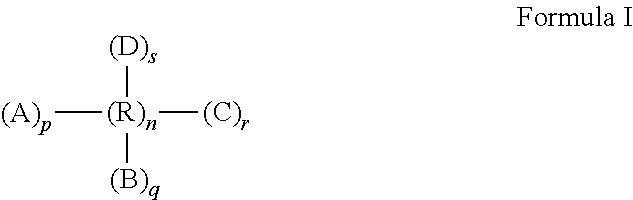
- wherein
- A, B, C, and D are reactive moieties,
- R is a linker,
- n is an integer that is ≧1, and
- each occurrence of p, q, r, and s is independently an integer from 0 to 25, preferably from 0 to 10, more preferably from 0 to 2. The sum of p+q+r+s is equal to or greater than 2
- The reactive moieties may be present on any atom of the linker. In some embodiments, the reactive moieties are the same. In some embodiments, one or more of the reactive moieties is different.
- ii. Linker
- The reactive moieties on the crosslinking agents are preferably linked via a linker. The term “linker”, as used herein, refers to one or more polyfunctional, e.g. bifunctional molecules, trifunctional molecules, tetrafunctional molecules, etc., which can be used to covalently couple the two or more reactive moieties and which do not interfere with the reactive properties of the crosslinking agents. The reactive moieties may be attached to any part of the linker.
- Linkers can be a single atom, such as a heteroatom (e.g., O or S), a group of atoms, such as a functional group (e.g., amine, —C(═O)—, —CH2—), or multiple groups of atoms, such as an alkylene chain. Suitable linkers include but are not limited to oxygen, sulfur, carbon, boron, nitrogen, alkoxy, alkyl, alkenyl, cycloalkyl, cycloalkenyl, aryl, heterocycloalkyl, heteroaryl, ether, amine, and a polymer.
- The linker is optionally independently substituted with one or more substituents including hydrogen, halogen, cyano, alkoxy, alkyl, alkenyl, cycloalkyl, cycloalkenyl, aryl, heterocycloalkyl, heteroaryl, amine, hydroxy, formyl, acyl, carboxylic acid (—COOH), —C(O)R1, —C(O)OR1, carboxylate (—COO—), primary amide (e.g., —CONH2), secondary amide (e.g., —CONHR11), —C(O)NR1R2, —NR1R2, —NR1S(O)2R2—NR1C(O)R2—S(O)2R2, —SR1, and —S(O)2NR1R2, sulfinyl group (e.g., —SOR11), and sulfonyl group (e.g., —SOOR11); wherein R1 and R2 may each independently be hydrogen, alkyl, alkenyl, alkynyl, cycloalkyl, aryl, heterocycloalkyl and heteroaryl; wherein each of R1 and R2 is optionally independently substituted with one or more substituents selected from the group consisting of halogen, hydroxyl, cyano, nitro, amino, alkylamino, dialkylamino, alkyl optionally substituted with one or more halogen or alkoxy or aryloxy, aryl optionally substituted with one or more halogen or alkoxy or alkyl or trihaloalkyl, heterocycloalkyl optionally substituted with aryl or heteroaryl or ═O or alkyl optionally substituted with hydroxyl, cycloalkyl optionally substituted with hydroxyl, heteroaryl optionally substituted with one or more halogen or alkoxy or alkyl or trihaloalkyl, haloalkyl, hydroxyalkyl, carboxy, alkoxy, aryloxy, alkoxycarbonyl, aminocarbonyl, alkylaminocarbonyl and dialkylaminocarbonyl.
- In some embodiments, the linker may be an alkoxy, ether, alkyl, alkenyl, cycloalkyl, cycloalkenyl, aryl, heterocycloalkyl, heteroaryl, amine, or a polymer. In some embodiments, the linker is not a polymer.
- iii. Polymeric Crosslinking Agents
- The crosslinking agent can be a polymer. In this form, the linker forms or is the polymer backbone having covalently attached thereto to two or more reactive moieties. Optionally, the polymeric crosslinking agent can have a structure according to Formula I. In some forms, for each occurrence of a monomer unit in the polymer, zero, one, two, three, four, or more reactive moieties can be covalently linked to the monomer. The reactive moieties on each monomer unit in the polymer can be the same or different.
- In some embodiments, at least one reactive moiety is present on each monomer unit. Alternately, the reactive moieties may be present on alternate monomer units. In some embodiments, reactive moieties are present on a minimum percentage of the monomer units in the polymer. For example, at least one reactive moiety can be present on 0.1%, 1%, 5%, 10%, 15%, 20%, 25%, 30%, 35%, 40%, 45%, 50%, 55%, 60%, 65%, 70%, 75%, 80%, 85%, 90%, 95%, or 100% of the monomer units in the polymer. The reactive moieties can be present on any atom on the monomer.
- Polymers
- The polymer may be functionalized at the termini with one or more of reactive moieties, A-D. Alternatively, the polymer may be functionalized within the polymer backbone. One or more monomers in the polymer may be functionalized so that one or more reactive moieties, A-D, may be introduced (e.g., covalently bound to) using techniques known in the art. The reactive moieties can be introduced onto the monomers before polymerization or grafted onto the polymer backbone after polymerization.
- A wide variety of polymers and methods for forming the polymers are known in the art of polymer science. Polymers can be degradable or non-degradable polymers. Polymers can be natural or unnatural (synthetic) polymers. Polymers can be homopolymers or copolymers comprising two or more monomers. In terms of sequence, copolymers can be random, block, or comprise a combination of random and block sequences. The polymers can in some embodiments be linear polymers, branched polymers, or hyperbranched/dendritic polymers. The polymers may also be present as a crosslinked particle or surface functionalized inorganic particle. Suitable polymers include, but are not limited to poly (vinyl acetate), copolymers of styrene and alkyl acrylates, and copolymers of vinyl acetate and acrylic acid, polyvinylpyrrolidone, dextran, carboxymethylcellulose, polyethylene glycol, polyalkylene, polyaerylates, and polymethacrylates; polyanhydrides; polyorthoesters; polysytyrene (PS), poly(ethylene-co-maleic anhydride), poly(ethylene maleic anhydride-co-L-dopamine), poly(ethylene maleic anhydride-co-phenylalanine), poly(ethylene maleic anhydride-co-tyrosine), poly(butadiene-co-maleic anhydride), poly(butadiene maleic anhydride-co-L-dopamine) (pBMAD), poly(butadiene maleic anhydride-co-phenylalanine), poly(butadiene maleic anhydride-co-tyrosine), poly(bis carboxy phenoxy propane-co-sebacic anhydride) (poly (CCP:SA)), alginate; and poly(fumaric anhydride-co-sebacic anhydride (p[FA:SA]), copolymers of p[FA:SA], polyacrylates and polyacrylamides, and copolymers thereof, and combinations thereof. In some embodiments, the polymeric linker is preferably water-soluble.
- If the linker is a polymeric linker, the polymer is not a polysiloxane, such as an acrylic funtionalized polysiloxane. If the polymeric linker is or contains polyethylene glycol (PEG), the number of ethylene oxide units is less than 20, 15, 10, 9, 8, 7, 6, 5, or 4. In some embodiments, it is one, two, or three.
- The linker may have one of the following general structures:
-
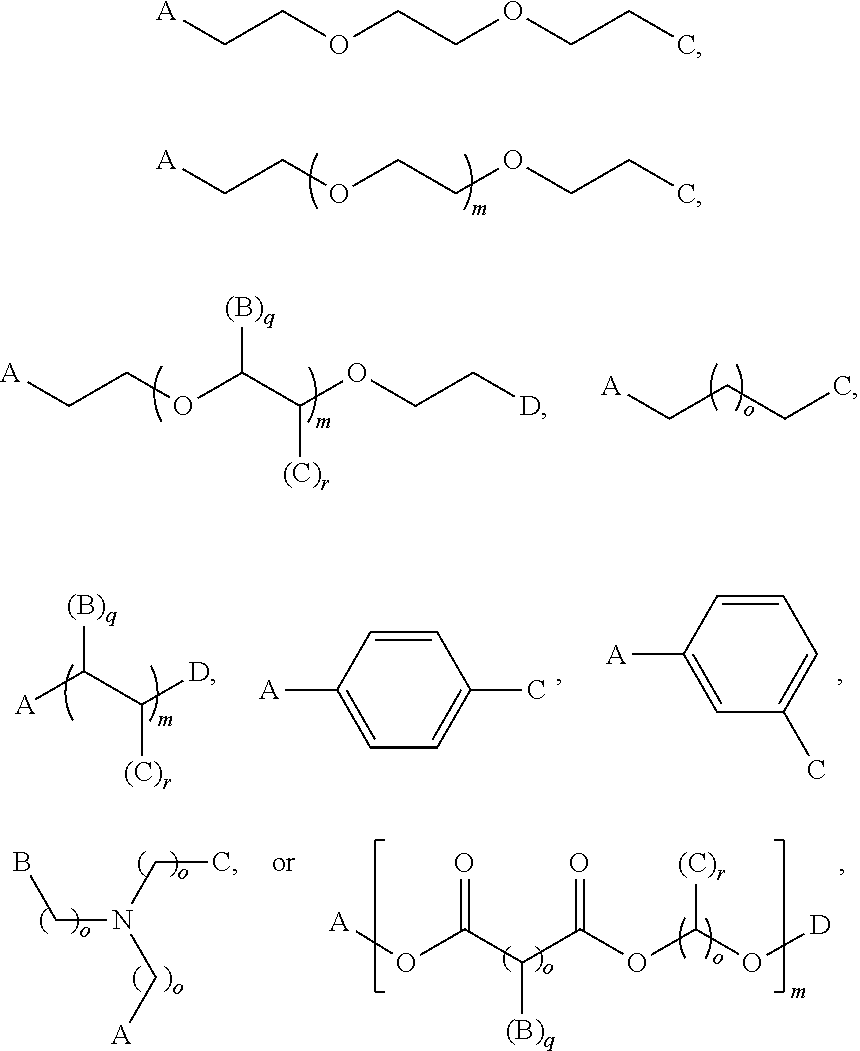
- For the polymeric structures above, each occurrence of m is independently an integer greater than or equal to 1, such as 1-10 (e.g., oligomer) or greater than 10 (e.g., polymer), such as 10-1000 or greater.
- Each occurrence of o is independently an integer greater than or equal to 0, such as 0-100, 0-75, 0-50, 0-40, 0-30, 0-25, 0-20, 0-15, 0-10, or 0-5. In one embodiment, o is from about 1 to about 20, about 1 to about 15, or about 1 to about 10.
- ii. Reactive Moieties that React with Thiols
- The crosslinking agent contains at least two reactive moieties that react with thiols to form covalent bonds. The reactive moieties are capable of reacting with a thiol group in the hair to form a stable covalent bond. The reactive moiety can be an electrophilic moiety. Alternately, the reactive moiety can be a free radical forming moiety.
- The crosslinking agent contains at least two reactive moieties. However, the crosslinking agent may contain three, four, five, six, or greater than six reactive moieties.
- The reaction between the reactive moiety and the thiol groups may be initiated at room temperature and pressure when the reactive moiety contacts a thiol group in the hair. In some embodiments, the reaction may require an initiator, such as heat, catalyst, basic conditions, or a free radical initiator. The rate of reaction between the reactive moiety and the thiol may be increased by changes in temperature, pH, and/or addition of one or more excipients, such as a catalyst; however, this is generally not required.
- The two or more reactive moieties on the crosslinking agent can be the same. In some embodiments, the two or more reactive moieties are different.
- In some embodiments, the reactive moieties are capable of undergoing a conjugate additional reaction. The reactive moieties can independently be a Michael acceptor, a succinimidyl-containing group, a maleimido-containing group, azlactone, a benzoxazinone derivative, vinyl sulfone, vinyl sulfoximine, banzoxazinone, isocyanate, epoxide, an electrophilic moiety containing a leaving group, an electrophilic thiol acceptor, acrylate group, a methacrylate group, a styrene group, an acryl amide group, a methacryl amide group, a maleate group, a fumarate group, an itaconate group, a vinyl ether group, an allyl ether group, an allyl ester group, or a vinyl ester group. In some embodiments, the reactive moiety or moieties are not an aldehyde or carboxylic acid, particularly an unconjugated aldehyde or carboxylic acid.
- Michael Acceptor
- A “Michael acceptor,” as used herein, is a compound with at least one Michael acceptor functional group with the structure below:
-

- where R3, R4, and R5 taken independently are hydrogen or a group or grouping selected from, but not limited to, alkyl, substituted alkyl, alkenyl, substituted alkenyl, alkynyl, substituted alkynyl, phenyl, substituted phenyl, aryl, substituted aryl, heteroaryl, substituted heteroaryl, halo, hydroxyl, alkoxy, substituted alkoxy, phenoxy, substituted phenoxy, aroxy, substituted aroxy, alkylthio, substituted alkylthio, phenylthio, substituted phenylthio, arylthio, substituted arylthio, cyano, isocyano, substituted isocyano, carbonyl, substituted carbonyl, carboxyl, substituted carboxyl, amino, substituted amino, amido, substituted amido, sulfonyl, substituted sulfonyl, sulfonic acid, phosphoryl, substituted phosphoryl, phosphonyl, substituted phosphonyl, polyaryl, substituted polyaryl, C3-C20 cyclic, substituted C3-C20 cyclic, heterocyclic, substituted heterocyclic, aminoacid, peptide, and polypeptide groups.
- Some suitable Michael acceptors include, but are not limited to, molecules in which some or all of the structure above are residues of (meth)acrylic acid, fumaric acid, or maleic acid, substituted versions thereof; or combinations thereof, attached to the Michael acceptor molecule through an ester linkage.
- The linker is attached to the Michael acceptor via R3, R4, or R5. In some embodiments, R3, R4, or R5 may be the linker
- Vinyl Sulfone
- The chemistry of vinyl sulfones with respect to attack by nucleophiles is analogous to that of α,β-unsaturated ketones in that they can undergo a 1,4-type Michael addition without releasing any undesirable by-products.
- Vinyl Sulfoximines
- The chemistry of vinyl sulfoximines is similar to vinyl sulfones. The N-tosyl sulfoximine group is more electron withdrawing than the phenyl sulfone and therefore the vinyl groups will be more susceptible towards nucleophilic attack. N-substituents can be used to alter the electrophilic potential of the vinyl group.
- Electrophilic Moiety Containing a Leaving Group
- The reactive moiety may be an electrophile with a leaving group. Electrophile, as used herein refers to one or more functional groups or moieties that have an affinity for or attract electrons. Suitable electrophiles include, but are not limited to, ester moieties (—(CO)—O—R, wherein R is lower alkyl or the like), carbonyl moieties (—C(O)), carboxylic acid or carbonic acid (—COOH or —OCOOH), carbonate moieties (—O—(CO)—O—R, wherein R is lower alkyl or the like), urethane moieties (—O—(CO)—NH—R, wherein R is H, lower alkyl, or the like), substituted urethane moieties (—O—(CO)—NR′—R, where R′ is a nonhydrogen substituent such as alkyl, aryl, alkaryl, or the like), amido moieties (—(CO)—NH—R, wherein R is H, lower alkyl, or the like), substituted amido moieties (—(CO)—NR′—R where R′ is as defined previously), thioester moieties (—(CO)—S—R, wherein R is H, lower alkyl, or the like), sulfonic ester moieties (—S(O)2—O—R, wherein R is H, lower alkyl, or the like), and the like. Other electrophiles will be known to those of ordinary skill in the art of organic chemistry and polymer science and/or can be readily found by reference to the pertinent texts and literature.
- The electrophiles preferably contain a leaving group. Suitable leaving groups are well known in the art, see, e.g., “Advanced Organic Chemistry,” Jerry March, 5th Ed., pp. 445-448, John Wiley and Sons, N.Y. Examples of leaving groups include, but are not limited to, halogen, sulfonyloxy, optionally substituted alkylsulfonyloxy, optionally substituted alkenylsulfonyloxy, optionally substituted arylsulfonyloxy. Specific examples of leaving groups include chloro, iodo, bromo, fluoro, methanesulfonyloxy (mesyloxy), tosyloxy, triflyloxy, nitrophenylsulfonyloxy (nosyloxy), bromophenylsulfonyloxy (brosyloxy), hydroxyl, carboxylate, carbonate, phosphate, phosphonate, phosphinate, phosphonium, urethane, urea, amide, imide, amine, ammonium, sulfonato, —N3, CN, RO—, NH2O—, NHRO—, N(R4)2O—, R4CO2—, R4OCO2—, R4NCO2—, R4S—, R4C(S)O—, R4CS2—, R4SC(O)S—, R4SCS2—R4SCO2—, R4OC(S)O—, R4OCS2—, R4SO2—, R4SO3—, R40SO2—, R40SO3—, R4PO3—, R40PO3—, an N-imidazolyl group, an N-triazolyl group, an N-benzotriazolyl group, a benzotriazolyloxy group, an imidazolyloxy group, an N-imidazolinone group, an N-imidazolone group, an N-imidazolinethione group, an N-imidazolinethione group, an N-succinimidyl group, an N-phthalimidyl group, an N-succinimidyloxy group, an N-phthalimidyloxy group, —ON═C(CN)R4, and a 2-pyridyloxy group. R4 is preferably an alkyl group or an aryl group.
- Preferably, the leaving group is removed from the reactive moieties and does not result in the formation of side product that disadvantageously affects the reaction between the reactive moieties and the thiol groups or form a material or compound that is unsuitable for contact with skin or hair.
- In some embodiments, the leaving group is a halogen.
- Electrophilic Thiol Acceptors
- Electrophilic thiol acceptors, as used herein, refer to a chemical moiety that reacts with a thiol group so that the sulfur atom of the thiol group becomes covalently bonded to the thiol acceptor. Thiol acceptors are well known in the art. Koval (Reactions of Thiols, Russian Journal of Organic Chemistry, 2007, 43:319-349) discloses several electrophilic thiol acceptors, the disclosure of which is incorporated herein by reference.
- Electrophilic thiol acceptors, in addition to those listed above, include but are not limited to an alpha-substituted acetyl group with the formula Y—CH2—CO—, wherein Y is a leaving group. Examples of leaving groups include, but are not limited to, Chlorine, Bromine, Iodine, mesylate, tosylate, and the like. If the thiol acceptor is an alpha-substituted acetyl group, the thiol adduct after covalent linkage to the acceptor forms the bond —S—CH2—.
- Free Radical-Forming Groups
- The crosslinking agent may contain at least two free radical-forming groups that can react with thiols. The free radical-forming groups on the crosslinking agent can be the same. Alternately, the free radical-forming groups may be different. Suitable free radical-forming crosslinking agents include, but are not limited to acrylate groups, methacrylate groups, styrene groups, acryl amide groups, methacryl amide groups, maleate groups, fumarate groups, itaconate groups, vinyl ether groups, allyl ether groups, allyl ester groups, and vinyl ester groups. For example, suitable crosslinking agents include ethylene glycol dimethacrylate, diethylene glycol diacrylate, allyl methacrylate, trimethylolpropane triacrylate, triallylamine, tetraallyloxyethane, and di- and triacrylates, mixed acrylates which, as well as acrylate groups, comprise further ethylenically unsaturated groups. Other examples of crosslinking agents include N,N′-methylenebisacrylamide and N,N′-methylenebismethacrylamide, esters of unsaturated mono- or polycarboxylic acids of polyols, such as diacrylate or triacrylate, for example butanediol diacrylate, butanediol dimethacrylate, ethylene glycol diacrylate, ethylene glycol dimethacrylate and also trimethylolpropane triacrylate and allyl compounds, such as allyl (meth)acrylate, triallyl cyanurate, diallyl maleate, polyallyl esters, tetraallyloxyethane, triallylamine, tetraallylethylenediamine, allyl esters of phosphoric acid and also vinylphosphonic acid derivatives, pentaerythritol diallyl ether, pentaerythritol triallyl ether, pentaerythritol tetraallyl ether, polyethylene glycol diallyl ether, ethylene glycol diallyl ether, glycerol diallyl ether, glycerol triallyl ether, polyallyl ethers based on sorbitol, and also ethoxylated variants thereof. Other examples of crosslinking agents include di- and triacrylates of 3- to 15-tuply ethoxylated glycerol, of 3- to 15-tuply ethoxylated trimethylolpropane, of 3- to 15-tuply ethoxylated trimethylolethane, especially di- and triacrylates of 2- to 6-tuply ethoxylated glycerol or of 2- to 6-tuply ethoxylated trimethylolpropane, of 3-tuply propoxylated glycerol, of 3-tuply propoxylated trimethylolpropane, and also of 3-tuply mixed ethoxylated or propoxylated glycerol, of 3-tuply mixed ethoxylated or propoxylated trimethylolpropane, of 15-tuply ethoxylated glycerol, of 15-tuply ethoxylated trimethyllolpropane, of 40-tuply ethoxylated glycerol, of 40-tuply ethoxylated trimethylolethane and also of 40-tuply ethoxylated trimethylolpropane, ethylene glycol dimethacrylate, diethylene glycol diacrylate, allyl methacrylate, trimethylolpropane triacrylate, triallylamine, tetraallyloxyethane, N,N′-methylenebisacrylamide, N,N′-methylenebismethacrylamide, butanediol diacrylate, butanediol dimethacrylate, trimethylolpropane triacrylate, triallyl cyanurate, diallyl maleate, a polyallyl ester, tetraallylethylenediamine, pentaerythritol diallyl ether, pentaerthyritol triallyl ether, pentaerythritol tetrallyl ether, polyethylene glycol diallyl ether, ethylene glycol diallyl ether, glycerol diallyl ether, glycerol triallyl ether, di- and triacrylates of 3- to 15-tuply ethoxylated glycerol, di- and tri-acrylates of 3- to 15-tuply ethoxylated trimethylolpropane, and di- and tri-acrylates of 3- to 15-tuply ethoxylated trimethylolethane.
- The reactive free radical moieties may require the presence of one or more initiators. Suitable initiators include, but are not limited to peroxides, hydroperoxides, hydrogen peroxide, persulfates, azo compounds, and redox initiators. Suitable organic peroxides include acetylacetone peroxide, methyl ethyl ketone peroxide, tert-butyl hydroperoxide, cumene hydroperoxide, tert-amyl perpivalate, tert-butyl perpivalate, tert-butyl perneohexanoate, tert-butyl perisobutyrate, tert-butyl per-2-ethylhexanoate, tert-butyl perisononanoate, tert-butyl permaleate, tert-butyl perbenzoate, di(2-ethylhexyl) peroxydicarbonate, dicyclohexyl peroxydicarbonate, di(4-tert-butylcyclohexyl) peroxydicarbonate, dimyristil peroxydicarbonate, diacetyl peroxydicarbonate, allyl peresters, cumyl peroxyneodecanoate, tert-butyl per-3,5,5-trimethylhexanoate, acetylcyclohexylsulfonyl peroxide, dilauryl peroxide, dibenzoyl peroxide, and tert-aryl perneodecanoate. Suitable azo compounds include 2,2′-azobisisobutyronitrile, 2,2′-azobis(2,4-dimethylvaleronitrile) and 2,2′-azobis(4-methoxy-2,4-dimethylvaleronitrile), preferably water-soluble azo initiators, such as, but not limited to, 2,2′-azobis{2-[1-(2-hydroxyethyl)-2-imidazolin-2-yl]propane}dihydrochloride, 2,2′-azobis-(2-amidinopropane) dihydrochloride, 2,2′-azobis[2-(2-imidazolin-2-yl)propane]dihydrochloride and 2,2′-azobis[2-(5-methyl-2-imidazolin-2-yl)propane]dihydrochloride. For the redox initiators, the oxidizing component is at least one of the peroxo compounds indicated above and the reducing component is for example ascorbic acid, glucose, sorbose, ammonium bisulfite, ammonium sulfite, ammonium thiosulfate, ammonium hyposulfite, ammonium pyrosulfite, ammonium sulfide, alkali metal bisulfite, alkali metal sulfite, alkali metal thiosulfate, alkali metal hyposulfite, alkali metal pyrosulfite, alkali metal sulfide or sodium hydroxymethylsulfoxylate.
- The crosslinking agent may have any one of the chemical structures shown below:
-
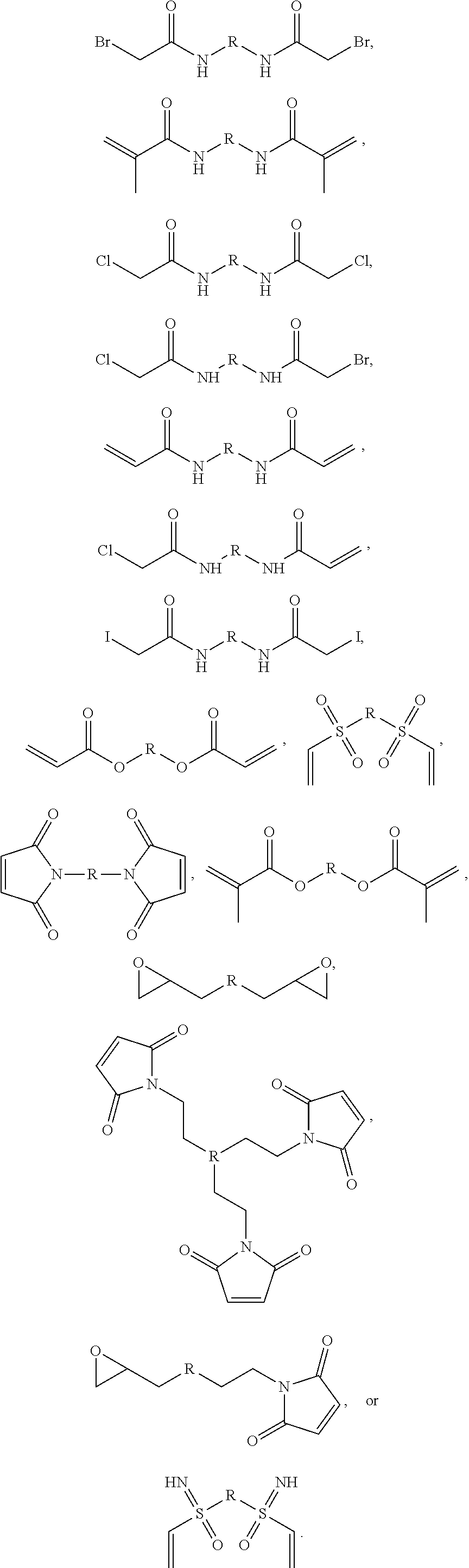
- wherein R is the linker.
- In one embodiment, the crosslinking agent has the chemical structure:
-
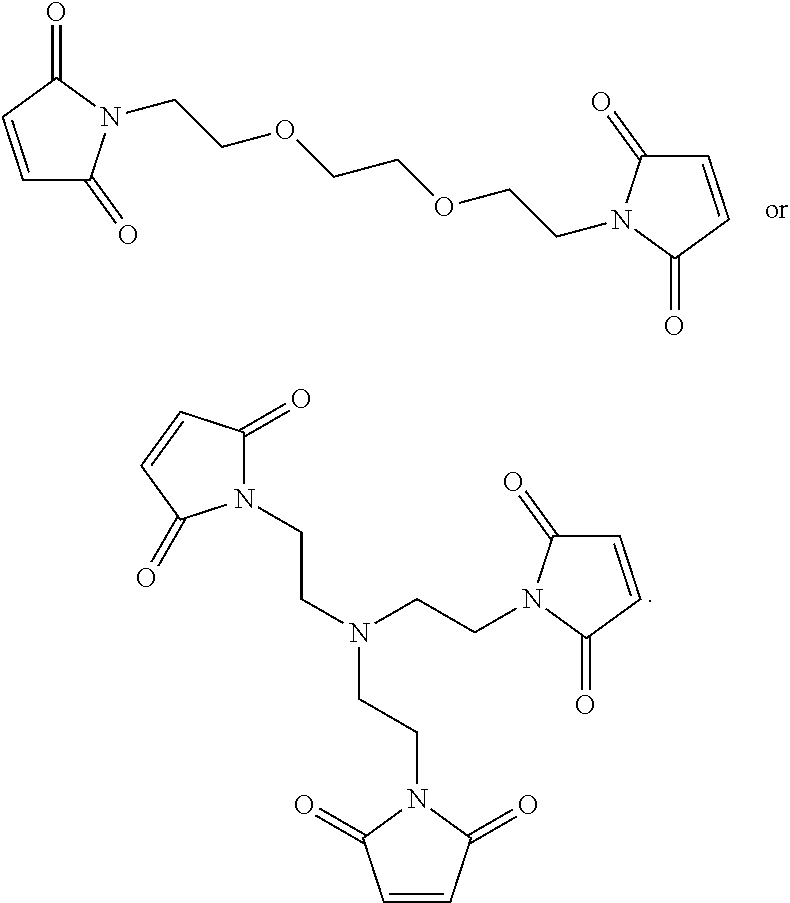
- The top structure above is referred to as bis-(maleimidoethoxy) ethane. The bottom structure above is referred to as tris-(maleimidoethyl) amine
- b. Excipients
- The formulations typically contain one or more cosmetically acceptable excipients. Cosmetically acceptable excipients include, but are not limited to water, preservatives, antioxidants, chelating agents, sunscreen agents, vitamins, dyes, hair coloring agents, proteins, amino acids, natural extracts such as plant extracts, humectants, fragrances, perfumes, oils, emollients, lubricants, butters, penetrants, thickeners, viscosity modifiers, polymers, resins, hair fixatives, film formers, surfactants, detergents, emulsifiers, opacifying agents, volatiles, propellants, liquid vehicles, carriers, salts, pH adjusting agents (e.g., citric acid), neutralizing agents, buffers, hair conditioning agents, anti-static agents, anti-frizz agents, anti-dandruff agents, absorbents, and combinations thereof.
- The formulations can contain at least two or more cosmetically acceptable excipients. In some forms, the formulations contain the crosslinking agent, water, and optionally a preservative and/or fragrance.
- The formulation for treating hair may be in any suitable physical form. Suitable forms include, but are not limited to low to moderate viscosity liquids, lotions, milks, mousses, sprays, gels, creams, shampoos, conditioners, and the like. Suitable excipients, such as those listed above, are included or excluded from the hair care formulation depending on the form of use of the formulation (e.g., hair spray, cream, conditioner, or shampoo).
- The pharmaceutical excipient is typically present in an amount ranging from about 10 wt % to about 99.99 wt % of the formulation, preferably about 40 wt % to about 99 wt %, more preferably from about 80 wt % to about to about 99 wt %.
- i. Surfactants
- Surfactants are surface-active agents that are able to reduce the surface tension of water and cause the hair formulation to slip across or onto the skin or hair. Surfactants also include detergents and soap. The surfactants may be amphoteric, anionic, or cationic. Suitable surfactants that may be used in the formulation include, but are not limited to, 3-aminopropane sulfonic acid, almond amide, almond amidopropyl betaine, almond amidopropylamine oxide, aluminum hydrogenated tallow glutamate, aluminum lanolate, aminoethyl sulfate, aminopropyl lauryl glutamine, ammonium C12-15 alkyl sulfate, ammonium C12-15 pareth sulfate, ammonium C12-16 alkyl sulfate, ammonium C9-10 perfluoroalkylsulfonate, ammonium capryleth sulfate, ammonium capryleth-3 sulfate, ammonium monoglyceride sulfate, ammonium sulfate, ammonium isothionate, ammonium cocoyl sarcosinate, ammonium cumene sulfonate, ammonium dimethicone copolyol sulfate, ammonium dodecylbenzenesulfonate, ammonium isostearate, ammonium laureth sulfate, ammonium laureth-12 sulfate, ammonium laureth-5 sulfate, ammonium laureth-6 carboxylate, ammonium laureth-7 sulfate, ammonium laureth-8 carboxylate, ammonium laureth-9 sulfate, ammonium lauroyl sarcosinate, ammonium lauryl sulfate, ammonium lauryl sulfosuccinate, ammonium myreth sulfate, ammonium myristyl sulfate, ammonium nonoxynol-30 sulfate, ammonium nonoxynol-4 sulfate, ammonium oleate, ammonium palm kernel sulfate, ammonium polyacrylate, ammonium stearate, ammonium tallate, ammonium xylene sulfonate, ammonium xylene sulfonate, amp-isostearoyl gelatin/keratin amino acids/lysine hydroxypropyltrimonium chloride, amp-isostearoyl hydrolyzed collagen, apricot kernel oil PEG-6 esters, apricot amide, apricot amidopropyl betaine, arachideth-20, avocadamide, avocadamidopropyl betaine, babassuamide, babassuamidopropyl betaine, babassuamidopropylamine oxide, behenalkonium chloride, behenamide, behenamide, behenamidopropyl betaine, behenamine oxide, sodium laureth sulfate, sodium lauryl sulfate, a polyoxyether of lauryl alcohol or ceteareth-20, or combinations thereof.
- Suitable anionic surfactants include, but are not limited to, those containing carboxylate, sulfonate and sulfate ions. Examples of anionic surfactants include sodium, potassium, ammonium of long chain alkyl sulfonates and alkyl aryl sulfonates such as sodium dodecylbenzene sulfonate; dialkyl sodium sulfosuccinates, such as sodium dodecylbenzene sulfonate; dialkyl sodium sulfosuccinates, such as sodium bis-(2-ethylthioxyl)-sulfosuccinate; and alkyl sulfates such as sodium lauryl sulfate. Cationic surfactants include, but are not limited to, quaternary ammonium compounds such as benzalkonium chloride, benzethonium chloride, cetrimonium bromide, stearyl dimethylbenzyl ammonium chloride, polyoxyethylene and coconut amine. Examples of nonionic surfactants include ethylene glycol monostearate, propylene glycol myristate, glyceryl monostearate, glyceryl stearate, polyglyceryl-4-oleate, sorbitan acylate, sucrose acylate, PEG-150 laurate, PEG-400 monolaurate, polyoxyethylene monolaurate, polysorbates, polyoxyethylene octylphenylether, PEG-1000 cetyl ether, polyoxyethylene tridecyl ether, polypropylene glycol butyl ether, Poloxamer® 401, stearoyl monoisopropanolamide, and polyoxyethylene hydrogenated tallow amide. Examples of amphoteric surfactants include sodium N-dodecyl-.beta.-alanine, sodium N-lauryl-β-iminodipropionate, myristoamphoacetate, lauryl betaine and lauryl sulfobetaine.
- More than one surfactant may be included in the formulation.
- The surfactants are optionally included in an amount ranging from about 0.1% to about 15% by weight of the formulation, preferably about 1% to about 10% by weight of the formulation.
- ii. Emollients
- Emollient refers to a material that protects against wetness or irritation, softens, soothes, coats, lubricates, moisturizes, protects, and/or cleanses the skin. Suitable emollients for use in the formulations include, but are not limited to, a silicone compound (e.g., dimethicone, cyclomethicone, dimethicone copolyol or a mixture of cyclopentasiloxane and dimethicone/vinyldimethicone cross polymer, cyclopentasiloxane polysilicone), polyols such as sorbitol, glycerin, propylene glycol, ethylene glycol, polyethylene glycol, caprylyl glycol, polypropylene glycol, 1,3-butane diol, hexylene glycol, isoprene glycol, xylitol; ethylhexyl palmitate; a triglyceride such as caprylic/capric triglyceride and fatty acid ester such as cetearyl isononanoate or cetyl palmitate. In a specific embodiment, the emollient is dimethicone, amidodimethicone, dimethiconol, cyclopentasiloxane, potassium dimethicone PEG-7 panthenyl phosphate, or combinations thereof. More than one emollient may be included in the formulation.
- The emollient is optionally included in an amount ranging from about 0.5% to about 15% by weight of the formulation, preferably from about 1% to about 10% by weight of the formulation.
- iii. Emulsifiers
- The formulations may also contain one or more emulsifiers. Suitable emulsifiers include, but are not limited to, copolymers of an unsaturated ester and styrene sulfonate monomer, cetearyl alcohol, glyceryl ester, polyoxyethylene glycol ether of cetearyl alcohol, stearic acid, polysorbate-20, ceteareth-20, lecithin, glycol stearate, polysorbate-60, polysorbate-80, or combinations thereof. More than one emulsifier may be included in the formulation.
- The emulsifier is optionally included in an amount ranging from about 0.05%-15% by weight of the formulation, preferably from about 0.1%-10% by weight of the formulation.
- iv. Preservatives
- One or more preservatives may be included in the formulations. Suitable preservatives include, but are not limited to, glycerin containing compounds (e.g., glycerin or ethylhexylglycerin or phenoxyethanol), benzyl alcohol, parabens (methylparaben, ethylparaben, propylparaben, butylparaben, isobutylparaben, etc.), sodium benzoate, ethylenediamine-tetraacetic acid (EDTA), potassium sorbate, and/or grapefruit seed extract, or combinations thereof. More than one preservative may be included in the formulation. Other preservatives are known in the cosmetics industries and include salicylic acid, DMDM Hydantoin, Formaldahyde, Chlorphenism, Triclosan, Imidazolidinyl Urea, Diazolidinyl Urea, Sorbic Acid, Methylisothiazolinone, Sodium Dehydroacetate, Dehydroacetic Acid, Quaternium-15, Stearalkonium Chloride, Zinc Pyrithione, Sodium Metabisulfite, 2-Bromo-2-Nitropropane, Chlorhexidine Digluconate, Polyaminopropyl biguanide, Benzalkonium Chloride, Sodium Sulfite, Sodium Salicylate, Citric Acid, Neem Oil, Essential Oils (various), Lactic Acid, and Vitamin E (tocopherol).
- The preservative is optionally included in an amount ranging from about 0.1% to about 5% by weight of the formulation, preferably from about 0.3% to about 3% by weight of the formulation. Preferably, the formulations are paraben free.
- v. Conditioning Agents
- One or more conditioning agents may be included in the formulations. Suitable conditioning agents include, but are not limited to, silicone-based agents (e.g., silicone quaternium-8), panthenol, hydrolyzed wheat and/or soy protein, amino acids (e.g. wheat amino acids), rice bran wax, meadowfoam seed oil, mango seed oil, grape seed oil, jojoba seed oil, sweet almond oil, hydroxyethyl behenamidopropyl dimonium chloride, aloe leaf extract, aloe barbadensis leaf juice, phytantriol, panthenol, retinyl palmitate, behentrimonium methosulfate, cyclopentasiloxane, quaternium-91, stearamidopropyl dimethylamine, and combinations thereof.
- The conditioning agent(s) is optionally included in an amount ranging from about 0.1% to about 5% by weight of the formulation, preferably from about 0.3% to about 3% by weight of the formulation.
- vi. Diluents
- Diluent, as used herein, refers to a substance(s) that dilutes the crosslinking agent. Water is the preferred diluent. The formulations typically contains greater than one percent (wt) water, preferably greater than five percent (wt) water, more preferably greater than 50% (wt) water, and most preferably greater than 80% (wt) water. Alcohols, such as ethyl alcohol and isopropyl alcohol, may be used at low concentrations (about 0.5% by weight of the formulation) to enhance hair penetration and/or reduce odor.
- vii. Viscosity Modifying Agents
- The formulations may contain one or more viscocity modifying agents, such as viscosity increasing agents. Classes of such agents include, but are not limited to, viscous liquids, such as polyethylene glycol, semisynthetic polymers, such as semisynthetic cellulose derivatives, synthetic polymers, such as carbomers, poloxamers, and polyethyleneimines (e.g., PEI-10), naturally occurring polymers, such as acacia, tragacanth, alginates (e.g., sodium alginate), carrageenan, vegetable gums, such as xanthan gum, petroleum jelly, waxes, particulate associate colloids, such as bentonite, colloidal silicon dioxide, and microcrystalline cellulose, surfactantsm such as PPG-2 hydroxyethyl coco/isostearamide, emulsifiers, such as disteareth-75 IPDI, and salts, such as sodium chloride, and combinations thereof
- viii. Antioxidants
- The formulations may contain one or more antioxidants. Examples include, but are not limited to, tocopheryls, BHT, ascorbic acid, camellia sinensis leaf extract, ascorbyl palmitate, magnesium ascorbyl phosphate, carotenoids, resveratrol, triethyl citrate, arbutin, kojic acid, tetrahexydecyl ascorbate, superoxide dismutase, zinc, sodium metabisulfite, lycopene, ubiquinone, and combinations thereof.
- ix. Opacifying Agents
- The formulations may contain one or more opacifying agents. Opacifying agents are added to the formulations to make it opaque. Suitable opacifying agents include, but are not limited to, glycol distearate and ethoxylated fatty alcohols.
- c. Forms of the Formulation
- i. Sprays
- The formulation may be in the form of a spray. The spray typically includes the crosslinking agent and a cosmetically acceptable carrier. In some embodiments, the carrier is water or a water and alcohol mixture. The spray formulation optionally includes an antioxidant, sunscreen agent, vitamin, protein, peptide, plant extract, humectant, oil, emollient, lubricant, thickener, hair conditioning agent, polymer, and/or surfactant. Preferably, the spray formulation includes a preservative. In some embodiments, the formulation includes a fragrance. In some embodiments, the formulation includes a surfactant. In some embodiments, the formulation contains water, fragrance, a preservative, and a crosslinking agent. In some embodiments, the formulation contains water, fragrance, a preservative, and a crosslinking agent. In some embodiments, the formulation contains water, a preservative, fragrance, the crosslinking agent, and an anti-static agent. In some embodiments, the formulation contains water, a preservative, fragrance, the crosslinking agent, and a hair conditioning agent. In some embodiments, the formulation contains water, a preservative, fragrance, the crosslinking agent, and a surfactant.
- The hair spray formulations may be dispensed from containers that include aerosol dispensers or pump spray dispensers. Such dispensers are known in the art and are commercially available from a variety of manufacturers.
- Propellant
- When the hair spray formulation is dispensed from a pressurized aerosol container, a propellant may be used to force the composition out of the container. Suitable propellants include, but are not limited to, a liquefiable gas or a halogenated propellant. Examples of suitable propellants include dimethyl ether and hydrocarbon propellants such as propane, n-butane, iso-butane, CFCs, and CFC-replacement propellants. The propellants may be used singly or admixed.
- The amount of propellant may range from about 10% to about 60% by weight of the formulation. The propellant may be separated from the hair repair formulation as in a two compartment container. Other suitable aerosol dispensers are those characterized by the propellant being compressed air, which can be filled into the dispenser using a pump or equivalent device prior to use. Conventional non-aerosol pump spray dispensers, i.e., atomizers, may also be used to apply the formulation to the hair.
- ii. Conditioners
- The formulation may be in the form of a conditioner. The conditioner typically includes the crosslinking agent in a suitable carrier. Additionally, the conditioner may include cationic polymers derived from polysaccharides, for example cationic cellulose derivatives, cationic starch derivatives, cationic guar derivatives and cationic locust bean gum derivatives, synthetic cationic polymers, mixtures or combinations of these agents. The formulation may comprise other synthetic or natural polymers or polymers derived from biological preparation processes, which are functionalized, where appropriate, for example with cationic or neutral groups. These polymers may have a stabilizing or strengthening action on the compositions, and/or a conditioning action (deposition on the surface of the skin or the hair). The crosslinking agent may be included in any suitable concentration. Typical concentrations of the crosslinking agent in the conditioner range from small amounts such as approximately 0.01% (wt), preferably at least 0.1% (wt), to large amounts, such as up to 50% (wt). Preferably the conditioner contains the crosslinking agent in a concentration ranging from 0.1% (wt) to 5% (wt), more preferably from 0.1% wt to 3% (wt). While greater concentrations of crosslinking agent could be present in the conditioner, they are generally not needed to achieve the desired results.
- iii. Shampoos
- The hair repair formulation may be in the form of a shampoo. The shampoo typically includes the crosslinking agent in a suitable carrier. The crosslinking agent may be included in any suitable concentration. Typical concentrations of the crosslinking agent in the shampoo range from small amounts such as approximately 0.01% (wt), preferably at least 0.1% (wt), to large amounts, such as up to 50% (wt). Preferably the shampoo contains the crosslinking agent in a concentration ranging from 0.1% (wt) to 5% (wt), more preferably from 0.1% wt to 3% (wt). While greater concentrations of crosslinking agent could be present in the shampoo, they are generally not needed to achieve the desired results.
- Additionally, the shampoo may include from about 0.5% to about 20% of a surfactant material. Surfactants utilized in shampoo compositions are well-known in the art and are disclosed, for example, in U.S. Pat. No. 6,706,258 to Gallagher et al. and U.S. Pat. No. 7,598,213 to Geary et al.
- iv. Creams
- The hair repair formulation may be in the form of a cream. The cream typically includes the crosslinking agent in a suitable carrier. The crosslinking agent may be included in any suitable concentration. Typical concentrations of the crosslinking agent in the cream range from small amounts such as approximately 0.01% (wt), preferably at least 0.1% (wt), to large amounts, such as up to 50% (wt). Preferably the cream contains the crosslinking agent in a concentration ranging from 0.1% (wt) to 5% (wt), more preferably from 0.1% wt to 3% (wt). While greater concentrations of crosslinking agent could be present in the cream, they are generally not needed to achieve the desired results.
- Additionally, the cream may include an oil, a hair conditioning agent, and/or a thickening agent. The cream may also include a fragrance, a plant extract, and/or a surfactant. The cream may be packaged in a tube, tub, bottle, or other suitable container.
- v. Liquid Crosslinking Formulations
- In some embodiments, a liquid crosslinking formulation is provided, which is mixed at the time of use with a second formulation, such as a coloring or highlighting formulation. In these embodiments, the liquid crosslinking formulation may contain any suitable concentration of crosslinking agent in a suitable carrier, typically a diluent, such as described above. The concentration of the crosslinking agent is suitable to provide a mixture with the appropriate final volume and final concentration of crosslinking agent.
- For example, a liquid crosslinking formulation can contain a concentration of crosslinking agent ranging from about 5% (wt) to about 50% (wt) or greater. In a preferred embodiment, the liquid crosslinking formulation contains about 20% (wt) crosslinking agent.
- For highlighting applications, prior to use, a sufficient volume of a liquid crosslinking formulation is mixed with a sufficient volume of a highlighting formulation to form a highlighting mixture having the desired concentration of crosslinking agent. Typical concentrations of the crosslinking agent in the highlighting mixture range from small amounts, such as approximately at least 0.01% (wt), preferably at least 0.1% (wt), to large amounts, such as up to 50% (wt). Preferably the highlighting mixture contains the crosslinking agent in a concentration ranging from 0.1% (wt) to 5% (wt), more preferably from 0.1% wt to 3% (wt). While greater concentrations of crosslinking agent could be present in the highlighting mixture, they are generally not needed to achieve the desired results.
- A. Apply the Coloring Formulation to the Hair
- The coloring formulation is generally applied to an individual's hair following normal hair coloring procedures that are known to those skilled in the art. Typically, hair color treatments include two complementary processes: bleaching the hair's natural pigment and/or other artificial pigments present in the hair, and diffusion of dye precursors into the hair, followed by coupling reactions that result in the formation of chromophores within the hair shaft, which are too large to diffuse out of the hair. The hair coloring formulation may be a highlighting formulation, such as formed by mixing bleach powder and developer. More complex colors may contain several precursors and many couplers, and may involve multiple reactions.
- The dye precursors may contain several ingredients, each with different functions. The first ingredient is usually an alkalizing agent (usually ammonia and/or an ammonia substitute, such as monoethanolamine [MEA]). The alkalizing agent serves a number of roles in the hair colorant process including swelling the hair fiber to aid in diffusion of the dye precursors. The dye precursors generally include p-diamines and p-aminophenols. Precursors are oxidized to active intermediates once they have penetrated the hair shaft. Intermediates then react with color couplers to create wash resistant dyes. More specifically, the intermediates, in the presence of an oxidant, couple with another oxidation dye intermediate molecule to form a large fused ring color compound within the hair shaft. The precursor intermediate should penetrate the hair shaft prior to the coupling reaction since the fused ring product is too large to penetrate the hair shaft. Couplers modify the color produced by the oxidation of precursor compounds. The primary difference between demi-permanent and permanent products is the alkalizing agent and the concentration of peroxide. The cuticle does not swell as greatly with demi-permanent dyes, making dye penetration less efficient compared to permanent coloring products.
- Several coloring formulations use a reducing agent, such as sodium bisulfate, to break disulfide bonds in the hair, allowing deeper penetration of the hair coloring dyes into the hair. Specifically, the method includes reducing some of the disulfide linkages of the cystine in the hair shafts to thiol groups while breaking hydrogen bonds. The reducing process changes the chemical and cosmetic characteristics of the hair, which are undesirable.
- The hair dyeing process may be followed by a shampoo and conditioning treatment, a neutralizing rinse or an acid balanced shampoo containing in addition to cationic or amphoteric surfactants, cation-active emollients and quaternary polymers. Alternately, the hair dying process may be followed by application of the crosslinking formulations described herein, before a shampoo and/or conditioning treatment.
- B. Apply the Crosslinking Formulation to the Hair
- The crosslinking formulation may be applied simultaneously with the hair coloring formulation or subsequently to the application of the hair coloring formulation. For example, the crosslinking formulation may be mixed with the hair coloring treatment and the mixture, containing both the crosslinking formulation the hair coloring treatment, may be applied to the hair.
- Alternatively, subsequent to coloring the hair, the crosslinking formulation, or a formulation thereof is applied to the hair. Although the crosslinking agent is typically applied on the same day as the coloring treatment, it may be applied later such as within 1 to 2 weeks following treatment with the reducing agent. Typically, the amount of crosslinking formulation (or a mixture of the crosslinking formulation and the hair coloring formulation) applied is enough to saturate the hair. The crosslinking formulation may be applied to the hair as a single application, or application of the crosslinking agent may be repeated one or more times. Typically, the amount of crosslinking formulation applied in each application is sufficient to saturate the hair. The volume of crosslinking formulation applied to the hair in each application may be about 1 to about 100 mL per person depending on their length and volume of hair. In some embodiments, application of the crosslinking agent could be repeated immediately (e.g. within 10 to 15 seconds) or approximately 1, 5, 7.5, 10, 12.5, 15, 17.5, or 20 minutes after the first application.
- The crosslinking agent can be rinsed and shampooed from the hair immediately following application, for example within 10, 15, 25, 30, 45, or 60 seconds, or two, three, four, or five minutes after application. Alternatively, the crosslinking agent may be rinsed from the hair within about 30 minutes following application, preferably between about 5 minutes and about 20 minutes, more preferably about 10 minutes after application of the crosslinking agent to the hair, depending on hair type.
- If the crosslinking formulation is combined with the hair coloring treatment and applied as a mixture to the hair, then the mixture remains on the hair as long as needed for the hair coloring treatment. Typically the mixture is applied for approximately 10 minutes. The mixture is removed from the hair in accordance with standard methods for hair coloring treatments, e.g., rinse and shampoo, approximately 10 minutes after applying the mixture.
- The crosslinking formulation is rinsed from the hair after its application. The hair may be rinsed and subsequently washed immediately (e.g. within 10 to 15 seconds following application) after final application of the crosslinking agent. Preferably, the hair is rinsed and/or washed about 10 minutes or later after the final application of the crosslinking agent, such as about 15 minutes to about 30 minutes, optionally about 20 minutes after repeated application of the crosslinking agent to the hair.
- The crosslinking agent covalently crosslinks the reduced thiols in the hair. The thiols remain crosslinked for at least one week, two weeks, three weeks, four weeks, one month, two months, three months, four months, five months, six months, seven months, eight months, nine months, ten months, eleven months, or one year.
- The crosslinking agents are generally washed from the individual's hair on the same day as they are applied. In contrast, traditional perms which use only hydrogen peroxide (and do not involve the addition of a cross-linking agent) are generally not washed for at least 48 hours following application (washing the hair prior to 48 hours following a traditional permanent treatment may result in significant loss in the amount of curl in the hair and/or cause damage to the hair).
- The compositions described herein improve hair quality, such as appearance (e.g., sheen) and feel, increase dry strength (e.g., tensile strength), and decrease hair breakage when the hair is subjected to subsequent treatments, such as coloring. In some embodiments, the tensile strength increases 5, 10, 15, 20, 25, 30, 35, 40, 45, or 50% or higher compared to untreated hair from the same individual. Tensile strength of hair can be tested using known techniques in the art. For example, an apparatus for measuring the tensile strength of hair is described in U.S. Pat. No. 4,628,742. Instron also described techniques and apparatus for measuring the tensile strength of hair.
- In other embodiments, hair breakage decreases by 5, 10, 15, 20, 25, 30, 35, 40, 45, or 50% or higher after crosslinking compared to untreated hair from the same individual. Hair breakage is a significant problem encountered during coloring and other treatments.
- Kits for treating hair are provided. The kit typically contains a first formulation for coloring hair. The hair coloring formulations typically include a reducing agent capable of reducing disulfide bonds in hair to produce reduced thiol groups. The kit also includes a second formulation containing an effective amount of a crosslinking agent to covalently crosslink reduced thiol groups in hair.
- The crosslinking agent is described above. It contains at least two reactive moieties capable of reacting with a thiol and optionally, a linker that links the reactive moieties. Suitable formulations containing the crosslinking agent are described above. The kit may further include a developer bottle, gloves, shampoo, conditioner, and/or an odor eliminator. Instructions for use of the kit are also typically provided.
- Typically the kit contains more than one container (or more than one compartment in a given container) to ensure that the lightening agent (e.g., peroxides) or the coloring agent is stored separately from the crosslinking agent.
- a. First Formulation
- The first formulation is a coloring treatment. The first formulation may be formulated as two or more components may be mixed together before application to the hair. For example, the first formulation may be in the form of two components such as a dye precursor and an oxidant. Typically, the hair coloring formulation contains a reducing agent capable of reducing the disulfide bonds in hair and producing reduced thiol groups. Suitable reducing agents include, but are not limited to, thioglycolic acid, thiolactic acid, dihydrolipoate, thioglycerol, mercaptopropionic acid, sodium bisulfite, ammonium bisulfide, zinc formaldehyde sulfoxylate, sodium formaldehyde sulfoxylate, sodium metabisulfite, potassium borohydride, pegylated thiols and hydroquinone. The amount of the reducing agent in the first formulation is sufficient to rupture a sufficient number of disulfide bonds for effective diffusion of the hair coloring ingredients as would be appreciated by one of skill in the art.
- The components of the first formulation may differ depending on the hair coloring treatment desired (such as for semi-permanent, demi-permanent, or permanent hair color), the texture of the hair, the sensitivity of the user's skin, and such the like. Hair coloring formulations for different hair coloring treatment, hair texture, and hair sensitivity are known to those of skill in the art.
- b. Crosslinking Formulation
- The second formulation contains one or more crosslinking agents in an effective amount to crosslink reduced thiols in the hair following a coloring treatment. Suitable formulations containing the crosslinking agents are discussed above. The second formulation may be in any suitable form. Suitable forms include, but are not limited to, low to moderate viscosity liquids, lotions, milks, mousses, sprays, gels, creams, shampoos, conditioners, and the like. The second formulation will be present in a suitable container, which depends on the form of the formulation.
- The second formulation is administered in an effective amount to covalently crosslink at least 1%, 10%, 20%, 30%, 40%, 50%, 60%, 70%, 80%, 90%, or 100% of the free thiols in the hair. Preferably the second formulation is administered in an effective amount to covalently crosslink about 25-100%; more preferably about 50-100% of the free thiols in the hair.
- In one embodiment, the crosslinking formulation is provided as two or more separate ingredients. For example, the crosslinking agent may be provided as a dry powder in a sealed package and the excipient provided in a vial or other container. A suitable mixing container for the crosslinking agent and the excipient may be provided.
- In some embodiments, the crosslinking formulation (or second formulation) is mixed with the first formulation (or hair coloring treatment), and the mixture is applied to the hair.
- c. Other Materials in the Kit
- The kit optionally contains shampoos and conditioners. Suitable shampoos and conditioners include, but are not limited to LiQWd® Hydrating Shampoo and LiQWd® Hydrating Conditioner.
- The kit may further contain an odor eliminator. The odor eliminator can be incorporated into the first or second formulation, or a mixture thereof. Alternately, the odor eliminator is present in a suitable container for use before or after washing the second formulation from the hair. Some suitable odor eliminators are known to those of ordinary skill in the art.
- It is understood that the disclosed method and compositions are not limited to the particular methodology, protocols, and reagents described as these may vary. It is also to be understood that the terminology used herein is for the purpose of describing particular embodiments only, and is not intended to limit the scope of the present invention which will be limited only by the appended claims.
- General
- Three hair samples were obtained from a human subject and cut in ½ inch wide wefts.
- Coloring Formulation:
- The permanent hair coloring formulation was obtained from a L′Oreal® permanent hair coloring service (L′Oreal® Majirel permanent color #10 with 20 volume peroxide).
- Crosslinking Formulation:
- A bismaleimide crosslinking agent, (bis-(maleimidoethoxy) ethane), at a concentration of 300 mg in 10 g total solution (water) was used.
- Methods
- The hair samples were washed with a clarifying shampoo then towel dried. The samples were then colored with the L′Oreal® permanent hair color service, which was left on the hair samples for approximately 35-40 minutes.
- The first color treated hair sample (“control”) was subsequently rinsed and washed with Liqwd® Hydrating Shampoo and Conditioner five times before being photographed.
- The crosslinking formulation was applied to the second and third color treated hair samples via a spray bottle and massaging using the fingers. The crosslinking formulation was left on the second hair sample for a period of about 1 minute and on the third sample for a period of about 10 minutes. The hair samples were subsequently rinsed, and then washed with Liqwd® Hydrating Shampoo and Conditioner five times before being examined.
- Results:
- The hair samples treated with the crosslinking formulation showed better color retention, more shine, and less frizz than the control. The hair samples treated with the crosslinking formulation felt smoother to the touch and combined with the lower frizz and added sheen gave an overall healthier appearance over the control.
- Method
- A ½ inch wide weft of hair sample, obtained from a human subject, was washed with clarifying shampoo then towel dried. Ammonium thioglycolate or dithiothreitol was mechanically pulled through the hair with a wide and a fine toothcomb several times then left on the hair for 10 minutes to 1 hour. The hair was then rinsed for 30 seconds to 1 minute with water, and then towel dried.
- The crosslinking formulation, described in Example 1, was then applied via a needle nose applicator drenching the hair and leaving it on for 7.5 minutes. This step was repeated, for a total of 15 minutes. The hair was then rinsed for 1-2 minutes, shampooed, and then conditioned with various salon shampoo and conditioner brands, including LiQWd® Hydrating Shampoo and Hydrating Conditioner.
- A second sample of hair was straightened, as described above, but using hydrogen peroxide instead of the crosslinking formulation. The hair samples were washed and conditioned repeatedly.
- Comparison of Hair Color:
- After both hair samples were washed five times using LiQWd® Hydrating Shampoo and LiQWd® Hydrating Conditioner, the samples were examined for their color retention.
- Results
- The hair sample treated with the crosslinking formulation displayed a color closer in intensity to the hair sample prior to the first washing, compared to the hair treated with hydrogen peroxide.
- The crosslinking formulation in Example 1 contained the bismaleimide crosslinking agent at concentrations of 2400 mg in 10 g total solution (water).
- Two swatches of human hair were tested. A sample was taken from the same head, 1 inch wide, and split in half. The color was medium brown and had been previously color treated with an unknown professional hair color.
- Swatch 1, ½ inch wide and 8 inches long, was lightened with traditional highlighting ingredients mixed with a crosslinking formulation. 1 oz of Joico Verocolor Veroxide developer-20 volume was mixed with 1 oz Joico Verolight powder bleach to form the highlighting formulation. Then 9 mL of the crosslinking formulation was added to the highlighting formulation to form a mixture.
- The mixture was applied on the Swatch 1 hair with an applicator brush as the hair lay on aluminum foil. The foil was then wrapped around the swatch and allowed to process for 35 minutes. The swatch was rinsed and shampooed one time.
- Swatch 2, the control, ½ inch wide and 8 inches long, was lightened with traditional highlighting ingredients in the absence of a crosslinking formulation. 1 oz of Joico Verocolor Veroxide developer-20 volume was mixed with 1 oz Joico Verolight powder bleach to form a highlighting formulation with a creamy consistency.
- The highlighting formulation was applied on the Swatch 2 hair with an applicator brush as the hair lay on aluminum foil. The foil was then wrapped around the swatch and allowed to process for 35 minutes. The swatch was rinsed and shampooed one time.
- Results
- A noticeable difference in hair quality between Swatch 1 and Swatch 2 was observed. Swatch 1 hair was softer, less frizzy, appeared hydrated, with more shine than the control, Swatch 2.
- Both swatches were washed and conditioned 5 more times with the same noticeable benefits of Swatch 1 (treated with the mixture of highlighting formulation and crosslinking formulation) compared to the control, Swatch 2 (treated with highlighting formulation, alone).
Claims (30)
1. A method for coloring hair comprising:
(a) applying a first formulation comprising a hair coloring agent and a reducing agent capable of reducing the disulfide bonds in the hair to produce reduced thiol groups,
(b) applying to the hair a second formulation comprising a crosslinking agent in an effective amount to covalently crosslink the reduced thiol groups,
wherein the crosslinking agent comprises at least two reactive moieties connected through a linker, capable of reacting with the reduced thiol groups.
2. The method of claim 1 , wherein steps (a) and (b) are performed simultaneously.
3. The method of claim 1 , wherein steps (a) and (b) are performed sequentially, with step (a) performed prior to step (b).
4. The method of claim 2 , wherein prior to step (a), the first formulation and the second formulation are mixed together.
5. The method of claim 1 , wherein the crosslinking agent is represented by Formula I:
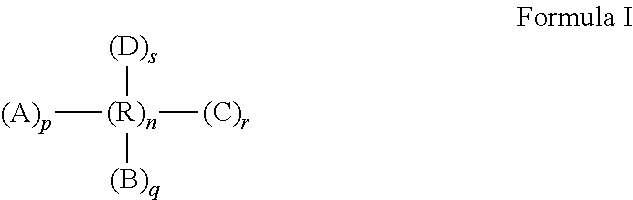
wherein
A, B, C, and D are reactive moieties,
R is a linker,
n is an integer that is ≧1, and
each occurrence of p, q, r, and s is independently an integer from 0 to 25, and wherein the sum of p+q+r+s is equal to or greater than 2.
6. The method of claim 1 , wherein the crosslinking agent is a polymer, wherein the linker forms the polymer backbone, and wherein the reactive moieties are covalently attached to the linker.
7. The method of claim 5 , wherein each of A, B, C, and D is independently selected from the group consisting of a Michael acceptor, a succinimidyl-containing group, a maleimido-containing group, azlactone, a benzoxazinone derivative, vinyl sulfone, vinyl sulfoximine, banzoxazinonc, isocyanate, epoxide, an electrophilic moiety containing a leaving group, an electrophilic thiol acceptor, acrylate group, a methacrylate group, a styrene group, an acryl amide group, a methacryl amide group, a maleate group, a fumarate group, an itaconate group, a vinyl ether group, an allyl ether group, an allyl ester group, and a vinyl ester group.
8. The method of claim 1 , wherein the reactive moieties and the thiol groups react to form carbon-sulfur (C—S) covalent bonds.
9. The method of claim 5 , wherein A, B, C, and D are the same.
10. The method of claim 5 , wherein at least one of A, B, C, and D is different than the other reactive moieties.
11. The method of claim 5 , wherein the crosslinking agent has a chemical structure selected from the group consisting of:
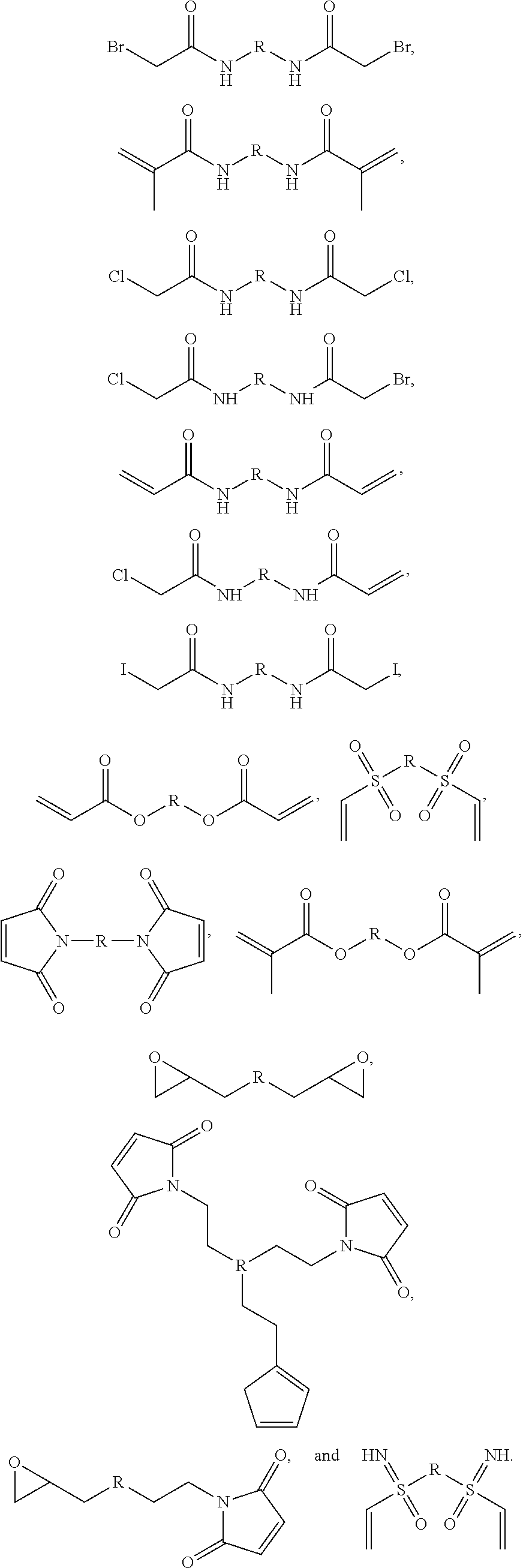
12. The method of claim 1 , wherein the linker is selected from the group consisting of oxygen, sulfur, carbon, boron, nitrogen, alkoxy, alkyl, alkenyl, cycloalkyl, cycloalkenyl, aryl, heterocycloalkyl, heteroaryl, ether, amine, and a polymer,
wherein the linker is optionally independently substituted with one or more substituents including hydrogen, halogen, cyano, alkoxy, alkyl, alkenyl, cycloalkyl, cycloalkenyl, aryl, heterocycloalkyl, heteroaryl, amine, hydroxy, formyl, acyl, carboxylic acid (—COOH), C(O)R1, —C(O)OR1, carboxylate (—COO−), primary amide (e.g., —CONH2), secondary amide (e.g., —CONHR11), —C(O)NR1R2, —NR1R2, —NR1S(O)2R2, —NR1C(O)R2, —S(O)2R2, —SR1, and —S(O)2NR1R2, sulfinyl group (e.g., —SOR11), and sulfonyl group (e.g., —SOOR11); wherein R1 and R2 may each independently be hydrogen, alkyl, alkenyl, alkynyl, cycloalkyl, aryl, heterocycloalkyl and heteroaryl; wherein each of R1 and R2 is optionally independently substituted with one or more substituents selected from the group consisting of halogen, hydroxyl, cyano, nitro, amino, alkylamino, dialkylamino, alkyl optionally substituted with one or more halogen or alkoxy or aryloxy, aryl optionally substituted with one or more halogen or alkoxy or alkyl or trihaloalkyl, heterocycloalkyl optionally substituted with aryl or heteroaryl or ═O or alkyl optionally substituted with hydroxyl, cycloalkyl optionally substituted with hydroxyl, heteroaryl optionally substituted with one or more halogen or alkoxy or alkyl or trihaloalkyl, haloalkyl, hydroxyalkyl, carboxy, alkoxy, aryloxy, alkoxycarbonyl, aminocarbonyl, alkylaminocarbonyl, and dialkylaminocarbonyl.
13. The method of claim 12 , wherein the linker is selected from the group consisting of alkoxy, alkyl, alkenyl, cycloalkyl, cycloalkenyl, aryl, amine, heterocycloalkyl, and heteroaryl.
14. The method of claim 2 , wherein the crosslinking agent is:
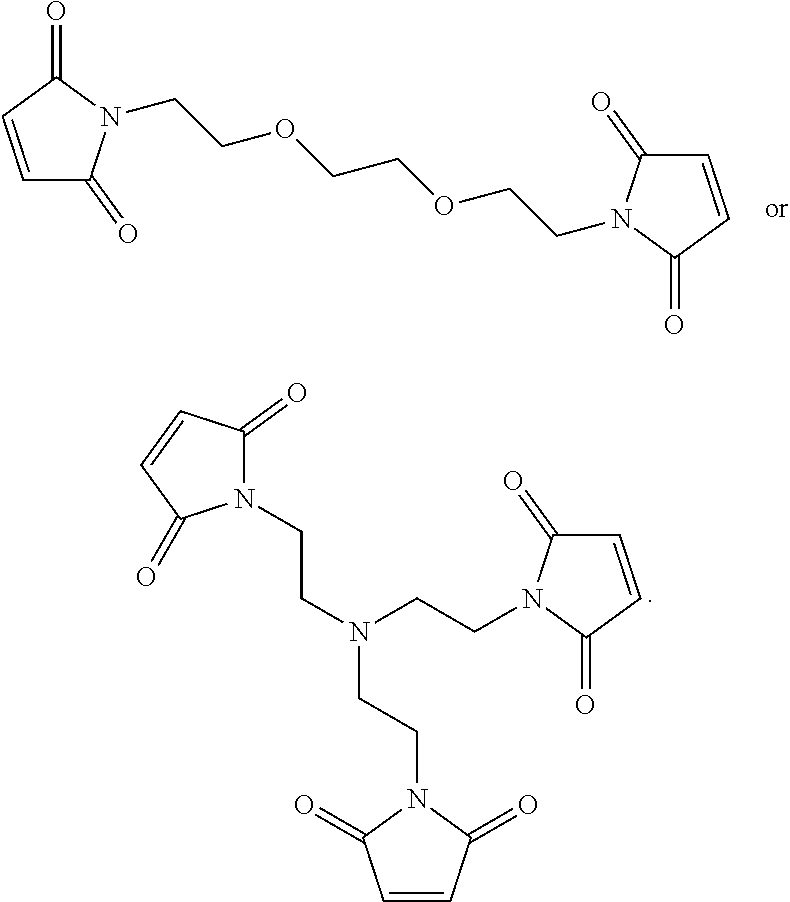
15. The method of claim 1 , wherein the second formulation further comprises one or more pharmaceutically acceptable excipients, and
wherein the one or more excipients are selected from the group consisting of water, surfactants, vitamins, natural extracts, preservatives, chelating agents, perfumes, preservatives, antioxidants, proteins, amino acids, humectants, fragrances, emollients, penetrants, thickeners, viscosity modifiers, hair fixatives, film formers, emulsifiers, opacifying agents, propellants, liquid vehicles, carriers, salts, pH adjusting agents, neutralizing agents, buffers, hair conditioning agents, anti-static agents, anti-frizz agents, anti-dandruff agents, and combinations thereof.
16. The method of claim 15 , wherein the crosslinking agent is present in an amount ranging from about 0.01 wt % to about 50 wt % of the second formulation, preferably from about 0.01 wt % to about 10 wt % of the second formulation.
17. The method of claim 16 , wherein the crosslinking agent is present in an amount ranging from about 2.5 to 3 wt % of the second formulation.
18. The method of claim 15 , wherein the pharmaceutical excipient is present in an amount ranging from about 10 wt % to about 99.99 wt % of the second formulation, preferably from about 50 wt % to about 90 wt % of the second formulation.
19. The method of claim 13 , wherein the second formulation is in the form of a gel, cream, lotion, shampoo, or conditioner.
20. The method of claim 1 , wherein step (b) is repeated one or more times.
21. The method of claim 1 , further comprising,
(c) rinsing, shampooing, and/or conditioning the hair, wherein step (c) occurs subsequent to step (b).
22. The method of claim 21 , wherein step (c) is performed within about 10 seconds to about 30 minutes, preferably between about 1 minute and about 20 minutes, more preferably about 10 minutes after step (b).
23. The method of claim 1 , wherein the coloring agent is selected from the group consisting of highlighting agents, permanent coloring agents, demi-permanent coloring agents, and semi-permanent coloring agents.
24. A kit comprising:
(a) a first formulation comprising a hair coloring agent and a reducing agent capable of reducing disulfide bonds in hair to produce reduced thiol groups, and
(b) a second formulation comprising a crosslinking agent in an effective amount to covalently crosslink reduced thiol groups in hair,
wherein the crosslinking agent comprises at least two reactive moieties capable of reacting with a thiol and optionally a linker that links the reactive moieties.
25. The kit of claim 24 , further comprising a shampoo, a conditioner, instructions for use, a developer, gloves, or a combination thereof.
26. The kit of claim 24 , wherein the crosslinking agent is represented by Formula I:
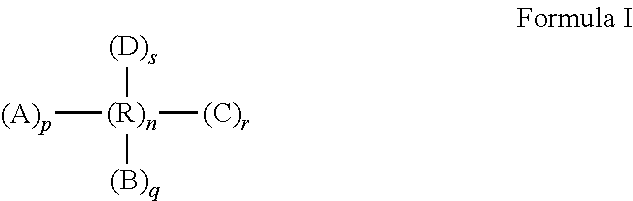
wherein
A, B, C, and D are reactive moieties,
R is a linker,
n is an integer that is ≧1, and
each occurrence of p, q, r, and s is independently an integer from 0 to 25,
and wherein the sum of p+q+r+s is equal to or greater than 2.
27. The kit of claim 24 , wherein the crosslinking agent is a polymer, wherein the linker forms the polymer backbone, and wherein the reactive moieties are covalently attached to the linker.
28. The kit of claim 26 , wherein each of A, B, C, and D is independently selected from the group consisting of a Michael acceptor, a succinimidyl-containing group, a maleimido-containing group, azlactone, a benzoxazinone derivative, vinyl sulfone, vinyl sulfoximine, banzoxazinone, isocyanate, epoxide, an electrophilic moiety containing a leaving group, an electrophilic thiol acceptor, acrylate group, a methacrylate group, a styrene group, an acryl amide group, a methacryl amide group, a maleate group, a fumarate group, an itaconate group, a vinyl ether group, an allyl ether group, an allyl ester group, and a vinyl ester group.
29. The kit of claim 24 , wherein the reactive moieties and the thiol groups react to form carbon-sulfur (C—S) covalent bonds.
30. The kit of claim 26 , wherein the crosslinking agent has a chemical structure selected from the group consisting of:
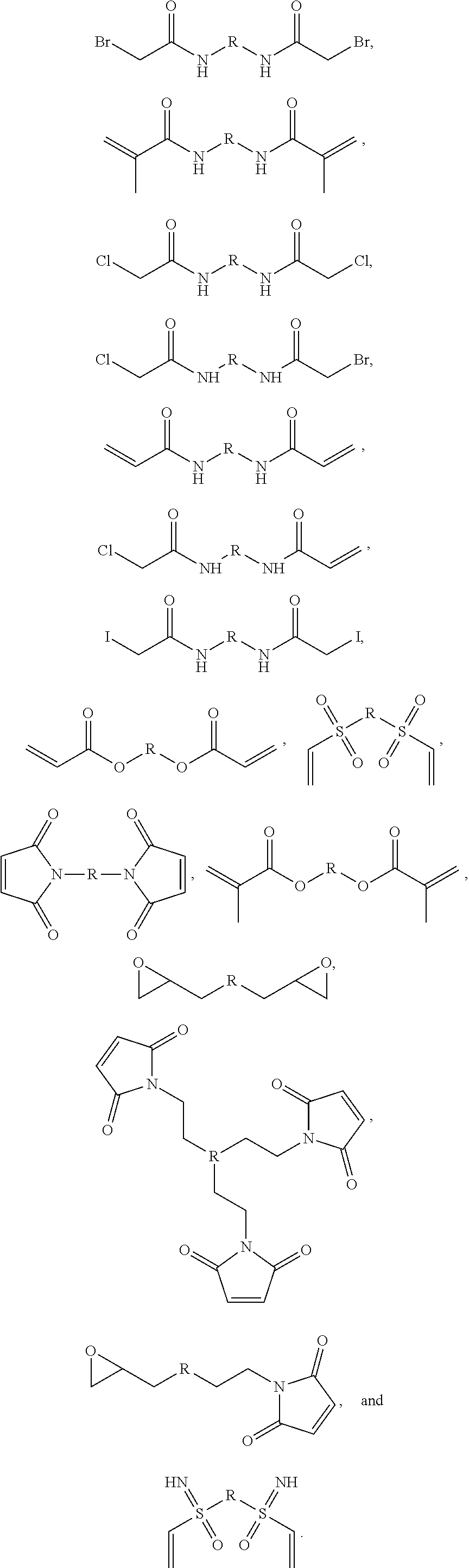
Priority Applications (63)
| Application Number | Priority Date | Filing Date | Title |
|---|---|---|---|
| UAA201601137A UA116148C2 (en) | 2013-08-01 | 2014-01-08 | METHODS OF HAIR AND SKIN RESTORATION |
| US14/257,089 US20150034119A1 (en) | 2013-08-01 | 2014-04-21 | Hair Color Smoothing Compositions and Methods |
| GB1523109.5A GB2530455B (en) | 2013-08-01 | 2014-08-01 | Methods of bleaching hair |
| MDA20160010A MD4587C1 (en) | 2013-08-01 | 2014-08-01 | Methods for fixing hair and skin |
| PE2016000102A PE20160214A1 (en) | 2013-08-01 | 2014-08-01 | METHODS TO REPAIR HAIR AND SKIN |
| CN201480042200.1A CN105431128B (en) | 2013-08-01 | 2014-08-01 | Method for repairing hair and skin |
| EP14758005.4A EP3001809B1 (en) | 2013-08-01 | 2014-08-01 | Method for conditioning hair and skin |
| AP2015008934A AP2015008934A0 (en) | 2013-08-01 | 2014-08-01 | Methods for fixing hair and skin |
| EA201592291A EA035975B1 (en) | 2013-08-01 | 2014-08-01 | Method and formulation for treating hair when bleaching or coloring |
| HK16110382.7A HK1222322B (en) | 2013-08-01 | 2014-08-01 | Methods of bleaching hair |
| MX2016001176A MX352669B (en) | 2013-08-01 | 2014-08-01 | Methods for fixing hair and skin. |
| PL17163334T PL3326606T3 (en) | 2013-08-01 | 2014-08-01 | WAYS OF REPAIRING HAIR AND SKIN |
| EP17163334.0A EP3326606B1 (en) | 2013-08-01 | 2014-08-01 | Methods for fixing hair and skin |
| MEP-2017-195A ME02869B (en) | 2013-08-01 | 2014-08-01 | PROCEDURE FOR FIXING HAIR AND SKIN |
| PL14758005T PL3001809T3 (en) | 2013-08-01 | 2014-08-01 | Method for conditioning hair and skin |
| HUE14758005A HUE034751T2 (en) | 2013-08-01 | 2014-08-01 | Method for conditioning hair and skin |
| RS20170970A RS56378B1 (en) | 2013-08-01 | 2014-08-01 | Method for conditioning hair and skin |
| CA2916985A CA2916985C (en) | 2013-08-01 | 2014-08-01 | Methods for fixing hair and skin |
| DK14758005.4T DK3001809T3 (en) | 2013-08-01 | 2014-08-01 | Procedure for the care of hair and skin |
| JP2016515948A JP6286030B2 (en) | 2013-08-01 | 2014-08-01 | Method for restoring hair and skin |
| DE202014010627.4U DE202014010627U1 (en) | 2013-08-01 | 2014-08-01 | Formulation with a binder for hair treatment |
| GB1605344.9A GB2533883B (en) | 2013-08-01 | 2014-08-01 | Methods and kits for coloring hair |
| GEAP201414045A GEP20186869B (en) | 2013-08-01 | 2014-08-01 | Methods for fixing hair and skin |
| AU2014296072A AU2014296072B2 (en) | 2013-08-01 | 2014-08-01 | Methods for fixing hair and skin |
| MYPI2016700195A MY195718A (en) | 2013-08-01 | 2014-08-01 | Methods for Fixing Hair and Skin |
| HK16110380.9A HK1222321A1 (en) | 2013-08-01 | 2014-08-01 | Methods for fixing hair and skin |
| BR112016002255-6A BR112016002255B1 (en) | 2013-08-01 | 2014-08-01 | cosmetic method to treat hair, formulation, kits and shampoo or conditioner |
| EP21205823.4A EP4008306B1 (en) | 2013-08-01 | 2014-08-01 | Methods for fixing hair and skin |
| GB1618423.6A GB2541137B (en) | 2013-08-01 | 2014-08-01 | Method and kits for treating hair |
| PT147580054T PT3001809T (en) | 2013-08-01 | 2014-08-01 | METHOD FOR HAIR AND SKIN CONDITIONING |
| ES17163334T ES2905255T3 (en) | 2013-08-01 | 2014-08-01 | Capillary and skin fixation methods |
| KR1020167002682A KR101781991B1 (en) | 2013-08-01 | 2014-08-01 | Methods for fixing hair and skin |
| DK17163334.0T DK3326606T3 (en) | 2013-08-01 | 2014-08-01 | Methods for fixing hair and skin |
| NZ715539A NZ715539A (en) | 2013-08-01 | 2014-08-01 | Methods for fixing hair and skin |
| SI201430367T SI3001809T1 (en) | 2013-08-01 | 2014-08-01 | Method for conditioning hair and skin |
| GEAP201814045A GEAP201814045A (en) | 2013-08-01 | 2014-08-01 | Methods for fixing hair and skin |
| HRP20171408TT HRP20171408T1 (en) | 2013-08-01 | 2014-08-01 | Method for conditioning hair and skin |
| PCT/US2014/049388 WO2015017768A1 (en) | 2013-08-01 | 2014-08-01 | Methods for fixing hair and skin |
| TN2015000571A TN2015000571A1 (en) | 2013-08-01 | 2014-08-01 | Methods for fixing hair and skin |
| CU2016000017A CU24449B1 (en) | 2013-08-01 | 2014-08-01 | ACTIVE AGENTS THAT HAVE A DOUBLE CARBON-CARBON BOND, USEFUL IN A COMPOSITION TO TREAT THE HAIR |
| ES14758005.4T ES2639727T3 (en) | 2013-08-01 | 2014-08-01 | Capillary and cutaneous conditioning method |
| SG11201600752RA SG11201600752RA (en) | 2013-08-01 | 2014-08-01 | Methods for fixing hair and skin |
| LTEP14758005.4T LT3001809T (en) | 2013-08-01 | 2014-08-01 | Method for conditioning hair and skin |
| US14/459,012 US9095518B2 (en) | 2013-08-01 | 2014-08-13 | Methods for fixing hair and skin |
| US14/748,831 US9144537B1 (en) | 2013-08-01 | 2015-06-24 | Methods for fixing hair and skin |
| US14/835,223 US9855447B2 (en) | 2013-08-01 | 2015-08-25 | Methods for fixing hair and skin |
| US14/882,032 US20160263003A1 (en) | 2013-08-01 | 2015-10-13 | Hair Color Smoothing Compositions and Methods |
| ZA2015/09357A ZA201509357B (en) | 2013-08-01 | 2015-12-23 | Methods for fixing hair and skin |
| PH12016500132A PH12016500132A1 (en) | 2013-08-01 | 2016-01-20 | Methods for fixing hair and skin |
| CL2016000158A CL2016000158A1 (en) | 2013-08-01 | 2016-01-21 | Methods for hair and skin fixation |
| IL243748A IL243748A (en) | 2013-08-01 | 2016-01-24 | Methods for fixing hair and skin |
| DO2016000030A DOP2016000030A (en) | 2013-08-01 | 2016-01-26 | METHODS TO REPAIR HAIR AND SKIN |
| GT201600023A GT201600023A (en) | 2013-08-01 | 2016-01-29 | METHODS TO REPAIR HAIR AND SKIN |
| NI201600020A NI201600020A (en) | 2013-08-01 | 2016-01-29 | METHODS TO REPAIR HAIR AND SKIN. |
| SA516370509A SA516370509B1 (en) | 2013-08-01 | 2016-01-31 | Methods for treating hair and skin |
| CY20171101049T CY1119456T1 (en) | 2013-08-01 | 2017-10-09 | METHOD FOR HAIR AND SKIN CARE |
| US15/854,504 US10639505B2 (en) | 2013-08-01 | 2017-12-26 | Methods for fixing hair and skin |
| US16/830,789 US11446525B2 (en) | 2013-08-01 | 2020-03-26 | Methods for fixing hair and skin |
| US17/941,675 US12233289B2 (en) | 2013-08-01 | 2022-09-09 | Methods for fixing hair and skin |
| US18/177,011 US20230201632A1 (en) | 2013-08-01 | 2023-03-01 | Methods for fixing hair and skin |
| US18/811,158 US12214225B2 (en) | 2013-08-01 | 2024-08-21 | Methods for fixing hair and skin |
| US18/952,929 US20250302704A1 (en) | 2013-08-01 | 2024-11-19 | Methods for fixing hair and skin |
| US19/028,706 US20250381425A1 (en) | 2013-08-01 | 2025-01-17 | Methods for fixing hair and skin |
Applications Claiming Priority (4)
| Application Number | Priority Date | Filing Date | Title |
|---|---|---|---|
| US201361861281P | 2013-08-01 | 2013-08-01 | |
| US201361867872P | 2013-08-20 | 2013-08-20 | |
| US201361903239P | 2013-11-12 | 2013-11-12 | |
| US14/257,089 US20150034119A1 (en) | 2013-08-01 | 2014-04-21 | Hair Color Smoothing Compositions and Methods |
Related Parent Applications (2)
| Application Number | Title | Priority Date | Filing Date |
|---|---|---|---|
| US14/257,076 Continuation-In-Part US20150037270A1 (en) | 2013-08-01 | 2014-04-21 | Compositions and Kits for Hair and Skin |
| US14/257,056 Continuation-In-Part US20150037271A1 (en) | 2013-08-01 | 2014-04-21 | Methods for Fixing Hair and Skin |
Related Child Applications (5)
| Application Number | Title | Priority Date | Filing Date |
|---|---|---|---|
| US14/257,056 Continuation-In-Part US20150037271A1 (en) | 2013-08-01 | 2014-04-21 | Methods for Fixing Hair and Skin |
| US14/257,056 Continuation US20150037271A1 (en) | 2013-08-01 | 2014-04-21 | Methods for Fixing Hair and Skin |
| PCT/US2014/049388 Continuation-In-Part WO2015017768A1 (en) | 2013-08-01 | 2014-08-01 | Methods for fixing hair and skin |
| PCT/US2014/049388 Continuation WO2015017768A1 (en) | 2013-08-01 | 2014-08-01 | Methods for fixing hair and skin |
| US14/882,032 Continuation US20160263003A1 (en) | 2013-08-01 | 2015-10-13 | Hair Color Smoothing Compositions and Methods |
Publications (1)
| Publication Number | Publication Date |
|---|---|
| US20150034119A1 true US20150034119A1 (en) | 2015-02-05 |
Family
ID=52426535
Family Applications (2)
| Application Number | Title | Priority Date | Filing Date |
|---|---|---|---|
| US14/257,089 Abandoned US20150034119A1 (en) | 2013-08-01 | 2014-04-21 | Hair Color Smoothing Compositions and Methods |
| US14/882,032 Abandoned US20160263003A1 (en) | 2013-08-01 | 2015-10-13 | Hair Color Smoothing Compositions and Methods |
Family Applications After (1)
| Application Number | Title | Priority Date | Filing Date |
|---|---|---|---|
| US14/882,032 Abandoned US20160263003A1 (en) | 2013-08-01 | 2015-10-13 | Hair Color Smoothing Compositions and Methods |
Country Status (1)
| Country | Link |
|---|---|
| US (2) | US20150034119A1 (en) |
Cited By (59)
| Publication number | Priority date | Publication date | Assignee | Title |
|---|---|---|---|---|
| US9326926B2 (en) * | 2014-05-16 | 2016-05-03 | Liqwd, Inc. | Keratin treatment formulations and methods |
| KR20160099144A (en) * | 2015-02-11 | 2016-08-22 | 학교법인 서경대학원 | Hair processing agent and method for perming or dying hair using the same |
| US20160367451A1 (en) * | 2015-06-18 | 2016-12-22 | The Procter & Gamble Company | Shaping keratin fibres using dialdehyde compounds |
| WO2017041908A1 (en) | 2015-09-08 | 2017-03-16 | Kao Germany Gmbh | Process for bleaching hair |
| US9597273B2 (en) | 2015-04-24 | 2017-03-21 | Liqwd, Inc. | Methods for treating relaxed hair |
| EP3175837A1 (en) * | 2015-12-01 | 2017-06-07 | Noxell Corporation | Method for treating hair |
| US9713583B1 (en) | 2016-07-12 | 2017-07-25 | Liqwd, Inc. | Methods and formulations for curling hair |
| US9855447B2 (en) | 2013-08-01 | 2018-01-02 | Liqwd, Inc. | Methods for fixing hair and skin |
| US9872821B1 (en) | 2016-07-12 | 2018-01-23 | Liqwd, Inc. | Methods and formulations for curling hair |
| WO2018036105A1 (en) | 2016-08-22 | 2018-03-01 | 知识产权全资产有限公司 | Method for strengthening and repairing hair, and kit therefor |
| WO2018060727A1 (en) | 2016-09-30 | 2018-04-05 | Innospec Limited | Methods, compositions and uses relating thereto |
| WO2018060719A1 (en) | 2016-09-30 | 2018-04-05 | Innospec Limited | A method of treating a material comprising an amine salt of a carboxylic acid having 4 to 10 carbon atoms |
| US9974725B1 (en) | 2017-05-24 | 2018-05-22 | L'oreal | Methods for treating chemically relaxed hair |
| US10058494B2 (en) | 2015-11-24 | 2018-08-28 | L'oreal | Compositions for altering the color of hair |
| DE202016008643U1 (en) | 2015-10-08 | 2018-10-22 | Ip Full Asset Limited | Hair consolidation composition and its application for hair firming |
| SE1751041A1 (en) * | 2017-08-30 | 2019-03-01 | Jaywant Phopase | Functionalized polypeptide for hair treatment |
| US10231915B2 (en) | 2015-05-01 | 2019-03-19 | L'oreal | Compositions for altering the color of hair |
| DE112017002170T5 (en) | 2016-05-19 | 2019-05-23 | Ip Full Asset Limited | Hair-strengthening composition and a hair strengthening kit |
| KR20190061036A (en) * | 2016-09-30 | 2019-06-04 | 이노스펙 리미티드 | Reduction of color loss from dyed materials using amine salts of carboxylic acids |
| US10398634B2 (en) | 2015-09-08 | 2019-09-03 | Kao Germany Gmbh | Process for oxidative dyeing hair |
| US10398914B2 (en) | 2015-09-08 | 2019-09-03 | Kao Germany Gmbh | Process for treating hair |
| US10434051B2 (en) | 2014-12-19 | 2019-10-08 | The Procter And Gamble Company | Shaping keratin fibers using arabinose and ethylene carbonate |
| US10441518B2 (en) | 2015-11-24 | 2019-10-15 | L'oreal | Compositions for treating the hair |
| US10555891B2 (en) | 2017-05-24 | 2020-02-11 | L'oreal | Methods for treating chemically treated hair |
| US10561599B2 (en) | 2017-05-24 | 2020-02-18 | L'oreal | Methods and kits for treating chemically relaxed hair |
| US10568826B2 (en) | 2014-12-19 | 2020-02-25 | The Procter And Gamble Company | Shaping keratin fibres using a pretreatment and a protein crosslinking composition |
| US10576307B2 (en) | 2017-05-24 | 2020-03-03 | L'oreal | Hair-treatment compositions, methods, and kits for treating hair |
| US10729630B2 (en) | 2013-12-19 | 2020-08-04 | The Procter & Gamble Company | Shaping keratin fibres using an active agent comprising at least two functional groups selected from: —C(OH)- and —C(=O)OH |
| US10799440B2 (en) | 2016-04-22 | 2020-10-13 | Innospec Limited | Methods, compositions and uses relating thereto |
| US10912726B2 (en) | 2013-12-19 | 2021-02-09 | The Procter And Gamble Company | Shaping keratin fibres using a reducing composition and a fixing composition |
| WO2021084084A1 (en) | 2019-10-31 | 2021-05-06 | Kao Corporation | Aqueous oxidizing composition comprising amino acids |
| US11000461B2 (en) | 2016-04-22 | 2021-05-11 | Innospec Limited | Methods, compositions and uses relating thereto |
| US11083682B2 (en) | 2015-09-30 | 2021-08-10 | Marianna Industries | Composition and method for improving and protecting keratins |
| US11090249B2 (en) | 2018-10-31 | 2021-08-17 | L'oreal | Hair treatment compositions, methods, and kits for treating hair |
| US11096879B2 (en) | 2013-12-19 | 2021-08-24 | The Procter And Gamble Plaza | Shaping keratin fibres using an active agent comprising a functional group selected from the group consisting of: -C(=O)-, -C(=O)-H, and -C(=O)-O- |
| US11103434B2 (en) | 2013-12-19 | 2021-08-31 | The Procter And Gamble Company | Shaping keratin fibres using carbonate ester |
| US11103429B2 (en) | 2015-09-08 | 2021-08-31 | Kao Germany Gmbh | Process for treating hair |
| US11110046B2 (en) | 2013-12-19 | 2021-09-07 | The Procter And Gamble Company | Shaping keratin fibres using 2-hydroxypropane-1,2,3-tricarboxylic acid and/or 1,2,3,4-butanetetracarboxylic acid |
| US11110041B2 (en) | 2015-09-08 | 2021-09-07 | Kao Germany Gmbh | Process for permanent shaping hair |
| US11129784B2 (en) | 2013-12-19 | 2021-09-28 | The Procter And Gamble Company | Shaping keratin fibres using oxoethanoic acid and/or derivatives thereof |
| US11135150B2 (en) | 2016-11-21 | 2021-10-05 | L'oreal | Compositions and methods for improving the quality of chemically treated hair |
| US11154475B2 (en) | 2017-01-09 | 2021-10-26 | Hercules Llc | Method for coloring or bleaching hair fibers |
| US11154480B2 (en) | 2013-12-19 | 2021-10-26 | The Procter And Gamble Company | Shaping keratin fibres using a sugar |
| US11213470B2 (en) | 2015-11-24 | 2022-01-04 | L'oreal | Compositions for treating the hair |
| US11234917B2 (en) | 2016-09-30 | 2022-02-01 | Innospec Limited | Methods, compositions and uses relating thereto |
| US11253452B2 (en) | 2016-04-22 | 2022-02-22 | Innospec Limited | Methods and compositions for combatting color loss |
| US11304884B2 (en) | 2016-04-22 | 2022-04-19 | Innospec Limited | Methods, compositions and uses relating thereto |
| US11419809B2 (en) | 2019-06-27 | 2022-08-23 | L'oreal | Hair treatment compositions and methods for treating hair |
| US11559474B2 (en) | 2016-11-02 | 2023-01-24 | L'oreal | Hair lightening compositions and methods of use |
| US11596588B2 (en) | 2017-12-29 | 2023-03-07 | L'oreal | Compositions for altering the color of hair |
| US11826451B2 (en) | 2019-12-31 | 2023-11-28 | L'oreal | Compositions for treating hair |
| US12036299B2 (en) | 2021-06-30 | 2024-07-16 | L'oreal | Compositions containing direct dyes for imparting color and tone to the hair |
| US12076431B2 (en) | 2016-09-30 | 2024-09-03 | Innospec Limited | Cosmetic compositions for combatting colour loss from a dyed material |
| US12109286B2 (en) | 2015-09-08 | 2024-10-08 | Kao Germany Gmbh | Process for semipermanent straightening and permanent shaping hair |
| US12109289B2 (en) | 2021-06-30 | 2024-10-08 | L'oreal | Compositions for imparting color and tone to the hair |
| US12109287B2 (en) | 2022-07-31 | 2024-10-08 | L'oreal | Compositions and methods for altering the color of hair |
| US12144879B2 (en) | 2022-07-31 | 2024-11-19 | L'oreal | Compositions and methods for altering the color of hair |
| US12214225B2 (en) | 2013-08-01 | 2025-02-04 | Olaplex, Inc. | Methods for fixing hair and skin |
| US12409123B2 (en) | 2022-07-31 | 2025-09-09 | L'oreal | Compositions and methods for altering the color of hair |
Families Citing this family (3)
| Publication number | Priority date | Publication date | Assignee | Title |
|---|---|---|---|---|
| US20150037271A1 (en) * | 2013-08-01 | 2015-02-05 | Liqwd, Inc. | Methods for Fixing Hair and Skin |
| JOP20180033A1 (en) | 2017-04-12 | 2019-01-30 | Coty Inc | Method for treating hair, kit, and use of the kit |
| EP3388050A1 (en) | 2017-04-12 | 2018-10-17 | Coty Inc. | Method for treating hair, kit, and use of the kit |
Family Cites Families (2)
| Publication number | Priority date | Publication date | Assignee | Title |
|---|---|---|---|---|
| FR2813016B1 (en) * | 2000-08-21 | 2002-10-11 | Oreal | COLORING COMPOSITION FOR DYED KERATINIC FIBERS |
| US20150037271A1 (en) * | 2013-08-01 | 2015-02-05 | Liqwd, Inc. | Methods for Fixing Hair and Skin |
-
2014
- 2014-04-21 US US14/257,089 patent/US20150034119A1/en not_active Abandoned
-
2015
- 2015-10-13 US US14/882,032 patent/US20160263003A1/en not_active Abandoned
Cited By (92)
| Publication number | Priority date | Publication date | Assignee | Title |
|---|---|---|---|---|
| US11446525B2 (en) | 2013-08-01 | 2022-09-20 | Olaplex, Inc. | Methods for fixing hair and skin |
| US10639505B2 (en) | 2013-08-01 | 2020-05-05 | Olaplex, Inc. | Methods for fixing hair and skin |
| US12214225B2 (en) | 2013-08-01 | 2025-02-04 | Olaplex, Inc. | Methods for fixing hair and skin |
| US12233289B2 (en) | 2013-08-01 | 2025-02-25 | Olaplex, Inc. | Methods for fixing hair and skin |
| US9855447B2 (en) | 2013-08-01 | 2018-01-02 | Liqwd, Inc. | Methods for fixing hair and skin |
| US10912726B2 (en) | 2013-12-19 | 2021-02-09 | The Procter And Gamble Company | Shaping keratin fibres using a reducing composition and a fixing composition |
| US11103434B2 (en) | 2013-12-19 | 2021-08-31 | The Procter And Gamble Company | Shaping keratin fibres using carbonate ester |
| US11096879B2 (en) | 2013-12-19 | 2021-08-24 | The Procter And Gamble Plaza | Shaping keratin fibres using an active agent comprising a functional group selected from the group consisting of: -C(=O)-, -C(=O)-H, and -C(=O)-O- |
| US11110046B2 (en) | 2013-12-19 | 2021-09-07 | The Procter And Gamble Company | Shaping keratin fibres using 2-hydroxypropane-1,2,3-tricarboxylic acid and/or 1,2,3,4-butanetetracarboxylic acid |
| US11129784B2 (en) | 2013-12-19 | 2021-09-28 | The Procter And Gamble Company | Shaping keratin fibres using oxoethanoic acid and/or derivatives thereof |
| US11154480B2 (en) | 2013-12-19 | 2021-10-26 | The Procter And Gamble Company | Shaping keratin fibres using a sugar |
| US10729630B2 (en) | 2013-12-19 | 2020-08-04 | The Procter & Gamble Company | Shaping keratin fibres using an active agent comprising at least two functional groups selected from: —C(OH)- and —C(=O)OH |
| US9326926B2 (en) * | 2014-05-16 | 2016-05-03 | Liqwd, Inc. | Keratin treatment formulations and methods |
| US9668954B2 (en) | 2014-05-16 | 2017-06-06 | Liqwd, Inc. | Keratin treatment formulations and methods |
| US9498419B2 (en) | 2014-05-16 | 2016-11-22 | Liqwd, Inc. | Keratin treatment formulations and methods |
| US10076478B2 (en) | 2014-05-16 | 2018-09-18 | Liqwd, Inc. | Keratin treatment formulations and methods |
| US10568826B2 (en) | 2014-12-19 | 2020-02-25 | The Procter And Gamble Company | Shaping keratin fibres using a pretreatment and a protein crosslinking composition |
| US10434051B2 (en) | 2014-12-19 | 2019-10-08 | The Procter And Gamble Company | Shaping keratin fibers using arabinose and ethylene carbonate |
| KR20160099144A (en) * | 2015-02-11 | 2016-08-22 | 학교법인 서경대학원 | Hair processing agent and method for perming or dying hair using the same |
| KR101661511B1 (en) | 2015-02-11 | 2016-10-04 | 학교법인 서경대학원 | Hair processing agent and method for perming or dying hair using the same |
| US12251456B2 (en) | 2015-04-24 | 2025-03-18 | Olaplex, Inc. | Methods for treating relaxed hair |
| US9597273B2 (en) | 2015-04-24 | 2017-03-21 | Liqwd, Inc. | Methods for treating relaxed hair |
| US9717668B2 (en) | 2015-04-24 | 2017-08-01 | Liqwd, Inc. | Methods for treating relaxed hair |
| US11191707B2 (en) | 2015-04-24 | 2021-12-07 | Olaplex, Inc. | Methods for treating relaxed hair |
| US10993896B2 (en) | 2015-05-01 | 2021-05-04 | L'oreal | Compositions for altering the color of hair |
| US10231915B2 (en) | 2015-05-01 | 2019-03-19 | L'oreal | Compositions for altering the color of hair |
| US10945931B2 (en) * | 2015-06-18 | 2021-03-16 | The Procter And Gamble Company | Shaping keratin fibres using dialdehyde compounds |
| US20160367451A1 (en) * | 2015-06-18 | 2016-12-22 | The Procter & Gamble Company | Shaping keratin fibres using dialdehyde compounds |
| US10632053B2 (en) * | 2015-09-08 | 2020-04-28 | Kao Germany Gmbh | Process for bleaching hair |
| US10398914B2 (en) | 2015-09-08 | 2019-09-03 | Kao Germany Gmbh | Process for treating hair |
| US10398634B2 (en) | 2015-09-08 | 2019-09-03 | Kao Germany Gmbh | Process for oxidative dyeing hair |
| US11103429B2 (en) | 2015-09-08 | 2021-08-31 | Kao Germany Gmbh | Process for treating hair |
| WO2017041908A1 (en) | 2015-09-08 | 2017-03-16 | Kao Germany Gmbh | Process for bleaching hair |
| US12109286B2 (en) | 2015-09-08 | 2024-10-08 | Kao Germany Gmbh | Process for semipermanent straightening and permanent shaping hair |
| US11110041B2 (en) | 2015-09-08 | 2021-09-07 | Kao Germany Gmbh | Process for permanent shaping hair |
| US20180353404A1 (en) * | 2015-09-08 | 2018-12-13 | Kao Germany Gmbh | Process for bleaching hair |
| US11083682B2 (en) | 2015-09-30 | 2021-08-10 | Marianna Industries | Composition and method for improving and protecting keratins |
| DE202016008643U1 (en) | 2015-10-08 | 2018-10-22 | Ip Full Asset Limited | Hair consolidation composition and its application for hair firming |
| US10441518B2 (en) | 2015-11-24 | 2019-10-15 | L'oreal | Compositions for treating the hair |
| US11213470B2 (en) | 2015-11-24 | 2022-01-04 | L'oreal | Compositions for treating the hair |
| US11083675B2 (en) | 2015-11-24 | 2021-08-10 | L'oreal | Compositions for altering the color of hair |
| US10828244B2 (en) | 2015-11-24 | 2020-11-10 | L'oreal | Compositions for treating the hair |
| US12048759B2 (en) | 2015-11-24 | 2024-07-30 | L'oreal | Compositions for treating the hair |
| US10058494B2 (en) | 2015-11-24 | 2018-08-28 | L'oreal | Compositions for altering the color of hair |
| US11191706B2 (en) | 2015-11-24 | 2021-12-07 | L'oreal | Compositions for altering the color of hair |
| EP3383500A4 (en) * | 2015-12-01 | 2019-08-07 | Noxell Corporation | Method for treating hair |
| EP3175837A1 (en) * | 2015-12-01 | 2017-06-07 | Noxell Corporation | Method for treating hair |
| US10799440B2 (en) | 2016-04-22 | 2020-10-13 | Innospec Limited | Methods, compositions and uses relating thereto |
| US11000461B2 (en) | 2016-04-22 | 2021-05-11 | Innospec Limited | Methods, compositions and uses relating thereto |
| US11642291B2 (en) | 2016-04-22 | 2023-05-09 | Innospec Limited | Methods, compositions and uses relating thereto |
| US11253452B2 (en) | 2016-04-22 | 2022-02-22 | Innospec Limited | Methods and compositions for combatting color loss |
| US11304884B2 (en) | 2016-04-22 | 2022-04-19 | Innospec Limited | Methods, compositions and uses relating thereto |
| DE112017002170T5 (en) | 2016-05-19 | 2019-05-23 | Ip Full Asset Limited | Hair-strengthening composition and a hair strengthening kit |
| US11559475B2 (en) | 2016-05-19 | 2023-01-24 | Liw Patent Company Limited By Guarantee | Hair strengthening ingredient and method for strengthening hair |
| US9872821B1 (en) | 2016-07-12 | 2018-01-23 | Liqwd, Inc. | Methods and formulations for curling hair |
| US10792233B2 (en) | 2016-07-12 | 2020-10-06 | Olaplex, Inc. | Methods and formulations for curling hair |
| US9713583B1 (en) | 2016-07-12 | 2017-07-25 | Liqwd, Inc. | Methods and formulations for curling hair |
| WO2018036105A1 (en) | 2016-08-22 | 2018-03-01 | 知识产权全资产有限公司 | Method for strengthening and repairing hair, and kit therefor |
| US11234917B2 (en) | 2016-09-30 | 2022-02-01 | Innospec Limited | Methods, compositions and uses relating thereto |
| US12076431B2 (en) | 2016-09-30 | 2024-09-03 | Innospec Limited | Cosmetic compositions for combatting colour loss from a dyed material |
| WO2018060719A1 (en) | 2016-09-30 | 2018-04-05 | Innospec Limited | A method of treating a material comprising an amine salt of a carboxylic acid having 4 to 10 carbon atoms |
| GB2560212B (en) * | 2016-09-30 | 2021-06-09 | Innospec Ltd | Methods, compositions and uses relating thereto |
| GB2560212A (en) * | 2016-09-30 | 2018-09-05 | Innospec Ltd | Methods, compositions and uses relating thereto |
| WO2018060727A1 (en) | 2016-09-30 | 2018-04-05 | Innospec Limited | Methods, compositions and uses relating thereto |
| KR20190061036A (en) * | 2016-09-30 | 2019-06-04 | 이노스펙 리미티드 | Reduction of color loss from dyed materials using amine salts of carboxylic acids |
| US20200030212A1 (en) * | 2016-09-30 | 2020-01-30 | Innospec Limited | Methods, compositions and uses relating thereto |
| US11253453B2 (en) | 2016-09-30 | 2022-02-22 | Innospec Limited | Reducing colour loss from a dyed material by using an amine salt of a carboxylic acid |
| KR102475725B1 (en) * | 2016-09-30 | 2022-12-07 | 이노스펙 리미티드 | Reduction of color loss from dyed materials using amine salts of carboxylic acids |
| US11311471B2 (en) | 2016-09-30 | 2022-04-26 | Innospec Limited | Methods, compositions and uses relating thereto |
| US11559474B2 (en) | 2016-11-02 | 2023-01-24 | L'oreal | Hair lightening compositions and methods of use |
| US11135150B2 (en) | 2016-11-21 | 2021-10-05 | L'oreal | Compositions and methods for improving the quality of chemically treated hair |
| US11154475B2 (en) | 2017-01-09 | 2021-10-26 | Hercules Llc | Method for coloring or bleaching hair fibers |
| US11433011B2 (en) | 2017-05-24 | 2022-09-06 | L'oreal | Methods for treating chemically relaxed hair |
| US10576307B2 (en) | 2017-05-24 | 2020-03-03 | L'oreal | Hair-treatment compositions, methods, and kits for treating hair |
| US9974725B1 (en) | 2017-05-24 | 2018-05-22 | L'oreal | Methods for treating chemically relaxed hair |
| US10555891B2 (en) | 2017-05-24 | 2020-02-11 | L'oreal | Methods for treating chemically treated hair |
| US10561599B2 (en) | 2017-05-24 | 2020-02-18 | L'oreal | Methods and kits for treating chemically relaxed hair |
| SE1751041A1 (en) * | 2017-08-30 | 2019-03-01 | Jaywant Phopase | Functionalized polypeptide for hair treatment |
| US11896705B2 (en) | 2017-08-30 | 2024-02-13 | Uab Ferentis | Functionalized polypeptides useful in hair treatment |
| WO2019045612A1 (en) * | 2017-08-30 | 2019-03-07 | Phopase Jaywant | Functionalized polypeptides useful in hair treatment |
| US11596588B2 (en) | 2017-12-29 | 2023-03-07 | L'oreal | Compositions for altering the color of hair |
| US11975092B2 (en) | 2018-10-31 | 2024-05-07 | L'oreal | Hair treatment compositions, methods, and kits for treating hair |
| US11090249B2 (en) | 2018-10-31 | 2021-08-17 | L'oreal | Hair treatment compositions, methods, and kits for treating hair |
| US11419809B2 (en) | 2019-06-27 | 2022-08-23 | L'oreal | Hair treatment compositions and methods for treating hair |
| US12508213B2 (en) | 2019-10-31 | 2025-12-30 | Kao Corporation | Aqueous oxidizing composition comprising amino acids |
| WO2021084084A1 (en) | 2019-10-31 | 2021-05-06 | Kao Corporation | Aqueous oxidizing composition comprising amino acids |
| US11826451B2 (en) | 2019-12-31 | 2023-11-28 | L'oreal | Compositions for treating hair |
| US12109289B2 (en) | 2021-06-30 | 2024-10-08 | L'oreal | Compositions for imparting color and tone to the hair |
| US12036299B2 (en) | 2021-06-30 | 2024-07-16 | L'oreal | Compositions containing direct dyes for imparting color and tone to the hair |
| US12144879B2 (en) | 2022-07-31 | 2024-11-19 | L'oreal | Compositions and methods for altering the color of hair |
| US12109287B2 (en) | 2022-07-31 | 2024-10-08 | L'oreal | Compositions and methods for altering the color of hair |
| US12409123B2 (en) | 2022-07-31 | 2025-09-09 | L'oreal | Compositions and methods for altering the color of hair |
Also Published As
| Publication number | Publication date |
|---|---|
| US20160263003A1 (en) | 2016-09-15 |
Similar Documents
| Publication | Publication Date | Title |
|---|---|---|
| US11446525B2 (en) | Methods for fixing hair and skin | |
| AU2019100919A4 (en) | Keratin treatment formulations and methods | |
| AU2014296072B2 (en) | Methods for fixing hair and skin | |
| US20160263003A1 (en) | Hair Color Smoothing Compositions and Methods | |
| US20160193129A1 (en) | Methods for Fixing Hair and Skin | |
| AU2014296072A1 (en) | Methods for fixing hair and skin | |
| US20230201632A1 (en) | Methods for fixing hair and skin | |
| US12214225B2 (en) | Methods for fixing hair and skin | |
| GB2541137A (en) | Methods for fixing hair and skin | |
| HK1230472A1 (en) | Methods and kits for coloring hair | |
| OA17660A (en) | Methods for fixing hair and skin. | |
| HK1233511A1 (en) | Method and kits for treating hair | |
| GB2533883A (en) | Methods for fixing hair and skin | |
| NZ764434B2 (en) | Keratin Treatment Formulations and Methods | |
| HK1227280A1 (en) | Keratin treatment formulations and methods |
Legal Events
| Date | Code | Title | Description |
|---|---|---|---|
| AS | Assignment |
Owner name: LIQWD, INC., CALIFORNIA Free format text: ASSIGNMENT OF ASSIGNORS INTEREST;ASSIGNORS:PRESSLY, ERIC D.;HAWKER, CRAIG;REEL/FRAME:032835/0257 Effective date: 20140424 |
|
| STCB | Information on status: application discontinuation |
Free format text: ABANDONED -- FAILURE TO RESPOND TO AN OFFICE ACTION |