US20140349233A1 - Water soluble norbornene-type polymers and photoimageable compositions thereof - Google Patents
Water soluble norbornene-type polymers and photoimageable compositions thereof Download PDFInfo
- Publication number
- US20140349233A1 US20140349233A1 US14/285,806 US201414285806A US2014349233A1 US 20140349233 A1 US20140349233 A1 US 20140349233A1 US 201414285806 A US201414285806 A US 201414285806A US 2014349233 A1 US2014349233 A1 US 2014349233A1
- Authority
- US
- United States
- Prior art keywords
- type
- norbornene
- polymer
- monomer
- catalyst
- Prior art date
- Legal status (The legal status is an assumption and is not a legal conclusion. Google has not performed a legal analysis and makes no representation as to the accuracy of the status listed.)
- Granted
Links
- 229920000642 polymer Polymers 0.000 title claims abstract description 154
- XLYOFNOQVPJJNP-UHFFFAOYSA-N water Substances O XLYOFNOQVPJJNP-UHFFFAOYSA-N 0.000 title claims abstract description 59
- 239000000203 mixture Substances 0.000 title claims description 58
- 239000000178 monomer Substances 0.000 claims abstract description 83
- 239000003054 catalyst Substances 0.000 claims abstract description 43
- 238000011068 loading method Methods 0.000 claims abstract description 11
- 238000000034 method Methods 0.000 claims description 49
- BDAGIHXWWSANSR-UHFFFAOYSA-N methanoic acid Natural products OC=O BDAGIHXWWSANSR-UHFFFAOYSA-N 0.000 claims description 40
- 238000006116 polymerization reaction Methods 0.000 claims description 38
- -1 tetrakis(pentafluorophenyl)borate Chemical compound 0.000 claims description 38
- 239000002904 solvent Substances 0.000 claims description 30
- KDLHZDBZIXYQEI-UHFFFAOYSA-N Palladium Chemical compound [Pd] KDLHZDBZIXYQEI-UHFFFAOYSA-N 0.000 claims description 28
- 238000004132 cross linking Methods 0.000 claims description 25
- 150000001720 carbohydrates Chemical group 0.000 claims description 22
- OSWFIVFLDKOXQC-UHFFFAOYSA-N 4-(3-methoxyphenyl)aniline Chemical group COC1=CC=CC(C=2C=CC(N)=CC=2)=C1 OSWFIVFLDKOXQC-UHFFFAOYSA-N 0.000 claims description 20
- 238000006243 chemical reaction Methods 0.000 claims description 20
- 235000019253 formic acid Nutrition 0.000 claims description 20
- WEVYAHXRMPXWCK-UHFFFAOYSA-N Acetonitrile Chemical compound CC#N WEVYAHXRMPXWCK-UHFFFAOYSA-N 0.000 claims description 16
- 150000002016 disaccharides Chemical class 0.000 claims description 16
- 150000002772 monosaccharides Chemical class 0.000 claims description 15
- 150000001875 compounds Chemical class 0.000 claims description 14
- 229910052763 palladium Inorganic materials 0.000 claims description 13
- 239000000654 additive Substances 0.000 claims description 12
- 238000005266 casting Methods 0.000 claims description 12
- 125000001183 hydrocarbyl group Chemical group 0.000 claims description 12
- 230000003213 activating effect Effects 0.000 claims description 11
- 239000003795 chemical substances by application Substances 0.000 claims description 11
- 239000001257 hydrogen Substances 0.000 claims description 11
- 229910052739 hydrogen Inorganic materials 0.000 claims description 11
- 238000012546 transfer Methods 0.000 claims description 11
- WQZGKKKJIJFFOK-GASJEMHNSA-N Glucose Natural products OC[C@H]1OC(O)[C@H](O)[C@@H](O)[C@@H]1O WQZGKKKJIJFFOK-GASJEMHNSA-N 0.000 claims description 10
- 239000003426 co-catalyst Substances 0.000 claims description 10
- UFHFLCQGNIYNRP-UHFFFAOYSA-N Hydrogen Chemical compound [H][H] UFHFLCQGNIYNRP-UHFFFAOYSA-N 0.000 claims description 9
- 239000008103 glucose Substances 0.000 claims description 9
- 239000011541 reaction mixture Substances 0.000 claims description 8
- 230000000996 additive effect Effects 0.000 claims description 7
- 239000003431 cross linking reagent Substances 0.000 claims description 7
- 125000004122 cyclic group Chemical group 0.000 claims description 7
- 229920001542 oligosaccharide Polymers 0.000 claims description 7
- 150000002482 oligosaccharides Chemical class 0.000 claims description 7
- SRBFZHDQGSBBOR-IOVATXLUSA-N D-xylopyranose Chemical compound O[C@@H]1COC(O)[C@H](O)[C@H]1O SRBFZHDQGSBBOR-IOVATXLUSA-N 0.000 claims description 6
- RFSUNEUAIZKAJO-ARQDHWQXSA-N Fructose Chemical compound OC[C@H]1O[C@](O)(CO)[C@@H](O)[C@@H]1O RFSUNEUAIZKAJO-ARQDHWQXSA-N 0.000 claims description 6
- SXRSQZLOMIGNAQ-UHFFFAOYSA-N Glutaraldehyde Chemical group O=CCCCC=O SXRSQZLOMIGNAQ-UHFFFAOYSA-N 0.000 claims description 6
- 208000007976 Ketosis Diseases 0.000 claims description 6
- 150000002584 ketoses Chemical class 0.000 claims description 6
- 229920001282 polysaccharide Polymers 0.000 claims description 6
- 230000005855 radiation Effects 0.000 claims description 6
- 229930091371 Fructose Natural products 0.000 claims description 5
- 239000005715 Fructose Substances 0.000 claims description 5
- 238000013019 agitation Methods 0.000 claims description 5
- WQZGKKKJIJFFOK-PHYPRBDBSA-N alpha-D-galactose Chemical compound OC[C@H]1O[C@H](O)[C@H](O)[C@@H](O)[C@H]1O WQZGKKKJIJFFOK-PHYPRBDBSA-N 0.000 claims description 5
- PYMYPHUHKUWMLA-UHFFFAOYSA-N arabinose Natural products OCC(O)C(O)C(O)C=O PYMYPHUHKUWMLA-UHFFFAOYSA-N 0.000 claims description 5
- SRBFZHDQGSBBOR-UHFFFAOYSA-N beta-D-Pyranose-Lyxose Natural products OC1COC(O)C(O)C1O SRBFZHDQGSBBOR-UHFFFAOYSA-N 0.000 claims description 5
- 229930182830 galactose Natural products 0.000 claims description 5
- 150000004676 glycans Chemical class 0.000 claims description 5
- 239000005017 polysaccharide Substances 0.000 claims description 5
- 150000004043 trisaccharides Chemical class 0.000 claims description 5
- NYQLUARHYJAQNS-YCHQMNKZSA-N (2r,3s,4r,5r)-2,3,4,5,6-pentahydroxy-2-methylhexanamide Chemical compound NC(=O)[C@@](O)(C)[C@@H](O)[C@H](O)[C@H](O)CO NYQLUARHYJAQNS-YCHQMNKZSA-N 0.000 claims description 4
- QTBSBXVTEAMEQO-UHFFFAOYSA-M Acetate Chemical compound CC([O-])=O QTBSBXVTEAMEQO-UHFFFAOYSA-M 0.000 claims description 4
- XYFCBTPGUUZFHI-UHFFFAOYSA-N Phosphine Chemical compound P XYFCBTPGUUZFHI-UHFFFAOYSA-N 0.000 claims description 4
- WQZGKKKJIJFFOK-VFUOTHLCSA-N beta-D-glucose Chemical compound OC[C@H]1O[C@@H](O)[C@H](O)[C@@H](O)[C@@H]1O WQZGKKKJIJFFOK-VFUOTHLCSA-N 0.000 claims description 4
- HMFHBZSHGGEWLO-SOOFDHNKSA-N D-ribofuranose Chemical compound OC[C@H]1OC(O)[C@H](O)[C@@H]1O HMFHBZSHGGEWLO-SOOFDHNKSA-N 0.000 claims description 3
- AFVFQIVMOAPDHO-UHFFFAOYSA-N Methanesulfonic acid Chemical compound CS(O)(=O)=O AFVFQIVMOAPDHO-UHFFFAOYSA-N 0.000 claims description 3
- PYMYPHUHKUWMLA-LMVFSUKVSA-N Ribose Natural products OC[C@@H](O)[C@@H](O)[C@@H](O)C=O PYMYPHUHKUWMLA-LMVFSUKVSA-N 0.000 claims description 3
- 150000001323 aldoses Chemical class 0.000 claims description 3
- TWKVUTXHANJYGH-UHFFFAOYSA-L allyl palladium chloride Chemical class Cl[Pd]CC=C.Cl[Pd]CC=C TWKVUTXHANJYGH-UHFFFAOYSA-L 0.000 claims description 3
- HMFHBZSHGGEWLO-UHFFFAOYSA-N alpha-D-Furanose-Ribose Natural products OCC1OC(O)C(O)C1O HMFHBZSHGGEWLO-UHFFFAOYSA-N 0.000 claims description 3
- 238000004090 dissolution Methods 0.000 claims description 3
- MNQZXJOMYWMBOU-UHFFFAOYSA-N glyceraldehyde Chemical class OCC(O)C=O MNQZXJOMYWMBOU-UHFFFAOYSA-N 0.000 claims description 3
- IGNTWNVBGLNYDV-UHFFFAOYSA-N triisopropylphosphine Chemical compound CC(C)P(C(C)C)C(C)C IGNTWNVBGLNYDV-UHFFFAOYSA-N 0.000 claims description 3
- YTBSYETUWUMLBZ-UHFFFAOYSA-N D-Erythrose Natural products OCC(O)C(O)C=O YTBSYETUWUMLBZ-UHFFFAOYSA-N 0.000 claims description 2
- WQZGKKKJIJFFOK-CBPJZXOFSA-N D-Gulose Chemical compound OC[C@H]1OC(O)[C@H](O)[C@H](O)[C@H]1O WQZGKKKJIJFFOK-CBPJZXOFSA-N 0.000 claims description 2
- WQZGKKKJIJFFOK-WHZQZERISA-N D-aldose Chemical compound OC[C@H]1OC(O)[C@@H](O)[C@@H](O)[C@H]1O WQZGKKKJIJFFOK-WHZQZERISA-N 0.000 claims description 2
- WQZGKKKJIJFFOK-IVMDWMLBSA-N D-allopyranose Chemical compound OC[C@H]1OC(O)[C@H](O)[C@H](O)[C@@H]1O WQZGKKKJIJFFOK-IVMDWMLBSA-N 0.000 claims description 2
- WQZGKKKJIJFFOK-QTVWNMPRSA-N D-mannopyranose Chemical compound OC[C@H]1OC(O)[C@@H](O)[C@@H](O)[C@@H]1O WQZGKKKJIJFFOK-QTVWNMPRSA-N 0.000 claims description 2
- ZAQJHHRNXZUBTE-NQXXGFSBSA-N D-ribulose Chemical compound OC[C@@H](O)[C@@H](O)C(=O)CO ZAQJHHRNXZUBTE-NQXXGFSBSA-N 0.000 claims description 2
- ZAQJHHRNXZUBTE-UHFFFAOYSA-N D-threo-2-Pentulose Natural products OCC(O)C(O)C(=O)CO ZAQJHHRNXZUBTE-UHFFFAOYSA-N 0.000 claims description 2
- YTBSYETUWUMLBZ-QWWZWVQMSA-N D-threose Chemical compound OC[C@@H](O)[C@H](O)C=O YTBSYETUWUMLBZ-QWWZWVQMSA-N 0.000 claims description 2
- ZAQJHHRNXZUBTE-WUJLRWPWSA-N D-xylulose Chemical compound OC[C@@H](O)[C@H](O)C(=O)CO ZAQJHHRNXZUBTE-WUJLRWPWSA-N 0.000 claims description 2
- 206010056474 Erythrosis Diseases 0.000 claims description 2
- LKDRXBCSQODPBY-AMVSKUEXSA-N L-(-)-Sorbose Chemical compound OCC1(O)OC[C@H](O)[C@@H](O)[C@@H]1O LKDRXBCSQODPBY-AMVSKUEXSA-N 0.000 claims description 2
- WQZGKKKJIJFFOK-VSOAQEOCSA-N L-altropyranose Chemical compound OC[C@@H]1OC(O)[C@H](O)[C@@H](O)[C@H]1O WQZGKKKJIJFFOK-VSOAQEOCSA-N 0.000 claims description 2
- 239000007983 Tris buffer Substances 0.000 claims description 2
- SRBFZHDQGSBBOR-STGXQOJASA-N alpha-D-lyxopyranose Chemical compound O[C@@H]1CO[C@H](O)[C@@H](O)[C@H]1O SRBFZHDQGSBBOR-STGXQOJASA-N 0.000 claims description 2
- PYMYPHUHKUWMLA-WDCZJNDASA-N arabinose Chemical compound OC[C@@H](O)[C@@H](O)[C@H](O)C=O PYMYPHUHKUWMLA-WDCZJNDASA-N 0.000 claims description 2
- 125000001145 hydrido group Chemical group *[H] 0.000 claims description 2
- 150000002431 hydrogen Chemical class 0.000 claims description 2
- BJHIKXHVCXFQLS-PQLUHFTBSA-N keto-D-tagatose Chemical compound OC[C@@H](O)[C@H](O)[C@H](O)C(=O)CO BJHIKXHVCXFQLS-PQLUHFTBSA-N 0.000 claims description 2
- 229910000073 phosphorus hydride Inorganic materials 0.000 claims description 2
- MQYZHXLHUNLBQH-UHFFFAOYSA-N tert-butyl(dicyclohexyl)phosphane Chemical compound C1CCCCC1P(C(C)(C)C)C1CCCCC1 MQYZHXLHUNLBQH-UHFFFAOYSA-N 0.000 claims description 2
- 125000000770 erythrosyl group Chemical group C1([C@H](O)[C@H](O)CO1)* 0.000 claims 1
- UQPHVQVXLPRNCX-GSVOUGTGSA-N erythruloses group Chemical group OCC(=O)[C@H](O)CO UQPHVQVXLPRNCX-GSVOUGTGSA-N 0.000 claims 1
- 150000002454 idoses Chemical class 0.000 claims 1
- JFNLZVQOOSMTJK-KNVOCYPGSA-N norbornene Chemical compound C1[C@@H]2CC[C@H]1C=C2 JFNLZVQOOSMTJK-KNVOCYPGSA-N 0.000 abstract description 13
- 229920002554 vinyl polymer Polymers 0.000 abstract description 5
- 125000000837 carbohydrate group Chemical group 0.000 abstract 1
- 229920006158 high molecular weight polymer Polymers 0.000 abstract 1
- 239000010408 film Substances 0.000 description 41
- 239000000243 solution Substances 0.000 description 35
- OKKJLVBELUTLKV-UHFFFAOYSA-N Methanol Chemical compound OC OKKJLVBELUTLKV-UHFFFAOYSA-N 0.000 description 33
- IJGRMHOSHXDMSA-UHFFFAOYSA-N Atomic nitrogen Chemical compound N#N IJGRMHOSHXDMSA-UHFFFAOYSA-N 0.000 description 24
- CSCPPACGZOOCGX-UHFFFAOYSA-N Acetone Chemical compound CC(C)=O CSCPPACGZOOCGX-UHFFFAOYSA-N 0.000 description 15
- 230000015572 biosynthetic process Effects 0.000 description 14
- 0 [1*]C1([2*])C2CC(C3C4/C=C\C(C4)C32)C1([3*])[4*].[1*]C1([2*])C2CC(C3C4CC(C(C)C4C)C32)C1([3*])[4*] Chemical compound [1*]C1([2*])C2CC(C3C4/C=C\C(C4)C32)C1([3*])[4*].[1*]C1([2*])C2CC(C3C4CC(C(C)C4C)C32)C1([3*])[4*] 0.000 description 12
- 239000002253 acid Substances 0.000 description 12
- 229910052757 nitrogen Inorganic materials 0.000 description 12
- 239000007787 solid Substances 0.000 description 11
- RTZKZFJDLAIYFH-UHFFFAOYSA-N Diethyl ether Chemical group CCOCC RTZKZFJDLAIYFH-UHFFFAOYSA-N 0.000 description 10
- 238000003786 synthesis reaction Methods 0.000 description 10
- 238000005227 gel permeation chromatography Methods 0.000 description 9
- 125000003118 aryl group Chemical group 0.000 description 8
- 239000000463 material Substances 0.000 description 8
- 238000007152 ring opening metathesis polymerisation reaction Methods 0.000 description 8
- 229910002666 PdCl2 Inorganic materials 0.000 description 7
- VYPSYNLAJGMNEJ-UHFFFAOYSA-N Silicium dioxide Chemical compound O=[Si]=O VYPSYNLAJGMNEJ-UHFFFAOYSA-N 0.000 description 7
- 125000000217 alkyl group Chemical group 0.000 description 7
- 238000011161 development Methods 0.000 description 7
- PIBWKRNGBLPSSY-UHFFFAOYSA-L palladium(II) chloride Chemical compound Cl[Pd]Cl PIBWKRNGBLPSSY-UHFFFAOYSA-L 0.000 description 7
- 238000003756 stirring Methods 0.000 description 7
- IAZDPXIOMUYVGZ-WFGJKAKNSA-N Dimethyl sulfoxide Chemical compound [2H]C([2H])([2H])S(=O)C([2H])([2H])[2H] IAZDPXIOMUYVGZ-WFGJKAKNSA-N 0.000 description 6
- 230000000052 comparative effect Effects 0.000 description 6
- 239000000126 substance Substances 0.000 description 6
- 238000005160 1H NMR spectroscopy Methods 0.000 description 5
- CUOKHACJLGPRHD-BXXZVTAOSA-N D-ribono-1,4-lactone Chemical compound OC[C@H]1OC(=O)[C@H](O)[C@@H]1O CUOKHACJLGPRHD-BXXZVTAOSA-N 0.000 description 5
- 125000002015 acyclic group Chemical group 0.000 description 5
- 229960002737 fructose Drugs 0.000 description 5
- 238000004895 liquid chromatography mass spectrometry Methods 0.000 description 5
- 230000003287 optical effect Effects 0.000 description 5
- LLHKCFNBLRBOGN-UHFFFAOYSA-N propylene glycol methyl ether acetate Chemical compound COCC(C)OC(C)=O LLHKCFNBLRBOGN-UHFFFAOYSA-N 0.000 description 5
- 239000010453 quartz Substances 0.000 description 5
- 239000011734 sodium Substances 0.000 description 5
- MYAJTCUQMQREFZ-UHFFFAOYSA-K tppts Chemical compound [Na+].[Na+].[Na+].[O-]S(=O)(=O)C1=CC=CC(P(C=2C=C(C=CC=2)S([O-])(=O)=O)C=2C=C(C=CC=2)S([O-])(=O)=O)=C1 MYAJTCUQMQREFZ-UHFFFAOYSA-K 0.000 description 5
- 125000000391 vinyl group Chemical group [H]C([*])=C([H])[H] 0.000 description 5
- PHOQVHQSTUBQQK-SQOUGZDYSA-N D-glucono-1,5-lactone Chemical compound OC[C@H]1OC(=O)[C@H](O)[C@@H](O)[C@@H]1O PHOQVHQSTUBQQK-SQOUGZDYSA-N 0.000 description 4
- BZLVMXJERCGZMT-UHFFFAOYSA-N Methyl tert-butyl ether Chemical compound COC(C)(C)C BZLVMXJERCGZMT-UHFFFAOYSA-N 0.000 description 4
- 125000000753 cycloalkyl group Chemical group 0.000 description 4
- ZUOUZKKEUPVFJK-UHFFFAOYSA-N diphenyl Chemical compound C1=CC=CC=C1C1=CC=CC=C1 ZUOUZKKEUPVFJK-UHFFFAOYSA-N 0.000 description 4
- LZCLXQDLBQLTDK-UHFFFAOYSA-N ethyl 2-hydroxypropanoate Chemical compound CCOC(=O)C(C)O LZCLXQDLBQLTDK-UHFFFAOYSA-N 0.000 description 4
- 239000000706 filtrate Substances 0.000 description 4
- 238000001914 filtration Methods 0.000 description 4
- 235000012209 glucono delta-lactone Nutrition 0.000 description 4
- 229960003681 gluconolactone Drugs 0.000 description 4
- 229920000550 glycopolymer Polymers 0.000 description 4
- CATSNJVOTSVZJV-UHFFFAOYSA-N heptan-2-one Chemical compound CCCCCC(C)=O CATSNJVOTSVZJV-UHFFFAOYSA-N 0.000 description 4
- 239000003504 photosensitizing agent Substances 0.000 description 4
- 230000008569 process Effects 0.000 description 4
- 239000000758 substrate Substances 0.000 description 4
- RIOQSEWOXXDEQQ-UHFFFAOYSA-N triphenylphosphine Chemical compound C1=CC=CC=C1P(C=1C=CC=CC=1)C1=CC=CC=C1 RIOQSEWOXXDEQQ-UHFFFAOYSA-N 0.000 description 4
- 229920003169 water-soluble polymer Polymers 0.000 description 4
- ARXJGSRGQADJSQ-UHFFFAOYSA-N 1-methoxypropan-2-ol Chemical compound COCC(C)O ARXJGSRGQADJSQ-UHFFFAOYSA-N 0.000 description 3
- OKTJSMMVPCPJKN-UHFFFAOYSA-N Carbon Chemical compound [C] OKTJSMMVPCPJKN-UHFFFAOYSA-N 0.000 description 3
- FBPFZTCFMRRESA-JGWLITMVSA-N D-glucitol Chemical compound OC[C@H](O)[C@@H](O)[C@H](O)[C@H](O)CO FBPFZTCFMRRESA-JGWLITMVSA-N 0.000 description 3
- LFQSCWFLJHTTHZ-UHFFFAOYSA-N Ethanol Chemical compound CCO LFQSCWFLJHTTHZ-UHFFFAOYSA-N 0.000 description 3
- XEKOWRVHYACXOJ-UHFFFAOYSA-N Ethyl acetate Chemical compound CCOC(C)=O XEKOWRVHYACXOJ-UHFFFAOYSA-N 0.000 description 3
- NINIDFKCEFEMDL-UHFFFAOYSA-N Sulfur Chemical compound [S] NINIDFKCEFEMDL-UHFFFAOYSA-N 0.000 description 3
- 238000002835 absorbance Methods 0.000 description 3
- 125000003158 alcohol group Chemical group 0.000 description 3
- 125000003342 alkenyl group Chemical group 0.000 description 3
- 125000000304 alkynyl group Chemical group 0.000 description 3
- 150000001408 amides Chemical group 0.000 description 3
- 238000004630 atomic force microscopy Methods 0.000 description 3
- QVGXLLKOCUKJST-UHFFFAOYSA-N atomic oxygen Chemical compound [O] QVGXLLKOCUKJST-UHFFFAOYSA-N 0.000 description 3
- 229910052799 carbon Inorganic materials 0.000 description 3
- 239000013078 crystal Substances 0.000 description 3
- 239000011521 glass Substances 0.000 description 3
- 125000005842 heteroatom Chemical group 0.000 description 3
- 229920002521 macromolecule Polymers 0.000 description 3
- 230000005693 optoelectronics Effects 0.000 description 3
- 239000001301 oxygen Substances 0.000 description 3
- 229910052760 oxygen Inorganic materials 0.000 description 3
- 150000003839 salts Chemical class 0.000 description 3
- 125000001424 substituent group Chemical group 0.000 description 3
- 229910052717 sulfur Inorganic materials 0.000 description 3
- 239000011593 sulfur Substances 0.000 description 3
- DBTMGCOVALSLOR-UHFFFAOYSA-N 32-alpha-galactosyl-3-alpha-galactosyl-galactose Natural products OC1C(O)C(O)C(CO)OC1OC1C(O)C(OC2C(C(CO)OC(O)C2O)O)OC(CO)C1O DBTMGCOVALSLOR-UHFFFAOYSA-N 0.000 description 2
- WVYWICLMDOOCFB-UHFFFAOYSA-N 4-methyl-2-pentanol Chemical compound CC(C)CC(C)O WVYWICLMDOOCFB-UHFFFAOYSA-N 0.000 description 2
- XGWFJBFNAQHLEF-UHFFFAOYSA-N 9-anthroic acid Chemical compound C1=CC=C2C(C(=O)O)=C(C=CC=C3)C3=CC2=C1 XGWFJBFNAQHLEF-UHFFFAOYSA-N 0.000 description 2
- QGZKDVFQNNGYKY-UHFFFAOYSA-O Ammonium Chemical compound [NH4+] QGZKDVFQNNGYKY-UHFFFAOYSA-O 0.000 description 2
- XKRFYHLGVUSROY-UHFFFAOYSA-N Argon Chemical compound [Ar] XKRFYHLGVUSROY-UHFFFAOYSA-N 0.000 description 2
- OYPRJOBELJOOCE-UHFFFAOYSA-N Calcium Chemical compound [Ca] OYPRJOBELJOOCE-UHFFFAOYSA-N 0.000 description 2
- YMWUJEATGCHHMB-UHFFFAOYSA-N Dichloromethane Chemical compound ClCCl YMWUJEATGCHHMB-UHFFFAOYSA-N 0.000 description 2
- QXNVGIXVLWOKEQ-UHFFFAOYSA-N Disodium Chemical compound [Na][Na] QXNVGIXVLWOKEQ-UHFFFAOYSA-N 0.000 description 2
- WHXSMMKQMYFTQS-UHFFFAOYSA-N Lithium Chemical compound [Li] WHXSMMKQMYFTQS-UHFFFAOYSA-N 0.000 description 2
- BAVYZALUXZFZLV-UHFFFAOYSA-N Methylamine Chemical compound NC BAVYZALUXZFZLV-UHFFFAOYSA-N 0.000 description 2
- PXHVJJICTQNCMI-UHFFFAOYSA-N Nickel Chemical compound [Ni] PXHVJJICTQNCMI-UHFFFAOYSA-N 0.000 description 2
- 239000004793 Polystyrene Substances 0.000 description 2
- ZLMJMSJWJFRBEC-UHFFFAOYSA-N Potassium Chemical compound [K] ZLMJMSJWJFRBEC-UHFFFAOYSA-N 0.000 description 2
- XUIMIQQOPSSXEZ-UHFFFAOYSA-N Silicon Chemical compound [Si] XUIMIQQOPSSXEZ-UHFFFAOYSA-N 0.000 description 2
- QAOWNCQODCNURD-UHFFFAOYSA-N Sulfuric acid Chemical compound OS(O)(=O)=O QAOWNCQODCNURD-UHFFFAOYSA-N 0.000 description 2
- 206010047571 Visual impairment Diseases 0.000 description 2
- XHPWRTXYJFNZAW-UHFFFAOYSA-N [[4-[2-(4-diazonioimino-2-sulfocyclohexa-2,5-dien-1-ylidene)ethylidene]-3-sulfocyclohexa-2,5-dien-1-ylidene]hydrazinylidene]azanide Chemical compound OS(=O)(=O)C1=CC(N=[N+]=[N-])=CC=C1C=CC1=CC=C(N=[N+]=[N-])C=C1S(O)(=O)=O XHPWRTXYJFNZAW-UHFFFAOYSA-N 0.000 description 2
- 150000007513 acids Chemical class 0.000 description 2
- 230000006978 adaptation Effects 0.000 description 2
- 150000001336 alkenes Chemical class 0.000 description 2
- 125000002877 alkyl aryl group Chemical group 0.000 description 2
- 125000003710 aryl alkyl group Chemical group 0.000 description 2
- 125000004429 atom Chemical group 0.000 description 2
- 239000004305 biphenyl Substances 0.000 description 2
- 235000010290 biphenyl Nutrition 0.000 description 2
- 229910052791 calcium Inorganic materials 0.000 description 2
- 239000011575 calcium Substances 0.000 description 2
- 230000001276 controlling effect Effects 0.000 description 2
- 238000001816 cooling Methods 0.000 description 2
- 229920001577 copolymer Polymers 0.000 description 2
- 230000000694 effects Effects 0.000 description 2
- 238000005516 engineering process Methods 0.000 description 2
- 150000002148 esters Chemical group 0.000 description 2
- 229940116333 ethyl lactate Drugs 0.000 description 2
- 238000002474 experimental method Methods 0.000 description 2
- 238000009472 formulation Methods 0.000 description 2
- 229910052736 halogen Inorganic materials 0.000 description 2
- 150000002367 halogens Chemical class 0.000 description 2
- 125000001072 heteroaryl group Chemical group 0.000 description 2
- 125000000592 heterocycloalkyl group Chemical group 0.000 description 2
- 229920001519 homopolymer Polymers 0.000 description 2
- 239000004615 ingredient Substances 0.000 description 2
- 229910052744 lithium Inorganic materials 0.000 description 2
- 229910052751 metal Inorganic materials 0.000 description 2
- 239000002184 metal Substances 0.000 description 2
- 125000004184 methoxymethyl group Chemical group [H]C([H])([H])OC([H])([H])* 0.000 description 2
- 125000002496 methyl group Chemical group [H]C([H])([H])* 0.000 description 2
- 238000012986 modification Methods 0.000 description 2
- 230000004048 modification Effects 0.000 description 2
- 150000002848 norbornenes Chemical class 0.000 description 2
- JRZJOMJEPLMPRA-UHFFFAOYSA-N olefin Natural products CCCCCCCC=C JRZJOMJEPLMPRA-UHFFFAOYSA-N 0.000 description 2
- 239000003960 organic solvent Substances 0.000 description 2
- NFHFRUOZVGFOOS-UHFFFAOYSA-N palladium;triphenylphosphane Chemical compound [Pd].C1=CC=CC=C1P(C=1C=CC=CC=1)C1=CC=CC=C1.C1=CC=CC=C1P(C=1C=CC=CC=1)C1=CC=CC=C1.C1=CC=CC=C1P(C=1C=CC=CC=1)C1=CC=CC=C1.C1=CC=CC=C1P(C=1C=CC=CC=1)C1=CC=CC=C1 NFHFRUOZVGFOOS-UHFFFAOYSA-N 0.000 description 2
- 125000001997 phenyl group Chemical group [H]C1=C([H])C([H])=C(*)C([H])=C1[H] 0.000 description 2
- 229920002120 photoresistant polymer Polymers 0.000 description 2
- BASFCYQUMIYNBI-UHFFFAOYSA-N platinum Chemical compound [Pt] BASFCYQUMIYNBI-UHFFFAOYSA-N 0.000 description 2
- 229920006254 polymer film Polymers 0.000 description 2
- 229920000193 polymethacrylate Polymers 0.000 description 2
- 229920002223 polystyrene Polymers 0.000 description 2
- 239000011591 potassium Substances 0.000 description 2
- 229910052700 potassium Inorganic materials 0.000 description 2
- BWHMMNNQKKPAPP-UHFFFAOYSA-L potassium carbonate Chemical compound [K+].[K+].[O-]C([O-])=O BWHMMNNQKKPAPP-UHFFFAOYSA-L 0.000 description 2
- 239000000843 powder Substances 0.000 description 2
- 239000002244 precipitate Substances 0.000 description 2
- 238000001556 precipitation Methods 0.000 description 2
- 229910052710 silicon Inorganic materials 0.000 description 2
- 239000010703 silicon Substances 0.000 description 2
- 238000004528 spin coating Methods 0.000 description 2
- 239000000725 suspension Substances 0.000 description 2
- HRXKRNGNAMMEHJ-UHFFFAOYSA-K trisodium citrate Chemical compound [Na+].[Na+].[Na+].[O-]C(=O)CC(O)(CC([O-])=O)C([O-])=O HRXKRNGNAMMEHJ-UHFFFAOYSA-K 0.000 description 2
- 238000001665 trituration Methods 0.000 description 2
- 238000005406 washing Methods 0.000 description 2
- HDTRYLNUVZCQOY-UHFFFAOYSA-N α-D-glucopyranosyl-α-D-glucopyranoside Natural products OC1C(O)C(O)C(CO)OC1OC1C(O)C(O)C(O)C(CO)O1 HDTRYLNUVZCQOY-UHFFFAOYSA-N 0.000 description 1
- JCZPMGDSEAFWDY-SQOUGZDYSA-N (2r,3s,4r,5r)-2,3,4,5,6-pentahydroxyhexanamide Chemical compound NC(=O)[C@H](O)[C@@H](O)[C@H](O)[C@H](O)CO JCZPMGDSEAFWDY-SQOUGZDYSA-N 0.000 description 1
- WBUSZOLVSDXDOC-UHFFFAOYSA-M (4-methoxyphenyl)-diphenylsulfanium;trifluoromethanesulfonate Chemical compound [O-]S(=O)(=O)C(F)(F)F.C1=CC(OC)=CC=C1[S+](C=1C=CC=CC=1)C1=CC=CC=C1 WBUSZOLVSDXDOC-UHFFFAOYSA-M 0.000 description 1
- YXSLFXLNXREQFW-UHFFFAOYSA-M (4-methoxyphenyl)-phenyliodanium;trifluoromethanesulfonate Chemical compound [O-]S(=O)(=O)C(F)(F)F.C1=CC(OC)=CC=C1[I+]C1=CC=CC=C1 YXSLFXLNXREQFW-UHFFFAOYSA-M 0.000 description 1
- QKAIFCSOWIMRJG-UHFFFAOYSA-N (4-methylphenyl)-(4-propan-2-ylphenyl)iodanium Chemical compound C1=CC(C(C)C)=CC=C1[I+]C1=CC=C(C)C=C1 QKAIFCSOWIMRJG-UHFFFAOYSA-N 0.000 description 1
- RLAWXWSZTKMPQQ-UHFFFAOYSA-M (4-tert-butylphenyl)-diphenylsulfanium;trifluoromethanesulfonate Chemical compound [O-]S(=O)(=O)C(F)(F)F.C1=CC(C(C)(C)C)=CC=C1[S+](C=1C=CC=CC=1)C1=CC=CC=C1 RLAWXWSZTKMPQQ-UHFFFAOYSA-M 0.000 description 1
- 125000004169 (C1-C6) alkyl group Chemical group 0.000 description 1
- VLLPVDKADBYKLM-UHFFFAOYSA-M 1,1,2,2,3,3,4,4,4-nonafluorobutane-1-sulfonate;triphenylsulfanium Chemical compound [O-]S(=O)(=O)C(F)(F)C(F)(F)C(F)(F)C(F)(F)F.C1=CC=CC=C1[S+](C=1C=CC=CC=1)C1=CC=CC=C1 VLLPVDKADBYKLM-UHFFFAOYSA-M 0.000 description 1
- ZXSQEZNORDWBGZ-UHFFFAOYSA-N 1,3-dihydropyrrolo[2,3-b]pyridin-2-one Chemical compound C1=CN=C2NC(=O)CC2=C1 ZXSQEZNORDWBGZ-UHFFFAOYSA-N 0.000 description 1
- RHNHVWZDTVFFIR-UHFFFAOYSA-N 1-(7-oxabicyclo[4.1.0]heptan-3-ylmethyl)-7-oxabicyclo[4.1.0]heptane Chemical compound O1C2CCC(CC21)CC12CCCCC1O2 RHNHVWZDTVFFIR-UHFFFAOYSA-N 0.000 description 1
- 125000004972 1-butynyl group Chemical group [H]C([H])([H])C([H])([H])C#C* 0.000 description 1
- 125000000530 1-propynyl group Chemical group [H]C([H])([H])C#C* 0.000 description 1
- OWEGMIWEEQEYGQ-UHFFFAOYSA-N 100676-05-9 Natural products OC1C(O)C(O)C(CO)OC1OCC1C(O)C(O)C(O)C(OC2C(OC(O)C(O)C2O)CO)O1 OWEGMIWEEQEYGQ-UHFFFAOYSA-N 0.000 description 1
- HEWZVZIVELJPQZ-UHFFFAOYSA-N 2,2-dimethoxypropane Chemical compound COC(C)(C)OC HEWZVZIVELJPQZ-UHFFFAOYSA-N 0.000 description 1
- OVSKIKFHRZPJSS-UHFFFAOYSA-N 2,4-D Chemical compound OC(=O)COC1=CC=C(Cl)C=C1Cl OVSKIKFHRZPJSS-UHFFFAOYSA-N 0.000 description 1
- IUVCFHHAEHNCFT-INIZCTEOSA-N 2-[(1s)-1-[4-amino-3-(3-fluoro-4-propan-2-yloxyphenyl)pyrazolo[3,4-d]pyrimidin-1-yl]ethyl]-6-fluoro-3-(3-fluorophenyl)chromen-4-one Chemical compound C1=C(F)C(OC(C)C)=CC=C1C(C1=C(N)N=CN=C11)=NN1[C@@H](C)C1=C(C=2C=C(F)C=CC=2)C(=O)C2=CC(F)=CC=C2O1 IUVCFHHAEHNCFT-INIZCTEOSA-N 0.000 description 1
- 125000000069 2-butynyl group Chemical group [H]C([H])([H])C#CC([H])([H])* 0.000 description 1
- FELAIVMCKSNJHP-UHFFFAOYSA-N 2-ethoxy-1,1,1,3,3,3-hexafluoropropan-2-ol Chemical compound CCOC(O)(C(F)(F)F)C(F)(F)F FELAIVMCKSNJHP-UHFFFAOYSA-N 0.000 description 1
- 125000003903 2-propenyl group Chemical group [H]C([*])([H])C([H])=C([H])[H] 0.000 description 1
- 125000001494 2-propynyl group Chemical group [H]C#CC([H])([H])* 0.000 description 1
- ZBMZOFSLQIPSPW-UHFFFAOYSA-N 3-bis(3-sulfophenyl)phosphanylbenzenesulfonic acid Chemical compound OS(=O)(=O)C1=CC=CC(P(C=2C=C(C=CC=2)S(O)(=O)=O)C=2C=C(C=CC=2)S(O)(=O)=O)=C1 ZBMZOFSLQIPSPW-UHFFFAOYSA-N 0.000 description 1
- YEJRWHAVMIAJKC-UHFFFAOYSA-N 4-Butyrolactone Chemical compound O=C1CCCO1 YEJRWHAVMIAJKC-UHFFFAOYSA-N 0.000 description 1
- HRPVXLWXLXDGHG-UHFFFAOYSA-N Acrylamide Chemical compound NC(=O)C=C HRPVXLWXLXDGHG-UHFFFAOYSA-N 0.000 description 1
- BTBUEUYNUDRHOZ-UHFFFAOYSA-N Borate Chemical compound [O-]B([O-])[O-] BTBUEUYNUDRHOZ-UHFFFAOYSA-N 0.000 description 1
- KJCVEUJYRRRWDH-UHFFFAOYSA-N C.CCC(=O)OC.CCCC(C)(O)C(F)(F)F.CCOCC(C)(O)C(F)(F)F Chemical compound C.CCC(=O)OC.CCCC(C)(O)C(F)(F)F.CCOCC(C)(O)C(F)(F)F KJCVEUJYRRRWDH-UHFFFAOYSA-N 0.000 description 1
- QFSDCPMBYNJEGL-UHFFFAOYSA-N C1=CC2C3C=CC(C3)C2C1.C1=CC2CC1CC2CCCCCCC1CO1.C1=CC2CC1CC2COCC1CO1.F.FCOC#CC(F)(F)(F)(F)(F)(F)F.FCOCC1CC2C=CC1C2.O=C(C#CC#CC#CC(F)(F)(F)(F)(F)(F)(F)(F)(F)(F)(F)(F)(F)(F)F)OCC1CC2C=CC1C2.O=C(OC(F)(F)C(F)(F)C(F)(F)C(F)F)C1CC2C=CC1C2 Chemical compound C1=CC2C3C=CC(C3)C2C1.C1=CC2CC1CC2CCCCCCC1CO1.C1=CC2CC1CC2COCC1CO1.F.FCOC#CC(F)(F)(F)(F)(F)(F)F.FCOCC1CC2C=CC1C2.O=C(C#CC#CC#CC(F)(F)(F)(F)(F)(F)(F)(F)(F)(F)(F)(F)(F)(F)F)OCC1CC2C=CC1C2.O=C(OC(F)(F)C(F)(F)C(F)(F)C(F)F)C1CC2C=CC1C2 QFSDCPMBYNJEGL-UHFFFAOYSA-N 0.000 description 1
- YQPLFAIEPUZMIK-UHFFFAOYSA-N C1=CC2CCC1C2.CC1C2CCC(C2)C1C Chemical compound C1=CC2CCC1C2.CC1C2CCC(C2)C1C YQPLFAIEPUZMIK-UHFFFAOYSA-N 0.000 description 1
- FOOJGKCDLQTSHR-UHFFFAOYSA-N C1=CC2CCC1C2.CC1CC2C=CC1C2.CCCCC1CC2C=CC1C2.CCCCC1CC2C=CC1C2.CCCCCCC1CC2C=CC1C2.CCCCCCCCC1CC2C=CC1C2.CCCCCCCCCCC1CC2C=CC1C2.FC(F)(F)(F)(F)#CC#CC#CC1CC2C=CC1C2.FC(F)(F)(F)(F)#CC#CC#CCC1CC2C=CC1C2 Chemical compound C1=CC2CCC1C2.CC1CC2C=CC1C2.CCCCC1CC2C=CC1C2.CCCCC1CC2C=CC1C2.CCCCCCC1CC2C=CC1C2.CCCCCCCCC1CC2C=CC1C2.CCCCCCCCCCC1CC2C=CC1C2.FC(F)(F)(F)(F)#CC#CC#CC1CC2C=CC1C2.FC(F)(F)(F)(F)#CC#CC#CCC1CC2C=CC1C2 FOOJGKCDLQTSHR-UHFFFAOYSA-N 0.000 description 1
- JLAYSIZCMWDHTR-UHFFFAOYSA-N C1=CC=C(CCC2CC3C=CC2C3)C=C1.C1=C\C2CC/1C1C3CCC(C3)C21.CC(=O)OCC1CC2C=CC1C2.CC(=O)OCCOCC1CC2C=CC1C2.CC(C)(O)C1CC2C=CC1C2.OCCOCC1CC2C=CC1C2 Chemical compound C1=CC=C(CCC2CC3C=CC2C3)C=C1.C1=C\C2CC/1C1C3CCC(C3)C21.CC(=O)OCC1CC2C=CC1C2.CC(=O)OCCOCC1CC2C=CC1C2.CC(C)(O)C1CC2C=CC1C2.OCCOCC1CC2C=CC1C2 JLAYSIZCMWDHTR-UHFFFAOYSA-N 0.000 description 1
- VWAJILFWQOEEFX-UHFFFAOYSA-N CC1(C)OC(C(=O)CCCCCC2CC3C=CC2C3)C(C(O)CO)O1 Chemical compound CC1(C)OC(C(=O)CCCCCC2CC3C=CC2C3)C(C(O)CO)O1 VWAJILFWQOEEFX-UHFFFAOYSA-N 0.000 description 1
- NHHKFJCWLPPNCN-UHFFFAOYSA-N CC1(C)OC2C(=O)OC(CO)C2O1 Chemical compound CC1(C)OC2C(=O)OC(CO)C2O1 NHHKFJCWLPPNCN-UHFFFAOYSA-N 0.000 description 1
- NGEHMPGBRQIMHE-UHFFFAOYSA-N CCC(=O)OC1C(O)OC(O)C1O.CCC(=O)OC1OC(O)C(O)C1C(O)CO.CCC(=O)OCC1OC(O)C(O)C(O)C1O Chemical compound CCC(=O)OC1C(O)OC(O)C1O.CCC(=O)OC1OC(O)C(O)C1C(O)CO.CCC(=O)OCC1OC(O)C(O)C(O)C1O NGEHMPGBRQIMHE-UHFFFAOYSA-N 0.000 description 1
- KFNJOVCHQQHCSZ-UHFFFAOYSA-N CCC1(O)OC(CO)C(O)C(O)C1O.CCC1=CC=C(OCC2OC(O)C(O)C(O)C2O)C=C1.CCCC(=O)C(O)C1OC(O)C(O)C1O.CCCC(=O)C1C(O)OC(CO)C(O)C1O.CCNC(=O)C(O)C(O)C(O)C(O)CO.CCOC1C(O)OC(O)C1O.CCOC1OC(CO)C(O)C(O)C1O.CCOCOC1C(O)OC(O)C1O Chemical compound CCC1(O)OC(CO)C(O)C(O)C1O.CCC1=CC=C(OCC2OC(O)C(O)C(O)C2O)C=C1.CCCC(=O)C(O)C1OC(O)C(O)C1O.CCCC(=O)C1C(O)OC(CO)C(O)C1O.CCNC(=O)C(O)C(O)C(O)C(O)CO.CCOC1C(O)OC(O)C1O.CCOC1OC(CO)C(O)C(O)C1O.CCOCOC1C(O)OC(O)C1O KFNJOVCHQQHCSZ-UHFFFAOYSA-N 0.000 description 1
- NVDKFAXJPOLNME-UHFFFAOYSA-N CCCOC1=CC=C(Cl)C2=C1SC1=C(C=CC=C1)C2=O.O=C(O)C1=C2C=CC=CC2=CC2=CC=CC=C21 Chemical compound CCCOC1=CC=C(Cl)C2=C1SC1=C(C=CC=C1)C2=O.O=C(O)C1=C2C=CC=CC2=CC2=CC=CC=C21 NVDKFAXJPOLNME-UHFFFAOYSA-N 0.000 description 1
- PFFIASQIUJSURU-UHFFFAOYSA-N CO.NCC1CC2C=CC1C2.O=C(NCC1CC2C=CC1C2)C(O)C(O)C(O)C(O)CO.O=C1OC(CO)C(O)C(O)C1O Chemical compound CO.NCC1CC2C=CC1C2.O=C(NCC1CC2C=CC1C2)C(O)C(O)C(O)C(O)CO.O=C1OC(CO)C(O)C(O)C1O PFFIASQIUJSURU-UHFFFAOYSA-N 0.000 description 1
- MUWMZBDMCCQYHD-UHFFFAOYSA-M COC1=CC=C([S+](C)C)C=C1.O=S(=O)([O-])C(F)(F)F Chemical compound COC1=CC=C([S+](C)C)C=C1.O=S(=O)([O-])C(F)(F)F MUWMZBDMCCQYHD-UHFFFAOYSA-M 0.000 description 1
- KFUHUVKSKUQAQI-UHFFFAOYSA-N COCCOCCOCC1CC2C=CC1C2.COCCOCCOCCOCC1CC2C=CC1C2.FC(F)(F)(F)(F)#CC#CC#CCC1CC2C=CC1C2.FC(F)(F)C1=CC=C(CC2CC3C=CC2C3)C=C1.FC1=CC=C(CC2CC3C=CC2C3)C=C1F.O=C(OCC#C(F)(F)(F)(F)F)C1CC2C=CC1C2.O=C(OCC#CC#CC(F)(F)(F)(F)(F)(F)(F)(F)(F)(F)F)C1CC2C=CC1C2 Chemical compound COCCOCCOCC1CC2C=CC1C2.COCCOCCOCCOCC1CC2C=CC1C2.FC(F)(F)(F)(F)#CC#CC#CCC1CC2C=CC1C2.FC(F)(F)C1=CC=C(CC2CC3C=CC2C3)C=C1.FC1=CC=C(CC2CC3C=CC2C3)C=C1F.O=C(OCC#C(F)(F)(F)(F)F)C1CC2C=CC1C2.O=C(OCC#CC#CC(F)(F)(F)(F)(F)(F)(F)(F)(F)(F)F)C1CC2C=CC1C2 KFUHUVKSKUQAQI-UHFFFAOYSA-N 0.000 description 1
- 229920003270 Cymel® Polymers 0.000 description 1
- GUBGYTABKSRVRQ-CUHNMECISA-N D-Cellobiose Chemical compound O[C@@H]1[C@@H](O)[C@H](O)[C@@H](CO)O[C@H]1O[C@@H]1[C@@H](CO)OC(O)[C@H](O)[C@H]1O GUBGYTABKSRVRQ-CUHNMECISA-N 0.000 description 1
- YTBSYETUWUMLBZ-IUYQGCFVSA-N D-erythrose Chemical compound OC[C@@H](O)[C@@H](O)C=O YTBSYETUWUMLBZ-IUYQGCFVSA-N 0.000 description 1
- 150000008165 D-ketoses Chemical class 0.000 description 1
- RXVWSYJTUUKTEA-UHFFFAOYSA-N D-maltotriose Natural products OC1C(O)C(OC(C(O)CO)C(O)C(O)C=O)OC(CO)C1OC1C(O)C(O)C(O)C(CO)O1 RXVWSYJTUUKTEA-UHFFFAOYSA-N 0.000 description 1
- QWIZNVHXZXRPDR-UHFFFAOYSA-N D-melezitose Natural products O1C(CO)C(O)C(O)C(O)C1OC1C(O)C(CO)OC1(CO)OC1OC(CO)C(O)C(O)C1O QWIZNVHXZXRPDR-UHFFFAOYSA-N 0.000 description 1
- SNRUBQQJIBEYMU-UHFFFAOYSA-N Dodecane Natural products CCCCCCCCCCCC SNRUBQQJIBEYMU-UHFFFAOYSA-N 0.000 description 1
- 239000004593 Epoxy Substances 0.000 description 1
- WGCNASOHLSPBMP-UHFFFAOYSA-N Glycolaldehyde Chemical compound OCC=O WGCNASOHLSPBMP-UHFFFAOYSA-N 0.000 description 1
- DGAQECJNVWCQMB-PUAWFVPOSA-M Ilexoside XXIX Chemical compound C[C@@H]1CC[C@@]2(CC[C@@]3(C(=CC[C@H]4[C@]3(CC[C@@H]5[C@@]4(CC[C@@H](C5(C)C)OS(=O)(=O)[O-])C)C)[C@@H]2[C@]1(C)O)C)C(=O)O[C@H]6[C@@H]([C@H]([C@@H]([C@H](O6)CO)O)O)O.[Na+] DGAQECJNVWCQMB-PUAWFVPOSA-M 0.000 description 1
- GUBGYTABKSRVRQ-QKKXKWKRSA-N Lactose Natural products OC[C@H]1O[C@@H](O[C@H]2[C@H](O)[C@@H](O)C(O)O[C@@H]2CO)[C@H](O)[C@@H](O)[C@H]1O GUBGYTABKSRVRQ-QKKXKWKRSA-N 0.000 description 1
- FYYHWMGAXLPEAU-UHFFFAOYSA-N Magnesium Chemical compound [Mg] FYYHWMGAXLPEAU-UHFFFAOYSA-N 0.000 description 1
- GUBGYTABKSRVRQ-PICCSMPSSA-N Maltose Natural products O[C@@H]1[C@@H](O)[C@H](O)[C@@H](CO)O[C@@H]1O[C@@H]1[C@@H](CO)OC(O)[C@H](O)[C@H]1O GUBGYTABKSRVRQ-PICCSMPSSA-N 0.000 description 1
- ZOKXTWBITQBERF-UHFFFAOYSA-N Molybdenum Chemical compound [Mo] ZOKXTWBITQBERF-UHFFFAOYSA-N 0.000 description 1
- GUQCCYARAJEEAB-UHFFFAOYSA-N N-[4-(2-bicyclo[2.2.1]hept-5-enyl)butyl]-5-(1,2-dihydroxyethyl)-2,2-dimethyl-1,3-dioxolane-4-carboxamide Chemical compound C12C(CC(C=C1)C2)CCCCNC(=O)C2OC(OC2C(CO)O)(C)C GUQCCYARAJEEAB-UHFFFAOYSA-N 0.000 description 1
- AXRGBJAUMHTSHH-UHFFFAOYSA-N O=C(CCC1CC2C=CC1C2)C(O)C(O)C(O)CO Chemical compound O=C(CCC1CC2C=CC1C2)C(O)C(O)C(O)CO AXRGBJAUMHTSHH-UHFFFAOYSA-N 0.000 description 1
- IKUYLUFHFYBEMT-UHFFFAOYSA-N O=C(CCCCCC1CC2C=CC1C2)C(O)C(O)C(O)CO Chemical compound O=C(CCCCCC1CC2C=CC1C2)C(O)C(O)C(O)CO IKUYLUFHFYBEMT-UHFFFAOYSA-N 0.000 description 1
- TWGHDZDINUKQSQ-UHFFFAOYSA-N O=C(NCC1CC2C=CC1C2)C(O)C(O)C(O)C(O)CO Chemical compound O=C(NCC1CC2C=CC1C2)C(O)C(O)C(O)C(O)CO TWGHDZDINUKQSQ-UHFFFAOYSA-N 0.000 description 1
- KJTLSVCANCCWHF-UHFFFAOYSA-N Ruthenium Chemical compound [Ru] KJTLSVCANCCWHF-UHFFFAOYSA-N 0.000 description 1
- 229930006000 Sucrose Natural products 0.000 description 1
- CZMRCDWAGMRECN-UGDNZRGBSA-N Sucrose Chemical compound O[C@H]1[C@H](O)[C@@H](CO)O[C@@]1(CO)O[C@@H]1[C@H](O)[C@@H](O)[C@H](O)[C@@H](CO)O1 CZMRCDWAGMRECN-UGDNZRGBSA-N 0.000 description 1
- HDTRYLNUVZCQOY-WSWWMNSNSA-N Trehalose Natural products O[C@@H]1[C@@H](O)[C@@H](O)[C@@H](CO)O[C@@H]1O[C@@H]1[C@H](O)[C@@H](O)[C@@H](O)[C@@H](CO)O1 HDTRYLNUVZCQOY-WSWWMNSNSA-N 0.000 description 1
- ZJCCRDAZUWHFQH-UHFFFAOYSA-N Trimethylolpropane Chemical compound CCC(CO)(CO)CO ZJCCRDAZUWHFQH-UHFFFAOYSA-N 0.000 description 1
- XLLRIOLLDVJHQD-UHFFFAOYSA-N [H]C(C)(CO)C([H])(=O)CO.[H]C(C)(CO)C([H])(O)C(=O)CO.[H]C(C)(CO)C([H])(O)C([H])(O)C(=O)CO.[H]C(C)(CO)C([H])(O)C([H])(O)C(=O)CO.[H]C(O)(CO)C([H])(O)C(=O)CO.[H]C(O)(CO)C([H])(O)C([H])(O)C(=O)CO Chemical compound [H]C(C)(CO)C([H])(=O)CO.[H]C(C)(CO)C([H])(O)C(=O)CO.[H]C(C)(CO)C([H])(O)C([H])(O)C(=O)CO.[H]C(C)(CO)C([H])(O)C([H])(O)C(=O)CO.[H]C(O)(CO)C([H])(O)C(=O)CO.[H]C(O)(CO)C([H])(O)C([H])(O)C(=O)CO XLLRIOLLDVJHQD-UHFFFAOYSA-N 0.000 description 1
- NJEOUQGTADMGOP-UHFFFAOYSA-N [H]C(O)(C=O)C([H])(O)C([H])(O)C([H])(O)CO.[H]C(O)(C=O)C([H])(O)C([H])(O)C([H])(O)CO.[H]C(O)(C=O)C([H])(O)C([H])(O)C([H])(O)CO.[H]C(O)(C=O)C([H])(O)C([H])(O)C([H])(O)CO.[H]C(O)(C=O)C([H])(O)C([H])(O)C([H])(O)CO.[H]C(O)(C=O)C([H])(O)C([H])(O)C([H])(O)CO.[H]C(O)(C=O)C([H])(O)C([H])(O)C([H])(O)CO.[H]C(O)(C=O)C([H])(O)C([H])(O)C([H])(O)CO.[H]C(O)(C=O)C([H])(O)C([H])(O)CO.[H]C(O)(C=O)C([H])(O)C([H])(O)CO.[H]C(O)(C=O)C([H])(O)C([H])(O)CO.[H]C(O)(C=O)C([H])(O)C([H])(O)CO.[H]C(O)(C=O)C([H])(O)CO.[H]C(O)(C=O)C([H])(O)CO Chemical compound [H]C(O)(C=O)C([H])(O)C([H])(O)C([H])(O)CO.[H]C(O)(C=O)C([H])(O)C([H])(O)C([H])(O)CO.[H]C(O)(C=O)C([H])(O)C([H])(O)C([H])(O)CO.[H]C(O)(C=O)C([H])(O)C([H])(O)C([H])(O)CO.[H]C(O)(C=O)C([H])(O)C([H])(O)C([H])(O)CO.[H]C(O)(C=O)C([H])(O)C([H])(O)C([H])(O)CO.[H]C(O)(C=O)C([H])(O)C([H])(O)C([H])(O)CO.[H]C(O)(C=O)C([H])(O)C([H])(O)C([H])(O)CO.[H]C(O)(C=O)C([H])(O)C([H])(O)CO.[H]C(O)(C=O)C([H])(O)C([H])(O)CO.[H]C(O)(C=O)C([H])(O)C([H])(O)CO.[H]C(O)(C=O)C([H])(O)C([H])(O)CO.[H]C(O)(C=O)C([H])(O)CO.[H]C(O)(C=O)C([H])(O)CO NJEOUQGTADMGOP-UHFFFAOYSA-N 0.000 description 1
- CFLAWXFQZHFYLO-UHFFFAOYSA-N [Na].[Na].[N-]=[N+]=Nc1cccc(c1)-c1cccc(c1)N=[N+]=[N-] Chemical compound [Na].[Na].[N-]=[N+]=Nc1cccc(c1)-c1cccc(c1)N=[N+]=[N-] CFLAWXFQZHFYLO-UHFFFAOYSA-N 0.000 description 1
- 150000001241 acetals Chemical class 0.000 description 1
- 150000001242 acetic acid derivatives Chemical class 0.000 description 1
- 125000001931 aliphatic group Chemical group 0.000 description 1
- 229910052784 alkaline earth metal Inorganic materials 0.000 description 1
- 150000001342 alkaline earth metals Chemical class 0.000 description 1
- 125000005210 alkyl ammonium group Chemical group 0.000 description 1
- 150000005215 alkyl ethers Chemical class 0.000 description 1
- HDTRYLNUVZCQOY-LIZSDCNHSA-N alpha,alpha-trehalose Chemical compound O[C@@H]1[C@@H](O)[C@H](O)[C@@H](CO)O[C@@H]1O[C@@H]1[C@H](O)[C@@H](O)[C@H](O)[C@@H](CO)O1 HDTRYLNUVZCQOY-LIZSDCNHSA-N 0.000 description 1
- DBTMGCOVALSLOR-VXXRBQRTSA-N alpha-D-Glcp-(1->3)-alpha-D-Glcp-(1->3)-D-Glcp Chemical compound O[C@@H]1[C@@H](O)[C@H](O)[C@@H](CO)O[C@@H]1O[C@@H]1[C@@H](O)[C@@H](O[C@H]2[C@@H]([C@@H](CO)OC(O)[C@@H]2O)O)O[C@H](CO)[C@H]1O DBTMGCOVALSLOR-VXXRBQRTSA-N 0.000 description 1
- HSFWRNGVRCDJHI-UHFFFAOYSA-N alpha-acetylene Natural products C#C HSFWRNGVRCDJHI-UHFFFAOYSA-N 0.000 description 1
- 125000002178 anthracenyl group Chemical group C1(=CC=CC2=CC3=CC=CC=C3C=C12)* 0.000 description 1
- 239000006117 anti-reflective coating Substances 0.000 description 1
- 239000003963 antioxidant agent Substances 0.000 description 1
- 239000007864 aqueous solution Substances 0.000 description 1
- 229910052786 argon Inorganic materials 0.000 description 1
- 229910052788 barium Inorganic materials 0.000 description 1
- DSAJWYNOEDNPEQ-UHFFFAOYSA-N barium atom Chemical compound [Ba] DSAJWYNOEDNPEQ-UHFFFAOYSA-N 0.000 description 1
- 235000013405 beer Nutrition 0.000 description 1
- 230000008901 benefit Effects 0.000 description 1
- 150000001558 benzoic acid derivatives Chemical class 0.000 description 1
- 125000001797 benzyl group Chemical group [H]C1=C([H])C([H])=C(C([H])=C1[H])C([H])([H])* 0.000 description 1
- 125000000649 benzylidene group Chemical group [H]C(=[*])C1=C([H])C([H])=C([H])C([H])=C1[H] 0.000 description 1
- DJBAOXYQCAKLPH-UHFFFAOYSA-M bis(4-tert-butylphenyl)iodanium;1,1,2,2,3,3,4,4,4-nonafluorobutane-1-sulfonate Chemical compound [O-]S(=O)(=O)C(F)(F)C(F)(F)C(F)(F)C(F)(F)F.C1=CC(C(C)(C)C)=CC=C1[I+]C1=CC=C(C(C)(C)C)C=C1 DJBAOXYQCAKLPH-UHFFFAOYSA-M 0.000 description 1
- VGZKCAUAQHHGDK-UHFFFAOYSA-M bis(4-tert-butylphenyl)iodanium;trifluoromethanesulfonate Chemical compound [O-]S(=O)(=O)C(F)(F)F.C1=CC(C(C)(C)C)=CC=C1[I+]C1=CC=C(C(C)(C)C)C=C1 VGZKCAUAQHHGDK-UHFFFAOYSA-M 0.000 description 1
- FJBTZWJPRJMVLG-UHFFFAOYSA-N bis[(3-ethyloxetan-3-yl)methyl] benzene-1,3-dicarboxylate Chemical compound C=1C=CC(C(=O)OCC2(CC)COC2)=CC=1C(=O)OCC1(CC)COC1 FJBTZWJPRJMVLG-UHFFFAOYSA-N 0.000 description 1
- 239000004841 bisphenol A epoxy resin Substances 0.000 description 1
- 238000012662 bulk polymerization Methods 0.000 description 1
- 125000004369 butenyl group Chemical group C(=CCC)* 0.000 description 1
- 125000000484 butyl group Chemical group [H]C([*])([H])C([H])([H])C([H])([H])C([H])([H])[H] 0.000 description 1
- 229940077731 carbohydrate nutrients Drugs 0.000 description 1
- 235000014633 carbohydrates Nutrition 0.000 description 1
- 150000001721 carbon Chemical group 0.000 description 1
- 239000011203 carbon fibre reinforced carbon Substances 0.000 description 1
- 239000012018 catalyst precursor Substances 0.000 description 1
- 230000008859 change Effects 0.000 description 1
- FOCAUTSVDIKZOP-UHFFFAOYSA-N chloroacetic acid Chemical class OC(=O)CCl FOCAUTSVDIKZOP-UHFFFAOYSA-N 0.000 description 1
- 239000012230 colorless oil Substances 0.000 description 1
- 239000007859 condensation product Substances 0.000 description 1
- 238000006482 condensation reaction Methods 0.000 description 1
- 125000000392 cycloalkenyl group Chemical group 0.000 description 1
- 125000001995 cyclobutyl group Chemical group [H]C1([H])C([H])([H])C([H])(*)C1([H])[H] 0.000 description 1
- 125000000582 cycloheptyl group Chemical group [H]C1([H])C([H])([H])C([H])([H])C([H])([H])C([H])(*)C([H])([H])C1([H])[H] 0.000 description 1
- 125000000113 cyclohexyl group Chemical group [H]C1([H])C([H])([H])C([H])([H])C([H])(*)C([H])([H])C1([H])[H] 0.000 description 1
- 125000000640 cyclooctyl group Chemical group [H]C1([H])C([H])([H])C([H])([H])C([H])([H])C([H])(*)C([H])([H])C([H])([H])C1([H])[H] 0.000 description 1
- 125000001511 cyclopentyl group Chemical group [H]C1([H])C([H])([H])C([H])([H])C([H])(*)C1([H])[H] 0.000 description 1
- 125000001559 cyclopropyl group Chemical group [H]C1([H])C([H])([H])C1([H])* 0.000 description 1
- 101150073654 dapB gene Proteins 0.000 description 1
- 125000003493 decenyl group Chemical group [H]C([*])=C([H])C([H])([H])C([H])([H])C([H])([H])C([H])([H])C([H])([H])C([H])([H])C([H])([H])C([H])([H])[H] 0.000 description 1
- 125000002704 decyl group Chemical group [H]C([H])([H])C([H])([H])C([H])([H])C([H])([H])C([H])([H])C([H])([H])C([H])([H])C([H])([H])C([H])([H])C([H])([H])* 0.000 description 1
- 125000005070 decynyl group Chemical group [H]C([H])([H])C([H])([H])C([H])([H])C([H])([H])C([H])([H])C([H])([H])C([H])([H])C([H])([H])C#C* 0.000 description 1
- 239000008121 dextrose Substances 0.000 description 1
- FHIVAFMUCKRCQO-UHFFFAOYSA-N diazinon Chemical compound CCOP(=S)(OCC)OC1=CC(C)=NC(C(C)C)=N1 FHIVAFMUCKRCQO-UHFFFAOYSA-N 0.000 description 1
- 125000000664 diazo group Chemical group [N-]=[N+]=[*] 0.000 description 1
- MHDVGSVTJDSBDK-UHFFFAOYSA-N dibenzyl ether Chemical class C=1C=CC=CC=1COCC1=CC=CC=C1 MHDVGSVTJDSBDK-UHFFFAOYSA-N 0.000 description 1
- GYZLOYUZLJXAJU-UHFFFAOYSA-N diglycidyl ether Chemical class C1OC1COCC1CO1 GYZLOYUZLJXAJU-UHFFFAOYSA-N 0.000 description 1
- 239000000539 dimer Substances 0.000 description 1
- OZLBDYMWFAHSOQ-UHFFFAOYSA-N diphenyliodanium Chemical compound C=1C=CC=CC=1[I+]C1=CC=CC=C1 OZLBDYMWFAHSOQ-UHFFFAOYSA-N 0.000 description 1
- ORPDKMPYOLFUBA-UHFFFAOYSA-M diphenyliodanium;1,1,2,2,3,3,4,4,4-nonafluorobutane-1-sulfonate Chemical compound C=1C=CC=CC=1[I+]C1=CC=CC=C1.[O-]S(=O)(=O)C(F)(F)C(F)(F)C(F)(F)C(F)(F)F ORPDKMPYOLFUBA-UHFFFAOYSA-M 0.000 description 1
- KPUWHANPEXNPJT-UHFFFAOYSA-N disiloxane Chemical class [SiH3]O[SiH3] KPUWHANPEXNPJT-UHFFFAOYSA-N 0.000 description 1
- HYYYTIDWAIQGHI-SEPHDYHBSA-L disodium;5-azido-2-[(e)-2-(4-azido-2-sulfonatophenyl)ethenyl]benzenesulfonate Chemical compound [Na+].[Na+].[O-]S(=O)(=O)C1=CC(N=[N+]=[N-])=CC=C1\C=C\C1=CC=C(N=[N+]=[N-])C=C1S([O-])(=O)=O HYYYTIDWAIQGHI-SEPHDYHBSA-L 0.000 description 1
- 239000002612 dispersion medium Substances 0.000 description 1
- 238000007606 doctor blade method Methods 0.000 description 1
- 125000003438 dodecyl group Chemical group [H]C([H])([H])C([H])([H])C([H])([H])C([H])([H])C([H])([H])C([H])([H])C([H])([H])C([H])([H])C([H])([H])C([H])([H])C([H])([H])C([H])([H])* 0.000 description 1
- 230000008030 elimination Effects 0.000 description 1
- 238000003379 elimination reaction Methods 0.000 description 1
- 239000000839 emulsion Substances 0.000 description 1
- 238000010556 emulsion polymerization method Methods 0.000 description 1
- 230000002708 enhancing effect Effects 0.000 description 1
- 230000007613 environmental effect Effects 0.000 description 1
- 125000003700 epoxy group Chemical group 0.000 description 1
- UQPHVQVXLPRNCX-UHFFFAOYSA-N erythrulose Chemical compound OCC(O)C(=O)CO UQPHVQVXLPRNCX-UHFFFAOYSA-N 0.000 description 1
- 150000002170 ethers Chemical class 0.000 description 1
- DQYBDCGIPTYXML-UHFFFAOYSA-N ethoxyethane;hydrate Chemical compound O.CCOCC DQYBDCGIPTYXML-UHFFFAOYSA-N 0.000 description 1
- 125000001495 ethyl group Chemical group [H]C([H])([H])C([H])([H])* 0.000 description 1
- 125000002534 ethynyl group Chemical group [H]C#C* 0.000 description 1
- 230000001747 exhibiting effect Effects 0.000 description 1
- 239000012065 filter cake Substances 0.000 description 1
- IVJISJACKSSFGE-UHFFFAOYSA-N formaldehyde;1,3,5-triazine-2,4,6-triamine Chemical class O=C.NC1=NC(N)=NC(N)=N1 IVJISJACKSSFGE-UHFFFAOYSA-N 0.000 description 1
- 238000010528 free radical solution polymerization reaction Methods 0.000 description 1
- 125000000524 functional group Chemical group 0.000 description 1
- 125000002541 furyl group Chemical group 0.000 description 1
- DBTMGCOVALSLOR-AXAHEAMVSA-N galactotriose Natural products OC[C@@H]1O[C@@H](O[C@@H]2[C@@H](O)[C@H](CO)O[C@@H](O[C@H]3[C@@H](O)[C@H](O)O[C@@H](CO)[C@@H]3O)[C@@H]2O)[C@H](O)[C@H](O)[C@H]1O DBTMGCOVALSLOR-AXAHEAMVSA-N 0.000 description 1
- 230000014509 gene expression Effects 0.000 description 1
- 125000002791 glucosyl group Chemical group C1([C@H](O)[C@@H](O)[C@H](O)[C@H](O1)CO)* 0.000 description 1
- VPVSTMAPERLKKM-UHFFFAOYSA-N glycoluril Chemical compound N1C(=O)NC2NC(=O)NC21 VPVSTMAPERLKKM-UHFFFAOYSA-N 0.000 description 1
- 125000001046 glycoluril group Chemical group [H]C12N(*)C(=O)N(*)C1([H])N(*)C(=O)N2* 0.000 description 1
- 125000001188 haloalkyl group Chemical group 0.000 description 1
- 239000001307 helium Substances 0.000 description 1
- 229910052734 helium Inorganic materials 0.000 description 1
- SWQJXJOGLNCZEY-UHFFFAOYSA-N helium atom Chemical compound [He] SWQJXJOGLNCZEY-UHFFFAOYSA-N 0.000 description 1
- 150000002386 heptoses Chemical class 0.000 description 1
- 125000003187 heptyl group Chemical group [H]C([*])([H])C([H])([H])C([H])([H])C([H])([H])C([H])([H])C([H])([H])C([H])([H])[H] 0.000 description 1
- 125000006038 hexenyl group Chemical group 0.000 description 1
- 150000002402 hexoses Chemical class 0.000 description 1
- 125000004051 hexyl group Chemical group [H]C([H])([H])C([H])([H])C([H])([H])C([H])([H])C([H])([H])C([H])([H])* 0.000 description 1
- 125000004435 hydrogen atom Chemical group [H]* 0.000 description 1
- 125000002887 hydroxy group Chemical group [H]O* 0.000 description 1
- 150000002453 idose derivatives Chemical class 0.000 description 1
- 239000011261 inert gas Substances 0.000 description 1
- 239000003999 initiator Substances 0.000 description 1
- 125000000959 isobutyl group Chemical group [H]C([H])([H])C([H])(C([H])([H])[H])C([H])([H])* 0.000 description 1
- FBJQEBRMDXPWNX-FYHZSNTMSA-N isomaltotriose Chemical compound O[C@@H]1[C@@H](O)[C@H](O)[C@@H](CO)O[C@@H]1OC[C@@H]1[C@@H](O)[C@H](O)[C@@H](O)[C@@H](OC[C@@H]2[C@H]([C@H](O)[C@@H](O)C(O)O2)O)O1 FBJQEBRMDXPWNX-FYHZSNTMSA-N 0.000 description 1
- 125000001449 isopropyl group Chemical group [H]C([H])([H])C([H])(*)C([H])([H])[H] 0.000 description 1
- 239000008101 lactose Substances 0.000 description 1
- JCQLYHFGKNRPGE-FCVZTGTOSA-N lactulose Chemical compound OC[C@H]1O[C@](O)(CO)[C@@H](O)[C@@H]1O[C@H]1[C@H](O)[C@@H](O)[C@@H](O)[C@@H](CO)O1 JCQLYHFGKNRPGE-FCVZTGTOSA-N 0.000 description 1
- 229960000511 lactulose Drugs 0.000 description 1
- PFCRQPBOOFTZGQ-UHFFFAOYSA-N lactulose keto form Natural products OCC(=O)C(O)C(C(O)CO)OC1OC(CO)C(O)C(O)C1O PFCRQPBOOFTZGQ-UHFFFAOYSA-N 0.000 description 1
- 229910052749 magnesium Inorganic materials 0.000 description 1
- 239000011777 magnesium Substances 0.000 description 1
- FYGDTMLNYKFZSV-UHFFFAOYSA-N mannotriose Natural products OC1C(O)C(O)C(CO)OC1OC1C(CO)OC(OC2C(OC(O)C(O)C2O)CO)C(O)C1O FYGDTMLNYKFZSV-UHFFFAOYSA-N 0.000 description 1
- 238000004519 manufacturing process Methods 0.000 description 1
- 125000002960 margaryl group Chemical group [H]C([*])([H])C([H])([H])C([H])([H])C([H])([H])C([H])([H])C([H])([H])C([H])([H])C([H])([H])C([H])([H])C([H])([H])C([H])([H])C([H])([H])C([H])([H])C([H])([H])C([H])([H])C([H])([H])C([H])([H])[H] 0.000 description 1
- 230000000873 masking effect Effects 0.000 description 1
- 238000005259 measurement Methods 0.000 description 1
- 238000010907 mechanical stirring Methods 0.000 description 1
- 230000007246 mechanism Effects 0.000 description 1
- JDSHMPZPIAZGSV-UHFFFAOYSA-N melamine Chemical compound NC1=NC(N)=NC(N)=N1 JDSHMPZPIAZGSV-UHFFFAOYSA-N 0.000 description 1
- QWIZNVHXZXRPDR-WSCXOGSTSA-N melezitose Chemical compound O([C@@]1(O[C@@H]([C@H]([C@@H]1O[C@@H]1[C@@H]([C@@H](O)[C@H](O)[C@@H](CO)O1)O)O)CO)CO)[C@H]1O[C@H](CO)[C@@H](O)[C@H](O)[C@H]1O QWIZNVHXZXRPDR-WSCXOGSTSA-N 0.000 description 1
- HZVOZRGWRWCICA-UHFFFAOYSA-N methanediyl Chemical compound [CH2] HZVOZRGWRWCICA-UHFFFAOYSA-N 0.000 description 1
- 125000001570 methylene group Chemical group [H]C([H])([*:1])[*:2] 0.000 description 1
- 238000004377 microelectronic Methods 0.000 description 1
- 229910052750 molybdenum Inorganic materials 0.000 description 1
- 239000011733 molybdenum Substances 0.000 description 1
- 125000002757 morpholinyl group Chemical group 0.000 description 1
- 125000001421 myristyl group Chemical group [H]C([*])([H])C([H])([H])C([H])([H])C([H])([H])C([H])([H])C([H])([H])C([H])([H])C([H])([H])C([H])([H])C([H])([H])C([H])([H])C([H])([H])C([H])([H])C([H])([H])[H] 0.000 description 1
- 125000001624 naphthyl group Chemical group 0.000 description 1
- 125000001971 neopentyl group Chemical group [H]C([*])([H])C(C([H])([H])[H])(C([H])([H])[H])C([H])([H])[H] 0.000 description 1
- 229910052759 nickel Inorganic materials 0.000 description 1
- 125000001196 nonadecyl group Chemical group [H]C([*])([H])C([H])([H])C([H])([H])C([H])([H])C([H])([H])C([H])([H])C([H])([H])C([H])([H])C([H])([H])C([H])([H])C([H])([H])C([H])([H])C([H])([H])C([H])([H])C([H])([H])C([H])([H])C([H])([H])C([H])([H])C([H])([H])[H] 0.000 description 1
- 125000005187 nonenyl group Chemical group C(=CCCCCCCC)* 0.000 description 1
- 125000001400 nonyl group Chemical group [H]C([*])([H])C([H])([H])C([H])([H])C([H])([H])C([H])([H])C([H])([H])C([H])([H])C([H])([H])C([H])([H])[H] 0.000 description 1
- 125000005071 nonynyl group Chemical group C(#CCCCCCCC)* 0.000 description 1
- 125000005064 octadecenyl group Chemical group C(=CCCCCCCCCCCCCCCCC)* 0.000 description 1
- 125000004365 octenyl group Chemical group C(=CCCCCCC)* 0.000 description 1
- 125000002347 octyl group Chemical group [H]C([*])([H])C([H])([H])C([H])([H])C([H])([H])C([H])([H])C([H])([H])C([H])([H])C([H])([H])[H] 0.000 description 1
- 125000005069 octynyl group Chemical group [H]C([H])([H])C([H])([H])C([H])([H])C([H])([H])C([H])([H])C([H])([H])C#C* 0.000 description 1
- 238000000424 optical density measurement Methods 0.000 description 1
- 150000007530 organic bases Chemical class 0.000 description 1
- 150000002921 oxetanes Chemical class 0.000 description 1
- 125000000913 palmityl group Chemical group [H]C([*])([H])C([H])([H])C([H])([H])C([H])([H])C([H])([H])C([H])([H])C([H])([H])C([H])([H])C([H])([H])C([H])([H])C([H])([H])C([H])([H])C([H])([H])C([H])([H])C([H])([H])C([H])([H])[H] 0.000 description 1
- 125000002958 pentadecyl group Chemical group [H]C([*])([H])C([H])([H])C([H])([H])C([H])([H])C([H])([H])C([H])([H])C([H])([H])C([H])([H])C([H])([H])C([H])([H])C([H])([H])C([H])([H])C([H])([H])C([H])([H])C([H])([H])[H] 0.000 description 1
- 125000002255 pentenyl group Chemical group C(=CCCC)* 0.000 description 1
- 150000002972 pentoses Chemical class 0.000 description 1
- 125000001147 pentyl group Chemical group C(CCCC)* 0.000 description 1
- 125000005981 pentynyl group Chemical group 0.000 description 1
- 230000000704 physical effect Effects 0.000 description 1
- 125000003386 piperidinyl group Chemical group 0.000 description 1
- 238000001020 plasma etching Methods 0.000 description 1
- 229910052697 platinum Inorganic materials 0.000 description 1
- 229920000636 poly(norbornene) polymer Polymers 0.000 description 1
- 229920003050 poly-cycloolefin Polymers 0.000 description 1
- 125000005592 polycycloalkyl group Polymers 0.000 description 1
- 229920000647 polyepoxide Polymers 0.000 description 1
- 229920001223 polyethylene glycol Polymers 0.000 description 1
- 230000000379 polymerizing effect Effects 0.000 description 1
- 229910000027 potassium carbonate Inorganic materials 0.000 description 1
- 239000002243 precursor Substances 0.000 description 1
- 238000002360 preparation method Methods 0.000 description 1
- 238000001314 profilometry Methods 0.000 description 1
- 125000004368 propenyl group Chemical group C(=CC)* 0.000 description 1
- 125000001436 propyl group Chemical group [H]C([*])([H])C([H])([H])C([H])([H])[H] 0.000 description 1
- 125000006239 protecting group Chemical group 0.000 description 1
- 239000003586 protic polar solvent Substances 0.000 description 1
- 125000004309 pyranyl group Chemical group O1C(C=CC=C1)* 0.000 description 1
- 125000004076 pyridyl group Chemical group 0.000 description 1
- 238000010526 radical polymerization reaction Methods 0.000 description 1
- 150000003254 radicals Chemical class 0.000 description 1
- 239000000376 reactant Substances 0.000 description 1
- 238000009877 rendering Methods 0.000 description 1
- 229920005989 resin Polymers 0.000 description 1
- 239000011347 resin Substances 0.000 description 1
- 229910052707 ruthenium Inorganic materials 0.000 description 1
- 229930195734 saturated hydrocarbon Chemical group 0.000 description 1
- 125000002914 sec-butyl group Chemical group [H]C([H])([H])C([H])([H])C([H])(*)C([H])([H])[H] 0.000 description 1
- 238000005389 semiconductor device fabrication Methods 0.000 description 1
- 229910001958 silver carbonate Inorganic materials 0.000 description 1
- LKZMBDSASOBTPN-UHFFFAOYSA-L silver carbonate Substances [Ag].[O-]C([O-])=O LKZMBDSASOBTPN-UHFFFAOYSA-L 0.000 description 1
- 239000002002 slurry Substances 0.000 description 1
- 229910052708 sodium Inorganic materials 0.000 description 1
- 159000000000 sodium salts Chemical class 0.000 description 1
- 239000002195 soluble material Substances 0.000 description 1
- 238000009987 spinning Methods 0.000 description 1
- 238000005507 spraying Methods 0.000 description 1
- 125000004079 stearyl group Chemical group [H]C([*])([H])C([H])([H])C([H])([H])C([H])([H])C([H])([H])C([H])([H])C([H])([H])C([H])([H])C([H])([H])C([H])([H])C([H])([H])C([H])([H])C([H])([H])C([H])([H])C([H])([H])C([H])([H])C([H])([H])C([H])([H])[H] 0.000 description 1
- 238000006467 substitution reaction Methods 0.000 description 1
- 239000005720 sucrose Substances 0.000 description 1
- RWSOTUBLDIXVET-UHFFFAOYSA-O sulfonium Chemical compound [SH3+] RWSOTUBLDIXVET-UHFFFAOYSA-O 0.000 description 1
- 238000010558 suspension polymerization method Methods 0.000 description 1
- 239000013077 target material Substances 0.000 description 1
- 229920001897 terpolymer Polymers 0.000 description 1
- 125000000999 tert-butyl group Chemical group [H]C([H])([H])C(*)(C([H])([H])[H])C([H])([H])[H] 0.000 description 1
- 150000005621 tetraalkylammonium salts Chemical class 0.000 description 1
- 125000005063 tetradecenyl group Chemical group C(=CCCCCCCCCCCCC)* 0.000 description 1
- CBXCPBUEXACCNR-UHFFFAOYSA-N tetraethylammonium Chemical class CC[N+](CC)(CC)CC CBXCPBUEXACCNR-UHFFFAOYSA-N 0.000 description 1
- 125000003718 tetrahydrofuranyl group Chemical group 0.000 description 1
- 125000001412 tetrahydropyranyl group Chemical group 0.000 description 1
- QEMXHQIAXOOASZ-UHFFFAOYSA-N tetramethylammonium Chemical compound C[N+](C)(C)C QEMXHQIAXOOASZ-UHFFFAOYSA-N 0.000 description 1
- 150000003538 tetroses Chemical class 0.000 description 1
- 239000010409 thin film Substances 0.000 description 1
- 125000005040 tridecenyl group Chemical group C(=CCCCCCCCCCCC)* 0.000 description 1
- 125000002889 tridecyl group Chemical group [H]C([*])([H])C([H])([H])C([H])([H])C([H])([H])C([H])([H])C([H])([H])C([H])([H])C([H])([H])C([H])([H])C([H])([H])C([H])([H])C([H])([H])C([H])([H])[H] 0.000 description 1
- ITMCEJHCFYSIIV-UHFFFAOYSA-M triflate Chemical compound [O-]S(=O)(=O)C(F)(F)F ITMCEJHCFYSIIV-UHFFFAOYSA-M 0.000 description 1
- KAKQVSNHTBLJCH-UHFFFAOYSA-N trifluoromethanesulfonimidic acid Chemical compound NS(=O)(=O)C(F)(F)F KAKQVSNHTBLJCH-UHFFFAOYSA-N 0.000 description 1
- 150000003641 trioses Chemical class 0.000 description 1
- FAYMLNNRGCYLSR-UHFFFAOYSA-M triphenylsulfonium triflate Chemical compound [O-]S(=O)(=O)C(F)(F)F.C1=CC=CC=C1[S+](C=1C=CC=CC=1)C1=CC=CC=C1 FAYMLNNRGCYLSR-UHFFFAOYSA-M 0.000 description 1
- 125000005065 undecenyl group Chemical group C(=CCCCCCCCCC)* 0.000 description 1
- 125000002948 undecyl group Chemical group [H]C([*])([H])C([H])([H])C([H])([H])C([H])([H])C([H])([H])C([H])([H])C([H])([H])C([H])([H])C([H])([H])C([H])([H])C([H])([H])[H] 0.000 description 1
- 238000011179 visual inspection Methods 0.000 description 1
- 125000005023 xylyl group Chemical group 0.000 description 1
- FYGDTMLNYKFZSV-BYLHFPJWSA-N β-1,4-galactotrioside Chemical compound O[C@@H]1[C@@H](O)[C@H](O)[C@@H](CO)O[C@H]1O[C@@H]1[C@H](CO)O[C@@H](O[C@@H]2[C@@H](O[C@@H](O)[C@H](O)[C@H]2O)CO)[C@H](O)[C@H]1O FYGDTMLNYKFZSV-BYLHFPJWSA-N 0.000 description 1
Images

Classifications
-
- C—CHEMISTRY; METALLURGY
- C08—ORGANIC MACROMOLECULAR COMPOUNDS; THEIR PREPARATION OR CHEMICAL WORKING-UP; COMPOSITIONS BASED THEREON
- C08F—MACROMOLECULAR COMPOUNDS OBTAINED BY REACTIONS ONLY INVOLVING CARBON-TO-CARBON UNSATURATED BONDS
- C08F32/00—Homopolymers and copolymers of cyclic compounds having no unsaturated aliphatic radicals in a side chain, and having one or more carbon-to-carbon double bonds in a carbocyclic ring system
- C08F32/02—Homopolymers and copolymers of cyclic compounds having no unsaturated aliphatic radicals in a side chain, and having one or more carbon-to-carbon double bonds in a carbocyclic ring system having no condensed rings
- C08F32/04—Homopolymers and copolymers of cyclic compounds having no unsaturated aliphatic radicals in a side chain, and having one or more carbon-to-carbon double bonds in a carbocyclic ring system having no condensed rings having one carbon-to-carbon double bond
-
- C—CHEMISTRY; METALLURGY
- C08—ORGANIC MACROMOLECULAR COMPOUNDS; THEIR PREPARATION OR CHEMICAL WORKING-UP; COMPOSITIONS BASED THEREON
- C08F—MACROMOLECULAR COMPOUNDS OBTAINED BY REACTIONS ONLY INVOLVING CARBON-TO-CARBON UNSATURATED BONDS
- C08F132/00—Homopolymers of cyclic compounds containing no unsaturated aliphatic radicals in a side chain, and having one or more carbon-to-carbon double bonds in a carbocyclic ring system
- C08F132/02—Homopolymers of cyclic compounds containing no unsaturated aliphatic radicals in a side chain, and having one or more carbon-to-carbon double bonds in a carbocyclic ring system having no condensed rings
- C08F132/04—Homopolymers of cyclic compounds containing no unsaturated aliphatic radicals in a side chain, and having one or more carbon-to-carbon double bonds in a carbocyclic ring system having no condensed rings having one carbon-to-carbon double bond
-
- C—CHEMISTRY; METALLURGY
- C08—ORGANIC MACROMOLECULAR COMPOUNDS; THEIR PREPARATION OR CHEMICAL WORKING-UP; COMPOSITIONS BASED THEREON
- C08F—MACROMOLECULAR COMPOUNDS OBTAINED BY REACTIONS ONLY INVOLVING CARBON-TO-CARBON UNSATURATED BONDS
- C08F232/00—Copolymers of cyclic compounds containing no unsaturated aliphatic radicals in a side chain, and having one or more carbon-to-carbon double bonds in a carbocyclic ring system
- C08F232/08—Copolymers of cyclic compounds containing no unsaturated aliphatic radicals in a side chain, and having one or more carbon-to-carbon double bonds in a carbocyclic ring system having condensed rings
-
- C—CHEMISTRY; METALLURGY
- C08—ORGANIC MACROMOLECULAR COMPOUNDS; THEIR PREPARATION OR CHEMICAL WORKING-UP; COMPOSITIONS BASED THEREON
- C08F—MACROMOLECULAR COMPOUNDS OBTAINED BY REACTIONS ONLY INVOLVING CARBON-TO-CARBON UNSATURATED BONDS
- C08F4/00—Polymerisation catalysts
- C08F4/42—Metals; Metal hydrides; Metallo-organic compounds; Use thereof as catalyst precursors
- C08F4/44—Metals; Metal hydrides; Metallo-organic compounds; Use thereof as catalyst precursors selected from light metals, zinc, cadmium, mercury, copper, silver, gold, boron, gallium, indium, thallium, rare earths or actinides
- C08F4/60—Metals; Metal hydrides; Metallo-organic compounds; Use thereof as catalyst precursors selected from light metals, zinc, cadmium, mercury, copper, silver, gold, boron, gallium, indium, thallium, rare earths or actinides together with refractory metals, iron group metals, platinum group metals, manganese, rhenium technetium or compounds thereof
- C08F4/70—Iron group metals, platinum group metals or compounds thereof
-
- G—PHYSICS
- G03—PHOTOGRAPHY; CINEMATOGRAPHY; ANALOGOUS TECHNIQUES USING WAVES OTHER THAN OPTICAL WAVES; ELECTROGRAPHY; HOLOGRAPHY
- G03C—PHOTOSENSITIVE MATERIALS FOR PHOTOGRAPHIC PURPOSES; PHOTOGRAPHIC PROCESSES, e.g. CINE, X-RAY, COLOUR, STEREO-PHOTOGRAPHIC PROCESSES; AUXILIARY PROCESSES IN PHOTOGRAPHY
- G03C1/00—Photosensitive materials
- G03C1/72—Photosensitive compositions not covered by the groups G03C1/005 - G03C1/705
- G03C1/73—Photosensitive compositions not covered by the groups G03C1/005 - G03C1/705 containing organic compounds
-
- G—PHYSICS
- G03—PHOTOGRAPHY; CINEMATOGRAPHY; ANALOGOUS TECHNIQUES USING WAVES OTHER THAN OPTICAL WAVES; ELECTROGRAPHY; HOLOGRAPHY
- G03F—PHOTOMECHANICAL PRODUCTION OF TEXTURED OR PATTERNED SURFACES, e.g. FOR PRINTING, FOR PROCESSING OF SEMICONDUCTOR DEVICES; MATERIALS THEREFOR; ORIGINALS THEREFOR; APPARATUS SPECIALLY ADAPTED THEREFOR
- G03F7/00—Photomechanical, e.g. photolithographic, production of textured or patterned surfaces, e.g. printing surfaces; Materials therefor, e.g. comprising photoresists; Apparatus specially adapted therefor
- G03F7/004—Photosensitive materials
- G03F7/0045—Photosensitive materials with organic non-macromolecular light-sensitive compounds not otherwise provided for, e.g. dissolution inhibitors
-
- G—PHYSICS
- G03—PHOTOGRAPHY; CINEMATOGRAPHY; ANALOGOUS TECHNIQUES USING WAVES OTHER THAN OPTICAL WAVES; ELECTROGRAPHY; HOLOGRAPHY
- G03F—PHOTOMECHANICAL PRODUCTION OF TEXTURED OR PATTERNED SURFACES, e.g. FOR PRINTING, FOR PROCESSING OF SEMICONDUCTOR DEVICES; MATERIALS THEREFOR; ORIGINALS THEREFOR; APPARATUS SPECIALLY ADAPTED THEREFOR
- G03F7/00—Photomechanical, e.g. photolithographic, production of textured or patterned surfaces, e.g. printing surfaces; Materials therefor, e.g. comprising photoresists; Apparatus specially adapted therefor
- G03F7/004—Photosensitive materials
- G03F7/039—Macromolecular compounds which are photodegradable, e.g. positive electron resists
- G03F7/0392—Macromolecular compounds which are photodegradable, e.g. positive electron resists the macromolecular compound being present in a chemically amplified positive photoresist composition
- G03F7/0395—Macromolecular compounds which are photodegradable, e.g. positive electron resists the macromolecular compound being present in a chemically amplified positive photoresist composition the macromolecular compound having a backbone with alicyclic moieties
-
- G—PHYSICS
- G03—PHOTOGRAPHY; CINEMATOGRAPHY; ANALOGOUS TECHNIQUES USING WAVES OTHER THAN OPTICAL WAVES; ELECTROGRAPHY; HOLOGRAPHY
- G03F—PHOTOMECHANICAL PRODUCTION OF TEXTURED OR PATTERNED SURFACES, e.g. FOR PRINTING, FOR PROCESSING OF SEMICONDUCTOR DEVICES; MATERIALS THEREFOR; ORIGINALS THEREFOR; APPARATUS SPECIALLY ADAPTED THEREFOR
- G03F7/00—Photomechanical, e.g. photolithographic, production of textured or patterned surfaces, e.g. printing surfaces; Materials therefor, e.g. comprising photoresists; Apparatus specially adapted therefor
- G03F7/20—Exposure; Apparatus therefor
Definitions
- Embodiments in accordance with the present invention relate generally to water soluble norbornene-type polymers and methods of forming such polymers, and more specifically to compositions of such polymers and uses of such compositions for forming photoimageable films.
- glycopolymer which is also often referred to as “sugar polymer.”
- Glycopolymers have been found useful for a variety of biotechnical applications. While initially, such glycopolymers were prepared by radical polymerization of olefin or acrylamide monomers having sugar residues as pendent groups, in 1995 Fraser et al. (“ Synthesis of Glycopolymers of Controlled Molecular Weight . . .” , Macromolecules, 1995, v. 28, p. 7248-7255) was among the first to report the Ring-Opening Metathesis Polymerization (ROMP) of glucose substituted norbornene monomers. Fraser et al.
- thermo-oxidative stability and resistance to reactive ion etching makes them unsuitable for use in microelectronic and optoelectronic devices and fabrication thereof.
- ROMP polymers Even more importantly due to the presence of unsaturated double bonds, ROMP polymers also exhibit high absorbance at low wavelengths thus rendering them unsuitable for optoelectronic applications.
- water soluble norbornene-type vinyl addition polymers having at least one of (a) high molecular weights (including a process for making such polymers); (b) controllable molecular weights; and (c) a polymerization process for such polymers that does not require the high catalyst loading of the prior art.
- FIG. 1 shows photolithographic images of 50 ⁇ m features on a 50 ⁇ m pitch.
- Exemplary embodiments in accordance with the present invention encompass water soluble norbornene-type polymers, photoimageable compositions thereof and methods for forming such polymers. Such exemplary embodiments will be described with reference to the Examples and Claims provided hereinafter. Various modifications, adaptations or variations of such exemplary embodiments may become apparent to those skilled in the art as such exemplary embodiments are disclosed. It will be understood that all such modifications, adaptations or variations that rely upon the teachings of the present disclosure, and through which these teachings have advanced the art, are considered to be within the scope of the present invention.
- group when used in relation to a chemical compound and/or representative chemical structure/formula, mean an arrangement of one or more atoms.
- molecular weight values of polymers such as weight average molecular weights (M w ) and number average molecular weights (M n ) are determined by gel permeation chromatography using polystyrene standards.
- polydispersity index (PDI) values represent a ratio of the weight average molecular weight (M w ) to the number average molecular weight (M n ) of the polymer (i.e., M w /M n ).
- high Mw e.g. for a water soluble norbornene-type polymer, should be taken to mean a polymer with a Mw of about 18,000 or higher.
- hydrocarbyl and similar terms, such as “hydrocarbyl group” means a radical of a group that contains carbon and optionally hydrogen, non-limiting examples being alkyl, cycloalkyl, polycycloalkyl, aryl, aralkyl, alkaryl, alkenyl, cycloalkenyl, polycycloalkenyl, alkynyl, cycloalkynyl and polycycloalkynyl.
- halohydrocarbyl as used herein means a hydrocarbyl group where at least, one hydrogen covalently bonded to a carbon has been replaced by a halogen.
- perhalocarbyl as used herein means a hydrocarbyl group where all such hydrogens have been replaced by a halogen.
- heterocarbyl as used herein means a hydrocarbyl group where at least one carbon atom has beers replaced with a hetero atom such as oxygen, nitrogen and/or sulfur.
- alkyl means a linear or branched acyclic or cyclic, saturated hydrocarbon group having a carbon chain length of from C 1 to C 25 .
- suitable alkyl groups include methyl, ethyl, propyl, isopropyl, butyl, isobutyl, sec-butyl, tert-butyl, pentyl, neopentyl, hexyl, heptyl, octyl, nonyl, decyl, undecyl, dodecyl, tridecyl, tetradecyl, pentadecyl, hexadecyl, heptadecyl, octadecyl, nonadecyl, isocanyl, cyclopropyl, cyclobutyl, cyclopentyl, cyclohexyl, cycloheptyl and cycl
- heterocycloalkyl means a cycloalkyl group in which one or more carbons of the cyclic ring has been replaced with a hetero atom, such as oxygen, nitrogen and/or sulfur.
- Representative heterocycloalkyl groups include but are not limited to tetrahydrofuranyl, tetrahydropyranyl, morpholinyl, and piperidinyl.
- aryl means aromatic groups that include, without limitation, phenyl, biphenyl, benzyl, xylyl, naphthalenyl, anthracenyl.
- heteroaryl means an aryl group in which one or more carbons of the aromatic ring or rings has been replaced with a hetero atom, such as oxygen, nitrogen and/or sulfur. Representative heteroaryl groups include but are not limited to furanyl, pyranyl and pyridinyl.
- alkaryl and aralkyl are used herein interchangeably and mean a linear or branched acyclic alkyl group substituted with at least one aryl group, for example, phenyl, and having an alkyl carbon chain length of C 1 to C 25 . It will further be understood that the above acyclic alkyl group can be a haloalkyl or perhaloalkyl group.
- alkenyl means a linear or branched acyclic or cyclic hydrocarbon group having one or more double bonds and having an alkenyl carbon chain length of C 2 to C 25 .
- alkenyl groups include, among others, vinyl or ethenyl, allyl, propenyl, butenyl, pentenyl, hexenyl, heptenyl, octenyl, nonenyl, decenyl, undecenyl, dedecenyl, tridecenyl, tetradecenyl, pentadecenyl, hexadecenyl, heptadecenyl, octadecenyl, nonadecenyl, and isocenyl.
- alkynyl means a linear or branched acyclic or cyclic hydrocarbon group having one or more carbon-carbon triple bonds and having an alkynyl carbon chain length of C 2 to C 25 .
- Representative alkynyl groups include but are not limited to, ethynyl, 1-propynyl, 2-propynyl, 1-butynyl, 2-butynyl, pentynyl, heptynyl, octynyl, nonynyl, decynyl, undecynyl, dodecynyl, tridecynyl, tetradecynyl, pentadecynyl, hexadecynyl, heptadecynyl, octadecynyl, nonadecynyl, isocynyl.
- linear or branched groups such as linear or branched alkyl
- linear or branched alkyl will be understood to include a methylene group, groups that are linear, such as linear C 2 -C 25 alkyl groups, and groups that are appropriately branched, such as branched C 3 -C 25 alkyl groups.
- polymer is meant to encompass polymers having only one type of repeating unit, i.e., homopolymers as well as polymers having more than one type of repeating units, i.e., copolymers, terpolymers, and so on.
- polymer composition is meant to include at least one synthesized polymer, as well as residues from initiators, solvents, or other elements attendant to the synthesis of such polymers, where such residues are understood, as not being covalently incorporated thereto.
- residues and other elements considered as part of the polymer composition are typically mixed or comingled with the polymer such that they tend to remain therewith when it is transferred between vessels or between solvent or dispersion media.
- a polymer composition can also include materials added after synthesis of the polymer to provided or modify specific polymers of such composition.
- norbornene-type is used herein to mean a monomer in accordance with Structure 1 shown below, or a polymeric material formed from at least one such norbornene-type monomer and therefore has at least one repeat unit in accordance with Structure 2, also shown below:
- norbornene-type monomer is used herein to mean, in addition to norbornene itself, any substituted norbornene(s), or substituted and unsubstituted higher cyclic derivatives thereof.
- a water soluble norbornene-type polymer comprising a first type of norbornene-type repeating unit represented by Formula B1, which is derived from norbornene-type monomer represented by Formula A1:
- R 1 , R 2 , R 3 , and R 4 are hydrogen.
- the polymer in accordance with this invention generally exhibits a weight average molecular weight (M w ) of at least 18,000.
- M w weight average molecular weight
- PDI polydispersity index
- the molecular weight of the polymer of this invention can be controlled by employing suitable amounts of catalyst, co-catalyst and the chain transfer activating agent.
- saccharide-type monomer and “saccharide norbornene-type” monomer will be used interchangeably and will be understood to refer to a norbornene-type monomer(s) or repeating unit(s) where at least one of R 1 —R 4 is a saccharide functional moiety (SFM) derived from a saccharide precursor such as is represented by Formula A3, shown below:
- SFM saccharide functional moiety
- A3 is referred to as an aldose, and when both x and y are greater than zero, A3 is referred to as a ketose. In either case, the sum of x and y is from 2 to 6.
- SFMs derived from a compound in accordance with Formula A3 is a broad representation of possible saccharides.
- exemplary saccharides provided hereinafter are non-limiting as they are illustrative only being presented for ease of understanding and explanation.
- Such saccharide molecules become pendant groups of norbornene-type monomers through one or more reactive methods.
- one such reactive method involves a reaction between the gluconolactone and a suitable norbornene-type monomer, such as norbornene-5-methylamine, in a protic solvent, such as methanol to yield a norbornene gluconamide monomer as illustrated in Scheme I (See Puech, et al., New J. Chem., 1997, 21, 1230).
- monosaccharide will be understood to mean all known basic single units of carbohydrates, including the basic structural unit, A3, as shown above which include all known aldoses and ketoses.
- monosaccharides include hut not limited to glucose (dextrose), fructose (levulose), galactose, xylose and ribose.
- the monosaccharide represented by structural formula, A3 is classified differently based upon the number of carbons atoms it contains: diose (2), triose (3), tetrose (4), pentose (5), hexose (6), heptose (7), and so on, all of which are inclusive of a monosaccharide of this invention.
- glycosidic linkage As used herein, the term “disaccharide” or “biose” will be understood to refer to two monosaccharide units bound together by a covalent bond known as a glycosidic linkage. Generally, such glycosidic linkage is formed by a condensation reaction between two monosaccharides resulting in the elimination of water.
- disaccharides that are suitable in the formation of disaccharides of this invention include but not limited to sucrose (a disaccharide of glucose and fructose), lactose (a disaccharide of glucose and galactose), maltose (a disaccharide of two glucose molecules with an ⁇ 1-4 glycosidic bond), lactulose (a disaccharide of fructose and galactose), trehalose (a disaccharide of two glucose molecules with an ⁇ 1- ⁇ 1 glycosidic bond) and cellobiose (a disaccharide of two glucose molecules with an ⁇ 1-4 glycosidic bond).
- sucrose a disaccharide of glucose and fructose
- lactose a disaccharide of glucose and galactose
- maltose a disaccharide of two glucose molecules with an ⁇ 1-4 glycosidic bond
- lactulose a disaccharide of fructose and galactose
- trehalose a
- trisaccharides will be understood to refer to oligosaccharides composed of three monosaccharides with two glycosidic bonds connecting them. Similar to the disaccharides, each glycosidic bond can be formed between any hydroxyl group on the component monosaccharides, thus resulting in diastereoisomeric forms having different chemical and physical properties. All of such forms can be utilized in the formation of saccharides of this invention. Accordingly, exemplary trisaccharides that can be utilized in this invention include without any limitation isomaltotriose, maltotriose, nigerotriose, melezitose, and the like.
- oligosaccharide will be understood to refer to between four and ten monosaccharide units similarly bound by a covalent bond.
- polysaccharide will be understood to refer to more than ten monosaccharide units similarly bound by a covalent bond.
- Some embodiments in accordance with the present invention encompass polymerization methods for providing water soluble vinyl-addition polymers having desirable molecular weights with low catalyst loading.
- Such vinyl-addition polymers generally having superior thermo-oxidative stability than analogous ROMP polymers.
- Such embodiments do not increase the complexity of the polymerization process or the cost of the resulting polymer compared to the previously known ROMP polymerization techniques.
- a method for making a water soluble norbornene-type polymer comprising the following procedures.
- the order of these procedures are not important and one of skill in the art of polymer chemistry readily appreciates that the reaction vessel can first be charged with solvent and the catalyst system or the reactive monomers and the other ingredients can be introduced into the reaction vessel.
- the solvent, catalyst and the monomers can be simultaneously metered into the vessel or some other way they can be introduced to affect the polymerization reaction.
- the polymerization reactions are carried out under anaerobic conditions by sparging the contents of the reaction vessel with nitrogen prior to polymerization. Any other inert gases can also be used for this purpose including helium or argon.
- reaction vessel is sparged with nitrogen and then charged with an appropriate solvent, a catalyst, a suitable chain transfer activating agent, and an optional co-catalyst where the monomer to catalyst ratio is at least 500/1.
- the vessel is provided with a suitable agitation means to promote dissolution of the first type of norbornene-type monomer, catalyst, chain transfer activating agent and optional co-catalyst in the solvent.
- a suitable agitation means to promote dissolution of the first type of norbornene-type monomer, catalyst, chain transfer activating agent and optional co-catalyst in the solvent.
- agitation can be affected by any of the known stirring mechanisms by employing a suitable stirring blades equipped with a mechanical stirring device or a magnetic stirrer which can bring about the similar effect or any other such mechanical, electrical or magnetic devices can be employed.
- reaction vessel is equipped with a suitable heater to provide heat and the agitation of the contents of the reaction vessel is continued for a time sufficient to facilitate polymerization of the first type of norbornene-type monomer to obtain a polymer having a controlled weight average molecular weight (M w ) of from about 18,000 to about 200,000.
- M w controlled weight average molecular weight
- the polymer embodiments of the present invention encompass norbornene-type, vinyl-addition polymers that are derived from at least one of a first type of monomer that is in accordance with Formula A1 where at least one of R 1 —R 4 is a saccharide functional moiety.
- Such first type of monomer being selected to provide, when polymerized in accordance with polymerization method embodiments of the present invention, high M w water soluble norbornene-type polymers.
- polystyrene-type, vinyl-addition polymers that are derived from at least yet another distinct second type of monomer that is in accordance with Formula A2, which is distinct, from the first type of norbornene-type monomer as described above:
- first and second distinct types of monomers being selected to provide, when polymerized in accordance with polymerization method embodiments of the present invention, high M w water soluble norbornene-type polymers.
- R 5 , R 6 , R 7 , and R 8 are as defined above.
- Various norbornene-type monomers having various hydrocarbyl groups, including halohydrocarbyl or heterohydrocarbyl groups as described herein can be employed as the second type of norbornene monomer. It should further be noted that the amount of second type of norbornene type of monomer used is sufficient enough to result in a polymer still exhibiting water solubility.
- certain of the second type of norbornene type of monomers of Formula A2 described herein can be employed in more than equimolar ratio with the saccharide containing first type of norbornene type of monomer of Formula A1
- certain other second type of norbornene type monomer of Formula A2 can only be used in small quantities in order to obtain a polymer which is still water soluble.
- desirable quantities of monomers of Formulae A1 or A2 that can be used to form the polymers of this invention.
- Such monomers include without any limitation the following:
- polymer composition embodiments in accordance with the present invention, it will be noted that such embodiments are not limited to a single polymer embodiment. Rather such polymer composition embodiments are inclusive of blends of two or more polymers, where each of such two or more polymers encompass one or more distinct type of norbornene-type repeating unit with the proviso that at least one such repeating unit of each polymer encompass a saccharide functional moiety (SFM).
- SFM saccharide functional moiety
- said SFM is derived from molecules represented by Formula A3 and encompasses a monosaccharide selected from a derivative of an aldose, a ketose, L isomers thereof, D isomers thereof, cyclic isomers thereof.
- said saccharide functional moiety can encompass a disaccharide, an oligosaccharide, a polysaccharide or cyclic isomers derived therefrom.
- aldoses include, but are not limited to, D-aldoses such as erythrose, threose, ribose, arabinose, xylose, lyxose, allose, altrose, glucose, mannose, gulose, idose, galactose and talose, the structures of which are depicted below:
- ketoses include, but are not limited to, D-ketoses such as erythrulose, xylulose, ribulose, tagatose, sorbose, and fructose, the structures of which are depicted below:
- saccharide-type repeating units are in accordance with Formula B1, where at least one of R 1 —R 4 is an alkyl, aryl, amide, ether or ester linked SFM as illustrated in Formulae A4-A14, below.
- Q if present, encompasses an optional C 1 to C 6 alkyl group and o is greater than 1.
- R 1 to R 4 be either an amide linked gluconolactone as represented by Formula A6 or an amide linked glucorono-6,3-lactone as represented by Formula A8, in each case, the others being hydrogen.
- some embodiments encompass both a norbornene type of repeating unit, B1, having a SFM and a norbornene-type of repeating unit, B2, having a hydrocarbyl substituent, such as a heterohydrocarbyl substituent that is not a saccharide moiety.
- Some such norbornene-type repeating units having at least one of R 1 to R 4 being heterohydrocarbyl represented by one of Formulae A15, A16 and A17, and the others being hydrogen:
- R* is hydrogen or C 1 -C 6 cyclic, linear or branched aliphatic group.
- Additional exemplary norbornene-type monomers having a non-saccharide heterohydrocarbyl or halohydrocarbyl type of substituent include those where at least one of R 5 to R 8 is CH 2 OCH 2 CH 2 OH, CH 2 OCH 2 CH 2 OAc, 1,1,1-trifluoromethane sulfonamide, ethoxy-1,1,1,3,3,3-hexafluoropropan-2-ol, trioxanonane, and tetraoxadodecane. Specific non-limiting examples of such monomers are enumerated above.
- the polymers are formed using known or modified solution and/or mass polymerization methods.
- the polymers can be formed using known or modified suspension or emulsion polymerization methods.
- the polymerization is carried out in the presence of an appropriate solvent.
- solvents include water and any other suitable water miscible solvent.
- water immiscible solvents can also be employed in a suspension or emulsion type polymerization conditions. In some embodiments water alone is used as the solvent.
- a palladium catalyst complex and a chain transfer activating agent are added to norbornene-type monomers to cause such monomers to be polymerized.
- CAA chain transfer activating agent
- the polymer has a weight average molecular weight (M w ) from 18,00 to 200,000 Daltons, while in others, from 20,000 to 100,000 Daltons, and in still others, from 30,000 to 75,000 Daltons.
- the weight average molecular weight (M w ) and the number average molecular weight (M n ) are generally determined by gel permeation chromatography (GFC) using polystyrene standards. However, any of the other known methods can also be used to determine M w and M n . From this the polydispersity index (PDI) of the polymer is determined (M w /M n ).
- the polydispersity index of the polymers of this invention generally is from about 1 to 2, in some other embodiments of this invention the polydispersity index of the polymers of this invention generally is from about 1 to 1.7, and yet in some other embodiments of this invention the polydispersity index of the polymers of this invention generally is from about 1 to 1.5.
- a polymerization reaction is carried out using a catalyst derived from palladium.
- palladium catalysts include the following:
- metal catalysts can also be used to carry out the polymerization reaction, including but not limited to nickel and platinum, among various other known metal catalysts.
- the polymerization of the monomers of this invention can further be carried out in the presence of a variety of co-catalysts in order to obtain the desirable properties of the polymers.
- co-catalysts include one or more of the following:
- any amount of catalyst and co-catalysts can be used that will be sufficient to form the polymer of this invention.
- the amount of catalyst employed is generally calculated based on the monomer to catalyst molar ratio of at least 500/1. In some other embodiments the monomer to catalyst ratio is around 1000/1, in some other embodiments the monomer to catalyst ratio is around 5000/1 and in some other embodiments the monomer to catalyst ratio is around 10000/1.
- the alcohol functionalities of the SFMs can, optionally, be protected during the polymerization and subsequently de-protected after the polymerization reaction, is completed.
- protecting the alcohol functionalities of the SFMs increases the solubility of the monomer in organic solvents that are compatible with the second type of norbornene-type monomer.
- Subsequent de-protection of the alcohol functionalities provides a polymer embodiment that is likely to be water soluble.
- Such protecting groups include, but are not limited to, esters such as acetates, benzoates, chloroacetates, ethers such as benzyl ethers, alkyl ethers, allyl ethers, silyl ethers and acetals such as benzylidene and isopropylidene acetals.
- Such aforementioned hydrocarbyl, including halohydrocarbyl and heterohydrocarbyl-type monomers provide repeating units, in accordance with Formula B2, that can provide, when polymerized with SFM-type monomers, high, readily controllable M w , water soluble polymer embodiments in accordance with the present invention.
- the polymerization methods that are disclosed herein are readily done using reasonable catalyst loading and reasonable control of the aforementioned high molecular weight as described above.
- chain transfer activating agent facilitates further control of the molecular weight of the resulting polymer.
- a suitable amount of a chain transfer activating agent results in tailoring the resulting polymer to a desirable molecular weight.
- An example of such a chain transfer activating agent is formic acid.
- formic acid any amount of formic acid can be used that would result in a desirable control on the molecular weight of the resulting polymer of this invention.
- formic acid is present in an amount of from 0.1 to 30 mol % of the total monomer loading to the reaction mixture. In some embodiments formic acid is present in an amount of from 0.5 to 20 mol % of the total monomer loading to the reaction mixture. In some other embodiments formic acid is present in an amount of from 1 to 10 mol % of the total monomer loading to the reaction mixture.
- non-limiting exemplary polymers of this invention include the following:
- poly(N-norbornene methyl gluconamide) made in accordance with this invention is having a weight average molecular weight (M w ) from 18,000 to 130,000.
- the polymer embodiments of the present invention can be employed to form polymer composition embodiments that further encompass a casting solvent and, optionally, one or more additives that provide desirable characteristics to such polymer composition embodiments.
- additives such as cross-linking compounds, photoactive compounds (PACs), photoacid generators (PAGs), thermal acid generators (TAGs), photosensitizers, and antioxidants/synergists.
- PAGs or PACs are added to a polymer composition embodiment, such embodiments are generally self-imageable. That is to say that such a polymer composition embodiment, when imagewise exposed to appropriate actinic radiation will, after image development, provide either a positive or negative tone image of the masking element employed.
- exemplary aqueous PACs include, hut are not limited to, 4,4′-diazido-2,2′-biphenyl disodium disulfonate (DAPB), 4,4′-diazide-2,2′-biphenylethane disodium disulfonate (DABPE), and 4,4′-diazidostilbene-2,2′-disulfonic acid acid disodium salt (DAZST-Na).
- DAPB 4,4′-diazido-2,2′-biphenyl disodium disulfonate
- DABPE 4,4′-diazide-2,2′-biphenylethane disodium disulfonate
- DAZST-Na 4,4′-diazidostilbene-2,2′-disulfonic acid acid disodium salt
- exemplary aqueous PACs are sodium salts
- alkaline or alkaline earth metals such as lithium, potassium, magnesium, calcium, barium, as well as ammonium and various alkylammonium salts are also in accordance with embodiments of the present invention.
- Exemplary PAGs can include, but are not limited to, onium salts such as (p-isopropylphenyl)(p-methylphenyl)-iodonium tetrakis (pentrafluorophenyl) borate (Rhodorsil 2074, Rhodia, Inc.), sulfonium [2-(4-methoxy-1-naphthalenyl)-2-oxoethyl]dimethyl tetrakis (pentafluorophenyl)borate (TAG382 Toyo Ink), (4-methoxyphenyl)phenyliodonium trifluoromethanesulfonate, bis(p-tert-butylphenyl)-iodonium trifluoromethanesulfonate, triphenylsulfonium trifluoromethanesulfonate, (4-methoxyphenyl) diphenylsulfonium trifluoromethanesulfonate,
- aqueous FAQs include, but are not limited to, 4-(methoxyphenyl)dimethylsulfonium trifluoromethanesulfonate (See Havard, et al., Macromolecules, 1999, 32, 86-94).
- PAGs generally absorb actinic radiation over a broad range of wavelengths, while in modern photoexposure tools, a limited range of wavelengths or even a single wavelength, is provided. Therefore, in addition to at least one PAG, at least one photosensitizer can be included in the polymer compositions of the present invention, where at least one photosensitizer is selected to absorb at a wavelength(s) used for the image-wise exposure. Exemplary photosensitizer(s) are shown below:
- anthracene-9-carboxylic acid (CAS 723-62-6) and a suitable salt thereof including but
- lithium, sodium, potassium, calcium, ammonium and tetraalkylammonium salt for example, tetramethylammonium or tetraethylammonium salts.
- Exemplary TAGs include, among others, SI-60L, SI-100L and SI-150L, manufactured by Sanshin Chemical industry Co., Ltd., where SI-150L is dimethyl(4-acetoxyphenyl)sulfonium hexafluoroantimonate (CAS No. 135691-31-5), SI-100L is benzyl(4-hydroxyphenyl)methylsulfonium hexafluoroantimonate (CAS No. 125662-42-2) and SI-60L is (1-naphthylmethyl)methyl(4-hydroxyphenyl)sulfonium hexafluoroantimonate (CAS No. 133152-67-7).
- crosslinking additives such as epoxies, glycolurils, oxetanes and di- and multifunctional-aldehydes, for example glutaraldehyde
- exemplary crosslinking additives include, but are not limited to, poly(ethylene glycol) diglycidyl ethers (available from Sigma Aldrich), tetrakis(methoxymethyl) glycoluril (Powderlink 1174), and 3-methyacryloxymethyl-3-ethyloxetane (OXMA), (4,4′-bis[3-ethyl-3-oxetanyl)methoxymethyl]biphenyl) (OXBP), and bis[(3-ethyl-3-oxetanyl)methyl]isophthalate) (OXIPA) (all from UBE Industries, Ltd., Japan), a methylated melamine formaldehyde polymer under trade name Cymel 301 (Cy
- cross-linking is generally initiated by an acid generator additive.
- exemplary materials include, but are not limited to water, or a mixture of water and any one or more of propylene glycol monomethyl ether (PGME), propylene glycol monomethyl ether acetate (PGMEA), ethyl lactate (EL), methyl isobutyl carbinol (MIBC), gamma butyrolactone (GBL), methyl n-amyl ketone (MAK) or mixtures thereof.
- PGME propylene glycol monomethyl ether
- PMEA propylene glycol monomethyl ether acetate
- EL ethyl lactate
- MIBC methyl isobutyl carbinol
- GBL gamma butyrolactone
- MAK methyl n-amyl ketone
- a method of forming a crosslinking composition comprising combining any one or more of the water soluble norbornene-type polymers as described herein with a suitable casting solvent and a crosslinking agent.
- a suitable casting solvent such as for example water and in combination with any of the water miscible solvents.
- the crosslinking agent used is glutaraldehyde.
- such crosslinking of such compositions can be affected at any of the temperatures which will bring about such a change, for example, temperatures below 200° C.
- the polymer compositions of the present invention encompass an aqueous based crosslinkable composition containing any one or more of the water soluble norbornene-type polymers as described herein with a suitable casting solvent and a crosslinking agent.
- the polymer compositions of the present invention encompass at least one thermal acid generator (TAG) and at least one crosslinking additive to provide thermally-initiated crosslinking after image development.
- TAG thermal acid generator
- crosslinking additive to provide thermally-initiated crosslinking after image development.
- a method of forming a patterned image which encompasses the following steps, not necessarily in the same order.
- Forming a layer of aforementioned aqueous based crosslinking composition Imagewise exposing the layer to appropriate actinic radiation using any of the methods known in the art. Then causing exposed portions of the layer to undergo crosslinking by any of the methods known to one skilled in the art. Finally, removing the unexposed portions of the layer to form the patterned image.
- aqueous based photoimageable compositions which encompass any one or more of the water soluble norbornene-type polymers as described herein, one or more of various photoactive compounds as described herein and a suitable solvent.
- such method embodiments generally encompass applying or casting such a composition over a substrate and forming a film or layer thereof.
- Such casting encompasses any appropriate method for applying a polymer composition onto a substrate, for example by a spin coating, a spray coating or a doctor blade method, among others.
- film forming embodiments in accordance with the present invention such embodiments encompass a post application bake (PAB) at a temperature and for a time sufficient to remove essentially all of the casting solvent.
- PAB post application bake
- the formed film will generally be exposed to an effective wavelength of actinic radiation.
- an effective wavelength of actinic radiation being either an image-wise exposure where a patterned film is desired or a blanket exposure where a contiguous film is desired, it will further be understood that the aforementioned exposure results in the generation of a strong acid in the exposed portions of the formed film, such strong acid either enhancing the solubility of such regions or where a cross-linking additive is present, causing cross-linking to occur within such exposed regions to reduce the solubility of such regions.
- a strong acid such strong acid either enhancing the solubility of such regions or where a cross-linking additive is present
- the formed film will generally be exposed to an effective wavelength of actinic radiation.
- an effective wavelength of actinic radiation being either an image-wise exposure where a patterned film is desired or a blanket exposure were a contiguous film is desired.
- the aforementioned exposure results in the generation of a reactive moiety in the exposed portions of the formed film, such reactive moiety reacts with the polymer causing cross-linking to occur within such exposed regions to reduce the solubility of such regions.
- compositions encompass a TAG
- such compositions also encompass a cross-linking additive, therefore when the film formed is subjected to a curing bake performed at a temperature sufficient to activate the TAG and generate a strong acid, such acid causes cross-linking to occur thereby reducing the solubility of the film.
- LiFABA Li tetrakis(pentafluorophenyl)borate etherate
- a monomer of NNBMGA according to embodiments of the present invention was prepared essentially in accordance with the procedure described in Puech, et al., New J. Chem. 1997, 21, 1229.
- Norbornene methylamine (69.2 g, 0.56 mol) was added to a methanol solution (approximately 1 Liters (L)) of gluconolactone (100 g, 0.56 mol).
- the solution was stirred at room temperature for 23 hours (h) resulting in a clear, pale yellow solution.
- the solution was added to ether (approximately 3.0 L) to yield a precipitate which was filtered, rinsed with ether (approximately 1.0 L) and dried under vacuum at 70° C. overnight, giving 107 g. This amounts to a 63% yield.
- the filtrate was concentrated to dryness followed by addition of hot ethyl acetate (20 mL) to redissolve the solids and filtering through a 3 cm Celite® pad. The resulting filtrate was allowed to cool to room temperature during which crystals formed. The crystals were filtered to afford 7.9 g of target material. The filtrate was concentrated at elevated temperature to 5 mL and then allowed to cool to room temperature. More crystals formed and were isolated by filtration to give a combined 10.4 g (58% yield) of white crystalline solid.
- Step 2 N-(4-(bicyclo[2.2.2]-hept-5-en-2-yl)butyl)-5-(1,2-dihydroxyethyl)-2,2-dimethyl-1,3-dioxolane-4-carboxamide
- a monomer of NNBMIBA according to embodiments of the present invention can also be prepared in accordance with the procedure described in Puech, et al., New J. Chem. 1997, 21, 1229.
- NNBMIBA 70 g, 1.51 ⁇ 10 ⁇ 5 mol
- a methanol solution approximately 1 Liters (L)
- gluconolactone 100 g, 0.56 mol
- the solution is stirred at room temperature for 23 hours (h) resulting in a clear, pale yellow solution.
- the solution is added to ether (approximately 3 L) to yield a precipitate which is filtered, rinsed with ether (approximately 1 L) and dried under vacuum at 70° C. overnight.
- NNBMGA 3 g
- APdCl 0.002 g
- LiFABA 0.03 g
- TPPTSNa 0.01 g
- the vial was sealed with a septum and water (7.5 g sparged with nitrogen) was added to the vial using a syringe. After the components dissolved, the solution was sparged with nitrogen for 30 minutes (min). Then the amount of FA indicated in Table 1, below, was added to a vial and the mixture heated to 80° C. for 19 h. The vials were allowed to cool and a sample was submitted for GPC to determine polymer molecular weight (M w ), polydispersity (PDI) and conversion (Conv).
- M w polymer molecular weight
- PDI polydispersity
- Conv Conv
- NNBGMA (3 g), APdCl (0.002 g), LiFABA (0.03 g) and TPPTSNa (0.01 g) were added to a glass vial equipped with a stir bar.
- the vial was sealed with a septum and water (7.5 g sparged with nitrogen) was added to the vial using a syringe. After the components dissolved in water, the solution was sparged with nitrogen for 30 min. Then the amount of FA indicated in Table 2, below, was added to a vial and the mixture was heated to 45° C. for 120 h. The vial was allowed to cool and a sample was submitted for GPC to determine polymer M w , PDI, and Conv.
- Example B3a through B3g For each of Examples B3a through B3g, the amount of the palladium complex indicated and NNBMGA monomer were added to a vial equipped with a stir bar. The vial was taken into the dry box and phosphine (if present) and LiFABA were added. On the bench, water and FA were degassed with nitrogen and then added to the monomer and catalyst mixture. The solution was heated to 80° C. for 16 h to 18 h. After cooling the sample was submitted for GPC to determine polymer M w , PDI, and Conv.
- the method of Puech, et al., New J. Chem., 1997, 21, 1229-1234 discloses the polymerization of NNBMGA where NNBMGA (0.7 g, 2.31 ⁇ 10 ⁇ 3 moles) was dissolved in 10 ml of water after which the catalyst PdCl 2 (TPPTS) 2 was then added in a substrate/catalyst molar ratio of 100/1 (0.0305 g or 2.32 ⁇ 10 ⁇ 5 moles). After a 24 hour period, the polymer was precipitated by addition of methanol. Following a successive washing with methanol, the polymer was purified and isolated in 86% yield as a beige powder. The weight average molecular weight (M w ) of the resulting polymer was determined to be 5,217.
- NNBMIBA 0.7 g, 1.51 ⁇ 10 ⁇ 8 moles
- the catalyst PdCl 2 (TPPTS) 2 was then added in a substrate/catalyst molar ratio of 100/1 (0.0305 g or 2.32 ⁇ 10 ⁇ 5 moles).
- the polymer was precipitated by addition of methanol.
- the polymer was purified and isolated in 66% yield as a beige powder.
- the weight average molecular weight (M w ) of the resulting polymer was determined to be 5,480.
- NBGPENMCDG was polymerized in accordance with the procedures of Hu et al., Tetrahedron Letters 43, (2002), 1775-1778).
- the weight average molecular weight (M w ) of the resulting polymer was in the range of 15,800 grams/mol.
- Table 3 summarizes the results obtained from. Examples 3a through 3g and the Comparative Examples 1 through 3. It is evident from these results that by practice of the present invention if is now possible to make various water soluble polymers as described herein featuring controlled molecular weight.
- NNBMGA 45 g
- APdCl 0.03 mg
- LiFABA 0.4 mg
- TPPTSNa 0.2 mg
- the vial was sealed with a septum and water (sparged with nitrogen) was added to the vial using a syringe. After the components dissolved in water, the solution was sparged with nitrogen for 25 min. Then FA (687.4 mL) was added to the vial and the mixture was healed to 60° C. for 18 h. Residual catalyst components were removed from the polymer solution and the polymer was precipitated into 3 L of acetone. The solid was filtered and the filter cake was rinsed with methanol (1 L). The polymer was then dried in a vacuum oven at 70° C. for 16 h. Yield 21.5 g (48%).
- Film thicknesses as a function of percent, polymer solids in water and spin speed were determined for poly(NNBMGA) from examples B5 and B6.
- the polymer was dissolved in water at the desired percent polymer solids (see Table 4).
- the resulting solution was poured onto a thermal oxide silicon wafer.
- the wafer was initially spun at 500 rpm for 10 sec then for 60 sec at the desired final spin speed (see Table 4).
- the wafer was then baked at 130° C. for 2 min.
- the film was scored and the film thickness was determined. In all cases the spun film was of good quality. There were no cracks apparent in the film upon visual inspection.
- the value for the polymer solid is in percentage by weight of the total composition (% by wt.)
- the value for Final Spin Speed is in revolutions per minute (rpm)
- the value for Film Thickness is in micrometers ( ⁇ m)
- the values for Post Apply Bake (PAB) and the 2 nd Bake is in degrees Celsius (° C.)
- the value for glutaraldehyde (C 5 H 8 O 2 ) weight percentage on polymer is in wt. % on polymer.
- a sample off poly(NNBMGA) (made using Pd-1206 as described in examples B3a through B3g with M w of 37300 and Mn of 30100) for optical density measurement was prepared by spin coating a 1-inch quartz wafer with an approximately 20 wt. % solution of the polymer in water (500 rpm for 10 sec followed by 2000 rpm for 60 sec). After the wafer was baked for 120 sec at 130° C. on a hotplate and allowed to cool, the optical absorbance of the resulting film was measured at 193, 248 and 365 nm using a Cary 400 UV-Vis spectrophotometer. A blank quartz wafer was used in the reference beam. To determine the polymer film thickness, a portion of the film was removed from the quartz wafer and the thickness measured. The polymer film thickness was 1.11 ⁇ m. Optical density was calculated as absorbance/thickness ( ⁇ m ⁇ 1 ). The results are shown in Table 5.
- a sample of poly(NNBMGA) from example B7 was dissolved its water (20 weight percent solution). The solution was spin coated onto a quartz wafer (500 rpm for 5 sec followed by 1500 rpm for 40 sec). The wafer was then baked for 5 min at 130° C. The thickness of the restating film was determined. The wafer was then either not heated, or heated to 130° C., 150° C. or 190° C. for 5 min. Then the film on the wafer was puddle developed in either water or PGMEA for 5 min. The film thickness was then again determined by profilometry. The wafer was baked a 3 rd time at 190° C. for 3 min and the film thickness was measured again. Results of these experiments are shown in Table 6 below.
- a sample of poly(NNBMGA) from example B4 was dissolved in a water/PGME 50/50 solution (20 weight percent polymer).
- glutaraldehyde C 5 H 8 O 2
- the solution was spin coated onto a quartz wafer (500 rpm for 5 sec followed by 1500 rpm for 40 sec). The wafer was then baked for 5 min at 150° C. The thickness of the resulting film was determined. The film on the wafer was puddle developed in water 5 min. The film thickness was again determined. Examples D2c and D2d, the wafer was baked another time at 190° C. for 3 min and the film thickness was measured again.
- the glutaldehyde is an effective cross-linking agent preventing significant dissolution of the film after development.
- a sample of poly(NNBMGA) from example B5 was dissolved in water (8 g) and was mixed with 1.2 g of a water solution of DAZST-Na (available from Toyo Gosei, 0.1 g in 3.1 g of water).
- a film of the above solution was formed by spinning the solution on a thermal oxide silicon wafer (500 rpm for 10 sec followed by 1000 rpm for 60 sec) and baking the film for 2 min at 130° C. The resulting thickness was 0.65 um.
- the film was image wise exposed at 365 nm (46 mJ/cm 2 ) using an AB-M mask aligner equipped with an i-line band pass filter.
- the film was baked for 2 min at 130° C. and then developed in water for 10 sec.
- the film was spun dry and examined using an optical microscope.
- the photomicrograph shown in FIG. 1 depicts a good resolution for 50 ⁇ m via on a 50 ⁇ m pitch.
- polymerization Examples B3a-B3g demonstrate the M w controlling effect of a chain transfer activating agent (CTAA) for embodiments of the present invention. That is to say, in combination with palladium catalyst precursors, CTAA's such as formic acid provide for controlling the molecular weight of a resultant polymer.
- CTAA's such as formic acid provide for controlling the molecular weight of a resultant polymer.
- Examples B3d-B3g further demonstrate the ability to achieve high M w of 75,000 to 87,500 with a conversion of 71% to 79%, a monomer to catalyst ratio of greater than 500 to 1 (therefore a low catalyst loading) and with FA being added in the range of 3% to 10%.
Landscapes
- Chemical & Material Sciences (AREA)
- Physics & Mathematics (AREA)
- Health & Medical Sciences (AREA)
- Chemical Kinetics & Catalysis (AREA)
- Medicinal Chemistry (AREA)
- Polymers & Plastics (AREA)
- Organic Chemistry (AREA)
- General Physics & Mathematics (AREA)
- Spectroscopy & Molecular Physics (AREA)
- Engineering & Computer Science (AREA)
- Materials Engineering (AREA)
- Addition Polymer Or Copolymer, Post-Treatments, Or Chemical Modifications (AREA)
Abstract
Description
- This application claims the benefit of U.S. Provisional Application No. 61/826,649, filed May 23, 2013, which is incorporated herein by reference in its entirety.
- Embodiments in accordance with the present invention relate generally to water soluble norbornene-type polymers and methods of forming such polymers, and more specifically to compositions of such polymers and uses of such compositions for forming photoimageable films.
- Although there has been significant awareness to use “environmentally friendly” chemicals and processes, most of the photopolymers that are currently used in such technologies as semiconductor device fabrication, flat-panel device or antireflective coatings involve organic solvents and developed in solvents or aqueous solutions containing organic bases. Thus there is a growing need for aqueous based development technologies and water soluble materials that are “environmentally friendly.”
- One such example of a class of water soluble polymer is glycopolymer, which is also often referred to as “sugar polymer.” Glycopolymers have been found useful for a variety of biotechnical applications. While initially, such glycopolymers were prepared by radical polymerization of olefin or acrylamide monomers having sugar residues as pendent groups, in 1995 Fraser et al. (“Synthesis of Glycopolymers of Controlled Molecular Weight . . .”, Macromolecules, 1995, v. 28, p. 7248-7255) was among the first to report the Ring-Opening Metathesis Polymerization (ROMP) of glucose substituted norbornene monomers. Fraser et al. reported using Ruthenium carbene catalysts to initiate the polymerization. Following Fraser et al., Nomura et al., reported the use of Molybdenum catalyzed living ROMP techniques (“Preparation of “Sugar-Coated” Homopolymers and Multiblock ROMP Copolymers”, 1996 , v. 29, p. 540-545). While such norbornene-type ROMP polymers may be useful for biological and/or biotechnical applications, the presence of unsaturation in the polymer backbone is known to limit their applications in other applications, such as optoelectronic applications, among others. For instance, their lack of thermo-oxidative stability and resistance to reactive ion etching, makes them unsuitable for use in microelectronic and optoelectronic devices and fabrication thereof. Even more importantly due to the presence of unsaturated double bonds, ROMP polymers also exhibit high absorbance at low wavelengths thus rendering them unsuitable for optoelectronic applications.
- In 1999, Havard et al. reported the development of sugar-containing polymethacrylates that were useful as photoresists (“Photoresists with Reduced Environmental Impact: Water-Soluble Resists Based on Photo-Cross-Linking of a Sugar-Containing Polymethacrylate”, Macromolecules, 1999, v. 32, p. 86-94). While Puech et al. and Hu, et al (New J. Chem. 1997, 21, 1229 and Tet. Lett. 2002, 43, 1775, respectively), have had some success at forming norbornene-type vinyl addition polymers, such methods appear limited, in that the polymers obtained had low weight average molecular weights (Mw), (18,000 or less), or to a process having very high catalyst loading ratios (e.g. from 10:1 to 100:1).
- Therefore it would be advantageous to provide water soluble norbornene-type vinyl addition polymers having at least one of (a) high molecular weights (including a process for making such polymers); (b) controllable molecular weights; and (c) a polymerization process for such polymers that does not require the high catalyst loading of the prior art.
- Embodiments in accordance with the present invention are described below with reference to the following accompanying figures and/or images. Where drawings are provided, it will be drawings which are simplified portions of a device provided for illustrative purposes only.
-
FIG. 1 shows photolithographic images of 50 μm features on a 50 μm pitch. - Exemplary embodiments in accordance with the present invention encompass water soluble norbornene-type polymers, photoimageable compositions thereof and methods for forming such polymers. Such exemplary embodiments will be described with reference to the Examples and Claims provided hereinafter. Various modifications, adaptations or variations of such exemplary embodiments may become apparent to those skilled in the art as such exemplary embodiments are disclosed. It will be understood that all such modifications, adaptations or variations that rely upon the teachings of the present disclosure, and through which these teachings have advanced the art, are considered to be within the scope of the present invention.
- As used herein, the articles “a,” “an,” and “the” include plural referents unless otherwise expressly and unequivocally limited to one referent.
- Since all numbers, values and/or expressions referring to quantities of ingredients, reaction conditions, etc., used herein and in the claims appended hereto, are subject to the various uncertainties of measurement encountered in obtaining such values, unless otherwise indicated, all are to be understood as modified in all instances by the term “about.”
- As used herein, the terms “group” or “groups” when used in relation to a chemical compound and/or representative chemical structure/formula, mean an arrangement of one or more atoms.
- As used herein, molecular weight values of polymers, such as weight average molecular weights (Mw) and number average molecular weights (Mn) are determined by gel permeation chromatography using polystyrene standards.
- As used herein, polydispersity index (PDI) values represent a ratio of the weight average molecular weight (Mw) to the number average molecular weight (Mn) of the polymer (i.e., Mw/Mn).
- It will be understood that in the context of this disclosure, the term “high Mw”, e.g. for a water soluble norbornene-type polymer, should be taken to mean a polymer with a Mw of about 18,000 or higher.
- Where a numerical range is disclosed herein such range is continuous, inclusive of both the minimum and maximum values of the range as well as every value between such minimum and maximum values. Still further, where a range refers to integers, every integer between the minimum and maximum values of such range is included. In addition, where multiple ranges are provided to describe a feature or characteristic, such ranges can be combined. That is to say that, unless otherwise indicated, all ranges disclosed herein are to be understood to encompass any and all subranges subsumed therein. For example, a stated range of from “1 to 10” should be considered to include any and all sub-ranges between the minimum value of 1 and the maximum value of 10. Exemplary sub-ranges of the range 1 to 10 include, but are not limited to, 1 to 6.1, 3.5 to 7.8, and 5.5 to 10.
- As used herein the term “hydrocarbyl” and similar terms, such as “hydrocarbyl group” means a radical of a group that contains carbon and optionally hydrogen, non-limiting examples being alkyl, cycloalkyl, polycycloalkyl, aryl, aralkyl, alkaryl, alkenyl, cycloalkenyl, polycycloalkenyl, alkynyl, cycloalkynyl and polycycloalkynyl. The term “halohydrocarbyl” as used herein means a hydrocarbyl group where at least, one hydrogen covalently bonded to a carbon has been replaced by a halogen. The term “perhalocarbyl” as used herein means a hydrocarbyl group where all such hydrogens have been replaced by a halogen. In addition, the term “heterhydrocarbyl” as used herein means a hydrocarbyl group where at least one carbon atom has beers replaced with a hetero atom such as oxygen, nitrogen and/or sulfur.
- As used herein, the term “alkyl” means a linear or branched acyclic or cyclic, saturated hydrocarbon group having a carbon chain length of from C1 to C25. Nonlimiting examples of suitable alkyl groups include methyl, ethyl, propyl, isopropyl, butyl, isobutyl, sec-butyl, tert-butyl, pentyl, neopentyl, hexyl, heptyl, octyl, nonyl, decyl, undecyl, dodecyl, tridecyl, tetradecyl, pentadecyl, hexadecyl, heptadecyl, octadecyl, nonadecyl, isocanyl, cyclopropyl, cyclobutyl, cyclopentyl, cyclohexyl, cycloheptyl and cyclooctyl. As used herein, the term “heterocycloalkyl” means a cycloalkyl group in which one or more carbons of the cyclic ring has been replaced with a hetero atom, such as oxygen, nitrogen and/or sulfur. Representative heterocycloalkyl groups include but are not limited to tetrahydrofuranyl, tetrahydropyranyl, morpholinyl, and piperidinyl.
- As used herein, the term “aryl” means aromatic groups that include, without limitation, phenyl, biphenyl, benzyl, xylyl, naphthalenyl, anthracenyl. As used herein, the term “heteroaryl” means an aryl group in which one or more carbons of the aromatic ring or rings has been replaced with a hetero atom, such as oxygen, nitrogen and/or sulfur. Representative heteroaryl groups include but are not limited to furanyl, pyranyl and pyridinyl.
- The terms “alkaryl” and “aralkyl” are used herein interchangeably and mean a linear or branched acyclic alkyl group substituted with at least one aryl group, for example, phenyl, and having an alkyl carbon chain length of C1 to C25. It will further be understood that the above acyclic alkyl group can be a haloalkyl or perhaloalkyl group.
- As used herein, the term “alkenyl” means a linear or branched acyclic or cyclic hydrocarbon group having one or more double bonds and having an alkenyl carbon chain length of C2 to C25. Non-limiting examples of alkenyl groups include, among others, vinyl or ethenyl, allyl, propenyl, butenyl, pentenyl, hexenyl, heptenyl, octenyl, nonenyl, decenyl, undecenyl, dedecenyl, tridecenyl, tetradecenyl, pentadecenyl, hexadecenyl, heptadecenyl, octadecenyl, nonadecenyl, and isocenyl.
- As used herein, the term “alkynyl” means a linear or branched acyclic or cyclic hydrocarbon group having one or more carbon-carbon triple bonds and having an alkynyl carbon chain length of C2 to C25. Representative alkynyl groups, include but are not limited to, ethynyl, 1-propynyl, 2-propynyl, 1-butynyl, 2-butynyl, pentynyl, heptynyl, octynyl, nonynyl, decynyl, undecynyl, dodecynyl, tridecynyl, tetradecynyl, pentadecynyl, hexadecynyl, heptadecynyl, octadecynyl, nonadecynyl, isocynyl.
- As used herein, recitations of “linear or branched” groups, such as linear or branched alkyl, will be understood to include a methylene group, groups that are linear, such as linear C2-C25 alkyl groups, and groups that are appropriately branched, such as branched C3-C25 alkyl groups.
- As used herein, the term “polymer” is meant to encompass polymers having only one type of repeating unit, i.e., homopolymers as well as polymers having more than one type of repeating units, i.e., copolymers, terpolymers, and so on.
- As used herein, the term “polymer composition” is meant to include at least one synthesized polymer, as well as residues from initiators, solvents, or other elements attendant to the synthesis of such polymers, where such residues are understood, as not being covalently incorporated thereto. Such residues and other elements considered as part of the polymer composition are typically mixed or comingled with the polymer such that they tend to remain therewith when it is transferred between vessels or between solvent or dispersion media. A polymer composition can also include materials added after synthesis of the polymer to provided or modify specific polymers of such composition.
- The terms “norbornene-type”, “poly(norbornene)”, “polycycloolefin” and “poly(cyclic) olefin” are used interchangeable herein.
- The term “norbornene-type” is used herein to mean a monomer in accordance with Structure 1 shown below, or a polymeric material formed from at least one such norbornene-type monomer and therefore has at least one repeat unit in accordance with Structure 2, also shown below:
-

- It will be understood that where various compounds are described as monomers and/or polymerizable monomers, that such compounds are structurally analogous to Structure 1, above. That is to say, such compounds have a polymerizable double bond as shown in 1 above. It will also be understood, that when such monomers are polymerized, they are incorporated into a polymer structure as “repeat units” or “repeating units” that are structurally analogous to Structure 2, above. That is to say that, the polymerization occurs across the double bond of Structure 1 as shown in Structure 2 and the resulting polymer is generally referred to as a vinyl addition polymer.
- Further, the term norbornene-type monomer is used herein to mean, in addition to norbornene itself, any substituted norbornene(s), or substituted and unsubstituted higher cyclic derivatives thereof. Thus, in one of the embodiments there is provided a water soluble norbornene-type polymer comprising a first type of norbornene-type repeating unit represented by Formula B1, which is derived from norbornene-type monomer represented by Formula A1:
-

- Where m is 0 or 1, at least one of R1, R2, R3, and R4 is a saccharide functional moiety selected from monosaccharide, disaccharide, trisaccharide, oligosaccharide or a polysaccharide, and the remaining R1, R2, R3, and R4 are hydrogen.
- The polymer in accordance with this invention generally exhibits a weight average molecular weight (Mw) of at least 18,000. In addition, it has also been observed that the polymers made in accordance with this invention, generally exhibits a low polydispersity index (PDI) values, i.e., no more than 1.7. Generally, as further described in detail below the molecular weight of the polymer of this invention can be controlled by employing suitable amounts of catalyst, co-catalyst and the chain transfer activating agent.
- It should be noted that in deriving a repeating unit represented by Formula B1 from a monomer represented by Formula A1, the substitution and nature of any of the substituents is unmodified; thus it can be said that repeating units of polymer embodiments of the present invention are unmodified repeating units.
- As used herein, the terms “saccharide-type” monomer and “saccharide norbornene-type” monomer will be used interchangeably and will be understood to refer to a norbornene-type monomer(s) or repeating unit(s) where at least one of R1—R4 is a saccharide functional moiety (SFM) derived from a saccharide precursor such as is represented by Formula A3, shown below:
-
H—(CH(OH))x—(C═O)—(CH(OH))y—H A3 - where when one of x and y is equal to 0, A3 is referred to as an aldose, and when both x and y are greater than zero, A3 is referred to as a ketose. In either case, the sum of x and y is from 2 to 6.
- It will be understood that the SFMs derived from a compound in accordance with Formula A3 is a broad representation of possible saccharides. Further, it will be understood that the exemplary saccharides provided hereinafter, are non-limiting as they are illustrative only being presented for ease of understanding and explanation. Such saccharide molecules become pendant groups of norbornene-type monomers through one or more reactive methods. For example, one such reactive method involves a reaction between the gluconolactone and a suitable norbornene-type monomer, such as norbornene-5-methylamine, in a protic solvent, such as methanol to yield a norbornene gluconamide monomer as illustrated in Scheme I (See Puech, et al., New J. Chem., 1997, 21, 1230).
- While the method illustrated in Scheme I is representative of one reactive method, other methods will be obvious to one skilled in the art from the norbornene-type monomers encompassing saccharide functional moieties of Formulae A4, A5, A6, A7, A8, A9, A10, A11, A12, A13, and A14 as shown below.
-

- As used herein, the term “monosaccharide” will be understood to mean all known basic single units of carbohydrates, including the basic structural unit, A3, as shown above which include all known aldoses and ketoses. Representative examples of monosaccharides include hut not limited to glucose (dextrose), fructose (levulose), galactose, xylose and ribose. Additionally, the monosaccharide represented by structural formula, A3, is classified differently based upon the number of carbons atoms it contains: diose (2), triose (3), tetrose (4), pentose (5), hexose (6), heptose (7), and so on, all of which are inclusive of a monosaccharide of this invention.
- As used herein, the term “disaccharide” or “biose” will be understood to refer to two monosaccharide units bound together by a covalent bond known as a glycosidic linkage. Generally, such glycosidic linkage is formed by a condensation reaction between two monosaccharides resulting in the elimination of water. Exemplary disaccharides that are suitable in the formation of disaccharides of this invention include but not limited to sucrose (a disaccharide of glucose and fructose), lactose (a disaccharide of glucose and galactose), maltose (a disaccharide of two glucose molecules with an α1-4 glycosidic bond), lactulose (a disaccharide of fructose and galactose), trehalose (a disaccharide of two glucose molecules with an α1-α1 glycosidic bond) and cellobiose (a disaccharide of two glucose molecules with an β1-4 glycosidic bond).
- As used herein, the term “trisaccharides” will be understood to refer to oligosaccharides composed of three monosaccharides with two glycosidic bonds connecting them. Similar to the disaccharides, each glycosidic bond can be formed between any hydroxyl group on the component monosaccharides, thus resulting in diastereoisomeric forms having different chemical and physical properties. All of such forms can be utilized in the formation of saccharides of this invention. Accordingly, exemplary trisaccharides that can be utilized in this invention include without any limitation isomaltotriose, maltotriose, nigerotriose, melezitose, and the like.
- As used herein, the term “oligosaccharide” will be understood to refer to between four and ten monosaccharide units similarly bound by a covalent bond. Finally, as used herein, the term “polysaccharide” will be understood to refer to more than ten monosaccharide units similarly bound by a covalent bond.
- Some embodiments in accordance with the present invention encompass polymerization methods for providing water soluble vinyl-addition polymers having desirable molecular weights with low catalyst loading. Such vinyl-addition polymers generally having superior thermo-oxidative stability than analogous ROMP polymers. Furthermore, such embodiments do not increase the complexity of the polymerization process or the cost of the resulting polymer compared to the previously known ROMP polymerization techniques.
- Accordingly, there is provided a method for making a water soluble norbornene-type polymer comprising the following procedures. However, it should be noted that the order of these procedures are not important and one of skill in the art of polymer chemistry readily appreciates that the reaction vessel can first be charged with solvent and the catalyst system or the reactive monomers and the other ingredients can be introduced into the reaction vessel. Alternatively, the solvent, catalyst and the monomers can be simultaneously metered into the vessel or some other way they can be introduced to affect the polymerization reaction. In most situations the polymerization reactions are carried out under anaerobic conditions by sparging the contents of the reaction vessel with nitrogen prior to polymerization. Any other inert gases can also be used for this purpose including helium or argon.
- Accordingly, the reaction vessel is charged with a first type of norbornene-type monomer represented by Formula A1:
-

- Where m, R1, R2, R3, and R4 are as defined herein. Then, as noted, the reaction vessel is sparged with nitrogen and then charged with an appropriate solvent, a catalyst, a suitable chain transfer activating agent, and an optional co-catalyst where the monomer to catalyst ratio is at least 500/1.
- After all of the reactants are introduced into the reaction vessel, the vessel is provided with a suitable agitation means to promote dissolution of the first type of norbornene-type monomer, catalyst, chain transfer activating agent and optional co-catalyst in the solvent. For example, such agitation can be affected by any of the known stirring mechanisms by employing a suitable stirring blades equipped with a mechanical stirring device or a magnetic stirrer which can bring about the similar effect or any other such mechanical, electrical or magnetic devices can be employed.
- Then the reaction vessel is equipped with a suitable heater to provide heat and the agitation of the contents of the reaction vessel is continued for a time sufficient to facilitate polymerization of the first type of norbornene-type monomer to obtain a polymer having a controlled weight average molecular weight (Mw) of from about 18,000 to about 200,000.
- Accordingly, as noted above, the polymer embodiments of the present invention, encompass norbornene-type, vinyl-addition polymers that are derived from at least one of a first type of monomer that is in accordance with Formula A1 where at least one of R1—R4 is a saccharide functional moiety. Such first type of monomer being selected to provide, when polymerized in accordance with polymerization method embodiments of the present invention, high Mw water soluble norbornene-type polymers.
- Other polymer embodiments can encompass norbornene-type, vinyl-addition polymers that are derived from at least yet another distinct second type of monomer that is in accordance with Formula A2, which is distinct, from the first type of norbornene-type monomer as described above:
-

- Where p is 0 or 1, at least one of R5, R6, R7, and R8 is a hydrocarbyl group, and the remaining R5, R6, R7, and R8 are hydrogen. Such first and second distinct types of monomers being selected to provide, when polymerized in accordance with polymerization method embodiments of the present invention, high Mw water soluble norbornene-type polymers.
- Accordingly, there is further provided a polymer comprising the second type of norbornene-type repeating unit represented by Formula B2 derived from a second norbornene-type monomer represented by Formula A2:
-

- Where p, R5, R6, R7, and R8 are as defined above.
- Various norbornene-type monomers having various hydrocarbyl groups, including halohydrocarbyl or heterohydrocarbyl groups as described herein can be employed as the second type of norbornene monomer. It should further be noted that the amount of second type of norbornene type of monomer used is sufficient enough to result in a polymer still exhibiting water solubility. Thus for example certain of the second type of norbornene type of monomers of Formula A2 described herein can be employed in more than equimolar ratio with the saccharide containing first type of norbornene type of monomer of Formula A1, whereas certain other second type of norbornene type monomer of Formula A2 can only be used in small quantities in order to obtain a polymer which is still water soluble. Thus one of skill in the art readily appreciates desirable quantities of monomers of Formulae A1 or A2 that can be used to form the polymers of this invention.
- Representative examples of such monomers include without any limitation the following:
-


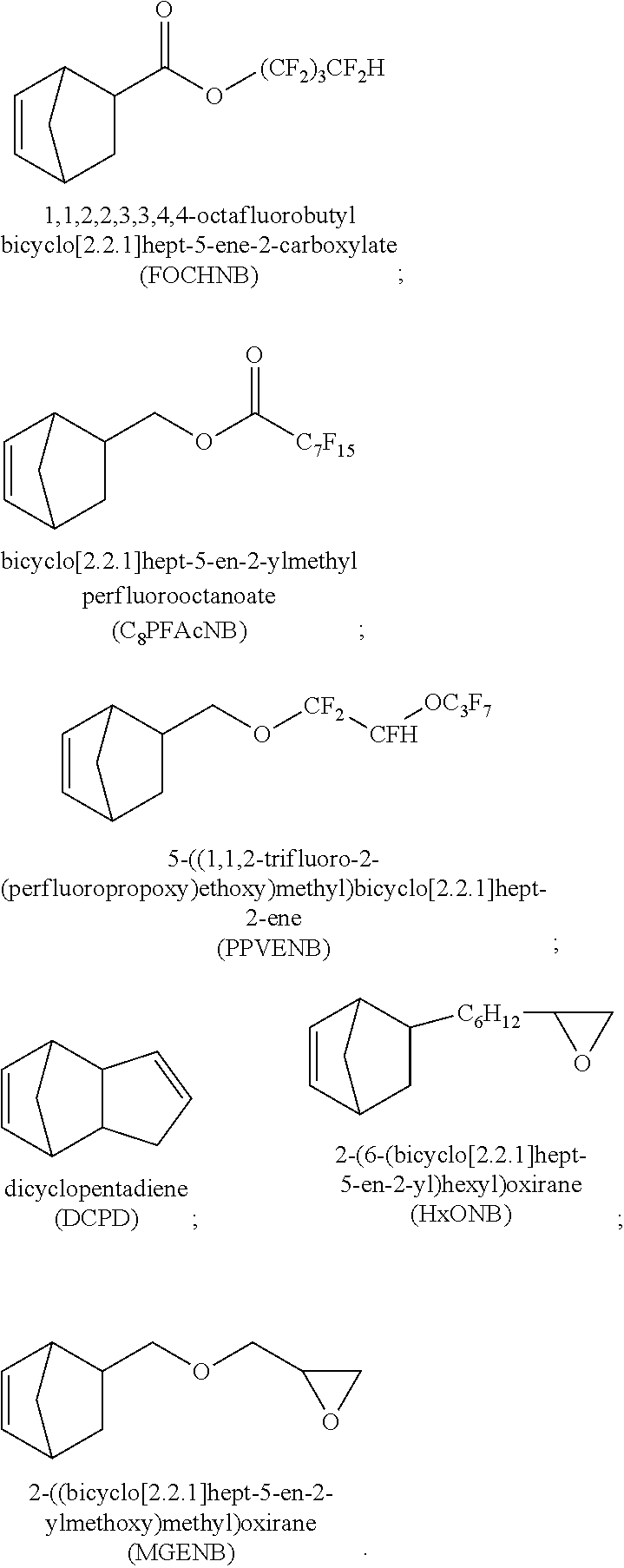
- With regard to the polymer composition embodiments in accordance with the present invention, it will be noted that such embodiments are not limited to a single polymer embodiment. Rather such polymer composition embodiments are inclusive of blends of two or more polymers, where each of such two or more polymers encompass one or more distinct type of norbornene-type repeating unit with the proviso that at least one such repeating unit of each polymer encompass a saccharide functional moiety (SFM).
- In some polymer or polymer composition embodiments, said SFM is derived from molecules represented by Formula A3 and encompasses a monosaccharide selected from a derivative of an aldose, a ketose, L isomers thereof, D isomers thereof, cyclic isomers thereof. In other such embodiments, said saccharide functional moiety can encompass a disaccharide, an oligosaccharide, a polysaccharide or cyclic isomers derived therefrom.
- Exemplary aldoses include, but are not limited to, D-aldoses such as erythrose, threose, ribose, arabinose, xylose, lyxose, allose, altrose, glucose, mannose, gulose, idose, galactose and talose, the structures of which are depicted below:
-

- Exemplary ketoses include, but are not limited to, D-ketoses such as erythrulose, xylulose, ribulose, tagatose, sorbose, and fructose, the structures of which are depicted below:
-

- Such aforementioned non-limiting examples of saccharide-type repeating units are in accordance with Formula B1, where at least one of R1—R4 is an alkyl, aryl, amide, ether or ester linked SFM as illustrated in Formulae A4-A14, below.
-


- where Q, if present, encompasses an optional C1 to C6 alkyl group and o is greater than 1.
- In some embodiments, it has been found advantageous for such SFM to have at least one of R1 to R4 be either an amide linked gluconolactone as represented by Formula A6 or an amide linked glucorono-6,3-lactone as represented by Formula A8, in each case, the others being hydrogen.
- As mentioned above, some embodiments encompass both a norbornene type of repeating unit, B1, having a SFM and a norbornene-type of repeating unit, B2, having a hydrocarbyl substituent, such as a heterohydrocarbyl substituent that is not a saccharide moiety. Some such norbornene-type repeating units having at least one of R1 to R4 being heterohydrocarbyl represented by one of Formulae A15, A16 and A17, and the others being hydrogen:
-
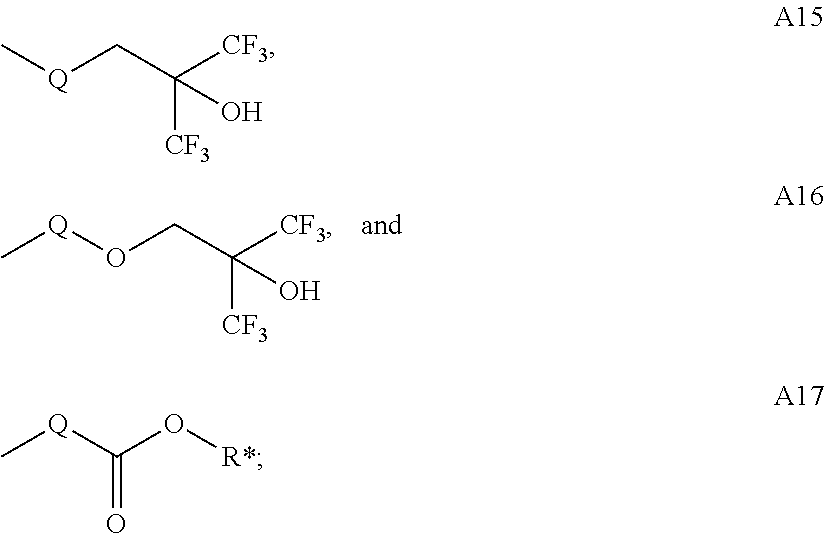
- where Q, if present, is as described above and R* is hydrogen or C1-C6 cyclic, linear or branched aliphatic group. Additional exemplary norbornene-type monomers having a non-saccharide heterohydrocarbyl or halohydrocarbyl type of substituent include those where at least one of R5 to R8 is CH2OCH2CH2OH, CH2OCH2CH2OAc, 1,1,1-trifluoromethane sulfonamide, ethoxy-1,1,1,3,3,3-hexafluoropropan-2-ol, trioxanonane, and tetraoxadodecane. Specific non-limiting examples of such monomers are enumerated above.
- For some embodiments in accordance with the present invention, the polymers are formed using known or modified solution and/or mass polymerization methods. In other embodiments in accordance with the present invention, the polymers can be formed using known or modified suspension or emulsion polymerization methods. Generally, the polymerization is carried out in the presence of an appropriate solvent. Non-limiting examples of solvents include water and any other suitable water miscible solvent. As noted, water immiscible solvents can also be employed in a suspension or emulsion type polymerization conditions. In some embodiments water alone is used as the solvent.
- For some embodiments in accordance with the present invention, a palladium catalyst complex and a chain transfer activating agent (CTAA) are added to norbornene-type monomers to cause such monomers to be polymerized.
- In some polymer or composition embodiments, the polymer has a weight average molecular weight (Mw) from 18,00 to 200,000 Daltons, while in others, from 20,000 to 100,000 Daltons, and in still others, from 30,000 to 75,000 Daltons. The weight average molecular weight (Mw) and the number average molecular weight (Mn) are generally determined by gel permeation chromatography (GFC) using polystyrene standards. However, any of the other known methods can also be used to determine Mw and Mn. From this the polydispersity index (PDI) of the polymer is determined (Mw/Mn). In some embodiments of this invention the polydispersity index of the polymers of this invention generally is from about 1 to 2, in some other embodiments of this invention the polydispersity index of the polymers of this invention generally is from about 1 to 1.7, and yet in some other embodiments of this invention the polydispersity index of the polymers of this invention generally is from about 1 to 1.5.
- To facilitate formation of water soluble polymers from any of the aforementioned monomers, for example a first type of monomer encompassing a SFM and a second type of norbornene-type monomer encompassing a non-SFM hydrocarbyl group a polymerization reaction is carried out using a catalyst derived from palladium. Non-limiting examples of such palladium catalysts include the following:
- allyl palladium chloride dimer,
- (acetonitrile)bis(triisopropylphosphine)palladium(acetate) tetrakis(pentafluorophenyl)borate ([Pd(OAc)(P-i-Pr3)2(MeCN)][B(C6F5)4]),
- nonasodium hydrido tris (tri(metasulfonatophenyl)phosphine)palladium methanesulfonate, and
- (acetonitrile)bis(t-butyldicyclohexylphosphine)palladium(acetate) tetrakis(perfluorophenyl)borate.
- It should however be noted that various other metal catalysts can also be used to carry out the polymerization reaction, including but not limited to nickel and platinum, among various other known metal catalysts.
- It has further been found that the polymerization of the monomers of this invention can further be carried out in the presence of a variety of co-catalysts in order to obtain the desirable properties of the polymers. Non-limiting examples of such co-catalysts include one or more of the following:
- Li tetrakis(pentafluorophenyl)borate etherate (LiFABA),
- N-dimethylanilinium tetrakis-(pentafluorophenyl)borate (DANFABA), and
- trisodium salt of triphenylphosphine m-trisulfonic acid (TPPTSNa).
- Any amount of catalyst and co-catalysts can be used that will be sufficient to form the polymer of this invention. As noted, typically, the amount of catalyst employed is generally calculated based on the monomer to catalyst molar ratio of at least 500/1. In some other embodiments the monomer to catalyst ratio is around 1000/1, in some other embodiments the monomer to catalyst ratio is around 5000/1 and in some other embodiments the monomer to catalyst ratio is around 10000/1.
- To adjust the solubility of such first type of monomer in the solvent used for such polymerization reaction, the alcohol functionalities of the SFMs can, optionally, be protected during the polymerization and subsequently de-protected after the polymerization reaction, is completed. As one of skill in the art will realize, protecting the alcohol functionalities of the SFMs increases the solubility of the monomer in organic solvents that are compatible with the second type of norbornene-type monomer. Subsequent de-protection of the alcohol functionalities provides a polymer embodiment that is likely to be water soluble. Such protecting groups include, but are not limited to, esters such as acetates, benzoates, chloroacetates, ethers such as benzyl ethers, alkyl ethers, allyl ethers, silyl ethers and acetals such as benzylidene and isopropylidene acetals.
- Such aforementioned hydrocarbyl, including halohydrocarbyl and heterohydrocarbyl-type monomers provide repeating units, in accordance with Formula B2, that can provide, when polymerized with SFM-type monomers, high, readily controllable Mw, water soluble polymer embodiments in accordance with the present invention. Advantageously, the polymerization methods that are disclosed herein, are readily done using reasonable catalyst loading and reasonable control of the aforementioned high molecular weight as described above.
- Surprisingly, it has further been found that use of chain transfer activating agent facilitates further control of the molecular weight of the resulting polymer. Thus, advantageously, in some of the embodiments of this invention employing a suitable amount of a chain transfer activating agent results in tailoring the resulting polymer to a desirable molecular weight. An example of such a chain transfer activating agent is formic acid.
- Any amount of formic acid can be used that would result in a desirable control on the molecular weight of the resulting polymer of this invention. Generally, formic acid is present in an amount of from 0.1 to 30 mol % of the total monomer loading to the reaction mixture. In some embodiments formic acid is present in an amount of from 0.5 to 20 mol % of the total monomer loading to the reaction mixture. In some other embodiments formic acid is present in an amount of from 1 to 10 mol % of the total monomer loading to the reaction mixture.
- Thus in accordance with the practice of this invention, non-limiting exemplary polymers of this invention include the following:
- poly(N-norbornene methyl gluconamide),
- poly(N-norbornene methyl lactobionamide), and
- poly(norbornene-4-O-(β-D-galactopyranosyl)-β-1′-((+/−)-exo-5-norbornene-2-carboxyamido)-1′-deoxy glucitol.
- In some embodiments, poly(N-norbornene methyl gluconamide) made in accordance with this invention is having a weight average molecular weight (Mw) from 18,000 to 130,000.
- The polymer embodiments of the present invention can be employed to form polymer composition embodiments that further encompass a casting solvent and, optionally, one or more additives that provide desirable characteristics to such polymer composition embodiments. For example, additives such as cross-linking compounds, photoactive compounds (PACs), photoacid generators (PAGs), thermal acid generators (TAGs), photosensitizers, and antioxidants/synergists. Where PAGs or PACs are added to a polymer composition embodiment, such embodiments are generally self-imageable. That is to say that such a polymer composition embodiment, when imagewise exposed to appropriate actinic radiation will, after image development, provide either a positive or negative tone image of the masking element employed.
- Generally, it has now been found that any of the PACs containing a diazo or diazido functional group can be used in this invention. However, various other similarly known and similarly functioning PACs can also be used in this invention. Accordingly, exemplary aqueous PACs include, hut are not limited to, 4,4′-diazido-2,2′-biphenyl disodium disulfonate (DAPB), 4,4′-diazide-2,2′-biphenylethane disodium disulfonate (DABPE), and 4,4′-diazidostilbene-2,2′-disulfonic acid acid disodium salt (DAZST-Na). While the exemplary aqueous PACs provided hereinabove are sodium salts, one of ordinary skill will know that other alkaline or alkaline earth metals such as lithium, potassium, magnesium, calcium, barium, as well as ammonium and various alkylammonium salts are also in accordance with embodiments of the present invention.
- Exemplary PAGs can include, but are not limited to, onium salts such as (p-isopropylphenyl)(p-methylphenyl)-iodonium tetrakis (pentrafluorophenyl) borate (Rhodorsil 2074, Rhodia, Inc.), sulfonium [2-(4-methoxy-1-naphthalenyl)-2-oxoethyl]dimethyl tetrakis (pentafluorophenyl)borate (TAG382 Toyo Ink), (4-methoxyphenyl)phenyliodonium trifluoromethanesulfonate, bis(p-tert-butylphenyl)-iodonium trifluoromethanesulfonate, triphenylsulfonium trifluoromethanesulfonate, (4-methoxyphenyl) diphenylsulfonium trifluoromethanesulfonate, (p-tert-butylphenyl) diphenylsulfonium trifluoromethanesulfonate, diphenyliodonium nonafluorobutanesulfonate, bis(p-tert-butylphenyl) iodonium nonafluorobutanesulfonate, triphenylsulfonium nonafluorobutanesulfonate and diphenyliodonium trifluoromethanephosphate. Additional examples of aqueous FAQs include, but are not limited to, 4-(methoxyphenyl)dimethylsulfonium trifluoromethanesulfonate (See Havard, et al., Macromolecules, 1999, 32, 86-94).
-

- PAGs generally absorb actinic radiation over a broad range of wavelengths, while in modern photoexposure tools, a limited range of wavelengths or even a single wavelength, is provided. Therefore, in addition to at least one PAG, at least one photosensitizer can be included in the polymer compositions of the present invention, where at least one photosensitizer is selected to absorb at a wavelength(s) used for the image-wise exposure. Exemplary photosensitizer(s) are shown below:
-

- anthracene-9-carboxylic acid (CAS 723-62-6) and a suitable salt thereof including but
- not limited to lithium, sodium, potassium, calcium, ammonium and tetraalkylammonium salt, for example, tetramethylammonium or tetraethylammonium salts.
- Exemplary TAGs include, among others, SI-60L, SI-100L and SI-150L, manufactured by Sanshin Chemical industry Co., Ltd., where SI-150L is dimethyl(4-acetoxyphenyl)sulfonium hexafluoroantimonate (CAS No. 135691-31-5), SI-100L is benzyl(4-hydroxyphenyl)methylsulfonium hexafluoroantimonate (CAS No. 125662-42-2) and SI-60L is (1-naphthylmethyl)methyl(4-hydroxyphenyl)sulfonium hexafluoroantimonate (CAS No. 133152-67-7).
- In some polymer composition embodiments, crosslinking additives, such as epoxies, glycolurils, oxetanes and di- and multifunctional-aldehydes, for example glutaraldehyde, can be present. More specifically, exemplary crosslinking additives include, but are not limited to, poly(ethylene glycol) diglycidyl ethers (available from Sigma Aldrich), tetrakis(methoxymethyl) glycoluril (Powderlink 1174), and 3-methyacryloxymethyl-3-ethyloxetane (OXMA), (4,4′-bis[3-ethyl-3-oxetanyl)methoxymethyl]biphenyl) (OXBP), and bis[(3-ethyl-3-oxetanyl)methyl]isophthalate) (OXIPA) (all from UBE Industries, Ltd., Japan), a methylated melamine formaldehyde polymer under trade name Cymel 301 (Cytec Industries Inc., Woodland Park, N.J., USA). In addition, generic structures for bisphenol A epoxy resin (LX-01) purchased from Daiso Chemical Co., Osaka, Japan), epoxy cyclohexylmethyl 3,4-epoxycyclo hexane carboxylate (CEL2021 [CAS #2386-87-01]) purchased from Daicel Chemical Industries, Osaka, Japan) and condensation products of 1-2-epoxy-4(2-oxiranyl)-cyclohexane of 2,2-bis(hydroxy methyl)1-butanol/(3′-4′expoxycyclohexane)methyl 3′-4′-expoxycyclohexyl-carboxylate mixture (EHPE3150 [CAS #244772-00-7]) purchased from Daicel Chemical Industries, Osaka, Japan) are shown below:
-
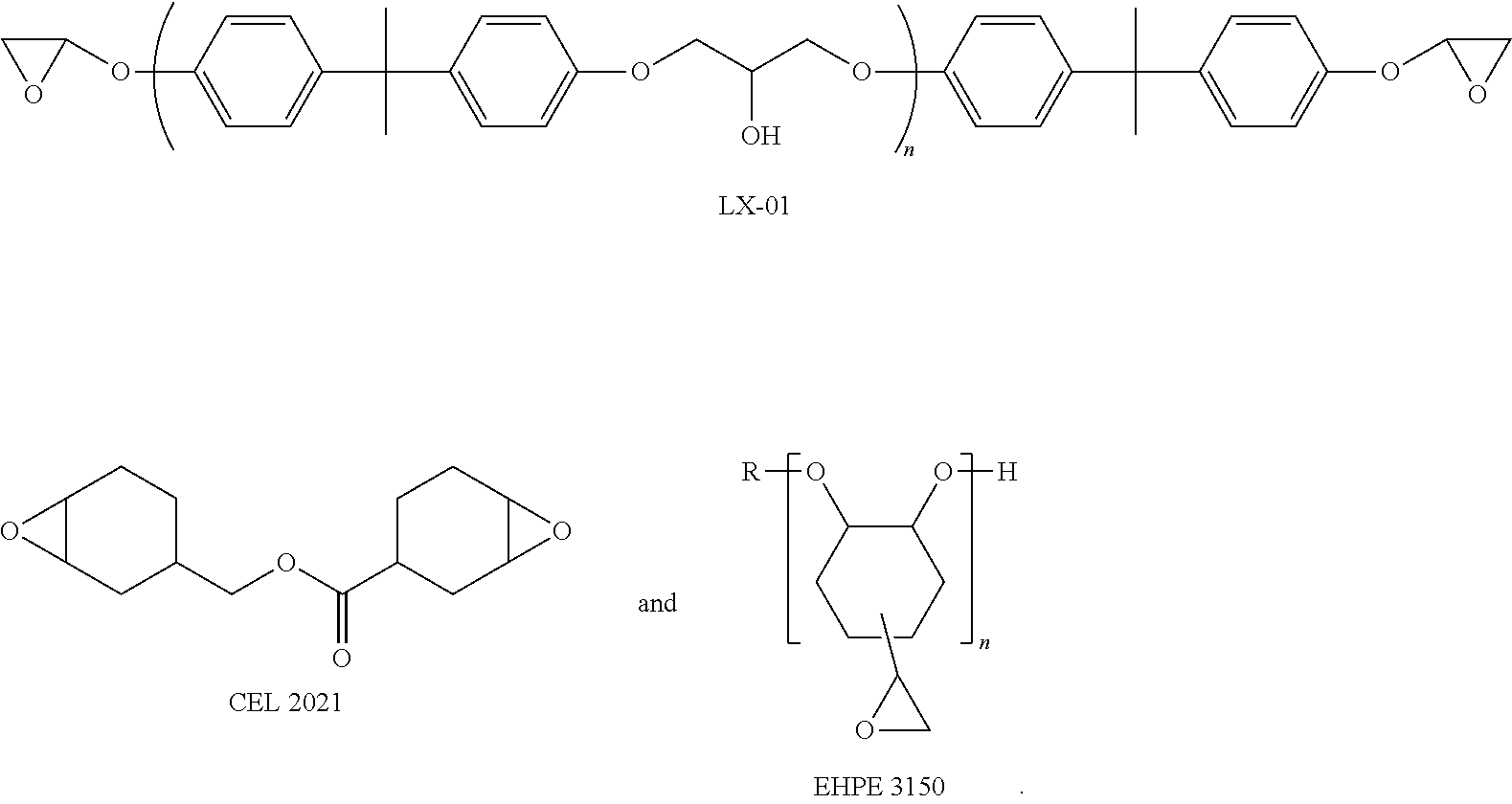
- While the exemplary cross-linking materials listed above are generally not, in and of themselves, photoactive, when such materials are present in polymer composition embodiments of the present invention, cross-linking is generally initiated by an acid generator additive.
- With regard to casting solvents, exemplary materials include, but are not limited to water, or a mixture of water and any one or more of propylene glycol monomethyl ether (PGME), propylene glycol monomethyl ether acetate (PGMEA), ethyl lactate (EL), methyl isobutyl carbinol (MIBC), gamma butyrolactone (GBL), methyl n-amyl ketone (MAK) or mixtures thereof.
- It will be understood, however, that specific materials that fall within these listings of generally useful additives may or may not be useful for polymer composition embodiments in accordance with the present invention where a material's solubility in one of the aforementioned casting solvents is insufficient for any such material to be effective for its desired purpose. However, it is believed that an ordinarily skilled artisan, would be able to determine, without undue experimentation, whether or not a specific additive would be sufficiently soluble in such a casting solvent to realize the desired effect.
- Accordingly, in some embodiments of this invention there is provided a method of forming a crosslinking composition comprising combining any one or more of the water soluble norbornene-type polymers as described herein with a suitable casting solvent and a crosslinking agent. Any of the casting solvents as described hereinabove can be used such as for example water and in combination with any of the water miscible solvents. In some embodiments the crosslinking agent used is glutaraldehyde. Typically, such crosslinking of such compositions can be affected at any of the temperatures which will bring about such a change, for example, temperatures below 200° C.
- Thus in some embodiments, the polymer compositions of the present invention encompass an aqueous based crosslinkable composition containing any one or more of the water soluble norbornene-type polymers as described herein with a suitable casting solvent and a crosslinking agent.
- In some embodiments, the polymer compositions of the present invention encompass at least one thermal acid generator (TAG) and at least one crosslinking additive to provide thermally-initiated crosslinking after image development.
- In some embodiments, there is provided a method of forming a patterned image which encompasses the following steps, not necessarily in the same order. Forming a layer of aforementioned aqueous based crosslinking composition. Imagewise exposing the layer to appropriate actinic radiation using any of the methods known in the art. Then causing exposed portions of the layer to undergo crosslinking by any of the methods known to one skilled in the art. Finally, removing the unexposed portions of the layer to form the patterned image.
- Accordingly, in some embodiments there is further provided aqueous based photoimageable compositions, which encompass any one or more of the water soluble norbornene-type polymers as described herein, one or more of various photoactive compounds as described herein and a suitable solvent.
- With regard to methods that utilize polymer compositions embodiments in accordance with the present invention, such method embodiments generally encompass applying or casting such a composition over a substrate and forming a film or layer thereof. Such casting encompasses any appropriate method for applying a polymer composition onto a substrate, for example by a spin coating, a spray coating or a doctor blade method, among others. Further, with regard to film forming embodiments in accordance with the present invention, such embodiments encompass a post application bake (PAB) at a temperature and for a time sufficient to remove essentially all of the casting solvent.
- Where the aforementioned polymer composition embodiments encompass a PAG, following the PAB, the formed film will generally be exposed to an effective wavelength of actinic radiation. Such exposure being either an image-wise exposure where a patterned film is desired or a blanket exposure where a contiguous film is desired, it will further be understood that the aforementioned exposure results in the generation of a strong acid in the exposed portions of the formed film, such strong acid either enhancing the solubility of such regions or where a cross-linking additive is present, causing cross-linking to occur within such exposed regions to reduce the solubility of such regions. However, it should also be noted that depending upon the type of saccharide moiety employed which itself may facilitate cross linking upon exposure without any additional cross-linking additive.
- Where the aforementioned polymer composition embodiments encompass diazide PACs (such as 4,4′-diazidostilbene-2,2′-disulfonic acid disodium salt (DAZST-Na)), following the PAB, the formed film will generally be exposed to an effective wavelength of actinic radiation. Such exposure being either an image-wise exposure where a patterned film is desired or a blanket exposure were a contiguous film is desired. It will further be understood that the aforementioned exposure results in the generation of a reactive moiety in the exposed portions of the formed film, such reactive moiety reacts with the polymer causing cross-linking to occur within such exposed regions to reduce the solubility of such regions.
- Where the aforementioned polymer composition embodiments encompass a TAG, such compositions also encompass a cross-linking additive, therefore when the film formed is subjected to a curing bake performed at a temperature sufficient to activate the TAG and generate a strong acid, such acid causes cross-linking to occur thereby reducing the solubility of the film.
- The following examples, without being limiting in nature, illustrate methods for making monomers, methods for polymerizing such monomers to form polymers, and making polymer compositions. Such monomers, polymers and compositions being embodiments in accordance with the present invention. In addition, such examples demonstrate the use of such polymer composition embodiments to form self-imageable films. Unless otherwise Indicated in the following examples and elsewhere in the specification and claims, all parts and percentages are by weight, all temperatures are in degrees Celsius, and pressure is at or near atmospheric pressure.
- Further, in the experiments presented below where a value for film thickness is provided, such value was determined using a TENCOR profilometer.
- In presentation of such experimental data, abbreviations are used to simplify the naming of the various monomers and catalysts. The following listing of those abbreviations provides an appropriate name for each of such abbreviations.
- NNBMGA N-norbornene methyl gluconamide
- NNBMIBA N-norbornene methyl lactobionamide
- NBGPENMCDG Norbornene-4-O-(β-D-galactopyranosyl)-β-1′-((+/−)-exo-5-norbornene-2-carboxamide)-1′-deoxy glucitol
- LiFABA Li tetrakis(pentafluorophenyl)borate etherate
- DANFABA N-dimethylanilinium tetrakis-(pentafluorophenyl)borate
- APdCl allyl palladium chloride dimer
- PD-1206 (acetonitrile)bis(triisopropylphosphine) palladium(acetate) tetrakis(pentafluorophenyl)borate
- PD-1926 nonasodium hydrido (tris(metasulfonatophenyl)phosphine) palladium methanesulfonate
- FA formic acid
- TPPTSNa trisodium salt of triphenylphosphine m-trisulfonic acid
- DAZST-Na 4,4′-diazido stilbene-2,2′-disulfonic acid
-

- A monomer of NNBMGA according to embodiments of the present invention was prepared essentially in accordance with the procedure described in Puech, et al., New J. Chem. 1997, 21, 1229. Norbornene methylamine (69.2 g, 0.56 mol) was added to a methanol solution (approximately 1 Liters (L)) of gluconolactone (100 g, 0.56 mol). The solution was stirred at room temperature for 23 hours (h) resulting in a clear, pale yellow solution. The solution was added to ether (approximately 3.0 L) to yield a precipitate which was filtered, rinsed with ether (approximately 1.0 L) and dried under vacuum at 70° C. overnight, giving 107 g. This amounts to a 63% yield.
-

- A solution of D-ribonolactone (10 g, 67.5 mmol) and norbornenebutylamine (8.32 g 67.5 mmol) in methanol (50 mL) was stirred 23 h at room temperature. The resulting yellow clear solution was concentrated to dryness followed by trituration in methyl-tert-butylether (100 ml) in a 40° C. bath for 1.5 h. The resulting solids were filtered and dried overnight in a vacuum oven at 50° C. to afford 16.8 g (92% yield) of an off-white solid.
- The title compound was characterized by LC-MS and 1H NMR. LC-MS (m/z) 272 (M+1). 1H NMR (500 MHz, DMSO-d6) δ 7.79-7.50 (two triplets, 1H), 6.20-5.90 (three multiplets, 2H), 5.60-5.40 (m, 1H), 4.80-4.70 (d, 1H), 4.60-4.50 (m, 1H), 4.40-4.30 (d, 1H), 4.10-3.95 (m, 1H), 3.63 (br. s, 1H), b3.60-3.50 (m, 2H), 3.20-2.60 (m, 4H), 2.30-2.10 (m, 1H), 1.80-1.70 (m, 1H), 1.55-1.10 (m, 3H), 0.50-0.40 (br. d, 1H). The ratio of endo- to exo-isomer was determined from the olefinic resonances to be 3.9 to 1.
-

- A solution of D-ribonolactone (10 g, 67.5 mmol) and norbornenebutylamine (11.2 g, 67.5 mmol) in methanol (50 mL) was stirred 23 h at room temperature. The resulting colorless clear solution was concentrated to dryness followed by trituration in methyl-tert-butylether (100 mL) in a 40° C. bath for 1.5 h. The solids were filtered and dried overnight in a vacuum oven at 50° C. to afford 19.8 g (94% yield) of a white solid.
- The title compound was characterized by LC-MS and 1H NMR. LC-MS (m/z) 314 (M+1). 1H NMR (500 MHz, DMSO-d6) δ 7.55 (br. s, 1H), 6.11 (br. s, 1H), 6.01-5.92 (two broad singlets, 1H), 5.49 (br. s, 1H), 4.75 (br. s, 1H), 4.53 (br. s, 1H), 4.35 (br. s, 1H), 4.01 (br. s, 1H), 3.62 (br. s, 1H), 3.55 (br. s, 2H), 3.05 (br. s, 1H), 3.04 (br. s, 1H), 2.73 (br. s, 1), 2.71 (br. s, 1H), 1.94 (br. s, 1H), 1.80 (br. s, 1H), 1.60-0.80 (m, 9H), 0.43-0.41 (br. d, 1H). The ratio of endo- to exo-isomer was determined from the olefinic resonances to be 2.7 to 1.
-

- Following the procedure from Williams, et al., Organic Syntheses, Vol. 82, p. 75 (2005), to dimethoxypropane (10 mL) taken in a suitable reaction vessel was added a solution of D-ribonolactone (16 g, 96.0 mmol) in dry acetone (70 mL) followed by sulfuric acid (0.1 mL, 2 mmoL). This reaction mixture was allowed to stir for 1 h at room temperature. Silver carbonate (2 g, 7.3 mmol) was added to the reaction and the resulting slurry stirred for 1.5 h followed by filtering through a 3 cm Celite® pad. The filtrate was concentrated to dryness followed by addition of hot ethyl acetate (20 mL) to redissolve the solids and filtering through a 3 cm Celite® pad. The resulting filtrate was allowed to cool to room temperature during which crystals formed. The crystals were filtered to afford 7.9 g of target material. The filtrate was concentrated at elevated temperature to 5 mL and then allowed to cool to room temperature. More crystals formed and were isolated by filtration to give a combined 10.4 g (58% yield) of white crystalline solid.
- The title compound was characterized by 1H NMR (500 MHz, DMSO-d6) δ 5.30 (t, 1H), 4.76 (s, 2H), 4.60 (t, 1H), 3.68-3.55 (m, 2H), 1.35 (s, 3H), 1.31 (s, 3H).
-

- A solution of 2,3-isopropylidene(D-ribonolactone) (5.29 g, 28.1 mmol) and norbornenebutylamine (4.25 g, 28.1 mmol) in methanol (26 mL) was stirred 23 h at room temperature. The resulting colorless clear solution was concentrated affording 9.92 g (100% yield) of a crude colorless oil.
- The title compound was characterized by LCMS (m/z) 354 (M+1).
- A monomer of NNBMIBA according to embodiments of the present invention can also be prepared in accordance with the procedure described in Puech, et al., New J. Chem. 1997, 21, 1229. NNBMIBA (70 g, 1.51×10⁻⁵ mol) is added to a methanol solution (approximately 1 Liters (L)) of gluconolactone (100 g, 0.56 mol). The solution is stirred at room temperature for 23 hours (h) resulting in a clear, pale yellow solution. The solution is added to ether (approximately 3 L) to yield a precipitate which is filtered, rinsed with ether (approximately 1 L) and dried under vacuum at 70° C. overnight.
- In Hu et al., Tetrahedron letters 43, (2002), (1775-1778), a lactamine-functionalized norbornene-type monomer is described. Aqueous K2CO3 (2M, 35 ml) and 4-O-(β-D-galactopyranosyl)-β-1′-amino-1′-deoxy glucitol [lactamine 1, 12.8 g, 37.3 mmol] are added to a flask. The contents are cooled to −5° C. and CH2Cl2 (100 ml) solution of (+/−)-exo-5-norbornene-2-carbonyl chloride (7 g) is added slowly so that the internal temperature of the solution never exceeds −2° C. The resulting mixture is stirred at 0° C. for 24 hours and the crude mixture is concentrated and slowly poured into ethanol to precipitate the salts. Following filtration, the filtrate is passed through a mixed bed resin, concentrated, and freeze-dried to obtain the title compound. Polymer Synthesis Examples
- In each of Tables 1, 2 and 3, below, where presented, the value for formic acid (FA) is in mole percent (mol %), the value for the conversion (Conv.) of monomer to polymer is in percentage (%), the value for Mw of polymer is in g/mol.
- For each of Examples B1a through B1e, NNBMGA (3 g), APdCl (0.002 g), LiFABA (0.03 g) TPPTSNa (0.01 g) were added to a glass vial equipped with a stir bar. The vial was sealed with a septum and water (7.5 g sparged with nitrogen) was added to the vial using a syringe. After the components dissolved, the solution was sparged with nitrogen for 30 minutes (min). Then the amount of FA indicated in Table 1, below, was added to a vial and the mixture heated to 80° C. for 19 h. The vials were allowed to cool and a sample was submitted for GPC to determine polymer molecular weight (Mw), polydispersity (PDI) and conversion (Conv).
-
TABLE 1 Example FA Conv. Mw PDI B1a 0 58 14,100 1.33 B1b 10 89 10,100 1.33 B1c 30 80 8,020 1.28 B1d 50 75 7,290 1.28 B1e 100 48 5,100 1.14 - For each of Examples B2a through B2, NNBGMA (3 g), APdCl (0.002 g), LiFABA (0.03 g) and TPPTSNa (0.01 g) were added to a glass vial equipped with a stir bar. The vial was sealed with a septum and water (7.5 g sparged with nitrogen) was added to the vial using a syringe. After the components dissolved in water, the solution was sparged with nitrogen for 30 min. Then the amount of FA indicated in Table 2, below, was added to a vial and the mixture was heated to 45° C. for 120 h. The vial was allowed to cool and a sample was submitted for GPC to determine polymer Mw, PDI, and Conv.
-
TABLE 2 Example FA Conv. Mw PDI B2a 0 36 20,100 1.39 B2b 5 41 17,600 1.36 B2c 10 42 17,000 1.41 B2d 20 35 14,200 1.41 - For each of Examples B3a through B3g, the amount of the palladium complex indicated and NNBMGA monomer were added to a vial equipped with a stir bar. The vial was taken into the dry box and phosphine (if present) and LiFABA were added. On the bench, water and FA were degassed with nitrogen and then added to the monomer and catalyst mixture. The solution was heated to 80° C. for 16 h to 18 h. After cooling the sample was submitted for GPC to determine polymer Mw, PDI, and Conv.
- The method of Puech, et al., New J. Chem., 1997, 21, 1229-1234, discloses the polymerization of NNBMGA where NNBMGA (0.7 g, 2.31×10⁻³ moles) was dissolved in 10 ml of water after which the catalyst PdCl2(TPPTS)2 was then added in a substrate/catalyst molar ratio of 100/1 (0.0305 g or 2.32×10⁻⁵ moles). After a 24 hour period, the polymer was precipitated by addition of methanol. Following a successive washing with methanol, the polymer was purified and isolated in 86% yield as a beige powder. The weight average molecular weight (Mw) of the resulting polymer was determined to be 5,217.
- In Puech, et al., NNBMIBA (0.7 g, 1.51×10⁻⁸ moles) was dissolved in 10 ml of water. The catalyst PdCl2(TPPTS)2 was then added in a substrate/catalyst molar ratio of 100/1 (0.0305 g or 2.32×10⁻⁵ moles). After a 24 hour period, the polymer was precipitated by addition of methanol. Following a successive washing with methanol, the polymer was purified and isolated in 66% yield as a beige powder. The weight average molecular weight (Mw) of the resulting polymer was determined to be 5,480.
- NBGPENMCDG was polymerized in accordance with the procedures of Hu et al., Tetrahedron Letters 43, (2002), 1775-1778). The weight average molecular weight (Mw) of the resulting polymer was in the range of 15,800 grams/mol.
- Table 3 summarizes the results obtained from. Examples 3a through 3g and the Comparative Examples 1 through 3. It is evident from these results that by practice of the present invention if is now possible to make various water soluble polymers as described herein featuring controlled molecular weight.
-
TABLE 3 Monomer/Catalyst Ex Ratio Water Pd TPPTSNa LiFABA FA Conv. Mw PDI B3a 500/1 14.6 APdCl 0.02 0.05 10 95 20,400 1.56 B3b 1000/1 6.0 Pd-1926 0.03 10 85 9,400 1.30 B3c 1000/1 7.0 Pd-1206 0.03 0 64 122,800 1.60 B3d 1000/1 ″ Pd-1206 0.03 3 79 87,500 1.73 B3e 1000/1 ″ Pd-1206 0.03 5 77 82,300 1.68 B3f 1000/1 ″ Pd-1206 0.03 8 78 76,200 1.66 B3g 1000/1 188 Pd-1206 0.7 10 71 75,000 1.59 Comp. 1 100/1 10 PdCl2 86 5,217 (TPPTS)2 Comp. 2 100/1 10 PdCl2 66 5,480 (TPPTS)2 Comp. 3 25.7/1 PdCl2 15,800 1.07 - NNBMGA (45 g), APdCl (0.03 mg), LiFABA (0.4 mg) and the TPPTSNa (0.2 mg) were added to a glass vial equipped with a stir bar. The vial was sealed with a septum and water (sparged with nitrogen) was added to the vial using a syringe. After the components dissolved in water, the solution was sparged with nitrogen for 25 min. Then FA (687.4 mL) was added to the vial and the mixture was healed to 60° C. for 18 h. Residual catalyst components were removed from the polymer solution and the polymer was precipitated into 3 L of acetone. The solid was filtered and the filter cake was rinsed with methanol (1 L). The polymer was then dried in a vacuum oven at 70° C. for 16 h. Yield 21.5 g (48%). GPC: Mw=12300; Mn=9180.
- The catalyst residues from polymerization reaction mixture of Example B3g were removed and the polymer was precipitated by adding the solution to 4 L of acetone. The precipitated polymer was filtered and then dried in a vacuum oven at 55° C. overnight. Yield 28 g (34%). GPC: Mw=60,300; Mn=34,000.
- The polymerization procedure from example B1b was repeated at a larger scale and longer time, 50 g of NNBMGA monomer was used. The polymerization was carried out for 20 h. After cooling the reaction mixture, catalyst residues were removed and the polymer was precipitated by adding the solution to 3 L of acetone. The precipitated polymer was filtered and then dried in a vacuum oven at 50° C. overnight. Yield 9 g (18%). GPC: Mw=14,200; Mn=10,800.
- The catalyst residues from polymerization reaction mixture B1b were removed and the polymer was precipitated by adding the solution to 700 ml, of acetone. The precipitated polymer was filtered and then dried in a vacuum oven at 80° C. overnight. Yield 1.1 g (37%). GPC: Mw=9800; Mn=7680.
- Film thicknesses as a function of percent, polymer solids in water and spin speed were determined for poly(NNBMGA) from examples B5 and B6. The polymer was dissolved in water at the desired percent polymer solids (see Table 4). The resulting solution was poured onto a thermal oxide silicon wafer. The wafer was initially spun at 500 rpm for 10 sec then for 60 sec at the desired final spin speed (see Table 4). The wafer was then baked at 130° C. for 2 min. The film was scored and the film thickness was determined. In all cases the spun film was of good quality. There were no cracks apparent in the film upon visual inspection.
- In Table 4, Table 6 and Table 7, the value for the polymer solid is in percentage by weight of the total composition (% by wt.), the value for Final Spin Speed is in revolutions per minute (rpm), the value for Film Thickness is in micrometers (μm), the values for Post Apply Bake (PAB) and the 2nd Bake is in degrees Celsius (° C.) and the value for glutaraldehyde (C5H8O2) weight percentage on polymer is in wt. % on polymer.
-
TABLE 4 Polymer Final Spin Film Example Polymer Mw Solid Speed (rpm) Thickness (μm) C1a 60,000 15 2,000 3.50 C1b ″ ″ 1,000 5.02 C1c ″ 10 2,000 0.66 C1d ″ ″ 1,000 1.08 C1e ″ ″ 500 2.37 C1f 14,000 ″ 2,000 0.32 C1g ″ ″ 1,000 0.42 C1h ″ ″ 500 0.60 - A sample off poly(NNBMGA) (made using Pd-1206 as described in examples B3a through B3g with Mw of 37300 and Mn of 30100) for optical density measurement was prepared by spin coating a 1-inch quartz wafer with an approximately 20 wt. % solution of the polymer in water (500 rpm for 10 sec followed by 2000 rpm for 60 sec). After the wafer was baked for 120 sec at 130° C. on a hotplate and allowed to cool, the optical absorbance of the resulting film was measured at 193, 248 and 365 nm using a Cary 400 UV-Vis spectrophotometer. A blank quartz wafer was used in the reference beam. To determine the polymer film thickness, a portion of the film was removed from the quartz wafer and the thickness measured. The polymer film thickness was 1.11 μm. Optical density was calculated as absorbance/thickness (μm−1). The results are shown in Table 5.
-
TABLE 5 Wavelength (μm−1) Optical Density 365 0.04 248 0.07 193 0.31 - A sample of poly(NNBMGA) from example B7 was dissolved its water (20 weight percent solution). The solution was spin coated onto a quartz wafer (500 rpm for 5 sec followed by 1500 rpm for 40 sec). The wafer was then baked for 5 min at 130° C. The thickness of the restating film was determined. The wafer was then either not heated, or heated to 130° C., 150° C. or 190° C. for 5 min. Then the film on the wafer was puddle developed in either water or PGMEA for 5 min. The film thickness was then again determined by profilometry. The wafer was baked a 3rd time at 190° C. for 3 min and the film thickness was measured again. Results of these experiments are shown in Table 6 below.
- The data presented in Table 6 demonstrates that the film encompassing poly(NNBMGA) is soluble in water but not in PGMEA. Furthermore, the film crosslinks after a 2nd bake of about 190° C. and therefore does not dissolve.
-
TABLE 6 Develop- Thickness Thickness Exam- Post Thickness 2nd ment After After ple Bake Post Bake Bake Solvent Development 3rd Bake D1a 130 1.01 NA Water 0.0 — D1b ″ 0.97 NA PGMEA 0.97 — D1c ″ 0.93 130 Water 0.0 — D1d ″ 1.09 150 Water 0.0 — D1c ″ 1.21 190 Water 1.22 1.28 - A sample of poly(NNBMGA) from example B4 was dissolved in a water/PGME 50/50 solution (20 weight percent polymer). As summarized in Table 8, in Examples D2c and D2d glutaraldehyde (C5H8O2) was added. The solution was spin coated onto a quartz wafer (500 rpm for 5 sec followed by 1500 rpm for 40 sec). The wafer was then baked for 5 min at 150° C. The thickness of the resulting film was determined. The film on the wafer was puddle developed in water 5 min. The film thickness was again determined. Examples D2c and D2d, the wafer was baked another time at 190° C. for 3 min and the film thickness was measured again. As shown from the data presented in Table 7, it is clear that the glutaldehyde is an effective cross-linking agent preventing significant dissolution of the film after development.
-
TABLE 7 Post Thickness After Thickness After Thickness Example C5H8O2 Bake Post Bake Development After 2nd Bake D2a NA 150 1.09 0.0 NA D2c 10 150 1.43 1.34 1.31 D2d 20 150 1.68 1.47 1.62 - A sample of poly(NNBMGA) from example B5 was dissolved in water (8 g) and was mixed with 1.2 g of a water solution of DAZST-Na (available from Toyo Gosei, 0.1 g in 3.1 g of water). A film of the above solution was formed by spinning the solution on a thermal oxide silicon wafer (500 rpm for 10 sec followed by 1000 rpm for 60 sec) and baking the film for 2 min at 130° C. The resulting thickness was 0.65 um. The film was image wise exposed at 365 nm (46 mJ/cm2) using an AB-M mask aligner equipped with an i-line band pass filter. The film was baked for 2 min at 130° C. and then developed in water for 10 sec. The film was spun dry and examined using an optical microscope. The photomicrograph shown in
FIG. 1 depicts a good resolution for 50 μm via on a 50 μm pitch. - As shown in Comparative Examples 1 and 2, polymerization using PdCl2(TPPTS)2 results in a water soluble saccharide type norbornene polymer having a Mw of 5,217 and a conversion of 86% using a monomer to catalyst ratio of 2.33. Comparative Example 3 shows polymerization using PdCl2 results in a water soluble saccharide type norbornene polymer having a Mw of 15,800.
- On the other hand, polymerization Examples B3a-B3g, made according to this invention, demonstrate the Mw controlling effect of a chain transfer activating agent (CTAA) for embodiments of the present invention. That is to say, in combination with palladium catalyst precursors, CTAA's such as formic acid provide for controlling the molecular weight of a resultant polymer. Examples B3d-B3g further demonstrate the ability to achieve high Mw of 75,000 to 87,500 with a conversion of 71% to 79%, a monomer to catalyst ratio of greater than 500 to 1 (therefore a low catalyst loading) and with FA being added in the range of 3% to 10%.
- By now it should be realized that the various embodiments in accordance with the present invention disclosed herein advantageously provide at least one of (a) high molecular weights (including a process for making such polymers); (b) controllable molecular weights; and (c) a polymerization process for such polymers that does not require the high catalyst loading of the prior art.
Claims (20)


Priority Applications (1)
| Application Number | Priority Date | Filing Date | Title |
|---|---|---|---|
| US14/285,806 US9328179B2 (en) | 2013-05-23 | 2014-05-23 | Water soluble norbornene-type polymers and photoimageable compositions thereof |
Applications Claiming Priority (2)
| Application Number | Priority Date | Filing Date | Title |
|---|---|---|---|
| US201361826649P | 2013-05-23 | 2013-05-23 | |
| US14/285,806 US9328179B2 (en) | 2013-05-23 | 2014-05-23 | Water soluble norbornene-type polymers and photoimageable compositions thereof |
Publications (2)
| Publication Number | Publication Date |
|---|---|
| US20140349233A1 true US20140349233A1 (en) | 2014-11-27 |
| US9328179B2 US9328179B2 (en) | 2016-05-03 |
Family
ID=50928300
Family Applications (1)
| Application Number | Title | Priority Date | Filing Date |
|---|---|---|---|
| US14/285,806 Expired - Fee Related US9328179B2 (en) | 2013-05-23 | 2014-05-23 | Water soluble norbornene-type polymers and photoimageable compositions thereof |
Country Status (3)
| Country | Link |
|---|---|
| US (1) | US9328179B2 (en) |
| TW (1) | TW201502153A (en) |
| WO (1) | WO2014190236A1 (en) |
Families Citing this family (4)
| Publication number | Priority date | Publication date | Assignee | Title |
|---|---|---|---|---|
| US11022890B2 (en) | 2017-02-23 | 2021-06-01 | International Business Machines Corporation | Photoresist bridging defect removal by reverse tone weak developer |
| TWI850512B (en) * | 2019-12-30 | 2024-08-01 | 日商住友電木股份有限公司 | Uv active palladium catalyzedpolycycloolefin polymer compositions as optical materials |
| EP4093599B1 (en) | 2020-02-28 | 2023-11-29 | Carbon, Inc. | Methods of making a three-dimensional object |
| CN113666941B (en) * | 2021-09-01 | 2023-03-10 | 浙江珲达生物科技有限公司 | Recrystallization method of 2,3-O-isopropylidene-D-ribonic acid-gamma-lactone |
Citations (10)
| Publication number | Priority date | Publication date | Assignee | Title |
|---|---|---|---|---|
| US5972385A (en) * | 1997-01-15 | 1999-10-26 | Orquest, Inc. | Collagen-polysaccharide matrix for bone and cartilage repair |
| US20030118933A1 (en) * | 2001-11-01 | 2003-06-26 | Han Eun Sil | Norbornene-based copolymer for photoresist, preparation method thereof, and photoresist composition comprising the same |
| US20050038455A1 (en) * | 2003-05-12 | 2005-02-17 | Cook Incorporated | Anastomosis device for vascular access |
| US20050038436A1 (en) * | 1997-02-11 | 2005-02-17 | Michelson Gary K. | System and method for stabilizing a portion of the spine |
| US20050170279A1 (en) * | 2003-10-30 | 2005-08-04 | Christoph Hohle | Photoresist suitable for use in 157 nm photolithography and including a polymer based on fluorinated norbornene derivatives |
| US20070173609A1 (en) * | 2004-02-13 | 2007-07-26 | National Taiwan University Of Science & Technology | Functional norbornenes and polymeric derivatives and fabrication thereof |
| US20090075207A1 (en) * | 2005-02-18 | 2009-03-19 | Samsung Electronics Co., Ltd. | Norbornene polymer for photoresist and photoresist composition comprising the same |
| US20100099906A1 (en) * | 2007-11-05 | 2010-04-22 | Promerus Llc | Generation of endo- and/or exo-norbornenecarboxaldehyde as an intermediate to functionalized norbornenes |
| US20110009578A1 (en) * | 2007-03-30 | 2011-01-13 | Promerus Llc | Use Of A Combination Chain Transfer And Activating Agent To Control Molecular Weight And Optical Density Of Pd Catalyzed Norbornene Polymers |
| US20110065878A1 (en) * | 2005-02-22 | 2011-03-17 | Promerus Llc | Norbornene-Type Polymers, Compositions Thereof And Lithographic Processes Using Such Compositions |
Family Cites Families (3)
| Publication number | Priority date | Publication date | Assignee | Title |
|---|---|---|---|---|
| US5587442A (en) | 1994-12-23 | 1996-12-24 | Kiessling; Laura L. | Polyglycomers |
| US6063769A (en) | 1996-11-14 | 2000-05-16 | Synsorb Biotech, Inc. | 1-thiogalactose derivatives |
| CA2548881A1 (en) | 2005-05-27 | 2006-11-27 | University Of Ottawa | Neoglycopolymer-cross-linked biopolymer matrix |
-
2014
- 2014-05-23 TW TW103117991A patent/TW201502153A/en unknown
- 2014-05-23 US US14/285,806 patent/US9328179B2/en not_active Expired - Fee Related
- 2014-05-23 WO PCT/US2014/039288 patent/WO2014190236A1/en not_active Ceased
Patent Citations (10)
| Publication number | Priority date | Publication date | Assignee | Title |
|---|---|---|---|---|
| US5972385A (en) * | 1997-01-15 | 1999-10-26 | Orquest, Inc. | Collagen-polysaccharide matrix for bone and cartilage repair |
| US20050038436A1 (en) * | 1997-02-11 | 2005-02-17 | Michelson Gary K. | System and method for stabilizing a portion of the spine |
| US20030118933A1 (en) * | 2001-11-01 | 2003-06-26 | Han Eun Sil | Norbornene-based copolymer for photoresist, preparation method thereof, and photoresist composition comprising the same |
| US20050038455A1 (en) * | 2003-05-12 | 2005-02-17 | Cook Incorporated | Anastomosis device for vascular access |
| US20050170279A1 (en) * | 2003-10-30 | 2005-08-04 | Christoph Hohle | Photoresist suitable for use in 157 nm photolithography and including a polymer based on fluorinated norbornene derivatives |
| US20070173609A1 (en) * | 2004-02-13 | 2007-07-26 | National Taiwan University Of Science & Technology | Functional norbornenes and polymeric derivatives and fabrication thereof |
| US20090075207A1 (en) * | 2005-02-18 | 2009-03-19 | Samsung Electronics Co., Ltd. | Norbornene polymer for photoresist and photoresist composition comprising the same |
| US20110065878A1 (en) * | 2005-02-22 | 2011-03-17 | Promerus Llc | Norbornene-Type Polymers, Compositions Thereof And Lithographic Processes Using Such Compositions |
| US20110009578A1 (en) * | 2007-03-30 | 2011-01-13 | Promerus Llc | Use Of A Combination Chain Transfer And Activating Agent To Control Molecular Weight And Optical Density Of Pd Catalyzed Norbornene Polymers |
| US20100099906A1 (en) * | 2007-11-05 | 2010-04-22 | Promerus Llc | Generation of endo- and/or exo-norbornenecarboxaldehyde as an intermediate to functionalized norbornenes |
Non-Patent Citations (1)
| Title |
|---|
| Wathier et al., Acidic Polysaccharide Minics via Ring-Opening Methathesis Polymerization, Journal of the Americal Chemical Society, 132, pp15887-15889 92010). * |
Also Published As
| Publication number | Publication date |
|---|---|
| WO2014190236A1 (en) | 2014-11-27 |
| US9328179B2 (en) | 2016-05-03 |
| TW201502153A (en) | 2015-01-16 |
Similar Documents
| Publication | Publication Date | Title |
|---|---|---|
| US9328179B2 (en) | Water soluble norbornene-type polymers and photoimageable compositions thereof | |
| US7888415B2 (en) | Vinyl addition polycyclic olefin polymers prepared with non-olefinic chain transfer agents and uses thereof | |
| CN103370347B (en) | Self-imageable film-forming polymers, compositions thereof, and devices and structures made therefrom | |
| KR101569955B1 (en) | Curable copolymer and curable resin composition | |
| US9422376B2 (en) | Amine treated maleic anhydride polymers, compositions and applications thereof | |
| JP2011107170A (en) | Aqueous base-developable negative-tone film based on functionalized norbornene polymer | |
| CN1221969A (en) | Semiconductor device using polymer-containing photoresist, and process for manufacturing the same | |
| JP2001516804A (en) | Photoresist composition comprising polycyclic polymer having pendant acid labile group | |
| DE69916434T2 (en) | MODIFIED POLYCYCLIC POLYMERS | |
| US9291901B2 (en) | Amine treated maleic anhydride polymers with pendent silyl group, compositions and applications thereof | |
| TW202140574A (en) | Uv active derivatives of pd(acac)catalyzed polycycloolefin compositions as optical materials | |
| US11048168B2 (en) | Permanent dielectric compositions containing photoacid generator and base | |
| JP5702525B2 (en) | Photoactive compound and chemically amplified photoresist composition | |
| JP4678091B2 (en) | Process for the preparation of polymers containing pendant cyclic anhydride groups | |
| US10429734B2 (en) | Permanent dielectric compositions containing photoacid generator and base | |
| US20150353679A1 (en) | High glass transition temperature photoimageable polycarbonate polymers with pendent polycyclic functional groups | |
| CN114144450A (en) | Stable polycycloolefin polymers and inorganic nanocomposites as optical materials | |
| US10626216B2 (en) | High glass transition temperature polycarbonates derived from adamantane epoxides | |
| WO2023158768A1 (en) | Dual catalyst system for mass romp and cationic polymerizable compositions | |
| KR100830599B1 (en) | Photoresist copolymer comprising a crosslinking agent having two (meth) acryl bonds as a monomer and a chemically amplified photoresist composition comprising the same | |
| KR101360014B1 (en) | Near-Infrared Absorbing Dye, Near-Infrared Absorptive Film-Forming Composition, and Near-Infrared Absorptive Film | |
| KR20050052364A (en) | Curable resin composition | |
| CN1538241A (en) | Chemically Amplified Photoresist Composition | |
| HK1087135B (en) | Vinyl addition polycyclic olefin polymers prepared with non-olefinic chain transfer agents and uses thereof |
Legal Events
| Date | Code | Title | Description |
|---|---|---|---|
| AS | Assignment |
Owner name: SUMITOMO BAKELITE CO., LTD., JAPAN Free format text: ASSIGNMENT OF ASSIGNORS INTEREST;ASSIGNOR:FUJITA, KAZUYOSHI;REEL/FRAME:033047/0370 Effective date: 20140605 Owner name: PROMERUS, LLC, OHIO Free format text: ASSIGNMENT OF ASSIGNORS INTEREST;ASSIGNORS:RHODES, LARRY F.;BURGOON, HUGH;SMITH, STEVEN J.;SIGNING DATES FROM 20140530 TO 20140604;REEL/FRAME:033047/0236 |
|
| STCF | Information on status: patent grant |
Free format text: PATENTED CASE |
|
| FEPP | Fee payment procedure |
Free format text: MAINTENANCE FEE REMINDER MAILED (ORIGINAL EVENT CODE: REM.); ENTITY STATUS OF PATENT OWNER: LARGE ENTITY |
|
| LAPS | Lapse for failure to pay maintenance fees |
Free format text: PATENT EXPIRED FOR FAILURE TO PAY MAINTENANCE FEES (ORIGINAL EVENT CODE: EXP.); ENTITY STATUS OF PATENT OWNER: LARGE ENTITY |
|
| STCH | Information on status: patent discontinuation |
Free format text: PATENT EXPIRED DUE TO NONPAYMENT OF MAINTENANCE FEES UNDER 37 CFR 1.362 |
|
| FP | Lapsed due to failure to pay maintenance fee |
Effective date: 20200503 |