US20140186415A1 - Polymer composition and polymer material - Google Patents
Polymer composition and polymer material Download PDFInfo
- Publication number
- US20140186415A1 US20140186415A1 US14/132,796 US201314132796A US2014186415A1 US 20140186415 A1 US20140186415 A1 US 20140186415A1 US 201314132796 A US201314132796 A US 201314132796A US 2014186415 A1 US2014186415 A1 US 2014186415A1
- Authority
- US
- United States
- Prior art keywords
- polymer
- histidine
- polymer composition
- derivative
- grafted
- Prior art date
- Legal status (The legal status is an assumption and is not a legal conclusion. Google has not performed a legal analysis and makes no representation as to the accuracy of the status listed.)
- Abandoned
Links
- 229920000642 polymer Polymers 0.000 title claims abstract description 107
- 239000002861 polymer material Substances 0.000 title claims abstract description 21
- 239000002131 composite material Substances 0.000 title 1
- HNDVDQJCIGZPNO-UHFFFAOYSA-N histidine Natural products OC(=O)C(N)CC1=CN=CN1 HNDVDQJCIGZPNO-UHFFFAOYSA-N 0.000 claims abstract description 64
- 239000000203 mixture Substances 0.000 claims abstract description 59
- 150000002410 histidine derivatives Chemical class 0.000 claims abstract description 43
- 125000002887 hydroxy group Chemical group [H]O* 0.000 claims abstract description 38
- 229920002451 polyvinyl alcohol Polymers 0.000 claims description 46
- 239000004372 Polyvinyl alcohol Substances 0.000 claims description 44
- 229920003088 hydroxypropyl methyl cellulose Polymers 0.000 claims description 35
- 239000005977 Ethylene Substances 0.000 claims description 34
- 235000019422 polyvinyl alcohol Nutrition 0.000 claims description 31
- 229920000219 Ethylene vinyl alcohol Polymers 0.000 claims description 24
- UFRKOOWSQGXVKV-UHFFFAOYSA-N ethene;ethenol Chemical compound C=C.OC=C UFRKOOWSQGXVKV-UHFFFAOYSA-N 0.000 claims description 24
- 239000004715 ethylene vinyl alcohol Substances 0.000 claims description 24
- 239000000758 substrate Substances 0.000 claims description 23
- 235000010979 hydroxypropyl methyl cellulose Nutrition 0.000 claims description 16
- 239000001913 cellulose Substances 0.000 claims description 12
- 235000010980 cellulose Nutrition 0.000 claims description 11
- 239000000463 material Substances 0.000 claims description 11
- VGGSQFUCUMXWEO-UHFFFAOYSA-N Ethene Chemical compound C=C VGGSQFUCUMXWEO-UHFFFAOYSA-N 0.000 claims description 10
- 229920002678 cellulose Polymers 0.000 claims description 10
- 229920001059 synthetic polymer Polymers 0.000 claims description 9
- 150000004676 glycans Chemical class 0.000 claims description 8
- 229920001282 polysaccharide Polymers 0.000 claims description 8
- 239000005017 polysaccharide Substances 0.000 claims description 8
- 229920002674 hyaluronan Polymers 0.000 claims description 7
- 229960003160 hyaluronic acid Drugs 0.000 claims description 7
- 229920005615 natural polymer Polymers 0.000 claims description 7
- 125000006850 spacer group Chemical group 0.000 claims description 7
- 229920001223 polyethylene glycol Polymers 0.000 claims description 6
- KIUKXJAPPMFGSW-DNGZLQJQSA-N (2S,3S,4S,5R,6R)-6-[(2S,3R,4R,5S,6R)-3-Acetamido-2-[(2S,3S,4R,5R,6R)-6-[(2R,3R,4R,5S,6R)-3-acetamido-2,5-dihydroxy-6-(hydroxymethyl)oxan-4-yl]oxy-2-carboxy-4,5-dihydroxyoxan-3-yl]oxy-5-hydroxy-6-(hydroxymethyl)oxan-4-yl]oxy-3,4,5-trihydroxyoxane-2-carboxylic acid Chemical compound CC(=O)N[C@H]1[C@H](O)O[C@H](CO)[C@@H](O)[C@@H]1O[C@H]1[C@H](O)[C@@H](O)[C@H](O[C@H]2[C@@H]([C@@H](O[C@H]3[C@@H]([C@@H](O)[C@H](O)[C@H](O3)C(O)=O)O)[C@H](O)[C@@H](CO)O2)NC(C)=O)[C@@H](C(O)=O)O1 KIUKXJAPPMFGSW-DNGZLQJQSA-N 0.000 claims description 5
- JEFHRWVGIUZWPS-NSHDSACASA-N (2s)-2-amino-2-(1h-imidazol-5-ylmethyl)-3-[(2-methylpropan-2-yl)oxy]-3-oxopropanoic acid Chemical compound CC(C)(C)OC(=O)[C@@](N)(C(O)=O)CC1=CNC=N1 JEFHRWVGIUZWPS-NSHDSACASA-N 0.000 claims description 4
- 239000013590 bulk material Substances 0.000 claims description 4
- 239000001866 hydroxypropyl methyl cellulose Substances 0.000 claims description 4
- UFVKGYZPFZQRLF-UHFFFAOYSA-N hydroxypropyl methyl cellulose Chemical compound OC1C(O)C(OC)OC(CO)C1OC1C(O)C(O)C(OC2C(C(O)C(OC3C(C(O)C(O)C(CO)O3)O)C(CO)O2)O)C(CO)O1 UFVKGYZPFZQRLF-UHFFFAOYSA-N 0.000 claims description 4
- 229920002689 polyvinyl acetate Polymers 0.000 claims description 4
- 239000011118 polyvinyl acetate Substances 0.000 claims description 4
- 239000000126 substance Substances 0.000 claims description 4
- 239000004743 Polypropylene Substances 0.000 claims description 3
- 229920001155 polypropylene Polymers 0.000 claims description 3
- -1 polypropylenes Polymers 0.000 claims description 3
- 229920002635 polyurethane Polymers 0.000 claims description 3
- 239000004814 polyurethane Substances 0.000 claims description 3
- PLRDIPLSFQVFDU-NRFANRHFSA-N (2S)-2-amino-3-(9H-fluoren-9-ylmethoxy)-2-(1H-imidazol-5-ylmethyl)-3-oxopropanoic acid Chemical compound C(=O)(OCC1C2=CC=CC=C2C2=CC=CC=C12)[C@](N)(CC1=CNC=N1)C(=O)O PLRDIPLSFQVFDU-NRFANRHFSA-N 0.000 claims description 2
- QDFQBILHZPUAAH-AWEZNQCLSA-N (2s)-2-amino-2-(1h-imidazol-5-ylmethyl)-3-oxo-3-phenylmethoxypropanoic acid Chemical compound C([C@](N)(C(O)=O)C(=O)OCC=1C=CC=CC=1)C1=CNC=N1 QDFQBILHZPUAAH-AWEZNQCLSA-N 0.000 claims description 2
- FEBUJFMRSBAMES-UHFFFAOYSA-N 2-[(2-{[3,5-dihydroxy-2-(hydroxymethyl)-6-phosphanyloxan-4-yl]oxy}-3,5-dihydroxy-6-({[3,4,5-trihydroxy-6-(hydroxymethyl)oxan-2-yl]oxy}methyl)oxan-4-yl)oxy]-3,5-dihydroxy-6-(hydroxymethyl)oxan-4-yl phosphinite Chemical compound OC1C(O)C(O)C(CO)OC1OCC1C(O)C(OC2C(C(OP)C(O)C(CO)O2)O)C(O)C(OC2C(C(CO)OC(P)C2O)O)O1 FEBUJFMRSBAMES-UHFFFAOYSA-N 0.000 claims description 2
- SQDAZGGFXASXDW-UHFFFAOYSA-N 5-bromo-2-(trifluoromethoxy)pyridine Chemical compound FC(F)(F)OC1=CC=C(Br)C=N1 SQDAZGGFXASXDW-UHFFFAOYSA-N 0.000 claims description 2
- FHVDTGUDJYJELY-UHFFFAOYSA-N 6-{[2-carboxy-4,5-dihydroxy-6-(phosphanyloxy)oxan-3-yl]oxy}-4,5-dihydroxy-3-phosphanyloxane-2-carboxylic acid Chemical compound O1C(C(O)=O)C(P)C(O)C(O)C1OC1C(C(O)=O)OC(OP)C(O)C1O FHVDTGUDJYJELY-UHFFFAOYSA-N 0.000 claims description 2
- 244000215068 Acacia senegal Species 0.000 claims description 2
- 229920002101 Chitin Polymers 0.000 claims description 2
- 229920001661 Chitosan Polymers 0.000 claims description 2
- 229920001287 Chondroitin sulfate Polymers 0.000 claims description 2
- 229920002558 Curdlan Polymers 0.000 claims description 2
- 239000001879 Curdlan Substances 0.000 claims description 2
- 229920002307 Dextran Polymers 0.000 claims description 2
- JOYRKODLDBILNP-UHFFFAOYSA-N Ethyl urethane Chemical compound CCOC(N)=O JOYRKODLDBILNP-UHFFFAOYSA-N 0.000 claims description 2
- 229920002148 Gellan gum Polymers 0.000 claims description 2
- 229920002907 Guar gum Polymers 0.000 claims description 2
- 229920000084 Gum arabic Polymers 0.000 claims description 2
- HTTJABKRGRZYRN-UHFFFAOYSA-N Heparin Chemical compound OC1C(NC(=O)C)C(O)OC(COS(O)(=O)=O)C1OC1C(OS(O)(=O)=O)C(O)C(OC2C(C(OS(O)(=O)=O)C(OC3C(C(O)C(O)C(O3)C(O)=O)OS(O)(=O)=O)C(CO)O2)NS(O)(=O)=O)C(C(O)=O)O1 HTTJABKRGRZYRN-UHFFFAOYSA-N 0.000 claims description 2
- 229920002153 Hydroxypropyl cellulose Polymers 0.000 claims description 2
- 108010076876 Keratins Proteins 0.000 claims description 2
- 102000011782 Keratins Human genes 0.000 claims description 2
- 229920002201 Oxidized cellulose Polymers 0.000 claims description 2
- 229920001218 Pullulan Polymers 0.000 claims description 2
- 239000004373 Pullulan Substances 0.000 claims description 2
- 229920002305 Schizophyllan Polymers 0.000 claims description 2
- 229920002472 Starch Polymers 0.000 claims description 2
- QAOWNCQODCNURD-UHFFFAOYSA-L Sulfate Chemical compound [O-]S([O-])(=O)=O QAOWNCQODCNURD-UHFFFAOYSA-L 0.000 claims description 2
- 235000010489 acacia gum Nutrition 0.000 claims description 2
- 239000000205 acacia gum Substances 0.000 claims description 2
- 229940072056 alginate Drugs 0.000 claims description 2
- 235000010443 alginic acid Nutrition 0.000 claims description 2
- 229920000615 alginic acid Polymers 0.000 claims description 2
- WQZGKKKJIJFFOK-VFUOTHLCSA-N beta-D-glucose Chemical compound OC[C@H]1O[C@@H](O)[C@H](O)[C@@H](O)[C@@H]1O WQZGKKKJIJFFOK-VFUOTHLCSA-N 0.000 claims description 2
- 235000010418 carrageenan Nutrition 0.000 claims description 2
- 229920001525 carrageenan Polymers 0.000 claims description 2
- 239000000679 carrageenan Substances 0.000 claims description 2
- 229940113118 carrageenan Drugs 0.000 claims description 2
- 229920006184 cellulose methylcellulose Polymers 0.000 claims description 2
- 229940045110 chitosan Drugs 0.000 claims description 2
- 229940059329 chondroitin sulfate Drugs 0.000 claims description 2
- 235000019316 curdlan Nutrition 0.000 claims description 2
- 229940078035 curdlan Drugs 0.000 claims description 2
- 239000000665 guar gum Substances 0.000 claims description 2
- 235000010417 guar gum Nutrition 0.000 claims description 2
- 229960002154 guar gum Drugs 0.000 claims description 2
- 229920000669 heparin Polymers 0.000 claims description 2
- 229960002897 heparin Drugs 0.000 claims description 2
- 239000001863 hydroxypropyl cellulose Substances 0.000 claims description 2
- 235000010977 hydroxypropyl cellulose Nutrition 0.000 claims description 2
- 229920000609 methyl cellulose Polymers 0.000 claims description 2
- 239000001923 methylcellulose Substances 0.000 claims description 2
- 235000010981 methylcellulose Nutrition 0.000 claims description 2
- 229940107304 oxidized cellulose Drugs 0.000 claims description 2
- 239000001814 pectin Substances 0.000 claims description 2
- 229920001277 pectin Polymers 0.000 claims description 2
- 235000010987 pectin Nutrition 0.000 claims description 2
- 229960000292 pectin Drugs 0.000 claims description 2
- 229920001515 polyalkylene glycol Polymers 0.000 claims description 2
- 235000019423 pullulan Nutrition 0.000 claims description 2
- 239000008107 starch Substances 0.000 claims description 2
- 235000019698 starch Nutrition 0.000 claims description 2
- 125000000391 vinyl group Chemical group [H]C([*])=C([H])[H] 0.000 claims description 2
- 229920002554 vinyl polymer Polymers 0.000 claims description 2
- UHVMMEOXYDMDKI-JKYCWFKZSA-L zinc;1-(5-cyanopyridin-2-yl)-3-[(1s,2s)-2-(6-fluoro-2-hydroxy-3-propanoylphenyl)cyclopropyl]urea;diacetate Chemical compound [Zn+2].CC([O-])=O.CC([O-])=O.CCC(=O)C1=CC=C(F)C([C@H]2[C@H](C2)NC(=O)NC=2N=CC(=CC=2)C#N)=C1O UHVMMEOXYDMDKI-JKYCWFKZSA-L 0.000 claims description 2
- AYMLQYFMYHISQO-QMMMGPOBSA-N (2s)-3-(1h-imidazol-3-ium-5-yl)-2-[(2-methylpropan-2-yl)oxycarbonylamino]propanoate Chemical compound CC(C)(C)OC(=O)N[C@H](C(O)=O)CC1=CN=CN1 AYMLQYFMYHISQO-QMMMGPOBSA-N 0.000 description 89
- 102000001776 Matrix metalloproteinase-9 Human genes 0.000 description 79
- 108010015302 Matrix metalloproteinase-9 Proteins 0.000 description 79
- 230000002401 inhibitory effect Effects 0.000 description 79
- 230000000694 effects Effects 0.000 description 77
- 102000002274 Matrix Metalloproteinases Human genes 0.000 description 41
- 108010000684 Matrix Metalloproteinases Proteins 0.000 description 41
- 239000000243 solution Substances 0.000 description 39
- 206010052428 Wound Diseases 0.000 description 24
- 208000027418 Wounds and injury Diseases 0.000 description 24
- 238000006243 chemical reaction Methods 0.000 description 23
- 150000001298 alcohols Chemical class 0.000 description 18
- IJGRMHOSHXDMSA-UHFFFAOYSA-N Atomic nitrogen Chemical compound N#N IJGRMHOSHXDMSA-UHFFFAOYSA-N 0.000 description 16
- 238000011156 evaluation Methods 0.000 description 15
- 238000012360 testing method Methods 0.000 description 15
- 239000000872 buffer Substances 0.000 description 14
- 238000004458 analytical method Methods 0.000 description 12
- 239000000843 powder Substances 0.000 description 12
- 239000007787 solid Substances 0.000 description 11
- VHYFNPMBLIVWCW-UHFFFAOYSA-N 4-Dimethylaminopyridine Chemical compound CN(C)C1=CC=NC=C1 VHYFNPMBLIVWCW-UHFFFAOYSA-N 0.000 description 10
- MHABMANUFPZXEB-UHFFFAOYSA-N O-demethyl-aloesaponarin I Natural products O=C1C2=CC=CC(O)=C2C(=O)C2=C1C=C(O)C(C(O)=O)=C2C MHABMANUFPZXEB-UHFFFAOYSA-N 0.000 description 10
- 108010088090 pro-matrix metalloproteinase 9 Proteins 0.000 description 10
- 210000001519 tissue Anatomy 0.000 description 10
- 241000700159 Rattus Species 0.000 description 9
- 239000012530 fluid Substances 0.000 description 9
- 239000011521 glass Substances 0.000 description 9
- 230000007774 longterm Effects 0.000 description 9
- 238000002474 experimental method Methods 0.000 description 8
- 229910052757 nitrogen Inorganic materials 0.000 description 8
- PTFCDOFLOPIGGS-UHFFFAOYSA-N Zinc dication Chemical compound [Zn+2] PTFCDOFLOPIGGS-UHFFFAOYSA-N 0.000 description 7
- 239000000385 dialysis solution Substances 0.000 description 7
- OKKJLVBELUTLKV-UHFFFAOYSA-N Methanol Chemical compound OC OKKJLVBELUTLKV-UHFFFAOYSA-N 0.000 description 6
- 230000015572 biosynthetic process Effects 0.000 description 6
- 238000002360 preparation method Methods 0.000 description 6
- 238000003786 synthesis reaction Methods 0.000 description 6
- XLYOFNOQVPJJNP-UHFFFAOYSA-N water Substances O XLYOFNOQVPJJNP-UHFFFAOYSA-N 0.000 description 6
- 229960000549 4-dimethylaminophenol Drugs 0.000 description 5
- 238000005481 NMR spectroscopy Methods 0.000 description 5
- 230000003247 decreasing effect Effects 0.000 description 5
- 206010012601 diabetes mellitus Diseases 0.000 description 5
- 238000000502 dialysis Methods 0.000 description 5
- 239000004744 fabric Substances 0.000 description 5
- 239000011159 matrix material Substances 0.000 description 5
- 229920003171 Poly (ethylene oxide) Polymers 0.000 description 4
- FAPWRFPIFSIZLT-UHFFFAOYSA-M Sodium chloride Chemical compound [Na+].[Cl-] FAPWRFPIFSIZLT-UHFFFAOYSA-M 0.000 description 4
- 229920001451 polypropylene glycol Polymers 0.000 description 4
- 108010037362 Extracellular Matrix Proteins Proteins 0.000 description 3
- 102000010834 Extracellular Matrix Proteins Human genes 0.000 description 3
- 206010061218 Inflammation Diseases 0.000 description 3
- HEMHJVSKTPXQMS-UHFFFAOYSA-M Sodium hydroxide Chemical compound [OH-].[Na+] HEMHJVSKTPXQMS-UHFFFAOYSA-M 0.000 description 3
- 239000007864 aqueous solution Substances 0.000 description 3
- 230000001684 chronic effect Effects 0.000 description 3
- 238000000354 decomposition reaction Methods 0.000 description 3
- 210000002744 extracellular matrix Anatomy 0.000 description 3
- 230000004054 inflammatory process Effects 0.000 description 3
- 239000003112 inhibitor Substances 0.000 description 3
- 238000000034 method Methods 0.000 description 3
- 108090000765 processed proteins & peptides Proteins 0.000 description 3
- 208000024891 symptom Diseases 0.000 description 3
- IEQAICDLOKRSRL-UHFFFAOYSA-N 2-[2-[2-[2-[2-[2-[2-[2-[2-[2-[2-[2-[2-[2-[2-[2-[2-[2-[2-[2-[2-[2-(2-dodecoxyethoxy)ethoxy]ethoxy]ethoxy]ethoxy]ethoxy]ethoxy]ethoxy]ethoxy]ethoxy]ethoxy]ethoxy]ethoxy]ethoxy]ethoxy]ethoxy]ethoxy]ethoxy]ethoxy]ethoxy]ethoxy]ethoxy]ethanol Chemical compound CCCCCCCCCCCCOCCOCCOCCOCCOCCOCCOCCOCCOCCOCCOCCOCCOCCOCCOCCOCCOCCOCCOCCOCCOCCOCCOCCO IEQAICDLOKRSRL-UHFFFAOYSA-N 0.000 description 2
- UXVMQQNJUSDDNG-UHFFFAOYSA-L Calcium chloride Chemical compound [Cl-].[Cl-].[Ca+2] UXVMQQNJUSDDNG-UHFFFAOYSA-L 0.000 description 2
- 102000000380 Matrix Metalloproteinase 1 Human genes 0.000 description 2
- 108010016113 Matrix Metalloproteinase 1 Proteins 0.000 description 2
- 102000011722 Matrix Metalloproteinase 13 Human genes 0.000 description 2
- 108010076503 Matrix Metalloproteinase 13 Proteins 0.000 description 2
- 102000000424 Matrix Metalloproteinase 2 Human genes 0.000 description 2
- 108010016165 Matrix Metalloproteinase 2 Proteins 0.000 description 2
- 206010028980 Neoplasm Diseases 0.000 description 2
- 102000056189 Neutrophil collagenases Human genes 0.000 description 2
- 108030001564 Neutrophil collagenases Proteins 0.000 description 2
- FKNQFGJONOIPTF-UHFFFAOYSA-N Sodium cation Chemical group [Na+] FKNQFGJONOIPTF-UHFFFAOYSA-N 0.000 description 2
- 239000007983 Tris buffer Substances 0.000 description 2
- HCHKCACWOHOZIP-UHFFFAOYSA-N Zinc Chemical group [Zn] HCHKCACWOHOZIP-UHFFFAOYSA-N 0.000 description 2
- 230000033115 angiogenesis Effects 0.000 description 2
- 210000001124 body fluid Anatomy 0.000 description 2
- 239000010839 body fluid Substances 0.000 description 2
- 239000001110 calcium chloride Substances 0.000 description 2
- 229910001628 calcium chloride Inorganic materials 0.000 description 2
- 210000004027 cell Anatomy 0.000 description 2
- 230000012292 cell migration Effects 0.000 description 2
- 208000029078 coronary artery disease Diseases 0.000 description 2
- 238000011161 development Methods 0.000 description 2
- 230000018109 developmental process Effects 0.000 description 2
- 230000005764 inhibitory process Effects 0.000 description 2
- 238000010907 mechanical stirring Methods 0.000 description 2
- 230000007246 mechanism Effects 0.000 description 2
- 230000003278 mimic effect Effects 0.000 description 2
- 239000002808 molecular sieve Substances 0.000 description 2
- 125000001997 phenyl group Chemical group [H]C1=C([H])C([H])=C(*)C([H])=C1[H] 0.000 description 2
- 230000004962 physiological condition Effects 0.000 description 2
- 229920001184 polypeptide Polymers 0.000 description 2
- 102000004196 processed proteins & peptides Human genes 0.000 description 2
- 238000001226 reprecipitation Methods 0.000 description 2
- 230000004044 response Effects 0.000 description 2
- 230000035945 sensitivity Effects 0.000 description 2
- URGAHOPLAPQHLN-UHFFFAOYSA-N sodium aluminosilicate Chemical compound [Na+].[Al+3].[O-][Si]([O-])=O.[O-][Si]([O-])=O URGAHOPLAPQHLN-UHFFFAOYSA-N 0.000 description 2
- 239000011780 sodium chloride Substances 0.000 description 2
- 229910001415 sodium ion Inorganic materials 0.000 description 2
- LENZDBCJOHFCAS-UHFFFAOYSA-N tris Chemical compound OCC(N)(CO)CO LENZDBCJOHFCAS-UHFFFAOYSA-N 0.000 description 2
- 230000029663 wound healing Effects 0.000 description 2
- 229910052725 zinc Inorganic materials 0.000 description 2
- 0 *OC1[C@@H](*O)[C@H](C)C(C(=O)O[Na])C[C@H]1O[C@@H]1C(NC(C)=O)[C@H](OC)OC(COC(=O)C(CC2=CN=CN2)NC(=O)OC(C)(C)C)[C@H]1*O Chemical compound *OC1[C@@H](*O)[C@H](C)C(C(=O)O[Na])C[C@H]1O[C@@H]1C(NC(C)=O)[C@H](OC)OC(COC(=O)C(CC2=CN=CN2)NC(=O)OC(C)(C)C)[C@H]1*O 0.000 description 1
- 241000894006 Bacteria Species 0.000 description 1
- WHTYNJXZYNFIGQ-UHFFFAOYSA-N CCC(CC(O)CC(C)OC(C)=O)OC(=O)C(CC1=CN=CN1)NC(=O)OC(C)(C)C Chemical compound CCC(CC(O)CC(C)OC(C)=O)OC(=O)C(CC1=CN=CN1)NC(=O)OC(C)(C)C WHTYNJXZYNFIGQ-UHFFFAOYSA-N 0.000 description 1
- XHELFGFWIICYSO-UHFFFAOYSA-N CCC(CCCC(C)O)OC(=O)C(CC1=CN=CN1)NC(=O)OC(C)(C)C Chemical compound CCC(CCCC(C)O)OC(=O)C(CC1=CN=CN1)NC(=O)OC(C)(C)C XHELFGFWIICYSO-UHFFFAOYSA-N 0.000 description 1
- JILNOIYXDMQBNK-HRUBJGRMSA-N COC1C(O)[C@H](O[C@@H]2OC(COC(=O)C(CC3=CN=CN3)NC(=O)OC(C)(C)C)[C@@H](OC)[C@H](O)C2OC)[C@H](COCC(C)O)O[C@H]1C Chemical compound COC1C(O)[C@H](O[C@@H]2OC(COC(=O)C(CC3=CN=CN3)NC(=O)OC(C)(C)C)[C@@H](OC)[C@H](O)C2OC)[C@H](COCC(C)O)O[C@H]1C JILNOIYXDMQBNK-HRUBJGRMSA-N 0.000 description 1
- AZTQCEYDBDPBJY-IIQDWGCISA-N CO[C@@H]1O[C@@H](CO)[C@@H](O[C@@H]2OC(COC(=O)C(CC3=CN=CN3)NC(=O)OC(C)(C)C)[C@@H](C)[C@H](O)C2O)C(O)C1O Chemical compound CO[C@@H]1O[C@@H](CO)[C@@H](O[C@@H]2OC(COC(=O)C(CC3=CN=CN3)NC(=O)OC(C)(C)C)[C@@H](C)[C@H](O)C2O)C(O)C1O AZTQCEYDBDPBJY-IIQDWGCISA-N 0.000 description 1
- 206010007710 Cartilage injury Diseases 0.000 description 1
- 208000017667 Chronic Disease Diseases 0.000 description 1
- 102000008186 Collagen Human genes 0.000 description 1
- 108010035532 Collagen Proteins 0.000 description 1
- 102000029816 Collagenase Human genes 0.000 description 1
- 108060005980 Collagenase Proteins 0.000 description 1
- 102000004533 Endonucleases Human genes 0.000 description 1
- 108010042407 Endonucleases Proteins 0.000 description 1
- 108010010803 Gelatin Proteins 0.000 description 1
- 102000013382 Gelatinases Human genes 0.000 description 1
- 108010026132 Gelatinases Proteins 0.000 description 1
- 102000013271 Hemopexin Human genes 0.000 description 1
- 108010026027 Hemopexin Proteins 0.000 description 1
- 108010088571 Membrane-Associated Matrix Metalloproteinases Proteins 0.000 description 1
- 102000008887 Membrane-Associated Matrix Metalloproteinases Human genes 0.000 description 1
- 206010027476 Metastases Diseases 0.000 description 1
- GOOHAUXETOMSMM-UHFFFAOYSA-N Propylene oxide Chemical compound CC1CO1 GOOHAUXETOMSMM-UHFFFAOYSA-N 0.000 description 1
- 208000006011 Stroke Diseases 0.000 description 1
- NINIDFKCEFEMDL-UHFFFAOYSA-N Sulfur Chemical compound [S] NINIDFKCEFEMDL-UHFFFAOYSA-N 0.000 description 1
- 102000005876 Tissue Inhibitor of Metalloproteinases Human genes 0.000 description 1
- 108010005246 Tissue Inhibitor of Metalloproteinases Proteins 0.000 description 1
- DGEZNRSVGBDHLK-UHFFFAOYSA-N [1,10]phenanthroline Chemical compound C1=CN=C2C3=NC=CC=C3C=CC2=C1 DGEZNRSVGBDHLK-UHFFFAOYSA-N 0.000 description 1
- 230000004913 activation Effects 0.000 description 1
- 239000008186 active pharmaceutical agent Substances 0.000 description 1
- 238000002266 amputation Methods 0.000 description 1
- 238000010171 animal model Methods 0.000 description 1
- QVGXLLKOCUKJST-UHFFFAOYSA-N atomic oxygen Chemical compound [O] QVGXLLKOCUKJST-UHFFFAOYSA-N 0.000 description 1
- 210000002469 basement membrane Anatomy 0.000 description 1
- 230000003197 catalytic effect Effects 0.000 description 1
- 230000008859 change Effects 0.000 description 1
- 239000011248 coating agent Substances 0.000 description 1
- 238000000576 coating method Methods 0.000 description 1
- 229920001436 collagen Polymers 0.000 description 1
- 210000004351 coronary vessel Anatomy 0.000 description 1
- 239000006184 cosolvent Substances 0.000 description 1
- XUJNEKJLAYXESH-UHFFFAOYSA-N cysteine Natural products SCC(N)C(O)=O XUJNEKJLAYXESH-UHFFFAOYSA-N 0.000 description 1
- 235000018417 cysteine Nutrition 0.000 description 1
- 238000009792 diffusion process Methods 0.000 description 1
- 201000010099 disease Diseases 0.000 description 1
- 208000037265 diseases, disorders, signs and symptoms Diseases 0.000 description 1
- 235000013305 food Nutrition 0.000 description 1
- 125000000524 functional group Chemical group 0.000 description 1
- 229920000159 gelatin Polymers 0.000 description 1
- 239000008273 gelatin Substances 0.000 description 1
- 235000019322 gelatine Nutrition 0.000 description 1
- 235000011852 gelatine desserts Nutrition 0.000 description 1
- 230000014509 gene expression Effects 0.000 description 1
- 239000003102 growth factor Substances 0.000 description 1
- 230000035876 healing Effects 0.000 description 1
- 208000019622 heart disease Diseases 0.000 description 1
- 102000028546 heme binding Human genes 0.000 description 1
- 108091022907 heme binding Proteins 0.000 description 1
- BHEPBYXIRTUNPN-UHFFFAOYSA-N hydridophosphorus(.) (triplet) Chemical compound [PH] BHEPBYXIRTUNPN-UHFFFAOYSA-N 0.000 description 1
- 239000012535 impurity Substances 0.000 description 1
- 208000015181 infectious disease Diseases 0.000 description 1
- 230000002757 inflammatory effect Effects 0.000 description 1
- 230000028709 inflammatory response Effects 0.000 description 1
- 230000009545 invasion Effects 0.000 description 1
- 239000003456 ion exchange resin Substances 0.000 description 1
- 229920003303 ion-exchange polymer Polymers 0.000 description 1
- 230000000670 limiting effect Effects 0.000 description 1
- 239000007788 liquid Substances 0.000 description 1
- 230000004060 metabolic process Effects 0.000 description 1
- 230000009401 metastasis Effects 0.000 description 1
- 125000000956 methoxy group Chemical group [H]C([H])([H])O* 0.000 description 1
- 238000012986 modification Methods 0.000 description 1
- 230000004048 modification Effects 0.000 description 1
- 210000004165 myocardium Anatomy 0.000 description 1
- GUAQVFRUPZBRJQ-UHFFFAOYSA-N n-(3-aminopropyl)-2-methylprop-2-enamide Chemical compound CC(=C)C(=O)NCCCN GUAQVFRUPZBRJQ-UHFFFAOYSA-N 0.000 description 1
- 239000013642 negative control Substances 0.000 description 1
- 201000008482 osteoarthritis Diseases 0.000 description 1
- 230000002018 overexpression Effects 0.000 description 1
- 229910052760 oxygen Inorganic materials 0.000 description 1
- 239000001301 oxygen Substances 0.000 description 1
- 230000036961 partial effect Effects 0.000 description 1
- 230000001717 pathogenic effect Effects 0.000 description 1
- 230000003950 pathogenic mechanism Effects 0.000 description 1
- 239000013641 positive control Substances 0.000 description 1
- 230000008569 process Effects 0.000 description 1
- 230000002062 proliferating effect Effects 0.000 description 1
- 230000001737 promoting effect Effects 0.000 description 1
- 235000018102 proteins Nutrition 0.000 description 1
- 102000004169 proteins and genes Human genes 0.000 description 1
- 108090000623 proteins and genes Proteins 0.000 description 1
- 230000008929 regeneration Effects 0.000 description 1
- 238000011069 regeneration method Methods 0.000 description 1
- 230000002441 reversible effect Effects 0.000 description 1
- 206010039073 rheumatoid arthritis Diseases 0.000 description 1
- 230000028327 secretion Effects 0.000 description 1
- 238000002791 soaking Methods 0.000 description 1
- 239000002904 solvent Substances 0.000 description 1
- 238000012453 sprague-dawley rat model Methods 0.000 description 1
- ZSJLQEPLLKMAKR-GKHCUFPYSA-N streptozocin Chemical compound O=NN(C)C(=O)N[C@H]1[C@@H](O)O[C@H](CO)[C@@H](O)[C@@H]1O ZSJLQEPLLKMAKR-GKHCUFPYSA-N 0.000 description 1
- 108091007196 stromelysin Proteins 0.000 description 1
- 229910052717 sulfur Inorganic materials 0.000 description 1
- 239000011593 sulfur Substances 0.000 description 1
- 230000009772 tissue formation Effects 0.000 description 1
- 229910052723 transition metal Inorganic materials 0.000 description 1
- 150000003624 transition metals Chemical class 0.000 description 1
- 210000004881 tumor cell Anatomy 0.000 description 1
- 230000005740 tumor formation Effects 0.000 description 1
- 208000001072 type 2 diabetes mellitus Diseases 0.000 description 1
Images


Classifications
-
- A—HUMAN NECESSITIES
- A61—MEDICAL OR VETERINARY SCIENCE; HYGIENE
- A61K—PREPARATIONS FOR MEDICAL, DENTAL OR TOILETRY PURPOSES
- A61K31/00—Medicinal preparations containing organic active ingredients
- A61K31/33—Heterocyclic compounds
- A61K31/395—Heterocyclic compounds having nitrogen as a ring hetero atom, e.g. guanethidine or rifamycins
- A61K31/41—Heterocyclic compounds having nitrogen as a ring hetero atom, e.g. guanethidine or rifamycins having five-membered rings with two or more ring hetero atoms, at least one of which being nitrogen, e.g. tetrazole
- A61K31/4164—1,3-Diazoles
- A61K31/4172—Imidazole-alkanecarboxylic acids, e.g. histidine
-
- A—HUMAN NECESSITIES
- A61—MEDICAL OR VETERINARY SCIENCE; HYGIENE
- A61K—PREPARATIONS FOR MEDICAL, DENTAL OR TOILETRY PURPOSES
- A61K31/00—Medicinal preparations containing organic active ingredients
- A61K31/70—Carbohydrates; Sugars; Derivatives thereof
- A61K31/715—Polysaccharides, i.e. having more than five saccharide radicals attached to each other by glycosidic linkages; Derivatives thereof, e.g. ethers, esters
-
- A—HUMAN NECESSITIES
- A61—MEDICAL OR VETERINARY SCIENCE; HYGIENE
- A61K—PREPARATIONS FOR MEDICAL, DENTAL OR TOILETRY PURPOSES
- A61K31/00—Medicinal preparations containing organic active ingredients
- A61K31/70—Carbohydrates; Sugars; Derivatives thereof
- A61K31/715—Polysaccharides, i.e. having more than five saccharide radicals attached to each other by glycosidic linkages; Derivatives thereof, e.g. ethers, esters
- A61K31/716—Glucans
- A61K31/717—Celluloses
-
- A—HUMAN NECESSITIES
- A61—MEDICAL OR VETERINARY SCIENCE; HYGIENE
- A61K—PREPARATIONS FOR MEDICAL, DENTAL OR TOILETRY PURPOSES
- A61K31/00—Medicinal preparations containing organic active ingredients
- A61K31/70—Carbohydrates; Sugars; Derivatives thereof
- A61K31/715—Polysaccharides, i.e. having more than five saccharide radicals attached to each other by glycosidic linkages; Derivatives thereof, e.g. ethers, esters
- A61K31/726—Glycosaminoglycans, i.e. mucopolysaccharides
- A61K31/728—Hyaluronic acid
-
- A—HUMAN NECESSITIES
- A61—MEDICAL OR VETERINARY SCIENCE; HYGIENE
- A61K—PREPARATIONS FOR MEDICAL, DENTAL OR TOILETRY PURPOSES
- A61K31/00—Medicinal preparations containing organic active ingredients
- A61K31/74—Synthetic polymeric materials
- A61K31/765—Polymers containing oxygen
-
- A—HUMAN NECESSITIES
- A61—MEDICAL OR VETERINARY SCIENCE; HYGIENE
- A61K—PREPARATIONS FOR MEDICAL, DENTAL OR TOILETRY PURPOSES
- A61K47/00—Medicinal preparations characterised by the non-active ingredients used, e.g. carriers or inert additives; Targeting or modifying agents chemically bound to the active ingredient
- A61K47/50—Medicinal preparations characterised by the non-active ingredients used, e.g. carriers or inert additives; Targeting or modifying agents chemically bound to the active ingredient the non-active ingredient being chemically bound to the active ingredient, e.g. polymer-drug conjugates
- A61K47/51—Medicinal preparations characterised by the non-active ingredients used, e.g. carriers or inert additives; Targeting or modifying agents chemically bound to the active ingredient the non-active ingredient being chemically bound to the active ingredient, e.g. polymer-drug conjugates the non-active ingredient being a modifying agent
- A61K47/56—Medicinal preparations characterised by the non-active ingredients used, e.g. carriers or inert additives; Targeting or modifying agents chemically bound to the active ingredient the non-active ingredient being chemically bound to the active ingredient, e.g. polymer-drug conjugates the non-active ingredient being a modifying agent the modifying agent being an organic macromolecular compound, e.g. an oligomeric, polymeric or dendrimeric molecule
- A61K47/58—Medicinal preparations characterised by the non-active ingredients used, e.g. carriers or inert additives; Targeting or modifying agents chemically bound to the active ingredient the non-active ingredient being chemically bound to the active ingredient, e.g. polymer-drug conjugates the non-active ingredient being a modifying agent the modifying agent being an organic macromolecular compound, e.g. an oligomeric, polymeric or dendrimeric molecule obtained by reactions only involving carbon-to-carbon unsaturated bonds, e.g. poly[meth]acrylate, polyacrylamide, polystyrene, polyvinylpyrrolidone, polyvinylalcohol or polystyrene sulfonic acid resin
-
- A—HUMAN NECESSITIES
- A61—MEDICAL OR VETERINARY SCIENCE; HYGIENE
- A61K—PREPARATIONS FOR MEDICAL, DENTAL OR TOILETRY PURPOSES
- A61K47/00—Medicinal preparations characterised by the non-active ingredients used, e.g. carriers or inert additives; Targeting or modifying agents chemically bound to the active ingredient
- A61K47/50—Medicinal preparations characterised by the non-active ingredients used, e.g. carriers or inert additives; Targeting or modifying agents chemically bound to the active ingredient the non-active ingredient being chemically bound to the active ingredient, e.g. polymer-drug conjugates
- A61K47/51—Medicinal preparations characterised by the non-active ingredients used, e.g. carriers or inert additives; Targeting or modifying agents chemically bound to the active ingredient the non-active ingredient being chemically bound to the active ingredient, e.g. polymer-drug conjugates the non-active ingredient being a modifying agent
- A61K47/56—Medicinal preparations characterised by the non-active ingredients used, e.g. carriers or inert additives; Targeting or modifying agents chemically bound to the active ingredient the non-active ingredient being chemically bound to the active ingredient, e.g. polymer-drug conjugates the non-active ingredient being a modifying agent the modifying agent being an organic macromolecular compound, e.g. an oligomeric, polymeric or dendrimeric molecule
- A61K47/61—Medicinal preparations characterised by the non-active ingredients used, e.g. carriers or inert additives; Targeting or modifying agents chemically bound to the active ingredient the non-active ingredient being chemically bound to the active ingredient, e.g. polymer-drug conjugates the non-active ingredient being a modifying agent the modifying agent being an organic macromolecular compound, e.g. an oligomeric, polymeric or dendrimeric molecule the organic macromolecular compound being a polysaccharide or a derivative thereof
-
- A—HUMAN NECESSITIES
- A61—MEDICAL OR VETERINARY SCIENCE; HYGIENE
- A61L—METHODS OR APPARATUS FOR STERILISING MATERIALS OR OBJECTS IN GENERAL; DISINFECTION, STERILISATION OR DEODORISATION OF AIR; CHEMICAL ASPECTS OF BANDAGES, DRESSINGS, ABSORBENT PADS OR SURGICAL ARTICLES; MATERIALS FOR BANDAGES, DRESSINGS, ABSORBENT PADS OR SURGICAL ARTICLES
- A61L15/00—Chemical aspects of, or use of materials for, bandages, dressings or absorbent pads
- A61L15/16—Bandages, dressings or absorbent pads for physiological fluids such as urine or blood, e.g. sanitary towels, tampons
- A61L15/22—Bandages, dressings or absorbent pads for physiological fluids such as urine or blood, e.g. sanitary towels, tampons containing macromolecular materials
- A61L15/24—Macromolecular compounds obtained by reactions only involving carbon-to-carbon unsaturated bonds; Derivatives thereof
-
- A—HUMAN NECESSITIES
- A61—MEDICAL OR VETERINARY SCIENCE; HYGIENE
- A61L—METHODS OR APPARATUS FOR STERILISING MATERIALS OR OBJECTS IN GENERAL; DISINFECTION, STERILISATION OR DEODORISATION OF AIR; CHEMICAL ASPECTS OF BANDAGES, DRESSINGS, ABSORBENT PADS OR SURGICAL ARTICLES; MATERIALS FOR BANDAGES, DRESSINGS, ABSORBENT PADS OR SURGICAL ARTICLES
- A61L15/00—Chemical aspects of, or use of materials for, bandages, dressings or absorbent pads
- A61L15/16—Bandages, dressings or absorbent pads for physiological fluids such as urine or blood, e.g. sanitary towels, tampons
- A61L15/22—Bandages, dressings or absorbent pads for physiological fluids such as urine or blood, e.g. sanitary towels, tampons containing macromolecular materials
- A61L15/28—Polysaccharides or their derivatives
-
- A—HUMAN NECESSITIES
- A61—MEDICAL OR VETERINARY SCIENCE; HYGIENE
- A61L—METHODS OR APPARATUS FOR STERILISING MATERIALS OR OBJECTS IN GENERAL; DISINFECTION, STERILISATION OR DEODORISATION OF AIR; CHEMICAL ASPECTS OF BANDAGES, DRESSINGS, ABSORBENT PADS OR SURGICAL ARTICLES; MATERIALS FOR BANDAGES, DRESSINGS, ABSORBENT PADS OR SURGICAL ARTICLES
- A61L15/00—Chemical aspects of, or use of materials for, bandages, dressings or absorbent pads
- A61L15/16—Bandages, dressings or absorbent pads for physiological fluids such as urine or blood, e.g. sanitary towels, tampons
- A61L15/42—Use of materials characterised by their function or physical properties
- A61L15/44—Medicaments
-
- A—HUMAN NECESSITIES
- A61—MEDICAL OR VETERINARY SCIENCE; HYGIENE
- A61L—METHODS OR APPARATUS FOR STERILISING MATERIALS OR OBJECTS IN GENERAL; DISINFECTION, STERILISATION OR DEODORISATION OF AIR; CHEMICAL ASPECTS OF BANDAGES, DRESSINGS, ABSORBENT PADS OR SURGICAL ARTICLES; MATERIALS FOR BANDAGES, DRESSINGS, ABSORBENT PADS OR SURGICAL ARTICLES
- A61L27/00—Materials for grafts or prostheses or for coating grafts or prostheses
- A61L27/14—Macromolecular materials
- A61L27/16—Macromolecular materials obtained by reactions only involving carbon-to-carbon unsaturated bonds
-
- A—HUMAN NECESSITIES
- A61—MEDICAL OR VETERINARY SCIENCE; HYGIENE
- A61L—METHODS OR APPARATUS FOR STERILISING MATERIALS OR OBJECTS IN GENERAL; DISINFECTION, STERILISATION OR DEODORISATION OF AIR; CHEMICAL ASPECTS OF BANDAGES, DRESSINGS, ABSORBENT PADS OR SURGICAL ARTICLES; MATERIALS FOR BANDAGES, DRESSINGS, ABSORBENT PADS OR SURGICAL ARTICLES
- A61L27/00—Materials for grafts or prostheses or for coating grafts or prostheses
- A61L27/14—Macromolecular materials
- A61L27/20—Polysaccharides
-
- A—HUMAN NECESSITIES
- A61—MEDICAL OR VETERINARY SCIENCE; HYGIENE
- A61L—METHODS OR APPARATUS FOR STERILISING MATERIALS OR OBJECTS IN GENERAL; DISINFECTION, STERILISATION OR DEODORISATION OF AIR; CHEMICAL ASPECTS OF BANDAGES, DRESSINGS, ABSORBENT PADS OR SURGICAL ARTICLES; MATERIALS FOR BANDAGES, DRESSINGS, ABSORBENT PADS OR SURGICAL ARTICLES
- A61L27/00—Materials for grafts or prostheses or for coating grafts or prostheses
- A61L27/50—Materials characterised by their function or physical properties, e.g. injectable or lubricating compositions, shape-memory materials, surface modified materials
- A61L27/54—Biologically active materials, e.g. therapeutic substances
-
- A—HUMAN NECESSITIES
- A61—MEDICAL OR VETERINARY SCIENCE; HYGIENE
- A61L—METHODS OR APPARATUS FOR STERILISING MATERIALS OR OBJECTS IN GENERAL; DISINFECTION, STERILISATION OR DEODORISATION OF AIR; CHEMICAL ASPECTS OF BANDAGES, DRESSINGS, ABSORBENT PADS OR SURGICAL ARTICLES; MATERIALS FOR BANDAGES, DRESSINGS, ABSORBENT PADS OR SURGICAL ARTICLES
- A61L29/00—Materials for catheters, medical tubing, cannulae, or endoscopes or for coating catheters
- A61L29/04—Macromolecular materials
- A61L29/041—Macromolecular materials obtained by reactions only involving carbon-to-carbon unsaturated bonds
-
- A—HUMAN NECESSITIES
- A61—MEDICAL OR VETERINARY SCIENCE; HYGIENE
- A61L—METHODS OR APPARATUS FOR STERILISING MATERIALS OR OBJECTS IN GENERAL; DISINFECTION, STERILISATION OR DEODORISATION OF AIR; CHEMICAL ASPECTS OF BANDAGES, DRESSINGS, ABSORBENT PADS OR SURGICAL ARTICLES; MATERIALS FOR BANDAGES, DRESSINGS, ABSORBENT PADS OR SURGICAL ARTICLES
- A61L29/00—Materials for catheters, medical tubing, cannulae, or endoscopes or for coating catheters
- A61L29/04—Macromolecular materials
- A61L29/043—Polysaccharides
-
- A—HUMAN NECESSITIES
- A61—MEDICAL OR VETERINARY SCIENCE; HYGIENE
- A61L—METHODS OR APPARATUS FOR STERILISING MATERIALS OR OBJECTS IN GENERAL; DISINFECTION, STERILISATION OR DEODORISATION OF AIR; CHEMICAL ASPECTS OF BANDAGES, DRESSINGS, ABSORBENT PADS OR SURGICAL ARTICLES; MATERIALS FOR BANDAGES, DRESSINGS, ABSORBENT PADS OR SURGICAL ARTICLES
- A61L29/00—Materials for catheters, medical tubing, cannulae, or endoscopes or for coating catheters
- A61L29/14—Materials characterised by their function or physical properties, e.g. lubricating compositions
- A61L29/16—Biologically active materials, e.g. therapeutic substances
-
- A—HUMAN NECESSITIES
- A61—MEDICAL OR VETERINARY SCIENCE; HYGIENE
- A61L—METHODS OR APPARATUS FOR STERILISING MATERIALS OR OBJECTS IN GENERAL; DISINFECTION, STERILISATION OR DEODORISATION OF AIR; CHEMICAL ASPECTS OF BANDAGES, DRESSINGS, ABSORBENT PADS OR SURGICAL ARTICLES; MATERIALS FOR BANDAGES, DRESSINGS, ABSORBENT PADS OR SURGICAL ARTICLES
- A61L31/00—Materials for other surgical articles, e.g. stents, stent-grafts, shunts, surgical drapes, guide wires, materials for adhesion prevention, occluding devices, surgical gloves, tissue fixation devices
- A61L31/04—Macromolecular materials
- A61L31/042—Polysaccharides
-
- A—HUMAN NECESSITIES
- A61—MEDICAL OR VETERINARY SCIENCE; HYGIENE
- A61L—METHODS OR APPARATUS FOR STERILISING MATERIALS OR OBJECTS IN GENERAL; DISINFECTION, STERILISATION OR DEODORISATION OF AIR; CHEMICAL ASPECTS OF BANDAGES, DRESSINGS, ABSORBENT PADS OR SURGICAL ARTICLES; MATERIALS FOR BANDAGES, DRESSINGS, ABSORBENT PADS OR SURGICAL ARTICLES
- A61L31/00—Materials for other surgical articles, e.g. stents, stent-grafts, shunts, surgical drapes, guide wires, materials for adhesion prevention, occluding devices, surgical gloves, tissue fixation devices
- A61L31/04—Macromolecular materials
- A61L31/048—Macromolecular materials obtained by reactions only involving carbon-to-carbon unsaturated bonds
-
- A—HUMAN NECESSITIES
- A61—MEDICAL OR VETERINARY SCIENCE; HYGIENE
- A61L—METHODS OR APPARATUS FOR STERILISING MATERIALS OR OBJECTS IN GENERAL; DISINFECTION, STERILISATION OR DEODORISATION OF AIR; CHEMICAL ASPECTS OF BANDAGES, DRESSINGS, ABSORBENT PADS OR SURGICAL ARTICLES; MATERIALS FOR BANDAGES, DRESSINGS, ABSORBENT PADS OR SURGICAL ARTICLES
- A61L31/00—Materials for other surgical articles, e.g. stents, stent-grafts, shunts, surgical drapes, guide wires, materials for adhesion prevention, occluding devices, surgical gloves, tissue fixation devices
- A61L31/14—Materials characterised by their function or physical properties, e.g. injectable or lubricating compositions, shape-memory materials, surface modified materials
- A61L31/16—Biologically active materials, e.g. therapeutic substances
-
- C—CHEMISTRY; METALLURGY
- C08—ORGANIC MACROMOLECULAR COMPOUNDS; THEIR PREPARATION OR CHEMICAL WORKING-UP; COMPOSITIONS BASED THEREON
- C08B—POLYSACCHARIDES; DERIVATIVES THEREOF
- C08B11/00—Preparation of cellulose ethers
- C08B11/02—Alkyl or cycloalkyl ethers
- C08B11/04—Alkyl or cycloalkyl ethers with substituted hydrocarbon radicals
-
- C—CHEMISTRY; METALLURGY
- C08—ORGANIC MACROMOLECULAR COMPOUNDS; THEIR PREPARATION OR CHEMICAL WORKING-UP; COMPOSITIONS BASED THEREON
- C08B—POLYSACCHARIDES; DERIVATIVES THEREOF
- C08B11/00—Preparation of cellulose ethers
- C08B11/02—Alkyl or cycloalkyl ethers
- C08B11/04—Alkyl or cycloalkyl ethers with substituted hydrocarbon radicals
- C08B11/08—Alkyl or cycloalkyl ethers with substituted hydrocarbon radicals with hydroxylated hydrocarbon radicals; Esters, ethers, or acetals thereof
-
- C—CHEMISTRY; METALLURGY
- C08—ORGANIC MACROMOLECULAR COMPOUNDS; THEIR PREPARATION OR CHEMICAL WORKING-UP; COMPOSITIONS BASED THEREON
- C08B—POLYSACCHARIDES; DERIVATIVES THEREOF
- C08B11/00—Preparation of cellulose ethers
- C08B11/20—Post-etherification treatments of chemical or physical type, e.g. mixed etherification in two steps, including purification
-
- C—CHEMISTRY; METALLURGY
- C08—ORGANIC MACROMOLECULAR COMPOUNDS; THEIR PREPARATION OR CHEMICAL WORKING-UP; COMPOSITIONS BASED THEREON
- C08B—POLYSACCHARIDES; DERIVATIVES THEREOF
- C08B15/00—Preparation of other cellulose derivatives or modified cellulose, e.g. complexes
- C08B15/05—Derivatives containing elements other than carbon, hydrogen, oxygen, halogens or sulfur
- C08B15/06—Derivatives containing elements other than carbon, hydrogen, oxygen, halogens or sulfur containing nitrogen, e.g. carbamates
-
- C—CHEMISTRY; METALLURGY
- C08—ORGANIC MACROMOLECULAR COMPOUNDS; THEIR PREPARATION OR CHEMICAL WORKING-UP; COMPOSITIONS BASED THEREON
- C08B—POLYSACCHARIDES; DERIVATIVES THEREOF
- C08B37/00—Preparation of polysaccharides not provided for in groups C08B1/00 - C08B35/00; Derivatives thereof
- C08B37/006—Heteroglycans, i.e. polysaccharides having more than one sugar residue in the main chain in either alternating or less regular sequence; Gellans; Succinoglycans; Arabinogalactans; Tragacanth or gum tragacanth or traganth from Astragalus; Gum Karaya from Sterculia urens; Gum Ghatti from Anogeissus latifolia; Derivatives thereof
- C08B37/0063—Glycosaminoglycans or mucopolysaccharides, e.g. keratan sulfate; Derivatives thereof, e.g. fucoidan
- C08B37/0072—Hyaluronic acid, i.e. HA or hyaluronan; Derivatives thereof, e.g. crosslinked hyaluronic acid (hylan) or hyaluronates
-
- C—CHEMISTRY; METALLURGY
- C08—ORGANIC MACROMOLECULAR COMPOUNDS; THEIR PREPARATION OR CHEMICAL WORKING-UP; COMPOSITIONS BASED THEREON
- C08L—COMPOSITIONS OF MACROMOLECULAR COMPOUNDS
- C08L1/00—Compositions of cellulose, modified cellulose or cellulose derivatives
- C08L1/08—Cellulose derivatives
-
- C—CHEMISTRY; METALLURGY
- C08—ORGANIC MACROMOLECULAR COMPOUNDS; THEIR PREPARATION OR CHEMICAL WORKING-UP; COMPOSITIONS BASED THEREON
- C08L—COMPOSITIONS OF MACROMOLECULAR COMPOUNDS
- C08L1/00—Compositions of cellulose, modified cellulose or cellulose derivatives
- C08L1/08—Cellulose derivatives
- C08L1/26—Cellulose ethers
-
- C—CHEMISTRY; METALLURGY
- C08—ORGANIC MACROMOLECULAR COMPOUNDS; THEIR PREPARATION OR CHEMICAL WORKING-UP; COMPOSITIONS BASED THEREON
- C08L—COMPOSITIONS OF MACROMOLECULAR COMPOUNDS
- C08L1/00—Compositions of cellulose, modified cellulose or cellulose derivatives
- C08L1/08—Cellulose derivatives
- C08L1/26—Cellulose ethers
- C08L1/28—Alkyl ethers
- C08L1/284—Alkyl ethers with hydroxylated hydrocarbon radicals
-
- C—CHEMISTRY; METALLURGY
- C08—ORGANIC MACROMOLECULAR COMPOUNDS; THEIR PREPARATION OR CHEMICAL WORKING-UP; COMPOSITIONS BASED THEREON
- C08L—COMPOSITIONS OF MACROMOLECULAR COMPOUNDS
- C08L5/00—Compositions of polysaccharides or of their derivatives not provided for in groups C08L1/00 or C08L3/00
- C08L5/08—Chitin; Chondroitin sulfate; Hyaluronic acid; Derivatives thereof
-
- A—HUMAN NECESSITIES
- A61—MEDICAL OR VETERINARY SCIENCE; HYGIENE
- A61L—METHODS OR APPARATUS FOR STERILISING MATERIALS OR OBJECTS IN GENERAL; DISINFECTION, STERILISATION OR DEODORISATION OF AIR; CHEMICAL ASPECTS OF BANDAGES, DRESSINGS, ABSORBENT PADS OR SURGICAL ARTICLES; MATERIALS FOR BANDAGES, DRESSINGS, ABSORBENT PADS OR SURGICAL ARTICLES
- A61L2300/00—Biologically active materials used in bandages, wound dressings, absorbent pads or medical devices
- A61L2300/20—Biologically active materials used in bandages, wound dressings, absorbent pads or medical devices containing or releasing organic materials
- A61L2300/204—Biologically active materials used in bandages, wound dressings, absorbent pads or medical devices containing or releasing organic materials with nitrogen-containing functional groups, e.g. aminoxides, nitriles, guanidines
-
- A—HUMAN NECESSITIES
- A61—MEDICAL OR VETERINARY SCIENCE; HYGIENE
- A61L—METHODS OR APPARATUS FOR STERILISING MATERIALS OR OBJECTS IN GENERAL; DISINFECTION, STERILISATION OR DEODORISATION OF AIR; CHEMICAL ASPECTS OF BANDAGES, DRESSINGS, ABSORBENT PADS OR SURGICAL ARTICLES; MATERIALS FOR BANDAGES, DRESSINGS, ABSORBENT PADS OR SURGICAL ARTICLES
- A61L2300/00—Biologically active materials used in bandages, wound dressings, absorbent pads or medical devices
- A61L2300/40—Biologically active materials used in bandages, wound dressings, absorbent pads or medical devices characterised by a specific therapeutic activity or mode of action
- A61L2300/432—Inhibitors, antagonists
- A61L2300/434—Inhibitors, antagonists of enzymes
Definitions
- the technical field relates to a polymer composition and a polymer material.
- MMPs matrix metalloproteinases
- Infection and inflammation of a wound will cause the tissue to secrete massive matrix metalloproteinases to decompose and remove dead bacterium and cells in the wound bed.
- overexpressed matrix metalloproteinase activities often cause decomposition of regenerate tissue and damage of growth factors, thus the wound become stuck in the inflammatory and proliferative stages, further resulting in a vicious circle that makes the wound hard to heal.
- Such chronic wounds are very common for wounds of diabetes patients and other pathogenic chronic disease patients, and can result in aggravation of the wound or even amputation.
- a dressing which has a matrix metalloproteinase inhibiting effect is capable of decreasing partial matrix metalloproteinase activity and promoting wound healing.
- Matrix metalloproteinase at a high level of activity can often start various biochemical mechanisms; it is a pathogenic mechanism resulting in cartilage damage.
- activated matrix metalloproteinase resulting from coronary artery disease (such as coronary artery heart disease) and myocardium damage often further decomposes the extracellular matrix and causes plaque, and the vessel wall to become thinner or even break down.
- materials having a matrix metalloproteinase inhibiting effect can be used to retard disease symptoms.
- matrix metalloproteinase In addition, a synthesis of matrix metalloproteinase is usually needed during angiogenesis, cell migration and cell regeneration and reconstruction to help decomposition of the extracellular matrix.
- over-expression of matrix metalloproteinase activity will cause decomposition of the extracellular basement membrane, and thus promote an increasing invasion ability and metastasis ability of tumors, and result in diffusion of tumor cells.
- development of inhibitors and materials having a matrix metalloproteinase inhibiting effect can help in decreasing angiogenesis and cell migration for tumors.
- Matrix metalloproteinases is a group of polypeptide endonucleases which contain zinc ions and are capable of decomposing most of the extracellular matrix.
- the structure of matrix metalloproteinases consists of four domains, which are prodomain, catalytic center, hemopexin function domain, and transmembrane domain.
- matrix metalloproteinases can be approximately divided into four types, comprising: (1) collagenases; (2) gelatinases; (3) stromelysins; and (4) membrane-type matrix metalloproteinases. Those can decompose gelatin, collagen and protein polysaccharide, etc. that abound in human tissue, and which relate to tissue formation, tissue metabolism and inflammatory response.
- the zinc atom of the activated position of a matrix metalloproteinase combines with and the cysteine, and the matrix metalloproteinase is inactivated, and after the polypeptide being digested and the zinc atom exposed, the matrix metalloproteinase is activated.
- Literature and the development of related products shows that advanced dressings for chronic wounds require to inhibit matrix metalloproteinase activity to promote reconstruction and healing of the wound bed.
- inhibitory effects of currently available medical devices are only temporary due to that the heavy loaded of wound fluid easily carry inhibitors away. Therefore techniques of immobilized molecules with inhibitory function might be able to prolong the effective period of time.
- the disclosure provides a polymer composition, comprising: a polymer having a hydroxyl group; and a histidine or a histidine derivative grafted to the polymer having a hydroxyl group.
- the disclosure also provides a polymer material, comprising: a polymer composition, which comprises: a polymer having a hydroxyl group; and a histidine or a histidine derivative grafted to the polymer having a hydroxyl group.
- the disclosure further provides a medical device, comprising: a polymer composition, which comprises: a polymer having a hydroxyl group; and a histidine or a histidine derivative grafted to the polymer having a hydroxyl group; and a substrate.
- a polymer composition which comprises: a polymer having a hydroxyl group; and a histidine or a histidine derivative grafted to the polymer having a hydroxyl group; and a substrate.
- FIG. 1 shows one embodiment for forming the polymer composition of the present disclosure
- FIG. 2 shows an application manner for the polymer composition of the present disclosure
- FIG. 3 shows inhibitory rates of Boc-histidine with different concentrations on matrix metalloproteinase-9;
- FIG. 4 shows inhibitory rates of histidine grafted-polyvinyl alcohol derivatives, “PVA-g-BocHis”, (Lot 1 of Example 1) with different concentrations on matrix metalloproteinase-9;
- FIG. 5 shows an inhibitory rate of a film formed from histidine grafted-polyvinyl alcohol derivative, “PVA-g-BocHis”, (Lot 1 of Example 1) on matrix metalloproteinase-9;
- FIG. 6 shows an inhibitory rate of a film formed from histidine grafted-polyvinyl alcohol derivative, “PVA-g-BocHis”, (Lot 2 of Example 1) on matrix metalloproteinase-9;
- FIG. 7 shows inhibitory rates of films Lot 1-1 and Lot 1-2 formed from histidine grafted-polyvinyl alcohol derivative, “PVA-g-BocHis”, (Lot 2 of Example 1) on matrix metalloproteinase-9;
- FIG. 8 shows inhibitory rates of films formed from histidine grafted-poly(ethylene vinyl-co-alcohol) derivative, “EVOH-g-BocHis”, (Lot 3 and Lot 4 of Example 2) on matrix metalloproteinase-9;
- FIG. 9 shows an inhibitory rate of a film formed from histidine grafted-hydroxypropyl methylcellulose derivative, “HPMC-g-BocHis”, (Lot 5 of Example 3) on matrix metalloproteinase-9;
- FIG. 10 shows an inhibitory rate of a film formed from histidine grafted-hydroxypropyl methylcellulose derivative, “HPMC-g-BocHis”, (Lot 6 of Example 3) on matrix metalloproteinase-9;
- FIG. 11 shows an inhibitory rate of a film formed from histidine grafted-hydroxypropyl methylcellulose derivative, “HPMC-g-BocHis”, (Lot 6 and Lot 7 of Example 3) on matrix metalloproteinase-9;
- FIG. 12 shows the results of an evaluation of the long-term inhibiting effect of histidine grafted-poly(ethylene vinyl-co-alcohol) derivative film sample (Lot 3) on matrix metalloproteinase-9;
- FIG. 13 shows the results of an evaluation of the long-term inhibiting effect of histidine socking treated substrate (EVOH-c-BocHis) and histidine grafted-poly(ethylene vinyl-co-alcohol) derivative film sample (Lot 4); and
- FIG. 14 shows the results of an evaluation of the effect of histidine grafted derivative film samples on the activity of matrix metalloproteinase-9 in the wound effusion fluid of a diabetic rat.
- FIG. 1 shows one embodiment for forming the polymer composition of the present disclosure.
- a histidine or a histidine derivative 103 is grafted to a polymer having a hydroxyl group 101 to form the polymer composition of the present disclosure.
- the polymer composition of the present disclosure may comprises a polymer having a hydroxyl group 101 and a histidine or a histidine derivative 103 grafted to the polymer having a hydroxyl group.
- the polymer composition of the present disclosure has zinc ion affinity, and has an effect of inhibiting matrix metalloproteinases (MMPs) activity.
- MMPs matrix metalloproteinases
- matrix metalloproteinase which can be inhibited by the polymer composition of the present disclosure, may comprise but is not limited to matrix metalloproteinase-1 (MMP-1), matrix metalloproteinase-2 (MMP-2), matrix metalloproteinase-8 (MMP-8), matrix metalloproteinase-9 (MMP-9) and/or matrix metalloproteinase-13 (MMP-13).
- MMP-1 matrix metalloproteinase-1
- MMP-2 matrix metalloproteinase-2
- MMP-8 matrix metalloproteinase-8
- MMP-9 matrix metalloproteinase-9
- MMP-13 matrix metalloproteinase-13
- the histidine or the histidine derivative accounts for about 0.1 to 99 wt % of the polymer composition.
- the polymer having a hydroxyl group may comprise a synthetic polymer or a natural polymer, and the synthetic polymer or the natural polymer mentioned above may comprise a linear polymer or a branched polymer.
- the linear polymer or the branched polymer mentioned above may be a linear synthetic polymer.
- linear synthetic polymer may comprise polyalkylene glycol, polyvinyl alcohol (PVA), polyvinyl acetate (PVAc), poly(vinyl alcohol-co-vinyl acetate), poly(ethylene vinyl-co-alcohol), (EVOH), a derivative thereof and a combination thereof, etc., but it is not limited thereto.
- the polymer having a hydroxyl group mentioned above may be a natural polymer.
- the natural polymer may comprise a polysaccharide polymer.
- a polysaccharide polymer which is suitable for use in the polymer composition may comprise hyaluronic acid, starch, cellulose, methylcellulose, hydroxypropyl cellulose, hydroxypropyl methylcellulose, oxidized cellulose, dextran, scleroglucan, chitin, chitosan, curdlan, alginate, carrageenan, pectin, gum Arabic, guar gum, gellan, pullulan, chondroitin sulfate, heparin, keratin sulfate or a derivative thereof, etc.
- the histidine or the histidine derivative since the histidine or the histidine derivative has a nitrogen retaining a lone pair, the histidine or the histidine derivative is capable of having the effect of chelating a zinc ion.
- the histidine derivative may comprise a N ⁇ -protected histidine derivative, but is not limited thereto. Examples of the foregoing N ⁇ -protected histidine derivative may comprise, but are not limited to, N ⁇ -Boc-histidine, N ⁇ -Cbz-histidine, N ⁇ -Fmoc-histidine and N ⁇ -Ac-histidine, etc.
- the histidine or the histidine derivative may be directly grafted to the polymer having a hydroxyl group, or may be grafted to the polymer having a hydroxyl group by a spacer.
- the spacer may comprise, but is not limited to alkyl carbon chains, phenyl group, polyethyleneoxide (PEO), polyethylene glycols (PEG), or polypropylene oxide (PPO) repeating units.
- the histidine or the histidine derivative is directly grafted to the polymer having a hydroxyl group.
- the foregoing histidine or the foregoing histidine derivative may be directly grafted to the polymer having a hydroxyl group through a chemical covalent bond, and the chemical covalent bond mentioned above may comprise an ester bond or a urethane, but is not limited thereto.
- the ester bond replaces the histidine or a functional group capable of protonizing the histidine at the hydroxyl group of the polymer having a hydroxyl group.
- the polymer composition of the present disclosure comprises a polymer having a hydroxyl group and a histidine or a histidine derivative grafted to the polymer having a hydroxyl group, wherein the foregoing polymer having a hydroxyl group comprises polyvinyl alcohol (PVA), poly(ethylene vinyl-co-alcohol) (EVOH), hyaluronic acid, cellulose or hydroxypropyl methylcellulose, and the foregoing histidine derivative is N ⁇ -Boc-histidine.
- PVA polyvinyl alcohol
- EVOH poly(ethylene vinyl-co-alcohol)
- hyaluronic acid cellulose or hydroxypropyl methylcellulose
- cellulose or hydroxypropyl methylcellulose hydroxypropyl methylcellulose
- the foregoing histidine derivative is N ⁇ -Boc-histidine.
- the foregoing histidine or the foregoing histidine derivative may be grafted to the polymer having a hydroxyl group by a spacer, and examples for a spacer which are suitable for the disclosure may comprise alkyl carbon chains, phenyl group, polyethyleneoxide (PEO), polyethylene glycols (PEG), or polypropylene oxide (PPO) repeating units, etc., but they are not limited thereto.
- a spacer which are suitable for the disclosure may comprise alkyl carbon chains, phenyl group, polyethyleneoxide (PEO), polyethylene glycols (PEG), or polypropylene oxide (PPO) repeating units, etc., but they are not limited thereto.
- the inhibitory rate of the polymer composition of the present disclosure on a matrix metalloproteinase can reach 10 to 100%. In one embodiment, the inhibitory rate of the polymer composition of the present disclosure on matrix metalloproteinase-9 can reach about 20.39% to 62.15%.
- FIG. 2 shows that the polymer composition of the present disclosure containing a polymer having a hydroxyl group 101 and a histidine or a histidine derivative 103 grafted to the polymer having a hydroxyl group 101 is combined with a substrate 105 to be used through an intermixing, coating or soaking process S 1 .
- the polymer composition of the present disclosure may be dispersed in a substrate, or may be dispersed on a surface and/or the inside of a medical device, in an intermixing manner.
- the polymer composition of the present disclosure may form a solution.
- the solution mentioned above may be directly processed to a bulk material, and the bulk material may be used in a medical application, but it is not limited thereto.
- the solution mentioned above may be used to treat a substrate or a medical device to physically adhere on a surface of the substrate or a surface of the medical device.
- a material of the substrate may comprise, but is not limited to, polysaccharides (such as cellulose and a derivative thereof, cellulose and a derivative thereof, hyaluronic acid and a derivative thereof, etc.), polyurethanes, polyvinyl alcohols (PVA), poly(ethylene vinyl-co-alcohol) (EVOH), polypropylenes, etc. or a combination thereof
- examples of the medical device may comprise a wound dressing, a tissue substitute, a tissue engineering scaffold, a blood-contacting device and a catheter, etc., but it is not limited thereto.
- Another embodiment of the present disclosure further provides a polymer material which comprises the polymer composition of the present disclosure mentioned above, and the polymer composition of the present disclosure mentioned above has zinc ion affinity, and has an effect of inhibiting matrix metalloproteinases (MMPs) activity. Since the polymer material of the present disclosure contains the polymer composition having an effect for inhibiting matrix metalloproteinases (MMPs) activity, the polymer material of the present disclosure may be used for a medical use to improve symptoms of tissue inflammation of a patient and/or to promote wound healing, but is not limited thereto.
- MMPs matrix metalloproteinases
- the polymer material of the present disclosure contains the polymer composition having an effect for inhibiting matrix metalloproteinases (MMPs) activity
- the polymer material of the present disclosure may be applied to medical devices such as catheter, stents, guidewire, or scaffold to ease symptoms of a coronary heart disease or stroke patient, but is not limited thereto.
- the polymer composition of the polymer material may form a solution. Furthermore, the solution may be directly processed to a bulk material.
- the medical device may comprise the polymer composition of the present disclosure mentioned above and a substrate.
- the polymer composition and the substrate may be intermixed to form the medical device, or the polymer composition physically adheres to a surface of the substrate or to the inside of the substrate to form the medical device.
- the material of the substrate mentioned above may be polysaccharides, polyurethanes, polyvinyl alcohols (PVA), poly(ethylene vinyl-co-alcohol) (EVOH), polypropylenes, etc. or a combination thereof.
- the aforementioned medical device may comprise, but is not limited to, a wound dressing, a tissue substitute, a tissue engineering scaffold, a blood-contacting device or a catheter, etc.
- PVA-g-BocHis The structure of the histidine grafted-polyvinyl alcohol derivative, “PVA-g-BocHis” is shown as Formula (I) in the following:
- Boc-His-OH (4.48 g, 17.57 mmol) and DMAP (1.95 g, 15.97 mmol) were placed in a two-neck flask containing a magnetic stirrer therein. The two-neck flask was vacuumized for 3 minutes to remove the air therein and then the two-neck flask was filled with dry nitrogen. Next, DMAc (35 ml) was added into the two-neck flask and stirred for 10 minutes until the contents of the two-neck flask were uniformly suspended. EDC solid (3.06 g, 15.97 mmol) was quickly poured into the two-neck flask, and the two-neck flask was placed in a 30° C.
- PVA 10k (Molecular weight is 10000) (2.79 g, 53.24 mmol, 80% hydrolyzed) was added to DMAc (28 ml) and stirred at 80° C. to completely dissolve to form a PVA solution, and after that the PVA solution was cooled down 45° C. to ready for use.
- the reactive solution mentioned above was packaged in a dialysis bag (Molecular weight cut off value, MWCO: 6-8,000), dialyzed with DMAc (1.5 L, 20 ⁇ ) for 40 hours (the dialysis solution was exchanged one time at 16 hours), and then dialyzed with DIW (7.5 L, 100 ⁇ ) for 48 hours (the dialysis solution was exchanged at 3, 6, 9, 12, 24, 27, 30, 33 and 36 hours).
- the resulting solid was collected and lyophilized to obtain a product, PVA-g-BocHis.
- Boc-His-OH 11.46 g, 44.88 mmol
- DMAP 4.98 g, 40.8 mmol
- the two-neck flask was vacuumized for 3 minutes to remove the air therein and then the two-neck flask was filled with dry nitrogen.
- DMAc 90 ml was added into the two-neck flask and stirred for 10 minutes until the contents of the two-neck flask were uniformly suspended.
- EDC solid (7.82 g, 40.8 mmol) was quickly poured into the two-neck flask, and the two-neck flask was placed in a 30° C.
- the reactive solution mentioned above was packaged in a dialysis bag (MWCO: 6-8,000), dialyzed with DMAc (3.0 L, 20 ⁇ ) for 40 hours (the dialysis solution was exchanged one time at 16 hours).
- DIW 5.0 L, 25 ⁇
- the resulting solid was re dissolved with MeOH (10% w/v) to form a solution, and then DIW (7.0 L, 35 ⁇ ) was poured into the solution to perform a second reprecipitation.
- the resulting solid was collected, spread to be washed with DIW three times, and then lyophilized to obtain a product, EVOH-g-BocHis.
- Boc-His-OH (2.92 g, 11.44 mmol) and DMAP (1.27 g, 10.4 mmol) were placed in a two-neck flask containing a magnetic stirrer therein. The two-neck flask was vacuumized for 3 minutes to remove the air therein and then the two-neck flask was filled with dry nitrogen. Next, DMAc (22.9 ml) was added into the two-neck flask and stirred for 10 minutes until the contents of the two-neck flask were uniformly suspended. EDC solid (1.99 g, 10.4 mmol) was quickly poured into the two-neck flask, and the two-neck flask was placed in a 30° C.
- the reactive solution mentioned above was packaged in a dialysis bag (MWCO: 6-8,000), dialyzed with DMAc (1.4 L, 20 ⁇ ) for 40 hours (the dialysis solution was exchanged one time at 16 hours), and then dialyzed with DIW (7.0 L, 100 ⁇ ) for 72 hours (the dialysis solution was exchanged at 3, 6, 9, 12, 24, 27, 30, 33, 36, 48, 52 and 56 hours).
- the resulting solid was collected and lyophilized to obtain a product, HPMC-g-BocHis.
- HA-g-BocHis The structure of the histidine grafted-hyaluronic acid derivative, “HA-g-BocHis” is shown as Formula (IV) in the following:
- Boc-His-OH (8.42 g, 33.0 mmol) and DMAP (3.67 g, 30.0 mmol) were placed in a two-neck flask containing a magnetic stirrer therein. The two-neck flask was vacuumized for 3 minutes to remove the air therein and then the two-neck flask was filled with thy nitrogen. Next, DMAc (66 ml) was added into the two-neck flask and stirred for 10 minutes until the contents of the two-neck flask were uniformly suspended. EDC solid (5.75 g, 30.0 mmol) was quickly poured into the two-neck flask, and the two-neck flask was placed in a 30° C.
- HATBA (.6 g, 30.0 mmol) was poured into a glass reaction tank. The glass reaction tank was vacuumized for 10 minutes to remove the air therein and then the glass reaction tank was filled with dry nitrogen. DMAc which had been dewatered by a molecular sieve (186 ml) was added into the glass reaction tank and placed in a 45° C. recurring water bath and stirred by the mechanical stirring device at 250 rpm for more than 2 hours to ensure HA 16000 TBA (molecular weight is 1600) or HA 350000 TBA (molecular weight is 350,000) was uniformly dissolved to form an HA solution.
- the reactive solution mentioned above was packaged in a dialysis bag (MWCO: 12-14,000), dialyzed with DMAc (6.0 L, 20 ⁇ ) for 40 hours (the dialysis solution was exchanged one time at 16 hours), and then dialyzed with DIW (18.0 L, 100 ⁇ ) for 72 hours (the dialysis solution was exchanged at 3, 6, 9, 12, 24, 27, 30, 33, 36, 48, 52 and 56 hours).
- ROHM HAAS sodium ion exchange resin
- Boc-His-OH (1.39 g, 5.34 mmol) and DMAP (0.6 g, 4.94 mmol) were placed in a two-neck flask containing a magnetic stirrer therein. The two-neck flask was vacuumized for 3 minutes to remove the air therein and then the two-neck flask was filled with dry nitrogen. Next, DMAc (10.9 ml) was added into the two-neck flask and stirred for 10 minutes until the contents of the two-neck flask were uniformly suspended. EDC solid (0.95 g, 4.94 mmol) was quickly poured into the two-neck flask, and the two-neck flask was placed in a 30° C.
- the reacted cellulose fabric was soak in DMAc (0.5 L, 20 ⁇ ) and stirred for 0.5 hours, and then placed in DIW (1.0 L, 100 ⁇ ) and stirred for 1 hour. After that, the reacted cellulose fabric was washed with DIW three times to remove impurity produced after the reaction. Finally, the reacted cellulose fabric was dried to obtain Cellulose-g-BocHis.
- Step 1 Activation of Pro-Matrix Metalloproteinase-9
- pro-matrix metalloproteinase-9 solution R&D
- the activated pro-matrix metalloproteinase-9 was diluted with matrix metalloproteinase-9 activity analysis buffer (50 mM Tris, 10 mM CaCl 2 , 150 mM NaCl, 0.05% Brij-35(w/v), pH 7.5) to a concentration of 10 ng/ml.
- matrix metalloproteinase-9 activity analysis buffer 50 mM Tris, 10 mM CaCl 2 , 150 mM NaCl, 0.05% Brij-35(w/v), pH 7.5
- Activated pro-matrix metalloproteinase-9 was added to each test sample and placed in a 37° C. incubator for reaction for 2 or 24 hours.
- the negative control group contained no activated pro-matrix metalloproteinase-9 solution to test the response of the sample, and positive control added metalloproteinase-9 activity inhibitor, 1,10-Phenanthroline (1,10-PT) (final concentration: 0.1 mM), to the activated pro-matrix metalloproteinase-9 solution.
- Step 3 Analysis for Matrix Metalloproteinase-9
- Powder of Boc-histidine grafted-polyvinyl alcohol derivative, “PVA-g-BocHis”, with 13.3% of grafting ratio (Lot 1 of Example 1) was prepared as test samples with different concentrations, and the effects thereof on matrix metalloproteinase-9 activity were tested. The results are shown as Table 5 and FIG. 4 .
- Powder of Boc-histidine grafted-polyvinyl alcohol derivative, “PVA-g-BocHis” obtained from Lot 1 of Example 1 (grafting ratio: 13.3%) was added to DMAC, stirred and dissolved at room temperature (500 rpm, 6 hours), and placed in a mold after being dissolved and then dried at 60° C. for 72 hours to form a film.
- the film was cut into a film sample with a diameter of 1 cm and a 24 hour matrix metalloproteinase-9 activity test was performed thereto, and BocHis and PVA film were used as control groups. The results are shown in Table 6 and FIG. 5 .
- Powder of histidine grafted-polyvinyl alcohol derivative, “PVA-g-BocHis” obtained from Lot 2 of Example 1 (grafting ratio: 19.0%) was added to DMAC, stirred and dissolved at room temperature (500 rpm, 6 hours), and placed in a mold after being dissolved to dry at 60° C. for 72 hours to form a film.
- the film was cut into a film sample with a diameter of 1 cm and a 24 hour matrix metalloproteinase-9 activity test was performed thereto, and a crosslinked PVA film (cPVA) was used as control groups.
- the results are shown in Table 7 and FIG. 6 .
- the concentration of the grafted histidine derivative of Lot 2 of Example 1 corresponding to the matrix metalloproteinase-9 activity analysis buffer was about 19.4 mg/ml, and the film of Lot 2 could reach an inhibitory rate of 41.04% to matrix metalloproteinase-9.
- the crosslinked PVA film (cPVA) had no activity inhibiting effect on matrix metalloproteinase-9.
- Powder of Boc-histidine grafted-polyvinyl alcohol derivative, “PVA-g-BocHis” obtained from Lot 1 of Example 1 (grafting ratio: 13.3%) was added to DMAC, stirred and dissolved at room temperature (500 rpm, 6 hours), and placed in a mold after being dissolved to dry at 60° C. for 72 hours to form a film.
- the film was cut into a film sample with a diameter of 1 cm and a 24 hour matrix metalloproteinase-9 activity test was performed thereto, and a crosslinked PVA film (cPVA) was used as a control groups.
- Table 8 and FIG. 7 The results are shown in Table 8 and FIG. 7 .
- Powder of histidine derivative grafted-hydroxypropyl methylcellulose derivative, “HPMC-g-BocHis” obtained from Lot 5 of Example 3 was dissolved in DMAC, and then placed in a mold after being dissolved to dry at 60° C. for 72 hours to form a film.
- the film was cut into a film sample with a diameter of 1 cm and a 3 hour matrix metalloproteinase-9 activity test was performed thereto, and an HPMC film was used as a control group.
- the results are shown in Table 10 and FIG. 9 .
- the concentration of the grafted Boc-histidine of HPMC-g-BocHis Lot 5 film corresponding to the matrix metalloproteinase-9 activity analysis buffer was about 2.4 mg/ml. According to the results, it was known that Lot 5 film had an inhibitory rate of 33.2% on matrix metalloproteinase-9 activity. Comparatively, the HPMC film had no activity inhibiting effect.
- the concentration of the grafted histidine derivative of HPMC-g-BocHis Lot 6 film corresponding to the matrix metalloproteinase-9 activity analysis buffer was about 10.15 mg/ml. According to the results, it was known that Lot 6 film had an inhibitory rate of 42.41% on matrix metalloproteinase-9 activity. Comparatively, the cHPMC film had no activity inhibiting effect.
- Powder of histidine derivative grafted-poly(ethylene vinyl-co-alcohol) of Lot 3 and Lot 4 were added to DMAC, respectively, stirred and dissolved at room temperature (500 rpm, 6 hours), and placed in a mold after being dissolved to dry at 60° C. for 72 hours to form films.
- Boc-Histidine was shaken in a 10 ml co-solvent (DMAc/MeOH 5:95) to be dissolved. After Boc-Histidine was completely dissolved, a poly(ethylene vinyl-co-alcohol) film was socked in the Boc-Histidine solution, and then taken out. After that, the film was placed in a 60° C. oven for 24 hours to remove the solvent in the solution, and then a BocHis coated EVOH film is completed. Content of Boc-Histidine coated on EVOH film is determined as 9.18% by nuclear magnetic resonance spectroscopy and elemental determination analysis.
- the Boc-histidine grafted-poly(ethylene vinyl-co-alcohol) derivative film sample (Lot 3) was placed in PBS buffer at 37° C. and shaken at 150 rpm, and the PBS buffer was replaced with fresh PBS buffer every 2 hours to mimic the physiological conditions for body fluid. At 4, 8 and 24 hours, a matrix metalloproteinase-9 activity test was performed to the Boc-histidine grafted-poly(ethylene vinyl-co-alcohol) derivative film sample. A poly(ethylene vinyl-co-alcohol) film was used as a control group. The results are shown in Table 13 and FIG. 12 .
- Boc-histidine socking treated substrate (EVOH-c-BocHis) and Boc-histidine grafted-poly(ethylene vinyl-co-alcohol) derivative film sample (EVOH-g-BocHis, Lot 4) were placed in PBS buffer at 37° C. and shaken at 150 rpm, respectively, and the PBS buffer was replaced with fresh PBS buffer every 2 hours to mimic the physiological conditions for body fluid.
- matrix metalloproteinase-9 activity test was performed to the histidine derivative socking treated substrate (EVOH-c-BocHis) and Boc-histidine grafted-poly(ethylene vinyl-co-alcohol) derivative film sample (EVOH-g-BocHis, Lot 4), respectively.
- the results are shown in Table 14 and FIG. 13 .
- Boc-histidine grafted-poly(ethylene vinyl-co-alcohol) derivative film sample (Lot 4) not only had inhibitory effect on matrix metalloproteinase-9 but also could further retain the inhibitory effect for a long term.
- EVOH-c-BocHis which coated with 9.18 wt % BocHis had a good inhibiting effect on matrix metalloproteinase-9 at first (66.91%), however it lost nearly all the inhibiting effect after 24 hours.
- Diabetic rat Rats (Sprague-Dawley (SD)) were continuously injected with streptozotocin (STZ) for 4 weeks to result in animal models in a condition similar to type 2 diabetes.
- the backs of diabetic rats numbered 1 to 6 were each cut to form a wound with a size of 5 cm ⁇ 6 cm.
- the rats numbered 1 and 2 belonged to the EVOH treatment group
- the rats numbered 3 and 4 belonged to the Boc-histidine grafted-poly(ethylene vinyl-co-alcohol) derivative (EVOH-g-BocHis) treatment group
- the rats numbered as 5 and 6 belonged to the Boc-histidine grafted-hydroxypropyl methylcellulose derivative (HPMC-g-BocHis).
- the sample film was covered on the surface of the wound, and a waterproof breathable dressing was further covered on the sample film, and the dressing as fixed around the wound by an operating suture line.
- the wound fluid was drawn out, and activity test was performed to matrix metalloproteinase-9 in the wound fluid.
- the wound fluid was diluted with matrix metalloproteinase-9 activity analysis buffer (50 mM Tris, 10 mM CaCl 2 , 150 mM NaCl, 0.05% Brij-35(w/v), pH 7.5) for 50 folds.
Landscapes
- Health & Medical Sciences (AREA)
- Chemical & Material Sciences (AREA)
- Life Sciences & Earth Sciences (AREA)
- Medicinal Chemistry (AREA)
- General Health & Medical Sciences (AREA)
- Public Health (AREA)
- Veterinary Medicine (AREA)
- Epidemiology (AREA)
- Animal Behavior & Ethology (AREA)
- Chemical Kinetics & Catalysis (AREA)
- Engineering & Computer Science (AREA)
- Organic Chemistry (AREA)
- Polymers & Plastics (AREA)
- Pharmacology & Pharmacy (AREA)
- Materials Engineering (AREA)
- Molecular Biology (AREA)
- Biochemistry (AREA)
- Dermatology (AREA)
- Bioinformatics & Cheminformatics (AREA)
- Transplantation (AREA)
- Oral & Maxillofacial Surgery (AREA)
- Hematology (AREA)
- Heart & Thoracic Surgery (AREA)
- Surgery (AREA)
- Vascular Medicine (AREA)
- Biomedical Technology (AREA)
- Pharmaceuticals Containing Other Organic And Inorganic Compounds (AREA)
- Materials For Medical Uses (AREA)
Abstract
A polymer composition including a polymer having a hydroxyl group and a histidine or a histidine derivative grafted to the polymer having a hydroxyl group. A polymer material is also provided, including a polymer composition which includes a polymer having a hydroxyl group, and a histidine or a histidine derivative grafted to the polymer having a hydroxyl group.
Description
- The present application claims priority of Application No. 101150409, filed in Taiwan, R.O.C. on Dec. 27, 2012 under 35 U.S.C. §119, the entire contents of which are hereby incorporated by reference.
- The technical field relates to a polymer composition and a polymer material.
- It has been known that matrix metalloproteinases (MMPs) with high activity and concentration is a main reason for chronic wounds being hard to heal. Infection and inflammation of a wound will cause the tissue to secrete massive matrix metalloproteinases to decompose and remove dead bacterium and cells in the wound bed. However, it is found that overexpressed matrix metalloproteinase activities often cause decomposition of regenerate tissue and damage of growth factors, thus the wound become stuck in the inflammatory and proliferative stages, further resulting in a vicious circle that makes the wound hard to heal. Such chronic wounds are very common for wounds of diabetes patients and other pathogenic chronic disease patients, and can result in aggravation of the wound or even amputation. At the time, a dressing which has a matrix metalloproteinase inhibiting effect is capable of decreasing partial matrix metalloproteinase activity and promoting wound healing.
- Moreover, in various inflammation responses, such as rheumatoid arthritis and osteoarthritis, there are also conditions in which tissues massively secrete matrix metalloproteinases. Matrix metalloproteinase at a high level of activity can often start various biochemical mechanisms; it is a pathogenic mechanism resulting in cartilage damage. Furthermore, activated matrix metalloproteinase resulting from coronary artery disease (such as coronary artery heart disease) and myocardium damage often further decomposes the extracellular matrix and causes plaque, and the vessel wall to become thinner or even break down. At this time materials having a matrix metalloproteinase inhibiting effect can be used to retard disease symptoms.
- In addition, a synthesis of matrix metalloproteinase is usually needed during angiogenesis, cell migration and cell regeneration and reconstruction to help decomposition of the extracellular matrix. However, during tumor formation, over-expression of matrix metalloproteinase activity will cause decomposition of the extracellular basement membrane, and thus promote an increasing invasion ability and metastasis ability of tumors, and result in diffusion of tumor cells. At this time, development of inhibitors and materials having a matrix metalloproteinase inhibiting effect can help in decreasing angiogenesis and cell migration for tumors.
- Matrix metalloproteinases is a group of polypeptide endonucleases which contain zinc ions and are capable of decomposing most of the extracellular matrix. The structure of matrix metalloproteinases consists of four domains, which are prodomain, catalytic center, hemopexin function domain, and transmembrane domain. Presently, more than 25 kinds of matrix metalloproteinases have been found, and they can be approximately divided into four types, comprising: (1) collagenases; (2) gelatinases; (3) stromelysins; and (4) membrane-type matrix metalloproteinases. Those can decompose gelatin, collagen and protein polysaccharide, etc. that abound in human tissue, and which relate to tissue formation, tissue metabolism and inflammatory response. During the secretion and generation period, the zinc atom of the activated position of a matrix metalloproteinase combines with and the cysteine, and the matrix metalloproteinase is inactivated, and after the polypeptide being digested and the zinc atom exposed, the matrix metalloproteinase is activated.
- Presently, there are three main methods of inhibiting matrix metalloproteinases: (1) by using tissue inhibitor of metalloproteinase to combine with matrix metalloproteinase heme binding protein to form a reversible, noncovalent complex to make the matrix metalloproteinase lose activity; (2) by using a peptide or antibody to directly inhibit matrix metalloproteinase activity expression; (3) by using a molecule that has a high affinity among zinc ions to bond to the matrix metalloproteinase to make the matrix metalloproteinase inactive, wherein the mechanism for the molecule chelating zinc ions to inactivate matrix metalloproteinase is through atoms with lone pair electrons, such as phosphorous, nitrogen, sulfur, and oxygen, which is very easy to form a coordination form with a transition metal.
- Literature and the development of related products shows that advanced dressings for chronic wounds require to inhibit matrix metalloproteinase activity to promote reconstruction and healing of the wound bed. However, inhibitory effects of currently available medical devices are only temporary due to that the heavy loaded of wound fluid easily carry inhibitors away. Therefore techniques of immobilized molecules with inhibitory function might be able to prolong the effective period of time.
- At present a new material which is capable of inhibiting matrix metalloproteinase activity for the long term is needed.
- The disclosure provides a polymer composition, comprising: a polymer having a hydroxyl group; and a histidine or a histidine derivative grafted to the polymer having a hydroxyl group.
- The disclosure also provides a polymer material, comprising: a polymer composition, which comprises: a polymer having a hydroxyl group; and a histidine or a histidine derivative grafted to the polymer having a hydroxyl group.
- The disclosure further provides a medical device, comprising: a polymer composition, which comprises: a polymer having a hydroxyl group; and a histidine or a histidine derivative grafted to the polymer having a hydroxyl group; and a substrate.
- A detailed description is given in the following embodiments with reference to the accompanying drawings.
- The embodiments of disclosure can be more fully understood by reading the subsequent detailed description and examples with references made to the accompanying drawings, wherein:
-
FIG. 1 shows one embodiment for forming the polymer composition of the present disclosure; -
FIG. 2 shows an application manner for the polymer composition of the present disclosure; -
FIG. 3 shows inhibitory rates of Boc-histidine with different concentrations on matrix metalloproteinase-9; -
FIG. 4 shows inhibitory rates of histidine grafted-polyvinyl alcohol derivatives, “PVA-g-BocHis”, (Lot 1 of Example 1) with different concentrations on matrix metalloproteinase-9; -
FIG. 5 shows an inhibitory rate of a film formed from histidine grafted-polyvinyl alcohol derivative, “PVA-g-BocHis”, (Lot 1 of Example 1) on matrix metalloproteinase-9; -
FIG. 6 shows an inhibitory rate of a film formed from histidine grafted-polyvinyl alcohol derivative, “PVA-g-BocHis”, (Lot 2 of Example 1) on matrix metalloproteinase-9; -
FIG. 7 shows inhibitory rates of films Lot 1-1 and Lot 1-2 formed from histidine grafted-polyvinyl alcohol derivative, “PVA-g-BocHis”, (Lot 2 of Example 1) on matrix metalloproteinase-9; -
FIG. 8 shows inhibitory rates of films formed from histidine grafted-poly(ethylene vinyl-co-alcohol) derivative, “EVOH-g-BocHis”, (Lot 3 andLot 4 of Example 2) on matrix metalloproteinase-9; -
FIG. 9 shows an inhibitory rate of a film formed from histidine grafted-hydroxypropyl methylcellulose derivative, “HPMC-g-BocHis”, (Lot 5 of Example 3) on matrix metalloproteinase-9; -
FIG. 10 shows an inhibitory rate of a film formed from histidine grafted-hydroxypropyl methylcellulose derivative, “HPMC-g-BocHis”, (Lot 6 of Example 3) on matrix metalloproteinase-9; -
FIG. 11 shows an inhibitory rate of a film formed from histidine grafted-hydroxypropyl methylcellulose derivative, “HPMC-g-BocHis”, (Lot 6 andLot 7 of Example 3) on matrix metalloproteinase-9; -
FIG. 12 shows the results of an evaluation of the long-term inhibiting effect of histidine grafted-poly(ethylene vinyl-co-alcohol) derivative film sample (Lot 3) on matrix metalloproteinase-9; -
FIG. 13 shows the results of an evaluation of the long-term inhibiting effect of histidine socking treated substrate (EVOH-c-BocHis) and histidine grafted-poly(ethylene vinyl-co-alcohol) derivative film sample (Lot 4); and -
FIG. 14 shows the results of an evaluation of the effect of histidine grafted derivative film samples on the activity of matrix metalloproteinase-9 in the wound effusion fluid of a diabetic rat. - In the following detailed description, for purposes of explanation, numerous specific details are set forth in order to provide a thorough understanding of the disclosed embodiments. It will be apparent, however, that one or more embodiments may be practiced without these specific details. In other instances, well-known structures and devices are schematically shown in order to simplify the drawing.
- One embodiment of the disclosure provides a polymer composition, which has zinc ion affinity, and has an effect of inhibiting matrix metalloproteinases (MMPs) activity. See
FIG. 1 .FIG. 1 shows one embodiment for forming the polymer composition of the present disclosure. InFIG. 1 , it is shown that a histidine or ahistidine derivative 103 is grafted to a polymer having ahydroxyl group 101 to form the polymer composition of the present disclosure. - According to
FIG. 1 , it is known that the polymer composition of the present disclosure may comprises a polymer having ahydroxyl group 101 and a histidine or ahistidine derivative 103 grafted to the polymer having a hydroxyl group. The polymer composition of the present disclosure has zinc ion affinity, and has an effect of inhibiting matrix metalloproteinases (MMPs) activity. In one embodiment, matrix metalloproteinase, which can be inhibited by the polymer composition of the present disclosure, may comprise but is not limited to matrix metalloproteinase-1 (MMP-1), matrix metalloproteinase-2 (MMP-2), matrix metalloproteinase-8 (MMP-8), matrix metalloproteinase-9 (MMP-9) and/or matrix metalloproteinase-13 (MMP-13). - In the polymer composition of the present disclosure, the histidine or the histidine derivative accounts for about 0.1 to 99 wt % of the polymer composition.
- In the polymer composition of the present disclosure, the polymer having a hydroxyl group may comprise a synthetic polymer or a natural polymer, and the synthetic polymer or the natural polymer mentioned above may comprise a linear polymer or a branched polymer.
- In one embodiment, the linear polymer or the branched polymer mentioned above may be a linear synthetic polymer. Examples of the foregoing linear synthetic polymer may comprise polyalkylene glycol, polyvinyl alcohol (PVA), polyvinyl acetate (PVAc), poly(vinyl alcohol-co-vinyl acetate), poly(ethylene vinyl-co-alcohol), (EVOH), a derivative thereof and a combination thereof, etc., but it is not limited thereto.
- Moreover, in one embodiment, in the polymer composition of the present disclosure, the polymer having a hydroxyl group mentioned above may be a natural polymer. The natural polymer may comprise a polysaccharide polymer. A polysaccharide polymer which is suitable for use in the polymer composition may comprise hyaluronic acid, starch, cellulose, methylcellulose, hydroxypropyl cellulose, hydroxypropyl methylcellulose, oxidized cellulose, dextran, scleroglucan, chitin, chitosan, curdlan, alginate, carrageenan, pectin, gum Arabic, guar gum, gellan, pullulan, chondroitin sulfate, heparin, keratin sulfate or a derivative thereof, etc.
- In the polymer composition of the present disclosure, since the histidine or the histidine derivative has a nitrogen retaining a lone pair, the histidine or the histidine derivative is capable of having the effect of chelating a zinc ion. The histidine derivative may comprise a Nα-protected histidine derivative, but is not limited thereto. Examples of the foregoing Nα-protected histidine derivative may comprise, but are not limited to, Nα-Boc-histidine, Nα-Cbz-histidine, Nα-Fmoc-histidine and Nα-Ac-histidine, etc.
- In the polymer composition of the present disclosure, the histidine or the histidine derivative may be directly grafted to the polymer having a hydroxyl group, or may be grafted to the polymer having a hydroxyl group by a spacer. The spacer may comprise, but is not limited to alkyl carbon chains, phenyl group, polyethyleneoxide (PEO), polyethylene glycols (PEG), or polypropylene oxide (PPO) repeating units.
- In one embodiment, the histidine or the histidine derivative is directly grafted to the polymer having a hydroxyl group. In this embodiment, the foregoing histidine or the foregoing histidine derivative may be directly grafted to the polymer having a hydroxyl group through a chemical covalent bond, and the chemical covalent bond mentioned above may comprise an ester bond or a urethane, but is not limited thereto. The ester bond replaces the histidine or a functional group capable of protonizing the histidine at the hydroxyl group of the polymer having a hydroxyl group.
- In a specific embodiment, the polymer composition of the present disclosure comprises a polymer having a hydroxyl group and a histidine or a histidine derivative grafted to the polymer having a hydroxyl group, wherein the foregoing polymer having a hydroxyl group comprises polyvinyl alcohol (PVA), poly(ethylene vinyl-co-alcohol) (EVOH), hyaluronic acid, cellulose or hydroxypropyl methylcellulose, and the foregoing histidine derivative is Nα-Boc-histidine.
- In another embodiment, the foregoing histidine or the foregoing histidine derivative may be grafted to the polymer having a hydroxyl group by a spacer, and examples for a spacer which are suitable for the disclosure may comprise alkyl carbon chains, phenyl group, polyethyleneoxide (PEO), polyethylene glycols (PEG), or polypropylene oxide (PPO) repeating units, etc., but they are not limited thereto.
- The inhibitory rate of the polymer composition of the present disclosure on a matrix metalloproteinase can reach 10 to 100%. In one embodiment, the inhibitory rate of the polymer composition of the present disclosure on matrix metalloproteinase-9 can reach about 20.39% to 62.15%.
- For the manner of application of the polymer composition of the present disclosure, refer to
FIG. 2 , but this is not meant to be limiting.FIG. 2 shows that the polymer composition of the present disclosure containing a polymer having ahydroxyl group 101 and a histidine or ahistidine derivative 103 grafted to the polymer having ahydroxyl group 101 is combined with asubstrate 105 to be used through an intermixing, coating or soaking process S1. - The polymer composition of the present disclosure may be dispersed in a substrate, or may be dispersed on a surface and/or the inside of a medical device, in an intermixing manner.
- Alternatively, the polymer composition of the present disclosure may form a solution. In one embodiment, the solution mentioned above may be directly processed to a bulk material, and the bulk material may be used in a medical application, but it is not limited thereto.
- In another embodiment, the solution mentioned above may be used to treat a substrate or a medical device to physically adhere on a surface of the substrate or a surface of the medical device. In this embodiment, a material of the substrate may comprise, but is not limited to, polysaccharides (such as cellulose and a derivative thereof, cellulose and a derivative thereof, hyaluronic acid and a derivative thereof, etc.), polyurethanes, polyvinyl alcohols (PVA), poly(ethylene vinyl-co-alcohol) (EVOH), polypropylenes, etc. or a combination thereof, and examples of the medical device may comprise a wound dressing, a tissue substitute, a tissue engineering scaffold, a blood-contacting device and a catheter, etc., but it is not limited thereto.
- Another embodiment of the present disclosure further provides a polymer material which comprises the polymer composition of the present disclosure mentioned above, and the polymer composition of the present disclosure mentioned above has zinc ion affinity, and has an effect of inhibiting matrix metalloproteinases (MMPs) activity. Since the polymer material of the present disclosure contains the polymer composition having an effect for inhibiting matrix metalloproteinases (MMPs) activity, the polymer material of the present disclosure may be used for a medical use to improve symptoms of tissue inflammation of a patient and/or to promote wound healing, but is not limited thereto.
- Since the polymer material of the present disclosure contains the polymer composition having an effect for inhibiting matrix metalloproteinases (MMPs) activity, the polymer material of the present disclosure may be applied to medical devices such as catheter, stents, guidewire, or scaffold to ease symptoms of a coronary heart disease or stroke patient, but is not limited thereto.
- In one embodiment, the polymer composition of the polymer material may form a solution. Furthermore, the solution may be directly processed to a bulk material.
- Further another embodiment of the present disclosure provides a medical device. The medical device may comprise the polymer composition of the present disclosure mentioned above and a substrate.
- In one embodiment, the polymer composition and the substrate may be intermixed to form the medical device, or the polymer composition physically adheres to a surface of the substrate or to the inside of the substrate to form the medical device.
- Examples of the material of the substrate mentioned above may be polysaccharides, polyurethanes, polyvinyl alcohols (PVA), poly(ethylene vinyl-co-alcohol) (EVOH), polypropylenes, etc. or a combination thereof. In addition, the aforementioned medical device may comprise, but is not limited to, a wound dressing, a tissue substitute, a tissue engineering scaffold, a blood-contacting device or a catheter, etc.
- The structure of the histidine grafted-polyvinyl alcohol derivative, “PVA-g-BocHis” is shown as Formula (I) in the following:
-

- Boc-His-OH (4.48 g, 17.57 mmol) and DMAP (1.95 g, 15.97 mmol) were placed in a two-neck flask containing a magnetic stirrer therein. The two-neck flask was vacuumized for 3 minutes to remove the air therein and then the two-neck flask was filled with dry nitrogen. Next, DMAc (35 ml) was added into the two-neck flask and stirred for 10 minutes until the contents of the two-neck flask were uniformly suspended. EDC solid (3.06 g, 15.97 mmol) was quickly poured into the two-neck flask, and the two-neck flask was placed in a 30° C. water bath for 3 hours for a reaction to activate Boc-His-OH. PVA10k (Molecular weight is 10000) (2.79 g, 53.24 mmol, 80% hydrolyzed) was added to DMAc (28 ml) and stirred at 80° C. to completely dissolve to form a PVA solution, and after that the PVA solution was cooled down 45° C. to ready for use. The activated Boc-His-LG solution (LG=Leaving Group) was quickly added to the PVA solution mentioned above, and the reaction was continued at 45° C. for 24 hours to form a reactive solution. After being cooled down naturally, the reactive solution mentioned above was packaged in a dialysis bag (Molecular weight cut off value, MWCO: 6-8,000), dialyzed with DMAc (1.5 L, 20×) for 40 hours (the dialysis solution was exchanged one time at 16 hours), and then dialyzed with DIW (7.5 L, 100×) for 48 hours (the dialysis solution was exchanged at 3, 6, 9, 12, 24, 27, 30, 33 and 36 hours). The resulting solid was collected and lyophilized to obtain a product, PVA-g-BocHis.
- According to the preceding experimental method, by adjusting reactive equivalents between PVA and Boc-His-OH, different lots of different polymer materials, PVA-g-BocHis, with different degrees of grafting BocHis were obtained, and the different lots of different polymer material had their grafting ratios determined by nuclear magnetic resonance spectroscopy. The results are shown in Table 1.
-
TABLE 1 Material specifications for PVA-g-BocHis Molecular Feed ratio of Boc- BocHis grafting BocHis Lots weight of PVA His-OH/PVA ratio wt % 1 10,000 0.3/1 13.3% 39 wt % 2 10,000 1/1 19.0% 49 wt % - The structure of the histidine grafted-poly(ethylene vinyl-co-alcohol) derivative, “EVOH-g-BocHis” is shown as Formula (II) in the following:
-

- Boc-His-OH (11.46 g, 44.88 mmol) and DMAP (4.98 g, 40.8 mmol) were placed in a two-neck flask containing a magnetic stirrer therein. The two-neck flask was vacuumized for 3 minutes to remove the air therein and then the two-neck flask was filled with dry nitrogen. Next, DMAc (90 ml) was added into the two-neck flask and stirred for 10 minutes until the contents of the two-neck flask were uniformly suspended. EDC solid (7.82 g, 40.8 mmol) was quickly poured into the two-neck flask, and the two-neck flask was placed in a 30° C. water bath for 3 hours for a reaction to activate Boc-His-OH. EVOH (5.84 g, 150 mmol, 32 mol % ethylene unit) was added to DMAc (58 ml) and stirred at 80° C. to completely dissolve to form a EVOH solution, and after that the EVOH solution was cooled down 45° C. to ready for use. The activated Boc-His-LG solution (LG=Leaving Group) was quickly added to the EVOH solution mentioned above, and the reaction was continued at 45° C. for 24 hours to form a reactive solution. After being cooled down naturally, the reactive solution mentioned above was packaged in a dialysis bag (MWCO: 6-8,000), dialyzed with DMAc (3.0 L, 20×) for 40 hours (the dialysis solution was exchanged one time at 16 hours). After that DIW (5.0 L, 25×) was poured into the liquid in the dialysis bag to perform a first reprecipitation. The resulting solid was re dissolved with MeOH (10% w/v) to form a solution, and then DIW (7.0 L, 35×) was poured into the solution to perform a second reprecipitation. The resulting solid was collected, spread to be washed with DIW three times, and then lyophilized to obtain a product, EVOH-g-BocHis.
- According to the preceding experimental method, by adjusting reactive equivalents between EVOH and Boc-His-OH, different lots of different polymer materials, EVOH-g-BocHis, with different degrees of grafting BocHis were obtained, and the different lots of different polymer material had their grafting ratios determined by nuclear magnetic resonance spectroscopy. The results are shown in Table 2.
-
TABLE 2 Material specifications for EVOH-g-BocHis Feed ratio of BocHis Lots EVOH Boc-His-OH/EVOH grafting ratio BocHis wt % 3 EV3251 0.4/1 13% 45 wt % 4 EV3251 0.4/1 15% 49 wt % - The structure of the histidine grafted-hydroxypropyl methylcellulose derivative, “HPMC-g-BocHis” is shown as Formula (III) in the following:
-

- Boc-His-OH (2.92 g, 11.44 mmol) and DMAP (1.27 g, 10.4 mmol) were placed in a two-neck flask containing a magnetic stirrer therein. The two-neck flask was vacuumized for 3 minutes to remove the air therein and then the two-neck flask was filled with dry nitrogen. Next, DMAc (22.9 ml) was added into the two-neck flask and stirred for 10 minutes until the contents of the two-neck flask were uniformly suspended. EDC solid (1.99 g, 10.4 mmol) was quickly poured into the two-neck flask, and the two-neck flask was placed in a 30° C. water bath for 3 hours for a reaction to activate Boc-His-OH. HPMC (2.0 g, 10.4 mmol,
Mn 120,000, DS of methoxy 1.1-1.6 mol, MS of propylene oxide 0.1-0.3 mol) was added to DMAc (40 ml) and stirred at 80° C. to completely dissolve to form a HPMC solution, and after that the HPMC solution was cooled down 50° C. to ready for use. The activated Boc-His-LG solution (LG=Leaving Group) was quickly added to the PVA solution mentioned above, and the reaction was continued at 50° C. for 24 hours to form a reactive solution. After being cooled down naturally, the reactive solution mentioned above was packaged in a dialysis bag (MWCO: 6-8,000), dialyzed with DMAc (1.4 L, 20×) for 40 hours (the dialysis solution was exchanged one time at 16 hours), and then dialyzed with DIW (7.0 L, 100×) for 72 hours (the dialysis solution was exchanged at 3, 6, 9, 12, 24, 27, 30, 33, 36, 48, 52 and 56 hours). The resulting solid was collected and lyophilized to obtain a product, HPMC-g-BocHis. - According to the preceding experimental method, by adjusting reactive equivalents between HPMC and Boc-His-OH, different lots of different polymer materials, HPMC-g-BocHis, with different degrees of grafting BocHis were obtained, and the different lots of different polymer material had their grafting ratios determined by nuclear magnetic resonance spectroscopy. The results are shown in Table 3.
-
TABLE 3 Material specifications for HPMC-g-BocHis Molecular BocHis weight Feed ratio of grafting BocHis Lots of HPMC Boc-His-OH/HPMC ratio wt % 5 120,000 1/1 11.4% 13 wt % 6 120,000 1/1 18.0% 20 wt % 7 120,000 1/1 16.0% 18 wt % - The structure of the histidine grafted-hyaluronic acid derivative, “HA-g-BocHis” is shown as Formula (IV) in the following:
-

- Boc-His-OH (8.42 g, 33.0 mmol) and DMAP (3.67 g, 30.0 mmol) were placed in a two-neck flask containing a magnetic stirrer therein. The two-neck flask was vacuumized for 3 minutes to remove the air therein and then the two-neck flask was filled with thy nitrogen. Next, DMAc (66 ml) was added into the two-neck flask and stirred for 10 minutes until the contents of the two-neck flask were uniformly suspended. EDC solid (5.75 g, 30.0 mmol) was quickly poured into the two-neck flask, and the two-neck flask was placed in a 30° C. water bath for 3 hours for a reaction to activate Boc-His-OH. HATBA (18.6 g, 30.0 mmol) was poured into a glass reaction tank. The glass reaction tank was vacuumized for 10 minutes to remove the air therein and then the glass reaction tank was filled with dry nitrogen. DMAc which had been dewatered by a molecular sieve (186 ml) was added into the glass reaction tank and placed in a 45° C. recurring water bath and stirred by the mechanical stirring device at 250 rpm for more than 2 hours to ensure HA16000 TBA (molecular weight is 1600) or HA350000 TBA (molecular weight is 350,000) was uniformly dissolved to form an HA solution. The activated Boc-His-LG solution (LG=Leaving Group) was quickly added to the glass reaction tank containing the HATBA solution. After 30 minutes, the rotation rate of the mechanical stirring device in the glass reaction tank was increased to 300 rpm, and the reaction of the solution in the glass reaction tank was continued at 45° C. for 24 hours to form a reactive solution. After being cooled down naturally, the reactive solution mentioned above was packaged in a dialysis bag (MWCO: 12-14,000), dialyzed with DMAc (6.0 L, 20×) for 40 hours (the dialysis solution was exchanged one time at 16 hours), and then dialyzed with DIW (18.0 L, 100×) for 72 hours (the dialysis solution was exchanged at 3, 6, 9, 12, 24, 27, 30, 33, 36, 48, 52 and 56 hours). Next, the aqueous solution as collected and passed through sodium ion exchange resin (ROHM HAAS, food level, 520 g), and TBA was replaced with sodium ion, and the aqueous solution was concentrated in vacuum to a concentration of about 1-1.5 wt %. After that, the aqueous solution was adjusted pH value to 7.6±0.2 with 0.1 M NaOH, and lyophilized to obtain a product, HA-g-BocHis.
- According to the preceding experimental method, by adjusting reactive equivalents between HA and Boc-His-OH, different lots of different polymer materials, HA-g-BocHis, with different degrees of grafting BocHis were obtained, and the different lots of different polymer material had their grafting ratios determined by nuclear magnetic resonance spectroscopy. The results are shown in Table 4.
-
TABLE 4 Material specifications for HA-g-BocHis Molecular Feed ratio of BocHis BocHis Lots weight of HA Boc-His-OH/HA grafting ratio wt % 8 16,000 0.4/1 17% 10 wt % 9 16,000 1/1 44% 22 wt % 10 16,000 2/1 71% 31 wt % 11 350,000 1/1 19% 11 wt % - The structure of the histidine grafted-cellulose derivative, “Cellulose-g-BocHis” is shown as Formula (V) in the following:
-
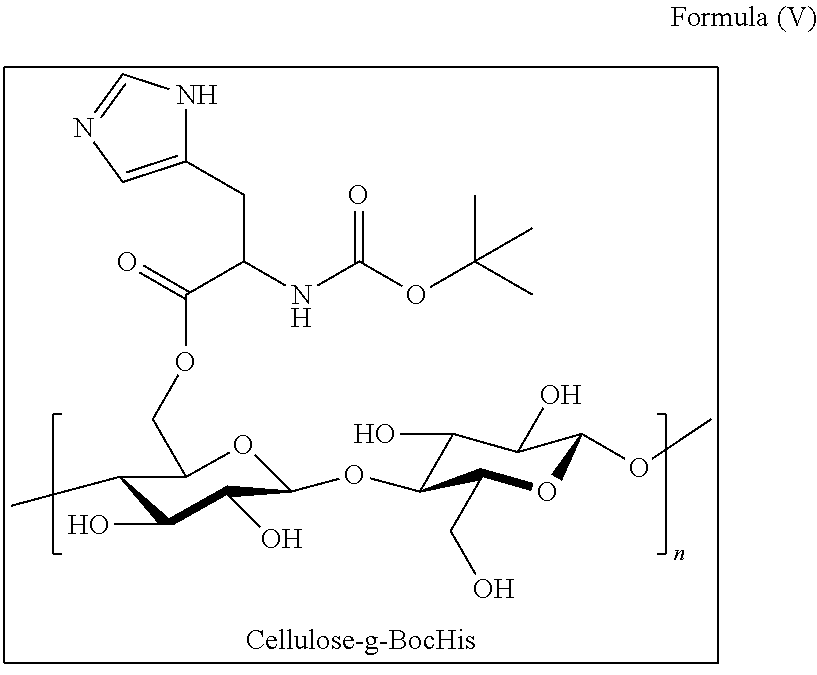
- Boc-His-OH (1.39 g, 5.34 mmol) and DMAP (0.6 g, 4.94 mmol) were placed in a two-neck flask containing a magnetic stirrer therein. The two-neck flask was vacuumized for 3 minutes to remove the air therein and then the two-neck flask was filled with dry nitrogen. Next, DMAc (10.9 ml) was added into the two-neck flask and stirred for 10 minutes until the contents of the two-neck flask were uniformly suspended. EDC solid (0.95 g, 4.94 mmol) was quickly poured into the two-neck flask, and the two-neck flask was placed in a 30° C. water bath for 3 hours for a reaction to activate Boc-His-OH. Cellulose fabric (2.00 g, 12.34 mmol) was placed into a 150 ml glass reaction tank, soaked in DMAc which had been dewatered by a molecular sieve (20 ml) and stirred at 45° C. at 100 rpm for more than 2 hours. The activated Boc-His-LG solution (LG=Leaving Group) was quickly added to the glass reaction tank to make cellulose fabric continuously react with Boc-His-LG solution at 45° C. for 24 hours. After being cooled down naturally, the reacted cellulose fabric was soak in DMAc (0.5 L, 20×) and stirred for 0.5 hours, and then placed in DIW (1.0 L, 100×) and stirred for 1 hour. After that, the reacted cellulose fabric was washed with DIW three times to remove impurity produced after the reaction. Finally, the reacted cellulose fabric was dried to obtain Cellulose-g-BocHis.
- Analysis Method
- Step 1: Activation of Pro-Matrix Metalloproteinase-9
- 100 nM APMA (final concentration 1 M) as added to a 10 μg/ml of pro-matrix metalloproteinase-9 solution (R&D), and reacted in a 37° C. incubator for 2 hours to convert pro matrix metalloproteinase-9 to activated pro-matrix metalloproteinase-9
- Step 2: Test Samples
- The activated pro-matrix metalloproteinase-9 was diluted with matrix metalloproteinase-9 activity analysis buffer (50 mM Tris, 10 mM CaCl2, 150 mM NaCl, 0.05% Brij-35(w/v), pH 7.5) to a concentration of 10 ng/ml. Activated pro-matrix metalloproteinase-9 was added to each test sample and placed in a 37° C. incubator for reaction for 2 or 24 hours. The negative control group contained no activated pro-matrix metalloproteinase-9 solution to test the response of the sample, and positive control added metalloproteinase-9 activity inhibitor, 1,10-Phenanthroline (1,10-PT) (final concentration: 0.1 mM), to the activated pro-matrix metalloproteinase-9 solution.
- Step 3: Analysis for Matrix Metalloproteinase-9
- The activated pro-matrix metalloproteinase-9 solution after being reacted with the material was taken in a 96-well black plate. Equal volume of substrate for matrix metalloproteinase-9 was added to the 96-well black plate and reacted in a 37° C. incubator for 0.5-1 hour, and then the fluorescence (Ex/Em=320/405 nm) of the reaction was determined by a high sensitivity fluorescence reader (Flexstation3).
- Experimental Results
- A. Effect of Boc-histidine concentration on inhibition of matrix metalloproteinase-9 activity
- Boc-histidine with different concentrations which were known were reacted with the activated pro-matrix metalloproteinase-9, respectively for 2 hours, and variation of the effect of Boc-histidine with different concentrations on activated matrix metalloproteinase-9 activity was determined. The results were shown in
FIG. 3 . When the concentration of Boc-histidine reached 2.64 mg/ml, Boc-histidine had 50% inhibitory effect on matrix metalloproteinase-9. y=21.83 ln(x)+28.06. - B. Evaluation of inhibitory effect of powder of Boc-histidine grafted-polyvinyl alcohol derivative, “PVA-g-BocHis”, on matrix metalloproteinase-9 activity
- Powder of Boc-histidine grafted-polyvinyl alcohol derivative, “PVA-g-BocHis”, with 13.3% of grafting ratio (
Lot 1 of Example 1) was prepared as test samples with different concentrations, and the effects thereof on matrix metalloproteinase-9 activity were tested. The results are shown as Table 5 andFIG. 4 . -
TABLE 5 Inhibitory effect of Boc-histidine grafted-polyvinyl alcohol derivative on matrix metalloproteinase-9 PVA-g- PVA-g- PVA-g- BocHis BocHis BocHis Sample BocHis (20%) (10%) (2%) Matrix metalloproteinase-9 81.05 62.15 47.78 47.89 inhibitory rate (%) - The results showed that when the grafting ratio for PVA-g-BocHis was 13.3%, and the concentration of PVA-g-BocHis was 2%˜10%, PVA-g-BocHis had an inhibitory rate of 47.78% to matrix metalloproteinase-9; when the concentration of PVA-g-BocHis was 20%, PVA-g-BocHis had an inhibitory rate of 62.15% to matrix metalloproteinase-9.
- C. Evaluation of inhibitory effect of a film of histidine grafted-polyvinyl alcohol derivative, “PVA-g-BocHis”, of
Lot 1 of Example 1 on matrix metalloproteinase-9 activity. - Powder of Boc-histidine grafted-polyvinyl alcohol derivative, “PVA-g-BocHis” obtained from
Lot 1 of Example 1 (grafting ratio: 13.3%) was added to DMAC, stirred and dissolved at room temperature (500 rpm, 6 hours), and placed in a mold after being dissolved and then dried at 60° C. for 72 hours to form a film. The film was cut into a film sample with a diameter of 1 cm and a 24 hour matrix metalloproteinase-9 activity test was performed thereto, and BocHis and PVA film were used as control groups. The results are shown in Table 6 andFIG. 5 . -
TABLE 6 Inhibitory effect of a film formed from Boc-histidine grafted- polyvinyl alcohol derivative on matrix metalloproteinase-9 PVA-g-BocHis film Sample BocHis PVA film (grafting ratio: 13.3%) Matrix 76.81 16.89 33.27 metalloproteinase- 9 inhibitory rate (%) - The results showed that the film of
Lot 1 could reach an inhibitory rate of 33.27% to matrix metalloproteinase-9 while PVA was dissolved slowly and only has 16.89% of activity decreasing to matrix metalloproteinase-9. - D. Evaluation of inhibitory effect of a film of histidine grafted-polyvinyl alcohol derivative, “PVA-g-BocHis”, of
Lot 2 of Example 1 on matrix metalloproteinase-9 activity. - Powder of histidine grafted-polyvinyl alcohol derivative, “PVA-g-BocHis” obtained from
Lot 2 of Example 1 (grafting ratio: 19.0%) was added to DMAC, stirred and dissolved at room temperature (500 rpm, 6 hours), and placed in a mold after being dissolved to dry at 60° C. for 72 hours to form a film. The film was cut into a film sample with a diameter of 1 cm and a 24 hour matrix metalloproteinase-9 activity test was performed thereto, and a crosslinked PVA film (cPVA) was used as control groups. The results are shown in Table 7 andFIG. 6 . -
TABLE 7 Inhibitory effect of a film formed from Boc-histidine grafted- polyvinyl alcohol derivative on matrix metalloproteinase-9 Matrix Standard Boc- metalloproteinase-9 deviation Histidine inhibitory rate (%) (%) (mg/ml) cPVA film −2.34 5.48 — PVA-g-BocHis film 41.04 0.84 19.40 —: containing no histidine - Since the area of the film was constant, according to the weight and grafting ratio of the film, it was known that the concentration of the grafted histidine derivative of
Lot 2 of Example 1 corresponding to the matrix metalloproteinase-9 activity analysis buffer was about 19.4 mg/ml, and the film ofLot 2 could reach an inhibitory rate of 41.04% to matrix metalloproteinase-9. Comparatively, the crosslinked PVA film (cPVA) had no activity inhibiting effect on matrix metalloproteinase-9. - E. Evaluation of inhibitory effect of a film of Boc-histidine grafted-polyvinyl alcohol derivative, “PVA-g-BocHis”, of
Lot 1 of Example 1 on matrix metalloproteinase-9 activity - Powder of Boc-histidine grafted-polyvinyl alcohol derivative, “PVA-g-BocHis” obtained from
Lot 1 of Example 1 (grafting ratio: 13.3%) was added to DMAC, stirred and dissolved at room temperature (500 rpm, 6 hours), and placed in a mold after being dissolved to dry at 60° C. for 72 hours to form a film. The film was cut into a film sample with a diameter of 1 cm and a 24 hour matrix metalloproteinase-9 activity test was performed thereto, and a crosslinked PVA film (cPVA) was used as a control groups. The results are shown in Table 8 andFIG. 7 . -
TABLE 8 Inhibitory effect of a film formed from Boc-histidine grafted- polyvinyl alcohol derivative on matrix metalloproteinase-9 Matrix Standard Boc- metalloproteinase-9 deviation Histidine inhibitory rate (%) (%) (mg/ml) cPVA film −11.06 3.71 — PVA-g-BocHis film Lot 44.97 3.66 21.60 1-1 PVA-g-BocHis film Lot 29.26 4.53 12.40 1-2 —: containing zero Boc-histidine - Since the area of the film was constant and lot difference resulted in thickness difference between lots of PVA-g-BocHis samples, Lot 1-1 and Lot 1-2, according to the weight and grafting ratio of the film, it was known that the concentration of the grafted histidine derivative of PVA-g-BocHis films Lot 1-1 and Lot 1-2 corresponding to the matrix metalloproteinase-9 activity analysis buffer were about 21.64 mg/ml and 12.4 mg/ml, respectively. According to the results, it was known that Lot 1-1 and Lot 1-2 films had inhibitory rates of 29.26% and 44.97% on matrix metalloproteinase-9 activity, respectively. Comparatively, the crosslinked PVA film (cPVA) had no activity inhibiting effect on matrix metalloproteinase-9.
- F. Evaluation of inhibitory effect of a film of Boc-histidine grafted-poly(ethylene vinyl-co-alcohol) derivative, “EVOH-g-BocHis”, of
Lot 3 andLot 4 of Example 2 on matrix metalloproteinase-9 activity. - Powder of Boc-histidine grafted-poly(ethylene vinyl-co-alcohol) derivative, “EVOH-g-BocHis” obtained from
Lot 3 andLot 4 of Example 2 were added to DMAC, respectively, stirred and dissolved at room temperature (500 rpm, 6 hours), and placed in a mold after being dissolved to dry at 60° C. for 72 hours to form films. The films were cut into film samples with a diameter of 1 cm and a 24 hour matrix metalloproteinase-9 activity test was performed thereto, and an EVOH film was used as a control groups. The results are shown in Table 9 andFIG. 8 . -
TABLE 9 Inhibitory effect of a film formed from Boc-histidine grafted- poly(ethylene vinyl-co-alcohol) derivative on matrix metalloproteinase-9 Matrix metalloproteinase-9 Standard Histidine inhibitory rate (%) deviation (%) (mg/ml) EVOH film 3.84 0.68 — EVOH-g-BocHis 43.68 0.23 17.70 (Lot 3) film EVOH-g-BocHis 38.25 0.95 24.03 (Lot 4) film —: containing no histidine - Since the area of the film was constant and lot difference resulted in a thickness difference between lots of EVOH-g-
BocHis sample Lot 3 andLot 4, according to the weight and grafting ratio of the film, it was known that the concentration of the grafted histidine of EVOH-g-BocHis films Lot 3 andLot 4 corresponding to the matrix metalloproteinase-9 activity analysis buffer were about 17.7 mg/ml and 24.03 mg/ml, respectively. According to the results, it was known that activity inhibiting effect ofLot 3 andLot 4 films had activity inhibiting rates of 43.68% and 38.25%, respectively, due to the increased histidine weight percentage.Lot 3 andLot 4 films had inhibitory rates of 43.68% and 38.25% on matrix metalloproteinase-9 activity, respectively. Comparatively, the EVOH film had no activity inhibiting effect. - G. Evaluation of inhibitory effect of a film of Boc-histidine grafted-hydroxypropyl methylcellulose derivative, “HPMC-g-BocHis”, of
Lot 5 of Example 3 on matrix metalloproteinase-9 activity. - Powder of histidine derivative grafted-hydroxypropyl methylcellulose derivative, “HPMC-g-BocHis” obtained from
Lot 5 of Example 3 was dissolved in DMAC, and then placed in a mold after being dissolved to dry at 60° C. for 72 hours to form a film. The film was cut into a film sample with a diameter of 1 cm and a 3 hour matrix metalloproteinase-9 activity test was performed thereto, and an HPMC film was used as a control group. The results are shown in Table 10 andFIG. 9 . -
TABLE 10 Inhibitory effect of a film formed from histidine derivative grafted-hydroxypropyl methylcellulose derivative on matrix metalloproteinase-9 Matrix Standard Boc- metalloproteinase-9 deviation Histidine inhibitory rate (%) (%) (mg/ml) HPMC film 0 3.33 — HPMC-g-BocHis (Lot 33.2 3.01 2.4 5) film —: containing no histidine - According to the weight and grafting ratio, it was known that the concentration of the grafted Boc-histidine of HPMC-g-
BocHis Lot 5 film corresponding to the matrix metalloproteinase-9 activity analysis buffer was about 2.4 mg/ml. According to the results, it was known thatLot 5 film had an inhibitory rate of 33.2% on matrix metalloproteinase-9 activity. Comparatively, the HPMC film had no activity inhibiting effect. - H. Evaluation of inhibitory effect of a film of Boc-histidine grafted-hydroxypropyl methylcellulose derivative, “HPMC-g-BocHis”, of
Lot 6 of Example 3 on matrix metalloproteinase-9 activity. - Powder of Boc-histidine grafted-hydroxypropyl methylcellulose derivative, “HPMC-g-BocHis” obtained from
Lot 5 of Example 3 was dissolved in DMAC, and then placed in a mold after being dissolved to dry at 60° C. for 72 hours to form a film. The film was cut into a film sample with a diameter of 1 cm and a 24 hour matrix metalloproteinase-9 activity test was performed thereto, and a crosslinked HPMC (cHPMC) film was used as a control group. The results are shown in Table 11 andFIG. 10 . -
TABLE 11 Inhibitory effect of a film formed from histidine derivative grafted-hydroxypropyl methylcellulose derivative on matrix metalloproteinase-9 Matrix Boc- metalloproteinase-9 Standard Histidine inhibitory rate (%) deviation (%) (mg/ml) cHPMC film −12.69 4.06 — HPMC-g-BocHis 42.41 1.89 10.15 (Lot 6) film —: containing no Boc-histidine - According to the weight and grafting ratio, it was known that the concentration of the grafted histidine derivative of HPMC-g-
BocHis Lot 6 film corresponding to the matrix metalloproteinase-9 activity analysis buffer was about 10.15 mg/ml. According to the results, it was known thatLot 6 film had an inhibitory rate of 42.41% on matrix metalloproteinase-9 activity. Comparatively, the cHPMC film had no activity inhibiting effect. - I. Evaluation of inhibitory effect of a film of Boc-histidine grafted-hydroxypropyl methylcellulose derivative, “HPMC-g-BocHis”, of
Lot 6 andLot 7 of Example 3 on matrix metalloproteinase-9 activity. - Powder of Boc-histidine grafted-hydroxypropyl methylcellulose derivative, “HPMC-g-BocHis” obtained from
Lot 6 andLot 7 of Example 3 were dissolved in DMAC, respectively, and then placed in a mold after being dissolved to dry at 60° C. for 72 hours to form films. The films were cut into film samples with a diameter of 1 cm and a 2 hour matrix metalloproteinase-9 activity test was performed thereto, and a crosslinked HPMC (cHPMC) film was used as a control groups. The results are shown in Table 12 andFIG. 11 . -
TABLE 12 Inhibitory effect of a film formed from histidine derivative grafted-hydroxypropyl methylcellulose derivative on matrix metalloproteinase-9 Matrix metalloproteinase-9 Standard Boc-Histidine inhibitory rate (%) deviation (%) (mg/ml) cHPMC film −8.94 4.21 — HPMC-g-BocHis 37.26 4.16 5.52 (Lot 6) film HPMC-g-BocHis 36.37 3.06 8.71 (Lot 7) film —: containing no Boc-histidine - Since the area of the film was constant but lot difference resulted in thickness difference between
Lot 6 andLot 7, according to the weight and grafting ratio of the film, it was known that the concentration of the grafted histidine of HPMC-g-BocHis films Lot 6 andLot 7 corresponding to the matrix metalloproteinase-9 activity analysis buffer were about 5.52 mg/ml and 8.71 mg/ml, respectively. According to the results, it was known thatLot 6 andLot 7 films had activity inhibiting rates of 37.26% and 36.37% to matrix metalloproteinase-9, respectively since they were affected by the change of hydrophilic property. Comparatively, the crosslinked HPMC film (cHPMC) had no activity inhibiting effect. - Preparation for Experimental Samples
- A. Preparation for Boc-histidine grafted-poly(ethylene vinyl-co-alcohol) derivative (“EVOH-g-BocHis):
- Powder of histidine derivative grafted-poly(ethylene vinyl-co-alcohol) of
Lot 3 andLot 4 were added to DMAC, respectively, stirred and dissolved at room temperature (500 rpm, 6 hours), and placed in a mold after being dissolved to dry at 60° C. for 72 hours to form films. - B. Preparation for soaked film sample (BocHis coated EVOH Film, EVOH-c-BocHis).
- Appropriate amount of Boc-Histidine was shaken in a 10 ml co-solvent (DMAc/MeOH 5:95) to be dissolved. After Boc-Histidine was completely dissolved, a poly(ethylene vinyl-co-alcohol) film was socked in the Boc-Histidine solution, and then taken out. After that, the film was placed in a 60° C. oven for 24 hours to remove the solvent in the solution, and then a BocHis coated EVOH film is completed. Content of Boc-Histidine coated on EVOH film is determined as 9.18% by nuclear magnetic resonance spectroscopy and elemental determination analysis.
- Experimental Method and Results
- A. Experiment for evaluating long-term inhibiting effect of Boc-histidine grafted-poly(ethylene vinyl-co-alcohol) derivative film sample (Lot 3) on matrix metalloproteinase-9.
- The Boc-histidine grafted-poly(ethylene vinyl-co-alcohol) derivative film sample (Lot 3) was placed in PBS buffer at 37° C. and shaken at 150 rpm, and the PBS buffer was replaced with fresh PBS buffer every 2 hours to mimic the physiological conditions for body fluid. At 4, 8 and 24 hours, a matrix metalloproteinase-9 activity test was performed to the Boc-histidine grafted-poly(ethylene vinyl-co-alcohol) derivative film sample. A poly(ethylene vinyl-co-alcohol) film was used as a control group. The results are shown in Table 13 and
FIG. 12 . -
TABLE 13 Results of an evaluation of long-term inhibiting effect of Boc- histidine grafted-poly(ethylene vinyl-co-alcohol) derivative film sample (Lot 3) on matrix metalloproteinase-9 Matrix metalloproteinase-9 inhibitory rate (%) 0 hour 4 hour 8 hour 24 hour EVOH film 8.6 0 0 −3.16 EVOH-g-BocHis film 27.84 27.02 20.39 26.09 - According to Table 13 and
FIG. 12 , it is known that the inhibitory effect of the Boc-histidine grafted-poly(ethylene vinyl-co-alcohol) derivative film sample on matrix metalloproteinase-9 is evenly kept between 20.39% and 27.84%, effectively. - B. Evaluation for long-term inhibiting effect of only Boc-histidine socking treated substrate (EVOH-c-BocHis) and Boc-histidine grafted-poly(ethylene vinyl-co-alcohol) derivative film sample (Lot 4).
- The Boc-histidine socking treated substrate (EVOH-c-BocHis) and Boc-histidine grafted-poly(ethylene vinyl-co-alcohol) derivative film sample (EVOH-g-BocHis, Lot 4) were placed in PBS buffer at 37° C. and shaken at 150 rpm, respectively, and the PBS buffer was replaced with fresh PBS buffer every 2 hours to mimic the physiological conditions for body fluid. At the beginning and 24 hour, matrix metalloproteinase-9 activity test was performed to the histidine derivative socking treated substrate (EVOH-c-BocHis) and Boc-histidine grafted-poly(ethylene vinyl-co-alcohol) derivative film sample (EVOH-g-BocHis, Lot 4), respectively. The results are shown in Table 14 and
FIG. 13 . -
TABLE 14 Results of an evaluation of long-term inhibiting effect of only histidine socking treated substrate (EVOH-c-BocHis) and histidine grafted- poly(ethylene vinyl-co-alcohol) derivative film sample (Lot 4) Sample EVOH EVOH-g-BocHis EVOH-c- BocHis Time 0 hour 24 hour 0 hour 24 hour 0 hour 24 hour Matrix metalloproteinase-9 6.01 ± 2.84 7.01 ± 5.7 26.18 ± 2.19 22.87 ± 6.4 66.91 ± 10.14 1.51 ± 1.8 inhibitory rate (%) - The result showed that the Boc-histidine grafted-poly(ethylene vinyl-co-alcohol) derivative film sample (Lot 4) not only had inhibitory effect on matrix metalloproteinase-9 but also could further retain the inhibitory effect for a long term. On the contrary, EVOH-c-BocHis which coated with 9.18 wt % BocHis had a good inhibiting effect on matrix metalloproteinase-9 at first (66.91%), however it lost nearly all the inhibiting effect after 24 hours.
- Preparation for Experimental Samples
- A. Preparation for Boc-histidine grafted-poly(ethylene vinyl-co-alcohol) derivative (EVOH-g-BocHis) film sample:
- Powder of Boc-histidine grafted-poly(ethylene vinyl-co-alcohol) derivative of Example 2 were added to DMAC with a proportion of 15% solid content, stirred and dissolved at room temperature, and placed in a mold after being dissolved to dry at 60° C. for 72 hours to form a film.
- B. Preparation for Boc-histidine grafted-hydroxypropyl methylcellulose derivative (HPMC-g-BocHis) film sample:
- Powder of Boc-histidine grafted-hydroxypropyl methylcellulose derivative of Example 3 were added to DMAC with a proportion of 15% solid content, stirred and dissolved at room temperature, and placed in a mold after being dissolved to dry at 60° C. for 72 hours to form a film.
- C. Diabetic rat; Rats (Sprague-Dawley (SD)) were continuously injected with streptozotocin (STZ) for 4 weeks to result in animal models in a condition similar to
type 2 diabetes. - Experimental Method and Results
- A. The backs of diabetic rats numbered 1 to 6 were each cut to form a wound with a size of 5 cm×6 cm. The rats numbered 1 and 2 belonged to the EVOH treatment group, the rats numbered 3 and 4 belonged to the Boc-histidine grafted-poly(ethylene vinyl-co-alcohol) derivative (EVOH-g-BocHis) treatment group, and the rats numbered as 5 and 6 belonged to the Boc-histidine grafted-hydroxypropyl methylcellulose derivative (HPMC-g-BocHis).
- B. The sample film was covered on the surface of the wound, and a waterproof breathable dressing was further covered on the sample film, and the dressing as fixed around the wound by an operating suture line. On
day 1 andday 3 after the operation, the wound fluid was drawn out, and activity test was performed to matrix metalloproteinase-9 in the wound fluid. - C. Matrix metalloproteinase-9 activity analysis:
- The wound fluid was diluted with matrix metalloproteinase-9 activity analysis buffer (50 mM Tris, 10 mM CaCl2, 150 mM NaCl, 0.05% Brij-35(w/v), pH 7.5) for 50 folds. The wound fluid was taken and added to an equal volume of substrate (
final concentration 10 uM) for matrix metalloproteinase-9, placed in a 37° C. incubator for reaction for 0.5-1 hour, and then the fluorescence (Ex/Em=320/405 nm) of the reaction was determined by a high sensitivity fluorescence reader (Flexstation3). -
TABLE 15 Results of an evaluation of the effect of Boc-histidine grafted derivative film samples on activity of matrix metalloproteinase-9 in the wound fluid Matrix metalloproteinase-9 activity (ug/mL) Sample EVOH EVOH-g-BocHis HPMC-g- BocHis Rat number 1 2 3 4 5 6 Day 15.84 5.53 7.15 5.21 3.04 3.43 Day 34.04 6.72 6.33 3.70 1.17 −0.01 Decreased amount 1.8 −1.19 0.82 1.51 1.87 3.44 Mean decreased 0.305 1.165 2.655 amount - According to Table 15 and
FIG. 14 , it was known that onday 3 after the operation, for the Boc-histidine grafted-poly(ethylene vinyl-co-alcohol) derivative (EVOH-g-BocHis) treatment group and the Boc-histidine grafted-hydroxypropyl methylcellulose derivative (HPMC-g-BocHis) treatment group, the activities of matrix metalloproteinase-9 in the wound fluid thereof were significantly lower than those onday 1, wherein the histidine grafted-hydroxypropyl methylcellulose derivative (HPMC-g-BocHis) had a better effect. - It will be apparent to those skilled in the art that various modifications and variations can be made to the disclosed embodiments. It is intended that the specification and examples be considered as exemplary only, with a true scope of the disclosure being indicated by the following claims and their equivalents.
Claims (23)
1. A polymer composition, comprising
a polymer having a hydroxyl group; and
a histidine or a histidine derivative grafted to the polymer having a hydroxyl group.
2. The polymer composition as claimed in claim 1 , wherein the histidine or the histidine derivative accounts for about 0.1 to 99 wt % of the polymer composition.
3. The polymer composition as claimed in claim 1 , wherein the polymer having a hydroxyl group comprises a synthetic polymer or a natural polymer.
4. The polymer composition as claimed in claim 3 , wherein the synthetic polymer or the natural polymer comprises a linear polymer or a branched polymer.
5. The polymer composition as claimed in claim 3 , wherein the synthetic polymer is a linear synthetic polymer.
6. The polymer composition as claimed in claim 5 , wherein the linear synthetic polymer comprises polyalkylene glycol, polyvinyl alcohol (PVA), polyvinyl acetate (PVAc), poly(vinyl alcohol-co-vinyl acetate), poly(ethylene vinyl-co-alcohol), (EVOH) or a combination thereof.
7. The polymer composition as claimed in claim 3 , wherein the natural polymer comprises a polysaccharide polymer.
8. The polymer composition as claimed in claim 7 , wherein the polysaccharide polymer comprises hyaluronic acid, starch, cellulose, methylcellulose, hydroxypropyl cellulose, hydroxypropyl methylcellulose, oxidized cellulose, dextran, scleroglucan, chitin, chitosan, curdlan, alginate, carrageenan, pectin, gum Arabic, guar gum, gellan, pullulan, chondroitin sulfate, heparin or keratin sulfate.
9. The polymer composition as claimed in claim 1 , wherein the histidine derivative is a Nα-protected histidine derivative.
10. The polymer composition as claimed in claim 9 , wherein the Nα-protected histidine derivative comprises Nα-Boc-histidine, Nα-Cbz-histidine, Nα-Fmoc-histidine or Nα-Ac-histidine.
11. The polymer composition as claimed in claim 1 , wherein the histidine or the histidine derivative is directly grafted to the polymer having a hydroxyl group, or is grafted to the polymer having a hydroxyl group by a spacer.
12. The polymer composition as claimed in claim 11 , wherein the histidine or the histidine derivative is directly grafted to the polymer having a hydroxyl group.
13. The polymer composition as claimed in claim 12 , wherein the histidine or the histidine derivative is directly grafted to the polymer having a hydroxyl group through a chemical covalent bond.
14. The polymer composition as claimed in claim 13 , wherein the chemical covalent bond comprises an ester bond or a urethane.
15. The polymer composition as claimed in claim 12 , wherein the polymer having a hydroxyl group is polyvinyl alcohol (PVA), poly(ethylene vinyl-co-alcohol) (EVOH), hyaluronic acid, cellulose or hydroxypropyl methylcellulose, and the histidine derivative is Nα-Boc-histidine.
16. The polymer composition as claimed in claim 11 , wherein the histidine or the histidine derivative is grafted to the polymer having a hydroxyl group by the spacer.
17. The polymer composition as claimed in claim 16 , wherein the spacer comprises polyethylene glycols(PEG) or alkyl carbon chains.
18. A polymer material, comprising:
a polymer composition, which comprises:
a polymer having a hydroxyl group; and
a histidine or a histidine derivative grafted to the polymer having a hydroxyl group.
19. The polymer material as claimed in claim 18 , wherein the polymer composition forms a solution.
20. The polymer material as claimed in claim 19 , wherein the solution is directly processed to a bulk material.
21. A medical device, comprising:
the polymer composition as claimed in claim 1 ; and
a substrate,
wherein the polymer composition and the substrate are intermixed to form the medical device, or the polymer composition physically adheres to a surface of the substrate or to the inside of the substrate to form the medical device.
22. The medical device as claimed in claim 21 , wherein a material of the substrate comprises polysaccharides, polyurethanes, polyvinyl alcohols (PVA), poly(ethylene vinyl-co-alcohol) (EVOH), polypropylenes or a combination thereof.
23. The medical device as claimed in claim 21 , wherein the medical device comprises a wound dressing, a tissue substitute, a tissue engineering scaffold, a blood-contacting device or a catheter.
Priority Applications (1)
| Application Number | Priority Date | Filing Date | Title |
|---|---|---|---|
| US14/757,364 US20160113905A1 (en) | 2012-12-27 | 2015-12-22 | Polymer composition and polymer material |
Applications Claiming Priority (2)
| Application Number | Priority Date | Filing Date | Title |
|---|---|---|---|
| TW101150409A TWI478943B (en) | 2012-12-27 | 2012-12-27 | Use of polymer composition for the manufacture of a medical device or an inhibitor for inhibiting matrix metalloproteinases activity |
| TW101150409 | 2012-12-27 |
Related Child Applications (1)
| Application Number | Title | Priority Date | Filing Date |
|---|---|---|---|
| US14/757,364 Division US20160113905A1 (en) | 2012-12-27 | 2015-12-22 | Polymer composition and polymer material |
Publications (1)
| Publication Number | Publication Date |
|---|---|
| US20140186415A1 true US20140186415A1 (en) | 2014-07-03 |
Family
ID=49880555
Family Applications (2)
| Application Number | Title | Priority Date | Filing Date |
|---|---|---|---|
| US14/132,796 Abandoned US20140186415A1 (en) | 2012-12-27 | 2013-12-18 | Polymer composition and polymer material |
| US14/757,364 Abandoned US20160113905A1 (en) | 2012-12-27 | 2015-12-22 | Polymer composition and polymer material |
Family Applications After (1)
| Application Number | Title | Priority Date | Filing Date |
|---|---|---|---|
| US14/757,364 Abandoned US20160113905A1 (en) | 2012-12-27 | 2015-12-22 | Polymer composition and polymer material |
Country Status (3)
| Country | Link |
|---|---|
| US (2) | US20140186415A1 (en) |
| EP (1) | EP2749293A1 (en) |
| TW (1) | TWI478943B (en) |
Cited By (2)
| Publication number | Priority date | Publication date | Assignee | Title |
|---|---|---|---|---|
| US10632081B2 (en) * | 2014-10-14 | 2020-04-28 | Industrial Technology Research Institute | Intralymphatic delivery of hyaluronan nanoparticle for cancer metastasis |
| CN113045759A (en) * | 2019-12-26 | 2021-06-29 | 财团法人工业技术研究院 | Grafted polymer and composite material containing same |
Families Citing this family (3)
| Publication number | Priority date | Publication date | Assignee | Title |
|---|---|---|---|---|
| CN105435295B (en) * | 2015-12-15 | 2018-07-06 | 哈尔滨工业大学 | A kind of preparation method of RGD-M13 bacteriophages/oxidized regenerated cellulose compound hemostatic material |
| CN105477675B (en) * | 2015-12-15 | 2018-09-07 | 哈尔滨工业大学 | A kind of preparation method of RGD-M13 bacteriophages/polylysine/oxidized regenerated cellulose compound hemostatic material |
| TWI722443B (en) * | 2019-05-30 | 2021-03-21 | 財團法人工業技術研究院 | Biomedical composition for skin care and/or maintenance and delaying and/or inhibition of skin aging and the use thereof |
Citations (3)
| Publication number | Priority date | Publication date | Assignee | Title |
|---|---|---|---|---|
| US20100076542A1 (en) * | 2007-02-21 | 2010-03-25 | Eurocor Gmbh | Coated expandable system |
| US20120082717A1 (en) * | 2009-06-05 | 2012-04-05 | Snu R&Db Foundation | Complex, multilayer using the same, and device coated with the multilayer |
| US20150118322A1 (en) * | 2013-10-24 | 2015-04-30 | Industrial Technology Research Institute | Biomedical composition |
Family Cites Families (6)
| Publication number | Priority date | Publication date | Assignee | Title |
|---|---|---|---|---|
| DE1302066B (en) * | 1963-06-10 | 1969-11-13 | Avny Yair | Method for grafting polypeptide chains onto polyhydroxy polymers |
| US6174999B1 (en) * | 1987-09-18 | 2001-01-16 | Genzyme Corporation | Water insoluble derivatives of polyanionic polysaccharides |
| JP3637892B2 (en) * | 2001-11-16 | 2005-04-13 | 味の素株式会社 | Antibacterial packaging material |
| CN1732023A (en) * | 2002-12-27 | 2006-02-08 | 血管技术国际股份公司 | Compositions and methods of using collajolie |
| JP2008540790A (en) * | 2005-05-18 | 2008-11-20 | エウランド ファルマチェウティカルズ リミテッド | Antiproliferative conjugates having hyaluronic acid and N-derivatives of glutamic acid |
| US9439925B2 (en) * | 2010-04-06 | 2016-09-13 | Synedgen, Inc. | Methods and compositions for treating wounds utilizing chitosan compounds |
-
2012
- 2012-12-27 TW TW101150409A patent/TWI478943B/en active
-
2013
- 2013-12-18 US US14/132,796 patent/US20140186415A1/en not_active Abandoned
- 2013-12-20 EP EP20130199068 patent/EP2749293A1/en not_active Withdrawn
-
2015
- 2015-12-22 US US14/757,364 patent/US20160113905A1/en not_active Abandoned
Patent Citations (3)
| Publication number | Priority date | Publication date | Assignee | Title |
|---|---|---|---|---|
| US20100076542A1 (en) * | 2007-02-21 | 2010-03-25 | Eurocor Gmbh | Coated expandable system |
| US20120082717A1 (en) * | 2009-06-05 | 2012-04-05 | Snu R&Db Foundation | Complex, multilayer using the same, and device coated with the multilayer |
| US20150118322A1 (en) * | 2013-10-24 | 2015-04-30 | Industrial Technology Research Institute | Biomedical composition |
Non-Patent Citations (2)
| Title |
|---|
| Bueno et al., Journal of Chromatography B, 1995, 667, 57-67. * |
| Wu et al., J. Mater. Sci: Mater Med, 2012, 23, 1921-1929 (published online May 12 2012). * |
Cited By (3)
| Publication number | Priority date | Publication date | Assignee | Title |
|---|---|---|---|---|
| US10632081B2 (en) * | 2014-10-14 | 2020-04-28 | Industrial Technology Research Institute | Intralymphatic delivery of hyaluronan nanoparticle for cancer metastasis |
| CN113045759A (en) * | 2019-12-26 | 2021-06-29 | 财团法人工业技术研究院 | Grafted polymer and composite material containing same |
| US11629213B2 (en) | 2019-12-26 | 2023-04-18 | Industrial Technology Research Institute | Graft polymer and composite material containing the same |
Also Published As
| Publication number | Publication date |
|---|---|
| TWI478943B (en) | 2015-04-01 |
| TW201425343A (en) | 2014-07-01 |
| US20160113905A1 (en) | 2016-04-28 |
| EP2749293A1 (en) | 2014-07-02 |
Similar Documents
| Publication | Publication Date | Title |
|---|---|---|
| Zhang et al. | Alginate-chitosan oligosaccharide-ZnO composite hydrogel for accelerating wound healing | |
| US20160113905A1 (en) | Polymer composition and polymer material | |
| Yang et al. | A pH responsive tannic acid/quaternized carboxymethyl chitosan/oxidized sodium alginate hydrogels for accelerated diabetic wound healing and real-time monitoring | |
| JP3337472B2 (en) | Wound healing agent | |
| Li et al. | A novel matrix metalloproteinases-cleavable hydrogel loading deferoxamine accelerates diabetic wound healing | |
| CN109432496B (en) | A kind of in situ injection molding thiolated polysaccharide-based hydrogel and preparation method and application of drug carrier thereof | |
| Qin et al. | Biodegradable microneedle array-mediated transdermal delivery of dimethyloxalylglycine-functionalized zeolitic imidazolate framework-8 nanoparticles for bacteria-infected wound treatment | |
| Noreen et al. | Thiolated poly‐and oligosaccharide‐based hydrogels for tissue engineering and wound healing | |
| CN112980003B (en) | Natural polysaccharide based antibacterial hydrogel, preparation method and application | |
| CN105920652A (en) | Antibacterial gel in covalent grafting with antibacterial polypeptide and preparation method of antibacterial gel | |
| CN110152055B (en) | Functional Drug Sustained-release Medical Dressing Constructed by Alginate Aminated Derivatives/Bacterial Cellulose Nanocrystal Composite Gel | |
| Hu et al. | Study on repair of abdominal wall defect rats with hernia mesh coated with chitosan-based photosensitive hydrogel | |
| Liu et al. | Chitosan-based GOx@ Co-MOF composite hydrogel: A promising strategy for enhanced antibacterial and wound healing effects | |
| Zhao et al. | Hydroxypropyl methylcellulose reinforced bilayer hydrogel dressings containing L-arginine-modified polyoxometalate nanoclusters to promote healing of chronic diabetic wounds | |
| CN114524950A (en) | Magnetic targeting hydrophobic drug carrier hydrogel and preparation method and application thereof | |
| WO2023206055A1 (en) | Modification and use of silk fibroin | |
| CN104784744A (en) | Compound method for preparing wound dressing by utilizing human hair keratin | |
| Guo et al. | Bacterial-responsive biodegradable silver nanoclusters composite hydrogel for infected wound therapy | |
| CN111068103B (en) | A kind of long-acting antibacterial gel dressing for surgical wound and preparation method thereof | |
| CN103893813B (en) | Polymer composition and polymer material | |
| CN115584034B (en) | An injectable hydrogel material for wound repair and preparation method thereof | |
| Wang et al. | Photopolymerized multifunctional hydrogel loaded with asiaticoside and growth factor for accelerating diabetic wound healing | |
| WO2020261190A1 (en) | Layered collagen dressing with extended bacteria and biofilm reducing capabilities | |
| Xu et al. | Dynamically self-degradable, injectable and self-healing 6-deoxy-6-arginine grafted chitosan hydrogels for wounds healing | |
| CN118079057A (en) | Composite collagen-based wound dressing containing rare earth ions and preparation method thereof |
Legal Events
| Date | Code | Title | Description |
|---|---|---|---|
| AS | Assignment |
Owner name: INDUSTRIAL TECHNOLOGY RESEARCH INSTITUTE, TAIWAN Free format text: ASSIGNMENT OF ASSIGNORS INTEREST;ASSIGNORS:SHIH, TING-YU;TENG, TSE-MIN;WANG, CHIA-CHUN;AND OTHERS;SIGNING DATES FROM 20131118 TO 20131125;REEL/FRAME:031871/0986 |
|
| STCB | Information on status: application discontinuation |
Free format text: ABANDONED -- FAILURE TO RESPOND TO AN OFFICE ACTION |