US20130222883A1 - Display particles, display particle dispersion liquid, display medium, and display device - Google Patents
Display particles, display particle dispersion liquid, display medium, and display device Download PDFInfo
- Publication number
- US20130222883A1 US20130222883A1 US13/718,431 US201213718431A US2013222883A1 US 20130222883 A1 US20130222883 A1 US 20130222883A1 US 201213718431 A US201213718431 A US 201213718431A US 2013222883 A1 US2013222883 A1 US 2013222883A1
- Authority
- US
- United States
- Prior art keywords
- display
- particles
- group
- mass
- particle group
- Prior art date
- Legal status (The legal status is an assumption and is not a legal conclusion. Google has not performed a legal analysis and makes no representation as to the accuracy of the status listed.)
- Abandoned
Links
- 239000002245 particle Substances 0.000 title claims abstract description 561
- 239000007788 liquid Substances 0.000 title claims description 33
- 239000006185 dispersion Substances 0.000 title claims description 31
- 229920001577 copolymer Polymers 0.000 claims abstract description 94
- -1 vinyl compound Chemical class 0.000 claims abstract description 61
- 150000001875 compounds Chemical class 0.000 claims abstract description 40
- 229920002554 vinyl polymer Polymers 0.000 claims abstract description 30
- 125000004432 carbon atom Chemical group C* 0.000 claims abstract description 21
- 125000000217 alkyl group Chemical group 0.000 claims abstract description 20
- 125000003118 aryl group Chemical group 0.000 claims abstract description 20
- 125000000325 methylidene group Chemical group [H]C([H])=* 0.000 claims abstract description 4
- 239000000758 substrate Substances 0.000 claims description 196
- 239000002609 medium Substances 0.000 claims description 82
- 239000002612 dispersion medium Substances 0.000 claims description 36
- 230000005684 electric field Effects 0.000 claims description 23
- 229920001296 polysiloxane Polymers 0.000 claims description 21
- MYRTYDVEIRVNKP-UHFFFAOYSA-N 1,2-Divinylbenzene Chemical compound C=CC1=CC=CC=C1C=C MYRTYDVEIRVNKP-UHFFFAOYSA-N 0.000 claims description 15
- PPBRXRYQALVLMV-UHFFFAOYSA-N Styrene Chemical compound C=CC1=CC=CC=C1 PPBRXRYQALVLMV-UHFFFAOYSA-N 0.000 claims description 10
- XIRPMPKSZHNMST-UHFFFAOYSA-N 1-ethenyl-2-phenylbenzene Chemical group C=CC1=CC=CC=C1C1=CC=CC=C1 XIRPMPKSZHNMST-UHFFFAOYSA-N 0.000 claims description 4
- IGGDKDTUCAWDAN-UHFFFAOYSA-N 1-vinylnaphthalene Chemical compound C1=CC=C2C(C=C)=CC=CC2=C1 IGGDKDTUCAWDAN-UHFFFAOYSA-N 0.000 claims description 4
- QLLUAUADIMPKIH-UHFFFAOYSA-N 1,2-bis(ethenyl)naphthalene Chemical compound C1=CC=CC2=C(C=C)C(C=C)=CC=C21 QLLUAUADIMPKIH-UHFFFAOYSA-N 0.000 claims description 3
- IYSVFZBXZVPIFA-UHFFFAOYSA-N 1-ethenyl-4-(4-ethenylphenyl)benzene Chemical group C1=CC(C=C)=CC=C1C1=CC=C(C=C)C=C1 IYSVFZBXZVPIFA-UHFFFAOYSA-N 0.000 claims description 3
- 238000006116 polymerization reaction Methods 0.000 description 55
- 229920005989 resin Polymers 0.000 description 35
- 239000011347 resin Substances 0.000 description 35
- 239000003086 colorant Substances 0.000 description 31
- 229920002545 silicone oil Polymers 0.000 description 29
- 239000000463 material Substances 0.000 description 27
- 239000000654 additive Substances 0.000 description 21
- 238000000034 method Methods 0.000 description 20
- 239000002994 raw material Substances 0.000 description 20
- 239000002904 solvent Substances 0.000 description 19
- YXFVVABEGXRONW-UHFFFAOYSA-N Toluene Chemical compound CC1=CC=CC=C1 YXFVVABEGXRONW-UHFFFAOYSA-N 0.000 description 18
- 230000000996 additive effect Effects 0.000 description 18
- 230000000052 comparative effect Effects 0.000 description 17
- 239000002344 surface layer Substances 0.000 description 16
- KFZMGEQAYNKOFK-UHFFFAOYSA-N Isopropanol Chemical compound CC(C)O KFZMGEQAYNKOFK-UHFFFAOYSA-N 0.000 description 15
- GWEVSGVZZGPLCZ-UHFFFAOYSA-N Titan oxide Chemical compound O=[Ti]=O GWEVSGVZZGPLCZ-UHFFFAOYSA-N 0.000 description 15
- 229920000642 polymer Polymers 0.000 description 15
- NIXOWILDQLNWCW-UHFFFAOYSA-M Acrylate Chemical compound [O-]C(=O)C=C NIXOWILDQLNWCW-UHFFFAOYSA-M 0.000 description 14
- 239000003795 chemical substances by application Substances 0.000 description 14
- 239000000049 pigment Substances 0.000 description 14
- 230000004043 responsiveness Effects 0.000 description 14
- OGIDPMRJRNCKJF-UHFFFAOYSA-N titanium oxide Inorganic materials [Ti]=O OGIDPMRJRNCKJF-UHFFFAOYSA-N 0.000 description 13
- 125000002496 methyl group Chemical group [H]C([H])([H])* 0.000 description 12
- 238000002156 mixing Methods 0.000 description 12
- 239000007822 coupling agent Substances 0.000 description 11
- 238000004519 manufacturing process Methods 0.000 description 11
- 125000000391 vinyl group Chemical group [H]C([*])=C([H])[H] 0.000 description 11
- VYPSYNLAJGMNEJ-UHFFFAOYSA-N Silicium dioxide Chemical compound O=[Si]=O VYPSYNLAJGMNEJ-UHFFFAOYSA-N 0.000 description 10
- MCMNRKCIXSYSNV-UHFFFAOYSA-N Zirconium dioxide Chemical compound O=[Zr]=O MCMNRKCIXSYSNV-UHFFFAOYSA-N 0.000 description 10
- 238000011156 evaluation Methods 0.000 description 10
- 239000000203 mixture Substances 0.000 description 10
- 239000000470 constituent Substances 0.000 description 9
- 229910052751 metal Inorganic materials 0.000 description 8
- 239000002184 metal Substances 0.000 description 8
- 230000006866 deterioration Effects 0.000 description 7
- 238000010586 diagram Methods 0.000 description 7
- 235000014113 dietary fatty acids Nutrition 0.000 description 7
- 125000000118 dimethyl group Chemical group [H]C([H])([H])* 0.000 description 7
- 239000000194 fatty acid Substances 0.000 description 7
- 229930195729 fatty acid Natural products 0.000 description 7
- 150000002430 hydrocarbons Chemical class 0.000 description 7
- 125000004435 hydrogen atom Chemical group [H]* 0.000 description 7
- 239000000178 monomer Substances 0.000 description 7
- 230000008569 process Effects 0.000 description 7
- 229910000077 silane Inorganic materials 0.000 description 7
- 239000000243 solution Substances 0.000 description 7
- 229920001187 thermosetting polymer Polymers 0.000 description 7
- 239000002253 acid Substances 0.000 description 6
- 125000001495 ethyl group Chemical group [H]C([H])([H])C([H])([H])* 0.000 description 6
- 239000010408 film Substances 0.000 description 6
- 239000011521 glass Substances 0.000 description 6
- 229930195733 hydrocarbon Natural products 0.000 description 6
- 239000010410 layer Substances 0.000 description 6
- 239000000696 magnetic material Substances 0.000 description 6
- 229910044991 metal oxide Inorganic materials 0.000 description 6
- 150000004706 metal oxides Chemical class 0.000 description 6
- 239000002244 precipitate Substances 0.000 description 6
- SJIXRGNQPBQWMK-UHFFFAOYSA-N DEAEMA Natural products CCN(CC)CCOC(=O)C(C)=C SJIXRGNQPBQWMK-UHFFFAOYSA-N 0.000 description 5
- WOBHKFSMXKNTIM-UHFFFAOYSA-N Hydroxyethyl methacrylate Chemical compound CC(=C)C(=O)OCCO WOBHKFSMXKNTIM-UHFFFAOYSA-N 0.000 description 5
- 239000011324 bead Substances 0.000 description 5
- 239000006247 magnetic powder Substances 0.000 description 5
- 230000005012 migration Effects 0.000 description 5
- 238000013508 migration Methods 0.000 description 5
- 239000012188 paraffin wax Substances 0.000 description 5
- 239000003505 polymerization initiator Substances 0.000 description 5
- 229920006395 saturated elastomer Polymers 0.000 description 5
- 229920001169 thermoplastic Polymers 0.000 description 5
- 239000004416 thermosoftening plastic Substances 0.000 description 5
- 239000004793 Polystyrene Substances 0.000 description 4
- XLOMVQKBTHCTTD-UHFFFAOYSA-N Zinc monoxide Chemical compound [Zn]=O XLOMVQKBTHCTTD-UHFFFAOYSA-N 0.000 description 4
- NIXOWILDQLNWCW-UHFFFAOYSA-N acrylic acid group Chemical group C(C=C)(=O)O NIXOWILDQLNWCW-UHFFFAOYSA-N 0.000 description 4
- PNEYBMLMFCGWSK-UHFFFAOYSA-N aluminium oxide Inorganic materials [O-2].[O-2].[O-2].[Al+3].[Al+3] PNEYBMLMFCGWSK-UHFFFAOYSA-N 0.000 description 4
- 238000006243 chemical reaction Methods 0.000 description 4
- 238000001816 cooling Methods 0.000 description 4
- 230000006870 function Effects 0.000 description 4
- 230000005484 gravity Effects 0.000 description 4
- 238000010438 heat treatment Methods 0.000 description 4
- 125000004051 hexyl group Chemical group [H]C([H])([H])C([H])([H])C([H])([H])C([H])([H])C([H])([H])C([H])([H])* 0.000 description 4
- 239000001023 inorganic pigment Substances 0.000 description 4
- 239000011259 mixed solution Substances 0.000 description 4
- 230000007935 neutral effect Effects 0.000 description 4
- 239000003921 oil Substances 0.000 description 4
- 230000003287 optical effect Effects 0.000 description 4
- 239000012860 organic pigment Substances 0.000 description 4
- 229920000728 polyester Polymers 0.000 description 4
- 239000002952 polymeric resin Substances 0.000 description 4
- 229920002223 polystyrene Polymers 0.000 description 4
- 239000000377 silicon dioxide Substances 0.000 description 4
- 239000007787 solid Substances 0.000 description 4
- 229920003002 synthetic resin Polymers 0.000 description 4
- OZAIFHULBGXAKX-UHFFFAOYSA-N 2-(2-cyanopropan-2-yldiazenyl)-2-methylpropanenitrile Chemical compound N#CC(C)(C)N=NC(C)(C)C#N OZAIFHULBGXAKX-UHFFFAOYSA-N 0.000 description 3
- 239000004215 Carbon black (E152) Substances 0.000 description 3
- 102100026735 Coagulation factor VIII Human genes 0.000 description 3
- YCKRFDGAMUMZLT-UHFFFAOYSA-N Fluorine atom Chemical compound [F] YCKRFDGAMUMZLT-UHFFFAOYSA-N 0.000 description 3
- 101000911390 Homo sapiens Coagulation factor VIII Proteins 0.000 description 3
- VVQNEPGJFQJSBK-UHFFFAOYSA-N Methyl methacrylate Chemical compound COC(=O)C(C)=C VVQNEPGJFQJSBK-UHFFFAOYSA-N 0.000 description 3
- 229920003171 Poly (ethylene oxide) Polymers 0.000 description 3
- 229920002472 Starch Polymers 0.000 description 3
- 229910010416 TiO(OH)2 Inorganic materials 0.000 description 3
- 230000002776 aggregation Effects 0.000 description 3
- 238000004220 aggregation Methods 0.000 description 3
- 150000004945 aromatic hydrocarbons Chemical class 0.000 description 3
- 235000010290 biphenyl Nutrition 0.000 description 3
- 125000000484 butyl group Chemical group [H]C([*])([H])C([H])([H])C([H])([H])C([H])([H])[H] 0.000 description 3
- 238000004040 coloring Methods 0.000 description 3
- XCJYREBRNVKWGJ-UHFFFAOYSA-N copper(II) phthalocyanine Chemical compound [Cu+2].C12=CC=CC=C2C(N=C2[N-]C(C3=CC=CC=C32)=N2)=NC1=NC([C]1C=CC=CC1=1)=NC=1N=C1[C]3C=CC=CC3=C2[N-]1 XCJYREBRNVKWGJ-UHFFFAOYSA-N 0.000 description 3
- 239000002270 dispersing agent Substances 0.000 description 3
- 239000000975 dye Substances 0.000 description 3
- 239000011737 fluorine Substances 0.000 description 3
- 229910052731 fluorine Inorganic materials 0.000 description 3
- 239000000499 gel Substances 0.000 description 3
- 125000000959 isobutyl group Chemical group [H]C([H])([H])C([H])(C([H])([H])[H])C([H])([H])* 0.000 description 3
- 125000001449 isopropyl group Chemical group [H]C([H])([H])C([H])(*)C([H])([H])[H] 0.000 description 3
- 238000004898 kneading Methods 0.000 description 3
- 239000011159 matrix material Substances 0.000 description 3
- 125000004108 n-butyl group Chemical group [H]C([H])([H])C([H])([H])C([H])([H])C([H])([H])* 0.000 description 3
- 125000004123 n-propyl group Chemical group [H]C([H])([H])C([H])([H])C([H])([H])* 0.000 description 3
- 239000002736 nonionic surfactant Substances 0.000 description 3
- 125000001147 pentyl group Chemical group C(CCCC)* 0.000 description 3
- 125000001997 phenyl group Chemical group [H]C1=C([H])C([H])=C(*)C([H])=C1[H] 0.000 description 3
- 125000005575 polycyclic aromatic hydrocarbon group Chemical group 0.000 description 3
- 229920000647 polyepoxide Polymers 0.000 description 3
- 229920002451 polyvinyl alcohol Polymers 0.000 description 3
- 235000019422 polyvinyl alcohol Nutrition 0.000 description 3
- 239000000047 product Substances 0.000 description 3
- 125000002914 sec-butyl group Chemical group [H]C([H])([H])C([H])([H])C([H])(*)C([H])([H])[H] 0.000 description 3
- 235000019698 starch Nutrition 0.000 description 3
- 239000008107 starch Substances 0.000 description 3
- 239000004094 surface-active agent Substances 0.000 description 3
- 125000000999 tert-butyl group Chemical group [H]C([H])([H])C(*)(C([H])([H])[H])C([H])([H])[H] 0.000 description 3
- 239000010409 thin film Substances 0.000 description 3
- 0 *[Si](C)(C)O[Si](C)(C)O[Si](C)(C)COC(=O)C([1*])=C.C.C Chemical compound *[Si](C)(C)O[Si](C)(C)O[Si](C)(C)COC(=O)C([1*])=C.C.C 0.000 description 2
- 229920000178 Acrylic resin Polymers 0.000 description 2
- 239000004925 Acrylic resin Substances 0.000 description 2
- 229920001817 Agar Polymers 0.000 description 2
- SOGAXMICEFXMKE-UHFFFAOYSA-N Butylmethacrylate Chemical compound CCCCOC(=O)C(C)=C SOGAXMICEFXMKE-UHFFFAOYSA-N 0.000 description 2
- 108010010803 Gelatin Proteins 0.000 description 2
- RRHGJUQNOFWUDK-UHFFFAOYSA-N Isoprene Chemical compound CC(=C)C=C RRHGJUQNOFWUDK-UHFFFAOYSA-N 0.000 description 2
- YIVJZNGAASQVEM-UHFFFAOYSA-N Lauroyl peroxide Chemical compound CCCCCCCCCCCC(=O)OOC(=O)CCCCCCCCCCC YIVJZNGAASQVEM-UHFFFAOYSA-N 0.000 description 2
- CERQOIWHTDAKMF-UHFFFAOYSA-N Methacrylic acid Chemical compound CC(=C)C(O)=O CERQOIWHTDAKMF-UHFFFAOYSA-N 0.000 description 2
- BAPJBEWLBFYGME-UHFFFAOYSA-N Methyl acrylate Chemical compound COC(=O)C=C BAPJBEWLBFYGME-UHFFFAOYSA-N 0.000 description 2
- UFWIBTONFRDIAS-UHFFFAOYSA-N Naphthalene Chemical compound C1=CC=CC2=CC=CC=C21 UFWIBTONFRDIAS-UHFFFAOYSA-N 0.000 description 2
- PXHVJJICTQNCMI-UHFFFAOYSA-N Nickel Chemical compound [Ni] PXHVJJICTQNCMI-UHFFFAOYSA-N 0.000 description 2
- 239000004952 Polyamide Substances 0.000 description 2
- 150000003926 acrylamides Chemical class 0.000 description 2
- 150000001253 acrylic acids Chemical class 0.000 description 2
- 230000009471 action Effects 0.000 description 2
- 125000003368 amide group Chemical group 0.000 description 2
- 150000001408 amides Chemical class 0.000 description 2
- 125000003277 amino group Chemical group 0.000 description 2
- MWPLVEDNUUSJAV-UHFFFAOYSA-N anthracene Chemical compound C1=CC=CC2=CC3=CC=CC=C3C=C21 MWPLVEDNUUSJAV-UHFFFAOYSA-N 0.000 description 2
- 125000004429 atom Chemical group 0.000 description 2
- 150000001555 benzenes Chemical class 0.000 description 2
- WQZGKKKJIJFFOK-VFUOTHLCSA-N beta-D-glucose Chemical compound OC[C@H]1O[C@@H](O)[C@H](O)[C@@H](O)[C@@H]1O WQZGKKKJIJFFOK-VFUOTHLCSA-N 0.000 description 2
- 150000004074 biphenyls Chemical class 0.000 description 2
- 238000009835 boiling Methods 0.000 description 2
- YCIMNLLNPGFGHC-UHFFFAOYSA-N catechol Chemical compound OC1=CC=CC=C1O YCIMNLLNPGFGHC-UHFFFAOYSA-N 0.000 description 2
- 150000001768 cations Chemical class 0.000 description 2
- WDECIBYCCFPHNR-UHFFFAOYSA-N chrysene Chemical compound C1=CC=CC2=CC=C3C4=CC=CC=C4C=CC3=C21 WDECIBYCCFPHNR-UHFFFAOYSA-N 0.000 description 2
- 239000000084 colloidal system Substances 0.000 description 2
- 239000002131 composite material Substances 0.000 description 2
- 125000004093 cyano group Chemical group *C#N 0.000 description 2
- 239000000412 dendrimer Substances 0.000 description 2
- 229920000736 dendritic polymer Polymers 0.000 description 2
- 238000001962 electrophoresis Methods 0.000 description 2
- 238000004945 emulsification Methods 0.000 description 2
- 239000003822 epoxy resin Substances 0.000 description 2
- 238000005530 etching Methods 0.000 description 2
- FJKIXWOMBXYWOQ-UHFFFAOYSA-N ethenoxyethane Chemical compound CCOC=C FJKIXWOMBXYWOQ-UHFFFAOYSA-N 0.000 description 2
- 230000002349 favourable effect Effects 0.000 description 2
- 238000007667 floating Methods 0.000 description 2
- 238000005227 gel permeation chromatography Methods 0.000 description 2
- 229920000159 gelatin Polymers 0.000 description 2
- 239000008273 gelatin Substances 0.000 description 2
- 235000019322 gelatine Nutrition 0.000 description 2
- 235000011852 gelatine desserts Nutrition 0.000 description 2
- LNEPOXFFQSENCJ-UHFFFAOYSA-N haloperidol Chemical compound C1CC(O)(C=2C=CC(Cl)=CC=2)CCN1CCCC(=O)C1=CC=C(F)C=C1 LNEPOXFFQSENCJ-UHFFFAOYSA-N 0.000 description 2
- 230000002209 hydrophobic effect Effects 0.000 description 2
- 125000002887 hydroxy group Chemical group [H]O* 0.000 description 2
- NOESYZHRGYRDHS-UHFFFAOYSA-N insulin Chemical compound N1C(=O)C(NC(=O)C(CCC(N)=O)NC(=O)C(CCC(O)=O)NC(=O)C(C(C)C)NC(=O)C(NC(=O)CN)C(C)CC)CSSCC(C(NC(CO)C(=O)NC(CC(C)C)C(=O)NC(CC=2C=CC(O)=CC=2)C(=O)NC(CCC(N)=O)C(=O)NC(CC(C)C)C(=O)NC(CCC(O)=O)C(=O)NC(CC(N)=O)C(=O)NC(CC=2C=CC(O)=CC=2)C(=O)NC(CSSCC(NC(=O)C(C(C)C)NC(=O)C(CC(C)C)NC(=O)C(CC=2C=CC(O)=CC=2)NC(=O)C(CC(C)C)NC(=O)C(C)NC(=O)C(CCC(O)=O)NC(=O)C(C(C)C)NC(=O)C(CC(C)C)NC(=O)C(CC=2NC=NC=2)NC(=O)C(CO)NC(=O)CNC2=O)C(=O)NCC(=O)NC(CCC(O)=O)C(=O)NC(CCCNC(N)=N)C(=O)NCC(=O)NC(CC=3C=CC=CC=3)C(=O)NC(CC=3C=CC=CC=3)C(=O)NC(CC=3C=CC(O)=CC=3)C(=O)NC(C(C)O)C(=O)N3C(CCC3)C(=O)NC(CCCCN)C(=O)NC(C)C(O)=O)C(=O)NC(CC(N)=O)C(O)=O)=O)NC(=O)C(C(C)CC)NC(=O)C(CO)NC(=O)C(C(C)O)NC(=O)C1CSSCC2NC(=O)C(CC(C)C)NC(=O)C(NC(=O)C(CCC(N)=O)NC(=O)C(CC(N)=O)NC(=O)C(NC(=O)C(N)CC=1C=CC=CC=1)C(C)C)CC1=CN=CN1 NOESYZHRGYRDHS-UHFFFAOYSA-N 0.000 description 2
- 239000002563 ionic surfactant Substances 0.000 description 2
- 239000006249 magnetic particle Substances 0.000 description 2
- 238000012986 modification Methods 0.000 description 2
- 230000004048 modification Effects 0.000 description 2
- 229910052757 nitrogen Inorganic materials 0.000 description 2
- 125000004433 nitrogen atom Chemical group N* 0.000 description 2
- 239000003960 organic solvent Substances 0.000 description 2
- 238000005192 partition Methods 0.000 description 2
- YNPNZTXNASCQKK-UHFFFAOYSA-N phenanthrene Chemical compound C1=CC=C2C3=CC=CC=C3C=CC2=C1 YNPNZTXNASCQKK-UHFFFAOYSA-N 0.000 description 2
- 125000002467 phosphate group Chemical group [H]OP(=O)(O[H])O[*] 0.000 description 2
- 229920003229 poly(methyl methacrylate) Polymers 0.000 description 2
- 229920003216 poly(methylphenylsiloxane) Polymers 0.000 description 2
- 229920002647 polyamide Polymers 0.000 description 2
- 229920001225 polyester resin Polymers 0.000 description 2
- 239000004645 polyester resin Substances 0.000 description 2
- 229920001721 polyimide Polymers 0.000 description 2
- 230000000379 polymerizing effect Effects 0.000 description 2
- BBEAQIROQSPTKN-UHFFFAOYSA-N pyrene Chemical compound C1=CC=C2C=CC3=CC=CC4=CC=C1C2=C43 BBEAQIROQSPTKN-UHFFFAOYSA-N 0.000 description 2
- 150000003242 quaternary ammonium salts Chemical class 0.000 description 2
- 239000011369 resultant mixture Substances 0.000 description 2
- YGSDEFSMJLZEOE-UHFFFAOYSA-N salicylic acid Chemical compound OC(=O)C1=CC=CC=C1O YGSDEFSMJLZEOE-UHFFFAOYSA-N 0.000 description 2
- 229910052814 silicon oxide Inorganic materials 0.000 description 2
- 229920002050 silicone resin Polymers 0.000 description 2
- 125000006850 spacer group Chemical group 0.000 description 2
- 239000003381 stabilizer Substances 0.000 description 2
- 125000000020 sulfo group Chemical group O=S(=O)([*])O[H] 0.000 description 2
- 239000006228 supernatant Substances 0.000 description 2
- 229920005992 thermoplastic resin Polymers 0.000 description 2
- 239000010936 titanium Substances 0.000 description 2
- 150000003609 titanium compounds Chemical class 0.000 description 2
- 238000002834 transmittance Methods 0.000 description 2
- 239000011787 zinc oxide Substances 0.000 description 2
- FPJHWYCPAOPVIV-VOZMEZHOSA-N (2R,3S,4R,5R,6R)-6-[(2R,3R,4R,5R,6R)-5-acetamido-2-(hydroxymethyl)-6-methoxy-3-sulfooxyoxan-4-yl]oxy-4,5-dihydroxy-3-methoxyoxane-2-carboxylic acid Chemical compound CO[C@@H]1O[C@H](CO)[C@H](OS(O)(=O)=O)[C@H](O[C@@H]2O[C@H]([C@@H](OC)[C@H](O)[C@H]2O)C(O)=O)[C@H]1NC(C)=O FPJHWYCPAOPVIV-VOZMEZHOSA-N 0.000 description 1
- KIUKXJAPPMFGSW-DNGZLQJQSA-N (2S,3S,4S,5R,6R)-6-[(2S,3R,4R,5S,6R)-3-Acetamido-2-[(2S,3S,4R,5R,6R)-6-[(2R,3R,4R,5S,6R)-3-acetamido-2,5-dihydroxy-6-(hydroxymethyl)oxan-4-yl]oxy-2-carboxy-4,5-dihydroxyoxan-3-yl]oxy-5-hydroxy-6-(hydroxymethyl)oxan-4-yl]oxy-3,4,5-trihydroxyoxane-2-carboxylic acid Chemical compound CC(=O)N[C@H]1[C@H](O)O[C@H](CO)[C@@H](O)[C@@H]1O[C@H]1[C@H](O)[C@@H](O)[C@H](O[C@H]2[C@@H]([C@@H](O[C@H]3[C@@H]([C@@H](O)[C@H](O)[C@H](O3)C(O)=O)O)[C@H](O)[C@@H](CO)O2)NC(C)=O)[C@@H](C(O)=O)O1 KIUKXJAPPMFGSW-DNGZLQJQSA-N 0.000 description 1
- WDQLRUYAYXDIFW-RWKIJVEZSA-N (2r,3r,4s,5r,6r)-4-[(2s,3r,4s,5r,6r)-3,5-dihydroxy-4-[(2r,3r,4s,5s,6r)-3,4,5-trihydroxy-6-(hydroxymethyl)oxan-2-yl]oxy-6-[[(2r,3r,4s,5s,6r)-3,4,5-trihydroxy-6-(hydroxymethyl)oxan-2-yl]oxymethyl]oxan-2-yl]oxy-6-(hydroxymethyl)oxane-2,3,5-triol Chemical compound O[C@@H]1[C@@H](CO)O[C@@H](O)[C@H](O)[C@H]1O[C@H]1[C@H](O)[C@@H](O[C@H]2[C@@H]([C@@H](O)[C@H](O)[C@@H](CO)O2)O)[C@H](O)[C@@H](CO[C@H]2[C@@H]([C@@H](O)[C@H](O)[C@@H](CO)O2)O)O1 WDQLRUYAYXDIFW-RWKIJVEZSA-N 0.000 description 1
- LUEWUZLMQUOBSB-FSKGGBMCSA-N (2s,3s,4s,5s,6r)-2-[(2r,3s,4r,5r,6s)-6-[(2r,3s,4r,5s,6s)-4,5-dihydroxy-2-(hydroxymethyl)-6-[(2r,4r,5s,6r)-4,5,6-trihydroxy-2-(hydroxymethyl)oxan-3-yl]oxyoxan-3-yl]oxy-4,5-dihydroxy-2-(hydroxymethyl)oxan-3-yl]oxy-6-(hydroxymethyl)oxane-3,4,5-triol Chemical compound O[C@H]1[C@@H](O)[C@H](O)[C@@H](CO)O[C@H]1O[C@@H]1[C@@H](CO)O[C@@H](O[C@@H]2[C@H](O[C@@H](OC3[C@H](O[C@@H](O)[C@@H](O)[C@H]3O)CO)[C@@H](O)[C@H]2O)CO)[C@H](O)[C@H]1O LUEWUZLMQUOBSB-FSKGGBMCSA-N 0.000 description 1
- QGKMIGUHVLGJBR-UHFFFAOYSA-M (4z)-1-(3-methylbutyl)-4-[[1-(3-methylbutyl)quinolin-1-ium-4-yl]methylidene]quinoline;iodide Chemical compound [I-].C12=CC=CC=C2N(CCC(C)C)C=CC1=CC1=CC=[N+](CCC(C)C)C2=CC=CC=C12 QGKMIGUHVLGJBR-UHFFFAOYSA-M 0.000 description 1
- MLNGCCBRJYANCQ-UHFFFAOYSA-N 1-[2-(2-methylprop-2-enoyloxy)ethyl]cyclohexa-3,5-diene-1,2-dicarboxylic acid Chemical compound CC(=C)C(=O)OCCC1(C(O)=O)C=CC=CC1C(O)=O MLNGCCBRJYANCQ-UHFFFAOYSA-N 0.000 description 1
- UZKWTJUDCOPSNM-UHFFFAOYSA-N 1-ethenoxybutane Chemical compound CCCCOC=C UZKWTJUDCOPSNM-UHFFFAOYSA-N 0.000 description 1
- IXPNQXFRVYWDDI-UHFFFAOYSA-N 1-methyl-2,4-dioxo-1,3-diazinane-5-carboximidamide Chemical compound CN1CC(C(N)=N)C(=O)NC1=O IXPNQXFRVYWDDI-UHFFFAOYSA-N 0.000 description 1
- HIXDQWDOVZUNNA-UHFFFAOYSA-N 2-(3,4-dimethoxyphenyl)-5-hydroxy-7-methoxychromen-4-one Chemical compound C=1C(OC)=CC(O)=C(C(C=2)=O)C=1OC=2C1=CC=C(OC)C(OC)=C1 HIXDQWDOVZUNNA-UHFFFAOYSA-N 0.000 description 1
- SBYMUDUGTIKLCR-UHFFFAOYSA-N 2-chloroethenylbenzene Chemical compound ClC=CC1=CC=CC=C1 SBYMUDUGTIKLCR-UHFFFAOYSA-N 0.000 description 1
- 125000001731 2-cyanoethyl group Chemical group [H]C([H])(*)C([H])([H])C#N 0.000 description 1
- 125000000954 2-hydroxyethyl group Chemical group [H]C([*])([H])C([H])([H])O[H] 0.000 description 1
- CNPVJWYWYZMPDS-UHFFFAOYSA-N 2-methyldecane Chemical compound CCCCCCCCC(C)C CNPVJWYWYZMPDS-UHFFFAOYSA-N 0.000 description 1
- XVTXLKJBAYGTJS-UHFFFAOYSA-N 2-methylpenta-1,4-dien-3-one Chemical compound CC(=C)C(=O)C=C XVTXLKJBAYGTJS-UHFFFAOYSA-N 0.000 description 1
- KXYAVSFOJVUIHT-UHFFFAOYSA-N 2-vinylnaphthalene Chemical compound C1=CC=CC2=CC(C=C)=CC=C21 KXYAVSFOJVUIHT-UHFFFAOYSA-N 0.000 description 1
- PYSRRFNXTXNWCD-UHFFFAOYSA-N 3-(2-phenylethenyl)furan-2,5-dione Chemical compound O=C1OC(=O)C(C=CC=2C=CC=CC=2)=C1 PYSRRFNXTXNWCD-UHFFFAOYSA-N 0.000 description 1
- IICCLYANAQEHCI-UHFFFAOYSA-N 4,5,6,7-tetrachloro-3',6'-dihydroxy-2',4',5',7'-tetraiodospiro[2-benzofuran-3,9'-xanthene]-1-one Chemical compound O1C(=O)C(C(=C(Cl)C(Cl)=C2Cl)Cl)=C2C21C1=CC(I)=C(O)C(I)=C1OC1=C(I)C(O)=C(I)C=C21 IICCLYANAQEHCI-UHFFFAOYSA-N 0.000 description 1
- OZAIFHULBGXAKX-VAWYXSNFSA-N AIBN Substances N#CC(C)(C)\N=N\C(C)(C)C#N OZAIFHULBGXAKX-VAWYXSNFSA-N 0.000 description 1
- HRPVXLWXLXDGHG-UHFFFAOYSA-N Acrylamide Chemical compound NC(=O)C=C HRPVXLWXLXDGHG-UHFFFAOYSA-N 0.000 description 1
- 229920000936 Agarose Polymers 0.000 description 1
- 229920000856 Amylose Polymers 0.000 description 1
- LSNNMFCWUKXFEE-UHFFFAOYSA-M Bisulfite Chemical compound OS([O-])=O LSNNMFCWUKXFEE-UHFFFAOYSA-M 0.000 description 1
- RDMMODWMUSDNDU-UHFFFAOYSA-N C1=CC2=C(C=C1)C=CC=C2.C1=CC2=C(C=C1)C=CC=C2.C1=CC2=C(C=C1)C=CC=C2.C1=CC=C(C2=CC=CC=C2)C=C1.C1=CC=C(C2=CC=CC=C2)C=C1.C1=CC=C(C2=CC=CC=C2)C=C1.C1=CC=CC=C1.C=CC.C=CC.C=CC.C=CC.C=CC.C=CC.C=CC.C=CC.C=CC.C=CC.C=CC.C=CC.C=CC1=CC=CC=C1 Chemical compound C1=CC2=C(C=C1)C=CC=C2.C1=CC2=C(C=C1)C=CC=C2.C1=CC2=C(C=C1)C=CC=C2.C1=CC=C(C2=CC=CC=C2)C=C1.C1=CC=C(C2=CC=CC=C2)C=C1.C1=CC=C(C2=CC=CC=C2)C=C1.C1=CC=CC=C1.C=CC.C=CC.C=CC.C=CC.C=CC.C=CC.C=CC.C=CC.C=CC.C=CC.C=CC.C=CC.C=CC1=CC=CC=C1 RDMMODWMUSDNDU-UHFFFAOYSA-N 0.000 description 1
- LRSPGVMUSHOYDO-UHFFFAOYSA-N C=C(C)C(=O)OCCC[Si](C)(O[Si](C)(C)O[Si](C)(C)CCCC)O[Si](C)(C)O[Si](C)(C)CCCC Chemical compound C=C(C)C(=O)OCCC[Si](C)(O[Si](C)(C)O[Si](C)(C)CCCC)O[Si](C)(C)O[Si](C)(C)CCCC LRSPGVMUSHOYDO-UHFFFAOYSA-N 0.000 description 1
- SIYWLRNSSZAJBC-UHFFFAOYSA-N C=CC(=O)OCCC[Si](O[Si](C)(C)O[Si](C)(C)C)(O[Si](C)(C)O[Si](C)(C)C)O[Si](C)(C)O[Si](C)(C)C Chemical compound C=CC(=O)OCCC[Si](O[Si](C)(C)O[Si](C)(C)C)(O[Si](C)(C)O[Si](C)(C)C)O[Si](C)(C)O[Si](C)(C)C SIYWLRNSSZAJBC-UHFFFAOYSA-N 0.000 description 1
- 229920000018 Callose Polymers 0.000 description 1
- OKTJSMMVPCPJKN-UHFFFAOYSA-N Carbon Chemical compound [C] OKTJSMMVPCPJKN-UHFFFAOYSA-N 0.000 description 1
- 229910000975 Carbon steel Inorganic materials 0.000 description 1
- 229920002134 Carboxymethyl cellulose Polymers 0.000 description 1
- 229920002101 Chitin Polymers 0.000 description 1
- 229920001661 Chitosan Polymers 0.000 description 1
- 239000005046 Chlorosilane Substances 0.000 description 1
- 102000008186 Collagen Human genes 0.000 description 1
- 108010035532 Collagen Proteins 0.000 description 1
- RYGMFSIKBFXOCR-UHFFFAOYSA-N Copper Chemical compound [Cu] RYGMFSIKBFXOCR-UHFFFAOYSA-N 0.000 description 1
- 229920002558 Curdlan Polymers 0.000 description 1
- 239000001879 Curdlan Substances 0.000 description 1
- 235000017788 Cydonia oblonga Nutrition 0.000 description 1
- 229920000045 Dermatan sulfate Polymers 0.000 description 1
- 229920002307 Dextran Polymers 0.000 description 1
- SNRUBQQJIBEYMU-UHFFFAOYSA-N Dodecane Natural products CCCCCCCCCCCC SNRUBQQJIBEYMU-UHFFFAOYSA-N 0.000 description 1
- LFQSCWFLJHTTHZ-UHFFFAOYSA-N Ethanol Chemical compound CCO LFQSCWFLJHTTHZ-UHFFFAOYSA-N 0.000 description 1
- 229920000896 Ethulose Polymers 0.000 description 1
- JIGUQPWFLRLWPJ-UHFFFAOYSA-N Ethyl acrylate Chemical compound CCOC(=O)C=C JIGUQPWFLRLWPJ-UHFFFAOYSA-N 0.000 description 1
- 239000001856 Ethyl cellulose Substances 0.000 description 1
- ZZSNKZQZMQGXPY-UHFFFAOYSA-N Ethyl cellulose Chemical compound CCOCC1OC(OC)C(OCC)C(OCC)C1OC1C(O)C(O)C(OC)C(CO)O1 ZZSNKZQZMQGXPY-UHFFFAOYSA-N 0.000 description 1
- 239000001859 Ethyl hydroxyethyl cellulose Substances 0.000 description 1
- 108010022355 Fibroins Proteins 0.000 description 1
- 229920002148 Gellan gum Polymers 0.000 description 1
- 229920002581 Glucomannan Polymers 0.000 description 1
- 229920002527 Glycogen Polymers 0.000 description 1
- 229920002907 Guar gum Polymers 0.000 description 1
- 229920000663 Hydroxyethyl cellulose Polymers 0.000 description 1
- 239000004354 Hydroxyethyl cellulose Substances 0.000 description 1
- 229920002153 Hydroxypropyl cellulose Polymers 0.000 description 1
- 102000004877 Insulin Human genes 0.000 description 1
- 108090001061 Insulin Proteins 0.000 description 1
- 229920000288 Keratan sulfate Polymers 0.000 description 1
- 108010076876 Keratins Proteins 0.000 description 1
- 102000011782 Keratins Human genes 0.000 description 1
- 229920001543 Laminarin Polymers 0.000 description 1
- 229920001491 Lentinan Polymers 0.000 description 1
- 229920002097 Lichenin Polymers 0.000 description 1
- 229920000161 Locust bean gum Polymers 0.000 description 1
- 229920000057 Mannan Polymers 0.000 description 1
- 229920000877 Melamine resin Polymers 0.000 description 1
- CERQOIWHTDAKMF-UHFFFAOYSA-M Methacrylate Chemical compound CC(=C)C([O-])=O CERQOIWHTDAKMF-UHFFFAOYSA-M 0.000 description 1
- ISWSIDIOOBJBQZ-UHFFFAOYSA-N Phenol Chemical compound OC1=CC=CC=C1 ISWSIDIOOBJBQZ-UHFFFAOYSA-N 0.000 description 1
- 239000004695 Polyether sulfone Substances 0.000 description 1
- 239000004698 Polyethylene Substances 0.000 description 1
- 239000004642 Polyimide Substances 0.000 description 1
- 239000004743 Polypropylene Substances 0.000 description 1
- 229920001214 Polysorbate 60 Polymers 0.000 description 1
- 229920001715 Porphyran Polymers 0.000 description 1
- HDSBZMRLPLPFLQ-UHFFFAOYSA-N Propylene glycol alginate Chemical compound OC1C(O)C(OC)OC(C(O)=O)C1OC1C(O)C(O)C(C)C(C(=O)OCC(C)O)O1 HDSBZMRLPLPFLQ-UHFFFAOYSA-N 0.000 description 1
- NRCMAYZCPIVABH-UHFFFAOYSA-N Quinacridone Chemical compound N1C2=CC=CC=C2C(=O)C2=C1C=C1C(=O)C3=CC=CC=C3NC1=C2 NRCMAYZCPIVABH-UHFFFAOYSA-N 0.000 description 1
- 229920002305 Schizophyllan Polymers 0.000 description 1
- BLRPTPMANUNPDV-UHFFFAOYSA-N Silane Chemical compound [SiH4] BLRPTPMANUNPDV-UHFFFAOYSA-N 0.000 description 1
- 239000006087 Silane Coupling Agent Substances 0.000 description 1
- BQCADISMDOOEFD-UHFFFAOYSA-N Silver Chemical compound [Ag] BQCADISMDOOEFD-UHFFFAOYSA-N 0.000 description 1
- 229910000831 Steel Inorganic materials 0.000 description 1
- 229920000147 Styrene maleic anhydride Polymers 0.000 description 1
- 239000004809 Teflon Substances 0.000 description 1
- 229920006362 Teflon® Polymers 0.000 description 1
- XBDYBAVJXHJMNQ-UHFFFAOYSA-N Tetrahydroanthracene Natural products C1=CC=C2C=C(CCCC3)C3=CC2=C1 XBDYBAVJXHJMNQ-UHFFFAOYSA-N 0.000 description 1
- ATJFFYVFTNAWJD-UHFFFAOYSA-N Tin Chemical compound [Sn] ATJFFYVFTNAWJD-UHFFFAOYSA-N 0.000 description 1
- RTAQQCXQSZGOHL-UHFFFAOYSA-N Titanium Chemical compound [Ti] RTAQQCXQSZGOHL-UHFFFAOYSA-N 0.000 description 1
- 229920001615 Tragacanth Polymers 0.000 description 1
- SLGBZMMZGDRARJ-UHFFFAOYSA-N Triphenylene Natural products C1=CC=C2C3=CC=CC=C3C3=CC=CC=C3C2=C1 SLGBZMMZGDRARJ-UHFFFAOYSA-N 0.000 description 1
- 229920001807 Urea-formaldehyde Polymers 0.000 description 1
- XTXRWKRVRITETP-UHFFFAOYSA-N Vinyl acetate Chemical compound CC(=O)OC=C XTXRWKRVRITETP-UHFFFAOYSA-N 0.000 description 1
- QYKIQEUNHZKYBP-UHFFFAOYSA-N Vinyl ether Chemical class C=COC=C QYKIQEUNHZKYBP-UHFFFAOYSA-N 0.000 description 1
- 229920002000 Xyloglucan Polymers 0.000 description 1
- PXSHDOMYSLTUTJ-UHFFFAOYSA-N [Ti]N Chemical compound [Ti]N PXSHDOMYSLTUTJ-UHFFFAOYSA-N 0.000 description 1
- 238000010521 absorption reaction Methods 0.000 description 1
- 230000002378 acidificating effect Effects 0.000 description 1
- 150000007513 acids Chemical class 0.000 description 1
- 229920000800 acrylic rubber Polymers 0.000 description 1
- 239000000853 adhesive Substances 0.000 description 1
- 230000001070 adhesive effect Effects 0.000 description 1
- 239000008272 agar Substances 0.000 description 1
- 150000005215 alkyl ethers Chemical class 0.000 description 1
- 238000004458 analytical method Methods 0.000 description 1
- 239000003945 anionic surfactant Substances 0.000 description 1
- 150000001450 anions Chemical class 0.000 description 1
- 230000003064 anti-oxidating effect Effects 0.000 description 1
- 239000004599 antimicrobial Substances 0.000 description 1
- 229910052787 antimony Inorganic materials 0.000 description 1
- WATWJIUSRGPENY-UHFFFAOYSA-N antimony atom Chemical compound [Sb] WATWJIUSRGPENY-UHFFFAOYSA-N 0.000 description 1
- 239000000305 astragalus gummifer gum Substances 0.000 description 1
- IRERQBUNZFJFGC-UHFFFAOYSA-L azure blue Chemical compound [Na+].[Na+].[Na+].[Na+].[Na+].[Na+].[Na+].[Na+].[Al+3].[Al+3].[Al+3].[Al+3].[Al+3].[Al+3].[S-]S[S-].[O-][Si]([O-])([O-])[O-].[O-][Si]([O-])([O-])[O-].[O-][Si]([O-])([O-])[O-].[O-][Si]([O-])([O-])[O-].[O-][Si]([O-])([O-])[O-].[O-][Si]([O-])([O-])[O-] IRERQBUNZFJFGC-UHFFFAOYSA-L 0.000 description 1
- 125000001797 benzyl group Chemical group [H]C1=C([H])C([H])=C(C([H])=C1[H])C([H])([H])* 0.000 description 1
- 239000011230 binding agent Substances 0.000 description 1
- 230000015572 biosynthetic process Effects 0.000 description 1
- 239000004305 biphenyl Substances 0.000 description 1
- 125000006267 biphenyl group Chemical group 0.000 description 1
- 229920001400 block copolymer Polymers 0.000 description 1
- 150000001642 boronic acid derivatives Chemical class 0.000 description 1
- CQEYYJKEWSMYFG-UHFFFAOYSA-N butyl acrylate Chemical compound CCCCOC(=O)C=C CQEYYJKEWSMYFG-UHFFFAOYSA-N 0.000 description 1
- QHIWVLPBUQWDMQ-UHFFFAOYSA-N butyl prop-2-enoate;methyl 2-methylprop-2-enoate;prop-2-enoic acid Chemical compound OC(=O)C=C.COC(=O)C(C)=C.CCCCOC(=O)C=C QHIWVLPBUQWDMQ-UHFFFAOYSA-N 0.000 description 1
- 229910052793 cadmium Inorganic materials 0.000 description 1
- BDOSMKKIYDKNTQ-UHFFFAOYSA-N cadmium atom Chemical compound [Cd] BDOSMKKIYDKNTQ-UHFFFAOYSA-N 0.000 description 1
- 239000006229 carbon black Substances 0.000 description 1
- 239000010962 carbon steel Substances 0.000 description 1
- 235000010948 carboxy methyl cellulose Nutrition 0.000 description 1
- 239000001768 carboxy methyl cellulose Substances 0.000 description 1
- 125000002057 carboxymethyl group Chemical group [H]OC(=O)C([H])([H])[*] 0.000 description 1
- 239000008112 carboxymethyl-cellulose Substances 0.000 description 1
- 235000010418 carrageenan Nutrition 0.000 description 1
- 229920001525 carrageenan Polymers 0.000 description 1
- 239000000679 carrageenan Substances 0.000 description 1
- 229940113118 carrageenan Drugs 0.000 description 1
- 239000005018 casein Substances 0.000 description 1
- BECPQYXYKAMYBN-UHFFFAOYSA-N casein, tech. Chemical compound NCCCCC(C(O)=O)N=C(O)C(CC(O)=O)N=C(O)C(CCC(O)=N)N=C(O)C(CC(C)C)N=C(O)C(CCC(O)=O)N=C(O)C(CC(O)=O)N=C(O)C(CCC(O)=O)N=C(O)C(C(C)O)N=C(O)C(CCC(O)=N)N=C(O)C(CCC(O)=N)N=C(O)C(CCC(O)=N)N=C(O)C(CCC(O)=O)N=C(O)C(CCC(O)=O)N=C(O)C(COP(O)(O)=O)N=C(O)C(CCC(O)=N)N=C(O)C(N)CC1=CC=CC=C1 BECPQYXYKAMYBN-UHFFFAOYSA-N 0.000 description 1
- 235000021240 caseins Nutrition 0.000 description 1
- 229920002678 cellulose Polymers 0.000 description 1
- 229920002301 cellulose acetate Polymers 0.000 description 1
- 229960001927 cetylpyridinium chloride Drugs 0.000 description 1
- YMKDRGPMQRFJGP-UHFFFAOYSA-M cetylpyridinium chloride Chemical compound [Cl-].CCCCCCCCCCCCCCCC[N+]1=CC=CC=C1 YMKDRGPMQRFJGP-UHFFFAOYSA-M 0.000 description 1
- 239000003153 chemical reaction reagent Substances 0.000 description 1
- 125000000068 chlorophenyl group Chemical group 0.000 description 1
- KOPOQZFJUQMUML-UHFFFAOYSA-N chlorosilane Chemical class Cl[SiH3] KOPOQZFJUQMUML-UHFFFAOYSA-N 0.000 description 1
- 235000013985 cinnamic acid Nutrition 0.000 description 1
- WBYWAXJHAXSJNI-UHFFFAOYSA-N cinnamic acid group Chemical class C(C=CC1=CC=CC=C1)(=O)O WBYWAXJHAXSJNI-UHFFFAOYSA-N 0.000 description 1
- 238000005354 coacervation Methods 0.000 description 1
- 229910052681 coesite Inorganic materials 0.000 description 1
- 229920001436 collagen Polymers 0.000 description 1
- 238000009500 colour coating Methods 0.000 description 1
- 239000011246 composite particle Substances 0.000 description 1
- 229910052802 copper Inorganic materials 0.000 description 1
- 239000010949 copper Substances 0.000 description 1
- 229910052906 cristobalite Inorganic materials 0.000 description 1
- 235000019316 curdlan Nutrition 0.000 description 1
- 229940078035 curdlan Drugs 0.000 description 1
- 125000004122 cyclic group Chemical group 0.000 description 1
- 238000000354 decomposition reaction Methods 0.000 description 1
- 229940051593 dermatan sulfate Drugs 0.000 description 1
- 229960002086 dextran Drugs 0.000 description 1
- 125000000664 diazo group Chemical group [N-]=[N+]=[*] 0.000 description 1
- 125000004177 diethyl group Chemical group [H]C([H])([H])C([H])([H])* 0.000 description 1
- 238000012674 dispersion polymerization Methods 0.000 description 1
- GMSCBRSQMRDRCD-UHFFFAOYSA-N dodecyl 2-methylprop-2-enoate Chemical compound CCCCCCCCCCCCOC(=O)C(C)=C GMSCBRSQMRDRCD-UHFFFAOYSA-N 0.000 description 1
- 125000003438 dodecyl group Chemical group [H]C([H])([H])C([H])([H])C([H])([H])C([H])([H])C([H])([H])C([H])([H])C([H])([H])C([H])([H])C([H])([H])C([H])([H])C([H])([H])C([H])([H])* 0.000 description 1
- 238000001035 drying Methods 0.000 description 1
- 229920001971 elastomer Polymers 0.000 description 1
- 238000010894 electron beam technology Methods 0.000 description 1
- 239000000839 emulsion Substances 0.000 description 1
- 230000007613 environmental effect Effects 0.000 description 1
- 125000003700 epoxy group Chemical group 0.000 description 1
- 150000002148 esters Chemical class 0.000 description 1
- CCIVGXIOQKPBKL-UHFFFAOYSA-M ethanesulfonate Chemical compound CCS([O-])(=O)=O CCIVGXIOQKPBKL-UHFFFAOYSA-M 0.000 description 1
- MEGHWIAOTJPCHQ-UHFFFAOYSA-N ethenyl butanoate Chemical compound CCCC(=O)OC=C MEGHWIAOTJPCHQ-UHFFFAOYSA-N 0.000 description 1
- UIWXSTHGICQLQT-UHFFFAOYSA-N ethenyl propanoate Chemical compound CCC(=O)OC=C UIWXSTHGICQLQT-UHFFFAOYSA-N 0.000 description 1
- RTZKZFJDLAIYFH-UHFFFAOYSA-N ether Substances CCOCC RTZKZFJDLAIYFH-UHFFFAOYSA-N 0.000 description 1
- SUPCQIBBMFXVTL-UHFFFAOYSA-N ethyl 2-methylprop-2-enoate Chemical compound CCOC(=O)C(C)=C SUPCQIBBMFXVTL-UHFFFAOYSA-N 0.000 description 1
- 235000019325 ethyl cellulose Nutrition 0.000 description 1
- 229920001249 ethyl cellulose Polymers 0.000 description 1
- ZJXZSIYSNXKHEA-UHFFFAOYSA-N ethyl dihydrogen phosphate Chemical compound CCOP(O)(O)=O ZJXZSIYSNXKHEA-UHFFFAOYSA-N 0.000 description 1
- 235000019326 ethyl hydroxyethyl cellulose Nutrition 0.000 description 1
- 150000004665 fatty acids Chemical class 0.000 description 1
- GVEPBJHOBDJJJI-UHFFFAOYSA-N fluoranthrene Natural products C1=CC(C2=CC=CC=C22)=C3C2=CC=CC3=C1 GVEPBJHOBDJJJI-UHFFFAOYSA-N 0.000 description 1
- 125000003709 fluoroalkyl group Chemical group 0.000 description 1
- 125000002485 formyl group Chemical group [H]C(*)=O 0.000 description 1
- 235000011087 fumaric acid Nutrition 0.000 description 1
- 150000002238 fumaric acids Chemical class 0.000 description 1
- 125000000524 functional group Chemical group 0.000 description 1
- 235000010492 gellan gum Nutrition 0.000 description 1
- 239000000216 gellan gum Substances 0.000 description 1
- 229940046240 glucomannan Drugs 0.000 description 1
- 150000004676 glycans Chemical class 0.000 description 1
- 229940096919 glycogen Drugs 0.000 description 1
- PCHJSUWPFVWCPO-UHFFFAOYSA-N gold Chemical compound [Au] PCHJSUWPFVWCPO-UHFFFAOYSA-N 0.000 description 1
- 229910052737 gold Inorganic materials 0.000 description 1
- 239000010931 gold Substances 0.000 description 1
- 229920000578 graft copolymer Polymers 0.000 description 1
- 235000010417 guar gum Nutrition 0.000 description 1
- 239000000665 guar gum Substances 0.000 description 1
- 229960002154 guar gum Drugs 0.000 description 1
- PBZROIMXDZTJDF-UHFFFAOYSA-N hepta-1,6-dien-4-one Chemical compound C=CCC(=O)CC=C PBZROIMXDZTJDF-UHFFFAOYSA-N 0.000 description 1
- 229920001519 homopolymer Polymers 0.000 description 1
- 229920002674 hyaluronan Polymers 0.000 description 1
- 229960003160 hyaluronic acid Drugs 0.000 description 1
- 235000019447 hydroxyethyl cellulose Nutrition 0.000 description 1
- 235000010977 hydroxypropyl cellulose Nutrition 0.000 description 1
- 239000001863 hydroxypropyl cellulose Substances 0.000 description 1
- 229910052738 indium Inorganic materials 0.000 description 1
- APFVFJFRJDLVQX-UHFFFAOYSA-N indium atom Chemical compound [In] APFVFJFRJDLVQX-UHFFFAOYSA-N 0.000 description 1
- AMGQUBHHOARCQH-UHFFFAOYSA-N indium;oxotin Chemical compound [In].[Sn]=O AMGQUBHHOARCQH-UHFFFAOYSA-N 0.000 description 1
- 230000002401 inhibitory effect Effects 0.000 description 1
- 239000010954 inorganic particle Substances 0.000 description 1
- 229940125396 insulin Drugs 0.000 description 1
- SZVJSHCCFOBDDC-UHFFFAOYSA-N iron(II,III) oxide Inorganic materials O=[Fe]O[Fe]O[Fe]=O SZVJSHCCFOBDDC-UHFFFAOYSA-N 0.000 description 1
- LVHBHZANLOWSRM-UHFFFAOYSA-N itaconic acid Chemical class OC(=O)CC(=C)C(O)=O LVHBHZANLOWSRM-UHFFFAOYSA-N 0.000 description 1
- KXCLCNHUUKTANI-RBIYJLQWSA-N keratan Chemical compound CC(=O)N[C@@H]1[C@@H](O)C[C@@H](COS(O)(=O)=O)O[C@H]1O[C@@H]1[C@@H](O)[C@H](O[C@@H]2[C@H](O[C@@H](O[C@H]3[C@H]([C@@H](COS(O)(=O)=O)O[C@@H](O)[C@@H]3O)O)[C@H](NC(C)=O)[C@H]2O)COS(O)(=O)=O)O[C@H](COS(O)(=O)=O)[C@@H]1O KXCLCNHUUKTANI-RBIYJLQWSA-N 0.000 description 1
- 150000002576 ketones Chemical class 0.000 description 1
- DBTMGCOVALSLOR-VPNXCSTESA-N laminarin Chemical compound O[C@@H]1[C@@H](O)[C@H](O)[C@@H](CO)OC1O[C@@H]1[C@@H](O)C(O[C@H]2[C@@H]([C@@H](CO)OC(O)[C@@H]2O)O)O[C@H](CO)[C@H]1O DBTMGCOVALSLOR-VPNXCSTESA-N 0.000 description 1
- 239000006233 lamp black Substances 0.000 description 1
- PBOSTUDLECTMNL-UHFFFAOYSA-N lauryl acrylate Chemical compound CCCCCCCCCCCCOC(=O)C=C PBOSTUDLECTMNL-UHFFFAOYSA-N 0.000 description 1
- MOUPNEIJQCETIW-UHFFFAOYSA-N lead chromate Chemical compound [Pb+2].[O-][Cr]([O-])(=O)=O MOUPNEIJQCETIW-UHFFFAOYSA-N 0.000 description 1
- 229940115286 lentinan Drugs 0.000 description 1
- 235000010187 litholrubine BK Nutrition 0.000 description 1
- 235000010420 locust bean gum Nutrition 0.000 description 1
- 239000000711 locust bean gum Substances 0.000 description 1
- 238000003754 machining Methods 0.000 description 1
- 239000000395 magnesium oxide Substances 0.000 description 1
- CPLXHLVBOLITMK-UHFFFAOYSA-N magnesium oxide Inorganic materials [Mg]=O CPLXHLVBOLITMK-UHFFFAOYSA-N 0.000 description 1
- AXZKOIWUVFPNLO-UHFFFAOYSA-N magnesium;oxygen(2-) Chemical compound [O-2].[Mg+2] AXZKOIWUVFPNLO-UHFFFAOYSA-N 0.000 description 1
- 229940002712 malachite green oxalate Drugs 0.000 description 1
- 150000002689 maleic acids Chemical class 0.000 description 1
- 238000005259 measurement Methods 0.000 description 1
- 230000007246 mechanism Effects 0.000 description 1
- 238000002844 melting Methods 0.000 description 1
- 230000008018 melting Effects 0.000 description 1
- 150000002739 metals Chemical class 0.000 description 1
- 125000005395 methacrylic acid group Chemical group 0.000 description 1
- IWVKTOUOPHGZRX-UHFFFAOYSA-N methyl 2-methylprop-2-enoate;2-methylprop-2-enoic acid Chemical compound CC(=C)C(O)=O.COC(=O)C(C)=C IWVKTOUOPHGZRX-UHFFFAOYSA-N 0.000 description 1
- 229920000609 methyl cellulose Polymers 0.000 description 1
- NKHAVTQWNUWKEO-IHWYPQMZSA-N methyl hydrogen fumarate Chemical class COC(=O)\C=C/C(O)=O NKHAVTQWNUWKEO-IHWYPQMZSA-N 0.000 description 1
- XJRBAMWJDBPFIM-UHFFFAOYSA-N methyl vinyl ether Chemical compound COC=C XJRBAMWJDBPFIM-UHFFFAOYSA-N 0.000 description 1
- 235000010981 methylcellulose Nutrition 0.000 description 1
- 239000001923 methylcellulose Substances 0.000 description 1
- CXKWCBBOMKCUKX-UHFFFAOYSA-M methylene blue Chemical compound [Cl-].C1=CC(N(C)C)=CC2=[S+]C3=CC(N(C)C)=CC=C3N=C21 CXKWCBBOMKCUKX-UHFFFAOYSA-M 0.000 description 1
- 150000005673 monoalkenes Chemical class 0.000 description 1
- 125000002950 monocyclic group Chemical group 0.000 description 1
- 150000002790 naphthalenes Chemical class 0.000 description 1
- 125000001624 naphthyl group Chemical group 0.000 description 1
- 229920005615 natural polymer Polymers 0.000 description 1
- 229910052759 nickel Inorganic materials 0.000 description 1
- 150000002825 nitriles Chemical class 0.000 description 1
- 239000012299 nitrogen atmosphere Substances 0.000 description 1
- HILCQVNWWOARMT-UHFFFAOYSA-N non-1-en-3-one Chemical compound CCCCCCC(=O)C=C HILCQVNWWOARMT-UHFFFAOYSA-N 0.000 description 1
- 229920001778 nylon Polymers 0.000 description 1
- 229920002114 octoxynol-9 Polymers 0.000 description 1
- 229940065472 octyl acrylate Drugs 0.000 description 1
- 125000002347 octyl group Chemical group [H]C([*])([H])C([H])([H])C([H])([H])C([H])([H])C([H])([H])C([H])([H])C([H])([H])C([H])([H])[H] 0.000 description 1
- ANISOHQJBAQUQP-UHFFFAOYSA-N octyl prop-2-enoate Chemical compound CCCCCCCCOC(=O)C=C ANISOHQJBAQUQP-UHFFFAOYSA-N 0.000 description 1
- 239000011368 organic material Substances 0.000 description 1
- 230000010355 oscillation Effects 0.000 description 1
- HDBWAWNLGGMZRQ-UHFFFAOYSA-N p-Vinylbiphenyl Chemical group C1=CC(C=C)=CC=C1C1=CC=CC=C1 HDBWAWNLGGMZRQ-UHFFFAOYSA-N 0.000 description 1
- FJKROLUGYXJWQN-UHFFFAOYSA-N papa-hydroxy-benzoic acid Natural products OC(=O)C1=CC=C(O)C=C1 FJKROLUGYXJWQN-UHFFFAOYSA-N 0.000 description 1
- 235000019809 paraffin wax Nutrition 0.000 description 1
- 235000010987 pectin Nutrition 0.000 description 1
- 229920001277 pectin Polymers 0.000 description 1
- 239000001814 pectin Substances 0.000 description 1
- UCUUFSAXZMGPGH-UHFFFAOYSA-N penta-1,4-dien-3-one Chemical class C=CC(=O)C=C UCUUFSAXZMGPGH-UHFFFAOYSA-N 0.000 description 1
- PNJWIWWMYCMZRO-UHFFFAOYSA-N pent‐4‐en‐2‐one Natural products CC(=O)CC=C PNJWIWWMYCMZRO-UHFFFAOYSA-N 0.000 description 1
- 235000019271 petrolatum Nutrition 0.000 description 1
- 239000003208 petroleum Substances 0.000 description 1
- XDJOIMJURHQYDW-UHFFFAOYSA-N phenalene Chemical compound C1=CC(CC=C2)=C3C2=CC=CC3=C1 XDJOIMJURHQYDW-UHFFFAOYSA-N 0.000 description 1
- 239000005011 phenolic resin Substances 0.000 description 1
- WRAQQYDMVSCOTE-UHFFFAOYSA-N phenyl prop-2-enoate Chemical compound C=CC(=O)OC1=CC=CC=C1 WRAQQYDMVSCOTE-UHFFFAOYSA-N 0.000 description 1
- ZUOUZKKEUPVFJK-UHFFFAOYSA-N phenylbenzene Natural products C1=CC=CC=C1C1=CC=CC=C1 ZUOUZKKEUPVFJK-UHFFFAOYSA-N 0.000 description 1
- XNGIFLGASWRNHJ-UHFFFAOYSA-L phthalate(2-) Chemical compound [O-]C(=O)C1=CC=CC=C1C([O-])=O XNGIFLGASWRNHJ-UHFFFAOYSA-L 0.000 description 1
- VVOPUZNLRVJDJQ-UHFFFAOYSA-N phthalocyanine copper Chemical compound [Cu].C12=CC=CC=C2C(N=C2NC(C3=CC=CC=C32)=N2)=NC1=NC([C]1C=CC=CC1=1)=NC=1N=C1[C]3C=CC=CC3=C2N1 VVOPUZNLRVJDJQ-UHFFFAOYSA-N 0.000 description 1
- 229940099800 pigment red 48 Drugs 0.000 description 1
- 229920003023 plastic Polymers 0.000 description 1
- 239000004033 plastic Substances 0.000 description 1
- 229920002285 poly(styrene-co-acrylonitrile) Polymers 0.000 description 1
- 229920002857 polybutadiene Polymers 0.000 description 1
- 239000004417 polycarbonate Substances 0.000 description 1
- 229920000515 polycarbonate Polymers 0.000 description 1
- 229920005668 polycarbonate resin Polymers 0.000 description 1
- 239000004431 polycarbonate resin Substances 0.000 description 1
- 125000003367 polycyclic group Chemical group 0.000 description 1
- 229920006393 polyether sulfone Polymers 0.000 description 1
- 229920000573 polyethylene Polymers 0.000 description 1
- 229920000139 polyethylene terephthalate Polymers 0.000 description 1
- 239000005020 polyethylene terephthalate Substances 0.000 description 1
- 239000009719 polyimide resin Substances 0.000 description 1
- 229920001228 polyisocyanate Polymers 0.000 description 1
- 239000005056 polyisocyanate Substances 0.000 description 1
- 239000004926 polymethyl methacrylate Substances 0.000 description 1
- 229920001155 polypropylene Polymers 0.000 description 1
- 229920000128 polypyrrole Polymers 0.000 description 1
- 229920001282 polysaccharide Polymers 0.000 description 1
- 239000005017 polysaccharide Substances 0.000 description 1
- 229920000123 polythiophene Polymers 0.000 description 1
- 229920002635 polyurethane Polymers 0.000 description 1
- 239000004814 polyurethane Substances 0.000 description 1
- 229920000036 polyvinylpyrrolidone Polymers 0.000 description 1
- 235000013855 polyvinylpyrrolidone Nutrition 0.000 description 1
- 230000001376 precipitating effect Effects 0.000 description 1
- 239000003755 preservative agent Substances 0.000 description 1
- 239000011164 primary particle Substances 0.000 description 1
- 238000007639 printing Methods 0.000 description 1
- 238000012545 processing Methods 0.000 description 1
- RQAGEUFKLGHJPA-UHFFFAOYSA-N prop-2-enoylsilicon Chemical compound [Si]C(=O)C=C RQAGEUFKLGHJPA-UHFFFAOYSA-N 0.000 description 1
- 235000010409 propane-1,2-diol alginate Nutrition 0.000 description 1
- 239000000770 propane-1,2-diol alginate Substances 0.000 description 1
- 238000010298 pulverizing process Methods 0.000 description 1
- 229940051201 quinoline yellow Drugs 0.000 description 1
- 235000012752 quinoline yellow Nutrition 0.000 description 1
- 239000004172 quinoline yellow Substances 0.000 description 1
- IZMJMCDDWKSTTK-UHFFFAOYSA-N quinoline yellow Chemical compound C1=CC=CC2=NC(C3C(C4=CC=CC=C4C3=O)=O)=CC=C21 IZMJMCDDWKSTTK-UHFFFAOYSA-N 0.000 description 1
- 239000000376 reactant Substances 0.000 description 1
- 229940081623 rose bengal Drugs 0.000 description 1
- 229930187593 rose bengal Natural products 0.000 description 1
- STRXNPAVPKGJQR-UHFFFAOYSA-N rose bengal A Natural products O1C(=O)C(C(=CC=C2Cl)Cl)=C2C21C1=CC(I)=C(O)C(I)=C1OC1=C(I)C(O)=C(I)C=C21 STRXNPAVPKGJQR-UHFFFAOYSA-N 0.000 description 1
- 239000005060 rubber Substances 0.000 description 1
- 229960004889 salicylic acid Drugs 0.000 description 1
- 150000003870 salicylic acids Chemical class 0.000 description 1
- 150000003839 salts Chemical class 0.000 description 1
- 238000010008 shearing Methods 0.000 description 1
- FZHAPNGMFPVSLP-UHFFFAOYSA-N silanamine Chemical compound [SiH3]N FZHAPNGMFPVSLP-UHFFFAOYSA-N 0.000 description 1
- 229910052709 silver Inorganic materials 0.000 description 1
- 239000004332 silver Substances 0.000 description 1
- 238000006884 silylation reaction Methods 0.000 description 1
- 239000002356 single layer Substances 0.000 description 1
- 235000010413 sodium alginate Nutrition 0.000 description 1
- 239000000661 sodium alginate Substances 0.000 description 1
- 229940005550 sodium alginate Drugs 0.000 description 1
- 238000004544 sputter deposition Methods 0.000 description 1
- 239000010935 stainless steel Substances 0.000 description 1
- 229910001220 stainless steel Inorganic materials 0.000 description 1
- 229940032147 starch Drugs 0.000 description 1
- 125000004079 stearyl group Chemical group [H]C([*])([H])C([H])([H])C([H])([H])C([H])([H])C([H])([H])C([H])([H])C([H])([H])C([H])([H])C([H])([H])C([H])([H])C([H])([H])C([H])([H])C([H])([H])C([H])([H])C([H])([H])C([H])([H])C([H])([H])C([H])([H])[H] 0.000 description 1
- 239000010959 steel Substances 0.000 description 1
- 238000003756 stirring Methods 0.000 description 1
- 229910052682 stishovite Inorganic materials 0.000 description 1
- 229920003048 styrene butadiene rubber Polymers 0.000 description 1
- 150000003440 styrenes Chemical class 0.000 description 1
- 239000000126 substance Substances 0.000 description 1
- QAOWNCQODCNURD-UHFFFAOYSA-N sulfuric acid Substances OS(O)(=O)=O QAOWNCQODCNURD-UHFFFAOYSA-N 0.000 description 1
- 238000010557 suspension polymerization reaction Methods 0.000 description 1
- 229920001059 synthetic polymer Polymers 0.000 description 1
- IFLREYGFSNHWGE-UHFFFAOYSA-N tetracene Chemical compound C1=CC=CC2=CC3=CC4=CC=CC=C4C=C3C=C21 IFLREYGFSNHWGE-UHFFFAOYSA-N 0.000 description 1
- 238000002411 thermogravimetry Methods 0.000 description 1
- 229910052718 tin Inorganic materials 0.000 description 1
- XOLBLPGZBRYERU-UHFFFAOYSA-N tin dioxide Chemical compound O=[Sn]=O XOLBLPGZBRYERU-UHFFFAOYSA-N 0.000 description 1
- 229910001887 tin oxide Inorganic materials 0.000 description 1
- 229910052719 titanium Inorganic materials 0.000 description 1
- 125000003944 tolyl group Chemical group 0.000 description 1
- 229910052905 tridymite Inorganic materials 0.000 description 1
- 125000005580 triphenylene group Chemical group 0.000 description 1
- 235000013799 ultramarine blue Nutrition 0.000 description 1
- KOZCZZVUFDCZGG-UHFFFAOYSA-N vinyl benzoate Chemical compound C=COC(=O)C1=CC=CC=C1 KOZCZZVUFDCZGG-UHFFFAOYSA-N 0.000 description 1
- 229920001567 vinyl ester resin Polymers 0.000 description 1
- FUSUHKVFWTUUBE-UHFFFAOYSA-N vinyl methyl ketone Natural products CC(=O)C=C FUSUHKVFWTUUBE-UHFFFAOYSA-N 0.000 description 1
- 238000005406 washing Methods 0.000 description 1
- XOSXWYQMOYSSKB-LDKJGXKFSA-L water blue Chemical compound CC1=CC(/C(\C(C=C2)=CC=C2NC(C=C2)=CC=C2S([O-])(=O)=O)=C(\C=C2)/C=C/C\2=N\C(C=C2)=CC=C2S([O-])(=O)=O)=CC(S(O)(=O)=O)=C1N.[Na+].[Na+] XOSXWYQMOYSSKB-LDKJGXKFSA-L 0.000 description 1
- 238000005303 weighing Methods 0.000 description 1
- 125000005023 xylyl group Chemical group 0.000 description 1
- UHVMMEOXYDMDKI-JKYCWFKZSA-L zinc;1-(5-cyanopyridin-2-yl)-3-[(1s,2s)-2-(6-fluoro-2-hydroxy-3-propanoylphenyl)cyclopropyl]urea;diacetate Chemical compound [Zn+2].CC([O-])=O.CC([O-])=O.CCC(=O)C1=CC=C(F)C([C@H]2[C@H](C2)NC(=O)NC=2N=CC(=CC=2)C#N)=C1O UHVMMEOXYDMDKI-JKYCWFKZSA-L 0.000 description 1
- 229910000859 α-Fe Inorganic materials 0.000 description 1
Images


Classifications
-
- C—CHEMISTRY; METALLURGY
- C08—ORGANIC MACROMOLECULAR COMPOUNDS; THEIR PREPARATION OR CHEMICAL WORKING-UP; COMPOSITIONS BASED THEREON
- C08L—COMPOSITIONS OF MACROMOLECULAR COMPOUNDS
- C08L25/00—Compositions of, homopolymers or copolymers of compounds having one or more unsaturated aliphatic radicals, each having only one carbon-to-carbon double bond, and at least one being terminated by an aromatic carbocyclic ring; Compositions of derivatives of such polymers
- C08L25/02—Homopolymers or copolymers of hydrocarbons
-
- C—CHEMISTRY; METALLURGY
- C08—ORGANIC MACROMOLECULAR COMPOUNDS; THEIR PREPARATION OR CHEMICAL WORKING-UP; COMPOSITIONS BASED THEREON
- C08F—MACROMOLECULAR COMPOUNDS OBTAINED BY REACTIONS ONLY INVOLVING CARBON-TO-CARBON UNSATURATED BONDS
- C08F212/00—Copolymers of compounds having one or more unsaturated aliphatic radicals, each having only one carbon-to-carbon double bond, and at least one being terminated by an aromatic carbocyclic ring
- C08F212/02—Monomers containing only one unsaturated aliphatic radical
- C08F212/04—Monomers containing only one unsaturated aliphatic radical containing one ring
- C08F212/06—Hydrocarbons
-
- C—CHEMISTRY; METALLURGY
- C08—ORGANIC MACROMOLECULAR COMPOUNDS; THEIR PREPARATION OR CHEMICAL WORKING-UP; COMPOSITIONS BASED THEREON
- C08F—MACROMOLECULAR COMPOUNDS OBTAINED BY REACTIONS ONLY INVOLVING CARBON-TO-CARBON UNSATURATED BONDS
- C08F212/00—Copolymers of compounds having one or more unsaturated aliphatic radicals, each having only one carbon-to-carbon double bond, and at least one being terminated by an aromatic carbocyclic ring
- C08F212/02—Monomers containing only one unsaturated aliphatic radical
- C08F212/04—Monomers containing only one unsaturated aliphatic radical containing one ring
- C08F212/06—Hydrocarbons
- C08F212/08—Styrene
-
- C—CHEMISTRY; METALLURGY
- C08—ORGANIC MACROMOLECULAR COMPOUNDS; THEIR PREPARATION OR CHEMICAL WORKING-UP; COMPOSITIONS BASED THEREON
- C08G—MACROMOLECULAR COMPOUNDS OBTAINED OTHERWISE THAN BY REACTIONS ONLY INVOLVING UNSATURATED CARBON-TO-CARBON BONDS
- C08G77/00—Macromolecular compounds obtained by reactions forming a linkage containing silicon with or without sulfur, nitrogen, oxygen or carbon in the main chain of the macromolecule
- C08G77/42—Block-or graft-polymers containing polysiloxane sequences
- C08G77/442—Block-or graft-polymers containing polysiloxane sequences containing vinyl polymer sequences
-
- G—PHYSICS
- G02—OPTICS
- G02F—OPTICAL DEVICES OR ARRANGEMENTS FOR THE CONTROL OF LIGHT BY MODIFICATION OF THE OPTICAL PROPERTIES OF THE MEDIA OF THE ELEMENTS INVOLVED THEREIN; NON-LINEAR OPTICS; FREQUENCY-CHANGING OF LIGHT; OPTICAL LOGIC ELEMENTS; OPTICAL ANALOGUE/DIGITAL CONVERTERS
- G02F1/00—Devices or arrangements for the control of the intensity, colour, phase, polarisation or direction of light arriving from an independent light source, e.g. switching, gating or modulating; Non-linear optics
- G02F1/01—Devices or arrangements for the control of the intensity, colour, phase, polarisation or direction of light arriving from an independent light source, e.g. switching, gating or modulating; Non-linear optics for the control of the intensity, phase, polarisation or colour
- G02F1/165—Devices or arrangements for the control of the intensity, colour, phase, polarisation or direction of light arriving from an independent light source, e.g. switching, gating or modulating; Non-linear optics for the control of the intensity, phase, polarisation or colour based on translational movement of particles in a fluid under the influence of an applied field
- G02F1/166—Devices or arrangements for the control of the intensity, colour, phase, polarisation or direction of light arriving from an independent light source, e.g. switching, gating or modulating; Non-linear optics for the control of the intensity, phase, polarisation or colour based on translational movement of particles in a fluid under the influence of an applied field characterised by the electro-optical or magneto-optical effect
- G02F1/167—Devices or arrangements for the control of the intensity, colour, phase, polarisation or direction of light arriving from an independent light source, e.g. switching, gating or modulating; Non-linear optics for the control of the intensity, phase, polarisation or colour based on translational movement of particles in a fluid under the influence of an applied field characterised by the electro-optical or magneto-optical effect by electrophoresis
-
- G—PHYSICS
- G02—OPTICS
- G02F—OPTICAL DEVICES OR ARRANGEMENTS FOR THE CONTROL OF LIGHT BY MODIFICATION OF THE OPTICAL PROPERTIES OF THE MEDIA OF THE ELEMENTS INVOLVED THEREIN; NON-LINEAR OPTICS; FREQUENCY-CHANGING OF LIGHT; OPTICAL LOGIC ELEMENTS; OPTICAL ANALOGUE/DIGITAL CONVERTERS
- G02F1/00—Devices or arrangements for the control of the intensity, colour, phase, polarisation or direction of light arriving from an independent light source, e.g. switching, gating or modulating; Non-linear optics
- G02F1/01—Devices or arrangements for the control of the intensity, colour, phase, polarisation or direction of light arriving from an independent light source, e.g. switching, gating or modulating; Non-linear optics for the control of the intensity, phase, polarisation or colour
- G02F1/165—Devices or arrangements for the control of the intensity, colour, phase, polarisation or direction of light arriving from an independent light source, e.g. switching, gating or modulating; Non-linear optics for the control of the intensity, phase, polarisation or colour based on translational movement of particles in a fluid under the influence of an applied field
- G02F1/1675—Constructional details
- G02F2001/1678—Constructional details characterised by the composition or particle type
Definitions
- the present invention relates to display particles, a display particle dispersion liquid, a display medium, and a display device.
- display mediums using migrating particles are known as repeated rewritable display mediums.
- the display medium is configured to include, for example, a pair of substrates and particles which are included between the substrates so as to be freely moved therebetween in accordance with an electric field formed between the pair of substrates.
- the display medium may include particles (e.g., white particles) having a low migration speed according to the electric field between the substrates in some cases in order to display a background color (e.g., white).
- JP-A-2008-145713 proposes “polymer grafted particles for electrophoresis to be dispersed in an electrophoretic dispersion liquid, which include pigment particles to which a polymer is grafted by 16 to 100 mass % of the pigment”.
- Patent JP-A-2001-125147 proposes “a display liquid for an electrophoretic display consisting of a dispersion medium and at least one kind of color particles having different tone from that of the dispersion medium, which contains a polymer type surfactant”.
- JP-A-06-100701 proposes “a composite granular pigmentary material which consists of a combined material of at least two kinds of chemically distinct materials, i.e., a first material whose particles have a positive surface charge and a second material whose particles have a negative surface charge, in which the particles of the first material are combined with the particles of the second material and held as a result of the above-described surface charges”.
- JP-A-2008-122468 proposes “composite particles which include white or color particles coated with a resin and in which the white or color particles can be dispersed in a dispersion medium by using a dispersant and the resin includes a polymer produced by the reaction of a reactive group in the dispersant molecule adsorbed to the white or color particles with at least one kind of monomer, and is not dissolved in the dispersion medium”.
- An object of the invention is to provide display particles which have suppressed field responsiveness.
- Display particles including: a copolymer having a repeating unit corresponding to a vinyl compound represented by the Formula (1) and a repeating unit corresponding to a compound with a polar group and an ethylenically unsaturated bond:
- FIG. 1 is a schematic diagram illustrating a configuration of a display device according to a first exemplary embodiment
- FIG. 2A schematically illustrates a moving mode of a particle group when a voltage is applied between substrates of a display medium of the display device according to the first exemplary embodiment
- FIG. 2B schematically illustrates a moving mode of a particle group when a voltage of an opposite polarity is applied between substrates of a display medium of the display device according to the first exemplary embodiment.
- FIG. 3 is a schematic diagram illustrating a configuration of a display device according to a second exemplary embodiment
- FIG. 4 is a diagram schematically illustrating the relationship between an applied voltage and the degree of movement (display density) of particles in the display device according to the second exemplary embodiment.
- FIG. 5 schematically illustrates the relationship between a mode of a voltage which is applied between substrates of a display medium and a moving mode of particles.
- (meth)acrylic denotes both “acrylic and methacrylic”
- (meth)acrylate denotes both “acrylate and methacrylate”.
- Display particles according to a first exemplary embodiment include a copolymer as a constituent element which includes a vinyl compound (hereinafter, also referred to as “specific vinyl compound”) represented by the following Formula (1) and a compound (hereinafter, also referred to as “polar group-containing polymerization component”) having a polar group and an ethylenically unsaturated bond as polymerization components.
- a vinyl compound hereinafter, also referred to as “specific vinyl compound”
- polar group-containing polymerization component a compound having a polar group and an ethylenically unsaturated bond as polymerization components.
- Ar represents an unsubstituted aromatic ring or an aromatic ring substituted with an alkyl group having from 1 to 6 carbon atoms or an aryl group having from 6 to 12 carbon atoms.
- n represents an integer of from 1 to 4.
- the display particles according to the first exemplary embodiment are provided with suppressed field responsiveness.
- migrating particles which migrate in accordance with the electric field and particles for displaying a background color are used in a display medium. It is preferable that the particles for background color display have low field responsiveness and maintain a floating state in a dispersion medium even in the electric field.
- the particles for background color display have high field responsiveness, the electrophoretic speed according to the electric field is high, and as a result, the particles for background color display migrate toward a display surface side of the display medium together with other colors of migrating particles, whereby this causes mixed-color display.
- the display particles according to the first exemplary embodiment have a lower charge quantity and lower field responsiveness than particles formed of a polymer which includes the specific vinyl compound as a polymerization component, but does not include the polar group-containing polymerization component as a polymerization component, even though it is not known exactly why.
- the display particles according to the first exemplary embodiment has a low electrophoretic speed according to the electric field, that is, are difficult to migrate, and thus mixed-color display which is caused by the field responsiveness of the particles is suppressed.
- Examples of the display particles according to the first exemplary embodiment include display particles (1) in which a copolymer including a specific vinyl compound and a polar group-containing polymerization component as polymerization components is independently granulated and display particles (2) in which a granular product of a copolymer including a specific vinyl compound and a polar group-containing polymerization component as polymerization components includes color particles.
- the material of the above-described display particles (1) is a material in which the copolymer including a specific vinyl compound and a polar group-containing polymerization component as polymerization components tends to exhibit a high refractive index, the particles (1) can be used as white display particles.
- the specific gravity of the display particles is low, and thus the display particles are unlikely to sink when being dispersed in a dispersion medium and easily maintain a floating state in the dispersion medium.
- the above-described display particles (2) are display particles in which, for example, color particles are dispersed and included in a granulated copolymer including a specific vinyl compound and a polar group-containing polymerization component as polymerization components.
- the above-described display particles (2) can take a tone according to the color of the included color particles.
- Display particles according to a second exemplary embodiment have color particles and a covering layer which covers the color particles and includes a copolymer as a constituent element which includes a specific vinyl compound and a polar group-containing polymerization component as polymerization components.
- the covering means that the copolymer covers at least a part of the surface of a color particle.
- the display particles according to the second exemplary embodiment are provided with suppressed field responsiveness.
- display mediums use color particles having a color corresponding to a tone to be displayed as display particles.
- some color particles have a high charge quantity, so when such color particles are used as particles for background color display, the field responsiveness of the particles for background color display is high and mixed-color display may occur.
- inorganic white particles such as titanium oxide particles are used as particles for background color display.
- the charge quantity of the inorganic white particles is high, the inorganic white particles have high field responsiveness and a high migration speed according to the electric field, thereby causing mixed-color display.
- the color particles are covered with the covering layer which includes a copolymer as a constituent element which includes a specific vinyl compound and a polar group-containing polymerization component as polymerization components, and the charge quantity of the covering layer is low, whereby the field responsiveness is low.
- the display particles according to the second exemplary embodiment have a low migration speed according to the electric field, that is, are difficult to migrate, thereby suppressing mixed-color display which is caused by the field responsiveness of the particles.
- the display particles according to the second exemplary embodiment can take a tone according to the color of the included color particles.
- the content ratio of the color particles to the entire display particles is not particularly limited.
- the content ratio is preferably 30% by mass or greater from the viewpoint that the display particles exhibit a tone according to the color of the included color particles, and preferably 90% by mass or less from the viewpoint that the specific gravity is suppressed to realize particles which are unlikely to sink in a dispersion medium.
- the content ratio of the color particles is preferably 30% by mass or greater from the viewpoint of realizing a high degree of whiteness, and preferably 90% by mass or less, and more preferably from 40% by mass to 80% by mass from the viewpoint that the specific gravity is suppressed to realize particles which are unlikely to sink in a dispersion medium.
- the content ratio of the color particles is obtained, for example, as follows.
- One method is that the produced particles are subjected to centrifugal settling to measure the mass, thereby calculating the ratio of the amount of the material of the color particles.
- the content ratio may be calculated through particle composition analysis or thermogravimetric analysis.
- the covering ratio (the ratio of the surface covered with the copolymer to the whole surface of the color particles) of the display particles according to the second exemplary embodiment is not particularly limited.
- the covering ratio is preferably 50% or greater from the viewpoint of reducing the field responsiveness of the display particles, and more preferably from 70% to 100%.
- the specific vinyl compound is a vinyl compound represented by the above-described Formula (1).
- Ar represents an unsubstituted aromatic ring or an aromatic ring substituted with an alkyl group having from 1 to 6 carbon atoms or an aryl group having from 6 to 12 carbon atoms.
- the aromatic ring may be monocyclic or polycyclic, and may also be condensed.
- it may be a group having n hydrogen atoms taken from benzenes (monocyclic aromatic hydrocarbons); polycyclic aromatic hydrocarbons having a single bond of a plurality of benzene atoms such as biphenyls and triphenyls; condensed-ring aromatic hydrocarbons such as naphthalene, phenalene, phenanthrene, anthracene, triphenylene, pyrene, chrysene, and tetracene; compounds having a single bond of two or more selected from the polycyclic aromatic hydrocarbons and the condensed-ring aromatic hydrocarbons; compounds having a single bond of a plurality of benzene atoms through an alkyl group having from 1 to 6 carbon atoms (a linear or branched-chain alkyl group such as a methyl group, an ethyl group, an n-propyl group, an isopropyl group, an n-butyl group, an is
- a group having n hydrogen atoms taken from benzenes, biphenyls, or naphthalenes is preferably used as the aromatic ring from the viewpoint that the charge quantity of the particles including a copolymer as a constituent element which includes a specific vinyl compound and a polar group-containing polymerization component as polymerization components is low.
- the aromatic ring may be substituted with an alkyl group having from 1 to 6 carbon atoms or an aryl group having from 6 to 12 carbon atoms.
- alkyl group having from 1 to 6 carbon atoms include a methyl group, an ethyl group, an n-propyl group, an isopropyl group, an n-butyl group, an isobutyl group, a sec-butyl group, a tert-butyl group, a pentyl group, a hexyl group, and the like.
- aryl group having from 6 to 12 carbon atoms examples include a phenyl group, a tolyl group, a mesityl group, a benzyl group, a xylyl group, a naphthyl group, and the like.
- n represents an integer of from 1 to 4, and is preferably 1 or 2.
- the specific vinyl group is preferably at least one kind selected from styrene: the following Structural Formula (1-1), divinylbenzene: the following Structural Formula (1-2), vinylbiphenyl: the following Structural Formula (1-3), divinylbiphenyl: the following Structural Formulas (1-4) and (1-5), vinylnaphthalene: the following Structural Formula (1-6), and divinylnaphthalene: the following Structural Formulas (1-7) and (1-8).
- the above-described copolymer including these specific vinyl compounds is more preferable than the above-described copolymer including a specific vinyl compound other than the specific vinyl compounds from the viewpoints that the particles are easily formed, the charge quantity of the particles is low, and the refractive index is high.
- the position of one or two vinyl groups is not particularly limited.
- the specific vinyl compounds which are represented by the above-described Structural Formulas (1-1) to (1-8) have the same characteristics as polymerization components, and copolymers including any of them as a polymerization component have the same characteristics. Among them, specific vinyl compounds represented by Structural Formulas (1-1), (1-2), (1-3), and (1-6) are easily available.
- the polar group-containing polymerization component is a compound having a polar group and an ethylenically unsaturated bond.
- the polar group may be any of an acid group, a neutral group, and a basic group.
- Examples of the polar group-containing polymerization component having an acidic polar group include ethylenically unsaturated compounds having any of a carboxylic group, a sulfo group, a phosphate group, and a formyl group, and the like.
- Examples of the ethylenically unsaturated compounds having a carboxylic group include (meth)acrylic acids, fumaric acids, maleic acids, itaconic acids, cinnamic acids, monomethyl maleates, 1-[2-(methacryloyloxy)ethyl]phthalate, and the like.
- Examples of the ethylenically unsaturated compounds having a sulfo group include 2-((meth)acryloyloxy)ethanesulfonate.
- Examples of the ethylenically unsaturated compounds having a phosphate group include 2-((meth)acryloyloxy)ethyl phosphate, and the like.
- polar group-containing polymerization component having a neutral polar group examples include ethylenically unsaturated compounds having any of a hydroxy group, an amide group, a cyano group, and the like.
- Examples of the ethylenically unsaturated compounds having a hydroxy group include 2-hydroxyethyl(meth)acrylate, and the like.
- Examples of the ethylenically unsaturated compounds having an amide group include (meth)acrylamide, and the like.
- Examples of the ethylenically unsaturated compounds having a cyano group include 2-cyanoethyl(meth)acrylate, and the like.
- Examples of the polar group-containing polymerization component having a basic polar group include ethylenically unsaturated compounds having an amino group.
- Examples of the ethylenically unsaturated compounds having an amino group include 2-(diethylamino)ethyl(meth)acrylate, 2-(dimethylamino)ethyl(meth)acrylate, and the like.
- Acid group-containing polymerization components are preferably used as the polar group-containing polymerization component from the viewpoint of adjusting the charge quantity, and among them, ethylenically unsaturated compounds having a carboxylic group are preferably used, and (meth)acrylic acids are more preferably used.
- polar group-containing polymerization component one kind may be used alone, or two or more kinds may be used in combination.
- the copolymer of the display particles according to the first exemplary embodiment and the second exemplary embodiment may include other polymerization components, as well as the specific vinyl compound and the polar group-containing polymerization component as polymerization components.
- the other polymerization components include compounds having a silicone chain and polymerization components having an alkyl chain (monomers having an alkyl chain).
- Examples of the compounds having a silicone chain include dimethyl silicone compounds having a (meth)acrylate group at one terminal (silicone compounds represented by the following Structural Formula (A), e.g., SILAPLANE: FM-0711, FM-0721, and FM-0725 all manufactured by Chisso Corporation, and X-22-174DX, X-22-2426, and X-22-2475 all manufactured by Shin-Etsu Chemical Co., Ltd.), silicone compounds represented by the following Structural Formula (B), silicone compounds represented by the following Structural Formula (C), and the like.
- Structural Formula (A) e.g., SILAPLANE: FM-0711, FM-0721, and FM-0725 all manufactured by Chisso Corporation, and X-22-174DX, X-22-2426, and X-22-2475 all manufactured by Shin-Etsu Chemical Co., Ltd.
- silicone compounds represented by the following Structural Formula (B) silicone compounds represented by the following St
- R 1 represents a hydrogen atom or a methyl group.
- R 1′ represents a hydrogen atom or an alkyl group having from 1 to 4 carbon atoms.
- m represents a natural number (for example, from 1 to 1000, and preferably from 3 to 100).
- x represents an integer of from 1 to 3.
- each of R 1 , R 2 , R 3 , R 4 , R 5 , R 6 , R 7 , R 9 , and R 10 independently represents a hydrogen atom, an alkyl group having from 1 to 4 carbon atoms, or a fluoroalkyl group having from 1 to 4 carbon atoms.
- R 8 represents a hydrogen atom or a methyl group.
- Each of p, q, and r independently represents an integer of from 1 to 1000.
- x represents an integer of from 1 to 3.
- R 1 and R 5 represent a butyl group
- R 2 , R 3 , R 4 , R 6 , and R 7 represent a methyl group
- R 8 represent a methyl group
- each of p and q independently represents an integer of from 1 to 5
- x represent an integer of from 1 to 3.
- R 1 , R 2 , R 3 , R 4 , R 5 , R 6 , R 7 , R 9 , and R 10 represent a methyl group
- R 8 represent a hydrogen atom or a methyl group
- each of p, q, and r independently represents an integer of from 1 to 3
- x represents an integer of from 1 to 3.
- Examples of the monomers represented by Structural Formula (B) include MCS-M11 manufactured by Gelest, and the like.
- Examples of the monomers represented by Structural Formula (C) include RTT-1011 manufactured by Gelest, and the like. The structural formulas of the monomers will be shown as follows.
- each of m and n in the above-described structural formula independently represents an integer of from 2 to 4, and the molecular weight thereof is from 800 to 1000.
- RTT-1011 is a compound represented by the above-described structural formula.
- Examples of the polymerization components having an alkyl chain include (meth)acrylic esters. Specific examples thereof include methyl(meth)acrylate, butyl(meth)acrylate, hexyl(meth)acrylate, octyl(meth)acrylate, dodecyl(meth)acrylate, stearyl(meth)acrylate, 2-ethylhexyl(meth)acrylate, and the like. Among them, (meth)acrylic esters having a long-chain alkyl chain, e.g., an alkyl chain having from 4 to 30 carbon atoms are preferably used.
- the content ratio of the polar group-containing polymerization component to the whole copolymer is preferably 0.001% by mass or greater, more preferably 0.1% by mass or greater, even more preferably 1% by mass or greater, still more preferably 5% by mass or greater, and even still more preferably 10% by mass or greater from the viewpoint of suppressing the field responsiveness of the particles.
- the upper limit of the content ratio of the polar group-containing polymerization component to the whole copolymer is preferably 20% by mass or less.
- the content ratio of the specific vinyl compound to the whole copolymer is preferably 5% by mass or greater, more preferably 10% by mass or greater, and even more preferably 20% by mass or greater from the viewpoint of forming the particles by precipitating a resin in a particle-dispersed solvent.
- the upper limit of the content ratio of the specific vinyl compound to the whole copolymer is preferably 75% by mass or less, more preferably 65% by mass or less, and even more preferably 55% by mass or less.
- the content ratio of the compound having a silicone chain may be, for example, from 5% by mass to 50% by mass, and preferably from 10% by mass to 40% by mass with respect to the whole copolymer.
- the color of the color particles is not particularly limited, and color particles having a color corresponding to the background color of a display medium are selected.
- the color particles include organic pigments, inorganic pigments; glass beads; insulating metal oxide particles such as alumina and titanium oxide; thermoplastic or thermosetting resin particles; thermoplastic or thermosetting resin particles with a coloring agent (organic pigments, inorganic pigments, dyes, and the like) fixed to the surfaces thereof; particles of thermoplastic or thermosetting resins containing an insulating coloring agent (organic pigments, inorganic pigments, dyes, and the like); metal colloid particles having a plasmon coloring function; and the like.
- the raw material component of particles of a particle group 34 which is used as an example of a display device to be described later and the manufacturing method thereof may be employed as a raw material component of the color particles and a method of manufacturing the color particles.
- inorganic white particles are used as white particles.
- the inorganic white particles include metal oxide particles such as titanium oxide particles, silicon oxide particles, zinc oxide particles, and tin oxide particles.
- titanium oxide particles are favorable from the viewpoint of increasing the refractive index and realizing display having a high degree of whiteness.
- the volume average particle diameter of the display particles may be, for example, from 0.1 ⁇ m to 10 ⁇ m, is preferably from 0.15 ⁇ m to 5 ⁇ m, and more preferably from 0.15 ⁇ m to 1 ⁇ m.
- the volume average particle diameter of the particles is a value measured using a particle diameter analyzer (FPAR-1000, manufactured by Otsuka Electronics Co., Ltd.).
- the total charge quantity per display area at a concentration of 1.5% by mass may be from 0.5 nC/cm 2 to 50 nC/cm 2 , is preferably from 1 nC/cm 2 to 30 nC/cm 2 , and more preferably from 1 nC/cm 2 to 20 nC/cm 2 .
- the method of manufacturing the display particles is not particularly limited, but for example, the following methods are used.
- the mixed solution is heated to conduct a polymerization reaction of the raw material components of the above-described copolymer.
- reaction solution after the polymerization reaction is dripped to a solvent having a property of not dissolving the above-described copolymer to precipitate the above-described copolymer, thereby obtaining the above-described copolymer as a precipitate.
- the above-described copolymer is dissolved in a solvent having a property of dissolving the above-described copolymer and a dispersion medium (e.g., silicone oil) which is used for a display medium is dripped to the solvent to precipitate the above-described copolymer, thereby forming particles of the above-described copolymer.
- a dispersion medium e.g., silicone oil
- the display particles according to the first exemplary embodiment are manufactured using, for example, the following manufacturing methods.
- Examples thereof include a method which includes kneading and pulverizing the above-described copolymer obtained as a precipitate in the above-described manufacturing process and color particles; a method which includes polymerizing raw material components of the above-described copolymer in a solution in which color particles coexist to aggregate the materials; a method which includes polymerizing raw material components of the above-described copolymer and subsequently adding color particles thereto to aggregate the materials; and the like.
- the mixed solution is heated to conduct a polymerization reaction of the raw material components of the above-described copolymer.
- reaction solution after the polymerization reaction is dripped to a solvent having a property of not dissolving the above-described copolymer to precipitate the above-described copolymer, thereby obtaining the above-described copolymer as a precipitate.
- the above-described copolymer is dissolved in a solvent having a property of dissolving the above-described copolymer and color particles are added thereto and dispersed using a dispersion unit (e.g., zirconia beads or a rocking mill), thereby obtaining a color particle dispersion liquid.
- a dispersion unit e.g., zirconia beads or a rocking mill
- a dispersion medium e.g., silicone oil which is used for a display medium is dripped to the color particle dispersion liquid to precipitate the above-described copolymer on the surfaces of the color particles, thereby forming particles in which the surfaces of the color particles are covered with the above-described copolymer.
- a display particle dispersion liquid according to this exemplary embodiment has a particle group including the display particles according to this exemplary embodiment and a dispersion medium for dispersing the particle group.
- the display particle dispersion liquid may include other display particles (migrating particles) as the particle group.
- acids, alkalis, salts, dispersants, dispersion stabilizers, stabilizers for antioxidation, ultraviolet absorption, and the like, antimicrobial agents, preservative agents, and the like may be added to the display particle dispersion liquid.
- a low-dielectric solvent having a dielectric constant of, for example, 5.0 or less, and preferably 3.0 or less
- solvents other than the low-dielectric solvents may be used in combination for the dispersion medium
- a low-dielectric solvent of 50% by volume or greater is preferably included.
- the low dielectric constant is obtained using a dielectric constant measuring unit (manufactured by Nihon Rufuto Co., Ltd.).
- low-dielectric solvents examples include paraffin-based hydrocarbon solvents, silicone oils, and petroleum-derived high-boiling point solvents such as fluorine-based liquids.
- the low-dielectric solvent may be selected in accordance with the kind of the copolymer which is a constituent element of the display particles according to this exemplary embodiment.
- silicone oils may be selected as the dispersion medium.
- paraffin-based hydrocarbon solvents may be selected as the dispersion medium.
- the low-dielectric solvent is not limited thereto.
- silicone oils include silicone oils in which a hydrocarbon group is bonded to a siloxane bond (e.g., dimethyl silicone oil, diethyl silicone oil, methyl ethyl silicone oil, methyl phenyl silicone oil, diphenyl silicone oil, and the like).
- dimethyl silicone oil is particularly preferably used.
- paraffin-based hydrocarbon solvents examples include normal paraffin-based hydrocarbons and isoparaffin-based hydrocarbons having 20 or more carbon atoms (boiling point of 80° C. or higher).
- isoparaffin-based hydrocarbons are preferably used because of safety, volatility, and the like.
- Specific examples thereof include SHELLSOL 71 (manufactured by Showa Shell Sekiyu K.K.), ISOPAR-O, ISOPAR-H, ISOPAR-K, ISOPAR-L, ISOPAR-G and ISOPAR-M (trade name, manufactured by Exxon Mobile Corporation), IP SOLVENT (manufactured by Idemitsu Kosan Co., Ltd.), and the like.
- charge controlling agents include ionic or nonionic surfactants, block or graft copolymers having a lipophilic part and a hydrophilic part, compounds having a polymer chain structure such as a cyclic, stellate, or dendritic polymer (dendrimer), metal complexes of salicylic acids, metal complexes of catechol, metal-containing bisazo dyes, tetraphenyl borate derivatives, polymerizable silicone macromers (SILAPLANE, manufactured by Chisso Corporation), copolymers with an anion monomer or a cation polymer, and the like.
- ionic or nonionic surfactants block or graft copolymers having a lipophilic part and a hydrophilic part
- compounds having a polymer chain structure such as a cyclic, stellate, or dendritic polymer (dendrimer)
- metal complexes of salicylic acids metal complexes of catechol, metal-containing bisazo dyes,
- nonionic surfactants include polyoxyethylene nonyl phenyl ether, polyoxyethylene octyl phenyl ether, polyoxyethylene dodecyl phenyl ether, polyoxyethylene alkyl ether, polyoxyethylene fatty acid ester, sorbitan fatty acid ester, polyoxyethylene sorbitan fatty acid ester, fatty acid alkylol amide, and the like.
- anionic surfactants include alkylbenzenesulfonate, alkylphenylsulfonate, alkylnaphthalenesulfonate, higher fatty acid salt, sulfuric acid ester salt of higher fatty acid ester, sulfonic acid of higher fatty acid ester, and the like.
- cation surfactants include primary to tertiary amine salt, quaternary ammonium salt, and the like. These charge controlling agents are preferably used in an amount of from 0.01% by mass to 20% by mass with respect to the particle solid content, and particularly preferably used in an amount of from 0.05% by mass to 10% by mass.
- the display particles and the display particle dispersion liquid according to this exemplary embodiment are used in an electrophoresis type display medium and the like.
- FIG. 1 is a schematic diagram illustrating a configuration of a display device according to a first exemplary embodiment.
- FIG. 2 schematically illustrates a moving mode of a particle group when a voltage is applied between substrates of a display medium of the display device according to the first exemplary embodiment.
- a display device 10 according to the first exemplary embodiment employs a form in which a migrating particle group, excluding white particles, which migrates in accordance with the electric field is applied as a particle group 34 of a display medium 12 and a white particle group including the white display particles according to this exemplary embodiment are applied as a reflecting particle group 36 .
- the display device 10 is configured to include the display medium 12 , a voltage application portion 16 which applies a voltage to the display medium 12 , and a control portion 18 .
- the display medium 12 is configured to include a display substrate 20 serving as an image display surface, a rear substrate 22 which is opposed to the display substrate 20 with a space interposed therebetween, a spacing member 24 which holds the substrates with a specific interval interposed therebetween and partitions the space between the display substrate 20 and the rear substrate 22 into a plurality of cells, and the reflecting particle group 36 which has different optical reflection characteristics from the particle group 34 included in each cell.
- the above-described cell is an area surrounded by the display substrate 20 , the rear substrate 22 , and the spacing member 24 .
- a dispersion medium 50 is included in the cells.
- the particle group 34 has a plurality of particles, is dispersed in the dispersion medium 50 , and moves (migrates) between the display substrate 20 and the rear substrate 22 through spaces of the reflecting particle group 36 in accordance with the strength of an electric field formed in the cell.
- the display medium 12 may be configured to perform display on a pixel to pixel basis.
- the display substrate 20 has a configuration in which a surface electrode 40 and a surface layer 42 are sequentially laminated on a support substrate 38 .
- the rear substrate 22 has a configuration in which a rear electrode 46 and a surface layer 48 are laminated on a support substrate 44 .
- the display substrate 20 or both of the display substrate 20 and the rear substrate 22 have translucency.
- the translucency means that the transmittance of visible light is 60% or greater.
- Examples of the material of the support substrate 38 and the support substrate 44 include glass and plastics such as polyethylene terephthalate resins, polycarbonate resins, acrylic resins, polyimide resins, polyester resins, epoxy resins, polyethersulfone resins, and the like.
- Examples of the material of the surface electrode 40 and the rear electrode 46 include oxides of indium, tin, cadmium, antimony, and the like, complex oxides such as ITO, metals such as gold, silver, copper, and nickel, organic materials such as polypyrrole and polythiophene, and the like.
- the surface electrode 40 and the rear electrode 46 may be any of a single-layer film, a mixed film, or a composite film of them.
- the thicknesses of the surface electrode 40 and the rear electrode 46 may be, for example, from 100 ⁇ to 2000 ⁇ .
- the rear electrode 46 and the surface electrode 40 may be formed into, for example, a matrix shape or a stripe shape.
- the surface electrode 40 may be embedded in the support substrate 38 .
- the rear electrode 46 may be embedded in the support substrate 44 .
- the material of the support substrate 38 and the support substrate 44 is selected in accordance with the composition of each particle of the particle group 34 , and the like.
- the rear electrode 46 and the surface electrode 40 may be separated from the display substrate 20 and the rear substrate 22 , respectively, and may be disposed outside the display medium 12 .
- both of the display substrate 20 and the rear substrate 22 are provided with the electrode (the surface electrode 40 and the rear electrode 46 ).
- the electrode the surface electrode 40 and the rear electrode 46 .
- only one of them may be provided with the electrode to perform active matrix driving.
- the support substrate 38 and the support substrate 44 may be provided with a thin film transistor (TFT) for each pixel.
- TFT thin film transistor
- the TFT may be provided in the rear substrate 22 , not in the display substrate.
- the surface layer 42 and the surface layer 48 are formed on the surface electrode 40 and the rear electrode 46 , respectively.
- Examples of the material of the surface layer 42 and the surface layer 48 include polycarbonates, polyesters, polystyrenes, polyimides, epoxys, polyisocyanates, polyamides, polyvinyl alcohols, polybutadienes, polymethyl methacrylates, copolymer nylons, ultraviolet curable acrylic resins, fluorine resins, and the like.
- the surface layer 42 and the surface layer 48 may be configured to include the above-described resin and a charge transport material, or may be configured to include a self-supporting resin having a charge transport property.
- the spacing member 24 for holding the space between the display substrate 20 and the rear substrate 22 is made of, for example, a thermoplastic resin, a thermosetting resin, an electron beam curable resin, a light curing resin, rubber, metal, or the like.
- the spacing member 24 may be formed integrally with any one of the display substrate 20 and the rear substrate 22 . In this case, it is produced by performing an etching process of etching the support substrate 38 or the support substrate 44 , a laser machining process, a press working process using a previously produced mold, a printing process, or the like.
- the spacing member 24 is produced on the display substrate 20 or the rear substrate 22 , or on both of them.
- the spacing member 24 may have a color or may have no color, it is preferably transparent and has no color. In that case, the spacing member 24 is made of a transparent resin, e.g., polystyrene, polyester, or acryl.
- the spacing member 24 having a granular shape be transparent, whereby glass particles are also used other than a transparent resin, e.g., polystyrene, polyester, or acryl.
- a transparent resin e.g., polystyrene, polyester, or acryl.
- Transparent means that the transmittance of visible light is 60% or greater. Next, the particle group will be described.
- the particle group 34 included in the display medium 12 be dispersed in a polymeric resin as the dispersion medium 50 .
- the polymeric resin is also preferably a polymeric gel, a polymeric polymer, or the like.
- polymeric resin examples include natural polymer-derived polymeric gels such as agarose, agaropectin, amylose, sodium alginate, propylene glycol alginate, isolichenan, insulin, ethyl cellulose, ethyl hydroxyethyl cellulose, curdlan, casein, carrageenan, carboxymethyl cellulose, carboxymethyl starch, callose, agar, chitin, chitosan, silk fibroin, guar gum, quince seed, Crown Gall polysaccharide, glycogen, glucomannan, keratan sulfate, keratin protein, collagen, cellulose acetate, gellan gum, schizophyllan, gelatin, ivory nut mannan, tunicin, dextran, dermatan sulfate, starch, tragacanth gum, nigeran, hyaluronic acid, hydroxyethyl cellulose, hydroxypropyl cellulose, pus
- polymers and the like including a functional group of alcohol, ketone, ether, ester or amide in the repeating unit are also included, such as polyvinyl alcohols, poly(meth)acrylamides, derivatives thereof, polyvinyl pyrrolidones, polyethylene oxides, and copolymers including these polymers.
- gelatin polyvinyl alcohols, poly(meth)acrylamides, and the like are preferably used from the viewpoint of manufacturing stability and electrophoretic characteristics.
- These polymeric resins are preferably used as the dispersion medium 50 together with the above-described insulating liquid.
- the particle group 34 included in each cell has a plurality of particles, is dispersed in the dispersion medium 50 , and moves between the display substrate 20 and the rear substrate 22 in accordance with the strength of an electric field formed in the cell.
- Examples of the particles of the particle group 34 include glass beads, insulating metal oxide particles such as alumina and titanium oxide, thermoplastic or thermosetting resin particles, resin particles with a coloring agent fixed to the surfaces thereof, particles of thermoplastic or thermosetting resins containing an insulating coloring agent therein, metal colloid particles having a plasmon coloring function, and the like.
- thermoplastic resin for use in the manufacturing of the particles of the particle group 34 examples include homopolymers or copolymers of styrenes such as styrene and chlorostyrene, mono-olefins such as ethylene, propylene, butylene and isoprene, vinyl esters such as vinyl acetate, vinyl propionate, vinyl benzoate and vinyl butyrate, ⁇ -methylene aliphatic monocarboxylates such as methyl acrylate, ethyl acrylate, butyl acrylate, dodecyl acrylate, octyl acrylate, phenyl acrylate, methyl methacrylate, ethyl methacrylate, butyl methacrylate and dodecyl methacrylate, vinyl ethers such as vinyl methyl ether, vinyl ethyl ether and vinyl butyl ether, and vinyl ketones such as vinyl methyl ketone, vinyl hexyl ketone and vinyl
- thermosetting resin for use in the manufacturing of the particles of the particle group 34 examples include crosslinked resins such as a crosslinked copolymer including divinyl benzene as a main component and crosslinked polymethyl methacrylate, phenol resins, urea resins, melamine resins, polyester resins, and silicone resins.
- crosslinked resins such as a crosslinked copolymer including divinyl benzene as a main component and crosslinked polymethyl methacrylate, phenol resins, urea resins, melamine resins, polyester resins, and silicone resins.
- binder resins include polystyrenes, styrene-alkyl acrylate copolymers, styrene-alkyl methacrylate copolymers, styrene-acrylonitrile copolymers, styrene-butadiene copolymers, styrene-maleic anhydride copolymers, polyethylenes, polypropylenes, polyesters, polyurethanes, epoxy resins, silicone resins, polyamides, modified rosins, paraffin waxes, and the like.
- Organic or inorganic pigments, oil-soluble pigments, and the like can be used as the coloring agent, and known examples of the coloring agent include magnetic powders of magnetite, ferrite or the like, carbon black, titanium oxide, magnesium oxide, zinc oxide, phthalocyanine copper-based cyan color material, azo yellow color material, azo magenta color material, quinacridone-based magenta color material, red color material, green color material, blue color material, and the like.
- Specific representative examples thereof include aniline blue, calco oil blue, chrome yellow, ultramarine blue, DuPont oil red, quinoline yellow, methylene blue chloride, phthalocyanine blue, malachite green oxalate, lamp black, rose bengal, C.I.
- a charge controlling agent may be mixed in the resin for the particles of the particle group 34 .
- Known charge controlling agents for use in eletrophotographic toner materials can be used as the charge controlling agent, and examples thereof include cetylpyridinium chloride, quaternary ammonium salts such as BONTRON P-51, BONTRON P-53, BONTRON E-84, and BONTRON E-81 (all manufactured by Orient Chemical Industries, Ltd.), salicylic acid-based metal complexes, phenol-based condensates, tetraphenyl-based compounds, metal oxide particles, and metal oxide particles having a surface treated with various kinds of coupling agents.
- a magnetic material may be mixed in the particles of the particle group 34 , or applied on the surfaces thereof.
- An organic or inorganic magnetic material that may have an optional color coating is used as the magnetic material.
- a transparent magnetic material, especially a transparent organic magnetic material is preferably used because it does not inhibit coloring of the color pigment and has a specific gravity which is less than that of the inorganic magnetic material.
- the color magnetic powder having a small particle diameter as disclosed in JP-A-2003-131420 may be used as a color magnetic powder.
- a color magnetic powder including core magnetic particles and a color layer laminated on the surfaces of the magnetic particles is used.
- the color layer may be selected so as to color the magnetic powder with a pigment or the like in an impermeable manner, but, for example, a thin light interference film is preferably used.
- the thin light interference film is formed by forming a thin film having a thickness equivalent to a wavelength of light using an achromatic material such as SiO 2 or TiO 2 to, and reflects light in a wavelength-selective manner due to the light interference inside the thin film.
- an external additive may be attached to the surfaces of the particles of the particle group 34 .
- the color of the external additive is preferably transparent so as not to affect the color of the particles of the particle group 34 .
- Inorganic particles of metal oxides such as silicon oxide (silica), titanium oxide, and alumina are used as the external additive. These may be surface-treated with a coupling agent or silicone oil in order to adjust the charging property, fluidity, environmental dependency and the like of the particles of the particle group 34 .
- the coupling agent examples include positively charged agents such as aminosilane-based coupling agents, aminotitanium-based coupling agents, and nitrile-based coupling agents, and negatively charged agents not including a nitrogen atom (including atoms other than the nitrogen atom) such as silane-based coupling agents, titanium-based coupling agents, epoxysilane coupling agents, and acrylsilane coupling agents.
- examples of the silicone oil include positively charged oils such as amino-modified silicone oil, and negatively charged oils such as dimethyl silicone oil, alkyl-modified silicone oil, ⁇ -methylsulfone-modified silicone oil, methylphenyl silicone oil, chlorophenyl silicone oil, and fluorine-modified silicone oil. These are selected in accordance with the desired resistance of the external additive.
- hydrophobic silica and hydrophobic titanium oxide that are well known are preferably used, and particularly, a titanium compound obtained by the reaction of TiO(OH) 2 with a silane compound such as a silane coupling agent, as described in JP-A-10-3177, is favorable. Any of chlorosilanes, alkoxy silanes, silazanes, and specialty silylation reagents may be used as the silane compound.
- the titanium compound is produced by allowing TiO(OH) 2 produced during a wet process to react with a silane compound or silicone oil, and then drying the reactant.
- this process does not include a baking process at a temperature of several hundred degrees, no strong bond is formed between the Ti atoms and no aggregation occurs. Whereby, the particles of the particle group 34 are in the form of primary particles. Furthermore, since TiO(OH) 2 is directly allowed to react with a silane compound or silicone oil, increasing the amount of the silane compound or silicone oil used for the treatment is realized, and thus charging characteristics are controlled by adjusting the amount of the silane compound or the like used for the treatment, and charging ability to be given is improved as compared with the case of conventional titanium oxide.
- the volume average particle diameter of the external additive is from 5 nm to 100 nm, and preferably from 10 nm to 50 nm, but is not limited thereto.
- the blending ratio of the external additive to the particles of the particle group 34 is adjusted depending on the balance of the particle diameter of the particles of the particle group 34 with the particle diameter of the external additive.
- the amount of the external additive added is too large, a part of the external additive is detached from the surfaces of the particles of the particle group 34 and attached to the surfaces of the particles of other particle groups 34 , whereby desired charging characteristics are not obtained.
- the amount of the external additive may be from 0.01 parts by mass to 3 parts by mass, and preferably from 0.05 parts by mass to 1 part by mass with respect to 100 parts by mass of the particles of the particle group 34 .
- the external additive may be added to the particles of any one of a plurality of kinds of particle groups 34 , or may be added to two or more kinds, or all kinds of particle groups 34 .
- the external additive preferably strikes the surfaces of the particles of the particle group 34 with impact power, or heating is preferably performed to strongly fix the external additive to the surfaces of the particles of the particle group 34 . In this manner, detachment of the external additive from the particles of the particle group 34 , strong aggregation of the external additive having an opposite polarity, and formation of a resultant aggregate of the external additive which is not easily dissociated by the electric field are prevented, thereby preventing a deterioration in image quality.
- the particles of the particle group 34 will be described as having previously adjusted characteristics which contribute to the movement according to the electric field, such as an average charging quantity or an electrostatic quantity, so that the particles of the particle group 34 move between the display substrate 20 and the rear substrate 22 in accordance with the electric field formed between the substrates.
- the adjustment of the average charging quantity of the particles of the particle group 34 can be performed by adjusting the kind and amount of the charge controlling agent to be blended in the above-described resin, the kind and amount of the polymer chain to be bonded to the surfaces of the particles of the particle group 34 , the kind and amount of the external additive to be added or embedded in the surfaces of the particles of the particle group 34 , the kind and amount of the surfactant, polymer chain, or coupling agent to be applied to the surfaces of the particles of the particle group 34 , the specific surface area of the particles of the particle group 34 (the volume average particle diameter and the shape factor), and the like.
- any well-known method may be used as the method of producing the particles of the particle group 34 .
- a method is used which includes weighing a resin, a pigment, and a charge controlling agent at a specific mixing ratio, melting the resin by heating, adding, mixing, and dispersing the pigment, cooling the mixture, preparing the particles of the particle group 34 using a pulverizer such as a jet mill, a hammer mill, or a turbo mill, and dispersing the particles of the obtained particle group 34 in a dispersion medium.
- a pulverizer such as a jet mill, a hammer mill, or a turbo mill
- the particles of the particle group 34 containing a charge controlling agent therein may be prepared and then dispersed in a dispersion medium to produce a dispersion medium of the particles of the particle group 34 .
- the particles of the particle group 34 is produced by performing heating to melt a pigment, a resin, and a charge controlling agent in a dispersion medium using a planetary mixer, a kneader or the like, cooling and stirring the melted mixture using the temperature dependency of the solvent solubility of the resin, and then allowing the mixture to coagulate/precipitate to form the particles of the particle group 34 .
- a method which includes putting the above-described raw materials into an appropriate container equipped with granular media for dispersion and kneading, such as an attritor or a heated oscillation mill such as a heated ball mill, and dispersing and kneading the content in the container at a preferable temperature range, such as from 80° C. to 160° C.
- granular media include steels such as stainless steel and carbon steel, alumina, zirconia, silica, and the like.
- the raw materials which have been previously made into a fluidized state are further dispersed by the granular media in the container, and then the resin including the coloring agent is allowed to precipitate from the dispersion medium by cooling the dispersion medium.
- the granular media maintain the state of motion during and after the cooling, and reduce the size of particles by generating shearing and/or impact.
- the content of the particle group 34 (% by mass) with respect to the total mass of the content of the cell is not particularly limited as long as a concentration is achieved at which a desired color hue is obtained. It is effective for the display medium 12 to adjust the content by adjusting the thickness of the cell (i.e., the distance between the display substrate 20 and the rear substrate). That is, in order to obtain a desired color hue, the content can be reduced by increasing the thickness of the cell, and the content can be increased by reducing the thickness of the cell. Generally, the content is from 0.01% by mass to 50% by mass.
- the reflecting particle group 36 has reflecting particles having different optical reflection characteristics from those of the particle group 34 , and functions as a reflecting member which displays a different color from that of the particle group 34 .
- the reflecting particle group 36 also has a function as a spacer which allows movement between the display substrate 20 and the rear substrate 22 without inhibiting the movement. That is, the particles of the particle group 34 move from the side of the rear substrate 22 to the side of the display substrate 20 or from the side of the display substrate 20 to the side of the rear substrate 22 through spaces of the reflecting particle group 36 .
- the white particle group of the white display particles according to this exemplary embodiment is applied as the reflecting particle group 36 .
- the size of the above-described cell in the display medium 12 has a close relationship with the resolution of the display medium 12 , and the smaller the cell, the higher the image resolution of the display medium 12 that can be produced.
- the length of the display substrate 20 of the display medium 12 in a direction of the substrate plane is typically from 10 ⁇ m to 1 mm.
- a fixing unit such as a combination of a bolt with a nut, a clamp, a clip, or a frame for fixing the substrates is used.
- a fixing unit such as an adhesive, thermofusion, and ultrasonic bonding may also be used.
- the display medium 12 configured as described above is used in, for example, bulletin boards, circulars, electronic blackboards, advertisements, billboards, flash signals, electronic paper, electronic newspapers, and electronic books, which perform saving and rewriting of images, and document sheets for use in both copiers and printers.
- the display device 10 is configured to include the display medium 12 , the voltage application portion 16 which applies a voltage to the display medium 12 , and the control portion 18 (see FIG. 1 ).
- the voltage application portion 16 is electrically connected to the surface electrode 40 and the rear electrode 46 .
- both of the surface electrode 40 and the rear electrode 46 are described as being electrically connected to the voltage application portion 16 .
- a configuration is also possible in which one of the surface electrode 40 and the rear electrode 46 is grounded while the other is electrically connected to the voltage application portion 16 .
- the Voltage application portion 16 is connected to the control portion 18 to send or receive a signal.
- the control portion 18 may be configured as a microcomputer including a Central Processing Unit (CPU) which controls the operation of the whole device, a Random Access Memory (RAM) which temporarily stores various kinds of data, and a Read Only Memory (ROM) on which various kinds of programs such as a control program for controlling the whole device are previously stored.
- CPU Central Processing Unit
- RAM Random Access Memory
- ROM Read Only Memory
- the voltage application portion 16 is a voltage application device for applying a voltage to the surface electrode 40 and the rear electrode 46 , and applies a voltage between the surface electrode 40 and the rear electrode 46 in accordance with the control of the control portion 18 .
- the particle group 34 included in the display medium 12 the particle group 34 A is negatively charged and the particle group 34 B is positively charged.
- the description will be given on the assumption that the dispersion medium 50 is transparent and the reflecting particle group 36 is white. That is, in this exemplary embodiment, a case will be described in which the display medium 12 displays a color exhibited depending on the movement of the particle group 34 A and the particle group 34 B and white is displayed as the background color thereof.
- the color exhibited by the particle group 34 B is visually confirmed as the color of the display medium 12 which is visually confirmed from the side of the display substrate 20 on a white background color as the color of the reflecting particle group 36 .
- the particle group 34 A is shielded by the reflecting particle group 36 and is not easily visually confirmed.
- the time T 1 as information which indicates a voltage application time in the voltage application of the initial operation may be previously stored in the memory such as ROM (not shown in the drawing) in the control portion 18 .
- the information which indicates the specified time may be read.
- the negatively charged particle group 34 A moves toward and reach the display substrate 20 (see FIG. 2(B) ).
- the particles of the positively charged particle group 34 B move toward and reach the rear surface 22 (see FIG. 2(B) ).
- the color exhibited by the particle group 34 A is visually confirmed as the color of the display medium 12 which is visually confirmed from the side of the display substrate 20 on a white background color as the color of the reflecting particle group 36 .
- the particle group 34 B is shielded by the reflecting particle group 36 and is not easily visually confirmed.
- the particle group 34 (the particle group 34 A and the particle group 34 B) reaches and adheres to the display substrate 20 or the rear substrate 22 , thereby performing display.
- FIG. 3 is a schematic diagram illustrating a configuration of the display device according to the second exemplary embodiment.
- FIG. 4 is a diagram schematically illustrating the relationship between an applied voltage and the degree of movement (display density) of particles in the display device according to the second exemplary embodiment.
- FIG. 5 schematically illustrates the relationship between a mode of a voltage which is applied between substrates of a display medium and a moving mode of particles in the display device according to the second exemplary embodiment.
- a display device 10 according to the second exemplary embodiment has a form in which three kinds of particle groups 34 are applied.
- the three kinds of particle groups 34 are charged with the same polarity.
- the display device 10 is configured to include a display medium 12 , a voltage application portion 16 which applies a voltage to the display medium 12 , and a control portion 18 .
- the same configurations as those of the display device 10 described in the above-described first exemplary embodiment will be denoted by the same reference numerals and detailed description thereof will be omitted.
- the display medium 12 is configured to include a display substrate 20 serving as an image display surface, a rear substrate 22 which is opposed to the display substrate 20 with a space interposed therebetween, a spacing member 24 which holds the substrates with a given interval interposed therebetween and partitions the space between the display substrate 20 and the rear substrate 22 into a plurality of cells, a particle group 34 which is included in each cell, and a reflecting particle group 36 which has different optical reflection characteristics from the particle group 34 .
- the surfaces of the display substrate 20 and the rear substrate 22 which are opposed to each other are charged as described in the first exemplary embodiment, and a surface layer 42 and a surface layer 48 are provided on the surfaces opposed to each other, respectively.
- a plurality of kinds of particle groups 34 having different colors from each other are dispersed in a dispersion medium 50 .
- the number of the kinds of the particle groups 34 is not limited to three.
- the plurality kinds of particle groups 34 are particle groups which electrophoretically migrate between the substrates, and the particle groups having different colors are different from each other in terms of the absolute value of the voltage necessary for movement in accordance with the electric field. That is, the respective particle groups 34 having different colors (the yellow particle group 34 Y, the magenta particle group 34 M, and the cyan particle group 34 C) have a voltage range necessary for moving the respective particle groups 34 having different colors, and the voltage ranges are different from each other.
- the respective particles of the plurality kinds of particle groups 34 which are different from each other in terms of the absolute value of the voltage necessary for movement in accordance with the electric field are obtained by: producing particle dispersion liquids which include particles having different charging quantities by changing the kind and concentration of the resin constituting the particles, the amount of the charge controlling agent, and the like; and mixing them.
- the yellow particle group 34 Y, the magenta particle group 34 M, and the cyan particle group 34 C having different colors from each other are dispersed as the three kinds of particle groups 34 in the display medium 12 according to this exemplary embodiment, and in the plurality kinds of particle groups 34 , the absolute value of the voltage necessary for movement in accordance with the electric field is varied between the particle groups having the different colors.
- the absolute value of the voltage at which the magenta particle group 34 M having a magenta color, the cyan particle group 34 C having a cyan color, and the yellow particle group 34 Y having a yellow color start to move will be denoted by
- the absolute value of the voltage at which the cyan particle group 34 C having a cyan color start to move will be denoted by
- the absolute value of the voltage at which the yellow particle group 34 Y having a yellow color starts to move will be denoted by
- the absolute value of the maximum voltage for moving all the particle groups of three colors i.e., the magenta particle group 34 M having a magenta color, the cyan particle group 34 C having a cyan color, and the yellow particle group 34 Y having a yellow color in the particle groups 34 having different colors
- the absolute value of the maximum voltage for moving the magenta particle group 34 M having a magenta color
- the absolute value of the maximum voltage for moving the yellow particle group 34 Y having a yellow color
- the three kinds of particle groups 34 are, for example, dispersed in the dispersion medium 50 in a state of being charged with the same polarity, and an absolute value
- of the maximum voltage for moving all the particles of the cyan particle group 34 C is set to be smaller than the absolute value
- of the maximum voltage for moving all the particles of the magenta particle group 34 M is set to be smaller than the absolute value
- the particle groups 34 having different colors are independently driven by setting the voltage ranges necessary for moving the respective particle groups 34 having different colors without overlap therebetween.
- Voltage range necessary for moving the particle group 34 is a voltage range in which there is no variation in display density and the display density is saturated even when the voltage and the voltage application time are increased from the voltage necessary for starting the movement of the particles and from when the movement starts.
- maximum voltage necessary for moving all the particle groups 34 is a voltage at which there is no variation in display density and the display density is saturated even when the voltage and the voltage application time are increased from when the above-described movement starts.
- all includes a meaning that the characteristics of a part of the particle group 34 are different so as not to contribute to the display characteristics, because there is a variation in characteristics of the particle groups 34 having different colors. That is, there is no variation in display density and the display density is saturated even when the voltage and the voltage application time are increased from when the above-described movement starts.
- display density is a density at which there is no variation in density and the density is saturated even when while the color density on the display surface side is measured as an optical density (OD) using a reflection densitometer, manufactured by X-rite, a voltage is applied between the display surface side and the rear surface side and is gradually changed in a direction in which the measured density increases (the applied voltage is increased or reduced), whereby the variation in density per unit voltage is saturated, and in that state, the voltage and the voltage application time are increased.
- OD optical density
- the display medium 12 when a voltage is applied between the display substrate 20 and the rear substrate 22 from 0 V and exceeds +Vtc by gradually increasing the voltage value of the applied voltage, the display density starts to vary due to the movement of the cyan particle group 34 C in the display medium 12 . Furthermore, when the voltage applied between the substrates is further increased to +Vdc by increasing the voltage value, the variation in display density due to the movement of the cyan particle group 34 C stops in the display medium 12 .
- the display density starts to vary due to the movement of the magenta particle group 34 M in the display medium 12 .
- the variation in display density due to the movement of the magenta particle group 34 M stops in the display medium 12 .
- the display density starts to vary due to the movement of the yellow particle group 34 Y in the display medium 12 .
- the variation in display density due to the movement of the yellow particle group 34 Y stops in the display medium 12 .
- the description will be given on the assumption that the yellow particle group 34 Y, the magenta particle group 34 M, and the cyan particle group 34 C are included as the plurality of kinds of particle groups 34 in the display medium 12 .
- a voltage to be applied between the substrates which is higher than the voltage necessary for starting the movement of the particles of the yellow particle group 34 Y in terms of the absolute value but is equal to or lower than the above-described maximum voltage for the yellow particle group 34 Y is referred to as “large voltage”
- a voltage to be applied between the substrates which is higher than the voltage necessary for starting the movement of the particles of the magenta particle group 34 M in terms of the absolute value but is equal to or lower than the above-described maximum voltage for the magenta particle group 34 M is referred to as “medium voltage”
- a voltage to be applied between the substrates which is higher than the voltage necessary for starting the movement of the particles of the cyan particle group 34 C in terms of the absolute value but is equal to or lower than the above-described maximum voltage for the magenta particle group 34 C is referred to as “small voltage”.
- the respective voltages are referred to as “+large voltage”, “+medium voltage”, and “+small voltage”, respectively.
- the respective voltages are referred to as “ ⁇ large voltage”, “ ⁇ medium voltage”, and “ ⁇ small voltage”, respectively.
- magenta particle group 34 M, the cyan particle group 34 C, and the yellow particle group 34 Y as all the particle groups move toward the display substrate 20 .
- magenta particle group 34 M and the cyan particle group 34 C in all the particle groups 34 move toward the display substrate 20 . Therefore, the magenta particle group 34 M and the cyan particle group 34 C are attached to the display substrate 20 , so that blue is displayed due to subtractive color mixing of magenta and cyan (see FIG. 5(E) ).
- magenta particle group 34 M is attached to the display substrate 20 , so that magenta is displayed (see FIG. 5(F) ).
- magenta particle group 34 M attached to the display substrate 20 moves toward the rear substrate 22 .
- the surface electrode 40 is provided in the surface substrate 20 and the rear electrode 46 is provided in the rear substrate 22 to apply a voltage between the electrodes (i.e., between the substrates) to thereby move (migrate) the particle group 34 between the substrates, thereby performing display.
- the invention is not limited thereto, and a form may also be employed in which the surface electrode 40 is provided in the display substrate 20 and an electrode is provided in the spacing member to apply a voltage between the electrodes to thereby move the particle group 34 between the display substrate 20 and the spacing member, thereby performing display.
- the surface electrode 40 is provided in the display substrate 20 and the rear electrode 46 is provided in the rear substrate 22 , thereby configuring the display medium 12 .
- a form may also be employed in which the respective electrodes are disposed outside the display medium 12 .
- the form has been described in which in the display medium 12 and the display device 10 according to any of the above-described exemplary embodiments, two or three kinds (two or three colors) of particle groups ( 34 A, 34 B) are applied as the particle group 34 .
- a form may also be employed in which one kind (one color) of particle group is applied, or more than four kinds (four colors) of particle groups are applied.
- the weight average molecular weight of each copolymer is measured using gel permeation chromatography (GPC).
- the volume average particle diameter of each white particle is measured using a particle diameter analyzer (FPAR-1000, manufactured by Otsuka Electronics Co., Ltd.).
- the volume average particle diameter of each white particle is measured using a particle diameter analyzer (FPAR-1000, manufactured by Otsuka Electronics Co., Ltd.).
- a glass substrate with an indium tin oxide (ITO) film as an electrode having a thickness of 50 nm formed using a sputtering method is spin-coated with a solution of a fluorine resin (manufactured by Asahi Glass Co., Ltd., Cytop), and it is dried for 1 hour at 130° C., thereby forming a surface layer having a thickness of 80 nm.
- ITO indium tin oxide
- Two ITO substrates with a surface layer obtained in this manner are prepared as a display substrate and a rear substrate.
- the surface layers are allowed to be opposed to each other with a 50 ⁇ m-Teflon (registered trademark) sheet as a spacer (spacing member) interposed therebetween so that the display substrate overlap the rear substrate, and these are fixed using a clip.
- a 50 ⁇ m-Teflon (registered trademark) sheet as a spacer (spacing member) interposed therebetween so that the display substrate overlap the rear substrate, and these are fixed using a clip.
- a white particle dispersion liquid prepared to have a solid content of white particles of 20% by mass is injected into the space between the two ITO substrates with a surface layer, thereby obtaining a display medium cell 1 for evaluation.
- the display medium cell 1 for evaluation is used and a potential difference of 15 V is applied for 5 seconds between the electrodes so that the surface electrode becomes a negative electrode.
- the charge quantity flowing at this time is measured using an ammeter (manufactured by Keithley Instruments, Electrometer 6514 ).
- the charge quantity just after the application of the voltage is subtracted from the charge quantity after termination of the migration of all the particles to calculate the charge quantity of the particles.
- the charge quantity is calculated as a total charge quantity (nC/cm 2 ) per unit display area.
- a mixed dispersion liquid is obtained by mixing the following cyan particle dispersion liquid and white particle dispersion liquid. At this time, the solid content of cyan particles is adjusted to 1.5% by mass, and the solid content of white particles is adjusted to achieve a degree of whiteness of 30% for Examples 1 to 44 and Comparative Examples 1 to 9, and 50% for Examples 101 to 103 and Comparative Example 101.
- a display medium cell 2 for evaluation is obtained by including the mixed dispersion liquid between a pair of glass substrates each having an ITO electrode formed therein (in a cell in which a 50 ⁇ m-spacer is interposed between two ITO substrates with a surface layer).
- 0.5 g of the polymer is added to and dissolved in 9 g of isopropyl alcohol, and then 0.5 g of a cyan pigment (manufactured by Sanyo Color Works, Ltd., Cyanine Blue-4973) is added thereto and the mixture is dispersed for 48 hours using zirconia balls of 0.5 mm ⁇ , thereby obtaining a pigment-containing polymeric solution.
- a cyan pigment manufactured by Sanyo Color Works, Ltd., Cyanine Blue-4973
- 3 g of the pigment-containing polymeric solution is taken, and while applying an ultrasonic wave thereto, 12 g of dimethyl silicone oil (manufactured by Shin-Etsu Chemical Co., Ltd., KF-96L-2cs) is dripped little by little to perform emulsification. Thereafter, the isopropyl alcohol is removed by heating at 60° C. and depressurization using an evaporator, thereby obtaining migrating particles including the polymer and the pigment. Next, the particles are settled using a centrifuge to remove the supernatant liquid, 5 g of the above-described silicone oil is added thereto and an ultrasonic wave is applied to perform washing.
- dimethyl silicone oil manufactured by Shin-Etsu Chemical Co., Ltd., KF-96L-2cs
- the volume average particle diameter of the obtained cyan particles is 0.2 ⁇ m.
- the dispersion liquid is included between two electrode substrates and a DC voltage is applied thereto to observe the migration direction in order to evaluate the charging polarity of the particles in the cyan particle dispersion liquid. It is evaluated that the particles are negatively charged.
- the display medium cell 2 for evaluation is used and a DC of a voltage of 10 V is applied between the electrodes (between the electrodes thereof) to move the cyan particles by positive/negative switching.
- a positive voltage is applied to the electrode of the display substrate, the cyan particles move toward the display substrate and cyan is displayed.
- a negative voltage is applied to the electrode of the display substrate, the cyan particles move toward the rear substrate and white is displayed.
- a positive voltage is applied to the electrode of the display substrate, and the cyan density on the display substrate which displays the cyan is measured using a colorimeter X-Rite 404 (manufactured by X-Rite).
- the degree (%) of deterioration in cyan density is obtained based on the cyan density when the cell including only the cyan particles is measured on a reflecting plate of a degree of whiteness of 30% or 50%, and evaluation is performed in accordance with the following evaluation standards.
Landscapes
- Chemical & Material Sciences (AREA)
- Chemical Kinetics & Catalysis (AREA)
- Health & Medical Sciences (AREA)
- Physics & Mathematics (AREA)
- Medicinal Chemistry (AREA)
- Organic Chemistry (AREA)
- Polymers & Plastics (AREA)
- Nonlinear Science (AREA)
- Life Sciences & Earth Sciences (AREA)
- Electrochemistry (AREA)
- Molecular Biology (AREA)
- General Physics & Mathematics (AREA)
- Optics & Photonics (AREA)
- Electrochromic Elements, Electrophoresis, Or Variable Reflection Or Absorption Elements (AREA)
Abstract
ArH2C═CH2)n Formula (1)
-
- wherein Ar represents an unsubstituted aromatic ring or an aromatic ring substituted with an alkyl group having from 1 to 6 carbon atoms or an aryl group having from 6 to 12 carbon atoms, and n represents an integer of from 1 to 4.
Description
- This application is based on and claims priority under 35 U.S.C. §119 from Japanese Patent Application No. 2012-040368 filed on Feb. 27, 2012.
- 1. Technical Field
- The present invention relates to display particles, a display particle dispersion liquid, a display medium, and a display device.
- 2. Related Art
- Hitherto, display mediums using migrating particles are known as repeated rewritable display mediums. The display medium is configured to include, for example, a pair of substrates and particles which are included between the substrates so as to be freely moved therebetween in accordance with an electric field formed between the pair of substrates. In addition, the display medium may include particles (e.g., white particles) having a low migration speed according to the electric field between the substrates in some cases in order to display a background color (e.g., white).
- For example, JP-A-2008-145713 proposes “polymer grafted particles for electrophoresis to be dispersed in an electrophoretic dispersion liquid, which include pigment particles to which a polymer is grafted by 16 to 100 mass % of the pigment”.
- For example, Patent JP-A-2001-125147 proposes “a display liquid for an electrophoretic display consisting of a dispersion medium and at least one kind of color particles having different tone from that of the dispersion medium, which contains a polymer type surfactant”.
- For example, JP-A-06-100701 proposes “a composite granular pigmentary material which consists of a combined material of at least two kinds of chemically distinct materials, i.e., a first material whose particles have a positive surface charge and a second material whose particles have a negative surface charge, in which the particles of the first material are combined with the particles of the second material and held as a result of the above-described surface charges”.
- For example, JP-A-2008-122468 proposes “composite particles which include white or color particles coated with a resin and in which the white or color particles can be dispersed in a dispersion medium by using a dispersant and the resin includes a polymer produced by the reaction of a reactive group in the dispersant molecule adsorbed to the white or color particles with at least one kind of monomer, and is not dissolved in the dispersion medium”.
- An object of the invention is to provide display particles which have suppressed field responsiveness.
- The object is resolved by the following configurations. That is,
- (1) Display particles including: a copolymer having a repeating unit corresponding to a vinyl compound represented by the Formula (1) and a repeating unit corresponding to a compound with a polar group and an ethylenically unsaturated bond:
-
ArH2C═CH2)n Formula (1) -
- wherein Ar represents an unsubstituted aromatic ring or an aromatic ring substituted with an alkyl group having from 1 to 6 carbon atoms or an aryl group having from 6 to 12 carbon atoms, and n represents an integer of from 1 to 4.
- Exemplary embodiments of the present invention will be described in detail based on the following figures, wherein:
-
FIG. 1 is a schematic diagram illustrating a configuration of a display device according to a first exemplary embodiment; -
FIG. 2A schematically illustrates a moving mode of a particle group when a voltage is applied between substrates of a display medium of the display device according to the first exemplary embodiment; -
FIG. 2B schematically illustrates a moving mode of a particle group when a voltage of an opposite polarity is applied between substrates of a display medium of the display device according to the first exemplary embodiment. -
FIG. 3 is a schematic diagram illustrating a configuration of a display device according to a second exemplary embodiment; -
FIG. 4 is a diagram schematically illustrating the relationship between an applied voltage and the degree of movement (display density) of particles in the display device according to the second exemplary embodiment; and -
FIG. 5 schematically illustrates the relationship between a mode of a voltage which is applied between substrates of a display medium and a moving mode of particles. - In this specification, “(meth)acrylic” denotes both “acrylic and methacrylic”, and “(meth)acrylate” denotes both “acrylate and methacrylate”.
- Display Particles
- Hereinafter, two exemplary embodiments of display particles according to this exemplary embodiment will be described.
- Display Particles According to First Exemplary Embodiment
- Display particles according to a first exemplary embodiment include a copolymer as a constituent element which includes a vinyl compound (hereinafter, also referred to as “specific vinyl compound”) represented by the following Formula (1) and a compound (hereinafter, also referred to as “polar group-containing polymerization component”) having a polar group and an ethylenically unsaturated bond as polymerization components.
-
ArH2C═CH2)n Formula (1) - In Formula (1), Ar represents an unsubstituted aromatic ring or an aromatic ring substituted with an alkyl group having from 1 to 6 carbon atoms or an aryl group having from 6 to 12 carbon atoms. n represents an integer of from 1 to 4.
- By virtue of the above-described configuration, the display particles according to the first exemplary embodiment are provided with suppressed field responsiveness.
- For example, migrating particles which migrate in accordance with the electric field and particles for displaying a background color (hereinafter, referred to as “particles for background color display”) are used in a display medium. It is preferable that the particles for background color display have low field responsiveness and maintain a floating state in a dispersion medium even in the electric field. When the particles for background color display have high field responsiveness, the electrophoretic speed according to the electric field is high, and as a result, the particles for background color display migrate toward a display surface side of the display medium together with other colors of migrating particles, whereby this causes mixed-color display.
- In this regard, it is thought that the display particles according to the first exemplary embodiment have a lower charge quantity and lower field responsiveness than particles formed of a polymer which includes the specific vinyl compound as a polymerization component, but does not include the polar group-containing polymerization component as a polymerization component, even though it is not known exactly why.
- Therefore, it is thought that the display particles according to the first exemplary embodiment has a low electrophoretic speed according to the electric field, that is, are difficult to migrate, and thus mixed-color display which is caused by the field responsiveness of the particles is suppressed.
- Examples of the display particles according to the first exemplary embodiment include display particles (1) in which a copolymer including a specific vinyl compound and a polar group-containing polymerization component as polymerization components is independently granulated and display particles (2) in which a granular product of a copolymer including a specific vinyl compound and a polar group-containing polymerization component as polymerization components includes color particles.
- Since the material of the above-described display particles (1) is a material in which the copolymer including a specific vinyl compound and a polar group-containing polymerization component as polymerization components tends to exhibit a high refractive index, the particles (1) can be used as white display particles.
- In addition, in the above-described display particles (1), when color particles are not included, the specific gravity of the display particles is low, and thus the display particles are unlikely to sink when being dispersed in a dispersion medium and easily maintain a floating state in the dispersion medium.
- The above-described display particles (2) are display particles in which, for example, color particles are dispersed and included in a granulated copolymer including a specific vinyl compound and a polar group-containing polymerization component as polymerization components. The above-described display particles (2) can take a tone according to the color of the included color particles.
- Display Particles According to Second Exemplary Embodiment
- Display particles according to a second exemplary embodiment have color particles and a covering layer which covers the color particles and includes a copolymer as a constituent element which includes a specific vinyl compound and a polar group-containing polymerization component as polymerization components.
- Here, the covering means that the copolymer covers at least a part of the surface of a color particle.
- By virtue of the above-described configuration, the display particles according to the second exemplary embodiment are provided with suppressed field responsiveness.
- Hitherto, display mediums use color particles having a color corresponding to a tone to be displayed as display particles. However, some color particles have a high charge quantity, so when such color particles are used as particles for background color display, the field responsiveness of the particles for background color display is high and mixed-color display may occur. For example, when the background color is set to white, inorganic white particles such as titanium oxide particles are used as particles for background color display. However, since the charge quantity of the inorganic white particles is high, the inorganic white particles have high field responsiveness and a high migration speed according to the electric field, thereby causing mixed-color display.
- On the other hand, it is thought that in the display particles according to the second exemplary embodiment, the color particles are covered with the covering layer which includes a copolymer as a constituent element which includes a specific vinyl compound and a polar group-containing polymerization component as polymerization components, and the charge quantity of the covering layer is low, whereby the field responsiveness is low.
- Therefore, it is thought that the display particles according to the second exemplary embodiment have a low migration speed according to the electric field, that is, are difficult to migrate, thereby suppressing mixed-color display which is caused by the field responsiveness of the particles.
- The display particles according to the second exemplary embodiment can take a tone according to the color of the included color particles.
- In the display particles according to the second exemplary embodiment, the content ratio of the color particles to the entire display particles is not particularly limited. For example, the content ratio is preferably 30% by mass or greater from the viewpoint that the display particles exhibit a tone according to the color of the included color particles, and preferably 90% by mass or less from the viewpoint that the specific gravity is suppressed to realize particles which are unlikely to sink in a dispersion medium. For example, when white particles (e.g., titanium oxide particles) are used as color particles, the content ratio of the color particles is preferably 30% by mass or greater from the viewpoint of realizing a high degree of whiteness, and preferably 90% by mass or less, and more preferably from 40% by mass to 80% by mass from the viewpoint that the specific gravity is suppressed to realize particles which are unlikely to sink in a dispersion medium.
- The content ratio of the color particles is obtained, for example, as follows. One method is that the produced particles are subjected to centrifugal settling to measure the mass, thereby calculating the ratio of the amount of the material of the color particles. The content ratio may be calculated through particle composition analysis or thermogravimetric analysis.
- The covering ratio (the ratio of the surface covered with the copolymer to the whole surface of the color particles) of the display particles according to the second exemplary embodiment is not particularly limited. The covering ratio is preferably 50% or greater from the viewpoint of reducing the field responsiveness of the display particles, and more preferably from 70% to 100%.
- Hereinafter, the constituent elements of the display particles according to the first exemplary embodiment and the second exemplary embodiment and the raw material components included in the constituent elements will be described.
- Vinyl Compound Expressed by Formula (1)
- The specific vinyl compound is a vinyl compound represented by the above-described Formula (1).
- In the above-described Formula (1), Ar represents an unsubstituted aromatic ring or an aromatic ring substituted with an alkyl group having from 1 to 6 carbon atoms or an aryl group having from 6 to 12 carbon atoms. The aromatic ring may be monocyclic or polycyclic, and may also be condensed. For example, it may be a group having n hydrogen atoms taken from benzenes (monocyclic aromatic hydrocarbons); polycyclic aromatic hydrocarbons having a single bond of a plurality of benzene atoms such as biphenyls and triphenyls; condensed-ring aromatic hydrocarbons such as naphthalene, phenalene, phenanthrene, anthracene, triphenylene, pyrene, chrysene, and tetracene; compounds having a single bond of two or more selected from the polycyclic aromatic hydrocarbons and the condensed-ring aromatic hydrocarbons; compounds having a single bond of a plurality of benzene atoms through an alkyl group having from 1 to 6 carbon atoms (a linear or branched-chain alkyl group such as a methyl group, an ethyl group, an n-propyl group, an isopropyl group, an n-butyl group, an isobutyl group, a sec-butyl group, a tert-butyl group, a pentyl group, and a hexyl group); compounds having a single bond of two or more selected from the polycyclic aromatic hydrocarbons and the condensed-ring aromatic hydrocarbons through an alkyl group having from 1 to 6 carbon atoms (a linear or branched-chain alkyl group such as a methyl group, an ethyl group, an n-propyl group, an isopropyl group, an n-butyl group, an isobutyl group, a sec-butyl group, a tert-butyl group, a pentyl group, and a hexyl group); or the like.
- Among them, a group having n hydrogen atoms taken from benzenes, biphenyls, or naphthalenes is preferably used as the aromatic ring from the viewpoint that the charge quantity of the particles including a copolymer as a constituent element which includes a specific vinyl compound and a polar group-containing polymerization component as polymerization components is low.
- The aromatic ring may be substituted with an alkyl group having from 1 to 6 carbon atoms or an aryl group having from 6 to 12 carbon atoms. Examples of the alkyl group having from 1 to 6 carbon atoms include a methyl group, an ethyl group, an n-propyl group, an isopropyl group, an n-butyl group, an isobutyl group, a sec-butyl group, a tert-butyl group, a pentyl group, a hexyl group, and the like. Examples of the aryl group having from 6 to 12 carbon atoms include a phenyl group, a tolyl group, a mesityl group, a benzyl group, a xylyl group, a naphthyl group, and the like.
- In the above-described Formula (1), n represents an integer of from 1 to 4, and is preferably 1 or 2.
- The specific vinyl group is preferably at least one kind selected from styrene: the following Structural Formula (1-1), divinylbenzene: the following Structural Formula (1-2), vinylbiphenyl: the following Structural Formula (1-3), divinylbiphenyl: the following Structural Formulas (1-4) and (1-5), vinylnaphthalene: the following Structural Formula (1-6), and divinylnaphthalene: the following Structural Formulas (1-7) and (1-8). The above-described copolymer including these specific vinyl compounds is more preferable than the above-described copolymer including a specific vinyl compound other than the specific vinyl compounds from the viewpoints that the particles are easily formed, the charge quantity of the particles is low, and the refractive index is high.
- In the divinylbenzene, vinylbiphenyl, divinylbiphenyl, vinylnaphthalene, and divinylnaphthalene, the position of one or two vinyl groups is not particularly limited.
-
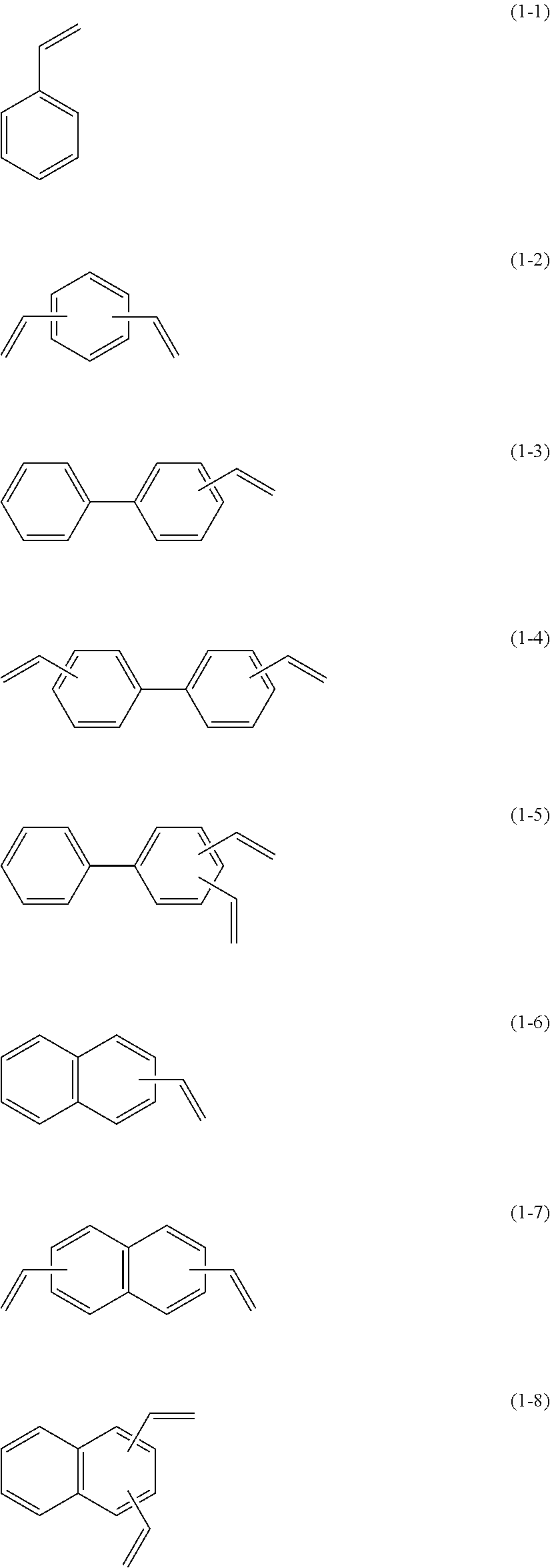
- The specific vinyl compounds which are represented by the above-described Structural Formulas (1-1) to (1-8) have the same characteristics as polymerization components, and copolymers including any of them as a polymerization component have the same characteristics. Among them, specific vinyl compounds represented by Structural Formulas (1-1), (1-2), (1-3), and (1-6) are easily available.
- Compound Having Polar Group and an Ethylenically Unsaturated Bond The polar group-containing polymerization component is a compound having a polar group and an ethylenically unsaturated bond. The polar group may be any of an acid group, a neutral group, and a basic group.
- Examples of the polar group-containing polymerization component having an acidic polar group (hereinafter, also referred to as “acid group-containing polymerization component”) include ethylenically unsaturated compounds having any of a carboxylic group, a sulfo group, a phosphate group, and a formyl group, and the like.
- Examples of the ethylenically unsaturated compounds having a carboxylic group include (meth)acrylic acids, fumaric acids, maleic acids, itaconic acids, cinnamic acids, monomethyl maleates, 1-[2-(methacryloyloxy)ethyl]phthalate, and the like.
- Examples of the ethylenically unsaturated compounds having a sulfo group include 2-((meth)acryloyloxy)ethanesulfonate.
- Examples of the ethylenically unsaturated compounds having a phosphate group include 2-((meth)acryloyloxy)ethyl phosphate, and the like.
- Examples of the polar group-containing polymerization component having a neutral polar group (hereinafter, also referred to as “neutral group-containing polymerization component”) include ethylenically unsaturated compounds having any of a hydroxy group, an amide group, a cyano group, and the like.
- Examples of the ethylenically unsaturated compounds having a hydroxy group include 2-hydroxyethyl(meth)acrylate, and the like.
- Examples of the ethylenically unsaturated compounds having an amide group include (meth)acrylamide, and the like.
- Examples of the ethylenically unsaturated compounds having a cyano group include 2-cyanoethyl(meth)acrylate, and the like.
- Examples of the polar group-containing polymerization component having a basic polar group (hereinafter, also referred to as “basic group-containing polymerization component”) include ethylenically unsaturated compounds having an amino group.
- Examples of the ethylenically unsaturated compounds having an amino group include 2-(diethylamino)ethyl(meth)acrylate, 2-(dimethylamino)ethyl(meth)acrylate, and the like.
- Acid group-containing polymerization components are preferably used as the polar group-containing polymerization component from the viewpoint of adjusting the charge quantity, and among them, ethylenically unsaturated compounds having a carboxylic group are preferably used, and (meth)acrylic acids are more preferably used.
- Regarding the polar group-containing polymerization component, one kind may be used alone, or two or more kinds may be used in combination.
- Other Polymerization Components
- The copolymer of the display particles according to the first exemplary embodiment and the second exemplary embodiment may include other polymerization components, as well as the specific vinyl compound and the polar group-containing polymerization component as polymerization components. Examples of the other polymerization components include compounds having a silicone chain and polymerization components having an alkyl chain (monomers having an alkyl chain).
- Examples of the compounds having a silicone chain include dimethyl silicone compounds having a (meth)acrylate group at one terminal (silicone compounds represented by the following Structural Formula (A), e.g., SILAPLANE: FM-0711, FM-0721, and FM-0725 all manufactured by Chisso Corporation, and X-22-174DX, X-22-2426, and X-22-2475 all manufactured by Shin-Etsu Chemical Co., Ltd.), silicone compounds represented by the following Structural Formula (B), silicone compounds represented by the following Structural Formula (C), and the like.
-
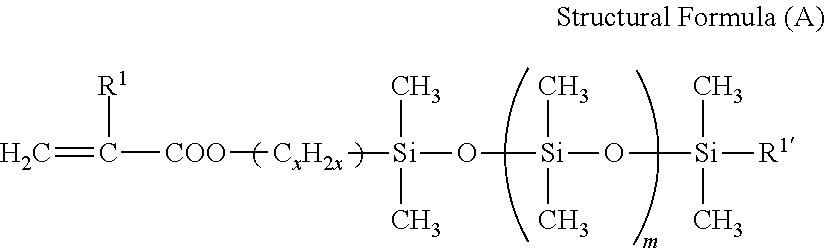
- In Structural Formula (A), R1 represents a hydrogen atom or a methyl group. R1′ represents a hydrogen atom or an alkyl group having from 1 to 4 carbon atoms. m represents a natural number (for example, from 1 to 1000, and preferably from 3 to 100). x represents an integer of from 1 to 3.
-

- In Structural Formulas (B) and (C), each of R1, R2, R3, R4, R5, R6, R7, R9, and R10 independently represents a hydrogen atom, an alkyl group having from 1 to 4 carbon atoms, or a fluoroalkyl group having from 1 to 4 carbon atoms. R8 represents a hydrogen atom or a methyl group. Each of p, q, and r independently represents an integer of from 1 to 1000. x represents an integer of from 1 to 3.
- In Structural Formula (B), it is preferable that R1 and R5 represent a butyl group, R2, R3, R4, R6, and R7 represent a methyl group, R8 represent a methyl group, each of p and q independently represents an integer of from 1 to 5, and x represent an integer of from 1 to 3.
- In Structural Formula (C), it is preferable that R1, R2, R3, R4, R5, R6, R7, R9, and R10 represent a methyl group, R8 represent a hydrogen atom or a methyl group, each of p, q, and r independently represents an integer of from 1 to 3, and x represents an integer of from 1 to 3.
- Examples of the monomers represented by Structural Formula (B) include MCS-M11 manufactured by Gelest, and the like. Examples of the monomers represented by Structural Formula (C) include RTT-1011 manufactured by Gelest, and the like. The structural formulas of the monomers will be shown as follows.
-

- Regarding MCS-M11, each of m and n in the above-described structural formula independently represents an integer of from 2 to 4, and the molecular weight thereof is from 800 to 1000.
-
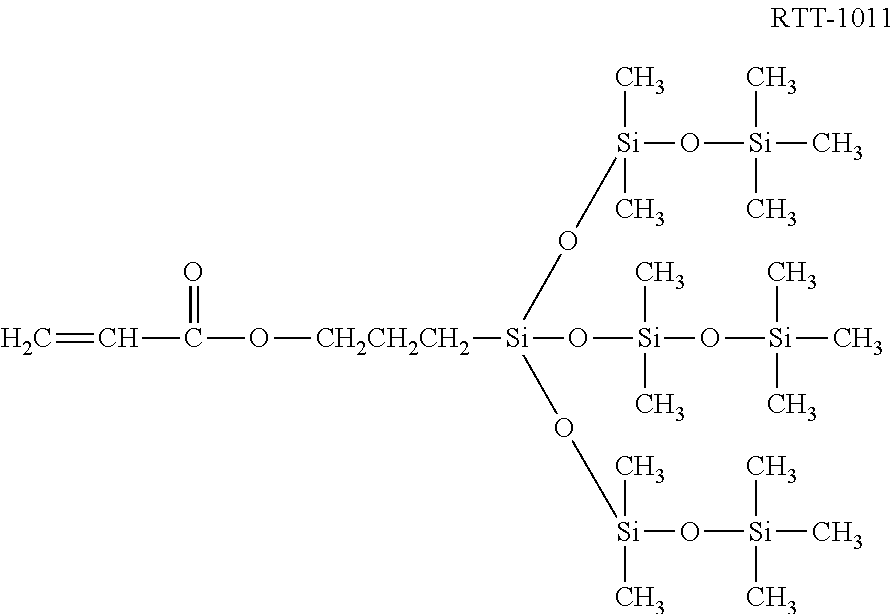
- RTT-1011 is a compound represented by the above-described structural formula.
- Examples of the polymerization components having an alkyl chain (monomers having an alkyl chain) include (meth)acrylic esters. Specific examples thereof include methyl(meth)acrylate, butyl(meth)acrylate, hexyl(meth)acrylate, octyl(meth)acrylate, dodecyl(meth)acrylate, stearyl(meth)acrylate, 2-ethylhexyl(meth)acrylate, and the like. Among them, (meth)acrylic esters having a long-chain alkyl chain, e.g., an alkyl chain having from 4 to 30 carbon atoms are preferably used.
- In the above-described copolymer, the content ratio of the polar group-containing polymerization component to the whole copolymer is preferably 0.001% by mass or greater, more preferably 0.1% by mass or greater, even more preferably 1% by mass or greater, still more preferably 5% by mass or greater, and even still more preferably 10% by mass or greater from the viewpoint of suppressing the field responsiveness of the particles. Also, the upper limit of the content ratio of the polar group-containing polymerization component to the whole copolymer is preferably 20% by mass or less.
- The content ratio of the specific vinyl compound to the whole copolymer is preferably 5% by mass or greater, more preferably 10% by mass or greater, and even more preferably 20% by mass or greater from the viewpoint of forming the particles by precipitating a resin in a particle-dispersed solvent. Also, the upper limit of the content ratio of the specific vinyl compound to the whole copolymer is preferably 75% by mass or less, more preferably 65% by mass or less, and even more preferably 55% by mass or less.
- When the above-described copolymer includes a compound having a silicone chain, the content ratio of the compound having a silicone chain may be, for example, from 5% by mass to 50% by mass, and preferably from 10% by mass to 40% by mass with respect to the whole copolymer.
- Color Particles
- The color of the color particles is not particularly limited, and color particles having a color corresponding to the background color of a display medium are selected.
- Examples of the color particles include organic pigments, inorganic pigments; glass beads; insulating metal oxide particles such as alumina and titanium oxide; thermoplastic or thermosetting resin particles; thermoplastic or thermosetting resin particles with a coloring agent (organic pigments, inorganic pigments, dyes, and the like) fixed to the surfaces thereof; particles of thermoplastic or thermosetting resins containing an insulating coloring agent (organic pigments, inorganic pigments, dyes, and the like); metal colloid particles having a plasmon coloring function; and the like.
- The raw material component of particles of a
particle group 34 which is used as an example of a display device to be described later and the manufacturing method thereof may be employed as a raw material component of the color particles and a method of manufacturing the color particles. - Among the color particles, for example, inorganic white particles are used as white particles. Examples of the inorganic white particles include metal oxide particles such as titanium oxide particles, silicon oxide particles, zinc oxide particles, and tin oxide particles. Among them, titanium oxide particles are favorable from the viewpoint of increasing the refractive index and realizing display having a high degree of whiteness.
- Next, the characteristics of the display particles according to the first exemplary embodiment and the second exemplary embodiment will be described.
- The volume average particle diameter of the display particles may be, for example, from 0.1 μm to 10 μm, is preferably from 0.15 μm to 5 μm, and more preferably from 0.15 μm to 1 μm.
- The volume average particle diameter of the particles is a value measured using a particle diameter analyzer (FPAR-1000, manufactured by Otsuka Electronics Co., Ltd.).
- As for the charge quantity of the display particles, for example, the total charge quantity per display area at a concentration of 1.5% by mass may be from 0.5 nC/cm2 to 50 nC/cm2, is preferably from 1 nC/cm2 to 30 nC/cm2, and more preferably from 1 nC/cm2 to 20 nC/cm2.
- Next, the method of manufacturing the display particles according to the first exemplary embodiment and the second exemplary embodiment will be described. The method of manufacturing the display particles is not particularly limited, but for example, the following methods are used.
- Method of Manufacturing Display Particles According to First Exemplary Embodiment
- First, raw material components of the above-described copolymer, and as necessary, other additives such as a polymerization initiator are added to and mixed with an organic solvent, thereby preparing a mixed solution.
- Thereafter, for example, the mixed solution is heated to conduct a polymerization reaction of the raw material components of the above-described copolymer.
- Next, the reaction solution after the polymerization reaction is dripped to a solvent having a property of not dissolving the above-described copolymer to precipitate the above-described copolymer, thereby obtaining the above-described copolymer as a precipitate.
- Next, the above-described copolymer is dissolved in a solvent having a property of dissolving the above-described copolymer and a dispersion medium (e.g., silicone oil) which is used for a display medium is dripped to the solvent to precipitate the above-described copolymer, thereby forming particles of the above-described copolymer.
- Accordingly, a liquid in which the particles having the above-described copolymer as a constituent element are dispersed is obtained.
- When including color particles in a granular product of the above-described copolymer, the display particles according to the first exemplary embodiment are manufactured using, for example, the following manufacturing methods.
- Examples thereof include a method which includes kneading and pulverizing the above-described copolymer obtained as a precipitate in the above-described manufacturing process and color particles; a method which includes polymerizing raw material components of the above-described copolymer in a solution in which color particles coexist to aggregate the materials; a method which includes polymerizing raw material components of the above-described copolymer and subsequently adding color particles thereto to aggregate the materials; and the like.
- Method of Manufacturing Display Particles According to Second Exemplary Embodiment
- First, raw material components of the above-described copolymer, and as necessary, other additives such as a polymerization initiator are added to and mixed with an organic solvent, thereby preparing a mixed solution.
- Thereafter, for example, the mixed solution is heated to conduct a polymerization reaction of the raw material components of the above-described copolymer.
- Next, the reaction solution after the polymerization reaction is dripped to a solvent having a property of not dissolving the above-described copolymer to precipitate the above-described copolymer, thereby obtaining the above-described copolymer as a precipitate.
- Next, the above-described copolymer is dissolved in a solvent having a property of dissolving the above-described copolymer and color particles are added thereto and dispersed using a dispersion unit (e.g., zirconia beads or a rocking mill), thereby obtaining a color particle dispersion liquid.
- Thereafter, a dispersion medium (e.g., silicone oil) which is used for a display medium is dripped to the color particle dispersion liquid to precipitate the above-described copolymer on the surfaces of the color particles, thereby forming particles in which the surfaces of the color particles are covered with the above-described copolymer.
- Accordingly, a liquid in which the particles having the color particles which are covered with a covering layer including the above-described copolymer as a constituent element are dispersed is obtained.
- Display Particle Dispersion Liquid
- A display particle dispersion liquid according to this exemplary embodiment has a particle group including the display particles according to this exemplary embodiment and a dispersion medium for dispersing the particle group.
- The display particle dispersion liquid may include other display particles (migrating particles) as the particle group. In addition, if necessary, acids, alkalis, salts, dispersants, dispersion stabilizers, stabilizers for antioxidation, ultraviolet absorption, and the like, antimicrobial agents, preservative agents, and the like may be added to the display particle dispersion liquid.
- Although various dispersion mediums which are used for a display medium are applied as the dispersion medium, a low-dielectric solvent (having a dielectric constant of, for example, 5.0 or less, and preferably 3.0 or less) is preferably selected. Although solvents other than the low-dielectric solvents may be used in combination for the dispersion medium, a low-dielectric solvent of 50% by volume or greater is preferably included. The low dielectric constant is obtained using a dielectric constant measuring unit (manufactured by Nihon Rufuto Co., Ltd.).
- Examples of the low-dielectric solvents include paraffin-based hydrocarbon solvents, silicone oils, and petroleum-derived high-boiling point solvents such as fluorine-based liquids. The low-dielectric solvent may be selected in accordance with the kind of the copolymer which is a constituent element of the display particles according to this exemplary embodiment.
- Specifically, for example, when a copolymer which includes a compound having a silicone chain as a polymerization component is applied, silicone oils may be selected as the dispersion medium. When a copolymer which includes a polymerization component having an alkyl chain as a polymerization component is applied, paraffin-based hydrocarbon solvents may be selected as the dispersion medium. Of course, the low-dielectric solvent is not limited thereto.
- Specific examples of the silicone oils include silicone oils in which a hydrocarbon group is bonded to a siloxane bond (e.g., dimethyl silicone oil, diethyl silicone oil, methyl ethyl silicone oil, methyl phenyl silicone oil, diphenyl silicone oil, and the like). Among them, dimethyl silicone oil is particularly preferably used.
- Examples of the paraffin-based hydrocarbon solvents include normal paraffin-based hydrocarbons and isoparaffin-based hydrocarbons having 20 or more carbon atoms (boiling point of 80° C. or higher). However, isoparaffin-based hydrocarbons are preferably used because of safety, volatility, and the like. Specific examples thereof include SHELLSOL 71 (manufactured by Showa Shell Sekiyu K.K.), ISOPAR-O, ISOPAR-H, ISOPAR-K, ISOPAR-L, ISOPAR-G and ISOPAR-M (trade name, manufactured by Exxon Mobile Corporation), IP SOLVENT (manufactured by Idemitsu Kosan Co., Ltd.), and the like.
- Examples of charge controlling agents include ionic or nonionic surfactants, block or graft copolymers having a lipophilic part and a hydrophilic part, compounds having a polymer chain structure such as a cyclic, stellate, or dendritic polymer (dendrimer), metal complexes of salicylic acids, metal complexes of catechol, metal-containing bisazo dyes, tetraphenyl borate derivatives, polymerizable silicone macromers (SILAPLANE, manufactured by Chisso Corporation), copolymers with an anion monomer or a cation polymer, and the like.
- Specific examples of the ionic or nonionic surfactants are as follows. Examples of the nonionic surfactants include polyoxyethylene nonyl phenyl ether, polyoxyethylene octyl phenyl ether, polyoxyethylene dodecyl phenyl ether, polyoxyethylene alkyl ether, polyoxyethylene fatty acid ester, sorbitan fatty acid ester, polyoxyethylene sorbitan fatty acid ester, fatty acid alkylol amide, and the like. Examples of the anionic surfactants include alkylbenzenesulfonate, alkylphenylsulfonate, alkylnaphthalenesulfonate, higher fatty acid salt, sulfuric acid ester salt of higher fatty acid ester, sulfonic acid of higher fatty acid ester, and the like. Examples of the cation surfactants include primary to tertiary amine salt, quaternary ammonium salt, and the like. These charge controlling agents are preferably used in an amount of from 0.01% by mass to 20% by mass with respect to the particle solid content, and particularly preferably used in an amount of from 0.05% by mass to 10% by mass.
- The display particles and the display particle dispersion liquid according to this exemplary embodiment are used in an electrophoresis type display medium and the like.
- Display Medium, Display device
- An example of a display medium and an example of a display device according to this exemplary embodiment will be described. The following examples are examples in which the display particles according to this exemplary embodiment are applied as white display particles, and the display particles according to this exemplary embodiment will be described as white display particles.
-
FIG. 1 is a schematic diagram illustrating a configuration of a display device according to a first exemplary embodiment.FIG. 2 schematically illustrates a moving mode of a particle group when a voltage is applied between substrates of a display medium of the display device according to the first exemplary embodiment. - A
display device 10 according to the first exemplary embodiment employs a form in which a migrating particle group, excluding white particles, which migrates in accordance with the electric field is applied as aparticle group 34 of adisplay medium 12 and a white particle group including the white display particles according to this exemplary embodiment are applied as a reflectingparticle group 36. - In addition, a form in which a
particle group 34A and aparticle group 34B having a different color from theparticle group 34A and a different charging polarity are applied as theparticle group 34 is employed. - As shown in
FIG. 1 , thedisplay device 10 according to this exemplary embodiment is configured to include thedisplay medium 12, avoltage application portion 16 which applies a voltage to thedisplay medium 12, and acontrol portion 18. - The
display medium 12 is configured to include adisplay substrate 20 serving as an image display surface, arear substrate 22 which is opposed to thedisplay substrate 20 with a space interposed therebetween, a spacingmember 24 which holds the substrates with a specific interval interposed therebetween and partitions the space between thedisplay substrate 20 and therear substrate 22 into a plurality of cells, and the reflectingparticle group 36 which has different optical reflection characteristics from theparticle group 34 included in each cell. - The above-described cell is an area surrounded by the
display substrate 20, therear substrate 22, and the spacingmember 24. Adispersion medium 50 is included in the cells. Theparticle group 34 has a plurality of particles, is dispersed in thedispersion medium 50, and moves (migrates) between thedisplay substrate 20 and therear substrate 22 through spaces of the reflectingparticle group 36 in accordance with the strength of an electric field formed in the cell. - By providing the spacing
member 24 to correspond to each pixel for the case in which thedisplay medium 12 displays an image, and by forming a resultant cell to correspond to each pixel, thedisplay medium 12 may be configured to perform display on a pixel to pixel basis. - This exemplary embodiment will be described using a diagram in which attention is paid to one cell in order to simplify the description. Hereinafter, each configuration will be described in detail.
- First, the pair of substrates will be described.
- The
display substrate 20 has a configuration in which asurface electrode 40 and asurface layer 42 are sequentially laminated on asupport substrate 38. Therear substrate 22 has a configuration in which arear electrode 46 and asurface layer 48 are laminated on asupport substrate 44. - The
display substrate 20, or both of thedisplay substrate 20 and therear substrate 22 have translucency. Here, in this exemplary embodiment, the translucency means that the transmittance of visible light is 60% or greater. - Examples of the material of the
support substrate 38 and thesupport substrate 44 include glass and plastics such as polyethylene terephthalate resins, polycarbonate resins, acrylic resins, polyimide resins, polyester resins, epoxy resins, polyethersulfone resins, and the like. - Examples of the material of the
surface electrode 40 and therear electrode 46 include oxides of indium, tin, cadmium, antimony, and the like, complex oxides such as ITO, metals such as gold, silver, copper, and nickel, organic materials such as polypyrrole and polythiophene, and the like. Thesurface electrode 40 and therear electrode 46 may be any of a single-layer film, a mixed film, or a composite film of them. The thicknesses of thesurface electrode 40 and therear electrode 46 may be, for example, from 100 Å to 2000 Å. Therear electrode 46 and thesurface electrode 40 may be formed into, for example, a matrix shape or a stripe shape. - In addition, the
surface electrode 40 may be embedded in thesupport substrate 38. In addition, therear electrode 46 may be embedded in thesupport substrate 44. In this case, the material of thesupport substrate 38 and thesupport substrate 44 is selected in accordance with the composition of each particle of theparticle group 34, and the like. - The
rear electrode 46 and thesurface electrode 40 may be separated from thedisplay substrate 20 and therear substrate 22, respectively, and may be disposed outside thedisplay medium 12. - In the above description, the case has been described in which both of the
display substrate 20 and therear substrate 22 are provided with the electrode (thesurface electrode 40 and the rear electrode 46). However, only one of them may be provided with the electrode to perform active matrix driving. - In addition, in order to realize the active matrix driving, the
support substrate 38 and thesupport substrate 44 may be provided with a thin film transistor (TFT) for each pixel. The TFT may be provided in therear substrate 22, not in the display substrate. - Next, the surface layer will be described.
- The
surface layer 42 and thesurface layer 48 are formed on thesurface electrode 40 and therear electrode 46, respectively. Examples of the material of thesurface layer 42 and thesurface layer 48 include polycarbonates, polyesters, polystyrenes, polyimides, epoxys, polyisocyanates, polyamides, polyvinyl alcohols, polybutadienes, polymethyl methacrylates, copolymer nylons, ultraviolet curable acrylic resins, fluorine resins, and the like. - The
surface layer 42 and thesurface layer 48 may be configured to include the above-described resin and a charge transport material, or may be configured to include a self-supporting resin having a charge transport property. - Next, the spacing member will be described.
- The spacing
member 24 for holding the space between thedisplay substrate 20 and therear substrate 22 is made of, for example, a thermoplastic resin, a thermosetting resin, an electron beam curable resin, a light curing resin, rubber, metal, or the like. - The spacing
member 24 may be formed integrally with any one of thedisplay substrate 20 and therear substrate 22. In this case, it is produced by performing an etching process of etching thesupport substrate 38 or thesupport substrate 44, a laser machining process, a press working process using a previously produced mold, a printing process, or the like. - In this case, the spacing
member 24 is produced on thedisplay substrate 20 or therear substrate 22, or on both of them. - Although the spacing
member 24 may have a color or may have no color, it is preferably transparent and has no color. In that case, the spacingmember 24 is made of a transparent resin, e.g., polystyrene, polyester, or acryl. - In addition, it is also preferable that the spacing
member 24 having a granular shape be transparent, whereby glass particles are also used other than a transparent resin, e.g., polystyrene, polyester, or acryl. - “Transparent” means that the transmittance of visible light is 60% or greater. Next, the particle group will be described.
- It is also preferable that the
particle group 34 included in thedisplay medium 12 be dispersed in a polymeric resin as thedispersion medium 50. The polymeric resin is also preferably a polymeric gel, a polymeric polymer, or the like. - Examples of the polymeric resin include natural polymer-derived polymeric gels such as agarose, agaropectin, amylose, sodium alginate, propylene glycol alginate, isolichenan, insulin, ethyl cellulose, ethyl hydroxyethyl cellulose, curdlan, casein, carrageenan, carboxymethyl cellulose, carboxymethyl starch, callose, agar, chitin, chitosan, silk fibroin, guar gum, quince seed, Crown Gall polysaccharide, glycogen, glucomannan, keratan sulfate, keratin protein, collagen, cellulose acetate, gellan gum, schizophyllan, gelatin, ivory nut mannan, tunicin, dextran, dermatan sulfate, starch, tragacanth gum, nigeran, hyaluronic acid, hydroxyethyl cellulose, hydroxypropyl cellulose, pustulan, funoran, degraded xyloglucan, pectin, porphyran, methyl cellulose, methyl starch, laminaran, lichenan, lentinan, and locust bean gum, and almost all of polymeric gels are included in the case of a synthetic polymer.
- Furthermore, polymers and the like including a functional group of alcohol, ketone, ether, ester or amide in the repeating unit are also included, such as polyvinyl alcohols, poly(meth)acrylamides, derivatives thereof, polyvinyl pyrrolidones, polyethylene oxides, and copolymers including these polymers.
- Among them, gelatin, polyvinyl alcohols, poly(meth)acrylamides, and the like are preferably used from the viewpoint of manufacturing stability and electrophoretic characteristics.
- These polymeric resins are preferably used as the
dispersion medium 50 together with the above-described insulating liquid. - The
particle group 34 included in each cell has a plurality of particles, is dispersed in thedispersion medium 50, and moves between thedisplay substrate 20 and therear substrate 22 in accordance with the strength of an electric field formed in the cell. - Examples of the particles of the
particle group 34 include glass beads, insulating metal oxide particles such as alumina and titanium oxide, thermoplastic or thermosetting resin particles, resin particles with a coloring agent fixed to the surfaces thereof, particles of thermoplastic or thermosetting resins containing an insulating coloring agent therein, metal colloid particles having a plasmon coloring function, and the like. - Examples of the thermoplastic resin for use in the manufacturing of the particles of the
particle group 34 include homopolymers or copolymers of styrenes such as styrene and chlorostyrene, mono-olefins such as ethylene, propylene, butylene and isoprene, vinyl esters such as vinyl acetate, vinyl propionate, vinyl benzoate and vinyl butyrate, α-methylene aliphatic monocarboxylates such as methyl acrylate, ethyl acrylate, butyl acrylate, dodecyl acrylate, octyl acrylate, phenyl acrylate, methyl methacrylate, ethyl methacrylate, butyl methacrylate and dodecyl methacrylate, vinyl ethers such as vinyl methyl ether, vinyl ethyl ether and vinyl butyl ether, and vinyl ketones such as vinyl methyl ketone, vinyl hexyl ketone and vinyl isopropenyl ketone. - Examples of the thermosetting resin for use in the manufacturing of the particles of the
particle group 34 include crosslinked resins such as a crosslinked copolymer including divinyl benzene as a main component and crosslinked polymethyl methacrylate, phenol resins, urea resins, melamine resins, polyester resins, and silicone resins. Particularly representative binder resins include polystyrenes, styrene-alkyl acrylate copolymers, styrene-alkyl methacrylate copolymers, styrene-acrylonitrile copolymers, styrene-butadiene copolymers, styrene-maleic anhydride copolymers, polyethylenes, polypropylenes, polyesters, polyurethanes, epoxy resins, silicone resins, polyamides, modified rosins, paraffin waxes, and the like. - Organic or inorganic pigments, oil-soluble pigments, and the like can be used as the coloring agent, and known examples of the coloring agent include magnetic powders of magnetite, ferrite or the like, carbon black, titanium oxide, magnesium oxide, zinc oxide, phthalocyanine copper-based cyan color material, azo yellow color material, azo magenta color material, quinacridone-based magenta color material, red color material, green color material, blue color material, and the like. Specific representative examples thereof include aniline blue, calco oil blue, chrome yellow, ultramarine blue, DuPont oil red, quinoline yellow, methylene blue chloride, phthalocyanine blue, malachite green oxalate, lamp black, rose bengal, C.I. Pigment red 48:1, C.I. Pigment red 122, C.I. Pigment red 57:1, C.I. Pigment yellow 97, C.I. Pigment blue 15:1, C.I. Pigment blue 15:3, and the like. These may be used in combination with a plurality of color materials.
- As necessary, a charge controlling agent may be mixed in the resin for the particles of the
particle group 34. Known charge controlling agents for use in eletrophotographic toner materials can be used as the charge controlling agent, and examples thereof include cetylpyridinium chloride, quaternary ammonium salts such as BONTRON P-51, BONTRON P-53, BONTRON E-84, and BONTRON E-81 (all manufactured by Orient Chemical Industries, Ltd.), salicylic acid-based metal complexes, phenol-based condensates, tetraphenyl-based compounds, metal oxide particles, and metal oxide particles having a surface treated with various kinds of coupling agents. - As necessary, a magnetic material may be mixed in the particles of the
particle group 34, or applied on the surfaces thereof. An organic or inorganic magnetic material that may have an optional color coating is used as the magnetic material. In addition, a transparent magnetic material, especially a transparent organic magnetic material is preferably used because it does not inhibit coloring of the color pigment and has a specific gravity which is less than that of the inorganic magnetic material. - For example, the color magnetic powder having a small particle diameter as disclosed in JP-A-2003-131420 may be used as a color magnetic powder. A color magnetic powder including core magnetic particles and a color layer laminated on the surfaces of the magnetic particles is used. The color layer may be selected so as to color the magnetic powder with a pigment or the like in an impermeable manner, but, for example, a thin light interference film is preferably used. The thin light interference film is formed by forming a thin film having a thickness equivalent to a wavelength of light using an achromatic material such as SiO2 or TiO2 to, and reflects light in a wavelength-selective manner due to the light interference inside the thin film.
- As necessary, an external additive may be attached to the surfaces of the particles of the
particle group 34. The color of the external additive is preferably transparent so as not to affect the color of the particles of theparticle group 34. - Inorganic particles of metal oxides such as silicon oxide (silica), titanium oxide, and alumina are used as the external additive. These may be surface-treated with a coupling agent or silicone oil in order to adjust the charging property, fluidity, environmental dependency and the like of the particles of the
particle group 34. - Examples of the coupling agent include positively charged agents such as aminosilane-based coupling agents, aminotitanium-based coupling agents, and nitrile-based coupling agents, and negatively charged agents not including a nitrogen atom (including atoms other than the nitrogen atom) such as silane-based coupling agents, titanium-based coupling agents, epoxysilane coupling agents, and acrylsilane coupling agents. In addition, examples of the silicone oil include positively charged oils such as amino-modified silicone oil, and negatively charged oils such as dimethyl silicone oil, alkyl-modified silicone oil, α-methylsulfone-modified silicone oil, methylphenyl silicone oil, chlorophenyl silicone oil, and fluorine-modified silicone oil. These are selected in accordance with the desired resistance of the external additive.
- Among the above-described external additives, hydrophobic silica and hydrophobic titanium oxide that are well known are preferably used, and particularly, a titanium compound obtained by the reaction of TiO(OH)2 with a silane compound such as a silane coupling agent, as described in JP-A-10-3177, is favorable. Any of chlorosilanes, alkoxy silanes, silazanes, and specialty silylation reagents may be used as the silane compound. The titanium compound is produced by allowing TiO(OH)2 produced during a wet process to react with a silane compound or silicone oil, and then drying the reactant. Since this process does not include a baking process at a temperature of several hundred degrees, no strong bond is formed between the Ti atoms and no aggregation occurs. Whereby, the particles of the
particle group 34 are in the form of primary particles. Furthermore, since TiO(OH)2 is directly allowed to react with a silane compound or silicone oil, increasing the amount of the silane compound or silicone oil used for the treatment is realized, and thus charging characteristics are controlled by adjusting the amount of the silane compound or the like used for the treatment, and charging ability to be given is improved as compared with the case of conventional titanium oxide. - Generally, the volume average particle diameter of the external additive is from 5 nm to 100 nm, and preferably from 10 nm to 50 nm, but is not limited thereto.
- The blending ratio of the external additive to the particles of the
particle group 34 is adjusted depending on the balance of the particle diameter of the particles of theparticle group 34 with the particle diameter of the external additive. When the amount of the external additive added is too large, a part of the external additive is detached from the surfaces of the particles of theparticle group 34 and attached to the surfaces of the particles ofother particle groups 34, whereby desired charging characteristics are not obtained. Generally, the amount of the external additive may be from 0.01 parts by mass to 3 parts by mass, and preferably from 0.05 parts by mass to 1 part by mass with respect to 100 parts by mass of the particles of theparticle group 34. - The external additive may be added to the particles of any one of a plurality of kinds of
particle groups 34, or may be added to two or more kinds, or all kinds ofparticle groups 34. When the external additive is added to the surfaces of all the particles of theparticle group 34, the external additive preferably strikes the surfaces of the particles of theparticle group 34 with impact power, or heating is preferably performed to strongly fix the external additive to the surfaces of the particles of theparticle group 34. In this manner, detachment of the external additive from the particles of theparticle group 34, strong aggregation of the external additive having an opposite polarity, and formation of a resultant aggregate of the external additive which is not easily dissociated by the electric field are prevented, thereby preventing a deterioration in image quality. - The particles of the
particle group 34 will be described as having previously adjusted characteristics which contribute to the movement according to the electric field, such as an average charging quantity or an electrostatic quantity, so that the particles of theparticle group 34 move between thedisplay substrate 20 and therear substrate 22 in accordance with the electric field formed between the substrates. - Specifically, the adjustment of the average charging quantity of the particles of the
particle group 34 can be performed by adjusting the kind and amount of the charge controlling agent to be blended in the above-described resin, the kind and amount of the polymer chain to be bonded to the surfaces of the particles of theparticle group 34, the kind and amount of the external additive to be added or embedded in the surfaces of the particles of theparticle group 34, the kind and amount of the surfactant, polymer chain, or coupling agent to be applied to the surfaces of the particles of theparticle group 34, the specific surface area of the particles of the particle group 34 (the volume average particle diameter and the shape factor), and the like. - Any well-known method may be used as the method of producing the particles of the
particle group 34. For example, as described in JP-A-7-325434, a method is used which includes weighing a resin, a pigment, and a charge controlling agent at a specific mixing ratio, melting the resin by heating, adding, mixing, and dispersing the pigment, cooling the mixture, preparing the particles of theparticle group 34 using a pulverizer such as a jet mill, a hammer mill, or a turbo mill, and dispersing the particles of the obtainedparticle group 34 in a dispersion medium. Furthermore, through a polymerization method such as suspension polymerization, emulsification polymerization or dispersion polymerization, coacervation, melt dispersion, or an emulsion aggregation method, the particles of theparticle group 34 containing a charge controlling agent therein may be prepared and then dispersed in a dispersion medium to produce a dispersion medium of the particles of theparticle group 34. Moreover, there is a method of using an appropriate device which disperses and kneads raw materials of the above-described resin, coloring agent, charge controlling agent, and dispersion medium at a temperature, which is lower than the point of decomposition of the resin, charge controlling agent and/or coloring agent, at which the resin can plasticize and the dispersion medium does not boil. Specifically, the particles of theparticle group 34 is produced by performing heating to melt a pigment, a resin, and a charge controlling agent in a dispersion medium using a planetary mixer, a kneader or the like, cooling and stirring the melted mixture using the temperature dependency of the solvent solubility of the resin, and then allowing the mixture to coagulate/precipitate to form the particles of theparticle group 34. - In addition, a method is used which includes putting the above-described raw materials into an appropriate container equipped with granular media for dispersion and kneading, such as an attritor or a heated oscillation mill such as a heated ball mill, and dispersing and kneading the content in the container at a preferable temperature range, such as from 80° C. to 160° C. Preferable examples of the granular media include steels such as stainless steel and carbon steel, alumina, zirconia, silica, and the like. When producing the particles of the
particle group 34 using this method, the raw materials which have been previously made into a fluidized state are further dispersed by the granular media in the container, and then the resin including the coloring agent is allowed to precipitate from the dispersion medium by cooling the dispersion medium. The granular media maintain the state of motion during and after the cooling, and reduce the size of particles by generating shearing and/or impact. - The content of the particle group 34 (% by mass) with respect to the total mass of the content of the cell is not particularly limited as long as a concentration is achieved at which a desired color hue is obtained. It is effective for the
display medium 12 to adjust the content by adjusting the thickness of the cell (i.e., the distance between thedisplay substrate 20 and the rear substrate). That is, in order to obtain a desired color hue, the content can be reduced by increasing the thickness of the cell, and the content can be increased by reducing the thickness of the cell. Generally, the content is from 0.01% by mass to 50% by mass. - Next, the reflecting particle group will be described.
- The reflecting
particle group 36 has reflecting particles having different optical reflection characteristics from those of theparticle group 34, and functions as a reflecting member which displays a different color from that of theparticle group 34. In addition, the reflectingparticle group 36 also has a function as a spacer which allows movement between thedisplay substrate 20 and therear substrate 22 without inhibiting the movement. That is, the particles of theparticle group 34 move from the side of therear substrate 22 to the side of thedisplay substrate 20 or from the side of thedisplay substrate 20 to the side of therear substrate 22 through spaces of the reflectingparticle group 36. - The white particle group of the white display particles according to this exemplary embodiment is applied as the reflecting
particle group 36. - Next, other configurations of the display medium will be described.
- The size of the above-described cell in the
display medium 12 has a close relationship with the resolution of thedisplay medium 12, and the smaller the cell, the higher the image resolution of thedisplay medium 12 that can be produced. The length of thedisplay substrate 20 of thedisplay medium 12 in a direction of the substrate plane is typically from 10 μm to 1 mm. - In order to fix the above-described
display substrate 20 andrear substrate 22 to each other with the spacingmember 24 interposed therebetween, a fixing unit such as a combination of a bolt with a nut, a clamp, a clip, or a frame for fixing the substrates is used. In addition, a fixing unit such as an adhesive, thermofusion, and ultrasonic bonding may also be used. - The
display medium 12 configured as described above is used in, for example, bulletin boards, circulars, electronic blackboards, advertisements, billboards, flash signals, electronic paper, electronic newspapers, and electronic books, which perform saving and rewriting of images, and document sheets for use in both copiers and printers. - Next, the display device will be described.
- As described above, the
display device 10 according to this exemplary embodiment is configured to include thedisplay medium 12, thevoltage application portion 16 which applies a voltage to thedisplay medium 12, and the control portion 18 (seeFIG. 1 ). - The
voltage application portion 16 is electrically connected to thesurface electrode 40 and therear electrode 46. In this exemplary embodiment, both of thesurface electrode 40 and therear electrode 46 are described as being electrically connected to thevoltage application portion 16. However, a configuration is also possible in which one of thesurface electrode 40 and therear electrode 46 is grounded while the other is electrically connected to thevoltage application portion 16. - The
Voltage application portion 16 is connected to thecontrol portion 18 to send or receive a signal. - The
control portion 18 may be configured as a microcomputer including a Central Processing Unit (CPU) which controls the operation of the whole device, a Random Access Memory (RAM) which temporarily stores various kinds of data, and a Read Only Memory (ROM) on which various kinds of programs such as a control program for controlling the whole device are previously stored. - The
voltage application portion 16 is a voltage application device for applying a voltage to thesurface electrode 40 and therear electrode 46, and applies a voltage between thesurface electrode 40 and therear electrode 46 in accordance with the control of thecontrol portion 18. - Next, the action of the
display device 10 will be described. The action will be described in accordance with the operation of thecontrol portion 18. - Here, a case will be described in which in the
particle group 34 included in thedisplay medium 12, theparticle group 34A is negatively charged and theparticle group 34B is positively charged. The description will be given on the assumption that thedispersion medium 50 is transparent and the reflectingparticle group 36 is white. That is, in this exemplary embodiment, a case will be described in which thedisplay medium 12 displays a color exhibited depending on the movement of theparticle group 34A and theparticle group 34B and white is displayed as the background color thereof. - First, when an initial operation signal which indicates the fact that a voltage is applied at a specified time (T1) so that the
surface electrode 40 serves as a negative electrode and therear electrode 46 serves as a positive electrode is output to thevoltage application portion 16. When a negative voltage which is equal to or greater than a threshold voltage at which a variation in density ends is applied between the substrates, the particles of theparticle group 34A which is negatively charged move toward and reach the rear substrate 22 (seeFIG. 2(A) ). On the other hand, the particles of theparticle group 34B which is positively charged move toward and reach the display substrate 20 (seeFIG. 2(A) ). - At this time, the color exhibited by the
particle group 34B is visually confirmed as the color of thedisplay medium 12 which is visually confirmed from the side of thedisplay substrate 20 on a white background color as the color of the reflectingparticle group 36. Theparticle group 34A is shielded by the reflectingparticle group 36 and is not easily visually confirmed. - The time T1 as information which indicates a voltage application time in the voltage application of the initial operation may be previously stored in the memory such as ROM (not shown in the drawing) in the
control portion 18. When the process is executed, the information which indicates the specified time may be read. - Next, when a voltage with a polarity opposite to that of the voltage applied between the substrates is applied between the
surface electrode 40 and therear electrode 46 so that thesurface electrode 40 serves as a positive electrode and therear electrode 46 serves as a negative electrode, the negatively chargedparticle group 34A moves toward and reach the display substrate 20 (seeFIG. 2(B) ). On the other hand, the particles of the positively chargedparticle group 34B move toward and reach the rear surface 22 (seeFIG. 2(B) ). - At this time, the color exhibited by the
particle group 34A is visually confirmed as the color of thedisplay medium 12 which is visually confirmed from the side of thedisplay substrate 20 on a white background color as the color of the reflectingparticle group 36. Theparticle group 34B is shielded by the reflectingparticle group 36 and is not easily visually confirmed. - In the
display device 10 according to this exemplary embodiment, the particle group 34 (theparticle group 34A and theparticle group 34B) reaches and adheres to thedisplay substrate 20 or therear substrate 22, thereby performing display. - Hereinafter, a display device according to a second exemplary embodiment will be described.
FIG. 3 is a schematic diagram illustrating a configuration of the display device according to the second exemplary embodiment.FIG. 4 is a diagram schematically illustrating the relationship between an applied voltage and the degree of movement (display density) of particles in the display device according to the second exemplary embodiment.FIG. 5 schematically illustrates the relationship between a mode of a voltage which is applied between substrates of a display medium and a moving mode of particles in the display device according to the second exemplary embodiment. - A
display device 10 according to the second exemplary embodiment has a form in which three kinds ofparticle groups 34 are applied. The three kinds ofparticle groups 34 are charged with the same polarity. - As shown in
FIG. 3 , thedisplay device 10 according to the second exemplary embodiment is configured to include adisplay medium 12, avoltage application portion 16 which applies a voltage to thedisplay medium 12, and acontrol portion 18. - In the
display device 10 according to the second exemplary embodiment, the same configurations as those of thedisplay device 10 described in the above-described first exemplary embodiment will be denoted by the same reference numerals and detailed description thereof will be omitted. - The
display medium 12 is configured to include adisplay substrate 20 serving as an image display surface, arear substrate 22 which is opposed to thedisplay substrate 20 with a space interposed therebetween, a spacingmember 24 which holds the substrates with a given interval interposed therebetween and partitions the space between thedisplay substrate 20 and therear substrate 22 into a plurality of cells, aparticle group 34 which is included in each cell, and a reflectingparticle group 36 which has different optical reflection characteristics from theparticle group 34. - The surfaces of the
display substrate 20 and therear substrate 22 which are opposed to each other are charged as described in the first exemplary embodiment, and asurface layer 42 and asurface layer 48 are provided on the surfaces opposed to each other, respectively. - In this exemplary embodiment, as the
particle group 34, a plurality of kinds ofparticle groups 34 having different colors from each other are dispersed in adispersion medium 50. - In this exemplary embodiment, although the description will be given on the assumption that the
particle groups 34 having different colors from each other, i.e., ayellow particle group 34Y having a yellow color, amagenta particle group 34M having a magenta color, and acyan particle group 34C having a cyan color are dispersed as the three kinds ofparticle groups 34, the number of the kinds of theparticle groups 34 is not limited to three. - The plurality kinds of
particle groups 34 are particle groups which electrophoretically migrate between the substrates, and the particle groups having different colors are different from each other in terms of the absolute value of the voltage necessary for movement in accordance with the electric field. That is, therespective particle groups 34 having different colors (theyellow particle group 34Y, themagenta particle group 34M, and thecyan particle group 34C) have a voltage range necessary for moving therespective particle groups 34 having different colors, and the voltage ranges are different from each other. - The respective particles of the plurality kinds of
particle groups 34 which are different from each other in terms of the absolute value of the voltage necessary for movement in accordance with the electric field are obtained by: producing particle dispersion liquids which include particles having different charging quantities by changing the kind and concentration of the resin constituting the particles, the amount of the charge controlling agent, and the like; and mixing them. - Here, as described above, the
yellow particle group 34Y, themagenta particle group 34M, and thecyan particle group 34C having different colors from each other are dispersed as the three kinds ofparticle groups 34 in thedisplay medium 12 according to this exemplary embodiment, and in the plurality kinds ofparticle groups 34, the absolute value of the voltage necessary for movement in accordance with the electric field is varied between the particle groups having the different colors. - In this exemplary embodiment, regarding the absolute values of the voltages at which the respective particle groups of three colors, i.e., the
magenta particle group 34M having a magenta color, thecyan particle group 34C having a cyan color, and theyellow particle group 34Y having a yellow color start to move, the absolute value of the voltage at which themagenta particle group 34M having a magenta color start to move will be denoted by |Vtm|, the absolute value of the voltage at which thecyan particle group 34C having a cyan color start to move will be denoted by |Vtc|, and the absolute value of the voltage at which theyellow particle group 34Y having a yellow color starts to move will be denoted by |Vty| in the description. Moreover, regarding the absolute value of the maximum voltage for moving all the particle groups of three colors, i.e., themagenta particle group 34M having a magenta color, thecyan particle group 34C having a cyan color, and theyellow particle group 34Y having a yellow color in theparticle groups 34 having different colors, the absolute value of the maximum voltage for moving themagenta particle group 34M having a magenta color will be denoted by |Vdm|, the absolute value of the maximum voltage for moving thecyan particle group 34C having a cyan color will be denoted by |Vdc|, and the absolute value of the maximum voltage for moving theyellow particle group 34Y having a yellow color will be denoted by |Vdy| in the description. - In the following description, absolute values of Vtc, −Vtc, Vdc, −Vdc, Vtm, −Vtm, Vdm, −Vdm, Vty, −Vty, Vdy, and −Vdy satisfy the relationship, i.e., |Vtc|<|Vdc|<|Vtm|<|Vdm|<|Vty|<|Vdy|.
- Specifically, as shown in
FIG. 4 , the three kinds ofparticle groups 34 are, for example, dispersed in thedispersion medium 50 in a state of being charged with the same polarity, and an absolute value |Vtc≦Vc≦Vdc| of a voltage range necessary for moving thecyan particle group 34C (an absolute value having a value of from Vtc to Vdc), an absolute value |Vtm≦Vm≦Vdm| of a voltage range necessary for moving themagenta particle group 34M (an absolute value having a value of from Vtm to Vdm), and an absolute value |Vty≦Vy≦Vdy| of a voltage range necessary for moving theyellow particle group 34Y (an absolute value having a value of from Vty to Vdy) are set to be increases without overlap therebetween in this order. - In order to independently drive the
respective particle groups 34 having different colors, the absolute value |Vdc| of the maximum voltage for moving all the particles of thecyan particle group 34C is set to be smaller than the absolute value |Vtm≦Vm≦Vdm| of a voltage range necessary for moving themagenta particle group 34M (the absolute value having a value of from Vtm to Vdm) and the absolute value |Vty≦Vy≦Vdy| of a voltage range necessary for moving theyellow particle group 34Y (the absolute value having a value of from Vty to Vdy). In addition, the absolute value |Vdm| of the maximum voltage for moving all the particles of themagenta particle group 34M is set to be smaller than the absolute value |Vty≦Vy≦Vdy| of a voltage range necessary for moving theyellow particle group 34Y (the absolute value having a value of from Vty to Vdy). - That is, in this exemplary embodiment, the
particle groups 34 having different colors are independently driven by setting the voltage ranges necessary for moving therespective particle groups 34 having different colors without overlap therebetween. - “Voltage range necessary for moving the
particle group 34” is a voltage range in which there is no variation in display density and the display density is saturated even when the voltage and the voltage application time are increased from the voltage necessary for starting the movement of the particles and from when the movement starts. - In addition, “maximum voltage necessary for moving all the
particle groups 34” is a voltage at which there is no variation in display density and the display density is saturated even when the voltage and the voltage application time are increased from when the above-described movement starts. - In addition, “all” includes a meaning that the characteristics of a part of the
particle group 34 are different so as not to contribute to the display characteristics, because there is a variation in characteristics of theparticle groups 34 having different colors. That is, there is no variation in display density and the display density is saturated even when the voltage and the voltage application time are increased from when the above-described movement starts. - In addition, “display density” is a density at which there is no variation in density and the density is saturated even when while the color density on the display surface side is measured as an optical density (OD) using a reflection densitometer, manufactured by X-rite, a voltage is applied between the display surface side and the rear surface side and is gradually changed in a direction in which the measured density increases (the applied voltage is increased or reduced), whereby the variation in density per unit voltage is saturated, and in that state, the voltage and the voltage application time are increased.
- In the
display medium 12 according to this exemplary embodiment, when a voltage is applied between thedisplay substrate 20 and therear substrate 22 from 0 V and exceeds +Vtc by gradually increasing the voltage value of the applied voltage, the display density starts to vary due to the movement of thecyan particle group 34C in thedisplay medium 12. Furthermore, when the voltage applied between the substrates is further increased to +Vdc by increasing the voltage value, the variation in display density due to the movement of thecyan particle group 34C stops in thedisplay medium 12. - When the voltage applied between the
display substrate 20 and therear substrate 22 exceeds +Vtm by increasing the voltage value, the display density starts to vary due to the movement of themagenta particle group 34M in thedisplay medium 12. When the voltage applied between thedisplay substrate 20 and therear substrate 22 reaches +Vdm by increasing the voltage value, the variation in display density due to the movement of themagenta particle group 34M stops in thedisplay medium 12. - When the voltage applied between the substrates exceeds +Vty by increasing the voltage value, the display density starts to vary due to the movement of the
yellow particle group 34Y in thedisplay medium 12. When the voltage applied between the substrates reaches +Vdy by increasing the voltage value, the variation in display density due to the movement of theyellow particle group 34Y stops in thedisplay medium 12. - In contrast, when a negative electrode voltage is applied between the
display substrate 20 and therear substrate 22 from 0 V and the absolute value thereof is gradually increased to exceed the absolute value of the voltage −Vtc applied between the substrates, the display density starts to vary due to the movement of thecyan particle group 34C between the substrates in thedisplay medium 12. When the absolute value of the voltage value is increased and thus the voltage applied between thedisplay substrate 20 and therear substrate 22 is −Vdc or higher, the variation in display density due to the movement of thecyan particle group 34C stops in thedisplay medium 12. - When a negative electrode voltage is applied by increasing the absolute value of the voltage value and the voltage applied between the
display substrate 20 and therear substrate 22 exceeds the absolute value of −Vtm, the display density starts to vary due to the movement of themagenta particle group 34M in thedisplay medium 12. When the absolute value of the voltage value is increased and thus the voltage applied between thedisplay substrate 20 and therear substrate 22 reaches −Vdm, the variation in display density due to the movement of themagenta particle group 34M stops in thedisplay medium 12. - Furthermore, when a negative electrode voltage is applied by increasing the absolute value of the voltage value and the voltage applied between the
display substrate 20 and therear substrate 22 exceeds the absolute value of −Vty, the display density starts to vary due to the movement of theyellow particle group 34Y in thedisplay medium 12. When the absolute value of the voltage value is increased and thus the voltage applied between the substrates reaches −Vdy, the variation in display density due to the movement of theyellow particle group 34Y stops in thedisplay medium 12. - That is, in this exemplary embodiment, when a voltage within the range of from −Vtc to +Vtc (voltage range of |Vtc| or lower) is applied between the
display substrate 20 and therear substrate 22, it is considered that the particles of the particle groups 34 (thecyan particle group 34C, themagenta particle group 34M, and theyellow particle group 34Y) do not move to such a degree as to vary the display density of thedisplay medium 12 as shown inFIG. 4 . When a voltage having an absolute value higher than the absolute value of the voltage +Vtc and the voltage −Vtc is applied between the substrates, the particles of thecyan particle group 34C in theparticle groups 34 of three colors start to move to such a degree as to vary the display density of thedisplay medium 12, so that the display density starts to vary. When a voltage having an absolute value equal to or higher than the absolute value |Vdc| of the voltage −Vdc and the voltage Vdc is applied, there occurs no variation in display density per unit voltage. - Furthermore, when a voltage within the range of from −Vtm to +Vtm (voltage range of |Vtm| or lower) is applied between the
display substrate 20 and therear substrate 22, it is considered that the particles of themagenta particle group 34M and theyellow particle group 34Y do not move to such a degree as to vary the display density of thedisplay medium 12. When a voltage having an absolute value higher than the absolute value of the voltage +Vtm and the voltage −Vtm is applied between the substrates, themagenta particle group 34M and themagenta particle group 34M in theyellow particle group 34Y start to move to such a degree as to vary the display density of thedisplay medium 12, so that the display density per unit voltage starts to vary. When a voltage having an absolute value equal to or higher than the absolute value |Vdm| of the voltage −Vdm and the voltage Vdm is applied, there occurs no variation in display density. - Furthermore, when a voltage within the range of from −Vty to +Vty (voltage range of |Vty| or lower) is applied between the
display substrate 20 and therear substrate 22, it is considered that the particles of theyellow particle group 34Y do not move to such a degree as to vary the display density of thedisplay medium 12. When a voltage having an absolute value higher than the absolute value of the voltage +Vty and the voltage −Vty is applied between the substrates, the particles of theyellow particle group 34Y start to move to such a degree as to vary the display density of thedisplay medium 12, so that the display density starts to vary. When a voltage having an absolute value equal to or higher than the absolute value |Vdy| of the voltage −Vdy and the voltage Vdy is applied, there occurs no variation in display density. - Next, the mechanism of the particle movement when the
display medium 12 displays an image will be described with reference toFIG. 5 . - For example, the description will be given on the assumption that the
yellow particle group 34Y, themagenta particle group 34M, and thecyan particle group 34C are included as the plurality of kinds ofparticle groups 34 in thedisplay medium 12. - In addition, in the following description, a voltage to be applied between the substrates which is higher than the voltage necessary for starting the movement of the particles of the
yellow particle group 34Y in terms of the absolute value but is equal to or lower than the above-described maximum voltage for theyellow particle group 34Y is referred to as “large voltage”, a voltage to be applied between the substrates which is higher than the voltage necessary for starting the movement of the particles of themagenta particle group 34M in terms of the absolute value but is equal to or lower than the above-described maximum voltage for themagenta particle group 34M is referred to as “medium voltage”, and a voltage to be applied between the substrates which is higher than the voltage necessary for starting the movement of the particles of thecyan particle group 34C in terms of the absolute value but is equal to or lower than the above-described maximum voltage for themagenta particle group 34C is referred to as “small voltage”. - In addition, when a voltage is applied between the substrates so that the voltage on the side of the
display substrate 20 is higher than that on the side of therear substrate 22, the respective voltages are referred to as “+large voltage”, “+medium voltage”, and “+small voltage”, respectively. In addition, when a voltage is applied between the substrates so that the voltage on the side of therear substrate 22 is higher than that on the side of thedisplay substrate 20, the respective voltages are referred to as “−large voltage”, “−medium voltage”, and “−small voltage”, respectively. - As shown in
FIG. 5(A) , on the assumption that themagenta particle group 34M, thecyan particle group 34C, and theyellow particle group 34Y as all the particle groups are positioned on the side of therear substrate 22 in an initial state (white display state), when a “+large voltage” is applied between thedisplay substrate 20 and therear substrate 22 in the initial state, themagenta particle group 34M, thecyan particle group 34C, and theyellow particle group 34Y as all the particle groups move toward thedisplay substrate 20. Even when the application of voltage is stopped in this state, the respective particle groups remain attached to thedisplay substrate 20 and do not move, so that display of black continues due to subtractive color mixing of themagenta particle group 34M, thecyan particle group 34C, and theyellow particle group 34Y (subtractive color mixing of magenta, cyan, and yellow) (seeFIG. 5(B) ). - Next, when a “−medium voltage” is applied between the
display substrate 20 and therear substrate 22 in the state shown inFIG. 5(B) , themagenta particle group 34M and thecyan particle group 34C in theparticle groups 34 of all the colors move toward therear substrate 22. Therefore, only theyellow particle group 34Y remains attached to thedisplay substrate 20, so that yellow is displayed (seeFIG. 5(C) ). - Furthermore, when a “+small voltage” is applied between the
display substrate 20 and therear substrate 22 in the state shown inFIG. 5(C) , thecyan particle group 34C in themagenta particle group 34M and thecyan particle group 34C which have moved toward therear substrate 22 moves toward thedisplay substrate 20. Therefore, theyellow particle group 34Y and thecyan particle group 34C are attached to thedisplay substrate 20, so that green is displayed due to subtractive color mixing of yellow and cyan (seeFIG. 5(D) ). - In addition, when a “−small voltage” is applied between the
display substrate 20 and therear substrate 22 in the state shown inFIG. 5(B) , thecyan particle group 34C in all theparticle groups 34 moves toward therear substrate 22. Therefore, theyellow particle group 34Y and themagenta particle group 34M are attached to thedisplay substrate 20, so that red is displayed due to subtractive color mixing of yellow and magenta (seeFIG. 5(I) ). - When a “+medium voltage” is applied between the
display substrate 20 and therear substrate 22 in the initial state shown inFIG. 5(A) , themagenta particle group 34M and thecyan particle group 34C in all the particle groups 34 (themagenta particle group 34M, thecyan particle group 34C, and theyellow particle group 34Y) move toward thedisplay substrate 20. Therefore, themagenta particle group 34M and thecyan particle group 34C are attached to thedisplay substrate 20, so that blue is displayed due to subtractive color mixing of magenta and cyan (seeFIG. 5(E) ). - When a “−small voltage” is applied between the
display substrate 20 and therear substrate 22 in the state shown inFIG. 5(E) , thecyan particle group 34C in themagenta particle group 34M and thecyan particle group 34C attached to thedisplay substrate 20 move toward therear substrate 22. - Therefore, only the
magenta particle group 34M is attached to thedisplay substrate 20, so that magenta is displayed (seeFIG. 5(F) ). - When a “−large voltage” is applied between the
display substrate 20 and therear substrate 22 in the state shown inFIG. 5(F) , themagenta particle group 34M attached to thedisplay substrate 20 moves toward therear substrate 22. - Therefore, nothing is attached to the
display substrate 20, so that white, which is the color of the reflectingparticle group 36, is displayed (seeFIG. 5(G) ). - When a “+small voltage” is applied between the
display substrate 20 and therear substrate 22 in the initial state shown inFIG. 5(A) , thecyan particle group 34C in all the particle groups 34 (themagenta particle group 34M, thecyan particle group 34C, and theyellow particle group 34Y) moves toward thedisplay substrate 20. Therefore, thecyan particle group 34C is attached to thedisplay substrate 20, so that cyan is displayed (seeFIG. 5(H) ). - When a “−large voltage” is applied between the
display substrate 20 and therear substrate 22 in the state shown inFIG. 5(I) , all theparticle groups 34 move toward therear substrate 22 as shown inFIG. 5(G) , and thus white is displayed. - In addition, when a “−large voltage” is applied between the
display substrate 20 and therear substrate 22 in the state shown inFIG. 5(D) , all theparticle groups 34 move toward therear substrate 22 as shown inFIG. 5(G) , and thus white is displayed. - In this exemplary embodiment, since a voltage specified for the
respective particle groups 34 is applied and desired particles are thus selectively moved in accordance with the electric field caused by the voltage, particles having colors other than the desired color are suppressed from moving in thedispersion medium 50, color mixing in which colors other than the desired color are mixed is suppressed, and color display is performed while suppressing a deterioration in image quality of thedisplay medium 12. - As long as the absolute values of the voltages necessary for moving the
respective particle groups 34 in accordance with the electric field are different from each other, clear color display is realized even when the voltage ranges necessary for movement in accordance with the electric field overlap each other. When the voltage ranges are different from each other, color display is realized while further suppressing color mixing. - In addition, by dispersing the
particle groups 34 of three colors, i.e., cyan, magenta, and yellow in thedispersion medium 50, cyan, magenta, yellow, blue, red, green, and black are displayed, and white is displayed by, for example, the reflectingparticle group 36 having a white color. Moreover, display of a particular color is realized. - The form has been described in which in the
display medium 12 and thedisplay device 10 according to any of the above-described exemplary embodiments, thesurface electrode 40 is provided in thesurface substrate 20 and therear electrode 46 is provided in therear substrate 22 to apply a voltage between the electrodes (i.e., between the substrates) to thereby move (migrate) theparticle group 34 between the substrates, thereby performing display. However, the invention is not limited thereto, and a form may also be employed in which thesurface electrode 40 is provided in thedisplay substrate 20 and an electrode is provided in the spacing member to apply a voltage between the electrodes to thereby move theparticle group 34 between thedisplay substrate 20 and the spacing member, thereby performing display. - The form has been described in which in the
display medium 12 and thedisplay device 10 according to any of the above-described exemplary embodiments, thesurface electrode 40 is provided in thedisplay substrate 20 and therear electrode 46 is provided in therear substrate 22, thereby configuring thedisplay medium 12. However, a form may also be employed in which the respective electrodes are disposed outside thedisplay medium 12. - In addition, the form has been described in which in the
display medium 12 and thedisplay device 10 according to any of the above-described exemplary embodiments, two or three kinds (two or three colors) of particle groups (34A, 34B) are applied as theparticle group 34. However, a form may also be employed in which one kind (one color) of particle group is applied, or more than four kinds (four colors) of particle groups are applied. - Hereinafter, the invention will be described in more detail with reference to examples, but is not limited to the examples.
- Hereinafter, “part” is based on mass, unless otherwise noted.
- Raw material components of a copolymer having a composition ratio (parts by mass) described in Table 1, 2, 3, 4, or 5, 1 part of lauroyl peroxide (manufactured by Aldrich) as a polymerization initiator, and 100 parts of toluene are mixed. The resultant mixture is heated for 6 hours at 75° C. and then dripped in isopropyl alcohol, thereby obtaining a copolymer which is a white precipitate.
- The weight average molecular weight of each copolymer is measured using gel permeation chromatography (GPC).
- 20 parts of the copolymer obtained as described above and 100 parts of toluene are mixed to dissolve the copolymer. In the obtained solution, 200 parts of dimethyl silicone oil (manufactured by Shin-Etsu Chemical Co., Ltd., KF-96L-2cs) is dripped to precipitate the copolymer. Thereafter, the toluene is removed using an evaporator at 60° C. with a degree of vacuum of 20 mbar, thereby obtaining a white particle dispersion liquid in which the particles constituted of the above-described copolymer are dispersed in the silicone oil.
- The volume average particle diameter of each white particle is measured using a particle diameter analyzer (FPAR-1000, manufactured by Otsuka Electronics Co., Ltd.).
- Raw material components of a copolymer having a composition ratio (parts by mass) described in Table 6, 1 part of lauroyl peroxide (manufactured by Aldrich) as a polymerization initiator, and 100 parts of toluene are mixed. The resultant mixture is heated for 6 hours at 75° C. and then dripped in isopropyl alcohol, thereby obtaining a copolymer which is a white precipitate.
- 20 parts of the copolymer obtained as described above and 100 parts of toluene are mixed to dissolve the copolymer, and then 10 parts of titanium oxide (TTO-55A, manufactured by Ishihara Sangyo Kaisha, Ltd.) is added thereto and the mixture is dispersed for 1 hour in a rocking mill using zirconia beads (having a diameter of 1 μm). In the dispersion liquid after removal of the zirconia beads, 200 parts of dimethyl silicone oil (manufactured by Shin-Etsu Chemical Co., Ltd., KF-96L-2cs) is dripped to precipitate the copolymer. Thereafter, the toluene is removed using an evaporator at 60° C. with a degree of vacuum of 20 mbar, thereby obtaining a white particle dispersion liquid in which the titanium oxide particles coated with the resin are dispersed in the silicone oil.
- The volume average particle diameter of each white particle is measured using a particle diameter analyzer (FPAR-1000, manufactured by Otsuka Electronics Co., Ltd.).
- Evaluation
- The white particle dispersion liquids of Examples 1 to 44, Comparative Examples 1 to 9, Examples 101 to 103, and Comparative Example 101 are evaluated as follows. The results are shown in the following Tables 1 to 6.
- Charge Quantity
- Producing of
Display Medium Cell 1 for Evaluation - A glass substrate with an indium tin oxide (ITO) film as an electrode having a thickness of 50 nm formed using a sputtering method is spin-coated with a solution of a fluorine resin (manufactured by Asahi Glass Co., Ltd., Cytop), and it is dried for 1 hour at 130° C., thereby forming a surface layer having a thickness of 80 nm.
- Two ITO substrates with a surface layer obtained in this manner are prepared as a display substrate and a rear substrate. The surface layers are allowed to be opposed to each other with a 50 μm-Teflon (registered trademark) sheet as a spacer (spacing member) interposed therebetween so that the display substrate overlap the rear substrate, and these are fixed using a clip.
- A white particle dispersion liquid prepared to have a solid content of white particles of 20% by mass is injected into the space between the two ITO substrates with a surface layer, thereby obtaining a display
medium cell 1 for evaluation. - Measurement of Charge Quantity
- The display
medium cell 1 for evaluation is used and a potential difference of 15 V is applied for 5 seconds between the electrodes so that the surface electrode becomes a negative electrode. The charge quantity flowing at this time is measured using an ammeter (manufactured by Keithley Instruments, Electrometer 6514). The charge quantity just after the application of the voltage is subtracted from the charge quantity after termination of the migration of all the particles to calculate the charge quantity of the particles. Here, the charge quantity is calculated as a total charge quantity (nC/cm2) per unit display area. - Mixed-Color Display
- Producing of Display Medium Cell 2 for Evaluation
- A mixed dispersion liquid is obtained by mixing the following cyan particle dispersion liquid and white particle dispersion liquid. At this time, the solid content of cyan particles is adjusted to 1.5% by mass, and the solid content of white particles is adjusted to achieve a degree of whiteness of 30% for Examples 1 to 44 and Comparative Examples 1 to 9, and 50% for Examples 101 to 103 and Comparative Example 101.
- A display medium cell 2 for evaluation is obtained by including the mixed dispersion liquid between a pair of glass substrates each having an ITO electrode formed therein (in a cell in which a 50 μm-spacer is interposed between two ITO substrates with a surface layer).
- Cyan Particle Dispersion Liquid
- 65 parts of 2-hydroxyethyl methacrylate, 30 parts of a silicone macromer (manufactured by Chisso Corporation, SILAPLANE: FM-0721), and 5 parts of methacrylic acid are mixed with 100 parts of isopropyl alcohol and azobisisobutyronitrile (polymerization initiator, manufactured by Aldrich, AIBN) is dissolved therein to perform polymerization for 6 hours at 70° C. under a nitrogen atmosphere. The resultant product is refined and dried to obtain a polymer.
- Next, 0.5 g of the polymer is added to and dissolved in 9 g of isopropyl alcohol, and then 0.5 g of a cyan pigment (manufactured by Sanyo Color Works, Ltd., Cyanine Blue-4973) is added thereto and the mixture is dispersed for 48 hours using zirconia balls of 0.5 mmφ, thereby obtaining a pigment-containing polymeric solution.
- 3 g of the pigment-containing polymeric solution is taken, and while applying an ultrasonic wave thereto, 12 g of dimethyl silicone oil (manufactured by Shin-Etsu Chemical Co., Ltd., KF-96L-2cs) is dripped little by little to perform emulsification. Thereafter, the isopropyl alcohol is removed by heating at 60° C. and depressurization using an evaporator, thereby obtaining migrating particles including the polymer and the pigment. Next, the particles are settled using a centrifuge to remove the supernatant liquid, 5 g of the above-described silicone oil is added thereto and an ultrasonic wave is applied to perform washing. Thereafter, the particles are settled using the centrifuge to remove the supernatant liquid and 5 g of the above-described silicone oil is added thereto, thereby obtaining a cyan particle dispersion liquid. The volume average particle diameter of the obtained cyan particles is 0.2 μm.
- The dispersion liquid is included between two electrode substrates and a DC voltage is applied thereto to observe the migration direction in order to evaluate the charging polarity of the particles in the cyan particle dispersion liquid. It is evaluated that the particles are negatively charged.
- Evaluation Method
- The display medium cell 2 for evaluation is used and a DC of a voltage of 10 V is applied between the electrodes (between the electrodes thereof) to move the cyan particles by positive/negative switching. When a positive voltage is applied to the electrode of the display substrate, the cyan particles move toward the display substrate and cyan is displayed. On the other hand, when a negative voltage is applied to the electrode of the display substrate, the cyan particles move toward the rear substrate and white is displayed. A positive voltage is applied to the electrode of the display substrate, and the cyan density on the display substrate which displays the cyan is measured using a colorimeter X-Rite 404 (manufactured by X-Rite). The degree (%) of deterioration in cyan density is obtained based on the cyan density when the cell including only the cyan particles is measured on a reflecting plate of a degree of whiteness of 30% or 50%, and evaluation is performed in accordance with the following evaluation standards.
-
- A: Less Than 10% in Deterioration in Cyan Density
- B: From 10% to Less Than 20% in Deterioration in Cyan Density
- C: From 20% to Less Than 40% in Deterioration in Cyan Density
- D: 40% or Greater in Deterioration in Cyan Density
-
TABLE 1 Raw Material Components of Copolymer (parts by mass) Weight Volume Acid Group-Containing Average Average Total Polymerization Silicone Molecular Particle Charge Mixed- Specific Vinyl Compound Component Macromer Weight of Diameter of Quantity Color St VNp VBP DVB MAA CB-1 FM0721 Copolymer Particles [μm] [nC/cm2] Display Example 1 74.5 — — — 0.5 — 25 35000 0.27 0.42 A Example 2 70 — — — 5 — 25 30000 0.28 0.35 A Example 3 65 — — — 10 — 25 32000 0.24 0.32 A Example 4 55 — — — 20 — 25 34000 0.29 0.28 A Example 5 — 54.5 — — 0.5 — 45 31000 0.24 0.50 A Example 6 — 50 — — 5 — 45 32000 0.27 0.32 A Example 7 — 45 — — 10 — 45 34000 0.25 0.30 A Example 8 — 35 — — 20 — 45 31000 0.25 0.22 A Example 9 — — 54.5 — 0.5 — 45 34000 0.26 0.40 A Example 10 — — 50 — 5 — 45 32000 0.24 0.32 A Example 11 — — 45 — 10 — 45 33000 0.24 0.28 A Example 12 — — 35 — 20 — 45 35000 0.27 0.25 A Example 13 74 — — 0.5 0.5 — 25 55000 0.25 0.38 A Example 14 69.5 — — 0.5 5 — 25 52000 0.21 0.30 A Example 15 64.5 — — 0.5 10 — 25 52000 0.25 0.27 A Example 16 54.5 — — 0.5 20 — 25 50000 0.28 0.20 A Example 17 74.5 — — — — 0.5 25 28000 0.25 0.44 A Example 18 70 — — — — 5 25 29000 0.21 0.32 A Example 19 65 — — — — 10 25 31000 0.26 0.30 A Example 20 55 — — — — 20 25 30000 0.22 0.21 A -
TABLE 2 Raw Material Components of Copolymer (parts by mass) Weight Average Total Specific Vinyl Neutral Group-Containing Silicone Molecular Volume Average Charge Mixed- Compound Polymerization Component Macromer Weight of Particle Diameter of Quantity Color St VNp VBP HEMA FM0721 Copolymer Particles [μm] [nC/cm2] Display Example 21 74.5 — — 0.5 25 35000 0.24 0.65 A Example 22 70 — — 5 25 30000 0.23 0.62 A Example 23 65 — — 10 25 31000 0.25 0.52 A Example 24 55 — — 20 25 30000 0.26 0.44 A Example 25 — 54.5 — 0.5 45 31000 0.26 0.60 A Example 26 — 50 — 5 45 29000 0.24 0.50 A Example 27 — 45 — 10 45 32000 0.25 0.45 A Example 28 — 35 — 20 45 33000 0.27 0.40 A Example 29 — — 54.5 0.5 45 29000 0.26 0.55 A Example 30 — — 50 5 45 27000 0.28 0.47 A Example 31 — — 45 10 45 28000 0.29 0.40 A Example 32 — — 35 20 45 27000 0.26 0.30 A -
TABLE 3 Raw Material Components of Copolymer (parts by mass) Specific Vinyl Basic Group-Containing Silicone Weight Average Volume Average Total Charge Mixed- Compound Polymerization Component Macromer Molecular Weight Particle Diameter Quantity Color St VNp VBP DEAEMA FM0721 of Copolymer of Particles [μm] [nC/cm2] Display Example 33 74.5 — — 0.5 25 32000 0.23 0.62 A Example 34 70 — — 5 25 30000 0.22 0.52 A Example 35 65 — — 10 25 32000 0.26 0.48 A Example 36 55 — — 20 25 34000 0.24 0.42 A Example 37 — 54.5 — 0.5 45 28000 0.24 0.66 A Example 38 — 50 — 5 45 28000 0.25 0.52 A Example 39 — 45 — 10 45 29000 0.26 0.45 A Example 40 — 35 — 20 45 31000 0.25 0.40 A Example 41 — — 54.5 0.5 45 27000 0.28 0.58 A Example 42 — — 50 5 45 26000 0.26 0.45 A Example 43 — — 45 10 45 28000 0.25 0.38 A Example 44 — — 35 20 45 28000 0.27 0.35 A -
TABLE 4 Raw Material Components of Copolymer (parts by mass) Specific Vinyl Silicone Weight Average Volume Average Total Charge Compound Macromer Molecular Weight Particle Diameter of Quantity Mixed-Color St VNp VBP DVB FM0721 of Copolymer Particles [μm] [nC/cm2] Display Comparative 75 — — — 25 30000 0.22 1.50 B Example 1 Comparative — 55 — — 45 28000 0.23 1.12 B Example 2 Comparative — — 55 — 45 27000 0.23 1.05 B Example 3 Comparative 74.5 — — 0.5 25 50000 0.28 1.32 B Example 4 -
TABLE 5 Raw Material Components of Copolymer (parts by mass) Acid Group-Containing Silicone Weight Average Volume Average Total Charge Polymerization Component Macromer Molecular Weight Particle Diameter of Quantity Mixed-Color MMA MAA FM0721 of Copolymer Particles [μm] [nC/cm2] Display Comparative 75 — 25 38000 0.28 2.45 C Example 5 Comparative 74.5 0.5 25 36000 0.26 4.32 D Example 6 Comparative 70 5 25 37000 0.29 7.25 D Example 7 Comparative 65 10 25 35000 0.26 9.25 D Example 8 Comparative 55 20 25 36000 0.26 15.52 D Example 9 -
TABLE 6 Raw Material Components of Copolymer (parts by mass) Specific Silicone Vinyl Polar Group-Containing Color Particles Volume Average Total Charge Mixed- Compound Polymerization Component Macromer Titanium Oxide Particle Diameter Quantity Color St MAA HEMA DEAEMA FM0721 Particles of Particles [μm] [nC/cm2] Display Example 101 70 5 — — 25 10 parts with 0.21 5 A respect to 20 parts of copolymer Example 102 70 — 5 — 25 10 parts with 0.25 6 A respect to 20 parts of copolymer Example 103 70 — — 5 25 10 parts with 0.24 6 A respect to 20 parts of copolymer Comparative 75 — — — 25 10 parts with 0.31 25 C Example 101 respect to 20 parts of copolymer - As shown in Tables 1 to 6, it is found that as compared to the comparative examples, the charge quantity of the white particles in the white particle dispersion liquid is small, mixed-color display is suppressed, and field responsiveness of the white particles is reduced in the examples.
- Abbreviations in Tables 1 to 6 denote the following compounds.
-
- St: styrene
- VNp: 2-vinylnaphthalene
- VBP: 4-vinylbiphenyl
- DVB: Divinylbenzene (m, p mixture)
- MAA: Methacrylic acid
- CB-1:1-[2-(methacryloyloxy)ethyl]phthalate
- FM0721: Silicone macromer (manufactured by Chisso Corporation, SILAPLANE FM-0721, weight average molecular weight: 5000. In Structural Formula (A), R1 is a methyl group, R1′ is a butyl group, m is 68, and x is 3)
- HEMA: 2-hydroxyethyl methacrylate
- DEAEMA: 2-(diethylamino)ethyl methacrylate
- MMA: Methyl methacrylate
- The foregoing description of the exemplary embodiments of the present invention has been provided for the purpose of illustration and description. It is not intended to be exhaustive or to limit the invention to the precise forms disclosed. Obviously, many modifications and variations will be apparent to practitioners skilled in the art. The embodiments were chosen and described in order to best explain the principles of the invention and its practical applications, thereby enabling others skilled in the art to understand the invention for various embodiments and with the various modifications as are suited to the particular use contemplated. It is intended that the scope of the invention be defined by the following claims and there equivalents.
Claims (16)
ArH2C═CH2)n Formula (1)
Applications Claiming Priority (2)
| Application Number | Priority Date | Filing Date | Title |
|---|---|---|---|
| JP2012040368A JP2013174805A (en) | 2012-02-27 | 2012-02-27 | Display particles, display particle dispersion liquid, display medium, and display device |
| JP2012-040368 | 2012-02-27 |
Publications (1)
| Publication Number | Publication Date |
|---|---|
| US20130222883A1 true US20130222883A1 (en) | 2013-08-29 |
Family
ID=49002597
Family Applications (1)
| Application Number | Title | Priority Date | Filing Date |
|---|---|---|---|
| US13/718,431 Abandoned US20130222883A1 (en) | 2012-02-27 | 2012-12-18 | Display particles, display particle dispersion liquid, display medium, and display device |
Country Status (5)
| Country | Link |
|---|---|
| US (1) | US20130222883A1 (en) |
| JP (1) | JP2013174805A (en) |
| KR (1) | KR20130098196A (en) |
| CN (1) | CN103289446A (en) |
| TW (1) | TW201343683A (en) |
Cited By (3)
| Publication number | Priority date | Publication date | Assignee | Title |
|---|---|---|---|---|
| US20140240815A1 (en) * | 2013-02-28 | 2014-08-28 | Fuji Xerox Co., Ltd. | Particles for display, particle dispersion for display, display medium, and display device |
| US20150160526A1 (en) * | 2013-05-30 | 2015-06-11 | BOE Technology Group Co.,Ltd. | Color electrophoretic display panel and fabricating method thereof, and display device |
| US20150353661A1 (en) * | 2013-03-28 | 2015-12-10 | Fujifilm Corporation | Reflective particle, particle dispersion liquid, display medium, and display device |
Families Citing this family (1)
| Publication number | Priority date | Publication date | Assignee | Title |
|---|---|---|---|---|
| CN106952705A (en) * | 2017-03-30 | 2017-07-14 | 中国人民解放军装甲兵工程学院 | A magnetorheological fluid with excellent redispersibility and its wet preparation method |
Citations (5)
| Publication number | Priority date | Publication date | Assignee | Title |
|---|---|---|---|---|
| US20090239174A1 (en) * | 2008-03-21 | 2009-09-24 | Fuji Xerox Co., Ltd. | Fluorescent magnetic powder, method of manufacturing the same, magnetic ink composition, magnetic polymer particle, liquid developer for magnetic latent image, cartridge, and image forming apparatus |
| US20100225575A1 (en) * | 2009-03-06 | 2010-09-09 | Fuji Xerox Co., Ltd. | Particle dispersion for display, display medium and display device |
| US20120295196A1 (en) * | 2011-05-17 | 2012-11-22 | Mitsubishi Kagaku Imaging Corporation | Bio-toner containning bio-resin, method for making the same, and method for printing with bio-toner containing bio-resin |
| US20120296085A1 (en) * | 2010-01-13 | 2012-11-22 | University Of Notre Dame Du Lac | Chemiluminescent dyes and dye-stained particles |
| US8361213B2 (en) * | 2008-03-13 | 2013-01-29 | Fujifilm Corporation | Ink composition and image recording method |
-
2012
- 2012-02-27 JP JP2012040368A patent/JP2013174805A/en active Pending
- 2012-12-18 US US13/718,431 patent/US20130222883A1/en not_active Abandoned
-
2013
- 2013-01-08 KR KR1020130001919A patent/KR20130098196A/en not_active Withdrawn
- 2013-01-16 TW TW102101604A patent/TW201343683A/en unknown
- 2013-01-18 CN CN2013100199788A patent/CN103289446A/en active Pending
Patent Citations (5)
| Publication number | Priority date | Publication date | Assignee | Title |
|---|---|---|---|---|
| US8361213B2 (en) * | 2008-03-13 | 2013-01-29 | Fujifilm Corporation | Ink composition and image recording method |
| US20090239174A1 (en) * | 2008-03-21 | 2009-09-24 | Fuji Xerox Co., Ltd. | Fluorescent magnetic powder, method of manufacturing the same, magnetic ink composition, magnetic polymer particle, liquid developer for magnetic latent image, cartridge, and image forming apparatus |
| US20100225575A1 (en) * | 2009-03-06 | 2010-09-09 | Fuji Xerox Co., Ltd. | Particle dispersion for display, display medium and display device |
| US20120296085A1 (en) * | 2010-01-13 | 2012-11-22 | University Of Notre Dame Du Lac | Chemiluminescent dyes and dye-stained particles |
| US20120295196A1 (en) * | 2011-05-17 | 2012-11-22 | Mitsubishi Kagaku Imaging Corporation | Bio-toner containning bio-resin, method for making the same, and method for printing with bio-toner containing bio-resin |
Non-Patent Citations (1)
| Title |
|---|
| English Translation of JP 2011-027781, Kayashima et al. 02-2011 * |
Cited By (6)
| Publication number | Priority date | Publication date | Assignee | Title |
|---|---|---|---|---|
| US20140240815A1 (en) * | 2013-02-28 | 2014-08-28 | Fuji Xerox Co., Ltd. | Particles for display, particle dispersion for display, display medium, and display device |
| US9030729B2 (en) * | 2013-02-28 | 2015-05-12 | Fuji Xerox Co., Ltd. | Particles for display, particle dispersion for display, display medium, and display device |
| US20150353661A1 (en) * | 2013-03-28 | 2015-12-10 | Fujifilm Corporation | Reflective particle, particle dispersion liquid, display medium, and display device |
| US9822201B2 (en) * | 2013-03-28 | 2017-11-21 | Fujifilm Corporation | Reflective particle, particle dispersion liquid, display medium, and display device |
| US20150160526A1 (en) * | 2013-05-30 | 2015-06-11 | BOE Technology Group Co.,Ltd. | Color electrophoretic display panel and fabricating method thereof, and display device |
| US9454058B2 (en) * | 2013-05-30 | 2016-09-27 | Boe Technology Group Co., Ltd. | Color electrophoretic display panel and fabricating method thereof, and display device |
Also Published As
| Publication number | Publication date |
|---|---|
| JP2013174805A (en) | 2013-09-05 |
| TW201343683A (en) | 2013-11-01 |
| KR20130098196A (en) | 2013-09-04 |
| CN103289446A (en) | 2013-09-11 |
Similar Documents
| Publication | Publication Date | Title |
|---|---|---|
| US8587859B2 (en) | White particle for display, particle dispersion for display , display medium, and display device | |
| JP5989562B2 (en) | Electrophoretic particles, display particle dispersion, display medium, and display device | |
| JP5200441B2 (en) | Electrophoretic colored particles, method for producing electrophoretic colored particles, electrophoretic colored particle dispersion, image display medium, and image display device | |
| US9671667B2 (en) | Electrophoretic particle, electrophoretic particle dispersion liquid, display medium, and display device | |
| JP2013174819A (en) | Electrophoretic particle, electrophoretic particle dispersion liquid, display medium, and display device | |
| JP2009186808A (en) | Display particles and manufacturing method thereof, display particle dispersion, display medium, and display device | |
| US8581899B2 (en) | Display medium and display device | |
| JP2015184573A (en) | White particles for display, particle dispersion for display, display medium, and display device | |
| US9030729B2 (en) | Particles for display, particle dispersion for display, display medium, and display device | |
| US20130222883A1 (en) | Display particles, display particle dispersion liquid, display medium, and display device | |
| US8094365B2 (en) | White particles for display, particle dispersion for display, display medium and display device | |
| US8331015B2 (en) | Display medium and display device | |
| US8717282B2 (en) | White particles for display, particle dispersion for display, display medium and display device | |
| JP5682660B2 (en) | White particles for display, particle dispersion for display, display medium, and display device | |
| JP5959321B2 (en) | White particles for display, particle dispersion for display, display medium, and display device | |
| JP2009037185A (en) | Particle dispersion liquid, display medium, and display device | |
| JP2011053539A (en) | Electrophoretic particle dispersion liquid, display medium, and display device | |
| JP5387437B2 (en) | Display particle dispersion, display medium, and display device | |
| JP2013235263A (en) | Display medium and display device | |
| JP2012042497A (en) | Particle dispersion liquid for display, display medium and display device | |
| JP6201445B2 (en) | Concealed particles for electrophoretic display devices, display particle dispersions for electrophoretic display devices, electrophoretic display media, and electrophoretic display devices | |
| JP5936188B2 (en) | Image display particles, image display particle dispersion, display medium, and display device |
Legal Events
| Date | Code | Title | Description |
|---|---|---|---|
| AS | Assignment |
Owner name: FUJI XEROX CO., LTD., JAPAN Free format text: ASSIGNMENT OF ASSIGNORS INTEREST;ASSIGNORS:KAYASHIMA, HIROSHI;KAWAHARA, JUN;OHTANI, SHIGEAKI;AND OTHERS;REEL/FRAME:029492/0473 Effective date: 20121210 Owner name: FUJIFILM CORPORATION, JAPAN Free format text: ASSIGNMENT OF ASSIGNORS INTEREST;ASSIGNORS:KAYASHIMA, HIROSHI;KAWAHARA, JUN;OHTANI, SHIGEAKI;AND OTHERS;REEL/FRAME:029492/0473 Effective date: 20121210 |
|
| STCB | Information on status: application discontinuation |
Free format text: ABANDONED -- FAILURE TO RESPOND TO AN OFFICE ACTION |