US20130138032A1 - ANTICANCER AGENT DELIVERY SYSTEM USING pH-SENSITIVE METAL NANOPARTICLES - Google Patents
ANTICANCER AGENT DELIVERY SYSTEM USING pH-SENSITIVE METAL NANOPARTICLES Download PDFInfo
- Publication number
- US20130138032A1 US20130138032A1 US13/640,605 US201113640605A US2013138032A1 US 20130138032 A1 US20130138032 A1 US 20130138032A1 US 201113640605 A US201113640605 A US 201113640605A US 2013138032 A1 US2013138032 A1 US 2013138032A1
- Authority
- US
- United States
- Prior art keywords
- sensitive
- metal nanoparticle
- group
- sensitive metal
- anticancer
- Prior art date
- Legal status (The legal status is an assumption and is not a legal conclusion. Google has not performed a legal analysis and makes no representation as to the accuracy of the status listed.)
- Granted
Links
- 239000002082 metal nanoparticle Substances 0.000 title claims abstract description 68
- 239000002246 antineoplastic agent Substances 0.000 title claims abstract description 63
- 206010028980 Neoplasm Diseases 0.000 claims abstract description 42
- 201000011510 cancer Diseases 0.000 claims abstract description 42
- 229940041181 antineoplastic drug Drugs 0.000 claims abstract description 28
- 238000000034 method Methods 0.000 claims abstract description 18
- 238000007626 photothermal therapy Methods 0.000 claims abstract description 11
- AOJJSUZBOXZQNB-TZSSRYMLSA-N Doxorubicin Chemical compound O([C@H]1C[C@@](O)(CC=2C(O)=C3C(=O)C=4C=CC=C(C=4C(=O)C3=C(O)C=21)OC)C(=O)CO)[C@H]1C[C@H](N)[C@H](O)[C@H](C)O1 AOJJSUZBOXZQNB-TZSSRYMLSA-N 0.000 claims description 50
- 229960004679 doxorubicin Drugs 0.000 claims description 31
- 239000012103 Alexa Fluor 488 Substances 0.000 claims description 23
- 239000000126 substance Substances 0.000 claims description 22
- 150000001875 compounds Chemical class 0.000 claims description 21
- 230000002378 acidificating effect Effects 0.000 claims description 18
- 230000007062 hydrolysis Effects 0.000 claims description 12
- 238000006460 hydrolysis reaction Methods 0.000 claims description 12
- 230000001225 therapeutic effect Effects 0.000 claims description 10
- 239000000975 dye Substances 0.000 claims description 8
- 150000003141 primary amines Chemical group 0.000 claims description 6
- 238000002560 therapeutic procedure Methods 0.000 claims description 6
- 239000002184 metal Substances 0.000 claims description 5
- 229910052751 metal Inorganic materials 0.000 claims description 5
- 108010006654 Bleomycin Proteins 0.000 claims description 4
- FBOZXECLQNJBKD-ZDUSSCGKSA-N L-methotrexate Chemical compound C=1N=C2N=C(N)N=C(N)C2=NC=1CN(C)C1=CC=C(C(=O)N[C@@H](CCC(O)=O)C(O)=O)C=C1 FBOZXECLQNJBKD-ZDUSSCGKSA-N 0.000 claims description 4
- 229930012538 Paclitaxel Natural products 0.000 claims description 4
- 229960001561 bleomycin Drugs 0.000 claims description 4
- OYVAGSVQBOHSSS-UAPAGMARSA-O bleomycin A2 Chemical compound N([C@H](C(=O)N[C@H](C)[C@@H](O)[C@H](C)C(=O)N[C@@H]([C@H](O)C)C(=O)NCCC=1SC=C(N=1)C=1SC=C(N=1)C(=O)NCCC[S+](C)C)[C@@H](O[C@H]1[C@H]([C@@H](O)[C@H](O)[C@H](CO)O1)O[C@@H]1[C@H]([C@@H](OC(N)=O)[C@H](O)[C@@H](CO)O1)O)C=1N=CNC=1)C(=O)C1=NC([C@H](CC(N)=O)NC[C@H](N)C(N)=O)=NC(N)=C1C OYVAGSVQBOHSSS-UAPAGMARSA-O 0.000 claims description 4
- DQLATGHUWYMOKM-UHFFFAOYSA-L cisplatin Chemical compound N[Pt](N)(Cl)Cl DQLATGHUWYMOKM-UHFFFAOYSA-L 0.000 claims description 4
- 229960004316 cisplatin Drugs 0.000 claims description 4
- 229960000485 methotrexate Drugs 0.000 claims description 4
- 229960001592 paclitaxel Drugs 0.000 claims description 4
- 108090000623 proteins and genes Proteins 0.000 claims description 4
- RCINICONZNJXQF-MZXODVADSA-N taxol Chemical compound O([C@@H]1[C@@]2(C[C@@H](C(C)=C(C2(C)C)[C@H](C([C@]2(C)[C@@H](O)C[C@H]3OC[C@]3([C@H]21)OC(C)=O)=O)OC(=O)C)OC(=O)[C@H](O)[C@@H](NC(=O)C=1C=CC=CC=1)C=1C=CC=CC=1)O)C(=O)C1=CC=CC=C1 RCINICONZNJXQF-MZXODVADSA-N 0.000 claims description 4
- 239000003795 chemical substances by application Substances 0.000 claims description 3
- 125000002887 hydroxy group Chemical group [H]O* 0.000 claims description 3
- 230000004931 aggregating effect Effects 0.000 claims description 2
- 102000004169 proteins and genes Human genes 0.000 claims description 2
- 230000001268 conjugating effect Effects 0.000 claims 2
- 241000124008 Mammalia Species 0.000 claims 1
- RPENMORRBUTCPR-UHFFFAOYSA-M sodium;1-hydroxy-2,5-dioxopyrrolidine-3-sulfonate Chemical compound [Na+].ON1C(=O)CC(S([O-])(=O)=O)C1=O RPENMORRBUTCPR-UHFFFAOYSA-M 0.000 claims 1
- 230000002459 sustained effect Effects 0.000 claims 1
- 230000002147 killing effect Effects 0.000 abstract description 2
- PCHJSUWPFVWCPO-UHFFFAOYSA-N gold Chemical compound [Au] PCHJSUWPFVWCPO-UHFFFAOYSA-N 0.000 description 67
- 239000010931 gold Substances 0.000 description 67
- 229910052737 gold Inorganic materials 0.000 description 67
- 210000004027 cell Anatomy 0.000 description 60
- 239000002105 nanoparticle Substances 0.000 description 56
- 239000000243 solution Substances 0.000 description 20
- LMDZBCPBFSXMTL-UHFFFAOYSA-N 1-ethyl-3-(3-dimethylaminopropyl)carbodiimide Chemical compound CCN=C=NCCCN(C)C LMDZBCPBFSXMTL-UHFFFAOYSA-N 0.000 description 16
- 239000003814 drug Substances 0.000 description 13
- 230000015572 biosynthetic process Effects 0.000 description 9
- 229940079593 drug Drugs 0.000 description 9
- GVJXGCIPWAVXJP-UHFFFAOYSA-N 2,5-dioxo-1-oxoniopyrrolidine-3-sulfonate Chemical compound ON1C(=O)CC(S(O)(=O)=O)C1=O GVJXGCIPWAVXJP-UHFFFAOYSA-N 0.000 description 8
- 238000011534 incubation Methods 0.000 description 8
- 238000003756 stirring Methods 0.000 description 8
- 239000003446 ligand Substances 0.000 description 7
- LZQGZBAEFCKGFK-OUKQBFOZSA-N CC(=O)/C(C)=C/C(=O)CCCNC(=O)CCCCC(S)CCS Chemical compound CC(=O)/C(C)=C/C(=O)CCCNC(=O)CCCCC(S)CCS LZQGZBAEFCKGFK-OUKQBFOZSA-N 0.000 description 6
- 238000002835 absorbance Methods 0.000 description 6
- 230000021615 conjugation Effects 0.000 description 6
- 239000006185 dispersion Substances 0.000 description 6
- 238000002512 chemotherapy Methods 0.000 description 5
- 239000002245 particle Substances 0.000 description 5
- 239000008363 phosphate buffer Substances 0.000 description 5
- 238000003786 synthesis reaction Methods 0.000 description 5
- XLYOFNOQVPJJNP-UHFFFAOYSA-N water Chemical compound O XLYOFNOQVPJJNP-UHFFFAOYSA-N 0.000 description 5
- JRBUYDPGARFMIP-SNAWJCMRSA-N C=C(NC)/C(C)=C/C(=O)O Chemical compound C=C(NC)/C(C)=C/C(=O)O JRBUYDPGARFMIP-SNAWJCMRSA-N 0.000 description 4
- HEDRZPFGACZZDS-UHFFFAOYSA-N Chloroform Chemical compound ClC(Cl)Cl HEDRZPFGACZZDS-UHFFFAOYSA-N 0.000 description 4
- 230000002159 abnormal effect Effects 0.000 description 4
- 230000008901 benefit Effects 0.000 description 4
- 238000006243 chemical reaction Methods 0.000 description 4
- 210000001163 endosome Anatomy 0.000 description 4
- 238000002189 fluorescence spectrum Methods 0.000 description 4
- KRKNYBCHXYNGOX-UHFFFAOYSA-K Citrate Chemical compound [O-]C(=O)CC(O)(CC([O-])=O)C([O-])=O KRKNYBCHXYNGOX-UHFFFAOYSA-K 0.000 description 3
- HEMHJVSKTPXQMS-UHFFFAOYSA-M Sodium hydroxide Chemical compound [OH-].[Na+] HEMHJVSKTPXQMS-UHFFFAOYSA-M 0.000 description 3
- 238000010521 absorption reaction Methods 0.000 description 3
- 238000000862 absorption spectrum Methods 0.000 description 3
- 125000003178 carboxy group Chemical group [H]OC(*)=O 0.000 description 3
- 150000001732 carboxylic acid derivatives Chemical class 0.000 description 3
- 230000008859 change Effects 0.000 description 3
- 239000012153 distilled water Substances 0.000 description 3
- 238000012377 drug delivery Methods 0.000 description 3
- 230000007935 neutral effect Effects 0.000 description 3
- 108091023037 Aptamer Proteins 0.000 description 2
- 206010006187 Breast cancer Diseases 0.000 description 2
- 208000026310 Breast neoplasm Diseases 0.000 description 2
- MKXPSDIHSKJESE-ZHACJKMWSA-N C/C(/C(O)=O)=C\C(NCCNC(CCCCC(CCS)S)=O)=O Chemical compound C/C(/C(O)=O)=C\C(NCCNC(CCCCC(CCS)S)=O)=O MKXPSDIHSKJESE-ZHACJKMWSA-N 0.000 description 2
- UBQWLDMDEJOIMN-HALCFVJRSA-N COC1=CC=CC2=C1C(=O)C1=C(O)C3=C(C[C@@](O)(C(=O)CO)C[C@@H]3OC3CC(NC(=O)/C(C)=C/C(=O)CCCNC(=O)CCCCC(S)CCS)C(O)C(C)O3)C(O)=C1C2=O Chemical compound COC1=CC=CC2=C1C(=O)C1=C(O)C3=C(C[C@@](O)(C(=O)CO)C[C@@H]3OC3CC(NC(=O)/C(C)=C/C(=O)CCCNC(=O)CCCCC(S)CCS)C(O)C(C)O3)C(O)=C1C2=O UBQWLDMDEJOIMN-HALCFVJRSA-N 0.000 description 2
- DQVZOENLXOXCIA-OFSPZYCBSA-N COC1=CC=CC2=C1C(=O)C1=C(O)C3=C(C[C@@](O)(C(=O)CO)C[C@@H]3OC3CC(NC(=O)/C(C)=C/C(=O)O)C(O)C(C)O3)C(O)=C1C2=O Chemical compound COC1=CC=CC2=C1C(=O)C1=C(O)C3=C(C[C@@](O)(C(=O)CO)C[C@@H]3OC3CC(NC(=O)/C(C)=C/C(=O)O)C(O)C(C)O3)C(O)=C1C2=O DQVZOENLXOXCIA-OFSPZYCBSA-N 0.000 description 2
- 241001529936 Murinae Species 0.000 description 2
- 108020004459 Small interfering RNA Proteins 0.000 description 2
- FAPWRFPIFSIZLT-UHFFFAOYSA-M Sodium chloride Chemical compound [Na+].[Cl-] FAPWRFPIFSIZLT-UHFFFAOYSA-M 0.000 description 2
- 239000007864 aqueous solution Substances 0.000 description 2
- PFKFTWBEEFSNDU-UHFFFAOYSA-N carbonyldiimidazole Chemical compound C1=CN=CN1C(=O)N1C=CN=C1 PFKFTWBEEFSNDU-UHFFFAOYSA-N 0.000 description 2
- 230000030833 cell death Effects 0.000 description 2
- 238000000502 dialysis Methods 0.000 description 2
- 230000000694 effects Effects 0.000 description 2
- 238000002073 fluorescence micrograph Methods 0.000 description 2
- 239000007850 fluorescent dye Substances 0.000 description 2
- 230000031700 light absorption Effects 0.000 description 2
- AGBQKNBQESQNJD-UHFFFAOYSA-N lipoic acid Chemical compound OC(=O)CCCCC1CCSS1 AGBQKNBQESQNJD-UHFFFAOYSA-N 0.000 description 2
- 235000019136 lipoic acid Nutrition 0.000 description 2
- 201000001441 melanoma Diseases 0.000 description 2
- 238000011275 oncology therapy Methods 0.000 description 2
- 230000004526 pharmaceutical effect Effects 0.000 description 2
- 230000003389 potentiating effect Effects 0.000 description 2
- 230000008569 process Effects 0.000 description 2
- 239000001509 sodium citrate Substances 0.000 description 2
- 239000007787 solid Substances 0.000 description 2
- 238000001228 spectrum Methods 0.000 description 2
- 229960002663 thioctic acid Drugs 0.000 description 2
- 238000011282 treatment Methods 0.000 description 2
- HRXKRNGNAMMEHJ-UHFFFAOYSA-K trisodium citrate Chemical compound [Na+].[Na+].[Na+].[O-]C(=O)CC(O)(CC([O-])=O)C([O-])=O HRXKRNGNAMMEHJ-UHFFFAOYSA-K 0.000 description 2
- 229940038773 trisodium citrate Drugs 0.000 description 2
- AYKYXWQEBUNJCN-UHFFFAOYSA-N 3-methylfuran-2,5-dione Chemical compound CC1=CC(=O)OC1=O AYKYXWQEBUNJCN-UHFFFAOYSA-N 0.000 description 1
- ZGXJTSGNIOSYLO-UHFFFAOYSA-N 88755TAZ87 Chemical compound NCC(=O)CCC(O)=O ZGXJTSGNIOSYLO-UHFFFAOYSA-N 0.000 description 1
- 108020000948 Antisense Oligonucleotides Proteins 0.000 description 1
- 102000053642 Catalytic RNA Human genes 0.000 description 1
- 108090000994 Catalytic RNA Proteins 0.000 description 1
- PIICEJLVQHRZGT-UHFFFAOYSA-N Ethylenediamine Chemical compound NCCN PIICEJLVQHRZGT-UHFFFAOYSA-N 0.000 description 1
- 229910004042 HAuCl4 Inorganic materials 0.000 description 1
- LYPFDBRUNKHDGX-SOGSVHMOSA-N N1C2=CC=C1\C(=C1\C=CC(=N1)\C(=C1\C=C/C(/N1)=C(/C1=N/C(/CC1)=C2/C1=CC(O)=CC=C1)C1=CC(O)=CC=C1)\C1=CC(O)=CC=C1)C1=CC(O)=CC=C1 Chemical compound N1C2=CC=C1\C(=C1\C=CC(=N1)\C(=C1\C=C/C(/N1)=C(/C1=N/C(/CC1)=C2/C1=CC(O)=CC=C1)C1=CC(O)=CC=C1)\C1=CC(O)=CC=C1)C1=CC(O)=CC=C1 LYPFDBRUNKHDGX-SOGSVHMOSA-N 0.000 description 1
- 230000002411 adverse Effects 0.000 description 1
- 230000002776 aggregation Effects 0.000 description 1
- 238000004220 aggregation Methods 0.000 description 1
- 125000003277 amino group Chemical group 0.000 description 1
- 229960002749 aminolevulinic acid Drugs 0.000 description 1
- 230000001093 anti-cancer Effects 0.000 description 1
- 229940125644 antibody drug Drugs 0.000 description 1
- 239000000074 antisense oligonucleotide Substances 0.000 description 1
- 238000012230 antisense oligonucleotides Methods 0.000 description 1
- 238000006664 bond formation reaction Methods 0.000 description 1
- 239000003638 chemical reducing agent Substances 0.000 description 1
- 238000003271 compound fluorescence assay Methods 0.000 description 1
- 238000010276 construction Methods 0.000 description 1
- 238000012258 culturing Methods 0.000 description 1
- 238000006297 dehydration reaction Methods 0.000 description 1
- 239000008367 deionised water Substances 0.000 description 1
- 229910021641 deionized water Inorganic materials 0.000 description 1
- 239000000032 diagnostic agent Substances 0.000 description 1
- 229940039227 diagnostic agent Drugs 0.000 description 1
- 238000002405 diagnostic procedure Methods 0.000 description 1
- 238000010494 dissociation reaction Methods 0.000 description 1
- 230000005593 dissociations Effects 0.000 description 1
- 150000004662 dithiols Chemical class 0.000 description 1
- 238000003255 drug test Methods 0.000 description 1
- -1 etc. Proteins 0.000 description 1
- 238000001914 filtration Methods 0.000 description 1
- 235000013312 flour Nutrition 0.000 description 1
- 238000000799 fluorescence microscopy Methods 0.000 description 1
- 125000001153 fluoro group Chemical group F* 0.000 description 1
- 125000000524 functional group Chemical group 0.000 description 1
- 230000002068 genetic effect Effects 0.000 description 1
- 230000003301 hydrolyzing effect Effects 0.000 description 1
- 230000002401 inhibitory effect Effects 0.000 description 1
- 238000009830 intercalation Methods 0.000 description 1
- 230000003834 intracellular effect Effects 0.000 description 1
- 230000001678 irradiating effect Effects 0.000 description 1
- 239000002923 metal particle Substances 0.000 description 1
- 238000001000 micrograph Methods 0.000 description 1
- 239000013642 negative control Substances 0.000 description 1
- 239000012299 nitrogen atmosphere Substances 0.000 description 1
- 230000003287 optical effect Effects 0.000 description 1
- 230000037361 pathway Effects 0.000 description 1
- 238000002428 photodynamic therapy Methods 0.000 description 1
- 239000003504 photosensitizing agent Substances 0.000 description 1
- 239000013641 positive control Substances 0.000 description 1
- 239000002243 precursor Substances 0.000 description 1
- 238000002360 preparation method Methods 0.000 description 1
- 125000002924 primary amino group Chemical group [H]N([H])* 0.000 description 1
- 238000000746 purification Methods 0.000 description 1
- 230000002829 reductive effect Effects 0.000 description 1
- 108091092562 ribozyme Proteins 0.000 description 1
- 238000000926 separation method Methods 0.000 description 1
- 239000012279 sodium borohydride Substances 0.000 description 1
- 229910000033 sodium borohydride Inorganic materials 0.000 description 1
- 239000011780 sodium chloride Substances 0.000 description 1
- 238000005063 solubilization Methods 0.000 description 1
- 230000007928 solubilization Effects 0.000 description 1
- 238000013268 sustained release Methods 0.000 description 1
- 239000012730 sustained-release form Substances 0.000 description 1
- 230000008685 targeting Effects 0.000 description 1
- 229960002197 temoporfin Drugs 0.000 description 1
- 229940124597 therapeutic agent Drugs 0.000 description 1
- 229940126585 therapeutic drug Drugs 0.000 description 1
Images


Classifications
-
- A—HUMAN NECESSITIES
- A61—MEDICAL OR VETERINARY SCIENCE; HYGIENE
- A61K—PREPARATIONS FOR MEDICAL, DENTAL OR TOILETRY PURPOSES
- A61K47/00—Medicinal preparations characterised by the non-active ingredients used, e.g. carriers or inert additives; Targeting or modifying agents chemically bound to the active ingredient
- A61K47/50—Medicinal preparations characterised by the non-active ingredients used, e.g. carriers or inert additives; Targeting or modifying agents chemically bound to the active ingredient the non-active ingredient being chemically bound to the active ingredient, e.g. polymer-drug conjugates
- A61K47/69—Medicinal preparations characterised by the non-active ingredients used, e.g. carriers or inert additives; Targeting or modifying agents chemically bound to the active ingredient the non-active ingredient being chemically bound to the active ingredient, e.g. polymer-drug conjugates the conjugate being characterised by physical or galenical forms, e.g. emulsion, particle, inclusion complex, stent or kit
- A61K47/6921—Medicinal preparations characterised by the non-active ingredients used, e.g. carriers or inert additives; Targeting or modifying agents chemically bound to the active ingredient the non-active ingredient being chemically bound to the active ingredient, e.g. polymer-drug conjugates the conjugate being characterised by physical or galenical forms, e.g. emulsion, particle, inclusion complex, stent or kit the form being a particulate, a powder, an adsorbate, a bead or a sphere
- A61K47/6923—Medicinal preparations characterised by the non-active ingredients used, e.g. carriers or inert additives; Targeting or modifying agents chemically bound to the active ingredient the non-active ingredient being chemically bound to the active ingredient, e.g. polymer-drug conjugates the conjugate being characterised by physical or galenical forms, e.g. emulsion, particle, inclusion complex, stent or kit the form being a particulate, a powder, an adsorbate, a bead or a sphere the form being an inorganic particle, e.g. ceramic particles, silica particles, ferrite or synsorb
-
- A61K47/48861—
-
- A—HUMAN NECESSITIES
- A61—MEDICAL OR VETERINARY SCIENCE; HYGIENE
- A61K—PREPARATIONS FOR MEDICAL, DENTAL OR TOILETRY PURPOSES
- A61K31/00—Medicinal preparations containing organic active ingredients
- A61K31/12—Ketones
- A61K31/122—Ketones having the oxygen directly attached to a ring, e.g. quinones, vitamin K1, anthralin
-
- A—HUMAN NECESSITIES
- A61—MEDICAL OR VETERINARY SCIENCE; HYGIENE
- A61K—PREPARATIONS FOR MEDICAL, DENTAL OR TOILETRY PURPOSES
- A61K31/00—Medicinal preparations containing organic active ingredients
- A61K31/33—Heterocyclic compounds
- A61K31/335—Heterocyclic compounds having oxygen as the only ring hetero atom, e.g. fungichromin
- A61K31/35—Heterocyclic compounds having oxygen as the only ring hetero atom, e.g. fungichromin having six-membered rings with one oxygen as the only ring hetero atom
- A61K31/351—Heterocyclic compounds having oxygen as the only ring hetero atom, e.g. fungichromin having six-membered rings with one oxygen as the only ring hetero atom not condensed with another ring
-
- A—HUMAN NECESSITIES
- A61—MEDICAL OR VETERINARY SCIENCE; HYGIENE
- A61K—PREPARATIONS FOR MEDICAL, DENTAL OR TOILETRY PURPOSES
- A61K41/00—Medicinal preparations obtained by treating materials with wave energy or particle radiation ; Therapies using these preparations
- A61K41/0052—Thermotherapy; Hyperthermia; Magnetic induction; Induction heating therapy
-
- A—HUMAN NECESSITIES
- A61—MEDICAL OR VETERINARY SCIENCE; HYGIENE
- A61K—PREPARATIONS FOR MEDICAL, DENTAL OR TOILETRY PURPOSES
- A61K9/00—Medicinal preparations characterised by special physical form
- A61K9/0012—Galenical forms characterised by the site of application
- A61K9/0019—Injectable compositions; Intramuscular, intravenous, arterial, subcutaneous administration; Compositions to be administered through the skin in an invasive manner
-
- A—HUMAN NECESSITIES
- A61—MEDICAL OR VETERINARY SCIENCE; HYGIENE
- A61K—PREPARATIONS FOR MEDICAL, DENTAL OR TOILETRY PURPOSES
- A61K9/00—Medicinal preparations characterised by special physical form
- A61K9/48—Preparations in capsules, e.g. of gelatin, of chocolate
- A61K9/50—Microcapsules having a gas, liquid or semi-solid filling; Solid microparticles or pellets surrounded by a distinct coating layer, e.g. coated microspheres, coated drug crystals
- A61K9/5094—Microcapsules containing magnetic carrier material, e.g. ferrite for drug targeting
-
- A—HUMAN NECESSITIES
- A61—MEDICAL OR VETERINARY SCIENCE; HYGIENE
- A61K—PREPARATIONS FOR MEDICAL, DENTAL OR TOILETRY PURPOSES
- A61K9/00—Medicinal preparations characterised by special physical form
- A61K9/48—Preparations in capsules, e.g. of gelatin, of chocolate
- A61K9/50—Microcapsules having a gas, liquid or semi-solid filling; Solid microparticles or pellets surrounded by a distinct coating layer, e.g. coated microspheres, coated drug crystals
- A61K9/51—Nanocapsules; Nanoparticles
- A61K9/5107—Excipients; Inactive ingredients
- A61K9/5115—Inorganic compounds
-
- A—HUMAN NECESSITIES
- A61—MEDICAL OR VETERINARY SCIENCE; HYGIENE
- A61N—ELECTROTHERAPY; MAGNETOTHERAPY; RADIATION THERAPY; ULTRASOUND THERAPY
- A61N5/00—Radiation therapy
- A61N5/06—Radiation therapy using light
- A61N5/0613—Apparatus adapted for a specific treatment
- A61N5/062—Photodynamic therapy, i.e. excitation of an agent
-
- A—HUMAN NECESSITIES
- A61—MEDICAL OR VETERINARY SCIENCE; HYGIENE
- A61P—SPECIFIC THERAPEUTIC ACTIVITY OF CHEMICAL COMPOUNDS OR MEDICINAL PREPARATIONS
- A61P35/00—Antineoplastic agents
-
- B—PERFORMING OPERATIONS; TRANSPORTING
- B82—NANOTECHNOLOGY
- B82Y—SPECIFIC USES OR APPLICATIONS OF NANOSTRUCTURES; MEASUREMENT OR ANALYSIS OF NANOSTRUCTURES; MANUFACTURE OR TREATMENT OF NANOSTRUCTURES
- B82Y5/00—Nanobiotechnology or nanomedicine, e.g. protein engineering or drug delivery
-
- Y—GENERAL TAGGING OF NEW TECHNOLOGICAL DEVELOPMENTS; GENERAL TAGGING OF CROSS-SECTIONAL TECHNOLOGIES SPANNING OVER SEVERAL SECTIONS OF THE IPC; TECHNICAL SUBJECTS COVERED BY FORMER USPC CROSS-REFERENCE ART COLLECTIONS [XRACs] AND DIGESTS
- Y10—TECHNICAL SUBJECTS COVERED BY FORMER USPC
- Y10S—TECHNICAL SUBJECTS COVERED BY FORMER USPC CROSS-REFERENCE ART COLLECTIONS [XRACs] AND DIGESTS
- Y10S977/00—Nanotechnology
- Y10S977/70—Nanostructure
- Y10S977/773—Nanoparticle, i.e. structure having three dimensions of 100 nm or less
-
- Y—GENERAL TAGGING OF NEW TECHNOLOGICAL DEVELOPMENTS; GENERAL TAGGING OF CROSS-SECTIONAL TECHNOLOGIES SPANNING OVER SEVERAL SECTIONS OF THE IPC; TECHNICAL SUBJECTS COVERED BY FORMER USPC CROSS-REFERENCE ART COLLECTIONS [XRACs] AND DIGESTS
- Y10—TECHNICAL SUBJECTS COVERED BY FORMER USPC
- Y10S—TECHNICAL SUBJECTS COVERED BY FORMER USPC CROSS-REFERENCE ART COLLECTIONS [XRACs] AND DIGESTS
- Y10S977/00—Nanotechnology
- Y10S977/902—Specified use of nanostructure
- Y10S977/904—Specified use of nanostructure for medical, immunological, body treatment, or diagnosis
- Y10S977/906—Drug delivery
-
- Y—GENERAL TAGGING OF NEW TECHNOLOGICAL DEVELOPMENTS; GENERAL TAGGING OF CROSS-SECTIONAL TECHNOLOGIES SPANNING OVER SEVERAL SECTIONS OF THE IPC; TECHNICAL SUBJECTS COVERED BY FORMER USPC CROSS-REFERENCE ART COLLECTIONS [XRACs] AND DIGESTS
- Y10—TECHNICAL SUBJECTS COVERED BY FORMER USPC
- Y10T—TECHNICAL SUBJECTS COVERED BY FORMER US CLASSIFICATION
- Y10T428/00—Stock material or miscellaneous articles
- Y10T428/29—Coated or structually defined flake, particle, cell, strand, strand portion, rod, filament, macroscopic fiber or mass thereof
- Y10T428/2982—Particulate matter [e.g., sphere, flake, etc.]
Definitions
- the present invention relates to a method for the delivery of anticancer agents using pH-sensitive nanoparticles, and an anticancer agent delivery system using the same.
- Korean patent application No. 2008-0064270 teaches pH-sensitive metal nanoparticles and a preparation method thereof. These pH-sensitive nanoparticles are negatively charged and well dispersed under neutral or basic conditions. In contrast, when they are exposed to an acidic condition, their surface charges change positively as hydrolysis occurs. In this course, the nanoparticles aggregate, with their absorption band shifting from around 500 nm to greater than 600 nm, i.e., a red to near infrared region.
- these pH-sensitive metal nanoparticles After entering the body, these pH-sensitive metal nanoparticles are dispersed in normal cells, which are neutral or alkaline, and selectively aggregate in cancer cells which have acidic pH.
- normal cells which are neutral or alkaline
- cancer cells which have acidic pH.
- near infrared light with a wavelength of greater than 600 nm which can deeply penetrate into the body, heats metal aggregates, thereby killing the cancer cells.
- the pH-sensitive metal nanoparticles are selective for cancer cells and allow photothermal therapy, but by themselves have no therapeutic functions. Therefore, there is a need for new particles that can selectively aggregate in cancer cells and therapeutically treat cancer cells by themselves.
- the present invention provides pH-sensitive metal nanoparticles loaded with an anticancer agent, said anticancer agent being released from the nanoparticles at acidic pH.
- pH-sensitive metal nanoparticles means metal nanoparticles which are dispersed under neutral or basic conditions and form aggregations at acidic pH.
- pH-sensitive is intended to encompass the ability of the metal nanoparticles to aggregate depending on the pH condition where they are.
- the metal nanoparticles according to the present invention can detect and aggregate at the low pH typical of abnormal cells, such as cancer cells, functioning to treat the cancer cells with the loaded anticancer agent and to cause cell death through a photothermal process when they receive light from a light source outside of cells.
- the metal nanoparticle is preferably small enough to penetrate into abnormal cells.
- the metal nanoparticle is less than 20 nm in diameter and more preferably ranges in diameter from 5 to 15 nm.
- the metal nanoparticles when the metal nanoparticles access and/or penetrate into abnormal cells, they aggregate in the cells presenting the acidic pH environment. Thereupon, the aggregated metal nanoparticles are confined within the cells and thus can be used to destroy the cells by releasing the loaded anticancer agent and allowing photothermal therapy.
- the pH environment of the metal nanoparticles is changed from alkaline to acidic, at least a portion of the compounds loaded onto the metal nanoparticles is hydrolyzed to generate a different charge from that which they have under an alkaline environment.
- the particles aggregate to each other due to electrostatic attraction.
- the hydrolysis separates the loaded anticancer agent from the metal particles.
- the pH-sensitive metal nanoparticles may be linked with an anticancer agent through a dehydration reaction.
- an anticancer agent is loaded onto the pH-sensitive nanoparticles by a reaction between a carboxyl group and a primary amine group or between a carboxyl group and a hydroxyl group.
- the separation of the anticancer agent from the pH-sensitive metal nanoparticles can be achieved by hydrolysis.
- the anticancer agent is released from the pH-sensitive metal nanoparticles by cleaving a different bond from the linkage bond.
- the metal nanoparticles have a compound represented by the following Chemical Formula 1 bound onto the surface thereof, with an anticancer agent being loaded through bond formation between the terminal carboxyl group of the compound and an amine group of the antibody drug:
- the metal nanoparticles aggregate with the concomitant release of the anticancer agent therefrom as the compound of Chemical Formula 1 undergoes hydrolysis at acidic pH and thus changes in charge.
- the hydrolysis which causes the compound of Chemical Formula 1 to change in charge is described in Korean patent application No. 2008-0064270, the disclosure of which is herein incorporated by reference in its entirety.
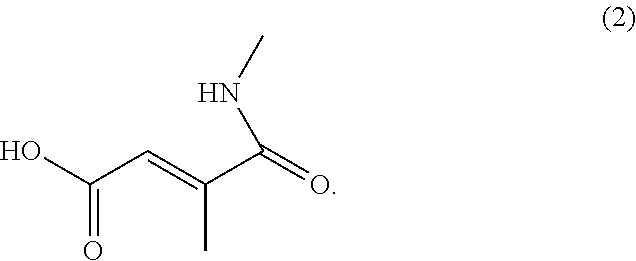
- the anticancer agent is released with the NH 2 group being substituted with the moiety represented by the following Chemical Formula 2:
- the anticancer agent may be a well-known therapeutic drug for cancer, such as Methotrexate, Paclitaxel, Cisplatin, Bleomycin and the like.
- any anticancer agent may be used in the present invention.
- the anticancer agent useful in the present invention include photosensitizers for photodynamic therapy, such as aminolevulinic acid, Temoporfin, etc., amine- or hydroxy-modified genetic therapeutics such as siRNA, antisense oligonucleotides, ribozymes, etc., aptamers, and protein-based therapeutics such as antibodies and the like, as well as chemical drugs that directly attack cancer cells.
- the present invention addresses a therapeutic for cancer, comprising a metal nanoparticle onto which a molecule of Chemical Formula 1 is anchored, with an anticancer agent being conjugated to the molecule at one terminus:
- the anticancer agent conjugated to the surface molecule of Chemical Formula 1 is released from the metal nanoparticle and exerts its therapeutic effect on cancer cells as the surface molecule is hydrolyzed in a pH condition of cancer cells.
- the present invention addresses a method for delivering an anticancer agent into cancer cells using metal nanoparticles loaded with the anticancer agent which selectively aggregates in cancer cells.
- the anticancer agent loaded onto the nanoparticles is released from the nanoparticles to exert an anticancer effect on cancer cells.
- the present invention pertains to a method for treating cancer, comprising administering pH-sensitive metal nanoparticles loaded with an anticancer agent to a subject in need thereof, said pH-sensitive metal nanoparticles aggregating in abnormal cells, and irradiating the aggregated pH-sensitive metal nanoparticles with light to conduct a photothermal therapy.
- contemplated in accordance with still another aspect of the present invention is to provide pH-sensitive metal nanoparticles the surface of which is conjugated with a fluorescent dye.
- the organic dye Alexa Fluor 488 hydrazide is introduced into the molecule on the surface of the pH-sensitive gold nanoparticles.
- the fluorescent dye Alexa Fluor 488 hydrazide emits green light with a wavelength of around 520 nm.
- NSET Nanoparticle Surface Energy Transfer
- the fluorescence extinguishes as the transferred fluorescence energy on the surface is emitted through a different pathway (Yun, C. S., Javier, A., Jennings, T., Fisher, M., Hira, S., Peterson, S., Hopkins, B., Reich, N. O., and Strouse, G. F., J. Am. Chem. Soc. 2005, 127, 3115-3119).
- This characteristic optical property can be used to monitor the introduction of the dye to the surface of the metal nanoparticles.
- the present invention addresses a metal nanoparticle conjugated with the compound of Chemical Formula 3, for use in the therapy of cancer:
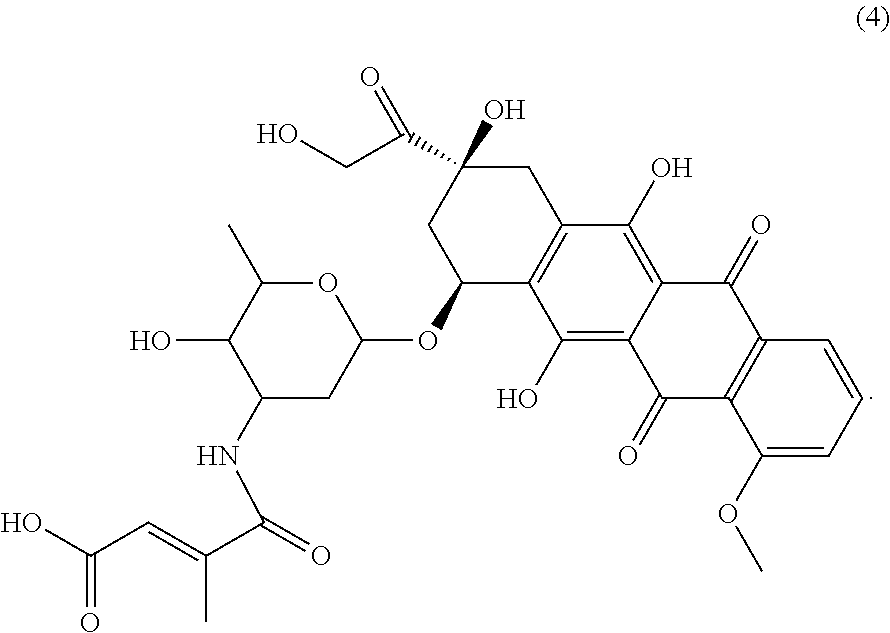
- the present invention provides a therapeutic compound represented by the following Chemical Formula 4:
- the novel metal nanoparticles of the present invention are selective for cancer cells and can be used in the therapy of cancer. Further, because the pH-sensitive metal nanoparticles of the present invention are loaded with an anticancer drug, the cancer therapy of the present invention is a combination of photothermal therapy and chemotherapy.
- novel metal nanoparticles of the present invention when loaded with a therapeutic or diagnostic agent, can deliver the agent into cancer cells, thus establishing a novel therapeutic and diagnostic method.
- the pH-sensitive gold nanoparticles are selective for cancer cells, thereby allowing a selective cancer therapy with minimal damage of an anticancer agent to normal cells.
- introduction of a targeting molecule such as an antibody or an aptamer is expected to further enhance therapeutic efficacy for cancer.
- the metal nanoparticles of the present invention takes advantage of a combination of photothermal therapy and chemotherapy, which may lead to more selective and potent ability to kill cancer cells.
- FIG. 1 is a conceptional view showing that the absorption band of pH-sensitive metal nanoparticles changes as surface molecules on the pH-sensitive gold nanoparticles are hydrolyzed.
- FIG. 2 shows dark-field microphotographs of cancer cells and normal cells incubated with various concentrations of pH-sensitive metal nanoparticles for a predetermined period of time.
- FIG. 3 shows absorbance (left panel) and fluorescence (right panel) spectra of a solution of pH-sensitive gold nanoparticle-Alexa Fluor 488 hydrazide conjugate (black) and a solution in which the gold nanoparticles are dissolved with KCN (red).
- FIG. 4 shows absorbance (left panel) and fluorescence (right panel) spectra of dispersions of the pH-sensitive gold nanoparticle-Alexa Flour 488 hydrazide conjugates at pH 7.6 (black) and at pH 1.0 (red).
- FIG. 5 shows fluorescence microphotographs of murine melanoma cells incubated with the pH-sensitive gold nanoparticle-Alexa Fluor 488 hydrazide conjugates for 1 hour (left panel) and for 3 hours (right panel).
- FIG. 6 shows fluorescence microphotographs of breast cancer cells incubated for 24 hours with the pH-sensitive gold nanoparticle-doxorubicine conjugates for a test group (middle panel), the pH-sensitive gold nanoparticles for a negative control (left panel) and doxorubicine for a positive control (right panel).
- doxorubicine As doxorubicine is delivered into cells, the nuclei appear yellow-reddish due to the fluorescence of doxorubicin.
- FIGS. 7 to 10 are schematic views illustrating the formation of conjugates with surface molecules of pH-sensitive gold nanoparticles.
- a solution of lipoic acid in anhydrous chloroform was mixed at room temperature for 5 min with 1.3 equivalents of carbonyl diimidazole under a vacuum condition with stirring, followed by separating the reaction solution layer from the remaining carbonyl diimidazole.
- Ethylene diamine was dissolved in an amount corresponding to 5 equivalents of the lipoic acid in anhydrous chloroform in a nitrogen atmosphere, cooled in an ice bath, and mixed for 1 hour with the separated reaction solution by stirring.
- the resulting reaction solution containing the product was extracted three times with 10% NaCl and once with deionized water and mixed at room temperature for 24 hours with citraconic anhydride to form a solid substance. After filtration, the solid substance was dissolved in an aqueous solution which was adjusted to a pH of 9 with NaOH. The resulting solution was stirred at room temperature for 4 hours together with one equivalent of NaBH 4 to afford a pH-sensitive ligand.
- the citrate-stabilized gold nanoparticles were added to an aqueous solution containing an excess of the synthetic pH-sensitive ligand and mixed at room temperature for 8 hours by stirring. Because the dithiol of the pH-sensitive ligand binds more strongly to the surface of the gold nanoparticles than does the carboxylic acid of citrate, the pH-sensitive ligand is exchanged for the citrate. Excess ligands were removed by dialysis.
- EDC 1-ethyl-3-(3-dimethylaminopropyl)carbodiimide
- sulfo-NHS sulfo-N-hydroxy succinimide
- the dialyzed solution was mixed at room temperature for 3 hours with a dispersion of Alexa Fluor 488 hydrazide in distilled water with stirring, so as to form a pH-sensitive gold nanoparticle-Alexa Fluor 488 hydrazide conjugate. Excess Alexa Fluor 488 hydrazide was removed by three rounds of dialysis with distilled water.
- EDC and sulfo-NHS both for use in the conjugation, acted as molecules to promote the formation of an amide bond between the terminal carboxylic acid of the pH-sensitive gold nanoparticles and the primary amine group of Alexa Fluor 488 hydrazide, as illustrated in FIG. 7 .
- the surface molecules on the pH-sensitive gold nanoparticles undergo hydrolysis so that the Alexa Fluoro 488 hydrazide is released from the gold nanoparticles, as illustrated in FIG. 8 .
- EDC 1-ethyl-3-(3-dimethylaminopropyl)carbodiimide
- sulfo-NHS sulfo-N-hydroxy succinimide
- the dialyzed solution was mixed at room temperature for 3 hours with a dispersion of doxorubicin in a phosphate buffer, pH 8.0, with stirring, so as to form a pH-sensitive gold nanoparticle-doxorubicin conjugate.
- the pH-sensitive gold nanoparticle-doxorubicin conjugate was used, without further purification, for culturing cells.
- EDC and sulfo-NHS both for use in the conjugation, acted as molecules to promote the formation of an amide bond between the terminal carboxylic acid of the pH-sensitive gold nanoparticles and the primary amine group of doxorubicin, as illustrated in FIG. 9 .
- the surface molecules on the pH-sensitive gold nanoparticles are hydrolyzed to release the doxorubicin from the gold nanoparticles.
- the surface charge of the pH-sensitive gold nanoparticles changes from ( ⁇ ) to (+) so that the particles aggregate due to electrostatic attraction.
- the pH-sensitive gold nanoparticles aggregate their light absorption band shifts toward longer wavelengths. Therefore, the pH-sensitive gold nanoparticles of the present invention allow for photothermal therapy with long wavelength light as well as for chemotherapy through the delivery of an anticancer drug to cancer cells.
- KCN was added to a solution of pH-sensitive gold nanoparticle-Alexa Fluor 488 hydrazide conjugate to dissolve the gold.
- This gold-dissolved solution and a solution of pH-sensitive gold nanoparticle-Alexa Fluor 488 hydrazide conjugate were examined for light absorption and fluorescence properties.
- the conjugate solution had an absorption band at around 500 nm, which is typical of a dispersion of gold nanoparticles, indicating that the gold nanoparticles were well and stably dispersed even after conjugation with the dye (left panel, black).
- fluorescence intensity was detected at a very low level in the conjugate solution, but was increased 50-fold after the solubilization of the gold nanoparticles with KCN.
- the fluorescence spectra describe the extinguishment of dye fluorescence by gold nanoparticles, demonstrating that the pH-sensitive gold nanoparticles were successfully loaded with dye to form a stable conjugate.
- the terminal functional group is cleaved by hydrolysis to release the molecule of interest, with the concomitant formation of aggregates of nearby particles by electrostatic attraction.
- pH-sensitive gold nanoparticle-Alexa Fluor 488 hydrazide conjugates were dispersed at pH 7.6 and pH 1.0, and absorbance and fluorescence spectra were measured.
- the conjugates were well dispersed at pH 7.6, having an absorbance band of around 500 nm, whereas at pH 1.0, they rapidly aggregated, with the absorbance band shifting to a wavelength of 600 nm or longer.
- the fluorescence intensity of Alexa Fluor 488 hydrazide was increased at pH 1.0, compared to pH 7.6, indicating that when exposed to an acidic condition, the gold nanoparticle function of extinguishing the fluorescence of Alexa Fluor 488 hydrazide was lost and that the Alexa Fluor 488 hydrazide introduced into the surface of the pH-sensitive gold nanoparticles was dissociated from the surface and became more distant from the gold nanoparticles.
- FIG. 5 shows fluorescence photographs of murine melanoma cells incubated with pH-sensitive gold nanoparticle-Alexa Fluor 488 hydrazide conjugates, illustrating that the fluorescence intensity of the Alexa Fluor 488 hydrazide increases with time within cells.
- the conjugates undergo hydrolysis, when encountering an intracellular acidic pH environment such as endosomes, to induce the dissociation of the Alexa Fluor 488 hydrazide moiety.
- the fluorescence of Alexa Fluor 488 hydrazide which has been extinguished by energy transfer into the gold nanoparticles revives, so that green fluorescence is visualized within cells under a fluorescence microscope.
- the pH-sensitive gold nanoparticles of the present invention can be used as a drug delivery system.
- the anticancer drug doxorubicin was employed.
- Doxorubicin works to induce cell death by intercalating DNA. It emits yellow-reddish fluorescence at near 600 nm.
- doxorubicin is dissociated from the gold nanoparticles by hydrolysis under an acidic condition and translocates into the nucleus which thus emits yellow-reddish fluorescence. Test results are shown in FIG. 6 .
- the intranuclear delivery of doxorubicin can be qualitatively analyzed in terms of nuclear yellow-reddish fluorescence as measured by fluorescence microscopy.
- the cells incubated with doxorubicin alone started to exhibit fluorescence after only one hour of incubation (1 st column, right panel, FIG. 6 ) and the fluorescence was intensified after 3 hours of incubation (3 rd column, right panel, FIG. 6 ). Thereafter, the fluorescence intensity increased with time, but relatively insignificantly.
- the conjugates In order for doxorubicin to be visualized in the cells incubated with the pH-sensitive gold nanoparticle-doxorubicin conjugates, the conjugates must be internalized into the cells and hydrolyzed to dissociate the doxorubicin therefrom.
- the pH-sensitive metal nanoparticles on which a surface molecule is conjugated with an anticancer drug can be used as an anticancer drug delivery system which allows drug release to be easily controlled, compared to the drug alone.
- anticancer drugs When administered into the body, anticancer drugs alone can accumulate in the nuclei of cells within a short period of time, thus exerting pharmaceutical effects like the administration of an excessive amount of drug.
- conjugates with the pH-sensitive metal nanoparticles release the drug for a relatively long period of time, showing pharmaceutical effects like sustained-release type of drugs.
- the pH-sensitive metal nanoparticles enjoy the advantage of improving the poor solubility of anticancer drugs thanks to their high solubility and recruiting a variety of anticancer drugs.
- siRNA as well as conventional anticancer agents such as doxorubicin can be used in the present invention.
- the pH-sensitive metal nanoparticles function to perform potent photothermal therapy as they aggregate after releasing the anticancer drugs for chemotherapy. Therefore, the pH-sensitive metal nanoparticles are advantageous in that they can more effectively kill cancer cells through a combination of chemotherapy and photothermal therapy.
- the pH-sensitive metal nanoparticle-anticancer drug conjugate is expected to be an effective anticancer drug delivery system.
Landscapes
- Health & Medical Sciences (AREA)
- Chemical & Material Sciences (AREA)
- Life Sciences & Earth Sciences (AREA)
- Veterinary Medicine (AREA)
- Animal Behavior & Ethology (AREA)
- General Health & Medical Sciences (AREA)
- Public Health (AREA)
- Engineering & Computer Science (AREA)
- Pharmacology & Pharmacy (AREA)
- Medicinal Chemistry (AREA)
- Epidemiology (AREA)
- Bioinformatics & Cheminformatics (AREA)
- Biomedical Technology (AREA)
- Inorganic Chemistry (AREA)
- Nuclear Medicine, Radiotherapy & Molecular Imaging (AREA)
- Physics & Mathematics (AREA)
- Optics & Photonics (AREA)
- Dermatology (AREA)
- Nanotechnology (AREA)
- Ceramic Engineering (AREA)
- Biophysics (AREA)
- Pathology (AREA)
- Radiology & Medical Imaging (AREA)
- Organic Chemistry (AREA)
- General Chemical & Material Sciences (AREA)
- Chemical Kinetics & Catalysis (AREA)
- Pharmaceuticals Containing Other Organic And Inorganic Compounds (AREA)
- Medicinal Preparation (AREA)
- Medicines That Contain Protein Lipid Enzymes And Other Medicines (AREA)
- Acyclic And Carbocyclic Compounds In Medicinal Compositions (AREA)
- Saccharide Compounds (AREA)
Abstract
Description
- The present invention relates to a method for the delivery of anticancer agents using pH-sensitive nanoparticles, and an anticancer agent delivery system using the same.
- Korean patent application No. 2008-0064270 teaches pH-sensitive metal nanoparticles and a preparation method thereof. These pH-sensitive nanoparticles are negatively charged and well dispersed under neutral or basic conditions. In contrast, when they are exposed to an acidic condition, their surface charges change positively as hydrolysis occurs. In this course, the nanoparticles aggregate, with their absorption band shifting from around 500 nm to greater than 600 nm, i.e., a red to near infrared region.
- After entering the body, these pH-sensitive metal nanoparticles are dispersed in normal cells, which are neutral or alkaline, and selectively aggregate in cancer cells which have acidic pH. When irradiated onto the body, near infrared light with a wavelength of greater than 600 nm, which can deeply penetrate into the body, heats metal aggregates, thereby killing the cancer cells.
- The pH-sensitive metal nanoparticles are selective for cancer cells and allow photothermal therapy, but by themselves have no therapeutic functions. Therefore, there is a need for new particles that can selectively aggregate in cancer cells and therapeutically treat cancer cells by themselves.
- It is an object of the present invention to provide metal nanoparticles for the therapy of cancer.
- It is another object of the present invention to provide novel pH-sensitive metal nanoparticles which are selective for cancer cells and can kill cancer cells by themselves.
- It is a further object of the present invention to provide novel pH-sensitive metal nanoparticles which can aggregate in and release an anticancer agent to kill cancer cells.
- It is still a further object of the present invention to provide a novel delivery system capable of selectively delivering an anticancer agent to cancer cells.
- It is still another object of the present invention to provide the use of pH-sensitive metal nanoparticles as an anticancer agent delivery system.
- It is yet a further object of the present invention to provide a method for treating cancer using particles with selectivity for and inhibitory activity against cancer cells.
- In accordance with an aspect thereof, the present invention provides pH-sensitive metal nanoparticles loaded with an anticancer agent, said anticancer agent being released from the nanoparticles at acidic pH.
- In the present invention, “pH-sensitive metal nanoparticles” means metal nanoparticles which are dispersed under neutral or basic conditions and form aggregations at acidic pH.
- As used herein, the term “pH-sensitive” is intended to encompass the ability of the metal nanoparticles to aggregate depending on the pH condition where they are.
- Without restriction to a theory, the metal nanoparticles according to the present invention can detect and aggregate at the low pH typical of abnormal cells, such as cancer cells, functioning to treat the cancer cells with the loaded anticancer agent and to cause cell death through a photothermal process when they receive light from a light source outside of cells.
- In the present invention, the metal nanoparticle is preferably small enough to penetrate into abnormal cells. In one preferred embodiment of the present invention, the metal nanoparticle is less than 20 nm in diameter and more preferably ranges in diameter from 5 to 15 nm.
- According to the present invention, when the metal nanoparticles access and/or penetrate into abnormal cells, they aggregate in the cells presenting the acidic pH environment. Thereupon, the aggregated metal nanoparticles are confined within the cells and thus can be used to destroy the cells by releasing the loaded anticancer agent and allowing photothermal therapy.
- When the pH environment of the metal nanoparticles is changed from alkaline to acidic, at least a portion of the compounds loaded onto the metal nanoparticles is hydrolyzed to generate a different charge from that which they have under an alkaline environment. During the charge change, the particles aggregate to each other due to electrostatic attraction. In addition, the hydrolysis separates the loaded anticancer agent from the metal particles.
- In one embodiment of the present invention, the pH-sensitive metal nanoparticles may be linked with an anticancer agent through a dehydration reaction. To quote an example, an anticancer agent is loaded onto the pH-sensitive nanoparticles by a reaction between a carboxyl group and a primary amine group or between a carboxyl group and a hydroxyl group. The separation of the anticancer agent from the pH-sensitive metal nanoparticles can be achieved by hydrolysis. Preferably, the anticancer agent is released from the pH-sensitive metal nanoparticles by cleaving a different bond from the linkage bond.
- In accordance with one preferable embodiment of the present invention, the metal nanoparticles have a compound represented by the following Chemical Formula 1 bound onto the surface thereof, with an anticancer agent being loaded through bond formation between the terminal carboxyl group of the compound and an amine group of the antibody drug:
-

- The metal nanoparticles aggregate with the concomitant release of the anticancer agent therefrom as the compound of Chemical Formula 1 undergoes hydrolysis at acidic pH and thus changes in charge. The hydrolysis which causes the compound of Chemical Formula 1 to change in charge is described in Korean patent application No. 2008-0064270, the disclosure of which is herein incorporated by reference in its entirety.
- In one embodiment of the present invention, the anticancer agent is released with the NH2 group being substituted with the moiety represented by the following Chemical Formula 2:
-

- According to one embodiment of the present invention, the anticancer agent may be a well-known therapeutic drug for cancer, such as Methotrexate, Paclitaxel, Cisplatin, Bleomycin and the like.
- In another embodiment of the present invention, as long as it is loaded to the metal nanoparticles, any anticancer agent may be used in the present invention. Examples of the anticancer agent useful in the present invention include photosensitizers for photodynamic therapy, such as aminolevulinic acid, Temoporfin, etc., amine- or hydroxy-modified genetic therapeutics such as siRNA, antisense oligonucleotides, ribozymes, etc., aptamers, and protein-based therapeutics such as antibodies and the like, as well as chemical drugs that directly attack cancer cells.
- In accordance with another aspect thereof, the present invention addresses a therapeutic for cancer, comprising a metal nanoparticle onto which a molecule of Chemical Formula 1 is anchored, with an anticancer agent being conjugated to the molecule at one terminus:
-

- Without restriction to a theory, the anticancer agent conjugated to the surface molecule of Chemical Formula 1 is released from the metal nanoparticle and exerts its therapeutic effect on cancer cells as the surface molecule is hydrolyzed in a pH condition of cancer cells.
- In accordance with a further aspect thereof, the present invention addresses a method for delivering an anticancer agent into cancer cells using metal nanoparticles loaded with the anticancer agent which selectively aggregates in cancer cells. The anticancer agent loaded onto the nanoparticles is released from the nanoparticles to exert an anticancer effect on cancer cells.
- In accordance with still a further aspect thereof, the present invention pertains to a method for treating cancer, comprising administering pH-sensitive metal nanoparticles loaded with an anticancer agent to a subject in need thereof, said pH-sensitive metal nanoparticles aggregating in abnormal cells, and irradiating the aggregated pH-sensitive metal nanoparticles with light to conduct a photothermal therapy.
- Also, contemplated in accordance with still another aspect of the present invention is to provide pH-sensitive metal nanoparticles the surface of which is conjugated with a fluorescent dye.
- In one embodiment of the present invention, the organic dye Alexa Fluor 488 hydrazide is introduced into the molecule on the surface of the pH-sensitive gold nanoparticles. The fluorescent dye Alexa Fluor 488 hydrazide emits green light with a wavelength of around 520 nm.
- Without restriction to a theory, when a dye introduced into the surface of the metal nanoparticle is in close proximity to the metal nanoparticles with a distance of 10 nm or less therebetween, the fluorescence energy can be transferred to the surface of the metal nanoparticle. In this regard, NSET (Nanoparticle Surface Energy Transfer) appears, in which the fluorescence extinguishes as the transferred fluorescence energy on the surface is emitted through a different pathway (Yun, C. S., Javier, A., Jennings, T., Fisher, M., Hira, S., Peterson, S., Hopkins, B., Reich, N. O., and Strouse, G. F., J. Am. Chem. Soc. 2005, 127, 3115-3119). This characteristic optical property can be used to monitor the introduction of the dye to the surface of the metal nanoparticles.
- In accordance with yet a further aspect thereof, the present invention addresses a metal nanoparticle conjugated with the compound of Chemical Formula 3, for use in the therapy of cancer:
-

- In accordance with yet another aspect thereof, the present invention provides a therapeutic compound represented by the following Chemical Formula 4:
-
- As described above, the novel metal nanoparticles of the present invention are selective for cancer cells and can be used in the therapy of cancer. Further, because the pH-sensitive metal nanoparticles of the present invention are loaded with an anticancer drug, the cancer therapy of the present invention is a combination of photothermal therapy and chemotherapy.
- In addition, when loaded with a therapeutic or diagnostic agent, the novel metal nanoparticles of the present invention can deliver the agent into cancer cells, thus establishing a novel therapeutic and diagnostic method.
- Further, the pH-sensitive gold nanoparticles are selective for cancer cells, thereby allowing a selective cancer therapy with minimal damage of an anticancer agent to normal cells. Moreover, the introduction of a targeting molecule such as an antibody or an aptamer is expected to further enhance therapeutic efficacy for cancer.
- Being able to exert light- and chemical-based therapeutic effects on cancer, the metal nanoparticles of the present invention takes advantage of a combination of photothermal therapy and chemotherapy, which may lead to more selective and potent ability to kill cancer cells.
-
FIG. 1 is a conceptional view showing that the absorption band of pH-sensitive metal nanoparticles changes as surface molecules on the pH-sensitive gold nanoparticles are hydrolyzed. -
FIG. 2 shows dark-field microphotographs of cancer cells and normal cells incubated with various concentrations of pH-sensitive metal nanoparticles for a predetermined period of time. -
FIG. 3 shows absorbance (left panel) and fluorescence (right panel) spectra of a solution of pH-sensitive gold nanoparticle-Alexa Fluor 488 hydrazide conjugate (black) and a solution in which the gold nanoparticles are dissolved with KCN (red). -
FIG. 4 shows absorbance (left panel) and fluorescence (right panel) spectra of dispersions of the pH-sensitive gold nanoparticle-Alexa Flour 488 hydrazide conjugates at pH 7.6 (black) and at pH 1.0 (red). -
FIG. 5 shows fluorescence microphotographs of murine melanoma cells incubated with the pH-sensitive gold nanoparticle-Alexa Fluor 488 hydrazide conjugates for 1 hour (left panel) and for 3 hours (right panel). -
FIG. 6 shows fluorescence microphotographs of breast cancer cells incubated for 24 hours with the pH-sensitive gold nanoparticle-doxorubicine conjugates for a test group (middle panel), the pH-sensitive gold nanoparticles for a negative control (left panel) and doxorubicine for a positive control (right panel). As doxorubicine is delivered into cells, the nuclei appear yellow-reddish due to the fluorescence of doxorubicin. -
FIGS. 7 to 10 are schematic views illustrating the formation of conjugates with surface molecules of pH-sensitive gold nanoparticles. - A solution of lipoic acid in anhydrous chloroform was mixed at room temperature for 5 min with 1.3 equivalents of carbonyl diimidazole under a vacuum condition with stirring, followed by separating the reaction solution layer from the remaining carbonyl diimidazole. Ethylene diamine was dissolved in an amount corresponding to 5 equivalents of the lipoic acid in anhydrous chloroform in a nitrogen atmosphere, cooled in an ice bath, and mixed for 1 hour with the separated reaction solution by stirring. The resulting reaction solution containing the product was extracted three times with 10% NaCl and once with deionized water and mixed at room temperature for 24 hours with citraconic anhydride to form a solid substance. After filtration, the solid substance was dissolved in an aqueous solution which was adjusted to a pH of 9 with NaOH. The resulting solution was stirred at room temperature for 4 hours together with one equivalent of NaBH4 to afford a pH-sensitive ligand.
- Synthesis of Gold Nanoparticles Stabilized with Citrate
- A solution of the gold precursor HAuCl4 in distilled water was heated at 120° C. for 30 min with stirring, and then for an additional 2 h, together with trisodium citrate, with stirring. In this course, the trisodium citrate acted as a reducing agent and a surface ligand, with the solution turning from yellow to red, indicating the construction of gold nanoparticles. Thereafter, the solution was cooled at room temperature with stirring. (Ind. Chem. Res. 2007, 46, 3128-3136)
- Synthesis of pH-Sensitive Gold Nanoparticles
- The citrate-stabilized gold nanoparticles were added to an aqueous solution containing an excess of the synthetic pH-sensitive ligand and mixed at room temperature for 8 hours by stirring. Because the dithiol of the pH-sensitive ligand binds more strongly to the surface of the gold nanoparticles than does the carboxylic acid of citrate, the pH-sensitive ligand is exchanged for the citrate. Excess ligands were removed by dialysis.
- Conjugation of pH-Sensitive Gold Nanoparticle with Drug
- 1) Synthesis of pH-Sensitive Gold Nanoparticle-Alexa Fluor 488 Hydrazide Conjugate
- A dispersion of pH-sensitive gold nanoparticles in a phosphate buffer, pH 7.0, was stirred, together with excess 1-ethyl-3-(3-dimethylaminopropyl)carbodiimide (EDC) and sulfo-N-hydroxy succinimide (sulfo-NHS), at room temperature for 10 min to activate the pH-sensitive gold nanoparticles. The solution was dialyzed three times against a phosphate buffer, pH 7, to remove excess EDC and sulfo-NHS. The dialyzed solution was mixed at room temperature for 3 hours with a dispersion of Alexa Fluor 488 hydrazide in distilled water with stirring, so as to form a pH-sensitive gold nanoparticle-Alexa Fluor 488 hydrazide conjugate. Excess Alexa Fluor 488 hydrazide was removed by three rounds of dialysis with distilled water.
- In the context of the conjugation, EDC and sulfo-NHS, both for use in the conjugation, acted as molecules to promote the formation of an amide bond between the terminal carboxylic acid of the pH-sensitive gold nanoparticles and the primary amine group of Alexa Fluor 488 hydrazide, as illustrated in
FIG. 7 . - Upon exposure of the conjugate to a weak acidic condition such as an environment presented by endosomes within cells, the surface molecules on the pH-sensitive gold nanoparticles undergo hydrolysis so that the Alexa Fluoro 488 hydrazide is released from the gold nanoparticles, as illustrated in
FIG. 8 . - 2) Synthesis of pH-Sensitive Gold Nanoparticle-Doxorubicin Conjugate
- Excess 1-ethyl-3-(3-dimethylaminopropyl)carbodiimide (EDC) and sulfo-N-hydroxy succinimide (sulfo-NHS) were added to a dispersion of pH-sensitive gold nanoparticles in a phosphate buffer, pH 7.0, and stirred at room temperature for 10 min to activate the pH-sensitive gold nanoparticles. The solution was dialyzed three times against a phosphate buffer, pH 7, to remove excess EDC and sulfo-NHS. The dialyzed solution was mixed at room temperature for 3 hours with a dispersion of doxorubicin in a phosphate buffer, pH 8.0, with stirring, so as to form a pH-sensitive gold nanoparticle-doxorubicin conjugate.
- The pH-sensitive gold nanoparticle-doxorubicin conjugate was used, without further purification, for culturing cells. In the context of the conjugation, EDC and sulfo-NHS, both for use in the conjugation, acted as molecules to promote the formation of an amide bond between the terminal carboxylic acid of the pH-sensitive gold nanoparticles and the primary amine group of doxorubicin, as illustrated in
FIG. 9 . - When the pH-sensitive gold nanoparticles encounter endosomes presenting a weak acidic environment, the surface molecules on the pH-sensitive gold nanoparticles are hydrolyzed to release the doxorubicin from the gold nanoparticles.
- Concurrently, the surface charge of the pH-sensitive gold nanoparticles changes from (−) to (+) so that the particles aggregate due to electrostatic attraction. As the pH-sensitive gold nanoparticles aggregate, their light absorption band shifts toward longer wavelengths. Therefore, the pH-sensitive gold nanoparticles of the present invention allow for photothermal therapy with long wavelength light as well as for chemotherapy through the delivery of an anticancer drug to cancer cells.
- Fluorescence Assay
- KCN was added to a solution of pH-sensitive gold nanoparticle-Alexa Fluor 488 hydrazide conjugate to dissolve the gold. This gold-dissolved solution and a solution of pH-sensitive gold nanoparticle-Alexa Fluor 488 hydrazide conjugate were examined for light absorption and fluorescence properties.
- As can be seen in the absorbance spectra of
FIG. 3 , the conjugate solution had an absorption band at around 500 nm, which is typical of a dispersion of gold nanoparticles, indicating that the gold nanoparticles were well and stably dispersed even after conjugation with the dye (left panel, black). - Upon the treatment of the gold nanoparticles with KCN, the characteristic absorbance of gold nanoparticles disappeared, indicating that the gold nanoparticles were completely dissolved (left panel, red).
- Turning to fluorescence spectra (
FIG. 3 , right panel), fluorescence intensity was detected at a very low level in the conjugate solution, but was increased 50-fold after the solubilization of the gold nanoparticles with KCN. - The fluorescence spectra describe the extinguishment of dye fluorescence by gold nanoparticles, demonstrating that the pH-sensitive gold nanoparticles were successfully loaded with dye to form a stable conjugate.
- When the conjugate in which a molecule of interest is introduced into the terminal of the surface molecules anchored onto the surface of the pH-sensitive gold nanoparticle is exposed to a weak acidic condition, the terminal functional group is cleaved by hydrolysis to release the molecule of interest, with the concomitant formation of aggregates of nearby particles by electrostatic attraction.
- To confirm this, the pH-sensitive gold nanoparticle-Alexa Fluor 488 hydrazide conjugates were dispersed at pH 7.6 and pH 1.0, and absorbance and fluorescence spectra were measured.
- As shown in the absorbance spectra of
FIG. 4 (left), the conjugates were well dispersed at pH 7.6, having an absorbance band of around 500 nm, whereas at pH 1.0, they rapidly aggregated, with the absorbance band shifting to a wavelength of 600 nm or longer. - As can be seen in the fluorescence spectra of
FIG. 4 (right), the fluorescence intensity of Alexa Fluor 488 hydrazide was increased at pH 1.0, compared to pH 7.6, indicating that when exposed to an acidic condition, the gold nanoparticle function of extinguishing the fluorescence of Alexa Fluor 488 hydrazide was lost and that the Alexa Fluor 488 hydrazide introduced into the surface of the pH-sensitive gold nanoparticles was dissociated from the surface and became more distant from the gold nanoparticles. - Taken together, the data obtained above demonstrate that the pH-sensitive nanoparticle-Alexa Fluor 488 hydrazide conjugates release the Alexa Fluor 488 hydrazide moiety in an acidic condition while the gold nanoparticles aggregate with the absorbance band shifting toward longer wavelengths.
-
FIG. 5 shows fluorescence photographs of murine melanoma cells incubated with pH-sensitive gold nanoparticle-Alexa Fluor 488 hydrazide conjugates, illustrating that the fluorescence intensity of the Alexa Fluor 488 hydrazide increases with time within cells. - Once the conjugates are internalized into cells, the conjugates undergo hydrolysis, when encountering an intracellular acidic pH environment such as endosomes, to induce the dissociation of the Alexa Fluor 488 hydrazide moiety. Thereupon, the fluorescence of Alexa Fluor 488 hydrazide which has been extinguished by energy transfer into the gold nanoparticles revives, so that green fluorescence is visualized within cells under a fluorescence microscope.
- Fluorescence was observed at a very small intensity in the cells 10 to 30 min after incubation with the conjugate, but started to intensify from one hour after the incubation and reached the maximum three hours after the incubation.
- This result shows that after the internalization of the pH-sensitive gold nanoparticles into cells, Alexa Fluor 488 hydrazide is released gradually.
- Taking advantage of the phenomenon that after internalization into cells, the pH-sensitive gold nanoparticle conjugates undergo hydrolysis to gradually dissociate the conjugated molecule with time, the pH-sensitive gold nanoparticles of the present invention can be used as a drug delivery system.
- Drug Test
- In this Example, the anticancer drug doxorubicin was employed. Doxorubicin works to induce cell death by intercalating DNA. It emits yellow-reddish fluorescence at near 600 nm. When the conjugates penetrate into cancer cells, doxorubicin is dissociated from the gold nanoparticles by hydrolysis under an acidic condition and translocates into the nucleus which thus emits yellow-reddish fluorescence. Test results are shown in
FIG. 6 . - Breast cancer cells in test groups were incubated with the pH-sensitive gold nanoparticle-doxorubicin conjugates to induce the internalization of the conjugate (middle panel,
FIG. 6 ). - For comparison, cells were incubated with doxorubicin-free pH-sensitive gold nanoparticles (left panel,
FIG. 6 ) and with doxorubicin alone (right panel,FIG. 6 ) under the same condition. - The intranuclear delivery of doxorubicin can be qualitatively analyzed in terms of nuclear yellow-reddish fluorescence as measured by fluorescence microscopy.
- Because of the absence of doxorubicin, the cells treated with the pH-sensitive gold nanoparticles alone did not show fluorescence in the
nucleus 24 hours after incubation. - In contrast, the fluorescence of doxorubicin started to appear with time in the cells treated with the pH-sensitive gold nanoparticle-doxorubicin conjugates. The nuclei were observed to be clearly fluorescent 12 hours after incubation (4th column, middle panel,
FIG. 6 ). Further intense fluorescence was detected 24 hours after incubation (5th column, middle panel,FIG. 6 ). - On the other hand, the cells incubated with doxorubicin alone started to exhibit fluorescence after only one hour of incubation (1st column, right panel,
FIG. 6 ) and the fluorescence was intensified after 3 hours of incubation (3rd column, right panel,FIG. 6 ). Thereafter, the fluorescence intensity increased with time, but relatively insignificantly. - While intense fluorescence is detected within a short culture time upon treatment with doxorubicin alone, the fluorescence intensity of pH-sensitive gold nanoparticle-doxorubicin conjugates is relatively slowly increased.
- However, similar fluorescence intensities were obtained after 24 hours in both cell groups, indicating that levels of doxorubicin delivered into the nucleus become similar after a sufficient period of time. That is, most of the doxorubicin conjugated to the pH-sensitive gold nanoparticles is released.
- In order for doxorubicin to be visualized in the cells incubated with the pH-sensitive gold nanoparticle-doxorubicin conjugates, the conjugates must be internalized into the cells and hydrolyzed to dissociate the doxorubicin therefrom.
- Hence, a series of processes of internalizing the pH-sensitive metal nanoparticle-doxorubicin conjugates into cells and hydrolyzing the conjugates at acidic endosomes to release doxorubicin is conducted relatively slowly so that it takes relatively much time for doxorubicin to accumulate in the nucleus of cells.
- Based on the data, the pH-sensitive metal nanoparticles on which a surface molecule is conjugated with an anticancer drug can be used as an anticancer drug delivery system which allows drug release to be easily controlled, compared to the drug alone.
- When administered into the body, anticancer drugs alone can accumulate in the nuclei of cells within a short period of time, thus exerting pharmaceutical effects like the administration of an excessive amount of drug. In contrast, conjugates with the pH-sensitive metal nanoparticles release the drug for a relatively long period of time, showing pharmaceutical effects like sustained-release type of drugs.
- In this way, if drug release is controlled through the conjugate system of the pH-sensitive metal nanoparticles, not only can the adverse effects related to overdose or insufficient dose of drug be reduced, but also the inconvenience of patients attributed to frequent administration can be alleviated. In addition, the pH-sensitive gold nanoparticles enjoy the advantage of improving the poor solubility of anticancer drugs thanks to their high solubility and recruiting a variety of anticancer drugs.
- Gene therapeutics such as siRNA as well as conventional anticancer agents such as doxorubicin can be used in the present invention.
- In addition to the delivery of anticancer drugs, the pH-sensitive metal nanoparticles function to perform potent photothermal therapy as they aggregate after releasing the anticancer drugs for chemotherapy. Therefore, the pH-sensitive metal nanoparticles are advantageous in that they can more effectively kill cancer cells through a combination of chemotherapy and photothermal therapy.
- With these advantages, the pH-sensitive metal nanoparticle-anticancer drug conjugate is expected to be an effective anticancer drug delivery system.
Claims (24)


Applications Claiming Priority (3)
| Application Number | Priority Date | Filing Date | Title |
|---|---|---|---|
| KR10-2010-0034880 | 2010-04-15 | ||
| KR1020100034880A KR101196667B1 (en) | 2010-04-15 | 2010-04-15 | A DELEVERY SYSTEM OF ANTI-CANCER AGENT USING pH SENSITIVE METAL NANOPARTICLE |
| PCT/KR2011/002461 WO2011129549A2 (en) | 2010-04-15 | 2011-04-07 | Anticancer drug delivery system using ph-sensitive metal nanoparticles |
Publications (3)
| Publication Number | Publication Date |
|---|---|
| US20130138032A1 true US20130138032A1 (en) | 2013-05-30 |
| US20130331764A9 US20130331764A9 (en) | 2013-12-12 |
| US9757474B2 US9757474B2 (en) | 2017-09-12 |
Family
ID=44799133
Family Applications (1)
| Application Number | Title | Priority Date | Filing Date |
|---|---|---|---|
| US13/640,605 Active 2032-10-23 US9757474B2 (en) | 2010-04-15 | 2011-04-07 | Anticancer agent delivery system using pH-sensitive metal nanoparticles |
Country Status (6)
| Country | Link |
|---|---|
| US (1) | US9757474B2 (en) |
| EP (1) | EP2559429A4 (en) |
| JP (1) | JP5685308B2 (en) |
| KR (1) | KR101196667B1 (en) |
| CN (1) | CN102858323A (en) |
| WO (1) | WO2011129549A2 (en) |
Cited By (25)
| Publication number | Priority date | Publication date | Assignee | Title |
|---|---|---|---|---|
| US8822663B2 (en) | 2010-08-06 | 2014-09-02 | Moderna Therapeutics, Inc. | Engineered nucleic acids and methods of use thereof |
| WO2014152211A1 (en) | 2013-03-14 | 2014-09-25 | Moderna Therapeutics, Inc. | Formulation and delivery of modified nucleoside, nucleotide, and nucleic acid compositions |
| WO2015034928A1 (en) | 2013-09-03 | 2015-03-12 | Moderna Therapeutics, Inc. | Chimeric polynucleotides |
| WO2015034925A1 (en) | 2013-09-03 | 2015-03-12 | Moderna Therapeutics, Inc. | Circular polynucleotides |
| US8980864B2 (en) | 2013-03-15 | 2015-03-17 | Moderna Therapeutics, Inc. | Compositions and methods of altering cholesterol levels |
| US8999380B2 (en) | 2012-04-02 | 2015-04-07 | Moderna Therapeutics, Inc. | Modified polynucleotides for the production of biologics and proteins associated with human disease |
| US9107886B2 (en) | 2012-04-02 | 2015-08-18 | Moderna Therapeutics, Inc. | Modified polynucleotides encoding basic helix-loop-helix family member E41 |
| US9186372B2 (en) | 2011-12-16 | 2015-11-17 | Moderna Therapeutics, Inc. | Split dose administration |
| US9283287B2 (en) | 2012-04-02 | 2016-03-15 | Moderna Therapeutics, Inc. | Modified polynucleotides for the production of nuclear proteins |
| US9334328B2 (en) | 2010-10-01 | 2016-05-10 | Moderna Therapeutics, Inc. | Modified nucleosides, nucleotides, and nucleic acids, and uses thereof |
| US9428535B2 (en) | 2011-10-03 | 2016-08-30 | Moderna Therapeutics, Inc. | Modified nucleosides, nucleotides, and nucleic acids, and uses thereof |
| US9464124B2 (en) | 2011-09-12 | 2016-10-11 | Moderna Therapeutics, Inc. | Engineered nucleic acids and methods of use thereof |
| US9533047B2 (en) | 2011-03-31 | 2017-01-03 | Modernatx, Inc. | Delivery and formulation of engineered nucleic acids |
| WO2017012568A1 (en) * | 2015-07-22 | 2017-01-26 | Gnt Biotech & Medicals Corporation | Ph-sensitive linkers for delivering a therapeutic agent |
| US9572897B2 (en) | 2012-04-02 | 2017-02-21 | Modernatx, Inc. | Modified polynucleotides for the production of cytoplasmic and cytoskeletal proteins |
| US9597380B2 (en) | 2012-11-26 | 2017-03-21 | Modernatx, Inc. | Terminally modified RNA |
| US9649381B2 (en) | 2013-11-06 | 2017-05-16 | Wayne State University | Transporter protein-coupled nanodevices for targeted drug delivery |
| US9956172B2 (en) | 2015-07-28 | 2018-05-01 | Board Of Regents, The University Of Texas System | Implant compositions for the unidirectional delivery of therapeutic compounds to the brain |
| WO2018129501A1 (en) | 2017-01-09 | 2018-07-12 | The Curators Of The University Of Missouri | Targeted doxorubicin-gold nanoconjugates for tumor therapy |
| WO2018218004A1 (en) | 2017-05-24 | 2018-11-29 | The Board Of Regents Of The University Of Texas System | Linkers for antibody drug conjugates |
| US10323076B2 (en) | 2013-10-03 | 2019-06-18 | Modernatx, Inc. | Polynucleotides encoding low density lipoprotein receptor |
| US10815291B2 (en) | 2013-09-30 | 2020-10-27 | Modernatx, Inc. | Polynucleotides encoding immune modulating polypeptides |
| CN113899732A (en) * | 2021-09-30 | 2022-01-07 | 长沙新材料产业研究院有限公司 | PH value sensitive ligand modified nano-gold and preparation method thereof |
| RU2773707C2 (en) * | 2017-01-09 | 2022-06-08 | Зе Кураторс Оф Зе Юниверсити Оф Миссури Сша | Doxorubicin-gold nanoconjugates with directional influence for tumor therapy |
| WO2023242766A1 (en) | 2022-06-15 | 2023-12-21 | Alembic Pharmaceuticals Limited | Gold nanoconjugates |
Families Citing this family (10)
| Publication number | Priority date | Publication date | Assignee | Title |
|---|---|---|---|---|
| CN102989016A (en) * | 2012-11-05 | 2013-03-27 | 浙江大学 | Nanoparticle material with pH sensitivity and preparation method thereof |
| US9874554B1 (en) | 2014-07-16 | 2018-01-23 | Verily Life Sciences Llc | Aptamer-based in vivo diagnostic system |
| WO2016046847A1 (en) | 2014-09-23 | 2016-03-31 | Council Of Scientific & Industrial Research | Metal embedded hydrophilic polymer for drug delivery applications |
| WO2017145179A1 (en) * | 2016-02-24 | 2017-08-31 | Indian Institute Of Technology, Bombay | Drug delivery system |
| CN108057120A (en) * | 2016-11-08 | 2018-05-22 | 首都师范大学 | Phenol iron complex is as the application in optical-thermal conversion material |
| KR102300092B1 (en) | 2018-11-05 | 2021-09-09 | 가톨릭대학교 산학협력단 | pH-sensitive carbon nanoparticles, a process for producing the same, and drug delivery using the same |
| KR102174177B1 (en) * | 2018-11-19 | 2020-11-05 | 포항공과대학교 산학협력단 | Aqueous two-phase system nano filter and separation method threrefor |
| KR102503292B1 (en) | 2019-12-06 | 2023-02-24 | 가톨릭대학교 산학협력단 | pH sensitive composite material using exfoliated layered double hydroxide and bioactive material carrier using the same |
| CN111228507B (en) * | 2020-03-06 | 2021-01-08 | 郑州大学 | A kind of HPMA polymer modified gold nanorod drug loading system and preparation method and application thereof |
| KR102655577B1 (en) | 2021-11-18 | 2024-04-05 | 강원대학교산학협력단 | Rutin-mediated palladium nanoclusters encapsulated with folic acid-conjugated chitosan and method for preparing the same |
Family Cites Families (18)
| Publication number | Priority date | Publication date | Assignee | Title |
|---|---|---|---|---|
| US20020091242A1 (en) | 2000-10-11 | 2002-07-11 | Michel Bessodes | Acid-sensitive compounds, their preparation and uses |
| EP1480969A1 (en) * | 2002-03-05 | 2004-12-01 | Universitaet Ulm | Dithiolane derivatives for immobilizing biomolecules on noble metals and semiconductors |
| US7659314B2 (en) * | 2002-05-19 | 2010-02-09 | University Of Utah Research Foundation | PH-sensitive polymeric micelles for drug delivery |
| CA2583389A1 (en) * | 2004-10-07 | 2006-04-20 | Emory University | Multifunctional nanoparticles conjugates and their use |
| US7601331B2 (en) * | 2004-11-10 | 2009-10-13 | National University Of Singapore | NIR-sensitive nanoparticle |
| US20090324494A1 (en) | 2006-02-24 | 2009-12-31 | Atgen Co., Ltd | Magnetic nano-composite for contrast agent, intelligent contrast agent, drug delivery agent for simultaneous diagnosis and treatment, and separation agent for target substance |
| EP2084277A2 (en) | 2006-10-06 | 2009-08-05 | Polytechnic University | Ph sensitive liposome composition |
| KR20080064270A (en) | 2007-01-04 | 2008-07-09 | 홍성표 | How to make a mother-of-pearl tile |
| WO2008147481A1 (en) * | 2007-02-09 | 2008-12-04 | Northeastern University | Precision-guided nanoparticle systems for drug delivery |
| KR100802080B1 (en) | 2007-03-28 | 2008-02-11 | 성균관대학교산학협력단 | pH sensitive block copolymers and polymer micelles using the same |
| CA2742388C (en) * | 2007-11-08 | 2019-02-19 | Virginia Tech Intellectual Properties, Inc. | Thiolated paclitaxels for reaction with gold nanoparticles as drug delivery agents |
| EP2252315A1 (en) * | 2008-01-30 | 2010-11-24 | Pharma Mar, S.A. | Improved antitumoral treatments |
| WO2009105662A1 (en) * | 2008-02-21 | 2009-08-27 | Immunolight, Llc. | Methods and systems for treating cell proliferation disorders using plasmonics enhanced photospectral therapy (pepst) and exciton-plasmon enhanced phototherapy (epep) |
| KR101014246B1 (en) * | 2008-07-03 | 2011-02-16 | 포항공과대학교 산학협력단 | Peha susceptible metal nanoparticles and methods for their preparation. |
| KR101006755B1 (en) | 2008-07-07 | 2011-01-10 | 한국과학기술원 | Hyaluronic Acid Gold Nanoparticles for Detecting Free Radicals and Manufacturing Method thereof |
| US20130023714A1 (en) * | 2008-10-26 | 2013-01-24 | Board Of Regents, The University Of Texas Systems | Medical and Imaging Nanoclusters |
| EP2210616A1 (en) * | 2009-01-21 | 2010-07-28 | Centre National de la Recherche Scientifique | Multifunctional stealth nanoparticles for biomedical use |
| WO2011072133A1 (en) * | 2009-12-09 | 2011-06-16 | William Marsh Rice University | Therapeutic compositions and methods for delivery of active agents cleavably linked to nanoparticles |
-
2010
- 2010-04-15 KR KR1020100034880A patent/KR101196667B1/en not_active Expired - Fee Related
-
2011
- 2011-04-07 EP EP11769015.6A patent/EP2559429A4/en not_active Withdrawn
- 2011-04-07 JP JP2013504807A patent/JP5685308B2/en not_active Expired - Fee Related
- 2011-04-07 CN CN2011800189200A patent/CN102858323A/en active Pending
- 2011-04-07 US US13/640,605 patent/US9757474B2/en active Active
- 2011-04-07 WO PCT/KR2011/002461 patent/WO2011129549A2/en not_active Ceased
Cited By (74)
| Publication number | Priority date | Publication date | Assignee | Title |
|---|---|---|---|---|
| US9447164B2 (en) | 2010-08-06 | 2016-09-20 | Moderna Therapeutics, Inc. | Engineered nucleic acids and methods of use thereof |
| US9181319B2 (en) | 2010-08-06 | 2015-11-10 | Moderna Therapeutics, Inc. | Engineered nucleic acids and methods of use thereof |
| US8822663B2 (en) | 2010-08-06 | 2014-09-02 | Moderna Therapeutics, Inc. | Engineered nucleic acids and methods of use thereof |
| US9937233B2 (en) | 2010-08-06 | 2018-04-10 | Modernatx, Inc. | Engineered nucleic acids and methods of use thereof |
| US10064959B2 (en) | 2010-10-01 | 2018-09-04 | Modernatx, Inc. | Modified nucleosides, nucleotides, and nucleic acids, and uses thereof |
| US9334328B2 (en) | 2010-10-01 | 2016-05-10 | Moderna Therapeutics, Inc. | Modified nucleosides, nucleotides, and nucleic acids, and uses thereof |
| US9701965B2 (en) | 2010-10-01 | 2017-07-11 | Modernatx, Inc. | Engineered nucleic acids and methods of use thereof |
| US9657295B2 (en) | 2010-10-01 | 2017-05-23 | Modernatx, Inc. | Modified nucleosides, nucleotides, and nucleic acids, and uses thereof |
| US9950068B2 (en) | 2011-03-31 | 2018-04-24 | Modernatx, Inc. | Delivery and formulation of engineered nucleic acids |
| US9533047B2 (en) | 2011-03-31 | 2017-01-03 | Modernatx, Inc. | Delivery and formulation of engineered nucleic acids |
| US9464124B2 (en) | 2011-09-12 | 2016-10-11 | Moderna Therapeutics, Inc. | Engineered nucleic acids and methods of use thereof |
| US10022425B2 (en) | 2011-09-12 | 2018-07-17 | Modernatx, Inc. | Engineered nucleic acids and methods of use thereof |
| US10751386B2 (en) | 2011-09-12 | 2020-08-25 | Modernatx, Inc. | Engineered nucleic acids and methods of use thereof |
| US9428535B2 (en) | 2011-10-03 | 2016-08-30 | Moderna Therapeutics, Inc. | Modified nucleosides, nucleotides, and nucleic acids, and uses thereof |
| US9186372B2 (en) | 2011-12-16 | 2015-11-17 | Moderna Therapeutics, Inc. | Split dose administration |
| US9295689B2 (en) | 2011-12-16 | 2016-03-29 | Moderna Therapeutics, Inc. | Formulation and delivery of PLGA microspheres |
| US9271996B2 (en) | 2011-12-16 | 2016-03-01 | Moderna Therapeutics, Inc. | Formulation and delivery of PLGA microspheres |
| US9220755B2 (en) | 2012-04-02 | 2015-12-29 | Moderna Therapeutics, Inc. | Modified polynucleotides for the production of proteins associated with blood and lymphatic disorders |
| US9878056B2 (en) | 2012-04-02 | 2018-01-30 | Modernatx, Inc. | Modified polynucleotides for the production of cosmetic proteins and peptides |
| US9221891B2 (en) | 2012-04-02 | 2015-12-29 | Moderna Therapeutics, Inc. | In vivo production of proteins |
| US9233141B2 (en) | 2012-04-02 | 2016-01-12 | Moderna Therapeutics, Inc. | Modified polynucleotides for the production of proteins associated with blood and lymphatic disorders |
| US9255129B2 (en) | 2012-04-02 | 2016-02-09 | Moderna Therapeutics, Inc. | Modified polynucleotides encoding SIAH E3 ubiquitin protein ligase 1 |
| US9254311B2 (en) | 2012-04-02 | 2016-02-09 | Moderna Therapeutics, Inc. | Modified polynucleotides for the production of proteins |
| US9216205B2 (en) | 2012-04-02 | 2015-12-22 | Moderna Therapeutics, Inc. | Modified polynucleotides encoding granulysin |
| US9283287B2 (en) | 2012-04-02 | 2016-03-15 | Moderna Therapeutics, Inc. | Modified polynucleotides for the production of nuclear proteins |
| US9192651B2 (en) | 2012-04-02 | 2015-11-24 | Moderna Therapeutics, Inc. | Modified polynucleotides for the production of secreted proteins |
| US9301993B2 (en) | 2012-04-02 | 2016-04-05 | Moderna Therapeutics, Inc. | Modified polynucleotides encoding apoptosis inducing factor 1 |
| US9303079B2 (en) | 2012-04-02 | 2016-04-05 | Moderna Therapeutics, Inc. | Modified polynucleotides for the production of cytoplasmic and cytoskeletal proteins |
| US9149506B2 (en) | 2012-04-02 | 2015-10-06 | Moderna Therapeutics, Inc. | Modified polynucleotides encoding septin-4 |
| US9114113B2 (en) | 2012-04-02 | 2015-08-25 | Moderna Therapeutics, Inc. | Modified polynucleotides encoding citeD4 |
| US9107886B2 (en) | 2012-04-02 | 2015-08-18 | Moderna Therapeutics, Inc. | Modified polynucleotides encoding basic helix-loop-helix family member E41 |
| US9095552B2 (en) | 2012-04-02 | 2015-08-04 | Moderna Therapeutics, Inc. | Modified polynucleotides encoding copper metabolism (MURR1) domain containing 1 |
| US9089604B2 (en) | 2012-04-02 | 2015-07-28 | Moderna Therapeutics, Inc. | Modified polynucleotides for treating galactosylceramidase protein deficiency |
| US10501512B2 (en) | 2012-04-02 | 2019-12-10 | Modernatx, Inc. | Modified polynucleotides |
| US8999380B2 (en) | 2012-04-02 | 2015-04-07 | Moderna Therapeutics, Inc. | Modified polynucleotides for the production of biologics and proteins associated with human disease |
| US9572897B2 (en) | 2012-04-02 | 2017-02-21 | Modernatx, Inc. | Modified polynucleotides for the production of cytoplasmic and cytoskeletal proteins |
| US9587003B2 (en) | 2012-04-02 | 2017-03-07 | Modernatx, Inc. | Modified polynucleotides for the production of oncology-related proteins and peptides |
| US9220792B2 (en) | 2012-04-02 | 2015-12-29 | Moderna Therapeutics, Inc. | Modified polynucleotides encoding aquaporin-5 |
| US9827332B2 (en) | 2012-04-02 | 2017-11-28 | Modernatx, Inc. | Modified polynucleotides for the production of proteins |
| US9061059B2 (en) | 2012-04-02 | 2015-06-23 | Moderna Therapeutics, Inc. | Modified polynucleotides for treating protein deficiency |
| US9675668B2 (en) | 2012-04-02 | 2017-06-13 | Moderna Therapeutics, Inc. | Modified polynucleotides encoding hepatitis A virus cellular receptor 2 |
| US9050297B2 (en) | 2012-04-02 | 2015-06-09 | Moderna Therapeutics, Inc. | Modified polynucleotides encoding aryl hydrocarbon receptor nuclear translocator |
| US9782462B2 (en) | 2012-04-02 | 2017-10-10 | Modernatx, Inc. | Modified polynucleotides for the production of proteins associated with human disease |
| US9814760B2 (en) | 2012-04-02 | 2017-11-14 | Modernatx, Inc. | Modified polynucleotides for the production of biologics and proteins associated with human disease |
| US9828416B2 (en) | 2012-04-02 | 2017-11-28 | Modernatx, Inc. | Modified polynucleotides for the production of secreted proteins |
| US9597380B2 (en) | 2012-11-26 | 2017-03-21 | Modernatx, Inc. | Terminally modified RNA |
| WO2014152211A1 (en) | 2013-03-14 | 2014-09-25 | Moderna Therapeutics, Inc. | Formulation and delivery of modified nucleoside, nucleotide, and nucleic acid compositions |
| US8980864B2 (en) | 2013-03-15 | 2015-03-17 | Moderna Therapeutics, Inc. | Compositions and methods of altering cholesterol levels |
| WO2015034925A1 (en) | 2013-09-03 | 2015-03-12 | Moderna Therapeutics, Inc. | Circular polynucleotides |
| WO2015034928A1 (en) | 2013-09-03 | 2015-03-12 | Moderna Therapeutics, Inc. | Chimeric polynucleotides |
| US10815291B2 (en) | 2013-09-30 | 2020-10-27 | Modernatx, Inc. | Polynucleotides encoding immune modulating polypeptides |
| US10323076B2 (en) | 2013-10-03 | 2019-06-18 | Modernatx, Inc. | Polynucleotides encoding low density lipoprotein receptor |
| US9649381B2 (en) | 2013-11-06 | 2017-05-16 | Wayne State University | Transporter protein-coupled nanodevices for targeted drug delivery |
| WO2017012591A1 (en) * | 2015-07-22 | 2017-01-26 | Gnt Biotech & Medicals Corporation | Complex comprising metallic nanoparticle, linkers and antibodies |
| EP3325440A4 (en) * | 2015-07-22 | 2019-01-23 | GNT Biotech & Medicals Corporation | Ph-sensitive linkers for delivering a therapeutic agent |
| US10688193B2 (en) | 2015-07-22 | 2020-06-23 | Gnt Biotech & Medicals Corporation | PH-sensitive linkers for delivering a therapeutic agent |
| KR102187410B1 (en) * | 2015-07-22 | 2020-12-07 | 지엔티 바이오테크 & 메디컬즈 코포레이션 | PH-sensitive linkers to deliver therapeutic agents |
| KR20180033533A (en) * | 2015-07-22 | 2018-04-03 | 지엔티 바이오테크 & 메디컬즈 코포레이션 | A pH-sensitive linker for delivering therapeutic agents |
| AU2016295602B2 (en) * | 2015-07-22 | 2019-11-14 | Gnt Biotech & Medicals Corporation | PH-sensitive linkers for delivering a therapeutic agent |
| WO2017012568A1 (en) * | 2015-07-22 | 2017-01-26 | Gnt Biotech & Medicals Corporation | Ph-sensitive linkers for delivering a therapeutic agent |
| CN107848957A (en) * | 2015-07-22 | 2018-03-27 | 华上生技医药股份有限公司 | PH-sensitive linkers for the delivery of therapeutic agents |
| US9956172B2 (en) | 2015-07-28 | 2018-05-01 | Board Of Regents, The University Of Texas System | Implant compositions for the unidirectional delivery of therapeutic compounds to the brain |
| US11229599B2 (en) | 2015-07-28 | 2022-01-25 | Board Of Regents, The University Of Texas System | Implant compositions for the unidirectional delivery of therapeutic compounds to the brain |
| US10434063B2 (en) | 2015-07-28 | 2019-10-08 | Board Of Regents, The University Of Texas System | Implant compositions for the unidirectional delivery of therapeutic compounds to the brain |
| WO2018129501A1 (en) | 2017-01-09 | 2018-07-12 | The Curators Of The University Of Missouri | Targeted doxorubicin-gold nanoconjugates for tumor therapy |
| JP2020504130A (en) * | 2017-01-09 | 2020-02-06 | ザ キュレイターズ オブ ザ ユニバーシティ オブ ミズーリ | Targeted doxorubicin-gold nanoconjugate for tumor therapy |
| KR20190104333A (en) * | 2017-01-09 | 2019-09-09 | 더 큐레이터스 오브 더 유니버시티 오브 미주리 | Targeted Doxorubicin-Gold Nanoconjugates for Tumor Therapy |
| CN110178028A (en) * | 2017-01-09 | 2019-08-27 | 密苏里大学管理机构 | Targeting peptide-doxorubicin-gold nano conjugate for oncotherapy |
| RU2773707C2 (en) * | 2017-01-09 | 2022-06-08 | Зе Кураторс Оф Зе Юниверсити Оф Миссури Сша | Doxorubicin-gold nanoconjugates with directional influence for tumor therapy |
| AU2018205349B2 (en) * | 2017-01-09 | 2022-09-29 | The Curators Of The University Of Missouri | Targeted doxorubicin-gold nanoconjugates for tumor therapy |
| KR102568577B1 (en) | 2017-01-09 | 2023-08-18 | 더 큐레이터스 오브 더 유니버시티 오브 미주리 | Targeted doxorubicin-gold nanoconjugates for tumor therapy |
| WO2018218004A1 (en) | 2017-05-24 | 2018-11-29 | The Board Of Regents Of The University Of Texas System | Linkers for antibody drug conjugates |
| CN113899732A (en) * | 2021-09-30 | 2022-01-07 | 长沙新材料产业研究院有限公司 | PH value sensitive ligand modified nano-gold and preparation method thereof |
| WO2023242766A1 (en) | 2022-06-15 | 2023-12-21 | Alembic Pharmaceuticals Limited | Gold nanoconjugates |
Also Published As
| Publication number | Publication date |
|---|---|
| WO2011129549A9 (en) | 2011-12-15 |
| US9757474B2 (en) | 2017-09-12 |
| WO2011129549A3 (en) | 2012-02-02 |
| EP2559429A4 (en) | 2016-03-23 |
| US20130331764A9 (en) | 2013-12-12 |
| KR20110115398A (en) | 2011-10-21 |
| EP2559429A2 (en) | 2013-02-20 |
| JP5685308B2 (en) | 2015-03-18 |
| KR101196667B1 (en) | 2012-11-02 |
| JP2013523877A (en) | 2013-06-17 |
| WO2011129549A2 (en) | 2011-10-20 |
| CN102858323A (en) | 2013-01-02 |
Similar Documents
| Publication | Publication Date | Title |
|---|---|---|
| US9757474B2 (en) | Anticancer agent delivery system using pH-sensitive metal nanoparticles | |
| García-Pardo et al. | Bioinspired theranostic coordination polymer nanoparticles for intranasal dopamine replacement in Parkinson’s disease | |
| Mahani et al. | Doxorubicin delivery to breast cancer cells with transferrin-targeted carbon quantum dots: An in vitro and in silico study | |
| US11497809B2 (en) | Multifunctional nanoparticle compositions and uses thereof | |
| Fan et al. | Near infrared fluorescent peptide nanoparticles for enhancing esophageal cancer therapeutic efficacy | |
| Phua et al. | Light-responsive prodrug-based supramolecular nanosystems for site-specific combination therapy of cancer | |
| Liyanage et al. | Pediatric glioblastoma target-specific efficient delivery of gemcitabine across the blood–brain barrier via carbon nitride dots | |
| Alexander et al. | Multifunctional DNA-gold nanoparticles for targeted doxorubicin delivery | |
| Gao et al. | Fluorine-doped carbon dots with intrinsic nucleus-targeting ability for drug and dye delivery | |
| Wei et al. | A graphene oxide based smart drug delivery system for tumor mitochondria-targeting photodynamic therapy | |
| Yang et al. | Mesoporous silica nanorods intrinsically doped with photosensitizers as a multifunctional drug carrier for combination therapy of cancer | |
| Qi et al. | Nanoparticle conjugates of a highly potent toxin enhance safety and circumvent platinum resistance in ovarian cancer | |
| Liu et al. | Zinc oxide nanoparticles as adjuvant to facilitate doxorubicin intracellular accumulation and visualize pH-responsive release for overcoming drug resistance | |
| Qi et al. | Quantum dot− amphipol nanocomplex for intracellular delivery and real-time imaging of siRNA | |
| Vassie et al. | Targeted delivery and redox activity of folic acid-functionalized nanoceria in tumor cells | |
| Dai et al. | Aptamer-guided DNA tetrahedron as a novel targeted drug delivery system for MUC1-expressing breast cancer cells in vitro | |
| Zeng et al. | A mitochondria-targeting ROS-activated nanoprodrug for self-augmented antitumor oxidation therapy | |
| US8772258B2 (en) | Single walled carbon nanotube/sirna complexes and methods related thereto | |
| Li et al. | Multi-enzyme cascade-triggered nitric oxide release nanoplatform combined with chemo starvation-like therapy for multidrug-resistant cancers | |
| Zhang et al. | Lanthanide–cyclen–camptothecin nanocomposites for cancer theranostics guided by near-infrared and magnetic resonance imaging | |
| Hua et al. | Polymeric drug delivery system with actively targeted cell penetration and nuclear targeting for cancer therapy | |
| Sun et al. | Monitoring the in vivo siRNA release from lipid nanoparticles based on the fluorescence resonance energy transfer principle | |
| Mu et al. | In vivo serum enabled production of ultrafine nanotherapeutics for cancer treatment | |
| Kim et al. | Coordinative amphiphiles as tunable siRNA transporters | |
| Leung et al. | Light-Activated Nanodiamond-Based drug delivery systems for Spatiotemporal release of antisense oligonucleotides |
Legal Events
| Date | Code | Title | Description |
|---|---|---|---|
| AS | Assignment |
Owner name: POSTECH ACADEMY-INDUSTRY FOUNDATION, KOREA, REPUBL Free format text: ASSIGNMENT OF ASSIGNORS INTEREST;ASSIGNORS:KIM, SUNGJEE;NAM, JUTAEK;REEL/FRAME:029241/0283 Effective date: 20121029 |
|
| FEPP | Fee payment procedure |
Free format text: PAYOR NUMBER ASSIGNED (ORIGINAL EVENT CODE: ASPN) |
|
| STCF | Information on status: patent grant |
Free format text: PATENTED CASE |
|
| FEPP | Fee payment procedure |
Free format text: MAINTENANCE FEE REMINDER MAILED (ORIGINAL EVENT CODE: REM.); ENTITY STATUS OF PATENT OWNER: SMALL ENTITY |
|
| FEPP | Fee payment procedure |
Free format text: SURCHARGE FOR LATE PAYMENT, SMALL ENTITY (ORIGINAL EVENT CODE: M2554); ENTITY STATUS OF PATENT OWNER: SMALL ENTITY |
|
| MAFP | Maintenance fee payment |
Free format text: PAYMENT OF MAINTENANCE FEE, 4TH YR, SMALL ENTITY (ORIGINAL EVENT CODE: M2551); ENTITY STATUS OF PATENT OWNER: SMALL ENTITY Year of fee payment: 4 |
|
| MAFP | Maintenance fee payment |
Free format text: PAYMENT OF MAINTENANCE FEE, 8TH YR, SMALL ENTITY (ORIGINAL EVENT CODE: M2552); ENTITY STATUS OF PATENT OWNER: SMALL ENTITY Year of fee payment: 8 |