US20130110237A1 - Antibacterial coatings that inhibit biofilm formation on implants - Google Patents
Antibacterial coatings that inhibit biofilm formation on implants Download PDFInfo
- Publication number
- US20130110237A1 US20130110237A1 US13/647,107 US201213647107A US2013110237A1 US 20130110237 A1 US20130110237 A1 US 20130110237A1 US 201213647107 A US201213647107 A US 201213647107A US 2013110237 A1 US2013110237 A1 US 2013110237A1
- Authority
- US
- United States
- Prior art keywords
- implant
- polymer
- bone
- coated
- coating
- Prior art date
- Legal status (The legal status is an assumption and is not a legal conclusion. Google has not performed a legal analysis and makes no representation as to the accuracy of the status listed.)
- Granted
Links
- 239000007943 implant Substances 0.000 title claims abstract description 187
- 238000000576 coating method Methods 0.000 title claims abstract description 66
- 230000000844 anti-bacterial effect Effects 0.000 title abstract description 11
- 230000032770 biofilm formation Effects 0.000 title description 22
- 210000000988 bone and bone Anatomy 0.000 claims abstract description 79
- 208000015181 infectious disease Diseases 0.000 claims abstract description 69
- 229920000642 polymer Polymers 0.000 claims abstract description 63
- 239000011248 coating agent Substances 0.000 claims abstract description 54
- 230000000399 orthopedic effect Effects 0.000 claims abstract description 30
- 238000000034 method Methods 0.000 claims abstract description 28
- 230000002209 hydrophobic effect Effects 0.000 claims abstract description 26
- 229920002851 polycationic polymer Polymers 0.000 claims abstract description 19
- -1 polypropylene Polymers 0.000 claims description 79
- 229920002873 Polyethylenimine Polymers 0.000 claims description 50
- 239000000463 material Substances 0.000 claims description 33
- 230000000845 anti-microbial effect Effects 0.000 claims description 23
- 210000004872 soft tissue Anatomy 0.000 claims description 17
- 239000004698 Polyethylene Substances 0.000 claims description 16
- 229920000573 polyethylene Polymers 0.000 claims description 16
- 239000004599 antimicrobial Substances 0.000 claims description 14
- 238000002513 implantation Methods 0.000 claims description 11
- 230000002526 effect on cardiovascular system Effects 0.000 claims description 9
- 238000002386 leaching Methods 0.000 claims description 9
- 239000000203 mixture Substances 0.000 claims description 9
- 239000010935 stainless steel Substances 0.000 claims description 9
- 229910001220 stainless steel Inorganic materials 0.000 claims description 9
- 239000000956 alloy Substances 0.000 claims description 7
- RTAQQCXQSZGOHL-UHFFFAOYSA-N Titanium Chemical compound [Ti] RTAQQCXQSZGOHL-UHFFFAOYSA-N 0.000 claims description 6
- 229910045601 alloy Inorganic materials 0.000 claims description 6
- 239000000919 ceramic Substances 0.000 claims description 6
- 229920002463 poly(p-dioxanone) polymer Polymers 0.000 claims description 6
- 239000000622 polydioxanone Substances 0.000 claims description 6
- 229920000915 polyvinyl chloride Polymers 0.000 claims description 6
- 239000004800 polyvinyl chloride Substances 0.000 claims description 6
- 239000010936 titanium Substances 0.000 claims description 6
- 229910052719 titanium Inorganic materials 0.000 claims description 6
- 239000004743 Polypropylene Substances 0.000 claims description 5
- 239000004793 Polystyrene Substances 0.000 claims description 5
- 150000004676 glycans Chemical class 0.000 claims description 5
- 210000003709 heart valve Anatomy 0.000 claims description 5
- 239000007769 metal material Substances 0.000 claims description 5
- 229920001643 poly(ether ketone) Polymers 0.000 claims description 5
- 229920000098 polyolefin Polymers 0.000 claims description 5
- 229920001155 polypropylene Polymers 0.000 claims description 5
- 229920001282 polysaccharide Polymers 0.000 claims description 5
- 239000005017 polysaccharide Substances 0.000 claims description 5
- 229920002223 polystyrene Polymers 0.000 claims description 5
- 239000004677 Nylon Substances 0.000 claims description 4
- 239000004952 Polyamide Substances 0.000 claims description 4
- 229920006362 Teflon® Polymers 0.000 claims description 4
- 229910001000 nickel titanium Inorganic materials 0.000 claims description 4
- 229920001778 nylon Polymers 0.000 claims description 4
- 229920003229 poly(methyl methacrylate) Polymers 0.000 claims description 4
- 229920002647 polyamide Polymers 0.000 claims description 4
- 229920000728 polyester Polymers 0.000 claims description 4
- 102000008186 Collagen Human genes 0.000 claims description 3
- 108010035532 Collagen Proteins 0.000 claims description 3
- JVTAAEKCZFNVCJ-REOHCLBHSA-N L-lactic acid Chemical compound C[C@H](O)C(O)=O JVTAAEKCZFNVCJ-REOHCLBHSA-N 0.000 claims description 3
- 229920000954 Polyglycolide Polymers 0.000 claims description 3
- HSFWRNGVRCDJHI-UHFFFAOYSA-N alpha-acetylene Natural products C#C HSFWRNGVRCDJHI-UHFFFAOYSA-N 0.000 claims description 3
- 210000002805 bone matrix Anatomy 0.000 claims description 3
- 229920001436 collagen Polymers 0.000 claims description 3
- 229910044991 metal oxide Inorganic materials 0.000 claims description 3
- 150000004706 metal oxides Chemical class 0.000 claims description 3
- 229920001432 poly(L-lactide) Polymers 0.000 claims description 3
- 229920000747 poly(lactic acid) Polymers 0.000 claims description 3
- 229920001197 polyacetylene Polymers 0.000 claims description 3
- 229920002239 polyacrylonitrile Polymers 0.000 claims description 3
- 239000004417 polycarbonate Substances 0.000 claims description 3
- 229920000515 polycarbonate Polymers 0.000 claims description 3
- 239000004926 polymethyl methacrylate Substances 0.000 claims description 3
- 239000004814 polyurethane Substances 0.000 claims description 3
- 125000006850 spacer group Chemical group 0.000 claims description 3
- 238000009423 ventilation Methods 0.000 claims description 3
- 229920000049 Carbon (fiber) Polymers 0.000 claims description 2
- 239000004917 carbon fiber Substances 0.000 claims description 2
- 229920001577 copolymer Polymers 0.000 claims description 2
- VNWKTOKETHGBQD-UHFFFAOYSA-N methane Chemical compound C VNWKTOKETHGBQD-UHFFFAOYSA-N 0.000 claims description 2
- 229920000447 polyanionic polymer Polymers 0.000 claims description 2
- 229910052573 porcelain Inorganic materials 0.000 claims description 2
- 229920001606 poly(lactic acid-co-glycolic acid) Polymers 0.000 claims 2
- 229920000265 Polyparaphenylene Polymers 0.000 claims 1
- 229920003048 styrene butadiene rubber Polymers 0.000 claims 1
- 241001465754 Metazoa Species 0.000 abstract description 50
- 230000001580 bacterial effect Effects 0.000 abstract description 49
- 230000035876 healing Effects 0.000 abstract description 42
- 238000001727 in vivo Methods 0.000 abstract description 30
- 238000004458 analytical method Methods 0.000 abstract description 13
- 229910052751 metal Inorganic materials 0.000 abstract description 12
- 239000002184 metal Substances 0.000 abstract description 12
- 238000011109 contamination Methods 0.000 abstract description 9
- 239000004053 dental implant Substances 0.000 abstract description 8
- 230000003247 decreasing effect Effects 0.000 abstract description 6
- 238000002601 radiography Methods 0.000 abstract description 6
- 238000011282 treatment Methods 0.000 description 40
- 125000000217 alkyl group Chemical group 0.000 description 37
- 241000894006 Bacteria Species 0.000 description 35
- 210000001519 tissue Anatomy 0.000 description 33
- 206010017076 Fracture Diseases 0.000 description 27
- 241001494479 Pecora Species 0.000 description 27
- 208000010392 Bone Fractures Diseases 0.000 description 25
- 238000004626 scanning electron microscopy Methods 0.000 description 25
- 206010020649 Hyperkeratosis Diseases 0.000 description 23
- 125000003118 aryl group Chemical group 0.000 description 22
- 230000002980 postoperative effect Effects 0.000 description 21
- 229910052739 hydrogen Inorganic materials 0.000 description 18
- 239000001257 hydrogen Substances 0.000 description 18
- 150000001875 compounds Chemical class 0.000 description 17
- 125000001424 substituent group Chemical group 0.000 description 17
- 208000027418 Wounds and injury Diseases 0.000 description 16
- 125000004435 hydrogen atom Chemical class [H]* 0.000 description 16
- 238000000338 in vitro Methods 0.000 description 16
- 208000014674 injury Diseases 0.000 description 16
- 0 [9*]N([10*])C.[9*][N+]([10*])(C)C Chemical compound [9*]N([10*])C.[9*][N+]([10*])(C)C 0.000 description 15
- 210000002303 tibia Anatomy 0.000 description 15
- 125000000753 cycloalkyl group Chemical group 0.000 description 14
- 206010031252 Osteomyelitis Diseases 0.000 description 13
- 230000006378 damage Effects 0.000 description 13
- 125000000623 heterocyclic group Chemical group 0.000 description 13
- 125000003342 alkenyl group Chemical group 0.000 description 12
- 230000015572 biosynthetic process Effects 0.000 description 11
- 210000004027 cell Anatomy 0.000 description 11
- RTZKZFJDLAIYFH-UHFFFAOYSA-N Diethyl ether Chemical group CCOCC RTZKZFJDLAIYFH-UHFFFAOYSA-N 0.000 description 10
- 206010052428 Wound Diseases 0.000 description 10
- 125000000304 alkynyl group Chemical group 0.000 description 10
- 206010061218 Inflammation Diseases 0.000 description 9
- 230000001464 adherent effect Effects 0.000 description 9
- 238000006243 chemical reaction Methods 0.000 description 9
- 230000004054 inflammatory process Effects 0.000 description 9
- 238000001356 surgical procedure Methods 0.000 description 9
- 241000588655 Moraxella catarrhalis Species 0.000 description 8
- 125000004414 alkyl thio group Chemical group 0.000 description 8
- 229920002313 fluoropolymer Polymers 0.000 description 8
- 125000001072 heteroaryl group Chemical group 0.000 description 8
- XLYOFNOQVPJJNP-UHFFFAOYSA-N water Substances O XLYOFNOQVPJJNP-UHFFFAOYSA-N 0.000 description 8
- 241000606768 Haemophilus influenzae Species 0.000 description 7
- 230000001054 cortical effect Effects 0.000 description 7
- 230000000694 effects Effects 0.000 description 7
- 238000011156 evaluation Methods 0.000 description 7
- 125000005842 heteroatom Chemical group 0.000 description 7
- 229910052760 oxygen Inorganic materials 0.000 description 7
- 239000001301 oxygen Substances 0.000 description 7
- 239000000243 solution Substances 0.000 description 7
- 125000000472 sulfonyl group Chemical group *S(*)(=O)=O 0.000 description 7
- 239000011593 sulfur Substances 0.000 description 7
- 229910052717 sulfur Inorganic materials 0.000 description 7
- NINIDFKCEFEMDL-UHFFFAOYSA-N Sulfur Chemical compound [S] NINIDFKCEFEMDL-UHFFFAOYSA-N 0.000 description 6
- 125000003545 alkoxy group Chemical group 0.000 description 6
- 125000004429 atom Chemical group 0.000 description 6
- QVGXLLKOCUKJST-UHFFFAOYSA-N atomic oxygen Chemical compound [O] QVGXLLKOCUKJST-UHFFFAOYSA-N 0.000 description 6
- 230000001497 fibrovascular Effects 0.000 description 6
- 125000002485 formyl group Chemical group [H]C(*)=O 0.000 description 6
- 230000006870 function Effects 0.000 description 6
- 230000002962 histologic effect Effects 0.000 description 6
- 229920001600 hydrophobic polymer Polymers 0.000 description 6
- RAXXELZNTBOGNW-UHFFFAOYSA-N imidazole Natural products C1=CNC=N1 RAXXELZNTBOGNW-UHFFFAOYSA-N 0.000 description 6
- 239000012528 membrane Substances 0.000 description 6
- 230000001338 necrotic effect Effects 0.000 description 6
- 238000010422 painting Methods 0.000 description 6
- 230000004044 response Effects 0.000 description 6
- 239000000126 substance Substances 0.000 description 6
- 238000006467 substitution reaction Methods 0.000 description 6
- 230000008733 trauma Effects 0.000 description 6
- 230000002485 urinary effect Effects 0.000 description 6
- 241000191967 Staphylococcus aureus Species 0.000 description 5
- 206010000269 abscess Diseases 0.000 description 5
- 238000010171 animal model Methods 0.000 description 5
- 125000003710 aryl alkyl group Chemical group 0.000 description 5
- 210000002421 cell wall Anatomy 0.000 description 5
- 230000006835 compression Effects 0.000 description 5
- 238000007906 compression Methods 0.000 description 5
- 150000002148 esters Chemical group 0.000 description 5
- 210000002414 leg Anatomy 0.000 description 5
- 150000002739 metals Chemical class 0.000 description 5
- 125000002496 methyl group Chemical group [H]C([H])([H])* 0.000 description 5
- 210000000440 neutrophil Anatomy 0.000 description 5
- 150000002894 organic compounds Chemical class 0.000 description 5
- 238000011084 recovery Methods 0.000 description 5
- 239000007787 solid Substances 0.000 description 5
- 238000003786 synthesis reaction Methods 0.000 description 5
- 208000034309 Bacterial disease carrier Diseases 0.000 description 4
- 241000192125 Firmicutes Species 0.000 description 4
- YLQBMQCUIZJEEH-UHFFFAOYSA-N Furan Chemical compound C=1C=COC=1 YLQBMQCUIZJEEH-UHFFFAOYSA-N 0.000 description 4
- 241000124008 Mammalia Species 0.000 description 4
- LRHPLDYGYMQRHN-UHFFFAOYSA-N N-Butanol Chemical compound CCCCO LRHPLDYGYMQRHN-UHFFFAOYSA-N 0.000 description 4
- KYQCOXFCLRTKLS-UHFFFAOYSA-N Pyrazine Chemical compound C1=CN=CC=N1 KYQCOXFCLRTKLS-UHFFFAOYSA-N 0.000 description 4
- JUJWROOIHBZHMG-UHFFFAOYSA-N Pyridine Chemical compound C1=CC=NC=C1 JUJWROOIHBZHMG-UHFFFAOYSA-N 0.000 description 4
- KAESVJOAVNADME-UHFFFAOYSA-N Pyrrole Chemical compound C=1C=CNC=1 KAESVJOAVNADME-UHFFFAOYSA-N 0.000 description 4
- YTPLMLYBLZKORZ-UHFFFAOYSA-N Thiophene Chemical compound C=1C=CSC=1 YTPLMLYBLZKORZ-UHFFFAOYSA-N 0.000 description 4
- 238000003556 assay Methods 0.000 description 4
- 210000003364 bony callus Anatomy 0.000 description 4
- 125000002915 carbonyl group Chemical group [*:2]C([*:1])=O 0.000 description 4
- 125000003178 carboxy group Chemical group [H]OC(*)=O 0.000 description 4
- 210000000845 cartilage Anatomy 0.000 description 4
- 125000002091 cationic group Chemical group 0.000 description 4
- 210000000170 cell membrane Anatomy 0.000 description 4
- 230000002596 correlated effect Effects 0.000 description 4
- 239000002537 cosmetic Substances 0.000 description 4
- 238000007598 dipping method Methods 0.000 description 4
- 210000005069 ears Anatomy 0.000 description 4
- 229910052736 halogen Inorganic materials 0.000 description 4
- 150000002367 halogens Chemical group 0.000 description 4
- 125000002887 hydroxy group Chemical group [H]O* 0.000 description 4
- 238000011081 inoculation Methods 0.000 description 4
- 239000002054 inoculum Substances 0.000 description 4
- 230000003993 interaction Effects 0.000 description 4
- 150000002576 ketones Chemical class 0.000 description 4
- 239000007788 liquid Substances 0.000 description 4
- 230000007774 longterm Effects 0.000 description 4
- 239000011159 matrix material Substances 0.000 description 4
- 230000004048 modification Effects 0.000 description 4
- 238000012986 modification Methods 0.000 description 4
- 125000000449 nitro group Chemical group [O-][N+](*)=O 0.000 description 4
- 230000036407 pain Effects 0.000 description 4
- 229920001296 polysiloxane Polymers 0.000 description 4
- 238000002360 preparation method Methods 0.000 description 4
- 125000006239 protecting group Chemical group 0.000 description 4
- 210000002966 serum Anatomy 0.000 description 4
- 238000005507 spraying Methods 0.000 description 4
- 239000000758 substrate Substances 0.000 description 4
- 230000008961 swelling Effects 0.000 description 4
- 125000002023 trifluoromethyl group Chemical group FC(F)(F)* 0.000 description 4
- 239000001974 tryptic soy broth Substances 0.000 description 4
- 108010050327 trypticase-soy broth Proteins 0.000 description 4
- 230000002792 vascular Effects 0.000 description 4
- IJGRMHOSHXDMSA-UHFFFAOYSA-N Atomic nitrogen Chemical compound N#N IJGRMHOSHXDMSA-UHFFFAOYSA-N 0.000 description 3
- UHOVQNZJYSORNB-UHFFFAOYSA-N Benzene Chemical compound C1=CC=CC=C1 UHOVQNZJYSORNB-UHFFFAOYSA-N 0.000 description 3
- YMWUJEATGCHHMB-UHFFFAOYSA-N Dichloromethane Chemical compound ClCCl YMWUJEATGCHHMB-UHFFFAOYSA-N 0.000 description 3
- 241000588724 Escherichia coli Species 0.000 description 3
- LFQSCWFLJHTTHZ-UHFFFAOYSA-N Ethanol Chemical class CCO LFQSCWFLJHTTHZ-UHFFFAOYSA-N 0.000 description 3
- XEKOWRVHYACXOJ-UHFFFAOYSA-N Ethyl acetate Chemical compound CCOC(C)=O XEKOWRVHYACXOJ-UHFFFAOYSA-N 0.000 description 3
- LYCAIKOWRPUZTN-UHFFFAOYSA-N Ethylene glycol Chemical compound OCCO LYCAIKOWRPUZTN-UHFFFAOYSA-N 0.000 description 3
- IAYPIBMASNFSPL-UHFFFAOYSA-N Ethylene oxide Chemical compound C1CO1 IAYPIBMASNFSPL-UHFFFAOYSA-N 0.000 description 3
- 229920002444 Exopolysaccharide Polymers 0.000 description 3
- 102000010834 Extracellular Matrix Proteins Human genes 0.000 description 3
- 108010037362 Extracellular Matrix Proteins Proteins 0.000 description 3
- 102000008946 Fibrinogen Human genes 0.000 description 3
- 108010049003 Fibrinogen Proteins 0.000 description 3
- KBHCPIJKJQNHPN-UHFFFAOYSA-N N=NP(O)=O Chemical group N=NP(O)=O KBHCPIJKJQNHPN-UHFFFAOYSA-N 0.000 description 3
- 208000002565 Open Fractures Diseases 0.000 description 3
- PCNDJXKNXGMECE-UHFFFAOYSA-N Phenazine Natural products C1=CC=CC2=NC3=CC=CC=C3N=C21 PCNDJXKNXGMECE-UHFFFAOYSA-N 0.000 description 3
- 206010067268 Post procedural infection Diseases 0.000 description 3
- CZPWVGJYEJSRLH-UHFFFAOYSA-N Pyrimidine Chemical compound C1=CN=CN=C1 CZPWVGJYEJSRLH-UHFFFAOYSA-N 0.000 description 3
- RWRDLPDLKQPQOW-UHFFFAOYSA-N Pyrrolidine Chemical compound C1CCNC1 RWRDLPDLKQPQOW-UHFFFAOYSA-N 0.000 description 3
- 241000191940 Staphylococcus Species 0.000 description 3
- XSQUKJJJFZCRTK-UHFFFAOYSA-N Urea Chemical compound NC(N)=O XSQUKJJJFZCRTK-UHFFFAOYSA-N 0.000 description 3
- 241000700605 Viruses Species 0.000 description 3
- 125000002252 acyl group Chemical group 0.000 description 3
- 238000013459 approach Methods 0.000 description 3
- 239000007864 aqueous solution Substances 0.000 description 3
- 239000003125 aqueous solvent Substances 0.000 description 3
- XSCHRSMBECNVNS-UHFFFAOYSA-N benzopyrazine Natural products N1=CC=NC2=CC=CC=C21 XSCHRSMBECNVNS-UHFFFAOYSA-N 0.000 description 3
- 125000004432 carbon atom Chemical group C* 0.000 description 3
- 230000001413 cellular effect Effects 0.000 description 3
- 125000004122 cyclic group Chemical group 0.000 description 3
- 230000009089 cytolysis Effects 0.000 description 3
- 238000003618 dip coating Methods 0.000 description 3
- LOKCTEFSRHRXRJ-UHFFFAOYSA-I dipotassium trisodium dihydrogen phosphate hydrogen phosphate dichloride Chemical compound P(=O)(O)(O)[O-].[K+].P(=O)(O)([O-])[O-].[Na+].[Na+].[Cl-].[K+].[Cl-].[Na+] LOKCTEFSRHRXRJ-UHFFFAOYSA-I 0.000 description 3
- 125000003438 dodecyl group Chemical group [H]C([H])([H])C([H])([H])C([H])([H])C([H])([H])C([H])([H])C([H])([H])C([H])([H])C([H])([H])C([H])([H])C([H])([H])C([H])([H])C([H])([H])* 0.000 description 3
- 125000006575 electron-withdrawing group Chemical group 0.000 description 3
- 238000002474 experimental method Methods 0.000 description 3
- 210000002744 extracellular matrix Anatomy 0.000 description 3
- 229940012952 fibrinogen Drugs 0.000 description 3
- 239000012530 fluid Substances 0.000 description 3
- 125000000524 functional group Chemical group 0.000 description 3
- 230000004927 fusion Effects 0.000 description 3
- 238000002695 general anesthesia Methods 0.000 description 3
- 230000036541 health Effects 0.000 description 3
- 125000004404 heteroalkyl group Chemical group 0.000 description 3
- 125000000592 heterocycloalkyl group Chemical group 0.000 description 3
- 210000003035 hyaline cartilage Anatomy 0.000 description 3
- 230000001771 impaired effect Effects 0.000 description 3
- 208000030175 lameness Diseases 0.000 description 3
- 239000010410 layer Substances 0.000 description 3
- 238000004519 manufacturing process Methods 0.000 description 3
- 239000002609 medium Substances 0.000 description 3
- 125000004170 methylsulfonyl group Chemical group [H]C([H])([H])S(*)(=O)=O 0.000 description 3
- 230000000877 morphologic effect Effects 0.000 description 3
- 239000013642 negative control Substances 0.000 description 3
- 230000000269 nucleophilic effect Effects 0.000 description 3
- 239000003960 organic solvent Substances 0.000 description 3
- 125000001181 organosilyl group Chemical group [SiH3]* 0.000 description 3
- 239000002953 phosphate buffered saline Substances 0.000 description 3
- ACVYVLVWPXVTIT-UHFFFAOYSA-M phosphinate Chemical group [O-][PH2]=O ACVYVLVWPXVTIT-UHFFFAOYSA-M 0.000 description 3
- 229920003023 plastic Polymers 0.000 description 3
- 239000004033 plastic Substances 0.000 description 3
- 229920001343 polytetrafluoroethylene Polymers 0.000 description 3
- 239000004810 polytetrafluoroethylene Substances 0.000 description 3
- 230000002265 prevention Effects 0.000 description 3
- 230000004224 protection Effects 0.000 description 3
- 238000011160 research Methods 0.000 description 3
- 230000000717 retained effect Effects 0.000 description 3
- 230000001954 sterilising effect Effects 0.000 description 3
- 238000004659 sterilization and disinfection Methods 0.000 description 3
- 238000012360 testing method Methods 0.000 description 3
- 230000001225 therapeutic effect Effects 0.000 description 3
- 230000007838 tissue remodeling Effects 0.000 description 3
- 230000002861 ventricular Effects 0.000 description 3
- 238000009736 wetting Methods 0.000 description 3
- KBPLFHHGFOOTCA-UHFFFAOYSA-N 1-Octanol Chemical compound CCCCCCCCO KBPLFHHGFOOTCA-UHFFFAOYSA-N 0.000 description 2
- KDCGOANMDULRCW-UHFFFAOYSA-N 7H-purine Chemical compound N1=CNC2=NC=NC2=C1 KDCGOANMDULRCW-UHFFFAOYSA-N 0.000 description 2
- UJOBWOGCFQCDNV-UHFFFAOYSA-N 9H-carbazole Chemical compound C1=CC=C2C3=CC=CC=C3NC2=C1 UJOBWOGCFQCDNV-UHFFFAOYSA-N 0.000 description 2
- 208000035143 Bacterial infection Diseases 0.000 description 2
- 102000004506 Blood Proteins Human genes 0.000 description 2
- 108010017384 Blood Proteins Proteins 0.000 description 2
- OKTJSMMVPCPJKN-UHFFFAOYSA-N Carbon Chemical compound [C] OKTJSMMVPCPJKN-UHFFFAOYSA-N 0.000 description 2
- 208000027647 Cerebral Cortical Thinning Diseases 0.000 description 2
- SNRUBQQJIBEYMU-UHFFFAOYSA-N Dodecane Chemical group CCCCCCCCCCCC SNRUBQQJIBEYMU-UHFFFAOYSA-N 0.000 description 2
- 241000194032 Enterococcus faecalis Species 0.000 description 2
- 241000283073 Equus caballus Species 0.000 description 2
- WSFSSNUMVMOOMR-UHFFFAOYSA-N Formaldehyde Chemical compound O=C WSFSSNUMVMOOMR-UHFFFAOYSA-N 0.000 description 2
- 241000233866 Fungi Species 0.000 description 2
- WZUVPPKBWHMQCE-UHFFFAOYSA-N Haematoxylin Chemical compound C12=CC(O)=C(O)C=C2CC2(O)C1C1=CC=C(O)C(O)=C1OC2 WZUVPPKBWHMQCE-UHFFFAOYSA-N 0.000 description 2
- UFHFLCQGNIYNRP-UHFFFAOYSA-N Hydrogen Chemical compound [H][H] UFHFLCQGNIYNRP-UHFFFAOYSA-N 0.000 description 2
- SIKJAQJRHWYJAI-UHFFFAOYSA-N Indole Chemical compound C1=CC=C2NC=CC2=C1 SIKJAQJRHWYJAI-UHFFFAOYSA-N 0.000 description 2
- RJQXTJLFIWVMTO-TYNCELHUSA-N Methicillin Chemical compound COC1=CC=CC(OC)=C1C(=O)N[C@@H]1C(=O)N2[C@@H](C(O)=O)C(C)(C)S[C@@H]21 RJQXTJLFIWVMTO-TYNCELHUSA-N 0.000 description 2
- BZLVMXJERCGZMT-UHFFFAOYSA-N Methyl tert-butyl ether Chemical compound COC(C)(C)C BZLVMXJERCGZMT-UHFFFAOYSA-N 0.000 description 2
- YNAVUWVOSKDBBP-UHFFFAOYSA-N Morpholine Chemical compound C1COCCN1 YNAVUWVOSKDBBP-UHFFFAOYSA-N 0.000 description 2
- 241000186359 Mycobacterium Species 0.000 description 2
- CTQNGGLPUBDAKN-UHFFFAOYSA-N O-Xylene Chemical compound CC1=CC=CC=C1C CTQNGGLPUBDAKN-UHFFFAOYSA-N 0.000 description 2
- 208000003076 Osteolysis Diseases 0.000 description 2
- ZCQWOFVYLHDMMC-UHFFFAOYSA-N Oxazole Chemical compound C1=COC=N1 ZCQWOFVYLHDMMC-UHFFFAOYSA-N 0.000 description 2
- KDLHZDBZIXYQEI-UHFFFAOYSA-N Palladium Chemical compound [Pd] KDLHZDBZIXYQEI-UHFFFAOYSA-N 0.000 description 2
- GLUUGHFHXGJENI-UHFFFAOYSA-N Piperazine Chemical compound C1CNCCN1 GLUUGHFHXGJENI-UHFFFAOYSA-N 0.000 description 2
- NQRYJNQNLNOLGT-UHFFFAOYSA-N Piperidine Chemical compound C1CCNCC1 NQRYJNQNLNOLGT-UHFFFAOYSA-N 0.000 description 2
- 229920001710 Polyorthoester Polymers 0.000 description 2
- WTKZEGDFNFYCGP-UHFFFAOYSA-N Pyrazole Chemical compound C=1C=NNC=1 WTKZEGDFNFYCGP-UHFFFAOYSA-N 0.000 description 2
- SMWDFEZZVXVKRB-UHFFFAOYSA-N Quinoline Chemical compound N1=CC=CC2=CC=CC=C21 SMWDFEZZVXVKRB-UHFFFAOYSA-N 0.000 description 2
- VYPSYNLAJGMNEJ-UHFFFAOYSA-N Silicium dioxide Chemical compound O=[Si]=O VYPSYNLAJGMNEJ-UHFFFAOYSA-N 0.000 description 2
- 241000191963 Staphylococcus epidermidis Species 0.000 description 2
- 208000033809 Suppuration Diseases 0.000 description 2
- KKEYFWRCBNTPAC-UHFFFAOYSA-N Terephthalic acid Chemical compound OC(=O)C1=CC=C(C(O)=O)C=C1 KKEYFWRCBNTPAC-UHFFFAOYSA-N 0.000 description 2
- DZBUGLKDJFMEHC-UHFFFAOYSA-N acridine Chemical compound C1=CC=CC2=CC3=CC=CC=C3N=C21 DZBUGLKDJFMEHC-UHFFFAOYSA-N 0.000 description 2
- 125000004442 acylamino group Chemical group 0.000 description 2
- 230000002411 adverse Effects 0.000 description 2
- 238000007605 air drying Methods 0.000 description 2
- 125000001931 aliphatic group Chemical group 0.000 description 2
- 125000003282 alkyl amino group Chemical group 0.000 description 2
- 150000001412 amines Chemical class 0.000 description 2
- 208000022362 bacterial infectious disease Diseases 0.000 description 2
- 244000052616 bacterial pathogen Species 0.000 description 2
- 230000003385 bacteriostatic effect Effects 0.000 description 2
- 230000003115 biocidal effect Effects 0.000 description 2
- 229910052799 carbon Inorganic materials 0.000 description 2
- 230000015556 catabolic process Effects 0.000 description 2
- 230000001332 colony forming effect Effects 0.000 description 2
- 210000002808 connective tissue Anatomy 0.000 description 2
- 125000000392 cycloalkenyl group Chemical group 0.000 description 2
- 230000003111 delayed effect Effects 0.000 description 2
- 238000001212 derivatisation Methods 0.000 description 2
- 238000011161 development Methods 0.000 description 2
- 230000018109 developmental process Effects 0.000 description 2
- 229910003460 diamond Inorganic materials 0.000 description 2
- 239000010432 diamond Substances 0.000 description 2
- 238000002224 dissection Methods 0.000 description 2
- 238000009826 distribution Methods 0.000 description 2
- 239000003814 drug Substances 0.000 description 2
- 229940079593 drug Drugs 0.000 description 2
- 238000001035 drying Methods 0.000 description 2
- 230000002500 effect on skin Effects 0.000 description 2
- 238000005516 engineering process Methods 0.000 description 2
- 210000003979 eosinophil Anatomy 0.000 description 2
- 230000001747 exhibiting effect Effects 0.000 description 2
- 229960002428 fentanyl Drugs 0.000 description 2
- IVLVTNPOHDFFCJ-UHFFFAOYSA-N fentanyl citrate Chemical compound OC(=O)CC(O)(C(O)=O)CC(O)=O.C=1C=CC=CC=1N(C(=O)CC)C(CC1)CCN1CCC1=CC=CC=C1 IVLVTNPOHDFFCJ-UHFFFAOYSA-N 0.000 description 2
- 239000000945 filler Substances 0.000 description 2
- 239000007789 gas Substances 0.000 description 2
- 230000014509 gene expression Effects 0.000 description 2
- 239000011521 glass Substances 0.000 description 2
- 150000004820 halides Chemical class 0.000 description 2
- 238000003306 harvesting Methods 0.000 description 2
- 230000002949 hemolytic effect Effects 0.000 description 2
- 229910052588 hydroxylapatite Inorganic materials 0.000 description 2
- 238000007654 immersion Methods 0.000 description 2
- 238000011534 incubation Methods 0.000 description 2
- 230000002757 inflammatory effect Effects 0.000 description 2
- 238000001990 intravenous administration Methods 0.000 description 2
- AWJUIBRHMBBTKR-UHFFFAOYSA-N isoquinoline Chemical compound C1=NC=CC2=CC=CC=C21 AWJUIBRHMBBTKR-UHFFFAOYSA-N 0.000 description 2
- 231100000518 lethal Toxicity 0.000 description 2
- 230000001665 lethal effect Effects 0.000 description 2
- 230000000527 lymphocytic effect Effects 0.000 description 2
- 230000002101 lytic effect Effects 0.000 description 2
- 208000029791 lytic metastatic bone lesion Diseases 0.000 description 2
- 229960003085 meticillin Drugs 0.000 description 2
- 238000010603 microCT Methods 0.000 description 2
- 230000002906 microbiologic effect Effects 0.000 description 2
- 238000012543 microbiological analysis Methods 0.000 description 2
- 238000009629 microbiological culture Methods 0.000 description 2
- 244000005700 microbiome Species 0.000 description 2
- 230000000926 neurological effect Effects 0.000 description 2
- 229910052757 nitrogen Inorganic materials 0.000 description 2
- 125000005151 nonafluorobutanesulfonyl group Chemical group FC(C(C(S(=O)(=O)*)(F)F)(F)F)(C(F)(F)F)F 0.000 description 2
- 230000011164 ossification Effects 0.000 description 2
- 239000003973 paint Substances 0.000 description 2
- 238000002559 palpation Methods 0.000 description 2
- 230000035515 penetration Effects 0.000 description 2
- XYJRXVWERLGGKC-UHFFFAOYSA-D pentacalcium;hydroxide;triphosphate Chemical compound [OH-].[Ca+2].[Ca+2].[Ca+2].[Ca+2].[Ca+2].[O-]P([O-])([O-])=O.[O-]P([O-])([O-])=O.[O-]P([O-])([O-])=O XYJRXVWERLGGKC-UHFFFAOYSA-D 0.000 description 2
- 230000002688 persistence Effects 0.000 description 2
- 230000002085 persistent effect Effects 0.000 description 2
- RDOWQLZANAYVLL-UHFFFAOYSA-N phenanthridine Chemical compound C1=CC=C2C3=CC=CC=C3C=NC2=C1 RDOWQLZANAYVLL-UHFFFAOYSA-N 0.000 description 2
- 230000035479 physiological effects, processes and functions Effects 0.000 description 2
- 125000003367 polycyclic group Polymers 0.000 description 2
- 229920002635 polyurethane Polymers 0.000 description 2
- 239000013641 positive control Substances 0.000 description 2
- 125000002924 primary amino group Chemical group [H]N([H])* 0.000 description 2
- 230000008569 process Effects 0.000 description 2
- 108090000623 proteins and genes Proteins 0.000 description 2
- 102000004169 proteins and genes Human genes 0.000 description 2
- PBMFSQRYOILNGV-UHFFFAOYSA-N pyridazine Chemical compound C1=CC=NN=C1 PBMFSQRYOILNGV-UHFFFAOYSA-N 0.000 description 2
- UMJSCPRVCHMLSP-UHFFFAOYSA-N pyridine Natural products COC1=CC=CN=C1 UMJSCPRVCHMLSP-UHFFFAOYSA-N 0.000 description 2
- 238000003908 quality control method Methods 0.000 description 2
- 230000018612 quorum sensing Effects 0.000 description 2
- 150000003839 salts Chemical class 0.000 description 2
- 238000001228 spectrum Methods 0.000 description 2
- 239000003381 stabilizer Substances 0.000 description 2
- 238000010186 staining Methods 0.000 description 2
- BDHFUVZGWQCTTF-UHFFFAOYSA-M sulfonate Chemical compound [O-]S(=O)=O BDHFUVZGWQCTTF-UHFFFAOYSA-M 0.000 description 2
- 230000004083 survival effect Effects 0.000 description 2
- 230000009885 systemic effect Effects 0.000 description 2
- 238000002560 therapeutic procedure Methods 0.000 description 2
- 229930192474 thiophene Natural products 0.000 description 2
- UMGDCJDMYOKAJW-UHFFFAOYSA-N thiourea Chemical compound NC(N)=S UMGDCJDMYOKAJW-UHFFFAOYSA-N 0.000 description 2
- 229950003937 tolonium Drugs 0.000 description 2
- HNONEKILPDHFOL-UHFFFAOYSA-M tolonium chloride Chemical compound [Cl-].C1=C(C)C(N)=CC2=[S+]C3=CC(N(C)C)=CC=C3N=C21 HNONEKILPDHFOL-UHFFFAOYSA-M 0.000 description 2
- 230000008736 traumatic injury Effects 0.000 description 2
- 125000001889 triflyl group Chemical group FC(F)(F)S(*)(=O)=O 0.000 description 2
- 238000011870 unpaired t-test Methods 0.000 description 2
- AJDIZQLSFPQPEY-UHFFFAOYSA-N 1,1,2-Trichlorotrifluoroethane Chemical compound FC(F)(Cl)C(F)(Cl)Cl AJDIZQLSFPQPEY-UHFFFAOYSA-N 0.000 description 1
- FLBAYUMRQUHISI-UHFFFAOYSA-N 1,8-naphthyridine Chemical compound N1=CC=CC2=CC=CN=C21 FLBAYUMRQUHISI-UHFFFAOYSA-N 0.000 description 1
- WJFKNYWRSNBZNX-UHFFFAOYSA-N 10H-phenothiazine Chemical compound C1=CC=C2NC3=CC=CC=C3SC2=C1 WJFKNYWRSNBZNX-UHFFFAOYSA-N 0.000 description 1
- TZMSYXZUNZXBOL-UHFFFAOYSA-N 10H-phenoxazine Chemical compound C1=CC=C2NC3=CC=CC=C3OC2=C1 TZMSYXZUNZXBOL-UHFFFAOYSA-N 0.000 description 1
- BAXOFTOLAUCFNW-UHFFFAOYSA-N 1H-indazole Chemical compound C1=CC=C2C=NNC2=C1 BAXOFTOLAUCFNW-UHFFFAOYSA-N 0.000 description 1
- VEPOHXYIFQMVHW-XOZOLZJESA-N 2,3-dihydroxybutanedioic acid (2S,3S)-3,4-dimethyl-2-phenylmorpholine Chemical compound OC(C(O)C(O)=O)C(O)=O.C[C@H]1[C@@H](OCCN1C)c1ccccc1 VEPOHXYIFQMVHW-XOZOLZJESA-N 0.000 description 1
- ZILVNHNSYBNLSZ-UHFFFAOYSA-N 2-(diaminomethylideneamino)guanidine Chemical compound NC(N)=NNC(N)=N ZILVNHNSYBNLSZ-UHFFFAOYSA-N 0.000 description 1
- KZDCMKVLEYCGQX-UDPGNSCCSA-N 2-(diethylamino)ethyl 4-aminobenzoate;(2s,5r,6r)-3,3-dimethyl-7-oxo-6-[(2-phenylacetyl)amino]-4-thia-1-azabicyclo[3.2.0]heptane-2-carboxylic acid;hydrate Chemical compound O.CCN(CC)CCOC(=O)C1=CC=C(N)C=C1.N([C@H]1[C@H]2SC([C@@H](N2C1=O)C(O)=O)(C)C)C(=O)CC1=CC=CC=C1 KZDCMKVLEYCGQX-UDPGNSCCSA-N 0.000 description 1
- UXGVMFHEKMGWMA-UHFFFAOYSA-N 2-benzofuran Chemical compound C1=CC=CC2=COC=C21 UXGVMFHEKMGWMA-UHFFFAOYSA-N 0.000 description 1
- VHMICKWLTGFITH-UHFFFAOYSA-N 2H-isoindole Chemical compound C1=CC=CC2=CNC=C21 VHMICKWLTGFITH-UHFFFAOYSA-N 0.000 description 1
- MGADZUXDNSDTHW-UHFFFAOYSA-N 2H-pyran Chemical compound C1OC=CC=C1 MGADZUXDNSDTHW-UHFFFAOYSA-N 0.000 description 1
- GDRVFDDBLLKWRI-UHFFFAOYSA-N 4H-quinolizine Chemical compound C1=CC=CN2CC=CC=C21 GDRVFDDBLLKWRI-UHFFFAOYSA-N 0.000 description 1
- GJCOSYZMQJWQCA-UHFFFAOYSA-N 9H-xanthene Chemical compound C1=CC=C2CC3=CC=CC=C3OC2=C1 GJCOSYZMQJWQCA-UHFFFAOYSA-N 0.000 description 1
- 241001673062 Achromobacter xylosoxidans Species 0.000 description 1
- 241000588624 Acinetobacter calcoaceticus Species 0.000 description 1
- 241000186046 Actinomyces Species 0.000 description 1
- 241000607528 Aeromonas hydrophila Species 0.000 description 1
- 241000606749 Aggregatibacter actinomycetemcomitans Species 0.000 description 1
- PNEYBMLMFCGWSK-UHFFFAOYSA-N Alumina Chemical class [O-2].[O-2].[O-2].[Al+3].[Al+3] PNEYBMLMFCGWSK-UHFFFAOYSA-N 0.000 description 1
- 108010050820 Antimicrobial Cationic Peptides Proteins 0.000 description 1
- 102000014133 Antimicrobial Cationic Peptides Human genes 0.000 description 1
- 241000193738 Bacillus anthracis Species 0.000 description 1
- 241000606125 Bacteroides Species 0.000 description 1
- 241000606124 Bacteroides fragilis Species 0.000 description 1
- 241000606660 Bartonella Species 0.000 description 1
- 241000606685 Bartonella bacilliformis Species 0.000 description 1
- 241000186000 Bifidobacterium Species 0.000 description 1
- 241000588807 Bordetella Species 0.000 description 1
- ZOXJGFHDIHLPTG-UHFFFAOYSA-N Boron Chemical compound [B] ZOXJGFHDIHLPTG-UHFFFAOYSA-N 0.000 description 1
- 241000589969 Borreliella burgdorferi Species 0.000 description 1
- 241000283690 Bos taurus Species 0.000 description 1
- 241000589562 Brucella Species 0.000 description 1
- 241000589876 Campylobacter Species 0.000 description 1
- 241000222122 Candida albicans Species 0.000 description 1
- 241000282472 Canis lupus familiaris Species 0.000 description 1
- 241000283707 Capra Species 0.000 description 1
- 235000014653 Carica parviflora Nutrition 0.000 description 1
- RFLHUYUQCKHUKS-JUODUXDSSA-M Ceftiofur sodium Chemical compound [Na+].S([C@@H]1[C@@H](C(N1C=1C([O-])=O)=O)NC(=O)\C(=N/OC)C=2N=C(N)SC=2)CC=1CSC(=O)C1=CC=CO1 RFLHUYUQCKHUKS-JUODUXDSSA-M 0.000 description 1
- 229930186147 Cephalosporin Natural products 0.000 description 1
- 241001647372 Chlamydia pneumoniae Species 0.000 description 1
- 241001647378 Chlamydia psittaci Species 0.000 description 1
- 241000606153 Chlamydia trachomatis Species 0.000 description 1
- GHXZTYHSJHQHIJ-UHFFFAOYSA-N Chlorhexidine Chemical compound C=1C=C(Cl)C=CC=1NC(N)=NC(N)=NCCCCCCN=C(N)N=C(N)NC1=CC=C(Cl)C=C1 GHXZTYHSJHQHIJ-UHFFFAOYSA-N 0.000 description 1
- 241000588879 Chromobacterium violaceum Species 0.000 description 1
- 241000588923 Citrobacter Species 0.000 description 1
- 241000193403 Clostridium Species 0.000 description 1
- 241000193155 Clostridium botulinum Species 0.000 description 1
- 241000193468 Clostridium perfringens Species 0.000 description 1
- 241000193449 Clostridium tetani Species 0.000 description 1
- 241000243321 Cnidaria Species 0.000 description 1
- 229910000531 Co alloy Inorganic materials 0.000 description 1
- 229910000684 Cobalt-chrome Inorganic materials 0.000 description 1
- 241000186227 Corynebacterium diphtheriae Species 0.000 description 1
- 241001517041 Corynebacterium jeikeium Species 0.000 description 1
- 229920001651 Cyanoacrylate Polymers 0.000 description 1
- 229920004934 Dacron® Polymers 0.000 description 1
- 206010064687 Device related infection Diseases 0.000 description 1
- 241000588878 Eikenella corrodens Species 0.000 description 1
- 241000589566 Elizabethkingia meningoseptica Species 0.000 description 1
- 241000194031 Enterococcus faecium Species 0.000 description 1
- 241001495410 Enterococcus sp. Species 0.000 description 1
- 241000283086 Equidae Species 0.000 description 1
- 241000186810 Erysipelothrix rhusiopathiae Species 0.000 description 1
- 241000488157 Escherichia sp. Species 0.000 description 1
- 241000186394 Eubacterium Species 0.000 description 1
- 241000282326 Felis catus Species 0.000 description 1
- BDAGIHXWWSANSR-UHFFFAOYSA-M Formate Chemical compound [O-]C=O BDAGIHXWWSANSR-UHFFFAOYSA-M 0.000 description 1
- 241000605909 Fusobacterium Species 0.000 description 1
- 241000207201 Gardnerella vaginalis Species 0.000 description 1
- 241001147749 Gemella morbillorum Species 0.000 description 1
- 238000003794 Gram staining Methods 0.000 description 1
- 241000606790 Haemophilus Species 0.000 description 1
- 241000590002 Helicobacter pylori Species 0.000 description 1
- RRHGJUQNOFWUDK-UHFFFAOYSA-N Isoprene Chemical compound CC(=C)C=C RRHGJUQNOFWUDK-UHFFFAOYSA-N 0.000 description 1
- 229920000271 Kevlar® Polymers 0.000 description 1
- 241000588748 Klebsiella Species 0.000 description 1
- 241000588915 Klebsiella aerogenes Species 0.000 description 1
- 241000589248 Legionella Species 0.000 description 1
- 208000007764 Legionnaires' Disease Diseases 0.000 description 1
- 241000589902 Leptospira Species 0.000 description 1
- 206010024264 Lethargy Diseases 0.000 description 1
- 241000192132 Leuconostoc Species 0.000 description 1
- AFVFQIVMOAPDHO-UHFFFAOYSA-N Methanesulfonic acid Chemical compound CS(O)(=O)=O AFVFQIVMOAPDHO-UHFFFAOYSA-N 0.000 description 1
- MWCLLHOVUTZFKS-UHFFFAOYSA-N Methyl cyanoacrylate Chemical compound COC(=O)C(=C)C#N MWCLLHOVUTZFKS-UHFFFAOYSA-N 0.000 description 1
- ZOKXTWBITQBERF-UHFFFAOYSA-N Molybdenum Chemical compound [Mo] ZOKXTWBITQBERF-UHFFFAOYSA-N 0.000 description 1
- 241000588772 Morganella morganii Species 0.000 description 1
- MSFSPUZXLOGKHJ-UHFFFAOYSA-N Muraminsaeure Natural products OC(=O)C(C)OC1C(N)C(O)OC(CO)C1O MSFSPUZXLOGKHJ-UHFFFAOYSA-N 0.000 description 1
- 241001502334 Mycobacterium avium complex bacterium Species 0.000 description 1
- 241000187478 Mycobacterium chelonae Species 0.000 description 1
- 241000186365 Mycobacterium fortuitum Species 0.000 description 1
- 241000186363 Mycobacterium kansasii Species 0.000 description 1
- 241000186362 Mycobacterium leprae Species 0.000 description 1
- 241000187492 Mycobacterium marinum Species 0.000 description 1
- 241000187490 Mycobacterium scrofulaceum Species 0.000 description 1
- 241000187480 Mycobacterium smegmatis Species 0.000 description 1
- 241000187495 Mycobacterium terrae Species 0.000 description 1
- 241000187479 Mycobacterium tuberculosis Species 0.000 description 1
- 241000187917 Mycobacterium ulcerans Species 0.000 description 1
- 241000204031 Mycoplasma Species 0.000 description 1
- 241000202934 Mycoplasma pneumoniae Species 0.000 description 1
- 238000007126 N-alkylation reaction Methods 0.000 description 1
- 238000011887 Necropsy Methods 0.000 description 1
- 241000588652 Neisseria gonorrhoeae Species 0.000 description 1
- 241000588650 Neisseria meningitidis Species 0.000 description 1
- 241000187654 Nocardia Species 0.000 description 1
- 102000003840 Opioid Receptors Human genes 0.000 description 1
- 108090000137 Opioid Receptors Proteins 0.000 description 1
- 241000283973 Oryctolagus cuniculus Species 0.000 description 1
- 206010031256 Osteomyelitis chronic Diseases 0.000 description 1
- 206010033078 Otitis media Diseases 0.000 description 1
- 206010033101 Otorrhoea Diseases 0.000 description 1
- 208000012868 Overgrowth Diseases 0.000 description 1
- 229930040373 Paraformaldehyde Natural products 0.000 description 1
- 241000606856 Pasteurella multocida Species 0.000 description 1
- 108010013639 Peptidoglycan Proteins 0.000 description 1
- 241000206590 Peptococcus niger Species 0.000 description 1
- 241000191992 Peptostreptococcus Species 0.000 description 1
- 208000006735 Periostitis Diseases 0.000 description 1
- OAICVXFJPJFONN-UHFFFAOYSA-N Phosphorus Chemical compound [P] OAICVXFJPJFONN-UHFFFAOYSA-N 0.000 description 1
- 241000606999 Plesiomonas shigelloides Species 0.000 description 1
- 229920002732 Polyanhydride Polymers 0.000 description 1
- 108010093965 Polymyxin B Proteins 0.000 description 1
- 108010040201 Polymyxins Proteins 0.000 description 1
- 241000605861 Prevotella Species 0.000 description 1
- 241000588769 Proteus <enterobacteria> Species 0.000 description 1
- 241000588770 Proteus mirabilis Species 0.000 description 1
- 241000334216 Proteus sp. Species 0.000 description 1
- 241000588777 Providencia rettgeri Species 0.000 description 1
- 241000589516 Pseudomonas Species 0.000 description 1
- 241000589517 Pseudomonas aeruginosa Species 0.000 description 1
- 241000589774 Pseudomonas sp. Species 0.000 description 1
- 241000700159 Rattus Species 0.000 description 1
- 241000606697 Rickettsia prowazekii Species 0.000 description 1
- 241000606695 Rickettsia rickettsii Species 0.000 description 1
- WBTCZXYOKNRFQX-UHFFFAOYSA-N S1(=O)(=O)NC1=O Chemical group S1(=O)(=O)NC1=O WBTCZXYOKNRFQX-UHFFFAOYSA-N 0.000 description 1
- 240000004808 Saccharomyces cerevisiae Species 0.000 description 1
- 241000607142 Salmonella Species 0.000 description 1
- 241000293871 Salmonella enterica subsp. enterica serovar Typhi Species 0.000 description 1
- BUGBHKTXTAQXES-UHFFFAOYSA-N Selenium Chemical compound [Se] BUGBHKTXTAQXES-UHFFFAOYSA-N 0.000 description 1
- 241000607715 Serratia marcescens Species 0.000 description 1
- 241000607768 Shigella Species 0.000 description 1
- PMZURENOXWZQFD-UHFFFAOYSA-L Sodium Sulfate Chemical group [Na+].[Na+].[O-]S([O-])(=O)=O PMZURENOXWZQFD-UHFFFAOYSA-L 0.000 description 1
- FAPWRFPIFSIZLT-UHFFFAOYSA-M Sodium chloride Chemical compound [Na+].[Cl-] FAPWRFPIFSIZLT-UHFFFAOYSA-M 0.000 description 1
- DBMJMQXJHONAFJ-UHFFFAOYSA-M Sodium laurylsulphate Chemical compound [Na+].CCCCCCCCCCCCOS([O-])(=O)=O DBMJMQXJHONAFJ-UHFFFAOYSA-M 0.000 description 1
- 241000295644 Staphylococcaceae Species 0.000 description 1
- 241001147687 Staphylococcus auricularis Species 0.000 description 1
- 241001147736 Staphylococcus capitis Species 0.000 description 1
- 241001147698 Staphylococcus cohnii Species 0.000 description 1
- 241000191984 Staphylococcus haemolyticus Species 0.000 description 1
- 241000192087 Staphylococcus hominis Species 0.000 description 1
- 241001464905 Staphylococcus saccharolyticus Species 0.000 description 1
- 241001147691 Staphylococcus saprophyticus Species 0.000 description 1
- 241000192099 Staphylococcus schleiferi Species 0.000 description 1
- 241000192086 Staphylococcus warneri Species 0.000 description 1
- 241000191973 Staphylococcus xylosus Species 0.000 description 1
- 241000194017 Streptococcus Species 0.000 description 1
- 241000193985 Streptococcus agalactiae Species 0.000 description 1
- 241000194008 Streptococcus anginosus Species 0.000 description 1
- 241000194007 Streptococcus canis Species 0.000 description 1
- 241000194048 Streptococcus equi Species 0.000 description 1
- 241000194049 Streptococcus equinus Species 0.000 description 1
- 241001464947 Streptococcus milleri Species 0.000 description 1
- 241000194019 Streptococcus mutans Species 0.000 description 1
- 241000193998 Streptococcus pneumoniae Species 0.000 description 1
- 241000193996 Streptococcus pyogenes Species 0.000 description 1
- 241000194024 Streptococcus salivarius Species 0.000 description 1
- 241000194023 Streptococcus sanguinis Species 0.000 description 1
- 241001505901 Streptococcus sp. 'group A' Species 0.000 description 1
- 241000193990 Streptococcus sp. 'group B' Species 0.000 description 1
- 238000000692 Student's t-test Methods 0.000 description 1
- QAOWNCQODCNURD-UHFFFAOYSA-L Sulfate Chemical compound [O-]S([O-])(=O)=O QAOWNCQODCNURD-UHFFFAOYSA-L 0.000 description 1
- WYURNTSHIVDZCO-UHFFFAOYSA-N Tetrahydrofuran Chemical compound C1CCOC1 WYURNTSHIVDZCO-UHFFFAOYSA-N 0.000 description 1
- 241000906446 Theraps Species 0.000 description 1
- FZWLAAWBMGSTSO-UHFFFAOYSA-N Thiazole Chemical compound C1=CSC=N1 FZWLAAWBMGSTSO-UHFFFAOYSA-N 0.000 description 1
- 208000007536 Thrombosis Diseases 0.000 description 1
- 241000589886 Treponema Species 0.000 description 1
- 241000589884 Treponema pallidum Species 0.000 description 1
- 241000520849 Treponema pallidum subsp. endemicum Species 0.000 description 1
- 241000589904 Treponema pallidum subsp. pertenue Species 0.000 description 1
- 241001148134 Veillonella Species 0.000 description 1
- 241000607626 Vibrio cholerae Species 0.000 description 1
- 241000607265 Vibrio vulnificus Species 0.000 description 1
- 235000005811 Viola adunca Nutrition 0.000 description 1
- 240000009038 Viola odorata Species 0.000 description 1
- 235000013487 Viola odorata Nutrition 0.000 description 1
- 235000002254 Viola papilionacea Nutrition 0.000 description 1
- 241000607447 Yersinia enterocolitica Species 0.000 description 1
- 241000607479 Yersinia pestis Species 0.000 description 1
- QCWXUUIWCKQGHC-UHFFFAOYSA-N Zirconium Chemical compound [Zr] QCWXUUIWCKQGHC-UHFFFAOYSA-N 0.000 description 1
- DGEZNRSVGBDHLK-UHFFFAOYSA-N [1,10]phenanthroline Chemical compound C1=CN=C2C3=NC=CC=C3C=CC2=C1 DGEZNRSVGBDHLK-UHFFFAOYSA-N 0.000 description 1
- WAIPAZQMEIHHTJ-UHFFFAOYSA-N [Cr].[Co] Chemical compound [Cr].[Co] WAIPAZQMEIHHTJ-UHFFFAOYSA-N 0.000 description 1
- YJZATOSJMRIRIW-UHFFFAOYSA-N [Ir]=O Chemical class [Ir]=O YJZATOSJMRIRIW-UHFFFAOYSA-N 0.000 description 1
- HZEWFHLRYVTOIW-UHFFFAOYSA-N [Ti].[Ni] Chemical compound [Ti].[Ni] HZEWFHLRYVTOIW-UHFFFAOYSA-N 0.000 description 1
- 230000005856 abnormality Effects 0.000 description 1
- 238000010521 absorption reaction Methods 0.000 description 1
- 125000002777 acetyl group Chemical class [H]C([H])([H])C(*)=O 0.000 description 1
- 239000002253 acid Substances 0.000 description 1
- 238000005903 acid hydrolysis reaction Methods 0.000 description 1
- 150000007513 acids Chemical class 0.000 description 1
- 230000009471 action Effects 0.000 description 1
- 230000001154 acute effect Effects 0.000 description 1
- 125000002015 acyclic group Chemical group 0.000 description 1
- 125000004423 acyloxy group Chemical group 0.000 description 1
- 239000000654 additive Substances 0.000 description 1
- 239000013466 adhesive and sealant Substances 0.000 description 1
- 210000000577 adipose tissue Anatomy 0.000 description 1
- 230000002776 aggregation Effects 0.000 description 1
- 238000004220 aggregation Methods 0.000 description 1
- 150000001298 alcohols Chemical class 0.000 description 1
- 125000002723 alicyclic group Chemical group 0.000 description 1
- 125000004183 alkoxy alkyl group Chemical group 0.000 description 1
- 125000004453 alkoxycarbonyl group Chemical group 0.000 description 1
- 229920013820 alkyl cellulose Polymers 0.000 description 1
- 125000001118 alkylidene group Chemical group 0.000 description 1
- 230000000735 allogeneic effect Effects 0.000 description 1
- 125000003368 amide group Chemical group 0.000 description 1
- 150000001408 amides Chemical class 0.000 description 1
- 150000001413 amino acids Chemical class 0.000 description 1
- 125000005021 aminoalkenyl group Chemical group 0.000 description 1
- 125000004103 aminoalkyl group Chemical group 0.000 description 1
- 125000005014 aminoalkynyl group Chemical group 0.000 description 1
- 125000004397 aminosulfonyl group Chemical group NS(=O)(=O)* 0.000 description 1
- 230000036592 analgesia Effects 0.000 description 1
- 229940035676 analgesics Drugs 0.000 description 1
- 239000000730 antalgic agent Substances 0.000 description 1
- 230000002421 anti-septic effect Effects 0.000 description 1
- 229920002118 antimicrobial polymer Polymers 0.000 description 1
- 238000011203 antimicrobial therapy Methods 0.000 description 1
- 229940064004 antiseptic throat preparations Drugs 0.000 description 1
- 235000019789 appetite Nutrition 0.000 description 1
- 230000036528 appetite Effects 0.000 description 1
- 229920006187 aquazol Polymers 0.000 description 1
- 239000012861 aquazol Substances 0.000 description 1
- 239000002473 artificial blood Substances 0.000 description 1
- 239000012237 artificial material Substances 0.000 description 1
- 125000005161 aryl oxy carbonyl group Chemical group 0.000 description 1
- 230000002238 attenuated effect Effects 0.000 description 1
- MNFORVFSTILPAW-UHFFFAOYSA-N azetidin-2-one Chemical class O=C1CCN1 MNFORVFSTILPAW-UHFFFAOYSA-N 0.000 description 1
- 150000001540 azides Chemical group 0.000 description 1
- 229940065181 bacillus anthracis Drugs 0.000 description 1
- 230000010065 bacterial adhesion Effects 0.000 description 1
- 230000004888 barrier function Effects 0.000 description 1
- 229940092528 bartonella bacilliformis Drugs 0.000 description 1
- 229960000686 benzalkonium chloride Drugs 0.000 description 1
- CADWTSSKOVRVJC-UHFFFAOYSA-N benzyl(dimethyl)azanium;chloride Chemical compound [Cl-].C[NH+](C)CC1=CC=CC=C1 CADWTSSKOVRVJC-UHFFFAOYSA-N 0.000 description 1
- 239000003139 biocide Substances 0.000 description 1
- 239000000560 biocompatible material Substances 0.000 description 1
- 229920002988 biodegradable polymer Polymers 0.000 description 1
- 239000004621 biodegradable polymer Substances 0.000 description 1
- 230000033558 biomineral tissue development Effects 0.000 description 1
- 229920001222 biopolymer Polymers 0.000 description 1
- 210000004369 blood Anatomy 0.000 description 1
- 239000008280 blood Substances 0.000 description 1
- 210000004204 blood vessel Anatomy 0.000 description 1
- 239000001045 blue dye Substances 0.000 description 1
- 229910052796 boron Inorganic materials 0.000 description 1
- 210000000481 breast Anatomy 0.000 description 1
- 229960001889 buprenorphine hydrochloride Drugs 0.000 description 1
- UAIXRPCCYXNJMQ-RZIPZOSSSA-N buprenorphine hydrochlorie Chemical compound [Cl-].C([C@]12[C@H]3OC=4C(O)=CC=C(C2=4)C[C@@H]2[C@]11CC[C@]3([C@H](C1)[C@](C)(O)C(C)(C)C)OC)C[NH+]2CC1CC1 UAIXRPCCYXNJMQ-RZIPZOSSSA-N 0.000 description 1
- 229940095731 candida albicans Drugs 0.000 description 1
- 239000004202 carbamide Substances 0.000 description 1
- 125000003917 carbamoyl group Chemical group [H]N([H])C(*)=O 0.000 description 1
- 125000002837 carbocyclic group Chemical group 0.000 description 1
- 125000005518 carboxamido group Chemical group 0.000 description 1
- 150000007942 carboxylates Chemical class 0.000 description 1
- 150000001732 carboxylic acid derivatives Chemical class 0.000 description 1
- 150000001735 carboxylic acids Chemical class 0.000 description 1
- 210000000748 cardiovascular system Anatomy 0.000 description 1
- 229920006317 cationic polymer Polymers 0.000 description 1
- 150000001768 cations Chemical class 0.000 description 1
- ZBHXIWJRIFEVQY-IHMPYVIRSA-N ceftiofur Chemical compound S([C@@H]1[C@@H](C(N1C=1C(O)=O)=O)NC(=O)\C(=N/OC)C=2N=C(N)SC=2)CC=1CSC(=O)C1=CC=CO1 ZBHXIWJRIFEVQY-IHMPYVIRSA-N 0.000 description 1
- 229960005229 ceftiofur Drugs 0.000 description 1
- 229960004467 ceftiofur sodium Drugs 0.000 description 1
- 239000004568 cement Substances 0.000 description 1
- 229940124587 cephalosporin Drugs 0.000 description 1
- 150000001780 cephalosporins Chemical class 0.000 description 1
- 229910010293 ceramic material Inorganic materials 0.000 description 1
- 229910052729 chemical element Inorganic materials 0.000 description 1
- 239000003153 chemical reaction reagent Substances 0.000 description 1
- 229940038705 chlamydia trachomatis Drugs 0.000 description 1
- 229960003260 chlorhexidine Drugs 0.000 description 1
- QZHPTGXQGDFGEN-UHFFFAOYSA-N chromene Chemical compound C1=CC=C2C=C[CH]OC2=C1 QZHPTGXQGDFGEN-UHFFFAOYSA-N 0.000 description 1
- 239000000788 chromium alloy Substances 0.000 description 1
- SZMZREIADCOWQA-UHFFFAOYSA-N chromium cobalt nickel Chemical compound [Cr].[Co].[Ni] SZMZREIADCOWQA-UHFFFAOYSA-N 0.000 description 1
- UOUJSJZBMCDAEU-UHFFFAOYSA-N chromium(3+);oxygen(2-) Chemical class [O-2].[O-2].[O-2].[Cr+3].[Cr+3] UOUJSJZBMCDAEU-UHFFFAOYSA-N 0.000 description 1
- 230000001684 chronic effect Effects 0.000 description 1
- WCZVZNOTHYJIEI-UHFFFAOYSA-N cinnoline Chemical compound N1=NC=CC2=CC=CC=C21 WCZVZNOTHYJIEI-UHFFFAOYSA-N 0.000 description 1
- 230000015271 coagulation Effects 0.000 description 1
- 238000005345 coagulation Methods 0.000 description 1
- 239000010952 cobalt-chrome Substances 0.000 description 1
- 230000005757 colony formation Effects 0.000 description 1
- 244000221110 common millet Species 0.000 description 1
- 230000000052 comparative effect Effects 0.000 description 1
- 230000024203 complement activation Effects 0.000 description 1
- 230000002153 concerted effect Effects 0.000 description 1
- 238000009833 condensation Methods 0.000 description 1
- 230000005494 condensation Effects 0.000 description 1
- 238000007796 conventional method Methods 0.000 description 1
- 238000005520 cutting process Methods 0.000 description 1
- QPJDMGCKMHUXFD-UHFFFAOYSA-N cyanogen chloride Chemical compound ClC#N QPJDMGCKMHUXFD-UHFFFAOYSA-N 0.000 description 1
- 238000001804 debridement Methods 0.000 description 1
- 125000002704 decyl group Chemical group [H]C([H])([H])C([H])([H])C([H])([H])C([H])([H])C([H])([H])C([H])([H])C([H])([H])C([H])([H])C([H])([H])C([H])([H])* 0.000 description 1
- 230000001627 detrimental effect Effects 0.000 description 1
- 238000002405 diagnostic procedure Methods 0.000 description 1
- 238000000502 dialysis Methods 0.000 description 1
- 238000010790 dilution Methods 0.000 description 1
- 239000012895 dilution Substances 0.000 description 1
- 201000010099 disease Diseases 0.000 description 1
- 230000006806 disease prevention Effects 0.000 description 1
- 208000037265 diseases, disorders, signs and symptoms Diseases 0.000 description 1
- KPUWHANPEXNPJT-UHFFFAOYSA-N disiloxane Chemical class [SiH3]O[SiH3] KPUWHANPEXNPJT-UHFFFAOYSA-N 0.000 description 1
- 238000004090 dissolution Methods 0.000 description 1
- 238000012377 drug delivery Methods 0.000 description 1
- 230000000373 effect on fracture Effects 0.000 description 1
- 229920001971 elastomer Polymers 0.000 description 1
- 230000009881 electrostatic interaction Effects 0.000 description 1
- 229910000701 elgiloys (Co-Cr-Ni Alloy) Inorganic materials 0.000 description 1
- 230000008030 elimination Effects 0.000 description 1
- 238000003379 elimination reaction Methods 0.000 description 1
- 238000010828 elution Methods 0.000 description 1
- 206010014665 endocarditis Diseases 0.000 description 1
- 230000035194 endochondral ossification Effects 0.000 description 1
- 239000002158 endotoxin Substances 0.000 description 1
- 229940092559 enterobacter aerogenes Drugs 0.000 description 1
- 229940032049 enterococcus faecalis Drugs 0.000 description 1
- 230000007613 environmental effect Effects 0.000 description 1
- YQGOJNYOYNNSMM-UHFFFAOYSA-N eosin Chemical compound [Na+].OC(=O)C1=CC=CC=C1C1=C2C=C(Br)C(=O)C(Br)=C2OC2=C(Br)C(O)=C(Br)C=C21 YQGOJNYOYNNSMM-UHFFFAOYSA-N 0.000 description 1
- 210000002615 epidermis Anatomy 0.000 description 1
- 239000003822 epoxy resin Substances 0.000 description 1
- 238000011067 equilibration Methods 0.000 description 1
- 230000008029 eradication Effects 0.000 description 1
- 125000001495 ethyl group Chemical group [H]C([H])([H])C([H])([H])* 0.000 description 1
- 210000003414 extremity Anatomy 0.000 description 1
- 210000003195 fascia Anatomy 0.000 description 1
- MGCCHNLNRBULBU-WZTVWXICSA-N flunixin meglumine Chemical compound CNC[C@H](O)[C@@H](O)[C@H](O)[C@H](O)CO.C1=CC=C(C(F)(F)F)C(C)=C1NC1=NC=CC=C1C(O)=O MGCCHNLNRBULBU-WZTVWXICSA-N 0.000 description 1
- 229960000469 flunixin meglumine Drugs 0.000 description 1
- NBVXSUQYWXRMNV-UHFFFAOYSA-N fluoromethane Chemical compound FC NBVXSUQYWXRMNV-UHFFFAOYSA-N 0.000 description 1
- JKFAIQOWCVVSKC-UHFFFAOYSA-N furazan Chemical compound C=1C=NON=1 JKFAIQOWCVVSKC-UHFFFAOYSA-N 0.000 description 1
- 239000000499 gel Substances 0.000 description 1
- 239000003292 glue Substances 0.000 description 1
- 239000001963 growth medium Substances 0.000 description 1
- 229940047650 haemophilus influenzae Drugs 0.000 description 1
- WIHZLLGSGQNAGK-UHFFFAOYSA-N hafnium(4+);oxygen(2-) Chemical class [O-2].[O-2].[Hf+4] WIHZLLGSGQNAGK-UHFFFAOYSA-N 0.000 description 1
- LNEPOXFFQSENCJ-UHFFFAOYSA-N haloperidol Chemical compound C1CC(O)(C=2C=CC(Cl)=CC=2)CCN1CCCC(=O)C1=CC=C(F)C=C1 LNEPOXFFQSENCJ-UHFFFAOYSA-N 0.000 description 1
- 229940037467 helicobacter pylori Drugs 0.000 description 1
- 150000002390 heteroarenes Chemical class 0.000 description 1
- 125000004051 hexyl group Chemical group [H]C([H])([H])C([H])([H])C([H])([H])C([H])([H])C([H])([H])C([H])([H])* 0.000 description 1
- 208000021760 high fever Diseases 0.000 description 1
- 210000001624 hip Anatomy 0.000 description 1
- 210000004394 hip joint Anatomy 0.000 description 1
- 229930195733 hydrocarbon Natural products 0.000 description 1
- 150000002430 hydrocarbons Chemical class 0.000 description 1
- 208000003906 hydrocephalus Diseases 0.000 description 1
- 229920001477 hydrophilic polymer Polymers 0.000 description 1
- 125000002768 hydroxyalkyl group Chemical group 0.000 description 1
- 238000003384 imaging method Methods 0.000 description 1
- 150000003949 imides Chemical class 0.000 description 1
- 230000037451 immune surveillance Effects 0.000 description 1
- 230000002163 immunogen Effects 0.000 description 1
- 230000006872 improvement Effects 0.000 description 1
- 238000000099 in vitro assay Methods 0.000 description 1
- 238000005462 in vivo assay Methods 0.000 description 1
- 238000011065 in-situ storage Methods 0.000 description 1
- PZOUSPYUWWUPPK-UHFFFAOYSA-N indole Natural products CC1=CC=CC2=C1C=CN2 PZOUSPYUWWUPPK-UHFFFAOYSA-N 0.000 description 1
- RKJUIXBNRJVNHR-UHFFFAOYSA-N indolenine Natural products C1=CC=C2CC=NC2=C1 RKJUIXBNRJVNHR-UHFFFAOYSA-N 0.000 description 1
- HOBCFUWDNJPFHB-UHFFFAOYSA-N indolizine Chemical compound C1=CC=CN2C=CC=C21 HOBCFUWDNJPFHB-UHFFFAOYSA-N 0.000 description 1
- 239000012678 infectious agent Substances 0.000 description 1
- 230000002458 infectious effect Effects 0.000 description 1
- 230000008595 infiltration Effects 0.000 description 1
- 238000001764 infiltration Methods 0.000 description 1
- 230000002401 inhibitory effect Effects 0.000 description 1
- 230000005764 inhibitory process Effects 0.000 description 1
- 238000007918 intramuscular administration Methods 0.000 description 1
- 238000012977 invasive surgical procedure Methods 0.000 description 1
- 229910000457 iridium oxide Inorganic materials 0.000 description 1
- 230000001788 irregular Effects 0.000 description 1
- ZLTPDFXIESTBQG-UHFFFAOYSA-N isothiazole Chemical compound C=1C=NSC=1 ZLTPDFXIESTBQG-UHFFFAOYSA-N 0.000 description 1
- CTAPFRYPJLPFDF-UHFFFAOYSA-N isoxazole Chemical compound C=1C=NOC=1 CTAPFRYPJLPFDF-UHFFFAOYSA-N 0.000 description 1
- 210000001503 joint Anatomy 0.000 description 1
- 210000003734 kidney Anatomy 0.000 description 1
- 150000003951 lactams Chemical class 0.000 description 1
- 150000002596 lactones Chemical class 0.000 description 1
- 210000000867 larynx Anatomy 0.000 description 1
- 239000004816 latex Substances 0.000 description 1
- 229920000126 latex Polymers 0.000 description 1
- QDLAGTHXVHQKRE-UHFFFAOYSA-N lichenxanthone Natural products COC1=CC(O)=C2C(=O)C3=C(C)C=C(OC)C=C3OC2=C1 QDLAGTHXVHQKRE-UHFFFAOYSA-N 0.000 description 1
- 239000003446 ligand Substances 0.000 description 1
- 229920006008 lipopolysaccharide Polymers 0.000 description 1
- 244000144972 livestock Species 0.000 description 1
- 210000003141 lower extremity Anatomy 0.000 description 1
- 238000005259 measurement Methods 0.000 description 1
- 230000007246 mechanism Effects 0.000 description 1
- 238000013160 medical therapy Methods 0.000 description 1
- 230000002503 metabolic effect Effects 0.000 description 1
- 150000001247 metal acetylides Chemical class 0.000 description 1
- 230000003641 microbiacidal effect Effects 0.000 description 1
- 239000011859 microparticle Substances 0.000 description 1
- 238000000386 microscopy Methods 0.000 description 1
- 229910052750 molybdenum Inorganic materials 0.000 description 1
- 239000011733 molybdenum Substances 0.000 description 1
- 229940076266 morganella morganii Drugs 0.000 description 1
- 230000004660 morphological change Effects 0.000 description 1
- 239000002105 nanoparticle Substances 0.000 description 1
- 229920003052 natural elastomer Polymers 0.000 description 1
- 229920001194 natural rubber Polymers 0.000 description 1
- 230000002956 necrotizing effect Effects 0.000 description 1
- 230000007935 neutral effect Effects 0.000 description 1
- 230000003448 neutrophilic effect Effects 0.000 description 1
- HLXZNVUGXRDIFK-UHFFFAOYSA-N nickel titanium Chemical compound [Ti].[Ti].[Ti].[Ti].[Ti].[Ti].[Ti].[Ti].[Ti].[Ti].[Ti].[Ni].[Ni].[Ni].[Ni].[Ni].[Ni].[Ni].[Ni].[Ni].[Ni].[Ni].[Ni].[Ni].[Ni] HLXZNVUGXRDIFK-UHFFFAOYSA-N 0.000 description 1
- 229910052758 niobium Inorganic materials 0.000 description 1
- 239000010955 niobium Substances 0.000 description 1
- GUCVJGMIXFAOAE-UHFFFAOYSA-N niobium atom Chemical compound [Nb] GUCVJGMIXFAOAE-UHFFFAOYSA-N 0.000 description 1
- 150000004767 nitrides Chemical class 0.000 description 1
- QJGQUHMNIGDVPM-UHFFFAOYSA-N nitrogen group Chemical group [N] QJGQUHMNIGDVPM-UHFFFAOYSA-N 0.000 description 1
- 231100000989 no adverse effect Toxicity 0.000 description 1
- 125000006574 non-aromatic ring group Chemical group 0.000 description 1
- 239000012454 non-polar solvent Substances 0.000 description 1
- 231100000065 noncytotoxic Toxicity 0.000 description 1
- 230000002020 noncytotoxic effect Effects 0.000 description 1
- 230000001453 nonthrombogenic effect Effects 0.000 description 1
- 231100000252 nontoxic Toxicity 0.000 description 1
- 230000003000 nontoxic effect Effects 0.000 description 1
- 235000016709 nutrition Nutrition 0.000 description 1
- 230000035764 nutrition Effects 0.000 description 1
- 125000002347 octyl group Chemical group [H]C([*])([H])C([H])([H])C([H])([H])C([H])([H])C([H])([H])C([H])([H])C([H])([H])C([H])([H])[H] 0.000 description 1
- 210000000056 organ Anatomy 0.000 description 1
- 125000004430 oxygen atom Chemical group O* 0.000 description 1
- SOQBVABWOPYFQZ-UHFFFAOYSA-N oxygen(2-);titanium(4+) Chemical class [O-2].[O-2].[Ti+4] SOQBVABWOPYFQZ-UHFFFAOYSA-N 0.000 description 1
- RVTZCBVAJQQJTK-UHFFFAOYSA-N oxygen(2-);zirconium(4+) Chemical class [O-2].[O-2].[Zr+4] RVTZCBVAJQQJTK-UHFFFAOYSA-N 0.000 description 1
- 229910052763 palladium Inorganic materials 0.000 description 1
- 229920002866 paraformaldehyde Polymers 0.000 description 1
- 238000005192 partition Methods 0.000 description 1
- 229940051027 pasteurella multocida Drugs 0.000 description 1
- 230000008506 pathogenesis Effects 0.000 description 1
- 230000007170 pathology Effects 0.000 description 1
- 230000000149 penetrating effect Effects 0.000 description 1
- 230000010412 perfusion Effects 0.000 description 1
- 230000000737 periodic effect Effects 0.000 description 1
- 210000003460 periosteum Anatomy 0.000 description 1
- 230000002093 peripheral effect Effects 0.000 description 1
- 230000035699 permeability Effects 0.000 description 1
- 229920001568 phenolic resin Polymers 0.000 description 1
- 239000005011 phenolic resin Substances 0.000 description 1
- 229950000688 phenothiazine Drugs 0.000 description 1
- 125000001997 phenyl group Chemical group [H]C1=C([H])C([H])=C(*)C([H])=C1[H] 0.000 description 1
- 229910052698 phosphorus Inorganic materials 0.000 description 1
- 239000011574 phosphorus Substances 0.000 description 1
- LFSXCDWNBUNEEM-UHFFFAOYSA-N phthalazine Chemical compound C1=NN=CC2=CC=CC=C21 LFSXCDWNBUNEEM-UHFFFAOYSA-N 0.000 description 1
- 230000000704 physical effect Effects 0.000 description 1
- 239000004014 plasticizer Substances 0.000 description 1
- 239000002798 polar solvent Substances 0.000 description 1
- 239000005014 poly(hydroxyalkanoate) Substances 0.000 description 1
- 239000002745 poly(ortho ester) Substances 0.000 description 1
- 229920002492 poly(sulfone) Polymers 0.000 description 1
- 229920002401 polyacrylamide Polymers 0.000 description 1
- 229920000058 polyacrylate Polymers 0.000 description 1
- 229920000867 polyelectrolyte Polymers 0.000 description 1
- 229920000647 polyepoxide Polymers 0.000 description 1
- 229920000570 polyether Polymers 0.000 description 1
- 229920000139 polyethylene terephthalate Polymers 0.000 description 1
- 239000005020 polyethylene terephthalate Substances 0.000 description 1
- 229920000903 polyhydroxyalkanoate Polymers 0.000 description 1
- 229920000193 polymethacrylate Polymers 0.000 description 1
- 229920000024 polymyxin B Polymers 0.000 description 1
- 229960005266 polymyxin b Drugs 0.000 description 1
- 238000012545 processing Methods 0.000 description 1
- 230000000750 progressive effect Effects 0.000 description 1
- CPNGPNLZQNNVQM-UHFFFAOYSA-N pteridine Chemical compound N1=CN=CC2=NC=CN=C21 CPNGPNLZQNNVQM-UHFFFAOYSA-N 0.000 description 1
- 230000002685 pulmonary effect Effects 0.000 description 1
- 238000000746 purification Methods 0.000 description 1
- 150000004040 pyrrolidinones Chemical class 0.000 description 1
- 238000011002 quantification Methods 0.000 description 1
- JWVCLYRUEFBMGU-UHFFFAOYSA-N quinazoline Chemical compound N1=CN=CC2=CC=CC=C21 JWVCLYRUEFBMGU-UHFFFAOYSA-N 0.000 description 1
- 150000003254 radicals Chemical class 0.000 description 1
- 238000007409 radiographic assessment Methods 0.000 description 1
- 230000008707 rearrangement Effects 0.000 description 1
- 102000005962 receptors Human genes 0.000 description 1
- 108020003175 receptors Proteins 0.000 description 1
- 208000012802 recumbency Diseases 0.000 description 1
- 230000000306 recurrent effect Effects 0.000 description 1
- 230000002829 reductive effect Effects 0.000 description 1
- 238000007634 remodeling Methods 0.000 description 1
- 229920005989 resin Polymers 0.000 description 1
- 239000011347 resin Substances 0.000 description 1
- 229940046939 rickettsia prowazekii Drugs 0.000 description 1
- 229940075118 rickettsia rickettsii Drugs 0.000 description 1
- 238000007363 ring formation reaction Methods 0.000 description 1
- 239000005060 rubber Substances 0.000 description 1
- 231100000279 safety data Toxicity 0.000 description 1
- 238000013341 scale-up Methods 0.000 description 1
- 229910052711 selenium Inorganic materials 0.000 description 1
- 239000011669 selenium Substances 0.000 description 1
- 239000012056 semi-solid material Substances 0.000 description 1
- 229910001285 shape-memory alloy Inorganic materials 0.000 description 1
- 229920000260 silastic Polymers 0.000 description 1
- 239000000377 silicon dioxide Substances 0.000 description 1
- 239000002210 silicon-based material Substances 0.000 description 1
- 229920005573 silicon-containing polymer Polymers 0.000 description 1
- 229930191398 similan Natural products 0.000 description 1
- 239000002356 single layer Substances 0.000 description 1
- 210000003491 skin Anatomy 0.000 description 1
- 150000003384 small molecules Chemical class 0.000 description 1
- 239000011734 sodium Substances 0.000 description 1
- 239000011780 sodium chloride Substances 0.000 description 1
- 239000011343 solid material Substances 0.000 description 1
- 239000002904 solvent Substances 0.000 description 1
- 238000000527 sonication Methods 0.000 description 1
- 210000005070 sphincter Anatomy 0.000 description 1
- 229940037649 staphylococcus haemolyticus Drugs 0.000 description 1
- 239000007858 starting material Substances 0.000 description 1
- 238000007619 statistical method Methods 0.000 description 1
- 238000003860 storage Methods 0.000 description 1
- 229940031000 streptococcus pneumoniae Drugs 0.000 description 1
- 125000000547 substituted alkyl group Chemical group 0.000 description 1
- 125000005346 substituted cycloalkyl group Chemical group 0.000 description 1
- 235000000346 sugar Nutrition 0.000 description 1
- 150000008163 sugars Chemical class 0.000 description 1
- 125000000446 sulfanediyl group Chemical group *S* 0.000 description 1
- 125000006296 sulfonyl amino group Chemical group [H]N(*)S(*)(=O)=O 0.000 description 1
- 125000003375 sulfoxide group Chemical group 0.000 description 1
- 150000008053 sultones Chemical class 0.000 description 1
- 238000011477 surgical intervention Methods 0.000 description 1
- 239000000725 suspension Substances 0.000 description 1
- 229920003051 synthetic elastomer Polymers 0.000 description 1
- 238000009121 systemic therapy Methods 0.000 description 1
- 229910052715 tantalum Inorganic materials 0.000 description 1
- GUVRBAGPIYLISA-UHFFFAOYSA-N tantalum atom Chemical compound [Ta] GUVRBAGPIYLISA-UHFFFAOYSA-N 0.000 description 1
- 230000002123 temporal effect Effects 0.000 description 1
- RAOIDOHSFRTOEL-UHFFFAOYSA-N tetrahydrothiophene Chemical compound C1CCSC1 RAOIDOHSFRTOEL-UHFFFAOYSA-N 0.000 description 1
- 229920001169 thermoplastic Polymers 0.000 description 1
- 239000004416 thermosoftening plastic Substances 0.000 description 1
- GVIJJXMXTUZIOD-UHFFFAOYSA-N thianthrene Chemical compound C1=CC=C2SC3=CC=CC=C3SC2=C1 GVIJJXMXTUZIOD-UHFFFAOYSA-N 0.000 description 1
- 150000007970 thio esters Chemical class 0.000 description 1
- 125000004001 thioalkyl group Chemical group 0.000 description 1
- 125000003396 thiol group Chemical group [H]S* 0.000 description 1
- QERYCTSHXKAMIS-UHFFFAOYSA-N thiophene-2-carboxylic acid Chemical compound OC(=O)C1=CC=CS1 QERYCTSHXKAMIS-UHFFFAOYSA-N 0.000 description 1
- 239000003106 tissue adhesive Substances 0.000 description 1
- OGIDPMRJRNCKJF-UHFFFAOYSA-N titanium oxide Inorganic materials [Ti]=O OGIDPMRJRNCKJF-UHFFFAOYSA-N 0.000 description 1
- JOXIMZWYDAKGHI-UHFFFAOYSA-N toluene-4-sulfonic acid Chemical compound CC1=CC=C(S(O)(=O)=O)C=C1 JOXIMZWYDAKGHI-UHFFFAOYSA-N 0.000 description 1
- 125000002088 tosyl group Chemical group [H]C1=C([H])C(=C([H])C([H])=C1C([H])([H])[H])S(*)(=O)=O 0.000 description 1
- 230000009466 transformation Effects 0.000 description 1
- 230000007704 transition Effects 0.000 description 1
- 238000013519 translation Methods 0.000 description 1
- 150000003852 triazoles Chemical class 0.000 description 1
- ITMCEJHCFYSIIV-UHFFFAOYSA-M triflate Chemical compound [O-]S(=O)(=O)C(F)(F)F ITMCEJHCFYSIIV-UHFFFAOYSA-M 0.000 description 1
- 230000007306 turnover Effects 0.000 description 1
- 210000000689 upper leg Anatomy 0.000 description 1
- 238000010200 validation analysis Methods 0.000 description 1
- 238000012795 verification Methods 0.000 description 1
- 229940118696 vibrio cholerae Drugs 0.000 description 1
- 238000012800 visualization Methods 0.000 description 1
- 230000003442 weekly effect Effects 0.000 description 1
- 230000036642 wellbeing Effects 0.000 description 1
- 229940098232 yersinia enterocolitica Drugs 0.000 description 1
- 229910052726 zirconium Inorganic materials 0.000 description 1
- 229910001928 zirconium oxide Inorganic materials 0.000 description 1
Images


Classifications
-
- A—HUMAN NECESSITIES
- A61—MEDICAL OR VETERINARY SCIENCE; HYGIENE
- A61L—METHODS OR APPARATUS FOR STERILISING MATERIALS OR OBJECTS IN GENERAL; DISINFECTION, STERILISATION OR DEODORISATION OF AIR; CHEMICAL ASPECTS OF BANDAGES, DRESSINGS, ABSORBENT PADS OR SURGICAL ARTICLES; MATERIALS FOR BANDAGES, DRESSINGS, ABSORBENT PADS OR SURGICAL ARTICLES
- A61L31/00—Materials for other surgical articles, e.g. stents, stent-grafts, shunts, surgical drapes, guide wires, materials for adhesion prevention, occluding devices, surgical gloves, tissue fixation devices
- A61L31/14—Materials characterised by their function or physical properties, e.g. injectable or lubricating compositions, shape-memory materials, surface modified materials
- A61L31/16—Biologically active materials, e.g. therapeutic substances
-
- A—HUMAN NECESSITIES
- A01—AGRICULTURE; FORESTRY; ANIMAL HUSBANDRY; HUNTING; TRAPPING; FISHING
- A01N—PRESERVATION OF BODIES OF HUMANS OR ANIMALS OR PLANTS OR PARTS THEREOF; BIOCIDES, e.g. AS DISINFECTANTS, AS PESTICIDES OR AS HERBICIDES; PEST REPELLANTS OR ATTRACTANTS; PLANT GROWTH REGULATORS
- A01N33/00—Biocides, pest repellants or attractants, or plant growth regulators containing organic nitrogen compounds
- A01N33/02—Amines; Quaternary ammonium compounds
- A01N33/12—Quaternary ammonium compounds
-
- A—HUMAN NECESSITIES
- A61—MEDICAL OR VETERINARY SCIENCE; HYGIENE
- A61F—FILTERS IMPLANTABLE INTO BLOOD VESSELS; PROSTHESES; DEVICES PROVIDING PATENCY TO, OR PREVENTING COLLAPSING OF, TUBULAR STRUCTURES OF THE BODY, e.g. STENTS; ORTHOPAEDIC, NURSING OR CONTRACEPTIVE DEVICES; FOMENTATION; TREATMENT OR PROTECTION OF EYES OR EARS; BANDAGES, DRESSINGS OR ABSORBENT PADS; FIRST-AID KITS
- A61F2/00—Filters implantable into blood vessels; Prostheses, i.e. artificial substitutes or replacements for parts of the body; Appliances for connecting them with the body; Devices providing patency to, or preventing collapsing of, tubular structures of the body, e.g. stents
- A61F2/02—Prostheses implantable into the body
-
- A—HUMAN NECESSITIES
- A61—MEDICAL OR VETERINARY SCIENCE; HYGIENE
- A61F—FILTERS IMPLANTABLE INTO BLOOD VESSELS; PROSTHESES; DEVICES PROVIDING PATENCY TO, OR PREVENTING COLLAPSING OF, TUBULAR STRUCTURES OF THE BODY, e.g. STENTS; ORTHOPAEDIC, NURSING OR CONTRACEPTIVE DEVICES; FOMENTATION; TREATMENT OR PROTECTION OF EYES OR EARS; BANDAGES, DRESSINGS OR ABSORBENT PADS; FIRST-AID KITS
- A61F2/00—Filters implantable into blood vessels; Prostheses, i.e. artificial substitutes or replacements for parts of the body; Appliances for connecting them with the body; Devices providing patency to, or preventing collapsing of, tubular structures of the body, e.g. stents
- A61F2/02—Prostheses implantable into the body
- A61F2/14—Eye parts, e.g. lenses or corneal implants; Artificial eyes
-
- A—HUMAN NECESSITIES
- A61—MEDICAL OR VETERINARY SCIENCE; HYGIENE
- A61L—METHODS OR APPARATUS FOR STERILISING MATERIALS OR OBJECTS IN GENERAL; DISINFECTION, STERILISATION OR DEODORISATION OF AIR; CHEMICAL ASPECTS OF BANDAGES, DRESSINGS, ABSORBENT PADS OR SURGICAL ARTICLES; MATERIALS FOR BANDAGES, DRESSINGS, ABSORBENT PADS OR SURGICAL ARTICLES
- A61L27/00—Materials for grafts or prostheses or for coating grafts or prostheses
- A61L27/28—Materials for coating prostheses
- A61L27/34—Macromolecular materials
-
- A—HUMAN NECESSITIES
- A61—MEDICAL OR VETERINARY SCIENCE; HYGIENE
- A61L—METHODS OR APPARATUS FOR STERILISING MATERIALS OR OBJECTS IN GENERAL; DISINFECTION, STERILISATION OR DEODORISATION OF AIR; CHEMICAL ASPECTS OF BANDAGES, DRESSINGS, ABSORBENT PADS OR SURGICAL ARTICLES; MATERIALS FOR BANDAGES, DRESSINGS, ABSORBENT PADS OR SURGICAL ARTICLES
- A61L27/00—Materials for grafts or prostheses or for coating grafts or prostheses
- A61L27/50—Materials characterised by their function or physical properties, e.g. injectable or lubricating compositions, shape-memory materials, surface modified materials
-
- A—HUMAN NECESSITIES
- A61—MEDICAL OR VETERINARY SCIENCE; HYGIENE
- A61L—METHODS OR APPARATUS FOR STERILISING MATERIALS OR OBJECTS IN GENERAL; DISINFECTION, STERILISATION OR DEODORISATION OF AIR; CHEMICAL ASPECTS OF BANDAGES, DRESSINGS, ABSORBENT PADS OR SURGICAL ARTICLES; MATERIALS FOR BANDAGES, DRESSINGS, ABSORBENT PADS OR SURGICAL ARTICLES
- A61L27/00—Materials for grafts or prostheses or for coating grafts or prostheses
- A61L27/50—Materials characterised by their function or physical properties, e.g. injectable or lubricating compositions, shape-memory materials, surface modified materials
- A61L27/54—Biologically active materials, e.g. therapeutic substances
-
- A—HUMAN NECESSITIES
- A61—MEDICAL OR VETERINARY SCIENCE; HYGIENE
- A61L—METHODS OR APPARATUS FOR STERILISING MATERIALS OR OBJECTS IN GENERAL; DISINFECTION, STERILISATION OR DEODORISATION OF AIR; CHEMICAL ASPECTS OF BANDAGES, DRESSINGS, ABSORBENT PADS OR SURGICAL ARTICLES; MATERIALS FOR BANDAGES, DRESSINGS, ABSORBENT PADS OR SURGICAL ARTICLES
- A61L29/00—Materials for catheters, medical tubing, cannulae, or endoscopes or for coating catheters
- A61L29/08—Materials for coatings
- A61L29/085—Macromolecular materials
-
- A—HUMAN NECESSITIES
- A61—MEDICAL OR VETERINARY SCIENCE; HYGIENE
- A61L—METHODS OR APPARATUS FOR STERILISING MATERIALS OR OBJECTS IN GENERAL; DISINFECTION, STERILISATION OR DEODORISATION OF AIR; CHEMICAL ASPECTS OF BANDAGES, DRESSINGS, ABSORBENT PADS OR SURGICAL ARTICLES; MATERIALS FOR BANDAGES, DRESSINGS, ABSORBENT PADS OR SURGICAL ARTICLES
- A61L29/00—Materials for catheters, medical tubing, cannulae, or endoscopes or for coating catheters
- A61L29/14—Materials characterised by their function or physical properties, e.g. lubricating compositions
- A61L29/16—Biologically active materials, e.g. therapeutic substances
-
- A—HUMAN NECESSITIES
- A61—MEDICAL OR VETERINARY SCIENCE; HYGIENE
- A61L—METHODS OR APPARATUS FOR STERILISING MATERIALS OR OBJECTS IN GENERAL; DISINFECTION, STERILISATION OR DEODORISATION OF AIR; CHEMICAL ASPECTS OF BANDAGES, DRESSINGS, ABSORBENT PADS OR SURGICAL ARTICLES; MATERIALS FOR BANDAGES, DRESSINGS, ABSORBENT PADS OR SURGICAL ARTICLES
- A61L31/00—Materials for other surgical articles, e.g. stents, stent-grafts, shunts, surgical drapes, guide wires, materials for adhesion prevention, occluding devices, surgical gloves, tissue fixation devices
- A61L31/08—Materials for coatings
- A61L31/10—Macromolecular materials
-
- A—HUMAN NECESSITIES
- A61—MEDICAL OR VETERINARY SCIENCE; HYGIENE
- A61L—METHODS OR APPARATUS FOR STERILISING MATERIALS OR OBJECTS IN GENERAL; DISINFECTION, STERILISATION OR DEODORISATION OF AIR; CHEMICAL ASPECTS OF BANDAGES, DRESSINGS, ABSORBENT PADS OR SURGICAL ARTICLES; MATERIALS FOR BANDAGES, DRESSINGS, ABSORBENT PADS OR SURGICAL ARTICLES
- A61L2300/00—Biologically active materials used in bandages, wound dressings, absorbent pads or medical devices
- A61L2300/40—Biologically active materials used in bandages, wound dressings, absorbent pads or medical devices characterised by a specific therapeutic activity or mode of action
- A61L2300/404—Biocides, antimicrobial agents, antiseptic agents
-
- A—HUMAN NECESSITIES
- A61—MEDICAL OR VETERINARY SCIENCE; HYGIENE
- A61L—METHODS OR APPARATUS FOR STERILISING MATERIALS OR OBJECTS IN GENERAL; DISINFECTION, STERILISATION OR DEODORISATION OF AIR; CHEMICAL ASPECTS OF BANDAGES, DRESSINGS, ABSORBENT PADS OR SURGICAL ARTICLES; MATERIALS FOR BANDAGES, DRESSINGS, ABSORBENT PADS OR SURGICAL ARTICLES
- A61L2300/00—Biologically active materials used in bandages, wound dressings, absorbent pads or medical devices
- A61L2300/60—Biologically active materials used in bandages, wound dressings, absorbent pads or medical devices characterised by a special physical form
- A61L2300/606—Coatings
-
- A—HUMAN NECESSITIES
- A61—MEDICAL OR VETERINARY SCIENCE; HYGIENE
- A61L—METHODS OR APPARATUS FOR STERILISING MATERIALS OR OBJECTS IN GENERAL; DISINFECTION, STERILISATION OR DEODORISATION OF AIR; CHEMICAL ASPECTS OF BANDAGES, DRESSINGS, ABSORBENT PADS OR SURGICAL ARTICLES; MATERIALS FOR BANDAGES, DRESSINGS, ABSORBENT PADS OR SURGICAL ARTICLES
- A61L2420/00—Materials or methods for coatings medical devices
- A61L2420/02—Methods for coating medical devices
-
- A—HUMAN NECESSITIES
- A61—MEDICAL OR VETERINARY SCIENCE; HYGIENE
- A61L—METHODS OR APPARATUS FOR STERILISING MATERIALS OR OBJECTS IN GENERAL; DISINFECTION, STERILISATION OR DEODORISATION OF AIR; CHEMICAL ASPECTS OF BANDAGES, DRESSINGS, ABSORBENT PADS OR SURGICAL ARTICLES; MATERIALS FOR BANDAGES, DRESSINGS, ABSORBENT PADS OR SURGICAL ARTICLES
- A61L2430/00—Materials or treatment for tissue regeneration
- A61L2430/14—Materials or treatment for tissue regeneration for ear reconstruction or ear implants, e.g. implantable hearing aids
Definitions
- This invention is in the field of biomedical implant, such as orthopedic and dental implants, implants for ears, nose, and throat applications, and cardiovascular implants that exhibit antibacterial properties, prevent biofilm formation in vivo, and decrease healing times in mammals in the presence of infection.
- Implant-associated infections are a major cause of fixation failure and result in increased morbidity, mortality, and treatment cost.
- the mortality of prosthetic valve endocarditis ranges up to 30%, and mortality rates associated with an infected aortic graft have approached 40%.
- a critical step in the pathogenesis of device infections is bacterial adherence to the foreign body surface and the formation of a bacterial biofilm.
- a biofilm is defined as a structured community of bacterial cells enclosed in a self-produced polymeric matrix and adherent to an inert or living surface. Biofilms are characterized by high concentrations of organisms with little turnover and low metabolic activity. Bacteria within the biofilm communicate with each other through the elaboration and recognition of small molecules, a process called “quorum sensing”. In orthopedic trauma for example, some 5-10% of orthopedic hardware facilitates host infection with increasing incidences for open fractures, combat related injuries, and revision joint replacements. As more soldiers from current armed conflicts around the globe survive serious blast trauma due to improved body armor, many sustain debilitating and life-threatening wound-related infections. Thus the need for improved implant surface protection in both civilian and military trauma patients has spurred recent research.
- antimicrobial delivery systems have been developed for the treatment and prevention of implant-associated infections, including poly(methylmethacrylate) cements, biodegradable polymers, and regional limb perfusions.
- the elution kinetics of antimicrobials from these carrier systems typically exhibit an initial supra-therapeutic release that ultimately drops below the minimal inhibitory concentration (MIC).
- MIC minimal inhibitory concentration
- Such sub-MIC antimicrobial levels favor the emergence of drug-resistant bacterial strains.
- antimicrobials are typically ineffective in penetrating biofilms and may trigger quorum sensing and altered gene expression.
- Biofilm Hypothesis states that persistent bacterial infection in the absence of positive culture and recalcitrance to antibiotic treatment is at the core of the failure of systemic therapies.
- the most common treatment for any implant infection today is re-operation, often requiring staged surgical interventions to clean or exchange the implant, debridement of infected tissues, followed by antimicrobial therapy, in some cases for several years.
- fixation device implants In the United States alone, at least 100,000 out of over two million fixation device implants result in some form of postoperative infection. The cost of treating an implant-associated infection ranges from $30,000 to $300,000 and often involves repeated hospitalizations for treatment. Despite concerted efforts to resolve infections, there remains a very high rate of failure associated with initial infection treatment. Commonly, first course failure approaches 30% and results in a high rate of second and third course failure, multiplying costs and often leading to an ex-plant of the fixation device.
- Implants coated with an antimicrobial coating and methods of making and using, are described herein.
- the coating or the polymer in the coating is non-leaching, hemocompatible, and stable in vivo, e.g., non-degradable for a specified period of time.
- the material may be non-biodegradable or may degrade after a certain period of time.
- the implant is an orthopedic or dental implant, such as implants that replace bone or provide fixation to bone, replace articulating surfaces of a joint, provide abutment for a prosthetic, or combinations thereof.
- the implant is for ear, nose, and/or throat (“ENT”) applications.
- the implant is a cardiovascular device such as cardiac valves, alloplastic vessel wall supports, or total artificial heart implant.
- the implant is an ophthalmological implant. In some embodiments, the implant is not an ophthalmological implant.
- the polymer can be covalently or non-covalently associated with the surface; however, in particular embodiments, the polymer is non-covalently associated with the surface.
- the polymer can be applied by a variety of techniques in the art including, but not limited to, spraying, wetting, immersing, dipping, such as dip coating (e.g., intraoperative dip coating), painting, or otherwise applying a hydrophobic, polycationic polymer to a surface of the implant.
- the implant can be made from a variety of materials including, but not limited to, metallic materials (e.g., NiTi alloys, stainless steel, titanium or alloys thereof); metal oxides; non-degradable polymeric materials (e.g., polypropylene (PP), polyethylene (PE), polyacetylene, polystyrene, TEFLON®, poly(vinyl chloride) (PVC), polyolefin copolymers, poly(methyl methacrylate)); biodegradable/bioresorbable materials (e.g., collagen, cellulosic polymers, polysaccharides, poly(glycolic acid), poly(L-lactic acid) (PLLA), a polydioxanone (PDA), or racemic poly(lactic acid), polyurethane (PU), polycarbonates, polyetherketone (PEEK), polyesters (e.g., poly(ethylene terephthalate), polyamides (nylon); fluoroplastics, and other materials, such as porcelain; ceramic; all
- the implants is a prostheses, implant as artificial substitutes for body parts, and materials inserted into tissue for functional, cosmetic, or therapeutic purposes.
- Prostheses can be functional, as in the case of artificial arms and legs; cosmetic, as in the case dermal filler; and therapeutic as in the case of implants surgically inserted or grafted into the body and intended to replace non-functioning organs.
- Exemplary orthopedic and dental implants include, but are not limited to, wires, Kirschner wires, bone plates, screws, pins, tacks, rods, nails, nuts, bolts, washers, spikes, buttons, wires, fracture plates, reconstruction and stabilizer devices, endo- and exoprostheses (articulating and non-articulating), intraosseous transcutaneous prostheses, spacers, mesh, implant abutments, anchors, barbs, clamps, suture, interbody fusion devices, tubes of any geometry, scaffolds, and combinations thereof.
- Exemplary dental implants include root devices, such as those made from titanium, used to support restorations that resemble a tooth or group of teeth to replace missing teeth.
- Exemplary cardiovascular implants are cardiac valves or alloplastic vessel wall supports, total artificial heart implants, ventricular assist devices, vascular grafts, stents, electrical signal carrying devices such as pacemaker and neurological leads, defibrillator leads, and the like.
- Exemplary ENT implants include, but are not limited to, ear tubes, ventilation tubes, endotracheal tubes, cochlear implants and bone anchored hearing devices.
- the antimicrobial coating is a hydrophobic, polycationic polymer.
- the hydrophobic polycationic polymer is an N-alkylated polyethylenimine with various alkyl chain lengths such as N,N-dodecyl,methyl-polyethylenimine or N,N-hexyl,methyl-polyethylenimine.
- the polymer is an poly(4-vinyl-N-alkylpyridine).
- the implants described herein can be used to treat open fractures or wounds where infection is present or which are prone to infection, particular traumatic injuries, such as battlefield injuries or injuries that occur at a location which is removed from medical facilities. In such situations, treatment must be rendered immediately in order to stabilize the fracture.
- the conditions under which treatment is rendered are typically not sterile and so the potential for infection is high. Further, it may be some time before the patient reaches a medical facility where the wound can be closed. Therefore, the use of the implants descried herein can be used to effectively treat such injuries in the presence of infection.
- FIG. 1 a schematic showing the protocols for in vitro validation, animal model testing, and equine trial of coated implants.
- FIG. 2 is a schematic showing cohort breakdown of animals used in the study in Example 1.
- FIG. 3 is a graph showing colony counts from coated (treatment) and uncoated (control) LCP chips challenged with S. aureus in vitro.
- samples were incubated in 5 mL of 104 11 CFU of S. aureus for 16 h at 37° C. The medium was then removed, and plate samples were washed to remove loose, non-adherent bacteria prior to re-incubation for 4 h to encourage adherent bacteria to proliferate. Sonicates were cultured for microbiological analysis, serial diluted and spiral plated for cfu enumeration. Mean viable cfu (+SEM) recovered from inoculum of LCP chip cultures are shown for growth control (grey bars) with sonicates of uncoated and coated LCP chips respectively (black bars).
- FIG. 4 is a graph showing the mean radiographic scores for all sheep by three independent reviewers. Resultant scores for the control group were significantly higher when compared to scores obtained from animals treated with N,N-dodecyl,methyl-PEI-coated LCPs (p ⁇ 0.00012). Treatment group animals overall showed signs of normal bone healing while control animals exhibited radiographic signs consistent with septic osteomyelitis.
- FIG. 5 is a graph showing mean histology scores for the treatment and control groups.
- Biocompatible means the ability of an implant to perform its desired function with respect to a medical therapy, without eliciting any undesirable local or systemic effects in the recipient or beneficiary of that therap.
- Contacting refers to any means for coating a hydrophobic polymer, such as a hydrophobic polycationic polymer, on a surface. Contacting can include, but is not limited to, intraoperative dip-coating, spraying, wetting, immersing, dipping, painting, bonding or adhering, stepwise surface derivatization, or otherwise providing a surface with a compound with the hydrophobic, polycationic polymer.
- the polymer can be covalently or non-covalently attached to the surface. In some embodiments, the polymer is non-covalently associated with the surface.
- Coating refers to any temporary, semipermanent or permanent layer, covering or surface.
- a coating can be applied as a gas, vapor, liquid, paste, semi-solid or solid.
- a coating can be applied as a liquid and solidified into a hard coating.
- Elasticity can be engineered into coatings to accommodate pliability, e.g. swelling or shrinkage, of the surface to be coated.
- a “component” is a part of an apparatus that is structurally integrated with that apparatus.
- a component may be applied to a surface of an apparatus, contained within the substance of the apparatus, retained in the interior of the apparatus, or any other arrangement whereby that part is an integral element of the structure of the apparatus.
- the silicone covering surrounding the mechanical part of a pacemaker is a component of the pacemaker.
- a component may be the lumen of an apparatus where the lumen performs some function essential to the overall function of the apparatus.
- the lumen of a tissue expander port is a component of the tissue expander.
- a component can refer to a reservoir or a discrete area within the apparatus specifically adapted for the delivery of a fluid to a surface of the apparatus.
- a reservoir within an implantable drug delivery device is a component of that device.
- phrases “effective amount”, as used herein, generally refers to the amount of the antimicrobial coating applied to the implant in order to provide one or more clinically measurable endpoints, such as uncomplicated fracture healing or tissue remodeling in the presence of bacterial contamination or infection.
- an “implant” is any object intended for placement in the body of a mammal, such as a human, that is not a living tissue.
- Implants include naturally derived objects that have been processed so that their living tissues have been devitalized.
- bone grafts can be processed so that their living cells are removed, but so that their shape is retained to serve as a template for ingrowth of bone from a host.
- naturally occurring coral can be processed to yield hydroxyapatite preparations that can be applied to the body for certain orthopedic and dental therapies.
- An implant can also be an article comprising artificial components.
- the term “implant” can be applied to the entire spectrum of medical devices intended for placement in a human body or that of a mammal, including orthopedic applications, dental applications, ear, nose, and throat (“ENT”) applications, and cardiovascular applications.
- the implant is an orthopedic implant.
- An “orthopedic implant” is defined as an implant which replaces bone or provides fixation to bone, replaces articulating surfaces of a joint, provides abutment for a prosthetic, or combinations thereof.
- the implant is a dental implant.
- the implant is an ENT implant.
- An ENT implant is defined as an implant which restores structure and/or function to ears, nose, and/or throat.
- the implant is a cosmetic implant.
- a cosmetic implant is defined as an implant that provides tissue support for example dermal fillers or structural support such as chins for reconstructive craniomaxillofacial surgery.
- the implants can be made of a variety of biocompatible materials, including: metals, ceramics, polymers, gels and fluids not normally found within the human body.
- polymers useful in fabricating medical devices/implants include such polymers as silicones, rubbers, latex, plastics, thermoplastics, polyanhydrides, polyesters, polyorthoesters, polyamides, polyacrylonitrile, polyurethanes, polyethylene, polytetrafluoroethylene, polyethylenetetraphthalate, polyphazenes, and fluoroplastics.
- Medical devices can also be fabricated using certain naturally-occurring materials or treated naturally-occurring materials. Implants can include any combination of artificial materials, combinations selected because of the particular characteristics of the components.
- a hip implant can include a combination of a metallic shaft to bear the weight, a ceramic artificial joint and a polymeric glue to affix the structure to the surrounding bone.
- Implants can reside wholly in the body or partly in the body and partly outside the body. Implants can be intended for short-term or long-term residence where they are positioned.
- infectious microorganisms or “infectious agents” as used herein refers to disease causing or contributing bacteria (including Gram-negative and Gram-positive organisms, such as Staphylococci (e.g. Staphylococcus aureus, Staphylococcus epidermis ), Enterococcus sp. (e.g., E. faecalis ), Pseudomonas sp. (e.g., P. aeruginosa ), Escherichia sp. (e.g., E. coli ), Proteus sp. (e.g., P. mirabilis )), fungi (including Candida albicans ), viruses, and protists.
- Staphylococci e.g. Staphylococcus aureus, Staphylococcus epidermis
- Enterococcus sp. e.g., E. faecalis
- soluble refers to the ability to be loosened or dissolved.
- surface can mean any surface of any solid or semi-solid material, including glass, plastics, metals, polymers, and like. It can include surfaces constructed out of more than one material, including coated surfaces.
- Biofilm formation with health implications can involve those surfaces in all health-related environments, including surfaces found in medical environments and those surfaces in industrial or residential environments that are involved in those functions essential to well-being like nutrition, sanitation and the prevention of disease.
- a surface of an article adapted for use in a medical environment can be capable of sterilization using autoclaving, biocide exposure, irradiation or gassing techniques like ethylene oxide exposure.
- Surfaces found in medical environments include the inner and outer aspects of various instruments and devices, whether disposable or intended for repeated uses.
- Examples include the entire spectrum of articles adapted for medical use, including scalpels, needles, scissors and other devices used in invasive surgical, therapeutic or diagnostic procedures; implantable medical devices, including artificial blood vessels, catheters and other devices for the removal or delivery of fluids to patients, artificial hearts, artificial kidneys, orthopedic pins, plates and implants; catheters and other tubes (including urological and biliary tubes, endotracheal tubes, ear tubes, peripherably insertable central venous catheters, dialysis catheters, long term tunneled central venous catheters peripheral venous catheters, short term central venous catheters, arterial catheters, pulmonary catheters, Swan-Ganz catheters, urinary catheters, peritoneal catheters), urinary devices (including long term urinary devices, tissue bonding urinary devices, artificial urinary sphincters, urinary dilators), shunts (including ventricular or arterio-venous shunts); prostheses (including breast implants, penile prostheses, vascular grafting prostheses,
- Gram-positive bacteria is an art recognized term for bacteria characterized by having as part of their cell wall structure peptidoglycan as well as polysaccharides and/or teichoic acids and are characterized by their blue-violet color reaction in the Gram-staining procedure.
- Gram-positive bacteria include: Actinomyces spp., Bacillus anthracis, Bifidobacterium spp., Clostridium botulinum, Clostridium perfringens, Clostridium spp., Clostridium tetani, Corynebacterium diphtheriae, Corynebacterium jeikeium, Enterococcus faecalis, Enterococcus faecium, Erysipelothrix rhusiopathiae, Eubacterium spp., Gardnerella vaginalis, Gemella morbillorum, Leuconostoc spp., Mycobacterium abcessus, Mycobacterium avium complex, Mycobacterium chelonae, Mycobacterium fortuitum, Mycobacterium haemophilium, Mycobacterium kansasii, Mycobacterium leprae, Mycobacterium marinum, Mycobacterium scro
- Gram-negative bacteria is an art recognized term for bacteria characterized by the presence of a double membrane surrounding each bacterial cell.
- Representative Gram-negative bacteria include Acinetobacter calcoaceticus, Actinobacillus actinomycetemcomitans, Aeromonas hydrophila, Alcaligenes xylosoxidans, Bacteroides, Bacteroides fragilis, Bartonella bacilliformis, Bordetella spp., Borrelia burgdorferi, Branhamella catarrhalis, Brucella spp., Campylobacter spp., Chlamydia pneumoniae, Chlamydia psittaci, Chlamydia trachomatis, Chromobacterium violaceum, Citrobacter spp., Eikenella corrodens, Enterobacter aerogenes, Escherichia coli, Flavobacterium meningosepticum, Fusobacterium spp., Haemophil
- Non-leaching generally means that no appreciable amount of the bactericidal polymer is released from the coating on the implant over a particular time period.
- One way to ascertain that a coated material is non-leaching is to shake it in an aqueous solution over a certain period of time, e.g., 24 hours, or a week, or a month, then remove it, and inoculate the remaining solution with representative bacteria.
- non-leaching means that the implant retains greater than 50%, 55%, 60%, 65%, 70%, 75%, 80%, 85%, 90%, 95%, 99% by weight of the coating over the course of 7, 14, 30, 60, 90, 100, or greater in phosphate buffered saline (PBS), media, serum, or in vivo.
- PBS phosphate buffered saline
- substantially non-toxic means a surface that is substantially non-hemolytic and substantially non-cytotoxic.
- Antimicrobial refers to the ability of a material to inhibit the growth of (i.e., bacteriostatic) or kill (i.e., bacteriocidal) microorganisms, such as bacteria, yeast, fungi, mycoplasma, viruses or virus infected cells, and/or protozoa.
- “In vivo stability” refers to materials which are not degraded in an organism over a defined period of time.
- Non-degradable or “stable”, as used herein synonymously, refers to material compositions that do not react within a biological environment either hydrolytically, reductively, enzymatically or oxidatively to cleave into smaller pieces.
- Preferably non-degradable materials retain >25%, >50%, >75%, >90%, >95%, or >99% of their original material properties such as surface contact angle, non-fouling, and/or antimicrobial activity for a time of 7, 14, 30, 120, 365, or 1000 days in media, serum, or in vivo.
- Coating refers to any temporary, semi-permanent or permanent layer, or layers, treating or covering a surface.
- a coating can be a gas, vapor, liquid, paste, semi-solid or solid.
- a coating can be applied as a liquid and solidified into a solid coating.
- substantially hemocompatible means that the composition is substantially non-hemolytic, in addition to being non-thrombogenic and non-immunogenic, as tested by appropriately selected assays for thrombosis, coagulation, and complement activation as described in ISO 10993-4.
- Hydrophobic generally means that the material has a greater affinity for, and thus solubility in, organic solvents compared to water. Hydrophobicity can be quantified by measuring its partition coefficient between water (or a buffered aqueous solution) and a water-immiscible organic solvent, such as octanol, ethyl acetate, methylene chloride, or methyl tert-butyl ether. If after equilibration a greater concentration of the compound is attained in the organic solvent than in water, then the compound is considered hydrophobic. Hydrophobicity can also be evaluated by measuring the surface contact angle. In some embodiments, the surface angle is greater than about 70, 75, 80, 85, 90, 95, 100, 105, 110, or 115 degrees when measured using a goniometer.
- amphipathic molecule or compound is an art recognized term where one end of the molecule or compound is polar and another end is non-polar.
- polar is art-recognized and generally means that the compound has a dipole moment greater than zero.
- a polar compound contains substances with asymmetric charge distribution (i.e., electron density).
- a non-polar solvent will dissolve non-polar compounds
- a polar solvent will dissolve polar compounds, e.g. water, a polar substance, dissolves other polar substances, for example, sugars, amino acids, most salts, and proteins.
- An amphipathic (Amphiphilic) compound has a portion which is soluble in aqueous solvents, and a portion which is insoluble aqueous solvents.
- sodium dodecyl sulfate CH 3 (CH 2 ) 11 OSO 3 Na is amphipathic (or amphiphilic) because its polar sodium sulfate moiety is highly soluble in water and its non-polar dodecyl moiety is highly insoluble in water.
- ligand refers to a compound that binds at the receptor site.
- heteroatom as used herein means an atom of any element other than carbon or hydrogen. Preferred heteroatoms are boron, nitrogen, oxygen, phosphorus, sulfur and selenium.
- electron-withdrawing group is recognized in the art, and denotes the tendency of a substituent to attract valence electrons from neighboring atoms, i.e., the substituent is electronegative with respect to neighboring atoms.
- a quantification of the level of electron-withdrawing capability is given by the Hammett sigma (.sigma.) constant. This well known constant is described in many references, for instance, J. March, Advanced Organic Chemistry, McGraw Hill Book Company, New York, (1977 edition) pp. 251-259.
- Exemplary electron-withdrawing groups include nitro, acyl, formyl, sulfonyl, trifluoromethyl, cyano, chloride, and the like.
- Exemplary electron-donating groups include amino, methoxy, and the like.
- alkyl refers to the radical of saturated aliphatic groups, including straight-chain alkyl groups, branched-chain alkyl groups, cycloalkyl(alicyclic) groups, alkyl substituted cycloalkyl groups, and cycloalkyl substituted alkyl groups.
- a straight chain or branched chain alkyl has 30 or fewer carbon atoms in its backbone (e.g., C 1 -C 30 for straight chain, C 3 -C 30 for branched chain), and preferably 20 or fewer, more preferably 10 or fewer.
- preferred cycloalkyls have from 3-10 carbon atoms in their ring structure, and more preferably have 5, 6 or 7 carbons in the ring structure.
- lower alkyl as used herein means an alkyl group, as defined above, but having from one to ten carbons, more preferably from one to six carbon atoms in its backbone structure. Likewise, “lower alkenyl” and “lower alkynyl” have similar chain lengths. Preferred alkyl groups are lower alkyls. In preferred embodiments, a substituent designated herein as alkyl is a lower alkyl.
- aralkyl refers to an alkyl group substituted with an aryl group (e.g., an aromatic or heteroaromatic group).
- alkenyl and alkynyl refer to unsaturated aliphatic groups analogous in length and possible substitution to the alkyls described above, but that contain at least one double or triple bond respectively.
- aryl as used herein includes 5-, 6- and 7-membered single-ring aromatic groups that may include from zero to four heteroatoms, for example, benzene, pyrrole, furan, thiophene, imidazole, oxazole, thiazole, triazole, pyrazole, pyridine, pyrazine, pyridazine and pyrimidine, and the like.
- aryl groups having heteroatoms in the ring structure may also be referred to as “aryl heterocycles” or “heteroaromatics.”
- the aromatic ring can be substituted at one or more ring positions with such substituents as described above, for example, halogen, azide, alkyl, aralkyl, alkenyl, alkynyl, cycloalkyl, hydroxyl, alkoxyl, amino, nitro, sulfhydryl, imino, amido, phosphonate, phosphinate, carbonyl, carboxyl, silyl, ether, alkylthio, sulfonyl, sulfonamido, ketone, aldehyde, ester, heterocyclyl, aromatic or heteroaromatic moieties, —CF 3 , —CN, or the like.
- aryl also includes polycyclic ring systems having two or more cyclic rings in which two or more carbons are common to two adjoining rings (the rings are “fused rings”) wherein at least one of the rings is aromatic, e.g., the other cyclic rings can be cycloalkyls, cycloalkenyls, cycloalkynyls, aryls and/or heterocyclyls.
- ortho, meta and para apply to 1,2-, 1,3- and 1,4-disubstituted benzenes, respectively.
- 1,2-dimethylbenzene and ortho-dimethylbenzene are synonymous.
- heterocyclyl or “heterocyclic group” refer to 3- to 10-membered ring structures, more preferably 3- to 7-membered rings, whose ring structures include one to four heteroatoms. Heterocycles can also be polycycles.
- Heterocyclyl groups include, for example, thiophene, thianthrene, furan, pyran, isobenzofuran, chromene, xanthene, phenoxathin, pyrrole, imidazole, pyrazole, isothiazole, isoxazole, pyridine, pyrazine, pyrimidine, pyridazine, indolizine, isoindole, indole, indazole, purine, quinolizine, isoquinoline, quinoline, phthalazine, naphthyridine, quinoxaline, quinazoline, cinnoline, pteridine, carbazole, carboline, phenanthridine, acridine, pyrimidine, phenanthroline, phenazine, phenarsazine, phenothiazine, furazan, phenoxazine, pyrrolidine, ox
- the heterocyclic ring can be substituted at one or more positions with such substituents as described above, as for example, halogen, alkyl, aralkyl, alkenyl, alkynyl, cycloalkyl, hydroxyl, amino, nitro, sulihydryl, imino, amido, phosphonate, phosphinate, carbonyl, carboxyl, silyl, ether, alkylthio, sulfonyl, ketone, aldehyde, ester, a heterocyclyl, an aromatic or heteroaromatic moiety, —CF 3 , —CN, or the like.
- substituents as described above, as for example, halogen, alkyl, aralkyl, alkenyl, alkynyl, cycloalkyl, hydroxyl, amino, nitro, sulihydryl, imino, amido, phosphonate, phosphinate, carbonyl, carboxy
- polycyclyl or “polycyclic group” refer to two or more rings (e.g., cycloalkyls, cycloalkenyls, cycloalkynyls, aryls and/or heterocyclyls) in which two or more carbons are common to two adjoining rings, e.g., the rings are “fused rings”. Rings that are joined through non-adjacent atoms are termed “bridged” rings.
- Each of the rings of the polycycle can be substituted with such substituents as described above, as for example, halogen, alkyl, aralkyl, alkenyl, alkynyl, cycloalkyl, hydroxyl, amino, nitro, sulfhydryl, imino, amido, phosphonate, phosphinate, carbonyl, carboxyl, silyl, ether, alkylthio, sulfonyl, ketone, aldehyde, ester, a heterocyclyl, an aromatic or heteroaromatic moiety, —CF 3 , —CN, or the like.
- substituents as described above, as for example, halogen, alkyl, aralkyl, alkenyl, alkynyl, cycloalkyl, hydroxyl, amino, nitro, sulfhydryl, imino, amido, phosphonate, phosphinate, carbonyl, carboxyl, si
- carrier refers to an aromatic or non-aromatic ring in which each atom of the ring is carbon.
- nitro means NO 2 ;
- halogen designates —F, —Cl, —Br or —I;
- sulfhydryl means —SH;
- hydroxyl means —OH;
- sulfonyl means —SO 2 —.
- amine and “amino” are art-recognized and refer to both unsubstituted and substituted amines, e.g., a moiety that can be represented by the general formula:
- R 9 , R 10 , and R′ 10 each independently represent a group permitted by the rules of valence.
- acylamino is art-recognized and refers to a moiety that can be represented by the general formula:
- R 9 is as defined above, and R′ 11 represents a hydrogen, an alkyl, an alkenyl or —(CH 2 ) m —R 8 , where m and R 8 are as defined above.
- amino is art recognized as an amino-substituted carbonyl and includes a moiety that can be represented by the general formula:
- R 9 , R 10 are as defined above.
- Preferred embodiments of the amide will not include imides which may be unstable.
- alkylthio refers to an alkyl group, as defined above, having a sulfur radical attached thereto.
- the “alkylthio” moiety is represented by one of —S-alkyl, —S-alkenyl, —S-alkynyl, and —S—(CH 2 ) 8 —R 8 , wherein m and R 8 are defined above.
- Representative alkylthio groups include methylthio, ethyl thio, and the like.
- carbonyl is art recognized and includes such moieties as can be represented by the general formula:
- X is a bond or represents an oxygen or a sulfur
- R 11 represents a hydrogen, an alkyl, an alkenyl, —(CH 2 ) m —R 8 or a pharmaceutically acceptable salt
- R′ 11 represents a hydrogen, an alkyl, an alkenyl or—(CH 2 ) m —R 8 , where m and R 8 are as defined above.
- X is an oxygen and R 11 or R′ 11 is not hydrogen
- the formula represents an “ester”.
- X is an oxygen, and R 11 is as defined above, the moiety is referred to herein as a carboxyl group, and particularly when R 11 is a hydrogen, the formula represents a “carboxylic acid”.
- alkoxyl refers to an alkyl group, as defined above, having an oxygen radical attached thereto.
- Representative alkoxyl groups include methoxy, ethoxy, propyloxy, tert-butoxy and the like.
- An “ether” is two hydrocarbons covalently linked by an oxygen. Accordingly, the substituent of an alkyl that renders that alkyl an ether is or resembles an alkoxyl, such as can be represented by one of —O-alkyl, —O-alkenyl, —O-alkynyl, (CH 2 ) m —R 8 , where m and R 8 are described above.
- R 41 is an electron pair, hydrogen, alkyl, cycloalkyl, or aryl.
- triflyl, tosyl, mesyl, and nonaflyl are art-recognized and refer to trifluoromethanesulfonyl, p-toluenesulfonyl, methanesulfonyl, and nonafluorobutanesulfonyl groups, respectively.
- triflate, tosylate, mesylate, and nonaflate are art-recognized and refer to trifluoromethanesulfonate ester, p-toluenesulfonate ester, methanesulfonate ester, and nonafluorobutanesulfonate ester functional groups and molecules that contain said groups, respectively.
- Me, Et, Ph, Tf, Ts, Ms represent methyl, ethyl, phenyl, trifiuromethanesulfonyl, nonafluorobutanesulfonyl, p-toluenesulfonyl and methanesulfonyl, respectively.
- a more comprehensive list of the abbreviations utilized by organic chemists of ordinary skill in the art appears in the first issue of each volume of the Journal of Organic Chemistry; this list is typically presented in a table entitled Standard List of Abbreviations. The abbreviations contained in said list, and all abbreviations utilized by organic chemists of ordinary skill in the art are hereby incorporated by reference.
- R 41 is as defined above.
- sulfonyl refers to a moiety that can be represented by the general formula:
- R 44 is selected from the group consisting of hydrogen, alkyl, alkenyl, alkynyl, cycloalkyl, heterocyclyl, aryl, or heteroaryl.
- sulfoxido refers to a moiety that can be represented by the general formula:
- R 44 is selected from the group consisting of hydrogen, alkyl, alkenyl, alkynyl, cycloalkyl, heterocyclyl, aralkyl, or aryl.
- Analogous substitutions can be made to alkenyl and alkynyl groups to produce, for example, aminoalkenyls, aminoalkynyls, amidoalkenyls, amidoalkynyls, iminoalkenyls, iminoalkynyls, thioalkynyls, thioalkynyls, carbonyl-substituted alkenyls or alkynyls.
- each expression e.g. alkyl, m, n, etc., when it occurs more than once in any structure, is intended to be independent of its definition elsewhere in the same structure.
- substitution or “substituted with” includes the implicit proviso that such substitution is in accordance with permitted valence of the substituted atom and the substituent, and that the substitution results in a stable compound, e.g., which does not spontaneously undergo transformation such as by rearrangement, cyclization, elimination, etc.
- the term “substituted” is contemplated to include all permissible substituents of organic compounds.
- the permissible substituents include acyclic and cyclic, branched and unbranched, carbocyclic and heterocyclic, aromatic and nonaromatic substituents of organic compounds.
- Illustrative substituents include, for example, those described herein above.
- the permissible substituents can be one or more and the same or different for appropriate organic compounds.
- the heteroatoms such as nitrogen may have hydrogen substituents and/or any permissible substituents of organic compounds described herein which satisfy the valences of the heteroatoms. This invention is not intended to be limited in any manner by the permissible substituents of organic compounds.
- protecting group means temporary substituents which protect a potentially reactive functional group from undesired chemical transformations.
- protecting groups include esters of carboxylic acids, silyl ethers of alcohols, and acetals and ketals of aldehydes and ketones, respectively.
- the field of protecting group chemistry has been reviewed (Greene, T. W.; Wuts, P. G. M. Protective Groups in Organic Synthesis, 2.sup.nd ed.; Wiley: New York, 1991).
- Contemplated equivalents of the compounds described above include compounds which otherwise correspond thereto, and which have the same general properties thereof (e.g., functioning as analgesics), wherein one or more simple variations of substituents are made which do not adversely affect the efficacy of the compound in binding to opioid receptors.
- the compounds of the present invention may be prepared by the methods illustrated in the general reaction schemes as, for example, described below, or by modifications thereof, using readily available starting materials, reagents and conventional synthesis procedures. In these reactions, it is also possible to make use of variants which are in themselves known, but are not mentioned here.
- Orthopedic implants coated with one or more non-leaching, antimicrobial, hydrophobic polymers particularly one or more polycationic polymers, are described herein.
- Polycationic polymer refers to polymers whose net charge is electropositive.
- coated implants described herein show no evidence of leaching of the antimicrobial coating at 90 days post-op as plates coated with the antimicrobial polymer(s) exhibit the same or a similar level of antimicrobial activity compared to freshly prepared plates.
- the coated implants described herein when implanted in vivo, result in decreased healing times or tissue remodeling in the presence of bacterial contamination or infection compared to a control.
- implants coated with one or more hydrophobic, polycationic polymer coatings are described herein.
- “implant” as used herein refers to a macroscopic composition including an device for implantation or a surface of a device for implantation and one or more hydrophobic, polycationic polymer coatings. In this embodiment, the term “implant” does not encompass nanoparticles and/or microparticles.
- “Macroscopic” as used herein generally refers to devices, implants, or compositions that can be viewed by the unaided eye.
- the implants can be formed from a variety of materials include polymers, metals, glass, ceramics, and combinations thereof.
- the implant is an orthopedic implant.
- An “orthopedic implant” is defined as an implant which replaces bone or provides fixation to bone, replaces articulating surfaces of a joint, provides abutment for a prosthetic, or combinations thereof or assists in replacing bone or providing fixation to bone, replacing articulating surfaces of a joint, providing abutment for a prosthetic, and combinations thereof.
- Suitable orthopedic implants include, but are not limited to, wire, Kirschner wire, bone plates, screws, pins, tacs, rods, nails, nuts, bolts, washers, spikes, buttons, wires, fracture plates, reconstruction and stabilizer devices, endo- and exoprostheses (articulating and non-articulating), intraosseous transcutaneous prostheses, spacers, mesh, implant abutments, anchors, barbs, clamps, suture, interbody fusion devices, tubes of any geometry, scaffolds, and combinations thereof.
- the implant is an ear, nose, and/or throat (“ENT”) implant.
- ENT implants include, but are not limited to, ear tubes, endotracheal tubes, ventilation tubes, cochlear implants and bone anchored hearing devices.
- the implant is a cardiovascular implant.
- cardiovascular implants are cardiac valves or alloplastic vessel wall supports, total artificial heart implants, ventricular assist devices, vascular grafts, stents, electrical signal carrying devices such as pacemaker and neurological leads, defibrillator leads, and the like.
- the implant(s) can be prepared from a variety of materials.
- the material is biocompatible.
- the material is biocompatible and non-biodegradable.
- Exemplary materials include metallic materials, metal oxides, polymeric materials, including degradable and non-degradable polymeric materials, ceramics, porcelains, allogeneic, xenogenic bone or bone matrix; genetically engineered bone; and combinations thereof.
- Suitable metallic materials include, but are not limited to, metals and alloys based on titanium (such as nitinol, nickel titanium alloys, thermo-memory alloy materials), stainless steel, tantalum, pal ladium, zirconium, niobium, molybdenum, nickel-chrome, or certain cobalt alloys including cobalt-chromium and cobalt-chromium-nickel alloys such as ELGILOY® and PHYNOX®.
- titanium such as nitinol, nickel titanium alloys, thermo-memory alloy materials
- stainless steel tantalum, pal ladium, zirconium, niobium, molybdenum, nickel-chrome, or certain cobalt alloys including cobalt-chromium and cobalt-chromium-nickel alloys such as ELGILOY® and PHYNOX®.
- Suitable ceramic materials include, but are not limited to, oxides, carbides, or nitrides of the transition elements such as titanium oxides, hafnium oxides, iridium oxides, chromium oxides, aluminum oxides, and zirconium oxides. Silicon based materials, such as silica, may also be used.
- Suitable polymeric materials include, but are not limited to, polystyrene and substituted polystyrenes, polyethylene, polypropylene, polyacetylene, polystyrene, TEFLON®, poly(vinyl chloride) (PVC), polyolefin copolymers, poly(urethane)s, polyacrylates and polymethacrylates, polyacrylamides and polymethacrylamides, polyesters, polysiloxanes, polyethers, poly(orthoester), poly(carbonates), poly(hydroxyalkanoate)s, polyfluorocarbons, PEEK®, Teflon® (polytetrafluoroethylene, PTFE), silicones, epoxy resins, Kevlar®, Dacron® (a condensation polymer obtained from ethylene glycol and terephthalic acid), nylon, polyalkenes, phenolic resins, natural and synthetic elastomers, adhesives and sealants, polyolefins, polysulfones
- the orthopedic implant is one designed to promote healing of any bone or bones in the mammalian skeleton in the presence of infection.
- the implants can be used to promote healing of large bones, such as the femur.
- the implant is designed to restore structure, and/or function and/or to promote healing of the cardiovascular system (e.g., heart), ears, nose, and/or throat, particularly in the presence of bacterial contamination or infection.
- the cardiovascular system e.g., heart
- ears, nose, and/or throat particularly in the presence of bacterial contamination or infection.
- the implants described herein are coated with an antimicrobial hydrophobic polymer.
- the hydrophobic polymer is a hydrophobic, polycationic polymer.
- the coating or the polymer in the coating is preferably non-leaching, hemocompatible, and stable in vivo, e.g., non-biodegradable for a specified period of time.
- the material may be non-biodegradable or may biodegrade after a certain period of time.
- the hydrophobic polymer is a polycationic polymer.
- Suitable cationic polymers include, but are not limited to, poly(4-vinyl-N-alkylpyridinium halides), poly(methacryloyloxydidecylpyridinium halides), N-alkyl branched or linear polyethylene imine (PEI), and combinations thereof.
- Suitable poly(4-vinyl-N-alkylpyridinium halides) include polymers having the formula:
- R represents individually for each occurrence hydrogen, alkyl, alkenyl, alkynyl, acyl, aryl, carboxylate, alkoxycarbonyl, aryloxycarbonyl, carboxamido, alkylamino, acylamino, alkoxyl, acyloxy, hydroxyalkyl, alkoxyalkyl, aminoalkyl, (alkylamino)alkyl, thio, alkylthio, thioalkyl, (alkylthio)alkyl, carbamoyl, urea, thiourea, sulfonyl, sulfonate, sulfonamido, sulfonylamino, or sulfonyloxy;
- R′ represents independently for each occurrence is substituted or unsubstituted alkyl, heteroalkyl, cycloalkyl, heterocycloalkyl, aryl, or heteroaryl; an alkylidene tether to a surface; or an acyl tether to a surface;
- Z represents independently for each occurrence Cl, Br, or I;
- n is an integer less than or equal to about 5000, 4500, 4000, 3500, 3000, 2500, 2000, or 1500.
- R′ is C 4 -C 12 , preferably C 6 -C 12 , more preferably C 6 -C 10 .
- the polymer is a N,N-dialkyl branched or linear polyethylene imine (PEI) having the chemical structure shown below:
- R and R′ are independently substituted or unsubstituted alkyl, heteroalkyl, cycloalkyl, heterocycloalkyl, aryl, or heteroaryl and n is an integer less than or equal to about 5000, 4500, 4000, 3500, 3000, 2500, 2000, or 1500.
- R and R′ are the same. In other embodiments, R and are different. In particular embodiments, R and R′ are different where R is a methyl group and R′ is a C 6 -C 25 , alkyl group, preferably C 6 -C 20 , more preferably C 6 -C 18 , most preferably C 8 -C 18 . In particular embodiments, R′ is hexyl, octyl, decyl, or dodecyl. Exemplary polymers include, but are not limited to, N,N-hexyl,methyl-PEI and N,N-dodecyl,methyl-PEI. In contrast, unmodified polyethylene imine (PEI) is generally characterized as a hydrophilic polymer.
- PEI polyethylene imine
- the polymer has the structural formula:
- each of R 1 -R 3 are independently hydrogen or substituted or unsubstituted alkyl, heteroalkyl, cycloalkyl, heterocycloalkyl, aryl, or heteroaryl, and n is an integer less than or equal to about 5000, 4500, 4000, 3500, 3000, 2500, 2000, or 1500.
- R 1 -R 3 is an alkyl group.
- R 1 and R 3 are lower alkyl, such as methyl
- R 2 is at least C 10 -C 25 , preferably C 15 -C 25 , more preferably C 20 -C 25 , most preferably C 22 .
- the polymer has the structural formula:
- R is as defined above and is preferably C 10 -C 25 , preferably C 15 -C 25 , more preferably C 20 -C 25 , most preferably C 18 , n is an integer less than or equal to about 5000, 4500, 4000, 3500, 3000, 2500, 2000, or 1500, and m is an integer from 1-10, preferably 3-10, more preferably 3-6. In some embodiments, m is 3.
- the polymer has the structural formula:
- R 1 -R 3 are independently as defined above for R and n is an integer less than or equal to about 5000, 4500, 4000, 3500, 3000, 2500, 2000, or 1500.
- R 1 -R 3 are C 6 -C 10 , preferably C 8 -C 10 , more preferably about C 8 .
- the polymer can be any molecular weight provided the polymer is antimicrobial, i.e., bacteriostatic and/or bacteriocidal.
- the polymers above generally have a weight average molecular weight of at least 10,000 g/mol, at least 20,000 g/mol, at least 25,000 g/mol, at least 40,000 g/mol, at least 50,000 g/mol, at least 60,000 g/mol, at least 75,000 g/mol, at least 90,000 g/mol, at least 100,000 g/mol, at least 120,000 g/mol, at least 150,000 g/mol, at least 200,000 g/mol, at least 250,000 g/mol, at least 400,000 g/mol, at least 500,000 g/mol, or at least 750,000 g/mol.
- the polymer can be covalently and/or non-covalently associated with the surface.
- the polymer is non-covalently associated with the surface.
- Non-covalent interactions include, but are not limited to, hydrophobic interactions, hydrophilic interactions, ionic interactions, hydrogen bonding, and binding partners which interact non-covalently.
- the hydrophobic nature of the polymer repels water and other aqueous solvent thus preventing dissolution of the polymer from the surface of the implant.
- the polymer such as a polycationic polymer
- the polymer is non-covalently associated with the surface.
- the polymer is non-covalently adhered or attached to the surface and is applied to the surface in the absence of a polyanionic polymer (e.g., polyelectrolyte complex).
- the polymer composition may contain one or more additives which modify the mechanical or physical properties of the polymer, such as plasticizers.
- the coated implants exhibit antimicrobial properties and prevent biofilm formation in vivo.
- bacterial cells are sprayed onto a substrate coated with a polymer.
- the percentage of bacteria killed is at least 90%, 91%, 92%, 93%, 94%, 95%, 96%, 97%, 98%, 99%, or greater.
- the range 90-99% includes all values between 90% and 99% including integer and non-integer values.
- Immobilized amphipathic polycations described herein and soluble cationic antimicrobials likely share a similar mechanism of attacking bacteria.
- Polycations such as polymyxin B and antimicrobial cationic peptides, displace the divalent cations that hold together the negatively charged surface of the lipopolysaccharide network, thereby disrupting the outer membrane of Gram-negative bacteria like P. aeruginosa and E. coli . This in itself might be sufficient for a lethal outcome.
- the cationic groups of the tethered polymers further penetrate into the inner membrane, producing leakage. Such “self-promoted penetration” with the subsequent damage of the inner membrane has been described for polymyxin.
- Hydrophobic polycationic polymers possess a combination of charge and hydrophobicity that allows them to resist, by means of electrostatic repulsion, hydrophobic interchain aggregation, and yet able to penetrate bacterial cell membranes.
- the polymer can be covalently or non-covalently associated with the surface.
- the polymer can be attached to the surface by functionalizing the surface with a reaction functional group, such as a nucleophilic group, and reacting the nucleophilic group with a reaction functional group on the polymer, such as an electrophilic group.
- the polymer can be functionalized with a nucleophilic group which is reacted with an electrophilic group on the substrate surface.
- the polymer is non-covalently associated with the surface.
- the polymer can be applied to the surface by spraying, wetting, immersing, dipping, painting, bonding or adhering or otherwise providing a surface with a compound with the hydrophobic, polycationic polymer.
- the polymer is applied by spraying, painting, or dipping or immersing.
- an antimicrobial paint can be prepared by dissolving the polymer in a suitable solvent, and optionally sonicating the solution to ensure the polymer is completely dissolved.
- the device to be coated can be immersed in the polymer solution for a suitable period of time, e.g., 5 seconds, followed by drying, such as air drying. The procedure can be repeated as many times as necessary to achieve adequate coverage.
- the thickness of the coating is generally from about 1 inn to about 1 cm, preferably from about 10 nm to 1 mm, more preferably from about 100 nm to about 100 microns.
- the coating can be applied at the time the implant is manufactured or can be applied subsequent to implant manufacture.
- the coating is applied to the implant immediately prior to use of the implant. This is referred to an intraoperative coating. “Immediately prior”, as used herein, mean within 1, 2, 5, 10, 15, 20, 30, 45, 60, 75, 90, 120, 150, 180 minutes or greater of implantation.
- the implant is coated at the hospital, e.g., in the operating room, with 20, 15, 10, or 5 minutes of implantation.
- Implantation immediately prior to use may overcome limitations of implants coated at the time of manufacture, such as damage of the coating during storage and/or transportation of the device and/or decrease in the efficacy of the coating over time as the coating is exposed to environmental conditions, which may be harsh (e.g., high temps, humidity, exposure to UV light, etc.).
- the implants can be orthopedic or dental implants, cardiovascular implants, or ENT implants.
- the implant is an ophthalmic implant.
- the implants can be implanted into a mammal, such as a human, live stock, such as cows, sheep, or horses, or domesticated animals, such as dogs or cats. Veterinarian applications are particularly important since infection is often associated with injury, particularly to hard tissue such as bone.
- the implants described herein can be used to replace bone or provide fixation to bone, replace articulating surfaces of a joint, provide abutment for a prosthetic, or combinations thereof or assist in replacing bone or providing fixation to bone, replacing articulating surfaces of a joint, providing abutment for a prosthetic, including dental applications, and combinations thereof.
- the antimicrobial efficacy of coated implants was evaluated in vitro by inoculating uncoated and coated plates with S. aureus .
- the surface morphology of the plates was examined by scanning electron microscopy (SEM) for evidence of bacterial biofilm formation and correlated these findings with microbiological culture results and colony counts derived from the sonicates obtained during specimen production. All inoculation wells for the N,N-dodecyl,methyl-PEI-coated plate pieces were clear and the sonicates yielded very few colonies.
- the polycation coated metal surfaces were largely devoid of bacteria with only occasional evidence of a cluster of a few planktonic bacteria.
- the osteotomy sites in control animals were mechanically unstable as evidenced by the persistence of the osteotomy compared to those in the treatment cohorts.
- the explant scores evaluating the gross appearance of the osteotomy sites, overlying fracture plates, and surrounding soft tissue envelopes were much lower for the treatment cohort than for the control group of sheep.
- Some of the characteristic morphological findings in the treatment groups included various degrees of osteotomy bridging consisting of woven bone (85%), islands of hyaline cartilage (10%), and fibrovascular tissue (5%). In general, inflammation was very sparse and of no significance in the treatment group.
- the components of cells for the treatment groups consisted of predominantly lymphocytic, plasmacytic, with some eosinophils and rare neutrophils.
- the main features in the control group comprised of large inflammatory aggregates of necrotic neutrophils in the medullary space, and concentrated at the plated cortex extending through fibrous tissue in the osteotomy gap. There was no endosteal callus present; this was a hallmark difference between the treatment and control groups and also correlated with the presence of osteomyelitis. There was evidence of large clusters of bacteria seen within the canaliculi and Haversian' canals of dead bone that opened to the osteotomy site.
- the coated implants retained their antimicrobial activity upon re-exposure after explantation from the animals; (2) the bacterial cultures obtained at time of plate explantation were negative; and (3) the plate surfaces had only single planktonic bacteria when compared with biofilm laden control plates.
- the bone ends were fused and well on their way to healing when compared to the control cohorts where bone ends were unstable.
- the coated implants resulted in uncomplicated fracture healing (e.g., fusion of two bone interfaces) in the presence of bacterial contamination and/or infection.
- the coated implants also decreased postoperative infection rates by protecting them from serving as a host environment for bacterial colonization. This is believed to be the first report demonstrating safety and efficacy of an antimicrobial surface modification methodology in a clinically relevant large animal model.
- Such an observation was unexpected in view of the fact that blood proteins are typically negatively charged and therefore are expected to adsorb onto the surface due to electrostatic interactions with the polycationic polymers. This protein absorption does not prevent the coated implants described herein to prevent infection and/or biofilm formation while decreasing healing times in the presence of such infections.
- the implants described herein can be used to treat open fractures or wounds where infection is present or which are prone to infection, particular traumatic injuries, such as battlefield injuries or injuries that occur at a location which is removed from medical facilities. In such situations, treatment must be rendered immediately in order to stabilize the fracture.
- the conditions under which treatment is rendered are typically not sterile and so the potential for infection is high. Further, it may be some time before the patient reaches a medical facility where the wound can be closed. Therefore, the use of the implants descried herein can be used to effectively treat such injuries in the presence of infection.
- Ears, nose, and throat implants can also be coated with the polymers described herein.
- Tympanostomy tubes were coated with a linear N,N-dodecyl,methyl-polyethylenimine (DMPEI) to form an antimicrobial surface.
- DMPEI N,N-dodecyl,methyl-polyethylenimine
- PE Polyethylene POPE vent tube
- FP Fluoroplastic Donaldson vent tube
- Both polyethylene and fluoroplastic tubes coated in DMPEI had significantly less biofilm formation compared to the controls that were challenged with MRSA, H. influenza , and M. catarrhalis , confirmed by bacterial count and SEM.
- MRSA and H. influenza bacterial count on PE and FP tubes were less than 3 ⁇ 10 13 for tubes coated with DMPEI vs. the controls having greater than 8 ⁇ 10 13 , p ⁇ 0.005.
- Similar results were obtained for PE and FP tubes challenged with M. catarrhalis with significantly less bacterial growth on tubes coated with DMPEI.
- Qualitative evaluation by SEM confirmed near absence of biofilm formation on the DMPEI coated tubes.
- Linear PEI was prepared by acid hydrolysis of poly(2-ethyl-2-oxazoline) as described in the literature. Subsequent N-alkylation of PEI with dodecyl and methyl moieties yielded the hydrophobic polycation N,N-dodecyl,methyl-PEI.
- microbicidal paint To prepare the microbicidal paint, 3.0 g of this polymer was dissolved in 60 mL of butanol with a 10-min sonication. Hardware (described below) was coated by immersion in the polymer solution for 5 sec, followed by air drying; this painting procedure was repeated three times.
- Staphylococcus aureus (ATCC 25923; this strain of S. aureus is susceptible to commonly used antimicrobials) was cultured in trypticase soy broth (TSB) with shaking at 37° C. for 16 h. A 1-mL aliquot of this culture was sub-cultured with 9 mL of fresh TSB for an additional 2 h prior to dilution to 0.5 McFarland Standard turbidity meter equivalent to 1 ⁇ 10 8 colony-forming units (CFU) and then serially diluted to 1 ⁇ 10 4 CFU/mL.
- TTB trypticase soy broth
- control and N,N-dodecyl,methyl-PEI-coated plate chips were incubated in 5 mL of 10 4 CFU of S. aureus for 16 h at 37° C. The medium was then removed, and plate samples were washed with TSB three times to remove loose, non-adherent bacteria prior to re-incubation for 4 h to encourage adherent bacteria to proliferate. Sonicates were cultured for microbiological analysis and colony counts were established to correlate findings from the SEM examination.
- samples were washed extensively with PBS to remove loose bacteria, placed in 4% paraformaldehyde for 2 h, and dehydrated in a series of ethanol solutions in water (10-100% (v/v)) before being placed in Freon 113 until dry.
- the samples were sputter-coated and evaluated under the SEM at 3,000- and 5,000-fold magnifications.
- tympanostomy tubes Two types of commercially available tympanostomy tubes, Polyethylene POPE vent tube (PE) and Fluoroplastic Donaldson vent tube (FP) were coated in vitro with DMPEI and challenged with 10 4 CFU of Haemophilus influenza, Moraxella catarrhalis , and Methicillin-resistant Staphylococcus aureus (MRSA). Controls were the same two types of vent tubes without the DMPEI coating. Bacterial cell count and scanning electron microscopy (SEM) were performed on the controls and DMPEI coated tubes.
- PE Polyethylene POPE vent tube
- FP Fluoroplastic Donaldson vent tube
- Both polyethylene and fluoroplastic tubes coated in DMPEI had significantly less biofilm formation compared to the controls that were challenged with MRSA, H. influenza , and M. catarrhalis , confirmed with bacterial count and SEM.
- MRSA and H. influenza bacterial count on PE and FP tubes were less than 3 ⁇ 10 13 for tubes coated with DMPEI vs. the controls having greater than 8 ⁇ 10 13 , p ⁇ 0.005.
- Similar results were obtained for PE and FP tubes challenged with M. catarrhalis with significantly less bacterial growth on tubes coated with DMPEI.
- Qualitative evaluation by SEM confirmed near absence of biofilm formation on the DMPEI coated tubes.
- N,N-dodecyl,methyl-polyethylenimine coating on tympanostomy tubes inhibits bacterial colonization and confers protection to the tympanostomy tubes from biofilm formation. Prevention of biofilm formation may confer significant decrease in the rate of infection in a clinical setting.
- a sheep infection model for long bone plate osteosynthesis was previously developed and validated. The objective was to model and thus recapitulate the clinical signs of bone infection, such as pain, soft tissue swelling, fracture callus lysis, medullary canal resorption, and delayed bony union.
- sheep under general anesthesia, sheep underwent unilateral tibial middiaphyseal osteotomies using a medial approach. The osteotomy was repaired with an 8- or 9-hole LCP. After complete soft tissue closure, a temporary indwelling silastic catheter was inserted into the osteotomy site and inoculated with a 2.5-mL suspension of 10 6 , 10 8 , or 10 10 colony-forming units (CFUs)/mL of S. aureus ATCC 25923.
- CFUs colony-forming units
- Perioperative analgesia in all sheep consisted of flunixin meglumine (1.1 mg/kg), buprenorphine hydrochloride (0.01 mg/kg) and transdermal fentanyl patches (2.5 ⁇ g/kg). All animals received one preoperative dose of antimicrobials consisting of intravenous ceftiofur (5.0 mg/kg) and intramuscular procaine penicillin (22,000/IU). The animals were placed under general anesthesia in left lateral recumbency. The left tibia was clipped and aseptically prepared for surgery. A medial approach was used to the tibia, and a short segment of the periosteum was circumferentially elevated at the mid-diaphysis of the tibia.
- a unilateral mid-diaphyseal transverse tibial osteotomy was performed using a 0.6-mm oscillating bone saw (Synthes, West Chester, Pa.). The osteotomy was reduced using a 4.5-mm eight or nine hole cpTi (safety study) or stainless steel (efficacy study) narrow locking compression plate (LCP) applied over the medial aspect of the tibia.
- the overlying fascia and soft tissue were closed using 2-0 polyglactin 910 (Johnson and Johnson), and a sialastic 16-g catheter was incorporated into the closure at the level of the osteotomy.
- Stainless steel staples and cyanoacrylate tissue adhesive were used to seal the skin.
- the four sheep enrolled in the safety arm of the study were euthanized at three months postoperative, while the twelve sheep in the efficacy arm of the study were euthanized at one month postoperative.
- the left hind limb was harvested at the hip joint followed by an aseptical preparation for a sterile explant procedure of the implant and the bony callus.
- the gross anatomical appearance of the surgical site in general and the soft tissue envelope and bone around the osteotomy site in particular were evaluated using a semi-quantitative scoring system (Table 2).
- a sterile culture was taken from sheep which received a bacterial inoculum at the level of the osteotomy before implant removal. Then implants were removed aseptically, sectioned into 15-mm pieces using a diamond saw (EXAKT System), and samples were prepared for bacterial colony counts and SEM visualization as described in the in vitro section above. The bony callus was harvested, placed in 10% neutral buffered formalin, and fixed for calcified tissue histology.
- a venous blood sample was collected for routine preoperative hematology, fibrinogen, and serum chemistry.
- Fibrinogen levels were analyzed using a HEMOSIL® PT1 Fibrinogen Kit (Beckman Coulter, Brea, Calif.) at weekly intervals until sacrifice of the animals.
- the tibias from control and treatment sheep were blocked to contain the mid-diaphyseal osteotomy site as region of interest and scanned using a Scanco80 scanner ( ⁇ CT-80; Scanco Medical, Bassersdorf, Switzerland) with a voxel isotropic resolution of 50 ⁇ m, X-ray energy of 55 kVp, and current of 145 ⁇ A at medium resolution.
- Scan 179 time ranged from approximately 3.0 to 3.9 h per sample and accounted for 1024 projections/180 degrees and 2048 charge coupled device detector array.
- a calibration phantom of hydroxyapatite was used to detect variances in density and volume of the X-ray source over time.
- the tibial osteotomy region from all animals was processed for non-decalcified histology and embedded in poly(methyl methacrylate) resin.
- Plastic blocks were cut on a rotary microtome (Leica Microsystems, Nussloch, Germany) in the sagital plane at 5 to 8 ⁇ m, mounted, and stained. All samples were stained with hematoxylin and eosin to assess tissue morphology of the soft tissue envelope and within the osteotomy region. Toluidine blue was used to evaluate the degree of bony healing at the level of the osteotomy. Brown and Brenn stains were used to determine whether bacteria were present within the bone.
- Histological evaluation was performed by a blinded histopathologist analyzing callus architecture, cellular infiltration, and tissue remodeling response at three months postoperative for the safety and at one month postoperative for the efficacy studies, respectively.
- the degree of fracture healing was evaluated in each group using a point scale (Table 4).
- the safety data were derived from two groups of 4 animals each to compare the impact of N,N-dodecyl,methyl-PEI coating on fracture healing. Using an unpaired t-test, this sample size has an 80% power to detect a difference between means (coated vs. non-coated) using the semi-quantitative radiographic- and histologic scoring systems.
- the efficacy study data were derived from two groups of 6 animals each. Using an unpaired t-test, this sample size has a 90% power to detect a difference between the means (coated vs. uncoated) using the point scale grading systems shown in Table 2. Statistical comparisons were made where applicable with a Student's t-test with a level of significance set at p ⁇ 0.05.
- Scaling up from the in vitro testing modality to a biologically-meaningful anatomical scale model is a pivotal step in the translation of a new orthopedic technology.
- metal chips cut from either stainless steel or titanium locking compression plates (LCPs) were used to validate the antibacterial efficacy of N,N-dodecyl,methyl-PEI coatings in vitro.
- Plain and polycation-coated plate pieces were inoculated with S. aureus and the antibacterial efficacy of the pieces was evaluated.
- the surface morphology of the plate pieces was evaluated by SEM for evidence of bacterial biofilm and the findings were correlated with microbiological culture results and colony counts derived from the sonicates obtained during specimen preparation ( FIG. 3 ).
- Sheep have been used as models of orthopedic infection as well as models of chronic osteomyelitis.
- Orthopedic models utilizing sheep and goats are well accepted because their larger bone and intra-medullary canal size allow for evaluation of fixation devices that otherwise would need to be modified for use in such smaller animals as rabbits or rats (e.g., external fixators and intramedullary nails). While there are various infection models for intramedullary nailing and external fixators, there is little information for infected internal plate fixation available.
- Some of the clinical signs of bone infection included: (i) radiographic signs consistent with septic osteomyelitis, (ii) local soft and hard tissue destruction and abscess formation, (iii) implant colonization and biofilm formation, and (iv) an impaired fracture healing response resulting in a delayed or non-union of the osteotomized bones.
- a refined and validated mid-diaphyseal osteotomy infection model for plate osteosynthesis in sheep was used to study the effects of coated implants in combination with existing trauma hardware. With this model, infection was consistently achieved and a resulting non-union of the osteotomized tibia in 100% of the control animals was observed.
- N,N-dodecyl,methyl-PEI-coated LCPs were compared with those of the uncoated ones on fracture healing (with no introduced bacteria) at the macroscopic (gross morphology) and microscopic (histological) levels for a period of three months postoperative.
- Converting the radiographic grading and histological analysis of fracture healing to a point scale revealed no difference between osteotomies treated with uncoated and coated LCPs (Table 3). Osteotomy repaired with a plain plate and a coated plate were compared by observing two representative sagital sections of the respective osteotomy sites at three months postoperative at a 2.5 ⁇ magnification.
- the von Kossa staining mineralized tissue black also emphasizes the still irregular “lacy” architecture of the newly formed woven bone in the modelling osteotomy sites.
- the gap between the osteotomized cortices was filled with newly formed bone, cartilage, and connective tissue.
- the arrows delineate the interface between the osteotomized cortical bone and the osteotomy gap filled with newly formed bone.
- both resorption and new bone formation could be observed, and intense modeling was seen in the adjoining cortical bone.
- the relative amounts of newly formed bone, cartilage, and connective tissue in the different locations varied among the animals. However, there was no difference in the spatial and temporal patterns of new bone formation between the groups (Table 3). Therefore, the N,N-dodecyl,methyl-PEI coating neither negatively impacted soft or calcified tissue physiology nor altered the healing response over at least a three-month period.
- the antimicrobial potency of the coated implants was evaluated in vivo.
- Coated and uncoated LCPs were applied intraoperatively under aseptic conditions in a sheep long-bone infection model.
- the bacterial inoculum of S. aureus in a much greater quantity (2.5 ⁇ 10 6 CFU) than would be encountered in a clinical setting, was introduced into the mid-diaphyseal tibial osteotomy site at the end of the surgical procedure. It should be noted that all surgical procedures performed were uncomplicated, and the animals recovered uneventfully from surgery and general anesthesia. Their postoperative recovery was uneventful, and all surgical sites healed without complications.
- perioperative antimicrobials ceftiofur sodium, a third generation cephalosporin
- indwelling intravenous catheter The decision to administer one systemic dose of perioperative antimicrobials (ceftiofur sodium, a third generation cephalosporin) via indwelling intravenous catheter is supported by previous animal model development studies. It was observed that a single, perioperative dose of antimicrobial attenuated the clinical side-effects (high fever and lethargy) caused by the bacterial inoculum administered during surgery. However, it would not impact the infection rate at the surgical site. Animals with uncoated LCP in general exhibited more pain on palpation of their surgical sited when compared to animals treated with a coated LCP.
- Radiographic examinations before sacrifice at 30 days postoperative in this control group showed progressive signs of cortical thinning and disruption, periosteal reaction, and osteolysis consistent with septic osteomyelitis.
- the radiographic scores consistent with septic osteomyelitis strongly support the clinical findings of lameness due to pain in the operated leg; they are also well aligned with the ex vivo findings discussed below.
- the osteotomy sites in control animals were mechanically unstable as evidenced by the persistence of the osteotomy compared to those in the treatment cohorts, which had a bridging callus and were grossly stable.
- the infected tibiae of the control cohort were all presented with a lytic and disorganized callus architecture that was grossly unstable, requiring care as to not disrupt the region of interest during specimen processing.
- the explant scores evaluating the gross appearance of the osteotomy sites, overlying fracture plates, and surrounding soft tissue envelopes were much lower for the treatment cohort than for the control group of sheep.
- Some of the characteristic morphological findings in the treatment groups included various degrees of osteotomy bridging consisting of woven bone (85%), islands of hyaline cartilage (10%), and fibrovascular tissue (5%). In general, inflammation was very sparse and of no significance.
- the components of cells for the treatment groups consisted of predominantly lymphocytic, plasmacytic, with some eosinophils and rare neutrophils.
- the main features in the control group comprised of large inflammatory aggregates of necrotic neutrophils in the medullary space, and concentrated at the plated cortex extending through fibrous tissue in the osteotomy gap. There was no endosteal callus present; this was a hallmark difference between the treatment and control groups and also correlated with the presence of osteomyelitis. There was evidence of large clusters of bacteria seen within the canaliculi and Haversian' canals of dead bone that opened to the osteotomy site.
Landscapes
- Health & Medical Sciences (AREA)
- Life Sciences & Earth Sciences (AREA)
- General Health & Medical Sciences (AREA)
- Public Health (AREA)
- Veterinary Medicine (AREA)
- Animal Behavior & Ethology (AREA)
- Epidemiology (AREA)
- Chemical & Material Sciences (AREA)
- Engineering & Computer Science (AREA)
- Medicinal Chemistry (AREA)
- Oral & Maxillofacial Surgery (AREA)
- Transplantation (AREA)
- Biomedical Technology (AREA)
- Heart & Thoracic Surgery (AREA)
- Vascular Medicine (AREA)
- Dermatology (AREA)
- Molecular Biology (AREA)
- Surgery (AREA)
- Pest Control & Pesticides (AREA)
- Zoology (AREA)
- Agronomy & Crop Science (AREA)
- Environmental Sciences (AREA)
- Plant Pathology (AREA)
- Dentistry (AREA)
- Wood Science & Technology (AREA)
- Cardiology (AREA)
- Ophthalmology & Optometry (AREA)
- Toxicology (AREA)
- Materials For Medical Uses (AREA)
- Chemical Kinetics & Catalysis (AREA)
- Polymers & Plastics (AREA)
- Organic Chemistry (AREA)
Abstract
Description
- This application is a continuation-in-part (CIP) of copending application Ser. No. 11/107,412, filed Apr. 14, 2005, which is a continuation of application Ser. No. 10/123,860, filed Apr. 15, 2002, which claims priority to U.S. Ser. No. 60/285,883, filed Apr. 23, 2001; U.S. Ser. No. 60/340,078, filed Dec. 10, 2001; and U.S. Ser. No. 60/368,495, filed Mar. 29, 2002, and also claims priority to Application Ser. No. 61/543,981, filed on Oct. 6, 2011, the entire contents of which are hereby incorporated by reference.
- This invention was made with Government Support under Agreement DAAD-19-02-D0002 awarded to the Institute of Soldier Nanotechnologies at the Massachusetts Institute of Technology by the United States Army. The Government has certain rights in the invention.
- This invention is in the field of biomedical implant, such as orthopedic and dental implants, implants for ears, nose, and throat applications, and cardiovascular implants that exhibit antibacterial properties, prevent biofilm formation in vivo, and decrease healing times in mammals in the presence of infection.
- For many patients, surgical implantation of medical devices can be life-saving. However, implantation of these foreign bodies carries risk of infection. Although the risk of infection of these devices is in general only between 1 and 7%, the consequences of implant-associated infection are of great concern. Implant-associated infections are a major cause of fixation failure and result in increased morbidity, mortality, and treatment cost. The mortality of prosthetic valve endocarditis ranges up to 30%, and mortality rates associated with an infected aortic graft have approached 40%.
- A critical step in the pathogenesis of device infections is bacterial adherence to the foreign body surface and the formation of a bacterial biofilm. A biofilm is defined as a structured community of bacterial cells enclosed in a self-produced polymeric matrix and adherent to an inert or living surface. Biofilms are characterized by high concentrations of organisms with little turnover and low metabolic activity. Bacteria within the biofilm communicate with each other through the elaboration and recognition of small molecules, a process called “quorum sensing”. In orthopedic trauma for example, some 5-10% of orthopedic hardware facilitates host infection with increasing incidences for open fractures, combat related injuries, and revision joint replacements. As more soldiers from current armed conflicts around the globe survive serious blast trauma due to improved body armor, many sustain debilitating and life-threatening wound-related infections. Thus the need for improved implant surface protection in both civilian and military trauma patients has spurred recent research.
- In the past, localized antimicrobial delivery systems have been developed for the treatment and prevention of implant-associated infections, including poly(methylmethacrylate) cements, biodegradable polymers, and regional limb perfusions. The elution kinetics of antimicrobials from these carrier systems typically exhibit an initial supra-therapeutic release that ultimately drops below the minimal inhibitory concentration (MIC). Such sub-MIC antimicrobial levels favor the emergence of drug-resistant bacterial strains. In addition, antimicrobials are typically ineffective in penetrating biofilms and may trigger quorum sensing and altered gene expression.
- In the field of Ear Nose and Throat (ENT), for example, 8 out of 16 “failed” osteointegrating screws were found to have biofilm as determined by scanning electron microscopy (SEM). (Monksfiled P, Chapple I et al. J Laryngol Otol 125; 2011). Children undergoing treatment for otitis media, at an estimated cost of greater than $5 billion annually and a demographic distribution in the United States of 83% of children, will have at least one episode post-tympanostomy tube otorrhea, with 16% early postoperative, 26% late postoperative, 4% chronic and 7% recurrent. Fluorocarbon and silicone polymers constitute some of the substrates of tympanostomy tubes which are susceptible to bacterial adhesion.
- The “Biofilm Hypothesis” states that persistent bacterial infection in the absence of positive culture and recalcitrance to antibiotic treatment is at the core of the failure of systemic therapies. In general the most common treatment for any implant infection today is re-operation, often requiring staged surgical interventions to clean or exchange the implant, debridement of infected tissues, followed by antimicrobial therapy, in some cases for several years.
- In the United States alone, at least 100,000 out of over two million fixation device implants result in some form of postoperative infection. The cost of treating an implant-associated infection ranges from $30,000 to $300,000 and often involves repeated hospitalizations for treatment. Despite concerted efforts to resolve infections, there remains a very high rate of failure associated with initial infection treatment. Commonly, first course failure approaches 30% and results in a high rate of second and third course failure, multiplying costs and often leading to an ex-plant of the fixation device.
- There exists a need for improved coatings that inhibit or prevent biofilm formation on implants, including orthopedic and dental implants, implants for ear, nose, and throat applications, and cardiovascular devices.
- There also exists a need for improved coatings that inhibit or prevent biofilm formation on implants designed for long term implantation and/or decrease healing times in vivo in the presence of infection or other complications, e.g., open contaminated wounds and infections or closed wounds at risk for infection.
- Therefore, it is an object of the invention to provide improved coatings for biomedical implants that inhibit or prevent biofilm formation.
- It is also an object of the invention to provide improved coatings for implants that decrease healing times in vivo in the presence of infection or other complications, e.g., open contaminated wounds and infections or closed wounds at risk for infection.
- Implants coated with an antimicrobial coating and methods of making and using, are described herein. The coating or the polymer in the coating is non-leaching, hemocompatible, and stable in vivo, e.g., non-degradable for a specified period of time. The material may be non-biodegradable or may degrade after a certain period of time. In one embodiment, the implant is an orthopedic or dental implant, such as implants that replace bone or provide fixation to bone, replace articulating surfaces of a joint, provide abutment for a prosthetic, or combinations thereof. In another embodiment, the implant is for ear, nose, and/or throat (“ENT”) applications. In yet another embodiment, the implant is a cardiovascular device such as cardiac valves, alloplastic vessel wall supports, or total artificial heart implant. In some embodiments, the implant is an ophthalmological implant. In some embodiments, the implant is not an ophthalmological implant.
- The polymer can be covalently or non-covalently associated with the surface; however, in particular embodiments, the polymer is non-covalently associated with the surface. The polymer can be applied by a variety of techniques in the art including, but not limited to, spraying, wetting, immersing, dipping, such as dip coating (e.g., intraoperative dip coating), painting, or otherwise applying a hydrophobic, polycationic polymer to a surface of the implant.
- The implant can be made from a variety of materials including, but not limited to, metallic materials (e.g., NiTi alloys, stainless steel, titanium or alloys thereof); metal oxides; non-degradable polymeric materials (e.g., polypropylene (PP), polyethylene (PE), polyacetylene, polystyrene, TEFLON®, poly(vinyl chloride) (PVC), polyolefin copolymers, poly(methyl methacrylate)); biodegradable/bioresorbable materials (e.g., collagen, cellulosic polymers, polysaccharides, poly(glycolic acid), poly(L-lactic acid) (PLLA), a polydioxanone (PDA), or racemic poly(lactic acid), polyurethane (PU), polycarbonates, polyetherketone (PEEK), polyesters (e.g., poly(ethylene terephthalate), polyamides (nylon); fluoroplastics, and other materials, such as porcelain; ceramic; allogenic or xenogenic bone or bone matrix; genetically engineered bone; and combinations thereof.
- In some embodiments, the implants is a prostheses, implant as artificial substitutes for body parts, and materials inserted into tissue for functional, cosmetic, or therapeutic purposes. Prostheses can be functional, as in the case of artificial arms and legs; cosmetic, as in the case dermal filler; and therapeutic as in the case of implants surgically inserted or grafted into the body and intended to replace non-functioning organs. Exemplary orthopedic and dental implants include, but are not limited to, wires, Kirschner wires, bone plates, screws, pins, tacks, rods, nails, nuts, bolts, washers, spikes, buttons, wires, fracture plates, reconstruction and stabilizer devices, endo- and exoprostheses (articulating and non-articulating), intraosseous transcutaneous prostheses, spacers, mesh, implant abutments, anchors, barbs, clamps, suture, interbody fusion devices, tubes of any geometry, scaffolds, and combinations thereof. Exemplary dental implants include root devices, such as those made from titanium, used to support restorations that resemble a tooth or group of teeth to replace missing teeth.
- Exemplary cardiovascular implants are cardiac valves or alloplastic vessel wall supports, total artificial heart implants, ventricular assist devices, vascular grafts, stents, electrical signal carrying devices such as pacemaker and neurological leads, defibrillator leads, and the like.
- Exemplary ENT implants include, but are not limited to, ear tubes, ventilation tubes, endotracheal tubes, cochlear implants and bone anchored hearing devices.
- In some embodiments, the antimicrobial coating is a hydrophobic, polycationic polymer. In some embodiments, the hydrophobic polycationic polymer is an N-alkylated polyethylenimine with various alkyl chain lengths such as N,N-dodecyl,methyl-polyethylenimine or N,N-hexyl,methyl-polyethylenimine. In other embodiments, the polymer is an poly(4-vinyl-N-alkylpyridine).
- As shown in the examples below demonstrating in vivo efficacy, clinical observations, digital radiography, and a battery of well-accepted ex vivo analytical methods show that the presence of a hydrophobic polycationic polymer coating, such as N,N-dodecyl,methyl-PEI coating on the surface of a metal implant, was effective in eliminating the clinical signs of infection in vivo in a large animal infection model. Moreover, the coated plates supported bone healing, and in fact decreased healing times, even in the presence of significant bacterial contamination compared to a control. Animals treated with coated implants also exhibited overall less inflammation of the soft tissue envelope, more bridging callus formation, no macroscopic evidence of purulent debris, and a macroscopically more stable osteotomy at one month.
- The implants described herein can be used to treat open fractures or wounds where infection is present or which are prone to infection, particular traumatic injuries, such as battlefield injuries or injuries that occur at a location which is removed from medical facilities. In such situations, treatment must be rendered immediately in order to stabilize the fracture. The conditions under which treatment is rendered are typically not sterile and so the potential for infection is high. Further, it may be some time before the patient reaches a medical facility where the wound can be closed. Therefore, the use of the implants descried herein can be used to effectively treat such injuries in the presence of infection.
-
FIG. 1 a schematic showing the protocols for in vitro validation, animal model testing, and equine trial of coated implants. -
FIG. 2 is a schematic showing cohort breakdown of animals used in the study in Example 1. -
FIG. 3 is a graph showing colony counts from coated (treatment) and uncoated (control) LCP chips challenged with S. aureus in vitro. To examine and compare the activity of the N,N-dodecyl,methyl-PEI-coated and uncoated LCP chips against adherent organisms samples were incubated in 5 mL of 104 11 CFU of S. aureus for 16 h at 37° C. The medium was then removed, and plate samples were washed to remove loose, non-adherent bacteria prior to re-incubation for 4 h to encourage adherent bacteria to proliferate. Sonicates were cultured for microbiological analysis, serial diluted and spiral plated for cfu enumeration. Mean viable cfu (+SEM) recovered from inoculum of LCP chip cultures are shown for growth control (grey bars) with sonicates of uncoated and coated LCP chips respectively (black bars). -
FIG. 4 is a graph showing the mean radiographic scores for all sheep by three independent reviewers. Resultant scores for the control group were significantly higher when compared to scores obtained from animals treated with N,N-dodecyl,methyl-PEI-coated LCPs (p<0.00012). Treatment group animals overall showed signs of normal bone healing while control animals exhibited radiographic signs consistent with septic osteomyelitis. -
FIG. 5 is a graph showing mean histology scores for the treatment and control groups. - “Biocompatible”, as used herein, means the ability of an implant to perform its desired function with respect to a medical therapy, without eliciting any undesirable local or systemic effects in the recipient or beneficiary of that therap.
- “Contacting” as used herein refers to any means for coating a hydrophobic polymer, such as a hydrophobic polycationic polymer, on a surface. Contacting can include, but is not limited to, intraoperative dip-coating, spraying, wetting, immersing, dipping, painting, bonding or adhering, stepwise surface derivatization, or otherwise providing a surface with a compound with the hydrophobic, polycationic polymer. The polymer can be covalently or non-covalently attached to the surface. In some embodiments, the polymer is non-covalently associated with the surface.
- “Coating”, as used herein, refers to any temporary, semipermanent or permanent layer, covering or surface. A coating can be applied as a gas, vapor, liquid, paste, semi-solid or solid. In addition a coating can be applied as a liquid and solidified into a hard coating. Elasticity can be engineered into coatings to accommodate pliability, e.g. swelling or shrinkage, of the surface to be coated.
- A “component” is a part of an apparatus that is structurally integrated with that apparatus. A component may be applied to a surface of an apparatus, contained within the substance of the apparatus, retained in the interior of the apparatus, or any other arrangement whereby that part is an integral element of the structure of the apparatus. As an example, the silicone covering surrounding the mechanical part of a pacemaker is a component of the pacemaker. A component may be the lumen of an apparatus where the lumen performs some function essential to the overall function of the apparatus. The lumen of a tissue expander port is a component of the tissue expander. A component can refer to a reservoir or a discrete area within the apparatus specifically adapted for the delivery of a fluid to a surface of the apparatus. A reservoir within an implantable drug delivery device is a component of that device.
- The phrase “effective amount”, as used herein, generally refers to the amount of the antimicrobial coating applied to the implant in order to provide one or more clinically measurable endpoints, such as uncomplicated fracture healing or tissue remodeling in the presence of bacterial contamination or infection.
- An “implant” is any object intended for placement in the body of a mammal, such as a human, that is not a living tissue. Implants include naturally derived objects that have been processed so that their living tissues have been devitalized. As an example, bone grafts can be processed so that their living cells are removed, but so that their shape is retained to serve as a template for ingrowth of bone from a host. As another example, naturally occurring coral can be processed to yield hydroxyapatite preparations that can be applied to the body for certain orthopedic and dental therapies. An implant can also be an article comprising artificial components. The term “implant” can be applied to the entire spectrum of medical devices intended for placement in a human body or that of a mammal, including orthopedic applications, dental applications, ear, nose, and throat (“ENT”) applications, and cardiovascular applications.
- In some embodiments, the implant is an orthopedic implant. An “orthopedic implant” is defined as an implant which replaces bone or provides fixation to bone, replaces articulating surfaces of a joint, provides abutment for a prosthetic, or combinations thereof. In another embodiment, the implant is a dental implant. In other embodiments, the implant is an ENT implant. An ENT implant is defined as an implant which restores structure and/or function to ears, nose, and/or throat. In other embodiments the implant is a cosmetic implant. A cosmetic implant is defined as an implant that provides tissue support for example dermal fillers or structural support such as chins for reconstructive craniomaxillofacial surgery.
- The implants can be made of a variety of biocompatible materials, including: metals, ceramics, polymers, gels and fluids not normally found within the human body. Examples of polymers useful in fabricating medical devices/implants include such polymers as silicones, rubbers, latex, plastics, thermoplastics, polyanhydrides, polyesters, polyorthoesters, polyamides, polyacrylonitrile, polyurethanes, polyethylene, polytetrafluoroethylene, polyethylenetetraphthalate, polyphazenes, and fluoroplastics. Medical devices can also be fabricated using certain naturally-occurring materials or treated naturally-occurring materials. Implants can include any combination of artificial materials, combinations selected because of the particular characteristics of the components. For example, a hip implant can include a combination of a metallic shaft to bear the weight, a ceramic artificial joint and a polymeric glue to affix the structure to the surrounding bone. Implants can reside wholly in the body or partly in the body and partly outside the body. Implants can be intended for short-term or long-term residence where they are positioned.
- The terms “infectious microorganisms” or “infectious agents” as used herein refers to disease causing or contributing bacteria (including Gram-negative and Gram-positive organisms, such as Staphylococci (e.g. Staphylococcus aureus, Staphylococcus epidermis), Enterococcus sp. (e.g., E. faecalis), Pseudomonas sp. (e.g., P. aeruginosa), Escherichia sp. (e.g., E. coli), Proteus sp. (e.g., P. mirabilis)), fungi (including Candida albicans), viruses, and protists.
- The term “soluble” refers to the ability to be loosened or dissolved.
- The term “surface” or “surfaces” can mean any surface of any solid or semi-solid material, including glass, plastics, metals, polymers, and like. It can include surfaces constructed out of more than one material, including coated surfaces.
- Biofilm formation with health implications can involve those surfaces in all health-related environments, including surfaces found in medical environments and those surfaces in industrial or residential environments that are involved in those functions essential to well-being like nutrition, sanitation and the prevention of disease.
- A surface of an article adapted for use in a medical environment can be capable of sterilization using autoclaving, biocide exposure, irradiation or gassing techniques like ethylene oxide exposure. Surfaces found in medical environments include the inner and outer aspects of various instruments and devices, whether disposable or intended for repeated uses. Examples include the entire spectrum of articles adapted for medical use, including scalpels, needles, scissors and other devices used in invasive surgical, therapeutic or diagnostic procedures; implantable medical devices, including artificial blood vessels, catheters and other devices for the removal or delivery of fluids to patients, artificial hearts, artificial kidneys, orthopedic pins, plates and implants; catheters and other tubes (including urological and biliary tubes, endotracheal tubes, ear tubes, peripherably insertable central venous catheters, dialysis catheters, long term tunneled central venous catheters peripheral venous catheters, short term central venous catheters, arterial catheters, pulmonary catheters, Swan-Ganz catheters, urinary catheters, peritoneal catheters), urinary devices (including long term urinary devices, tissue bonding urinary devices, artificial urinary sphincters, urinary dilators), shunts (including ventricular or arterio-venous shunts); prostheses (including breast implants, penile prostheses, vascular grafting prostheses, heart valves, artificial joints, artificial larynxes, otological implants), vascular catheter ports, wound drain tubes, hydrocephalus shunts, pacemakers and implantable defibrillators, and the like. Other examples will be readily apparent to practitioners in these arts.
- The term ‘Gram-positive bacteria’ is an art recognized term for bacteria characterized by having as part of their cell wall structure peptidoglycan as well as polysaccharides and/or teichoic acids and are characterized by their blue-violet color reaction in the Gram-staining procedure. Representative Gram-positive bacteria include: Actinomyces spp., Bacillus anthracis, Bifidobacterium spp., Clostridium botulinum, Clostridium perfringens, Clostridium spp., Clostridium tetani, Corynebacterium diphtheriae, Corynebacterium jeikeium, Enterococcus faecalis, Enterococcus faecium, Erysipelothrix rhusiopathiae, Eubacterium spp., Gardnerella vaginalis, Gemella morbillorum, Leuconostoc spp., Mycobacterium abcessus, Mycobacterium avium complex, Mycobacterium chelonae, Mycobacterium fortuitum, Mycobacterium haemophilium, Mycobacterium kansasii, Mycobacterium leprae, Mycobacterium marinum, Mycobacterium scrofulaceum, Mycobacterium smegmatis, Mycobacterium terrae, Mycobacterium tuberculosis, Mycobacterium ulcerans, Nocardia spp., Peptococcus niger, Peptostreptococcus spp., Proprionibacterium spp., Staphylococcus aureus, Staphylococcus auricularis, Staphylococcus capitis, Staphylococcus cohnii, Staphylococcus epidermidis, Staphylococcus haemolyticus, Staphylococcus hominis, Staphylococcus lugdanensis, Staphylococcus saccharolyticus, Staphylococcus saprophyticus, Staphylococcus schleiferi, Staphylococcus similans, Staphylococcus warneri, Staphylococcus xylosus, Streptococcus agalactiae (group B streptococcus), Streptococcus anginosus, Streptococcus bovis, Streptococcus canis, Streptococcus equi, Streptococcus milleri, Streptococcus mitior, Streptococcus mutans, Streptococcus pneumoniae, Streptococcus pyogenes (group A streptococcus), Streptococcus salivarius, and Streptococcus sanguis.
- The term “Gram-negative bacteria” is an art recognized term for bacteria characterized by the presence of a double membrane surrounding each bacterial cell. Representative Gram-negative bacteria include Acinetobacter calcoaceticus, Actinobacillus actinomycetemcomitans, Aeromonas hydrophila, Alcaligenes xylosoxidans, Bacteroides, Bacteroides fragilis, Bartonella bacilliformis, Bordetella spp., Borrelia burgdorferi, Branhamella catarrhalis, Brucella spp., Campylobacter spp., Chlamydia pneumoniae, Chlamydia psittaci, Chlamydia trachomatis, Chromobacterium violaceum, Citrobacter spp., Eikenella corrodens, Enterobacter aerogenes, Escherichia coli, Flavobacterium meningosepticum, Fusobacterium spp., Haemophilus influenzae, Haemophilus spp., Helicobacter pylori, Klebsiella spp., Legionella spp., Leptospira spp., Moraxella catarrhalis, Morganella morganii, Mycoplasma pneumoniae, Neisseria gonorrhoeae, Neisseria meningitidis, Pasteurella multocida, Plesiomonas shigelloides, Prevotella spp., Proteus spp., Providencia rettgeri, Pseudomonas aeruginosa, Pseudomonas spp., Rickettsia prowazekii, Rickettsia rickettsii, Rochalimaea spp., Salmonella spp., Salmonella typhi, Serratia marcescens, Shigella spp., Treponema carateum, Treponema pallidum, Treponema pallidum endemicum, Treponema pertenue, Veillonella spp., Vibrio cholerae, Vibrio vulnificus, Yersinia enterocolitica, Yersinia pestis.
- “Non-leaching”, as used herein, generally means that no appreciable amount of the bactericidal polymer is released from the coating on the implant over a particular time period. One way to ascertain that a coated material is non-leaching is to shake it in an aqueous solution over a certain period of time, e.g., 24 hours, or a week, or a month, then remove it, and inoculate the remaining solution with representative bacteria. If the bacteria thus introduced grow and multiply similarly to (e.g., statistically indistinguishably from) those in controls (i.e., the fresh aqueous solution and/or that fresh solution incubated with the uncoated material for the same time period and under the same conditions as the coated material), then the coating is considered non-leaching. In one embodiment, “non-leaching” means that the implant retains greater than 50%, 55%, 60%, 65%, 70%, 75%, 80%, 85%, 90%, 95%, 99% by weight of the coating over the course of 7, 14, 30, 60, 90, 100, or greater in phosphate buffered saline (PBS), media, serum, or in vivo.
- “Substantially non-toxic”, as used herein, means a surface that is substantially non-hemolytic and substantially non-cytotoxic.
- “Antimicrobial” refers to the ability of a material to inhibit the growth of (i.e., bacteriostatic) or kill (i.e., bacteriocidal) microorganisms, such as bacteria, yeast, fungi, mycoplasma, viruses or virus infected cells, and/or protozoa.
- “In vivo stability” refers to materials which are not degraded in an organism over a defined period of time.
- “Non-degradable” or “stable”, as used herein synonymously, refers to material compositions that do not react within a biological environment either hydrolytically, reductively, enzymatically or oxidatively to cleave into smaller pieces. Preferably non-degradable materials retain >25%, >50%, >75%, >90%, >95%, or >99% of their original material properties such as surface contact angle, non-fouling, and/or antimicrobial activity for a time of 7, 14, 30, 120, 365, or 1000 days in media, serum, or in vivo.
- “Coating”, as used herein, refers to any temporary, semi-permanent or permanent layer, or layers, treating or covering a surface. A coating can be a gas, vapor, liquid, paste, semi-solid or solid. In addition, a coating can be applied as a liquid and solidified into a solid coating.
- “Substantially hemocompatible”, as used herein, means that the composition is substantially non-hemolytic, in addition to being non-thrombogenic and non-immunogenic, as tested by appropriately selected assays for thrombosis, coagulation, and complement activation as described in ISO 10993-4.
- “Hydrophobic”, as used herein, generally means that the material has a greater affinity for, and thus solubility in, organic solvents compared to water. Hydrophobicity can be quantified by measuring its partition coefficient between water (or a buffered aqueous solution) and a water-immiscible organic solvent, such as octanol, ethyl acetate, methylene chloride, or methyl tert-butyl ether. If after equilibration a greater concentration of the compound is attained in the organic solvent than in water, then the compound is considered hydrophobic. Hydrophobicity can also be evaluated by measuring the surface contact angle. In some embodiments, the surface angle is greater than about 70, 75, 80, 85, 90, 95, 100, 105, 110, or 115 degrees when measured using a goniometer.
- An amphipathic molecule or compound is an art recognized term where one end of the molecule or compound is polar and another end is non-polar.
- The term “polar” is art-recognized and generally means that the compound has a dipole moment greater than zero. A polar compound contains substances with asymmetric charge distribution (i.e., electron density). In general, a non-polar solvent will dissolve non-polar compounds, and a polar solvent will dissolve polar compounds, e.g. water, a polar substance, dissolves other polar substances, for example, sugars, amino acids, most salts, and proteins. An amphipathic (Amphiphilic) compound has a portion which is soluble in aqueous solvents, and a portion which is insoluble aqueous solvents. For example, sodium dodecyl sulfate, CH3(CH2)11OSO3Na is amphipathic (or amphiphilic) because its polar sodium sulfate moiety is highly soluble in water and its non-polar dodecyl moiety is highly insoluble in water.
- The term “ligand” refers to a compound that binds at the receptor site.
- The term “heteroatom” as used herein means an atom of any element other than carbon or hydrogen. Preferred heteroatoms are boron, nitrogen, oxygen, phosphorus, sulfur and selenium.
- The term “electron-withdrawing group” is recognized in the art, and denotes the tendency of a substituent to attract valence electrons from neighboring atoms, i.e., the substituent is electronegative with respect to neighboring atoms. A quantification of the level of electron-withdrawing capability is given by the Hammett sigma (.sigma.) constant. This well known constant is described in many references, for instance, J. March, Advanced Organic Chemistry, McGraw Hill Book Company, New York, (1977 edition) pp. 251-259. The Hammett constant values are generally negative for electron donating groups (σ[P]=−0.66 for NH2) and positive for electron withdrawing groups (σ[P]=0.78 for a nitro group), a [1] indicating para substitution. Exemplary electron-withdrawing groups include nitro, acyl, formyl, sulfonyl, trifluoromethyl, cyano, chloride, and the like. Exemplary electron-donating groups include amino, methoxy, and the like.
- The term “alkyl” refers to the radical of saturated aliphatic groups, including straight-chain alkyl groups, branched-chain alkyl groups, cycloalkyl(alicyclic) groups, alkyl substituted cycloalkyl groups, and cycloalkyl substituted alkyl groups. In preferred embodiments, a straight chain or branched chain alkyl has 30 or fewer carbon atoms in its backbone (e.g., C1-C30 for straight chain, C3-C30 for branched chain), and preferably 20 or fewer, more preferably 10 or fewer. Likewise, preferred cycloalkyls have from 3-10 carbon atoms in their ring structure, and more preferably have 5, 6 or 7 carbons in the ring structure.
- Unless the number of carbons is otherwise specified, “lower alkyl” as used herein means an alkyl group, as defined above, but having from one to ten carbons, more preferably from one to six carbon atoms in its backbone structure. Likewise, “lower alkenyl” and “lower alkynyl” have similar chain lengths. Preferred alkyl groups are lower alkyls. In preferred embodiments, a substituent designated herein as alkyl is a lower alkyl.
- The term “aralkyl”, as used herein, refers to an alkyl group substituted with an aryl group (e.g., an aromatic or heteroaromatic group).
- The terms “alkenyl” and “alkynyl” refer to unsaturated aliphatic groups analogous in length and possible substitution to the alkyls described above, but that contain at least one double or triple bond respectively.
- The term “aryl” as used herein includes 5-, 6- and 7-membered single-ring aromatic groups that may include from zero to four heteroatoms, for example, benzene, pyrrole, furan, thiophene, imidazole, oxazole, thiazole, triazole, pyrazole, pyridine, pyrazine, pyridazine and pyrimidine, and the like. Those aryl groups having heteroatoms in the ring structure may also be referred to as “aryl heterocycles” or “heteroaromatics.” The aromatic ring can be substituted at one or more ring positions with such substituents as described above, for example, halogen, azide, alkyl, aralkyl, alkenyl, alkynyl, cycloalkyl, hydroxyl, alkoxyl, amino, nitro, sulfhydryl, imino, amido, phosphonate, phosphinate, carbonyl, carboxyl, silyl, ether, alkylthio, sulfonyl, sulfonamido, ketone, aldehyde, ester, heterocyclyl, aromatic or heteroaromatic moieties, —CF3, —CN, or the like. The term “aryl” also includes polycyclic ring systems having two or more cyclic rings in which two or more carbons are common to two adjoining rings (the rings are “fused rings”) wherein at least one of the rings is aromatic, e.g., the other cyclic rings can be cycloalkyls, cycloalkenyls, cycloalkynyls, aryls and/or heterocyclyls.
- The terms ortho, meta and para apply to 1,2-, 1,3- and 1,4-disubstituted benzenes, respectively. For example, the
names 1,2-dimethylbenzene and ortho-dimethylbenzene are synonymous. - The terms “heterocyclyl” or “heterocyclic group” refer to 3- to 10-membered ring structures, more preferably 3- to 7-membered rings, whose ring structures include one to four heteroatoms. Heterocycles can also be polycycles. Heterocyclyl groups include, for example, thiophene, thianthrene, furan, pyran, isobenzofuran, chromene, xanthene, phenoxathin, pyrrole, imidazole, pyrazole, isothiazole, isoxazole, pyridine, pyrazine, pyrimidine, pyridazine, indolizine, isoindole, indole, indazole, purine, quinolizine, isoquinoline, quinoline, phthalazine, naphthyridine, quinoxaline, quinazoline, cinnoline, pteridine, carbazole, carboline, phenanthridine, acridine, pyrimidine, phenanthroline, phenazine, phenarsazine, phenothiazine, furazan, phenoxazine, pyrrolidine, oxolane, thiolane, oxazole, piperidine, piperazine, morpholine, lactones, lactams such as azetidinones and pyrrolidinones, sultams, sultones, and the like. The heterocyclic ring can be substituted at one or more positions with such substituents as described above, as for example, halogen, alkyl, aralkyl, alkenyl, alkynyl, cycloalkyl, hydroxyl, amino, nitro, sulihydryl, imino, amido, phosphonate, phosphinate, carbonyl, carboxyl, silyl, ether, alkylthio, sulfonyl, ketone, aldehyde, ester, a heterocyclyl, an aromatic or heteroaromatic moiety, —CF3, —CN, or the like.
- The terms “polycyclyl” or “polycyclic group” refer to two or more rings (e.g., cycloalkyls, cycloalkenyls, cycloalkynyls, aryls and/or heterocyclyls) in which two or more carbons are common to two adjoining rings, e.g., the rings are “fused rings”. Rings that are joined through non-adjacent atoms are termed “bridged” rings. Each of the rings of the polycycle can be substituted with such substituents as described above, as for example, halogen, alkyl, aralkyl, alkenyl, alkynyl, cycloalkyl, hydroxyl, amino, nitro, sulfhydryl, imino, amido, phosphonate, phosphinate, carbonyl, carboxyl, silyl, ether, alkylthio, sulfonyl, ketone, aldehyde, ester, a heterocyclyl, an aromatic or heteroaromatic moiety, —CF3, —CN, or the like.
- The term “carbocycle”, as used herein, refers to an aromatic or non-aromatic ring in which each atom of the ring is carbon.
- As used herein, the term “nitro” means NO2; the term “halogen” designates —F, —Cl, —Br or —I; the term “sulfhydryl” means —SH; the term “hydroxyl” means —OH; and the term “sulfonyl” means —SO2—.
- The terms “amine” and “amino” are art-recognized and refer to both unsubstituted and substituted amines, e.g., a moiety that can be represented by the general formula:
-
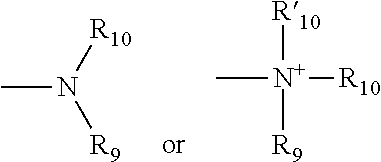
- wherein R9, R10, and R′10 each independently represent a group permitted by the rules of valence.
- The term “acylamino” is art-recognized and refers to a moiety that can be represented by the general formula:
-
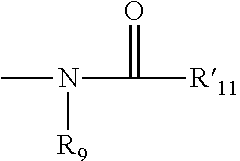
- wherein R9 is as defined above, and R′11 represents a hydrogen, an alkyl, an alkenyl or —(CH2)m—R8, where m and R8 are as defined above.
- The term “amido” is art recognized as an amino-substituted carbonyl and includes a moiety that can be represented by the general formula:
-

- wherein R9, R10 are as defined above. Preferred embodiments of the amide will not include imides which may be unstable.
- The term “alkylthio” refers to an alkyl group, as defined above, having a sulfur radical attached thereto. In preferred embodiments, the “alkylthio” moiety is represented by one of —S-alkyl, —S-alkenyl, —S-alkynyl, and —S—(CH2)8—R8, wherein m and R8 are defined above. Representative alkylthio groups include methylthio, ethyl thio, and the like.
- The term “carbonyl” is art recognized and includes such moieties as can be represented by the general formula:
-

- wherein X is a bond or represents an oxygen or a sulfur, and R11 represents a hydrogen, an alkyl, an alkenyl, —(CH2)m—R8 or a pharmaceutically acceptable salt, R′11 represents a hydrogen, an alkyl, an alkenyl or—(CH2)m—R8, where m and R8 are as defined above. Where X is an oxygen and R11 or R′11 is not hydrogen, the formula represents an “ester”. Where X is an oxygen, and R11 is as defined above, the moiety is referred to herein as a carboxyl group, and particularly when R11 is a hydrogen, the formula represents a “carboxylic acid”. Where X is an oxygen, and R′11 is hydrogen, the formula represents a “formate”. In general, where the oxygen atom of the above formula is replaced by sulfur, the formula represents a “thiolcarbonyl” group. Where X is a sulfur and R11 or R′11 is not hydrogen, the formula represents a “thiolester.” Where X is a sulfur and R11 is hydrogen, the formula represents a “thiolcarboxylic acid.” Where X is a sulfur and R′11 is hydrogen, the formula represents a “thiolformate.” On the other hand, where X is a bond, and R11 is not hydrogen, the above formula represents a “ketone” group. Where X is a bond, and R.11 is hydrogen, the above formula represents an “aldehyde” group.
- The terms “alkoxyl” or “alkoxy” as used herein refers to an alkyl group, as defined above, having an oxygen radical attached thereto. Representative alkoxyl groups include methoxy, ethoxy, propyloxy, tert-butoxy and the like. An “ether” is two hydrocarbons covalently linked by an oxygen. Accordingly, the substituent of an alkyl that renders that alkyl an ether is or resembles an alkoxyl, such as can be represented by one of —O-alkyl, —O-alkenyl, —O-alkynyl, (CH2)m—R8, where m and R8 are described above.
- The term “sulfonate” is art recognized and includes a moiety that can be represented by the general formula:
-
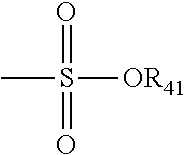
- in which R41 is an electron pair, hydrogen, alkyl, cycloalkyl, or aryl.
- The terms triflyl, tosyl, mesyl, and nonaflyl are art-recognized and refer to trifluoromethanesulfonyl, p-toluenesulfonyl, methanesulfonyl, and nonafluorobutanesulfonyl groups, respectively. The terms triflate, tosylate, mesylate, and nonaflate are art-recognized and refer to trifluoromethanesulfonate ester, p-toluenesulfonate ester, methanesulfonate ester, and nonafluorobutanesulfonate ester functional groups and molecules that contain said groups, respectively.
- The abbreviations Me, Et, Ph, Tf, Ts, Ms represent methyl, ethyl, phenyl, trifiuromethanesulfonyl, nonafluorobutanesulfonyl, p-toluenesulfonyl and methanesulfonyl, respectively. A more comprehensive list of the abbreviations utilized by organic chemists of ordinary skill in the art appears in the first issue of each volume of the Journal of Organic Chemistry; this list is typically presented in a table entitled Standard List of Abbreviations. The abbreviations contained in said list, and all abbreviations utilized by organic chemists of ordinary skill in the art are hereby incorporated by reference.
- The term “sulfate” is art recognized and includes a moiety that can be represented by the general formula:
-

- in which R41 is as defined above.
- The term “sulfonylamino” is art recognized and includes a moiety that can be represented by the formula
-

- The term “sulfamoyl” is art-recognized and includes a moiety that can be represented by
-

- The term “sulfonyl”, as used herein, refers to a moiety that can be represented by the general formula:
-

- in which R44 is selected from the group consisting of hydrogen, alkyl, alkenyl, alkynyl, cycloalkyl, heterocyclyl, aryl, or heteroaryl.
- The term “sulfoxido” as used herein, refers to a moiety that can be represented by the general formula:
-

- in which R44 is selected from the group consisting of hydrogen, alkyl, alkenyl, alkynyl, cycloalkyl, heterocyclyl, aralkyl, or aryl.
- Analogous substitutions can be made to alkenyl and alkynyl groups to produce, for example, aminoalkenyls, aminoalkynyls, amidoalkenyls, amidoalkynyls, iminoalkenyls, iminoalkynyls, thioalkynyls, thioalkynyls, carbonyl-substituted alkenyls or alkynyls.
- As used herein, the definition of each expression, e.g. alkyl, m, n, etc., when it occurs more than once in any structure, is intended to be independent of its definition elsewhere in the same structure.
- It will be understood that “substitution” or “substituted with” includes the implicit proviso that such substitution is in accordance with permitted valence of the substituted atom and the substituent, and that the substitution results in a stable compound, e.g., which does not spontaneously undergo transformation such as by rearrangement, cyclization, elimination, etc.
- As used herein, the term “substituted” is contemplated to include all permissible substituents of organic compounds. In a broad aspect, the permissible substituents include acyclic and cyclic, branched and unbranched, carbocyclic and heterocyclic, aromatic and nonaromatic substituents of organic compounds. Illustrative substituents include, for example, those described herein above. The permissible substituents can be one or more and the same or different for appropriate organic compounds. For purposes of this invention, the heteroatoms such as nitrogen may have hydrogen substituents and/or any permissible substituents of organic compounds described herein which satisfy the valences of the heteroatoms. This invention is not intended to be limited in any manner by the permissible substituents of organic compounds.
- The phrase “protecting group” as used herein means temporary substituents which protect a potentially reactive functional group from undesired chemical transformations. Examples of such protecting groups include esters of carboxylic acids, silyl ethers of alcohols, and acetals and ketals of aldehydes and ketones, respectively. The field of protecting group chemistry has been reviewed (Greene, T. W.; Wuts, P. G. M. Protective Groups in Organic Synthesis, 2.sup.nd ed.; Wiley: New York, 1991).
- Contemplated equivalents of the compounds described above include compounds which otherwise correspond thereto, and which have the same general properties thereof (e.g., functioning as analgesics), wherein one or more simple variations of substituents are made which do not adversely affect the efficacy of the compound in binding to opioid receptors. In general, the compounds of the present invention may be prepared by the methods illustrated in the general reaction schemes as, for example, described below, or by modifications thereof, using readily available starting materials, reagents and conventional synthesis procedures. In these reactions, it is also possible to make use of variants which are in themselves known, but are not mentioned here.
- For purposes of this invention, the chemical elements are identified in accordance with the Periodic Table of the Elements, CAS version, Handbook of Chemistry and Physics, 67th Ed., 1986-87, inside cover.
- Orthopedic implants coated with one or more non-leaching, antimicrobial, hydrophobic polymers particularly one or more polycationic polymers, are described herein. “Polycationic polymer”, as used herein, refers to polymers whose net charge is electropositive.
- The coated implants described herein show no evidence of leaching of the antimicrobial coating at 90 days post-op as plates coated with the antimicrobial polymer(s) exhibit the same or a similar level of antimicrobial activity compared to freshly prepared plates. In one embodiment, the coated implants described herein, when implanted in vivo, result in decreased healing times or tissue remodeling in the presence of bacterial contamination or infection compared to a control.
- A. Implants
- Implants coated with one or more hydrophobic, polycationic polymer coatings are described herein. In one embodiment, “implant” as used herein refers to a macroscopic composition including an device for implantation or a surface of a device for implantation and one or more hydrophobic, polycationic polymer coatings. In this embodiment, the term “implant” does not encompass nanoparticles and/or microparticles. “Macroscopic” as used herein generally refers to devices, implants, or compositions that can be viewed by the unaided eye.
- The implants can be formed from a variety of materials include polymers, metals, glass, ceramics, and combinations thereof.
- In one embodiment, the implant is an orthopedic implant. An “orthopedic implant” is defined as an implant which replaces bone or provides fixation to bone, replaces articulating surfaces of a joint, provides abutment for a prosthetic, or combinations thereof or assists in replacing bone or providing fixation to bone, replacing articulating surfaces of a joint, providing abutment for a prosthetic, and combinations thereof.
- Suitable orthopedic implants include, but are not limited to, wire, Kirschner wire, bone plates, screws, pins, tacs, rods, nails, nuts, bolts, washers, spikes, buttons, wires, fracture plates, reconstruction and stabilizer devices, endo- and exoprostheses (articulating and non-articulating), intraosseous transcutaneous prostheses, spacers, mesh, implant abutments, anchors, barbs, clamps, suture, interbody fusion devices, tubes of any geometry, scaffolds, and combinations thereof.
- In other embodiments, the implant is an ear, nose, and/or throat (“ENT”) implant. Exemplary ENT implants include, but are not limited to, ear tubes, endotracheal tubes, ventilation tubes, cochlear implants and bone anchored hearing devices.
- In other embodiments, the implant is a cardiovascular implant. Exemplary cardiovascular implants are cardiac valves or alloplastic vessel wall supports, total artificial heart implants, ventricular assist devices, vascular grafts, stents, electrical signal carrying devices such as pacemaker and neurological leads, defibrillator leads, and the like.
- The implant(s) can be prepared from a variety of materials. In some embodiments, the material is biocompatible. In some embodiments, the material is biocompatible and non-biodegradable. Exemplary materials include metallic materials, metal oxides, polymeric materials, including degradable and non-degradable polymeric materials, ceramics, porcelains, allogeneic, xenogenic bone or bone matrix; genetically engineered bone; and combinations thereof.
- Suitable metallic materials include, but are not limited to, metals and alloys based on titanium (such as nitinol, nickel titanium alloys, thermo-memory alloy materials), stainless steel, tantalum, pal ladium, zirconium, niobium, molybdenum, nickel-chrome, or certain cobalt alloys including cobalt-chromium and cobalt-chromium-nickel alloys such as ELGILOY® and PHYNOX®.
- Suitable ceramic materials include, but are not limited to, oxides, carbides, or nitrides of the transition elements such as titanium oxides, hafnium oxides, iridium oxides, chromium oxides, aluminum oxides, and zirconium oxides. Silicon based materials, such as silica, may also be used.
- Suitable polymeric materials include, but are not limited to, polystyrene and substituted polystyrenes, polyethylene, polypropylene, polyacetylene, polystyrene, TEFLON®, poly(vinyl chloride) (PVC), polyolefin copolymers, poly(urethane)s, polyacrylates and polymethacrylates, polyacrylamides and polymethacrylamides, polyesters, polysiloxanes, polyethers, poly(orthoester), poly(carbonates), poly(hydroxyalkanoate)s, polyfluorocarbons, PEEK®, Teflon® (polytetrafluoroethylene, PTFE), silicones, epoxy resins, Kevlar®, Dacron® (a condensation polymer obtained from ethylene glycol and terephthalic acid), nylon, polyalkenes, phenolic resins, natural and synthetic elastomers, adhesives and sealants, polyolefins, polysulfones, polyacrylonitrile, biopolymers such as polysaccharides and natural latex, collagen, cellulosic polymers (e.g., alkyl celluloses, etc.), polysaccharides, poly(glycolic acid), poly(L-lactic acid) (PLLA), a polydioxanone (PDA), or racemic poly(lactic acid), polycarbonates, (e.g., polyamides (nylon); fluoroplastics, carbon fiber, and blends or copolymers thereof.
- In one embodiment, the orthopedic implant is one designed to promote healing of any bone or bones in the mammalian skeleton in the presence of infection. The implants can be used to promote healing of large bones, such as the femur. In other embodiments, the implant is designed to restore structure, and/or function and/or to promote healing of the cardiovascular system (e.g., heart), ears, nose, and/or throat, particularly in the presence of bacterial contamination or infection.
- B. Hydrophobic Polymers
- The implants described herein are coated with an antimicrobial hydrophobic polymer. In particular embodiments, the hydrophobic polymer is a hydrophobic, polycationic polymer. The coating or the polymer in the coating is preferably non-leaching, hemocompatible, and stable in vivo, e.g., non-biodegradable for a specified period of time. The material may be non-biodegradable or may biodegrade after a certain period of time.
- In some embodiments, the hydrophobic polymer is a polycationic polymer. Suitable cationic polymers include, but are not limited to, poly(4-vinyl-N-alkylpyridinium halides), poly(methacryloyloxydidecylpyridinium halides), N-alkyl branched or linear polyethylene imine (PEI), and combinations thereof.
- Suitable poly(4-vinyl-N-alkylpyridinium halides) include polymers having the formula:
-
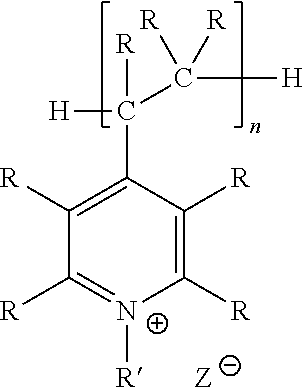
- Wherein, R represents individually for each occurrence hydrogen, alkyl, alkenyl, alkynyl, acyl, aryl, carboxylate, alkoxycarbonyl, aryloxycarbonyl, carboxamido, alkylamino, acylamino, alkoxyl, acyloxy, hydroxyalkyl, alkoxyalkyl, aminoalkyl, (alkylamino)alkyl, thio, alkylthio, thioalkyl, (alkylthio)alkyl, carbamoyl, urea, thiourea, sulfonyl, sulfonate, sulfonamido, sulfonylamino, or sulfonyloxy;
- R′ represents independently for each occurrence is substituted or unsubstituted alkyl, heteroalkyl, cycloalkyl, heterocycloalkyl, aryl, or heteroaryl; an alkylidene tether to a surface; or an acyl tether to a surface;
- Z represents independently for each occurrence Cl, Br, or I; and
- n is an integer less than or equal to about 5000, 4500, 4000, 3500, 3000, 2500, 2000, or 1500.
- In some embodiments, R′ is C4-C12, preferably C6-C12, more preferably C6-C10.
- In other embodiments, the polymer is a N,N-dialkyl branched or linear polyethylene imine (PEI) having the chemical structure shown below:
-

- wherein R and R′ are independently substituted or unsubstituted alkyl, heteroalkyl, cycloalkyl, heterocycloalkyl, aryl, or heteroaryl and n is an integer less than or equal to about 5000, 4500, 4000, 3500, 3000, 2500, 2000, or 1500.
- In some embodiments, R and R′ are the same. In other embodiments, R and are different. In particular embodiments, R and R′ are different where R is a methyl group and R′ is a C6-C25, alkyl group, preferably C6-C20, more preferably C6-C18, most preferably C8-C18. In particular embodiments, R′ is hexyl, octyl, decyl, or dodecyl. Exemplary polymers include, but are not limited to, N,N-hexyl,methyl-PEI and N,N-dodecyl,methyl-PEI. In contrast, unmodified polyethylene imine (PEI) is generally characterized as a hydrophilic polymer.
- In still other embodiments, the polymer has the structural formula:
-

- wherein each of R1-R3 are independently hydrogen or substituted or unsubstituted alkyl, heteroalkyl, cycloalkyl, heterocycloalkyl, aryl, or heteroaryl, and n is an integer less than or equal to about 5000, 4500, 4000, 3500, 3000, 2500, 2000, or 1500.
- In some embodiments, at least one of R1-R3 is an alkyl group. In one embodiment, R1 and R3 are lower alkyl, such as methyl, and R2 is at least C10-C25, preferably C15-C25, more preferably C20-C25, most preferably C22.
- In still other embodiments, the polymer has the structural formula:
-

- wherein R is as defined above and is preferably C10-C25, preferably C15-C25, more preferably C20-C25, most preferably C18, n is an integer less than or equal to about 5000, 4500, 4000, 3500, 3000, 2500, 2000, or 1500, and m is an integer from 1-10, preferably 3-10, more preferably 3-6. In some embodiments, m is 3.
- In still other embodiments, the polymer has the structural formula:
-
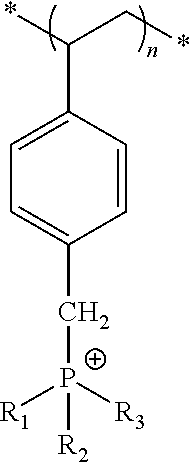
- wherein each of R1-R3 are independently as defined above for R and n is an integer less than or equal to about 5000, 4500, 4000, 3500, 3000, 2500, 2000, or 1500. In one embodiment, R1-R3 are C6-C10, preferably C8-C10, more preferably about C8.
- The polymer can be any molecular weight provided the polymer is antimicrobial, i.e., bacteriostatic and/or bacteriocidal. The polymers above generally have a weight average molecular weight of at least 10,000 g/mol, at least 20,000 g/mol, at least 25,000 g/mol, at least 40,000 g/mol, at least 50,000 g/mol, at least 60,000 g/mol, at least 75,000 g/mol, at least 90,000 g/mol, at least 100,000 g/mol, at least 120,000 g/mol, at least 150,000 g/mol, at least 200,000 g/mol, at least 250,000 g/mol, at least 400,000 g/mol, at least 500,000 g/mol, or at least 750,000 g/mol.
- The polymer can be covalently and/or non-covalently associated with the surface. In one embodiment, the polymer is non-covalently associated with the surface. Non-covalent interactions include, but are not limited to, hydrophobic interactions, hydrophilic interactions, ionic interactions, hydrogen bonding, and binding partners which interact non-covalently. The hydrophobic nature of the polymer repels water and other aqueous solvent thus preventing dissolution of the polymer from the surface of the implant.
- In some embodiments, the polymer, such as a polycationic polymer, is non-covalently associated with the surface. In other embodiments, the polymer is non-covalently adhered or attached to the surface and is applied to the surface in the absence of a polyanionic polymer (e.g., polyelectrolyte complex). The polymer composition may contain one or more additives which modify the mechanical or physical properties of the polymer, such as plasticizers.
- The coated implants exhibit antimicrobial properties and prevent biofilm formation in vivo. For example, in one embodiment, bacterial cells are sprayed onto a substrate coated with a polymer. The percentage of bacteria killed is at least 90%, 91%, 92%, 93%, 94%, 95%, 96%, 97%, 98%, 99%, or greater. The range 90-99% includes all values between 90% and 99% including integer and non-integer values.
- Immobilized amphipathic polycations described herein and soluble cationic antimicrobials likely share a similar mechanism of attacking bacteria. Polycations, such as polymyxin B and antimicrobial cationic peptides, displace the divalent cations that hold together the negatively charged surface of the lipopolysaccharide network, thereby disrupting the outer membrane of Gram-negative bacteria like P. aeruginosa and E. coli. This in itself might be sufficient for a lethal outcome. It is also possible that, having destroyed the outer membrane permeability barrier, the cationic groups of the tethered polymers further penetrate into the inner membrane, producing leakage. Such “self-promoted penetration” with the subsequent damage of the inner membrane has been described for polymyxin. The action of immobilized polycations against the Gram-positive bacteria S. aureus and S. epidermidis probably requires penetration of the cationic groups across the thick cell wall to reach the cytoplasmic membrane. Bactericidal action of amphipathic cationic antiseptics, such as benzalkonium chloride or biguanidine chlorhexidine, against Gram-positive bacteria is due primarily to the disruption of the cytoplasmic membrane. The cell wall of S. aureus is some 30 nm thick. Therefore, polymers having an average length of at least 10-20, preferably 15-20 nm should be able to penetrate the cell wall.
- The antimicrobial activity of the claimed coatings is a consequence of their polymeric composition. Hydrophobic polycationic polymers possess a combination of charge and hydrophobicity that allows them to resist, by means of electrostatic repulsion, hydrophobic interchain aggregation, and yet able to penetrate bacterial cell membranes.
- As discussed above, the polymer can be covalently or non-covalently associated with the surface. For those embodiments where the polymer is covalently associated with the surface, the polymer can be attached to the surface by functionalizing the surface with a reaction functional group, such as a nucleophilic group, and reacting the nucleophilic group with a reaction functional group on the polymer, such as an electrophilic group. Alternatively, the polymer can be functionalized with a nucleophilic group which is reacted with an electrophilic group on the substrate surface.
- In particular embodiments, the polymer is non-covalently associated with the surface. The polymer can be applied to the surface by spraying, wetting, immersing, dipping, painting, bonding or adhering or otherwise providing a surface with a compound with the hydrophobic, polycationic polymer. In one embodiment, the polymer is applied by spraying, painting, or dipping or immersing. For example, an antimicrobial paint can be prepared by dissolving the polymer in a suitable solvent, and optionally sonicating the solution to ensure the polymer is completely dissolved. The device to be coated can be immersed in the polymer solution for a suitable period of time, e.g., 5 seconds, followed by drying, such as air drying. The procedure can be repeated as many times as necessary to achieve adequate coverage. The thickness of the coating is generally from about 1 inn to about 1 cm, preferably from about 10 nm to 1 mm, more preferably from about 100 nm to about 100 microns.
- The coating can be applied at the time the implant is manufactured or can be applied subsequent to implant manufacture. In some embodiments, the coating is applied to the implant immediately prior to use of the implant. This is referred to an intraoperative coating. “Immediately prior”, as used herein, mean within 1, 2, 5, 10, 15, 20, 30, 45, 60, 75, 90, 120, 150, 180 minutes or greater of implantation. In some embodiments, the implant is coated at the hospital, e.g., in the operating room, with 20, 15, 10, or 5 minutes of implantation. Implantation immediately prior to use may overcome limitations of implants coated at the time of manufacture, such as damage of the coating during storage and/or transportation of the device and/or decrease in the efficacy of the coating over time as the coating is exposed to environmental conditions, which may be harsh (e.g., high temps, humidity, exposure to UV light, etc.).
- A variety of implants can be coated with one or more of the polymers described herein to prepare an antimicrobial surface. A schematic showing the research methodologies for evaluating the efficacy of the implants is shown in
FIG. 1 . The implants can be orthopedic or dental implants, cardiovascular implants, or ENT implants. In other embodiments, the implant is an ophthalmic implant. The implants can be implanted into a mammal, such as a human, live stock, such as cows, sheep, or horses, or domesticated animals, such as dogs or cats. Veterinarian applications are particularly important since infection is often associated with injury, particularly to hard tissue such as bone. - A. Orthopedic Implants
- The implants described herein can be used to replace bone or provide fixation to bone, replace articulating surfaces of a joint, provide abutment for a prosthetic, or combinations thereof or assist in replacing bone or providing fixation to bone, replacing articulating surfaces of a joint, providing abutment for a prosthetic, including dental applications, and combinations thereof.
- As shown in the examples below, clinical observations, digital radiography, and a battery of well-accepted ex vivo analytical methods show that the presence of a hydrophobic polycationic polymer coating, such as N,N-dodecyl,methyl-PEI coating, on the surface of a metal implant was effective in eliminating the clinical signs of infection in vivo in a large animal infection model. Moreover, the coated plates supported bone healing, and in fact decreased healing times, even in the presence of significant bacterial contamination compared to a control.
- For example, the antimicrobial efficacy of coated implants was evaluated in vitro by inoculating uncoated and coated plates with S. aureus. The surface morphology of the plates was examined by scanning electron microscopy (SEM) for evidence of bacterial biofilm formation and correlated these findings with microbiological culture results and colony counts derived from the sonicates obtained during specimen production. All inoculation wells for the N,N-dodecyl,methyl-PEI-coated plate pieces were clear and the sonicates yielded very few colonies. The polycation coated metal surfaces were largely devoid of bacteria with only occasional evidence of a cluster of a few planktonic bacteria.
- In contrast, inoculation wells for plain (uncoated) plate pieces were cloudy resulting in high colony counts from the sonicates. Cloudy wells and colony count data corroborated SEM observations where bacterial biofilm was covered with extracellular matrix that appears similar to the exopolysaccharide matrix described in other studies that assessed bacterial biofilms with SEM.
- To verify these observations in vivo, a large animal (sheep) infection model for long-bone osteosynthesis in sheep using LCPs, a commonly used method of fixation of bones to stabilize major fractures during the healing process, was used. The effects of N,N-dodecyl,methyl-PEI-coated LCPs were compared with those of the uncoated LCPs on fracture healing (with no introduced bacteria) at the macroscopic (gross morphology) and microscopic (histological) levels for a period of three months postoperative. Comparative qualitative radiographic examination and histological analysis of fracture callus architecture revealed no appreciable difference between osteotomies treated with uncoated and coated LCPs. N,N-dodecyl,methyl-PEI coatings neither negatively impacted soft or calcified tissue physiology nor altered the healing response over at least a three-month period.
- After four weeks of postoperative survival, the sheep were euthanized and operated tibiae were explanted for ex vivo analyses. No hardware failures were detected. Aseptic dissection and gross evaluation of the osteotomy region and associated soft tissues revealed stark differences between animals receiving N,N-dodecyl,methyl-PEI-coated and uncoated LCPs. Macroscopic assessment of the fracture site for the treatment cohort indicated healthy tissue recovery without evidence of infection and a uniformly bridging bony callus. In contrast, the control cohort exhibited a prevalence of infection in all animals, which is supported by positive bacterial cultures for S. aureus from the osteotomy sites. In addition, the osteotomy sites in control animals were mechanically unstable as evidenced by the persistence of the osteotomy compared to those in the treatment cohorts. Overall, the explant scores evaluating the gross appearance of the osteotomy sites, overlying fracture plates, and surrounding soft tissue envelopes were much lower for the treatment cohort than for the control group of sheep.
- Histological scoring was performed by a blinded veterinary pathologist and showed a significantly lower histology score consistent with improved bone healing and absence of infection in treatment animals, as compared to those in the control group (p=0.0002). Some of the characteristic morphological findings in the treatment groups included various degrees of osteotomy bridging consisting of woven bone (85%), islands of hyaline cartilage (10%), and fibrovascular tissue (5%). In general, inflammation was very sparse and of no significance in the treatment group. The components of cells for the treatment groups consisted of predominantly lymphocytic, plasmacytic, with some eosinophils and rare neutrophils. The main features in the control group comprised of large inflammatory aggregates of necrotic neutrophils in the medullary space, and concentrated at the plated cortex extending through fibrous tissue in the osteotomy gap. There was no endosteal callus present; this was a hallmark difference between the treatment and control groups and also correlated with the presence of osteomyelitis. There was evidence of large clusters of bacteria seen within the canaliculi and Haversian' canals of dead bone that opened to the osteotomy site.
- When comparing cohorts “treatment vs. control”, the former scored significantly lower with overall less inflammation of the soft tissue envelope, more bridging callus formation, no macroscopic evidence of purulent debris, and a macroscopically more stable osteotomy at one month. Microbiological analyses from culture swabs obtained during the aseptic tissue harvest revealed S. aureus colonies where culture swabs were positive (all control animals). Tibiae from control animals showed overt signs of infection accompanied by frank pus, necrotic tissue, destruction of cortical bone, and an unstable osteotomy site resulting in increased score values.
- SEM revealed several important observations regarding the coated implants: (1) the coated implants retained their antimicrobial activity upon re-exposure after explantation from the animals; (2) the bacterial cultures obtained at time of plate explantation were negative; and (3) the plate surfaces had only single planktonic bacteria when compared with biofilm laden control plates.
- Clinically more important, for those animals treated with the coated implant, the bone ends were fused and well on their way to healing when compared to the control cohorts where bone ends were unstable. The coated implants resulted in uncomplicated fracture healing (e.g., fusion of two bone interfaces) in the presence of bacterial contamination and/or infection. The coated implants also decreased postoperative infection rates by protecting them from serving as a host environment for bacterial colonization. This is believed to be the first report demonstrating safety and efficacy of an antimicrobial surface modification methodology in a clinically relevant large animal model. Such an observation was unexpected in view of the fact that blood proteins are typically negatively charged and therefore are expected to adsorb onto the surface due to electrostatic interactions with the polycationic polymers. This protein absorption does not prevent the coated implants described herein to prevent infection and/or biofilm formation while decreasing healing times in the presence of such infections.
- The implants described herein can be used to treat open fractures or wounds where infection is present or which are prone to infection, particular traumatic injuries, such as battlefield injuries or injuries that occur at a location which is removed from medical facilities. In such situations, treatment must be rendered immediately in order to stabilize the fracture. The conditions under which treatment is rendered are typically not sterile and so the potential for infection is high. Further, it may be some time before the patient reaches a medical facility where the wound can be closed. Therefore, the use of the implants descried herein can be used to effectively treat such injuries in the presence of infection.
- Next, we investigated if the N,N-dodecyl,methyl-PEI surface derivatization of stainless steel orthopedic hardware remained stable when exposed to conventional methods of sterilization, e.g., steam and ethylene oxide (EO) following coating of plate chip samples. When bacterial cell counts were assessed to determine the effect of either sterilization methodology, all N,N-dodecyl,methyl-PEI were found to have significantly less bacterial colonization compared to the negative controls (p=0.001). The N,N-dodecyl,methyl-PEI-steam group was less likely to have bacterial growth when compared to the N,N-dodecyl,methyl-PEI-EO group or the N,N-dodecyl,methyl-PEI-positive control groups (p=0.027). There was no significant difference in bacterial cell counts between N,N-dodecyl,methyl-PEI-EO and N,N-dodecyl,methyl-PEI-positive control groups. SEM analysis of implant surfaces revealed abundant amounts of bacterial cocci and biofilm formation on negative controls.
- SEM analysis of N,N-dodecyl,methyl-PEI inserted into equine cortical bone revealed the coating to be stripped from the cutting threads at the bone-screw interface. Bacterial colonization of N,N-dodecyl,methyl-PEI was limited to small single colony formation and the location of these cocci was restricted to the screw threads. Images of the negative controls had evidence of biofilm formation and bacterial overgrowth. These SEM findings were statistically supported by bacterial cell counts in the respective experimental groups (p=0.002).
- B. ENT Implants
- Ears, nose, and throat implants can also be coated with the polymers described herein. Tympanostomy tubes were coated with a linear N,N-dodecyl,methyl-polyethylenimine (DMPEI) to form an antimicrobial surface. Two types of commercially available tympanostomy tubes, Polyethylene POPE vent tube (PE) and Fluoroplastic Donaldson vent tube (FP) were coated in vitro with DMPEI and challenged with 104 CFU of Haemophilus influenza, Moraxella catarrhalis, and Methicillin-resistant Staphylococcus aureus (MRSA).
- Both polyethylene and fluoroplastic tubes coated in DMPEI had significantly less biofilm formation compared to the controls that were challenged with MRSA, H. influenza, and M. catarrhalis, confirmed by bacterial count and SEM. For MRSA and H. influenza, bacterial count on PE and FP tubes were less than 3×10¹³ for tubes coated with DMPEI vs. the controls having greater than 8×10¹³, p<0.005. Similar results were obtained for PE and FP tubes challenged with M. catarrhalis with significantly less bacterial growth on tubes coated with DMPEI. Qualitative evaluation by SEM confirmed near absence of biofilm formation on the DMPEI coated tubes.
- Polymer Synthesis and Coating
- All chemicals used herein, unless otherwise noted, were from Sigma-Aldrich Chemical Co. and used without further purification.
- Linear PEI was prepared by acid hydrolysis of poly(2-ethyl-2-oxazoline) as described in the literature. Subsequent N-alkylation of PEI with dodecyl and methyl moieties yielded the hydrophobic polycation N,N-dodecyl,methyl-PEI.
- To prepare the microbicidal paint, 3.0 g of this polymer was dissolved in 60 mL of butanol with a 10-min sonication. Hardware (described below) was coated by immersion in the polymer solution for 5 sec, followed by air drying; this painting procedure was repeated three times.
- Metallic Orthopedic Pins
- To scale-up and validate the aforementioned coating procedure for orthopedic hardware, two different metals were used: (1) commercially pure Titanium (cpTi) and (2) stainless steel 316L. Bone plate chips measuring approximately 1 cm by 1 cm were cut transversely from orthopedic bone plates (Locking Compression Plates (LCP); Synthes, West Chester, Pa.) using a diamond saw (EXAKT System, Norderstedt, Germany). They were divided into two groups: control (no surface modification) and treatment (coated with N,N-dodecyl,methyl-PEI) groups, with all assays run in triplicate.
- For the bacterial challenge assay, Staphylococcus aureus (ATCC 25923; this strain of S. aureus is susceptible to commonly used antimicrobials) was cultured in trypticase soy broth (TSB) with shaking at 37° C. for 16 h. A 1-mL aliquot of this culture was sub-cultured with 9 mL of fresh TSB for an additional 2 h prior to dilution to 0.5 McFarland Standard turbidity meter equivalent to 1×10⁸ colony-forming units (CFU) and then serially diluted to 1×10⁴ CFU/mL. The control and N,N-dodecyl,methyl-PEI-coated plate chips were incubated in 5 mL of 104 CFU of S. aureus for 16 h at 37° C. The medium was then removed, and plate samples were washed with TSB three times to remove loose, non-adherent bacteria prior to re-incubation for 4 h to encourage adherent bacteria to proliferate. Sonicates were cultured for microbiological analysis and colony counts were established to correlate findings from the SEM examination. For SEM, samples were washed extensively with PBS to remove loose bacteria, placed in 4% paraformaldehyde for 2 h, and dehydrated in a series of ethanol solutions in water (10-100% (v/v)) before being placed in Freon 113 until dry. The samples were sputter-coated and evaluated under the SEM at 3,000- and 5,000-fold magnifications.
- Tympanostomy Tubes
- Two types of commercially available tympanostomy tubes, Polyethylene POPE vent tube (PE) and Fluoroplastic Donaldson vent tube (FP) were coated in vitro with DMPEI and challenged with 104 CFU of Haemophilus influenza, Moraxella catarrhalis, and Methicillin-resistant Staphylococcus aureus (MRSA). Controls were the same two types of vent tubes without the DMPEI coating. Bacterial cell count and scanning electron microscopy (SEM) were performed on the controls and DMPEI coated tubes.
- Both polyethylene and fluoroplastic tubes coated in DMPEI had significantly less biofilm formation compared to the controls that were challenged with MRSA, H. influenza, and M. catarrhalis, confirmed with bacterial count and SEM. For MRSA and H. influenza, bacterial count on PE and FP tubes were less than 3×10¹³ for tubes coated with DMPEI vs. the controls having greater than 8×10¹³, p<0.005. Similar results were obtained for PE and FP tubes challenged with M. catarrhalis with significantly less bacterial growth on tubes coated with DMPEI. Qualitative evaluation by SEM confirmed near absence of biofilm formation on the DMPEI coated tubes.
- N,N-dodecyl,methyl-polyethylenimine coating on tympanostomy tubes inhibits bacterial colonization and confers protection to the tympanostomy tubes from biofilm formation. Prevention of biofilm formation may confer significant decrease in the rate of infection in a clinical setting.
- In Vivo Assays
- For the in vivo study, a total of 16 locking compression plates were used. The 92 plate coating (n=10) was performed intraoperatively under aseptic conditions. Aliquots of 1-cm plate chips from locking compression plates (n=16) were run in parallel with each surface modification intraoperatively. Using these plate samples for in vitro verification of the N,N-dodecyl,methyl-PEI coatings allowed for quality control of the coated plates used in the animal studies. These plate aliquots were processed using the protocols described above for the in vitro assays (incubated with S. aureus for 16 h, washed to remove loose non-adherent bacteria, and reincubated for another 4 h to encourage adherent bacteria to proliferate) and for preparation for SEM analysis. The cohort breakdown of animals used in this study is illustrated in
FIG. 2 . - Animal Model
- A sheep infection model for long bone plate osteosynthesis was previously developed and validated. The objective was to model and thus recapitulate the clinical signs of bone infection, such as pain, soft tissue swelling, fracture callus lysis, medullary canal resorption, and delayed bony union. Briefly, under general anesthesia, sheep underwent unilateral tibial middiaphyseal osteotomies using a medial approach. The osteotomy was repaired with an 8- or 9-hole LCP. After complete soft tissue closure, a temporary indwelling silastic catheter was inserted into the osteotomy site and inoculated with a 2.5-mL suspension of 106, 108, or 1010 colony-forming units (CFUs)/mL of S. aureus ATCC 25923. (The most commonly used staphylococcal strains in animal models of osteomyelitis include ATCC 29213, 25923, 6538P). Another objective was to develop and validate a long-bone infection model resulting in clinical-, radiographic-, gross-pathologic- and histologic signs consistent with septic osteomyelitis and thus exhibiting impaired fracture healing when compared to controls presented with radiographic-, gross-pathologic-, and histologic evidence of normal fracture healing with various degrees of bridging callus and a stable osteotomy.
- Animal Surgeries
- All animal procedures were reviewed and approved by the Institutional Animal Care and Use Committee of the University of Pennsylvania (Philadelphia, Pa.).
- The experiments were broken down into two parts: (1) evaluating the impact of N,N-dodecyl,methyl-PEI-coated bone plates on fracture healing using four skeletally mature (2.5-3.5 years) Dorset-cross ewes in an unchallenged (no bacteria) tibial osteotomy model for three months postoperative (safety study). These data were compared to historic cohort data from tibial osteotomy bone healing studies in sheep (n=4) conducted previously and the impact of the coated bone plates with that of non-modified bone plates in a bacterial challenge (infected) tibial osteotomy model using 12 skeletally mature Dorset-cross ewes for one month postoperative (efficacy study).
- Surgical Procedures
- Perioperative analgesia in all sheep consisted of flunixin meglumine (1.1 mg/kg), buprenorphine hydrochloride (0.01 mg/kg) and transdermal fentanyl patches (2.5 μg/kg). All animals received one preoperative dose of antimicrobials consisting of intravenous ceftiofur (5.0 mg/kg) and intramuscular procaine penicillin (22,000/IU). The animals were placed under general anesthesia in left lateral recumbency. The left tibia was clipped and aseptically prepared for surgery. A medial approach was used to the tibia, and a short segment of the periosteum was circumferentially elevated at the mid-diaphysis of the tibia. A unilateral mid-diaphyseal transverse tibial osteotomy was performed using a 0.6-mm oscillating bone saw (Synthes, West Chester, Pa.). The osteotomy was reduced using a 4.5-mm eight or nine hole cpTi (safety study) or stainless steel (efficacy study) narrow locking compression plate (LCP) applied over the medial aspect of the tibia. The overlying fascia and soft tissue were closed using 2-0 polyglactin 910 (Johnson and Johnson), and a sialastic 16-g catheter was incorporated into the closure at the level of the osteotomy. Stainless steel staples and cyanoacrylate tissue adhesive were used to seal the skin. Sheep enrolled in the efficacy study received 2.5 mL of 106 CFUs of S. aureus via a sialastic catheter directed onto the osteotomy site. The catheter was then removed, and a sterile dressing and bi-valve splint were placed for recovery. Immediately postoperatively all animals received fentanyl transdermal patches (2.5 μg/kg) on their left antebrachium that was secured with a single layer of elasticon. All sheep in the study were evaluated twice daily by a veterinarian for general health, comfort and appearance of the surgical site. Daily examinations of each animal by the surgical veterinary team consisted of general demeanor, appetite, physical exam, appearance of and response to palpation of the surgical site and degree of lameness in the operated leg were individually recorded.
- The four sheep enrolled in the safety arm of the study were euthanized at three months postoperative, while the twelve sheep in the efficacy arm of the study were euthanized at one month postoperative. The left hind limb was harvested at the hip joint followed by an aseptical preparation for a sterile explant procedure of the implant and the bony callus. The gross anatomical appearance of the surgical site in general and the soft tissue envelope and bone around the osteotomy site in particular were evaluated using a semi-quantitative scoring system (Table 2).
-
TABLE 2 Scoring System used for in vivo experiments Histologic Criteria Callus Formation - Periosteal Woven Bone (0% = 3; 1-30% = 2; 31-60% = 1; 61-100% = 0) Cartilage (0%-3; 1-30% = 2; 31-60% = 1; 61-100%=) Fibrovascular tissue (0% = 0; 1-30% = 1; 31-60% = 2; 61-100% = 3) Callus formation -Endosteal Woven Bone (0% = 3; 1-30% = 2; 31-60% = 1; 61-100% = 0) Cartilage (0%-3; 1-30% = 2; 31-60% = 1; 61-100% = 0) Fibrovascular tissue (0% = 0; 1-30% = 1; 31-60% = 2; 61-100% = 3) Osteotomy Bridging tissue Neutrophil infiltrate (0/−40x hpf = 0, 1/40x hpf = 1; 2/40x npf = 2; 3/40x hpf = 3; >3/40x hpf = 4) Necrotic (yes = 1, no = 0) Bone ends % absent lacunae (0% = 0; 1-30% = 1; 31-60% = 2; 61-100% = 3) Marrow Changes % Fatty tissue (0% = 3; 1-30% = 2; 31-60% = 1; 61-100% = 0) Fibrovascular tissue (0% = 0; 1-30% = 1; 31-60% = 2; 1-100% = 3) Neutrophilic inflammation (no = 0, yes = 1) Bone Lysis (at low magnification 2x) Periosteal (0% = 0; 1-30% = 1; 31-60% = 2; 61-100% = 3) Endosteal (0% = 0; 1-30% = 1; 31-60% = 2; 61-100% = 3) Osteotomy (0% = 0; 1-30% = 1; 31-60% = 2; 61-100% = 3) -
Explant Criteria (Gross-pathologic grading of osteotomy region) 3. Osteotomy after 1. Soft tissue envelope 2. Plate in situ plate removed 0 = healed 0 = no abscess 0 = bridging callus & stable 1 = inflammation 1 = micro-abscesses 1 = bridging callus& in plate holes unstable 2 = mild necrotizing 2 = abscess 2 = non-bridging inflammation covering <50% plate callus & unstable 3 = severely necrotic 3 = abscess 3 = no callus & unstable debris/devascularized covering >50% plate -
Digital Radiographic Criteria Definition Score Variable Periosteal reaction/lifting +/present 1 −/absent 0 Osteolysis +/present 1 −/absent 0 Sequestrum formation +/present 1 −/absent 0 Implant loosening +/present 1 −/absent 0 Soft tissue swelling +/present 1 −/absent 0 Callus None 3 Early callus (non-bridging) 2 Bridging callus <50% 1 >50% 0 - A sterile culture was taken from sheep which received a bacterial inoculum at the level of the osteotomy before implant removal. Then implants were removed aseptically, sectioned into 15-mm pieces using a diamond saw (EXAKT System), and samples were prepared for bacterial colony counts and SEM visualization as described in the in vitro section above. The bony callus was harvested, placed in 10% neutral buffered formalin, and fixed for calcified tissue histology.
- Hematology and Serum Chemistry
- A venous blood sample was collected for routine preoperative hematology, fibrinogen, and serum chemistry. Fibrinogen levels were analyzed using a HEMOSIL® PT1 Fibrinogen Kit (Beckman Coulter, Brea, Calif.) at weekly intervals until sacrifice of the animals.
- Imaging
- In Vivo Digital Radiography:
- Standard caudocranial and lateral radiographs (Sound-Eklin Digital X Ray, Carlsbad, Calif.) of the left tibia in the standing animal were obtained immediately postoperative and at one month intervals until sacrifice. Radiographic assessment was carried out by three blinded observers who graded the studies according to a semi-quantitative scoring system for radiographic signs of infection and evaluation of fracture healing (Table 3).
-
TABLE 3 Semi-quantitative radiographic and histological scores Stastistical Mean Score Mean Score Analysis Coated Control p-value Radiographic Scores 0.5 0 0.187 Histologic Scores 1.25 0 0.079605 N1 N2 u P(two-tail) P(one-tail) 4 4 14 0.342858 0.171429 Normal approx. 0.248214 0.124107 z = 1.1547 - Ex Vivo Micro-Computed Tomography:
- The tibias from control and treatment sheep were blocked to contain the mid-diaphyseal osteotomy site as region of interest and scanned using a Scanco80 scanner (μCT-80; Scanco Medical, Bassersdorf, Switzerland) with a voxel isotropic resolution of 50 μm, X-ray energy of 55 kVp, and current of 145 μA at medium resolution. Scan 179 time ranged from approximately 3.0 to 3.9 h per sample and accounted for 1024 projections/180 degrees and 2048 charge coupled device detector array. A calibration phantom of hydroxyapatite was used to detect variances in density and volume of the X-ray source over time. Segmented images were obtained using a Gaussian filter with a sigma=1.0, support=0.8, and threshold=300. Reconstructed 3-D images were compiled to display differences in morphology of the osteotomy site with respect to the treatment (coated hardware) and control (non-coated hardware) cohorts.
- Histology
- The tibial osteotomy region from all animals was processed for non-decalcified histology and embedded in poly(methyl methacrylate) resin. Plastic blocks were cut on a rotary microtome (Leica Microsystems, Nussloch, Germany) in the sagital plane at 5 to 8 μm, mounted, and stained. All samples were stained with hematoxylin and eosin to assess tissue morphology of the soft tissue envelope and within the osteotomy region. Toluidine blue was used to evaluate the degree of bony healing at the level of the osteotomy. Brown and Brenn stains were used to determine whether bacteria were present within the bone. Histological evaluation was performed by a blinded histopathologist analyzing callus architecture, cellular infiltration, and tissue remodeling response at three months postoperative for the safety and at one month postoperative for the efficacy studies, respectively. The degree of fracture healing was evaluated in each group using a point scale (Table 4).
-
TABLE 4 Mean radiographic-, explant-, microbiology-, and histopathology scores Mean Mean Standard Standard Statisical Score Score Error Error Analysis Treatment Control p-value Treatment Control Radio- 1.77 3.44 P = 0.0006 0.25 0.11 graphic Scores Explant 0.67 5.67 P = 0.0005 0.42 0.76 Scores Micro- 1 3 P = 0.025 0.63 0 biology Scores Histo- 0.67 5 P = 0.0007 0.33 0.51 pathology Scores - Statistics
- The safety data were derived from two groups of 4 animals each to compare the impact of N,N-dodecyl,methyl-PEI coating on fracture healing. Using an unpaired t-test, this sample size has an 80% power to detect a difference between means (coated vs. non-coated) using the semi-quantitative radiographic- and histologic scoring systems. The efficacy study data were derived from two groups of 6 animals each. Using an unpaired t-test, this sample size has a 90% power to detect a difference between the means (coated vs. uncoated) using the point scale grading systems shown in Table 2. Statistical comparisons were made where applicable with a Student's t-test with a level of significance set at p<0.05. The raw scores from subjective and objective measurements obtained by blinded observers for gross-pathology, radiography, and histology were converted to a point scale, where the lowest sum of points equaled the best possible result. Inter-observer agreement was determined, and statistical analysis was done after data conversion. A Mann-Whitney test for non-parametric data was performed where applicable.
- Results and Discussion
- In Vitro Studies
- Scaling up from the in vitro testing modality to a biologically-meaningful anatomical scale model is a pivotal step in the translation of a new orthopedic technology. Thus prior to in vivo experiments, metal chips cut from either stainless steel or titanium locking compression plates (LCPs) were used to validate the antibacterial efficacy of N,N-dodecyl,methyl-PEI coatings in vitro. Plain and polycation-coated plate pieces were inoculated with S. aureus and the antibacterial efficacy of the pieces was evaluated. Specifically, the surface morphology of the plate pieces was evaluated by SEM for evidence of bacterial biofilm and the findings were correlated with microbiological culture results and colony counts derived from the sonicates obtained during specimen preparation (
FIG. 3 ). - All inoculation wells for the N,N-dodecyl,methyl-PEI-coated plate pieces were clear, and the sonicates yielded very few colonies. Polycation-coated metal surfaces were largely devoid of bacteria with only occasional evidence of a cluster of a few planktonic bacteria. In contrast, inoculation wells for plain plate pieces were cloudy resulting in high colony counts from the sonicates. Cloudy wells and colony count data corroborated the SEM observations where bacterial biofilm was covered with extracellular matrix that appears similar to the exopolysaccharide matrix described in other studies that assessed bacterial biofilms with SEM. The quality control criteria for successfully derivatized hardware surface were met by observing bactericidal properties and lack of biofilm formation upon bacterial challenge of the coated samples. In contrast, uncoated samples were colonized by adhering bacteria, followed by biofilm formation.
- In Vivo Studies
- To verify the in vitro observations in vivo, an infection model for long-bone osteosynthesis in sheep using LCPs, a commonly used method of fixation of bones to stabilize major fractures during the healing process, was used. While no ideal model for osteomyelitis does exists, for translational purposes the animal needs to be large enough to withstand use of human orthopedic implants. It also should recapitulate a putative clinical setting, such as perioperative bacterial contamination of the surgical sites, implant colonization with biofilm and infection of surrounding tissues exhibiting an impaired fracture healing response.
- Sheep have been used as models of orthopedic infection as well as models of chronic osteomyelitis. Orthopedic models utilizing sheep and goats are well accepted because their larger bone and intra-medullary canal size allow for evaluation of fixation devices that otherwise would need to be modified for use in such smaller animals as rabbits or rats (e.g., external fixators and intramedullary nails). While there are various infection models for intramedullary nailing and external fixators, there is little information for infected internal plate fixation available. Some of the clinical signs of bone infection included: (i) radiographic signs consistent with septic osteomyelitis, (ii) local soft and hard tissue destruction and abscess formation, (iii) implant colonization and biofilm formation, and (iv) an impaired fracture healing response resulting in a delayed or non-union of the osteotomized bones.
- A refined and validated mid-diaphyseal osteotomy infection model for plate osteosynthesis in sheep was used to study the effects of coated implants in combination with existing trauma hardware. With this model, infection was consistently achieved and a resulting non-union of the osteotomized tibia in 100% of the control animals was observed.
- In the in vivo study, the practicality of the hydrophobic polycationic coating (e.g. N,N-dodecyl,methyl-PEI) for conventional trauma hardware, with particular attention to any putative detrimental effects of the coated LCPs on fracture healing with and without bacterial infection, was evaluated. A well-accepted mid-diaphyseal tibial osteotomy model in skeletally mature sheep was used. The mid-diaphyseal transverse cut across one tibia simulated long bone trauma, which was repaired with LCPs that were either uncoated or coated by immersion in a solution of the hydrophobic polycation in butanol, followed by brief drying.
- The effects of N,N-dodecyl,methyl-PEI-coated LCPs were compared with those of the uncoated ones on fracture healing (with no introduced bacteria) at the macroscopic (gross morphology) and microscopic (histological) levels for a period of three months postoperative. Converting the radiographic grading and histological analysis of fracture healing to a point scale revealed no difference between osteotomies treated with uncoated and coated LCPs (Table 3). Osteotomy repaired with a plain plate and a coated plate were compared by observing two representative sagital sections of the respective osteotomy sites at three months postoperative at a 2.5× magnification. The von Kossa staining mineralized tissue black, also emphasizes the still irregular “lacy” architecture of the newly formed woven bone in the modelling osteotomy sites. Microscopically, the gap between the osteotomized cortices was filled with newly formed bone, cartilage, and connective tissue. The arrows delineate the interface between the osteotomized cortical bone and the osteotomy gap filled with newly formed bone. Along the osteotomy margins both resorption and new bone formation could be observed, and intense modeling was seen in the adjoining cortical bone. The relative amounts of newly formed bone, cartilage, and connective tissue in the different locations varied among the animals. However, there was no difference in the spatial and temporal patterns of new bone formation between the groups (Table 3). Therefore, the N,N-dodecyl,methyl-PEI coating neither negatively impacted soft or calcified tissue physiology nor altered the healing response over at least a three-month period.
- Having established that the implanted coated LCPs have no adverse effect on fracture healing, the antimicrobial potency of the coated implants was evaluated in vivo. Coated and uncoated LCPs were applied intraoperatively under aseptic conditions in a sheep long-bone infection model. The bacterial inoculum of S. aureus, in a much greater quantity (2.5×10⁶ CFU) than would be encountered in a clinical setting, was introduced into the mid-diaphyseal tibial osteotomy site at the end of the surgical procedure. It should be noted that all surgical procedures performed were uncomplicated, and the animals recovered uneventfully from surgery and general anesthesia. Their postoperative recovery was uneventful, and all surgical sites healed without complications. The decision to administer one systemic dose of perioperative antimicrobials (ceftiofur sodium, a third generation cephalosporin) via indwelling intravenous catheter is supported by previous animal model development studies. It was observed that a single, perioperative dose of antimicrobial attenuated the clinical side-effects (high fever and lethargy) caused by the bacterial inoculum administered during surgery. However, it would not impact the infection rate at the surgical site. Animals with uncoated LCP in general exhibited more pain on palpation of their surgical sited when compared to animals treated with a coated LCP.
- Digital radiographs were obtained pre- and postoperative, as well as at time of sacrifice. Preoperative radiographs revealed no radiographic abnormalities in any of the animals, and immediate postoperative radiographs of the operated legs showed hardware to be in good order. Postoperative observations of the animals with uncoated LCPs revealed a clear trend of increased lameness on their operated leg compared to non-operated ones, supporting the clinical scenario of acute postoperative infection with its hallmark signs of soft tissue swelling, heat, and pain. Although these findings corroborate the radiographic-, gross- and histologic data, they were subjective clinical scores obtained during daily physical exams. Radiographic examinations before sacrifice at 30 days postoperative in this control group showed progressive signs of cortical thinning and disruption, periosteal reaction, and osteolysis consistent with septic osteomyelitis. By scoring these radiographic exams to standard predefined guidelines as discussed above, the results shown in
FIG. 4 indicate that the animals receiving uncoated LCPs suffered debilitating adverse effects in their recovery, while those receiving the N,N-dodecyl,methyl-PEI-coated hardware exhibited significantly improved bone healing (p=0.0006). The radiographic scores consistent with septic osteomyelitis strongly support the clinical findings of lameness due to pain in the operated leg; they are also well aligned with the ex vivo findings discussed below. - After four weeks of postoperative survival, the sheep were euthanized and operated tibiae were explanted for ex vivo analyses. No hardware failures were detected. Aseptic dissection and gross evaluation of the osteotomy region and associated soft tissues revealed stark differences between animals receiving N,N-dodecyl,methyl-PEI-coated and uncoated LCPs. Macroscopic assessment of the fracture sites for the treatment cohort indicated healthy tissue recovery without evidence of infection and a uniformly bridging bony callus. In contrast, the control cohort exhibited a prevalence of infection in all animals, which is supported by positive bacterial cultures for S. aureus from the osteotomy sites. In addition, the osteotomy sites in control animals were mechanically unstable as evidenced by the persistence of the osteotomy compared to those in the treatment cohorts, which had a bridging callus and were grossly stable. At the time of the explant, the infected tibiae of the control cohort were all presented with a lytic and disorganized callus architecture that was grossly unstable, requiring care as to not disrupt the region of interest during specimen processing. Overall, the explant scores evaluating the gross appearance of the osteotomy sites, overlying fracture plates, and surrounding soft tissue envelopes were much lower for the treatment cohort than for the control group of sheep.
- When comparing cohorts “treatment vs. control”, the former scored significantly lower with overall less inflammation of the soft tissue envelope, more bridging callus formation, no macroscopic evidence of purulent debris, and a macroscopically more stable osteotomy at one month postoperative (Table 4, p=0.0005). Microbiological analyses from culture swabs obtained during the aseptic tissue harvest revealed S. aureus colonies where culture swabs were positive (all control animals). Tibiae from control animals showed overt signs of infection accompanied by frank pus, necrotic tissue, destruction of cortical bone, and an unstable osteotomy site resulting in increased score values.
- 3-D reconstructed Micro-CT views of tibiae from sheep with coated LCPs further support the inhibition of infection on the treatment side. Cortical midshaft sections containing the osteotomy from the treatment cohort were compared to those from control animals where severe changes in the local tissue architecture were observed. As seen in the former case, there was evidence of bridging callus with early mineralization, recapitulating the processes of endochondral ossification and remodeling. Images of bone stabilized by uncoated LCPs reveal a poorly organized, lytic callus with a markedly enlarged medullary canal and cortical thinning. These findings are consistent with a septic fracture site and well aligned with our observations obtained under light microscopy evaluating callus morphology of both cohorts.
- The histological scoring performed by a blinded veterinary pathologist shows a significantly lower histology score consistent with improved bone healing and absence of infection in treatment animals, as compared to those in the control group (
FIG. 5 , p=0.0002). Some of the characteristic morphological findings in the treatment groups included various degrees of osteotomy bridging consisting of woven bone (85%), islands of hyaline cartilage (10%), and fibrovascular tissue (5%). In general, inflammation was very sparse and of no significance. The components of cells for the treatment groups consisted of predominantly lymphocytic, plasmacytic, with some eosinophils and rare neutrophils. The main features in the control group comprised of large inflammatory aggregates of necrotic neutrophils in the medullary space, and concentrated at the plated cortex extending through fibrous tissue in the osteotomy gap. There was no endosteal callus present; this was a hallmark difference between the treatment and control groups and also correlated with the presence of osteomyelitis. There was evidence of large clusters of bacteria seen within the canaliculi and Haversian' canals of dead bone that opened to the osteotomy site. - The morphological changes are equally compelling when examined at the microstructural level. Sections from both cohorts comprised of diaphyseal bi-cortical bone associated with peri- and endosteal surfaces including the medullary canal were compared after staining with toluidine blue dye. The characteristic morphological observations in the treatment group, such as osteotomy bridging, formation of hyaline cartilage islands, and fibrovascular tissue (arrow), further support our findings at the macrostructural level. This demonstrates considerable improvement over the same region from sheep receiving an uncoated LCP where evidence is seen of severe cortical lysis with pockets containing debris accompanied by suppurative inflammation and a persisting osteotomy.
- Because of the difficulty in assessing bacterial progression at the implant site during the postoperative period, the in vitro bactericidal efficacy of polycation coated stainless steel LCPs cut to a 1 cm length was validated qualitatively. Growth media incubated with uncoated LCP chips exhibited significant turbidity (indicative of bacterial growth), whereas media incubated with polycation-coated LCPs remained clear. Using these LCP chips in parallel with the LCPs applied in vivo to the tibiae during surgery, the efficacy of the coating was independently verified using SEM analysis of the plate samples for adherent bacteria and biofilm as described above. In addition, these results indicate that the in vivo observations of significantly improved healing in sheep receiving N,N-dodecyl,methyl-PEI coated LCPs are likely the result in eradication of infection at the site of implantation.
- Finally, explanted LCPs were visualized using SEM. These recovered plates were placed into sterile saline at time of necropsy until further analyses. Uncoated plates (control cohort) displayed thick carpets of sessile bacteria covered by extracellular matrix that appears similar to the exopolysaccharide matrix described in the literature. This biofilm consistently covered >95% of the plate surface in control plates. In contrast, SEM analysis of the bone plates coated with N,N-dodecyl,methyl-PEI from the treatment cohort revealed no bacterial clusters. Once the LCPs from the in vivo study were sonicated to remove the cellular debris associated with the surrounding host tissues, the painted plates exhibited a smooth machined surface with occasional rare cocci and some residual cellular debris.
- The totality of the diverse experimental evidence presented herein supports the view that painting with N,N-dodecyl,methyl-PEI protects implant surfaces from biofilm formation not only in vitro but also in vivo. It is noteworthy that the in vivo biofilm prevention occurs despite the abundance of blood proteins that can potentially block the bactericidal action of the N,N-dodecyl,methyl-PEI coating. We propose that, as in vitro, when pathogenic bacteria attempt to colonize the surface of an implanted coated bone plate, their adherence to the immobilized hydrophobic polycationic chains results in disruption of the outer cell wall and/or membrane leading to lethal structural changes and demise of the bacteria. The ensuing bacterial debris is then available to the host's immune surveillance, while the bone plate remains protected from assailing bacteria attempting to establish a recalcitrant biofilm.
- Clinical observations, digital radiography, and a battery of well-accepted ex vivo analytical methods proved that the presence of a N,N-dodecyl,methyl-PEI coating on the surface of a metal implant was effective in eliminating the clinical signs of infection in vivo in a large animal infection model. Moreover, the coated plates supported bone healing even in the presence of significant bacterial contamination and completely prevented biofilm formation. Since the experimental strategy validated herein does not lead to emergence of resistant mutants at least in vitro, it may mitigate concerns about multi-drug resistant super-bugs commonly seen in conjunction with technologies based on conventional antimicrobials. If device-associated infections covered by biofilm are the source of recalcitrant infections, then protecting hardware with a permanent coating could at least mitigate that risk. Conferring protection from pathogenic bacteria to an orthopedic implant of industrial size and geometry in vivo is promising for reducing implant-associated infections in the orthopedic patient.
Claims (24)
Priority Applications (3)
| Application Number | Priority Date | Filing Date | Title |
|---|---|---|---|
| US13/647,107 US9089407B2 (en) | 2001-04-23 | 2012-10-08 | Antibacterial coatings that inhibit biofilm formation on implants |
| US14/810,021 US20150328378A1 (en) | 2001-04-23 | 2015-07-27 | Antibacterial coatings that inhibit biofilm formation on implants |
| US15/815,522 US10500317B2 (en) | 2001-04-23 | 2017-11-16 | Antibacterial coatings that inhibit biofilm formation on implants |
Applications Claiming Priority (7)
| Application Number | Priority Date | Filing Date | Title |
|---|---|---|---|
| US28588301P | 2001-04-23 | 2001-04-23 | |
| US34007801P | 2001-12-10 | 2001-12-10 | |
| US36849502P | 2002-03-29 | 2002-03-29 | |
| US10/123,860 US7151139B2 (en) | 2001-04-23 | 2002-04-16 | Antimicrobial polymeric surfaces |
| US11/107,412 US20050249695A1 (en) | 2001-04-23 | 2005-04-14 | Antimicrobial polymeric surfaces |
| US201161543981P | 2011-10-06 | 2011-10-06 | |
| US13/647,107 US9089407B2 (en) | 2001-04-23 | 2012-10-08 | Antibacterial coatings that inhibit biofilm formation on implants |
Related Parent Applications (2)
| Application Number | Title | Priority Date | Filing Date |
|---|---|---|---|
| US11/107,412 Continuation-In-Part US20050249695A1 (en) | 2001-04-23 | 2005-04-14 | Antimicrobial polymeric surfaces |
| US11/107,415 Continuation-In-Part US20060235730A1 (en) | 2001-04-23 | 2005-04-15 | Indicating a pending content change within a benefits content system |
Related Child Applications (1)
| Application Number | Title | Priority Date | Filing Date |
|---|---|---|---|
| US14/810,021 Continuation US20150328378A1 (en) | 2001-04-23 | 2015-07-27 | Antibacterial coatings that inhibit biofilm formation on implants |
Publications (2)
| Publication Number | Publication Date |
|---|---|
| US20130110237A1 true US20130110237A1 (en) | 2013-05-02 |
| US9089407B2 US9089407B2 (en) | 2015-07-28 |
Family
ID=48173185
Family Applications (3)
| Application Number | Title | Priority Date | Filing Date |
|---|---|---|---|
| US13/647,107 Expired - Fee Related US9089407B2 (en) | 2001-04-23 | 2012-10-08 | Antibacterial coatings that inhibit biofilm formation on implants |
| US14/810,021 Abandoned US20150328378A1 (en) | 2001-04-23 | 2015-07-27 | Antibacterial coatings that inhibit biofilm formation on implants |
| US15/815,522 Active 2033-04-20 US10500317B2 (en) | 2001-04-23 | 2017-11-16 | Antibacterial coatings that inhibit biofilm formation on implants |
Family Applications After (2)
| Application Number | Title | Priority Date | Filing Date |
|---|---|---|---|
| US14/810,021 Abandoned US20150328378A1 (en) | 2001-04-23 | 2015-07-27 | Antibacterial coatings that inhibit biofilm formation on implants |
| US15/815,522 Active 2033-04-20 US10500317B2 (en) | 2001-04-23 | 2017-11-16 | Antibacterial coatings that inhibit biofilm formation on implants |
Country Status (1)
| Country | Link |
|---|---|
| US (3) | US9089407B2 (en) |
Cited By (12)
| Publication number | Priority date | Publication date | Assignee | Title |
|---|---|---|---|---|
| US20150313707A1 (en) * | 2012-04-24 | 2015-11-05 | Snu R&Db Foundation | Breast prosthesis allowing controlled release of drug and production method for same |
| US20160310175A1 (en) * | 2005-02-22 | 2016-10-27 | Tecres S.P.A. | Disposable device for treament of infections of human limbs |
| WO2016179727A1 (en) * | 2015-05-08 | 2016-11-17 | 江苏奥康尼医疗科技发展有限公司 | Orthopedic implant with polymer-wrapped metal prosthesis |
| US20170069127A1 (en) * | 2015-09-04 | 2017-03-09 | Autodesk, Inc | Techniques for approximating three-dimensional curves using foldable beams |
| EP3062734A4 (en) * | 2013-11-01 | 2017-06-14 | Medintal Ltd. | Sub-periosteal extension for a dental implant |
| WO2017151714A1 (en) * | 2016-03-01 | 2017-09-08 | Mayo Foundation For Medical Education And Research | System and method for reinforced polymer composites in medical devices and instrumentation |
| WO2017176807A3 (en) * | 2016-04-04 | 2018-04-12 | University Of Virginia Patent Foundation | Compositions for inhibiting formation of and/or disrupting bacterial biofilms and methods of use therefor |
| KR20180059863A (en) * | 2015-09-25 | 2018-06-05 | 스파이록스 인코포레이티드 | Nasal implants and systems and methods of use |
| WO2019008192A1 (en) * | 2017-07-07 | 2019-01-10 | Drei Lilien Pvg Gmbh & Co. Kg | BIORESORBABLE SURFACE COATING FOR DEGRADATION DELAY |
| CZ307777B6 (en) * | 2018-02-27 | 2019-04-24 | Prospon, Spol. S R.O. | Antibacterial photocatalytic-effect coating of implants and its surface formation |
| WO2020242315A1 (en) | 2019-05-31 | 2020-12-03 | Zorg Innovaties Nederland B.V. | Means and methods for providing a substrate with a biocidal coating, and coated substrates obtainable thereby. |
| KR20220103539A (en) * | 2021-01-15 | 2022-07-22 | 한스바이오메드 주식회사 | Breast implant having hydrophilic surface |
Families Citing this family (11)
| Publication number | Priority date | Publication date | Assignee | Title |
|---|---|---|---|---|
| US9089407B2 (en) | 2001-04-23 | 2015-07-28 | Massachusetts Institute Of Technology | Antibacterial coatings that inhibit biofilm formation on implants |
| US11124609B2 (en) | 2016-08-05 | 2021-09-21 | Seabourne Solutions, Llc | Polymeric coatings for metal surfaces |
| US10238110B2 (en) | 2016-11-29 | 2019-03-26 | Houssam BOULOUSSA | Ready-to-use storable methanolic solution of a biocompatible and biocidal polyvinylpyridine polymer |
| US10563069B2 (en) | 2017-03-30 | 2020-02-18 | International Business Machines Corporation | Prevention of biofilm formation |
| US10507267B2 (en) | 2017-04-25 | 2019-12-17 | International Business Machines Corporation | Highly hydrophobic antifouling coatings for implantable medical devices |
| US10745586B2 (en) | 2017-08-08 | 2020-08-18 | International Business Machines Corporation | Fluorinated networks for anti-fouling surfaces |
| US10696849B2 (en) | 2017-08-08 | 2020-06-30 | International Business Machines Corporation | Tailorable surface topology for antifouling coatings |
| CN115297908B (en) | 2020-01-17 | 2024-04-19 | 韦恩视野有限责任公司 | Antimicrobial Silicone |
| FR3125960B1 (en) | 2021-08-08 | 2024-06-21 | Tanimura Remy | CONNECTION DEVICE AND CONNECTION SYSTEM FOR DENTAL RECONSTRUCTION ON IMPLANT, DENTAL RECONSTRUCTION ON IMPLANT, METHOD FOR PERFORMING DENTAL RECONSTRUCTION ON IMPLANT |
| KR20240041945A (en) | 2021-08-08 | 2024-04-01 | 아쥐스뜨 에스에이알엘 | Connection device and connection system for tooth restoration on implants, tooth restoration on implants and method for performing tooth restoration on implants |
| US12064156B2 (en) | 2023-01-09 | 2024-08-20 | John F. Krumme | Dynamic compression fixation devices |
Citations (3)
| Publication number | Priority date | Publication date | Assignee | Title |
|---|---|---|---|---|
| US5853745A (en) * | 1995-11-08 | 1998-12-29 | Baylor College Of Medicine | Medical implant having a durable, resilient and effective antimicrobial coating |
| US20050003163A1 (en) * | 2003-07-03 | 2005-01-06 | Venkataram Krishnan | Antimicrobial and antistatic polymers and methods of using such polymers on various substrates |
| US20050271780A1 (en) * | 2000-04-13 | 2005-12-08 | Schroeder Joseph D | Method of preserving food using antimicrobial packaging |
Family Cites Families (57)
| Publication number | Priority date | Publication date | Assignee | Title |
|---|---|---|---|---|
| US3868340A (en) | 1972-04-13 | 1975-02-25 | Warner Lambert Co | Denture adhesive preparation |
| US4460747A (en) | 1979-04-05 | 1984-07-17 | The University Of Utah | Surface modified polymers |
| US4404196A (en) | 1979-09-24 | 1983-09-13 | Dow Corning Corporation | Antimicrobial ointment |
| US4327073A (en) | 1980-04-07 | 1982-04-27 | Huang Henry V | Automated method for quantitative analysis of biological fluids |
| US4511677A (en) | 1983-11-02 | 1985-04-16 | Phillips Petroleum Company | Ion exchange-active compositions consisting of water-soluble polyelectrolyte upon ion exchange functional substrate |
| US4542125A (en) | 1984-03-23 | 1985-09-17 | Sterling Drug Inc. | Antimicrobial surface degerming compositions and method of use thereof |
| DE3700727A1 (en) | 1987-01-13 | 1988-07-21 | Agfa Gevaert Ag | COVER COATING PROCEDURE |
| US4867898A (en) | 1987-03-23 | 1989-09-19 | American Cyanamid Company | Broad spectrum antimicrobial system for hard surface cleaners |
| US5100689A (en) | 1987-04-10 | 1992-03-31 | University Of Florida | Surface modified surgical instruments, devices, implants, contact lenses and the like |
| US4888434A (en) | 1987-05-26 | 1989-12-19 | Dow Corning K.K. | Antimicrobial agent |
| US4898957A (en) | 1988-04-18 | 1990-02-06 | Dow Corning Corporation | Organosilicon diamine antimicrobial compound |
| US4933327A (en) | 1988-04-18 | 1990-06-12 | Dow Corning Corporation | Organosilicon quaternary ammonium antimicrobial compounds |
| US4866192A (en) | 1988-04-18 | 1989-09-12 | Dow Corning Corporation | Organosilicon quaternary ammonium antimicrobial compounds |
| US4847088A (en) | 1988-04-28 | 1989-07-11 | Dow Corning Corporation | Synergistic antimicrobial composition |
| US4985023A (en) | 1988-05-09 | 1991-01-15 | Dow Corning Corporation | Antimicrobial superabsorbent articles |
| US4990338A (en) | 1988-05-09 | 1991-02-05 | Dow Corning Corporation | Antimicrobial superabsorbent compositions and methods |
| US5061487A (en) | 1988-05-09 | 1991-10-29 | Dow Corning Corporation | Antimicrobial superabsorbent compositions and methods |
| US5035892A (en) | 1988-05-09 | 1991-07-30 | Dow Corning Corporation | Antimicrobial superabsorbent compositions and methods |
| US5045322A (en) | 1988-05-09 | 1991-09-03 | Dow Corning Corporation | Antimicrobial superabsorbent sanitary napkin |
| US5126138A (en) | 1988-07-19 | 1992-06-30 | Dow Corning Corporation | Antimicrobial flourochemically treated plastic (nylon) surfaces |
| US5169561A (en) | 1988-07-20 | 1992-12-08 | Dow Corning Corporation | Antimicrobial antifoam compositions and methods |
| US5073298A (en) | 1988-07-20 | 1991-12-17 | Dow Corning Corporation | Antimicrobial antifoam compositions and methods |
| US4921701A (en) | 1988-08-11 | 1990-05-01 | Dow Corning Corporation | Antimicrobial water soluble substrates |
| US5169625A (en) | 1988-08-11 | 1992-12-08 | Dow Corning Corporation | Antimicrobial water soluble substrates |
| US5356929A (en) | 1989-01-23 | 1994-10-18 | Lehigh University | Reduced and quaternized psoralens as photo-activated therapeutics |
| US5216176A (en) | 1989-01-23 | 1993-06-01 | Lehigh University | 7-alkoxycoumarins, dihydropsoralens, and benzodipyranones as photo-activated therapeutic agents and inhibitors of epidermal growth factor |
| US5573801A (en) | 1989-02-21 | 1996-11-12 | Viskase Corporation | Surface treatment of foodstuffs with antimicrobial compositions |
| US5573800A (en) | 1989-02-21 | 1996-11-12 | Viskase Corporation | Antimicrobial composition for surface treatment of foodstuffs |
| US5573797A (en) | 1989-02-21 | 1996-11-12 | Viskase Corporation | Film and method for surface treatment of foodstuffs with antimicrobial compositions |
| US5112903A (en) | 1989-07-04 | 1992-05-12 | Sanyo Chemical Industries, Ltd. | Articles molded from moisture shrinkable resins |
| US5145596A (en) | 1989-08-07 | 1992-09-08 | Dow Corning Corporation | Antimicrobial rinse cycle additive |
| US5064613A (en) | 1989-11-03 | 1991-11-12 | Dow Corning Corporation | Solid antimicrobial |
| JPH0639368B2 (en) | 1990-02-28 | 1994-05-25 | 株式会社萩原技研 | Antibacterial organism based on silica gel |
| US5079004A (en) | 1990-08-06 | 1992-01-07 | Dow Corning Corporation | Antimicrobial superabsorbent compositions and method |
| DE69126972T2 (en) | 1990-11-29 | 1997-11-27 | Iatron Lab | USE OF AN ANTIBACTERIAL ACTIVE SUBSTANCE CONTAINING A POLYELECTROLYTE COMPLEX AND ANTIBACTERIAL MATERIAL |
| US5520664A (en) | 1991-03-01 | 1996-05-28 | Spire Corporation | Catheter having a long-lasting antimicrobial surface treatment |
| US5716709A (en) | 1994-07-14 | 1998-02-10 | Competitive Technologies, Inc. | Multilayered nanostructures comprising alternating organic and inorganic ionic layers |
| NZ280128A (en) | 1994-10-07 | 1997-07-27 | Kuraray Co | Antimicrobial adhesive composition for dental use comprising antimicrobial polymerizable monomer |
| US5656611A (en) | 1994-11-18 | 1997-08-12 | Supratek Pharma Inc. | Polynucleotide compositions |
| US5700559A (en) | 1994-12-16 | 1997-12-23 | Advanced Surface Technology | Durable hydrophilic surface coatings |
| US5783502A (en) | 1995-06-07 | 1998-07-21 | Bsi Corporation | Virus inactivating coatings |
| US6013615A (en) | 1995-07-26 | 2000-01-11 | The Clorox Company | Antimicrobial hard surface cleaner |
| US5674513A (en) | 1996-02-20 | 1997-10-07 | Viro-Kote, Inc. | Anti-bacterial/anti-viral coatings, coating process and parameters thereof |
| DE19608555A1 (en) | 1996-03-06 | 1997-09-11 | Basf Ag | Use of polymers as a biocide |
| US6033719A (en) | 1996-04-25 | 2000-03-07 | Medtronic, Inc. | Method for covalent attachment of biomolecules to surfaces of medical devices |
| DE19716606A1 (en) | 1997-04-21 | 1998-10-22 | Huels Chemische Werke Ag | Bacteria-repellent and blood-compatible modified surfaces |
| US5861149A (en) | 1997-06-04 | 1999-01-19 | Polyheal Ltd. | Methods for wound treatment |
| CN1262183C (en) | 1997-10-20 | 2006-07-05 | 萧炎昆 | Porous shaping article for removing harmful microorganism and making method thereof |
| US6428814B1 (en) | 1999-10-08 | 2002-08-06 | Elan Pharma International Ltd. | Bioadhesive nanoparticulate compositions having cationic surface stabilizers |
| US6326083B1 (en) | 1999-03-08 | 2001-12-04 | Calipher Technologies Corp. | Surface coating for microfluidic devices that incorporate a biopolymer resistant moiety |
| DE19921894A1 (en) | 1999-05-12 | 2000-11-16 | Creavis Tech & Innovation Gmbh | Production of antimicrobial coatings on polymer substrates, e.g. hygiene products and medical articles, involves immobilizing antimicrobial polymer on the substrate surface, e.g. by plasma treatment |
| TR200200141T2 (en) | 1999-07-21 | 2002-05-21 | The Procter & Gamble Company | Microorganism filter and method for removing microorganisms from water. |
| US7151139B2 (en) | 2001-04-23 | 2006-12-19 | Massachusetts Institute Of Technology | Antimicrobial polymeric surfaces |
| US9089407B2 (en) | 2001-04-23 | 2015-07-28 | Massachusetts Institute Of Technology | Antibacterial coatings that inhibit biofilm formation on implants |
| US7381715B2 (en) | 2001-12-21 | 2008-06-03 | E.I. Du Pont De Nemours And Company | Antimicrobial solid surface materials containing chitosan-metal complexes |
| US6939554B2 (en) | 2002-02-05 | 2005-09-06 | Michigan Biotechnology Institute | Antimicrobial polymer |
| DE602005015564D1 (en) | 2004-04-06 | 2009-09-03 | Surmodics Inc | COATING COMPOSITIONS FOR BIOACTIVE AGENTS |
-
2012
- 2012-10-08 US US13/647,107 patent/US9089407B2/en not_active Expired - Fee Related
-
2015
- 2015-07-27 US US14/810,021 patent/US20150328378A1/en not_active Abandoned
-
2017
- 2017-11-16 US US15/815,522 patent/US10500317B2/en active Active
Patent Citations (3)
| Publication number | Priority date | Publication date | Assignee | Title |
|---|---|---|---|---|
| US5853745A (en) * | 1995-11-08 | 1998-12-29 | Baylor College Of Medicine | Medical implant having a durable, resilient and effective antimicrobial coating |
| US20050271780A1 (en) * | 2000-04-13 | 2005-12-08 | Schroeder Joseph D | Method of preserving food using antimicrobial packaging |
| US20050003163A1 (en) * | 2003-07-03 | 2005-01-06 | Venkataram Krishnan | Antimicrobial and antistatic polymers and methods of using such polymers on various substrates |
Non-Patent Citations (1)
| Title |
|---|
| Nebojsˇa M. Milovic et al. "Immobilized N-Alkylated PolyethylenimineAvidly Kills Bacteria by Rupturing CellMembranes With No Resistance Developed" March 31, 2005, Wiley InterScience (www.interscience.wiley.com): BIOTECHNOLOGY AND BIOENGINEERING, VOL. 90, NO. 6, JUNE 20, 2005 p. 715-722 * |
Cited By (18)
| Publication number | Priority date | Publication date | Assignee | Title |
|---|---|---|---|---|
| US10952779B2 (en) * | 2005-02-22 | 2021-03-23 | Tecres S.P.A. | Disposable device for treatment of infections of human limbs |
| US20160310175A1 (en) * | 2005-02-22 | 2016-10-27 | Tecres S.P.A. | Disposable device for treament of infections of human limbs |
| US9642697B2 (en) * | 2012-04-24 | 2017-05-09 | Snu R&Db Foundation | Breast prosthesis allowing controlled release of drug and production method for same |
| US20150313707A1 (en) * | 2012-04-24 | 2015-11-05 | Snu R&Db Foundation | Breast prosthesis allowing controlled release of drug and production method for same |
| EP3062734A4 (en) * | 2013-11-01 | 2017-06-14 | Medintal Ltd. | Sub-periosteal extension for a dental implant |
| WO2016179727A1 (en) * | 2015-05-08 | 2016-11-17 | 江苏奥康尼医疗科技发展有限公司 | Orthopedic implant with polymer-wrapped metal prosthesis |
| US20170069127A1 (en) * | 2015-09-04 | 2017-03-09 | Autodesk, Inc | Techniques for approximating three-dimensional curves using foldable beams |
| US9916683B2 (en) * | 2015-09-04 | 2018-03-13 | Autodesk, Inc. | Techniques for approximating three-dimensional curves using foldable beams |
| KR20180059863A (en) * | 2015-09-25 | 2018-06-05 | 스파이록스 인코포레이티드 | Nasal implants and systems and methods of use |
| KR102755866B1 (en) * | 2015-09-25 | 2025-01-17 | 스트리커 코포레이션 | Nose Implant |
| WO2017151714A1 (en) * | 2016-03-01 | 2017-09-08 | Mayo Foundation For Medical Education And Research | System and method for reinforced polymer composites in medical devices and instrumentation |
| WO2017176807A3 (en) * | 2016-04-04 | 2018-04-12 | University Of Virginia Patent Foundation | Compositions for inhibiting formation of and/or disrupting bacterial biofilms and methods of use therefor |
| US11207378B2 (en) | 2016-04-04 | 2021-12-28 | University Of Virginia Patent Foundation | Compositions for inhibiting formation of and/or disrupting bacterial biofilms and methods of use therefor |
| WO2019008192A1 (en) * | 2017-07-07 | 2019-01-10 | Drei Lilien Pvg Gmbh & Co. Kg | BIORESORBABLE SURFACE COATING FOR DEGRADATION DELAY |
| CZ307777B6 (en) * | 2018-02-27 | 2019-04-24 | Prospon, Spol. S R.O. | Antibacterial photocatalytic-effect coating of implants and its surface formation |
| WO2020242315A1 (en) | 2019-05-31 | 2020-12-03 | Zorg Innovaties Nederland B.V. | Means and methods for providing a substrate with a biocidal coating, and coated substrates obtainable thereby. |
| KR20220103539A (en) * | 2021-01-15 | 2022-07-22 | 한스바이오메드 주식회사 | Breast implant having hydrophilic surface |
| KR102763216B1 (en) * | 2021-01-15 | 2025-02-07 | 한스바이오메드 주식회사 | Breast implant having hydrophilic surface |
Also Published As
| Publication number | Publication date |
|---|---|
| US20150328378A1 (en) | 2015-11-19 |
| US10500317B2 (en) | 2019-12-10 |
| US20180078682A1 (en) | 2018-03-22 |
| US9089407B2 (en) | 2015-07-28 |
Similar Documents
| Publication | Publication Date | Title |
|---|---|---|
| US10500317B2 (en) | Antibacterial coatings that inhibit biofilm formation on implants | |
| Schaer et al. | Hydrophobic polycationic coatings that inhibit biofilms and support bone healing during infection | |
| Calabrese et al. | A new Ag-nanostructured hydroxyapatite porous scaffold: Antibacterial effect and cytotoxicity study | |
| Cheng et al. | Long‐lasting in vivo and in vitro antibacterial ability of nanostructured titania coating incorporated with silver nanoparticles | |
| Ständert et al. | Antibiotic-loaded amphora-shaped pores on a titanium implant surface enhance osteointegration and prevent infections | |
| Neut | A biodegradable gentamicin-hydroxyapatite-coating for infection prophylaxis in cementless hip prostheses | |
| US7151139B2 (en) | Antimicrobial polymeric surfaces | |
| CN101460201A (en) | Polymer matrix, use thereof and method for producing the polymer matrix | |
| JP2017508565A (en) | Antibacterial articles manufactured by the additive manufacturing method | |
| Shapiro et al. | Molecular engineering of an orthopaedic implant: from bench to bedside | |
| KR20130045836A (en) | Biofilm resistant materials | |
| RU2532345C2 (en) | Tissue regeneration membrane | |
| Shiels et al. | Chlorhexidine-releasing implant coating on intramedullary nail reduces infection in a rat model | |
| Shevtsov et al. | Protecting the skin‐implant interface with transcutaneous silver‐coated skin‐and‐bone‐integrated pylon in pig and rabbit dorsum models | |
| Gaetano et al. | Hyaluronic-based antibacterial hydrogel coating for implantable biomaterials in orthopedics and trauma: from basic research to clinical applications | |
| Sun et al. | Vancomycin-loaded in situ gelled hydrogel as an antibacterial system for enhancing repair of infected bone defects | |
| Tang et al. | Incorporation of magnesium and zinc metallic particles in PLGA Bi-layered membranes with sequential ion release for guided bone regeneration | |
| Wheelis et al. | Investigation of the early healing response to dicationic imidazolium-based ionic liquids: a biocompatible coating for titanium implants | |
| Oh et al. | Prolonged anti-bacterial activity of ion-complexed doxycycline for the treatment of osteomyelitis | |
| Kong et al. | Current Advances of Antibacterial Biomaterials for Bone Regeneration | |
| EP1390158A1 (en) | Antimicrobial polymeric surfaces | |
| Sulej-Chojnacka et al. | The effect of hydroxyapatite coating with silver nanoparticles on osseointegration of titanium implants | |
| Mahmood et al. | In Vivo evaluation of the novel nanocomposite porous 3D scaffold in a rabbit model: hematology and biochemistry analysis | |
| He et al. | Fabrication and characterization of an anti-corrosion/infection VAN@ PLGA/HA/CMCS composite coating on magnesium alloy | |
| Kühn | Antimicrobial implant coating |
Legal Events
| Date | Code | Title | Description |
|---|---|---|---|
| AS | Assignment |
Owner name: THE TRUSTEES OF THE UNIVERSITY OF PENNSYLVANIA, PE Free format text: ASSIGNMENT OF ASSIGNORS INTEREST;ASSIGNORS:SCHAER, THOMAS P.;STEWART, SUZANNE;SIGNING DATES FROM 20130205 TO 20130724;REEL/FRAME:031477/0518 Owner name: MASSACHUSETTS INSTITUTE OF TECHNOLOGY, MASSACHUSET Free format text: ASSIGNMENT OF ASSIGNORS INTEREST;ASSIGNOR:KLIBANOV, ALEXANDER M.;REEL/FRAME:031477/0491 Effective date: 20130211 |
|
| FEPP | Fee payment procedure |
Free format text: PAYOR NUMBER ASSIGNED (ORIGINAL EVENT CODE: ASPN); ENTITY STATUS OF PATENT OWNER: LARGE ENTITY |
|
| AS | Assignment |
Owner name: BEHLAU, IRMGARD, MASSACHUSETTS Free format text: ASSIGNMENT OF ASSIGNORS INTEREST;ASSIGNOR:MASSACHUSETTS EYE AND EAR INFIRMARY;REEL/FRAME:034676/0346 Effective date: 20141118 |
|
| STCF | Information on status: patent grant |
Free format text: PATENTED CASE |
|
| CC | Certificate of correction | ||
| MAFP | Maintenance fee payment |
Free format text: PAYMENT OF MAINTENANCE FEE, 4TH YEAR, LARGE ENTITY (ORIGINAL EVENT CODE: M1551); ENTITY STATUS OF PATENT OWNER: LARGE ENTITY Year of fee payment: 4 |
|
| FEPP | Fee payment procedure |
Free format text: MAINTENANCE FEE REMINDER MAILED (ORIGINAL EVENT CODE: REM.); ENTITY STATUS OF PATENT OWNER: LARGE ENTITY |
|
| LAPS | Lapse for failure to pay maintenance fees |
Free format text: PATENT EXPIRED FOR FAILURE TO PAY MAINTENANCE FEES (ORIGINAL EVENT CODE: EXP.); ENTITY STATUS OF PATENT OWNER: LARGE ENTITY |
|
| STCH | Information on status: patent discontinuation |
Free format text: PATENT EXPIRED DUE TO NONPAYMENT OF MAINTENANCE FEES UNDER 37 CFR 1.362 |
|
| FP | Lapsed due to failure to pay maintenance fee |
Effective date: 20230728 |