US20130066128A1 - Novel nickel-based catalytic composition and method of oligomerization of olefins using said composition - Google Patents
Novel nickel-based catalytic composition and method of oligomerization of olefins using said composition Download PDFInfo
- Publication number
- US20130066128A1 US20130066128A1 US13/604,038 US201213604038A US2013066128A1 US 20130066128 A1 US20130066128 A1 US 20130066128A1 US 201213604038 A US201213604038 A US 201213604038A US 2013066128 A1 US2013066128 A1 US 2013066128A1
- Authority
- US
- United States
- Prior art keywords
- nickel
- catalytic composition
- composition according
- chosen
- ethylene
- Prior art date
- Legal status (The legal status is an assumption and is not a legal conclusion. Google has not performed a legal analysis and makes no representation as to the accuracy of the status listed.)
- Granted
Links
- PXHVJJICTQNCMI-UHFFFAOYSA-N Nickel Chemical compound [Ni] PXHVJJICTQNCMI-UHFFFAOYSA-N 0.000 title claims abstract description 87
- 239000000203 mixture Substances 0.000 title claims abstract description 60
- 238000000034 method Methods 0.000 title claims abstract description 57
- 230000003197 catalytic effect Effects 0.000 title claims abstract description 48
- 229910052759 nickel Inorganic materials 0.000 title claims abstract description 41
- 238000006384 oligomerization reaction Methods 0.000 title claims abstract description 28
- 150000001336 alkenes Chemical class 0.000 title claims abstract description 25
- 239000003446 ligand Substances 0.000 claims abstract description 46
- 239000002243 precursor Substances 0.000 claims abstract description 15
- PFRDRCIPKPEULG-UHFFFAOYSA-N imidazol-2-imine Chemical compound N=C1N=CC=N1 PFRDRCIPKPEULG-UHFFFAOYSA-N 0.000 claims abstract description 8
- VGGSQFUCUMXWEO-UHFFFAOYSA-N Ethene Chemical compound C=C VGGSQFUCUMXWEO-UHFFFAOYSA-N 0.000 claims description 30
- 239000005977 Ethylene Substances 0.000 claims description 30
- -1 nickel(II) carboxylates Chemical class 0.000 claims description 21
- 230000003213 activating effect Effects 0.000 claims description 18
- 239000003795 chemical substances by application Substances 0.000 claims description 18
- 238000006471 dimerization reaction Methods 0.000 claims description 18
- 125000003118 aryl group Chemical group 0.000 claims description 17
- 239000002904 solvent Substances 0.000 claims description 15
- 125000004432 carbon atom Chemical group C* 0.000 claims description 11
- 150000001875 compounds Chemical class 0.000 claims description 10
- 125000004435 hydrogen atom Chemical group [H]* 0.000 claims description 10
- 125000000217 alkyl group Chemical group 0.000 claims description 7
- 150000001412 amines Chemical class 0.000 claims description 7
- IJGRMHOSHXDMSA-UHFFFAOYSA-N Atomic nitrogen Chemical compound N#N IJGRMHOSHXDMSA-UHFFFAOYSA-N 0.000 claims description 6
- 125000002496 methyl group Chemical group [H]C([H])([H])* 0.000 claims description 6
- XTHFKEDIFFGKHM-UHFFFAOYSA-N Dimethoxyethane Chemical compound COCCOC XTHFKEDIFFGKHM-UHFFFAOYSA-N 0.000 claims description 5
- 229910021586 Nickel(II) chloride Inorganic materials 0.000 claims description 5
- 239000007983 Tris buffer Substances 0.000 claims description 5
- 125000001931 aliphatic group Chemical group 0.000 claims description 5
- 125000004122 cyclic group Chemical group 0.000 claims description 5
- QMMRZOWCJAIUJA-UHFFFAOYSA-L nickel dichloride Chemical compound Cl[Ni]Cl QMMRZOWCJAIUJA-UHFFFAOYSA-L 0.000 claims description 5
- 125000002030 1,2-phenylene group Chemical group [H]C1=C([H])C([*:1])=C([*:2])C([H])=C1[H] 0.000 claims description 4
- RTZKZFJDLAIYFH-UHFFFAOYSA-N Diethyl ether Chemical compound CCOCC RTZKZFJDLAIYFH-UHFFFAOYSA-N 0.000 claims description 4
- 229910021585 Nickel(II) bromide Inorganic materials 0.000 claims description 4
- XYFCBTPGUUZFHI-UHFFFAOYSA-N Phosphine Chemical compound P XYFCBTPGUUZFHI-UHFFFAOYSA-N 0.000 claims description 4
- NINIDFKCEFEMDL-UHFFFAOYSA-N Sulfur Chemical compound [S] NINIDFKCEFEMDL-UHFFFAOYSA-N 0.000 claims description 4
- 239000005864 Sulphur Substances 0.000 claims description 4
- ZUOUZKKEUPVFJK-UHFFFAOYSA-N diphenyl Chemical group C1=CC=CC=C1C1=CC=CC=C1 ZUOUZKKEUPVFJK-UHFFFAOYSA-N 0.000 claims description 4
- 125000001495 ethyl group Chemical group [H]C([H])([H])C([H])([H])* 0.000 claims description 4
- 150000002430 hydrocarbons Chemical group 0.000 claims description 4
- 239000001257 hydrogen Substances 0.000 claims description 4
- 229910052739 hydrogen Inorganic materials 0.000 claims description 4
- IPLJNQFXJUCRNH-UHFFFAOYSA-L nickel(2+);dibromide Chemical compound [Ni+2].[Br-].[Br-] IPLJNQFXJUCRNH-UHFFFAOYSA-L 0.000 claims description 4
- 229910052757 nitrogen Inorganic materials 0.000 claims description 4
- 150000002894 organic compounds Chemical class 0.000 claims description 4
- 229910052760 oxygen Inorganic materials 0.000 claims description 4
- 239000001301 oxygen Substances 0.000 claims description 4
- 125000001997 phenyl group Chemical group [H]C1=C([H])C([H])=C(*)C([H])=C1[H] 0.000 claims description 4
- 125000004437 phosphorous atom Chemical group 0.000 claims description 4
- HVLLSGMXQDNUAL-UHFFFAOYSA-N triphenyl phosphite Chemical compound C=1C=CC=CC=1OP(OC=1C=CC=CC=1)OC1=CC=CC=C1 HVLLSGMXQDNUAL-UHFFFAOYSA-N 0.000 claims description 4
- 125000002877 alkyl aryl group Chemical group 0.000 claims description 3
- 125000003710 aryl alkyl group Chemical group 0.000 claims description 3
- 239000001273 butane Substances 0.000 claims description 3
- 125000001183 hydrocarbyl group Chemical group 0.000 claims description 3
- 229910052698 phosphorus Chemical group 0.000 claims description 3
- YBMAWNCLJNNCMV-BUOKYLHBSA-L (e)-1,1,1,5,5,5-hexafluoro-4-oxopent-2-en-2-olate;nickel(2+) Chemical compound [Ni+2].FC(F)(F)C(/[O-])=C\C(=O)C(F)(F)F.FC(F)(F)C(/[O-])=C\C(=O)C(F)(F)F YBMAWNCLJNNCMV-BUOKYLHBSA-L 0.000 claims description 2
- ZDZHCHYQNPQSGG-UHFFFAOYSA-N 1-naphthalen-1-ylnaphthalene Chemical group C1=CC=C2C(C=3C4=CC=CC=C4C=CC=3)=CC=CC2=C1 ZDZHCHYQNPQSGG-UHFFFAOYSA-N 0.000 claims description 2
- OBETXYAYXDNJHR-UHFFFAOYSA-N 2-Ethylhexanoic acid Chemical compound CCCCC(CC)C(O)=O OBETXYAYXDNJHR-UHFFFAOYSA-N 0.000 claims description 2
- OZHLXQFAHIYYDJ-UHFFFAOYSA-L 2-hydroxyacetate;nickel(2+) Chemical compound [Ni+2].OCC([O-])=O.OCC([O-])=O OZHLXQFAHIYYDJ-UHFFFAOYSA-L 0.000 claims description 2
- CPELXLSAUQHCOX-UHFFFAOYSA-M Bromide Chemical compound [Br-] CPELXLSAUQHCOX-UHFFFAOYSA-M 0.000 claims description 2
- VEXZGXHMUGYJMC-UHFFFAOYSA-M Chloride anion Chemical compound [Cl-] VEXZGXHMUGYJMC-UHFFFAOYSA-M 0.000 claims description 2
- MYMOFIZGZYHOMD-UHFFFAOYSA-N Dioxygen Chemical group O=O MYMOFIZGZYHOMD-UHFFFAOYSA-N 0.000 claims description 2
- UFHFLCQGNIYNRP-UHFFFAOYSA-N Hydrogen Chemical class [H][H] UFHFLCQGNIYNRP-UHFFFAOYSA-N 0.000 claims description 2
- 239000002879 Lewis base Substances 0.000 claims description 2
- 229910021587 Nickel(II) fluoride Inorganic materials 0.000 claims description 2
- 229910021588 Nickel(II) iodide Inorganic materials 0.000 claims description 2
- FYUGFMUVXOCZRK-UHFFFAOYSA-N [Ni].C1CC=CC=CC=C1.C1CC=CC=CC=C1 Chemical compound [Ni].C1CC=CC=CC=C1.C1CC=CC=CC=C1 FYUGFMUVXOCZRK-UHFFFAOYSA-N 0.000 claims description 2
- MRLDDRSXUOWWAL-UHFFFAOYSA-N [Ni].C=C.C=C Chemical compound [Ni].C=C.C=C MRLDDRSXUOWWAL-UHFFFAOYSA-N 0.000 claims description 2
- QVGXLLKOCUKJST-UHFFFAOYSA-N atomic oxygen Chemical compound [O] QVGXLLKOCUKJST-UHFFFAOYSA-N 0.000 claims description 2
- 125000001797 benzyl group Chemical group [H]C1=C([H])C([H])=C(C([H])=C1[H])C([H])([H])* 0.000 claims description 2
- 235000010290 biphenyl Nutrition 0.000 claims description 2
- SHZIWNPUGXLXDT-UHFFFAOYSA-N caproic acid ethyl ester Natural products CCCCCC(=O)OCC SHZIWNPUGXLXDT-UHFFFAOYSA-N 0.000 claims description 2
- 150000001805 chlorine compounds Chemical class 0.000 claims description 2
- 125000000113 cyclohexyl group Chemical group [H]C1([H])C([H])([H])C([H])([H])C([H])(*)C([H])([H])C1([H])[H] 0.000 claims description 2
- HOMQMIYUSVQSHM-UHFFFAOYSA-N cycloocta-1,3-diene;nickel Chemical compound [Ni].C1CCC=CC=CC1.C1CCC=CC=CC1 HOMQMIYUSVQSHM-UHFFFAOYSA-N 0.000 claims description 2
- JRTIUDXYIUKIIE-UHFFFAOYSA-N cycloocta-1,5-diene;nickel Chemical compound [Ni].C1CC=CCCC=C1.C1CC=CCCC=C1 JRTIUDXYIUKIIE-UHFFFAOYSA-N 0.000 claims description 2
- BBWPNYFJSBTXCH-UHFFFAOYSA-N cyclooctatetraene nickel Chemical compound [Ni].C1=CC=CC=CC=C1.C1=CC=CC=CC=C1 BBWPNYFJSBTXCH-UHFFFAOYSA-N 0.000 claims description 2
- 125000000959 isobutyl group Chemical group [H]C([H])([H])C([H])(C([H])([H])[H])C([H])([H])* 0.000 claims description 2
- 125000001449 isopropyl group Chemical group [H]C([H])([H])C([H])(*)C([H])([H])[H] 0.000 claims description 2
- 150000007527 lewis bases Chemical class 0.000 claims description 2
- LGQLOGILCSXPEA-UHFFFAOYSA-L nickel sulfate Chemical compound [Ni+2].[O-]S([O-])(=O)=O LGQLOGILCSXPEA-UHFFFAOYSA-L 0.000 claims description 2
- UNMGLSGVXHBBPH-BVHINDLDSA-L nickel(2+) (NE)-N-[(3E)-3-oxidoiminobutan-2-ylidene]hydroxylamine Chemical compound [Ni++].C\C(=N/O)\C(\C)=N\[O-].C\C(=N/O)\C(\C)=N\[O-] UNMGLSGVXHBBPH-BVHINDLDSA-L 0.000 claims description 2
- BMGNSKKZFQMGDH-FDGPNNRMSA-L nickel(2+);(z)-4-oxopent-2-en-2-olate Chemical compound [Ni+2].C\C([O-])=C\C(C)=O.C\C([O-])=C\C(C)=O BMGNSKKZFQMGDH-FDGPNNRMSA-L 0.000 claims description 2
- VBLNFWKVZVKXPH-UHFFFAOYSA-L nickel(2+);2,2,2-trifluoroacetate Chemical compound [Ni+2].[O-]C(=O)C(F)(F)F.[O-]C(=O)C(F)(F)F VBLNFWKVZVKXPH-UHFFFAOYSA-L 0.000 claims description 2
- DOLZKNFSRCEOFV-UHFFFAOYSA-L nickel(2+);oxalate Chemical compound [Ni+2].[O-]C(=O)C([O-])=O DOLZKNFSRCEOFV-UHFFFAOYSA-L 0.000 claims description 2
- KVRSDIJOUNNFMZ-UHFFFAOYSA-L nickel(2+);trifluoromethanesulfonate Chemical compound [Ni+2].[O-]S(=O)(=O)C(F)(F)F.[O-]S(=O)(=O)C(F)(F)F KVRSDIJOUNNFMZ-UHFFFAOYSA-L 0.000 claims description 2
- 229910000008 nickel(II) carbonate Inorganic materials 0.000 claims description 2
- 229910021508 nickel(II) hydroxide Inorganic materials 0.000 claims description 2
- AIYYMMQIMJOTBM-UHFFFAOYSA-L nickel(ii) acetate Chemical compound [Ni+2].CC([O-])=O.CC([O-])=O AIYYMMQIMJOTBM-UHFFFAOYSA-L 0.000 claims description 2
- ZULUUIKRFGGGTL-UHFFFAOYSA-L nickel(ii) carbonate Chemical compound [Ni+2].[O-]C([O-])=O ZULUUIKRFGGGTL-UHFFFAOYSA-L 0.000 claims description 2
- DBJLJFTWODWSOF-UHFFFAOYSA-L nickel(ii) fluoride Chemical compound F[Ni]F DBJLJFTWODWSOF-UHFFFAOYSA-L 0.000 claims description 2
- BFDHFSHZJLFAMC-UHFFFAOYSA-L nickel(ii) hydroxide Chemical compound [OH-].[OH-].[Ni+2] BFDHFSHZJLFAMC-UHFFFAOYSA-L 0.000 claims description 2
- BFSQJYRFLQUZKX-UHFFFAOYSA-L nickel(ii) iodide Chemical compound I[Ni]I BFSQJYRFLQUZKX-UHFFFAOYSA-L 0.000 claims description 2
- QJGQUHMNIGDVPM-UHFFFAOYSA-N nitrogen group Chemical group [N] QJGQUHMNIGDVPM-UHFFFAOYSA-N 0.000 claims description 2
- NFHFRUOZVGFOOS-UHFFFAOYSA-N palladium;triphenylphosphane Chemical compound [Pd].C1=CC=CC=C1P(C=1C=CC=CC=1)C1=CC=CC=C1.C1=CC=CC=C1P(C=1C=CC=CC=1)C1=CC=CC=C1.C1=CC=CC=C1P(C=1C=CC=CC=1)C1=CC=CC=C1.C1=CC=CC=C1P(C=1C=CC=CC=1)C1=CC=CC=C1 NFHFRUOZVGFOOS-UHFFFAOYSA-N 0.000 claims description 2
- YWAKXRMUMFPDSH-UHFFFAOYSA-N pentene Chemical class CCCC=C YWAKXRMUMFPDSH-UHFFFAOYSA-N 0.000 claims description 2
- 229910000073 phosphorus hydride Inorganic materials 0.000 claims description 2
- LVTJOONKWUXEFR-FZRMHRINSA-N protoneodioscin Natural products O(C[C@@H](CC[C@]1(O)[C@H](C)[C@@H]2[C@]3(C)[C@H]([C@H]4[C@@H]([C@]5(C)C(=CC4)C[C@@H](O[C@@H]4[C@H](O[C@H]6[C@@H](O)[C@@H](O)[C@@H](O)[C@H](C)O6)[C@@H](O)[C@H](O[C@H]6[C@@H](O)[C@@H](O)[C@@H](O)[C@H](C)O6)[C@H](CO)O4)CC5)CC3)C[C@@H]2O1)C)[C@H]1[C@H](O)[C@H](O)[C@H](O)[C@@H](CO)O1 LVTJOONKWUXEFR-FZRMHRINSA-N 0.000 claims description 2
- 125000000999 tert-butyl group Chemical group [H]C([H])([H])C(*)(C([H])([H])[H])C([H])([H])[H] 0.000 claims description 2
- 150000003568 thioethers Chemical class 0.000 claims description 2
- YMWUJEATGCHHMB-DICFDUPASA-N dichloromethane-d2 Chemical compound [2H]C([2H])(Cl)Cl YMWUJEATGCHHMB-DICFDUPASA-N 0.000 description 22
- 238000002360 preparation method Methods 0.000 description 20
- YMWUJEATGCHHMB-UHFFFAOYSA-N Dichloromethane Chemical compound ClCCl YMWUJEATGCHHMB-UHFFFAOYSA-N 0.000 description 15
- 230000015572 biosynthetic process Effects 0.000 description 12
- 238000003786 synthesis reaction Methods 0.000 description 12
- 238000001644 13C nuclear magnetic resonance spectroscopy Methods 0.000 description 11
- 238000005160 1H NMR spectroscopy Methods 0.000 description 11
- 238000006243 chemical reaction Methods 0.000 description 8
- 239000000047 product Substances 0.000 description 7
- 239000000243 solution Substances 0.000 description 7
- 238000005033 Fourier transform infrared spectroscopy Methods 0.000 description 6
- 238000012512 characterization method Methods 0.000 description 6
- UAIZDWNSWGTKFZ-UHFFFAOYSA-L ethylaluminum(2+);dichloride Chemical compound CC[Al](Cl)Cl UAIZDWNSWGTKFZ-UHFFFAOYSA-L 0.000 description 6
- 230000000536 complexating effect Effects 0.000 description 5
- CPOFMOWDMVWCLF-UHFFFAOYSA-N methyl(oxo)alumane Chemical compound C[Al]=O CPOFMOWDMVWCLF-UHFFFAOYSA-N 0.000 description 5
- 239000003921 oil Substances 0.000 description 5
- 235000019198 oils Nutrition 0.000 description 5
- 239000007787 solid Substances 0.000 description 5
- CSCPPACGZOOCGX-UHFFFAOYSA-N Acetone Chemical compound CC(C)=O CSCPPACGZOOCGX-UHFFFAOYSA-N 0.000 description 4
- LFQSCWFLJHTTHZ-UHFFFAOYSA-N Ethanol Chemical compound CCO LFQSCWFLJHTTHZ-UHFFFAOYSA-N 0.000 description 4
- 239000002841 Lewis acid Substances 0.000 description 4
- IMNFDUFMRHMDMM-UHFFFAOYSA-N N-Heptane Chemical compound CCCCCCC IMNFDUFMRHMDMM-UHFFFAOYSA-N 0.000 description 4
- YXFVVABEGXRONW-UHFFFAOYSA-N Toluene Chemical compound CC1=CC=CC=C1 YXFVVABEGXRONW-UHFFFAOYSA-N 0.000 description 4
- 150000001298 alcohols Chemical class 0.000 description 4
- UORVGPXVDQYIDP-UHFFFAOYSA-N borane Chemical compound B UORVGPXVDQYIDP-UHFFFAOYSA-N 0.000 description 4
- 150000007517 lewis acids Chemical class 0.000 description 4
- JRZJOMJEPLMPRA-UHFFFAOYSA-N olefin Natural products CCCCCCCC=C JRZJOMJEPLMPRA-UHFFFAOYSA-N 0.000 description 4
- UHOVQNZJYSORNB-UHFFFAOYSA-N Benzene Chemical compound C1=CC=CC=C1 UHOVQNZJYSORNB-UHFFFAOYSA-N 0.000 description 3
- OKKJLVBELUTLKV-UHFFFAOYSA-N Methanol Chemical compound OC OKKJLVBELUTLKV-UHFFFAOYSA-N 0.000 description 3
- 239000012190 activator Substances 0.000 description 3
- 239000003054 catalyst Substances 0.000 description 3
- 239000007810 chemical reaction solvent Substances 0.000 description 3
- 239000002608 ionic liquid Substances 0.000 description 3
- VLKZOEOYAKHREP-UHFFFAOYSA-N n-Hexane Chemical compound CCCCCC VLKZOEOYAKHREP-UHFFFAOYSA-N 0.000 description 3
- 238000004679 31P NMR spectroscopy Methods 0.000 description 2
- QGZKDVFQNNGYKY-UHFFFAOYSA-N Ammonia Chemical compound N QGZKDVFQNNGYKY-UHFFFAOYSA-N 0.000 description 2
- XLXJBDDYQFWLES-CAPFRKAQSA-N CN1C=CN=C1/C=N/CCP(C1=CC=CC=C1)C1=CC=CC=C1 Chemical compound CN1C=CN=C1/C=N/CCP(C1=CC=CC=C1)C1=CC=CC=C1 XLXJBDDYQFWLES-CAPFRKAQSA-N 0.000 description 2
- YNQLUTRBYVCPMQ-UHFFFAOYSA-N Ethylbenzene Chemical compound CCC1=CC=CC=C1 YNQLUTRBYVCPMQ-UHFFFAOYSA-N 0.000 description 2
- CTQNGGLPUBDAKN-UHFFFAOYSA-N O-Xylene Chemical group CC1=CC=CC=C1C CTQNGGLPUBDAKN-UHFFFAOYSA-N 0.000 description 2
- VYPSYNLAJGMNEJ-UHFFFAOYSA-N Silicium dioxide Chemical compound O=[Si]=O VYPSYNLAJGMNEJ-UHFFFAOYSA-N 0.000 description 2
- 0 [1*]C1=C([2*])N([3*])C(C([4*])=NCC)=N1 Chemical compound [1*]C1=C([2*])N([3*])C(C([4*])=NCC)=N1 0.000 description 2
- 150000001335 aliphatic alkanes Chemical class 0.000 description 2
- 239000007864 aqueous solution Substances 0.000 description 2
- 229910000085 borane Inorganic materials 0.000 description 2
- HQABUPZFAYXKJW-UHFFFAOYSA-N butan-1-amine Chemical compound CCCCN HQABUPZFAYXKJW-UHFFFAOYSA-N 0.000 description 2
- 239000003153 chemical reaction reagent Substances 0.000 description 2
- 229910052801 chlorine Inorganic materials 0.000 description 2
- MVPPADPHJFYWMZ-UHFFFAOYSA-N chlorobenzene Chemical compound ClC1=CC=CC=C1 MVPPADPHJFYWMZ-UHFFFAOYSA-N 0.000 description 2
- 125000000753 cycloalkyl group Chemical group 0.000 description 2
- 230000018044 dehydration Effects 0.000 description 2
- 238000006297 dehydration reaction Methods 0.000 description 2
- YNLAOSYQHBDIKW-UHFFFAOYSA-M diethylaluminium chloride Chemical compound CC[Al](Cl)CC YNLAOSYQHBDIKW-UHFFFAOYSA-M 0.000 description 2
- 238000004821 distillation Methods 0.000 description 2
- NNPPMTNAJDCUHE-UHFFFAOYSA-N isobutane Chemical compound CC(C)C NNPPMTNAJDCUHE-UHFFFAOYSA-N 0.000 description 2
- 239000007788 liquid Substances 0.000 description 2
- YSTQWZZQKCCBAY-UHFFFAOYSA-L methylaluminum(2+);dichloride Chemical compound C[Al](Cl)Cl YSTQWZZQKCCBAY-UHFFFAOYSA-L 0.000 description 2
- 238000002156 mixing Methods 0.000 description 2
- 150000005673 monoalkenes Chemical class 0.000 description 2
- 238000003756 stirring Methods 0.000 description 2
- 239000000725 suspension Substances 0.000 description 2
- VOITXYVAKOUIBA-UHFFFAOYSA-N triethylaluminium Chemical compound CC[Al](CC)CC VOITXYVAKOUIBA-UHFFFAOYSA-N 0.000 description 2
- RXEPBCWNHKZECN-UHFFFAOYSA-N 2-diphenylphosphanylethanamine Chemical compound C=1C=CC=CC=1P(CCN)C1=CC=CC=C1 RXEPBCWNHKZECN-UHFFFAOYSA-N 0.000 description 1
- YVSMQHYREUQGRX-UHFFFAOYSA-N 2-ethyloxaluminane Chemical compound CC[Al]1CCCCO1 YVSMQHYREUQGRX-UHFFFAOYSA-N 0.000 description 1
- ASUDFOJKTJLAIK-UHFFFAOYSA-N 2-methoxyethanamine Chemical compound COCCN ASUDFOJKTJLAIK-UHFFFAOYSA-N 0.000 description 1
- NMVXHZSPDTXJSJ-UHFFFAOYSA-L 2-methylpropylaluminum(2+);dichloride Chemical compound CC(C)C[Al](Cl)Cl NMVXHZSPDTXJSJ-UHFFFAOYSA-L 0.000 description 1
- CYWGSFFHHMQKET-UHFFFAOYSA-N 2-methylsulfanylethanamine Chemical compound CSCCN CYWGSFFHHMQKET-UHFFFAOYSA-N 0.000 description 1
- QGZKDVFQNNGYKY-UHFFFAOYSA-O Ammonium Chemical class [NH4+] QGZKDVFQNNGYKY-UHFFFAOYSA-O 0.000 description 1
- 239000002028 Biomass Substances 0.000 description 1
- WKBOTKDWSSQWDR-UHFFFAOYSA-N Bromine atom Chemical compound [Br] WKBOTKDWSSQWDR-UHFFFAOYSA-N 0.000 description 1
- LITJONSEIWKYPT-NTEUORMPSA-N CC1=C(/N=C/C2=NC=CN2C)C=CC=C1 Chemical compound CC1=C(/N=C/C2=NC=CN2C)C=CC=C1 LITJONSEIWKYPT-NTEUORMPSA-N 0.000 description 1
- RKGSNFONMGSTBM-CSKARUKUSA-N CCCC/N=C/C1=NC=CN1C Chemical compound CCCC/N=C/C1=NC=CN1C RKGSNFONMGSTBM-CSKARUKUSA-N 0.000 description 1
- QYEBBLPTGRAZLD-ZRDIBKRKSA-N CCN(CC)CC/N=C/C1=NC=CN1C Chemical compound CCN(CC)CC/N=C/C1=NC=CN1C QYEBBLPTGRAZLD-ZRDIBKRKSA-N 0.000 description 1
- IKCMZJLTCUNFJY-VQHVLOKHSA-N COCC/N=C/C1=NC=CN1C Chemical compound COCC/N=C/C1=NC=CN1C IKCMZJLTCUNFJY-VQHVLOKHSA-N 0.000 description 1
- OGVXBELCVZPHFM-VQHVLOKHSA-N CSCC/N=C/C1=NC=CN1C Chemical compound CSCC/N=C/C1=NC=CN1C OGVXBELCVZPHFM-VQHVLOKHSA-N 0.000 description 1
- 239000004215 Carbon black (E152) Substances 0.000 description 1
- ZAMOUSCENKQFHK-UHFFFAOYSA-N Chlorine atom Chemical compound [Cl] ZAMOUSCENKQFHK-UHFFFAOYSA-N 0.000 description 1
- VYZAMTAEIAYCRO-UHFFFAOYSA-N Chromium Chemical compound [Cr] VYZAMTAEIAYCRO-UHFFFAOYSA-N 0.000 description 1
- 229940126062 Compound A Drugs 0.000 description 1
- XDTMQSROBMDMFD-UHFFFAOYSA-N Cyclohexane Chemical compound C1CCCCC1 XDTMQSROBMDMFD-UHFFFAOYSA-N 0.000 description 1
- NLDMNSXOCDLTTB-UHFFFAOYSA-N Heterophylliin A Natural products O1C2COC(=O)C3=CC(O)=C(O)C(O)=C3C3=C(O)C(O)=C(O)C=C3C(=O)OC2C(OC(=O)C=2C=C(O)C(O)=C(O)C=2)C(O)C1OC(=O)C1=CC(O)=C(O)C(O)=C1 NLDMNSXOCDLTTB-UHFFFAOYSA-N 0.000 description 1
- 235000019502 Orange oil Nutrition 0.000 description 1
- OAICVXFJPJFONN-UHFFFAOYSA-N Phosphorus Chemical compound [P] OAICVXFJPJFONN-UHFFFAOYSA-N 0.000 description 1
- CDBYLPFSWZWCQE-UHFFFAOYSA-L Sodium Carbonate Chemical compound [Na+].[Na+].[O-]C([O-])=O CDBYLPFSWZWCQE-UHFFFAOYSA-L 0.000 description 1
- QAOWNCQODCNURD-UHFFFAOYSA-N Sulfuric acid Chemical compound OS(O)(=O)=O QAOWNCQODCNURD-UHFFFAOYSA-N 0.000 description 1
- 239000002253 acid Substances 0.000 description 1
- 230000002378 acidificating effect Effects 0.000 description 1
- 150000007513 acids Chemical class 0.000 description 1
- 150000001299 aldehydes Chemical class 0.000 description 1
- 150000001398 aluminium Chemical class 0.000 description 1
- PNEYBMLMFCGWSK-UHFFFAOYSA-N aluminium oxide Inorganic materials [O-2].[O-2].[O-2].[Al+3].[Al+3] PNEYBMLMFCGWSK-UHFFFAOYSA-N 0.000 description 1
- 229910021529 ammonia Inorganic materials 0.000 description 1
- 150000001450 anions Chemical class 0.000 description 1
- 239000012298 atmosphere Substances 0.000 description 1
- MOYDRKKZEHROID-UHFFFAOYSA-N benzimidazol-2-imine Chemical compound C1=CC=CC2=NC(=N)N=C21 MOYDRKKZEHROID-UHFFFAOYSA-N 0.000 description 1
- 150000001642 boronic acid derivatives Chemical class 0.000 description 1
- GDTBXPJZTBHREO-UHFFFAOYSA-N bromine Substances BrBr GDTBXPJZTBHREO-UHFFFAOYSA-N 0.000 description 1
- 229910052794 bromium Inorganic materials 0.000 description 1
- 238000004523 catalytic cracking Methods 0.000 description 1
- 239000007795 chemical reaction product Substances 0.000 description 1
- 239000000460 chlorine Substances 0.000 description 1
- 125000001309 chloro group Chemical group Cl* 0.000 description 1
- 229910052804 chromium Inorganic materials 0.000 description 1
- 239000011651 chromium Substances 0.000 description 1
- 238000001816 cooling Methods 0.000 description 1
- 150000001993 dienes Chemical class 0.000 description 1
- 230000000694 effects Effects 0.000 description 1
- 150000002170 ethers Chemical class 0.000 description 1
- MGDOJPNDRJNJBK-UHFFFAOYSA-N ethylaluminum Chemical compound [Al].C[CH2] MGDOJPNDRJNJBK-UHFFFAOYSA-N 0.000 description 1
- 239000000446 fuel Substances 0.000 description 1
- 238000004817 gas chromatography Methods 0.000 description 1
- 150000004820 halides Chemical class 0.000 description 1
- 125000005843 halogen group Chemical group 0.000 description 1
- 238000010438 heat treatment Methods 0.000 description 1
- 229930195733 hydrocarbon Natural products 0.000 description 1
- 238000007037 hydroformylation reaction Methods 0.000 description 1
- 238000011065 in-situ storage Methods 0.000 description 1
- 238000002347 injection Methods 0.000 description 1
- 239000007924 injection Substances 0.000 description 1
- 229910052500 inorganic mineral Inorganic materials 0.000 description 1
- 239000001282 iso-butane Substances 0.000 description 1
- 239000007791 liquid phase Substances 0.000 description 1
- AUHZEENZYGFFBQ-UHFFFAOYSA-N mesitylene Substances CC1=CC(C)=CC(C)=C1 AUHZEENZYGFFBQ-UHFFFAOYSA-N 0.000 description 1
- 125000001827 mesitylenyl group Chemical group [H]C1=C(C(*)=C(C([H])=C1C([H])([H])[H])C([H])([H])[H])C([H])([H])[H] 0.000 description 1
- 238000005649 metathesis reaction Methods 0.000 description 1
- 239000011707 mineral Substances 0.000 description 1
- 230000004048 modification Effects 0.000 description 1
- 238000012986 modification Methods 0.000 description 1
- 239000000178 monomer Substances 0.000 description 1
- UDGSVBYJWHOHNN-UHFFFAOYSA-N n',n'-diethylethane-1,2-diamine Chemical compound CCN(CC)CCN UDGSVBYJWHOHNN-UHFFFAOYSA-N 0.000 description 1
- IJDNQMDRQITEOD-UHFFFAOYSA-N n-butane Chemical compound CCCC IJDNQMDRQITEOD-UHFFFAOYSA-N 0.000 description 1
- OFBQJSOFQDEBGM-UHFFFAOYSA-N n-pentane Natural products CCCCC OFBQJSOFQDEBGM-UHFFFAOYSA-N 0.000 description 1
- VMPITZXILSNTON-UHFFFAOYSA-N o-anisidine Chemical compound COC1=CC=CC=C1N VMPITZXILSNTON-UHFFFAOYSA-N 0.000 description 1
- 239000010502 orange oil Substances 0.000 description 1
- 239000003960 organic solvent Substances 0.000 description 1
- 125000004817 pentamethylene group Chemical class [H]C([H])([*:2])C([H])([H])C([H])([H])C([H])([H])C([H])([H])[*:1] 0.000 description 1
- 238000005504 petroleum refining Methods 0.000 description 1
- 239000011574 phosphorus Substances 0.000 description 1
- 238000006116 polymerization reaction Methods 0.000 description 1
- 239000002244 precipitate Substances 0.000 description 1
- QQONPFPTGQHPMA-UHFFFAOYSA-N propylene Natural products CC=C QQONPFPTGQHPMA-UHFFFAOYSA-N 0.000 description 1
- 125000004805 propylene group Chemical group [H]C([H])([H])C([H])([*:1])C([H])([H])[*:2] 0.000 description 1
- 239000000376 reactant Substances 0.000 description 1
- 239000012429 reaction media Substances 0.000 description 1
- 239000011541 reaction mixture Substances 0.000 description 1
- 230000035484 reaction time Effects 0.000 description 1
- 229920006395 saturated elastomer Polymers 0.000 description 1
- 239000000377 silicon dioxide Substances 0.000 description 1
- 239000011949 solid catalyst Substances 0.000 description 1
- 238000004230 steam cracking Methods 0.000 description 1
- 239000001117 sulphuric acid Substances 0.000 description 1
- 235000011149 sulphuric acid Nutrition 0.000 description 1
- 230000009466 transformation Effects 0.000 description 1
- SQBBHCOIQXKPHL-UHFFFAOYSA-N tributylalumane Chemical compound CCCC[Al](CCCC)CCCC SQBBHCOIQXKPHL-UHFFFAOYSA-N 0.000 description 1
- JLTRXTDYQLMHGR-UHFFFAOYSA-N trimethylaluminium Chemical compound C[Al](C)C JLTRXTDYQLMHGR-UHFFFAOYSA-N 0.000 description 1
- LFXVBWRMVZPLFK-UHFFFAOYSA-N trioctylalumane Chemical compound CCCCCCCC[Al](CCCCCCCC)CCCCCCCC LFXVBWRMVZPLFK-UHFFFAOYSA-N 0.000 description 1
- SRSUADNYIFOSLP-UHFFFAOYSA-N tris(2,3,4,5,6,7,8-heptafluoronaphthalen-1-yl)borane Chemical compound FC1=C(F)C(F)=C2C(B(C=3C4=C(F)C(F)=C(F)C(F)=C4C(F)=C(F)C=3F)C=3C4=C(F)C(F)=C(C(=C4C(F)=C(F)C=3F)F)F)=C(F)C(F)=C(F)C2=C1F SRSUADNYIFOSLP-UHFFFAOYSA-N 0.000 description 1
- VGEPZRRRDGHRMI-UHFFFAOYSA-N tris(2,3,4,6-tetrafluorophenyl)borane Chemical compound FC1=C(F)C(F)=CC(F)=C1B(C=1C(=C(F)C(F)=CC=1F)F)C1=C(F)C=C(F)C(F)=C1F VGEPZRRRDGHRMI-UHFFFAOYSA-N 0.000 description 1
- OBAJXDYVZBHCGT-UHFFFAOYSA-N tris(pentafluorophenyl)borane Chemical compound FC1=C(F)C(F)=C(F)C(F)=C1B(C=1C(=C(F)C(F)=C(F)C=1F)F)C1=C(F)C(F)=C(F)C(F)=C1F OBAJXDYVZBHCGT-UHFFFAOYSA-N 0.000 description 1
- BPKXQSLAVGBZEM-UHFFFAOYSA-N tris[3,5-bis(trifluoromethyl)phenyl]borane Chemical compound FC(F)(F)C1=CC(C(F)(F)F)=CC(B(C=2C=C(C=C(C=2)C(F)(F)F)C(F)(F)F)C=2C=C(C=C(C=2)C(F)(F)F)C(F)(F)F)=C1 BPKXQSLAVGBZEM-UHFFFAOYSA-N 0.000 description 1
- GPPXJZIENCGNKB-UHFFFAOYSA-N vanadium Chemical compound [V]#[V] GPPXJZIENCGNKB-UHFFFAOYSA-N 0.000 description 1
- 229910052720 vanadium Inorganic materials 0.000 description 1
Classifications
-
- B—PERFORMING OPERATIONS; TRANSPORTING
- B01—PHYSICAL OR CHEMICAL PROCESSES OR APPARATUS IN GENERAL
- B01J—CHEMICAL OR PHYSICAL PROCESSES, e.g. CATALYSIS OR COLLOID CHEMISTRY; THEIR RELEVANT APPARATUS
- B01J31/00—Catalysts comprising hydrides, coordination complexes or organic compounds
- B01J31/16—Catalysts comprising hydrides, coordination complexes or organic compounds containing coordination complexes
- B01J31/18—Catalysts comprising hydrides, coordination complexes or organic compounds containing coordination complexes containing nitrogen, phosphorus, arsenic or antimony as complexing atoms, e.g. in pyridine ligands, or in resonance therewith, e.g. in isocyanide ligands C=N-R or as complexed central atoms
- B01J31/1805—Catalysts comprising hydrides, coordination complexes or organic compounds containing coordination complexes containing nitrogen, phosphorus, arsenic or antimony as complexing atoms, e.g. in pyridine ligands, or in resonance therewith, e.g. in isocyanide ligands C=N-R or as complexed central atoms the ligands containing nitrogen
- B01J31/181—Cyclic ligands, including e.g. non-condensed polycyclic ligands, comprising at least one complexing nitrogen atom as ring member, e.g. pyridine
- B01J31/1815—Cyclic ligands, including e.g. non-condensed polycyclic ligands, comprising at least one complexing nitrogen atom as ring member, e.g. pyridine with more than one complexing nitrogen atom, e.g. bipyridyl, 2-aminopyridine
-
- C—CHEMISTRY; METALLURGY
- C07—ORGANIC CHEMISTRY
- C07C—ACYCLIC OR CARBOCYCLIC COMPOUNDS
- C07C2/00—Preparation of hydrocarbons from hydrocarbons containing a smaller number of carbon atoms
- C07C2/02—Preparation of hydrocarbons from hydrocarbons containing a smaller number of carbon atoms by addition between unsaturated hydrocarbons
- C07C2/04—Preparation of hydrocarbons from hydrocarbons containing a smaller number of carbon atoms by addition between unsaturated hydrocarbons by oligomerisation of well-defined unsaturated hydrocarbons without ring formation
- C07C2/06—Preparation of hydrocarbons from hydrocarbons containing a smaller number of carbon atoms by addition between unsaturated hydrocarbons by oligomerisation of well-defined unsaturated hydrocarbons without ring formation of alkenes, i.e. acyclic hydrocarbons having only one carbon-to-carbon double bond
- C07C2/08—Catalytic processes
- C07C2/26—Catalytic processes with hydrides or organic compounds
- C07C2/32—Catalytic processes with hydrides or organic compounds as complexes, e.g. acetyl-acetonates
-
- C—CHEMISTRY; METALLURGY
- C07—ORGANIC CHEMISTRY
- C07C—ACYCLIC OR CARBOCYCLIC COMPOUNDS
- C07C2/00—Preparation of hydrocarbons from hydrocarbons containing a smaller number of carbon atoms
- C07C2/02—Preparation of hydrocarbons from hydrocarbons containing a smaller number of carbon atoms by addition between unsaturated hydrocarbons
- C07C2/04—Preparation of hydrocarbons from hydrocarbons containing a smaller number of carbon atoms by addition between unsaturated hydrocarbons by oligomerisation of well-defined unsaturated hydrocarbons without ring formation
- C07C2/06—Preparation of hydrocarbons from hydrocarbons containing a smaller number of carbon atoms by addition between unsaturated hydrocarbons by oligomerisation of well-defined unsaturated hydrocarbons without ring formation of alkenes, i.e. acyclic hydrocarbons having only one carbon-to-carbon double bond
- C07C2/08—Catalytic processes
- C07C2/26—Catalytic processes with hydrides or organic compounds
- C07C2/32—Catalytic processes with hydrides or organic compounds as complexes, e.g. acetyl-acetonates
- C07C2/34—Metal-hydrocarbon complexes
-
- B—PERFORMING OPERATIONS; TRANSPORTING
- B01—PHYSICAL OR CHEMICAL PROCESSES OR APPARATUS IN GENERAL
- B01J—CHEMICAL OR PHYSICAL PROCESSES, e.g. CATALYSIS OR COLLOID CHEMISTRY; THEIR RELEVANT APPARATUS
- B01J2231/00—Catalytic reactions performed with catalysts classified in B01J31/00
- B01J2231/10—Polymerisation reactions involving at least dual use catalysts, e.g. for both oligomerisation and polymerisation
- B01J2231/12—Olefin polymerisation or copolymerisation
-
- B—PERFORMING OPERATIONS; TRANSPORTING
- B01—PHYSICAL OR CHEMICAL PROCESSES OR APPARATUS IN GENERAL
- B01J—CHEMICAL OR PHYSICAL PROCESSES, e.g. CATALYSIS OR COLLOID CHEMISTRY; THEIR RELEVANT APPARATUS
- B01J2531/00—Additional information regarding catalytic systems classified in B01J31/00
- B01J2531/80—Complexes comprising metals of Group VIII as the central metal
- B01J2531/84—Metals of the iron group
- B01J2531/847—Nickel
-
- C—CHEMISTRY; METALLURGY
- C07—ORGANIC CHEMISTRY
- C07C—ACYCLIC OR CARBOCYCLIC COMPOUNDS
- C07C2531/00—Catalysts comprising hydrides, coordination complexes or organic compounds
- C07C2531/16—Catalysts comprising hydrides, coordination complexes or organic compounds containing coordination complexes
- C07C2531/18—Catalysts comprising hydrides, coordination complexes or organic compounds containing coordination complexes containing nitrogen, phosphorus, arsenic or antimony
-
- C—CHEMISTRY; METALLURGY
- C07—ORGANIC CHEMISTRY
- C07C—ACYCLIC OR CARBOCYCLIC COMPOUNDS
- C07C2531/00—Catalysts comprising hydrides, coordination complexes or organic compounds
- C07C2531/16—Catalysts comprising hydrides, coordination complexes or organic compounds containing coordination complexes
- C07C2531/22—Organic complexes
-
- Y—GENERAL TAGGING OF NEW TECHNOLOGICAL DEVELOPMENTS; GENERAL TAGGING OF CROSS-SECTIONAL TECHNOLOGIES SPANNING OVER SEVERAL SECTIONS OF THE IPC; TECHNICAL SUBJECTS COVERED BY FORMER USPC CROSS-REFERENCE ART COLLECTIONS [XRACs] AND DIGESTS
- Y02—TECHNOLOGIES OR APPLICATIONS FOR MITIGATION OR ADAPTATION AGAINST CLIMATE CHANGE
- Y02P—CLIMATE CHANGE MITIGATION TECHNOLOGIES IN THE PRODUCTION OR PROCESSING OF GOODS
- Y02P20/00—Technologies relating to chemical industry
- Y02P20/50—Improvements relating to the production of bulk chemicals
- Y02P20/52—Improvements relating to the production of bulk chemicals using catalysts, e.g. selective catalysts
Definitions
- the present invention relates to the oligomerization of olefins comprising from 2 to 10 carbon atoms and in particular the dimerization of ethylene.
- a subject of the invention is to provide a novel nickel-based catalytic composition and a method of oligomerization of olefins using said particular catalytic composition.
- catalytic compositions comprising a precursor of nickel, of chromium or of vanadium and at least one ligand of the imino-imidazole type, functionalized or not, and preferably of the functionalized imino-benzimidazole type, permitting the oligomerization and the (co)polymerization of ethylene with or without another olefin, was described recently, in patent applications WO 2004/083263 and WO 2005/111099.
- One objective of the invention is to provide a novel catalytic composition for the oligomerization of olefins comprising from 2 to 10 carbon atoms and in particular the dimerization of ethylene.
- Another objective of the invention is to provide a method of oligomerization of olefins comprising from 2 to 10 carbon atoms and in particular a method of dimerization of ethylene, utilizing said catalytic composition, said method having improved catalytic activity.
- a novel catalytic composition obtained by mixing at least one nickel precursor, at least one functionalized or unfunctionalized imino-imidazole ligand, optionally in combination with an activating agent, in the presence or absence of a solvent, has improved activity for the oligomerization of olefins having from 2 to 10 carbon atoms, in particular the dimerization of olefins, and even more particularly very high selectivity for the dimerization of ethylene.
- a first subject of the invention relates to a novel catalytic composition comprising at least one nickel complex, said complex being obtained from a mixture comprising:
- R 1 , R 2 , R 3 and R 4 are identical or different and are chosen from the hydrogen atom, linear or branched alkyl groups, aryl, aralkyl or alkaryl groups comprising 1 to 12 carbon atoms and containing or not containing heteroelements, R 1 and R 2 not forming an aromatic ring;
- E 1 is a group chosen from the hydrocarbon groups: aliphatic, cyclic, aromatic, aromatic substituted with alkyl groups or containing or not containing heteroelements;
- D 1 is chosen from the hydrogen, nitrogen, sulphur, oxygen, or phosphorus atoms or from groups containing at least one nitrogen, sulphur, oxygen and/or phosphorus atom.
- R 1 , R 2 , R 3 and R 4 are chosen from the hydrogen, methyl, ethyl, isopropyl, isobutyl, tert-butyl, cyclohexyl, phenyl and benzyl groups; preferably, R 1 , R 2 and R 4 are hydrogen atoms and, preferably, R 3 is a methyl group.
- E 1 is an aliphatic or aromatic group.
- E 1 is chosen from the —CH 2 —, —CH 2 CH 2 —, —CH 2 CH 2 CH 2 —, —CH 2 CH 2 CH 2 CH 2 , 1,2-phenylene, trans-1,2-cyclopentane, trans-1,2-cyclohexane, 2,3-butane, 1,1′-biphenyl, 1,1′-binaphthyl and —Si(Me) 2 - groups.
- E 1 is the divalent —CH 2 CH 2 — group or the divalent 1,2-phenylene group.
- D 1 is chosen from a hydrogen atom, an ether of formula —OR 5 , a thioether of formula —SR 6 , an amine of formula —N(R 7 ) 2 or a phosphine of formula —P(R 8 ) 2 where R 5 , R 6 , R 7 and R 8 are hydrogen atoms, hydrocarbon groups: aliphatic, cyclic, aromatic, aromatic substituted with alkyl groups or containing or not containing heteroelements.
- R 5 , R 6 , R 7 and R 8 are methyl, ethyl or phenyl groups.
- said preparation of said imino-imidazole ligands B of formula (I) is carried out according to the methods known from the literature.
- said ligands can be prepared according to the method of preparation described in the publications Org. Lett. 2007, 9, 18, 3699-3701 or Inorg. Chem. 2005, 44, 7431-7442.
- Said nickel precursor A used in the catalytic composition according to the invention is advantageously chosen from nickel(II) chloride, nickel(II) chloride (dimethoxyethane), nickel(II) bromide, nickel(II) bromide (dimethoxyethane), nickel(II) fluoride, nickel(II) iodide, nickel(II) sulphate, nickel(II) carbonate, nickel(II) dimethylglyoxime, nickel(II) hydroxide, nickel(II) hydroxyacetate, nickel(II) oxalate, nickel(II) carboxylates such as for example 2-ethylhexanoate, nickel phenates, nickel(II) acetate, nickel(II) trifluoroacetate, nickel(II) triflate, nickel(II) acetylacetonate, nickel(II) hexafluoroacetylacetonate, nickel bis(cycloocta-1
- nickel precursors used in the catalytic composition according to the invention are advantageously prepared according to methods known from the literature.
- said nickel precursors can be prepared according to the method of preparation described in patent applications WO 2004/083263 or WO 2001/74831 or in the publication New J. Chem. 2011, 35, 178-183.
- the catalytic composition according to the invention can advantageously also contain a compound C, called an activating agent.
- Said activating agent is advantageously chosen from the group formed by the tris(hydrocarbyl)aluminium compounds, chlorinated or brominated hydrocarbylaluminium compounds, aluminoxanes, organic compounds capable of acting as proton donors, organoboron compounds, alone or in a mixture.
- the tris(hydrocarbyl)aluminium compounds and the chlorinated or brominated hydrocarbylaluminium compounds preferably correspond to the general formula Al x R′′ y W z in which R′′ represents a monovalent hydrocarbon radical containing for example up to 12 carbon atoms such as alkyl, aryl, aralkyl, alkaryl or cycloalkyl, W represents a halogen atom chosen for example from chlorine and bromine, W preferably being a chlorine atom, x takes a value from 1 to 2, y and z take a value from 1 to 3.
- ethylaluminium sesquichloride (Et 3 Al 2 Cl 3 ), methylaluminium dichloride (MeAlCl 2 ), ethylaluminium dichloride (EtAlCl 2 ), isobutylaluminium dichloride (iBuAlCl 2 ), diethylaluminium chloride (Et 2 AlCl), trimethylaluminium, tributylaluminium, tri-n-octylaluminium and triethylaluminium (AlEt 3 ) may be mentioned.
- said activating agent is chosen from the aluminoxanes
- said activating agent is advantageously chosen from methylaluminoxane (MAO), ethylaluminoxane and modified methylaluminoxane (MMAO).
- MAO methylaluminoxane
- MMAO modified methylaluminoxane
- said activating agent C is chosen from dichloroethylaluminium (EtAlCl 2 ) and methylaluminoxane (MAO).
- said activating agent is chosen from organic compounds capable of acting as proton donors
- said activating agent is preferably chosen from the acids of formula HX in which X represents an anion.
- said activating agent is preferably chosen from Lewis acids of the tris(aryl)borane type such as tris(perfluorophenyl)borane, tris(3,5-bis(trifluoromethyl)phenyl)borane, tris(2,3,4,6-tetrafluorophenyl)borane, tris(perfluoronaphthyl)borane, tris(perfluorobiphenyl)borane and their derivatives and the (aryl)borates associated with a triphenylcarbenium cation or with a trisubstituted ammonium cation such as triphenylcarbenium tetrakis(perfluorophenyl)borate, N,N-dimethylanilinium tetrakis(perfluorophenyl)borate, N,N-diethylanilinium tetrakis(3,5-bis(trifluor
- Another subject of the present invention relates to a method of oligomerization of olefins comprising from 2 to 10 carbon atoms using said catalytic composition.
- said method is a method of oligomerization of ethylene, preferably a method of dimerization of ethylene.
- Said nickel precursor A and said imino-imidazole ligand B of formula (I) can advantageously be mixed in order to obtain said nickel complex in the presence or absence of a solvent, called a preparation solvent.
- Said nickel complex of the catalytic composition according to the invention is advantageously prepared according to any method of preparation known to a person skilled in the art.
- Said preparation solvent can advantageously be identical to or different from the reaction solvent, i.e. the solvent used for the method of oligomerization according to the invention and preferably for the method of dimerization.
- Said preparation and reaction solvents are advantageously chosen from organic solvents and preferably from the ethers, alcohols, chlorinated solvents and the saturated, unsaturated, aromatic or non-aromatic, cyclic or non-cyclic hydrocarbons.
- said solvents are chosen from hexane, cyclohexane, heptane, butane or isobutane, monoolefins or diolefins preferably comprising 4 to 20 carbon atoms, benzene, toluene, ortho-xylene, mesitylene, ethylbenzene, dichloromethane, chlorobenzene, methanol, ethanol, pure or in a mixture, the mixture of olefins produced by said method of oligomerization and ionic liquids.
- said solvents are an ionic liquid, they are advantageously chosen from the ionic liquids described in patents U.S. Pat. No. 6,951,831 B2 and FR 2895406 B1.
- Said nickel complex of the catalytic composition, diluted or not in said preparation solvent, can advantageously be used in the method of oligomerization according to the invention and preferably in the method of dimerization.
- An activating agent C can then optionally be added.
- Said nickel complex of the catalytic composition can also advantageously be isolated and then used, diluted or not in a solvent, in the method of oligomerization according to the invention and preferably in the method of dimerization.
- An activating agent C can then optionally be added.
- Said catalytic composition according to the invention can also advantageously be prepared in situ in the reaction section and in the solvent used for the method of oligomerization according to the invention and preferably for the method of dimerization.
- the order of mixing the nickel precursor A, the imino-imidazole ligand B of formula (I) and optionally the activating agent C is not critical.
- Oligomerization is defined as the transformation of a monomer unit to a compound or mixture of compounds of general formula CpH2p with 4 ⁇ p ⁇ 80, preferably with 4 ⁇ p ⁇ 50, more preferably with 4 ⁇ p ⁇ 26 and even more preferably with 4 ⁇ p ⁇ 14.
- the olefins used in the method of oligomerization according to the invention are olefins comprising from 2 to 10 carbon atoms and preferably said olefins are chosen from ethylene, propylene, n-butenes and n-pentenes, alone or in a mixture, pure or diluted.
- said olefins are diluted, said olefins are diluted with one or more alkane(s), such as those found in the “cuts” originating from petroleum refining processes, such as catalytic cracking or steam cracking.
- the olefin used in the method of oligomerization according to the invention is ethylene.
- Said olefins can come from non-fossil resources such as biomass.
- the olefins used in the method of oligomerization according to the invention can advantageously be produced from alcohols, and in particular by dehydration of alcohols.
- said olefins are produced by dehydration of ethanol to produce ethylene.
- the concentration of nickel in the catalytic solution is advantageously comprised between 1.10 ⁇ 5 and 1 mol/L, and preferably between 5.10 ⁇ 5 and 1.10 ⁇ 2 mol/L.
- the molar ratio of the ligand B of formula (I) to the nickel precursor A is advantageously comprised between 0.05 and 10, preferably between 0.5 and 2 and more preferably 1.
- the molar ratio of the activating agent C to the nickel complex is advantageously comprised between 1/1 and 1000/1, preferably between 100/1 and 1000/1 for the aluminoxanes and preferably between 1/1 and 20/1 for the other aluminium derivatives and the other Lewis acids.
- the method of oligomerization according to the invention and preferably the method of dimerization of ethylene advantageously takes place at a total pressure comprised between atmospheric pressure and 20 MPa, preferably between 0.5 and 8 MPa, and at a temperature comprised between ⁇ 40 and +250° C., preferably between ⁇ 20° C. and 150° C.
- the heat generated by the reaction can advantageously be removed by any of the means known to a person skilled in the art.
- the method of oligomerization according to the invention and preferably the method of dimerization of ethylene can advantageously be carried out in a closed system, in a semi-open system or continuously, with one or more reaction steps. Vigorous stirring is advantageously utilized to ensure good contact between the reagent or reagents and the catalytic composition.
- the method of oligomerization according to the invention and preferably the method of dimerization of ethylene can advantageously be implemented in batch mode.
- a chosen volume of the solution comprising the catalytic composition according to the invention is introduced into a reactor equipped with the usual devices for stirring, heating and cooling.
- the ethylene pressure and the temperature are adjusted to the desired values.
- the pressure inside the reactor is kept constant by introducing ethylene until the total volume of liquid produced represents, for example, 2 to 50 times the volume of the solution comprising the catalytic composition introduced originally.
- the catalytic composition is destroyed by any usual means known to a person skilled in the art, and then the products are withdrawn and separated from the solvent.
- the method of oligomerization according to the invention and preferably the method of dimerization of ethylene can also advantageously be implemented continuously.
- the solution comprising the catalytic composition according to the invention is injected at the same time as the ethylene into a reactor stirred by standard mechanical means or by external recirculation, and maintained at the desired temperature.
- the components of said catalytic composition can also be injected separately, for example the nickel precursor A and the ligand B on the one hand and the activating agent C on the other hand.
- the ethylene is introduced by a pressure-controlled admission valve, which keeps the pressure constant.
- the reaction mixture is withdrawn by means of a valve controlled by the liquid level so as to keep the latter constant.
- the catalytic composition is destroyed continuously by any usual means known to a person skilled in the art, then the reaction products as well as the solvent are separated, for example by distillation. Any unconverted olefin can be recycled to the reactor.
- Said method according to the invention can advantageously be implemented in a reactor with one or more reaction steps in series, the olefin feedstock and/or the catalytic composition preconditioned beforehand being introduced continuously, either in the first step, or in the first and any other steps.
- the catalytic composition can be deactivated, for example by injection of ammonia and/or of an aqueous solution of soda and/or an aqueous solution of sulphuric acid.
- the unconverted olefins and the alkanes optionally present in the feed are then separated from the oligomers by distillation.
- the products of the present method can be used for example as components of motor fuels, as feedstock in a hydroformylation process for the synthesis of aldehydes and alcohols and/or as feedstock in a metathesis process for the synthesis of propylene for example.
- the following examples illustrate the invention without limiting its scope.
- FT-IR 2914w, 1648s, 1517w, 1476m, 1435s, 1366w, 1286m, 1228w, 1147w, 1044w, 919w, 793w, 756m, 707m, 689m.
- a yellow solution of ligand L-1 (284 mg; 1.55 mmol) in 15 mL of dichloromethane is added dropwise to a suspension of nickel precursor (compound A) NiCl 2 ,dimethoxyethane in 10 mL of dichloromethane (325 mg; 1.48 mmol).
- the reaction medium turns green instantaneously.
- the suspension obtained is stirred for 12 hours at ambient temperature.
- the pale green precipitate formed is filtered via a cannula, washed cold with dichloromethane (3 ⁇ 20 mL), and then dried under vacuum.
- the complex Ni-1 is thus obtained.
- the yield from the reaction is 95%.
- Example 2 For synthesis of the ligand, the procedure in Example 1 is followed, except that the amine used is 2-(methoxy)ethylamine.
- the ligand L-2 is obtained in the form of a pale yellow oil with a yield of 92%. Characterization by 1 H and 13 C NMR and IR confirm the structure of the ligand L-2.
- FT-IR 2875w, 1660s, 1516w, 1475 m, 1437s, 1366w, 1287 m, 1191w, 1118s, 1053w, 1026w, 955w, 919w, 832w, 802m, 757m, 708m, 690m.
- Example 2 For synthesis of the complex, the procedure in Example 2 is followed except that the ligand used for complexing the nickel is the ligand L-2.
- the complex Ni-2 is obtained in the form of a pale blue solid with a yield of 94%.
- Example 2 For synthesis of the ligand, the procedure in Example 1 is followed, except that the amine used is N,N-diethylethylenediamine.
- the ligand L-3 is obtained in the form of a yellow oil with a yield of 90%. Characterization by 1 H and 13 C NMR and IR confirms the structure of the ligand L-3.
- FT-IR 2967w, 1650s, 1475 m, 1437s, 1369w, 1287m, 1203w, 1148s, 1068w, 919w, 749m, 708m, 691m, 629s, 531s.
- Example 2 For synthesis of the complex, the procedure in Example 2 is followed, except that the ligand used for complexing the nickel is the ligand L-3.
- the complex Ni-3 is obtained in the form of an orange solid with a yield of 89%.
- Example 2 For synthesis of the ligand, the procedure in Example 1 is followed, except that the amine used is 2-(diphenylphosphino)ethylamine.
- the ligand L-4 is obtained in the form of a yellow oil with a yield of 95%. Characterization by 1H, 13 C, 31 P NMR and IR confirms the structure of the ligand L-4.
- FT-IR 3051w, 1650s, 1518w, 1478m, 1434s, 1287w, 739m, 697m, 631m, 534s.
- Example 2 For synthesis of the complex, the procedure in Example 2 is followed, except that the ligand used for complexing the nickel is the ligand L-4.
- the complex Ni-4 is obtained in the form of an orange solid with a yield of 80%.
- Example 2 For synthesis of the ligand, the procedure in Example 1 is followed, except that the amine used is butylamine.
- the ligand L-5 is obtained in the form of a yellow oil with a yield of 95%. Characterization by 1 H and 13 C NMR and IR confirms the structure of the ligand L-5.
- FT-IR 3107w, 2930m, 1650s, 1476m, 1437s, 1366w, 1287w, 1149w, 1026w, 919w, 859w, 748m, 628s, 528s.
- Example 2 For synthesis of the complex, the procedure in Example 2 is followed, except that the ligand used for complexing the nickel is the ligand L-5.
- the complex Ni-5 is obtained in the form of a light blue solid with a yield of 95%.
- Example 2 For synthesis of the ligand, the procedure in Example 1 is followed, except that the amine used is ortho-anisidine.
- the ligand L-6 is obtained in the form of an orange oil with a yield of 95%. Characterization by 1 H and 13 C NMR and IR confirms the structure of the ligand L-6.
- FT-IR 2951w, 2835w, 1685w, 1626s, 1585m, 1514m, 1430s, 1366w, 1288m, 1243s, 1149w, 1115 m, 1048w, 1025 m, 965w, 869m, 745s, 631m, 536s.
- Example 2 For synthesis of the complex, the procedure in Example 2 is followed, except that the ligand used for complexing the nickel is the ligand L-6.
- the complex Ni-6 is obtained in the form of a light green solid with a yield of 95%.
- the nickel complex (Ni-1-Ni-6) is dissolved in the reaction solvent and then is introduced into the reactor under an ethylene atmosphere.
- the activating agent is then added to the reactor.
- the reaction temperature is fixed at the test temperature, then the pressure is adjusted to the test pressure (see Table 1).
Landscapes
- Chemical & Material Sciences (AREA)
- Organic Chemistry (AREA)
- Chemical Kinetics & Catalysis (AREA)
- Inorganic Chemistry (AREA)
- Engineering & Computer Science (AREA)
- Materials Engineering (AREA)
- Organic Low-Molecular-Weight Compounds And Preparation Thereof (AREA)
- Catalysts (AREA)
Abstract
Description
- The present invention relates to the oligomerization of olefins comprising from 2 to 10 carbon atoms and in particular the dimerization of ethylene. A subject of the invention is to provide a novel nickel-based catalytic composition and a method of oligomerization of olefins using said particular catalytic composition.
- It is known to prepare catalytic compositions for dimerization or codimerization of monoolefins such as ethylene, propylene, butenes or pentenes. Among these catalysts, the products obtained by reaction of nickel phosphine halides with Lewis acids, as described in French patent FR-B-1 410 430, the products obtained by reaction of nickel phosphine halides with Lewis acids, as described in patent U.S. Pat. No. 3,485,881, and the products obtained by reacting certain nickel carboxylates with hydrocarbylaluminium halides, as described in patent U.S. Pat. No. 3,321,546 may in particular be mentioned. Nearly all these catalytic compositions utilize a ligand that is an organic compound of phosphorus. These systems are known to be selective for the dimerization of ethylene, as described in patent U.S. Pat. No. 3,485,881. However, it is preferable to be able to have phosphorus-free oligomerization catalysts. One possibility would be to use catalysts in which nickel is deposited on a mineral support comprising acidic sites, such as silica, alumina or silica-aluminas. However, these are solid catalysts, in contrast to the liquid-phase catalytic compositions of the invention.
- The use of catalytic compositions comprising a precursor of nickel, of chromium or of vanadium and at least one ligand of the imino-imidazole type, functionalized or not, and preferably of the functionalized imino-benzimidazole type, permitting the oligomerization and the (co)polymerization of ethylene with or without another olefin, was described recently, in patent applications WO 2004/083263 and WO 2005/111099.
- One objective of the invention is to provide a novel catalytic composition for the oligomerization of olefins comprising from 2 to 10 carbon atoms and in particular the dimerization of ethylene.
- Another objective of the invention is to provide a method of oligomerization of olefins comprising from 2 to 10 carbon atoms and in particular a method of dimerization of ethylene, utilizing said catalytic composition, said method having improved catalytic activity.
- It has now been found, unexpectedly, that a novel catalytic composition obtained by mixing at least one nickel precursor, at least one functionalized or unfunctionalized imino-imidazole ligand, optionally in combination with an activating agent, in the presence or absence of a solvent, has improved activity for the oligomerization of olefins having from 2 to 10 carbon atoms, in particular the dimerization of olefins, and even more particularly very high selectivity for the dimerization of ethylene.
- A first subject of the invention relates to a novel catalytic composition comprising at least one nickel complex, said complex being obtained from a mixture comprising:
-
- at least one nickel precursor A, with
- at least one imino-imidazole ligand B of formula (I)
-
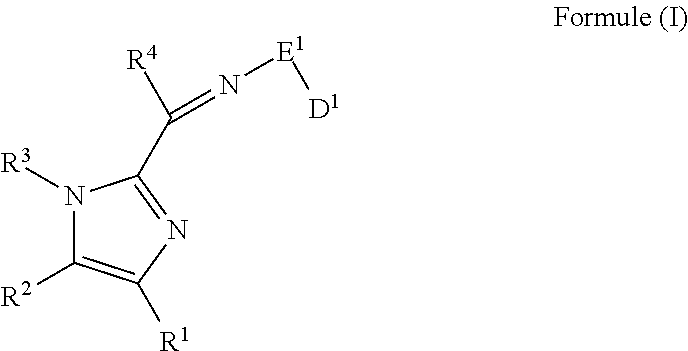
- in which R1, R2, R3 and R4 are identical or different and are chosen from the hydrogen atom, linear or branched alkyl groups, aryl, aralkyl or alkaryl groups comprising 1 to 12 carbon atoms and containing or not containing heteroelements, R1 and R2 not forming an aromatic ring; E1 is a group chosen from the hydrocarbon groups: aliphatic, cyclic, aromatic, aromatic substituted with alkyl groups or containing or not containing heteroelements; D1 is chosen from the hydrogen, nitrogen, sulphur, oxygen, or phosphorus atoms or from groups containing at least one nitrogen, sulphur, oxygen and/or phosphorus atom.
- Preferably, R1, R2, R3 and R4 are chosen from the hydrogen, methyl, ethyl, isopropyl, isobutyl, tert-butyl, cyclohexyl, phenyl and benzyl groups; preferably, R1, R2 and R4 are hydrogen atoms and, preferably, R3 is a methyl group.
- Preferably, E1 is an aliphatic or aromatic group. Preferably, E1 is chosen from the —CH2—, —CH2CH2—, —CH2CH2CH2—, —CH2CH2CH2CH2, 1,2-phenylene, trans-1,2-cyclopentane, trans-1,2-cyclohexane, 2,3-butane, 1,1′-biphenyl, 1,1′-binaphthyl and —Si(Me)2- groups. Very preferably, E1 is the divalent —CH2CH2— group or the divalent 1,2-phenylene group.
- Preferably, D1 is chosen from a hydrogen atom, an ether of formula —OR5, a thioether of formula —SR6, an amine of formula —N(R7)2 or a phosphine of formula —P(R8)2 where R5, R6, R7 and R8 are hydrogen atoms, hydrocarbon groups: aliphatic, cyclic, aromatic, aromatic substituted with alkyl groups or containing or not containing heteroelements. Preferably, R5, R6, R7 and R8 are methyl, ethyl or phenyl groups.
- The preparation of said imino-imidazole ligands B of formula (I) is carried out according to the methods known from the literature. For example, said ligands can be prepared according to the method of preparation described in the publications Org. Lett. 2007, 9, 18, 3699-3701 or Inorg. Chem. 2005, 44, 7431-7442.
- The examples given in the present invention are only given for purposes of illustration and do not limit the present invention.
- Said nickel precursor A used in the catalytic composition according to the invention is advantageously chosen from nickel(II) chloride, nickel(II) chloride (dimethoxyethane), nickel(II) bromide, nickel(II) bromide (dimethoxyethane), nickel(II) fluoride, nickel(II) iodide, nickel(II) sulphate, nickel(II) carbonate, nickel(II) dimethylglyoxime, nickel(II) hydroxide, nickel(II) hydroxyacetate, nickel(II) oxalate, nickel(II) carboxylates such as for example 2-ethylhexanoate, nickel phenates, nickel(II) acetate, nickel(II) trifluoroacetate, nickel(II) triflate, nickel(II) acetylacetonate, nickel(II) hexafluoroacetylacetonate, nickel bis(cycloocta-1,5-diene), nickel bis(cycloocta-1,3-diene), nickel bis(cyclooctatetraene), nickel bis(cycloocta-1,3,7-triene), bis(o-tolylphosphito)nickel(ethylene), nickel tetrakis(triphenylphosphite), nickel bis(ethylene), π-allylnickel(II) chloride, π-allylnickel(II) bromide, methallylnickel(II) chloride dimer, η3-allylnickel(II) hexafluorophosphate, η3-methallylnickel(II) hexafluorophosphate and nickel(II) 1,5-cyclooctadienyl, in their hydrated or unhydrated form, alone or in a mixture. Said nickel precursors can optionally be complexed with Lewis bases.
- Said nickel precursors used in the catalytic composition according to the invention are advantageously prepared according to methods known from the literature. For example, said nickel precursors can be prepared according to the method of preparation described in patent applications WO 2004/083263 or WO 2001/74831 or in the publication New J. Chem. 2011, 35, 178-183.
- The catalytic composition according to the invention can advantageously also contain a compound C, called an activating agent.
- Said activating agent is advantageously chosen from the group formed by the tris(hydrocarbyl)aluminium compounds, chlorinated or brominated hydrocarbylaluminium compounds, aluminoxanes, organic compounds capable of acting as proton donors, organoboron compounds, alone or in a mixture.
- The tris(hydrocarbyl)aluminium compounds and the chlorinated or brominated hydrocarbylaluminium compounds preferably correspond to the general formula AlxR″yWz in which R″ represents a monovalent hydrocarbon radical containing for example up to 12 carbon atoms such as alkyl, aryl, aralkyl, alkaryl or cycloalkyl, W represents a halogen atom chosen for example from chlorine and bromine, W preferably being a chlorine atom, x takes a value from 1 to 2, y and z take a value from 1 to 3. As examples of such compounds, ethylaluminium sesquichloride (Et3Al2Cl3), methylaluminium dichloride (MeAlCl2), ethylaluminium dichloride (EtAlCl2), isobutylaluminium dichloride (iBuAlCl2), diethylaluminium chloride (Et2AlCl), trimethylaluminium, tributylaluminium, tri-n-octylaluminium and triethylaluminium (AlEt3) may be mentioned.
- In the case where said activating agent is chosen from the aluminoxanes, said activating agent is advantageously chosen from methylaluminoxane (MAO), ethylaluminoxane and modified methylaluminoxane (MMAO). These activating agents can be used alone or in a mixture.
- Preferably, said activating agent C is chosen from dichloroethylaluminium (EtAlCl2) and methylaluminoxane (MAO).
- In the case where said activating agent is chosen from organic compounds capable of acting as proton donors, said activating agent is preferably chosen from the acids of formula HX in which X represents an anion.
- In the case where said activating agent is chosen from organoboron compounds, said activating agent is preferably chosen from Lewis acids of the tris(aryl)borane type such as tris(perfluorophenyl)borane, tris(3,5-bis(trifluoromethyl)phenyl)borane, tris(2,3,4,6-tetrafluorophenyl)borane, tris(perfluoronaphthyl)borane, tris(perfluorobiphenyl)borane and their derivatives and the (aryl)borates associated with a triphenylcarbenium cation or with a trisubstituted ammonium cation such as triphenylcarbenium tetrakis(perfluorophenyl)borate, N,N-dimethylanilinium tetrakis(perfluorophenyl)borate, N,N-diethylanilinium tetrakis(3,5-bis(trifluoromethyl)phenyl)borate, triphenylcarbenium tetrakis(3,5-bis(trifluoromethyl)phenyl)borate.
- Another subject of the present invention relates to a method of oligomerization of olefins comprising from 2 to 10 carbon atoms using said catalytic composition. Preferably, said method is a method of oligomerization of ethylene, preferably a method of dimerization of ethylene.
- Said nickel precursor A and said imino-imidazole ligand B of formula (I) can advantageously be mixed in order to obtain said nickel complex in the presence or absence of a solvent, called a preparation solvent. Said nickel complex of the catalytic composition according to the invention is advantageously prepared according to any method of preparation known to a person skilled in the art.
- Said preparation solvent can advantageously be identical to or different from the reaction solvent, i.e. the solvent used for the method of oligomerization according to the invention and preferably for the method of dimerization. Said preparation and reaction solvents are advantageously chosen from organic solvents and preferably from the ethers, alcohols, chlorinated solvents and the saturated, unsaturated, aromatic or non-aromatic, cyclic or non-cyclic hydrocarbons. Preferably, said solvents are chosen from hexane, cyclohexane, heptane, butane or isobutane, monoolefins or diolefins preferably comprising 4 to 20 carbon atoms, benzene, toluene, ortho-xylene, mesitylene, ethylbenzene, dichloromethane, chlorobenzene, methanol, ethanol, pure or in a mixture, the mixture of olefins produced by said method of oligomerization and ionic liquids. In the case where said solvents are an ionic liquid, they are advantageously chosen from the ionic liquids described in patents U.S. Pat. No. 6,951,831 B2 and FR 2895406 B1.
- Said nickel complex of the catalytic composition, diluted or not in said preparation solvent, can advantageously be used in the method of oligomerization according to the invention and preferably in the method of dimerization. An activating agent C can then optionally be added.
- Said nickel complex of the catalytic composition can also advantageously be isolated and then used, diluted or not in a solvent, in the method of oligomerization according to the invention and preferably in the method of dimerization. An activating agent C can then optionally be added.
- Said catalytic composition according to the invention can also advantageously be prepared in situ in the reaction section and in the solvent used for the method of oligomerization according to the invention and preferably for the method of dimerization. In this case, the order of mixing the nickel precursor A, the imino-imidazole ligand B of formula (I) and optionally the activating agent C is not critical.
- Oligomerization is defined as the transformation of a monomer unit to a compound or mixture of compounds of general formula CpH2p with 4≦p≦80, preferably with 4≦p≦50, more preferably with 4≦p≦26 and even more preferably with 4≦p≦14.
- The olefins used in the method of oligomerization according to the invention are olefins comprising from 2 to 10 carbon atoms and preferably said olefins are chosen from ethylene, propylene, n-butenes and n-pentenes, alone or in a mixture, pure or diluted. In the case where said olefins are diluted, said olefins are diluted with one or more alkane(s), such as those found in the “cuts” originating from petroleum refining processes, such as catalytic cracking or steam cracking.
- Very preferably, the olefin used in the method of oligomerization according to the invention is ethylene.
- Said olefins can come from non-fossil resources such as biomass. For example, the olefins used in the method of oligomerization according to the invention can advantageously be produced from alcohols, and in particular by dehydration of alcohols. In a preferred embodiment, said olefins are produced by dehydration of ethanol to produce ethylene.
- The concentration of nickel in the catalytic solution is advantageously comprised between 1.10−5 and 1 mol/L, and preferably between 5.10−5 and 1.10−2 mol/L.
- The molar ratio of the ligand B of formula (I) to the nickel precursor A is advantageously comprised between 0.05 and 10, preferably between 0.5 and 2 and more preferably 1.
- The molar ratio of the activating agent C to the nickel complex is advantageously comprised between 1/1 and 1000/1, preferably between 100/1 and 1000/1 for the aluminoxanes and preferably between 1/1 and 20/1 for the other aluminium derivatives and the other Lewis acids.
- The method of oligomerization according to the invention and preferably the method of dimerization of ethylene advantageously takes place at a total pressure comprised between atmospheric pressure and 20 MPa, preferably between 0.5 and 8 MPa, and at a temperature comprised between −40 and +250° C., preferably between −20° C. and 150° C.
- The heat generated by the reaction can advantageously be removed by any of the means known to a person skilled in the art.
- The method of oligomerization according to the invention and preferably the method of dimerization of ethylene can advantageously be carried out in a closed system, in a semi-open system or continuously, with one or more reaction steps. Vigorous stirring is advantageously utilized to ensure good contact between the reagent or reagents and the catalytic composition.
- The method of oligomerization according to the invention and preferably the method of dimerization of ethylene can advantageously be implemented in batch mode. In this case, a chosen volume of the solution comprising the catalytic composition according to the invention is introduced into a reactor equipped with the usual devices for stirring, heating and cooling. The ethylene pressure and the temperature are adjusted to the desired values. The pressure inside the reactor is kept constant by introducing ethylene until the total volume of liquid produced represents, for example, 2 to 50 times the volume of the solution comprising the catalytic composition introduced originally. The catalytic composition is destroyed by any usual means known to a person skilled in the art, and then the products are withdrawn and separated from the solvent.
- The method of oligomerization according to the invention and preferably the method of dimerization of ethylene can also advantageously be implemented continuously. In this case, the solution comprising the catalytic composition according to the invention is injected at the same time as the ethylene into a reactor stirred by standard mechanical means or by external recirculation, and maintained at the desired temperature. In another embodiment, the components of said catalytic composition can also be injected separately, for example the nickel precursor A and the ligand B on the one hand and the activating agent C on the other hand. The ethylene is introduced by a pressure-controlled admission valve, which keeps the pressure constant. The reaction mixture is withdrawn by means of a valve controlled by the liquid level so as to keep the latter constant. The catalytic composition is destroyed continuously by any usual means known to a person skilled in the art, then the reaction products as well as the solvent are separated, for example by distillation. Any unconverted olefin can be recycled to the reactor.
- Said method according to the invention can advantageously be implemented in a reactor with one or more reaction steps in series, the olefin feedstock and/or the catalytic composition preconditioned beforehand being introduced continuously, either in the first step, or in the first and any other steps. At the reactor outlet, the catalytic composition can be deactivated, for example by injection of ammonia and/or of an aqueous solution of soda and/or an aqueous solution of sulphuric acid. The unconverted olefins and the alkanes optionally present in the feed are then separated from the oligomers by distillation.
- The products of the present method can be used for example as components of motor fuels, as feedstock in a hydroformylation process for the synthesis of aldehydes and alcohols and/or as feedstock in a metathesis process for the synthesis of propylene for example. The following examples illustrate the invention without limiting its scope.
-
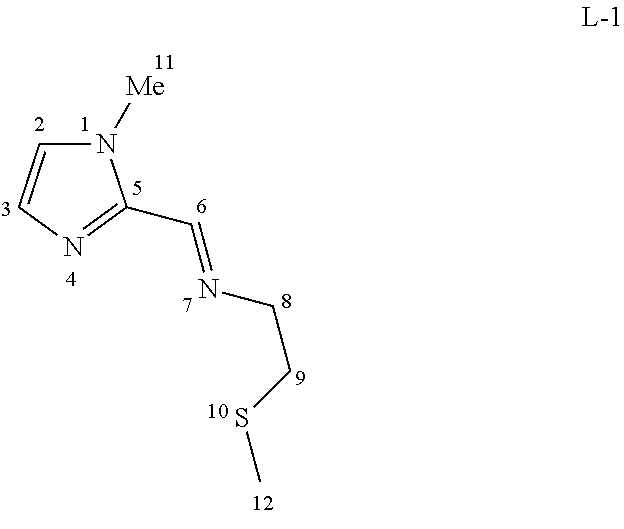
- 2-(Methylthio)ethylamine (440.1 mg; 4.89 mmol) is added to a solution of 1-methyl-2-imidazolecarboxyaldehyde (490 mg; 4.45 mmol) in 15 mL of dichloromethane. The yellow-coloured solution is stirred for 12 hours at ambient temperature. The solvent is then evaporated. The ligand L-1 is obtained in the form of a pale yellow oil with a yield of 90%. Characterization by 1H and 13C NMR and IR confirms the structure of the ligand L-1.
- 1H NMR (300 MHz, CD2Cl2): δ=8.28 (dd, J=1.9, 1.3 Hz, 1H, H6), 7.05 (d, J=1.0 Hz, 1H, H3), 6.95 (s, 1H, H2), 3.95 (s, 3H, H11), 3.77 (td, J=6.8, 1.3 Hz, 2H, H8), 2.79 (t, J=6.8 Hz, 2H, H8), 2.12 (s, 3H, H12).
- 13C NMR (75 MHz, CD2Cl2): δ=154.57 (1C, C6), 143.45 (1C, C5), (129.36 (1C, C3), 125.22 (1C, C2), 61.33 (1C, C8) 35.48 (2C, C9, C11), 15.83 (1C, C12).
- FT-IR: 2914w, 1648s, 1517w, 1476m, 1435s, 1366w, 1286m, 1228w, 1147w, 1044w, 919w, 793w, 756m, 707m, 689m.
- A yellow solution of ligand L-1 (284 mg; 1.55 mmol) in 15 mL of dichloromethane is added dropwise to a suspension of nickel precursor (compound A) NiCl2,dimethoxyethane in 10 mL of dichloromethane (325 mg; 1.48 mmol). The reaction medium turns green instantaneously. The suspension obtained is stirred for 12 hours at ambient temperature. The pale green precipitate formed is filtered via a cannula, washed cold with dichloromethane (3×20 mL), and then dried under vacuum. The complex Ni-1 is thus obtained. The yield from the reaction is 95%.
-

- For synthesis of the ligand, the procedure in Example 1 is followed, except that the amine used is 2-(methoxy)ethylamine. The ligand L-2 is obtained in the form of a pale yellow oil with a yield of 92%. Characterization by 1H and 13C NMR and IR confirm the structure of the ligand L-2.
- 1H NMR (300 MHz, CD2Cl2): δ=8.26 (s, 1H, H6), 7.04 (s, 1H, H3), 6.94 (s, 1H, H2), 3.95 (s, 3H, H11), 3.75-3.69 (m, 2H, 1-19), 3.66-3.69 (m, 2H, H8), 3.33 (s, 3H, H12).
- 13C NMR (75 MHz, CD2Cl2): δ=154.96 (C6), 143.59 (Cs), 129.32 (C3), 125.12 (C2), 72.53 (C9), 61.64 (C8), 58.86 (C12), 35.46 (C11).
- FT-IR: 2875w, 1660s, 1516w, 1475 m, 1437s, 1366w, 1287 m, 1191w, 1118s, 1053w, 1026w, 955w, 919w, 832w, 802m, 757m, 708m, 690m.
- For synthesis of the complex, the procedure in Example 2 is followed except that the ligand used for complexing the nickel is the ligand L-2. The complex Ni-2 is obtained in the form of a pale blue solid with a yield of 94%.
-
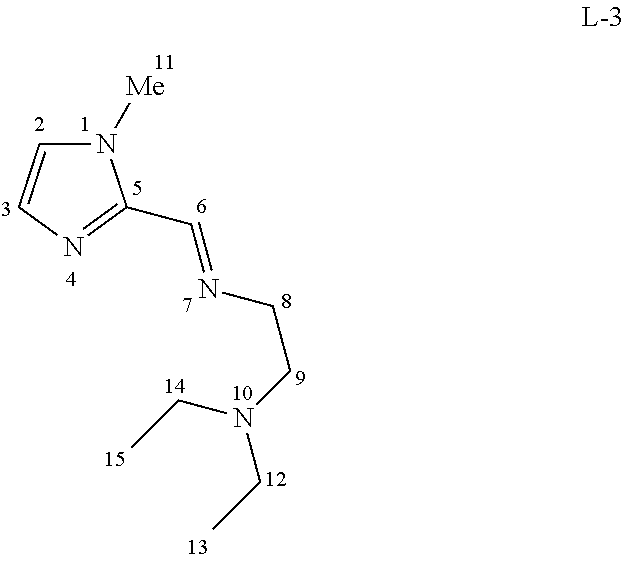
- For synthesis of the ligand, the procedure in Example 1 is followed, except that the amine used is N,N-diethylethylenediamine. The ligand L-3 is obtained in the form of a yellow oil with a yield of 90%. Characterization by 1H and 13C NMR and IR confirms the structure of the ligand L-3.
- 1H NMR (300 MHz, CD2Cl2): δ=8.25 (s, 1H, H6), 7.03 (d, J=0.9 Hz, 1H, H3), 6.93 (s, 1H, H2), 3.95 (s, 3H, H11), 3.63 (td, J=6.7, 1.3 Hz, 2H, H8) 2.72 (t, J=6.8 Hz, 2H, H9), 2.55 (q, J=7.1 Hz, 4H, H12, H14), 1.00 (t, J=7.1 Hz, 6H, H13, H15).
- 13C NMR (75 MHz, CD2Cl2): δ=154.16 (C6), 143.83 (C5), 129.23 (C3), 124.99 (C2), 60.70 (C8), 54.04 (C9), 47.84 (C12, C14), 35.44 (C11), 12.36 (C13, C15).
- FT-IR: 2967w, 1650s, 1475 m, 1437s, 1369w, 1287m, 1203w, 1148s, 1068w, 919w, 749m, 708m, 691m, 629s, 531s.
- For synthesis of the complex, the procedure in Example 2 is followed, except that the ligand used for complexing the nickel is the ligand L-3. The complex Ni-3 is obtained in the form of an orange solid with a yield of 89%.
-
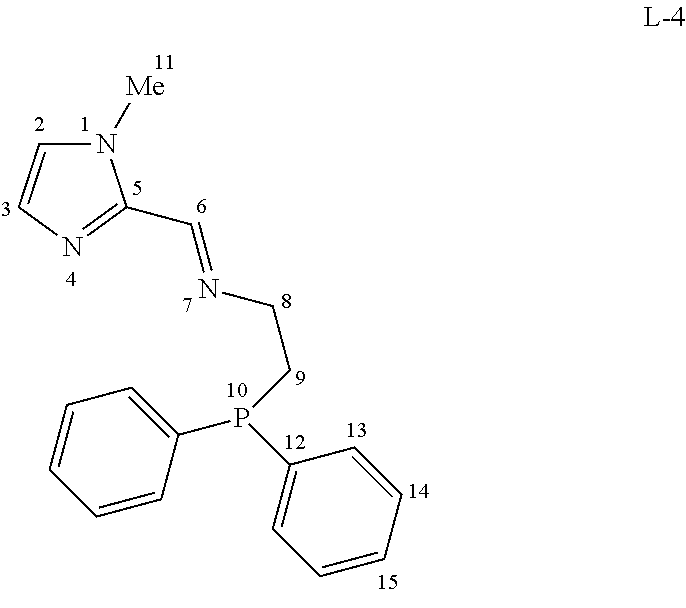
- For synthesis of the ligand, the procedure in Example 1 is followed, except that the amine used is 2-(diphenylphosphino)ethylamine. The ligand L-4 is obtained in the form of a yellow oil with a yield of 95%. Characterization by 1H, 13C, 31P NMR and IR confirms the structure of the ligand L-4.
- 1H NMR (300 MHz, CD2Cl2): δ=8.24 (s, 1H, H8), 7.49-7.31 (m, 10H, H14, H15, H16), 7.04 (d, J=1.0 Hz, 1H, H3), 6.92 (s, 1H, H2), 3.85 (s, 3H, H11), 3.77-3.66 (m, 2H, H8), 2.48-2.43 (m, 2H, H9).
- 31P NMR (121 MHz, CD2Cl2): δ=−19.09 (s, 1P, P10).
- 13C NMR (75 MHz, CD2Cl2): δ=153.95 (C6), 143.55 (C5), 139.23 (C12), 133.23 (C13), 129.35 (C3), 128.86 (C14), 128.77 (C15), 58.95 (C8), 35.47 (C11), 30.22 (C9).
- FT-IR: 3051w, 1650s, 1518w, 1478m, 1434s, 1287w, 739m, 697m, 631m, 534s.
- For synthesis of the complex, the procedure in Example 2 is followed, except that the ligand used for complexing the nickel is the ligand L-4. The complex Ni-4 is obtained in the form of an orange solid with a yield of 80%.
-

- For synthesis of the ligand, the procedure in Example 1 is followed, except that the amine used is butylamine. The ligand L-5 is obtained in the form of a yellow oil with a yield of 95%. Characterization by 1H and 13C NMR and IR confirms the structure of the ligand L-5.
- 1H NMR (300 MHz, CD2Cl2): δ=8.36 (d, J=6.2 Hz, 1H, H6), 7.12 (s, 1H, 1-16), 7.01 (s, 1H, H3), 4.04 (s, 3H, H12), 3.65 (td, J=6.8, 1.2 Hz, 2H, H8), 1.73 (dq, J=12.2, 6.9 Hz, 2H, H9), 1.58-1.41 (m, 2H, H10), 1.03 (t, J=7.3 Hz, 3H, H11).
- 13C NMR (75 MHz, CD2Cl2): δ=153.31 (C6), 143.77 (C5), 129.11 (C3), 124.92 (C2), 61.93 (C8), 35.41 (C12), 33.52 (C9), 20.76 (C10), 14.00 (C11).
- FT-IR: 3107w, 2930m, 1650s, 1476m, 1437s, 1366w, 1287w, 1149w, 1026w, 919w, 859w, 748m, 628s, 528s.
- For synthesis of the complex, the procedure in Example 2 is followed, except that the ligand used for complexing the nickel is the ligand L-5. The complex Ni-5 is obtained in the form of a light blue solid with a yield of 95%.
-
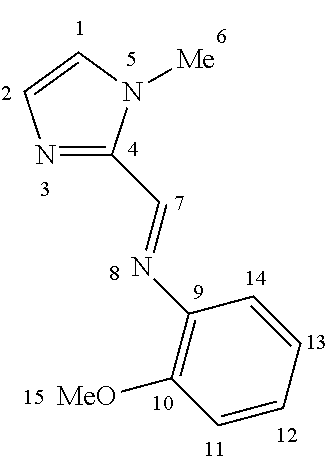
- For synthesis of the ligand, the procedure in Example 1 is followed, except that the amine used is ortho-anisidine. The ligand L-6 is obtained in the form of an orange oil with a yield of 95%. Characterization by 1H and 13C NMR and IR confirms the structure of the ligand L-6.
- 1H NMR (75 MHz, Acetone): δ 8.47 (s, 1H, H7), 7.34-6.90 (m, 6H, H1-H2, H11-H14), 4.14 (s, 3H, H15), 3.85 (s, 3H, H6).
- 13C NMR (75 MHz, Acetone): δ 153.29 (C7), 144.39 (C10), 142.02 (C4), 130.52 (C2), 127.64 (Carom), 126.78 (Carom), 124.64 (C1), 121.86 (Carom), 121.37 (Carom), 113.07 (Carom), 56.23 (C15), 35.84 (C6).
- FT-IR: 2951w, 2835w, 1685w, 1626s, 1585m, 1514m, 1430s, 1366w, 1288m, 1243s, 1149w, 1115 m, 1048w, 1025 m, 965w, 869m, 745s, 631m, 536s.
- For synthesis of the complex, the procedure in Example 2 is followed, except that the ligand used for complexing the nickel is the ligand L-6. The complex Ni-6 is obtained in the form of a light green solid with a yield of 95%.
- The nickel complex (Ni-1-Ni-6) is dissolved in the reaction solvent and then is introduced into the reactor under an ethylene atmosphere. The activating agent is then added to the reactor. The reaction temperature is fixed at the test temperature, then the pressure is adjusted to the test pressure (see Table 1).
- After a reaction time t, the introduction of ethylene is stopped. The reactor is cooled and degassed, then the products are analyzed by gas chromatography.
- The mass of the products formed and the oligomer distribution are shown in Table 1.
-
TABLE 1 Oligomerization of ethylene by the complexes Ni-1 and Ni-6.a Oligomer distributionc Entry Complex t (min) m (g)d C4 C6 1a Ni-1 55 31.0 69 31 2a Ni-2 60 9.3 78 22 3a Ni-3 60 3.6 78 22 4a Ni-4 60 17.6 82 17 5a Ni-5 60 21.2 66 34 6b Ni-1 52 30.1 71 29 7b Ni-2 58 29.5 70 30 8b Ni-3 58 29.7 71 29 10b Ni-5 58 30.1 70 30 11c Ni-1 20 66.8 84 16 12c Ni-2 73 62.0 87 13 13c Ni-6 20 64.5 87 13 aHeptane (25 mL), Ni (20 μmol), ethylene pressure 0.5 MPa, 45° C., activator: EtAlCl2 (Al/Ni = 15). bToluene (25 mL), Ni (20 μmol), ethylene pressure 0.5 MPa, 45° C., activator: EtAlCl2 (Al/Ni = 15). cHeptane (100 mL), Ni (10 μmol), ethylene pressure 3 MPa, 45° C., activator: EtAlCl2 (Al/Ni = 15). dcorresponds to the mass of oligomers produced during the test. ewt. %, determined by GC. - The above examples demonstrate that the use of a novel catalytic composition according to the invention makes it possible to obtain very high selectivity for dimerization of ethylene.
- Without further elaboration, it is believed that one skilled in the art can, using the preceding description, utilize the present invention to its fullest extent. The preceding preferred specific embodiments are, therefore, to be construed as merely illustrative, and not limitative of the remainder of the disclosure in any way whatsoever.
- In the foregoing and in the examples, all temperatures are set forth uncorrected in degrees Celsius and, all parts and percentages are by weight, unless otherwise indicated.
- The entire disclosures of all applications, patents and publications, cited herein and of corresponding French application No. 11/02.731, filed 8 Sep. 2011, are incorporated by reference herein.
- The preceding examples can be repeated with similar success by substituting the generically or specifically described reactants and/or operating conditions of this invention for those used in the preceding examples.
- From the foregoing description, one skilled in the art can easily ascertain the essential characteristics of this invention and, without departing from the spirit and scope thereof, can make various changes and modifications of the invention to adapt it to various usages and conditions.
Claims (15)
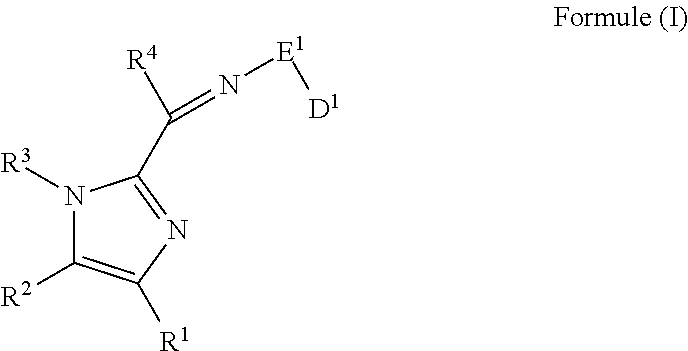
Applications Claiming Priority (3)
| Application Number | Priority Date | Filing Date | Title |
|---|---|---|---|
| FR11/02.731 | 2011-09-08 | ||
| FR1102731 | 2011-09-08 | ||
| FR1102731A FR2979836B1 (en) | 2011-09-08 | 2011-09-08 | NOVEL NICKEL CATALYTIC COMPOSITION AND OLEFIN OLIGOMERIZATION METHOD USING THE SAME |
Publications (2)
| Publication Number | Publication Date |
|---|---|
| US20130066128A1 true US20130066128A1 (en) | 2013-03-14 |
| US9545623B2 US9545623B2 (en) | 2017-01-17 |
Family
ID=46754362
Family Applications (1)
| Application Number | Title | Priority Date | Filing Date |
|---|---|---|---|
| US13/604,038 Expired - Fee Related US9545623B2 (en) | 2011-09-08 | 2012-09-05 | Nickel-based catalytic composition and method of oligomerization of olefins using said composition |
Country Status (3)
| Country | Link |
|---|---|
| US (1) | US9545623B2 (en) |
| EP (1) | EP2567752B1 (en) |
| FR (1) | FR2979836B1 (en) |
Cited By (13)
| Publication number | Priority date | Publication date | Assignee | Title |
|---|---|---|---|---|
| CN103193828A (en) * | 2013-04-03 | 2013-07-10 | 西北大学 | Double-imidazole imide nickel hydroxide coordination complex as well as preparation method and application thereof |
| JP2015172007A (en) * | 2014-03-11 | 2015-10-01 | 国立大学法人大阪大学 | Platinum complex and light emitting material comprising the same |
| EP3045439A1 (en) | 2015-01-19 | 2016-07-20 | Evonik Degussa GmbH | Combined production of butene and octene from ethene |
| EP3045438A1 (en) | 2015-01-19 | 2016-07-20 | Evonik Degussa GmbH | Combined production of at least butene and octene from ethene |
| DE102015200702A1 (en) | 2015-01-19 | 2016-07-21 | Evonik Degussa Gmbh | Preparation of butadiene from ethene |
| US9545623B2 (en) * | 2011-09-08 | 2017-01-17 | IFP Energies Nouvelles | Nickel-based catalytic composition and method of oligomerization of olefins using said composition |
| WO2017048787A1 (en) * | 2015-09-14 | 2017-03-23 | Massachusetts Institute Of Technology | Compositions and methods for selective oligomerization comprising metal organic frameworks |
| EP3255029A1 (en) | 2016-06-10 | 2017-12-13 | Evonik Degussa GmbH | Ethylene oligomerisation under supercritical conditions |
| CN108430627A (en) * | 2015-12-18 | 2018-08-21 | Ifp 新能源公司 | Catalytic compositions comprising nickel, phosphine-type ligands and Lewis bases and their use in olefin oligomerization processes |
| US10174063B2 (en) | 2014-05-06 | 2019-01-08 | Massachusetts Institute Of Technology | Compositions and methods comprising conductive metal organic frameworks and uses thereof |
| US10442875B2 (en) | 2015-09-14 | 2019-10-15 | Massachusetts Institute Of Technology | Compositions and methods for olefin polymerization comprising metal organic frameworks |
| US10653993B2 (en) | 2016-05-27 | 2020-05-19 | Massachusetts Institute Of Technology | Compositions comprising metal organic frameworks for the uptake of compounds and related methods |
| US11179708B2 (en) | 2016-10-04 | 2021-11-23 | Massachusetts Institute Of Technology | Compositions and methods for selective carbonylation of heterocyclic compounds |
Families Citing this family (5)
| Publication number | Priority date | Publication date | Assignee | Title |
|---|---|---|---|---|
| FR3061175B1 (en) | 2016-12-22 | 2020-07-31 | Ifp Energies Now | PROCESS FOR NEUTRALIZATION OF A CATALYTIC SYSTEM FOR DIMERISHING OLEFINS CONTAINING AT LEAST ONE HALOGEN DERIVATIVE. |
| US10516408B2 (en) | 2018-03-08 | 2019-12-24 | Analog Devices Global Unlimited Company | Analog to digital converter stage |
| WO2021048741A2 (en) | 2019-09-09 | 2021-03-18 | King Abdullah University Of Science And Technology | Catalysts for oligomerization of olefins |
| FR3103485B1 (en) | 2019-11-26 | 2023-03-24 | Ifp Energies Now | Process for separating an effluent from an oligomerization step |
| FR3103486A1 (en) | 2019-11-26 | 2021-05-28 | IFP Energies Nouvelles | PROCESS FOR NEUTRALIZING A CATALYTIC COMPOSITION CONTAINED IN AN EFFLUENT FROM AN OLIGOMERIZATION STAGE |
Citations (1)
| Publication number | Priority date | Publication date | Assignee | Title |
|---|---|---|---|---|
| US20060094588A1 (en) * | 2003-03-20 | 2006-05-04 | Gibson Vernon C | Polymerisation and oligomerisation catalysts |
Family Cites Families (9)
| Publication number | Priority date | Publication date | Assignee | Title |
|---|---|---|---|---|
| NL133290C (en) | 1962-11-30 | 1900-01-01 | ||
| FR1410430A (en) | 1963-08-10 | 1965-09-10 | Studiengesellschaft Kohle Mbh | Process for the oligomerization and polymerization of olefins and catalysts for these operations |
| US3485881A (en) | 1967-10-09 | 1969-12-23 | Phillips Petroleum Co | Dimerization of olefins |
| MXPA02009497A (en) | 2000-03-31 | 2004-05-14 | Polimeri Europa Spa | Complex polymerization catalysts for the homopolymerization of ethylene and for the copolymerization of ethylene. |
| AU2002211887A1 (en) * | 2000-11-10 | 2002-05-21 | Equistar Chemicals, Lp | Late transition metal diimide catalysts for olefin oligomerization and polymerization |
| DE10303931B4 (en) | 2002-02-04 | 2013-04-18 | Institut Français du Pétrole | Catalytic composition for dimerization, co-dimerization, oligomerization and polymerization of olefins |
| GB0410604D0 (en) | 2004-05-12 | 2004-06-16 | Bp Chem Int Ltd | Ethylene copolymers |
| FR2895406B1 (en) | 2005-12-22 | 2010-08-13 | Inst Francais Du Petrole | PROCESS FOR THE PRODUCTION OF 2,3-DIMETHYLBUT-1-ENE |
| FR2979836B1 (en) * | 2011-09-08 | 2014-08-08 | IFP Energies Nouvelles | NOVEL NICKEL CATALYTIC COMPOSITION AND OLEFIN OLIGOMERIZATION METHOD USING THE SAME |
-
2011
- 2011-09-08 FR FR1102731A patent/FR2979836B1/en not_active Expired - Fee Related
-
2012
- 2012-08-20 EP EP12290277.8A patent/EP2567752B1/en not_active Not-in-force
- 2012-09-05 US US13/604,038 patent/US9545623B2/en not_active Expired - Fee Related
Patent Citations (2)
| Publication number | Priority date | Publication date | Assignee | Title |
|---|---|---|---|---|
| US20060094588A1 (en) * | 2003-03-20 | 2006-05-04 | Gibson Vernon C | Polymerisation and oligomerisation catalysts |
| US7229943B2 (en) * | 2003-03-20 | 2007-06-12 | Innovene Europe Limited | Polymerisation and oligomerisation catalysts |
Cited By (23)
| Publication number | Priority date | Publication date | Assignee | Title |
|---|---|---|---|---|
| US9545623B2 (en) * | 2011-09-08 | 2017-01-17 | IFP Energies Nouvelles | Nickel-based catalytic composition and method of oligomerization of olefins using said composition |
| CN103193828B (en) * | 2013-04-03 | 2015-04-15 | 西北大学 | Double-imidazole imide nickel hydroxide coordination complex as well as preparation method and application thereof |
| CN103193828A (en) * | 2013-04-03 | 2013-07-10 | 西北大学 | Double-imidazole imide nickel hydroxide coordination complex as well as preparation method and application thereof |
| JP2015172007A (en) * | 2014-03-11 | 2015-10-01 | 国立大学法人大阪大学 | Platinum complex and light emitting material comprising the same |
| US10174063B2 (en) | 2014-05-06 | 2019-01-08 | Massachusetts Institute Of Technology | Compositions and methods comprising conductive metal organic frameworks and uses thereof |
| US11608350B2 (en) | 2014-05-06 | 2023-03-21 | Massachusetts Institute Of Technology | Compositions and methods comprising conductive metal organic frameworks and uses thereof |
| US10822364B2 (en) | 2014-05-06 | 2020-11-03 | Massachusetts Institute Of Technology | Compositions and methods comprising conductive metal organic frameworks and uses thereof |
| EP3045439A1 (en) | 2015-01-19 | 2016-07-20 | Evonik Degussa GmbH | Combined production of butene and octene from ethene |
| EP3045438A1 (en) | 2015-01-19 | 2016-07-20 | Evonik Degussa GmbH | Combined production of at least butene and octene from ethene |
| DE102015200702A1 (en) | 2015-01-19 | 2016-07-21 | Evonik Degussa Gmbh | Preparation of butadiene from ethene |
| US10493441B2 (en) | 2015-09-14 | 2019-12-03 | Massachusetts Institute Of Technology | Compositions and methods for selective olefin oligomerization comprising metal organic frameworks |
| US10442875B2 (en) | 2015-09-14 | 2019-10-15 | Massachusetts Institute Of Technology | Compositions and methods for olefin polymerization comprising metal organic frameworks |
| CN108025286A (en) * | 2015-09-14 | 2018-05-11 | 麻省理工学院 | The composition and method comprising metal organic framework for selective olefin oligomerisation |
| WO2017048787A1 (en) * | 2015-09-14 | 2017-03-23 | Massachusetts Institute Of Technology | Compositions and methods for selective oligomerization comprising metal organic frameworks |
| US20190001317A1 (en) * | 2015-12-18 | 2019-01-03 | IFP Energies Nouvelles | Catalytic composition comprising nickel, a phosphine-type ligand and a lewis base, and use thereof in an olefin oligomerisation method |
| CN108430627A (en) * | 2015-12-18 | 2018-08-21 | Ifp 新能源公司 | Catalytic compositions comprising nickel, phosphine-type ligands and Lewis bases and their use in olefin oligomerization processes |
| US10646860B2 (en) * | 2015-12-18 | 2020-05-12 | IFP Energies Nouvelles | Catalytic composition comprising nickel, a phosphine-type ligand and a Lewis base, and use thereof in an olefin oligomerisation method |
| RU2744575C2 (en) * | 2015-12-18 | 2021-03-11 | Ифп Энержи Нувелль | Novel catalytic composition based on nickel and ligand of phosphine type and lewis base and use thereof in olefin oligomerization method |
| US10653993B2 (en) | 2016-05-27 | 2020-05-19 | Massachusetts Institute Of Technology | Compositions comprising metal organic frameworks for the uptake of compounds and related methods |
| US11077398B2 (en) | 2016-05-27 | 2021-08-03 | Massachusetts Institute Of Technology | Compositions comprising metal organic frameworks for the uptake of compounds and related methods |
| US10189755B2 (en) | 2016-06-10 | 2019-01-29 | Evonik Degussa Gmbh | Oligomerization of ethene in supercritical mode |
| EP3255029A1 (en) | 2016-06-10 | 2017-12-13 | Evonik Degussa GmbH | Ethylene oligomerisation under supercritical conditions |
| US11179708B2 (en) | 2016-10-04 | 2021-11-23 | Massachusetts Institute Of Technology | Compositions and methods for selective carbonylation of heterocyclic compounds |
Also Published As
| Publication number | Publication date |
|---|---|
| EP2567752B1 (en) | 2018-11-21 |
| FR2979836B1 (en) | 2014-08-08 |
| EP2567752A1 (en) | 2013-03-13 |
| FR2979836A1 (en) | 2013-03-15 |
| US9545623B2 (en) | 2017-01-17 |
Similar Documents
| Publication | Publication Date | Title |
|---|---|---|
| US9545623B2 (en) | Nickel-based catalytic composition and method of oligomerization of olefins using said composition | |
| JP4308015B2 (en) | Trimerization and oligomerization of olefins using a chromium-based catalyst | |
| US10646860B2 (en) | Catalytic composition comprising nickel, a phosphine-type ligand and a Lewis base, and use thereof in an olefin oligomerisation method | |
| CN104220402B (en) | tetramerization of ethylene | |
| US8461406B2 (en) | Oligomerisation of olefinic compounds in the presence of a diluted metal containing activator | |
| KR102074753B1 (en) | A process for oligomerising a hydrocarbon to form at least one co-monomer product | |
| US9283554B2 (en) | Nickel-based catalytic composition, and its use in a process for the oligomerization of olefins | |
| US20150203418A1 (en) | Method for oligomerization of ethylene | |
| JP2016215202A (en) | Method for dimerization of ethylene to but-1-ene using a composition comprising a titanium-based complex and an alkoxy ligand functionalized with a heteroatom | |
| CN104245640B (en) | Tetramerization of ethylene | |
| US20180318819A1 (en) | Nickel-based catalytic composition in the presence of a specific activator and use thereof in a olefin oligomersation method | |
| US10421064B2 (en) | Catalyst composition and process for oligomerization of ethylene to produce 1-hexene and/or 1-octene | |
| CN101321585B (en) | Method for oligomerisation of olefinic compounds in the presence of an oligomerisation catalyst and a catalyst activator including a halogenated organic group | |
| US20130072732A1 (en) | Method of separating butene-2 from a c4 cut containing butene-2 and butene-1 by selective oligomerization of butene-1 | |
| EP3237362B1 (en) | Methods of preparing oligomers of an olefin | |
| US9308528B2 (en) | Nickel-based complexes and their use in a process for the transformation of olefins | |
| CN105408019A (en) | Catalyst composition and process for oligomerization of ethylene | |
| US9428531B2 (en) | Cyclic nickel-based complexes and their use in a process for the transformation of olefins | |
| TW200930456A (en) | Catalyst composition and process for preparing linear alpha-olefins | |
| CN105263890A (en) | Tetramerization of ethylene | |
| JP2024545896A (en) | CATALYST COMPOSITION FOR OLIGOMERIZATION REACTIONS - Patent application | |
| US10421066B2 (en) | Nickel-based catalytic composition and use thereof in a method for the oligomerisation of olefins | |
| EP3013841B1 (en) | Novel nickel-based complex and use thereof in a method for the oligomerisation of olefins | |
| US20150080628A1 (en) | Catalyst and process for the co-dimerization of ethylene and propylene | |
| CN121378345A (en) | Trinuclear biphosphole PNP ligand compound and preparation method and application thereof |
Legal Events
| Date | Code | Title | Description |
|---|---|---|---|
| AS | Assignment |
Owner name: IFP ENERGIES NOUVELLES, FRANCE Free format text: ASSIGNMENT OF ASSIGNORS INTEREST;ASSIGNORS:BREUIL, PIERRE-ALAIN;BOUDIER, ADRIEN;MAGNA, LIONEL;AND OTHERS;SIGNING DATES FROM 20121008 TO 20121009;REEL/FRAME:029297/0770 |
|
| STCF | Information on status: patent grant |
Free format text: PATENTED CASE |
|
| FEPP | Fee payment procedure |
Free format text: MAINTENANCE FEE REMINDER MAILED (ORIGINAL EVENT CODE: REM.); ENTITY STATUS OF PATENT OWNER: LARGE ENTITY |
|
| LAPS | Lapse for failure to pay maintenance fees |
Free format text: PATENT EXPIRED FOR FAILURE TO PAY MAINTENANCE FEES (ORIGINAL EVENT CODE: EXP.); ENTITY STATUS OF PATENT OWNER: LARGE ENTITY |
|
| STCH | Information on status: patent discontinuation |
Free format text: PATENT EXPIRED DUE TO NONPAYMENT OF MAINTENANCE FEES UNDER 37 CFR 1.362 |
|
| FP | Lapsed due to failure to pay maintenance fee |
Effective date: 20210117 |