US20120238549A1 - Nuclear Hormone Receptor Modulators - Google Patents
Nuclear Hormone Receptor Modulators Download PDFInfo
- Publication number
- US20120238549A1 US20120238549A1 US13/420,957 US201213420957A US2012238549A1 US 20120238549 A1 US20120238549 A1 US 20120238549A1 US 201213420957 A US201213420957 A US 201213420957A US 2012238549 A1 US2012238549 A1 US 2012238549A1
- Authority
- US
- United States
- Prior art keywords
- dibenzo
- octahydro
- hydroxy
- methyl
- benzyl
- Prior art date
- Legal status (The legal status is an assumption and is not a legal conclusion. Google has not performed a legal analysis and makes no representation as to the accuracy of the status listed.)
- Abandoned
Links
- 229940127517 Hormone Receptor Modulators Drugs 0.000 title 1
- 102000007399 Nuclear hormone receptor Human genes 0.000 title 1
- 108020005497 Nuclear hormone receptor Proteins 0.000 title 1
- 150000001875 compounds Chemical class 0.000 claims abstract description 516
- 150000003839 salts Chemical class 0.000 claims abstract description 21
- 229940002612 prodrug Drugs 0.000 claims abstract description 16
- 239000000651 prodrug Substances 0.000 claims abstract description 16
- 239000002207 metabolite Substances 0.000 claims abstract description 3
- 238000000034 method Methods 0.000 claims description 154
- 238000006243 chemical reaction Methods 0.000 claims description 95
- 125000002023 trifluoromethyl group Chemical group FC(F)(F)* 0.000 claims description 70
- -1 (2R,3R,4aS,11bR)-11b-Benzyl-3-phenyl-2,3,4,4a,5,6,7,11b-octahydro-1H-dibenzo[a,c]cycloheptene-2,3,9-triol compound Chemical class 0.000 claims description 69
- XLYOFNOQVPJJNP-UHFFFAOYSA-N water Substances O XLYOFNOQVPJJNP-UHFFFAOYSA-N 0.000 claims description 59
- 125000006273 (C1-C3) alkyl group Chemical group 0.000 claims description 52
- 125000001072 heteroaryl group Chemical group 0.000 claims description 47
- 125000005913 (C3-C6) cycloalkyl group Chemical group 0.000 claims description 44
- 125000003107 substituted aryl group Chemical group 0.000 claims description 44
- 208000037265 diseases, disorders, signs and symptoms Diseases 0.000 claims description 35
- 125000001997 phenyl group Chemical group [H]C1=C([H])C([H])=C(*)C([H])=C1[H] 0.000 claims description 32
- 229910052757 nitrogen Inorganic materials 0.000 claims description 31
- 229920006395 saturated elastomer Polymers 0.000 claims description 28
- 238000002360 preparation method Methods 0.000 claims description 26
- 201000010099 disease Diseases 0.000 claims description 25
- 238000004519 manufacturing process Methods 0.000 claims description 22
- 125000000623 heterocyclic group Chemical group 0.000 claims description 19
- 229910052739 hydrogen Inorganic materials 0.000 claims description 19
- 230000008569 process Effects 0.000 claims description 19
- ZSFPJJJRNUZCEV-UHFFFAOYSA-N 2-methylpyridin-3-amine Chemical compound CC1=NC=CC=C1N ZSFPJJJRNUZCEV-UHFFFAOYSA-N 0.000 claims description 18
- 102000004127 Cytokines Human genes 0.000 claims description 16
- 108090000695 Cytokines Proteins 0.000 claims description 16
- UFHFLCQGNIYNRP-UHFFFAOYSA-N Hydrogen Chemical compound [H][H] UFHFLCQGNIYNRP-UHFFFAOYSA-N 0.000 claims description 15
- 239000001257 hydrogen Substances 0.000 claims description 15
- 229910052799 carbon Inorganic materials 0.000 claims description 14
- 208000011580 syndromic disease Diseases 0.000 claims description 14
- 239000003153 chemical reaction reagent Substances 0.000 claims description 13
- AFVFQIVMOAPDHO-UHFFFAOYSA-N Methanesulfonic acid Chemical compound CS(O)(=O)=O AFVFQIVMOAPDHO-UHFFFAOYSA-N 0.000 claims description 12
- 125000003545 alkoxy group Chemical group 0.000 claims description 12
- 239000008194 pharmaceutical composition Substances 0.000 claims description 12
- DEHHLPUSUKUUKZ-FUFSCUOVSA-N (7ar,11ar)-11a-benzyl-n-(2-methylpyridin-3-yl)-9-oxo-6,7,7a,8,10,11-hexahydro-5h-dibenzo[1,3-c:1',3'-f][7]annulene-3-carboxamide Chemical compound CC1=NC=CC=C1NC(=O)C1=CC=C2[C@@]3(CC=4C=CC=CC=4)CCC(=O)C[C@H]3CCCC2=C1 DEHHLPUSUKUUKZ-FUFSCUOVSA-N 0.000 claims description 11
- DEHHLPUSUKUUKZ-OUTSHDOLSA-N (7as,11as)-11a-benzyl-n-(2-methylpyridin-3-yl)-9-oxo-6,7,7a,8,10,11-hexahydro-5h-dibenzo[1,3-c:1',3'-f][7]annulene-3-carboxamide Chemical compound CC1=NC=CC=C1NC(=O)C1=CC=C2[C@]3(CC=4C=CC=CC=4)CCC(=O)C[C@@H]3CCCC2=C1 DEHHLPUSUKUUKZ-OUTSHDOLSA-N 0.000 claims description 11
- 210000000056 organ Anatomy 0.000 claims description 10
- QNRXGYVTJQEOMI-XGNZJKERSA-N (3r,4as,11bs)-11b-benzyl-3-ethyl-3-hydroxy-n-(2-methylpyridin-3-yl)-2,4,4a,5,6,7-hexahydro-1h-dibenzo[1,3-c:1',3'-f][7]annulene-9-carboxamide Chemical compound C([C@]12CC[C@](C[C@@H]2CCCC=2C1=CC=C(C=2)C(=O)NC=1C(=NC=CC=1)C)(O)CC)C1=CC=CC=C1 QNRXGYVTJQEOMI-XGNZJKERSA-N 0.000 claims description 9
- 125000004178 (C1-C4) alkyl group Chemical group 0.000 claims description 9
- 206010061218 Inflammation Diseases 0.000 claims description 9
- 201000004681 Psoriasis Diseases 0.000 claims description 9
- 239000003054 catalyst Substances 0.000 claims description 9
- 230000004054 inflammatory process Effects 0.000 claims description 9
- 125000003226 pyrazolyl group Chemical group 0.000 claims description 9
- 125000004076 pyridyl group Chemical group 0.000 claims description 9
- QBJRXWOOHGAEIF-XGJRVREISA-N (1R,11R,13S)-1-benzyl-13-ethyl-13-hydroxy-N-(2-methylpyridin-3-yl)-8-oxotricyclo[9.4.0.02,7]pentadeca-2(7),3,5-triene-5-carboxamide Chemical compound C([C@@]12CC[C@@](C[C@H]2CCC(=O)C=2C1=CC=C(C=2)C(=O)NC=1C(=NC=CC=1)C)(O)CC)C1=CC=CC=C1 QBJRXWOOHGAEIF-XGJRVREISA-N 0.000 claims description 8
- QBJRXWOOHGAEIF-IFDYJGHISA-N (3r,4as,11bs)-11b-benzyl-3-ethyl-3-hydroxy-n-(2-methylpyridin-3-yl)-7-oxo-1,2,4,4a,5,6-hexahydrodibenzo[1,3-d:2',1'-g][7]annulene-9-carboxamide Chemical compound C([C@]12CC[C@](C[C@@H]2CCC(=O)C=2C1=CC=C(C=2)C(=O)NC=1C(=NC=CC=1)C)(O)CC)C1=CC=CC=C1 QBJRXWOOHGAEIF-IFDYJGHISA-N 0.000 claims description 8
- QNRXGYVTJQEOMI-SATCGAIXSA-N (3s,4ar,11br)-11b-benzyl-3-ethyl-3-hydroxy-n-(2-methylpyridin-3-yl)-2,4,4a,5,6,7-hexahydro-1h-dibenzo[1,3-c:1',3'-f][7]annulene-9-carboxamide Chemical compound C([C@@]12CC[C@@](C[C@H]2CCCC=2C1=CC=C(C=2)C(=O)NC=1C(=NC=CC=1)C)(O)CC)C1=CC=CC=C1 QNRXGYVTJQEOMI-SATCGAIXSA-N 0.000 claims description 8
- 241000725303 Human immunodeficiency virus Species 0.000 claims description 8
- 206010059176 Juvenile idiopathic arthritis Diseases 0.000 claims description 8
- 239000002253 acid Substances 0.000 claims description 8
- 125000005001 aminoaryl group Chemical group 0.000 claims description 8
- 125000005124 aminocycloalkyl group Chemical group 0.000 claims description 8
- 125000005214 aminoheteroaryl group Chemical group 0.000 claims description 8
- 125000004432 carbon atom Chemical group C* 0.000 claims description 8
- 230000001684 chronic effect Effects 0.000 claims description 8
- 230000006870 function Effects 0.000 claims description 8
- 230000005764 inhibitory process Effects 0.000 claims description 8
- 201000002215 juvenile rheumatoid arthritis Diseases 0.000 claims description 8
- JVLJCQZLZIYYOQ-UHFFFAOYSA-N 11a-benzyl-3-hydroxy-6,7,10,11-tetrahydro-5h-dibenzo[1,3-c:1',3'-f][7]annulen-9-one Chemical compound C=1C(O)=CC=C2C=1CCCC1=CC(=O)CCC21CC1=CC=CC=C1 JVLJCQZLZIYYOQ-UHFFFAOYSA-N 0.000 claims description 7
- 206010003827 Autoimmune hepatitis Diseases 0.000 claims description 7
- 208000003456 Juvenile Arthritis Diseases 0.000 claims description 7
- 206010028980 Neoplasm Diseases 0.000 claims description 7
- 230000033228 biological regulation Effects 0.000 claims description 7
- 125000004452 carbocyclyl group Chemical group 0.000 claims description 7
- 208000025302 chronic primary adrenal insufficiency Diseases 0.000 claims description 7
- 206010012601 diabetes mellitus Diseases 0.000 claims description 7
- 208000002780 macular degeneration Diseases 0.000 claims description 7
- 239000000546 pharmaceutical excipient Substances 0.000 claims description 7
- 102000004169 proteins and genes Human genes 0.000 claims description 7
- 108090000623 proteins and genes Proteins 0.000 claims description 7
- 206010039073 rheumatoid arthritis Diseases 0.000 claims description 7
- WHLIUZOBCAGJFN-RKVVATLDSA-N (1R,11R,13S)-1-benzyl-13-(ethoxymethyl)-13-hydroxy-N-(2-methylpyridin-3-yl)tricyclo[9.4.0.02,7]pentadeca-2(7),3,5-triene-5-carboxamide Chemical compound C([C@@]12CC[C@@](C[C@H]2CCCC=2C1=CC=C(C=2)C(=O)NC=1C(=NC=CC=1)C)(O)COCC)C1=CC=CC=C1 WHLIUZOBCAGJFN-RKVVATLDSA-N 0.000 claims description 6
- GLAAVUMDORSPRA-AWJLRTIGSA-N (1R,11S,13R)-1-benzyl-13-hydroxy-13-methyl-N-(2-methylpyridin-3-yl)tricyclo[9.4.0.02,7]pentadeca-2(7),3,5-triene-5-carboxamide Chemical compound CC1=NC=CC=C1NC(=O)C1=CC=C2[C@@]3(CC=4C=CC=CC=4)CC[C@@](C)(O)C[C@@H]3CCCC2=C1 GLAAVUMDORSPRA-AWJLRTIGSA-N 0.000 claims description 6
- WHLIUZOBCAGJFN-OOCAJSIRSA-N (3r,4as,11bs)-11b-benzyl-3-(ethoxymethyl)-3-hydroxy-n-(2-methylpyridin-3-yl)-2,4,4a,5,6,7-hexahydro-1h-dibenzo[1,3-c:1',3'-f][7]annulene-9-carboxamide Chemical compound C([C@]12CC[C@](C[C@@H]2CCCC=2C1=CC=C(C=2)C(=O)NC=1C(=NC=CC=1)C)(O)COCC)C1=CC=CC=C1 WHLIUZOBCAGJFN-OOCAJSIRSA-N 0.000 claims description 6
- FMTBJCJHCGSLLQ-JOYXZSCHSA-N (3s,4as,11bs)-11b-benzyl-3-ethynyl-3-hydroxy-n-(2-methylpyridin-3-yl)-2,4,4a,5,6,7-hexahydro-1h-dibenzo[1,3-c:1',3'-f][7]annulene-9-carboxamide Chemical compound CC1=NC=CC=C1NC(=O)C1=CC=C2[C@]3(CC=4C=CC=CC=4)CC[C@@](O)(C#C)C[C@@H]3CCCC2=C1 FMTBJCJHCGSLLQ-JOYXZSCHSA-N 0.000 claims description 6
- MMXJITXHNUXCQM-CRAIPNDOSA-N (4ar,9ar)-4a-benzyl-1,3,4,6,7,8,9,9a-octahydrobenzo[7]annulene-2,5-dione Chemical compound C([C@@]12CCC(C[C@H]2CCCCC1=O)=O)C1=CC=CC=C1 MMXJITXHNUXCQM-CRAIPNDOSA-N 0.000 claims description 6
- MMXJITXHNUXCQM-YJBOKZPZSA-N (4as,9as)-4a-benzyl-1,3,4,6,7,8,9,9a-octahydrobenzo[7]annulene-2,5-dione Chemical compound C([C@]12CCC(C[C@@H]2CCCCC1=O)=O)C1=CC=CC=C1 MMXJITXHNUXCQM-YJBOKZPZSA-N 0.000 claims description 6
- DEHHLPUSUKUUKZ-GIGWZHCTSA-N (7ar,11as)-11a-benzyl-n-(2-methylpyridin-3-yl)-9-oxo-6,7,7a,8,10,11-hexahydro-5h-dibenzo[1,3-c:1',3'-f][7]annulene-3-carboxamide Chemical compound CC1=NC=CC=C1NC(=O)C1=CC=C2[C@]3(CC=4C=CC=CC=4)CCC(=O)C[C@H]3CCCC2=C1 DEHHLPUSUKUUKZ-GIGWZHCTSA-N 0.000 claims description 6
- DEHHLPUSUKUUKZ-PWUYWRBVSA-N (7as,11ar)-11a-benzyl-n-(2-methylpyridin-3-yl)-9-oxo-6,7,7a,8,10,11-hexahydro-5h-dibenzo[1,3-c:1',3'-f][7]annulene-3-carboxamide Chemical compound CC1=NC=CC=C1NC(=O)C1=CC=C2[C@@]3(CC=4C=CC=CC=4)CCC(=O)C[C@@H]3CCCC2=C1 DEHHLPUSUKUUKZ-PWUYWRBVSA-N 0.000 claims description 6
- WBCDKYGOAOHILU-UHFFFAOYSA-N 11a-benzyl-3-methoxy-6,7,10,11-tetrahydro-5h-dibenzo[1,3-c:1',3'-f][7]annulen-9-one Chemical compound C=1C(OC)=CC=C2C=1CCCC1=CC(=O)CCC21CC1=CC=CC=C1 WBCDKYGOAOHILU-UHFFFAOYSA-N 0.000 claims description 6
- 208000030507 AIDS Diseases 0.000 claims description 6
- 206010002556 Ankylosing Spondylitis Diseases 0.000 claims description 6
- UGFAIRIUMAVXCW-UHFFFAOYSA-N Carbon monoxide Chemical compound [O+]#[C-] UGFAIRIUMAVXCW-UHFFFAOYSA-N 0.000 claims description 6
- 208000010412 Glaucoma Diseases 0.000 claims description 6
- 208000001344 Macular Edema Diseases 0.000 claims description 6
- 206010025415 Macular oedema Diseases 0.000 claims description 6
- 208000006011 Stroke Diseases 0.000 claims description 6
- 206010067584 Type 1 diabetes mellitus Diseases 0.000 claims description 6
- 229910002091 carbon monoxide Inorganic materials 0.000 claims description 6
- 208000006454 hepatitis Diseases 0.000 claims description 6
- 231100000283 hepatitis Toxicity 0.000 claims description 6
- 201000010230 macular retinal edema Diseases 0.000 claims description 6
- 229910052760 oxygen Inorganic materials 0.000 claims description 6
- 210000001519 tissue Anatomy 0.000 claims description 6
- 238000002054 transplantation Methods 0.000 claims description 6
- 208000035408 type 1 diabetes mellitus 1 Diseases 0.000 claims description 6
- XKOBKQIZIHVZAY-DOUMQJFESA-N (1R,11S,13S)-1-benzyl-13-hydroxy-N-(2-methylpyridin-3-yl)-13-(trifluoromethyl)tricyclo[9.4.0.02,7]pentadeca-2(7),3,5-triene-5-carboxamide Chemical compound CC1=NC=CC=C1NC(=O)C1=CC=C2[C@@]3(CC=4C=CC=CC=4)CC[C@@](O)(C(F)(F)F)C[C@@H]3CCCC2=C1 XKOBKQIZIHVZAY-DOUMQJFESA-N 0.000 claims description 5
- PPDKYJRGYMQFJT-ICTDUYRTSA-N (1S,11R,13S)-13-ethyl-13-hydroxy-N-(2-methylpyridin-3-yl)-1-propyltricyclo[9.4.0.02,7]pentadeca-2(7),3,5-triene-5-carboxamide Chemical compound C([C@@H]1C[C@](O)(CC)CC[C@@]1(C1=CC=2)CCC)CCC1=CC=2C(=O)NC1=CC=CN=C1C PPDKYJRGYMQFJT-ICTDUYRTSA-N 0.000 claims description 5
- IHFQQBRUUBEPNC-IHLOFXLRSA-N (3r,11bs)-11b-benzyl-3-hydroxy-3-methyl-n-(2-methylpyridin-3-yl)-2,5,6,7-tetrahydro-1h-dibenzo[1,3-b:1',3'-e][7]annulene-9-carboxamide Chemical compound CC1=NC=CC=C1NC(=O)C1=CC=C2[C@]3(CC=4C=CC=CC=4)CC[C@@](C)(O)C=C3CCCC2=C1 IHFQQBRUUBEPNC-IHLOFXLRSA-N 0.000 claims description 5
- GLAAVUMDORSPRA-RKJPZGCHSA-N (3r,4ar,11bs)-11b-benzyl-3-hydroxy-3-methyl-n-(2-methylpyridin-3-yl)-2,4,4a,5,6,7-hexahydro-1h-dibenzo[1,3-c:1',3'-f][7]annulene-9-carboxamide Chemical compound CC1=NC=CC=C1NC(=O)C1=CC=C2[C@]3(CC=4C=CC=CC=4)CC[C@@](C)(O)C[C@H]3CCCC2=C1 GLAAVUMDORSPRA-RKJPZGCHSA-N 0.000 claims description 5
- XKOBKQIZIHVZAY-OFQAEJFBSA-N (3r,4ar,11bs)-11b-benzyl-3-hydroxy-n-(2-methylpyridin-3-yl)-3-(trifluoromethyl)-2,4,4a,5,6,7-hexahydro-1h-dibenzo[1,3-c:1',3'-f][7]annulene-9-carboxamide Chemical compound CC1=NC=CC=C1NC(=O)C1=CC=C2[C@]3(CC=4C=CC=CC=4)CC[C@](O)(C(F)(F)F)C[C@H]3CCCC2=C1 XKOBKQIZIHVZAY-OFQAEJFBSA-N 0.000 claims description 5
- PPDKYJRGYMQFJT-ZDJNHPEVSA-N (3r,4as,11br)-3-ethyl-3-hydroxy-n-(2-methylpyridin-3-yl)-11b-propyl-2,4,4a,5,6,7-hexahydro-1h-dibenzo[1,3-c:1',3'-f][7]annulene-9-carboxamide Chemical compound C([C@H]1C[C@@](O)(CC)CC[C@]1(C1=CC=2)CCC)CCC1=CC=2C(=O)NC1=CC=CN=C1C PPDKYJRGYMQFJT-ZDJNHPEVSA-N 0.000 claims description 5
- GLAAVUMDORSPRA-LQJQRVQGSA-N (3r,4as,11bs)-11b-benzyl-3-hydroxy-3-methyl-n-(2-methylpyridin-3-yl)-2,4,4a,5,6,7-hexahydro-1h-dibenzo[1,3-c:1',3'-f][7]annulene-9-carboxamide Chemical compound CC1=NC=CC=C1NC(=O)C1=CC=C2[C@]3(CC=4C=CC=CC=4)CC[C@@](C)(O)C[C@@H]3CCCC2=C1 GLAAVUMDORSPRA-LQJQRVQGSA-N 0.000 claims description 5
- WDPWUGINQKLZLT-RVQNBHMFSA-N (3r,4as,11bs)-9-(1h-benzimidazol-2-yl)-11b-benzyl-3-ethyl-2,4,4a,5,6,7-hexahydro-1h-dibenzo[1,3-c:1',3'-f][7]annulen-3-ol Chemical compound C([C@]12CC[C@](C[C@@H]2CCCC=2C1=CC=C(C=2)C=1NC2=CC=CC=C2N=1)(O)CC)C1=CC=CC=C1 WDPWUGINQKLZLT-RVQNBHMFSA-N 0.000 claims description 5
- IHFQQBRUUBEPNC-XZWHSSHBSA-N (3s,11br)-11b-benzyl-3-hydroxy-3-methyl-n-(2-methylpyridin-3-yl)-2,5,6,7-tetrahydro-1h-dibenzo[1,3-b:1',3'-e][7]annulene-9-carboxamide Chemical compound CC1=NC=CC=C1NC(=O)C1=CC=C2[C@@]3(CC=4C=CC=CC=4)CC[C@](C)(O)C=C3CCCC2=C1 IHFQQBRUUBEPNC-XZWHSSHBSA-N 0.000 claims description 5
- PPDKYJRGYMQFJT-WDDWZANVSA-N (3s,4as,11br)-3-ethyl-3-hydroxy-n-(2-methylpyridin-3-yl)-11b-propyl-2,4,4a,5,6,7-hexahydro-1h-dibenzo[1,3-c:1',3'-f][7]annulene-9-carboxamide Chemical compound C([C@H]1C[C@](O)(CC)CC[C@]1(C1=CC=2)CCC)CCC1=CC=2C(=O)NC1=CC=CN=C1C PPDKYJRGYMQFJT-WDDWZANVSA-N 0.000 claims description 5
- IFZMXELXIXDLHF-CEMLEFRQSA-N (6ar,8r,10ar)-10a-benzyl-8-ethyl-1-methyl-5,6,6a,7,9,10-hexahydro-4h-benzo[5,6]cyclohepta[1,2-c]pyrazol-8-ol Chemical compound C([C@@]12CC[C@](C[C@H]2CCCC2=C1N(C)N=C2)(O)CC)C1=CC=CC=C1 IFZMXELXIXDLHF-CEMLEFRQSA-N 0.000 claims description 5
- MZIYTQJBTHLPHN-CEMLEFRQSA-N (6ar,8r,10ar)-10a-benzyl-8-ethyl-2-methyl-5,6,6a,7,9,10-hexahydro-4h-benzo[5,6]cyclohepta[1,2-c]pyrazol-8-ol Chemical compound C([C@@]12CC[C@](C[C@H]2CCCC=2C1=NN(C)C=2)(O)CC)C1=CC=CC=C1 MZIYTQJBTHLPHN-CEMLEFRQSA-N 0.000 claims description 5
- IFZMXELXIXDLHF-BAGYTPMASA-N (6ar,8s,10ar)-10a-benzyl-8-ethyl-1-methyl-5,6,6a,7,9,10-hexahydro-4h-benzo[5,6]cyclohepta[1,2-c]pyrazol-8-ol Chemical compound C([C@@]12CC[C@@](C[C@H]2CCCC2=C1N(C)N=C2)(O)CC)C1=CC=CC=C1 IFZMXELXIXDLHF-BAGYTPMASA-N 0.000 claims description 5
- MZIYTQJBTHLPHN-BAGYTPMASA-N (6ar,8s,10ar)-10a-benzyl-8-ethyl-2-methyl-5,6,6a,7,9,10-hexahydro-4h-benzo[5,6]cyclohepta[1,2-c]pyrazol-8-ol Chemical compound C([C@@]12CC[C@@](C[C@H]2CCCC=2C1=NN(C)C=2)(O)CC)C1=CC=CC=C1 MZIYTQJBTHLPHN-BAGYTPMASA-N 0.000 claims description 5
- IFZMXELXIXDLHF-NNWRFLSQSA-N (6as,8r,10as)-10a-benzyl-8-ethyl-1-methyl-5,6,6a,7,9,10-hexahydro-4h-benzo[5,6]cyclohepta[1,2-c]pyrazol-8-ol Chemical compound C([C@]12CC[C@](C[C@@H]2CCCC2=C1N(C)N=C2)(O)CC)C1=CC=CC=C1 IFZMXELXIXDLHF-NNWRFLSQSA-N 0.000 claims description 5
- IFZMXELXIXDLHF-BVSLBCMMSA-N (6as,8s,10as)-10a-benzyl-8-ethyl-1-methyl-5,6,6a,7,9,10-hexahydro-4h-benzo[5,6]cyclohepta[1,2-c]pyrazol-8-ol Chemical compound C([C@]12CC[C@@](C[C@@H]2CCCC2=C1N(C)N=C2)(O)CC)C1=CC=CC=C1 IFZMXELXIXDLHF-BVSLBCMMSA-N 0.000 claims description 5
- LOBJQPPFPKFDSS-XMSQKQJNSA-N (7ar,11ar)-11a-benzyl-3-hydroxy-6,7,7a,8,10,11-hexahydro-5h-dibenzo[1,3-c:1',3'-f][7]annulen-9-one Chemical compound C([C@@]12CCC(=O)C[C@H]2CCCC=2C1=CC=C(C=2)O)C1=CC=CC=C1 LOBJQPPFPKFDSS-XMSQKQJNSA-N 0.000 claims description 5
- WEFPCMSUDZLTRE-NTSPKJRMSA-N (7ar,11as)-11a-benzyl-9-hydroxy-n-(2-methylpyridin-3-yl)-6-oxo-9-(trifluoromethyl)-5,7,7a,8,10,11-hexahydrobenzo[d][1]benzazepine-3-carboxamide Chemical compound CC1=NC=CC=C1NC(=O)C1=CC=C2[C@]3(CC=4C=CC=CC=4)CCC(O)(C(F)(F)F)C[C@@H]3CC(=O)NC2=C1 WEFPCMSUDZLTRE-NTSPKJRMSA-N 0.000 claims description 5
- NMQBKONBYBBUKO-ITLAICGJSA-N (7ar,9r,11ar)-11a-benzyl-9-hydroxy-n-(2-methylpyridin-3-yl)-5,6,7,7a,8,9,10,11-octahydrodibenzo[1,3-c:1',3'-f][7]annulene-3-carboxamide Chemical compound CC1=NC=CC=C1NC(=O)C1=CC=C2[C@@]3(CC=4C=CC=CC=4)CC[C@@H](O)C[C@H]3CCCC2=C1 NMQBKONBYBBUKO-ITLAICGJSA-N 0.000 claims description 5
- NMQBKONBYBBUKO-QEMZJVQQSA-N (7as,9s,11as)-11a-benzyl-9-hydroxy-n-(2-methylpyridin-3-yl)-5,6,7,7a,8,9,10,11-octahydrodibenzo[1,3-c:1',3'-f][7]annulene-3-carboxamide Chemical compound CC1=NC=CC=C1NC(=O)C1=CC=C2[C@]3(CC=4C=CC=CC=4)CC[C@H](O)C[C@@H]3CCCC2=C1 NMQBKONBYBBUKO-QEMZJVQQSA-N 0.000 claims description 5
- ZXMGHDIOOHOAAE-UHFFFAOYSA-N 1,1,1-trifluoro-n-(trifluoromethylsulfonyl)methanesulfonamide Chemical compound FC(F)(F)S(=O)(=O)NS(=O)(=O)C(F)(F)F ZXMGHDIOOHOAAE-UHFFFAOYSA-N 0.000 claims description 5
- 206010012689 Diabetic retinopathy Diseases 0.000 claims description 5
- 206010016654 Fibrosis Diseases 0.000 claims description 5
- 208000022559 Inflammatory bowel disease Diseases 0.000 claims description 5
- 208000036824 Psoriatic arthropathy Diseases 0.000 claims description 5
- 206010003549 asthenia Diseases 0.000 claims description 5
- 208000019425 cirrhosis of liver Diseases 0.000 claims description 5
- 125000000596 cyclohexenyl group Chemical group C1(=CCCCC1)* 0.000 claims description 5
- 125000000113 cyclohexyl group Chemical group [H]C1([H])C([H])([H])C([H])([H])C([H])(*)C([H])([H])C1([H])[H] 0.000 claims description 5
- 125000001559 cyclopropyl group Chemical group [H]C1([H])C([H])([H])C1([H])* 0.000 claims description 5
- 239000003937 drug carrier Substances 0.000 claims description 5
- 229910052731 fluorine Inorganic materials 0.000 claims description 5
- 210000003734 kidney Anatomy 0.000 claims description 5
- 201000006417 multiple sclerosis Diseases 0.000 claims description 5
- 125000000714 pyrimidinyl group Chemical group 0.000 claims description 5
- 125000000168 pyrrolyl group Chemical group 0.000 claims description 5
- 229910052717 sulfur Inorganic materials 0.000 claims description 5
- 201000000596 systemic lupus erythematosus Diseases 0.000 claims description 5
- 125000003831 tetrazolyl group Chemical group 0.000 claims description 5
- QNRXGYVTJQEOMI-SQDLTUCFSA-N (1R,11R,13R)-1-benzyl-13-ethyl-13-hydroxy-N-(2-methylpyridin-3-yl)tricyclo[9.4.0.02,7]pentadeca-2(7),3,5-triene-5-carboxamide Chemical compound C([C@@]12CC[C@](C[C@H]2CCCC=2C1=CC=C(C=2)C(=O)NC=1C(=NC=CC=1)C)(O)CC)C1=CC=CC=C1 QNRXGYVTJQEOMI-SQDLTUCFSA-N 0.000 claims description 4
- BVWUXJSOJCLJMG-MBYALERHSA-N (1R,11R,13R)-1-benzyl-13-hydroxy-N-(2-methylpyridin-3-yl)-13-prop-1-ynyltricyclo[9.4.0.02,7]pentadeca-2(7),3,5-triene-5-carboxamide Chemical compound C([C@@]12CC[C@](C[C@H]2CCCC=2C1=CC=C(C=2)C(=O)NC=1C(=NC=CC=1)C)(O)C#CC)C1=CC=CC=C1 BVWUXJSOJCLJMG-MBYALERHSA-N 0.000 claims description 4
- LPJKEBDRDDCXQG-SQDLTUCFSA-N (1R,11R,13S)-1-benzyl-13-(cyanomethyl)-13-hydroxy-N-(2-methylpyridin-3-yl)tricyclo[9.4.0.02,7]pentadeca-2(7),3,5-triene-5-carboxamide Chemical compound CC1=NC=CC=C1NC(=O)C1=CC=C2[C@@]3(CC=4C=CC=CC=4)CC[C@@](O)(CC#N)C[C@H]3CCCC2=C1 LPJKEBDRDDCXQG-SQDLTUCFSA-N 0.000 claims description 4
- WTYYBCIYOVPAFG-SATCGAIXSA-N (1R,11R,13S)-1-benzyl-13-hydroxy-13-(methoxymethyl)-N-(2-methylpyridin-3-yl)tricyclo[9.4.0.02,7]pentadeca-2(7),3,5-triene-5-carboxamide Chemical compound C([C@@]12CC[C@@](C[C@H]2CCCC=2C1=CC=C(C=2)C(=O)NC=1C(=NC=CC=1)C)(O)COC)C1=CC=CC=C1 WTYYBCIYOVPAFG-SATCGAIXSA-N 0.000 claims description 4
- GLAAVUMDORSPRA-TZFWCWEWSA-N (1R,11R,13S)-1-benzyl-13-hydroxy-13-methyl-N-(2-methylpyridin-3-yl)tricyclo[9.4.0.02,7]pentadeca-2(7),3,5-triene-5-carboxamide Chemical compound CC1=NC=CC=C1NC(=O)C1=CC=C2[C@@]3(CC=4C=CC=CC=4)CC[C@](C)(O)C[C@H]3CCCC2=C1 GLAAVUMDORSPRA-TZFWCWEWSA-N 0.000 claims description 4
- QPKDBZXDAWORQC-RKVVATLDSA-N (1R,11R,13S)-1-benzyl-13-hydroxy-N-(2-methylpyridin-3-yl)-13-propyltricyclo[9.4.0.02,7]pentadeca-2(7),3,5-triene-5-carboxamide Chemical compound C([C@@]12CC[C@@](C[C@H]2CCCC=2C1=CC=C(C=2)C(=O)NC=1C(=NC=CC=1)C)(O)CCC)C1=CC=CC=C1 QPKDBZXDAWORQC-RKVVATLDSA-N 0.000 claims description 4
- GHGYSFYZIDQOHR-QGUKFAFCSA-N (1R,11R,13S)-13-hydroxy-N-(2-methylpyridin-3-yl)-13-propyl-1-(2,2,2-trifluoroethyl)tricyclo[9.4.0.02,7]pentadeca-2(7),3,5-triene-5-carboxamide Chemical compound C([C@H]1[C@](C2=CC=3)(CC(F)(F)F)CC[C@@](C1)(O)CCC)CCC2=CC=3C(=O)NC1=CC=CN=C1C GHGYSFYZIDQOHR-QGUKFAFCSA-N 0.000 claims description 4
- PPDKYJRGYMQFJT-XCRWMPKNSA-N (1S,11R,13R)-13-ethyl-13-hydroxy-N-(2-methylpyridin-3-yl)-1-propyltricyclo[9.4.0.02,7]pentadeca-2(7),3,5-triene-5-carboxamide Chemical compound C([C@@H]1C[C@@](O)(CC)CC[C@@]1(C1=CC=2)CCC)CCC1=CC=2C(=O)NC1=CC=CN=C1C PPDKYJRGYMQFJT-XCRWMPKNSA-N 0.000 claims description 4
- XKEXZOMTRFKAPH-ICTDUYRTSA-N (1S,11R,13S)-1-ethyl-13-hydroxy-N-(2-methylpyridin-3-yl)-13-propyltricyclo[9.4.0.02,7]pentadeca-2(7),3,5,8-tetraene-5-carboxamide Chemical compound C([C@H]1[C@](C2=CC=3)(CC)CC[C@@](C1)(O)CCC)C=CC2=CC=3C(=O)NC1=CC=CN=C1C XKEXZOMTRFKAPH-ICTDUYRTSA-N 0.000 claims description 4
- ZIVYMYVDEAYRDT-HPENDQLSSA-N (1S,11R,13S)-13-benzyl-13-hydroxy-N-(2-methylpyridin-3-yl)-1-propyltricyclo[9.4.0.02,7]pentadeca-2(7),3,5-triene-5-carboxamide Chemical compound C([C@@]1(CC[C@]2([C@@H](C1)CCCC=1C2=CC=C(C=1)C(=O)NC=1C(=NC=CC=1)C)CCC)O)C1=CC=CC=C1 ZIVYMYVDEAYRDT-HPENDQLSSA-N 0.000 claims description 4
- LPJKEBDRDDCXQG-JOYXZSCHSA-N (1S,11S,13R)-1-benzyl-13-(cyanomethyl)-13-hydroxy-N-(2-methylpyridin-3-yl)tricyclo[9.4.0.02,7]pentadeca-2(7),3,5-triene-5-carboxamide Chemical compound CC1=NC=CC=C1NC(=O)C1=CC=C2[C@]3(CC=4C=CC=CC=4)CC[C@](O)(CC#N)C[C@@H]3CCCC2=C1 LPJKEBDRDDCXQG-JOYXZSCHSA-N 0.000 claims description 4
- FUMKONLIBKHHBO-DWCFPWJKSA-N (1S,11S,13R)-1-benzyl-13-hydroxy-N-(2-methylpyridin-3-yl)-13-(propoxymethyl)tricyclo[9.4.0.02,7]pentadeca-2(7),3,5-triene-5-carboxamide Chemical compound C([C@]12CC[C@](C[C@@H]2CCCC=2C1=CC=C(C=2)C(=O)NC=1C(=NC=CC=1)C)(O)COCCC)C1=CC=CC=C1 FUMKONLIBKHHBO-DWCFPWJKSA-N 0.000 claims description 4
- GHGYSFYZIDQOHR-BYXVTNLJSA-N (1S,11S,13R)-13-hydroxy-N-(2-methylpyridin-3-yl)-13-propyl-1-(2,2,2-trifluoroethyl)tricyclo[9.4.0.02,7]pentadeca-2(7),3,5-triene-5-carboxamide Chemical compound C([C@@H]1[C@@](C2=CC=3)(CC(F)(F)F)CC[C@](C1)(O)CCC)CCC2=CC=3C(=O)NC1=CC=CN=C1C GHGYSFYZIDQOHR-BYXVTNLJSA-N 0.000 claims description 4
- PNOOOVBALZEDRX-UEVCKROQSA-N (3r,4ar,11br)-11b-benzyl-3-methyl-2,4,4a,5,6,7-hexahydro-1h-dibenzo[1,3-c:1',3'-f][7]annulene-3,9-diol Chemical compound C([C@@]12CC[C@](C[C@H]2CCCC=2C1=CC=C(O)C=2)(O)C)C1=CC=CC=C1 PNOOOVBALZEDRX-UEVCKROQSA-N 0.000 claims description 4
- ZIVYMYVDEAYRDT-SUXPEFEVSA-N (3r,4as,11br)-3-benzyl-3-hydroxy-n-(2-methylpyridin-3-yl)-11b-propyl-2,4,4a,5,6,7-hexahydro-1h-dibenzo[1,3-c:1',3'-f][7]annulene-9-carboxamide Chemical compound C([C@]1(CC[C@@]2([C@H](C1)CCCC=1C2=CC=C(C=1)C(=O)NC=1C(=NC=CC=1)C)CCC)O)C1=CC=CC=C1 ZIVYMYVDEAYRDT-SUXPEFEVSA-N 0.000 claims description 4
- WTYYBCIYOVPAFG-XGNZJKERSA-N (3r,4as,11bs)-11b-benzyl-3-hydroxy-3-(methoxymethyl)-n-(2-methylpyridin-3-yl)-2,4,4a,5,6,7-hexahydro-1h-dibenzo[1,3-c:1',3'-f][7]annulene-9-carboxamide Chemical compound C([C@]12CC[C@](C[C@@H]2CCCC=2C1=CC=C(C=2)C(=O)NC=1C(=NC=CC=1)C)(O)COC)C1=CC=CC=C1 WTYYBCIYOVPAFG-XGNZJKERSA-N 0.000 claims description 4
- QPKDBZXDAWORQC-OOCAJSIRSA-N (3r,4as,11bs)-11b-benzyl-3-hydroxy-n-(2-methylpyridin-3-yl)-3-propyl-2,4,4a,5,6,7-hexahydro-1h-dibenzo[1,3-c:1',3'-f][7]annulene-9-carboxamide Chemical compound C([C@]12CC[C@](C[C@@H]2CCCC=2C1=CC=C(C=2)C(=O)NC=1C(=NC=CC=1)C)(O)CCC)C1=CC=CC=C1 QPKDBZXDAWORQC-OOCAJSIRSA-N 0.000 claims description 4
- PNOOOVBALZEDRX-PMOQBDJRSA-N (3r,4as,11bs)-11b-benzyl-3-methyl-2,4,4a,5,6,7-hexahydro-1h-dibenzo[1,3-c:1',3'-f][7]annulene-3,9-diol Chemical compound C([C@]12CC[C@](C[C@@H]2CCCC=2C1=CC=C(O)C=2)(O)C)C1=CC=CC=C1 PNOOOVBALZEDRX-PMOQBDJRSA-N 0.000 claims description 4
- UBXIJYBRVVXLBX-XGNZJKERSA-N (3r,4as,11bs)-11b-benzyl-n-(2,4-dimethylpyrimidin-5-yl)-3-ethyl-3-hydroxy-2,4,4a,5,6,7-hexahydro-1h-dibenzo[1,3-c:1',3'-f][7]annulene-9-carboxamide Chemical compound C([C@]12CC[C@](C[C@@H]2CCCC=2C1=CC=C(C=2)C(=O)NC=1C(=NC(C)=NC=1)C)(O)CC)C1=CC=CC=C1 UBXIJYBRVVXLBX-XGNZJKERSA-N 0.000 claims description 4
- DKLJKKZWYRGKAR-RVQNBHMFSA-N (3r,4as,11bs)-n-(2-aminophenyl)-11b-benzyl-3-ethyl-3-hydroxy-2,4,4a,5,6,7-hexahydro-1h-dibenzo[1,3-c:1',3'-f][7]annulene-9-carboxamide Chemical compound C([C@]12CC[C@](C[C@@H]2CCCC=2C1=CC=C(C=2)C(=O)NC=1C(=CC=CC=1)N)(O)CC)C1=CC=CC=C1 DKLJKKZWYRGKAR-RVQNBHMFSA-N 0.000 claims description 4
- PNOOOVBALZEDRX-WTIAFYNJSA-N (3s,4ar,11br)-11b-benzyl-3-methyl-2,4,4a,5,6,7-hexahydro-1h-dibenzo[1,3-c:1',3'-f][7]annulene-3,9-diol Chemical compound C([C@@]12CC[C@@](C[C@H]2CCCC=2C1=CC=C(O)C=2)(O)C)C1=CC=CC=C1 PNOOOVBALZEDRX-WTIAFYNJSA-N 0.000 claims description 4
- GLAAVUMDORSPRA-CPESWEKQSA-N (3s,4ar,11bs)-11b-benzyl-3-hydroxy-3-methyl-n-(2-methylpyridin-3-yl)-2,4,4a,5,6,7-hexahydro-1h-dibenzo[1,3-c:1',3'-f][7]annulene-9-carboxamide Chemical compound CC1=NC=CC=C1NC(=O)C1=CC=C2[C@]3(CC=4C=CC=CC=4)CC[C@](C)(O)C[C@H]3CCCC2=C1 GLAAVUMDORSPRA-CPESWEKQSA-N 0.000 claims description 4
- QLVXUGHPWLZRQG-MZBJOSPHSA-N (3s,4ar,11bs)-11b-ethyl-3-hydroxy-n-(2-methylpyridin-3-yl)-3-propyl-1,2,4,4a,5,7-hexahydrobenzo[d][2]benzoxepine-9-carboxamide Chemical compound C([C@H]1[C@](C2=CC=3)(CC)CC[C@@](C1)(O)CCC)OCC2=CC=3C(=O)NC1=CC=CN=C1C QLVXUGHPWLZRQG-MZBJOSPHSA-N 0.000 claims description 4
- FZQOVJIKZKHSOM-OPXMRZJTSA-N (3s,4ar,11bs)-3,11b-diethyl-3-hydroxy-n-(2-methylpyridin-3-yl)-1,2,4,4a,5,7-hexahydrobenzo[d][2]benzoxepine-9-carboxamide Chemical compound C([C@H]1[C@](C2=CC=3)(CC)CC[C@@](C1)(O)CC)OCC2=CC=3C(=O)NC1=CC=CN=C1C FZQOVJIKZKHSOM-OPXMRZJTSA-N 0.000 claims description 4
- GLAAVUMDORSPRA-JPHFWNGBSA-N (3s,4as,11br)-11b-benzyl-3-hydroxy-3-methyl-n-(2-methylpyridin-3-yl)-2,4,4a,5,6,7-hexahydro-1h-dibenzo[1,3-c:1',3'-f][7]annulene-9-carboxamide Chemical compound CC1=NC=CC=C1NC(=O)C1=CC=C2[C@@]3(CC=4C=CC=CC=4)CC[C@](C)(O)C[C@@H]3CCCC2=C1 GLAAVUMDORSPRA-JPHFWNGBSA-N 0.000 claims description 4
- ZIVYMYVDEAYRDT-QUBLIXHFSA-N (3s,4as,11br)-3-benzyl-3-hydroxy-n-(2-methylpyridin-3-yl)-11b-propyl-2,4,4a,5,6,7-hexahydro-1h-dibenzo[1,3-c:1',3'-f][7]annulene-9-carboxamide Chemical compound C([C@@]1(CC[C@@]2([C@H](C1)CCCC=1C2=CC=C(C=1)C(=O)NC=1C(=NC=CC=1)C)CCC)O)C1=CC=CC=C1 ZIVYMYVDEAYRDT-QUBLIXHFSA-N 0.000 claims description 4
- QNRXGYVTJQEOMI-JOYXZSCHSA-N (3s,4as,11bs)-11b-benzyl-3-ethyl-3-hydroxy-n-(2-methylpyridin-3-yl)-2,4,4a,5,6,7-hexahydro-1h-dibenzo[1,3-c:1',3'-f][7]annulene-9-carboxamide Chemical compound C([C@]12CC[C@@](C[C@@H]2CCCC=2C1=CC=C(C=2)C(=O)NC=1C(=NC=CC=1)C)(O)CC)C1=CC=CC=C1 QNRXGYVTJQEOMI-JOYXZSCHSA-N 0.000 claims description 4
- BVWUXJSOJCLJMG-GFLPGQDNSA-N (3s,4as,11bs)-11b-benzyl-3-hydroxy-n-(2-methylpyridin-3-yl)-3-prop-1-ynyl-2,4,4a,5,6,7-hexahydro-1h-dibenzo[1,3-c:1',3'-f][7]annulene-9-carboxamide Chemical compound C([C@]12CC[C@@](C[C@@H]2CCCC=2C1=CC=C(C=2)C(=O)NC=1C(=NC=CC=1)C)(O)C#CC)C1=CC=CC=C1 BVWUXJSOJCLJMG-GFLPGQDNSA-N 0.000 claims description 4
- PNOOOVBALZEDRX-VJBMBRPKSA-N (3s,4as,11bs)-11b-benzyl-3-methyl-2,4,4a,5,6,7-hexahydro-1h-dibenzo[1,3-c:1',3'-f][7]annulene-3,9-diol Chemical compound C([C@]12CC[C@@](C[C@@H]2CCCC=2C1=CC=C(O)C=2)(O)C)C1=CC=CC=C1 PNOOOVBALZEDRX-VJBMBRPKSA-N 0.000 claims description 4
- OOXHPVDFUZWFAU-ZFWHIUCFSA-N (7aR,9R,11aS)-11a-ethyl-9-hydroxy-9-(2-methylpropyl)-N-(2-methylpyridin-3-yl)-6,7,7a,8,10,11-hexahydrobenzo[d][1]benzoxepine-3-carboxamide Chemical compound C([C@@H]1C[C@](O)(CC(C)C)CC[C@@]1(C1=CC=2)CC)COC1=CC=2C(=O)NC1=CC=CN=C1C OOXHPVDFUZWFAU-ZFWHIUCFSA-N 0.000 claims description 4
- OOXHPVDFUZWFAU-NJTBCWBZSA-N (7aS,9S,11aR)-11a-ethyl-9-hydroxy-9-(2-methylpropyl)-N-(2-methylpyridin-3-yl)-6,7,7a,8,10,11-hexahydrobenzo[d][1]benzoxepine-3-carboxamide Chemical compound C([C@H]1C[C@@](O)(CC(C)C)CC[C@]1(C1=CC=2)CC)COC1=CC=2C(=O)NC1=CC=CN=C1C OOXHPVDFUZWFAU-NJTBCWBZSA-N 0.000 claims description 4
- VVNMAEDGRNDMCC-NJTBCWBZSA-N (7aS,9S,11aR)-9-(cyclopropylmethyl)-11a-ethyl-9-hydroxy-N-(2-methylpyridin-3-yl)-6,7,7a,8,10,11-hexahydrobenzo[d][1]benzoxepine-3-carboxamide Chemical compound C([C@]1(CC[C@@]2([C@H](C1)CCOC=1C2=CC=C(C=1)C(=O)NC=1C(=NC=CC=1)C)CC)O)C1CC1 VVNMAEDGRNDMCC-NJTBCWBZSA-N 0.000 claims description 4
- LOBJQPPFPKFDSS-GCJKJVERSA-N (7ar,11as)-11a-benzyl-3-hydroxy-6,7,7a,8,10,11-hexahydro-5h-dibenzo[1,3-c:1',3'-f][7]annulen-9-one Chemical compound C([C@]12CCC(=O)C[C@H]2CCCC=2C1=CC=C(C=2)O)C1=CC=CC=C1 LOBJQPPFPKFDSS-GCJKJVERSA-N 0.000 claims description 4
- LOWDZQYPXSCWMZ-BQQUOAEZSA-N (7ar,9s,11as)-11a-ethyl-9-hydroxy-n-(2-methylpyridin-3-yl)-9-propyl-6,7,7a,8,10,11-hexahydrobenzo[d][1]benzoxepine-3-carboxamide Chemical compound C([C@H]1[C@](C2=CC=3)(CC)CC[C@@](C1)(O)CCC)COC2=CC=3C(=O)NC1=CC=CN=C1C LOWDZQYPXSCWMZ-BQQUOAEZSA-N 0.000 claims description 4
- LOBJQPPFPKFDSS-PGRDOPGGSA-N (7as,11ar)-11a-benzyl-3-hydroxy-6,7,7a,8,10,11-hexahydro-5h-dibenzo[1,3-c:1',3'-f][7]annulen-9-one Chemical compound C([C@@]12CCC(=O)C[C@@H]2CCCC=2C1=CC=C(C=2)O)C1=CC=CC=C1 LOBJQPPFPKFDSS-PGRDOPGGSA-N 0.000 claims description 4
- LOWDZQYPXSCWMZ-GKBBYZSKSA-N (7as,9r,11ar)-11a-ethyl-9-hydroxy-n-(2-methylpyridin-3-yl)-9-propyl-6,7,7a,8,10,11-hexahydrobenzo[d][1]benzoxepine-3-carboxamide Chemical compound C([C@@H]1[C@@](C2=CC=3)(CC)CC[C@](C1)(O)CCC)COC2=CC=3C(=O)NC1=CC=CN=C1C LOWDZQYPXSCWMZ-GKBBYZSKSA-N 0.000 claims description 4
- IKHGUXGNUITLKF-UHFFFAOYSA-N Acetaldehyde Chemical compound CC=O IKHGUXGNUITLKF-UHFFFAOYSA-N 0.000 claims description 4
- 208000026872 Addison Disease Diseases 0.000 claims description 4
- 208000005676 Adrenogenital syndrome Diseases 0.000 claims description 4
- 206010048962 Brain oedema Diseases 0.000 claims description 4
- 125000003601 C2-C6 alkynyl group Chemical group 0.000 claims description 4
- 206010009900 Colitis ulcerative Diseases 0.000 claims description 4
- 208000008448 Congenital adrenal hyperplasia Diseases 0.000 claims description 4
- 208000011231 Crohn disease Diseases 0.000 claims description 4
- 208000036119 Frailty Diseases 0.000 claims description 4
- 208000007465 Giant cell arteritis Diseases 0.000 claims description 4
- 206010072579 Granulomatosis with polyangiitis Diseases 0.000 claims description 4
- 206010020751 Hypersensitivity Diseases 0.000 claims description 4
- 206010025323 Lymphomas Diseases 0.000 claims description 4
- 201000001263 Psoriatic Arthritis Diseases 0.000 claims description 4
- 206010038933 Retinopathy of prematurity Diseases 0.000 claims description 4
- 201000006704 Ulcerative Colitis Diseases 0.000 claims description 4
- 208000024780 Urticaria Diseases 0.000 claims description 4
- 206010046851 Uveitis Diseases 0.000 claims description 4
- 208000010981 acute adrenal insufficiency Diseases 0.000 claims description 4
- 206010064930 age-related macular degeneration Diseases 0.000 claims description 4
- 230000006907 apoptotic process Effects 0.000 claims description 4
- 150000001502 aryl halides Chemical class 0.000 claims description 4
- 208000006673 asthma Diseases 0.000 claims description 4
- 230000005784 autoimmunity Effects 0.000 claims description 4
- 208000006752 brain edema Diseases 0.000 claims description 4
- 201000011510 cancer Diseases 0.000 claims description 4
- 208000019069 chronic childhood arthritis Diseases 0.000 claims description 4
- 230000007882 cirrhosis Effects 0.000 claims description 4
- 230000004179 hypothalamic–pituitary–adrenal axis Effects 0.000 claims description 4
- 208000032839 leukemia Diseases 0.000 claims description 4
- 230000036210 malignancy Effects 0.000 claims description 4
- 229940098779 methanesulfonic acid Drugs 0.000 claims description 4
- 201000008482 osteoarthritis Diseases 0.000 claims description 4
- 201000006292 polyarteritis nodosa Diseases 0.000 claims description 4
- 230000035755 proliferation Effects 0.000 claims description 4
- 201000003068 rheumatic fever Diseases 0.000 claims description 4
- 206010043207 temporal arteritis Diseases 0.000 claims description 4
- 230000029663 wound healing Effects 0.000 claims description 4
- ZIVYMYVDEAYRDT-DUQIMVFOSA-N (1S,11R,13R)-13-benzyl-13-hydroxy-N-(2-methylpyridin-3-yl)-1-propyltricyclo[9.4.0.02,7]pentadeca-2(7),3,5-triene-5-carboxamide Chemical compound C([C@]1(CC[C@]2([C@@H](C1)CCCC=1C2=CC=C(C=1)C(=O)NC=1C(=NC=CC=1)C)CCC)O)C1=CC=CC=C1 ZIVYMYVDEAYRDT-DUQIMVFOSA-N 0.000 claims description 3
- HHONGJJRDUGVNN-OHXOMFROSA-N (2s,3s,4ar,11bs)-11b-benzyl-3-phenyl-2,4,4a,5,6,7-hexahydro-1h-dibenzo[2,4-c:1',3'-f][7]annulene-2,3,9-triol Chemical compound C([C@@]12C[C@@H]([C@@](C[C@H]2CCCC=2C1=CC=C(O)C=2)(O)C=1C=CC=CC=1)O)C1=CC=CC=C1 HHONGJJRDUGVNN-OHXOMFROSA-N 0.000 claims description 3
- QLVXUGHPWLZRQG-LPPUWEFUSA-N (3r,4as,11br)-11b-ethyl-3-hydroxy-n-(2-methylpyridin-3-yl)-3-propyl-1,2,4,4a,5,7-hexahydrobenzo[d][2]benzoxepine-9-carboxamide Chemical compound C([C@@H]1[C@@](C2=CC=3)(CC)CC[C@](C1)(O)CCC)OCC2=CC=3C(=O)NC1=CC=CN=C1C QLVXUGHPWLZRQG-LPPUWEFUSA-N 0.000 claims description 3
- WDPWUGINQKLZLT-SDDUWZMOSA-N (3s,4ar,11br)-9-(1h-benzimidazol-2-yl)-11b-benzyl-3-ethyl-2,4,4a,5,6,7-hexahydro-1h-dibenzo[1,3-c:1',3'-f][7]annulen-3-ol Chemical compound C([C@@]12CC[C@@](C[C@H]2CCCC=2C1=CC=C(C=2)C=1NC2=CC=CC=C2N=1)(O)CC)C1=CC=CC=C1 WDPWUGINQKLZLT-SDDUWZMOSA-N 0.000 claims description 3
- VVNMAEDGRNDMCC-ZFWHIUCFSA-N (7aR,9R,11aS)-9-(cyclopropylmethyl)-11a-ethyl-9-hydroxy-N-(2-methylpyridin-3-yl)-6,7,7a,8,10,11-hexahydrobenzo[d][1]benzoxepine-3-carboxamide Chemical compound C([C@@]1(CC[C@]2([C@@H](C1)CCOC=1C2=CC=C(C=1)C(=O)NC=1C(=NC=CC=1)C)CC)O)C1CC1 VVNMAEDGRNDMCC-ZFWHIUCFSA-N 0.000 claims description 3
- NMQBKONBYBBUKO-BEYSDYMESA-N (7ar,9s,11ar)-11a-benzyl-9-hydroxy-n-(2-methylpyridin-3-yl)-5,6,7,7a,8,9,10,11-octahydrodibenzo[1,3-c:1',3'-f][7]annulene-3-carboxamide Chemical compound CC1=NC=CC=C1NC(=O)C1=CC=C2[C@@]3(CC=4C=CC=CC=4)CC[C@H](O)C[C@H]3CCCC2=C1 NMQBKONBYBBUKO-BEYSDYMESA-N 0.000 claims description 3
- NMQBKONBYBBUKO-FVVBACEJSA-N (7as,9r,11as)-11a-benzyl-9-hydroxy-n-(2-methylpyridin-3-yl)-5,6,7,7a,8,9,10,11-octahydrodibenzo[1,3-c:1',3'-f][7]annulene-3-carboxamide Chemical compound CC1=NC=CC=C1NC(=O)C1=CC=C2[C@]3(CC=4C=CC=CC=4)CC[C@@H](O)C[C@@H]3CCCC2=C1 NMQBKONBYBBUKO-FVVBACEJSA-N 0.000 claims description 3
- 208000035285 Allergic Seasonal Rhinitis Diseases 0.000 claims description 3
- 208000028185 Angioedema Diseases 0.000 claims description 3
- 208000019901 Anxiety disease Diseases 0.000 claims description 3
- 208000023275 Autoimmune disease Diseases 0.000 claims description 3
- 206010006811 Bursitis Diseases 0.000 claims description 3
- 206010006895 Cachexia Diseases 0.000 claims description 3
- 208000005590 Choroidal Neovascularization Diseases 0.000 claims description 3
- 206010060823 Choroidal neovascularisation Diseases 0.000 claims description 3
- 208000006545 Chronic Obstructive Pulmonary Disease Diseases 0.000 claims description 3
- 206010010741 Conjunctivitis Diseases 0.000 claims description 3
- 208000014311 Cushing syndrome Diseases 0.000 claims description 3
- 206010012335 Dependence Diseases 0.000 claims description 3
- YZCKVEUIGOORGS-OUBTZVSYSA-N Deuterium Chemical compound [2H] YZCKVEUIGOORGS-OUBTZVSYSA-N 0.000 claims description 3
- 206010054044 Diabetic microangiopathy Diseases 0.000 claims description 3
- 208000037147 Hypercalcaemia Diseases 0.000 claims description 3
- 206010020772 Hypertension Diseases 0.000 claims description 3
- 206010061598 Immunodeficiency Diseases 0.000 claims description 3
- 208000029462 Immunodeficiency disease Diseases 0.000 claims description 3
- 206010022489 Insulin Resistance Diseases 0.000 claims description 3
- 206010022941 Iridocyclitis Diseases 0.000 claims description 3
- 208000025047 Non-histaminic angioedema Diseases 0.000 claims description 3
- 208000003435 Optic Neuritis Diseases 0.000 claims description 3
- 208000001132 Osteoporosis Diseases 0.000 claims description 3
- 206010038848 Retinal detachment Diseases 0.000 claims description 3
- 206010039085 Rhinitis allergic Diseases 0.000 claims description 3
- 206010039705 Scleritis Diseases 0.000 claims description 3
- 206010039807 Secondary adrenocortical insufficiency Diseases 0.000 claims description 3
- 206010042742 Sympathetic ophthalmia Diseases 0.000 claims description 3
- 208000000491 Tendinopathy Diseases 0.000 claims description 3
- 206010043255 Tendonitis Diseases 0.000 claims description 3
- 208000036142 Viral infection Diseases 0.000 claims description 3
- 201000005255 adrenal gland hyperfunction Diseases 0.000 claims description 3
- 201000010105 allergic rhinitis Diseases 0.000 claims description 3
- 230000007815 allergy Effects 0.000 claims description 3
- 150000001412 amines Chemical class 0.000 claims description 3
- 201000004612 anterior uveitis Diseases 0.000 claims description 3
- 230000036506 anxiety Effects 0.000 claims description 3
- 125000002393 azetidinyl group Chemical group 0.000 claims description 3
- 125000003785 benzimidazolyl group Chemical group N1=C(NC2=C1C=CC=C2)* 0.000 claims description 3
- 229910052794 bromium Inorganic materials 0.000 claims description 3
- 229910052801 chlorine Inorganic materials 0.000 claims description 3
- 208000020832 chronic kidney disease Diseases 0.000 claims description 3
- 229910052805 deuterium Inorganic materials 0.000 claims description 3
- 201000009101 diabetic angiopathy Diseases 0.000 claims description 3
- 230000002526 effect on cardiovascular system Effects 0.000 claims description 3
- 230000000148 hypercalcaemia Effects 0.000 claims description 3
- 208000030915 hypercalcemia disease Diseases 0.000 claims description 3
- 230000007813 immunodeficiency Effects 0.000 claims description 3
- 238000013532 laser treatment Methods 0.000 claims description 3
- 230000037356 lipid metabolism Effects 0.000 claims description 3
- 206010025135 lupus erythematosus Diseases 0.000 claims description 3
- 210000000066 myeloid cell Anatomy 0.000 claims description 3
- 201000001119 neuropathy Diseases 0.000 claims description 3
- 230000007823 neuropathy Effects 0.000 claims description 3
- 208000033808 peripheral neuropathy Diseases 0.000 claims description 3
- 125000003386 piperidinyl group Chemical group 0.000 claims description 3
- 230000002265 prevention Effects 0.000 claims description 3
- 201000009395 primary hyperaldosteronism Diseases 0.000 claims description 3
- 230000022558 protein metabolic process Effects 0.000 claims description 3
- 125000000719 pyrrolidinyl group Chemical group 0.000 claims description 3
- 230000004264 retinal detachment Effects 0.000 claims description 3
- 208000023087 secondary adrenal insufficiency Diseases 0.000 claims description 3
- 210000002027 skeletal muscle Anatomy 0.000 claims description 3
- 208000020431 spinal cord injury Diseases 0.000 claims description 3
- 230000001629 suppression Effects 0.000 claims description 3
- 201000004415 tendinitis Diseases 0.000 claims description 3
- 206010043554 thrombocytopenia Diseases 0.000 claims description 3
- 208000001072 type 2 diabetes mellitus Diseases 0.000 claims description 3
- AVBSXMQSPVUWFK-GDKKVTFASA-N (1R,11R,13R)-13-hydroxy-13-(2-methylpropyl)-N-(2-methylpyridin-3-yl)-1-(2,2,2-trifluoroethyl)tricyclo[9.4.0.02,7]pentadeca-2(7),3,5-triene-5-carboxamide Chemical compound C([C@H]1[C@](C2=CC=3)(CC(F)(F)F)CC[C@@](C1)(O)CC(C)C)CCC2=CC=3C(=O)NC1=CC=CN=C1C AVBSXMQSPVUWFK-GDKKVTFASA-N 0.000 claims description 2
- PVUUEXZRBQBELM-OFQAEJFBSA-N (1R,11R,13S)-1-(cyclopropylmethyl)-13-hydroxy-N-(2-methylpyridin-3-yl)-13-propyltricyclo[9.4.0.02,7]pentadeca-2(7),3,5-triene-5-carboxamide Chemical compound C([C@@]12CC[C@@](C[C@H]2CCCC=2C1=CC=C(C=2)C(=O)NC=1C(=NC=CC=1)C)(O)CCC)C1CC1 PVUUEXZRBQBELM-OFQAEJFBSA-N 0.000 claims description 2
- VUYYMIIAVATFGJ-SATCGAIXSA-N (1R,11R,13S)-1-benzyl-13-ethyl-13-hydroxy-N-(2-methylpyridin-3-yl)tricyclo[9.4.0.02,7]pentadeca-2(7),3,5,8-tetraene-5-carboxamide Chemical compound C([C@@]12CC[C@@](C[C@H]2CC=CC=2C1=CC=C(C=2)C(=O)NC=1C(=NC=CC=1)C)(O)CC)C1=CC=CC=C1 VUYYMIIAVATFGJ-SATCGAIXSA-N 0.000 claims description 2
- WJOGLBDMGLGIKC-TZFWCWEWSA-N (1R,11R,13S)-1-benzyl-13-hydroxy-13-(hydroxymethyl)-N-(2-methylpyridin-3-yl)tricyclo[9.4.0.02,7]pentadeca-2(7),3,5-triene-5-carboxamide Chemical compound CC1=NC=CC=C1NC(=O)C1=CC=C2[C@@]3(CC=4C=CC=CC=4)CC[C@@](O)(CO)C[C@H]3CCCC2=C1 WJOGLBDMGLGIKC-TZFWCWEWSA-N 0.000 claims description 2
- QGZRUOAISOOTFK-ZSUPJWAMSA-N (1R,11R,13S)-1-benzyl-13-hydroxy-N-(2-methylpyridin-3-yl)-13-(2-methylsulfonylethoxymethyl)tricyclo[9.4.0.02,7]pentadeca-2(7),3,5-triene-5-carboxamide Chemical compound CC1=NC=CC=C1NC(=O)C1=CC=C2[C@@]3(CC=4C=CC=CC=4)CC[C@@](O)(COCCS(C)(=O)=O)C[C@H]3CCCC2=C1 QGZRUOAISOOTFK-ZSUPJWAMSA-N 0.000 claims description 2
- VIMPYAOVMRSRAB-FSWPNNSKSA-N (1R,11R,13S)-1-benzyl-13-hydroxy-N-(2-methylpyridin-3-yl)-13-(oxan-4-yloxymethyl)tricyclo[9.4.0.02,7]pentadeca-2(7),3,5-triene-5-carboxamide Chemical compound CC1=NC=CC=C1NC(=O)C1=CC=C2[C@@]3(CC=4C=CC=CC=4)CC[C@@](O)(COC4CCOCC4)C[C@H]3CCCC2=C1 VIMPYAOVMRSRAB-FSWPNNSKSA-N 0.000 claims description 2
- OMHYQHKPXSJOLF-IUXHJFJISA-N (1R,11R,13S)-1-benzyl-13-hydroxy-N-(2-methylpyridin-3-yl)-13-(oxetan-3-ylmethoxymethyl)tricyclo[9.4.0.02,7]pentadeca-2(7),3,5-triene-5-carboxamide Chemical compound CC1=NC=CC=C1NC(=O)C1=CC=C2[C@@]3(CC=4C=CC=CC=4)CC[C@@](O)(COCC4COC4)C[C@H]3CCCC2=C1 OMHYQHKPXSJOLF-IUXHJFJISA-N 0.000 claims description 2
- ZWCQLQJVMHOMFP-ZEUZMGHUSA-N (1R,11R,13S)-1-benzyl-13-hydroxy-N-(2-methylpyridin-3-yl)-13-(phenoxymethyl)tricyclo[9.4.0.02,7]pentadeca-2(7),3,5-triene-5-carboxamide Chemical compound CC1=NC=CC=C1NC(=O)C1=CC=C2[C@@]3(CC=4C=CC=CC=4)CC[C@@](O)(COC=4C=CC=CC=4)C[C@H]3CCCC2=C1 ZWCQLQJVMHOMFP-ZEUZMGHUSA-N 0.000 claims description 2
- OBOWUDOBWHINHN-ZSUPJWAMSA-N (1R,11R,13S)-1-benzyl-13-hydroxy-N-(2-methylpyridin-3-yl)-13-(propan-2-yloxymethyl)tricyclo[9.4.0.02,7]pentadeca-2(7),3,5-triene-5-carboxamide Chemical compound C([C@@]12CC[C@@](C[C@H]2CCCC=2C1=CC=C(C=2)C(=O)NC=1C(=NC=CC=1)C)(O)COC(C)C)C1=CC=CC=C1 OBOWUDOBWHINHN-ZSUPJWAMSA-N 0.000 claims description 2
- DKLJKKZWYRGKAR-SDDUWZMOSA-N (1R,11R,13S)-N-(2-aminophenyl)-1-benzyl-13-ethyl-13-hydroxytricyclo[9.4.0.02,7]pentadeca-2(7),3,5-triene-5-carboxamide Chemical compound C([C@@]12CC[C@@](C[C@H]2CCCC=2C1=CC=C(C=2)C(=O)NC=1C(=CC=CC=1)N)(O)CC)C1=CC=CC=C1 DKLJKKZWYRGKAR-SDDUWZMOSA-N 0.000 claims description 2
- XMNLHLVBSGWKPX-RMUDUWAUSA-N (1R,11S,13R)-1,13-diethyl-13-hydroxy-N-(2-methylpyridin-3-yl)tricyclo[9.4.0.02,7]pentadeca-2(7),3,5-triene-5-carboxamide Chemical compound C([C@@H]1[C@@](C2=CC=3)(CC)CC[C@](C1)(O)CC)CCC2=CC=3C(=O)NC1=CC=CN=C1C XMNLHLVBSGWKPX-RMUDUWAUSA-N 0.000 claims description 2
- OPTAHSHMUQPSIO-FDJWOJMMSA-N (1R,11S,13S)-1-benzyl-13-hydroxy-N-(2-methylpyrazol-3-yl)-13-(trifluoromethyl)tricyclo[9.4.0.02,7]pentadeca-2(7),3,5-triene-5-carboxamide Chemical compound CN1N=CC=C1NC(=O)C1=CC=C2[C@@]3(CC=4C=CC=CC=4)CC[C@@](O)(C(F)(F)F)C[C@@H]3CCCC2=C1 OPTAHSHMUQPSIO-FDJWOJMMSA-N 0.000 claims description 2
- VJYTUZKGLQPJKG-MXSCXNJPSA-N (1R,11S,13S)-1-ethyl-13-hydroxy-13-(2-methylpropyl)-N-(2-methylpyridin-3-yl)tricyclo[9.4.0.02,7]pentadeca-2(7),3,5-triene-5-carboxamide Chemical compound C([C@H]1C[C@@](O)(CC(C)C)CC[C@]1(C1=CC=2)CC)CCC1=CC=2C(=O)NC1=CC=CN=C1C VJYTUZKGLQPJKG-MXSCXNJPSA-N 0.000 claims description 2
- NNRVJRYHESXRNG-SQMFLSJESA-N (1R,11S,13S)-1-ethyl-13-hydroxy-N-(2-methylpyridin-3-yl)-8-oxo-13-propyltricyclo[9.4.0.02,7]pentadeca-2(7),3,5-triene-5-carboxamide Chemical compound C([C@@H]1[C@@](C2=CC=3)(CC)CC[C@@](C1)(O)CCC)CC(=O)C2=CC=3C(=O)NC1=CC=CN=C1C NNRVJRYHESXRNG-SQMFLSJESA-N 0.000 claims description 2
- OPTAHSHMUQPSIO-VYCLJVNGSA-N (1S,11R,13R)-1-benzyl-13-hydroxy-N-(2-methylpyrazol-3-yl)-13-(trifluoromethyl)tricyclo[9.4.0.02,7]pentadeca-2(7),3,5-triene-5-carboxamide Chemical compound CN1N=CC=C1NC(=O)C1=CC=C2[C@]3(CC=4C=CC=CC=4)CC[C@](O)(C(F)(F)F)C[C@H]3CCCC2=C1 OPTAHSHMUQPSIO-VYCLJVNGSA-N 0.000 claims description 2
- IVTJOFRZSOGBNV-OFQAEJFBSA-N (1S,11R,13R)-1-benzyl-13-hydroxy-N-(3-methylpyridin-4-yl)-13-(trifluoromethyl)tricyclo[9.4.0.02,7]pentadeca-2(7),3,5-triene-5-carboxamide Chemical compound CC1=CN=CC=C1NC(=O)C1=CC=C2[C@]3(CC=4C=CC=CC=4)CC[C@](O)(C(F)(F)F)C[C@H]3CCCC2=C1 IVTJOFRZSOGBNV-OFQAEJFBSA-N 0.000 claims description 2
- NNRVJRYHESXRNG-UIFDUCBYSA-N (1S,11R,13R)-1-ethyl-13-hydroxy-N-(2-methylpyridin-3-yl)-8-oxo-13-propyltricyclo[9.4.0.02,7]pentadeca-2(7),3,5-triene-5-carboxamide Chemical compound C([C@H]1[C@](C2=CC=3)(CC)CC[C@](C1)(O)CCC)CC(=O)C2=CC=3C(=O)NC1=CC=CN=C1C NNRVJRYHESXRNG-UIFDUCBYSA-N 0.000 claims description 2
- UYLXJKBEJQVCET-QPVYNBJUSA-N (1S,11R,13R)-13-(cyclopropylmethyl)-1-ethyl-13-hydroxy-N-(2-methylpyridin-3-yl)tricyclo[9.4.0.02,7]pentadeca-2(7),3,5-triene-5-carboxamide Chemical compound C([C@@]1(CC[C@]2([C@@H](C1)CCCC=1C2=CC=C(C=1)C(=O)NC=1C(=NC=CC=1)C)CC)O)C1CC1 UYLXJKBEJQVCET-QPVYNBJUSA-N 0.000 claims description 2
- XMNLHLVBSGWKPX-NYMACZPPSA-N (1S,11R,13S)-1,13-diethyl-13-hydroxy-N-(2-methylpyridin-3-yl)tricyclo[9.4.0.02,7]pentadeca-2(7),3,5-triene-5-carboxamide Chemical compound C([C@H]1[C@](C2=CC=3)(CC)CC[C@@](C1)(O)CC)CCC2=CC=3C(=O)NC1=CC=CN=C1C XMNLHLVBSGWKPX-NYMACZPPSA-N 0.000 claims description 2
- XQPROGDELWRRMQ-YNJKOYDBSA-N (1S,11R,13S)-1-ethyl-13-hydroxy-13-methyl-N-(2-methylpyridin-3-yl)tricyclo[9.4.0.02,7]pentadeca-2(7),3,5-triene-5-carboxamide Chemical compound C([C@@H]1C[C@@](C)(O)CC[C@@]1(C1=CC=2)CC)CCC1=CC=2C(=O)NC1=CC=CN=C1C XQPROGDELWRRMQ-YNJKOYDBSA-N 0.000 claims description 2
- GVNHMNKRUKNJIY-NYMACZPPSA-N (1S,11R,13S)-1-ethyl-13-hydroxy-N-(2-methylpyridin-3-yl)-13-(2,2,2-trifluoroethoxymethyl)tricyclo[9.4.0.02,7]pentadeca-2(7),3,5-triene-5-carboxamide Chemical compound C([C@@H]1C[C@](O)(COCC(F)(F)F)CC[C@@]1(C1=CC=2)CC)CCC1=CC=2C(=O)NC1=CC=CN=C1C GVNHMNKRUKNJIY-NYMACZPPSA-N 0.000 claims description 2
- OEIZNZZGYXSNSQ-CPESWEKQSA-N (1S,11R,13S)-1-ethyl-13-hydroxy-N-(2-methylpyridin-3-yl)-13-phenyltricyclo[9.4.0.02,7]pentadeca-2(7),3,5-triene-5-carboxamide Chemical compound C([C@@H]1C[C@@](O)(CC[C@@]1(C1=CC=2)CC)C=3C=CC=CC=3)CCC1=CC=2C(=O)NC1=CC=CN=C1C OEIZNZZGYXSNSQ-CPESWEKQSA-N 0.000 claims description 2
- UELAAXUYLJAABR-ICTDUYRTSA-N (1S,11R,13S)-1-ethyl-13-hydroxy-N-(2-methylpyridin-3-yl)-13-propyltricyclo[9.4.0.02,7]pentadeca-2(7),3,5-triene-5-carboxamide Chemical compound C([C@H]1[C@](C2=CC=3)(CC)CC[C@@](C1)(O)CCC)CCC2=CC=3C(=O)NC1=CC=CN=C1C UELAAXUYLJAABR-ICTDUYRTSA-N 0.000 claims description 2
- YHUCTCKJWIZWHL-QGDZQMKYSA-N (1S,11R,13S)-13-(cyanomethyl)-1-ethyl-13-hydroxy-N-(2-methylpyridin-3-yl)tricyclo[9.4.0.02,7]pentadeca-2(7),3,5-triene-5-carboxamide Chemical compound C([C@@H]1C[C@](O)(CC#N)CC[C@@]1(C1=CC=2)CC)CCC1=CC=2C(=O)NC1=CC=CN=C1C YHUCTCKJWIZWHL-QGDZQMKYSA-N 0.000 claims description 2
- XCONMTVUVYTMHE-PDOHAXEHSA-N (1S,11R,13S,14S)-1-benzyl-13,14-dihydroxy-N-(2-methylpyridin-3-yl)-13-phenyltricyclo[9.4.0.02,7]pentadeca-2(7),3,5-triene-5-carboxamide Chemical compound Cc1ncccc1NC(=O)c1ccc2c(CCC[C@@H]3C[C@@](O)([C@@H](O)C[C@]23Cc2ccccc2)c2ccccc2)c1 XCONMTVUVYTMHE-PDOHAXEHSA-N 0.000 claims description 2
- CVMHIQCHIHDIMK-MOIOARCMSA-N (1S,11R,13S,14S)-1-ethyl-13,14-dihydroxy-N-(2-methylpyridin-3-yl)-13-phenyltricyclo[9.4.0.02,7]pentadeca-2(7),3,5-triene-5-carboxamide Chemical compound CC[C@]12C[C@H](O)[C@](O)(C[C@H]1CCCc1cc(ccc21)C(=O)Nc1cccnc1C)c1ccccc1 CVMHIQCHIHDIMK-MOIOARCMSA-N 0.000 claims description 2
- KIIXWRQWQYTQRT-FDJWOJMMSA-N (1S,11S,13R)-1-benzyl-13-ethyl-13-hydroxy-N-(1,3,4-thiadiazol-2-yl)tricyclo[9.4.0.02,7]pentadeca-2(7),3,5-triene-5-carboxamide Chemical compound C([C@]12CC[C@](C[C@@H]2CCCC=2C1=CC=C(C=2)C(=O)NC=1SC=NN=1)(O)CC)C1=CC=CC=C1 KIIXWRQWQYTQRT-FDJWOJMMSA-N 0.000 claims description 2
- SUQXGTWKKJKSQK-QKZGOTKPSA-N (1S,11S,13R)-1-benzyl-13-ethyl-13-hydroxy-N-(1-methyl-4-oxoimidazolidin-2-ylidene)tricyclo[9.4.0.02,7]pentadeca-2(7),3,5-triene-5-carboxamide Chemical compound C([C@]12CC[C@](C[C@@H]2CCCC=2C1=CC=C(C=2)C(=O)NC=1N(CC(=O)N=1)C)(O)CC)C1=CC=CC=C1 SUQXGTWKKJKSQK-QKZGOTKPSA-N 0.000 claims description 2
- WXVUHAHQPQQHAS-FDJWOJMMSA-N (1S,11S,13R)-1-benzyl-13-ethyl-13-hydroxy-N-(1-methyltetrazol-5-yl)tricyclo[9.4.0.02,7]pentadeca-2(7),3,5-triene-5-carboxamide Chemical compound C([C@]12CC[C@](C[C@@H]2CCCC=2C1=CC=C(C=2)C(=O)NC=1N(N=NN=1)C)(O)CC)C1=CC=CC=C1 WXVUHAHQPQQHAS-FDJWOJMMSA-N 0.000 claims description 2
- OIMHFGXTGJRZKR-DOUMQJFESA-N (1S,11S,13R)-1-benzyl-13-ethyl-13-hydroxy-N-(2-methylpyrazol-3-yl)tricyclo[9.4.0.02,7]pentadeca-2(7),3,5-triene-5-carboxamide Chemical compound C([C@]12CC[C@](C[C@@H]2CCCC=2C1=CC=C(C=2)C(=O)NC=1N(N=CC=1)C)(O)CC)C1=CC=CC=C1 OIMHFGXTGJRZKR-DOUMQJFESA-N 0.000 claims description 2
- VUYYMIIAVATFGJ-XGNZJKERSA-N (1S,11S,13R)-1-benzyl-13-ethyl-13-hydroxy-N-(2-methylpyridin-3-yl)tricyclo[9.4.0.02,7]pentadeca-2(7),3,5,8-tetraene-5-carboxamide Chemical compound C([C@]12CC[C@](C[C@@H]2CC=CC=2C1=CC=C(C=2)C(=O)NC=1C(=NC=CC=1)C)(O)CC)C1=CC=CC=C1 VUYYMIIAVATFGJ-XGNZJKERSA-N 0.000 claims description 2
- PAVGMPSOBNGTEU-XTHXZNCLSA-N (1S,11S,13R)-1-benzyl-13-ethyl-13-hydroxy-N-(2-morpholin-4-ylethyl)tricyclo[9.4.0.02,7]pentadeca-2(7),3,5-triene-5-carboxamide Chemical compound C([C@]12CC[C@](C[C@@H]2CCCC=2C1=CC=C(C=2)C(=O)NCCN1CCOCC1)(O)CC)C1=CC=CC=C1 PAVGMPSOBNGTEU-XTHXZNCLSA-N 0.000 claims description 2
- LMOGFJKDBGUBBC-XGNZJKERSA-N (1S,11S,13R)-1-benzyl-13-ethyl-13-hydroxy-N-(3-methylpyridin-4-yl)tricyclo[9.4.0.02,7]pentadeca-2(7),3,5-triene-5-carboxamide Chemical compound C([C@]12CC[C@](C[C@@H]2CCCC=2C1=CC=C(C=2)C(=O)NC=1C(=CN=CC=1)C)(O)CC)C1=CC=CC=C1 LMOGFJKDBGUBBC-XGNZJKERSA-N 0.000 claims description 2
- RAEIJWJVCPHJAV-DOUMQJFESA-N (1S,11S,13R)-1-benzyl-13-ethyl-13-hydroxy-N-(5-methyl-1H-pyrazol-3-yl)tricyclo[9.4.0.02,7]pentadeca-2(7),3,5-triene-5-carboxamide Chemical compound C([C@]12CC[C@](C[C@@H]2CCCC=2C1=CC=C(C=2)C(=O)NC=1NN=C(C)C=1)(O)CC)C1=CC=CC=C1 RAEIJWJVCPHJAV-DOUMQJFESA-N 0.000 claims description 2
- UMEJYNRVTIYEGW-VFRQKDATSA-N (1S,11S,13R)-1-benzyl-13-ethyl-13-hydroxy-N-[2-methyl-6-(1H-pyrazol-4-yl)pyridin-3-yl]tricyclo[9.4.0.02,7]pentadeca-2(7),3,5-triene-5-carboxamide Chemical compound C([C@]12CC[C@](C[C@@H]2CCCC=2C1=CC=C(C=2)C(=O)NC=1C(=NC(=CC=1)C1=CNN=C1)C)(O)CC)C1=CC=CC=C1 UMEJYNRVTIYEGW-VFRQKDATSA-N 0.000 claims description 2
- ZEBUAOMVIGDSJL-LQJQRVQGSA-N (1S,11S,13R)-1-benzyl-13-ethyl-N-(2-ethylpyrazol-3-yl)-13-hydroxytricyclo[9.4.0.02,7]pentadeca-2(7),3,5-triene-5-carboxamide Chemical compound CCN1N=CC=C1NC(=O)C1=CC=C2[C@]3(CC=4C=CC=CC=4)CC[C@](O)(CC)C[C@@H]3CCCC2=C1 ZEBUAOMVIGDSJL-LQJQRVQGSA-N 0.000 claims description 2
- WJOGLBDMGLGIKC-LQJQRVQGSA-N (1S,11S,13R)-1-benzyl-13-hydroxy-13-(hydroxymethyl)-N-(2-methylpyridin-3-yl)tricyclo[9.4.0.02,7]pentadeca-2(7),3,5-triene-5-carboxamide Chemical compound CC1=NC=CC=C1NC(=O)C1=CC=C2[C@]3(CC=4C=CC=CC=4)CC[C@](O)(CO)C[C@@H]3CCCC2=C1 WJOGLBDMGLGIKC-LQJQRVQGSA-N 0.000 claims description 2
- USLCDALGUAWBQI-XGNZJKERSA-N (1S,11S,13R)-1-benzyl-13-hydroxy-N-(2-methylpyridin-3-yl)-13-(2,2,2-trifluoroethoxymethyl)tricyclo[9.4.0.02,7]pentadeca-2(7),3,5-triene-5-carboxamide Chemical compound CC1=NC=CC=C1NC(=O)C1=CC=C2[C@]3(CC=4C=CC=CC=4)CC[C@](O)(COCC(F)(F)F)C[C@@H]3CCCC2=C1 USLCDALGUAWBQI-XGNZJKERSA-N 0.000 claims description 2
- QGZRUOAISOOTFK-DWCFPWJKSA-N (1S,11S,13R)-1-benzyl-13-hydroxy-N-(2-methylpyridin-3-yl)-13-(2-methylsulfonylethoxymethyl)tricyclo[9.4.0.02,7]pentadeca-2(7),3,5-triene-5-carboxamide Chemical compound CC1=NC=CC=C1NC(=O)C1=CC=C2[C@]3(CC=4C=CC=CC=4)CC[C@](O)(COCCS(C)(=O)=O)C[C@@H]3CCCC2=C1 QGZRUOAISOOTFK-DWCFPWJKSA-N 0.000 claims description 2
- VIMPYAOVMRSRAB-XXXLRDAVSA-N (1S,11S,13R)-1-benzyl-13-hydroxy-N-(2-methylpyridin-3-yl)-13-(oxan-4-yloxymethyl)tricyclo[9.4.0.02,7]pentadeca-2(7),3,5-triene-5-carboxamide Chemical compound CC1=NC=CC=C1NC(=O)C1=CC=C2[C@]3(CC=4C=CC=CC=4)CC[C@](O)(COC4CCOCC4)C[C@@H]3CCCC2=C1 VIMPYAOVMRSRAB-XXXLRDAVSA-N 0.000 claims description 2
- OMHYQHKPXSJOLF-OZAKIQRQSA-N (1S,11S,13R)-1-benzyl-13-hydroxy-N-(2-methylpyridin-3-yl)-13-(oxetan-3-ylmethoxymethyl)tricyclo[9.4.0.02,7]pentadeca-2(7),3,5-triene-5-carboxamide Chemical compound CC1=NC=CC=C1NC(=O)C1=CC=C2[C@]3(CC=4C=CC=CC=4)CC[C@](O)(COCC4COC4)C[C@@H]3CCCC2=C1 OMHYQHKPXSJOLF-OZAKIQRQSA-N 0.000 claims description 2
- ZWCQLQJVMHOMFP-DQDKLZPJSA-N (1S,11S,13R)-1-benzyl-13-hydroxy-N-(2-methylpyridin-3-yl)-13-(phenoxymethyl)tricyclo[9.4.0.02,7]pentadeca-2(7),3,5-triene-5-carboxamide Chemical compound CC1=NC=CC=C1NC(=O)C1=CC=C2[C@]3(CC=4C=CC=CC=4)CC[C@](O)(COC=4C=CC=CC=4)C[C@@H]3CCCC2=C1 ZWCQLQJVMHOMFP-DQDKLZPJSA-N 0.000 claims description 2
- OBOWUDOBWHINHN-DWCFPWJKSA-N (1S,11S,13R)-1-benzyl-13-hydroxy-N-(2-methylpyridin-3-yl)-13-(propan-2-yloxymethyl)tricyclo[9.4.0.02,7]pentadeca-2(7),3,5-triene-5-carboxamide Chemical compound C([C@]12CC[C@](C[C@@H]2CCCC=2C1=CC=C(C=2)C(=O)NC=1C(=NC=CC=1)C)(O)COC(C)C)C1=CC=CC=C1 OBOWUDOBWHINHN-DWCFPWJKSA-N 0.000 claims description 2
- AKOZIJDMHFUPBX-LQJQRVQGSA-N (1S,11S,13R)-1-benzyl-N-(2,5-dimethylpyrazol-3-yl)-13-ethyl-13-hydroxytricyclo[9.4.0.02,7]pentadeca-2(7),3,5-triene-5-carboxamide Chemical compound C([C@]12CC[C@](C[C@@H]2CCCC=2C1=CC=C(C=2)C(=O)NC=1N(N=C(C)C=1)C)(O)CC)C1=CC=CC=C1 AKOZIJDMHFUPBX-LQJQRVQGSA-N 0.000 claims description 2
- SWJAAZMKMNKYAL-OOCAJSIRSA-N (1S,11S,13R)-1-benzyl-N-(2,6-dimethylpyridin-3-yl)-13-ethyl-13-hydroxytricyclo[9.4.0.02,7]pentadeca-2(7),3,5-triene-5-carboxamide Chemical compound C([C@]12CC[C@](C[C@@H]2CCCC=2C1=CC=C(C=2)C(=O)NC=1C(=NC(C)=CC=1)C)(O)CC)C1=CC=CC=C1 SWJAAZMKMNKYAL-OOCAJSIRSA-N 0.000 claims description 2
- UYBOHNIOKFYEFO-XGNZJKERSA-N (1S,11S,13R)-1-benzyl-N-(3,5-dimethylpyrazin-2-yl)-13-ethyl-13-hydroxytricyclo[9.4.0.02,7]pentadeca-2(7),3,5-triene-5-carboxamide Chemical compound C([C@]12CC[C@](C[C@@H]2CCCC=2C1=CC=C(C=2)C(=O)NC=1C(=NC(C)=CN=1)C)(O)CC)C1=CC=CC=C1 UYBOHNIOKFYEFO-XGNZJKERSA-N 0.000 claims description 2
- XCONMTVUVYTMHE-CUXLCYMESA-N (2r,3r,4as,11br)-11b-benzyl-2,3-dihydroxy-n-(2-methylpyridin-3-yl)-3-phenyl-2,4,4a,5,6,7-hexahydro-1h-dibenzo[2,4-c:1',3'-f][7]annulene-9-carboxamide Chemical compound CC1=NC=CC=C1NC(=O)C1=CC=C2[C@]3(CC=4C=CC=CC=4)C[C@@H](O)[C@](O)(C=4C=CC=CC=4)C[C@@H]3CCCC2=C1 XCONMTVUVYTMHE-CUXLCYMESA-N 0.000 claims description 2
- CVMHIQCHIHDIMK-JYLYBSOGSA-N (2r,3r,4as,11br)-11b-ethyl-2,3-dihydroxy-n-(2-methylpyridin-3-yl)-3-phenyl-2,4,4a,5,6,7-hexahydro-1h-dibenzo[2,4-c:1',3'-f][7]annulene-9-carboxamide Chemical compound C([C@H]1C[C@](O)([C@H](O)C[C@]1(C1=CC=2)CC)C=3C=CC=CC=3)CCC1=CC=2C(=O)NC1=CC=CN=C1C CVMHIQCHIHDIMK-JYLYBSOGSA-N 0.000 claims description 2
- YUCORLJYSDGDHA-SHKDUGNASA-N (3R,4aS,11bS)-11b-benzyl-3-hydroxy-N-(2-methylpyridin-3-yl)-3-(1,1,1-trifluoropropan-2-yloxymethyl)-1,2,4,4a,5,7-hexahydrobenzo[d][2]benzoxepine-9-carboxamide Chemical compound C([C@]12CC[C@](C[C@@H]2COCC=2C1=CC=C(C=2)C(=O)NC=1C(=NC=CC=1)C)(O)COC(C)C(F)(F)F)C1=CC=CC=C1 YUCORLJYSDGDHA-SHKDUGNASA-N 0.000 claims description 2
- YUCORLJYSDGDHA-IQDVZISYSA-N (3S,4aR,11bR)-11b-benzyl-3-hydroxy-N-(2-methylpyridin-3-yl)-3-(1,1,1-trifluoropropan-2-yloxymethyl)-1,2,4,4a,5,7-hexahydrobenzo[d][2]benzoxepine-9-carboxamide Chemical compound C([C@@]12CC[C@@](C[C@H]2COCC=2C1=CC=C(C=2)C(=O)NC=1C(=NC=CC=1)C)(O)COC(C)C(F)(F)F)C1=CC=CC=C1 YUCORLJYSDGDHA-IQDVZISYSA-N 0.000 claims description 2
- XLBJJRMYGBBHKY-VYCLJVNGSA-N (3S,4aS,11bR)-11b-ethyl-3-hydroxy-3-(2-methylpropyl)-N-(2-methylpyridin-3-yl)-1,2,4,4a,5,7-hexahydrobenzo[d][2]benzoxepine-9-carboxamide Chemical compound C([C@H]1C[C@@](O)(CC(C)C)CC[C@]1(C1=CC=2)CC)OCC1=CC=2C(=O)NC1=CC=CN=C1C XLBJJRMYGBBHKY-VYCLJVNGSA-N 0.000 claims description 2
- ZEZVRNUZIXJVCS-IFDYJGHISA-N (3r,4ar,11bs)-11b-benzyl-3-ethyl-3-hydroxy-6-methyl-n-(2-methylpyridin-3-yl)-7-oxo-2,4,4a,5-tetrahydro-1h-benzo[d][2]benzazepine-9-carboxamide Chemical compound C([C@]12CC[C@](C[C@H]2CN(C)C(=O)C=2C1=CC=C(C=2)C(=O)NC=1C(=NC=CC=1)C)(O)CC)C1=CC=CC=C1 ZEZVRNUZIXJVCS-IFDYJGHISA-N 0.000 claims description 2
- AIBWOAZSZLOXHS-RVQNBHMFSA-N (3r,4ar,11bs)-11b-benzyl-3-ethyl-3-hydroxy-n-(2-methylpyridin-3-yl)-6-oxo-1,2,4,4a,5,7-hexahydrodibenzo[1,3-c:1',3'-f][7]annulene-9-carboxamide Chemical compound C([C@]12CC[C@](C[C@@H]2CC(=O)CC=2C1=CC=C(C=2)C(=O)NC=1C(=NC=CC=1)C)(O)CC)C1=CC=CC=C1 AIBWOAZSZLOXHS-RVQNBHMFSA-N 0.000 claims description 2
- VEQNLSHRTRSWBO-RVVSJWLRSA-N (3r,4ar,11bs)-11b-benzyl-3-hydroxy-6-methyl-n-(2-methylpyridin-3-yl)-3-(trifluoromethyl)-1,2,4,4a,5,7-hexahydrobenzo[d][2]benzazepine-9-carboxamide Chemical compound C([C@@]12CC[C@@](O)(C[C@H]1CN(CC1=CC(=CC=C12)C(=O)NC=1C(=NC=CC=1)C)C)C(F)(F)F)C1=CC=CC=C1 VEQNLSHRTRSWBO-RVVSJWLRSA-N 0.000 claims description 2
- DTBQJDYCKADRCW-MXSCXNJPSA-N (3r,4ar,11bs)-11b-benzyl-3-hydroxy-n-(2-methylpyridin-3-yl)-3-(trifluoromethyl)-1,2,4,4a,5,7-hexahydrobenzo[d][2]benzoxepine-9-carboxamide Chemical compound CC1=NC=CC=C1NC(=O)C1=CC=C2[C@]3(CC=4C=CC=CC=4)CC[C@](O)(C(F)(F)F)C[C@H]3COCC2=C1 DTBQJDYCKADRCW-MXSCXNJPSA-N 0.000 claims description 2
- QJAJYZKTOZZTIH-MXUAVAHLSA-N (3r,4ar,11bs)-11b-benzyl-3-hydroxy-n-(2-methylpyridin-3-yl)-7-oxo-3-(trifluoromethyl)-1,2,4,4a,5,6-hexahydrodibenzo[1,3-d:2',1'-g][7]annulene-9-carboxamide Chemical compound CC1=NC=CC=C1NC(=O)C1=CC=C2[C@]3(CC=4C=CC=CC=4)CC[C@](O)(C(F)(F)F)C[C@H]3CCC(=O)C2=C1 QJAJYZKTOZZTIH-MXUAVAHLSA-N 0.000 claims description 2
- AWFCEFBGQRBANO-YNOBPPCASA-N (3r,4ar,11bs)-11b-benzyl-3-hydroxy-n-(2-methylpyridin-3-yl)-7-oxo-3-(trifluoromethyl)-2,4,4a,5-tetrahydro-1h-benzo[d][2]benzoxepine-9-carboxamide Chemical compound CC1=NC=CC=C1NC(=O)C1=CC=C2[C@]3(CC=4C=CC=CC=4)CC[C@](O)(C(F)(F)F)C[C@H]3COC(=O)C2=C1 AWFCEFBGQRBANO-YNOBPPCASA-N 0.000 claims description 2
- BLXVPYJMOLOMDJ-QGDZQMKYSA-N (3r,4ar,11bs)-11b-ethyl-3-hydroxy-n-(2-methylpyridin-3-yl)-3-(3,3,3-trifluoropropyl)-2,4,4a,5,6,7-hexahydro-1h-dibenzo[1,3-c:1',3'-f][7]annulene-9-carboxamide Chemical compound C([C@@H]1C[C@](O)(CCC(F)(F)F)CC[C@@]1(C1=CC=2)CC)CCC1=CC=2C(=O)NC1=CC=CN=C1C BLXVPYJMOLOMDJ-QGDZQMKYSA-N 0.000 claims description 2
- XQPROGDELWRRMQ-BUUDZMLXSA-N (3r,4as,11br)-11b-ethyl-3-hydroxy-3-methyl-n-(2-methylpyridin-3-yl)-2,4,4a,5,6,7-hexahydro-1h-dibenzo[1,3-c:1',3'-f][7]annulene-9-carboxamide Chemical compound C([C@H]1C[C@](C)(O)CC[C@]1(C1=CC=2)CC)CCC1=CC=2C(=O)NC1=CC=CN=C1C XQPROGDELWRRMQ-BUUDZMLXSA-N 0.000 claims description 2
- GVNHMNKRUKNJIY-RMUDUWAUSA-N (3r,4as,11br)-11b-ethyl-3-hydroxy-n-(2-methylpyridin-3-yl)-3-(2,2,2-trifluoroethoxymethyl)-2,4,4a,5,6,7-hexahydro-1h-dibenzo[1,3-c:1',3'-f][7]annulene-9-carboxamide Chemical compound C([C@H]1C[C@@](O)(COCC(F)(F)F)CC[C@]1(C1=CC=2)CC)CCC1=CC=2C(=O)NC1=CC=CN=C1C GVNHMNKRUKNJIY-RMUDUWAUSA-N 0.000 claims description 2
- OEIZNZZGYXSNSQ-AWJLRTIGSA-N (3r,4as,11br)-11b-ethyl-3-hydroxy-n-(2-methylpyridin-3-yl)-3-phenyl-2,4,4a,5,6,7-hexahydro-1h-dibenzo[1,3-c:1',3'-f][7]annulene-9-carboxamide Chemical compound C([C@H]1C[C@](O)(CC[C@]1(C1=CC=2)CC)C=3C=CC=CC=3)CCC1=CC=2C(=O)NC1=CC=CN=C1C OEIZNZZGYXSNSQ-AWJLRTIGSA-N 0.000 claims description 2
- UELAAXUYLJAABR-ZDJNHPEVSA-N (3r,4as,11br)-11b-ethyl-3-hydroxy-n-(2-methylpyridin-3-yl)-3-propyl-2,4,4a,5,6,7-hexahydro-1h-dibenzo[1,3-c:1',3'-f][7]annulene-9-carboxamide Chemical compound C([C@@H]1[C@@](C2=CC=3)(CC)CC[C@](C1)(O)CCC)CCC2=CC=3C(=O)NC1=CC=CN=C1C UELAAXUYLJAABR-ZDJNHPEVSA-N 0.000 claims description 2
- XKEXZOMTRFKAPH-ZDJNHPEVSA-N (3r,4as,11br)-11b-ethyl-3-hydroxy-n-(2-methylpyridin-3-yl)-3-propyl-2,4,4a,5-tetrahydro-1h-dibenzo[1,3-d:1',2'-g][7]annulene-9-carboxamide Chemical compound C([C@@H]1[C@@](C2=CC=3)(CC)CC[C@](C1)(O)CCC)C=CC2=CC=3C(=O)NC1=CC=CN=C1C XKEXZOMTRFKAPH-ZDJNHPEVSA-N 0.000 claims description 2
- FZQOVJIKZKHSOM-NIJXNBFTSA-N (3r,4as,11br)-3,11b-diethyl-3-hydroxy-n-(2-methylpyridin-3-yl)-1,2,4,4a,5,7-hexahydrobenzo[d][2]benzoxepine-9-carboxamide Chemical compound C([C@@H]1[C@@](C2=CC=3)(CC)CC[C@](C1)(O)CC)OCC2=CC=3C(=O)NC1=CC=CN=C1C FZQOVJIKZKHSOM-NIJXNBFTSA-N 0.000 claims description 2
- YHUCTCKJWIZWHL-OUIFVKKZSA-N (3r,4as,11br)-3-(cyanomethyl)-11b-ethyl-3-hydroxy-n-(2-methylpyridin-3-yl)-2,4,4a,5,6,7-hexahydro-1h-dibenzo[1,3-c:1',3'-f][7]annulene-9-carboxamide Chemical compound C([C@H]1C[C@@](O)(CC#N)CC[C@]1(C1=CC=2)CC)CCC1=CC=2C(=O)NC1=CC=CN=C1C YHUCTCKJWIZWHL-OUIFVKKZSA-N 0.000 claims description 2
- STNJKCMQLADZID-GKBBYZSKSA-N (3r,4as,11br)-n-(2-aminopyridin-3-yl)-11b-ethyl-3-hydroxy-3-propyl-2,4,4a,5,6,7-hexahydro-1h-dibenzo[1,3-c:1',3'-f][7]annulene-9-carboxamide Chemical compound C([C@@H]1[C@@](C2=CC=3)(CC)CC[C@](C1)(O)CCC)CCC2=CC=3C(=O)NC1=CC=CN=C1N STNJKCMQLADZID-GKBBYZSKSA-N 0.000 claims description 2
- KFRPJEBVIIFMNK-GCCWUPBUSA-N (3r,4as,11br)-n-(2-chlorophenyl)-11b-ethyl-3-hydroxy-3-propyl-2,4,4a,5,6,7-hexahydro-1h-dibenzo[1,3-c:1',3'-f][7]annulene-9-carboxamide Chemical compound C([C@@H]1[C@@](C2=CC=3)(CC)CC[C@](C1)(O)CCC)CCC2=CC=3C(=O)NC1=CC=CC=C1Cl KFRPJEBVIIFMNK-GCCWUPBUSA-N 0.000 claims description 2
- PVUUEXZRBQBELM-DOUMQJFESA-N (3r,4as,11bs)-11b-(cyclopropylmethyl)-3-hydroxy-n-(2-methylpyridin-3-yl)-3-propyl-2,4,4a,5,6,7-hexahydro-1h-dibenzo[1,3-c:1',3'-f][7]annulene-9-carboxamide Chemical compound C([C@]12CC[C@](C[C@@H]2CCCC=2C1=CC=C(C=2)C(=O)NC=1C(=NC=CC=1)C)(O)CCC)C1CC1 PVUUEXZRBQBELM-DOUMQJFESA-N 0.000 claims description 2
- DJOGAPQPKBCAOF-GPUOULLFSA-N (3r,4as,11bs)-11b-benzyl-3-ethyl-3-hydroxy-2,4,4a,5,6,7-hexahydro-1h-dibenzo[1,3-c:1',3'-f][7]annulene-9-carboxylic acid Chemical compound C([C@]12CC[C@](C[C@@H]2CCCC=2C1=CC=C(C=2)C(O)=O)(O)CC)C1=CC=CC=C1 DJOGAPQPKBCAOF-GPUOULLFSA-N 0.000 claims description 2
- VVIUUTBHDQKEBQ-RKJPZGCHSA-N (3r,4as,11bs)-11b-benzyl-3-ethyl-3-hydroxy-n-(2-methylpyridin-3-yl)-1,2,4,4a,5,7-hexahydrobenzo[d][2]benzoxepine-9-carboxamide Chemical compound C([C@]12CC[C@](C[C@@H]2COCC=2C1=CC=C(C=2)C(=O)NC=1C(=NC=CC=1)C)(O)CC)C1=CC=CC=C1 VVIUUTBHDQKEBQ-RKJPZGCHSA-N 0.000 claims description 2
- FQJYLFNUAHUTFI-NWSMARCJSA-N (3r,4as,11bs)-11b-benzyl-3-ethyl-3-hydroxy-n-(2-methylpyridin-3-yl)-7-oxo-2,4,4a,5-tetrahydro-1h-benzo[d][2]benzoxepine-9-carboxamide Chemical compound C([C@]12CC[C@](C[C@@H]2COC(=O)C=2C1=CC=C(C=2)C(=O)NC=1C(=NC=CC=1)C)(O)CC)C1=CC=CC=C1 FQJYLFNUAHUTFI-NWSMARCJSA-N 0.000 claims description 2
- YTKMTXKMSLIVJX-YXQUNVLPSA-N (3r,4as,11bs)-11b-benzyl-3-ethyl-3-hydroxy-n-[(2-methylpyridin-3-yl)methyl]-2,4,4a,5,6,7-hexahydro-1h-dibenzo[1,3-c:1',3'-f][7]annulene-9-carboxamide Chemical compound C([C@]12CC[C@](C[C@@H]2CCCC=2C1=CC=C(C=2)C(=O)NCC=1C(=NC=CC=1)C)(O)CC)C1=CC=CC=C1 YTKMTXKMSLIVJX-YXQUNVLPSA-N 0.000 claims description 2
- OGOUMTGBXFOZQX-BIWWMPFASA-N (3r,4as,11bs)-11b-benzyl-3-ethyl-3-hydroxy-n-[2-methyl-6-(1h-pyrazol-5-yl)pyridin-3-yl]-2,4,4a,5,6,7-hexahydro-1h-dibenzo[1,3-c:1',3'-f][7]annulene-9-carboxamide Chemical compound C([C@]12CC[C@](C[C@@H]2CCCC=2C1=CC=C(C=2)C(=O)NC=1C(=NC(=CC=1)C=1NN=CC=1)C)(O)CC)C1=CC=CC=C1 OGOUMTGBXFOZQX-BIWWMPFASA-N 0.000 claims description 2
- VRAREECFRFTEBF-OOCAJSIRSA-N (3r,4as,11bs)-11b-benzyl-3-ethyl-3-hydroxy-n-methyl-n-(2-methylpyridin-3-yl)-2,4,4a,5,6,7-hexahydro-1h-dibenzo[1,3-c:1',3'-f][7]annulene-9-carboxamide Chemical compound C([C@]12CC[C@](C[C@@H]2CCCC=2C1=CC=C(C=2)C(=O)N(C)C=1C(=NC=CC=1)C)(O)CC)C1=CC=CC=C1 VRAREECFRFTEBF-OOCAJSIRSA-N 0.000 claims description 2
- RRCKLPRVSHOGHT-RVQNBHMFSA-N (3r,4as,11bs)-n-(3-aminophenyl)-11b-benzyl-3-ethyl-3-hydroxy-2,4,4a,5,6,7-hexahydro-1h-dibenzo[1,3-c:1',3'-f][7]annulene-9-carboxamide Chemical compound C([C@]12CC[C@](C[C@@H]2CCCC=2C1=CC=C(C=2)C(=O)NC=1C=C(N)C=CC=1)(O)CC)C1=CC=CC=C1 RRCKLPRVSHOGHT-RVQNBHMFSA-N 0.000 claims description 2
- IQPMFSFHCRMHAG-RVQNBHMFSA-N (3r,4as,11bs)-n-(4-aminophenyl)-11b-benzyl-3-ethyl-3-hydroxy-2,4,4a,5,6,7-hexahydro-1h-dibenzo[1,3-c:1',3'-f][7]annulene-9-carboxamide Chemical compound C([C@]12CC[C@](C[C@@H]2CCCC=2C1=CC=C(C=2)C(=O)NC=1C=CC(N)=CC=1)(O)CC)C1=CC=CC=C1 IQPMFSFHCRMHAG-RVQNBHMFSA-N 0.000 claims description 2
- STNJKCMQLADZID-BQQUOAEZSA-N (3s,4ar,11bs)-n-(2-aminopyridin-3-yl)-11b-ethyl-3-hydroxy-3-propyl-2,4,4a,5,6,7-hexahydro-1h-dibenzo[1,3-c:1',3'-f][7]annulene-9-carboxamide Chemical compound C([C@H]1[C@](C2=CC=3)(CC)CC[C@@](C1)(O)CCC)CCC2=CC=3C(=O)NC1=CC=CN=C1N STNJKCMQLADZID-BQQUOAEZSA-N 0.000 claims description 2
- BLXVPYJMOLOMDJ-OUIFVKKZSA-N (3s,4as,11br)-11b-ethyl-3-hydroxy-n-(2-methylpyridin-3-yl)-3-(3,3,3-trifluoropropyl)-2,4,4a,5,6,7-hexahydro-1h-dibenzo[1,3-c:1',3'-f][7]annulene-9-carboxamide Chemical compound C([C@H]1C[C@@](O)(CCC(F)(F)F)CC[C@]1(C1=CC=2)CC)CCC1=CC=2C(=O)NC1=CC=CN=C1C BLXVPYJMOLOMDJ-OUIFVKKZSA-N 0.000 claims description 2
- AVBSXMQSPVUWFK-CAVYSCNFSA-N (3s,4as,11bs)-3-hydroxy-3-(2-methylpropyl)-n-(2-methylpyridin-3-yl)-11b-(2,2,2-trifluoroethyl)-2,4,4a,5,6,7-hexahydro-1h-dibenzo[1,3-c:1',3'-f][7]annulene-9-carboxamide Chemical compound C([C@@H]1[C@@](C2=CC=3)(CC(F)(F)F)CC[C@](C1)(O)CC(C)C)CCC2=CC=3C(=O)NC1=CC=CN=C1C AVBSXMQSPVUWFK-CAVYSCNFSA-N 0.000 claims description 2
- RXHSTAXVWARWAQ-ACVDBWASSA-N (7ar,9s,10s,11as)-11a-ethyl-9,10-dihydroxy-n-(2-methylpyridin-3-yl)-9-phenyl-6,7,7a,8,10,11-hexahydrobenzo[d][1]benzoxepine-3-carboxamide Chemical compound C([C@@H]1C[C@@](O)([C@@H](O)C[C@@]1(C1=CC=2)CC)C=3C=CC=CC=3)COC1=CC=2C(=O)NC1=CC=CN=C1C RXHSTAXVWARWAQ-ACVDBWASSA-N 0.000 claims description 2
- KGSXFBCPRVYBCG-OFQAEJFBSA-N (7ar,9s,11ar)-11a-benzyl-9-ethyl-9-hydroxy-n-(2-methylpyridin-3-yl)-6,7,7a,8,10,11-hexahydro-5h-pyrrolo[2,1-a][2]benzazepine-2-carboxamide Chemical compound C([C@@]12CC[C@@](C[C@H]2CCCN2C1=CC(=C2)C(=O)NC=1C(=NC=CC=1)C)(O)CC)C1=CC=CC=C1 KGSXFBCPRVYBCG-OFQAEJFBSA-N 0.000 claims description 2
- DUWAYPAJWRBIPI-MGONOCMRSA-N (7ar,9s,11as)-11a-ethyl-9-hydroxy-n-(2-methylpyridin-3-yl)-9-phenyl-6,7,7a,8,10,11-hexahydrobenzo[d][1]benzoxepine-3-carboxamide Chemical compound C([C@@H]1C[C@@](O)(CC[C@@]1(C1=CC=2)CC)C=3C=CC=CC=3)COC1=CC=2C(=O)NC1=CC=CN=C1C DUWAYPAJWRBIPI-MGONOCMRSA-N 0.000 claims description 2
- OAVYDCZMZRHJLE-GIGWZHCTSA-N (7as,11as)-11a-benzyl-6-methyl-n-(2-methylpyridin-3-yl)-9-oxo-5,7,7a,8,10,11-hexahydrobenzo[d][2]benzazepine-3-carboxamide Chemical compound C([C@@]12CCC(=O)C[C@@H]1CN(CC1=CC(=CC=C12)C(=O)NC=1C(=NC=CC=1)C)C)C1=CC=CC=C1 OAVYDCZMZRHJLE-GIGWZHCTSA-N 0.000 claims description 2
- DKALGVFBPVSWJZ-UFHPHHKVSA-N (7as,11as)-11a-benzyl-n-(2-methylpyridin-3-yl)-7,9-dioxo-7a,8,10,11-tetrahydro-5h-benzo[d][2]benzoxepine-3-carboxamide Chemical compound CC1=NC=CC=C1NC(=O)C1=CC=C2[C@]3(CC=4C=CC=CC=4)CCC(=O)C[C@@H]3C(=O)OCC2=C1 DKALGVFBPVSWJZ-UFHPHHKVSA-N 0.000 claims description 2
- DUWAYPAJWRBIPI-TWRBBEJXSA-N (7as,9r,11ar)-11a-ethyl-9-hydroxy-n-(2-methylpyridin-3-yl)-9-phenyl-6,7,7a,8,10,11-hexahydrobenzo[d][1]benzoxepine-3-carboxamide Chemical compound C([C@H]1C[C@](O)(CC[C@]1(C1=CC=2)CC)C=3C=CC=CC=3)COC1=CC=2C(=O)NC1=CC=CN=C1C DUWAYPAJWRBIPI-TWRBBEJXSA-N 0.000 claims description 2
- KGSXFBCPRVYBCG-DOUMQJFESA-N (7as,9r,11as)-11a-benzyl-9-ethyl-9-hydroxy-n-(2-methylpyridin-3-yl)-6,7,7a,8,10,11-hexahydro-5h-pyrrolo[2,1-a][2]benzazepine-2-carboxamide Chemical compound C([C@]12CC[C@](C[C@@H]2CCCN2C1=CC(=C2)C(=O)NC=1C(=NC=CC=1)C)(O)CC)C1=CC=CC=C1 KGSXFBCPRVYBCG-DOUMQJFESA-N 0.000 claims description 2
- ISZZOKKYWVMHPA-AHPZMPFVSA-N (7as,9s,11as)-11a-benzyl-9-hydroxy-6-methyl-n-(2-methylpyridin-3-yl)-7,7a,8,9,10,11-hexahydro-5h-benzo[d][2]benzazepine-3-carboxamide Chemical compound C([C@@]12CC[C@H](O)C[C@@H]1CN(CC1=CC(=CC=C12)C(=O)NC=1C(=NC=CC=1)C)C)C1=CC=CC=C1 ISZZOKKYWVMHPA-AHPZMPFVSA-N 0.000 claims description 2
- MQUCRCQNRDHRPL-UHFFFAOYSA-N 1-(bromomethyl)-2-fluoro-4-(trifluoromethyl)benzene Chemical compound FC1=CC(C(F)(F)F)=CC=C1CBr MQUCRCQNRDHRPL-UHFFFAOYSA-N 0.000 claims description 2
- RGDQRXPEZUNWHX-UHFFFAOYSA-N 3-methylpyridin-2-amine Chemical compound CC1=CC=CN=C1N RGDQRXPEZUNWHX-UHFFFAOYSA-N 0.000 claims description 2
- 208000010392 Bone Fractures Diseases 0.000 claims description 2
- 208000024172 Cardiovascular disease Diseases 0.000 claims description 2
- 208000032131 Diabetic Neuropathies Diseases 0.000 claims description 2
- 208000003556 Dry Eye Syndromes Diseases 0.000 claims description 2
- 206010013774 Dry eye Diseases 0.000 claims description 2
- FFEARJCKVFRZRR-BYPYZUCNSA-N L-methionine Chemical compound CSCC[C@H](N)C(O)=O FFEARJCKVFRZRR-BYPYZUCNSA-N 0.000 claims description 2
- 208000008589 Obesity Diseases 0.000 claims description 2
- 208000028017 Psychotic disease Diseases 0.000 claims description 2
- 230000001919 adrenal effect Effects 0.000 claims description 2
- 150000001450 anions Chemical class 0.000 claims description 2
- 208000022531 anorexia Diseases 0.000 claims description 2
- 125000005602 azabenzimidazolyl group Chemical group 0.000 claims description 2
- 208000010217 blepharitis Diseases 0.000 claims description 2
- 125000002837 carbocyclic group Chemical group 0.000 claims description 2
- 230000015556 catabolic process Effects 0.000 claims description 2
- 208000010877 cognitive disease Diseases 0.000 claims description 2
- 231100000867 compulsive behavior Toxicity 0.000 claims description 2
- 230000008878 coupling Effects 0.000 claims description 2
- 238000010168 coupling process Methods 0.000 claims description 2
- 238000005859 coupling reaction Methods 0.000 claims description 2
- 206010061428 decreased appetite Diseases 0.000 claims description 2
- 239000003792 electrolyte Substances 0.000 claims description 2
- 238000001640 fractional crystallisation Methods 0.000 claims description 2
- 230000002519 immonomodulatory effect Effects 0.000 claims description 2
- 150000002576 ketones Chemical class 0.000 claims description 2
- 229910001507 metal halide Inorganic materials 0.000 claims description 2
- 150000005309 metal halides Chemical class 0.000 claims description 2
- 229930182817 methionine Natural products 0.000 claims description 2
- 230000036457 multidrug resistance Effects 0.000 claims description 2
- 210000003205 muscle Anatomy 0.000 claims description 2
- 235000020824 obesity Nutrition 0.000 claims description 2
- 125000004430 oxygen atom Chemical group O* 0.000 claims description 2
- 230000026313 regulation of carbohydrate metabolic process Effects 0.000 claims description 2
- 206010039083 rhinitis Diseases 0.000 claims description 2
- 230000035882 stress Effects 0.000 claims description 2
- 125000004434 sulfur atom Chemical group 0.000 claims description 2
- 230000009385 viral infection Effects 0.000 claims description 2
- 238000010792 warming Methods 0.000 claims description 2
- 229910052727 yttrium Inorganic materials 0.000 claims description 2
- GZFGTCVEOMIMBT-ZDJNHPEVSA-N (1R,11S,13R)-13-(ethoxymethyl)-1-ethyl-13-hydroxy-N-(2-methylpyridin-3-yl)tricyclo[9.4.0.02,7]pentadeca-2(7),3,5-triene-5-carboxamide Chemical compound C([C@@H]1[C@@](C2=CC=3)(CC)CC[C@](C1)(O)COCC)CCC2=CC=3C(=O)NC1=CC=CN=C1C GZFGTCVEOMIMBT-ZDJNHPEVSA-N 0.000 claims 2
- GZFGTCVEOMIMBT-ICTDUYRTSA-N (1S,11R,13S)-13-(ethoxymethyl)-1-ethyl-13-hydroxy-N-(2-methylpyridin-3-yl)tricyclo[9.4.0.02,7]pentadeca-2(7),3,5-triene-5-carboxamide Chemical compound C([C@H]1[C@](C2=CC=3)(CC)CC[C@@](C1)(O)COCC)CCC2=CC=3C(=O)NC1=CC=CN=C1C GZFGTCVEOMIMBT-ICTDUYRTSA-N 0.000 claims 2
- 125000006519 CCH3 Chemical group 0.000 claims 2
- VJYTUZKGLQPJKG-QPVYNBJUSA-N (1S,11R,13R)-1-ethyl-13-hydroxy-13-(2-methylpropyl)-N-(2-methylpyridin-3-yl)tricyclo[9.4.0.02,7]pentadeca-2(7),3,5-triene-5-carboxamide Chemical compound C([C@@H]1C[C@](O)(CC(C)C)CC[C@@]1(C1=CC=2)CC)CCC1=CC=2C(=O)NC1=CC=CN=C1C VJYTUZKGLQPJKG-QPVYNBJUSA-N 0.000 claims 1
- VVNMAEDGRNDMCC-KWTBFXGESA-N (7aS,9R,11aS)-9-(cyclopropylmethyl)-11a-ethyl-9-hydroxy-N-(2-methylpyridin-3-yl)-6,7,7a,8,10,11-hexahydrobenzo[d][1]benzoxepine-3-carboxamide Chemical compound C([C@@]1(CC[C@]2([C@H](C1)CCOC=1C2=CC=C(C=1)C(=O)NC=1C(=NC=CC=1)C)CC)O)C1CC1 VVNMAEDGRNDMCC-KWTBFXGESA-N 0.000 claims 1
- RXHSTAXVWARWAQ-DNLODUJGSA-N (7as,9r,10r,11ar)-11a-ethyl-9,10-dihydroxy-n-(2-methylpyridin-3-yl)-9-phenyl-6,7,7a,8,10,11-hexahydrobenzo[d][1]benzoxepine-3-carboxamide Chemical compound C([C@H]1C[C@](O)([C@H](O)C[C@]1(C1=CC=2)CC)C=3C=CC=CC=3)COC1=CC=2C(=O)NC1=CC=CN=C1C RXHSTAXVWARWAQ-DNLODUJGSA-N 0.000 claims 1
- 230000001900 immune effect Effects 0.000 abstract 1
- 230000000771 oncological effect Effects 0.000 abstract 1
- 125000001797 benzyl group Chemical group [H]C1=C([H])C([H])=C(C([H])=C1[H])C([H])([H])* 0.000 description 204
- XEKOWRVHYACXOJ-UHFFFAOYSA-N Ethyl acetate Chemical compound CCOC(C)=O XEKOWRVHYACXOJ-UHFFFAOYSA-N 0.000 description 154
- IMNFDUFMRHMDMM-UHFFFAOYSA-N N-Heptane Chemical compound CCCCCCC IMNFDUFMRHMDMM-UHFFFAOYSA-N 0.000 description 134
- IAZDPXIOMUYVGZ-WFGJKAKNSA-N Dimethyl sulfoxide Chemical compound [2H]C([2H])([2H])S(=O)C([2H])([2H])[2H] IAZDPXIOMUYVGZ-WFGJKAKNSA-N 0.000 description 130
- 239000000203 mixture Substances 0.000 description 130
- YMWUJEATGCHHMB-UHFFFAOYSA-N Dichloromethane Chemical compound ClCCl YMWUJEATGCHHMB-UHFFFAOYSA-N 0.000 description 112
- OKKJLVBELUTLKV-UHFFFAOYSA-N Methanol Chemical class OC OKKJLVBELUTLKV-UHFFFAOYSA-N 0.000 description 94
- WYURNTSHIVDZCO-UHFFFAOYSA-N Tetrahydrofuran Chemical compound C1CCOC1 WYURNTSHIVDZCO-UHFFFAOYSA-N 0.000 description 80
- 235000019439 ethyl acetate Nutrition 0.000 description 77
- 238000004895 liquid chromatography mass spectrometry Methods 0.000 description 77
- 239000000243 solution Substances 0.000 description 71
- YXFVVABEGXRONW-UHFFFAOYSA-N Toluene Chemical compound CC1=CC=CC=C1 YXFVVABEGXRONW-UHFFFAOYSA-N 0.000 description 69
- 238000005160 1H NMR spectroscopy Methods 0.000 description 67
- LFQSCWFLJHTTHZ-UHFFFAOYSA-N Ethanol Chemical compound CCO LFQSCWFLJHTTHZ-UHFFFAOYSA-N 0.000 description 65
- 230000002829 reductive effect Effects 0.000 description 65
- VYPSYNLAJGMNEJ-UHFFFAOYSA-N Silicium dioxide Chemical compound O=[Si]=O VYPSYNLAJGMNEJ-UHFFFAOYSA-N 0.000 description 57
- IJGRMHOSHXDMSA-UHFFFAOYSA-N Atomic nitrogen Chemical compound N#N IJGRMHOSHXDMSA-UHFFFAOYSA-N 0.000 description 54
- 239000012071 phase Substances 0.000 description 54
- 239000007787 solid Substances 0.000 description 54
- 239000000047 product Substances 0.000 description 53
- 125000001495 ethyl group Chemical group [H]C([H])([H])C([H])([H])* 0.000 description 44
- 239000000741 silica gel Substances 0.000 description 43
- 229910002027 silica gel Inorganic materials 0.000 description 43
- 125000001436 propyl group Chemical group [H]C([*])([H])C([H])([H])C([H])([H])[H] 0.000 description 42
- 239000003814 drug Substances 0.000 description 39
- IAZDPXIOMUYVGZ-UHFFFAOYSA-N Dimethylsulphoxide Chemical compound CS(C)=O IAZDPXIOMUYVGZ-UHFFFAOYSA-N 0.000 description 36
- 238000004128 high performance liquid chromatography Methods 0.000 description 32
- 239000002904 solvent Substances 0.000 description 32
- 238000004587 chromatography analysis Methods 0.000 description 29
- 239000003795 chemical substances by application Substances 0.000 description 28
- 239000007832 Na2SO4 Substances 0.000 description 27
- PMZURENOXWZQFD-UHFFFAOYSA-L Sodium Sulfate Chemical compound [Na+].[Na+].[O-]S([O-])(=O)=O PMZURENOXWZQFD-UHFFFAOYSA-L 0.000 description 27
- 229910052938 sodium sulfate Inorganic materials 0.000 description 27
- HPNMFZURTQLUMO-UHFFFAOYSA-N diethylamine Chemical compound CCNCC HPNMFZURTQLUMO-UHFFFAOYSA-N 0.000 description 25
- 102000003676 Glucocorticoid Receptors Human genes 0.000 description 23
- 108090000079 Glucocorticoid Receptors Proteins 0.000 description 23
- KFZMGEQAYNKOFK-UHFFFAOYSA-N Isopropanol Chemical compound CC(C)O KFZMGEQAYNKOFK-UHFFFAOYSA-N 0.000 description 22
- UIIMBOGNXHQVGW-UHFFFAOYSA-M Sodium bicarbonate Chemical class [Na+].OC([O-])=O UIIMBOGNXHQVGW-UHFFFAOYSA-M 0.000 description 22
- 210000004027 cell Anatomy 0.000 description 22
- QTBSBXVTEAMEQO-UHFFFAOYSA-N Acetic acid Chemical compound CC(O)=O QTBSBXVTEAMEQO-UHFFFAOYSA-N 0.000 description 21
- WEVYAHXRMPXWCK-UHFFFAOYSA-N Acetonitrile Chemical compound CC#N WEVYAHXRMPXWCK-UHFFFAOYSA-N 0.000 description 20
- CSNNHWWHGAXBCP-UHFFFAOYSA-L Magnesium sulfate Chemical compound [Mg+2].[O-][S+2]([O-])([O-])[O-] CSNNHWWHGAXBCP-UHFFFAOYSA-L 0.000 description 20
- 229940079593 drug Drugs 0.000 description 20
- 125000002496 methyl group Chemical group [H]C([H])([H])* 0.000 description 20
- 239000003112 inhibitor Substances 0.000 description 19
- 239000002245 particle Substances 0.000 description 19
- 229910052796 boron Inorganic materials 0.000 description 18
- 239000006184 cosolvent Substances 0.000 description 18
- 125000004209 (C1-C8) alkyl group Chemical group 0.000 description 17
- 239000000725 suspension Substances 0.000 description 17
- 238000004808 supercritical fluid chromatography Methods 0.000 description 16
- VEXZGXHMUGYJMC-UHFFFAOYSA-N Hydrochloric acid Chemical compound Cl VEXZGXHMUGYJMC-UHFFFAOYSA-N 0.000 description 15
- ZMANZCXQSJIPKH-UHFFFAOYSA-N Triethylamine Chemical compound CCN(CC)CC ZMANZCXQSJIPKH-UHFFFAOYSA-N 0.000 description 15
- 238000003556 assay Methods 0.000 description 15
- 239000000463 material Substances 0.000 description 15
- 239000003921 oil Substances 0.000 description 15
- 235000019198 oils Nutrition 0.000 description 15
- 238000000926 separation method Methods 0.000 description 15
- 239000005557 antagonist Substances 0.000 description 14
- 238000001514 detection method Methods 0.000 description 14
- 239000000523 sample Substances 0.000 description 14
- 229940124597 therapeutic agent Drugs 0.000 description 14
- CURLTUGMZLYLDI-UHFFFAOYSA-N Carbon dioxide Chemical compound O=C=O CURLTUGMZLYLDI-UHFFFAOYSA-N 0.000 description 13
- ZMXDDKWLCZADIW-UHFFFAOYSA-N N,N-dimethylformamide Substances CN(C)C=O ZMXDDKWLCZADIW-UHFFFAOYSA-N 0.000 description 13
- 239000000284 extract Substances 0.000 description 13
- 230000000670 limiting effect Effects 0.000 description 13
- RYHBNJHYFVUHQT-UHFFFAOYSA-N 1,4-Dioxane Chemical compound C1COCCO1 RYHBNJHYFVUHQT-UHFFFAOYSA-N 0.000 description 12
- CSCPPACGZOOCGX-UHFFFAOYSA-N Acetone Chemical compound CC(C)=O CSCPPACGZOOCGX-UHFFFAOYSA-N 0.000 description 12
- 102000000589 Interleukin-1 Human genes 0.000 description 12
- 108010002352 Interleukin-1 Proteins 0.000 description 12
- 239000002585 base Substances 0.000 description 12
- 229910002092 carbon dioxide Inorganic materials 0.000 description 12
- 238000000105 evaporative light scattering detection Methods 0.000 description 12
- OVBPIULPVIDEAO-LBPRGKRZSA-N folic acid Chemical compound C=1N=C2NC(N)=NC(=O)C2=NC=1CNC1=CC=C(C(=O)N[C@@H](CCC(O)=O)C(O)=O)C=C1 OVBPIULPVIDEAO-LBPRGKRZSA-N 0.000 description 12
- OQANPHBRHBJGNZ-FYJGNVAPSA-N (3e)-6-oxo-3-[[4-(pyridin-2-ylsulfamoyl)phenyl]hydrazinylidene]cyclohexa-1,4-diene-1-carboxylic acid Chemical compound C1=CC(=O)C(C(=O)O)=C\C1=N\NC1=CC=C(S(=O)(=O)NC=2N=CC=CC=2)C=C1 OQANPHBRHBJGNZ-FYJGNVAPSA-N 0.000 description 11
- RZVAJINKPMORJF-UHFFFAOYSA-N Acetaminophen Chemical compound CC(=O)NC1=CC=C(O)C=C1 RZVAJINKPMORJF-UHFFFAOYSA-N 0.000 description 11
- FBOZXECLQNJBKD-ZDUSSCGKSA-N L-methotrexate Chemical compound C=1N=C2N=C(N)N=C(N)C2=NC=1CN(C)C1=CC=C(C(=O)N[C@@H](CCC(O)=O)C(O)=O)C=C1 FBOZXECLQNJBKD-ZDUSSCGKSA-N 0.000 description 11
- 230000000694 effects Effects 0.000 description 11
- 229960000485 methotrexate Drugs 0.000 description 11
- 238000003756 stirring Methods 0.000 description 11
- 229960001940 sulfasalazine Drugs 0.000 description 11
- USFZMSVCRYTOJT-UHFFFAOYSA-N Ammonium acetate Chemical compound N.CC(O)=O USFZMSVCRYTOJT-UHFFFAOYSA-N 0.000 description 10
- RTZKZFJDLAIYFH-UHFFFAOYSA-N Diethyl ether Chemical compound CCOCC RTZKZFJDLAIYFH-UHFFFAOYSA-N 0.000 description 10
- UETNIIAIRMUTSM-UHFFFAOYSA-N Jacareubin Natural products CC1(C)OC2=CC3Oc4c(O)c(O)ccc4C(=O)C3C(=C2C=C1)O UETNIIAIRMUTSM-UHFFFAOYSA-N 0.000 description 10
- WMFOQBRAJBCJND-UHFFFAOYSA-M Lithium hydroxide Chemical compound [Li+].[OH-] WMFOQBRAJBCJND-UHFFFAOYSA-M 0.000 description 10
- 208000019693 Lung disease Diseases 0.000 description 10
- FAPWRFPIFSIZLT-UHFFFAOYSA-M Sodium chloride Chemical compound [Na+].[Cl-] FAPWRFPIFSIZLT-UHFFFAOYSA-M 0.000 description 10
- 239000000556 agonist Substances 0.000 description 10
- LMEKQMALGUDUQG-UHFFFAOYSA-N azathioprine Chemical compound CN1C=NC([N+]([O-])=O)=C1SC1=NC=NC2=C1NC=N2 LMEKQMALGUDUQG-UHFFFAOYSA-N 0.000 description 10
- 208000035475 disorder Diseases 0.000 description 10
- 239000000706 filtrate Substances 0.000 description 10
- 238000009472 formulation Methods 0.000 description 10
- 239000003862 glucocorticoid Substances 0.000 description 10
- 239000007924 injection Substances 0.000 description 10
- 238000002347 injection Methods 0.000 description 10
- 229910052943 magnesium sulfate Inorganic materials 0.000 description 10
- GLVAUDGFNGKCSF-UHFFFAOYSA-N mercaptopurine Chemical compound S=C1NC=NC2=C1NC=N2 GLVAUDGFNGKCSF-UHFFFAOYSA-N 0.000 description 10
- 229960005205 prednisolone Drugs 0.000 description 10
- OIGNJSKKLXVSLS-VWUMJDOOSA-N prednisolone Chemical compound O=C1C=C[C@]2(C)[C@H]3[C@@H](O)C[C@](C)([C@@](CC4)(O)C(=O)CO)[C@@H]4[C@@H]3CCC2=C1 OIGNJSKKLXVSLS-VWUMJDOOSA-N 0.000 description 10
- 229910000030 sodium bicarbonate Inorganic materials 0.000 description 10
- NCEXYHBECQHGNR-UHFFFAOYSA-N sulfasalazine Natural products C1=C(O)C(C(=O)O)=CC(N=NC=2C=CC(=CC=2)S(=O)(=O)NC=2N=CC=CC=2)=C1 NCEXYHBECQHGNR-UHFFFAOYSA-N 0.000 description 10
- 239000005541 ACE inhibitor Substances 0.000 description 9
- JGFZNNIVVJXRND-UHFFFAOYSA-N N,N-Diisopropylethylamine (DIPEA) Chemical compound CCN(C(C)C)C(C)C JGFZNNIVVJXRND-UHFFFAOYSA-N 0.000 description 9
- RWRDLPDLKQPQOW-UHFFFAOYSA-N Pyrrolidine Chemical compound C1CCNC1 RWRDLPDLKQPQOW-UHFFFAOYSA-N 0.000 description 9
- 229960002170 azathioprine Drugs 0.000 description 9
- 239000002775 capsule Substances 0.000 description 9
- 239000003246 corticosteroid Substances 0.000 description 9
- 229960001334 corticosteroids Drugs 0.000 description 9
- KDLHZDBZIXYQEI-UHFFFAOYSA-N palladium Substances [Pd] KDLHZDBZIXYQEI-UHFFFAOYSA-N 0.000 description 9
- 102000005962 receptors Human genes 0.000 description 9
- 108020003175 receptors Proteins 0.000 description 9
- 239000003826 tablet Substances 0.000 description 9
- 238000011282 treatment Methods 0.000 description 9
- XKRFYHLGVUSROY-UHFFFAOYSA-N Argon Chemical compound [Ar] XKRFYHLGVUSROY-UHFFFAOYSA-N 0.000 description 8
- PMATZTZNYRCHOR-CGLBZJNRSA-N Cyclosporin A Chemical compound CC[C@@H]1NC(=O)[C@H]([C@H](O)[C@H](C)C\C=C\C)N(C)C(=O)[C@H](C(C)C)N(C)C(=O)[C@H](CC(C)C)N(C)C(=O)[C@H](CC(C)C)N(C)C(=O)[C@@H](C)NC(=O)[C@H](C)NC(=O)[C@H](CC(C)C)N(C)C(=O)[C@H](C(C)C)NC(=O)[C@H](CC(C)C)N(C)C(=O)CN(C)C1=O PMATZTZNYRCHOR-CGLBZJNRSA-N 0.000 description 8
- 108010036949 Cyclosporine Proteins 0.000 description 8
- 125000003118 aryl group Chemical group 0.000 description 8
- 229960001265 ciclosporin Drugs 0.000 description 8
- 229930182912 cyclosporin Natural products 0.000 description 8
- 238000000132 electrospray ionisation Methods 0.000 description 8
- 238000001914 filtration Methods 0.000 description 8
- 235000019152 folic acid Nutrition 0.000 description 8
- 239000011724 folic acid Substances 0.000 description 8
- JYGXADMDTFJGBT-VWUMJDOOSA-N hydrocortisone Chemical compound O=C1CC[C@]2(C)[C@H]3[C@@H](O)C[C@](C)([C@@](CC4)(O)C(=O)CO)[C@@H]4[C@@H]3CCC2=C1 JYGXADMDTFJGBT-VWUMJDOOSA-N 0.000 description 8
- CGIGDMFJXJATDK-UHFFFAOYSA-N indomethacin Chemical compound CC1=C(CC(O)=O)C2=CC(OC)=CC=C2N1C(=O)C1=CC=C(Cl)C=C1 CGIGDMFJXJATDK-UHFFFAOYSA-N 0.000 description 8
- 239000012044 organic layer Substances 0.000 description 8
- 239000011541 reaction mixture Substances 0.000 description 8
- FPGGTKZVZWFYPV-UHFFFAOYSA-M tetrabutylammonium fluoride Chemical compound [F-].CCCC[N+](CCCC)(CCCC)CCCC FPGGTKZVZWFYPV-UHFFFAOYSA-M 0.000 description 8
- RIOQSEWOXXDEQQ-UHFFFAOYSA-N triphenylphosphine Substances C1=CC=CC=C1P(C=1C=CC=CC=1)C1=CC=CC=C1 RIOQSEWOXXDEQQ-UHFFFAOYSA-N 0.000 description 8
- CXNIUSPIQKWYAI-UHFFFAOYSA-N xantphos Chemical compound C=12OC3=C(P(C=4C=CC=CC=4)C=4C=CC=CC=4)C=CC=C3C(C)(C)C2=CC=CC=1P(C=1C=CC=CC=1)C1=CC=CC=C1 CXNIUSPIQKWYAI-UHFFFAOYSA-N 0.000 description 8
- FJSOFAIBDQSRJG-UHFFFAOYSA-N 2-methoxy-5,7,8,9-tetrahydrobenzo[7]annulen-6-one Chemical compound C1C(=O)CCCC2=CC(OC)=CC=C21 FJSOFAIBDQSRJG-UHFFFAOYSA-N 0.000 description 7
- HBAQYPYDRFILMT-UHFFFAOYSA-N 8-[3-(1-cyclopropylpyrazol-4-yl)-1H-pyrazolo[4,3-d]pyrimidin-5-yl]-3-methyl-3,8-diazabicyclo[3.2.1]octan-2-one Chemical class C1(CC1)N1N=CC(=C1)C1=NNC2=C1N=C(N=C2)N1C2C(N(CC1CC2)C)=O HBAQYPYDRFILMT-UHFFFAOYSA-N 0.000 description 7
- 108090000426 Caspase-1 Proteins 0.000 description 7
- 241000282414 Homo sapiens Species 0.000 description 7
- 101000611183 Homo sapiens Tumor necrosis factor Proteins 0.000 description 7
- HEFNNWSXXWATRW-UHFFFAOYSA-N Ibuprofen Chemical compound CC(C)CC1=CC=C(C(C)C(O)=O)C=C1 HEFNNWSXXWATRW-UHFFFAOYSA-N 0.000 description 7
- 102000013462 Interleukin-12 Human genes 0.000 description 7
- 108010065805 Interleukin-12 Proteins 0.000 description 7
- 102100026878 Interleukin-2 receptor subunit alpha Human genes 0.000 description 7
- 208000029523 Interstitial Lung disease Diseases 0.000 description 7
- 229920002472 Starch Polymers 0.000 description 7
- 230000015572 biosynthetic process Effects 0.000 description 7
- 229960001680 ibuprofen Drugs 0.000 description 7
- 239000010410 layer Substances 0.000 description 7
- 239000003446 ligand Substances 0.000 description 7
- 229940021182 non-steroidal anti-inflammatory drug Drugs 0.000 description 7
- 235000013855 polyvinylpyrrolidone Nutrition 0.000 description 7
- 239000001267 polyvinylpyrrolidone Substances 0.000 description 7
- 229920000036 polyvinylpyrrolidone Polymers 0.000 description 7
- 229960004618 prednisone Drugs 0.000 description 7
- XOFYZVNMUHMLCC-ZPOLXVRWSA-N prednisone Chemical compound O=C1C=C[C@]2(C)[C@H]3C(=O)C[C@](C)([C@@](CC4)(O)C(=O)CO)[C@@H]4[C@@H]3CCC2=C1 XOFYZVNMUHMLCC-ZPOLXVRWSA-N 0.000 description 7
- 238000010992 reflux Methods 0.000 description 7
- 230000011664 signaling Effects 0.000 description 7
- 239000002002 slurry Substances 0.000 description 7
- 239000012453 solvate Substances 0.000 description 7
- 150000003431 steroids Chemical class 0.000 description 7
- DWKRVZORJGAQKF-UHFFFAOYSA-N 7-methoxy-4-methylidene-2,3-dihydro-1h-naphthalene Chemical compound C=C1CCCC2=CC(OC)=CC=C21 DWKRVZORJGAQKF-UHFFFAOYSA-N 0.000 description 6
- GUBGYTABKSRVRQ-XLOQQCSPSA-N Alpha-Lactose Chemical compound O[C@@H]1[C@@H](O)[C@@H](O)[C@@H](CO)O[C@H]1O[C@@H]1[C@@H](CO)O[C@H](O)[C@H](O)[C@H]1O GUBGYTABKSRVRQ-XLOQQCSPSA-N 0.000 description 6
- CIWBSHSKHKDKBQ-JLAZNSOCSA-N Ascorbic acid Chemical compound OC[C@H](O)[C@H]1OC(=O)C(O)=C1O CIWBSHSKHKDKBQ-JLAZNSOCSA-N 0.000 description 6
- OKTJSMMVPCPJKN-UHFFFAOYSA-N Carbon Chemical compound [C] OKTJSMMVPCPJKN-UHFFFAOYSA-N 0.000 description 6
- 102100035904 Caspase-1 Human genes 0.000 description 6
- 101000914484 Homo sapiens T-lymphocyte activation antigen CD80 Proteins 0.000 description 6
- 108090001005 Interleukin-6 Proteins 0.000 description 6
- 102000004889 Interleukin-6 Human genes 0.000 description 6
- GUBGYTABKSRVRQ-QKKXKWKRSA-N Lactose Natural products OC[C@H]1O[C@@H](O[C@H]2[C@H](O)[C@@H](O)C(O)O[C@@H]2CO)[C@H](O)[C@@H](O)[C@H]1O GUBGYTABKSRVRQ-QKKXKWKRSA-N 0.000 description 6
- HEMHJVSKTPXQMS-UHFFFAOYSA-M Sodium hydroxide Chemical compound [OH-].[Na+] HEMHJVSKTPXQMS-UHFFFAOYSA-M 0.000 description 6
- 210000001744 T-lymphocyte Anatomy 0.000 description 6
- 102100027222 T-lymphocyte activation antigen CD80 Human genes 0.000 description 6
- 102100040247 Tumor necrosis factor Human genes 0.000 description 6
- 230000001154 acute effect Effects 0.000 description 6
- 239000000872 buffer Substances 0.000 description 6
- 239000000969 carrier Substances 0.000 description 6
- RZEKVGVHFLEQIL-UHFFFAOYSA-N celecoxib Chemical compound C1=CC(C)=CC=C1C1=CC(C(F)(F)F)=NN1C1=CC=C(S(N)(=O)=O)C=C1 RZEKVGVHFLEQIL-UHFFFAOYSA-N 0.000 description 6
- 229960000590 celecoxib Drugs 0.000 description 6
- 238000010790 dilution Methods 0.000 description 6
- 239000012895 dilution Substances 0.000 description 6
- 239000003480 eluent Substances 0.000 description 6
- 150000002430 hydrocarbons Chemical group 0.000 description 6
- 150000002500 ions Chemical class 0.000 description 6
- 239000008101 lactose Substances 0.000 description 6
- HQKMJHAJHXVSDF-UHFFFAOYSA-L magnesium stearate Chemical compound [Mg+2].CCCCCCCCCCCCCCCCCC([O-])=O.CCCCCCCCCCCCCCCCCC([O-])=O HQKMJHAJHXVSDF-UHFFFAOYSA-L 0.000 description 6
- 239000012074 organic phase Substances 0.000 description 6
- 229910052763 palladium Inorganic materials 0.000 description 6
- 235000018102 proteins Nutrition 0.000 description 6
- 238000000746 purification Methods 0.000 description 6
- YGSDEFSMJLZEOE-UHFFFAOYSA-N salicylic acid Chemical compound OC(=O)C1=CC=CC=C1O YGSDEFSMJLZEOE-UHFFFAOYSA-N 0.000 description 6
- 238000010898 silica gel chromatography Methods 0.000 description 6
- 235000019698 starch Nutrition 0.000 description 6
- 239000000126 substance Substances 0.000 description 6
- 125000001424 substituent group Chemical group 0.000 description 6
- 230000001225 therapeutic effect Effects 0.000 description 6
- LOBJQPPFPKFDSS-AVRDEDQJSA-N (7as,11as)-11a-benzyl-3-hydroxy-6,7,7a,8,10,11-hexahydro-5h-dibenzo[1,3-c:1',3'-f][7]annulen-9-one Chemical compound C([C@]12CCC(=O)C[C@@H]2CCCC=2C1=CC=C(C=2)O)C1=CC=CC=C1 LOBJQPPFPKFDSS-AVRDEDQJSA-N 0.000 description 5
- LOBJQPPFPKFDSS-UHFFFAOYSA-N 11a-benzyl-3-hydroxy-6,7,7a,8,10,11-hexahydro-5h-dibenzo[1,3-c:1',3'-f][7]annulen-9-one Chemical compound C=1C(O)=CC=C2C=1CCCC1CC(=O)CCC21CC1=CC=CC=C1 LOBJQPPFPKFDSS-UHFFFAOYSA-N 0.000 description 5
- DLBMYKNDGUIJBB-UHFFFAOYSA-N 5-benzyl-2-methoxy-5,7,8,9-tetrahydrobenzo[7]annulen-6-one Chemical compound O=C1CCCC2=CC(OC)=CC=C2C1CC1=CC=CC=C1 DLBMYKNDGUIJBB-UHFFFAOYSA-N 0.000 description 5
- 108010010803 Gelatin Proteins 0.000 description 5
- 102000003815 Interleukin-11 Human genes 0.000 description 5
- 108090000177 Interleukin-11 Proteins 0.000 description 5
- 102000004388 Interleukin-4 Human genes 0.000 description 5
- 108090000978 Interleukin-4 Proteins 0.000 description 5
- FQISKWAFAHGMGT-SGJOWKDISA-M Methylprednisolone sodium succinate Chemical compound [Na+].C([C@@]12C)=CC(=O)C=C1[C@@H](C)C[C@@H]1[C@@H]2[C@@H](O)C[C@]2(C)[C@@](O)(C(=O)COC(=O)CCC([O-])=O)CC[C@H]21 FQISKWAFAHGMGT-SGJOWKDISA-M 0.000 description 5
- PNWLBKQXWFIQGT-XMSQKQJNSA-N [(7ar,11ar)-11a-benzyl-9-oxo-6,7,7a,8,10,11-hexahydro-5h-dibenzo[1,3-c:1',3'-f][7]annulen-3-yl] trifluoromethanesulfonate Chemical compound C([C@@]12CCC(=O)C[C@H]2CCCC=2C1=CC=C(C=2)OS(=O)(=O)C(F)(F)F)C1=CC=CC=C1 PNWLBKQXWFIQGT-XMSQKQJNSA-N 0.000 description 5
- 239000004480 active ingredient Substances 0.000 description 5
- 125000000217 alkyl group Chemical group 0.000 description 5
- 239000012298 atmosphere Substances 0.000 description 5
- 230000001363 autoimmune Effects 0.000 description 5
- 125000002619 bicyclic group Chemical group 0.000 description 5
- 229960001259 diclofenac Drugs 0.000 description 5
- DCOPUUMXTXDBNB-UHFFFAOYSA-N diclofenac Chemical compound OC(=O)CC1=CC=CC=C1NC1=C(Cl)C=CC=C1Cl DCOPUUMXTXDBNB-UHFFFAOYSA-N 0.000 description 5
- 238000005516 engineering process Methods 0.000 description 5
- 239000007789 gas Substances 0.000 description 5
- 229920000159 gelatin Polymers 0.000 description 5
- 239000008273 gelatin Substances 0.000 description 5
- 235000019322 gelatine Nutrition 0.000 description 5
- 235000011852 gelatine desserts Nutrition 0.000 description 5
- 230000002209 hydrophobic effect Effects 0.000 description 5
- VHOGYURTWQBHIL-UHFFFAOYSA-N leflunomide Chemical compound O1N=CC(C(=O)NC=2C=CC(=CC=2)C(F)(F)F)=C1C VHOGYURTWQBHIL-UHFFFAOYSA-N 0.000 description 5
- 229960000681 leflunomide Drugs 0.000 description 5
- 239000007788 liquid Substances 0.000 description 5
- FRIJBUGBVQZNTB-UHFFFAOYSA-M magnesium;ethane;bromide Chemical compound [Mg+2].[Br-].[CH2-]C FRIJBUGBVQZNTB-UHFFFAOYSA-M 0.000 description 5
- KBOPZPXVLCULAV-UHFFFAOYSA-N mesalamine Chemical compound NC1=CC=C(O)C(C(O)=O)=C1 KBOPZPXVLCULAV-UHFFFAOYSA-N 0.000 description 5
- 229960004963 mesalazine Drugs 0.000 description 5
- 229920001223 polyethylene glycol Polymers 0.000 description 5
- 230000000770 proinflammatory effect Effects 0.000 description 5
- 239000011780 sodium chloride Substances 0.000 description 5
- MZIYTQJBTHLPHN-NNWRFLSQSA-N (6as,8r,10as)-10a-benzyl-8-ethyl-2-methyl-5,6,6a,7,9,10-hexahydro-4h-benzo[5,6]cyclohepta[1,2-c]pyrazol-8-ol Chemical compound C([C@]12CC[C@](C[C@@H]2CCCC=2C1=NN(C)C=2)(O)CC)C1=CC=CC=C1 MZIYTQJBTHLPHN-NNWRFLSQSA-N 0.000 description 4
- MZIYTQJBTHLPHN-BVSLBCMMSA-N (6as,8s,10as)-10a-benzyl-8-ethyl-2-methyl-5,6,6a,7,9,10-hexahydro-4h-benzo[5,6]cyclohepta[1,2-c]pyrazol-8-ol Chemical compound C([C@]12CC[C@@](C[C@@H]2CCCC=2C1=NN(C)C=2)(O)CC)C1=CC=CC=C1 MZIYTQJBTHLPHN-BVSLBCMMSA-N 0.000 description 4
- WEFPCMSUDZLTRE-AOLGGSBGSA-N (7as,9r,11as)-11a-benzyl-9-hydroxy-n-(2-methylpyridin-3-yl)-6-oxo-9-(trifluoromethyl)-5,7,7a,8,10,11-hexahydrobenzo[d][1]benzazepine-3-carboxamide Chemical compound CC1=NC=CC=C1NC(=O)C1=CC=C2[C@]3(CC=4C=CC=CC=4)CC[C@](O)(C(F)(F)F)C[C@H]3CC(=O)NC2=C1 WEFPCMSUDZLTRE-AOLGGSBGSA-N 0.000 description 4
- 125000004169 (C1-C6) alkyl group Chemical group 0.000 description 4
- 125000000530 1-propynyl group Chemical group [H]C([H])([H])C#C* 0.000 description 4
- JKMHFZQWWAIEOD-UHFFFAOYSA-N 2-[4-(2-hydroxyethyl)piperazin-1-yl]ethanesulfonic acid Chemical compound OCC[NH+]1CCN(CCS([O-])(=O)=O)CC1 JKMHFZQWWAIEOD-UHFFFAOYSA-N 0.000 description 4
- PCOITTIYNQMAIM-UHFFFAOYSA-N 3-methoxy-11a-propyl-6,7,10,11-tetrahydro-5h-dibenzo[1,3-c:1',3'-f][7]annulen-9-one Chemical compound C1CCC2=CC(OC)=CC=C2C2(CCC)CCC(=O)C=C21 PCOITTIYNQMAIM-UHFFFAOYSA-N 0.000 description 4
- 102100032937 CD40 ligand Human genes 0.000 description 4
- 206010008874 Chronic Fatigue Syndrome Diseases 0.000 description 4
- 239000006144 Dulbecco’s modified Eagle's medium Substances 0.000 description 4
- YNQLUTRBYVCPMQ-UHFFFAOYSA-N Ethylbenzene Chemical compound CCC1=CC=CC=C1 YNQLUTRBYVCPMQ-UHFFFAOYSA-N 0.000 description 4
- WJOHZNCJWYWUJD-IUGZLZTKSA-N Fluocinonide Chemical compound C1([C@@H](F)C2)=CC(=O)C=C[C@]1(C)[C@]1(F)[C@@H]2[C@@H]2C[C@H]3OC(C)(C)O[C@@]3(C(=O)COC(=O)C)[C@@]2(C)C[C@@H]1O WJOHZNCJWYWUJD-IUGZLZTKSA-N 0.000 description 4
- 108010050904 Interferons Proteins 0.000 description 4
- 102000014150 Interferons Human genes 0.000 description 4
- OVBPIULPVIDEAO-UHFFFAOYSA-N N-Pteroyl-L-glutaminsaeure Natural products C=1N=C2NC(N)=NC(=O)C2=NC=1CNC1=CC=C(C(=O)NC(CCC(O)=O)C(O)=O)C=C1 OVBPIULPVIDEAO-UHFFFAOYSA-N 0.000 description 4
- CMWTZPSULFXXJA-UHFFFAOYSA-N Naproxen Natural products C1=C(C(C)C(O)=O)C=CC2=CC(OC)=CC=C21 CMWTZPSULFXXJA-UHFFFAOYSA-N 0.000 description 4
- 206010030113 Oedema Diseases 0.000 description 4
- 102100031475 Osteocalcin Human genes 0.000 description 4
- CBENFWSGALASAD-UHFFFAOYSA-N Ozone Chemical compound [O-][O+]=O CBENFWSGALASAD-UHFFFAOYSA-N 0.000 description 4
- NBIIXXVUZAFLBC-UHFFFAOYSA-N Phosphoric acid Chemical compound OP(O)(O)=O NBIIXXVUZAFLBC-UHFFFAOYSA-N 0.000 description 4
- RJKFOVLPORLFTN-LEKSSAKUSA-N Progesterone Chemical compound C1CC2=CC(=O)CC[C@]2(C)[C@@H]2[C@@H]1[C@@H]1CC[C@H](C(=O)C)[C@@]1(C)CC2 RJKFOVLPORLFTN-LEKSSAKUSA-N 0.000 description 4
- PXIPVTKHYLBLMZ-UHFFFAOYSA-N Sodium azide Chemical compound [Na+].[N-]=[N+]=[N-] PXIPVTKHYLBLMZ-UHFFFAOYSA-N 0.000 description 4
- QJJXYPPXXYFBGM-LFZNUXCKSA-N Tacrolimus Chemical compound C1C[C@@H](O)[C@H](OC)C[C@@H]1\C=C(/C)[C@@H]1[C@H](C)[C@@H](O)CC(=O)[C@H](CC=C)/C=C(C)/C[C@H](C)C[C@H](OC)[C@H]([C@H](C[C@H]2C)OC)O[C@@]2(O)C(=O)C(=O)N2CCCC[C@H]2C(=O)O1 QJJXYPPXXYFBGM-LFZNUXCKSA-N 0.000 description 4
- HEDRZPFGACZZDS-MICDWDOJSA-N Trichloro(2H)methane Chemical compound [2H]C(Cl)(Cl)Cl HEDRZPFGACZZDS-MICDWDOJSA-N 0.000 description 4
- PNWLBKQXWFIQGT-GCJKJVERSA-N [(7ar,11as)-11a-benzyl-9-oxo-6,7,7a,8,10,11-hexahydro-5h-dibenzo[1,3-c:1',3'-f][7]annulen-3-yl] trifluoromethanesulfonate Chemical compound C([C@]12CCC(=O)C[C@H]2CCCC=2C1=CC=C(C=2)OS(=O)(=O)C(F)(F)F)C1=CC=CC=C1 PNWLBKQXWFIQGT-GCJKJVERSA-N 0.000 description 4
- PNWLBKQXWFIQGT-PGRDOPGGSA-N [(7as,11ar)-11a-benzyl-9-oxo-6,7,7a,8,10,11-hexahydro-5h-dibenzo[1,3-c:1',3'-f][7]annulen-3-yl] trifluoromethanesulfonate Chemical compound C([C@@]12CCC(=O)C[C@@H]2CCCC=2C1=CC=C(C=2)OS(=O)(=O)C(F)(F)F)C1=CC=CC=C1 PNWLBKQXWFIQGT-PGRDOPGGSA-N 0.000 description 4
- PNWLBKQXWFIQGT-AVRDEDQJSA-N [(7as,11as)-11a-benzyl-9-oxo-6,7,7a,8,10,11-hexahydro-5h-dibenzo[1,3-c:1',3'-f][7]annulen-3-yl] trifluoromethanesulfonate Chemical compound C([C@]12CCC(=O)C[C@@H]2CCCC=2C1=CC=C(C=2)OS(=O)(=O)C(F)(F)F)C1=CC=CC=C1 PNWLBKQXWFIQGT-AVRDEDQJSA-N 0.000 description 4
- 229960000583 acetic acid Drugs 0.000 description 4
- 230000033115 angiogenesis Effects 0.000 description 4
- 230000003110 anti-inflammatory effect Effects 0.000 description 4
- 239000003146 anticoagulant agent Substances 0.000 description 4
- 229910052786 argon Inorganic materials 0.000 description 4
- 239000012911 assay medium Substances 0.000 description 4
- QVGXLLKOCUKJST-UHFFFAOYSA-N atomic oxygen Chemical compound [O] QVGXLLKOCUKJST-UHFFFAOYSA-N 0.000 description 4
- 230000009286 beneficial effect Effects 0.000 description 4
- KGNDCEVUMONOKF-UGPLYTSKSA-N benzyl n-[(2r)-1-[(2s,4r)-2-[[(2s)-6-amino-1-(1,3-benzoxazol-2-yl)-1,1-dihydroxyhexan-2-yl]carbamoyl]-4-[(4-methylphenyl)methoxy]pyrrolidin-1-yl]-1-oxo-4-phenylbutan-2-yl]carbamate Chemical compound C1=CC(C)=CC=C1CO[C@H]1CN(C(=O)[C@@H](CCC=2C=CC=CC=2)NC(=O)OCC=2C=CC=CC=2)[C@H](C(=O)N[C@@H](CCCCN)C(O)(O)C=2OC3=CC=CC=C3N=2)C1 KGNDCEVUMONOKF-UGPLYTSKSA-N 0.000 description 4
- 229940125833 compound 23 Drugs 0.000 description 4
- RMRCNWBMXRMIRW-BYFNXCQMSA-M cyanocobalamin Chemical compound N#C[Co+]N([C@]1([H])[C@H](CC(N)=O)[C@]\2(CCC(=O)NC[C@H](C)OP(O)(=O)OC3[C@H]([C@H](O[C@@H]3CO)N3C4=CC(C)=C(C)C=C4N=C3)O)C)C/2=C(C)\C([C@H](C/2(C)C)CCC(N)=O)=N\C\2=C\C([C@H]([C@@]/2(CC(N)=O)C)CCC(N)=O)=N\C\2=C(C)/C2=N[C@]1(C)[C@@](C)(CC(N)=O)[C@@H]2CCC(N)=O RMRCNWBMXRMIRW-BYFNXCQMSA-M 0.000 description 4
- 125000000753 cycloalkyl group Chemical group 0.000 description 4
- 229960003957 dexamethasone Drugs 0.000 description 4
- UREBDLICKHMUKA-CXSFZGCWSA-N dexamethasone Chemical compound C1CC2=CC(=O)C=C[C@]2(C)[C@]2(F)[C@@H]1[C@@H]1C[C@@H](C)[C@@](C(=O)CO)(O)[C@@]1(C)C[C@@H]2O UREBDLICKHMUKA-CXSFZGCWSA-N 0.000 description 4
- PXBRQCKWGAHEHS-UHFFFAOYSA-N dichlorodifluoromethane Chemical compound FC(F)(Cl)Cl PXBRQCKWGAHEHS-UHFFFAOYSA-N 0.000 description 4
- 229960001193 diclofenac sodium Drugs 0.000 description 4
- 239000008298 dragée Substances 0.000 description 4
- 238000003821 enantio-separation Methods 0.000 description 4
- 239000012091 fetal bovine serum Substances 0.000 description 4
- 229960000785 fluocinonide Drugs 0.000 description 4
- 229940014144 folate Drugs 0.000 description 4
- 229960000304 folic acid Drugs 0.000 description 4
- 239000003102 growth factor Substances 0.000 description 4
- 229960000890 hydrocortisone Drugs 0.000 description 4
- 125000002887 hydroxy group Chemical group [H]O* 0.000 description 4
- 229960000905 indomethacin Drugs 0.000 description 4
- 239000011261 inert gas Substances 0.000 description 4
- 229960000598 infliximab Drugs 0.000 description 4
- JVTAAEKCZFNVCJ-UHFFFAOYSA-N lactic acid Chemical compound CC(O)C(O)=O JVTAAEKCZFNVCJ-UHFFFAOYSA-N 0.000 description 4
- 239000002502 liposome Substances 0.000 description 4
- YNESATAKKCNGOF-UHFFFAOYSA-N lithium bis(trimethylsilyl)amide Chemical compound [Li+].C[Si](C)(C)[N-][Si](C)(C)C YNESATAKKCNGOF-UHFFFAOYSA-N 0.000 description 4
- NXPHGHWWQRMDIA-UHFFFAOYSA-M magnesium;carbanide;bromide Chemical compound [CH3-].[Mg+2].[Br-] NXPHGHWWQRMDIA-UHFFFAOYSA-M 0.000 description 4
- 231100000682 maximum tolerated dose Toxicity 0.000 description 4
- 229960001428 mercaptopurine Drugs 0.000 description 4
- GASORUBEZOGRLY-HYBUGGRVSA-N methyl (7ar,11ar)-11a-benzyl-9-oxo-6,7,7a,8,10,11-hexahydro-5h-dibenzo[1,3-c:1',3'-f][7]annulene-3-carboxylate Chemical compound C([C@@]12CCC(=O)C[C@H]2CCCC=2C1=CC=C(C=2)C(=O)OC)C1=CC=CC=C1 GASORUBEZOGRLY-HYBUGGRVSA-N 0.000 description 4
- GASORUBEZOGRLY-RDPSFJRHSA-N methyl (7as,11as)-11a-benzyl-9-oxo-6,7,7a,8,10,11-hexahydro-5h-dibenzo[1,3-c:1',3'-f][7]annulene-3-carboxylate Chemical compound C([C@]12CCC(=O)C[C@@H]2CCCC=2C1=CC=C(C=2)C(=O)OC)C1=CC=CC=C1 GASORUBEZOGRLY-RDPSFJRHSA-N 0.000 description 4
- OJLOPKGSLYJEMD-URPKTTJQSA-N methyl 7-[(1r,2r,3r)-3-hydroxy-2-[(1e)-4-hydroxy-4-methyloct-1-en-1-yl]-5-oxocyclopentyl]heptanoate Chemical compound CCCCC(C)(O)C\C=C\[C@H]1[C@H](O)CC(=O)[C@@H]1CCCCCCC(=O)OC OJLOPKGSLYJEMD-URPKTTJQSA-N 0.000 description 4
- 229960004584 methylprednisolone Drugs 0.000 description 4
- 239000002480 mineral oil Substances 0.000 description 4
- 235000010446 mineral oil Nutrition 0.000 description 4
- 229960005249 misoprostol Drugs 0.000 description 4
- RTGDFNSFWBGLEC-SYZQJQIISA-N mycophenolate mofetil Chemical compound COC1=C(C)C=2COC(=O)C=2C(O)=C1C\C=C(/C)CCC(=O)OCCN1CCOCC1 RTGDFNSFWBGLEC-SYZQJQIISA-N 0.000 description 4
- 229960004866 mycophenolate mofetil Drugs 0.000 description 4
- 229960002009 naproxen Drugs 0.000 description 4
- CMWTZPSULFXXJA-VIFPVBQESA-N naproxen Chemical compound C1=C([C@H](C)C(O)=O)C=CC2=CC(OC)=CC=C21 CMWTZPSULFXXJA-VIFPVBQESA-N 0.000 description 4
- 239000000041 non-steroidal anti-inflammatory agent Substances 0.000 description 4
- 229960004110 olsalazine Drugs 0.000 description 4
- QQBDLJCYGRGAKP-FOCLMDBBSA-N olsalazine Chemical compound C1=C(O)C(C(=O)O)=CC(\N=N\C=2C=C(C(O)=CC=2)C(O)=O)=C1 QQBDLJCYGRGAKP-FOCLMDBBSA-N 0.000 description 4
- 239000001301 oxygen Substances 0.000 description 4
- 239000008177 pharmaceutical agent Substances 0.000 description 4
- 230000036470 plasma concentration Effects 0.000 description 4
- 239000000843 powder Substances 0.000 description 4
- 230000004044 response Effects 0.000 description 4
- RZJQGNCSTQAWON-UHFFFAOYSA-N rofecoxib Chemical compound C1=CC(S(=O)(=O)C)=CC=C1C1=C(C=2C=CC=CC=2)C(=O)OC1 RZJQGNCSTQAWON-UHFFFAOYSA-N 0.000 description 4
- 229960000371 rofecoxib Drugs 0.000 description 4
- JGMJQSFLQWGYMQ-UHFFFAOYSA-M sodium;2,6-dichloro-n-phenylaniline;acetate Chemical compound [Na+].CC([O-])=O.ClC1=CC=CC(Cl)=C1NC1=CC=CC=C1 JGMJQSFLQWGYMQ-UHFFFAOYSA-M 0.000 description 4
- 239000003381 stabilizer Substances 0.000 description 4
- 239000008107 starch Substances 0.000 description 4
- 102000005969 steroid hormone receptors Human genes 0.000 description 4
- 235000000346 sugar Nutrition 0.000 description 4
- 239000006228 supernatant Substances 0.000 description 4
- 239000000829 suppository Substances 0.000 description 4
- 238000013268 sustained release Methods 0.000 description 4
- 239000012730 sustained-release form Substances 0.000 description 4
- 208000024891 symptom Diseases 0.000 description 4
- 238000003786 synthesis reaction Methods 0.000 description 4
- 230000009885 systemic effect Effects 0.000 description 4
- QJJXYPPXXYFBGM-SHYZHZOCSA-N tacrolimus Natural products CO[C@H]1C[C@H](CC[C@@H]1O)C=C(C)[C@H]2OC(=O)[C@H]3CCCCN3C(=O)C(=O)[C@@]4(O)O[C@@H]([C@H](C[C@H]4C)OC)[C@@H](C[C@H](C)CC(=C[C@@H](CC=C)C(=O)C[C@H](O)[C@H]2C)C)OC QJJXYPPXXYFBGM-SHYZHZOCSA-N 0.000 description 4
- 230000001988 toxicity Effects 0.000 description 4
- 231100000419 toxicity Toxicity 0.000 description 4
- 230000035897 transcription Effects 0.000 description 4
- 238000013518 transcription Methods 0.000 description 4
- 230000009466 transformation Effects 0.000 description 4
- VDPLLINNMXFNQX-UHFFFAOYSA-N (1-aminocyclohexyl)methanol Chemical compound OCC1(N)CCCCC1 VDPLLINNMXFNQX-UHFFFAOYSA-N 0.000 description 3
- UAOUIVVJBYDFKD-XKCDOFEDSA-N (1R,9R,10S,11R,12R,15S,18S,21R)-10,11,21-trihydroxy-8,8-dimethyl-14-methylidene-4-(prop-2-enylamino)-20-oxa-5-thia-3-azahexacyclo[9.7.2.112,15.01,9.02,6.012,18]henicosa-2(6),3-dien-13-one Chemical compound C([C@@H]1[C@@H](O)[C@@]23C(C1=C)=O)C[C@H]2[C@]12C(N=C(NCC=C)S4)=C4CC(C)(C)[C@H]1[C@H](O)[C@]3(O)OC2 UAOUIVVJBYDFKD-XKCDOFEDSA-N 0.000 description 3
- XVAGRCHBUAHHIA-NLFFAJNJSA-N (1S,11R)-N-(2-methylpyridin-3-yl)-13-oxo-1-propyltricyclo[9.4.0.02,7]pentadeca-2(7),3,5-triene-5-carboxamide Chemical compound C([C@@H]1CC(=O)CC[C@@]1(C1=CC=2)CCC)CCC1=CC=2C(=O)NC1=CC=CN=C1C XVAGRCHBUAHHIA-NLFFAJNJSA-N 0.000 description 3
- AXJPJSPYLGXJBY-NQHRYMMQSA-N (3r,4ar,11br)-11b-benzyl-3-prop-1-ynyl-2,4,4a,5,6,7-hexahydro-1h-dibenzo[1,3-c:1',3'-f][7]annulene-3,9-diol Chemical compound C([C@@]12CC[C@](C[C@H]2CCCC=2C1=CC=C(O)C=2)(O)C#CC)C1=CC=CC=C1 AXJPJSPYLGXJBY-NQHRYMMQSA-N 0.000 description 3
- AXJPJSPYLGXJBY-TUSQITKMSA-N (3s,4as,11bs)-11b-benzyl-3-prop-1-ynyl-2,4,4a,5,6,7-hexahydro-1h-dibenzo[1,3-c:1',3'-f][7]annulene-3,9-diol Chemical compound C([C@]12CC[C@@](C[C@@H]2CCCC=2C1=CC=C(O)C=2)(O)C#CC)C1=CC=CC=C1 AXJPJSPYLGXJBY-TUSQITKMSA-N 0.000 description 3
- MLZLXEBPLLEJSK-AOLGGSBGSA-N (4bs,7r,8as)-4b-benzyl-7-hydroxy-n-(2-methylpyridin-3-yl)-10-oxo-7-(trifluoromethyl)-6,8,8a,9-tetrahydro-5h-phenanthrene-2-carboxamide Chemical compound CC1=NC=CC=C1NC(=O)C1=CC=C2[C@]3(CC=4C=CC=CC=4)CC[C@](O)(C(F)(F)F)C[C@H]3CC(=O)C2=C1 MLZLXEBPLLEJSK-AOLGGSBGSA-N 0.000 description 3
- QJJBNCHSWFGXML-ZNEPWEJUSA-N (4bs,8as)-4b-benzyl-7-hydroxy-n-(2-methylpyridin-3-yl)-7-(trifluoromethyl)-5,6,8,8a,9,10-hexahydrophenanthrene-2-carboxamide Chemical compound CC1=NC=CC=C1NC(=O)C1=CC=C2[C@]3(CC=4C=CC=CC=4)CCC(O)(C(F)(F)F)C[C@@H]3CCC2=C1 QJJBNCHSWFGXML-ZNEPWEJUSA-N 0.000 description 3
- UMEXYLXPWHGWTE-YLJYHZDGSA-N (6ar,10ar)-10a-benzyl-1-methyl-5,6,6a,7,9,10-hexahydro-4h-benzo[5,6]cyclohepta[1,2-c]pyrazol-8-one Chemical compound C([C@]12CCC(=O)C[C@H]1CCCC=1C=NN(C2=1)C)C1=CC=CC=C1 UMEXYLXPWHGWTE-YLJYHZDGSA-N 0.000 description 3
- OOZHXHFMLCZMGN-YLJYHZDGSA-N (6ar,10ar)-10a-benzyl-2-methyl-5,6,6a,7,9,10-hexahydro-4h-benzo[5,6]cyclohepta[1,2-c]pyrazol-8-one Chemical compound C([C@]12CCC(=O)C[C@H]1CCCC1=CN(N=C12)C)C1=CC=CC=C1 OOZHXHFMLCZMGN-YLJYHZDGSA-N 0.000 description 3
- XVAGRCHBUAHHIA-NBGIEHNGSA-N (7as,11ar)-n-(2-methylpyridin-3-yl)-9-oxo-11a-propyl-6,7,7a,8,10,11-hexahydro-5h-dibenzo[1,3-c:1',3'-f][7]annulene-3-carboxamide Chemical compound C([C@H]1CC(=O)CC[C@]1(C1=CC=2)CCC)CCC1=CC=2C(=O)NC1=CC=CN=C1C XVAGRCHBUAHHIA-NBGIEHNGSA-N 0.000 description 3
- UIPAOOXTINDRTI-UHFFFAOYSA-N 11a-benzyl-n-(2-methylpyridin-3-yl)-9-oxo-6,7,10,11-tetrahydro-5h-dibenzo[1,3-c:1',3'-f][7]annulene-3-carboxamide Chemical compound CC1=NC=CC=C1NC(=O)C1=CC=C2C3(CC=4C=CC=CC=4)CCC(=O)C=C3CCCC2=C1 UIPAOOXTINDRTI-UHFFFAOYSA-N 0.000 description 3
- IDHLPCWVLTULOR-UHFFFAOYSA-N 2-benzylcycloheptane-1,3-dione Chemical compound O=C1CCCCC(=O)C1CC1=CC=CC=C1 IDHLPCWVLTULOR-UHFFFAOYSA-N 0.000 description 3
- QEHOYZXLLKHAHX-UHFFFAOYSA-N 2-benzylidenecycloheptane-1,3-dione Chemical compound O=C1CCCCC(=O)C1=CC1=CC=CC=C1 QEHOYZXLLKHAHX-UHFFFAOYSA-N 0.000 description 3
- FYHNVRYDOJSDFI-UHFFFAOYSA-N 2-methoxy-5-propyl-5,7,8,9-tetrahydrobenzo[7]annulen-6-one Chemical compound C1CCC(=O)C(CCC)C2=CC=C(OC)C=C21 FYHNVRYDOJSDFI-UHFFFAOYSA-N 0.000 description 3
- 125000003903 2-propenyl group Chemical group [H]C([*])([H])C([H])=C([H])[H] 0.000 description 3
- VHKKKPWNULKGQZ-UHFFFAOYSA-N 4a-benzyl-3,4,6,7,8,9-hexahydrobenzo[7]annulene-2,5-dione Chemical compound O=C1CCCCC2=CC(=O)CCC12CC1=CC=CC=C1 VHKKKPWNULKGQZ-UHFFFAOYSA-N 0.000 description 3
- 206010001052 Acute respiratory distress syndrome Diseases 0.000 description 3
- 201000004384 Alopecia Diseases 0.000 description 3
- NLXLAEXVIDQMFP-UHFFFAOYSA-N Ammonia chloride Chemical compound [NH4+].[Cl-] NLXLAEXVIDQMFP-UHFFFAOYSA-N 0.000 description 3
- 239000005695 Ammonium acetate Substances 0.000 description 3
- 208000036487 Arthropathies Diseases 0.000 description 3
- UHOVQNZJYSORNB-UHFFFAOYSA-N Benzene Chemical compound C1=CC=CC=C1 UHOVQNZJYSORNB-UHFFFAOYSA-N 0.000 description 3
- 102000017420 CD3 protein, epsilon/gamma/delta subunit Human genes 0.000 description 3
- 108050005493 CD3 protein, epsilon/gamma/delta subunit Proteins 0.000 description 3
- 101150013553 CD40 gene Proteins 0.000 description 3
- CMSMOCZEIVJLDB-UHFFFAOYSA-N Cyclophosphamide Chemical compound ClCCN(CCCl)P1(=O)NCCCO1 CMSMOCZEIVJLDB-UHFFFAOYSA-N 0.000 description 3
- 229930105110 Cyclosporin A Natural products 0.000 description 3
- FBPFZTCFMRRESA-FSIIMWSLSA-N D-Glucitol Natural products OC[C@H](O)[C@H](O)[C@@H](O)[C@H](O)CO FBPFZTCFMRRESA-FSIIMWSLSA-N 0.000 description 3
- FBPFZTCFMRRESA-JGWLITMVSA-N D-glucitol Chemical compound OC[C@H](O)[C@@H](O)[C@H](O)[C@H](O)CO FBPFZTCFMRRESA-JGWLITMVSA-N 0.000 description 3
- QMMFVYPAHWMCMS-UHFFFAOYSA-N Dimethyl sulfide Chemical compound CSC QMMFVYPAHWMCMS-UHFFFAOYSA-N 0.000 description 3
- 102100025137 Early activation antigen CD69 Human genes 0.000 description 3
- 102400000792 Endothelial monocyte-activating polypeptide 2 Human genes 0.000 description 3
- 108010008165 Etanercept Proteins 0.000 description 3
- LYCAIKOWRPUZTN-UHFFFAOYSA-N Ethylene glycol Chemical compound OCCO LYCAIKOWRPUZTN-UHFFFAOYSA-N 0.000 description 3
- 101150021185 FGF gene Proteins 0.000 description 3
- 108010072051 Glatiramer Acetate Proteins 0.000 description 3
- PEDCQBHIVMGVHV-UHFFFAOYSA-N Glycerine Chemical compound OCC(O)CO PEDCQBHIVMGVHV-UHFFFAOYSA-N 0.000 description 3
- 108010017213 Granulocyte-Macrophage Colony-Stimulating Factor Proteins 0.000 description 3
- 102100039620 Granulocyte-macrophage colony-stimulating factor Human genes 0.000 description 3
- 239000007995 HEPES buffer Substances 0.000 description 3
- 101000934374 Homo sapiens Early activation antigen CD69 Proteins 0.000 description 3
- 101001057504 Homo sapiens Interferon-stimulated gene 20 kDa protein Proteins 0.000 description 3
- 101001055144 Homo sapiens Interleukin-2 receptor subunit alpha Proteins 0.000 description 3
- 101000738771 Homo sapiens Receptor-type tyrosine-protein phosphatase C Proteins 0.000 description 3
- 101000934346 Homo sapiens T-cell surface antigen CD2 Proteins 0.000 description 3
- 101000716102 Homo sapiens T-cell surface glycoprotein CD4 Proteins 0.000 description 3
- 101000946843 Homo sapiens T-cell surface glycoprotein CD8 alpha chain Proteins 0.000 description 3
- 101000914514 Homo sapiens T-cell-specific surface glycoprotein CD28 Proteins 0.000 description 3
- 101000800116 Homo sapiens Thy-1 membrane glycoprotein Proteins 0.000 description 3
- 101000851376 Homo sapiens Tumor necrosis factor receptor superfamily member 8 Proteins 0.000 description 3
- 239000003458 I kappa b kinase inhibitor Substances 0.000 description 3
- 101800000542 Interleukin-1 receptor type 1, soluble form Proteins 0.000 description 3
- 102400000025 Interleukin-1 receptor type 1, soluble form Human genes 0.000 description 3
- 101800001003 Interleukin-1 receptor type 2, soluble form Proteins 0.000 description 3
- 102400000027 Interleukin-1 receptor type 2, soluble form Human genes 0.000 description 3
- 102000003814 Interleukin-10 Human genes 0.000 description 3
- 108090000174 Interleukin-10 Proteins 0.000 description 3
- 102000003816 Interleukin-13 Human genes 0.000 description 3
- 108090000176 Interleukin-13 Proteins 0.000 description 3
- 102000003812 Interleukin-15 Human genes 0.000 description 3
- 108090000172 Interleukin-15 Proteins 0.000 description 3
- 102000049772 Interleukin-16 Human genes 0.000 description 3
- 101800003050 Interleukin-16 Proteins 0.000 description 3
- 108010002350 Interleukin-2 Proteins 0.000 description 3
- 102000000588 Interleukin-2 Human genes 0.000 description 3
- 102000013264 Interleukin-23 Human genes 0.000 description 3
- 108010065637 Interleukin-23 Proteins 0.000 description 3
- 108010002586 Interleukin-7 Proteins 0.000 description 3
- 102000000704 Interleukin-7 Human genes 0.000 description 3
- 108090001007 Interleukin-8 Proteins 0.000 description 3
- 102000004890 Interleukin-8 Human genes 0.000 description 3
- 208000012659 Joint disease Diseases 0.000 description 3
- ZRVUJXDFFKFLMG-UHFFFAOYSA-N Meloxicam Chemical compound OC=1C2=CC=CC=C2S(=O)(=O)N(C)C=1C(=O)NC1=NC=C(C)S1 ZRVUJXDFFKFLMG-UHFFFAOYSA-N 0.000 description 3
- BZLVMXJERCGZMT-UHFFFAOYSA-N Methyl tert-butyl ether Chemical compound COC(C)(C)C BZLVMXJERCGZMT-UHFFFAOYSA-N 0.000 description 3
- 238000005481 NMR spectroscopy Methods 0.000 description 3
- 208000002193 Pain Diseases 0.000 description 3
- 206010034277 Pemphigoid Diseases 0.000 description 3
- 201000011152 Pemphigus Diseases 0.000 description 3
- 208000031845 Pernicious anaemia Diseases 0.000 description 3
- 239000002202 Polyethylene glycol Substances 0.000 description 3
- 102000001253 Protein Kinase Human genes 0.000 description 3
- 102100037422 Receptor-type tyrosine-protein phosphatase C Human genes 0.000 description 3
- 208000013616 Respiratory Distress Syndrome Diseases 0.000 description 3
- 108010085012 Steroid Receptors Proteins 0.000 description 3
- NINIDFKCEFEMDL-UHFFFAOYSA-N Sulfur Chemical compound [S] NINIDFKCEFEMDL-UHFFFAOYSA-N 0.000 description 3
- 102100025237 T-cell surface antigen CD2 Human genes 0.000 description 3
- 102100036011 T-cell surface glycoprotein CD4 Human genes 0.000 description 3
- 102100034922 T-cell surface glycoprotein CD8 alpha chain Human genes 0.000 description 3
- 102100027213 T-cell-specific surface glycoprotein CD28 Human genes 0.000 description 3
- FEWJPZIEWOKRBE-UHFFFAOYSA-N Tartaric acid Natural products [H+].[H+].[O-]C(=O)C(O)C(O)C([O-])=O FEWJPZIEWOKRBE-UHFFFAOYSA-N 0.000 description 3
- 102100033523 Thy-1 membrane glycoprotein Human genes 0.000 description 3
- 108090001012 Transforming Growth Factor beta Proteins 0.000 description 3
- 102000004887 Transforming Growth Factor beta Human genes 0.000 description 3
- 108060008682 Tumor Necrosis Factor Proteins 0.000 description 3
- 102000000852 Tumor Necrosis Factor-alpha Human genes 0.000 description 3
- 102100040245 Tumor necrosis factor receptor superfamily member 5 Human genes 0.000 description 3
- 102100036857 Tumor necrosis factor receptor superfamily member 8 Human genes 0.000 description 3
- 206010047115 Vasculitis Diseases 0.000 description 3
- GSSLZLPZDSOJQN-BVYCBKJFSA-N [(3r,4ar,11bs)-11b-benzyl-3-hydroxy-3-(trifluoromethyl)-2,4,4a,5,6,7-hexahydro-1h-dibenzo[1,3-c:1',3'-f][7]annulen-9-yl] trifluoromethanesulfonate Chemical compound C([C@]12CC[C@](C[C@H]2CCCC=2C1=CC=C(OS(=O)(=O)C(F)(F)F)C=2)(O)C(F)(F)F)C1=CC=CC=C1 GSSLZLPZDSOJQN-BVYCBKJFSA-N 0.000 description 3
- GSSLZLPZDSOJQN-BWAGFHJFSA-N [(3s,4as,11br)-11b-benzyl-3-hydroxy-3-(trifluoromethyl)-2,4,4a,5,6,7-hexahydro-1h-dibenzo[1,3-c:1',3'-f][7]annulen-9-yl] trifluoromethanesulfonate Chemical compound C([C@@]12CC[C@@](C[C@@H]2CCCC=2C1=CC=C(OS(=O)(=O)C(F)(F)F)C=2)(O)C(F)(F)F)C1=CC=CC=C1 GSSLZLPZDSOJQN-BWAGFHJFSA-N 0.000 description 3
- HVBMANBOYATZIS-LEAFIULHSA-N [(7ar,11ar)-11a-benzyl-9-phenyl-5,6,7,7a,8,11-hexahydrodibenzo[1,3-c:1',3'-f][7]annulen-3-yl] trifluoromethanesulfonate Chemical compound C([C@@]12CC=C(C[C@H]2CCCC=2C1=CC=C(C=2)OS(=O)(=O)C(F)(F)F)C=1C=CC=CC=1)C1=CC=CC=C1 HVBMANBOYATZIS-LEAFIULHSA-N 0.000 description 3
- VEOYWOHMWLXPIQ-KBXCAEBGSA-N [(7as,11ar)-9-oxo-11a-propyl-6,7,7a,8,10,11-hexahydro-5h-dibenzo[1,3-c:1',3'-f][7]annulen-3-yl] trifluoromethanesulfonate Chemical compound C1CCC2=CC(OS(=O)(=O)C(F)(F)F)=CC=C2[C@]2(CCC)CCC(=O)C[C@@H]21 VEOYWOHMWLXPIQ-KBXCAEBGSA-N 0.000 description 3
- MGVGMXLGOKTYKP-ZFOBEOMCSA-N acetic acid;(6s,8s,9s,10r,11s,13s,14s,17r)-11,17-dihydroxy-17-(2-hydroxyacetyl)-6,10,13-trimethyl-7,8,9,11,12,14,15,16-octahydro-6h-cyclopenta[a]phenanthren-3-one Chemical compound CC(O)=O.C([C@@]12C)=CC(=O)C=C1[C@@H](C)C[C@@H]1[C@@H]2[C@@H](O)C[C@]2(C)[C@@](O)(C(=O)CO)CC[C@H]21 MGVGMXLGOKTYKP-ZFOBEOMCSA-N 0.000 description 3
- 239000000464 adrenergic agent Substances 0.000 description 3
- 125000003342 alkenyl group Chemical group 0.000 description 3
- 125000000304 alkynyl group Chemical group 0.000 description 3
- 231100000360 alopecia Toxicity 0.000 description 3
- HSFWRNGVRCDJHI-UHFFFAOYSA-N alpha-acetylene Natural products C#C HSFWRNGVRCDJHI-UHFFFAOYSA-N 0.000 description 3
- PNEYBMLMFCGWSK-UHFFFAOYSA-N aluminium oxide Inorganic materials [O-2].[O-2].[O-2].[Al+3].[Al+3] PNEYBMLMFCGWSK-UHFFFAOYSA-N 0.000 description 3
- 235000019257 ammonium acetate Nutrition 0.000 description 3
- 229940043376 ammonium acetate Drugs 0.000 description 3
- 229940044094 angiotensin-converting-enzyme inhibitor Drugs 0.000 description 3
- 229960004676 antithrombotic agent Drugs 0.000 description 3
- 239000007864 aqueous solution Substances 0.000 description 3
- 235000010323 ascorbic acid Nutrition 0.000 description 3
- 229960005070 ascorbic acid Drugs 0.000 description 3
- 239000011668 ascorbic acid Substances 0.000 description 3
- FUSUHKVFWTUUBE-UHFFFAOYSA-N buten-2-one Chemical compound CC(=O)C=C FUSUHKVFWTUUBE-UHFFFAOYSA-N 0.000 description 3
- 208000001969 capillary hemangioma Diseases 0.000 description 3
- 150000001732 carboxylic acid derivatives Chemical class 0.000 description 3
- 229940082638 cardiac stimulant phosphodiesterase inhibitors Drugs 0.000 description 3
- KRKNYBCHXYNGOX-UHFFFAOYSA-N citric acid Chemical compound OC(=O)CC(O)(C(O)=O)CC(O)=O KRKNYBCHXYNGOX-UHFFFAOYSA-N 0.000 description 3
- 239000004074 complement inhibitor Substances 0.000 description 3
- 229940126545 compound 53 Drugs 0.000 description 3
- 239000012043 crude product Substances 0.000 description 3
- 239000013078 crystal Substances 0.000 description 3
- 238000002425 crystallisation Methods 0.000 description 3
- 230000008025 crystallization Effects 0.000 description 3
- 229960004397 cyclophosphamide Drugs 0.000 description 3
- 108010057085 cytokine receptors Proteins 0.000 description 3
- 102000003675 cytokine receptors Human genes 0.000 description 3
- 230000001419 dependent effect Effects 0.000 description 3
- NKLCNNUWBJBICK-UHFFFAOYSA-N dess–martin periodinane Chemical compound C1=CC=C2I(OC(=O)C)(OC(C)=O)(OC(C)=O)OC(=O)C2=C1 NKLCNNUWBJBICK-UHFFFAOYSA-N 0.000 description 3
- 239000002552 dosage form Substances 0.000 description 3
- 239000000839 emulsion Substances 0.000 description 3
- 229960000403 etanercept Drugs 0.000 description 3
- 125000002534 ethynyl group Chemical group [H]C#C* 0.000 description 3
- 239000000499 gel Substances 0.000 description 3
- 229940124750 glucocorticoid receptor agonist Drugs 0.000 description 3
- 239000001963 growth medium Substances 0.000 description 3
- 125000005843 halogen group Chemical group 0.000 description 3
- 125000005842 heteroatom Chemical group 0.000 description 3
- 229930195733 hydrocarbon Natural products 0.000 description 3
- 229960002764 hydrocodone bitartrate Drugs 0.000 description 3
- RAXXELZNTBOGNW-UHFFFAOYSA-N imidazole Natural products C1=CNC=N1 RAXXELZNTBOGNW-UHFFFAOYSA-N 0.000 description 3
- 208000026278 immune system disease Diseases 0.000 description 3
- 230000002757 inflammatory effect Effects 0.000 description 3
- 229940079322 interferon Drugs 0.000 description 3
- 238000001990 intravenous administration Methods 0.000 description 3
- 208000028867 ischemia Diseases 0.000 description 3
- 229940043355 kinase inhibitor Drugs 0.000 description 3
- 238000004811 liquid chromatography Methods 0.000 description 3
- 235000019359 magnesium stearate Nutrition 0.000 description 3
- 230000014759 maintenance of location Effects 0.000 description 3
- 230000001404 mediated effect Effects 0.000 description 3
- 229960001929 meloxicam Drugs 0.000 description 3
- 108010000525 member 1 small inducible cytokine subfamily E Proteins 0.000 description 3
- 239000003475 metalloproteinase inhibitor Substances 0.000 description 3
- KUCIDFWKBMJXTL-FGCOXFRFSA-N methyl (3r,4ar,11bs)-11b-benzyl-3-hydroxy-3-(trifluoromethyl)-2,4,4a,5,6,7-hexahydro-1h-dibenzo[1,3-c:1',3'-f][7]annulene-9-carboxylate Chemical compound C([C@]12CC[C@@](O)(C[C@H]2CCCC=2C1=CC=C(C=2)C(=O)OC)C(F)(F)F)C1=CC=CC=C1 KUCIDFWKBMJXTL-FGCOXFRFSA-N 0.000 description 3
- KUCIDFWKBMJXTL-ZTCOLXNVSA-N methyl (3s,4as,11br)-11b-benzyl-3-hydroxy-3-(trifluoromethyl)-2,4,4a,5,6,7-hexahydro-1h-dibenzo[1,3-c:1',3'-f][7]annulene-9-carboxylate Chemical compound C([C@@]12CC[C@](O)(C[C@@H]2CCCC=2C1=CC=C(C=2)C(=O)OC)C(F)(F)F)C1=CC=CC=C1 KUCIDFWKBMJXTL-ZTCOLXNVSA-N 0.000 description 3
- GASORUBEZOGRLY-YKSBVNFPSA-N methyl (7ar,11as)-11a-benzyl-9-oxo-6,7,7a,8,10,11-hexahydro-5h-dibenzo[1,3-c:1',3'-f][7]annulene-3-carboxylate Chemical compound C([C@]12CCC(=O)C[C@H]2CCCC=2C1=CC=C(C=2)C(=O)OC)C1=CC=CC=C1 GASORUBEZOGRLY-YKSBVNFPSA-N 0.000 description 3
- ZLJMQNXWFPEXCT-UZLBHIALSA-N methyl (7ar,11as)-9-oxo-11a-propyl-6,7,7a,8,10,11-hexahydro-5h-dibenzo[1,3-c:1',3'-f][7]annulene-3-carboxylate Chemical compound C1CCC2=CC(C(=O)OC)=CC=C2[C@@]2(CCC)CCC(=O)C[C@H]21 ZLJMQNXWFPEXCT-UZLBHIALSA-N 0.000 description 3
- GASORUBEZOGRLY-GBXCKJPGSA-N methyl (7as,11ar)-11a-benzyl-9-oxo-6,7,7a,8,10,11-hexahydro-5h-dibenzo[1,3-c:1',3'-f][7]annulene-3-carboxylate Chemical compound C([C@@]12CCC(=O)C[C@@H]2CCCC=2C1=CC=C(C=2)C(=O)OC)C1=CC=CC=C1 GASORUBEZOGRLY-GBXCKJPGSA-N 0.000 description 3
- ZLJMQNXWFPEXCT-OXJNMPFZSA-N methyl (7as,11ar)-9-oxo-11a-propyl-6,7,7a,8,10,11-hexahydro-5h-dibenzo[1,3-c:1',3'-f][7]annulene-3-carboxylate Chemical compound C1CCC2=CC(C(=O)OC)=CC=C2[C@]2(CCC)CCC(=O)C[C@@H]21 ZLJMQNXWFPEXCT-OXJNMPFZSA-N 0.000 description 3
- UDXGLVOUKISCBN-UHFFFAOYSA-N methyl 11a-benzyl-9-oxo-6,7,10,11-tetrahydro-5h-dibenzo[1,3-c:1',3'-f][7]annulene-3-carboxylate Chemical compound C=1C(C(=O)OC)=CC=C2C=1CCCC1=CC(=O)CCC21CC1=CC=CC=C1 UDXGLVOUKISCBN-UHFFFAOYSA-N 0.000 description 3
- 229960001293 methylprednisolone acetate Drugs 0.000 description 3
- 239000002829 mitogen activated protein kinase inhibitor Substances 0.000 description 3
- 208000029766 myalgic encephalomeyelitis/chronic fatigue syndrome Diseases 0.000 description 3
- YCJZWBZJSYLMPB-UHFFFAOYSA-N n-(2-chloropyrimidin-4-yl)-2,5-dimethyl-1-phenylimidazole-4-carboxamide Chemical compound CC=1N(C=2C=CC=CC=2)C(C)=NC=1C(=O)NC1=CC=NC(Cl)=N1 YCJZWBZJSYLMPB-UHFFFAOYSA-N 0.000 description 3
- KJIFKLIQANRMOU-UHFFFAOYSA-N oxidanium;4-methylbenzenesulfonate Chemical compound O.CC1=CC=C(S(O)(=O)=O)C=C1 KJIFKLIQANRMOU-UHFFFAOYSA-N 0.000 description 3
- MUZQPDBAOYKNLO-RKXJKUSZSA-N oxycodone hydrochloride Chemical compound [H+].[Cl-].O=C([C@@H]1O2)CC[C@@]3(O)[C@H]4CC5=CC=C(OC)C2=C5[C@@]13CCN4C MUZQPDBAOYKNLO-RKXJKUSZSA-N 0.000 description 3
- FJKROLUGYXJWQN-UHFFFAOYSA-N papa-hydroxy-benzoic acid Natural products OC(=O)C1=CC=C(O)C=C1 FJKROLUGYXJWQN-UHFFFAOYSA-N 0.000 description 3
- 229960005489 paracetamol Drugs 0.000 description 3
- 239000002571 phosphodiesterase inhibitor Substances 0.000 description 3
- 239000003757 phosphotransferase inhibitor Substances 0.000 description 3
- QYSPLQLAKJAUJT-UHFFFAOYSA-N piroxicam Chemical compound OC=1C2=CC=CC=C2S(=O)(=O)N(C)C=1C(=O)NC1=CC=CC=N1 QYSPLQLAKJAUJT-UHFFFAOYSA-N 0.000 description 3
- 229960002702 piroxicam Drugs 0.000 description 3
- 230000010287 polarization Effects 0.000 description 3
- 125000003367 polycyclic group Chemical group 0.000 description 3
- 108060006633 protein kinase Proteins 0.000 description 3
- ZAHRKKWIAAJSAO-UHFFFAOYSA-N rapamycin Natural products COCC(O)C(=C/C(C)C(=O)CC(OC(=O)C1CCCCN1C(=O)C(=O)C2(O)OC(CC(OC)C(=CC=CC=CC(C)CC(C)C(=O)C)C)CCC2C)C(C)CC3CCC(O)C(C3)OC)C ZAHRKKWIAAJSAO-UHFFFAOYSA-N 0.000 description 3
- 229960004889 salicylic acid Drugs 0.000 description 3
- 201000000306 sarcoidosis Diseases 0.000 description 3
- 229960002930 sirolimus Drugs 0.000 description 3
- QFJCIRLUMZQUOT-HPLJOQBZSA-N sirolimus Chemical compound C1C[C@@H](O)[C@H](OC)C[C@@H]1C[C@@H](C)[C@H]1OC(=O)[C@@H]2CCCCN2C(=O)C(=O)[C@](O)(O2)[C@H](C)CC[C@H]2C[C@H](OC)/C(C)=C/C=C/C=C/[C@@H](C)C[C@@H](C)C(=O)[C@H](OC)[C@H](O)/C(C)=C/[C@@H](C)C(=O)C1 QFJCIRLUMZQUOT-HPLJOQBZSA-N 0.000 description 3
- 229910000104 sodium hydride Inorganic materials 0.000 description 3
- 239000007790 solid phase Substances 0.000 description 3
- 239000000600 sorbitol Substances 0.000 description 3
- 150000008163 sugars Chemical class 0.000 description 3
- 239000011593 sulfur Substances 0.000 description 3
- 239000004094 surface-active agent Substances 0.000 description 3
- YLQBMQCUIZJEEH-UHFFFAOYSA-N tetrahydrofuran Natural products C=1C=COC=1 YLQBMQCUIZJEEH-UHFFFAOYSA-N 0.000 description 3
- 238000002560 therapeutic procedure Methods 0.000 description 3
- 229960002117 triamcinolone acetonide Drugs 0.000 description 3
- YNDXUCZADRHECN-JNQJZLCISA-N triamcinolone acetonide Chemical compound C1CC2=CC(=O)C=C[C@]2(C)[C@]2(F)[C@@H]1[C@@H]1C[C@H]3OC(C)(C)O[C@@]3(C(=O)CO)[C@@]1(C)C[C@@H]2O YNDXUCZADRHECN-JNQJZLCISA-N 0.000 description 3
- MWKJTNBSKNUMFN-UHFFFAOYSA-N trifluoromethyltrimethylsilane Chemical compound C[Si](C)(C)C(F)(F)F MWKJTNBSKNUMFN-UHFFFAOYSA-N 0.000 description 3
- LNPDTQAFDNKSHK-UHFFFAOYSA-N valdecoxib Chemical compound CC=1ON=C(C=2C=CC=CC=2)C=1C1=CC=C(S(N)(=O)=O)C=C1 LNPDTQAFDNKSHK-UHFFFAOYSA-N 0.000 description 3
- 229960002004 valdecoxib Drugs 0.000 description 3
- 230000002792 vascular Effects 0.000 description 3
- 239000003981 vehicle Substances 0.000 description 3
- FMTBJCJHCGSLLQ-SQDLTUCFSA-N (1R,11R,13R)-1-benzyl-13-ethynyl-13-hydroxy-N-(2-methylpyridin-3-yl)tricyclo[9.4.0.02,7]pentadeca-2(7),3,5-triene-5-carboxamide Chemical compound CC1=NC=CC=C1NC(=O)C1=CC=C2[C@@]3(CC=4C=CC=CC=4)CC[C@](O)(C#C)C[C@H]3CCCC2=C1 FMTBJCJHCGSLLQ-SQDLTUCFSA-N 0.000 description 2
- VIJSPAIQWVPKQZ-BLECARSGSA-N (2s)-2-[[(2s)-2-[[(2s)-2-[[(2s)-2-[[(2s)-2-[[(2s)-2-acetamido-5-(diaminomethylideneamino)pentanoyl]amino]-4-methylpentanoyl]amino]-4,4-dimethylpentanoyl]amino]-4-methylpentanoyl]amino]propanoyl]amino]-5-(diaminomethylideneamino)pentanoic acid Chemical compound NC(=N)NCCC[C@@H](C(O)=O)NC(=O)[C@H](C)NC(=O)[C@H](CC(C)C)NC(=O)[C@H](CC(C)(C)C)NC(=O)[C@H](CC(C)C)NC(=O)[C@H](CCCNC(N)=N)NC(C)=O VIJSPAIQWVPKQZ-BLECARSGSA-N 0.000 description 2
- WWTBZEKOSBFBEM-SPWPXUSOSA-N (2s)-2-[[2-benzyl-3-[hydroxy-[(1r)-2-phenyl-1-(phenylmethoxycarbonylamino)ethyl]phosphoryl]propanoyl]amino]-3-(1h-indol-3-yl)propanoic acid Chemical compound N([C@@H](CC=1C2=CC=CC=C2NC=1)C(=O)O)C(=O)C(CP(O)(=O)[C@H](CC=1C=CC=CC=1)NC(=O)OCC=1C=CC=CC=1)CC1=CC=CC=C1 WWTBZEKOSBFBEM-SPWPXUSOSA-N 0.000 description 2
- ZFUSKLALXFUMAO-HMZJHCQOSA-N (4as,11bs)-11b-benzyl-3-hydroxy-n-(2-methylpyridin-3-yl)-7-oxo-3-(trifluoromethyl)-1,2,4,4a,5,6-hexahydrobenzo[d][2]benzazepine-9-carboxamide Chemical compound CC1=NC=CC=C1NC(=O)C1=CC=C2[C@]3(CC=4C=CC=CC=4)CCC(O)(C(F)(F)F)C[C@@H]3CNC(=O)C2=C1 ZFUSKLALXFUMAO-HMZJHCQOSA-N 0.000 description 2
- PQMFVUNERGGBPG-UHFFFAOYSA-N (6-bromopyridin-2-yl)hydrazine Chemical compound NNC1=CC=CC(Br)=N1 PQMFVUNERGGBPG-UHFFFAOYSA-N 0.000 description 2
- 125000006694 (C2-C10) heterocyclyl group Chemical group 0.000 description 2
- 125000006376 (C3-C10) cycloalkyl group Chemical group 0.000 description 2
- DIOHEXPTUTVCNX-UHFFFAOYSA-N 1,1,1-trifluoro-n-phenyl-n-(trifluoromethylsulfonyl)methanesulfonamide Chemical compound FC(F)(F)S(=O)(=O)N(S(=O)(=O)C(F)(F)F)C1=CC=CC=C1 DIOHEXPTUTVCNX-UHFFFAOYSA-N 0.000 description 2
- WSLDOOZREJYCGB-UHFFFAOYSA-N 1,2-Dichloroethane Chemical compound ClCCCl WSLDOOZREJYCGB-UHFFFAOYSA-N 0.000 description 2
- ZAVJTSLIGAGALR-UHFFFAOYSA-N 2-(2,2,2-trifluoroacetyl)cyclooctan-1-one Chemical compound FC(F)(F)C(=O)C1CCCCCCC1=O ZAVJTSLIGAGALR-UHFFFAOYSA-N 0.000 description 2
- IZJIVJAJGXQAAT-UHFFFAOYSA-N 3-hydroxy-11a-propyl-6,7,10,11-tetrahydro-5h-dibenzo[1,3-c:1',3'-f][7]annulen-9-one Chemical compound C1CCC2=CC(O)=CC=C2C2(CCC)CCC(=O)C=C21 IZJIVJAJGXQAAT-UHFFFAOYSA-N 0.000 description 2
- NUKYPUAOHBNCPY-UHFFFAOYSA-N 4-aminopyridine Chemical compound NC1=CC=NC=C1 NUKYPUAOHBNCPY-UHFFFAOYSA-N 0.000 description 2
- 102000009840 Angiopoietins Human genes 0.000 description 2
- 108010009906 Angiopoietins Proteins 0.000 description 2
- 206010003210 Arteriosclerosis Diseases 0.000 description 2
- 108010029697 CD40 Ligand Proteins 0.000 description 2
- VTYYLEPIZMXCLO-UHFFFAOYSA-L Calcium carbonate Chemical compound [Ca+2].[O-]C([O-])=O VTYYLEPIZMXCLO-UHFFFAOYSA-L 0.000 description 2
- 108010076667 Caspases Proteins 0.000 description 2
- 102000011727 Caspases Human genes 0.000 description 2
- 229920002261 Corn starch Polymers 0.000 description 2
- 206010012438 Dermatitis atopic Diseases 0.000 description 2
- FEWJPZIEWOKRBE-JCYAYHJZSA-N Dextrotartaric acid Chemical compound OC(=O)[C@H](O)[C@@H](O)C(O)=O FEWJPZIEWOKRBE-JCYAYHJZSA-N 0.000 description 2
- 208000006926 Discoid Lupus Erythematosus Diseases 0.000 description 2
- 102100031111 Disintegrin and metalloproteinase domain-containing protein 17 Human genes 0.000 description 2
- KCXVZYZYPLLWCC-UHFFFAOYSA-N EDTA Chemical compound OC(=O)CN(CC(O)=O)CCN(CC(O)=O)CC(O)=O KCXVZYZYPLLWCC-UHFFFAOYSA-N 0.000 description 2
- VZCYOOQTPOCHFL-OWOJBTEDSA-N Fumaric acid Chemical compound OC(=O)\C=C\C(O)=O VZCYOOQTPOCHFL-OWOJBTEDSA-N 0.000 description 2
- 206010018364 Glomerulonephritis Diseases 0.000 description 2
- WQZGKKKJIJFFOK-GASJEMHNSA-N Glucose Natural products OC[C@H]1OC(O)[C@H](O)[C@@H](O)[C@@H]1O WQZGKKKJIJFFOK-GASJEMHNSA-N 0.000 description 2
- 208000032843 Hemorrhage Diseases 0.000 description 2
- 241000282412 Homo Species 0.000 description 2
- 101000868215 Homo sapiens CD40 ligand Proteins 0.000 description 2
- 201000009794 Idiopathic Pulmonary Fibrosis Diseases 0.000 description 2
- 108010005716 Interferon beta-1a Proteins 0.000 description 2
- 108010005714 Interferon beta-1b Proteins 0.000 description 2
- 208000016604 Lyme disease Diseases 0.000 description 2
- 235000019759 Maize starch Nutrition 0.000 description 2
- 206010027295 Menometrorrhagia Diseases 0.000 description 2
- YNAVUWVOSKDBBP-UHFFFAOYSA-N Morpholine Chemical compound C1COCCN1 YNAVUWVOSKDBBP-UHFFFAOYSA-N 0.000 description 2
- OPFJDXRVMFKJJO-ZHHKINOHSA-N N-{[3-(2-benzamido-4-methyl-1,3-thiazol-5-yl)-pyrazol-5-yl]carbonyl}-G-dR-G-dD-dD-dD-NH2 Chemical compound S1C(C=2NN=C(C=2)C(=O)NCC(=O)N[C@H](CCCN=C(N)N)C(=O)NCC(=O)N[C@H](CC(O)=O)C(=O)N[C@H](CC(O)=O)C(=O)N[C@H](CC(O)=O)C(N)=O)=C(C)N=C1NC(=O)C1=CC=CC=C1 OPFJDXRVMFKJJO-ZHHKINOHSA-N 0.000 description 2
- BLXXJMDCKKHMKV-UHFFFAOYSA-N Nabumetone Chemical compound C1=C(CCC(C)=O)C=CC2=CC(OC)=CC=C21 BLXXJMDCKKHMKV-UHFFFAOYSA-N 0.000 description 2
- 208000022873 Ocular disease Diseases 0.000 description 2
- 239000012826 P38 inhibitor Substances 0.000 description 2
- 229940123932 Phosphodiesterase 4 inhibitor Drugs 0.000 description 2
- GLUUGHFHXGJENI-UHFFFAOYSA-N Piperazine Chemical compound C1CNCCN1 GLUUGHFHXGJENI-UHFFFAOYSA-N 0.000 description 2
- NQRYJNQNLNOLGT-UHFFFAOYSA-N Piperidine Chemical compound C1CCNCC1 NQRYJNQNLNOLGT-UHFFFAOYSA-N 0.000 description 2
- 206010036049 Polycystic ovaries Diseases 0.000 description 2
- KYQCOXFCLRTKLS-UHFFFAOYSA-N Pyrazine Chemical compound C1=CN=CC=N1 KYQCOXFCLRTKLS-UHFFFAOYSA-N 0.000 description 2
- JUJWROOIHBZHMG-UHFFFAOYSA-N Pyridine Chemical compound C1=CC=NC=C1 JUJWROOIHBZHMG-UHFFFAOYSA-N 0.000 description 2
- 208000012322 Raynaud phenomenon Diseases 0.000 description 2
- 206010063837 Reperfusion injury Diseases 0.000 description 2
- 206010038923 Retinopathy Diseases 0.000 description 2
- 206010039491 Sarcoma Diseases 0.000 description 2
- 206010040070 Septic Shock Diseases 0.000 description 2
- KEAYESYHFKHZAL-UHFFFAOYSA-N Sodium Chemical compound [Na] KEAYESYHFKHZAL-UHFFFAOYSA-N 0.000 description 2
- WQDUMFSSJAZKTM-UHFFFAOYSA-N Sodium methoxide Chemical compound [Na+].[O-]C WQDUMFSSJAZKTM-UHFFFAOYSA-N 0.000 description 2
- 208000003954 Spinal Muscular Atrophies of Childhood Diseases 0.000 description 2
- 229930006000 Sucrose Natural products 0.000 description 2
- CZMRCDWAGMRECN-UGDNZRGBSA-N Sucrose Chemical compound O[C@H]1[C@H](O)[C@@H](CO)O[C@@]1(CO)O[C@@H]1[C@H](O)[C@@H](O)[C@H](O)[C@@H](CO)O1 CZMRCDWAGMRECN-UGDNZRGBSA-N 0.000 description 2
- QAOWNCQODCNURD-UHFFFAOYSA-N Sulfuric acid Chemical compound OS(O)(=O)=O QAOWNCQODCNURD-UHFFFAOYSA-N 0.000 description 2
- 206010051379 Systemic Inflammatory Response Syndrome Diseases 0.000 description 2
- 201000009594 Systemic Scleroderma Diseases 0.000 description 2
- 206010042953 Systemic sclerosis Diseases 0.000 description 2
- CYQFCXCEBYINGO-UHFFFAOYSA-N THC Natural products C1=C(C)CCC2C(C)(C)OC3=CC(CCCCC)=CC(O)=C3C21 CYQFCXCEBYINGO-UHFFFAOYSA-N 0.000 description 2
- 208000001106 Takayasu Arteritis Diseases 0.000 description 2
- DKGAVHZHDRPRBM-UHFFFAOYSA-N Tert-Butanol Chemical compound CC(C)(C)O DKGAVHZHDRPRBM-UHFFFAOYSA-N 0.000 description 2
- GWEVSGVZZGPLCZ-UHFFFAOYSA-N Titan oxide Chemical compound O=[Ti]=O GWEVSGVZZGPLCZ-UHFFFAOYSA-N 0.000 description 2
- 206010052779 Transplant rejections Diseases 0.000 description 2
- XSQUKJJJFZCRTK-UHFFFAOYSA-N Urea Chemical compound NC(N)=O XSQUKJJJFZCRTK-UHFFFAOYSA-N 0.000 description 2
- 108010019530 Vascular Endothelial Growth Factors Proteins 0.000 description 2
- 102000005789 Vascular Endothelial Growth Factors Human genes 0.000 description 2
- 229930003316 Vitamin D Natural products 0.000 description 2
- QYSXJUFSXHHAJI-XFEUOLMDSA-N Vitamin D3 Natural products C1(/[C@@H]2CC[C@@H]([C@]2(CCC1)C)[C@H](C)CCCC(C)C)=C/C=C1\C[C@@H](O)CCC1=C QYSXJUFSXHHAJI-XFEUOLMDSA-N 0.000 description 2
- 229930003448 Vitamin K Natural products 0.000 description 2
- LJOOWESTVASNOG-UFJKPHDISA-N [(1s,3r,4ar,7s,8s,8as)-3-hydroxy-8-[2-[(4r)-4-hydroxy-6-oxooxan-2-yl]ethyl]-7-methyl-1,2,3,4,4a,7,8,8a-octahydronaphthalen-1-yl] (2s)-2-methylbutanoate Chemical compound C([C@H]1[C@@H](C)C=C[C@H]2C[C@@H](O)C[C@@H]([C@H]12)OC(=O)[C@@H](C)CC)CC1C[C@@H](O)CC(=O)O1 LJOOWESTVASNOG-UFJKPHDISA-N 0.000 description 2
- GPDHNZNLPKYHCN-DZOOLQPHSA-N [[(z)-(1-cyano-2-ethoxy-2-oxoethylidene)amino]oxy-morpholin-4-ylmethylidene]-dimethylazanium;hexafluorophosphate Chemical compound F[P-](F)(F)(F)(F)F.CCOC(=O)C(\C#N)=N/OC(=[N+](C)C)N1CCOCC1 GPDHNZNLPKYHCN-DZOOLQPHSA-N 0.000 description 2
- DPXJVFZANSGRMM-UHFFFAOYSA-N acetic acid;2,3,4,5,6-pentahydroxyhexanal;sodium Chemical compound [Na].CC(O)=O.OCC(O)C(O)C(O)C(O)C=O DPXJVFZANSGRMM-UHFFFAOYSA-N 0.000 description 2
- 230000009471 action Effects 0.000 description 2
- 230000001464 adherent effect Effects 0.000 description 2
- 208000011341 adult acute respiratory distress syndrome Diseases 0.000 description 2
- 201000000028 adult respiratory distress syndrome Diseases 0.000 description 2
- 239000000443 aerosol Substances 0.000 description 2
- 229960002459 alefacept Drugs 0.000 description 2
- 125000005206 alkoxycarbonyloxymethyl group Chemical group 0.000 description 2
- 208000026935 allergic disease Diseases 0.000 description 2
- BHELZAPQIKSEDF-UHFFFAOYSA-N allyl bromide Chemical compound BrCC=C BHELZAPQIKSEDF-UHFFFAOYSA-N 0.000 description 2
- 125000000266 alpha-aminoacyl group Chemical group 0.000 description 2
- 229910000147 aluminium phosphate Inorganic materials 0.000 description 2
- 238000004458 analytical method Methods 0.000 description 2
- 238000010171 animal model Methods 0.000 description 2
- 239000002260 anti-inflammatory agent Substances 0.000 description 2
- 239000008346 aqueous phase Substances 0.000 description 2
- 208000011775 arteriosclerosis disease Diseases 0.000 description 2
- 125000004429 atom Chemical group 0.000 description 2
- 201000008937 atopic dermatitis Diseases 0.000 description 2
- 230000003190 augmentative effect Effects 0.000 description 2
- 210000003719 b-lymphocyte Anatomy 0.000 description 2
- HUMNYLRZRPPJDN-UHFFFAOYSA-N benzaldehyde Chemical compound O=CC1=CC=CC=C1 HUMNYLRZRPPJDN-UHFFFAOYSA-N 0.000 description 2
- WPYMKLBDIGXBTP-UHFFFAOYSA-N benzoic acid Chemical compound OC(=O)C1=CC=CC=C1 WPYMKLBDIGXBTP-UHFFFAOYSA-N 0.000 description 2
- CIWBQSYVNNPZIQ-XYWKZLDCSA-N betamethasone dipropionate Chemical compound C1CC2=CC(=O)C=C[C@]2(C)[C@]2(F)[C@@H]1[C@@H]1C[C@H](C)[C@@](C(=O)COC(=O)CC)(OC(=O)CC)[C@@]1(C)C[C@@H]2O CIWBQSYVNNPZIQ-XYWKZLDCSA-N 0.000 description 2
- 239000004327 boric acid Substances 0.000 description 2
- 230000005587 bubbling Effects 0.000 description 2
- 229960002882 calcipotriol Drugs 0.000 description 2
- LWQQLNNNIPYSNX-UROSTWAQSA-N calcipotriol Chemical compound C1([C@H](O)/C=C/[C@@H](C)[C@@H]2[C@]3(CCCC(/[C@@H]3CC2)=C\C=C\2C([C@@H](O)C[C@H](O)C/2)=C)C)CC1 LWQQLNNNIPYSNX-UROSTWAQSA-N 0.000 description 2
- 150000001720 carbohydrates Chemical class 0.000 description 2
- 235000014633 carbohydrates Nutrition 0.000 description 2
- 150000001721 carbon Chemical group 0.000 description 2
- 239000001768 carboxy methyl cellulose Substances 0.000 description 2
- 238000000423 cell based assay Methods 0.000 description 2
- 238000004113 cell culture Methods 0.000 description 2
- 238000012054 celltiter-glo Methods 0.000 description 2
- 230000005754 cellular signaling Effects 0.000 description 2
- 229920002678 cellulose Polymers 0.000 description 2
- 239000001913 cellulose Substances 0.000 description 2
- 235000010980 cellulose Nutrition 0.000 description 2
- 239000003610 charcoal Substances 0.000 description 2
- 208000037976 chronic inflammation Diseases 0.000 description 2
- 230000006020 chronic inflammation Effects 0.000 description 2
- MYSWGUAQZAJSOK-UHFFFAOYSA-N ciprofloxacin Chemical compound C12=CC(N3CCNCC3)=C(F)C=C2C(=O)C(C(=O)O)=CN1C1CC1 MYSWGUAQZAJSOK-UHFFFAOYSA-N 0.000 description 2
- 229960004703 clobetasol propionate Drugs 0.000 description 2
- CBGUOGMQLZIXBE-XGQKBEPLSA-N clobetasol propionate Chemical compound C1CC2=CC(=O)C=C[C@]2(C)[C@]2(F)[C@@H]1[C@@H]1C[C@H](C)[C@@](C(=O)CCl)(OC(=O)CC)[C@@]1(C)C[C@@H]2O CBGUOGMQLZIXBE-XGQKBEPLSA-N 0.000 description 2
- 238000000576 coating method Methods 0.000 description 2
- 239000012230 colorless oil Substances 0.000 description 2
- 229940126086 compound 21 Drugs 0.000 description 2
- 229940126208 compound 22 Drugs 0.000 description 2
- 229940127204 compound 29 Drugs 0.000 description 2
- 208000018631 connective tissue disease Diseases 0.000 description 2
- 229940038717 copaxone Drugs 0.000 description 2
- 229940111134 coxibs Drugs 0.000 description 2
- 230000009260 cross reactivity Effects 0.000 description 2
- 208000004921 cutaneous lupus erythematosus Diseases 0.000 description 2
- 229960002104 cyanocobalamin Drugs 0.000 description 2
- 235000000639 cyanocobalamin Nutrition 0.000 description 2
- 239000011666 cyanocobalamin Substances 0.000 description 2
- DBOVMTXPZWVYAQ-UHFFFAOYSA-N cycloheptane-1,3-dione Chemical compound O=C1CCCCC(=O)C1 DBOVMTXPZWVYAQ-UHFFFAOYSA-N 0.000 description 2
- 239000003255 cyclooxygenase 2 inhibitor Substances 0.000 description 2
- 208000031513 cyst Diseases 0.000 description 2
- PCCPERGCFKIYIS-AWEZNQCLSA-N daxalipram Chemical compound C1=C(OC)C(OCCC)=CC([C@@]2(C)OC(=O)NC2)=C1 PCCPERGCFKIYIS-AWEZNQCLSA-N 0.000 description 2
- 230000007812 deficiency Effects 0.000 description 2
- 238000007872 degassing Methods 0.000 description 2
- CYQFCXCEBYINGO-IAGOWNOFSA-N delta1-THC Chemical compound C1=C(C)CC[C@H]2C(C)(C)OC3=CC(CCCCC)=CC(O)=C3[C@@H]21 CYQFCXCEBYINGO-IAGOWNOFSA-N 0.000 description 2
- 201000001981 dermatomyositis Diseases 0.000 description 2
- 229960004193 dextropropoxyphene Drugs 0.000 description 2
- XLMALTXPSGQGBX-GCJKJVERSA-N dextropropoxyphene Chemical compound C([C@](OC(=O)CC)([C@H](C)CN(C)C)C=1C=CC=CC=1)C1=CC=CC=C1 XLMALTXPSGQGBX-GCJKJVERSA-N 0.000 description 2
- 239000008121 dextrose Substances 0.000 description 2
- FLKPEMZONWLCSK-UHFFFAOYSA-N diethyl phthalate Chemical compound CCOC(=O)C1=CC=CC=C1C(=O)OCC FLKPEMZONWLCSK-UHFFFAOYSA-N 0.000 description 2
- 229960001760 dimethyl sulfoxide Drugs 0.000 description 2
- ZUOUZKKEUPVFJK-UHFFFAOYSA-N diphenyl Chemical compound C1=CC=CC=C1C1=CC=CC=C1 ZUOUZKKEUPVFJK-UHFFFAOYSA-N 0.000 description 2
- 238000004821 distillation Methods 0.000 description 2
- 229960004242 dronabinol Drugs 0.000 description 2
- 229960000284 efalizumab Drugs 0.000 description 2
- 239000003974 emollient agent Substances 0.000 description 2
- 150000002148 esters Chemical class 0.000 description 2
- 238000001704 evaporation Methods 0.000 description 2
- 230000008020 evaporation Effects 0.000 description 2
- 229960004979 fampridine Drugs 0.000 description 2
- 239000010685 fatty oil Substances 0.000 description 2
- 230000003176 fibrotic effect Effects 0.000 description 2
- 239000000945 filler Substances 0.000 description 2
- 239000012530 fluid Substances 0.000 description 2
- FEBLZLNTKCEFIT-VSXGLTOVSA-N fluocinolone acetonide Chemical compound C1([C@@H](F)C2)=CC(=O)C=C[C@]1(C)[C@]1(F)[C@@H]2[C@@H]2C[C@H]3OC(C)(C)O[C@@]3(C(=O)CO)[C@@]2(C)C[C@@H]1O FEBLZLNTKCEFIT-VSXGLTOVSA-N 0.000 description 2
- 230000008014 freezing Effects 0.000 description 2
- 238000007710 freezing Methods 0.000 description 2
- 238000001030 gas--liquid chromatography Methods 0.000 description 2
- 239000003850 glucocorticoid receptor antagonist Substances 0.000 description 2
- 229940015045 gold sodium thiomalate Drugs 0.000 description 2
- 239000008187 granular material Substances 0.000 description 2
- 229910052736 halogen Inorganic materials 0.000 description 2
- 150000002367 halogens Chemical class 0.000 description 2
- 239000012456 homogeneous solution Substances 0.000 description 2
- 229960004171 hydroxychloroquine Drugs 0.000 description 2
- XXSMGPRMXLTPCZ-UHFFFAOYSA-N hydroxychloroquine Chemical compound ClC1=CC=C2C(NC(C)CCCN(CCO)CC)=CC=NC2=C1 XXSMGPRMXLTPCZ-UHFFFAOYSA-N 0.000 description 2
- 229960002927 hydroxychloroquine sulfate Drugs 0.000 description 2
- 230000003463 hyperproliferative effect Effects 0.000 description 2
- 239000005457 ice water Substances 0.000 description 2
- 238000001802 infusion Methods 0.000 description 2
- 208000014674 injury Diseases 0.000 description 2
- 102000009634 interleukin-1 receptor antagonist activity proteins Human genes 0.000 description 2
- 108040001669 interleukin-1 receptor antagonist activity proteins Proteins 0.000 description 2
- 208000036971 interstitial lung disease 2 Diseases 0.000 description 2
- 102000027411 intracellular receptors Human genes 0.000 description 2
- 108091008582 intracellular receptors Proteins 0.000 description 2
- 238000007918 intramuscular administration Methods 0.000 description 2
- 125000001449 isopropyl group Chemical group [H]C([H])([H])C([H])(*)C([H])([H])[H] 0.000 description 2
- 239000004310 lactic acid Substances 0.000 description 2
- 235000014655 lactic acid Nutrition 0.000 description 2
- 229960000448 lactic acid Drugs 0.000 description 2
- 229950007278 lenercept Drugs 0.000 description 2
- ZCSHNCUQKCANBX-UHFFFAOYSA-N lithium diisopropylamide Substances [Li+].CC(C)[N-]C(C)C ZCSHNCUQKCANBX-UHFFFAOYSA-N 0.000 description 2
- 231100000053 low toxicity Toxicity 0.000 description 2
- 230000003211 malignant effect Effects 0.000 description 2
- 229960000282 metronidazole Drugs 0.000 description 2
- VAOCPAMSLUNLGC-UHFFFAOYSA-N metronidazole Chemical compound CC1=NC=C([N+]([O-])=O)N1CCO VAOCPAMSLUNLGC-UHFFFAOYSA-N 0.000 description 2
- KKZJGLLVHKMTCM-UHFFFAOYSA-N mitoxantrone Chemical compound O=C1C2=C(O)C=CC(O)=C2C(=O)C2=C1C(NCCNCCO)=CC=C2NCCNCCO KKZJGLLVHKMTCM-UHFFFAOYSA-N 0.000 description 2
- 229960001156 mitoxantrone Drugs 0.000 description 2
- 239000003607 modifier Substances 0.000 description 2
- 125000002950 monocyclic group Chemical group 0.000 description 2
- HXRAMSFGUAOAJR-UHFFFAOYSA-N n,n,n',n'-tetramethyl-1-[(2-methylpropan-2-yl)oxy]methanediamine Chemical compound CN(C)C(N(C)C)OC(C)(C)C HXRAMSFGUAOAJR-UHFFFAOYSA-N 0.000 description 2
- VLKZOEOYAKHREP-UHFFFAOYSA-N n-Hexane Chemical class CCCCCC VLKZOEOYAKHREP-UHFFFAOYSA-N 0.000 description 2
- 229960004270 nabumetone Drugs 0.000 description 2
- 229960005027 natalizumab Drugs 0.000 description 2
- SBQLYHNEIUGQKH-UHFFFAOYSA-N omeprazole Chemical compound N1=C2[CH]C(OC)=CC=C2N=C1S(=O)CC1=NC=C(C)C(OC)=C1C SBQLYHNEIUGQKH-UHFFFAOYSA-N 0.000 description 2
- 229960000381 omeprazole Drugs 0.000 description 2
- 239000003960 organic solvent Substances 0.000 description 2
- JUOSARXSKCCVLE-UHFFFAOYSA-N oxepine-3-carboxamide Chemical compound NC(=O)C1=COC=CC=C1 JUOSARXSKCCVLE-UHFFFAOYSA-N 0.000 description 2
- 238000007911 parenteral administration Methods 0.000 description 2
- 201000001976 pemphigus vulgaris Diseases 0.000 description 2
- 230000000737 periodic effect Effects 0.000 description 2
- 239000000825 pharmaceutical preparation Substances 0.000 description 2
- WVDDGKGOMKODPV-ZQBYOMGUSA-N phenyl(114C)methanol Chemical compound O[14CH2]C1=CC=CC=C1 WVDDGKGOMKODPV-ZQBYOMGUSA-N 0.000 description 2
- 239000002587 phosphodiesterase IV inhibitor Substances 0.000 description 2
- SHUZOJHMOBOZST-UHFFFAOYSA-N phylloquinone Natural products CC(C)CCCCC(C)CCC(C)CCCC(=CCC1=C(C)C(=O)c2ccccc2C1=O)C SHUZOJHMOBOZST-UHFFFAOYSA-N 0.000 description 2
- KASDHRXLYQOAKZ-ZPSXYTITSA-N pimecrolimus Chemical compound C/C([C@H]1OC(=O)[C@@H]2CCCCN2C(=O)C(=O)[C@]2(O)O[C@@H]([C@H](C[C@H]2C)OC)[C@@H](OC)C[C@@H](C)C/C(C)=C/[C@H](C(C[C@H](O)[C@H]1C)=O)CC)=C\[C@@H]1CC[C@@H](Cl)[C@H](OC)C1 KASDHRXLYQOAKZ-ZPSXYTITSA-N 0.000 description 2
- 229960005330 pimecrolimus Drugs 0.000 description 2
- 201000010065 polycystic ovary syndrome Diseases 0.000 description 2
- 239000000244 polyoxyethylene sorbitan monooleate Substances 0.000 description 2
- 235000010482 polyoxyethylene sorbitan monooleate Nutrition 0.000 description 2
- 229940068968 polysorbate 80 Drugs 0.000 description 2
- 229920000053 polysorbate 80 Polymers 0.000 description 2
- 239000013641 positive control Substances 0.000 description 2
- 201000011461 pre-eclampsia Diseases 0.000 description 2
- 238000011533 pre-incubation Methods 0.000 description 2
- 238000004237 preparative chromatography Methods 0.000 description 2
- 238000012545 processing Methods 0.000 description 2
- 229960003387 progesterone Drugs 0.000 description 2
- 239000000186 progesterone Substances 0.000 description 2
- 230000002062 proliferating effect Effects 0.000 description 2
- MWWATHDPGQKSAR-UHFFFAOYSA-N propyne Chemical compound CC#C MWWATHDPGQKSAR-UHFFFAOYSA-N 0.000 description 2
- ZCCUUQDIBDJBTK-UHFFFAOYSA-N psoralen Chemical compound C1=C2OC(=O)C=CC2=CC2=C1OC=C2 ZCCUUQDIBDJBTK-UHFFFAOYSA-N 0.000 description 2
- 208000002815 pulmonary hypertension Diseases 0.000 description 2
- 238000010926 purge Methods 0.000 description 2
- 125000003373 pyrazinyl group Chemical group 0.000 description 2
- LXNHXLLTXMVWPM-UHFFFAOYSA-N pyridoxine Chemical compound CC1=NC=C(CO)C(CO)=C1O LXNHXLLTXMVWPM-UHFFFAOYSA-N 0.000 description 2
- 230000005855 radiation Effects 0.000 description 2
- 230000009467 reduction Effects 0.000 description 2
- 208000037803 restenosis Diseases 0.000 description 2
- 238000004366 reverse phase liquid chromatography Methods 0.000 description 2
- 229960004641 rituximab Drugs 0.000 description 2
- WVYADZUPLLSGPU-UHFFFAOYSA-N salsalate Chemical compound OC(=O)C1=CC=CC=C1OC(=O)C1=CC=CC=C1O WVYADZUPLLSGPU-UHFFFAOYSA-N 0.000 description 2
- 239000000377 silicon dioxide Substances 0.000 description 2
- 235000019812 sodium carboxymethyl cellulose Nutrition 0.000 description 2
- 229920001027 sodium carboxymethylcellulose Polymers 0.000 description 2
- 239000012312 sodium hydride Substances 0.000 description 2
- AGHLUVOCTHWMJV-UHFFFAOYSA-J sodium;gold(3+);2-sulfanylbutanedioate Chemical compound [Na+].[Au+3].[O-]C(=O)CC(S)C([O-])=O.[O-]C(=O)CC(S)C([O-])=O AGHLUVOCTHWMJV-UHFFFAOYSA-J 0.000 description 2
- 239000007858 starting material Substances 0.000 description 2
- 238000006467 substitution reaction Methods 0.000 description 2
- 239000005720 sucrose Substances 0.000 description 2
- 229960004306 sulfadiazine Drugs 0.000 description 2
- SEEPANYCNGTZFQ-UHFFFAOYSA-N sulfadiazine Chemical compound C1=CC(N)=CC=C1S(=O)(=O)NC1=NC=CC=N1 SEEPANYCNGTZFQ-UHFFFAOYSA-N 0.000 description 2
- MLKXDPUZXIRXEP-MFOYZWKCSA-N sulindac Chemical compound CC1=C(CC(O)=O)C2=CC(F)=CC=C2\C1=C/C1=CC=C(S(C)=O)C=C1 MLKXDPUZXIRXEP-MFOYZWKCSA-N 0.000 description 2
- 229960000894 sulindac Drugs 0.000 description 2
- 239000002511 suppository base Substances 0.000 description 2
- 238000007910 systemic administration Methods 0.000 description 2
- 229940037128 systemic glucocorticoids Drugs 0.000 description 2
- 239000000454 talc Substances 0.000 description 2
- 229910052623 talc Inorganic materials 0.000 description 2
- 235000012222 talc Nutrition 0.000 description 2
- 238000012360 testing method Methods 0.000 description 2
- JRMUNVKIHCOMHV-UHFFFAOYSA-M tetrabutylammonium bromide Chemical compound [Br-].CCCC[N+](CCCC)(CCCC)CCCC JRMUNVKIHCOMHV-UHFFFAOYSA-M 0.000 description 2
- DPKBAXPHAYBPRL-UHFFFAOYSA-M tetrabutylazanium;iodide Chemical compound [I-].CCCC[N+](CCCC)(CCCC)CCCC DPKBAXPHAYBPRL-UHFFFAOYSA-M 0.000 description 2
- ZFXYFBGIUFBOJW-UHFFFAOYSA-N theophylline Chemical compound O=C1N(C)C(=O)N(C)C2=C1NC=N2 ZFXYFBGIUFBOJW-UHFFFAOYSA-N 0.000 description 2
- 125000001544 thienyl group Chemical group 0.000 description 2
- RTKIYNMVFMVABJ-UHFFFAOYSA-L thimerosal Chemical compound [Na+].CC[Hg]SC1=CC=CC=C1C([O-])=O RTKIYNMVFMVABJ-UHFFFAOYSA-L 0.000 description 2
- 229940033663 thimerosal Drugs 0.000 description 2
- 125000004568 thiomorpholinyl group Chemical group 0.000 description 2
- JOXIMZWYDAKGHI-UHFFFAOYSA-N toluene-4-sulfonic acid Chemical compound CC1=CC=C(S(O)(=O)=O)C=C1 JOXIMZWYDAKGHI-UHFFFAOYSA-N 0.000 description 2
- 230000000699 topical effect Effects 0.000 description 2
- VZCYOOQTPOCHFL-UHFFFAOYSA-N trans-butenedioic acid Natural products OC(=O)C=CC(O)=O VZCYOOQTPOCHFL-UHFFFAOYSA-N 0.000 description 2
- 230000008733 trauma Effects 0.000 description 2
- 239000002447 tumor necrosis factor alpha converting enzyme inhibitor Substances 0.000 description 2
- 239000002451 tumor necrosis factor inhibitor Substances 0.000 description 2
- 229940121358 tyrosine kinase inhibitor Drugs 0.000 description 2
- 239000005483 tyrosine kinase inhibitor Substances 0.000 description 2
- 235000019166 vitamin D Nutrition 0.000 description 2
- 239000011710 vitamin D Substances 0.000 description 2
- 150000003710 vitamin D derivatives Chemical class 0.000 description 2
- 235000019168 vitamin K Nutrition 0.000 description 2
- 239000011712 vitamin K Substances 0.000 description 2
- 150000003721 vitamin K derivatives Chemical class 0.000 description 2
- 229940046008 vitamin d Drugs 0.000 description 2
- 229940046010 vitamin k Drugs 0.000 description 2
- XWTYSIMOBUGWOL-UHFFFAOYSA-N (+-)-Terbutaline Chemical compound CC(C)(C)NCC(O)C1=CC(O)=CC(O)=C1 XWTYSIMOBUGWOL-UHFFFAOYSA-N 0.000 description 1
- UYLXJKBEJQVCET-MXSCXNJPSA-N (1R,11S,13S)-13-(cyclopropylmethyl)-1-ethyl-13-hydroxy-N-(2-methylpyridin-3-yl)tricyclo[9.4.0.02,7]pentadeca-2(7),3,5-triene-5-carboxamide Chemical compound C([C@]1(CC[C@@]2([C@H](C1)CCCC=1C2=CC=C(C=1)C(=O)NC=1C(=NC=CC=1)C)CC)O)C1CC1 UYLXJKBEJQVCET-MXSCXNJPSA-N 0.000 description 1
- XFQNWPYGEGCIMF-HCUGAJCMSA-N (1e,4e)-1,5-diphenylpenta-1,4-dien-3-one;palladium Chemical compound [Pd].[Pd].[Pd].[Pd].C=1C=CC=CC=1\C=C\C(=O)\C=C\C1=CC=CC=C1.C=1C=CC=CC=1\C=C\C(=O)\C=C\C1=CC=CC=C1.C=1C=CC=CC=1\C=C\C(=O)\C=C\C1=CC=CC=C1.C=1C=CC=CC=1\C=C\C(=O)\C=C\C1=CC=CC=C1.C=1C=CC=CC=1\C=C\C(=O)\C=C\C1=CC=CC=C1.C=1C=CC=CC=1\C=C\C(=O)\C=C\C1=CC=CC=C1 XFQNWPYGEGCIMF-HCUGAJCMSA-N 0.000 description 1
- XMAYWYJOQHXEEK-OZXSUGGESA-N (2R,4S)-ketoconazole Chemical compound C1CN(C(=O)C)CCN1C(C=C1)=CC=C1OC[C@@H]1O[C@@](CN2C=NC=C2)(C=2C(=CC(Cl)=CC=2)Cl)OC1 XMAYWYJOQHXEEK-OZXSUGGESA-N 0.000 description 1
- NITUEMISTORFON-PPFXTMJRSA-N (2S)-1-[(2S,3R)-2-[[(2S)-2-[[(2S)-1-[(2S,3R)-2-[[(2S)-2-[[(2S,3S)-2-[[(2S)-4-amino-2-[[(2S)-2-[[(2S)-2-[[(2S)-2-[[(2S)-2-[[(2S)-2-[[(2S)-2-[[(2S)-1-[(2S)-6-amino-2-[[(2R)-2-aminopropanoyl]amino]hexanoyl]pyrrolidine-2-carbonyl]amino]-3-methylbutanoyl]amino]-3-methylbutanoyl]amino]-3-(1H-imidazol-5-yl)propanoyl]amino]-4-methylpentanoyl]amino]-3-phenylpropanoyl]amino]propanoyl]amino]-4-oxobutanoyl]amino]-3-methylpentanoyl]amino]-3-methylbutanoyl]amino]-3-hydroxybutanoyl]pyrrolidine-2-carbonyl]amino]-5-(diaminomethylideneamino)pentanoyl]amino]-3-hydroxybutanoyl]pyrrolidine-2-carboxylic acid Chemical compound C([C@@H](C(=O)N[C@@H](C)C(=O)N[C@@H](CC(N)=O)C(=O)N[C@@H]([C@@H](C)CC)C(=O)N[C@@H](C(C)C)C(=O)N[C@@H]([C@@H](C)O)C(=O)N1[C@@H](CCC1)C(=O)N[C@@H](CCCN=C(N)N)C(=O)N[C@@H]([C@@H](C)O)C(=O)N1[C@@H](CCC1)C(O)=O)NC(=O)[C@H](CC(C)C)NC(=O)[C@H](CC=1NC=NC=1)NC(=O)[C@@H](NC(=O)[C@@H](NC(=O)[C@H]1N(CCC1)C(=O)[C@H](CCCCN)NC(=O)[C@@H](C)N)C(C)C)C(C)C)C1=CC=CC=C1 NITUEMISTORFON-PPFXTMJRSA-N 0.000 description 1
- SFGFYNXPJMOUHK-PKAFTLKUSA-N (2r)-2-[[(2r)-2-amino-5-(diaminomethylideneamino)pentanoyl]amino]-n-[(2r)-1-[[(2r)-1-[[(2r)-1-[[(2r)-1-[[(2r)-1-[[(2r)-1-[[2-[[(2r)-1-amino-3-(4-hydroxyphenyl)-1-oxopropan-2-yl]amino]-2-oxoethyl]amino]-1-oxohexan-2-yl]amino]-1-oxohexan-2-yl]amino]-1-oxohe Chemical compound NC(N)=NCCC[C@@H](N)C(=O)N[C@H](CCCC)C(=O)N[C@H](CCCC)C(=O)N[C@H](CCCC)C(=O)N[C@H](CCCN=C(N)N)C(=O)N[C@H](CCCC)C(=O)N[C@H](CCCC)C(=O)N[C@H](CCCC)C(=O)NCC(=O)N[C@@H](C(N)=O)CC1=CC=C(O)C=C1 SFGFYNXPJMOUHK-PKAFTLKUSA-N 0.000 description 1
- ZZMYWYZPNZRYPX-SANMLTNESA-N (2r)-2-amino-2-[5-[4-[2-(4-phenylphenyl)ethoxy]-3-(trifluoromethyl)phenyl]-1h-imidazol-2-yl]propan-1-ol Chemical compound N1C([C@@](N)(CO)C)=NC=C1C(C=C1C(F)(F)F)=CC=C1OCCC1=CC=C(C=2C=CC=CC=2)C=C1 ZZMYWYZPNZRYPX-SANMLTNESA-N 0.000 description 1
- LNAZSHAWQACDHT-XIYTZBAFSA-N (2r,3r,4s,5r,6s)-4,5-dimethoxy-2-(methoxymethyl)-3-[(2s,3r,4s,5r,6r)-3,4,5-trimethoxy-6-(methoxymethyl)oxan-2-yl]oxy-6-[(2r,3r,4s,5r,6r)-4,5,6-trimethoxy-2-(methoxymethyl)oxan-3-yl]oxyoxane Chemical compound CO[C@@H]1[C@@H](OC)[C@H](OC)[C@@H](COC)O[C@H]1O[C@H]1[C@H](OC)[C@@H](OC)[C@H](O[C@H]2[C@@H]([C@@H](OC)[C@H](OC)O[C@@H]2COC)OC)O[C@@H]1COC LNAZSHAWQACDHT-XIYTZBAFSA-N 0.000 description 1
- OTHYPAMNTUGKDK-UHFFFAOYSA-N (3-acetylphenyl) acetate Chemical compound CC(=O)OC1=CC=CC(C(C)=O)=C1 OTHYPAMNTUGKDK-UHFFFAOYSA-N 0.000 description 1
- DTHQKCQUCJUQFY-RZFJZAQRSA-N (3r,4ar,11bs)-3-benzyl-3-hydroxy-11b-propyl-2,4,4a,5,6,7-hexahydro-1h-dibenzo[1,3-c:1',3'-f][7]annulene-9-carboxylic acid Chemical compound C([C@]1(CC[C@]2([C@@H](C1)CCCC=1C2=CC=C(C=1)C(O)=O)CCC)O)C1=CC=CC=C1 DTHQKCQUCJUQFY-RZFJZAQRSA-N 0.000 description 1
- CVCQAQVBOPNTFI-AAONGDSNSA-N (3r,4r,5s,6r)-3-amino-6-(hydroxymethyl)oxane-2,4,5-triol;sulfuric acid Chemical compound OS(O)(=O)=O.N[C@H]1C(O)O[C@H](CO)[C@@H](O)[C@@H]1O.N[C@H]1C(O)O[C@H](CO)[C@@H](O)[C@@H]1O CVCQAQVBOPNTFI-AAONGDSNSA-N 0.000 description 1
- MDBCQIAMIGNNLA-IEBWSBKVSA-N (4ar,9ar)-4a-benzylspiro[1,3,4,6,7,8,9,9a-octahydrobenzo[7]annulene-2,2'-1,3-dioxolane]-5-one Chemical compound C([C@H]1CCCCC([C@]1(CC1)CC=2C=CC=CC=2)=O)C21OCCO2 MDBCQIAMIGNNLA-IEBWSBKVSA-N 0.000 description 1
- MDBCQIAMIGNNLA-HKUYNNGSSA-N (4as,9as)-4a-benzylspiro[1,3,4,6,7,8,9,9a-octahydrobenzo[7]annulene-2,2'-1,3-dioxolane]-5-one Chemical compound C([C@@H]1CCCCC([C@@]1(CC1)CC=2C=CC=CC=2)=O)C21OCCO2 MDBCQIAMIGNNLA-HKUYNNGSSA-N 0.000 description 1
- QJJBNCHSWFGXML-KEKPKEOLSA-N (4bs,7r,8ar)-4b-benzyl-7-hydroxy-n-(2-methylpyridin-3-yl)-7-(trifluoromethyl)-5,6,8,8a,9,10-hexahydrophenanthrene-2-carboxamide Chemical compound CC1=NC=CC=C1NC(=O)C1=CC=C2[C@]3(CC=4C=CC=CC=4)CC[C@](O)(C(F)(F)F)C[C@H]3CCC2=C1 QJJBNCHSWFGXML-KEKPKEOLSA-N 0.000 description 1
- MLZLXEBPLLEJSK-NTSPKJRMSA-N (4bs,8ar)-4b-benzyl-7-hydroxy-n-(2-methylpyridin-3-yl)-10-oxo-7-(trifluoromethyl)-6,8,8a,9-tetrahydro-5h-phenanthrene-2-carboxamide Chemical compound CC1=NC=CC=C1NC(=O)C1=CC=C2[C@]3(CC=4C=CC=CC=4)CCC(O)(C(F)(F)F)C[C@@H]3CC(=O)C2=C1 MLZLXEBPLLEJSK-NTSPKJRMSA-N 0.000 description 1
- DKSZLDSPXIWGFO-BLOJGBSASA-N (4r,4ar,7s,7ar,12bs)-9-methoxy-3-methyl-2,4,4a,7,7a,13-hexahydro-1h-4,12-methanobenzofuro[3,2-e]isoquinoline-7-ol;phosphoric acid;hydrate Chemical compound O.OP(O)(O)=O.OP(O)(O)=O.C([C@H]1[C@H](N(CC[C@@]112)C)C3)=C[C@H](O)[C@@H]1OC1=C2C3=CC=C1OC.C([C@H]1[C@H](N(CC[C@@]112)C)C3)=C[C@H](O)[C@@H]1OC1=C2C3=CC=C1OC DKSZLDSPXIWGFO-BLOJGBSASA-N 0.000 description 1
- FFTVPQUHLQBXQZ-KVUCHLLUSA-N (4s,4as,5ar,12ar)-4,7-bis(dimethylamino)-1,10,11,12a-tetrahydroxy-3,12-dioxo-4a,5,5a,6-tetrahydro-4h-tetracene-2-carboxamide Chemical compound C1C2=C(N(C)C)C=CC(O)=C2C(O)=C2[C@@H]1C[C@H]1[C@H](N(C)C)C(=O)C(C(N)=O)=C(O)[C@@]1(O)C2=O FFTVPQUHLQBXQZ-KVUCHLLUSA-N 0.000 description 1
- CXAGHAZMQSCAKJ-WAHHBDPQSA-N (4s,7s)-n-[(2r,3s)-2-ethoxy-5-oxooxolan-3-yl]-7-(isoquinoline-1-carbonylamino)-6,10-dioxo-2,3,4,7,8,9-hexahydro-1h-pyridazino[1,2-a]diazepine-4-carboxamide Chemical compound CCO[C@@H]1OC(=O)C[C@@H]1NC(=O)[C@H]1N(C(=O)[C@H](CCC2=O)NC(=O)C=3C4=CC=CC=C4C=CN=3)N2CCC1 CXAGHAZMQSCAKJ-WAHHBDPQSA-N 0.000 description 1
- MTDHILKWIRSIHB-UHFFFAOYSA-N (5-azaniumyl-3,4,6-trihydroxyoxan-2-yl)methyl sulfate Chemical compound NC1C(O)OC(COS(O)(=O)=O)C(O)C1O MTDHILKWIRSIHB-UHFFFAOYSA-N 0.000 description 1
- KZEDPVFJLQLDIZ-UHFFFAOYSA-N (5-diphenylphosphanyl-9,9-dimethylxanthen-4-yl)-diphenylphosphane Chemical compound C=12OC3=C(P(C=4C=CC=CC=4)C=4C=CC=CC=4)C=CC=C3C(C)(C)C2=CC=CC=1P(C=1C=CC=CC=1)C1=CC=CC=C1.C=12OC3=C(P(C=4C=CC=CC=4)C=4C=CC=CC=4)C=CC=C3C(C)(C)C2=CC=CC=1P(C=1C=CC=CC=1)C1=CC=CC=C1 KZEDPVFJLQLDIZ-UHFFFAOYSA-N 0.000 description 1
- OOZHXHFMLCZMGN-PXNSSMCTSA-N (6as,10as)-10a-benzyl-2-methyl-5,6,6a,7,9,10-hexahydro-4h-benzo[5,6]cyclohepta[1,2-c]pyrazol-8-one Chemical compound C([C@@]12CCC(=O)C[C@@H]1CCCC1=CN(N=C12)C)C1=CC=CC=C1 OOZHXHFMLCZMGN-PXNSSMCTSA-N 0.000 description 1
- HMLGSIZOMSVISS-ONJSNURVSA-N (7r)-7-[[(2z)-2-(2-amino-1,3-thiazol-4-yl)-2-(2,2-dimethylpropanoyloxymethoxyimino)acetyl]amino]-3-ethenyl-8-oxo-5-thia-1-azabicyclo[4.2.0]oct-2-ene-2-carboxylic acid Chemical compound N([C@@H]1C(N2C(=C(C=C)CSC21)C(O)=O)=O)C(=O)\C(=N/OCOC(=O)C(C)(C)C)C1=CSC(N)=N1 HMLGSIZOMSVISS-ONJSNURVSA-N 0.000 description 1
- 125000005862 (C1-C6)alkanoyl group Chemical group 0.000 description 1
- 125000005859 (C1-C6)alkanoyloxymethyl group Chemical group 0.000 description 1
- 125000006552 (C3-C8) cycloalkyl group Chemical group 0.000 description 1
- 239000001211 (E)-4-phenylbut-3-en-2-one Substances 0.000 description 1
- PPKXEPBICJTCRU-XMZRARIVSA-N (R,R)-tramadol hydrochloride Chemical compound Cl.COC1=CC=CC([C@]2(O)[C@H](CCCC2)CN(C)C)=C1 PPKXEPBICJTCRU-XMZRARIVSA-N 0.000 description 1
- IRELROQHIPLASX-SEYXRHQNSA-N (z)-2-cyano-3-hydroxy-n-[4-(trifluoromethyl)phenyl]hept-2-en-6-ynamide Chemical compound C#CCCC(/O)=C(\C#N)C(=O)NC1=CC=C(C(F)(F)F)C=C1 IRELROQHIPLASX-SEYXRHQNSA-N 0.000 description 1
- KZPYGQFFRCFCPP-UHFFFAOYSA-N 1,1'-bis(diphenylphosphino)ferrocene Chemical compound [Fe+2].C1=CC=C[C-]1P(C=1C=CC=CC=1)C1=CC=CC=C1.C1=CC=C[C-]1P(C=1C=CC=CC=1)C1=CC=CC=C1 KZPYGQFFRCFCPP-UHFFFAOYSA-N 0.000 description 1
- YKXOWLUZZIFXMJ-UHFFFAOYSA-N 1,2-diazaspiro[3.5]nonane Chemical compound C1NNC11CCCCC1 YKXOWLUZZIFXMJ-UHFFFAOYSA-N 0.000 description 1
- YMANQWHUUFJQOW-UHFFFAOYSA-N 1,2-diazaspiro[4.5]decane Chemical compound N1NCCC11CCCCC1 YMANQWHUUFJQOW-UHFFFAOYSA-N 0.000 description 1
- DDMOUSALMHHKOS-UHFFFAOYSA-N 1,2-dichloro-1,1,2,2-tetrafluoroethane Chemical compound FC(F)(Cl)C(F)(F)Cl DDMOUSALMHHKOS-UHFFFAOYSA-N 0.000 description 1
- 125000005860 1-((C1-C6)alkanoyloxy)ethyl group Chemical group 0.000 description 1
- 125000005851 1-(N-(alkoxycarbonyl)amino)ethyl group Chemical group 0.000 description 1
- 125000005846 1-(alkanoyloxy)ethyl group Chemical group 0.000 description 1
- 125000005848 1-(alkoxycarbonyloxy)ethyl group Chemical group 0.000 description 1
- 125000005847 1-methyl-1-(alkanoyloxy)-ethyl group Chemical group 0.000 description 1
- 125000005849 1-methyl-1-(alkoxycarbonyloxy)ethyl group Chemical group 0.000 description 1
- IXPNQXFRVYWDDI-UHFFFAOYSA-N 1-methyl-2,4-dioxo-1,3-diazinane-5-carboximidamide Chemical compound CN1CC(C(N)=N)C(=O)NC1=O IXPNQXFRVYWDDI-UHFFFAOYSA-N 0.000 description 1
- VOXZDWNPVJITMN-ZBRFXRBCSA-N 17β-estradiol Chemical compound OC1=CC=C2[C@H]3CC[C@](C)([C@H](CC4)O)[C@@H]4[C@@H]3CCC2=C1 VOXZDWNPVJITMN-ZBRFXRBCSA-N 0.000 description 1
- PAQZWJGSJMLPMG-UHFFFAOYSA-N 2,4,6-tripropyl-1,3,5,2$l^{5},4$l^{5},6$l^{5}-trioxatriphosphinane 2,4,6-trioxide Chemical compound CCCP1(=O)OP(=O)(CCC)OP(=O)(CCC)O1 PAQZWJGSJMLPMG-UHFFFAOYSA-N 0.000 description 1
- SZXUTTGMFUSMCE-UHFFFAOYSA-N 2-(1h-imidazol-2-yl)pyridine Chemical class C1=CNC(C=2N=CC=CC=2)=N1 SZXUTTGMFUSMCE-UHFFFAOYSA-N 0.000 description 1
- VTAKZNRDSPNOAU-UHFFFAOYSA-M 2-(chloromethyl)oxirane;hydron;prop-2-en-1-amine;n-prop-2-enyldecan-1-amine;trimethyl-[6-(prop-2-enylamino)hexyl]azanium;dichloride Chemical compound Cl.[Cl-].NCC=C.ClCC1CO1.CCCCCCCCCCNCC=C.C[N+](C)(C)CCCCCCNCC=C VTAKZNRDSPNOAU-UHFFFAOYSA-M 0.000 description 1
- RQVKVJIRFKVPBF-VWLOTQADSA-N 2-[[(2s)-2-amino-3-phenylpropyl]amino]-3-methyl-5-naphthalen-2-yl-6-pyridin-4-ylpyrimidin-4-one Chemical compound C([C@H](N)CNC=1N(C(C(C=2C=C3C=CC=CC3=CC=2)=C(C=2C=CN=CC=2)N=1)=O)C)C1=CC=CC=C1 RQVKVJIRFKVPBF-VWLOTQADSA-N 0.000 description 1
- NBGAYCYFNGPNPV-UHFFFAOYSA-N 2-aminooxybenzoic acid Chemical class NOC1=CC=CC=C1C(O)=O NBGAYCYFNGPNPV-UHFFFAOYSA-N 0.000 description 1
- HZLCGUXUOFWCCN-UHFFFAOYSA-N 2-hydroxynonadecane-1,2,3-tricarboxylic acid Chemical compound CCCCCCCCCCCCCCCCC(C(O)=O)C(O)(C(O)=O)CC(O)=O HZLCGUXUOFWCCN-UHFFFAOYSA-N 0.000 description 1
- RSEBUVRVKCANEP-UHFFFAOYSA-N 2-pyrroline Chemical compound C1CC=CN1 RSEBUVRVKCANEP-UHFFFAOYSA-N 0.000 description 1
- MGADZUXDNSDTHW-UHFFFAOYSA-N 2H-pyran Chemical compound C1OC=CC=C1 MGADZUXDNSDTHW-UHFFFAOYSA-N 0.000 description 1
- DDYUBCCTNHWSQM-UHFFFAOYSA-N 3-(3-cyclopentyloxy-4-methoxyphenyl)-3-(1,3-dioxoisoindol-2-yl)propanamide Chemical compound COC1=CC=C(C(CC(N)=O)N2C(C3=CC=CC=C3C2=O)=O)C=C1OC1CCCC1 DDYUBCCTNHWSQM-UHFFFAOYSA-N 0.000 description 1
- BMYNFMYTOJXKLE-UHFFFAOYSA-N 3-azaniumyl-2-hydroxypropanoate Chemical compound NCC(O)C(O)=O BMYNFMYTOJXKLE-UHFFFAOYSA-N 0.000 description 1
- VXGRJERITKFWPL-UHFFFAOYSA-N 4',5'-Dihydropsoralen Natural products C1=C2OC(=O)C=CC2=CC2=C1OCC2 VXGRJERITKFWPL-UHFFFAOYSA-N 0.000 description 1
- NBUHTTJGQKIBMR-UHFFFAOYSA-N 4,6-dimethylpyrimidin-5-amine Chemical compound CC1=NC=NC(C)=C1N NBUHTTJGQKIBMR-UHFFFAOYSA-N 0.000 description 1
- DJKNRCWSXSZACF-UHFFFAOYSA-N 4-acetamido-n-tert-butylbenzamide Chemical compound CC(=O)NC1=CC=C(C(=O)NC(C)(C)C)C=C1 DJKNRCWSXSZACF-UHFFFAOYSA-N 0.000 description 1
- WZRJTRPJURQBRM-UHFFFAOYSA-N 4-amino-n-(5-methyl-1,2-oxazol-3-yl)benzenesulfonamide;5-[(3,4,5-trimethoxyphenyl)methyl]pyrimidine-2,4-diamine Chemical compound O1C(C)=CC(NS(=O)(=O)C=2C=CC(N)=CC=2)=N1.COC1=C(OC)C(OC)=CC(CC=2C(=NC(N)=NC=2)N)=C1 WZRJTRPJURQBRM-UHFFFAOYSA-N 0.000 description 1
- OTLNPYWUJOZPPA-UHFFFAOYSA-N 4-nitrobenzoic acid Chemical compound OC(=O)C1=CC=C([N+]([O-])=O)C=C1 OTLNPYWUJOZPPA-UHFFFAOYSA-N 0.000 description 1
- SVAGFBGXEWPNJC-SPIKMXEPSA-N 6,9-bis(2-aminoethylamino)benzo[g]isoquinoline-5,10-dione;(z)-but-2-enedioic acid Chemical compound OC(=O)\C=C/C(O)=O.OC(=O)\C=C/C(O)=O.O=C1C2=CN=CC=C2C(=O)C2=C1C(NCCN)=CC=C2NCCN SVAGFBGXEWPNJC-SPIKMXEPSA-N 0.000 description 1
- FYSRKRZDBHOFAY-UHFFFAOYSA-N 6-(N-carbamoyl-2,6-difluoroanilino)-2-(2,4-difluorophenyl)-3-pyridinecarboxamide Chemical compound FC=1C=CC=C(F)C=1N(C(=O)N)C(N=1)=CC=C(C(N)=O)C=1C1=CC=C(F)C=C1F FYSRKRZDBHOFAY-UHFFFAOYSA-N 0.000 description 1
- WYWHKKSPHMUBEB-UHFFFAOYSA-N 6-Mercaptoguanine Natural products N1C(N)=NC(=S)C2=C1N=CN2 WYWHKKSPHMUBEB-UHFFFAOYSA-N 0.000 description 1
- MNALUTYMBUBKNX-UHFFFAOYSA-N 6-methoxy-3,4-dihydro-2h-naphthalen-1-one Chemical compound O=C1CCCC2=CC(OC)=CC=C21 MNALUTYMBUBKNX-UHFFFAOYSA-N 0.000 description 1
- LRFVTYWOQMYALW-UHFFFAOYSA-N 9H-xanthine Chemical class O=C1NC(=O)NC2=C1NC=N2 LRFVTYWOQMYALW-UHFFFAOYSA-N 0.000 description 1
- 108091007505 ADAM17 Proteins 0.000 description 1
- 244000215068 Acacia senegal Species 0.000 description 1
- QTBSBXVTEAMEQO-UHFFFAOYSA-M Acetate Chemical compound CC([O-])=O QTBSBXVTEAMEQO-UHFFFAOYSA-M 0.000 description 1
- 208000002874 Acne Vulgaris Diseases 0.000 description 1
- 208000029483 Acquired immunodeficiency Diseases 0.000 description 1
- 229920001817 Agar Polymers 0.000 description 1
- 208000024827 Alzheimer disease Diseases 0.000 description 1
- 206010002388 Angina unstable Diseases 0.000 description 1
- 206010003226 Arteriovenous fistula Diseases 0.000 description 1
- 206010003445 Ascites Diseases 0.000 description 1
- 208000006740 Aseptic Meningitis Diseases 0.000 description 1
- BSYNRYMUTXBXSQ-UHFFFAOYSA-N Aspirin Chemical compound CC(=O)OC1=CC=CC=C1C(O)=O BSYNRYMUTXBXSQ-UHFFFAOYSA-N 0.000 description 1
- 241000416162 Astragalus gummifer Species 0.000 description 1
- 206010003591 Ataxia Diseases 0.000 description 1
- 201000001320 Atherosclerosis Diseases 0.000 description 1
- 206010003645 Atopy Diseases 0.000 description 1
- 208000031212 Autoimmune polyendocrinopathy Diseases 0.000 description 1
- 206010050245 Autoimmune thrombocytopenia Diseases 0.000 description 1
- 208000037157 Azotemia Diseases 0.000 description 1
- 102100024222 B-lymphocyte antigen CD19 Human genes 0.000 description 1
- 102100022005 B-lymphocyte antigen CD20 Human genes 0.000 description 1
- 239000005711 Benzoic acid Substances 0.000 description 1
- 102100039705 Beta-2 adrenergic receptor Human genes 0.000 description 1
- 101710152983 Beta-2 adrenergic receptor Proteins 0.000 description 1
- 208000008439 Biliary Liver Cirrhosis Diseases 0.000 description 1
- 208000033222 Biliary cirrhosis primary Diseases 0.000 description 1
- LSNNMFCWUKXFEE-UHFFFAOYSA-M Bisulfite Chemical compound OS([O-])=O LSNNMFCWUKXFEE-UHFFFAOYSA-M 0.000 description 1
- 108010017384 Blood Proteins Proteins 0.000 description 1
- 102000004506 Blood Proteins Human genes 0.000 description 1
- 108091003079 Bovine Serum Albumin Proteins 0.000 description 1
- CPELXLSAUQHCOX-UHFFFAOYSA-M Bromide Chemical compound [Br-] CPELXLSAUQHCOX-UHFFFAOYSA-M 0.000 description 1
- 125000004648 C2-C8 alkenyl group Chemical group 0.000 description 1
- 125000004649 C2-C8 alkynyl group Chemical group 0.000 description 1
- 102000014914 Carrier Proteins Human genes 0.000 description 1
- 208000003732 Cat-scratch disease Diseases 0.000 description 1
- 229920000623 Cellulose acetate phthalate Polymers 0.000 description 1
- 229940122444 Chemokine receptor antagonist Drugs 0.000 description 1
- 241001227713 Chiron Species 0.000 description 1
- 241000606161 Chlamydia Species 0.000 description 1
- 206010008609 Cholangitis sclerosing Diseases 0.000 description 1
- 229920001268 Cholestyramine Polymers 0.000 description 1
- 229920002567 Chondroitin Polymers 0.000 description 1
- 206010008748 Chorea Diseases 0.000 description 1
- 206010008909 Chronic Hepatitis Diseases 0.000 description 1
- 208000008818 Chronic Mucocutaneous Candidiasis Diseases 0.000 description 1
- 208000000094 Chronic Pain Diseases 0.000 description 1
- PTOAARAWEBMLNO-KVQBGUIXSA-N Cladribine Chemical compound C1=NC=2C(N)=NC(Cl)=NC=2N1[C@H]1C[C@H](O)[C@@H](CO)O1 PTOAARAWEBMLNO-KVQBGUIXSA-N 0.000 description 1
- 208000035473 Communicable disease Diseases 0.000 description 1
- 206010056370 Congestive cardiomyopathy Diseases 0.000 description 1
- 206010010941 Coombs positive haemolytic anaemia Diseases 0.000 description 1
- OMFXVFTZEKFJBZ-UHFFFAOYSA-N Corticosterone Natural products O=C1CCC2(C)C3C(O)CC(C)(C(CC4)C(=O)CO)C4C3CCC2=C1 OMFXVFTZEKFJBZ-UHFFFAOYSA-N 0.000 description 1
- FBPFZTCFMRRESA-KVTDHHQDSA-N D-Mannitol Chemical compound OC[C@@H](O)[C@@H](O)[C@H](O)[C@H](O)CO FBPFZTCFMRRESA-KVTDHHQDSA-N 0.000 description 1
- 108020004414 DNA Proteins 0.000 description 1
- 208000006313 Delayed Hypersensitivity Diseases 0.000 description 1
- 201000004624 Dermatitis Diseases 0.000 description 1
- 206010012442 Dermatitis contact Diseases 0.000 description 1
- 229920002307 Dextran Polymers 0.000 description 1
- 208000007342 Diabetic Nephropathies Diseases 0.000 description 1
- 239000004338 Dichlorodifluoromethane Substances 0.000 description 1
- 101100296720 Dictyostelium discoideum Pde4 gene Proteins 0.000 description 1
- 201000010046 Dilated cardiomyopathy Diseases 0.000 description 1
- 208000002251 Dissecting Aneurysm Diseases 0.000 description 1
- CYQFCXCEBYINGO-DLBZAZTESA-N Dronabinol Natural products C1=C(C)CC[C@H]2C(C)(C)OC3=CC(CCCCC)=CC(O)=C3[C@H]21 CYQFCXCEBYINGO-DLBZAZTESA-N 0.000 description 1
- 208000019878 Eales disease Diseases 0.000 description 1
- 206010063045 Effusion Diseases 0.000 description 1
- LVGKNOAMLMIIKO-UHFFFAOYSA-N Elaidinsaeure-aethylester Natural products CCCCCCCCC=CCCCCCCCC(=O)OCC LVGKNOAMLMIIKO-UHFFFAOYSA-N 0.000 description 1
- 201000009273 Endometriosis Diseases 0.000 description 1
- 241000792859 Enema Species 0.000 description 1
- 206010014954 Eosinophilic fasciitis Diseases 0.000 description 1
- 102400001368 Epidermal growth factor Human genes 0.000 description 1
- 101800003838 Epidermal growth factor Proteins 0.000 description 1
- 206010015150 Erythema Diseases 0.000 description 1
- 206010015226 Erythema nodosum Diseases 0.000 description 1
- 101000759376 Escherichia phage Mu Tail sheath protein Proteins 0.000 description 1
- 208000004248 Familial Primary Pulmonary Hypertension Diseases 0.000 description 1
- 208000007984 Female Infertility Diseases 0.000 description 1
- 201000008808 Fibrosarcoma Diseases 0.000 description 1
- POPFMWWJOGLOIF-XWCQMRHXSA-N Flurandrenolide Chemical compound C1([C@@H](F)C2)=CC(=O)CC[C@]1(C)[C@@H]1[C@@H]2[C@@H]2C[C@H]3OC(C)(C)O[C@@]3(C(=O)CO)[C@@]2(C)C[C@@H]1O POPFMWWJOGLOIF-XWCQMRHXSA-N 0.000 description 1
- PNKUSGQVOMIXLU-UHFFFAOYSA-N Formamidine Chemical compound NC=N PNKUSGQVOMIXLU-UHFFFAOYSA-N 0.000 description 1
- 206010017533 Fungal infection Diseases 0.000 description 1
- 208000022461 Glomerular disease Diseases 0.000 description 1
- 229940117965 Glucocorticoid receptor modulator Drugs 0.000 description 1
- 206010018498 Goitre Diseases 0.000 description 1
- 208000024869 Goodpasture syndrome Diseases 0.000 description 1
- 201000005569 Gout Diseases 0.000 description 1
- 206010018634 Gouty Arthritis Diseases 0.000 description 1
- 208000009329 Graft vs Host Disease Diseases 0.000 description 1
- 208000003807 Graves Disease Diseases 0.000 description 1
- 208000015023 Graves' disease Diseases 0.000 description 1
- 239000007818 Grignard reagent Substances 0.000 description 1
- 229920000084 Gum arabic Polymers 0.000 description 1
- 241000557766 Guthriea Species 0.000 description 1
- 208000031886 HIV Infections Diseases 0.000 description 1
- 208000037357 HIV infectious disease Diseases 0.000 description 1
- 238000010268 HPLC based assay Methods 0.000 description 1
- 208000031856 Haemosiderosis Diseases 0.000 description 1
- MUQNGPZZQDCDFT-JNQJZLCISA-N Halcinonide Chemical compound C1CC2=CC(=O)CC[C@]2(C)[C@]2(F)[C@@H]1[C@@H]1C[C@H]3OC(C)(C)O[C@@]3(C(=O)CCl)[C@@]1(C)C[C@@H]2O MUQNGPZZQDCDFT-JNQJZLCISA-N 0.000 description 1
- 206010019315 Heart transplant rejection Diseases 0.000 description 1
- 208000035186 Hemolytic Autoimmune Anemia Diseases 0.000 description 1
- 208000032759 Hemolytic-Uremic Syndrome Diseases 0.000 description 1
- 208000005176 Hepatitis C Diseases 0.000 description 1
- 206010019755 Hepatitis chronic active Diseases 0.000 description 1
- 208000002972 Hepatolenticular Degeneration Diseases 0.000 description 1
- 208000031953 Hereditary hemorrhagic telangiectasia Diseases 0.000 description 1
- 208000009889 Herpes Simplex Diseases 0.000 description 1
- 206010019939 Herpes gestationis Diseases 0.000 description 1
- 208000007514 Herpes zoster Diseases 0.000 description 1
- 206010020112 Hirsutism Diseases 0.000 description 1
- 101000980825 Homo sapiens B-lymphocyte antigen CD19 Proteins 0.000 description 1
- 101000897405 Homo sapiens B-lymphocyte antigen CD20 Proteins 0.000 description 1
- 208000023105 Huntington disease Diseases 0.000 description 1
- 208000000269 Hyperkinesis Diseases 0.000 description 1
- 206010051151 Hyperviscosity syndrome Diseases 0.000 description 1
- 206010020983 Hypogammaglobulinaemia Diseases 0.000 description 1
- 208000013016 Hypoglycemia Diseases 0.000 description 1
- 208000000038 Hypoparathyroidism Diseases 0.000 description 1
- 206010021143 Hypoxia Diseases 0.000 description 1
- 208000016300 Idiopathic chronic eosinophilic pneumonia Diseases 0.000 description 1
- DGAQECJNVWCQMB-PUAWFVPOSA-M Ilexoside XXIX Chemical compound C[C@@H]1CC[C@@]2(CC[C@@]3(C(=CC[C@H]4[C@]3(CC[C@@H]5[C@@]4(CC[C@@H](C5(C)C)OS(=O)(=O)[O-])C)C)[C@@H]2[C@]1(C)O)C)C(=O)O[C@H]6[C@@H]([C@H]([C@@H]([C@H](O6)CO)O)O)O.[Na+] DGAQECJNVWCQMB-PUAWFVPOSA-M 0.000 description 1
- 108060003951 Immunoglobulin Proteins 0.000 description 1
- 206010021928 Infertility female Diseases 0.000 description 1
- 108010008212 Integrin alpha4beta1 Proteins 0.000 description 1
- 229940124137 Interferon gamma antagonist Drugs 0.000 description 1
- 102000006992 Interferon-alpha Human genes 0.000 description 1
- 108010047761 Interferon-alpha Proteins 0.000 description 1
- 102000003996 Interferon-beta Human genes 0.000 description 1
- 108090000467 Interferon-beta Proteins 0.000 description 1
- 102000008070 Interferon-gamma Human genes 0.000 description 1
- 108010074328 Interferon-gamma Proteins 0.000 description 1
- 102000019223 Interleukin-1 receptor Human genes 0.000 description 1
- 108050006617 Interleukin-1 receptor Proteins 0.000 description 1
- 102000051628 Interleukin-1 receptor antagonist Human genes 0.000 description 1
- 108700021006 Interleukin-1 receptor antagonist Proteins 0.000 description 1
- 102000004560 Interleukin-12 Receptors Human genes 0.000 description 1
- 108010017515 Interleukin-12 Receptors Proteins 0.000 description 1
- 102100030703 Interleukin-22 Human genes 0.000 description 1
- 108010002386 Interleukin-3 Proteins 0.000 description 1
- 102000000646 Interleukin-3 Human genes 0.000 description 1
- 108010002616 Interleukin-5 Proteins 0.000 description 1
- 102000000743 Interleukin-5 Human genes 0.000 description 1
- 208000032382 Ischaemic stroke Diseases 0.000 description 1
- 208000007766 Kaposi sarcoma Diseases 0.000 description 1
- 208000011200 Kawasaki disease Diseases 0.000 description 1
- 229930194542 Keto Natural products 0.000 description 1
- ZCVMWBYGMWKGHF-UHFFFAOYSA-N Ketotifene Chemical compound C1CN(C)CCC1=C1C2=CC=CC=C2CC(=O)C2=C1C=CS2 ZCVMWBYGMWKGHF-UHFFFAOYSA-N 0.000 description 1
- 208000006264 Korsakoff syndrome Diseases 0.000 description 1
- ONIBWKKTOPOVIA-BYPYZUCNSA-N L-Proline Chemical compound OC(=O)[C@@H]1CCCN1 ONIBWKKTOPOVIA-BYPYZUCNSA-N 0.000 description 1
- 150000008575 L-amino acids Chemical class 0.000 description 1
- KDXKERNSBIXSRK-YFKPBYRVSA-N L-lysine Chemical class NCCCC[C@H](N)C(O)=O KDXKERNSBIXSRK-YFKPBYRVSA-N 0.000 description 1
- 229930182821 L-proline Natural products 0.000 description 1
- 206010024229 Leprosy Diseases 0.000 description 1
- GSDSWSVVBLHKDQ-JTQLQIEISA-N Levofloxacin Chemical compound C([C@@H](N1C2=C(C(C(C(O)=O)=C1)=O)C=C1F)C)OC2=C1N1CCN(C)CC1 GSDSWSVVBLHKDQ-JTQLQIEISA-N 0.000 description 1
- 208000012309 Linear IgA disease Diseases 0.000 description 1
- 239000000867 Lipoxygenase Inhibitor Substances 0.000 description 1
- 208000028018 Lymphocytic leukaemia Diseases 0.000 description 1
- 108010016230 MBP-8298 Proteins 0.000 description 1
- 208000007466 Male Infertility Diseases 0.000 description 1
- 206010025538 Malignant ascites Diseases 0.000 description 1
- 229930195725 Mannitol Natural products 0.000 description 1
- 206010027201 Meningitis aseptic Diseases 0.000 description 1
- FEWJPZIEWOKRBE-XIXRPRMCSA-N Mesotartaric acid Chemical compound OC(=O)[C@@H](O)[C@@H](O)C(O)=O FEWJPZIEWOKRBE-XIXRPRMCSA-N 0.000 description 1
- 206010027476 Metastases Diseases 0.000 description 1
- 241001465754 Metazoa Species 0.000 description 1
- QXKHYNVANLEOEG-UHFFFAOYSA-N Methoxsalen Chemical compound C1=CC(=O)OC2=C1C=C1C=COC1=C2OC QXKHYNVANLEOEG-UHFFFAOYSA-N 0.000 description 1
- 102000003979 Mineralocorticoid Receptors Human genes 0.000 description 1
- 108090000375 Mineralocorticoid Receptors Proteins 0.000 description 1
- 208000003250 Mixed connective tissue disease Diseases 0.000 description 1
- 208000019022 Mood disease Diseases 0.000 description 1
- 208000016285 Movement disease Diseases 0.000 description 1
- 206010028080 Mucocutaneous candidiasis Diseases 0.000 description 1
- 101100189356 Mus musculus Papolb gene Proteins 0.000 description 1
- 208000031888 Mycoses Diseases 0.000 description 1
- 201000002481 Myositis Diseases 0.000 description 1
- HSHXDCVZWHOWCS-UHFFFAOYSA-N N'-hexadecylthiophene-2-carbohydrazide Chemical compound CCCCCCCCCCCCCCCCNNC(=O)c1cccs1 HSHXDCVZWHOWCS-UHFFFAOYSA-N 0.000 description 1
- 125000005855 N,N-di(C1-C2)alkylcarbamoyl-(C1-C2)alkyl group Chemical group 0.000 description 1
- 125000005850 N-(alkoxycarbonyl)aminomethyl group Chemical group 0.000 description 1
- 150000001204 N-oxides Chemical class 0.000 description 1
- 206010029113 Neovascularisation Diseases 0.000 description 1
- 206010029164 Nephrotic syndrome Diseases 0.000 description 1
- 206010029260 Neuroblastoma Diseases 0.000 description 1
- 102000008299 Nitric Oxide Synthase Human genes 0.000 description 1
- 108010021487 Nitric Oxide Synthase Proteins 0.000 description 1
- GRYLNZFGIOXLOG-UHFFFAOYSA-N Nitric acid Chemical compound O[N+]([O-])=O GRYLNZFGIOXLOG-UHFFFAOYSA-N 0.000 description 1
- 125000005861 N—(C1-C6)alkoxycarbonylaminomethyl group Chemical group 0.000 description 1
- 206010029888 Obliterative bronchiolitis Diseases 0.000 description 1
- HVRLZEKDTUEKQH-NOILCQHBSA-N Olopatadine hydrochloride Chemical compound Cl.C1OC2=CC=C(CC(O)=O)C=C2C(=C/CCN(C)C)\C2=CC=CC=C21 HVRLZEKDTUEKQH-NOILCQHBSA-N 0.000 description 1
- 208000010191 Osteitis Deformans Diseases 0.000 description 1
- 206010033266 Ovarian Hyperstimulation Syndrome Diseases 0.000 description 1
- 206010033165 Ovarian failure Diseases 0.000 description 1
- 229910019142 PO4 Inorganic materials 0.000 description 1
- 208000027868 Paget disease Diseases 0.000 description 1
- 206010033799 Paralysis Diseases 0.000 description 1
- 241000700639 Parapoxvirus Species 0.000 description 1
- 208000030852 Parasitic disease Diseases 0.000 description 1
- 235000019483 Peanut oil Nutrition 0.000 description 1
- 208000008223 Pemphigoid Gestationis Diseases 0.000 description 1
- 208000027086 Pemphigus foliaceus Diseases 0.000 description 1
- 206010073214 Peptic ulcer helicobacter Diseases 0.000 description 1
- 208000018262 Peripheral vascular disease Diseases 0.000 description 1
- PCNDJXKNXGMECE-UHFFFAOYSA-N Phenazine Natural products C1=CC=CC2=NC3=CC=CC=C3N=C21 PCNDJXKNXGMECE-UHFFFAOYSA-N 0.000 description 1
- 108091000080 Phosphotransferase Proteins 0.000 description 1
- 206010035226 Plasma cell myeloma Diseases 0.000 description 1
- 101100082610 Plasmodium falciparum (isolate 3D7) PDEdelta gene Proteins 0.000 description 1
- 208000005384 Pneumocystis Pneumonia Diseases 0.000 description 1
- 206010073755 Pneumocystis jirovecii pneumonia Diseases 0.000 description 1
- 206010035664 Pneumonia Diseases 0.000 description 1
- 229920000148 Polycarbophil calcium Polymers 0.000 description 1
- 206010065159 Polychondritis Diseases 0.000 description 1
- 229920002642 Polysorbate 65 Polymers 0.000 description 1
- 206010057244 Post viral fatigue syndrome Diseases 0.000 description 1
- 208000002500 Primary Ovarian Insufficiency Diseases 0.000 description 1
- 208000012654 Primary biliary cholangitis Diseases 0.000 description 1
- OFOBLEOULBTSOW-UHFFFAOYSA-N Propanedioic acid Natural products OC(=O)CC(O)=O OFOBLEOULBTSOW-UHFFFAOYSA-N 0.000 description 1
- 208000032225 Proximal spinal muscular atrophy type 1 Diseases 0.000 description 1
- 208000033526 Proximal spinal muscular atrophy type 3 Diseases 0.000 description 1
- 206010064911 Pulmonary arterial hypertension Diseases 0.000 description 1
- WTKZEGDFNFYCGP-UHFFFAOYSA-N Pyrazole Chemical compound C=1C=NNC=1 WTKZEGDFNFYCGP-UHFFFAOYSA-N 0.000 description 1
- 208000032056 Radiation Fibrosis Syndrome Diseases 0.000 description 1
- 206010067953 Radiation fibrosis Diseases 0.000 description 1
- 229940078123 Ras inhibitor Drugs 0.000 description 1
- 208000003782 Raynaud disease Diseases 0.000 description 1
- 208000005587 Refsum Disease Diseases 0.000 description 1
- 208000033464 Reiter syndrome Diseases 0.000 description 1
- 201000003099 Renovascular Hypertension Diseases 0.000 description 1
- 206010038748 Restrictive cardiomyopathy Diseases 0.000 description 1
- 208000017442 Retinal disease Diseases 0.000 description 1
- 208000007014 Retinitis pigmentosa Diseases 0.000 description 1
- 201000000582 Retinoblastoma Diseases 0.000 description 1
- DRFDPXKCEWYIAW-UHFFFAOYSA-M Risedronate sodium Chemical compound [Na+].OP(=O)(O)C(P(O)([O-])=O)(O)CC1=CC=CN=C1 DRFDPXKCEWYIAW-UHFFFAOYSA-M 0.000 description 1
- 241000607142 Salmonella Species 0.000 description 1
- 206010039710 Scleroderma Diseases 0.000 description 1
- 206010039966 Senile dementia Diseases 0.000 description 1
- 206010053879 Sepsis syndrome Diseases 0.000 description 1
- 108010071390 Serum Albumin Proteins 0.000 description 1
- 102000007562 Serum Albumin Human genes 0.000 description 1
- 208000021386 Sjogren Syndrome Diseases 0.000 description 1
- 229920002125 Sokalan® Polymers 0.000 description 1
- 102100025750 Sphingosine 1-phosphate receptor 1 Human genes 0.000 description 1
- 101710155454 Sphingosine 1-phosphate receptor 1 Proteins 0.000 description 1
- 208000010112 Spinocerebellar Degenerations Diseases 0.000 description 1
- 208000027073 Stargardt disease Diseases 0.000 description 1
- 206010042033 Stevens-Johnson syndrome Diseases 0.000 description 1
- 208000037065 Subacute sclerosing leukoencephalitis Diseases 0.000 description 1
- 206010042297 Subacute sclerosing panencephalitis Diseases 0.000 description 1
- KDYFGRWQOYBRFD-UHFFFAOYSA-N Succinic acid Natural products OC(=O)CCC(O)=O KDYFGRWQOYBRFD-UHFFFAOYSA-N 0.000 description 1
- QAOWNCQODCNURD-UHFFFAOYSA-L Sulfate Chemical compound [O-]S([O-])(=O)=O QAOWNCQODCNURD-UHFFFAOYSA-L 0.000 description 1
- 230000006044 T cell activation Effects 0.000 description 1
- 208000031673 T-Cell Cutaneous Lymphoma Diseases 0.000 description 1
- 208000001871 Tachycardia Diseases 0.000 description 1
- JACAAXNEHGBPOQ-LLVKDONJSA-N Talampanel Chemical compound C([C@H](N(N=1)C(C)=O)C)C2=CC=3OCOC=3C=C2C=1C1=CC=C(N)C=C1 JACAAXNEHGBPOQ-LLVKDONJSA-N 0.000 description 1
- 206010043189 Telangiectasia Diseases 0.000 description 1
- 206010043540 Thromboangiitis obliterans Diseases 0.000 description 1
- 206010043561 Thrombocytopenic purpura Diseases 0.000 description 1
- 208000034841 Thrombotic Microangiopathies Diseases 0.000 description 1
- 206010044223 Toxic epidermal necrolysis Diseases 0.000 description 1
- 231100000087 Toxic epidermal necrolysis Toxicity 0.000 description 1
- 206010044248 Toxic shock syndrome Diseases 0.000 description 1
- 231100000650 Toxic shock syndrome Toxicity 0.000 description 1
- 201000005485 Toxoplasmosis Diseases 0.000 description 1
- 229920001615 Tragacanth Polymers 0.000 description 1
- 102000040945 Transcription factor Human genes 0.000 description 1
- 108091023040 Transcription factor Proteins 0.000 description 1
- 102000011117 Transforming Growth Factor beta2 Human genes 0.000 description 1
- 101800000304 Transforming growth factor beta-2 Proteins 0.000 description 1
- 239000007983 Tris buffer Substances 0.000 description 1
- 208000035896 Twin-reversed arterial perfusion sequence Diseases 0.000 description 1
- 206010053614 Type III immune complex mediated reaction Diseases 0.000 description 1
- 208000025865 Ulcer Diseases 0.000 description 1
- 208000007814 Unstable Angina Diseases 0.000 description 1
- 206010048709 Urosepsis Diseases 0.000 description 1
- 206010046996 Varicose vein Diseases 0.000 description 1
- 206010053648 Vascular occlusion Diseases 0.000 description 1
- 206010047249 Venous thrombosis Diseases 0.000 description 1
- 206010047663 Vitritis Diseases 0.000 description 1
- 201000008485 Wernicke-Korsakoff syndrome Diseases 0.000 description 1
- 208000018839 Wilson disease Diseases 0.000 description 1
- WVHBEIJGAINUBW-UHFFFAOYSA-N Xaliproden hydrochloride Chemical compound Cl.FC(F)(F)C1=CC=CC(C=2CCN(CCC=3C=C4C=CC=CC4=CC=3)CC=2)=C1 WVHBEIJGAINUBW-UHFFFAOYSA-N 0.000 description 1
- PCWZKQSKUXXDDJ-UHFFFAOYSA-N Xanthotoxin Natural products COCc1c2OC(=O)C=Cc2cc3ccoc13 PCWZKQSKUXXDDJ-UHFFFAOYSA-N 0.000 description 1
- 241000607734 Yersinia <bacteria> Species 0.000 description 1
- OGQICQVSFDPSEI-UHFFFAOYSA-N Zorac Chemical compound N1=CC(C(=O)OCC)=CC=C1C#CC1=CC=C(SCCC2(C)C)C2=C1 OGQICQVSFDPSEI-UHFFFAOYSA-N 0.000 description 1
- RQDHUBBQDIGIJE-GJSYQGSMSA-N [(1R,11R)-1-benzyl-13-hydroxy-13-phenyl-5-tricyclo[9.4.0.02,7]pentadeca-2(7),3,5-trienyl] trifluoromethanesulfonate Chemical compound C([C@@]12CCC(C[C@H]2CCCC=2C1=CC=C(OS(=O)(=O)C(F)(F)F)C=2)(O)C=1C=CC=CC=1)C1=CC=CC=C1 RQDHUBBQDIGIJE-GJSYQGSMSA-N 0.000 description 1
- VEOYWOHMWLXPIQ-KDOFPFPSSA-N [(1S,11R)-13-oxo-1-propyl-5-tricyclo[9.4.0.02,7]pentadeca-2(7),3,5-trienyl] trifluoromethanesulfonate Chemical compound C1CCC2=CC(OS(=O)(=O)C(F)(F)F)=CC=C2[C@@]2(CCC)CCC(=O)C[C@H]21 VEOYWOHMWLXPIQ-KDOFPFPSSA-N 0.000 description 1
- MMWPWBQIVHWNAG-OHXOMFROSA-N [(2s,3s,4ar,11bs)-11b-benzyl-2,3-dihydroxy-3-phenyl-2,4,4a,5,6,7-hexahydro-1h-dibenzo[2,4-c:1',3'-f][7]annulen-9-yl] trifluoromethanesulfonate Chemical compound C([C@@]12C[C@@H]([C@@](C[C@H]2CCCC=2C1=CC=C(OS(=O)(=O)C(F)(F)F)C=2)(O)C=1C=CC=CC=1)O)C1=CC=CC=C1 MMWPWBQIVHWNAG-OHXOMFROSA-N 0.000 description 1
- 229960001683 abetimus Drugs 0.000 description 1
- 235000010489 acacia gum Nutrition 0.000 description 1
- 239000000205 acacia gum Substances 0.000 description 1
- 201000010272 acanthosis nigricans Diseases 0.000 description 1
- FHEAIOHRHQGZPC-KIWGSFCNSA-N acetic acid;(2s)-2-amino-3-(4-hydroxyphenyl)propanoic acid;(2s)-2-aminopentanedioic acid;(2s)-2-aminopropanoic acid;(2s)-2,6-diaminohexanoic acid Chemical compound CC(O)=O.C[C@H](N)C(O)=O.NCCCC[C@H](N)C(O)=O.OC(=O)[C@@H](N)CCC(O)=O.OC(=O)[C@@H](N)CC1=CC=C(O)C=C1 FHEAIOHRHQGZPC-KIWGSFCNSA-N 0.000 description 1
- 125000002777 acetyl group Chemical group [H]C([H])([H])C(*)=O 0.000 description 1
- 229960001138 acetylsalicylic acid Drugs 0.000 description 1
- 230000002378 acidificating effect Effects 0.000 description 1
- 150000007513 acids Chemical class 0.000 description 1
- 229960005339 acitretin Drugs 0.000 description 1
- 206010000496 acne Diseases 0.000 description 1
- 239000008186 active pharmaceutical agent Substances 0.000 description 1
- 239000012042 active reagent Substances 0.000 description 1
- 239000013543 active substance Substances 0.000 description 1
- 206010069351 acute lung injury Diseases 0.000 description 1
- 208000005298 acute pain Diseases 0.000 description 1
- 208000018254 acute transverse myelitis Diseases 0.000 description 1
- 125000005042 acyloxymethyl group Chemical group 0.000 description 1
- 208000030597 adult Refsum disease Diseases 0.000 description 1
- 239000008272 agar Substances 0.000 description 1
- 235000010419 agar Nutrition 0.000 description 1
- 229940040563 agaric acid Drugs 0.000 description 1
- 238000013019 agitation Methods 0.000 description 1
- NDAUXUAQIAJITI-UHFFFAOYSA-N albuterol Chemical compound CC(C)(C)NCC(O)C1=CC=C(O)C(CO)=C1 NDAUXUAQIAJITI-UHFFFAOYSA-N 0.000 description 1
- 229960000548 alemtuzumab Drugs 0.000 description 1
- DCSBSVSZJRSITC-UHFFFAOYSA-M alendronate sodium trihydrate Chemical compound O.O.O.[Na+].NCCCC(O)(P(O)(O)=O)P(O)([O-])=O DCSBSVSZJRSITC-UHFFFAOYSA-M 0.000 description 1
- 229960004343 alendronic acid Drugs 0.000 description 1
- 235000010443 alginic acid Nutrition 0.000 description 1
- 229920000615 alginic acid Polymers 0.000 description 1
- 239000000783 alginic acid Substances 0.000 description 1
- 229960001126 alginic acid Drugs 0.000 description 1
- 150000004781 alginic acids Chemical class 0.000 description 1
- 125000004450 alkenylene group Chemical group 0.000 description 1
- 125000005213 alkyl heteroaryl group Chemical group 0.000 description 1
- 125000002947 alkylene group Chemical group 0.000 description 1
- 125000004419 alkynylene group Chemical group 0.000 description 1
- IHUNBGSDBOWDMA-AQFIFDHZSA-N all-trans-acitretin Chemical compound COC1=CC(C)=C(\C=C\C(\C)=C\C=C\C(\C)=C\C(O)=O)C(C)=C1C IHUNBGSDBOWDMA-AQFIFDHZSA-N 0.000 description 1
- 108010004614 allotrap Proteins 0.000 description 1
- 235000001014 amino acid Nutrition 0.000 description 1
- 150000001413 amino acids Chemical class 0.000 description 1
- 125000003277 amino group Chemical group 0.000 description 1
- PECIYKGSSMCNHN-UHFFFAOYSA-N aminophylline Chemical compound NCCN.O=C1N(C)C(=O)N(C)C2=NC=N[C]21.O=C1N(C)C(=O)N(C)C2=NC=N[C]21 PECIYKGSSMCNHN-UHFFFAOYSA-N 0.000 description 1
- 229960003556 aminophylline Drugs 0.000 description 1
- 229960000836 amitriptyline Drugs 0.000 description 1
- KRMDCWKBEZIMAB-UHFFFAOYSA-N amitriptyline Chemical compound C1CC2=CC=CC=C2C(=CCCN(C)C)C2=CC=CC=C21 KRMDCWKBEZIMAB-UHFFFAOYSA-N 0.000 description 1
- 229960004238 anakinra Drugs 0.000 description 1
- 239000003098 androgen Substances 0.000 description 1
- 102000001307 androgen receptors Human genes 0.000 description 1
- 108010080146 androgen receptors Proteins 0.000 description 1
- 230000002491 angiogenic effect Effects 0.000 description 1
- 230000003042 antagnostic effect Effects 0.000 description 1
- NUZWLKWWNNJHPT-UHFFFAOYSA-N anthralin Chemical compound C1C2=CC=CC(O)=C2C(=O)C2=C1C=CC=C2O NUZWLKWWNNJHPT-UHFFFAOYSA-N 0.000 description 1
- 230000003092 anti-cytokine Effects 0.000 description 1
- 230000003501 anti-edematous effect Effects 0.000 description 1
- 229940121363 anti-inflammatory agent Drugs 0.000 description 1
- 229940124599 anti-inflammatory drug Drugs 0.000 description 1
- 230000000078 anti-malarial effect Effects 0.000 description 1
- 230000001028 anti-proliverative effect Effects 0.000 description 1
- 230000009227 antibody-mediated cytotoxicity Effects 0.000 description 1
- 239000000739 antihistaminic agent Substances 0.000 description 1
- 229940125715 antihistaminic agent Drugs 0.000 description 1
- 239000003430 antimalarial agent Substances 0.000 description 1
- 229940033495 antimalarials Drugs 0.000 description 1
- 239000003963 antioxidant agent Substances 0.000 description 1
- 235000006708 antioxidants Nutrition 0.000 description 1
- 238000011225 antiretroviral therapy Methods 0.000 description 1
- 210000000709 aorta Anatomy 0.000 description 1
- 206010002895 aortic dissection Diseases 0.000 description 1
- 239000008135 aqueous vehicle Substances 0.000 description 1
- 150000001483 arginine derivatives Chemical class 0.000 description 1
- 206010003119 arrhythmia Diseases 0.000 description 1
- 208000037849 arterial hypertension Diseases 0.000 description 1
- 125000000732 arylene group Chemical group 0.000 description 1
- 239000012131 assay buffer Substances 0.000 description 1
- 238000011914 asymmetric synthesis Methods 0.000 description 1
- 229940009100 aurothiomalate Drugs 0.000 description 1
- XJHSMFDIQHVMCY-UHFFFAOYSA-M aurothiomalic acid Chemical compound OC(=O)CC(S[Au])C(O)=O XJHSMFDIQHVMCY-UHFFFAOYSA-M 0.000 description 1
- 201000000448 autoimmune hemolytic anemia Diseases 0.000 description 1
- 230000006472 autoimmune response Effects 0.000 description 1
- 229940003504 avonex Drugs 0.000 description 1
- 125000005334 azaindolyl group Chemical group N1N=C(C2=CC=CC=C12)* 0.000 description 1
- 125000002785 azepinyl group Chemical group 0.000 description 1
- HONIICLYMWZJFZ-UHFFFAOYSA-N azetidine Chemical compound C1CNC1 HONIICLYMWZJFZ-UHFFFAOYSA-N 0.000 description 1
- 229960004099 azithromycin Drugs 0.000 description 1
- MQTOSJVFKKJCRP-BICOPXKESA-N azithromycin Chemical compound O([C@@H]1[C@@H](C)C(=O)O[C@@H]([C@@]([C@H](O)[C@@H](C)N(C)C[C@H](C)C[C@@](C)(O)[C@H](O[C@H]2[C@@H]([C@H](C[C@@H](C)O2)N(C)C)O)[C@H]1C)(C)O)CC)[C@H]1C[C@@](C)(OC)[C@@H](O)[C@H](C)O1 MQTOSJVFKKJCRP-BICOPXKESA-N 0.000 description 1
- 229960004168 balsalazide Drugs 0.000 description 1
- IPOKCKJONYRRHP-FMQUCBEESA-N balsalazide Chemical compound C1=CC(C(=O)NCCC(=O)O)=CC=C1\N=N\C1=CC=C(O)C(C(O)=O)=C1 IPOKCKJONYRRHP-FMQUCBEESA-N 0.000 description 1
- 229960000560 balsalazide disodium Drugs 0.000 description 1
- 230000004888 barrier function Effects 0.000 description 1
- 230000003542 behavioural effect Effects 0.000 description 1
- 125000000499 benzofuranyl group Chemical group O1C(=CC2=C1C=CC=C2)* 0.000 description 1
- 235000010233 benzoic acid Nutrition 0.000 description 1
- 125000005874 benzothiadiazolyl group Chemical group 0.000 description 1
- 125000001164 benzothiazolyl group Chemical group S1C(=NC2=C1C=CC=C2)* 0.000 description 1
- 125000004541 benzoxazolyl group Chemical group O1C(=NC2=C1C=CC=C2)* 0.000 description 1
- AGEZXYOZHKGVCM-UHFFFAOYSA-N benzyl bromide Chemical compound BrCC1=CC=CC=C1 AGEZXYOZHKGVCM-UHFFFAOYSA-N 0.000 description 1
- 229930008407 benzylideneacetone Natural products 0.000 description 1
- 229960002537 betamethasone Drugs 0.000 description 1
- UREBDLICKHMUKA-DVTGEIKXSA-N betamethasone Chemical compound C1CC2=CC(=O)C=C[C@]2(C)[C@]2(F)[C@@H]1[C@@H]1C[C@H](C)[C@@](C(=O)CO)(O)[C@@]1(C)C[C@@H]2O UREBDLICKHMUKA-DVTGEIKXSA-N 0.000 description 1
- 229960004311 betamethasone valerate Drugs 0.000 description 1
- SNHRLVCMMWUAJD-SUYDQAKGSA-N betamethasone valerate Chemical compound C1CC2=CC(=O)C=C[C@]2(C)[C@]2(F)[C@@H]1[C@@H]1C[C@H](C)[C@@](C(=O)CO)(OC(=O)CCCC)[C@@]1(C)C[C@@H]2O SNHRLVCMMWUAJD-SUYDQAKGSA-N 0.000 description 1
- 229940021459 betaseron Drugs 0.000 description 1
- 239000011230 binding agent Substances 0.000 description 1
- 108091008324 binding proteins Proteins 0.000 description 1
- 238000004166 bioassay Methods 0.000 description 1
- 229920000249 biocompatible polymer Polymers 0.000 description 1
- 239000004305 biphenyl Substances 0.000 description 1
- 235000010290 biphenyl Nutrition 0.000 description 1
- 229910052797 bismuth Inorganic materials 0.000 description 1
- JCXGWMGPZLAOME-UHFFFAOYSA-N bismuth atom Chemical compound [Bi] JCXGWMGPZLAOME-UHFFFAOYSA-N 0.000 description 1
- 210000004369 blood Anatomy 0.000 description 1
- 239000008280 blood Substances 0.000 description 1
- 210000004204 blood vessel Anatomy 0.000 description 1
- 210000000988 bone and bone Anatomy 0.000 description 1
- 210000001185 bone marrow Anatomy 0.000 description 1
- 229960002645 boric acid Drugs 0.000 description 1
- 201000003848 bronchiolitis obliterans Diseases 0.000 description 1
- 208000023367 bronchiolitis obliterans with obstructive pulmonary disease Diseases 0.000 description 1
- 208000000594 bullous pemphigoid Diseases 0.000 description 1
- 210000004375 bundle of his Anatomy 0.000 description 1
- KDYFGRWQOYBRFD-NUQCWPJISA-N butanedioic acid Chemical compound O[14C](=O)CC[14C](O)=O KDYFGRWQOYBRFD-NUQCWPJISA-N 0.000 description 1
- 125000004369 butenyl group Chemical group C(=CCC)* 0.000 description 1
- 125000000484 butyl group Chemical group [H]C([*])([H])C([H])([H])C([H])([H])C([H])([H])[H] 0.000 description 1
- 125000000480 butynyl group Chemical group [*]C#CC([H])([H])C([H])([H])[H] 0.000 description 1
- 229940046731 calcineurin inhibitors Drugs 0.000 description 1
- 229910000019 calcium carbonate Inorganic materials 0.000 description 1
- 239000001506 calcium phosphate Substances 0.000 description 1
- 229910000389 calcium phosphate Inorganic materials 0.000 description 1
- 235000011010 calcium phosphates Nutrition 0.000 description 1
- 244000309466 calf Species 0.000 description 1
- 229930003827 cannabinoid Natural products 0.000 description 1
- 239000003557 cannabinoid Substances 0.000 description 1
- 239000004202 carbamide Substances 0.000 description 1
- 125000003917 carbamoyl group Chemical group [H]N([H])C(*)=O 0.000 description 1
- 125000005854 carbamoyl-(C1-C2)alkyl group Chemical group 0.000 description 1
- 230000023852 carbohydrate metabolic process Effects 0.000 description 1
- 239000001569 carbon dioxide Substances 0.000 description 1
- 229960004424 carbon dioxide Drugs 0.000 description 1
- 210000000748 cardiovascular system Anatomy 0.000 description 1
- 239000012159 carrier gas Substances 0.000 description 1
- 239000004359 castor oil Substances 0.000 description 1
- 235000019438 castor oil Nutrition 0.000 description 1
- 230000011712 cell development Effects 0.000 description 1
- 210000000170 cell membrane Anatomy 0.000 description 1
- 210000003855 cell nucleus Anatomy 0.000 description 1
- 229940107810 cellcept Drugs 0.000 description 1
- 230000001413 cellular effect Effects 0.000 description 1
- 229940081734 cellulose acetate phthalate Drugs 0.000 description 1
- 210000001638 cerebellum Anatomy 0.000 description 1
- 230000002490 cerebral effect Effects 0.000 description 1
- CKMOQBVBEGCJGW-UHFFFAOYSA-L chembl1200760 Chemical compound [Na+].[Na+].C1=C(C([O-])=O)C(O)=CC=C1N=NC1=CC=C(C(=O)NCCC([O-])=O)C=C1 CKMOQBVBEGCJGW-UHFFFAOYSA-L 0.000 description 1
- RCTCWZRPYFBGLQ-KVBIMOIYSA-N chembl2105639 Chemical compound C([C@@H](C(=O)N[C@@H](CCCCN)C(=O)N[C@@H](CC(N)=O)C(=O)N[C@H]([C@@H](C)CC)C(=O)N[C@@H](C(C)C)C(=O)N[C@@H]([C@@H](C)O)C(=O)N1[C@@H](CCC1)C(=O)N[C@@H](CCCNC(N)=N)C(=O)N[C@@H]([C@@H](C)O)C(O)=O)NC(=O)[C@H](CC=1C=CC=CC=1)NC(=O)[C@H](CC=1NC=NC=1)NC(=O)[C@@H](NC(=O)[C@@H](NC(=O)[C@H]1N(CCC1)C(=O)[C@H](CC(N)=O)NC(=O)[C@H](CCC(O)=O)NC(=O)[C@@H](N)CC(O)=O)C(C)C)C(C)C)C1=CC=CC=C1 RCTCWZRPYFBGLQ-KVBIMOIYSA-N 0.000 description 1
- XMEVHPAGJVLHIG-FMZCEJRJSA-N chembl454950 Chemical compound [Cl-].C1=CC=C2[C@](O)(C)[C@H]3C[C@H]4[C@H]([NH+](C)C)C(O)=C(C(N)=O)C(=O)[C@@]4(O)C(O)=C3C(=O)C2=C1O XMEVHPAGJVLHIG-FMZCEJRJSA-N 0.000 description 1
- 150000005829 chemical entities Chemical class 0.000 description 1
- 238000001311 chemical methods and process Methods 0.000 description 1
- 239000002559 chemokine receptor antagonist Substances 0.000 description 1
- 238000004296 chiral HPLC Methods 0.000 description 1
- BFPSDSIWYFKGBC-UHFFFAOYSA-N chlorotrianisene Chemical compound C1=CC(OC)=CC=C1C(Cl)=C(C=1C=CC(OC)=CC=1)C1=CC=C(OC)C=C1 BFPSDSIWYFKGBC-UHFFFAOYSA-N 0.000 description 1
- DLGJWSVWTWEWBJ-HGGSSLSASA-N chondroitin Chemical compound CC(O)=N[C@@H]1[C@H](O)O[C@H](CO)[C@H](O)[C@@H]1OC1[C@H](O)[C@H](O)C=C(C(O)=O)O1 DLGJWSVWTWEWBJ-HGGSSLSASA-N 0.000 description 1
- 201000009323 chronic eosinophilic pneumonia Diseases 0.000 description 1
- 229960003405 ciprofloxacin Drugs 0.000 description 1
- DIOIOSKKIYDRIQ-UHFFFAOYSA-N ciprofloxacin hydrochloride Chemical compound Cl.C12=CC(N3CCNCC3)=C(F)C=C2C(=O)C(C(=O)O)=CN1C1CC1 DIOIOSKKIYDRIQ-UHFFFAOYSA-N 0.000 description 1
- 229960001229 ciprofloxacin hydrochloride Drugs 0.000 description 1
- 229960002436 cladribine Drugs 0.000 description 1
- 238000003776 cleavage reaction Methods 0.000 description 1
- SXYZQZLHAIHKKY-GSTUPEFVSA-N clocortolone pivalate Chemical compound C1([C@@H](F)C2)=CC(=O)C=C[C@]1(C)[C@]1(Cl)[C@@H]2[C@@H]2C[C@@H](C)[C@H](C(=O)COC(=O)C(C)(C)C)[C@@]2(C)C[C@@H]1O SXYZQZLHAIHKKY-GSTUPEFVSA-N 0.000 description 1
- 229960001357 clocortolone pivalate Drugs 0.000 description 1
- 229940047766 co-trimoxazole Drugs 0.000 description 1
- 239000003245 coal Substances 0.000 description 1
- 239000011280 coal tar Substances 0.000 description 1
- 229940053219 coal tar / salicylic acid Drugs 0.000 description 1
- 229940062807 coal tar / salicylic acid / sulfur Drugs 0.000 description 1
- 229940110456 cocoa butter Drugs 0.000 description 1
- 235000019868 cocoa butter Nutrition 0.000 description 1
- 229960004415 codeine phosphate Drugs 0.000 description 1
- 230000003931 cognitive performance Effects 0.000 description 1
- 230000003475 colitic effect Effects 0.000 description 1
- 229940125773 compound 10 Drugs 0.000 description 1
- 235000009508 confectionery Nutrition 0.000 description 1
- 208000010247 contact dermatitis Diseases 0.000 description 1
- 229920001577 copolymer Polymers 0.000 description 1
- JZCCFEFSEZPSOG-UHFFFAOYSA-L copper(II) sulfate pentahydrate Chemical compound O.O.O.O.O.[Cu+2].[O-]S([O-])(=O)=O JZCCFEFSEZPSOG-UHFFFAOYSA-L 0.000 description 1
- OMFXVFTZEKFJBZ-HJTSIMOOSA-N corticosterone Chemical compound O=C1CC[C@]2(C)[C@H]3[C@@H](O)C[C@](C)([C@H](CC4)C(=O)CO)[C@@H]4[C@@H]3CCC2=C1 OMFXVFTZEKFJBZ-HJTSIMOOSA-N 0.000 description 1
- FZCHYNWYXKICIO-FZNHGJLXSA-N cortisol 17-valerate Chemical compound C1CC2=CC(=O)CC[C@]2(C)[C@@H]2[C@@H]1[C@@H]1CC[C@@](C(=O)CO)(OC(=O)CCCC)[C@@]1(C)C[C@@H]2O FZCHYNWYXKICIO-FZNHGJLXSA-N 0.000 description 1
- 229940109248 cromoglycate Drugs 0.000 description 1
- IMZMKUWMOSJXDT-UHFFFAOYSA-N cromoglycic acid Chemical compound O1C(C(O)=O)=CC(=O)C2=C1C=CC=C2OCC(O)COC1=CC=CC2=C1C(=O)C=C(C(O)=O)O2 IMZMKUWMOSJXDT-UHFFFAOYSA-N 0.000 description 1
- 239000013058 crude material Substances 0.000 description 1
- 201000007241 cutaneous T cell lymphoma Diseases 0.000 description 1
- 125000004093 cyano group Chemical group *C#N 0.000 description 1
- 125000002993 cycloalkylene group Chemical group 0.000 description 1
- 125000001995 cyclobutyl group Chemical group [H]C1([H])C([H])([H])C([H])(*)C1([H])[H] 0.000 description 1
- 239000003260 cyclooxygenase 1 inhibitor Substances 0.000 description 1
- GCUVBACNBHGZRS-UHFFFAOYSA-N cyclopenta-1,3-diene cyclopenta-2,4-dien-1-yl(diphenyl)phosphane iron(2+) Chemical compound [Fe++].c1cc[cH-]c1.c1cc[c-](c1)P(c1ccccc1)c1ccccc1 GCUVBACNBHGZRS-UHFFFAOYSA-N 0.000 description 1
- 125000002433 cyclopentenyl group Chemical group C1(=CCCC1)* 0.000 description 1
- 125000001511 cyclopentyl group Chemical group [H]C1([H])C([H])([H])C([H])([H])C([H])(*)C1([H])[H] 0.000 description 1
- 210000000172 cytosol Anatomy 0.000 description 1
- 231100000433 cytotoxic Toxicity 0.000 description 1
- 238000011393 cytotoxic chemotherapy Methods 0.000 description 1
- 230000001472 cytotoxic effect Effects 0.000 description 1
- 229960002806 daclizumab Drugs 0.000 description 1
- DEZRYPDIMOWBDS-UHFFFAOYSA-N dcm dichloromethane Chemical compound ClCCl.ClCCl DEZRYPDIMOWBDS-UHFFFAOYSA-N 0.000 description 1
- 239000003405 delayed action preparation Substances 0.000 description 1
- 230000000779 depleting effect Effects 0.000 description 1
- 238000000586 desensitisation Methods 0.000 description 1
- WBGKWQHBNHJJPZ-LECWWXJVSA-N desonide Chemical compound C1CC2=CC(=O)C=C[C@]2(C)[C@@H]2[C@@H]1[C@@H]1C[C@H]3OC(C)(C)O[C@@]3(C(=O)CO)[C@@]1(C)C[C@@H]2O WBGKWQHBNHJJPZ-LECWWXJVSA-N 0.000 description 1
- 229960003662 desonide Drugs 0.000 description 1
- 229960002593 desoximetasone Drugs 0.000 description 1
- VWVSBHGCDBMOOT-IIEHVVJPSA-N desoximetasone Chemical compound C1CC2=CC(=O)C=C[C@]2(C)[C@]2(F)[C@@H]1[C@@H]1C[C@@H](C)[C@H](C(=O)CO)[C@@]1(C)C[C@@H]2O VWVSBHGCDBMOOT-IIEHVVJPSA-N 0.000 description 1
- 238000011161 development Methods 0.000 description 1
- 230000018109 developmental process Effects 0.000 description 1
- SSQJFGMEZBFMNV-PMACEKPBSA-N dexanabinol Chemical compound C1C(CO)=CC[C@@H]2C(C)(C)OC3=CC(C(C)(C)CCCCCC)=CC(O)=C3[C@H]21 SSQJFGMEZBFMNV-PMACEKPBSA-N 0.000 description 1
- 125000005852 di-N,N—(C1-C2)alkylamino(C2-C3)alkyl group Chemical group 0.000 description 1
- 208000033679 diabetic kidney disease Diseases 0.000 description 1
- 230000001904 diabetogenic effect Effects 0.000 description 1
- AAOVKJBEBIDNHE-UHFFFAOYSA-N diazepam Chemical compound N=1CC(=O)N(C)C2=CC=C(Cl)C=C2C=1C1=CC=CC=C1 AAOVKJBEBIDNHE-UHFFFAOYSA-N 0.000 description 1
- 229960003529 diazepam Drugs 0.000 description 1
- UZVGSSNIUNSOFA-UHFFFAOYSA-N dibenzofuran-1-carboxylic acid Chemical compound O1C2=CC=CC=C2C2=C1C=CC=C2C(=O)O UZVGSSNIUNSOFA-UHFFFAOYSA-N 0.000 description 1
- WMKGGPCROCCUDY-PHEQNACWSA-N dibenzylideneacetone Chemical compound C=1C=CC=CC=1\C=C\C(=O)\C=C\C1=CC=CC=C1 WMKGGPCROCCUDY-PHEQNACWSA-N 0.000 description 1
- 235000019404 dichlorodifluoromethane Nutrition 0.000 description 1
- 229940042935 dichlorodifluoromethane Drugs 0.000 description 1
- 229940087091 dichlorotetrafluoroethane Drugs 0.000 description 1
- 235000014113 dietary fatty acids Nutrition 0.000 description 1
- 229960002124 diflorasone diacetate Drugs 0.000 description 1
- BOBLHFUVNSFZPJ-JOYXJVLSSA-N diflorasone diacetate Chemical compound C1([C@@H](F)C2)=CC(=O)C=C[C@]1(C)[C@]1(F)[C@@H]2[C@@H]2C[C@H](C)[C@@](C(=O)COC(C)=O)(OC(C)=O)[C@@]2(C)C[C@@H]1O BOBLHFUVNSFZPJ-JOYXJVLSSA-N 0.000 description 1
- JMRYOSQOYJBDOI-UHFFFAOYSA-N dilithium;di(propan-2-yl)azanide Chemical compound [Li+].CC(C)[N-]C(C)C.CC(C)N([Li])C(C)C JMRYOSQOYJBDOI-UHFFFAOYSA-N 0.000 description 1
- UXGNZZKBCMGWAZ-UHFFFAOYSA-N dimethylformamide dmf Chemical compound CN(C)C=O.CN(C)C=O UXGNZZKBCMGWAZ-UHFFFAOYSA-N 0.000 description 1
- HYPPXZBJBPSRLK-UHFFFAOYSA-N diphenoxylate Chemical compound C1CC(C(=O)OCC)(C=2C=CC=CC=2)CCN1CCC(C#N)(C=1C=CC=CC=1)C1=CC=CC=C1 HYPPXZBJBPSRLK-UHFFFAOYSA-N 0.000 description 1
- 229960004192 diphenoxylate Drugs 0.000 description 1
- 239000002270 dispersing agent Substances 0.000 description 1
- 239000006185 dispersion Substances 0.000 description 1
- 208000009190 disseminated intravascular coagulation Diseases 0.000 description 1
- 229960002311 dithranol Drugs 0.000 description 1
- UZZWBUYVTBPQIV-UHFFFAOYSA-N dme dimethoxyethane Chemical compound COCCOC.COCCOC UZZWBUYVTBPQIV-UHFFFAOYSA-N 0.000 description 1
- CETRZFQIITUQQL-UHFFFAOYSA-N dmso dimethylsulfoxide Chemical compound CS(C)=O.CS(C)=O CETRZFQIITUQQL-UHFFFAOYSA-N 0.000 description 1
- MVCOAUNKQVWQHZ-UHFFFAOYSA-N doramapimod Chemical compound C1=CC(C)=CC=C1N1C(NC(=O)NC=2C3=CC=CC=C3C(OCCN3CCOCC3)=CC=2)=CC(C(C)(C)C)=N1 MVCOAUNKQVWQHZ-UHFFFAOYSA-N 0.000 description 1
- 230000007783 downstream signaling Effects 0.000 description 1
- 239000006196 drop Substances 0.000 description 1
- 238000012377 drug delivery Methods 0.000 description 1
- 238000001035 drying Methods 0.000 description 1
- 230000002497 edematous effect Effects 0.000 description 1
- 239000003602 elastase inhibitor Substances 0.000 description 1
- 230000001804 emulsifying effect Effects 0.000 description 1
- 206010014599 encephalitis Diseases 0.000 description 1
- 210000002889 endothelial cell Anatomy 0.000 description 1
- 239000007920 enema Substances 0.000 description 1
- 229940079360 enema for constipation Drugs 0.000 description 1
- 150000002085 enols Chemical group 0.000 description 1
- 239000002662 enteric coated tablet Substances 0.000 description 1
- 230000002255 enzymatic effect Effects 0.000 description 1
- 229940116977 epidermal growth factor Drugs 0.000 description 1
- 231100000321 erythema Toxicity 0.000 description 1
- 230000032050 esterification Effects 0.000 description 1
- 238000005886 esterification reaction Methods 0.000 description 1
- 229960005309 estradiol Drugs 0.000 description 1
- 229930182833 estradiol Natural products 0.000 description 1
- 229940011871 estrogen Drugs 0.000 description 1
- 239000000262 estrogen Substances 0.000 description 1
- 102000015694 estrogen receptors Human genes 0.000 description 1
- 108010038795 estrogen receptors Proteins 0.000 description 1
- OLAMWIPURJGSKE-UHFFFAOYSA-N et2o diethylether Chemical compound CCOCC.CCOCC OLAMWIPURJGSKE-UHFFFAOYSA-N 0.000 description 1
- CCIVGXIOQKPBKL-UHFFFAOYSA-M ethanesulfonate Chemical compound CCS([O-])(=O)=O CCIVGXIOQKPBKL-UHFFFAOYSA-M 0.000 description 1
- OCLXJTCGWSSVOE-UHFFFAOYSA-N ethanol etoh Chemical compound CCO.CCO OCLXJTCGWSSVOE-UHFFFAOYSA-N 0.000 description 1
- LVGKNOAMLMIIKO-QXMHVHEDSA-N ethyl oleate Chemical compound CCCCCCCC\C=C/CCCCCCCC(=O)OCC LVGKNOAMLMIIKO-QXMHVHEDSA-N 0.000 description 1
- 229940093471 ethyl oleate Drugs 0.000 description 1
- OJCSPXHYDFONPU-UHFFFAOYSA-N etoac etoac Chemical compound CCOC(C)=O.CCOC(C)=O OJCSPXHYDFONPU-UHFFFAOYSA-N 0.000 description 1
- 229960005293 etodolac Drugs 0.000 description 1
- XFBVBWWRPKNWHW-UHFFFAOYSA-N etodolac Chemical compound C1COC(CC)(CC(O)=O)C2=N[C]3C(CC)=CC=CC3=C21 XFBVBWWRPKNWHW-UHFFFAOYSA-N 0.000 description 1
- 238000011156 evaluation Methods 0.000 description 1
- 238000000605 extraction Methods 0.000 description 1
- 201000001155 extrinsic allergic alveolitis Diseases 0.000 description 1
- 210000000416 exudates and transudate Anatomy 0.000 description 1
- 239000003889 eye drop Substances 0.000 description 1
- 229930195729 fatty acid Natural products 0.000 description 1
- 239000000194 fatty acid Substances 0.000 description 1
- 229960002428 fentanyl Drugs 0.000 description 1
- IVLVTNPOHDFFCJ-UHFFFAOYSA-N fentanyl citrate Chemical compound OC(=O)CC(O)(C(O)=O)CC(O)=O.C=1C=CC=CC=1N(C(=O)CC)C(CC1)CCN1CCC1=CC=CC=C1 IVLVTNPOHDFFCJ-UHFFFAOYSA-N 0.000 description 1
- 230000004761 fibrosis Effects 0.000 description 1
- 239000012467 final product Substances 0.000 description 1
- 229960000556 fingolimod Drugs 0.000 description 1
- KKGQTZUTZRNORY-UHFFFAOYSA-N fingolimod Chemical compound CCCCCCCCC1=CC=C(CCC(N)(CO)CO)C=C1 KKGQTZUTZRNORY-UHFFFAOYSA-N 0.000 description 1
- 238000003818 flash chromatography Methods 0.000 description 1
- 229960004511 fludroxycortide Drugs 0.000 description 1
- 229940043075 fluocinolone Drugs 0.000 description 1
- 229960001347 fluocinolone acetonide Drugs 0.000 description 1
- 229960000289 fluticasone propionate Drugs 0.000 description 1
- WMWTYOKRWGGJOA-CENSZEJFSA-N fluticasone propionate Chemical compound C1([C@@H](F)C2)=CC(=O)C=C[C@]1(C)[C@]1(F)[C@@H]2[C@@H]2C[C@@H](C)[C@@](C(=O)SCF)(OC(=O)CC)[C@@]2(C)C[C@@H]1O WMWTYOKRWGGJOA-CENSZEJFSA-N 0.000 description 1
- 239000006260 foam Substances 0.000 description 1
- 239000011888 foil Substances 0.000 description 1
- 230000037406 food intake Effects 0.000 description 1
- 239000012458 free base Substances 0.000 description 1
- 239000001530 fumaric acid Substances 0.000 description 1
- 125000002541 furyl group Chemical group 0.000 description 1
- 125000005643 gamma-butyrolacton-4-yl group Chemical group 0.000 description 1
- 238000004817 gas chromatography Methods 0.000 description 1
- 239000007903 gelatin capsule Substances 0.000 description 1
- 230000014509 gene expression Effects 0.000 description 1
- 239000012362 glacial acetic acid Substances 0.000 description 1
- 239000011521 glass Substances 0.000 description 1
- 229960003776 glatiramer acetate Drugs 0.000 description 1
- 208000005017 glioblastoma Diseases 0.000 description 1
- 229940126013 glucocorticoid receptor antagonist Drugs 0.000 description 1
- 229960002849 glucosamine sulfate Drugs 0.000 description 1
- 230000004153 glucose metabolism Effects 0.000 description 1
- 125000005456 glyceride group Chemical group 0.000 description 1
- ZEMPKEQAKRGZGQ-XOQCFJPHSA-N glycerol triricinoleate Natural products CCCCCC[C@@H](O)CC=CCCCCCCCC(=O)OC[C@@H](COC(=O)CCCCCCCC=CC[C@@H](O)CCCCCC)OC(=O)CCCCCCCC=CC[C@H](O)CCCCCC ZEMPKEQAKRGZGQ-XOQCFJPHSA-N 0.000 description 1
- 125000003147 glycosyl group Chemical group 0.000 description 1
- 229960001743 golimumab Drugs 0.000 description 1
- 208000024908 graft versus host disease Diseases 0.000 description 1
- 150000004795 grignard reagents Chemical class 0.000 description 1
- 238000000227 grinding Methods 0.000 description 1
- 230000012010 growth Effects 0.000 description 1
- 229940093915 gynecological organic acid Drugs 0.000 description 1
- 238000001631 haemodialysis Methods 0.000 description 1
- 229960002383 halcinonide Drugs 0.000 description 1
- 230000036541 health Effects 0.000 description 1
- 208000018578 heart valve disease Diseases 0.000 description 1
- 201000005787 hematologic cancer Diseases 0.000 description 1
- 208000024200 hematopoietic and lymphoid system neoplasm Diseases 0.000 description 1
- 150000002373 hemiacetals Chemical class 0.000 description 1
- 230000000322 hemodialysis Effects 0.000 description 1
- 208000007475 hemolytic anemia Diseases 0.000 description 1
- 208000005252 hepatitis A Diseases 0.000 description 1
- 208000002672 hepatitis B Diseases 0.000 description 1
- 125000005549 heteroarylene group Chemical group 0.000 description 1
- 125000004051 hexyl group Chemical group [H]C([H])([H])C([H])([H])C([H])([H])C([H])([H])C([H])([H])C([H])([H])* 0.000 description 1
- 230000013632 homeostatic process Effects 0.000 description 1
- 102000057041 human TNF Human genes 0.000 description 1
- 208000033519 human immunodeficiency virus infectious disease Diseases 0.000 description 1
- 208000013653 hyalitis Diseases 0.000 description 1
- 150000004677 hydrates Chemical class 0.000 description 1
- 229960000631 hydrocortisone valerate Drugs 0.000 description 1
- MSYBLBLAMDYKKZ-UHFFFAOYSA-N hydron;pyridine-3-carbonyl chloride;chloride Chemical compound Cl.ClC(=O)C1=CC=CN=C1 MSYBLBLAMDYKKZ-UHFFFAOYSA-N 0.000 description 1
- 229920001600 hydrophobic polymer Polymers 0.000 description 1
- 239000001866 hydroxypropyl methyl cellulose Substances 0.000 description 1
- 235000010979 hydroxypropyl methyl cellulose Nutrition 0.000 description 1
- 229920003088 hydroxypropyl methyl cellulose Polymers 0.000 description 1
- 229960001550 hyoscyamine sulfate Drugs 0.000 description 1
- 208000022098 hypersensitivity pneumonitis Diseases 0.000 description 1
- 230000003483 hypokinetic effect Effects 0.000 description 1
- 230000007954 hypoxia Effects 0.000 description 1
- 125000002883 imidazolyl group Chemical group 0.000 description 1
- 125000004857 imidazopyridinyl group Chemical group N1C(=NC2=C1C=CC=N2)* 0.000 description 1
- 230000005934 immune activation Effects 0.000 description 1
- 230000008102 immune modulation Effects 0.000 description 1
- 230000028993 immune response Effects 0.000 description 1
- 102000018358 immunoglobulin Human genes 0.000 description 1
- 229960001438 immunostimulant agent Drugs 0.000 description 1
- 239000003022 immunostimulating agent Substances 0.000 description 1
- 230000003308 immunostimulating effect Effects 0.000 description 1
- 229960003444 immunosuppressant agent Drugs 0.000 description 1
- 239000003018 immunosuppressive agent Substances 0.000 description 1
- 238000002513 implantation Methods 0.000 description 1
- 229940073062 imuran Drugs 0.000 description 1
- 238000000338 in vitro Methods 0.000 description 1
- 238000001727 in vivo Methods 0.000 description 1
- 238000011534 incubation Methods 0.000 description 1
- 125000003453 indazolyl group Chemical group N1N=C(C2=C1C=CC=C2)* 0.000 description 1
- 125000003387 indolinyl group Chemical group N1(CCC2=CC=CC=C12)* 0.000 description 1
- 125000001041 indolyl group Chemical group 0.000 description 1
- 208000015181 infectious disease Diseases 0.000 description 1
- 230000003960 inflammatory cascade Effects 0.000 description 1
- 230000028709 inflammatory response Effects 0.000 description 1
- 208000037797 influenza A Diseases 0.000 description 1
- 239000004615 ingredient Substances 0.000 description 1
- 230000003993 interaction Effects 0.000 description 1
- 229960004461 interferon beta-1a Drugs 0.000 description 1
- 229960003161 interferon beta-1b Drugs 0.000 description 1
- 229960003130 interferon gamma Drugs 0.000 description 1
- 229960001388 interferon-beta Drugs 0.000 description 1
- 229940047124 interferons Drugs 0.000 description 1
- 229940074383 interleukin-11 Drugs 0.000 description 1
- 108010074108 interleukin-21 Proteins 0.000 description 1
- 201000004332 intermediate coronary syndrome Diseases 0.000 description 1
- 230000000968 intestinal effect Effects 0.000 description 1
- 230000003834 intracellular effect Effects 0.000 description 1
- 230000031146 intracellular signal transduction Effects 0.000 description 1
- 238000010255 intramuscular injection Methods 0.000 description 1
- 239000007927 intramuscular injection Substances 0.000 description 1
- 238000007912 intraperitoneal administration Methods 0.000 description 1
- 238000007913 intrathecal administration Methods 0.000 description 1
- 238000007914 intraventricular administration Methods 0.000 description 1
- 229910052740 iodine Inorganic materials 0.000 description 1
- 125000002346 iodo group Chemical group I* 0.000 description 1
- 238000005342 ion exchange Methods 0.000 description 1
- 239000003456 ion exchange resin Substances 0.000 description 1
- 229920003303 ion-exchange polymer Polymers 0.000 description 1
- 230000005865 ionizing radiation Effects 0.000 description 1
- 229960001888 ipratropium Drugs 0.000 description 1
- OEXHQOGQTVQTAT-JRNQLAHRSA-N ipratropium Chemical compound O([C@H]1C[C@H]2CC[C@@H](C1)[N@@+]2(C)C(C)C)C(=O)C(CO)C1=CC=CC=C1 OEXHQOGQTVQTAT-JRNQLAHRSA-N 0.000 description 1
- 230000000302 ischemic effect Effects 0.000 description 1
- 238000010829 isocratic elution Methods 0.000 description 1
- 125000004594 isoindolinyl group Chemical group C1(NCC2=CC=CC=C12)* 0.000 description 1
- 238000002955 isolation Methods 0.000 description 1
- FZWBNHMXJMCXLU-BLAUPYHCSA-N isomaltotriose Chemical compound O[C@@H]1[C@@H](O)[C@H](O)[C@@H](CO)O[C@@H]1OC[C@@H]1[C@@H](O)[C@H](O)[C@@H](O)[C@@H](OC[C@@H](O)[C@@H](O)[C@H](O)[C@@H](O)C=O)O1 FZWBNHMXJMCXLU-BLAUPYHCSA-N 0.000 description 1
- 125000001786 isothiazolyl group Chemical group 0.000 description 1
- 125000000842 isoxazolyl group Chemical group 0.000 description 1
- ZLVXBBHTMQJRSX-VMGNSXQWSA-N jdtic Chemical compound C1([C@]2(C)CCN(C[C@@H]2C)C[C@H](C(C)C)NC(=O)[C@@H]2NCC3=CC(O)=CC=C3C2)=CC=CC(O)=C1 ZLVXBBHTMQJRSX-VMGNSXQWSA-N 0.000 description 1
- 230000000366 juvenile effect Effects 0.000 description 1
- 201000004815 juvenile spinal muscular atrophy Diseases 0.000 description 1
- 229960004125 ketoconazole Drugs 0.000 description 1
- 125000000468 ketone group Chemical group 0.000 description 1
- DKYWVDODHFEZIM-UHFFFAOYSA-N ketoprofen Chemical compound OC(=O)C(C)C1=CC=CC(C(=O)C=2C=CC=CC=2)=C1 DKYWVDODHFEZIM-UHFFFAOYSA-N 0.000 description 1
- 229960000991 ketoprofen Drugs 0.000 description 1
- 229960004958 ketotifen Drugs 0.000 description 1
- 208000017169 kidney disease Diseases 0.000 description 1
- 239000004922 lacquer Substances 0.000 description 1
- GKWPCEFFIHSJOE-UHFFFAOYSA-N laquinimod Chemical compound OC=1C2=C(Cl)C=CC=C2N(C)C(=O)C=1C(=O)N(CC)C1=CC=CC=C1 GKWPCEFFIHSJOE-UHFFFAOYSA-N 0.000 description 1
- 230000003902 lesion Effects 0.000 description 1
- 229960003376 levofloxacin Drugs 0.000 description 1
- 210000004558 lewy body Anatomy 0.000 description 1
- 201000011486 lichen planus Diseases 0.000 description 1
- 229960004393 lidocaine hydrochloride Drugs 0.000 description 1
- YECIFGHRMFEPJK-UHFFFAOYSA-N lidocaine hydrochloride monohydrate Chemical compound O.[Cl-].CC[NH+](CC)CC(=O)NC1=C(C)C=CC=C1C YECIFGHRMFEPJK-UHFFFAOYSA-N 0.000 description 1
- 108020001756 ligand binding domains Proteins 0.000 description 1
- 229940057995 liquid paraffin Drugs 0.000 description 1
- WDDOQHLJFOUQMW-UHFFFAOYSA-N lithium;ethynyl(trimethyl)silane Chemical compound [Li+].C[Si](C)(C)C#[C-] WDDOQHLJFOUQMW-UHFFFAOYSA-N 0.000 description 1
- PGYPOBZJRVSMDS-UHFFFAOYSA-N loperamide hydrochloride Chemical compound Cl.C=1C=CC=CC=1C(C=1C=CC=CC=1)(C(=O)N(C)C)CCN(CC1)CCC1(O)C1=CC=C(Cl)C=C1 PGYPOBZJRVSMDS-UHFFFAOYSA-N 0.000 description 1
- 229960002983 loperamide hydrochloride Drugs 0.000 description 1
- 239000007937 lozenge Substances 0.000 description 1
- 239000000314 lubricant Substances 0.000 description 1
- 230000000527 lymphocytic effect Effects 0.000 description 1
- 208000003747 lymphoid leukemia Diseases 0.000 description 1
- SCEZYJKGDJPHQO-UHFFFAOYSA-M magnesium;methanidylbenzene;chloride Chemical group [Mg+2].[Cl-].[CH2-]C1=CC=CC=C1 SCEZYJKGDJPHQO-UHFFFAOYSA-M 0.000 description 1
- UGVPKMAWLOMPRS-UHFFFAOYSA-M magnesium;propane;bromide Chemical group [Mg+2].[Br-].CC[CH2-] UGVPKMAWLOMPRS-UHFFFAOYSA-M 0.000 description 1
- VZCYOOQTPOCHFL-UPHRSURJSA-N maleic acid Chemical compound OC(=O)\C=C/C(O)=O VZCYOOQTPOCHFL-UPHRSURJSA-N 0.000 description 1
- 239000011976 maleic acid Substances 0.000 description 1
- 208000027202 mammary Paget disease Diseases 0.000 description 1
- 239000000594 mannitol Substances 0.000 description 1
- 235000010355 mannitol Nutrition 0.000 description 1
- 238000004949 mass spectrometry Methods 0.000 description 1
- BCVXHSPFUWZLGQ-UHFFFAOYSA-N mecn acetonitrile Chemical compound CC#N.CC#N BCVXHSPFUWZLGQ-UHFFFAOYSA-N 0.000 description 1
- 201000001441 melanoma Diseases 0.000 description 1
- 229940051129 meperidine hydrochloride Drugs 0.000 description 1
- 210000003584 mesangial cell Anatomy 0.000 description 1
- 229910052751 metal Inorganic materials 0.000 description 1
- 239000002184 metal Substances 0.000 description 1
- 230000009401 metastasis Effects 0.000 description 1
- 235000006109 methionine Nutrition 0.000 description 1
- 229960004469 methoxsalen Drugs 0.000 description 1
- RUZLIIJDZBWWSA-INIZCTEOSA-N methyl 2-[[(1s)-1-(7-methyl-2-morpholin-4-yl-4-oxopyrido[1,2-a]pyrimidin-9-yl)ethyl]amino]benzoate Chemical group COC(=O)C1=CC=CC=C1N[C@@H](C)C1=CC(C)=CN2C(=O)C=C(N3CCOCC3)N=C12 RUZLIIJDZBWWSA-INIZCTEOSA-N 0.000 description 1
- 229920000609 methyl cellulose Polymers 0.000 description 1
- LSEFCHWGJNHZNT-UHFFFAOYSA-M methyl(triphenyl)phosphanium;bromide Chemical compound [Br-].C=1C=CC=CC=1[P+](C=1C=CC=CC=1)(C)C1=CC=CC=C1 LSEFCHWGJNHZNT-UHFFFAOYSA-M 0.000 description 1
- 239000001923 methylcellulose Substances 0.000 description 1
- 235000010981 methylcellulose Nutrition 0.000 description 1
- 229960000334 methylprednisolone sodium succinate Drugs 0.000 description 1
- HPNSFSBZBAHARI-UHFFFAOYSA-N micophenolic acid Natural products OC1=C(CC=C(C)CCC(O)=O)C(OC)=C(C)C2=C1C(=O)OC2 HPNSFSBZBAHARI-UHFFFAOYSA-N 0.000 description 1
- 229960002853 midazolam hydrochloride Drugs 0.000 description 1
- PLYSCVSCYOQVRP-UHFFFAOYSA-N midazolam hydrochloride Chemical compound Cl.C12=CC(Cl)=CC=C2N2C(C)=NC=C2CN=C1C1=CC=CC=C1F PLYSCVSCYOQVRP-UHFFFAOYSA-N 0.000 description 1
- 238000003801 milling Methods 0.000 description 1
- 150000007522 mineralic acids Chemical class 0.000 description 1
- 238000002156 mixing Methods 0.000 description 1
- 230000003020 moisturizing effect Effects 0.000 description 1
- 239000002808 molecular sieve Substances 0.000 description 1
- WOFMFGQZHJDGCX-ZULDAHANSA-N mometasone furoate Chemical compound O([C@]1([C@@]2(C)C[C@H](O)[C@]3(Cl)[C@@]4(C)C=CC(=O)C=C4CC[C@H]3[C@@H]2C[C@H]1C)C(=O)CCl)C(=O)C1=CC=CO1 WOFMFGQZHJDGCX-ZULDAHANSA-N 0.000 description 1
- 229960002744 mometasone furoate Drugs 0.000 description 1
- HDZGCSFEDULWCS-UHFFFAOYSA-N monomethylhydrazine Chemical compound CNN HDZGCSFEDULWCS-UHFFFAOYSA-N 0.000 description 1
- 229960004715 morphine sulfate Drugs 0.000 description 1
- GRVOTVYEFDAHCL-RTSZDRIGSA-N morphine sulfate pentahydrate Chemical compound O.O.O.O.O.OS(O)(=O)=O.O([C@H]1[C@H](C=C[C@H]23)O)C4=C5[C@@]12CCN(C)[C@@H]3CC5=CC=C4O.O([C@H]1[C@H](C=C[C@H]23)O)C4=C5[C@@]12CCN(C)[C@@H]3CC5=CC=C4O GRVOTVYEFDAHCL-RTSZDRIGSA-N 0.000 description 1
- 125000005858 morpholino(C2-C3)alkyl group Chemical group 0.000 description 1
- 125000002757 morpholinyl group Chemical group 0.000 description 1
- 208000001725 mucocutaneous lymph node syndrome Diseases 0.000 description 1
- 201000005962 mycosis fungoides Diseases 0.000 description 1
- 201000000050 myeloid neoplasm Diseases 0.000 description 1
- 230000002107 myocardial effect Effects 0.000 description 1
- 208000010125 myocardial infarction Diseases 0.000 description 1
- 208000001491 myopia Diseases 0.000 description 1
- 230000004379 myopia Effects 0.000 description 1
- SYSQUGFVNFXIIT-UHFFFAOYSA-N n-[4-(1,3-benzoxazol-2-yl)phenyl]-4-nitrobenzenesulfonamide Chemical class C1=CC([N+](=O)[O-])=CC=C1S(=O)(=O)NC1=CC=C(C=2OC3=CC=CC=C3N=2)C=C1 SYSQUGFVNFXIIT-UHFFFAOYSA-N 0.000 description 1
- 125000001624 naphthyl group Chemical group 0.000 description 1
- CDBRNDSHEYLDJV-FVGYRXGTSA-M naproxen sodium Chemical compound [Na+].C1=C([C@H](C)C([O-])=O)C=CC2=CC(OC)=CC=C21 CDBRNDSHEYLDJV-FVGYRXGTSA-M 0.000 description 1
- 229960003940 naproxen sodium Drugs 0.000 description 1
- 210000000822 natural killer cell Anatomy 0.000 description 1
- RQTOOFIXOKYGAN-UHFFFAOYSA-N nedocromil Chemical compound CCN1C(C(O)=O)=CC(=O)C2=C1C(CCC)=C1OC(C(O)=O)=CC(=O)C1=C2 RQTOOFIXOKYGAN-UHFFFAOYSA-N 0.000 description 1
- 229960004398 nedocromil Drugs 0.000 description 1
- 201000003142 neovascular glaucoma Diseases 0.000 description 1
- 201000009925 nephrosclerosis Diseases 0.000 description 1
- 229910017604 nitric acid Inorganic materials 0.000 description 1
- 125000000449 nitro group Chemical group [O-][N+](*)=O 0.000 description 1
- 125000006574 non-aromatic ring group Chemical group 0.000 description 1
- 231100000956 nontoxicity Toxicity 0.000 description 1
- 235000015097 nutrients Nutrition 0.000 description 1
- 230000000414 obstructive effect Effects 0.000 description 1
- 150000007524 organic acids Chemical class 0.000 description 1
- 235000005985 organic acids Nutrition 0.000 description 1
- 229920000620 organic polymer Polymers 0.000 description 1
- 239000003791 organic solvent mixture Substances 0.000 description 1
- 239000012285 osmium tetroxide Substances 0.000 description 1
- 229910000489 osmium tetroxide Inorganic materials 0.000 description 1
- 208000008798 osteoma Diseases 0.000 description 1
- 230000002611 ovarian Effects 0.000 description 1
- 201000004535 ovarian dysfunction Diseases 0.000 description 1
- 231100000539 ovarian failure Toxicity 0.000 description 1
- 125000001715 oxadiazolyl group Chemical group 0.000 description 1
- 229960002739 oxaprozin Drugs 0.000 description 1
- OFPXSFXSNFPTHF-UHFFFAOYSA-N oxaprozin Chemical compound O1C(CCC(=O)O)=NC(C=2C=CC=CC=2)=C1C1=CC=CC=C1 OFPXSFXSNFPTHF-UHFFFAOYSA-N 0.000 description 1
- 125000002971 oxazolyl group Chemical group 0.000 description 1
- 229960000797 oxitropium Drugs 0.000 description 1
- NVOYVOBDTVTBDX-PMEUIYRNSA-N oxitropium Chemical compound CC[N+]1(C)[C@H]2C[C@@H](C[C@@H]1[C@H]1O[C@@H]21)OC(=O)[C@H](CO)C1=CC=CC=C1 NVOYVOBDTVTBDX-PMEUIYRNSA-N 0.000 description 1
- NXJCBFBQEVOTOW-UHFFFAOYSA-L palladium(2+);dihydroxide Chemical compound O[Pd]O NXJCBFBQEVOTOW-UHFFFAOYSA-L 0.000 description 1
- 208000021090 palsy Diseases 0.000 description 1
- 206010033675 panniculitis Diseases 0.000 description 1
- QNGNSVIICDLXHT-UHFFFAOYSA-N para-ethylbenzaldehyde Natural products CCC1=CC=C(C=O)C=C1 QNGNSVIICDLXHT-UHFFFAOYSA-N 0.000 description 1
- 239000004031 partial agonist Substances 0.000 description 1
- 230000037361 pathway Effects 0.000 description 1
- 239000000312 peanut oil Substances 0.000 description 1
- 125000001147 pentyl group Chemical group C(CCCC)* 0.000 description 1
- 230000010412 perfusion Effects 0.000 description 1
- 230000002093 peripheral effect Effects 0.000 description 1
- 206010034674 peritonitis Diseases 0.000 description 1
- 239000003208 petroleum Substances 0.000 description 1
- 239000002831 pharmacologic agent Substances 0.000 description 1
- 230000000144 pharmacologic effect Effects 0.000 description 1
- 239000008196 pharmacological composition Substances 0.000 description 1
- ANRQGKOBLBYXFM-UHFFFAOYSA-M phenylmagnesium bromide Chemical compound Br[Mg]C1=CC=CC=C1 ANRQGKOBLBYXFM-UHFFFAOYSA-M 0.000 description 1
- 235000021317 phosphate Nutrition 0.000 description 1
- 239000002935 phosphatidylinositol 3 kinase inhibitor Substances 0.000 description 1
- 125000001476 phosphono group Chemical group [H]OP(*)(=O)O[H] 0.000 description 1
- 150000003013 phosphoric acid derivatives Chemical class 0.000 description 1
- 150000003014 phosphoric acid esters Chemical class 0.000 description 1
- 102000020233 phosphotransferase Human genes 0.000 description 1
- 125000004592 phthalazinyl group Chemical group C1(=NN=CC2=CC=CC=C12)* 0.000 description 1
- 230000035479 physiological effects, processes and functions Effects 0.000 description 1
- 239000002504 physiological saline solution Substances 0.000 description 1
- 239000000049 pigment Substances 0.000 description 1
- 239000006187 pill Substances 0.000 description 1
- 125000004193 piperazinyl group Chemical group 0.000 description 1
- 125000005856 piperidino(C2-C3)alkyl group Chemical group 0.000 description 1
- 229960003073 pirfenidone Drugs 0.000 description 1
- ISWRGOKTTBVCFA-UHFFFAOYSA-N pirfenidone Chemical compound C1=C(C)C=CC(=O)N1C1=CC=CC=C1 ISWRGOKTTBVCFA-UHFFFAOYSA-N 0.000 description 1
- 229920003023 plastic Polymers 0.000 description 1
- 239000004033 plastic Substances 0.000 description 1
- 239000004014 plasticizer Substances 0.000 description 1
- 201000000317 pneumocystosis Diseases 0.000 description 1
- 229950005134 polycarbophil Drugs 0.000 description 1
- 208000030761 polycystic kidney disease Diseases 0.000 description 1
- 229940068886 polyethylene glycol 300 Drugs 0.000 description 1
- 229920000642 polymer Polymers 0.000 description 1
- 208000005987 polymyositis Diseases 0.000 description 1
- 239000001816 polyoxyethylene sorbitan tristearate Substances 0.000 description 1
- 235000010988 polyoxyethylene sorbitan tristearate Nutrition 0.000 description 1
- 229920001282 polysaccharide Polymers 0.000 description 1
- 239000005017 polysaccharide Substances 0.000 description 1
- 150000004804 polysaccharides Chemical class 0.000 description 1
- 229940099511 polysorbate 65 Drugs 0.000 description 1
- CHKVPAROMQMJNQ-UHFFFAOYSA-M potassium bisulfate Chemical compound [K+].OS([O-])(=O)=O CHKVPAROMQMJNQ-UHFFFAOYSA-M 0.000 description 1
- 229910000343 potassium bisulfate Inorganic materials 0.000 description 1
- 239000012286 potassium permanganate Substances 0.000 description 1
- 159000000001 potassium salts Chemical class 0.000 description 1
- 229920001592 potato starch Polymers 0.000 description 1
- 230000003389 potentiating effect Effects 0.000 description 1
- 229960001896 pramocaine Drugs 0.000 description 1
- DQKXQSGTHWVTAD-UHFFFAOYSA-N pramocaine Chemical compound C1=CC(OCCCC)=CC=C1OCCCN1CCOCC1 DQKXQSGTHWVTAD-UHFFFAOYSA-N 0.000 description 1
- 239000002244 precipitate Substances 0.000 description 1
- 238000001556 precipitation Methods 0.000 description 1
- 206010036601 premature menopause Diseases 0.000 description 1
- 208000017942 premature ovarian failure 1 Diseases 0.000 description 1
- 239000003755 preservative agent Substances 0.000 description 1
- 230000002335 preservative effect Effects 0.000 description 1
- 208000025638 primary cutaneous T-cell non-Hodgkin lymphoma Diseases 0.000 description 1
- 201000008312 primary pulmonary hypertension Diseases 0.000 description 1
- 201000000742 primary sclerosing cholangitis Diseases 0.000 description 1
- 102000003998 progesterone receptors Human genes 0.000 description 1
- 108090000468 progesterone receptors Proteins 0.000 description 1
- 230000000750 progressive effect Effects 0.000 description 1
- XXPDBLUZJRXNNZ-UHFFFAOYSA-N promethazine hydrochloride Chemical compound Cl.C1=CC=C2N(CC(C)N(C)C)C3=CC=CC=C3SC2=C1 XXPDBLUZJRXNNZ-UHFFFAOYSA-N 0.000 description 1
- 229960002244 promethazine hydrochloride Drugs 0.000 description 1
- BDERNNFJNOPAEC-UHFFFAOYSA-N propan-1-ol Chemical compound CCCO BDERNNFJNOPAEC-UHFFFAOYSA-N 0.000 description 1
- 239000003380 propellant Substances 0.000 description 1
- 125000004368 propenyl group Chemical group C(=CC)* 0.000 description 1
- 125000002568 propynyl group Chemical group [*]C#CC([H])([H])[H] 0.000 description 1
- 230000029983 protein stabilization Effects 0.000 description 1
- 201000007801 psoriasis 2 Diseases 0.000 description 1
- 125000001042 pteridinyl group Chemical group N1=C(N=CC2=NC=CN=C12)* 0.000 description 1
- 230000002685 pulmonary effect Effects 0.000 description 1
- 230000006825 purine synthesis Effects 0.000 description 1
- 239000003379 purinergic P1 receptor agonist Substances 0.000 description 1
- 125000000561 purinyl group Chemical group N1=C(N=C2N=CNC2=C1)* 0.000 description 1
- 208000009954 pyoderma gangrenosum Diseases 0.000 description 1
- 125000004309 pyranyl group Chemical group O1C(C=CC=C1)* 0.000 description 1
- UMJSCPRVCHMLSP-UHFFFAOYSA-N pyridine Natural products COC1=CC=CN=C1 UMJSCPRVCHMLSP-UHFFFAOYSA-N 0.000 description 1
- 235000008160 pyridoxine Nutrition 0.000 description 1
- 239000011677 pyridoxine Substances 0.000 description 1
- 125000005857 pyrrolidino(C2-C3)alkyl group Chemical group 0.000 description 1
- ZVJHJDDKYZXRJI-UHFFFAOYSA-N pyrroline Natural products C1CC=NC1 ZVJHJDDKYZXRJI-UHFFFAOYSA-N 0.000 description 1
- 125000002294 quinazolinyl group Chemical group N1=C(N=CC2=CC=CC=C12)* 0.000 description 1
- 125000002943 quinolinyl group Chemical group N1=C(C=CC2=CC=CC=C12)* 0.000 description 1
- 150000003254 radicals Chemical class 0.000 description 1
- 238000001959 radiotherapy Methods 0.000 description 1
- 239000000376 reactant Substances 0.000 description 1
- 208000002574 reactive arthritis Diseases 0.000 description 1
- 229940044551 receptor antagonist Drugs 0.000 description 1
- 239000002464 receptor antagonist Substances 0.000 description 1
- 238000001953 recrystallisation Methods 0.000 description 1
- 230000014493 regulation of gene expression Effects 0.000 description 1
- 230000001105 regulatory effect Effects 0.000 description 1
- 208000009169 relapsing polychondritis Diseases 0.000 description 1
- 239000011347 resin Substances 0.000 description 1
- 229920005989 resin Polymers 0.000 description 1
- 238000004007 reversed phase HPLC Methods 0.000 description 1
- 201000009410 rhabdomyosarcoma Diseases 0.000 description 1
- 229940100486 rice starch Drugs 0.000 description 1
- 229960000759 risedronic acid Drugs 0.000 description 1
- MNDBXUUTURYVHR-UHFFFAOYSA-N roflumilast Chemical compound FC(F)OC1=CC=C(C(=O)NC=2C(=CN=CC=2Cl)Cl)C=C1OCC1CC1 MNDBXUUTURYVHR-UHFFFAOYSA-N 0.000 description 1
- 229960002586 roflumilast Drugs 0.000 description 1
- 229960002052 salbutamol Drugs 0.000 description 1
- 229960000953 salsalate Drugs 0.000 description 1
- 210000004761 scalp Anatomy 0.000 description 1
- 201000000980 schizophrenia Diseases 0.000 description 1
- 230000007017 scission Effects 0.000 description 1
- 208000010157 sclerosing cholangitis Diseases 0.000 description 1
- 230000036303 septic shock Effects 0.000 description 1
- 210000002966 serum Anatomy 0.000 description 1
- 239000008159 sesame oil Substances 0.000 description 1
- 235000011803 sesame oil Nutrition 0.000 description 1
- 239000002453 shampoo Substances 0.000 description 1
- 230000035939 shock Effects 0.000 description 1
- 208000007056 sickle cell anemia Diseases 0.000 description 1
- 208000019116 sleep disease Diseases 0.000 description 1
- 239000000344 soap Substances 0.000 description 1
- 239000011734 sodium Substances 0.000 description 1
- 229910052708 sodium Inorganic materials 0.000 description 1
- 235000010413 sodium alginate Nutrition 0.000 description 1
- 239000000661 sodium alginate Substances 0.000 description 1
- 229940005550 sodium alginate Drugs 0.000 description 1
- URGAHOPLAPQHLN-UHFFFAOYSA-N sodium aluminosilicate Chemical compound [Na+].[Al+3].[O-][Si]([O-])=O.[O-][Si]([O-])=O URGAHOPLAPQHLN-UHFFFAOYSA-N 0.000 description 1
- 239000012279 sodium borohydride Substances 0.000 description 1
- 229910000033 sodium borohydride Inorganic materials 0.000 description 1
- 239000001488 sodium phosphate Substances 0.000 description 1
- 229910000162 sodium phosphate Inorganic materials 0.000 description 1
- 159000000000 sodium salts Chemical class 0.000 description 1
- AKHNMLFCWUSKQB-UHFFFAOYSA-L sodium thiosulfate Chemical compound [Na+].[Na+].[O-]S([O-])(=O)=S AKHNMLFCWUSKQB-UHFFFAOYSA-L 0.000 description 1
- 235000019345 sodium thiosulphate Nutrition 0.000 description 1
- 239000007901 soft capsule Substances 0.000 description 1
- 239000012439 solid excipient Substances 0.000 description 1
- 238000000527 sonication Methods 0.000 description 1
- VIDRYROWYFWGSY-UHFFFAOYSA-N sotalol hydrochloride Chemical compound Cl.CC(C)NCC(O)C1=CC=C(NS(C)(=O)=O)C=C1 VIDRYROWYFWGSY-UHFFFAOYSA-N 0.000 description 1
- PHICBFWUYUCFKS-UHFFFAOYSA-N spiro[4.4]nonane Chemical compound C1CCCC21CCCC2 PHICBFWUYUCFKS-UHFFFAOYSA-N 0.000 description 1
- NECLQTPQJZSWOE-UHFFFAOYSA-N spiro[5.5]undecane Chemical compound C1CCCCC21CCCCC2 NECLQTPQJZSWOE-UHFFFAOYSA-N 0.000 description 1
- CTDQAGUNKPRERK-UHFFFAOYSA-N spirodecane Chemical compound C1CCCC21CCCCC2 CTDQAGUNKPRERK-UHFFFAOYSA-N 0.000 description 1
- 239000007921 spray Substances 0.000 description 1
- 230000000087 stabilizing effect Effects 0.000 description 1
- 108020003113 steroid hormone receptors Proteins 0.000 description 1
- 230000003637 steroidlike Effects 0.000 description 1
- 230000000638 stimulation Effects 0.000 description 1
- 238000007920 subcutaneous administration Methods 0.000 description 1
- 238000000859 sublimation Methods 0.000 description 1
- 230000008022 sublimation Effects 0.000 description 1
- 239000000758 substrate Substances 0.000 description 1
- 230000000475 sunscreen effect Effects 0.000 description 1
- 239000000516 sunscreening agent Substances 0.000 description 1
- 239000000375 suspending agent Substances 0.000 description 1
- 206010042772 syncope Diseases 0.000 description 1
- 201000004595 synovitis Diseases 0.000 description 1
- 208000006379 syphilis Diseases 0.000 description 1
- 239000006188 syrup Substances 0.000 description 1
- 235000020357 syrup Nutrition 0.000 description 1
- 229940065721 systemic for obstructive airway disease xanthines Drugs 0.000 description 1
- 230000006794 tachycardia Effects 0.000 description 1
- 229960001967 tacrolimus Drugs 0.000 description 1
- 229950004608 talampanel Drugs 0.000 description 1
- ZMELOYOKMZBMRB-DLBZAZTESA-N talmapimod Chemical compound C([C@@H](C)N(C[C@@H]1C)C(=O)C=2C(=CC=3N(C)C=C(C=3C=2)C(=O)C(=O)N(C)C)Cl)N1CC1=CC=C(F)C=C1 ZMELOYOKMZBMRB-DLBZAZTESA-N 0.000 description 1
- 239000011269 tar Substances 0.000 description 1
- 239000011975 tartaric acid Substances 0.000 description 1
- 235000002906 tartaric acid Nutrition 0.000 description 1
- 229960000565 tazarotene Drugs 0.000 description 1
- 208000009056 telangiectasis Diseases 0.000 description 1
- 208000001608 teratocarcinoma Diseases 0.000 description 1
- 229960000195 terbutaline Drugs 0.000 description 1
- 229960000331 teriflunomide Drugs 0.000 description 1
- UTNUDOFZCWSZMS-YFHOEESVSA-N teriflunomide Chemical compound C\C(O)=C(/C#N)C(=O)NC1=CC=C(C(F)(F)F)C=C1 UTNUDOFZCWSZMS-YFHOEESVSA-N 0.000 description 1
- QKSQWQOAUQFORH-UHFFFAOYSA-N tert-butyl n-[(2-methylpropan-2-yl)oxycarbonylimino]carbamate Chemical compound CC(C)(C)OC(=O)N=NC(=O)OC(C)(C)C QKSQWQOAUQFORH-UHFFFAOYSA-N 0.000 description 1
- BCNZYOJHNLTNEZ-UHFFFAOYSA-N tert-butyldimethylsilyl chloride Chemical compound CC(C)(C)[Si](C)(C)Cl BCNZYOJHNLTNEZ-UHFFFAOYSA-N 0.000 description 1
- 229960004989 tetracycline hydrochloride Drugs 0.000 description 1
- WHRNULOCNSKMGB-UHFFFAOYSA-N tetrahydrofuran thf Chemical compound C1CCOC1.C1CCOC1 WHRNULOCNSKMGB-UHFFFAOYSA-N 0.000 description 1
- 125000003718 tetrahydrofuranyl group Chemical group 0.000 description 1
- 125000005888 tetrahydroindolyl group Chemical group 0.000 description 1
- 125000001412 tetrahydropyranyl group Chemical group 0.000 description 1
- OSBSFAARYOCBHB-UHFFFAOYSA-N tetrapropylammonium Chemical compound CCC[N+](CCC)(CCC)CCC OSBSFAARYOCBHB-UHFFFAOYSA-N 0.000 description 1
- 150000003536 tetrazoles Chemical class 0.000 description 1
- WROMPOXWARCANT-UHFFFAOYSA-N tfa trifluoroacetic acid Chemical compound OC(=O)C(F)(F)F.OC(=O)C(F)(F)F WROMPOXWARCANT-UHFFFAOYSA-N 0.000 description 1
- 238000010257 thawing Methods 0.000 description 1
- 229960000278 theophylline Drugs 0.000 description 1
- 231100001274 therapeutic index Toxicity 0.000 description 1
- 125000001113 thiadiazolyl group Chemical group 0.000 description 1
- AYEKOFBPNLCAJY-UHFFFAOYSA-O thiamine pyrophosphate Chemical compound CC1=C(CCOP(O)(=O)OP(O)(O)=O)SC=[N+]1CC1=CN=C(C)N=C1N AYEKOFBPNLCAJY-UHFFFAOYSA-O 0.000 description 1
- 125000000335 thiazolyl group Chemical group 0.000 description 1
- 230000002537 thrombolytic effect Effects 0.000 description 1
- RZWIIPASKMUIAC-VQTJNVASSA-N thromboxane Chemical compound CCCCCCCC[C@H]1OCCC[C@@H]1CCCCCCC RZWIIPASKMUIAC-VQTJNVASSA-N 0.000 description 1
- 206010043778 thyroiditis Diseases 0.000 description 1
- MNRILEROXIRVNJ-UHFFFAOYSA-N tioguanine Chemical compound N1C(N)=NC(=S)C2=NC=N[C]21 MNRILEROXIRVNJ-UHFFFAOYSA-N 0.000 description 1
- 229960003087 tioguanine Drugs 0.000 description 1
- 229950010980 tiplimotide Drugs 0.000 description 1
- 230000017423 tissue regeneration Effects 0.000 description 1
- 239000004408 titanium dioxide Substances 0.000 description 1
- XFYDIVBRZNQMJC-UHFFFAOYSA-N tizanidine Chemical compound ClC=1C=CC2=NSN=C2C=1NC1=NCCN1 XFYDIVBRZNQMJC-UHFFFAOYSA-N 0.000 description 1
- 229960000488 tizanidine Drugs 0.000 description 1
- 229960002044 tolmetin sodium Drugs 0.000 description 1
- 231100000331 toxic Toxicity 0.000 description 1
- 230000002588 toxic effect Effects 0.000 description 1
- 229960004380 tramadol Drugs 0.000 description 1
- BWHOZHOGCMHOBV-BQYQJAHWSA-N trans-benzylideneacetone Chemical compound CC(=O)\C=C\C1=CC=CC=C1 BWHOZHOGCMHOBV-BQYQJAHWSA-N 0.000 description 1
- 208000009174 transverse myelitis Diseases 0.000 description 1
- 150000003626 triacylglycerols Chemical class 0.000 description 1
- 125000001425 triazolyl group Chemical group 0.000 description 1
- KVSKGMLNBAPGKH-UHFFFAOYSA-N tribromosalicylanilide Chemical compound OC1=C(Br)C=C(Br)C=C1C(=O)NC1=CC=C(Br)C=C1 KVSKGMLNBAPGKH-UHFFFAOYSA-N 0.000 description 1
- 229950001807 tribromsalan Drugs 0.000 description 1
- QORWJWZARLRLPR-UHFFFAOYSA-H tricalcium bis(phosphate) Chemical compound [Ca+2].[Ca+2].[Ca+2].[O-]P([O-])([O-])=O.[O-]P([O-])([O-])=O QORWJWZARLRLPR-UHFFFAOYSA-H 0.000 description 1
- CYRMSUTZVYGINF-UHFFFAOYSA-N trichlorofluoromethane Chemical compound FC(Cl)(Cl)Cl CYRMSUTZVYGINF-UHFFFAOYSA-N 0.000 description 1
- 229940029284 trichlorofluoromethane Drugs 0.000 description 1
- DTQVDTLACAAQTR-UHFFFAOYSA-N trifluoroacetic acid Substances OC(=O)C(F)(F)F DTQVDTLACAAQTR-UHFFFAOYSA-N 0.000 description 1
- 125000000876 trifluoromethoxy group Chemical group FC(F)(F)O* 0.000 description 1
- 125000001889 triflyl group Chemical group FC(F)(F)S(*)(=O)=O 0.000 description 1
- UFTFJSFQGQCHQW-UHFFFAOYSA-N triformin Chemical compound O=COCC(OC=O)COC=O UFTFJSFQGQCHQW-UHFFFAOYSA-N 0.000 description 1
- BPLKQGGAXWRFOE-UHFFFAOYSA-M trimethylsulfoxonium iodide Chemical compound [I-].C[S+](C)(C)=O BPLKQGGAXWRFOE-UHFFFAOYSA-M 0.000 description 1
- MHNHYTDAOYJUEZ-UHFFFAOYSA-N triphenylphosphane Chemical compound C1=CC=CC=C1P(C=1C=CC=CC=1)C1=CC=CC=C1.C1=CC=CC=C1P(C=1C=CC=CC=1)C1=CC=CC=C1 MHNHYTDAOYJUEZ-UHFFFAOYSA-N 0.000 description 1
- RYFMWSXOAZQYPI-UHFFFAOYSA-K trisodium phosphate Chemical compound [Na+].[Na+].[Na+].[O-]P([O-])([O-])=O RYFMWSXOAZQYPI-UHFFFAOYSA-K 0.000 description 1
- 238000001665 trituration Methods 0.000 description 1
- 229940046728 tumor necrosis factor alpha inhibitor Drugs 0.000 description 1
- 208000025883 type III hypersensitivity disease Diseases 0.000 description 1
- 230000005951 type IV hypersensitivity Effects 0.000 description 1
- 208000027930 type IV hypersensitivity disease Diseases 0.000 description 1
- 229950008396 ulobetasol propionate Drugs 0.000 description 1
- BDSYKGHYMJNPAB-LICBFIPMSA-N ulobetasol propionate Chemical compound C1([C@@H](F)C2)=CC(=O)C=C[C@]1(C)[C@]1(F)[C@@H]2[C@@H]2C[C@H](C)[C@@](C(=O)CCl)(OC(=O)CC)[C@@]2(C)C[C@@H]1O BDSYKGHYMJNPAB-LICBFIPMSA-N 0.000 description 1
- 229940045136 urea Drugs 0.000 description 1
- 208000009852 uremia Diseases 0.000 description 1
- VBEQCZHXXJYVRD-GACYYNSASA-N uroanthelone Chemical compound C([C@@H](C(=O)N[C@H](C(=O)N[C@@H](CS)C(=O)N[C@@H](CC(N)=O)C(=O)N[C@@H](CS)C(=O)N[C@H](C(=O)N[C@@H]([C@@H](C)CC)C(=O)NCC(=O)N[C@@H](CC=1C=CC(O)=CC=1)C(=O)N[C@@H](CO)C(=O)NCC(=O)N[C@@H](CC(O)=O)C(=O)N[C@@H](CCCNC(N)=N)C(=O)N[C@@H](CS)C(=O)N[C@@H](CCC(N)=O)C(=O)N[C@@H]([C@@H](C)O)C(=O)N[C@@H](CCCNC(N)=N)C(=O)N[C@@H](CC(O)=O)C(=O)N[C@@H](CC(C)C)C(=O)N[C@@H](CCCNC(N)=N)C(=O)N[C@@H](CC=1C2=CC=CC=C2NC=1)C(=O)N[C@@H](CC=1C2=CC=CC=C2NC=1)C(=O)N[C@@H](CCC(O)=O)C(=O)N[C@@H](CC(C)C)C(=O)N[C@@H](CCCNC(N)=N)C(O)=O)C(C)C)[C@@H](C)O)NC(=O)[C@H](CO)NC(=O)[C@H](CC(O)=O)NC(=O)[C@H](CC(C)C)NC(=O)[C@H](CO)NC(=O)[C@H](CCC(O)=O)NC(=O)[C@@H](NC(=O)[C@H](CC=1NC=NC=1)NC(=O)[C@H](CCSC)NC(=O)[C@H](CS)NC(=O)[C@@H](NC(=O)CNC(=O)CNC(=O)[C@H](CC(N)=O)NC(=O)[C@H](CC(C)C)NC(=O)[C@H](CS)NC(=O)[C@H](CC=1C=CC(O)=CC=1)NC(=O)CNC(=O)[C@H](CC(O)=O)NC(=O)[C@H](CC=1C=CC(O)=CC=1)NC(=O)[C@H](CO)NC(=O)[C@H](CO)NC(=O)[C@H]1N(CCC1)C(=O)[C@H](CS)NC(=O)CNC(=O)[C@H]1N(CCC1)C(=O)[C@H](CC=1C=CC(O)=CC=1)NC(=O)[C@H](CO)NC(=O)[C@@H](N)CC(N)=O)C(C)C)[C@@H](C)CC)C1=CC=C(O)C=C1 VBEQCZHXXJYVRD-GACYYNSASA-N 0.000 description 1
- 208000027185 varicose disease Diseases 0.000 description 1
- 208000021331 vascular occlusion disease Diseases 0.000 description 1
- 230000003156 vasculitic effect Effects 0.000 description 1
- 208000037997 venous disease Diseases 0.000 description 1
- 208000003663 ventricular fibrillation Diseases 0.000 description 1
- 125000000391 vinyl group Chemical group [H]C([*])=C([H])[H] 0.000 description 1
- 230000003612 virological effect Effects 0.000 description 1
- 229940011671 vitamin b6 Drugs 0.000 description 1
- 239000003039 volatile agent Substances 0.000 description 1
- 208000006542 von Hippel-Lindau disease Diseases 0.000 description 1
- 238000005406 washing Methods 0.000 description 1
- 229940100445 wheat starch Drugs 0.000 description 1
- 125000005863 α-amino(C1-C4)alkanoyl group Chemical group 0.000 description 1
- 125000005853 β-dimethylaminoethyl group Chemical group 0.000 description 1
Classifications
-
- C—CHEMISTRY; METALLURGY
- C07—ORGANIC CHEMISTRY
- C07C—ACYCLIC OR CARBOCYCLIC COMPOUNDS
- C07C49/00—Ketones; Ketenes; Dimeric ketenes; Ketonic chelates
- C07C49/587—Unsaturated compounds containing a keto groups being part of a ring
- C07C49/613—Unsaturated compounds containing a keto groups being part of a ring polycyclic
- C07C49/617—Unsaturated compounds containing a keto groups being part of a ring polycyclic a keto group being part of a condensed ring system
- C07C49/643—Unsaturated compounds containing a keto groups being part of a ring polycyclic a keto group being part of a condensed ring system having three rings
-
- C—CHEMISTRY; METALLURGY
- C07—ORGANIC CHEMISTRY
- C07D—HETEROCYCLIC COMPOUNDS
- C07D213/00—Heterocyclic compounds containing six-membered rings, not condensed with other rings, with one nitrogen atom as the only ring hetero atom and three or more double bonds between ring members or between ring members and non-ring members
- C07D213/02—Heterocyclic compounds containing six-membered rings, not condensed with other rings, with one nitrogen atom as the only ring hetero atom and three or more double bonds between ring members or between ring members and non-ring members having three double bonds between ring members or between ring members and non-ring members
- C07D213/04—Heterocyclic compounds containing six-membered rings, not condensed with other rings, with one nitrogen atom as the only ring hetero atom and three or more double bonds between ring members or between ring members and non-ring members having three double bonds between ring members or between ring members and non-ring members having no bond between the ring nitrogen atom and a non-ring member or having only hydrogen or carbon atoms directly attached to the ring nitrogen atom
- C07D213/60—Heterocyclic compounds containing six-membered rings, not condensed with other rings, with one nitrogen atom as the only ring hetero atom and three or more double bonds between ring members or between ring members and non-ring members having three double bonds between ring members or between ring members and non-ring members having no bond between the ring nitrogen atom and a non-ring member or having only hydrogen or carbon atoms directly attached to the ring nitrogen atom with hetero atoms or with carbon atoms having three bonds to hetero atoms with at the most one bond to halogen, e.g. ester or nitrile radicals, directly attached to ring carbon atoms
- C07D213/72—Nitrogen atoms
- C07D213/75—Amino or imino radicals, acylated by carboxylic or carbonic acids, or by sulfur or nitrogen analogues thereof, e.g. carbamates
-
- A—HUMAN NECESSITIES
- A01—AGRICULTURE; FORESTRY; ANIMAL HUSBANDRY; HUNTING; TRAPPING; FISHING
- A01N—PRESERVATION OF BODIES OF HUMANS OR ANIMALS OR PLANTS OR PARTS THEREOF; BIOCIDES, e.g. AS DISINFECTANTS, AS PESTICIDES OR AS HERBICIDES; PEST REPELLANTS OR ATTRACTANTS; PLANT GROWTH REGULATORS
- A01N27/00—Biocides, pest repellants or attractants, or plant growth regulators containing hydrocarbons
-
- A—HUMAN NECESSITIES
- A61—MEDICAL OR VETERINARY SCIENCE; HYGIENE
- A61K—PREPARATIONS FOR MEDICAL, DENTAL OR TOILETRY PURPOSES
- A61K31/00—Medicinal preparations containing organic active ingredients
- A61K31/12—Ketones
-
- A—HUMAN NECESSITIES
- A61—MEDICAL OR VETERINARY SCIENCE; HYGIENE
- A61P—SPECIFIC THERAPEUTIC ACTIVITY OF CHEMICAL COMPOUNDS OR MEDICINAL PREPARATIONS
- A61P1/00—Drugs for disorders of the alimentary tract or the digestive system
-
- A—HUMAN NECESSITIES
- A61—MEDICAL OR VETERINARY SCIENCE; HYGIENE
- A61P—SPECIFIC THERAPEUTIC ACTIVITY OF CHEMICAL COMPOUNDS OR MEDICINAL PREPARATIONS
- A61P1/00—Drugs for disorders of the alimentary tract or the digestive system
- A61P1/04—Drugs for disorders of the alimentary tract or the digestive system for ulcers, gastritis or reflux esophagitis, e.g. antacids, inhibitors of acid secretion, mucosal protectants
-
- A—HUMAN NECESSITIES
- A61—MEDICAL OR VETERINARY SCIENCE; HYGIENE
- A61P—SPECIFIC THERAPEUTIC ACTIVITY OF CHEMICAL COMPOUNDS OR MEDICINAL PREPARATIONS
- A61P1/00—Drugs for disorders of the alimentary tract or the digestive system
- A61P1/16—Drugs for disorders of the alimentary tract or the digestive system for liver or gallbladder disorders, e.g. hepatoprotective agents, cholagogues, litholytics
-
- A—HUMAN NECESSITIES
- A61—MEDICAL OR VETERINARY SCIENCE; HYGIENE
- A61P—SPECIFIC THERAPEUTIC ACTIVITY OF CHEMICAL COMPOUNDS OR MEDICINAL PREPARATIONS
- A61P11/00—Drugs for disorders of the respiratory system
- A61P11/02—Nasal agents, e.g. decongestants
-
- A—HUMAN NECESSITIES
- A61—MEDICAL OR VETERINARY SCIENCE; HYGIENE
- A61P—SPECIFIC THERAPEUTIC ACTIVITY OF CHEMICAL COMPOUNDS OR MEDICINAL PREPARATIONS
- A61P11/00—Drugs for disorders of the respiratory system
- A61P11/06—Antiasthmatics
-
- A—HUMAN NECESSITIES
- A61—MEDICAL OR VETERINARY SCIENCE; HYGIENE
- A61P—SPECIFIC THERAPEUTIC ACTIVITY OF CHEMICAL COMPOUNDS OR MEDICINAL PREPARATIONS
- A61P11/00—Drugs for disorders of the respiratory system
- A61P11/08—Bronchodilators
-
- A—HUMAN NECESSITIES
- A61—MEDICAL OR VETERINARY SCIENCE; HYGIENE
- A61P—SPECIFIC THERAPEUTIC ACTIVITY OF CHEMICAL COMPOUNDS OR MEDICINAL PREPARATIONS
- A61P13/00—Drugs for disorders of the urinary system
-
- A—HUMAN NECESSITIES
- A61—MEDICAL OR VETERINARY SCIENCE; HYGIENE
- A61P—SPECIFIC THERAPEUTIC ACTIVITY OF CHEMICAL COMPOUNDS OR MEDICINAL PREPARATIONS
- A61P13/00—Drugs for disorders of the urinary system
- A61P13/12—Drugs for disorders of the urinary system of the kidneys
-
- A—HUMAN NECESSITIES
- A61—MEDICAL OR VETERINARY SCIENCE; HYGIENE
- A61P—SPECIFIC THERAPEUTIC ACTIVITY OF CHEMICAL COMPOUNDS OR MEDICINAL PREPARATIONS
- A61P17/00—Drugs for dermatological disorders
- A61P17/02—Drugs for dermatological disorders for treating wounds, ulcers, burns, scars, keloids, or the like
-
- A—HUMAN NECESSITIES
- A61—MEDICAL OR VETERINARY SCIENCE; HYGIENE
- A61P—SPECIFIC THERAPEUTIC ACTIVITY OF CHEMICAL COMPOUNDS OR MEDICINAL PREPARATIONS
- A61P17/00—Drugs for dermatological disorders
- A61P17/04—Antipruritics
-
- A—HUMAN NECESSITIES
- A61—MEDICAL OR VETERINARY SCIENCE; HYGIENE
- A61P—SPECIFIC THERAPEUTIC ACTIVITY OF CHEMICAL COMPOUNDS OR MEDICINAL PREPARATIONS
- A61P17/00—Drugs for dermatological disorders
- A61P17/06—Antipsoriatics
-
- A—HUMAN NECESSITIES
- A61—MEDICAL OR VETERINARY SCIENCE; HYGIENE
- A61P—SPECIFIC THERAPEUTIC ACTIVITY OF CHEMICAL COMPOUNDS OR MEDICINAL PREPARATIONS
- A61P19/00—Drugs for skeletal disorders
- A61P19/02—Drugs for skeletal disorders for joint disorders, e.g. arthritis, arthrosis
-
- A—HUMAN NECESSITIES
- A61—MEDICAL OR VETERINARY SCIENCE; HYGIENE
- A61P—SPECIFIC THERAPEUTIC ACTIVITY OF CHEMICAL COMPOUNDS OR MEDICINAL PREPARATIONS
- A61P19/00—Drugs for skeletal disorders
- A61P19/04—Drugs for skeletal disorders for non-specific disorders of the connective tissue
-
- A—HUMAN NECESSITIES
- A61—MEDICAL OR VETERINARY SCIENCE; HYGIENE
- A61P—SPECIFIC THERAPEUTIC ACTIVITY OF CHEMICAL COMPOUNDS OR MEDICINAL PREPARATIONS
- A61P19/00—Drugs for skeletal disorders
- A61P19/08—Drugs for skeletal disorders for bone diseases, e.g. rachitism, Paget's disease
-
- A—HUMAN NECESSITIES
- A61—MEDICAL OR VETERINARY SCIENCE; HYGIENE
- A61P—SPECIFIC THERAPEUTIC ACTIVITY OF CHEMICAL COMPOUNDS OR MEDICINAL PREPARATIONS
- A61P19/00—Drugs for skeletal disorders
- A61P19/08—Drugs for skeletal disorders for bone diseases, e.g. rachitism, Paget's disease
- A61P19/10—Drugs for skeletal disorders for bone diseases, e.g. rachitism, Paget's disease for osteoporosis
-
- A—HUMAN NECESSITIES
- A61—MEDICAL OR VETERINARY SCIENCE; HYGIENE
- A61P—SPECIFIC THERAPEUTIC ACTIVITY OF CHEMICAL COMPOUNDS OR MEDICINAL PREPARATIONS
- A61P25/00—Drugs for disorders of the nervous system
-
- A—HUMAN NECESSITIES
- A61—MEDICAL OR VETERINARY SCIENCE; HYGIENE
- A61P—SPECIFIC THERAPEUTIC ACTIVITY OF CHEMICAL COMPOUNDS OR MEDICINAL PREPARATIONS
- A61P25/00—Drugs for disorders of the nervous system
- A61P25/14—Drugs for disorders of the nervous system for treating abnormal movements, e.g. chorea, dyskinesia
- A61P25/16—Anti-Parkinson drugs
-
- A—HUMAN NECESSITIES
- A61—MEDICAL OR VETERINARY SCIENCE; HYGIENE
- A61P—SPECIFIC THERAPEUTIC ACTIVITY OF CHEMICAL COMPOUNDS OR MEDICINAL PREPARATIONS
- A61P25/00—Drugs for disorders of the nervous system
- A61P25/18—Antipsychotics, i.e. neuroleptics; Drugs for mania or schizophrenia
-
- A—HUMAN NECESSITIES
- A61—MEDICAL OR VETERINARY SCIENCE; HYGIENE
- A61P—SPECIFIC THERAPEUTIC ACTIVITY OF CHEMICAL COMPOUNDS OR MEDICINAL PREPARATIONS
- A61P25/00—Drugs for disorders of the nervous system
- A61P25/22—Anxiolytics
-
- A—HUMAN NECESSITIES
- A61—MEDICAL OR VETERINARY SCIENCE; HYGIENE
- A61P—SPECIFIC THERAPEUTIC ACTIVITY OF CHEMICAL COMPOUNDS OR MEDICINAL PREPARATIONS
- A61P25/00—Drugs for disorders of the nervous system
- A61P25/24—Antidepressants
-
- A—HUMAN NECESSITIES
- A61—MEDICAL OR VETERINARY SCIENCE; HYGIENE
- A61P—SPECIFIC THERAPEUTIC ACTIVITY OF CHEMICAL COMPOUNDS OR MEDICINAL PREPARATIONS
- A61P25/00—Drugs for disorders of the nervous system
- A61P25/28—Drugs for disorders of the nervous system for treating neurodegenerative disorders of the central nervous system, e.g. nootropic agents, cognition enhancers, drugs for treating Alzheimer's disease or other forms of dementia
-
- A—HUMAN NECESSITIES
- A61—MEDICAL OR VETERINARY SCIENCE; HYGIENE
- A61P—SPECIFIC THERAPEUTIC ACTIVITY OF CHEMICAL COMPOUNDS OR MEDICINAL PREPARATIONS
- A61P25/00—Drugs for disorders of the nervous system
- A61P25/30—Drugs for disorders of the nervous system for treating abuse or dependence
-
- A—HUMAN NECESSITIES
- A61—MEDICAL OR VETERINARY SCIENCE; HYGIENE
- A61P—SPECIFIC THERAPEUTIC ACTIVITY OF CHEMICAL COMPOUNDS OR MEDICINAL PREPARATIONS
- A61P27/00—Drugs for disorders of the senses
- A61P27/02—Ophthalmic agents
-
- A—HUMAN NECESSITIES
- A61—MEDICAL OR VETERINARY SCIENCE; HYGIENE
- A61P—SPECIFIC THERAPEUTIC ACTIVITY OF CHEMICAL COMPOUNDS OR MEDICINAL PREPARATIONS
- A61P27/00—Drugs for disorders of the senses
- A61P27/02—Ophthalmic agents
- A61P27/06—Antiglaucoma agents or miotics
-
- A—HUMAN NECESSITIES
- A61—MEDICAL OR VETERINARY SCIENCE; HYGIENE
- A61P—SPECIFIC THERAPEUTIC ACTIVITY OF CHEMICAL COMPOUNDS OR MEDICINAL PREPARATIONS
- A61P29/00—Non-central analgesic, antipyretic or antiinflammatory agents, e.g. antirheumatic agents; Non-steroidal antiinflammatory drugs [NSAID]
-
- A—HUMAN NECESSITIES
- A61—MEDICAL OR VETERINARY SCIENCE; HYGIENE
- A61P—SPECIFIC THERAPEUTIC ACTIVITY OF CHEMICAL COMPOUNDS OR MEDICINAL PREPARATIONS
- A61P3/00—Drugs for disorders of the metabolism
-
- A—HUMAN NECESSITIES
- A61—MEDICAL OR VETERINARY SCIENCE; HYGIENE
- A61P—SPECIFIC THERAPEUTIC ACTIVITY OF CHEMICAL COMPOUNDS OR MEDICINAL PREPARATIONS
- A61P3/00—Drugs for disorders of the metabolism
- A61P3/04—Anorexiants; Antiobesity agents
-
- A—HUMAN NECESSITIES
- A61—MEDICAL OR VETERINARY SCIENCE; HYGIENE
- A61P—SPECIFIC THERAPEUTIC ACTIVITY OF CHEMICAL COMPOUNDS OR MEDICINAL PREPARATIONS
- A61P3/00—Drugs for disorders of the metabolism
- A61P3/08—Drugs for disorders of the metabolism for glucose homeostasis
- A61P3/10—Drugs for disorders of the metabolism for glucose homeostasis for hyperglycaemia, e.g. antidiabetics
-
- A—HUMAN NECESSITIES
- A61—MEDICAL OR VETERINARY SCIENCE; HYGIENE
- A61P—SPECIFIC THERAPEUTIC ACTIVITY OF CHEMICAL COMPOUNDS OR MEDICINAL PREPARATIONS
- A61P3/00—Drugs for disorders of the metabolism
- A61P3/12—Drugs for disorders of the metabolism for electrolyte homeostasis
- A61P3/14—Drugs for disorders of the metabolism for electrolyte homeostasis for calcium homeostasis
-
- A—HUMAN NECESSITIES
- A61—MEDICAL OR VETERINARY SCIENCE; HYGIENE
- A61P—SPECIFIC THERAPEUTIC ACTIVITY OF CHEMICAL COMPOUNDS OR MEDICINAL PREPARATIONS
- A61P31/00—Antiinfectives, i.e. antibiotics, antiseptics, chemotherapeutics
- A61P31/12—Antivirals
-
- A—HUMAN NECESSITIES
- A61—MEDICAL OR VETERINARY SCIENCE; HYGIENE
- A61P—SPECIFIC THERAPEUTIC ACTIVITY OF CHEMICAL COMPOUNDS OR MEDICINAL PREPARATIONS
- A61P31/00—Antiinfectives, i.e. antibiotics, antiseptics, chemotherapeutics
- A61P31/12—Antivirals
- A61P31/14—Antivirals for RNA viruses
-
- A—HUMAN NECESSITIES
- A61—MEDICAL OR VETERINARY SCIENCE; HYGIENE
- A61P—SPECIFIC THERAPEUTIC ACTIVITY OF CHEMICAL COMPOUNDS OR MEDICINAL PREPARATIONS
- A61P31/00—Antiinfectives, i.e. antibiotics, antiseptics, chemotherapeutics
- A61P31/12—Antivirals
- A61P31/14—Antivirals for RNA viruses
- A61P31/18—Antivirals for RNA viruses for HIV
-
- A—HUMAN NECESSITIES
- A61—MEDICAL OR VETERINARY SCIENCE; HYGIENE
- A61P—SPECIFIC THERAPEUTIC ACTIVITY OF CHEMICAL COMPOUNDS OR MEDICINAL PREPARATIONS
- A61P35/00—Antineoplastic agents
-
- A—HUMAN NECESSITIES
- A61—MEDICAL OR VETERINARY SCIENCE; HYGIENE
- A61P—SPECIFIC THERAPEUTIC ACTIVITY OF CHEMICAL COMPOUNDS OR MEDICINAL PREPARATIONS
- A61P35/00—Antineoplastic agents
- A61P35/02—Antineoplastic agents specific for leukemia
-
- A—HUMAN NECESSITIES
- A61—MEDICAL OR VETERINARY SCIENCE; HYGIENE
- A61P—SPECIFIC THERAPEUTIC ACTIVITY OF CHEMICAL COMPOUNDS OR MEDICINAL PREPARATIONS
- A61P37/00—Drugs for immunological or allergic disorders
-
- A—HUMAN NECESSITIES
- A61—MEDICAL OR VETERINARY SCIENCE; HYGIENE
- A61P—SPECIFIC THERAPEUTIC ACTIVITY OF CHEMICAL COMPOUNDS OR MEDICINAL PREPARATIONS
- A61P37/00—Drugs for immunological or allergic disorders
- A61P37/02—Immunomodulators
-
- A—HUMAN NECESSITIES
- A61—MEDICAL OR VETERINARY SCIENCE; HYGIENE
- A61P—SPECIFIC THERAPEUTIC ACTIVITY OF CHEMICAL COMPOUNDS OR MEDICINAL PREPARATIONS
- A61P37/00—Drugs for immunological or allergic disorders
- A61P37/02—Immunomodulators
- A61P37/04—Immunostimulants
-
- A—HUMAN NECESSITIES
- A61—MEDICAL OR VETERINARY SCIENCE; HYGIENE
- A61P—SPECIFIC THERAPEUTIC ACTIVITY OF CHEMICAL COMPOUNDS OR MEDICINAL PREPARATIONS
- A61P37/00—Drugs for immunological or allergic disorders
- A61P37/02—Immunomodulators
- A61P37/06—Immunosuppressants, e.g. drugs for graft rejection
-
- A—HUMAN NECESSITIES
- A61—MEDICAL OR VETERINARY SCIENCE; HYGIENE
- A61P—SPECIFIC THERAPEUTIC ACTIVITY OF CHEMICAL COMPOUNDS OR MEDICINAL PREPARATIONS
- A61P37/00—Drugs for immunological or allergic disorders
- A61P37/08—Antiallergic agents
-
- A—HUMAN NECESSITIES
- A61—MEDICAL OR VETERINARY SCIENCE; HYGIENE
- A61P—SPECIFIC THERAPEUTIC ACTIVITY OF CHEMICAL COMPOUNDS OR MEDICINAL PREPARATIONS
- A61P43/00—Drugs for specific purposes, not provided for in groups A61P1/00-A61P41/00
-
- A—HUMAN NECESSITIES
- A61—MEDICAL OR VETERINARY SCIENCE; HYGIENE
- A61P—SPECIFIC THERAPEUTIC ACTIVITY OF CHEMICAL COMPOUNDS OR MEDICINAL PREPARATIONS
- A61P5/00—Drugs for disorders of the endocrine system
-
- A—HUMAN NECESSITIES
- A61—MEDICAL OR VETERINARY SCIENCE; HYGIENE
- A61P—SPECIFIC THERAPEUTIC ACTIVITY OF CHEMICAL COMPOUNDS OR MEDICINAL PREPARATIONS
- A61P5/00—Drugs for disorders of the endocrine system
- A61P5/38—Drugs for disorders of the endocrine system of the suprarenal hormones
-
- A—HUMAN NECESSITIES
- A61—MEDICAL OR VETERINARY SCIENCE; HYGIENE
- A61P—SPECIFIC THERAPEUTIC ACTIVITY OF CHEMICAL COMPOUNDS OR MEDICINAL PREPARATIONS
- A61P5/00—Drugs for disorders of the endocrine system
- A61P5/48—Drugs for disorders of the endocrine system of the pancreatic hormones
-
- A—HUMAN NECESSITIES
- A61—MEDICAL OR VETERINARY SCIENCE; HYGIENE
- A61P—SPECIFIC THERAPEUTIC ACTIVITY OF CHEMICAL COMPOUNDS OR MEDICINAL PREPARATIONS
- A61P5/00—Drugs for disorders of the endocrine system
- A61P5/48—Drugs for disorders of the endocrine system of the pancreatic hormones
- A61P5/50—Drugs for disorders of the endocrine system of the pancreatic hormones for increasing or potentiating the activity of insulin
-
- A—HUMAN NECESSITIES
- A61—MEDICAL OR VETERINARY SCIENCE; HYGIENE
- A61P—SPECIFIC THERAPEUTIC ACTIVITY OF CHEMICAL COMPOUNDS OR MEDICINAL PREPARATIONS
- A61P7/00—Drugs for disorders of the blood or the extracellular fluid
- A61P7/04—Antihaemorrhagics; Procoagulants; Haemostatic agents; Antifibrinolytic agents
-
- A—HUMAN NECESSITIES
- A61—MEDICAL OR VETERINARY SCIENCE; HYGIENE
- A61P—SPECIFIC THERAPEUTIC ACTIVITY OF CHEMICAL COMPOUNDS OR MEDICINAL PREPARATIONS
- A61P7/00—Drugs for disorders of the blood or the extracellular fluid
- A61P7/10—Antioedematous agents; Diuretics
-
- A—HUMAN NECESSITIES
- A61—MEDICAL OR VETERINARY SCIENCE; HYGIENE
- A61P—SPECIFIC THERAPEUTIC ACTIVITY OF CHEMICAL COMPOUNDS OR MEDICINAL PREPARATIONS
- A61P9/00—Drugs for disorders of the cardiovascular system
-
- A—HUMAN NECESSITIES
- A61—MEDICAL OR VETERINARY SCIENCE; HYGIENE
- A61P—SPECIFIC THERAPEUTIC ACTIVITY OF CHEMICAL COMPOUNDS OR MEDICINAL PREPARATIONS
- A61P9/00—Drugs for disorders of the cardiovascular system
- A61P9/12—Antihypertensives
-
- A—HUMAN NECESSITIES
- A61—MEDICAL OR VETERINARY SCIENCE; HYGIENE
- A61P—SPECIFIC THERAPEUTIC ACTIVITY OF CHEMICAL COMPOUNDS OR MEDICINAL PREPARATIONS
- A61P9/00—Drugs for disorders of the cardiovascular system
- A61P9/14—Vasoprotectives; Antihaemorrhoidals; Drugs for varicose therapy; Capillary stabilisers
-
- C—CHEMISTRY; METALLURGY
- C07—ORGANIC CHEMISTRY
- C07C—ACYCLIC OR CARBOCYCLIC COMPOUNDS
- C07C45/00—Preparation of compounds having >C = O groups bound only to carbon or hydrogen atoms; Preparation of chelates of such compounds
- C07C45/61—Preparation of compounds having >C = O groups bound only to carbon or hydrogen atoms; Preparation of chelates of such compounds by reactions not involving the formation of >C = O groups
- C07C45/62—Preparation of compounds having >C = O groups bound only to carbon or hydrogen atoms; Preparation of chelates of such compounds by reactions not involving the formation of >C = O groups by hydrogenation of carbon-to-carbon double or triple bonds
-
- C—CHEMISTRY; METALLURGY
- C07—ORGANIC CHEMISTRY
- C07C—ACYCLIC OR CARBOCYCLIC COMPOUNDS
- C07C45/00—Preparation of compounds having >C = O groups bound only to carbon or hydrogen atoms; Preparation of chelates of such compounds
- C07C45/61—Preparation of compounds having >C = O groups bound only to carbon or hydrogen atoms; Preparation of chelates of such compounds by reactions not involving the formation of >C = O groups
- C07C45/67—Preparation of compounds having >C = O groups bound only to carbon or hydrogen atoms; Preparation of chelates of such compounds by reactions not involving the formation of >C = O groups by isomerisation; by change of size of the carbon skeleton
- C07C45/68—Preparation of compounds having >C = O groups bound only to carbon or hydrogen atoms; Preparation of chelates of such compounds by reactions not involving the formation of >C = O groups by isomerisation; by change of size of the carbon skeleton by increase in the number of carbon atoms
- C07C45/72—Preparation of compounds having >C = O groups bound only to carbon or hydrogen atoms; Preparation of chelates of such compounds by reactions not involving the formation of >C = O groups by isomerisation; by change of size of the carbon skeleton by increase in the number of carbon atoms by reaction of compounds containing >C = O groups with the same or other compounds containing >C = O groups
-
- C—CHEMISTRY; METALLURGY
- C07—ORGANIC CHEMISTRY
- C07C—ACYCLIC OR CARBOCYCLIC COMPOUNDS
- C07C45/00—Preparation of compounds having >C = O groups bound only to carbon or hydrogen atoms; Preparation of chelates of such compounds
- C07C45/61—Preparation of compounds having >C = O groups bound only to carbon or hydrogen atoms; Preparation of chelates of such compounds by reactions not involving the formation of >C = O groups
- C07C45/67—Preparation of compounds having >C = O groups bound only to carbon or hydrogen atoms; Preparation of chelates of such compounds by reactions not involving the formation of >C = O groups by isomerisation; by change of size of the carbon skeleton
- C07C45/68—Preparation of compounds having >C = O groups bound only to carbon or hydrogen atoms; Preparation of chelates of such compounds by reactions not involving the formation of >C = O groups by isomerisation; by change of size of the carbon skeleton by increase in the number of carbon atoms
- C07C45/72—Preparation of compounds having >C = O groups bound only to carbon or hydrogen atoms; Preparation of chelates of such compounds by reactions not involving the formation of >C = O groups by isomerisation; by change of size of the carbon skeleton by increase in the number of carbon atoms by reaction of compounds containing >C = O groups with the same or other compounds containing >C = O groups
- C07C45/74—Preparation of compounds having >C = O groups bound only to carbon or hydrogen atoms; Preparation of chelates of such compounds by reactions not involving the formation of >C = O groups by isomerisation; by change of size of the carbon skeleton by increase in the number of carbon atoms by reaction of compounds containing >C = O groups with the same or other compounds containing >C = O groups combined with dehydration
-
- C—CHEMISTRY; METALLURGY
- C07—ORGANIC CHEMISTRY
- C07C—ACYCLIC OR CARBOCYCLIC COMPOUNDS
- C07C49/00—Ketones; Ketenes; Dimeric ketenes; Ketonic chelates
- C07C49/587—Unsaturated compounds containing a keto groups being part of a ring
- C07C49/753—Unsaturated compounds containing a keto groups being part of a ring containing ether groups, groups, groups, or groups
- C07C49/755—Unsaturated compounds containing a keto groups being part of a ring containing ether groups, groups, groups, or groups a keto group being part of a condensed ring system with two or three rings, at least one ring being a six-membered aromatic ring
-
- C—CHEMISTRY; METALLURGY
- C07—ORGANIC CHEMISTRY
- C07D—HETEROCYCLIC COMPOUNDS
- C07D231/00—Heterocyclic compounds containing 1,2-diazole or hydrogenated 1,2-diazole rings
- C07D231/54—Heterocyclic compounds containing 1,2-diazole or hydrogenated 1,2-diazole rings condensed with carbocyclic rings or ring systems
-
- C—CHEMISTRY; METALLURGY
- C07—ORGANIC CHEMISTRY
- C07D—HETEROCYCLIC COMPOUNDS
- C07D235/00—Heterocyclic compounds containing 1,3-diazole or hydrogenated 1,3-diazole rings, condensed with other rings
- C07D235/02—Heterocyclic compounds containing 1,3-diazole or hydrogenated 1,3-diazole rings, condensed with other rings condensed with carbocyclic rings or ring systems
- C07D235/04—Benzimidazoles; Hydrogenated benzimidazoles
- C07D235/18—Benzimidazoles; Hydrogenated benzimidazoles with aryl radicals directly attached in position 2
-
- C—CHEMISTRY; METALLURGY
- C07—ORGANIC CHEMISTRY
- C07D—HETEROCYCLIC COMPOUNDS
- C07D241/00—Heterocyclic compounds containing 1,4-diazine or hydrogenated 1,4-diazine rings
- C07D241/02—Heterocyclic compounds containing 1,4-diazine or hydrogenated 1,4-diazine rings not condensed with other rings
- C07D241/10—Heterocyclic compounds containing 1,4-diazine or hydrogenated 1,4-diazine rings not condensed with other rings having three double bonds between ring members or between ring members and non-ring members
- C07D241/14—Heterocyclic compounds containing 1,4-diazine or hydrogenated 1,4-diazine rings not condensed with other rings having three double bonds between ring members or between ring members and non-ring members with hetero atoms or with carbon atoms having three bonds to hetero atoms with at the most one bond to halogen, e.g. ester or nitrile radicals, directly attached to ring carbon atoms
- C07D241/20—Nitrogen atoms
-
- C—CHEMISTRY; METALLURGY
- C07—ORGANIC CHEMISTRY
- C07D—HETEROCYCLIC COMPOUNDS
- C07D401/00—Heterocyclic compounds containing two or more hetero rings, having nitrogen atoms as the only ring hetero atoms, at least one ring being a six-membered ring with only one nitrogen atom
- C07D401/02—Heterocyclic compounds containing two or more hetero rings, having nitrogen atoms as the only ring hetero atoms, at least one ring being a six-membered ring with only one nitrogen atom containing two hetero rings
- C07D401/04—Heterocyclic compounds containing two or more hetero rings, having nitrogen atoms as the only ring hetero atoms, at least one ring being a six-membered ring with only one nitrogen atom containing two hetero rings directly linked by a ring-member-to-ring-member bond
-
- C—CHEMISTRY; METALLURGY
- C07—ORGANIC CHEMISTRY
- C07D—HETEROCYCLIC COMPOUNDS
- C07D401/00—Heterocyclic compounds containing two or more hetero rings, having nitrogen atoms as the only ring hetero atoms, at least one ring being a six-membered ring with only one nitrogen atom
- C07D401/02—Heterocyclic compounds containing two or more hetero rings, having nitrogen atoms as the only ring hetero atoms, at least one ring being a six-membered ring with only one nitrogen atom containing two hetero rings
- C07D401/12—Heterocyclic compounds containing two or more hetero rings, having nitrogen atoms as the only ring hetero atoms, at least one ring being a six-membered ring with only one nitrogen atom containing two hetero rings linked by a chain containing hetero atoms as chain links
-
- C—CHEMISTRY; METALLURGY
- C07—ORGANIC CHEMISTRY
- C07D—HETEROCYCLIC COMPOUNDS
- C07D405/00—Heterocyclic compounds containing both one or more hetero rings having oxygen atoms as the only ring hetero atoms, and one or more rings having nitrogen as the only ring hetero atom
- C07D405/02—Heterocyclic compounds containing both one or more hetero rings having oxygen atoms as the only ring hetero atoms, and one or more rings having nitrogen as the only ring hetero atom containing two hetero rings
- C07D405/12—Heterocyclic compounds containing both one or more hetero rings having oxygen atoms as the only ring hetero atoms, and one or more rings having nitrogen as the only ring hetero atom containing two hetero rings linked by a chain containing hetero atoms as chain links
-
- C—CHEMISTRY; METALLURGY
- C07—ORGANIC CHEMISTRY
- C07D—HETEROCYCLIC COMPOUNDS
- C07D453/00—Heterocyclic compounds containing quinuclidine or iso-quinuclidine ring systems, e.g. quinine alkaloids
- C07D453/02—Heterocyclic compounds containing quinuclidine or iso-quinuclidine ring systems, e.g. quinine alkaloids containing not further condensed quinuclidine ring systems
- C07D453/04—Heterocyclic compounds containing quinuclidine or iso-quinuclidine ring systems, e.g. quinine alkaloids containing not further condensed quinuclidine ring systems having a quinolyl-4, a substituted quinolyl-4 or a alkylenedioxy-quinolyl-4 radical linked through only one carbon atom, attached in position 2, e.g. quinine
-
- C—CHEMISTRY; METALLURGY
- C07—ORGANIC CHEMISTRY
- C07D—HETEROCYCLIC COMPOUNDS
- C07D487/00—Heterocyclic compounds containing nitrogen atoms as the only ring hetero atoms in the condensed system, not provided for by groups C07D451/00 - C07D477/00
- C07D487/02—Heterocyclic compounds containing nitrogen atoms as the only ring hetero atoms in the condensed system, not provided for by groups C07D451/00 - C07D477/00 in which the condensed system contains two hetero rings
- C07D487/06—Peri-condensed systems
-
- C—CHEMISTRY; METALLURGY
- C07—ORGANIC CHEMISTRY
- C07D—HETEROCYCLIC COMPOUNDS
- C07D491/00—Heterocyclic compounds containing in the condensed ring system both one or more rings having oxygen atoms as the only ring hetero atoms and one or more rings having nitrogen atoms as the only ring hetero atoms, not provided for by groups C07D451/00 - C07D459/00, C07D463/00, C07D477/00 or C07D489/00
- C07D491/12—Heterocyclic compounds containing in the condensed ring system both one or more rings having oxygen atoms as the only ring hetero atoms and one or more rings having nitrogen atoms as the only ring hetero atoms, not provided for by groups C07D451/00 - C07D459/00, C07D463/00, C07D477/00 or C07D489/00 in which the condensed system contains three hetero rings
- C07D491/20—Spiro-condensed systems
-
- C—CHEMISTRY; METALLURGY
- C07—ORGANIC CHEMISTRY
- C07B—GENERAL METHODS OF ORGANIC CHEMISTRY; APPARATUS THEREFOR
- C07B2200/00—Indexing scheme relating to specific properties of organic compounds
- C07B2200/07—Optical isomers
Definitions
- the invention provides a novel class of compounds, pharmaceutical compositions comprising such compounds and methods of using such compounds to treat or prevent diseases or disorders associated with modulation of the glucocorticoid receptor.
- Modulators of the glucocorticoid receptor are useful in the treatment of certain inflammatory related conditions.
- Intracellular receptors are a class of structurally related proteins involved in the regulation of gene expression.
- the steroid hormone receptors are a subset of this superfamily whose natural ligands are typically comprised of endogenous steroids such as estradiol, progesterone, and cortisol.
- Man-made ligands to these receptors play an important role in human health and of these receptors the glucocorticoid receptor (GR) has an essential role in regulating human physiology and immune response.
- GR glucocorticoid receptor
- GC glucocorticoid
- Selective GR modulators e.g. repressors, agonists, partial agonists and antagonists
- GR modulators can be used to influence the basic, life-sustaining systems of the body, including carbohydrate, protein and lipid metabolism, and the functions of the cardiovascular, kidney, central nervous, immune, skeletal muscle, and other organ and tissue systems.
- GR modulators have proven useful in the treatment of inflammation, tissue rejection, auto-immunity, various malignancies, such as leukemias and lymphomas, Cushing's syndrome, acute adrenal insufficiency, congenital adrenal hyperplasia, rheumatic fever, polyarteritis nodosa, granulomatous polyarteritis, inhibition of myeloid cell lines, immune proliferation/apoptosis, HPA axis suppression and regulation, hypercortisolemia, modulation of the Th1/Th2 cytokine balance, chronic kidney disease, stroke and spinal cord injury, hypercalcemia, hypergylcemia, acute adrenal insufficiency, chronic primary adrenal insufficiency, secondary adrenal insufficiency, congenital adrenal hyperplasia, cerebral edema, thrombocytopenia, and Little's syndrome.
- malignancies such as leukemias and lymphomas, Cushing's syndrome, acute adrenal insufficiency, congenital adrenal hyperplasia, rhe
- GR modulators are especially useful in disease states involving systemic inflammation such as inflammatory bowel disease, systemic lupus erythematosus, polyartitis nodosa, Wegener's granulomatosis, giant cell arteritis, rheumatoid arthritis, osteoarthritis, hay fever, allergic rhinitis, urticaria, angioneurotic edema, chronic obstructive pulmonary disease, asthma, tendonitis, bursitis, Crohn's disease, ulcerative colitis, autoimmune chronic active hepatitis, organ transplantation, hepatitis, cirrhosis, juvenile rheumatoid arthritis, juvenile idiopathic arthritis, ankylosing spondylitis, psoriasis, plaque psoriasis, and psoriatic arthritis.
- GR active compounds have also been used as immunostimulants and repressors, and as wound healing and tissue repair agents.
- GR modulators have also found use in a variety of topical diseases such as inflammatory scalp alopecia, panniculitis, psoriasis, discoid lupus erythematosus, inflamed cysts, atopic dermatitis, pyoderma gangrenosum, pemphigus vulgaris, bullous pemphigoid, systemic lupus erythematosus, dermatomyositis, herpes gestationis, eosinophilic fasciitis, relapsing polychondritis, inflammatory vasculitis, sarcoidosis, Sweet's disease, type 1 reactive leprosy, capillary hemangiomas, contact dermatitis, atopic dermatitis, lichen planus, exfoliative dermatitus, erythema nodosum, acne, hirsutism, toxic epidermal necrolysis, erythema multiform, cutaneous T
- glucocorticoid receptor has been unsuccessfully pursued for decades. These agents would potentially find application in several disease states associated with Human Immunodeficiency Virus (HIV), cell apoptosis, and cancer including, but not limited to, Kaposi's sarcoma, immune system activation and modulation, desensitization of inflammatory responses, IL-1 expression, anti-retroviral therapy, natural killer cell development, lymphocytic leukemia, and treatment of retinitis pigmentosa.
- Cogitive and behavioral processes are also susceptible to glucocorticoid therapy where antagonists would potentially be useful in the treatment of processes such as cognitive performance, memory and learning enhancement, depression, addiction, mood disorders, chronic fatigue syndrome, schizophrenia, stroke, sleep disorders, and anxiety.
- the invention provides a compound of Formula (I)
- R′ is H, Br, Cl, F, —COOR a , —OR a , —O-optionally substituted (C 1 -C 3 )alkylene-optionally substituted aryl, —O-optionally substituted (C 1 -C 3 )alkylene-optionally substituted heteroaryl, —O-optionally substituted (C 1 -C 3 )alkylene-optionally substituted heterocyclyl, optionally substituted (C 1 -C 3 )alkyl, optionally substituted aryl, optionally substituted (C 3 -C 6 )cycloalkyl, optionally substituted heteroaryl, optionally substituted heterocyclyl, —C(O)N(R a )(CH 2 ) r —R b , —N(R a )C(O)(CH 2 ) r —R b , —S(O) 2 N(R a )—R b , —N(R
- R 2 is —(CH 2 ) r -optionally substituted aryl, —(CH 2 ) r -optionally substituted (C 3 -C 6 )cycloalkyl, optionally substituted (C 1 -C 3 )alkyl, or —(CH 2 ) r -optionally substituted heteroaryl;
- R 3 is independently H, deuterium, —CD 3 , —CF 3 , optionally substituted (C 2 -C 6 )alkynyl, oxo, —OR a , —OP( ⁇ O)(OH)(OH), optionally substituted (C 1 -C 4 )alkyl, —(C(R a ) 2 ) r -optionally substituted (C 3 -C 6 )cycloalkyl, —(C(R a ) 2 ) r -optionally substituted aryl, —(C(R a ) 2 ) r -optionally substituted heteroaryl, —(C(R a ) 2 ) r —N(R a )-optionally substituted heteroaryl, a carbocyclic or heterocyclic spirocyclic moiety attached to ring C;
- R 4 is H, optionally substituted (C 1 -C 3 )alkyl, OH or —O-optionally substituted (C 1 -C 3 )alkyl;
- R 5 is independently H, F, N(R a ), OR a , optionally substituted (C 3 -C 6 )cycloalkyl, or optionally substituted (C 1 -C 3 )alkyl;
- R a is independently H, optionally substituted (C 3 -C 6 )cycloalkyl or optionally substituted (C 1 -C 3 )alkyl;
- R b is H, optionally substituted (C 1 -C 3 )alkyl, optionally substituted aryl, optionally substituted (C 3 -C 6 )cycloalkyl, optionally substituted heteroaryl or optionally substituted heterocyclyl;
- n 1, 2, 3 or 4;
- n 1, 2, 3 or 4;
- r is independently 0, 1 or 2.
- the invention provides a compound according first embodiment wherein the compound is of Formula (I)a or Formula (I)b
- the invention provides a compound according to any of the foregoing embodiments wherein Ring A is optionally substituted phenyl, optionally substituted pyrrolyl, or optionally substituted pyrazolyl.
- the invention provides a compound according to any of the foregoing embodiments wherein Ring C is optionally substituted cyclohexyl or optionally substituted cyclohexenyl.
- the invention provides a compound according to any of the foregoing embodiments wherein X is —C(R 5 ) 2 —, —C(R 5 )—, —C( ⁇ O)—, —O— or —N(R a )—.
- the invention provides a compound according to any of the foregoing embodiments wherein R 1 is —COOR a , OR a , optionally substituted (C 1 -C 3 )alkyl, —C(O)N(R a )(CH 2 ) r —R b , —N(R a )C(O)(CH 2 ) r —R b , optionally substituted azabenzimidazolyl, optionally substituted benzimidazolyl, —O-optionally substituted (C 1 -C 3 )alkylene-optionally substituted phenyl, or —O-optionally substituted (C 1 -C 3 )alkylene-optionally substituted pyridinyl.
- the invention provides a compound according to any of the foregoing embodiments wherein R 2 is —CH 2 CF 3 , —(CH 2 ) r -optionally substituted aryl, or optionally substituted (C 1 -C 3 )alkyl.
- the invention provides a compound according to any of the foregoing embodiments wherein R 3 is independently H, —CF 3 , —C ⁇ CH 3 , oxo, —OR a , —OP( ⁇ O)(OH)(OH), optionally substituted (C 1 -C 4 )alkyl, —(C(R a ) 2 ) r -optionally substituted (C 3 -C 6 )cycloalkyl, or —(CH 2 ) r -optionally substituted aryl.
- the invention provides a compound according to any of the foregoing embodiments wherein R 3 is independently H, —CF 3 , —C ⁇ CH 3 , oxo, —OR a , optionally substituted (C 1 -C 4 )alkyl, —CH 2 -optionally substituted cyclopropyl, —CH 2 -optionally substituted phenyl, or -optionally substituted phenyl.
- the invention provides a compound according to any of the foregoing embodiments wherein R b is H, optionally substituted azetidinyl, optionally substituted phenyl, optionally substituted piperidinyl, optionally substituted pyrimidinyl, optionally substituted pyridinyl, optionally substituted pyrazolyl, optionally substituted pyrrolidinyl or optionally substituted tetrazolyl.
- the invention provides a compound according to any of the foregoing embodiments wherein Q is C.
- the invention provides a compound according to any of the foregoing embodiments wherein T is C.
- the invention provides a compound according to the first embodiment wherein the compound is of Formula (I)c or Formula (I)d
- the invention provides a compound according to the fourteenth embodiment wherein Ring A is optionally substituted phenyl, optionally substituted pyrazolyl or optionally substituted pyrrolyl.
- the invention provides a compound according to any of the foregoing embodiments wherein Ring C is optionally substituted cyclohexyl or optionally substituted cyclohexenyl.
- the invention provides a compound according to any of the foregoing embodiments wherein X is —C(R 5 ) 2 —, —C(R 5 )—, —C( ⁇ O)—, —O— or —N(R a )—.
- the invention provides a compound according to any of the foregoing embodiments wherein Y is —C(R 5 ) 2 C(R 5 ) 2 —, —C(R 5 )C(R 5 ) 2 —, —C(R 5 ) 2 C(R 5 )—, —OC(R 5 ) 2 —, —N(R a )C(R 5 ) 2 —, —C(R 5 ) 2 N(R a )—, —C( ⁇ O)C(R 5 ) 2 —, —C(R 5 ) 2 C( ⁇ O)—, —O—C( ⁇ O)—, —C( ⁇ O)—O—, —C(R 5 ) 2 —O—, —O—C(R 5 ) 2 —O—, —O—C(R 5 ) 2 —O—, —O—C(R 5 ) 2 — or —O—C(R 5 )(R b
- the invention provides a compound according to any of the foregoing embodiments wherein R 1 is —COOR a , OR a , —O-optionally substituted (C 1 -C 3 )alkylene-optionally substituted phenyl, —O-optionally substituted (C 1 -C 3 )alkylene-optionally substituted pyridinyl, optionally substituted (C 1 -C 3 )alkyl, —C(O)N(R a )(CH 2 ) r —R b , or —N(R a )C(O)(CH 2 ) r —R b .
- the invention provides a compound according to any of the foregoing embodiments wherein R 2 is —(CH 2 ) r -optionally substituted phenyl, -optionally substituted (C 3 -C 6 )cycloalkyl, optionally substituted (C 1 -C 3 )alkyl, or —(CH 2 ) r -optionally substituted heteroaryl.
- the invention provides a compound according to any of the foregoing embodiments wherein R 3 is independently H, —CF 3 , optionally substituted (C 2 -C 6 )alkynyl, oxo, —OR′, —OP( ⁇ O)(OH)(OH), optionally substituted (C 1 -C 4 )alkyl, —CH 2 -optionally substituted cyclopropyl, or optionally substituted phenyl.
- the invention provides a compound according to any of the foregoing embodiments wherein R b is optionally substituted phenyl, -optionally substituted pyrimidinyl, optionally substituted pyridinyl, optionally substituted pyrazolyl or optionally substituted tetrazolyl.
- the invention provides a compound according to any of the foregoing embodiments wherein Q is C.
- the invention provides a compound according to any of the foregoing embodiments wherein T is C.
- the invention provides a pharmaceutical composition
- a pharmaceutical composition comprising a compound of Formula (I) and a pharmaceutically acceptable carrier or excipient.
- the invention provides a method of treating a disease or condition comprising administering a therapeutically effective amount of a compound of Formula (I).
- the invention provides a method according to the twenty-eighth embodiment wherein the disease or condition to be treated is acquired immunodeficiency syndrome (AIDS), acute adrenal insufficiency, addiction, Addison's Disease, adrenal function, allergic rhinitis, allergies, Alzheimer's, anorexia, angioneurotic edema, ankylosing spondylitis, anxiety, asthma, auto-immunity, autoimmune chronic active hepatitis, autoimmune diseases, blepharitis, bursitis, cachexia, cardiovascular disease, cerebral edema, choroidal neovascularization due to age-related macular degeneration, chronic kidney disease, chronic obstructive pulmonary disease, chronic primary adrenal insufficiency, chronic retinal detachment, compulsive behavior, congenital adrenal hyperplasia, cognitive dysfunction, conjunctivitis, cirrhosis, Crohn's disease, Cushing's syndrome, depression, diabetes, diabetes mellitus, diabetic
- AIDS acquired immunodefic
- the invention provides the use of a compound of Formula (I) as a medicament.
- the invention provides the use of a compound of Formula (I) as a medicament wherein the use is according to the twenty-eight embodiment.
- the invention provides a kit comprising a compound or pharmaceutical composition according to any of the foregoing embodiments.
- the invention provides a kit according to the twenty-ninth embodiment further comprising instructions for use.
- the invention provides a process for the preparation of a compound of Formula 2
- the invention provides a process according to claim 30 , further comprising the step of warming.
- the invention provdes a process for the preparation of a compound of Formula 3
- the invention provides a process for the preparation of a compound of Formula 4
- the invention provides a process for the preparation of a compound of Formula 6
- R′′′′ is arylhalide
- the invention provides a process for the preparation of compounds of Formulas 3a and 3b
- the invention provides a process for preparing compounds of Formula 3c and 3d
- the invention provides a process for preparing a compound of Formula 4a
- the invention provides a process for preparing a compound of Formula 7
- the invention provides the process according to the forty-first embodiment, wherein the acid is methanesulfonic acid.
- the invention provides a process for preparing a compound of Formula 8
- the invention provides a process for preparing a compound of Formula 9
- the invention provides the process according to forty-fourth embodiment wherein the triflating reagent is N-phenylbis(trifluoromethanesulfonimide.
- the invention provides a process for preparing a compound of Formula 10
- the inventi provides a process for preparing a compound of Formula 11
- the invention provides a process for preparing a compound of Formula 12
- the invention provides a process for preparing a compound of Formula 13
- the glucocorticoid receptor is present in glucocorticoid responsive cells where it resides in the cytosol in an inactive state until it is stimulated by an agonist. Upon stimulation the glucocorticoid receptor translocates to the cell nucleus where it specifically interacts with DNA and/or protein(s) and regulates transcription in a glucocorticoid responsive manner.
- proteins that interact with the glucocorticoid receptor are the transcription factors, API and NFK-B. Such interactions result in inhibition of API- and NFK-B-mediated transcription and are believed to be responsible for some of the anti-inflammatory activity of endogenously administered glucocorticoids.
- glucocorticoids may also exert physiologic effects independent of nuclear transcription.
- Biologically relevant glucocorticoid receptor agonists include Cortisol and corticosterone. Many synthetic glucocorticoid receptor agonists exist including dexamethasone, prednisone and prednisilone.
- glucocorticoid receptor antagonists bind to the receptor and prevent glucocorticoid receptor agonists from binding and eliciting GR mediated events, including transcription.
- RU486 is an example of a non-selective glucocorticoid receptor antagonist.
- autoimmune diseases and disease associated with chronic inflammation, as well as acute responses have been linked to excessive or unregulated production or activity of one or more cytokines.
- the compounds of the invention are also useful in the treatment of rheumatoid arthritis, ankylosing spondilitis, a solid tumor, a sarcoma, fibrosarcoma, osteoma, melanoma, retinoblastoma, an ocular disease, a cancer, a rhabdomyosarcoma, glioblastoma, neuroblastoma, teratocarcinoma, hypersensitivity reactions, hyperkinetic movement disorders, hypersensitivity pneumonitis, hypertension, hypokinetic movement disorders, aordic and peripheral aneuryisms, hypothalamic-pituitary-adrenal axis evaluation, aortic dissection, arterial hypertension, arteriosclerosis, arteriovenous fistula, ataxia, spinocerebellar degenerations, streptococcal myositis, structural lesions of the cerebellum, subacute sclerosing panencephalitis, Syncope, syphil
- such compounds may be useful in the treatment of disorders such as ascites, effusions, and exudates, including for example macular edema, cerebral edema, acute lung injury, adult respiratory distress syndrome (ARDS), proliferative disorders such as restenosis, fibrotic disorders such as hepatic cirrhosis and atherosclerosis, mesangial cell proliferative disorders such as diabetic nephropathy, malignant nephrosclerosis, thrombotic microangiopathy syndromes, and glomerulopathies, myocardial angiogenesis, coronary and cerebral collaterals, ischemic limb angiogenesis, ischemia/reperfusion injury, peptic ulcer Helicobacter related diseases, virally-induced angiogenic disorders, preeclampsia, menometrorrhagia, cat scratch fever, rubeosis, neovascular glaucoma and retinopathies such as those associated with diabetic retinopathy, retinopathy of prematurity,
- these compounds can be used as active agents against hyperproliferative disorders such as thyroid hyperplasia (especially Grave's disease), and cysts (such as hypervascularity of ovarian stroma characteristic of polycystic ovarian syndrome (Stein-Leventhal syndrome) and polycystic kidney disease since such diseases require a proliferation of blood vessel cells for growth and/or metastasis.
- hyperproliferative disorders such as thyroid hyperplasia (especially Grave's disease)
- cysts such as hypervascularity of ovarian stroma characteristic of polycystic ovarian syndrome (Stein-Leventhal syndrome) and polycystic kidney disease since such diseases require a proliferation of blood vessel cells for growth and/or metastasis.
- Compounds of Formula (I) of the invention can be used alone or in combination with an additional agent, e.g., a therapeutic agent, said additional agent being selected by the skilled artisan for its intended purpose.
- the additional agent can be a therapeutic agent art-recognized as being useful to treat the disease or condition being treated by the compound of the present invention.
- the additional agent also can be an agent that imparts a beneficial attribute to the therapeutic composition e.g., an agent that affects the viscosity of the composition.
- the combinations which are to be included within this invention are those combinations useful for their intended purpose.
- the agents set forth below are illustrative for purposes and not intended to be limited.
- the combinations, which are part of this invention can be the compounds of the present invention and at least one additional agent selected from the lists below.
- the combination can also include more than one additional agent, e.g., two or three additional agents if the combination is such that the formed composition can perform its intended function.
- Preferred combinations are non-steroidal anti-inflammatory drug(s) also referred to as NSAIDS which include drugs like ibuprofen.
- Other preferred combinations are corticosteroids including prednisolone; the well known side-effects of steroid use can be reduced or even eliminated by tapering the steroid dose required when treating patients in combination with the compounds of this invention.
- Non-limiting examples of therapeutic agents for rheumatoid arthritis with which a compound of Formula (I) of the invention can be combined include the following: cytokine suppressive anti-inflammatory drug(s) (CSAIDs); antibodies to or antagonists of other human cytokines or growth factors, for example, TNF, LT, IL-1, IL-2, IL-3, IL-4, IL-5, IL-6, IL-7, IL-8, IL-12, IL-15, IL-16, IL-21, IL-23, interferons, EMAP-II, GM-CSF, FGF, and PDGF.
- CSAIDs cytokine suppressive anti-inflammatory drug
- Compounds of the invention can be combined with antibodies to cell surface molecules such as CD2, CD3, CD4, CD8, CD25, CD28, CD30, CD40, CD45, CD69, CD80 (B7.1), CD86 (B7.2), CD90, CTLA or their ligands including CD154 (gp39 or CD40L).
- cell surface molecules such as CD2, CD3, CD4, CD8, CD25, CD28, CD30, CD40, CD45, CD69, CD80 (B7.1), CD86 (B7.2), CD90, CTLA or their ligands including CD154 (gp39 or CD40L).
- TNF antagonists like chimeric, humanized or human TNF antibodies, D2E7 (U.S. Pat. No. 6,090,382, HUMIRATM), CA2 (REMICADETM), SIMPONITM (golimumab), CIMZIATM, ACTEMRATM, CDP 571, and soluble p55 or p75 TNF receptors, derivatives, thereof, p75TNFR1gG (ENBRELTM) or p55TNFR1gG (Lenercept), and also TNF ⁇ converting enzyme (TACE) inhibitors; similarly IL-1 inhibitors (Interleukin-1-converting enzyme inhibitors, IL-1RA etc.) may be effective for the same reason.
- TACE TNF ⁇ converting enzyme
- Interleukin 11 Other preferred combinations include Interleukin 11. Yet other preferred combinations are the other key players of the autoimmune response which may act parallel to, dependent on or in concert with IL-18 function; especially preferred are IL-12 antagonists including IL-12 antibodies or soluble IL-12 receptors, or IL-12 binding proteins. It has been shown that IL-12 and IL-18 have overlapping but distinct functions and a combination of antagonists to both may be most effective. Yet another preferred combination is non-depleting anti-CD4 inhibitors. Yet other preferred combinations include antagonists of the co-stimulatory pathway CD80 (B7.1) or CD86 (B7.2) including antibodies, soluble receptors or antagonistic ligands.
- a compound of Formula (I) of the invention may also be combined with agents, such as methotrexate, 6-mercaptopurine, azathioprine sulphasalazine, mesalazine, olsalazine chloroquinine/hydroxychloroquine, pencillamine, aurothiomalate (intramuscular and oral), azathioprine, cochicine, corticosteroids (oral, inhaled and local injection), beta-2 adrenoreceptor agonists (salbutamol, terbutaline, salmeteral), xanthines (theophylline, aminophylline), cromoglycate, nedocromil, ketotifen, ipratropium and oxitropium, cyclosporin, FK506, rapamycin, mycophenolate mofetil, leflunomide, NSAIDs, for example, ibuprofen, corticosteroids such as prednisolone,
- IL-4, IL-10, IL-11, IL-13 and TGF ⁇ celecoxib, folic acid, hydroxychloroquine sulfate, rofecoxib, etanercept, infliximab, naproxen, valdecoxib, sulfasalazine, methylprednisolone, meloxicam, methylprednisolone acetate, gold sodium thiomalate, aspirin, triamcinolone acetonide, propoxyphene napsylate/apap, folate, nabumetone, diclofenac, piroxicam, etodolac, diclofenac sodium, oxaprozin, oxycodone HCl, hydrocodone bitartrate/apap, diclofenac sodium/misoprostol, fentanyl, anakinra, tramadol HCl, salsalate, sulindac,
- Non-limiting examples of therapeutic agents for inflammatory bowel disease with which a compound of Formula (I) of the invention can be combined include the following: budenoside; epidermal growth factor; corticosteroids; cyclosporin, sulfasalazine; aminosalicylates; 6-mercaptopurine; azathioprine; metronidazole; lipoxygenase inhibitors; mesalamine; olsalazine; balsalazide; antioxidants; thromboxane inhibitors; IL-1 receptor antagonists; anti-IL-1 ⁇ monoclonal antibodies; anti-IL-6 monoclonal antibodies; growth factors; elastase inhibitors; pyridinyl-imidazole compounds; antibodies to or antagonists of other human cytokines or growth factors, for example, TNF, LT, IL-1, IL-2, IL-6, IL-7, IL-8, IL-12, IL-15, IL-16, IL-23, EMAP
- IL-1 ⁇ converting enzyme inhibitors IL-1 ⁇ converting enzyme inhibitors
- TNF ⁇ converting enzyme inhibitors T-cell signaling inhibitors such as kinase inhibitors; metalloproteinase inhibitors; sulfasalazine; azathioprine; 6-mercaptopurines; angiotensin converting enzyme inhibitors; soluble cytokine receptors and derivatives thereof (e.g. soluble p55 or p75 TNF receptors, sIL-1RI, sIL-1RII, sIL-6R) and antiinflammatory cytokines (e.g. IL-4, IL-10, IL-11, IL-13 and TGF ⁇ ).
- IL-4, IL-10, IL-11, IL-13 and TGF ⁇ antiinflammatory cytokines
- TNF antagonists for example, anti-TNF antibodies, D2E7 (U.S. Pat. No. 6,090,382, HUMIRATM), CA2 (REMICADETM), CDP 571, TNFR-Ig constructs, (p75TNFRIgG (ENBRELTM) and p55TNFRIgG (LENERCEPTTM) inhibitors and PDE4 inhibitors.
- a compound of Formula (I) can be combined with corticosteroids, for example, budenoside and dexamethasone; sulfasalazine, 5-aminosalicylic acid; olsalazine; and agents which interfere with synthesis or action of proinflammatory cytokines such as IL-1, for example, IL-1 ⁇ converting enzyme inhibitors and IL-1ra; T cell signaling inhibitors, for example, tyrosine kinase inhibitors; 6-mercaptopurine; IL-11; mesalamine; prednisone; azathioprine; mercaptopurine; infliximab; methylprednisolone sodium succinate; diphenoxylate/atrop sulfate; loperamide hydrochloride; methotrexate; omeprazole; folate; ciprofloxacin/dextrose-water; hydrocodone bitartrate/apap; tetracycline hydrochloride; flu
- Non-limiting examples of therapeutic agents for multiple sclerosis with which a compound of Formula (I) can be combined include the following: corticosteroids; prednisolone; methylprednisolone; azathioprine; cyclophosphamide; cyclosporine; methotrexate; 4-aminopyridine; tizanidine; interferon- ⁇ 1a (AVONEX®; Biogen); interferon- ⁇ 1b (BETASERON®; Chiron/Berlex); interferon ⁇ -n3) (Interferon Sciences/Fujimoto), interferon- ⁇ (Alfa Wassermann/J&J), interferon ⁇ 1A-IF (Serono/Inhale Therapeutics), Peginterferon ⁇ 2b (Enzon/Schering-Plough), Copolymer 1 (Cop-1; COPAXONE®; Teva Pharmaceutical Industries, Inc.); hyperbaric oxygen; intravenous immunoglobulin; cladribine; antibodies to
- a compound of Formula (I) can be combined with antibodies to cell surface molecules such as CD2, CD3, CD4, CD8, CD19, CD20, CD25, CD28, CD30, CD40, CD45, CD69, CD80, CD86, CD90 or their ligands.
- cell surface molecules such as CD2, CD3, CD4, CD8, CD19, CD20, CD25, CD28, CD30, CD40, CD45, CD69, CD80, CD86, CD90 or their ligands.
- a compound of Formula (I) may also be combined with agents such as methotrexate, cyclosporine, FK506, rapamycin, mycophenolate mofetil, leflunomide, an S1P1 agonist, NSAIDs, for example, ibuprofen, corticosteroids such as prednisolone, phosphodiesterase inhibitors, adensosine agonists, antithrombotic agents, complement inhibitors, adrenergic agents, agents which interfere with signaling by proinflammatory cytokines such as TNF ⁇ or IL-1 (e.g., NIK, IKK, p38 or MAP kinase inhibitors), IL-1 ⁇ converting enzyme inhibitors, TACE inhibitors, T-cell signaling inhibitors such as kinase inhibitors, metalloproteinase inhibitors, sulfasalazine, azathioprine, 6-mercaptopurines, angiotensin converting enzyme inhibitors, soluble cyto
- interferon- ⁇ for example, IFN ⁇ 1a and IFN ⁇ 1b
- copaxone corticosteroids
- caspase inhibitors for example inhibitors of caspase-1, IL-1 inhibitors, TNF inhibitors, and antibodies to CD40 ligand and CD80.
- a compound of Formula (I) may also be combined with agents, such as alemtuzumab, dronabinol, daclizumab, mitoxantrone, xaliproden hydrochloride, fampridine, glatiramer acetate, natalizumab, sinnabidol, a-immunokine NNSO3, ABR-215062, AnergiX.MS, chemokine receptor antagonists, BBR-2778, calagualine, CPI-1189, LEM (liposome encapsulated mitoxantrone), THC.CBD (cannabinoid agonist), MBP-8298, mesopram (PDE4 inhibitor), MNA-715, anti-IL-6 receptor antibody, neurovax, pirfenidone allotrap 1258 (RDP-1258), sTNF-R1, talampanel, teriflunomide, TGF-beta2, tiplimotide, VLA-4 antagonists (for
- Non-limiting examples of therapeutic agents for ankylosing spondylitis with which a compound of Formula (I) can be combined include the following: ibuprofen, diclofenac, misoprostol, naproxen, meloxicam, indomethacin, diclofenac, celecoxib, rofecoxib, sulfasalazine, methotrexate, azathioprine, minocyclin, prednisone, and anti-TNF antibodies, D2E7 (U.S. Pat. No. 6,090,382; HUMIRATM), CA2 (REMICADETM), CDP 571, TNFR-Ig constructs, (p75TNFRIgG (ENBRELTM) and p55TNFRIgG (LENERCEPTTM)
- Non-limiting examples of therapeutic agents for psoriasis with which a compound of Formula (I) can be combined include the following: calcipotriene, clobetasol propionate, triamcinolone acetonide, halobetasol propionate, tazarotene, methotrexate, fluocinonide, betamethasone diprop augmented, fluocinolone acetonide, acitretin, tar shampoo, betamethasone valerate, mometasone furoate, ketoconazole, pramoxine/fluocinolone, hydrocortisone valerate, flurandrenolide, urea, betamethasone, clobetasol propionate/emoll, fluticasone propionate, azithromycin, hydrocortisone, moisturizing formula, folic acid, desonide, pimecrolimus, coal tar, diflorasone diacetate, etanercept fo
- Non-limiting examples of therapeutic agents for psoriatic arthritis with which a compound of Formula (I) can be combined include the following: methotrexate, etanercept, rofecoxib, celecoxib, folic acid, sulfasalazine, naproxen, leflunomide, methylprednisolone acetate, indomethacin, hydroxychloroquine sulfate, prednisone, sulindac, betamethasone diprop augmented, infliximab, methotrexate, folate, triamcinolone acetonide, diclofenac, dimethylsulfoxide, piroxicam, diclofenac sodium, ketoprofen, meloxicam, methylprednisolone, nabumetone, tolmetin sodium, calcipotriene, cyclosporine, diclofenac sodium/misoprostol, fluocinonide, glu
- Preferred examples of therapeutic agents for SLE (Lupus) with which a compound of Formula (I) can be combined include the following: NSAIDS, for example, diclofenac, naproxen, ibuprofen, piroxicam, indomethacin; COX2 inhibitors, for example, celecoxib, rofecoxib, valdecoxib; anti-malarials, for example, hydroxychloroquine; steroids, for example, prednisone, prednisolone, budenoside, dexamethasone; cytotoxics, for example, azathioprine, cyclophosphamide, mycophenolate mofetil, methotrexate; inhibitors of PDE4 or purine synthesis inhibitor, for example Cellcept®.
- NSAIDS for example, diclofenac, naproxen, ibuprofen, piroxicam, indomethacin
- COX2 inhibitors for example, celecoxib,
- a compound of Formula (I) may also be combined with agents such as sulfasalazine, 5-aminosalicylic acid, olsalazine, Imuran® and agents which interfere with synthesis, production or action of proinflammatory cytokines such as IL-1, for example, caspase inhibitors like IL-1 ⁇ converting enzyme inhibitors and IL-1ra.
- agents such as sulfasalazine, 5-aminosalicylic acid, olsalazine, Imuran® and agents which interfere with synthesis, production or action of proinflammatory cytokines such as IL-1, for example, caspase inhibitors like IL-1 ⁇ converting enzyme inhibitors and IL-1ra.
- a compound of Formula (I) may also be used with T cell signaling inhibitors, for example, tyrosine kinase inhibitors; or molecules that target T cell activation molecules, for example, CTLA-4-IgG or anti-B7 family antibodies, anti-PD-1 family antibodies.
- a compound of Formula (I) can be combined with IL-11 or anti-cytokine antibodies, for example, fonotolizumab (anti-IFNg antibody), or anti-receptor receptor antibodies, for example, anti-IL-6 receptor antibody and antibodies to B-cell surface molecules.
- a compound of Formula (I) may also be used with LJP 394 (abetimus), agents that deplete or inactivate B-cells, for example, Rituximab (anti-CD20 antibody), lymphostat-B (anti-BlyS antibody), TNF antagonists, for example, anti-TNF antibodies, D2E7 (U.S. Pat. No. 6,090,382; HUMIRATM), CA2 (REMICADETM), CDP 571, TNFR-Ig constructs, (p75TNFRIgG (ENBRELTM) and p55TNFRIgG (LENERCEPTTM).
- a “therapeutically effective amount” is an amount of a compound of Formula (I) or a combination of two or more such compounds, which inhibits, totally or partially, the progression of the condition or alleviates, at least partially, one or more symptoms of the condition.
- a therapeutically effective amount can also be an amount which is prophylactically effective. The amount which is therapeutically effective will depend upon the patient's size and gender, the condition to be treated, the severity of the condition and the result sought. For a given patient, a therapeutically effective amount can be determined by methods known to those of skill in the art.
- “Pharmaceutically acceptable salts” refers to those salts which retain the biological effectiveness and properties of the free bases and which are obtained by reaction with inorganic acids, for example, hydrochloric acid, hydrobromic acid, sulfuric acid, nitric acid, and phosphoric acid or organic acids such as sulfonic acid, carboxylic acid, organic phosphoric acid, methanesulfonic acid, ethanesulfonic acid, p-toluenesulfonic acid, citric acid, fumaric acid, maleic acid, succinic acid, benzoic acid, salicylic acid, lactic acid, tartaric acid (e.g. (+) or ( ⁇ )-tartaric acid or mixtures thereof), amino acids (e.g. (+) or ( ⁇ )-amino acids or mixtures thereof), and the like. These salts can be prepared by methods known to those skilled in the art.
- Certain compounds of Formula (I) which have acidic substituents may exist as salts with pharmaceutically acceptable bases.
- the present invention includes such salts.
- Examples of such salts include sodium salts, potassium salts, lysine salts and arginine salts. These salts may be prepared by methods known to those skilled in the art.
- Certain compounds of Formula (I) and their salts may exist in more than one crystal form and the present invention includes each crystal form and mixtures thereof. Certain compounds of Formula (I) and their salts may also exist in the form of solvates, for example hydrates, and the present invention includes each solvate and mixtures thereof.
- Certain compounds of Formula (I) may contain one or more chiral centers, and exist in different optically active forms.
- compounds of Formula (I) may contain one chiral center, the compounds exist in two enantiomeric forms and the present invention includes both enantiomers and mixtures of enantiomers, such as racemic mixtures.
- the enantiomers may be resolved by methods known to those skilled in the art, for example by formation of diastereoisomeric salts which may be separated, for example, by crystallization; formation of diastereoisomeric derivatives or complexes which may be separated, for example, by crystallization, gas-liquid or liquid chromatography; selective reaction of one enantiomer with an enantiomer-specific reagent, for example enzymatic esterification; or gas-liquid or liquid chromatography in a chiral environment, for example on a chiral support for example silica with a bound chiral ligand or in the presence of a chiral solvent.
- enantiomers may be synthesized by asymmetric synthesis using optically active reagents, substrates, catalysts or solvents, or by converting one enantiomer into the other by asymmetric transformation.
- a compound of Formula (I) When a compound of Formula (I) contains more than one chiral center, it may exist in diastereoisomeric forms.
- the diastereoisomeric compounds may be separated by methods known to those skilled in the art, for example chromatography or crystallization and the individual enantiomers may be separated as described above.
- the present invention includes each diastereoisomer of compounds of Formula (I), and mixtures thereof.
- Certain compounds of Formula (I) may exist in different tautomeric forms or as different geometric isomers, and the present invention includes each tautomer and/or geometric isomer of compounds of Formula (I) and mixtures thereof.
- Certain compounds of Formula (I) may exist in different stable conformational forms which may be separable.
- the present invention includes each conformational isomer of compounds of Formula (I) and mixtures thereof. Certain compounds of Formula (I) may exist in zwitterionic form and the present invention includes each zwitterionic form of compounds of Formula (I) and mixtures thereof.
- pro-drug refers to an agent which is converted into the parent drug in vivo by some physiological chemical process (e.g., a pro-drug on being brought to the physiological pH is converted to the desired drug form).
- Pro-drugs are often useful because, in some situations, they may be easier to administer than the parent drug. They may, for instance, be bioavailable by oral administration whereas the parent drug is not.
- the pro-drug may also have improved solubility in pharmacological compositions over the parent drug.
- pro-drug a compound of the present invention wherein it is administered as an ester (the “pro-drug”) to facilitate transmittal across a cell membrane where water solubility is not beneficial, but then it is metabolically hydrolyzed to the carboxylic acid once inside the cell where water solubility is beneficial.
- Pro-drugs have many useful properties. For example, a pro-drug may be more water soluble than the ultimate drug, thereby facilitating intravenous administration of the drug. A pro-drug may also have a higher level of oral bioavailability than the ultimate drug. After administration, the pro-drug is enzymatically or chemically cleaved to deliver the ultimate drug in the blood or tissue.
- Exemplary pro-drugs upon cleavage release the corresponding free acid, and such hydrolyzable ester-forming residues of the compounds of this invention include but are not limited to phosphates, phosphate esters, and carboxylic acid substituents wherein the free hydrogen is replaced by (C 1 -C 4 )alkyl, (C 1 -C 12 )alkanoyloxymethyl, (C 4 -C 9 )1-(alkanoyloxy)ethyl, 1-methyl-1-(alkanoyloxy)-ethyl having from 5 to 10 carbon atoms, alkoxycarbonyloxymethyl having from 3 to 6 carbon atoms, 1-(alkoxycarbonyloxy)ethyl having from 4 to 7 carbon atoms, 1-methyl-1-(alkoxycarbonyloxy)ethyl having from 5 to 8 carbon atoms, N-(alkoxycarbonyl)aminomethyl having from 3 to 9 carbon atoms, 1-(N-(alkoxycarbonyl
- exemplary pro-drugs release an alcohol of Formula (I) wherein the free hydrogen of the hydroxyl substituent is replaced by (C 1 -C 6 )alkanoyloxymethyl, 1((C 1 -C 6 )alkanoyloxy)ethyl, 1-methyl-1-((C 1 -C 6 )alkanoyloxy)ethyl, (C 1 -C 12 )alkoxycarbonyloxymethyl, N—(C 1 -C 6 )alkoxycarbonylamino-methyl, succinoyl, (C 1 -C 6 )alkanoyl, ⁇ -amino(C 1 -C 4 )alkanoyl, arylacetyl and ⁇ -aminoacyl, or ⁇ -aminoacyl- ⁇ -aminoacyl wherein said ⁇ -aminoacyl moieties are independently any of the naturally occurring L-amino acids found in proteins, P(O)(OH) 2 , —P(
- exemplary pro-drugs release an amine of Formula (I) wherein the free hydrogen of the amine group is replaced by —C(O)alkyl, —C(O)O-alkyl, N-phosphonoxyalkyl, alkyl, cycloalkyl, aryl, heteroaryl or heterocyclyl, wherein the alkyl, cycloalkyl, aryl, heteroaryl or heterocyclyl can be optionally substituted with, for example, halogen and hydroxyl.
- solvate means a physical association of a compound of this invention with one or more solvent molecules. This physical association involves varying degrees of ionic and covalent bonding, including hydrogen bonding. In certain instances the solvate will be capable of isolation, for example when one or more solvent molecules are incorporated in the crystal lattice of the crystalline solid. “Solvate” encompasses both solution-phase and isolatable solvates. Non-limiting examples of suitable solvates include ethanolates, methanolates, and the like.
- spirocyclic (C 2 -C 10 ) heterocyclyl means bicyclic or polycyclic hydrocarbon group having two or three (C 3 -C 10 ) rings at least one of which contains a heteroatom such as nitrogen, oxygen or sulfur.
- spirocyclic (C 2 -C 10 ) heterocyclyl may include diazaspiro[3.5]nonane and diazaspiro[4.5]decane.
- spirocyclic (C 5 -C 11 ) carbocyclyl means a saturated or unsaturated, bicyclic or polycyclic hydrocarbon group having two or three (C 3 -C 10 ) cycloalkyl rings.
- spirocyclic (C 5 -C 11 ) carbocyclyl includes spiro[5.5]undecane, spiro[4.5]decane and spiro[4.4]nonane.
- heterocyclic examples include non-aromatic ring systems, including, but not limited to, monocyclic, bicyclic, and tricyclic rings, which can be completely saturated or which can contain one or more units of unsaturation. (for the avoidance of doubt, the degree of unsaturation does not result in an aromatic ring system) and have 5 to 12 atoms including at least one heteroatom, such as nitrogen, oxygen, or sulfur.
- heterocyclic rings azepinyl, azetidinyl, indolinyl, isoindolinyl, morpholinyl, piperazinyl, piperidinyl, pyrrolidinyl, quinucludinyl, thiomorpholinyl, tetrahydropyranyl, tetrahydrofuranyl, tetrahydroindolyl, thiomorpholinyl and tropanyl.
- heteroaryl or “heteroarylene” as used herein, include aromatic ring systems, including, but not limited to, monocyclic, bicyclic and tricyclic rings, and have 5 to 12 atoms including at least one heteroatom, such as nitrogen, oxygen, or sulfur.
- azaindolyl benzo[b]thienyl, benzimidazolyl, benzofuranyl, benzoxazolyl, benzothiazolyl, benzothiadiazolyl, benzoxadiazolyl, 6,7-dihydro-5H-cyclopentapyrimidinyl, furanyl, imidazolyl, imidazopyridinyl, indolyl, indazolyl, isoxazolyl, isothiazolyl, octahydro-pyrrolopyrrolyl, oxadiazolyl, oxazolyl, phthalazinyl, pteridinyl, purinyl, pyranyl, 5,8-dihydro-6H-pyrano[3,4-d]pyridinyl, pyrazinyl, pyrazolyl, pyridinyl, pyri
- alkyl and alkylene include straight chained or branched hydrocarbons which are completely saturated.
- examples of alkyls are methyl, ethyl, propyl, isopropyl, butyl, pentyl, hexyl and isomers thereof.
- alkenyl As used herein, “alkenyl”, “alkenylene”, “alkynylene” and “alkynyl” mean hydrocarbon moieties containing two to eight carbons and include straight chained or branched hydrocarbons which contain one or more units of unsaturation, one or more double bonds for alkenyl and one or more triple bonds for alkynyl.
- examples of alkenyl are ethenyl, propenyl and butenyl
- examples of alkynyl are ethynyl, propynyl and butynyl.
- aryl or “arylene” groups include aromatic carbocyclic ring systems (e.g. phenyl) and fused polycyclic aromatic ring systems.
- aryl groups include naphthyl, biphenyl and 1,2,3,4-tetrahydronaphthyl.
- cycloalkyl As used herein, “cycloalkyl”, “cycloalkylene”, “carbocycle” or “carbocyclyl” means C 3 -C 12 monocyclic or multicyclic (e.g., bicyclic, tricyclic, etc.) hydrocarbons that are completely saturated or have one or more unsaturated bonds but do not amount to an aromatic group.
- examples of a cycloalkyl group are cyclopropyl, cyclobutyl, cyclopentyl, cyclopentenyl, cyclohexyl and cyclohexenyl.
- some examples of groups that are substituents are: deuterium, CD 3 , optionally substituted (C 1 -C 8 )alkyl groups, optionally substituted (C 2 -C 8 )alkenyl groups, (C 2 -C 8 )alkynyl groups, optionally substituted (C 3 -C 10 )cycloalkyl groups, halogen (F, Cl, Br or I), halogenated (C 1 -C 8 )alkyl groups (for example but not limited to —CF 3 ), —O—(C 1 -C 8 )alkyl groups, —OH, —S—(C 1 -C 8 )alkyl groups, —SH, —NH(C 1 -C 8 )alkyl groups, —N((C 1 -C 8 )alkyl) 2 groups, —NH 2 , —NH—(C 1 -C 8 )alkyl
- One or more compounds of this invention can be administered to a human patient by themselves or in pharmaceutical compositions where they are mixed with biologically suitable carriers or excipient(s) at doses to treat or ameliorate a disease or condition as described herein. Mixtures of these compounds can also be administered to the patient as a simple mixture or in suitable formulated pharmaceutical compositions.
- a therapeutically effective dose refers to that amount of the compound or compounds sufficient to result in the prevention or attenuation of a disease or condition as described herein.
- Techniques for formulation and administration of the compounds of the instant application may be found in references well known to one of ordinary skill in the art, such as “Remington's Pharmaceutical Sciences,” Mack Publishing Co., Easton, Pa., latest edition.
- Suitable routes of administration may, for example, include oral, eyedrop, rectal, transmucosal, topical, inhaled or intestinal administration; parenteral delivery, including intramuscular, subcutaneous, intramedullary injections, as well as intrathecal, direct intraventricular, intravenous, intraperitoneal, intranasal, or intraocular injections.
- compositions of the present invention may be manufactured in a manner that is itself known, e.g., by means of conventional mixing, dissolving, granulating, dragee-making, levigating, emulsifying, encapsulating, entrapping or lyophilizing processes.
- compositions for use in accordance with the present invention thus may be formulated in a conventional manner using one or more physiologically acceptable carriers comprising excipients and auxiliaries which facilitate processing of the active compounds into preparations which can be used pharmaceutically. Proper formulation is dependent upon the route of administration chosen.
- the agents of the invention may be formulated in aqueous solutions, preferably in physiologically compatible buffers such as Hanks' solution, Ringer's solution, or physiological saline buffer.
- physiologically compatible buffers such as Hanks' solution, Ringer's solution, or physiological saline buffer.
- penetrants appropriate to the barrier to be permeated are used in the formulation. Such penetrants are generally known in the art.
- the compounds can be formulated readily by combining the active compounds with pharmaceutically acceptable carriers well known in the art.
- Such carriers enable the compounds of the invention to be formulated as tablets, pills, dragees, capsules, liquids, gels, syrups, slurries, suspensions and the like, for oral ingestion by a patient to be treated.
- Pharmaceutical preparations for oral use can be obtained by combining the active compound with a solid excipient, optionally grinding a resulting mixture, and processing the mixture of granules, after adding suitable auxiliaries, if desired, to obtain tablets or dragee cores.
- Suitable excipients are, in particular, fillers such as sugars, including lactose, sucrose, mannitol, or sorbitol; cellulose preparations such as, for example, maize starch, wheat starch, rice starch, potato starch, gelatin, gum tragacanth, methyl cellulose, hydroxypropylmethyl-cellulose, sodium carboxymethylcellulose, and/or polyvinylpyrrolidone (PVP).
- disintegrating agents may be added, such as the cross-linked polyvinyl pyrrolidone, agar, or alginic acid or a salt thereof such as sodium alginate.
- Dragee cores are provided with suitable coatings.
- suitable coatings For this purpose, concentrated sugar solutions may be used, which may optionally contain gum arabic, talc, polyvinyl pyrrolidone, carbopol gel, polyethylene glycol, and/or titanium dioxide, lacquer solutions, and suitable organic solvents or solvent mixtures.
- Dyestuffs or pigments may be added to the tablets or dragee coatings for identification or to characterize different combinations of active compound doses.
- compositions that can be used orally include push-fit capsules made of gelatin, as well as soft, sealed capsules made of gelatin and a plasticizer, such as glycerol or sorbitol.
- the push-fit capsules can contain the active ingredients in admixture with filler such as lactose, binders such as starches, and/or lubricants such as talc or magnesium stearate and, optionally, stabilizers.
- the active compounds may be dissolved or suspended in suitable liquids, such as fatty oils, liquid paraffin, or liquid polyethylene glycols.
- stabilizers may be added. All formulations for oral administration should be in dosages suitable for such administration.
- compositions may take the form of tablets or lozenges formulated in conventional manner.
- the compounds for use according to the present invention are conveniently delivered in the form of an aerosol spray presentation from pressurized packs or a nebuliser, with the use of a suitable propellant, e.g., dichlorodifluoromethane, trichlorofluoromethane, dichlorotetrafluoroethane, carbon dioxide or other suitable gas.
- a suitable propellant e.g., dichlorodifluoromethane, trichlorofluoromethane, dichlorotetrafluoroethane, carbon dioxide or other suitable gas.
- the dosage unit may be determined by providing a valve to deliver a metered amount.
- Capsules and cartridges of e.g. gelatin for use in an inhaler or insufflator may be formulated containing a powder mix of the compound and a suitable powder base such as lactose or starch.
- the compounds can be formulated for parenteral administration by injection, e.g. bolus injection or continuous infusion.
- Formulations for injection may be presented in unit dosage form, e.g. in ampoules or in multi-dose containers, with an added preservative.
- the compositions may take such forms as suspensions, solutions or emulsions in oily or aqueous vehicles, and may contain formulatory agents such as suspending, stabilizing and/or dispersing agents.
- compositions for parenteral administration include aqueous solutions of the active compounds in water-soluble form. Additionally, suspensions of the active compounds may be prepared as appropriate oily injection suspensions. Suitable lipophilic solvents or vehicles include fatty oils such as sesame oil, or synthetic fatty acid esters, such as ethyl oleate or triglycerides, or liposomes. Aqueous injection suspensions may contain substances which increase the viscosity of the suspension, such as sodium carboxymethyl cellulose, sorbitol, or dextran. Optionally, the suspension may also contain suitable stabilizers or agents which increase the solubility of the compounds to allow for the preparation of highly concentrated solutions.
- the active ingredient may be in powder form for constitution with a suitable vehicle, e.g., sterile pyrogen-free water, before use.
- a suitable vehicle e.g., sterile pyrogen-free water
- the compounds may also be formulated in rectal compositions such as suppositories or retention enemas, e.g., containing conventional suppository bases such as cocoa butter or other glycerides.
- the compounds may also be formulated as a depot preparation. Such long acting formulations may be administered by implantation (for example subcutaneously or intramuscularly or by intramuscular injection).
- the compounds may be formulated with suitable polymeric or hydrophobic materials (for example as an emulsion in an acceptable oil) or ion exchange resins, or as sparingly soluble derivatives, for example, as a sparingly soluble salt.
- An example of a pharmaceutical carrier for the hydrophobic compounds of the invention is a cosolvent system comprising benzyl alcohol, a nonpolar surfactant, a water-miscible organic polymer, and an aqueous phase.
- the cosolvent system may be the VPD co-solvent system.
- VPD is a solution of 3% w/v benzyl alcohol, 8% w/v of the nonpolar surfactant polysorbate 80, and 65% w/v polyethylene glycol 300, made up to volume in absolute ethanol.
- the VPD co-solvent system (VPD:5W) consists of VPD diluted 1:1 with a 5% dextrose in water solution.
- This co-solvent system dissolves hydrophobic compounds well, and itself produces low toxicity upon systemic administration.
- the proportions of a co-solvent system may be varied considerably without destroying its solubility and toxicity characteristics.
- identity of the co-solvent components may be varied: for example, other low-toxicity nonpolar surfactants may be used instead of polysorbate 80; the fraction size of polyethylene glycol may be varied; other biocompatible polymers may replace polyethylene glycol, e.g. polyvinyl pyrrolidone; and other sugars or polysaccharides may substitute for dextrose.
- hydrophobic pharmaceutical compounds may be employed.
- Liposomes and emulsions are well known examples of delivery vehicles or carriers for hydrophobic drugs.
- Certain organic solvents such as dimethysulfoxide also may be employed, although usually at the cost of greater toxicity.
- the compounds may be delivered using a sustained-release system, such as semipermeable matrices of solid hydrophobic polymers containing the therapeutic agent.
- sustained-release materials have been established and are well known by those skilled in the art. Sustained-release capsules may, depending on their chemical nature, release the compounds for a few hours up to over several days. Depending on the chemical nature and the biological stability of the therapeutic reagent, additional strategies for protein stabilization may be employed.
- compositions also may comprise suitable solid or gel phase carriers or excipients.
- suitable solid or gel phase carriers or excipients include but are not limited to calcium carbonate, calcium phosphate, various sugars, starches, cellulose derivatives, gelatin, and polymers such as polyethylene glycols.
- salts may be provided as salts with pharmaceutically compatible counterions.
- Pharmaceutically compatible salts may be formed with many acids, including but not limited to hydrochloric, sulfuric, acetic, lactic, tartaric, malic, succinic, etc. Salts tend to be more soluble in aqueous or other protonic solvents than are the corresponding free base forms.
- compositions suitable for use in the present invention include compositions wherein the active ingredients are contained in an effective amount to achieve its intended purpose. More specifically, a therapeutically effective amount means an amount effective to prevent development of or to alleviate the existing symptoms of the subject being treated. Determination of the effective amounts is well within the capability of those skilled in the art.
- the therapeutically effective dose can be estimated initially from cellular assays.
- a dose can be formulated in cellular and animal models to achieve a circulating concentration range that includes the IC 50 as determined in cellular assays (i.e., the concentration of the test compound which achieves a half-maximal inhibition of a given protein kinase activity).
- the IC 50 as determined in cellular assays (i.e., the concentration of the test compound which achieves a half-maximal inhibition of a given protein kinase activity).
- Such information can be used to more accurately determine useful doses in humans.
- the most preferred compounds for systemic administration effectively inhibit protein kinase signaling in intact cells at levels that are safely achievable in plasma.
- a therapeutically effective dose refers to that amount of the compound that results in amelioration of symptoms in a patient.
- Toxicity and therapeutic efficacy of such compounds can be determined by standard pharmaceutical procedures in cell cultures or experimental animals, e.g., for determining the maximum tolerated dose (MTD) and the ED 50 (effective dose for 50% maximal response).
- the dose ratio between toxic and therapeutic effects is the therapeutic index and it can be expressed as the ratio between MTD and ED 50 .
- Compounds which exhibit high therapeutic indices are preferred.
- the data obtained from these cell culture assays and animal studies can be used in formulating a range of dosage for use in humans.
- the dosage of such compounds lies preferably within a range of circulating concentrations that include the ED 50 with little or no toxicity.
- the dosage may vary within this range depending upon the dosage form employed and the route of administration utilized.
- the exact formulation, route of administration and dosage can be chosen by the individual physician in view of the patient's condition (see e.g. Fingl et al., 1975, in “The Pharmacological Basis of Therapeutics”, Ch. 1 p. 1).
- the administration of an acute bolus or an infusion approaching the MTD may be required to obtain a rapid response.
- Dosage amount and interval may be adjusted individually to provide plasma levels of the active moiety which are sufficient to maintain the kinase modulating effects, or minimal effective concentration (MEC).
- MEC minimal effective concentration
- the MEC will vary for each compound but can be estimated from in vitro data; e.g. the concentration necessary to achieve 50-90% inhibition of protein kinase using the assays described herein. Dosages necessary to achieve the MEC will depend on individual characteristics and route of administration. However, HPLC assays or bioassays can be used to determine plasma concentrations.
- Dosage intervals can also be determined using the MEC value.
- Compounds should be administered using a regimen which maintains plasma levels above the MEC for 10-90% of the time, preferably between 30-90% and most preferably between 50-90% until the desired amelioration of symptoms is achieved.
- the effective local concentration of the drug may not be related to plasma concentration.
- composition administered will, of course, be dependent on the subject being treated, on the subject's weight, the severity of the affliction, the manner of administration and the judgment of the prescribing physician.
- compositions may, if desired, be presented in a pack or dispenser device which may contain one or more unit dosage forms containing the active ingredient.
- the pack may for example comprise metal or plastic foil, such as a blister pack.
- the pack or dispenser device may be accompanied by instructions for administration.
- Compositions comprising a compound of the invention formulated in a compatible pharmaceutical carrier may also be prepared, placed in an appropriate container, and labelled for treatment of an indicated condition.
- the compounds of the present invention in the form of particles of very small size, for example as obtained by fluid energy milling.
- active compound denotes any compound of the invention but particularly any compound which is the final product of one of the following Examples.
- capsules 10 parts by weight of active compound and 240 parts by weight of lactose can be de-aggregated and blended. The mixture can be filled into hard gelatin capsules, each capsule containing a unit dose or part of a unit dose of active compound.
- Tablets can be prepared, for example, from the following ingredients.
- Active compound 10 Lactose 190 Maize starch 22 Polyvinylpyrrolidone 10 Magnesium stearate 3
- the active compound, the lactose and some of the starch can be de-aggregated, blended and the resulting mixture can be granulated with a solution of the polyvinylpyrrolidone in ethanol.
- the dry granulate can be blended with the magnesium stearate and the rest of the starch.
- the mixture is then compressed in a tabletting machine to give tablets each containing a unit dose or a part of a unit dose of active compound.
- Tablets can be prepared by the method described in (b) above.
- the tablets can be enteric coated in a conventional manner using a solution of 20% cellulose acetate phthalate and 3% diethyl phthalate in ethanol:dichloromethane (1:1).
- suppositories for example, 100 parts by weight of active compound can be incorporated in 1300 parts by weight of triglyceride suppository base and the mixture formed into suppositories each containing a therapeutically effective amount of active ingredient.
- the active compound may, if desired, be associated with other compatible pharmacologically active ingredients.
- the compounds of this invention can be administered in combination with another therapeutic agent that is known to treat a disease or condition described herein.
- additional pharmaceutical agents that inhibit or prevent the production of VEGF or angiopoietins, attenuate intracellular responses to VEGF or angiopoietins, block intracellular signal transduction, inhibit vascular hyperpermeability, reduce inflammation, or inhibit or prevent the formation of edema or neovascularization.
- the compounds of the invention can be administered prior to, subsequent to or simultaneously with the additional pharmaceutical agent, whichever course of administration is appropriate.
- the additional pharmaceutical agents include, but are not limited to, anti-edemic steroids, NSAIDS, ras inhibitors, anti-TNF agents, anti-IL1 agents, antihistamines, PAF-antagonists, COX-1 inhibitors, COX-2 inhibitors, NO synthase inhibitors, Akt/PTB inhibitors, IGF-1R inhibitors, PI3 kinase inhibitors, calcineurin inhibitors and immunosuppressants.
- the compounds of the invention and the additional pharmaceutical agents act either additively or synergistically.
- the administration of such a combination of substances that inhibit angiogenesis, vascular hyperpermeability and/or inhibit the formation of edema can provide greater relief from the deletrious effects of a hyperproliferative disorder, angiogenesis, vascular hyperpermeability or edema than the administration of either substance alone.
- combinations with antiproliferative or cytotoxic chemotherapies or radiation are included in the scope of the present invention.
- the present invention also comprises the use of a compound of Formula (I) as a medicament.
- Intermediate and final compounds may be purified by any technique or combination of techniques known to one skilled in the art. Some examples that are not limiting include flash chromatography with a solid phase (i.e. silica gel, alumina, etc.) and a solvent (or combination of solvents, i.e. heptane, EtOAc, DCM, MeOH, MeCN, water, etc.) that elutes the desired compounds; preparatory TLC with a solid phase (i.e. silica gel, alumina etc.) and a solvent (or combination of solvents, i.e.
- heptane, EtOAc, DCM, MeOH, MeCN, water, etc. that elutes the desired compounds
- reverse phase HPLC see Table 1 for some non-limiting conditions
- recrystallization from an appropriate solvent (i.e. MeOH, EtOH, i-PrOH, EtOAc, toluene, etc.) or combination of solvents (i.e. EtOAc/heptane, EtOAc/MeOH, etc.); chiral chromatography with a solid phase and an appropriate solvent (i.e. EtOH/heptane, MeOH/heptane, i-PrOH/heptane, etc.
- Preparations of intermediate and final compounds obtained via the General Procedures can be optionally degassed using one or more of the Degassing Methods described below.
- the reaction mixtures may be degassed by a single or multiple applications of any technique or combination of techniques known to one skilled in the art. Some examples that are not limiting include bubbling a continuous stream of an inert gas (e.g. nitrogen, argon, etc.) through a mixture of reagents and a solvent suitable for the transformation (e.g. THF, 1,4-dioxane, EtOAc, DCM, toluene, MeOH, EtOH, DMF, MeCN, water, etc.); freeze-thawing of a mixture of reagents in a solvent (e.g.
- an inert gas e.g. nitrogen, argon, etc.
- solvent suitable for the transformation e.g. THF, 1,4-dioxane, EtOAc, DCM, toluene, MeOH, EtOH
- Florescence polarization assays were carried out using the PolarScreenTM Glucocorticoid Receptor Competitor Assay, Red from Invitrogen (P2893).
- the assay buffer was prepared according to the manufacturer's protocol and used to dilute the fluorescent glucocorticoid and GR.
- Compounds were prepared and serial diluted 1:4 in DMSO.
- Compound, fluorescent glucocorticoid and GR were added in a final volume of 20 ⁇ L and incubated overnight at 4° C. Fluorescent polarization was measured on the Perkinelmer Envision®.
- A549 cells were seeded (3E4 cells/well) in 96-well assay plates in culture medium (100 ⁇ L/well., F-12 K base media, supplemented with 10% FBS and 100 ⁇ /mL-100 ⁇ g/mL Pen-Strep.) After overnight culture in an incubator set to 37° C., 4.9% CO 2 , and 90% humidity, media was removed from adherent cells by aspiration and replaced with 100 ⁇ L/well Assay Medium (F-12 K base media supplemented with 5% charcoal stripped calf sera and 100 U/mL-100 ⁇ g/mL Pen-Strep.) Compounds were prepared in DMSO and serial diluted (1:3, 1:4, or 1:5) with DMSO in Dilution Plate(s) to give 10 dilution points for each compound tested.
- IL-6 was measured by MSD kit, following protocol of manufacturer, and using MSD SECTOR Imager 6000 instrument. Potency of compounds to inhibit IL-6 was determined using the percent reduction of measured IL-6 in wells with compound compared to control wells without drug, and relative to (100% inhibition) positive control compound of 10 ⁇ M prednisolone. Results were represented as IC 50 and Emax values. To verify that viable cell numbers were similar across plate(s), and not confounding compound IC 50 data interpretation, the remaining 50 ⁇ L/well of cells and media (after removal of supernatant) were used to run Cell Titer-Glo Assay per directions of manufacturer.
- MG-63 Cell Assay to Measure Bone Markers MG-63 cells were cultured in culture media containing ascorbic acid (DMEM/F12 supplemented with 10% FBS, 1% HEPES, 100 U/mL-100 ⁇ g/mL Pen-Strep, and 100 ⁇ g/mL of ascorbic acid) for, minimally, 1 week before study.
- ascorbic acid DMEM/F12 supplemented with 10% FBS, 1% HEPES, 100 U/mL-100 ⁇ g/mL Pen-Strep, and 100 ⁇ g/mL of ascorbic acid
- MG-63 cells were seeded (4E4 cells/well) in 96-well assay plates in culture medium (200 ⁇ L/well.) After overnight culture in an incubator set to 37° C., 4.9% CO 2 , and 90% humidity, media was removed from adherent cells by aspiration and replaced with 100 ⁇ L/well assay medium, DMEM/F12 supplemented with 5% Charcoal Stripped Serum, 1% HEPES, 100 U/mL-100 ⁇ g/mL Pen-Strep, and 100 ⁇ g/mL of ascorbic acid. Compounds were prepared with DMSO and serial diluted (1:3, 1:4, or 1:5) with DMSO in dilution plate(s) to give 10 dilution points for each compound tested.
- Method 1 HPLC 2 min method: The gradient was 5-60% B in 0.60 min then 60-95% B to 1.0 min with a hold at 95% B for 0.30 (1.25 mL/min flow rate).
- the column used for the chromatography is 2.1 ⁇ 30 mm Acquity HPLC HSS T3 column (1.8 mm particles).
- the gradient was 5-60% B in 0.60 min then 60-95% B to 1.0 min with a hold at 95% B for 0.30 (1.25 mL/min flow rate).
- the mobile phase A was 10 mM NH 4 OAc
- mobile phase B was HPLC grade MeCN.
- Detection methods are diode array (DAD) and evaporative light scattering (ELSD) detection as well as pos/neg electrospray ionization
- Method 2 Halo Purity QC method: The gradient was 5-60% B in 1.5 min then 60-95% B to 2.5 min with a hold at 95% B for 1.2 min (1.3 mL/min flow rate).
- the mobile phase A was 10 mM NH 4 OAc, mobile phase B was HPLC grade MeCN.
- the column used for the chromatography is a 4.6 ⁇ 50 mm MAC-MOD Halo C18 column (2.7 ⁇ m particles). Detection methods are diode array (DAD) and evaporative light scattering (ELSD) detection as well as positive/negative electrospray ionization.
- DAD diode array
- ELSD evaporative light scattering
- Method 3 Halo 4 min method: The gradient was 5-60% B in 1.5 min then 60-95% B to 2.5 min with a hold at 95% B for 1.2 min (1.3 mL/min flow rate).
- the mobile phase A was 10 mM NH 4 OAc, mobile phase B was HPLC grade MeCN.
- the column used for the chromatography is a 4.6 ⁇ 50 mm MAC-MOD Halo C8 column (2.7 ⁇ m particles). Detection methods are diode array (DAD) and evaporative light scattering (ELSD) detection as well as positive/negative electrospray ionization.
- DAD diode array
- ELSD evaporative light scattering
- Method 4 Halo test 4 min nonpolar; (30-95%: 4 min gradient for highly nonpolar): The gradient was 30-60% B in 1.50 min then 60-95% B to 2.5 min with a hold at 95% B for 1.2 min (1.3 mL/min flow rate).
- the mobile phase A was 10 mM ammonium acetate, mobile phase B was HPLC grade MeCN.
- the column used for the chromatography is a 4.6 ⁇ 50 mm MAC-MOD Halo C8 column (2.7 ⁇ m particles). Detection methods are diode array (DAD) and evaporative light scattering (ELSD) detection as well as positive/negative electrospray ionization.
- DAD diode array
- ELSD evaporative light scattering
- Step 1 was performed according to methods described by Michael W. Justik and Gerald F. Koser in Molecules 2005, 10, 217-225.
- a suspension of sodium hydride (60% in mineral oil, 9.99 g, 250 mmol).
- the sodium hydride was washed with heptane (3 ⁇ 75 mL) and dry DMSO (163 mL) was added.
- the reaction was heated at about 60° C. for about 1 h and then cooled to rt.
- the reaction was diluted with THF (160 mL) and methyltriphenylphosphonium bromide (91.0 g, 256 mmol) was added in one portion.
- Step 2 was performed according to methods described by Michael W. Justik and Gerald F. Koser in Molecules 2005, 10, 217-225.
- a solution of 6-methoxy-1-methylene-1,2,3,4-tetrahydronaphthalene (2) (20.8 g, 119 mmol) in MeOH (200 mL) and water (10.4 mL) was cooled to about 0° C. and treated with [hydroxy(toslyoxy)iodo]benzene (46.7 g, 119 mmol) and the reaction was allowed to warm to rt. Water (250 mL) was added and the product was extracted with methylene chloride (2 ⁇ 250 mL). The residue was dried over Na 2 SO 4 , filtered and concentrated under reduced pressure.
- the reaction was cooled, water (40 mL) was added and the mixture was heated at about 100° C. for about 2 h.
- the reaction was cooled and concentrated to about 100 mL, then distributed between EtOAc (400 mL) and water (400 mL).
- the organic layer was washed with 2N aqueous HCl (400 mL), then the combined aqueous layers were re-extracted with EtOAc (100 mL).
- the combined organic extracts were dried over Na 2 SO 4 , filtered and concentrated.
- the residue was purified on silica gel (330 g) using a gradient from 5 to 15% EtOAc in heptane. Product fractions were combined and concentrated.
- the reaction vessel was briefly evacuated and an atmosphere of carbon monoxide was introduced via balloon.
- MeOH 0.072 mL, 1.8 mmol
- TEA 0.083 mL, 0.59 mmol
- the reaction was heated at about 100° C. for about 4 h.
- the reaction was cooled to rt and concentrated.
- the residue was purified on silica gel (40 g) using a gradient from 20-75% EtOAc in heptane.
- the reaction vessel was evacuated and an atmosphere of carbon monoxide was introduced.
- TEA 1.97 mL, 14.1 mmol
- MeOH 1.72 mL, 42.4 mmol
- the mixture was heated at about 100° C. for about 48 h.
- the mixture was allowed to cool to rt then concentrated under reduced pressure.
- the residue was taken up in EtOAc (50 mL) and washed with saturated aqueous NaHCO 3 .
- the organic layer was dried over Na 2 SO 4 , filtered and concentrated.
- the residue was purified on silica gel (120 g) using a gradient from 15 to 40% EtOAc in heptane.
- the mixture was stirred at about 0° C. for about 30 min then allowed to warm to rt.
- the reaction was quenched with 10% aqueous AcOH solution (30 mL) and the THF was removed under reduced pressure.
- the product was extracted with DCM (2 ⁇ 50 mL), dried over Na 2 SO 4 , filtered and concentrated under reduced pressure.
- the residue was purified on C18 (4 ⁇ m particle size 100 ⁇ 21 mm column) using a gradient (20 to 95%) MeCN in ammonium acetate buffer (50 mM). The minor peak fractions were collected and concentrated under reduced pressure to remove MeCN.
- the reaction vessel was evacuated and an atmosphere of carbon monoxide was introduced via balloon.
- MeOH 1.37 mL, 33.8 mmol
- TEA 1.57 mL, 11.3 mmol
- the reaction was heated at about 100° C. for about 4 h.
- the reaction was cooled and concentrated and the residue was purified on silica gel (80 g) using a gradient from 10 to 40% EtOAc in heptane.
- the reaction was stirred at about 0° C. for about 30 min then quenched by addition of 10% aqueous AcOH (10 mL).
- the reaction was concentrated under reduced pressure then extracted with EtOAc (2 ⁇ 25 mL).
- the combined organics were dried over Na 2 SO 4 , filtered and concentrated under reduced pressure.
- the residue was purified on silica gel (40 g) using a gradient from 80 to 100% EtOAc in heptane. The two products were isolated separately. Each was concentrated under reduced pressure, then precipitated from MeCN and water.
- reaction was concentrated under reduced pressure and the residue was triturated with water (2 mL), filtered and purified on silica gel (12 g) using 80-100% EtOAc in heptane. Product fractions were combined and concentrated under reduced pressure. The residue was dissolved in MeCN (5 mL) and the product precipitated.
- Step #1 Trifluoro-methanesulfonic acid 11a-benzyl-9-oxo-6,7,9,10,11,11a-hexahydro-5H-dibenzo[a,c]cyclohepten-3-yl ester (30)
- the resulting solution was allowed to stir at rt for about 5 h.
- the reaction mixture was partitioned between DCM (20 mL) and H 2 O (20 mL).
- the organic phase was washed with saturated aqueous NaHCO 3 (2 ⁇ 20 mL), H 2 O (10 mL), and saturated aqueous NaCl (10 mL).
- the organic phase was dried over MgSO 4 , filtered and concentrated under reduced pressure to give a solid.
- the sample was purified via silica gel chromatography eluting with 5-10% MeOH in DCM.
- the mixture was placed under hydrogen (60 psi) in an autoclave at about 50° C. for approximately 20 h.
- the mixture was cooled to rt, the hydrogen gas was evacuated, and then the mixture was filtered through Celite® with the aid of toluene.
- the volatiles were removed under reduced pressure to give 35.3 g of a 62 to 38 mixture of trans to cis isomers (based on analytical HPLC).
- the crude material was purified via preparative chiral HPLC utilizing a Daicel® IA column (20 ⁇ 250 mm) and isocratic elution with 15% hepatane (0.12% DEA modifier) in isopropanol.
- TBAF (2.39 mL, 2.39 mmol) was added dropwise over about 10 min while maintaining an internal temperature range between about ⁇ 22° C. to ⁇ 18° C.
- the reaction mixture was allowed to warm to rt slowly over approximately 2 h.
- the solution was concentrated to give an oil, deposited onto silica gel and purified via silica gel chromatography eluting with 10% EtOAc in heptane.
- the resulting suspension was allowed to stir at rt for about 2 h and then treated with an excess of water (slow addition).
- the mixture was extracted with EtOAc and the organic phase was separated and washed with water, saturated aqueous NaCl solution, dried over MgSO 4 , filtered and concentrated under reduced pressure.
- the resulting sample was purified via silica gel chromatography eluting with 2 to 5% MeOH in EtOAc.
- Ozone was bubbled through the sample at a rate of approximately 4 psi continuously for about 5 h.
- the reaction was capped and allowed to warm slowly to rt over approximately 18 h.
- the sample was treated with a molar excess of PS-PPh 3 for about 2 h.
- the resulting suspension was filtered and deposited onto silica gel.
- the sample was purified via silica gel chromatography eluting with 0-10% MeOH in EtOAc. All fractions containing the desired product along with starting material were combined and concentrated to give a solid (680 mg). This residue was dissolved in DCM (15.9 mL) and MeOH (1.7 mL) to give a colorless solution.
- Ozone gas was bubbled through the sample at a rate of approximately 4 psi for about 5 min at periodic intervals of approximately 1 h to 18 h for an additional 60 h.
- the sample was treated with a molar excess of PS-PPh 3 for about 2 h.
- the resulting suspension was filtered and concentrated.
- the resulting solution was allowed to stir at rt for about 1 h and MsOH (0.066 mL, 1.0 mmol) was added in one portion.
- the resulting solution was allowed to stir at rt for about 18 h.
- the reaction mixture was partitioned between DCM and water. The organic phase was washed with saturated aqueous NaHCO 3 (2 ⁇ 50 mL), water (50 mL), and saturated aqueous NaCl (50 mL).
- the reaction was stirred at rt for about 30 min and then diluted with DCM (15 mL) and treated with saturated aqueous NaHCO 3 (15 mL). The layers were separated and the aqueous phase was extracted with DCM (2 ⁇ 15 mL). The combined organic phases were filtered through a Biotage Isolute® SPE Phase Separator and concentrated under reduced pressure. The residue was chromatographed on a silica gel column (25 g), eluting with a gradient of 0-100% EtOAc in DCM. Collection and concentration of the appropriate fractions gave a clear film to which diethyl Et 2 O (5 mL) was added.
- the reaction was cooled, concentrated under reduced pressure and then re-dissolved in 1,4-dioxane (300 mL) and allyl bromide (15.0 mL, 173 mmol) was added. The mixture was heated at about 70° C. for about 18 h. Additional allyl bromide (15.0 mL, 173 mmol) was added and the reaction continued for about 24 h. The reaction was cooled and concentrated. The residue was taken up in 10% aqueous 1,4-dioxane (300 mL) and stirred at rt for about 1 h. The mixture was diluted with water (300 mL) and extracted with DCM (2 ⁇ 300 mL).
- the flask was fitted with an air condenser then heated at about 150° C. for about 3 h.
- the mixture was cooled to rt then 1-tert-butoxy-N,N,N′,N′-tetramethylmethanediamine (0.831 g, 4.77 mmol) was added.
- the mixture was heated at about 150° C. for about 2 h.
- the mixture was cooled to rt.
- the solvents were removed under reduced pressure, the material was triturated with heptane ( ⁇ 8 mL) then the mixture was concentrated to dryness under reduced pressure.
- the material was treated with EtOH (8 mL) and methylhydrazine (0.513 g, 11.1 mmol). The mixture was warmed to about 60° C.
- reaction mixture was quenched with a drop of 1 N aqueous HCl and diluted with DCM (5 mL). The organics were separated, dried over MgSO 4 , concentrated in vacuo and then purified on silica gel (12 g), eluting with 0-40% EtOAc in heptane. The product containing fractions were partially concentrated until solids precipitated.
- the reaction mixture was briefly evacuated and an atmosphere of CO was added from a balloon. MeOH (0.34 mL, 8.4 mmol) and TEA (0.23 mL, 1.7 mmol) were added and the reaction was heated at about 90° C. for about 2 h. The reaction was cooled to rt and concentrated in vacuo.
- TFFH (0.097 g, 0.37 mmol) was added and mixture was stirred at rt for about 10 min.
- 2-Methylpyridin-3-amine (0.079 g, 0.73 mmol) was then added and the mixture was heated to about 60° C. for about 18 h.
- Additional 2-methylpyridin-3-amine (0.020 g, 0.18 mmol) was added followed by TFFH (0.015 g, 0.055 mmol). The mixture was stirred at about 60° C. for about 18 h.
- NMO 0.024 g, 0.21 mmol
- Additional osmium tetroxide (0.13 mL, 0.010 mmol, 2.5% solution in tert-butanol) and NMO (0.024 g, 0.21 mmol) were added and the mixture was stirred for about 18 h.
- Aqueous sodium thiosulfate solution (5 mL) was added and the mixture was extracted with DCM (10 mL). The organic layer was dried over MgSO 4 , filtered and concentrated under reduced pressure. The residue was purified on silica gel (12 g), eluting with a gradient of 50-100% EtOAc in heptane.
- the mixture was stirred for about 30 min at about ⁇ 78° C., then the reaction was allow to warm to rt over about 1 h.
- the reaction was quenched with saturated aqueous NaCl (500 mL) and extracted with EtOAc (500 mL).
- the organic layer was washed with saturated aqueous NaCl (500 mL), dried over Na 2 SO 4 , filtered and concentrated to an oil.
- the crude oil was purified on silica gel (330 g) using a gradient of 10-30% EtOAc in heptane.
- Step 3a (1S,4S,8R)-1-(2-Fluoro-4-(trifluoromethyl)benzyl)-2-((S)-hydroxy(quinolin-4-yl)methyl)-8-vinyl-1-azoniabicyclo[2.2.2]octane bromide
- Step 3a was carried out according to the methods described by Wim Nerinckx and Maurits Vandewalle in Tetrahedron: Asymmetry, Vol. 1, No. 4, pp. 265-276, 1990.
- Cinchonine ⁇ 85%, rest dihydrocinchonine
- 1-(bromomethyl)-2-fluoro-4-(trifluoromethyl)benzene (0.960 g, 3.74 mmol) in toluene (20 mL) was heated to about 110° C. for about 3 h.
- the mixture was allowed to cool to rt.
- the solids were collected by filtration then washed with toluene (90 mL).
- the material was dried under vacuum at about 60° C.
- Step 3b (S)-5-ethyl-2-methoxy-5-(3-oxobutyl)-8,9-dihydro-5H-benzo[7]annulen-6(7H)-one; compound with (S)-5-ethyl-2-methoxy-5-(3-oxobutyl)-8,9-dihydro-5H-benzo[7]annulen-6(7H)-one
- the mixture was treated with EtOAc (20 mL) and 6N HCl (10 mL). The layers were separated then the organic layer was washed with saturated aqueous NaCl (15 mL). The organic layer was dried over MgSO 4 , filtered and evaporated. The material was purified on silica gel (40 g) using a gradient from 0% to 40% EtOAc in heptane.
- the mixture was purged with a stream of nitrogen for about 10 min.
- the reaction was evacuated briefly and then an atmosphere of carbon monoxide was introduced with a balloon.
- MeOH 3.8 mL, 94 mmol
- TEA 4.4 mL, 31 mmol
- the reaction was cooled to rt and concentrated under reduced pressure.
- the residue was purified on silica gel (220 g) using a gradient of 10 to 40% EtOAc in heptane.
- the first peak eluted was (7aR,9S,11aS)-11a-ethyl-9-hydroxy-9-propyl-6,7,7a,8,9,10,11,11a-octahydro-5H-dibenzo[a,c]cycloheptene-3-carboxylic acid (2-methyl-pyridin-3-yl)-amide (Example 44) and the second was (7aS,9R,11aR)-11a-ethyl-9-hydroxy-9-propyl-6,7,7a,8,9,10,11,11a-octahydro-5H-dibenzo[a,c]cycloheptene-3-carboxylic acid (2-methyl-pyridin-3-yl)-amide (Example 45). NMR and LCMS data for single isomers was essentially identical to the racemic mixture.
- the reaction was evacuated briefly and then an atmosphere of carbon monoxide was introduced with a balloon.
- MeOH 1.7 mL, 41 mmol
- TEA 1.9 mL, 14 mmol
- the reaction was cooled to rt and concentrated under reduced pressure.
- the residue was purified on silica gel (80 g) using a gradient of 10 to 30% EtOAc in heptane.
- BTFFH 0.348 g, 1.10 mmol
- 2-Methylpyridin-3-amine 0.170 g, 1.57 mmol
- Additional DIEA 0.100 mL, 0.574 mmol
- 2-methylpyridin-3-amine 0.030 g, 0.278 mmol
- DMSO (2 mL) was added to NaH (60% dispersion in mineral oil, 0.084 g, 2.1 mmol) under N 2 and the mixture was heated at about 60° C. for about 1 h.
- the reaction was cooled to rt, diluted with THF (2 mL) and then cooled to about 0° C.
- Trimethylsulfoxonium iodide (0.462 g, 2.10 mmol) was added then the reaction was stirred for about 10 min.
- the mixture was stirred at about ⁇ 10° C. for about 15 min then allowed to warm to about 10° C. over about 30 min. The mixture was stirred for about 1 h.
- Water (250 mL) was added then the mixture was extracted with EtOAc (100 mL, then 50 mL).
- the combined organics were extracted with water (250 mL) then saturated NaHCO 3 ( ⁇ 40 mL) then saturated aqueous NaCl ( ⁇ 50 mL).
- the organic solution was dried over MgSO 4 , filtered, and concentrated under reduced pressure.
- the thick oil was dissolved in a minimum of DCM then the material was purified on silica gel (80 g) eluting with a gradient of 0-50% EtOAc in heptane.
- the mixture was stirred under vacuum ( ⁇ 15 torr) for about 15 min then the flask was filled with carbon monoxide and charged with Xantphos (0.379 g, 0.655 mmol), Pd 2 (dba) 3 (0.180 g, 0.196 mmol), MeOH (3.2 mL, 79 mmol) and TEA (3.7 mL, 26 mmol).
- the flask was evacuated then filled with carbon monoxide. This was repeated two more times then the mixture was heated in an oil bath at about 90° C. with rapid stirring for about 22 h.
- the mixture was cooled and concentrated under reduced pressure.
- the mixture was treated with MeOH (30 mL) then concentrated under reduced pressure.
- the material was partitioned between EtOAc (50 mL) and water (50 mL). The organic solution was extracted with saturated aqueous NaCl (30 mL) then dried over MgSO 4 , filtered and concentrated under reduced pressure. The material was purified on silica gel (80 g) eluting with a gradient of 0-50% EtOAc in heptane.
- the enantiomers were separated by chiral preparative chromatography (The gradient was 1-3% A in 17 min (20 mL/min flow rate). Mobile phase A was EtOH (200 proof), mobile phase B was HPLC grade heptane with 0.1% DEA added. The column used for the chromatography was a Daicel IA, 20 ⁇ 250 mm column (5 ⁇ m particles).
- Example #68 prepared in a manner similar to the preparation of Example #68 are listed in Table 4.
Landscapes
- Health & Medical Sciences (AREA)
- Chemical & Material Sciences (AREA)
- Organic Chemistry (AREA)
- Chemical Kinetics & Catalysis (AREA)
- Life Sciences & Earth Sciences (AREA)
- General Health & Medical Sciences (AREA)
- Engineering & Computer Science (AREA)
- Public Health (AREA)
- Medicinal Chemistry (AREA)
- Pharmacology & Pharmacy (AREA)
- Veterinary Medicine (AREA)
- Animal Behavior & Ethology (AREA)
- General Chemical & Material Sciences (AREA)
- Nuclear Medicine, Radiotherapy & Molecular Imaging (AREA)
- Bioinformatics & Cheminformatics (AREA)
- Diabetes (AREA)
- Immunology (AREA)
- Biomedical Technology (AREA)
- Neurosurgery (AREA)
- Neurology (AREA)
- Physical Education & Sports Medicine (AREA)
- Hematology (AREA)
- Rheumatology (AREA)
- Endocrinology (AREA)
- Virology (AREA)
- Pulmonology (AREA)
- Obesity (AREA)
- Oncology (AREA)
- Psychiatry (AREA)
- Orthopedic Medicine & Surgery (AREA)
- Cardiology (AREA)
- Heart & Thoracic Surgery (AREA)
- Dermatology (AREA)
- Communicable Diseases (AREA)
- Ophthalmology & Optometry (AREA)
- Pain & Pain Management (AREA)
- Molecular Biology (AREA)
- Urology & Nephrology (AREA)
- Child & Adolescent Psychology (AREA)
- Wood Science & Technology (AREA)
Abstract
The invention provides a compound of Formula (I)

pharmaceutically acceptable salts, pro-drugs, biologically active metabolites, stereoisomers and isomers thereof wherein the variable are defined herein. The compounds of the invention are useful for treating immunological and oncological conditions.
Description
- This application claims priority to U.S. Provisional Application Ser. No. 61/452,790 filed on Mar. 15, 2011 and to U.S. Provisional Application Ser. No. 61/565,030 filed on Nov. 30, 2011, the contents of which are incorporated herein.
- The invention provides a novel class of compounds, pharmaceutical compositions comprising such compounds and methods of using such compounds to treat or prevent diseases or disorders associated with modulation of the glucocorticoid receptor. Modulators of the glucocorticoid receptor are useful in the treatment of certain inflammatory related conditions.
- Intracellular receptors (IR's) are a class of structurally related proteins involved in the regulation of gene expression. The steroid hormone receptors are a subset of this superfamily whose natural ligands are typically comprised of endogenous steroids such as estradiol, progesterone, and cortisol. Man-made ligands to these receptors play an important role in human health and of these receptors the glucocorticoid receptor (GR) has an essential role in regulating human physiology and immune response.
- Steroids which interact with GR have been shown to be potent anti-inflammatory agents. Examples include the glucocorticoid (GC) agonists dexamethasone, prednisone, and prednisolone. The utility of GC agonists in a chronic setting has been limited however due to multiple serious side effects such as osteoporosis, effects on glucose metabolism (diabetogenic), skin thinning, fluid homeostasis and depression for example. [Expert Opinion on Therapeutic Patents (2000) 10(1), 117] These effects are believed to be the result of cross-reactivity with other steroid receptors such as estrogen, progesterone, androgen, and mineralocorticoid receptors which have somewhat homologous ligand binding domains, and/or the inability to selectively modulate downstream signaling. Identification of a selective glucocorticoid receptor modulator (SGRM) that is efficacious with reduced side-effects could fulfill an unmet medical need.
- Selective GR modulators (e.g. repressors, agonists, partial agonists and antagonists) of the present disclosure can be used to influence the basic, life-sustaining systems of the body, including carbohydrate, protein and lipid metabolism, and the functions of the cardiovascular, kidney, central nervous, immune, skeletal muscle, and other organ and tissue systems. In this regard, GR modulators have proven useful in the treatment of inflammation, tissue rejection, auto-immunity, various malignancies, such as leukemias and lymphomas, Cushing's syndrome, acute adrenal insufficiency, congenital adrenal hyperplasia, rheumatic fever, polyarteritis nodosa, granulomatous polyarteritis, inhibition of myeloid cell lines, immune proliferation/apoptosis, HPA axis suppression and regulation, hypercortisolemia, modulation of the Th1/Th2 cytokine balance, chronic kidney disease, stroke and spinal cord injury, hypercalcemia, hypergylcemia, acute adrenal insufficiency, chronic primary adrenal insufficiency, secondary adrenal insufficiency, congenital adrenal hyperplasia, cerebral edema, thrombocytopenia, and Little's syndrome. GR modulators are especially useful in disease states involving systemic inflammation such as inflammatory bowel disease, systemic lupus erythematosus, polyartitis nodosa, Wegener's granulomatosis, giant cell arteritis, rheumatoid arthritis, osteoarthritis, hay fever, allergic rhinitis, urticaria, angioneurotic edema, chronic obstructive pulmonary disease, asthma, tendonitis, bursitis, Crohn's disease, ulcerative colitis, autoimmune chronic active hepatitis, organ transplantation, hepatitis, cirrhosis, juvenile rheumatoid arthritis, juvenile idiopathic arthritis, ankylosing spondylitis, psoriasis, plaque psoriasis, and psoriatic arthritis. GR active compounds have also been used as immunostimulants and repressors, and as wound healing and tissue repair agents.
- GR modulators have also found use in a variety of topical diseases such as inflammatory scalp alopecia, panniculitis, psoriasis, discoid lupus erythematosus, inflamed cysts, atopic dermatitis, pyoderma gangrenosum, pemphigus vulgaris, bullous pemphigoid, systemic lupus erythematosus, dermatomyositis, herpes gestationis, eosinophilic fasciitis, relapsing polychondritis, inflammatory vasculitis, sarcoidosis, Sweet's disease, type 1 reactive leprosy, capillary hemangiomas, contact dermatitis, atopic dermatitis, lichen planus, exfoliative dermatitus, erythema nodosum, acne, hirsutism, toxic epidermal necrolysis, erythema multiform, cutaneous T-cell lymphoma and ocular diseases. Selective antagonists of the glucocorticoid receptor have been unsuccessfully pursued for decades. These agents would potentially find application in several disease states associated with Human Immunodeficiency Virus (HIV), cell apoptosis, and cancer including, but not limited to, Kaposi's sarcoma, immune system activation and modulation, desensitization of inflammatory responses, IL-1 expression, anti-retroviral therapy, natural killer cell development, lymphocytic leukemia, and treatment of retinitis pigmentosa. Cogitive and behavioral processes are also susceptible to glucocorticoid therapy where antagonists would potentially be useful in the treatment of processes such as cognitive performance, memory and learning enhancement, depression, addiction, mood disorders, chronic fatigue syndrome, schizophrenia, stroke, sleep disorders, and anxiety.
- In a first embodiment the invention provides a compound of Formula (I)
-

- pharmaceutically acceptable salts, pro-drugs, biologically active metabolites, isomers, and stereoisomers wherein
-
- Ring A is optionally substituted aryl, optionally substituted saturated or partially unsaturated (C5-C6)carbocyclyl or optionally substituted heteroaryl;
- Ring C is optionally substituted saturated or partially unsaturated (C5-C6)carbocyclyl or optionally substituted heterocyclyl;
- Q and T are independently C or N, provided that both are not N;
- Ring B is a seven membered ring wherein
- X is —C(R5)2—, —C(R5)—, —C(═O)—, —N(Ra)—, —O—, —S—, —S(O)—, or —S(O)2—; or
- when X is —C(R5)2—, it can form a cyclopropyl ring spiro to the carbon atom to which it is attached;
- Y is —C(R5)2C(R5)2—, —C(R5)C(R5)2—, —C(R5)2C(R5)—, —OC(R5)2—, —N(Ra)C(R5)2—, —C(R5)2N(Ra)—, —C(═O)C(R5)2—, —C(R5)2C(═O)—, —O—C(═O)—, —C(═O)—O—, or —C(R5)2—O—; or
- Y is —C(R5)2— when Q or T is N;
- Z is CR4 or N; or
- Ring B is a six membered ring wherein
- Y is —C(R5)2;
- Q or T must be N;
- Z is CR4 or N; or
- when X is —C(R5)2—, it can form a cyclopropyl ring spiro to the carbon atom to which it is attached;
- provided that X—Y or Y—Z do not form O—O, N—N, N—O, C(═O)—C(═O), N—C—O or O—C—O bonds; and
- provided that in X—Y a sulfur atom is not adjacent to an oxygen atom or —C(═O);
- provided that X—Y does not form —O—C(R5)2—O—, —N—C(R5)2—O— or —S—C(R5)2—O—;
- R′ is H, Br, Cl, F, —COORa, —ORa, —O-optionally substituted (C1-C3)alkylene-optionally substituted aryl, —O-optionally substituted (C1-C3)alkylene-optionally substituted heteroaryl, —O-optionally substituted (C1-C3)alkylene-optionally substituted heterocyclyl, optionally substituted (C1-C3)alkyl, optionally substituted aryl, optionally substituted (C3-C6)cycloalkyl, optionally substituted heteroaryl, optionally substituted heterocyclyl, —C(O)N(Ra)(CH2)r—Rb, —N(Ra)C(O)(CH2)r—Rb, —S(O)2N(Ra)—Rb, —N(Ra)S(O)2—Rb, —O—S(O)2—CF3, —N(Ra)-optionally substituted (C3-C6)cycloalkyl, —N(Ra)-optionally substituted heterocyclyl, —N(Ra)-optionally substituted heteroaryl, —N(Ra)-optionally substituted aryl,
-

- R2 is —(CH2)r-optionally substituted aryl, —(CH2)r-optionally substituted (C3-C6)cycloalkyl, optionally substituted (C1-C3)alkyl, or —(CH2)r-optionally substituted heteroaryl;
- R3 is independently H, deuterium, —CD3, —CF3, optionally substituted (C2-C6)alkynyl, oxo, —ORa, —OP(═O)(OH)(OH), optionally substituted (C1-C4)alkyl, —(C(Ra)2)r-optionally substituted (C3-C6)cycloalkyl, —(C(Ra)2)r-optionally substituted aryl, —(C(Ra)2)r-optionally substituted heteroaryl, —(C(Ra)2)r—N(Ra)-optionally substituted heteroaryl, a carbocyclic or heterocyclic spirocyclic moiety attached to ring C;
- R4 is H, optionally substituted (C1-C3)alkyl, OH or —O-optionally substituted (C1-C3)alkyl;
- R5 is independently H, F, N(Ra), ORa, optionally substituted (C3-C6)cycloalkyl, or optionally substituted (C1-C3)alkyl;
- Ra is independently H, optionally substituted (C3-C6)cycloalkyl or optionally substituted (C1-C3)alkyl;
- Rb is H, optionally substituted (C1-C3)alkyl, optionally substituted aryl, optionally substituted (C3-C6)cycloalkyl, optionally substituted heteroaryl or optionally substituted heterocyclyl;
- m is 1, 2, 3 or 4;
- n is 1, 2, 3 or 4; and
- r is independently 0, 1 or 2.
- In a second embodiment the invention provides a compound according first embodiment wherein the compound is of Formula (I)a or Formula (I)b
-

- In a third embodiment the invention provides a compound according to any of the foregoing embodiments wherein Ring A is optionally substituted phenyl, optionally substituted pyrrolyl, or optionally substituted pyrazolyl.
- In a fourth embodiment the invention provides a compound according to any of the foregoing embodiments wherein Ring C is optionally substituted cyclohexyl or optionally substituted cyclohexenyl.
- In a fifth embodiment the invention provides a compound according to any of the foregoing embodiments wherein X is —C(R5)2—, —C(R5)—, —C(═O)—, —O— or —N(Ra)—.
- In a sixth embodiment the invention provides a compound according to any of the foregoing embodiments wherein R1 is —COORa, ORa, optionally substituted (C1-C3)alkyl, —C(O)N(Ra)(CH2)r—Rb, —N(Ra)C(O)(CH2)r—Rb, optionally substituted azabenzimidazolyl, optionally substituted benzimidazolyl, —O-optionally substituted (C1-C3)alkylene-optionally substituted phenyl, or —O-optionally substituted (C1-C3)alkylene-optionally substituted pyridinyl.
- In a seventh embodiment the invention provides a compound according to any of the foregoing embodiments wherein R2 is —CH2CF3, —(CH2)r-optionally substituted aryl, or optionally substituted (C1-C3)alkyl.
- In an eighth embodiment the invention provides a compound according to any of the foregoing embodiments wherein R3 is independently H, —CF3, —C≡CH3, oxo, —ORa, —OP(═O)(OH)(OH), optionally substituted (C1-C4)alkyl, —(C(Ra)2)r-optionally substituted (C3-C6)cycloalkyl, or —(CH2)r-optionally substituted aryl.
- In a ninth embodiment the invention provides a compound according to any of the foregoing embodiments wherein R3 is independently H, —CF3, —C≡CH3, oxo, —ORa, optionally substituted (C1-C4)alkyl, —CH2-optionally substituted cyclopropyl, —CH2-optionally substituted phenyl, or -optionally substituted phenyl.
- In a tenth embodiment the invention provides a compound according to any of the foregoing embodiments wherein Rb is H, optionally substituted azetidinyl, optionally substituted phenyl, optionally substituted piperidinyl, optionally substituted pyrimidinyl, optionally substituted pyridinyl, optionally substituted pyrazolyl, optionally substituted pyrrolidinyl or optionally substituted tetrazolyl.
- In an eleventh embodiment the invention provides a compound according to any of the foregoing embodiments wherein Q is C.
- In a twelfth embodiment the invention provides a compound according to any of the foregoing embodiments wherein T is C.
- In a thirteenth embodiment the invention provides a compound according to any of the foregoing embodiments wherein the compound is
- (4aR,11bS)-11b-benzyl-9-hydroxy-1,2,4,4a,5,6,7,11b-octahydro-dibenzo[a,c]cyclohepten-3-one; compound with (4aS,11bR)-11b-benzyl-9-hydroxy-1,2,4,4a,5,6,7,11b-octahydro-dibenzo[a,c]cyclohepten-3-one;
- (3R,4aS,11bS)-11b-Benzyl-3-methyl-2,3,4,4a,5,6,7,11b-octahydro-1H-dibenzo[a,c]cycloheptene-3,9-diol; compound with (3S,4aR,11bR)-11b-benzyl-3-methyl-2,3,4,4a,5,6,7,11b-octahydro-1H-dibenzo[a,c]cycloheptene-3,9-diol;
- (3R,4aR,11bR)-11b-benzyl-3-methyl-2,3,4,4a,5,6,7,11b-octahydro-1H-dibenzo[a,c]cycloheptene-3,9-diol; compound with (3S,4aS,11bS)-11b-benzyl-3-methyl-2,3,4,4a,5,6,7,11b-octahydro-1H-dibenzo[a,c]cycloheptene-3,9-diol;
- (7aS,11aS)-11a-Benzyl-9-oxo-6,7,7a,8,9,10,11,11a-octahydro-5H-dibenzo[a,c]cycloheptene-3-carboxylic acid (2-methyl-pyridin-3-yl)-amide; compound with (7aR,11aR)-11a-benzyl-9-oxo-6,7,7a,8,9,10,11,11a-octahydro-5H-dibenzo[a,c]cycloheptene-3-carboxylic acid (2-methyl-pyridin-3-yl)-amide;
- (7aS,9R,11aS)-11a-Benzyl-9-ethyl-9-hydroxy-6,7,7a,8,9,10,11,11a-octahydro-5H-dibenzo[a,c]cycloheptene-3-carboxylic acid (2-methyl-pyridin-3-yl)-amide; compound with (7aR,9S,11aR)-11a-benzyl-9-ethyl-9-hydroxy-6,7,7a,8,9,10,11,11a-octahydro-5H-dibenzo[a,c]cycloheptene-3-carboxylic acid (2-methyl-pyridin-3-yl)-amide;
- (7aS,9S,11aS)-11a-benzyl-9-ethyl-9-hydroxy-6,7,7a,8,9,10,11,11a-octahydro-5H-dibenzo[a,c]cycloheptene-3-carboxylic acid (2-methyl-pyridin-3-yl)-amide; compound with (7aR,9R,11aR)-11a-benzyl-9-ethyl-9-hydroxy-6,7,7a,8,9,10,11,11a-octahydro-5H-dibenzo[a,c]cycloheptene-3-carboxylic acid (2-methyl-pyridin-3-yl)-amide;
- (7aS,9R,11aS)-11a-benzyl-9-ethyl-9-hydroxy-6,7,7a,8,9,10,11,11a-octahydro-5H-dibenzo[a,c]cycloheptene-3-carboxylic acid (2-methyl-pyridin-3-yl)-amide;
- (7aR,9S,11aR)-11a-benzyl-9-ethyl-9-hydroxy-6,7,7a,8,9,10,11,11a-octahydro-5H-dibenzo[a,c]]cycloheptene-3-carboxylic acid (2-methyl-pyridin-3-yl)-amide;
- (7aS,9S,11aS)-11a-Benzyl-9-hydroxy-6,7,7a,8,9,10,11,11a-octahydro-5H-dibenzo[a,c]cycloheptene-3-carboxylic acid (2-methyl-pyridin-3-yl)-amide; compound with (7aR,9R,11aR)-11a-benzyl-9-hydroxy-6,7,7a,8,9,10,11,11a-octahydro-5H-dibenzo[a,c]cycloheptene-3-carboxylic acid (2-methyl-pyridin-3-yl)-amide;
- (7aS,9R,11aS)-11a-Benzyl-9-hydroxy-6,7,7a,8,9,10,11,11a-octahydro-5H-dibenzo[a,c]]cycloheptene-3-carboxylic acid (2-methyl-pyridin-3-yl)-amide; compound with (7aR,9S,11aR)-11a-benzyl-9-hydroxy-6,7,7a,8,9,10,11,11a-octahydro-5H-dibenzo[a,c]]cycloheptene-3-carboxylic acid (2-methyl-pyridin-3-yl)-amide;
- (7aS,9R,11aS)-11a-Benzyl-9-hydroxy-9-methoxymethyl-6,7,7a,8,9,10,11,11a-octahydro-5H-dibenzo[a,c]cycloheptene-3-carboxylic acid (2-methyl-pyridin-3-yl)-amide; compound with (7aR,9S,11aR)-11a-benzyl-9-hydroxy-9-methoxymethyl-6,7,7a,8,9,10,11,11a-octahydro-5H-dibenzo[a,c]cycloheptene-3-carboxylic acid (2-methyl-pyridin-3-yl)-amide;
- (7aR,11aS)-11a-Benzyl-9-hydroxy-N-(2-methylpyridin-3-yl)-6-oxo-9-(trifluoromethyl)-6,7,7a,8,9,10,11,11a-octahydro-5H-dibenzo[b,d]azepine-3-carboxamide;
- (4aS,11bS)-11b-benzyl-3-hydroxy-N-(2-methylpyridin-3-yl)-7-oxo-3-(trifluoromethyl)-2,3,4,4 a,5,6,7,11b-octahydro-1H-dibenzo[c,e]azepine-9-carboxamide;
- (7aS,9R,11aS)-11a-Benzyl-9-ethyl-9-hydroxy-5-oxo-6,7,7a,8,9,10,11,11a-octahydro-5H-dibenzo[a,c]cycloheptene-3-carboxylic acid (2-methyl-pyridin-3-yl)-amide; compound with (7aR,9S,11aR)-11a-benzyl-9-ethyl-9-hydroxy-5-oxo-6,7,7a,8,9,10,11,11a-octahydro-5H-dibenzo[a,c]cycloheptene-3-carboxylic acid (2-methyl-pyridin-3-yl)-amide;
- (7aS,9R,11aS)-11a-Benzyl-9-ethyl-9-hydroxy-5-oxo-6,7,7a,8,9,10,11,11a-octahydro-5H-dibenzo[a,c]cycloheptene-3-carboxylic acid (2-methyl-pyridin-3-yl)-amide;
- (7aR,9S,11aR)-11a-benzyl-9-ethyl-9-hydroxy-5-oxo-6,7,7a,8,9,10,11,11a-octahydro-5H-dibenzo[a,c]cycloheptene-3-carboxylic acid (2-methyl-pyridin-3-yl)-amide;
- (7aR,9S,11aS)-9-Ethyl-9-hydroxy-11a-propyl-6,7,7a,8,9,10,11,11a-octahydro-5H-dibenzo[a,c]cycloheptene-3-carboxylic acid (2-methyl-pyridin-3-yl)-amide; compound with (7aS,9R,11aR)-9-ethyl-9-hydroxy-11a-propyl-6,7,7a,8,9,10,11,11a-octahydro-5H-dibenzo[a,c]cycloheptene-3-carboxylic acid (2-methyl-pyridin-3-yl)-amide;
- (7aR,9R,11aS)-9-ethyl-9-hydroxy-11a-propyl-6,7,7a,8,9,10,11,11a-octahydro-5H-dibenzo[a,c]cycloheptene-3-carboxylic acid (2-methyl-pyridin-3-yl)-amide; compound with (7aS,9S,11aR)-9-ethyl-9-hydroxy-11a-propyl-6,7,7a,8,9,10,11,11a-octahydro-5H-dibenzo[a,c]cycloheptene-3-carboxylic acid (2-methyl-pyridin-3-yl)-amide;
- (3S,4aS,11bS)-11b-Benzyl-3-prop-1-ynyl-2,3,4,4a,5,6,7,11b-octahydro-1H-dibenzo[a,c]cycloheptene-3,9-diol; compound with (3R,4aR,11bR)-11b-benzyl-3-prop-1-ynyl-2,3,4,4a,5,6,7,11b-octahydro-1H-dibenzo[a,c]cycloheptene-3,9-diol;
- (7aS,9S,11aS)-11a-Benzyl-9-hydroxy-9-prop-1-ynyl-6,7,7a,8,9,10,11,11a-octahydro-5H-dibenzo[a,c]cycloheptene-3-carboxylic acid (2-methyl-pyridin-3-yl)-amide; compound with (7aR,9R,11aR)-11a-benzyl-9-hydroxy-9-prop-1-ynyl-6,7,7a,8,9,10,11,11a-octahydro-5H-dibenzo[a,c]cycloheptene-3-carboxylic acid (2-methyl-pyridin-3-yl)-amide;
- (7aS,9R,11aS)-11a-Benzyl-9-hydroxy-9-methyl-6,7,7a,8,9,10,11,11a-octahydro-5H-dibenzo[a,c]cycloheptene-3-carboxylic acid (2-methyl-pyridin-3-yl)-amide; compound with (7aR,9S,11aR)-11a-benzyl-9-hydroxy-9-methyl-6,7,7a,8,9,10,11,11a-octahydro-5H-dibenzo[a,c]cycloheptene-3-carboxylic acid (2-methyl-pyridin-3-yl)-amide;
- (7aS,9R,11aS)-11a-Benzyl-9-hydroxy-9-propyl-6,7,7a,8,9,10,11,11a-octahydro-5H-dibenzo[a,c]cycloheptene-3-carboxylic acid (2-methyl-pyridin-3-yl)-amide; compound with (7aR,9S,11aR)-11a-benzyl-9-hydroxy-9-propyl-6,7,7a,8,9,10,11,11a-octahydro-5H-dibenzo[a,c]cycloheptene-3-carboxylic acid (2-methyl-pyridin-3-yl)-amide;
- (7aS,9S,11aS)-11a-Benzyl-9-ethynyl-9-hydroxy-6,7,7a,8,9,10,11,11a-octahydro-5H-dibenzo[a,c]cycloheptene-3-carboxylic acid (2-methyl-pyridin-3-yl)-amide; compound with (7aS,9S,11aS)-11a-benzyl-9-ethynyl-9-hydroxy-6,7,7a,8,9,10,11,11a-octahydro-5H-dibenzo[a,c]cycloheptene-3-carboxylic acid (2-methyl-pyridin-3-yl)-amide;
- (7aS,9R,11aS)-11a-Benzyl-9-ethoxymethyl-9-hydroxy-6,7,7a,8,9,10,11,11a-octahydro-5H-dibenzo[a,c]cycloheptene-3-carboxylic acid (2-methyl-pyridin-3-yl)-amide; compound with (7aR,9S,11aR)-11a-benzyl-9-ethoxymethyl-9-hydroxy-6,7,7a,8,9,10,11,11a-octahydro-5H-dibenzo[a,c]cycloheptene-3-carboxylic acid (2-methyl-pyridin-3-yl)-amide;
- (7aS,9R,11aR)-9-Benzyl-9-hydroxy-11a-propyl-6,7,7a,8,9,10,11,11a-octahydro-5H-dibenzo[a,c]cycloheptene-3-carboxylic acid (2-methyl-pyridin-3-yl)-amide; compound with (7aR,9S,11aS)-9-benzyl-9-hydroxy-11a-propyl-6,7,7a,8,9,10,11,11a-octahydro-5H-dibenzo[a,c]cycloheptene-3-carboxylic acid (2-methyl-pyridin-3-yl)-amide;
- (7aS,9S,11aR)-9-benzyl-9-hydroxy-11a-propyl-6,7,7a,8,9,10,11,11a-octahydro-5H-dibenzo[a,c]cycloheptene-3-carboxylic acid (2-methyl-pyridin-3-yl)-amide; compound with (7aR,9R,11aS)-9-benzyl-9-hydroxy-11a-propyl-6,7,7a,8,9,10,11,11a-octahydro-5H-dibenzo[a,c]cycloheptene-3-carboxylic acid (2-methyl-pyridin-3-yl)-amide;
- (6aS,8R,10aS)-10a-Benzyl-8-ethyl-1-methyl-1,4,5,6,6a,7,8,9,10,10a-decahydro-1,2-diaza-benzo[e]azulen-8-ol; compound with (6aR,8S,10aR)-10a-benzyl-8-ethyl-1-methyl-1,4,5,6,6a,7,8,9,10,10a-decahydro-1,2-diaza-benzo[e]azulen-8-ol;
- (6aS,8S,10aS)-10a-Benzyl-8-ethyl-1-methyl-1,4,5,6,6a,7,8,9,10,10a-decahydro-1,2-diaza-benzo[e]azulen-8-ol; compound with (6aR,8R,10aR)-10a-benzyl-8-ethyl-1-methyl-1,4,5,6,6a,7,8,9,10,10a-decahydro-1,2-diaza-benzo[e]azulen-8-ol;
- (6aS,8R,10aS)-10a-Benzyl-8-ethyl-2-methyl-2,4,5,6,6a,7,8,9,10,10a-decahydro-1,2-diaza-benzo[e]azulen-8-ol; compound with (6aR,8S,10aR)-10a-benzyl-8-ethyl-2-methyl-2,4,5,6,6a,7,8,9,10,10a-decahydro-1,2-diaza-benzo[e]azulen-8-ol;
- (6aS,8S,10aS)-10a-benzyl-8-ethyl-2-methyl-2,4,5,6,6a,7,8,9,10,10a-decahydro-1,2-diaza-benzo[e]azulen-8-ol; compound with (6aR,8R,10aR)-10a-benzyl-8-ethyl-2-methyl-2,4,5,6,6a,7,8,9,10,10a-decahydro-1,2-diaza-benzo[e]azulen-8-ol;
- (2R,3R,4aS,11bR)-11b-Benzyl-3-phenyl-2,3,4,4a,5,6,7,11b-octahydro-1H-dibenzo[a,c]cycloheptene-2,3,9-triol compound with (2S,3S,4aR,11bS)-11b-benzyl-3-phenyl-2,3,4,4a,5,6,7,11b-octahydro-1H-dibenzo[a,c]cycloheptene-2,3,9-triol;
- (7aS,9R,10R,11aR)-11a-Benzyl-9,10-dihydroxy-9-phenyl-6,7,7a,8,9,10,11,11a-octahydro-5H-dibenzo[a,c]cycloheptene-3-carboxylic acid (2-methyl-pyridin-3-yl)-amide; compound with (7aR,9S,10S,11aS)-11a-benzyl-9,10-dihydroxy-9-phenyl-6,7,7a,8,9,10,11,11a-octahydro-5H-dibenzo[a,c]cycloheptene-3-carboxylic acid (2-methyl-pyridin-3-yl)-amide;
- (7aR,9S,11aS)-11a-Ethyl-9-hydroxy-9-propyl-6,7,7a,8,9,10,11,11a-octahydro-5H-dibenzo[a,c]cycloheptene-3-carboxylic acid (2-methyl-pyridin-3-yl)-amide;
- (7aS,9R,11aR)-11a-Ethyl-9-hydroxy-9-propyl-6,7,7a,8,9,10,11,11a-octahydro-5H-dibenzo[a,c]cycloheptene-3-carboxylic acid (2-methyl-pyridin-3-yl)-amide;
- (7aR,9S,11aS)-9,11a-Diethyl-9-hydroxy-6,7,7a,8,9,10,11,11a-octahydro-5H-dibenzo[a,c]cycloheptene-3-carboxylic acid (2-methyl-pyridin-3-yl)-amide;
- (7aS,9R,11aR)-9,11a-Diethyl-9-hydroxy-6,7,7a,8,9,10,11,11a-octahydro-5H-dibenzo[a,c]cycloheptene-3-carboxylic acid (2-methyl-pyridin-3-yl)-amide;
- 7aR,9R,11aS)-11a-Ethyl-9-hydroxy-9-isobutyl-6,7,7a,8,9,10,11,11a-octahydro-5H-dibenzo[a,c]cycloheptene-3-carboxylic acid (2-methyl-pyridin-3-yl)-amide;
- (7aS,9S,11aR)-11a-Ethyl-9-hydroxy-9-isobutyl-6,7,7a,8,9,10,11,11a-octahydro-5H-dibenzo[a,c]cycloheptene-3-carboxylic acid (2-methyl-pyridin-3-yl)-amide;
- (7aR,9R,11aS)-9-Cyclopropylmethyl-11a-ethyl-9-hydroxy-6,7,7a,8,9,10,11,11a-octahydro-5H-dibenzo[a,c]cycloheptene-3-carboxylic acid (2-methyl-pyridin-3-yl)-amide;
- (7aS,9S,11aR)-9-Cyclopropylmethyl-11a-ethyl-9-hydroxy-6,7,7a,8,9,10,11,11a-octahydro-5H-dibenzo[a,c]cycloheptene-3-carboxylic acid (2-methyl-pyridin-3-yl)-amide;
- (7aS,9R,11aS)-9-Hydroxy-9-propyl-11a-(2,2,2-trifluoro-ethyl)-6,7,7a,8,9,10,11,11a-octahydro-5H-dibenzo[a,c]cycloheptene-3-carboxylic acid (2-methyl-pyridin-3-yl)-amide; compound with (7aR,9S,11aR)-9-hydroxy-9-propyl-11a-(2,2,2-trifluoro-ethyl)-6,7,7a,8,9,10,11,11a-octahydro-5H-dibenzo[a,c]cycloheptene-3-carboxylic acid (2-methyl-pyridin-3-yl)-amide;
- (7aS,9S,11aR)-11a-Ethyl-9-hydroxy-9-isobutyl-6,7,7a,8,9,10,11,11a-octahydro-5-oxa-dibenzo[a,c]cycloheptene-3-carboxylic acid (2-methyl-pyridin-3-yl)-amide; compound with (7aR,9R,11aS)-11a-Ethyl-9-hydroxy-9-isobutyl-6,7,7a,8,9,10,11,11a-octahydro-5-oxa-dibenzo[a,c]cycloheptene-3-carboxylic acid (2-methyl-pyridin-3-yl)-amide;
- (7aS,9S,11aR)-9-Cyclopropylmethyl-11a-ethyl-9-hydroxy-6,7,7a,8,9,10,11,11a-octahydro-5-oxa-dibenzo[a,c]cycloheptene-3-carboxylic acid (2-methyl-pyridin-3-yl)-amide; compound with (7aR,9R,11aS)-9-Cyclopropylmethyl-11a-ethyl-9-hydroxy-6,7,7a,8,9,10,11,11a-octahydro-5-oxa-dibenzo[a,c]cycloheptene-3-carboxylic acid (2-methyl-pyridin-3-yl)-amide;
- (7aS,9S,11aR)-11a-Ethyl-9-hydroxy-9-isobutyl-6,7,7a,8,9,10,11,11a-octahydro-5-oxa-dibenzo[a,c]cycloheptene-3-carboxylic acid (2-methyl-pyridin-3-yl)-amide;
- (7aR,9R,11aS)-11a-Ethyl-9-hydroxy-9-isobutyl-6,7,7a,8,9,10,11,11a-octahydro-5-oxa-dibenzo[a,c]cycloheptene-3-carboxylic acid (2-methyl-pyridin-3-yl)-amide;
- (7aS,9S,11aR)-9-Cyclopropylmethyl-11a-ethyl-9-hydroxy-6,7,7a,8,9,10,11,11a-octahydro-5-oxa-dibenzo[a,c]cycloheptene-3-carboxylic acid (2-methyl-pyridin-3-yl)-amide;
- (7aR,9R,11aS)-9-Cyclopropylmethyl-11a-ethyl-9-hydroxy-6,7,7a,8,9,10,11,11a-octahydro-5-oxa-dibenzo[a,c]cycloheptene-3-carboxylic acid (2-methyl-pyridin-3-yl)-amide;
- (7aS,9R,11aS)-9-Hydroxy-9-propyl-11a-(2,2,2-trifluoro-ethyl)-6,7,7a,8,9,10,11,11a-octahydro-5H-dibenzo[a,c]cycloheptene-3-carboxylic acid (2-methyl-pyridin-3-yl)-amide;
- (7aR,9S,11aR)-9-Hydroxy-9-propyl-11a-(2,2,2-trifluoro-ethyl)-6,7,7a,8,9,10,11,11a-octahydro-5H-dibenzo[a,c]cycloheptene-3-carboxylic acid (2-methyl-pyridin-3-yl)-amide;
- (7aR,9S,11aS)-11a-Ethyl-9-hydroxy-9-methyl-6,7,7a,8,9,10,11,11a-octahydro-5H-dibenzo[a,c]cycloheptene-3-carboxylic acid (2-methyl-pyridin-3-yl)-amide;
- (7aS,9R,11aR)-11a-ethyl-9-hydroxy-9-methyl-6,7,7a,8,9,10,11,11a-octahydro-5H-dibenzo[a,c]cycloheptene-3-carboxylic acid (2-methyl-pyridin-3-yl)-amide;
- (7aR,9R,11aS)-11a-Ethyl-9-hydroxy-5-oxo-9-propyl-6,7,7a,8,9,10,11,11a-octahydro-5H-dibenzo[a,c]cycloheptene-3-carboxylic acid (2-methyl-pyridin-3-yl)-amide;
- (7aS,9S,11aR)-11a-Ethyl-9-hydroxy-5-oxo-9-propyl-6,7,7a,8,9,10,11,11a-octahydro-5H-dibenzo[a,c]cycloheptene-3-carboxylic acid (2-methyl-pyridin-3-yl)-amide;
- (7aS,9S,11aS)-9-Hydroxy-9-isobutyl-11a-(2,2,2-trifluoro-ethyl)-6,7,7a,8,9,10,11,11a-octahydro-5H-dibenzo[a,c]cycloheptene-3-carboxylic acid (2-methyl-pyridin-3-yl)-amide; compound with (7aR,9R,11aR)-9-hydroxy-9-isobutyl-11a-(2,2,2-trifluoro-ethyl)-6,7,7a,8,9,10,11,11a-octahydro-5H-dibenzo[a,c]cycloheptene-3-carboxylic acid (2-methyl-pyridin-3-yl)-amide;
- (7aS,9R,11aR)-9-Cyanomethyl-11a-ethyl-9-hydroxy-6,7,7a,8,9,10,11,11a-octahydro-5H-dibenzo[a,c]cycloheptene-3-carboxylic acid (2-methyl-pyridin-3-yl)-amide; compound with (7aR,9S,11aS)-9-cyanomethyl-11a-ethyl-9-hydroxy-6,7,7a,8,9,10,11,11a-octahydro-5H-dibenzo[a,c]cycloheptene-3-carboxylic acid (2-methyl-pyridin-3-yl)-amide;
- (7aS,9R,11aS)-11a-Benzyl-9-cyanomethyl-9-hydroxy-6,7,7a,8,9,10,11,11a-octahydro-5H-dibenzo[a,c]cycloheptene-3-carboxylic acid (2-methyl-pyridin-3-yl)-amide; compound with (7aR,9S,11aR)-11a-Benzyl-9-cyanomethyl-9-hydroxy-6,7,7a,8,9,10,11,11a-octahydro-5H-dibenzo[a,c]cycloheptene-3-carboxylic acid (2-methyl-pyridin-3-yl)-amide;
- (7aS,9R,11aS)-11a-Benzyl-9-cyanomethyl-9-hydroxy-6,7,7a,8,9,10,11,11a-octahydro-5H-dibenzo[a,c]cycloheptene-3-carboxylic acid (2-methyl-pyridin-3-yl)-amide;
- (7aR,9S,11aR)-11a-Benzyl-9-cyanomethyl-9-hydroxy-6,7,7a,8,9,10,11,11a-octahydro-5H-dibenzo[a,c]cycloheptene-3-carboxylic acid (2-methyl-pyridin-3-yl)-amide;
- (7aS,9R,11aS)-11a-Benzyl-9-ethyl-9-hydroxy-6,7,7a,8,9,10,11,11a-octahydro-5H-dibenzo[a,c]cycloheptene-3-carboxylic acid (2,4-dimethyl-pyrimidin-5-yl)-amide;
- (7aS,9R,11aS)-11a-Benzyl-9-ethyl-9-hydroxy-6,7,7a,8,9,10,11,11a-octahydro-5H-dibenzo[a,c]cycloheptene-3-carboxylic acid (3,5-dimethyl-pyrazin-2-yl)-amide; (7aS,9R,11aS)-11a-Benzyl-9-ethyl-9-hydroxy-6,7,7a,8,9,10,11,11a-octahydro-5H-dibenzo[a,c]cycloheptene-3-carboxylic acid (3-methyl-pyridin-4-yl)-amide;
- (7aS,9R,11aS)-11a-Benzyl-9-ethyl-9-hydroxy-6,7,7a,8,9,10,11,11a-octahydro-5H-dibenzo[a,c]cycloheptene-3-carboxylic acid yl)-amide;
- (7aS,9R,11aS)-11a-Benzyl-9-ethyl-9-hydroxy-6,7,7a,8,9,10,11,11a-octahydro-5H-dibenzo[a,c]cycloheptene-3-carboxylic acid (2,6-dimethyl-pyridin-3-yl)-amide;
- (7aS,9R,11aS)-11a-Benzyl-9-ethyl-9-hydroxy-6,7,7a,8,9,10,11,11a-octahydro-5H-dibenzo[a,c a,c]cycloheptene-3-carboxylic acid (3-methyl-pyridin-2-yl)-amide;
- (7aS,9R,11aS)-11a-Benzyl-9-ethyl-9-hydroxy-6,7,7a,8,9,10,11,11a-octahydro-5H-dibenzo[a,c]cycloheptene-3-carboxylic acid [1,3,4]thiadiazol-2-ylamide;
- (7aS,9R,11aS)-11a-Benzyl-9-ethyl-9-hydroxy-6,7,7a,8,9,10,11,11a-octahydro-5H-dibenzo[a,c]cycloheptene-3-carboxylic acid (2-methyl-2H-pyrazol-3-yl)-amide;
- (7aS,9R,11aS)-11a-Benzyl-9-ethyl-9-hydroxy-6,7,7a,8,9,10,11,11a-octahydro-5H-dibenzo[a,c]cycloheptene-3-carboxylic acid (2,5-dimethyl-2H-pyrazol-3-yl)-amide;
- (7aS,9R,11aS)-11a-Benzyl-9-ethyl-9-hydroxy-6,7,7a,8,9,10,11,11a-octahydro-5H-dibenzo[a,c]cycloheptene-3-carboxylic acid (2,4-dimethyl-pyrimidin-5-yl)-amide;
- (7aS,9R,11aS)-11a-Benzyl-9-ethyl-9-hydroxy-6,7,7a,8,9,10,11,11a-octahydro-5H-dibenzo[a,c]cycloheptene-3-carboxylic acid (1-methyl-1H-tetrazol-5-yl)-amide;
- (7aS,9R,11aS)-11a-Benzyl-9-ethyl-9-hydroxy-6,7,7a,8,9,10,11,11a-octahydro-5H-dibenzo[a,c]cycloheptene-3-carboxylic acid (5-methyl-2H-pyrazol-3-yl)-amide;
- (7aS,9R,11aS)-11a-Benzyl-9-ethyl-9-hydroxy-6,7,7a,8,9,10,11,11a-octahydro-5H-dibenzo[a,c]cycloheptene-3-carboxylic acid (2-methyl-pyridin-3-ylmethyl)-amide;
- (7aS,9R,11aS)-11a-Benzyl-9-ethyl-9-hydroxy-6,7,7a,8,9,10,11,11a-octahydro-5H-dibenzo[a,c]cycloheptene-3-carboxylic acid (2-morpholin-4-yl-ethyl)-amide;
- (7aS,9R,11aS)-11a-Benzyl-9-ethyl-9-hydroxy-6,7,7a,8,9,10,11,11a-octahydro-5H-dibenzo[a,c]cycloheptene-3-carboxylic acid (1-methyl-4-oxo-4,5-dihydro-1H-imidazol-2-yl)-amide;
- (7aS,9R,11aS)-11a-Benzyl-9-ethyl-9-hydroxy-6,7,7a,8,9,10,11,11a-octahydro-5H-dibenzo[a,c]cycloheptene-3-carboxylic acid (2-ethyl-2H-pyrazol-3-yl)-amide;
- (7aS,9R,11aS)-11a-Benzyl-9-ethyl-9-hydroxy-6,7,7a,8,9,10,11,11a-octahydro-5H-dibenzo[a,c]cycloheptene-3-carboxylic acid [2-methyl-6-(2H-pyrazol-3-yl)-pyridin-3-yl]-amide;
- (7aS,9R,11aS)-11a-Benzyl-9-ethyl-9-hydroxy-6,7,7a,8,9,10,11,11a-octahydro-5H-dibenzo[a,c]cycloheptene-3-carboxylic acid [2-methyl-6-(1H-pyrazol-4-yl)-pyridin-3-yl]-amide;
- (7aS,9R,11aS)-11a-Benzyl-9-ethyl-9-hydroxy-6,7,7a,8,9,10,11,11a-octahydro-5H-dibenzo[a,c]cycloheptene-3-carboxylic acid methyl-(2-methyl-pyridin-3-yl)-amide;
- (7aS,9R,11aR)-11a-Ethyl-9-hydroxy-9-(2,2,2-trifluoro-ethoxymethyl)-6,7,7a,8,9,10,11,11a-octahydro-5H-dibenzo[a,c]cycloheptene-3-carboxylic acid (2-methyl-pyridin-3-yl)-amide: compound with (7aR,9S,11aS)-11a-ethyl-9-hydroxy-9-(2,2,2-trifluoro-ethoxymethyl)-6,7,7a,8,9,10,11,11a-octahydro-5H-dibenzo[a,c]cycloheptene-3-carboxylic acid (2-methyl-pyridin-3-yl)-amide;
- (7aS,9R,11aS)-11a-Benzyl-9-ethoxymethyl-9-hydroxy-6,7,7a,8,9,10,11,11a-octahydro-5H-dibenzo[a,c]cycloheptene-3-carboxylic acid (2-methyl-pyridin-3-yl)-amide;
- (7aR,9S,11aR)-11a-Benzyl-9-ethoxymethyl-9-hydroxy-6,7,7a,8,9,10,11,11a-octahydro-5H-dibenzo[a,c]cycloheptene-3-carboxylic acid (2-methyl-pyridin-3-yl)-amide;
- (7aS,9R,11aS)-11a-Benzyl-9-hydroxy-9-(2,2,2-trifluoro-ethoxymethyl)-6,7,7a,8,9,10,11,11a-octahydro-5H-dibenzo[a,c]cycloheptene-3-carboxylic acid (2-methyl-pyridin-3-yl)-amide; compound with (7aR,9S,11aR-11a-Benzyl-9-hydroxy-9-(2,2,2-trifluoro-ethoxymethyl)-6,7,7a,8,9,10,11,11a-octahydro-5H-dibenzo[a,c]cycloheptene-3-carboxylic acid (2-methyl-pyridin-3-yl)-amide;
- (7aS,9R,11aS)-11a-Benzyl-9-hydroxy-9-(oxetan-3-ylmethoxymethyl)-6,7,7a,8,9,10,11,11a-octahydro-5H-dibenzo[a,c]cycloheptene-3-carboxylic acid (2-methyl-pyridin-3-yl)-amide; compound with (7aR,9S,11aR)-11a-Benzyl-9-hydroxy-9-(oxetan-3-ylmethoxymethyl)-6,7,7a,8,9,10,11,11a-octahydro-5H-dibenzo[a,c]cycloheptene-3-carboxylic acid (2-methyl-pyridin-3-yl)-amide;
- (7aS,9R,11aS)-11a-Benzyl-9-hydroxy-9-isopropoxymethyl-6,7,7a,8,9,10,11,11a-octahydro-5H-dibenzo[a,c]cycloheptene-3-carboxylic acid (2-methyl-pyridin-3-yl)-amide; compound with (7aR,9S,11aR)-11a-Benzyl-9-hydroxy-9-isopropoxymethyl-6,7,7a,8,9,10,11,11a-octahydro-5H-dibenzo[a,c]cycloheptene-3-carboxylic acid (2-methyl-pyridin-3-yl)-amide;
- (7aS,9R,11aS)-11a-Benzyl-9-hydroxy-9-propoxymethyl-6,7,7a,8,9,10,11,11a-octahydro-5H-dibenzo[a,c]cycloheptene-3-carboxylic acid (2-methyl-pyridin-3-yl)-amide;
- (7aR,9S,11aR-11a-Benzyl-9-hydroxy-9-propoxymethyl-6,7,7a,8,9,10,11,11a-octahydro-5H-dibenzo[a,c]cycloheptene-3-carboxylic acid (2-methyl-pyridin-3-yl)-amide;
- (7aS,9R,11aS)-11a-Benzyl-9-hydroxy-9-(2,2,2-trifluoro-1-methyl-ethoxymethyl)-5,7,7a,8,9,10,11,11a-octahydro-dibenzo[c,e]oxepine-3-carboxylic acid (2-methyl-pyridin-3-yl)-amide; compound with (7aR,9S,11aR)-11a-Benzyl-9-hydroxy-9-(2,2,2-trifluoro-1-methyl-ethoxymethyl)-5,7,7a,8,9,10,11,11a-octahydro-dibenzo[c,e]oxepine-3-carboxylic acid (2-methyl-pyridin-3-yl)-amide;
- (7aS,9R,11aS)-11a-Benzyl-9-hydroxy-9-prop oxymethyl-6,7,7a,8,9,10,11,11a-octahydro-5H-dibenzo[a,c]cycloheptene-3-carboxylic acid (2-methyl-pyridin-3-yl)-amide; compound with (7aR,9S,11aR-11a-Benzyl-9-hydroxy-9-prop oxymethyl-6,7,7a,8,9,10,11,11a-octahydro-5H-dibenzo[a,c]cycloheptene-3-carboxylic acid (2-methyl-pyridin-3-yl)-amide;
- (7aS,9R,11aS)-11a-Benzyl-9-hydroxy-9-(tetrahydro-pyran-4-yloxymethyl)-6,7,7a,8,9,10,11,11a-octahydro-5H-dibenzo[a,c]cycloheptene-3-carboxylic acid (2-methyl-pyridin-3-yl)-amide; compound with (7aR,9S,11aR)-11a-Benzyl-9-hydroxy-9-(tetrahydro-pyran-4-yloxymethyl)-6,7,7a,8,9,10,11,11a-octahydro-5H-dibenzo[a,c]cycloheptene-3-carboxylic acid (2-methyl-pyridin-3-yl)-amide;
- (7aS,9R,11aS)-11a-Benzyl-9-hydroxy-9-phenoxymethyl-6,7,7a,8,9,10,11,11a-octahydro-5H-dibenzo[a,c]cycloheptene-3-carboxylic acid (2-methyl-pyridin-3-yl)-amide; compound with (7aR,9S,11aR)-11a-Benzyl-9-hydroxy-9-phenoxymethyl-6,7,7a,8,9,10,11,11a-octahydro-5H-dibenzo[a,c]cycloheptene-3-carboxylic acid (2-methyl-pyridin-3-yl)-amide;
- (7aS,9R,11aS)-11a-Benzyl-9-hydroxy-9-hydroxymethyl-6,7,7a,8,9,10,11,11a-octahydro-5H-dibenzo[a,c]cycloheptene-3-carboxylic acid (2-methyl-pyridin-3-yl)-amide; compound with (7aR,9S,11aR)-11a-Benzyl-9-hydroxy-9-hydroxymethyl-6,7,7a,8,9,10,11,11a-octahydro-5H-dibenzo[a,c]cycloheptene-3-carboxylic acid (2-methyl-pyridin-3-yl)-amide;
- (7aS,9R,11aS)-11a-Benzyl-9-hydroxy-9-(2-methane sulfonyl-ethoxymethyl)-6,7,7a,8,9,10,11,11a-octahydro-5H-dibenzo[a,c]cycloheptene-3-carboxylic acid (2-methyl-pyridin-3-yl)-amide; compound with (7aR,9S,11aR)-11a-Benzyl-9-hydroxy-9-(2-methanesulfonyl-ethoxymethyl)-6,7,7a,8,9,10,11,11a-octahydro-5H-dibenzo[a,c]cycloheptene-3-carboxylic acid (2-methyl-pyridin-3-yl)-amide;
- (4aS,11bS)-11b-Benzyl-6-methyl-N-(2-methylpyridin-3-yl)-3-oxo-2,3,4,4 a,5,6,7,11b-octahydro-1H-dibenzo[c,e]azepine-9-carboxamide;
- (3S,4aS,11bS)-11b-benzyl-3-hydroxy-6-methyl-N-(2-methylpyridin-3-yl)-2,3,4,4a,5,6,7,11b-octahydro-1H-dibenzo[c,e]azepine-9-carboxamide;
- (7aS,11aS)-11a-Benzyl-N-(2-methylpyridin-3-yl)-7,9-dioxo-5,7,7a,8,9,10,11,11a-octahydro dibenzo[c,e]oxepine-3-carboxamide;
- (7aS,9R,11aS)-11a-Benzyl-9-ethyl-9-hydroxy-N-(2-methylpyridin-3-yl)-5,7,7a,8,9,10,11,11a-octahydrodibenzo[c,e]oxepine-3-carboxamide;
- (7aS,9R,11aS)-11a-Benzyl-9-ethyl-9-hydroxy-N-(2-methylpyridin-3-yl)-5-oxo-5,7,7a,8,9,10,11,11a-octahydrodibenzo[c,e]oxepine-3-carboxamide;
- (7aR,9R,11aS)-11a-Benzyl-9-ethyl-9-hydroxy-6-oxo-6,7,7a,8,9,10,11,11a-octahydro-5H-dibenzo[a,c]cycloheptene-3-carboxylic acid (2-methyl-pyridin-3-yl)-amide;
- (7aS,9R,11aR)-11a-Ethyl-9-hydroxy-N-(2-methylpyridin-3-yl)-9-propyl-6,7,7a,8,9,10,11,11a-octahydrodibenzo[b,d]oxepine-3-carboxamide; compound with (7aR,9S,11aS)-11a-ethyl-9-hydroxy-N-(2-methylpyridin-3-yl)-9-propyl-6,7,7a,8,9,10,11,11a-octahydrodibenzo[b,d]oxepine-3-carboxamide;
- (7aR,9S,11aS)-11a-ethyl-9-hydroxy-N-(2-methylpyridin-3-yl)-9-propyl-6,7,7a,8,9,10,11,11a-octahydrodibenzo[b,d]oxepine-3-carboxamide;
- (7aS,9R,11aR)-11a-ethyl-9-hydroxy-N-(2-methylpyridin-3-yl)-9-propyl-6,7,7a,8,9,10,11,11a-octahydrodibenzo[b,d]oxepine-3-carboxamide;
- (7aS,9R,11aR)-11a-Ethyl-9-hydroxy-9-phenyl-6,7,7a,8,9,10,11,11a-octahydro-5H-dibenzo[a,c]cycloheptene-3-carboxylic acid (2-methyl-pyridin-3-yl)-amide;
- (7aR,9S,11aS)-11a-ethyl-9-hydroxy-9-phenyl-6,7,7a,8,9,10,11,11a-octahydro-5H-dibenzo[a,c]cycloheptene-3-carboxylic acid (2-methyl-pyridin-3-yl)-amide;
- (7aS,9R,10R,11aR)-11a-Ethyl-9,10-dihydroxy-9-phenyl-6,7,7a,8,9,10,11,11a-octahydro-5H-dibenzo[a,c]cycloheptene-3-carboxylic acid (2-methyl-pyridin-3-yl)-amide;
- (7aR,9S,10S,11aS)-11a-Ethyl-9,10-dihydroxy-9-phenyl-6,7,7a,8,9,10,11,11a-octahydro-5H-dibenzo[a,c]cycloheptene-3-carboxylic acid (2-methyl-pyridin-3-yl)-amide;
- (7aS,9R,11aS)-11a-Benzyl-9-ethyl-9-hydroxy-6,7,7a,8,9,10,11,11a-octahydro-5H-dibenzo[a,c]cycloheptene-3-carboxylic acid (2-amino-phenyl)-amide;
- (3R,4aS,11bS)-9-(1H-benzoimidazol-2-yl)-11b-benzyl-3-ethyl-2,3,4,4 a,5,6,7,11b-octahydro-1H-dibenzo[a,c]cyclohepten-3-ol;
- (7aS,9R,11aR)-11a-Ethyl-9-hydroxy-9-propyl-7a,8,9,10,11,11a-hexahydro-7H-dibenzo[a,c]cycloheptene-3-carboxylic acid (2-methyl-pyridin-3-yl)-amide compound with (7aR,9S,11aS)-11a-ethyl-9-hydroxy-9-propyl-7a,8,9,10,11,11a-hexahydro-7H-dibenzo[a,c]cycloheptene-3-carboxylic acid (2-methyl-pyridin-3-yl)-amide;
- (7aS,9R,11aR)-11a-Ethyl-9-hydroxy-9-propyl-7a,8,9,10,11,11a-hexahydro-7H-dibenzo[a,c]cycloheptene-3-carboxylic acid (2-methyl-pyridin-3-yl)-amide;
- (7aR,9S,11aS)-11a-ethyl-9-hydroxy-9-propyl-7a,8,9,10,11,11a-hexahydro-7H-dibenzo[a,c]cycloheptene-3-carboxylic acid (2-methyl-pyridin-3-yl)-amide;
- (7aS,9R,11aS)-11a-Benzyl-9-ethyl-9-hydroxy-7a,8,9,10,11,11a-hexahydro-7H-dibenzo[a,c]cycloheptene-3-carboxylic acid (2-methyl-pyridin-3-yl)-amide;
- (7aR,9S,11aR)-11a-Benzyl-9-ethyl-9-hydroxy-7a,8,9,10,11,11a-hexahydro-7H-dibenzo[a,c]cycloheptene-3-carboxylic acid (2-methyl-pyridin-3-yl)-amide;
- (7aS,9S,11aR)-11a-Ethyl-9-hydroxy-9-(3,3,3-trifluoro-propyl)-6,7,7a,8,9,10,11,11a-octahydro-5H-dibenzo[a,c]cycloheptene-3-carboxylic acid (2-methyl-pyridin-3-yl)-amide; compound with (7aR,9R,11aS)-11a-ethyl-9-hydroxy-9-(3,3,3-trifluoro-propyl)-6,7,7a,8,9,10,11,11a-octahydro-5H-dibenzo[a,c]cycloheptene-3-carboxylic acid (2-methyl-pyridin-3-yl)-amide;
- (7aS,9R,11aR)-11a-Ethyl-9-hydroxy-N-(2-methylpyridin-3-yl)-9-phenyl-6,7,7a,8,9,10,11,11a-octahydrodibenzo[b,d]oxepine-3-carboxamide; compound with (7aR,9S,11aS)-11a-ethyl-9-hydroxy-N-(2-methylpyridin-3-yl)-9-phenyl-6,7,7a,8,9,10,11,11a-octahydrodibenzo[b,d]oxepine-3-carboxamide;
- (7aS,9R,10R,11aR)-11a-Ethyl-9,10-dihydroxy-N-(2-methylpyridin-3-yl)-9-phenyl-6,7,7a,8,9,10,11,11a-octahydro dibenzo[b,d]oxepine-3-carboxamide; compound with (7aR,9S,10S,11aS)-11a-ethyl-9,10-dihydroxy-N-(2-methylpyridin-3-yl)-9-phenyl-6,7,7a,8,9,10,11,11a-octahydrodibenzo[b,d]oxepine-3-carboxamide;
- (7aS,9R,11aR)-11a-Ethyl-9-propyl-9-hydroxy-N-(2-methylpyridin-3-yl)-5,7,7a,8,9,10,11,11a-octahydro dibenzo[c,e]oxepine-3-carboxamide; compound with (7aR,9S,11aS)-11a-ethyl-9-propyl-9-hydroxy-N-(2-methylpyridin-3-yl)-5,7,7a,8,9,10,11,11a-octahydrodibenzo[c,e]oxepine-3-carboxamide;
- (7aR,9S,11aS)-11a-ethyl-9-propyl-9-hydroxy-N-(2-methylpyridin-3-yl)-5,7,7a,8,9,10,11,11a-octahydrodibenzo[c,e]oxepine-3-carboxamide;
- (7aS,9R,11aR)-11a-Ethyl-9-propyl-9-hydroxy-N-(2-methylpyridin-3-yl)-5,7,7a,8,9,10,11,11a-octahydrodibenzo[c,e]oxepine-3-carboxamide;
- (7aS,9S,11aR)-11a-Ethyl-9-hydroxy-9-isobutyl-5,7,7a,8,9,10,11,11a-octahydro-dibenzo[c,e]oxepine-3-carboxylic acid (2-methyl-pyridin-3-yl)-amide;
- (7aS,9R,11aR)-9,11a-diethyl-9-hydroxy-N-(2-methylpyridin-3-yl)-5,7,7a,8,9,10,11,11a-octahydrodibenzo[c,e]oxepine-3-carboxamide;
- (7aR,9S,11aS)-9,11a-diethyl-9-hydroxy-N-(2-methylpyridin-3-yl)-5,7,7a,8,9,10,11,11a-octahydrodibenzo[c,e]oxepine-3-carboxamide;
- (7aR,9S,11aS)-9,11a-diethyl-9-hydroxy-N-(2-methylpyridin-3-yl)-5,7,7a,8,9,10,11,11a-octahydrodibenzo[c,e]oxepine-3-carboxamide;
- (7aS,9R,11aS)-11a-Benzyl-9-ethyl-9-hydroxy-6,7,7a,8,9,10,11,11a-octahydro-5H-dibenzo[a,c]cycloheptene-3-carboxylic acid (4-amino-phenyl)-amide;
- (7aS,9R,11aS)-11a-Benzyl-9-ethyl-9-hydroxy-6,7,7a,8,9,10,11,11a-octahydro-5H-dibenzo[a,c]cycloheptene-3-carboxylic acid (3-amino-phenyl)-amide;
- (7aS,9R,11aS)-11a-Benzyl-9-ethyl-9-hydroxy-6,7,7a,8,9,10,11,11a-octahydro-5H-benzo[c]pyrrolo[1,2-a]azepine-2-carboxylic acid (2-methyl-pyridin-3-yl)-amide; compound with (7aR,9S,11aR)-11a-benzyl-9-ethyl-9-hydroxy-6,7,7a,8,9,10,11,11a-octahydro-5H-benzo[c]pyrrolo[1,2-a]azepine-2-carboxylic acid (2-methyl-pyridin-3-yl)-amide;
- (7aS,9R,11aS)-11a-Benzyl-9-ethyl-9-hydroxy-6,7,7a,8,9,10,11,11a-octahydro-5H-dibenzo[a,c]cycloheptene-3-carboxylic acid (2-amino-phenyl)-amide; compound with (7aR,9S,11aR)-11a-benzyl-9-ethyl-9-hydroxy-6,7,7a,8,9,10,11,11a-octahydro-5H-dibenzo[a,c]cycloheptene-3-carboxylic acid (2-amino-phenyl)-amide;
- (3R,4aS,11bS)-9-(1H-Benzoimidazol-2-yl)-11b-benzyl-3-ethyl-2,3,4,4a,5,6,7,11b-octahydro-1H-dibenzo[a,c]cyclohepten-3-ol; compound with (3S,4aR,11bR)-9-(1H-benzoimidazol-2-yl)-11b-benzyl-3-ethyl-2,3,4,4a,5,6,7,11b-octahydro-1H-dibenzo[a,c]cyclohepten-3-ol;
- (3R,4aS,11bS)-9-(1H-Benzoimidazol-2-yl)-11b-benzyl-3-ethyl-2,3,4,4a,5,6,7,11b-octahydro-1H-dibenzo[a,c]cyclohepten-3-ol;
- (3S,4aR,11bR)-9-(1H-benzoimidazol-2-yl)-11b-benzyl-3-ethyl-2,3,4,4a,5,6,7,11b-octahydro-1H-dibenzo[a,c]cyclohepten-3-ol;
- (7aS,9R,11aR)-11a-Ethyl-9-hydroxy-9-propyl-6,7,7a,8,9,10,11,11a-octahydro-5H-dibenzo[a,c]cycloheptene-3-carboxylic acid (2-amino-pyridin-3-yl)-amide; compound with (7aR,9S,11aS)-11a-Ethyl-9-hydroxy-9-propyl-6,7,7a,8,9,10,11,11a-octahydro-5H-dibenzo[a,c]cycloheptene-3-carboxylic acid (2-amino-pyridin-3-yl)-amide;
- (7aS,9R,11aS)-11a-Cyclopropylmethyl-9-hydroxy-9-propyl-6,7,7a,8,9,10,11,11a-octahydro-5H-dibenzo[a,c]cycloheptene-3-carboxylic acid (2-methyl-pyridin-3-yl)-amide; compound with (7aR,9S,11aR)-11a-cyclopropylmethyl-9-hydroxy-9-propyl-6,7,7a,8,9,10,11,11a-octahydro-5H-dibenzo[a,c]cycloheptene-3-carboxylic acid (2-methyl-pyridin-3-yl)-amide; or
- (7aS,9R,11aR)-11a-Ethyl-9-hydroxy-9-propyl-6,7,7a,8,9,10,11,11a-octahydro-5H-dibenzo[a,c]cycloheptene-3-carboxylic acid (2-chloro-phenyl)-amide.
- In a fourteenth embodiment the invention provides a compound according to the first embodiment wherein the compound is of Formula (I)c or Formula (I)d
-

- In a fifteenth embodiment the invention provides a compound according to the fourteenth embodiment wherein Ring A is optionally substituted phenyl, optionally substituted pyrazolyl or optionally substituted pyrrolyl.
- In a sixteenth embodiment the invention provides a compound according to any of the foregoing embodiments wherein Ring C is optionally substituted cyclohexyl or optionally substituted cyclohexenyl.
- In a seventeenth embodiment the invention provides a compound according to any of the foregoing embodiments wherein X is —C(R5)2—, —C(R5)—, —C(═O)—, —O— or —N(Ra)—.
- In an eighteenth embodiment the invention provides a compound according to any of the foregoing embodiments wherein Y is —C(R5)2C(R5)2—, —C(R5)C(R5)2—, —C(R5)2C(R5)—, —OC(R5)2—, —N(Ra)C(R5)2—, —C(R5)2N(Ra)—, —C(═O)C(R5)2—, —C(R5)2C(═O)—, —O—C(═O)—, —C(═O)—O—, —C(R5)2—O—, —O—C(R5)2— or —O—C(R5)(Rb).
- In a nineteenth embodiment the invention provides a compound according to any of the foregoing embodiments wherein R1 is —COORa, ORa, —O-optionally substituted (C1-C3)alkylene-optionally substituted phenyl, —O-optionally substituted (C1-C3)alkylene-optionally substituted pyridinyl, optionally substituted (C1-C3)alkyl, —C(O)N(Ra)(CH2)r—Rb, or —N(Ra)C(O)(CH2)r—Rb.
- In a twentieth embodiment the invention provides a compound according to any of the foregoing embodiments wherein R2 is —(CH2)r-optionally substituted phenyl, -optionally substituted (C3-C6)cycloalkyl, optionally substituted (C1-C3)alkyl, or —(CH2)r-optionally substituted heteroaryl.
- In a twenty-first embodiment the invention provides a compound according to any of the foregoing embodiments wherein R3 is independently H, —CF3, optionally substituted (C2-C6)alkynyl, oxo, —OR′, —OP(═O)(OH)(OH), optionally substituted (C1-C4)alkyl, —CH2-optionally substituted cyclopropyl, or optionally substituted phenyl.
- In a twenty-second embodiment the invention provides a compound according to any of the foregoing embodiments wherein Rb is optionally substituted phenyl, -optionally substituted pyrimidinyl, optionally substituted pyridinyl, optionally substituted pyrazolyl or optionally substituted tetrazolyl.
- In a twenty-third embodiment the invention provides a compound according to any of the foregoing embodiments wherein Q is C.
- In a twenty-fourth embodiment the invention provides a compound according to any of the foregoing embodiments wherein T is C.
- In a twenty-fifth embodiment the invention provides a compound of according to any of the foregoing embodiments wherein the compound is
- (4aS,11bS)-11b-Benzyl-9-hydroxy-1,2,4,4a,5,6,7,11b-octahydro-dibenzo[a,c]cyclohepten-3-one; compound with (4aR,11bR)-11b-benzyl-9-hydroxy-1,2,4,4a,5,6,7,11b-octahydro-dibenzo[a,c]cyclohepten-3-one;
- (7aR,11aS)-11a-Benzyl-9-oxo-6,7,7a,8,9,10,11,11a-octahydro-5H-dibenzo[a,c]cycloheptene-3-carboxylic acid (2-methyl-pyridin-3-yl)-amide; compound with (7aS,11aR)-11a-benzyl-9-oxo-6,7,7a,8,9,10,11,11a-octahydro-5H-dibenzo[a,c]cycloheptene-3-carboxylic acid (2-methyl-pyridin-3-yl)-amide;
- (7aR,9R,11aS)-11a-Benzyl-9-hydroxy-9-methyl-6,7,7a,8,9,10,11,11a-octahydro-5H-dibenzo[a,c]cycloheptene-3-carboxylic acid (2-methyl-pyridin-3-yl)-amide; compound with (7aS,9S,11aR)-11a-benzyl-9-hydroxy-9-methyl-6,7,7a,8,9,10,11,11a-octahydro-5H-dibenzo[a,c]cycloheptene-3-carboxylic acid (2-methyl-pyridin-3-yl)-amide;
- (7aR,9S,11aS)-11a-benzyl-9-hydroxy-9-methyl-6,7,7a,8,9,10,11,11a-octahydro-5H-dibenzo[a,c]cycloheptene-3-carboxylic acid (2-methyl-pyridin-3-yl)-amide; compound with (7aS,9R,11aR)-11a-benzyl-9-hydroxy-9-methyl-6,7,7a,8,9,10,11,11a-octahydro-5H-dibenzo[a,c]cycloheptene-3-carboxylic acid (2-methyl-pyridin-3-yl)-amide;
- (7aS,9R,11aS)-11a-Benzyl-9-hydroxy-N-(2-methylpyridin-3-yl)-6-oxo-9-(trifluoromethyl)-6,7,7a,8,9,10,11,11a-octahydro-5H-dibenzo[b,d]azepine-3-carboxamide;
- (7aR,9R,11aS)-11a-Benzyl-9-hydroxy-9-trifluoromethyl-6,7,7a,8,9,10,11,11a-octahydro-5H-dibenzo[a,c]cycloheptene-3-carboxylic acid (2-methyl-2H-pyrazol-3-yl)-amide;
- (7aR,9R,11aS)-11a-Benzyl-9-hydroxy-9-trifluoromethyl-6,7,7a,8,9,10,11,11a-octahydro-5H-dibenzo[a,c]cycloheptene-3-carboxylic acid (3-methyl-pyridin-4-yl)-amide;
- (7aS,9S,11aR)-11a-Benzyl-9-hydroxy-9-trifluoromethyl-6,7,7a,8,9,10,11,11a-octahydro-5H-dibenzo[a,c]cycloheptene-3-carboxylic acid (2-methyl-2H-pyrazol-3-yl)-amide;
- (7aR,9R,11aS)-11a-benzyl-9-hydroxy-9-methyl-6,7,7a,8,9,10,11,11a-octahydro-5H-dibenzo[a,c]cycloheptene-3-carboxylic acid (2-methyl-pyridin-3-yl)-amide;
- (7aS,9R,11aR)-11a-benzyl-9-hydroxy-9-methyl-6,7,7a,8,9,10,11,11a-octahydro-5H-dibenzo[a,c]cycloheptene-3-carboxylic acid (2-methyl-pyridin-3-yl)-amide;
- (7aR,9R,11aS)-11a-Benzyl-9-hydroxy-9-trifluoromethyl-6,7,7a,8,9,10,11,11a-octahydro-5H-dibenzo[a,c]cycloheptene-3-carboxylic acid (2-methyl-pyridin-3-yl)-amide;
- (7aS,9S,11aR)-11a-Benzyl-9-hydroxy-9-trifluoromethyl-6,7,7a,8,9,10,11,11a-octahydro-5H-dibenzo[a,c]cycloheptene-3-carboxylic acid (2-methyl-pyridin-3-yl)-amide;
- (3R,4aR,11bS)-11b-Benzyl-3-ethyl-3-hydroxy-6-methyl-N-(2-methylpyridin-3-yl)-7-oxo-2,3,4,4a,5,6,7,11b-octahydro-1H-dibenzo[c,e]azepine-9-carb oxamide;
- (7aR,9R,11aS)-11a-Benzyl-9-hydroxy-N-(2-methylpyridin-3-yl)-5-oxo-9-(trifluoromethyl)-5,7,7a,8,9,10,11,11a-octahydrodibenzo[c,e]oxepine-3-carboxamide;
- (7aR,9R,11aS)-11a-Benzyl-9-hydroxy-N-(2-methylpyridin-3-yl)-9-(trifluoromethyl)-5,7,7a,8,9,10,11,11a-octahydro dibenzo[c,e]oxepine-3-carb oxamide;
- (3R,4aR,11bS)-11b-Benzyl-3-hydroxy-6-methyl-N-(2-methylpyridin-3-yl)-3-(trifluoromethyl)-2,3,4,4a,5,6,7,11b-octahydro-1H-dibenzo[c,e]azepine-9-carboxamide; or
- (7aR,9R,11aS)-11a-Benzyl-9-hydroxy-5-oxo-9-trifluoromethyl-6,7,7a,8,9,10,11,11a-octahydro-5H-dibenzo[a,c]cycloheptene-3-carboxylic acid (2-methyl-pyridin-3-yl)-amide.
- In a twenty-sixth embodiment the invention provides the compound
- 11b-Benzyl-9-methoxy-1,2,5,6,7,11b-hexahydro-dibenzo[a,c]cyclohepten-3-one;
- 11b-Benzyl-9-hydroxy-1,2,5,6,7,11b-hexahydro-dibenzo[a,c]cyclohepten-3-one;
- (9R,11aS)-11a-Benzyl-9-hydroxy-9-methyl-6,7,9,10,11,11a-hexahydro-5H-dibenzo[a,c]cycloheptene-3-carboxylic acid (2-methyl-pyridin-3-yl)-amide; compound with
- (9S,11aR)-11a-benzyl-9-hydroxy-9-methyl-6,7,9,10,11,11a-hexahydro-5H-dibenzo[a,c]cycloheptene-3-carboxylic acid (2-methyl-pyridin-3-yl)-amide; (A-1292844.0) or
- (4aS,9aS)-4a-Benzyl-octahydro-benzocycloheptene-2,5-dione; compound with (4aR,9aR)-4a-benzyl-octahydro-benzocycloheptene-2,5-dione.
- In a twenty-seventh embodiment the invention provides a pharmaceutical composition comprising a compound of Formula (I) and a pharmaceutically acceptable carrier or excipient.
- In a twenty-eighth embodiment the invention provides a method of treating a disease or condition comprising administering a therapeutically effective amount of a compound of Formula (I).
- In a twenty-ninth embodiment the invention provides a method according to the twenty-eighth embodiment wherein the disease or condition to be treated is acquired immunodeficiency syndrome (AIDS), acute adrenal insufficiency, addiction, Addison's Disease, adrenal function, allergic rhinitis, allergies, Alzheimer's, anorexia, angioneurotic edema, ankylosing spondylitis, anxiety, asthma, auto-immunity, autoimmune chronic active hepatitis, autoimmune diseases, blepharitis, bursitis, cachexia, cardiovascular disease, cerebral edema, choroidal neovascularization due to age-related macular degeneration, chronic kidney disease, chronic obstructive pulmonary disease, chronic primary adrenal insufficiency, chronic retinal detachment, compulsive behavior, congenital adrenal hyperplasia, cognitive dysfunction, conjunctivitis, cirrhosis, Crohn's disease, Cushing's syndrome, depression, diabetes, diabetes mellitus, diabetic microangiopathy, diabetic neuropathy, diabetic retinopathy, dry eye syndrome, frailty, giant cell arteritis, glaucoma, granulomatous polyarteritis, hay fever, hepatitis, HPA axis suppression and regulation, human immunodeficiency virus (HIV), hypercalcemia, hypercortisolemia, hypergylcemia, hypertension, immune proliferation/apoptosis, immunodeficiency, immunomodulation, inflammation, inflammation of the eye, inflammatory bowel disease, inhibition of myeloid cell lines, insulin dependent diabetes mellitus, insulin-dependent diabetes mellitus glaucoma, insulin resistance, iridocyclitis, juvenile idiopathic arthritis, juvenile rheumatoid arthritis, leukemia, Little's syndrome, lupus, lymphoma, macular degeneration, macular edema, a malignancy, medical catabolism, multi-drug resistance, multiple sclerosis, neurodgeneration, obesity, ocular or macular edema, ocular neovascular disease, organ transplantation, modulation of the Th1/Th2 cytokine balance, optic neuritis, optic pits, neuropathy, osteoarthritis, osteoporosis, Parkinson's, plaque psoriasis, polyarteritis nodosa, post-laser treatment complications, post-surgical bone fracture, post-traumatic stress syndrome, prevention of muscle frailty, psoriasis, psoriatic arthritis, psychosis, regulation of carbohydrate, protein and lipid metabolism, regulation of electrolyte and water balance, regulation of functions of the cardiovascular, kidney, central nervous, immune, or skeletal muscle systems, retinopathy of prematurity, rheumatic fever, rheumatoid arthritis, rhinitis, scleritis, secondary adrenal insufficiency, stroke and spinal cord injury, sympathetic ophthalmia, systemic lupus erythematosus, Syndrome X, tendonitis, thrombocytopenia, tissue rejection, ulcerative colitis, urticaria, uveitis, viral infection, Wegener's granulomatosis or wound healing.
- In a twenty-ninth embodiment the invention provides the use of a compound of Formula (I) as a medicament.
- In a thirtieth embodiment the invention provides the use of a compound of Formula (I) as a medicament wherein the use is according to the twenty-eight embodiment.
- In a thirty-first embodiment the invention provides a kit comprising a compound or pharmaceutical composition according to any of the foregoing embodiments.
- In a thirty-second embodiment the invention provides a kit according to the twenty-ninth embodiment further comprising instructions for use.
- In a thirty-third embodiment the invention provides a process for the preparation of a compound of Formula 2
-

- comprising the step of reacting compound of Formula 1
-

- with a base until the reaction is substantially complete, then reacting the anion with acetaldehyde to form a compound of Formula 2
-

- wherein
-
- R′ is alkoxy and
- R″ is CF3, —(CH2)r-optionally substituted aryl, —(CH2)r-optionally substituted (C3-C6)cycloalkyl, optionally substituted (C1-C3)alkyl, or —(CH2)r-optionally substituted heteroaryl;
- wherein r is independently 0, 1 or 2.
- In a thirty-fourth embodiment the invention provides a process according to claim 30, further comprising the step of warming.
- In a thirty-fifth embodiment the invention provdes a process for the preparation of a compound of Formula 3
-

- comprising the step of reacting compound of Formula 2
-

- with a catalyst and hydrogen until the reaction is substantially complete to form a compound of Formula 3
-

- wherein
-
- R′ is alkoxy and
- R″ is CF3, —(CH2)r-optionally substituted aryl, —(CH2)r-optionally substituted (C3-C6)cycloalkyl, optionally substituted (C1-C3)alkyl, or —(CH2)r-optionally substituted heteroaryl;
- wherein r is independently 0, 1 or 2.
- In a thirty-sixth embodiment the invention provides a process for the preparation of a compound of Formula 4
-

- comprising the step of reacting compound of Formula 3
-
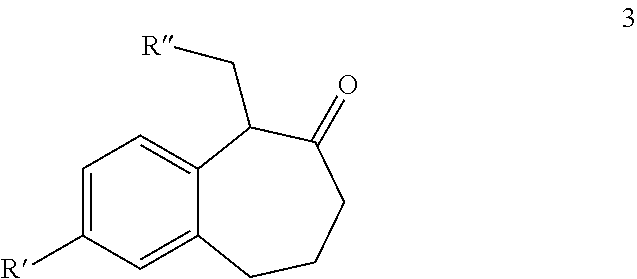
- with a ketone and a base until the reaction is substantially complete to form a compound of Formula 4
-

- wherein
-
- R′ is alkoxy and
- R″ is CF3, —(CH2)r-optionally substituted aryl, —(CH2)r-optionally substituted (C3-C6)cycloalkyl, optionally substituted (C1-C3)alkyl, or —(CH2)r-optionally substituted heteroaryl.
- In a thirty-seventh embodiment the invention provides a process for the preparation of a compound of Formula 6
-

- comprising the step of reacting compound of Formula 5
-

- with 1-(bromomethyl)-2-fluoro-4-(trifluoromethyl)benzene until the reaction is substantially complete to form a compound of Formula 6
-
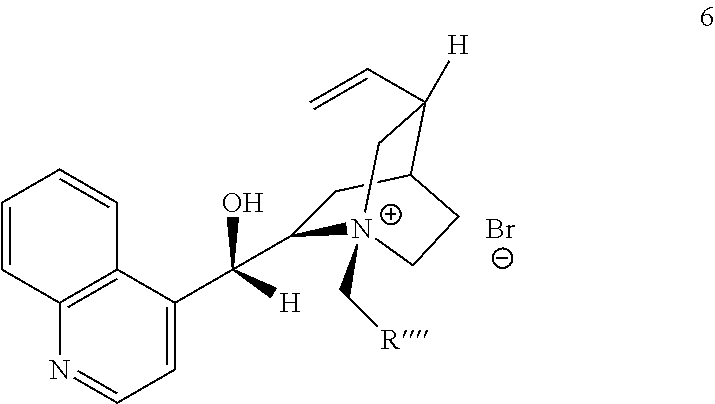
- wherein R″″ is arylhalide.
- In a thirty-eighth embodiment the invention provides a process for the preparation of compounds of Formulas 3a and 3b
-

- comprising reacting a compound of Formula 3
-
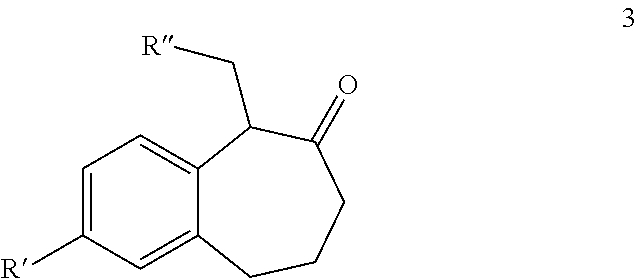
- with an eneone, a base and a compound of Formula 6
-

- until the reaction is substantially complete to form compounds of Formulas 3a and 3b
-

- wherein
-
- R′ is alkoxy;
- R″ is CF3, —(CH2)r-optionally substituted aryl, —(CH2)r-optionally substituted (C3-C6)cycloalkyl, optionally substituted (C1-C3)alkyl, or —(CH2)r-optionally substituted heteroaryl; and
- R″″ is arylhalide.
- In a thirty-ninth embodiment the invention provides a process for preparing compounds of Formula 3c and 3d
-

- comprising reacting compounds of Formulas 3a and 3b
-

- with a base until the reaction is substantially complete to form a compound of Formulas 3c and 3d
-

- wherein
-
- R′ is alkoxy and
- R″ is CF3, —(CH2)r-optionally substituted aryl, —(CH2)r-optionally substituted (C3-C6)cycloalkyl, optionally substituted (C1-C3)alkyl, or —(CH2)r-optionally substituted heteroaryl.
- In a fortieth embodiment the invention provides a process for preparing a compound of Formula 4a
-

- comprising fractional crystallization of formulas 3c and 3d
-

- until the reaction is substantially complete to form a compound of Formula 4a
-
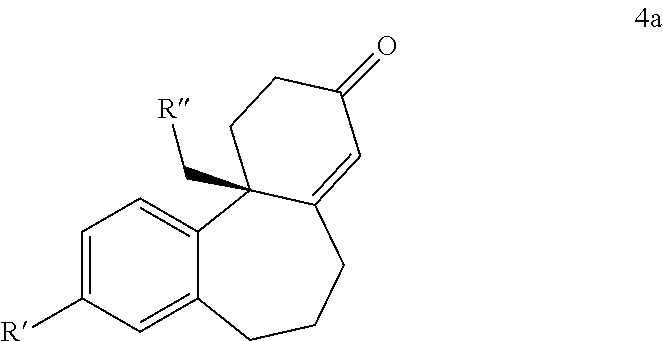
- wherein
-
- R′ is alkoxy and
- R″ is CF3, —(CH2)r-optionally substituted aryl, —(CH2)r-optionally substituted (C3-C6)cycloalkyl, optionally substituted (C1-C3)alkyl, or —(CH2)r-optionally substituted heteroaryl.
- In a forty-first embodiment the invention provides a process for preparing a compound of Formula 7
-

- comprising reacting a compound of Formula 4a
-
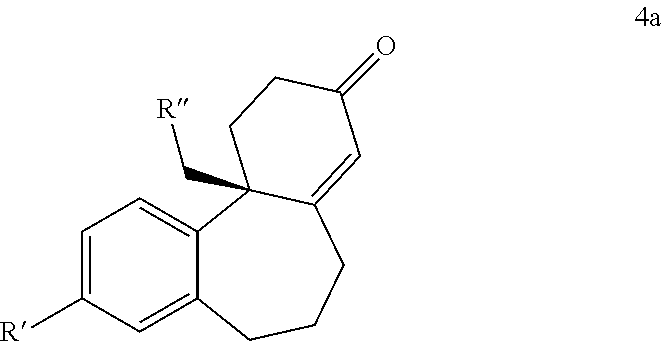
- with an acid and methionine until the reaction is substantially complete to form a compound of Formula 7
-

- wherein
-
- R″ is CF3, —(CH2)r-optionally substituted aryl, —(CH2)r-optionally substituted (C3-C6)cycloalkyl, optionally substituted (C1-C3)alkyl, or —(CH2)r-optionally substituted heteroaryl.
- In a forty-second embodiment the invention provides the process according to the forty-first embodiment, wherein the acid is methanesulfonic acid.
- In a forty-third embodiment the invention provides a process for preparing a compound of Formula 8
-

- comprising reacting a compound of Formula 7
-

- with hydrogen and a catalyst until the reaction is substantially complete to form a compound of Formula 8
-

- wherein
-
- R″ is CF3, —(CH2)r-optionally substituted aryl, —(CH2)r-optionally substituted (C3-C6)cycloalkyl, optionally substituted (C1-C3)alkyl, or —(CH2)r-optionally substituted heteroaryl.
- In a forty-fourth embodiment the invention provides a process for preparing a compound of Formula 9
-

- comprising reacting a compound of Formula 8
-

- with a triflating reagent N-phenylbis(trifluoromethanesulfonimide and a base until the reaction is substantially complete to form a compound of Formula 9
-

- wherein
-
- R″ is CF3, —(CH2)r-optionally substituted aryl, —(CH2)r-optionally substituted (C3-C6)cycloalkyl, optionally substituted (C1-C3)alkyl, or —(CH2)r-optionally substituted heteroaryl.
- In a forty-fifth embodiment the invention provides the process according to forty-fourth embodiment wherein the triflating reagent is N-phenylbis(trifluoromethanesulfonimide.
- In a forty-sixth embodiment the invention provides a process for preparing a compound of Formula 10
-

- comprising reacting a compound of Formula 9
-

- with carbon monoxide and a catalyst until the reaction is substantially complete to form a compound of Formula 10
-

- wherein
-
- R″ is CF3, —(CH2)r-optionally substituted aryl, —(CH2)r-optionally substituted (C3-C6)cycloalkyl, optionally substituted (C1-C3)alkyl, or —(CH2)r-optionally substituted heteroaryl and
- R′″ is optionally substituted aminoaryl, optionally substituted aminoheterocyclyl, optionally substituted aminoheteroaryl or optionally substituted aminocycloalkyl.
- In a forty-seventh embodiment the inventi provides a process for preparing a compound of Formula 11
-
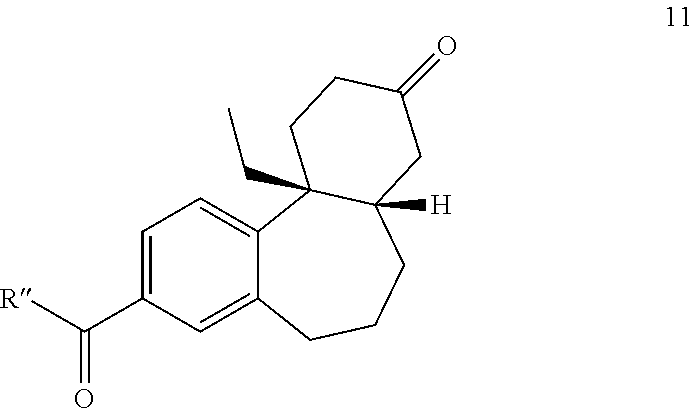
- comprising reacting a compound of Formula 10
-

- with a base until the reaction is substantially complete, then coupling to an amine to form a compound of Formula 11
-

- wherein
-
- R″ is CF3, —(CH2)r-optionally substituted aryl, —(CH2)r-optionally substituted (C3-C6)cycloalkyl, optionally substituted (C1-C3)alkyl, or —(CH2)r-optionally substituted heteroaryl and
- R′″ is optionally substituted aminoaryl, optionally substituted aminoheterocyclyl, optionally substituted aminoheteroaryl or optionally substituted aminocycloalkyl.
- In a forty-eighth embodiment the invention provides a process for preparing a compound of Formula 12
-

- comprising reacting a compound of Formula 11
-

- with a base and trimethylsulfoxonium halide until the reaction is substantially complete to form a compound of Formula 12
-

- wherein
-
- R″ is CF3, —(CH2)r-optionally substituted aryl, —(CH2)r-optionally substituted (C3-C6)cycloalkyl, optionally substituted (C1-C3)alkyl, or —(CH2)r-optionally substituted heteroaryl and
- R′″ is optionally substituted aminoaryl, optionally substituted aminoheterocyclyl, optionally substituted aminoheteroaryl or optionally substituted aminocycloalkyl.
- In a forty-ninth embodiment the invention provides a process for preparing a compound of Formula 13
-

- comprising reacting a compound of Formula 12
-

- with a metal halide until the reaction is substantially complete to form a compound of Formula 13
-

- wherein
-
- R″ is CF3, —(CH2)r-optionally substituted aryl, —(CH2)r-optionally substituted (C3-C6)cycloalkyl, optionally substituted (C1-C3)alkyl, or —(CH2)r-optionally substituted heteroaryl;
- R′″ is optionally substituted aminoaryl, optionally substituted aminoheterocyclyl, optionally substituted aminoheteroaryl or optionally substituted aminocycloalkyl and
- RIV is H, optionally substituted (C1-C3)alkyl, OH or —O-optionally substituted (C1-C3)alkyl.
- The glucocorticoid receptor (GR) is present in glucocorticoid responsive cells where it resides in the cytosol in an inactive state until it is stimulated by an agonist. Upon stimulation the glucocorticoid receptor translocates to the cell nucleus where it specifically interacts with DNA and/or protein(s) and regulates transcription in a glucocorticoid responsive manner. Two examples of proteins that interact with the glucocorticoid receptor are the transcription factors, API and NFK-B. Such interactions result in inhibition of API- and NFK-B-mediated transcription and are believed to be responsible for some of the anti-inflammatory activity of endogenously administered glucocorticoids. In addition, glucocorticoids may also exert physiologic effects independent of nuclear transcription. Biologically relevant glucocorticoid receptor agonists include Cortisol and corticosterone. Many synthetic glucocorticoid receptor agonists exist including dexamethasone, prednisone and prednisilone. By definition, glucocorticoid receptor antagonists bind to the receptor and prevent glucocorticoid receptor agonists from binding and eliciting GR mediated events, including transcription. RU486 is an example of a non-selective glucocorticoid receptor antagonist.
- Although there are glucocorticoid receptor therapies in the art, there is a continuing need for and a continuing search in this field of art for selective glucocorticoid receptor therapies. Thus, the identification of non-steroidal compounds which have specificity for one or more steroid receptors, but which have reduced or no cross-reactivity for other steroid or intracellular receptors, is of significant value in this field.
- Many autoimmune diseases and disease associated with chronic inflammation, as well as acute responses, have been linked to excessive or unregulated production or activity of one or more cytokines.
- The compounds of the invention are also useful in the treatment of rheumatoid arthritis, ankylosing spondilitis, a solid tumor, a sarcoma, fibrosarcoma, osteoma, melanoma, retinoblastoma, an ocular disease, a cancer, a rhabdomyosarcoma, glioblastoma, neuroblastoma, teratocarcinoma, hypersensitivity reactions, hyperkinetic movement disorders, hypersensitivity pneumonitis, hypertension, hypokinetic movement disorders, aordic and peripheral aneuryisms, hypothalamic-pituitary-adrenal axis evaluation, aortic dissection, arterial hypertension, arteriosclerosis, arteriovenous fistula, ataxia, spinocerebellar degenerations, streptococcal myositis, structural lesions of the cerebellum, subacute sclerosing panencephalitis, Syncope, syphilis of the cardiovascular system, systemic anaphalaxis, systemic inflammatory response syndrome, systemic onset juvenile rheumatoid arthritis, T-cell or FAB ALL, telangiectasia, thromboangitis obliterans, transplants, trauma/hemorrhage, type III hypersensitivity reactions, type IV hypersensitivity, unstable angina, uremia, urosepsis, urticaria, valvular heart diseases, varicose veins, vasculitis, venous diseases, venous thrombosis, ventricular fibrillation, viral and fungal infections, vital encephalitis/aseptic meningitis, vital-associated hemaphagocytic syndrome, Wernicke-Korsakoff syndrome, Wilson's disease, xenograft rejection of any organ or tissue, heart transplant rejection, hemachromatosis, hemodialysis, hemolytic uremic syndrome/thrombolytic thrombocytopenic purpura, hemorrhage, idiopathic pulmonary fibrosis, antibody mediated cytotoxicity, Asthenia, infantile spinal muscular atrophy, inflammation of the aorta, influenza A, ionizing radiation exposure, iridocyclitis/uveitis/optic neuritis, juvenile spinal muscular atrophy, lymphoma, myeloma, leukaemia, malignant ascites, hematopoietic cancers, a diabetic condition such as insulin-dependent diabetes mellitus glaucoma, diabetic retinopathy or microangiopathy, sickle cell anaemia, chronic inflammation, glomerulonephritis, graft rejection, Lyme disease, von Hippel Lindau disease, pemphigoid, Paget's disease, fibrosis, sarcoidosis, cirrhosis, thyroiditis, hyperviscosity syndrome, Osler-Weber-Rendu disease, chronic occlusive pulmonary disease, asthma or edema following burns, trauma, radiation, stroke, hypoxia, ischemia, ovarian hyperstimulation syndrome, post perfusion syndrome, post pump syndrome, post-MI cardiotomy syndrome, preeclampsia, menometrorrhagia, endometriosis, pulmonary hypertension, infantile hemangioma, or infection by Herpes simplex, Herpes Zoster, human immunodeficiency virus, parapoxvirus, protozoa or toxoplasmosis, progressive supranucleo palsy, primary pulmonary hypertension, radiation therapy, Raynaud's phenomenon, Raynaud's disease, Refsum's disease, regular narrow QRS tachycardia, renovascular hypertension, restrictive cardiomyopathy, sarcoma, senile chorea, senile dementia of Lewy body type, shock, skin allograft, skin changes syndrome, ocular or macular edema, ocular neovascular disease, scleritis, radial keratotomy, uveitis, vitritis, myopia, optic pits, chronic retinal detachment, post-laser treatment complications, conjunctivitis, Stargardt's disease, Eales disease, retinopathy, macular degeneration, restenosis, ischemia/reperfusion injury, ischemic stroke, vascular occlusion, carotid obstructive disease, ulcerative colitis, inflammatory bowel disease, diabetes, diabetes mellitus, insulin dependent diabetes mellitus, allergic diseases, dermatitis scleroderma, graft versus host disease, organ transplant rejection (including but not limited to bone marrow and solid organ rejection), acute or chronic immune disease associated with organ transplantation, sarcoidosis, disseminated intravascular coagulation, Kawasaki's disease, nephrotic syndrome, chronic fatigue syndrome, Wegener's granulomatosis, Henoch-Schoenlein purpurea, microscopic vasculitis of the kidneys, chronic active hepatitis, septic shock, toxic shock syndrome, sepsis syndrome, cachexia, infectious diseases, parasitic diseases, acquired immunodeficiency syndrome, acute transverse myelitis, Huntington's chorea, stroke, primary biliary cirrhosis, hemolytic anemia, malignancies, Addison's disease, idiopathic Addison's disease, sporadic, polyglandular deficiency type I and polyglandular deficiency type II, Schmidt's syndrome, adult (acute) respiratory distress syndrome, alopecia, alopecia greata, seronegative arthopathy, arthropathy, Reiter's disease, psoriatic arthropathy, ulcerative colitic arthropathy, enteropathic synovitis, chlamydia, yersinia and salmonella associated arthropathy, atheromatous disease/arteriosclerosis, atopic allergy, autoimmune bullous disease, pemphigus vulgaris, pemphigus foliaceus, pemphigoid, linear IgA disease, autoimmune haemolytic anaemia, Coombs positive haemolytic anaemia, acquired pernicious anaemia, juvenile pernicious anaemia, peripheral vascular disorders, peritonitis, pernicious anemia, myalgic encephalitis/Royal Free Disease, chronic mucocutaneous candidiasis, giant cell arteritis, primary sclerosing hepatitis, cryptogenic autoimmune hepatitis, Acquired Immunodeficiency Disease Syndrome, Acquired Immunodeficiency Related Diseases, Hepatitis A, Hepatitis B, Hepatitis C, His bundle arrythmias, HIV infection/HIV neuropathy, common varied immunodeficiency (common variable hypogammaglobulinaemia), dilated cardiomyopathy, female infertility, ovarian failure, premature ovarian failure, fibrotic lung disease, chronic wound healing, cryptogenic fibrosing alveolitis, post-inflammatory interstitial lung disease, interstitial pneumonitis, pneumocystis carinii pneumonia, pneumonia, connective tissue disease associated interstitial lung disease, mixed connective tissue disease, associated lung disease, systemic sclerosis associated interstitial lung disease, rheumatoid arthritis associated interstitial lung disease, systemic lupus erythematosus associated lung disease, dermatomyositis/polymyositis associated lung disease, Sjögren's disease associated lung disease, ankylosing spondylitis associated lung disease, vasculitic diffuse lung disease, haemosiderosis associated lung disease, drug-induced interstitial lung disease, radiation fibrosis, bronchiolitis obliterans, chronic eosinophilic pneumonia, lymphocytic infiltrative lung disease, postinfectious interstitial lung disease, gouty arthritis, autoimmune hepatitis, type-1 autoimmune hepatitis (classical autoimmune or lupoid hepatitis), type-2 autoimmune hepatitis (anti-LKM antibody hepatitis), autoimmune mediated hypoglycaemia, type B insulin resistance with acanthosis nigricans, hypoparathyroidism, acute immune disease associated with organ transplantation, chronic immune disease associated with organ transplantation, osteoarthritis, primary sclerosing cholangitis, psoriasis type 1, psoriasis type 2, idiopathic leucopaenia, autoimmune neutropaenia, renal disease NOS, glomerulonephritides, microscopic vasulitis of the kidneys, Lyme disease, discoid lupus erythematosus, male infertility idiopathic or NOS, sperm autoimmunity, multiple sclerosis (all subtypes), sympathetic ophthalmia, pulmonary hypertension secondary to connective tissue disease, acute and chronic pain (different forms of pain), Goodpasture's syndrome, pulmonary manifestation of polyarteritis nodosa, acute rheumatic fever, rheumatoid spondylitis, Still's disease, systemic sclerosis, Sjögren's syndrome, Takayasu's disease/arteritis, autoimmune thrombocytopaenia, toxicity, transplants, and diseases involving inappropriate vascularization for example diabetic retinopathy, retinopathy of prematurity, choroidal neovascularization due to age-related macular degeneration, and infantile hemangiomas in human beings. In addition, such compounds may be useful in the treatment of disorders such as ascites, effusions, and exudates, including for example macular edema, cerebral edema, acute lung injury, adult respiratory distress syndrome (ARDS), proliferative disorders such as restenosis, fibrotic disorders such as hepatic cirrhosis and atherosclerosis, mesangial cell proliferative disorders such as diabetic nephropathy, malignant nephrosclerosis, thrombotic microangiopathy syndromes, and glomerulopathies, myocardial angiogenesis, coronary and cerebral collaterals, ischemic limb angiogenesis, ischemia/reperfusion injury, peptic ulcer Helicobacter related diseases, virally-induced angiogenic disorders, preeclampsia, menometrorrhagia, cat scratch fever, rubeosis, neovascular glaucoma and retinopathies such as those associated with diabetic retinopathy, retinopathy of prematurity, or age-related macular degeneration. In addition, these compounds can be used as active agents against hyperproliferative disorders such as thyroid hyperplasia (especially Grave's disease), and cysts (such as hypervascularity of ovarian stroma characteristic of polycystic ovarian syndrome (Stein-Leventhal syndrome) and polycystic kidney disease since such diseases require a proliferation of blood vessel cells for growth and/or metastasis.
- Compounds of Formula (I) of the invention can be used alone or in combination with an additional agent, e.g., a therapeutic agent, said additional agent being selected by the skilled artisan for its intended purpose. For example, the additional agent can be a therapeutic agent art-recognized as being useful to treat the disease or condition being treated by the compound of the present invention. The additional agent also can be an agent that imparts a beneficial attribute to the therapeutic composition e.g., an agent that affects the viscosity of the composition.
- It should further be understood that the combinations which are to be included within this invention are those combinations useful for their intended purpose. The agents set forth below are illustrative for purposes and not intended to be limited. The combinations, which are part of this invention, can be the compounds of the present invention and at least one additional agent selected from the lists below. The combination can also include more than one additional agent, e.g., two or three additional agents if the combination is such that the formed composition can perform its intended function.
- Preferred combinations are non-steroidal anti-inflammatory drug(s) also referred to as NSAIDS which include drugs like ibuprofen. Other preferred combinations are corticosteroids including prednisolone; the well known side-effects of steroid use can be reduced or even eliminated by tapering the steroid dose required when treating patients in combination with the compounds of this invention. Non-limiting examples of therapeutic agents for rheumatoid arthritis with which a compound of Formula (I) of the invention can be combined include the following: cytokine suppressive anti-inflammatory drug(s) (CSAIDs); antibodies to or antagonists of other human cytokines or growth factors, for example, TNF, LT, IL-1, IL-2, IL-3, IL-4, IL-5, IL-6, IL-7, IL-8, IL-12, IL-15, IL-16, IL-21, IL-23, interferons, EMAP-II, GM-CSF, FGF, and PDGF. Compounds of the invention can be combined with antibodies to cell surface molecules such as CD2, CD3, CD4, CD8, CD25, CD28, CD30, CD40, CD45, CD69, CD80 (B7.1), CD86 (B7.2), CD90, CTLA or their ligands including CD154 (gp39 or CD40L).
- Preferred combinations of therapeutic agents may interfere at different points in the autoimmune and subsequent inflammatory cascade; preferred examples include TNF antagonists like chimeric, humanized or human TNF antibodies, D2E7 (U.S. Pat. No. 6,090,382, HUMIRA™), CA2 (REMICADE™), SIMPONI™ (golimumab), CIMZIA™, ACTEMRA™, CDP 571, and soluble p55 or p75 TNF receptors, derivatives, thereof, p75TNFR1gG (ENBREL™) or p55TNFR1gG (Lenercept), and also TNFα converting enzyme (TACE) inhibitors; similarly IL-1 inhibitors (Interleukin-1-converting enzyme inhibitors, IL-1RA etc.) may be effective for the same reason. Other preferred combinations include Interleukin 11. Yet other preferred combinations are the other key players of the autoimmune response which may act parallel to, dependent on or in concert with IL-18 function; especially preferred are IL-12 antagonists including IL-12 antibodies or soluble IL-12 receptors, or IL-12 binding proteins. It has been shown that IL-12 and IL-18 have overlapping but distinct functions and a combination of antagonists to both may be most effective. Yet another preferred combination is non-depleting anti-CD4 inhibitors. Yet other preferred combinations include antagonists of the co-stimulatory pathway CD80 (B7.1) or CD86 (B7.2) including antibodies, soluble receptors or antagonistic ligands.
- A compound of Formula (I) of the invention may also be combined with agents, such as methotrexate, 6-mercaptopurine, azathioprine sulphasalazine, mesalazine, olsalazine chloroquinine/hydroxychloroquine, pencillamine, aurothiomalate (intramuscular and oral), azathioprine, cochicine, corticosteroids (oral, inhaled and local injection), beta-2 adrenoreceptor agonists (salbutamol, terbutaline, salmeteral), xanthines (theophylline, aminophylline), cromoglycate, nedocromil, ketotifen, ipratropium and oxitropium, cyclosporin, FK506, rapamycin, mycophenolate mofetil, leflunomide, NSAIDs, for example, ibuprofen, corticosteroids such as prednisolone, phosphodiesterase inhibitors, adensosine agonists, antithrombotic agents, complement inhibitors, adrenergic agents, agents which interfere with signaling by proinflammatory cytokines such as TNFα or IL-1 (e.g., NIK, IKK, p38 or MAP kinase inhibitors), IL-1β converting enzyme inhibitors, T-cell signaling inhibitors such as kinase inhibitors, metalloproteinase inhibitors, sulfasalazine, 6-mercaptopurines, angiotensin converting enzyme inhibitors, soluble cytokine receptors and derivatives thereof (e.g. soluble p55 or p75 TNF receptors and the derivatives p75TNFRIgG (Enbrel™) and p55TNFRIgG (Lenercept), sIL-1RI, sIL-1RII, sIL-6R), antiinflammatory cytokines (e.g. IL-4, IL-10, IL-11, IL-13 and TGFβ), celecoxib, folic acid, hydroxychloroquine sulfate, rofecoxib, etanercept, infliximab, naproxen, valdecoxib, sulfasalazine, methylprednisolone, meloxicam, methylprednisolone acetate, gold sodium thiomalate, aspirin, triamcinolone acetonide, propoxyphene napsylate/apap, folate, nabumetone, diclofenac, piroxicam, etodolac, diclofenac sodium, oxaprozin, oxycodone HCl, hydrocodone bitartrate/apap, diclofenac sodium/misoprostol, fentanyl, anakinra, tramadol HCl, salsalate, sulindac, cyanocobalamin/fa/pyridoxine, acetaminophen, alendronate sodium, prednisolone, morphine sulfate, lidocaine hydrochloride, indomethacin, glucosamine sulf/chondroitin, amitriptyline HCl, sulfadiazine, oxycodone HCl/acetaminophen, olopatadine HCl misoprostol, naproxen sodium, omeprazole, cyclophosphamide, rituximab, IL-1 TRAP, MRA, CTLA4-IG, IL-18 BP, anti-IL-12, Anti-IL15, BIRB-796, SCIO-469, VX-702, AMG-548, VX-740, Roflumilast, IC-485, CDC-801, S1P1 agonists (such as Fingolimod), and Mesopram. Preferred combinations include methotrexate or leflunomide and in moderate or severe rheumatoid arthritis cases, cyclosporin and anti-TNF antibodies as noted above.
- Non-limiting examples of therapeutic agents for inflammatory bowel disease with which a compound of Formula (I) of the invention can be combined include the following: budenoside; epidermal growth factor; corticosteroids; cyclosporin, sulfasalazine; aminosalicylates; 6-mercaptopurine; azathioprine; metronidazole; lipoxygenase inhibitors; mesalamine; olsalazine; balsalazide; antioxidants; thromboxane inhibitors; IL-1 receptor antagonists; anti-IL-1β monoclonal antibodies; anti-IL-6 monoclonal antibodies; growth factors; elastase inhibitors; pyridinyl-imidazole compounds; antibodies to or antagonists of other human cytokines or growth factors, for example, TNF, LT, IL-1, IL-2, IL-6, IL-7, IL-8, IL-12, IL-15, IL-16, IL-23, EMAP-II, GM-CSF, FGF, and PDGF; cell surface molecules such as CD2, CD3, CD4, CD8, CD25, CD28, CD30, CD40, CD45, CD69, CD90 or their ligands; methotrexate; cyclosporine; FK506; rapamycin; mycophenolate mofetil; leflunomide; NSAIDs, for example, ibuprofen; corticosteroids such as prednisolone; phosphodiesterase inhibitors; adenosine agonists; antithrombotic agents; complement inhibitors; adrenergic agents; agents which interfere with signaling by proinflammatory cytokines such as TNFα or IL-1 (e.g. NIK, IKK, or MAP kinase inhibitors); IL-1β converting enzyme inhibitors; TNFα converting enzyme inhibitors; T-cell signaling inhibitors such as kinase inhibitors; metalloproteinase inhibitors; sulfasalazine; azathioprine; 6-mercaptopurines; angiotensin converting enzyme inhibitors; soluble cytokine receptors and derivatives thereof (e.g. soluble p55 or p75 TNF receptors, sIL-1RI, sIL-1RII, sIL-6R) and antiinflammatory cytokines (e.g. IL-4, IL-10, IL-11, IL-13 and TGFβ). Preferred examples of therapeutic agents for Crohn's disease with which a compound of Formula (I) can be combined include the following: TNF antagonists, for example, anti-TNF antibodies, D2E7 (U.S. Pat. No. 6,090,382, HUMIRA™), CA2 (REMICADE™), CDP 571, TNFR-Ig constructs, (p75TNFRIgG (ENBREL™) and p55TNFRIgG (LENERCEPT™) inhibitors and PDE4 inhibitors. A compound of Formula (I) can be combined with corticosteroids, for example, budenoside and dexamethasone; sulfasalazine, 5-aminosalicylic acid; olsalazine; and agents which interfere with synthesis or action of proinflammatory cytokines such as IL-1, for example, IL-1β converting enzyme inhibitors and IL-1ra; T cell signaling inhibitors, for example, tyrosine kinase inhibitors; 6-mercaptopurine; IL-11; mesalamine; prednisone; azathioprine; mercaptopurine; infliximab; methylprednisolone sodium succinate; diphenoxylate/atrop sulfate; loperamide hydrochloride; methotrexate; omeprazole; folate; ciprofloxacin/dextrose-water; hydrocodone bitartrate/apap; tetracycline hydrochloride; fluocinonide; metronidazole; thimerosal/boric acid; cholestyramine/sucrose; ciprofloxacin hydrochloride; hyoscyamine sulfate; meperidine hydrochloride; midazolam hydrochloride; oxycodone HCl/acetaminophen; promethazine hydrochloride; sodium phosphate; sulfamethoxazole/trimethoprim; celecoxib; polycarbophil; propoxyphene napsylate; hydrocortisone; multivitamins; balsalazide disodium; codeine phosphate/apap; colesevelam HCl; cyanocobalamin; folic acid; levofloxacin; methylprednisolone; natalizumab and interferon-gamma.
- Non-limiting examples of therapeutic agents for multiple sclerosis with which a compound of Formula (I) can be combined include the following: corticosteroids; prednisolone; methylprednisolone; azathioprine; cyclophosphamide; cyclosporine; methotrexate; 4-aminopyridine; tizanidine; interferon-β1a (AVONEX®; Biogen); interferon-β1b (BETASERON®; Chiron/Berlex); interferon α-n3) (Interferon Sciences/Fujimoto), interferon-α (Alfa Wassermann/J&J), interferon β1A-IF (Serono/Inhale Therapeutics), Peginterferon α 2b (Enzon/Schering-Plough), Copolymer 1 (Cop-1; COPAXONE®; Teva Pharmaceutical Industries, Inc.); hyperbaric oxygen; intravenous immunoglobulin; cladribine; antibodies to or antagonists of other human cytokines or growth factors and their receptors, for example, TNF, LT, IL-1, IL-2, IL-6, IL-7, IL-8, IL-12, IL-23, IL-15, IL-16, EMAP-II, GM-CSF, FGF, and PDGF. A compound of Formula (I) can be combined with antibodies to cell surface molecules such as CD2, CD3, CD4, CD8, CD19, CD20, CD25, CD28, CD30, CD40, CD45, CD69, CD80, CD86, CD90 or their ligands. A compound of Formula (I) may also be combined with agents such as methotrexate, cyclosporine, FK506, rapamycin, mycophenolate mofetil, leflunomide, an S1P1 agonist, NSAIDs, for example, ibuprofen, corticosteroids such as prednisolone, phosphodiesterase inhibitors, adensosine agonists, antithrombotic agents, complement inhibitors, adrenergic agents, agents which interfere with signaling by proinflammatory cytokines such as TNFα or IL-1 (e.g., NIK, IKK, p38 or MAP kinase inhibitors), IL-1β converting enzyme inhibitors, TACE inhibitors, T-cell signaling inhibitors such as kinase inhibitors, metalloproteinase inhibitors, sulfasalazine, azathioprine, 6-mercaptopurines, angiotensin converting enzyme inhibitors, soluble cytokine receptors and derivatives thereof (e.g. soluble p55 or p75 TNF receptors, sIL-1RI, sIL-1RII, sIL-6R) and antiinflammatory cytokines (e.g. IL-4, IL-10, IL-13 and TGFβ).
- Preferred examples of therapeutic agents for multiple sclerosis in which a compound of Formula (I) can be combined to include interferon-β, for example, IFNβ1a and IFNβ1b; copaxone, corticosteroids, caspase inhibitors, for example inhibitors of caspase-1, IL-1 inhibitors, TNF inhibitors, and antibodies to CD40 ligand and CD80.
- A compound of Formula (I) may also be combined with agents, such as alemtuzumab, dronabinol, daclizumab, mitoxantrone, xaliproden hydrochloride, fampridine, glatiramer acetate, natalizumab, sinnabidol, a-immunokine NNSO3, ABR-215062, AnergiX.MS, chemokine receptor antagonists, BBR-2778, calagualine, CPI-1189, LEM (liposome encapsulated mitoxantrone), THC.CBD (cannabinoid agonist), MBP-8298, mesopram (PDE4 inhibitor), MNA-715, anti-IL-6 receptor antibody, neurovax, pirfenidone allotrap 1258 (RDP-1258), sTNF-R1, talampanel, teriflunomide, TGF-beta2, tiplimotide, VLA-4 antagonists (for example, TR-14035, VLA4 Ultrahaler, Antegran-ELAN/Biogen), interferon gamma antagonists and IL-4 agonists.
- Non-limiting examples of therapeutic agents for ankylosing spondylitis with which a compound of Formula (I) can be combined include the following: ibuprofen, diclofenac, misoprostol, naproxen, meloxicam, indomethacin, diclofenac, celecoxib, rofecoxib, sulfasalazine, methotrexate, azathioprine, minocyclin, prednisone, and anti-TNF antibodies, D2E7 (U.S. Pat. No. 6,090,382; HUMIRA™), CA2 (REMICADE™), CDP 571, TNFR-Ig constructs, (p75TNFRIgG (ENBREL™) and p55TNFRIgG (LENERCEPT™)
- Non-limiting examples of therapeutic agents for psoriasis with which a compound of Formula (I) can be combined include the following: calcipotriene, clobetasol propionate, triamcinolone acetonide, halobetasol propionate, tazarotene, methotrexate, fluocinonide, betamethasone diprop augmented, fluocinolone acetonide, acitretin, tar shampoo, betamethasone valerate, mometasone furoate, ketoconazole, pramoxine/fluocinolone, hydrocortisone valerate, flurandrenolide, urea, betamethasone, clobetasol propionate/emoll, fluticasone propionate, azithromycin, hydrocortisone, moisturizing formula, folic acid, desonide, pimecrolimus, coal tar, diflorasone diacetate, etanercept folate, lactic acid, methoxsalen, hc/bismuth subgal/znox/resor, methylprednisolone acetate, prednisone, sunscreen, halcinonide, salicylic acid, anthralin, clocortolone pivalate, coal extract, coal tar/salicylic acid, coal tar/salicylic acid/sulfur, desoximetasone, diazepam, emollient, fluocinonide/emollient, mineral oil/castor oil/na lact, mineral oil/peanut oil, petroleum/isopropyl myristate, psoralen, salicylic acid, soap/tribromsalan, thimerosal/boric acid, celecoxib, infliximab, cyclosporine, alefacept, efalizumab, tacrolimus, pimecrolimus, PUVA, UVB, sulfasalazine, ABT-874 and ustekinamab.
- Non-limiting examples of therapeutic agents for psoriatic arthritis with which a compound of Formula (I) can be combined include the following: methotrexate, etanercept, rofecoxib, celecoxib, folic acid, sulfasalazine, naproxen, leflunomide, methylprednisolone acetate, indomethacin, hydroxychloroquine sulfate, prednisone, sulindac, betamethasone diprop augmented, infliximab, methotrexate, folate, triamcinolone acetonide, diclofenac, dimethylsulfoxide, piroxicam, diclofenac sodium, ketoprofen, meloxicam, methylprednisolone, nabumetone, tolmetin sodium, calcipotriene, cyclosporine, diclofenac sodium/misoprostol, fluocinonide, glucosamine sulfate, gold sodium thiomalate, hydrocodone bitartrate/apap, ibuprofen, risedronate sodium, sulfadiazine, thioguanine, valdecoxib, alefacept, D2E7 (U.S. Pat. No. 6,090,382, HUMIRA™), and efalizumab.
- Preferred examples of therapeutic agents for SLE (Lupus) with which a compound of Formula (I) can be combined include the following: NSAIDS, for example, diclofenac, naproxen, ibuprofen, piroxicam, indomethacin; COX2 inhibitors, for example, celecoxib, rofecoxib, valdecoxib; anti-malarials, for example, hydroxychloroquine; steroids, for example, prednisone, prednisolone, budenoside, dexamethasone; cytotoxics, for example, azathioprine, cyclophosphamide, mycophenolate mofetil, methotrexate; inhibitors of PDE4 or purine synthesis inhibitor, for example Cellcept®. A compound of Formula (I) may also be combined with agents such as sulfasalazine, 5-aminosalicylic acid, olsalazine, Imuran® and agents which interfere with synthesis, production or action of proinflammatory cytokines such as IL-1, for example, caspase inhibitors like IL-1β converting enzyme inhibitors and IL-1ra. A compound of Formula (I) may also be used with T cell signaling inhibitors, for example, tyrosine kinase inhibitors; or molecules that target T cell activation molecules, for example, CTLA-4-IgG or anti-B7 family antibodies, anti-PD-1 family antibodies. A compound of Formula (I) can be combined with IL-11 or anti-cytokine antibodies, for example, fonotolizumab (anti-IFNg antibody), or anti-receptor receptor antibodies, for example, anti-IL-6 receptor antibody and antibodies to B-cell surface molecules. A compound of Formula (I) may also be used with LJP 394 (abetimus), agents that deplete or inactivate B-cells, for example, Rituximab (anti-CD20 antibody), lymphostat-B (anti-BlyS antibody), TNF antagonists, for example, anti-TNF antibodies, D2E7 (U.S. Pat. No. 6,090,382; HUMIRA™), CA2 (REMICADE™), CDP 571, TNFR-Ig constructs, (p75TNFRIgG (ENBREL™) and p55TNFRIgG (LENERCEPT™).
- In this invention, the following definitions are applicable:
- A “therapeutically effective amount” is an amount of a compound of Formula (I) or a combination of two or more such compounds, which inhibits, totally or partially, the progression of the condition or alleviates, at least partially, one or more symptoms of the condition. A therapeutically effective amount can also be an amount which is prophylactically effective. The amount which is therapeutically effective will depend upon the patient's size and gender, the condition to be treated, the severity of the condition and the result sought. For a given patient, a therapeutically effective amount can be determined by methods known to those of skill in the art. “Pharmaceutically acceptable salts” refers to those salts which retain the biological effectiveness and properties of the free bases and which are obtained by reaction with inorganic acids, for example, hydrochloric acid, hydrobromic acid, sulfuric acid, nitric acid, and phosphoric acid or organic acids such as sulfonic acid, carboxylic acid, organic phosphoric acid, methanesulfonic acid, ethanesulfonic acid, p-toluenesulfonic acid, citric acid, fumaric acid, maleic acid, succinic acid, benzoic acid, salicylic acid, lactic acid, tartaric acid (e.g. (+) or (−)-tartaric acid or mixtures thereof), amino acids (e.g. (+) or (−)-amino acids or mixtures thereof), and the like. These salts can be prepared by methods known to those skilled in the art.
- Certain compounds of Formula (I) which have acidic substituents may exist as salts with pharmaceutically acceptable bases. The present invention includes such salts. Examples of such salts include sodium salts, potassium salts, lysine salts and arginine salts. These salts may be prepared by methods known to those skilled in the art.
- Certain compounds of Formula (I) and their salts may exist in more than one crystal form and the present invention includes each crystal form and mixtures thereof.
Certain compounds of Formula (I) and their salts may also exist in the form of solvates, for example hydrates, and the present invention includes each solvate and mixtures thereof. - Certain compounds of Formula (I) may contain one or more chiral centers, and exist in different optically active forms. When compounds of Formula (I) contain one chiral center, the compounds exist in two enantiomeric forms and the present invention includes both enantiomers and mixtures of enantiomers, such as racemic mixtures. The enantiomers may be resolved by methods known to those skilled in the art, for example by formation of diastereoisomeric salts which may be separated, for example, by crystallization; formation of diastereoisomeric derivatives or complexes which may be separated, for example, by crystallization, gas-liquid or liquid chromatography; selective reaction of one enantiomer with an enantiomer-specific reagent, for example enzymatic esterification; or gas-liquid or liquid chromatography in a chiral environment, for example on a chiral support for example silica with a bound chiral ligand or in the presence of a chiral solvent. It will be appreciated that where the desired enantiomer is converted into another chemical entity by one of the separation procedures described above, a further step is required to liberate the desired enantiomeric form. Alternatively, specific enantiomers may be synthesized by asymmetric synthesis using optically active reagents, substrates, catalysts or solvents, or by converting one enantiomer into the other by asymmetric transformation.
- When a compound of Formula (I) contains more than one chiral center, it may exist in diastereoisomeric forms. The diastereoisomeric compounds may be separated by methods known to those skilled in the art, for example chromatography or crystallization and the individual enantiomers may be separated as described above. The present invention includes each diastereoisomer of compounds of Formula (I), and mixtures thereof. Certain compounds of Formula (I) may exist in different tautomeric forms or as different geometric isomers, and the present invention includes each tautomer and/or geometric isomer of compounds of Formula (I) and mixtures thereof. Certain compounds of Formula (I) may exist in different stable conformational forms which may be separable. Torsional asymmetry due to restricted rotation about an asymmetric single bond, for example because of steric hindrance or ring strain, may permit separation of different conformers. The present invention includes each conformational isomer of compounds of Formula (I) and mixtures thereof. Certain compounds of Formula (I) may exist in zwitterionic form and the present invention includes each zwitterionic form of compounds of Formula (I) and mixtures thereof.
- As used herein the term “pro-drug” refers to an agent which is converted into the parent drug in vivo by some physiological chemical process (e.g., a pro-drug on being brought to the physiological pH is converted to the desired drug form). Pro-drugs are often useful because, in some situations, they may be easier to administer than the parent drug. They may, for instance, be bioavailable by oral administration whereas the parent drug is not. The pro-drug may also have improved solubility in pharmacological compositions over the parent drug. An example, without limitation, of a pro-drug would be a compound of the present invention wherein it is administered as an ester (the “pro-drug”) to facilitate transmittal across a cell membrane where water solubility is not beneficial, but then it is metabolically hydrolyzed to the carboxylic acid once inside the cell where water solubility is beneficial.
- Pro-drugs have many useful properties. For example, a pro-drug may be more water soluble than the ultimate drug, thereby facilitating intravenous administration of the drug. A pro-drug may also have a higher level of oral bioavailability than the ultimate drug. After administration, the pro-drug is enzymatically or chemically cleaved to deliver the ultimate drug in the blood or tissue.
- Exemplary pro-drugs upon cleavage release the corresponding free acid, and such hydrolyzable ester-forming residues of the compounds of this invention include but are not limited to phosphates, phosphate esters, and carboxylic acid substituents wherein the free hydrogen is replaced by (C1-C4)alkyl, (C1-C12)alkanoyloxymethyl, (C4-C9)1-(alkanoyloxy)ethyl, 1-methyl-1-(alkanoyloxy)-ethyl having from 5 to 10 carbon atoms, alkoxycarbonyloxymethyl having from 3 to 6 carbon atoms, 1-(alkoxycarbonyloxy)ethyl having from 4 to 7 carbon atoms, 1-methyl-1-(alkoxycarbonyloxy)ethyl having from 5 to 8 carbon atoms, N-(alkoxycarbonyl)aminomethyl having from 3 to 9 carbon atoms, 1-(N-(alkoxycarbonyl)amino)ethyl having from 4 to 10 carbon atoms, 3-phthalidyl, 4-crotonolactonyl, gamma-butyrolacton-4-yl, di-N,N—(C1-C2)alkylamino (C2-C3)alkyl (such as β-dimethylaminoethyl), carbamoyl-(C1-C2)alkyl, N,N-di(C1-C2)-alkylcarbamoyl-(C1-C2)alkyl and piperidino-, pyrrolidino- or morpholino(C2-C3)alkyl.
- Other exemplary pro-drugs release an alcohol of Formula (I) wherein the free hydrogen of the hydroxyl substituent is replaced by (C1-C6)alkanoyloxymethyl, 1((C1-C6)alkanoyloxy)ethyl, 1-methyl-1-((C1-C6)alkanoyloxy)ethyl, (C1-C12)alkoxycarbonyloxymethyl, N—(C1-C6)alkoxycarbonylamino-methyl, succinoyl, (C1-C6)alkanoyl, α-amino(C1-C4)alkanoyl, arylacetyl and α-aminoacyl, or α-aminoacyl-α-aminoacyl wherein said α-aminoacyl moieties are independently any of the naturally occurring L-amino acids found in proteins, P(O)(OH)2, —P(O)(O(C1-C6)alkyl)2 or glycosyl (the radical resulting from detachment of the hydroxyl of the hemiacetal of a carbohydrate).
- Other exemplary pro-drugs release an amine of Formula (I) wherein the free hydrogen of the amine group is replaced by —C(O)alkyl, —C(O)O-alkyl, N-phosphonoxyalkyl, alkyl, cycloalkyl, aryl, heteroaryl or heterocyclyl, wherein the alkyl, cycloalkyl, aryl, heteroaryl or heterocyclyl can be optionally substituted with, for example, halogen and hydroxyl.
- As used herein “solvate” means a physical association of a compound of this invention with one or more solvent molecules. This physical association involves varying degrees of ionic and covalent bonding, including hydrogen bonding. In certain instances the solvate will be capable of isolation, for example when one or more solvent molecules are incorporated in the crystal lattice of the crystalline solid. “Solvate” encompasses both solution-phase and isolatable solvates. Non-limiting examples of suitable solvates include ethanolates, methanolates, and the like.
- As used herein, “spirocyclic (C2-C10) heterocyclyl” means bicyclic or polycyclic hydrocarbon group having two or three (C3-C10) rings at least one of which contains a heteroatom such as nitrogen, oxygen or sulfur. For purposes of exemplification, which should not be construed as limiting the scope of this invention, spirocyclic (C2-C10) heterocyclyl may include diazaspiro[3.5]nonane and diazaspiro[4.5]decane.
- As used herein, “spirocyclic (C5-C11) carbocyclyl” means a saturated or unsaturated, bicyclic or polycyclic hydrocarbon group having two or three (C3-C10) cycloalkyl rings. For purposes of exemplification, which should not be construed as limiting the scope of this invention, spirocyclic (C5-C11) carbocyclyl includes spiro[5.5]undecane, spiro[4.5]decane and spiro[4.4]nonane.
- The term “heterocyclic”, “heterocyclyl” or “heterocyclylene”, as used herein, include non-aromatic ring systems, including, but not limited to, monocyclic, bicyclic, and tricyclic rings, which can be completely saturated or which can contain one or more units of unsaturation. (for the avoidance of doubt, the degree of unsaturation does not result in an aromatic ring system) and have 5 to 12 atoms including at least one heteroatom, such as nitrogen, oxygen, or sulfur. For purposes of exemplification, which should not be construed as limiting the scope of this invention, the following are examples of heterocyclic rings: azepinyl, azetidinyl, indolinyl, isoindolinyl, morpholinyl, piperazinyl, piperidinyl, pyrrolidinyl, quinucludinyl, thiomorpholinyl, tetrahydropyranyl, tetrahydrofuranyl, tetrahydroindolyl, thiomorpholinyl and tropanyl.
- The term “heteroaryl” or “heteroarylene” as used herein, include aromatic ring systems, including, but not limited to, monocyclic, bicyclic and tricyclic rings, and have 5 to 12 atoms including at least one heteroatom, such as nitrogen, oxygen, or sulfur. For purposes of exemplification, which should not be construed as limiting the scope of this invention: azaindolyl, benzo[b]thienyl, benzimidazolyl, benzofuranyl, benzoxazolyl, benzothiazolyl, benzothiadiazolyl, benzoxadiazolyl, 6,7-dihydro-5H-cyclopentapyrimidinyl, furanyl, imidazolyl, imidazopyridinyl, indolyl, indazolyl, isoxazolyl, isothiazolyl, octahydro-pyrrolopyrrolyl, oxadiazolyl, oxazolyl, phthalazinyl, pteridinyl, purinyl, pyranyl, 5,8-dihydro-6H-pyrano[3,4-d]pyridinyl, pyrazinyl, pyrazolyl, pyridinyl, pyrido[2,3-d]pyrimidinyl, pyrido[4,3-d]pyrimidinyl, pyrido[3,4-d]pyrimidinyl, pyrimidinyl, pyrimido[4,5-d]pyrimidinyl, pyrrolyl, pyrrolo[2,3-d]pyrimidinyl, pyrazolo[3,4-d]pyrimidinyl, quinolinyl, quinazolinyl, 5,6,7,8-tetrahydroquinazolinyl, triazolyl, thiazolyl, thieno[2,3-d]pyrimidinyl, thieno[3,2-d]pyrimidinyl, thiophenyl, tetrazolyl, thiadiazolyl, thienyl, [1,3,5]triazinyl, 5,6,7,8-tetrahydro-imidazo[1,5-a]pyrazinyl, and 5,6,7,8-tetrahydro-triazolo[1,2,4]pyrazinyl.
- As used herein, “alkyl” and “alkylene” include straight chained or branched hydrocarbons which are completely saturated. For purposes of exemplification, which should not be construed as limiting the scope of this invention, examples of alkyls are methyl, ethyl, propyl, isopropyl, butyl, pentyl, hexyl and isomers thereof.
- As used herein, “alkenyl”, “alkenylene”, “alkynylene” and “alkynyl” mean hydrocarbon moieties containing two to eight carbons and include straight chained or branched hydrocarbons which contain one or more units of unsaturation, one or more double bonds for alkenyl and one or more triple bonds for alkynyl. For purposes of exemplification, which should not be construed as limiting the scope of this invention, examples of alkenyl are ethenyl, propenyl and butenyl, and examples of alkynyl are ethynyl, propynyl and butynyl.
- As used herein, “aryl” or “arylene” groups include aromatic carbocyclic ring systems (e.g. phenyl) and fused polycyclic aromatic ring systems. For purposes of exemplification, which should not be construed as limiting the scope of this invention, aryl groups include naphthyl, biphenyl and 1,2,3,4-tetrahydronaphthyl.
- As used herein, “cycloalkyl”, “cycloalkylene”, “carbocycle” or “carbocyclyl” means C3-C12 monocyclic or multicyclic (e.g., bicyclic, tricyclic, etc.) hydrocarbons that are completely saturated or have one or more unsaturated bonds but do not amount to an aromatic group. For purposes of exemplification, which should not be construed as limiting the scope of this invention, examples of a cycloalkyl group are cyclopropyl, cyclobutyl, cyclopentyl, cyclopentenyl, cyclohexyl and cyclohexenyl.
- As used herein, many moieties or substituents are termed as being either “substituted” or “optionally substituted”. When a moiety is modified by one of these terms, unless otherwise noted, it denotes that any portion of the moiety that is known to one skilled in the art as being available for substitution can be substituted, which includes one or more substituents, where if more than one substituent then each substituent is independently selected. Such means for substitution are well-known in the art and/or taught by the instant disclosure. For purposes of exemplification, which should not be construed as limiting the scope of this invention, some examples of groups that are substituents are: deuterium, CD3, optionally substituted (C1-C8)alkyl groups, optionally substituted (C2-C8)alkenyl groups, (C2-C8)alkynyl groups, optionally substituted (C3-C10)cycloalkyl groups, halogen (F, Cl, Br or I), halogenated (C1-C8)alkyl groups (for example but not limited to —CF3), —O—(C1-C8)alkyl groups, —OH, —S—(C1-C8)alkyl groups, —SH, —NH(C1-C8)alkyl groups, —N((C1-C8)alkyl)2 groups, —NH2, —NH—(C1-C6)alkyl-optionally substituted heterocycle, —NH-heterocycle, —C(O)NH2, —C(O)NH(C1-C8)alkyl groups, —C(O)N((C1-C8)alkyl)2, —NHC(O)H, —NHC(O)(C1-C8)alkyl groups, —NHC(O)(C3-C8)cycloalkyl groups, —N((C1-C8)alkyl)C(O)H, —N((C1-C8)alkyl)C(O)(C1-C8)alkyl groups, —NHC(O)NH2, —NHC(O)NH(C1-C8)alkyl groups, —N((C1-C8)alkyl)C(O)NH2 groups, —NHC(O)N((C1-C8)alkyl)2 groups, —N((C1-C8)alkyl)C(O)N((C1-C8)alkyl)2 groups, —N((C1-C8)alkyl)C(O)NH((C1-C8)alkyl), —C(O)H, —C(O)(C1-C8)alkyl groups, —CN, —NO2, —S(O)(C1-C8)alkyl groups, —S(O)2(C1-C8)alkyl groups, —S(O)2N((C1-C8)alkyl)2 groups, —S(O)2NH(C1-C8)alkyl groups, —S(O)2NH(C3-C8)cycloalkyl groups, —S(O)2NH2 groups, —NHS(O)2(C1-C8)alkyl groups, —N((C1-C8)alkyl)S(O)2(C1-C8)alkyl groups, —(C1-C8)alkyl-O—(C1-C8)alkyl groups, —O—(C1-C8)alkyl-O—(C1-C8)alkyl groups, —C(O)OH, —C(O)O(C1-C8)alkyl groups, —NHOH, —NHO(C1-C8)alkyl groups, —O-halogenated (C1-C8)alkyl groups (for example but not limited to —OCF3), —S(O)2-halogenated (C1-C8)alkyl groups (for example but not limited to —S(O)2CF3), —S-halogenated (C1-C8)alkyl groups (for example but not limited to —SCF3), —(C1-C6)alkyl-optionally substituted heterocycle (for example but not limited to azetidine, piperidine, piperazine, pyrrolidine, tetrahydrofuran, pyran or morpholine), —(C1-C6)alkyl-heteroaryl (for example but not limited to tetrazole, imidazole, furan, pyrazine or pyrazole), -optionally substituted phenyl, —NHC(O)O—(C1-C6)alkyl groups, —N((C1-C6)alkyl)C(O)O—(C1-C6)alkyl groups, —C(═NH)—(C1-C6)alkyl groups, —C(═NOH)—(C1-C6)alkyl groups, or —C(═N—O—(C1-C6)alkyl)-(C1-C6)alkyl groups.
- One or more compounds of this invention can be administered to a human patient by themselves or in pharmaceutical compositions where they are mixed with biologically suitable carriers or excipient(s) at doses to treat or ameliorate a disease or condition as described herein. Mixtures of these compounds can also be administered to the patient as a simple mixture or in suitable formulated pharmaceutical compositions. A therapeutically effective dose refers to that amount of the compound or compounds sufficient to result in the prevention or attenuation of a disease or condition as described herein. Techniques for formulation and administration of the compounds of the instant application may be found in references well known to one of ordinary skill in the art, such as “Remington's Pharmaceutical Sciences,” Mack Publishing Co., Easton, Pa., latest edition.
- Suitable routes of administration may, for example, include oral, eyedrop, rectal, transmucosal, topical, inhaled or intestinal administration; parenteral delivery, including intramuscular, subcutaneous, intramedullary injections, as well as intrathecal, direct intraventricular, intravenous, intraperitoneal, intranasal, or intraocular injections.
- Alternatively, one may administer the compound in a local rather than a systemic manner, for example, via injection of the compound directly into an edematous site, often in a depot or sustained release formulation.
- Furthermore, one may administer the drug in a targeted drug delivery system, for example, in a liposome coated with endothelial cell-specific antibody.
- The pharmaceutical compositions of the present invention may be manufactured in a manner that is itself known, e.g., by means of conventional mixing, dissolving, granulating, dragee-making, levigating, emulsifying, encapsulating, entrapping or lyophilizing processes.
- Pharmaceutical compositions for use in accordance with the present invention thus may be formulated in a conventional manner using one or more physiologically acceptable carriers comprising excipients and auxiliaries which facilitate processing of the active compounds into preparations which can be used pharmaceutically. Proper formulation is dependent upon the route of administration chosen.
- For injection, the agents of the invention may be formulated in aqueous solutions, preferably in physiologically compatible buffers such as Hanks' solution, Ringer's solution, or physiological saline buffer. For transmucosal administration, penetrants appropriate to the barrier to be permeated are used in the formulation. Such penetrants are generally known in the art.
- For oral administration, the compounds can be formulated readily by combining the active compounds with pharmaceutically acceptable carriers well known in the art. Such carriers enable the compounds of the invention to be formulated as tablets, pills, dragees, capsules, liquids, gels, syrups, slurries, suspensions and the like, for oral ingestion by a patient to be treated. Pharmaceutical preparations for oral use can be obtained by combining the active compound with a solid excipient, optionally grinding a resulting mixture, and processing the mixture of granules, after adding suitable auxiliaries, if desired, to obtain tablets or dragee cores. Suitable excipients are, in particular, fillers such as sugars, including lactose, sucrose, mannitol, or sorbitol; cellulose preparations such as, for example, maize starch, wheat starch, rice starch, potato starch, gelatin, gum tragacanth, methyl cellulose, hydroxypropylmethyl-cellulose, sodium carboxymethylcellulose, and/or polyvinylpyrrolidone (PVP). If desired, disintegrating agents may be added, such as the cross-linked polyvinyl pyrrolidone, agar, or alginic acid or a salt thereof such as sodium alginate.
- Dragee cores are provided with suitable coatings. For this purpose, concentrated sugar solutions may be used, which may optionally contain gum arabic, talc, polyvinyl pyrrolidone, carbopol gel, polyethylene glycol, and/or titanium dioxide, lacquer solutions, and suitable organic solvents or solvent mixtures. Dyestuffs or pigments may be added to the tablets or dragee coatings for identification or to characterize different combinations of active compound doses.
- Pharmaceutical preparations that can be used orally include push-fit capsules made of gelatin, as well as soft, sealed capsules made of gelatin and a plasticizer, such as glycerol or sorbitol. The push-fit capsules can contain the active ingredients in admixture with filler such as lactose, binders such as starches, and/or lubricants such as talc or magnesium stearate and, optionally, stabilizers. In soft capsules, the active compounds may be dissolved or suspended in suitable liquids, such as fatty oils, liquid paraffin, or liquid polyethylene glycols. In addition, stabilizers may be added. All formulations for oral administration should be in dosages suitable for such administration.
- For buccal administration, the compositions may take the form of tablets or lozenges formulated in conventional manner.
- For administration by inhalation, the compounds for use according to the present invention are conveniently delivered in the form of an aerosol spray presentation from pressurized packs or a nebuliser, with the use of a suitable propellant, e.g., dichlorodifluoromethane, trichlorofluoromethane, dichlorotetrafluoroethane, carbon dioxide or other suitable gas. In the case of pressurized aerosol the dosage unit may be determined by providing a valve to deliver a metered amount. Capsules and cartridges of e.g. gelatin for use in an inhaler or insufflator may be formulated containing a powder mix of the compound and a suitable powder base such as lactose or starch.
- The compounds can be formulated for parenteral administration by injection, e.g. bolus injection or continuous infusion. Formulations for injection may be presented in unit dosage form, e.g. in ampoules or in multi-dose containers, with an added preservative. The compositions may take such forms as suspensions, solutions or emulsions in oily or aqueous vehicles, and may contain formulatory agents such as suspending, stabilizing and/or dispersing agents.
- Pharmaceutical formulations for parenteral administration include aqueous solutions of the active compounds in water-soluble form. Additionally, suspensions of the active compounds may be prepared as appropriate oily injection suspensions. Suitable lipophilic solvents or vehicles include fatty oils such as sesame oil, or synthetic fatty acid esters, such as ethyl oleate or triglycerides, or liposomes. Aqueous injection suspensions may contain substances which increase the viscosity of the suspension, such as sodium carboxymethyl cellulose, sorbitol, or dextran. Optionally, the suspension may also contain suitable stabilizers or agents which increase the solubility of the compounds to allow for the preparation of highly concentrated solutions.
- Alternatively, the active ingredient may be in powder form for constitution with a suitable vehicle, e.g., sterile pyrogen-free water, before use.
- The compounds may also be formulated in rectal compositions such as suppositories or retention enemas, e.g., containing conventional suppository bases such as cocoa butter or other glycerides.
- In addition to the formulations described previously, the compounds may also be formulated as a depot preparation. Such long acting formulations may be administered by implantation (for example subcutaneously or intramuscularly or by intramuscular injection). Thus, for example, the compounds may be formulated with suitable polymeric or hydrophobic materials (for example as an emulsion in an acceptable oil) or ion exchange resins, or as sparingly soluble derivatives, for example, as a sparingly soluble salt.
- An example of a pharmaceutical carrier for the hydrophobic compounds of the invention is a cosolvent system comprising benzyl alcohol, a nonpolar surfactant, a water-miscible organic polymer, and an aqueous phase. The cosolvent system may be the VPD co-solvent system. VPD is a solution of 3% w/v benzyl alcohol, 8% w/v of the nonpolar surfactant polysorbate 80, and 65% w/v polyethylene glycol 300, made up to volume in absolute ethanol. The VPD co-solvent system (VPD:5W) consists of VPD diluted 1:1 with a 5% dextrose in water solution. This co-solvent system dissolves hydrophobic compounds well, and itself produces low toxicity upon systemic administration. Naturally, the proportions of a co-solvent system may be varied considerably without destroying its solubility and toxicity characteristics. Furthermore, the identity of the co-solvent components may be varied: for example, other low-toxicity nonpolar surfactants may be used instead of polysorbate 80; the fraction size of polyethylene glycol may be varied; other biocompatible polymers may replace polyethylene glycol, e.g. polyvinyl pyrrolidone; and other sugars or polysaccharides may substitute for dextrose.
- Alternatively, other delivery systems for hydrophobic pharmaceutical compounds may be employed. Liposomes and emulsions are well known examples of delivery vehicles or carriers for hydrophobic drugs. Certain organic solvents such as dimethysulfoxide also may be employed, although usually at the cost of greater toxicity. Additionally, the compounds may be delivered using a sustained-release system, such as semipermeable matrices of solid hydrophobic polymers containing the therapeutic agent. Various sustained-release materials have been established and are well known by those skilled in the art. Sustained-release capsules may, depending on their chemical nature, release the compounds for a few hours up to over several days. Depending on the chemical nature and the biological stability of the therapeutic reagent, additional strategies for protein stabilization may be employed.
- The pharmaceutical compositions also may comprise suitable solid or gel phase carriers or excipients. Examples of such carriers or excipients include but are not limited to calcium carbonate, calcium phosphate, various sugars, starches, cellulose derivatives, gelatin, and polymers such as polyethylene glycols.
- Many of the compounds of the invention may be provided as salts with pharmaceutically compatible counterions. Pharmaceutically compatible salts may be formed with many acids, including but not limited to hydrochloric, sulfuric, acetic, lactic, tartaric, malic, succinic, etc. Salts tend to be more soluble in aqueous or other protonic solvents than are the corresponding free base forms.
- Pharmaceutical compositions suitable for use in the present invention include compositions wherein the active ingredients are contained in an effective amount to achieve its intended purpose. More specifically, a therapeutically effective amount means an amount effective to prevent development of or to alleviate the existing symptoms of the subject being treated. Determination of the effective amounts is well within the capability of those skilled in the art.
- For any compound used in a method of the present invention, the therapeutically effective dose can be estimated initially from cellular assays. For example, a dose can be formulated in cellular and animal models to achieve a circulating concentration range that includes the IC50 as determined in cellular assays (i.e., the concentration of the test compound which achieves a half-maximal inhibition of a given protein kinase activity). In some cases it is appropriate to determine the IC50 in the presence of 3 to 5% serum albumin since such a determination approximates the binding effects of plasma protein on the compound. Such information can be used to more accurately determine useful doses in humans. Further, the most preferred compounds for systemic administration effectively inhibit protein kinase signaling in intact cells at levels that are safely achievable in plasma.
- A therapeutically effective dose refers to that amount of the compound that results in amelioration of symptoms in a patient. Toxicity and therapeutic efficacy of such compounds can be determined by standard pharmaceutical procedures in cell cultures or experimental animals, e.g., for determining the maximum tolerated dose (MTD) and the ED50 (effective dose for 50% maximal response). The dose ratio between toxic and therapeutic effects is the therapeutic index and it can be expressed as the ratio between MTD and ED50. Compounds which exhibit high therapeutic indices are preferred. The data obtained from these cell culture assays and animal studies can be used in formulating a range of dosage for use in humans. The dosage of such compounds lies preferably within a range of circulating concentrations that include the ED50 with little or no toxicity. The dosage may vary within this range depending upon the dosage form employed and the route of administration utilized. The exact formulation, route of administration and dosage can be chosen by the individual physician in view of the patient's condition (see e.g. Fingl et al., 1975, in “The Pharmacological Basis of Therapeutics”, Ch. 1 p. 1). In the treatment of crises, the administration of an acute bolus or an infusion approaching the MTD may be required to obtain a rapid response.
- Dosage amount and interval may be adjusted individually to provide plasma levels of the active moiety which are sufficient to maintain the kinase modulating effects, or minimal effective concentration (MEC). The MEC will vary for each compound but can be estimated from in vitro data; e.g. the concentration necessary to achieve 50-90% inhibition of protein kinase using the assays described herein. Dosages necessary to achieve the MEC will depend on individual characteristics and route of administration. However, HPLC assays or bioassays can be used to determine plasma concentrations.
- Dosage intervals can also be determined using the MEC value. Compounds should be administered using a regimen which maintains plasma levels above the MEC for 10-90% of the time, preferably between 30-90% and most preferably between 50-90% until the desired amelioration of symptoms is achieved. In cases of local administration or selective uptake, the effective local concentration of the drug may not be related to plasma concentration.
- The amount of composition administered will, of course, be dependent on the subject being treated, on the subject's weight, the severity of the affliction, the manner of administration and the judgment of the prescribing physician.
- The compositions may, if desired, be presented in a pack or dispenser device which may contain one or more unit dosage forms containing the active ingredient. The pack may for example comprise metal or plastic foil, such as a blister pack. The pack or dispenser device may be accompanied by instructions for administration. Compositions comprising a compound of the invention formulated in a compatible pharmaceutical carrier may also be prepared, placed in an appropriate container, and labelled for treatment of an indicated condition.
- In some formulations it may be beneficial to use the compounds of the present invention in the form of particles of very small size, for example as obtained by fluid energy milling.
- The use of compounds of the present invention in the manufacture of pharmaceutical compositions is illustrated by the following description. In this description the term “active compound” denotes any compound of the invention but particularly any compound which is the final product of one of the following Examples.
- In the preparation of capsules, 10 parts by weight of active compound and 240 parts by weight of lactose can be de-aggregated and blended. The mixture can be filled into hard gelatin capsules, each capsule containing a unit dose or part of a unit dose of active compound.
- Tablets can be prepared, for example, from the following ingredients.
-
Parts by weight Active compound 10 Lactose 190 Maize starch 22 Polyvinylpyrrolidone 10 Magnesium stearate 3 - The active compound, the lactose and some of the starch can be de-aggregated, blended and the resulting mixture can be granulated with a solution of the polyvinylpyrrolidone in ethanol. The dry granulate can be blended with the magnesium stearate and the rest of the starch. The mixture is then compressed in a tabletting machine to give tablets each containing a unit dose or a part of a unit dose of active compound.
- Tablets can be prepared by the method described in (b) above. The tablets can be enteric coated in a conventional manner using a solution of 20% cellulose acetate phthalate and 3% diethyl phthalate in ethanol:dichloromethane (1:1).
- In the preparation of suppositories, for example, 100 parts by weight of active compound can be incorporated in 1300 parts by weight of triglyceride suppository base and the mixture formed into suppositories each containing a therapeutically effective amount of active ingredient.
- In the compositions of the present invention the active compound may, if desired, be associated with other compatible pharmacologically active ingredients. For example, the compounds of this invention can be administered in combination with another therapeutic agent that is known to treat a disease or condition described herein. For example, with one or more additional pharmaceutical agents that inhibit or prevent the production of VEGF or angiopoietins, attenuate intracellular responses to VEGF or angiopoietins, block intracellular signal transduction, inhibit vascular hyperpermeability, reduce inflammation, or inhibit or prevent the formation of edema or neovascularization. The compounds of the invention can be administered prior to, subsequent to or simultaneously with the additional pharmaceutical agent, whichever course of administration is appropriate. The additional pharmaceutical agents include, but are not limited to, anti-edemic steroids, NSAIDS, ras inhibitors, anti-TNF agents, anti-IL1 agents, antihistamines, PAF-antagonists, COX-1 inhibitors, COX-2 inhibitors, NO synthase inhibitors, Akt/PTB inhibitors, IGF-1R inhibitors, PI3 kinase inhibitors, calcineurin inhibitors and immunosuppressants. The compounds of the invention and the additional pharmaceutical agents act either additively or synergistically. Thus, the administration of such a combination of substances that inhibit angiogenesis, vascular hyperpermeability and/or inhibit the formation of edema can provide greater relief from the deletrious effects of a hyperproliferative disorder, angiogenesis, vascular hyperpermeability or edema than the administration of either substance alone. In the treatment of malignant disorders combinations with antiproliferative or cytotoxic chemotherapies or radiation are included in the scope of the present invention.
- The present invention also comprises the use of a compound of Formula (I) as a medicament.
- Intermediate and final compounds may be purified by any technique or combination of techniques known to one skilled in the art. Some examples that are not limiting include flash chromatography with a solid phase (i.e. silica gel, alumina, etc.) and a solvent (or combination of solvents, i.e. heptane, EtOAc, DCM, MeOH, MeCN, water, etc.) that elutes the desired compounds; preparatory TLC with a solid phase (i.e. silica gel, alumina etc.) and a solvent (or combination of solvents, i.e. heptane, EtOAc, DCM, MeOH, MeCN, water, etc.) that elutes the desired compounds; reverse phase HPLC (see Table 1 for some non-limiting conditions); recrystallization from an appropriate solvent (i.e. MeOH, EtOH, i-PrOH, EtOAc, toluene, etc.) or combination of solvents (i.e. EtOAc/heptane, EtOAc/MeOH, etc.); chiral chromatography with a solid phase and an appropriate solvent (i.e. EtOH/heptane, MeOH/heptane, i-PrOH/heptane, etc. with or without a modifier such as diethylamine, TFA, etc.) to elute the desired compound; precipitation from a combination of solvents (i.e. DMF/water, DMSO/DCM, EtOAc/heptane, etc.); trituration with an appropriate solvent (i.e. EtOAc, DCM, MeCN, MeOH, EtOH, i-PrOH, n-PrOH, etc.); extractions by dissolving a compound in a liquid and washing with an appropriately immiscible liquid (i.e. DCM/water, EtOAc/water, DCM/saturated NaHCO3, EtOAc/saturated NaHCO3, DCM/10% aqueous HCl, EtOAc/10% aqueous HCl, etc.); distillation (i.e. simple, fractional, Kugelrohr, etc.); gas chromatography using an appropriate temperature, carrier gas and flow rate; sublimation at an appropriate temperature and pressure; filtration through a media (i.e. Florosil®, alumina, Celite®, silica gel, etc.) with a solvent (i.e. heptane, hexanes, EtOAc, DCM, MeOH, etc.) or combination of solvents; salt formation with solid support (resin based, i.e. ion exchange) or without. Descriptions of these techniques can be found in the following references: Gordon, A. J. and Ford, R. A. “The Chemist's Companion”, 1972; Palleros, D. R. “Experimental Organic Chemistry”, 2000; Still, W. C., Kahn and M. Mitra, A. J. Org. Chem. 1978, 43, 2923; Yan, B. “Analysis and Purification Methods in Combinatorial Chemistry” 2003; Harwood, L. M., Moody, C. J. and Percy, J. M. “Experimental Organic Chemistry: Standard and Microscale, 2nd Edition”, 1999; Stichlmair, J. G. and Fair, J. R. “Distillation; Principles and Practices” 1998; Beesley T. E. and Scott, R. P. W. “Chiral Chromatography”, 1999; Landgrebe, J. A. “Theory and Practice in the Organic Laboratory, 4th Ed.”, 1993; Skoog, D. A. and Leary, J. J. “Principles of Instrumental Analysis, 4th Ed.” 1992; G. Subramanian, “Chiral Separation Techniques 3rd Edition” 2007; Y. Kazakevich, R. Lobrutto, “HPLC for Pharmaceutical Scientists” 2007.
- Preparations of intermediate and final compounds obtained via the General Procedures can be optionally degassed using one or more of the Degassing Methods described below. The reaction mixtures may be degassed by a single or multiple applications of any technique or combination of techniques known to one skilled in the art. Some examples that are not limiting include bubbling a continuous stream of an inert gas (e.g. nitrogen, argon, etc.) through a mixture of reagents and a solvent suitable for the transformation (e.g. THF, 1,4-dioxane, EtOAc, DCM, toluene, MeOH, EtOH, DMF, MeCN, water, etc.); freeze-thawing of a mixture of reagents in a solvent (e.g. THF, 1,4-dioxane, EtOAc, DCM, toluene, MeOH, EtOH, DMF, MeCN, water, etc.) where the resulting solution is cooled below its freezing point and evacuated under reduced pressure, then allowed to warm above the freezing point and purged with an atmosphere of inert gas (e.g. nitrogen, argon, etc.); evacuation under reduced pressure of a mixture of reagents with or without a suitable solvent for the transformation (e.g. THF, 1,4-dioxane, EtOAc, DCM, toluene, MeOH, EtOH, DMF, MeCN, water, etc.) followed by purging of the mixture with an inert gas (e.g. nitrogen, argon, etc.); evacuation under reduced pressure of a mixture of reagents in a suitable solvent for the transformation (e.g. THF, 1,4-dioxane, EtOAc, DCM, toluene, MeOH, EtOH, DMF, MeCN, water, etc.) with the aid of mechanical agitation (e.g. stirring, shaking, sonication, etc.) followed by purging of the mixture with an inert gas (e.g. nitrogen, argon, etc.). Some descriptions of these techniques can be found in the following references, Gordon, A. J. and Ford, R. A. “The Chemist's Companion”, 1972; Palleros, D. R. “Experimental Organic Chemistry”, 2000; Harwood, L. M., Moody, C. J. and Percy, J. M. “Experimental Organic Chemistry: Standard and Microscale, 2nd Edition”, 1999; Landgrebe, J. A. “Theory and Practice in the Organic Laboratory, 4th Edition”, 1993; Leonard, J., Lygo, B. and Procter, G. “Advanced Practical Organic Chemistry, 2nd Edition”, 1998; Meyers, A. G.; Dragovich, P. S. Organic Syntheses, 1995, 72, 104; Hajos, Z. G., Parrish, D. R. Organic Syntheses, 1985, 63, 26.
- None of the specific conditions and reagents noted herein are to be construed as limiting the scope of the invention and are provided for illustrative purposes only. All starting materials are commercially available from Sigma-Aldrich (including Fluka and Discovery CPR) unless otherwise noted after the chemical name. Reagent/reactant names given are as named on the commercial bottle or as generated by IUPAC conventions, CambridgeSoft® Chemdraw Ultra 9.0.7 or AutoNom 2000. Compounds designated as salts (e.g. hydrochloride, acetate) may contain more than one molar equivalent of the salt.
-
- Ac Acetyl
- AcOH Glacial acetic acid
- Bs Broad singlet
- BTFFH Fluoro-N,N,N′,N′-bis(tetramethylene)formamidinium hexafluorophosphate
- COMU (1-Cyano-2-ethoxy-2-oxoethylidenaminooxy)dimethylamino-morpholino-carbenium hexafluorophosphate
- d Doublet
- DAD Diode array detection
- dba Dibenzylideneacetone
- DBAD Di-tert-butyl azodicarboxylate
- DCE 1,2-Dichloroethane
- DCM Dichloromethane (methylene chloride)
- dd Doublet of doublets
- DEA Diethylamine
- Dess-Martin periodinane 1,1,1-Tris(acetyloxy)-1,1-dihydro-1,2-benziodoxol-3-(1H)-one
- DIEA Diisopropylethylamine
- DME 1,2-Dimethoxyethane
- DMEM/F12 Dulbecco's Modified Eagle's Medium: Nutrient Mixture F-12
- DMF N,N-Dimethylformamide
- DMS Dimethylsulfide
- DMSO Dimethyl sulfoxide
- dppf (diphenylphosphino)ferrocene
- EDTA Ethylenediaminetetraacetic acid
- ELSD Evaporative light scattering detection
- EtOAc Ethyl acetate
- Et2O Diethyl ether
- EtOH Ethanol
- FBS Fetal bovine serum
- g Gram(s)
- GR Glucocorticiod receptor
- h Hour(s)
- HBTU 2-(1H-benzo[d][1,2,3]triazol-1-yl)-1,1,3,3-tetramethylis ouronium hexafluorophosphate(V)
- HEPES N-2-Hydroxyethylpiperazine-N′-2-ethanesulfonic acid
- Hz Hertz
- L Liter(s)
- LC Liquid chromatography
- LDA Lithium diisopropylamide
- LiHMDS Lithium Hexamethyldisilazide
- LiOH Lithium hydroxide
- m Multiplet
- M Molar
- MeCN Acetonitrile
- MeOH Methyl alcohol
- min Minute(s)
- mL Milliliter(s)
- mmol Millimole(s)
- mM Millimolar
- mm Millimeter(s)
- MS Mass spectrometry
- MTBE Methyl tert-butyl ether
- N Normal
- ng Nanogram(s)
- NH4OAc Ammonium acetate
- nM Nanomolar
- NMO 4-Methylmorphloine N-oxide
- NMR Nuclear magnetic resonance
- OCN Osteocalcin
- Pd2(dba)3 Tris(dibenzylideneacetone)dipalladium(0)
- PPh3 Triphenylphosphine
- psi Pounds per square inch
- PS-PPh3 Polymer-supported triphenylphosphine
- Rf Retention factor
- rpm Revolutions per minute
- Rt Retention time
- rt Room temperature
- s Singlet
- SFC Supercritical fluid chromatography
- t Triplet
- TBDMS tert-Butyldimethylsilyl
- TBDMSCI tert-Butyldimethylsilyl chloride
- TBAB Tetra-n-butylammonium bromide
- TBAF Tetra-n-butylammonium fluoride
- TBAI Tetra-n-butylammonium iodide
- Tfa Trifluoroacetic acid
- TEA Triethylamine
- TES Triethylsilyl
- Tf Trifluoromethanesulfonyl
- TFFH Fluoro-N,N,N′,N′-tetramethylformamidinium hexafluorophosphate
- THF Tetrahydrofuran
- TPAP Tetrapropylammonium perruthenate
- TPP 2,4,6-Tripropyl-[1,3,5,2,4,6]trioxatriphosphinane 2,4,6-trioxide
- U Unit(s)
- Wt Weight
- Xantphos 4,5-Bis(diphenylphosphino)-9,9-dimethylxanthene
- μL Microliter(s)
- μg Microgram(s)
- μM Micromolar
- μm Micrometer(s)
- Florescence polarization assays were carried out using the PolarScreen™ Glucocorticoid Receptor Competitor Assay, Red from Invitrogen (P2893). The assay buffer was prepared according to the manufacturer's protocol and used to dilute the fluorescent glucocorticoid and GR. Compounds were prepared and serial diluted 1:4 in DMSO. Compound, fluorescent glucocorticoid and GR were added in a final volume of 20 μL and incubated overnight at 4° C. Fluorescent polarization was measured on the Perkinelmer Envision®.
- A549 cells were seeded (3E4 cells/well) in 96-well assay plates in culture medium (100 μL/well., F-12 K base media, supplemented with 10% FBS and 100 μ/mL-100 μg/mL Pen-Strep.) After overnight culture in an incubator set to 37° C., 4.9% CO2, and 90% humidity, media was removed from adherent cells by aspiration and replaced with 100 μL/well Assay Medium (F-12 K base media supplemented with 5% charcoal stripped calf sera and 100 U/mL-100 μg/mL Pen-Strep.) Compounds were prepared in DMSO and serial diluted (1:3, 1:4, or 1:5) with DMSO in Dilution Plate(s) to give 10 dilution points for each compound tested. Further dilution (1:250) of compound was made into assay medium and 50 μL/well diluted drug or DMSO/media control was applied to cells. After a 1 h pre-incubation in a temperature, CO2, and humidity controlled incubator, set to 37° C., 50 μL/well of 4 ng/mL IL-1β diluted in assay media, was applied to cultures. Assay plates, with a final volume of 200 μL/well and final concentrations of 0.1% DMSO and 1 ng/mL IL-1β were returned to incubator for a four h incubation period. Next, plates were spun at 183 g (1000 rpm in Beckman/Coulter Allegra 6KR centrifuge) for 10 min. Cell-free supernatant (150 μL/well) was collected and IL-6 was measured by MSD kit, following protocol of manufacturer, and using MSD SECTOR Imager 6000 instrument. Potency of compounds to inhibit IL-6 was determined using the percent reduction of measured IL-6 in wells with compound compared to control wells without drug, and relative to (100% inhibition) positive control compound of 10 μM prednisolone. Results were represented as IC50 and Emax values. To verify that viable cell numbers were similar across plate(s), and not confounding compound IC50 data interpretation, the remaining 50 μL/well of cells and media (after removal of supernatant) were used to run Cell Titer-Glo Assay per directions of manufacturer.
- MG-63 Cell Assay to Measure Bone Markers MG-63 cells were cultured in culture media containing ascorbic acid (DMEM/F12 supplemented with 10% FBS, 1% HEPES, 100 U/mL-100 μg/mL Pen-Strep, and 100 μg/mL of ascorbic acid) for, minimally, 1 week before study. MG-63 cells were seeded (4E4 cells/well) in 96-well assay plates in culture medium (200 μL/well.) After overnight culture in an incubator set to 37° C., 4.9% CO2, and 90% humidity, media was removed from adherent cells by aspiration and replaced with 100 μL/well assay medium, DMEM/F12 supplemented with 5% Charcoal Stripped Serum, 1% HEPES, 100 U/mL-100 μg/mL Pen-Strep, and 100 μg/mL of ascorbic acid. Compounds were prepared with DMSO and serial diluted (1:3, 1:4, or 1:5) with DMSO in dilution plate(s) to give 10 dilution points for each compound tested. Further dilution (1:250) of compound was made into assay medium and 50 μL/well diluted drug or DMSO/media control was applied to cells. After a 1 h pre-incubation in a temperature, CO2, and humidity controlled incubator, set to 37° C., 50 μL/well of 40 nM Vitamin K and 400 nM Vitamin D that were diluted in assay media were applied to plates. Assay plates, with a final volume of 200 μL/well and final concentrations of 0.1% DMSO, 10 nM Vitamin K, and 100 nM Vitamin D, were returned to incubator for overnight culture. Next, plates were spun at 183 g (1000 rpm in Beckman/Coulter Allegra 6KR centrifuge) for 10 min. Cell-free supernatant (150 μL/well) was collected and OCN was measured by MSD kit, following protocol of manufacturer, and using MSD SECTOR Imager 6000 instrument. Potency of drug to inhibit OCN was determined using the percent reduction of measured OCN in wells with drug compared to control wells without drug, and relative to (100% inhibition) positive control sample of 10 μM prednisolone. Results were represented as IC50 and Emax values. To verify that viable cell numbers were similar across plate(s), and not confounding compound IC50 data interpretation, the remaining 50 μL/well of cells and media (after removal of supernatant) were used to run Cell Titer-Glo Assay per directions of manufacturer.
- Method 1: HPLC 2 min method: The gradient was 5-60% B in 0.60 min then 60-95% B to 1.0 min with a hold at 95% B for 0.30 (1.25 mL/min flow rate). The column used for the chromatography is 2.1×30 mm Acquity HPLC HSS T3 column (1.8 mm particles). The gradient was 5-60% B in 0.60 min then 60-95% B to 1.0 min with a hold at 95% B for 0.30 (1.25 mL/min flow rate). The mobile phase A was 10 mM NH4OAc, mobile phase B was HPLC grade MeCN. Detection methods are diode array (DAD) and evaporative light scattering (ELSD) detection as well as pos/neg electrospray ionization
- Method 2: Halo Purity QC method: The gradient was 5-60% B in 1.5 min then 60-95% B to 2.5 min with a hold at 95% B for 1.2 min (1.3 mL/min flow rate). The mobile phase A was 10 mM NH4OAc, mobile phase B was HPLC grade MeCN. The column used for the chromatography is a 4.6×50 mm MAC-MOD Halo C18 column (2.7 μm particles). Detection methods are diode array (DAD) and evaporative light scattering (ELSD) detection as well as positive/negative electrospray ionization.
- Method 3: Halo 4 min method: The gradient was 5-60% B in 1.5 min then 60-95% B to 2.5 min with a hold at 95% B for 1.2 min (1.3 mL/min flow rate). The mobile phase A was 10 mM NH4OAc, mobile phase B was HPLC grade MeCN. The column used for the chromatography is a 4.6×50 mm MAC-MOD Halo C8 column (2.7 μm particles). Detection methods are diode array (DAD) and evaporative light scattering (ELSD) detection as well as positive/negative electrospray ionization.
- Method 4: Halo test 4 min nonpolar; (30-95%: 4 min gradient for highly nonpolar): The gradient was 30-60% B in 1.50 min then 60-95% B to 2.5 min with a hold at 95% B for 1.2 min (1.3 mL/min flow rate). The mobile phase A was 10 mM ammonium acetate, mobile phase B was HPLC grade MeCN. The column used for the chromatography is a 4.6×50 mm MAC-MOD Halo C8 column (2.7 μm particles). Detection methods are diode array (DAD) and evaporative light scattering (ELSD) detection as well as positive/negative electrospray ionization.
- (SFC) Gradient separation method wherein mobile phase A was SFC grade CO2; mobile phase B was HPLC grade MeOH with 0.1% DEA. The gradient was 10% co-solvent B for 1 min then 10-55% mobile phase B in 6 min with a hold at 55% for 1 min (4 mL/min, 100 bar system pressure). The column used for the chromatography was a 4.6×250 mm Diacel IB column. Detection methods are diode array (DAD) and positive/negative electrospray ionization.
- (SFC) Gradient separation method wherein mobile phase A was SFC grade CO2; mobile phase B was HPLC grade isopropyl alcohol with 0.1% DEA. The gradient was 10% co-solvent B for 1 min then 10-55% mobile phase B in 6 min with a hold at 55% for 1 min (4 mL/min, 100 bar system pressure). The column used for the chromatography was a 4.6×250 mm Diacel IA (5 μm particles). Detection methods are diode array (DAD) and positive/negative electrospray ionization.
- (SFC) Gradient separation method wherein mobile phase A was SFC grade CO2; mobile phase B was HPLC grade EtOH with 0.1% DEA. The gradient was 10% co-solvent B for 1 min then 10-55% mobile phase B in 6 min with a hold at 55% for 1 min (4 mL/min, 100 bar system pressure). The column used for the chromatography was a 4.6×250 mm Diacel IA (5 μm particles). Detection methods are diode array (DAD) and positive/negative electrospray ionization.
- (SFC) Gradient, 10% co-solvent B for 1 min then 10 to 55% B over 6 min then hold at 55% B for 1 min then 55% to 10% B over 1 min, total run time 9 min (Total flow 4 mL/min, 100 bar system pressure, 40° C.). Co-solvent B was MeOH with 0.1% DEA added. Solvent A was SFC grade CO2. The column used for the chromatography was a 4.6×250 mm Daicel IA column from (5 μm particles). Detection methods are diode array (DAD) and evaporative light scattering (ELSD) detection as well as pos/neg electrospray ionization
- (SFC) Isocratic, 30% co-solvent B (80 mL/min, 100 bar system pressure, 25° C.). Co-solvent B was 1:1 HPLC grade MeOH:isopropanol. Solvent A was SFC grade CO2. The column used for the chromatography was a 30×250 mm ChiralPak AD-H from Chiral Technologies (5 μm particles).
- (SFC) Isocratic, 27% co-solvent B (80 mL/min, 100 bar system pressure, 25° C.). Co-solvent B was 1:1 HPLC grade MeOH:isopropanol. Solvent A was SFC grade CO2. The column used for the chromatography was a 30×250 mm RegisPack from Regis Technologies (5 μm particles).
- (SFC) Isocratic, 25% co-solvent B (80 mL/min, 100 bar system pressure, 25° C.). Co-solvent B was 1:1 HPLC grade MeOH:isopropanol. Solvent A was SFC grade CO2. The column used for the chromatography was a 30×250 mm ChiralPak AD-H from Chiral Technologies (5 μm particles).
- (LC) Isocratic 15% A (20 mL/min flow rate). Mobile phase A was EtOH (200 proof), mobile phase B was HPLC grade heptane with 0.1% DEA. The column used for the chromatography was a Daicel IA, 20×250 mm column (5 μm particles).
- (LC) Isocratic 15% A (20 mL/min flow rate). Mobile phase A was EtOH (200 proof), mobile phase B was HPLC grade heptane with 0.125% DEA added. The column used for the chromatography was a Whelko R, R column (20×250 mm)
- (LC) Isocratic 20% A (20 mL/min flow rate). Mobile phase A was EtOH (200 proof), mobile phase B was HPLC grade heptane with 0.125% DEA added. The column used for the chromatography was a Daicel IA, 20×250 mm column (5 μm particles).
- (LC) Isocratic 30% A (20 mL/min flow rate). Mobile phase A was EtOH (200 proof), mobile phase B was HPLC grade heptane with 0.125% DEA added. The column used for the chromatography was a Whelko R, R column (20×250 mm)
- (LC) Isocratic 25% A (20 mL/min flow rate). Mobile phase A was EtOH (200 proof), mobile phase B was HPLC grade heptane with 0.12% DEA added. The column used for the chromatography was a Daicel IA, 20×250 mm column (5 μm particles).
- Gradient separation method wherein mobile phase A was EtOH (200 proof), mobile phase B was HPLC grade heptane with 0.12% DEA. Flow rate was 20 mL/min. Gradient was 10-22% A in 42 min, then ramp to 80% A in 0.5 min, hold at 59.5 min. The column used for the chromatography was a Regis Technologies, Whelk01 RR column (21×250 mm)
- Gradient separation method wherein mobile phase A was EtOH (200 proof), mobile phase B was HPLC grade heptane with 0.12% DEA. Flow rate was 20 mL/min. Gradient was 5-12% A in 25 min. The column used for the chromatography was a Regis Technologies, Whelk01 RR column (21×250 mm)
- Gradient separation method wherein mobile phase A was EtOH (200 proof), mobile phase B was HPLC grade heptane with 0.12% DEA. Flow rate was 20 mL/min. Gradient was 5-15% A in 31 min. The column used for the chromatography was a Daicel IB column (20×250 mm)
- Gradient separation method wherein mobile phase A was EtOH (200 proof), mobile phase B was HPLC grade heptane with 0.12% DEA. Flow rate was 20 mL/min. Gradient was 10-20% A in 40 min, then ramp to 70% A in 0.5 min, hold for 5.5 min. The column used for the chromatography was a Daicel IC column (20×250 mm)
- Gradient separation method wherein mobile phase A was EtOH (200 proof), mobile phase B was HPLC grade heptane with 0.12% DEA. Flow rate was 20 mL/min. Gradient was 10-20% A in 28 min, then ramp to 70% A in 0.5 min, hold for 1.5 min. The column used for the chromatography was a Daicel IC column (20×250 mm)
- Gradient separation method wherein mobile phase A was EtOH (200 proof), mobile phase B was HPLC grade heptane with 0.12% DEA. Flow rate was 20 mL/min. Gradient was 15% A for 15 min, step to 50% over 1 min, hold for 20 min. The column used for the chromatography was a Daicel 1C column (20×250 mm)
- Gradient separation method wherein mobile phase A was 2-propanol, mobile phase B was HPLC grade heptane with 0.12% DEA. Flow rate was 20 mL/min. Gradient was 10-16% A in 20 min, then ramp to 30% A in 1.0 min, hold for 6.0 min. The column used for the chromatography was a Daicel IA column (20×250 mm)
- Gradient separation method wherein mobile phase A was 2-propanol, mobile phase B was HPLC grade heptane with 0.12% DEA. Flow rate was 20 mL/min. Gradient was 2-11% A in 20 min, then hold at 11% A for 6.0 min. The column used for the chromatography was a Daicel IA column (20×250 mm)
- Gradient separation method wherein mobile phase A was EtOH (200 proof), mobile phase B was heptane with 0.12% DEA. Gradient was 10-50% A in 21 min then hold at 50% for 2 min (20 mL/min flow rate). The column used for the chromatography was a Daicel IA, 20×250 mm (5 μm particles).
- (LC) Isocratic 30% A (20 mL/min flow rate). Mobile phase A was EtOH (200 proof), mobile phase B was HPLC grade heptane with 0.1% DEA added. The column used for the chromatography was a Daicel IA, 20×250 mm column (5 μm particles).
- (LC) Isocratic 9% A (20 mL/min flow rate) for 23.5 min then step to 40% A in 0.5 min. Hold at 40% for 5 min. Mobile phase A was HPLC grade isopropanol, mobile phase B was HPLC grade heptane with 0.12% diethylamine added. The column used for the chromatography was a Daicel IA, 20×250 mm column (5 μm particles).
-


-

- Step 1 was performed according to methods described by Michael W. Justik and Gerald F. Koser in Molecules 2005, 10, 217-225. Thus, into a 1 L 3-neck flask outfitted with a mechanical stirrer and addition funnel was added a suspension of sodium hydride (60% in mineral oil, 9.99 g, 250 mmol). The sodium hydride was washed with heptane (3×75 mL) and dry DMSO (163 mL) was added. The reaction was heated at about 60° C. for about 1 h and then cooled to rt. The reaction was diluted with THF (160 mL) and methyltriphenylphosphonium bromide (91.0 g, 256 mmol) was added in one portion. The reaction was stirred for about 30 min, then a solution of 6-methoxy-3,4-dihydronaphthalen-1(2H)-one (22.0 g, 125 mmol) in THF (85 mL) was added dropwise. The reaction was stirred for about 4 h, then poured into water (1000 mL) and extracted with Et2O (3×500 mL). The combined Et2O extracts were washed with water (500 mL), dried over Na2SO4, filtered and concentrated. The residue was extracted several times with 10% EtOAc in heptane (5×50 mL). The combined extracts were concentrated and the residue was purified on silica gel (200 g) using a gradient from 0-15% EtOAc in heptane. The product fractions were combined, concentrated and dried to constant weight to yield 6-methoxy-1-methylene-1,2,3,4-tetrahydronaphthalene (2) (21.5 g, 95%) as an oil. LC/MS, method 1, Rt=0.90 min, no parent ion. 1H NMR (400 MHz, DMSO-d6) δ 7.57 (d, J=8.7 Hz, 1H), 6.71 (dd, J=8.7, 2.8 Hz, 1H), 6.65 (d, J=2.7 Hz, 1H), 5.36 (d, J=1.1 Hz, 1H), 4.81 (d, J=1.4 Hz, 1H), 3.73 (s, 3H), 2.75 (t, J=6.2 Hz, 2H), 2.46-2.37 (m, 2H), 1.78-1.71 (m, 2H).
-

- Step 2 was performed according to methods described by Michael W. Justik and Gerald F. Koser in Molecules 2005, 10, 217-225. Thus, a solution of 6-methoxy-1-methylene-1,2,3,4-tetrahydronaphthalene (2) (20.8 g, 119 mmol) in MeOH (200 mL) and water (10.4 mL) was cooled to about 0° C. and treated with [hydroxy(toslyoxy)iodo]benzene (46.7 g, 119 mmol) and the reaction was allowed to warm to rt. Water (250 mL) was added and the product was extracted with methylene chloride (2×250 mL). The residue was dried over Na2SO4, filtered and concentrated under reduced pressure. The residue was purified on silica gel (200 g) using a gradient from 0 to 15% EtOAc in heptane. Product fractions were combined and concentrated to yield 2-methoxy-8,9-dihydro-5H-benzo[7]annulen-6(7H)-one (3) as a viscous oil (19.7 g, 87%). LC/MS, method 1, Rt=0.66 min, MS m/z 191 (M+H)+. 1H NMR (400 MHz, DMSO-d6) δ 7.07 (d, J=8.2 Hz, 1H), 6.79 (d, J=2.7 Hz, 1H), 6.72 (dd, J=8.2, 2.7 Hz, 1H), 3.72 (s, 3H), 3.65 (s, 2H), 2.94-2.87 (m, 2H), 2.53-2.43 (m, 2H), 1.94-2.87 (m, 2H).
-
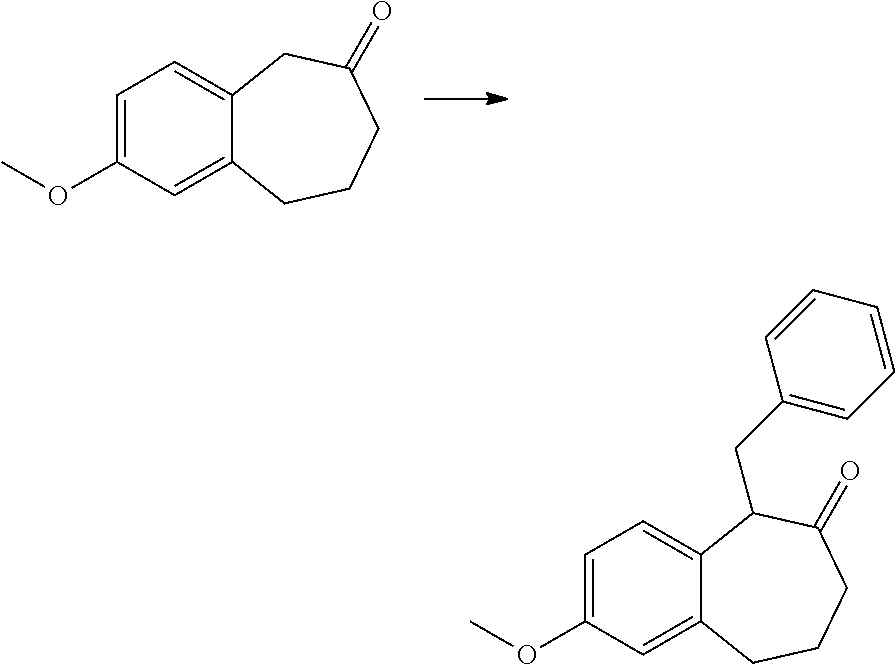
- A solution of 2-methoxy-8,9-dihydro-5H-benzo[7]annulen-6(7H)-one (3) (19.5 g, 103 mmol) in toluene (400 mL) was treated with pyrrolidine (8.48 mL, 103 mmol) and the mixture was heated at reflux for about 2 h, removing water into a Dean-Stark trap. The reaction was cooled and concentrated, then re-dissolved in 1,4-dioxane (400 mL), treated with benzyl bromide (18.3 mL, 154 mmol) and heated at about 100° C. for about 18 h. The reaction was cooled, water (40 mL) was added and the mixture was heated at about 100° C. for about 2 h. The reaction was cooled and concentrated to about 100 mL, then distributed between EtOAc (400 mL) and water (400 mL). The organic layer was washed with 2N aqueous HCl (400 mL), then the combined aqueous layers were re-extracted with EtOAc (100 mL). The combined organic extracts were dried over Na2SO4, filtered and concentrated. The residue was purified on silica gel (330 g) using a gradient from 5 to 15% EtOAc in heptane. Product fractions were combined and concentrated. The residue was precipitated from EtOAc and heptane, filtered, rinsed with heptane and dried to yield 5-benzyl-2-methoxy-8,9-dihydro-5H-benzo[7]annulen-6(7H)-one (4, R2=Benzyl) as an off-white solid (16.2 g, 56%). LC/MS, method 1, Rt=0.88 min, MS m/z 281 (M+H)+. 1H NMR (400 MHz, DMSO-d6) δ 7.28-7.11 (m, 5H), 7.01 (d, J=8.5 Hz, 1H), 6.76 (d, J=2.7 Hz, 1H), 6.71 (dd, J=8.4, 2.8 Hz, 1H), 4.47-4.35 (m, 1H), 3.71 (s, 3H), 3.38 (dd, J=13.9, 8.3 Hz, 1H), 3.16-3.05 (m, 1H), 2.99 (dd, J=13.9, 6.3 Hz, 1H), 2.80-2.68 (m, 1H), 2.65-2.55 (m, 1H), 2.41-2.24 (m, 1H), 2.09-1.98 (m, 1H), 1.73-1.56 (m, 1H).
-

- Freshly cut sodium (0.62 g, 26.8 mmol) was added in portions to EtOH (50 mL) under nitrogen and the mixture was stirred until the reaction was complete. A solution of 5-benzyl-2-methoxy-8,9-dihydro-5H-benzo[7]annulen-6(7H)-one (4, R2=Benzyl) (5.00 g, 17.8 mmol) in EtOH (50 mL) was added and the mixture was heated to about 60° C. Methyl vinyl ketone (1.47 mL, 17.8 mmol) was added dropwise over about 30 min, the reaction was heated at reflux for about 2.5 h, then cooled and concentrated. The residue was purified on silica gel (220 g) using a gradient from 10 to 35% EtOAc in heptane. Product fractions were combined and concentrated to about half volume. After standing about 4 h, 11b-benzyl-9-methoxy-1,2,5,6,7,11b-hexahydro-dibenzo[a,c]cyclohepten-3-one (5, R2=Benzyl) was collected by filtration and dried under vacuum, (4.04 g, 68%). LC/MS, method 1, Rt=0.88 min, MS m/z 333 (M+H)+. 1H NMR (400 MHz, DMSO-d6) δ 7.58 (d, J=8.8 Hz, 1H), 7.16-7.07 (m, 3H), 7.00 (m, 2H), 6.82 (dd, J=8.7, 2.9 Hz, 1H), 6.67 (d, J=2.9 Hz, 1H), 5.87 (s, 1H), 3.72 (s, 3H), 3.50 (d, J=13.5 Hz, 1H), 3.34 (d, J=13.5 Hz, 1H), 2.85-2.75 (m, 1H), 2.70-2.51 (m, 2H), 2.30-2.13 (m, 2H), 2.06-1.94 (m, 2H), 1.80-1.58 (m, 2H), 1.58-1.47 (m, 1H).
-

- A mixture of 11b-benzyl-9-methoxy-1,2,5,6,7,11b-hexahydro-dibenzo[a,c]cyclohepten-3-one (5, R2=Benzyl) (3.00 g, 9.02 mmol) and DL-methinione (4.38 g, 29.3 mmol) in methansulfonic acid (30 mL) was allowed to stir under nitrogen at rt for about 48 h. The mixture was diluted with DCM (100 mL) and poured carefully onto ice water (100 mL). The product was extracted with DCM (2×100 mL), the combined organic layers were washed with water (100 mL), dried over Na2SO4, filtered and concentrated to solids. The residue was dried under vacuum to constant weight to yield 11b-benzyl-9-hydroxy-1,2,5,6,7,11b-hexahydro-dibenzo[a,c]cyclohepten-3-one (6, R2=Benzyl) as an off white solid (2.97 g, 103%-contained residual DCM). LC/MS, method 1, Rt=0.73 min, MS m/z 319 (M+H)+. 1H NMR (400 MHz, DMSO-d6) δ 9.23 (s, 1H), 7.43 (d, J=8.6 Hz, 1H), 7.15-7.06 (m, 3H), 7.05-6.97 (m, 2H), 6.64 (dd, J=8.6, 2.7 Hz, 1H), 6.49 (d, J=2.7 Hz, 1H), 5.85 (s, 1H), 3.45 (d, J=13.4 Hz, 1H), 3.33 (d, 1H), 2.79-2.67 (m, 1H), 2.66-2.55 (m, 1H), 2.49-2.39 (m, 1H), 2.33-2.14 (m, 2H), 2.03-1.90 (m, 2H), 1.74-1.48 (m, 3H).
-

- A mixture of 11b-benzyl-9-hydroxy-1,2,5,6,7,11b-hexahydro-dibenzo[a,c]cyclohepten-3-one (6, R2=Benzyl) (5.90 g, 18.5 mmol) and 20% Pd(OH)2 on carbon (1.30 g) in toluene (111 mL) was hydrogenated in a Pan Shaker at about 50° C. under about 60 psi hydrogen for about 20 h. The reaction was filtered through a pad of Celite® (about 5.0 g) to remove the catalyst. The Celite® pad was washed with EtOAc (2×220 mL). The combined filtrates were combined and concentrated to yield 11b-benzyl-9-hydroxy-1,2,4,4a,5,6,7,11b-octahydro-dibenzo[a,c]cyclohepten-3-one (7, R2=Benzyl) (4.95 g, 82%) as a mixture of isomers which was taken to the next step without further purification.
-
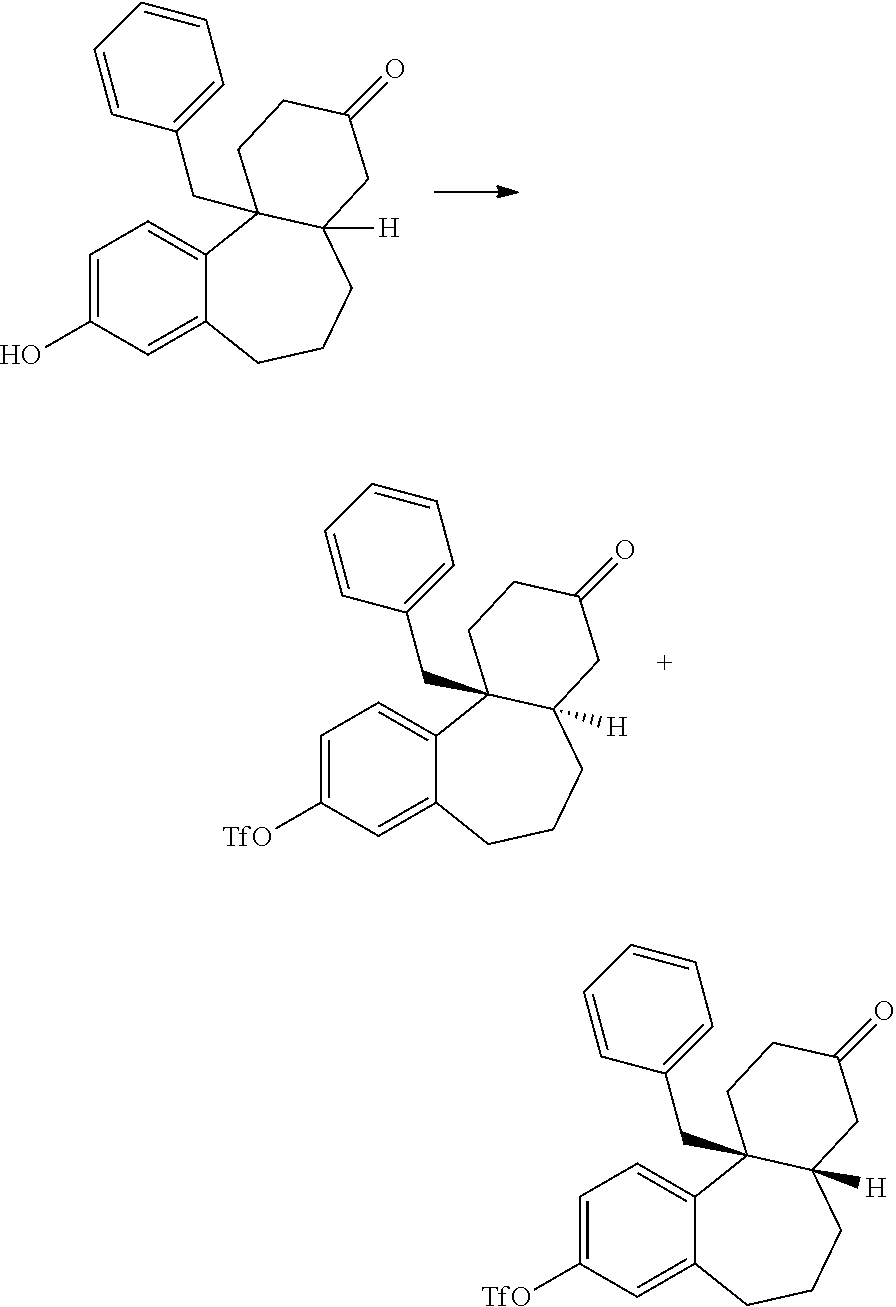
- A slurry of 11b-benzyl-9-hydroxy-1,2,4,4 a,5,6,7,11b-octahydro-dibenzo[a,c]cyclohepten-3-one (7, R2=Benzyl) (25.93 g, 80.9 mmol) in DCM (570 mL) was treated with N-phenylbis(trifluoromethanesulfonimide) (29.0 g, 80.9 mmol) and DIEA (28.3 mL, 162 mmol) at rt. The reaction was stirred for about 17 h, then silica gel (350 g) was added and the mixture was concentrated to dryness. The residue was divided in two portions and each portion was loaded separately in a cartridge and purified on silica gel (330 g) using a gradient from 10-30% EtOAc in heptane. The pure products were collected separately. The mixed fractions from each column were combined and re-purified on a third column (330 g) using the conditions described above to provide a combined yield of trifluoro-methanesulfonic acid (7aR,11aS)-11a-benzyl-9-oxo-6,7,7a,8,9,10,11,11a-octahydro-5H-dibenzo[a,c]cyclohepten-3-yl ester; compound with trifluoro-methanesulfonic acid (7aS,11aR)-11a-benzyl-9-oxo-6,7,7a,8,9,10,11,11a-octahydro-5H-dibenzo[a,c]cyclohepten-3-yl ester (8, R2=Benzyl) (9.78 g, 26%). LC/MS, method 2, Rt, =2.94 min, no parent ion. 1H NMR (400 MHz, DMSO-d6) δ 7.36 (m, 1H), 7.11-6.96 (m, 5H), 6.57-6.52 (m, 2H), 3.60-2.96 (d, J=14.0 Hz, 1H), 3.51-3.41 (m, 1H), 3.17 (d, J=13.9 Hz, 1H), 3.06-2.96 m, 1H), 2.90-2.74 (m, 1H), 2.74-2.63 (m, 1H), 2.24-2.14 (m, 1H), 2.14-1.95 (m, 5H), 1.95-1.82 (m, 1H), 1.74-1.62 (m, 1H), 1.47-1.34 (m, 1H) and trifluoro-methanesulfonic acid (7aS,11aS)-11a-benzyl-9-oxo-6,7,7a,8,9,10,11,11a-octahydro-5H-dibenzo[a,c]cyclohepten-3-yl ester; compound with trifluoro-methanesulfonic acid (7aR,11aR)-11a-benzyl-9-oxo-6,7,7a,8,9,10,11,11a-octahydro-5H-dibenzo[a,c]cyclohepten-3-yl ester (9, R2=Benzyl) (15.8 g, 43%). LC/MS, method 2, Rt=2.98 min; MS m/z: no parent ion. 1H NMR (400 MHz, DMSO-d6) δ 7.39 (d, J=2.9 Hz, 1H), 7.11-6.99 (m, 4H), 6.93 (d, J=9.0 Hz, 1H), 6.53-6.47 (m, 2H), 3.66 (d, J=13.1 Hz, 1H), 3.32-3.25 (m, 1H), 3.02 (dd, J=15.4, 5.4 Hz, 1H), 2.59 (d, J=13.2 Hz, 1H), 2.46-2.05 (m, 6H), 2.05-1.84 (m, 2H), 1.84-1.74 (m, 1H), 1.74-1.62 (m, 1H), 1.62-1.47 (m, 1H), each as an off white solid.
-
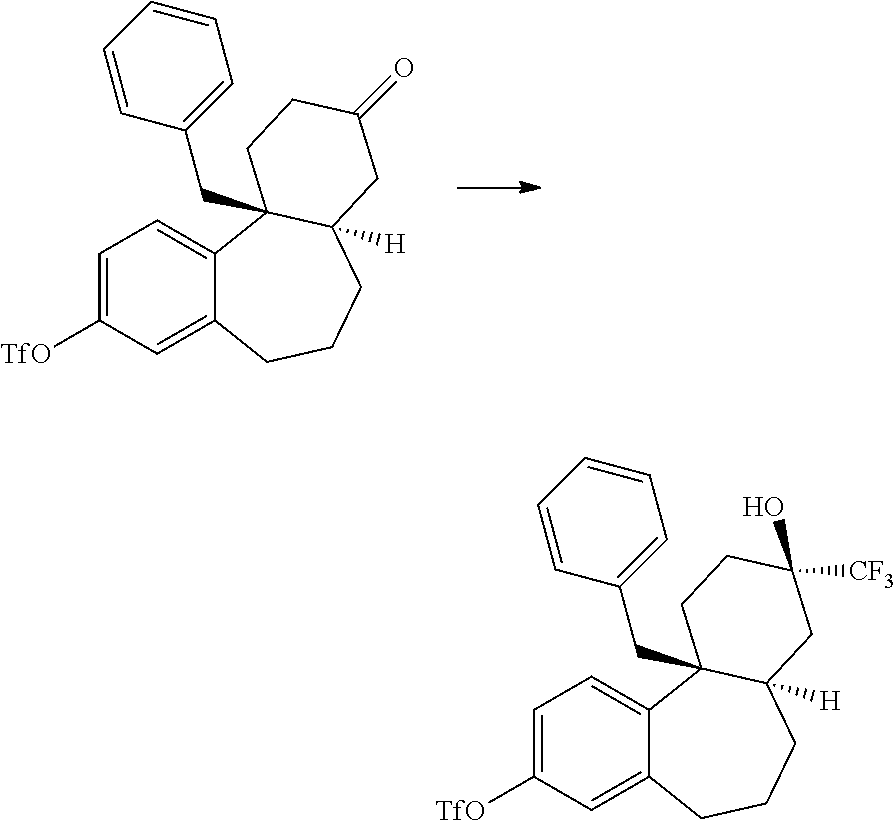
- A solution of trifluoromethanesulfonic acid (7aR,11aS)-11a-benzyl-9-oxo-6,7,7a,8,9,10,11,11a-octahydro-5H-dibenzo[a,c]cyclohepten-3-yl ester; compound with trifluoro-methanesulfonic acid (7aS,11aR)-11a-benzyl-9-oxo-6,7,7a,8,9,10,11,11a-octahydro-5H-dibenzo[a,c]cyclohepten-3-yl ester (8, R2=Benzyl) (0.320 g, 0.707 mmol) in DCM (15 mL) was cooled to about 0° C. under nitrogen. TBAF (1M solution in THF) (7 μL, 7 μmol) was added and then (trifluoromethyl)trimethylsilane (0.157 mL, 1.06 mmol) was added dropwise over about 20 min. The reaction was allowed to warm slowly to rt. The reaction was re-cooled to about 0° C., (trifluoromethyl)trimethylsilane (0.157 mL, 1.06 mmol) was added and then 2 drops of TBAF were added. The addition of reagents was repeated several times, then the reaction was allowed to warm to rt and concentrated. The residue was dissolved in DCM (15 mL), cooled to about 0° C. and TBAF (0.707 mL, 0.707 mmol) was added dropwise. The mixture was stirred for about 30 min then washed with water (2×15 mL). The residue was dried over Na2SO4, filtered and concentrated. The residue was purified on silica gel (40 g) using a gradient from 10 to 25% EtOAc in heptane. Product fractions were combined and concentrated to yield trifluoro-methanesulfonic acid (7aR,9R,11aS)-11a-benzyl-9-hydroxy-9-trifluoromethyl-6,7,7a,8,9,10,11,11a-octahydro-5H-dibenzo[a,c]cyclohepten-3-yl ester; compound with trifluoro-methanesulfonic acid (7aS,9S,11aR)-11a-benzyl-9-hydroxy-9-trifluoromethyl-6,7,7a,8,9,10,11,11a-octahydro-5H-dibenzo[a,c]cyclohepten-3-yl ester (10, R2=Benzyl, R3=Trifluoromethyl) (0.160 g, 43%) as an off-white solid. LC/MS, method 1, Rt=1.03 min, MS m/z 581 (M+OAc)−. 1H NMR (400 MHz, DMSO-d6) δ 7.35 (d, J=2.0 Hz, 1H), 7.08-6.94 (m, 5H), 6.48-6.42 (m, 2H), 5.92 (s, 1H), 3.49 (d, J=13.5 Hz, 1H), 3.48-3.36 (m, 1H), 2.99 (dd, J=15.0, 5.3 Hz, 1H), 2.88 (d, J=13.7 Hz, 1H), 2.06-1.63 (m, 10H), 1.50-1.35 (m, 1H).
-

- To a mixture of trifluoromethanesulfonic acid (7aR,9R,11aS)-11a-benzyl-9-hydroxy-9-trifluoromethyl-6,7,7a,8,9,10,11,11a-octahydro-5H-dibenzo[a,c]cyclohepten-3-yl ester; compound with trifluoro-methanesulfonic acid (7aS,9S,11aR)-11a-benzyl-9-hydroxy-9-trifluoromethyl-6,7,7a,8,9,10,11,11a-octahydro-5H-dibenzo[a,c]cyclohepten-3-yl ester (10, R2=Benzyl, R3=Trifluoromethyl) (0.155 g, 0.297 mmol), Xantphos (0.017 g, 0.030 mmol) and Pd2(dba)3 (0.008 g, 9 μmol) was added DMF (1.5 mL) and the mixture was degassed using a stream of nitrogen. The reaction vessel was briefly evacuated and an atmosphere of carbon monoxide was introduced via balloon. To the mixture was added MeOH (0.072 mL, 1.8 mmol) and TEA (0.083 mL, 0.59 mmol) and the reaction was heated at about 100° C. for about 4 h. The reaction was cooled to rt and concentrated. The residue was purified on silica gel (40 g) using a gradient from 20-75% EtOAc in heptane. Product fractions were combined, concentrated and dried under vacuum to yield (7aR,9R,11aS)-11a-benzyl-9-hydroxy-9-trifluoromethyl-6,7,7a,8,9,10,11,11a-octahydro-5H-dibenzo[a,c]cycloheptene-3-carboxylic acid methyl ester; compound with (7aS,9S,11aR)-11a-benzyl-9-hydroxy-9-trifluoromethyl-6,7,7a,8,9,10,11,11a-octahydro-5H-dibenzo[a,c]cycloheptene-3-carboxylic acid methyl ester (11, R2=Benzyl, R3=Trifluoromethyl) (0.072 g, 56%) as an off white solid. LC/MS, method 1, Rt=0.96 min, MS m/z 491 (M+OAc)−. 1H NMR (400 MHz, DMSO-d6) δ 7.79 (d, J=2.1 Hz, 1H), 7.55 (dd, J=8.3, 2.0 Hz, 1H), 7.08-6.97 (m, 4H), 6.51 (dd, J=7.5, 1.9 Hz, 2H), 5.92 (s, 1H), 3.83 (s, 3H), 3.56 (d, J=13.8 Hz, 1H), 3.50-3.39 (m, 1H), 3.00 (dd, J=15.0, 5.0 Hz, 1H), 2.88 (d, J=13.7 Hz, 1H), 2.09-1.63 (m, 10H), 1.47-1.34 (m, 1H).
-

- A solution of (7aR,9R,11aS)-11a-benzyl-9-hydroxy-9-trifluoromethyl-6,7,7a,8,9,10,11,11a-octahydro-5H-dibenzo[a,c]cycloheptene-3-carboxylic acid methyl ester; compound with (7aS,9S,11aR)-11a-benzyl-9-hydroxy-9-trifluoromethyl-6,7,7a,8,9,10,11,11a-octahydro-5H-dibenzo[a,c]cycloheptene-3-carboxylic acid methyl ester (11, R2=Benzyl, R3=Trifluoromethyl) (0.070 g, 0.16 mmol) and 3-amino-2-methylpyridine (0.018 g, 0.17 mmol) in toluene (1.5 mL) was stirred at rt under nitrogen and LiHMDS (0.470 mL, 0.470 mmol) (1M solution in THF) was added dropwise. The mixture was stirred for about 30 min, quenched with water (2 mL) and the crude product was extracted with EtOAc (2×5 mL). The combined organic layers were dried over Na2SO4, filtered and concentrated. The residue was purified on silica gel (12 g) using a gradient from 80 to 100% EtOAc in heptane. Pure product fractions were combined and concentrated to an oil that was precipitated from MeCN with water. The product was filtered off and dried under vacuum to yield (7aR,9R,11aS)-11a-benzyl-9-hydroxy-9-trifluoromethyl-6,7,7a,8,9,10,11,11a-octahydro-5H-dibenzo[a,c]cycloheptene-3-carboxylic acid (2-methyl-pyridin-3-yl)-amide; compound with (7aS,9S,11aR)-11a-benzyl-9-hydroxy-9-trifluoromethyl-6,7,7a,8,9,10,11,11a-octahydro-5H-dibenzo[a,c]cycloheptene-3-carboxylic acid (2-methyl-pyridin-3-yl)-amide (12, R2=Benzyl, R3=Trifluoromethyl) (0.033 g, 41%) as an off-white solid. LC/MS, method 1, Rt=0.74 min, MS m/z 509 (M+H)+. 1H NMR (400 MHz, DMSO-d6) δ 9.94 (s, 1H), 8.31 (dd, J=4.8, 1.6 Hz, 1H), 7.81 (d, J=2.0 Hz, 1H), 7.72 (dd, J=8.0, 1.5 Hz, 1H), 7.59 (dd, J=8.4, 1.9 Hz, 1H), 7.25 (dd, J=7.9, 4.8 Hz, 1H), 7.12-6.93 (m, 4H), 6.56 (dd, J=6.5, 2.9 Hz, 2H), 5.90 (s, 1H), 3.58 (d, J=13.5 Hz, 1H), 3.54-3.44 (m, 1H), 3.06-2.96 (m, 1H), 2.87 (d, J=13.8 Hz, 1H), 2.42 (s, 3H), 2.11-1.59 (m, 10H), 1.53-1.39 (m, 1H).
-

-

- A mixture of 11b-benzyl-9-hydroxy-1,2,5,6,7,11b-hexahydro-dibenzo[a,c]cyclohepten-3-one (6, R2=Benzyl) (0.250 g, 0.785 mmol) and 20% Pd(OH)2 on carbon (0.055 g) in toluene (3 mL) and 1,4-dioxane (3 mL) was shaken under about 40 psi hydrogen at about 60° C. for about 18 h. The reaction was cooled to rt and filtered through Celite®, rinsing with EtOAc. The filtrate was concentrated to an oil, then purified on C18 using a gradient 25-65% MeCN/50 mM NH4OAc buffer. The first peak and the second peak were isolated separately. Each product precipitated from solution as a white solid on concentration. Each product was filtered, washed with water (2 mL) and dried under vacuum to yield (4aS,11bS)-11b-benzyl-9-hydroxy-1,2,4,4a,5,6,7,11b-octahydro-dibenzo[a,c]cyclohepten-3-one; compound with (4aR,11bR)-11b-benzyl-9-hydroxy-1,2,4,4a,5,6,7,11b-octahydro-dibenzo[a,c]cyclohepten-3-one (13, R2=Benzyl) (0.054 g, 21%) as a white solid, LC/MS, method 1, Rt=0.78 min, MS m/z 319 (M−H)−, 1H NMR (400 MHz, DMSO-d6) δ 9.13 (s, 1H), 7.06-6.97 (m, 3H), 6.68 (d, J=8.8 Hz, 1H), 6.63-6.59 (m, 3H), 6.34 (dd, J=8.7, 2.8 Hz, 1H), 3.58-3.49 (m, 1H), 3.38-3.27 (m, 1H), 3.08 (d, J=13.7 Hz, 1H), 2.84-2.69 (m, 2H), 2.69-2.59 (m, 1H), 2.16-1.85 (m, 6H), 1.85-1.71 (m, 1H), 1.70-1.59 (m, 1H), 1.43-1.29 (m, 1H) and (4aR,11bS)-11b-benzyl-9-hydroxy-1,2,4,4a,5,6,7,11b-octahydro-dibenzo[a,c]cyclohepten-3-one; compound with (4aS,11bR)-11b-benzyl-9-hydroxy-1,2,4,4a,5,6,7,11b-octahydro-dibenzo[a,c]cyclohepten-3-one (14, R2=Benzyl) (0.089 g, 35%) as a white solid, LC/MS, method 1, Rt=0.80 min, MS m/z 319 (M−H)−. 1H NMR (400 MHz, DMSO-d6) δ 9.15 (s, 1H), 7.10-6.99 (m, 3H), 6.63 (d, J=2.7 Hz, 1H), 6.59-6.48 (m, 3H), 6.37 (dd, J=8.6, 2.7 Hz, 1H), 3.60 (d, J=12.9 Hz, 1H), 3.22-3.10 (m, 1H), 2.74 (dd, J=14.6, 5.0 Hz, 1H), 2.55-2.45 (m, 1H), 2.40-2.07 (m, 6H), 1.89 (d, J=13.9 Hz, 1H), 1.79-1.70 (m, 2H), 1.67-1.60 (m, 1H), 1.56-1.45 (m, 1H).
-
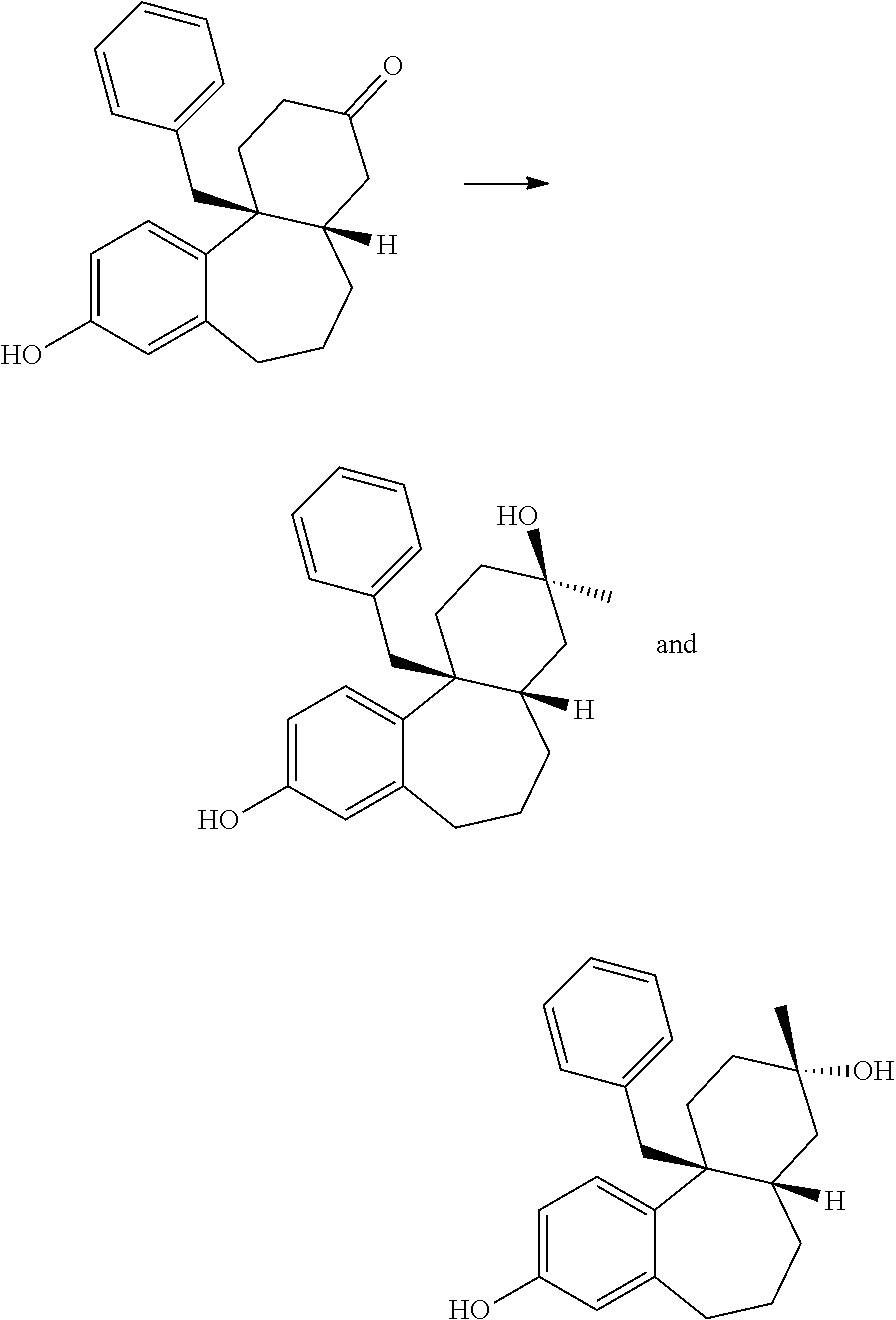
- To a stirred solution of methylmagnesium bromide (3 M solution in Et2O, 0.520 mL, 1.56 mmol) at about 0° C. was added a solution of (4aS,11bS)-11b-benzyl-9-hydroxy-1,2,4,4a,5,6,7,11b-octahydro-dibenzo[a,c]cyclohepten-3-one; compound with (4 aR,11bR)-11b-benzyl-9-hydroxy-1,2,4,4 a,5,6,7,11b-octahydro-dibenzo[a,c]cyclohepten-3-one (13, R2=Benzyl) (0.050 g, 0.16 mmol) in Et2O (1.00 mL) and THF (3 mL) dropwise. The mixture was stirred about 20 min under nitrogen at about 0° C. and then allowed to warm to rt with stirring for about an additional 1 h. Water (10 mL) was added dropwise and then THF was removed under reduced pressure. Crude product was extracted with DCM (3×10 mL). The organics were dried over Na2SO4, filtered and concentrated. The residue was purified on C18 using a gradient from 25 to 40% MeCN in 50 mM aqueous NH4OAc buffer. The first peak and the second peak were isolated separately. Each product precipitated from solution as a white solid on concentration. Separately, each product was collected by filtration, washed with water (2.0 mL) and dried under vacuum to yield (3R,4aS,11bS)-11b-benzyl-3-methyl-2,3,4,4a,5,6,7,11b-octahydro-1H-dibenzo[a,c]cycloheptene-3,9-diol; compound with (3S,4aR,11bR)-11b-benzyl-3-methyl-2,3,4,4a,5,6,7,11b-octahydro-1H-dibenzo[a,c]cycloheptene-3,9-diol (15, R2=Benzyl, R3=Methyl) (0.023 g, 44%) as a white solid. LC/MS, method 1, Rt=0.76 min, MS m/z 319 (M−OH)+. 1H NMR (400 MHz, DMSO-d6) δ 9.01 (s, 1H), 7.06-7.00 (m, 3H), 6.59-6.55 (m, 1H), 6.55-6.48 (m, 2H), 6.41 (d, J=8.7 Hz, 1H), 6.30 (dd, J=8.6, 2.7 Hz, 1H), 3.99 (s, 1H), 3.48 (d, J=12.7 Hz, 1H), 3.16-3.06 (m, 1H), 2.72 (dd, J=14.7, 5.6 Hz, 1H), 2.48-2.39 (m, 1H), 2.40-2.25 (m, 2H), 1.77-1.26 (m, 7H), 1.23-1.18 (m, 1H), 1.09 (d, J=12.9 Hz, 1H), 0.93 (s, 3H), and (3R,4aR,11bR)-11b-benzyl-3-methyl-2,3,4,4a,5,6,7,11b-octahydro-1H-dibenzo[a,c]cycloheptene-3,9-diol; compound with (3S,4aS,11bS)-11b-benzyl-3-methyl-2,3,4,4a,5,6,7,11b-octahydro-1H-dibenzo[a,c]cycloheptene-3,9-diol (16, R2=Benzyl, R3=Methyl) (0.008 g, 10%) as a white solid. LC/MS, method 1, Rt=0.82 min, MS m/z 319 (M−OH)+, 1H NMR (400 MHz, DMSO-d6) δ 9.02 (s, 1H), 7.07-6.93 (m, 3H), 6.60-6.29 (m, 5H), 4.10 (s, 1H), 3.51-3.41 (m, 1H), 3.17-3.04 (m, 1H), 2.80-2.63 (m, 1H), 2.49-2.37 (m, 1H), 2.39-2.27 (m, 1H), 1.93-1.77 (m, 2H), 1.76-1.28 (m, 7H), 1.17 (s, 3H), 1.11-1.02 (m, 1H).
-

-

- A solution of trifluoromethanesulfonic acid (7aR,11aS)-11a-benzyl-9-oxo-6,7,7a,8,9,10,11,11a-octahydro-5H-dibenzo[a,c]cyclohepten-3-yl ester; compound with trifluoro-methanesulfonic acid (7aS,11aR)-11a-benzyl-9-oxo-6,7,7a,8,9,10,11,11a-octahydro-5H-dibenzo[a,c]cyclohepten-3-yl ester (8, R2=Benzyl) (3.20 g, 7.07 mmol) in DMF (20 mL) was treated with Xantphos (0.409 g, 0.707 mmol) and Pd2(dba)3 (0.194 g, 0.212 mmol). The reaction vessel was evacuated and an atmosphere of carbon monoxide was introduced. TEA (1.97 mL, 14.1 mmol) and MeOH (1.72 mL, 42.4 mmol) were added. The mixture was heated at about 100° C. for about 48 h. The mixture was allowed to cool to rt then concentrated under reduced pressure. The residue was taken up in EtOAc (50 mL) and washed with saturated aqueous NaHCO3. The organic layer was dried over Na2SO4, filtered and concentrated. The residue was purified on silica gel (120 g) using a gradient from 15 to 40% EtOAc in heptane. Product fractions were combined, concentrated and dried under vacuum to yield (7aR,11aS)-11a-benzyl-9-oxo-6,7,7a,8,9,10,11,11a-octahydro-5H-dibenzo[a,c]cycloheptene-3-carboxylic acid methyl ester; compound with (7aS,11aR)-11a-benzyl-9-oxo-6,7,7a,8,9,10,11,11a-octahydro-5H-dibenzo[a,c]cycloheptene-3-carboxylic acid methyl ester (17, R2=Benzyl) as a colorless oil. LC/MS, method 3, Rt=1.78 min, no parent ion. 1H NMR (400 MHz, DMSO-d6) δ 7.78 (d, J=2.1 Hz, 1H), 7.55 (dd, J=8.4, 2.0 Hz, 1H), 7.06 (d, J=8.6 Hz, 1H), 7.03-6.95 (m, 3H), 6.57 (dd, J=7.6, 1.8 Hz, 2H), 3.82 (s, 3H), 3.65 (d, J=13.8 Hz, 1H), 3.55-3.44 (m, 1H), 3.17 (d, J=13.7 Hz, 1H), 3.07-2.98 (m, 1H), 2.87-2.76 (m, 1H), 2.74-2.63 (m, 1H), 2.23-2.14 (m, 1H), 2.15-1.99 (m, 5H), 1.96-1.85 (m, 1H), 1.73-1.63 (m, 1H), 1.45-1.33 (m, 1H).
-
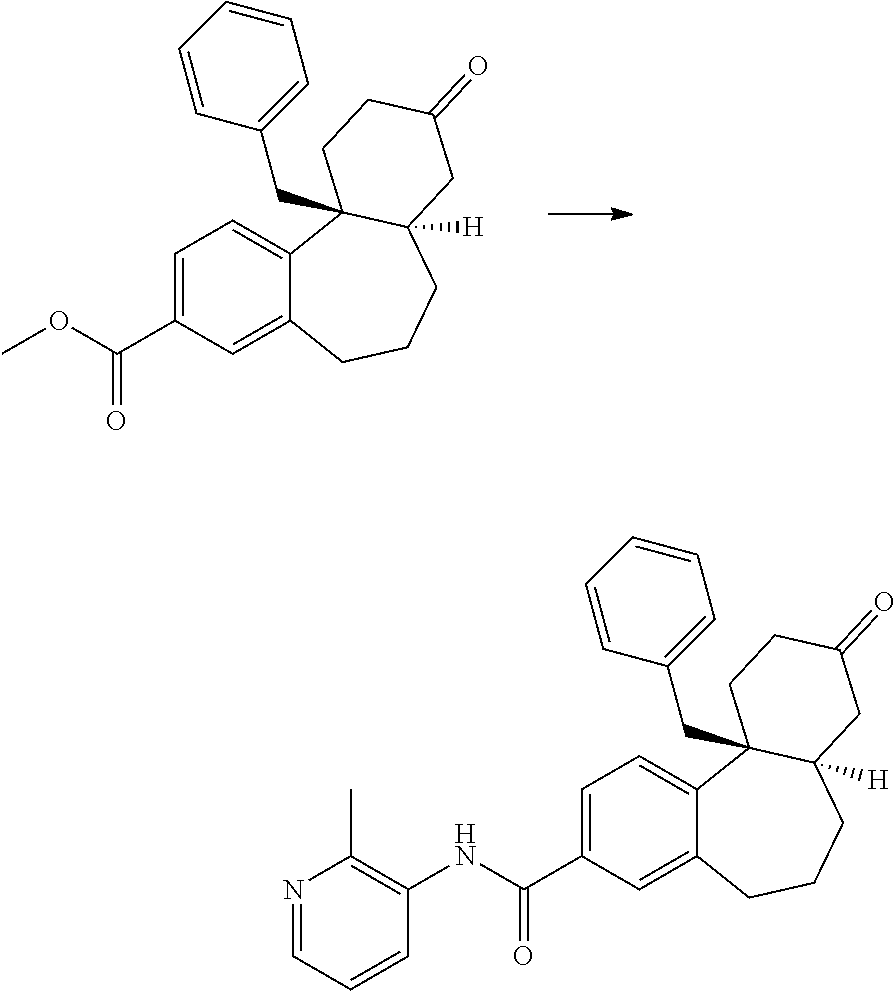
- A solution of (7aR,11aS)-11a-benzyl-9-oxo-6,7,7a,8,9,10,11,11a-octahydro-5H-dibenzo[a,c]cycloheptene-3-carboxylic acid methyl ester; compound with (7aS,11aR)-11a-benzyl-9-oxo-6,7,7a,8,9,10,11,11a-octahydro-5H-dibenzo[a,c]cycloheptene-3-carboxylic acid methyl ester (17, R2=Benzyl) (0.750 g, 2.07 mmol) in 1,4-dioxane (12 mL) was treated with LiOH (0.261 g, 6.21 mmol) and water (3 mL). The reaction was warmed briefly to about 50° C., then diluted with water to obtain a homogeneous solution. The conversion to acid was followed to completion by LC/MS (LC/MS method 3, Rt=1.37 min, MS m/z 347 (M−H)−. The mixture was acidified with 2N aqueous HCl (20 mL) and extracted with EtOAc (2×20 mL). The extracts were dried over Na2SO4, filtered and concentrated. The residue was dissolved in THF (25 mL), DIEA (0.367 mL, 2.10 mmol) was added and the mixture was treated with TFFH (0.556 g, 2.10 mmol) at rt for about 5 min, and then with 2-methylpyridin-3-amine (0.455 g, 4.21 mmol). The reaction was stirred for about 48 h at about 60° C. The reaction was cooled and concentrated under reduced pressure. The residue was dissolved in DCM (60 mL) and washed with saturated aqueous NaHCO3 (30 mL), dried over Na2SO4, filtered and concentrated under reduced pressure. The residue was purified on silica gel (80 g) using a gradient from 80 to 100% EtOAc in heptane. The product fractions were combined, concentrated under reduced pressure and dried under vacuum to yield (7aR,11aS)-11a-benzyl-9-oxo-6,7,7a,8,9,10,11,11a-octahydro-5H-dibenzo[a,c]cycloheptene-3-carboxylic acid (2-methyl-pyridin-3-yl)-amide; compound with (7aS,11aR)-11a-benzyl-9-oxo-6,7,7a,8,9,10,11,11a-octahydro-5H-dibenzo[a,c]cycloheptene-3-carboxylic acid (2-methyl-pyridin-3-yl)-amide (18, R2=Benzyl) (0.525 g, 57%) as an off-white glass. LC/MS, method 2, Rt=2.15 min, MS m/z 439 (M+H)+. 1H NMR (400 MHz, DMSO-d6) δ 10.01-9.95 (m, 1H), 8.36-8.29 (m, 1H), 7.85-7.82 (m, 1H), 7.76-7.70 (m, 1H), 7.64-7.60 (m, 1H), 7.30-7.24 (m, 1H), 7.12-7.00 (m, 4H), 6.68-6.62 (m, 2H), 3.75-3.65 (m, 1H), 3.59-3.47 (m, 1H), 3.23-3.15 (m, 1H), 3.08-2.98 (m, 1H), 2.90-2.71 (m, 2H), 2.44 (s, 3H), 2.23-1.89 (m, 7H), 1.75-1.64 (m, 1H), 1.51-1.36 (m, 1H).
-

- Methylmagnesium bromide (3M solution in Et2O, 3.80 mL, 11.40 mmol) was cooled to about 0° C. under nitrogen and a solution of (7aR,11aS)-11a-benzyl-9-oxo-6,7,7a,8,9,10,11,11a-octahydro-5H-dibenzo[a,c]cycloheptene-3-carboxylic acid (2-methyl-pyridin-3-yl)-amide; compound with (7aS,11aR)-11a-benzyl-9-oxo-6,7,7a,8,9,10,11,11a-octahydro-5H-dibenzo[a,c]cycloheptene-3-carboxylic acid (2-methyl-pyridin-3-yl)-amide (18, R2=Benzyl) (0.500 g, 1.14 mmol) in THF (20 mL) was added dropwise over about 10 min. The mixture was stirred at about 0° C. for about 30 min then allowed to warm to rt. The reaction was quenched with 10% aqueous AcOH solution (30 mL) and the THF was removed under reduced pressure. The product was extracted with DCM (2×50 mL), dried over Na2SO4, filtered and concentrated under reduced pressure. The residue was purified on C18 (4 μm particle size 100×21 mm column) using a gradient (20 to 95%) MeCN in ammonium acetate buffer (50 mM). The minor peak fractions were collected and concentrated under reduced pressure to remove MeCN. The precipitate was collected by filtration and dried under reduced pressure to yield (7aR,9R,11aS)-11a-benzyl-9-hydroxy-9-methyl-6,7,7a,8,9,10,11,11a-octahydro-5H-dibenzo[a,c]cycloheptene-3-carboxylic acid (2-methyl-pyridin-3-yl)-amide; compound with (7aS,9S,11aR)— 11a-benzyl-9-hydroxy-9-methyl-6,7,7a,8,9,10,11,11a-octahydro-5H-dibenzo[a,c]cycloheptene-3-carboxylic acid (2-methyl-pyridin-3-yl)-amide (12, R2=Benzyl, R3=Methyl) (0.064 g, 12%) as a white solid. LC/MS, method 2, Rt=2.10 min, MS m/z 455 (M+H)+. 1H NMR (400 MHz, DMSO-d6) δ 9.93 (s, 1H), 8.31 (dd, J=4.7, 1.6 Hz, 1H), 7.79 (d, J=2.1 Hz, 1H), 7.71 (dd, J=8.0, 1.5 Hz, 1H), 7.56 (dd, J=8.4, 2.0 Hz, 1H), 7.25 (dd, J=7.9, 4.7 Hz, 1H), 7.06 (d, J=8.7 Hz, 1H), 7.05-6.99 (m, 3H), 6.52 (dd, J=6.5, 2.9 Hz, 2H), 4.36 (s, 1H), 3.49-3.39 (m, 2H), 3.05-2.95 (m, 2H), 2.41 (s, 3H), 2.07-1.82 (m, 3H), 1.85-1.38 (m, 8H), 1.11 (s, 3H). The major peak was collected, concentrated, filtered and dried under vacuum to yield (7aS,9R,11aR)-11a-benzyl-9-hydroxy-9-methyl-6,7,7a,8,9,10,11,11a-octahydro-5H-dibenzo[a,c]cycloheptene-3-carboxylic acid (2-methyl-pyridin-3-yl)-amide; compound with (7aR,9S,11aS)-11a-benzyl-9-hydroxy-9-methyl-6,7,7a,8,9,10,11,11a-octahydro-5H-dibenzo[a,c]cycloheptene-3-carboxylic acid (2-methyl-pyridin-3-yl)-amide (20, R2=Benzyl, R3=Methyl) (0.138 g, 27%) as a white solid. LC/MS, method 2, Rt=2.42 min; MS m/z: 455 (M+H)+. 1H NMR (600 MHz, DMSO-d6) δ 9.93 (s, 1H), 8.33 (dt, J=4.7, 2.5 Hz, 1H), 7.79 (t, J=4.0 Hz, 1H), 7.74 (dd, J=7.9, 1.4 Hz, 1H), 7.61-7.55 (m, 1H), 7.27 (dd, J=7.9, 4.7 Hz, 1H), 7.12 (t, J=8.0 Hz, 1H), 7.05-6.96 (m, 3H), 6.55 (dd, J=7.6, 1.7 Hz, 2H), 4.01 (s, 1H), 3.48-3.37 (m, 2H), 3.05-2.97 (m, 1H), 2.94-2.88 (m, 1H), 2.44 (s, 3H), 2.09-1.88 (m, 4H), 1.82-1.72 (m, 1H), 1.65-1.36 (m, 6H), 1.20 (s, 3H).
-
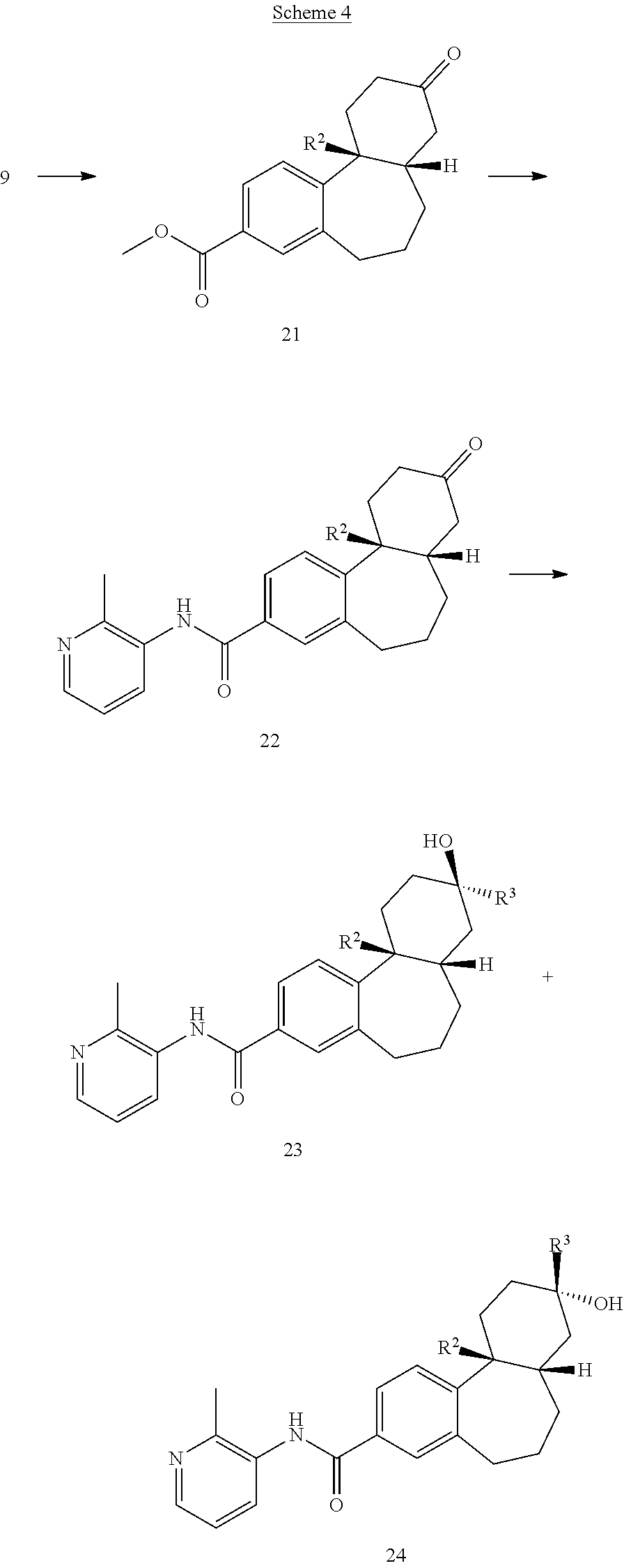
-

- Trifluoro-methanesulfonic acid (7aS,11aS)-11a-benzyl-9-oxo-6,7,7a,8,9,10,11,11a-octahydro-5H-dibenzo[a,c]cyclohepten-3-yl ester; compound with trifluoro-methanesulfonic acid (7aR,11aR)-11a-benzyl-9-oxo-6,7,7a,8,9,10,11,11a-octahydro-5H-dibenzo[a,c]cyclohepten-3-yl ester (9, R2=Benzyl) (2.55 g, 5.64 mmol), Xantphos (0.326 g, 0.564 mmol) and Pd2(dba)3 (0.155 g, 0.169 mmol) were diluted with DMF (25 mL) and degassed by bubbling a stream of nitrogen. The reaction vessel was evacuated and an atmosphere of carbon monoxide was introduced via balloon. To the mixture was added MeOH (1.37 mL, 33.8 mmol) and TEA (1.57 mL, 11.3 mmol) and the reaction was heated at about 100° C. for about 4 h. The reaction was cooled and concentrated and the residue was purified on silica gel (80 g) using a gradient from 10 to 40% EtOAc in heptane. Product fractions were combined and concentrated to yield (7aS,11aS)-11a-benzyl-9-oxo-6,7,7a,8,9,10,11,11a-octahydro-5H-dibenzo[a,c]cycloheptene-3-carboxylic acid methyl ester; compound with (7aR,11aR)-11a-benzyl-9-oxo-6,7,7a,8,9,10,11,11a-octahydro-5H-dibenzo[a,c]cycloheptene-3-carboxylic acid methyl ester (21, R2=Benzyl) (1.30 g, 64%) as a white solid. LC/MS, method 1, Rt=0.92 min, MS m/z 380 (M+NH4)+. 1H NMR (400 MHz, DMSO-d6) δ 7.81 (d, J=2.0 Hz, 1H), 7.55 (dd, J=8.3, 2.0 Hz, 1H), 7.10-6.99 (m, 3H), 6.91 (d, J=8.4 Hz, 1H), 6.53 (dd, J=7.7, 1.7 Hz, 2H), 3.82 (s, 3H), 3.69 (d, J=13.1 Hz, 1H), 3.33-3.23 (m, 1H), 3.06-2.96 (m, 1H), 2.61 (d, J=13.2 Hz, 1H), 2.45-2.16 (m, 5H), 2.12-1.75 (m, 4H), 1.71-1.64 (m, 1H), 1.59-1.49 (m, 1H).
-

- A solution of (7aS,11aS)-11a-benzyl-9-oxo-6,7,7a,8,9,10,11,11a-octahydro-5H-dibenzo[a,c]cycloheptene-3-carboxylic acid methyl ester; compound with (7aR,11aR)-11a-benzyl-9-oxo-6,7,7a,8,9,10,11,11a-octahydro-5H-dibenzo[a,c]cycloheptene-3-carboxylic acid methyl ester (21, R2=Benzyl) (1.30 g, 3.59 mmol) in 1,4-dioxane (20 mL) was treated with LiOH (0.452 g, 10.8 mmol) and water (5 mL). The reaction was warmed briefly to about 50° C. to obtain a homogeneous solution. The conversion to acid was followed to completion by LC/MS (method 1, Rt=0.74 min, MS m/z 347 (M−H)−. The mixture was acidified with 2N aqueous HCl (20 mL) and extracted with DCM (2×20 mL). The extracts were dried over Na2SO4, filtered and concentrated. The residue was dissolved in THF (25 mL) and DIEA (0.627 mL, 3.59 mmol) was added. The mixture was treated with TFFH (0.948 g, 3.59 mmol) at rt for about 5 min, and then with 2-methylpyridin-3-amine (0.776 g, 7.18 mmol) was added. The reaction was stirred for about 48 h at about 60° C. The reaction was cooled and concentrated. The residue was dissolved in DCM (60 mL) and washed with saturated aqueous NaHCO3 (30 mL), dried over Na2SO4, filtered and concentrated. The crude product was purified on silica gel (80 g) using a gradient from 80% to 100% EtOAc in heptane. The product fractions were combined, concentrated and dried under reduced pressure to yield (7aS,11aS)-11a-benzyl-9-oxo-6,7,7a,8,9,10,11,11a-octahydro-5H-dibenzo[a,c]cycloheptene-3-carboxylic acid (2-methyl-pyridin-3-yl)-amide; compound with (7aR,11aR)-11a-benzyl-9-oxo-6,7,7a,8,9,10,11,11a-octahydro-5H-dibenzo[a,c]cycloheptene-3-carboxylic acid (2-methyl-pyridin-3-yl)-amide (22, R2=Benzyl) (1.01 g, 64%) as an off-white solid. LC/MS, method 1, Rt=0.77 min, MS m/z 439 (M+H)+. 1H NMR (400 MHz, DMSO-d6) δ 10.00 (s, 1H), 8.34 (dd, J=4.7, 1.6 Hz, 1H), 7.88 (d, J=2.1 Hz, 1H), 7.74 (dd, J=7.9, 1.6 Hz, 1H), 7.64 (dd, J=8.2, 2.1 Hz, 1H), 7.27 (dd, J=7.9, 4.7 Hz, 1H), 7.15-7.01 (m, 3H), 6.96 (d, J=8.3 Hz, 1H), 6.64-6.58 (m, 2H), 3.73 (d, J=13.0 Hz, 1H), 3.40-3.09 (m, 1H). 3.09-2.99 (m, 1H), 2.66 (d, J=13.1 Hz, 1H), 2.44 (s, 3H), 2.42-2.23 (m, 5H), 2.18-2.05 (m, 1H), 2.03-1.80 (m, 3H), 1.76-1.51 (m, 2H).
-

- Ethylmagnesium bromide (3M solution in Et2O, 1.10 mL, 3.31 mmol) was cooled to about 0° C. and a slurry of (7aS,11aS)-11a-benzyl-9-oxo-6,7,7a,8,9,10,11,11a-octahydro-5H-dibenzo[a,c]cycloheptene-3-carboxylic acid (2-methyl-pyridin-3-yl)-amide; compound with (7aR,11aR)-11a-benzyl-9-oxo-6,7,7a,8,9,10,11,11a-octahydro-5H-dibenzo[a,c]cycloheptene-3-carboxylic acid (2-methyl-pyridin-3-yl)-amide (22, R2=Benzyl) (145 mg, 0.331 mmol) in THF (6 mL) was added dropwise. The reaction was stirred at about 0° C. for about 30 min then quenched by addition of 10% aqueous AcOH (10 mL). The reaction was concentrated under reduced pressure then extracted with EtOAc (2×25 mL). The combined organics were dried over Na2SO4, filtered and concentrated under reduced pressure. The residue was purified on silica gel (40 g) using a gradient from 80 to 100% EtOAc in heptane. The two products were isolated separately. Each was concentrated under reduced pressure, then precipitated from MeCN and water. The products were collected by filtration and dried under vacuum to yield (7aS,9R,11aS)-11a-benzyl-9-ethyl-9-hydroxy-6,7,7a,8,9,10,11,11a-octahydro-5H-dibenzo[a,c]cycloheptene-3-carboxylic acid (2-methyl-pyridin-3-yl)-amide; compound with (7aR,9S,11aR)-11a-benzyl-9-ethyl-9-hydroxy-6,7,7a,8,9,10,11,11a-octahydro-5H-dibenzo[a,c]cycloheptene-3-carboxylic acid (2-methyl-pyridin-3-yl)-amide (23, R2=Benzyl, R3=Ethyl) (58 mg, 37%) as a white solid, LC/MS, method 2, Rt=2.33 min, MS m/z 469 (M+H)+. 1H NMR (400 MHz, DMSO-d6) δ 9.92 (s, 1H), 8.31 (dd, J=4.7, 1.5 Hz, 1H), 7.79 (d, J=1.9 Hz, 1H), 7.72 (dd, J=8.0, 1.4 Hz, 1H), 7.53 (dd, J=8.2, 1.9 Hz, 1H), 7.25 (dd, J=7.9, 4.8 Hz, 1H), 7.14-7.00 (m, 3H), 6.80 (d, J=8.5 Hz, 1H), 6.57 (dd, J=6.4, 2.9 Hz, 2H), 3.87 (s, 1H), 3.56 (d, J=12.9 Hz, 1H), 3.33-3.23 (m, 1H), 3.07-2.98 (m, 1H), 2.64-2.56 (d, 1H), 2.49-2.40 (m, 5H), 1.94-1.70 (m, 3H), 1.68-1.23 (m, 4H), 1.20-1.02 (m, 4H), 0.71 (t, J=7.4, 3H) and (7aS,9S,11aS)-11a-benzyl-9-ethyl-9-hydroxy-6,7,7a,8,9,10,11,11a-octahydro-5H-dibenzo[a,c]cycloheptene-3-carboxylic acid (2-methyl-pyridin-3-yl)-amide; compound with (7aR,9R,11aR)-11a-benzyl-9-ethyl-9-hydroxy-6,7,7a,8,9,10,11,11a-octahydro-5H-dibenzo[a,c]cycloheptene-3-carboxylic acid (2-methyl-pyridin-3-yl)-amide (24, R2=Benzyl, R3=Ethyl) (22 mg, 14%) as a white solid, LC/MS, method 2, Rt=2.55 min, MS m/z 469 (M+H)+. 1H NMR (400 MHz, DMSO-d6) δ 9.95 (s, 1H), 8.35-8.31 (m, 1H), 7.84-7.80 (m, 1H), 7.76-7.71 (m, 1H), 7.62-7.56 (m, 1H), 7.30-7.24 (m, 1H), 7.10-7.01 (m, 3H), 6.90-6.77 (m, 1H), 6.62-6.53 (m, 2H), 3.88 (s, 1H), 3.58-3.51 (m, 1H), 3.28-3.16 (m, 1H), 3.07-2.93 (m, 1H), 2.59 (d, J=13.0 Hz, 1H), 2.47-2.33 (m, 4H), 2.06-1.73 (m, 3H), 1.72-1.39 (m, 7H), 1.32-1.27 (m, 2H), 0.84-0.77 (m, 3H).
- The enantiomers were separated by chiral preparative chromatography (Isocratic 30% A). Mobile phase A was EtOH (200 proof), mobile phase B was HPLC grade heptane with 0.12% DEA added. The column used for the chromatography was a Daicel IA, 20×250 mm column (5 μm particles) to provide first (7aS,9R,11aS)-11a-benzyl-9-ethyl-9-hydroxy-6,7,7a,8,9,10,11,11a-octahydro-5H-dibenzo[a,c]cycloheptene-3-carboxylic acid (2-methyl-pyridin-3-yl)-amide (23 (7aS,9R,11aS), R2=Benzyl, R3=Ethyl) and second (7aR,9S,11aR)-11a-benzyl-9-ethyl-9-hydroxy-6,7,7a,8,9,10,11,11a-octahydro-5H-dibenzo[a,c]cycloheptene-3-carboxylic acid (2-methyl-pyridin-3-yl)-amide (23 (7aR,9S,11aR), R2=Benzyl, R3=Ethyl). NMR and LC/MS data for single isomers was essentially identical to the racemic mixture.
-

-

- A suspension of (7aS,11aS)-11a-benzyl-9-oxo-6,7,7a,8,9,10,11,11a-octahydro-5H-dibenzo[a,c]cycloheptene-3-carboxylic acid (2-methyl-pyridin-3-yl)-amide; compound with (7aR,11aR)-11a-benzyl-9-oxo-6,7,7a,8,9,10,11,11a-octahydro-5H-dibenzo[a,c]cycloheptene-3-carboxylic acid (2-methyl-pyridin-3-yl)-amide (22, R2=Benzyl) (100 mg, 0.228 mmol) in EtOH (2 mL) was treated with sodium borohydride (10.4 mg, 0.274 mmol) and the reaction was stirred at rt for about 4 h. The reaction was concentrated under reduced pressure and the residue was triturated with water (2 mL), filtered and purified on silica gel (12 g) using 80-100% EtOAc in heptane. Product fractions were combined and concentrated under reduced pressure. The residue was dissolved in MeCN (5 mL) and the product precipitated. The product was filtered off and dried under vacuum to yield (7aS,9S,11aS)-11a-benzyl-9-hydroxy-6,7,7a,8,9,10,11,11a-octahydro-5H-dibenzo[a,c]cycloheptene-3-carboxylic acid (2-methyl-pyridin-3-yl)-amide; compound with (7aR,9R,11aR)-11a-benzyl-9-hydroxy-6,7,7a,8,9,10,11,11a-octahydro-5H-dibenzo[a,c]cycloheptene-3-carboxylic acid (2-methyl-pyridin-3-yl)-amide (26, R2=Benzyl) (56 mg, 56%) as a white solid, LC/MS, method 1, Rt=2.55 min, MS m/z 441 (M+H)+. 1H NMR (400 MHz, DMSO-d6) δ 9.95 (s, 1H), 8.33 (dd, J=4.7, 1.6 Hz, 1H), 7.82 (d, J=2.1 Hz, 1H), 7.74 (dd, J=7.9, 1.6 Hz, 1H), 7.59 (dd, J=8.2, 2.1 Hz, 1H), 7.27 (dd, J=7.9, 4.7 Hz, 1H), 7.12-7.02 (m, 3H), 6.82 (d, J=8.4 Hz, 1H), 6.59 (d, J=1.9 Hz, 2H), 4.40 (d, J=4.7 Hz, 1H), 3.62-3.52 (m, 2H), 3.33-3.22 (m, 1H), 3.08-2.98 (m, 1H), 2.54 (d, J=13.0 Hz, 1H), 2.47-2.37 (m, 4H), 2.13-2.05 (m, 1H), 1.93-1.67 (m, 4H), 1.63-1.22 (m, 4H), 1.14-1.01 (m, 1H).
-

- A solution of crude (7aS,9S,11aS)-11a-benzyl-9-hydroxy-6,7,7a,8,9,10,11,11a-octahydro-5H-dibenzo[a,c]cycloheptene-3-carboxylic acid (2-methyl-pyridin-3-yl)-amide; compound with (7aR,9R,11aR)-11a-benzyl-9-hydroxy-6,7,7a,8,9,10,11,11a-octahydro-5H-dibenzo[a,c]cycloheptene-3-carboxylic acid (2-methyl-pyridin-3-yl)-amide (26, R2=Benzyl) (100 mg, 0.228 mmol) in THF (0.50 mL) was treated with triphenylphosphine (71.8 mg, 0.274 mmol). A solution of DBAD (0.063 g, 0.27 mmol) and 4-nitro-benzoic acid (0.028 mL, 0.274 mmol) in THF (0.50 mL) was added dropwise. The mixture was stirred at rt for about 18 h. The intermediate ester was treated with 2N aqueous NaOH (0.50 mL) and the mixture was stirred at rt for about 2 h. The mixture was concentrated to remove THF and product was extracted into EtOAc (2×10 mL). The residue was purified on silica gel (12 g) using a gradient from 80 to 100% EtOAc in heptane. The product fractions were combined and concentrated. The product was precipitated from MeCN with water, then collected by filtration and dried under reduced pressure to yield (7aS,9R,11aS)-11a-benzyl-9-hydroxy-6,7,7a,8,9,10,11,11a-octahydro-5H-dibenzo[a,c]cycloheptene-3-carboxylic acid (2-methyl-pyridin-3-yl)-amide; compound with (7aR,9S,11aR)-11a-benzyl-9-hydroxy-6,7,7a,8,9,10,11,11a-octahydro-5H-dibenzo[a,c]cycloheptene-3-carboxylic acid (2-methyl-pyridin-3-yl)-amide (27, R2=Benzyl) (18 mg, 18%) as a white solid. LC/MS, method 2, Rt=2.13 min, MS m/z 441 (M+H)+. 1H NMR (400 MHz, DMSO-d6) δ 9.93 (s, 1H), 8.33 (d, J=4.5 Hz, 1H), 7.83-7.70 (m, 2H), 7.65-7.50 (m, 2H), 7.27 (dd, J=7.8, 4.8 Hz, 1H), 7.12-7.02 (m, 3H), 6.66-6.52 (m, 2H), 4.39 (s, 1H), 3.81-3.69 (m, 1H), 3.55 (d, J=12.9 Hz, 1H), 3.21-3.31 (m, 1H), 3.10-2.87 (m, 1H), 2.64 (d, J=13.2 Hz, 1H), 2.47-2.37 (m, 4H), 1.92-1.71 (m, 3H), 1.66-1.48 (m, 5H), 1.43-1.19 (m, 2H).
-

-

- A 60% dispersion of NaH (0.073 g, 1.82 mmol) in mineral oil was dissolved in dry DMSO-d6 (5.0 mL) and the mixture was heated at about 60° C. for about 30 min. The mixture was allowed to cool to rt, then THF (5 mL) was added and the reaction mixture was cooled to about −20° C. To the mixture was added trimethylsulfoxonium iodide (0.410 g, 1.82 mmol) and a suspension of (7aS,11aS)-11a-benzyl-9-oxo-6,7,7a,8,9,10,11,11a-octahydro-5H-dibenzo[a,c]cycloheptene-3-carboxylic acid (2-methyl-pyridin-3-yl)-amide; compound with (7aR,11aR)-11a-benzyl-9-oxo-6,7,7a,8,9,10,11,11a-octahydro-5H-dibenzo[a,c]cycloheptene-3-carboxylic acid (2-methyl-pyridin-3-yl)-amide (22, R2=Benzyl) (0.400 g, 0.912 mmol) in THF (2 mL) and the reaction was stirred for about 18 h at rt. A saturated aqueous solution of NaHCO3 (50 mL) was added, and the mixture was extracted with EtOAc (2×25 mL). The organic extracts were combined and washed with saturated aqueous NaCl (25 mL), dried over Na2SO4, filtered and concentrated under reduced pressure. The residue was purified on silica gel (12 g) using a gradient from 40-100% EtOAc in heptane. Product fractions were combined, concentrated under reduced pressure and dried under vacuum to yield (+/−) Compound 28 (R2=Benzyl) (0.371 g, 81%) as a white solid, LC/MS, method 2, Rt=2.46 min, MS m/z 453 (M+H)+. 1H NMR (400 MHz, DMSO-d6) δ 10.00 (s, 1H), 8.34 (dd, J=4.7, 1.6 Hz, 1H), 7.88 (d, J=2.1 Hz, 1H), 7.74 (dd, J=7.9, 1.6 Hz, 1H), 7.64 (dd, J=8.2, 2.1 Hz, 1H), 7.27 (dd, J=7.9, 4.7 Hz, 1H), 7.15-7.01 (m, 3H), 6.96 (d, J=8.3 Hz, 1H), 6.67-6.60 (m, 2H), 3.73 (d, J=13.0 Hz, 1H), 3.34-3.21 (m, 1H), 3.09-2.99 (m, 1H), 2.66 (d, J=13.1 Hz, 1H), 2.53 (s, 2H), 2.49-2.40 (m, 4H), 2.35-2.25 (m, 1H), 2.19-2.10 (m, 1H), 2.10-1.99 (m, 1H), 1.87-1.63 (m, 4H), 1.63-1.47 (m, 1H), 1.20-1.07 (m, 1H), 0.94-0.77 (m, 1H).
-

- A solution of (+/−) Compound 28 (R2=Benzyl) (0.108 g, 0.239 mmol) in MeOH (5.0 mL) was treated with sodium methoxide (0.027 g, 0.50 mmol) and the reaction was stirred at about 60° C. for about 18 h. The reaction was cooled and concentrated under reduced pressure. The residue was dissolved in EtOAc (30 mL) and washed with water (1×25 mL). The organic layer was dried over Na2SO4, filtered and concentrated. The residue was purified on silica gel (4 g) using a gradient from 70-100% EtOAc in heptane. Product fractions were combined, concentrated and dried under vacuum to yield (7aS,9R,11aS)-11a-benzyl-9-hydroxy-9-methoxymethyl-6,7,7a,8,9,10,11,11a-octahydro-5H-dibenzo[a,c]cycloheptene-3-carboxylic acid (2-methyl-pyridin-3-yl)-amide; compound with (7aR,9S,11aR)-11a-benzyl-9-hydroxy-9-methoxymethyl-6,7,7a,8,9,10,11,11a-octahydro-5H-dibenzo[a,c]cycloheptene-3-carboxylic acid (2-methyl-pyridin-3-yl)-amide (22, R=Methyl, R2=Benzyl) (49 mg, 42%) as a white foam, LC/MS, method 2, Rt=2.21 min, MS m/z 485 (M+H)+. 1H NMR (400 MHz, DMSO-d6) δ 9.95 (s, 1H), 8.33 (dd, J=4.7, 1.6 Hz, 1H), 7.81 (d, J=1.9 Hz, 1H), 7.77-7.68 (m, 1H), 7.56 (dd, J=8.2, 2.1 Hz, 1H), 7.27 (dd, J=7.8, 4.8 Hz, 1H), 7.09-7.03 (m, 3H), 6.82 (d, J=8.5 Hz, 1H), 6.60-6.54 (m, 2H), 4.22 (s, 1H), 3.57 (d, J=12.9 Hz, 1H), 3.33-3.23 (m, 1H), 3.12 (s, 3H), 3.06-3.00 (m, 1H), 2.94 (s, 2H), 2.60 (d, J=13.1 Hz, 1H), 2.50-2.40 (m, 5H), 1.96-1.70 (m, 3H), 1.71-1.44 (m, 3H), 1.45-1.20 (m, 2H), 1.12-1.06 (m, 1H).
-

-

- A slurry of 11b-benzyl-9-hydroxy-1,2,5,6,7,11b-hexahydro-dibenzo[a,c]cyclohepten-3-one (6, R2=Benzyl) (0.239 g, 0.751 mmol) in DCM (5 mL) was treated with N-phenylbis(trifluoromethanesulfonimide) (0.268 g, 0.75 mmol) and DIEA (0.262 mL, 1.50 mmol) and the reaction was stirred at rt for about 18 h. Silica gel (5.0 g) was added and solvent was removed under vacuum. The residue was purified on silica gel (25 g) using a gradient from 10-30% EtOAc in heptane. The product fractions were combined, concentrated and dried under vacuum to yield trifluoro-methanesulfonic acid 11a-benzyl-9-oxo-6,7,9,10,11,11a-hexahydro-5H-dibenzo[a,c]cyclohepten-3-yl ester (30, R2=Benzyl) (206 mg, 61%) as an oil, LC/MS, method 1, Rt=0.97 min, MS m/z 451 (M+H)+. 1H NMR (400 MHz, DMSO-d6) δ 7.91 (d, J=8.7 Hz, 1H), 7.42-7.35 (m, 1H), 7.26 (d, J=2.5 Hz, 1H), 7.17-7.10 (m, 3H), 7.05-6.99 (m, 2H), 5.92 (s, 1H), 3.64-3.52 (m, 1H), 3.49-3.40 (m, 1H), 2.96-2.83 (m, 1H), 2.75-2.61 (m, 2H), 2.35-2.21 (m, 2H), 2.14-2.01 (m, 2H), 1.80-1.62 (m, 2H), 1.56-1.42 (m, 1H)
-

- A solution of trifluoro-methanesulfonic acid 11a-benzyl-9-oxo-6,7,9,10,11,11a-hexahydro-5H-dibenzo[a,c]cyclohepten-3-yl ester (30, R2=Benzyl) (0.202 g, 0.448 mmol) in DMF (1.50 mL) was treated with Xantphos (0.026 g, 0.045 mmol) and tris(benzylideneacetone)dipalladium(0) (0.012 g, 0.013 mmol) and the mixture was degassed with a stream of nitrogen, then evacuated. An atmosphere of carbon monoxide was introduced via balloon and then TEA (0.125 mL, 0.897 mmol) and MeOH (0.109 mL, 2.69 mmol) were added. The mixture was heated at about 100° C. for about 18 h, then cooled and concentrated under reduced pressure. The residue was purified on silica gel (25 g) using a gradient from 10 to 40% EtOAc in heptane. The product fractions were combined, concentrated and dried under reduced pressure to yield 11a-benzyl-9-oxo-6,7,9,10,11,11a-hexahydro-5H-dibenzo[a,c]cycloheptene-3-carboxylic acid methyl ester (31, R2=Benzyl) (0.105 g, 65%) as an amorphous solid, LC/MS, method 1, Rt=0.81 min, MS m/z 361 (M+H)+. 1H NMR (400 MHz, DMSO-d6) δ 7.94 (d, J=8.3 Hz, 1H), 7.86 (dd, J=8.3, 1.9 Hz, 1H), 7.68 (d, J=1.9 Hz, 1H), 7.14-7.07 (m, 3H), 7.06-6.99 (m, 2H), 5.92 (s, 1H), 3.82 (s, 3H), 3.63 (d, J=13.6 Hz, 1H), 3.39 (d, J=13.6, 1H), 2.95-2.82 (m, 1H), 2.77-2.62 (m, 2H), 2.33-2.20 (m, 2H), 2.12-2.01 (m, 2H), 1.78-1.64 (m, 2H), 1.47-1.34 (m, 1H).
-

- To a solution of 11a-benzyl-9-oxo-6,7,9,10,11,11a-hexahydro-5H-dibenzo[a,c]cycloheptene-3-carboxylic acid methyl ester (31, R2=Benzyl) (102 mg, 0.283 mmol) in 1,4-dioxane (2.0 mL) was added LiOH monohydrate (0.059 g, 1.41 mmol) in water (0.50 mL) and the mixture was stirred at about 50° C. for about 1 h. The reaction was concentrated, 2N aqueous HCl was added to adjust the pH to about 1 and the intermediate was extracted with DCM (2×5 mL). The combined extracts were dried over Na2SO4, filtered and concentrated under reduced pressure. The residue was dissolved in THF (3 mL), and 2-methyl-pyridin-3-ylamine (61.2 mg, 0.566 mmol), DIEA (0.049 mL, 0.28 mmol) and TFFH (74.7 mg, 0.283 mmol) were added. The mixture was stirred at rt for about 15 min then heated at about 60° C. for about 18 h. The reaction was cooled and concentrated under reduced pressure. The residue was dissolved in DCM (5.0 mL) and washed with saturated aqueous NaHCO3 (2×5 mL). The organic layer was dried over Na2SO4, filtered and concentrated under reduced pressure. The residue was purified on silica gel (12 g) using a gradient from 80-100% EtOAc in heptane. The product fractions were combined, concentrated and dried under vacuum to yield 11a-benzyl-9-oxo-6,7,9,10,11,11a-hexahydro-5H-dibenzo[a,c]cycloheptene-3-carboxylic acid (2-methyl-pyridin-3-yl)-amide (32, R2=Benzyl), LC/MS, method 1, Rt=0.67 min, MS m/z 437 (M+H)+, which was used in the next step without further purification.
-

- A solution of 3M methylmagnesium bromide (0.916 mL, 2.75 mmol) in Et2O was cooled to about 0° C. and a slurry of 11a-benzyl-9-oxo-6,7,9,10,11,11a-hexahydro-5H-dibenzo[a,c]cycloheptene-3-carboxylic acid (2-methyl-pyridin-3-yl)-amide (32, R2=Benzyl) (120 mg, 0.275 mmol) in THF (5.0 mL) was added dropwise. The reaction was stirred at about 0° C. for about 30 min then quenched by addition of 10% aqueous AcOH (15 mL). The reaction was concentrated under vacuum then extracted with DCM (2×15 mL). The organic extracts were dried over Na2SO4, filtered and concentrated. The residue was purified on silica gel (40 g) using EtOAc as eluent. Product fractions were combined, concentrated and dried under vacuum to yield (9R,11aS)-11a-benzyl-9-hydroxy-9-methyl-6,7,9,10,11,11a-hexahydro-5H-dibenzo[a,c]cycloheptene-3-carboxylic acid (2-methyl-pyridin-3-yl)-amide; compound with (9S,11aR)-11a-benzyl-9-hydroxy-9-methyl-6,7,9,10,11,11a-hexahydro-5H-dibenzo[a,c]cycloheptene-3-carboxylic acid (2-methyl-pyridin-3-yl)-amide (33, R2=Benzyl, R3=Methyl) (10 mg, 8%), LC/MS, method 3, Rt =2.11 min, MS m/z 453 (M+H)+. 1H NMR (400 MHz, DMSO-d6) δ 9.93 (s, 1H), 8.31 (dd, J=4.8, 1.6 Hz, 1H), 7.75-7.68 (m, 3H), 7.35 (d, J=8.8 Hz, 1H), 7.25 (dd, J=8.0, 4.7 Hz, 1H), 7.14-7.09 (m, 3H), 6.95-6.90 (m, 2H), 5.37 (s, 1H), 4.45 (s, 1H), 3.43 (d, J=13.2 Hz, 1H), 3.12 (d, J=13.2 Hz, 1H), 3.07-2.84 (m, 2H), 2.42 (s, 3H), 2.08-2.00 (m, 2H), 1.94-1.74 (m, 4H), 1.65-1.54 (m, 1H), 1.54-1.43 (m, 1H), 1.06 (s, 3H).
-

-

- A 100 mL round bottom flask equipped with a nitrogen inlet adapter was charged with (4bS,7R,8aR)-4b-benzyl-7-hydroxy-N-(2-methylpyridin-3-yl)-7-(trifluoromethyl)-4b,5,6,7,8,8a,9,10-octahydrophenanthrene-2-carboxamide (34, R2=Benzyl, R3=Trifluoromethyl) (0.343 g, 0.694 mmol; prepared as described in WO 2008093236 A1) in DCM (7 mL) to give a tan solution. The sample was cooled at about −78° C. and treated with ozone gas at about 4 psi over about 5 min and then the vessel was subsequently treated with about 4 psi of ozone for about 5 min at periodic intervals of approximately 1 h to 18 h for an additional period of time of approximately 30 h. The sample was treated with a molar excess of PS-PPh3 for about 4 h. EtOAc was added and the suspension was filtered through a pad of Celite®. The filtrate was purified via silica gel chromatography eluting with a gradient of 0-10% MeOH in DCM. The fractions containing product were combined and concentrated to afford (4bS,7R,8aS)-4b-benzyl-7-hydroxy-N-(2-methylpyridin-3-yl)-10-oxo-7-(trifluoromethyl)-4b,5,6,7,8,8a,9,10-octahydrophenanthrene-2-carboxamide (35, R2=Benzyl, R3=Trifluoromethyl) (0.215 g, 61%) as a solid. LC/MS, method 2, Rt=2.09 min, MS m/z 509 (M+H)+. 1H NMR (400 MHz, DMSO-d6) δ 10.23 (s, 1H), 8.56 (d, J=2.1 Hz, 1H), 8.35 (dd, J=4.8, 1.6 Hz, 1H), 7.91 (dd, J=8.3, 2.1 Hz, 1H), 7.74 (d, J=6.5 Hz, 1H), 7.28 (dd, J=8.0, 4.8 Hz, 1H), 7.18-7.07 (m, 3H), 6.69 (d, J=8.3 Hz, 1H), 6.55-6.50 (m, 2H), 6.11 (s, 1H), 5.75 (s, 1H), 3.33-3.26 (m, 1H), 2.91-2.81 (m, 1H), 2.76-2.61 (m, 2H), 2.42 (s, 3H), 2.30-2.06 (m, 4H), 2.05-1.89 (m, 1H), 1.40-1.50 (m, 1H).
-

- A 10 mL reaction vial equipped with a nitrogen inlet adapter was charged with (4bS,7R,8aS)-4b-benzyl-7-hydroxy-N-(2-methylpyridin-3-yl)-10-oxo-7-(trifluoromethyl)-4b,5,6,7,8,8a,9,10-octahydrophenanthrene-2-carboxamide (35, R2=Benzyl, R3=Trifluoromethyl) (0.070 g, 0.14 mmol) and MsOH (0.089 mL, 1.4 mmol) in DCM (1.4 mL) to give a colorless suspension. Sodium azide (0.018 g, 0.28 mmol) was added in one portion. The resulting solution was allowed to stir at rt for about 5 h. The reaction mixture was partitioned between DCM (20 mL) and H2O (20 mL). The organic phase was washed with saturated aqueous NaHCO3 (2×20 mL), H2O (10 mL), and saturated aqueous NaCl (10 mL). The organic phase was dried over MgSO4, filtered and concentrated under reduced pressure to give a solid. The sample was purified via silica gel chromatography eluting with 5-10% MeOH in DCM. The fractions containing product were combined and concentrated under reduced pressure to afford (7aS,9R,11aS)-11a-benzyl-9-hydroxy-N-(2-methylpyridin-3-yl)-6-oxo-9-(trifluoromethyl)-6,7,7a,8,9,10,11,11a-octahydro-5H-dibenzo[b,d]azepine-3-carboxamide (36, R2=Benzyl, R3=Trifluoromethyl) (0.033 g, 44%) as a solid. LC/MS, method 2, Rt=1.72 min, MS m/z 524 (M+H)+. 1H NMR (400 MHz, DMSO-d6) δ 10.12 (s, 1H), 9.99 (s, 1H), 8.34 (dd, J=4.7, 1.6 Hz, 1H), 7.79-7.73 (m, 2H), 7.51 (dd, J=8.0, 2.0 Hz, 1H), 7.30-7.24 (m, 1H), 7.11-7.07 (m, 3H), 7.03 (d, J=8.3 Hz, 1H), 6.69-6.63 (m, 2H), 6.04-5.99 (m, 1H), 2.92 (d, J=13.2 Hz, 1H), 2.87-2.77 (m, 1H), 2.68-2.64 (m, 1H), 2.45 (s, 3H), 2.42-2.30 (m, 1H), 2.19-2.02 (m, 1H), 1.93-1.71 (m, 6H).
-


-

- To a solution of (S)-methyl 4a′-benzyl-3′,4′,4a′,9′-tetrahydro-1′H-spiro[[1,3]dioxolane-2,2′-phenanthrene]-7′-carboxylate (37, R2=Benzyl) (60.5 g, 155 mmol; prepared as described in WO 2008093236 A1) and toluene (400 mL) (dried over molecular sieves) was added 20% palladium hydroxide on carbon (10.9 g), washed with acetone (2×20 mL) then toluene (2×20 mL) and then added as a slurry in toluene (20 mL). The mixture was placed under hydrogen (60 psi) in an autoclave at about 50° C. for approximately 20 h. The mixture was cooled to rt, the hydrogen gas was evacuated, and then the mixture was filtered through Celite® with the aid of toluene. The volatiles were removed under reduced pressure to give 35.3 g of a 62 to 38 mixture of trans to cis isomers (based on analytical HPLC). The crude material was purified via preparative chiral HPLC utilizing a Daicel® IA column (20×250 mm) and isocratic elution with 15% hepatane (0.12% DEA modifier) in isopropanol. Fractions containing the cis isomer were combined and concentrated to afford (4a′S,10a′S)-methyl 4a′-benzyl-3′,4′,4a′,9′,10′,10a′-hexahydro-1′H-spiro[[1,3]dioxolane-2,2′-phenanthrene]-7′-carboxylate (38, R2=Benzyl) (11.1 g, 18%) as a solid. LC/MS, method 2, Rt=3.01 min, MS m/z 393 (M+H)+. 1H NMR (400 MHz, CDCl3) δ 7.80 (d, J=1.8 Hz, 1H), 7.63 (dd, J=8.2, 1.9 Hz, 1H), 7.07-7.20 (m, 3H), 6.75-6.79 (m, 3H), 3.90-3.70 (m, 7H), 2.95-2.82 (m, 3H), 2.76 (d, J=13.1 Hz, 1H), 2.35-2.49 (m, 2H), 2.19-2.08 (m, 1H), 1.82-1.50 (m, 5H), 1.35-1.22 (m, 1H)
-

- A 500 mL round bottom flask equipped with a nitrogen inlet adapter was charged with (4a′S,10a′S)-methyl 4a′-benzyl-3′,4′,4a′,9′,10′,10a′-hexahydro-1′H-spiro[[1,3]dioxolane-2,2′-phenanthrene]-7′-carboxylate (38, R2=Benzyl) (11.9 g, 30.2 mmol), water (27.2 mL, 1.51 mol), and Tfa (11.6 mL, 151 mmol) in DCM (151 mL) to give a colorless solution. The resulting solution was allowed to stir at rt for about 2 days. The reaction mixture was concentrated and purified via silica gel chromatography eluting with 5%-50% EtOAc in heptane. The fractions containing product were combined and concentrated under reduced pressure to afford (4bS,8aS)-methyl 4b-benzyl-7-oxo-4b,5,6,7,8,8a,9,10-octahydrophenanthrene-2-carboxylate (39, R2=Benzyl) (10.4 g, 99%) as an oil. LC/MS, method 1, Rt=0.79 min, MS m/z 366 (M+NH4)+. 1H NMR (400 MHz, DMSO-d6) δ 7.76-7.69 (m, 2H), 7.49-7.44 (m, 1H), 7.21-7.14 (m, 3H), 6.95-6.89 (m, 2H), 3.83 (s, 3H), 3.10 (s, 2H), 2.91-2.68 (m, 2H), 2.46-2.24 (m, 3H), 2.22-1.87 (m, 5H), 1.61-1.50 (m, 1H).
-

- A 250 mL round bottom flask equipped with a nitrogen inlet adapter and a thermometer was charged with (4bS,8aS)-methyl 4b-benzyl-7-oxo-4b,5,6,7,8,8a,9,10-octahydrophenanthrene-2-carboxylate (39, R2=Benzyl) (2.77 g, 7.95 mmol) and trimethyl-trifluoromethyl-silane (2.48 mL, 15.9 mmol) in THF (26.5 mL) to give a colorless solution. The reaction mixture was cooled at about −20° C. (internal temp) for about 30 min. TBAF (2.39 mL, 2.39 mmol) was added dropwise over about 10 min while maintaining an internal temperature range between about −22° C. to −18° C. The reaction mixture was allowed to warm to rt slowly over approximately 2 h. The solution was concentrated to give an oil, deposited onto silica gel and purified via silica gel chromatography eluting with 10% EtOAc in heptane. The fractions containing the desired product were combined and concentrated to afford (4bS,8aS)-methyl 4b-benzyl-7-hydroxy-7-(trifluoromethyl)-4b,5,6,7,8,8a,9,10-octahydrophenanthrene-2-carboxylate (40, R2=Benzyl, R3=Trifluoromethyl) (2.40 g, 72%) as a white solid. LC/MS, method 2, Rt=2.80 min, MS m/z 436 (M+NH4)+. 1H NMR (400 MHz, CDCl3) δ 7.82 (dd, J=8.3, 1.9 Hz, 1H), 7.73 (d, J=1.9 Hz, 1H), 7.31 (d, J=8.3 Hz, 1H), 7.16-7.06 (m, 3H), 6.71 (t, J=1.6 Hz, 2H), 3.91 (s, 3H), 3.07 (bs, 2H), 2.82-2.72 (m, 1H), 2.65-2.53 (m, 1H), 2.22-2.04 (m, 3H), 2.04-1.78 (m, 4H), 1.70 (s, 1H), 1.66-1.57 (m, 2H).
-

- A 50 mL round bottom flask equipped with a septa cap outfitted with nitrogen inlet needle was charged with 2-methylpyridin-3-amine (0.465 g, 4.30 mmol) and (4bS,8aS)-methyl 4b-benzyl-7-hydroxy-7-(trifluoromethyl)-4b,5,6,7,8,8 a,9,10-octahydrophenanthrene-2-carboxylate (40, R2=Benzyl, R3=Trifluoromethyl) (1.20 g, 2.87 mmol) in toluene (14.3 mL) to give a colorless solution. LiHMDS (8.60 mL, 8.60 mmol) (1M solution in THF) was added slowly via syringe. The resulting suspension was allowed to stir at rt for about 2 h and then treated with an excess of water (slow addition). The mixture was extracted with EtOAc and the organic phase was separated and washed with water, saturated aqueous NaCl solution, dried over MgSO4, filtered and concentrated under reduced pressure. The resulting sample was purified via silica gel chromatography eluting with 2 to 5% MeOH in EtOAc. The fractions containing the desired product were combined and concentrated under reduced pressure to afford (4bS,8aS)-4b-benzyl-7-hydroxy-N-(2-methylpyridin-3-yl)-7-(trifluoromethyl)-4b,5,6,7,8,8a,9,10-octahydrophenanthrene-2-carboxamide (41, R2=Benzyl, R3=Trifluoromethyl) (1.27 g, 90%) as a solid. LC/MS, method 2, Rt=2.41 min, MS m/z 495 (M+H)+. 1H NMR (400 MHz, DMSO-d6) δ 9.97 (s, 1H), 8.33 (dd, J=4.7, 1.6 Hz, 1H), 7.81 (dd, J=8.2, 1.9 Hz, 1H), 7.73 (dd, J=8.0, 1.6 Hz, 1H), 7.66 (d, J=1.9 Hz, 1H), 7.63 (d, J=8.2 Hz, 1H), 7.27 (dd, J=8.0, 4.7 Hz, 1H), 7.17-7.07 (m, 3H), 6.86-6.80 (m, 2H), 3.31 (s, 2H), 3.15 (d, J=13.9 Hz, 1H), 3.04 (d, J=13.9 Hz, 1H), 2.79-2.65 (m, 1H), 2.44 (s, 3H), 2.17-1.78 (m, 7H), 1.62-1.49 (m, 2H).
-

- A 250 mL round bottom flask equipped with a septa cap outfitted with a pipette adapter was charged with (4bS,8aS)-4b-benzyl-7-hydroxy-N-(2-methylpyridin-3-yl)-7-(trifluoromethyl)-4b,5,6,7,8,8 a,9,10-octahydrophenanthrene-2-carb oxamide (41, R2=Benzyl, R3=Trifluoromethyl) (0.875 g, 1.77 mmol) in DCM (15.9 mL) and MeOH (1.7 mL) to give a colorless solution. The reaction mixture was cooled at approximately −78° C. for about 15 min. Ozone was bubbled through the sample at a rate of approximately 4 psi continuously for about 5 h. The reaction was capped and allowed to warm slowly to rt over approximately 18 h. The sample was treated with a molar excess of PS-PPh3 for about 2 h. The resulting suspension was filtered and deposited onto silica gel. The sample was purified via silica gel chromatography eluting with 0-10% MeOH in EtOAc. All fractions containing the desired product along with starting material were combined and concentrated to give a solid (680 mg). This residue was dissolved in DCM (15.9 mL) and MeOH (1.7 mL) to give a colorless solution. Ozone gas was bubbled through the sample at a rate of approximately 4 psi for about 5 min at periodic intervals of approximately 1 h to 18 h for an additional 60 h. The sample was treated with a molar excess of PS-PPh3 for about 2 h. The resulting suspension was filtered and concentrated. The resulting sample was purified via reverse-phase chromatography to give (4bS,8aR)-4b-benzyl-7-hydroxy-N-(2-methylpyridin-3-yl)-10-oxo-7-(trifluoromethyl)-4b,5,6,7,8,8a,9,10-octahydrophenanthrene-2-carboxamide (42, R2=Benzyl, R3=Trifluoromethyl) (0.133 g, 15%) as a solid. LC/MS, method 2, Rt=2.14 min, MS m/z 509 (M+H)+. 1H NMR (400 MHz, DMSO-d6) δ 10.28 (s, 1H), 8.56 (d, J=2.1 Hz, 1H), 8.36 (dd, J=4.7, 1.7 Hz, 2H), 8.20 (dd, J=8.2, 2.2 Hz, 2H), 7.74 (dd, J=7.9, 1.7 Hz, 2H), 7.60-7.53 (m, 1H), 7.32-7.19 (m, 4H), 6.99-6.93 (m, 2H), 5.75 (s, 1H), 3.16 (d, J=13.6 Hz, 1H), 3.02 (d, J=13.6 Hz, 1H), 2.71-2.58 (m, 1H), 2.45 (s, 3H), 2.37-2.27 (m, 2H), 2.11-1.97 (m, 1H), 1.85-1.72 (m, 1H), 1.40-1.28 (m, 1H).
-

- A 10 mL reaction vial equipped with a nitrogen inlet adapter was charged with (4bS,8aR)-4b-benzyl-7-hydroxy-N-(2-methylpyridin-3-yl)-10-oxo-7-(trifluoromethyl)-4b,5,6,7,8,8 a,9,10-octahydrophenanthrene-2-carboxamide (42, R2=Benzyl, R3=Trifluoromethyl) (0.065 g, 0.128 mmol) and sodium azide (0.017 g, 0.26 mmol) in DCM (1.3 mL) to give a suspension. MsOH (0.017 mL, 0.26 mmol) was added in one portion. The resulting solution was allowed to stir at rt for about 1 h and MsOH (0.066 mL, 1.0 mmol) was added in one portion. The resulting solution was allowed to stir at rt for about 18 h. The reaction mixture was partitioned between DCM and water. The organic phase was washed with saturated aqueous NaHCO3 (2×50 mL), water (50 mL), and saturated aqueous NaCl (50 mL). The organic phase was dried over MgSO4, filtered, and concentrated under reduced pressure to give a sample that was purified by reverse-phase chromatography to give (4aS,11bS)-11b-benzyl-3-hydroxy-N-(2-methylpyridin-3-yl)-7-oxo-3-(trifluoromethyl)-2,3,4,4a,5,6,7,11b-octahydro-1H-dibenzo[c,e]azepine-9-carboxamide (43, R2=Benzyl, R3=Trifluoromethyl) (0.0066 g, 10%) as the first eluting sample and (7aR,11aS)-11a-benzyl-9-hydroxy-N-(2-methylpyridin-3-yl)-6-oxo-9-(trifluoromethyl)-6,7,7a,8,9,10,11,11a-octahydro-5H-dibenzo[b,d]azepine-3-carboxamide (44, R2=Benzyl, R3=Trifluoromethyl) (0.0125 g, 18%) as the second eluting sample. Data for (43, R2=Benzyl, R3=Trifluoromethyl): LC/MS, method 2, Rt=1.90 min, MS m/z 524 (M+H)+. 1H NMR (400 MHz, DMSO-d6) δ 10.04 (s, 1H), 9.72 (s, 1H), 8.34 (dd, J=4.7, 1.6 Hz, 1H), 7.76 (dd, J=8.0, 1.6 Hz, 1H), 7.72-7.65 (m, 1H), 7.59 (d, J=1.9 Hz, 1H), 7.52 (d, J=8.4 Hz, 1H), 7.28 (dd, J=7.9, 4.7 Hz, 1H), 7.09-7.03 (m, 3H), 6.63-6.57 (m, 2H), 5.88 (s, 1H), 3.37 (d, J=13.9 Hz, 1H), 2.86 (d, J=13.9 Hz, 1H), 2.44 (s, 3H), 2.40-1.97 (m, 6H), 1.89 (s, 1H), 1.77-1.67 (m, 1H), 1.57-1.45 (m, 1H). Data for (44, R2=Benzyl, R3=Trifluoromethyl) LC/MS, method 2, Rt=1.84 min, no parent ion. 1H NMR (400 MHz, DMSO-d6) δ 10.20 (s, 1H), 8.50-8.48 (m, 1H), 8.37-8.28 (m, 2H), 7.93 (dd, J=8.2, 2.0 Hz, 1H), 7.74 (dd, J=8.0, 2.0 Hz, 1H), 7.32-7.23 (m, 2H), 7.07-7.00 (m, 3H), 6.67-6.60 (m, 2H), 5.96 (s, 1H), 3.24-3.15 (m, 1H), 3.18-3.10 (m, 1H), 2.44 (s, 3H), 2.39-2.30 (m, 2H), 2.13-1.97 (m, 3H), 1.90-1.74 (m, 4H).
-

-

- A solution of (7aS,9R,11aS)-11a-benzyl-9-ethyl-9-hydroxy-6,7,7a,8,9,10,11,11a-octahydro-5H-dibenzo[a,c]cycloheptene-3-carboxylic acid (2-methyl-pyridin-3-yl)-amide; compound with (7aR,9S,11aR)-11a-benzyl-9-ethyl-9-hydroxy-6,7,7a,8,9,10,11,11a-octahydro-5H-dibenzo[a,c]cycloheptene-3-carboxylic acid (2-methyl-pyridin-3-yl)-amide (23, R2=Benzyl and R3=Ethyl) (180 mg, 0.384 mmol), potassium permanganate (0.304 mg, 1.92 mmol) and copper (II) sulfate pentahydrate (480 mg, 1.92 mmol) in DCM (8.5 mL) was treated with water (1.0 mL). The reaction was stirred at rt for about 30 min and then diluted with DCM (15 mL) and treated with saturated aqueous NaHCO3 (15 mL). The layers were separated and the aqueous phase was extracted with DCM (2×15 mL). The combined organic phases were filtered through a Biotage Isolute® SPE Phase Separator and concentrated under reduced pressure. The residue was chromatographed on a silica gel column (25 g), eluting with a gradient of 0-100% EtOAc in DCM. Collection and concentration of the appropriate fractions gave a clear film to which diethyl Et2O (5 mL) was added. Concentration gave a white solid, (7aS,9R,11aS)-11a-benzyl-9-ethyl-9-hydroxy-5-oxo-6,7,7a,8,9,10,11,11a-octahydro-5H-dibenzo[a,c]cycloheptene-3-carboxylic acid (2-methyl-pyridin-3-yl)-amide; compound with (7aR,9S,11aR)-11a-benzyl-9-ethyl-9-hydroxy-5-oxo-6,7,7a,8,9,10,11,11a-octahydro-5H-dibenzo[a,c]cycloheptene-3-carboxylic acid (2-methyl-pyridin-3-yl)-amide (45, R2=Benzyl, R3=Ethyl) (0.047 g, 25%), LC/MS, method 2, Rt=1.97 min, MS m/z 483 (M+H)+, 1H NMR (400 MHz, DMSO-d6) δ 10.13 (s, 1H), 8.34 (dd, J=4.7, 1.6 Hz, 1H), 7.96 (d, J=2.1 Hz, 1H), 7.82 (dd, J=8.3, 2.2 Hz, 1H), 7.73 (dd, J=8.0, 1.6 Hz, 1H), 7.28 (dd, J=7.9, 4.7 Hz, 1H), 7.11-7.03 (m, 3H), 6.98 (d, J=8.4 Hz, 1H), 6.52 (d, J=2.5 Hz, 2H), 4.04 (s, 1H), 3.04-2.89 (m, 2H), 2.74-2.56 (m, 3H), 2.45-2.41 (m, 5H), 1.78-1.64 (m, 1H), 1.54-1.46 (m, 1H), 1.44-1.18 (m, 6H), 0.75 (t, J=7.4, 3H).
- The enantiomers were separated by chiral preparative chromatography method 5 to provide first (7aS,9R,11aS)-11a-benzyl-9-ethyl-9-hydroxy-5-oxo-6,7,7a,8,9,10,11,11a-octahydro-5H-dibenzo[a,c]cycloheptene-3-carboxylic acid (2-methyl-pyridin-3-yl)-amide (45 7aS,9R,11aS, R2=Benzyl, R3=Ethyl) (Example 24) and second (7aR,9S,11aR)-11a-benzyl-9-ethyl-9-hydroxy-5-oxo-6,7,7a,8,9,10,11,11a-octahydro-5H-dibenzo[a,c]cycloheptene-3-carboxylic acid (2-methyl-pyridin-3-yl)-amide (45 7aR,9S,11aR, R2=Benzyl, R3=Ethyl) (Example 25).
-

- A solution of 2-methoxy-8,9-dihydro-5H-benzo[7]annulen-6(7H)-one (3) (15.0 g, 79 mmol) in toluene (300 mL) was treated with pyrrolidine (13.0 mL, 158 mmol) and the mixture was heated at reflux for about 1 h, removing water by means of a Dean-Stark trap. Additional pyrroline (6.5 mL, 79 mmol) was added and the reaction was refluxed for about an additional 1 h. The reaction was cooled, concentrated under reduced pressure and then re-dissolved in 1,4-dioxane (300 mL) and allyl bromide (15.0 mL, 173 mmol) was added. The mixture was heated at about 70° C. for about 18 h. Additional allyl bromide (15.0 mL, 173 mmol) was added and the reaction continued for about 24 h. The reaction was cooled and concentrated. The residue was taken up in 10% aqueous 1,4-dioxane (300 mL) and stirred at rt for about 1 h. The mixture was diluted with water (300 mL) and extracted with DCM (2×300 mL). The combined extracts were washed with saturated aqueous NaCl (100 mL), dried with Na2SO4, filtered and concentrated under reduced pressure. The crude was purified on silica gel (330 g) using a gradient from 5 to 15% EtOAc in heptane. The product containing fractions were combined and concentrated under reduced pressure to an oil which solidifies on standing to yield 5-allyl-2-methoxy-5,7,8,9-tetrahydro-benzocyclohepten-6-one (4, R2=Allyl) (13.3 g, 73%), LC/MS, method 1, Rt=1.45 min, MS m/z 231 (M+H)+, 1H NMR (400 MHz, DMSO-d6) δ 7.02 (d, J=8.1 Hz, 1H), 6.78-6.70 (m, 2H), 5.80-5.66 (m, 1H), 5.10-4.91 (m, 2H), 4.10-4.00 (m, 1H), 3.70 (s, 3H), 3.12-3.00 (m, 1H), 2.84-2.62 (m, 3H), 2.45-2.28 (m, 2H), 2.10-1.98 (m, 1H), 1.69-1.55 (m, 1H).
-

- A solution of 5-allyl-2-methoxy-8,9-dihydro-5H-benzo[7]annulen-6(7H)-one (4, R2=Allyl) (1.00 g, 4.34 mmol) in toluene (20 mL) containing 20% Pd(OH)2 on carbon (0.091 g) was evacuated and hydrogen (about 60 psi) was added. The reaction was shaken for about 2 h, then filtered through Celite® (5 g). The filtrate was concentrated under vacuum to yield 2-methoxy-5-propyl-5,7,8,9-tetrahydro-benzocyclohepten-6-one (4, R2=Propyl) (962 mg, 95%) as a clear oil, LC/MS, method 4, Rt=1.74 min, MS m/z 233 (M+H)+, 1H NMR (400 MHz, DMSO-d6) δ 7.05-7.00 (m, 1H), 6.77-6.71 (m, 2H), 3.92-3.84 (m, 1H), 3.70 (s, 3H), 3.09-2.97 (m, 1H), 2.82-2.72 (m, 1H), 2.72-2.60 (m, 1H), 2.42-2.31 (m, 1H), 2.03-1.95 (m, 2H), 1.71-1.50 (m, 2H), 1.27-1.14 (m, 2H), 0.87 (t, J=7.3 Hz, 3H).
-

- 9-Methoxy-11b-propyl-1,2,5,6,7,11b-hexahydro-dibenzo[a,c]cyclohepten-3-one (5, R2=Propyl) was prepared in a manner similar to the preparation of 11b-benzyl-9-methoxy-1,2,5,6,7,11b-hexahydro-dibenzo[a,c]cyclohepten-3-one (5, R2=Benzyl), substituting 2-methoxy-5-propyl-5,7,8,9-tetrahydro-benzocyclohepten-6-one (4, R2=Propyl) for 5-benzyl-2-methoxy-8,9-dihydro-5H-benzo[7]annulen-6(7H)-one (4, R2=Benzyl) to yield 9-methoxy-11b-propyl-1,2,5,6,7,11b-hexahydro-dibenzo[α]cyclohepten-3-one (5, R2=Propyl) (53%) as an off-white solid. LC/MS, method 4, Rt=1.73 min, MS m/z 285 (M+H)+, 1H NMR (400 MHz, DMSO-d6) δ 7.23 (d, J=8.7 Hz, 1H), 6.80 (dd, J=8.7, 2.9 Hz, 1H), 6.70 (d, J=2.8 Hz, 1H), 5.81 (s, 1H), 3.71 (s, 3H), 2.77 (dd, J=12.1, 6.6 Hz, 1H), 2.68-2.56 (m, 1H), 2.55-2.46 (m, 1H), 2.43-2.36 (m, 1H), 2.31-2.21 (m, 2H), 2.21-2.11 (m, 1H), 2.10-2.00 (m, 1H), 1.98-1.87 (m, 1H), 1.85-1.68 (m, 3H), 1.33-1.20 (m, 1H), 1.11-0.98 (m, 1H), 0.86 (m, 3H)
-

- A mixture of 9-methoxy-11b-propyl-1,2,5,6,7,11b-hexahydro-dibenzo[a,c]cyclohepten-3-one (5, R2=Propyl) (620 mg, 2.18 mmol) and DL-methionone (1.06 g, 7.09 mmol) in methanesulfonic acid (12 mL, 185 mmol) was allowed to stir under nitrogen at rt for about 48 h. The mixture was diluted with DCM (100 mL) and poured carefully into ice water (100 mL). The product was extracted with DCM (2×100 mL). The combined organic layers were washed with water (100 mL), dried over Na2SO4, filtered and concentrated under reduced pressure. The residue was purified on silica gel (40 g) using a gradient from 20-50% EtOAc in heptane. Product containing fractions were combined and concentrated under reduced pressure. The residue was further dried under vacuum to constant weight to yield 9-hydroxy-11b-propyl-1,2,5,6,7,11b-hexahydro-dibenzo[a,c]cyclohepten-3-one (6, R2=Propyl) as an off white solid (565 mg, 96%). LC/MS, method 4, Rt=1.25 min, MS m/z 269 (M−H)−. 1H NMR (400 MHz, DMSO-d6) δ 9.19 (s, 1H), 7.10 (d, J=8.6 Hz, 1H), 6.62 (dd, J=8.5, 2.7 Hz, 1H), 6.51 (d, J=2.7 Hz, 1H), 5.79 (s, 1H), 2.79-2.68 (m, 1H), 2.68-2.54 (m, 1H), 2.44-2.33 (m, 2H), 2.29-2.17 (m, 2H), 2.17-1.99 (m, 2H), 1.96-1.84 (m, 1H), 1.84-1.66 (m, 3H), 1.33-1.19 (m, 1H), 1.11-0.96 (m, 1H), 0.86 (t, J=7.2 Hz, 3H).
-

- A mixture of 9-methoxy-11b-propyl-1,2,5,6,7,11b-hexahydro-dibenzo[a,c]cyclohepten-3-one (6, R2=Propyl) (563 mg, 2.08 mmol) and 20% Pd(OH)2 on carbon (146 mg) in EtOH (10 mL) was shaken under about 40 psi hydrogen at rt for about 3 h. The catalyst was removed by filtration through a pad of Celite®, rinsing with EtOAc (3×10 mL) and the filtrate was concentrated under reduced pressure. The residue, (7, R2=Propyl), was used in the next step without further purification.
-

- A slurry of 11b-benzyl-9-hydroxy-1,2,4,4a,5,6,7,11b-octahydro-dibenzo[a,c]cyclohepten-3-one (7, R2=Benzyl) (560 mg, 2.06 mmol) in DCM (5.0 mL) was treated with N-phenylbis(trifluoromethanesulfonimide (734 mg, 2.06 mmol) and (DIEA 90.7 mL, 4.11 mmol) at rt and stirred about 18 h. The reaction was concentrated under reduced pressure. The residue was purified on silica gel (25 g) using a gradient from 10 to 30% EtOAc in heptane. Product containing fractions were combined and concentrated to yield trifluoro-methanesulfonic acid (7aS,11aR)-9-oxo-11a-propyl-6,7,7a,8,9,10,11,11a-octahydro-5H-dibenzo[a,c]cyclohepten-3-yl ester (9, R2=Propyl) as a colorless oil (232 mg, 28%). LC/MS, method 2, Rt=3.21 min, MS m/z 463 (M+OAc)−. 1H NMR (400 MHz, DMSO-d6) δ 7.48 (d, J=8.9 Hz, 1H), 7.28 (d, J=2.9 Hz, 1H), 7.24 (dd, J=8.8, 2.9 Hz, 1H), 3.09-2.98 (m, 1H), 2.93-2.83 (m, 1H), 2.71-2.60 (m, 1H), 2.44-2.33 (m, 1H), 2.32-2.23 (m, 1H), 2.23-2.02 (m, 4H), 1.96-1.87 (m, 1H), 1.80-1.64 (m, 2H), 1.65-1.53 (m, 1H), 1.51-1.33 (m, 2H), 1.35-1.19 (m, 1H), 0.82-0.62 (m, 4H).
-
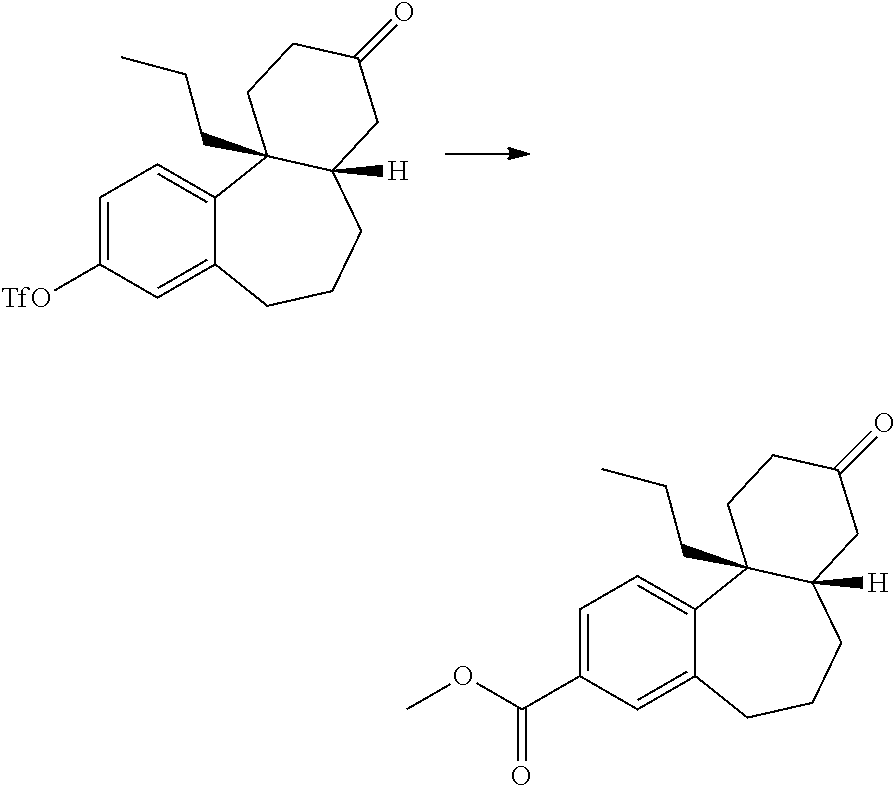
- Compound 21 (R2=Propyl) was prepared in a manner similar to the preparation of Compound 21 (R2=Benzyl) substituting trifluoro-methanesulfonic acid (7aS,11aR)-9-oxo-11a-propyl-6,7,7a,8,9,10,11,11a-octahydro-5H-dibenzo[a,c]cyclohepten-3-yl ester; compound with trifluoro-methanesulfonic acid (7aR,11aS)-9-oxo-11a-propyl-6,7,7a,8,9,10,11,11a-octahydro-5H-dibenzo[a,c]cyclohepten-3-yl ester (9, R2=Propyl) for trifluoro-methanesulfonic acid (7aS,11aS)-11a-benzyl-9-oxo-6,7,7a,8,9,10,11,11a-octahydro-5H-dibenzo[a,c]cyclohepten-3-yl ester; compound with trifluoro-methanesulfonic acid (7aR,11aR)-11a-benzyl-9-oxo-6,7,7a,8,9,10,11,11a-octahydro-5H-dibenzo[a,c]cyclohepten-3-yl ester (9, R2=Phenyl) to yield (7aS,11aR)-9-oxo-11a-propyl-6,7,7a,8,9,10,11,11a-octahydro-5H-dibenzo[a,c]cycloheptene-3-carboxylic acid methyl ester; compound with (7aR,11aS)-9-oxo-11a-propyl-6,7,7a,8,9,10,11,11a-octahydro-5H-dibenzo[a,c]cycloheptene-3-carboxylic acid methyl ester (21, R2=Propyl) (800 mg, 68%) as a white solid. LC/MS, method 1, Rt=1.56 min, no parent ion (M+H)+. 1H NMR (400 MHz, DMSO-d6) δ 7.79-7.72 (m, 2H), 7.48 (d, J=8.0 Hz, 1H), 3.83 (s, 3H), 3.11-3.00 (m, 1H), 2.85-2.76 (m, 1H), 2.76-2.60 (m, 1H), 2.44-2.38 (m, 1H), 2.33-2.09 (m, 4H), 2.05-1.98 (m, 1H), 1.93-1.88 (m, 1H), 1.82-1.21 (m, 7H), (t, J=7.0 Hz, 3H).
-

- Compound 22 (R2=Propyl) was prepared in a manner similar to the preparation of Compound 22 (R2=Benzyl), substituting (7aS,11aR)-9-oxo-11a-propyl-6,7,7a,8,9,10,11,11a-octahydro-5H-dibenzo[a,c]cycloheptene-3-carboxylic acid methyl ester; compound with (7aR,11aS)-9-oxo-11a-propyl-6,7,7a,8,9,10,11,11a-octahydro-5H-dibenzo[a,c]cycloheptene-3-carboxylic acid methyl ester (21, R2=Propyl) for (7aR,11aR)-11a-benzyl-9-oxo-6,7,7a,8,9,10,11,11a-octahydro-5H-dibenzo[a,c]cycloheptene-3-carboxylic acid methyl ester; compound with (7aS,11aS)-11a-benzyl-9-oxo-6,7,7a,8,9,10,11,11a-octahydro-5H-dibenzo[a,c]cycloheptene-3-carboxylic acid methyl ester (21, R2=Phenyl) to yield (7aS,11aR)-9-oxo-11a-propyl-6,7,7a,8,9,10,11,11a-octahydro-5H-dibenzo[a,c]cycloheptene-3-carboxylic acid (2-methyl-pyridin-3-yl)-amide; compound with (7aR,11aS)-9-oxo-11a-propyl-6,7,7a,8,9,10,11,11a-octahydro-5H-dibenzo[a,c]cycloheptene-3-carboxylic acid (2-methyl-pyridin-3-yl)-amide (22, R2=Propyl) (36%) as a white solid. LC/MS, method 1, Rt=1.37 min, MS m/z 391 (M+H)+, 1H NMR (400 MHz, DMSO-d6) δ 9.99 (s, 1H), 8.33 (dd, J=4.7, 1.6 Hz, 1H), 7.83-7.76 (m, 2H), 7.72 (dd, J=7.9, 1.4 Hz, 1H), 7.49 (d, J=8.2 Hz, 1H), 7.27 (dd, J=7.9, 4.7 Hz, 1H), 3.16-3.04 (m, 1H), 2.97-2.92 (m, 1H), 2.82-2.71 (m, 1H), 2.46 (s, 3H), 2.35-2.01 (m, 4H), 2.01-1.68 (m, 3H), 1.67-1.17 (m, 4H), 0.83-0.69 (m, 4H).
-

- The compounds 23 (R2=Propyl, R3=Ethyl) and 24 (R2=Propyl, R3=Ethyl) were prepared in a manner similar to the preparation of 23 (R2=Benzyl, R3=Ethyl) and 24 (R2=Benzyl, R3=Ethyl) substituting (7aS,11aR)-9-oxo-11a-propyl-6,7,7a,8,9,10,11,11a-octahydro-5H-dibenzo[a,c]cycloheptene-3-carboxylic acid (2-methyl-pyridin-3-yl)-amide; compound with (7aR,11aS)-9-oxo-11a-propyl-6,7,7a,8,9,10,11,11a-octahydro-5H-dibenzo[a,c]cycloheptene-3-carboxylic acid (2-methyl-pyridin-3-yl)-amide (22, R2=Propyl) for (7aS,11aS)-11a-benzyl-9-oxo-6,7,7a,8,9,10,11,11a-octahydro-5H-dibenzo[a,c]cycloheptene-3-carboxylic acid (2-methyl-pyridin-3-yl)-amide; compound with (7aR,11aR)-11a-benzyl-9-oxo-6,7,7a,8,9,10,11,11a-octahydro-5H-dibenzo[a,c]cycloheptene-3-carboxylic acid (2-methyl-pyridin-3-yl)-amide (22, R2=Benzyl) to yield (7aR,9S,11aS)-9-ethyl-9-hydroxy-11a-propyl-6,7,7a,8,9,10,11,11a-octahydro-5H-dibenzo[a,c]cycloheptene-3-carboxylic acid (2-methyl-pyridin-3-yl)-amide; compound with (7aS,9R,11aR)-9-ethyl-9-hydroxy-11a-propyl-6,7,7a,8,9,10,11,11a-octahydro-5H-dibenzo[a,c]cycloheptene-3-carboxylic acid (2-methyl-pyridin-3-yl)-amide (23, R2=Propyl, R3=Ethyl) (30%) as a white solid, LC/MS method 3, Rt=2.31 min, MS m/z 421 (M+H)+, 1H NMR (400 MHz, DMSO-d6) δ 9.93 (s, 1H), 8.33 (dd, J=4.7, 1.7 Hz, 1H), 7.81 (d, J=1.9 Hz, 1H), 7.74 (dd, J=8.0, 1.5 Hz, 1H), 7.55 (dd, J=8.2, 1.9 Hz, 1H), 7.27 (dd, J=7.9, 4.8 Hz, 1H), 7.10-7.01 (m, 3H), 6.82 (d, J=8.5 Hz, 1H), 6.63-6.53 (m, 2H), 3.88 (s, 1H), 3.58 (d, J=12.9 Hz, 1H), 3.31-3.24 (m, 1H), 3.07-2.96 (m, 1H), 2.65-2.55 (m, 1H), 2.47-2.36 (m, 5H), 1.95-1.65 (m, 3H), 1.69-1.22 (m, 4H), 1.22-1.01 (m, 4H), 0.71 (t, J=7.3 Hz, 3H) and 7aR,9R,11aS)-9-ethyl-9-hydroxy-11a-propyl-6,7,7a,8,9,10,11,11a-octahydro-5H-dibenzo[a,c]cycloheptene-3-carboxylic acid (2-methyl-pyridin-3-yl)-amide; compound with (7aS,9S,11aR)-9-ethyl-9-hydroxy-11a-propyl-6,7,7a,8,9,10,11,11a-octahydro-5H-dibenzo[a,c]cycloheptene-3-carboxylic acid (2-methyl-pyridin-3-yl)-amide (24 R2=Propyl, R3=Ethyl) (4%) LC/MS, method 3, Rt=2.62 min, MS m/z 421 (M+H)+, 1H NMR (400 MHz, DMSO-d6) δ 9.95 (s, 1H), 8.33 (dd, J=4.7, 1.5 Hz, 1H), 7.83-7.77 (m, 1H), 7.74 (dd, J=8.0, 1.4 Hz, 1H), 7.59 (d, J=6.8 Hz, 1H), 7.27 (dd, J=7.9, 4.7 Hz, 1H), 7.13-7.01 (m, 3H), 6.91-6.79 (m, 1H), 6.62-6.54 (m, 2H), 3.89 (s, 1H), 3.55 (d, J=12.7 Hz, 1H), 3.30-3.13 (m, 1H), 3.08-2.89 (m, 1H), 2.59 (d, J=13.0 Hz, 1H), 2.47-2.29 (m, 4H), 2.04-1.73 (m, 3H), 1.73-1.35 (m, 7H), 1.24-1.16 (m, 2H), 0.81 (t, J=7.3 Hz, 3H).
-

- To a stirring solution of THF (1.0 mL) saturated with propyne gas at about 0° C. was added a solution of LDA (0.702 mL, 1.40 mmol) in heptane/THF/ethylbenzene and the mixture was stirred for about 20 min under nitrogen. A solution of (4aS,11bS)-11b-benzyl-9-hydroxy-1,2,4,4a,5,6,7,11b-octahydro-dibenzo[a,c]cyclohepten-3-one; compound with (4aR,11bR)-11b-benzyl-9-hydroxy-1,2,4,4a,5,6,7,11b-octahydro-dibenzo[a,c]cyclohepten-3-one (13, R2=Benzyl) (45 mg, 0.14 mmol) in THF (1.0 mL) was added dropwise and the mixture was stirred about 30 min at about 0° C., allowed to warm to rt and stirred about an additional 1 h. The reaction was quenched by addition of a saturated aqueous NH4Cl (10 mL) and extracted with EtOAc (3×10 mL). The combined organic extracts were dried over Na2SO4, filtered and concentrated. The product was precipitated from EtOAc and heptane to yield (3S,4aS,11bS)-11b-benzyl-3-prop-1-ynyl-2,3,4,4a,5,6,7,11b-octahydro-1H-dibenzo[a,c]cycloheptene-3,9-diol; compound with (3R,4aR,11bR)-11b-benzyl-3-prop-1-ynyl-2,3,4,4a,5,6,7,11b-octahydro-1H-dibenzo[a,c]cycloheptene-3,9-diol (16, R2=Benzyl, R3=1-Propynyl) (38 mg, 75%) as a white solid, LC/MS, method 1, Rt=0.85 min, MS m/z 359 (M−H)−. 1H NMR (400 MHz, DMSO-d6) δ 9.05 (s, 1H), 7.08-6.98 (m, 3H), 6.59-6.48 (m, 3H), 6.41-6.28 (m, 2H), 3.48 (d, J=12.7 Hz, 1H), 5.09 (s, 1H), 3.13-3.03 (m, 1H), 2.82-2.67 (m, 1H), 2.47-2.29 (m, 2H), 2.18-2.05 (m, 1H), 1.96-1.86 (m, 1H), 1.82 (s, 3H), 1.80-1.31 (m, 8H).
-

- To a stirring solution of THF (2.0 mL) saturated with propyne gas at about 0° C. was added a solution of LDA (1.14 mL, 2.28 mmol) in heptane/THF/ethylbenzene and the mixture was stirred about 20 min under nitrogen. A suspension of (7aS,11aS)-11a-benzyl-9-oxo-6,7,7a,8,9,10,11,11a-octahydro-5H-dibenzo[a,c]cycloheptene-3-carboxylic acid (2-methyl-pyridin-3-yl)-amide; compound with (7aR,11aR)-11a-benzyl-9-oxo-6,7,7a,8,9,10,11,11a-octahydro-5H-dibenzo[a,c]cycloheptene-3-carboxylic acid (2-methyl-pyridin-3-yl)-amide (22, R2=Benzyl) (100 mg, 0.228 mmol) in THF (4 mL) was added dropwise and the mixture was stirred about 30 min at about 0° C., allowed to warm to rt and stirred about an additional 1 h. The reaction was quenched by addition of saturated aqueous NH4Cl (10 mL) and extracted with EtOAc (3×10 mL). The combined organic extracts were dried over Na2SO4, filtered and concentrated. The residue was purified by HPLC on C18 using a gradient from 20 to 100% MeCN in 50 mM NH4OAc buffer to yield (7aS,9S,11aS)-11a-Benzyl-9-hydroxy-9-prop-1-ynyl-6,7,7a,8,9,10,11,11a-octahydro-5H-dibenzo[a,c]cycloheptene-3-carboxylic acid (2-methyl-pyridin-3-yl)-amide; compound with (7aR,9R,11aR)-11a-benzyl-9-hydroxy-9-prop-1-ynyl-6,7,7a,8,9,10,11,11a-octahydro-5H-dibenzo[a,c]cycloheptene-3-carboxylic acid (2-methyl-pyridin-3-yl)-amide (24, R2=Benzyl, R3=1-Propynyl) (78 mg, 71%) as a white solid, LC/MS, method 1, Rt=0.82 min, MS m/z 479 (M+H)+, 1H NMR (400 MHz, DMSO-d6) δ 9.95 (s, 1H), 8.36-8.29 (m, 1H), 7.84-7.78 (m, 1H), 7.76-7.70 (m, 1H), 7.60-7.52 (m, 1H), 7.30-7.22 (m, 1H), 7.13-7.01 (m, 3H), 6.85-6.75 (m, 1H), 6.63-6.56 (m, 2H), 5.07 (s, 1H), 3.64 (d, J=13.1 Hz, 1H), 3.30-3.20 (m, 1H), 3.08-2.94 (m, 1H), 2.63 (d, J=13.1 Hz, 1H), 2.48-2.40 (m, 4H), 2.28-2.19 (m, 1H), 2.13-2.02 (m, 1H), 1.84 (s, 3H), 1.81-1.38 (m, 7H), 1.34-1.22 (m, 1H).
-

- Compound 23 (R2=Benzyl, R3=Methyl) was prepared in a manner similar to the preparation of Compound 23 (R2=Benzyl, R3=Ethyl), substituting methylmagnesium bromide for ethylmagnisium bromide to yield (7aR,9S,11aR)-11a-benzyl-9-hydroxy-9-methyl-6,7,7a,8,9,10,11,11a-octahydro-5H-dibenzo[a,c]cycloheptene-3-carboxylic acid (2-methyl-pyridin-3-yl)-amide; compound with (7aS,9R,11aS)-11a-benzyl-9-hydroxy-9-methyl-6,7,7a,8,9,10,11,11a-octahydro-5H-dibenzo[a,c]cycloheptene-3-carboxylic acid (2-methyl-pyridin-3-yl)-amide (23, R2=Benzyl, R3=Methyl) (70 mg, 45%) as a white solid. LC/MS, method 1, Rt=0.75 min, MS m/z 455 (M+H)+, 1H NMR (400 MHz, DMSO-d6) δ 9.94 (s, 1H), 8.33 (dd, J=4.7, 1.6 Hz, 1H), 7.81 (d, J=2.1 Hz, 1H), 7.74 (dd, J=8.0, 1.6 Hz, 1H), 7.55 (dd, J=8.2, 2.1 Hz, 1H), 7.27 (dd, J=7.9, 4.7 Hz, 1H), 7.10-7.03 (m, 3H), 6.81 (d, J=8.4 Hz, 1H), 6.60-6.53 (m, 2H), 4.09 (s, 1H), 3.58 (d, J=12.9 Hz, 1H), 3.31-3.23 (m, 1H), 3.07-2.96 (m, 1H), 2.60 (d, J=13.0 Hz, 1H), 2.48-2.36 (m, 5H), 1.94-1.69 (m, 3H), 1.67-1.29 (m, 4H), 1.20-1.12 (m, 2H), 0.94 (s, 3H).
-

- Compound 23 (R2=Benzyl, R3=Propyl) was prepared in a manner similar to the preparation of Compound 23 (R2=Benzyl, R3=Ethyl), substituting propylmagnesium bromide for ethylmagnesium bromide to yield (7aR,9S,11aR)-11a-benzyl-9-hydroxy-9-propyl-6,7,7a,8,9,10,11,11a-octahydro-5H-dibenzo[a,c]cycloheptene-3-carboxylic acid (2-methyl-pyridin-3-yl)-amide; compound with (7aS,9R,11aS)-11a-benzyl-9-hydroxy-9-propyl-6,7,7a,8,9,10,11,11a-octahydro-5H-dibenzo[a,c]cycloheptene-3-carboxylic acid (2-methyl-pyridin-3-yl)-amide (23, R2=Benzyl, R3=Propyl) (39 mg, 35%) as a white solid. LC/MS, method 2, Rt=2.47 min, MS m/z 483 (M+H)+. 1H NMR (400 MHz, DMSO-d6) δ 9.94 (s, 1H), 8.36-8.30 (m, 1H), 7.84-7.78 (m, 1H), 7.78-7.69 (m, 1H), 7.59-7.52 (m, 1H), 7.31-7.24 (m, 1H), 7.11-7.03 (m, 3H), 6.86-6.78 (m, 1H), 6.63-6.55 (m, 2H), 3.94 (s, 1H), 3.57 (d, J=12.8 Hz, 1H), 3.31-3.21 (m, 1H), 3.07-2.95 (m, 1H), 2.61 (d, J=13.1 Hz, 1H), 2.48-2.35 (m, 5H), 1.94-1.68 (m, 3H), 1.68-1.27 (m, 4H), 1.26-1.00 (m, 6H), 0.75 (t, J=7.0 Hz, 3H).
-

- A solution of (7aS,11aS)-11a-benzyl-9-oxo-6,7,7a,8,9,10,11,11a-octahydro-5H-dibenzo[a,c]cycloheptene-3-carboxylic acid (2-methyl-pyridin-3-yl)-amide; compound with (7aR,11aR)-11a-benzyl-9-oxo-6,7,7a,8,9,10,11,11a-octahydro-5H-dibenzo[a,c]cycloheptene-3-carboxylic acid (2-methyl-pyridin-3-yl)-amide (22, R2=Benzyl) (150 mg, 0.342 mmol) in THF (6 mL) was cooled to about 0° C. and 3M lithium (trimethylsilyl)acetylide (6.84 mL, 3.42 mmol) in Et2O was added dropwise. The reaction was stirred for about 30 min at about 0° C., then warmed to rt for about 1 h. The reaction was quenched with 10% aqueous AcOH (10 mL), extracted with EtOAc (2×25 mL), dried over Na2SO4, filtered and concentrated under reduced pressure. The residue was dissolved in THF (6 mL) and treated with TBAF (1M solution in THF, 0.342 mL, 0.342 mmol) for 1 h at rt. The reaction was diluted with water (10 mL) and extracted with EtOAc (2×20 mL). The combined extracts were dried over Na2SO4, filtered and concentrated under reduced pressure. The residue was purified on silica gel (12 g) using a gradient from 80-100% EtOAc in heptane. Product fractions were combined and concentrated to yield (7aR,9R,11aR)-11a-benzyl-9-ethynyl-9-hydroxy-6,7,7a,8,9,10,11,11a-octahydro-5H-dibenzo[a,c]cycloheptene-3-carboxylic acid (2-methyl-pyridin-3-yl)-amide; compound with (7aS,9S,11aS)-11a-benzyl-9-ethynyl-9-hydroxy-6,7,7a,8,9,10,11,11a-octahydro-5H-dibenzo[a,c]cycloheptene-3-carboxylic acid (2-methyl-pyridin-3-yl)-amide (24, R2=Benzyl, R3=Ethynyl) (140 mg, 88%) as a white solid. LC/MS, method 2, Rt=2.30 min, MS m/z 465 (M+H)+, 1H NMR (400 MHz, DMSO-d6) δ 9.96 (s, 1H), 8.36-8.30 (m, 1H), 7.87-7.77 (m, 1H), 7.76-7.70 (m, 1H), 7.61-7.54 (m, 1H), 7.31-7.24 (m, 1H), 7.13-7.02 (m, 3H), 6.85-6.76 (m, 1H), 6.64-6.56 (m, 2H), 5.37 (s, 1H), 3.61 (d, J=12.9 Hz, 1H), 3.31-3.19 (m, 1H), 3.08-2.98 (m, 1H), 2.57 (d, J=13.1 Hz, 1H), 2.48-2.38 (m, 4H), 2.29-2.20 (m, 1H), 2.17-2.07 (m, 1H), 1.88-1.76 (m, 2H), 1.77-1.43 (m, 5H), 1.36-1.20 (m, 2H).
-

- Compound 29 (R=Ethyl, R2=Benzyl) was prepared in a manner similar to the preparation of Compound 29 (R=Methyl, R2=Benzyl), substituting EtOH for MeOH to yield (7aS,9R,11aS)-11a-benzyl-9-ethoxymethyl-9-hydroxy-6,7,7a,8,9,10,11,11a-octahydro-5H-dibenzo[a,c]cycloheptene-3-carboxylic acid (2-methyl-pyridin-3-yl)-amide; compound with (7aR,9S,11aR)-11a-benzyl-9-ethoxymethyl-9-hydroxy-6,7,7a,8,9,10,11,11a-octahydro-5H-dibenzo[a,c]cycloheptene-3-carboxylic acid (2-methyl-pyridin-3-yl)-amide (29, R=Ethyl, R2=Benzyl) (48%) as a white solid. LC/MS, method 2, Rt=2.32 min, MS m/z 499 (M+H)+, 1H NMR (400 MHz, DMSO-d6) δ 9.95 (s, 1H), 8.33 (dd, J=4.7, 1.6 Hz, 1H), 7.81 (d, J=2.1 Hz, 1H), 7.74 (dd, J=8.0, 1.6 Hz, 1H), 7.59-7.53 (m, 1H), 7.27 (dd, J=8.0, 4.8 Hz, 1H), 7.09-7.03 (m, 3H), 6.82 (d, J=8.5 Hz, 1H), 6.61-6.55 (m, 2H), 4.14 (s, 1H), 3.58 (d, J=13.0 Hz, 1H), 3.25-3.34 (m, 3H), 3.08-2.92 (m, 3H), 2.64-2.56 (m, 1H), 2.48-2.40 (m, 5H), 1.95-1.86 (m, 1H), 1.86-1.72 (m, 2H), 1.68-1.45 (m, 3H), 1.43-1.35 (m, 1H), 1.28-1.20 (m, 1H), 1.16-1.08 (m, 1H), 0.97 (t, J=8.0 Hz, 3H).
-
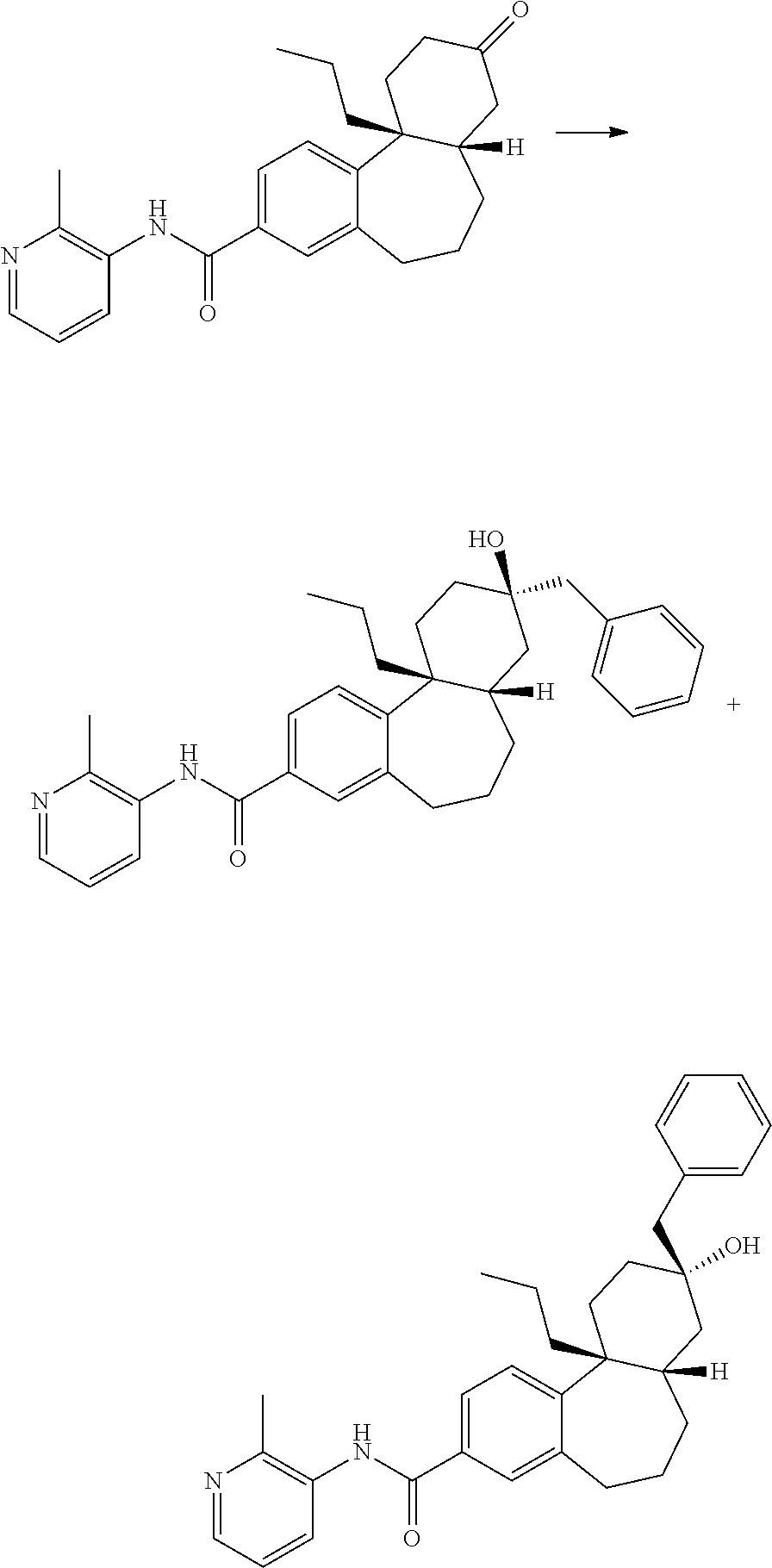
- The compounds 23 (R2=Propyl, R3=Benzyl) and 24 (R2=Propyl, R3=Benzyl) were prepared in a manner similar to the preparation of compounds 23 (R2=Propyl, R3=Ethyl) and 24 (R2=Propyl, R3=Ethyl) substituting benzylmagnesiumchloride for ethylmagnesium bromide to yield (7aS,9R,11aR)-9-benzyl-9-hydroxy-11a-propyl-6,7,7a,8,9,10,11,11a-octahydro-5H-dibenzo[a,c]cycloheptene-3-carboxylic acid (2-methyl-pyridin-3-yl)-amide; compound with (7aR,9S,11aS)-9-benzyl-9-hydroxy-11a-propyl-6,7,7a,8,9,10,11,11a-octahydro-5H-dibenzo[a,c]cycloheptene-3-carboxylic acid (2-methyl-pyridin-3-yl)-amide (23, R2=Propyl, R3=Benzyl) (7%) as a white solid, LC/MS, method 2, Rt=2.67 min, MS m/z 481 (M−H)−. 1H NMR (400 MHz, DMSO-d6) δ 9.93 (s, 1H), 8.32 (dd, J=4.7, 1.5 Hz, 1H), 7.75-7.69 (m, 3H), 7.35 (d, J=8.3 Hz, 1H), 7.25 (dt, J=14.7, 7.4 Hz, 1H), 7.20-7.14 (m, 2H), 7.15-7.09 (m, 3H), 4.09 (s, 1H), 3.05-2.96 (m, 1H), 2.92-2.80 (m, 1H), 2.47-2.42 (m, 4H), 2.32-2.19 (m, 3H), 2.03-1.94 (m, 1H), 1.75-1.11 (m, 10H), 1.10-1.03 (m, 1H), 0.73 (t, J=6.9 Hz, 3H), 0.72-0.61 (m, 1H) and (7aS,9S,11aR)-9-benzyl-9-hydroxy-11a-propyl-6,7,7a,8,9,10,11,11a-octahydro-5H dibenzo[a,c]cycloheptene-3-carboxylic acid (2-methyl-pyridin-3-yl)-amide; compound with (7aR,9R,11aS)-9-benzyl-9-hydroxy-11a-propyl-6,7,7a,8,9,10,11,11a-octahydro-5H-dibenzo[a,c]cycloheptene-3-carboxylic acid (2-methyl-pyridin-3-yl)-amide (24, R2=Propyl, R3=Benzyl) (38%) as a white solid, LC/MS, method 2, Rt=2.95 min, MS m/z 481 (M−H)−=481, 1H NMR (400 MHz, DMSO-d6) δ 9.92 (s, 1H), 8.31 (dd, J=4.7, 1.6 Hz, 1H), 7.76-7.65 (m, 3H), 7.39 (d, J=8.4 Hz, 1H), 7.28-7.10 (m, 6H), 4.09 (s, 1H), 3.04-2.93 (m, 2H), 2.90-2.82 (m, 1H), 2.73-2.65 (m, 1H), 2.54-2.49 (m, 1H), 2.41 (s, 3H), 2.26-2.17 (m, 1H), 2.10-2.01 (m, 2H), 1.73-1.24 (m, 8H), 1.17-1.08 (m, 1H), 1.04-0.94 (m, 1H), 0.81-0.62 (m, 4H).
-

-

- A mixture of benzaldehyde (28.4 mL, 281 mmol) and (S)-pyrrolidine-2-carboxylic acid (0.463 g, 4.02 mmol) was stirred neat at rt and cycloheptane-1,3-dione (46) (5.07 g, 40.2 mmol) was added dropwise over about 30 min The mixture was stirred for about 4 h at rt and then purified on silica gel (330 g) using a gradient from 10 to 30% EtOAc in heptane. The product fractions were combined and concentrated to a pale yellow oil that solidified on continued drying to yield 2-benzylidene-cycloheptane-1,3-dione (47, R1=Phenyl) (5.90 g, 68%) as an off-white solid, LC/MS, method 1, Rt=0.66 min, MS m/z 215 (M+H)+, 1H NMR (400 MHz, DMSO-d6) δ 7.52-7.43 (m, 3H), 7.43-7.34 (m, 3H), 2.84-2.77 (m, 2H), 2.55-2.49 (m, 2H), 1.96-1.83 (m, 4H).
-

- A solution containing 2-benzylidene-cycloheptane-1,3-dione (47, R1=Phenyl) (5.89 g, 27.5 mmol) in toluene (50 mL) was treated with 20% Pd(OH)2 on carbon (0.965 g) and the mixture was shaken under about 50 psi of hydrogen for about 1 h. The solution was filtered through a pad of Celite®, rinsed with toluene, concentrated under reduced pressure to a clear oil and dried to constant weight to yield 2-benzyl-cycloheptane-1,3-dione (48, R2=Benzyl) (5.95 g, 100%), LC/MS, method 1, Rt=1.48 min, MS m/z 217 (M+H)+, 1H NMR indicated that the product exists as a mixture of keto and enol forms (about 3:1).
-

- A mixture of 2-benzylcycloheptane-1,3-dione (48, R2=Benzyl) (5.40 g, 25.0 mmol) and but-3-en-2-one (3.07 mL, 37.5 mmol) was treated with TEA (0.174 mL, 1.25 mmol) and the mixture was stoppered and stirred at about 50° C. for about 5 days. The mixture was dried under reduced pressure. The residue was dissolved in toluene (100 mL), pyridine (2.07 mL, 25.0 mmol) and acetic acid (1.43 mL, 25.0 mmol) were added and the mixture was stirred at rt for about 1 h, then at about 50° C. for about 5 h. The reaction was cooled to rt and stirred about 18 h. Water (25 mL) was added and the mixture was stirred about 1 h. The layers were separated and the organic layer was dried over Na2SO4, filtered and concentrated under reduced pressure. The residue was purified on silica gel (120 g) using a gradient from 10% to 30% EtOAc in heptane. The product fractions were combined and concentrated under reduced pressure to about 70 mL. The product precipitated and was collected by filtration, washed with heptane (25 mL) and dried under reduced pressure to yield 4a-benzyl-4,4a,6,7,8,9-hexahydro-3H-benzocycloheptene-2,5-dione (49, R2=Benzyl) as an off-white powder (5.33 g, 80%), LC/MS, method 1, Rt=0.72 min, MS m/z 269 (M+H)+, 1H NMR (400 MHz, DMSO-d6) δ 7.26-7.16 (m, 3H), 7.16-7.10 (m, 2H), 6.17 (s, 1H), 3.24-3.11 (m, 2H), 2.79-2.69 (m, 1H), 2.39-2.30 (m, 1H), 2.30-2.14 (m, 2H), 2.10-1.98 (m, 1H), 1.95-1.75 (m, 4H), 1.48-1.26 (m, 3H).
-

- A solution of 4a-benzyl-4,4a,6,7,8,9-hexahydro-3H-benzocycloheptene-2,5-dione (49, R2=Benzyl) (4.80 g, 17.89 mmol) containing 20% Pd(OH)2 on carbon (1.90 g) was dissolved in toluene (89 mL). The reaction was shaken under hydrogen (50 psi) for about 18 h. The reaction was filtered through a pad of Celite® and concentrated to dryness to yield (4aS,9aS)-4a-benzyl-octahydro-benzocycloheptene-2,5-dione; compound with (4aR,9aR)-4a-benzyl-octahydro-benzocycloheptene-2,5-dione (50, R2=Benzyl) (5.04 g, 99%) as a white solid, LC/MS, method 1, Rt=0.74 min, MS m/z 269 (M−H)−, 1H NMR (400 MHz, DMSO-d6) δ 7.29-7.19 (m, 3H), 7.08-7.03 (m, 2H), 3.28-3.16 (m, 2H), 3.13-3.04 (m, 1H), 2.85-2.80 (m, 1H), 2.71-2.60 (m, 1H), 2.17-2.00 (m, 3H), 1.88-1.62 (m, 5H), 1.57-1.07 (m, 4H).
-

- To solution of (4aS,9aS)-4a-benzyl-octahydro-benzocycloheptene-2,5-dione; compound with (4aR,9aR)-4a-benzyl-octahydro-benzocycloheptene-2,5-dione (50, R2=Benzyl) (5.04 g, 17.7 mmol) in toluene (136 mL) was added ethylene glycol (1.98 mL, 35 mmol), and toluene-4-sulfonic acid hydrate (0.337 g, 1.77 mmol). The reaction was stirred at reflux for about 3 h, removing water using a Dean-Stark trap. The reaction was cooled to rt, washed with saturated aqueous NaHCO3 (100 mL), dried over Na2SO4, filtered and concentrated to an oil. The residue was purified on silica gel (120 g) using a gradient 0-40% EtOAc in heptane. The product fractions were combined and concentrated to yield Compound 51 (R2=Benzyl) (4.10 g, 74%) as a white solid, LC/MS, method 2, Rt=2.57 min, MS m/z 315 (M+H)+, 1H NMR (400 MHz, DMSO-d6) δ 7.28-7.10 (m, 3H), 6.98-6.93 (m, 2H), 3.88-3.76 (m, 4H), 3.07-2.89 (m, 2H), 2.20-1.95 (m, 3H), 1.93-1.58 (m, 6H), 1.58-1.16 (m, 6H).
-

- A mixture of (4aS,9aS)-4a-benzyloctahydrospiro[benzo[7]annulene-2,2′-[1,3]dioxolan]-5(1H)-one; compound with (4aR,9aR)-4a-benzyloctahydrospiro[benzo[7]annulene-2,2′-[1,3]dioxolan]-5(1H)-one (51, R2=Benzyl) (0.500 g, 1.59 mmol) was treated with 1-tert-butoxy-N,N,N′,N′-tetramethylmethanediamine (1.39 g, 7.95 mmol). The flask was fitted with an air condenser then heated at about 150° C. for about 3 h. The mixture was cooled to rt then 1-tert-butoxy-N,N,N′,N′-tetramethylmethanediamine (0.831 g, 4.77 mmol) was added. The mixture was heated at about 150° C. for about 2 h. The mixture was cooled to rt. The solvents were removed under reduced pressure, the material was triturated with heptane (˜8 mL) then the mixture was concentrated to dryness under reduced pressure. The material was treated with EtOH (8 mL) and methylhydrazine (0.513 g, 11.1 mmol). The mixture was warmed to about 60° C. for about 1 h then to reflux for about 3 h. The mixture was cooled to rt then the solvents were removed under reduced pressure. The material was treated with water (20 mL) then extracted with DCM (2×20 mL). The combined organics were extracted with water then dried over anhydrous MgSO4, filtered and the filtrate concentrated under reduced pressure. The material was dissolved in toluene (30 mL) then treated with p-toluenesulfonic acid monohydrate (0.015 g, 0.072 mmol). The flask was fitted with a Dean-Stark apparatus then the mixture was heated to reflux for about 30 min. The mixture was cooled then concentrated under reduced pressure. The material was purified on silica gel (12 g) eluting with a gradient of 10-75% EtOAc in heptane. Evaporation of the appropriate fractions gave (+/−) Compound 52 (R2=Benzyl) (0.106 g, 19%). LC/MS, method 2, Rt=2.69 min, MS m/z 383 (M+H)+; 1H NMR (400 MHz, DMSO-d6) δ 7.21-7.05 (m, 4H), 6.65 (d, J=6.5 Hz, 2H), 3.92-3.78 (m, 4H), 3.33 (d, J=14.6 Hz, 1H), 2.87 (s, 3H), 2.79-2.68 (m, 1H), 2.66-2.52 (m, 1H), 2.47 (d, J=14.6 Hz, 1H), 2.39-2.25 (m, 2H), 2.10-2.01 (m, 1H), 1.77-1.54 (m, 5H), 1.54-1.36 (m, 2H), 1.23-1.12 (m, 1H) and (+/−) Compound 53 (R2=Benzyl), (0.207 g, 37%); LC/MS, method 2, Rt=2.59 min, MS m/z 383(M+H)+. 1H NMR (400 MHz, DMSO-d6) δ 7.36 (s, 1H), 7.13-7.07 (m, 3H), 6.70-6.63 (m, 2H), 3.91-3.69 (m, 4H), 3.62 (s, 3H), 3.11 (d, J=12.8 Hz, 1H), 2.76-2.66 (m, 1H), 2.66-2.52 (m, 1H), 2.40-2.29 (m, 1H), 1.98-1.93 (m, 1H), 1.87-1.77 (m, 1H), 1.73-1.63 (m, 3H), 1.47-1.22 (m, 6H).
-
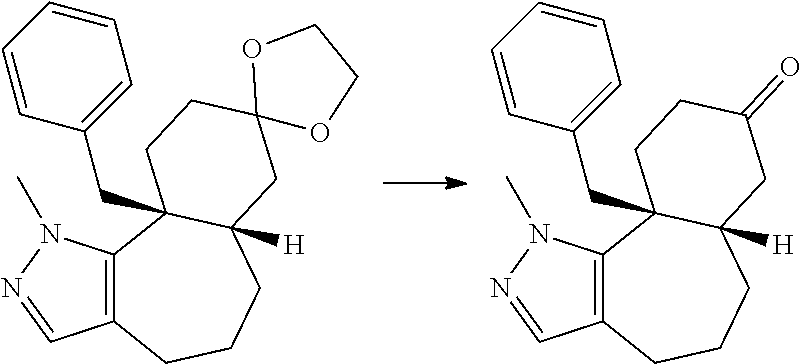
- Compound 52 (R2=Benzyl) (0.200 g, 0.567 mmol) was dissolved in acetone (6 mL) then treated with 37 wt % hydrochloric acid (0.070 mL, 0.84 mmol). The mixture was stirred for about 14 h at rt. The solvents were removed under reduced pressure then the material was dissolved in acetone (6 mL) and treated with 37 wt % hydrochloric acid (0.070 mL, 0.84 mmol). The mixture was stirred at rt for about 1 h then the solvents were removed by evaporation under reduced pressure. The material was treated with water (20 mL) then DCM (20 mL). The mixture was basified with 50 wt % aqueous NaOH then the layers were separated. The aqueous layer was extracted with DCM (15 mL) then the combined organics were dried over anhydrous MgSO4, filtered and the filtrate concentrated under reduced pressure to give (6aS,10aS)-10a-benzyl-1-methyl-4,5,6,6a,7,9,10,10a-octahydro-1H-1,2-diaza-benzo[e]azulen-8-one compound; with (6aR,10aR)-10a-benzyl-1-methyl-4,5,6,6a,7,9,10,10a-octahydro-1H-1,2-diaza-benzo[e]azulen-8-one (54, R2=Benzyl) (0.170 g, 97%); LC/MS, method 3, Rt=2.31 min, MS m/z 309 (M+H)+.
-

- A 3 necked round bottom flask equipped with thermometer, septum and nitrogen line was charged with THF (3 mL). The solvent was cooled to about 0° C. then ethylmagnesium bromide (3M solution in Et2O, 1.47 mL, 4.41 mmol) was added slowly. (6aS,10aS)-10a-benzyl-1-methyl-4,5,6,6a,7,9,10,10a-octahydro-1H-1,2-diaza-benzo[e]azulen-8-one compound; with (6aR,10aR)-10a-benzyl-1-methyl-4,5,6,6a,7,9,10,10a-octahydro-1H-1,2-diaza-benzo[e]azulen-8-one (54, R2=Benzyl) (0.170 g, 0.551 mmol) dissolved in THF (3 mL) was added to the Grignard reagent mixture maintaining the internal temperature≦5° C. After about 5 min the mixture was treated with acetic acid (0.32 mL, 5.5 mmol) keeping the internal temperature<5° C. The mixture was then diluted with water (20 mL) and extracted with DCM (2×20 mL). The combined organics were dried over MgSO4, then filtered and the filtrate concentrated under reduced pressure. The material was purified on a silica gel column (10 g) eluting with EtOAc. Two major products were isolated. The higher Rf material was further purified on a silica gel column (10 g) with 50% EtOAc in heptane as eluent to give (6aS,8R,10aS)-10a-benzyl-8-ethyl-1-methyl-1,4,5,6,6a,7,8,9,10,10a-decahydro-1,2-diaza-benzo[e]azulen-8-ol; compound with (6aR,8S,10aR)-10a-benzyl-8-ethyl-1-methyl-1,4,5,6,6a,7,8,9,10,10a-decahydro-1,2-diaza-benzo[e]azulen-8-ol (58, R2=Benzyl, R3=Ethyl) (0.092 g. 49%); LC/MS, method 2, Rt=2.49 min, MS m/z 339 (M+H)+; 1H NMR (400 MHz, DMSO-d6) δ 7.20-7.12 (m, 3H), 7.09 (s, 1H), 6.67-6.60 (m, 2H), 3.94 (s, 1H), 3.35 (d, J=12.8 Hz, 1H), 2.84 (s, 3H), 2.78-2.69 (m, 1H), 2.63-2.53 (m, 1H), 2.45 (d, J=12.8 Hz, 1H), 2.39-2.28 (m, 1H), 2.28-2.20 (m, 1H), 2.14-2.05 (m, 1H), 1.84-1.72 (m, 1H), 1.67-1.45 (m, 4H), 1.39-1.29 (m, 1H), 1.27-1.17 (m, 3H), 0.99-0.89 (m, 1H), 0.75 (t, J=7.5 Hz, 3H). The lower Rf material was further purified on a 5 g silica column with EtOAc as an eluent to give (6aS,8S,10aS)-10a-benzyl-8-ethyl-1-methyl-1,4,5,6,6a,7,8,9,10,10a-decahydro-1,2-diaza-benzo[e]azulen-8-ol; compound with (6aR,8R,10aR)-10a-benzyl-8-ethyl-1-methyl-1,4,5,6,6a,7,8,9,10,10a-decahydro-1,2-diaza-benzo[e]azulen-8-ol (59, R2=Benzyl, R3=Ethyl) (0.028 g, 15%); LC/MS, method 2, Rt=2.60 min, MS m/z 339 (M+H)+.
-
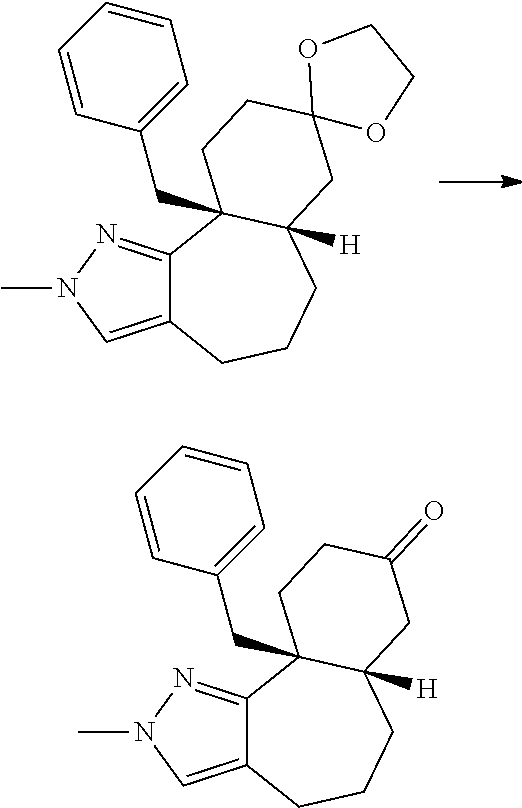
- (+/−) Compound 53 (R2=Benzyl) (0.150 g, 0.426 mmol) in acetone (7 mL) was treated with 37 wt % hydrochloric acid (0.083 mL, 1.0 mmol) then stirred at rt for about 16 h. The mixture was concentrated under reduced pressure then partitioned between DCM (20 mL) and saturated aqueous NaHCO3 (10 mL). The layers were separated then the aqueous layer was extracted with DCM (15 mL). The combined organics were dried over anhydrous MgSO4 and filtered then the filtrate was concentrated under reduced pressure to give (6aS,10aS)-10a-benzyl-2-methyl-2,5,6,6a,7,9,10,10a-octahydro-4H-1,2-diaza-benzo[e]azulen-8-one compound; with (6aR,10aR)-10a-benzyl-2-methyl-2,5,6,6a,7,9,10,10a-octahydro-4H-1,2-diaza-benzo[e]azulen-8-one (55, R2=Benzyl) (0.129 g, 98%); LC/MS, method 3, Rt=2.50 min, MS m/z 309 (M+H)+.
-

- A 25 mL 3 necked round bottom flask equipped with a nitrogen line, thermometer and septum was charged with THF (3 mL). The mixture was cooled to about 0° C. then ethylmagnesium bromide (3M solution in Et2O, 1.1 mL, 3.3 mmol) was added. The mixture was cooled to about 0° C. then the (6aS,10aS)-10a-benzyl-2-methyl-2,5,6,6a,7,9,10,10a-octahydro-4H-1,2-diaza-benzo[e]azulen-8-one: compound with (6aR,10aR)-10a-benzyl-2-methyl-2,5,6,6a,7,9,10,10a-octahydro-4H-1,2-diaza-benzo[e]azulen-8-one (55, R2=Benzyl) (0.129 g, 0.418 mmol) in THF (3 mL) was added keeping the internal temp<5° C. The mixture was stirred at about 0° C. for about 15 min, then the reaction was treated with acetic acid (0.24 mL, 4.2 mmol). The mixture was added to water (25 mL) then extracted with DCM (20 mL then 15 mL). The combined organics were dried over anhydrous MgSO4, then filtered and the filtrate was concentrated under reduced pressure. The material was purified on a silica gel column (10 g) using EtOAc as eluent. Two major products were isolated. The higher Rf material was further purified on a silica gel column (10 g) using 40% EtOAc in heptane as eluent to give (6aS,8R,10aS)-10a-benzyl-8-ethyl-2-methyl-2,4,5,6,6a,7,8,9,10,10a-decahydro-1,2-diaza-benzo[e]azulen-8-ol; compound with (6aR,8S,10aR)-10a-benzyl-8-ethyl-2-methyl-2,4,5,6,6a,7,8,9,10,10a-decahydro-1,2-diaza-benzo[e]azulen-8-ol (56, R2=Benzyl, R3=Ethyl) (0.043 g, 31%); LC/MS, method 2, Rt=2.63 min, MS m/z 339 (M+H)+. 1H NMR (400 MHz, DMSO-d6) δ 7.30 (s, 1H), 7.10-7.05 (m, 3H), 6.65-6.59 (m, 2H), 3.61 (s, 1H), 3.56 (s, 3H), 3.12 (d, J=12.8 Hz, 1H), 2.73-2.67 (m, 1H), 2.54-2.50 (m, 1H), 2.40-2.32 (m, 1H), 2.20-2.14 (m 1H), 1.82-1.76 (m, 1H), 1.69-1.04 (m, 11H), 0.70 (t, J=7.5 Hz, 3H). The lower Rf material was further purified on a silica gel column (10 g) using EtOAc as eluent to give (6aS,8S,10aS)-10a-benzyl-8-ethyl-2-methyl-2,4,5,6,6a,7,8,9,10,10a-decahydro-1,2-diaza-benzo[e]azulen-8-ol; compound with (6aR,8R,10aR)-10a-benzyl-8-ethyl-2-methyl-2,4,5,6,6a,7,8,9,10,10a-decahydro-1,2-diaza-benzo[e]azulen-8-ol (57, R2=Benzyl, R3=Ethyl) (0.0095 g, 7%); LC/MS, method 2, Rt=2.71 min, MS m/z 339 (M+H)+. 1H NMR (400 MHz, DMSO-d6) δ 7.33 (s, 1H), 7.08-7.05 (m, 3H), 6.63-6.56 (m, 2H), 3.76 (s, 1H), 3.58 (s, 3H), 3.09 (d, J=12.8 Hz, 1H), 2.75-2.65 (m, 1H), 2.47 (d, J=12.8 Hz, 1H), 2.37-2.24 (m, 1H), 1.98-1.89 (m, 1H), 1.72-1.60 (m, 4H), 1.52-1.09 (m, 8H), 0.74 (t, J=7.4 Hz, 3H).
-

-

- Phenylmagnesium bromide (1M solution in THF, 9.72 mL, 9.72 mmol) in THF (15 mL) was cooled to about 0° C. To the solution was added trifluoro-methanesulfonic acid (7aS,11aS)-11a-benzyl-9-oxo-6,7,7a,8,9,10,11,11a-octahydro-5H-dibenzo[a,c]cyclohepten-3-yl ester compound with trifluoro-methanesulfonic acid (7aR,11aR)-11a-benzyl-9-oxo-6,7,7a,8,9,10,11,11a-octahydro-5H-dibenzo[a,c]cyclohepten-3-yl ester (9, R2=Benzyl) (1.10 g, 2.43 mmol). The mixture stirred for about 1 h and then saturated aqueous NH4Cl (15 mL) was added and the organics were concentrated in vacuo, extracted with EtOAc (2×30 mL), dried over MgSO4 and concentrated to provide trifluoro-methanesulfonic acid (7aS,11aS)-11a-benzyl-9-hydroxy-9-phenyl-6,7,7a,8,9,10,11,11a-octahydro-5H-dibenzo[a,c]cyclohepten-3-yl ester compound with trifluoro-methanesulfonic acid (7aR,11aR)-11a-benzyl-9-hydroxy-9-phenyl-6,7,7a,8,9,10,11,11a-octahydro-5H-dibenzo[a,c]cyclohepten-3-yl ester (1.13 g, 88%) as a pale yellow oil. LC/MS, method 3, Rt=3.26 min, MS m/z 589 (M+OAc)−. The resulting oil was dissolved in toluene (20 mL) and then potassium hydrogen sulfate (0.142 mL, 2.34 mmol) was added and the mixture was heated to reflux for about 17 h. The residue was concentrated to dryness and then purified on silica gel (40 g) eluting with 0 to 20% EtOAc in heptane to provide trifluoro-methanesulfonic acid (7aS,11aS)-11a-benzyl-9-phenyl-6,7,7a,8,11,11a-hexahydro-5H-dibenzo[a,c]cyclohepten-3-yl ester compound with trifluoro-methanesulfonic acid (7aR,11aR)-11a-benzyl-9-phenyl-6,7,7a,8,11,11a-hexahydro-5H-dibenzo[a,c]cyclohepten-3-yl ester (61, R2=Benzyl, R3=Phenyl) (1.17 g, 108%, contained ˜8% solvent) as a white solid. LC/MS, method 4, Rt=3.19 min, MS m/z 571 (M+OAc)−. 1H NMR (400 MHz, DMSO-d6) δ 7.33 (d, J=2.9 Hz, 1H), 7.20-7.27 (m, 4H), 7.13-7.18 (m, 1H), 7.00-7.08 (m, 3H), 6.96 (dd, J=8.8, 2.9 Hz, 1H), 6.76 (d, J=8.9 Hz, 1H), 6.56-6.51 (m, 2H), 6.19 (bs, 1H), 3.91 (d, J=13.2 Hz, 1H), 3.45-3.41 (m, 1H), 3.06-2.96 (m, 1H), 2.64-2.57 (m, 1H), 2.43-2.35 (m, 2H), 2.35-2.26 (m, 1H), 2.24-2.15 (m, 1H), 2.07-1.93 (m, 1H), 1.91-1.81 (m, 2H), 1.91-1.68 (m, 1H), 1.63-1.47 (m, 1H).
-

- To a flask was added trifluoromethanesulfonic acid (7aS,11aS)-11a-benzyl-9-phenyl-6,7,7a,8,11,11a-hexahydro-5H-dibenzo[a,c]cyclohepten-3-yl ester compound with trifluoromethanesulfonic acid (7aR,11aR)-11a-benzyl-9-phenyl-6,7,7a,8,11,11a-hexahydro-5H-dibenzo[a,c]cyclohepten-3-yl ester (61, R2=Benzyl, R3=Phenyl) (0.500 g, 0.975 mmol), 2.5% osmium tetroxide in t-butanol (0.61 mL, 0.049 mmol) and NMO (0.114 g, 0.975 mmol) followed by the addition of 1,4-dioxane (6 mL) and water (2 mL). The mixture was stirred at rt for about 17 h. The solution was quenched with sodium thiosulfate solution (15 mL) and extracted with DCM (2×15 mL). The organics were dried over MgSO4, filtered and concentrated under reduced pressure. The residue was purified on silica gel (12 g) eluting with 40% EtOAc in heptane followed by a second purification on silica gel (12 g) eluting with 0 to 20% EtOAc in heptane to provide trifluoromethanesulfonic acid (7aS,9R,10R,11aR)-11a-benzyl-9,10-dihydroxy-9-phenyl-6,7,7a,8,9,10,11,11a-octahydro-5H-dibenzo[a,c]cyclohepten-3-yl ester compound with trifluoro-methanesulfonic acid (7aR,9S,10S,11aS)-11a-benzyl-9,10-dihydroxy-9-phenyl-6,7,7a,8,9,10,11,11a-octahydro-5H-dibenzo[a,c]cyclohepten-3-yl ester (62, R2=Benzyl, R3=Phenyl) (0.293 g, 55%). LC/MS, method 4, Rt=2.59 min, MS m/z 605 (M+OAc)−. 1H NMR (400 MHz, DMSO-d6) δ 7.35 (d, J=3.2 Hz, 1H), 7.01-7.08 (m, 9H), 6.94 (d, J=9.2 Hz, 1H), 6.56-6.51 (m, 2H), 4.55 (s, 1H), 4.38 (d, J=6.0 Hz, 1H), 3.91-3.83 (m, 1H), 3.56 (d, J=13.0 Hz, 1H), 3.29-3.20 (m, 1H), 3.06-2.96 (m, 1H), 2.69-2.54 (m, 2H), 2.08-2.00 (m, 1H), 1.90-1.79 (m, 1H), 1.76-1.83 (m, 2H), 1.56-1.38 (m, 2H), 1.37-1.28 (m, 1H).
-

- To a flask was added trifluoromethanesulfonic acid (7aS,9R,10R,11aR)-11a-benzyl-9,10-dihydroxy-9-phenyl-6,7,7a,8,9,10,11,11a-octahydro-5H-dibenzo[a,c]cyclohepten-3-yl ester compound with trifluoromethanesulfonic acid (7aR,9S,10S,11aS)-11a-benzyl-9,10-dihydroxy-9-phenyl-6,7,7a,8,9,10,11,11a-octahydro-5H-dibenzo[a,c]cyclohepten-3-yl ester (62, R2=Benzyl, R3=Phenyl) (0.050 g, 0.091 mmol) and tetrabutylammonium hydroxide (0.120 mL, 0.183 mmol) in 1,4-dioxane (3 mL) and the mixture was stirred for about 2 h. The reaction mixture was quenched with a drop of 1 N aqueous HCl and diluted with DCM (5 mL). The organics were separated, dried over MgSO4, concentrated in vacuo and then purified on silica gel (12 g), eluting with 0-40% EtOAc in heptane. The product containing fractions were partially concentrated until solids precipitated. The solids were collected by filtration and dried under reduced pressure to provide (2R,3R,4aS,11bR)-11b-benzyl-3-phenyl-2,3,4,4a,5,6,7,11b-octahydro-1H-dibenzo[a,c]cycloheptene-2,3,9-triol; compound with (2S,3S,4aR,11bS)-11b-benzyl-3-phenyl-2,3,4,4a,5,6,7,11b-octahydro-1H-dibenzo[a,c]cycloheptene-2,3,9-triol (63, R2=Benzyl, R3=Phenyl) (0.006 g, 16%). LC/MS, method 2, Rt=2.52 min, MS m/z 473 (M+OAc)−. 1H NMR (400 MHz, DMSO-d6) δ 9.10 (s, 1H), 7.20-7.09 (m, 4H), 7.11-7.04 (m, 4H), 6.62-6.54 (m, 4H), 6.43-6.38 (m, 1H), 4.40 (s, 1H), 4.27 (d, J=6.1 Hz, 1H), 4.00-3.91 (m, 1H), 3.49 (d, J=12.8 Hz, 1H), 3.05-2.98 (m, 1H), 2.79-2.69 (m, 1H), 2.53 (d, J=12.8 Hz, 1H), 2.40-2.32 (m, 1H), 1.98-1.90 (m, 1H), 1.51-1.73 (m, 4H), 1.48-1.35 (m, 1H), 1.30-1.21 (m, 2H).
-
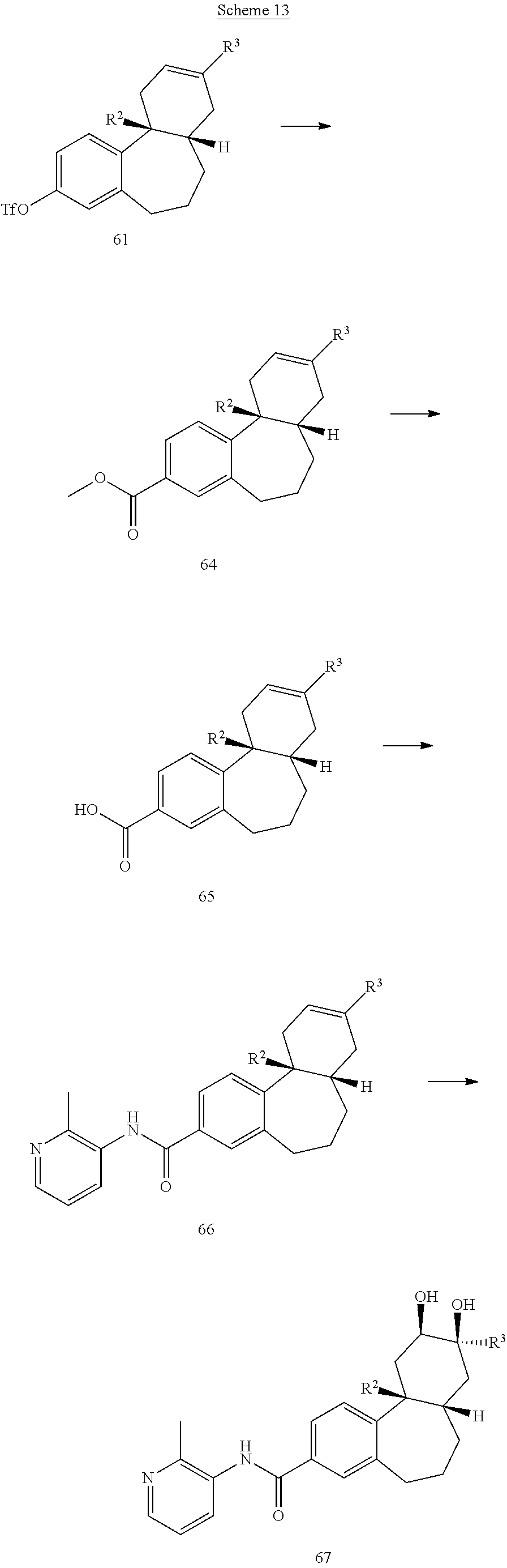
-

- Trifluoro-methanesulfonic acid (7aS,11aS)-11a-benzyl-9-phenyl-6,7,7a,8,11,11a-hexahydro-5H-dibenzo[a,c]cyclohepten-3-yl ester; compound with trifluoro-methanesulfonic acid (7aR,11aR)-11a-benzyl-9-phenyl-6,7,7a,8,11,11a-hexahydro-5H-dibenzo[a,c]cyclohepten-3-yl ester (61, R2=Benzyl, R3=Phenyl) (0.428 g, 0.835 mmol) and PdCl2(dppf) (0.061 g, 0.083 mmol) were combined under nitrogen, followed by the addition of DMF (5 mL) and the mixture was degassed by bubbling a stream of nitrogen for about 10 min. The reaction mixture was briefly evacuated and an atmosphere of CO was added from a balloon. MeOH (0.34 mL, 8.4 mmol) and TEA (0.23 mL, 1.7 mmol) were added and the reaction was heated at about 90° C. for about 2 h. The reaction was cooled to rt and concentrated in vacuo. The residue was purified on silica gel (25 g), eluting with a gradient of 0-20% EtOAc in heptane to yield (7aS,11aS)-11a-benzyl-9-phenyl-6,7,7a,8,11,11a-hexahydro-5H-dibenzo[a,c]cycloheptene-3-carboxylic acid methyl ester; compound with (7aR,11aR)-11a-benzyl-9-phenyl-6,7,7a,8,11,11a-hexahydro-5H-dibenzo[a,c]cycloheptene-3-carboxylic acid methyl ester (64, R2=Benzyl, R3=Phenyl) as a white solid (0.156 g, 44%). LC/MS, method 4, Rt=3.00 min, MS m/z 423 (M+H)+.
-

- To a round flask was added (7aS,11aS)-11a-benzyl-9-phenyl-6,7,7a,8,11,11a-hexahydro-5H-dibenzo[a,c]cycloheptene-3-carboxylic acid methyl ester; compound with (7aR,11aR)-11a-benzyl-9-phenyl-6,7,7a,8,11,11a-hexahydro-5H-dibenzo[a,c]cycloheptene-3-carboxylic acid methyl ester (64, R2=Benzyl, R3=Phenyl) (0.156 g, 0.37 mmol) and LiOH (0.081 g, 3.3 mmol) [Alfa Aesar] in 1,4-dioxane (2 mL) and water (1 mL) and the suspension was stirred at about 75° C. for about 60 h. The reaction was concentrated under reduced pressure, then acidified with 1N aqueous HCl. Water (5 mL) was added and the resulting suspension was collected by filtration to provide (7aS,11aS)-11a-benzyl-9-phenyl-6,7,7a,8,11,11a-hexahydro-5H-dibenzo[a,c]cycloheptene-3-carboxylic acid; compound with (7aR,11aR)-11a-benzyl-9-phenyl-6,7,7a,8,11,11a-hexahydro-5H-dibenzo[a,c]cycloheptene-3-carboxylic acid (65, R2=Benzyl, R3=Phenyl) (0.151 g, 100%). LC/MS, method 4, Rt=2.53 min, MS m/z 407 (M−H)−.
-

- To a round flask was added (7aS,11aS)-11a-benzyl-9-phenyl-6,7,7a,8,11,11a-hexahydro-5H-dibenzo[a,c]cycloheptene-3-carboxylic acid; compound with (7aR,11aR)-11a-benzyl-9-phenyl-6,7,7a,8,11,11a-hexahydro-5H-dibenzo[a,c]cycloheptene-3-carboxylic acid (65, R2=Benzyl, R3=Phenyl) (0.150 g, 0.367 mmol) and DIEA (0.064 mL, 0.37 mmol) in THF (6 mL). TFFH (0.097 g, 0.37 mmol) was added and mixture was stirred at rt for about 10 min. 2-Methylpyridin-3-amine (0.079 g, 0.73 mmol) was then added and the mixture was heated to about 60° C. for about 18 h. Additional 2-methylpyridin-3-amine (0.020 g, 0.18 mmol) was added followed by TFFH (0.015 g, 0.055 mmol). The mixture was stirred at about 60° C. for about 18 h. Solvents were removed under reduced pressure and the residue was purified on a silica gel (12 g), eluting with a gradient of 0-100% EtOAc in heptane to give (7aR,11aR)-11a-benzyl-9-phenyl-6,7,7a,8,11,11a-hexahydro-5H-dibenzo[a,c]cycloheptene-3-carboxylic acid (2-methyl-pyridin-3-yl)-amide; compound with (7aS,11aS)-11a-benzyl-9-phenyl-6,7,7a,8,11,11a-hexahydro-5H-dibenzo[a,c]cycloheptene-3-carboxylic acid (2-methyl-pyridin-3-yl)-amide (66, R2=Benzyl, R3=Phenyl) (0.108 g, 59%). LC/MS, method 2, Rt=3.38 min, MS m/z 499 (M+H)+.
-

- To a round flask was added (7aR,11aR)-11a-benzyl-9-phenyl-6,7,7a,8,11,11a-hexahydro-5H-dibenzo[a,c]cycloheptene-3-carboxylic acid (2-methyl-pyridin-3-yl)-amide; compound with (7aS,11aS)-11a-benzyl-9-phenyl-6,7,7a,8,11,11a-hexahydro-5H-dibenzo[a,c]cycloheptene-3-carboxylic acid (2-methyl-pyridin-3-yl)-amide (66, R2=Benzyl, R3=Phenyl) (0.103 g, 0.207 mmol) and osmium tetroxide (0.13 mL, 0.010 mmol, 2.5% solution in tert-butanol) in 1,4-dioxane (3 mL) and water (1 mL). NMO (0.024 g, 0.21 mmol) was then added and the mixture was stirred at rt for about 18 h. Additional osmium tetroxide (0.13 mL, 0.010 mmol, 2.5% solution in tert-butanol) and NMO (0.024 g, 0.21 mmol) were added and the mixture was stirred for about 18 h. Aqueous sodium thiosulfate solution (5 mL) was added and the mixture was extracted with DCM (10 mL). The organic layer was dried over MgSO4, filtered and concentrated under reduced pressure. The residue was purified on silica gel (12 g), eluting with a gradient of 50-100% EtOAc in heptane. Product fractions were combined and concentrated under reduced pressure and the residue was triturated with 50% Et2O in heptane (5 mL). The residue was purified by reverse phase HPLC eluting with 30-100% MeCN in 50 mM NH4OAc buffer solution to afford (7aS,9R,10R,11aR)-11a-benzyl-9,10-dihydroxy-9-phenyl-6,7,7a,8,9,10,11,11a-octahydro-5H-dibenzo[a,c]cycloheptene-3-carboxylic acid (2-methyl-pyridin-3-yl)-amide; compound with (7aR,9S,10S,11aS)-11a-benzyl-9,10-dihydroxy-9-phenyl-6,7,7a,8,9,10,11,11a-octahydro-5H-dibenzo[a,c]cycloheptene-3-carboxylic acid (2-methyl-pyridin-3-yl)-amide (67, R2=Benzyl, R3=Phenyl) (0.014 g, 13%). LC/MS, method 2, Rt=2.27 min, MS m/z 533 (M+H)+. 1H NMR (400 MHz, DMSO-d6) δ 9.97 (m, 1H), 8.34 (dd, J=4.71, 1.6 Hz, 1H), 7.90-7.85 (m, 1H), 7.79-7.75 (m, 1H), 7.66-7.60 (m, 1H), 7.28 (dd, J=7.9, 4.8 Hz, 1H), 7.23-7.01 (m, 9H), 6.65-6.59 (m, 2H), 4.53 (s, 1H), 4.41 (d, J=5.9 Hz, 1H), 4.01-3.94 (m, 1H), 3.62-3.56 (m, 1H), 3.12-3.00 (m, 1H), 2.73-2.64 (m, 1H), 2.63-2.57 (m, 1H), 2.48-2.45 (m, 4H), 2.16-2.08 (m, 1H), 1.89-1.75 (m, 3H), 1.75-1.66 (m, 1H), 1.57-1.45 (m, 2H), 1.36-1.30 (m, 1H).
-


-

- A solution of 2-methoxy-8,9-dihydro-5H-benzo[7]annulen-6(7H)-one (3) (11.3 g, 59.4 mmol) in THF (225 mL) was cooled to about −78° C. under nitrogen. LiHMDS (1 M solution in THF, 59.4 mL, 59.4 mmol) was added dropwise, maintaining reaction temperature below −75° C. When the addition was complete, the reaction was warmed to about 0° C. for about 5 min. The reaction was cooled to about −78° C. and acetaldehyde (4.7 mL, 83 mmol) was added in one portion. The mixture was stirred for about 30 min at about −78° C., then the reaction was allow to warm to rt over about 1 h. The reaction was quenched with saturated aqueous NaCl (500 mL) and extracted with EtOAc (500 mL). The organic layer was washed with saturated aqueous NaCl (500 mL), dried over Na2SO4, filtered and concentrated to an oil. The crude oil was purified on silica gel (330 g) using a gradient of 10-30% EtOAc in heptane. Product fractions were combined, concentrated to solids and dried under reduced pressure to yield 5-eth-(E)-ylidene-2-methoxy-5,7,8,9-tetrahydro-benzocyclohepten-6-one (68, R4=Methyl) (8.50 g, 66%) as a white solid. LC/MS, method 4, Rt=1.88 min, MS m/z 217 (M+H)+. 1H NMR (400 MHz, DMSO-d6) δ 7.12 (d, J=8.2 Hz, 1H), 7.00-6.93 (m, 1H), 6.90-6.82 (m, 2H), 3.77 (s, 3H), 2.60 (t, J=7.2 Hz, 2H), 2.24 (t, J=7.1 Hz, 2H), 1.93-1.85 (m, 2H), 1.79 (d, J=7.4 Hz, 3H).
-
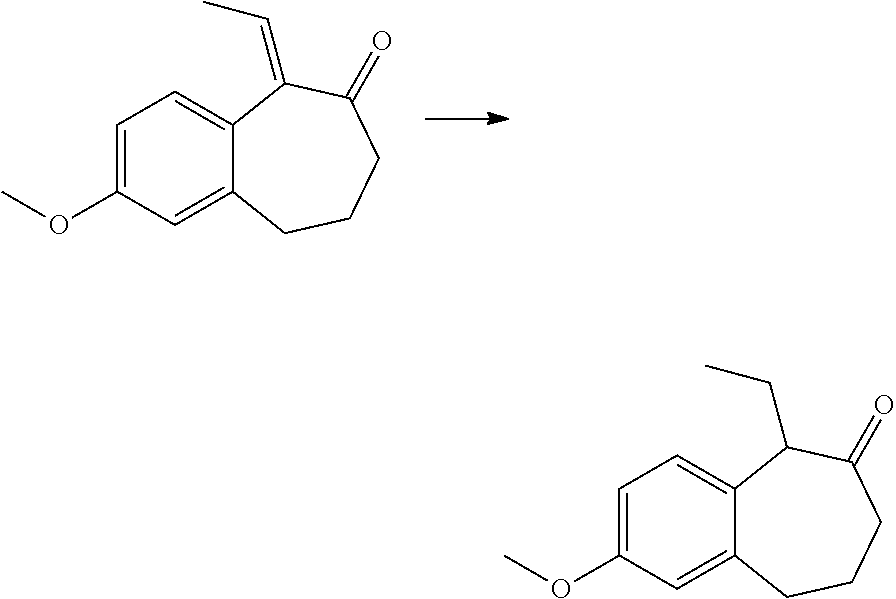
- A solution of 5-eth-(E)-ylidene-2-methoxy-5,7,8,9-tetrahydro-benzocyclohepten-6-one (68, R4=Methyl) (8.50 g, 39.3 mmol) in toluene (100 mL) containing 20% Pd(OH)2 on carbon (0.552 g) was evacuated and placed under hydrogen. The reaction was shaken under about 40 psi of hydrogen for about 1 h, then the catalyst was removed by filtration through Celite®, rinsing with toluene (about 20 mL) and the filtrate concentrated under reduced pressure. The residue was further dried under reduced pressure to yield an oil which solidified over time to yield 5-ethyl-2-methoxy-5,7,8,9-tetrahydro-benzocyclohepten-6-one (69, R4=Methyl) (8.46 g, 99%) as a white solid. LC/MS, method 4, Rt=1.89 min, MS m/z 219 (M+H)+. 1H NMR (400 MHz, DMSO-d6) δ 7.04-6.99 (m, 1H), 6.77-6.72 (m, 2H), 3.85-3.78 (m, 1H), 3.70 (s, 3H), 3.08-2.97 (m, 1H), 2.81-2.71 (m, 1H), 2.71-2.62 (m, 1H), 2.40-2.32 (m, 1H), 2.12-1.94 (m, 2H), 1.72-1.55 (m, 2H), 0.82 (t, J=7.3 Hz, 3H).
-

- To EtOH (150 mL) under nitrogen was added freshly cut sodium (2.21 g, 96.0 mmol) portionwise and the mixture was stirred until the reaction was complete. A solution of 5-ethyl-2-methoxy-5,7,8,9-tetrahydro-benzocyclohepten-6-one (69, R4=Methyl) (14.0 g, 64.1 mmol) in EtOH (150 mL) was added and the mixture was heated to about 60° C. Methyl vinyl ketone (5.82 mL, 70.5 mmol) was added dropwise over about 25 min, and then the reaction was continued for about 2-3 h. The reaction was cooled to rt and concentrated under reduced pressure. The residue was dissolved in EtOAc (200 mL) and washed with saturated aqueous NaCl (2×100 mL), dried over Na2SO4, filtered and concentrated under reduced pressure. The crude product was purified on silica gel (330 g) using a gradient of 10-35% EtOAc in heptane. Product fractions were combined and concentrated to a yellow oil which solidified on standing to yield 11b-ethyl-9-methoxy-1,2,5,6,7,11b-hexahydro-dibenzo[a,c]cyclohepten-3-one (70, R4=Methyl) (12.2 g, 70%) as a yellow solid. LC/MS, method 4, Rt=1.92 min, MS m/z 271 (M+H)+. 1H NMR (400 MHz, DMSO-d6) δ 7.24 (d, J=8.8 Hz, 1H), 6.80 (dd, J=8.7, 2.9 Hz, 1H), 6.71 (d, J=2.9 Hz, 1H), 5.82 (s, 1H), 3.72 (s, 3H), 2.85-2.75 (m, 1H), 2.67-2.51 (m, 2H), 2.45-2.37 (m, 1H), 2.33-2.19 (m, 3H), 2.14-1.93 (m, 2H), 1.87-1.67 (m, 3H), 0.79 (t, J=7.4 Hz, 3H).
-

-
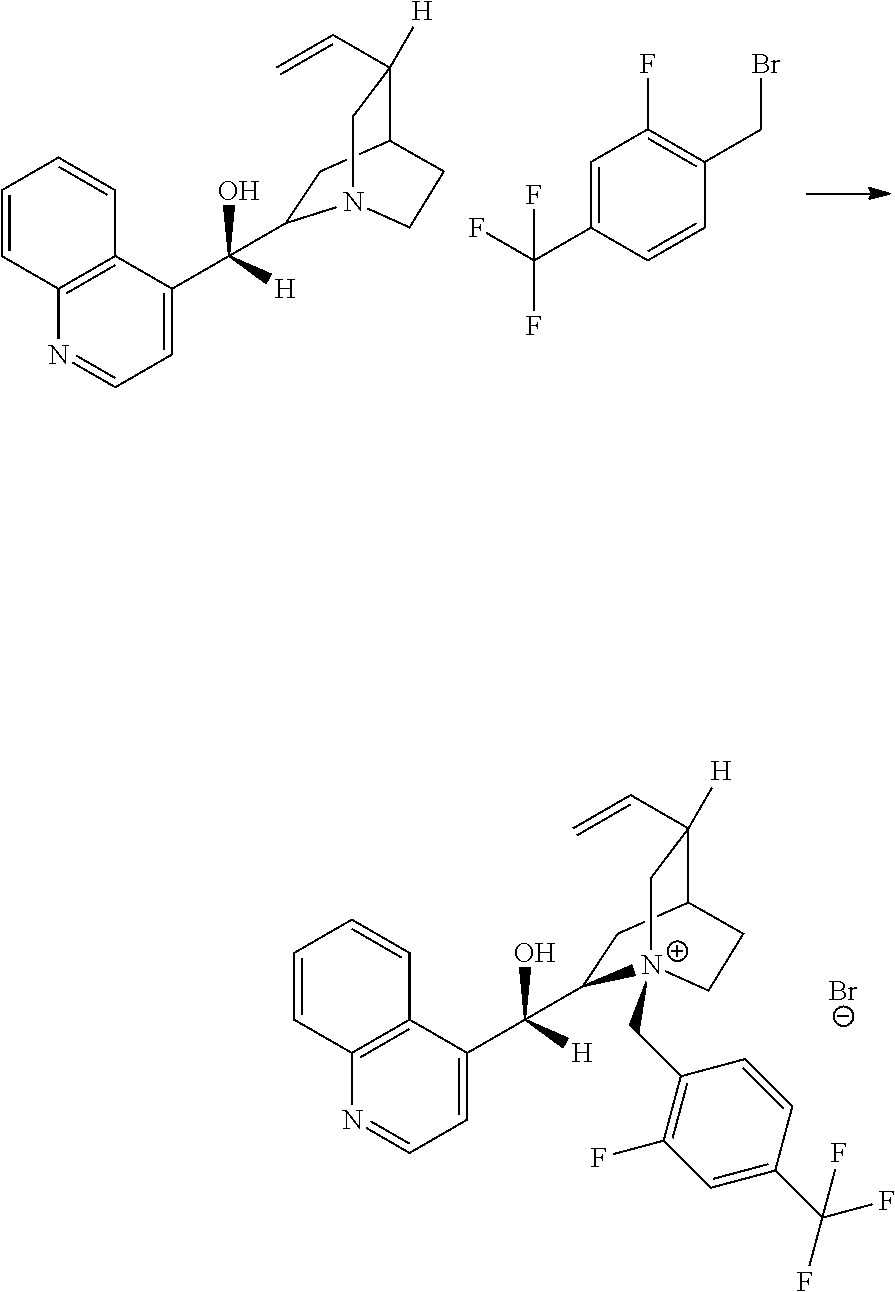
- Step 3a was carried out according to the methods described by Wim Nerinckx and Maurits Vandewalle in Tetrahedron: Asymmetry, Vol. 1, No. 4, pp. 265-276, 1990. Thus, Cinchonine (˜85%, rest dihydrocinchonine) (1.0 g, 3.40 mmol) and 1-(bromomethyl)-2-fluoro-4-(trifluoromethyl)benzene (0.960 g, 3.74 mmol) in toluene (20 mL) was heated to about 110° C. for about 3 h. The mixture was allowed to cool to rt. The solids were collected by filtration then washed with toluene (90 mL). The material was dried under vacuum at about 60° C. to give (1S,4S,8R)-1-(2-fluoro-4-(trifluoromethyl)benzyl)-2-((S)-hydroxy(quinolin-4-yl)methyl)-8-vinyl-1-azoniabicyclo[2.2.2]octane bromide (1.75 g, 93%)
-

- A mixture of toluene (60 mL), KOH (60 wt % in water) (1.713 g, 18.32 mmol) and (1S,4S,8R)-1-(2-fluoro-4-(trifluoromethyl)benzyl)-2-((S)-hydroxy(quinolin-4-yl)methyl)-8-vinyl-1-azoniabicyclo[2.2.2]octane bromide (0.252 g, 0.458 mmol) was stirred at rt for about 16 h. 5-Ethyl-2-methoxy-8,9-dihydro-5H-benzo[7]annulen-6(7H)-one (1 g, 4.58 mmol) was added and stirring continued for about 1 h. The mixture was cooled to about 0° C. then treated with but-3-en-2-one (0.595 g, 8.49 mmol). After about 2 h additional but-3-en-2-one (0.048 g, 0.687 mmol) was added and stirring continued for about 1 h.
- The mixture was treated with EtOAc (20 mL) and 6N HCl (10 mL). The layers were separated then the organic layer was washed with saturated aqueous NaCl (15 mL). The organic layer was dried over MgSO4, filtered and evaporated. The material was purified on silica gel (40 g) using a gradient from 0% to 40% EtOAc in heptane. Pure product fractions were concentrated to yield (S)-5-ethyl-2-methoxy-5-(3-oxobutyl)-8,9-dihydro-5H-benzo[7]annulen-6(7H)-one; compound with (S)-5-ethyl-2-methoxy-5-(3-oxobutyl)-8,9-dihydro-5H-benzo[7]annulen-6(7H)-one (0.770 g, 58.3%). LC/MS, method 3, Rt=2.27 min, MS m/z 289 (M+H)+
-
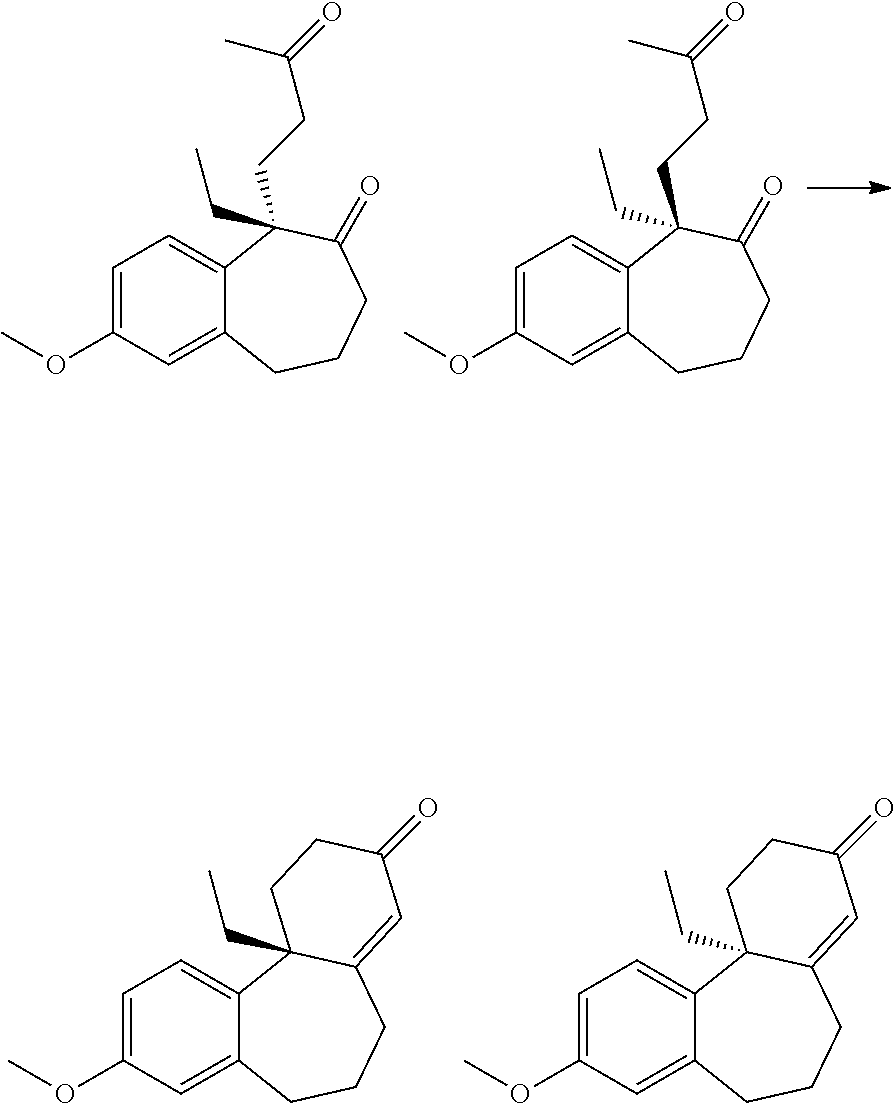
- Sodium (0.092 g, 4.00 mmol) was dissolved in EtOH (7 mL) with heating to about 60° C. The solution was added to (S)-5-ethyl-2-methoxy-5-(3-oxobutyl)-8,9-dihydro-5H-benzo[7]annulen-6(7H)-one; compound with (S)-5-ethyl-2-methoxy-5-(3-oxobutyl)-8,9-dihydro-5H-benzo[7]annulen-6(7H)-one (0.770 g, 2.67 mmol) from Step 2 in EtOH (7 mL) then the mixture was warmed to about 60° C. for about 2 h. The mixture was cooled to rt and concentrated under reduced pressure. The material was partitioned between EtOAc (25 mL) and water (25 ml). 6 N HCl was added to make the aqueous layer acidic (˜pH 3) then the layers were separated. The organic layer was dried over MgSO4, filtered and concentrated under reduced pressure. The residue was purified on silica gel (12 g) using a gradient of 0% to 100% EtOAc in heptane. Fractions containing product were concentrated under reduced pressure to yield (R)-11b-ethyl-9-methoxy-1,2,5,6,7,11b-hexahydro-dibenzo[a,c]cyclohepten-3-one; compound with (S)-11b-ethyl-9-methoxy-1,2,5,6,7,11b-hexahydro-dibenzo[a,c]cyclohepten-3-one (71, R4=Methyl) (0.600 g, 83%). The residue was treated with isopropyl acetate (2.4 g) then the mixture was briefly heated in an oil bath at about 90° C. until the material dissolved. The solution was cooled to about 35° C. then seeded with crystals of (R)-11b-ethyl-9-methoxy-1,2,5,6,7,11b-hexahydro-dibenzo[a,c]cyclohepten-3-one. The mixture was stirred at rt overnight then the mixture was cooled to about 0° C. for about 45 min. The solids were collected by filtration and washed with MeOH (˜0.25 mL). The material was dried under vacuum at about 65° C. to yield (R)-11b-ethyl-9-methoxy-1,2,5,6,7,11b-hexahydro-dibenzo[a,c]cyclohepten-3-one (0.300 g, 41.6%). LC/MS, method 3, Rt=2.39 min, MS m/z 271 (M+H)+. Chiral SFC method D, Rt=4.08 min, 100% by ELSD.
-

- A mixture containing 11b-ethyl-9-methoxy-1,2,5,6,7,11b-hexahydro-dibenzo[a,c]cyclohepten-3-one (70, R4=Methyl) (10.2 g, 37.7 mmol) and DL-methionine (18.3 g, 123 mmol) in methanesulfonic acid (100 mL, 1.54 mol) was mechanically stirred under nitrogen at rt over about 3 days. The reaction was diluted with DCM (700 mL) and poured carefully onto ice water (700 mL). The layers were separated and the aqueous layer was extracted with DCM (500 mL). The combined organic layers were washed with water (2×500 mL), dried over Na2SO4, filtered and concentrated under reduced pressure. The residue was purified on silica gel (220 g) using a gradient of 0-50% EtOAc in DCM. Product fractions were combined and concentrated under reduced pressure to yield 11b-ethyl-9-hydroxy-1,2,5,6,7,11b-hexahydro-dibenzo[a,c]cyclohepten-3-one (71, R4=Methyl) (8.54 g, 88%) as an off-white solid. LC/MS, method 4, Rt=1.32 min, MS m/z 257 (M+H)+. 1H NMR (400 MHz, DMSO-d6) δ 9.19 (s, 1H), 7.11 (d, J=8.6 Hz, 1H), 6.62 (dd, J=8.5, 2.7 Hz, 1H), 6.51 (d, J=2.7 Hz, 1H), 5.81 (s, 1H), 2.79-2.70 (m, 1H), 2.67-2.52 (m, 1H), 2.44-2.35 (m, 2H), 2.33-2.18 (m, 3H), 2.14-2.04 (m, 1H), 2.01-1.90 (m, 1H), 1.86-1.66 (m, 3H), 0.78 (t, J=7.4 Hz, 3H).
-

- To a suspension of 11b-ethyl-9-hydroxy-1,2,5,6,7,11b-hexahydro-dibenzo[a,c]cyclohepten-3-one (71, R4=Methyl) (11.3 g, 43.9 mmol) and 10% Pd on C (1.40 g) in THF (80 mL) was added pyridine (20 mL) and the mixture was hydrogenated at rt under about 40 psi of hydrogen for about 18 h. The catalyst was removed by filtration through Celite®, rinsing with THF (20 mL) and the filtrate was concentrated. The residue was dissolved in DCM (200 mL) and washed with 2 N aqueous HCl (100 mL), dried over Na2SO4, filtered and concentrated under reduced pressure. The residue was re-dissolved in EtOAc (100 mL) and DCM (100 mL), filtered through a short pad of silica gel, and concentrated until product began to precipitate. Product was collected by filtration, rinsed with EtOAc (10 mL) and dried under reduced pressure to yield (4aS,11bR)-11b-ethyl-9-hydroxy-1,2,4,4a,5,6,7,11b-octahydro-dibenzo[a,c]cyclohepten-3-one; compound with (4aR,11bS)-11b-ethyl-9-hydroxy-1,2,4,4a,5,6,7,11b-octahydro-dibenzo[a,c]cyclohepten-3-one (72, R4=Methyl) (6.45 g, 57%) as a white solid. LC/MS, method 4, Rt=1.32 min, MS m/z 257 (M+H)+. 1H NMR (400 MHz, DMSO-d6) δ 9.14 (s, 1H), 7.11-7.05 (m, 1H), 6.60-6.54 (m, 2H), 2.96-2.86 (m, 1H), 2.65-2.54 (m, 2H), 2.47-2.36 (m, 1H), 2.29-2.20 (m, 1H), 2.20-2.05 (m, 4H), 1.89-1.79 (m, 1H), 1.71-1.51 (m, 3H), 1.49-1.31 (m, 2H), 0.61 (t, J=7.4 Hz, 3H).
-

- A solution of (4aS,11bR)-11b-ethyl-9-hydroxy-1,2,4,4a,5,6,7,11b-octahydro-dibenzo[a,c]cyclohepten-3-one; compound with (4aR,11bS)-11b-ethyl-9-hydroxy-1,2,4,4a,5,6,7,11b-octahydro-dibenzo[a,c]cyclohepten-3-one (72, R4=Methyl) (6.45 g, 25.0 mmol) in DCM (100 mL) was treated with N-phenylbis(trifluoromethanesulfonimide) (8.92 g, 25.0 mmol) and DIEA (8.7 mL, 50 mmol) at rt. The reaction was stirred at rt for about 72 h. Silica gel (30 g) was added and solvents were removed under reduced pressure. The residue was loaded on silica gel (220 g) and purified using a gradient of 10-30% EtOAc in heptane. Product fractions were combined and concentrated to yield trifluoro-methanesulfonic acid (7aR,11aS)-11a-ethyl-9-oxo-6,7,7a,8,9,10,11,11a-octahydro-5H-dibenzo[a,c]cyclohepten-3-yl ester; compound with trifluoro-methanesulfonic acid (7aS,11aR)-11a-ethyl-9-oxo-6,7,7a,8,9,10,11,11a-octahydro-5H-dibenzo[a,c]cyclohepten-3-yl ester (73, R4=Methyl) (8.82 g, 90%) as an oil. LC/MS, method 4, Rt=2.53 min, MS m/z 449 (M+OAc)−. 1H NMR (400 MHz, DMSO-d6) δ 7.48 (d, J=8.8 Hz, 1H), 7.29 (d, J=2.9 Hz, 1H), 7.25 (dd, J=8.7, 2.9 Hz, 1H), 3.05-2.95 (m, 1H), 2.91-2.82 (m, 1H), 2.68-2.59 (m, 1H), 2.44-2.24 (m, 2H), 2.24-2.11 (m, 3H), 2.08-1.96 (m, 1H), 1.94-1.86 (m, 1H), 1.78-1.64 (m, 2H), 1.61-1.51 (m, 1H), 1.51-1.37 (m, 2H), 0.59 (t, J=7.4 Hz, 3H).
-

- A solution of trifluoro-methanesulfonic acid (7aR,11aS)-11a-ethyl-9-oxo-6,7,7a,8,9,10,11,11a-octahydro-5H-dibenzo[a,c]cyclohepten-3-yl ester; compound with trifluoro-methanesulfonic acid (7aS,11aR)-11a-ethyl-9-oxo-6,7,7a,8,9,10,11,11a-octahydro-5H-dibenzo[a,c]cyclohepten-3-yl ester (73, R4=Methyl) (6.12 g, 15.7 mmol) in DMF (65 mL) was treated with Xantphos (0.907 g, 1.57 mmol) and Pd2(dba)3 (0.431 g, 0.470 mmol). The mixture was purged with a stream of nitrogen for about 10 min. The reaction was evacuated briefly and then an atmosphere of carbon monoxide was introduced with a balloon. To the mixture was added MeOH (3.8 mL, 94 mmol) and then TEA (4.4 mL, 31 mmol) and the mixture was heated at about 100° C. for about 18 h. The reaction was cooled to rt and concentrated under reduced pressure. The residue was purified on silica gel (220 g) using a gradient of 10 to 40% EtOAc in heptane. Product fractions were combined and concentrated under reduced pressure to yield (7aR,11aS)-11a-ethyl-9-oxo-6,7,7a,8,9,10,11,11a-octahydro-5H-dibenzo[a,c]cycloheptene-3-carboxylic acid methyl ester; compound with (7aS,11aR)-11a-ethyl-9-oxo-6,7,7a,8,9,10,11,11a-octahydro-5H-dibenzo[a,c]cycloheptene-3-carboxylic acid methyl ester (74, R4=Methyl) (3.10 g, 66%) as an oil. LC/MS, method 4, Rt=2.17 min, no parent mass. 1H NMR (400 MHz, DMSO-d6) δ 7.77-7.71 (m, 2H), 7.47 (d, J=8.2 Hz, 1H), 3.81 (s, 3H), 3.09-2.07 (m, 1H), 2.93-2.82 (m, 1H), 2.73-2.63 (m, 1H), 2.46-2.35 (m, 1H), 2.34-2.24 (m, 1H), 2.24-2.11 (m, 3H), 2.07-1.95 (m, 1H), 1.94-1.84 (m, 1H), 1.78-1.62 (m, 2H), 1.63-1.52 (m, 1H), 1.52-1.38 (m, 2H), 0.60 (t, J=7.4 Hz, 3H).
-

- A solution of (7aR,11aS)-11a-ethyl-9-oxo-6,7,7a,8,9,10,11,11a-octahydro-5H-dibenzo[a,c]cycloheptene-3-carboxylic acid methyl ester; compound with (7aS,11aR)-11a-ethyl-9-oxo-6,7,7a,8,9,10,11,11a-octahydro-5H-dibenzo[a,c]cycloheptene-3-carboxylic acid methyl ester (74, R4=Methyl) (3.10 g, 10.3 mmol) in 1,4-dioxane (25.0 mL) and was treated with lithium hydroxide monohydrate (1.30 g, 31.0 mmol) and the reaction was stirred at about 70° C. for about 15 min. The reaction was cooled and concentrated. The residue was dissolved in water (50 mL), washed with Et2O (30 mL), then acidified with 2 N aqueous HCl. The carboxylic acid was extracted with DCM (2×40 mL), dried over Na2SO4, filtered and concentrated under reduced pressure. The residue was dissolved in THF (30.0 mL) and treated with DIEA (1.80 mL, 10.3 mmol) and BTFFH (3.26 g, 10.3 mmol). The mixture was stirred for about 5 min, then 2-methylpyridin-3-amine (1.12 g, 10.3 mmol) was added and the mixture was heated at about 60° C. for about 18 h. The mixture was cooled to rt, then additional DIEA and BTFFH were added (about 0.10 equivalents each). The mixture was re-heated to about 60° C. for about 18 h. The reaction was cooled and concentrated under reduced pressure and the residue was dissolved in DCM (50 mL) and washed with saturated aqueous NaHCO3 (2×50 mL). The organic layer was dried over Na2SO4, filtered and concentrated under reduced pressure. The residue was purified on silica gel (120 g) using a gradient of 0-100% EtOAc in DCM. Product fractions were combined and concentrated under reduced pressure. The residue was triturated with EtOAc (20 mL). The product was collected by filteration and dried under reduced pressure to yield (7aR,11aS)-11a-ethyl-9-oxo-6,7,7a,8,9,10,11,11a-octahydro-5H-dibenzo[a,c]cycloheptene-3-carboxylic acid (2-methyl-pyridin-3-yl)-amide; compound with (7aS,11aR)-11a-ethyl-9-oxo-6,7,7a,8,9,10,11,11a-octahydro-5H-dibenzo[a,c]cycloheptene-3-carboxylic acid (2-methyl-pyridin-3-yl)-amide (75, R4=Methyl) (2.66 g, 68%) as an off-white solid. LC/MS, method 4, Rt=2.17 min, no parent mass. 1H NMR (400 MHz, DMSO-d6) δ 9.98 (s, 1H), 8.30 (dd, J=4.7, 1.5 Hz, 1H), 7.82-7.75 (m, 2H), 7.71 (dd, J=8.0, 1.6 Hz, 1H), 7.47 (d, J=8.2 Hz, 1H), 7.25 (dd, J=8.0, 4.8 Hz, 1H), 3.13-3.00 (m, 1H), 2.95-2.84 (m, 1H), 2.77-2.67 (m, 1H), 2.46-2.38 (m, 4H), 2.36-2.27 (m, 1H), 2.27-2.14 (m, 3H), 2.13-2.00 (m, 1H), 1.95-1.87 (m, 1H), 1.81-1.65 (m, 2H), 1.65-1.40 (m, 3H), 0.64 (t, J=7.4 Hz, 3H).
-

- To sodium hydride (60% dispersion in mineral oil, 0.563 g, 14.1 mmol) under nitrogen was added DMSO (32 mL) and the mixture was heated at about 60° C. for about 60 min. The reaction was cooled to about rt, diluted with THF (32 mL) and the mixture was cooled to about 0° C. Trimethylsulfoxonium iodide (3.10 g, 14.1 mmol) was added then the reaction was stirred for about 10 min. A suspension of (7aR,11aS)-11a-ethyl-9-oxo-6,7,7a,8,9,10,11,11a-octahydro-5H-dibenzo[a,c]cycloheptene-3-carboxylic acid (2-methyl-pyridin-3-yl)-amide; compound with (7aS,11aR)-11a-ethyl-9-oxo-6,7,7a,8,9,10,11,11a-octahydro-5H-dibenzo[a,c]cycloheptene-3-carboxylic acid (2-methyl-pyridin-3-yl)-amide (75, R4=Methyl) (2.65 g, 7.04 mmol) in THF (32 mL) was added while maintaining the reaction temperature below 4° C., and then the reaction was allowed to warm to rt for about 18 h. Solvents were removed under reduced pressure and the residue was diluted with EtOAc (200 mL) and washed with water (2×200 mL). The organic layer was dried over Na2SO4, filtered and concentrated to about 20 mL under reduced pressure. Heptane was added to turbidity (about 10 mL) and the mixture was allowed to stand for about 30 min. The precipitate was collected by filtration, rinsed with 50% EtOAc in heptane (20 mL) and dried under reduced pressure to yield (+/−) Compound 76 (R4=Methyl) (2.29 g, 83%) as an off-white solid. LC/MS, method 2, Rt=2.31 min, MS m/z 391 (M+H)+. 1H NMR (400 MHz, DMSO-d6) δ 9.94 (s, 1H), 8.32 (dd, J=4.7, 1.5 Hz, 1H), 7.82-7.65 (m, 3H), 7.41 (d, J=8.3 Hz, 1H), 7.25 (dd, J=7.9, 4.7 Hz, 1H), 3.08-2.96 (m, 1H), 2.94-2.83 (m, 1H), 2.58-2.49 (m, 3H), 2.42 (s, 3H), 2.30-2.05 (m, 4H), 1.76-1.38 (m, 6H), 1.22-1.12 (m, 1H), 0.83-0.73 (m, 1H), 0.64 (t, J=7.4 Hz, 3H).
-

- A round bottom flask with stirring bar, septum, nitrogen line and thermometer was charged with (+/−) Compound 76 (R4=Methyl) (200 mg, 0.512 mmol), THF (6.4 mL) and copper (I) iodide (9.8 mg, 0.051 mmol). The mixture was cooled to an internal temperature of about 0° C. then ethylmagnesium bromide (3M solution in Et2O, 1.0 mL, 3.0 mmol) was added dropwise maintaining reaction temperature between 0° C. and 5° C. The mixture was stirred for about 1 h at about 0° C., and then the reaction was quenched by addition of saturated aqueous NH4Cl (20 mL) and EtOAc (30 mL). The mixture was stirred at rt for about 1 h, then the organic layer was removed and stirred again with saturated aqueous NH4Cl (20 mL) for about 15 min. The layers were separated and the organic layer was dried over Na2SO4, filtered and concentrated under reduced pressure. The residue was purified on silica gel (12 g) using a gradient of 70-100% EtOAc in heptane. Product fractions were combined and concentrated under reduced pressure to yield (7aR,9R,11aS)-11a-ethyl-9-hydroxy-9-propyl-6,7,7a,8,9,10,11,11a-octahydro-5H-dibenzo[a,c]cycloheptene-3-carboxylic acid (2-methyl-pyridin-3-yl)-amide; compound with (7aS,9R,11aR)-11a-ethyl-9-hydroxy-9-propyl-6,7,7a,8,9,10,11,11a-octahydro-5H-dibenzo[a,c]cycloheptene-3-carboxylic acid (2-methyl-pyridin-3-yl)-amide (77, R4=Methyl, R5=Ethyl) as a solid (185 mg, 86%). LC/MS, method 2, Rt=2.34 min, MS m/z 421 (M+H)+. 1H NMR (400 MHz, DMSO-d6) δ 9.92 (s, 1H), 8.31 (dd, J=4.7, 1.6 Hz, 1H), 7.75-7.67 (m, 3H), 7.35 (d, J=8.4 Hz, 1H), 7.25 (dd, J=7.9, 4.8 Hz, 1H), 3.89 (s, 1H), 3.02-2.93 (m, 1H), 2.90-2.80 (m, 1H), 2.42 (s, 3H), 2.26-2.15 (m, 3H), 2.10-1.99 (m, 1H), 1.73-1.60 m, 2H), 1.54-1.37 (m, 5H), 1.26-1.15 (m, 2H), 1.15-1.04 (m, 4H), 0.75 (t, J=7.1 Hz, 3H), 0.60 (t, J=7.4 Hz, 3H).
- Chiral separation of (77, R4=Methyl, R5=Ethyl)
- Purification Method: (SFC) Isocratic, 27% co-solvent B (80 mL/min, 100 bar system pressure, 25° C.). Co-solvent B was 1:1 HPLC grade MeOH:isopropanol. Solvent A was SFC grade CO2. The column used for the chromatography was a 30×250 mm RegisPack from Regis Technologies (5 μm particles). The first peak eluted was (7aR,9S,11aS)-11a-ethyl-9-hydroxy-9-propyl-6,7,7a,8,9,10,11,11a-octahydro-5H-dibenzo[a,c]cycloheptene-3-carboxylic acid (2-methyl-pyridin-3-yl)-amide (Example 44) and the second was (7aS,9R,11aR)-11a-ethyl-9-hydroxy-9-propyl-6,7,7a,8,9,10,11,11a-octahydro-5H-dibenzo[a,c]cycloheptene-3-carboxylic acid (2-methyl-pyridin-3-yl)-amide (Example 45). NMR and LCMS data for single isomers was essentially identical to the racemic mixture.
- Additional examples, prepared in a manner similar to the preparation of Examples #44 and #45, are listed in Table 1.
-
TABLE 1 Chiral method/ Grignard LC/MS LC/MS RT/ Order of Ex.# Epoxide Rgt. Product structure method MH+ elution 46 Compound Methylmagnesium- Compound 77 2 2.18 min 2/First 76 (R4 = bromide (7aR,9S,11aS) (R4 = 407 Methyl) Methyl) (R5 = Methyl) 47 Compound Methylmagnesium- Compound 77 2 2.18 min 2/ 76 (R4 = bromide (7aS,9R,11aR) (R4 = 407 Second Methyl) Methyl) (R5 = Methyl) 48 Compound Isopropylmagnesium- Compound 77 2 2.51 min 3/First 76 (R4 = bromide (7aR,9R,11aS) 435 Methyl) (R4 = Methyl) (R5 = Isopropyl) 49 Compound Isopropylmagnesium- Compound 77 2 2.51 min 3/ 76 (R4 = bromide (7aS,9S,11aR) (R4 = 435 Second Methyl) Methyl) (R5 = Isopropyl) 50 Compound Cyclopropyl Compound 77 2 2.36 min 4/First 76 (R4 = magnesium- (7aR,9R,11aS) 433 Methyl) bromide (R4 = Methyl) (R5 = Cyclopropyl) 51 Compound Cyclopropyl Compound 77 2 2.36 min 4/ 76 (R4 = magnesium- (7aS,9S,11aR) (R4 = 433 Second Methyl) bromide Methyl) (R5 = Cyclopropyl) 52 Compound Ethylmagnesium Compound 77 2 2.24 min NA 76 (R4 = bromide (7aR,9S,11aS): 475 Trifluoromethyl) compound with (7aS,9R,11aR) (R4 = Trifluoromethyl) (R5 = ethyl) 53 Compound Isopropylmagnesium- Compound 152 2 2.26 min. NA 151 (R6 = 2- bromide (7aS,9S,11aR); 437 Methylpyridin- compound with 3-yl, R8 = (7aR,9R,11aS) (R5 = H, R9 = H) Isopropyl, R6 = 2-Methylpyridin- 3-yl, R8 = H, R9 = H) 54 Compound Cyclopropyl Compound 152 2 2.12 min. NA 151 (R6 = 2- magnesium- (7aS,9S,11aR); 435 Methylpyridin- bromide compound with 3-yl, R8 = (7aR,9R,11aS) (R5 = H, R9 = H) Cyclopropyl, R6 = 2- Methylpyridin-3- yl, R8 = H, R9 = H) 55 Compound Isopropylmagnesium- Compound 152 2 2.23 min. 9/ 151 (R6 = 2- bromide (7aS,9S,11aR) (R5 = 437 Second Methylpyridin- Isopropyl, R6 = 3-yl, R8 = 2-Methylpyridin- H, R9 = H) 3-yl, R8 = H, R9 = H) 56 Compound Isopropylmagnesium- Compound 152 2 2.23 min. 9/First 151 (R6 = 2- bromide (7aR,9R,11aS) (R5 = 437 Methylpyridin- Isopropyl, R6 = 3-yl, R8 = 2-Methylpyridin- H, R9 = H) 3-yl, R8 = H, R9 = H) 57 Compound Cyclopropyl Compound 152 2 2.11 min. 11/ 151 (R6 = 2- magnesium- (7aS,9S,11aR) (R5 = 434 Second Methylpyridin- bromide Cyclopropyl, R6 = 3-yl, R8 = 2- H, R9 = H) Methylpyridin-3- yl, R8 = H, R9 = H) 58 Compound Cyclopropyl Compound 152 2 2.11 min. 11/First 151 (R6 = 2- magnesium- (7aR,9R,11aS) (R5 = 434 Methylpyridin- bromide Cyclopropyl, R6 = 3-yl, R8 = 2- H, R9 = H) Methylpyridin-3- yl, R8 = H, R9 = H) 58A Compound Ethylmagnesium- Compound 77 2 2.24 min 14/First 76 (R4 = bromide (7aR,9S,11aS): 475 Trifluoromethyl) (R4 = Trifluoromethyl) (R5 = ethyl) 58B Compound Ethylmagnesium- Compound 77 2 2.24 min 14/ 76 (R4 = bromide (7aS,9R,11aR) 475 Second Trifluoromethyl) (R4 = Trifluoromethyl) (R5 = ethyl) -

- A solution of (+/−) Compound 76 (R4=Methyl) (150 mg, 0.384 mmol) in EtOH (3 mL) was treated with sodium borohydride (35 mg, 0.92 mmol) and the reaction was stirred at rt for about 18 h. The reaction was quenched with acetic acid (0.50 mL) and concentrated under reduced pressure. The residue was distributed between EtOAc (15 mL) and saturated aqueous NaHCO3 (10 mL). The organic layer was dried over Na2SO4, filtered and concentrated under reduced pressure. The residue was purified on silica gel (4 g) using EtOAc as eluant. Product fractions were combined and concentrated under reduced pressure to yield (7aR,9S,11aS)-11a-ethyl-9-hydroxy-9-methyl-6,7,7a,8,9,10,11,11a-octahydro-5H-dibenzo[a,c]cycloheptene-3-carboxylic acid (2-methyl-pyridin-3-yl)-amide; compound with (7aS,9R,11aR)-11a-ethyl-9-hydroxy-9-methyl-6,7,7a,8,9,10,11,11a-octahydro-5H-dibenzo[a,c]cycloheptene-3-carboxylic acid (2-methyl-pyridin-3-yl)-amide (77, R4=Methyl, R5=H) (145 mg, 96%) as a solid. LC/MS, method 2, Rt=2.06 min, MS m/z 393 (M+H)+. 1H NMR (400 MHz, DMSO-d6) δ 9.92 (s, 1H), 8.31 (dd, J=4.8, 1.6 Hz, 1H), 7.75-7.66 (m, 3H), 7.35 (d, J=8.4 Hz, 1H), 7.25 (dd, J=7.9, 4.8 Hz, 1H), 4.06 (s, 1H), 3.03-2.92 (m, 1H), 2.92-2.81 (m, 1H), 2.42 (s, 3H), 2.34-2.15 (m, 3H), 2.10-1.99 (m, 1H), 1.75-1.60 (m, 2H), 1.56-1.37 (m, 5H), 1.15-1.06 (m, 2H), 0.94 (s, 3H), 0.60 (t, J=7.4 Hz, 3H).
- Chiral purification Method 2 was used to separate enantiomers. The first peak eluted was (7aR,9S,11aS)-11a-ethyl-9-hydroxy-9-methyl-6,7,7a,8,9,10,11,11a-octahydro-5H-dibenzo[a,c]cycloheptene-3-carboxylic acid (2-methyl-pyridin-3-yl)-amide (Example 59); and the second was (7aS,9R,11aR)-11a-ethyl-9-hydroxy-9-methyl-6,7,7a,8,9,10,11,11a-octahydro-5H-dibenzo[a,c]cycloheptene-3-carboxylic acid (2-methyl-pyridin-3-yl)-amide (Example 60). NMR and LC/MS data for single isomers was essentially identical to the racemic mixture.
-


-

- To sodium hydride (60% dispersion in mineral oil, 0.50 g, 12.6 mmol) under nitrogen was added DMSO (39 mL) and the mixture was heated at about 60° C. for about 60 min. The reaction was cooled to rt, diluted with THF (39 mL) and the mixture was cooled to about 0° C. Trimethylsulfoxonium iodide (2.78 g, 12.6 mmol) was added then the reaction was stirred for about 10 min. A solution of trifluoro-methanesulfonic acid (7aR,11aS)-11a-ethyl-9-oxo-6,7,7a,8,9,10,11,11a-octahydro-5H-dibenzo[a,c]cyclohepten-3-yl ester; compound with trifluoro-methanesulfonic acid (7aS,11aR)-11a-ethyl-9-oxo-6,7,7a,8,9,10,11,11a-octahydro-5H-dibenzo[a,c]cyclohepten-3-yl ester (73, R4=Methyl) (3.29 g, 8.43 mmol) in THF (39 mL) was added maintaining reaction temperature below 4° C. and then the reaction was allowed to warm to rt. Stirring was continued for about 3 h at rt and then the reaction was quenched by addition of saturated aqueous NH4Cl (100 mL). The product was extracted with EtOAc (100 mL) and the organic layer was washed with saturated aqueous NaCl (100 mL), dried over Na2SO4, filtered and concentrated under reduced pressure. The crude product was purified on silica gel (80 g) using a gradient of 10-30% EtOAc in heptane. Product fractions were combined and concentrated under reduced pressure to yield (+/−) Compound 78 (R4=Methyl) (1.65 g, 48%) as a white solid. LC/MS, method 4, Rt=2.09 min, MS m/z 403 (M−H)−. 1H NMR (400 MHz, DMSO-d6) δ 7.44-7.38 (m, 1H), 7.27-7.21 (m, 2H), 3.00-2.90 (m, 1H), 2.89-2.81 (m, 1H), 2.55-2.49 (m, 2H), 2.47-2.41 (m, 1H), 2.27-2.00 (m, 4H), 1.74-1.31 (m, 6H), 1.15 (d, J=14.2 Hz, 1H), 0.77 (d, J=13.1 Hz, 1H), 0.59 (t, J=7.4 Hz, 3H).
-

- A round bottom flask with stir bar, septum, nitrogen line and thermometer was charged with (+/−) Compound 78 (R4=Methyl) (970 mg, 2.40 mmol), THF (50 mL) and copper(I)iodide (45.7 mg, 0.240 mmol). The mixture was cooled to an internal temperature of about 0° C. then ethylmagnesium bromide (3.0 M solution in Et2O, 1.20 mL, 3.60 mmol) was added dropwise maintaining reaction temperature between 0° C. and 5° C. The reaction was stirred for about 30 min, then quenched by addition of saturated aqueous NH4Cl (20 mL). The volatiles were substantially removed under reduced pressure. EtOAc (30 mL) was added and the mixture was stirred at rt for about 30 min. The layers were separated and the aqueous layer was extracted again with EtOAc (30 mL). The combined organic layers were washed with saturated aqueous NH4Cl (20 mL), dried over Na2SO4, filtered and concentrated under reduced pressure. The residue was purified on silica gel (25 g) using a gradient of 10 to 30% EtOAc in heptane. Product fractions were combined and concentrated under reduced pressure. The residue was further dried under vacuum to yield trifluoro-methanesulfonic acid (7aR,9S,11aS)-11a-ethyl-9-hydroxy-9-propyl-6,7,7a,8,9,10,11,11a-octahydro-5H-dibenzo[a,c]cyclohepten-3-yl ester; compound with trifluoro-methanesulfonic acid (7aS,9R,11aR)-11a-ethyl-9-hydroxy-9-propyl-6,7,7a,8,9,10,11,11a-octahydro-5H-dibenzo[a,c]cyclohepten-3-yl ester (79, R4=Methyl, R5=Ethyl) (768 mg, 74%) as an oil. LC/MS, method 4, Rt=2.87 min, MS m/z 493 (M+OAc)−. 1H NMR (400 MHz, DMSO-d6) δ 7.37-7.32 (m, 1H), 7.22-7.17 (m, 2H), 3.90 (s, 1H), 2.96-2.86 (m, 1H), 2.86-2.76 (m, 1H), 2.32-2.11 (m, 3H), 2.05-1.94 (m, 1H), 1.71-1.59 (m, 2H), 1.53-1.31 (m, 5H), 1.26-0.96 (m, 6H), 0.75 (t, J=7.1 Hz, 3H), 0.56 (t, J=7.4 Hz, 3H).
-

- A solution of trifluoro-methanesulfonic acid (7aR,9S,11aS)-11a-ethyl-9-hydroxy-9-propyl-6,7,7a,8,9,10,11,11a-octahydro-5H-dibenzo[a,c]cyclohepten-3-yl ester; compound with trifluoro-methanesulfonic acid (7aS,9R,11aR)-11a-ethyl-9-hydroxy-9-propyl-6,7,7a,8,9,10,11,11a-octahydro-5H-dibenzo[a,c]cyclohepten-3-yl ester (79, R4=Methyl, R5=Ethyl) (3.00 g, 6.90 mmol) in DMF (28 mL) was treated with Xantphos (0.399 g, 0.690 mmol) and Pd2(dba)3 (0.190 g, 0.207 mmol) and the mixture was purged with a stream of nitrogen for about 30 min. The reaction was evacuated briefly and then an atmosphere of carbon monoxide was introduced with a balloon. To the mixture was added MeOH (1.7 mL, 41 mmol) and then TEA (1.9 mL, 14 mmol) and the mixture was heated at about 100° C. for about 18 h. The reaction was cooled to rt and concentrated under reduced pressure. The residue was purified on silica gel (80 g) using a gradient of 10 to 30% EtOAc in heptane. Product fractions were combined and concentrated under reduced pressure to yield (7aR,9S,11aS)-11a-ethyl-9-hydroxy-9-propyl-6,7,7a,8,9,10,11,11a-octahydro-5H-dibenzo[a,c]cycloheptene-3-carboxylic acid methyl ester; compound with (7aS,9R,11aR)-11a-ethyl-9-hydroxy-9-propyl-6,7,7a,8,9,10,11,11a-octahydro-5H-dibenzo[a,c]cycloheptene-3-carboxylic acid methyl ester (80, R4=Methyl, R5=Ethyl) (1.26 g, 53%) as a colorless glass. LC/MS, method 4, Rt=2.87 min, MS m/z 345 (M+H)+. 1H NMR (400 MHz, DMSO-d6) δ 7.71-7.64 (m, 2H), 7.34 (d, J=8.4 Hz, 1H), 3.88 (s, 1H), 3.80 (s, 3H), 2.98-2.88 (m, 1H), 2.87-2.78 (m, 1H), 2.33-2.13 (m, 3H), 2.03-1.98 (m, 1H), 1.70-1.59 (m, 2H), 1.53-1.34 (m, 5H), 1.20-0.94 (m, 6H), 0.74 (t, J=7.1 Hz, 3H), 0.57 (t, J=7.4 Hz, 3H).
-

- A solution of (7aR,9S,11aS)-11a-ethyl-9-hydroxy-9-propyl-6,7,7a,8,9,10,11,11a-octahydro-5H-dibenzo[a,c]cycloheptene-3-carboxylic acid methyl ester; compound with (7aS,9R,11aR)-11a-ethyl-9-hydroxy-9-propyl-6,7,7a,8,9,10,11,11a-octahydro-5H-dibenzo[a,c]cycloheptene-3-carboxylic acid methyl ester (80, R4=Methyl, R5=Ethyl) (790 mg, 2.29 mmol) and potassium iodide (0.024 g, 0.46 mmol) in MeCN (30 mL) was heated at about 50° C. and 2-methyl-prop-2-yl-hydroperoxide (5.0 M solution in nonane, 1.7 mL, 8.7 mmol) was added dropwise over a period of about 6 min. The mixture was stirred for about 18 h at about 50° C. The reaction was cooled to rt, diluted EtOAc (30 mL) then washed with 5% aqueous sodium bisulfite solution (30 mL) and with water (30 mL). The organic layer was dried over Na2SO4, filtered and concentrated under reduced pressure. The residue was purified on silica gel (40 g) using a gradient of 10-50% EtOAc in heptane. Product fractions were combined and concentrated under reduced pressure to yield (7aS,9R,11aR)-11a-ethyl-9-hydroxy-5-oxo-9-propyl-6,7,7a,8,9,10,11,11a-octahydro-5H-dibenzo[a,c]cycloheptene-3-carboxylic acid methyl ester; compound with (7aR,9S,11aS)-11a-ethyl-9-hydroxy-5-oxo-9-propyl-6,7,7a,8,9,10,11,11a-octahydro-5H-dibenzo[a,c]cycloheptene-3-carboxylic acid methyl ester (81, R4=Methyl, R5=Ethyl), (134 mg, 16%) as a colorless oil. LC/MS, method 4, Rt=2.87 min, MS m/z 345 (M+H)+. The crude product was taken to the next step without further purification.
-

- A solution of (7aS,9R,11aR)-11a-ethyl-9-hydroxy-5-oxo-9-propyl-6,7,7a,8,9,10,11,11a-octahydro-5H-dibenzo[a,c]cycloheptene-3-carboxylic acid methyl ester; compound with (7aR,9S,11aS)-11a-ethyl-9-hydroxy-5-oxo-9-propyl-6,7,7a,8,9,10,11,11a-octahydro-5H-dibenzo[a,c]cycloheptene-3-carboxylic acid methyl ester (81, R4=Methyl, R5=Ethyl) (132 mg, 0.368 mmol) in EtOH (4.0 mL) was stirred at rt and sodium borohydride (28 mg, 0.74 mmol) was added. The reaction was stirred for about 2 h then quenched by careful addition of saturated aqueous NH4Cl (10 mL) and extracted with EtOAc (2×20 mL). The combined organic extracts were washed with saturated aqueous NaHCO3 (10 mL), dried over Na2SO4, filtered and concentrated under reduced pressure. The residue was purified on silica gel (4 g) using a gradient of 10 to 50% EtOAc in heptane to yield (7aS,9R,11aR)-11a-ethyl-5,9-dihydroxy-9-propyl-6,7,7a,8,9,10,11,11a-octahydro-5H-dibenzo[a,c]cycloheptene-3-carboxylic acid methyl ester; compound with (7aR,9S,11aS)-11a-ethyl-5,9-dihydroxy-9-propyl-6,7,7a,8,9,10,11,11a-octahydro-5H-dibenzo[a,c]cycloheptene-3-carboxylic acid methyl ester (82, R4=Methyl, R5=Ethyl) as a major isomer (104 mg, 78%) and a minor isomer (16 mg, 12%). Major isomer: LC/MS, method 4, Rt=1.50 min, MS m/z 325 (M−H2O—OH)+. 1H NMR (400 MHz, DMSO-d6) δ 7.77 (d, J=2.0 Hz, 1H), 7.74 (dd, J=8.2, 2.0 Hz, 1H), 7.37 (d, J=8.4 Hz, 1H), 5.16 (d, J=3.3 Hz, 1H), 4.78-4.73 (m, 1H), 3.86 (s, 1H), 3.81 (s, 3H), 2.66-2.55 (m, 1H), 2.46-2.35 (m, 1H), 2.28-2.16 (m, 2H), 1.84-1.48 (m, 4H), 1.47-1.37 (m, 1H), 1.37-0.93 (m, 8H), 0.72 (t, J=7.1 Hz, 3H), 0.56 (t, J=7.4 Hz, 3H). Minor isomer: LC/MS, method 4, Rt=1.45 min, MS m/z 325 (M−H2O—OH)+.
-

- A solution of (7aS,9R,11aR)-11a-ethyl-5,9-dihydroxy-9-propyl-6,7,7a,8,9,10,11,11a-octahydro-5H-dibenzo[a,c]cycloheptene-3-carboxylic acid methyl ester; compound with (7aR,9S,11aS)-11a-ethyl-5,9-dihydroxy-9-propyl-6,7,7a,8,9,10,11,11a-octahydro-5H-dibenzo[a,c]cycloheptene-3-carboxylic acid methyl ester (82, R4=Methyl, R5=Ethyl) (116 mg, 0.322 mmol) was dissolved in THF (3 mL), 2-methylpyridin-3-amine (38.3 mg, 0.354 mmol) was added and the mixture was cooled to about 0° C. with stirring. LiHMDS (1 M solution in THF, 1.3 mL, 1.3 mmol) was added dropwise and the reaction was stirred for about 30 min. Saturated aqueous NH4Cl (10 mL) was added and the volatiles were removed under reduced pressure. The mixture was extracted with EtOAc (2×10 mL). The combined organics were washed with saturated aqueous NaHCO3 (10 mL), dried over Na2SO4, filtered and concentrated under reduced pressure. The residue was purified on silica gel (4 g) using EtOAc as eluant. Product fractions were combined and concentrated to yield (7aS,9R,11aR)-11a-ethyl-5,9-dihydroxy-9-propyl-6,7,7a,8,9,10,11,11a-octahydro-5H-dibenzo[a,c]cycloheptene-3-carboxylic acid (2-methyl-pyridin-3-yl)-amide; compound with (7aR,9S,11aS)-11a-ethyl-5,9-dihydroxy-9-propyl-6,7,7a,8,9,10,11,11a-octahydro-5H-dibenzo[a,c]cycloheptene-3-carboxylic acid (2-methyl-pyridin-3-yl)-amide (83, R4=Methyl, R5=Ethyl, R6=2-Methyl-3-pyridyl) (72 mg, 51%) as a glass. LC/MS, method 4, Rt=1.09 min, MS m/z 437 (M+H)+. The mixture of isomers was taken to the next step without further purification.
-

- A solution of (7aS,9R,11aR)-11a-ethyl-5,9-dihydroxy-9-propyl-6,7,7a,8,9,10,11,11a-octahydro-5H-dibenzo[a,c]cycloheptene-3-carboxylic acid (2-methyl-pyridin-3-yl)-amide; compound with (7aR,9S,11aS)-11a-ethyl-5,9-dihydroxy-9-propyl-6,7,7a,8,9,10,11,11a-octahydro-5H-dibenzo[a,c]cycloheptene-3-carboxylic acid (2-methyl-pyridin-3-yl)-amide (83, R4=Methyl, R5=Ethyl, R6=2-Methyl-3-pyridyl) (70 mg, 0.16 mmol) in DCM (6 mL) was treated with Dess-Martin periodinane (70 mg, 0.16 mmol) at rt for about 1 h. The reaction was washed with saturated aqueous NaHCO3 (2×10 mL), dried over Na2SO4, filtered and concentrated under reduced pressure. The residue was purified on silica gel (4 g) using a gradient of 90 to 100% EtOAc in heptane. The product fraction was concentrated under reduced pressure then precipitated from Et2O to yield (7aS,9R,11aR)-11a-ethyl-9-hydroxy-5-oxo-9-propyl-6,7,7a,8,9,10,11,11a-octahydro-5H-dibenzo[a,c]cycloheptene-3-carboxylic acid (2-methyl-pyridin-3-yl)-amide; compound with (7aR,9S,11aS)-11a-ethyl-9-hydroxy-5-oxo-9-propyl-6,7,7a,8,9,10,11,11a-octahydro-5H-dibenzo[a,c]cycloheptene-3-carboxylic acid (2-methyl-pyridin-3-yl)-amide (84, R4=Methyl, R5=Ethyl, R6=2-Methyl-3-pyridyl) (54 mg, 78%) as an off-white solid. LC/MS, method 4, Rt=1.19 min, MS m/z 435 (M+H)+. 1H NMR (400 MHz, DMSO-d6) δ 10.12 (s, 1H), 8.32 (dd, J=4.7, 1.6 Hz, 1H), 8.00 (dd, J=8.3, 2.2 Hz, 1H), 7.86 (d, J=2.2 Hz, 1H), 7.70 (dd, J=8.0, 1.5 Hz, 1H), 7.54 (d, J=8.5 Hz, 1H), 7.26 (dd, J=8.0, 4.7 Hz, 1H), 4.04 (s, 1H), 2.90-2.79 (m, 1H), 2.59-2.51 (m, 1H), 2.46-2.39 (m, 4H), 2.32-2.17 (m, 2H), 1.77-1.67 (m, 1H), 1.63-1.39 (m, 5H), 1.34-1.13 (m, 6H), 0.78 (t, J=6.9 Hz, 3H), 0.55 (t, J=7.4 Hz, 3H).
- Chiral Separation of (84, R4=Methyl, R5=Ethyl, R6=2-Methyl-3-pyridyl)
- Purification Method: (SFC) Isocratic, 27% co-solvent B (80 mL/min, 100 bar system pressure, 25° C.). Co-solvent B was 1:1 HPLC grade MeOH:isopropanol. Solvent A was SFC grade CO2. The column used for the chromatography was a 30×250 mm RegisPack from Regis Technologies (5 μm particles). The first peak eluted was (7aS,9R,11aR)-11a-ethyl-9-hydroxy-5-oxo-9-propyl-6,7,7a,8,9,10,11,11a-octahydro-5H-dibenzo[a,c]cycloheptene-3-carboxylic acid (2-methyl-pyridin-3-yl)-amide (84, R4=Methyl, R5=Ethyl, R6=2-Methyl-3-pyridyl) (Example 61) and the second was (7aR,9S,11aS)-11a-ethyl-9-hydroxy-5-oxo-9-propyl-6,7,7a,8,9,10,11,11a-octahydro-5H-dibenzo[a,c]cycloheptene-3-carboxylic acid (2-methyl-pyridin-3-yl)-amide (84, R4=Methyl, R5=Ethyl, R6=2-Methyl-3-pyridyl) (Example 62) NMR and LC/MS data for single isomers was essentially identical to the racemic mixture.
-
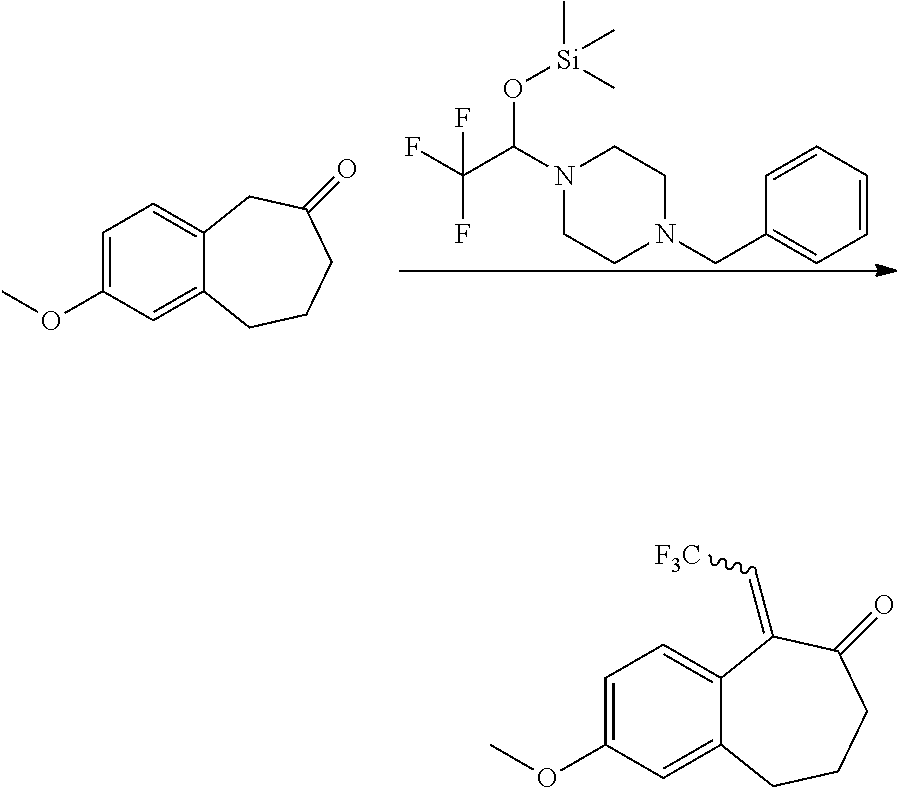
- To a solution of 2-methoxy-8,9-dihydro-5H-benzo[7]annulen-6(7H)-one (3) (10.4 g, 54.7 mmol) and 1-benzyl-4-(2,2,2-trifluoro-1-(trimethylsilyloxy)ethyl)piperazine (prepared as described by T. Billaed, B. R. Langlois, and G. Blond, Tetrhedron Letters, 41, (2000) pp. 8777-8780) (19.4 g, 55.8 mmol) in DCE (100 mL) was added boron trifluoride diethyl etherate (9.0 mL, 71 mmol) and the mixture was heated to about 50° C. for about 5 h. The mixture was then cooled to about 0° C. Tfa (33.1 mL, 430 mmol) was added and the mixture was heated to about 60° C. for about 3 h. The mixture was cooled to rt and stirred for about 18 h. The reaction mixture was concentrated under reduced pressure and the residue was purified on silica gel (120 g) eluting with a gradient of 0-50% EtOAc in heptane. Fractions containing product were combined and concentrated under reduced pressure to yield 2-methoxy-5-(2,2,2-trifluoroethylidene)-8,9-dihydro-5H-benzo[7]annulen-6(7H)-one (68, R4=Trifluoromethyl) (5.91 g, 41%). LC/MS, method 3, Rt=2.73 min, no parent ion. Major isomer: 1H NMR (600 MHz, DMSO-d6) δ 7.23-7.18 (m, 1H), 6.95-6.83 (m, 2H), 6.73-6.67 (m, 1H), 3.81 (s, 3H), 2.74-2.69 (m, 2H), 2.44-2.39 (m, 2H), 1.99-1.90 (m, 2H). Minor isomer: 1H NMR (600 MHz, DMSO-d6) δ 7.32-7.28 (m, 1H), 6.95-6.83 (m, 2H), 6.17-6.10 (m, 1H), 3.77 (s, 3H), 2.93-2.89 (m, 2H), 2.76-2.71 (m, 2H), 2.02-1.97 (m, 2H).
-

- A flask containing 2-methoxy-5-(2,2,2-trifluoroethylidene)-8,9-dihydro-5H-benzo[7]annulen-6(7H)-one (68, R4=Trifluoromethyl) (3.34 g, 12.34 mmol) in toluene (25 mL) was evacuated and flushed with N2. 20% Pd(OH)2 on carbon (0.607 g) was added. The mixture was evacuated, purged with H2 and stirred at rt for about 24 h under an atmosphere of H2. The mixture was flushed with N2 and the catalyst was removed by filtration through Celite®, rinsing with EtOAc. The filtrate was concentrated under reduced pressure and the residue was purified on silica gel (80 g), eluting with a gradient of 0-60% EtOAc in heptane to yield 2-methoxy-5-(2,2,2-trifluoroethyl)-8,9-dihydro-5H-benzo[7]annulen-6(7H)-one (69, R4=Trifluoromethyl) (3.00 g, 89%) as pale yellow crystals. LC/MS, Method 3, Rt=2.56 min, MS m/z 271 (M+H)+. 1H NMR (400 MHz, DMSO-d6) δ 7.06 (d, J=8.4 Hz, 1H), 6.83-6.74 (m, 2H), 4.37 (dd, J=8.9, 4.2 Hz, 1H), 3.73 (s, 3H), 3.28-3.12 (m, 2H), 2.83-2.65 (m, 3H), 2.46-2.39 (m, 1H), 2.17-2.06 (m, 1H), 1.68-1.61 (m, 1H).
-

- To EtOH (20 mL) was added sodium metal (0.379 g, 16.5 mmol) and the mixture was stirred for about 20 min. A solution of 2-methoxy-5-(2,2,2-trifluoroethyl)-8,9-dihydro-5H-benzo[7]annulen-6(7H)-one (69, R4=Trifluoromethyl) (2.99 g, 11.0 mmol) in EtOH (20 mL) was then added and the mixture was heated to about 60° C. Methyl vinyl ketone (1.0 mL, 12 mmol) was then added dropwise, and mixture was heated at about 60° C. for about 2 h, and then stirred at rt for about 18 h. The resulting solids were collected by filtration (crop 1). The filtrate was concentrated under reduced pressure and purified on silica gel (25 g), eluting with a gradient of 5-50% EtOAc in heptane to provide additional product (crop 2). Crops 1 and 2 were combined to yield 9-methoxy-11b-trifluoromethyl-1,2,5,6,7,11b-hexahydro-dibenzo[a,c]cyclohepten-3-one (70, R4=Trifluoromethyl) (1.95 g, 55%). LC/MS, method 2, Rt=2.50 min, MS m/z 325 (M+H)+. 1H NMR (400 MHz, DMSO-d6) δ 7.46 (d, J=8.8 Hz, 1H), 6.80 (dd, J=8.7, 2.9 Hz, 1H), 6.72 (d, J=2.9 Hz, 1H), 5.92 (s, 1H), 3.74 (s, 3H), 3.57-3.37 (m, 1H), 3.11-2.96 (m, 1H), 2.89-2.77 (m, 1H), 2.78-2.64 (m, 1H), 2.58-2.42 (m, 2H), 2.39-2.18 (m, 3H), 1.94-1.75 (m, 3H).
-

- To 9-methoxy-11b-trifluoromethyl-1,2,5,6,7,11b-hexahydro-dibenzo[a,c]cyclohepten-3-one (70, R4=Trifluoromethyl) (2.91 g, 8.98 mmol) and DL-methionine (4.35 g, 29.2 mmol) [Alfa Aesar] was added methanesulfonic acid (17.7 mL, 273 mmol) and the mixture was stirred at rt for about 18 h. The mixture was poured slowly into ice water (200 mL) and then DCM (20 mL) was added. The resulting solids were collected by filtration and dried under vacuum (crop 1). The remaining material was extracted with DCM (100 mL), dried over MgSO4 and concentrated under reduced pressure. The residue was taken into DCM (20 mL) and the solids that formed were collected by filtration and dried under reduced pressure (crop 2). Crops 1 and 2 were combined to yield 9-hydroxy-11b-(2,2,2-trifluoro-ethyl)-1,2,5,6,7,11b-hexahydro-dibenzo[a,c]cyclohepten-3-one (71, R4=Trifluoromethyl) (1.78 g, 64%) as an off-white solid. LC/MS, method 3, Rt=2.07 min, MS m/z 311 (M+H)+
-

- To 9-hydroxy-11b-(2,2,2-trifluoro-ethyl)-1,2,5,6,7,11b-hexahydro-dibenzo[a,c]cyclohepten-3-one (71, R4=Trifluoromethyl) (1.14 g, 3.66 mmol) was added pyridine (10 mL) and the mixture was degassed. 10% Pd(OH)2 on carbon (0.257 g) was added, the mixture was evacuated and hydrogen was introduced via balloon. The mixture was stirred under an atmosphere of H2 for about 18 h. The reaction was flushed with N2, then filtered through a Celite® plug (2.0 g), rinsing with EtOAc (20 mL). The filtrate was concentrated under reduced pressure. The residue was purified on silica gel (40 g) eluting with a gradient of 10-60% EtOAc in heptane to provide (4aS,11bS)-9-hydroxy-11b-(2,2,2-trifluoro-ethyl)-1,2,4,4a,5,6,7,11b-octahydro-dibenzo[a,c]cyclohepten-3-one; compound with (4aR,11bR)-9-hydroxy-11b-(2,2,2-trifluoro-ethyl)-1,2,4,4a,5,6,7,11b-octahydro-dibenzo[a,c]cyclohepten-3-one (72, R4=Trifluoromethyl) (0.766 g, 67%). LC/MS, method 2, Rt=2.18 min, MS m/z 311 (M−H)−. 1H NMR (400 MHz, DMSO-d6) δ 9.24 (s, 1H), 7.20-7.13 (d, J=9.10 Hz, 1H), 6.61-6.53 (m, 2H), 3.30-3.19 (m, 1H), 2.99-2.88 (m, 1H), 2.86-2.75 (m, 1H), 2.69-2.57 (m, 1H), 2.46-2.34 (m, 2H), 2.35-2.25 (m, 2H), 2.24-2.17 (m, 1H), 2.02-2.13 (m, 1H), 1.96-1.83 (m, 2H), 1.72-1.62 (m, 1H), 1.62-1.52 (m, 1H), 1.49-1.35 (m, 1H).
-

- A mixture of (4aS,11bS)-9-hydroxy-11b-(2,2,2-trifluoro-ethyl)-1,2,4,4a,5,6,7,11b-octahydro-dibenzo[a,c]cyclohepten-3-one; compound with (4aR,11bR)-9-hydroxy-11b-(2,2,2-trifluoro-ethyl)-1,2,4,4a,5,6,7,11b-octahydro-dibenzo[a,c]cyclohepten-3-one (72, R4=Trifluoromethyl) (0.670 g, 2.14 mmol), 1,1,1-trifluoro-N-phenyl-N-(trifluoromethylsulfonyl)methanesulfonamide (0.766 g, 2.14 mmol), DIEA (0.749 mL, 4.29 mmol) and DCM (8 mL) was stirred at rt for about 18 h. The mixture was absorbed directly to silica gel (4 g), then purified on silica gel (25 g) eluting with a gradient of 5-40% EtOAc in heptane. Fractions containing product were combined and concentrated to yield trifluoro-methanesulfonic acid (7aS,11aS)-9-oxo-11a-(2,2,2-trifluoro-ethyl)-6,7,7a,8,9,10,11,11a-octahydro-5H-dibenzo[a,c]cyclohepten-3-yl ester; compound with trifluoro-methanesulfonic acid (7aR,11aR)-9-oxo-11a-(2,2,2-trifluoro-ethyl)-6,7,7a,8,9,10,11,11a-octahydro-5H-dibenzo[a,c]cyclohepten-3-yl ester (73, R4=Trifluoromethyl) (0.678 g, 71%) as a white solid. LC/MS, method 2, Rt=2.86 min, MS m/z 503 (M+OAc)−. 1H NMR (400 MHz, DMSO-d6) δ 7.62 (d, J=8.9 Hz, 1H), 7.36-7.25 (m, 2H), 3.50-3.33 (m, 1H), 3.14-3.02 (m, 1H), 2.96-2.82 (m, 2H), 2.61-2.42 (m, 1H), 2.42-2.30 (m, 2H), 2.30-2.18 (m, 1H), 2.09-1.89 (m, 3H), 1.76-1.66 (m, 1H), 1.65-1.55 (m, 1H), 1.52-1.39 (m, 1H), 1.31-1.21 (m, 1H).
-

- To trifluoro-methanesulfonic acid (7aS,11aS)-9-oxo-11a-(2,2,2-trifluoro-ethyl)-6,7,7a,8,9,10,11,11a-octahydro-5H-dibenzo[a,c]cyclohepten-3-yl ester; compound with trifluoro-methanesulfonic acid (7aR,11aR)-9-oxo-11a-(2,2,2-trifluoro-ethyl)-6,7,7a,8,9,10,11,11a-octahydro-5H-dibenzo[a,c]cyclohepten-3-yl ester (73, R4=Trifluoromethyl) (0.678 g, 1.53 mmol), Xantphos (0.088 g, 0.153 mmol) and Pd2(dba)3 (0.042 g, 0.046 mmol) was added DMF (6 mL). The mixture was flushed with N2, then evacuated. CO gas was introduced via balloon and then TEA (0.425 mL, 3.05 mmol) and MeOH (0.370 mL, 9.15 mmol) were added. The mixture was heated under CO at about 60° C. for about 18 h. The reaction was cooled and concentrated under reduced pressure. The residue was purified on silica gel (12 g) eluting with a gradient of 5-50% EtOAc in heptane. Product fractions were combined and concentrated under reduced pressure to yield (7aS,11aS)-9-oxo-11a-(2,2,2-trifluoro-ethyl)-6,7,7a,8,9,10,11,11a-octahydro-5H-dibenzo[a,c]cycloheptene-3-carboxylic acid methyl ester; compound with (7aR,11aR)-9-oxo-11a-(2,2,2-trifluoro-ethyl)-6,7,7a,8,9,10,11,11a-octahydro-5H-dibenzo[a,c]cycloheptene-3-carboxylic acid methyl ester (74, R4=Trifluoromethyl) (0.320 g, 59%) as an oil. LC/MS, method 3, Rt=2.54 min, no parent mass. 1H NMR (400 MHz, DMSO-d6) δ 7.79-7.75 (m, 2H), 7.59 (d, J=8.1 Hz, 1H), 3.83 (s, 3H), 3.50-3.34 (m, 1H), 3.15-3.02 (m, 1H), 2.98-2.85 (m, 2H), 2.62-2.43 (m, 1H), 2.41-2.31 (m, 2H), 2.30-2.20 (m, 1H), 2.06-1.97 (m, 2H), 1.79-1.68 (m, 1H), 1.65-1.54 (m, 1H), 1.52-1.39 (m, 1H), 1.30-1.21 (m, 2H).
-

- To (7aS,11aS)-9-oxo-11a-(2,2,2-trifluoro-ethyl)-6,7,7a,8,9,10,11,11a-octahydro-5H-dibenzo[a,c]cycloheptene-3-carboxylic acid methyl ester; compound with (7aR,11aR)-9-oxo-11a-(2,2,2-trifluoro-ethyl)-6,7,7a,8,9,10,11,11a-octahydro-5H-dibenzo[a,c]cycloheptene-3-carboxylic acid methyl ester (74, R4=Trifluoromethyl) (0.320 g, 0.903 mmol) was added LiOH (0.108 g, 4.52 mmol) in MeOH (2 mL) and water (2 mL). The mixture was heated to about 60° C. for about 1 h, then stirred at rt for about 18 h. The reaction was concentrated to remove MeOH, then 5 N aqueous HCl was added dropwise to pH ˜2. The solid was collected by filtration and rinsed with water to provide (7aS,11aS)-9-oxo-11a-(2,2,2-trifluoro-ethyl)-6,7,7a,8,9,10,11,11a-octahydro-5H-dibenzo[a,c]cycloheptene-3-carboxylic acid; compound with (7aR,11aR)-9-oxo-11a-(2,2,2-trifluoro-ethyl)-6,7,7a,8,9,10,11,11a-octahydro-5H-dibenzo[a,c]cycloheptene-3-carboxylic acid (0.278 g, 90%) as a white solid. LC/MS, method 3, Rt=1.99 min, MS m/z 339 (M−H)− 1H NMR (400 MHz, DMSO-d6) δ 12.86 (s, 1H), 7.78-7.71 (m, 2H), 7.56 (d, J=8.2 Hz, 1H), 3.50-3.34 (m, 1H), 3.08 (t, J=13.4 Hz, 1H), 2.99-2.88 (m, 2H), 2.61-2.52 (m, 1H), 2.41-2.19 (m, 4H), 2.06-1.89 (m, 3H), 1.71 (s, 1H), 1.64-1.58 (m, 1H), 1.56-1.45 (m, 1H). To (7aS,11aS)-9-oxo-11a-(2,2,2-trifluoro-ethyl)-6,7,7a,8,9,10,11,11a-octahydro-5H-dibenzo[a,c]cycloheptene-3-carboxylic acid; compound with (7aR,11aR)-9-oxo-11a-(2,2,2-trifluoro-ethyl)-6,7,7a,8,9,10,11,11a-octahydro-5H-dibenzo[a,c]cycloheptene-3-carboxylic acid (0.357 g, 1.05 mmol) was added DIEA (0.256 mL, 1.47 mmol) and THF (5 mL) and the mixture was stirred for about 5 min. BTFFH (0.348 g, 1.10 mmol) was added and the mixture stirred about 15 min. 2-Methylpyridin-3-amine (0.170 g, 1.57 mmol) was added and the mixture was heated to about 60° C. for about 5 h. Additional DIEA (0.100 mL, 0.574 mmol) and 2-methylpyridin-3-amine (0.030 g, 0.278 mmol) were added and the mixture was stirred at rt for about 72 h. The mixture was concentrated in vacuo and then purified on silica gel (12 g), eluting with a gradient of 50-100% EtOAc in heptane to provide (7aS,11aS)-9-oxo-11a-(2,2,2-trifluoro-ethyl)-6,7,7a,8,9,10,11,11a-octahydro-5H-dibenzo[a,c]cycloheptene-3-carboxylic acid (2-methyl-pyridin-3-yl)-amide; compound with (7aR,11aR)-9-oxo-11a-(2,2,2-trifluoro-ethyl)-6,7,7a,8,9,10,11,11a-octahydro-5H-dibenzo[a,c]cycloheptene-3-carboxylic acid (2-methyl-pyridin-3-yl)-amide (75, R4=Trifluoromethyl) (0.452 g, 100%). LC/MS, method 3, Rt=2.06 min, MS m/z 429 (M−H)−.
-

- DMSO (2 mL) was added to NaH (60% dispersion in mineral oil, 0.084 g, 2.1 mmol) under N2 and the mixture was heated at about 60° C. for about 1 h. The reaction was cooled to rt, diluted with THF (2 mL) and then cooled to about 0° C. Trimethylsulfoxonium iodide (0.462 g, 2.10 mmol) was added then the reaction was stirred for about 10 min. A suspension of (7aS,11aS)-9-oxo-11a-(2,2,2-trifluoro-ethyl)-6,7,7a,8,9,10,11,11a-octahydro-5H-dibenzo[a,c]cycloheptene-3-carboxylic acid (2-methyl-pyridin-3-yl)-amide; compound with (7aR,11aR)-9-oxo-11a-(2,2,2-trifluoro-ethyl)-6,7,7a,8,9,10,11,11a-octahydro-5H-dibenzo[a,c]cycloheptene-3-carboxylic acid (2-methyl-pyridin-3-yl)-amide (75, R4=Trifluoromethyl) (0.452 g, 1.05 mmol) in THF (2 mL) was added and the reaction was allowed to warm to rt and was stirred for about 18 h. THF was removed under reduced pressure and the residue taken up in EtOAc (20 mL). The resulting solids were collected by filtration and washed with water (20 mL) to provide (+/−) Compound 76 (R4=Trifluoromethyl) (0.467 g, 100%). LC/MS, method 2, Rt=2.31 min, MS m/z 391 (M+H)+.
-

- To (+/−) Compound 76 (R4=Trifluoromethyl) (0.159 g, 0.358 mmol) in THF (3 mL) under N2 was added copper(I)iodide (0.0068 g, 0.036 mmol) and the mixture was cooled to about 0° C. for about 5 min. Isopropylmagnesium bromide (2.9 M in 2-methyltetrahydrofuran, 0.200 mL, 0.580 mmol) was then added dropwise and the mixture stirred for about 18 h. The reaction was quenched with saturated aqueous NH4Cl (10 mL) and extracted with EtOAc (20 mL). The organic layer was dried over MgSO4, filtered and concentrated under reduced pressure. The residue was purified on silica gel (4 g) eluting with a gradient of 50-100% EtOAc in heptane. Product containing fractions were combined and concentrated under reduced pressure. The residue was disolved in MeOH (0.20 mL) and water (5 mL) was added. The resulting precipitate was collected by filtration, washed with water (2.0 mL) and dried under reduced pressure to yield (7aS,9S,11aS)-9-hydroxy-9-isobutyl-11a-(2,2,2-trifluoro-ethyl)-6,7,7a,8,9,10,11,11a-octahydro-5H-dibenzo[a,c]cycloheptene-3-carboxylic acid (2-methyl-pyridin-3-yl)-amide; compound with (7aR,9R,11aR)-9-hydroxy-9-isobutyl-11a-(2,2,2-trifluoro-ethyl)-6,7,7a,8,9,10,11,11a-octahydro-5H-dibenzo[a,c]cycloheptene-3-carboxylic acid (2-methyl-pyridin-3-yl)-amide (77, R4=Trifluoromethyl, R5=isopropyl) (0.012 g, 7%). LC/MS, method 2, Rt=2.40 min, MS m/z 489 (M+H)+. 1H NMR (400 MHz, DMSO-d6) δ 9.99 (s, 1H), 8.33 (dd, J=4.8, 1.6 Hz, 1H), 7.79-7.69 (m, 3H), 7.49 (d, J=8.4 Hz, 1H), 7.27 (dd, J=7.9, 4.8 Hz, 1H), 3.96 (s, 1H), 3.26-3.10 (m, 1H), 3.07-2.96 (m, 1H), 2.94-2.86 (m, 1H), 2.58-2.49 (m, 1H), 2.44 (s, 3H), 2.44-2.22 (m, 2H), 2.02-1.85 (m, 1H), 1.77-1.65 (m, 2H), 1.61-1.39 (m, 4H), 1.26-1.01 (m, 5H), 0.82 (d, J=6.6 Hz, 6H).
-

- To a suspension of (+/−) Compound 76 (R4=Methyl) (0.060 g, 0.15 mmol) in toluene (2 mL) under nitrogen, a solution of 1 M diethyl aluminumcyanide (0.92 mL, 0.92 mmol) was added and the resulting heterogeneous mixture was stirred for about 16 h at rt. The mixture was treated with saturated aqueous sodium potassium tartrate (1 mL) and EtOAc (1 mL) and stirred for about 15 min. The layers were separated and the aqueous layer was extracted with EtOAc (10 mL). The combined organic layers were dried over MgSO4, filtered and concentrated under reducd pressure. The residue was purified on silica gel (4 g) eluting with a gradient of 10-100% EtOAc in heptane to provide (7aS,9R,11aR)-9-cyanomethyl-11a-ethyl-9-hydroxy-6,7,7a,8,9,10,11,11a-octahydro-5H-dibenzo[a,c]cycloheptene-3-carboxylic acid (2-methyl-pyridin-3-yl)-amide; compound with (7aR,9S,11aS)-9-cyanomethyl-11a-ethyl-9-hydroxy-6,7,7a,8,9,10,11,11a-octahydro-5H-dibenzo[a,c]cycloheptene-3-carboxylic acid (2-methyl-pyridin-3-yl)-amide (77, R4=Methyl, R5=Cyano) (0.021 g, 33%). LC/MS, method 2, Rt=1.87 min, MS m/z 418 (M+H)+1H NMR (400 MHz, DMSO-d6) δ 9.95 (s, 1H), 8.33 (dd, J=4.8, 1.6 Hz, 1H), 7.79-7.68 (m, 3H), 7.38 (d, J=8.3 Hz, 1H), 7.27 (dd, J=8.1, 4.7 Hz, 1H), 4.94 (s, 1H), 3.32 (s, 2H), 3.05-2.95 (m, 1H), 2.93-2.83 (m, 1H), 2.43 (s, 3H), 2.39-2.19 (m, 3H), 2.12-2.01 (m, 1H), 1.78-1.37 (m, 7H), 1.29-1.21 (m, 2H), 0.61 (t, J=7.3 Hz, 3H).
- Additional examples, prepared in a manner similar to the preparation of Example #64 are listed in Table 3
-
TABLE 3 Chiral LC/MS method/ LC/MS RT/ Order of Ex.# Epoxide Reagent Product method MH+ elution 65 Compound Diethyl Compound 77 2 2.05/ NA 28 (R2 = aluminumcyanide (7aS,9R,11aS); 480 Benzyl) compound with (7aR, 9S,11aR), (R4 = Phenyl, R5 = Cyano) 66 Compound Diethyl Compound 77 2 2.05/ 7/First 28 (R2 = aluminumcyanide (7aS,9R,11aS), (R4 = 480 Benzyl) Phenyl, R5 = Cyano) 67 Compound Diethyl Compound 77 2 2.05/ 7/Second 28 (R2 = aluminumcyanide (7aR,9S,11aR), (R4 = 480 Benzyl) Phenyl, R5 = Cyano) -

-

- A 250 mL 3 necked round bottom flask equipped with a thermometer, septum, nitrogen line and stir bar was charged with DMSO (50 mL) and sodium hydride, 60% dispersion in mineral oil (0.707 g, 17.7 mmol). The mixture was warmed to an internal temperature of about 60° C. for about 30 min. The mixture was cooled to rt then trimethylsulfoxonium iodide (3.89 g, 17.7 mmol) was added. The mixture was stirred for about 10 min then cooled to about −10° C. The mixture was diluted with THF (50 mL) and then the trifluoro-methanesulfonic acid (7aS,11aS)-11a-benzyl-9-oxo-6,7,7a,8,9,10,11,11a-octahydro-5H-dibenzo[a,c]cyclohepten-3-yl ester; compound with trifluoro-methanesulfonic acid (7aR,11aR)-11a-benzyl-9-oxo-6,7,7a,8,9,10,11,11a-octahydro-5H-dibenzo[a,c]cyclohepten-3-yl ester (9, R2=Benzyl) (4.00 g, 8.84 mmol) was added. The mixture was stirred at about −10° C. for about 15 min then allowed to warm to about 10° C. over about 30 min. The mixture was stirred for about 1 h. Water (250 mL) was added then the mixture was extracted with EtOAc (100 mL, then 50 mL). The combined organics were extracted with water (250 mL) then saturated NaHCO3 (˜40 mL) then saturated aqueous NaCl (˜50 mL). The organic solution was dried over MgSO4, filtered, and concentrated under reduced pressure. The thick oil was dissolved in a minimum of DCM then the material was purified on silica gel (80 g) eluting with a gradient of 0-50% EtOAc in heptane. The fractions containing product were combined and concentrated under reduced pressure to give (+1-) Compound (78, R4=Phenyl) (2.39 g, 58%). LC/MS, method 3, Rt=3.53 min, MS m/z 525 (M+OAc)−. 1H NMR (400 MHz, DMSO-d6) δ 7.35 (d, J=2.6 Hz, 1H), 7.10-7.00 (m, 4H), 6.86 (d, J=8.3 Hz, 1H), 6.53 (d, J=6.9 Hz, 2H), 3.58 (d, J=13.0 Hz, 1H), 3.28-3.18 (m, 1H), 3.04-2.96 (m, 1H), 2.63 (d, J=13.1 Hz, 1H), 2.53-2.49 (m, 2H), 2.46-2.38 (m, 1H), 2.33-2.23 (m, 1H), 2.12-1.89 (m, 2H), 1.83-1.62 (m, 4H), 1.57-1.43 (m, 1H), 1.15-1.07 (m, 1H), 0.92-0.80 (m, 1H).
-

- A 3 necked round bottom flask with stir bar, septum, nitrogen line and thermometer was charged with THF (50 mL) and copper(I)iodide (1.76 g, 9.23 mmol). The mixture was cooled to an internal temperature of about −40° C. then methylmagnesium bromide (3M solution in Et2O, 5.64 mL, 16.9 mmol) was while maintaining the reaction temperature between about −30 to −40° C. After complete addition, the mixture was stirred for about 30 min allowing the temperature to rise to about 0° C. After about 15 min at about 0° C., the mixture was cooled to about −40° C. then (+/−) Compound 78 (R4=Phenyl) (3.16 g, 6.77 mmol) in THF (50 mL) was added keeping the internal temperature between about −30 to −40° C. After complete addition of the epoxide, the mixture was stirred at about −40° C. After about 15 min the temperature of the mixture was allowed to rise slowly to about 0° C. over about 2 h. Another portion of methylmagnesium bromide (3 M solution in Et2O, 2.26 mL, 6.77 mmol) was added then the mixture was stirred at about 0° C. for about 30 min. The reaction was quenched with saturated aqueous NH4Cl (50 mL) then stirred for about 5 min then let stand for about 18 h. The mixture was diluted with Et2O (100 mL) and water (100 mL). The layers were separated then the aqueous layer was extracted with Et2O (100 mL). The combined organics were washed with saturated aqueous NaCl (50 mL), dried over MgSO4, filtered and concentrated under reduced pressure. The residue was purified on silica gel (80 g) eluting with a gradient 0-50% EtOAc in heptane. The fractions containing product were concentrated to give trifluoro-methanesulfonic acid (7aS,9R,11aS)-11a-benzyl-9-ethyl-9-hydroxy-6,7,7a,8,9,10,11,11a-octahydro-5H-dibenzo[a,c]cyclohepten-3-yl ester; compound with trifluoro-methanesulfonic acid (7aR,9S,11aR)-11a-benzyl-9-ethyl-9-hydroxy-6,7,7a,8,9,10,11,11a-octahydro-5H-dibenzo[a,c]cyclohepten-3-yl ester (79, R4=Phenyl, R5=Methyl) (3.16 g, 97%); LC/MS, method 2, Rt=3.38 min, MS m/z 541 (M+OAc)−. 1H NMR (400 MHz, DMSO-d6) δ 7.30 (d, J=2.9 Hz, 1H), 7.06-6.98 (m, 4H), 6.77 (d, J=9.0 Hz, 1H), 6.50-6.45 (m, 2H), 3.91 (s, 1H), 3.54 (d, J=13.0 Hz, 1H), 3.24-3.17 (m, 1H), 3.03-2.96 (m, 1H), 2.42 (d, J=13.0 Hz, 1H), 1.81-1.73 (m, 3H), 1.64-1.35 (m, 3H), 1.30-1.04 (m, 7H), 0.69 (t, J=7.4 Hz, 3H)
-

- A 500 mL round bottom flask containing the trifluoro-methanesulfonic acid (7aS,9R,11aS)-11a-benzyl-9-ethyl-9-hydroxy-6,7,7a,8,9,10,11,11a-octahydro-5H-dibenzo[a,c]cyclohepten-3-yl ester; compound with trifluoro-methanesulfonic acid (7aR,9S,11aR)-11a-benzyl-9-ethyl-9-hydroxy-6,7,7a,8,9,10,11,11a-octahydro-5H-dibenzo[a,c]cyclohepten-3-yl ester (79, R4=Phenyl, R5=Methyl) (3.16 g, 6.55 mmol) equipped with a stir bar, a 3 way stopcock connected to a vacuum line and a carbon monoxide filled balloon, was charged with DMF (50 mL). The mixture was stirred under vacuum (˜15 torr) for about 15 min then the flask was filled with carbon monoxide and charged with Xantphos (0.379 g, 0.655 mmol), Pd2(dba)3 (0.180 g, 0.196 mmol), MeOH (3.2 mL, 79 mmol) and TEA (3.7 mL, 26 mmol). The flask was evacuated then filled with carbon monoxide. This was repeated two more times then the mixture was heated in an oil bath at about 90° C. with rapid stirring for about 22 h. The mixture was cooled and concentrated under reduced pressure. The mixture was treated with MeOH (30 mL) then concentrated under reduced pressure. The material was partitioned between EtOAc (50 mL) and water (50 mL). The organic solution was extracted with saturated aqueous NaCl (30 mL) then dried over MgSO4, filtered and concentrated under reduced pressure. The material was purified on silica gel (80 g) eluting with a gradient of 0-50% EtOAc in heptane. The fractions containing product were concentrated under reduced pressure to give (7aS,9R,11aS)-11a-benzyl-9-ethyl-9-hydroxy-6,7,7a,8,9,10,11,11a-octahydro-5H-dibenzo[a,c]cycloheptene-3-carboxylic acid methyl ester; compound with (7aR,9S,11aR)-11a-benzyl-9-ethyl-9-hydroxy-6,7,7a,8,9,10,11,11a-octahydro-5H-dibenzo[a,c]cycloheptene-3-carboxylic acid methyl ester (80, R4=Phenyl, R5=Methyl) (1.63 g, 63%); LC/MS, method 3, Rt=3.07 min, MS m/z 451 (M+OAc)−. 1H NMR (400 MHz, DMSO-d6) δ 7.76 (d, J=2.1 Hz, 1H), 7.50 (dd, J=8.2, 2.0 Hz, 1H), 7.09-7.00 (m, 3H), 6.78 (d, J=8.4 Hz, 1H), 6.54-6.51 (m, 2H), 3.89 (s, 1H), 3.82 (s, 3H), 3.57 (d, J=12.9 Hz, 1H), 3.26-3.19 (m, 1H), 3.03-2.98 (m, 1H), 2.57 (d, J=12.9 Hz, 1H), 2.45-2.39 (m, 2H), 1.90-1.77 (m, 3H), 1.60-1.22 (m, 4H), 1.17-1.00 (m, 4H), 0.68 (t, J=7.4 Hz, 3H).
- The enantiomers were separated by chiral preparative chromatography (The gradient was 1-3% A in 17 min (20 mL/min flow rate). Mobile phase A was EtOH (200 proof), mobile phase B was HPLC grade heptane with 0.1% DEA added. The column used for the chromatography was a Daicel IA, 20×250 mm column (5 μm particles). Detection methods were evaporative light scattering (ELSD) detection as well as optical rotation to provide (7aS,9R,11aS)-11a-benzyl-9-ethyl-9-hydroxy-6,7,7a,8,9,10,11,11a-octahydro-5H-dibenzo[a,c]cycloheptene-3-carboxylic acid methyl ester (80, R4=Phenyl, R5=Methyl) (0.725 g, 29%, negative rotation) and (7aR,9S,11aR)-11a-benzyl-9-ethyl-9-hydroxy-6,7,7a,8,9,10,11,11a-octahydro-5H-dibenzo[a,c]cycloheptene-3-carboxylic acid methyl ester (80, R4=Phenyl, R5=Methyl) (0.696 g, 27%, positive rotation). NMR and LC/MS data for single isomers was essentially identical to the racemic mixture.
-

- A mixture of (7aS,9R,11aS)-11a-benzyl-9-ethyl-9-hydroxy-6,7,7a,8,9,10,11,11a-octahydro-5H-dibenzo[a,c]cycloheptene-3-carboxylic acid methyl ester (80, R4=Phenyl, R5=Methyl) (75 mg, 0.19 mmol) in toluene (2 mL) was treated with 2,4-dimethylpyrimidin-5-amine (35 mg, 0.29 mmol) then LiHMDS (1 M solution in THF, 0.57 mL, 0.57 mmol). After about 1 h, the reaction was diluted with EtOAc (25 mL) then washed with saturated aqueous NH4Cl (10 mL) and water (5 mL). The organic layer was dried over MgSO4, filtered and concentrated under reduced pressure. The material was purified on silica gel (12 g) eluting with a gradient of 0-10% MeOH in DCM. The fractions with desired material were concentrated to dryness then the material was dissolved in MeOH (5 mL). The solution was diluted with water (5 mL) to form a milky mixture. The MeOH was removed under reduced pressure and the resulting solids were collected by filtration and washed with water (˜5 mL). The material was dried under vacuum at about 65° C. to give (7aS,9R,11aS)-11a-benzyl-9-ethyl-9-hydroxy-6,7,7a,8,9,10,11,11a-octahydro-5H-dibenzo[a,c]cycloheptene-3-carboxylic acid (2,4-dimethyl-pyrimidin-5-yl)-amide (85, R4=Phenyl, R5=Methyl, R6=2,4-Pyrimidin-5-yl) (45 mg, 49%); LC/MS method 2, Rt=2.26 min, MS m/z 484 (M+H)+; 1H NMR (400 MHz, DMSO-d6) δ 10.06 (s, 1H), 8.56 (s, 1H), 7.81 (d, J=2.1 Hz, 1H), 7.57-7.54 (m, 1H), 7.08-7.04 (m, 3H), 6.82 (d, J=8.4 Hz, 1H), 6.60-6.57 (m, 2H), 3.89 (s, 1H), 3.59 (d, J=12.9 Hz, 1H), 3.28 (d, J=12.9 Hz, 1H), 3.05-2.99 (m, 1H), 2.62-2.52 (m, 4H), 2.48-2.41 (m, 2H), 2.39 (s, 3H), 1.86-1.94 (m, 1H), 1.74-1.84 (m, 2H), 1.55-1.57 (m, 2H), 1.41-1.47 (m, 1H), 1.28-1.36 (m, 1H), 1.04-1.17 (m, 4H), 0.71 (t, J=7.4 Hz, 3H)
- Additional examples, prepared in a manner similar to the preparation of Example #68 are listed in Table 4.
-
TABLE 4 

LC/MS method/ m/z ESI+ Ex. # Amine Product Rt min (M + H)+ 69 3,5-Dimethylpyrazin-2-amine Compound 85 (7aS, 9R, 11aS) 2/2.42 484 [Maybridge] (R4 = Phenyl, R5 = Methyl, R6 = 3,5-Dimethylpyrazin-2-yl) 70 3-Methylpyridin-4-amine Compound 85 (7aS, 9R, 11aS) 2/2.49 469 [SynChem] (R4 = Phenyl, R5 = Methyl, R6 = 3-Methylpyridin-4-yl) 71 4-Methylpyridin-3-amine Compound 85 (7aS, 9R, 11aS) 2/2.36 469 [Asymchem] (R4 = Phenyl, R5 = Methyl, R6 = 4-Methylpyridin-3-yl) 72 2,6-Dimethylpyridin-3-amine Compound 85 (7aS, 9R, 11aS) 2/2.38 483 [Lancaster] (R4 = Phenyl, R5 = Methyl, R6 = 2,6-Dimethylpyridin-3-yl) 73 3-Methylpyridin-2-amine Compound 85 (7aS, 9R, 11aS) 2/2.50 469 (R4 = Phenyl, R5 = Methyl, R6 = 3-Methylpyridin-2-yl) 74 1,3,4-Thiadiazol-2-amine Compound 85 (7aS, 9R, 11aS) 2/2.43 462 (R4 = Phenyl, R5 = Methyl, R6 = 1,3,4-Thiadiazol-3-yl 75 1-Methyl-1H-pyrazol-5-amine Compound 85 (7aS, 9R, 11aS) 2/2.29 458 [Combiblocks] (R4 = Phenyl, R5 = Methyl, R6 = 1-Methyl-1H-pyrazol-5-yl 76 1,3-Dimethyl-1H-pyrazol-5- Compound 85 (7aS, 9R, 11aS) 2/2.35 472 amine (R4 = Phenyl, R5 = Methyl, R6 = 1,3-Dimethyl-1H-pyrazol-5-yl 77 2,4-Dimethylpyrimidin-5-amine Compound 85 (7aR, 9S, 11aR) 2/2.26 484 [Tyger] (R4 = Phenyl, R5 = Methyl, R6 = 1,3-Dimethyl-1H-pyrazol-5-yl 78 1-Methyl-1H-tetrazol-5-amine Compound 85 (7aS, 9R, 11aS)) 2/2.35 460 (R4 = Phenyl, R5 = Methyl, R6 = 1-Methyl-1H-tetrazol-5-yl) 79 5-Methyl-1H-pyrazol-3-amine Compound 85 (7aS, 9R, 11aS)) 2/2.30 458 [CombiBlocks] (R4 = Phenyl, R5 = Methyl, R6 = 5-Methyl-1H-pyrazol-3-yl) 80 1-Methyl-1H-pyrazol-5-amine Compound 85 (7aR, 9R, 11aS)) 2/2.20 498 [Combiblocks] (R4 = Phenyl, R5 = Trifluoromethyl, R6 = 5-Methyl-1H-pyrazol-3-yl) 81 3-Methylpyridin-4-amine Compound 85 (7aR, 9R, 11aS) 2/2.34 509 [SynChem] (R4 = Phenyl, R5 = Trifluoromethyl, R6 = 3-Methylpyridin-4-yl) 82 1-Methyl-1H-pyrazol-5-amine Compound 85 (7aS, 9S, 11aR)) 2/2.20 498 [Combiblocks] (R4 = Phenyl, R5 = Trifluoromethyl, R6 = 5-Methyl-1H-pyrazol-3-yl) -

- (7aS,9R,11aS)-11a-Benzyl-9-ethyl-9-hydroxy-6,7,7a,8,9,10,11,11a-octahydro-5H-dibenzo[a,c]cycloheptene-3-carboxylic acid methyl ester (80, R4=Phenyl, R5=Methyl) (85 mg, 0.22 mmol) in a mixture of 1,4-dioxane (4 mL) and water (1 mL) was treated with LiOH (42 mg, 1.7 mmol). The mixture was heated to about 80° C. for about 1 h. The mixture was cooled to rt then partitioned between EtOAc (25 mL) and 1N aqueous HCl (˜10 mL). The layers were separated then the organic solution was dried over MgSO4, filtered and concentrated under reduced pressure to give (7aS,9R,11aS)-11a-benzyl-9-ethyl-9-hydroxy-6,7,7a,8,9,10,11,11a-octahydro-5H-dibenzo[a,c]cycloheptene-3-carboxylic acid (80 mg, 98%); LC/MS, method 2, Rt=2.35 min, MS m/z 377 (M−H)−. 1H NMR (400 MHz, DMSO-d6) δ 12.71 (s, 1H), 7.74 (s, 1H), 7.47 (d, J=8.3 Hz, 1H), 7.11-6.99 (m, 3H), 6.76 (d, J=8.4 Hz, 1H), 6.53 (dd, J=7.4, 1.8 Hz, 2H), 3.87 (s, 1H), 3.56 (d, J=12.8 Hz, 1H), 3.28-3.19 (m, 1H), 3.02-3.19 (m, 1H), 2.57 (d, J=12.8 Hz, 1H), 2.42 (m, 2H), 1.93-1.70 (m, 3H), 1.68-0.97 (m, 8H), 0.69 (t, J=7.4 Hz, 3H).
- A mixture of the (7aS,9R,11aS)-11a-benzyl-9-ethyl-9-hydroxy-6,7,7a,8,9,10,11,11a-octahydro-5H-dibenzo[a,c]cycloheptene-3-carboxylic acid (40 mg, 0.11 mmol) was dissolved in DMF (2 mL) then treated with COMU (54 mg, 0.13 mmol), (2-methylpyridin-3-yl)methanamine [Archiv der Pharmazie (Weinheim, Germany), 1975, vol. 308, p. 969] (15 mg, 0.13 mmol) and DIEA (0.055 mL, 0.32 mmol). After about 5 min, the solvents were removed under reduced pressure then the material was partitioned between EtOAc (20 mL) and water (10 mL). The layers were separated then the organic solution was washed with saturated aqueous NaCl (10 mL), dried over MgSO4, filtered and the filtrate concentrated under reduced pressure. The material was purified on silica gel (4 g) eluting with a gradient of 0-10% MeOH in DCM. The fractions containing product were concentrated under reduced pressure then dissolved in about 1 mL MeOH. Water (˜15 mL) was added. The mixture was concentrated under reduced pressure to remove the MeOH then the material was collected by filtration and dried under vacuum at about 65° C. to give (7aS,9R,11aS)-11a-benzyl-9-ethyl-9-hydroxy-6,7,7a,8,9,10,11,11a-octahydro-5H-dibenzo[a,c]cycloheptene-3-carboxylic acid (2-methyl-pyridin-3-ylmethyl)-amide (85, R4=Phenyl, R5=Methyl, R6=3-(2-Methyl-pyridin-3-ylmethyl), (31.6 mg, 62.0%); LC/MS, method 2, Rt=2.26 min; MS m/z: 483 (M+H)+; 1H NMR (400 MHz, DMSO-d6) δ 8.87 (t, J=5.7 Hz, 1H), 8.32 (dd, J=4.8, 1.7 Hz, 1H), 7.71 (d, J=2.1 Hz, 1H), 7.60 (dd, J=7.7, 1.8 Hz, 1H), 7.44 (dd, J=8.2, 2.1 Hz, 1H), 7.19 (dd, J=7.7, 4.8 Hz, 1H), 7.08-7.01 (m, 3H), 6.74 (d, J=8.4 Hz, 1H), 6.55 (d, J=1.9 Hz, 1H), 6.54 (d, J=2.8 Hz, 1H), 4.44 (d, J=5.7 Hz, 2H), 3.87 (s, 1H), 3.55 (d, J=12.9 Hz, 1H), 3.00-2.94 (m, 1H), 2.53 (s, 3H), 1.89-1.70 (m, 3H), 1.64-1.38 (m, 3H), 1.34-1.02 (m, 8H), 0.85 (m, 1H), 0.69 (t, J=7.4 Hz, 3H).
- Additional examples, prepared in a manner similar to the preparation of Example #83 are listed in Table 5.
-
TABLE 5 LC/MS Ex. method/ m/z ESI+ # Amine Product Rt min (M + H)+ 84 2-Morpholino- Compound 85 (7aS,9R,11aS) 2/1.91 491 ethanamine (R4 = Phenyl R5 = Methyl R6 = 2-Morpholinoethyl) 85 2-Amino-1- Compound 85 (7aS,9R,11aS) 2/2.48 474 methyl-1H- (R4 = Phenyl, imidazol- R5 = Methyl, 4(5H)-one R6 = 3-(1-Methyl-4-oxo-4,5- dihydro-1H-imidazol-2-yl)) 86 1-Ethyl-1H- Compound 85 (7aS,9R,11aS) 2/2.39 472 pyrazol-5- (R4 = Phenyl, amine R5 = Methyl, R6 = 1-Ethyl-1H-pyrazol-5-yl) -

-

- (7aS,9R,11aS)-11a-Benzyl-9-ethyl-9-hydroxy-6,7,7a,8,9,10,11,11a-octahydro-5H-dibenzo[a,c]cycloheptene-3-carboxylic acid methyl ester (80, R4=Phenyl, R5=Methyl) (80 mg, 0.204 mmol) and 6-bromo-2-methylpyridin-3-amine (57 mg, 0.31 mmol) in toluene (2 mL) was treated with LiHMDS (1 M solution in THF, 0.61 mL, 0.61 mmol). The mixture was stirred for about 15 min and diluted with EtOAc (20 mL) then extracted with saturated aqueous NH4Cl (˜10 mL) diluted with water (˜5 mL). The organic layer was dried over MgSO4, filtered and concentrated under reduced pressure. The material was purified on silica gel (4 g) eluting with a gradient of 0-10% MeOH in DCM. Product containing fractions were collected and concentrated under reduced pressure. The material was sonicated with water (˜15 mL) then the solids were collected by filtration and dried at about 70° C. under vacuum to give 7aS,9R,11aS-11a-Benzyl-9-ethyl-9-hydroxy-6,7,7a,8,9,10,11,11a-octahydro-5H-dibenzo[a,c]cycloheptene-3-carboxylic acid (6-bromo-2-methyl-pyridin-3-yl)-amide (86, R4=Phenyl, R5=Methyl) (88 mg, 79%). LC/MS, method 2, Rt=2.86 min; MS m/z: 547 549 (M+H)+. The crude product was used in the next step as is.
-

- (7aS,9R,11aS)-11a-Benzyl-9-ethyl-9-hydroxy-6,7,7a,8,9,10,11,11a-octahydro-5H-dibenzo[a,c]cycloheptene-3-carboxylic acid (6-bromo-2-methyl-pyridin-3-yl)-amide (86, R4=Phenyl, R5=Methyl) (50 mg, 0.091 mmol), 1H-pyrazol-5-ylboronic acid [Frontier] (20 mg, 0.18 mmol), Na2CO3 (39 mg, 0.37 mmol) and PdCl2(PPh3)2 (13 mg, 0.018 mmol) in a mixture of DME (2 mL), EtOH (0.6 mL) and water (0.8 mL) was added to a microwave vial. The mixture was heated in a CEM microwave at about 150° C. for about 2.5 h (250 psi maximum pressure, 5 min ramp, 300 max watts). The mixture was partitioned between EtOAc (20 mL) and water (15 mL). The organic layer was washed with saturated aqueous NaCl (˜10 mL) then dried over MgSO4, filtered and concentrated under reduced pressure. The material was purified on silica gel (4 g) eluting with a gradient of 0-7.5% MeOH in DCM. The fractions with the desired material were concentrated under reduced pressure to give a glass. The material was dissolved in MeOH (˜2 mL) then water (˜12 mL) was added. The mixture was concentrated under reduced pressure to remove MeOH. The mixture was allowed to stand at rt overnight then the solids were collected by filtration to give (7aS,9R,11aS)-11a-benzyl-9-ethyl-9-hydroxy-6,7,7a,8,9,10,11,11a-octahydro-5H-dibenzo[a,c]cycloheptene-3-carboxylic acid [2-methyl-6-(2H-pyrazol-3-yl)-pyridin-3-yl]-amide (87, R4=Phenyl, R5=Methyl, R7=2H-pyrazol-3-yl (25.1 mg, 51%); LC/MS, method 2, Rt=2.36 min; MS m/z: 535 (M+H)+; 1H NMR (400 MHz, DMSO-d6) δ 13.35 (s, 0.2H), 12.98 (s, 0.6H), 9.94 (bs, 1H), 7.83-7.77 (m, 4H), 7.57 (dd, J=8.2, 2.2 Hz, 1H), 7.08-7.04 (m, 3H), 6.84-6.80 (m, 2H), 6.61-6.58 (m, 2H), 3.89 (s, 1H), 3.58 (d, J=12.8 Hz, 1H), 3.30-3.27 (m, 1H), 3.01-3.08 (m, 1H), 2.61 (d, J=12.8 Hz, 1H), 2.48 (s, 3H), 2.46-2.40 (m, 1H), 1.94-1.86 (m, 1H), 1.85-1.73 (m, 2H), 1.50-1.66 (m, 2H), 1.41-1.44 (m, 1H), 1.29-1.37 (m, 1H), 1.05-1.28 (m, 5H), 0.71 (t, J=7.4 Hz, 3H)
- Additional examples, prepared in a manner similar to the preparation of Example #86 are listed in Table 6.
-
TABLE 6 LC/MS Ex. Boronic acid/ method/ m/z ESI+ # boronate Product Rt min (M + H)+ 88 4-(4,4,5,5- Compound 87 (7aS,9R,11aS) 2/2.15 535 Tetramethyl- (R4 = Phenyl, 1,3,2-dioxa- R5 = Methyl, borolan-2-yl)- R7 = 1H-Pyrazol-4-yl) 1H-pyrazole -

- (7aS,9R,11aS)-11a-Benzyl-9-ethyl-9-hydroxy-6,7,7a,8,9,10,11,11a-octahydro-5H-dibenzo[a,c]cycloheptene-3-carboxylic acid (2-methyl-pyridin-3-yl)-amide (85, R4=Phenyl, R5=Methyl, R6=2-Methyl-pyridin-3-yl) (0.055 g, 0.12 mmol) (prepared using (7aS,9R,11aS)-11a-benzyl-9-ethyl-9-hydroxy-6,7,7a,8,9,10,11,11a-octahydro-5H-dibenzo[a,c]cycloheptene-3-carboxylic acid methyl ester and 2-methylpyridin-3-amine in a manner similar to the preparation of Example 68), was dissolved in DMF (3 mL) was and treated with NaH (60 wt % dispersion in mineral oil, 0.006 g, 0.14 mmol). After about 10 min, iodomethane (0.01 mL, 0.14 mmol) was added. After about 15 min, the mixture was treated with saturated aqueous NH4Cl (˜4 mL) and water (20 mL). The mixture was extracted with EtOAc (15 mL then 10 mL). The combined organics were washed with water (25 mL) then saturated aqueous NaCl (15 mL), dried over MgSO4, filtered and concentrated under reduced pressure. The material was purified on silica gel (4 g) eluting with a gradient of 0-10% MeOH in DCM. The product containing fractions were combined and concentrated under reduced pressure. The material was dissolved in MeOH (˜1 mL) then water (˜20 mL) was added. The mixture was concentrated under reduced pressure to remove MeOH then the solids were collected by filtration and washed with water (˜4 mL). The material was dried under vacuum at about 70° C. to give (7aS,9R,11aS)-11a-benzyl-9-ethyl-9-hydroxy-6,7,7a,8,9,10,11,11a-octahydro-5H-dibenzo[a,c]cycloheptene-3-carboxylic acid methyl-(2-methyl-pyridin-3-yl)-amide (0.036 g, 64%); LC/MS, method 2, Rt=2.41 min; MS m/z: 483 (M+H)+; 1H NMR (95° C.) (400 MHz, DMSO-d6) δ 8.32-8.34 (m, 1H), 7.79-7.64 (m, 1H), 7.39-7.13 (m, 1H), 7.06-6.95 (m, 4H), 6.80-6.66 (m, 1H), 6.58-6.29 (m, 2H), 6.21-6.18 (m, 1H), 3.82 (s, 1H), 3.24-2.93 (m, 2H), 2.98-2.95 (m, 4H), 2.76-2.66 (m, 1H), 2.36-2.26 (m, 2H), 2.30 (s, 3H), 0.93-1.69 (m, 11H), 0.65 (t, J=7.5 Hz, 3H)
-

- Example #9 (12, R2=Benzyl, R3=Methyl) (0.305 g) was purified using a chiral chromatography isocratic separation method. The method used 10% EtOH in heptane contining 0.1% DEA with a Daicel IB column (20×250 mm) to give first example 90, (7aR,9R,11aS)-11a-benzyl-9-hydroxy-9-methyl-6,7,7a,8,9,10,11,11a-octahydro-5H-dibenzo[a,c]cycloheptene-3-carboxylic acid (2-methylpyridin-3-yl)-amide (12, R2=Benzyl, R3=Methyl) (0.128 g) and second example 91, (7aS,9R,11aR)-11a-benzyl-9-hydroxy-9-methyl-6,7,7a,8,9,10,11,11a-octahydro-5H-dibenzo[a,c]cycloheptene-3-carboxylic acid (2-methyl-pyridin-3-yl)-amide (20, R2=Benzyl, R3=Methyl) (0.120 g) NMR and LC/MS data for single isomers was essentially identical to the racemic mixture.
-

- In a round flask, (+/−) Compound 76 (R4=Methyl) (0.065 g, 0.17 mmol) was dissolved in 2,2,2-trifluoroethanol (1.0 mL, 14 mmol), followed by the addition of Na2CO3 (0.023 g, 0.22 mmol). The mixture was heated to about 60° C. for about 18 h, then heated to about 75° C. for about 18 h. The mixture was cooled and concentrated in vacuo, diluted with water (5 mL) and extracted with EtOAc (10 mL). The organic layer was dried over MgSO4 and concentrated under reduced pressure. The residue was purified on silica gel (12 g) eluting with a gradient of 0-5% MeOH in EtOAc. Fractions containing product were combined and concentrated under reduced pressure. The residue was dissolved in a minimum of MeOH then diluted with water. The resulting precipitate was collected by filtration and dried under reduced pressure to give, (7aS,9R,11aR)-11a-ethyl-9-hydroxy-9-(2,2,2-trifluoro-ethoxymethyl)-6,7,7a,8,9,10,11,11a-octahydro-5H-dibenzo[a,c]cycloheptene-3-carboxylic acid (2-methyl-pyridin-3-yl)-amide: compound with (7aR,9S,11aS)-11a-ethyl-9-hydroxy-9-(2,2,2-trifluoro-ethoxymethyl)-6,7,7a,8,9,10,11,11a-octahydro-5H-dibenzo[a,c]cycloheptene-3-carboxylic acid (2-methyl-pyridin-3-yl)-amide (77, R4=Methyl, R5=2,2,2-Trifluoroethoxy) (0.010 g, 12%) as a white solid. LC/MS, method 2, Rt=2.21 min, MS m/z 491 (M+H)+ 1H NMR (400 MHz, DMSO-d6) δ 9.94 (s, 1H), 8.33 (dd, J=4.7, 1.5 Hz, 1H), 7.79-7.69 (m, 3H), 7.38 (d, J=8.4 Hz, 1H), 7.27 (dd, J=8.0, 4.8 Hz, 1H), 4.36 (s, 1H), 3.98 (q, J=9.4 Hz, 2H), 3.22 (s, 2H), 3.05-2.93 (m, 1H), 2.94-2.83 (m, 1H), 2.43 (s, 3H), 2.36-2.19 (m, 3H), 2.13-2.00 (m, 1H), 1.63-152 (m, 7H), 1.25-1.06 (m, 2H), 0.61 (t, J=7.3 Hz, 3H).
- Additional examples, prepared in a manner similar to the preparation of Example #18 or Example #92 are listed in Table 2.
-
TABLE 2 Chiral LC/MS m/z method/ method/ ESI+ Order of Ex.# Epoxide Alcohol Product Rt min (M + H)+ elution 93 Compound Ethanol Compound 29 2/2.32 499 8/First 28 (R2 = (7aS,9R,11aS) Benzyl) (R = Ethyl, R2 = Benzyl) 94 Compound Ethanol Compound 29 2/2.32 499 8/Second 28 (R2 = (7aR,9S,11aR) Benzyl) (R = Ethyl, R2 = Benzyl) 95 Compound 2,2,2- Compound 29 2/2.47 553 NA 28 (R2 = Trifluoroethanol (7aS,9R,11aS) Benzyl) compound with (7aR,9S,11aR) (R = Trifluoroethyl, R2 = Benzyl) 96 Compound Oxetan-3- Compound 29 2/2.03 527 NA 28 (R2 = ol (7aS,9R,11aS) Benzyl) compound with (7aR,9S,11aR) (R = Oxetan-3-yl, R2 = Benzyl) 97 Compound 2-Propanol Compound 29 2/2.45 513 NA 28 (R2 = (7aS,9R,11aS) Benzyl) compound with (7aR,9S,11aR) (R = Isopropyl, R2 = Benzyl) 98 Compound 1-Propanol Compound 29 2/2.47 513 6/First 28 (R2 = (7aS,9R,11aS) Benzyl) (R = Propyl, R2 = Benzyl) 99 Compound 1-Propanol Compound 29 2/2.47 513 6/Second 28 (R2 = (7aR,9S,11aR) Benzyl) (R = Propyl, R2 = Benzyl) 100 Compound 1,1,1- Compound 29 2/2.45 567 NA 28 (R2 = Trifluoro- (7aS,9R,11aS) Benzyl) propan-2- compound with ol (7aR,9S,11aR) (R = 1,1,1-Trifluoro- propan-2-yl, R2 = Benzyl) 101 Compound 1-Propanol Compound 29 2/2.44 513 NA 28 (R2 = (7aS,9R,11aS) Benzyl) compound with (7aR,9S,11aR) (R = 1-Propyl, R2 = Benzyl) 102 Compound Tetrahydro- Compound 29 2/2.21 555 NA 28 (R2 = pyran-4-ol (7aS,9R,11aS) Benzyl) compound with (7aR,9S,11aR) (R = Tetrahydro-pyran- yl, R2 = Benzyl) 103 Compound Phenol Compound 29 2/2.52 547 NA 28 (R2 = (7aS,9R,11aS) Benzyl) compound with (7aR,9S,11aR) (R = Phenyl, R2 = Benzyl) 104 Compound 2- Compound 29 2/1.86 471 NA 28 (R2 = Methanesulfonyl (7aS,9R,11aS) Benzyl) ethanol compound with (7aR,9S,11aR) (R = H, R2 = Benzyl) 105 Compound 2- Compound 29 2/1.99 577 NA 28 (R2 = Methanesulfonyl (7aS,9R,11aS) Benzyl) ethanol compound with (7aR,9S,11aR) (R = 2- Methanesulfonyl ethanol- yl, R2 = Benzyl) 105A Compound ethanol Compound 77 1/0.67 437 NA 76 (R4 = (7aS,9R,11aS) Methyl, R5 = compound with Ethoxy) (7aR,9S,11aR) (R4 = Methyl, R5 = Ethoxy) -

-

- Trifluoro-methanesulfonic acid (7aR,9R,11aS)-11a-benzyl-9-hydroxy-9-trifluoromethyl-6,7,7a,8,9,10,11,11a-octahydro-5H-dibenzo[a,c]cyclohepten-3-yl ester; compound with trifluoro-methanesulfonic acid (7aS,9S,11aR)-11a-benzyl-9-hydroxy-9-trifluoromethyl-6,7,7a,8,9,10,11,11a-octahydro-5H-dibenzo[a,c]cyclohepten-3-yl ester (10, R2=Benzyl, R3=Trifluoromethyl) was purified by chiral chromatography isocratic separation method using 1% EtOH in heptane with 0.1% DEA with Daicel IB column (20×250 mm) to give trifluoro-methanesulfonic acid (7aR,9R,11aS)-11a-benzyl-9-hydroxy-9-trifluoromethyl-6,7,7a,8,9,10,11,11a-octahydro-5H-dibenzo[a,c]cyclohepten-3-yl ester [Rt=23.30 min] and trifluoro-methanesulfonic acid (7aS,9S,11aR)-11a-benzyl-9-hydroxy-9-trifluoromethyl-6,7,7a,8,9,10,11,11a-octahydro-5H-dibenzo[a,c]cyclohepten-3-yl ester [Rt=32.68 min]. Single enantiomers were modified to final products (7aR,9R,11aS)-11a-benzyl-9-hydroxy-9-trifluoromethyl-6,7,7a,8,9,10,11,11a-octahydro-5H-dibenzo[a,c]cycloheptene-3-carboxylic acid (2-methyl-pyridin-3-yl)-amide (88, R2=Benzyl, R3=Trifluoromethyl) and (7aS,9S,11aR)-11a-benzyl-9-hydroxy-9-trifluoromethyl-6,7,7a,8,9,10,11,11a-octahydro-5H-dibenzo[a,c]cycloheptene-3-carboxylic acid (2-methyl-pyridin-3-yl)-amide (90, R2=Benzyl, R3=Trifluoromethyl) according to the route outlined in Scheme 18, in a manner similar to the preparation of Example 3. NMR and LC/MS data for single isomers was essentially identical to the racemic mixture.
-


-
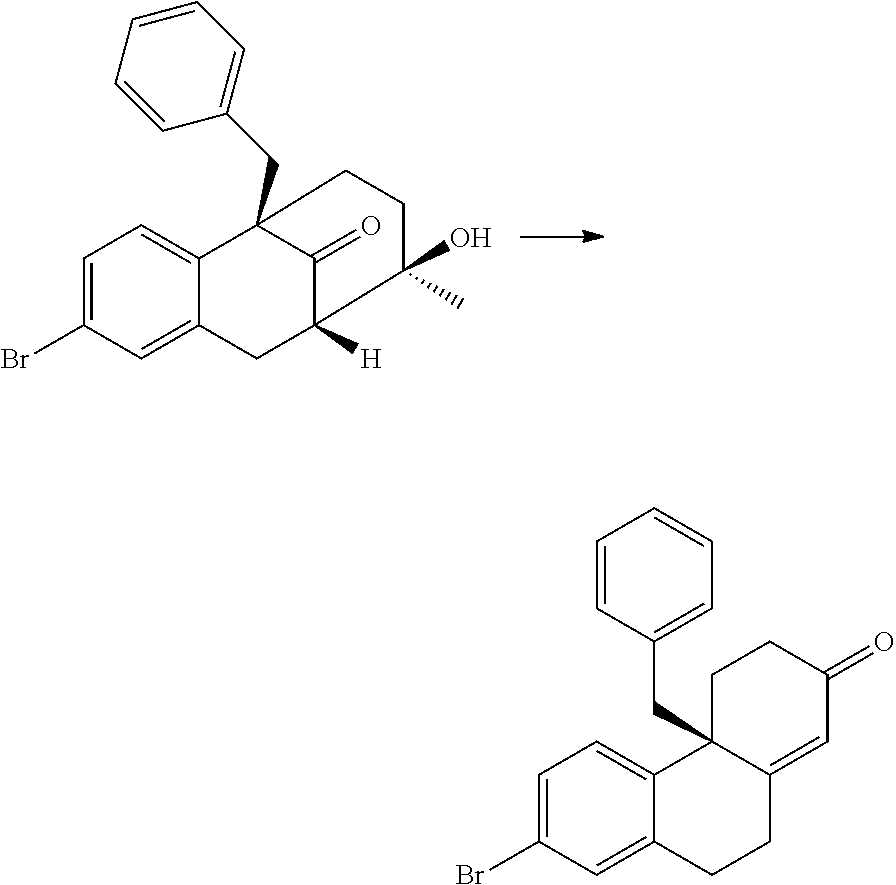
- Sodium ethoxide (21 wt % in EtOH, 84.0 g, 260 mmol) was added to a solution of (1R,10R)-1-benzyl-5-bromo-10-hydroxy-10-methyltricyclo[7.3.1.0 2,7]trideca-2,4,6-trien-13-one (1.0 kg, 2.60 mol) (91, R2=Benzyl) (prepared as described in WO 2008093236 A1) and EtOH (10 L). The reaction mixture was warmed to about 80° C. After about 30 min, the reaction mixture was allowed to cool to rt. The solvent was distilled off. The residue was dissolved in MTBE (20 L) and then washed with saturated aqueous NaCl (15 L). The aqueous layer was extracted with MTBE (5 L). The combined organics were dried over MgSO4, filtered, and concentrated under reduced pressure. The residue was purified on silica gel (10 kg) eluting with heptane then 10% EtOAc in heptane. The product containing fractions were combined and concentrated under reduced pressure to afford (S)-4a-benzyl-7-bromo-4,4a,9,10-tetrahydrophenanthren-2(3H)-one (92, R2=Benzyl) (929 g, 97%). HPLC, Zorbax RX-8 column, 95% 0.1% H3PO4, (buffer), 5% MeCN to 15 min, 5 min hold time, flow 1.5 mL/min, column temperature 35° C., 14.98 min, LC/MS, method 3, Rt=2.89 min, MS m/z 367/369 (M+H)+, 1H NMR (400 MHz, DMSO-d6) δ 7.40 (dd, J=8.5, 2.1 Hz, 1H), 7.34 (d, J=8.6 Hz, 1H), 7.30 (d, J=2.1 Hz, 1H), 7.18-7.11 (m, 3H), 6.81-6.75 (m, 2H), 5.92 (s, 1H), 3.29 (d, J=13.2 Hz, 1H), 3.24 (d, J=13.2 Hz, 1H), 2.88-2.79 (m, 1H), 2.76-2.60 (m, 2H), 2.56-2.47 (m, 1H), 2.38-2.24 (m, 2H), 1.95-1.80 (m, 2H).
-

- 1,1′-Bis(diphenylphosphino)ferrocenedichloropalladium(II) dichloromethane adduct (0.563 g, 0.689 mmol), (S)-4a-benzyl-7-bromo-4,4a,9,10-tetrahydrophenanthren-2(3H)-one (92, R2=Benzyl) (55.0 g, 138 mmol), TEA (38.4 mL, 276 mmol) and MeOH (500 mL) were added under nitrogen to a 2 L Parr stirred reactor. The reactor was purged with nitrogen and then carbon monoxide. The mixture was agitated for about 15 h at about 100° C. under about 60 psi of carbon monoxide. DCM (300 mL) was added. The reaction mixture was filtered through a Buchner funnel containing a GF/F glass fiber filter to remove the catalyst rinsing with DCM. The organics were washed with 1 N aqueous HCl (500 mL), an aqueous solution of 7% cysteine and 5% KHCO3 (2×650 mL), dried over Na2SO4, and filtered. The solution was concentrated to about 150 g under reduced pressure and then filtered through a plug of silica (200 g) rinsing with DCM (2 L). The organics were concentrated to about 300 g under reduced pressure. MeOH (500 mL) was added and then the solution was concentrated to about 300 g under reduced pressure. MeOH (500 mL) was added and then the solution was concentrated to about 300 g under reduced pressure. The oil was cooled in a bath of ice/water. The mixture was filtered rinsing with cold MeOH to afford, after drying under reduced pressure in a vacuum oven, (S)-methyl 4b-benzyl-7-oxo-4b,5,6,7,9,10-hexahydrophenanthrene-2-carboxylate (93, R2=Benzyl) (28.4 g, 59%) as a white solid. LC/MS, method 3, Rt=2.38 min, MS m/z 347 (M+H)+. 1H NMR (400 MHz, D DMSO-d6) δ 7.79 (dd, J=8.3, 1.8 Hz, 1H), 7.67 (d, J=1.7 Hz, 1H), 7.55 (d, J=8.4 Hz, 1H), 7.17-7.08 (m, 3H), 6.78-6.70 (m, 2H), 5.93 (s, 1H), 3.84 (s, 3H), 3.34 (d, J=13.2 Hz, 1H), 3.28 (d, J=13.2 Hz, 1H), 2.96-2.85 (m, 1H), 2.80-2.64 (m, 2H), 2.62-2.53 (m, 1H), 2.41-2.26 (m, 2H), 197-1.80 (m, 2H).
-

- (S)-Methyl 4b-benzyl-7-oxo-4b,5,6,7,9,10-hexahydrophenanthrene-2-carboxylate (93, R2=Benzyl) (58.0 g, 167 mmol), 5% Pd/C (6.1 g), THF (320 mL) and pyridine (80 mL) were added under nitrogen to a 1.8 L SS pressure bottle. The reactor was purged with nitrogen and then hydrogen. The mixture was agitated for about 2 h at rt under about 40 psi of hydrogen. The reaction mixture was filtered through a Buchner funnel containing a GF/F glass fiber filter to remove the catalyst rinsing with THF. The combined filtrates were concentrated under reduced pressure. The oil was dissolved in EtOAc (300 mL) and the resulting solution was washed with 0.2 M aqueous CuSO4 (2×100 mL and 2×200 mL). The organic layer was dried over Na2SO4, filtered, and concentrated under reduced pressure. The residue was purified on silica gel (750 g) using a gradient of 10-30% EtOAc in heptane. The product containing fractions were combined and concentrated under reduced pressure to afford a 96:4 mixture of diastereomers favoring (4bS,8aS)-methyl 4b-benzyl-7-oxo-4b,5,6,7,8,8a,9,10-octahydrophenanthrene-2-carboxylate (39, R2=Benzyl) (57.0 g, 98%) as a thick oil. LC/MS, method 3, Rt=2.49 min, MS m/z 366 (M+H2O)+. 1H NMR (400 MHz, DMSO-d6) δ 7.73 (d, J=7.9 Hz, 1H), 7.72 (s, 1H), 7.46 (d, J=8.0 Hz, 1H), 7.22-7.15 (m, 3H), 6.95-6.89 (m, 2H), 3.84 (s, 3H), 3.11 (s, 2H), 2.93-2.70 (m, 2H), 2.47-2.26 (m, 3H), 2.21-1.88 (m, 5H), 1.61-1.49 (m, 1H).
-

- Ethylene glycol (1.30 mL, 23.3 mmol), trimethyl orthoformate (4.00 mL, 36.5 mmol), and toluene-4-sulfonic acid hydrate (0.440 g, 2.31 mmol) were respectively added, each in one portion, to a solution of (4bS,8aS)-methyl 4b-benzyl-7-oxo-4b,5,6,7,8,8a,9,10-octahydrophenanthrene-2-carboxylate (39, R2=Benzyl) (4.00 g, 11.5 mmol) and DCM (60 mL) under a nitrogen atmosphere. After about 4 h, the pale green solution was poured into a solution of saturated aqueous NaHCO3 (75 mL) and water (25 mL). The layers were separated and the aqueous layer was extracted with DCM (50 mL). The combined organics were dried over Na2SO4, filtered, and concentrated under reduced pressure. The residue was purified on silica gel (120 g) using a gradient of 0-40% EtOAc in heptane. The product containing fractions were combined and concentrated under reduced pressure to afford (4a′S,10a′S)-methyl 4a′-benzyl-3′,4′,4a′,9′,10′,10a′-hexahydro-1′H-spiro[[1,3]dioxolane-2,2′-phenanthrene]-7′-carboxylate (38, R2=Benzyl) (3.55 g, 79%) as a white foam. LC/MS, method 1, Rt=0.95 min, MS m/z 393 (M+H)+. 1H NMR (400 MHz, DMSO-d6) δ 7.75-7.71 (m, 1H), 7.67-7.62 (m, 1H), 7.25-7.13 (m, 4H), 6.96-6.91 (m, 2H), 3.83 (s, 3H), 3.81-3.70 (m, 4H), 2.93-2.69 (m, 4H), 2.45-2.37 (m, 1H), 2.23-2.14 (m, 1H), 1.99-1.89 (m, 1H), 1.71-1.45 (m, 4H), 1.34-1.20 (m, 1H), 1.13-1.02 (m, 1H).
-
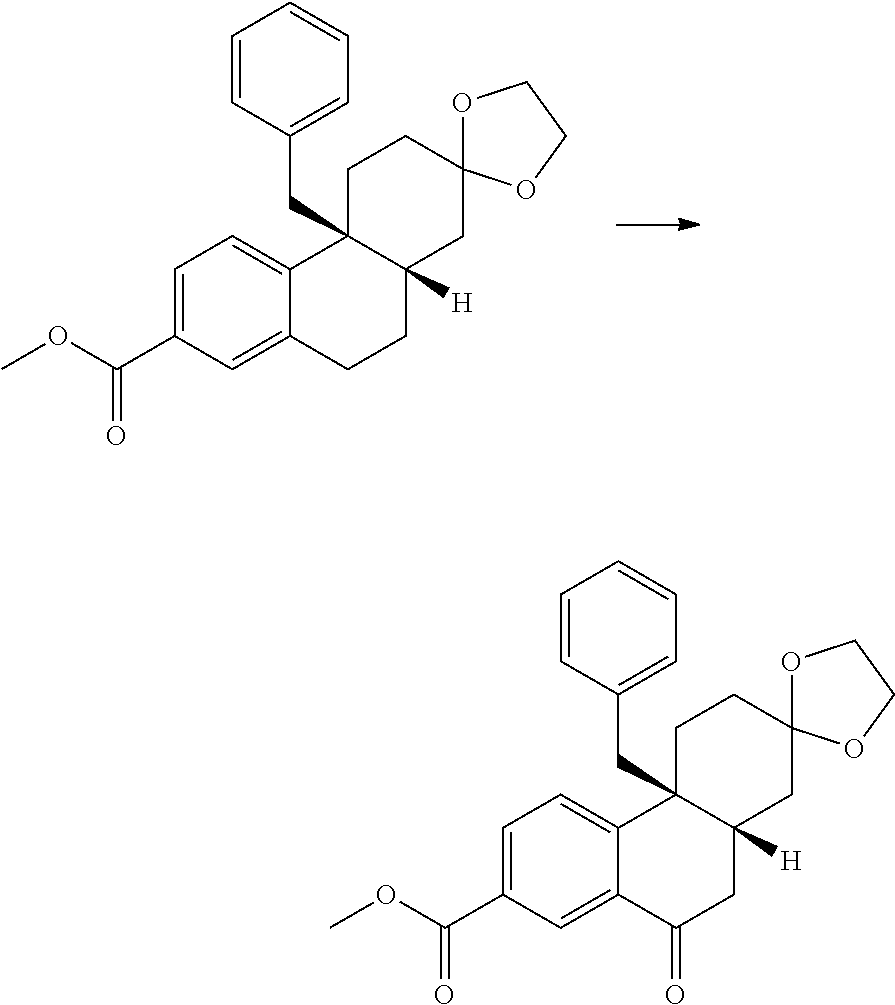
- A solution of (4a′S,10a′S)-methyl 4a′-benzyl-3′,4′,4a′,9′,10′,10a′-hexahydro-1′H-spiro[[1,3]dioxolane-2,2′-phenanthrene]-7′-carboxylate (38, R2=Benzyl) (3.64 g, 9.04 mmol) and DCM (80 mL) was added to a 250 mL Erlenmeyer flask with a large stir bar. Copper(II) sulfate pentahydrate (9.00 g, 36.0 mmol), potassium permanganate (5.70 g, 36.1 mmol), water (10 mL), and pyridine (2.90 mL, 35.9 mmol) were added respectively, each in one portion. The mixture was left to vigorously stir under air for about 43 h. Na2SO4 (40 g) was added. After about 2 h, the mixture was filtered through Celite® rinsing with DCM (6×50 mL). The volatiles were removed under reduced pressure. The residue was slurried between water (100 mL) and EtOAc (200 mL) and then filtered rinsing with EtOAc. The layers were separated and the organics washed with water (2×100 mL). The organics were dried over Na2SO4, filtered, and concentrated under reduced pressure. The residue was purified on silica gel (120 g) using a gradient of 0-15% EtOAc in DCM. The product containing fractions were combined and concentrated under reduced pressure to afford a light yellow foam. The residue was dissolved in DCM (200 mL) and then washed with 0.1 M aqueous EDTA tetrasodium salt (100 mL) and water (100 mL), dried over Na2SO4, filtered, and concentrated under reduced pressure to afford (4a′S,10a′S)-methyl 4a′benzyl-9′-oxo-3′,4′,4a′,9′,10′,10a′-hexahydro-1′H-spiro[[1,3]dioxolane-2,2′-phenanthrene]-7′-carboxylate (96, R2=Benzyl) (2.19 g, 60%) as a light yellow foam. LC/MS, method 1, Rt=0.81 min, MS m/z 407 (M+H)+. 1H NMR (400 MHz, DMSO) δ 8.52 (d, J=2.0 Hz, 1H), 8.08 (dd, J=8.2, 2.0 Hz, 1H), 7.28 (d, J=8.3 Hz, 1H), 7.26-7.20 (m, 3H), 6.98-6.92 (m, 2H), 3.89 (s, 3H), 3.83-3.70 (m, 4H), 3.47 (dd, J=18.0, 5.2 Hz, 1H), 3.03 (d, J=13.3 Hz, 1H), 2.92 (d, J=13.3 Hz, 1H), 2.44-2.24 (m, 3H), 1.78-1.68 (m, 1H), 1.68-1.60 (m, 1H), 1.58-1.49 (m, 1H), 1.17-1.02 (m, 2H).
-
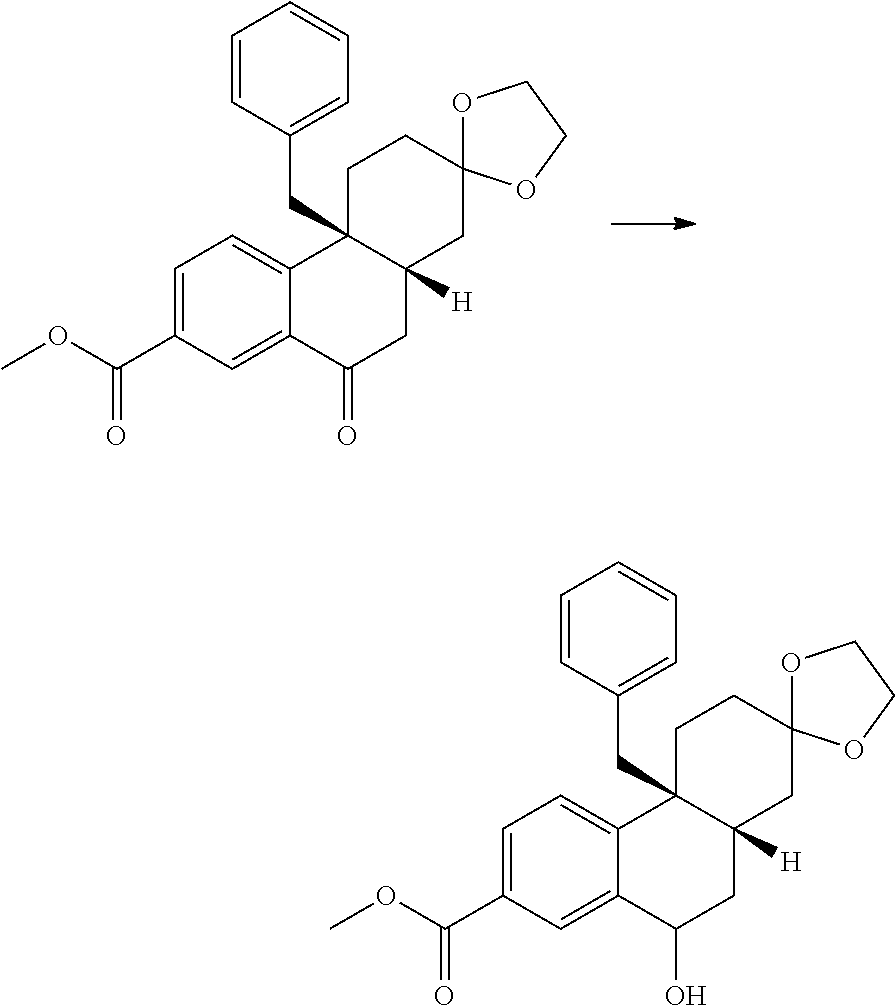
- NaBH4 (0.107 g, 2.83 mmol) was added portionwise over about 5 min to a solution of (4a′S,10a′S)-methyl 4a′-benzyl-9′-oxo-3′,4′,4a′,9′,10′,10a′-hexahydro-1′H-spiro[[1,3]dioxolane-2,2′-phenanthrene]-7′-carboxylate (96, R2=Benzyl) (1.32 g, 2.83 mmol) and MeOH (28 mL) under air cooled in an rt water bath. After about 30 min, the solution was concentrated to about 5 mL and then water (50 mL) and DCM (50 mL) were added. After vigorously stirring for about 30 min, the layers were separated and the aqueous phase was extracted with DCM (2×50 mL). The combined organics were washed with saturated aqueous NaCl (50 mL), dried over Na2SO4, filtered, and concentrated under reduced pressure. The residue was purified on silica gel (80 g) using a gradient of 0-40% EtOAc in DCM. The product containing fractions were combined and concentrated under reduced pressure to afford (4a′S,10a′S)-methyl 4a′-benzyl-9′-hydroxy-3′,4′,4a′,9′,10′,10a′-hexahydro-1′H-spiro[[1,3]dioxolane-2,2′-phenanthrene]-7′-carboxylate (97, R2=Benzyl) (1.06 g, 92%) as approximately a 2:1 mixture of alcohol diastereomers as a sticky ivory foam. LC/MS, method 1, Rt=0.73 min, MS m/z 391 (M−OH)+. 1H NMR (400 MHz, DMSO-d6) δ 8.19 (d, J=2.0 Hz, 0.33H), 8.12 (d, J=2.0 Hz, 0.67H), 7.78-7.73 (dd, J=8.2, 2.0 Hz, 0.67H), 7.71 (d, J=8.0, 2.0 Hz, 0.33H), 7.38-7.30 (m, 0.67H), 7.28-7.08 (m, 3.33H), 7.01-9.95 (m, 0.67H), 6.83-6.77 (m, 1.33H), 5.44-5.38 (m, 1H), 4.74-4.63 (m, 0.33H), 4.49-4.39 (m, 0.67H), 3.85 (s, 3H), 3.84-3.69 (m, 4H), 3.01-0.99 (m, 11H).
-

- 4 Å Molecular sieves (2.0 g) were added to a solution of (4a′S,10a′S)-methyl 4a′-benzyl-9′-hydroxy-3′,4′,4a′,9′,10′,10a′-hexahydro-1′H-spiro[[1,3]dioxolane-2,2′-phenanthrene]-7′-carboxylate (97, R2=Benzyl) (1.25 g, 2.60 mmol) and toluene (50 mL). After about 10 min, toluene-4-sulfonic acid hydrate (0.030 g, 0.16 mmol) was added. After about 5 min, the reaction mixture was warmed to about 60° C. After about 30 min, toluene-4-sulfonic acid hydrate (0.030 g, 0.16 mmol) was added. After about 2 h, the mixture was allowed to cool to rt and then filtered with an EtOAc rinse into saturated aqueous NaHCO3 (50 mL) and EtOAc (50 mL). The layers were separated and the organics were washed with saturated aqueous NaCl (50 mL), dried over Na2SO4, filtered, and concentrated under reduced pressure. The residue was purified on silica gel (80 g) using a gradient of 0-20% EtOAc in heptane. The product containing fractions were combined and concentrated under reduced pressure to afford (4a′S,10aR)-methyl 4a′-benzyl-3′,4′,4a′,10a′-tetrahydro-1′H-spiro[[1,3]dioxolane-2,2′-phenanthrene]-7′-carboxylate (98, R2=Benzyl) (0.655 g, 64%) as a sticky ivory foam/colorless film. LC/MS, method 1, Rt=0.91 min, MS m/z 391 (M+H)+. 1H NMR (400 MHz, DMSO-d6) δ 7.80 (d, J=1.8 Hz, 1H), 7.72 (dd, J=8.0, 1.9 Hz, 1H), 7.71-7.13 (m, 3H), 7.06 (d, J=8.1 Hz, 1H), 6.78-6.72 (m, 2H), 6.70 (d, J=9.6 Hz, 1H), 6.19 (dd, J=9.5, 6.3 Hz, 1H), 3.85 (s, 3H), 3.83-3.71 (m, 4H), 2.76 (d, J=12.8 Hz, 1H), 2.57 (d, J=12.8 Hz, 1H), 2.38-2.30 (m, 1H), 2.27-2.17 (m, 1H), 1.78-1.67 (m, 1H), 1.65-1.51 (m, 2H), 1.41-1.30 (m, 1H), 0.95-0.83 (m, 1H).
-

- LiHMDS (1 M solution in THF, 3.50 mL, 3.50 mmol) was added dropwise over about 5 min to a mixture of (4a′S,10a′R)-methyl 4a′-benzyl-3′,4′,4a′,10a′-tetrahydro-1′H-spiro[[1,3]dioxolane-2,2′-phenanthrene]-7′-carboxylate (98, R2=Benzyl) (0.653 g, 1.62 mmol), 2-methyl-pyridin-3-ylamine (0.228 g, 2.11 mmol), and toluene (16 mL) under a nitrogen atmosphere at about 0° C. After about 30 min, the ice bath was removed and the mixture was stirred at rt for about 1 h. Saturated aqueous NaHCO3 (50 mL) was added. The mixture was extracted with EtOAc (2×25 mL). The combined organics were washed with saturated aqueous NaCl (50 mL), dried over Na2SO4, filtered, and concentrated under reduced pressure. The residue was purified on silica gel (80 g) using a gradient of 50-100% EtOAc in DCM. The product containing fractions were combined and concentrated under reduced pressure to afford (4a′S,10aR)-4a′-benzyl-N-(2-methylpyridin-3-yl)-3′,4′,4a′,10a′-tetrahydro-1′H-spiro[[1,3]dioxolane-2,2′-phenanthrene]-7′-carboxamide (99, R2=Benzyl, R6=2-Methylpyridin-3-yl) (0.716 g, 95%) as a light tan foam. LC/MS, method 2, Rt=2.32 min, MS m/z 467 (M+H)+. 1H NMR (400 MHz, DMSO-d6) δ 10.01 (s, 1H), 8.34 (dd, J=4.8, 1.6 Hz, 1H), 7.82 (d, J=1.8 Hz, 1H), 7.79-7.73 (m, 2H), 7.28 (dd, J=8.0, 4.8 Hz, 1H), 7.24-7.17 (m, 3H), 7.15 (d, J=8.1 Hz, 1H), 6.86-6.80 (m, 2H), 6.70 (d, J=9.6 Hz, 1H), 6.22 (dd, J=9.5, 6.2 Hz, 1H), 3.83-3.71 (m, 4H), 2.74 (d, J=12.8 Hz, 1H), 2.63 (d, J=12.8 Hz, 1H), 2.46 (s, 3H), 2.38-2.31 (m, 1H), 2.31-2.21 (m, 1H), 1.79-1.68 (m, 1H), 1.66-1.54 (m, 2H), 1.47-1.36 (m, 1H), 0.99-0.91 (, m, 1H).
-

- A solution of (4a′S,10a′R)-4a′-benzyl-N-(2-methylpyridin-3-yl)-3′,4′,4a′,10a′-tetrahydro-1′H-spiro[[1,3]dioxolane-2,2′-phenanthrene]-7′-carboxamide (99, R2=Benzyl, R6=2-Methylpyridin-3-yl) (0.760 g, 1.53 mmol), DCM (27 mL), and MeOH (3 mL) was purged with O2 at about −78° C. for about 5 min. Oxygen was bubbled through the solution (˜1.5 SLPM) through an Ozone Gas Generator. After about 6 min, the solution began to turn blue. The reaction solution was purged with O2 for about 15 min. PS-PPh3 (˜3 mmol/g, 2.6 g) was added. The cold bath was removed and the reaction vessel was allowed to warm to rt. After about 14 h, PS-PPh3 (˜3 mmol/g, 1.8 g) was added. After about 1 h, the mixture was filtered rinsing with DCM. The volatiles were removed under reduced pressure and then dried under high vacuum for about 15 min. The residue was dissolved in MeCN (20 mL). Methylamine (2 M solution in THF, 1.50 mL, 4.50 mmol) was added. After about 10 min, sodium cyanoborohydride (0.481 g, 7.66 mmol) was added. After about 2 h, sodium cyanoborohydride (0.481 g, 7.66 mmol) was added. After about 1 h, sodium cyanoborohydride (0.481 g, 7.66 mmol) was added. After about 1 h, saturated aqueous NaHCO3 (10 mL) and water (40 mL) were added. After vigorously stirring for about 1 h, the mixture was extracted with EtOAc (3×50 mL). The combined organics were washed with saturated aqueous NaCl, dried over Na2SO4, filtered, and concentrated under reduced pressure. The residue was purified on silica gel (80 g) using a gradient of 0-10% MeOH in DCM then ((1% 7 N NH3 in MeOH) in 10% MeOH in DCM). The fractions containing product were combined and concentrated under reduced pressure to afford a partial boron complex of (4aS,11bS)-11b-benzyl-6-methyl-N-(2-methylpyridin-3-yl)-1,2,4,4a,5,6,7,11b-octahydrospiro [dibenzo[c,e]azepine-3,2′-[1,3]dioxolane]-9-carboxamide (100, R2=Benzyl, R6=2-Methylpyridin-3-yl) (0.228 g, 30%) as an ivory solid. LC/MS, method 3, Rt=1.53 min, MS m/z 499 (M+H)+. 1H NMR (400 MHz, DMSO-d6) δ 9.99 (s, 1H), 8.33 (d, J=6.2 Hz, 1H), 7.84 (s, 1H), 7.74 (d, J=7.7 Hz, 1H), 7.67-7.61 (m, 1H), 7.30-7.25 (m, 1H), 7.15-7.06 (m, 3H), 6.86-6.81 (m, 1H), 6.68-6.62 (m, 2H), 3.99-3.72 (m, 6H), 3.48 (d, J=13.6 Hz, 1H), 3.25-3.18 (m, 1H), 2.72-2.50 (m, 3H), 2.45 (s, 3H), 2.40 (s, 3H), 2.16-2.00 (m, 2H), 1.63-1.39 (m, 4H).
-

- M Aqueous HCl (1.0 mL, 5.0 mmol) was slowly added to a solution of (4aS,11bS)-11b-benzyl-6-methyl-N-(2-methylpyridin-3-yl)-1,2,4,4 a,5,6,7,11b-octahydro spiro[dibenzo[c,e]azepine-3,2′-[1,3]dioxolane]-9-carboxamide (100, R2=Benzyl, R6=2-Methylpyridin-3-yl) (0.233 g, 0.393 mmol) as a partial boron complex and THF (6 mL) under air. The solution was left to stir for about 6 h. The solution was poured into saturated aqueous NaHCO3 (10 mL). The mixture was extracted with EtOAc (3×10 mL). The combined organics were dried over Na2SO4, filtered, and concentrated under reduced pressure. The residue was purified on silica gel (25 g) using a gradient of 0-100% (1% 7 N NH3 in MeOH) in 10% MeOH in DCM) in DCM. The fractions containing product were combined and concentrated under reduced pressure to afford (4aS,11bS)-11 b-benzyl-6-methyl-N-(2-methylpyridin-3-yl)-3-oxo-2,3,4,4a,5,6,7,11b-octahydro-1H-dibenzo[c,e]azepine-9-carboxamide (101, R2=Benzyl, R6=2-Methylpyridin-3-yl) (0.040 g, 22%) as an ivory solid and (3S,4aS,11bS)-11b-benzyl-3-hydroxy-6-methyl-N-(2-methylpyridin-3-yl)-2,3,4,4a,5,6,7,11b-octahydro-1H-dibenzo[c,e]azepine-9-carboxamide (102, R2=Benzyl, R6=2-Methylpyridin-3-yl) (0.088 g, 49%) as an ivory solid. (4aS,11bS)-11b-benzyl-6-methyl-N-(2-methylpyridin-3-yl)-3-oxo-2,3,4,4 a,5,6,7,11b-octahydro-1H-dibenzo[c,e]azepine-9-carboxamide (101, R2=Benzyl, R3=H, R6=2-Methylpyridin-3-yl): LC/MS, method 2, Rt=1.33 min, MS m/z 455 (M+H)+. 1H NMR (400 MHz, DMSO-d6) δ 10.03 (s, 1H), 8.34 (d, J=5.0 Hz, 1H), 7.91 (s, 1H), 7.74 (d, J=7.0 Hz, 1H), 7.68 (d, J=8.0 Hz, 1H), 7.28 (dd, J=7.9, 4.9 Hz, 1H), 7.15-7.06 (m, 3H), 6.92 (d, J=8.3 Hz, 1H), 6.66-6.58 (m, 2H), 4.04 (d, J=14.1 Hz, 1H), 3.83 (d, J=15.0 Hz, 1H), 3.64 (d, J=12.9 Hz, 1H), 3.21 (d, J=12.9 Hz, 1H), 2.74-2.64 (m, 2H), 2.44 (s, 3H), 2.42 (s, 3H), 2.38-2.17 (m, 5H), 2.08 (d, J=13.8 Hz, 1H), 1.90-1.78 (m, 1H). (3S,4aS,11bS)-11b-benzyl-3-hydroxy-6-methyl-N-(2-methylpyridin-3-yl)-2,3,4,4 a,5,6,7,11b-octahydro-1H-dibenzo[c,e]azepine-9-carboxamide (102, R2=Benzyl, R3=H, R6=2-Methylpyridin-3-yl): LC/MS, method 2, Rt=1.30 min, MS m/z 456 (M+H)+. 1H NMR (400 MHz, DMSO-d6) δ 9.98 (s, 1H), 8.38-8.27 (m, 1H), 7.84 (s, 1H), 7.74 (d, J=8.0 Hz, 1H), 7.64 (d, J=7.9 Hz, 1H), 7.28 (dd, J=7.9, 4.7 Hz, 1H), 7.14-7.03 (m, 3H), 6.80 (d, J=8.2 Hz, 1H), 6.66-6.53 (m, 2H), 4.35 (d, J=4.5 Hz, 1H), 3.95 (d, J=14.1 Hz, 1H), 3.78 (d, J=15.3 Hz, 1H), 3.57-3.45 (m, 2H), 3.24-3.15 (m, 1H), 2.73-2.63 (m, 1H), 2.60 (d, J=13.2 Hz, 1H), 2.45 (s, 3H), 2.41 (s, 3H), 2.17-2.07 (m, 1H), 1.80-1.65 (m, 2H), 1.62-1.53 (m, 1H), 1.46-1.33 (m, 1H), 1.29-1.13 (m, 2H).
-

-

- A solution of (4a′S,10a′R)-4a′-benzyl-N-(2-methylpyridin-3-yl)-3′,4′,4a′,10a′-tetrahydro-1′H-spiro[[1,3]dioxolane-2,2′-phenanthrene]-7′-carboxamide (99, R2=Benzyl, R6=2-Methylpyridin-3-yl) (0.205 g, 0.422 mmol), DCM (7.2 mL), and MeOH (0.8 mL) was purged with O2 at about −78° C. for about 5 min. Oxygen was bubbled through the solution (˜1.5 SLPM) through an Ozone Gas Generator. After about 8 min, the solution began to turn blue. The reaction solution was purged with O2 for about 15 min. PS-PPh3 (˜3 mmol/g, 0.70 g) was added. The cold bath was allowed to thaw to rt over about 1 h. After about 2 h, the mixture was filtered rinsing with 50% MeOH in DCM (5 mL). NaBH4 (0.048 g, 1.3 mmol) was added to the solution. After about 1 h, NaBH4 (0.048 g, 1.3 mmol) was added. After about 1 h, the volatiles were removed under reduced pressure. Water (10 mL) and DCM (10 mL) were added. After vigorously stirring for about 15 min, the layers were separated. The aqueous phase was extracted with DCM (4×10 mL). The combined organics were dried over Na2SO4, filtered, and concentrated under reduced pressure. The residue was purified on silica gel (12 g) using a gradient of 0-15% MeOH in DCM. The fractions containing product were combined and concentrated under reduced pressure to afford an approximately 85:15 mixture of lactols, (4aS,11bS)-11b-benzyl-5-hydroxy-N-(2-methylpyridin-3-yl)-2,4,4a,5,7,11b-hexahydro-1H-spiro[dibenzo[c,e]oxepine-3,2′-[1,3]dioxolane]-9-carboxamide, (103, R2=Benzyl, R6=2-Methylpyridin-3-yl) (0.120 g, 57%) as a white solid. LC/MS, method 3, Major Isomer: Rt=1.87 min, MS m/z 501 (M+H)+. Minor Isomer: 1.81 min, MH+=501, Major Isomer: 1H NMR (400 MHz, DMSO-d6) δ 10.00 (s, 1H), 8.34 (dd, J=4.8, 1.6 Hz, 1H), 7.88 (d, J=2.1 Hz, 1H), 7.75 (dd, J=8.0, 1.5 Hz, 1H), 7.70 (dd, J=8.2, 2.0 Hz, 1H), 7.28 (dd, J=7.9, 4.8 Hz, 1H), 7.17-7.09 (m, 3H), 6.88 (d, J=8.5 Hz, 1H), 6.73-6.66 (m, 3H), 5.59-5.54 (m, 1H), 5.03 (d, J=14.8 Hz, 1H), 4.84 (d, J=15.2 Hz, 1H), 3.88-3.73 (m, 4H), 3.35 (d, J=13.1 Hz, 1H), 2.85 (d, J=13.1 Hz, 1H), 2.45 (s, 3H), 2.23-2.11 (m, 2H), 2.03-1.95 (m, 1H), 1.68-1.49 (m, 2H), 1.48-1.33 (m, 1H), 1.03-0.93 (m, 1H).
-

- 5 M aqueous HCl (0.4 mL, 2 mmol) was added dropwise to a solution of (4aS,11bS)-11b-benzyl-5-hydroxy-N-(2-methylpyridin-3-yl)-2,4,4a,5,7,11b-hexahydro-1H-spiro[dibenzo[c,e]oxepine-3,2′-[1,3]dioxolane]-9-carboxamide (103, R2=Benzyl, R6=2-Methylpyridin-3-yl) (0.111 g, 0.200 mmol) and THF under air over about 2 min. After about 1 h, the solution was poured into saturated aqueous NaHCO3 (10 mL). The mixture was extracted with DCM (3×10 mL). The combined organics were dried over Na2SO4, filtered, and concentrated under reduced pressure. The residue was purified on silica gel (12 g) using a gradient 0-7.5% MeOH in DCM. The fractions containing product were combined and concentrated under reduced pressure to afford an approximately 9:1 ratio of lactols, (7aS,11aS)-11a-benzyl-7-hydroxy-9-oxo-5,7,7a,8,9,10,11,11a-octahydro-dibenzo[c,e]oxepine-3-carboxylic acid (2-methyl-pyridin-3-yl)-amide, (104, R2=Benzyl, R6=2-Methylpyridin-3-yl) (0.0906 mg, 99%) as an ivory solid. LC/MS, method 3, Major Isomer: Rt=1.67 min, MS m/z 457 (M+H)+, Minor Isomer: 1.73 min, 457 (M+H)+. Major Isomer: 1H NMR (400 MHz, DMSO-d6) δ 10.04 (s, 1H), 8.34 (dd, J=4.8, 1.6 Hz, 1H), 7.95 (d, J=2.0 Hz, 1H), 7.75 (dd, J=7.9, 1.4 Hz, 2H), 7.28 (dd, J=7.9, 4.7 Hz, 1H), 7.20-7.03 (m, 3H), 6.97 (d, J=8.5 Hz, 1H), 6.88 (d, J=4.3 Hz, 1H), 6.68-6.60 (m, 2H), 5.65-5.59 (m, 1H), 5.17 (d, J=14.7 Hz, 1H), 4.88 (d, J=15.0 Hz, 1H), 3.55 (d, J=13.0 Hz, 1H), 2.86 (d, J=13.2 Hz, 1H), 2.45 (s, 3H), 2.55-2.13 (m, 5H), 1.96-1.79 (m, 2H).
-

- Crushed 4 Å molecular sieves (0.045 g) were added to a solution of (7aS,11aS)-11a-Benzyl-7-hydroxy-9-oxo-5,7,7a,8,9,10,11,11a-octahydro-dibenzo[c,e]oxepine-3-carboxylic acid (2-methyl-pyridin-3-yl)-amide (104, R2=Benzyl, R6=2-Methylpyridin-3-yl) (0.0218 g, 0.0480 mmol) and DCM (0.6 mL) under a nitrogen atmosphere. TPAP (0.0030 g, 0.0085 mmol) and NMO (0.017 g, 0.14 mmol) were respectively added, each in one portion. After about 30 min, the reaction mixture was filtered through Celite® rinsing with DCM. The solution was purified on silica gel (12 g) using a gradient 1-7.5% MeOH in DCM. The fractions containing product were combined and concentrated under reduced pressure. The residue was dissolved in MeCN and two drops of water were added. The volatiles were removed under reduced pressure and the residue was dried under high vacuum for about 15 h to afford (7aS,11aS)-11a-benzyl-N-(2-methylpyridin-3-yl)-7,9-dioxo-5,7,7a,8,9,10,11,11a-octahydrodibenzo[c,e]oxepine-3-carboxamide (105, R2=Benzyl, R6=2-Methylpyridin-3-yl) (0.0126 g, 58%) as an ivory solid. LC/MS, method 2, Rt=1.69 min, MS m/z 455 (M+H)+. 1H NMR (400 MHz, CDCl3) δ 8.40 (d, J=3.8 Hz, 1H), 8.32 (d, J=8.1 Hz, 1H), 8.03 (d, J=6.8 Hz, 1H), 7.92 (s, 1H), 7.87 (d, J=8.4 Hz, 1H), 7.66 (d, J=1.7 Hz, 1H), 7.31-7.21 (m, 2H), 7.17 (t, J=7.4 Hz, 2H), 6.66 (d, J=7.4 Hz, 2H), 5.03 (d, J=13.9 Hz, 1H), 4.67 (d, J=14.2 Hz, 1H), 4.07-4.00 (m, 1H), 3.59 (d, J=14.1 Hz, 1H), 3.38 (d, J=14.2 Hz, 1H), 2.93-2.51 (m, 5H), 2.64 (s, 3H), 2.37-2.21 (m, 1H).
-
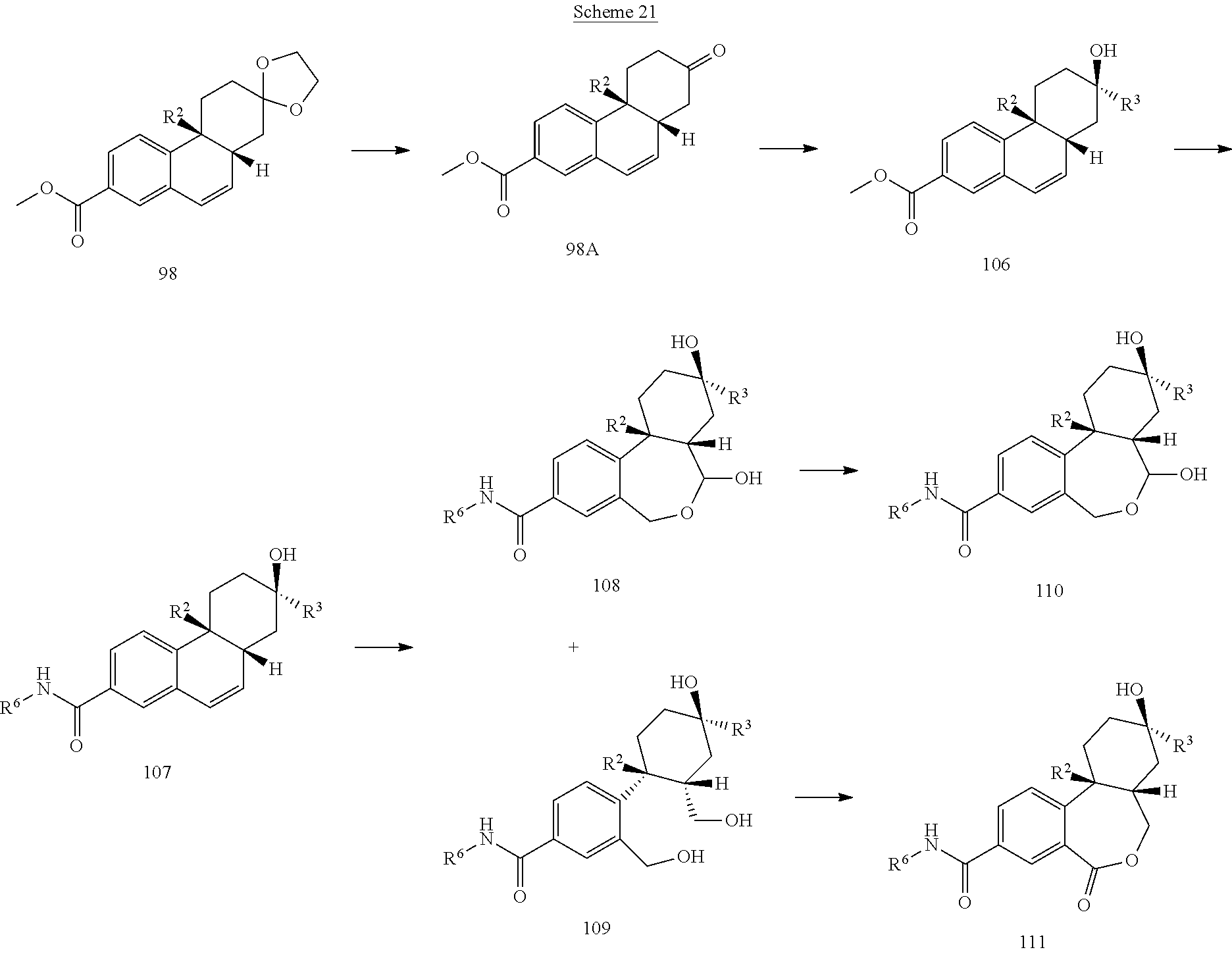
-

- 2 M aqueous HCl (10 mL, 20 mmol) was added to a solution of (4a′S,10a′R)-methyl 4a′-benzyl-3′,4′,4a′,10a′-tetrahydro-1′H-spiro[[1,3]dioxolane-2,2′-phenanthrene]-7′-carboxylate (98, R2=Benzyl) (1.74 g, 4.28 mmol) and THF (20 mL) under air. The biphasic mixture was left to vigorously stir for about 24 h. 6 M aqueous HCl (10 mL, 60 mmol) was added. After about 18 h, DCM (80 mL) was added. The layers were separated and the organics were washed with water (20 mL) and saturated aqueous NaCl (20 mL). The aqueous layers were extracted with DCM (20 mL). The combined organics were dried over Na2SO4, filtered, and concentrated under reduced pressure. The residue was purified on silica gel (120 g) using a gradient of 0-40% EtOAc in heptane. The fractions containing product were combined and concentrated under reduced pressure to afford (4bS,8aR)-methyl 4b-benzyl-7-oxo-4b,5,6,7,8,8a-hexahydrophenanthrene-2-carboxylate (98A, R2=Benzyl) (1.41 g, 95%) as an ivory foam. LC/MS, method 3, Rt=2.59 min, MS m/z 347 (M+H)+. 1H NMR (400 MHz, DMSO-d6) δ 7.86 (d, J=1.9 Hz, 1H), 7.76 (dd, J=8.0, 1.9 Hz, 1H), 7.20-7.11 (m, 4H), 6.76 (d, J=9.6 Hz, 1H), 6.75-6.69 (m, 2H), 6.19 (dd, J=9.5, 6.2 Hz, 1H), 3.87 (s, 3H), 2.90 (d, J=12.9 Hz, 1H), 2.64 (d, J=13.1 Hz, 1H), 2.68-2.27 (m, 3H), 2.21-2.06 (m, 2H), 1.95-1.81 m, 2H).
-

- Ethylmagnesium bromide (3 M solution in Et2O, 6.80 mL, 20.4 mmol) was added to THF (50 mL) under a nitrogen atmosphere. The solution was cooled to about −78° C. resulting in a light tan slurry. A solution of (4bS,8aR)-methyl 4b-benzyl-7-oxo-4b,5,6,7,8,8a-hexahydrophenanthrene-2-carboxylate (98A, R2=Benzyl) (1.43 g, 4.05 mmol) and THF (30 mL) was added dropwise maintaining an internal temperature of less than −60° C. The cold bath was thawed to between −40 and—50° C. over about 15 min and then maintained in this range for about 90 min. MeOH (1.5 mL) was added dropwise maintaining an internal temperature of less than −40° C. The cold bath was removed and saturated aqueous NH4Cl (50 mL), water (50 mL), and EtOAc (100 mL) were added. The layers were separated and the organics were washed with saturated aqueous NaCl (50 mL). The aqueous layers were extracted with EtOAc (50 mL). The combined organics were dried over Na2SO4, filtered, and concentrated under reduced pressure. The residue was purified on silica gel (120 g) using a gradient of 10-30% EtOAc in heptane. The fractions containing product were combined and concentrated under reduced pressure to afford (4bS,7R,8aR)-methyl 4b-benzyl-7-ethyl-7-hydroxy-4b,5,6,7,8,8a-hexahydrophenanthrene-2-carboxylate (106, R2=Benzyl, R3=Ethyl) (1.19 g, 78%) as an ivory solid. LC/MS, method 3, Rt=2.71 min, MS m/z 377 (M+H)+. 1H NMR (400 MHz, DMSO-d6) δ 7.75 (d, J=1.8 Hz, 1H), 7.67 (dd, J=8.0, 1.8 Hz, 1H), 7.18-7.10 (m, 3H), 6.98 (d, J=8.1 Hz, 1H), 6.74-6.67 (m, 2H), 6.65 (d, J=9.5 Hz, 1H), 6.18 (dd, J=9.4, 6.2 Hz, 1H), 3.84 (s, 3H), 3.82 (s, 1H), 2.79 (d, J=12.8 Hz, 1H), 2.55 (d, J=12.8 Hz, 1H), 2.56-2.46 (m, 1H), 2.00-1.84 (m, 2H), 1.49-1.33 (m, 2H), 1.12 (q, J=7.4 Hz, 2H), 1.16-1.02 (m, 1H), 0.66 (t, J=7.4 Hz, 3H), 0.70-0.57 (m, 1H).
-

- 2-Methylpyridin-3-amine (0.113 g, 1.045 mmol) was added in one portion to a solution of (4bS,7R,8aR)-methyl 4b-benzyl-7-ethyl-7-hydroxy-4b,5,6,7,8,8 a-hexahydrophenanthrene-2-carboxylate (106, R2=Benzyl, R3=Ethyl) (0.302 g, 0.682 mmol) and toluene (8 mL) under a nitrogen atmosphere. The mixture was cooled to about 0° C. LiHMDS (1 M solution in THF, 3.0 mL, 3.0 mmol) was added dropwise over about 5 min. After about 30 min, the ice bath was removed. After about 15 min at rt, the mixture was poured into saturated aqueous NaHCO3 (10 mL) and water (10 mL). The mixture was extracted with EtOAc (2×10 mL). The combined organics were dried over Na2SO4, filtered, and concentrated under reduced pressure. The residue was purified on silica gel (25 g) using a gradient of 50-100% EtOAc in DCM. The fractions containing product were combined and concentrated under reduced pressure to afford (4bS,7R,8aR)-4b-benzyl-7-ethyl-7-hydroxy-N-(2-methylpyridin-3-yl)-4b,5,6,7,8,8a-hexahydrophenanthrene-2-carboxamide (107, R2=Benzyl, R3=Ethyl, R6=2-Methylpyridin-3-yl) (0.252 g, 82%) as a pale yellow solid. LC/MS, method 3, Rt=2.18 min, MS m/z 454 (M+H)+. 1H NMR (400 MHz, DMSO-d6) δ 9.99 (s, 1H), 8.34 (dd, J=4.7, 1.6 Hz, 1H), 7.80-7.70 (m, 3H), 7.28 (dd, J=7.8, 4.7 Hz, 1H), 7.22-7.13 (m, 3H), 7.07 (d, J=8.1 Hz, 1H), 6.82-6.76 (m, 2H), 6.65 (d, J=9.5 Hz, 1H), 6.20 (dd, J=9.4, 6.2 Hz, 1H), 3.80 (s, 1H), 2.76 (d, J=12.8 Hz, 1H), 2.61 (d, J=12.9 Hz, 1H), 2.56-2.48 (m, 1H), 2.45 (s, 3H), 2.06-1.85 (m, 2H), 1.50-1.35 (m, 2H), 1.20-1.08 (m, 3H), 0.73-0.61 (m, 4H).
-

- A solution of (4bS,7R,8aR)-4b-benzyl-7-ethyl-7-hydroxy-N-(2-methylpyridin-3-yl)-4b,5,6,7,8,8a-hexahydrophenanthrene-2-carboxamide (107, R2=Benzyl, R3=Ethyl, R6=2-Methylpyridin-3-yl) (0.280 g, 0.619 mmol), DCM (11 mL), and MeOH (1.2 mL) was purged with O2 at about −78° C. for about 5 min. Oxygen was bubbled through the solution (˜2.0 SLPM) through an L11 Ozone Gas Generator from Pacific Ozone. After about 7 min, the solution began to turn blue. The ozone generator was switched off and the solution was purged with O2 for about 15 min. PS-PPh3 (˜3 mmol/g, 1.0 g) was added. The cold bath was allowed to thaw to rt over about 1 h. After about 90 min, the mixture was filtered rinsing with a solution of MeOH (5 mL) and DCM (5 mL). NaBH4 (0.070 g, 1.9 mmol) was added. After about 1 h, NaBH4 (0.023 g, 0.62 mmol) was added. After about 4 h, the volatiles were removed under reduced pressure. 5% MeOH in DCM (20 mL) and water (20 mL) were added. The mixture was left to vigorously stir for about 18 h. The layers were separated and the aqueous layer was extracted with 5% MeOH in DCM (2×10 mL). The combined organics were dried over Na2SO4, filtered, and concentrated under reduced pressure. The residue was purified on silica gel (25 g) using a gradient of 1-10% MeOH in DCM. The fractions containing product were combined and concentrated under reduced pressure to afford an approximately 9:1 mixture of lactols, (7aS,9R,11aS)-11a-benzyl-9-ethyl-7,9-dihydroxy-N-(2-methylpyridin-3-yl)-5,7,7a,8,9,10,11,11a-octahydrodibenzo[c,e]oxepine-3-carboxamide (108, R2=Benzyl, R3=Ethyl, R6=2-Methylpyridin-3-yl), (0.217 g, 72%) as an ivory solid and 4-((1S,2S,4R)-1-benzyl-4-ethyl-4-hydroxy-2-hydroxymethyl-cyclohexyl)-3-hydroxymethyl-N-(2-methyl-pyridin-3-yl)-benzamide (109, R2=Benzyl, R3=Ethyl, R6=2-Methylpyridin-3-yl) (0.026 g, 9%) as an ivory solid.
- (7aS,9R,11aS)-11a-Benzyl-9-ethyl-7,9-dihydroxy-N-(2-methylpyridin-3-yl)-5,7,7a,8,9,10,11,11a-octahydrodibenzo[c,e]oxepine-3-carboxamide (108, R2=Benzyl, R3=Ethyl, R6=2-Methylpyridin-3-yl) Major isomer: LC/MS, method 3, Rt=1.75 min, MS m/z 488 (M+H)+. Minor isomer: LC/MS, method 3, Rt=1.78 min, MS m/z 488 (M+H)+, Major isomer: 1H NMR (400 MHz, DMSO-d6) δ 9.99 (s, 1H), 8.34 (dd, J=4.8, 1.6 Hz, 1H), 7.85 (d, J=2.0 Hz, 1H), 7.74 (dd, J=8.0, 1.5 Hz, 1H), 7.67 (dd, J=8.3, 1.9 Hz, 1H), 7.28 (dd, J=7.9, 4.7 Hz, 1H), 7.15-7.05 (m, 3H), 6.85 (d, J=8.5 Hz, 1H), 6.69-6.63 (m, 2H), 6.55 (d, J=4.3 Hz, 1H), 5.62-5.57 (m, 1H), 5.01 (d, J=14.8 Hz, 1H), 4.83 (d, J=14.9 Hz, 1H), 3.78 (s, 1H), 3.36 (d, J=13.1 Hz, 1H), 2.82 (d, J=12.9 Hz, 1H), 2.45 (s, 3H), 2.43-2.34 (m, 1H), 2.00-1.72 (m, 3H), 1.42-1.32 (m, 1H), 1.22-1.08 (m, 3H), 0.80-1.70 (m, 1H), 0.69 (t, J=7.4 Hz, 3H).
- 4-((1S,2S,4R)-1-Benzyl-4-ethyl-4-hydroxy-2-hydroxymethyl-cyclohexyl)-3-hydroxymethyl-N-(2-methyl-pyridin-3-yl)-benzamide (109, R2=Benzyl, R3=Ethyl, R6=2-Methylpyridin-3-yl): LC/MS, method 3, Rt=1.57 min, MS m/z 490 (M+H)+. 1H NMR (400 MHz, DMSO-d6) δ 9.99 (s, 1H), 8.33 (dd, J=4.8, 1.6 Hz, 1H), 8.26 (d, J=2.1 Hz, 1H), 7.74 (dd, J=8.0, 1.6 Hz, 1H), 7.70-7.62 (m, 1H), 7.27 (dd, J=8.0, 4.8 Hz, 1H), 7.11-7.05 (m, 3H), 7.04-6.99 (m, 1H), 6.87-6.77 (m, 2H), 5.43 (t, J=5.2 Hz, 1H), 5.08-4.97 (m, 1H), 4.77 (dd, J=13.6, 5.2 Hz, 1H), 4.43-4.36 (m, 1H), 3.96 (s, 1H), 3.43 (d, J=13.2 Hz, 1H), 3.26-3.14 (m, 2H), 2.44 (s, 3H), 2.43-2.34 (m, 1H), 2.06-1.97 (m, 1H), 1.92-1.71 (m, 3H), 1.61-1.52 (m, 1H), 1.51-1.28 (m, 3H), 0.84 (t, J=7.3 Hz, 3H).
-
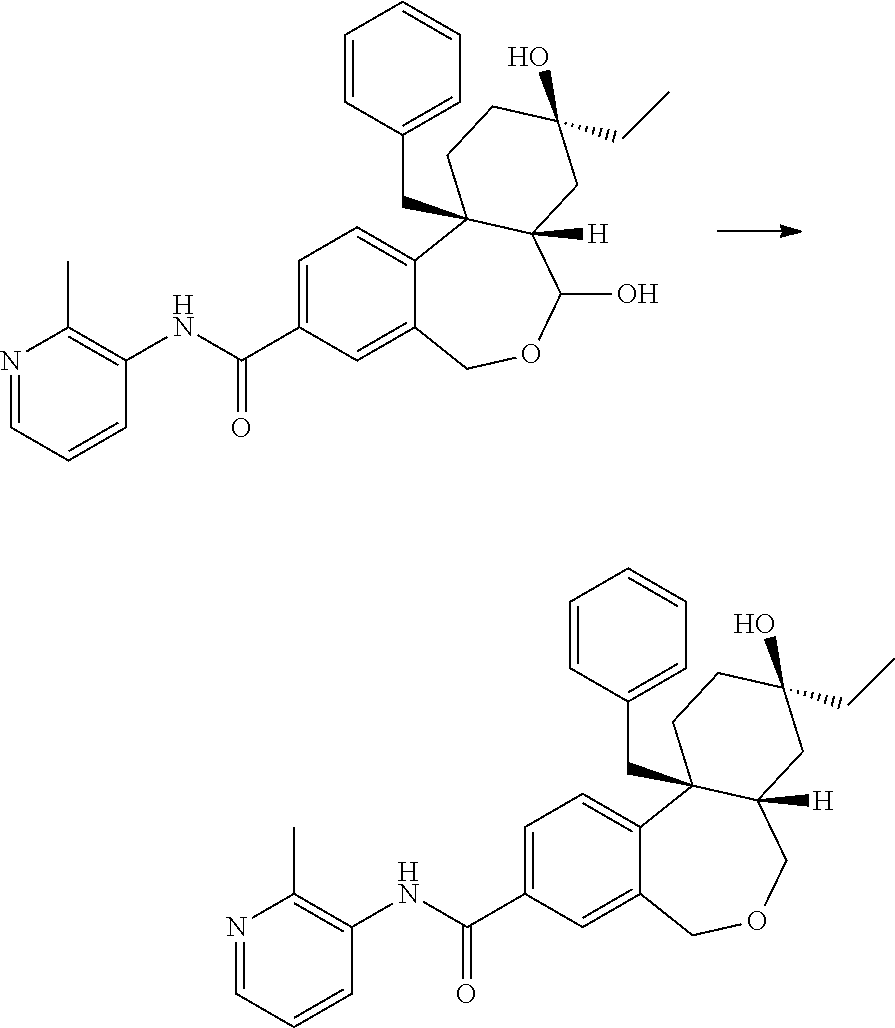
- Trifluoroacetic acid (0.030 mL, 0.389 mmol) was added to a solution of (7aS,9R,11aS)-11a-benzyl-9-ethyl-7,9-dihydroxy-N-(2-methylpyridin-3-yl)-5,7,7a,8,9,10,11,11a-octahydrodibenzo[c,e]oxepine-3-carboxamide (108, R2=Benzyl, R3=Ethyl, R6=2-Methylpyridin-3-yl) (0.040 g, 0.082 mmol) and DCM (0.800 mL) under a nitrogen atmosphere at about 0° C. Triethylsilane (0.050 mL, 0.31 mmol) was added dropwise. The ice bath was removed and the solution was left to stir at rt. After about 20 h, DCM (0.800 mL) and triethylsilane (0.050 mL, 0.31 mmol) were added. After about 3 h, triethylsilane (0.050 mL, 0.31 mmol) was added. After about 2 h, the solution was poured into saturated aqueous NaHCO3 (5 mL) and then extracted with DCM (4×5 mL). The combined organics were dried over Na2SO4, filtered, and concentrated under reduced pressure. The residue was purified on silica gel (12 g) using a gradient of 1-10% MeOH in DCM. The fractions containing product were combined and concentrated under reduced pressure. The residue was dissolved in MeCN and then water (4 mL) was added. The organic volatiles were removed under reduced pressure. The aqueous mixture was lyophilized to afford (7aS,9R,11aS)-11a-benzyl-9-ethyl-9-hydroxy-N-(2-methylpyridin-3-yl)-5,7,7a,8,9,10,11,11a-octahydrodibenzo[c,e]oxepine-3-carboxamide (110, R2=Benzyl, R3=Ethyl, R6=2-Methylpyridin-3-yl) (0.0172 g, 45%) as a white powder. LC/MS, method 2, Rt=1.94 min, MS m/z 472 (M+H)+. 1H NMR (400 MHz, DMSO-d6) δ 9.99 (s, 1H), 8.34 (dd, J=4.7, 1.5 Hz, 1H), 7.85 (d, J=1.9 Hz, 1H), 7.74 (dd, J=8.0, 1.4 Hz, 1H), 7.69-7.64 (m, 1H), 7.27 (dd, J=7.9, 4.8 Hz, 1H), 7.14-7.08 (m, 3H), 6.87 (d, J=8.5 Hz, 1H), 6.67-6.61 (m, 2H), 5.09 (d, J=14.3 Hz, 1H), 4.82 (d, J=14.6 Hz, 1H), 4.49 (d, J=12.2 Hz, 1H), 3.91 (s, 1H), 3.77 (dd, J=10.7, 2.2 Hz, 1H), 3.49 (d, J=13.0 Hz, 1H), 2.75 (d, J=13.1 Hz, 1H), 2.45 (s, 3H), 2.22-2.13 (m, 1H), 2.01-1.91 (m, 1H), 1.87-1.75 (m, 1H), 1.46-1.37 (m, 1H), 1.36-1.10 (m, 5H), 0.70 (t, J=7.4 Hz, 3H).
-

- Manganese dioxide (88 mg, 1.0 mmol) was added to a solution containing 44(1S,2S,4R)-1-benzyl-4-ethyl-4-hydroxy-2-(hydroxymethyl)cyclohexyl)-3-(hydroxymethyl)-N-(2-methylpyridin-3-yl)benzamide (109, R2=Benzyl, R3=Ethyl, R6=2-Methylpyridin-3-yl) (25 mg, 0.051 mmol), DCM (4 mL) and THF (0.4 mL). The reaction was stirred at rt for about 18 h. The reaction was filtered through Celite® and washed with 10% MeOH in DCM (20 mL). The filtrate was concentrated under reduced pressure. The residue was purified on silica gel (4 g) using a gradient of 10-95% EtOAc in DCM. The fractions containing product were collected, combined and concentrated under reduced pressure to give an oil (24 mg) which was lyophilized to yield (7aS,9R,11aS)-11a-benzyl-9-ethyl-9-hydroxy-N-(2-methylpyridin-3-yl)-5-oxo-5,7,7a,8,9,10,11,11a-octahydrodibenzo[c,e]oxepine-3-carboxamide (111, R2=Benzyl, R3=Ethyl, R6=2-Methylpyridin-3-yl) (15 mg, 60%) as a solid. LC/MS, method 2, Rt=1.90 min, MS m/z 485 (M+H)+. 1H NMR (400 MHz, DMSO-d6) δ 10.26 (s, 1H), 8.40-8.31 (m, 2H), 8.09-8.04 (m 1H), 7.78-7.73 (m, 1H), 7.34-7.26 (m, 2H), 7.12-7.02 (m, 3H), 6.74-6.66 (m, 2H), 4.41-4.31 (m, 1H), 4.11 (s, 1H), 3.71 (dd, J=12.2, 12.2 Hz, 1H), 3.37 (d, J=13.7 Hz, 1H), 2.82-2.72 (m, 2H), 2.45 (s, 3H), 2.15-2.05 (m, 1H), 1.92-1.82 (m, 1H), 1.62-1.40 (m, 2H), 1.36-1.20 (m, 3H), 0.79 (t, J=7.3 Hz, 3H), 0.52-0.41 (m 1H).
-

-
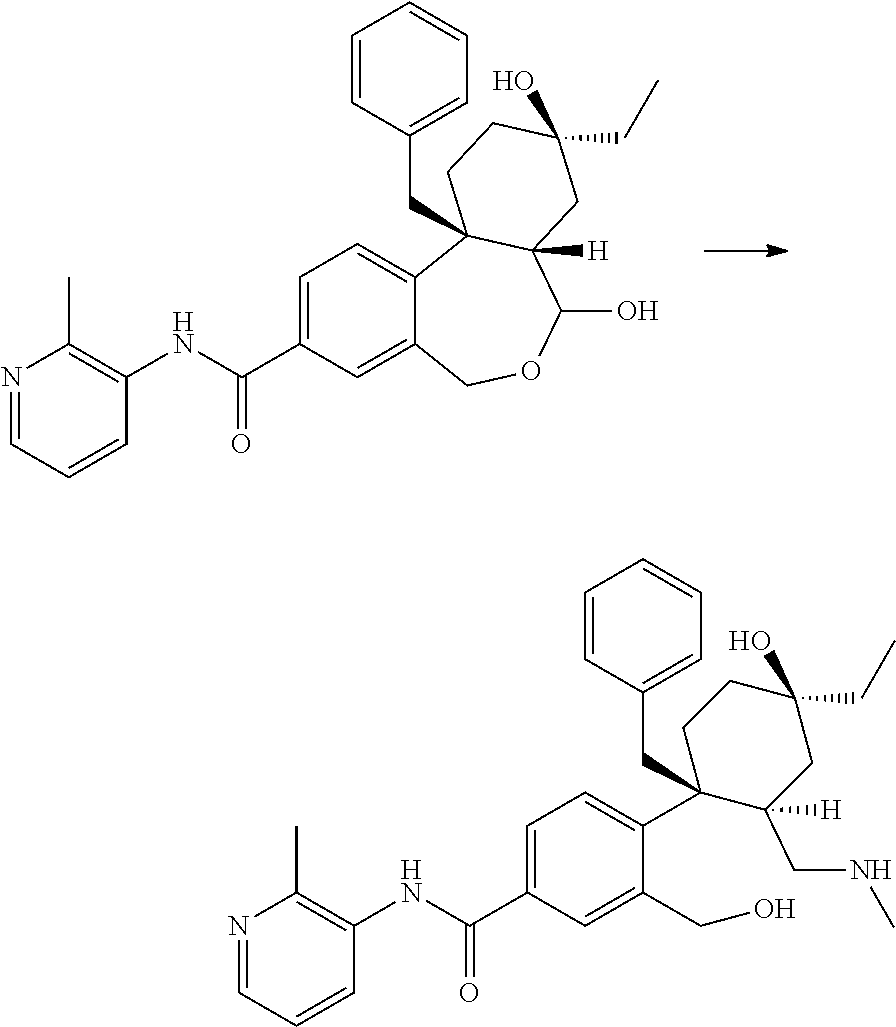
- Methylamine hydrochloride (0.620 g, 9.18 mmol) and sodium cyanoborohydride (0.100 g, 1.59 mmol) were added respectively, each in one portion, to a solution of (7aS,9R,11aS)-11a-benzyl-9-ethyl-7,9-dihydroxy-N-(2-methylpyridin-3-yl)-5,7,7a,8,9,10,11,11a-octahydrodibenzo[c,e]oxepine-3-carboxamide (108, R2=Benzyl, R3=Ethyl, R6=2-Methylpyridin-3-yl) (0.152 g, 0.306 mmol), EtOH (2.50 mL), and AcOH (0.500 mL). The system was sealed and the reaction vessel was warmed to about 90° C. After about 3 days, the mixture was allowed to cool to rt. Sodium cyanoborohydride (0.100 g, 1.59 mmol) and methylamine hydrochloride (0.310 g, 4.59 mmol) were added. The reaction vessel was sealed and the mixture was warmed to about 90° C. After about 4 days, the mixture was allowed to cool to rt. Water (4 mL), saturated aqueous NH4Cl (1 mL), and DCM (10 mL) were added. The mixture was left to vigorously stir for about 3 h. The aqueous layer was made basic with saturated aqueous NaHCO3. The layers were separated and the aqueous phase was extracted with DCM (4×10 mL). The combined organics were dried over Na2SO4, filtered, and concentrated under reduced pressure. The residue was purified on silica gel (12 g) using a gradient of 10-100% ((2% NH4OH) in 20% MeOH in DCM) in DCM then hold at (2% NH4OH) in 20% MeOH in DCM. The fractions containing product were combined and concentrated under reduced pressure to afford 4-((1S,2R,4R)-1-benzyl-4-ethyl-4-hydroxy-2-((methylamino)methyl)cyclohexyl)-3-(hydroxymethyl)-N-(2-methylpyridin-3-yObenzamide (112, R2=Benzyl, R3=Ethyl, R6=2-Methylpyridin-3-yl) (0.0405, 26%) as a white solid. LC/MS, method 3, Rt=1.55 min, MS m/z 503 (M+H)+. 1H NMR (400 MHz, DMSO-d6) δ 9.96 (s, 1H), 8.33 (dd, J=4.8, 1.6 Hz, 1H), 8.22 (d, J=2.2 Hz, 1H), 7.73 (dd, J=7.9, 1.6 Hz, 1H), 7.59-7.52 (m, 1H), 7.27 (dd, J=8.0, 4.8 Hz, 1H), 7.06-6.95 (m, 3H), 6.93-6.79 (m, 1H), 6.67-6.59 (m, 2H), 5.46-5.37 (m, 1H), 4.99-4.88 (m, 1H), 4.85-4.74 (m, 1H), 3.30-3.22 (m, 1H), 3.19-3.06 (m, 1H), 2.90-2.72 (m, 3H), 2.43 (s, 3H), 2.35 (s, 3H), 2.17-2.05 (m, 1H), 1.98-1.86 (m, 1H), 1.67-1.58 (m, 1H), 1.51-1.42 (m, 1H), 1.39-1.25 (m, 1H), 1.17-1.06 (m, 2H), 1.00-0.89 (m, 1H), 0.70 (t, J=7.4 Hz, 3H).
-

- TPAP (0.0030 g, 0.0085 mmol) was added in one portion to a mixture of 4-((1S,2S,4R)-1-benzyl-4-ethyl-4-hydroxy-2-((methylamino)methyl)cyclohexyl)-3-(hydroxymethyl)-N-(2-methylpyridin-3-yl)benzamide (112, R2=Benzyl, R3=Ethyl, R6=2-Methylpyridin-3-yl) (0.040 g, 0.077 mmol), crushed 4 Å molecular sieves (0.120 g), and DCM (1.50 mL) under a nitrogen atmosphere. NMO (0.054 g, 0.464 mmol) was added in one portion. After about 15 h, the mixture was filtered through Celite® rinsing with DCM (3×5 mL). The organics were concentrated to about 1 mL under reduced pressure. The solution was purified on silica gel (12 g) using a gradient of 2-10% MeOH in DCM. The fractions containing product were combined and concentrated under reduced pressure. The residue was dissolved in MeCN and water (1 mL) was added. The organic volatiles were removed under reduced pressure. The mixture was lyophilized to afford (3R,4aR,11bS)-11b-benzyl-3-ethyl-3-hydroxy-6-methyl-N-(2-methylpyridin-3-yl)-7-oxo-2,3,4,4a,5,6,7,11b-octahydro-1H-dibenzo[c,e]azepine-9-carboxamide (113, R2=Benzyl, R3=Ethyl, R6=2-Methylpyridin-3-yl) (0.0096 g, 25%) as a fluffy white solid. LC/MS, method 2, Rt=1.72 min, MS m/z 499 (M+H)+. 1H NMR (400 MHz, DMSO-d6) δ 10.16 (s, 1H), 8.34 (dd, J=4.8, 1.6 Hz, 1H), 8.23 (d, J=2.1 Hz, 1H), 7.91 (dd, J=8.2, 2.1 Hz, 1H), 7.74 (dd, J=8.0, 1.5 Hz, 1H), 7.28 (dd, J=8.0, 4.7 Hz, 1H), 7.08 (d, J=8.4 Hz, 1H), 7.04-6.96 (m, 3H), 6.73-6.66 (m, 2H), 4.38 (s, 1H), 3.68 (dd, J=15.6, 7.8 Hz, 1H), 3.49 (d, J=13.9 Hz, 1H), 3.14 (s, 3H), 3.00 (d, J=15.3 Hz, 1H), 2.91 (d, J=14.0 Hz, 1H), 2.44 (s, 3H), 2.32-2.21 (m, 1H), 2.16-2.04 (m, 1H), 1.92-1.82 (m, 1H), 1.77-1.40 (m, 6H), 0.84 (t, J=7.3 Hz, 3H).
-
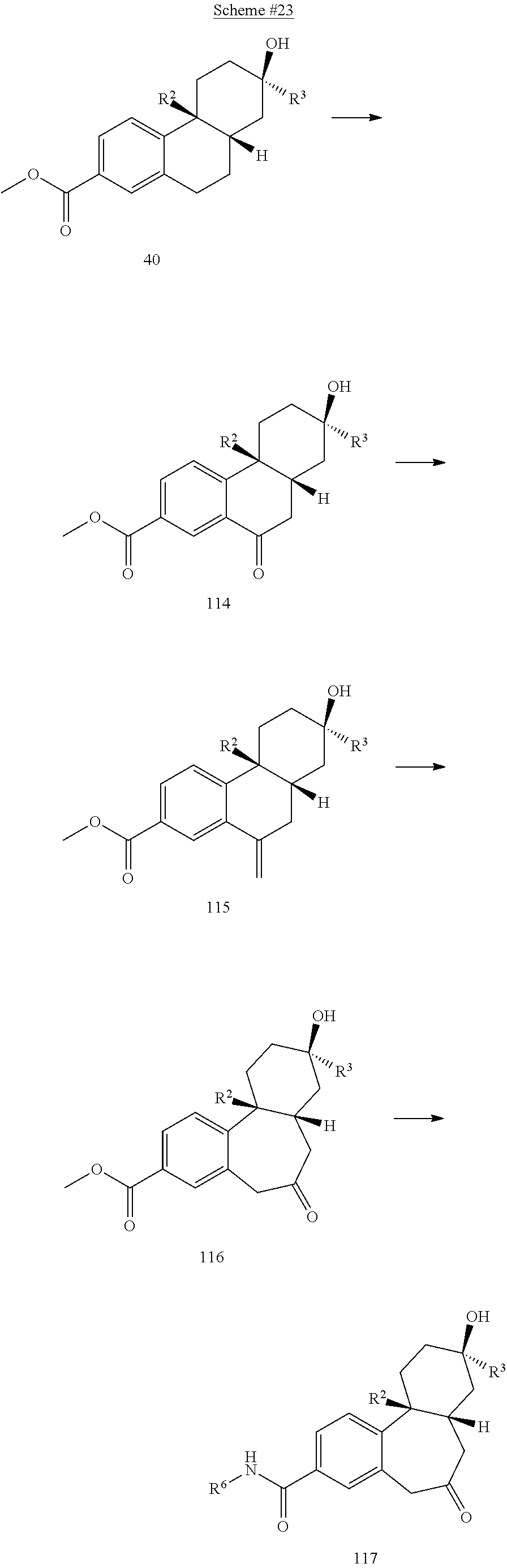
-

- To a solution of (4bS,7R,8aS)-methyl 4b-benzyl-7-ethyl-7-hydroxy-4b,5,6,7,8,8a,9,10-octahydrophenanthrene-2-carboxylate (40, R2=Benzyl, R3=Ethyl) (6.60 g, 16.4 mmol) and DCM (150 mL) under air was added copper(II) sulfate pentahydrate (17.4 g, 69.5 mmol) and potassium permanganate (10.4 g, 65.6 mmol) respectively, each in one portion. Water (18 mL) and pyridine (5.7 mL, 71 mmol) were added sequentially. The mixture was vigorously stirred under air for about 40 h, then Na2SO4 (70 g) was added. The mixture was stirred for about 30 min and then filtered through Celite®, rinsing with DCM (10×30 mL). The filtrate was concentrated under reduced pressure. The residue was mixed in EtOAc (400 mL) and water (200 mL) for about 5 min then filtered through Celite® rinsing with EtOAc (100 mL). The layers were separated and the organic layer was washed with water (4×70 mL), 0.1 M aqueous EDTA tetrasodium salt solution (2×120 mL) and water (2×50 mL). The organic layer was dried over MgSO4, filtered, and concentrated under reduced pressure. The residue was purified on silica gel (220 g) using a gradient of 0-20% EtOAc in DCM. The fractions containing product were collected, combined and concentrated under reduced pressure. The residue was purified again on silica gel (220 g) using a gradient of 0-8% EtOAc in DCM. The fractions containing product were collected, combined and concentrated to give a light yellow foam. The foam was dissolved in DCM (120 mL) and washed with 0.1 M EDTA (2×50 mL) then with water (50 mL). The aqueous layer was extracted with DCM (100 mL). The organic layer was dried over Na2SO4, filtered and concentrated to afford (4bS,7R,8aR)-methyl 4b-benzyl-7-ethyl-7-hydroxy-10-oxo-4b,5,6,7,8,8a,9,10-octahydrophenanthrene-2-carboxylate (114, R2=Benzyl, R3=Ethyl) (4.00 g, 62%) as white foam. LC/MS, method 3, Rt=2.33 min, MS m/z 393 (M+H)+. 1H NMR (600 MHz, DMSO-d6) δ 8.50 (d, J=2.0 Hz, 1H), 8.03 (dd, J=8.2, 2.0 Hz, 1H), 7.25-7.17 (m, 4H), 6.95-6.89 (m, 2H), 3.88 (s, 3H), 3.84 (s, 1H), 3.47 (dd, J=17.9, 5.3 Hz, 1H), 3.00 (d, J=13.3 Hz, 1H), 2.93 (d, J=13.2 Hz, 1H), 2.50-2.43 (m, 1H), 2.29 (dd, J=18.0, 1.6 Hz, 1H), 2.10-2.04 (m, 1H), 1.99-1.92 (m, 1H), 1.45-1.38 (m, 1H), 1.38-1.32 (m, 1H), 1.10-1.04 (m, 2H), 0.94-0.87 (m, 1H), 0.87-0.80 (m, 1H), 0.63 (t, J=7.5 Hz, 3H).
-

- To a suspension of potassium tert-butoxide (672 mg, 5.99 mmol) in Et2O (20 mL) was added methyltriphenylphosphonium bromide (2.27 g, 6.35 mmol). The reaction was vigorously stirred for about 20 min at rt. A solution of (4bS,7R,8aR)-methyl 4b-benzyl-7-ethyl-7-hydroxy-10-oxo-4b,5,6,7,8,8a,9,10-octahydrophenanthrene-2-carboxylate (114, R2=Benzyl, R3=Ethyl) (500 mg, 1.20 mmol) in Et2O (20 mL) was added dropwise via syringe and the reaction was stirred at rt for about 4 h, then quenched with aqueous NH4Cl (75 mL) and water (25 mL) and the mixture was extracted with EtOAc (150 mL). The organic layer was concentrated under reduced pressure. The crude material was purified on silica gel (120 g) using a gradient of 0-7% EtOAc in DCM. The fractions containing product were combined and concentrated to give (4bS,7R,8aS)-methyl 4b-benzyl-7-ethyl-7-hydroxy-10-methylene-4b,5,6,7,8,8a,9,10-octahydrophenanthrene-2-carboxylate (115, R2=Benzyl, R3=Ethyl) (310 mg, 66%) as white foam. LC/MS, method 3, Rt=2.70 min, No parent ion. 1H NMR (400 MHz, DMSO-d6) δ 8.31 (d, J=1.9 Hz, 1H), 7.73-7.68 (m, 1H), 7.25-7.15 (m, 3H), 7.09 (d, J=8.3 Hz, 1H), 6.93-6.88 (m, 2H), 5.74 (s, 1H), 5.12 (s, 1H), 3.86 (s, 3H), 3.74 (s, 1H), 3.32-3.20 (m, 1H), 2.83 (d, J=13.1 Hz, 1H), 2.73 (d, J=12.9 Hz, 1H), 2.25-2.15 (m, 2H), 2.04-1.83 (m, 2H), 1.34-1.22 (m, 2H), 1.12-1.02 (m, 2H), 0.93-0.75 (m, 2H), 0.63 (t, J=7.3 Hz, 3H).
-

- (4bS,7R,8aS)-Methyl 4b-benzyl-7-ethyl-7-hydroxy-10-methylene-4b,5,6,7,8,8 a,9,10-octahydrophenanthrene-2-carboxylate (115, R2=Benzyl, R3=Ethyl) (200 mg, 0.512 mmol) was dissolved in MeOH (19 mL) and water (0.2 mL). [hydroxy(tosyloxy)iodo]benzene (201 mg, 0.512 mmol) was added in one portion. The reaction was mixed at rt for about 18 h. The reaction was diluted with DCM (200 mL) and washed with saturated aqueous NaCl (2×20 mL). The organic layer was dried over Na2SO4, filtered and concentrated under reduced pressure. The crude material was purified on silica gel (40 g) using a gradient of 0-25% EtOAc in DCM. The fractions containing product were combined and concentrated under reduced pressure to give (7aR,9R,11aS)-11a-benzyl-9-ethyl-9-hydroxy-6-oxo-6,7,7a,8,9,10,11,11a-octahydro-5H-dibenzo[a,c]cycloheptene-3-carboxylic acid methyl ester (116, R2=Benzyl, R3=Ethyl) (60 mg, 29%) as colorless oil. LC/MS, method 3, Rt=2.26 min, MS m/z 405 (M−H)−. 1H NMR (600 MHz, DMSO-d6) δ 7.79 (s, 1H), 7.58 (d, J=8.4 Hz, 1H), 7.13-7.04 (m, 3H), 6.92 (d, J=8.5 Hz, 1H), 6.66-6.61 (m, 2H), 4.66 (d, J=13.1 Hz, 1H), 3.98 (s, 1H), 3.83 (s, 3H), 3.71 (d, J=13.2 Hz, 1H), 3.69-3.61 (m, 1H), 3.58 (d, J=13.1 Hz, 1H), 2.79 (d, J=13.1 Hz, 1H), 2.67-2.59 (m, 1H), 2.18-2.12 (m, 1H), 2.03-1.96 (m, 1H), 1.91-1.83 (m, 1H), 1.45-1.00 (m, 5H), 0.72-0.64 (m, 1H), 0.64 (t, J=7.5 Hz, 3H).
-

- LiHMDS (1 M solution in THF, 0.300 mL, 0.300 mmol) was added dropwise to a solution of (7aR,9R,11aS)-11a-benzyl-9-ethyl-9-hydroxy-6-oxo-6,7,7a,8,9,10,11,11a-octahydro-5H-dibenzo[a,c]cycloheptene-3-carboxylic acid methyl ester (116, R2=Benzyl, R3=Ethyl) (0.023 g, 0.058 mmol) in toluene (0.5 mL) under a nitrogen atmosphere at about 0° C. for about 5 min. 2-Methylpyridin-3-amine (0.0080 g, 0.074 mmol) was added and the reaction was stirred for about 15 min at about 0° C. The ice bath was removed and the brown mixture was left to stir for about 3 h. Water (10 mL) and EtOAc (10 mL) were added. The layers were separated and the organic layer was washed with water (5 mL) and then saturated aqueous NaCl (5 mL), dried over Na2SO4, filtered, and concentrated under reduced pressure. The crude material was purified on silica gel (12 g) using a gradient from 50-100% EtOAc in DCM. The fractions containing product were combined and concentrated under reduced pressure. The residue was purified by HPLC: The gradient was 10% B for 2.5 min then 10-15% B in 1.0 min then 15-70% B in 9 min then 70-95% in 0.3 min then 95% for 0.7 min (22.5 mL/min flow rate). Mobile phase A: 50 mM NH4OAc in water, mobile phase B was HPLC grade MeCN. The column used for chromatography is 19×50 mm Waters Atlantis T3 OBD C18 column (5.0 μm particles). Detection methods are photodiode array (DAD) and Waters ZQ 2000 mass spectrometer. The organic volatiles were removed under reduced pressure. The mixture was frozen then lyophilized to provide a white solid. The material was slurried in water (5 mL) and then lyophilized to yield (7aR,9R,11aS)-11a-benzyl-9-ethyl-9-hydroxy-6-oxo-6,7,7a,8,9,10,11,11a-octahydro-5H-dibenzo[a,c]cycloheptene-3-carboxylic acid (2-methyl-pyridin-3-yl)-amide (117, R2=Benzyl, R3=Ethyl, R6=2-Methylpyridin-3-yl) (0.0066 g, 24%) as a white solid. LC/MS, method 2, Rt=1.87 min, MS m/z 483 (M+H)+. 1H NMR (400 MHz, DMSO-d6) δ 10.01 (s, 1H), 8.36-8.30 (m, 1H), 7.82 (s, 1H), 7.72 (d, J=8.0 Hz, 1H), 7.62 (d, J=8.4 Hz, 1H), 7.26 (dd, J=8.0, 4.8 Hz, 1H), 7.15-7.06 (m, 3H), 6.94 (d, J=8.5 Hz, 1H), 6.74-6.66 (m, 2H), 4.70 (d, J=13.0 Hz, 1H), 3.98 (s, 1H), 3.74-3.62 (m, 2H), 3.60-3.51 (m, 1H), 2.81 (d, J=13.4 Hz, 1H), 2.68-2.56 (m, 1H), 2.43 (s, 3H), 2.19-2.12 (m, 1H), 2.06-1.97 (m, 1H), 1.93-1.80 (m, 1H), 1.48-1.38 (m, 1H), 1.32-1.21 (m, 2H), 1.13-1.03 (m, 2H), 0.76-0.69 (m, 1H), 0.65 (t, J=7.4 Hz, 3H).
-


-

- A solution of (S)-methyl 4b-benzyl-7-oxo-4b,5,6,7,9,10-hexahydrophenanthrene-2-carboxylate (93, R2=Benzyl) (28 g, 81 mmol), trichloroacetic acid (8.1 mL, 81 mmol), (2R,5R)-5-benzyl-3-methyl-2-(5-methylfuran-2-yl)imidazolidin-4-one (37.0 g, 24.3 mmol, 17.7 wt % in toluene) and toluene (78 mL) was stirred for about 1 h at rt. The reaction was then charged with diethyl 1,4-dihydro-2,6-dimethyl-3,5-pyridinedicarboxylate (24.6 g, 97 mmol) in one portion. The mixture was stirred for about 4 days. The reaction mixture was extracted with 4 N aqueous HCl (5×300 mL). The organic layer was dried over Na2SO4, filtered and silica gel (60 g) was added. The solvents were removed under reduced pressure and the resulting solid was purified on silica gel (330 g) in two portions using a gradient of 0-30% EtOAc in heptane. The fractions containing product were combined and concentrated undser reduced pressure. The residue was dissolved in DCM (50 mL) and purified on silica gel (330 g) in three portions using a gradient of 0-26% EtOAc in DCM. The fractions containing product were combined and concentrated under reduced pressure to give (4bS,8aR)-methyl 4b-benzyl-7-oxo-4b,5,6,7,8,8a,9,10-octahydrophenanthrene-2-carboxylate (118, R2=Benzyl) (25 g, 89%) as an oil. LC/MS, method 3, Rt=2.70 min, no parent ion. 1H NMR (400 MHz, DMSO-d6) δ 7.73-7.71 (m, 1H), 7.42-7.37 (m, 1H), 7.17-7.08 (m, 3H), 6.62 (dd, J=7.7, 1.6 Hz, 2H), 6.47 (d, J=8.3 Hz, 1H), 3.82 (s, 3H), 3.33 (d, J=10.3 Hz, 1H), 3.14-2.91 (m, 3H), 2.84-2.64 (m, 2H), 2.47-2.37 (m, 1H), 2.37-2.26 (m, 1H), 2.26-2.16 (m, 1H), 2.16-2.02 (m, 1H), 2.02-1.87 (m, 1H), 1.76-1.65 (m, 1H), 1.60-1.47 (m, 1H).
-

- To a solution of (4bS,8aR)-methyl 4b-benzyl-7-oxo-4b,5,6,7,8,8a,9,10-octahydrophenanthrene-2-carboxylate (118, R2=Benzyl) (11.0 g, 31.6 mmol) and THF (150 mL) under N2 at about 0° C. was added trimethyl(trifluoromethyl)silane (9.33 mL, 63.1 mmol) in THF (20 mL) in one portion. Tetrabutylammonium fluoride (1.0 M in THF) (3.16 mL, 3.16 mmol) in THF (50 mL) was added dropwise via syringe over about 90 min. The solution was stirred at about 0° C. for about 80 min. The volatiles were removed under reduced pressure. The residue was purified on silica gel (330 g) using a gradient of 0-30% EtOAc in heptane. The fractions containing product were combined and concentrated. The residue was redissolved in THF (160 mL) to give a colorless solution. The reaction was cooled to 0° C. and a solution of tetrabutylammonium fluoride(1M in THF) (27.1 mL, 27.1 mmol) in THF (80 mL) was added dropwise via dropping funnel over about 60 min and the reaction stirred for about 2 h. The reaction mixture was partitioned between EtOAc (500 mL) and saturated aqueous NaCl (100 mL). The organic layer was dried over MgSO4, filtered and concentrated under reduced pressure. The resulting mixture was purified on silica gel (330 g) using a gradient of 0-14% EtOAc in heptane. The fractions containing product were combined and concentrated under reduced pressure to yield (4bS,7R,8aR)-methyl 4b-benzyl-7-hydroxy-7-(trifluoromethyl)-4b,5,6,7,8,8a,9,10-octahydrophenanthrene-2-carboxylate (119, R2=Benzyl, R3=Trifluoromethyl) (9.0 g, 68%) as white solid. LC/MS, method 3, Rt=2.64 min, MS m/z 419 (M+H)+. 1H NMR (400 MHz, DMSO-d6) δ 7.72 (d, J=1.7 Hz, 1H), 7.39 (dd, J=8.2, 1.9 Hz, 1H), 7.15-7.07 (m, 3H), 6.58-6.49 (m, 2H), 6.41 (d, J=8.3 Hz, 1H), 5.99 (s, 1H), 3.82 (s, 3H), 3.16-2.94 (m, 3H), 2.65 (d, J=13.1 Hz, 1H), 2.22-1.97 (m, 4H), 1.95-1.66 (m, 4H), 1.38-1.23 (m, 1H).
-

- In a 500 mL round bottom flask, (4bS,7R,8aR)-methyl 4b-benzyl-7-hydroxy-7-(trifluoromethyl)-4b,5,6,7,8,8a,9,10-octahydrophenanthrene-2-carboxylate (119, R2=Benzyl, R3=Trifluoromethyl) (3.7 g, 8.84 mmol) in DCM (180 mL) and MeOH (20 mL) was cooled to about −65° C. Oxygen was bubbled through the solution (˜0.5-1 SLPM) through an L11 Ozone Gas Generator. The reaction was under ozone on and off for about 24 h. The solution was purged with oxygen for about 30 min to afford a colorless solution. Triphenylphospine (polymer bound, ˜3 mmol/g) (8.8 g, 26 mmol) was added, the cold bath was allowed to warm to rt and the reaction mixture was left to vigorously stir for about 18 h. The reaction was filtered through Celite® and washed with 10% MeOH in DCM (200 mL). The filtrate was concentrated under reduced pressure. The crude material was purified on silica gel (330 g) using a gradient of 0-11% EtOAc in DCM. The fractions containing product were combined, concentrated under reduced pressure to yield (4bS,7R,8aS)-methyl 4b-benzyl-7-hydroxy-10-oxo-7-(trifluoromethyl)-4b,5,6,7,8,8a,9,10-octahydrophenanthrene-2-carboxylate (120, R2=Benzyl, R3=Trifluoromethyl) (2.68 g, 70%) as a white solid. LC/MS, method 3, Rt=2.33 min, MS m/z 433 (M+H)+, 1H NMR (400 MHz, DMSO-d6) δ 8.49-8.45 (m, 1H), 7.87-7.80 (m, 1H), 7.17-7.02 (m, 3H), 6.69-6.63 (m, 1H), 6.51-6.44 (m, 2H), 6.11 (bs, 1H), 3.87 (s, 3H), 3.32-3.20 (m, 2H), 2.92-2.78 (m, 1H), 2.76-2.58 (m, 2H), 2.32-2.04 (m, 4H), 2.02-1.88 (m, 1H), 1.56-1.36 (m, 1H).
-

- In a 200 mL round bottom flask, (4bS,7R,8aS)-methyl 4b-benzyl-7-hydroxy-10-oxo-7-(trifluoromethyl)-4b,5,6,7,8,8a,9,10-octahydrophenanthrene-2-carboxylate (120, R2=Benzyl, R3=Trifluoromethyl) (2.60 g, 6.01 mmol) was dissolved in MeOH (25 mL) and DCM (25 mL). The solution was cooled with a water bath to about 15° C. Sodium borohydride (0.227 g, 6.01 mmol) was added portionwise to the solution over about 20 min. The reaction was mixed at rt for about 2 h then quenched with 1 N aqueous HCl to about pH 5. The reaction mixture was mixed for about 1 h and then extracted with DCM (4×40 mL). The organic layer was dried over Na2SO4, filtered and concentrated under reduced pressure. The crude material was purified on silica gel (80 g) using a gradient of 0-40% EtOAc in DCM. The fractions containing product were combined and concentrated under reduced pressure to yield (4bS,7R,8aR)-methyl 4b-benzyl-7,10-dihydroxy-7-(trifluoromethyl)-4b,5,6,7,8,8a,9,10-octahydrophenanthrene-2-carboxylate (121, R2=Benzyl, R3=Trifluoromethyl) (2.55 g, 98%) as a white foam. LC/MS, method 3, Rt=2.20 min, MS m/z 493 (M+OAc)−. 1H NMR (400 MHz, DMSO-d6) δ 8.13-8.11 (m, 1H), 7.39 (dd, J=8.2, 1.6 Hz, 1H), 7.17-7.07 (m, 3H), 6.61-6.54 (m, 2H), 6.25 (d, J=8.3 Hz, 1H), 5.99 (s, 1H), 5.57-5.51 (m, 1H), 4.85-4.71 (m, 1H), 3.83 (s, 3H), 3.17 (d, J=13.1 Hz, 1H), 2.80 (d, J=13.3 Hz, 1H), 2.24-2.08 (m, 2H), 2.06-1.80 (m, 5H), 1.36-1.22 (m, 1H).
-

- In a 50 mL round bottom flask, (4bS,7R,8aR)-methyl 4b-benzyl-7,10-dihydroxy-7-(trifluoromethyl)-4b,5,6,7,8,8a,9,10-octahydrophenanthrene-2-carboxylate (121, R2=Benzyl, R3=Trifluoromethyl) (0.250 g, 0.575 mmol) was dissolved in toluene (20 mL). 4 Å molecular sieves (0.6 g) and 4-methylbenzenesulfonic acid hydrate (11 mg, 0.058 mmol) were added and the reaction was mixed at rt for about 10 min and then at about 60° C. for about 4 h. The reaction mixture was filtered into saturated aqueous NaHCO3 (30 mL), rinsing with EtOAc (100 mL). The layers were separated and the organics were washed with saturated aqueous NaCl (20 mL). The aqueous phases were back extracted with EtOAc (30 mL). The combined organics were dried over MgSO4, filtered, and concentrated under reduced pressure. The crude material was purified on silica gel (80 g) using a gradient of 20-60% EtOAc in DCM. The fractions containing product were combined and concentrated to yield (4bS,7R,8aS)-methyl 4b-benzyl-7-hydroxy-7-(trifluoromethyl)-4b,5,6,7,8,8a-hexahydrophenanthrene-2-carboxylate (122, R2=Benzyl, R3=Trifluoromethyl) (0.127 g, 53%) as a white solid. LC/MS, method 3, Rt=2.59 min, MS m/z 475 (M+OAc)−. 1H NMR (600 MHz, DMSO-d6) δ 7.80-7.77 (m, 1H), 7.51-7.47 (m, 1H), 7.10-7.00 (m, 3H), 6.79 (dd, J=9.4, 2.9 Hz, 1H), 6.46 (d, J=8.1 Hz, 1H), 6.36 (d, J=7.2 Hz, 2H), 6.08 (s, 1H), 5.92-5.88 (m, 1H), 3.84 (s, 3H), 2.95 (d, J=13.3 Hz, 1H), 2.84 (d, J=13.2 Hz, 1H), 2.69-2.63 (m, 1H), 2.27-2.20 (m, 2H), 2.20-2.11 (m, 1H), 2.111-2.01 (m, 2H), 1.54-1.45 (m, 1H).
-

- Toluene (3.0 mL) and THF (3.0 mL) were added to (4bS,7R,8aS)-methyl 4b-benzyl-7-hydroxy-7-(trifluoromethyl)-4b,5,6,7,8,8a-hexahydrophenanthrene-2-carboxylate (122, R2=Benzyl, R3=Trifluoromethyl) (0.127 g, 0.305 mmol) and the solution was cooled to about 0° C., then 2-methylpyridin-3-amine (0.040 g, 0.366 mmol) was added in one portion. LiHMDS (1 M solution in THF, 0.92 mL, 0.92 mmol) was added dropwise and the reaction was stirred for about 30 min at about 0° C. The ice bath was removed and the reaction mixture was stirred at rt for about 60 min. Saturated aqueous NaHCO3 (10 mL) was added and the biphasic solution was extracted with EtOAc (2×25 mL). The combined organic layers were dried over Na2SO4, filtered, and concentrated under reduced pressure. The residue was purified on silica gel (12 g) using a gradient of 0-20% EtOAc in DCM. The fractions containing product were combined and concentrated under reduced pressure to yield (4bS,7R,8aS)-4b-benzyl-7-hydroxy-N-(2-methylpyridin-3-yl)-7-(trifluoromethyl)-4b,5,6,7,8,8a-hexahydrophenanthrene-2-carboxamide (123, R2=Benzyl, R3=Trifluoromethyl, R6=2-Methylpyridin-3-yl) (124 mg, 83%) as a solid. LC/MS, method 3, Rt=2.15 min, MS m/z 493 (M+H)+. 1H NMR (400 MHz, DMSO-d6) δ 9.97 (s, 1H), 8.36-8.32 (m, 1H), 7.85-7.79 (m, 1H), 7.78-7.72 (m, 1H), 7.59-7.51 (m, 1H), 7.32-7.23 (m, 1H), 7.15-7.01 (m, 3H), 6.84-6.74 (m, 1H), 6.53-6.46 (m, 1H), 6.46-6.37 (m, 2H), 6.11 (s, 1H), 5.96-5.88 (m, 1H), 2.98 (d, J=13.2 Hz, 1H), 2.88 (d, J=13.2 Hz 1H), 2.73-2.63 (m, 1H), 2.44 (s, 3H), 2.31-2.19 (m, 2H), 2.20-1.98 (m, 3H), 1.62-1.42 (m, 1H).
-

- DCM (9 mL) and MeOH (1 mL) were added to (4bS,7R,8aS)-4b-benzyl-7-hydroxy-N-(2-methylpyridin-3-yl)-7-(trifluoromethyl)-4b,5,6,7,8,8 a-hexahydrophenanthrene-2-carboxamide (123, R2=Benzyl, R3=Trifluoromethyl, R6=2-Methylpyridin-3-yl) (124 mg, 0.252 mmol) and the mixture was cooled to about −78° C. The mixture was treated with ozone for about 5 min to obtain a blue solution. The reaction was sealed and mixed for about 30 min and then the reaction was purged with O2 for about 30 min. Polymer supported triphenylphosphine (˜3 mmol/g, 0.50 g) was added and the reaction was mixed at about 0° C. for about 30 min, then at rt for about 1 h. The mixture was filtered and washed with 50% MeOH in DCM (10 mL). The filtrate was treated with sodium borohydride (29 mg, 0.76 mmol) and the reaction was mixed at rt for about 1 h. The volatiles were removed under reduced pressure and the residue was distributed between water (10 mL) and DCM (10 mL) and then treated with 1 N aqueous HCl (2 mL). The biphasic mixture was stirred for about 2 h, diluted with saturated aqueous NaCl (10 mL) and extracted with DCM (4×10 mL). The combined organic layers were washed with saturated aqueous NaCl (10 mL), dried over Na2SO4, filtered, and concentrated under reduced pressure. The residue was purified on silica gel (12 g) using a gradient of 2-15% MeOH in DCM. The fractions containing product were combined and concentrated under reduced pressure to yield 44(1S,2R,4R)-1-benzyl-4-hydroxy-2-(hydroxymethyl)-4-(trifluoromethyl)cyclohexyl)-3-(hydroxymethyl)-N-(2-methylpyridin-3-Abenzamide (124, R2=Benzyl, R3=Trifluoromethyl, R6=2-Methylpyridin-3-yl) (44 mg, 32%) as a solid. LC/MS, method 2, Rt=1.72 min, MS m/z 529 (M+H)+. 1H NMR (600 MHz, DMSO-d6) δ 9.97 (s, 1H), 8.33 (d, J=4.7 Hz, 1H), 8.23 (s, 1H), 7.74 (d, J=7.8 Hz, 1H), 7.56 (d, J=8.1 Hz, 1H), 7.27 (dd, J=7.8, 4.7 Hz, 1H), 7.06-6.97 (m, 3H), 6.85-6.77 (m, 1H), 6.60-6.56 (m, 2H), 5.77-5.73 (m, 1H), 5.43-5.37 (m, 1H), 5.04-4.78 (m, 3H), 4.12-4.05 (m, 1H), 4.01-3.94 (m, 1H), 3.41-3.34 (m, 1H), 2.96-2.87 (m, 2H), 2.44 (s, 3H), 2.13-2.00 (m 2H), 1.80-1.59 (m, 3H), 1.28-1.17 (m, 1H).
-

- DCM (4 mL) and THF (0.2 mL) were added to 4-((1S,2R,4R)-1-benzyl-4-hydroxy-2-(hydroxymethyl)-4-(trifluoromethyl)cyclohexyl)-3-(hydroxymethyl)-N-(2-methylpyridin-3-yl)benzamide (124, R2=Benzyl, R3=Trifluoromethyl, R6=2-Methylpyridin-3-yl (25 mg, 0.047 mmol). Manganese dioxide (82 mg, 0.95 mmol) was added and the reaction was mixed at rt for about 72 h. The reaction mixture was filtered through Celite® (500 mg), rinsing with 10% MeOH in DCM (5.0 mL). The filtrate was concentrated under reduced pressure and the residue was purified on silica gel (4 g) using a gradient of 10-90% EtOAc in DCM. The fractions containing product were combined and concentrated to yield (7aR,9R,11aS)-11a-benzyl-9-hydroxy-N-(2-methylpyridin-3-yl)-5-oxo-9-(trifluoromethyl)-5,7,7a,8,9,10,11,11a-octahydrodibenzo[c,e]oxepine-3-carboxamide (125, R2=Benzyl, R3=Trifluoromethyl, R6=2-Methylpyridin-3-yl) (18 mg, 71%) as a solid. LC/MS, method 2, Rt=1.93 min, MS m/z 525 (M+H)+. 1H NMR (400 MHz, DMSO-d6) δ 10.25 (s, 1H), 8.38-8.33 (m, 2H), 8.10-8.02 (m, 1H), 7.78-7.71 (m, 1H), 7.33-7.24 (m, 1H), 7.23-7.15 (m, 1H), 7.11-7.00 (m, 3H), 6.70-6.59 (m, 2H), 6.21 (s, 1H), 4.42 (dd, J=13.5, 7.0 Hz, 1H), 4.24-4.15 (m, 1H), 3.52 (d, J=14.4 Hz, 1H), 3.10 (d, J=14.7 Hz, 1H), 2.48-2.38 (m, 1H), 2.44 (s, 3H), 2.35-2.11 (m, 4H), 1.96-1.76 (m, 2H).
-

- Dichloroethane (1 mL) and pyridine (0.2 mL) were added to 4-((1S,2R,4R)-1-benzyl-4-hydroxy-2-(hydroxymethyl)-4-(trifluoromethyl)cyclohexyl)-3-(hydroxymethyl)-N-(2-methylpyridin-3-yl)benzamide (124, R2=Benzyl, R3=Trifluoromethyl, R6=2-Methylpyridin-3-yl) (28 mg, 0.050 mmol) at rt. A solution of p-toluenesulfonyl chloride (19 mg, 0.101 mmol) in dichloroethane (1 mL) was added dropwise via syringe and the reaction was stirred at rt for about 2 min. TEA (0.05 mL, 0.35 mmol) was added and the reaction was stirred at rt for about 90 min and then at about 50° C. for about 30 min. p-Toluenesulfonyl chloride (14 mg) in dichloroethane (1.0 mL) was added and the reaction was stirred at about 50° C. for about 30 min. p-Toluenesulfonyl chloride (8 mg, 0.042 mmol) dichloroethane (0.5 mL) was added and the reaction was stirred at about 60° C. for about 4 h. p-Toluenesulfonyl chloride (17 mg, 0.089 mmol) in dichloroethane (0.5 mL) and TEA (0.10 mL, 0.72 mmol) were added and the reaction was stirred at about 60° C. for about 3 h. The solvents were removed under reduced pressure and the residue was dissolved in DCM (20 mL) and washed with NaHCO3 (2×20 mL). The organic layer was dried over Na2SO4, filtered and concentrated under reduced pressure. The residue was purified on silica gel (4 g) using a gradient of 0-100% EtOAc in DCM. The fractions containing product were combined, concentrated under reduced pressure and lyophilized to yield (7aR,9R,11aS)-11a-benzyl-9-hydroxy-N-(2-methylpyridin-3-yl)-9-(trifluoromethyl)-5,7,7a,8,9,10,11,11a-octahydrodibenzo[c,e]oxepine-3-carboxamide (126, R2=Benzyl, R3=Trifluoromethyl, R6=2-Methylpyridin-3-yl) (7 mg, 25%) as a white solid. LC/MS, method 2, Rt=2.15 min, MS m/z 511 (M+H)+. 1H NMR (600 MHz, DMSO-d6) δ 10.12 (s, 1H), 8.43-8.37 (m, 1H), 8.29-8.26 (m, 1H), 7.94-7.86 (m, 1H), 7.69-7.66 (m, 1H), 7.43-7.34 (m, 1H), 7.09-7.00 (m, 4H), 6.72-6.66 (m, 2H), 5.45 (bs, 1H), 4.94 (d, J=13.1 Hz, 1H), 4.81 (d, J=13.1 Hz, 1H), 4.55-4.51 (m, 1H), 4.04 (dd, J=9.2, 4.8 Hz, 1H), 3.26 (d, J=13.2 Hz, 1H), 2.93 (d, J=13.2 Hz, 1H), 2.51-2.48 (m, 1H), 2.49 (s, 3H), 2.13-2.04 (m, 1H), 1.96-1.87 (m, 2H), 1.76-1.69 (m, 1H), 1.62-1.51 (m, 1H), 1.33-1.26 (m, 1H).
-

- DCM (9 mL) and MeOH (1 mL) were added to (4bS,7R,8aS)-4b-benzyl-7-hydroxy-N-(2-methylpyridin-3-yl)-7-(trifluoromethyl)-4b,5,6,7,8,8a-hexahydrophenanthrene-2-carboxamide (123, R2=Benzyl, R3=Trifluoromethyl, R6=2-Methylpyridin-3-yl) (0.11 g, 0.22 mmol) at rt. The mixture was cooled to about −78° C. The reaction was treated with a stream of Ozone for about 15 min and then the reaction was sealed and mixed for about 30 min. The reaction was purged with O2 for about 20 min. Polymer supported triphenylphosphine (˜3 mmol/g, 0.25 g) was added and mixture was stirred at rt for about 1 h. The reaction mixture was filtered through Celite® and washed with 50% MeOH in DCM (10 mL). The filtrate was concentrated under reduced pressure to a white solid and diluted with MeCN (6 mL) to give a white suspension. THF (0.5 mL) and 2 M methylamine in THF (0.34 mL, 0.69 mmol) was added and the reaction was stirred for about 10 min. Sodium cyanoborohydride (115 mg, 1.83 mmol) was added and the mixture was stirred for about 18 h. Sodium cyanoborohydride (60 mg, 0.955 mmol) was added to the reaction and the reaction mixture was stirred for about 18 h. Saturated aqueous NaHCO3 (10 mL) was added and the mixture was extracted with EtOAc (3×20 mL). The combined organics were washed with saturated aqueous NaCl, dried over MgSO4, filtered and concentrated under reduced pressure. The residue was purified on silica gel (12 g) using a gradient of 0-10% MeOH in DCM then 10% MeOH in DCM with 1% 7N NH3 in MeOH. The fractions containing product were combined and concentrated under reduced pressure. The residue was purified by chiral column using step-wise purification: Step 1: The gradient was 5-28% A in 13 min (20 mL/min flow rate). Mobile phase A was EtOH (200 proof), mobile phase B was HPLC grade heptane with 0.12% DEA added. The chromatography used a Viridis 2-ethylpyridine mm column (5 μm particles) from Waters Corporation. Product was the second eluting component (r.t. 11.9 min) in the 1st step of purification. Step 2: The gradient was 5-30% A in 14 min (20 mL/min flow rate). Mobile phase A was EtOH (200 proof), mobile phase B was HPLC grade heptane with 0.12% DEA added. The chromatography used a Daicel IB, 20×250 mm column (5 μm particles). The product was again the second eluting component (r.t. 12.9 min) The fractions containing product were combined, concentrated and lyophilized to give (3R,4aR,11bS)-11b-benzyl-3-hydroxy-6-methyl-N-(2-methylpyridin-3-yl)-3-(trifluoromethyl)-2,3,4,4a,5,6,7,11b-octahydro-1H-dibenzo[c,e]azepine-9-carboxamide (127, R2=Benzyl, R3=Trifluoromethyl, R6=2-Methylpyridin-3-y0 (2.5 mg, 2%). LC/MS, method 2, Rt=1.02 min, MS m/z 524 (M+H)+. 1H NMR (600 MHz, DMSO-d6) δ 9.95 (s, 1H), 8.33 (d, J=3.9 Hz, 1H), 7.80 (s, 1H), 7.73 (d, J=7.8 Hz, 1H), 7.59 (d, J=8.0 Hz, 1H), 7.27 (dd, J=8.0, 4.7 Hz, 1H), 7.12-7.04 (m, 3H), 6.86 (d, J=8.3 Hz, 1H), 6.60-6.55 (m, 2H), 5.99 (s, 1H), 4.39 (d, J=15.0 Hz, 1H), 3.87 (d, J=15.2 Hz, 1H), 3.54 (d, J=13.7 Hz, 1H), 3.11 (dd, J=12.0, 12.0 Hz, 1H), 3.00 (d, J=13.7 Hz, 1H), 2.64-2.59 (m, 1H), 2.43 (s, 3H), 2.30 (s, 3H), 2.25-2.16 (m, 1H), 2.06-1.88 (m, 3H), 1.85-1.79 (m, 1H), 1.73-1.62 (m, 2H).
-


-

- Methylmagnesium bromide (3.0 M solution in Et2O, 1.20 mL, 3.60 mmol) was added dropwise to a solution of (4bS,7R,8aS)-methyl 4b-benzyl-7-hydroxy-10-oxo-7-(trifluoromethyl)-4b,5,6,7,8,8a,9,10-octahydrophenanthrene-2-carboxylate (120, R2=Benzyl, R3=Trifluoromethyl) (0.247 g, 0.571 mmol) and THF (10 mL) under a nitrogen atmosphere at about −78° C. over about 15 min. The reaction vessel was allowed to warm to between about −20 to −25° C. over about 15 min and then maintained within that temperature range for about 45 min. The reaction mixture was cooled to about −40° C. and MeOH (0.2 mL) was added dropwise. The reaction vessel was removed from the cold bath and saturated aqueous NH4Cl (25 mL) and EtOAc (25 mL) were added. Water was added to dissolve the salts. The layers were separated and the aqueous phase was extracted with additional EtOAc (25 mL). The combined organics were dried over Na2SO4, filtered, and concentrated under reduced pressure. The residue was purified on silica gel (25 g) using a gradient of 0-75% EtOAc in heptane. The fractions containing product were combined and concentrated under reduced pressure to afford (4bS,7R,8aR)-methyl 4b-benzyl-7,10-dihydroxy-10-methyl-7-(trifluoromethyl)-4b,5,6,7,8,8a,9,10-octahydrophenanthrene-2-carboxylate (128, R2=Benzyl, R3=Trifluoromethyl) (0.143 g, 56%) as an ivory solid. LC/MS, method 3, Major Isomer: Rt=2.31 min, MS m/z 431 (M−OH)+, Minor Isomer: Rt=2.28 min, MS m/z 431 (M−OH)+, Major Isomer: 1H NMR (400 MHz, DMSO-d6) δ 8.20 (d, J=1.9 Hz, 1H), 7.31 (dd, J=8.2, 1.9 Hz, 1H), 7.17-7.07 (m, 3H), 6.58-6.53 (m, 2H), 6.13 (d, J=8.3 Hz, 1H), 6.01 (s, 1H), 5.31 (s, 1H), 3.83 (s, 3H), 3.15 (d, J=13.1 Hz, 1H), 2.74 (d, J=12.8 Hz, 1H), 2.34-1.81 (m, 7H), 1.72-1.65 (m, 1H), 1.36 (s, 3H), 1.33-1.21 (m, 1H).
-

- 4 Å Molecular sieves (4.0 g) were added to a solution of (4bS,7R,8aR)-methyl 4b-benzyl-7,10-dihydroxy-10-methyl-7-(trifluoromethyl)-4b,5,6,7,8,8a,9,10-octahydrophenanthrene-2-carboxylate (128, R2=Benzyl, R3=Trifluoromethyl) (0.625 g, 1.39 mmol) and toluene (30 mL) under a nitrogen atmosphere. p-Toluenesulfonic acid monohydrate (0.050 g, 0.26 mmol) was added in one portion. The mixture was warmed to about 60° C. for about 45 min. The mixture was allowed to cool to rt and then filtered into saturated aqueous NaHCO3 (25 mL) rinsing with EtOAc (25 mL). The layers were separated and the organics were washed with saturated aqueous NaCl (25 mL). The aqueous layers were extracted with EtOAc (25 mL). The combined organics were dried over Na2SO4, filtered, and concentrated under reduced pressure. The residue was purified on silica gel (40 g) using a gradient of 0-50% EtOAc in heptane. The fractions containing product were combined and concentrated under reduced pressure to afford (4bS,7R,8aS)-methyl 4b-benzyl-7-hydroxy-10-methyl-7-(trifluoromethyl)-4b,5,6,7,8,8a-hexahydrophenanthrene-2-carboxylate (129, R2=Benzyl, R3=Trifluoromethyl) (0.599 g, quant.) as an ivory solid/foam. LC/MS, method 3, Rt=2.71 min, no parent mass, 1H NMR (400 MHz, DMSO-d6) δ 7.86 (d, J=1.8 Hz, 1H), 7.53 (dd, J=8.0, 1.8 Hz, 1H), 7.10-6.97 (m, 3H), 6.49 (d, J=8.1 Hz, 1H), 6.38-6.32 (m, 2H), 6.08 (s, 1H), 5.72-5.67 (m, 1H), 3.85 (s, 3H), 2.93 (d, J=13.2 Hz, 1H), 2.81 (d, J=13.0 Hz, 1H), 2.65-2.56 (m, 1H), 2.27-1.97 (m, 8H), 1.55-1.42 (m, 1H).
-

- LiHMDS (1.0 M solution in THF, 1.20 mL, 1.20 mmol) was added dropwise to a solution of (4bS,7R,8aS)-methyl 4b-benzyl-7-hydroxy-10-methyl-7-(trifluoromethy 1)-4b,5,6,7,8,8 a-hexahydrophenanthrene-2-carboxylate (129, R2=Benzyl, R3=Trifluoromethyl) (0.359 g, 0.835 mmol) and THF (8 mL) under a nitrogen atmosphere at about 0° C. After about 10 min, chlorotriethylsilane (0.240 mL, 1.43 mmol) was added in one portion. After about 15 min, the ice bath was removed. After about 90 min, the solution was cooled to about 0° C. LiHMDS (1.0 M solution in THF, 0.600 mL, 0.600 mmol) was added. After about 5 min, chlorotriethylsilane (0.120 mL, 0.715 mmol) was added. After about 5 min, the ice bath was removed. After about 1 h, the solution was poured into saturated aqueous NaHCO3 (50 mL) and then extracted with EtOAc (2×20 mL). The combined organics were dried over Na2SO4, filtered, and concentrated under reduced pressure. The residue was purified on silica gel (40 g) using a gradient of 0-10% EtOAc in heptane. The fractions containing product were combined and concentrated under reduced pressure to afford (4bS,7R,8aS)-methyl 4b-benzyl-10-methyl-7-(triethylsilyloxy)-7-(trifluoromethyl)-4b,5,6,7,8,8a-hexahydrophenanthrene-2-carboxylate (130, R2=Benzyl, R3=Trifluoromethyl) (0.423 g, 90%) as a pale yellow-white sticky foam/film. LC/MS, method 4, Rt=3.25 min, MS m/z 546 (M+H)+. 1H NMR (400 MHz, DMSO-d6) δ 7.85 (d, J=1.8 Hz, 1H), 7.52 (dd, J=8.0, 1.8 Hz, 1H), 7.10-7.00 (m, 3H), 6.47 (d, J=8.1 Hz, 1H), 6.36-6.30 (m, 2H), 5.75-5.71 (m, 1H), 3.84 (s, 3H), 2.88 (d, J=13.0 Hz, 1H), 2.78 (d, J=13.1 Hz, 1H), 2.69-2.57 (m, 1H), 2.41-2.24 (m, 2H), 2.18-1.99 (m, 6H), 1.59-1.46 (m, 1H), 0.98 (t, J=7.8 Hz, 9H), 0.71 (q, J=7.8 Hz, 6H).
-

- LiHMDS (1.0 M solution in THF, 2.30 mL, 2.30 mmol) was added dropwise to a solution of (4bS,7R,8aS)-methyl 4b-benzyl-10-methyl-7-(triethylsilyloxy)-7-(trifluoromethyl)-4b,5,6,7,8,8a-hexahydrophenanthrene-2-carboxylate (130, R2=Benzyl, R3=Trifluoromethyl) (0.364 g, 0.668 mmol), 3-amino-2-methylpyridine (0.108 g, 1.00 mmol), and toluene (6.50 mL) under a nitrogen atmosphere at about 0° C. After about 1 h, saturated aqueous NaHCO3 (5 mL) and water (5 mL) were added. The solution was extracted with EtOAc (2×10 mL). The combined organics were washed with saturated aqueous NaCl (5 mL), dried over Na2SO4, filtered, and concentrated under reduced pressure. The residue was purified on silica gel (25 g) using a gradient of 0-50% EtOAc in DCM. The fractions containing product were combined and concentrated under reduced pressure to afford (4bS,7R,8aS)-4b-benzyl-10-methyl-N-(2-methylpyridin-3-yl)-7-(triethylsilyloxy)-7-(trifluoromethyl)-4b,5,6,7,8,8a-hexahydrophenanthrene-2-carboxamide (131, R2=Benzyl, R3=Trifluoromethyl, R6=2-Methylpyridin-3-yl) (0.383 g, 92%) of a pale yellow film/glass. LC/MS, method 3, Rt=3.44 min, MS m/z 622 (M+H)+. 1H NMR (400 MHz, DMSO-d6) δ 10.01 (s, 1H), 8.35-8.31 (m, 1H), 7.93 (s, 1H), 7.74 (d, J=7.6 Hz, 1H), 7.58 (d, J=6.3 Hz, 1H), 7.27 (dd, J=7.8, 4.9 Hz, 1H), 7.11-7.03 (m, 3H), 6.49 (d, J=8.2 Hz, 1H), 6.43-6.37 (m, 2H), 5.73 (s, 1H), 2.91 (d, J=13.1 Hz, 1H), 2.81 (d, J=13.1 Hz, 1H), 2.69-2.59 (m, 1H), 2.42 (s, 3H), 2.40-2.26 (m, 2H), 2.19 (s, 3H), 2.15-2.01 (m, 3H), 1.60-1.46 (m, 1H), 0.99 (t, J=7.9 Hz, 9H), 0.72 (q, J=7.8 Hz, 6H).
-

- A solution of (4bS,7R,8aS)-4b-benzyl-10-methyl-N-(2-methylpyridin-3-yl)-7-(triethylsilyloxy)-7-(trifluoromethyl)-4b,5,6,7,8,8a-hexahydrophenanthrene-2-carboxamide (131, R2=Benzyl, R3=Trifluoromethyl, R6=2-Methylpyridin-3-yl) (0.422 g, 0.680 mmol), DCM (11.3 mL) and MeOH (2.30 mL) was purged with O2 at about −78° C. for about 5 min. Oxygen was bubbled through the solution (0.5-1.0 SLPM, Reactor Pressure=5-6 psi) through an L11 Ozone Gas Generator. After about 6 min, the solution turned a faint blue. The solution was purged with O2 for about 15 min. Polymer-bound triphenylphosphine (˜3 mmol/g, 1.0 g, 3.0 mmol) was added. The mixture was allowed to warm to rt over about 30 min. After about 5 h, the mixture was filtered rinsing with 50% MeOH in DCM (40 mL). 0.5 M aqueous NaOH (1.50 mL, 0.750 mmol) was added to the organics. After stirring for about 45 min, saturated aqueous NaHCO3 (10 mL) and water (10 mL) were added. The layers were separated and the aqueous phase was extracted with DCM (2×20 mL). The combined organics were concentrated under reduced pressure. The residue was dissolved in water (40 mL) and DCM (40 mL). The layers were separated and the aqueous phase was extracted with DCM (2×20 mL). The organics were washed with saturated aqueous NaCl (20 mL), dried over Na2SO4, filtered, and concentrated under reduced pressure. The residue was purified on silica gel (40 g) using a gradient of 20-75% EtOAc in DCM. The fractions containing product were combined and concentrated under reduced pressure to afford about a 55:45 ratio of alcohol diastereomers of (7aR,9R,11aS)-11a-benzyl-7-hydroxy-5-oxo-9-triethylsilanyloxy-9-trifluoromethyl-6,7,7a,8,9,10,11,11a-octahydro-5H-dibenzo[a,c]cycloheptene-3-carboxylic acid (2-methyl-pyridin-3-yl)-amide (132, R2=Benzyl, R3=Trifluoromethyl, R6=2-Methylpyridin-3-yl) (0.279 g, 63%) as an ivory solid. Major Isomer:LC/MS, method 3, Rt=3.00 min, MS m/z 654 (M+H)+. Minor Isomer: LC/MS, method 3, Rt=2.95 min, MS m/z 654 (M+H)+. Major isomer: 1H NMR (400 MHz, DMSO-d6) δ 10.17-10.12 (m, 1H), 8.35-8.31 (m, 1H), 8.02-7.91 (m, 1H), 7.82-7.67 (m, 2H), 7.30-7.23 (m, 1H), 7.20-7.04 (m, 3H), 6.98-6.82 (m, 1H), 6.76-6.51 (m, 2H), 5.60-5.38 (m, 1H), 4.14-3.97 (m, 1H), 3.30-2.73 (m, 4H), 2.62-2.48 (m, 1H), 2.46-1.57 (m, 9H), 1.04-0.95 (m, 9H), 0.77-0.66 (m, 6H).
-

- p-Toluenesulfonic acid monohydrate (0.170 g, 0.894 mmol) was added to a solution of (7aR,9R,11aS)-11a-benzyl-7-hydroxy-5-oxo-9-triethylsilanyloxy-9-trifluoromethyl-6,7,7a,8,9,10,11,11a-octahydro-5H-dibenzo[a,c]cycloheptene-3-carboxylic acid (2-methyl-pyridin-3-yl)-amide (132, R2=Benzyl, R3=Trifluoromethyl, R6=2-Methylpyridin-3-yl) (0.279 g, 0.427 mmol) and toluene (8.5 mL) under a nitrogen atmosphere. The solution was warmed to about 50° C. After about 30 min, the mixture was warmed to about 90° C. After about 1 h, the mixture was allowed to cool to rt. Saturated aqueous NaHCO3 (10 mL) and water (10 mL) were added. The layers were separated and the aqueous phase was extracted with EtOAc (40 mL). The combined organics were washed with saturated aqueous NaCl (20 mL), dried over Na2SO4, filtered, and concentrated under reduced pressure to afford crude (7aS,9R,11aS)-11a-benzyl-9-hydroxy-5-oxo-9-trifluoromethyl-7a,8,9,10,11,11a-hexahydro-5H-dibenzo[a,c]cycloheptene-3-carboxylic acid (2-methyl-pyridin-3-yl)-amide (133, R2=Benzyl, R3=Trifluoromethyl, R6=2-Methylpyridin-3-yl) as a sticky yellow-tan solid. The crude product was used in the next step without further purification. LC/MS, method 3, Rt=2.10 min, MS m/z 522 (M+H)+. 1H NMR (400 MHz, DMSO-d6) δ 10.22 (s, 1H), 8.39-8.31 (m, 2H), 8.02 (dd, J=8.3, 2.2 Hz, 1H), 7.75 (dd, J=7.9, 1.5 Hz, 1H), 7.33 (d, J=8.7 Hz, 1H), 7.28 (dd, J=8.1, 4.7 Hz, 1H), 7.17-7.12 (m, 3H), 6.77-6.71 (m, 2H), 6.68 (dd, J=12.1, 7.2 Hz, 1H), 6.43 (d, J=12.1 Hz, 1H), 6.04 (s, 1H), 3.18-3.07 (m, 1H), 3.08 (d, J=13.3 Hz, 1H), 2.84 (d, J=13.4 Hz, 1H), 2.45 (s, 3H), 2.27-2.18 (m, 1H), 1.96-1.71 (m, 4H), 1.20-1.10 (m, 1H).
-

- A mixture of (7aS,9R,11aS)-11a-benzyl-9-hydroxy-5-oxo-9-trifluoromethyl-7a,8,9,10,11,11a-hexahydro-5H-dibenzo[a,c]cycloheptene-3-carboxylic acid (2-methyl-pyridin-3-yl)-amide (133, R2=Benzyl, R3=Trifluoromethyl, R6=2-Methylpyridin-3-yl) (0.167 g, 0.320 mmol), Pd(OH)2/C (20 wt %, wet, Degussa type) (0.050 g), and EtOAc (7.5 mL) was shaken under about 50 psi of H2 at about 50° C. for about 2 h. Pd(OH)2/C (20 wt %, wet, Degussa type) (0.100 g) was added. After shaking under about 50 psi of H2 at about 50° C. for about 2 h, the mixture was filtered through Celite® rinsing with EtOAc (30 mL). The volatiles were removed under reduced pressure. The residue was purified on silica gel (12 g) using a gradient of 0.5-5% MeOH in DCM. The fractions containing product were combined and concentrated under reduced pressure to afford a white solid. The material was purified by HPLC: The gradient was 14.5% B for 3.5 min then 14.5-77.5% B over 9 min then 77.5-95.5% B over 1 min) Mobile phase A: 50 mM NH4OAc in water, mobile phase B was HPLC grade MeCN. The column used for chromatography is 19×50 mm Waters Atlantis T3 OBD C18 column (5.0 μm particles). Detection methods are photodiode array (DAD) and Waters ZQ 2000 mass spectrometer. The organic volatiles were removed under reduced pressure. The mixture was frozen then lyophilized to provide a white solid. The material was slurried in water (5 mL) and then lyophilized to provide (7aR,9R,11aS)-11a-benzyl-9-hydroxy-5-oxo-9-trifluoromethyl-6,7,7a,8,9,10,11,11a-octahydro-5H-dibenzo[a,c]cycloheptene-3-carboxylic acid (2-methyl-pyridin-3-yl)-amide (134, R2=Benzyl, R3=Trifluoromethyl, R6=2-Methylpyridin-3-yl) (0.0558 g, 33%) as a white solid. LC/MS, method 2, Rt=2.08 min, MS m/z 524 (M+H)+. 1H NMR (400 MHz, DMSO-d6) δ 10.17 (s, 1H), 8.34 (dd, J=4.7, 1.6 Hz, 1H), 7.98 (d, J=2.1 Hz, 1H), 7.84 (dd, J=8.3, 2.1 Hz, 1H), 7.74 (dd, J=8.0, 1.6 Hz, 1H), 7.28 (dd, J=8.0, 4.7 Hz, 1H), 7.11-6.98 (m, 4H), 6.56-6.49 (m, 2H), 5.95 (s, 1H), 3.07-2.96 (m, 1H), 2.93 (d, J=12.9 Hz, 1H), 2.75 (d, J=13.2 Hz, 1H), 2.70-2.53 (m, 3H), 2.43 (s, 3H), 2.12-2.03 (m, 1H), 1.89-1.55 (m, 6H).
-

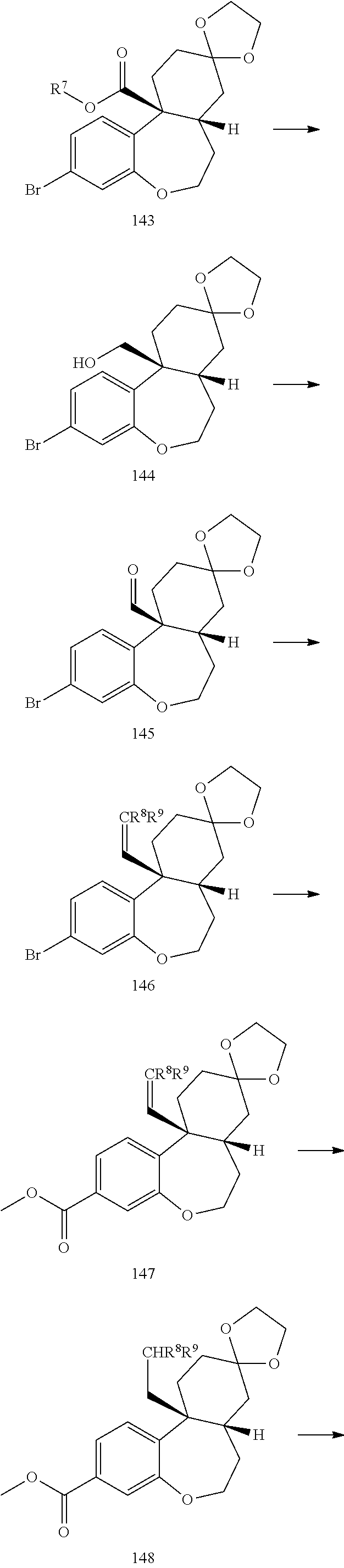

-

- 3-Bromophenol (13.7 g, 79.0 mmol) was dissolved in DMF (230 mL) then potassium carbonate (21.9 g, 158 mmol) and methyl 4-bromobutanoate (15.8 g, 87.0 mmol) were added. The mixture was stirred for about 30 min at rt then heated with stirring at about 95° C. for about 1 h. The mixture was cooled to about 15° C. and diluted with water (1 L). The mixture was extracted with DCM (250 mL). The layers were separated then the aqueous layer was extracted with DCM (150 mL). The combined organics were washed with water (2×375 mL) then dried over MgSO4, filtered and concentrated under reduced pressure to give methyl 4-(3-bromophenoxy)butanoate (136) (25.8 g). LC/MS, method 3, Rt=2.61 min, MS m/z: 273, 275 (M+H)+. The crude product was used, as is, in the next step.
-

- Methyl 4-(3-bromophenoxy)butanoate (136) (21.6 g, 79.0 mmol) was treated with 3 N aqueous sodium hydroxide (79 mL, 237 mmol) and MeOH (100 mL) then warmed to about 65° C. for about 30 min. The mixture was cooled to rt and concentrated under reduced pressure to remove most of the MeOH. The mixture was diluted with water (100 mL), acidified to about pH 2 with concentrated HCl then extracted with EtOAc (150 mL, then 75 mL). The combined organics were dried over MgSO4, filtered and concentrated under reduced pressure to give 4-(3-bromophenoxy)butanoic acid (137) (20.3 g, 99%). LC/MS, method 3, Rt=2.15 min, MS m/z: 257, 259 (M−H)−. 1H NMR (400 MHz, DMSO-d6) δ 12.17 (bs, 1H), 7.23 (t, J=8.1 Hz, 1H), 7.16-7.09 (m, 2H), 6.94 (ddd, J=8.3, 2.4, 0.9 Hz, 1H), 4.00 (t, J=6.4 Hz, 2H), 2.37 (t, J=7.3 Hz, 2H), 1.96-1.80 (m, 2H).
-

- A round bottom flask with stir bar was charged with polyphosphoric acid (254 g). The material was heated to about 75° C. then 4-(3-bromophenoxy)butanoic acid (137) (20.0 g, 77.0 mmol) was added. The mixture was stirred at about 75° C. until the materials were mixed. The mixture was heated to about 100° C. for about 30 min then cooled in an ice bath. Water (250 mL) was slowly added to the reaction mixture then the mixture was added to water (250 mL). After stirring for about 30 min the mixture was extracted with EtOAc (2×150 mL) then the combined organics were washed with 1 N aqueous NaOH (250 mL) and saturated aqueous NaCl (200 mL). The organic solution was dried over MgSO4, filtered though a pad of Celite® then concentrated under reduced pressure. The crude product was purified on silica gel (220 g) using a gradient from 0-30% EtOAc in heptane. Fractions containing the product were combined and concentrated to yield 8-bromo-3,4-dihydrobenzo[b]oxepin-5(2H)-one (138) (13.9 g, 75%). LC/MS, method 3, 11, =2.40 min, No parent ion. 1H NMR (400 MHz, DMSO-d6) δ 7.56 (d, J=8.0 Hz, 1H), 7.38-7.33 (m, 2H), 4.24 (t, J=6.5 Hz, 2H), 2.79 (t, J=6.9 Hz, 2H), 2.20-2.08 (m, 2H).
-

- 8-Bromo-3,4-dihydrobenzo[b]oxepin-5(2H)-one (138) (13.9 g, 57.6 mmol) in DCM (225 mL) was treated with Na2CO3 (18.3 g, 173 mmol) and the mixture was cooled to about 0° C. The stirred mixture was treated with trifluoromethanesulfonic anhydride (40 g, 142 mmol) then warmed to rt and stirred for about 16 h. Water (300 mL) was added, the mixture was stirred for about 30 min and then the layers were separated. The organic layer was dried over MgSO4, filtered and concentrated under reduced pressure to an oil which solidified upon standing. The material was dissolved in EtOAc (10 mL) and heptane (90 mL) with heating. The mixture was cooled in an ice/water bath and the solids were collected by filtration and washed with heptane (10 mL). The material was dried under reduced pressure at about 70° C. to give a first lot of 8-bromo-2,3-dihydrobenzoibioxepin-5-yl trifluoromethanesulfonate (139) (13.1 g, 61%). The filtrate was concentrated under reduced pressure to a solid which was purified on silica gel (330 g) using a gradient from 0-35% EtOAc in heptane. Fractions containing the product were combined and concentrated under reduced pressure to yield a second lot of 8-bromo-2,3-dihydrobenzoibioxepin-5-yl trifluoromethanesulfonate (139) (5.74 g, 27%). LC/MS, method 3, Rt=2.96 min, No parent ion. 1H NMR (400 MHz, DMSO-d6) δ 7.46-7.35 (m, 3H), 6.47 (t, J=4.9 Hz, 1H), 4.20 (t, J=5.2 Hz, 2H), 2.77-2.73 (m, 2H)
-

- A solution of 8-bromo-2,3-dihydrobenzo[b]oxepin-5-yl trifluoromethanesulfonate (139) (17.4 g, 46.6 mmol) in DMF (175 mL) was degassed by stirring under ˜15 mm Hg vacuum for about 15 min. The flask was filled with carbon monoxide using a balloon then 1,3-bis(diphenylphosphino)propane (0.962 g, 2.33 mmol), diacetoxypalladium (0.523 g, 2.33 mmol), MeOH (87 mL) and triethylamine (14.16 g, 140 mmol) were added. The flask was briefly evacuated under reduced pressure then the flask was filled with carbon monoxide with a balloon. This was repeated two more times then the mixture was heated under an atmosphere of carbon monoxide at about 80° C. for about 2 h with stirring. The mixture was cooled to rt then concentrated under reduced pressure and partitioned between water (250 mL) and EtOAc (150 mL). The organic solution was washed with saturated aqueous NaCl (50 mL), dried over MgSO4, then filtered and concentrated under reduced pressure. The residue was purified on silica gel (120 g) using a gradient from 0-35% EtOAc in heptane. Pure product fractions were combined and concentrated to give methyl 8-bromo-2,3-dihydrobenzo[b]oxepine-5-carboxylate (140, R7=Methyl) (5.52 g, 42%). LC/MS, method 3, Rt=2.52 min, MS m/z 300, 302 (M+H2O)+. 1H NMR (400 MHz, DMSO-d6) δ 7.37-7.33 (m, 1H), 7.31-7.27 (m, 2H), 7.22 (t, J=6.4 Hz, 1H), 4.40 (t, J=6.1 Hz, 2H), 3.75 (s, 3H), 2.48-2.44 (m, 2H).
-

- A steel pressure vessel with stirrer was charged with methyl 8-bromo-2,3-dihydrobenzo[b]oxepine-5-carboxylate (140, R7=Methyl) (5.81 g, 20.5 mmol), toluene (25 mL) and (E)-(4-methoxybuta-1,3-dien-2-yloxy)trimethylsilane (17.7 g, 103 mmol). The vessel was sealed then heated with stirring at about 125° C. for about 72 h. The mixture was concentrated under reduced pressure then the material was treated with THF (75 mL) and 6 N aqueous HCl (14 mL). The mixture was stirred at rt for about 6 h. Water (250 mL) was added then the mixture was extracted with EtOAc (150 mL, then 100 mL). The combined organics were washed with saturated aqueous NaCl (100 mL), dried over MgSO4, filtered and the concentrated under reduced pressure. The material was purified on silica gel (220 g) using a gradient from 0-50% EtOAc in heptane. Fractions containing the product were combined and concentrated to give (7aS,11aR)-methyl 3-bromo-9-oxo-6,7,7a,8,9,11a-hexahydrodibenzo[b,d]oxepine-11a-carboxylate; compound with (7aR11aS)-methyl 3-bromo-9-oxo-6,7,7a,8,9,11a-hexahydrodibenzo[b,d]oxepine-11a-carboxylate (141, R7=Methyl) (5.32 g, 74%). LC/MS, method 3, Rt=2.44 min, No parent ion. 1H NMR (400 MHz, DMSO-d6) δ 7.36 (dd, J=8.2, 2.1 Hz, 1H), 7.27 (d, J=2.1 Hz, 1H), 7.03 (d, J=8.2 Hz, 1H), 6.94 (d, J=10.1 Hz, 1H), 6.30 (d, J=10.1 Hz, 1H), 4.15-4.08 (m, 1H), 3.96-3.91 (m, 1H), 3.61 (s, 3H), 3.26-3.17 (m, 1H), 2.27-2.17 (m, 1H), 1.97-1.81 (m, 2H), 1.27-1.12 (m, 1H).
-

- A flask with stir bar was charged with (7aS,11aR)-methyl 3-bromo-9-oxo-6,7,7a,8,9,11a-hexahydrodibenzo[b,d]oxepine-11a-carboxylate; compound with (7aR,11aS)-methyl 3-bromo-9-oxo-6,7,7a,8,9,11a-hexahydrodibenzo[b,d]oxepine-11a-carboxylate (141, R7=Methyl) (4.15 g, 11.8 mmol), NaHCO3 (4.96 g, 59.1 mmol), Aliquot™ 336 [Henkel] (1.43 g, 3.55 mmol), toluene (80 mL) and water (80 mL). The mixture was heated to about 100° C. Sodium hydrosulfite (tech ˜85%) (6.95 g, 39.9 mmol) was added in three roughly equal portions; one when the mixture was heated to about 100° C., the second after about 5 min and the final portion after about 25 min. About 5 min after the last sodium hydrosulfite addition, the mixture was cooled to rt and transferred to a separatory funnel The layers were separated then the organic layer was washed with saturated aqueous NaCl (20 mL), dried over MgSO4 and filtered, rinsing with EtOAc (75 mL). The filtrate was concentrated under reduced pressure. The material was purified on silica gel (80 g) using a gradient of 0-100% EtOAc in heptane. Fractions containing the product were combined and concentrated to give (7aS,11aS)-methyl 3-bromo-9-oxo-6,7,7a,8,9,10,11,11a-octahydrodibenzo[b,d]oxepine-11a-carboxylate; compound with (7aR,11aR)-methyl 3-bromo-9-oxo-6,7,7a,8,9,10,11,11a-octahydrodibenzo[b,d]oxepine-11a-carboxylate (142, R7=Methyl) (3.29 g, 79%). LC/MS, method 3, Rt=2.36 min, MS m/z: 353, 355 (M+H)+. 1H NMR (400 MHz, CDCl3) δ 7.31 (dd, J=8.4, 2.1 Hz, 1H), 7.23 (d, J=2.1 Hz, 1H), 7.17 (d, J=8.5 Hz, 1H), 4.18-4.12 (m, 1H), 3.97-3.91 (m, 1H), 3.71 (s, 3H), 3.14-3.07 (m, 1H), 2.69-2.47 (m, 3H), 2.39-2.18 (m, 4H), 1.70-1.59 (m, 1H).
-

- A flask equipped with a stir bar, Dean-Stark apparatus, condensor and nitrogen line was charged with (7aS,11aS)-methyl 3-bromo-9-oxo-6,7,7a,8,9,10,11,11a-octahydrodibenzo[b,d]oxepine-11a-carboxylate; compound with (7aR,11aR)-methyl 3-bromo-9-oxo-6,7,7a,8,9,10,11,11a-octahydrodibenzo[b,d]oxepine-11a-carboxylate (142, R7=Methyl) (4.06 g, 11.49 mmol), toluene (100 mL), ethane-1,2-diol (2.14 g, 34.5 mmol) and 4-methylbenzenesulfonic acid hydrate (0.164 g, 0.862 mmol). The mixture was heated at reflux for about 1 h, removing water in the Dean-Stark trap. The mixture was cooled to rt then Na2CO3 (˜2 g) was added. The mixture was stirred for about 10 min, saturated aqueous NaHCO3 (5 mL) was added and the mixture was diluted with water (100 mL). The layers were separated then the organic layer was washed with water (100 mL) and saturated aqueous NaCl (50 mL). The organic solution was dried over MgSO4, filtered and concentrated under reduced pressure to give (7aS,11aS)-methyl 3-bromo-7,7a,8,10,11,11a-hexahydro-6H-spiro[dibenzo[b,d]oxepine-9,2′-[1, 3]dioxolane]-11a-carboxylate; compound with (7aR,11aR)-methyl 3-bromo-7,7a,8,10,11,11a-hexahydro-6H-spiro[dibenzo[b,d]oxepine-9,2′-[1,3]dioxolane]-11a-carboxylate (143, R7=Methyl) (4.63 g, 101%). LC/MS, method 3, Rt=2.72 min, MS m/z: 397, 399 (M+H)+. 1H NMR (400 MHz, CDCl3) δ 7.32-7.15 (m, 3H), 4.23-4.14 (m, 1H), 4.06-3.90 (m, 4H), 3.87-3.74 (m, 1H), 3.65 (s, 3H), 3.03-2.95 (m, 1H), 2.55-2.41 (m, 1H), 2.36-2.28 (m, 1H), 2.24-2.16 (m, 1H), 1.94-1.79 (m, 2H), 1.67-1.44 (m, 3H)
-

- A flask equipped with stir bar, septum, thermometer and nitrogen line was charged with (7aS,11aS)-methyl 3-bromo-7,7a,8,10,11,11a-hexahydro-6H-spiro[dibenzo[b,d]oxepine-9,2′-[1,3]dioxolane]-11a-carboxylate; compound with (7aR,11aR)-methyl 3-bromo-7,7a,8,10,11,11a-hexahydro-6H-spiro[dibenzo[b,d]oxepine-9,2′-[1,3]dioxolane]-11a-carboxylate (143, R7=Methyl) (4.66 g, 11.7 mmol) dissolved in THF (30 mL). The mixture was cooled to an internal temperature of about −65° C. and LiAlH4 (1 M in THF, 13 mL, 13 mmol) was added over about 20 min, maintaining the reaction temperature below about −60° C. After about 30 min, the reaction mixture was warmed to about 0° C. for about 5 min and then cooled to about −60° C. 1 N aqueous NaOH (6 mL) then EtOAc (50 mL) were added. The mixture was warmed to rt and diluted with water (100 mL), EtOAc (50 mL) and heptane (25 mL). The layers were separated and the aqueous layer was extracted with 50% EtOAc in heptane (2×50 mL). The combined organics were dried over MgSO4, filtered and concentrated under reduced pressure. The material was purified on silica gel (80 g) using a gradient of 25-100% EtOAc in heptane. Fractions containing product were combined and concentrated to give ((7aS,11aS)-3-bromo-7,7a,8,10,11,11a-hexahydro-6H-spiro[dibenzo[b,d]oxepine-9,2′-[1,3]dioxolane]-11a-yl)methanol; compound with ((7aR,11aR)-3-bromo-7,7a,8,10,11,11a-hexahydro-6H-spiro[dibenzo[b,d]oxepine-9,2′-[1,3]dioxolane]-11a-yl)methanol (144) (3.88 g, 90%). LC/MS, method 3, Rt=2.24 min, MS m/z: 369, 371 (M+H)+. 1H NMR (400 MHz, CDCl3) δ 7.23-7.19 (m, 2H), 7.16 (d, J=8.5 Hz, 1H), 4.26-4.21 (m, 1H), 4.04-3.88 (m, 5H), 3.81-3.69 (m, 2H), 2.60-2.51 (m, 1H), 2.43-2.37 (m, 2H), 1.97-1.79 (m, 3H), 1.73-1.66 (m, 1H), 1.61-1.54 (m 1H), 1.40-1.34 (m, 1H).
-

- ((7aS,11aS)-3-Bromo-7,7a,8,10,11,11a-hexahydro-6H-spiro[dibenzo[b,d]oxepine-9,2′-[1,3]dioxolane]-11a-yl)methanol; compound with ((7aR,11aR)-3-bromo-7,7a,8,10,11,11a-hexahydro-6H-spiro[dibenzo[b,d]oxepine-9,2′-[1,3]dioxolane]-11a-yl)methanol (144) (3.88 g, 10.5 mmol) in DCM (125 mL) was treated with Dess-Martin periodinane (4.46 g, 10.5 mmol). The mixture was stirred at rt for about 90 min. The mixture was diluted with Et2O (200 mL) then filtered, washing with Et2O (50 mL), then the filtrate was concentrated under reduced pressure. The material was triturated with 50% EtOAc in heptane (100 mL) then filtered and the cake washed with 50% EtOAc in heptane (25 mL). The filtrate was concentrated under reduced pressure then the material was purified on silica gel (80 g) using a gradient from 0-60% EtOAc in heptane. Fractions containing product were combined and concentrated to give (7aS,11aS)-3-bromo-7,7a,8,10,11,11a-hexahydro-6H-spiro[dibenzo[b,d]oxepine-9,2′-[1,3]dioxolane]-11a-carbaldehyde; compound with (7aR,11aR)-3-bromo-7,7a,8,10, 11,11a-hexahydro-6H-spiro[dibenzo[b,d]oxepine-9,2′-[1,3]dioxolane]-11a-carbaldehyde (145) (3.10 g, 80%). LC/MS, method 3, Rt=2.54 min, MS m/z: 369, 371 (M+H)+; 1H NMR (400 MHz, CDCl3) δ 9.49 (s, 1H), 7.35-7.19 (m, 3H), 4.17-4.09 (m, 1H), 4.03-3.92 (m, 4H), 3.83-3.80 (m, 1H), 2.87-2.80 (m, 1H), 2.31-2.17 (m, 2H), 2.03-1.84 (m, 3H), 1.66-1.46 (m, 3H).
-

- A round bottom flask with stir bar and nitrogen line was charged with DMSO (11 mL) and sodium hydride (60 wt % dispersion in mineral oil, 0.675 g, 16.9 mmol). The mixture was heated to about 60° C. for about 1 h, then cooled to rt. The mixture was diluted with THF (11 mL) and methyltriphenylphosphonium bromide (6.03 g, 16.9 mmol) was added. The mixture was stirred for about 30 min then (7aS,11aS)-3-bromo-7,7a,8,10,11,11a-hexahydro-6H-spiro[dibenzo[b,d]oxepine-9,2′-[1,3]dioxolane]-11a-carbaldehyde; compound with (7aR,11aR)-3-bromo-7,7a,8,10,11,11a-hexahydro-6H-spiro[dibenzo[b,d]oxepine-9,2′-[1,3]dioxolane]-11a-carbaldehyde (145) (3.10 g, 8.44 mmol) in THF (11 mL) was added over about 10 min. The mixture was warmed to rt for about 18 h. Water (75 mL) was added and the mixture was extracted with Et2O (3×50 mL). The combined organics were dried over MgSO4, filtered and concentrated under reduced pressure. The material was purified on silica gel (80 g) using a gradient of 0-40% EtOAc in heptane followed by a second purification on silica gel (40 g) using a gradient of 0-40% EtOAc in heptane. Fractions containing product were combined and concentrated to give the (7aS,11aS)-3-bromo-11a-vinyl-7,7a,8,10,11,11a-hexahydro-6H-spiro[dibenzo[b,d]oxepine-9,2′-[1,3]dioxolane]; compound with (7aR,11aR)-3-bromo-11a-vinyl-7,7a,8,10,11,11a-hexahydro-6H-spiro[dibenzo[b,d]oxepine-9,2′-[1,3]dioxolane] (146, R8=H, R9=H) (2.95 g, 96%). LC/MS, method 3, Rt=2.95 min, No parent ion; 1H NMR (400 MHz, CDCl3) δ 7.20-7.10 (m, 3H), 5.97 (dd, J=17.3, 10.6 Hz, 1H), 5.02-4.96 (m, 1H), 4.54 (dd, J=17.3, 1.1 Hz, 1H), 4.18-4.08 (m, 1H), 4.00-3.88 (m, 4H), 3.87-3.78 (m, 1H), 2.45-2.36 (m, 1H), 2.32-2.26 (m, 1H), 2.24-2.18 (m, 1H), 1.95-1.81 (m, 1H), 1.80-1.67 (m, 3H), 1.63-1.56 (m, 1H), 1.49-1.42 (m, 1H).
-

- A round bottom flask with stir bar was charged with (7aS,11aS)-3-bromo-11a-vinyl-7,7a,8,10,11,11a-hexahydro-6H-spiro[dibenzo[b,d]oxepine-9,2′-[1,3]dioxolane]; compound with (7aR,11aR)-3-bromo-11a-vinyl-7,7a,8,10,11,11a-hexahydro-6H-spiro[dibenzo[b,d]oxepine-9,2′-[1,3]dioxolane] (146, R8=H, R9=H) (2.75 g, 7.53 mmol) and DMF (60 mL). The mixture was degassed by stirring under ˜15 mm Hg vacuum for about 15 min. The flask was filled with carbon monoxide with a balloon then it was charged with Pd2(dba)3 (0.207 g, 0.226 mmol), Xantphos (0.436 g, 0.753 mmol), TEA (3.05 g, 30.1 mmol) and methanol (2.89 g, 90 mmol). The flask was briefly evacuated under reduced pressure then the flask was filled with carbon monoxide using a balloon. This was repeated two more times then the mixture was heated under an atmosphere of carbon monoxide to about 90° C. for about 14 h with stirring. The mixture was cooled to rt then diluted with water (500 mL). The mixture was extracted with EtOAc (250 mL then 100 mL) and then the combined organics were washed with water (250 mL) and saturated aqueous NaCl (100 mL). The organic solution was dried over MgSO4, filtered and concentrated under reduced pressure. The material was purified on silica gel (40 g) using a gradient of 0-50% EtOAc in heptane. Fractions containing the product were combined and concentrated to give (7aS,11aS)-methyl 11a-vinyl-7,7a,8,10, 11,11a-hexahydro-6H-spiro[dibenzo[b,d]oxepine-9,2′-[1,3]dioxolane]-3-carboxylate; compound with (7aR,11aR)-methyl 11a-vinyl-7,7a,8,10,11,11a-hexahydro-6H-spiro[dibenzo[b,d]oxepine-9,2′-[1,3]dioxolane]-3-carboxylate (147, R8=H, R9=H) (2.03 g, 78%). LC/MS, method 3, Rt=2.60 min, MS m/z: 345 (M+H)+; 1H NMR (400 MHz, CDCl3) δ 7.74 (dd, J=8.3, 1.9 Hz, 1H), 7.66 (d, J=1.9 Hz, 1H), 7.37 (d, J=8.4 Hz, 1H), 6.04 (dd, J=17.3, 10.6 Hz, 1H), 5.02 (dd, J=10.6, 1.0 Hz, 1H), 4.55 (dd, J=17.3, 1.0 Hz, 1H), 4.23-4.17 (m, 1H), 4.02-3.94 (m, 4H), 3.93 (s, 3H), 3.89-3.83 (m, 1H), 2.52-2.44 (m, 1H), 2.39-2.27 (m, 2H), 2.01-1.90 (m, 1H), 1.84-1.71 (m, 3H), 1.69-1.62 (m, 1H), 1.53-1.46 (m, 1H).
-
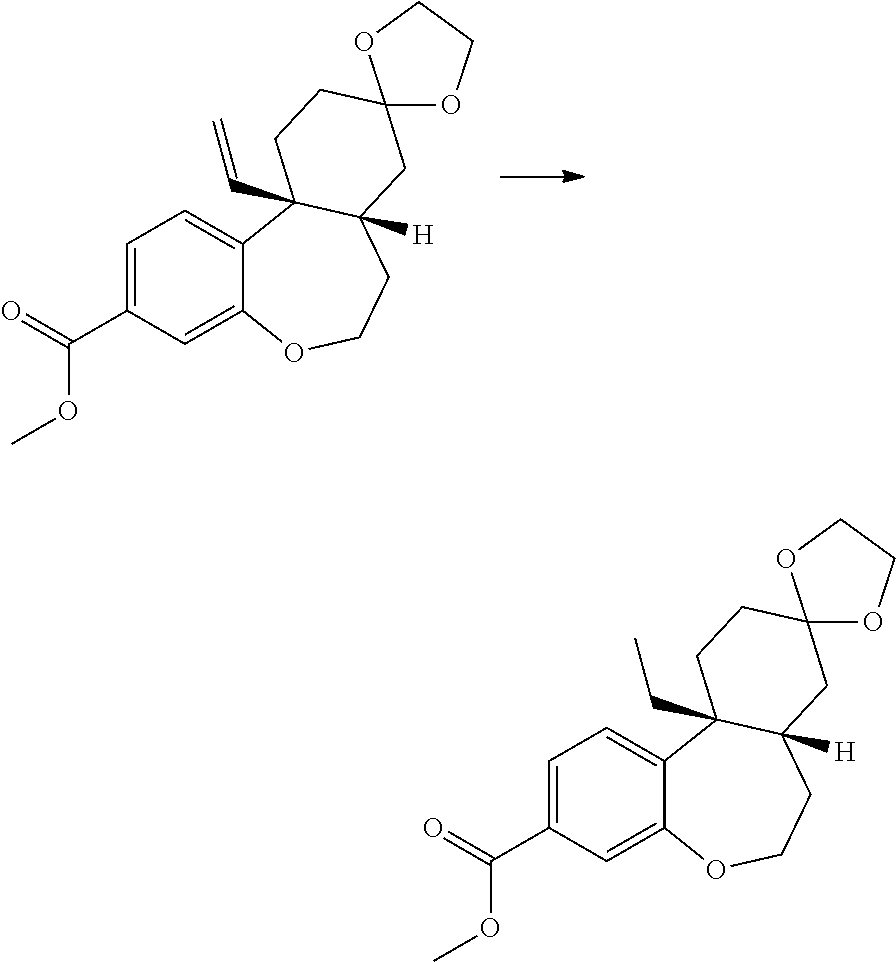
- (7aS,11aS)-Methyl 11a-vinyl-7,7a,8,10,11,11a-hexahydro-6H-spiro[dibenzo[b,d]oxepine-9,2′-[1,3]dioxolane]-3-carboxylate; compound with (7aR,11aR)-methyl 11a-vinyl-7,7a,8,10,11,11a-hexahydro-6H-spiro[dibenzo[b,d]oxepine-9,2′-[1,3]dioxolane]-3-carboxylate (147, R8=H, R9=H) (2.03 g, 5.89 mmol) in EtOAc (60 mL) was treated with platinum (IV) oxide (0.200 g, 0.881 mmol) then the flask was evacuated and filled with hydrogen using a balloon. This was repeated 3 times then the mixture was stirred under an atmosphere of hydrogen for about 2 h. The catalyst was removed by filtration through a pad of Celite® then the filtrate was concentrated under reduced pressure to give (7aS,11aR)-methyl 11a-ethyl-7,7a,8,10, 11,11a-hexahydro-6H-spiro[dibenzo[b,d]oxepine-9,2′-[1,3]dioxolane]-3-carboxylate; compound with (7aR,11aS)-methyl 11a-ethyl-7,7a,8,10,11,11a-hexahydro-6H-spiro[dibenzo[b,d]oxepine-9,2′-[1,3]dioxolane]-3-carboxylate (148, R8=H, R9=H) (1.98 g, 97%). LC/MS, method 3, Rt=2.71 min, MS m/z: 347 (M+H)+; 1H NMR (400 MHz, CDCl3) δ 7.68 (dd, J=8.4, 1.9 Hz, 1H), 7.61 (d, J=1.9 Hz, 1H), 7.27 (d, J=8.4 Hz, 1H), 4.25-4.20 (m, 1H), 4.01-3.91 (m, 4H), 3.89 (s, 3H), 3.73-3.64 (m, 1H), 2.68-2.63 (m, 1H), 2.40-2.38 (m, 1H), 2.28-2.13 (m, 2H), 1.94-1.74 (m, 2H), 1.71-1.57 (m, 2H), 1.54-1.45 (m, 2H), 1.40-1.31 (m, 1H), 0.61 (t, J=7.2 Hz, 3H).
-

- A round bottom flask with stir bar and nitrogen line was charged with (7aS,11aR)-methyl 11a-ethyl-7,7a,8,10,11,11a-hexahydro-6H-spiro[dibenzo[b,d]oxepine-9,2′-[1,3]dioxolane]-3-carboxylate; compound with (7aR,11aS)-methyl 11a-ethyl-7,7a,8,10,11,11a-hexahydro-6H-spiro[dibenzo[b,d]oxepine-9,2′-[1,3]dioxolane]-3-carboxylate (148, R8=H, R9=H) (2.04 g, 5.89 mmol), toluene (60 mL) and 2-methylpyridin-3-amine (0.764 g, 7.07 mmol). The mixture was stirred for about 15 min at rt then cooled to about 0° C. and treated with LiHMDS (1 M solution in THF, 17.7 mL, 17.7 mmol). The mixture was stirred at about 0° C. for about 15 min then treated with saturated aqueous NaHCO3 (50 mL) and water (25 mL). The mixture was warmed to rt with stirring. The layers were separated then the aqueous layer was extracted with EtOAc (2×25 mL). The combined organics were washed with saturated aqueous NaCl (30 mL) then dried over MgSO4, filtered and concentrated under reduced pressure. The material was purified on silica gel (40 g) using a gradient from 0-10% MeOH in DCM. Pure product fractions were combined and concentrated to give (7aS,11aR)-11a-ethyl-N-(2-methylpyridin-3-yl)-7,7a,8,10,11,11a-hexahydro-6H-spiro[dibenzo[b,d]oxepine-9,2′-[1,3]dioxolane]-3-carboxamide; compound with (7aR,11aS)-11a-ethyl-N-(2-methylpyridin-3-yl)-7,7a,8,10,11,11a-hexahydro-6H-spiro[dibenzo[b,d]oxepine-9,2′-[1,3]dioxolane]-3-carboxamide (149, R6=2-Methylpyridin-3-yl, R8=H, R9=H) (2.55 g, 102%) as a foam. LC/MS, method 3, Rt=2.29 min, m/z: 423 (M+H)+; NMR indicates presence of ˜4 wt % DCM. 1H NMR (400 MHz, CDCl3) δ 8.40 (d, J=8.2 Hz, 1H), 8.33 (dd, J=4.8, 1.5 Hz, 1H), 7.64 (s, 1H), 7.55 (dd, J=8.2, 2.1 Hz, 1H), 7.46 (d, J=2.1 Hz, 1H), 7.36 (d, J=8.3 Hz, 1H), 7.23 (dd, J=8.2, 4.8 Hz, 1H), 4.29-4.24 (m, 1H), 4.03-3.85 (m, 4H), 3.77-3.71 (m, 1H), 2.74-2.65 (m, 1H), 2.62 (s, 3H), 2.42-2.36 (m, 1H), 2.28-2.15 (m, 2H), 1.96-1.75 (m, 2H), 1.75-1.46 (m, 4H), 1.39-1.35 (m, 1H), 0.65 (t, J=7.5 Hz, 3H).
-

- (7aS,11aR)-11a-Ethyl-N-(2-methylpyridin-3-yl)-7,7a,8,10,11,11a-hexahydro-6H-spiro[dibenzo[b,d]oxepine-9,2′-[1,3]dioxolane]-3-carb oxamide; compound with (7aR,11aS)-11a-ethyl-N-(2-methylpyridin-3-yl)-7,7a,8,10,11,11a-hexahydro-6H-spiro[dibenzo[b,d]oxepine-9,2′-[1,3]dioxolane]-3-carboxamide (149, R6=2-methylpyridin-3-yl, R8=H, R9=H) (2.55 g, 6.04 mmol) was dissolved in THF (60 mL) and treated with 6 N aqueous HCl (6.0 mL, 36 mmol). The mixture was stirred at rt for about 16 h. Water (25 mL) was added then after about 10 min the mixture was added to a stirred solution of saturated aqueous NaHCO3 (200 mL). The mixture was transferred to a separatory funnel and water (25 mL) and EtOAc (100 mL) were added. The layers were separated then the aqueous layer was extracted with EtOAc (50 mL). The combined organics were dried over MgSO4, filtered and concentrated under reduced pressure to give the (7aS,11aR)-11a-ethyl-N-(2-methylpyridin-3-yl)-9-oxo-6,7,7a,8,9,10,11,11a-octahydrodibenzo[b,d]oxepine-3-carboxamide; compound with (7aR,11aS)-11a-ethyl-N-(2-methylpyridin-3-yl)-9-oxo-6,7,7a,8,9,10,11,11a-octahydrodibenzo[b,d]oxepine-3-carboxamide (150, R6=2-Methylpyridin-3-yl, R8=H, R9=H) (2.20 g, 96%). LC/MS, method 3, Rt=1.91 min, MS m/z: 379 (M+H)+; 1H NMR (400 MHz, CDCl3) δ 8.40-8.32 (m, 2H), 7.67 (s, 1H), 7.64 (dd, J=8.2, 2.1 Hz, 1H), 7.54 (d, J=2.1 Hz, 1H), 7.42 (d, J=8.2 Hz, 1H), 7.23 (dd, J=8.1, 4.8 Hz, 1H), 4.35-4.29 (m, 1H), 3.84-3.77 (m, 1H), 2.80-2.63 (m, 2H), 2.62 (s, 3H), 2.60-2.47 (m, 2H), 2.46-2.24 (m, 3H), 2.14-2.06 (m, 1H), 1.86-1.78 (m, 1H), 1.63-1.51 (m, 2H), 0.69 (t, J=7.2 Hz, 3H).
-

- A round bottom flask equipped with stir bar and nitrogen line was charged with sodium hydride (60 wt % dispersion in mineral oil, 0.106 g, 2.64 mmol) and DMSO (6 mL). The mixture was heated at about 60° C. for about 1 h. The mixture was cooled to rt then diluted with THF (6 mL). The mixture was cooled to about 0° C. then trimethylsulfoxonium iodide (0.581 g, 2.64 mmol) was added. The mixture was stirred for about 10 min then (7aS,11aR)-11a-ethyl-N-(2-methylpyridin-3-yl)-9-oxo-6,7,7a,8,9,10,11,11a-octahydrodibenzo[b,d]oxepine-3-carboxamide; compound with (7aR,11aS)-11a-ethyl-N-(2-methylpyridin-3-yl)-9-oxo-6,7,7a,8,9,10,11,11a-octahydrodibenzo[b,d]oxepine-3-carboxamide (150, R6=2-Methylpyridin-3-yl, R8=H, R9=H) (0.500 g, 1.32 mmol) in THF (6 mL) was added over about 10 min. The mixture was stirred in the ice bath for about 5 min then the bath was removed and the mixture was allowed to warm to rt for about 18 h. The mixture was concentrated under reduced pressure and partitioned between EtOAc (75 mL) and water (75 mL). The layers were separated and the organic solution was washed with water (3×50 mL). The organic solution was dried over MgSO4, filtered and concentrated under reduced pressure. The material was purified on silica gel (12 g) using a gradient of 50-100% EtOAc in heptane. Fractions containing product were combined and concentrated, then dried to constant weight at about 60° C. under reduced pressure to give (2′R,7aS,11aR)-11a-ethyl-N-(2-methylpyridin-3-yl)-7,7a,8,10,11,11a-hexahydro-6H-spiro[dibenzo[b,d]oxepine-9,2′-oxirane]-3-carboxamide; compound with (2′S,7aR,11aS)-11a-ethyl-N-(2-methylpyridin-3-yl)-7,7a,8,10,11,11a-hexahydro-6H-spiro[dibenzo[b,d]oxepine-9,2′-oxirane]-3-carboxamide (151, R6=2-Methylpyridin-3-yl, R8=H, R9=H) (0.450 g, 87%) as a white solid. LC/MS, method 3, Rt=2.03 min, MS m/z: 393 (M+H)+; 1H NMR (400 MHz, CDCl3) δ 8.38 (dd, J=8.2, 1.3 Hz, 1H), 8.33 (dd, J=4.8, 1.5 Hz, 1H), 7.64 (s, 1H), 7.59 (dd, J=8.2, 2.1 Hz, 1H), 7.48 (d, J=2.0 Hz, 1H), 7.39 (d, J=8.3 Hz, 1H), 7.22 (dd, J=8.1, 4.8 Hz, 1H), 4.30-4.25 (m, 1H), 3.79-3.72 (m, 1H), 2.78-2.69 (m, 1H), 2.67 (d, J=4.5 Hz, 1H), 2.63 (d, J=4.5 Hz, 1H), 2.61 (s, 3H), 2.50-2.40 (m, 1H), 2.40-2.18 (m, 3H), 2.05-1.98 (m, 1H), 1.86-1.78 (m 1H), 1.68-1.48 (m, 2H), 1.39-1.30 (m, 1H), 0.94-0.86 (m, 1H), 0.68 (t, J=7.6 Hz, 3H).
-

- A 3 necked round bottom flask with stir bar, nitrogen line, septum and thermometer was charged with (2′R,7aS,11aR)-11a-ethyl-N-(2-methylpyridin-3-yl)-7,7a,8,10,11,11a-hexahydro-6H-spiro[dibenzo[b,d]oxepine-9,2′-oxirane]-3-carb oxamide; compound with (2′S,7aR,11aS)-11a-ethyl-N-(2-methylpyridin-3-yl)-7,7a,8,10,11,11a-hexahydro-6H-spiro[dibenzo[b,d]oxepine-9,2′-oxirane]-3-carboxamide (151, R6=2-Methylpyridin-3-yl, R8=H, R9=H) (0.140 g, 0.357 mmol), THF (6 mL) and copper(I)iodide (0.009 g, 0.05 mmol). The mixture was cooled to about 0° C. then ethylmagnesium bromide (3 M in Et2O, 0.71 mL, 2.14 mmol) was added dropwise. After about 5 min the reaction was quenched with saturated aqueous NH4Cl (10 mL). Water (10 mL) was added and the mixture was extracted with EtOAc (25 mL then 10 mL). The combined organics were washed with saturated aqueous NaCl (10 mL) then dried over MgSO4, filtered and concentrated under reduced pressure. The material was purified on silica gel (12 g) using a gradient of 50-100% EtOAc in heptane. Fractions containing product were combined and concentrated under reduced pressure. The material was triturated with heptane (˜15 mL) and the white solid was collected by filtration and washed with heptane (2 mL). The material was dried under reduced pressure at about 60° C. for about 16 h to give (7aS,9R,11aR)-11a-ethyl-9-hydroxy-N-(2-methylpyridin-3-yl)-9-propyl-6,7,7a,8,9,10,11,11a-octahydrodibenzo[b,d]oxepine-3-carboxamide; compound with (7aR,9S,11aS)-11a-ethyl-9-hydroxy-N-(2-methylpyridin-3-yl)-9-propyl-6,7,7a,8,9,10,11,11a-octahydrodibenzo[b,d]oxepine-3-carboxamide (152, R5=Ethyl, R6=2-Methylpyridin-3-yl, R8=H, R9=H) (0.110 g, 73%) LC/MS, method 2, Rt=2.11 min, MS m/z: 423 (M+H)+; 1H NMR (400 MHz, DMSO-d6) δ 9.97 (s, 1H), 8.33 (dd, J=4.8, 1.6 Hz, 1H), 7.71 (dd, J=8.0, 1.6 Hz, 1H), 7.64 (dd, J=8.2, 2.0 Hz, 1H), 7.53 (d, J=2.0 Hz, 1H), 7.37 (d, J=8.4 Hz, 1H), 7.27 (dd, J=7.9, 4.7 Hz, 1H), 4.25-4.15 (m, 1H), 3.98 (s, 1H), 3.71-3.65 (m, 1H), 2.61-2.52 (m, 1H), 2.43 (s, 3H), 2.37-2.28 (m, 1H), 2.21-2.01 (m, 2H), 1.79-1.64 (m, 1H), 1.60-1.37 (m, 4H), 1.33-1.10 (m, 6H), 0.79 (t, J=7.0 Hz, 3H), 0.57 (t, J=7.4 Hz, 3H).
- Additional examples, prepared in a manner similar to the preparation of Example #119 are listed in Table 1.
- Chiral separation of Example 119 (152, R5=Ethyl, R6=2-Methylpyridin-3-yl, R8=H, R9=H) The separation of enantiomers was accomplished using chiral separation method 10. The first peak eluted was (7aR,9S,11aS)-11a-ethyl-9-hydroxy-N-(2-methylpyridin-3-yl)-9-propyl-6,7,7a,8,9,10,11,11a-octahydrodibenzo[b,d]oxepine-3-carboxamide (A-1388162.0) (Example 120) and the second was (7aS,9R,11aR)-11a-ethyl-9-hydroxy-N-(2-methylpyridin-3-yl)-9-propyl-6,7,7a,8,9,10,11,11a-octahydrodibenzo[b,d]oxepine-3-carboxamide (A-1388163.0) (Example 121). NMR and LCMS data for single isomers was essentially identical to the racemic mixture.
- Additional examples, prepared in a manner similar to the preparation of Examples #120 and #121, are listed in Table 2
-

-

- A solution of (7aR,11aS)-11a-ethyl-9-oxo-6,7,7a,8,9,10,11,11a-octahydro-5H-dibenzo[a,c]cycloheptene-3-carboxylic acid (2-methyl-pyridin-3-yl)-amide; compound with (7aS,11aR)-11a-ethyl-9-oxo-6,7,7a,8,9,10,11,11a-octahydro-5H-dibenzo[a,c]cycloheptene-3-carboxylic acid (2-methyl-pyridin-3-yl)-amide (75, R4=Methyl) (1.60 g, 2.97 mmol) in THF (64 mL) was cooled to about 0° C. under nitrogen. Phenylmagnesium bromide (14.9 mL, 14.9 mmol, 1M solution in THF) was added dropwise maintaining reaction temperature below about 7° C. The mixture was stirred at about 0° C. for about 1 h, and then quenched by addition of saturated aqueous NH4Cl (25 mL). The reaction was diluted with EtOAc (100 mL) and washed with saturated aqueous NH4Cl (3×25 mL). The organic layer was dried over Na2SO4, filtered and concentrated under reduced pressure. The residue was purified on silica gel (80 g) using EtOAc as eluant. Fractions containing the second peak (major component) were combined and concentrated under reduced pressure to yield (7aS,9S,11aR)-11a-ethyl-9-hydroxy-9-phenyl-6,7,7a,8,9,10,11,11a-octahydro-5H-dibenzo[a,c]cycloheptene-3-carboxylic acid (2-methyl-pyridin-3-yl)-amide; compound with (7aR,9R,11aS)-11a-ethyl-9-hydroxy-9-phenyl-6,7,7a,8,9,10,11,11a-octahydro-5H-dibenzo[a,c]cycloheptene-3-carboxylic acid (2-methyl-pyridin-3-yl)-amide (153, R3=Phenyl, R4=Methyl) (0.823 g, 63%). LC/MS, method 4, Rt=1.59 min, MS m/z 455 (M+H)+. 1H NMR (400 MHz, DMSO-d6) δ 9.96 (s, 1H), 8.32 (dd, J=4.8, 1.6 Hz, 1H), 7.85-7.78 (m, 1H), 7.77-7.71 (m, 2H), 7.55-7.46 (m, 3H), 7.39-7.32 (m, 2H), 7.30-7.21 (m, 2H), 4.76 (s, 1H), 3.08-2.95 (m, 1H), 2.95-2.82 (m, 1H), 2.46 (s, 3H), 2.46-2.34 (m, 2H), 2.14-2.00 (m, 2H), 1.96-1.80 (m, 2H), 1.80-1.68 (m, 1H), 1.64-1.45 (m, 4H), 1.41-1.17 (m, 2H), 0.55 (t, J=7.3 Hz, 3H). Fractions containing the first peak (minor component) were combined and concentrated under reduced pressure to yield (7aS,9R,11aR)-11a-ethyl-9-hydroxy-9-phenyl-6,7,7a,8,9,10,11,11a-octahydro-5H-dibenzo[a,c]cycloheptene-3-carboxylic acid (2-methyl-pyridin-3-yl)-amide; compound with (7aR,9S,11aS)-11a-ethyl-9-hydroxy-9-phenyl-6,7,7a,8,9,10,11,11a-octahydro-5H-dibenzo[a,c]cycloheptene-3-carboxylic acid (2-methyl-pyridin-3-yl)-amide (153, R3=Phenyl, R4=Methyl) (0.125 g, 9%) as a white solid. LC/MS, method 2, Rt=2.29 min, MS m/z 455 (M+H)+. 1H NMR (400 MHz, DMSO) δ 9.96 (s, 1H), 8.32 (dd, J=4.8, 1.6 Hz, 1H), 7.80-7.70 (m, 3H), 7.47 (d, J=8.4 Hz, 1H), 7.28-7.16 (m, 5H), 7.16-7.07 (m, 1H), 4.85 (s, 1H), 3.09-2.97 (m, 1H), 2.95-2.85 (m, 1H), 2.56-2.48 (m, 1H), 2.44 (s, 3H), 2.44-2.36 (m, 1H), 2.34-2.21 (m, 1H), 2.16-2.05 (m, 1H), 2.03-1.91 (m, 1H), 1.91-1.79 (m, 1H), 1.77-1.66 (m, 2H), 1.63-1.41 (m, 4H), 1.34-1.24 (m, 1H), 0.65 (t, J=7.4 Hz, 3H).
- The minor product was further purified using chiral chromatography method 12 to yield first (7aS,9R,11aR)-11a-ethyl-9-hydroxy-9-phenyl-6, 7,7a,8,9,10,11,11a-octahydro-5H-dibenzo[a,c]cycloheptene-3-carboxylic acid (2-methyl-pyridin-3-yl)-amide (153, R3=Phenyl, R4=Methyl); and second (7aR,9S,11aS)-11a-ethyl-9-hydroxy-9-phenyl-6,7,7a,8,9,10,11,11a-octahydro-5H-dibenzo[a,c]cycloheptene-3-carboxylic acid (2-methyl-pyridin-3-yl)-amide (153, R3=Phenyl, R4=Methyl) NMR and LCMS data for single isomers was essentially identical to the racemic mixture.
-
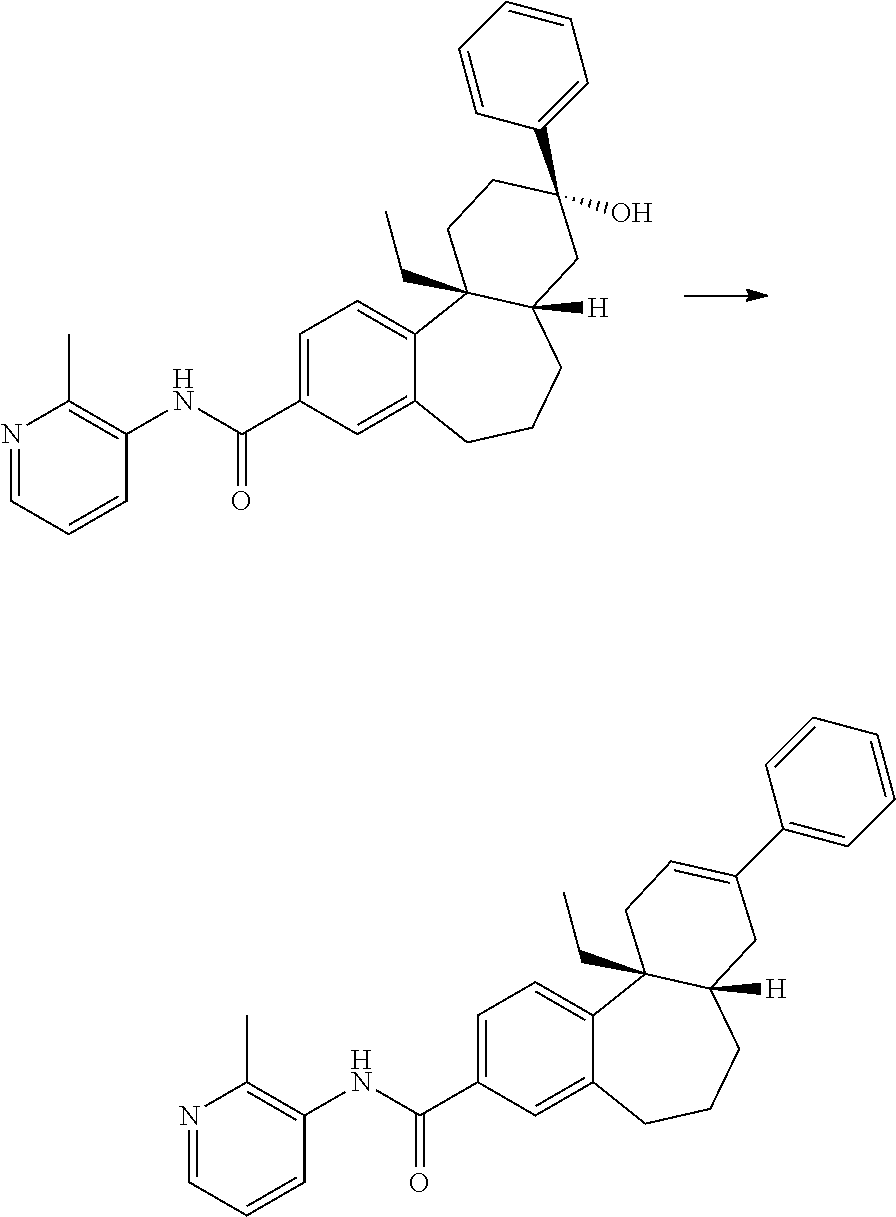
- A suspension of (7aS,9S,11aR)-11a-Ethyl-9-hydroxy-9-phenyl-6,7,7a,8,9,10,11,11a-octahydro-5H-dibenzo[a,c]cycloheptene-3-carboxylic acid (2-methyl-pyridin-3-yl)-amide; compound with (7aR,9R,11aS)-11a-ethyl-9-hydroxy-9-phenyl-6,7,7a,8,9,10,11,11a-octahydro-5H-dibenzo[a,c]cycloheptene-3-carboxylic acid (2-methyl-pyridin-3-yl)-amide (154, R3=Phenyl, R4=Methyl) (820 mg, 1.80 mmol) and pTsOH (721 mg, 3.79 mmol) in toluene (40 mL) was heated at reflux, removing water into a Dean-Stark trap for about 90 min. The reaction was cooled to rt and washed with saturated aqueous NaHCO3 (2×25 mL). The organic layer was dried over Na2SO4, filtered and concentrated under reduced pressure. The residue was purified on silica gel (40 g) using a gradient of 50-100% ethyl acetate in heptane. Fractions containing product were combined and concentrated to yield (7aS,11aR)-11a-ethyl-9-phenyl-6,7,7a,8,11,11a-hexahydro-5H-dibenzo[a,c]cycloheptene-3-carboxylic acid (2-methyl-pyridin-3-yl)-amide; compound with (7aR,11aS)-11a-ethyl-9-phenyl-6,7,7a,8,11,11a-hexahydro-5H-dibenzo[a,c]cycloheptene-3-carboxylic acid (2-methyl-pyridin-3-yl)-amide (155, R3=Phenyl, R4=Methyl) (515 mg, 65%) as an off-white solid. LC/MS, method 4, Rt=2.44 min, MS m/z 437 (M+H)+. 1H NMR (400 MHz, DMSO-d6) δ 9.88 (s, 1H), 8.29 (dd, J=4.7, 1.5 Hz, 1H), 7.73-7.64 (m, 2H), 7.61 (dd, J=8.2, 1.9 Hz, 1H), 7.33-7.27 (m, 2H), 7.27-7.11 (m, 5H), 6.38-6.33 (m, 1H), 3.28-3.18 (m, 1H), 3.09-2.99 (m, 1H), 2.90-2.81 (m, 1H), 2.46-2.41 (m, 1H), 2.38 (s, 3H), 2.37-2.29 (m, 1H), 2.27-2.10 (m, 3H), 2.02-1.88 (m, 1H), 1.75-1.61 (m, 3H), 1.54-1.43 (m, 1H), 0.61 (t, J=7.3 Hz, 3H).
-

- A solution of (7aS,11aR)-11a-Ethyl-9-phenyl-6,7,7a,8,11,11a-hexahydro-5H-dibenzo[a,c]cycloheptene-3-carboxylic acid (2-methyl-pyridin-3-yl)-amide; compound with (7aR,11aS)-11a-ethyl-9-phenyl-6,7,7a,8,11,11a-hexahydro-5H-dibenzo[a,c]cycloheptene-3-carboxylic acid (2-methyl-pyridin-3-yl)-amide (155, R3=Phenyl, R4=Methyl) (150 mg, 0.344 mmol) in THF (18 mL) and water (3 mL) was treated with NMO (80 mg, 0.69 mmol) and osmium(VIII) oxide (873 mg, 0.086 mmol) and the mixture was allowed to stir at rt for about 72 h. The reaction was diluted with water (45 mL) and extracted with EtOAc (2×20 mL). The combined organic layers were dried over Na2SO4, filtered and concentrated under reduced pressure. The residue was purified on silica gel (4 g) using EtOAc as eluant to yield (7aS,9R,10R,11aR)-11a-ethyl-9,10-dihydroxy-9-phenyl-6,7,7a,8,9,10,11,11a-octahydro-5H-dibenzo[a,c]cycloheptene-3-carboxylic acid (2-methyl-pyridin-3-yl)-amide compound with (7aR,9S,10S,11aS)-11a-ethyl-9,10-dihydroxy-9-phenyl-6,7,7a,8,9,10,11,11a-octahydro-5H-dibenzo[a,c]cycloheptene-3-carboxylic acid (2-methyl-pyridin-3-yl)-amide (156, R3=Phenyl, R4=Methyl) (124 mg, 76%) as an off-white solid. LC/MS, method 2, Rt=2.06 min, MS m/z 471 (M+H)+. 1H NMR (400 MHz, DMSO-d6) δ 9.97 (s, 1H), 8.38-8.29 (m, 1H), 7.83 (dd, J=8.2, 1.9 Hz, 1H), 7.78-7.71 (m, 2H), 7.57 (d, J=8.5 Hz, 1H), 7.27 (dd, J=7.9, 4.8 Hz, 1H), 7.24-7.14 (m, 4H), 7.13-7.07 (t, J=6.9 Hz, 1H), 4.56 (s, 1H), 4.44 (d, J=6.2 Hz, 1H), 4.11-4.03 (m, 1H), 3.07-3.95 (m, 1H), 2.94-2.85 (m, 1H), 2.50-2.42 (m, 5H), 2.27-2.15 (m, 1H), 2.12-2.00 (m, 1H), 1.84-1.33 (m, 6H), 1.32-1.23 (m, 1H), 0.66 (t, J=7.4 Hz, 3H).
- The racemic product was further purified using chiral chromatography method 13 to yield first (7aR,9S,10S,11aS)-11a-ethyl-9,10-dihydroxy-9-phenyl-6,7,7a,8,9,10,11,11a-octahydro-5H-dibenzo[a,c]cycloheptene-3-carboxylic acid (2-methyl-pyridin-3-yl)-amide (156, R3=Phenyl, R4=Methyl) and second (7aS,9R,10R,11aR)-11a-Ethyl-9,10-dihydroxy-9-phenyl-6,7,7a,8,9,10,11,11a-octahydro-5H-dibenzo[a,c]cycloheptene-3-carboxylic acid (2-methyl-pyridin-3-yl)-amide (156, R3=Phenyl, R4=Methyl) NMR and LCMS data for single isomers was essentially identical to the racemic mixture.
-

- To a solution of benzene-1,2-diamine (0.048 g, 0.446 mmol) in toluene (1 mL) was added a solution of trimethylaluminum (2.0 M in toluene) (0.38 mL, 0.76 mmol) and the mixture was stirred for about 15 min at rt. A solution of (7aS,9R,11aS)-11a-benzyl-9-ethyl-9-hydroxy-6,7,7a,8,9,10,11,11a-octahydro-5H-dibenzo[a,c]cycloheptene-3-carboxylic acid methyl ester (80, R4=Phenyl, R5=Methyl) (0.100 g, 0.255 mmol) in toluene (1.5 mL) was added and the reaction mixture was heated to about 100° C. for about 3 days. The mixture was cooled to rt and then water (10 mL) and EtOAc (10 mL) were added and the layers were separated. The aqueous phase was extracted with EtOAc (2×10 mL). The combined organics were dried over MgSO4, filtered, and concentrated under reduced pressure. The crude material was purified on silica gel (25 g) eluting with a gradient of 0-10% MeOH in DCM. The residue was further purified on silica gel (25 g) eluting with 0-8% MeOH in DCM. The early eluting product fractions were collected, concentrated and then triturated with 1:9 MeOH/water (2 mL). The solids collected were rinsed with excess water and then dried in a 70° C. vacuum oven to furnish (7aS,9R,11aS)-11a-benzyl-9-ethyl-9-hydroxy-6,7,7a,8,9,10,11,11a-octahydro-5H-dibenzo[a,c]cycloheptene-3-carboxylic acid (2-amino phenyl)-amide (85, R4=Phenyl, R5=Methyl, R6=2-Amino phenyl) (0.030 g, 25%); LC/MS method 2, Rt=2.49 min, MS m/z 469 (M+H)+; 1H NMR (400 MHz, DMSO-d6) δ 9.58 (s, 1H), 7.81 (d, J=2.1 Hz, 1H), 7.55 (dd, J=8.2, 2.1 Hz, 1H), 7.15 (dd, J=7.8, 1.5 Hz, 1H), 7.14-7.01 (m, 3H), 7.00-6.92 (m, 1H), 6.78 (dd, J=8.0, 1.4 Hz, 2H), 6.67-6.53 (m, 3H), 4.87 (bs, 2H), 3.88 (s, 1H), 3.58 (d, J=12.9 Hz, 1H), 3.29-3.22 (m, 1H), 3.07-2.97 (m, 1H), 2.58 (d, J=1.1 Hz, 1H), 2.03-1.71 (m, 3H), 1.71-1.03 (m, 10H), 0.71 (t, J=7.4 Hz, 3H). The later eluting product fractions were collected, concentrated and then triturated with about 2 mL of 1:9 MeOH/water. The solids collected were then triturated with 8:2 heptane/EtOAc (2×2 mL). The filtrates were concentrated and dried in a 70° C. vacuum oven to provide (3R,4aS,11bS)-9-(1H-benzoimidazol-2-yl)-11b-benzyl-3-ethyl-2,3,4,4a,5,6,7,11b-octahydro-1H-dibenzo[a,c]cyclohepten-3-ol (0.012 g, 11%); LC/MS method 2, Rt=2.54 min, MS m/z 451 (M+H)+, 1H NMR (400 MHz, DMSO-d6) δ 12.78 (s, 1H), 8.00 (d, J=2.1 Hz, 1H), 7.72-7.61 (m, 2H), 7.55-7.47 (m, 1H), 7.23-7.13 (m, 2H), 7.10-6.96 (m, 3H), 6.81 (d, J=8.5 Hz, 1H), 6.62-6.55 (m, 2H), 3.89 (s, 1H), 3.60 (d, J=12.9 Hz, 1H), 3.09-3.00 (m, 1H), 2.59 (d, J=13.0 Hz, 1H), 1.94-1.70 (m, 3H), 1.69-1.51 (m, 2H), 1.49-1.05 (m, 9H), 0.70 (t, J=7.4 Hz, 3H).
-


-

- A solution of trifluoro-methanesulfonic acid (7aR,11aS)-11a-ethyl-9-oxo-6,7,7a,8,9,10,11,11a-octahydro-5H-dibenzo[a,c]cyclohepten-3-yl ester; compound with trifluoro-methanesulfonic acid (7aS,11aR)-11a-ethyl-9-oxo-6,7,7a,8,9,10,11,11a-octahydro-5H-dibenzo[a,c]cyclohepten-3-yl ester (73, R4=Methyl) (0.800 g, 2.05 mmol) and p-toluenesulfonic acid monohydrate (0.039 g, 0.20 mmol) in toluene (20.5 mL) was treated with ethylene glycol (0.57 mL, 10 mmol), and the reaction mixture was heated at reflux for about 2 h. After cooling to rt, the reaction mixture was partitioned between EtOAc (100 mL) and saturated aqueous NaHCO3 (100 mL). After separating the layers, the organic phase was washed with saturated aqueous NaCl (100 mL), dried over Na2SO4, filtered, and concentrated under reduced pressure to give (+/−) Compound 157 (R4=Methyl) (0.900 g, 100%), which was used directly without further purification. LC/MS, method 3, Rt=3.04 min, MS m/z 435 (M+H)+. 1H NMR (400 MHz, CDCl3) δ 7.29-7.24 (m, 1H), 7.05-6.97 (m, 2H), 4.00-3.85 (m, 4H), 3.06-2.94 (m, 1H), 2.81-2.72 (m, 1H), 2.44-2.36 (m, 1H), 2.31-2.12 (m, 2H), 2.12-2.01 (m, 1H), 1.89-1.40 (m, 8H), 1.39-1.29 (m, 1H), 0.69-0.60 (t, J=7.4 Hz, 3H).
-

- A mixture of (+/−) Compound 157 (R4=Methyl) (0.89 g, 2.0 mmol), N-bromosuccinimide (0.438 g, 2.46 mmol), and 2,2′-azobis(2-methylpropionitrile) (0.034 g, 0.20 mmol) in CCl4 (20.5 mL) was heated at about reflux for about 1 h. After cooling to rt, the reaction mixture was partitioned between DCM (50 mL) and saturated aqueous NaHCO3 (50 mL). After separating the layers, the organic phase was washed with saturated aqueous NaCl (50 mL), dried over Na2SO4, filtered, and concentrated under reduced pressure. The residue was purified on silica gel (40 g) using a gradient of 0-25% EtOAc in heptane. Collection and concentration of product containing fractions gave (+/−) Compound 158 (R4=Methyl) (0.593 g, 56%). LC/MS, method 3, Rt=3.01 min, MS m/z 513/515 (M+H)+. 1H NMR (400 MHz, CDCl3) δ 7.35 (d, J=8.9 Hz, 1H), 7.21-7.13 (m, 2H), 5.61 (t, J=3.5 Hz, 1H), 3.99-3.85 (m, 4H), 2.81-2.68 (m, 1H), 2.52-2.38 (m, 2H), 2.32-2.10 (m, 3H), 1.71-1.37 (m, 7H), 0.66 (t, J=7.4 Hz, 3H).
-

- A solution of (+/−) Compound 158 (R4=Methyl) (0.59 g, 1.2 mmol) in MeCN (11.5 mL) was treated with TEA (0.18 mL, 1.3 mmol) and the reaction mixture was heated at about 80° C. for about 16 h. The reaction was allowed to cool to rt and then concentrated under reduced pressure. The residue was partitioned between water (50 mL) and EtOAc (50 mL). After separating the layers, the organic phase was washed with saturated aqueous NaCl (50 mL), dried over Na2SO4, filtered, and concentrated under reduced pressure. The residue was purified on silica gel (25 g) using a gradient of 0 to 30% EtOAc in heptane. Collection and concentration of the appropriate fractions gave (+/−) Compound 159 (R4=Methyl) (0.363 g, 73%). LC/MS, method 3, Rt=2.99 min, MS m/z 433 (M+H)+.
-

- A mixture of (+/−) Compound 159 (R4=Methyl) (0.363 g, 0.839 mmol), Pd2(dba)3 (0.023 g, 0.025 mmol), and Xantphos (0.049 g, 0.084 mmol) in DMF (8.4 mL) was degassed under vacuum for about 20 min. An atmosphere of carbon monoxide from a balloon was used to break the vacuum, and this cycle was repeated two more times before the reaction was left to stir under an atmosphere of carbon monoxide. TEA (0.47 mL, 3.4 mmol) and MeOH (0.41 mL, 10 mmol) were added, and the reaction mixture was heated at about 100° C. for about 16 h. After cooling to rt, the reaction mixture was concentrated under reduced pressure and the residue adsorbed onto silica gel (1.5 g). The residue was purified on silica gel (12 g) using a gradient of 0-25% EtOAc in heptane. Collection and concentration of the appropriate fractions gave (+/−) Compound 160 (R4=Methyl) (0.171 g, 60% yield). LC/MS, method 3, Rt=2.73 min, MS m/z 343 (M+H)+. 1H NMR (400 MHz, CDCl3) δ 7.87 (d, J=2.0 Hz, 1H), 7.80 (dd, J=8.3, 2.0 Hz, 1H), 7.39 (d, J=8.3 Hz, 1H), 6.39 (dd, J=12.2, 3.1 Hz, 1H), 5.85-5.75 (m, 1H), 3.97-3.80 (m, 7H), 2.90-2.78 (m, 1H), 2.52-2.44 (m, 1H), 2.27-2.13 (m, 2H), 1.75-1.32 (m, 7H), 0.75 (t, J=7.5 Hz, 3H).
-

- A suspension of (+/−) Compound 160 (R4=Methyl) (0.171 g, 0.499 mmol) and 3-amino-2-picoline (0.095 g, 0.87 mmol) in toluene (5.0 mL) at rt was treated with LiHMDS (1.50 mL, 1.50 mmol, 1 M solution in THF) and the resulting suspension was stirred at rt for about 5 min. The reaction mixture was quenched at rt by addition of saturated aqueous NH4Cl (15 mL). The mixture was diluted with EtOAc (10 mL), and after separating the layers, the organic phase was washed with saturated aqueous NaCl (15 mL), dried over Na2SO4, filtered, and concentrated under reduced pressure. The residue was purified on silica gel (12 g) using a gradient of 0-25% EtOAc in heptane. Collection and concentration of the appropriate fractions gave (+/−) Compound 161 (R4=Methyl) (0.214 g, 100% yield). LC/MS, method 3, Rt=2.22 min, MS m/z 419 (M+H)+. 1H NMR (400 MHz, CDCl3) δ 8.46-8.40 (m, 1H), 8.34 (dd, J=4.8, 1.6 Hz, 1H), 7.73-7.60 (m, 3H), 7.47 (d, J=8.3 Hz, 1H), 7.30-7.19 (m, 1H), 6.42 (dd, J=12.2, 3.0 Hz, 1H), 5.91-5.82 (m, 1H), 3.98-3.82 (m, 4H), 2.93-2.82 (m, 1H), 2.64 (s, 3H), 2.63-2.46 (m, 1H), 2.30-2.14 (m, 2H), 1.63-1.30 (m, 7H), 0.78 (t, J=7.4 Hz, 3H).
-

- A suspension of (+/−) Compound 161 (R4=Methyl) (0.209 g, 0.499 mmol) in DCM (2.2 mL) and water (1.1 mL) was treated with Tfa (0.23 mL, 3.0 mmol) and the mixture was heated at about 40° C. for about 16 h. The reaction mixture was partitioned between DCM (20 mL) and saturated aqueous NaHCO3 (15 mL). After separating the layers, the organic phase was washed with saturated aqueous NaCl (20 mL), dried over Na2SO4, filtered, and concentrated under reduced pressure to give (7aS,11aR)-11a-ethyl-9-oxo-7a,8,9,10,11,11a-hexahydro-7H-dibenzo[a,c]cycloheptene-3-carboxylic acid (2-methyl-pyridin-3-yl)-amide; compound with (7aR,11aS)-11a-ethyl-9-oxo-7a,8,9,10,11,11a-hexahydro-7H-dibenzo[a,c]cycloheptene-3-carboxylic acid (2-methyl-pyridin-3-yl)-amide (162, R4=Methyl) (0.171 g, 91%). LC/MS, method 3, Rt=1.97 min, MS m/z 375 (M+H)+. The sample was used in the next step without further purification.
-

- A suspension of NaH (0.032 g, 0.80 mmol, 60% in mineral oil) in DMSO-d6 (2.0 mL) was heated at about 60° C. for about 20 min, after which it was allowed to cool to rt. Trimethylsulfoxonium iodide (0.176 g, 0.801 mmol) was added in one portion and the reaction mixture was cooled to about 0° C. for about 5 min. A solution of (7aS,11aR)-11a-ethyl-9-oxo-7a,8,9,10,11,11a-hexahydro-7H-dibenzo[a,c]cycloheptene-3-carboxylic acid (2-methyl-pyridin-3-yl)-amide; compound with (7aR,11aS)-11a-ethyl-9-oxo-7a,8,9,10,11,11a-hexahydro-7H dibenzo[a,c]cycloheptene-3-carboxylic acid (2-methyl-pyridin-3-yl)-amide (162, R4=Methyl) (0.15 g, 0.40 mmol) in THF (2.0 mL) was added in one portion and the reaction stirred at rt for about 5 h. The reaction mixture was partitioned between water (25 mL) and EtOAc (25 mL). After separating the layers, the organic phase was washed with saturated aqueous NaCl (20 mL), dried over Na2SO4, filtered, and concentrated under reduced pressure. The residue was purified on silica gel (12 g) using a gradient of 0-5% MeOH in DCM. Collection and concentration of the appropriate fractions to yield (+/−) Compound 163 (R4=Methyl) (0.129 g, 83%). LC/MS, method 3, Rt=2.11 min, MS m/z 389 (M+H)+. 1H NMR (400 MHz, CDCl3) δ 8.66-8.45 (m, 1H), 8.37-8.32 (m, 1H), 7.83-7.66 (m, 3H), 7.54-7.48 (m, 1H), 7.41-7.28 (m, 1H), 6.45 (dd, J=12.2, 3.1 Hz, 1H), 5.94-5.84 (m, 1H), 2.98-2.87 (m, 1H), 2.76-2.65 (m, 3H), 2.61-2.53 (m, 3H), 2.44-2.36 (m, 1H), 2.30-2.19 (m, 1H), 2.15-2.03 (m, 1H), 1.94-1.81 (m, 2H), 1.68-1.41 (m, 2H), 1.27-1.18 (m, 1H), 0.94-0.86 (m, 1H), 0.85-0.77 (t, J=7.4 Hz, 3H).
- Step #8: (7aS,9R,11aR)-11a-Ethyl-9-hydroxy-9-propyl-7a,8,9,10,11,11a-hexahydro-7H-dibenzo[a,c]cycloheptene-3-carboxylic acid (2-methyl-pyridin-3-yl)-amide compound with (7aR,9S,11aS)-11a-ethyl-9-hydroxy-9-propyl-7a,8,9,10,11,11a-hexahydro-7H dibenzo[a,c]cycloheptene-3-carboxylic acid (2-methyl-pyridin-3-yl)-amide (164, R4=Methyl, R5=Ethyl)
-

- A suspension of (+/−) Compound 163 (R4=Methyl) (0.129 g, 0.332 mmol) and CuI (6.3 mg, 0.033 mmol) in THF (3.3 mL) was cooled to about 0° C. and then treated with ethylmagnesium bromide (0.66 mL, 2.0 mmol; 3 M solution in Et2O) dropwise via syringe. After stirring for 5 min, the reaction mixture was quenched at 0° C. by addition of saturated aqueous NH4Cl (10 mL), and then partitioned between EtOAc (15 mL) and water (5 mL). After separating the layers, the organic phase was washed with saturated aqueous NaCl (20 mL), dried over Na2SO4, filtered, and concentrated under reduced pressure. The residue was purified on silica gel (12 g) using a gradient of 0-5% MeOH in DCM. Collection and concentration of the appropriate fractions gave (7aS,9R,11aR)-11a-ethyl-9-hydroxy-9-propyl-7a,8,9,10,11,11a-hexahydro-7H-dibenzo[a,c]cycloheptene-3-carboxylic acid (2-methyl-pyridin-3-yl)-amide; compound with (7aR,9S,11aS)-11a-ethyl-9-hydroxy-9-propyl-7a,8,9,10,11,11a-hexahydro-7H-dibenzo[a,c]cycloheptene-3-carboxylic acid (2-methyl-pyridin-3-yl)-amide (164, R4=Methyl, R5=Ethyl) (0.089 g, 64%). LC/MS, method 2, Rt=2.18 min, MS m/z 419 (M+H)+. 1H NMR (400 MHz, DMSO-d6) δ 10.00 (s, 1H), 8.34 (dd, J=4.7, 1.6 Hz, 1H), 7.83 (d, J=2.1 Hz, 1H), 7.81-7.71 (m, 2H), 7.49 (d, J=8.4 Hz, 1H), 7.28 (dd, J=7.9, 4.7 Hz, 1H), 6.42 (dd, J=12.3, 2.8 Hz, 1H), 5.92-5.79 (m, 1H), 3.94 (s, 1H), 2.87-2.76 (m, 1H), 2.45 (s, 3H), 2.43-2.36 (m, 1H), 2.36-2.27 (m, 1H), 2.15-2.03 (m, 1H), 1.83-1.70 (m, 1H), 1.52-1.37 (m, 3H), 1.32-0.98 (m, 7H), 0.79-0.66 (m, 6H).
- The chiral purification of (7aS,9R,11aR)-11a-ethyl-9-hydroxy-9-propyl-7a,8,9,10,11,11a-hexahydro-7H-dibenzo[a,c]cycloheptene-3-carboxylic acid (2-methyl-pyridin-3-yl)-amide; compound with (7aR,9S,11aS)-11a-ethyl-9-hydroxy-9-propyl-7a,8,9,10,11,11a-hexahydro-7H-dibenzo[a,c]cycloheptene-3-carboxylic acid (2-methyl-pyridin-3-yl)-amide (164, R4=Methyl, R5=Ethyl) using chiral separation method 16 yielded first Example 129, (7aS,9R,11aR)-11a-ethyl-9-hydroxy-9-propyl-7a,8,9,10,11,11a-hexahydro-7H-dibenzo[a,c]cycloheptene-3-carboxylic acid (2-methyl-pyridin-3-yl)-amide (164, R4=Methyl, R5=Ethyl) and second, Example 130, (7aR,9S,11aS)-11a-ethyl-9-hydroxy-9-propyl-7a,8,9,10,11,11a-hexahydro-7H-dibenzo[a,c]cycloheptene-3-carboxylic acid (2-methyl-pyridin-3-yl)-amide (164, R4=Methyl, R5=Ethyl). NMR and LCMS data for single isomers was essentially identical to the racemic mixture.
- Additional examples, prepared in a manner similar to the preparation of Example 129 and Example 130 are listed in Table 7.
-
TABLE 7 Chiral LC/MS method/ Starting Grignard LC/MS RT/ Order of Ex. # Ketone Rgt. Product method MH+ elution 131 Compound Methylmagnesium- Compound 167 2 2.31 min Method 15/ 73 (R4 = bromide (7aS,9R,11aS) (R4 = 467 First Phenyl) Phenyl) (R5 = Methyl) 132 Compound Methylmagnesium- Compound 167 2 2.31 min Method 15/ 73 (R4 = bromide (7aR,9S,11aR) 467 Second Phenyl) (R4 = Phenyl) (R5 = Methyl) -

-

- To a suspension of magnesium (0.224 g, 9.22 mmol) in Et2O (8 mL) was added 1-iodo-3,3,3-trifluoropropane (0.90 mL, 7.7 mmol). A crystal of iodine was added, resulting in a mild exothermic reaction. After the exotherm had subsided and the mixture had cooled to rt, the reaction mixture was heated at reflux for about 30 min and then allowed to cool to rt. The solution was transferred, leaving the residual magnesium behind. A solution of trifluoro-methanesulfonic acid (7aR,11aS)-11a-ethyl-9-oxo-6,7,7a,8,9,10,11,11a-octahydro-5H-dibenzo[a,c]cyclohepten-3-yl ester; compound with trifluoro-methanesulfonic acid (7aS,11aR)-11a-ethyl-9-oxo-6,7,7a,8,9,10,11,11a-octahydro-5H-dibenzo[a,c]cyclohepten-3-yl ester (73, R4=Methyl) (0.600 g, 1.54 mmol) in THF (8 mL) was added dropwise, and the reaction was allowed to stir for about 30 min at rt. The reaction was quenched by addition of aqueous saturated NH4Cl (10 mL) and after separating the layers, the aqueous phase was extracted with EtOAc (3×10 mL). The combined organic phases were washed with saturated aqueous NaCl (25 mL), dried over Na2SO4, filtered, and concentrated under reduced pressure. The residue was purified on silica gel (25 g) using a gradient of 0-50% EtOAc in heptane. Collection and concentration of the appropriate fractions gave the minor product, which eluted first, trifluoro-methanesulfonic acid (7aS,9S,11aR)-11a-ethyl-9-hydroxy-9-(3,3,3-trifluoro-propyl)-6,7,7a,8,9,10,11,11a-octahydro-5H-dibenzo[a,c]cyclohepten-3-yl ester; compound with trifluoro-methanesulfonic acid (7aR,9R,11aS)-11a-ethyl-9-hydroxy-9-(3,3,3-trifluoro-propyl)-6,7,7a,8,9,10,11,11a-octahydro-5H-dibenzo[a,c]cyclohepten-3-yl ester (165, R3=3,3,3-Trifluoro-propyl, R4=Methyl) (0.144 g, 19%). LC/MS, method 3, Rt=3.26 min. MS m/z 547 (M+OAc)−. 1H NMR (400 MHz, DMSO-d6) δ 7.40 (d, J=8.8 Hz, 1H), 7.30-7.20 (m, 2H), 4.37 (s, 1H), 2.99-2.79 (m, 2H), 2.43-1.95 (m, 5H), 1.85-1.48 (m, 7H), 1.50-1.24 (m, 5H), 0.54 (t, J=7.3 Hz, 3H).
-

- A suspension of trifluoro-methanesulfonic acid (7aS,9S,11aR)-11a-ethyl-9-hydroxy-9-(3,3,3-trifluoro-propyl)-6,7,7a,8,9,10,11,11a-octahydro-5H-dibenzo[a,c]cyclohepten-3-yl ester; compound with trifluoro-methanesulfonic acid (7aR,9R,11aS)-11a-ethyl-9-hydroxy-9-(3,3,3-trifluoro-propyl)-6,7,7a,8,9,10,11,11a-octahydro-5H-dibenzo[a,c]cyclohepten-3-yl ester (165, R3=3,3,3-Trifluoro-propyl, R4=Methyl) (0.144 g, 0.295 mmol), Pd2(dba)3 (8.1 mg, 8.8 μmol), and Xantphos (0.017 g, 0.029 mmol) in DMF (3.0 mL) was degassed under vacuum for about 20 minutes. Carbon monoxide from a balloon was added and this cycle was repeated two more times before the reaction was left to stir under an atmosphere of carbon monoxide. TEA (0.16 mL, 1.2 mmol) and MeOH (0.14 mL, 3.5 mmol) were added sequentially via syringe, and the reaction mixture was heated at about 80° C. for about 15 h. The reaction mixture was concentrated under reduced pressure and then diluted with and concentrated from toluene multiple times (3×10 mL). The residue was adsorbed onto silica gel (1.5 g) and then purified on silica gel (12 g) using a gradient of 0-50% EtOAc in heptane. Collection and concentration of the appropriate fractions gave (7aS,9S,11aR)-11a-ethyl-9-hydroxy-9-(3,3,3-trifluoro-propyl)-6,7,7a,8,9,10,11,11a-octahydro-5H-dibenzo[a,c]cycloheptene-3-carboxylic acid methyl ester; compound with (7aR,9R,11aS)-11a-ethyl-9-hydroxy-9-(3,3,3-trifluoro-propyl)-6,7,7a,8,9,10,11,11a-octahydro-5H-dibenzo[a,c]cycloheptene-3-carboxylic acid methyl ester (166, R3=3,3,3-Trifluoro-propyl, R4=Methyl) (0.036 g, 31%). LC/MS, method 3, Rt=3.03 min. MS m/z 457 (M+OAc)−. 1H NMR (400 MHz, DMSO-d6) δ 7.74 (dd, J=8.2, 2.1 Hz, 1H), 7.69 (d, J=2.1 Hz, 1H), 7.40 (d, J=8.4 Hz, 1H), 4.31 (s, 1H), 3.83 (s, 3H), 3.00-2.81 (m, 2H), 2.31-2.01 (m, 4H), 1.85-1.50 (m, 7H), 1.52-1.17 (m, 6H), 0.56 (t, J=7.3 Hz, 3H).
-

- A suspension of (7aS,9S,11aR)-11a-ethyl-9-hydroxy-9-(3,3,3-trifluoro-propyl)-6,7,7a,8,9,10,11,11a-octahydro-5H-dibenzo[a,c]cycloheptene-3-carboxylic acid methyl ester; compound with (7aR,9R,11aS)-11a-ethyl-9-hydroxy-9-(3,3,3-trifluoro-propyl)-6,7,7a,8,9,10,11,11a-octahydro-5H-dibenzo[a,c]cycloheptene-3-carboxylic acid methyl ester (166, R3=3,3,3-Trifluoro-propyl, R4=Methyl) (0.036 g, 0.090 mmol) and 3-amino-2-picoline (0.017 g, 0.16 mmol) in toluene (1.8 mL) was treated with LiHMDS (0.27 mL, 0.27 mmol, 1 M solution in THF). The resulting suspension was allowed to stir at rt for about 5 min, and then the reaction was quenched by addition of saturated aqueous NH4Cl (2 mL). After separating the layers, the aqueous phase was extracted with EtOAc (3×5 mL). The combined organic phases were dried over Na2SO4, filtered, and concentrated under reduced pressure. The residue was purified on silica gel (4 g) using a gradient of 0-5% MeOH in DCM. Collection and concentration of the appropriate fractions gave (7aS,9S,11aR)-11a-ethyl-9-hydroxy-9-(3,3,3-trifluoro-propyl)-6,7,7a,8,9,10,11,11a-octahydro-5H-dibenzo[a,c]cycloheptene-3-carboxylic acid (2-methyl-pyridin-3-yl)-amide; compound with (7aR,9R,11aS)-11a-ethyl-9-hydroxy-9-(3,3,3-trifluoro-propyl)-6,7,7a,8,9,10,11,11a-octahydro-5H-dibenzo[a,c]cycloheptene-3-carboxylic acid (2-methyl-pyridin-3-yl)-amide (167, R3=3,3,3-Trifluoro-propyl, R4=Methyl) (0.035 g, 82%). LC/MS, method 2, Rt=2.48 min, MS m/z 475 (M+H)+. 1H NMR (400 MHz, DMSO-d6) δ 9.95 (s, 1H), 8.33 (dd, J=4.8, 1.6 Hz, 1H), 7.78 (dd, J=8.1, 2.1 Hz, 1H), 7.72 (dd, J=8.0, 1.7 Hz, 2H), 7.40 (d, J=8.4 Hz, 1H), 7.27 (dd, J=8.0, 4.7 Hz, 1H), 4.34 (s, 1H), 3.04-2.83 (m, 2H), 2.47-2.40 (m, 4H), 2.35-2.02 (m, 4H), 1.87-1.56 (m, 7H), 1.55-1.13 (m, 5H), 0.60 (t, J=7.3 Hz, 3H).
-

-

- A solution of (7aS,11aR)-11a-ethyl-N-(2-methylpyridin-3-yl)-9-oxo-6,7,7a,8,9,10,11,11a-octahydrodibenzo[b,d]oxepine-3-carboxamide; compound with (7aR,11aS)-11a-ethyl-N-(2-methylpyridin-3-yl)-9-oxo-6,7,7a,8,9,10,11,11a-octahydro dibenzo[b,d]oxepine-3-carboxamide (150, R6=2-Methylpyridin-3-yl, R8=H, R9=H) (0.100 g, 0.264 mmol) in THF (4 mL) was cooled to about 5° C. then phenylmagnesium bromide (0.79 mL, 0.79 mmol, 1 M solution in THF) was added keeping the internal temperature of the mixture below about 10° C. After about 1 h the reaction was quenched with saturated NH4Cl (−3 mL) then diluted with water (15 mL) and extracted with EtOAc (25 mL). The organic solution was dried over MgSO4, filtered and concentrated under reduced pressure. The material was purified on silica gel (4 g) using a gradient of 0%-100% EtOAc in heptane. Fractions of the second peak (major component) were combined and concentrated under reduced pressure to yield (7aS,9S,11aR)-11a-ethyl-9-hydroxy-N-(2-methylpyridin-3-yl)-9-phenyl-6,7,7a,8,9,10,11,11a-octahydrodibenzo[b,d]oxepine-3-carboxamide; compound with (7aR,9R,11aS)-11a-ethyl-9-hydroxy-N-(2-methylpyridin-3-yl)-9-phenyl-6,7,7a,8,9,10,11,11 a-octahydrodibenzo[b,d]oxepine-3-carboxamide (169, R3=Phenyl, R6=2-Methylpyridin-3-yl, R8=H, R9=H) (0.088 g, 73%). LC/MS, method 3, Rt=2.24 min, MS m/z 457 (M+H)+. Fractions of the first peak (minor component) were combined and concentrated under reduced pressure. The material was purified further on silica gel (4 g) using a gradient of 10-100% EtOAc in heptane. Fractions with pure desired material were combined and concentrated under reduced pressure. The material was triturated with heptane (−5 mL) then filtered and dried under vacuum at about 65° C. to yield (7aS,9R,11aR)-11a-ethyl-9-hydroxy-N-(2-methylpyridin-3-yl)-9-phenyl-6,7,7a,8,9,10,11,11a-octahydrodibenzo[b,d]oxepine-3-carboxamide; compound with (7aR,9S,11aS)-11a-ethyl-9-hydroxy-N-(2-methylpyridin-3-yl)-9-phenyl-6,7,7a,8,9,10,11, 11 a-octahydrodibenzo[b,d]oxepine-3-carboxamide (168, R3=Phenyl, R6=2-Methylpyridin-3-yl, R8=H, R9=H) (0.0053 g, 4%). LC/MS, method 2, Rt=2.15 min, MS m/z 457 (M+H)+. 1H NMR (400 MHz, DMSO-d6) δ 10.01 (s, 1H), 8.33 (dd, J=4.8, 1.6 Hz, 1H), 7.74-7.68 (m, 2H), 7.57 (d, J=2.0 Hz, 1H), 7.49 (d, J=8.4 Hz, 1H), 7.34-7.19 (m, 5H), 7.19-7.10 (m, 1H), 4.93 (s, 1H), 4.28-4.17 (m, 1H), 3.77-3.71 (m, 1H), 2.71-2.53 (m, 2H), 2.44 (s, 3H), 2.34-2.26 (m, 1H), 2.21-2.07 (m, 1H), 2.07-1.82 (m, 2H), 1.81-1.68 (m, 2H), 1.66-1.41 (m, 2H), 1.41-1.30 (m, 1H), 0.62 (t, J=7.6 Hz, 3H).
-

- A mixture of (7aS,9S,11aR)-11a-ethyl-9-hydroxy-N-(2-methylpyridin-3-yl)-9-phenyl-6,7,7a,8,9,10,11,11a-octahydrodibenzo[b,c]oxepine-3-carboxamide; compound with (7aR,9R,11aS)-11a-ethyl-9-hydroxy-N-(2-methylpyridin-3-yl)-9-phenyl-6,7,7a,8,9,10,11,11a-octahydrodibenzo[b,d]oxepine-3-carboxamide (169, R3=phenyl, R6=2-Methylpyridin-3-yl, R8═H, R9=H) (0.088 g, 0.193 mmol) and KHSO4 (0.055 g, 0.41 mmol) in toluene (6 mL) was heated at about 110° C. for about 3 h. The mixture was cooled and diluted with toluene (15 mL). 4-Methylbenzenesulfonic acid hydrate (0.077 g, 0.405 mmol) was added, the flask was fitted with a Dean-Stark apparatus and the mixture heated to reflux for about 90 min The mixture was cooled and concentrated under reduced pressure. The material was treated with water (15 mL) then saturated aqueous NaHCO3 (˜4 mL). The mixture was extracted with EtOAc (2×15 mL). The combined organics were dried over MgSO4, filtered and concentrated under reduced pressure. The material was triturated with heptane (˜5 mL) then the solvents were removed under reduced pressure to yield (7aR,11aR)-11a-ethyl-N-(2-methylpyridin-3-yl)-9-phenyl-6,7,7a,8,11,11a-hexahydrodibenzo[b,d]oxepine-3-carboxamide; compound with (7aS,11aS)-11a-ethyl-N-(2-methylpyridin-3-yl)-9-phenyl-6,7,7a,8,11,11a-hexahydrodibenzo[b,d]oxepine-3-carboxamide (170, R3=Phenyl, R6=2-Methylpyridin-3-yl, R8=H, R9=H) (0.050 g, 60%). LC/MS, method 3, Rt=2.75 min, MS m/z 439 (M+H)+. 1H NMR (400 MHz, CDCl3) δ 8.46 (s, 1H), 8.32 (dd, J=4.9, 1.5 Hz, 1H), 7.67-7.62 (m, 1H), 7.50 (d, J=2.0 Hz, 1H), 7.45 (dd, J=8.1, 2.1 Hz, 1H), 7.33-7.23 (m, 5H), 7.23-7.17 (m, 2H), 6.30-6.26 (m, 1H), 4.42-4.33 (m, 1H), 3.93-3.86 (m, 1H), 2.96-2.77 (m, 2H), 2.74-2.55 (m, 5H), 2.37-2.24 (m, 2H), 2.22-2.18 (m, 1H), 1.67-1.55 (m, 2H), 0.67 (t, J=7.2 Hz, 3H).
-

- (7aR,11aR)-11a-Ethyl-N-(2-methylpyridin-3-yl)-9-phenyl-6,7,7a,8,11,11a-hexahydrodibenzo[b,d]oxepine-3-carboxamide; compound with (7aS,11aS)-11a-ethyl-N-(2-methylpyridin-3-yl)-9-phenyl-6,7,7a,8,11,11a-hexahydrodibenzo[b,d]oxepine-3-carboxamide (170, R3=Phenyl, R6=2-Methylpyridin-3-yl, R8=H, R9=H) (0.050 g, 0.114 mmol) in THF (6 mL) and water (1 mL) was treated with NMO (0.027 g, 0.228 mmol) and osmium (VIII) oxide (0.174 g, 0.017 mmol, 2.5 wt % in tBuOH). After about 2 h, osmium (VIII) oxide (0.175 g, 0.028 mmol, 4 wt % in water) was added and the mixture was stirred at rt for about 18 h. The reaction mixture was diluted with water (15 mL) then EtOAc (20 mL) and saturated aqueous NaHCO3 (4 mL) were added to the mixture. The layers were separated then the aqueous layer was extracted with EtOAc (20 mL). The combined organic solutions were dried over MgSO4, filtered and concentrated under reduced pressure. The material was purified on silica gel (4 g) using a gradient of 50-100% EtOAc in heptane. Fractions containing product were combined and concentrated under reduced pressure, then treated with EtOAc (2 mL). The solid formed was collected by filtration and dried under vacuum at about 60° C. to yield (7aS,9R,10R,11aR)-11a-ethyl-9,10-dihydroxy-N-(2-methylpyridin-3-yl)-9-phenyl-6,7,7a,8,9,10,11,11a-octahydrodibenzo[b,d]oxepine-3-carboxamide; compound with (7aR,9S,10S,11aS)-11a-ethyl-9,10-dihydroxy-N-(2-methylpyridin-3-yl)-9-phenyl-6,7,7a,8,9,10,11,11a-octahydrodibenzo[b,d]oxepine-3-carboxamide (171, R3=Phenyl, R6=2-Methylpyridin-3-yl, R8=H, R9=H) (33.4 mg, 62%). LC/MS, method 2, Rt=1.93 min, MS m/z 473 (M+H)+. 1H NMR (400 MHz, DMSO-d6) δ 10.03 (s, 1H), 8.34 (dd, J=4.8, 1.6 Hz, 1H), 7.78-7.71 (m, 2H), 7.57 (m, 2H), 7.32-7.20 (m, 5H), 7.17-7.10 (m, 1H), 4.66 (s, 1H), 4.50 (d, J=6.3 Hz, 1H), 4.19 (d, J=12.4 Hz, 1H), 4.16-4.08 (m, 1H), 3.71-3.65 (m, 1H), 2.59-2.49 (m, 2H), 2.45 (s, 3H), 2.42-2.31 (m, 1H), 2.14-2.05 (m, 1H), 1.89-1.78 (m, 1H), 1.69-1.63 (m, 1H), 1.60-1.47 (m, 2H), 1.36-1.32 (m, 1H), 0.62 (t, J=7.4 Hz, 3H).
-


-

- A solution of 6-bromo-3,4-dihydronaphthalen-2(1H)-one (172) (49.0 g, 218 mmol) [ECA], pyrrolidine (40.0 mL, 479 mmol) and toluene (400 mL) under a nitrogen atmosphere was heated using a Dean-Stark apparatus at reflux for about 20 h. The solvents were removed under reduced pressure then dried under reduced pressure for about 16 h to afford a brown solid. The residue was placed under a nitrogen atmosphere. Iodoethane (260 mL, 3.25 mol) was added in one portion. The reaction vessel was evacuated and then back-filled with nitrogen three times. The mixture was warmed to about 70° C. After about 20 h, the mixture was allowed to cool to rt. The volatiles were removed under reduced pressure. The residue was concentrated under reduced pressure from EtOAc (300 mL) and then heptane (2×300 mL). The material was dried under reduced pressure for about 16 h to afford a brown solid. A biphasic mixture of a quarter of the residue (24 g), degassed toluene (200 mL) and water (200 mL) was evacuated under reduced pressure and back-filled with nitrogen five times then warmed to about 100° C. After about 5 h, the mixture was allowed to cool to rt. After about 15 h, the mixture was poured into 1 M aqueous HCl (220 mL) and EtOAc (400 mL). The layers were vigorously mixed then separated. The organics were washed with water (50 mL) and saturated aqueous NaCl (100 mL). The aqueous phases were extracted with EtOAc (2×100 mL). The combined organics were dried over MgSO4, filtered, and concentrated under reduced pressure. The residue was purified on silica gel (330 g) using a gradient of 0-8% EtOAc in heptane. The hydrolysis was repeated as above for the remainder of the material. The fractions containing product from the four runs were combined and concentrated under reduced pressure to afford 6-bromo-1-ethyl-3,4-dihydronaphthalen-2(1H)-one (173, R2=Ethyl) (41.9 g, 76%) as a light yellow oil. LC/MS, method 3, Rt=2.47 min, MS m/z 251 and 253 (M−H)−. 1H NMR (400 MHz, DMSO-d6) δ 7.49 (d, J=2.1 Hz, 1H), 7.42 (dd, J=8.2, 2.2 Hz, 1H), 7.15 (d, J=8.3 Hz, 1H), 3.37 (t, J=6.6 Hz, 1H), 3.13-2.95 (m, 2H), 2.51-2.45 (m, 2H), 1.87-1.75 (m, 2H), 0.80 (t, J=7.4 Hz, 3H).
-

- 4 Å molecular sieves (50 g) were added to a solution of 6-bromo-1-ethyl-3,4-dihydronaphthalen-2(1H)-one (173, R2=Ethyl) (22.0 g, 87.0 mmol), (S)-1-phenylethylamine (12.2 mL, 95.8 mmol), and toluene (140 mL) under a nitrogen atmosphere. The reaction vessel was evacuated then back-filled with nitrogen three times. The reaction vessel was sealed and the mixture was warmed to about 60° C. After about 22 h, a nitrogen line was attached and the mixture was cooled to about 0° C. But-3-en-2-one (8.40 mL, 104 mmol) was added dropwise. After about 5 min, the ice bath was removed. After about 30 min, the reaction vessel was sealed and the mixture was warmed to about 50° C. After about 19 h, the mixture was allowed to cool to rt. The mixture was filtered rinsing with toluene (800 mL). 2 M aqueous H2SO4 (500 mL) was added. The biphasic solution was stirred at about 50° C. for about 22 h. The mixture was allowed to cool to rt. EtOAc (500 mL) was added and the layers were separated. The organics were washed with water (300 mL), a solution of 50% saturated aqueous NaHCO3 in water (300 mL), and saturated aqueous NaCl (300 mL). The aqueous layers were extracted with EtOAc (200 mL). The combined organics were dried over Na2SO4, filtered, and concentrated under reduced pressure. The residue was purified on silica gel (220 g) using a gradient of 0-40% EtOAc in heptane. The mixed fractions were collected and concentrated under reduced pressure. The material was purified as above. The fractions containing product were combined and concentrated under reduced pressure to afford (+/−) Compound 174 (R2=Ethyl) (15.4 g, 55%) as a very light tan foam. LC/MS, method 3, Rt=2.35 min, MS m/z 323 and 325 (M+H)+. 1H NMR (400 MHz, DMSO-d6) δ 7.42 (dd, J=8.4, 2.2 Hz, 1H), 7.38 (d, J=2.1 Hz, 1H), 7.13 (d, J=8.5 Hz, 1H), 4.63 (s, 1H), 3.23-3.08 (m, 2H), 2.44-2.38 (m, 1H), 2.05-1.89 (m, 2H), 1.81-1.69 (m, 1H), 1.44-1.31 (m, 2H), 1.31-1.11 (m, 1H), 1.21 (s, 3H), 0.72 (t, J=7.2 Hz, 3H). Chiral analysis, analytical chiral chromatography method A, UV trace (230-420 nm): Peak 1: Rt=3.08 min, 12% of integrated area. Peak 2: Rt=3.26 min, 88% of integrated area.
-

- 4-Methylbenzenesulfonic acid hydrate (0.906 g, 4.76 mmol) was added to a solution of (+/−) Compound 174 (R2=Ethyl) (15.4 g, 47.6 mmol) and toluene (600 mL). The reaction vessel was evacuated and then back-filled with nitrogen ten times. The reaction solution was warmed to reflux for about 4 h. After allowing to cool to rt, saturated aqueous NaHCO3 (300 mL) and EtOAc (400 mL) were added. The layers were separated and the organics were washed with saturated aqueous NaCl (200 mL), dried over MgSO4, filtered and concentrated under reduced pressure. The residue was purified on silica gel (330 g) using a gradient of 5-16% EtOAc in heptane. The fractions containing product were combined and concentrated under reduced pressure to afford (R)-7-bromo-4a-ethyl-4,4a,9,10-tetrahydrophenanthren-2(3H)-one; compound with (S)-7-bromo-4a-ethyl-4,4a,9,10-tetrahydrophenanthren-2(3H)-one (92, R2=Ethyl) (12.6 g, 87%) as a yellow oil. LC/MS, method 3, Rt=2.56 min, MS m/z 305 and 307 (M+H)+. 1H NMR (400 MHz, CDCl3) δ 7.36 (dd, J=8.5, 2.2 Hz, 1H), 7.29-7.27 (m, 1H), 7.15 (d, J=8.5 Hz, 1H), 5.96-5.94 (m, 1H), 3.05-2.95 (m, 1H), 2.89-2.79 (m, 1H), 2.79-2.64 (m, 2H), 2.63-2.55 (m, 1H), 2.52-2.43 (m, 1H), 2.43-2.35 (m, 1H), 2.09-1.89 (m, 3H), 0.82 (t, J=7.5 Hz, 3H).
-

- 1,1′-Bis(diphenylphosphino)ferrocenedichloropalladium(II) dichloromethane adduct [Frontier] (0.704 g, 0.862 mmol), (R)-7-bromo-4a-ethyl-4,4a,9,10-tetrahydrophenanthren-2(3H)-one; compound with (S)-7-bromo-4a-ethyl-4,4a,9,10-tetrahydrophenanthren-2(3H)-one (92, R2=Ethyl) (26.3 g, 86.0 mmol), triethylamine (24.0 mL, 172 mmol) and MeOH (260 mL) were added to a Parr reactor under a nitrogen atmosphere. The reactor was purged with nitrogen and then carbon monoxide. The reaction mixture was placed under about 60 psi of carbon monoxide and then agitated for about 5 h at about 100° C. After cooling to rt, the reaction mixture was filtered through a polypropylene filter funnel with diatomaceous earth/polyethylene frit disc rinsing with MeOH. The volatiles were removed under reduced pressure. The residue was purified on silica gel (330 g) using DCM as eluant. The fractions containing product were combined and concentrated under reduced pressure to afford (R)-methyl 4b-ethyl-7-oxo-4b,5,6,7,9,10-hexahydrophenanthrene-2-carboxylate; compound with (S)-methyl 4b-ethyl-7-oxo-4b,5,6,7,9,10-hexahydrophenanthrene-2-carboxylate (93, R2=Ethyl) (22.4 g, 91%) as a brown oil. LC/MS, method 3, Rt=2.22 min, MS m/z 285 (M+H)+. 1H NMR (400 MHz, CDCl3) δ 7.91-7.86 (m, 1H), 7.82-7.79 (m, 1H), 7.35 (d, J=8.3 Hz, 1H), 5.96 (s, 1H), 3.91 (s, 3H), 3.14-3.05 (m, 1H), 2.95-2.84 (m, 1H), 2.81-2.67 (m, 2H), 2.67-2.58 (m, 1H), 2.54-2.39 (m, 2H), 2.12-1.95 (m, 3H), 0.82 (t, J=7.5 Hz, 3H).
-

- (R)-Methyl 4b-ethyl-7-oxo-4b,5,6,7,9,10-hexahydrophenanthrene-2-carboxylate; compound with (S)-methyl 4b-ethyl-7-oxo-4b,5,6,7,9,10-hexahydrophenanthrene-2-carboxylate (93, R2=Ethyl) (20.2 g, 71.0 mmol), 5% Pd/C (5.5 g) [Johnson Matthey], THF (160 mL) and pyridine (40 mL) were added under nitrogen to a 1.8 L SS pressure bottle. The reactor was purged with nitrogen and then hydrogen. The reaction mixture was placed under about 30 psi of hydrogen and then agitated for about 30 h at rt. The reaction mixture was filtered through a Buchner funnel containing a GF/F glass fiber filter rinsing with THF. The volatiles were removed under reduced pressure. The residue was dissolved in DCM (400 mL) and then washed with 0.2 M aqueous CuSO4 (3×200 mL). The organics were dried over Na2SO4, filtered, and concentrated under reduced pressure. The residue was dissolved in MeOH and then concentrated under reduced pressure. The residue was dissolved in a minimum amount of MeOH then cooled to about 0° C. for about 20 h. The solids were collected by filtration rinsing with cold MeOH. The solids were dried under reduced pressure at about 50° C. for about 30 min to afford (4bR,8aS)-methyl 4b-ethyl-7-oxo-4b,5,6,7,8,8a,9,10-octahydrophenanthrene-2-carboxylate; compound with (4bS,8aR)-methyl 4b-ethyl-7-oxo-4b,5,6,7,8,8a,9,10-octahydrophenanthrene-2-carboxylate (94, R2=Ethyl) (5.57 g, 25%) as an off-white solid. Chiral analysis, analytical chiral chromatography method B, UV trace (230-420 nm): Peak 1: Rt=4.01 min, 50% of integrated area. Peak 2: Rt=4.22 min, 50% of integrated area. The mother liquor was concentrated under reduced pressure. The residue was purified on silica gel (330 g) using a gradient of 0-5% EtOAc in DCM. The fractions containing product were combined and concentrated under reduced pressure to afford (4bR,8aS)-methyl 4b-ethyl-7-oxo-4b,5,6,7,8,8a,9,10-octahydrophenanthrene-2-carboxylate (94, R2=Ethyl) (12.9 g, 58%) as an oil. LC/MS, method 3, Rt=2.38 min, MS m/z 287 (M+H)+. 1H NMR (400 MHz, DMSO-d6) δ 7.74 (dd, J=8.2, 1.8 Hz, 1H), 7.70 (d, J=1.6 Hz, 1H), 7.51 (d, J=8.2 Hz, 1H), 3.83 (s, 3H), 2.88-2.81 (m, 2H), 2.49-2.44 (m, 1H), 2.42-2.23 (m, 3H), 2.13-1.69 (m, 6H), 1.62-1.50 (m, 1H), 0.70 (t, J=7.4 Hz, 3H). Chiral analysis, analytical chiral chromatography method B, UV trace (230-420 nm): Peak 1: Rt=4.01 min, 3% of integrated area. Peak 2: Rt=4.22 min, 97% of integrated area.
-
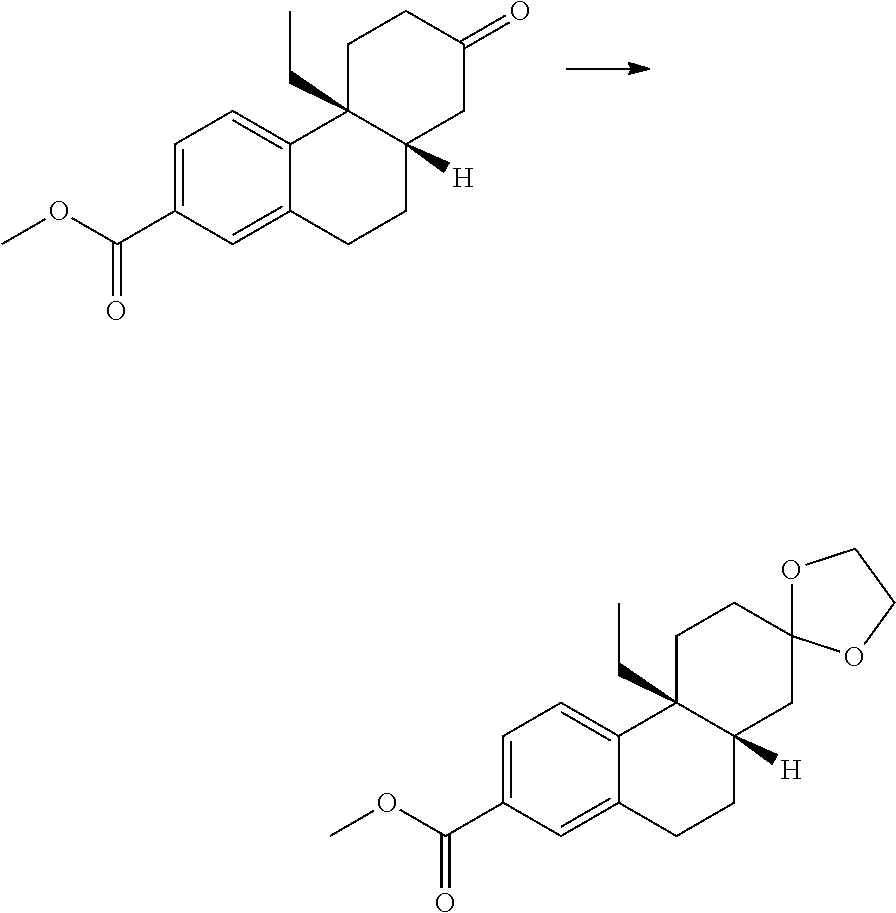
- Ethylene glycol (8.02 g, 129 mmol) and toluene-4-sulfonic acid hydrate (0.492 g, 2.58 mmol) were respectively added, each in one portion, to a solution of (4bR,8aS)-methyl 4b-ethyl-7-oxo-4b,5,6,7,8,8 a,9,10-octahydrophenanthrene-2-carboxylate; compound with (4bS,8aR)-methyl 4b-ethyl-7-oxo-4b,5,6,7,8,8 a,9,10-octahydrophenanthrene-2-carboxylate (94, R2=Ethyl) (7.40 g, 25.8 mmol) and toluene (200 mL) under a nitrogen atmosphere in a flask fitted with a Dean-Stark trap and condenser. The reaction was heated at reflux and water was removed with a Dean-Stark trap for about 18 h. The reaction mixture was cooled to rt and poured into a solution of saturated aqueous NaHCO3 (100 mL). The layers were separated and the organic layer was washed with saturated aqueous NaCl (75 mL). The organic layer was dried over MgSO4, filtered, and concentrated under reduced pressure. The residue was purified on silica gel (120 g) using DCM as eluant. The product containing fractions were combined and concentrated under reduced pressure to afford (4a′R,10a′S)-methyl 4a′-ethyl-3′,4′,4a′,9′,10′,10a′-hexahydro-1′H-spiro[[1,3]dioxolane-2,2′-phenanthrene]-7′-carboxylate; compound with (4a′S,10a′R)-methyl 4a′-ethyl-3′,4′,4a′,9′,10′,10a′-hexahydro-1′H-spiro[[1,3]dioxolane-2,2′-phenanthrene]-7′-carboxylate (38, R2=Ethyl) (7.30 g, 85%) as an oil. LC/MS, method 3, Rt=2.68 min, MS m/z 331 (M+H)+. 1H NMR (400 MHz, DMSO-d6) δ 7.74-7.64 (m, 2H), 7.41 (d, J=8.2 Hz, 1H), 3.91-3.74 (m, 4H), 3.82 (s, 3H), 2.87-2.78 (m, 2H), 2.27-2.16 (m, 1H), 2.12-1.96 (m, 2H), 1.73-1.42 (m, 6H), 1.34-1.24 (m, 1H), 1.22-1.10 (m, 1H), 0.73 (t, J=7.5 Hz, 3H).
-

- A solution of (4a′R,10a′S)-methyl 4a′-ethyl-3′,4′,4a′,9′,10′,10a′-hexahydro-1′H-spiro[[1,3]dioxolane-2,2′-phenanthrene]-7′-carboxylate; compound with (4a′S,10a′R)-methyl 4a′-ethyl-3′,4′,4a′,9′,10′,10a′-hexahydro-1′H-spiro[[1,3]dioxolane-2,2′-phenanthrene]-7′-carboxylate (38, R2=Ethyl) (3.50 g, 10.6 mmol), N-bromosuccinimide (2.26 g, 12.7 mmol), 2,2′-azobis(2-methylpropionitrile) (0.174 g, 1.059 mmol) and CCl4 (70 mL) under a nitrogen atmosphere was heated to reflux for about 1 h. The reaction was cooled and diluted with DCM (200 mL), washed with saturated aqueous NaHCO3 (150 mL), water (50 mL) and saturated aqueous NaCl (100 mL).
- The organic layer was dried over MgSO4, filtered and concentrated under reduced pressure. The residue was dissolved in MeCN (100 mL) and TEA (1.60 mL, 11.6 mmol) was added. The solution was warmed to about 80° C. for about 19 h. The volatiles were removed under reduced pressure. The residue was partitioned between EtOAc (200 mL) and water (100 mL). The aqueous layer was extracted with EtOAc (100 mL). The combined organics were washed with saturated aqueous NaCl (100 mL), dried over MgSO4, filtered and concentrated under reduced pressure. The residue was purified on silica gel (80 g) using a gradient of 3-9% EtOAc in heptane. The product containing fractions were combined and concentrated under reduced pressure to afford (4a′R, 10a′R)-methyl 4a′-ethyl-3′,4′,4a, 10a′-tetrahydro-1′H-spiro[[1,3]dioxolane-2,2′-phenanthrene]-7′-carboxylate; compound with (4a′S,10a′S)-methyl 4a′-ethyl-3′,4′,4a, 10a′-tetrahydro-1′H-spiro[[1,3]dioxolane-2,2′-phenanthrene]-7′-carboxylate (98, R2=Ethyl) (1.90 g, 55%) as an oil. LC/MS, method 3, Rt=2.66 min, MS m/z 329 (M+H)+. 1H NMR (400 MHz, CDCl3) δ 7.86 (dd, J=8.0, 1.9 Hz, 1H), 7.72 (d, J=2.0 Hz, 1H), 7.28 (d, J=8.0 Hz, 1H), 6.43 (d, J=9.6 Hz, 1H), 5.98 (dd, J=9.5, 6.3 Hz, 1H), 3.98-3.84 (m, 4H), 3.91 (s, 3H), 2.49-2.36 (m, 2H), 1.86-1.74 (m, 1H), 1.76-1.60 (m, 4H), 1.34-1.25 (m, 1H), 1.25-1.15 (m, 1H), 0.64 (t, J=7.5 Hz, 3H).
-

- Tfa (1.9 mL, 24 mmol) was added to a biphasic solution of (4a′R,10a′R)-methyl 4a′-ethyl-3′,4′,4a′,10a′-tetrahydro-1′H-spiro[[1,3]dioxolane-2,2′-phenanthrene]-7′-carboxylate; compound with (4a′S,10a′S)-methyl 4a′-ethyl-3′,4′,4a′,10a′-tetrahydro-1′H-spiro[[1,3]dioxolane-2,2′-phenanthrene]-7′-carboxylate (98, R2=Ethyl) (1.60 g, 4.87 mmol), DCM (28 mL), and water (14 mL) under air. The mixture was left to vigorously stir for about 2 h at about 40° C. Tfa (1.0 mL, 13 mmol) was added. The biphasic mixture was left to vigorously stir for about 16 h at about 40° C. TFA (1.0 mL, 13 mmol) was added. The biphasic mixture was left to vigorously stir for about 2 h at about 40° C. The reaction was cooled to rt. DCM (200 mL) was added. The layers were separated and the organics were washed with saturated aqueous NaHCO3 (150 mL) and saturated aqueous NaCl (150 mL). The organic layer was dried over MgSO4, filtered, and concentrated under reduced pressure. The residue was purified on silica gel (80 g) using a gradient of 5-17% EtOAc in heptane. The fractions containing product were combined and concentrated under reduced pressure to afford (4bR,8aR)-methyl 4b-ethyl-7-oxo-4b,5,6,7,8,8a-hexahydrophenanthrene-2-carboxylate; compound with (4bS,8aS)-methyl 4b-ethyl-7-oxo-4b,5,6,7,8,8a-hexahydrophenanthrene-2-carboxylate (98A, R2=Ethyl) (1.20 g, 87%) as an ivory foam. LC/MS, method 3, Rt=2.39 min, MS m/z 285 (M+H)+. 1H NMR (400 MHz, CDCl3) δ 7.95 (dd, J=8.0, 1.9 Hz, 1H), 7.80 (d, J=1.8 Hz, 1H), 7.37 (d, J=8.0 Hz, 1H), 6.51 (d, J=9.5 Hz, 1H), 6.00 (dd, J=9.5, 6.0 Hz, 1H), 3.93 (s, 3H), 2.75-2.67 (m, 1H), 2.67-2.59 (m, 1H), 2.54-2.43 (m, 1H), 2.39-2.29 (m, 2H), 2.07-1.98 (m, 1H), 1.96-1.78 (m, 2H), 1.43-1.32 (m, 1H), 0.70 (t, J=7.5 Hz, 3H).
-

- Propylmagnesium bromide (2 M solution in THF, 10.6 mL, 21.2 mmol) [TCI] was added to THF (5 mL) under a nitrogen atmosphere. The solution was cooled to about −45° C. A solution of (4bR,8aR)-methyl 4b-ethyl-7-oxo-4b,5,6,7,8,8a-hexahydrophenanthrene-2-carboxylate; compound with (4bS,8aS)-methyl 4b-ethyl-7-oxo-4b,5,6,7,8,8a-hexahydrophenanthrene-2-carboxylate (98A, R2=Ethyl) (0.600 g, 2.11 mmol) and THF (15 mL) was added dropwise maintaining an internal temperature of less than −40° C. The cold bath was allowed to warm to between −30 and −40° C. over about 15 min and then maintained in this range for about 60 min. MeOH (4 mL) was added dropwise maintaining an internal temperature of less than −10° C. The cold bath was removed and saturated aqueous NH4Cl (150 mL), water (50 mL) and EtOAc (200 mL) were added. The layers were separated and the organics were washed with saturated aqueous NaCl (50 mL), dried over MgSO4, filtered, and concentrated under reduced pressure. The residue was purified on silica gel (80 g) using a gradient of 3-30% EtOAc in heptane. The fractions containing product were combined and concentrated under reduced pressure to afford (4bR,7R,8aR)-methyl 4b-ethyl-7-propyl-7-hydroxy-4b,5,6,7,8,8a-hexahydrophenanthrene-2-carboxylate; compound with (4bS,7S,8aS)-methyl 4b-ethyl-7-propyl-7-hydroxy-4b,5,6,7,8,8a-hexahydrophenanthrene-2-carboxylate (106, R2=Ethyl, R3=Propyl) (0.462 g, 53%) as an oil. LC/MS, method 3, Rt=2.67 min, MS m/z 329 (M+H)+. 1H NMR (400 MHz, CDCl3) δ 7.86 (dd, J=8.0, 1.9 Hz, 1H), 7.70 (d, J=1.8 Hz, 1H), 7.27 (d, J=8.0 Hz, 1H), 6.42 (d, J=9.5 Hz, 1H), 6.00 (dd, J=9.5, 6.3 Hz, 1H), 3.90 (s, 3H), 2.56-2.48 (m, 1H), 2.29-2.20 (m, 1H), 1.85-1.70 (m, 3H), 1.60-1.50 (m, 2H), 1.45-1.05 (m, 6H), 1.00-0.80 (m, 4H), 0.64 (t, J=7.6 Hz, 3H).
-
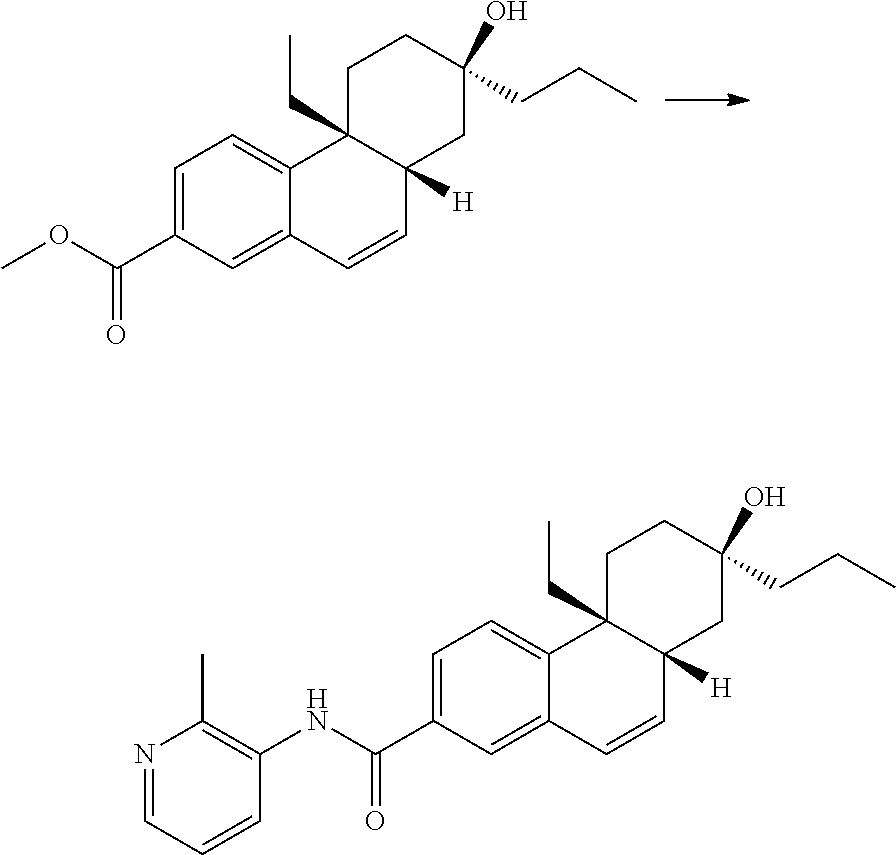
- 2-Methylpyridin-3-amine (0.183 g, 1.67 mmol) was added in one portion to a solution of (4bR,7R,8aR)-methyl 4b-ethyl-7-propyl-7-hydroxy-4b,5,6,7,8,8a-hexahydrophenanthrene-2-carboxylate; compound with (4bS,7S,8aS)-methyl 4b-ethyl-7-propyl-7-hydroxy-4b,5,6,7,8,8a-hexahydrophenanthrene-2-carboxylate (106, R2=Ethyl, R3=Propyl) (0.462 g, 1.41 mmol) and toluene (10 mL) under a nitrogen atmosphere. The mixture was cooled to about 0° C. LiHMDS (1 M solution in THF, 7.0 mL, 7.0 mmol) was added dropwise over about 30 min. After about 30 min, the ice bath was removed and the mixture was allowed to warm to rt. After about 1 h, the mixture was poured into saturated aqueous NaHCO3 (20 mL) and water (20 mL). The mixture was extracted with EtOAc (200 mL). The organic layer was washed with water (40 mL), dried over MgSO4, filtered, and concentrated under reduced pressure. The residue was purified on silica gel (120 g) using a gradient of 0-85% EtOAc in DCM. The fractions containing product were combined and concentrated under reduced pressure to afford (4bR,7R,8aR)-4b-ethyl-7-propyl-7-hydroxy-N-(2-methylpyridin-3-yl)-4b,5,6,7,8,8a-hexahydrophenanthrene-2-carboxamide; compound with (4bS,7S,8aS)-4b-ethyl-7-propyl-7-hydroxy-N-(2-methylpyridin-3-yl)-4b,5,6,7,8,8a-hexahydrophenanthrene-2-carboxamide (107, R2=Ethyl, R3=Propyl, R6=2-Methylpyridin-3-yl) (0.440 g, 74%) as a foam. LC/MS, method 2, Rt=2.15 min, MS m/z 405 (M+H)+. 1H NMR (400 MHz, CDCl3) δ 8.43 (d, J=8.0 Hz, 1H), 8.33 (dd, J=4.8, 1.5 Hz, 1H), 7.73-7.66 (m, 2H), 7.55 (d, J=2.0 Hz, 1H), 7.35 (d, J=8.0 Hz, 1H), 7.29-7.23 (m, 1H), 6.46 (d, J=9.5 Hz, 1H), 6.03 (dd, J=9.5, 6.3 Hz, 1H), 2.64 (s, 3H), 2.61-2.53 (m, 1H), 2.31-2.22 (m, 1H), 1.89-1.76 (m, 2H), 1.62-1.53 (m, 2H), 1.48-1.25 (m, 6H), 1.06-1.02 (m, 1H), 1.00-0.89 (m, 1H), 0.89-0.80 (m, 3H), 0.67 (t, J=7.5 Hz, 3H).
-

- A solution of (4bR,7R,8aR)-4b-ethyl-7-propyl-7-hydroxy-N-(2-methylpyridin-3-yl)-4b,5,6,7,8,8a-hexahydrophenanthrene-2-carboxamide; compound with (4bS,7S,8aS)-4b-ethyl-7-propyl-7-hydroxy-N-(2-methylpyridin-3-yl)-4b,5,6,7,8,8a-hexahydrophenanthrene-2-carboxamide (107, R2=Ethyl, R3=Propyl, R6=2-Methylpyridin-3-yl) (0.380 g, 0.939 mmol), DCM (36 mL), and MeOH (4 mL) was purged with O2 at about −78° C. Ozone was bubbled through the solution (˜2.0 SLPM). After about 8 min, the solution began to turn slightly blue. The ozone generator was switched off and the solution was purged with O2 for about 30 min. PS-PPh3 (˜3 mmol/g, 0.94 g) was added. The cold bath was allowed to warm to rt over about 15 min. After about 30 min, the mixture was filtered rinsing with a solution of MeOH (40 mL) and DCM (20 mL). NaBH4 (0.142 g, 3.76 mmol) was added. After about 30 min, NaBH4 (0.142 g, 3.76 mmol) was added. After about 30 min, the volatiles were removed under reduced pressure. DCM (50 mL), saturated aqueous NaHCO3 (20 mL) and water (30 mL) were added. The mixture was left to vigorously stir for about 18 h. The layers were separated and the aqueous layer was extracted with 5% MeOH in DCM (2×20 mL). The combined organics were washed with saturated aqueous NH4Cl (25 mL). The organic layer was dried over Na2SO4, filtered, and concentrated under reduced pressure. The residue was purified on silica gel (40 g) using a gradient of 2-9% MeOH in DCM. The fractions containing product were combined and concentrated under reduced pressure to afford (7aS,9R,11aR)-11a-ethyl-9-propyl-7,9-dihydroxy-N-(2-methylpyridin-3-yl)-5,7,7a,8,9,10,11,11a-octahydrodibenzo[c,e]oxepine-3-carboxamide; compound with (7aR,9S,11aS)-11a-ethyl-9-propyl-7,9-dihydroxy-N-(2-methylpyridin-3-yl)-5,7,7a,8,9,10,11,11a-octahydrodibenzo[c,e]oxepine-3-carboxamide (108, R2=Ethyl, R3=Propyl, R6=2-Methylpyridin-3-yl), (0.296 g, 71%) as an ivory solid. LC/MS, method 2, Rt=1.62 min, MS m/z 439 (M+H)+, 1H NMR (400 MHz, DMSO-d6) δ 9.98 (s, 1H), 8.33 (dd, J=4.7, 1.5 Hz, 1H), 7.84 (dd, J=8.3, 1.9 Hz, 1H), 7.79-7.60 (m, 2H), 7.44 (d, J=8.5 Hz, 1H), 7.27 (dd, J=7.9, 4.7 Hz, 1H), 6.44 (d, J=4.3 Hz, 1H), 5.33-5.28 (m, 1H), 4.80-4.63 (m, 2H), 3.83 (s, 1H), 2.44 (s, 3H), 2.35-2.18 (m, 2H), 1.91-1.71 (m, 3H), 1.68-1.58 (m, 1H), 1.50-1.40 (m, 1H), 1.35-1.05 (m, 5H), 0.82-0.62 (m, 7H).
-

- Tfa (0.42 mL, 5.5 mmol) was added to a solution of (7aS,9R,11aR)-11a-ethyl-9-propyl-7,9-dihydroxy-N-(2-methylpyridin-3-yl)-5,7,7a,8,9,10,11,11a-octahydrodibenzo[c,e]oxepine-3-carboxamide; compound with (7aR,9S,11aS)-11a-ethyl-9-propyl-7,9-dihydroxy-N-(2-methylpyridin-3-yl)-5,7,7a,8,9,10,11,11a-octahydrodibenzo[c,e]oxepine-3-carboxamide (108, R2=Ethyl, R3=Propyl, R6=2-Methylpyridin-3-yl) (0.294 g, 0.670 mmol) and DCM (6 mL) under a nitrogen atmosphere at rt. Triethylsilane (0.66 mL, 4.1 mmol) was added dropwise. The solution was left to stir for about 16 h. The solution was poured into saturated aqueous NaHCO3 (30 mL) and then extracted with DCM (50 mL then 2×20 mL). The combined organics were washed with saturated aqueous NaCl (25 mL), dried over Na2SO4, filtered, and concentrated under reduced pressure. The residue was purified on silica gel (40 g) using a gradient of 1-5% MeOH in DCM. The fractions containing product were combined and concentrated under reduced pressure to afford (7aS,9R,11aR)-11a-ethyl-9-propyl-9-hydroxy-N-(2-methylpyridin-3-yl)-5,7,7a,8,9,10,11,11a-octahydrodibenzo[c,e]oxepine-3-carboxamide; compound with (7aR,9S,11aS)-11a-ethyl-9-propyl-9-hydroxy-N-(2-methylpyridin-3-yl)-5,7,7a,8,9,10,11,11a-octahydrodibenzo[c,e]oxepine-3-carboxamide (110, R2=Ethyl, R3=Propyl, R6=2-Methylpyridin-3-yl) (0.161 g, 56%) as a white solid. LC/MS, method 2, Rt=1.85 min, MS m/z 423 (M+H)+. 1H NMR (400 MHz, DMSO-d6) δ 9.99 (s, 1H), 8.33 (dd, J=4.8, 1.6 Hz, 1H), 7.84 (dd, J=8.2, 1.9 Hz, 1H), 7.76 (d, J=2.0 Hz, 1H), 7.73 (dd, J=8.0, 1.5 Hz, 1H), 7.43 (d, J=8.4 Hz, 1H), 7.27 (dd, J=7.9, 4.7 Hz, 1H), 4.80 (d, J=14.3 Hz, 1H), 4.70 (d, J=14.4 Hz, 1H), 4.25-4.17 (m, 1H), 3.95 (s, 1H), 3.70-3.61 (m, 1H), 2.44 (s, 3H), 2.33-2.23 (m, 1H), 2.12-1.90 (m, 2H), 1.78-1.65 (m, 1H), 1.62-1.45 (m, 2H), 1.42-1.08 (m, 7H), 0.77 (t, J=7.0 Hz, 3H), 0.67 (t, J=7.4 Hz, 3H). Chiral analysis, analytical chiral chromatography method C, UV trace (230-420 nm): Peak 1: Rt=6.14 min, 13% of integrated area. Peak 2: Rt=6.91 min, 87% of integrated area.
- Purification Method: (LC) Isocratic, 25% EtOH in heptane with 0.12% diethylamine modifier for 17 min (20 mL/min flow rate). The column used for the chromatography was a 20×250 mm Daicel IA (5 μm particles). The first peak eluted was (7aR,9S,11aS)-11a-ethyl-9-propyl-9-hydroxy-N-(2-methylpyridin-3-yl)-5,7,7a,8,9,10,11,11a-octahydrodibenzo[c,e]oxepine-3-carboxamide (Example 137) and the second was (7aS,9R,11aR)-11a-ethyl-9-hydroxy-9-propyl-6,7,7a,8,9,10,11,11a-octahydro-5H-dibenzo[a,c]cycloheptene-3-carboxylic acid (2-methyl-pyridin-3-yl)-amide (Example 138). NMR and LCMS data for single isomers was essentially identical to the racemic mixture.
- Additional examples, prepared in a manner similar to the preparation of Example 137 and Example 138, are listed in Table 8.
-
TABLE 8 Chiral LC/ method/ Grignard MS LC/MS Order of Ex. # Ketone Rgt. Product method RT/MH+ elution 139 Compound Isobutylmagnesium- Compound 110 2 1.98 min 17/ 98A (R2 = bromide (7aR,9S,11aR) 437 Second Ethyl) [TCI] (R2 = Ethyl, R3 = Isobutyl, R6 = 2- Methylpyridin-3- yl) 140 Compound Ethylmagnesium- Compound 110 2 1.69 min 18/ 98A (R2 = bromide (7aS,9R,11aR) 409 Second Ethyl) (R2 = Ethyl, R3 = Ethyl, R6 = 2- Methylpyridin-3- yl) 141 Compound Ethylmagnesium- Compound 110 2 1.69 min 18/First 98A (R2 = bromide (7aR,9S,11aS) 409 Ethyl) (R2 = Ethyl, R3 = Ethyl, R6 = 2- Methylpyridin-3- yl) -

- A solution of (7aS,9R,11aS)-11a-benzyl-9-ethyl-9-hydroxy-6,7,7a,8,9,10,11,11a-octahydro-5H-dibenzo[a,c]cycloheptene-3-carboxylic acid (prepared as described in Example 83)(0.044 g, 0.116 mmol) and DIEA (0.030 mL, 0.174 mmol) in DMF (2 mL) was cooled to about 0° C. HBTU (0.053 g, 0.139 mmol) was added and the mixture was stirred for about 10 min. Benzene-1,3-diamine (0.038 g, 0.349 mmol) was then added and the mixture was stirred for about 30 min at about 0° C., then warmed to rt for about 3 h. Water (10 mL) was added and the resulting solids were filtered and rinsed with excess water. The residue was purified on silica gel (4 g) with a gradient of 0-5% MeOH in DCM. Fractions containing product were combined and concentrated under reduced pressure. The residue was further purified on silica gel (4 g) with a gradient of 0-5% MeOH in DCM. Fractions containing product were combined and concentrated under reduced pressure. The residue was dissolved in DMF (2 mL) and purified by reverse phase (C18) HPLC using a gradient of 10-100% MeCN in aqueous NH4OAc (50 mM) to yield (7aS,9R,11aS)-11a-benzyl-9-ethyl-9-hydroxy-6,7,7a,8,9,10,11,11a-octahydro-5H-dibenzo[a,c]cycloheptene-3-carboxylic acid (3-amino-phenyl)-amide (85, R4=Phenyl, R5=Methyl, R6=3-Aminophenyl) (0.016 g, 29%); LC/MS method 2, Rt=2.37 min, MS m/z 469 (M+H)+; 1H NMR (400 MHz, DMSO-d6) 1H NMR (400 MHz, DMSO) δ 9.84 (s, 1H), 7.77 (d, J=2.1 Hz, 1H), 7.52 (dd, J=8.2, 2.1 Hz, 1H), 7.17-7.02 (m, 4H), 6.97 (t, J=7.9 Hz, 1H), 6.91-6.84 (m, 1H), 6.80 (d, J=8.4 Hz, 1H), 6.62-6.56 (m, 2H), 6.32 (dd, J=7.9, 2.1 Hz, 1H), 5.07 (bs, 2H), 3.90 (s, 1H), 3.63-3.56 (m, 1H), 3.31-3.24 (m, 1H), 3.09-2.99 (m, 1H), 2.65-2.58 (m, 1H), 2.49-2.41 (m, 1H), 1.91-1.25 (m, 8H), 1.24-1.05 (m, 4H), 0.72 (t, J=7.3 Hz, 3H).
-
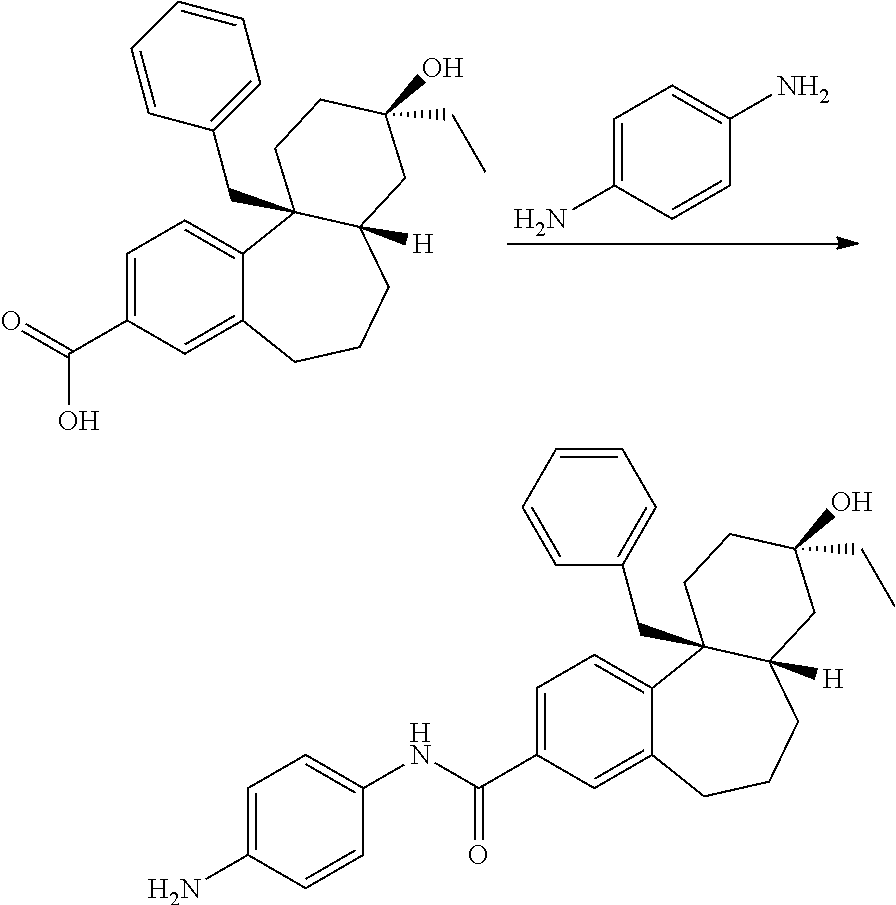
- A solution of (7aS,9R,11aS)-11a-benzyl-9-ethyl-9-hydroxy-6,7,7a,8,9,10,11,11a-octahydro-5H-dibenzo[a,c]cycloheptene-3-carboxylic acid (prepared as described in Example 83) (0.044 g, 0.116 mmol) and DIEA (0.030 mL, 0.174 mmol) in DMF (2 mL) was cooled to about 0° C. HBTU (0.053 g, 0.139 mmol) was added and the mixture was stirred for about 10 min. The mixture was cooled to about 0° C., benzene-1,4-diamine (0.038 g, 0.349 mmol) was then added and the mixture was stirred for about 30 min at about 0° C., then warmed to rt for about 2 h. Water (10 mL) was added and the resulting solids were filtered and rinsed with excess water. The residue was purified on silica gel (4 g) with a gradient of 0-5% MeOH in DCM. Fractions containing product were combined and concentrated under reduced pressure. The residue was purified a second time on silica gel (4 g) using a gradient of 0-5% MeOH in DCM. Fractions containing product were combined and concentrated under reduced pressure. The residue was then taken into DMF (2 mL) and purified by reverse phase HPLC using a gradient of 10-100% MeCN in aqueous NH4OAc (50 nM) to provide (7aS,9R,11aS)-11a-benzyl-9-ethyl-9-hydroxy-6,7,7a,8,9,10,11,11a-octahydro-5H-dibenzo[a,c]cycloheptene-3-carboxylic acid (4-amino-phenyl)-amide (85, R4=Phenyl, R5=Methyl, R6=4-Aminophenyl) (0.040 g, 73%); LC/MS method 2, Rt=2.31 min, MS m/z 469 (M+H)+; 1H NMR (400 MHz, DMSO-d6) δ 9.75 (s, 1H), 7.74 (d, J=2.1 Hz, 1H), 7.48 (dd, J=8.2, 2.1 Hz, 1H), 7.37-7.32 (m, 2H), 7.12-6.99 (m, 3H), 6.76 (d, J=8.4 Hz, 1H), 6.64-6.46 (m, 4H), 4.89 (bs, 2H), 3.88 (s, 1H), 3.57 (d, J=12.9 Hz, 1H), 3.29-3.21 (m, 1H), 3.05-2.96 (m, 1H), 2.61-2.55 (m, 1H), 2.46-2.39 (m, 1H), 1.97-1.68 (m, 3H), 1.70-1.18 (m, 5H), 1.20-1.00 (m, 4H), 0.70 (t, J=7.4 Hz, 3H).
-


-

- A solution of 1H-pyrrole-3-carboxylic acid (175) (10 g, 90 mmol) in EtOH (450 mL) was treated with H2SO4 (0.48 mL, 9.0 mmol) and the resulting solution was stirred at reflux for about 3 days. The reaction mixture was then concentrated under reduced pressure and the residue was then partitioned between saturated aqueous NaHCO3 (250 mL) and EtOAc (250 mL). After separating the layers, the organic phase was washed with saturated aqueous NaCl (200 mL), dried over Na2SO4, filtered, and concentrated under reduced pressure. The sample was purified on silica gel (220 g) using a gradient of 0-50% EtOAc in heptane to yield ethyl 1H-pyrrole-3-carboxylate (176) (9.2 g, 74%). LC/MS, method 3, Rt=1.71 min, MS m/z 140 (M+H)+. 1H NMR (400 MHz, CDCl3) δ 8.66-8.43 (bs, 1H), 7.45-7.41 (m, 1H), 6.78-6.74 (m, 1H), 6.68-6.64 (m, 1H), 4.29 (q, J=7.1 Hz, 2H), 1.34 (t, J=7.1 Hz, 3H).
-

- A solution of ethyl 1H-pyrrole-3-carboxylate (176) (7.6 g, 55 mmol) in DMF (273 mL) was cooled in an ice bath and then treated with NaH (60% dispersion in mineral oil; 3.3 g, 82 mmol). Once gas evolution had subsided, the suspension was heated at about 50° C. for about 1 h. tert-Butyl 4-bromobutanoate (14 mL, 82 mmol) was added and stirring was continued at 50° C. for 16 h. The reaction was concentrated under reduced pressure and the residue was partitioned between EtOAc (250 mL) and water (250 mL). After separating the layers, the organic phase was washed with saturated aqueous NaCl (200 mL), dried over Na2SO4, filtered, and concentrated under reduced pressure. The crude material was purified on silica gel (330 g) using a gradient of 0-50% EtOAc in heptane to yield ethyl 1-(4-tert-butoxy-4-oxobutyl)-1H-pyrrole-3-carboxylate (177) (11.8 g, 77%). LC/MS, method 3, Rt=2.42 min, MS m/z 282 (M+H)+. 1H NMR (400 MHz, CDCl3) δ 7.27-7.26 (m, 1H), 6.60-6.55 (m, 2H), 4.30-4.19 (m, 2H), 3.93 (t, J=6.8 Hz, 2H), 2.21-2.15 (m, 2H), 2.12-1.98 (m, 2H), 1.45 (s, 9H), 1.36-1.30 (t, J=7.1 Hz, 3H).
-

- A solution of ethyl 1-(4-tert-butoxy-4-oxobutyl)-1H-pyrrole-3-carboxylate (177) (3.16 g, 11.2 mmol) in DCM (22.5 mL) was treated with Tfa (8.6 mL, 110 mmol) and the solution was stirred at rt for about 2 h. The reaction was then concentrated under reduced pressure, and the residue was re-dissolved in toluene (25 mL). The solution was again concentrated under reduced pressure, re-dissolved in toluene (25 mL) and then finally concentrated to dryness under reduced pressure to afford, without further purification, 4-(3-(ethoxycarbonyl)-1H-pyrrol-1-yl)butanoic acid (178) (2.53 g, 100%). LC/MS, method 3, Rt=1.71 min, MS m/z 226 (M+H)+. 1H NMR (400 MHz, CDCl3) δ 9.40 (bs, 1H), 7.32-7.28 (m, 1H), 6.60-6.58 (m, 2H), 4.27 (q, J=7.1 Hz, 2H), 3.97 (t, J=6.9 Hz, 2H), 2.35 (t, J=7.1 Hz, 2H), 2.15-2.06 (m, 2H), 1.34 (t, J=7.1 Hz, 3H).
- Step #4: Compound 179
-

- A suspension of 4-(3-(ethoxycarbonyl)-1H-pyrrol-1-yl)butanoic acid (178) (2.53 g, 11.2 mmol) and HATU (4.27 g, 11.2 mmol) in THF (37 mL) was treated with TEA (5.5 mL, 39 mmol) and the resulting solution was stirred at rt for about 16 h. Separately, a suspension of potassium tert-butoxide (3.78 g, 33.7 mmol) and trimethylsulfoxonium chloride (4.33 g, 33.7 mmol) in THF (37 mL) was heated at about 60° C. for about 2 h, and then cooled in an ice-water bath for about 15 min. The solution of activated ester was then added drop-wise at about 0° C. over a period of about 45 min. The reaction mixture was further stirred for about 1 h, after which the reaction was concentrated under reduced pressure. The residue was partitioned between DCM (100 mL) and water (100 mL). After separating the layers, the organic phase was washed with saturated aqueous NaCl (100 mL), dried over Na2SO4, filtered, and concentrated under reduced pressure. The crude material was purified on silica gel (80 g) using a gradient of 0-5% MeOH in DCM to yield Compound 179 (2.22 g, 66%). LC/MS, method 3, Rt=1.44 min, MS m/z 300 (M+H)+. 1H NMR (400 MHz, CDCl3) δ 7.29-7.26 (m, 1H), 6.62-6.54 (m, 2H), 4.35 (s, 1H), 4.26 (q, J=7.1 Hz, 2H), 3.92 (t, J=6.8 Hz, 2H), 3.38 (s, 6H), 2.20-2.11 (m, 2H), 2.12-1.99 (m, 2H), 1.33 (t, J=7.1 Hz, 3H).
-

- A solution of Compound 179 (2.22 g, 7.42 mmol) and chloro(1,5-cyclooctadiene)iridium(I) dimer (0.498 g, 0.742 mmol) in DCE (297 mL) was degassed with a stream of nitrogen gas for about 30 min. The mixture was heated at about 80° C. for about 10 min, and then cooled to rt. The reaction was concentrated under reduced pressure. The residue was purified on silica gel (80 g) using 10% EtOAc in heptane as eluant to give ethyl 8-oxo-6,7,8,9-tetrahydro-5H-pyrrolo[1,2-c]azepine-2-carboxylate (180) (0.87 g, 53%). LC/MS, method 3, Rt=1.72 min, MS m/z 222 (M+H)+. 1H NMR (400 MHz, CDCl3) δ 7.27-7.25 (m, 1H), 6.44-6.42 (m, 1H), 4.26 (q, J=7.1 Hz, 2H), 4.20-4.13 (m, 2H), 3.68 (s, 2H), 2.59 (t, J=6.8 Hz, 2H), 2.17-2.06 (m, 2H), 1.32 (t, J=7.1 Hz, 3H).
-

- A solution of ethyl 8-oxo-6,7,8,9-tetrahydro-5H-pyrrolo[1,2-a]azepine-2-carboxylate (180) (0.87 g, 3.9 mmol) in toluene (39 mL) was treated with pyrrolidine (0.72 mL, 8.6 mmol) and the reaction mixture was heated at reflux for about 3 h, removing water by means of a Dean-Stark trap. The reaction was cooled and concentrated under reduced pressure, then re-dissolved in 1,4-dioxane (26 mL), treated with benzyl bromide (0.84 mL, 7.1 mmol), and then heated at about 100° C. for about 21 h. The reaction mixture was allowed to cool to rt and then was partitioned between water (150 mL) and EtOAc (150 mL). After separating the layers, the aqueous phase was extracted with EtOAc (50 mL). The combined organic phases were washed with saturated aqueous NaCl (100 mL), dried over Na2SO4, filtered, and concentrated under reduced pressure. The crude material was purified on silica gel (330 g) using a gradient of 0-50% EtOAc in heptane to yield ethyl 9-benzyl-8-oxo-6,7,8,9-tetrahydro-5H-pyrrolo[1,2-a]azepine-2-carboxylate (181, R2=Benzyl) (0.69 g, 56%). LC/MS, method 3, Rt=2.29 min, MS m/z 229 (M+H)+. 1H NMR (400 MHz, CDCl3) δ 7.27-7.15 (m, 6H), 6.50-6.46 (m, 1H), 4.26 (q, J=7.1 Hz, 2H), 4.21-4.10 (m, 2H), 4.02-3.90 (m, 1H), 3.46 (dd, J=13.8, 8.6 Hz, 1H), 3.14 (dd, J=13.8, 4.9 Hz, 1H), 2.58-2.50 (m, 2H), 2.24-2.12 (m, 1H), 2.02-1.86 (m, 1H), 1.32 (t, J=7.1 Hz, 3H).
-

- Sodium (0.076 g, 3.3 mmol) was added to a flask containing EtOH (6 mL), and stirred at room temperature until the reaction was complete. A suspension of ethyl 9-benzyl-8-oxo-6,7,8,9-tetrahydro-5H-pyrrolo[1,2-c]azepine-2-carboxylate (181, R2=Benzyl) (0.69 g, 2.2 mmol) in EtOH (6 mL) was added and the mixture was heated at about 60° C. for about 5 min. Methyl vinyl ketone (0.20 ml, 2.4 mmol) was added drop-wise over about 30 min. The reaction was stirred at about 60° C. for about 60 min, then allowed to cool to rt. The reaction mixture was concentrated under reduced pressure and the residue was partitioned between EtOAc (50 mL) and 10% aqueous NH4Cl (50 mL). After separating the layers, the organic phase was washed with saturated aqueous NaCl (25 mL), dried over Na2SO4, filtered, and concentrated under reduced pressure. The sample was purified on silica gel (40 g) using a gradient of 0-50% EtOAc in heptane to give ethyl 11a-benzyl-9-oxo-6,7,9,10,11,11a-hexahydro-5H-benzokipyrrolo[1,2-a]azepine-2-carboxylate (182, R2=Benzyl) (0.311 g, 39%). LC/MS, method 3, Rt=2.27 min, MS m/z 364 (M+H)+. 1H NMR (400 MHz, CDCl3) δ 7.23 (d, J=1.9 Hz, 1H), 7.20-7.12 (m, 3H), 6.87-6.80 (m, 2H), 6.42 (d, J=1.9 Hz, 1H), 5.98 (s, 1H), 4.26 (q, J=7.1 Hz, 2H), 4.22-4.09 (m, 2H), 3.50 (d, J=13.3 Hz, 1H), 2.98 (d, J=13.3 Hz, 1H), 2.66-2.35 (m, 4H), 2.26-2.11 (m, 2H), 2.09-1.98 (m, 1H), 1.87-1.72 (m, 1H), 1.33 (t, J=7.1 Hz, 3H).
-

- A suspension of ethyl 11a-benzyl-9-oxo-6,7,9,10,11,11a-hexahydro-5H-benzo[c]pyrrolo[1,2-c]azepine-2-carboxylate (182, R2=Benzyl) (0.100 g, 0.275 mmol) and 10% Pd on carbon (0.029 g) in EtOAc (20 mL) was shaken in a Parr Shaker at rt under about 55 psi of hydrogen for about 2 h. The reaction was filtered through a pad of Celite® (about 1.0 g) to remove the catalyst. The Celite® pad was washed with EtOAc (3×5 mL). The filtrates were combined and concentrated under reduced pressure, and then the residue was purified on silica gel (12 g) using a gradient of 10-35% EtOAc in heptane to yield (7aS,11aS)-ethyl 11a-benzyl-9-oxo-6,7,7a,8,9,10,11,11a-octahydro-5H-benzo[c]pyrrolo[1,2-a]azepine-2-carboxylate; compound with (7aR,11aR)-ethyl 11a-benzyl-9-oxo-6,7,7a,8,9,10,11,11a-octahydro-5H-benzo[c]pyrrolo[1,2-a]azepine-2-carboxylate (183, R2=Benzyl) (0.089 g, 89%). LC/MS method 3, Rt=2.48 min, MS m/z: 366 (M+H)+. 1H NMR (400 MHz, CDCl3) δ 7.29 (d, J=1.9 Hz, 1H), 7.21-7.08 (m, 3H), 6.64-6.52 (m, 2H), 6.18 (d, J=1.9 Hz, 1H), 4.33-4.19 (m, 4H), 3.48 (d, J=13.3 Hz, 1H), 2.75-2.61 (m, 1H), 2.53 (d, J=13.3 Hz, 1H), 2.51-2.41 (m, 1H), 2.40-2.21 (m, 3H), 2.19-2.08 (m, 1H), 2.08-1.90 (m, 2H), 1.90-1.74 (m, 2H), 1.74-1.62 (m, 1H), 1.31 (t, J=7.1 Hz, 3H).
-

- A 10 mL microwave reaction vial was charged with (7aS,11aS)-ethyl 11a-benzyl-9-oxo-6,7,7a,8,9,10,11,11a-octahydro-5H-benzo[c]pyrrolo[1,2-a]azepine-2-carboxylate; compound with (7aR,11aR)-ethyl 11a-benzyl-9-oxo-6,7,7a,8,9,10,11,11a-octahydro-5H-benzo[c]pyrrolo[1,2-a]azepine-2-carboxylate (183, R2=Benzyl) (0.250 g, 0.684 mmol) and LiOH (0.164 g, 6.84 mmol) in 1,4-dioxane (2.5 mL) and water (2.5 mL) and sealed with a pressure releasing septa cap. The reaction mixture was heated in a Biotage microwave at about 120° C. for about 30 minutes (250 psi max pressure, 5 min ramp, 300 max watts). The pH of the reaction mixture was adjusted to about pH=2 by drop-wise addition of aqueous 1N aqueous HCl. The resulting suspension was partitioned between EtOAc (50 mL) and water (50 mL). After separating the layers, the organic phase was washed with saturated aqueous NaCl (50 mL), dried over Na2SO4, filtered, and concentrated to give (7aS,11aS)-11a-benzyl-9-oxo-6,7,7a,8,9,10,11,11a-octahydro-5H-benzo[c]pyrrolo[1,2-a]azepine-2-carboxylic acid; compound with (7aR,11aR)-11a-benzyl-9-oxo-6,7,7a,8,9,10,11,11a-octahydro-5H-benzo[c]pyrrolo[1,2-a]azepine-2-carboxylic acid (184, R2=Benzyl) (0.187 g, 81%). LC/MS, method 3, Rt=2.03 min, MS m/z 338 (M+H)+. 1H NMR (400 MHz, DMSO-d6) δ 11.57 (s, 1H), 7.42 (d, J=1.9 Hz, 1H), 7.15-7.07 (m, 3H), 6.61-6.55 (m, 2H), 5.92 (d, J=1.9 Hz, 1H), 4.44-4.21 (m, 2H), 3.51 (d, J=13.1 Hz, 1H), 2.59-2.51 (m, 2H), 2.48-2.35 (m, 1H), 2.30-2.05 (m, 3H), 2.05-1.59 (m, 6H).
-

- A mixture of 3-amino-2-picoline (0.120 g, 1.11 mmol), (7aS,11aS)-11a-benzyl-9-oxo-6,7,7a,8,9,10,11,11a-octahydro-5H-benzo[c]pyrrolo[1,2-a]azepine-2-carboxylic acid; compound with (7aR,11aR)-11a-benzyl-9-oxo-6,7,7a,8,9,10,11,11a-octahydro-5H-benzo[c]pyrrolo[1,2-a]azepine-2-carboxylic acid (184, R2=Benzyl) (0.187 g, 0.554 mmol), and TFFH (0.146 g, 0.554 mmol) in THF (2.8 mL) was treated with DIEA (0.10 mL, 0.55 mmol) and the resulting suspension was allowed to stir at rt for about 3 days. The reaction mixture was diluted with DCM (25 mL), and the solution was washed with saturated aqueous NaHCO3 (25 mL). The organic phase was washed with saturated aqueous NaCl (20 mL), dried over Na2SO4, filtered, and concentrated under reduced pressure. The residue was purified on silica gel (12 g) using a gradient of 0-5% MeOH in DCM to yield (7aS,11aS)-11a-benzyl-N-(2-methylpyridin-3-yl)-9-oxo-6,7,7a,8,9,10,11,11a-octahydro-5H-benzo[c]pyrrolo[1,2-a]azepine-2-carboxamide; compound with (7aR,11aR)-11a-benzyl-N-(2-methylpyridin-3-yl)-9-oxo-6,7,7a,8,9,10,11,11a-octahydro-5H-benzo[c]pyrrolo[1,2-a]azepine-2-carboxamide (185, R2=Benzyl, R6=2-Methylpyridin-3-yl) (0.034 g, 14%). LC/MS, method 2, Rt=1.96 min, MS m/z 428 (M+H)+. 1H NMR (400 MHz, DMSO-d6) δ 9.12 (s, 1H), 8.25 (dd, J=4.7, 1.6 Hz, 1H), 7.67 (dd, J=8.0, 1.6 Hz, 1H), 7.51 (d, J=1.9 Hz, 1H), 7.21 (dd, J=7.9, 4.7 Hz, 1H), 7.17-7.08 (m, 3H), 6.68-6.58 (m, 2H), 6.28 (d, J=2.0 Hz, 1H), 4.41-4.26 (m, 2H), 3.53 (d, J=13.2 Hz, 1H), 2.71-2.42 (m, 3H), 2.37 (s, 3H), 2.31-2.14 (m, 3H), 2.06-1.63 (m, 6H).
-

- A suspension of NaH (60% dispersion in mineral oil; 5.4 mg, 0.14 mmol) in DMSO (0.34 mL) was heated at about 60° C. for about 30 min. The mixture was cooled to rt and trimethylsulfoxonium iodide (0.030 g, 0.14 mmol) was added in one portion. The resulting solution was allowed to stir at rt for about 15 min. A solution of (7aS,11aS)-11a-benzyl-N-(2-methylpyridin-3-yl)-9-oxo-6,7,7a,8,9,10,11,11a-octahydro-5H-benzo[c]pyrrolo[1,2-a]azepine-2-carboxamide; compound with (7aR,11aR)— 11a-benzyl-N-(2-methylpyridin-3-yl)-9-oxo-6,7,7a,8,9,10,11,11a-octahydro-5H-benzo[c]pyrrolo[1,2-a]azepine-2-carboxamide (185, R2=Benzyl, R6=2-Methylpyridin-3-yl) (0.029 g, 0.068 mmol) in THF (0.34 mL) was added in one portion and stirring was continued for about 1.5 h. The reaction mixture was partitioned between EtOAc (10 mL) and water (10 mL). After separating the layers, the organic phase was washed with saturated aqueous NaCl (10 mL), dried over Na2SO4, filtered, and concentrated under reduced pressure. The material was purified on silica gel (4 g) using a gradient of 0-5% MeOH in DCM to yield (2′R,7aS,11aS)-11a-benzyl-N-(2-methylpyridin-3-yl)-5,6,7,7a,8,10,11,11a-octahydrospiro[benzo[c]pyrrolo[1,2-a]azepine-9,2′-oxirane]-2-carboxamide; compound with (2′S,7aR,11aR)-11a-benzyl-N-(2-methylpyridin-3-yl)-5,6,7,7a,8,10,11,11a-octahydrospiro[benzo[c]pyrrolo[1,2-a]azepine-9,2′-oxirane]-2-carboxamide (186, R2=Benzyl, R6=2-Methylpyridin-3-yl) (0.0166 g, 55%). LC/MS, method 3, Rt=2.07 min, MS m/z 442 (M+H)+. 1H NMR (400 MHz, DMSO-d6) δ 9.11 (s, 1H), 8.25 (dd, J=4.7, 1.6 Hz, 1H), 7.67 (dd, J=8.0, 1.6 Hz, 1H), 7.46 (d, J=1.9 Hz, 1H), 7.20 (dd, J=8.0, 4.7 Hz, 1H), 7.16-7.08 (m, 3H), 6.67-6.61 (m, 2H), 6.20 (d, J=1.9 Hz, 1H), 4.40-4.21 (m, 2H), 3.44 (d, J=13.1 Hz, 1H), 2.62 (d, J=13.2 Hz, 1H), 2.57-2.52 (m, 2H), 2.48-2.40 (m, 1H), 2.37 (s, 3H), 2.36-2.27 (m, 1H), 2.21-2.11 (m, 1H), 1.92-1.77 (m, 3H), 1.73-1.54 (m, 3H), 1.09-0.98 (d, J=14.6 Hz, 1H), 0.81 (d, J=13.7 Hz, 1H).
- Step #12: (7aS,9R,11aS)-11a-Benzyl-9-ethyl-9-hydroxy-N-(2-methylpyridin-3-yl)-6,7,7a,8,9,10,11,11a-octahydro-5H-benzo[c]pyrrolo[1,2-a]azepine-2-carboxamide; compound with (7aR,9S,11aR)-11a-benzyl-9-ethyl-9-hydroxy-N-(2-methylpyridin-3-yl)-6,7,7a,8,9,10,11,11a-octahydro-5H-benzo[c]pyrrolo[1,2-a]azepine-2-carboxamide (187, R2=Benzyl, R4=Methyl, R6=2-Methylpyridin-3-yl)
-
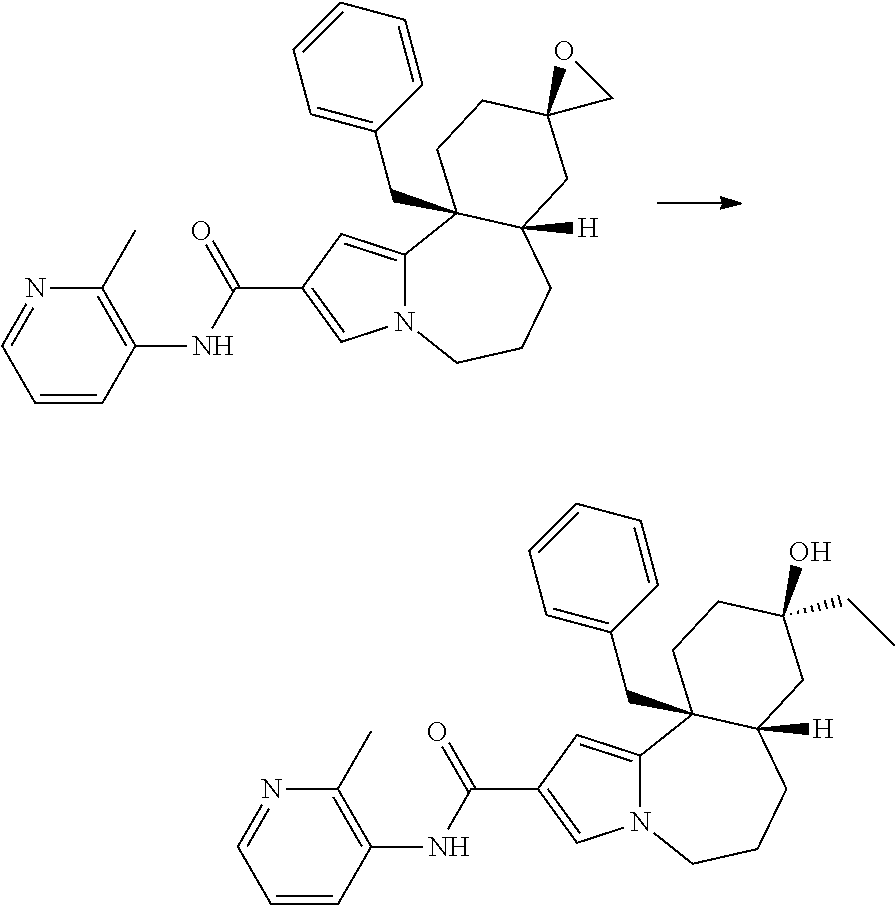
- A stirred suspension of CuI (1 mg, 0.005 mmol) and (2′R,7aS,11aS)-11a-benzyl-N-(2-methylpyridin-3-yl)-5,6,7,7a,8,10,11,11a-octahydro spiro[benzo[c]pyrrolo[1,2-a]azepine-9,2′-oxirane]-2-carboxamide; compound with (2′S,7aR,11aR)-11a-benzyl-N-(2-methylpyridin-3-yl)-5,6,7,7a,8,10,11,11a-octahydro spiro[benzo[c]pyrrolo[1,2-a]azepine-9,2′-oxirane]-2-carb oxamide (186, R2=Benzyl, R6=2-Methylpyridin-3-yl) (0.016 g, 0.036 mmol) in THF (0.36 mL) was treated at rt with methylmagnesium bromide (3 M solution in Et2O, 0.072 mL, 0.22 mmol). The reaction mixture was quenched at rt by addition of saturated aqueous NH4Cl (1 mL), and the resulting mixture was partitioned between water (2 mL) and EtOAc (2 mL). After separating the layers, the aqueous phase was extracted with EtOAc (2×5 mL) and DCM (3×5 mL). The combined organic phases were washed with saturated aqueous NaCl (10 mL), dried over Na2SO4, and filtered through a pad of Florisil®. The filtrates were combined and concentrated under reduced pressure to give (7aS,9R,11aS)-11a-benzyl-9-ethyl-9-hydroxy-N-(2-methylpyridin-3-yl)-6,7,7a,8,9,10,11,11a-octahydro-5H-benzo[c]pyrrolo[1,2-a]azepine-2-carboxamide; compound with (7aR,9S,11aR)-11a-benzyl-9-ethyl-9-hydroxy-N-(2-methylpyridin-3-yl)-6,7,7a,8,9,10,11,11a-octahydro-5H-benzo[c]pyrrolo[1,2-a]azepine-2-carboxamide (187, R2=Benzyl, R4=Methyl, R6=2-Methylpyridin-3-yl) (0.015 g, 90%). LC/MS, method 3, Rt=2.00 min, MS m/z 458 (M+H)+.
- 1H NMR (400 MHz, DMSO-d6) δ 9.07 (s, 1H), 8.24 (dd, J=4.7, 1.6 Hz, 1H), 7.67 (dd, J=8.0, 1.6 Hz, 1H), 7.42 (d, J=1.9 Hz, 1H), 7.20 (dd, J=7.9, 4.7 Hz, 1H), 7.14-7.06 (m, 3H), 6.62-6.55 (m, 2H), 6.08 (d, J=1.9 Hz, 1H), 4.36-4.17 (m, 2H), 3.82 (s, 1H), 3.39 (d, J=13.0 Hz, 1H), 2.58-2.52 (m, 1H), 2.48-2.26 (m, 6H), 1.91-1.78 (m, 1H), 1.77-1.50 (m, 5H), 1.40-1.31 (m, 1H), 1.29-1.09 (m, 3H), 0.76 (t, J=7.4 Hz, 3H).
-

- A solution of (7aS,9R,11aR)-11a-ethyl-9-hydroxy-9-propyl-6,7,7a,8,9,10,11,11a-octahydro-5H-dibenzo[a,c]cycloheptene-3-carboxylic acid; compound with (7aR,9S,11aS)-11a-ethyl-9-hydroxy-9-propyl-6,7,7a,8,9,10,11,11a-octahydro-5H-dibenzo[a,c]cycloheptene-3-carboxylic acid (0.125 g, 0.378 mmol), HBTU (0.172 g, 0.454 mmol) and DIEA (0.10 mL, 0.567 mmol) in DMF (3 mL) was stirred at about 0° C. for about 10 min Benzene-1,2-diamine (0.123 g, 1.135 mmol) was added and mixture was warmed to rt and stirred for about 18 h. Water (10 mL) was added and resulting solids were collected by filtration, rinsing with water. The residue was dried under reduced pressure at 60° C. to yield (7aS,9R,11aR)-11a-ethyl-9-hydroxy-9-propyl-6,7,7a,8,9,10,11,11a-octahydro-5H-dibenzo[a,c]cycloheptene-3-carboxylic acid (2-amino-phenyl)-amide; compound with (7aR,9S,11aS)-11a-ethyl-9-hydroxy-9-propyl-6,7,7a,8,9,10,11,11a-octahydro-5H-dibenzo[a,c]cycloheptene-3-carboxylic acid (2-amino-phenyl)-amide (85, R4=Methyl, R5=Ethyl, R6=2-Amino-phenyl) (0.148 g, 93%); LC/MS method 2, Rt=2.47 min, MS m/z 421 (M+H)+; 1H NMR (400 MHz, DMSO-d6) δ 9.54 (s, 1H), 7.72-7.67 (m, 2H), 7.31 (d, J=8.0 Hz, 1H), 7.12 (d, J=6.6 Hz, 1H), 6.97-6.90 (m, 1H), 6.75 (dd, J=8.0, 1.3 Hz, 1H), 6.60-6.54 (m, 1H), 4.85 (s, 2H), 3.88 (s, 1H), 3.01-2.91 (m, 1H), 2.92-2.82 (m, 1H), 2.35-2.15 (m, 3H), 2.08-1.99 (m, 1H), 1.75-1.60 (m, 2H), 1.57-1.35 (m, 5H), 1.27-0.98 (m, 6H), 0.75 (t, J=7.1 Hz, 3H), 0.60 (t, J=7.4 Hz, 3H).
-

- A solution of (7aS,9R,11aR)-11a-ethyl-9-hydroxy-9-propyl-6,7,7a,8,9,10,11,11a-octahydro-5H-dibenzo[a,c]cycloheptene-3-carboxylic acid (2-amino-phenyl)-amide; compound with (7aR,9S,11aS)-11a-ethyl-9-hydroxy-9-propyl-6,7,7a,8,9,10,11,11a-octahydro-5H-dibenzo[a,c]cycloheptene-3-carboxylic acid (2-amino-phenyl)-amide (85, R4=Methyl, R5=Ethyl, R6=2-Amino-phenyl) (0.133 g, 0.316 mmol) in acetic acid (1 mL) was heated to about 60° C. for about 3 h. The mixture was cooled to rt and concentrated under reduced pressure. The residue was purified on silica gel (12 g) using a gradient of 40-100% EtOAc in heptane to provide (3R,4aS,11bR)-9-(1H-benzoimidazol-2-yl)-11b-ethyl-3-propyl-2,3,4,4a,5,6,7,11b-octahydro-1 H-dibenzo[a,c]cyclohepten-3-ol; compound with (3S,4aR,11bS)-9-(1H-benzoimidazol-2-yl)-11b-ethyl-3-propyl-2,3,4,4a,5,6,7,11b-octahydro-1H dibenzo[a,c]cyclohepten-3-ol (0.082 g, 64%). LC/MS method 2, Rt=2.54 min, MS m/z 403 (M+H)+. 1H NMR (400 MHz, DMSO-d6) δ 12.75 (s, 1H), 7.92-7.83 (m, 2H), 7.62 (d, J=7.2 Hz, 1H), 7.49 (d, J=6.7 Hz, 1H), 7.35 (d, J=8.3 Hz, 1H), 7.21-7.11 (m, 2H), 3.88 (s, 1H), 3.05-2.95 (m, 1H), 2.93-2.80 (m, 1H), 2.33-2.15 (m, 3H), 2.11-1.99 (m, 1H), 1.72-1.60 (m, 2H), 1.57-1.36 (m, 5H), 1.26-1.05 (m, 6H), 0.74 (t, J=7.1 Hz, 3H), 0.62 (t, J=7.4 Hz, 3H).
- The enantiomers of Example #146 were separated using Preparative Chiral Purification Method 19. The first peak eluted was (3R,4aS,11bR)-9-(1H-benzoimidazol-2-yl)-11b-ethyl-3-propyl-2,3,4,4a, 5,6,7,11b-octahydro-1H-dibenzo[a,c]cyclohepten-3-ol (Example #147) and the second was (3S,4aR,11bS)-9-(1H-benzoimidazol-2-yl)-11b-ethyl-3-propyl-2,3,4,4a,5,6,7,11b-octahydro-1H-dibenzo[a,c]cyclohepten-3-ol (Example #148). NMR and LC/MS data for single isomers were essentially identical to the racemic mixture.
-

- A solution of (7aS,9R,11aR)-11a-ethyl-9-hydroxy-9-propyl-6,7,7a,8,9,10,11,11a-octahydro-5H-dibenzo[a,c]cycloheptene-3-carboxylic acid; compound with (7aR,9S,11aS)-11a-ethyl-9-hydroxy-9-propyl-6,7,7a,8,9,10,11,11a-octahydro-5H-dibenzo[a,c]cycloheptene-3-carboxylic acid (0.049 g, 0.148 mmol), HBTU (0.067 g, 0.178 mmol), DIEA (0.039 mL, 0.222 mmol) and DMF (3 mL) was stirred at about 0° C. for about 10 min. Pyridine-2,3-diamine (0.049 g, 0.445 mmol) was added and the mixture was warmed to rt and stirred for about 18 h. Water (20 mL) was added and the resulting solids were collected by filtration, rinsing with water. The residue was dried under reduced pressure at about 60° C. to provide (7aS,9R,11aR)-11a-ethyl-9-hydroxy-9-propyl-6,7,7a,8,9,10,11,11a-octahydro-5H-dibenzo[a,c]cycloheptene-3-carboxylic acid (2-amino-pyridin-3-yl)-amide; compound with (7aR,9S,11aS)-11a-ethyl-9-hydroxy-9-propyl-6,7,7a,8,9,10,11,11a-octahydro-5H-dibenzo[a,c]cycloheptene-3-carboxylic acid(2-amino-pyridin-3-yl)-amide (85, R4=Methyl, R5=Ethyl, R6=2-Amino-pyridin-3-yl) (0.063 g, 100%). LC/MS method 2, Rt=2.11 min, MS m/z 422 (M+H)+. 1H NMR (400 MHz, DMSO-d6) δ 9.52 (s, 1H), 7.83 (dd, J=4.9, 1.7 Hz, 1H), 7.72-7.67 (m, 2H), 7.52-7.47 (m, 1H), 7.32 (d, J=8.1 Hz, 1H), 6.59 (dd, J=7.6, 4.9 Hz, 1H), 5.74 (s, 2H), 3.89 (s, 1H), 3.01-2.83 (m, 2H), 2.31-2.14 (m, 3H), 2.09-1.99 (m, 1H), 1.72-1.59 (m, 2H), 1.55-1.38 (m, 5H), 1.24-1.04 (m, 6H), 0.75 (t, J=7.1 Hz, 3H), 0.60 (t, J=7.4 Hz, 3H).
-

- A solution of 2-methoxy-8,9-dihydro-5H-benzo[7]annulen-6(7H)-one (3) (80.0 g, 0.420 mol) in DMF (1.6 L) was cooled to about 0° C. and sodium hydride (11.1 g, 0.462 mol) was added. The mixture was stirred at about 0° C. for about 30 min then cyclopropylmethyl bromide (62.5 mL, 0.116 mol) was added. The resulting solution was stirred at rt for about 1 h. The compound was purified on silica gel to give 5-(cyclopropylmethyl)-2-methoxy-5,7,8,9-tetrahydro-benzocyclohepten-6-one (69, R4=Cyclopropyl) (27.0 g, 26%). LC/MS, method 3, Rt=2.48 min, MS m/z 245 (M+H)+. 1H NMR (400 MHz, DMSO) δ 7.05 (d, J=8.1 Hz, 1H), 6.79-6.73 (m, 2H), 4.00-3.96 (m, 1H), 3.72 (s, 3H), 3.07-2.99 (m, 1H), 2.84-2.76 (m, 1H), 2.75-2.67 (m, 1H), 2.41-2.36 (m, 1H), 2.10-1.99 (m, 1H), 1.97-1.91 (m, 1H), 1.75-1.62 (m, 1H), 1.61-1.50 (m, 1H), 0.66-0.52 (m, 1H), 0.39-0.30 (m, 2H), 0.08-0.01 (m, 2H).
-

- To EtOH (150 mL) under nitrogen was added freshly cut sodium (2.12 g, 92 0 mmol) portionwise and the mixture was stirred until the reaction was complete. A solution of 5-(cyclopropylmethyl)-2-methoxy-5,7,8,9-tetrahydro-benzocyclohepten-6-one (69, R4=Cyclopropyl) (15.0 g, 61.4 mmol) in EtOH (150 mL) was added. The mixture was stirred for about 10 min, then but-3-en-2-one (5.38 g, 77 mmol) was added over about 30 min. The mixture was stirred at rt for about 30 min. The mixture was treated with another portion of but-3-en-2-one (2.69 g, 38 4 mmol) then stirred for about 1 h. The mixture was then heated to about 60° C. for about 15 min then cooled to rt and stirred for about 12 h. The mixture was concentrated under reduced pressure then partitioned between EtOAc (200 mL) and water (100 mL). The aqueous layer was extracted with EtOAc (50 mL) then the combined organics were dried over MgSO4, filtered and concentrated under reduced pressure. The residue was purified on silica gel (330 g) using a gradient of 0-40% EtOAc in heptane. Product fractions were combined and concentrated under reduced pressure to yield 11b-Cyclopropylmethyl-9-methoxy-1,2,5,6,7,11b-hexahydro-dibenzo[a,c]cyclohepten-3-one (70, R4=Cyclopropyl) (12.3 g, 67%). LC/MS, method 3, Rt=2.52 min, MS m/z 297 (M+H)+. 1H NMR (400 MHz, DMSO-d6) δ 7.37 (d, J=8.7 Hz, 1H), 6.84 (dd, J=8.7, 2.9 Hz, 1H), 6.72 (d, J=2.9 Hz, 1H), 5.83 (s, 1H), 3.73 (s, 3H), 2.91-2.73 (m, 2H), 2.63-2.51 (m, 2H), 2.49-2.37 (m, 2H), 2.33-2.17 (m, 2H), 1.89-1.80 (m, 2H), 1.79-1.72 (m, 1H), 1.47-1.32 (m, 1H), 0.70-0.55 (m, 1H), 0.46-0.27 (m, 2H), 0.15-0.01 (m, 2H).
-

- A mixture containing 11b-cyclopropylmethyl-9-methoxy-1,2,5,6,7,11b-hexahydro-dibenzo[a,c]cyclohepten-3-one (70, R4=Cyclopropyl) (12.3 g, 41.3 mmol) and DCM (225 mL) was cooled to about −10° C. then borontribromide (1M solution in DCM, 64 mL, 64 mmol) was added over about 10 min keeping the reaction temperature between about −5° C. and 0° C. After complete addition the mixture was stirred at about −7° C. for about 40 min. MeOH (50 mL) was added dropwise over about 30 min keeping the internal temperature at about 0° C. The mixture was stirred at about 0° C. for about 30 min then concentrated under reduced pressure. The material was dissolved in EtOAc (250 mL) then saturated aqueous sodium bicarbonate (250 mL) was added over about 15 min. The mixture was stirred for about 30 min then the layers were separated. The aqueous layer was extracted with EtOAc (100 mL) then the combined organics were dried over MgSO4, filtered and concentrated under reduced pressure. The residue was purified on silica gel (330 g) using a gradient of 0-30% EtOAc in DCM. Product fractions were combined and concentrated under reduced pressure to yield 11b-cyclopropylmethyl-9-hydroxy-1,2,5,6,7,11b-hexahydro-dibenzo[a,c]cyclohepten-3-one (71, R4=Cyclopropyl) (8.69 g, 75%). LC/MS, method 3, Rt=2.05 min, MS m/z 283 (M+H)+. 1H NMR (400 MHz, DMSO-d6) 9.21 (s, 1H), 7.24 (d, J=8.6 Hz, 1H), 6.66 (dd, J=8.5, 2.7 Hz, 1H), 6.53 (d, J=2.7 Hz, 1H), 5.83 (s, 1H), 2.87-2.64 (m, 2H), 2.60-2.34 (m, 4H), 2.27-2.19 (m, 2H), 1.89-1.70 (m, 3H), 1.39-1.33 (m, 1H), 0.71-0.55 (m, 1H), 0.45-0.24 (m, 2H), 0.11-−0.10 (m, 2H).
-

- Compound 76 (R4=Cyclopropyl) was prepared in a manner similar to that described in Example #44 and #45, Steps 5 through 9 for the preparation of (+/−) Compound 76 (R4=Methyl) substituting 11b-cyclopropylmethyl-9-hydroxy-1,2,5,6,7,11b-hexahydro-dibenzo[a,c]cyclohepten-3-one (71, R4=Cyclopropyl) for 11b-ethyl-9-hydroxy-1,2,5,6,7,11b-hexahydro-dibenzo[a,c]cyclohepten-3-one (71, R4=Methyl) in step 5 to yield (+/−) Compound 76 (R4=Cyclopropyl). LC/MS, method 2, Rt=2.38 min, MS m/z 417 (M+H)+. 1H NMR (400 MHz, DMSO-d6) δ 9.94 (s, 1H), 8.31 (dd, J=4.7, 1.6 Hz, 1H), 7.79-7.69 (m, 3H), 7.49 (d, J=8.4 Hz, 1H), 7.25 (dd, J=7.9, 4.8 Hz, 1H), 3.25-3.19 (m, 1H), 3.05-2.98 (m, 1H), 2.91-2.86 (m, 1H), 2.78-2.74 (m, 1H), 2.55-2.51 (m, 2H), 2.42 (s, 3H), 2.28-2.11 (m, 3H), 2.05-1.96 (m, 1H), 1.83-1.64 (m, 3H), 1.59-1.55 (m, 1H), 1.48-1.43 (m, 1H), 1.28-1.14 (m, 1H), 0.79-0.76 (m, 1H), 0.47-0.30 (m, 2H), 0.21-0.10 (m, 1H), 0.06-0.01 (m, 1H), −0.28-−0.34 (m, 1H).
-

- A round bottom flask with stirring bar, septum, nitrogen line and thermometer was charged with (+/−) Compound 76 (R4=Cyclopropyl) (0.33 g, 0.79 mmol)), THF (14 mL) and copper(I)iodide (0.025 g, 0.131 mmol). The mixture was cooled to an internal temperature of about 0° C. then ethylmagnesium bromide (3M solution in Et2O, 1.6 mL, 4.8 mmol) was added dropwise maintaining internal temperature between 0° C. and 5° C. The mixture was stirred at about 0° C. for about 15 min then treated with saturated aqueous ammonium chloride (3 mL). The mixture was stirred for about 30 min then diluted with water (25 mL) and EtOAc (25 mL). The layers were separated and the aqueous layer extracted with EtOAc (15 mL). The combined organic solutions were dried over MgSO4, filtered and concentrated under reduced pressure. The residue was purified on silica gel (12 g) using a gradient of 50-100% EtOAc in heptane. Product fractions were combined and concentrated under reduced pressure. The material was dissolved in MeOH (3 mL) then water (25 mL) was added. Partial concentration of the mixture under reduced pressure resulted in the formation of a solid which was collected by filtration and washed with water (5 mL). The material was dried under reduced pressure at about 60° C. to yield (7aR,9R,11aS)-11a-cyclopropylmethyl-9-hydroxy-9-propyl-6,7,7a,8,9,10,11,11a-octahydro-5H-dibenzo[a,c]cycloheptene-3-carboxylic acid (2-methyl-pyridin-3-yl)-amide; compound with (7aS,9S,11aR)-11a-cyclopropylmethyl-9-hydroxy-9-propyl-6,7,7a,8,9,10,11,11a-octahydro-5H-dibenzo[a,c]cycloheptene-3-carboxylic acid (2-methyl-pyridin-3-yl)-amide (77, R4=Cyclopropyl, R5=Ethyl) as a solid (0.275 g, 78%). LC/MS, method 2, Rt=2.47 min, MS m/z 447 (M+H)+. 1H NMR (400 MHz, DMSO-d6) δ 9.92 (s, 1H), 8.31 (dd, J=4.7, 1.5 Hz, 1H), 7.77-7.69 (m, 3H), 7.43 (d, J=8.4 Hz, 1H), 7.25 (dd, J=7.9, 4.8 Hz, 1H), 3.88 (s, 1H), 3.02-2.81 (m, 2H), 2.55-2.50 (m, 1H), 2.42 (s, 3H), 2.37-2.29 (m, 1H), 2.22-2.15 (m, 1H), 1.99-1.94 (m, 1H), 1.87-1.79 (m, 1H), 1.72-1.64 (m, 1H), 1.57-1.29 (m, 5H), 1.28-1.15 (m, 2H), 1.15-1.04 (m, 4H), 0.76 (t, J=7.1 Hz, 3H), 0.37-0.34 (m, 2H), 0.17-0.06 (m, 1H), 0.02-−0.02 (m, 1H), −0.34-−0.39 (m, 1H).
- The enantiomers were separated using Preparative Chiral Purification Method 4. The first peak eluted was (7aS,9R,11aR)-11a-ethyl-9-hydroxy-9-propyl-6,7,7a,8,9,10,11,11a-octahydro-5H-dibenzo[a,c]cycloheptene-3-carboxylic acid methyl ester (80, R4=Methyl, R5=Ethyl) and the second was (7aR,9S,11aS)-11a-ethyl-9-hydroxy-9-propyl-6,7,7a,8,9,10,11,11a-octahydro-5H-dibenzo[a,c]cycloheptene-3-carboxylic acid methyl ester (80, R4=Methyl, R5=Ethyl). NMR and LC/MS data for single isomers were essentially identical to the racemic mixture.
-

- A solution of (7aS,9R,11aR)-11a-ethyl-9-hydroxy-9-propyl-6,7,7a,8,9,10,11,11a-octahydro-5H-dibenzo[a,c]cycloheptene-3-carboxylic acid methyl ester (80, R4=Methyl, R5=Ethyl) (0.212 g, 0.615 mmol) and LiOH (0.074 g, 3.1 mmol) in MeOH (3 mL) and water (3 mL) was heated at about 60° C. for about 16 h. The reaction temperature was increased to about 70° C. and additional LiOH (0.074 g, 3.1 mmol) was added. After about 3 h, the mixture was cooled to rt and 1M aqueous HCl was added drop-wise until a precipitate formed. The precipitate was collected by filtration, rinsing with water to yield (7aS,9R,11aR)-11a-ethyl-9-hydroxy-9-propyl-6,7,7a,8,9,10,11,11a-octahydro-5H-dibenzo[a,c]cycloheptene-3-carboxylic acid (0.121 g, 60%). LC/MS method 2, Rt=2.30 min, MS m/z 329 (M−H)−. 1H NMR (400 MHz, DMSO-d6) δ 7.57-7.50 (m, 2H), 7.12 (d, J=8.8 Hz, 1H), 3.89-3.75 (m, 1H), 2.94-2.83 (m, 1H), 2.79-2.70 (m, 1H), 2.29-2.08 (m, 3H), 2.05-1.93 (m, 1H), 1.66-1.64 (m, 2H), 1.53-1.30 (m, 5H), 1.23-0.98 (m, 6H), 0.74 (t, J=7.1 Hz, 3H), 0.57 (t, J=7.4 Hz, 3H).
-

- A solution of (7aS,9R,11aR)-11a-ethyl-9-hydroxy-9-propyl-6,7,7a,8,9,10,11,11a-octahydro-5H-dibenzo[a,c]cycloheptene-3-carboxylic acid (0.030 g, 0.091 mmol), HBTU (0.041 g, 0.109 mmol), DIEA (0.024 mL, 0.136 mmol) and DMF (1 mL) was stirred at rt for about 10 min. 2-Chloroaniline (0.035 g, 0.27 mmol) was added and the reaction was stirred for about 16 h at rt. The mixture was then heated to about 60° C. for about 24 h and then stirred at rt for about 24 h. The mixture was concentrated to dryness and then purified on silica gel (4 g) eluting with 10-50% EtOAc in heptane to yield (7aS,9R,11aR)-11a-ethyl-9-hydroxy-9-propyl-6,7,7a,8,9,10,11,11a-octahydro-5H-dibenzo[a,c]cycloheptene-3-carboxylic acid (2-chloro-phenyl)-amide (0.006 g, 15%). LC/MS method 2, Rt=3.24 min, MS m/z 440 & 442 (M+H)+. 1H NMR (400 MHz, DMSO-d6) δ 9.93 (s, 1H), 7.76-7.70 (m, 2H), 7.59-7.52 (m, 2H), 7.42-7.34 (m, 2H), 7.32-7.25 (m, 1H), 3.91 (s, 1H), 3.05-2.95 (m, 1H), 2.92-2.81 (m, 1H), 2.35-2.15 (m, 3H), 2.13-1.95 (m, 1H), 1.75-1.65 (m, 2H), 1.57-1.37 (m, 5H), 1.26-1.16 (m, 2H), 1.16-1.04 (m, 4H), 0.77 (t, J=7.1 Hz, 3H), 0.62 (t, J=7.4 Hz, 3H).
- Fluorescense polarization binding ranges measured using GR Florescence Polarization Assay:
- A=a compound with an IC50 less than 0.1 μM
B=a compound with an IC50 within the range of 0.1 to 1.0 μM
C=a compound with an IC50 within the range of 1.0 to 10.0 μM
D=a compound with an IC50 greater than 10 μM. -
Example GR binding 1 B 2 B 3 A 4 B 5 B 6 A 7 A 8 A 9 A 10 A 11 A 12 A 13 B 14 A 15 B 16 B 17 A 18 A 19 A 20 B 21 D 22 D 23 A 24 A 25 C 26 A 27 C 28 B 29 B 30 A 31 A 32 A 33 A 34 A 35 C 36 D 37 D 38 C 39 D 40 D 41 D 42 B 43 B 44 B 45 A 46 B 47 A 48 B 49 A 50 B 51 A 52 A 53 A 54 A 55 A 56 B 57 A 58 A 58A A 58B A 59 C 60 A 61 B 62 A 63 A 64 B 65 A 66 A 67 B 68 A 69 A 70 A 71 A 72 A 73 A 74 B 75 A 76 A 77 B 78 A 79 A 80 A 81 A 82 B 83 A 84 D 85 A 86 A 87 A 88 A 89 B 90 A 91 B 92 A 93 A 94 B 95 A 96 A 97 A 98 A 99 C 100 A 101 A 102 A 103 A 104 B 105 A 105A A 106 A 107 B 108 C 109 D 110 D 111 A 112 B 113 C 114 A 115 B 116 B 117 B 118 A 119 A 120 B 121 A 122 A 123 B 124 C 125 A 126 A 127 B 128 A 129 B 130 A 131 A 132 B 133 A 134 A 135 B 136 A 137 C 138 A 139 A 140 B 141 D 142 A 143 A 144 C 145 A 146 B 147 C 148 C 149 A 150 A 151 A
Claims (46)
1. A compound of Formula (I)

pharmaceutically acceptable salts, pro-drugs, biologically active metabolites, isomers, and stereoisomers wherein
Ring A is optionally substituted aryl, optionally substituted saturated or partially unsaturated (C5-C6)carbocyclyl or optionally substituted heteroaryl;
Ring C is optionally substituted saturated or partially unsaturated (C5-C6)carbocyclyl or optionally substituted heterocyclyl;
Q and T are independently C or N, provided that both are not N;
Ring B is a seven membered ring wherein
X is —C(R5)2—, —C(R5)—, —C(═O)—, —N(Ra)—, —O—, —S—, —S(O)—, or —S(O)2—; or
when X is —C(R5)2—, it can form a cyclopropyl ring spiro to the carbon atom to which it is attached;
Y is —C(R5)2C(R5)2—, —C(R5)C(R5)2—, —C(R5)2C(R5)—, —OC(R5)2—, —N(Ra)C(R5)2—, —C(R5)2N(Ra)—, —C(═O)C(R5)2—, —C(R5)2C(═O)—, —O—C(═O)—, —C(═O)—O—, or —C(R5)2—O—; or
Y is —C(R5)2— when Q or T is N;
Z is CR4 or N; or
Ring B is a six membered ring wherein
Y is —C(R5)2—;
Q or T must be N;
Z is CR4 or N; or
when X is —C(R5)2—, it can form a cyclopropyl ring spiro to the carbon atom to which it is attached;
provided that X—Y or Y—Z do not form O—O, N—N, N—O, C(═O)—C(═O), N—C—O or O—C—O bonds; and
provided that in X—Y a sulfur atom is not adjacent to an oxygen atom or —C(═O);
provided that X—Y does not form —O—C(R5)2—O—, —N—C(R5)2—O— or —S—C(R5)2—O—;
R1 is H, Br, Cl, F, —COORa, —ORa, —O-optionally substituted (C1-C3)alkylene-optionally substituted aryl, —O-optionally substituted (C1-C3)alkylene-optionally substituted heteroaryl, —O-optionally substituted (C1-C3)alkylene-optionally substituted heterocyclyl, optionally substituted (C1-C3)alkyl, optionally substituted aryl, optionally substituted (C3-C6)cycloalkyl, optionally substituted heteroaryl, optionally substituted heterocyclyl, —C(O)N(Ra)(CH2)r—Rb, —N(Ra)C(O)(CH2)r—Rb, —S(O)2N(Ra)—Rb—N(Ra)S(O)2—Rb, —O—S(O)2—CF3, —N(Ra)-optionally substituted (C3-C6)cycloalkyl, —N(Ra)-optionally substituted heterocyclyl, —N(Ra)-optionally substituted heteroaryl, —N(Ra)-optionally substituted aryl,

R2 is —(CH2)r-optionally substituted aryl, —(CH2)r-optionally substituted (C3-C6)cycloalkyl, optionally substituted (C1-C3)alkyl, or —(CH2)r-optionally substituted heteroaryl;
R3 is independently H, deuterium, —CD3, —CF3, optionally substituted (C2-C6)alkynyl, oxo, —ORa, —OP(═O)(OH)(OH), optionally substituted (C1-C4)alkyl, —(C(Ra)2)r-optionally substituted (C3-C6)cycloalkyl, —(C(Ra)2)r-optionally substituted aryl, —(C(Ra)2)r-optionally substituted heteroaryl, —(C(Ra)2)r—N(Ra)-optionally substituted heteroaryl, a carbocyclic or heterocyclic spirocyclic moiety attached to ring C;
R4 is H, optionally substituted (C1-C3)alkyl, OH or —O-optionally substituted (C1-C3)alkyl;
R5 is independently H, F, N(Ra), ORa, optionally substituted (C3-C6)cycloalkyl, or optionally substituted (C1-C3)alkyl;
Ra is independently H, optionally substituted (C3-C6)cycloalkyl or optionally substituted (C1-C3)alkyl;
Rb is H, optionally substituted (C1-C3)alkyl, optionally substituted aryl, optionally substituted (C3-C6)cycloalkyl, optionally substituted heteroaryl or optionally substituted heterocyclyl;
m is 1, 2, 3 or 4;
n is 1, 2, 3 or 4; and
r is independently 0, 1 or 2.
2. The compound of claim 1 wherein the compound is of Formula (I)a or Formula (I)b

3. The compound of claim 2 wherein Ring A is optionally substituted phenyl, optionally substituted pyrrolyl, or optionally substituted pyrazolyl.
4. The compound of claim 3 wherein Ring C is optionally substituted cyclohexyl or optionally substituted cyclohexenyl.
5. The compound of claim 4 wherein X is —C(R5)2—, —C(R5)—, —C(═O)—, —O— or —N(Ra)—.
6. The compound of claim 5 wherein R1 is —COORa, ORa, optionally substituted (C1-C3)alkyl, —C(O)N(Ra)(CH2)r—Rb, —N(Ra)C(O)(CH2)r—Rb, optionally substituted azabenzimidazolyl, optionally substituted benzimidazolyl, —O-optionally substituted (C1-C3)alkylene-optionally substituted phenyl, or —O-optionally substituted (C1-C3)alkylene-optionally substituted pyridinyl.
7. The compound of claim 6 wherein R2 is —CH2CF3, —(CH2)r-optionally substituted aryl, or optionally substituted (C1-C3)alkyl.
8. The compound of claim 7 wherein R3 is independently H, —CF3, —C≡CCH3, oxo, —ORa, —OP(═O)(OH)(OH), optionally substituted (C1-C4)alkyl, —(C(Ra)2)r-optionally substituted (C3-C6)cycloalkyl, or —(CH2)r-optionally substituted aryl.
9. The compound of claim 8 wherein R3 is independently H, —CF3, —C≡CCH3, oxo, —ORa, optionally substituted (C1-C4)alkyl, —CH2-optionally substituted cyclopropyl, —CH2-optionally substituted phenyl, or -optionally substituted phenyl.
10. The compound of claim 9 wherein Rb is H, optionally substituted azetidinyl, optionally substituted phenyl, optionally substituted piperidinyl, optionally substituted pyrimidinyl, optionally substituted pyridinyl, optionally substituted pyrazolyl, optionally substituted pyrrolidinyl or optionally substituted tetrazolyl.
11. The compound of claim 10 wherein Q is C.
12. The compound of claim 11 wherein T is C.
13. A compound of Formula (I) wherein the compound is
(4aR,11bS)-11b-benzyl-9-hydroxy-1,2,4,4a,5,6,7,11b-octahydro-dibenzo[a,c]cyclohepten-3-one; compound with (4aS,11bR)-11b-benzyl-9-hydroxy-1,2,4,4a,5,6,7,11b-octahydro-dibenzo[a,c]cyclohepten-3-one;
(3R,4aS,11bS)-11b-Benzyl-3-methyl-2,3,4,4a,5,6,7,11b-octahydro-1H-dibenzo[a,c]cycloheptene-3,9-diol; compound with (3S,4aR,11bR)-11b-benzyl-3-methyl-2,3,4,4a,5,6,7,11b-octahydro-1H-dibenzo[a,c]cycloheptene-3,9-diol;
(3R,4aR,11bR)-11b-benzyl-3-methyl-2,3,4,4a,5,6,7,11b-octahydro-1H-dibenzo[a,c]cycloheptene-3,9-diol; compound with (3S,4aS,11bS)-11b-benzyl-3-methyl-2,3,4,4a,5,6,7,11b-octahydro-1H-dibenzo[a,c]cycloheptene-3,9-diol;
(7aS,11aS)-11a-Benzyl-9-oxo-6,7,7a,8,9,10,11,11a-octahydro-5H-dibenzo[a,c]cycloheptene-3-carboxylic acid (2-methyl-pyridin-3-yl)-amide; compound with (7aR,11aR)-11a-benzyl-9-oxo-6,7,7a,8,9,10,11,11a-octahydro-5H-dibenzo[a,c]cycloheptene-3-carboxylic acid (2-methyl-pyridin-3-yl)-amide;
(7aS,9R,11aS)-11a-Benzyl-9-ethyl-9-hydroxy-6,7,7a,8,9,10,11,11a-octahydro-5H-dibenzo[a,c]cycloheptene-3-carboxylic acid (2-methyl-pyridin-3-yl)-amide; compound with (7aR,9S,11aR)-11a-benzyl-9-ethyl-9-hydroxy-6,7,7a,8,9,10,11,11a-octahydro-5H-dibenzo[a,c]cycloheptene-3-carboxylic acid (2-methyl-pyridin-3-yl)-amide;
(7aS,9S,11aS)-11a-benzyl-9-ethyl-9-hydroxy-6,7,7a,8,9,10,11,11a-octahydro-5H-dibenzo[a,c]cycloheptene-3-carboxylic acid (2-methyl-pyridin-3-yl)-amide; compound with (7aR,9R,11aR)-11a-benzyl-9-ethyl-9-hydroxy-6,7,7a,8,9,10,11,11a-octahydro-5H-dibenzo[a,c]cycloheptene-3-carboxylic acid (2-methyl-pyridin-3-yl)-amide;
(7aS,9R,11aS)-11a-benzyl-9-ethyl-9-hydroxy-6,7,7a,8,9,10,11,11a-octahydro-5H-dibenzo[a,c]cycloheptene-3-carboxylic acid (2-methyl-pyridin-3-yl)-amide;
(7aR,9S,11aR)-11a-benzyl-9-ethyl-9-hydroxy-6,7,7a,8,9,10,11,11a-octahydro-5H-dibenzo[a,c]cycloheptene-3-carboxylic acid (2-methyl-pyridin-3-yl)-amide;
(7aS,9S,11aS)-11a-Benzyl-9-hydroxy-6,7,7a,8,9,10,11,11a-octahydro-5H-dibenzo[a,c]cycloheptene-3-carboxylic acid (2-methyl-pyridin-3-yl)-amide; compound with (7aR,9R,11aR)-11a-benzyl-9-hydroxy-6,7,7a,8,9,10,11,11a-octahydro-5H-dibenzo[a,c]cycloheptene-3-carboxylic acid (2-methyl-pyridin-3-yl)-amide;
(7aS,9R,11aS)-11a-Benzyl-9-hydroxy-6,7,7a,8,9,10,11,11a-octahydro-5H-dibenzo[a,c]cycloheptene-3-carboxylic acid (2-methyl-pyridin-3-yl)-amide; compound with (7aR,9S,11aR)-11a-benzyl-9-hydroxy-6,7,7a,8,9,10,11,11a-octahydro-5H-dibenzo[a,c]cycloheptene-3-carboxylic acid (2-methyl-pyridin-3-yl)-amide;
(7aS,9R,11aS)-11a-Benzyl-9-hydroxy-9-methoxymethyl-6,7,7a,8,9,10,11,11a-octahydro-5H-dibenzo[a,c]cycloheptene-3-carboxylic acid (2-methyl-pyridin-3-yl)-amide; compound with (7aR,9S,11aR)-11a-benzyl-9-hydroxy-9-methoxymethyl-6,7,7a,8,9,10,11,11a-octahydro-5H-dibenzo[a,c]cycloheptene-3-carboxylic acid (2-methyl-pyridin-3-yl)-amide;
(7aR,11aS)-11a-Benzyl-9-hydroxy-N-(2-methylpyridin-3-yl)-6-oxo-9-(trifluoromethyl)-6,7,7a,8,9,10,11,11a-octahydro-5H-dibenzo[b,d]azepine-3-carboxamide;
(4aS,11bS)-11b-benzyl-3-hydroxy-N-(2-methylpyridin-3-yl)-7-oxo-3-(trifluoromethyl)-2,3,4,4 a,5,6,7,11b-octahydro-1H-dibenzo[c,e]azepine-9-carboxamide;
(7aS,9R,11aS)-11a-Benzyl-9-ethyl-9-hydroxy-5-oxo-6,7,7a,8,9,10,11,11a-octahydro-5H-dibenzo[a,c]cycloheptene-3-carboxylic acid (2-methyl-pyridin-3-yl)-amide; compound with (7aR,9S,11aR)-11a-benzyl-9-ethyl-9-hydroxy-5-oxo-6,7,7a,8,9,10,11,11a-octahydro-5H-dibenzo[a,c]cycloheptene-3-carboxylic acid (2-methyl-pyridin-3-yl)-amide;
(7aS,9R,11aS)-11a-Benzyl-9-ethyl-9-hydroxy-5-oxo-6,7,7a,8,9,10,11,11a-octahydro-5H-dibenzo[a,c]cycloheptene-3-carboxylic acid (2-methyl-pyridin-3-yl)-amide;
(7aR,9S,11aR)-11a-benzyl-9-ethyl-9-hydroxy-5-oxo-6,7,7a,8,9,10,11,11a-octahydro-5H-dibenzo[a,c]cycloheptene-3-carboxylic acid (2-methyl-pyridin-3-yl)-amide;
(7aR,9S,11aS)-9-Ethyl-9-hydroxy-11a-propyl-6,7,7a,8,9,10,11,11a-octahydro-5H-dibenzo[a,c]cycloheptene-3-carboxylic acid (2-methyl-pyridin-3-yl)-amide; compound with (7aS,9R,11aR)-9-ethyl-9-hydroxy-11a-propyl-6,7,7a,8,9,10,11,11a-octahydro-5H-dibenzo[a,c]cycloheptene-3-carboxylic acid (2-methyl-pyridin-3-yl)-amide;
(7aR,9R,11aS)-9-ethyl-9-hydroxy-11a-propyl-6,7,7a,8,9,10,11,11a-octahydro-5H-dibenzo[a,c]cycloheptene-3-carboxylic acid (2-methyl-pyridin-3-yl)-amide; compound with (7aS,9S,11aR)-9-ethyl-9-hydroxy-11a-propyl-6,7,7a,8,9,10,11,11a-octahydro-5H-dibenzo[a,c]cycloheptene-3-carboxylic acid (2-methyl-pyridin-3-yl)-amide;
(3S,4aS,11bS)-11b-Benzyl-3-prop-1-ynyl-2,3,4,4 a,5,6,7,11b-octahydro-1H-dibenzo[a,c]cycloheptene-3,9-diol; compound with (3R,4 aR,11bR)-11b-benzyl-3-prop-1-ynyl-2,3,4,4 a,5,6,7,11b-octahydro-1H-dibenzo[a,c]cycloheptene-3,9-diol;
(7aS,9S,11aS)-11a-Benzyl-9-hydroxy-9-prop-1-ynyl-6,7,7a,8,9,10,11,11a-octahydro-5H-dibenzo[a,c]cycloheptene-3-carboxylic acid (2-methyl-pyridin-3-yl)-amide; compound with (7aR,9R,11aR)-11a-benzyl-9-hydroxy-9-prop-1-ynyl-6,7,7a,8,9,10,11,11a-octahydro-5H-dibenzo[a,c]cycloheptene-3-carboxylic acid (2-methyl-pyridin-3-yl)-amide;
(7aS,9R,11aS)-11a-Benzyl-9-hydroxy-9-methyl-6,7,7a,8,9,10,11,11a-octahydro-5H-dibenzo[a,c]cycloheptene-3-carboxylic acid (2-methyl-pyridin-3-yl)-amide; compound with (7aR,9S,11aR)-11a-benzyl-9-hydroxy-9-methyl-6,7,7a,8,9,10,11,11a-octahydro-5H-dibenzo[a,c]cycloheptene-3-carboxylic acid (2-methyl-pyridin-3-yl)-amide;
(7aS,9R,11aS)-11a-Benzyl-9-hydroxy-9-propyl-6,7,7a,8,9,10,11,11a-octahydro-5H-dibenzo[a,c]cycloheptene-3-carboxylic acid (2-methyl-pyridin-3-yl)-amide; compound with (7aR,9S,11aR)-11a-benzyl-9-hydroxy-9-propyl-6,7,7a,8,9,10,11,11a-octahydro-5H-dibenzo[a,c]cycloheptene-3-carboxylic acid (2-methyl-pyridin-3-yl)-amide;
(7aS,9S,11aS)-11a-Benzyl-9-ethynyl-9-hydroxy-6,7,7a,8,9,10,11,11a-octahydro-5H-dibenzo[a,c]cycloheptene-3-carboxylic acid (2-methyl-pyridin-3-yl)-amide; compound with (7aS,9S,11aS)-11a-benzyl-9-ethynyl-9-hydroxy-6,7,7a,8,9,10,11,11a-octahydro-5H-dibenzo[a,c]cycloheptene-3-carboxylic acid (2-methyl-pyridin-3-yl)-amide;
(7aS,9R,11aS)-11a-Benzyl-9-ethoxymethyl-9-hydroxy-6,7,7a,8,9,10,11,11a-octahydro-5H-dibenzo[a,c]cycloheptene-3-carboxylic acid (2-methyl-pyridin-3-yl)-amide; compound with (7aR,9S,11aR)-11a-benzyl-9-ethoxymethyl-9-hydroxy-6,7,7a,8,9,10,11,11a-octahydro-5H-dibenzo[a,c]cycloheptene-3-carboxylic acid (2-methyl-pyridin-3-yl)-amide;
(7aS,9R,11aR)-9-Benzyl-9-hydroxy-11a-propyl-6,7,7a,8,9,10,11,11a-octahydro-5H-dibenzo[a,c]cycloheptene-3-carboxylic acid (2-methyl-pyridin-3-yl)-amide; compound with (7aR,9S,11aS)-9-benzyl-9-hydroxy-11a-propyl-6,7,7a,8,9,10,11,11a-octahydro-5H-dibenzo[a,c]cycloheptene-3-carboxylic acid (2-methyl-pyridin-3-yl)-amide;
(7aS,9S,11aR)-9-benzyl-9-hydroxy-11a-propyl-6,7,7a,8,9,10,11,11a-octahydro-5H-dibenzo[a,c]cycloheptene-3-carboxylic acid (2-methyl-pyridin-3-yl)-amide; compound with (7aR,9R,11aS)-9-benzyl-9-hydroxy-11a-propyl-6,7,7a,8,9,10,11,11a-octahydro-5H-dibenzo[a,c]cycloheptene-3-carboxylic acid (2-methyl-pyridin-3-yl)-amide;
(6aS,8R,10aS)-10a-Benzyl-8-ethyl-1-methyl-1,4,5,6,6a,7,8,9,10,10a-decahydro-1,2-diaza-benzo[e]azulen-8-ol; compound with (6aR,8S,10aR)-10a-benzyl-8-ethyl-1-methyl-1,4,5,6,6a,7,8,9,10,10a-decahydro-1,2-diaza-benzo[e]azulen-8-ol;
(6aS,8S,10aS)-10a-Benzyl-8-ethyl-1-methyl-1,4,5,6,6a,7,8,9,10,10a-decahydro-1,2-diaza-benzo[e]azulen-8-ol; compound with (6aR,8R,10aR)-10a-benzyl-8-ethyl-1-methyl-1,4,5,6,6a,7,8,9,10,10a-decahydro-1,2-diaza-benzo[e]azulen-8-ol;
(6aS,8R,10 aS)-10a-Benzyl-8-ethyl-2-methyl-2,4,5,6,6a,7,8,9,10,10a-decahydro-1,2-diaza-benzo[e]azulen-8-ol; compound with (6aR,8S,10aR)-10a-benzyl-8-ethyl-2-methyl-2,4,5,6,6a,7,8,9,10,10a-decahydro-1,2-diaza-benzo[e]azulen-8-ol;
(6aS,8S,10 aS)-10a-benzyl-8-ethyl-2-methyl-2,4,5,6,6a,7,8,9,10,10a-decahydro-1,2-diaza-benzo[e]azulen-8-ol; compound with (6aR,8R,10aR)-10a-benzyl-8-ethyl-2-methyl-2,4,5,6,6a,7,8,9,10,10a-decahydro-1,2-diaza-benzo[e]azulen-8-ol;
(2R,3R,4aS,11bR)-11b-Benzyl-3-phenyl-2,3,4,4a,5,6,7,11b-octahydro-1H-dibenzo[a,c]cycloheptene-2,3,9-triol compound with (2S,3S,4aR,11bS)-11b-benzyl-3-phenyl-2,3,4,4a,5,6,7,11b-octahydro-1H-dibenzo[a,c]cycloheptene-2,3,9-triol;
(7aS,9R,10R,11aR)-11a-Benzyl-9,10-dihydroxy-9-phenyl-6,7,7a,8,9,10,11,11a-octahydro-5H-dibenzo[a,c]cycloheptene-3-carboxylic acid (2-methyl-pyridin-3-yl)-amide; compound with (7aR,9S,10S,11aS)-11a-benzyl-9,10-dihydroxy-9-phenyl-6,7,7a,8,9,10,11,11a-octahydro-5H-dibenzo[a,c]cycloheptene-3-carboxylic acid (2-methyl-pyridin-3-yl)-amide;
(7aR,9S,11aS)-11a-Ethyl-9-hydroxy-9-propyl-6,7,7a,8,9,10,11,11a-octahydro-5H-dibenzo[a,c]cycloheptene-3-carboxylic acid (2-methyl-pyridin-3-yl)-amide;
(7aS,9R,11aR)-11a-Ethyl-9-hydroxy-9-propyl-6,7,7a,8,9,10,11,11a-octahydro-5H-dibenzo[a,c]cycloheptene-3-carboxylic acid (2-methyl-pyridin-3-yl)-amide;
(7aR,9S,11aS)-9,11a-Diethyl-9-hydroxy-6,7,7a,8,9,10,11,11a-octahydro-5H-dibenzo[a,c]cycloheptene-3-carboxylic acid (2-methyl-pyridin-3-yl)-amide;
(7aS,9R,11aR)-9,11a-Diethyl-9-hydroxy-6,7,7a,8,9,10,11,11a-octahydro-5H-dibenzo[a,c]cycloheptene-3-carboxylic acid (2-methyl-pyridin-3-yl)-amide;
(7aR,9R,11aS)-11a-Ethyl-9-hydroxy-9-isobutyl-6,7,7a,8,9,10,11,11a-octahydro-5H-dibenzo[a,c]cycloheptene-3-carboxylic acid (2-methyl-pyridin-3-yl)-amide;
(7aS,9S,11aR)-11a-Ethyl-9-hydroxy-9-isobutyl-6,7,7a,8,9,10,11,11a-octahydro-5H-dibenzo[a,c]cycloheptene-3-carboxylic acid (2-methyl-pyridin-3-yl)-amide;
(7aR,9R,11aS)-9-Cyclopropylmethyl-11a-ethyl-9-hydroxy-6,7,7a,8,9,10,11,11a-octahydro-5H-dibenzo[a,c]cycloheptene-3-carboxylic acid (2-methyl-pyridin-3-yl)-amide;
(7aS,9S,11aR)-9-Cyclopropylmethyl-11a-ethyl-9-hydroxy-6,7,7a, 8,9,10,11,11a-octahydro-5H-dibenzo[a,e]cycloheptene-3-carboxylic acid (2-methyl-pyridin-3-yl)-amide;
(7aS,9R,11aS)-9-Hydroxy-9-propyl-11a-(2,2,2-trifluoro-ethyl)-6,7,7a, 8,9,10,11,11a-octahydro-5H-dibenzo[a,c]cycloheptene-3-carboxylic acid (2-methyl-pyridin-3-yl)-amide; compound with (7aR,9S,11aR)-9-hydroxy-9-propyl-11a-(2,2,2-trifluoro-ethyl)-6,7,7a, 8,9,10,11,11a-octahydro-5H-dibenzo[a,c]cycloheptene-3-carboxylic acid (2-methyl-pyridin-3-yl)-amide;
(7aS,9S,11aR)-11a-Ethyl-9-hydroxy-9-isobutyl-6,7,7a,8,9,10,11,11a-octahydro-5-oxa-dibenzo[a,c]cycloheptene-3-carboxylic acid (2-methyl-pyridin-3-yl)-amide; compound with (7aR,9R,11aS)-11a-Ethyl-9-hydroxy-9-isobutyl-6,7,7a,8,9,10,11,11a-octahydro-5-oxa-dibenzo[a,c]cycloheptene-3-carboxylic acid (2-methyl-pyridin-3-yl)-amide;
(7aS,9S,11aR)-9-Cyclopropylmethyl-11a-ethyl-9-hydroxy-6,7,7a,8,9,10,11,11a-octahydro-5-oxa-dibenzo[a,c]cycloheptene-3-carboxylic acid (2-methyl-pyridin-3-yl)-amide; compound with (7aR,9R,11aS)-9-Cyclopropylmethyl-11a-ethyl-9-hydroxy-6,7,7a,8,9,10,11,11a-octahydro-5-oxa-dibenzo[a,c]cycloheptene-3-carboxylic acid (2-methyl-pyridin-3-yl)-amide;
(7aS,9S,11aR)-11a-Ethyl-9-hydroxy-9-isobutyl-6,7,7a,8,9,10,11,11a-octahydro-5-oxa-dibenzo[a,c]cycloheptene-3-carboxylic acid (2-methyl-pyridin-3-yl)-amide;
(7aR,9R,11aS)-11a-Ethyl-9-hydroxy-9-isobutyl-6,7,7a,8,9,10,11,11a-octahydro-5-oxa-dibenzo[a,c]cycloheptene-3-carboxylic acid (2-methyl-pyridin-3-yl)-amide;
(7aS,9S,11aR)-9-Cyclopropylmethyl-11a-ethyl-9-hydroxy-6,7,7a,8,9,10,11,11a-octahydro-5-oxa-dibenzo[a,c]cycloheptene-3-carboxylic acid (2-methyl-pyridin-3-yl)-amide;
(7aS,9R,11aS)-9-Cyclopropylmethyl-11a-ethyl-9-hydroxy-6,7,7a,8,9,10,11,11a-octahydro-5-oxa-dibenzo[a,c]cycloheptene-3-carboxylic acid (2-methyl-pyridin-3-yl)-amide;
(7aS,9R,11aS)-9-Hydroxy-9-propyl-11a-(2,2,2-trifluoro-ethyl)-6,7,7a,8,9,10,11,11a-octahydro-5H-dibenzo[a,c]cycloheptene-3-carboxylic acid (2-methyl-pyridin-3-yl)-amide;
(7aR,9S,11aR)-9-Hydroxy-9-propyl-11a-(2,2,2-trifluoro-ethyl)-6,7,7a,8,9,10,11,11a-octahydro-5H-dibenzo[a,c]cycloheptene-3-carboxylic acid (2-methyl-pyridin-3-yl)-amide;
(7aR,9S,11aS)-11a-Ethyl-9-hydroxy-9-methyl-6,7,7a,8,9,10,11,11a-octahydro-5H-dibenzo[a,c]cycloheptene-3-carboxylic acid (2-methyl-pyridin-3-yl)-amide;
(7aS,9R,11aR)-11a-ethyl-9-hydroxy-9-methyl-6,7,7a,8,9,10,11,11a-octahydro-5H-dibenzo[a,c]cycloheptene-3-carboxylic acid (2-methyl-pyridin-3-yl)-amide;
(7aR,9R,11aS)-11a-Ethyl-9-hydroxy-5-oxo-9-propyl-6,7,7a,8,9,10,11,11a-octahydro-5H-dibenzo[a,c]cycloheptene-3-carboxylic acid (2-methyl-pyridin-3-yl)-amide;
(7aS,9S,11aR)-11a-Ethyl-9-hydroxy-5-oxo-9-propyl-6,7,7a,8,9,10,11,11a-octahydro-5H-dibenzo[a,c]cycloheptene-3-carboxylic acid (2-methyl-pyridin-3-yl)-amide;
(7aS,9S,11aS)-9-Hydroxy-9-isobutyl-11a-(2,2,2-trifluoro-ethyl)-6,7,7a,8,9,10,11,11a-octahydro-5H-dibenzo[a,c]cycloheptene-3-carboxylic acid (2-methyl-pyridin-3-yl)-amide; compound with (7aR,9R,11aR)-9-hydroxy-9-isobutyl-11a-(2,2,2-trifluoro-ethyl)-6,7,7a,8,9,10,11,11a-octahydro-5H-dibenzo[a,c]cycloheptene-3-carboxylic acid (2-methyl-pyridin-3-yl)-amide;
(7aS,9R,11aR)-9-Cyanomethyl-11a-ethyl-9-hydroxy-6,7,7a,8,9,10,11,11a-octahydro-5H-dibenzo[a,c]cycloheptene-3-carboxylic acid (2-methyl-pyridin-3-yl)-amide; compound with (7aR,9S,11aS)-9-cyanomethyl-11a-ethyl-9-hydroxy-6,7,7a,8,9,10,11,11a-octahydro-5H-dibenzo[a,c]cycloheptene-3-carboxylic acid (2-methyl-pyridin-3-yl)-amide;
(7aS,9R,11aS)-11a-Benzyl-9-cyanomethyl-9-hydroxy-6,7,7a,8,9,10,11,11a-octahydro-5H-dibenzo[a,c]cycloheptene-3-carboxylic acid (2-methyl-pyridin-3-yl)-amide; compound with (7aR,9S,11aR)-11a-Benzyl-9-cyanomethyl-9-hydroxy-6,7,7a,8,9,10,11,11a-octahydro-5H-dibenzo[a,c]cycloheptene-3-carboxylic acid (2-methyl-pyridin-3-yl)-amide;
(7aS,9R,11aS)-11a-Benzyl-9-cyanomethyl-9-hydroxy-6,7,7a,8,9,10,11,11a-octahydro-5H-dibenzo[a,c]cycloheptene-3-carboxylic acid (2-methyl-pyridin-3-yl)-amide;
(7aR,9S,11aR)-11a-Benzyl-9-cyanomethyl-9-hydroxy-6,7,7a,8,9,10,11,11a-octahydro-5H-dibenzo[a,c]cycloheptene-3-carboxylic acid (2-methyl-pyridin-3-yl)-amide;
(7aS,9R,11aS)-11a-Benzyl-9-ethyl-9-hydroxy-6,7,7a,8,9,10,11,11a-octahydro-5H-dibenzo[a,c]cycloheptene-3-carboxylic acid (2,4-dimethyl-pyrimidin-5-yl)-amide;
(7aS,9R,11aS)-11a-Benzyl-9-ethyl-9-hydroxy-6,7,7a,8,9,10,11,11a-octahydro-5H-dibenzo[a,c]cycloheptene-3-carboxylic acid (3,5-dimethyl-pyrazin-2-yl)-amide;
(7aS,9R,11aS)-11a-Benzyl-9-ethyl-9-hydroxy-6,7,7a,8,9,10,11,11a-octahydro-5H-dibenzo[a,c]cycloheptene-3-carboxylic acid (3-methyl-pyridin-4-yl)-amide;
(7aS,9R,11aS)-11a-Benzyl-9-ethyl-9-hydroxy-6,7,7a,8,9,10,11,11a-octahydro-5H-dibenzo[a,c]cycloheptene-3-carboxylic acid yl)-amide;
(7aS,9R,11aS)-11a-Benzyl-9-ethyl-9-hydroxy-6,7,7a,8,9,10,11,11a-octahydro-5H-dibenzo[a,c]cycloheptene-3-carboxylic acid (2,6-dimethyl-pyridin-3-yl)-amide;
(7aS,9R,11aS)-11a-Benzyl-9-ethyl-9-hydroxy-6,7,7a,8,9,10,11,11a-octahydro-5H-dibenzo[a,c a,c]cycloheptene-3-carboxylic acid (3-methyl-pyridin-2-yl)-amide;
(7aS,9R,11aS)-11a-Benzyl-9-ethyl-9-hydroxy-6,7,7a,8,9,10,11,11a-octahydro-5H-dibenzo[a,c]cycloheptene-3-carboxylic acid [1,3,4]thiadiazol-2-ylamide;
(7aS,9R,11aS)-11a-Benzyl-9-ethyl-9-hydroxy-6,7,7a,8,9,10,11,11a-octahydro-5H-dibenzo[a,c]cycloheptene-3-carboxylic acid (2-methyl-2H-pyrazol-3-yl)-amide;
(7aS,9R,11aS)-11a-Benzyl-9-ethyl-9-hydroxy-6,7,7a,8,9,10,11,11a-octahydro-5H-dibenzo[a,c]cycloheptene-3-carboxylic acid (2,5-dimethyl-2H-pyrazol-3-yl)-amide;
(7aS,9R,11aS)-11a-Benzyl-9-ethyl-9-hydroxy-6,7,7a,8,9,10,11,11a-octahydro-5H-dibenzo[a,c]cycloheptene-3-carboxylic acid (2,4-dimethyl-pyrimidin-5-yl)-amide;
(7aS,9R,11aS)-11a-Benzyl-9-ethyl-9-hydroxy-6,7,7a,8,9,10,11,11a-octahydro-5H-dibenzo[a,c]cycloheptene-3-carboxylic acid (1-methyl-1H-tetrazol-5-yl)-amide;
(7aS,9R,11aS)-11a-Benzyl-9-ethyl-9-hydroxy-6,7,7a,8,9,10,11,11a-octahydro-5H-dibenzo[a,c]cycloheptene-3-carboxylic acid (5-methyl-2H-pyrazol-3-yl)-amide;
(7aS,9R,11aS)-11a-Benzyl-9-ethyl-9-hydroxy-6,7,7a,8,9,10,11,11a-octahydro-5H-dibenzo[a,c]cycloheptene-3-carboxylic acid (2-methyl-pyridin-3-ylmethyl)-amide;
(7aS,9R,11aS)-11a-Benzyl-9-ethyl-9-hydroxy-6,7,7a,8,9,10,11,11a-octahydro-5H-dibenzo[a,c]cycloheptene-3-carboxylic acid (2-morpholin-4-yl-ethyl)-amide;
(7aS,9R,11aS)-11a-Benzyl-9-ethyl-9-hydroxy-6,7,7a,8,9,10,11,11a-octahydro-5H-dibenzo[a,c]cycloheptene-3-carboxylic acid (1-methyl-4-oxo-4,5-dihydro-1H-imidazol-2-yl)-amide;
(7aS,9R,11aS)-11a-Benzyl-9-ethyl-9-hydroxy-6,7,7a,8,9,10,11,11a-octahydro-5H-dibenzo[a,c]cycloheptene-3-carboxylic acid (2-ethyl-2H-pyrazol-3-yl)-amide;
(7aS,9R,11aS)-11a-Benzyl-9-ethyl-9-hydroxy-6,7,7a,8,9,10,11,11a-octahydro-5H-dibenzo[a,c]cycloheptene-3-carboxylic acid [2-methyl-6-(2H-pyrazol-3-yl)-pyridin-3-yl]-amide;
(7aS,9R,11aS)-11a-Benzyl-9-ethyl-9-hydroxy-6,7,7a,8,9,10,11,11a-octahydro-5H-dibenzo[a,c]cycloheptene-3-carboxylic acid [2-methyl-6-(1H-pyrazol-4-yl)-pyridin-3-yl]-amide;
(7aS,9R,11aS)-11a-Benzyl-9-ethyl-9-hydroxy-6,7,7a,8,9,10,11,11a-octahydro-5H-dibenzo[a,c]cycloheptene-3-carboxylic acid methyl-(2-methyl-pyridin-3-yl)-amide;
(7aS,9R,11aR)-11a-Ethyl-9-hydroxy-9-(2,2,2-trifluoro-ethoxymethyl)-6,7,7a,8,9,10,11,11a-octahydro-5H-dibenzo[a,c]cycloheptene-3-carboxylic acid (2-methyl-pyridin-3-yl)-amide: compound with (7aR,9S,11aS)-11a-ethyl-9-hydroxy-9-(2,2,2-trifluoro-ethoxymethyl)-6,7,7a,8,9,10,11,11a-octahydro-5H-dibenzo[a,c]cycloheptene-3-carboxylic acid (2-methyl-pyridin-3-yl)-amide;
(7aS,9R,11aS)-11a-Benzyl-9-ethoxymethyl-9-hydroxy-6,7,7a,8,9,10,11,11a-octahydro-5H-dibenzo[a,c]cycloheptene-3-carboxylic acid (2-methyl-pyridin-3-yl)-amide;
(7aR,9S,11aR)-11a-Benzyl-9-ethoxymethyl-9-hydroxy-6,7,7a,8,9,10,11,11a-octahydro-5H-dibenzo[a,c]cycloheptene-3-carboxylic acid (2-methyl-pyridin-3-yl)-amide;
(7aS,9R,11aS)-11a-Benzyl-9-hydroxy-9-(2,2,2-trifluoro-ethoxymethyl)-6,7,7a,8,9,10,11,11a-octahydro-5H-dibenzo[a,c]cycloheptene-3-carboxylic acid (2-methyl-pyridin-3-yl)-amide; compound with (7aR,9S,11aR-11a-Benzyl-9-hydroxy-9-(2,2,2-trifluoro-ethoxymethyl)-6,7,7a,8,9,10,11,11a-octahydro-5H-dibenzo[a,c]cycloheptene-3-carboxylic acid (2-methyl-pyridin-3-yl)-amide;
(7aS,9R,11aS)-11a-Benzyl-9-hydroxy-9-(oxetan-3-ylmethoxymethyl)-6,7,7a,8,9,10,11,11a-octahydro-5H-dibenzo[a,c]cycloheptene-3-carboxylic acid (2-methyl-pyridin-3-yl)-amide; compound with (7aR,9S,11aR)-11a-Benzyl-9-hydroxy-9-(oxetan-3-ylmethoxymethyl)-6,7,7a,8,9,10,11,11a-octahydro-5H-dibenzo[a,c]cycloheptene-3-carboxylic acid (2-methyl-pyridin-3-yl)-amide;
(7aS,9R,11aS)-11a-Benzyl-9-hydroxy-9-isopropoxymethyl-6,7,7a,8,9,10,11,11a-octahydro-5H-dibenzo[a,c]cycloheptene-3-carboxylic acid (2-methyl-pyridin-3-yl)-amide; compound with (7aR,9S,11aR)-11a-Benzyl-9-hydroxy-9-isopropoxymethyl-6,7,7a,8,9,10,11,11a-octahydro-5H-dibenzo[a,c]cycloheptene-3-carboxylic acid (2-methyl-pyridin-3-yl)-amide;
(7aS,9R,11aS)-11a-Benzyl-9-hydroxy-9-prop oxymethyl-6,7,7a,8,9,10,11,11a-octahydro-5H-dibenzo[a,c]cycloheptene-3-carboxylic acid (2-methyl-pyridin-3-yl)-amide;
(7aS,9S,11aR-11a-Benzyl-9-hydroxy-9-prop oxymethyl-6,7,7a,8,9,10,11,11a-octahydro-5H-dibenzo[a,c]cycloheptene-3-carboxylic acid (2-methyl-pyridin-3-yl)-amide;
(7aS,9R,11aS)-11a-Benzyl-9-hydroxy-9-(2,2,2-trifluoro-1-methyl-ethoxymethyl)-5,7,7a,8,9,10,11,11a-octahydro-dibenzo[c,e]oxepine-3-carboxylic acid (2-methyl-pyridin-3-yl)-amide; compound with (7aR,9S,11aR)-11a-Benzyl-9-hydroxy-9-(2,2,2-trifluoro-1-methyl-ethoxymethyl)-5,7,7a,8,9,10,11,11a-octahydro-dibenzo[c,e]oxepine-3-carboxylic acid (2-methyl-pyridin-3-yl)-amide;
(7aS,9R,11aS)-11a-Benzyl-9-hydroxy-9-prop oxymethyl-6,7,7a,8,9,10,11,11a-octahydro-5H-dibenzo[a,c]cycloheptene-3-carboxylic acid (2-methyl-pyridin-3-yl)-amide; compound with (7aR,9S,11aR-11a-Benzyl-9-hydroxy-9-propoxymethyl-6,7,7a,8,9,10,11,11a-octahydro-5H-dibenzo[a,c]cycloheptene-3-carboxylic acid (2-methyl-pyridin-3-yl)-amide;
(7aS,9R,11aS)-11a-Benzyl-9-hydroxy-9-(tetrahydro-pyran-4-yloxymethyl)-6,7,7a,8,9,10,11,11a-octahydro-5H-dibenzo[a,c]cycloheptene-3-carboxylic acid (2-methyl-pyridin-3-yl)-amide; compound with (7aR,9S,11aR)-11a-Benzyl-9-hydroxy-9-(tetrahydro-pyran-4-yloxymethyl)-6,7,7a,8,9,10,11,11a-octahydro-5H-dibenzo[a,c]cycloheptene-3-carboxylic acid (2-methyl-pyridin-3-yl)-amide;
(7aS,9R,11aS)-11a-Benzyl-9-hydroxy-9-phenoxymethyl-6,7,7a,8,9,10,11,11a-octahydro-5H-dibenzo[a,c]cycloheptene-3-carboxylic acid (2-methyl-pyridin-3-yl)-amide; compound with (7aR,9S,11aR)-11a-Benzyl-9-hydroxy-9-phenoxymethyl-6,7,7a,8,9,10,11,11a-octahydro-5H-dibenzo[a,c]cycloheptene-3-carboxylic acid (2-methyl-pyridin-3-yl)-amide;
(7aS,9R,11aS)-11a-Benzyl-9-hydroxy-9-hydroxymethyl-6,7,7a,8,9,10,11,11a-octahydro-5H-dibenzo[a,c]cycloheptene-3-carboxylic acid (2-methyl-pyridin-3-yl)-amide; compound with (7aR,9S,11aR)-11a-Benzyl-9-hydroxy-9-hydroxymethyl-6,7,7a,8,9,10,11,11a-octahydro-5H-dibenzo[a,c]cycloheptene-3-carboxylic acid (2-methyl-pyridin-3-yl)-amide;
(7aS,9R,11aS)-11a-Benzyl-9-hydroxy-9-(2-methanesulfonyl-ethoxymethyl)-6,7,7a,8,9,10,11,11a-octahydro-5H-dibenzo[a,c]cycloheptene-3-carboxylic acid (2-methyl-pyridin-3-yl)-amide; compound with (7aR,9S,11aR)-11a-Benzyl-9-hydroxy-9-(2-methanesulfonyl-ethoxymethyl)-6,7,7a,8,9,10,11,11a-octahydro-5H-dibenzo[a,c]cycloheptene-3-carboxylic acid (2-methyl-pyridin-3-yl)-amide;
(7aS,9R,11aR)-9-Ethoxymethyl-11a-ethyl-9-hydroxy-6,7,7a,8,9,10,11,11a-octahydro-5H-dibenzo[a,c]cycloheptene-3-carboxylic acid (2-methyl-pyridin-3-yl)-amide; compound with (7aR,9S,11aS)-9-ethoxymethyl-11a-ethyl-9-hydroxy-6,7,7a,8,9,10,11,11a-octahydro-5H-dibenzo[a,c]cycloheptene-3-carboxylic acid (2-methyl-pyridin-3-yl)-amide;
(7aS,9R,11aR)-9-Ethoxymethyl-11a-ethyl-9-hydroxy-6,7,7a,8,9,10,11,11a-octahydro-5H-dibenzo[a,c]cycloheptene-3-carboxylic acid (2-methyl-pyridin-3-yl)-amide; compound with (7aR,9S,11aS)-9-ethoxymethyl-11a-ethyl-9-hydroxy-6,7,7a,8,9,10,11,11a-octahydro-5H-dibenzo[a,c]cycloheptene-3-carboxylic acid (2-methyl-pyridin-3-yl)-amide;
(4aS,11bS)-11b-Benzyl-6-methyl-N-(2-methylpyridin-3-yl)-3-oxo-2,3,4,4a,5,6,7,11b-octahydro-1H-dibenzo[c,e]azepine-9-carb oxamide;
(3S,4aS,11bS)-11b-benzyl-3-hydroxy-6-methyl-N-(2-methylpyridin-3-yl)-2,3,4,4a,5,6,7,11b-octahydro-1H-dibenzo[c,e]azepine-9-carboxamide;
(7aS,11aS)-11a-Benzyl-N-(2-methylpyridin-3-yl)-7,9-dioxo-5,7,7a,8,9,10,11,11a-octahydrodibenzo[c,e]oxepine-3-carboxamide;
(7aS,9R,11aS)-11a-Benzyl-9-ethyl-9-hydroxy-N-(2-methylpyridin-3-yl)-5,7,7a,8,9,10,11,11a-octahydrodibenzo[c,e]oxepine-3-carboxamide;
(7aS,9R,11aS)-11a-Benzyl-9-ethyl-9-hydroxy-N-(2-methylpyridin-3-yl)-5-oxo-5,7,7a,8,9,10,11,11a-octahydrodibenzo[c,e]oxepine-3-carboxamide;
(7aR,9R,11aS)-11a-Benzyl-9-ethyl-9-hydroxy-6-oxo-6,7,7a,8,9,10,11,11a-octahydro-5H-dibenzo[a,c]cycloheptene-3-carboxylic acid (2-methyl-pyridin-3-yl)-amide;
(7aS,9R,11aR)-11a-Ethyl-9-hydroxy-N-(2-methylpyridin-3-yl)-9-propyl-6,7,7a,8,9,10,11,11a-octahydrodibenzo[b,d]oxepine-3-carboxamide; compound with (7aR,9S,11aS)-11a-ethyl-9-hydroxy-N-(2-methylpyridin-3-yl)-9-propyl-6,7,7a,8,9,10,11,11a-octahydrodibenzo[b,d]oxepine-3-carboxamide;
(7aR,9S,11aS)-11a-ethyl-9-hydroxy-N-(2-methylpyridin-3-yl)-9-propyl-6,7,7a,8,9,10,11,11a-octahydrodibenzo[b,d]oxepine-3-carboxamide;
(7aS,9R,11aR)-11a-ethyl-9-hydroxy-N-(2-methylpyridin-3-yl)-9-propyl-6,7,7a,8,9,10,11,11a-octahydrodibenzo[b,d]oxepine-3-carboxamide;
(7aS,9R,11aR)-11a-Ethyl-9-hydroxy-9-phenyl-6,7,7a,8,9,10,11,11a-octahydro-5H-dibenzo[a,c]cycloheptene-3-carboxylic acid (2-methyl-pyridin-3-yl)-amide;
(7aR,9S,11aS)-11a-ethyl-9-hydroxy-9-phenyl-6,7,7a,8,9,10,11,11a-octahydro-5H-dibenzo[a,c]cycloheptene-3-carboxylic acid (2-methyl-pyridin-3-yl)-amide;
(7aS,9R,10R,11aR)-11a-Ethyl-9,10-dihydroxy-9-phenyl-6,7,7a,8,9,10,11,11a-octahydro-5H-dibenzo[a,c]cycloheptene-3-carboxylic acid (2-methyl-pyridin-3-yl)-amide;
(7aR,9S,10S,11aS)-11a-Ethyl-9,10-dihydroxy-9-phenyl-6,7,7a,8,9,10,11,11a-octahydro-5H-dibenzo[a,c]cycloheptene-3-carboxylic acid (2-methyl-pyridin-3-yl)-amide;
(7aS,9R,11aS)-11a-Benzyl-9-ethyl-9-hydroxy-6,7,7a,8,9,10,11,11a-octahydro-5H-dibenzo[a,c]cycloheptene-3-carboxylic acid (2-amino-phenyl)-amide;
(3R,4aS,11bS)-9-(1H-benzoimidazol-2-yl)-11b-benzyl-3-ethyl-2,3,4,4a,5,6,7,11b-octahydro-1H-dibenzo[a,c]cyclohepten-3-ol;
(7aS,9R,11aR)-11a-Ethyl-9-hydroxy-9-propyl-7a,8,9,10,11,11a-hexahydro-7H-dibenzo[a,c]cycloheptene-3-carboxylic acid (2-methyl-pyridin-3-yl)-amide compound with (7aR,9S,11aS)-11a-ethyl-9-hydroxy-9-propyl-7a,8,9,10,11,11a-hexahydro-7H-dibenzo[a,c]cycloheptene-3-carboxylic acid (2-methyl-pyridin-3-yl)-amide;
(7aS,9R,11aR)-11a-Ethyl-9-hydroxy-9-propyl-7a,8,9,10,11,11a-hexahydro-7H-dibenzo[a,c]cycloheptene-3-carboxylic acid (2-methyl-pyridin-3-yl)-amide;
(7aR,9S,11aS)-11a-ethyl-9-hydroxy-9-propyl-7a,8,9,10,11,11a-hexahydro-7H-dibenzo[a,c]cycloheptene-3-carboxylic acid (2-methyl-pyridin-3-yl)-amide;
(7aS,9R,11aS)-11a-Benzyl-9-ethyl-9-hydroxy-7a,8,9,10,11,11a-hexahydro-7H-dibenzo[a,c]cycloheptene-3-carboxylic acid (2-methyl-pyridin-3-yl)-amide;
(7aR,9S,11aR)-11a-Benzyl-9-ethyl-9-hydroxy-7a,8,9,10,11,11a-hexahydro-7H-dibenzo[a,c]cycloheptene-3-carboxylic acid (2-methyl-pyridin-3-yl)-amide;
(7aS,9S,11aR)-11a-Ethyl-9-hydroxy-9-(3,3,3-trifluoro-propyl)-6,7,7a,8,9,10,11,11a-octahydro-5H-dibenzo[a,c]cycloheptene-3-carboxylic acid (2-methyl-pyridin-3-yl)-amide; compound with (7aR,9R,11aS)-11a-ethyl-9-hydroxy-9-(3,3,3-trifluoro-propyl)-6,7,7a,8,9,10,11,11a-octahydro-5H-dibenzo[a,c]cycloheptene-3-carboxylic acid (2-methyl-pyridin-3-yl)-amide;
(7aS,9R,11aR)-11a-Ethyl-9-hydroxy-N-(2-methylpyridin-3-yl)-9-phenyl-6,7,7a,8,9,10,11,11a-octahydrodibenzo[b,d]oxepine-3-carboxamide; compound with (7aR,9S,11aS)-11a-ethyl-9-hydroxy-N-(2-methylpyridin-3-yl)-9-phenyl-6,7,7a,8,9,10,11,11a-octahydrodibenzo[b,d]oxepine-3-carboxamide;
(7aS,9R,10R,11aR)-11a-Ethyl-9,10-dihydroxy-N-(2-methylpyridin-3-yl)-9-phenyl-6,7,7a,8,9,10,11,11a-octahydrodibenzo[b,d]oxepine-3-carboxamide; compound with (7aR,9S,10S,11aS)-11a-ethyl-9,10-dihydroxy-N-(2-methylpyridin-3-yl)-9-phenyl-6,7,7a,8,9,10,11,11a-octahydrodibenzo[b,d]oxepine-3-carboxamide;
(7aS,9R,11aR)-11a-Ethyl-9-propyl-9-hydroxy-N-(2-methylpyridin-3-yl)-5,7,7a,8,9,10,11,11a-octahydrodibenzo[c,e]oxepine-3-carboxamide; compound with (7aR,9S,11aS)-11a-ethyl-9-propyl-9-hydroxy-N-(2-methylpyridin-3-yl)-5,7,7a,8,9,10,11,11a-octahydrodibenzo[c,e]oxepine-3-carboxamide;
(7aR,9S,11aS)-11a-ethyl-9-propyl-9-hydroxy-N-(2-methylpyridin-3-yl)-5,7,7a,8,9,10,11,11a-octahydrodibenzo[c,e]oxepine-3-carboxamide;
(7aS,9R,11aR)-11a-Ethyl-9-propyl-9-hydroxy-N-(2-methylpyridin-3-yl)-5,7,7a,8,9,10,11,11a-octahydrodibenzo[c,e]oxepine-3-carboxamide;
(7aS,9S,11aR)-11a-Ethyl-9-hydroxy-9-isobutyl-5,7,7a,8,9,10,11,11a-octahydro-dibenzo[c,e]oxepine-3-carboxylic acid (2-methyl-pyridin-3-yl)-amide;
(7aS,9R,11aR)-9,11a-diethyl-9-hydroxy-N-(2-methylpyridin-3-yl)-5,7,7a,8,9,10,11,11a-octahydrodibenzo[c,e]oxepine-3-carboxamide;
(7aR,9S,11aS)-9,11a-diethyl-9-hydroxy-N-(2-methylpyridin-3-yl)-5,7,7a,8,9,10,11,11a-octahydrodibenzo[c,e]oxepine-3-carboxamide;
(7aR,9S,11aS)-9,11a-diethyl-9-hydroxy-N-(2-methylpyridin-3-yl)-5,7,7a,8,9,10,11,11a-octahydrodibenzo[c,e]oxepine-3-carboxamide;
(7aS,9R,11aS)-11a-Benzyl-9-ethyl-9-hydroxy-6,7,7a,8,9,10,11,11a-octahydro-5H-dibenzo[a,c]cycloheptene-3-carboxylic acid (4-amino-phenyl)-amide;
(7aS,9R,11aS)-11a-Benzyl-9-ethyl-9-hydroxy-6,7,7a,8,9,10,11,11a-octahydro-5H-dibenzo[a,c]cycloheptene-3-carboxylic acid (3-amino-phenyl)-amide;
(7aS,9R,11aS)-11a-Benzyl-9-ethyl-9-hydroxy-6,7,7a,8,9,10,11,11a-octahydro-5H-benzo[c]pyrrolo[1,2-a]azepine-2-carboxylic acid (2-methyl-pyridin-3-yl)-amide; compound with (7aR,9S,11aR)-11a-benzyl-9-ethyl-9-hydroxy-6,7,7a,8,9,10,11,11a-octahydro-5H-benzo[c]pyrrolo[1,2-a]azepine-2-carboxylic acid (2-methyl-pyridin-3-yl)-amide;
(7aS,9R,11aS)-11a-Benzyl-9-ethyl-9-hydroxy-6,7,7a,8,9,10,11,11a-octahydro-5H-dibenzo[a,c]cycloheptene-3-carboxylic acid (2-amino-phenyl)-amide; compound with (7aR,9S,11aR)-11a-benzyl-9-ethyl-9-hydroxy-6,7,7a,8,9,10,11,11a-octahydro-5H-dibenzo[a,c]cycloheptene-3-carboxylic acid (2-amino-phenyl)-amide;
(3R,4aS,11bS)-9-(1H-Benzoimidazol-2-yl)-11b-benzyl-3-ethyl-2,3,4,4a,5,6,7,11b-octahydro-1H-dibenzo[a,c]cyclohepten-3-ol; compound with (3S,4aR,11bR)-9-(1H-benzoimidazol-2-yl)-11b-benzyl-3-ethyl-2,3,4,4 a,5,6,7,11b-octahydro-1H-dibenzo[a,c]cyclohepten-3-ol;
(3R,4aS,11bS)-9-(1H-Benzoimidazol-2-yl)-11b-benzyl-3-ethyl-2,3,4,4a,5,6,7,11b-octahydro-1H-dibenzo[a,c]cyclohepten-3-ol;
(3S,4aR,11bR)-9-(1H-benzoimidazol-2-yl)-11b-benzyl-3-ethyl-2,3,4,4a,5,6,7,11b-octahydro-1H-dibenzo[a,c]cyclohepten-3-ol;
(7aS,9R,11aR)-11a-Ethyl-9-hydroxy-9-propyl-6,7,7a,8,9,10,11,11a-octahydro-5H-dibenzo[a,c]cycloheptene-3-carboxylic acid (2-amino-pyridin-3-yl)-amide; compound with (7aR,9S,11aS)-11a-Ethyl-9-hydroxy-9-propyl-6,7,7a,8,9,10,11,11a-octahydro-5H-dibenzo[a,c]cycloheptene-3-carboxylic acid (2-amino-pyridin-3-yl)-amide;
(7aS,9R,11aS)-11a-Cyclopropylmethyl-9-hydroxy-9-propyl-6,7,7a,8,9,10,11,11a-octahydro-5H-dibenzo[a,c]cycloheptene-3-carboxylic acid (2-methyl-pyridin-3-yl)-amide; compound with (7aR,9S,11aR)-11a-cyclopropylmethyl-9-hydroxy-9-propyl-6,7,7a,8,9,10,11,11a-octahydro-5H-dibenzo[a,c]cycloheptene-3-carboxylic acid (2-methyl-pyridin-3-yl)-amide; or
(7aS,9R,11aR)-11a-Ethyl-9-hydroxy-9-propyl-6,7,7a,8,9,10,11,11a-octahydro-5H-dibenzo[a,c]cycloheptene-3-carboxylic acid (2-chloro-phenyl)-amide.
14. The compound of claim 1 wherein the compound is of Formula (I)c or Formula (I)d

15. The compound of claim 14 wherein Ring A is optionally substituted phenyl, optionally substituted pyrazolyl or optionally substituted pyrrolyl.
16. The compound of claim 15 wherein Ring C is optionally substituted cyclohexyl or optionally substituted cyclohexenyl.
17. The compound of claim 16 wherein X is —C(R5)2—, —C(R5)—, —C(═O)—, —O— or —N(Ra)—.
18. The compound of claim 17 wherein Y is —C(R5)2C(R5)2—, —C(R5)C(R5)2—, —C(R5)2C(R5)—, —OC(R5)2—, —N(Ra)C(R5)2—, —C(R5)2N(Ra)—, —C(═O)C(R5)2—, —C(R5)2C(═O)—, —O—C(═O)—, —C(═O)—O—, —C(R5)2—O—, —O—C(R5)2— or —O—C(R5)(Rb).
19. The compound of claim 18 wherein R1 is —COORa, ORa, —O-optionally substituted (C1-C3)alkylene-optionally substituted phenyl, —O-optionally substituted (C1-C3)alkylene-optionally substituted pyridinyl, optionally substituted (C1-C3)alkyl, —C(O)N(Ra)(CH2)r—Rb, or —N(Ra)C(O)(CH2)r—Rb.
20. The compound of claim 19 wherein R2 is —(CH2)r-optionally substituted phenyl, -optionally substituted (C3-C6)cycloalkyl, optionally substituted (C1-C3)alkyl, or —(CH2)r-optionally substituted heteroaryl.
21. The compound of claim 20 wherein R3 is independently H, —CF3, optionally substituted (C2-C6)alkynyl, oxo, —ORa, —OP(═O)(OH)(OH), optionally substituted (C1-C4)alkyl, —CH2-optionally substituted cyclopropyl, or optionally substituted phenyl.
22. The compound of claim 21 wherein Rb is optionally substituted phenyl, -optionally substituted pyrimidinyl, optionally substituted pyridinyl, optionally substituted pyrazolyl or optionally substituted tetrazolyl.
23. The compound of claim 22 wherein Q is C.
24. The compound of claim 23 wherein T is C.
25. A compound of Formula (I) wherein the compound is
(4aS,11bS)-11b-Benzyl-9-hydroxy-1,2,4,4 a,5,6,7,11b-octahydro-dibenzo[a,c]cyclohepten-3-one; compound with (4aR,11bR)-11b-benzyl-9-hydroxy-1,2,4,4a,5,6,7,11b-octahydro-dibenzo[a,c]cyclohepten-3-one;
(7aR,11aS)-11a-Benzyl-9-oxo-6,7,7a,8,9,10,11,11a-octahydro-5H-dibenzo[a,c]cycloheptene-3-carboxylic acid (2-methyl-pyridin-3-yl)-amide; compound with (7aS,11aR)-11a-benzyl-9-oxo-6,7,7a,8,9,10,11,11a-octahydro-5H-dibenzo[a,c]cycloheptene-3-carboxylic acid (2-methyl-pyridin-3-yl)-amide;
(7aR,9R,11aS)-11a-Benzyl-9-hydroxy-9-methyl-6,7,7a,8,9,10,11,11a-octahydro-5H-dibenzo[a,c]cycloheptene-3-carboxylic acid (2-methyl-pyridin-3-yl)-amide; compound with (7aS,9S,11aR)-11a-benzyl-9-hydroxy-9-methyl-6,7,7a,8,9,10,11,11a-octahydro-5H-dibenzo[a,c]cycloheptene-3-carboxylic acid (2-methyl-pyridin-3-yl)-amide;
(7aR,9S,11aS)-11a-benzyl-9-hydroxy-9-methyl-6,7,7a,8,9,10,11,11a-octahydro-5H-dibenzo[a,c]cycloheptene-3-carboxylic acid (2-methyl-pyridin-3-yl)-amide; compound with (7aS,9R,11aR)-11a-benzyl-9-hydroxy-9-methyl-6,7,7a,8,9,10,11,11a-octahydro-5H-dibenzo[a,c]cycloheptene-3-carboxylic acid (2-methyl-pyridin-3-yl)-amide;
(7aS,9R,11aS)-11a-Benzyl-9-hydroxy-N-(2-methylpyridin-3-yl)-6-oxo-9-(trifluoromethyl)-6,7,7a,8,9,10,11,11a-octahydro-5H-dibenzo[b,c1]azepine-3-carboxamide;
(7aR,9R,11aS)-11a-Benzyl-9-hydroxy-9-trifluoromethyl-6,7,7a,8,9,10,11,11a-octahydro-5H-dibenzo[a,c]cycloheptene-3-carboxylic acid (2-methyl-2H-pyrazol-3-yl)-amide;
(7aR,9R,11aS)-11a-Benzyl-9-hydroxy-9-trifluoromethyl-6,7,7a,8,9,10,11,11a-octahydro-5H-dibenzo[a,c]cycloheptene-3-carboxylic acid (3-methyl-pyridin-4-yl)-amide;
(7aS,9S,11aR)-11a-Benzyl-9-hydroxy-9-trifluoromethyl-6,7,7a,8,9,10,11,11a-octahydro-5H-dibenzo[a,c]cycloheptene-3-carboxylic acid (2-methyl-2H-pyrazol-3-yl)-amide;
(7aS,9R,11aS)-11a-benzyl-9-hydroxy-9-methyl-6,7,7a,8,9,10,11,11a-octahydro-5H-dibenzo[a,c]cycloheptene-3-carboxylic acid (2-methyl-pyridin-3-yl)-amide;
(7aS,9R,11aR)-11a-benzyl-9-hydroxy-9-methyl-6,7,7a,8,9,10,11,11a-octahydro-5H-dibenzo[a,c]cycloheptene-3-carboxylic acid (2-methyl-pyridin-3-yl)-amide;
(7aR,9R,11aS)-11a-Benzyl-9-hydroxy-9-trifluoromethyl-6,7,7a,8,9,10,11,11a-octahydro-5H-dibenzo[a,c]cycloheptene-3-carboxylic acid (2-methyl-pyridin-3-yl)-amide;
(7aS,9S,11aR)-11a-Benzyl-9-hydroxy-9-trifluoromethyl-6,7,7a,8,9,10,11,11a-octahydro-5H-dibenzo[a,c]cycloheptene-3-carboxylic acid (2-methyl-pyridin-3-yl)-amide;
(3R,4aR,11bS)-11b-Benzyl-3-ethyl-3-hydroxy-6-methyl-N-(2-methylpyridin-3-yl)-7-oxo-2,3,4,4a,5,6,7,11b-octahydro-1H-dibenzo[c,e]azepine-9-carboxamide;
(7aR,9R,11aS)-11a-Benzyl-9-hydroxy-N-(2-methylpyridin-3-yl)-5-oxo-9-(trifluoromethyl)-5,7,7a,8,9,10,11,11a-octahydrodibenzo[c,e]oxepine-3-carboxamide;
(7aR,9R,11aS)-11a-Benzyl-9-hydroxy-N-(2-methylpyridin-3-yl)-9-(trifluoromethyl)-5,7,7a,8,9,10,11,11a-octahydrodibenzo[c,e]oxepine-3-carboxamide;
(3R,4aR,11bS)-11b-Benzyl-3-hydroxy-6-methyl-N-(2-methylpyridin-3-yl)-3-(trifluoromethyl)-2,3,4,4a,5,6,7,11b-octahydro-1H-dibenzo[c,e]azepine-9-carboxamide; or
(7aR,9R,11aS)-11a-Benzyl-9-hydroxy-5-oxo-9-trifluoromethyl-6,7,7a,8,9,10,11,11a-octahydro-5H-dibenzo[a,c]cycloheptene-3-carboxylic acid (2-methyl-pyridin-3-yl)-amide.
26. The compound
11b-Benzyl-9-methoxy-1,2,5,6,7,11b-hexahydro-dibenzo[a,c]cyclohepten-3-one;
11b-Benzyl-9-hydroxy-1,2,5,6,7,11b-hexahydro-dibenzo[a,c]cyclohepten-3-one;
(9R,11aS)-11a-Benzyl-9-hydroxy-9-methyl-6,7,9,10,11,11a-hexahydro-5H-dibenzo[a,c]cycloheptene-3-carboxylic acid (2-methyl-pyridin-3-yl)-amide; compound with (9S,11aR)-11a-benzyl-9-hydroxy-9-methyl-6,7,9,10,11,11a-hexahydro-5H-dibenzo[a,c]cycloheptene-3-carboxylic acid (2-methyl-pyridin-3-yl)-amide; or
(4aS,9aS)-4a-Benzyl-octahydro-benzocycloheptene-2,5-dione; compound with (4aR,9aR)-4a-benzyl-octahydro-benzocycloheptene-2,5-dione.
27. A pharmaceutical composition comprising a compound of Formula (I) and a pharmaceutically acceptable carrier or excipient.
28. A method of treating a disease or condition comprising administering a therapeutically effective amount of a compound of Formula (I).
29. The method of claim 28 wherein the disease or condition to be treated is acquired immunodeficiency syndrome (AIDS), acute adrenal insufficiency, addiction, Addison's Disease, adrenal function, allergic rhinitis, allergies, Alzheimer's, anorexia, angioneurotic edema, ankylosing spondylitis, anxiety, asthma, auto-immunity, autoimmune chronic active hepatitis, autoimmune diseases, blepharitis, bursitis, cachexia, cardiovascular disease, cerebral edema, choroidal neovascularization due to age-related macular degeneration, chronic kidney disease, chronic obstructive pulmonary disease, chronic primary adrenal insufficiency, chronic retinal detachment, compulsive behavior, congenital adrenal hyperplasia, cognitive dysfunction, conjunctivitis, cirrhosis, Crohn's disease, Cushing's syndrome, depression, diabetes, diabetes mellitus, diabetic microangiopathy, diabetic neuropathy, diabetic retinopathy, dry eye syndrome, frailty, giant cell arteritis, glaucoma, granulomatous polyarteritis, hay fever, hepatitis, HPA axis suppression and regulation, human immunodeficiency virus (HIV), hypercalcemia, hypercortisolemia, hypergylcemia, hypertension, immune proliferation/apoptosis, immunodeficiency, immunomodulation, inflammation, inflammation of the eye, inflammatory bowel disease, inhibition of myeloid cell lines, insulin dependent diabetes mellitus, insulin-dependent diabetes mellitus glaucoma, insulin resistance, iridocyclitis, juvenile idiopathic arthritis, juvenile rheumatoid arthritis, leukemia, Little's syndrome, lupus, lymphoma, macular degeneration, macular edema, a malignancy, medical catabolism, multi-drug resistance, multiple sclerosis, neurodgeneration, obesity, ocular or macular edema, ocular neovascular disease, organ transplantation, modulation of the Th1/Th2 cytokine balance, optic neuritis, optic pits, neuropathy, osteoarthritis, osteoporosis, Parkinson's, plaque psoriasis, polyarteritis nodosa, post-laser treatment complications, post-surgical bone fracture, post-traumatic stress syndrome, prevention of muscle frailty, psoriasis, psoriatic arthritis, psychosis, regulation of carbohydrate, protein and lipid metabolism, regulation of electrolyte and water balance, regulation of functions of the cardiovascular, kidney, central nervous, immune, or skeletal muscle systems, retinopathy of prematurity, rheumatic fever, rheumatoid arthritis, rhinitis, scleritis, secondary adrenal insufficiency, stroke and spinal cord injury, sympathetic ophthalmia, systemic lupus erythematosus, Syndrome X, tendonitis, thrombocytopenia, tissue rejection, ulcerative colitis, urticaria, uveitis, viral infection, Wegener's granulomatosis or wound healing.
30. A process for the preparation of a compound of Formula 2

comprising the step of reacting compound of Formula 1

with a base until the reaction is substantially complete, then reacting the anion with acetaldehyde to form a compound of Formula 2

wherein
R′ is alkoxy and
R″ is CF3, —(CH2)r-optionally substituted aryl, —(CH2)r-optionally substituted (C3-C6)cycloalkyl, optionally substituted (C1-C3)alkyl, or —(CH2)r-optionally substituted heteroaryl;
wherein r is independently 0, 1 or 2.
31. The process according to claim 30 , further comprising the step of warming.
32. A process for the preparation of a compound of Formula 3

comprising the step of reacting compound of Formula 2

with a catalyst and hydrogen until the reaction is substantially complete to form a compound of Formula 3

wherein
R′ is alkoxy and
R″ is CF3, —(CH2)r-optionally substituted aryl, —(CH2)r-optionally substituted (C3-C6)cycloalkyl, optionally substituted (C1-C3)alkyl, or —(CH2)r-optionally substituted heteroaryl;
wherein r is independently 0, 1 or 2.
33. A process for the preparation of a compound of Formula 4
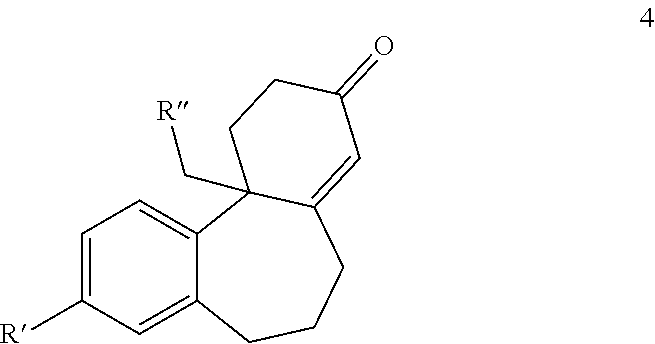
comprising the step of reacting compound of Formula 3
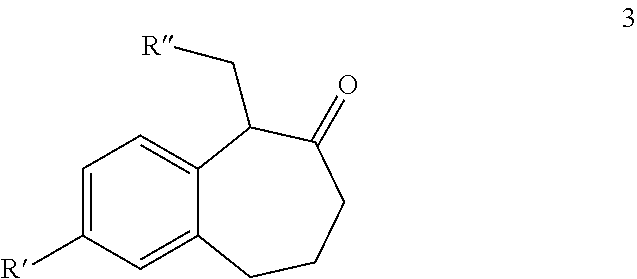
with a ketone and a base until the reaction is substantially complete to form a compound of Formula 4

wherein
R′ is alkoxy and
R″ is CF3, —(CH2)r-optionally substituted aryl, —(CH2)r-optionally substituted (C3-C6)cycloalkyl, optionally substituted (C1-C3)alkyl, or —(CH2)r-optionally substituted heteroaryl.
34. A process for the preparation of a compound of Formula 6

comprising the step of reacting compound of Formula 5

with 1-(bromomethyl)-2-fluoro-4-(trifluoromethyl)benzene until the reaction is substantially complete to form a compound of Formula 6

wherein R″″ is arylhalide.
35. A process for the preparation of compounds of Formulas 3a and 3b

comprising reacting a compound of Formula 3
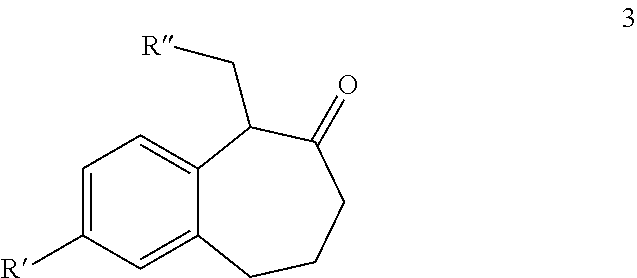
with an eneone, a base and a compound of Formula 6

until the reaction is substantially complete to form compounds of Formulas 3a and 3b

wherein
R′ is alkoxy;
R″ is CF3, —(CH2)r-optionally substituted aryl, —(CH2)r-optionally substituted (C3-C6)cycloalkyl, optionally substituted (C1-C3)alkyl, or —(CH2)r-optionally substituted heteroaryl; and
R″″ is arylhalide.
36. A process for preparing compounds of Formula 3c and 3d

comprising reacting compounds of Formulas 3a and 3b

with a base until the reaction is substantially complete to form a compound of Formulas 3c and 3d

wherein
R′ is alkoxy and
R″ is CF3, —(CH2)r-optionally substituted aryl, —(CH2)r-optionally substituted (C3-C6)cycloalkyl, optionally substituted (C1-C3)alkyl, or —(CH2)r-optionally substituted heteroaryl.
37. A process for preparing a compound of Formula 4a

comprising fractional crystallization of formulas 3c and 3d
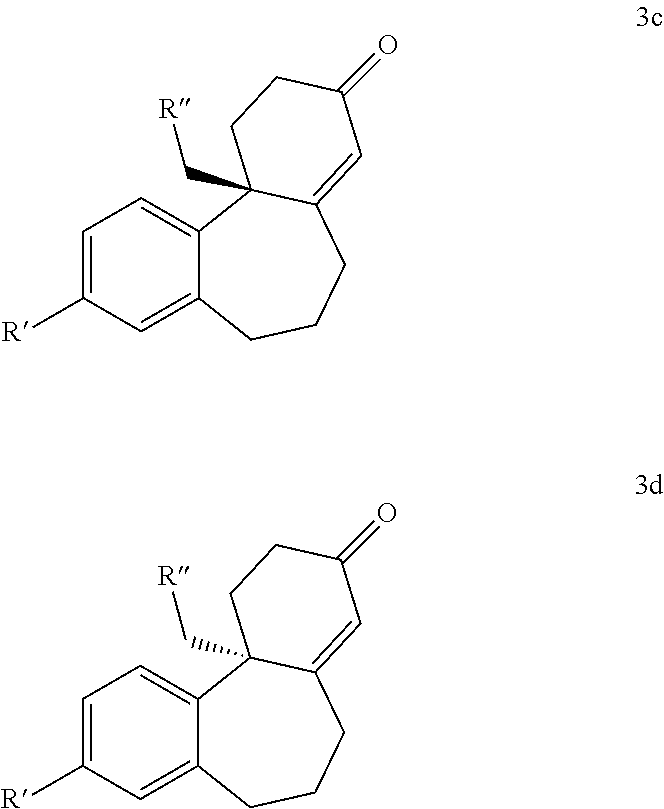
until the reaction is substantially complete to form a compound of Formula 4a

wherein
R′ is alkoxy and
R″ is CF3, —(CH2)r-optionally substituted aryl, —(CH2)r-optionally substituted (C3-C6)cycloalkyl, optionally substituted (C1-C3)alkyl, or —(CH2)r-optionally substituted heteroaryl.
38. A process for preparing a compound of Formula 7

comprising reacting a compound of Formula 4a

with an acid and methionine until the reaction is substantially complete to form a compound of Formula 7

wherein
R″ is CF3, —(CH2)r-optionally substituted aryl, —(CH2)r-optionally substituted (C3-C6)cycloalkyl, optionally substituted (C1-C3)alkyl, or —(CH2)r-optionally substituted heteroaryl.
39. The process according to claim 38 , wherein the acid is methanesulfonic acid.
40. A process for preparing a compound of Formula 8

comprising reacting a compound of Formula 7

with hydrogen and a catalyst until the reaction is substantially complete to form a compound of Formula 8

wherein
R″ is CF3, —(CH2)r-optionally substituted aryl, —(CH2)r-optionally substituted (C3-C6)cycloalkyl, optionally substituted (C1-C3)alkyl, or —(CH2)r-optionally substituted heteroaryl.
41. A process for preparing a compound of Formula 9

comprising reacting a comnound of Formula 8

with a triflating reagent N-phenylbis(trifluoromethanesulfonimide and a base until the reaction is substantially complete to form a compound of Formula 9

wherein
R″ is CF3, —(CH2)r-optionally substituted aryl, —(CH2)r-optionally substituted (C3-C6)cycloalkyl, optionally substituted (C1-C3)alkyl, or —(CH2)r-optionally substituted heteroaryl.
42. The process according to claim 41 wherein the triflating reagent is N-phenylbis(trifluoromethanesulfonimide.
43. A process for preparing a compound of Formula 10

comprising reacting a compound of Formula 9

with carbon monoxide and a catalyst until the reaction is substantially complete to form a compound of Formula 10

wherein
R″ is CF3, —(CH2)r-optionally substituted aryl, —(CH2)r-optionally substituted (C3-C6)cycloalkyl, optionally substituted (C1-C3)alkyl, or —(CH2)r-optionally substituted heteroaryl and
R′″ is optionally substituted aminoaryl, optionally substituted aminoheterocyclyl, optionally substituted aminoheteroaryl or optionally substituted aminocycloalkyl.
44. A process for preparing a compound of Formula 11
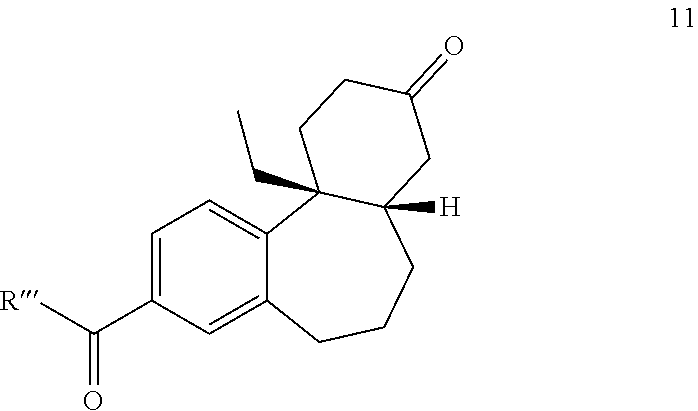
comprising reacting a compound of Formula 10

with a base until the reaction is substantially complete, then coupling to an amine to form a compound of Formula 11

wherein
R″ is CF3, —(CH2)r-optionally substituted aryl, —(CH2)r-optionally substituted (C3-C6)cycloalkyl, optionally substituted (C1-C3)alkyl, or —(CH2)r-optionally substituted heteroaryl and
R′″ is optionally substituted aminoaryl, optionally substituted aminoheterocyclyl, optionally substituted aminoheteroaryl or optionally substituted aminocycloalkyl.
45. A process for preparing a compound of Formula 12

comprising reacting a compound of Formula 11
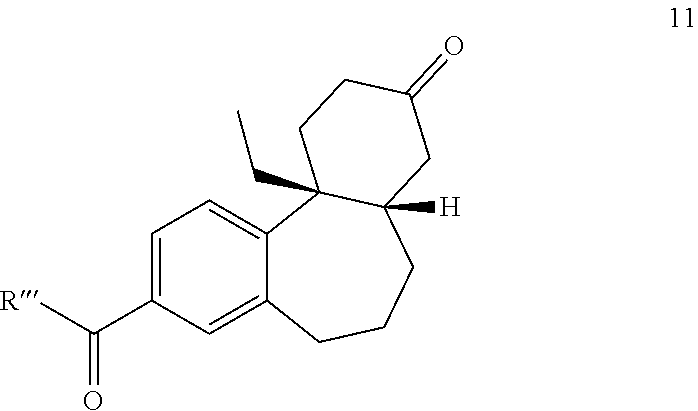
with a base and trimethylsulfoxonium halide until the reaction is substantially complete to form a compound of Formula 12

wherein
R″ is CF3, —(CH2)r-optionally substituted aryl, —(CH2)r-optionally substituted (C3-C6)cycloalkyl, optionally substituted (C1-C3)alkyl, or —(CH2)r-optionally substituted heteroaryl and
R′″ is optionally substituted aminoaryl, optionally substituted aminoheterocyclyl, optionally substituted aminoheteroaryl or optionally substituted aminocycloalkyl.
46. A process for preparing a compound of Formula 13

comprising reacting a compound of Formula 12

with a metal halide until the reaction is substantially complete to form a compound of Formula 13

wherein
R″ is CF3, —(CH2)r-optionally substituted aryl, —(CH2)r-optionally substituted (C3-C6)cycloalkyl, optionally substituted (C1-C3)alkyl, or —(CH2)r-optionally substituted heteroaryl;
R′″ is optionally substituted aminoaryl, optionally substituted aminoheterocyclyl, optionally substituted aminoheteroaryl or optionally substituted aminocycloalkyl and
RIV is H, optionally substituted (C1-C3)alkyl, OH or —O-optionally substituted (C1-C3)alkyl.
Priority Applications (1)
| Application Number | Priority Date | Filing Date | Title |
|---|---|---|---|
| US13/420,957 US20120238549A1 (en) | 2011-03-15 | 2012-03-15 | Nuclear Hormone Receptor Modulators |
Applications Claiming Priority (3)
| Application Number | Priority Date | Filing Date | Title |
|---|---|---|---|
| US201161452790P | 2011-03-15 | 2011-03-15 | |
| US201161565030P | 2011-11-30 | 2011-11-30 | |
| US13/420,957 US20120238549A1 (en) | 2011-03-15 | 2012-03-15 | Nuclear Hormone Receptor Modulators |
Publications (1)
| Publication Number | Publication Date |
|---|---|
| US20120238549A1 true US20120238549A1 (en) | 2012-09-20 |
Family
ID=46828945
Family Applications (1)
| Application Number | Title | Priority Date | Filing Date |
|---|---|---|---|
| US13/420,957 Abandoned US20120238549A1 (en) | 2011-03-15 | 2012-03-15 | Nuclear Hormone Receptor Modulators |
Country Status (23)
| Country | Link |
|---|---|
| US (1) | US20120238549A1 (en) |
| EP (1) | EP2685821A4 (en) |
| JP (1) | JP2014509592A (en) |
| KR (1) | KR20140015472A (en) |
| CN (1) | CN103732059A (en) |
| AR (1) | AR085412A1 (en) |
| AU (1) | AU2012229952A1 (en) |
| BR (1) | BR112013033777A2 (en) |
| CA (1) | CA2830234A1 (en) |
| CL (1) | CL2013002650A1 (en) |
| CO (1) | CO6771454A2 (en) |
| CR (1) | CR20130500A (en) |
| DO (1) | DOP2013000208A (en) |
| EC (1) | ECSP13012920A (en) |
| GT (1) | GT201300214A (en) |
| IL (1) | IL228422A0 (en) |
| MX (1) | MX2013010576A (en) |
| PE (1) | PE20141211A1 (en) |
| PH (1) | PH12013501898A1 (en) |
| RU (1) | RU2013145912A (en) |
| TW (1) | TW201247610A (en) |
| UY (1) | UY33957A (en) |
| WO (1) | WO2012125797A1 (en) |
Cited By (16)
| Publication number | Priority date | Publication date | Assignee | Title |
|---|---|---|---|---|
| WO2014039757A1 (en) | 2012-09-07 | 2014-03-13 | Abbvie Inc. | Heterocyclic nuclear hormone receptor modulators |
| US8809349B2 (en) | 2011-01-10 | 2014-08-19 | Infinity Pharmaceuticals, Inc. | Processes for preparing isoquinolinones and solid forms of isoquinolinones |
| US8828998B2 (en) | 2012-06-25 | 2014-09-09 | Infinity Pharmaceuticals, Inc. | Treatment of lupus, fibrotic conditions, and inflammatory myopathies and other disorders using PI3 kinase inhibitors |
| US9150592B2 (en) | 2012-12-21 | 2015-10-06 | Abbvie Inc. | Heterocyclic nuclear hormone receptor modulators |
| US9206182B2 (en) | 2009-07-15 | 2015-12-08 | Intellikine Llc | Substituted isoquinolin-1(2H)-one compounds, compositions, and methods thereof |
| US9643947B2 (en) | 2013-08-28 | 2017-05-09 | Northwestern University | 7-membered fused heterocycles and methods of their synthesis |
| WO2017151613A1 (en) * | 2016-03-01 | 2017-09-08 | Corcept Therapeutics, Inc. | The use of glucocorticoid receptor modulators to potentiate checkpoint inhibitors |
| US9822131B2 (en) | 2008-01-04 | 2017-11-21 | Intellikine Llc | Certain chemical entities, compositions and methods |
| US11110096B2 (en) | 2014-04-16 | 2021-09-07 | Infinity Pharmaceuticals, Inc. | Combination therapies |
| US11147818B2 (en) | 2016-06-24 | 2021-10-19 | Infinity Pharmaceuticals, Inc. | Combination therapies |
| US11234971B2 (en) | 2018-12-19 | 2022-02-01 | Corcept Therapeutics Incorporated | Methods of treating cancer comprising administration of a glucocorticoid receptor modulator and a cancer chemotherapy agent |
| CN114375290A (en) * | 2019-04-11 | 2022-04-19 | 百时美施贵宝公司 | Novel synthetic options for the preparation of (6R,10S) -10- {4- [ 5-chloro-2- (4-chloro-1H-1, 2, 3-triazol-1-yl) phenyl ] -6-oxo-1 (6H) -pyrimidinyl } -1- (dioxomethyl) -6-methyl-1, 4,7,8,9, 10-hexahydro-11, 15- (methylenebridging) pyrazolo [4,3-B ] [1,7] diazacyclotetradecyn-5 (6H) -one |
| US11389432B2 (en) | 2018-12-19 | 2022-07-19 | Corcept Therapeutics Incorporated | Methods of treating cancer comprising administration of a glucocorticoid receptor modulator and a cancer chemotherapy agent |
| US12213983B2 (en) | 2012-11-01 | 2025-02-04 | Infinity Pharmaceuticals, Inc. | Treatment of cancers using PI3 kinase isoform modulators |
| US12433882B2 (en) | 2022-10-28 | 2025-10-07 | Corcept Therapeutics Incorporated | Treatments for amyotrophic lateral sclerosis using dazucorilant |
| US12514849B2 (en) | 2018-12-19 | 2026-01-06 | Corcept Therapeutics Incorporated | Pharmaceutical formulations containing relacorilant, a heteroaryl-ketone fused azadecalin compound |
Families Citing this family (3)
| Publication number | Priority date | Publication date | Assignee | Title |
|---|---|---|---|---|
| KR101849301B1 (en) * | 2018-01-29 | 2018-04-16 | 전북대학교 산학협력단 | Composition for treatment and prevention of dry eye syndrome comprising Aucuba japonica extract |
| UY38979A (en) | 2019-12-06 | 2021-07-30 | Vertex Pharma | TETRAHYDROFURANS REPLACED AS SODIUM CHANNEL MODULATORS |
| TW202313593A (en) | 2021-06-04 | 2023-04-01 | 美商維泰克斯製藥公司 | N-(hydroxyalkyl (hetero)aryl) tetrahydrofuran carboxamides as modulators of sodium channels |
Family Cites Families (12)
| Publication number | Priority date | Publication date | Assignee | Title |
|---|---|---|---|---|
| CA2111138A1 (en) * | 1993-01-15 | 1994-07-16 | Thierry Godel | Octahydrophenanthrene derivatives |
| DE69940484D1 (en) * | 1998-04-06 | 2009-04-09 | Astellas Pharma Inc | Use of beta-3 adrenergic receptor agonists in the treatment of dysuria |
| EP1175383B1 (en) * | 1999-04-30 | 2018-03-14 | Pfizer Products Inc. | Glucocorticoid receptor modulators |
| CA2420967A1 (en) * | 2000-08-07 | 2002-02-14 | Neurogen Corporation | Heterocyclic compounds as ligands of the gabaa receptor |
| TW200400816A (en) * | 2002-06-26 | 2004-01-16 | Lilly Co Eli | Tricyclic steroid hormone nuclear receptor modulators |
| US20060247266A1 (en) * | 2004-11-26 | 2006-11-02 | Asahi Kasei Pharma Corporation | Nitrogen-containing tricyclic compounds |
| WO2006081659A1 (en) * | 2005-02-01 | 2006-08-10 | The University Of British Columbia | Meroterpenoid inhibitors of phosphoinositide 3 kinase (pi3k) |
| JP4873614B2 (en) * | 2006-01-16 | 2012-02-08 | 国立大学法人 東京大学 | Potassium channel opener |
| CA2676907C (en) * | 2007-02-02 | 2012-03-20 | Pfizer Products Inc. | Tricyclic compounds and their use as glucocorticoid receptor modulators |
| DK2114970T3 (en) * | 2007-02-02 | 2011-09-19 | Pfizer Prod Inc | Tricyclic compounds and their use as glucocorticoid receptor modulators |
| JP2009209068A (en) * | 2008-03-03 | 2009-09-17 | Univ Of Tokyo | Potassium channel opening medicine |
| WO2010013158A1 (en) * | 2008-07-28 | 2010-02-04 | Pfizer Inc. | Phenanthrenone compounds, compositions and methods |
-
2012
- 2012-03-15 US US13/420,957 patent/US20120238549A1/en not_active Abandoned
- 2012-03-15 EP EP12758037.1A patent/EP2685821A4/en not_active Withdrawn
- 2012-03-15 JP JP2013558163A patent/JP2014509592A/en active Pending
- 2012-03-15 AU AU2012229952A patent/AU2012229952A1/en not_active Abandoned
- 2012-03-15 CA CA2830234A patent/CA2830234A1/en not_active Abandoned
- 2012-03-15 PE PE2013002048A patent/PE20141211A1/en not_active Application Discontinuation
- 2012-03-15 KR KR1020137027101A patent/KR20140015472A/en not_active Withdrawn
- 2012-03-15 MX MX2013010576A patent/MX2013010576A/en unknown
- 2012-03-15 TW TW101108952A patent/TW201247610A/en unknown
- 2012-03-15 UY UY0001033957A patent/UY33957A/en not_active Application Discontinuation
- 2012-03-15 BR BR112013033777A patent/BR112013033777A2/en not_active IP Right Cessation
- 2012-03-15 AR ARP120100857A patent/AR085412A1/en not_active Application Discontinuation
- 2012-03-15 CN CN201280022132.3A patent/CN103732059A/en active Pending
- 2012-03-15 PH PH1/2013/501898A patent/PH12013501898A1/en unknown
- 2012-03-15 RU RU2013145912/04A patent/RU2013145912A/en not_active Application Discontinuation
- 2012-03-15 WO PCT/US2012/029184 patent/WO2012125797A1/en not_active Ceased
-
2013
- 2013-09-12 IL IL228422A patent/IL228422A0/en unknown
- 2013-09-13 CL CL2013002650A patent/CL2013002650A1/en unknown
- 2013-09-13 DO DO2013000208A patent/DOP2013000208A/en unknown
- 2013-09-13 GT GT201300214A patent/GT201300214A/en unknown
- 2013-09-25 CO CO13228192A patent/CO6771454A2/en unknown
- 2013-09-30 CR CR20130500A patent/CR20130500A/en unknown
- 2013-10-03 EC ECSP13012920 patent/ECSP13012920A/en unknown
Non-Patent Citations (1)
| Title |
|---|
| Caplus abstract, by Fujita et al. AN 1960:16868, 1960. * |
Cited By (31)
| Publication number | Priority date | Publication date | Assignee | Title |
|---|---|---|---|---|
| US9216982B2 (en) | 2008-01-04 | 2015-12-22 | Intellikine Llc | Certain chemical entities, compositions and methods |
| US11433065B2 (en) | 2008-01-04 | 2022-09-06 | Intellikine Llc | Certain chemical entities, compositions and methods |
| US9822131B2 (en) | 2008-01-04 | 2017-11-21 | Intellikine Llc | Certain chemical entities, compositions and methods |
| US9655892B2 (en) | 2008-01-04 | 2017-05-23 | Intellikine Llc | Certain chemical entities, compositions and methods |
| US9522146B2 (en) | 2009-07-15 | 2016-12-20 | Intellikine Llc | Substituted Isoquinolin-1(2H)-one compounds, compositions, and methods thereof |
| US9206182B2 (en) | 2009-07-15 | 2015-12-08 | Intellikine Llc | Substituted isoquinolin-1(2H)-one compounds, compositions, and methods thereof |
| USRE46621E1 (en) | 2011-01-10 | 2017-12-05 | Infinity Pharmaceuticals, Inc. | Processes for preparing isoquinolinones and solid forms of isoquinolinones |
| US11312718B2 (en) | 2011-01-10 | 2022-04-26 | Infinity Pharmaceuticals, Inc. | Formulations of (S)-3-(1-(9H-purin-6-ylamino)ethyl)-8-chloro-2-phenylisoquinolin-1(2H)-one |
| US9840505B2 (en) | 2011-01-10 | 2017-12-12 | Infinity Pharmaceuticals, Inc. | Solid forms of (S)-3-(1-(9H-purin-6-ylamino)ethyl)-8-chloro-2-phenylisoquinolin-1 (2H)-one and methods of use thereof |
| US10550122B2 (en) | 2011-01-10 | 2020-02-04 | Infinity Pharmaceuticals, Inc. | Solid forms of (S)-3-(1-(9H-purin-6-ylamino)ethyl)-8-chloro-2-phenylisoquinolin-1(2H)-one and methods of use thereof |
| US9290497B2 (en) | 2011-01-10 | 2016-03-22 | Infinity Pharmaceuticals, Inc. | Processes for preparing isoquinolinones and solid forms of isoquinolinones |
| US8809349B2 (en) | 2011-01-10 | 2014-08-19 | Infinity Pharmaceuticals, Inc. | Processes for preparing isoquinolinones and solid forms of isoquinolinones |
| US9527847B2 (en) | 2012-06-25 | 2016-12-27 | Infinity Pharmaceuticals, Inc. | Treatment of lupus, fibrotic conditions, and inflammatory myopathies and other disorders using PI3 kinase inhibitors |
| US8828998B2 (en) | 2012-06-25 | 2014-09-09 | Infinity Pharmaceuticals, Inc. | Treatment of lupus, fibrotic conditions, and inflammatory myopathies and other disorders using PI3 kinase inhibitors |
| US9193744B2 (en) | 2012-09-07 | 2015-11-24 | Abbvie Inc. | Heterocyclic nuclear hormone receptor modulators |
| WO2014039757A1 (en) | 2012-09-07 | 2014-03-13 | Abbvie Inc. | Heterocyclic nuclear hormone receptor modulators |
| US12213983B2 (en) | 2012-11-01 | 2025-02-04 | Infinity Pharmaceuticals, Inc. | Treatment of cancers using PI3 kinase isoform modulators |
| US9150592B2 (en) | 2012-12-21 | 2015-10-06 | Abbvie Inc. | Heterocyclic nuclear hormone receptor modulators |
| US9643947B2 (en) | 2013-08-28 | 2017-05-09 | Northwestern University | 7-membered fused heterocycles and methods of their synthesis |
| US11944631B2 (en) | 2014-04-16 | 2024-04-02 | Infinity Pharmaceuticals, Inc. | Combination therapies |
| US11110096B2 (en) | 2014-04-16 | 2021-09-07 | Infinity Pharmaceuticals, Inc. | Combination therapies |
| US10980797B2 (en) | 2016-03-01 | 2021-04-20 | Corcept Therapeutics Incorporated | Use of glucocorticoid receptor modulators to potentiate checkpoint inhibitors |
| US12171760B2 (en) | 2016-03-01 | 2024-12-24 | Corcept Therapeutics Incorporated | Use of glucocorticoid receptor modulators to potentiate checkpoint inhibitors |
| WO2017151613A1 (en) * | 2016-03-01 | 2017-09-08 | Corcept Therapeutics, Inc. | The use of glucocorticoid receptor modulators to potentiate checkpoint inhibitors |
| US11147818B2 (en) | 2016-06-24 | 2021-10-19 | Infinity Pharmaceuticals, Inc. | Combination therapies |
| US11234971B2 (en) | 2018-12-19 | 2022-02-01 | Corcept Therapeutics Incorporated | Methods of treating cancer comprising administration of a glucocorticoid receptor modulator and a cancer chemotherapy agent |
| US11389432B2 (en) | 2018-12-19 | 2022-07-19 | Corcept Therapeutics Incorporated | Methods of treating cancer comprising administration of a glucocorticoid receptor modulator and a cancer chemotherapy agent |
| US12514849B2 (en) | 2018-12-19 | 2026-01-06 | Corcept Therapeutics Incorporated | Pharmaceutical formulations containing relacorilant, a heteroaryl-ketone fused azadecalin compound |
| CN114375290A (en) * | 2019-04-11 | 2022-04-19 | 百时美施贵宝公司 | Novel synthetic options for the preparation of (6R,10S) -10- {4- [ 5-chloro-2- (4-chloro-1H-1, 2, 3-triazol-1-yl) phenyl ] -6-oxo-1 (6H) -pyrimidinyl } -1- (dioxomethyl) -6-methyl-1, 4,7,8,9, 10-hexahydro-11, 15- (methylenebridging) pyrazolo [4,3-B ] [1,7] diazacyclotetradecyn-5 (6H) -one |
| US12378246B2 (en) | 2019-04-11 | 2025-08-05 | Bristol-Myers Squibb Company | Synthetic options towards the manufacture of (6R,10S)-10-{4-[5-chloro-2-(4-chloro-1H-1,2,3-triazol-1-yl)phenyl]-6-oxo-1(6H)-pyrimidinyl} - 1-(difluoromethyl)-6-methyl-1,4,7,8,9,10-hexahydro-11,15-(metheno)pyrazolo[4,3-b][1,7]diazacyclotetradecin-5(6H)-one |
| US12433882B2 (en) | 2022-10-28 | 2025-10-07 | Corcept Therapeutics Incorporated | Treatments for amyotrophic lateral sclerosis using dazucorilant |
Also Published As
| Publication number | Publication date |
|---|---|
| CN103732059A (en) | 2014-04-16 |
| RU2013145912A (en) | 2015-04-20 |
| MX2013010576A (en) | 2014-03-12 |
| UY33957A (en) | 2012-10-31 |
| CA2830234A1 (en) | 2012-09-20 |
| EP2685821A4 (en) | 2014-08-20 |
| CL2013002650A1 (en) | 2013-12-06 |
| PH12013501898A1 (en) | 2020-10-19 |
| IL228422A0 (en) | 2013-12-31 |
| PE20141211A1 (en) | 2014-10-15 |
| ECSP13012920A (en) | 2013-11-29 |
| BR112013033777A2 (en) | 2016-09-13 |
| TW201247610A (en) | 2012-12-01 |
| AU2012229952A1 (en) | 2013-04-18 |
| KR20140015472A (en) | 2014-02-06 |
| GT201300214A (en) | 2014-10-17 |
| AR085412A1 (en) | 2013-10-02 |
| JP2014509592A (en) | 2014-04-21 |
| WO2012125797A1 (en) | 2012-09-20 |
| EP2685821A1 (en) | 2014-01-22 |
| CO6771454A2 (en) | 2013-10-15 |
| DOP2013000208A (en) | 2013-11-15 |
| CR20130500A (en) | 2013-12-13 |
Similar Documents
| Publication | Publication Date | Title |
|---|---|---|
| US20120238549A1 (en) | Nuclear Hormone Receptor Modulators | |
| JP5748659B2 (en) | New tricyclic compounds | |
| TWI707852B (en) | Tyk2 inhibitors and uses thereof | |
| CA2984183C (en) | Pyrrolo[2,3-d]pyrimidinyl, pyrrolo[2,3-b]pyrazinyl, pyrrolo[2,3-b]pyridinyl acrylamides and epoxides thereof | |
| CN103442568A (en) | Furo [3,2-d ] pyrimidine compounds | |
| CA3182541A1 (en) | Heterocyclic compounds as triggering receptor expressed on myeloid cells 2 agonists and methods of use | |
| JP2015503618A (en) | IRAK inhibitors and uses thereof | |
| CA2988502A1 (en) | Nuclear receptor modulators | |
| CN101652069A (en) | Novel imidazo-based heterocycles | |
| JP2017531672A (en) | Ethyl N-Boc piperidinyl pyrazolopyridones as Janus kinase inhibitors | |
| AU2014234908B2 (en) | N-(2-cyano heterocyclyl)pyrazolo pyridones as Janus kinase inhibitors | |
| US9150592B2 (en) | Heterocyclic nuclear hormone receptor modulators | |
| US20080242862A1 (en) | Novel imidazo based heterocycles | |
| US9193744B2 (en) | Heterocyclic nuclear hormone receptor modulators | |
| JP2025521097A (en) | LRRK2 inhibitors | |
| CA3159250A1 (en) | New compounds for treatment of diseases related to dux4 expression | |
| WO2008118485A1 (en) | Novel imidazo based heterocycles |
Legal Events
| Date | Code | Title | Description |
|---|---|---|---|
| AS | Assignment |
Owner name: ABBOTT LABORATORIES, ILLINOIS Free format text: ASSIGNMENT OF ASSIGNORS INTEREST;ASSIGNORS:CUSACK, KEVIN P;GORDON, THOMAS D.;IHLE, DAVID C.;AND OTHERS;SIGNING DATES FROM 20120423 TO 20120429;REEL/FRAME:028675/0525 |
|
| AS | Assignment |
Owner name: ABBVIE INC., ILLINOIS Free format text: ASSIGNMENT OF ASSIGNORS INTEREST;ASSIGNOR:ABBOTT LABORATORIES;REEL/FRAME:030137/0222 Effective date: 20120801 |
|
| STCB | Information on status: application discontinuation |
Free format text: ABANDONED -- FAILURE TO RESPOND TO AN OFFICE ACTION |