US20120181173A1 - Electrochemical sensor for the detection of analytes in liquid media - Google Patents
Electrochemical sensor for the detection of analytes in liquid media Download PDFInfo
- Publication number
- US20120181173A1 US20120181173A1 US13/387,193 US201013387193A US2012181173A1 US 20120181173 A1 US20120181173 A1 US 20120181173A1 US 201013387193 A US201013387193 A US 201013387193A US 2012181173 A1 US2012181173 A1 US 2012181173A1
- Authority
- US
- United States
- Prior art keywords
- layer
- polythiophene
- deposited
- working electrode
- polymer gel
- Prior art date
- Legal status (The legal status is an assumption and is not a legal conclusion. Google has not performed a legal analysis and makes no representation as to the accuracy of the status listed.)
- Abandoned
Links
- 238000001514 detection method Methods 0.000 title claims abstract description 37
- 239000007788 liquid Substances 0.000 title claims abstract description 12
- 229920000123 polythiophene Polymers 0.000 claims abstract description 85
- 229920001940 conductive polymer Polymers 0.000 claims abstract description 42
- 239000000758 substrate Substances 0.000 claims abstract description 25
- 239000002122 magnetic nanoparticle Substances 0.000 claims abstract description 23
- 239000003575 carbonaceous material Substances 0.000 claims abstract description 18
- 238000000034 method Methods 0.000 claims description 41
- -1 C2-C12 alkene Chemical group 0.000 claims description 36
- 102000004190 Enzymes Human genes 0.000 claims description 27
- 108090000790 Enzymes Proteins 0.000 claims description 27
- 150000001875 compounds Chemical class 0.000 claims description 24
- OKTJSMMVPCPJKN-UHFFFAOYSA-N Carbon Chemical group [C] OKTJSMMVPCPJKN-UHFFFAOYSA-N 0.000 claims description 22
- 230000008569 process Effects 0.000 claims description 21
- 229910002804 graphite Inorganic materials 0.000 claims description 20
- 239000010439 graphite Substances 0.000 claims description 20
- 239000007769 metal material Substances 0.000 claims description 20
- 239000000178 monomer Substances 0.000 claims description 18
- 239000006185 dispersion Substances 0.000 claims description 17
- 238000004458 analytical method Methods 0.000 claims description 15
- 239000002904 solvent Substances 0.000 claims description 14
- 229920000642 polymer Polymers 0.000 claims description 13
- 125000000129 anionic group Chemical group 0.000 claims description 11
- 238000006116 polymerization reaction Methods 0.000 claims description 11
- YTPLMLYBLZKORZ-UHFFFAOYSA-N Thiophene Chemical compound C=1C=CSC=1 YTPLMLYBLZKORZ-UHFFFAOYSA-N 0.000 claims description 10
- 239000002019 doping agent Substances 0.000 claims description 10
- 238000004519 manufacturing process Methods 0.000 claims description 9
- PPBRXRYQALVLMV-UHFFFAOYSA-N Styrene Chemical compound C=CC1=CC=CC=C1 PPBRXRYQALVLMV-UHFFFAOYSA-N 0.000 claims description 8
- 238000006872 enzymatic polymerization reaction Methods 0.000 claims description 8
- 239000002253 acid Substances 0.000 claims description 7
- 239000011810 insulating material Substances 0.000 claims description 7
- 239000002245 particle Substances 0.000 claims description 7
- 125000004400 (C1-C12) alkyl group Chemical group 0.000 claims description 6
- 238000011065 in-situ storage Methods 0.000 claims description 6
- 230000001590 oxidative effect Effects 0.000 claims description 6
- 229920000447 polyanionic polymer Polymers 0.000 claims description 6
- 108091034117 Oligonucleotide Proteins 0.000 claims description 5
- JLCPHMBAVCMARE-UHFFFAOYSA-N [3-[[3-[[3-[[3-[[3-[[3-[[3-[[3-[[3-[[3-[[3-[[5-(2-amino-6-oxo-1H-purin-9-yl)-3-[[3-[[3-[[3-[[3-[[3-[[5-(2-amino-6-oxo-1H-purin-9-yl)-3-[[5-(2-amino-6-oxo-1H-purin-9-yl)-3-hydroxyoxolan-2-yl]methoxy-hydroxyphosphoryl]oxyoxolan-2-yl]methoxy-hydroxyphosphoryl]oxy-5-(5-methyl-2,4-dioxopyrimidin-1-yl)oxolan-2-yl]methoxy-hydroxyphosphoryl]oxy-5-(6-aminopurin-9-yl)oxolan-2-yl]methoxy-hydroxyphosphoryl]oxy-5-(6-aminopurin-9-yl)oxolan-2-yl]methoxy-hydroxyphosphoryl]oxy-5-(6-aminopurin-9-yl)oxolan-2-yl]methoxy-hydroxyphosphoryl]oxy-5-(6-aminopurin-9-yl)oxolan-2-yl]methoxy-hydroxyphosphoryl]oxyoxolan-2-yl]methoxy-hydroxyphosphoryl]oxy-5-(5-methyl-2,4-dioxopyrimidin-1-yl)oxolan-2-yl]methoxy-hydroxyphosphoryl]oxy-5-(4-amino-2-oxopyrimidin-1-yl)oxolan-2-yl]methoxy-hydroxyphosphoryl]oxy-5-(5-methyl-2,4-dioxopyrimidin-1-yl)oxolan-2-yl]methoxy-hydroxyphosphoryl]oxy-5-(5-methyl-2,4-dioxopyrimidin-1-yl)oxolan-2-yl]methoxy-hydroxyphosphoryl]oxy-5-(6-aminopurin-9-yl)oxolan-2-yl]methoxy-hydroxyphosphoryl]oxy-5-(6-aminopurin-9-yl)oxolan-2-yl]methoxy-hydroxyphosphoryl]oxy-5-(4-amino-2-oxopyrimidin-1-yl)oxolan-2-yl]methoxy-hydroxyphosphoryl]oxy-5-(4-amino-2-oxopyrimidin-1-yl)oxolan-2-yl]methoxy-hydroxyphosphoryl]oxy-5-(4-amino-2-oxopyrimidin-1-yl)oxolan-2-yl]methoxy-hydroxyphosphoryl]oxy-5-(6-aminopurin-9-yl)oxolan-2-yl]methoxy-hydroxyphosphoryl]oxy-5-(4-amino-2-oxopyrimidin-1-yl)oxolan-2-yl]methyl [5-(6-aminopurin-9-yl)-2-(hydroxymethyl)oxolan-3-yl] hydrogen phosphate Polymers Cc1cn(C2CC(OP(O)(=O)OCC3OC(CC3OP(O)(=O)OCC3OC(CC3O)n3cnc4c3nc(N)[nH]c4=O)n3cnc4c3nc(N)[nH]c4=O)C(COP(O)(=O)OC3CC(OC3COP(O)(=O)OC3CC(OC3COP(O)(=O)OC3CC(OC3COP(O)(=O)OC3CC(OC3COP(O)(=O)OC3CC(OC3COP(O)(=O)OC3CC(OC3COP(O)(=O)OC3CC(OC3COP(O)(=O)OC3CC(OC3COP(O)(=O)OC3CC(OC3COP(O)(=O)OC3CC(OC3COP(O)(=O)OC3CC(OC3COP(O)(=O)OC3CC(OC3COP(O)(=O)OC3CC(OC3COP(O)(=O)OC3CC(OC3COP(O)(=O)OC3CC(OC3COP(O)(=O)OC3CC(OC3COP(O)(=O)OC3CC(OC3CO)n3cnc4c(N)ncnc34)n3ccc(N)nc3=O)n3cnc4c(N)ncnc34)n3ccc(N)nc3=O)n3ccc(N)nc3=O)n3ccc(N)nc3=O)n3cnc4c(N)ncnc34)n3cnc4c(N)ncnc34)n3cc(C)c(=O)[nH]c3=O)n3cc(C)c(=O)[nH]c3=O)n3ccc(N)nc3=O)n3cc(C)c(=O)[nH]c3=O)n3cnc4c3nc(N)[nH]c4=O)n3cnc4c(N)ncnc34)n3cnc4c(N)ncnc34)n3cnc4c(N)ncnc34)n3cnc4c(N)ncnc34)O2)c(=O)[nH]c1=O JLCPHMBAVCMARE-UHFFFAOYSA-N 0.000 claims description 5
- 238000001246 colloidal dispersion Methods 0.000 claims description 5
- 239000004020 conductor Substances 0.000 claims description 5
- 108091033319 polynucleotide Proteins 0.000 claims description 5
- 239000002157 polynucleotide Substances 0.000 claims description 5
- 102000040430 polynucleotide Human genes 0.000 claims description 5
- 229930192474 thiophene Natural products 0.000 claims description 5
- JOXIMZWYDAKGHI-UHFFFAOYSA-N toluene-4-sulfonic acid Chemical compound CC1=CC=C(S(O)(=O)=O)C=C1 JOXIMZWYDAKGHI-UHFFFAOYSA-N 0.000 claims description 5
- 102000004169 proteins and genes Human genes 0.000 claims description 4
- 108090000623 proteins and genes Proteins 0.000 claims description 4
- VEXZGXHMUGYJMC-UHFFFAOYSA-N Hydrochloric acid Chemical compound Cl VEXZGXHMUGYJMC-UHFFFAOYSA-N 0.000 claims description 3
- 150000007513 acids Chemical class 0.000 claims description 3
- NIXOWILDQLNWCW-UHFFFAOYSA-N acrylic acid group Chemical group C(C=C)(=O)O NIXOWILDQLNWCW-UHFFFAOYSA-N 0.000 claims description 3
- 239000006229 carbon black Substances 0.000 claims description 3
- 229920001577 copolymer Polymers 0.000 claims description 3
- 239000002773 nucleotide Substances 0.000 claims description 3
- 125000003729 nucleotide group Chemical group 0.000 claims description 3
- NLVXSWCKKBEXTG-UHFFFAOYSA-N vinylsulfonic acid Chemical class OS(=O)(=O)C=C NLVXSWCKKBEXTG-UHFFFAOYSA-N 0.000 claims description 3
- LYNDWSARZJHIKU-UHFFFAOYSA-N (4-methylphenyl)phosphonic acid Chemical compound CC1=CC=C(P(O)(O)=O)C=C1 LYNDWSARZJHIKU-UHFFFAOYSA-N 0.000 claims description 2
- 241000894006 Bacteria Species 0.000 claims description 2
- CPELXLSAUQHCOX-UHFFFAOYSA-M Bromide Chemical compound [Br-] CPELXLSAUQHCOX-UHFFFAOYSA-M 0.000 claims description 2
- 102000003886 Glycoproteins Human genes 0.000 claims description 2
- 108090000288 Glycoproteins Proteins 0.000 claims description 2
- 102000004895 Lipoproteins Human genes 0.000 claims description 2
- 108090001030 Lipoproteins Proteins 0.000 claims description 2
- 102000015636 Oligopeptides Human genes 0.000 claims description 2
- 108010038807 Oligopeptides Proteins 0.000 claims description 2
- 229920002125 Sokalan® Polymers 0.000 claims description 2
- QAOWNCQODCNURD-UHFFFAOYSA-N Sulfuric acid Chemical compound OS(O)(=O)=O QAOWNCQODCNURD-UHFFFAOYSA-N 0.000 claims description 2
- 125000002947 alkylene group Chemical group 0.000 claims description 2
- 125000003368 amide group Chemical group 0.000 claims description 2
- 150000001449 anionic compounds Chemical group 0.000 claims description 2
- 125000001797 benzyl group Chemical group [H]C1=C([H])C([H])=C(C([H])=C1[H])C([H])([H])* 0.000 claims description 2
- 239000002041 carbon nanotube Substances 0.000 claims description 2
- 229910021393 carbon nanotube Inorganic materials 0.000 claims description 2
- 150000001735 carboxylic acids Chemical class 0.000 claims description 2
- 239000005515 coenzyme Substances 0.000 claims description 2
- 150000002148 esters Chemical class 0.000 claims description 2
- 125000005678 ethenylene group Chemical group [H]C([*:1])=C([H])[*:2] 0.000 claims description 2
- 125000001033 ether group Chemical group 0.000 claims description 2
- 125000005843 halogen group Chemical group 0.000 claims description 2
- 229910001412 inorganic anion Inorganic materials 0.000 claims description 2
- 125000005395 methacrylic acid group Chemical group 0.000 claims description 2
- 150000002772 monosaccharides Chemical class 0.000 claims description 2
- 229920001542 oligosaccharide Polymers 0.000 claims description 2
- 150000002482 oligosaccharides Chemical class 0.000 claims description 2
- 150000002891 organic anions Chemical class 0.000 claims description 2
- 125000001997 phenyl group Chemical group [H]C1=C([H])C([H])=C(*)C([H])=C1[H] 0.000 claims description 2
- 125000002467 phosphate group Chemical group [H]OP(=O)(O[H])O[*] 0.000 claims description 2
- 229920001444 polymaleic acid Polymers 0.000 claims description 2
- 229920001184 polypeptide Polymers 0.000 claims description 2
- 125000002924 primary amino group Chemical group [H]N([H])* 0.000 claims description 2
- 102000004196 processed proteins & peptides Human genes 0.000 claims description 2
- 108090000765 processed proteins & peptides Proteins 0.000 claims description 2
- 230000003252 repetitive effect Effects 0.000 claims description 2
- BDHFUVZGWQCTTF-UHFFFAOYSA-M sulfonate Chemical compound [O-]S(=O)=O BDHFUVZGWQCTTF-UHFFFAOYSA-M 0.000 claims description 2
- 150000003460 sulfonic acids Chemical class 0.000 claims description 2
- 239000010410 layer Substances 0.000 description 171
- 239000000575 pesticide Substances 0.000 description 41
- 239000000499 gel Substances 0.000 description 33
- 229920002451 polyvinyl alcohol Polymers 0.000 description 32
- 239000004372 Polyvinyl alcohol Substances 0.000 description 28
- OTMOUPHCTWPNSL-UHFFFAOYSA-N diethyl (3,5,6-trichloropyridin-2-yl) phosphate Chemical compound CCOP(=O)(OCC)OC1=NC(Cl)=C(Cl)C=C1Cl OTMOUPHCTWPNSL-UHFFFAOYSA-N 0.000 description 28
- 239000000243 solution Substances 0.000 description 28
- 229940088598 enzyme Drugs 0.000 description 26
- 230000005764 inhibitory process Effects 0.000 description 24
- 229920001609 Poly(3,4-ethylenedioxythiophene) Polymers 0.000 description 20
- 239000000523 sample Substances 0.000 description 19
- 102000012440 Acetylcholinesterase Human genes 0.000 description 16
- 108010022752 Acetylcholinesterase Proteins 0.000 description 16
- 239000000203 mixture Substances 0.000 description 12
- 238000007650 screen-printing Methods 0.000 description 12
- 239000007864 aqueous solution Substances 0.000 description 11
- QIGBRXMKCJKVMJ-UHFFFAOYSA-N Hydroquinone Chemical compound OC1=CC=C(O)C=C1 QIGBRXMKCJKVMJ-UHFFFAOYSA-N 0.000 description 10
- MHAJPDPJQMAIIY-UHFFFAOYSA-N Hydrogen peroxide Chemical compound OO MHAJPDPJQMAIIY-UHFFFAOYSA-N 0.000 description 9
- BQCADISMDOOEFD-UHFFFAOYSA-N Silver Chemical compound [Ag] BQCADISMDOOEFD-UHFFFAOYSA-N 0.000 description 9
- MPMSMUBQXQALQI-UHFFFAOYSA-N cobalt phthalocyanine Chemical compound [Co+2].C12=CC=CC=C2C(N=C2[N-]C(C3=CC=CC=C32)=N2)=NC1=NC([C]1C=CC=CC1=1)=NC=1N=C1[C]3C=CC=CC3=C2[N-]1 MPMSMUBQXQALQI-UHFFFAOYSA-N 0.000 description 9
- 230000000295 complement effect Effects 0.000 description 9
- 229910052709 silver Inorganic materials 0.000 description 9
- 239000004332 silver Substances 0.000 description 9
- PCHJSUWPFVWCPO-UHFFFAOYSA-N gold Chemical compound [Au] PCHJSUWPFVWCPO-UHFFFAOYSA-N 0.000 description 8
- 229910052737 gold Inorganic materials 0.000 description 8
- 239000010931 gold Substances 0.000 description 8
- BASFCYQUMIYNBI-UHFFFAOYSA-N platinum Chemical compound [Pt] BASFCYQUMIYNBI-UHFFFAOYSA-N 0.000 description 8
- 230000008020 evaporation Effects 0.000 description 7
- 238000001704 evaporation Methods 0.000 description 7
- 235000013305 food Nutrition 0.000 description 7
- 239000000126 substance Chemical class 0.000 description 7
- XEEYBQQBJWHFJM-UHFFFAOYSA-N Iron Chemical compound [Fe] XEEYBQQBJWHFJM-UHFFFAOYSA-N 0.000 description 6
- PXHVJJICTQNCMI-UHFFFAOYSA-N Nickel Chemical compound [Ni] PXHVJJICTQNCMI-UHFFFAOYSA-N 0.000 description 6
- KDLHZDBZIXYQEI-UHFFFAOYSA-N Palladium Chemical compound [Pd] KDLHZDBZIXYQEI-UHFFFAOYSA-N 0.000 description 6
- ROOXNKNUYICQNP-UHFFFAOYSA-N ammonium persulfate Chemical compound [NH4+].[NH4+].[O-]S(=O)(=O)OOS([O-])(=O)=O ROOXNKNUYICQNP-UHFFFAOYSA-N 0.000 description 6
- 238000000151 deposition Methods 0.000 description 6
- 238000005516 engineering process Methods 0.000 description 6
- 229910052736 halogen Inorganic materials 0.000 description 6
- 150000002367 halogens Chemical class 0.000 description 6
- 238000005259 measurement Methods 0.000 description 6
- 229920001467 poly(styrenesulfonates) Polymers 0.000 description 6
- 238000002360 preparation method Methods 0.000 description 6
- 238000011002 quantification Methods 0.000 description 6
- 230000009467 reduction Effects 0.000 description 6
- YMMGRPLNZPTZBS-UHFFFAOYSA-N 2,3-dihydrothieno[2,3-b][1,4]dioxine Chemical compound O1CCOC2=C1C=CS2 YMMGRPLNZPTZBS-UHFFFAOYSA-N 0.000 description 5
- GKWLILHTTGWKLQ-UHFFFAOYSA-N 2,3-dihydrothieno[3,4-b][1,4]dioxine Chemical compound O1CCOC2=CSC=C21 GKWLILHTTGWKLQ-UHFFFAOYSA-N 0.000 description 5
- RYGMFSIKBFXOCR-UHFFFAOYSA-N Copper Chemical compound [Cu] RYGMFSIKBFXOCR-UHFFFAOYSA-N 0.000 description 5
- 108010001336 Horseradish Peroxidase Proteins 0.000 description 5
- 229910021607 Silver chloride Inorganic materials 0.000 description 5
- 239000012491 analyte Substances 0.000 description 5
- 238000006243 chemical reaction Methods 0.000 description 5
- 239000010949 copper Substances 0.000 description 5
- 229910052802 copper Inorganic materials 0.000 description 5
- 230000000694 effects Effects 0.000 description 5
- 239000000463 material Substances 0.000 description 5
- 230000003647 oxidation Effects 0.000 description 5
- 238000007254 oxidation reaction Methods 0.000 description 5
- 229920003023 plastic Polymers 0.000 description 5
- 239000004033 plastic Substances 0.000 description 5
- 230000035945 sensitivity Effects 0.000 description 5
- HKZLPVFGJNLROG-UHFFFAOYSA-M silver monochloride Chemical compound [Cl-].[Ag+] HKZLPVFGJNLROG-UHFFFAOYSA-M 0.000 description 5
- 239000005944 Chlorpyrifos Substances 0.000 description 4
- 241000277305 Electrophorus electricus Species 0.000 description 4
- JUGOREOARAHOCO-UHFFFAOYSA-M acetylcholine chloride Chemical compound [Cl-].CC(=O)OCC[N+](C)(C)C JUGOREOARAHOCO-UHFFFAOYSA-M 0.000 description 4
- 229960004266 acetylcholine chloride Drugs 0.000 description 4
- SBPBAQFWLVIOKP-UHFFFAOYSA-N chlorpyrifos Chemical compound CCOP(=S)(OCC)OC1=NC(Cl)=C(Cl)C=C1Cl SBPBAQFWLVIOKP-UHFFFAOYSA-N 0.000 description 4
- 230000009849 deactivation Effects 0.000 description 4
- 229910052754 neon Inorganic materials 0.000 description 4
- GKAOGPIIYCISHV-UHFFFAOYSA-N neon atom Chemical compound [Ne] GKAOGPIIYCISHV-UHFFFAOYSA-N 0.000 description 4
- 239000003987 organophosphate pesticide Substances 0.000 description 4
- 239000002953 phosphate buffered saline Substances 0.000 description 4
- 229910052697 platinum Inorganic materials 0.000 description 4
- 239000004417 polycarbonate Substances 0.000 description 4
- 238000004365 square wave voltammetry Methods 0.000 description 4
- HXJUTPCZVOIRIF-UHFFFAOYSA-N sulfolane Chemical compound O=S1(=O)CCCC1 HXJUTPCZVOIRIF-UHFFFAOYSA-N 0.000 description 4
- XLYOFNOQVPJJNP-UHFFFAOYSA-N water Substances O XLYOFNOQVPJJNP-UHFFFAOYSA-N 0.000 description 4
- LFQSCWFLJHTTHZ-UHFFFAOYSA-N Ethanol Chemical compound CCO LFQSCWFLJHTTHZ-UHFFFAOYSA-N 0.000 description 3
- 229920000663 Hydroxyethyl cellulose Polymers 0.000 description 3
- 239000004354 Hydroxyethyl cellulose Substances 0.000 description 3
- OKKJLVBELUTLKV-UHFFFAOYSA-N Methanol Chemical compound OC OKKJLVBELUTLKV-UHFFFAOYSA-N 0.000 description 3
- 102000003992 Peroxidases Human genes 0.000 description 3
- 229910001870 ammonium persulfate Inorganic materials 0.000 description 3
- 239000000872 buffer Substances 0.000 description 3
- 239000010941 cobalt Substances 0.000 description 3
- GUTLYIVDDKVIGB-UHFFFAOYSA-N cobalt atom Chemical compound [Co] GUTLYIVDDKVIGB-UHFFFAOYSA-N 0.000 description 3
- KTWOOEGAPBSYNW-UHFFFAOYSA-N ferrocene Chemical class [Fe+2].C=1C=C[CH-]C=1.C=1C=C[CH-]C=1 KTWOOEGAPBSYNW-UHFFFAOYSA-N 0.000 description 3
- 235000019447 hydroxyethyl cellulose Nutrition 0.000 description 3
- 229910052742 iron Inorganic materials 0.000 description 3
- 239000003973 paint Substances 0.000 description 3
- 229910052763 palladium Inorganic materials 0.000 description 3
- 239000008363 phosphate buffer Substances 0.000 description 3
- 229960002796 polystyrene sulfonate Drugs 0.000 description 3
- 239000011970 polystyrene sulfonate Substances 0.000 description 3
- 239000003381 stabilizer Substances 0.000 description 3
- WFKWXMTUELFFGS-UHFFFAOYSA-N tungsten Chemical compound [W] WFKWXMTUELFFGS-UHFFFAOYSA-N 0.000 description 3
- 229910052721 tungsten Inorganic materials 0.000 description 3
- 239000010937 tungsten Substances 0.000 description 3
- 0 *C1=C(C)SC(C)=C1O[2*] Chemical compound *C1=C(C)SC(C)=C1O[2*] 0.000 description 2
- AZQWKYJCGOJGHM-UHFFFAOYSA-N 1,4-benzoquinone Chemical compound O=C1C=CC(=O)C=C1 AZQWKYJCGOJGHM-UHFFFAOYSA-N 0.000 description 2
- CSCPPACGZOOCGX-UHFFFAOYSA-N Acetone Chemical compound CC(C)=O CSCPPACGZOOCGX-UHFFFAOYSA-N 0.000 description 2
- 229910000531 Co alloy Inorganic materials 0.000 description 2
- KFZMGEQAYNKOFK-UHFFFAOYSA-N Isopropanol Chemical compound CC(C)O KFZMGEQAYNKOFK-UHFFFAOYSA-N 0.000 description 2
- 150000001298 alcohols Chemical class 0.000 description 2
- 230000015572 biosynthetic process Effects 0.000 description 2
- 239000003795 chemical substances by application Substances 0.000 description 2
- 229910017052 cobalt Inorganic materials 0.000 description 2
- 238000004132 cross linking Methods 0.000 description 2
- 230000008021 deposition Effects 0.000 description 2
- 238000003745 diagnosis Methods 0.000 description 2
- ZOMNIUBKTOKEHS-UHFFFAOYSA-L dimercury dichloride Chemical compound Cl[Hg][Hg]Cl ZOMNIUBKTOKEHS-UHFFFAOYSA-L 0.000 description 2
- 201000010099 disease Diseases 0.000 description 2
- 208000037265 diseases, disorders, signs and symptoms Diseases 0.000 description 2
- 238000013399 early diagnosis Methods 0.000 description 2
- 230000007613 environmental effect Effects 0.000 description 2
- 230000002255 enzymatic effect Effects 0.000 description 2
- 238000007654 immersion Methods 0.000 description 2
- 239000002082 metal nanoparticle Substances 0.000 description 2
- 239000002105 nanoparticle Substances 0.000 description 2
- 229910052759 nickel Inorganic materials 0.000 description 2
- 229910000510 noble metal Inorganic materials 0.000 description 2
- 239000007800 oxidant agent Substances 0.000 description 2
- 238000010422 painting Methods 0.000 description 2
- 244000052769 pathogen Species 0.000 description 2
- 108040007629 peroxidase activity proteins Proteins 0.000 description 2
- 239000002985 plastic film Substances 0.000 description 2
- 229920000515 polycarbonate Polymers 0.000 description 2
- 238000004528 spin coating Methods 0.000 description 2
- FHCPAXDKURNIOZ-UHFFFAOYSA-N tetrathiafulvalene Chemical compound S1C=CSC1=C1SC=CS1 FHCPAXDKURNIOZ-UHFFFAOYSA-N 0.000 description 2
- 125000000391 vinyl group Chemical group [H]C([*])=C([H])[H] 0.000 description 2
- 229920002554 vinyl polymer Polymers 0.000 description 2
- NECRQCBKTGZNMH-UHFFFAOYSA-N 3,5-dimethylhex-1-yn-3-ol Chemical compound CC(C)CC(C)(O)C#C NECRQCBKTGZNMH-UHFFFAOYSA-N 0.000 description 1
- NLZUEZXRPGMBCV-UHFFFAOYSA-N Butylhydroxytoluene Chemical compound CC1=CC(C(C)(C)C)=C(O)C(C(C)(C)C)=C1 NLZUEZXRPGMBCV-UHFFFAOYSA-N 0.000 description 1
- 108020003215 DNA Probes Proteins 0.000 description 1
- 239000003298 DNA probe Substances 0.000 description 1
- 108010010803 Gelatin Proteins 0.000 description 1
- SXRSQZLOMIGNAQ-UHFFFAOYSA-N Glutaraldehyde Chemical compound O=CCCCC=O SXRSQZLOMIGNAQ-UHFFFAOYSA-N 0.000 description 1
- 229920000557 Nafion® Polymers 0.000 description 1
- 229930192627 Naphthoquinone Natural products 0.000 description 1
- 229910052779 Neodymium Inorganic materials 0.000 description 1
- 229910000990 Ni alloy Inorganic materials 0.000 description 1
- 102000004316 Oxidoreductases Human genes 0.000 description 1
- 108090000854 Oxidoreductases Proteins 0.000 description 1
- 239000002202 Polyethylene glycol Substances 0.000 description 1
- 229920001213 Polysorbate 20 Polymers 0.000 description 1
- 229920004890 Triton X-100 Polymers 0.000 description 1
- 239000013504 Triton X-100 Substances 0.000 description 1
- 229910000756 V alloy Inorganic materials 0.000 description 1
- 230000009102 absorption Effects 0.000 description 1
- 238000010521 absorption reaction Methods 0.000 description 1
- 230000001464 adherent effect Effects 0.000 description 1
- 239000002318 adhesion promoter Substances 0.000 description 1
- 230000002411 adverse Effects 0.000 description 1
- 230000003321 amplification Effects 0.000 description 1
- 238000004873 anchoring Methods 0.000 description 1
- 150000004054 benzoquinones Chemical class 0.000 description 1
- 239000011230 binding agent Substances 0.000 description 1
- 230000033228 biological regulation Effects 0.000 description 1
- 229940075397 calomel Drugs 0.000 description 1
- 150000004657 carbamic acid derivatives Chemical class 0.000 description 1
- 229920002678 cellulose Polymers 0.000 description 1
- 239000001913 cellulose Substances 0.000 description 1
- 239000000919 ceramic Substances 0.000 description 1
- 239000002800 charge carrier Substances 0.000 description 1
- 230000008878 coupling Effects 0.000 description 1
- 238000010168 coupling process Methods 0.000 description 1
- 238000005859 coupling reaction Methods 0.000 description 1
- 229920006037 cross link polymer Polymers 0.000 description 1
- 238000013461 design Methods 0.000 description 1
- 230000006866 deterioration Effects 0.000 description 1
- 238000011161 development Methods 0.000 description 1
- LOKCTEFSRHRXRJ-UHFFFAOYSA-I dipotassium trisodium dihydrogen phosphate hydrogen phosphate dichloride Chemical compound P(=O)(O)(O)[O-].[K+].P(=O)(O)([O-])[O-].[Na+].[Na+].[Cl-].[K+].[Cl-].[Na+] LOKCTEFSRHRXRJ-UHFFFAOYSA-I 0.000 description 1
- 239000003814 drug Substances 0.000 description 1
- 238000000835 electrochemical detection Methods 0.000 description 1
- 238000003487 electrochemical reaction Methods 0.000 description 1
- 238000006911 enzymatic reaction Methods 0.000 description 1
- 239000003822 epoxy resin Substances 0.000 description 1
- 239000004744 fabric Substances 0.000 description 1
- 239000000835 fiber Substances 0.000 description 1
- 150000002211 flavins Chemical class 0.000 description 1
- 235000021022 fresh fruits Nutrition 0.000 description 1
- 125000000524 functional group Chemical group 0.000 description 1
- 238000007306 functionalization reaction Methods 0.000 description 1
- 238000004817 gas chromatography Methods 0.000 description 1
- 229920000159 gelatin Polymers 0.000 description 1
- 239000008273 gelatin Substances 0.000 description 1
- 235000019322 gelatine Nutrition 0.000 description 1
- 235000011852 gelatine desserts Nutrition 0.000 description 1
- 230000009477 glass transition Effects 0.000 description 1
- 150000002334 glycols Chemical class 0.000 description 1
- 229910001385 heavy metal Inorganic materials 0.000 description 1
- 238000009396 hybridization Methods 0.000 description 1
- 239000000017 hydrogel Substances 0.000 description 1
- 150000002443 hydroxylamines Chemical class 0.000 description 1
- 230000003100 immobilizing effect Effects 0.000 description 1
- 230000006872 improvement Effects 0.000 description 1
- RBTARNINKXHZNM-UHFFFAOYSA-K iron trichloride Chemical compound Cl[Fe](Cl)Cl RBTARNINKXHZNM-UHFFFAOYSA-K 0.000 description 1
- SZVJSHCCFOBDDC-UHFFFAOYSA-N iron(II,III) oxide Inorganic materials O=[Fe]O[Fe]O[Fe]=O SZVJSHCCFOBDDC-UHFFFAOYSA-N 0.000 description 1
- 238000012417 linear regression Methods 0.000 description 1
- 238000004811 liquid chromatography Methods 0.000 description 1
- 239000007791 liquid phase Substances 0.000 description 1
- 238000001459 lithography Methods 0.000 description 1
- 239000000696 magnetic material Substances 0.000 description 1
- 238000004949 mass spectrometry Methods 0.000 description 1
- 239000008204 material by function Substances 0.000 description 1
- 230000008018 melting Effects 0.000 description 1
- 238000002844 melting Methods 0.000 description 1
- 239000002207 metabolite Substances 0.000 description 1
- 238000012544 monitoring process Methods 0.000 description 1
- 150000002791 naphthoquinones Chemical class 0.000 description 1
- QEFYFXOXNSNQGX-UHFFFAOYSA-N neodymium atom Chemical compound [Nd] QEFYFXOXNSNQGX-UHFFFAOYSA-N 0.000 description 1
- 229910001172 neodymium magnet Inorganic materials 0.000 description 1
- 239000002858 neurotransmitter agent Substances 0.000 description 1
- GQPLMRYTRLFLPF-UHFFFAOYSA-N nitrous oxide Inorganic materials [O-][N+]#N GQPLMRYTRLFLPF-UHFFFAOYSA-N 0.000 description 1
- 229910052755 nonmetal Inorganic materials 0.000 description 1
- 238000003199 nucleic acid amplification method Methods 0.000 description 1
- 230000003287 optical effect Effects 0.000 description 1
- 239000003960 organic solvent Substances 0.000 description 1
- 239000000123 paper Substances 0.000 description 1
- 239000000447 pesticide residue Substances 0.000 description 1
- 125000001791 phenazinyl group Chemical class C1(=CC=CC2=NC3=CC=CC=C3N=C12)* 0.000 description 1
- 125000001484 phenothiazinyl group Chemical class C1(=CC=CC=2SC3=CC=CC=C3NC12)* 0.000 description 1
- 231100000614 poison Toxicity 0.000 description 1
- 229920003229 poly(methyl methacrylate) Polymers 0.000 description 1
- 229920000647 polyepoxide Polymers 0.000 description 1
- 229920001223 polyethylene glycol Polymers 0.000 description 1
- 229920000139 polyethylene terephthalate Polymers 0.000 description 1
- 239000005020 polyethylene terephthalate Substances 0.000 description 1
- 239000002861 polymer material Substances 0.000 description 1
- 239000004926 polymethyl methacrylate Substances 0.000 description 1
- 239000000256 polyoxyethylene sorbitan monolaurate Substances 0.000 description 1
- 235000010486 polyoxyethylene sorbitan monolaurate Nutrition 0.000 description 1
- 229920001296 polysiloxane Polymers 0.000 description 1
- 229920002689 polyvinyl acetate Polymers 0.000 description 1
- 239000011118 polyvinyl acetate Substances 0.000 description 1
- 239000004800 polyvinyl chloride Substances 0.000 description 1
- 229920000915 polyvinyl chloride Polymers 0.000 description 1
- 239000011241 protective layer Substances 0.000 description 1
- 230000035484 reaction time Effects 0.000 description 1
- 230000001172 regenerating effect Effects 0.000 description 1
- 239000011347 resin Substances 0.000 description 1
- 229920005989 resin Polymers 0.000 description 1
- 230000027756 respiratory electron transport chain Effects 0.000 description 1
- 150000004756 silanes Chemical class 0.000 description 1
- 239000002356 single layer Substances 0.000 description 1
- 238000005507 spraying Methods 0.000 description 1
- 230000000087 stabilizing effect Effects 0.000 description 1
- 238000003756 stirring Methods 0.000 description 1
- 239000000725 suspension Substances 0.000 description 1
- 238000010408 sweeping Methods 0.000 description 1
- 238000003786 synthesis reaction Methods 0.000 description 1
- 238000012360 testing method Methods 0.000 description 1
- PCCVSPMFGIFTHU-UHFFFAOYSA-N tetracyanoquinodimethane Chemical compound N#CC(C#N)=C1C=CC(=C(C#N)C#N)C=C1 PCCVSPMFGIFTHU-UHFFFAOYSA-N 0.000 description 1
- 239000004753 textile Substances 0.000 description 1
- 229920002725 thermoplastic elastomer Polymers 0.000 description 1
- 239000003440 toxic substance Substances 0.000 description 1
- 230000026683 transduction Effects 0.000 description 1
- 238000010361 transduction Methods 0.000 description 1
- 229910052723 transition metal Inorganic materials 0.000 description 1
- 150000003624 transition metals Chemical class 0.000 description 1
- 235000013311 vegetables Nutrition 0.000 description 1
- 239000011782 vitamin Substances 0.000 description 1
- 229940088594 vitamin Drugs 0.000 description 1
- 229930003231 vitamin Natural products 0.000 description 1
- 235000013343 vitamin Nutrition 0.000 description 1
Images


Classifications
-
- C—CHEMISTRY; METALLURGY
- C12—BIOCHEMISTRY; BEER; SPIRITS; WINE; VINEGAR; MICROBIOLOGY; ENZYMOLOGY; MUTATION OR GENETIC ENGINEERING
- C12Q—MEASURING OR TESTING PROCESSES INVOLVING ENZYMES, NUCLEIC ACIDS OR MICROORGANISMS; COMPOSITIONS OR TEST PAPERS THEREFOR; PROCESSES OF PREPARING SUCH COMPOSITIONS; CONDITION-RESPONSIVE CONTROL IN MICROBIOLOGICAL OR ENZYMOLOGICAL PROCESSES
- C12Q1/00—Measuring or testing processes involving enzymes, nucleic acids or microorganisms; Compositions therefor; Processes of preparing such compositions
- C12Q1/34—Measuring or testing processes involving enzymes, nucleic acids or microorganisms; Compositions therefor; Processes of preparing such compositions involving hydrolase
- C12Q1/44—Measuring or testing processes involving enzymes, nucleic acids or microorganisms; Compositions therefor; Processes of preparing such compositions involving hydrolase involving esterase
- C12Q1/46—Measuring or testing processes involving enzymes, nucleic acids or microorganisms; Compositions therefor; Processes of preparing such compositions involving hydrolase involving esterase involving cholinesterase
-
- C—CHEMISTRY; METALLURGY
- C12—BIOCHEMISTRY; BEER; SPIRITS; WINE; VINEGAR; MICROBIOLOGY; ENZYMOLOGY; MUTATION OR GENETIC ENGINEERING
- C12Q—MEASURING OR TESTING PROCESSES INVOLVING ENZYMES, NUCLEIC ACIDS OR MICROORGANISMS; COMPOSITIONS OR TEST PAPERS THEREFOR; PROCESSES OF PREPARING SUCH COMPOSITIONS; CONDITION-RESPONSIVE CONTROL IN MICROBIOLOGICAL OR ENZYMOLOGICAL PROCESSES
- C12Q1/00—Measuring or testing processes involving enzymes, nucleic acids or microorganisms; Compositions therefor; Processes of preparing such compositions
- C12Q1/001—Enzyme electrodes
-
- G—PHYSICS
- G01—MEASURING; TESTING
- G01N—INVESTIGATING OR ANALYSING MATERIALS BY DETERMINING THEIR CHEMICAL OR PHYSICAL PROPERTIES
- G01N27/00—Investigating or analysing materials by the use of electric, electrochemical, or magnetic means
- G01N27/26—Investigating or analysing materials by the use of electric, electrochemical, or magnetic means by investigating electrochemical variables; by using electrolysis or electrophoresis
- G01N27/28—Electrolytic cell components
- G01N27/30—Electrodes, e.g. test electrodes; Half-cells
- G01N27/327—Biochemical electrodes, e.g. electrical or mechanical details for in vitro measurements
- G01N27/3275—Sensing specific biomolecules, e.g. nucleic acid strands, based on an electrode surface reaction
- G01N27/3278—Sensing specific biomolecules, e.g. nucleic acid strands, based on an electrode surface reaction involving nanosized elements, e.g. nanogaps or nanoparticles
-
- G—PHYSICS
- G01—MEASURING; TESTING
- G01N—INVESTIGATING OR ANALYSING MATERIALS BY DETERMINING THEIR CHEMICAL OR PHYSICAL PROPERTIES
- G01N33/00—Investigating or analysing materials by specific methods not covered by groups G01N1/00 - G01N31/00
- G01N33/48—Biological material, e.g. blood, urine; Haemocytometers
- G01N33/50—Chemical analysis of biological material, e.g. blood, urine; Testing involving biospecific ligand binding methods; Immunological testing
- G01N33/53—Immunoassay; Biospecific binding assay; Materials therefor
- G01N33/543—Immunoassay; Biospecific binding assay; Materials therefor with an insoluble carrier for immobilising immunochemicals
- G01N33/54313—Immunoassay; Biospecific binding assay; Materials therefor with an insoluble carrier for immobilising immunochemicals the carrier being characterised by its particulate form
- G01N33/54326—Magnetic particles
-
- G—PHYSICS
- G01—MEASURING; TESTING
- G01N—INVESTIGATING OR ANALYSING MATERIALS BY DETERMINING THEIR CHEMICAL OR PHYSICAL PROPERTIES
- G01N33/00—Investigating or analysing materials by specific methods not covered by groups G01N1/00 - G01N31/00
- G01N33/48—Biological material, e.g. blood, urine; Haemocytometers
- G01N33/50—Chemical analysis of biological material, e.g. blood, urine; Testing involving biospecific ligand binding methods; Immunological testing
- G01N33/53—Immunoassay; Biospecific binding assay; Materials therefor
- G01N33/543—Immunoassay; Biospecific binding assay; Materials therefor with an insoluble carrier for immobilising immunochemicals
- G01N33/54313—Immunoassay; Biospecific binding assay; Materials therefor with an insoluble carrier for immobilising immunochemicals the carrier being characterised by its particulate form
- G01N33/54346—Nanoparticles
-
- G—PHYSICS
- G01—MEASURING; TESTING
- G01N—INVESTIGATING OR ANALYSING MATERIALS BY DETERMINING THEIR CHEMICAL OR PHYSICAL PROPERTIES
- G01N33/00—Investigating or analysing materials by specific methods not covered by groups G01N1/00 - G01N31/00
- G01N33/48—Biological material, e.g. blood, urine; Haemocytometers
- G01N33/50—Chemical analysis of biological material, e.g. blood, urine; Testing involving biospecific ligand binding methods; Immunological testing
- G01N33/53—Immunoassay; Biospecific binding assay; Materials therefor
- G01N33/543—Immunoassay; Biospecific binding assay; Materials therefor with an insoluble carrier for immobilising immunochemicals
- G01N33/54366—Apparatus specially adapted for solid-phase testing
- G01N33/54373—Apparatus specially adapted for solid-phase testing involving physiochemical end-point determination, e.g. wave-guides, FETS, gratings
- G01N33/5438—Electrodes
Definitions
- the invention relates to the field of electrochemical sensors for the detection of analytes in liquid media.
- the invention particularly relates to electrochemical sensors including sensor electrodes based on low-cost conductive materials (carbonaceous materials and polythiophenes) which, deposited on a suitable support with an optimal geometry, allow the detection of minimum concentrations of compounds in liquid media by means of electrochemical techniques.
- the electrochemical sensor of the invention combines minimum limits of detection and, at the same time, low production costs.
- the environmental, food and agriculture and medical-healthcare field require efficient control and detection tools which, applied to specific problems, allow an improvement in the quality of life.
- the identification of the presence of foreign organisms in the human body and their concentration, as well as the early diagnosis of diseases are essential.
- the European Union has established a maximum limit of pesticide residues in foods of about 0.1 micrograms per kilogram of food.
- the control and detection demands derived from this regulation are enormous.
- the development of new control and monitoring tools allowing not only the detection of these trace amounts of compound, but also a detection technology which can be used in any time and place, is demanded. In other words, it must be within the reach of farmers, food and agriculture companies, pesticide sellers, laboratories or any agent interested in controlling the presence of pesticides in fresh fruits and vegetables.
- the first layer consists of a conductive metal material defining the geometry of the electrodes (working electrode or electrodes or sensors, reference electrode and counter electrode).
- This first layer of conductive metal material is usually made of silver, although other possible metal materials such as gold, platinum, palladium, copper or tungsten have been described (U.S. Pat. No. 5,120,420, U.S. Pat. No. 5,798,031, US 2005/0183953 A1, WO 2007/026152, US 2007/0080073).
- the second layer usually consists of a conductive material deposited on the working electrode and on the counter electrode which can be a metal material such as a paste based on gold, silver, platinum, palladium, copper or tungsten, for example; or a non-metal material such as a paste manufactured based on a carbon material (graphite or carbon black, for example) (U.S. Pat. No. 5,120,420, U.S. Pat. No. 5,798,031, US 2005/0183953 A1, WO 2007/026152, US 2007/0080073), or based on a conductive polymer (WO 2007/026152).
- a third layer which usually consists of an Ag/AgCl paste, deposited only on the reference electrode (US 2005/0183953 A1).
- a fourth layer of insulating material typically of polymer material which can be a polymer gel (cellulose, poly(vinyl alcohol), gelatin, Tween-20, Triton X-100, Surfynol, etc.) for the physical entrapment of a biological compound participating in the electrochemical detection (US 2005/0183953 A1).
- This biological compound is responsible for the specificity and detection by means of electrochemical transduction and can be an enzyme, proteins, oligonucleotides, polynucleotides or vitamins, for example (US 2005/0183953 A1, U.S. Pat. No. 5,120,420, U.S. Pat. No. 5,798,031, FR 2 798 145).
- This final layer of material in the working electrode can incorporate a mediator.
- the mediator acts by accepting electrons from the enzyme or donating electrons thereto once the electrochemical reaction has occurred.
- the mediator can act by regenerating the oxidoreductase enzyme.
- the mediators described are transition metal complexes such as derivatives of ferrocene or ferrocyanides (U.S. Pat. No. 5,653,863), but they can also be benzoquinones and naphthoquinones (U.S. Pat. No. 4,746,607), nitrous compounds or hydroxylamines (EP 0 354 441), flavins, phenazines, phenothiazines, or indophenols (EP 0 330 517).
- document FR 2 798 145 describes the use of polythiophenes, among many other electrochemically synthesized conductive polymers, as a support for anchoring specific recognition probes, since they contain functional groups in which said probes bind.
- document WO 2007/026152 describes the use of polythiophenes, among other conductive polymers, as a component of the electrode, substituting the carbon material in the second layer, but not as a mediator.
- the latter can include noble metal nanoparticles in its structure.
- Noble metal nanoparticles are the object of great interest in the field of chemistry, biology, medicine, etc., due to their thermal, electronic and optical properties.
- gold nanoparticles are of special interest given that they have a large surface area and suitable surface chemistry for the controlled immobilization of oligonucleotides (M. Paulose et al. Journal of Nanoscience and Nanotechnology 2003, 3, 341; S. Guo et al. Analitycal Chimica Acta 2007, 598, 181; M. Q. Wang et al. Chinese Journal of Analytical Chemistry 2008, 36, 890).
- magnetic spheres are one of the latest tools used in the biodetection of DNA and proteins since they can be easily separated from a liquid phase with a magnet and be dispersed again when the magnet is removed. This fact enables the hybridization process to take place outside the surface of the electrode, thus preventing non-specific absorptions of the biomolecules in the detection surface of the sensor (O. A. Loaiza et al. Analytical Chemistry 2008, 80, 7; J. Wang et al. Talanta 2002, 56, 8).
- the electrochemical sensor of the present invention uses polythiophenes as mediators and a first layer based on carbonaceous material, allowing the detection of analytes in a liquid medium with a high degree of sensitivity and with a lower cost and enabling the analysis of minimum concentrations of these analytes at any time, in any place and by multiple users.
- the authors of the present invention contemplate the possibility of the layer of polymer gel, located on the layer of polythiophene, being substituted with a layer of magnetic nanoparticles which are functionalized, i.e., incorporating a biological compound responsible for the detection covalently bonded in their surface.
- the object of the present invention is therefore to provide an electrochemical sensor for the detection of analytes in liquid media.
- Another object of the present invention is a process for preparing said electrochemical sensor.
- FIG. 1 shows the top view of the electrochemical sensor of the invention incorporating a polythiophene as a mediator and a first layer based on carbonaceous material, in which its multilayer structure can be seen.
- FIG. 2 shows a side view of the electrochemical sensor of the invention in which the fourth layer is the layer (d1), which comprises a first layer (4a) comprising a polythiophene deposited on the lower end of the working electrode and a second layer (4b) comprising a non-conductive polymer gel deposited on the layer of polythiophene.
- the fourth layer is the layer (d1), which comprises a first layer (4a) comprising a polythiophene deposited on the lower end of the working electrode and a second layer (4b) comprising a non-conductive polymer gel deposited on the layer of polythiophene.
- FIG. 3 shows a side view of the electrochemical sensor of the invention in which the fourth layer is the layer (d2), which is a layer of conductive polymer gel deposited only on the lower end of the working electrode and comprising a non-conductive polymer gel and a polythiophene.
- the fourth layer is the layer (d2), which is a layer of conductive polymer gel deposited only on the lower end of the working electrode and comprising a non-conductive polymer gel and a polythiophene.
- FIG. 4 shows a side view of the electrochemical sensor of the present invention in which the fourth layer is the layer (d3), which is a first layer (4a) comprising a polythiophene deposited on the lower end of the working electrode and a second layer (4b) comprising magnetic nanoparticles, functionalized with a biological compound, deposited on said layer of polythiophene, and wherein (6) is a magnet located below the substrate.
- the fourth layer is the layer (d3), which is a first layer (4a) comprising a polythiophene deposited on the lower end of the working electrode and a second layer (4b) comprising magnetic nanoparticles, functionalized with a biological compound, deposited on said layer of polythiophene, and wherein (6) is a magnet located below the substrate.
- FIG. 5 shows the percentage of inhibition of the acetylcholinesterase enzyme as a function of the concentration of the pesticide chlorpyrifos oxon determined in an electrochemical sensor of the invention comprising a first layer of graphite and a fourth layer comprising, in turn, a layer of PEDOT on which a layer of PVA (layer (d1)) is deposited.
- FIG. 6 shows the percentage of inhibition of the acetylcholinesterase enzyme as a function of the concentration of the pesticide chlorpyrifos oxon determined in an electrochemical sensor of the invention comprising a first layer of graphite and a fourth layer of PEDOT and PVA (layer (d2)).
- FIG. 7 shows the percentage of inhibition of the acetylcholinesterase enzyme as a function of the concentration of the pesticide chlorpyrifos oxon determined in an electrochemical sensor of the invention comprising a first layer of graphite and an intermediate layer of cobalt phthalocyanine on which the fourth layer of PEDOT and PVA (layer (d2)) is deposited.
- FIG. 8 shows the percentage of inhibition of the acetylcholinesterase enzyme as a function of the concentration of the pesticide chlorpyrifos oxon determined in an electrochemical sensor of the invention comprising an intermediate layer of silver deposited on the substrate and on which there is deposited a first layer of graphite and a fourth layer comprising, in turn, a layer of PEDOT on which a layer of PVA (layer (d1)) is deposited.
- FIG. 9 shows the reduction current as a function of the concentration of DNA specific probe determined in an electrochemical sensor of the present invention comprising a magnet below the substrate, a first layer of graphite, and a fourth layer comprising, in turn, a layer of PEDOT on which a layer of gold-coated magnetic nanoparticles functionalized with thiolated probe (layer (d3)) is deposited.
- electrochemical sensor of the invention which comprises:
- a first layer (1) comprising a carbonaceous material deposited on a substrate, said layer forming the system of electrodes of the electrochemical sensor which is composed of at least by a pseudo-reference electrode, a working electrode and a counter electrode;
- FIG. 1 This multilayer structure of the electrochemical sensor of the invention can be seen in FIG. 1 , which depicts the optimal geometry thereof, although it could have other possible geometries.
- the term “pseudo-reference electrode” relates to an electrode having a stable and known equilibrium potential and which is used to measure the potential against other electrodes in an electrochemical system.
- the term “working electrode” relates to the electrode in which, in an electrochemical system, the reaction of interest occurs.
- the working electrode is often used in combination with a counter electrode and a reference electrode in a system of three electrodes, although there can be more than one working electrode, giving rise to a system of electrodes or multielectrode system.
- the working electrode can be considered a cathode or an anode.
- counter electrode relates to a non-polarizable electrode completing the cell circuit.
- the counter electrode is generally an inert conductor such as platinum or graphite.
- the system of electrodes of the electrochemical sensor of the invention is formed by a pseudo-reference electrode, a working electrode and a counter electrode.
- the system of electrodes of the electrochemical sensor of the invention is formed by a pseudo-reference electrode, two or more working electrodes and a counter electrode.
- the expression “detection of analytes in liquid media” relates to both the qualitative determination and the quantitative determination of an analyte contained in a liquid medium (solution, dispersion, etc.) subjected to testing.
- Said determination is performed either by immersing the electrochemical sensor of the invention in the liquid medium containing the analyte or by depositing a drop of said liquid medium on the analysis surface (3a) of the electrochemical sensor of the invention.
- the substrate can be any suitable substrate known by the person skilled in the art.
- the substrate is a plastic, textile or paper sheet.
- the plastic sheet is formed by polymers with a high melting point or high glass transition temperature, preferably poly(ethylene terephthalate) or poly(carbonate).
- the plastic sheet is formed by plasticized poly(vinyl chloride), thermoplastic rubbers, fibers or polymer fabrics.
- the first layer (1) comprising a carbonaceous material is deposited on the substrate such that it delimits the geometry of the system of electrodes, as has been indicated above.
- the carbonaceous material of the first layer is selected from graphite, carbon black and carbon nanotubes.
- the carbonaceous material is graphite.
- the latter can be a graphite paste or ink, i.e., a graphite dispersion.
- the latter comprises an intermediate layer which comprises a metal material and which is deposited on the substrate before depositing the first layer of carbonaceous material.
- Said metal material is any suitable metal material of the state of the art.
- the metal material of this optional intermediate layer is selected from silver, gold, platinum, palladium, copper and tungsten.
- the metal material of this optional intermediate layer is silver. In this case, this intermediate layer will delimit the geometry of the system of electrodes.
- the second layer (2) is deposited only on the lower end of the reference electrode and can comprise any suitable metal material selected by the person skilled in the art.
- the metal material is Ag/AgCl (silver/silver chloride) or Hg/Hg 2 Cl 2 (calomel).
- the metal material is Ag/AgCl.
- a third layer of insulating material is used.
- the third layer (3) is therefore deposited on a part of the system of electrodes, said part being the one located between the analysis surface (3a) and the electrical contacts (3b) of the measuring equipment, such that only the lower part of the electrodes of the system of electrodes is exposed.
- the measuring equipment used can be any suitable measuring equipment of the state of the art such as a potentiostat, for example.
- This third layer (3) comprises any suitable insulating material of the state of the art such as a silicone, an epoxy resin, an acrylic paint or vinyl paint, for example.
- the fourth layer (4) comprising a polythiophene is deposited only on the lower end of the working electrode and is selected from three possible layers, (d1), (d2) and (d3):
- the fourth layer (4) comprising polythiophene and deposited only on the lower end of the working electrode is the layer (d1) which comprises a first layer (4a) comprising a polythiophene deposited on the lower end of the working electrode and a second layer (4b) comprising a non-conductive polymer gel deposited on said layer of polythiophene ( FIG. 2 ).
- the polymer gel of the layer (d1) comprises a biological compound.
- the fourth layer (4) comprising polythiophene and deposited only on the lower end of the working electrode is the layer (d2) which is a layer of conductive polymer gel comprising a non-conductive polymer gel and a polythiophene ( FIG. 3 ).
- This layer has a conductive nature due to the fact that it contains a conductive polymer such as polythiophene.
- the polymer gel of the layer (d2) comprises a biological compound.
- the senor comprises an additional intermediate layer comprising an electrochemical mediator deposited only on the lower end of the working electrode and on which the layer (d2) of conductive polymer gel is deposited.
- the polythiophene of the conductive polymer gel will act mainly as a conductor.
- the electrochemical mediator used in this optional intermediate layer can be any suitable mediator of the state of the art.
- the electrochemical mediator is selected from cobalt phthalocyanine (CoPh), 7,7,8,8-tetracyanoquinodimethane (TCNQ), hydroquinone (HQ), quinone (Q), tetrathiafulvalene (TTF) and ferrocene (FC).
- the electrochemical mediator is cobalt phthalocyanine (CoPh).
- the fourth layer (4) is the layer (d3) which comprises a layer (4a) comprising a polythiophene deposited on the lower end of the working electrode and a layer (4b) comprising magnetic nanoparticles, functionalized with a biological compound covalently bound on their surface, deposited on said layer of polythiophene ( FIG. 4 ).
- the electrochemical sensor has a magnet (6) coupled below the substrate.
- the functionalized magnetic nanoparticles are thus captured on the layer of polythiophene due to the effect of the magnet, thus moving closer to the working electrode for the purpose of performing the detection.
- the material of the magnet can be of any magnetic material (neodymium, iron, cobalt, nickel, magnetite, copper/nickel/cobalt alloys, iron/cobalt/vanadium alloys, etc).
- the functionalized magnetic nanoparticles of the layer d3 are nanometric-sized particles which can be handled by means of a magnetic field, which are formed by magnetic elements such as iron, nickel, copper, cobalt, or chemical derivatives of these elements.
- the biological compound covalently bound on the surface of the magnetic nanoparticles of the layer (d3) or incorporated in the polymer gel of the layers (d1) or (d2) reacts specifically with certain analytes, allowing their quantification by means of an electrochemical signal.
- the biological compound is selected from enzymes, coenzymes, antibodies, oligopeptides, polypeptides, proteins, glycoproteins, lipoproteins, nucleotides, oligonucleotides, polynucleotides, for example synthetic or biological RNA or DNA type polynucleotides, monosaccharides, oligosaccharides and bacteria.
- the polythiophene of the fourth layer (4) contains repetitive structural units of formula (I),
- the R 1 and R 2 groups form an alkylene group selected from methylene, 1,2-ethylene and 1,3-propylene. In an even more preferred embodiment, in the polythiophene of formula (I) the R 1 and R 2 groups form a 1,2-ethylene group.
- the polythiophene of the fourth layer comprises an anionic dopant.
- the anionic dopant is an inorganic anion selected from a sulfate, chloride and bromide anion.
- the anionic dopant is an organic anion with sulfonate or phosphate groups selected from a p-toluenesulfonic acid and a p-toluenephosphonic acid.
- the anionic dopant is an organic polyanion selected from polymeric carboxylic acids, polymeric sulfonic acids, or copolymers of vinycarboxylic acids and vinylsulfonic acids with other polymerizable monomers.
- the anionic dopant is an organic polyanion selected from poly(acrylic acid), poly(methacrylic acid) and poly(maleic acid).
- the anionic dopant is an organic polyanion selected from poly(styrene sulfonic) acid or poly(vinylsulfonic) acid.
- the anionic dopant is an organic polyanion selected from copolymers of vinycarboxylic acids and vinylsulfonic acids with styrene and acrylic or methacrylic monomers. In another even more preferred embodiment, the anionic dopant is an organic polyanion the molecular weight of which is comprised between 15,000 and 300,000 Daltons.
- the non-conductive polymer gel of the fourth layer (4)(d1 or d2) will be any non-conductive polymer gel of the state of the art which absorbs in its interior the solution containing the analyte, preferably a crosslinked polymer hydrogel.
- the non-conductive polymer gel is selected from among poly(vinyl alcohol), glutaraldehyde, hydroxyethylcellulose, polymethylmethacrylate derivatives, polyethylene glycol derivatives and Nafion.
- the non-conductive polymer gel is photocrosslinkable poly(vinyl alcohol).
- the process of the invention which comprises:
- the fourth layer comprising polythiophene is obtained by means of a method selected from (D1), (D2) and (D3), wherein:
- the fourth layer is obtained by means of method D1 or D2.
- the process of the invention preferably comprises an additional stage (E1 or E2) which comprises incorporating a biological compound in the polymer gel of d1 or d2, respectively.
- the fourth layer is obtained by means of method D3.
- an additional stage before stage D3 which comprises coupling a magnet below the substrate is contemplated.
- obtaining the fourth layer comprises:
- an either aqueous or solvent-based true solution, colloidal dispersion or stable dispersion of finely divided particles of a polythiophene previously obtained by means of oxidative polymerization or enzymatic polymerization is applied on the lower end of the working electrode.
- Said application is performed by means of different known techniques such as painting, immersion, spin coating or screen printing, for example.
- After the application of said solution or dispersion of polythiophene the direct evaporation of the solvent is carried out.
- a solution of thiophene monomers is applied on the lower end of the working electrode in a manner similar to that described above and then the in situ polymerization of said monomers and the subsequent evaporation of the solvent are carried out.
- a solution of prepolymer of a non-conductive polymer gel is manually applied on the layer of polythiophene thus obtained.
- the prepolymer is crosslinked by means of any known technique such as exposure to halogen light, for example, and then the direct evaporation of the solvent is carried out.
- an either aqueous or solvent-based true solution, colloidal dispersion or stable dispersion of finely divided particles of polythiophene mixed with a solution of the non-conductive polymer gel is applied on the lower end of the working electrode. After the application of said mixture, the direct evaporation of the solvent is carried out.
- a solution of the non-conductive polymer gel comprising the thiophene monomers is applied on the lower end of the working electrode. Said application is performed manually. After the application of said solution, the thiophene monomers are polymerized inside the non-conductive polymer gel by means of in situ polymerization (oxidative polymerization or enzymatic polymerization) and the prepolymer is subsequently crosslinked by means of any known technique such as exposure to halogen light, for example. Finally, the direct evaporation of the solvent is carried out.
- a solution containing the functionalized magnetic nanoparticles in suspension is manually applied on the layer of polythiophene obtained by means of the same process used in method (D1). Said particles agglutinate and are deposited on the working electrode due to the magnetic attraction exerted on them by the magnet.
- the polythiophene is chemically synthesized, which is a much simpler and less expensive method than the electrochemical synthesis thereof.
- oxidative polymerization methods of oxidative polymerization, enzymatic polymerization or in situ polymerization of the corresponding monomer can be those described in the references ADVANCED FUNCTIONAL MATERIALS 14, 615-622, 2004 and BIOMACROMOLECULES 8(2), 315-317, 2007.
- Preferable solvents include alcohols (methanol, ethanol or isopropanol, for example), as well mixtures of water with these alcohols or other water-miscible organic solvents such as acetone, for example.
- ammonium persulfate, iron trichloride or ferric tosylate can be used as preferred oxidizers.
- horseradish peroxidase or peroxidases of other origins can be used as preferred enzymes.
- polymeric binders of the type of poly(vinyl alcohol), poly(vinyl acetate), etc., and adhesion promoters, of the type of silanes, tackifying resins, etc., to facilitate the formation of films highly adherent on the corresponding can be used.
- the rest of the layers comprised in the electrochemical sensor of the invention can be obtained by applying the corresponding dispersion or solution on the previous layer by means of different known techniques such as painting, immersion, spin coating or screen printing, for example, followed by the direct evaporation of the solvent.
- the latter comprises obtaining an intermediate layer comprising a metal material on the substrate before obtaining the first layer.
- the latter comprises obtaining an intermediate layer comprising an electrochemical mediator on the lower end of the working electrode before obtaining the layer (d2) of conductive polymer gel, as has been indicated above.
- the electrochemical sensor of the invention can be used for the detection of analytes of a different nature such as, for example, pesticides (organophosphates and carbamates, for example), pathogens, heavy metals, neurotransmitters, metabolites, nucleotides, oligonucleotides, polynucleotides (DNA, RNA) etc.
- pesticides organophosphates and carbamates, for example
- pathogens organophosphates and carbamates, for example
- heavy metals for example
- neurotransmitters metabolites
- nucleotides oligonucleotides
- polynucleotides DNA, RNA
- An electrochemical sensor with three electrodes according to the invention for the detection of chlorpyrifos oxon, an organophosphate pesticide, based on the inhibition of thiocholine production, was prepared according to the following process. 1) 3 tracks of a commercial conductive graphite ink (Electrodag PF-410) were printed by means of screen printing on a plastic support of polycarbonate PC. 2) A layer of a commercial Ag/AgCl ink (Electromag. 6037 SS) was printed by means of screen printing only on the lower end of the reference electrode.
- a protective layer of commercial vinyl paint (Electrodag 452 SS) was printed by means of screen printing on part of the 3 electrodes, leaving only the lower part of the working electrode, of the reference electrode and of the counter electrode exposed.
- PEDOT polyethylenedioxythiophene
- EDOT ethylened
- the sensor thus obtained has the layered structure defined in FIG. 1 (top view) and in FIG. 2 (side view), with the following areas of the electrodes:
- the concentration of chlorpyrifos oxon was determined in an aqueous solution.
- acetylcholine chloride (a drop of 30 ⁇ l, 50 mM) was deposited on the analysis surface of the sensor, whereby thiocholine was enzymatically produced.
- the oxidation of this thiocholine was determined in the sensor at a potential of 100 mV, with the compound polythiophene as a mediator.
- the concentration of acetylthiocholine chloride necessary for obtaining a maximum current intensity signal in the sensor is defined as the “saturation concentration”.
- the current intensity signal obtained is lower due to the enzyme deactivation caused by the pesticide in the sensor. This decrease of the signal in the presence of different concentrations of pesticide enables the calibration of the sensor, and subsequently its use in the quantification of the pesticide in the solution to be tested.
- the limits of detection are very low, since it is possible to detect 2 ⁇ 10 ⁇ 10 M of pesticide with a 7% inhibition.
- An electrochemical sensor with three electrodes according to the invention for the detection of chlorpyrifos oxon, an organophosphate pesticide, based on the inhibition of thiocholine production, was prepared according to the following process. The first 3 layers were deposited in a manner identical to the description provided in Example 1. Then, the following was carried out.
- the monomer was made to polymerize by means of enzymatic polymerization using the horseradish peroxidase enzyme (type VI HRP of Sigma)/H 2 O 2 (0.3 mg/ml) and, finally, the PVA prepolymer was crosslinked by means of exposure to Neon or halogen light, of ⁇ >400 nm, for 24-72 hours, depending on the amount of PVA in the PVA/enzyme mixture, the enzyme finally being trapped inside a conductive polymer gel.
- horseradish peroxidase enzyme type VI HRP of Sigma
- H 2 O 2 0.3 mg/ml
- the sensor thus obtained has the layered structure defined in FIG. 1 (top view) and in FIG. 3 (side view), with the areas and area ratios of Example 1.
- the concentration of chlorpyrifos oxon was determined in an aqueous solution.
- acetylcholine chloride (a drop of 30 ⁇ l, 50 mM) was deposited on the analysis surface of the sensor, whereby thiocholine was enzymatically produced.
- the oxidation of this thiocholine was determined in the sensor at a potential of 100 mV, with the compound polythiophene as a mediator.
- the concentration of acetylthiocholine chloride necessary for obtaining a maximum current intensity signal in the sensor is defined as the “saturation concentration”.
- the current intensity signal obtained is lower due to the enzyme deactivation caused by the pesticide in the sensor. This decrease of the signal in the presence of different concentrations of pesticide enables the calibration of the sensor, and subsequently its use in the quantification of the pesticide in the solution to be tested.
- the limits of detection are very low, since it is possible to detect 3 ⁇ 10 ⁇ 10 M of pesticide with a 10% inhibition.
- An electrochemical sensor with three electrodes according to the invention for the detection of chlorpyrifos oxon, an organophosphate pesticide, based on the inhibition of thiocholine production, was prepared according to the following process.
- the first 3 layers were deposited in a manner identical to the description made in Example 1. Then, the following was carried out. 3′).
- a layer of a dispersion (3.8 mg/ml) of cobalt phthalocyanine (CoPh) obtained by means of the solution of commercial CoPh (Sigma) in an aqueous solution of hydroxyethylcellulose (HEC) at 4% was deposited by means of screen printing on the lower end of the working electrode.
- the monomer was made to polymerize by means of enzymatic polymerization using the horseradish peroxidase enzyme (type VI HRP of Sigma)/H 2 O 2 (0.3 mg/ml) and, finally, the PVA prepolymer was crosslinked by means of exposure to Neon or halogen light, of ⁇ >400 nm, for 24-72 hours, depending on the amount of PVA in the PVA/enzyme mixture, the enzyme finally being trapped inside a conductive polymer gel.
- horseradish peroxidase enzyme type VI HRP of Sigma
- H 2 O 2 0.3 mg/ml
- the sensor thus obtained has the layered structure defined in FIG. 1 (top view) and in FIG. 3 (side view), with the areas and area ratios of Example 1.
- the concentration of chlorpyrifos oxon was determined in an aqueous solution.
- acetylcholine chloride (a drop of 30 ⁇ l, 50 mM) was deposited on the analysis surface of the sensor, whereby thiocholine was enzymatically produced.
- the oxidation of this thiocholine was determined in the sensor at a potential of 100 mV, with the compound polythiophene as a mediator.
- the concentration of acetylthiocholine chloride necessary for obtaining a maximum current intensity signal in the sensor is defined as the “saturation concentration”.
- the current intensity signal obtained is lower due to the enzyme deactivation caused by the pesticide in the sensor. This decrease of the signal in the presence of different concentrations of pesticide enables the calibration of the sensor, and subsequently its use in the quantification of the pesticide in the solution to be tested.
- the limits of detection are very low, since it is possible to detect 2 ⁇ 10 ⁇ 10 M of pesticide with a 9% inhibition.
- An electrochemical sensor with three electrodes according to the invention for the detection of chlorpyrifos oxon, an organophosphate pesticide, based on the inhibition of thiocholine production, was prepared according to the following process.
- 1′ Three tracks of a commercial conductive silver ink (Acheson) were printed by means of screen printing on a plastic support of polycarbonate PC. 1) 3 tracks of a commercial conductive graphite ink (Electrodag PF-410) were printed by means of screen printing on the previous layer of silver. Layers 2 and 3 were deposited in a manner identical to Example 1.
- PEDOT polyethylenedioxythiophene
- equimolar amounts of ethylenedioxythiophene, EDOT, monomer (0.1 M) and the dopant-stabilizer polystyrene sulfonate, PSS, (0.1 M) were dissolved in water at room temperature and the pH was adjusted to 2 by means of adding HCl; then, 0.3 mg/ml of commercial horseradish peroxidase (type VI HRP of Sigma) and an equimolar amount of H 2 O 2 (0.055 M) were added and left to polymerize for 16 hours at 4° C., obtaining a dispersion of approximately 1% PEDOT in water.
- EDOT ethylenedioxythiophene
- monomer 0.1 M
- PSS dopant-stabilizer polystyrene
- the sensor thus obtained has the layered structure defined in FIG. 1 (top view) and in FIG. 2 (side view), with the areas and area ratios of Example 1.
- the concentration of chlorpyrifos oxon was determined in an aqueous solution.
- acetylcholine chloride (a drop of 30 ⁇ l, 50 mM) was deposited on the analysis surface of the sensor, whereby thiocholine was enzymatically produced.
- the oxidation of this thiocholine was determined in the sensor at a potential of 100 mV, with the compound polythiophene as a mediator.
- the concentration of acetylthiocholine chloride necessary for obtaining a maximum current intensity signal in the sensor is defined as the “saturation concentration”.
- the current intensity signal obtained is lower due to the enzyme deactivation caused by the pesticide in the sensor. This decrease of the signal in the presence of different concentrations of pesticide enables the calibration of the sensor, and subsequently its use in the quantification of the pesticide in the solution to be tested.
- the limits of detection are very low, since it is possible to detect 2 ⁇ 10 ⁇ 10 M of pesticide with an 8% inhibition.
- This electrochemical sensor is based on using gold-coated magnetic nanoparticles for carrying out the processes for immobilizing the thiolated DNA probe (19 mer), according to the following process.
- the first 3 layers were deposited in a manner identical to the description made in Example 1. Then, the following was carried out.
- PEDOT polyethylenedioxythiophene
- the attraction of the magnetic nanoparticles to the electrode surface was carried out by placing a neodymium magnet in the lower part of the system (6), and 4b) a drop of 30 ⁇ l of the solution of substrate (hydrogen peroxide) was deposited on the surface of the electrode in which the mediator and the functionalized magnetic nanoparticles were previously located.
- the functionalization of the magnetic nanoparticles was performed as follows. 15 ⁇ L of gold-coated magnetic nanoparticles were taken and placed in a 1.5 mL microcentrifuge tube, they were washed twice with 90 ⁇ L of 0.1 M phosphate buffer (PBS), pH 7.2, and resuspended in 40 ⁇ L of the same buffer which contained 1.03 ⁇ mol of thiolated probe. The reaction was left overnight at room temperature at 600 rpm to allow the binding of the thiolated probe to the gold-coated magnetic nanoparticles.
- PBS phosphate buffer
- HRP-streptavidin (10 ⁇ g mL ⁇ 1 ), prepared in 0.01 M phosphate buffered saline, of pH 7.0, with 0.01% BSA (PBSB), were then added and left to react for 30 minutes at room temperature. After the reaction time had elapsed, the nanoparticles were washed 5 times for 5 minutes with PBSB.
- the sensor thus obtained has the layered structure defined in FIG. 1 (top view) and in FIG. 4 (side view).
- the concentration of DNA specific sequence was determined.
- the enzyme previously bound in the complementary probe was oxidized by means of squarewave voltammetry (SWV), sweeping the potential between 0.3 and ⁇ 0.4V, using hydroquinone as a mediator and hydrogen peroxide as a substrate of the enzymatic reaction of the peroxidase.
- SWV squarewave voltammetry
- hydroquinone as a mediator
- hydrogen peroxide as a substrate of the enzymatic reaction of the peroxidase.
- the use of hydroquinone as a mediator increases the electron transfer between the peroxidase and the electrode surface.
- the reduction current generated in SWV is directly proportional to the amount of enzyme conjugate and, therefore, to the amount of hybridized complementary probe in the functionalized magnetic nanoparticles modified with the probe.
- this reduction current generated in SWV in the presence of different concentrations of complementary probe enables the calibration of the sensor, and subsequently, its quantification of specific complementary probe in the solution to be tested.
- the limits of detection are very low, since it is possible to detect 3 ⁇ 10 ⁇ 11 M of specific complementary probe.
Landscapes
- Health & Medical Sciences (AREA)
- Life Sciences & Earth Sciences (AREA)
- Chemical & Material Sciences (AREA)
- Engineering & Computer Science (AREA)
- Immunology (AREA)
- Molecular Biology (AREA)
- Physics & Mathematics (AREA)
- Organic Chemistry (AREA)
- Hematology (AREA)
- Urology & Nephrology (AREA)
- General Health & Medical Sciences (AREA)
- Biomedical Technology (AREA)
- Analytical Chemistry (AREA)
- Biochemistry (AREA)
- Biotechnology (AREA)
- Microbiology (AREA)
- General Physics & Mathematics (AREA)
- Zoology (AREA)
- Proteomics, Peptides & Aminoacids (AREA)
- Wood Science & Technology (AREA)
- Pathology (AREA)
- Medicinal Chemistry (AREA)
- Food Science & Technology (AREA)
- Cell Biology (AREA)
- Biophysics (AREA)
- Nanotechnology (AREA)
- General Engineering & Computer Science (AREA)
- Genetics & Genomics (AREA)
- Bioinformatics & Cheminformatics (AREA)
- Electrochemistry (AREA)
- Chemical Kinetics & Catalysis (AREA)
- Spectroscopy & Molecular Physics (AREA)
- Measuring Or Testing Involving Enzymes Or Micro-Organisms (AREA)
- Investigating Or Analyzing Materials By The Use Of Electric Means (AREA)
Abstract
The invention relates to an electrochemical sensor for the detection of analytes in liquid media which comprises 4 layers, wherein the first layer (1) comprises a carbonaceous material deposited on a substrate, said layer forming the system of electrodes of the electrochemical sensor, formed at least by a pseudo-reference electrode, a working electrode and a counter electrode; and the fourth layer (4) comprises polythiophene deposited only on the lower end of the working electrode selected from (d1), which comprises a layer comprising a polythiophene deposited on the lower end of the working electrode and a layer comprising a non-conductive polymer gel deposited on said layer of polythiophene; (d2), which is a layer of conductive polymer gel comprising a non-conductive polymer gel and a polythiophene; and (d3), which comprises a layer comprising a polythiophene deposited on the lower end of the working electrode and a layer comprising functionalized magnetic nanoparticles deposited on said layer of polythiophene.
Description
- The invention relates to the field of electrochemical sensors for the detection of analytes in liquid media. The invention particularly relates to electrochemical sensors including sensor electrodes based on low-cost conductive materials (carbonaceous materials and polythiophenes) which, deposited on a suitable support with an optimal geometry, allow the detection of minimum concentrations of compounds in liquid media by means of electrochemical techniques. Thus, the electrochemical sensor of the invention combines minimum limits of detection and, at the same time, low production costs.
- The environmental, food and agriculture and medical-healthcare field require efficient control and detection tools which, applied to specific problems, allow an improvement in the quality of life. Thus, it is increasingly necessary in the environmental field to control pesticides and toxic substances in water; and in the food field to control pesticides or pathogens in foods before their introduction in the market, as well as to rapidly detect the deterioration of foods. Likewise, in the medical-healthcare field the identification of the presence of foreign organisms in the human body and their concentration, as well as the early diagnosis of diseases, are essential.
- Traditional analytical methods are based on liquid chromatography, gas chromatography or mass spectrometry. Generally, they are very reliable methods, with high degrees of detection. However, they are expensive and excessively slow methods. They are furthermore based on collecting samples for a subsequent analysis, so they do not allow an in-line control. It is therefore necessary to have analytical tools which require minimum sample preparation, which enable rapid measurement, which are portable and applicable in situ, and which allow acting in time against adverse situations.
- These technologies must meet two requirements. Firstly, a high degree of sensitivity, this being a limiting factor and, secondly, that these degrees of sensitivity are obtained based on low-cost portable technologies which can be accessed by multiple users.
- The European Union has established a maximum limit of pesticide residues in foods of about 0.1 micrograms per kilogram of food. Thus, the control and detection demands derived from this regulation are enormous. The development of new control and monitoring tools allowing not only the detection of these trace amounts of compound, but also a detection technology which can be used in any time and place, is demanded. In other words, it must be within the reach of farmers, food and agriculture companies, pesticide sellers, laboratories or any agent interested in controlling the presence of pesticides in fresh fruits and vegetables.
- In relation to the medical-healthcare sector, technologies for detecting foreign organisms in the human body and their concentration for the early diagnosis of diseases are required. The higher the degree of sensitivity, the earlier the diagnosis will be available, thus allowing a suitable control and treatment. Low-cost technologies will in turn favor regular use in the doctor's office, or even a personal or domestic diagnosis, preventing the need for expensive and slow analyses in hospital laboratories.
- Different electrochemical sensors based on the deposition of several tracks of material on an insulating substrate such as plastic or ceramic have been described in the state of the art. The tracks can be deposited by means of screen printing, lithography, vapor state deposition, spraying or similar deposition techniques. The first layer consists of a conductive metal material defining the geometry of the electrodes (working electrode or electrodes or sensors, reference electrode and counter electrode). This first layer of conductive metal material is usually made of silver, although other possible metal materials such as gold, platinum, palladium, copper or tungsten have been described (U.S. Pat. No. 5,120,420, U.S. Pat. No. 5,798,031, US 2005/0183953 A1, WO 2007/026152, US 2007/0080073). The second layer usually consists of a conductive material deposited on the working electrode and on the counter electrode which can be a metal material such as a paste based on gold, silver, platinum, palladium, copper or tungsten, for example; or a non-metal material such as a paste manufactured based on a carbon material (graphite or carbon black, for example) (U.S. Pat. No. 5,120,420, U.S. Pat. No. 5,798,031, US 2005/0183953 A1, WO 2007/026152, US 2007/0080073), or based on a conductive polymer (WO 2007/026152). In some cases, there is a third layer which usually consists of an Ag/AgCl paste, deposited only on the reference electrode (US 2005/0183953 A1). Likewise, on the working electrode there can be deposited a fourth layer of insulating material, typically of polymer material which can be a polymer gel (cellulose, poly(vinyl alcohol), gelatin, Tween-20, Triton X-100, Surfynol, etc.) for the physical entrapment of a biological compound participating in the electrochemical detection (US 2005/0183953 A1). This biological compound is responsible for the specificity and detection by means of electrochemical transduction and can be an enzyme, proteins, oligonucleotides, polynucleotides or vitamins, for example (US 2005/0183953 A1, U.S. Pat. No. 5,120,420, U.S. Pat. No. 5,798,031,
FR 2 798 145). - This final layer of material in the working electrode can incorporate a mediator. The mediator acts by accepting electrons from the enzyme or donating electrons thereto once the electrochemical reaction has occurred. Thus, in some cases, the mediator can act by regenerating the oxidoreductase enzyme. The mediators described are transition metal complexes such as derivatives of ferrocene or ferrocyanides (U.S. Pat. No. 5,653,863), but they can also be benzoquinones and naphthoquinones (U.S. Pat. No. 4,746,607), nitrous compounds or hydroxylamines (
EP 0 354 441), flavins, phenazines, phenothiazines, or indophenols (EP 0 330 517). - The use of polythiophenes as mediator agents in the manufacture of electrochemical sensors, a family of intrinsic conductive polymers with high stability and which can be processed from aqueous dispersions, has not been described in the state of the art. U.S. Pat. No. 4,959,430 and U.S. Pat. No. 4,987,042 describe different processes for preparing dispersions based on poly(ethylenedioxythiophene) and U.S. Pat. No. 5,766,515 and U.S. Pat. No. 5,370,981 describe their use in the form of a transparent electrode in electroluminescent devices and for preparing antistatic plastics, respectively. Likewise,
document FR 2 798 145 describes the use of polythiophenes, among many other electrochemically synthesized conductive polymers, as a support for anchoring specific recognition probes, since they contain functional groups in which said probes bind. On the other hand, document WO 2007/026152 describes the use of polythiophenes, among other conductive polymers, as a component of the electrode, substituting the carbon material in the second layer, but not as a mediator. - Likewise, electrochemical sensors which dispense with the first layer of conductive metal material, giving rise to a low-cost technology, have not been described either.
- Therefore, there is still a need in the state of the art for alternative low-cost electrochemical sensors which do not incorporate expensive materials and the design of which enables the detection of analytes with maximum sensitivity.
- Regardless of the nature of the materials forming the electrochemical sensor, the latter can include noble metal nanoparticles in its structure. Noble metal nanoparticles are the object of great interest in the field of chemistry, biology, medicine, etc., due to their thermal, electronic and optical properties. Thus, gold nanoparticles are of special interest given that they have a large surface area and suitable surface chemistry for the controlled immobilization of oligonucleotides (M. Paulose et al. Journal of Nanoscience and Nanotechnology 2003, 3, 341; S. Guo et al. Analitycal Chimica Acta 2007, 598, 181; M. Q. Wang et al. Chinese Journal of Analytical Chemistry 2008, 36, 890).
- On the other hand, magnetic spheres are one of the latest tools used in the biodetection of DNA and proteins since they can be easily separated from a liquid phase with a magnet and be dispersed again when the magnet is removed. This fact enables the hybridization process to take place outside the surface of the electrode, thus preventing non-specific absorptions of the biomolecules in the detection surface of the sensor (O. A. Loaiza et al. Analytical Chemistry 2008, 80, 7; J. Wang et al. Talanta 2002, 56, 8).
- The electrochemical sensor of the present invention uses polythiophenes as mediators and a first layer based on carbonaceous material, allowing the detection of analytes in a liquid medium with a high degree of sensitivity and with a lower cost and enabling the analysis of minimum concentrations of these analytes at any time, in any place and by multiple users. Furthermore, the authors of the present invention contemplate the possibility of the layer of polymer gel, located on the layer of polythiophene, being substituted with a layer of magnetic nanoparticles which are functionalized, i.e., incorporating a biological compound responsible for the detection covalently bonded in their surface.
- The object of the present invention is therefore to provide an electrochemical sensor for the detection of analytes in liquid media.
- Another object of the present invention is a process for preparing said electrochemical sensor.
-
FIG. 1 shows the top view of the electrochemical sensor of the invention incorporating a polythiophene as a mediator and a first layer based on carbonaceous material, in which its multilayer structure can be seen. -
FIG. 2 shows a side view of the electrochemical sensor of the invention in which the fourth layer is the layer (d1), which comprises a first layer (4a) comprising a polythiophene deposited on the lower end of the working electrode and a second layer (4b) comprising a non-conductive polymer gel deposited on the layer of polythiophene. -
FIG. 3 shows a side view of the electrochemical sensor of the invention in which the fourth layer is the layer (d2), which is a layer of conductive polymer gel deposited only on the lower end of the working electrode and comprising a non-conductive polymer gel and a polythiophene. -
FIG. 4 shows a side view of the electrochemical sensor of the present invention in which the fourth layer is the layer (d3), which is a first layer (4a) comprising a polythiophene deposited on the lower end of the working electrode and a second layer (4b) comprising magnetic nanoparticles, functionalized with a biological compound, deposited on said layer of polythiophene, and wherein (6) is a magnet located below the substrate. -
FIG. 5 shows the percentage of inhibition of the acetylcholinesterase enzyme as a function of the concentration of the pesticide chlorpyrifos oxon determined in an electrochemical sensor of the invention comprising a first layer of graphite and a fourth layer comprising, in turn, a layer of PEDOT on which a layer of PVA (layer (d1)) is deposited. -
FIG. 6 shows the percentage of inhibition of the acetylcholinesterase enzyme as a function of the concentration of the pesticide chlorpyrifos oxon determined in an electrochemical sensor of the invention comprising a first layer of graphite and a fourth layer of PEDOT and PVA (layer (d2)). -
FIG. 7 shows the percentage of inhibition of the acetylcholinesterase enzyme as a function of the concentration of the pesticide chlorpyrifos oxon determined in an electrochemical sensor of the invention comprising a first layer of graphite and an intermediate layer of cobalt phthalocyanine on which the fourth layer of PEDOT and PVA (layer (d2)) is deposited. -
FIG. 8 shows the percentage of inhibition of the acetylcholinesterase enzyme as a function of the concentration of the pesticide chlorpyrifos oxon determined in an electrochemical sensor of the invention comprising an intermediate layer of silver deposited on the substrate and on which there is deposited a first layer of graphite and a fourth layer comprising, in turn, a layer of PEDOT on which a layer of PVA (layer (d1)) is deposited. -
FIG. 9 shows the reduction current as a function of the concentration of DNA specific probe determined in an electrochemical sensor of the present invention comprising a magnet below the substrate, a first layer of graphite, and a fourth layer comprising, in turn, a layer of PEDOT on which a layer of gold-coated magnetic nanoparticles functionalized with thiolated probe (layer (d3)) is deposited. - The present invention provides an electrochemical sensor for the detection of analytes in liquid media, hereinafter “electrochemical sensor of the invention”, which comprises:
- (a) a first layer (1) comprising a carbonaceous material deposited on a substrate, said layer forming the system of electrodes of the electrochemical sensor which is composed of at least by a pseudo-reference electrode, a working electrode and a counter electrode;
-
- (b) a second layer (2) comprising a metal material deposited only on the lower end of the pseudo-reference electrode;
- (c) a third layer (3) comprising an insulating material deposited on a part of the system of electrodes, said part being the one located between the analysis surface (3a) and the electrical contacts (3b) of the measuring equipment, such that only the lower part of the electrodes of the system of electrodes is exposed; and
- (d) a fourth layer (4) comprising polythiophene, deposited only on the lower end of the working electrode selected from (d1),(d2) and (d3), wherein:
- (d1) comprises a layer comprising a polythiophene deposited on the lower end of the working electrode and a layer comprising a non-conductive polymer gel deposited on said layer of polythiophene;
- (d2) is a layer of conductive polymer gel comprising a polythiophene and a non-conductive polymer gel; and
- (d3) comprises a layer comprising a polythiophene deposited on the lower end of the working electrode and a layer comprising magnetic nanoparticles, functionalized with a biological compound covalently bound on their surface, deposited on said layer of polythiophene.
- This multilayer structure of the electrochemical sensor of the invention can be seen in
FIG. 1 , which depicts the optimal geometry thereof, although it could have other possible geometries. - In the context of the invention, the term “pseudo-reference electrode” relates to an electrode having a stable and known equilibrium potential and which is used to measure the potential against other electrodes in an electrochemical system.
- Likewise, in the context of the invention, the term “working electrode” relates to the electrode in which, in an electrochemical system, the reaction of interest occurs. The working electrode is often used in combination with a counter electrode and a reference electrode in a system of three electrodes, although there can be more than one working electrode, giving rise to a system of electrodes or multielectrode system. Depending on whether the reaction in the electrode is a reduction or an oxidation, the working electrode can be considered a cathode or an anode.
- Likewise, in the context of the invention, the term “counter electrode” relates to a non-polarizable electrode completing the cell circuit. In laboratory cells, the counter electrode is generally an inert conductor such as platinum or graphite.
- Thus, in a particular embodiment, the system of electrodes of the electrochemical sensor of the invention is formed by a pseudo-reference electrode, a working electrode and a counter electrode. In another particular embodiment, the system of electrodes of the electrochemical sensor of the invention is formed by a pseudo-reference electrode, two or more working electrodes and a counter electrode.
- In the context of the invention, the expression “detection of analytes in liquid media” relates to both the qualitative determination and the quantitative determination of an analyte contained in a liquid medium (solution, dispersion, etc.) subjected to testing.
- Said determination is performed either by immersing the electrochemical sensor of the invention in the liquid medium containing the analyte or by depositing a drop of said liquid medium on the analysis surface (3a) of the electrochemical sensor of the invention.
- The substrate can be any suitable substrate known by the person skilled in the art. Thus, in a particular embodiment of the electrochemical sensor of the invention, the substrate is a plastic, textile or paper sheet. In a preferred embodiment, the plastic sheet is formed by polymers with a high melting point or high glass transition temperature, preferably poly(ethylene terephthalate) or poly(carbonate). In another preferred embodiment, the plastic sheet is formed by plasticized poly(vinyl chloride), thermoplastic rubbers, fibers or polymer fabrics.
- The first layer (1) comprising a carbonaceous material is deposited on the substrate such that it delimits the geometry of the system of electrodes, as has been indicated above. In a particular embodiment of the electrochemical sensor of the invention, the carbonaceous material of the first layer is selected from graphite, carbon black and carbon nanotubes. In a preferred embodiment, the carbonaceous material is graphite. Thus, the latter can be a graphite paste or ink, i.e., a graphite dispersion.
- In a particular embodiment of the electrochemical sensor of the invention, the latter comprises an intermediate layer which comprises a metal material and which is deposited on the substrate before depositing the first layer of carbonaceous material. Said metal material is any suitable metal material of the state of the art. Thus, in a particular embodiment of the electrochemical sensor of the invention, the metal material of this optional intermediate layer is selected from silver, gold, platinum, palladium, copper and tungsten. In a preferred embodiment, the metal material of this optional intermediate layer is silver. In this case, this intermediate layer will delimit the geometry of the system of electrodes.
- The second layer (2) is deposited only on the lower end of the reference electrode and can comprise any suitable metal material selected by the person skilled in the art. Thus, in a particular embodiment of the electrochemical sensor of the invention, the metal material is Ag/AgCl (silver/silver chloride) or Hg/Hg2Cl2 (calomel). In a preferred embodiment, the metal material is Ag/AgCl.
- To protect the layer of carbonaceous material from the environment and delimit the area of exposure to the sample containing the analyte, a third layer of insulating material is used. The third layer (3) is therefore deposited on a part of the system of electrodes, said part being the one located between the analysis surface (3a) and the electrical contacts (3b) of the measuring equipment, such that only the lower part of the electrodes of the system of electrodes is exposed. The measuring equipment used can be any suitable measuring equipment of the state of the art such as a potentiostat, for example.
- This third layer (3) comprises any suitable insulating material of the state of the art such as a silicone, an epoxy resin, an acrylic paint or vinyl paint, for example.
- The fourth layer (4) comprising a polythiophene is deposited only on the lower end of the working electrode and is selected from three possible layers, (d1), (d2) and (d3):
-
- the layer (d1) comprises a first layer comprising a polythiophene deposited on the lower end of the working electrode and a second layer comprising a non-conductive polymer gel deposited on said layer of polythiophene;
- the layer (d2) corresponds to a single layer of conductive polymer gel comprising a non-conductive polymer gel and a polythiophene, and
- the layer (d3) comprises a layer comprising a polythiophene deposited on the lower end of the working electrode and a layer comprising functionalized magnetic nanoparticles deposited on said layer of polythiophene.
- In a particular embodiment of the electrochemical sensor of the invention, the fourth layer (4) comprising polythiophene and deposited only on the lower end of the working electrode is the layer (d1) which comprises a first layer (4a) comprising a polythiophene deposited on the lower end of the working electrode and a second layer (4b) comprising a non-conductive polymer gel deposited on said layer of polythiophene (
FIG. 2 ). - In a preferred embodiment of the invention, the polymer gel of the layer (d1) comprises a biological compound.
- In another particular embodiment of the electrochemical sensor of the invention, the fourth layer (4) comprising polythiophene and deposited only on the lower end of the working electrode is the layer (d2) which is a layer of conductive polymer gel comprising a non-conductive polymer gel and a polythiophene (
FIG. 3 ). This layer has a conductive nature due to the fact that it contains a conductive polymer such as polythiophene. - In a preferred embodiment of the invention, the polymer gel of the layer (d2) comprises a biological compound.
- In a preferred embodiment, the sensor comprises an additional intermediate layer comprising an electrochemical mediator deposited only on the lower end of the working electrode and on which the layer (d2) of conductive polymer gel is deposited. In this case, the polythiophene of the conductive polymer gel will act mainly as a conductor. The electrochemical mediator used in this optional intermediate layer can be any suitable mediator of the state of the art. Thus, in an even more preferred embodiment, the electrochemical mediator is selected from cobalt phthalocyanine (CoPh), 7,7,8,8-tetracyanoquinodimethane (TCNQ), hydroquinone (HQ), quinone (Q), tetrathiafulvalene (TTF) and ferrocene (FC). In a much more preferred embodiment, the electrochemical mediator is cobalt phthalocyanine (CoPh).
- In another particular embodiment of the electrochemical sensor of the invention, the fourth layer (4) is the layer (d3) which comprises a layer (4a) comprising a polythiophene deposited on the lower end of the working electrode and a layer (4b) comprising magnetic nanoparticles, functionalized with a biological compound covalently bound on their surface, deposited on said layer of polythiophene (
FIG. 4 ). - In this particular embodiment, and preferably, the electrochemical sensor has a magnet (6) coupled below the substrate. The functionalized magnetic nanoparticles are thus captured on the layer of polythiophene due to the effect of the magnet, thus moving closer to the working electrode for the purpose of performing the detection. The material of the magnet can be of any magnetic material (neodymium, iron, cobalt, nickel, magnetite, copper/nickel/cobalt alloys, iron/cobalt/vanadium alloys, etc).
- In the context of the present invention, the functionalized magnetic nanoparticles of the layer d3 are nanometric-sized particles which can be handled by means of a magnetic field, which are formed by magnetic elements such as iron, nickel, copper, cobalt, or chemical derivatives of these elements.
- The biological compound covalently bound on the surface of the magnetic nanoparticles of the layer (d3) or incorporated in the polymer gel of the layers (d1) or (d2) reacts specifically with certain analytes, allowing their quantification by means of an electrochemical signal. In a preferred embodiment, the biological compound is selected from enzymes, coenzymes, antibodies, oligopeptides, polypeptides, proteins, glycoproteins, lipoproteins, nucleotides, oligonucleotides, polynucleotides, for example synthetic or biological RNA or DNA type polynucleotides, monosaccharides, oligosaccharides and bacteria.
- In a particular embodiment of the electrochemical sensor of the invention, the polythiophene of the fourth layer (4) contains repetitive structural units of formula (I),
-
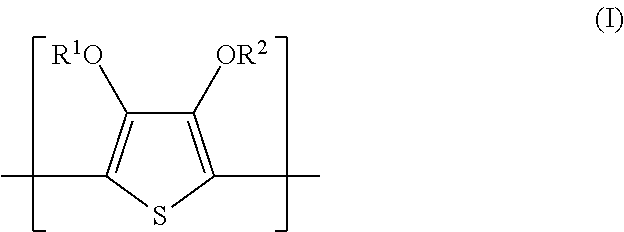
- wherein R1 and R2 are independently a C1-C12 alkyl group or form a C1-
C 12 1,n-alkylene group, with n=1-12, optionally substituted by a C1-C12 alkyl, C2-C12 alkene, vinylene, benzyl, phenyl, halogen group, or by an ester, amino, amido or ether functional group optionally substituted by a C1-C12 alkyl group. - In a preferred embodiment, in the polythiophene of formula (I) the R1 and R2 groups form an alkylene group selected from methylene, 1,2-ethylene and 1,3-propylene. In an even more preferred embodiment, in the polythiophene of formula (I) the R1 and R2 groups form a 1,2-ethylene group.
- Said polythiophenes in their oxidized state can additionally incorporate anionic groups, stabilizing the delocalized positive type charge carriers in the polymer chains. Thus, in another particular embodiment of the electrochemical sensor of the invention, the polythiophene of the fourth layer comprises an anionic dopant. In a preferred embodiment, the anionic dopant is an inorganic anion selected from a sulfate, chloride and bromide anion. In another preferred embodiment, the anionic dopant is an organic anion with sulfonate or phosphate groups selected from a p-toluenesulfonic acid and a p-toluenephosphonic acid. In another preferred embodiment, the anionic dopant is an organic polyanion selected from polymeric carboxylic acids, polymeric sulfonic acids, or copolymers of vinycarboxylic acids and vinylsulfonic acids with other polymerizable monomers. In an even more preferred embodiment, the anionic dopant is an organic polyanion selected from poly(acrylic acid), poly(methacrylic acid) and poly(maleic acid). In another even more preferred embodiment, the anionic dopant is an organic polyanion selected from poly(styrene sulfonic) acid or poly(vinylsulfonic) acid. In another even more preferred embodiment, the anionic dopant is an organic polyanion selected from copolymers of vinycarboxylic acids and vinylsulfonic acids with styrene and acrylic or methacrylic monomers. In another even more preferred embodiment, the anionic dopant is an organic polyanion the molecular weight of which is comprised between 15,000 and 300,000 Daltons.
- The non-conductive polymer gel of the fourth layer (4)(d1 or d2) will be any non-conductive polymer gel of the state of the art which absorbs in its interior the solution containing the analyte, preferably a crosslinked polymer hydrogel. Thus, in a particular embodiment of the electrochemical sensor of the invention, the non-conductive polymer gel is selected from among poly(vinyl alcohol), glutaraldehyde, hydroxyethylcellulose, polymethylmethacrylate derivatives, polyethylene glycol derivatives and Nafion. In a preferred embodiment, the non-conductive polymer gel is photocrosslinkable poly(vinyl alcohol).
- In another main aspect of the invention, there is provided a process for preparing the electrochemical sensor of the invention, hereinafter “the process of the invention”, which comprises:
-
- (A) obtaining on the substrate the first layer comprising a carbonaceous material and forming the system of electrodes formed at least by a pseudo-reference electrode, a working electrode and a counter electrode;
- (B) obtaining the second layer comprising a metal material only on the lower end of the pseudo-reference electrode;
- (C) obtaining the third layer comprising insulating material on the part of the system of electrodes located between the analysis surface and the electrical contacts of the measuring equipment such that it leaves only the lower part of the electrodes of the system of electrodes exposed; and
- (D) obtaining the fourth layer comprising polythiophene only on the lower end of the working electrode.
- In a particular embodiment of the process of the invention, the fourth layer comprising polythiophene is obtained by means of a method selected from (D1), (D2) and (D3), wherein:
-
- (D1) comprises obtaining the layer comprising a polythiophene on the lower end of the working electrode and then obtaining the layer comprising a polymer gel on the layer comprising a polythiophene;
- (D2) comprises obtaining the layer comprising a polymer gel and a polythiophene on the lower end of the working electrode, and
- (D3) comprises obtaining the layer comprising a polythiophene on the lower end of the working electrode and then obtaining the layer comprising the magnetic nanoparticles, functionalized with a biological compound covalently bound on their surface, on the layer comprising a polythiophene.
- In a particular embodiment, the fourth layer is obtained by means of method D1 or D2. In this case, the process of the invention preferably comprises an additional stage (E1 or E2) which comprises incorporating a biological compound in the polymer gel of d1 or d2, respectively.
- In another particular embodiment, the fourth layer is obtained by means of method D3. In this case, an additional stage before stage D3 which comprises coupling a magnet below the substrate is contemplated.
- In a preferred embodiment, obtaining the fourth layer comprises:
-
- (i) the application of either aqueous or solvent-based true solutions, colloidal dispersions or stable dispersions of finely divided particles of polythiophene previously obtained by means of oxidative polymerization or enzymatic polymerization; or
- (ii) the application of either aqueous or solvent-based solutions of thiophene monomers and subsequent in situ polymerization thereof.
- In particular, with respect to method (D1), an either aqueous or solvent-based true solution, colloidal dispersion or stable dispersion of finely divided particles of a polythiophene previously obtained by means of oxidative polymerization or enzymatic polymerization is applied on the lower end of the working electrode. Said application is performed by means of different known techniques such as painting, immersion, spin coating or screen printing, for example. After the application of said solution or dispersion of polythiophene the direct evaporation of the solvent is carried out. In another variant, a solution of thiophene monomers is applied on the lower end of the working electrode in a manner similar to that described above and then the in situ polymerization of said monomers and the subsequent evaporation of the solvent are carried out.
- Then, and in a similar manner, a solution of prepolymer of a non-conductive polymer gel is manually applied on the layer of polythiophene thus obtained. After the application of said solution, the prepolymer is crosslinked by means of any known technique such as exposure to halogen light, for example, and then the direct evaporation of the solvent is carried out.
- On the other hand, with respect to method (D2), an either aqueous or solvent-based true solution, colloidal dispersion or stable dispersion of finely divided particles of polythiophene mixed with a solution of the non-conductive polymer gel is applied on the lower end of the working electrode. After the application of said mixture, the direct evaporation of the solvent is carried out.
- As an alternative, a solution of the non-conductive polymer gel comprising the thiophene monomers is applied on the lower end of the working electrode. Said application is performed manually. After the application of said solution, the thiophene monomers are polymerized inside the non-conductive polymer gel by means of in situ polymerization (oxidative polymerization or enzymatic polymerization) and the prepolymer is subsequently crosslinked by means of any known technique such as exposure to halogen light, for example. Finally, the direct evaporation of the solvent is carried out.
- With respect to method (D3), a solution containing the functionalized magnetic nanoparticles in suspension is manually applied on the layer of polythiophene obtained by means of the same process used in method (D1). Said particles agglutinate and are deposited on the working electrode due to the magnetic attraction exerted on them by the magnet.
- In any case, in the process of the invention the polythiophene is chemically synthesized, which is a much simpler and less expensive method than the electrochemical synthesis thereof.
- These methods of oxidative polymerization, enzymatic polymerization or in situ polymerization of the corresponding monomer can be those described in the references ADVANCED FUNCTIONAL MATERIALS 14, 615-622, 2004 and BIOMACROMOLECULES 8(2), 315-317, 2007. Preferable solvents include alcohols (methanol, ethanol or isopropanol, for example), as well mixtures of water with these alcohols or other water-miscible organic solvents such as acetone, for example. For the oxidative polymerization, ammonium persulfate, iron trichloride or ferric tosylate can be used as preferred oxidizers. For the enzymatic polymerization, horseradish peroxidase or peroxidases of other origins can be used as preferred enzymes. Additionally, polymeric binders of the type of poly(vinyl alcohol), poly(vinyl acetate), etc., and adhesion promoters, of the type of silanes, tackifying resins, etc., to facilitate the formation of films highly adherent on the corresponding, can be used.
- In a similar manner, the rest of the layers comprised in the electrochemical sensor of the invention can be obtained by applying the corresponding dispersion or solution on the previous layer by means of different known techniques such as painting, immersion, spin coating or screen printing, for example, followed by the direct evaporation of the solvent.
- In a particular embodiment of the process of the invention, the latter comprises obtaining an intermediate layer comprising a metal material on the substrate before obtaining the first layer.
- In another particular embodiment of the process of the invention, the latter comprises obtaining an intermediate layer comprising an electrochemical mediator on the lower end of the working electrode before obtaining the layer (d2) of conductive polymer gel, as has been indicated above.
- These optional intermediate layers can also be obtained by applying the corresponding dispersion on the previous layer by means of the different mentioned techniques, followed by the direct evaporation of the solvent.
- The electrochemical sensor of the invention can be used for the detection of analytes of a different nature such as, for example, pesticides (organophosphates and carbamates, for example), pathogens, heavy metals, neurotransmitters, metabolites, nucleotides, oligonucleotides, polynucleotides (DNA, RNA) etc.
- The following examples illustrate the invention and must not be considered as limiting the scope thereof.
- Preparation of an Electrochemical Sensor for the Detection of the Pesticide Chlorpyrifos Oxon Comprising a First Layer of Graphite and a Fourth Layer Comprising, in Turn, a Layer of PEDOT on which a Layer of PVA (Layer (d1)) is Deposited.
- An electrochemical sensor with three electrodes according to the invention for the detection of chlorpyrifos oxon, an organophosphate pesticide, based on the inhibition of thiocholine production, was prepared according to the following process. 1) 3 tracks of a commercial conductive graphite ink (Electrodag PF-410) were printed by means of screen printing on a plastic support of polycarbonate PC. 2) A layer of a commercial Ag/AgCl ink (Electromag. 6037 SS) was printed by means of screen printing only on the lower end of the reference electrode. 3) A protective layer of commercial vinyl paint (Electrodag 452 SS) was printed by means of screen printing on part of the 3 electrodes, leaving only the lower part of the working electrode, of the reference electrode and of the counter electrode exposed. 4a) A layer of an aqueous dispersion of polyethylenedioxythiophene (PEDOT) at 1% by weight of polythiophene (previously prepared from an aqueous solution of 0.1 M commercial ethylenedioxythiophene, EDOT, monomer (99%, Sigma-Aldrich Chemicals), and 0.1 M commercial polystyrene sulfonate, PSS, (Sigma-Aldrich Chemicals), as a dopant-stabilizer at room temperature, which was vigorously stirred, the oxidizer ammonium persulfate (0.1 M) was added thereto and it was left to polymerize) was printed by means of screen printing on the lower end of the working electrode. 4b) A mixture of aqueous solution of commercial photocrosslinkable polyvinyl alcohol (PVA) (Aldrich) at 6% by weight and a solution of commercial acetylcholinesterase enzyme (from electric eel, type V-S, of Sigma) in phosphate buffer was manually deposited on the layer of PEDOT. The activity of the enzyme solution was between 0.07 and 0.18 AU/min according to the PVA/enzyme ratio of the mixture (30/70, 50/50 or 70/30). In any of the cases, 1 enzyme mU (amount necessary for catalyzing the conversion of 1 μmol of substrate per minute) was immobilized in the working electrode. The enzyme was trapped in the working electrode after crosslinking the prepolymer by means of exposure to Neon or halogen light, of λ>400 nm, for 24-72 hours, depending on the amount of PVA in the PVA/enzyme mixture.
- The sensor thus obtained has the layered structure defined in
FIG. 1 (top view) and inFIG. 2 (side view), with the following areas of the electrodes: - Area of the working electrode: 58.09 mm2
- Area of the reference electrode: 3.74 mm2
- Area of the counter electrode: 7.9 mm2 and the following ratios between said areas:
- Area of the reference electrode/Area of the working electrode=0.064 mm2
- Area of the counter electrode /Area of the working electrode=0.136 mm2
- After obtaining the sensor, the concentration of chlorpyrifos oxon was determined in an aqueous solution. To that end, acetylcholine chloride (a drop of 30 μl, 50 mM) was deposited on the analysis surface of the sensor, whereby thiocholine was enzymatically produced. The oxidation of this thiocholine was determined in the sensor at a potential of 100 mV, with the compound polythiophene as a mediator. The concentration of acetylthiocholine chloride necessary for obtaining a maximum current intensity signal in the sensor is defined as the “saturation concentration”. Taking the saturation conditions as a reference, in the presence of the pesticide chlorpyrifos oxon, the current intensity signal obtained is lower due to the enzyme deactivation caused by the pesticide in the sensor. This decrease of the signal in the presence of different concentrations of pesticide enables the calibration of the sensor, and subsequently its use in the quantification of the pesticide in the solution to be tested.
- The percentage of inhibition of the acetylcholinesterase enzyme in the presence of different concentrations of chlorpyrifos oxon was thus determined. The results obtained are shown in Table 1 and in
FIG. 5 . -
TABLE 1 Percentage of inhibition of the acetylcholinesterase enzyme in the presence of different concentrations of chlorpyrifos oxon Concentration of pesticide % of inhibition in No. of measurements Chlorpyrifos the presence of Standard the average of which oxon (M) pesticide deviation has been calculated 2 · 10−10 7.21 6.30 8 3 · 10−10 16.11 8.64 8 4 · 10−10 22.41 6.35 8 5 · 10−10 27.09 6.61 6 9 · 10−10 44.54 5.94 6 1 · 10−9 46.82 6.33 7 3 · 10−9 69.20 6.51 7 - As can be seen, the limits of detection are very low, since it is possible to detect 2·10−10 M of pesticide with a 7% inhibition.
- Preparation of an Electrochemical Sensor for the Detection of the Pesticide Chlorpyrifos Oxon Comprising a First Layer of Graphite and a Fourth Layer of PEDOT and PVA (Layer (d2)).
- An electrochemical sensor with three electrodes according to the invention for the detection of chlorpyrifos oxon, an organophosphate pesticide, based on the inhibition of thiocholine production, was prepared according to the following process. The first 3 layers were deposited in a manner identical to the description provided in Example 1. Then, the following was carried out. 4) An aqueous solution of commercial photocrosslinkable polyvinyl alcohol (Aldrich) at 6% by weight, containing the commercial acetylcholinesterase enzyme (from electric eel, type V-S, of Sigma) with a defined activity therein (between 0.07 and 0.18 AU/min according to the PVA/enzyme ratio of the mixture (30/70, 50/50 or 70/30)), and a solution of 0.1 M commercial ethylenedioxythiophene, EDOT, monomer (99%, Sigma-Aldrich Chemicals) was manually deposited on the lower end of the working electrode. The monomer was made to polymerize by means of enzymatic polymerization using the horseradish peroxidase enzyme (type VI HRP of Sigma)/H2O2 (0.3 mg/ml) and, finally, the PVA prepolymer was crosslinked by means of exposure to Neon or halogen light, of λ>400 nm, for 24-72 hours, depending on the amount of PVA in the PVA/enzyme mixture, the enzyme finally being trapped inside a conductive polymer gel.
- The sensor thus obtained has the layered structure defined in
FIG. 1 (top view) and inFIG. 3 (side view), with the areas and area ratios of Example 1. - After obtaining the sensor of the invention, the concentration of chlorpyrifos oxon was determined in an aqueous solution. To that end, acetylcholine chloride (a drop of 30 μl, 50 mM) was deposited on the analysis surface of the sensor, whereby thiocholine was enzymatically produced. The oxidation of this thiocholine was determined in the sensor at a potential of 100 mV, with the compound polythiophene as a mediator. The concentration of acetylthiocholine chloride necessary for obtaining a maximum current intensity signal in the sensor is defined as the “saturation concentration”. Taking the saturation conditions as a reference, in the presence of the pesticide chlorpyrifos oxon, the current intensity signal obtained is lower due to the enzyme deactivation caused by the pesticide in the sensor. This decrease of the signal in the presence of different concentrations of pesticide enables the calibration of the sensor, and subsequently its use in the quantification of the pesticide in the solution to be tested.
- The percentage of inhibition of the acetylcholinesterase enzyme in the presence of different concentrations of chlorpyrifos oxon was thus determined. The results obtained are shown in Table 2 and in
FIG. 6 . -
TABLE 2 Percentage of inhibition of the acetylcholinesterase enzyme in the presence of different concentrations of chlorpyrifos oxon Number of Concentration % of inhibition measurements the of pesticide in the average of which Chlorpyrifos presence of Standard has been oxon (M) pesticide deviation calculated 2 · 10−10 — — — 3 · 10−10 10.09 8.55 8 4 · 10−10 15.31 7.24 8 5 · 10−10 22.19 8.72 6 9 · 10−10 39.75 7.76 6 1 · 10−9 41.71 7.34 7 3 · 10−9 61.15 7.93 7 - As can be seen, the limits of detection are very low, since it is possible to detect 3·10−10 M of pesticide with a 10% inhibition.
- Preparation of an Electrochemical Sensor for the Detection of the Pesticide Chlorpyrifos Oxon Comprising a First Layer of Graphite and an Intermediate Layer of Cobalt Phthalocyanine on which the Fourth Layer of PEDOT and PVA (Layer (d2)) is Deposited.
- An electrochemical sensor with three electrodes according to the invention for the detection of chlorpyrifos oxon, an organophosphate pesticide, based on the inhibition of thiocholine production, was prepared according to the following process. The first 3 layers were deposited in a manner identical to the description made in Example 1. Then, the following was carried out. 3′). A layer of a dispersion (3.8 mg/ml) of cobalt phthalocyanine (CoPh) obtained by means of the solution of commercial CoPh (Sigma) in an aqueous solution of hydroxyethylcellulose (HEC) at 4% was deposited by means of screen printing on the lower end of the working electrode. 4) An aqueous solution of commercial photocrosslinkable polyvinyl alcohol (Aldrich) at 6% by weight, containing the commercial acetylcholinesterase enzyme (from electric eel, type V-S, of Sigma) with a defined activity therein (between 0.07 and 0.18 AU/min according to the PVA/enzyme ratio of the mixture (30/70, 50/50 or 70/30)), and a solution of 0.1 M commercial ethylenedioxythiophene, EDOT, monomer (99%, Sigma-Aldrich Chemicals) was manually deposited on the previous layer. The monomer was made to polymerize by means of enzymatic polymerization using the horseradish peroxidase enzyme (type VI HRP of Sigma)/H2O2 (0.3 mg/ml) and, finally, the PVA prepolymer was crosslinked by means of exposure to Neon or halogen light, of λ>400 nm, for 24-72 hours, depending on the amount of PVA in the PVA/enzyme mixture, the enzyme finally being trapped inside a conductive polymer gel.
- The sensor thus obtained has the layered structure defined in
FIG. 1 (top view) and inFIG. 3 (side view), with the areas and area ratios of Example 1. - After obtaining the sensor of the invention, the concentration of chlorpyrifos oxon was determined in an aqueous solution. To that end, acetylcholine chloride (a drop of 30 μl, 50 mM) was deposited on the analysis surface of the sensor, whereby thiocholine was enzymatically produced. The oxidation of this thiocholine was determined in the sensor at a potential of 100 mV, with the compound polythiophene as a mediator. The concentration of acetylthiocholine chloride necessary for obtaining a maximum current intensity signal in the sensor is defined as the “saturation concentration”. Taking the saturation conditions as a reference, in the presence of the pesticide chlorpyrifos oxon, the current intensity signal obtained is lower due to the enzyme deactivation caused by the pesticide in the sensor. This decrease of the signal in the presence of different concentrations of pesticide enables the calibration of the sensor, and subsequently its use in the quantification of the pesticide in the solution to be tested.
- The percentage of inhibition of the acetylcholinesterase enzyme in the presence of different concentrations of chlorpyrifos oxon was thus determined. The results obtained are shown in Table 3 and in
FIG. 7 . -
TABLE 3 Percentage of inhibition of the acetylcholinesterase enzyme in the presence of different concentrations of chlorpyrifos oxon Number of Concentration of measurements pesticide % of inhibition in the average of Chlorpyrifos the presence of Standard which has been oxon (M) pesticide deviation calculated 2 · 10−10 9.82 6.06 8 3 · 10−10 10.70 2.36 8 4 · 10−10 32.51 5.43 8 5 · 10−10 31.46 3.91 6 9 · 10−10 49.18 6.51 6 1 · 10−9 52.36 7.65 7 3 · 10−9 74.80 5.62 7 - As can be seen, the limits of detection are very low, since it is possible to detect 2·10−10 M of pesticide with a 9% inhibition.
- Preparation of an Electrochemical Sensor for the Detection of the Pesticide Chlorpyrifos Oxon Comprising an Intermediate Layer of Silver on which a First Layer of Graphite is Deposited and a Fourth Layer Comprising, in Turn, a Layer of PEDOT on which a Layer of PVA (layer (d1)) is Deposited.
- An electrochemical sensor with three electrodes according to the invention for the detection of chlorpyrifos oxon, an organophosphate pesticide, based on the inhibition of thiocholine production, was prepared according to the following process. 1′) Three tracks of a commercial conductive silver ink (Acheson) were printed by means of screen printing on a plastic support of polycarbonate PC. 1) 3 tracks of a commercial conductive graphite ink (Electrodag PF-410) were printed by means of screen printing on the previous layer of silver.
Layers - The sensor thus obtained has the layered structure defined in
FIG. 1 (top view) and inFIG. 2 (side view), with the areas and area ratios of Example 1. - After obtaining the sensor of the invention, the concentration of chlorpyrifos oxon was determined in an aqueous solution. To that end, acetylcholine chloride (a drop of 30 μl, 50 mM) was deposited on the analysis surface of the sensor, whereby thiocholine was enzymatically produced. The oxidation of this thiocholine was determined in the sensor at a potential of 100 mV, with the compound polythiophene as a mediator. The concentration of acetylthiocholine chloride necessary for obtaining a maximum current intensity signal in the sensor is defined as the “saturation concentration”. Taking the saturation conditions as a reference, in the presence of the pesticide chlorpyrifos oxon, the current intensity signal obtained is lower due to the enzyme deactivation caused by the pesticide in the sensor. This decrease of the signal in the presence of different concentrations of pesticide enables the calibration of the sensor, and subsequently its use in the quantification of the pesticide in the solution to be tested.
- The percentage of inhibition of the acetylcholinesterase enzyme in the presence of different concentrations of chlorpyrifos oxon was thus determined. The results obtained are shown in Table 4 and in
FIG. 8 . -
TABLE 4 Percentage of inhibition of the acetylcholinesterase enzyme in the presence of different concentrations of chlorpyrifos oxon Number of Concentration of measurements the pesticide % of inhibition in average of which Chlorpyrifos the presence of Standard has been oxon (M) pesticide deviation calculated 2 · 10−10 8.28 6.40 8 3 · 10−10 19.14 7.67 8 4 · 10−10 24.51 7.37 8 5 · 10−10 30.10 5.64 6 9 · 10−10 47.55 3.84 6 1 · 10−9 49.50 5.43 7 3 · 10−9 72.23 4.62 7 - As can be seen, the limits of detection are very low, since it is possible to detect 2·10−10 M of pesticide with an 8% inhibition.
- Preparation of an Electrochemical Sensor for the Detection of DNA Specific Sequences Comprising a First Layer of Graphite and a Fourth Layer Comprising, in Turn, a Layer of PEDOT on which a Layer of Magnetic Nanoparticles (Layer (d3)) is Deposited.
- An electrochemical sensor with three electrodes according to the invention for the detection of specific probes, by means of enzymatic amplification, using hydroquinone as a redox mediator and hydrogen peroxide as an enzymatic substrate, was prepared. This electrochemical sensor is based on using gold-coated magnetic nanoparticles for carrying out the processes for immobilizing the thiolated DNA probe (19 mer), according to the following process. The first 3 layers were deposited in a manner identical to the description made in Example 1. Then, the following was carried out. 4a) A layer of an aqueous dispersion of polyethylenedioxythiophene (PEDOT) at 1% by weight of polythiophene (previously prepared from an aqueous solution of 0.1 M commercial ethylenedioxythiophene, EDOT, monomer (99%, Sigma-Aldrich Chemicals), and 0.1 M commercial polystyrene sulfonate, PSS, (Sigma-Aldrich Chemicals), as a dopant-stabilizer at room temperature, which was vigorously stirred, the oxidizer ammonium persulfate (0.1 M) was added thereto and it was left to polymerize) was printed by means of screen printing on the lower end of the working electrode. The attraction of the magnetic nanoparticles to the electrode surface was carried out by placing a neodymium magnet in the lower part of the system (6), and 4b) a drop of 30 μl of the solution of substrate (hydrogen peroxide) was deposited on the surface of the electrode in which the mediator and the functionalized magnetic nanoparticles were previously located.
- The functionalization of the magnetic nanoparticles was performed as follows. 15 μL of gold-coated magnetic nanoparticles were taken and placed in a 1.5 mL microcentrifuge tube, they were washed twice with 90 μL of 0.1 M phosphate buffer (PBS), pH 7.2, and resuspended in 40 μL of the same buffer which contained 1.03 μmol of thiolated probe. The reaction was left overnight at room temperature at 600 rpm to allow the binding of the thiolated probe to the gold-coated magnetic nanoparticles. After this time had elapsed, they were washed twice with 100 μL of PBS and resuspended again in 90 μL of the same buffer with the desired amount of complementary biotinylated probe and left to react for 1 h at room temperature with constant stirring (600 rpm). The magnetic nanoparticles derivatized with the hybrid were washed twice with the 0.1 M PBS buffer of pH 7.2.
- 50 μL of HRP-streptavidin (10 μg mL−1), prepared in 0.01 M phosphate buffered saline, of pH 7.0, with 0.01% BSA (PBSB), were then added and left to react for 30 minutes at room temperature. After the reaction time had elapsed, the nanoparticles were washed 5 times for 5 minutes with PBSB.
- The sensor thus obtained has the layered structure defined in
FIG. 1 (top view) and inFIG. 4 (side view). - After depositing the drop of analyte on the analysis surface of the sensor and obtaining the sensor of the invention, the concentration of DNA specific sequence was determined. To that end, the enzyme previously bound in the complementary probe was oxidized by means of squarewave voltammetry (SWV), sweeping the potential between 0.3 and −0.4V, using hydroquinone as a mediator and hydrogen peroxide as a substrate of the enzymatic reaction of the peroxidase. The use of hydroquinone as a mediator increases the electron transfer between the peroxidase and the electrode surface.
- The reduction current generated in SWV is directly proportional to the amount of enzyme conjugate and, therefore, to the amount of hybridized complementary probe in the functionalized magnetic nanoparticles modified with the probe. Thus, this reduction current generated in SWV in the presence of different concentrations of complementary probe enables the calibration of the sensor, and subsequently, its quantification of specific complementary probe in the solution to be tested.
- Different concentrations of specific complementary probe were thus determined. The results obtained are shown in Table 5 and in
FIG. 9 . -
TABLE 5 Reduction current generated in the presence of different concentrations of specific complementary probe Concentration of Number of specific Standard measurements the complementary Reduction deviation average of which probe (nM) current (μA) (%) has been calculated 0.0 0.688 4.3 5 0.1 1.384 2.7 5 0.3 2.776 5 5 0.5 4.168 8 5 0.7 5.56 3.1 5 0.8 6.952 4.0 5 0.9 7.648 4.3 5 - The sensor thus obtained has the following analytical characteristics:
-
Analytical characteristics Linear range (M) 0-1.1 × 10⁻⁹ Slope (A μM−1) (6.96 ± 0.10) × 10−3 Linear regression coefficient 0.993 Intercept (μA) (6.88 ± 1.20) Limit of detection (pM) 31 Limit of determination (pM) 104 - As can be seen, the limits of detection are very low, since it is possible to detect 3·10−11 M of specific complementary probe.
Claims (24)
1-23. (canceled)
24. Electrochemical sensor for the detection of analytes in liquid media which comprises:
(a) a first layer (1) comprising a carbonaceous material deposited on a substrate, said layer forming the system of electrodes of the electrochemical sensor which is composed of at least by a pseudo-reference electrode, a working electrode and a counter electrode; wherein the carbonaceous material delimits the geometry of the system of electrodes;
(b) a second layer (2) comprising a metal material deposited only on the lower end of the pseudo-reference electrode;
(c) a third layer (3) comprising an insulating material deposited on a part of the system of electrodes, said part being the one located between the analysis surface (3a) and the electrical contacts (3b) of the measuring equipment, such that only the lower part of the electrodes of the system of electrodes is exposed; and
(d) a fourth layer (4) comprising polythiophene, which simultaneously acts as a mediator and conductor, deposited only on the lower end of the working electrode selected from (d1),(d2) and (d3), wherein:
d1) comprises a layer comprising a polythiophene deposited on the lower end of the working electrode and a layer comprising a non-conductive polymer gel deposited on said layer of polythiophene;
d2) is a layer of conductive polymer gel comprising a polythiophene and a non-conductive polymer gel; and
d3) comprises a layer comprising a polythiophene deposited on the lower end of the working electrode and a layer comprising magnetic nanoparticles, functionalized with a biological compound covalently bound on their surface, deposited on said layer of polythiophene.
25. Sensor according to claim 24 , characterized in that the fourth layer (4) comprising polythiophene deposited only on the lower end of the working electrode is the layer (d2) of conductive polymer gel comprising a non-conductive polymer gel and a polythiophene.
26. Sensor according to claim 25 , characterized in that it comprises an additional layer comprising an electrochemical mediator deposited only on the lower end of the working electrode and on which the layer (d2) of conductive polymer gel is deposited.
27. Sensor according to claim 24 , characterized in that the fourth layer (4) is the layer (d3).
28. Sensor according to claim 27 , characterized in that it additionally comprises a magnet coupled below the substrate.
29. Sensor according to claim 24 , characterized in that it comprises an intermediate layer comprising a metal material deposited on the substrate and on which the first layer is deposited.
30. Sensor according to claim 24 , characterized in that the polythiophene contains repetitive structural units of formula (I).
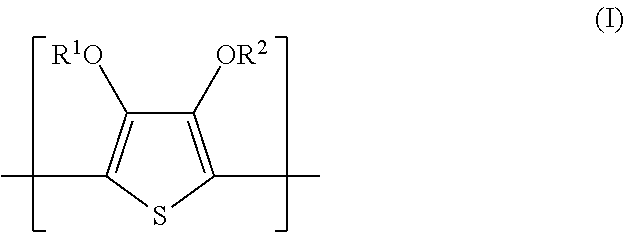
wherein R1 and R2 are independently a C1-C12 alkyl group or form a C1-C12 1,n-alkylene group, with n=1-12, optionally substituted by a C1-C12 alkyl, C2-C12 alkene, vinylene, benzyl, phenyl, halogen group, or by an ester, amino, amido or ether functional group optionally substituted by a C1-C12 alkyl group.
31. Sensor according to claim 30 , characterized in that in the polythiophene the R1 and R2 groups form an alkylene group selected from methylene, 1,2-ethylene and 1,3-propylene.
32. Sensor according to claim 31 , characterized in that in the polythiophene the R1 and R2 groups form a 1,2-ethylene group.
33. Sensor according to claim 30 , characterized in that the polythiophene comprises an anionic dopant.
34. Sensor according to claim 33 , characterized in that the anionic dopant is an inorganic anion selected from a sulfate, chloride and bromide anion; an organic anion with sulfonate or phosphate groups selected from a p-toluenesulfonic acid and a p-toluenephosphonic acid; or an organic polyanion selected from polymeric carboxylic acids, preferably poly(acrylic acid), poly(methacrylic acid) or poly(maleic acid); polymeric sulfonic acids, preferably poly(styrene sulfonic) acid or poly(vinylsulfonic) acid; or copolymers of vinycarboxylic acids and vinylsulfonic acids with other polymerizable monomers, preferably styrene and acrylic or methacrylic monomers.
35. Sensor according to claim 24 , characterized in that the carbonaceous material of the first layer is selected from graphite, carbon black and carbon nanotubes.
36. Sensor according to claim 35 , characterized in that the carbonaceous material is graphite.
37. Sensor according to claim 24 , characterized in that the fourth layer is the layer (d1) or (d2).
38. Sensor according to claim 37 , characterized in that the polymer gel of (d1) or (d2) comprises a biological compound.
39. Sensor according to claim 24 , characterized in that the biological compound is selected from enzymes, coenzymes, antibodies, oligopeptides, polypeptides, proteins, glycoproteins, lipoproteins, nucleotides, oligonucleotides, polynucleotides, monosaccharides, oligosaccharides and bacteria.
40. Process for preparing an electrochemical sensor according to claim 24 , characterized in that it comprises:
(A) obtaining on the substrate the first layer comprising a carbonaceous material forming the system of electrodes formed at least by a pseudo-reference electrode, a working electrode and a counter electrode;
(B) obtaining the second layer comprising a metal material only on the lower end of the pseudo-reference electrode;
(C) obtaining the third layer comprising insulating material on the part of the system of electrodes located between the analysis surface and the electrical contacts of the measuring equipment such that it leaves only the lower part of the electrodes of the system of electrodes exposed; and
(D) obtaining the fourth layer comprising polythiophene only on the lower end of the working electrode.
41. Process according to claim 40 , characterized in that the fourth layer comprising polythiophene is obtained by means of a method selected from (D1),(D2) and (D3), wherein:
(D1) comprises obtaining the layer comprising a polythiophene on the lower end of the working electrode and then obtaining the layer comprising a non-conductive polymer gel on the layer comprising a polythiophene;
(D2) comprises obtaining the layer of conductive polymer gel comprising a non-conductive polymer gel and a polythiophene on the lower end of the working electrode; and
(D3) comprises obtaining the layer comprising a polythiophene on the lower end of the working electrode and then obtaining the layer comprising the magnetic nanoparticles, functionalized with a biological compound covalently bound on their surface, on the layer comprising a polythiophene.
42. Process according to claim 41 , characterized in that the fourth layer is obtained by means of method D1 or D2.
43. Process according to claim 42 , characterized in that it comprises an additional stage (E1 or E2) which comprises incorporating a biological compound in the polymer gel of d1 or d2, respectively.
44. Process according to claim 41 , characterized in that the fourth layer is obtained by means of method D3.
45. Process according to claim 44 , characterized in that before step D3 a magnet is coupled below the substrate.
46. Process according to claim 41 , characterized in that obtaining the fourth layer comprises:
(i) the application of either aqueous or solvent-based true solutions, colloidal dispersions or stable dispersions of finely divided particles of polythiophene previously obtained by means of oxidative polymerization or enzymatic polymerization; or
(ii) the application of either aqueous or solvent-based true solutions, colloidal dispersions or stable dispersions of finely divided particles of thiophene monomers and subsequent in situ polymerization thereof.
Applications Claiming Priority (5)
| Application Number | Priority Date | Filing Date | Title |
|---|---|---|---|
| ES200930539A ES2358657B1 (en) | 2009-07-30 | 2009-07-30 | ELECTROCHEMICAL SENSOR FOR THE DETECTION OF ANALYTES IN LIQUID MEDIA. |
| ESP200930539 | 2009-07-30 | ||
| ESP200931247 | 2009-12-23 | ||
| ES200931247A ES2362603B1 (en) | 2009-12-23 | 2009-12-23 | ELECTROCHEMICAL SENSOR FOR THE DETECTION OF ANALYTICS IN LIQUID MEDIA. |
| PCT/ES2010/070509 WO2011012754A2 (en) | 2009-07-30 | 2010-07-23 | Electrochemical sensor for the detection of analytes in liquid media |
Publications (1)
| Publication Number | Publication Date |
|---|---|
| US20120181173A1 true US20120181173A1 (en) | 2012-07-19 |
Family
ID=42829800
Family Applications (1)
| Application Number | Title | Priority Date | Filing Date |
|---|---|---|---|
| US13/387,193 Abandoned US20120181173A1 (en) | 2009-07-30 | 2010-07-23 | Electrochemical sensor for the detection of analytes in liquid media |
Country Status (3)
| Country | Link |
|---|---|
| US (1) | US20120181173A1 (en) |
| EP (1) | EP2492351B1 (en) |
| WO (1) | WO2011012754A2 (en) |
Cited By (15)
| Publication number | Priority date | Publication date | Assignee | Title |
|---|---|---|---|---|
| JP2013238399A (en) * | 2012-05-11 | 2013-11-28 | Funai Electric Advanced Applied Technology Research Institute Inc | Sensor system and measuring method of detection object using the sensor system |
| US20150330935A1 (en) * | 2012-12-21 | 2015-11-19 | Alere Switzerland Gmbh | Test device for electrochemical analysis |
| WO2016010855A1 (en) * | 2014-07-15 | 2016-01-21 | C2Sense Llc | Formulations for enhanced chemiresistive sensing |
| US20160319232A1 (en) * | 2015-04-30 | 2016-11-03 | Kabushiki Kaisha Toshiba | Measuring cell, detector, and analysis device |
| US20180334318A1 (en) * | 2017-05-18 | 2018-11-22 | Samsung Electronics Co., Ltd. | Chemical liquid supply apparatus and semiconductor processing apparatus having the same |
| CN110799842A (en) * | 2017-03-22 | 2020-02-14 | 阿尔托大学注册基金会 | Electrochemical assay for the detection of opioids |
| CN111665287A (en) * | 2020-06-12 | 2020-09-15 | 浙江大学 | A magnetic printed electrode |
| CN112946277A (en) * | 2021-03-05 | 2021-06-11 | 山东理工大学 | Preparation of electrochemical immunosensor based on PEDOT @ PSS-Pd |
| CN114364977A (en) * | 2019-07-05 | 2022-04-15 | 泰诺森斯有限责任公司 | Novel polymer matrix electrodes |
| CN114965641A (en) * | 2022-05-23 | 2022-08-30 | 可孚医疗科技股份有限公司 | A kind of β-hydroxybutyric acid electrochemical test paper, preparation method and application |
| IT202100006260A1 (en) * | 2021-03-16 | 2022-09-16 | Enea Agenzia Naz Per Le Nuove Tecnologie Lenergia E Lo Sviluppo Economico Sostenibile | NANOSTRUCTURES ASSEMBLED ON PRINTED ELECTRODES. |
| CN115856034A (en) * | 2022-11-15 | 2023-03-28 | 南京农业大学 | Preparation method of porous flexible electrochemical sensor for detecting pesticide residues |
| US20230271185A1 (en) * | 2020-08-03 | 2023-08-31 | Consejo Superior De Investigaciones Cientificas (Csic) | Biosensor system for multiplexed detection of biomarkers |
| CN118243765A (en) * | 2024-05-28 | 2024-06-25 | 江西农业大学 | A homogeneous-heterogeneous electrochemical chlorpyrifos sensing method |
| US20240319129A1 (en) * | 2023-03-22 | 2024-09-26 | Peking University | Methane sensor |
Families Citing this family (5)
| Publication number | Priority date | Publication date | Assignee | Title |
|---|---|---|---|---|
| US20130270113A1 (en) * | 2012-04-11 | 2013-10-17 | Chuan-Hsing HUANG | Electrochemical strip and manufacturing method thereof |
| EP3149465B1 (en) * | 2014-05-27 | 2020-01-29 | Case Western Reserve University | Electrochemical sensor for analyte detection |
| US11009479B2 (en) | 2014-05-27 | 2021-05-18 | Case Western Reserve University | Systems and methods for the detection of HbA1c |
| KR101994370B1 (en) * | 2016-08-24 | 2019-06-28 | 주식회사 제놉시 | Magnetic nanostructure for detecting and isolating circulating tumor cells comprising antibody- and magnetic nanoparticle-conjugated conductive polymer |
| US11697807B2 (en) | 2019-09-30 | 2023-07-11 | Case Western Reserve University | Electrochemical biosensor |
Citations (3)
| Publication number | Priority date | Publication date | Assignee | Title |
|---|---|---|---|---|
| US6468304B1 (en) * | 1997-07-16 | 2002-10-22 | Centre National De La Recherche Scientifique | Implantable device covered with polymer capable of releasing biologically active substances |
| US20080265414A1 (en) * | 2005-07-01 | 2008-10-30 | National University Of Singapore | Electrically Conductive Composite |
| US7632600B2 (en) * | 2005-09-30 | 2009-12-15 | Canon Kabushiki Kaisha | Enzyme electrode and method of producing the same |
Family Cites Families (14)
| Publication number | Priority date | Publication date | Assignee | Title |
|---|---|---|---|---|
| US4746607A (en) | 1985-02-07 | 1988-05-24 | Eastman Kodak Company | Use of substituted quinone electron transfer agents in analytical determinations |
| US5126247A (en) | 1988-02-26 | 1992-06-30 | Enzymatics, Inc. | Method, system and devices for the assay and detection of biochemical molecules |
| WO1989009397A1 (en) | 1988-03-31 | 1989-10-05 | Matsushita Electric Industrial Co., Ltd. | Biosensor and process for its production |
| DE3843412A1 (en) | 1988-04-22 | 1990-06-28 | Bayer Ag | NEW POLYTHIOPHENES, METHOD FOR THEIR PRODUCTION AND THEIR USE |
| DE3826922A1 (en) | 1988-08-09 | 1990-02-22 | Boehringer Mannheim Gmbh | PROCESS FOR THE COLOR-RIMETRIC DETERMINATION OF AN ANALYTE BY ENZYMATIC OXIDATION |
| DE4211461A1 (en) | 1992-04-06 | 1993-10-07 | Agfa Gevaert Ag | Antistatic plastic parts |
| DE19507413A1 (en) | 1994-05-06 | 1995-11-09 | Bayer Ag | Conductive coatings |
| US5620579A (en) | 1995-05-05 | 1997-04-15 | Bayer Corporation | Apparatus for reduction of bias in amperometric sensors |
| US5798031A (en) | 1997-05-12 | 1998-08-25 | Bayer Corporation | Electrochemical biosensor |
| FR2798145A1 (en) | 1999-08-12 | 2001-03-09 | Univ Joseph Fourier | Electrically conductive polymers with light-activatable groups which can be grafted on with biomolecules, e.g. proteins or enzymes, used for the production of electronic biosensors |
| JP4839219B2 (en) | 2003-10-24 | 2011-12-21 | バイエル・ヘルスケア・エルエルシー | Enzymatic electrochemical biosensor |
| US7138041B2 (en) | 2004-02-23 | 2006-11-21 | General Life Biotechnology Co., Ltd. | Electrochemical biosensor by screen printing and method of fabricating same |
| US20080248354A1 (en) * | 2004-07-23 | 2008-10-09 | Canon Kabushiki Kaisha | Enzyme Electrode, and Device, Sensor, Fuel Cell and Electrochemical Reactor Employing the Enzyme Electrode |
| GB0517773D0 (en) | 2005-09-01 | 2005-10-12 | Palintest Ltd | Electrochemical sensor |
-
2010
- 2010-07-23 US US13/387,193 patent/US20120181173A1/en not_active Abandoned
- 2010-07-23 WO PCT/ES2010/070509 patent/WO2011012754A2/en not_active Ceased
- 2010-07-23 EP EP10749670.5A patent/EP2492351B1/en not_active Not-in-force
Patent Citations (3)
| Publication number | Priority date | Publication date | Assignee | Title |
|---|---|---|---|---|
| US6468304B1 (en) * | 1997-07-16 | 2002-10-22 | Centre National De La Recherche Scientifique | Implantable device covered with polymer capable of releasing biologically active substances |
| US20080265414A1 (en) * | 2005-07-01 | 2008-10-30 | National University Of Singapore | Electrically Conductive Composite |
| US7632600B2 (en) * | 2005-09-30 | 2009-12-15 | Canon Kabushiki Kaisha | Enzyme electrode and method of producing the same |
Non-Patent Citations (1)
| Title |
|---|
| Groenendaal et al. (Adv. Mat. 2000, 12/7, 481-494) * |
Cited By (17)
| Publication number | Priority date | Publication date | Assignee | Title |
|---|---|---|---|---|
| JP2013238399A (en) * | 2012-05-11 | 2013-11-28 | Funai Electric Advanced Applied Technology Research Institute Inc | Sensor system and measuring method of detection object using the sensor system |
| US20150330935A1 (en) * | 2012-12-21 | 2015-11-19 | Alere Switzerland Gmbh | Test device for electrochemical analysis |
| WO2016010855A1 (en) * | 2014-07-15 | 2016-01-21 | C2Sense Llc | Formulations for enhanced chemiresistive sensing |
| US20160319232A1 (en) * | 2015-04-30 | 2016-11-03 | Kabushiki Kaisha Toshiba | Measuring cell, detector, and analysis device |
| CN110799842A (en) * | 2017-03-22 | 2020-02-14 | 阿尔托大学注册基金会 | Electrochemical assay for the detection of opioids |
| US20180334318A1 (en) * | 2017-05-18 | 2018-11-22 | Samsung Electronics Co., Ltd. | Chemical liquid supply apparatus and semiconductor processing apparatus having the same |
| US10435234B2 (en) * | 2017-05-18 | 2019-10-08 | Samsung Electronics Co., Ltd. | Chemical liquid supply apparatus and semiconductor processing apparatus having the same |
| CN114364977A (en) * | 2019-07-05 | 2022-04-15 | 泰诺森斯有限责任公司 | Novel polymer matrix electrodes |
| US12366547B2 (en) | 2019-07-05 | 2025-07-22 | Tecnosens S.R.L. | Polymer matrix electrodes |
| CN111665287A (en) * | 2020-06-12 | 2020-09-15 | 浙江大学 | A magnetic printed electrode |
| US20230271185A1 (en) * | 2020-08-03 | 2023-08-31 | Consejo Superior De Investigaciones Cientificas (Csic) | Biosensor system for multiplexed detection of biomarkers |
| CN112946277A (en) * | 2021-03-05 | 2021-06-11 | 山东理工大学 | Preparation of electrochemical immunosensor based on PEDOT @ PSS-Pd |
| IT202100006260A1 (en) * | 2021-03-16 | 2022-09-16 | Enea Agenzia Naz Per Le Nuove Tecnologie Lenergia E Lo Sviluppo Economico Sostenibile | NANOSTRUCTURES ASSEMBLED ON PRINTED ELECTRODES. |
| CN114965641A (en) * | 2022-05-23 | 2022-08-30 | 可孚医疗科技股份有限公司 | A kind of β-hydroxybutyric acid electrochemical test paper, preparation method and application |
| CN115856034A (en) * | 2022-11-15 | 2023-03-28 | 南京农业大学 | Preparation method of porous flexible electrochemical sensor for detecting pesticide residues |
| US20240319129A1 (en) * | 2023-03-22 | 2024-09-26 | Peking University | Methane sensor |
| CN118243765A (en) * | 2024-05-28 | 2024-06-25 | 江西农业大学 | A homogeneous-heterogeneous electrochemical chlorpyrifos sensing method |
Also Published As
| Publication number | Publication date |
|---|---|
| WO2011012754A2 (en) | 2011-02-03 |
| EP2492351B1 (en) | 2018-06-06 |
| WO2011012754A3 (en) | 2011-03-24 |
| EP2492351A2 (en) | 2012-08-29 |
Similar Documents
| Publication | Publication Date | Title |
|---|---|---|
| EP2492351B1 (en) | Electrochemical sensor for the detection of analytes in liquid media | |
| Chowdhury et al. | Highly sensitive electrochemical biosensor for glucose, DNA and protein using gold-polyaniline nanocomposites as a common matrix | |
| Ramanathan et al. | Covalent immobilization of glucose oxidase to poly (O‐amino benzoic acid) for application to glucose biosensor | |
| Ramanavičius et al. | Electrochemical sensors based on conducting polymer—polypyrrole | |
| Alqarni et al. | Composite material–based conducting polymers for electrochemical sensor applications: a mini review | |
| Turan et al. | An effective surface design based on a conjugated polymer and silver nanowires for the detection of paraoxon in tap water and milk | |
| Nazari et al. | Laccase immobilization on the electrode surface to design a biosensor for the detection of phenolic compound such as catechol | |
| German et al. | Amperometric glucose biosensor based on electrochemically deposited gold nanoparticles covered by polypyrrole | |
| Lakshmi et al. | Electrochemical detection of uric acid in mixed and clinical samples: a review | |
| Sekli-Belaidi et al. | Voltammetric microsensor using PEDOT-modified gold electrode for the simultaneous assay of ascorbic and uric acids | |
| Saberi et al. | Amplified electrochemical DNA sensor based on polyaniline film and gold nanoparticles | |
| Soylemez et al. | Electrochemical and optical properties of a conducting polymer and its use in a novel biosensor for the detection of cholesterol | |
| JP4374464B2 (en) | Biosensor | |
| US20110253546A1 (en) | Polymer/nanoparticle composites, film and molecular detection device | |
| Hopkins et al. | All-organic semiconductors for electrochemical biosensors: An overview of recent progress in material design | |
| Liu et al. | Enzymatic activity of glucose oxidase covalently wired via viologen to electrically conductive polypyrrole films | |
| US20070042377A1 (en) | Biosensor | |
| Barsan et al. | New CNT/poly (brilliant green) and CNT/poly (3, 4-ethylenedioxythiophene) based electrochemical enzyme biosensors | |
| Gokoglan et al. | Selenium containing conducting polymer based pyranose oxidase biosensor for glucose detection | |
| CN109923406B (en) | Electrode arrangement with improved electron transfer rate for molecular redox | |
| Bekmezci et al. | A new ethanol biosensor based on polyfluorene-g-poly (ethylene glycol) and multiwalled carbon nanotubes | |
| Solanki et al. | Application of electrochemically prepared poly-N-methylpyrrole-p-toluene sulphonate films to cholesterol biosensor | |
| Evtugyn et al. | Electrochemical biosensors based on native DNA and nanosized mediator for the detection of anthracycline preparations | |
| Voitechovič et al. | Development of label-free impedimetric platform based on new conductive polyaniline polymer and three-dimensional interdigitated electrode array for biosensor applications | |
| Tuncagil et al. | Gold nanoparticle modified conducting polymer of 4-(2, 5-di (thiophen-2-yl)-1H-pyrrole-1-l) benzenamine for potential use as a biosensing material |
Legal Events
| Date | Code | Title | Description |
|---|---|---|---|
| AS | Assignment |
Owner name: FUNDACION CIDETEC, SPAIN Free format text: ASSIGNMENT OF ASSIGNORS INTEREST;ASSIGNORS:OCHOTECO VAQUERO, ESTIBALIZ;JUBETE DIEZ, ELENA;POMPOSO ALONSO, JOSE, ADOLFO;AND OTHERS;SIGNING DATES FROM 20120115 TO 20120123;REEL/FRAME:027977/0702 |
|
| STCB | Information on status: application discontinuation |
Free format text: ABANDONED -- FAILURE TO RESPOND TO AN OFFICE ACTION |