US20120108569A1 - 8-AZA Tetracycline Compounds - Google Patents
8-AZA Tetracycline Compounds Download PDFInfo
- Publication number
- US20120108569A1 US20120108569A1 US13/319,307 US201013319307A US2012108569A1 US 20120108569 A1 US20120108569 A1 US 20120108569A1 US 201013319307 A US201013319307 A US 201013319307A US 2012108569 A1 US2012108569 A1 US 2012108569A1
- Authority
- US
- United States
- Prior art keywords
- mmol
- compound
- alkyl
- reaction mixture
- hydrogen
- Prior art date
- Legal status (The legal status is an assumption and is not a legal conclusion. Google has not performed a legal analysis and makes no representation as to the accuracy of the status listed.)
- Granted
Links
- 239000004098 Tetracycline Substances 0.000 title claims description 86
- 235000019364 tetracycline Nutrition 0.000 title claims description 86
- 229960002180 tetracycline Drugs 0.000 title claims description 82
- 229930101283 tetracycline Natural products 0.000 title claims description 82
- -1 Tetracycline Compounds Chemical class 0.000 title claims description 61
- 150000001875 compounds Chemical class 0.000 claims abstract description 279
- 150000003839 salts Chemical class 0.000 claims abstract description 50
- 239000008194 pharmaceutical composition Substances 0.000 claims abstract description 5
- 239000001257 hydrogen Substances 0.000 claims description 107
- 229910052739 hydrogen Inorganic materials 0.000 claims description 107
- 125000004169 (C1-C6) alkyl group Chemical group 0.000 claims description 80
- 208000015181 infectious disease Diseases 0.000 claims description 63
- 150000003522 tetracyclines Chemical class 0.000 claims description 62
- 125000004435 hydrogen atom Chemical group [H]* 0.000 claims description 57
- UFHFLCQGNIYNRP-UHFFFAOYSA-N Hydrogen Chemical compound [H][H] UFHFLCQGNIYNRP-UHFFFAOYSA-N 0.000 claims description 49
- 125000005843 halogen group Chemical group 0.000 claims description 46
- 125000004191 (C1-C6) alkoxy group Chemical group 0.000 claims description 43
- 125000001997 phenyl group Chemical group [H]C1=C([H])C([H])=C(*)C([H])=C1[H] 0.000 claims description 39
- 238000000034 method Methods 0.000 claims description 29
- 229910052757 nitrogen Inorganic materials 0.000 claims description 27
- 125000002496 methyl group Chemical group [H]C([H])([H])* 0.000 claims description 26
- 125000001153 fluoro group Chemical group F* 0.000 claims description 18
- 125000001309 chloro group Chemical group Cl* 0.000 claims description 14
- 125000005842 heteroatom Chemical group 0.000 claims description 11
- 125000000623 heterocyclic group Chemical group 0.000 claims description 11
- 125000004093 cyano group Chemical group *C#N 0.000 claims description 10
- 229910052760 oxygen Inorganic materials 0.000 claims description 10
- 125000000449 nitro group Chemical group [O-][N+](*)=O 0.000 claims description 9
- 229910052717 sulfur Inorganic materials 0.000 claims description 8
- 239000003937 drug carrier Substances 0.000 claims description 7
- 125000000956 methoxy group Chemical group [H]C([H])([H])O* 0.000 claims description 7
- 125000004433 nitrogen atom Chemical group N* 0.000 claims description 7
- 125000000753 cycloalkyl group Chemical group 0.000 claims description 6
- 239000003085 diluting agent Substances 0.000 claims description 6
- 125000003161 (C1-C6) alkylene group Chemical group 0.000 claims description 5
- RJQXTJLFIWVMTO-TYNCELHUSA-N Methicillin Chemical compound COC1=CC=CC(OC)=C1C(=O)N[C@@H]1C(=O)N2[C@@H](C(O)=O)C(C)(C)S[C@@H]21 RJQXTJLFIWVMTO-TYNCELHUSA-N 0.000 claims description 5
- 125000002947 alkylene group Chemical group 0.000 claims description 5
- 229960003085 meticillin Drugs 0.000 claims description 5
- 125000004200 2-methoxyethyl group Chemical group [H]C([H])([H])OC([H])([H])C([H])([H])* 0.000 claims description 4
- WFOVEDJTASPCIR-UHFFFAOYSA-N 3-[(4-methyl-5-pyridin-4-yl-1,2,4-triazol-3-yl)methylamino]-n-[[2-(trifluoromethyl)phenyl]methyl]benzamide Chemical compound N=1N=C(C=2C=CN=CC=2)N(C)C=1CNC(C=1)=CC=CC=1C(=O)NCC1=CC=CC=C1C(F)(F)F WFOVEDJTASPCIR-UHFFFAOYSA-N 0.000 claims description 4
- 241001185363 Chlamydiae Species 0.000 claims description 3
- 241000202934 Mycoplasma pneumoniae Species 0.000 claims description 3
- MYPYJXKWCTUITO-KIIOPKALSA-N chembl3301825 Chemical compound O([C@@H]1[C@@H](O)[C@H](O)[C@@H](CO)O[C@H]1OC1=C2C=C3C=C1OC1=CC=C(C=C1Cl)[C@@H](O)[C@H](C(N[C@@H](CC(N)=O)C(=O)N[C@H]3C(=O)N[C@H]1C(=O)N[C@H](C(N[C@H](C3=CC(O)=CC(O)=C3C=3C(O)=CC=C1C=3)C(O)=O)=O)[C@H](O)C1=CC=C(C(=C1)Cl)O2)=O)NC(=O)[C@@H](CC(C)C)NC)[C@H]1C[C@](C)(N)C(O)[C@H](C)O1 MYPYJXKWCTUITO-KIIOPKALSA-N 0.000 claims description 3
- 230000001225 therapeutic effect Effects 0.000 abstract description 7
- XEKOWRVHYACXOJ-UHFFFAOYSA-N Ethyl acetate Chemical compound CCOC(C)=O XEKOWRVHYACXOJ-UHFFFAOYSA-N 0.000 description 256
- 239000011541 reaction mixture Substances 0.000 description 197
- NNPPMTNAJDCUHE-UHFFFAOYSA-N [H]C(C)(C)C Chemical compound [H]C(C)(C)C NNPPMTNAJDCUHE-UHFFFAOYSA-N 0.000 description 174
- 239000000243 solution Substances 0.000 description 164
- XLYOFNOQVPJJNP-UHFFFAOYSA-N water Substances O XLYOFNOQVPJJNP-UHFFFAOYSA-N 0.000 description 141
- OKKJLVBELUTLKV-UHFFFAOYSA-N Methanol Chemical compound OC OKKJLVBELUTLKV-UHFFFAOYSA-N 0.000 description 135
- 229910001868 water Inorganic materials 0.000 description 134
- OKKJLVBELUTLKV-MZCSYVLQSA-N Deuterated methanol Chemical compound [2H]OC([2H])([2H])[2H] OKKJLVBELUTLKV-MZCSYVLQSA-N 0.000 description 130
- WYURNTSHIVDZCO-UHFFFAOYSA-N Tetrahydrofuran Chemical compound C1CCOC1 WYURNTSHIVDZCO-UHFFFAOYSA-N 0.000 description 130
- VLKZOEOYAKHREP-UHFFFAOYSA-N n-Hexane Chemical class CCCCCC VLKZOEOYAKHREP-UHFFFAOYSA-N 0.000 description 130
- 230000002829 reductive effect Effects 0.000 description 130
- 235000019439 ethyl acetate Nutrition 0.000 description 128
- 239000000463 material Substances 0.000 description 121
- 238000005160 1H NMR spectroscopy Methods 0.000 description 116
- 239000002904 solvent Substances 0.000 description 114
- WEVYAHXRMPXWCK-UHFFFAOYSA-N Acetonitrile Chemical compound CC#N WEVYAHXRMPXWCK-UHFFFAOYSA-N 0.000 description 95
- HEDRZPFGACZZDS-MICDWDOJSA-N Trichloro(2H)methane Chemical compound [2H]C(Cl)(Cl)Cl HEDRZPFGACZZDS-MICDWDOJSA-N 0.000 description 86
- 239000000203 mixture Substances 0.000 description 86
- 239000000543 intermediate Substances 0.000 description 84
- PMZURENOXWZQFD-UHFFFAOYSA-L Sodium Sulfate Chemical compound [Na+].[Na+].[O-]S([O-])(=O)=O PMZURENOXWZQFD-UHFFFAOYSA-L 0.000 description 80
- 239000007787 solid Substances 0.000 description 77
- 239000007832 Na2SO4 Substances 0.000 description 75
- 229910052938 sodium sulfate Inorganic materials 0.000 description 75
- 208000037265 diseases, disorders, signs and symptoms Diseases 0.000 description 74
- 239000000047 product Substances 0.000 description 74
- 230000015572 biosynthetic process Effects 0.000 description 72
- 238000003786 synthesis reaction Methods 0.000 description 71
- YMWUJEATGCHHMB-UHFFFAOYSA-N Dichloromethane Chemical compound ClCCl YMWUJEATGCHHMB-UHFFFAOYSA-N 0.000 description 64
- NBRKLOOSMBRFMH-UHFFFAOYSA-N CC(C)(C)Cl Chemical compound CC(C)(C)Cl NBRKLOOSMBRFMH-UHFFFAOYSA-N 0.000 description 60
- 239000006196 drop Substances 0.000 description 58
- BDAGIHXWWSANSR-UHFFFAOYSA-N Formic acid Chemical compound OC=O BDAGIHXWWSANSR-UHFFFAOYSA-N 0.000 description 56
- 229910052796 boron Inorganic materials 0.000 description 56
- 239000003643 water by type Substances 0.000 description 56
- VEXZGXHMUGYJMC-UHFFFAOYSA-N Hydrochloric acid Chemical compound Cl VEXZGXHMUGYJMC-UHFFFAOYSA-N 0.000 description 54
- RYHBNJHYFVUHQT-UHFFFAOYSA-N 1,4-Dioxane Chemical compound C1COCCO1 RYHBNJHYFVUHQT-UHFFFAOYSA-N 0.000 description 51
- KDLHZDBZIXYQEI-UHFFFAOYSA-N Palladium Chemical compound [Pd] KDLHZDBZIXYQEI-UHFFFAOYSA-N 0.000 description 50
- 208000035475 disorder Diseases 0.000 description 42
- 239000000284 extract Substances 0.000 description 42
- YXFVVABEGXRONW-UHFFFAOYSA-N Toluene Chemical compound CC1=CC=CC=C1 YXFVVABEGXRONW-UHFFFAOYSA-N 0.000 description 39
- VYPSYNLAJGMNEJ-UHFFFAOYSA-N Silicium dioxide Chemical compound O=[Si]=O VYPSYNLAJGMNEJ-UHFFFAOYSA-N 0.000 description 36
- 239000007864 aqueous solution Substances 0.000 description 36
- NLXLAEXVIDQMFP-UHFFFAOYSA-N Ammonia chloride Chemical compound [NH4+].[Cl-] NLXLAEXVIDQMFP-UHFFFAOYSA-N 0.000 description 35
- 238000006243 chemical reaction Methods 0.000 description 34
- 230000001154 acute effect Effects 0.000 description 33
- 229920006395 saturated elastomer Polymers 0.000 description 33
- 201000010099 disease Diseases 0.000 description 32
- 239000000706 filtrate Substances 0.000 description 31
- ZCSHNCUQKCANBX-UHFFFAOYSA-N lithium diisopropylamide Chemical compound [Li+].CC(C)[N-]C(C)C ZCSHNCUQKCANBX-UHFFFAOYSA-N 0.000 description 30
- 238000004440 column chromatography Methods 0.000 description 29
- ZPWVASYFFYYZEW-UHFFFAOYSA-L dipotassium hydrogen phosphate Chemical compound [K+].[K+].OP([O-])([O-])=O ZPWVASYFFYYZEW-UHFFFAOYSA-L 0.000 description 27
- 229910000396 dipotassium phosphate Inorganic materials 0.000 description 27
- QTBSBXVTEAMEQO-UHFFFAOYSA-N Acetic acid Chemical compound CC(O)=O QTBSBXVTEAMEQO-UHFFFAOYSA-N 0.000 description 25
- IJGRMHOSHXDMSA-UHFFFAOYSA-N Atomic nitrogen Chemical compound N#N IJGRMHOSHXDMSA-UHFFFAOYSA-N 0.000 description 24
- OKTJSMMVPCPJKN-UHFFFAOYSA-N Carbon Chemical compound [C] OKTJSMMVPCPJKN-UHFFFAOYSA-N 0.000 description 24
- 239000012298 atmosphere Substances 0.000 description 24
- 239000004033 plastic Substances 0.000 description 24
- 229920003023 plastic Polymers 0.000 description 24
- MWUXSHHQAYIFBG-UHFFFAOYSA-N Nitric oxide Chemical compound O=[N] MWUXSHHQAYIFBG-UHFFFAOYSA-N 0.000 description 22
- UIIMBOGNXHQVGW-UHFFFAOYSA-M Sodium bicarbonate Chemical compound [Na+].OC([O-])=O UIIMBOGNXHQVGW-UHFFFAOYSA-M 0.000 description 22
- 241000588724 Escherichia coli Species 0.000 description 20
- 230000001684 chronic effect Effects 0.000 description 20
- 238000002360 preparation method Methods 0.000 description 20
- ZMXDDKWLCZADIW-UHFFFAOYSA-N N,N-Dimethylformamide Chemical compound CN(C)C=O ZMXDDKWLCZADIW-UHFFFAOYSA-N 0.000 description 19
- 239000012267 brine Substances 0.000 description 19
- HPALAKNZSZLMCH-UHFFFAOYSA-M sodium;chloride;hydrate Chemical compound O.[Na+].[Cl-] HPALAKNZSZLMCH-UHFFFAOYSA-M 0.000 description 19
- GSMZLBOYBDRGBN-UHFFFAOYSA-N CC(C)(C)F Chemical compound CC(C)(C)F GSMZLBOYBDRGBN-UHFFFAOYSA-N 0.000 description 18
- IAZDPXIOMUYVGZ-WFGJKAKNSA-N Dimethyl sulfoxide Chemical compound [2H]C([2H])([2H])S(=O)C([2H])([2H])[2H] IAZDPXIOMUYVGZ-WFGJKAKNSA-N 0.000 description 18
- 239000003795 chemical substances by application Substances 0.000 description 18
- 0 CN(C)[C@@]([C@](C[C@]([C@@](*)c(c(*)nc(*)c1O)c1C1=O)C1=C1O)[C@]11O)C(O)=C(C(N)=O)C1=O Chemical compound CN(C)[C@@]([C@](C[C@]([C@@](*)c(c(*)nc(*)c1O)c1C1=O)C1=C1O)[C@]11O)C(O)=C(C(N)=O)C1=O 0.000 description 17
- 238000004895 liquid chromatography mass spectrometry Methods 0.000 description 17
- 101000653359 Enterococcus faecalis Tetracycline resistance protein TetM from transposon TnFO1 Proteins 0.000 description 16
- 101000626122 Neisseria meningitidis Tetracycline resistance protein TetM Proteins 0.000 description 16
- 101000626123 Streptococcus pneumoniae Tetracycline resistance protein TetM from transposon Tn5251 Proteins 0.000 description 16
- 239000003814 drug Substances 0.000 description 16
- BWHMMNNQKKPAPP-UHFFFAOYSA-L potassium carbonate Chemical compound [K+].[K+].[O-]C([O-])=O BWHMMNNQKKPAPP-UHFFFAOYSA-L 0.000 description 16
- 241000894006 Bacteria Species 0.000 description 15
- KWYHDKDOAIKMQN-UHFFFAOYSA-N N,N,N',N'-tetramethylethylenediamine Chemical compound CN(C)CCN(C)C KWYHDKDOAIKMQN-UHFFFAOYSA-N 0.000 description 15
- 206010028980 Neoplasm Diseases 0.000 description 15
- 235000019270 ammonium chloride Nutrition 0.000 description 15
- 239000002024 ethyl acetate extract Substances 0.000 description 15
- 238000010438 heat treatment Methods 0.000 description 15
- ROSDSFDQCJNGOL-UHFFFAOYSA-N Dimethylamine Chemical compound CNC ROSDSFDQCJNGOL-UHFFFAOYSA-N 0.000 description 14
- 230000000844 anti-bacterial effect Effects 0.000 description 14
- 210000000988 bone and bone Anatomy 0.000 description 14
- FJDQFPXHSGXQBY-UHFFFAOYSA-L caesium carbonate Chemical compound [Cs+].[Cs+].[O-]C([O-])=O FJDQFPXHSGXQBY-UHFFFAOYSA-L 0.000 description 14
- 101150118377 tet gene Proteins 0.000 description 14
- 238000011282 treatment Methods 0.000 description 14
- ZMANZCXQSJIPKH-UHFFFAOYSA-N Triethylamine Chemical compound CCN(CC)CC ZMANZCXQSJIPKH-UHFFFAOYSA-N 0.000 description 13
- UAOMVDZJSHZZME-UHFFFAOYSA-N diisopropylamine Chemical compound CC(C)NC(C)C UAOMVDZJSHZZME-UHFFFAOYSA-N 0.000 description 13
- 210000001519 tissue Anatomy 0.000 description 13
- 238000013519 translation Methods 0.000 description 13
- SGKRLCUYIXIAHR-AKNGSSGZSA-N (4s,4ar,5s,5ar,6r,12ar)-4-(dimethylamino)-1,5,10,11,12a-pentahydroxy-6-methyl-3,12-dioxo-4a,5,5a,6-tetrahydro-4h-tetracene-2-carboxamide Chemical compound C1=CC=C2[C@H](C)[C@@H]([C@H](O)[C@@H]3[C@](C(O)=C(C(N)=O)C(=O)[C@H]3N(C)C)(O)C3=O)C3=C(O)C2=C1O SGKRLCUYIXIAHR-AKNGSSGZSA-N 0.000 description 12
- VHYFNPMBLIVWCW-UHFFFAOYSA-N 4-Dimethylaminopyridine Chemical compound CN(C)C1=CC=NC=C1 VHYFNPMBLIVWCW-UHFFFAOYSA-N 0.000 description 12
- 229960003722 doxycycline Drugs 0.000 description 12
- 230000000694 effects Effects 0.000 description 12
- LWIHDJKSTIGBAC-UHFFFAOYSA-K tripotassium phosphate Chemical compound [K+].[K+].[K+].[O-]P([O-])([O-])=O LWIHDJKSTIGBAC-UHFFFAOYSA-K 0.000 description 12
- 101100206199 Staphylococcus aureus tet gene Proteins 0.000 description 11
- 229910000030 sodium bicarbonate Inorganic materials 0.000 description 11
- 239000007858 starting material Substances 0.000 description 11
- 239000000725 suspension Substances 0.000 description 11
- BGGALFIXXQOTPY-NRFANRHFSA-N C1(=C(C2=C(C=C1)N(C(C#N)=C2)C[C@@H](N1CCN(CC1)S(=O)(=O)C)C)C)CN1CCC(CC1)NC1=NC(=NC2=C1C=C(S2)CC(F)(F)F)NC Chemical compound C1(=C(C2=C(C=C1)N(C(C#N)=C2)C[C@@H](N1CCN(CC1)S(=O)(=O)C)C)C)CN1CCC(CC1)NC1=NC(=NC2=C1C=C(S2)CC(F)(F)F)NC BGGALFIXXQOTPY-NRFANRHFSA-N 0.000 description 10
- 150000001204 N-oxides Chemical class 0.000 description 10
- ISWSIDIOOBJBQZ-UHFFFAOYSA-N Phenol Chemical compound OC1=CC=CC=C1 ISWSIDIOOBJBQZ-UHFFFAOYSA-N 0.000 description 10
- 206010041925 Staphylococcal infections Diseases 0.000 description 10
- 238000003556 assay Methods 0.000 description 10
- 230000001580 bacterial effect Effects 0.000 description 10
- 206010012601 diabetes mellitus Diseases 0.000 description 10
- 208000015688 methicillin-resistant staphylococcus aureus infectious disease Diseases 0.000 description 10
- 238000003756 stirring Methods 0.000 description 10
- CXNIUSPIQKWYAI-UHFFFAOYSA-N xantphos Chemical compound C=12OC3=C(P(C=4C=CC=CC=4)C=4C=CC=CC=4)C=CC=C3C(C)(C)C2=CC=CC=1P(C=1C=CC=CC=1)C1=CC=CC=C1 CXNIUSPIQKWYAI-UHFFFAOYSA-N 0.000 description 10
- CYPYTURSJDMMMP-WVCUSYJESA-N (1e,4e)-1,5-diphenylpenta-1,4-dien-3-one;palladium Chemical compound [Pd].[Pd].C=1C=CC=CC=1\C=C\C(=O)\C=C\C1=CC=CC=C1.C=1C=CC=CC=1\C=C\C(=O)\C=C\C1=CC=CC=C1.C=1C=CC=CC=1\C=C\C(=O)\C=C\C1=CC=CC=C1 CYPYTURSJDMMMP-WVCUSYJESA-N 0.000 description 9
- JTKYAFWKJXJZLD-UHFFFAOYSA-N CC(C)(C)NCC(=O)NC(C)(C)C Chemical compound CC(C)(C)NCC(=O)NC(C)(C)C JTKYAFWKJXJZLD-UHFFFAOYSA-N 0.000 description 9
- 241000194032 Enterococcus faecalis Species 0.000 description 9
- 238000005481 NMR spectroscopy Methods 0.000 description 9
- YBRBMKDOPFTVDT-UHFFFAOYSA-N tert-butylamine Chemical compound CC(C)(C)N YBRBMKDOPFTVDT-UHFFFAOYSA-N 0.000 description 9
- 229940124597 therapeutic agent Drugs 0.000 description 9
- SOVUOXKZCCAWOJ-HJYUBDRYSA-N (4s,4as,5ar,12ar)-9-[[2-(tert-butylamino)acetyl]amino]-4,7-bis(dimethylamino)-1,10,11,12a-tetrahydroxy-3,12-dioxo-4a,5,5a,6-tetrahydro-4h-tetracene-2-carboxamide Chemical compound C1C2=C(N(C)C)C=C(NC(=O)CNC(C)(C)C)C(O)=C2C(O)=C2[C@@H]1C[C@H]1[C@H](N(C)C)C(=O)C(C(N)=O)=C(O)[C@@]1(O)C2=O SOVUOXKZCCAWOJ-HJYUBDRYSA-N 0.000 description 8
- 206010002329 Aneurysm Diseases 0.000 description 8
- OXQMIXBVXHWDPX-UHFFFAOYSA-N CN(C)C(C)(C)C Chemical compound CN(C)C(C)(C)C OXQMIXBVXHWDPX-UHFFFAOYSA-N 0.000 description 8
- UQGXHNDRCRTZAC-UHFFFAOYSA-N CNCC(C)(C)C Chemical compound CNCC(C)(C)C UQGXHNDRCRTZAC-UHFFFAOYSA-N 0.000 description 8
- MHAJPDPJQMAIIY-UHFFFAOYSA-N Hydrogen peroxide Chemical compound OO MHAJPDPJQMAIIY-UHFFFAOYSA-N 0.000 description 8
- MZRVEZGGRBJDDB-UHFFFAOYSA-N N-Butyllithium Chemical compound [Li]CCCC MZRVEZGGRBJDDB-UHFFFAOYSA-N 0.000 description 8
- SECXISVLQFMRJM-UHFFFAOYSA-N N-Methylpyrrolidone Chemical compound CN1CCCC1=O SECXISVLQFMRJM-UHFFFAOYSA-N 0.000 description 8
- CDBYLPFSWZWCQE-UHFFFAOYSA-L Sodium Carbonate Chemical compound [Na+].[Na+].[O-]C([O-])=O CDBYLPFSWZWCQE-UHFFFAOYSA-L 0.000 description 8
- WPYMKLBDIGXBTP-UHFFFAOYSA-N benzoic acid Chemical compound OC(=O)C1=CC=CC=C1 WPYMKLBDIGXBTP-UHFFFAOYSA-N 0.000 description 8
- 239000000460 chlorine Substances 0.000 description 8
- 238000000338 in vitro Methods 0.000 description 8
- 208000027866 inflammatory disease Diseases 0.000 description 8
- 239000010410 layer Substances 0.000 description 8
- 239000007788 liquid Substances 0.000 description 8
- 229910000027 potassium carbonate Inorganic materials 0.000 description 8
- 229960004089 tigecycline Drugs 0.000 description 8
- 229910000404 tripotassium phosphate Inorganic materials 0.000 description 8
- 201000003883 Cystic fibrosis Diseases 0.000 description 7
- 241000606768 Haemophilus influenzae Species 0.000 description 7
- 102000002274 Matrix Metalloproteinases Human genes 0.000 description 7
- 108010000684 Matrix Metalloproteinases Proteins 0.000 description 7
- 241000589517 Pseudomonas aeruginosa Species 0.000 description 7
- 208000027418 Wounds and injury Diseases 0.000 description 7
- 239000002253 acid Substances 0.000 description 7
- 150000001412 amines Chemical class 0.000 description 7
- 239000003242 anti bacterial agent Substances 0.000 description 7
- 229940088710 antibiotic agent Drugs 0.000 description 7
- 206010006451 bronchitis Diseases 0.000 description 7
- 229910000024 caesium carbonate Inorganic materials 0.000 description 7
- 208000014674 injury Diseases 0.000 description 7
- 239000002054 inoculum Substances 0.000 description 7
- YNESATAKKCNGOF-UHFFFAOYSA-N lithium bis(trimethylsilyl)amide Chemical compound [Li+].C[Si](C)(C)[N-][Si](C)(C)C YNESATAKKCNGOF-UHFFFAOYSA-N 0.000 description 7
- 239000003921 oil Substances 0.000 description 7
- 235000019198 oils Nutrition 0.000 description 7
- 238000013518 transcription Methods 0.000 description 7
- 230000035897 transcription Effects 0.000 description 7
- 241000193738 Bacillus anthracis Species 0.000 description 6
- CRSOQBOWXPBRES-UHFFFAOYSA-N CC(C)(C)C Chemical compound CC(C)(C)C CRSOQBOWXPBRES-UHFFFAOYSA-N 0.000 description 6
- YTZKOQUCBOVLHL-UHFFFAOYSA-N CC(C)(C)C1=CC=CC=C1 Chemical compound CC(C)(C)C1=CC=CC=C1 YTZKOQUCBOVLHL-UHFFFAOYSA-N 0.000 description 6
- LJQGARKSJMMQBX-UHFFFAOYSA-N CCCNC(C)(C)C Chemical compound CCCNC(C)(C)C LJQGARKSJMMQBX-UHFFFAOYSA-N 0.000 description 6
- MKYYOCMMMFCLID-UHFFFAOYSA-N CN(C)CC(C)(C)CNC(C)(C)C Chemical compound CN(C)CC(C)(C)CNC(C)(C)C MKYYOCMMMFCLID-UHFFFAOYSA-N 0.000 description 6
- 206010010741 Conjunctivitis Diseases 0.000 description 6
- LFQSCWFLJHTTHZ-UHFFFAOYSA-N Ethanol Chemical compound CCO LFQSCWFLJHTTHZ-UHFFFAOYSA-N 0.000 description 6
- 208000005577 Gastroenteritis Diseases 0.000 description 6
- 241000699670 Mus sp. Species 0.000 description 6
- JUJWROOIHBZHMG-UHFFFAOYSA-N Pyridine Chemical compound C1=CC=NC=C1 JUJWROOIHBZHMG-UHFFFAOYSA-N 0.000 description 6
- 206010040047 Sepsis Diseases 0.000 description 6
- 208000006011 Stroke Diseases 0.000 description 6
- 201000011510 cancer Diseases 0.000 description 6
- 125000004432 carbon atom Chemical group C* 0.000 description 6
- 230000007246 mechanism Effects 0.000 description 6
- CTSLXHKWHWQRSH-UHFFFAOYSA-N oxalyl chloride Chemical compound ClC(=O)C(Cl)=O CTSLXHKWHWQRSH-UHFFFAOYSA-N 0.000 description 6
- VUYVXCJTTQJVKJ-UHFFFAOYSA-L palladium(2+);tricyclohexylphosphane;dichloride Chemical compound Cl[Pd]Cl.C1CCCCC1P(C1CCCCC1)C1CCCCC1.C1CCCCC1P(C1CCCCC1)C1CCCCC1 VUYVXCJTTQJVKJ-UHFFFAOYSA-L 0.000 description 6
- 239000003826 tablet Substances 0.000 description 6
- DYHSDKLCOJIUFX-UHFFFAOYSA-N tert-butoxycarbonyl anhydride Chemical compound CC(C)(C)OC(=O)OC(=O)OC(C)(C)C DYHSDKLCOJIUFX-UHFFFAOYSA-N 0.000 description 6
- 101150015970 tetM gene Proteins 0.000 description 6
- VUXINUDYAQGLKJ-UHFFFAOYSA-N CC(C)(C)CNCC(C)(C)C Chemical compound CC(C)(C)CNCC(C)(C)C VUXINUDYAQGLKJ-UHFFFAOYSA-N 0.000 description 5
- DFIFVMZOFMQSAG-UHFFFAOYSA-N CNC(=O)NC(C)(C)C Chemical compound CNC(=O)NC(C)(C)C DFIFVMZOFMQSAG-UHFFFAOYSA-N 0.000 description 5
- 201000004624 Dermatitis Diseases 0.000 description 5
- 241000588747 Klebsiella pneumoniae Species 0.000 description 5
- 241001465754 Metazoa Species 0.000 description 5
- 241000699666 Mus <mouse, genus> Species 0.000 description 5
- 241000191967 Staphylococcus aureus Species 0.000 description 5
- 206010052428 Wound Diseases 0.000 description 5
- 239000004480 active ingredient Substances 0.000 description 5
- 206010069351 acute lung injury Diseases 0.000 description 5
- 208000007474 aortic aneurysm Diseases 0.000 description 5
- 229910052799 carbon Inorganic materials 0.000 description 5
- 238000001816 cooling Methods 0.000 description 5
- 230000006378 damage Effects 0.000 description 5
- 235000019441 ethanol Nutrition 0.000 description 5
- 238000009472 formulation Methods 0.000 description 5
- 230000004054 inflammatory process Effects 0.000 description 5
- 230000002401 inhibitory effect Effects 0.000 description 5
- 230000005764 inhibitory process Effects 0.000 description 5
- 239000007924 injection Substances 0.000 description 5
- 238000002347 injection Methods 0.000 description 5
- 238000003908 quality control method Methods 0.000 description 5
- 239000000126 substance Substances 0.000 description 5
- 230000004083 survival effect Effects 0.000 description 5
- FPGGTKZVZWFYPV-UHFFFAOYSA-M tetrabutylammonium fluoride Chemical compound [F-].CCCC[N+](CCCC)(CCCC)CCCC FPGGTKZVZWFYPV-UHFFFAOYSA-M 0.000 description 5
- 241000588626 Acinetobacter baumannii Species 0.000 description 4
- 208000024827 Alzheimer disease Diseases 0.000 description 4
- KPSSIOMAKSHJJG-UHFFFAOYSA-N CC(C)(C)CO Chemical compound CC(C)(C)CO KPSSIOMAKSHJJG-UHFFFAOYSA-N 0.000 description 4
- MIWVNHMIPANROR-UHFFFAOYSA-N CC(C)(CNC(C)(C)C)CNC(C)(C)C Chemical compound CC(C)(CNC(C)(C)C)CNC(C)(C)C MIWVNHMIPANROR-UHFFFAOYSA-N 0.000 description 4
- QSJJIBZBFOFKES-UHFFFAOYSA-N CC(C)CNCC(C)(C)C Chemical compound CC(C)CNCC(C)(C)C QSJJIBZBFOFKES-UHFFFAOYSA-N 0.000 description 4
- CXOWYJMDMMMMJO-UHFFFAOYSA-N CCCC(C)(C)C Chemical compound CCCC(C)(C)C CXOWYJMDMMMMJO-UHFFFAOYSA-N 0.000 description 4
- 201000009030 Carcinoma Diseases 0.000 description 4
- RTZKZFJDLAIYFH-UHFFFAOYSA-N Diethyl ether Chemical compound CCOCC RTZKZFJDLAIYFH-UHFFFAOYSA-N 0.000 description 4
- QUSNBJAOOMFDIB-UHFFFAOYSA-N Ethylamine Chemical compound CCN QUSNBJAOOMFDIB-UHFFFAOYSA-N 0.000 description 4
- 241000192125 Firmicutes Species 0.000 description 4
- GSDSWSVVBLHKDQ-JTQLQIEISA-N Levofloxacin Chemical compound C([C@@H](N1C2=C(C(C(C(O)=O)=C1)=O)C=C1F)C)OC2=C1N1CCN(C)CC1 GSDSWSVVBLHKDQ-JTQLQIEISA-N 0.000 description 4
- 208000019693 Lung disease Diseases 0.000 description 4
- CSNNHWWHGAXBCP-UHFFFAOYSA-L Magnesium sulfate Chemical compound [Mg+2].[O-][S+2]([O-])([O-])[O-] CSNNHWWHGAXBCP-UHFFFAOYSA-L 0.000 description 4
- 241000588655 Moraxella catarrhalis Species 0.000 description 4
- YNAVUWVOSKDBBP-UHFFFAOYSA-N Morpholine Chemical compound C1COCCN1 YNAVUWVOSKDBBP-UHFFFAOYSA-N 0.000 description 4
- 208000001132 Osteoporosis Diseases 0.000 description 4
- 208000002193 Pain Diseases 0.000 description 4
- NQRYJNQNLNOLGT-UHFFFAOYSA-N Piperidine Chemical compound C1CCNCC1 NQRYJNQNLNOLGT-UHFFFAOYSA-N 0.000 description 4
- 206010057190 Respiratory tract infections Diseases 0.000 description 4
- 241000607142 Salmonella Species 0.000 description 4
- FAPWRFPIFSIZLT-UHFFFAOYSA-M Sodium chloride Chemical compound [Na+].[Cl-] FAPWRFPIFSIZLT-UHFFFAOYSA-M 0.000 description 4
- WQDUMFSSJAZKTM-UHFFFAOYSA-N Sodium methoxide Chemical compound [Na+].[O-]C WQDUMFSSJAZKTM-UHFFFAOYSA-N 0.000 description 4
- QBYJBZPUGVGKQQ-SJJAEHHWSA-N aldrin Chemical compound C1[C@H]2C=C[C@@H]1[C@H]1[C@@](C3(Cl)Cl)(Cl)C(Cl)=C(Cl)[C@@]3(Cl)[C@H]12 QBYJBZPUGVGKQQ-SJJAEHHWSA-N 0.000 description 4
- 229960004821 amikacin Drugs 0.000 description 4
- LKCWBDHBTVXHDL-RMDFUYIESA-N amikacin Chemical compound O([C@@H]1[C@@H](N)C[C@H]([C@@H]([C@H]1O)O[C@@H]1[C@@H]([C@@H](N)[C@H](O)[C@@H](CO)O1)O)NC(=O)[C@@H](O)CCN)[C@H]1O[C@H](CN)[C@@H](O)[C@H](O)[C@H]1O LKCWBDHBTVXHDL-RMDFUYIESA-N 0.000 description 4
- 208000022338 anthrax infection Diseases 0.000 description 4
- 230000008901 benefit Effects 0.000 description 4
- SRBFZHDQGSBBOR-UHFFFAOYSA-N beta-D-Pyranose-Lyxose Natural products OC1COC(O)C(O)C1O SRBFZHDQGSBBOR-UHFFFAOYSA-N 0.000 description 4
- ILAHWRKJUDSMFH-UHFFFAOYSA-N boron tribromide Chemical compound BrB(Br)Br ILAHWRKJUDSMFH-UHFFFAOYSA-N 0.000 description 4
- 239000006227 byproduct Substances 0.000 description 4
- 239000002775 capsule Substances 0.000 description 4
- 239000000969 carrier Substances 0.000 description 4
- VAAUVRVFOQPIGI-SPQHTLEESA-N ceftriaxone Chemical compound S([C@@H]1[C@@H](C(N1C=1C(O)=O)=O)NC(=O)\C(=N/OC)C=2N=C(N)SC=2)CC=1CSC1=NC(=O)C(=O)NN1C VAAUVRVFOQPIGI-SPQHTLEESA-N 0.000 description 4
- 229960004755 ceftriaxone Drugs 0.000 description 4
- 239000012043 crude product Substances 0.000 description 4
- 229940043279 diisopropylamine Drugs 0.000 description 4
- 239000002552 dosage form Substances 0.000 description 4
- 229940079593 drug Drugs 0.000 description 4
- 239000000839 emulsion Substances 0.000 description 4
- 230000012010 growth Effects 0.000 description 4
- 230000002757 inflammatory effect Effects 0.000 description 4
- 208000028867 ischemia Diseases 0.000 description 4
- 238000004519 manufacturing process Methods 0.000 description 4
- 201000008482 osteoarthritis Diseases 0.000 description 4
- 239000002245 particle Substances 0.000 description 4
- XEPXZIKOBNUPLP-UHFFFAOYSA-N phenyl 2-methoxy-3-methyl-5-phenylmethoxypyridine-4-carboxylate Chemical compound C=1C=CC=CC=1OC(=O)C1=C(C)C(OC)=NC=C1OCC1=CC=CC=C1 XEPXZIKOBNUPLP-UHFFFAOYSA-N 0.000 description 4
- UXCDUFKZSUBXGM-UHFFFAOYSA-N phosphoric tribromide Chemical compound BrP(Br)(Br)=O UXCDUFKZSUBXGM-UHFFFAOYSA-N 0.000 description 4
- 239000003755 preservative agent Substances 0.000 description 4
- 230000008569 process Effects 0.000 description 4
- 108090000623 proteins and genes Proteins 0.000 description 4
- 238000000746 purification Methods 0.000 description 4
- 206010039073 rheumatoid arthritis Diseases 0.000 description 4
- 208000013223 septicemia Diseases 0.000 description 4
- 229910000029 sodium carbonate Inorganic materials 0.000 description 4
- 239000000375 suspending agent Substances 0.000 description 4
- 208000024891 symptom Diseases 0.000 description 4
- 208000011580 syndromic disease Diseases 0.000 description 4
- XBXCNNQPRYLIDE-UHFFFAOYSA-N tert-butylcarbamic acid Chemical compound CC(C)(C)NC(O)=O XBXCNNQPRYLIDE-UHFFFAOYSA-N 0.000 description 4
- 238000012360 testing method Methods 0.000 description 4
- 229940040944 tetracyclines Drugs 0.000 description 4
- 238000002560 therapeutic procedure Methods 0.000 description 4
- 230000008733 trauma Effects 0.000 description 4
- 230000002792 vascular Effects 0.000 description 4
- FFTVPQUHLQBXQZ-KVUCHLLUSA-N (4s,4as,5ar,12ar)-4,7-bis(dimethylamino)-1,10,11,12a-tetrahydroxy-3,12-dioxo-4a,5,5a,6-tetrahydro-4h-tetracene-2-carboxamide Chemical compound C1C2=C(N(C)C)C=CC(O)=C2C(O)=C2[C@@H]1C[C@H]1[C@H](N(C)C)C(=O)C(C(N)=O)=C(O)[C@@]1(O)C2=O FFTVPQUHLQBXQZ-KVUCHLLUSA-N 0.000 description 3
- PAYROHWFGZADBR-UHFFFAOYSA-N 2-[[4-amino-5-(5-iodo-4-methoxy-2-propan-2-ylphenoxy)pyrimidin-2-yl]amino]propane-1,3-diol Chemical compound C1=C(I)C(OC)=CC(C(C)C)=C1OC1=CN=C(NC(CO)CO)N=C1N PAYROHWFGZADBR-UHFFFAOYSA-N 0.000 description 3
- NHQDETIJWKXCTC-UHFFFAOYSA-N 3-chloroperbenzoic acid Chemical compound OOC(=O)C1=CC=CC(Cl)=C1 NHQDETIJWKXCTC-UHFFFAOYSA-N 0.000 description 3
- CSCPPACGZOOCGX-UHFFFAOYSA-N Acetone Chemical compound CC(C)=O CSCPPACGZOOCGX-UHFFFAOYSA-N 0.000 description 3
- 241000589291 Acinetobacter Species 0.000 description 3
- 102000044503 Antimicrobial Peptides Human genes 0.000 description 3
- 108700042778 Antimicrobial Peptides Proteins 0.000 description 3
- 208000035143 Bacterial infection Diseases 0.000 description 3
- 241000606124 Bacteroides fragilis Species 0.000 description 3
- WVDDGKGOMKODPV-UHFFFAOYSA-N Benzyl alcohol Chemical compound OCC1=CC=CC=C1 WVDDGKGOMKODPV-UHFFFAOYSA-N 0.000 description 3
- 206010006458 Bronchitis chronic Diseases 0.000 description 3
- LXWHYWDOMYPGLD-UHFFFAOYSA-N CC(C)(C)CN1CCC1 Chemical compound CC(C)(C)CN1CCC1 LXWHYWDOMYPGLD-UHFFFAOYSA-N 0.000 description 3
- XQOIBQBPAXOVGP-UHFFFAOYSA-N CCNC(C)(C)C Chemical compound CCNC(C)(C)C XQOIBQBPAXOVGP-UHFFFAOYSA-N 0.000 description 3
- FUIRUFXAVIHAQB-UHFFFAOYSA-N CN(C)CC(C)(C)C Chemical compound CN(C)CC(C)(C)C FUIRUFXAVIHAQB-UHFFFAOYSA-N 0.000 description 3
- 208000006545 Chronic Obstructive Pulmonary Disease Diseases 0.000 description 3
- 206010063057 Cystitis noninfective Diseases 0.000 description 3
- 206010014561 Emphysema Diseases 0.000 description 3
- 241000194031 Enterococcus faecium Species 0.000 description 3
- PEDCQBHIVMGVHV-UHFFFAOYSA-N Glycerine Chemical compound OCC(O)CO PEDCQBHIVMGVHV-UHFFFAOYSA-N 0.000 description 3
- 208000006877 Insect Bites and Stings Diseases 0.000 description 3
- SRBFZHDQGSBBOR-HWQSCIPKSA-N L-arabinopyranose Chemical compound O[C@H]1COC(O)[C@H](O)[C@H]1O SRBFZHDQGSBBOR-HWQSCIPKSA-N 0.000 description 3
- 208000007764 Legionnaires' Disease Diseases 0.000 description 3
- 208000012902 Nervous system disease Diseases 0.000 description 3
- 208000025966 Neurological disease Diseases 0.000 description 3
- 102000011779 Nitric Oxide Synthase Type II Human genes 0.000 description 3
- 108010076864 Nitric Oxide Synthase Type II Proteins 0.000 description 3
- 206010034498 Pericarditis uraemic Diseases 0.000 description 3
- 208000037581 Persistent Infection Diseases 0.000 description 3
- 206010035148 Plague Diseases 0.000 description 3
- RWRDLPDLKQPQOW-UHFFFAOYSA-N Pyrrolidine Chemical compound C1CCNC1 RWRDLPDLKQPQOW-UHFFFAOYSA-N 0.000 description 3
- 241000700159 Rattus Species 0.000 description 3
- 206010058556 Serositis Diseases 0.000 description 3
- 206010072170 Skin wound Diseases 0.000 description 3
- 229920002472 Starch Polymers 0.000 description 3
- 241000194017 Streptococcus Species 0.000 description 3
- 241000193996 Streptococcus pyogenes Species 0.000 description 3
- 206010042496 Sunburn Diseases 0.000 description 3
- 206010067584 Type 1 diabetes mellitus Diseases 0.000 description 3
- 206010046851 Uveitis Diseases 0.000 description 3
- 206010046914 Vaginal infection Diseases 0.000 description 3
- 201000008100 Vaginitis Diseases 0.000 description 3
- CWLMNVDOIGNCOV-UHFFFAOYSA-N [4-(trifluoromethoxy)phenyl]methylboronic acid Chemical compound OB(O)CC1=CC=C(OC(F)(F)F)C=C1 CWLMNVDOIGNCOV-UHFFFAOYSA-N 0.000 description 3
- KINIAFYDCHWVAO-CKIGRTNISA-N [H][C@@]12C[C@@]3([H])C(=C(O)[C@]1(O)C(=O)C(C(C)=O)=C(O)[C@H]2N(C)C)C(=O)C1=C(O)C=NC([Y])=C1[C@@H]3C Chemical compound [H][C@@]12C[C@@]3([H])C(=C(O)[C@]1(O)C(=O)C(C(C)=O)=C(O)[C@H]2N(C)C)C(=O)C1=C(O)C=NC([Y])=C1[C@@H]3C KINIAFYDCHWVAO-CKIGRTNISA-N 0.000 description 3
- 230000001594 aberrant effect Effects 0.000 description 3
- 201000004484 acute conjunctivitis Diseases 0.000 description 3
- 201000005661 acute cystitis Diseases 0.000 description 3
- 208000012873 acute gastroenteritis Diseases 0.000 description 3
- 208000009956 adenocarcinoma Diseases 0.000 description 3
- 125000000129 anionic group Chemical group 0.000 description 3
- 238000011482 antibacterial activity assay Methods 0.000 description 3
- 229940065181 bacillus anthracis Drugs 0.000 description 3
- 208000022362 bacterial infectious disease Diseases 0.000 description 3
- 230000003115 biocidal effect Effects 0.000 description 3
- 210000004369 blood Anatomy 0.000 description 3
- 239000008280 blood Substances 0.000 description 3
- 210000000481 breast Anatomy 0.000 description 3
- 150000001721 carbon Chemical group 0.000 description 3
- 125000002091 cationic group Chemical group 0.000 description 3
- 210000004027 cell Anatomy 0.000 description 3
- 208000007451 chronic bronchitis Diseases 0.000 description 3
- 201000005547 chronic conjunctivitis Diseases 0.000 description 3
- 201000003139 chronic cystitis Diseases 0.000 description 3
- 206010009887 colitis Diseases 0.000 description 3
- 239000013058 crude material Substances 0.000 description 3
- 201000003146 cystitis Diseases 0.000 description 3
- 238000010790 dilution Methods 0.000 description 3
- 239000012895 dilution Substances 0.000 description 3
- 229940032049 enterococcus faecalis Drugs 0.000 description 3
- 229910052731 fluorine Inorganic materials 0.000 description 3
- 230000002538 fungal effect Effects 0.000 description 3
- 150000002431 hydrogen Chemical group 0.000 description 3
- 239000004615 ingredient Substances 0.000 description 3
- 238000001990 intravenous administration Methods 0.000 description 3
- 201000004792 malaria Diseases 0.000 description 3
- HAMGRBXTJNITHG-UHFFFAOYSA-N methyl isocyanate Chemical compound CN=C=O HAMGRBXTJNITHG-UHFFFAOYSA-N 0.000 description 3
- KTMKRRPZPWUYKK-UHFFFAOYSA-N methylboronic acid Chemical compound CB(O)O KTMKRRPZPWUYKK-UHFFFAOYSA-N 0.000 description 3
- 229960004023 minocycline Drugs 0.000 description 3
- 238000002156 mixing Methods 0.000 description 3
- 201000006417 multiple sclerosis Diseases 0.000 description 3
- 201000009240 nasopharyngitis Diseases 0.000 description 3
- 208000015122 neurodegenerative disease Diseases 0.000 description 3
- 230000003287 optical effect Effects 0.000 description 3
- 239000003960 organic solvent Substances 0.000 description 3
- 229910052700 potassium Inorganic materials 0.000 description 3
- 239000000843 powder Substances 0.000 description 3
- 108090000765 processed proteins & peptides Proteins 0.000 description 3
- 102000004196 processed proteins & peptides Human genes 0.000 description 3
- 102000004169 proteins and genes Human genes 0.000 description 3
- UMJSCPRVCHMLSP-UHFFFAOYSA-N pyridine Natural products COC1=CC=CN=C1 UMJSCPRVCHMLSP-UHFFFAOYSA-N 0.000 description 3
- 230000004044 response Effects 0.000 description 3
- 210000003705 ribosome Anatomy 0.000 description 3
- 201000009890 sinusitis Diseases 0.000 description 3
- 208000017520 skin disease Diseases 0.000 description 3
- 239000011734 sodium Substances 0.000 description 3
- 235000017557 sodium bicarbonate Nutrition 0.000 description 3
- 241000894007 species Species 0.000 description 3
- 238000001228 spectrum Methods 0.000 description 3
- 239000008107 starch Substances 0.000 description 3
- 235000019698 starch Nutrition 0.000 description 3
- 230000002194 synthesizing effect Effects 0.000 description 3
- 230000009885 systemic effect Effects 0.000 description 3
- 229940072172 tetracycline antibiotic Drugs 0.000 description 3
- 238000012546 transfer Methods 0.000 description 3
- 208000000143 urethritis Diseases 0.000 description 3
- 208000019206 urinary tract infection Diseases 0.000 description 3
- 239000003981 vehicle Substances 0.000 description 3
- BDNKZNFMNDZQMI-UHFFFAOYSA-N 1,3-diisopropylcarbodiimide Chemical compound CC(C)N=C=NC(C)C BDNKZNFMNDZQMI-UHFFFAOYSA-N 0.000 description 2
- PVOAHINGSUIXLS-UHFFFAOYSA-N 1-Methylpiperazine Chemical compound CN1CCNCC1 PVOAHINGSUIXLS-UHFFFAOYSA-N 0.000 description 2
- SYZRZLUNWVNNNV-UHFFFAOYSA-N 2-bromoacetyl chloride Chemical compound ClC(=O)CBr SYZRZLUNWVNNNV-UHFFFAOYSA-N 0.000 description 2
- BMIBJCFFZPYJHF-UHFFFAOYSA-N 2-methoxy-5-methyl-3-(4,4,5,5-tetramethyl-1,3,2-dioxaborolan-2-yl)pyridine Chemical compound COC1=NC=C(C)C=C1B1OC(C)(C)C(C)(C)O1 BMIBJCFFZPYJHF-UHFFFAOYSA-N 0.000 description 2
- KDSNLYIMUZNERS-UHFFFAOYSA-N 2-methylpropanamine Chemical compound CC(C)CN KDSNLYIMUZNERS-UHFFFAOYSA-N 0.000 description 2
- BUTKIHRNYUEGKB-UHFFFAOYSA-N 3,3-dimethylbutanoyl chloride Chemical compound CC(C)(C)CC(Cl)=O BUTKIHRNYUEGKB-UHFFFAOYSA-N 0.000 description 2
- MCSXGCZMEPXKIW-UHFFFAOYSA-N 3-hydroxy-4-[(4-methyl-2-nitrophenyl)diazenyl]-N-(3-nitrophenyl)naphthalene-2-carboxamide Chemical compound Cc1ccc(N=Nc2c(O)c(cc3ccccc23)C(=O)Nc2cccc(c2)[N+]([O-])=O)c(c1)[N+]([O-])=O MCSXGCZMEPXKIW-UHFFFAOYSA-N 0.000 description 2
- GSDQYSSLIKJJOG-UHFFFAOYSA-N 4-chloro-2-(3-chloroanilino)benzoic acid Chemical compound OC(=O)C1=CC=C(Cl)C=C1NC1=CC=CC(Cl)=C1 GSDQYSSLIKJJOG-UHFFFAOYSA-N 0.000 description 2
- 229960000549 4-dimethylaminophenol Drugs 0.000 description 2
- IJRKLHTZAIFUTB-UHFFFAOYSA-N 5-nitro-2-(2-phenylethylamino)benzoic acid Chemical compound OC(=O)C1=CC([N+]([O-])=O)=CC=C1NCCC1=CC=CC=C1 IJRKLHTZAIFUTB-UHFFFAOYSA-N 0.000 description 2
- HBAQYPYDRFILMT-UHFFFAOYSA-N 8-[3-(1-cyclopropylpyrazol-4-yl)-1H-pyrazolo[4,3-d]pyrimidin-5-yl]-3-methyl-3,8-diazabicyclo[3.2.1]octan-2-one Chemical class C1(CC1)N1N=CC(=C1)C1=NNC2=C1N=C(N=C2)N1C2C(N(CC1CC2)C)=O HBAQYPYDRFILMT-UHFFFAOYSA-N 0.000 description 2
- IRBAWVGZNJIROV-SFHVURJKSA-N 9-(2-cyclopropylethynyl)-2-[[(2s)-1,4-dioxan-2-yl]methoxy]-6,7-dihydropyrimido[6,1-a]isoquinolin-4-one Chemical compound C1=C2C3=CC=C(C#CC4CC4)C=C3CCN2C(=O)N=C1OC[C@@H]1COCCO1 IRBAWVGZNJIROV-SFHVURJKSA-N 0.000 description 2
- 241001156739 Actinobacteria <phylum> Species 0.000 description 2
- 206010001052 Acute respiratory distress syndrome Diseases 0.000 description 2
- 229920001817 Agar Polymers 0.000 description 2
- 208000000044 Amnesia Diseases 0.000 description 2
- 208000019901 Anxiety disease Diseases 0.000 description 2
- 239000004475 Arginine Substances 0.000 description 2
- 206010003210 Arteriosclerosis Diseases 0.000 description 2
- CIWBSHSKHKDKBQ-JLAZNSOCSA-N Ascorbic acid Chemical compound OC[C@H](O)[C@H]1OC(=O)C(O)=C1O CIWBSHSKHKDKBQ-JLAZNSOCSA-N 0.000 description 2
- 241000416162 Astragalus gummifer Species 0.000 description 2
- 241000006378 Bacillus cereus group Species 0.000 description 2
- 208000003508 Botulism Diseases 0.000 description 2
- WKBOTKDWSSQWDR-UHFFFAOYSA-N Bromine atom Chemical compound [Br] WKBOTKDWSSQWDR-UHFFFAOYSA-N 0.000 description 2
- RKSOPLXZQNSWAS-UHFFFAOYSA-N CC(C)(C)Br Chemical compound CC(C)(C)Br RKSOPLXZQNSWAS-UHFFFAOYSA-N 0.000 description 2
- CMRASKBYBRCSJM-UHFFFAOYSA-N CC(C)(C)CC(=O)NC(C)(C)C Chemical compound CC(C)(C)CC(=O)NC(C)(C)C CMRASKBYBRCSJM-UHFFFAOYSA-N 0.000 description 2
- IYUJONANBIFDRM-UHFFFAOYSA-N CC(C)(C)CCNC(C)(C)C Chemical compound CC(C)(C)CCNC(C)(C)C IYUJONANBIFDRM-UHFFFAOYSA-N 0.000 description 2
- JPTZOFZNRFPMPG-UHFFFAOYSA-N CC(C)(C)CNC(C)(C)C Chemical compound CC(C)(C)CNC(C)(C)C JPTZOFZNRFPMPG-UHFFFAOYSA-N 0.000 description 2
- BLLXIBFRJRKVOJ-UHFFFAOYSA-N CC(C)(C)NC(=O)CN1CCCC1 Chemical compound CC(C)(C)NC(=O)CN1CCCC1 BLLXIBFRJRKVOJ-UHFFFAOYSA-N 0.000 description 2
- OXCSCSQUAKQKMY-UHFFFAOYSA-N CC(C)(C)NC(=O)NC1=CC=CC=C1 Chemical compound CC(C)(C)NC(=O)NC1=CC=CC=C1 OXCSCSQUAKQKMY-UHFFFAOYSA-N 0.000 description 2
- ABRWESLGGMHKEA-UHFFFAOYSA-N CC(C)(C)NC1=CC=CC=C1 Chemical compound CC(C)(C)NC1=CC=CC=C1 ABRWESLGGMHKEA-UHFFFAOYSA-N 0.000 description 2
- PGHJGVBGEAGNEJ-UHFFFAOYSA-N CC(C)(C)NCC(F)(F)F Chemical compound CC(C)(C)NCC(F)(F)F PGHJGVBGEAGNEJ-UHFFFAOYSA-N 0.000 description 2
- AYXWUFRPWLUZNM-UHFFFAOYSA-N CC(C)(C)NCC1CC1 Chemical compound CC(C)(C)NCC1CC1 AYXWUFRPWLUZNM-UHFFFAOYSA-N 0.000 description 2
- ODNAZKBNOKSWFB-UHFFFAOYSA-N CC(C)(CNC(C)(C)C)CN1CCCC1 Chemical compound CC(C)(CNC(C)(C)C)CN1CCCC1 ODNAZKBNOKSWFB-UHFFFAOYSA-N 0.000 description 2
- TXCAEAYFOSADGA-UHFFFAOYSA-N CC(C)CCNC(C)(C)C Chemical compound CC(C)CCNC(C)(C)C TXCAEAYFOSADGA-UHFFFAOYSA-N 0.000 description 2
- KVYFSZGMVJSHDS-UHFFFAOYSA-N CC(C)CNC(C)(C)C Chemical compound CC(C)CNC(C)(C)C KVYFSZGMVJSHDS-UHFFFAOYSA-N 0.000 description 2
- ZWXQPERWRDHCMZ-UHFFFAOYSA-N CC(C)NC(C)(C)C Chemical compound CC(C)NC(C)(C)C ZWXQPERWRDHCMZ-UHFFFAOYSA-N 0.000 description 2
- BWEOWXJEKLPWJI-UHFFFAOYSA-N CC(C)NCCCNC(C)(C)C Chemical compound CC(C)NCCCNC(C)(C)C BWEOWXJEKLPWJI-UHFFFAOYSA-N 0.000 description 2
- SAJHXJPCDZLMOB-UHFFFAOYSA-N CC(C)OCCNC(C)(C)C Chemical compound CC(C)OCCNC(C)(C)C SAJHXJPCDZLMOB-UHFFFAOYSA-N 0.000 description 2
- BZQPXSKCGCALHP-UHFFFAOYSA-N CC1=NC(F)=C(C)C(C(=O)OC2=CC=CC=C2)=C1OCC1=CC=CC=C1 Chemical compound CC1=NC(F)=C(C)C(C(=O)OC2=CC=CC=C2)=C1OCC1=CC=CC=C1 BZQPXSKCGCALHP-UHFFFAOYSA-N 0.000 description 2
- UUYOVGUCKFJNPA-UHFFFAOYSA-N CC1=NC(N(C)C)=C(C)C(C(=O)OC2=CC=CC=C2)=C1OCC1=CC=CC=C1 Chemical compound CC1=NC(N(C)C)=C(C)C(C(=O)OC2=CC=CC=C2)=C1OCC1=CC=CC=C1 UUYOVGUCKFJNPA-UHFFFAOYSA-N 0.000 description 2
- VACPZDQXUAOTFR-UHFFFAOYSA-N CCCCNC(C)(C)C Chemical compound CCCCNC(C)(C)C VACPZDQXUAOTFR-UHFFFAOYSA-N 0.000 description 2
- RTBQBCITGHZRMT-UHFFFAOYSA-N CN(C)CC(=O)NC(C)(C)C Chemical compound CN(C)CC(=O)NC(C)(C)C RTBQBCITGHZRMT-UHFFFAOYSA-N 0.000 description 2
- ODJSNGZYUHJZRG-UHFFFAOYSA-N CN(C)CCCC(C)(C)C Chemical compound CN(C)CCCC(C)(C)C ODJSNGZYUHJZRG-UHFFFAOYSA-N 0.000 description 2
- YQEYRDNFGCRZLW-UHFFFAOYSA-N CN(C)CCCNC(C)(C)C Chemical compound CN(C)CCCNC(C)(C)C YQEYRDNFGCRZLW-UHFFFAOYSA-N 0.000 description 2
- XGPPSKSOIFNAMM-UHFFFAOYSA-N CN(C)CCNC(C)(C)C Chemical compound CN(C)CCNC(C)(C)C XGPPSKSOIFNAMM-UHFFFAOYSA-N 0.000 description 2
- WAKNQQVWPGKEKU-UHFFFAOYSA-N CN1CCN(C(C)(C)C)CC1 Chemical compound CN1CCN(C(C)(C)C)CC1 WAKNQQVWPGKEKU-UHFFFAOYSA-N 0.000 description 2
- ZQGJEUVBUVKZKS-UHFFFAOYSA-N CNC(C)(C)C Chemical compound CNC(C)(C)C ZQGJEUVBUVKZKS-UHFFFAOYSA-N 0.000 description 2
- BZLVMXJERCGZMT-UHFFFAOYSA-N COC(C)(C)C Chemical compound COC(C)(C)C BZLVMXJERCGZMT-UHFFFAOYSA-N 0.000 description 2
- PUVVITURPSDTOB-UHFFFAOYSA-N COCCNC(C)(C)C Chemical compound COCCNC(C)(C)C PUVVITURPSDTOB-UHFFFAOYSA-N 0.000 description 2
- HRUYOTKCNSOOBK-JTQLQIEISA-N C[C@H](NC(C)(C)C)C1=CC=CC=C1 Chemical compound C[C@H](NC(C)(C)C)C1=CC=CC=C1 HRUYOTKCNSOOBK-JTQLQIEISA-N 0.000 description 2
- OYPRJOBELJOOCE-UHFFFAOYSA-N Calcium Chemical compound [Ca] OYPRJOBELJOOCE-UHFFFAOYSA-N 0.000 description 2
- 239000004215 Carbon black (E152) Substances 0.000 description 2
- CURLTUGMZLYLDI-UHFFFAOYSA-N Carbon dioxide Chemical compound O=C=O CURLTUGMZLYLDI-UHFFFAOYSA-N 0.000 description 2
- 208000020446 Cardiac disease Diseases 0.000 description 2
- ZAMOUSCENKQFHK-UHFFFAOYSA-N Chlorine atom Chemical compound [Cl] ZAMOUSCENKQFHK-UHFFFAOYSA-N 0.000 description 2
- 241000193468 Clostridium perfringens Species 0.000 description 2
- 206010009900 Colitis ulcerative Diseases 0.000 description 2
- 208000003556 Dry Eye Syndromes Diseases 0.000 description 2
- 206010013774 Dry eye Diseases 0.000 description 2
- 241000588697 Enterobacter cloacae Species 0.000 description 2
- 241000194033 Enterococcus Species 0.000 description 2
- 241000194029 Enterococcus hirae Species 0.000 description 2
- 241001360526 Escherichia coli ATCC 25922 Species 0.000 description 2
- PXGOKWXKJXAPGV-UHFFFAOYSA-N Fluorine Chemical compound FF PXGOKWXKJXAPGV-UHFFFAOYSA-N 0.000 description 2
- 206010017533 Fungal infection Diseases 0.000 description 2
- 108010010803 Gelatin Proteins 0.000 description 2
- DHMQDGOQFOQNFH-UHFFFAOYSA-N Glycine Chemical compound NCC(O)=O DHMQDGOQFOQNFH-UHFFFAOYSA-N 0.000 description 2
- 241000589989 Helicobacter Species 0.000 description 2
- 208000023105 Huntington disease Diseases 0.000 description 2
- 102100030482 Hypoxia-inducible factor 3-alpha Human genes 0.000 description 2
- 101710083143 Hypoxia-inducible factor 3-alpha Proteins 0.000 description 2
- 206010061218 Inflammation Diseases 0.000 description 2
- 208000032382 Ischaemic stroke Diseases 0.000 description 2
- ODKSFYDXXFIFQN-BYPYZUCNSA-P L-argininium(2+) Chemical compound NC(=[NH2+])NCCC[C@H]([NH3+])C(O)=O ODKSFYDXXFIFQN-BYPYZUCNSA-P 0.000 description 2
- 241000589248 Legionella Species 0.000 description 2
- 235000010643 Leucaena leucocephala Nutrition 0.000 description 2
- 240000007472 Leucaena leucocephala Species 0.000 description 2
- 208000016604 Lyme disease Diseases 0.000 description 2
- 206010026749 Mania Diseases 0.000 description 2
- 208000026139 Memory disease Diseases 0.000 description 2
- 206010027476 Metastases Diseases 0.000 description 2
- 241001024304 Mino Species 0.000 description 2
- 208000031888 Mycoses Diseases 0.000 description 2
- JGFZNNIVVJXRND-UHFFFAOYSA-N N,N-Diisopropylethylamine (DIPEA) Chemical compound CCN(C(C)C)C(C)C JGFZNNIVVJXRND-UHFFFAOYSA-N 0.000 description 2
- 206010028851 Necrosis Diseases 0.000 description 2
- GRYLNZFGIOXLOG-UHFFFAOYSA-N Nitric acid Chemical compound O[N+]([O-])=O GRYLNZFGIOXLOG-UHFFFAOYSA-N 0.000 description 2
- 206010031243 Osteogenesis imperfecta Diseases 0.000 description 2
- 206010031252 Osteomyelitis Diseases 0.000 description 2
- 235000019483 Peanut oil Nutrition 0.000 description 2
- 201000005702 Pertussis Diseases 0.000 description 2
- GLUUGHFHXGJENI-UHFFFAOYSA-N Piperazine Chemical compound C1CNCCN1 GLUUGHFHXGJENI-UHFFFAOYSA-N 0.000 description 2
- 239000004743 Polypropylene Substances 0.000 description 2
- 241000588770 Proteus mirabilis Species 0.000 description 2
- 241000589516 Pseudomonas Species 0.000 description 2
- 206010037151 Psittacosis Diseases 0.000 description 2
- 206010037688 Q fever Diseases 0.000 description 2
- LOUPRKONTZGTKE-WZBLMQSHSA-N Quinine Chemical compound C([C@H]([C@H](C1)C=C)C2)C[N@@]1[C@@H]2[C@H](O)C1=CC=NC2=CC=C(OC)C=C21 LOUPRKONTZGTKE-WZBLMQSHSA-N 0.000 description 2
- SMWDFEZZVXVKRB-UHFFFAOYSA-N Quinoline Chemical compound N1=CC=CC2=CC=CC=C21 SMWDFEZZVXVKRB-UHFFFAOYSA-N 0.000 description 2
- 208000013616 Respiratory Distress Syndrome Diseases 0.000 description 2
- 206010039491 Sarcoma Diseases 0.000 description 2
- 241000607768 Shigella Species 0.000 description 2
- 241000191940 Staphylococcus Species 0.000 description 2
- 241000193998 Streptococcus pneumoniae Species 0.000 description 2
- 208000000491 Tendinopathy Diseases 0.000 description 2
- 206010043255 Tendonitis Diseases 0.000 description 2
- 229920001615 Tragacanth Polymers 0.000 description 2
- 208000034784 Tularaemia Diseases 0.000 description 2
- 201000006704 Ulcerative Colitis Diseases 0.000 description 2
- 206010064996 Ulcerative keratitis Diseases 0.000 description 2
- 241000607626 Vibrio cholerae Species 0.000 description 2
- 241000607479 Yersinia pestis Species 0.000 description 2
- YHULFLLBQXHWLU-URWUCWPOSA-N [H][C@@]12C[C@@]3([H])C(=C(O)[C@]1(O)C(=O)C(C(C)=O)=C(O)[C@H]2N(C)C)C(=O)C1=C(O)C(C)=NC([Y])=C1[C@@H]3C Chemical compound [H][C@@]12C[C@@]3([H])C(=C(O)[C@]1(O)C(=O)C(C(C)=O)=C(O)[C@H]2N(C)C)C(=O)C1=C(O)C(C)=NC([Y])=C1[C@@H]3C YHULFLLBQXHWLU-URWUCWPOSA-N 0.000 description 2
- JMDZWQWDBGICLM-QEBIKNMPSA-N [H][C@@]12C[C@]3([H])CC4=C(C(=O)C3=C(O)[C@]1(O)C(=O)C(C(N)=O)=C(O)[C@H]2N(C)C)C(O)=C(N(C)C)N=C4 Chemical compound [H][C@@]12C[C@]3([H])CC4=C(C(=O)C3=C(O)[C@]1(O)C(=O)C(C(N)=O)=C(O)[C@H]2N(C)C)C(O)=C(N(C)C)N=C4 JMDZWQWDBGICLM-QEBIKNMPSA-N 0.000 description 2
- PRBACAMOCSNNQZ-JIQDKVDFSA-N [H][C@@]12C[C@]3([H])CC4=C(C(=O)C3=C(O)[C@]1(O)C(=O)C(C(N)=O)=C(O)[C@H]2N(C)C)C(O)=C(NCC(C)(C)CN1CCCC1)N=C4Cl Chemical compound [H][C@@]12C[C@]3([H])CC4=C(C(=O)C3=C(O)[C@]1(O)C(=O)C(C(N)=O)=C(O)[C@H]2N(C)C)C(O)=C(NCC(C)(C)CN1CCCC1)N=C4Cl PRBACAMOCSNNQZ-JIQDKVDFSA-N 0.000 description 2
- BSQYHHZSKPJLDR-RBUWLMDVSA-N [H][C@@]12C[C@]3([H])CC4=C(C(=O)C3=C(O)[C@]1(O)C(=O)C(C(N)=O)=C(O)[C@H]2N(C)C)C(O)=C(NCC)N=C4Cl Chemical compound [H][C@@]12C[C@]3([H])CC4=C(C(=O)C3=C(O)[C@]1(O)C(=O)C(C(N)=O)=C(O)[C@H]2N(C)C)C(O)=C(NCC)N=C4Cl BSQYHHZSKPJLDR-RBUWLMDVSA-N 0.000 description 2
- WXFYDENZLJLZQQ-OTINRYPKSA-N [H][C@@]12C[C@]3([H])CC4=C(C(=O)C3=C(O)[C@]1(O)C(=O)C(C(N)=O)=C(O)[C@H]2N(C)C)C(O)=CN=C4C Chemical compound [H][C@@]12C[C@]3([H])CC4=C(C(=O)C3=C(O)[C@]1(O)C(=O)C(C(N)=O)=C(O)[C@H]2N(C)C)C(O)=CN=C4C WXFYDENZLJLZQQ-OTINRYPKSA-N 0.000 description 2
- FHHZXOHMDCPAGG-XZJCERJUSA-N [H][C@@]12C[C@]3([H])CC4=C([Y])N=C(C)C(O)=C4C(=O)C3=C(O)[C@]1(O)C(=O)C(C(C)=O)=C(O)[C@H]2N(C)C Chemical compound [H][C@@]12C[C@]3([H])CC4=C([Y])N=C(C)C(O)=C4C(=O)C3=C(O)[C@]1(O)C(=O)C(C(C)=O)=C(O)[C@H]2N(C)C FHHZXOHMDCPAGG-XZJCERJUSA-N 0.000 description 2
- 230000002378 acidificating effect Effects 0.000 description 2
- 208000011341 adult acute respiratory distress syndrome Diseases 0.000 description 2
- 201000000028 adult respiratory distress syndrome Diseases 0.000 description 2
- 239000008272 agar Substances 0.000 description 2
- 125000001931 aliphatic group Chemical group 0.000 description 2
- 125000000217 alkyl group Chemical group 0.000 description 2
- 150000001413 amino acids Chemical class 0.000 description 2
- 206010002026 amyotrophic lateral sclerosis Diseases 0.000 description 2
- 238000004458 analytical method Methods 0.000 description 2
- 239000003125 aqueous solvent Substances 0.000 description 2
- 239000007900 aqueous suspension Substances 0.000 description 2
- ODKSFYDXXFIFQN-UHFFFAOYSA-N arginine Natural products OC(=O)C(N)CCCNC(N)=N ODKSFYDXXFIFQN-UHFFFAOYSA-N 0.000 description 2
- 208000011775 arteriosclerosis disease Diseases 0.000 description 2
- QVGXLLKOCUKJST-UHFFFAOYSA-N atomic oxygen Chemical compound [O] QVGXLLKOCUKJST-UHFFFAOYSA-N 0.000 description 2
- 244000052616 bacterial pathogen Species 0.000 description 2
- 239000002585 base Substances 0.000 description 2
- 125000001584 benzyloxycarbonyl group Chemical group C(=O)(OCC1=CC=CC=C1)* 0.000 description 2
- 102000006635 beta-lactamase Human genes 0.000 description 2
- 239000011230 binding agent Substances 0.000 description 2
- GDTBXPJZTBHREO-UHFFFAOYSA-N bromine Substances BrBr GDTBXPJZTBHREO-UHFFFAOYSA-N 0.000 description 2
- 229910052794 bromium Inorganic materials 0.000 description 2
- 201000009267 bronchiectasis Diseases 0.000 description 2
- 201000006824 bubonic plague Diseases 0.000 description 2
- 125000000484 butyl group Chemical group [H]C([*])([H])C([H])([H])C([H])([H])C([H])([H])[H] 0.000 description 2
- 239000011575 calcium Substances 0.000 description 2
- 229910052791 calcium Inorganic materials 0.000 description 2
- 230000009400 cancer invasion Effects 0.000 description 2
- 230000008355 cartilage degradation Effects 0.000 description 2
- 239000001913 cellulose Substances 0.000 description 2
- 229920002678 cellulose Polymers 0.000 description 2
- 229910052801 chlorine Inorganic materials 0.000 description 2
- 210000001072 colon Anatomy 0.000 description 2
- 239000012230 colorless oil Substances 0.000 description 2
- 235000012343 cottonseed oil Nutrition 0.000 description 2
- 239000002385 cottonseed oil Substances 0.000 description 2
- USVZFSNDGFNNJT-UHFFFAOYSA-N cyclopenta-1,4-dien-1-yl(diphenyl)phosphane (2,3-dichlorocyclopenta-1,4-dien-1-yl)-diphenylphosphane iron(2+) Chemical compound [Fe++].c1cc[c-](c1)P(c1ccccc1)c1ccccc1.Clc1c(cc[c-]1Cl)P(c1ccccc1)c1ccccc1 USVZFSNDGFNNJT-UHFFFAOYSA-N 0.000 description 2
- 230000003247 decreasing effect Effects 0.000 description 2
- BGRWYRAHAFMIBJ-UHFFFAOYSA-N diisopropylcarbodiimide Natural products CC(C)NC(=O)NC(C)C BGRWYRAHAFMIBJ-UHFFFAOYSA-N 0.000 description 2
- 239000002270 dispersing agent Substances 0.000 description 2
- 239000012055 enteric layer Substances 0.000 description 2
- 125000001495 ethyl group Chemical group [H]C([H])([H])C([H])([H])* 0.000 description 2
- 208000030533 eye disease Diseases 0.000 description 2
- 238000001914 filtration Methods 0.000 description 2
- 239000011737 fluorine Substances 0.000 description 2
- 238000011010 flushing procedure Methods 0.000 description 2
- 238000001640 fractional crystallisation Methods 0.000 description 2
- 239000012458 free base Substances 0.000 description 2
- 239000007789 gas Substances 0.000 description 2
- 239000008273 gelatin Substances 0.000 description 2
- 229920000159 gelatin Polymers 0.000 description 2
- 235000019322 gelatine Nutrition 0.000 description 2
- 235000011852 gelatine desserts Nutrition 0.000 description 2
- 230000000762 glandular Effects 0.000 description 2
- 239000008187 granular material Substances 0.000 description 2
- 229940047650 haemophilus influenzae Drugs 0.000 description 2
- 229910052736 halogen Inorganic materials 0.000 description 2
- 150000002367 halogens Chemical class 0.000 description 2
- 230000035876 healing Effects 0.000 description 2
- 208000019622 heart disease Diseases 0.000 description 2
- 238000004128 high performance liquid chromatography Methods 0.000 description 2
- 229930195733 hydrocarbon Natural products 0.000 description 2
- 238000005984 hydrogenation reaction Methods 0.000 description 2
- 239000012729 immediate-release (IR) formulation Substances 0.000 description 2
- 230000001976 improved effect Effects 0.000 description 2
- 238000001727 in vivo Methods 0.000 description 2
- 230000006698 induction Effects 0.000 description 2
- NOESYZHRGYRDHS-UHFFFAOYSA-N insulin Chemical compound N1C(=O)C(NC(=O)C(CCC(N)=O)NC(=O)C(CCC(O)=O)NC(=O)C(C(C)C)NC(=O)C(NC(=O)CN)C(C)CC)CSSCC(C(NC(CO)C(=O)NC(CC(C)C)C(=O)NC(CC=2C=CC(O)=CC=2)C(=O)NC(CCC(N)=O)C(=O)NC(CC(C)C)C(=O)NC(CCC(O)=O)C(=O)NC(CC(N)=O)C(=O)NC(CC=2C=CC(O)=CC=2)C(=O)NC(CSSCC(NC(=O)C(C(C)C)NC(=O)C(CC(C)C)NC(=O)C(CC=2C=CC(O)=CC=2)NC(=O)C(CC(C)C)NC(=O)C(C)NC(=O)C(CCC(O)=O)NC(=O)C(C(C)C)NC(=O)C(CC(C)C)NC(=O)C(CC=2NC=NC=2)NC(=O)C(CO)NC(=O)CNC2=O)C(=O)NCC(=O)NC(CCC(O)=O)C(=O)NC(CCCNC(N)=N)C(=O)NCC(=O)NC(CC=3C=CC=CC=3)C(=O)NC(CC=3C=CC=CC=3)C(=O)NC(CC=3C=CC(O)=CC=3)C(=O)NC(C(C)O)C(=O)N3C(CCC3)C(=O)NC(CCCCN)C(=O)NC(C)C(O)=O)C(=O)NC(CC(N)=O)C(O)=O)=O)NC(=O)C(C(C)CC)NC(=O)C(CO)NC(=O)C(C(C)O)NC(=O)C1CSSCC2NC(=O)C(CC(C)C)NC(=O)C(NC(=O)C(CCC(N)=O)NC(=O)C(CC(N)=O)NC(=O)C(NC(=O)C(N)CC=1C=CC=CC=1)C(C)C)CC1=CN=CN1 NOESYZHRGYRDHS-UHFFFAOYSA-N 0.000 description 2
- 239000007928 intraperitoneal injection Substances 0.000 description 2
- INQOMBQAUSQDDS-UHFFFAOYSA-N iodomethane Chemical compound IC INQOMBQAUSQDDS-UHFFFAOYSA-N 0.000 description 2
- 230000002045 lasting effect Effects 0.000 description 2
- DLEDOFVPSDKWEF-UHFFFAOYSA-N lithium butane Chemical compound [Li+].CCC[CH2-] DLEDOFVPSDKWEF-UHFFFAOYSA-N 0.000 description 2
- 210000004072 lung Anatomy 0.000 description 2
- HQKMJHAJHXVSDF-UHFFFAOYSA-L magnesium stearate Chemical compound [Mg+2].CCCCCCCCCCCCCCCCCC([O-])=O.CCCCCCCCCCCCCCCCCC([O-])=O HQKMJHAJHXVSDF-UHFFFAOYSA-L 0.000 description 2
- 229910052943 magnesium sulfate Inorganic materials 0.000 description 2
- 230000010534 mechanism of action Effects 0.000 description 2
- 230000009401 metastasis Effects 0.000 description 2
- IZDROVVXIHRYMH-UHFFFAOYSA-N methanesulfonic anhydride Chemical compound CS(=O)(=O)OS(C)(=O)=O IZDROVVXIHRYMH-UHFFFAOYSA-N 0.000 description 2
- 229920000609 methyl cellulose Polymers 0.000 description 2
- 239000001923 methylcellulose Substances 0.000 description 2
- 235000010981 methylcellulose Nutrition 0.000 description 2
- ULDIVZQLPBUHAG-UHFFFAOYSA-N n',n',2,2-tetramethylpropane-1,3-diamine Chemical compound CN(C)CC(C)(C)CN ULDIVZQLPBUHAG-UHFFFAOYSA-N 0.000 description 2
- 229920001206 natural gum Polymers 0.000 description 2
- 230000017074 necrotic cell death Effects 0.000 description 2
- 229910017604 nitric acid Inorganic materials 0.000 description 2
- QIQXTHQIDYTFRH-UHFFFAOYSA-N octadecanoic acid Chemical compound CCCCCCCCCCCCCCCCCC(O)=O QIQXTHQIDYTFRH-UHFFFAOYSA-N 0.000 description 2
- 201000000901 ornithosis Diseases 0.000 description 2
- 201000008968 osteosarcoma Diseases 0.000 description 2
- 210000001672 ovary Anatomy 0.000 description 2
- 239000001301 oxygen Substances 0.000 description 2
- MUJIDPITZJWBSW-UHFFFAOYSA-N palladium(2+) Chemical compound [Pd+2] MUJIDPITZJWBSW-UHFFFAOYSA-N 0.000 description 2
- NFHFRUOZVGFOOS-UHFFFAOYSA-N palladium;triphenylphosphane Chemical compound [Pd].C1=CC=CC=C1P(C=1C=CC=CC=1)C1=CC=CC=C1.C1=CC=CC=C1P(C=1C=CC=CC=1)C1=CC=CC=C1.C1=CC=CC=C1P(C=1C=CC=CC=1)C1=CC=CC=C1.C1=CC=CC=C1P(C=1C=CC=CC=1)C1=CC=CC=C1 NFHFRUOZVGFOOS-UHFFFAOYSA-N 0.000 description 2
- 238000007911 parenteral administration Methods 0.000 description 2
- 244000052769 pathogen Species 0.000 description 2
- 239000000312 peanut oil Substances 0.000 description 2
- 208000008494 pericarditis Diseases 0.000 description 2
- 201000001245 periodontitis Diseases 0.000 description 2
- 206010034674 peritonitis Diseases 0.000 description 2
- 239000000546 pharmaceutical excipient Substances 0.000 description 2
- HXITXNWTGFUOAU-UHFFFAOYSA-N phenylboronic acid Chemical compound OB(O)C1=CC=CC=C1 HXITXNWTGFUOAU-UHFFFAOYSA-N 0.000 description 2
- 208000019899 phobic disease Diseases 0.000 description 2
- 208000008423 pleurisy Diseases 0.000 description 2
- 229920000642 polymer Polymers 0.000 description 2
- 239000003910 polypeptide antibiotic agent Substances 0.000 description 2
- 229920001155 polypropylene Polymers 0.000 description 2
- 235000013855 polyvinylpyrrolidone Nutrition 0.000 description 2
- 229910000160 potassium phosphate Inorganic materials 0.000 description 2
- 235000011009 potassium phosphates Nutrition 0.000 description 2
- 239000002244 precipitate Substances 0.000 description 2
- QGLVEAGMVUQOJP-UHFFFAOYSA-N prop-2-enylboronic acid Chemical compound OB(O)CC=C QGLVEAGMVUQOJP-UHFFFAOYSA-N 0.000 description 2
- WGYKZJWCGVVSQN-UHFFFAOYSA-N propylamine Chemical compound CCCN WGYKZJWCGVVSQN-UHFFFAOYSA-N 0.000 description 2
- 210000002307 prostate Anatomy 0.000 description 2
- 150000003254 radicals Chemical class 0.000 description 2
- 230000008929 regeneration Effects 0.000 description 2
- 238000011069 regeneration method Methods 0.000 description 2
- 238000007634 remodeling Methods 0.000 description 2
- 230000008439 repair process Effects 0.000 description 2
- 208000020029 respiratory tract infectious disease Diseases 0.000 description 2
- 238000004007 reversed phase HPLC Methods 0.000 description 2
- 230000009758 senescence Effects 0.000 description 2
- 238000013207 serial dilution Methods 0.000 description 2
- 239000008159 sesame oil Substances 0.000 description 2
- 235000011803 sesame oil Nutrition 0.000 description 2
- HEMHJVSKTPXQMS-UHFFFAOYSA-M sodium hydroxide Inorganic materials [OH-].[Na+] HEMHJVSKTPXQMS-UHFFFAOYSA-M 0.000 description 2
- LPXPTNMVRIOKMN-UHFFFAOYSA-M sodium nitrite Chemical compound [Na+].[O-]N=O LPXPTNMVRIOKMN-UHFFFAOYSA-M 0.000 description 2
- 239000012321 sodium triacetoxyborohydride Substances 0.000 description 2
- 238000012453 sprague-dawley rat model Methods 0.000 description 2
- 239000008174 sterile solution Substances 0.000 description 2
- 239000008223 sterile water Substances 0.000 description 2
- 229940031000 streptococcus pneumoniae Drugs 0.000 description 2
- 235000000346 sugar Nutrition 0.000 description 2
- 230000008093 supporting effect Effects 0.000 description 2
- 239000004094 surface-active agent Substances 0.000 description 2
- 238000013268 sustained release Methods 0.000 description 2
- 239000012730 sustained-release form Substances 0.000 description 2
- 201000004595 synovitis Diseases 0.000 description 2
- 239000006188 syrup Substances 0.000 description 2
- 235000020357 syrup Nutrition 0.000 description 2
- 201000004415 tendinitis Diseases 0.000 description 2
- 210000001550 testis Anatomy 0.000 description 2
- 238000004809 thin layer chromatography Methods 0.000 description 2
- 230000000699 topical effect Effects 0.000 description 2
- 239000000196 tragacanth Substances 0.000 description 2
- 235000010487 tragacanth Nutrition 0.000 description 2
- 229940116362 tragacanth Drugs 0.000 description 2
- VZCYOOQTPOCHFL-UHFFFAOYSA-N trans-butenedioic acid Natural products OC(=O)C=CC(O)=O VZCYOOQTPOCHFL-UHFFFAOYSA-N 0.000 description 2
- GETQZCLCWQTVFV-UHFFFAOYSA-N trimethylamine Chemical compound CN(C)C GETQZCLCWQTVFV-UHFFFAOYSA-N 0.000 description 2
- COIOYMYWGDAQPM-UHFFFAOYSA-N tris(2-methylphenyl)phosphane Chemical compound CC1=CC=CC=C1P(C=1C(=CC=CC=1)C)C1=CC=CC=C1C COIOYMYWGDAQPM-UHFFFAOYSA-N 0.000 description 2
- 230000004614 tumor growth Effects 0.000 description 2
- 210000002700 urine Anatomy 0.000 description 2
- 229940118696 vibrio cholerae Drugs 0.000 description 2
- LNAZSHAWQACDHT-XIYTZBAFSA-N (2r,3r,4s,5r,6s)-4,5-dimethoxy-2-(methoxymethyl)-3-[(2s,3r,4s,5r,6r)-3,4,5-trimethoxy-6-(methoxymethyl)oxan-2-yl]oxy-6-[(2r,3r,4s,5r,6r)-4,5,6-trimethoxy-2-(methoxymethyl)oxan-3-yl]oxyoxane Chemical compound CO[C@@H]1[C@@H](OC)[C@H](OC)[C@@H](COC)O[C@H]1O[C@H]1[C@H](OC)[C@@H](OC)[C@H](O[C@H]2[C@@H]([C@@H](OC)[C@H](OC)O[C@@H]2COC)OC)O[C@@H]1COC LNAZSHAWQACDHT-XIYTZBAFSA-N 0.000 description 1
- HBZBAMXERPYTFS-SECBINFHSA-N (4S)-2-(6,7-dihydro-5H-pyrrolo[3,2-f][1,3]benzothiazol-2-yl)-4,5-dihydro-1,3-thiazole-4-carboxylic acid Chemical compound OC(=O)[C@H]1CSC(=N1)c1nc2cc3CCNc3cc2s1 HBZBAMXERPYTFS-SECBINFHSA-N 0.000 description 1
- MTCQOMXDZUULRV-ADOAZJKMSA-N (4s,4as,5ar,12ar)-4-(dimethylamino)-1,10,11,12a-tetrahydroxy-3,12-dioxo-4a,5,5a,6-tetrahydro-4h-tetracene-2-carboxamide Chemical compound C1C2=CC=CC(O)=C2C(O)=C2[C@@H]1C[C@H]1[C@H](N(C)C)C(=O)C(C(N)=O)=C(O)[C@@]1(O)C2=O MTCQOMXDZUULRV-ADOAZJKMSA-N 0.000 description 1
- OIIOPWHTJZYKIL-PMACEKPBSA-N (5S)-5-[[[5-[2-chloro-3-[2-chloro-3-[6-methoxy-5-[[[(2S)-5-oxopyrrolidin-2-yl]methylamino]methyl]pyrazin-2-yl]phenyl]phenyl]-3-methoxypyrazin-2-yl]methylamino]methyl]pyrrolidin-2-one Chemical compound C1(=C(N=C(C2=C(C(C3=CC=CC(=C3Cl)C3=NC(OC)=C(N=C3)CNC[C@H]3NC(=O)CC3)=CC=C2)Cl)C=N1)OC)CNC[C@H]1NC(=O)CC1 OIIOPWHTJZYKIL-PMACEKPBSA-N 0.000 description 1
- GHOKWGTUZJEAQD-ZETCQYMHSA-N (D)-(+)-Pantothenic acid Chemical compound OCC(C)(C)[C@@H](O)C(=O)NCCC(O)=O GHOKWGTUZJEAQD-ZETCQYMHSA-N 0.000 description 1
- NWUYHJFMYQTDRP-UHFFFAOYSA-N 1,2-bis(ethenyl)benzene;1-ethenyl-2-ethylbenzene;styrene Chemical compound C=CC1=CC=CC=C1.CCC1=CC=CC=C1C=C.C=CC1=CC=CC=C1C=C NWUYHJFMYQTDRP-UHFFFAOYSA-N 0.000 description 1
- PQPVYEDTTQIKIA-UHFFFAOYSA-N 1,2-dimethyl-9h-xanthene Chemical compound C1=CC=C2CC3=C(C)C(C)=CC=C3OC2=C1 PQPVYEDTTQIKIA-UHFFFAOYSA-N 0.000 description 1
- CZSRXHJVZUBEGW-UHFFFAOYSA-N 1,2-thiazolidine Chemical compound C1CNSC1 CZSRXHJVZUBEGW-UHFFFAOYSA-N 0.000 description 1
- XGYCWCIGCYGQFU-UHFFFAOYSA-N 1,2-thiazolidine 1,1-dioxide Chemical compound O=S1(=O)CCCN1 XGYCWCIGCYGQFU-UHFFFAOYSA-N 0.000 description 1
- DKYBVKMIZODYKL-UHFFFAOYSA-N 1,3-diazinane Chemical compound C1CNCNC1 DKYBVKMIZODYKL-UHFFFAOYSA-N 0.000 description 1
- NDOVLWQBFFJETK-UHFFFAOYSA-N 1,4-thiazinane 1,1-dioxide Chemical compound O=S1(=O)CCNCC1 NDOVLWQBFFJETK-UHFFFAOYSA-N 0.000 description 1
- DURPTKYDGMDSBL-UHFFFAOYSA-N 1-butoxybutane Chemical compound CCCCOCCCC DURPTKYDGMDSBL-UHFFFAOYSA-N 0.000 description 1
- DFPYXQYWILNVAU-UHFFFAOYSA-N 1-hydroxybenzotriazole Chemical compound C1=CC=C2N(O)N=NC2=C1.C1=CC=C2N(O)N=NC2=C1 DFPYXQYWILNVAU-UHFFFAOYSA-N 0.000 description 1
- PJUPKRYGDFTMTM-UHFFFAOYSA-N 1-hydroxybenzotriazole;hydrate Chemical compound O.C1=CC=C2N(O)N=NC2=C1 PJUPKRYGDFTMTM-UHFFFAOYSA-N 0.000 description 1
- HZAXFHJVJLSVMW-UHFFFAOYSA-N 2-Aminoethan-1-ol Chemical compound NCCO HZAXFHJVJLSVMW-UHFFFAOYSA-N 0.000 description 1
- IZXIZTKNFFYFOF-UHFFFAOYSA-N 2-Oxazolidone Chemical class O=C1NCCO1 IZXIZTKNFFYFOF-UHFFFAOYSA-N 0.000 description 1
- OEKATORRSPXJHE-UHFFFAOYSA-N 2-acetylcyclohexan-1-one Chemical compound CC(=O)C1CCCCC1=O OEKATORRSPXJHE-UHFFFAOYSA-N 0.000 description 1
- LSTRKXWIZZZYAS-UHFFFAOYSA-N 2-bromoacetyl bromide Chemical compound BrCC(Br)=O LSTRKXWIZZZYAS-UHFFFAOYSA-N 0.000 description 1
- BSKHPKMHTQYZBB-UHFFFAOYSA-N 2-methylpyridine Chemical compound CC1=CC=CC=N1 BSKHPKMHTQYZBB-UHFFFAOYSA-N 0.000 description 1
- BUQPTOSHKHYHHB-UHFFFAOYSA-N 3,5-dichloropyridine-4-carboxylic acid Chemical compound OC(=O)C1=C(Cl)C=NC=C1Cl BUQPTOSHKHYHHB-UHFFFAOYSA-N 0.000 description 1
- FEWJPZIEWOKRBE-UHFFFAOYSA-M 3-carboxy-2,3-dihydroxypropanoate Chemical compound OC(=O)C(O)C(O)C([O-])=O FEWJPZIEWOKRBE-UHFFFAOYSA-M 0.000 description 1
- ALKYHXVLJMQRLQ-UHFFFAOYSA-M 3-carboxynaphthalen-2-olate Chemical compound C1=CC=C2C=C(C([O-])=O)C(O)=CC2=C1 ALKYHXVLJMQRLQ-UHFFFAOYSA-M 0.000 description 1
- IYTJRMRETHPZAC-UHFFFAOYSA-N 4,4-dibenzylpiperidine Chemical compound C1CNCCC1(CC=1C=CC=CC=1)CC1=CC=CC=C1 IYTJRMRETHPZAC-UHFFFAOYSA-N 0.000 description 1
- FHVDTGUDJYJELY-UHFFFAOYSA-N 6-{[2-carboxy-4,5-dihydroxy-6-(phosphanyloxy)oxan-3-yl]oxy}-4,5-dihydroxy-3-phosphanyloxane-2-carboxylic acid Chemical compound O1C(C(O)=O)C(P)C(O)C(O)C1OC1C(C(O)=O)OC(OP)C(O)C1O FHVDTGUDJYJELY-UHFFFAOYSA-N 0.000 description 1
- ZCYVEMRRCGMTRW-UHFFFAOYSA-N 7553-56-2 Chemical compound [I] ZCYVEMRRCGMTRW-UHFFFAOYSA-N 0.000 description 1
- QTBSBXVTEAMEQO-UHFFFAOYSA-M Acetate Chemical compound CC([O-])=O QTBSBXVTEAMEQO-UHFFFAOYSA-M 0.000 description 1
- 208000002874 Acne Vulgaris Diseases 0.000 description 1
- 206010067484 Adverse reaction Diseases 0.000 description 1
- 208000017194 Affective disease Diseases 0.000 description 1
- GUBGYTABKSRVRQ-XLOQQCSPSA-N Alpha-Lactose Chemical compound O[C@@H]1[C@@H](O)[C@@H](O)[C@@H](CO)O[C@H]1O[C@@H]1[C@@H](CO)O[C@H](O)[C@H](O)[C@H]1O GUBGYTABKSRVRQ-XLOQQCSPSA-N 0.000 description 1
- 241001135756 Alphaproteobacteria Species 0.000 description 1
- 241000352320 Amegilla aeruginosa Species 0.000 description 1
- 208000031091 Amnestic disease Diseases 0.000 description 1
- 101710150620 Anionic peptide Proteins 0.000 description 1
- 102000014133 Antimicrobial Cationic Peptides Human genes 0.000 description 1
- 108010050820 Antimicrobial Cationic Peptides Proteins 0.000 description 1
- 208000006096 Attention Deficit Disorder with Hyperactivity Diseases 0.000 description 1
- 208000036864 Attention deficit/hyperactivity disease Diseases 0.000 description 1
- 208000023275 Autoimmune disease Diseases 0.000 description 1
- KHEHIRWLWYROLB-YWGKVIRRSA-M B.C.C.CC.CC(=O)OOC(C)=O.CC(=O)O[Na].S=S=S=S=S=S=S=S=S=S=S=S=[SH-].S=S=S=S=S=S=S=S=S=S=S=[SH-].[H][C@@]12C[C@]3([H])CC4=C(Cl)N=C(CO)C(O)=C4C(=O)C3=C(O)[C@]1(O)C(=O)C(C(N)=O)=C(O)[C@H]2N(C)C.[H][C@@]12C[C@]3([H])CC4=C(Cl)N=C(CO)C(OCC5=CC=CC=C5)=C4C(=O)C3=C(O)[C@]1(O[Si](C)(C)C(C)(C)C)C(=O)C1=C(ON=C1OCC1=CC=CC=C1)[C@H]2N(C)C.[H][C@@]12C[C@]3([H])CC4=C(Cl)N=C(OC)C(OCC5=CC=CC=C5)=C4C(=O)C3=C(O)[C@]1(O[Si](C)(C)C(C)(C)C)C(=O)C1=C(ON=C1OCC1=CC=CC=C1)[C@H]2N(C)C.[H][C@@]12C[C@]3([H])CC4=CN=C(CO)C(O)=C4C(=O)C3=C(O)[C@]1(O)C(=O)C(C(N)=O)=C(O)[C@H]2N(C)C Chemical compound B.C.C.CC.CC(=O)OOC(C)=O.CC(=O)O[Na].S=S=S=S=S=S=S=S=S=S=S=S=[SH-].S=S=S=S=S=S=S=S=S=S=S=[SH-].[H][C@@]12C[C@]3([H])CC4=C(Cl)N=C(CO)C(O)=C4C(=O)C3=C(O)[C@]1(O)C(=O)C(C(N)=O)=C(O)[C@H]2N(C)C.[H][C@@]12C[C@]3([H])CC4=C(Cl)N=C(CO)C(OCC5=CC=CC=C5)=C4C(=O)C3=C(O)[C@]1(O[Si](C)(C)C(C)(C)C)C(=O)C1=C(ON=C1OCC1=CC=CC=C1)[C@H]2N(C)C.[H][C@@]12C[C@]3([H])CC4=C(Cl)N=C(OC)C(OCC5=CC=CC=C5)=C4C(=O)C3=C(O)[C@]1(O[Si](C)(C)C(C)(C)C)C(=O)C1=C(ON=C1OCC1=CC=CC=C1)[C@H]2N(C)C.[H][C@@]12C[C@]3([H])CC4=CN=C(CO)C(O)=C4C(=O)C3=C(O)[C@]1(O)C(=O)C(C(N)=O)=C(O)[C@H]2N(C)C KHEHIRWLWYROLB-YWGKVIRRSA-M 0.000 description 1
- 229910015845 BBr3 Inorganic materials 0.000 description 1
- IYHHRZBKXXKDDY-UHFFFAOYSA-N BI-605906 Chemical compound N=1C=2SC(C(N)=O)=C(N)C=2C(C(F)(F)CC)=CC=1N1CCC(S(C)(=O)=O)CC1 IYHHRZBKXXKDDY-UHFFFAOYSA-N 0.000 description 1
- 241000193830 Bacillus <bacterium> Species 0.000 description 1
- 101100480824 Bacillus subtilis (strain 168) tetB gene Proteins 0.000 description 1
- 241000606123 Bacteroides thetaiotaomicron Species 0.000 description 1
- 241000605059 Bacteroidetes Species 0.000 description 1
- 241000604933 Bdellovibrio Species 0.000 description 1
- GUBGYTABKSRVRQ-DCSYEGIMSA-N Beta-Lactose Chemical compound OC[C@H]1O[C@@H](O[C@H]2[C@H](O)[C@@H](O)[C@H](O)O[C@@H]2CO)[C@H](O)[C@@H](O)[C@H]1O GUBGYTABKSRVRQ-DCSYEGIMSA-N 0.000 description 1
- 108020004256 Beta-lactamase Proteins 0.000 description 1
- 241001135755 Betaproteobacteria Species 0.000 description 1
- BVKZGUZCCUSVTD-UHFFFAOYSA-M Bicarbonate Chemical compound OC([O-])=O BVKZGUZCCUSVTD-UHFFFAOYSA-M 0.000 description 1
- 206010005003 Bladder cancer Diseases 0.000 description 1
- 102000004506 Blood Proteins Human genes 0.000 description 1
- 108010017384 Blood Proteins Proteins 0.000 description 1
- 208000010392 Bone Fractures Diseases 0.000 description 1
- 208000020084 Bone disease Diseases 0.000 description 1
- 241000589968 Borrelia Species 0.000 description 1
- 241000283690 Bos taurus Species 0.000 description 1
- 206010006187 Breast cancer Diseases 0.000 description 1
- 208000026310 Breast neoplasm Diseases 0.000 description 1
- CPELXLSAUQHCOX-UHFFFAOYSA-M Bromide Chemical compound [Br-] CPELXLSAUQHCOX-UHFFFAOYSA-M 0.000 description 1
- 241000589562 Brucella Species 0.000 description 1
- 206010006500 Brucellosis Diseases 0.000 description 1
- 241000371430 Burkholderia cenocepacia Species 0.000 description 1
- 241000722910 Burkholderia mallei Species 0.000 description 1
- 206010069747 Burkholderia mallei infection Diseases 0.000 description 1
- 241001136175 Burkholderia pseudomallei Species 0.000 description 1
- 206010069748 Burkholderia pseudomallei infection Diseases 0.000 description 1
- 239000004322 Butylated hydroxytoluene Substances 0.000 description 1
- NLZUEZXRPGMBCV-UHFFFAOYSA-N Butylhydroxytoluene Chemical compound CC1=CC(C(C)(C)C)=C(O)C(C(C)(C)C)=C1 NLZUEZXRPGMBCV-UHFFFAOYSA-N 0.000 description 1
- ZDUBXMNHQXSXNY-INAIKSMESA-N C.C.C.C.C.CC.CC1=C(Br)N=C(Br)C(OCC2=CC=CC=C2)=C1C(=O)OC1=CC=CC=C1.CC1=C(F)N=C(Br)C(OCC2=CC=CC=C2)=C1C(=O)OC1=CC=CC=C1.CC1=C(N)N=C(Br)C(OCC2=CC=CC=C2)=C1C(=O)OC1=CC=CC=C1.CC1=C(NC(=O)OC(C)(C)C)N=C(Br)C(OCC2=CC=CC=C2)=C1C(=O)OC1=CC=CC=C1.Cl.S=S=S=[S-]([S-])(=[SH-])=[SH-]=[SH-].[H][C@@]12C[C@]3([H])CC4=C(C(=O)C3=C(O)[C@]1(O[Si](C)(C)C(C)(C)C)C(=O)C1=C(ON=C1OCC1=CC=CC=C1)[C@H]2N(C)C)C(OCC1=CC=CC=C1)=C(Br)N=C4Br.[H][C@@]12C[C@]3([H])CC4=C(F)N=C(C)C(O)=C4C(=O)C3=C(O)[C@]1(O)C(=O)C(C(N)=O)=C(O)[C@H]2N(C)C Chemical compound C.C.C.C.C.CC.CC1=C(Br)N=C(Br)C(OCC2=CC=CC=C2)=C1C(=O)OC1=CC=CC=C1.CC1=C(F)N=C(Br)C(OCC2=CC=CC=C2)=C1C(=O)OC1=CC=CC=C1.CC1=C(N)N=C(Br)C(OCC2=CC=CC=C2)=C1C(=O)OC1=CC=CC=C1.CC1=C(NC(=O)OC(C)(C)C)N=C(Br)C(OCC2=CC=CC=C2)=C1C(=O)OC1=CC=CC=C1.Cl.S=S=S=[S-]([S-])(=[SH-])=[SH-]=[SH-].[H][C@@]12C[C@]3([H])CC4=C(C(=O)C3=C(O)[C@]1(O[Si](C)(C)C(C)(C)C)C(=O)C1=C(ON=C1OCC1=CC=CC=C1)[C@H]2N(C)C)C(OCC1=CC=CC=C1)=C(Br)N=C4Br.[H][C@@]12C[C@]3([H])CC4=C(F)N=C(C)C(O)=C4C(=O)C3=C(O)[C@]1(O)C(=O)C(C(N)=O)=C(O)[C@H]2N(C)C ZDUBXMNHQXSXNY-INAIKSMESA-N 0.000 description 1
- CCHJFPNOWBZEAF-UHFFFAOYSA-N C.C.C.COC(=O)C1=C(OCC2=CC=CC=C2)C=NC(Br)=C1C.COC(=O)C1=C(OCC2=CC=CC=C2)C=NC=C1C.COC(=O)C1=C(OCC2=CC=CC=C2)C=NC=C1Cl.COC1=C(C)C(C(=O)O)=C(OCC2=CC=CC=C2)C=N1.COC1=C(C)C(C(=O)OC2=CC=CC=C2)=C(OCC2=CC=CC=C2)C=N1.O=C(O)C1=C(OCC2=CC=CC=C2)C=NC=C1Cl.S=[SH-].[SH-]=[SH-] Chemical compound C.C.C.COC(=O)C1=C(OCC2=CC=CC=C2)C=NC(Br)=C1C.COC(=O)C1=C(OCC2=CC=CC=C2)C=NC=C1C.COC(=O)C1=C(OCC2=CC=CC=C2)C=NC=C1Cl.COC1=C(C)C(C(=O)O)=C(OCC2=CC=CC=C2)C=N1.COC1=C(C)C(C(=O)OC2=CC=CC=C2)=C(OCC2=CC=CC=C2)C=N1.O=C(O)C1=C(OCC2=CC=CC=C2)C=NC=C1Cl.S=[SH-].[SH-]=[SH-] CCHJFPNOWBZEAF-UHFFFAOYSA-N 0.000 description 1
- NFDLOTNVVLTEMR-NLOJDIFSSA-N C.C.CC.CC1=C(Br)N=C(Br)C(OCC2=CC=CC=C2)=C1C(=O)OC1=CC=CC=C1.CC1=C(Br)N=C(N(C)C)C(OCC2=CC=CC=C2)=C1C(=O)OC1=CC=CC=C1.CC1=C(N(C)C)N=C(Br)C(OCC2=CC=CC=C2)=C1C(=O)OC1=CC=CC=C1.S=S=S=S=S=[SH-].S=S=S=S=[SH-]=[SH-].S=S=S=[S-](=[SH-])=[SH-].[H][C@@]12C[C@]3([H])CC4=C(Br)N=C(N(C)C)C(OCC5=CC=CC=C5)=C4C(=O)C3=C(O)[C@]1(O[Si](C)(C)C(C)(C)C)C(=O)C1=C(ON=C1OCC1=CC=CC=C1)[C@H]2N(C)C.[H][C@@]12C[C@]3([H])CC4=CN=C(N(C)C)C(O)=C4C(=O)C3=C(O)[C@]1(O)C(=O)C(C(N)=O)=C(O)[C@H]2N(C)C Chemical compound C.C.CC.CC1=C(Br)N=C(Br)C(OCC2=CC=CC=C2)=C1C(=O)OC1=CC=CC=C1.CC1=C(Br)N=C(N(C)C)C(OCC2=CC=CC=C2)=C1C(=O)OC1=CC=CC=C1.CC1=C(N(C)C)N=C(Br)C(OCC2=CC=CC=C2)=C1C(=O)OC1=CC=CC=C1.S=S=S=S=S=[SH-].S=S=S=S=[SH-]=[SH-].S=S=S=[S-](=[SH-])=[SH-].[H][C@@]12C[C@]3([H])CC4=C(Br)N=C(N(C)C)C(OCC5=CC=CC=C5)=C4C(=O)C3=C(O)[C@]1(O[Si](C)(C)C(C)(C)C)C(=O)C1=C(ON=C1OCC1=CC=CC=C1)[C@H]2N(C)C.[H][C@@]12C[C@]3([H])CC4=CN=C(N(C)C)C(O)=C4C(=O)C3=C(O)[C@]1(O)C(=O)C(C(N)=O)=C(O)[C@H]2N(C)C NFDLOTNVVLTEMR-NLOJDIFSSA-N 0.000 description 1
- WFZNLLGGGFIGRU-PZMWEFFASA-N C.C=CCC.CC.S=S=S=S=S=S=S=S=S=S=S=S=S=S=[SH-].S=S=S=S=S=S=S=S=S=S=S=S=S=[SH-].S=S=S=S=S=S=S=S=S=S=S=S=S=[SH-]=[SH-].[H][C@@]12C[C@]3([H])CC4=C(N(C)C)N=C(Br)C(OCC5=CC=CC=C5)=C4C(=O)C3=C(O)[C@]1(O[Si](C)(C)C(C)(C)C)C(=O)C1=C(ON=C1OCC1=CC=CC=C1)[C@H]2N(C)C.[H][C@@]12C[C@]3([H])CC4=C(N(C)C)N=C(C=CCC)C(OCC5=CC=CC=C5)=C4C(=O)C3=C(O)[C@]1(O[Si](C)(C)C(C)(C)C)C(=O)C1=C(ON=C1OCC1=CC=CC=C1)[C@H]2N(C)C.[H][C@@]12C[C@]3([H])CC4=C(N(C)C)N=C(C=CCN(C)C)C(OCC5=CC=CC=C5)=C4C(=O)C3=C(O)[C@]1(O[Si](C)(C)C(C)(C)C)C(=O)C1=C(ON=C1OCC1=CC=CC=C1)[C@H]2N(C)C.[H][C@@]12C[C@]3([H])CC4=C(N(C)C)N=C(NCCN(C)C)C(O)=C4C(=O)C3=C(O)[C@]1(O)C(=O)C(C(N)=O)=C(O)[C@H]2N(C)C Chemical compound C.C=CCC.CC.S=S=S=S=S=S=S=S=S=S=S=S=S=S=[SH-].S=S=S=S=S=S=S=S=S=S=S=S=S=[SH-].S=S=S=S=S=S=S=S=S=S=S=S=S=[SH-]=[SH-].[H][C@@]12C[C@]3([H])CC4=C(N(C)C)N=C(Br)C(OCC5=CC=CC=C5)=C4C(=O)C3=C(O)[C@]1(O[Si](C)(C)C(C)(C)C)C(=O)C1=C(ON=C1OCC1=CC=CC=C1)[C@H]2N(C)C.[H][C@@]12C[C@]3([H])CC4=C(N(C)C)N=C(C=CCC)C(OCC5=CC=CC=C5)=C4C(=O)C3=C(O)[C@]1(O[Si](C)(C)C(C)(C)C)C(=O)C1=C(ON=C1OCC1=CC=CC=C1)[C@H]2N(C)C.[H][C@@]12C[C@]3([H])CC4=C(N(C)C)N=C(C=CCN(C)C)C(OCC5=CC=CC=C5)=C4C(=O)C3=C(O)[C@]1(O[Si](C)(C)C(C)(C)C)C(=O)C1=C(ON=C1OCC1=CC=CC=C1)[C@H]2N(C)C.[H][C@@]12C[C@]3([H])CC4=C(N(C)C)N=C(NCCN(C)C)C(O)=C4C(=O)C3=C(O)[C@]1(O)C(=O)C(C(N)=O)=C(O)[C@H]2N(C)C WFZNLLGGGFIGRU-PZMWEFFASA-N 0.000 description 1
- HJVZDLOBOYZJEH-PGCQSJKGSA-N C.CC.CC1=C(N(C)C)N=C(Br)C(OCC2=CC=CC=C2)=C1C(=O)OC1=CC=CC=C1.CCCN(C(=O)OC(C)(C)C)C1=NC(N(C)C)=C(C)C(C(=O)OC2=CC=CC=C2)=C1OCC1=CC=CC=C1.CCCNC1=NC(N(C)C)=C(C)C(C(=O)OC2=CC=CC=C2)=C1OCC1=CC=CC=C1.S=S=S=S=S=S=[SH-].S=S=S=S=S=[SH-].S=S=S=S=S=[SH-]=[SH-].S=S=S=S=[S-](=[SH-])=[SH-].[H][C@@]12C[C@]3([H])CC4=C(N(C)C)N=C(N(CCC)C(=O)OC(C)(C)C)C(OCC5=CC=CC=C5)=C4C(=O)C3=C(O)[C@]1(O[Si](C)(C)C(C)(C)C)C(=O)C1=C(ON=C1OCC1=CC=CC=C1)[C@H]2N(C)C.[H][C@@]12C[C@]3([H])CC4=C(N(C)C)N=C(NCCC)C(O)=C4C(=O)C3=C(O)[C@]1(O)C(=O)C(C(N)=O)=C(O)[C@H]2N(C)C Chemical compound C.CC.CC1=C(N(C)C)N=C(Br)C(OCC2=CC=CC=C2)=C1C(=O)OC1=CC=CC=C1.CCCN(C(=O)OC(C)(C)C)C1=NC(N(C)C)=C(C)C(C(=O)OC2=CC=CC=C2)=C1OCC1=CC=CC=C1.CCCNC1=NC(N(C)C)=C(C)C(C(=O)OC2=CC=CC=C2)=C1OCC1=CC=CC=C1.S=S=S=S=S=S=[SH-].S=S=S=S=S=[SH-].S=S=S=S=S=[SH-]=[SH-].S=S=S=S=[S-](=[SH-])=[SH-].[H][C@@]12C[C@]3([H])CC4=C(N(C)C)N=C(N(CCC)C(=O)OC(C)(C)C)C(OCC5=CC=CC=C5)=C4C(=O)C3=C(O)[C@]1(O[Si](C)(C)C(C)(C)C)C(=O)C1=C(ON=C1OCC1=CC=CC=C1)[C@H]2N(C)C.[H][C@@]12C[C@]3([H])CC4=C(N(C)C)N=C(NCCC)C(O)=C4C(=O)C3=C(O)[C@]1(O)C(=O)C(C(N)=O)=C(O)[C@H]2N(C)C HJVZDLOBOYZJEH-PGCQSJKGSA-N 0.000 description 1
- OFZQMOUAHDZJQK-QSYMWKLBSA-N C.CC.CC1=NC(Br)=C(C)C(C(=O)OC2=CC=CC=C2)=C1OCC1=CC=CC=C1.COC(=O)C1=C(OCC2=CC=CC=C2)C(C)=NC(Br)=C1C.COC(=O)C1=C(OCC2=CC=CC=C2)C([N+](=O)[O-])=NC(Br)=C1C.COC(=O)C1=C(OCC2=CC=CC=C2)C=NC(Br)=C1C.S=S=S=S=S=S=S=S=S=S=S=S=S=S=S=S=[SH-].S=S=S=S=S=S=S=S=S=S=S=S=S=S=S=[SH-]=[SH-].S=S=S=S=S=S=S=S=S=S=S=S=S=S=[S-](=[SH-])=[SH-].S=S=S=S=S=S=S=S=S=S=S=S=S=[S-]([S-])(=[SH-])=[SH-].S=S=S=S=S=S=S=S=S=S=S=S=[S-]([S-])(=[SH-])=[SH-]=[SH-].[H][C@@]12C[C@]3([H])CC4=C(C(=O)C3=C(O)[C@]1(O)C(=O)C(C(N)=O)=C(O)[C@H]2N(C)C)C(O)=C(NC(C)=O)N=C4.[H][C@@]12C[C@]3([H])CC4=C(C(=O)C3=C(O)[C@]1(O[Si](C)(C)C(C)(C)C)C(=O)C1=C(ON=C1OCC1=CC=CC=C1)[C@H]2N(C)C)C(OCC1=CC=CC=C1)=C(C)N=C4Br.[H][C@@]12C[C@]3([H])CC4=C(C(=O)C3=C(O)[C@]1(O[Si](C)(C)C(C)(C)C)C(=O)C1=C(ON=C1OCC1=CC=CC=C1)[C@H]2N(C)C)C(OCC1=CC=CC=C1)=C(NC(C)=O)N=C4Br Chemical compound C.CC.CC1=NC(Br)=C(C)C(C(=O)OC2=CC=CC=C2)=C1OCC1=CC=CC=C1.COC(=O)C1=C(OCC2=CC=CC=C2)C(C)=NC(Br)=C1C.COC(=O)C1=C(OCC2=CC=CC=C2)C([N+](=O)[O-])=NC(Br)=C1C.COC(=O)C1=C(OCC2=CC=CC=C2)C=NC(Br)=C1C.S=S=S=S=S=S=S=S=S=S=S=S=S=S=S=S=[SH-].S=S=S=S=S=S=S=S=S=S=S=S=S=S=S=[SH-]=[SH-].S=S=S=S=S=S=S=S=S=S=S=S=S=S=[S-](=[SH-])=[SH-].S=S=S=S=S=S=S=S=S=S=S=S=S=[S-]([S-])(=[SH-])=[SH-].S=S=S=S=S=S=S=S=S=S=S=S=[S-]([S-])(=[SH-])=[SH-]=[SH-].[H][C@@]12C[C@]3([H])CC4=C(C(=O)C3=C(O)[C@]1(O)C(=O)C(C(N)=O)=C(O)[C@H]2N(C)C)C(O)=C(NC(C)=O)N=C4.[H][C@@]12C[C@]3([H])CC4=C(C(=O)C3=C(O)[C@]1(O[Si](C)(C)C(C)(C)C)C(=O)C1=C(ON=C1OCC1=CC=CC=C1)[C@H]2N(C)C)C(OCC1=CC=CC=C1)=C(C)N=C4Br.[H][C@@]12C[C@]3([H])CC4=C(C(=O)C3=C(O)[C@]1(O[Si](C)(C)C(C)(C)C)C(=O)C1=C(ON=C1OCC1=CC=CC=C1)[C@H]2N(C)C)C(OCC1=CC=CC=C1)=C(NC(C)=O)N=C4Br OFZQMOUAHDZJQK-QSYMWKLBSA-N 0.000 description 1
- JNISCTMNOAYCBB-UHFFFAOYSA-N C=CCC1=CN=CC(OCC2=CC=CC=C2)=C1C(=O)OC1=CC=CC=C1 Chemical compound C=CCC1=CN=CC(OCC2=CC=CC=C2)=C1C(=O)OC1=CC=CC=C1 JNISCTMNOAYCBB-UHFFFAOYSA-N 0.000 description 1
- MUJGWAOBSIXIFS-UHFFFAOYSA-N CC(C)(C)C1=CC=C(OC(F)(F)F)C=C1 Chemical compound CC(C)(C)C1=CC=C(OC(F)(F)F)C=C1 MUJGWAOBSIXIFS-UHFFFAOYSA-N 0.000 description 1
- HFUMNVUAFJUTRY-UHFFFAOYSA-N CC(C)(C)NCC(NC)=O Chemical compound CC(C)(C)NCC(NC)=O HFUMNVUAFJUTRY-UHFFFAOYSA-N 0.000 description 1
- GYVVNCCVLSKZBV-JBZYJMBWSA-N CC(C)(C)NCC(Nc(nc(c(C[C@@H](C[C@@H]([C@@H](C(O)=C(C(N)=O)C1=O)N(C)C)[C@@]11O)C2=C1O)c1C2=O)N(C)C)c1O)=O Chemical compound CC(C)(C)NCC(Nc(nc(c(C[C@@H](C[C@@H]([C@@H](C(O)=C(C(N)=O)C1=O)N(C)C)[C@@]11O)C2=C1O)c1C2=O)N(C)C)c1O)=O GYVVNCCVLSKZBV-JBZYJMBWSA-N 0.000 description 1
- KORFEEKRLRIXND-UHFFFAOYSA-N CC(C)NCC(C)(C)CNC(C)(C)C Chemical compound CC(C)NCC(C)(C)CNC(C)(C)C KORFEEKRLRIXND-UHFFFAOYSA-N 0.000 description 1
- KSCAPHJNSXKOEZ-UHFFFAOYSA-N CC1=C(Br)N=C(Br)C(OCC2=CC=CC=C2)=C1C(=O)OC1=CC=CC=C1 Chemical compound CC1=C(Br)N=C(Br)C(OCC2=CC=CC=C2)=C1C(=O)OC1=CC=CC=C1 KSCAPHJNSXKOEZ-UHFFFAOYSA-N 0.000 description 1
- VDOVFLKVEVYZCV-UHFFFAOYSA-N CC1=C(Br)N=C(Br)C(OCC2=CC=CC=C2)=C1C(=O)OC1=CC=CC=C1.CC1=C(Br)N=CC(OCC2=CC=CC=C2)=C1C(=O)OC1=CC=CC=C1.CC1=C(Cl)N=C(Br)C(OCC2=CC=CC=C2)=C1C(=O)OC1=CC=CC=C1.CC1=C(Cl)N=CC(OCC2=CC=CC=C2)=C1C(=O)OC1=CC=CC=C1.CC1=C(N(C)C)N=CC(OCC2=CC=CC=C2)=C1C(=O)OC1=CC=CC=C1.CC1=CN=CC(OCC2=CC=CC=C2)=C1C(=O)OC1=CC=CC=C1.O=C(O)C1=C(Cl)C=NC=C1Cl.O=C(O)C1=C(OCC2=CC=CC=C2)C=NC=C1Cl.O=C(OC1=CC=CC=C1)C1=C(OCC2=CC=CC=C2)C=NC=C1Cl Chemical compound CC1=C(Br)N=C(Br)C(OCC2=CC=CC=C2)=C1C(=O)OC1=CC=CC=C1.CC1=C(Br)N=CC(OCC2=CC=CC=C2)=C1C(=O)OC1=CC=CC=C1.CC1=C(Cl)N=C(Br)C(OCC2=CC=CC=C2)=C1C(=O)OC1=CC=CC=C1.CC1=C(Cl)N=CC(OCC2=CC=CC=C2)=C1C(=O)OC1=CC=CC=C1.CC1=C(N(C)C)N=CC(OCC2=CC=CC=C2)=C1C(=O)OC1=CC=CC=C1.CC1=CN=CC(OCC2=CC=CC=C2)=C1C(=O)OC1=CC=CC=C1.O=C(O)C1=C(Cl)C=NC=C1Cl.O=C(O)C1=C(OCC2=CC=CC=C2)C=NC=C1Cl.O=C(OC1=CC=CC=C1)C1=C(OCC2=CC=CC=C2)C=NC=C1Cl VDOVFLKVEVYZCV-UHFFFAOYSA-N 0.000 description 1
- MARMRAVJBFUZJH-UHFFFAOYSA-N CC1=C(Br)N=C(N(C)C)C(OCC2=CC=CC=C2)=C1C(=O)OC1=CC=CC=C1 Chemical compound CC1=C(Br)N=C(N(C)C)C(OCC2=CC=CC=C2)=C1C(=O)OC1=CC=CC=C1 MARMRAVJBFUZJH-UHFFFAOYSA-N 0.000 description 1
- YURURHQXKBSVEO-UHFFFAOYSA-N CC1=C(Br)N=C(N)C(OCC2=CC=CC=C2)=C1C(=O)OC1=CC=CC=C1.CC1=C(N)N=C(Br)C(OCC2=CC=CC=C2)=C1C(=O)OC1=CC=CC=C1.S=S=S=S=S=[S-](=[SH-])=[SH-].S=S=S=S=[S-]([S-])(=[SH-])=[SH-] Chemical compound CC1=C(Br)N=C(N)C(OCC2=CC=CC=C2)=C1C(=O)OC1=CC=CC=C1.CC1=C(N)N=C(Br)C(OCC2=CC=CC=C2)=C1C(=O)OC1=CC=CC=C1.S=S=S=S=S=[S-](=[SH-])=[SH-].S=S=S=S=[S-]([S-])(=[SH-])=[SH-] YURURHQXKBSVEO-UHFFFAOYSA-N 0.000 description 1
- XPQMCPGBCRSJMO-UHFFFAOYSA-N CC1=C(Br)N=CC(OCC2=CC=CC=C2)=C1C(=O)OC1=CC=CC=C1 Chemical compound CC1=C(Br)N=CC(OCC2=CC=CC=C2)=C1C(=O)OC1=CC=CC=C1 XPQMCPGBCRSJMO-UHFFFAOYSA-N 0.000 description 1
- PAAQYBODPOOPCW-UHFFFAOYSA-N CC1=C(Cl)N=C(Br)C(OCC2=CC=CC=C2)=C1C(=O)OC1=CC=CC=C1 Chemical compound CC1=C(Cl)N=C(Br)C(OCC2=CC=CC=C2)=C1C(=O)OC1=CC=CC=C1 PAAQYBODPOOPCW-UHFFFAOYSA-N 0.000 description 1
- AWIQWLJMEUYDFO-UHFFFAOYSA-N CC1=C(Cl)N=CC(OCC2=CC=CC=C2)=C1C(=O)OC1=CC=CC=C1 Chemical compound CC1=C(Cl)N=CC(OCC2=CC=CC=C2)=C1C(=O)OC1=CC=CC=C1 AWIQWLJMEUYDFO-UHFFFAOYSA-N 0.000 description 1
- KBRFBVXVJBPYRT-UHFFFAOYSA-N CC1=C(F)N=C(Br)C(OCC2=CC=CC=C2)=C1C(=O)OC1=CC=CC=C1 Chemical compound CC1=C(F)N=C(Br)C(OCC2=CC=CC=C2)=C1C(=O)OC1=CC=CC=C1 KBRFBVXVJBPYRT-UHFFFAOYSA-N 0.000 description 1
- KASZGIYZBFDHFP-UHFFFAOYSA-N CC1=C(F)N=C(N(CC(C)(C)CN(C)C)C(=O)OCC2=CC=CC=C2)C(OCC2=CC=CC=C2)=C1C(=O)OC1=CC=CC=C1 Chemical compound CC1=C(F)N=C(N(CC(C)(C)CN(C)C)C(=O)OCC2=CC=CC=C2)C(OCC2=CC=CC=C2)=C1C(=O)OC1=CC=CC=C1 KASZGIYZBFDHFP-UHFFFAOYSA-N 0.000 description 1
- HCDYUMQKTVVDBH-UHFFFAOYSA-N CC1=C(F)N=C(N2CCN(C)CC2)C(OCC2=CC=CC=C2)=C1C(=O)OC1=CC=CC=C1 Chemical compound CC1=C(F)N=C(N2CCN(C)CC2)C(OCC2=CC=CC=C2)=C1C(=O)OC1=CC=CC=C1 HCDYUMQKTVVDBH-UHFFFAOYSA-N 0.000 description 1
- METBHTDNPRMVFV-UHFFFAOYSA-N CC1=C(N(C)C)N=C(Br)C(OCC2=CC=CC=C2)=C1C(=O)OC1=CC=CC=C1 Chemical compound CC1=C(N(C)C)N=C(Br)C(OCC2=CC=CC=C2)=C1C(=O)OC1=CC=CC=C1 METBHTDNPRMVFV-UHFFFAOYSA-N 0.000 description 1
- CWNDGIBEFDIUPC-UHFFFAOYSA-N CC1=C(N(C)C)N=CC(OCC2=CC=CC=C2)=C1C(=O)OC1=CC=CC=C1 Chemical compound CC1=C(N(C)C)N=CC(OCC2=CC=CC=C2)=C1C(=O)OC1=CC=CC=C1 CWNDGIBEFDIUPC-UHFFFAOYSA-N 0.000 description 1
- OAIRRQPDPOCGGP-UHFFFAOYSA-N CC1=C(NC(=O)OC(C)(C)C)N=C(Br)C(OCC2=CC=CC=C2)=C1C(=O)OC1=CC=CC=C1.CC1=NC(Br)=C(C)C(C(=O)OC2=CC=CC=C2)=C1OCC1=CC=CC=C1.S=S=S=S=S=S=S=[SH-].S=S=S=S=S=S=[SH-]=[SH-] Chemical compound CC1=C(NC(=O)OC(C)(C)C)N=C(Br)C(OCC2=CC=CC=C2)=C1C(=O)OC1=CC=CC=C1.CC1=NC(Br)=C(C)C(C(=O)OC2=CC=CC=C2)=C1OCC1=CC=CC=C1.S=S=S=S=S=S=S=[SH-].S=S=S=S=S=S=[SH-]=[SH-] OAIRRQPDPOCGGP-UHFFFAOYSA-N 0.000 description 1
- PRBHXGYASXDLPL-UHFFFAOYSA-N CC1=CN=CC(OCC2=CC=CC=C2)=C1C(=O)OC1=CC=CC=C1 Chemical compound CC1=CN=CC(OCC2=CC=CC=C2)=C1C(=O)OC1=CC=CC=C1 PRBHXGYASXDLPL-UHFFFAOYSA-N 0.000 description 1
- OTBRTVNUEFTIQF-UHFFFAOYSA-N CC1=NC(Br)=C(C)C(C(=O)OC2=CC=CC=C2)=C1OCC1=CC=CC=C1 Chemical compound CC1=NC(Br)=C(C)C(C(=O)OC2=CC=CC=C2)=C1OCC1=CC=CC=C1 OTBRTVNUEFTIQF-UHFFFAOYSA-N 0.000 description 1
- HNRMPXKDFBEGFZ-UHFFFAOYSA-N CCC(C)(C)C Chemical compound CCC(C)(C)C HNRMPXKDFBEGFZ-UHFFFAOYSA-N 0.000 description 1
- ZZNIIJGOMDZWNQ-UHFFFAOYSA-N CCCN(C(=O)OC(C)(C)C)C1=NC(N(C)C)=C(C)C(C(=O)OC2=CC=CC=C2)=C1OCC1=CC=CC=C1 Chemical compound CCCN(C(=O)OC(C)(C)C)C1=NC(N(C)C)=C(C)C(C(=O)OC2=CC=CC=C2)=C1OCC1=CC=CC=C1 ZZNIIJGOMDZWNQ-UHFFFAOYSA-N 0.000 description 1
- DLUCRFNTHLPEPT-UHFFFAOYSA-N CCCNC1=NC(N(C)C)=C(C)C(C(=O)OC2=CC=CC=C2)=C1OCC1=CC=CC=C1 Chemical compound CCCNC1=NC(N(C)C)=C(C)C(C(=O)OC2=CC=CC=C2)=C1OCC1=CC=CC=C1 DLUCRFNTHLPEPT-UHFFFAOYSA-N 0.000 description 1
- UHNRLQRZRNKOKU-UHFFFAOYSA-N CCN(CC1=NC2=C(N1)C1=CC=C(C=C1N=C2N)C1=NNC=C1)C(C)=O Chemical compound CCN(CC1=NC2=C(N1)C1=CC=C(C=C1N=C2N)C1=NNC=C1)C(C)=O UHNRLQRZRNKOKU-UHFFFAOYSA-N 0.000 description 1
- SQBHGDSDVWCPHN-UHFFFAOYSA-N CNC(Nc1ccccc1)=O Chemical compound CNC(Nc1ccccc1)=O SQBHGDSDVWCPHN-UHFFFAOYSA-N 0.000 description 1
- SAXBREAOLXNUDU-UHFFFAOYSA-N COC(=O)C1=C(OCC2=CC=CC=C2)C(C)=NC(Br)=C1C Chemical compound COC(=O)C1=C(OCC2=CC=CC=C2)C(C)=NC(Br)=C1C SAXBREAOLXNUDU-UHFFFAOYSA-N 0.000 description 1
- AUVBSOALKRQBHG-UHFFFAOYSA-N COC(=O)C1=C(OCC2=CC=CC=C2)C([N+](=O)[O-])=NC(Br)=C1C Chemical compound COC(=O)C1=C(OCC2=CC=CC=C2)C([N+](=O)[O-])=NC(Br)=C1C AUVBSOALKRQBHG-UHFFFAOYSA-N 0.000 description 1
- UZBQVDJMDMQMMP-UHFFFAOYSA-N COC(=O)C1=C(OCC2=CC=CC=C2)C=NC(Br)=C1C Chemical compound COC(=O)C1=C(OCC2=CC=CC=C2)C=NC(Br)=C1C UZBQVDJMDMQMMP-UHFFFAOYSA-N 0.000 description 1
- PSFBWCPNUDMCLW-UHFFFAOYSA-N COC(=O)C1=C(OCC2=CC=CC=C2)C=NC=C1C Chemical compound COC(=O)C1=C(OCC2=CC=CC=C2)C=NC=C1C PSFBWCPNUDMCLW-UHFFFAOYSA-N 0.000 description 1
- WFCFMQRGCSIBAX-UHFFFAOYSA-N COC(=O)C1=C(OCC2=CC=CC=C2)C=NC=C1Cl Chemical compound COC(=O)C1=C(OCC2=CC=CC=C2)C=NC=C1Cl WFCFMQRGCSIBAX-UHFFFAOYSA-N 0.000 description 1
- 241000589876 Campylobacter Species 0.000 description 1
- 241000282472 Canis lupus familiaris Species 0.000 description 1
- 241000283707 Capra Species 0.000 description 1
- BVKZGUZCCUSVTD-UHFFFAOYSA-L Carbonate Chemical compound [O-]C([O-])=O BVKZGUZCCUSVTD-UHFFFAOYSA-L 0.000 description 1
- 241000700198 Cavia Species 0.000 description 1
- 229930186147 Cephalosporin Natural products 0.000 description 1
- 241001647378 Chlamydia psittaci Species 0.000 description 1
- 241000498849 Chlamydiales Species 0.000 description 1
- VEXZGXHMUGYJMC-UHFFFAOYSA-M Chloride anion Chemical compound [Cl-] VEXZGXHMUGYJMC-UHFFFAOYSA-M 0.000 description 1
- 241000191368 Chlorobi Species 0.000 description 1
- 241001142109 Chloroflexi Species 0.000 description 1
- 206010008631 Cholera Diseases 0.000 description 1
- 235000001258 Cinchona calisaya Nutrition 0.000 description 1
- KRKNYBCHXYNGOX-UHFFFAOYSA-K Citrate Chemical compound [O-]C(=O)CC(O)(CC([O-])=O)C([O-])=O KRKNYBCHXYNGOX-UHFFFAOYSA-K 0.000 description 1
- 241001112696 Clostridia Species 0.000 description 1
- 241000193403 Clostridium Species 0.000 description 1
- 241000193155 Clostridium botulinum Species 0.000 description 1
- 102000008186 Collagen Human genes 0.000 description 1
- 108010035532 Collagen Proteins 0.000 description 1
- 206010009944 Colon cancer Diseases 0.000 description 1
- 229910021595 Copper(I) iodide Inorganic materials 0.000 description 1
- 229920002261 Corn starch Polymers 0.000 description 1
- 241000186216 Corynebacterium Species 0.000 description 1
- 241000606678 Coxiella burnetii Species 0.000 description 1
- 208000020406 Creutzfeldt Jacob disease Diseases 0.000 description 1
- 208000003407 Creutzfeldt-Jakob Syndrome Diseases 0.000 description 1
- 208000010859 Creutzfeldt-Jakob disease Diseases 0.000 description 1
- 208000025962 Crush injury Diseases 0.000 description 1
- 241000223936 Cryptosporidium parvum Species 0.000 description 1
- 241000186427 Cutibacterium acnes Species 0.000 description 1
- 241001464975 Cutibacterium granulosum Species 0.000 description 1
- 241000192700 Cyanobacteria Species 0.000 description 1
- 102000004127 Cytokines Human genes 0.000 description 1
- 108090000695 Cytokines Proteins 0.000 description 1
- FBPFZTCFMRRESA-FSIIMWSLSA-N D-Glucitol Natural products OC[C@H](O)[C@H](O)[C@@H](O)[C@H](O)CO FBPFZTCFMRRESA-FSIIMWSLSA-N 0.000 description 1
- FBPFZTCFMRRESA-JGWLITMVSA-N D-glucitol Chemical compound OC[C@H](O)[C@@H](O)[C@H](O)[C@H](O)CO FBPFZTCFMRRESA-JGWLITMVSA-N 0.000 description 1
- RGHNJXZEOKUKBD-SQOUGZDYSA-M D-gluconate Chemical compound OC[C@@H](O)[C@@H](O)[C@H](O)[C@@H](O)C([O-])=O RGHNJXZEOKUKBD-SQOUGZDYSA-M 0.000 description 1
- 206010012289 Dementia Diseases 0.000 description 1
- 229920002307 Dextran Polymers 0.000 description 1
- FEWJPZIEWOKRBE-JCYAYHJZSA-N Dextrotartaric acid Chemical compound OC(=O)[C@H](O)[C@@H](O)C(O)=O FEWJPZIEWOKRBE-JCYAYHJZSA-N 0.000 description 1
- 208000008960 Diabetic foot Diseases 0.000 description 1
- 206010012689 Diabetic retinopathy Diseases 0.000 description 1
- 206010012735 Diarrhoea Diseases 0.000 description 1
- 235000019739 Dicalciumphosphate Nutrition 0.000 description 1
- 101100012958 Dictyostelium discoideum fkbp3 gene Proteins 0.000 description 1
- XBPCUCUWBYBCDP-UHFFFAOYSA-N Dicyclohexylamine Chemical compound C1CCCCC1NC1CCCCC1 XBPCUCUWBYBCDP-UHFFFAOYSA-N 0.000 description 1
- 108090000204 Dipeptidase 1 Proteins 0.000 description 1
- KCXVZYZYPLLWCC-UHFFFAOYSA-N EDTA Chemical compound OC(=O)CN(CC(O)=O)CCN(CC(O)=O)CC(O)=O KCXVZYZYPLLWCC-UHFFFAOYSA-N 0.000 description 1
- 241000588914 Enterobacter Species 0.000 description 1
- 241000588921 Enterobacteriaceae Species 0.000 description 1
- 241000283086 Equidae Species 0.000 description 1
- 101000867232 Escherichia coli Heat-stable enterotoxin II Proteins 0.000 description 1
- 241001646719 Escherichia coli O157:H7 Species 0.000 description 1
- 241001302160 Escherichia coli str. K-12 substr. DH10B Species 0.000 description 1
- 241000392952 Euplectes aureus Species 0.000 description 1
- 241000282326 Felis catus Species 0.000 description 1
- 108090000331 Firefly luciferases Proteins 0.000 description 1
- 208000019331 Foodborne disease Diseases 0.000 description 1
- 241000589602 Francisella tularensis Species 0.000 description 1
- 201000011240 Frontotemporal dementia Diseases 0.000 description 1
- VZCYOOQTPOCHFL-OWOJBTEDSA-N Fumaric acid Chemical compound OC(=O)\C=C\C(O)=O VZCYOOQTPOCHFL-OWOJBTEDSA-N 0.000 description 1
- 241000192128 Gammaproteobacteria Species 0.000 description 1
- 201000000628 Gas Gangrene Diseases 0.000 description 1
- 206010017964 Gastrointestinal infection Diseases 0.000 description 1
- 201000003641 Glanders Diseases 0.000 description 1
- WQZGKKKJIJFFOK-GASJEMHNSA-N Glucose Natural products OC[C@H]1OC(O)[C@H](O)[C@@H](O)[C@@H]1O WQZGKKKJIJFFOK-GASJEMHNSA-N 0.000 description 1
- 239000004471 Glycine Substances 0.000 description 1
- 206010018612 Gonorrhoea Diseases 0.000 description 1
- 241000606790 Haemophilus Species 0.000 description 1
- 208000016988 Hemorrhagic Stroke Diseases 0.000 description 1
- 101000611183 Homo sapiens Tumor necrosis factor Proteins 0.000 description 1
- CPELXLSAUQHCOX-UHFFFAOYSA-N Hydrogen bromide Chemical compound Br CPELXLSAUQHCOX-UHFFFAOYSA-N 0.000 description 1
- 206010020707 Hyperparathyroidism primary Diseases 0.000 description 1
- 206010020772 Hypertension Diseases 0.000 description 1
- 206010049933 Hypophosphatasia Diseases 0.000 description 1
- DGAQECJNVWCQMB-PUAWFVPOSA-M Ilexoside XXIX Chemical compound C[C@@H]1CC[C@@]2(CC[C@@]3(C(=CC[C@H]4[C@]3(CC[C@@H]5[C@@]4(CC[C@@H](C5(C)C)OS(=O)(=O)[O-])C)C)[C@@H]2[C@]1(C)O)C)C(=O)O[C@H]6[C@@H]([C@H]([C@@H]([C@H](O6)CO)O)O)O.[Na+] DGAQECJNVWCQMB-PUAWFVPOSA-M 0.000 description 1
- 206010061216 Infarction Diseases 0.000 description 1
- 206010065390 Inflammatory pain Diseases 0.000 description 1
- 102000004877 Insulin Human genes 0.000 description 1
- 108090001061 Insulin Proteins 0.000 description 1
- 102000015696 Interleukins Human genes 0.000 description 1
- 108010063738 Interleukins Proteins 0.000 description 1
- 208000036209 Intraabdominal Infections Diseases 0.000 description 1
- 241000588748 Klebsiella Species 0.000 description 1
- ONIBWKKTOPOVIA-BYPYZUCNSA-N L-Proline Chemical compound OC(=O)[C@@H]1CCCN1 ONIBWKKTOPOVIA-BYPYZUCNSA-N 0.000 description 1
- WHUUTDBJXJRKMK-VKHMYHEASA-N L-glutamic acid Chemical compound OC(=O)[C@@H](N)CCC(O)=O WHUUTDBJXJRKMK-VKHMYHEASA-N 0.000 description 1
- COLNVLDHVKWLRT-QMMMGPOBSA-N L-phenylalanine Chemical compound OC(=O)[C@@H](N)CC1=CC=CC=C1 COLNVLDHVKWLRT-QMMMGPOBSA-N 0.000 description 1
- QIVBCDIJIAJPQS-VIFPVBQESA-N L-tryptophane Chemical compound C1=CC=C2C(C[C@H](N)C(O)=O)=CNC2=C1 QIVBCDIJIAJPQS-VIFPVBQESA-N 0.000 description 1
- JVTAAEKCZFNVCJ-UHFFFAOYSA-M Lactate Chemical compound CC(O)C([O-])=O JVTAAEKCZFNVCJ-UHFFFAOYSA-M 0.000 description 1
- GUBGYTABKSRVRQ-QKKXKWKRSA-N Lactose Natural products OC[C@H]1O[C@@H](O[C@H]2[C@H](O)[C@@H](O)C(O)O[C@@H]2CO)[C@H](O)[C@@H](O)[C@H]1O GUBGYTABKSRVRQ-QKKXKWKRSA-N 0.000 description 1
- 206010024238 Leptospirosis Diseases 0.000 description 1
- 241000186781 Listeria Species 0.000 description 1
- 108060001084 Luciferase Proteins 0.000 description 1
- 239000005089 Luciferase Substances 0.000 description 1
- 208000032376 Lung infection Diseases 0.000 description 1
- 206010058467 Lung neoplasm malignant Diseases 0.000 description 1
- KDXKERNSBIXSRK-UHFFFAOYSA-N Lysine Natural products NCCCCC(N)C(O)=O KDXKERNSBIXSRK-UHFFFAOYSA-N 0.000 description 1
- 239000004472 Lysine Substances 0.000 description 1
- FYYHWMGAXLPEAU-UHFFFAOYSA-N Magnesium Chemical compound [Mg] FYYHWMGAXLPEAU-UHFFFAOYSA-N 0.000 description 1
- 241000124008 Mammalia Species 0.000 description 1
- AFVFQIVMOAPDHO-UHFFFAOYSA-N Methanesulfonic acid Chemical compound CS(O)(=O)=O AFVFQIVMOAPDHO-UHFFFAOYSA-N 0.000 description 1
- 208000019695 Migraine disease Diseases 0.000 description 1
- 241001430197 Mollicutes Species 0.000 description 1
- 208000019022 Mood disease Diseases 0.000 description 1
- 241000588621 Moraxella Species 0.000 description 1
- 241000589289 Moraxellaceae Species 0.000 description 1
- 241000186359 Mycobacterium Species 0.000 description 1
- 241000187479 Mycobacterium tuberculosis Species 0.000 description 1
- 241000204031 Mycoplasma Species 0.000 description 1
- LIMFPAAAIVQRRD-BCGVJQADSA-N N-[2-[(3S,4R)-3-fluoro-4-methoxypiperidin-1-yl]pyrimidin-4-yl]-8-[(2R,3S)-2-methyl-3-(methylsulfonylmethyl)azetidin-1-yl]-5-propan-2-ylisoquinolin-3-amine Chemical compound F[C@H]1CN(CC[C@H]1OC)C1=NC=CC(=N1)NC=1N=CC2=C(C=CC(=C2C=1)C(C)C)N1[C@@H]([C@H](C1)CS(=O)(=O)C)C LIMFPAAAIVQRRD-BCGVJQADSA-N 0.000 description 1
- POFVJRKJJBFPII-UHFFFAOYSA-N N-cyclopentyl-5-[2-[[5-[(4-ethylpiperazin-1-yl)methyl]pyridin-2-yl]amino]-5-fluoropyrimidin-4-yl]-4-methyl-1,3-thiazol-2-amine Chemical compound C1(CCCC1)NC=1SC(=C(N=1)C)C1=NC(=NC=C1F)NC1=NC=C(C=C1)CN1CCN(CC1)CC POFVJRKJJBFPII-UHFFFAOYSA-N 0.000 description 1
- MBBZMMPHUWSWHV-BDVNFPICSA-N N-methylglucamine Chemical compound CNC[C@H](O)[C@@H](O)[C@H](O)[C@H](O)CO MBBZMMPHUWSWHV-BDVNFPICSA-N 0.000 description 1
- 229910002651 NO3 Inorganic materials 0.000 description 1
- 241000588650 Neisseria meningitidis Species 0.000 description 1
- 241000588656 Neisseriaceae Species 0.000 description 1
- NHNBFGGVMKEFGY-UHFFFAOYSA-N Nitrate Chemical compound [O-][N+]([O-])=O NHNBFGGVMKEFGY-UHFFFAOYSA-N 0.000 description 1
- JCXJVPUVTGWSNB-UHFFFAOYSA-N Nitrogen dioxide Chemical compound O=[N]=O JCXJVPUVTGWSNB-UHFFFAOYSA-N 0.000 description 1
- 241000187654 Nocardia Species 0.000 description 1
- 208000001294 Nociceptive Pain Diseases 0.000 description 1
- 206010029803 Nosocomial infection Diseases 0.000 description 1
- STENJSPPSMZKCX-UHFFFAOYSA-N O=C(O)C1=C(OCC2=CC=CC=C2)C=NC=C1Cl Chemical compound O=C(O)C1=C(OCC2=CC=CC=C2)C=NC=C1Cl STENJSPPSMZKCX-UHFFFAOYSA-N 0.000 description 1
- CHKUTCVQBDEOCA-UHFFFAOYSA-N O=C(OC1=CC=CC=C1)C1=C(OCC2=CC=CC=C2)C=NC=C1CC1=CC=C(OC(F)(F)F)C=C1 Chemical compound O=C(OC1=CC=CC=C1)C1=C(OCC2=CC=CC=C2)C=NC=C1CC1=CC=C(OC(F)(F)F)C=C1 CHKUTCVQBDEOCA-UHFFFAOYSA-N 0.000 description 1
- GCMWROOTXCJKHW-UHFFFAOYSA-N O=C(OC1=CC=CC=C1)C1=C(OCC2=CC=CC=C2)C=NC=C1Cl Chemical compound O=C(OC1=CC=CC=C1)C1=C(OCC2=CC=CC=C2)C=NC=C1Cl GCMWROOTXCJKHW-UHFFFAOYSA-N 0.000 description 1
- 208000008589 Obesity Diseases 0.000 description 1
- 208000021384 Obsessive-Compulsive disease Diseases 0.000 description 1
- VJYKVCURWJGLPG-IQZGDKDPSA-N Omadacycline Chemical compound C1C2=C(N(C)C)C=C(CNCC(C)(C)C)C(O)=C2C(O)=C2[C@@H]1C[C@H]1[C@H](N(C)C)C(=O)C(C(N)=O)=C(O)[C@@]1(O)C2=O VJYKVCURWJGLPG-IQZGDKDPSA-N 0.000 description 1
- 208000010191 Osteitis Deformans Diseases 0.000 description 1
- 206010033078 Otitis media Diseases 0.000 description 1
- 206010033128 Ovarian cancer Diseases 0.000 description 1
- 101150026476 PAO1 gene Proteins 0.000 description 1
- 229910019142 PO4 Inorganic materials 0.000 description 1
- 208000027868 Paget disease Diseases 0.000 description 1
- 206010033645 Pancreatitis Diseases 0.000 description 1
- 208000030852 Parasitic disease Diseases 0.000 description 1
- 241000606752 Pasteurellaceae Species 0.000 description 1
- 241001494479 Pecora Species 0.000 description 1
- 102000035195 Peptidases Human genes 0.000 description 1
- 108091005804 Peptidases Proteins 0.000 description 1
- 206010034912 Phobia Diseases 0.000 description 1
- 208000000609 Pick Disease of the Brain Diseases 0.000 description 1
- 206010035226 Plasma cell myeloma Diseases 0.000 description 1
- 229920003171 Poly (ethylene oxide) Polymers 0.000 description 1
- ZLMJMSJWJFRBEC-UHFFFAOYSA-N Potassium Chemical compound [K] ZLMJMSJWJFRBEC-UHFFFAOYSA-N 0.000 description 1
- 201000000981 Primary Hyperparathyroidism Diseases 0.000 description 1
- ONIBWKKTOPOVIA-UHFFFAOYSA-N Proline Natural products OC(=O)C1CCCN1 ONIBWKKTOPOVIA-UHFFFAOYSA-N 0.000 description 1
- 241000186429 Propionibacterium Species 0.000 description 1
- 206010060862 Prostate cancer Diseases 0.000 description 1
- 239000004365 Protease Substances 0.000 description 1
- 241000192142 Proteobacteria Species 0.000 description 1
- 241000947836 Pseudomonadaceae Species 0.000 description 1
- 201000004681 Psoriasis Diseases 0.000 description 1
- 208000028017 Psychotic disease Diseases 0.000 description 1
- 208000035415 Reinfection Diseases 0.000 description 1
- 208000007660 Residual Neoplasm Diseases 0.000 description 1
- 241000606697 Rickettsia prowazekii Species 0.000 description 1
- 241000606651 Rickettsiales Species 0.000 description 1
- 206010039207 Rocky Mountain Spotted Fever Diseases 0.000 description 1
- 206010039966 Senile dementia Diseases 0.000 description 1
- 241000607720 Serratia Species 0.000 description 1
- 208000019802 Sexually transmitted disease Diseases 0.000 description 1
- 229920001800 Shellac Polymers 0.000 description 1
- KEAYESYHFKHZAL-UHFFFAOYSA-N Sodium Chemical compound [Na] KEAYESYHFKHZAL-UHFFFAOYSA-N 0.000 description 1
- 229920002125 Sokalan® Polymers 0.000 description 1
- 241001180364 Spirochaetes Species 0.000 description 1
- 241000295644 Staphylococcaceae Species 0.000 description 1
- 241000191963 Staphylococcus epidermidis Species 0.000 description 1
- 235000021355 Stearic acid Nutrition 0.000 description 1
- 241000122971 Stenotrophomonas Species 0.000 description 1
- 241000122973 Stenotrophomonas maltophilia Species 0.000 description 1
- 108010034396 Streptogramins Proteins 0.000 description 1
- 101100206306 Streptomyces lividans tetM gene Proteins 0.000 description 1
- CZMRCDWAGMRECN-UGDNZRGBSA-N Sucrose Chemical compound O[C@H]1[C@H](O)[C@@H](CO)O[C@@]1(CO)O[C@@H]1[C@H](O)[C@@H](O)[C@H](O)[C@@H](CO)O1 CZMRCDWAGMRECN-UGDNZRGBSA-N 0.000 description 1
- 229930006000 Sucrose Natural products 0.000 description 1
- 241000282887 Suidae Species 0.000 description 1
- QAOWNCQODCNURD-UHFFFAOYSA-L Sulfate Chemical compound [O-]S([O-])(=O)=O QAOWNCQODCNURD-UHFFFAOYSA-L 0.000 description 1
- QAOWNCQODCNURD-UHFFFAOYSA-N Sulfuric acid Chemical compound OS(O)(=O)=O QAOWNCQODCNURD-UHFFFAOYSA-N 0.000 description 1
- 229920002253 Tannate Polymers 0.000 description 1
- 101710192750 Tetracycline resistance protein TetO Proteins 0.000 description 1
- 101710192781 Tetracycline resistance protein TetS Proteins 0.000 description 1
- DHXVGJBLRPWPCS-UHFFFAOYSA-N Tetrahydropyran Chemical compound C1CCOCC1 DHXVGJBLRPWPCS-UHFFFAOYSA-N 0.000 description 1
- 208000000323 Tourette Syndrome Diseases 0.000 description 1
- 241000589886 Treponema Species 0.000 description 1
- GSEJCLTVZPLZKY-UHFFFAOYSA-N Triethanolamine Chemical compound OCCN(CCO)CCO GSEJCLTVZPLZKY-UHFFFAOYSA-N 0.000 description 1
- QIVBCDIJIAJPQS-UHFFFAOYSA-N Tryptophan Natural products C1=CC=C2C(CC(N)C(O)=O)=CNC2=C1 QIVBCDIJIAJPQS-UHFFFAOYSA-N 0.000 description 1
- 102100040247 Tumor necrosis factor Human genes 0.000 description 1
- 206010046306 Upper respiratory tract infection Diseases 0.000 description 1
- 208000007097 Urinary Bladder Neoplasms Diseases 0.000 description 1
- 206010047115 Vasculitis Diseases 0.000 description 1
- 241000607493 Vibrionaceae Species 0.000 description 1
- 208000036142 Viral infection Diseases 0.000 description 1
- 201000008485 Wernicke-Korsakoff syndrome Diseases 0.000 description 1
- 241000604961 Wolbachia Species 0.000 description 1
- 206010048038 Wound infection Diseases 0.000 description 1
- 240000008042 Zea mays Species 0.000 description 1
- 235000005824 Zea mays ssp. parviglumis Nutrition 0.000 description 1
- 235000002017 Zea mays subsp mays Nutrition 0.000 description 1
- HCHKCACWOHOZIP-UHFFFAOYSA-N Zinc Chemical compound [Zn] HCHKCACWOHOZIP-UHFFFAOYSA-N 0.000 description 1
- JVVXZOOGOGPDRZ-SLFFLAALSA-N [(1R,4aS,10aR)-1,4a-dimethyl-7-propan-2-yl-2,3,4,9,10,10a-hexahydrophenanthren-1-yl]methanamine Chemical compound NC[C@]1(C)CCC[C@]2(C)C3=CC=C(C(C)C)C=C3CC[C@H]21 JVVXZOOGOGPDRZ-SLFFLAALSA-N 0.000 description 1
- UCVXKOMIFDPVES-YDSNVCGESA-N [H][C@@]12C[C@@]3([H])C(=C(O)[C@]1(O)C(=O)C(C(N)=O)=C(O)[C@H]2N(C)C)C(=O)C1=C(C=NC=C1O)[C@@H]3C1=CC=C(OC(F)(F)F)C=C1 Chemical compound [H][C@@]12C[C@@]3([H])C(=C(O)[C@]1(O)C(=O)C(C(N)=O)=C(O)[C@H]2N(C)C)C(=O)C1=C(C=NC=C1O)[C@@H]3C1=CC=C(OC(F)(F)F)C=C1 UCVXKOMIFDPVES-YDSNVCGESA-N 0.000 description 1
- BCOKRAXPFZFBRK-RZJNVZQTSA-N [H][C@@]12C[C@@]3([H])C(=C(O)[C@]1(O)C(=O)C(C(N)=O)=C(O)[C@H]2N(C)C)C(=O)C1=C(C=NC=C1O)[C@@H]3CC Chemical compound [H][C@@]12C[C@@]3([H])C(=C(O)[C@]1(O)C(=O)C(C(N)=O)=C(O)[C@H]2N(C)C)C(=O)C1=C(C=NC=C1O)[C@@H]3CC BCOKRAXPFZFBRK-RZJNVZQTSA-N 0.000 description 1
- TYOWAXQUYHKIAX-FUTMPMFVSA-N [H][C@@]12C[C@@]3([H])C(=C(O)[C@]1(O)C(=O)C(C(N)=O)=C(O)[C@H]2N(C)C)C(=O)C1=C(O)C(C)=NC([Y])=C1[C@@H]3C Chemical compound [H][C@@]12C[C@@]3([H])C(=C(O)[C@]1(O)C(=O)C(C(N)=O)=C(O)[C@H]2N(C)C)C(=O)C1=C(O)C(C)=NC([Y])=C1[C@@H]3C TYOWAXQUYHKIAX-FUTMPMFVSA-N 0.000 description 1
- KHQWCDNURLSYGQ-MEBWNEPSSA-N [H][C@@]12C[C@@]3([H])C(=C(O)[C@]1(O[Si](C)(C)C(C)(C)C)C(=O)C1=C(ON=C1OCC1=CC=CC=C1)[C@H]2N(C)C)C(=O)C1=C(C=NC=C1OCC1=CC=CC=C1)[C@@H]3C1=CC=C(OC(F)(F)F)C=C1 Chemical compound [H][C@@]12C[C@@]3([H])C(=C(O)[C@]1(O[Si](C)(C)C(C)(C)C)C(=O)C1=C(ON=C1OCC1=CC=CC=C1)[C@H]2N(C)C)C(=O)C1=C(C=NC=C1OCC1=CC=CC=C1)[C@@H]3C1=CC=C(OC(F)(F)F)C=C1 KHQWCDNURLSYGQ-MEBWNEPSSA-N 0.000 description 1
- PACKJAHTIWTYCI-AGXHVTEZSA-N [H][C@@]12C[C@@]3([H])C(=C(O)[C@]1(O[Si](C)(C)C(C)(C)C)C(=O)C1=C(ON=C1OCC1=CC=CC=C1)[C@H]2N(C)C)C(=O)C1=C(C=NC=C1OCC1=CC=CC=C1)[C@@H]3C=C Chemical compound [H][C@@]12C[C@@]3([H])C(=C(O)[C@]1(O[Si](C)(C)C(C)(C)C)C(=O)C1=C(ON=C1OCC1=CC=CC=C1)[C@H]2N(C)C)C(=O)C1=C(C=NC=C1OCC1=CC=CC=C1)[C@@H]3C=C PACKJAHTIWTYCI-AGXHVTEZSA-N 0.000 description 1
- UDAJQEYVLHTXPY-NKUNFYDOSA-N [H][C@@]12C[C@]3([H])CC4=C(C(=O)C3=C(O)[C@]1(O)C(=O)C(C(N)=O)=C(O)[C@H]2N(C)C)C(O)=C(Br)N=C4F Chemical compound [H][C@@]12C[C@]3([H])CC4=C(C(=O)C3=C(O)[C@]1(O)C(=O)C(C(N)=O)=C(O)[C@H]2N(C)C)C(O)=C(Br)N=C4F UDAJQEYVLHTXPY-NKUNFYDOSA-N 0.000 description 1
- SFQDLSJFVVABCR-YPMLNHAWSA-N [H][C@@]12C[C@]3([H])CC4=C(C(=O)C3=C(O)[C@]1(O)C(=O)C(C(N)=O)=C(O)[C@H]2N(C)C)C(O)=C(C)N=C4 Chemical compound [H][C@@]12C[C@]3([H])CC4=C(C(=O)C3=C(O)[C@]1(O)C(=O)C(C(N)=O)=C(O)[C@H]2N(C)C)C(O)=C(C)N=C4 SFQDLSJFVVABCR-YPMLNHAWSA-N 0.000 description 1
- ZSTDQGMLUFWZPM-CPRMMNFQSA-N [H][C@@]12C[C@]3([H])CC4=C(C(=O)C3=C(O)[C@]1(O)C(=O)C(C(N)=O)=C(O)[C@H]2N(C)C)C(O)=C(C)N=C4Cl Chemical compound [H][C@@]12C[C@]3([H])CC4=C(C(=O)C3=C(O)[C@]1(O)C(=O)C(C(N)=O)=C(O)[C@H]2N(C)C)C(O)=C(C)N=C4Cl ZSTDQGMLUFWZPM-CPRMMNFQSA-N 0.000 description 1
- OXQOPRKCALWNPI-OWLUCLAESA-N [H][C@@]12C[C@]3([H])CC4=C(C(=O)C3=C(O)[C@]1(O)C(=O)C(C(N)=O)=C(O)[C@H]2N(C)C)C(O)=C(C1=CC=CC=C1)N=C4 Chemical compound [H][C@@]12C[C@]3([H])CC4=C(C(=O)C3=C(O)[C@]1(O)C(=O)C(C(N)=O)=C(O)[C@H]2N(C)C)C(O)=C(C1=CC=CC=C1)N=C4 OXQOPRKCALWNPI-OWLUCLAESA-N 0.000 description 1
- REHUGIGTOGMUDE-FSFWDWBLSA-N [H][C@@]12C[C@]3([H])CC4=C(C(=O)C3=C(O)[C@]1(O)C(=O)C(C(N)=O)=C(O)[C@H]2N(C)C)C(O)=C(C1=CC=CC=C1)N=C4Cl Chemical compound [H][C@@]12C[C@]3([H])CC4=C(C(=O)C3=C(O)[C@]1(O)C(=O)C(C(N)=O)=C(O)[C@H]2N(C)C)C(O)=C(C1=CC=CC=C1)N=C4Cl REHUGIGTOGMUDE-FSFWDWBLSA-N 0.000 description 1
- VJLQGMSEIMEVOH-HUPVYPQNSA-N [H][C@@]12C[C@]3([H])CC4=C(C(=O)C3=C(O)[C@]1(O)C(=O)C(C(N)=O)=C(O)[C@H]2N(C)C)C(O)=C(CCC)N=C4 Chemical compound [H][C@@]12C[C@]3([H])CC4=C(C(=O)C3=C(O)[C@]1(O)C(=O)C(C(N)=O)=C(O)[C@H]2N(C)C)C(O)=C(CCC)N=C4 VJLQGMSEIMEVOH-HUPVYPQNSA-N 0.000 description 1
- WAQLSPZLWCWZGR-ZQFJBBJSSA-N [H][C@@]12C[C@]3([H])CC4=C(C(=O)C3=C(O)[C@]1(O)C(=O)C(C(N)=O)=C(O)[C@H]2N(C)C)C(O)=C(CCC)N=C4Cl Chemical compound [H][C@@]12C[C@]3([H])CC4=C(C(=O)C3=C(O)[C@]1(O)C(=O)C(C(N)=O)=C(O)[C@H]2N(C)C)C(O)=C(CCC)N=C4Cl WAQLSPZLWCWZGR-ZQFJBBJSSA-N 0.000 description 1
- XWSZEUCWYAJIQY-XHNZJVNKSA-N [H][C@@]12C[C@]3([H])CC4=C(C(=O)C3=C(O)[C@]1(O)C(=O)C(C(N)=O)=C(O)[C@H]2N(C)C)C(O)=C(CCC)N=C4N(C)C Chemical compound [H][C@@]12C[C@]3([H])CC4=C(C(=O)C3=C(O)[C@]1(O)C(=O)C(C(N)=O)=C(O)[C@H]2N(C)C)C(O)=C(CCC)N=C4N(C)C XWSZEUCWYAJIQY-XHNZJVNKSA-N 0.000 description 1
- RAVSIRUEBTVYPO-ZFMPQUCFSA-N [H][C@@]12C[C@]3([H])CC4=C(C(=O)C3=C(O)[C@]1(O)C(=O)C(C(N)=O)=C(O)[C@H]2N(C)C)C(O)=C(CCCC(C)(C)C)N=C4 Chemical compound [H][C@@]12C[C@]3([H])CC4=C(C(=O)C3=C(O)[C@]1(O)C(=O)C(C(N)=O)=C(O)[C@H]2N(C)C)C(O)=C(CCCC(C)(C)C)N=C4 RAVSIRUEBTVYPO-ZFMPQUCFSA-N 0.000 description 1
- DJBSYTSXKFKZAI-WPVOEAFYSA-N [H][C@@]12C[C@]3([H])CC4=C(C(=O)C3=C(O)[C@]1(O)C(=O)C(C(N)=O)=C(O)[C@H]2N(C)C)C(O)=C(CCCN(C)C)N=C4 Chemical compound [H][C@@]12C[C@]3([H])CC4=C(C(=O)C3=C(O)[C@]1(O)C(=O)C(C(N)=O)=C(O)[C@H]2N(C)C)C(O)=C(CCCN(C)C)N=C4 DJBSYTSXKFKZAI-WPVOEAFYSA-N 0.000 description 1
- MVURLQAIELMEFW-ZFMPQUCFSA-N [H][C@@]12C[C@]3([H])CC4=C(C(=O)C3=C(O)[C@]1(O)C(=O)C(C(N)=O)=C(O)[C@H]2N(C)C)C(O)=C(CCCN(C)C)N=C4N(C)C Chemical compound [H][C@@]12C[C@]3([H])CC4=C(C(=O)C3=C(O)[C@]1(O)C(=O)C(C(N)=O)=C(O)[C@H]2N(C)C)C(O)=C(CCCN(C)C)N=C4N(C)C MVURLQAIELMEFW-ZFMPQUCFSA-N 0.000 description 1
- JDVYBXAJFLMDOT-HUPVYPQNSA-N [H][C@@]12C[C@]3([H])CC4=C(C(=O)C3=C(O)[C@]1(O)C(=O)C(C(N)=O)=C(O)[C@H]2N(C)C)C(O)=C(CN(C)C)N=C4 Chemical compound [H][C@@]12C[C@]3([H])CC4=C(C(=O)C3=C(O)[C@]1(O)C(=O)C(C(N)=O)=C(O)[C@H]2N(C)C)C(O)=C(CN(C)C)N=C4 JDVYBXAJFLMDOT-HUPVYPQNSA-N 0.000 description 1
- BUINDBFGCUJMNC-KGWNKILJSA-N [H][C@@]12C[C@]3([H])CC4=C(C(=O)C3=C(O)[C@]1(O)C(=O)C(C(N)=O)=C(O)[C@H]2N(C)C)C(O)=C(CN1CCC1)N=C4 Chemical compound [H][C@@]12C[C@]3([H])CC4=C(C(=O)C3=C(O)[C@]1(O)C(=O)C(C(N)=O)=C(O)[C@H]2N(C)C)C(O)=C(CN1CCC1)N=C4 BUINDBFGCUJMNC-KGWNKILJSA-N 0.000 description 1
- LSWDRSWBFWSFQW-MDBUFAIZSA-N [H][C@@]12C[C@]3([H])CC4=C(C(=O)C3=C(O)[C@]1(O)C(=O)C(C(N)=O)=C(O)[C@H]2N(C)C)C(O)=C(CO)N=C4 Chemical compound [H][C@@]12C[C@]3([H])CC4=C(C(=O)C3=C(O)[C@]1(O)C(=O)C(C(N)=O)=C(O)[C@H]2N(C)C)C(O)=C(CO)N=C4 LSWDRSWBFWSFQW-MDBUFAIZSA-N 0.000 description 1
- TXJDEHOFGVOYTP-SCYKDBBUSA-N [H][C@@]12C[C@]3([H])CC4=C(C(=O)C3=C(O)[C@]1(O)C(=O)C(C(N)=O)=C(O)[C@H]2N(C)C)C(O)=C(CO)N=C4Cl Chemical compound [H][C@@]12C[C@]3([H])CC4=C(C(=O)C3=C(O)[C@]1(O)C(=O)C(C(N)=O)=C(O)[C@H]2N(C)C)C(O)=C(CO)N=C4Cl TXJDEHOFGVOYTP-SCYKDBBUSA-N 0.000 description 1
- KSAXGSXBIYPZRZ-ZXIWGMPXSA-N [H][C@@]12C[C@]3([H])CC4=C(C(=O)C3=C(O)[C@]1(O)C(=O)C(C(N)=O)=C(O)[C@H]2N(C)C)C(O)=C(N)N=C4 Chemical compound [H][C@@]12C[C@]3([H])CC4=C(C(=O)C3=C(O)[C@]1(O)C(=O)C(C(N)=O)=C(O)[C@H]2N(C)C)C(O)=C(N)N=C4 KSAXGSXBIYPZRZ-ZXIWGMPXSA-N 0.000 description 1
- BCWVJSLEIKMWIE-NKUNFYDOSA-N [H][C@@]12C[C@]3([H])CC4=C(C(=O)C3=C(O)[C@]1(O)C(=O)C(C(N)=O)=C(O)[C@H]2N(C)C)C(O)=C(N)N=C4Cl Chemical compound [H][C@@]12C[C@]3([H])CC4=C(C(=O)C3=C(O)[C@]1(O)C(=O)C(C(N)=O)=C(O)[C@H]2N(C)C)C(O)=C(N)N=C4Cl BCWVJSLEIKMWIE-NKUNFYDOSA-N 0.000 description 1
- UKCGNDONQAOGJW-NKUNFYDOSA-N [H][C@@]12C[C@]3([H])CC4=C(C(=O)C3=C(O)[C@]1(O)C(=O)C(C(N)=O)=C(O)[C@H]2N(C)C)C(O)=C(N)N=C4F Chemical compound [H][C@@]12C[C@]3([H])CC4=C(C(=O)C3=C(O)[C@]1(O)C(=O)C(C(N)=O)=C(O)[C@H]2N(C)C)C(O)=C(N)N=C4F UKCGNDONQAOGJW-NKUNFYDOSA-N 0.000 description 1
- YCJXHPXORSTODT-OSDQCBOUSA-N [H][C@@]12C[C@]3([H])CC4=C(C(=O)C3=C(O)[C@]1(O)C(=O)C(C(N)=O)=C(O)[C@H]2N(C)C)C(O)=C(N1CCN(C)CC1)N=C4F Chemical compound [H][C@@]12C[C@]3([H])CC4=C(C(=O)C3=C(O)[C@]1(O)C(=O)C(C(N)=O)=C(O)[C@H]2N(C)C)C(O)=C(N1CCN(C)CC1)N=C4F YCJXHPXORSTODT-OSDQCBOUSA-N 0.000 description 1
- AAXINYRXEHJRLB-WNIWZXIUSA-N [H][C@@]12C[C@]3([H])CC4=C(C(=O)C3=C(O)[C@]1(O)C(=O)C(C(N)=O)=C(O)[C@H]2N(C)C)C(O)=C(NC(=O)CC(C)(C)C)N=C4 Chemical compound [H][C@@]12C[C@]3([H])CC4=C(C(=O)C3=C(O)[C@]1(O)C(=O)C(C(N)=O)=C(O)[C@H]2N(C)C)C(O)=C(NC(=O)CC(C)(C)C)N=C4 AAXINYRXEHJRLB-WNIWZXIUSA-N 0.000 description 1
- QANZLUCAMIXHPA-GLGKFWQESA-N [H][C@@]12C[C@]3([H])CC4=C(C(=O)C3=C(O)[C@]1(O)C(=O)C(C(N)=O)=C(O)[C@H]2N(C)C)C(O)=C(NC(=O)CCC(C)(C)C)N=C4Cl Chemical compound [H][C@@]12C[C@]3([H])CC4=C(C(=O)C3=C(O)[C@]1(O)C(=O)C(C(N)=O)=C(O)[C@H]2N(C)C)C(O)=C(NC(=O)CCC(C)(C)C)N=C4Cl QANZLUCAMIXHPA-GLGKFWQESA-N 0.000 description 1
- RZOCPSOIUYVZGO-GLGKFWQESA-N [H][C@@]12C[C@]3([H])CC4=C(C(=O)C3=C(O)[C@]1(O)C(=O)C(C(N)=O)=C(O)[C@H]2N(C)C)C(O)=C(NC(=O)CCC(C)(C)C)N=C4F Chemical compound [H][C@@]12C[C@]3([H])CC4=C(C(=O)C3=C(O)[C@]1(O)C(=O)C(C(N)=O)=C(O)[C@H]2N(C)C)C(O)=C(NC(=O)CCC(C)(C)C)N=C4F RZOCPSOIUYVZGO-GLGKFWQESA-N 0.000 description 1
- LUIQNIUPJNYRJG-PBDDYCHFSA-N [H][C@@]12C[C@]3([H])CC4=C(C(=O)C3=C(O)[C@]1(O)C(=O)C(C(N)=O)=C(O)[C@H]2N(C)C)C(O)=C(NC(=O)CCC(C)(C)C)N=C4N(C)C Chemical compound [H][C@@]12C[C@]3([H])CC4=C(C(=O)C3=C(O)[C@]1(O)C(=O)C(C(N)=O)=C(O)[C@H]2N(C)C)C(O)=C(NC(=O)CCC(C)(C)C)N=C4N(C)C LUIQNIUPJNYRJG-PBDDYCHFSA-N 0.000 description 1
- UEUIENHCMPGIGC-MXKIQYEESA-N [H][C@@]12C[C@]3([H])CC4=C(C(=O)C3=C(O)[C@]1(O)C(=O)C(C(N)=O)=C(O)[C@H]2N(C)C)C(O)=C(NC(=O)CN(C)C)N=C4F Chemical compound [H][C@@]12C[C@]3([H])CC4=C(C(=O)C3=C(O)[C@]1(O)C(=O)C(C(N)=O)=C(O)[C@H]2N(C)C)C(O)=C(NC(=O)CN(C)C)N=C4F UEUIENHCMPGIGC-MXKIQYEESA-N 0.000 description 1
- DXFFXUMYHXSSFZ-WNIWZXIUSA-N [H][C@@]12C[C@]3([H])CC4=C(C(=O)C3=C(O)[C@]1(O)C(=O)C(C(N)=O)=C(O)[C@H]2N(C)C)C(O)=C(NC(=O)CN1CCCC1)N=C4F Chemical compound [H][C@@]12C[C@]3([H])CC4=C(C(=O)C3=C(O)[C@]1(O)C(=O)C(C(N)=O)=C(O)[C@H]2N(C)C)C(O)=C(NC(=O)CN1CCCC1)N=C4F DXFFXUMYHXSSFZ-WNIWZXIUSA-N 0.000 description 1
- GAZMBSXSNRQGPI-QFFWBAOWSA-N [H][C@@]12C[C@]3([H])CC4=C(C(=O)C3=C(O)[C@]1(O)C(=O)C(C(N)=O)=C(O)[C@H]2N(C)C)C(O)=C(NC(=O)NC)N=C4Cl Chemical compound [H][C@@]12C[C@]3([H])CC4=C(C(=O)C3=C(O)[C@]1(O)C(=O)C(C(N)=O)=C(O)[C@H]2N(C)C)C(O)=C(NC(=O)NC)N=C4Cl GAZMBSXSNRQGPI-QFFWBAOWSA-N 0.000 description 1
- CNGFJCNUEOIXTE-CZLMSGARSA-N [H][C@@]12C[C@]3([H])CC4=C(C(=O)C3=C(O)[C@]1(O)C(=O)C(C(N)=O)=C(O)[C@H]2N(C)C)C(O)=C(NC(=O)NC)N=C4N(C)C Chemical compound [H][C@@]12C[C@]3([H])CC4=C(C(=O)C3=C(O)[C@]1(O)C(=O)C(C(N)=O)=C(O)[C@H]2N(C)C)C(O)=C(NC(=O)NC)N=C4N(C)C CNGFJCNUEOIXTE-CZLMSGARSA-N 0.000 description 1
- GCAKCQPUQMQDNS-BEXLYVSJSA-N [H][C@@]12C[C@]3([H])CC4=C(C(=O)C3=C(O)[C@]1(O)C(=O)C(C(N)=O)=C(O)[C@H]2N(C)C)C(O)=C(NC(=O)NC1=CC=CC=C1)N=C4Cl Chemical compound [H][C@@]12C[C@]3([H])CC4=C(C(=O)C3=C(O)[C@]1(O)C(=O)C(C(N)=O)=C(O)[C@H]2N(C)C)C(O)=C(NC(=O)NC1=CC=CC=C1)N=C4Cl GCAKCQPUQMQDNS-BEXLYVSJSA-N 0.000 description 1
- BZWQMLMGFBFOPX-RCLXAOJMSA-N [H][C@@]12C[C@]3([H])CC4=C(C(=O)C3=C(O)[C@]1(O)C(=O)C(C(N)=O)=C(O)[C@H]2N(C)C)C(O)=C(NC(C)C)N=C4Cl Chemical compound [H][C@@]12C[C@]3([H])CC4=C(C(=O)C3=C(O)[C@]1(O)C(=O)C(C(N)=O)=C(O)[C@H]2N(C)C)C(O)=C(NC(C)C)N=C4Cl BZWQMLMGFBFOPX-RCLXAOJMSA-N 0.000 description 1
- YOIUVSYDZXHRAZ-WYGLZIAUSA-N [H][C@@]12C[C@]3([H])CC4=C(C(=O)C3=C(O)[C@]1(O)C(=O)C(C(N)=O)=C(O)[C@H]2N(C)C)C(O)=C(NC)N=C4Cl Chemical compound [H][C@@]12C[C@]3([H])CC4=C(C(=O)C3=C(O)[C@]1(O)C(=O)C(C(N)=O)=C(O)[C@H]2N(C)C)C(O)=C(NC)N=C4Cl YOIUVSYDZXHRAZ-WYGLZIAUSA-N 0.000 description 1
- ZDDFZEIMSGSMGX-KJBSXMNISA-N [H][C@@]12C[C@]3([H])CC4=C(C(=O)C3=C(O)[C@]1(O)C(=O)C(C(N)=O)=C(O)[C@H]2N(C)C)C(O)=C(NC1=CC=CC=C1)N=C4Cl Chemical compound [H][C@@]12C[C@]3([H])CC4=C(C(=O)C3=C(O)[C@]1(O)C(=O)C(C(N)=O)=C(O)[C@H]2N(C)C)C(O)=C(NC1=CC=CC=C1)N=C4Cl ZDDFZEIMSGSMGX-KJBSXMNISA-N 0.000 description 1
- OTRPUOKIYPBULO-MFYIHGILSA-N [H][C@@]12C[C@]3([H])CC4=C(C(=O)C3=C(O)[C@]1(O)C(=O)C(C(N)=O)=C(O)[C@H]2N(C)C)C(O)=C(NCC(C)(C)C)N=C4Cl Chemical compound [H][C@@]12C[C@]3([H])CC4=C(C(=O)C3=C(O)[C@]1(O)C(=O)C(C(N)=O)=C(O)[C@H]2N(C)C)C(O)=C(NCC(C)(C)C)N=C4Cl OTRPUOKIYPBULO-MFYIHGILSA-N 0.000 description 1
- YOPAOUVJECQLAN-MJRTUCSKSA-N [H][C@@]12C[C@]3([H])CC4=C(C(=O)C3=C(O)[C@]1(O)C(=O)C(C(N)=O)=C(O)[C@H]2N(C)C)C(O)=C(NCC(C)(C)CN(C)C)N=C4 Chemical compound [H][C@@]12C[C@]3([H])CC4=C(C(=O)C3=C(O)[C@]1(O)C(=O)C(C(N)=O)=C(O)[C@H]2N(C)C)C(O)=C(NCC(C)(C)CN(C)C)N=C4 YOPAOUVJECQLAN-MJRTUCSKSA-N 0.000 description 1
- UYPPCLKCWNTNER-OOPMNPBMSA-N [H][C@@]12C[C@]3([H])CC4=C(C(=O)C3=C(O)[C@]1(O)C(=O)C(C(N)=O)=C(O)[C@H]2N(C)C)C(O)=C(NCC(C)(C)CN(C)C)N=C4Cl Chemical compound [H][C@@]12C[C@]3([H])CC4=C(C(=O)C3=C(O)[C@]1(O)C(=O)C(C(N)=O)=C(O)[C@H]2N(C)C)C(O)=C(NCC(C)(C)CN(C)C)N=C4Cl UYPPCLKCWNTNER-OOPMNPBMSA-N 0.000 description 1
- BNQNTGBATISKPQ-OOPMNPBMSA-N [H][C@@]12C[C@]3([H])CC4=C(C(=O)C3=C(O)[C@]1(O)C(=O)C(C(N)=O)=C(O)[C@H]2N(C)C)C(O)=C(NCC(C)(C)CN(C)C)N=C4F Chemical compound [H][C@@]12C[C@]3([H])CC4=C(C(=O)C3=C(O)[C@]1(O)C(=O)C(C(N)=O)=C(O)[C@H]2N(C)C)C(O)=C(NCC(C)(C)CN(C)C)N=C4F BNQNTGBATISKPQ-OOPMNPBMSA-N 0.000 description 1
- XAAIPJDNAGSADR-JIQDKVDFSA-N [H][C@@]12C[C@]3([H])CC4=C(C(=O)C3=C(O)[C@]1(O)C(=O)C(C(N)=O)=C(O)[C@H]2N(C)C)C(O)=C(NCC(C)(C)CNC(C)(C)C)N=C4 Chemical compound [H][C@@]12C[C@]3([H])CC4=C(C(=O)C3=C(O)[C@]1(O)C(=O)C(C(N)=O)=C(O)[C@H]2N(C)C)C(O)=C(NCC(C)(C)CNC(C)(C)C)N=C4 XAAIPJDNAGSADR-JIQDKVDFSA-N 0.000 description 1
- MQBQKLRVPZTDAU-KMSIFQSSSA-N [H][C@@]12C[C@]3([H])CC4=C(C(=O)C3=C(O)[C@]1(O)C(=O)C(C(N)=O)=C(O)[C@H]2N(C)C)C(O)=C(NCC(C)(C)CNC(C)(C)C)N=C4Cl Chemical compound [H][C@@]12C[C@]3([H])CC4=C(C(=O)C3=C(O)[C@]1(O)C(=O)C(C(N)=O)=C(O)[C@H]2N(C)C)C(O)=C(NCC(C)(C)CNC(C)(C)C)N=C4Cl MQBQKLRVPZTDAU-KMSIFQSSSA-N 0.000 description 1
- BLQIPKUGANWASC-FBUVNXAESA-N [H][C@@]12C[C@]3([H])CC4=C(C(=O)C3=C(O)[C@]1(O)C(=O)C(C(N)=O)=C(O)[C@H]2N(C)C)C(O)=C(NCC(C)C)N=C4Cl Chemical compound [H][C@@]12C[C@]3([H])CC4=C(C(=O)C3=C(O)[C@]1(O)C(=O)C(C(N)=O)=C(O)[C@H]2N(C)C)C(O)=C(NCC(C)C)N=C4Cl BLQIPKUGANWASC-FBUVNXAESA-N 0.000 description 1
- JFFBIYJAQCSCQJ-FBUVNXAESA-N [H][C@@]12C[C@]3([H])CC4=C(C(=O)C3=C(O)[C@]1(O)C(=O)C(C(N)=O)=C(O)[C@H]2N(C)C)C(O)=C(NCC1CC1)N=C4Cl Chemical compound [H][C@@]12C[C@]3([H])CC4=C(C(=O)C3=C(O)[C@]1(O)C(=O)C(C(N)=O)=C(O)[C@H]2N(C)C)C(O)=C(NCC1CC1)N=C4Cl JFFBIYJAQCSCQJ-FBUVNXAESA-N 0.000 description 1
- AZLYHGSRALQTES-WIKYEIGWSA-N [H][C@@]12C[C@]3([H])CC4=C(C(=O)C3=C(O)[C@]1(O)C(=O)C(C(N)=O)=C(O)[C@H]2N(C)C)C(O)=C(NCCC(C)(C)C)N=C4Cl Chemical compound [H][C@@]12C[C@]3([H])CC4=C(C(=O)C3=C(O)[C@]1(O)C(=O)C(C(N)=O)=C(O)[C@H]2N(C)C)C(O)=C(NCCC(C)(C)C)N=C4Cl AZLYHGSRALQTES-WIKYEIGWSA-N 0.000 description 1
- DFJRCZFEWSKNJH-OSDQCBOUSA-N [H][C@@]12C[C@]3([H])CC4=C(C(=O)C3=C(O)[C@]1(O)C(=O)C(C(N)=O)=C(O)[C@H]2N(C)C)C(O)=C(NCCC(C)C)N=C4Cl Chemical compound [H][C@@]12C[C@]3([H])CC4=C(C(=O)C3=C(O)[C@]1(O)C(=O)C(C(N)=O)=C(O)[C@H]2N(C)C)C(O)=C(NCCC(C)C)N=C4Cl DFJRCZFEWSKNJH-OSDQCBOUSA-N 0.000 description 1
- BCMBPGATOULNII-RCLXAOJMSA-N [H][C@@]12C[C@]3([H])CC4=C(C(=O)C3=C(O)[C@]1(O)C(=O)C(C(N)=O)=C(O)[C@H]2N(C)C)C(O)=C(NCCC)N=C4Cl Chemical compound [H][C@@]12C[C@]3([H])CC4=C(C(=O)C3=C(O)[C@]1(O)C(=O)C(C(N)=O)=C(O)[C@H]2N(C)C)C(O)=C(NCCC)N=C4Cl BCMBPGATOULNII-RCLXAOJMSA-N 0.000 description 1
- ONTDOPYDJLXDGA-RCLXAOJMSA-N [H][C@@]12C[C@]3([H])CC4=C(C(=O)C3=C(O)[C@]1(O)C(=O)C(C(N)=O)=C(O)[C@H]2N(C)C)C(O)=C(NCCC)N=C4F Chemical compound [H][C@@]12C[C@]3([H])CC4=C(C(=O)C3=C(O)[C@]1(O)C(=O)C(C(N)=O)=C(O)[C@H]2N(C)C)C(O)=C(NCCC)N=C4F ONTDOPYDJLXDGA-RCLXAOJMSA-N 0.000 description 1
- SWZQDBVALWKPCP-OSDQCBOUSA-N [H][C@@]12C[C@]3([H])CC4=C(C(=O)C3=C(O)[C@]1(O)C(=O)C(C(N)=O)=C(O)[C@H]2N(C)C)C(O)=C(NCCC)N=C4N(C)C Chemical compound [H][C@@]12C[C@]3([H])CC4=C(C(=O)C3=C(O)[C@]1(O)C(=O)C(C(N)=O)=C(O)[C@H]2N(C)C)C(O)=C(NCCC)N=C4N(C)C SWZQDBVALWKPCP-OSDQCBOUSA-N 0.000 description 1
- XXCTUHUSHXBNER-FBUVNXAESA-N [H][C@@]12C[C@]3([H])CC4=C(C(=O)C3=C(O)[C@]1(O)C(=O)C(C(N)=O)=C(O)[C@H]2N(C)C)C(O)=C(NCCCC)N=C4Cl Chemical compound [H][C@@]12C[C@]3([H])CC4=C(C(=O)C3=C(O)[C@]1(O)C(=O)C(C(N)=O)=C(O)[C@H]2N(C)C)C(O)=C(NCCCC)N=C4Cl XXCTUHUSHXBNER-FBUVNXAESA-N 0.000 description 1
- SPRWMAFBBOMVLR-OSDQCBOUSA-N [H][C@@]12C[C@]3([H])CC4=C(C(=O)C3=C(O)[C@]1(O)C(=O)C(C(N)=O)=C(O)[C@H]2N(C)C)C(O)=C(NCCCN(C)C)N=C4Cl Chemical compound [H][C@@]12C[C@]3([H])CC4=C(C(=O)C3=C(O)[C@]1(O)C(=O)C(C(N)=O)=C(O)[C@H]2N(C)C)C(O)=C(NCCCN(C)C)N=C4Cl SPRWMAFBBOMVLR-OSDQCBOUSA-N 0.000 description 1
- CUCOGQOBVRAMHJ-LWDJTYFNSA-N [H][C@@]12C[C@]3([H])CC4=C(C(=O)C3=C(O)[C@]1(O)C(=O)C(C(N)=O)=C(O)[C@H]2N(C)C)C(O)=C(NCCCNC(C)C)N=C4Cl Chemical compound [H][C@@]12C[C@]3([H])CC4=C(C(=O)C3=C(O)[C@]1(O)C(=O)C(C(N)=O)=C(O)[C@H]2N(C)C)C(O)=C(NCCCNC(C)C)N=C4Cl CUCOGQOBVRAMHJ-LWDJTYFNSA-N 0.000 description 1
- ZGBJMNFOFBRLNE-FBUVNXAESA-N [H][C@@]12C[C@]3([H])CC4=C(C(=O)C3=C(O)[C@]1(O)C(=O)C(C(N)=O)=C(O)[C@H]2N(C)C)C(O)=C(NCCN(C)C)N=C4Cl Chemical compound [H][C@@]12C[C@]3([H])CC4=C(C(=O)C3=C(O)[C@]1(O)C(=O)C(C(N)=O)=C(O)[C@H]2N(C)C)C(O)=C(NCCN(C)C)N=C4Cl ZGBJMNFOFBRLNE-FBUVNXAESA-N 0.000 description 1
- ZFXIDMIDRUWPOR-OSDQCBOUSA-N [H][C@@]12C[C@]3([H])CC4=C(C(=O)C3=C(O)[C@]1(O)C(=O)C(C(N)=O)=C(O)[C@H]2N(C)C)C(O)=C(NCCOC(C)C)N=C4Cl Chemical compound [H][C@@]12C[C@]3([H])CC4=C(C(=O)C3=C(O)[C@]1(O)C(=O)C(C(N)=O)=C(O)[C@H]2N(C)C)C(O)=C(NCCOC(C)C)N=C4Cl ZFXIDMIDRUWPOR-OSDQCBOUSA-N 0.000 description 1
- YKNDFWYLERMKTH-RCLXAOJMSA-N [H][C@@]12C[C@]3([H])CC4=C(C(=O)C3=C(O)[C@]1(O)C(=O)C(C(N)=O)=C(O)[C@H]2N(C)C)C(O)=C(NCCOC)N=C4Cl Chemical compound [H][C@@]12C[C@]3([H])CC4=C(C(=O)C3=C(O)[C@]1(O)C(=O)C(C(N)=O)=C(O)[C@H]2N(C)C)C(O)=C(NCCOC)N=C4Cl YKNDFWYLERMKTH-RCLXAOJMSA-N 0.000 description 1
- RZQIXXOTUVOAPV-CFOQSVINSA-N [H][C@@]12C[C@]3([H])CC4=C(C(=O)C3=C(O)[C@]1(O)C(=O)C(C(N)=O)=C(O)[C@H]2N(C)C)C(O)=C(N[C@@H](C)C1=CC=CC=C1)N=C4Cl Chemical compound [H][C@@]12C[C@]3([H])CC4=C(C(=O)C3=C(O)[C@]1(O)C(=O)C(C(N)=O)=C(O)[C@H]2N(C)C)C(O)=C(N[C@@H](C)C1=CC=CC=C1)N=C4Cl RZQIXXOTUVOAPV-CFOQSVINSA-N 0.000 description 1
- BDFMKPWIUXSBOZ-ILBVQXBRSA-N [H][C@@]12C[C@]3([H])CC4=C(C(=O)C3=C(O)[C@]1(O)C(=O)C(C(N)=O)=C(O)[C@H]2N(C)C)C(O)=CN=C4 Chemical compound [H][C@@]12C[C@]3([H])CC4=C(C(=O)C3=C(O)[C@]1(O)C(=O)C(C(N)=O)=C(O)[C@H]2N(C)C)C(O)=CN=C4 BDFMKPWIUXSBOZ-ILBVQXBRSA-N 0.000 description 1
- UPTIFIJTXCCFSF-CKTZFDLHSA-N [H][C@@]12C[C@]3([H])CC4=C(C(=O)C3=C(O)[C@]1(O)C(=O)C(C(N)=O)=C(O)[C@H]2N(C)C)C(O)=CN=C4C1=CC=CC=C1 Chemical compound [H][C@@]12C[C@]3([H])CC4=C(C(=O)C3=C(O)[C@]1(O)C(=O)C(C(N)=O)=C(O)[C@H]2N(C)C)C(O)=CN=C4C1=CC=CC=C1 UPTIFIJTXCCFSF-CKTZFDLHSA-N 0.000 description 1
- QFQLHWMQSNKOHW-LKRFUCJGSA-N [H][C@@]12C[C@]3([H])CC4=C(C(=O)C3=C(O)[C@]1(O)C(=O)C(C(N)=O)=C(O)[C@H]2N(C)C)C(O)=CN=C4CCCC(C)(C)C Chemical compound [H][C@@]12C[C@]3([H])CC4=C(C(=O)C3=C(O)[C@]1(O)C(=O)C(C(N)=O)=C(O)[C@H]2N(C)C)C(O)=CN=C4CCCC(C)(C)C QFQLHWMQSNKOHW-LKRFUCJGSA-N 0.000 description 1
- RLPDOOYOOSNSOS-PMEOYTFPSA-N [H][C@@]12C[C@]3([H])CC4=C(C(=O)C3=C(O)[C@]1(O)C(=O)C(C(N)=O)=C(O)[C@H]2N(C)C)C(O)=CN=C4CCCN(C)C Chemical compound [H][C@@]12C[C@]3([H])CC4=C(C(=O)C3=C(O)[C@]1(O)C(=O)C(C(N)=O)=C(O)[C@H]2N(C)C)C(O)=CN=C4CCCN(C)C RLPDOOYOOSNSOS-PMEOYTFPSA-N 0.000 description 1
- NIGRMMFFCAPFEH-YYFXRHHDSA-N [H][C@@]12C[C@]3([H])CC4=C(C(=O)C3=C(O)[C@]1(O)C(=O)C(C(N)=O)=C(O)[C@H]2N(C)C)C(O)=CN=C4Cl Chemical compound [H][C@@]12C[C@]3([H])CC4=C(C(=O)C3=C(O)[C@]1(O)C(=O)C(C(N)=O)=C(O)[C@H]2N(C)C)C(O)=CN=C4Cl NIGRMMFFCAPFEH-YYFXRHHDSA-N 0.000 description 1
- HOBKNWSFBXAWKC-YYFXRHHDSA-N [H][C@@]12C[C@]3([H])CC4=C(C(=O)C3=C(O)[C@]1(O)C(=O)C(C(N)=O)=C(O)[C@H]2N(C)C)C(O)=CN=C4F Chemical compound [H][C@@]12C[C@]3([H])CC4=C(C(=O)C3=C(O)[C@]1(O)C(=O)C(C(N)=O)=C(O)[C@H]2N(C)C)C(O)=CN=C4F HOBKNWSFBXAWKC-YYFXRHHDSA-N 0.000 description 1
- UFESGSQGSFUKIY-XLRJHBHESA-N [H][C@@]12C[C@]3([H])CC4=C(C(=O)C3=C(O)[C@]1(O)C(=O)C(C(N)=O)=C(O)[C@H]2N(C)C)C(O)=CN=C4N(C)C Chemical compound [H][C@@]12C[C@]3([H])CC4=C(C(=O)C3=C(O)[C@]1(O)C(=O)C(C(N)=O)=C(O)[C@H]2N(C)C)C(O)=CN=C4N(C)C UFESGSQGSFUKIY-XLRJHBHESA-N 0.000 description 1
- PUSAENPGUISWKL-MDBUFAIZSA-N [H][C@@]12C[C@]3([H])CC4=C(C(=O)C3=C(O)[C@]1(O)C(=O)C(C(N)=O)=C(O)[C@H]2N(C)C)C(O)=CN=C4OC Chemical compound [H][C@@]12C[C@]3([H])CC4=C(C(=O)C3=C(O)[C@]1(O)C(=O)C(C(N)=O)=C(O)[C@H]2N(C)C)C(O)=CN=C4OC PUSAENPGUISWKL-MDBUFAIZSA-N 0.000 description 1
- RYZDVDTVRCUHBG-FLBBJITCSA-N [H][C@@]12C[C@]3([H])CC4=C(C(=O)C3=C(O)[C@]1(O[Si](C)(C)C(C)(C)C)C(=O)C1=C(ON=C1OCC1=CC=CC=C1)[C@H]2N(C)C)C(OCC1=CC=CC=C1)=C(Br)N=C4Cl Chemical compound [H][C@@]12C[C@]3([H])CC4=C(C(=O)C3=C(O)[C@]1(O[Si](C)(C)C(C)(C)C)C(=O)C1=C(ON=C1OCC1=CC=CC=C1)[C@H]2N(C)C)C(OCC1=CC=CC=C1)=C(Br)N=C4Cl RYZDVDTVRCUHBG-FLBBJITCSA-N 0.000 description 1
- FJXCQZZLCKAWFW-FLBBJITCSA-N [H][C@@]12C[C@]3([H])CC4=C(C(=O)C3=C(O)[C@]1(O[Si](C)(C)C(C)(C)C)C(=O)C1=C(ON=C1OCC1=CC=CC=C1)[C@H]2N(C)C)C(OCC1=CC=CC=C1)=C(Br)N=C4F Chemical compound [H][C@@]12C[C@]3([H])CC4=C(C(=O)C3=C(O)[C@]1(O[Si](C)(C)C(C)(C)C)C(=O)C1=C(ON=C1OCC1=CC=CC=C1)[C@H]2N(C)C)C(OCC1=CC=CC=C1)=C(Br)N=C4F FJXCQZZLCKAWFW-FLBBJITCSA-N 0.000 description 1
- KMXVCHCVKRZYRW-SLHQYUEFSA-N [H][C@@]12C[C@]3([H])CC4=C(C(=O)C3=C(O)[C@]1(O[Si](C)(C)C(C)(C)C)C(=O)C1=C(ON=C1OCC1=CC=CC=C1)[C@H]2N(C)C)C(OCC1=CC=CC=C1)=C(Br)N=C4N(C)C Chemical compound [H][C@@]12C[C@]3([H])CC4=C(C(=O)C3=C(O)[C@]1(O[Si](C)(C)C(C)(C)C)C(=O)C1=C(ON=C1OCC1=CC=CC=C1)[C@H]2N(C)C)C(OCC1=CC=CC=C1)=C(Br)N=C4N(C)C KMXVCHCVKRZYRW-SLHQYUEFSA-N 0.000 description 1
- ISCCGUXHILJKCS-ZZVMJJSDSA-N [H][C@@]12C[C@]3([H])CC4=C(C(=O)C3=C(O)[C@]1(O[Si](C)(C)C(C)(C)C)C(=O)C1=C(ON=C1OCC1=CC=CC=C1)[C@H]2N(C)C)C(OCC1=CC=CC=C1)=C(C)N=C4Br Chemical compound [H][C@@]12C[C@]3([H])CC4=C(C(=O)C3=C(O)[C@]1(O[Si](C)(C)C(C)(C)C)C(=O)C1=C(ON=C1OCC1=CC=CC=C1)[C@H]2N(C)C)C(OCC1=CC=CC=C1)=C(C)N=C4Br ISCCGUXHILJKCS-ZZVMJJSDSA-N 0.000 description 1
- VGWLWOFWIMMGBZ-ZZVMJJSDSA-N [H][C@@]12C[C@]3([H])CC4=C(C(=O)C3=C(O)[C@]1(O[Si](C)(C)C(C)(C)C)C(=O)C1=C(ON=C1OCC1=CC=CC=C1)[C@H]2N(C)C)C(OCC1=CC=CC=C1)=C(C)N=C4F Chemical compound [H][C@@]12C[C@]3([H])CC4=C(C(=O)C3=C(O)[C@]1(O[Si](C)(C)C(C)(C)C)C(=O)C1=C(ON=C1OCC1=CC=CC=C1)[C@H]2N(C)C)C(OCC1=CC=CC=C1)=C(C)N=C4F VGWLWOFWIMMGBZ-ZZVMJJSDSA-N 0.000 description 1
- ADTKZCWCQZKWER-UGFULWLBSA-N [H][C@@]12C[C@]3([H])CC4=C(C(=O)C3=C(O)[C@]1(O[Si](C)(C)C(C)(C)C)C(=O)C1=C(ON=C1OCC1=CC=CC=C1)[C@H]2N(C)C)C(OCC1=CC=CC=C1)=C(C)N=C4N(C)C Chemical compound [H][C@@]12C[C@]3([H])CC4=C(C(=O)C3=C(O)[C@]1(O[Si](C)(C)C(C)(C)C)C(=O)C1=C(ON=C1OCC1=CC=CC=C1)[C@H]2N(C)C)C(OCC1=CC=CC=C1)=C(C)N=C4N(C)C ADTKZCWCQZKWER-UGFULWLBSA-N 0.000 description 1
- DRODSYGYSNYZOB-JRPKLDEMSA-N [H][C@@]12C[C@]3([H])CC4=C(C(=O)C3=C(O)[C@]1(O[Si](C)(C)C(C)(C)C)C(=O)C1=C(ON=C1OCC1=CC=CC=C1)[C@H]2N(C)C)C(OCC1=CC=CC=C1)=C(C=CCC)N=C4N(C)C Chemical compound [H][C@@]12C[C@]3([H])CC4=C(C(=O)C3=C(O)[C@]1(O[Si](C)(C)C(C)(C)C)C(=O)C1=C(ON=C1OCC1=CC=CC=C1)[C@H]2N(C)C)C(OCC1=CC=CC=C1)=C(C=CCC)N=C4N(C)C DRODSYGYSNYZOB-JRPKLDEMSA-N 0.000 description 1
- RBJGQRKFZULMSV-KOHYDULCSA-N [H][C@@]12C[C@]3([H])CC4=C(C(=O)C3=C(O)[C@]1(O[Si](C)(C)C(C)(C)C)C(=O)C1=C(ON=C1OCC1=CC=CC=C1)[C@H]2N(C)C)C(OCC1=CC=CC=C1)=C(C=CCN(C)C)N=C4N(C)C Chemical compound [H][C@@]12C[C@]3([H])CC4=C(C(=O)C3=C(O)[C@]1(O[Si](C)(C)C(C)(C)C)C(=O)C1=C(ON=C1OCC1=CC=CC=C1)[C@H]2N(C)C)C(OCC1=CC=CC=C1)=C(C=CCN(C)C)N=C4N(C)C RBJGQRKFZULMSV-KOHYDULCSA-N 0.000 description 1
- YFNJHCFFTUCKNR-SLHQYUEFSA-N [H][C@@]12C[C@]3([H])CC4=C(C(=O)C3=C(O)[C@]1(O[Si](C)(C)C(C)(C)C)C(=O)C1=C(ON=C1OCC1=CC=CC=C1)[C@H]2N(C)C)C(OCC1=CC=CC=C1)=C(N(C)C)N=C4Br Chemical compound [H][C@@]12C[C@]3([H])CC4=C(C(=O)C3=C(O)[C@]1(O[Si](C)(C)C(C)(C)C)C(=O)C1=C(ON=C1OCC1=CC=CC=C1)[C@H]2N(C)C)C(OCC1=CC=CC=C1)=C(N(C)C)N=C4Br YFNJHCFFTUCKNR-SLHQYUEFSA-N 0.000 description 1
- CNDIXTOIMXROAR-KKTRYXIRSA-N [H][C@@]12C[C@]3([H])CC4=C(C(=O)C3=C(O)[C@]1(O[Si](C)(C)C(C)(C)C)C(=O)C1=C(ON=C1OCC1=CC=CC=C1)[C@H]2N(C)C)C(OCC1=CC=CC=C1)=C(N(CC(C)(C)CN(C)C)C(=O)OCC1=CC=CC=C1)N=C4F Chemical compound [H][C@@]12C[C@]3([H])CC4=C(C(=O)C3=C(O)[C@]1(O[Si](C)(C)C(C)(C)C)C(=O)C1=C(ON=C1OCC1=CC=CC=C1)[C@H]2N(C)C)C(OCC1=CC=CC=C1)=C(N(CC(C)(C)CN(C)C)C(=O)OCC1=CC=CC=C1)N=C4F CNDIXTOIMXROAR-KKTRYXIRSA-N 0.000 description 1
- AEFJQDKLJAMGOY-MLRXJDMKSA-N [H][C@@]12C[C@]3([H])CC4=C(C(=O)C3=C(O)[C@]1(O[Si](C)(C)C(C)(C)C)C(=O)C1=C(ON=C1OCC1=CC=CC=C1)[C@H]2N(C)C)C(OCC1=CC=CC=C1)=C(N(CCC)C(=O)OC(C)(C)C)N=C4N(C)C Chemical compound [H][C@@]12C[C@]3([H])CC4=C(C(=O)C3=C(O)[C@]1(O[Si](C)(C)C(C)(C)C)C(=O)C1=C(ON=C1OCC1=CC=CC=C1)[C@H]2N(C)C)C(OCC1=CC=CC=C1)=C(N(CCC)C(=O)OC(C)(C)C)N=C4N(C)C AEFJQDKLJAMGOY-MLRXJDMKSA-N 0.000 description 1
- SCQGKQPBBZNAIM-FLBBJITCSA-N [H][C@@]12C[C@]3([H])CC4=C(C(=O)C3=C(O)[C@]1(O[Si](C)(C)C(C)(C)C)C(=O)C1=C(ON=C1OCC1=CC=CC=C1)[C@H]2N(C)C)C(OCC1=CC=CC=C1)=C(N)N=C4Cl Chemical compound [H][C@@]12C[C@]3([H])CC4=C(C(=O)C3=C(O)[C@]1(O[Si](C)(C)C(C)(C)C)C(=O)C1=C(ON=C1OCC1=CC=CC=C1)[C@H]2N(C)C)C(OCC1=CC=CC=C1)=C(N)N=C4Cl SCQGKQPBBZNAIM-FLBBJITCSA-N 0.000 description 1
- YPXPAEOBRCCYGM-FLBBJITCSA-N [H][C@@]12C[C@]3([H])CC4=C(C(=O)C3=C(O)[C@]1(O[Si](C)(C)C(C)(C)C)C(=O)C1=C(ON=C1OCC1=CC=CC=C1)[C@H]2N(C)C)C(OCC1=CC=CC=C1)=C(N)N=C4F Chemical compound [H][C@@]12C[C@]3([H])CC4=C(C(=O)C3=C(O)[C@]1(O[Si](C)(C)C(C)(C)C)C(=O)C1=C(ON=C1OCC1=CC=CC=C1)[C@H]2N(C)C)C(OCC1=CC=CC=C1)=C(N)N=C4F YPXPAEOBRCCYGM-FLBBJITCSA-N 0.000 description 1
- RMKDFJAMJSSOOI-SLHQYUEFSA-N [H][C@@]12C[C@]3([H])CC4=C(C(=O)C3=C(O)[C@]1(O[Si](C)(C)C(C)(C)C)C(=O)C1=C(ON=C1OCC1=CC=CC=C1)[C@H]2N(C)C)C(OCC1=CC=CC=C1)=C(N)N=C4N(C)C Chemical compound [H][C@@]12C[C@]3([H])CC4=C(C(=O)C3=C(O)[C@]1(O[Si](C)(C)C(C)(C)C)C(=O)C1=C(ON=C1OCC1=CC=CC=C1)[C@H]2N(C)C)C(OCC1=CC=CC=C1)=C(N)N=C4N(C)C RMKDFJAMJSSOOI-SLHQYUEFSA-N 0.000 description 1
- SJGPZCNNWFYIHH-GZRRFHBNSA-N [H][C@@]12C[C@]3([H])CC4=C(C(=O)C3=C(O)[C@]1(O[Si](C)(C)C(C)(C)C)C(=O)C1=C(ON=C1OCC1=CC=CC=C1)[C@H]2N(C)C)C(OCC1=CC=CC=C1)=C(N1CCN(C)CC1)N=C4F Chemical compound [H][C@@]12C[C@]3([H])CC4=C(C(=O)C3=C(O)[C@]1(O[Si](C)(C)C(C)(C)C)C(=O)C1=C(ON=C1OCC1=CC=CC=C1)[C@H]2N(C)C)C(OCC1=CC=CC=C1)=C(N1CCN(C)CC1)N=C4F SJGPZCNNWFYIHH-GZRRFHBNSA-N 0.000 description 1
- BKGKYKGNADJHHU-MGVCCDPDSA-N [H][C@@]12C[C@]3([H])CC4=C(C(=O)C3=C(O)[C@]1(O[Si](C)(C)C(C)(C)C)C(=O)C1=C(ON=C1OCC1=CC=CC=C1)[C@H]2N(C)C)C(OCC1=CC=CC=C1)=C(NC(=O)CC(C)(C)C)N=C4Br Chemical compound [H][C@@]12C[C@]3([H])CC4=C(C(=O)C3=C(O)[C@]1(O[Si](C)(C)C(C)(C)C)C(=O)C1=C(ON=C1OCC1=CC=CC=C1)[C@H]2N(C)C)C(OCC1=CC=CC=C1)=C(NC(=O)CC(C)(C)C)N=C4Br BKGKYKGNADJHHU-MGVCCDPDSA-N 0.000 description 1
- QDTRCECJQUFFRQ-ICGWETNESA-N [H][C@@]12C[C@]3([H])CC4=C(C(=O)C3=C(O)[C@]1(O[Si](C)(C)C(C)(C)C)C(=O)C1=C(ON=C1OCC1=CC=CC=C1)[C@H]2N(C)C)C(OCC1=CC=CC=C1)=C(NC(=O)CCC(C)(C)C)N=C4F Chemical compound [H][C@@]12C[C@]3([H])CC4=C(C(=O)C3=C(O)[C@]1(O[Si](C)(C)C(C)(C)C)C(=O)C1=C(ON=C1OCC1=CC=CC=C1)[C@H]2N(C)C)C(OCC1=CC=CC=C1)=C(NC(=O)CCC(C)(C)C)N=C4F QDTRCECJQUFFRQ-ICGWETNESA-N 0.000 description 1
- RAOURQNUKQGASH-YWKGFSIASA-N [H][C@@]12C[C@]3([H])CC4=C(C(=O)C3=C(O)[C@]1(O[Si](C)(C)C(C)(C)C)C(=O)C1=C(ON=C1OCC1=CC=CC=C1)[C@H]2N(C)C)C(OCC1=CC=CC=C1)=C(NC(=O)CCC(C)(C)C)N=C4N(C)C Chemical compound [H][C@@]12C[C@]3([H])CC4=C(C(=O)C3=C(O)[C@]1(O[Si](C)(C)C(C)(C)C)C(=O)C1=C(ON=C1OCC1=CC=CC=C1)[C@H]2N(C)C)C(OCC1=CC=CC=C1)=C(NC(=O)CCC(C)(C)C)N=C4N(C)C RAOURQNUKQGASH-YWKGFSIASA-N 0.000 description 1
- KMMDPSGNPLKAKM-VRLQRXEASA-N [H][C@@]12C[C@]3([H])CC4=C(C(=O)C3=C(O)[C@]1(O[Si](C)(C)C(C)(C)C)C(=O)C1=C(ON=C1OCC1=CC=CC=C1)[C@H]2N(C)C)C(OCC1=CC=CC=C1)=C(NC(=O)NC)N=C4Cl Chemical compound [H][C@@]12C[C@]3([H])CC4=C(C(=O)C3=C(O)[C@]1(O[Si](C)(C)C(C)(C)C)C(=O)C1=C(ON=C1OCC1=CC=CC=C1)[C@H]2N(C)C)C(OCC1=CC=CC=C1)=C(NC(=O)NC)N=C4Cl KMMDPSGNPLKAKM-VRLQRXEASA-N 0.000 description 1
- OZPKMAGESLDMIQ-VNOPQQCDSA-N [H][C@@]12C[C@]3([H])CC4=C(C(=O)C3=C(O)[C@]1(O[Si](C)(C)C(C)(C)C)C(=O)C1=C(ON=C1OCC1=CC=CC=C1)[C@H]2N(C)C)C(OCC1=CC=CC=C1)=C(NC(=O)NC)N=C4N(C)C Chemical compound [H][C@@]12C[C@]3([H])CC4=C(C(=O)C3=C(O)[C@]1(O[Si](C)(C)C(C)(C)C)C(=O)C1=C(ON=C1OCC1=CC=CC=C1)[C@H]2N(C)C)C(OCC1=CC=CC=C1)=C(NC(=O)NC)N=C4N(C)C OZPKMAGESLDMIQ-VNOPQQCDSA-N 0.000 description 1
- GSZQAHNIHNKJSS-UPMFXQNNSA-N [H][C@@]12C[C@]3([H])CC4=C(C(=O)C3=C(O)[C@]1(O[Si](C)(C)C(C)(C)C)C(=O)C1=C(ON=C1OCC1=CC=CC=C1)[C@H]2N(C)C)C(OCC1=CC=CC=C1)=C(NC(=O)NC1=CC=CC=C1)N=C4Cl Chemical compound [H][C@@]12C[C@]3([H])CC4=C(C(=O)C3=C(O)[C@]1(O[Si](C)(C)C(C)(C)C)C(=O)C1=C(ON=C1OCC1=CC=CC=C1)[C@H]2N(C)C)C(OCC1=CC=CC=C1)=C(NC(=O)NC1=CC=CC=C1)N=C4Cl GSZQAHNIHNKJSS-UPMFXQNNSA-N 0.000 description 1
- MTMQKPDWFICZFO-FNECWTLYSA-N [H][C@@]12C[C@]3([H])CC4=C(C(=O)C3=C(O)[C@]1(O[Si](C)(C)C(C)(C)C)C(=O)C1=C(ON=C1OCC1=CC=CC=C1)[C@H]2N(C)C)C(OCC1=CC=CC=C1)=C(NC(=O)OC(C)(C)C)N=C4Cl Chemical compound [H][C@@]12C[C@]3([H])CC4=C(C(=O)C3=C(O)[C@]1(O[Si](C)(C)C(C)(C)C)C(=O)C1=C(ON=C1OCC1=CC=CC=C1)[C@H]2N(C)C)C(OCC1=CC=CC=C1)=C(NC(=O)OC(C)(C)C)N=C4Cl MTMQKPDWFICZFO-FNECWTLYSA-N 0.000 description 1
- BPMIEAGVHRXBRJ-SLHQYUEFSA-N [H][C@@]12C[C@]3([H])CC4=C(C(=O)C3=C(O)[C@]1(O[Si](C)(C)C(C)(C)C)C(=O)C1=C(ON=C1OCC1=CC=CC=C1)[C@H]2N(C)C)C(OCC1=CC=CC=C1)=C(NCC)N=C4Cl Chemical compound [H][C@@]12C[C@]3([H])CC4=C(C(=O)C3=C(O)[C@]1(O[Si](C)(C)C(C)(C)C)C(=O)C1=C(ON=C1OCC1=CC=CC=C1)[C@H]2N(C)C)C(OCC1=CC=CC=C1)=C(NCC)N=C4Cl BPMIEAGVHRXBRJ-SLHQYUEFSA-N 0.000 description 1
- ACNKKUUMRCXDQI-SLDVJEIMSA-N [H][C@@]12C[C@]3([H])CC4=C(C(=O)C3=C(O)[C@]1(O[Si](C)(C)C(C)(C)C)C(=O)C1=C(ON=C1OCC1=CC=CC=C1)[C@H]2N(C)C)C(OCC1=CC=CC=C1)=CN=C4 Chemical compound [H][C@@]12C[C@]3([H])CC4=C(C(=O)C3=C(O)[C@]1(O[Si](C)(C)C(C)(C)C)C(=O)C1=C(ON=C1OCC1=CC=CC=C1)[C@H]2N(C)C)C(OCC1=CC=CC=C1)=CN=C4 ACNKKUUMRCXDQI-SLDVJEIMSA-N 0.000 description 1
- LKHCFLANVXFFKL-SFYHZGGKSA-N [H][C@@]12C[C@]3([H])CC4=C(C(=O)C3=C(O)[C@]1(O[Si](C)(C)C(C)(C)C)C(=O)C1=C(ON=C1OCC1=CC=CC=C1)[C@H]2N(C)C)C(OCC1=CC=CC=C1)=CN=C4Br Chemical compound [H][C@@]12C[C@]3([H])CC4=C(C(=O)C3=C(O)[C@]1(O[Si](C)(C)C(C)(C)C)C(=O)C1=C(ON=C1OCC1=CC=CC=C1)[C@H]2N(C)C)C(OCC1=CC=CC=C1)=CN=C4Br LKHCFLANVXFFKL-SFYHZGGKSA-N 0.000 description 1
- KDDZUROGNUMRES-ASWGDLCCSA-N [H][C@@]12C[C@]3([H])CC4=C(C(=O)C3=C(O)[C@]1(O[Si](C)(C)C(C)(C)C)C(=O)C1=C(ON=C1OCC1=CC=CC=C1)[C@H]2N(C)C)C(OCC1=CC=CC=C1)=CN=C4C Chemical compound [H][C@@]12C[C@]3([H])CC4=C(C(=O)C3=C(O)[C@]1(O[Si](C)(C)C(C)(C)C)C(=O)C1=C(ON=C1OCC1=CC=CC=C1)[C@H]2N(C)C)C(OCC1=CC=CC=C1)=CN=C4C KDDZUROGNUMRES-ASWGDLCCSA-N 0.000 description 1
- YAEIUWTWEGCEQN-VFQWQFEOSA-N [H][C@@]12C[C@]3([H])CC4=C(C(=O)C3=C(O)[C@]1(O[Si](C)(C)C(C)(C)C)C(=O)C1=C(ON=C1OCC1=CC=CC=C1)[C@H]2N(C)C)C(OCC1=CC=CC=C1)=CN=C4C1=CC=CC=C1 Chemical compound [H][C@@]12C[C@]3([H])CC4=C(C(=O)C3=C(O)[C@]1(O[Si](C)(C)C(C)(C)C)C(=O)C1=C(ON=C1OCC1=CC=CC=C1)[C@H]2N(C)C)C(OCC1=CC=CC=C1)=CN=C4C1=CC=CC=C1 YAEIUWTWEGCEQN-VFQWQFEOSA-N 0.000 description 1
- ORRCPZXLOCDVCB-WIBJDIJXSA-N [H][C@@]12C[C@]3([H])CC4=C(C(=O)C3=C(O)[C@]1(O[Si](C)(C)C(C)(C)C)C(=O)C1=C(ON=C1OCC1=CC=CC=C1)[C@H]2N(C)C)C(OCC1=CC=CC=C1)=CN=C4N(C)C Chemical compound [H][C@@]12C[C@]3([H])CC4=C(C(=O)C3=C(O)[C@]1(O[Si](C)(C)C(C)(C)C)C(=O)C1=C(ON=C1OCC1=CC=CC=C1)[C@H]2N(C)C)C(OCC1=CC=CC=C1)=CN=C4N(C)C ORRCPZXLOCDVCB-WIBJDIJXSA-N 0.000 description 1
- MHSQDPXELPWAMJ-WIEZJEBASA-N [H][C@@]12C[C@]3([H])CC4=C(C(=O)C3=C(O)[C@]1(O[Si](C)(C)C(C)(C)C)C(=O)C1=C(ON=C1OCC1=CC=CC=C1)[C@H]2N(C)C)C(OCC1=CC=CC=C1)=CN=C4OC Chemical compound [H][C@@]12C[C@]3([H])CC4=C(C(=O)C3=C(O)[C@]1(O[Si](C)(C)C(C)(C)C)C(=O)C1=C(ON=C1OCC1=CC=CC=C1)[C@H]2N(C)C)C(OCC1=CC=CC=C1)=CN=C4OC MHSQDPXELPWAMJ-WIEZJEBASA-N 0.000 description 1
- DPVZLUVCCPDDPG-RMDGOBHUSA-N [H][C@@]12C[C@]3([H])CC4=C(Cl)N=C(CN(C)C)C(OCC5=CC=CC=C5)=C4C(=O)C3=C(O)[C@]1(O[Si](C)(C)C(C)(C)C)C(=O)C1=C(ON=C1OCC1=CC=CC=C1)[C@H]2N(C)C Chemical compound [H][C@@]12C[C@]3([H])CC4=C(Cl)N=C(CN(C)C)C(OCC5=CC=CC=C5)=C4C(=O)C3=C(O)[C@]1(O[Si](C)(C)C(C)(C)C)C(=O)C1=C(ON=C1OCC1=CC=CC=C1)[C@H]2N(C)C DPVZLUVCCPDDPG-RMDGOBHUSA-N 0.000 description 1
- DAFGIYLJDLUCEV-XFPIGVFTSA-N [H][C@@]12C[C@]3([H])CC4=C(Cl)N=C(OC)C(OCC5=CC=CC=C5)=C4C(=O)C3=C(O)[C@]1(O[Si](C)(C)C(C)(C)C)C(=O)C1=C(ON=C1OCC1=CC=CC=C1)[C@H]2N(C)C Chemical compound [H][C@@]12C[C@]3([H])CC4=C(Cl)N=C(OC)C(OCC5=CC=CC=C5)=C4C(=O)C3=C(O)[C@]1(O[Si](C)(C)C(C)(C)C)C(=O)C1=C(ON=C1OCC1=CC=CC=C1)[C@H]2N(C)C DAFGIYLJDLUCEV-XFPIGVFTSA-N 0.000 description 1
- 206010000269 abscess Diseases 0.000 description 1
- 239000006096 absorbing agent Substances 0.000 description 1
- 238000009825 accumulation Methods 0.000 description 1
- DPXJVFZANSGRMM-UHFFFAOYSA-N acetic acid;2,3,4,5,6-pentahydroxyhexanal;sodium Chemical compound [Na].CC(O)=O.OCC(O)C(O)C(O)C(O)C=O DPXJVFZANSGRMM-UHFFFAOYSA-N 0.000 description 1
- 125000002777 acetyl group Chemical group [H]C([H])([H])C(*)=O 0.000 description 1
- 150000007513 acids Chemical class 0.000 description 1
- 206010000496 acne Diseases 0.000 description 1
- 239000008186 active pharmaceutical agent Substances 0.000 description 1
- 239000013543 active substance Substances 0.000 description 1
- 208000038016 acute inflammation Diseases 0.000 description 1
- 230000006022 acute inflammation Effects 0.000 description 1
- 239000000654 additive Substances 0.000 description 1
- 230000006838 adverse reaction Effects 0.000 description 1
- 239000000443 aerosol Substances 0.000 description 1
- 235000010419 agar Nutrition 0.000 description 1
- 150000001298 alcohols Chemical class 0.000 description 1
- 229940072056 alginate Drugs 0.000 description 1
- 235000010443 alginic acid Nutrition 0.000 description 1
- 229920000615 alginic acid Polymers 0.000 description 1
- 229910052783 alkali metal Inorganic materials 0.000 description 1
- 229910052784 alkaline earth metal Inorganic materials 0.000 description 1
- 125000003545 alkoxy group Chemical group 0.000 description 1
- VREFGVBLTWBCJP-UHFFFAOYSA-N alprazolam Chemical compound C12=CC(Cl)=CC=C2N2C(C)=NN=C2CN=C1C1=CC=CC=C1 VREFGVBLTWBCJP-UHFFFAOYSA-N 0.000 description 1
- AZDRQVAHHNSJOQ-UHFFFAOYSA-N alumane Chemical class [AlH3] AZDRQVAHHNSJOQ-UHFFFAOYSA-N 0.000 description 1
- 230000001668 ameliorated effect Effects 0.000 description 1
- 150000001408 amides Chemical class 0.000 description 1
- 150000003863 ammonium salts Chemical class 0.000 description 1
- 230000006986 amnesia Effects 0.000 description 1
- LSQZJLSUYDQPKJ-NJBDSQKTSA-N amoxicillin Chemical compound C1([C@@H](N)C(=O)N[C@H]2[C@H]3SC([C@@H](N3C2=O)C(O)=O)(C)C)=CC=C(O)C=C1 LSQZJLSUYDQPKJ-NJBDSQKTSA-N 0.000 description 1
- 229960003022 amoxicillin Drugs 0.000 description 1
- 229960000723 ampicillin Drugs 0.000 description 1
- AVKUERGKIZMTKX-NJBDSQKTSA-N ampicillin Chemical compound C1([C@@H](N)C(=O)N[C@H]2[C@H]3SC([C@@H](N3C2=O)C(O)=O)(C)C)=CC=CC=C1 AVKUERGKIZMTKX-NJBDSQKTSA-N 0.000 description 1
- 239000003708 ampul Substances 0.000 description 1
- 230000033115 angiogenesis Effects 0.000 description 1
- HOPRXXXSABQWAV-UHFFFAOYSA-N anhydrous collidine Natural products CC1=CC=NC(C)=C1C HOPRXXXSABQWAV-UHFFFAOYSA-N 0.000 description 1
- 238000010171 animal model Methods 0.000 description 1
- 239000004599 antimicrobial Substances 0.000 description 1
- 239000003963 antioxidant agent Substances 0.000 description 1
- 230000003078 antioxidant effect Effects 0.000 description 1
- 235000006708 antioxidants Nutrition 0.000 description 1
- 230000036506 anxiety Effects 0.000 description 1
- 210000000709 aorta Anatomy 0.000 description 1
- 210000000702 aorta abdominal Anatomy 0.000 description 1
- PYMYPHUHKUWMLA-WDCZJNDASA-N arabinose Chemical compound OC[C@@H](O)[C@@H](O)[C@H](O)C=O PYMYPHUHKUWMLA-WDCZJNDASA-N 0.000 description 1
- PYMYPHUHKUWMLA-UHFFFAOYSA-N arabinose Natural products OCC(O)C(O)C(O)C=O PYMYPHUHKUWMLA-UHFFFAOYSA-N 0.000 description 1
- 210000001367 artery Anatomy 0.000 description 1
- 206010003246 arthritis Diseases 0.000 description 1
- 150000001543 aryl boronic acids Chemical class 0.000 description 1
- 235000010323 ascorbic acid Nutrition 0.000 description 1
- 239000011668 ascorbic acid Substances 0.000 description 1
- 229960005070 ascorbic acid Drugs 0.000 description 1
- 239000013584 assay control Substances 0.000 description 1
- 208000006673 asthma Diseases 0.000 description 1
- 125000004429 atom Chemical group 0.000 description 1
- 208000010668 atopic eczema Diseases 0.000 description 1
- 208000015802 attention deficit-hyperactivity disease Diseases 0.000 description 1
- 229940090047 auto-injector Drugs 0.000 description 1
- 230000037424 autonomic function Effects 0.000 description 1
- HONIICLYMWZJFZ-UHFFFAOYSA-N azetidine Chemical compound C1CNC1 HONIICLYMWZJFZ-UHFFFAOYSA-N 0.000 description 1
- 239000000440 bentonite Substances 0.000 description 1
- 229910000278 bentonite Inorganic materials 0.000 description 1
- 235000012216 bentonite Nutrition 0.000 description 1
- SVPXDRXYRYOSEX-UHFFFAOYSA-N bentoquatam Chemical compound O.O=[Si]=O.O=[Al]O[Al]=O SVPXDRXYRYOSEX-UHFFFAOYSA-N 0.000 description 1
- JUHORIMYRDESRB-UHFFFAOYSA-N benzathine Chemical compound C=1C=CC=CC=1CNCCNCC1=CC=CC=C1 JUHORIMYRDESRB-UHFFFAOYSA-N 0.000 description 1
- 229940077388 benzenesulfonate Drugs 0.000 description 1
- SRSXLGNVWSONIS-UHFFFAOYSA-M benzenesulfonate Chemical compound [O-]S(=O)(=O)C1=CC=CC=C1 SRSXLGNVWSONIS-UHFFFAOYSA-M 0.000 description 1
- 235000019445 benzyl alcohol Nutrition 0.000 description 1
- 229960004217 benzyl alcohol Drugs 0.000 description 1
- AGEZXYOZHKGVCM-UHFFFAOYSA-N benzyl bromide Chemical compound BrCC1=CC=CC=C1 AGEZXYOZHKGVCM-UHFFFAOYSA-N 0.000 description 1
- HSDAJNMJOMSNEV-UHFFFAOYSA-N benzyl chloroformate Chemical compound ClC(=O)OCC1=CC=CC=C1 HSDAJNMJOMSNEV-UHFFFAOYSA-N 0.000 description 1
- 125000001743 benzylic group Chemical group 0.000 description 1
- 125000000051 benzyloxy group Chemical group [H]C1=C([H])C([H])=C(C([H])=C1[H])C([H])([H])O* 0.000 description 1
- WQZGKKKJIJFFOK-VFUOTHLCSA-N beta-D-glucose Chemical compound OC[C@H]1O[C@@H](O)[C@H](O)[C@@H](O)[C@@H]1O WQZGKKKJIJFFOK-VFUOTHLCSA-N 0.000 description 1
- 230000008512 biological response Effects 0.000 description 1
- 229960000106 biosimilars Drugs 0.000 description 1
- 208000037815 bloodstream infection Diseases 0.000 description 1
- 210000001124 body fluid Anatomy 0.000 description 1
- 239000010839 body fluid Substances 0.000 description 1
- 230000037182 bone density Effects 0.000 description 1
- 230000037118 bone strength Effects 0.000 description 1
- 208000024668 brittle bone disease Diseases 0.000 description 1
- 230000005587 bubbling Effects 0.000 description 1
- 239000000872 buffer Substances 0.000 description 1
- 229940074375 burkholderia mallei Drugs 0.000 description 1
- 235000010354 butylated hydroxytoluene Nutrition 0.000 description 1
- 229940095259 butylated hydroxytoluene Drugs 0.000 description 1
- 239000001506 calcium phosphate Substances 0.000 description 1
- MIOPJNTWMNEORI-UHFFFAOYSA-N camphorsulfonic acid Chemical compound C1CC2(CS(O)(=O)=O)C(=O)CC1C2(C)C MIOPJNTWMNEORI-UHFFFAOYSA-N 0.000 description 1
- 230000005907 cancer growth Effects 0.000 description 1
- 239000007894 caplet Substances 0.000 description 1
- 108010068385 carbapenemase Proteins 0.000 description 1
- 229940041011 carbapenems Drugs 0.000 description 1
- 235000011089 carbon dioxide Nutrition 0.000 description 1
- 239000001768 carboxy methyl cellulose Substances 0.000 description 1
- 150000001732 carboxylic acid derivatives Chemical class 0.000 description 1
- 150000001768 cations Chemical class 0.000 description 1
- 239000003518 caustics Substances 0.000 description 1
- 230000002032 cellular defenses Effects 0.000 description 1
- 229920002301 cellulose acetate Polymers 0.000 description 1
- 229940124587 cephalosporin Drugs 0.000 description 1
- 150000001780 cephalosporins Chemical class 0.000 description 1
- 238000012512 characterization method Methods 0.000 description 1
- 239000013043 chemical agent Substances 0.000 description 1
- 238000002512 chemotherapy Methods 0.000 description 1
- 238000013375 chromatographic separation Methods 0.000 description 1
- 238000004587 chromatography analysis Methods 0.000 description 1
- 208000037976 chronic inflammation Diseases 0.000 description 1
- 230000006020 chronic inflammation Effects 0.000 description 1
- LOUPRKONTZGTKE-UHFFFAOYSA-N cinchonine Natural products C1C(C(C2)C=C)CCN2C1C(O)C1=CC=NC2=CC=C(OC)C=C21 LOUPRKONTZGTKE-UHFFFAOYSA-N 0.000 description 1
- 238000010367 cloning Methods 0.000 description 1
- 238000011260 co-administration Methods 0.000 description 1
- 238000000576 coating method Methods 0.000 description 1
- 239000003240 coconut oil Substances 0.000 description 1
- 235000019864 coconut oil Nutrition 0.000 description 1
- 230000003366 colagenolytic effect Effects 0.000 description 1
- 229920001436 collagen Polymers 0.000 description 1
- UTBIMNXEDGNJFE-UHFFFAOYSA-N collidine Natural products CC1=CC=C(C)C(C)=N1 UTBIMNXEDGNJFE-UHFFFAOYSA-N 0.000 description 1
- 208000029742 colonic neoplasm Diseases 0.000 description 1
- 239000003086 colorant Substances 0.000 description 1
- 210000002808 connective tissue Anatomy 0.000 description 1
- 238000010276 construction Methods 0.000 description 1
- 238000011109 contamination Methods 0.000 description 1
- LSXDOTMGLUJQCM-UHFFFAOYSA-M copper(i) iodide Chemical compound I[Cu] LSXDOTMGLUJQCM-UHFFFAOYSA-M 0.000 description 1
- 235000005822 corn Nutrition 0.000 description 1
- 239000008120 corn starch Substances 0.000 description 1
- 230000008878 coupling Effects 0.000 description 1
- 238000010168 coupling process Methods 0.000 description 1
- 238000005859 coupling reaction Methods 0.000 description 1
- 238000005520 cutting process Methods 0.000 description 1
- 125000004122 cyclic group Chemical group 0.000 description 1
- 125000001995 cyclobutyl group Chemical group [H]C1([H])C([H])([H])C([H])(*)C1([H])[H] 0.000 description 1
- 125000000582 cycloheptyl group Chemical group [H]C1([H])C([H])([H])C([H])([H])C([H])([H])C([H])(*)C([H])([H])C1([H])[H] 0.000 description 1
- 125000000113 cyclohexyl group Chemical group [H]C1([H])C([H])([H])C([H])([H])C([H])(*)C([H])([H])C1([H])[H] 0.000 description 1
- 125000001511 cyclopentyl group Chemical group [H]C1([H])C([H])([H])C([H])([H])C([H])(*)C1([H])[H] 0.000 description 1
- 125000001559 cyclopropyl group Chemical group [H]C1([H])C([H])([H])C1([H])* 0.000 description 1
- XUJNEKJLAYXESH-UHFFFAOYSA-N cysteine Natural products SCC(N)C(O)=O XUJNEKJLAYXESH-UHFFFAOYSA-N 0.000 description 1
- 239000008367 deionised water Substances 0.000 description 1
- 229910021641 deionized water Inorganic materials 0.000 description 1
- 230000001934 delay Effects 0.000 description 1
- 239000003405 delayed action preparation Substances 0.000 description 1
- 238000010511 deprotection reaction Methods 0.000 description 1
- 238000011161 development Methods 0.000 description 1
- 230000018109 developmental process Effects 0.000 description 1
- WMKGGPCROCCUDY-PHEQNACWSA-N dibenzylideneacetone Chemical compound C=1C=CC=CC=1\C=C\C(=O)\C=C\C1=CC=CC=C1 WMKGGPCROCCUDY-PHEQNACWSA-N 0.000 description 1
- NEFBYIFKOOEVPA-UHFFFAOYSA-K dicalcium phosphate Chemical compound [Ca+2].[Ca+2].[O-]P([O-])([O-])=O NEFBYIFKOOEVPA-UHFFFAOYSA-K 0.000 description 1
- 229940038472 dicalcium phosphate Drugs 0.000 description 1
- 229910000390 dicalcium phosphate Inorganic materials 0.000 description 1
- ACYGYJFTZSAZKR-UHFFFAOYSA-J dicalcium;2-[2-[bis(carboxylatomethyl)amino]ethyl-(carboxylatomethyl)amino]acetate Chemical compound [Ca+2].[Ca+2].[O-]C(=O)CN(CC([O-])=O)CCN(CC([O-])=O)CC([O-])=O ACYGYJFTZSAZKR-UHFFFAOYSA-J 0.000 description 1
- 235000005911 diet Nutrition 0.000 description 1
- 230000037213 diet Effects 0.000 description 1
- 235000014113 dietary fatty acids Nutrition 0.000 description 1
- ZBCBWPMODOFKDW-UHFFFAOYSA-N diethanolamine Chemical compound OCCNCCO ZBCBWPMODOFKDW-UHFFFAOYSA-N 0.000 description 1
- JMRYOSQOYJBDOI-UHFFFAOYSA-N dilithium;di(propan-2-yl)azanide Chemical compound [Li+].CC(C)[N-]C(C)C.CC(C)N([Li])C(C)C JMRYOSQOYJBDOI-UHFFFAOYSA-N 0.000 description 1
- UXGNZZKBCMGWAZ-UHFFFAOYSA-N dimethylformamide dmf Chemical compound CN(C)C=O.CN(C)C=O UXGNZZKBCMGWAZ-UHFFFAOYSA-N 0.000 description 1
- 239000001177 diphosphate Substances 0.000 description 1
- XPPKVPWEQAFLFU-UHFFFAOYSA-J diphosphate(4-) Chemical compound [O-]P([O-])(=O)OP([O-])([O-])=O XPPKVPWEQAFLFU-UHFFFAOYSA-J 0.000 description 1
- 235000011180 diphosphates Nutrition 0.000 description 1
- 206010013023 diphtheria Diseases 0.000 description 1
- 235000019797 dipotassium phosphate Nutrition 0.000 description 1
- 239000006185 dispersion Substances 0.000 description 1
- CETRZFQIITUQQL-UHFFFAOYSA-N dmso dimethylsulfoxide Chemical compound CS(C)=O.CS(C)=O CETRZFQIITUQQL-UHFFFAOYSA-N 0.000 description 1
- 229940088679 drug related substance Drugs 0.000 description 1
- 210000001198 duodenum Anatomy 0.000 description 1
- 208000024732 dysthymic disease Diseases 0.000 description 1
- 229940009662 edetate Drugs 0.000 description 1
- 239000008157 edible vegetable oil Substances 0.000 description 1
- 238000000132 electrospray ionisation Methods 0.000 description 1
- 239000002702 enteric coating Substances 0.000 description 1
- 231100000655 enterotoxin Toxicity 0.000 description 1
- 208000028104 epidemic louse-borne typhus Diseases 0.000 description 1
- 206010015037 epilepsy Diseases 0.000 description 1
- 150000002148 esters Chemical class 0.000 description 1
- 229950000206 estolate Drugs 0.000 description 1
- CCIVGXIOQKPBKL-UHFFFAOYSA-M ethanesulfonate Chemical compound CCS([O-])(=O)=O CCIVGXIOQKPBKL-UHFFFAOYSA-M 0.000 description 1
- PQVSTLUFSYVLTO-UHFFFAOYSA-N ethyl n-ethoxycarbonylcarbamate Chemical compound CCOC(=O)NC(=O)OCC PQVSTLUFSYVLTO-UHFFFAOYSA-N 0.000 description 1
- OJCSPXHYDFONPU-UHFFFAOYSA-N etoac etoac Chemical compound CCOC(C)=O.CCOC(C)=O OJCSPXHYDFONPU-UHFFFAOYSA-N 0.000 description 1
- 239000013604 expression vector Substances 0.000 description 1
- 239000003889 eye drop Substances 0.000 description 1
- 230000001815 facial effect Effects 0.000 description 1
- 239000000194 fatty acid Substances 0.000 description 1
- 229930195729 fatty acid Natural products 0.000 description 1
- 238000000855 fermentation Methods 0.000 description 1
- 230000004151 fermentation Effects 0.000 description 1
- 201000010103 fibrous dysplasia Diseases 0.000 description 1
- 239000012467 final product Substances 0.000 description 1
- 239000012054 flavored emulsion Substances 0.000 description 1
- 239000000796 flavoring agent Substances 0.000 description 1
- 235000020375 flavoured syrup Nutrition 0.000 description 1
- 229940124307 fluoroquinolone Drugs 0.000 description 1
- 235000013355 food flavoring agent Nutrition 0.000 description 1
- 235000003599 food sweetener Nutrition 0.000 description 1
- 125000002485 formyl group Chemical group [H]C(*)=O 0.000 description 1
- 229940118764 francisella tularensis Drugs 0.000 description 1
- 230000006870 function Effects 0.000 description 1
- 125000000524 functional group Chemical group 0.000 description 1
- 229940050410 gluconate Drugs 0.000 description 1
- 239000008103 glucose Substances 0.000 description 1
- 229930195712 glutamate Natural products 0.000 description 1
- 150000002334 glycols Chemical class 0.000 description 1
- 230000013595 glycosylation Effects 0.000 description 1
- 208000001786 gonorrhea Diseases 0.000 description 1
- 208000027096 gram-negative bacterial infections Diseases 0.000 description 1
- 208000027136 gram-positive bacterial infections Diseases 0.000 description 1
- 239000003979 granulating agent Substances 0.000 description 1
- LHGVFZTZFXWLCP-UHFFFAOYSA-N guaiacol Chemical class COC1=CC=CC=C1O LHGVFZTZFXWLCP-UHFFFAOYSA-N 0.000 description 1
- 125000001188 haloalkyl group Chemical group 0.000 description 1
- 125000005347 halocycloalkyl group Chemical group 0.000 description 1
- BTIJJDXEELBZFS-QDUVMHSLSA-K hemin Chemical compound CC1=C(CCC(O)=O)C(C=C2C(CCC(O)=O)=C(C)\C(N2[Fe](Cl)N23)=C\4)=N\C1=C/C2=C(C)C(C=C)=C3\C=C/1C(C)=C(C=C)C/4=N\1 BTIJJDXEELBZFS-QDUVMHSLSA-K 0.000 description 1
- 229940025294 hemin Drugs 0.000 description 1
- 208000006454 hepatitis Diseases 0.000 description 1
- 231100000283 hepatitis Toxicity 0.000 description 1
- 125000004836 hexamethylene group Chemical group [H]C([H])([*:2])C([H])([H])C([H])([H])C([H])([H])C([H])([H])C([H])([H])[*:1] 0.000 description 1
- 125000004051 hexyl group Chemical group [H]C([H])([H])C([H])([H])C([H])([H])C([H])([H])C([H])([H])C([H])([H])* 0.000 description 1
- 125000003707 hexyloxy group Chemical group [H]C([H])([H])C([H])([H])C([H])([H])C([H])([H])C([H])([H])C([H])([H])O* 0.000 description 1
- XMBWDFGMSWQBCA-UHFFFAOYSA-N hydrogen iodide Chemical compound I XMBWDFGMSWQBCA-UHFFFAOYSA-N 0.000 description 1
- NPZTUJOABDZTLV-UHFFFAOYSA-N hydroxybenzotriazole Substances O=C1C=CC=C2NNN=C12 NPZTUJOABDZTLV-UHFFFAOYSA-N 0.000 description 1
- 230000001900 immune effect Effects 0.000 description 1
- 101150009044 impA gene Proteins 0.000 description 1
- 239000012535 impurity Substances 0.000 description 1
- 208000035231 inattentive type attention deficit hyperactivity disease Diseases 0.000 description 1
- 201000001371 inclusion conjunctivitis Diseases 0.000 description 1
- 238000011534 incubation Methods 0.000 description 1
- 230000007574 infarction Effects 0.000 description 1
- 208000022760 infectious otitis media Diseases 0.000 description 1
- 206010022000 influenza Diseases 0.000 description 1
- 238000001802 infusion Methods 0.000 description 1
- 239000003112 inhibitor Substances 0.000 description 1
- 230000015788 innate immune response Effects 0.000 description 1
- 229940125396 insulin Drugs 0.000 description 1
- 229940047122 interleukins Drugs 0.000 description 1
- 208000020658 intracerebral hemorrhage Diseases 0.000 description 1
- 239000007927 intramuscular injection Substances 0.000 description 1
- 238000010255 intramuscular injection Methods 0.000 description 1
- 230000006799 invasive growth in response to glucose limitation Effects 0.000 description 1
- 229910052740 iodine Inorganic materials 0.000 description 1
- 239000011630 iodine Substances 0.000 description 1
- 238000005342 ion exchange Methods 0.000 description 1
- 239000003456 ion exchange resin Substances 0.000 description 1
- 229920003303 ion-exchange polymer Polymers 0.000 description 1
- SUMDYPCJJOFFON-UHFFFAOYSA-N isethionic acid Chemical compound OCCS(O)(=O)=O SUMDYPCJJOFFON-UHFFFAOYSA-N 0.000 description 1
- FZWBNHMXJMCXLU-BLAUPYHCSA-N isomaltotriose Chemical compound O[C@@H]1[C@@H](O)[C@H](O)[C@@H](CO)O[C@@H]1OC[C@@H]1[C@@H](O)[C@H](O)[C@@H](O)[C@@H](OC[C@@H](O)[C@@H](O)[C@H](O)[C@@H](O)C=O)O1 FZWBNHMXJMCXLU-BLAUPYHCSA-N 0.000 description 1
- 239000007951 isotonicity adjuster Substances 0.000 description 1
- 210000003734 kidney Anatomy 0.000 description 1
- 229940001447 lactate Drugs 0.000 description 1
- 229940099584 lactobionate Drugs 0.000 description 1
- JYTUSYBCFIZPBE-AMTLMPIISA-N lactobionic acid Chemical compound OC(=O)[C@H](O)[C@@H](O)[C@@H]([C@H](O)CO)O[C@@H]1O[C@H](CO)[C@H](O)[C@H](O)[C@H]1O JYTUSYBCFIZPBE-AMTLMPIISA-N 0.000 description 1
- 239000008101 lactose Substances 0.000 description 1
- 230000028252 learning or memory Effects 0.000 description 1
- 229960003376 levofloxacin Drugs 0.000 description 1
- 229940041028 lincosamides Drugs 0.000 description 1
- 150000002632 lipids Chemical class 0.000 description 1
- 239000002502 liposome Substances 0.000 description 1
- 229940040692 lithium hydroxide monohydrate Drugs 0.000 description 1
- GLXDVVHUTZTUQK-UHFFFAOYSA-M lithium hydroxide monohydrate Substances [Li+].O.[OH-] GLXDVVHUTZTUQK-UHFFFAOYSA-M 0.000 description 1
- 239000000314 lubricant Substances 0.000 description 1
- 238000004020 luminiscence type Methods 0.000 description 1
- 201000005202 lung cancer Diseases 0.000 description 1
- 208000020816 lung neoplasm Diseases 0.000 description 1
- 206010025135 lupus erythematosus Diseases 0.000 description 1
- 208000001581 lymphogranuloma venereum Diseases 0.000 description 1
- 239000003120 macrolide antibiotic agent Substances 0.000 description 1
- 229940041033 macrolides Drugs 0.000 description 1
- 239000011777 magnesium Substances 0.000 description 1
- 229910052749 magnesium Inorganic materials 0.000 description 1
- 235000019359 magnesium stearate Nutrition 0.000 description 1
- 235000019341 magnesium sulphate Nutrition 0.000 description 1
- 230000014759 maintenance of location Effects 0.000 description 1
- 208000024714 major depressive disease Diseases 0.000 description 1
- 229940049920 malate Drugs 0.000 description 1
- VZCYOOQTPOCHFL-UPHRSURJSA-N maleic acid Chemical compound OC(=O)\C=C/C(O)=O VZCYOOQTPOCHFL-UPHRSURJSA-N 0.000 description 1
- BJEPYKJPYRNKOW-UHFFFAOYSA-N malic acid Chemical compound OC(=O)C(O)CC(O)=O BJEPYKJPYRNKOW-UHFFFAOYSA-N 0.000 description 1
- 208000027202 mammary Paget disease Diseases 0.000 description 1
- IWYDHOAUDWTVEP-UHFFFAOYSA-M mandelate Chemical compound [O-]C(=O)C(O)C1=CC=CC=C1 IWYDHOAUDWTVEP-UHFFFAOYSA-M 0.000 description 1
- 238000004949 mass spectrometry Methods 0.000 description 1
- 238000001819 mass spectrum Methods 0.000 description 1
- 208000004396 mastitis Diseases 0.000 description 1
- 230000001404 mediated effect Effects 0.000 description 1
- 201000001441 melanoma Diseases 0.000 description 1
- 201000004015 melioidosis Diseases 0.000 description 1
- 230000006984 memory degeneration Effects 0.000 description 1
- 208000023060 memory loss Diseases 0.000 description 1
- COTNUBDHGSIOTA-UHFFFAOYSA-N meoh methanol Chemical compound OC.OC COTNUBDHGSIOTA-UHFFFAOYSA-N 0.000 description 1
- 239000002207 metabolite Substances 0.000 description 1
- JZMJDSHXVKJFKW-UHFFFAOYSA-M methyl sulfate(1-) Chemical compound COS([O-])(=O)=O JZMJDSHXVKJFKW-UHFFFAOYSA-M 0.000 description 1
- 125000004170 methylsulfonyl group Chemical group [H]C([H])([H])S(*)(=O)=O 0.000 description 1
- 230000000813 microbial effect Effects 0.000 description 1
- 244000005700 microbiome Species 0.000 description 1
- 206010027599 migraine Diseases 0.000 description 1
- 239000002480 mineral oil Substances 0.000 description 1
- 235000010446 mineral oil Nutrition 0.000 description 1
- 150000007522 mineralic acids Chemical class 0.000 description 1
- 125000002950 monocyclic group Chemical group 0.000 description 1
- 125000002911 monocyclic heterocycle group Chemical group 0.000 description 1
- 230000036651 mood Effects 0.000 description 1
- 239000012452 mother liquor Substances 0.000 description 1
- 201000000050 myeloid neoplasm Diseases 0.000 description 1
- PEECTLLHENGOKU-UHFFFAOYSA-N n,n-dimethylpyridin-4-amine Chemical compound CN(C)C1=CC=NC=C1.CN(C)C1=CC=NC=C1 PEECTLLHENGOKU-UHFFFAOYSA-N 0.000 description 1
- WOOWBQQQJXZGIE-UHFFFAOYSA-N n-ethyl-n-propan-2-ylpropan-2-amine Chemical compound CCN(C(C)C)C(C)C.CCN(C(C)C)C(C)C WOOWBQQQJXZGIE-UHFFFAOYSA-N 0.000 description 1
- 239000002105 nanoparticle Substances 0.000 description 1
- 201000008383 nephritis Diseases 0.000 description 1
- 208000004296 neuralgia Diseases 0.000 description 1
- 208000021722 neuropathic pain Diseases 0.000 description 1
- 239000012299 nitrogen atmosphere Substances 0.000 description 1
- 230000003040 nociceptive effect Effects 0.000 description 1
- 231100000252 nontoxic Toxicity 0.000 description 1
- 230000003000 nontoxic effect Effects 0.000 description 1
- 239000000346 nonvolatile oil Substances 0.000 description 1
- 125000003261 o-tolyl group Chemical group [H]C1=C([H])C(*)=C(C([H])=C1[H])C([H])([H])[H] 0.000 description 1
- 235000020824 obesity Nutrition 0.000 description 1
- OQCDKBAXFALNLD-UHFFFAOYSA-N octadecanoic acid Natural products CCCCCCCC(C)CCCCCCCCC(O)=O OQCDKBAXFALNLD-UHFFFAOYSA-N 0.000 description 1
- 239000012053 oil suspension Substances 0.000 description 1
- 238000011275 oncology therapy Methods 0.000 description 1
- 210000004789 organ system Anatomy 0.000 description 1
- 150000007524 organic acids Chemical class 0.000 description 1
- 150000007530 organic bases Chemical class 0.000 description 1
- 230000011164 ossification Effects 0.000 description 1
- 208000002865 osteopetrosis Diseases 0.000 description 1
- UWYHMGVUTGAWSP-JKIFEVAISA-N oxacillin Chemical compound N([C@@H]1C(N2[C@H](C(C)(C)S[C@@H]21)C(O)=O)=O)C(=O)C1=C(C)ON=C1C1=CC=CC=C1 UWYHMGVUTGAWSP-JKIFEVAISA-N 0.000 description 1
- 229960001019 oxacillin Drugs 0.000 description 1
- LSQZJLSUYDQPKJ-UHFFFAOYSA-N p-Hydroxyampicillin Natural products O=C1N2C(C(O)=O)C(C)(C)SC2C1NC(=O)C(N)C1=CC=C(O)C=C1 LSQZJLSUYDQPKJ-UHFFFAOYSA-N 0.000 description 1
- YJVFFLUZDVXJQI-UHFFFAOYSA-L palladium(ii) acetate Chemical compound [Pd+2].CC([O-])=O.CC([O-])=O YJVFFLUZDVXJQI-UHFFFAOYSA-L 0.000 description 1
- 208000019906 panic disease Diseases 0.000 description 1
- 229940014662 pantothenate Drugs 0.000 description 1
- 235000019161 pantothenic acid Nutrition 0.000 description 1
- 239000011713 pantothenic acid Substances 0.000 description 1
- 230000003071 parasitic effect Effects 0.000 description 1
- 239000003182 parenteral nutrition solution Substances 0.000 description 1
- 230000001717 pathogenic effect Effects 0.000 description 1
- 150000002961 penems Chemical class 0.000 description 1
- 125000001147 pentyl group Chemical group C(CCCC)* 0.000 description 1
- 229940124531 pharmaceutical excipient Drugs 0.000 description 1
- 230000000144 pharmacologic effect Effects 0.000 description 1
- DGTNSSLYPYDJGL-UHFFFAOYSA-N phenyl isocyanate Chemical compound O=C=NC1=CC=CC=C1 DGTNSSLYPYDJGL-UHFFFAOYSA-N 0.000 description 1
- COLNVLDHVKWLRT-UHFFFAOYSA-N phenylalanine Natural products OC(=O)C(N)CC1=CC=CC=C1 COLNVLDHVKWLRT-UHFFFAOYSA-N 0.000 description 1
- NHKJPPKXDNZFBJ-UHFFFAOYSA-N phenyllithium Chemical compound [Li]C1=CC=CC=C1 NHKJPPKXDNZFBJ-UHFFFAOYSA-N 0.000 description 1
- UYWQUFXKFGHYNT-UHFFFAOYSA-N phenylmethyl ester of formic acid Natural products O=COCC1=CC=CC=C1 UYWQUFXKFGHYNT-UHFFFAOYSA-N 0.000 description 1
- 239000010452 phosphate Substances 0.000 description 1
- NBIIXXVUZAFLBC-UHFFFAOYSA-K phosphate Chemical compound [O-]P([O-])([O-])=O NBIIXXVUZAFLBC-UHFFFAOYSA-K 0.000 description 1
- 239000008055 phosphate buffer solution Substances 0.000 description 1
- XHXFXVLFKHQFAL-UHFFFAOYSA-N phosphoryl trichloride Chemical compound ClP(Cl)(Cl)=O XHXFXVLFKHQFAL-UHFFFAOYSA-N 0.000 description 1
- 230000001766 physiological effect Effects 0.000 description 1
- 239000006187 pill Substances 0.000 description 1
- 239000001267 polyvinylpyrrolidone Substances 0.000 description 1
- 229920000036 polyvinylpyrrolidone Polymers 0.000 description 1
- 239000011591 potassium Substances 0.000 description 1
- 230000003389 potentiating effect Effects 0.000 description 1
- 238000002953 preparative HPLC Methods 0.000 description 1
- 238000004321 preservation Methods 0.000 description 1
- 230000002335 preservative effect Effects 0.000 description 1
- MFDFERRIHVXMIY-UHFFFAOYSA-N procaine Chemical compound CCN(CC)CCOC(=O)C1=CC=C(N)C=C1 MFDFERRIHVXMIY-UHFFFAOYSA-N 0.000 description 1
- 229960004919 procaine Drugs 0.000 description 1
- 201000002212 progressive supranuclear palsy Diseases 0.000 description 1
- 230000002035 prolonged effect Effects 0.000 description 1
- 230000000069 prophylactic effect Effects 0.000 description 1
- 125000001436 propyl group Chemical group [H]C([*])([H])C([H])([H])C([H])([H])[H] 0.000 description 1
- 201000001514 prostate carcinoma Diseases 0.000 description 1
- 230000002797 proteolythic effect Effects 0.000 description 1
- 208000020016 psychiatric disease Diseases 0.000 description 1
- 239000008213 purified water Substances 0.000 description 1
- 208000009954 pyoderma gangrenosum Diseases 0.000 description 1
- GRJJQCWNZGRKAU-UHFFFAOYSA-N pyridin-1-ium;fluoride Chemical compound F.C1=CC=NC=C1 GRJJQCWNZGRKAU-UHFFFAOYSA-N 0.000 description 1
- 229960000948 quinine Drugs 0.000 description 1
- LISFMEBWQUVKPJ-UHFFFAOYSA-N quinolin-2-ol Chemical compound C1=CC=C2NC(=O)C=CC2=C1 LISFMEBWQUVKPJ-UHFFFAOYSA-N 0.000 description 1
- 230000005855 radiation Effects 0.000 description 1
- 238000001959 radiotherapy Methods 0.000 description 1
- 230000036647 reaction Effects 0.000 description 1
- 230000000306 recurrent effect Effects 0.000 description 1
- 230000010410 reperfusion Effects 0.000 description 1
- 238000002271 resection Methods 0.000 description 1
- 239000013557 residual solvent Substances 0.000 description 1
- 208000023504 respiratory system disease Diseases 0.000 description 1
- 230000002441 reversible effect Effects 0.000 description 1
- 210000004708 ribosome subunit Anatomy 0.000 description 1
- 229940046939 rickettsia prowazekii Drugs 0.000 description 1
- 201000004700 rosacea Diseases 0.000 description 1
- YGSDEFSMJLZEOE-UHFFFAOYSA-M salicylate Chemical compound OC1=CC=CC=C1C([O-])=O YGSDEFSMJLZEOE-UHFFFAOYSA-M 0.000 description 1
- 229960001860 salicylate Drugs 0.000 description 1
- 229950000614 sancycline Drugs 0.000 description 1
- 208000022610 schizoaffective disease Diseases 0.000 description 1
- 201000000980 schizophrenia Diseases 0.000 description 1
- 238000012216 screening Methods 0.000 description 1
- 238000009094 second-line therapy Methods 0.000 description 1
- 235000013874 shellac Nutrition 0.000 description 1
- 206010040872 skin infection Diseases 0.000 description 1
- 208000019116 sleep disease Diseases 0.000 description 1
- 229910052708 sodium Inorganic materials 0.000 description 1
- 235000019812 sodium carboxymethyl cellulose Nutrition 0.000 description 1
- 229920001027 sodium carboxymethylcellulose Polymers 0.000 description 1
- 239000011780 sodium chloride Substances 0.000 description 1
- 239000012312 sodium hydride Substances 0.000 description 1
- 229910000104 sodium hydride Inorganic materials 0.000 description 1
- KSAVQLQVUXSOCR-UHFFFAOYSA-M sodium lauroyl sarcosinate Chemical compound [Na+].CCCCCCCCCCCC(=O)N(C)CC([O-])=O KSAVQLQVUXSOCR-UHFFFAOYSA-M 0.000 description 1
- 235000010288 sodium nitrite Nutrition 0.000 description 1
- AKHNMLFCWUSKQB-UHFFFAOYSA-L sodium thiosulfate Chemical compound [Na+].[Na+].[O-]S([O-])(=O)=S AKHNMLFCWUSKQB-UHFFFAOYSA-L 0.000 description 1
- 229940001474 sodium thiosulfate Drugs 0.000 description 1
- 235000019345 sodium thiosulphate Nutrition 0.000 description 1
- WGRULTCAYDOGQK-UHFFFAOYSA-M sodium;sodium;hydroxide Chemical compound [OH-].[Na].[Na+] WGRULTCAYDOGQK-UHFFFAOYSA-M 0.000 description 1
- RNVYQYLELCKWAN-UHFFFAOYSA-N solketal Chemical compound CC1(C)OCC(CO)O1 RNVYQYLELCKWAN-UHFFFAOYSA-N 0.000 description 1
- 239000000600 sorbitol Substances 0.000 description 1
- 235000010356 sorbitol Nutrition 0.000 description 1
- 239000007921 spray Substances 0.000 description 1
- 239000003381 stabilizer Substances 0.000 description 1
- 238000010561 standard procedure Methods 0.000 description 1
- 239000008117 stearic acid Substances 0.000 description 1
- 210000002784 stomach Anatomy 0.000 description 1
- 208000011117 substance-related disease Diseases 0.000 description 1
- 125000001424 substituent group Chemical group 0.000 description 1
- KDYFGRWQOYBRFD-UHFFFAOYSA-L succinate(2-) Chemical compound [O-]C(=O)CCC([O-])=O KDYFGRWQOYBRFD-UHFFFAOYSA-L 0.000 description 1
- 239000005720 sucrose Substances 0.000 description 1
- 150000008163 sugars Chemical class 0.000 description 1
- 229940124530 sulfonamide Drugs 0.000 description 1
- 150000003456 sulfonamides Chemical class 0.000 description 1
- 239000000829 suppository Substances 0.000 description 1
- 238000001356 surgical procedure Methods 0.000 description 1
- 239000003765 sweetening agent Substances 0.000 description 1
- 230000008961 swelling Effects 0.000 description 1
- GFYHSKONPJXCDE-UHFFFAOYSA-N sym-collidine Natural products CC1=CN=C(C)C(C)=C1 GFYHSKONPJXCDE-UHFFFAOYSA-N 0.000 description 1
- 208000006379 syphilis Diseases 0.000 description 1
- 239000000454 talc Substances 0.000 description 1
- 229910052623 talc Inorganic materials 0.000 description 1
- 235000012222 talc Nutrition 0.000 description 1
- 229940095064 tartrate Drugs 0.000 description 1
- 229950002757 teoclate Drugs 0.000 description 1
- DHWVPYLVNAKSEU-UHFFFAOYSA-N tert-butyl-dimethyl-prop-2-enoxysilane Chemical compound CC(C)(C)[Si](C)(C)OCC=C DHWVPYLVNAKSEU-UHFFFAOYSA-N 0.000 description 1
- 125000001981 tert-butyldimethylsilyl group Chemical group [H]C([H])([H])[Si]([H])(C([H])([H])[H])[*]C(C([H])([H])[H])(C([H])([H])[H])C([H])([H])[H] 0.000 description 1
- YLQBMQCUIZJEEH-UHFFFAOYSA-N tetrahydrofuran Natural products C=1C=COC=1 YLQBMQCUIZJEEH-UHFFFAOYSA-N 0.000 description 1
- WHRNULOCNSKMGB-UHFFFAOYSA-N tetrahydrofuran thf Chemical compound C1CCOC1.C1CCOC1 WHRNULOCNSKMGB-UHFFFAOYSA-N 0.000 description 1
- PHCBRBWANGJMHS-UHFFFAOYSA-J tetrasodium;disulfate Chemical compound [Na+].[Na+].[Na+].[Na+].[O-]S([O-])(=O)=O.[O-]S([O-])(=O)=O PHCBRBWANGJMHS-UHFFFAOYSA-J 0.000 description 1
- 238000010257 thawing Methods 0.000 description 1
- AJZGFFKDLABHDD-UHFFFAOYSA-N thiazinane Chemical compound C1CCSNC1 AJZGFFKDLABHDD-UHFFFAOYSA-N 0.000 description 1
- DNGMYXZLJGHHOM-UHFFFAOYSA-N thiazinane 1,1-dioxide Chemical compound O=S1(=O)CCCCN1 DNGMYXZLJGHHOM-UHFFFAOYSA-N 0.000 description 1
- 239000002562 thickening agent Substances 0.000 description 1
- BRNULMACUQOKMR-UHFFFAOYSA-N thiomorpholine Chemical compound C1CSCCN1 BRNULMACUQOKMR-UHFFFAOYSA-N 0.000 description 1
- 238000009095 third-line therapy Methods 0.000 description 1
- 238000004448 titration Methods 0.000 description 1
- 101150071242 tolC gene Proteins 0.000 description 1
- JOXIMZWYDAKGHI-UHFFFAOYSA-N toluene-4-sulfonic acid Chemical compound CC1=CC=C(S(O)(=O)=O)C=C1 JOXIMZWYDAKGHI-UHFFFAOYSA-N 0.000 description 1
- 231100000331 toxic Toxicity 0.000 description 1
- 230000002588 toxic effect Effects 0.000 description 1
- 239000003053 toxin Substances 0.000 description 1
- 231100000765 toxin Toxicity 0.000 description 1
- 108700012359 toxins Proteins 0.000 description 1
- 230000008736 traumatic injury Effects 0.000 description 1
- 125000000876 trifluoromethoxy group Chemical group FC(F)(F)O* 0.000 description 1
- 125000002023 trifluoromethyl group Chemical group FC(F)(F)* 0.000 description 1
- 210000004881 tumor cell Anatomy 0.000 description 1
- 206010061393 typhus Diseases 0.000 description 1
- 201000005112 urinary bladder cancer Diseases 0.000 description 1
- MYPYJXKWCTUITO-UHFFFAOYSA-N vancomycin Natural products O1C(C(=C2)Cl)=CC=C2C(O)C(C(NC(C2=CC(O)=CC(O)=C2C=2C(O)=CC=C3C=2)C(O)=O)=O)NC(=O)C3NC(=O)C2NC(=O)C(CC(N)=O)NC(=O)C(NC(=O)C(CC(C)C)NC)C(O)C(C=C3Cl)=CC=C3OC3=CC2=CC1=C3OC1OC(CO)C(O)C(O)C1OC1CC(C)(N)C(O)C(C)O1 MYPYJXKWCTUITO-UHFFFAOYSA-N 0.000 description 1
- 235000015112 vegetable and seed oil Nutrition 0.000 description 1
- 239000008158 vegetable oil Substances 0.000 description 1
- 229920002554 vinyl polymer Polymers 0.000 description 1
- 230000009385 viral infection Effects 0.000 description 1
- 230000003612 virological effect Effects 0.000 description 1
- 230000001018 virulence Effects 0.000 description 1
- 150000003952 β-lactams Chemical class 0.000 description 1
- 229930195724 β-lactose Natural products 0.000 description 1
Classifications
-
- C—CHEMISTRY; METALLURGY
- C07—ORGANIC CHEMISTRY
- C07D—HETEROCYCLIC COMPOUNDS
- C07D221/00—Heterocyclic compounds containing six-membered rings having one nitrogen atom as the only ring hetero atom, not provided for by groups C07D211/00 - C07D219/00
- C07D221/02—Heterocyclic compounds containing six-membered rings having one nitrogen atom as the only ring hetero atom, not provided for by groups C07D211/00 - C07D219/00 condensed with carbocyclic rings or ring systems
- C07D221/04—Ortho- or peri-condensed ring systems
- C07D221/18—Ring systems of four or more rings
-
- A—HUMAN NECESSITIES
- A61—MEDICAL OR VETERINARY SCIENCE; HYGIENE
- A61P—SPECIFIC THERAPEUTIC ACTIVITY OF CHEMICAL COMPOUNDS OR MEDICINAL PREPARATIONS
- A61P31/00—Antiinfectives, i.e. antibiotics, antiseptics, chemotherapeutics
- A61P31/04—Antibacterial agents
Definitions
- the tetracyclines are broad spectrum anti-microbial agents that are widely used in human and veterinary medicine.
- the total production of tetracyclines by fermentation or semi-synthesis is measured in the thousands of metric tons per year.
- a first embodiment of the invention includes values for the variables in Formula I are provided below:
- X is selected from hydrogen, C 1 -C 6 alkyl, phenyl, and C 1 -C 6 alkoxy, wherein each C 1 -C 6 alkyl and C 1 -C 6 alkoxy represented by X is optionally substituted with halo, unsubstituted C 1 -C 6 alkyl, halo(C 1 -C 6 )alkyl, unsubstituted C 1 -C 6 alkoxy or halo(C 1 -C 6 )alkoxy;
- Y is selected from hydrogen, fluoro, chloro, C 1 -C 6 alkyl, C 1 -C 6 alkoxy, (C 0 -C 6 ) alkylene-N(R 1 )(R 2 ) and phenyl, wherein
- Z is selected from hydrogen, halo, C 1 -C 6 alkyl, phenyl, —N(R 3 )(R 4 ), (C 1 -C 6 ) alkylene-N(R 5 )(R 6 ), wherein
- each phenyl in the group represented by X, Y, Z, R 3 and R 5 is optionally substituted with halo, unsubstituted C 1 -C 6 alkyl, halo(C 1 -C 6 ) alkyl, unsubstituted C 1 -C 6 alkoxy, halo(C 1 -C 6 )alkoxy, cyano or nitro.
- R 3 is additionally selected from —C(O)H, —C(O)-phenyl, and —S(O) 2 —R 5 .
- Y and Z are not simultaneously hydrogen.
- Another embodiment of the present invention is directed to a pharmaceutical composition
- a pharmaceutical composition comprising a pharmaceutically acceptable carrier or diluent and a compound disclosed herein or a pharmaceutically acceptable salt thereof.
- the pharmaceutical composition is used in therapy, such as treating an infection in a subject.
- Another embodiment of the present invention is a method of treating an infection in a subject comprising administering to the subject an effective amount of a compound disclosed herein or a pharmaceutically acceptable salt thereof.
- Another embodiment of the present invention is the use of a compound disclosed herein or a pharmaceutically acceptable salt thereof for the manufacture of a medicament for treating an infection in a subject.
- Another embodiment of the present invention is the use of a compound disclosed herein or a pharmaceutically acceptable salt thereof for therapy, such as treating an infection in a subject.
- the present invention is directed to a compound represented by Structural Formula I or a pharmaceutically acceptable salt thereof.
- Values and alternative values for the variables in Structural Formula I are defined as the following:
- X is hydrogen, C 1 -C 6 alkyl, phenyl or C 1 -C 6 alkoxy. Each C 1 -C 6 alkyl or C 1 -C 6 alkoxy in the group represented by X is optionally substituted with halo, unsubstituted C 1 -C 6 alkyl, halo(C 1 -C 6 )alkyl, unsubstituted C 1 -C 6 alkoxy or halo(C 1 -C 6 )alkoxy.
- X is hydrogen or C 1 -C 6 alkyl. Alternatively, X is hydrogen.
- Y is hydrogen, fluoro, chloro, C 1 -C 6 alkyl, C 1 -C 6 alkoxy, (C 0 -C 6 ) alkylene-N(R 1 )(R 2 ) or phenyl.
- Y is fluoro, chloro, C 1 -C 6 alkyl, C 1 -C 6 alkoxy, (C 0 -C 6 ) alkylene-N(R 1 )(R 2 ) or phenyl.
- Each C 1 -C 6 alkyl, —(C 0 -C 6 ) alkylene or C 1 -C 6 alkoxy in the group represented by Y is optionally substituted with halo, unsubstituted C 1 -C 6 alkyl, halo(C 1 -C 6 )alkyl, unsubstituted C 1 -C 6 alkoxy or halo(C 1 -C 6 )alkoxy.
- Y hydrogen, chloro, fluoro, —N(CH 3 )(CH 3 ), —OCH 3 , phenyl or (C 1 -C 6 )alkyl.
- Z is hydrogen, halo, C 1 -C 6 alkyl, phenyl, —N(R 3 )(R 4 ) or (C 1 -C 6 ) alkylene-N(R 5 )(R 6 ).
- Z is hydrogen, C 1 -C 6 alkyl, phenyl or N(R 3 )(R 4 ).
- Z is hydrogen, —NH 2 , —NH(CH 2 ) 2 CH 3 , —NH(CH 2 ) 2 OCH 3 , —NHCH 2 CF 3 or —NHCH 2 C(CH 3 ) 2 CH 2 N(CH 3 )CH 3 .
- Z is hydrogen.
- Each R 1 and R 2 is independently hydrogen or C 1 -C 6 alkyl.
- R 3 is hydrogen, C 1 -C 6 alkyl, —(C 1 -C 6 alkylene)-phenyl, phenyl, —(C 1 -C 6 alkylene)-(C 3 -C 7 cycloalkyl), —(C 1 -C 6 alkylene)-O—(C 1 -C 6 alkyl), —(C 1 -C 6 alkylene)-N(R 5 )(R 6 ), —C(O)—(C 0 -C 6 alkylene)-N(R 5 )(R 6 ) or —C(O)—(C 1 -C 6 alkyl).
- R 3 is additionally selected from —C(O)H, —C(O)-phenyl, and —S(O) 2 —R 5 .
- R 4 is hydrogen or C 1 -C 6 alkyl.
- R 3 and R 4 are taken together with the nitrogen atom to which they are bound to form a (4-7 membered) heterocyclic ring optionally containing one additional heteroatom selected from S, O or N.
- R 5 is hydrogen, C 1 -C 6 alkyl or phenyl.
- R 6 is selected from hydrogen and C 1 -C 6 alkyl
- R 5 and R 6 are taken together with the nitrogen atom to which they are bound to form a (4-7 membered) heterocyclic ring optionally containing one additional heteroatom selected from S, O or N.
- Each (C 1 -C 6 ) alkyl, (C 1 -C 6 ) alkylene or a (4-7 membered) heterocyclic ring in the group represented by Z is optionally substituted with fluoro, —OH, or —CH 3 .
- Each phenyl in the group represented by X, Y, Z, R 3 and R 5 is optionally substituted with halo, unsubstituted C 1 -C 6 alkyl, halo(C 1 -C 6 )alkyl, unsubstituted C 1 -C 6 alkoxy, halo(C 1 -C 6 )alkoxy, cyano or nitro.
- each phenyl in the group represented by X, Y, Z, R 3 and R 5 is optionally substituted with halo, unsubstituted C 1 -C 6 alkyl, halo(C 1 -C 6 )alkyl, unsubstituted C 1 -C 6 alkoxy or halo(C 1 -C 6 )alkoxy. More preferably, each phenyl in the group represented by X, Y, Z, R 3 and R 5 is optionally substituted with fluoro, —CF 3 , —OCH 3 or —OCF 3 .
- a second embodiment is a compound of Structural Formula II, or a pharmaceutically acceptable salt thereof:
- Y is hydrogen, chloro, fluoro, —N(CH 3 )(CH 3 ), —OCH 3 , (C 1 -C 6 ) alkyl, or phenyl optionally substituted with halo, unsubstituted C 1 -C 6 alkyl, halo(C 1 -C 6 )alkyl, unsubstituted C 1 -C 6 alkoxy, halo(C 1 -C 6 )alkoxy, cyano or nitro and Z is selected from hydrogen, C 1 -C 6 alkyl, phenyl and N(R 3 )(R 4 ), wherein the phenyl in the group represented by Z is optionally substituted with halo, unsubstituted C 1 -C 6 alkyl, halo(C 1 -C 6 )al
- Y is hydrogen, chloro, fluoro, —N(CH 3 )(CH 3 )—OCH 3 , (C 1 -C 6 ) alkyl, or phenyl optionally substituted with halo, unsubstituted C 1 -C 6 alkyl, halo(C 1 -C 6 )alkyl, unsubstituted C 1 -C 6 alkoxy, halo(C 1 -C 6 )alkoxy, cyano or nitro
- Z is hydrogen, —NH 2 , —NH(CH 2 ) 2 CH 3 , —NH(CH 2 ) 2 OCH 3 , —NHCH 2 CF 3 or —NHCH 2 C(CH 3 ) 2 CH 2 N(CH 3 )CH 3 .
- Z is hydrogen, —NH 2 , —NH(CH 2 ) 2 CH 3 , —NH(CH 2 ) 2 OCH 3 , —NHCH 2 CF 3 or —NHCH 2 C(CH 3 ) 2 CH 2 N(CH 3 )CH 3 and Y is hydrogen, chloro, fluoro, or —N(CH 3 )(CH 3 ).
- Y and Z are not simultaneously hydrogen.
- a third embodiment is a compound of Structural Formula III, or a pharmaceutically acceptable salt thereof:
- Y is hydrogen, chloro, fluoro, —N(CH 3 )(CH 3 ), —OCH 3 , phenyl or (C 1 -C 6 )alkyl and X is hydrogen or (C 1 -C 6 )alkyl.
- Y is not hydrogen.
- Y is fluoro, chloro, C 1 -C 6 alkyl, C 1 -C 6 alkoxy, (C 0 -C 6 ) alkylene-N(R 1 )(R 2 ) and phenyl.
- Preferred Examples of the compounds of the invention are selected from any one of Compound 101, 102, 109, 110, 124, 125, 144, 146, 147, 150, 151, and 156, or a pharmaceutically acceptable salt thereof.
- Preferred Examples of the compounds of the invention are selected from any one of Compound 101, 109, 110, 124, 125, 144, 146, 147, 150, 151, and 156, or a pharmaceutically acceptable salt thereof.
- Alkyl means a saturated aliphatic branched or straight-chain monovalent hydrocarbon radical having the specified number of carbon atoms.
- (C 1 -C 6 ) alkyl means a radical having from 1-6 carbon atoms in a linear or branched arrangement.
- (C 1 -C 6 )alkyl includes methyl, ethyl, propyl, butyl, pentyl and hexyl.
- Alkylene means a saturated aliphatic straight-chain divalent hydrocarbon radical having the specified number of carbon atoms.
- (C 1 -C 6 ) alkylene means a divalent saturated aliphatic radical having from 1-6 carbon atoms in a linear arrangement.
- (C 1 -C 6 )alkylene includes methylene, ethylene, propylene, butylene, pentylene and hexylene.
- Heterocycle means a saturated or partially unsaturated (4-7 membered) monocyclic heterocyclic ring containing one nitrogen atom and optionally 1 additional heteroatom independently selected from N, O or S.
- one heteroatom is S, it can be optionally mono- or di-oxygenated (i.e. —S(O)— or —S(O) 2 —).
- Examples of monocyclic heterocycle include, but not limited to, azetidine, pyrrolidine, piperidine, piperazine, hexahydropyrimidine, tetrahydrofuran, tetrahydropyran, morpholine, thiomorpholine, thiomorpholine 1,1-dioxide, tetrahydro-2H-1,2-thiazine, tetrahydro-2H-1,2-thiazine 1,1-dioxide, isothiazolidine, or isothiazolidine 1,1-dioxide.
- Cycloalkyl means saturated aliphatic cyclic hydrocarbon ring.
- C 3 -C 7 cycloalkyl means (3-7 membered) saturated aliphatic cyclic hydrocarbon ring.
- C 3 -C 7 cycloalkyl includes, but is not limited to cyclopropyl, cyclobutyl, cyclopentyl, cyclohexyl and cycloheptyl.
- Alkoxy means an alkyl radical attached through an oxygen linking atom.
- (C 1 -C 6 )-alkoxy includes methoxy, ethoxy, propoxy, butoxy, pentoxy and hexoxy.
- Haloalkyl and halocycloalkyl include mono, poly, and perhaloalkyl groups where each halogen is independently selected from fluorine, chlorine, and bromine.
- Hetero refers to the replacement of at least one carbon atom member in a ring system with at least one heteroatom selected from N, S, and O.
- a hetero ring system may have 1 or 2 carbon atom members replaced by a heteroatom.
- Halogen and “halo” are interchangeably used herein and each refers to fluorine, chlorine, bromine, or iodine.
- Niro means —NO 2 .
- Another embodiment of the present invention is a pharmaceutical composition
- a pharmaceutical composition comprising one or more pharmaceutically acceptable carrier and/or diluent and a compound disclosed herein or a pharmaceutically acceptable salt thereof.
- “Pharmaceutically acceptable carrier” and “pharmaceutically acceptable diluent” means non-therapeutic components that are of sufficient purity and quality for use in the formulation of a composition of the invention that, when appropriately administered to an animal or human, typically do not produce an adverse reaction, and that are used as a vehicle for a drug substance (i.e. a compound of the present invention).
- compositions of the present invention are also included.
- an acid salt of a compound of the present invention containing an amine or other basic group can be obtained by reacting the compound with a suitable organic or inorganic acid, resulting in pharmaceutically acceptable anionic salt forms.
- anionic salts include the acetate, benzenesulfonate, benzoate, bicarbonate, bitartrate, bromide, calcium edetate, camsylate, carbonate, chloride, citrate, dihydrochloride, edetate, edisylate, estolate, esylate, fumarate, glyceptate, gluconate, glutamate, glycollylarsanilate, hexylresorcinate, hydrobromide, hydrochloride, hydroxynaphthoate, iodide, isethionate, lactate, lactobionate, malate, maleate, mandelate, mesylate, methylsulfate, mucate, napsylate, nitrate, pamoate, pantothenate, phosphate/diphosphate, polygalacturonate, salicylate, stearate, subacetate, succinate, sulfate, tannate,
- Salts of the compounds of the present invention containing a carboxylic acid or other acidic functional group can be prepared by reacting with a suitable base.
- a suitable base which affords a pharmaceutically acceptable cation, which includes alkali metal salts (especially sodium and potassium), alkaline earth metal salts (especially calcium and magnesium), aluminum salts and ammonium salts, as well as salts made from physiologically acceptable organic bases such as trimethylamine, triethylamine, morpholine, pyridine, piperidine, picoline, dicyclohexylamine, N,N′-dibenzylethylenediamine, 2-hydroxyethylamine, bis-(2-hydroxyethyl)amine, tri-(2-hydroxyethyl)amine, procaine, dibenzylpiperidine, dehydroabietylamine, N,N′-bisdehydroabietylamine, glucamine, N-methylglucamine, collidine, quinine, quinoline,
- the invention also includes various isomers and mixtures thereof. Certain of the compounds of the present invention may exist in various stereoisomeric forms. Stereoisomers are compounds which differ only in their spatial arrangement. Enantiomers are pairs of stereoisomers whose mirror images are not superimposable, most commonly because they contain an asymmetrically substituted carbon atom that acts as a chiral center. “Enantiomer” means one of a pair of molecules that are mirror images of each other and are not superimposable. Diastereomers are stereoisomers that are not related as mirror images, most commonly because they contain two or more asymmetrically substituted carbon atoms. “R” and “S” represent the configuration of substituents around one or more chiral carbon atoms. When a chiral center is not defined as R or S, either a pure enantiomer or a mixture of both configurations is present.
- Racemate or “racemic mixture” means a compound of equimolar quantities of two enantiomers, wherein such mixtures exhibit no optical activity; i.e., they do not rotate the plane of polarized light.
- the compounds of the invention may be prepared as individual isomers by either isomer-specific synthesis or resolved from an isomeric mixture.
- Conventional resolution techniques include forming the salt of a free base of each isomer of an isomeric pair using an optically active acid (followed by fractional crystallization and regeneration of the free base), forming the salt of the acid form of each isomer of an isomeric pair using an optically active amine (followed by fractional crystallization and regeneration of the free acid), forming an ester or amide of each of the isomers of an isomeric pair using an optically pure acid, amine or alcohol (followed by chromatographic separation and removal of the chiral auxiliary), or resolving an isomeric mixture of either a starting material or a final product using various well known chromatographic methods.
- the stereochemistry of a disclosed compound is named or depicted by structure
- the named or depicted stereoisomer is at least 60%, 70%, 80%, 90%, 99% or 99.9% by weight pure relative to the other stereoisomers.
- the depicted or named enantiomer is at least 60%, 70%, 80%, 90%, 99% or 99.9% by weight optically pure. Percent optical purity by weight is the ratio of the weight of the enantiomer that is present divided by the combined weight of the enantiomer that is present and the weight of its optical isomer.
- the present invention also provides a method of treating a subject with a tetracycline-responsive disease or disorder comprising administering to the subject an effective amount of a compound of the present invention or a pharmaceutically acceptable salt thereof “Tetracycline-responsive disease or disorder” refers to a disease or disorder that can be treated, prevented, or otherwise ameliorated by the administration of a tetracycline compound of the present invention.
- Tetracycline-responsive disease or disorder includes infections, cancer, inflammatory disorders, autoimmune disease, arteriosclerosis, corneal ulceration, emphysema, arthritis, osteoporosis, osteoarthritis, multiple sclerosis, osteosarcoma, osteomyelitis, bronchiectasis, chronic pulmonary obstructive disease, skin and eye diseases, periodontitis, osteoporosis, rheumatoid arthritis, ulcerative colitis, inflammatory disorders, tumor growth and invasion, metastasis, acute lung injury, stroke, ischemia, diabetes, aortic or vascular aneurysms, skin tissue wounds, dry eye, bone, cartilage degradation, malaria, senescence, diabetes, vascular stroke, neurodegenerative disorders, cardiac disease, juvenile diabetes, acute and chronic bronchitis, sinusitis, and respiratory infections, including the common cold; acute and chronic gastroenteritis and colitis; acute and chronic cystitis and urethritis; acute and chronic dermatitis; acute and
- Infections that can be treated using compounds of the invention or a pharmaceutically acceptable salt thereof include, but are not limited to, skin infections, GI infections, urinary tract infections, genito-urinary infections, respiratory tract infections, sinuses infections, middle ear infections, systemic infections, cholera, influenza, bronchitis, acne, malaria, sexually transmitted disease including syphilis and gonorrhea, Legionnaires' disease, Lyme disease, Rocky Mountain spotted fever, Q fever, typhus, bubonic plague, gas gangrene, hospital acquired infections, leptospirosis, whooping cough, anthrax and infections caused by the agents responsible for lymphogranuloma venereum, inclusion conjunctivitis, or psittacosis. Infections can be bacterial, fungal, parasitic and viral infections (including those which are resistant to other tetracycline compounds).
- the infection can be caused bacteria.
- the infection is caused by a Gram-positive bacteria.
- the infection is caused by a Gram-positive bacteria selected from S. aureus, S. pneumoniae, P. granulosum and P. acnes.
- the infection is caused by a Gram-negative bacteria.
- the infection is caused by a Gram-negative bacteria selected from E. coli or B. thetaiotaomicron.
- the infection is caused by an organism selected from the group consisting of K. pneumoniae, Salmonella, E. hirae, A. baumanii, B. catarrhalis, H. influenzae, P. aeruginosa, E. faecium, E. coli, S. aureus , and E. faecalis .
- the infection is caused by an organism selected from the group consisting of rickettsiae, chlamydiae, and Mycoplasma pneumoniae .
- the infection is caused by an organism resistant to tetracycline.
- the infection is caused by an organism resistant to methicillin.
- the infection is caused by an organism resistant to vancomycin.
- Bacillus anthracis infection includes any state, diseases, or disorders caused or which result from exposure or alleged exposure to Bacillus anthracis or another member of the Bacillus cereus group of bacteria.
- the infection is caused by a Gram-positive bacterium.
- the infection is caused by a Gram-positive bacterium selected from class Bacilli, including, but not limited to, Staphylococcus spp., Streptococcus spp., Enterococcus spp., Bacillus spp., Listeria spp.; phylum Actinobacteria, including, but not limited to, Propionibacterium spp., Corynebacterium spp., Nocardia spp., Actinobacteria spp., and class Clostridia, including, but not limited to, Clostridium spp.
- the infection is caused by a Gram-negative bacterium.
- the infection is caused by a phylum Proteobacteria (e.g., Betaproteobacteria and Gammaproteobacteria), including Escherichia coli, Salmonella, Shigella , other Enterobacteriaceae, Pseudomonas, Moraxella, Helicobacter, Stenotrophomonas, Bdellovibrio , acetic acid bacteria, Legionella or alpha-proteobacteria such as Wolbachia .
- a phylum Proteobacteria e.g., Betaproteobacteria and Gammaproteobacteria
- Escherichia coli Salmonella, Shigella , other Enterobacteriaceae, Pseudomonas, Moraxella, Helicobacter, Stenotrophomonas, Bdellovibrio
- acetic acid bacteria Legionella or alpha-proteobacteria
- the infection is caused by a Gram-negative bacterium selected from cyanobacteria, spirochaetes, green sulfur or green non-sulfur bacteria.
- the infection is caused by a Gram-negative bacteria selected from Enterobactericeae (e.g., E.
- Vibrionaceae Vibrio cholerae
- Pasteurellaceae e.g., Haemophilus influenzae
- Pseudomonadaceae e.g., Pseudomonas aeruginosa
- Neisseriaceae e.g.
- the infection is caused by Gram-negative bacterium selected from the group consisting of Enterobactericeae (e.g., E. coli, Klebsiella pneumoniae ), Pseudomonas , and Acinetobacter spp.
- the infection is caused by an organism selected from the group consisting of K. pneumoniae, Salmonella, E. hirae, A. baumanii, M. catarrhalis, H. influenzae, P. aeruginosa, E. faecium, E. coli, S. aureus , and E. faecalis.
- the infection is caused by an organism that grows intracellularly as part of its infection process.
- the infection is caused by an organism selected from the group consisting of order Rickettsiales; phylum Chlamydiae; order Chlamydiales; Legionella spp.; class Mollicutes, including, but not limited to, Mycoplasma spp. (e.g. Mycoplasma pneumoniae ); Mycobacterium spp. (e.g. Mycobacterium tuberculosis ); and phylum Spriochaetales (e.g. Borrelia spp. and Treponema spp.).
- Mycoplasma spp. e.g. Mycoplasma pneumoniae
- Mycobacterium spp. e.g. Mycobacterium tuberculosis
- phylum Spriochaetales e.g. Borrelia spp. and Treponema spp.
- the infection is caused by a Category A Biodefense organism as described at http://www.bt.cdc.gov/agent/agentlist-category.asp, the entire teachings of which are incorporated herein by reference.
- Category A organisms include, but are not limited to, Bacillus anthracis (anthrax), Yersinia pestis (plague), Clostridium botulinum (botulism) or Francisella tularensis (tularemia).
- the infection is a Bacillus anthracis infection. “ Bacillus anthracis infection” includes any state, diseases, or disorders caused or which result from exposure or alleged exposure to Bacillus anthracis or another member of the Bacillus cereus group of bacteria.
- Additional infections that can be treated using compounds of the invention or a pharmaceutically acceptable salt thereof include, but are not limited to, anthrax, botulism, bubonic plague, and tularemia.
- the infection is caused by a Category B Biodefense organism as described at http://www.bt.cdc.gov/agent/agentlist-category.asp, the entire teachings of which are incorporated herein by reference.
- Category B organisms include, but are not limited to, Brucella spp, Clostridium perfringens, Salmonella spp., Escherichia coli O157:H7, Shigella spp., Burkholderia mallei, Burkholderia pseudomallei, Chlamydia psittaci, Coxiella burnetii , Staphylococcal enterotoxin B, Rickettsia prowazekii, Vibrio cholerae , and Cryptosporidium parvum.
- Additional infections that can be treated using compounds of the invention or a pharmaceutically acceptable salt thereof include, but are not limited to, Brucellosis, Clostridium perfringens , food-borne illnesses, Glanders, Melioidosis, Psittacosis, Q fever, and water-borne illnesses.
- the infection can be caused by one or more than one organism described above.
- infections include, but are not limited to, intra-abdominal infections (often a mixture of a gram-negative species like E. coli and an anaerobe like B. fragilis ), diabetic foot (various combinations of Streptococcus, Serratia, Staphylococcus and Enterococcus spp., anaerobes (S. E. Dowd, et al., PloS one 2008; 3:e3326, the entire teachings of which are incorporated herein by reference) and respiratory disease (especially in patients that have chronic infections like cystic fibrosis—e.g., S. aureus plus P.
- aeruginosa or H. influenzae atypical pathogens
- wounds and abscesses variant gram-negative and gram-positive bacteria, notably MSSA/MRSA, coagulase-negative staphylococci, enterococci, Acinetobacter, P. aeruginosa, E. coli, B. fragilis
- bloodstream infections (13% were polymicrobial (H. Wisplinghoff, et al., Clin. Infect. Dis. 2004; 39:311-317, the entire teachings of which are incorporated herein by reference)).
- the infection is caused by an organism resistant to one or more antibiotics.
- the infection is caused by an organism resistant to tetracycline or any member of first and second generation of tetracycline antibiotics (e.g., doxycycline or minocycline).
- tetracycline antibiotics e.g., doxycycline or minocycline.
- the infection is caused by an organism resistant to methicillin.
- the infection is caused by an organism resistant to vancomycin.
- the infection is caused by an organism resistant to a quinolone or fluoroquinolone.
- the infection is caused by an organism resistant to tigecycline or any other tetracycline derivative. In a particular embodiment, the infection is caused by an organism resistant to tigecycline.
- the infection is caused by an organism resistant to a ⁇ -lactam or cephalosporin antibiotic or an organism resistant to penems or carbapenems.
- the infection is caused by an organism resistant to an antimicrobial peptide or a biosimilar therapeutic treatment.
- Antimicrobial peptides also called host defense peptides
- antimicrobial peptides are an evolutionarily conserved component of the innate immune response and are found among all classes of life.
- antimicrobial peptide refers to any naturally occurring molecule or any semi/synthetic molecule that are analogs of anionic peptides, linear cationic ⁇ -helical peptides, cationic peptides enriched for specific amino acids (i.e., rich in proline, arginine, phenylalanine, glycine, tryptophan), and anionic and cationic peptides that contain cystein and form disulfide bonds.
- the infection is caused by an organism resistant to macrolides, lincosamides, streptogramin antibiotics, oxazolidinones, and pleuromutilins.
- the infection is caused by an organism resistant to PTK0796 (7-dimethylamino, 9-(2,2-dimethyl-propyl)-aminomethylcycline).
- the infection is caused by a multidrug-resistant pathogen (having intermediate or full resistance to any two or more antibiotics).
- the tetracycline responsive disease or disorder is not a bacterial infection.
- the tetracycline compounds of the invention are essentially non-antibacterial.
- non-antibacterial compounds of the invention may have MIC values greater than about 4 ⁇ g/ml (as measured by assays known in the art and/or the assay given in Example 1.
- Tetracycline responsive disease or disorder also includes diseases or disorders associated with inflammatory process associated states (IPAS).
- inflammatory process associated state includes states in which inflammation or inflammatory factors (e.g., matrix metalloproteinases (MMPs), nitric oxide (NO), TNF, interleukins, plasma proteins, cellular defense systems, cytokines, lipid metabolites, proteases, toxic radicals, adhesion molecules, etc.) are involved or are present in an area in aberrant amounts, e.g., in amounts which may be advantageous to alter, e.g., to benefit the subject.
- MMPs matrix metalloproteinases
- NO nitric oxide
- TNF interleukins
- plasma proteins e.g., plasma proteins
- cellular defense systems e.g., cytokines, lipid metabolites, proteases, toxic radicals, adhesion molecules, etc.
- the inflammatory process is the response of living tissue to damage.
- the cause of inflammation may be due to physical damage, chemical substances, micro-organisms, tissue necrosis, cancer or other agents.
- Acute inflammation is short-lasting, lasting only a few days. If it is longer lasting however, then it may be referred to as chronic inflammation.
- IPASs include inflammatory disorders. Inflammatory disorders are generally characterized by heat, redness, swelling, pain and loss of function. Examples of causes of inflammatory disorders include, but are not limited to, microbial infections (e.g., bacterial and fungal infections), physical agents (e.g., burns, radiation, and trauma), chemical agents (e.g., toxins and caustic substances), tissue necrosis and various types of immunologic reactions.
- microbial infections e.g., bacterial and fungal infections
- physical agents e.g., burns, radiation, and trauma
- chemical agents e.g., toxins and caustic substances
- inflammatory disorders can be treated using the compounds of the invention or a pharmaceutically acceptable salt thereof include, but are not limited to, osteoarthritis, rheumatoid arthritis, acute and chronic infections (bacterial and fungal, including diphtheria and pertussis); acute and chronic bronchitis, sinusitis, and upper respiratory infections, including the common cold; acute and chronic gastroenteritis and colitis; inflammatory bowel disorder; acute and chronic cystitis and urethritis; vasculitis; sepsis; nephritis; pancreatitis; hepatitis; lupus; inflammatory skin disorders including, for example, eczema, dermatitis, psoriasis, pyoderma gangrenosum, acne rosacea, and acute and chronic dermatitis; acute and chronic conjunctivitis; acute and chronic serositis (pericarditis, peritonitis, synovitis, pleuritis and tendinitis);
- IPASs also include matrix metalloproteinase associated states (MMPAS).
- MMPAS include states characterized by aberrant amounts of MMPs or MMP activity.
- MMP's matrix metalloproteinase associated states
- MMP's matrix metalloproteinase associated states
- arteriosclerosis corneal ulceration
- emphysema emphysema
- osteoarthritis emphysema
- multiple sclerosis Liedtke et al., Ann. Neurol. 1998, 44: 35-46; Chandler et al., J. Neuroimmunol.
- MMPAS include those described in U.S. Pat. Nos. 5,459,135; 5,321,017; 5,308,839; 5,258,371; 4,935,412; 4,704,383, 4,666,897, and RE 34,656, incorporated herein by reference in their entirety.
- the IPAS includes disorders described in U.S. Pat. Nos. 5,929,055; and 5,532,227, incorporated herein by reference in their entirety.
- Tetracycline responsive disease or disorder also includes diseases or disorders associated with NO associated states.
- NO associated states includes states which involve or are associated with nitric oxide (NO) or inducible nitric oxide synthase (iNOS).
- NO associated state includes states which are characterized by aberrant amounts of NO and/or iNOS.
- the NO associated state can be treated by administering tetracycline compounds of the invention.
- the disorders, diseases and states described in U.S. Pat. Nos. 6,231,894; 6,015,804; 5,919,774; and 5,789,395 are also included as NO associated states. The entire contents of each of these patents are hereby incorporated herein by reference.
- diseases or disorders associated with NO associated states can be treated using the compounds of the present invention or a pharmaceutically acceptable salt thereof include, but are not limited to, malaria, senescence, diabetes, vascular stroke, neurodegenerative disorders (Alzheimer's disease and Huntington's disease), cardiac disease (reperfusion-associated injury following infarction), juvenile diabetes, inflammatory disorders, osteoarthritis, rheumatoid arthritis, acute, recurrent and chronic infections (bacterial, viral and fungal); acute and chronic bronchitis, sinusitis, and respiratory infections, including the common cold; acute and chronic gastroenteritis and colitis; acute and chronic cystitis and urethritis; acute and chronic dermatitis; acute and chronic conjunctivitis; acute and chronic serositis (pericarditis, peritonitis, synovitis, pleuritis and tendonitis); uremic pericarditis; acute and chronic cholecystis; cystic fibrosis, acute and chronic vaginitis
- the tetracycline responsive disease or disorder is cancer.
- cancers that can be treated using the compounds of the invention or a pharmaceutically acceptable salt thereof include all solid tumors, i.e., carcinomas e.g., adenocarcinomas, and sarcomas.
- carcinomas e.g., adenocarcinomas
- sarcomas are carcinomas derived from glandular tissue or in which the tumor cells form recognizable glandular structures.
- Sarcomas broadly include tumors whose cells are embedded in a fibrillar or homogeneous substance like embryonic connective tissue.
- carcinomas which may be treated using the methods of the invention include, but are not limited to, carcinomas of the prostate, breast, ovary, testis, lung, colon, and breast.
- the methods of the invention are not limited to the treatment of these tumor types, but extend to any solid tumor derived from any organ system.
- treatable cancers include, but are not limited to, colon cancer, bladder cancer, breast cancer, melanoma, ovarian carcinoma, prostate carcinoma, lung cancer, and a variety of other cancers as well.
- the methods of the invention also cause the inhibition of cancer growth in adenocarcinomas, such as, for example, those of the prostate, breast, kidney, ovary, testes, and colon.
- the cancers treated by methods of the invention include those described in U.S. Pat. No. 6,100,248; 5,843,925; 5,837,696; or 5,668,122, incorporated herein by reference in their entirety.
- the tetracycline compounds may be useful for preventing or reducing the likelihood of cancer recurrence, for example, to treat residual cancer following surgical resection or radiation therapy.
- the tetracycline compounds useful according to the invention are especially advantageous as they are substantially non-toxic compared to other cancer treatments.
- the compounds of the invention are administered in combination with standard cancer therapy, such as, but not limited to, chemotherapy.
- Examples of tetracycline responsive states can be treated using the compounds of the invention or a pharmaceutically acceptable salt thereof also include neurological disorders which include both neuropsychiatric and neurodegenerative disorders, but are not limited to, such as Alzheimer's disease, dementias related to Alzheimer's disease (such as Pick's disease), Parkinson's and other Lewy diffuse body diseases, senile dementia, Huntington's disease, Gilles de la Tourette's syndrome, multiple sclerosis, amyotrophic lateral sclerosis (ALS), progressive supranuclear palsy, epilepsy, and Creutzfeldt-Jakob disease; autonomic function disorders such as hypertension and sleep disorders, and neuropsychiatric disorders, such as depression, schizophrenia, schizoaffective disorder, Korsakoffs psychosis, mania, anxiety disorders, or phobic disorders; learning or memory disorders, e.g., amnesia or age-related memory loss, attention deficit disorder, dysthymic disorder, major depressive disorder, mania, obsessive-
- Further neurological disorders include, for example, those listed in the American Psychiatric Association's Diagnostic and Statistical manual of Mental Disorders (DSM), the most current version of which is incorporated herein by reference in its entirety.
- DSM Diagnostic and Statistical manual of Mental Disorders
- the tetracycline responsive disease or disorder is diabetes.
- Diabetes that can be treated using the compounds of the invention or a pharmaceutically acceptable salt thereof include, but are not limited to, juvenile diabetes, diabetes mellitus, diabetes type I, or diabetes type II.
- protein glycosylation is not affected by the administration of the tetracycline compounds of the invention.
- the tetracycline compound of the invention is administered in combination with standard diabetic therapies, such as, but not limited to insulin therapy.
- the tetracycline responsive disease or disorder is a bone mass disorder.
- Bone mass disorders that can be treated using the compounds of the invention or a pharmaceutically acceptable salt thereof include disorders where a subjects bones are disorders and states where the formation, repair or remodeling of bone is advantageous.
- bone mass disorders include osteoporosis (e.g., a decrease in bone strength and density), bone fractures, bone formation associated with surgical procedures (e.g., facial reconstruction), osteogenesis imperfecta (brittle bone disease), hypophosphatasia, Paget's disease, fibrous dysplasia, osteopetrosis, myeloma bone disease, and the depletion of calcium in bone, such as that which is related to primary hyperparathyroidism.
- Bone mass disorders include all states in which the formation, repair or remodeling of bone is advantageous to the subject as well as all other disorders associated with the bones or skeletal system of a subject which can be treated with the tetracycline compounds of the invention.
- the bone mass disorders include those described in U.S. Pat. Nos. 5,459,135; 5,231,017; 5,998,390; 5,770,588; RE 34,656; 5,308,839; 4,925,833; 3,304,227; and 4,666,897, each of which is hereby incorporated herein by reference in its entirety.
- the tetracycline responsive disease or disorder is acute lung injury.
- Acute lung injuries that can be treated using the compounds of the invention or a pharmaceutically acceptable salt thereof include adult respiratory distress syndrome (ARDS), post-pump syndrome (PPS), and trauma.
- Trauma includes any injury to living tissue caused by an extrinsic agent or event. Examples of trauma include, but are not limited to, crush injuries, contact with a hard surface, or cutting or other damage to the lungs.
- the tetracycline responsive disease or disorders of the invention also include chronic lung disorders.
- chronic lung disorders that can be treated using the compounds of the invention or a pharmaceutically acceptable salt thereof include, but are not limited, to asthma, cystic fibrosis, chronic obstructive pulmonary disease (COPD), and emphysema.
- COPD chronic obstructive pulmonary disease
- the acute and/or chronic lung disorders that can be treated using the compounds of the invention or a pharmaceutically acceptable salt thereof include those described in U.S. Pat. Nos. 5,977,091; 6,043,231; 5,523,297; and 5,773,430, each of which is hereby incorporated herein by reference in its entirety.
- the tetracycline responsive disease or disorder is ischemia, stroke, or ischemic stroke.
- the tetracycline compounds of the invention or a pharmaceutically acceptable salt thereof can be used to treat such disorders as described above and in U.S. Pat. Nos. 6,231,894; 5,773,430; 5,919,775 and 5,789,395, incorporated herein by reference.
- the tetracycline compounds of the invention or a pharmaceutically acceptable salt thereof can be used to treat pain, for example, inflammatory, nociceptive or neuropathic pain.
- the pain can be either acute or chronic.
- the tetracycline responsive disease or disorder is a skin wound.
- the invention also provides a method for improving the healing response of the epithelialized tissue (e.g., skin, mucosae) to acute traumatic injury (e.g., cut, burn, scrape, etc.).
- the method includes using a tetracycline compound of the invention or a pharmaceutically acceptable salt thereof to improve the capacity of the epithelialized tissue to heal acute wounds.
- the method may increase the rate of collagen accumulation of the healing tissue.
- the method may also decrease the proteolytic activity in the epithelialized tissue by decreasing the collagenolytic and/or gellatinolytic activity of MMPs.
- the tetracycline compound of the invention or a pharmaceutically acceptable salt thereof is administered to the surface of the skin (e.g., topically).
- the tetracycline compound of the invention or a pharmaceutically acceptable salt thereof is used to treat a skin wound, and other such disorders as described in, for example, U.S. Pat. Nos. 5,827,840; 4,704,383; 4,935,412; 5,258,371; 5,308,839, 5,459,135; 5,532,227; and 6,015,804; each of which is incorporated herein by reference in its entirety.
- the tetracycline responsive disease or disorder is an aortic or vascular aneurysm in vascular tissue of a subject (e.g., a subject having or at risk of having an aortic or vascular aneurysm, etc.).
- the tetracycline compound or a pharmaceutically acceptable salt thereof may be effective to reduce the size of the vascular aneurysm or it may be administered to the subject prior to the onset of the vascular aneurysm such that the aneurysm is prevented.
- the vascular tissue is an artery, e.g., the aorta, e.g., the abdominal aorta.
- the tetracycline compounds of the invention are used to treat disorders described in U.S. Pat. Nos. 6,043,225 and 5,834,449, incorporated herein by reference in their entirety.
- the compounds of the invention or a pharmaceutically acceptable salt thereof can be used alone or in combination with one or more therapeutic agent in the methods of the invention disclosed herein.
- combination with includes co-administration of the tetracycline compound and with the other therapeutic agent or treatment as either a single combination dosage form or as multiple, separate dosage forms, administration of the tetracycline compound first, followed by the other therapeutic agent or treatment and administration of the other therapeutic agent or treatment first, followed by the tetracycline compound.
- the other therapeutic agent may be any agent that is known in the art to treat, prevent, or reduce the symptoms of a tetracycline-responsive disease or disorder.
- the choice of additional therapeutic agent(s) is based upon the particular tetracycline-responsive disease or disorder being treated. Such choice is within the knowledge of a treating physician.
- the other therapeutic agent may be any agent of benefit to the patient when administered in combination with the administration of a tetracycline compound.
- the term “subject” means a mammal in need of treatment, e.g., companion animals (e.g., dogs, cats, and the like), farm animals (e.g., cows, pigs, horses, sheep, goats and the like) and laboratory animals (e.g., rats, mice, guinea pigs and the like).
- the subject is a human in need of the specified treatment.
- the term “treating” or “treatment” refers to obtaining desired pharmacological and/or physiological effect.
- the effect can be prophylactic or therapeutic, which includes achieving, partially or substantially, one or more of the following results: partially or totally reducing the extent of the disease, disorder or syndrome; ameliorating or improving a clinical symptom or indicator associated with the disorder; delaying, inhibiting or decreasing the likelihood of the progression of the disease, disorder or syndrome; or partially or totally delaying, inhibiting or reducing the likelihood of the onset or development of disease, disorder or syndrome.
- Effective amount means that amount of active compound agent that elicits the desired biological response in a subject. Such response includes alleviation of the symptoms of the disease or disorder being treated.
- the effective amount of a compound of the invention is from about 0.01 mg/kg/day to about 1000 mg/kg/day, from about 0.1 mg/kg/day to about 100 mg/kg/day, or from about 0.5 mg/kg/day to about 50 mg/kg/day.
- the invention further includes the process for making the composition comprising mixing one or more of the present compounds and an optional pharmaceutically acceptable carrier; and includes those compositions resulting from such a process, which process includes conventional pharmaceutical techniques.
- compositions of the invention include ocular, oral, nasal, transdermal, topical with or without occlusion, intravenous (both bolus and infusion), and injection (intraperitoneally, subcutaneously, intramuscularly, intratumorally, or parenterally).
- the composition may be in a dosage unit such as a tablet, capsule, powder, granule, liposome, ion exchange resin, sterile ocular solution, or ocular delivery device (such as a contact lens and the like facilitating immediate release, timed release, or sustained release), parenteral solution or suspension, metered aerosol or liquid spray, drop, ampoule, auto-injector device, or suppository; for administration ocularly, orally, intranasally, sublingually, parenterally, or rectally, or by inhalation or insufflation.
- a dosage unit such as a tablet, capsule, powder, granule, liposome, ion exchange resin, sterile ocular solution, or ocular delivery device (such as a contact lens and the like facilitating immediate release, timed release, or sustained release), parenteral solution or suspension, metered aerosol or liquid spray, drop, ampoule, auto-injector device, or suppository; for administration ocularly,
- compositions of the invention suitable for oral administration include solid forms such as pills, tablets, caplets, capsules (each including immediate release, timed release, and sustained release formulations), granules and powders; and, liquid forms such as solutions, syrups, elixirs, emulsions, and suspensions.
- forms useful for ocular administration include sterile solutions or ocular delivery devices.
- forms useful for parenteral administration include sterile solutions, emulsions, and suspensions.
- compositions of the invention may be administered in a form suitable for once-weekly or once-monthly administration.
- an insoluble salt of the active compound may be adapted to provide a depot preparation for intramuscular injection (e.g., a decanoate salt) or to provide a solution for ophthalmic administration.
- the dosage form containing the composition of the invention contains an effective amount of the active ingredient necessary to provide a therapeutic effect.
- the composition may contain from about 5,000 mg to about 0.5 mg (preferably, from about 1,000 mg to about 0.5 mg) of a compound of the invention or salt form thereof and may be constituted into any form suitable for the selected mode of administration.
- the composition may be administered about 1 to about 5 times per day. Daily administration or post-periodic dosing may be employed.
- the composition is preferably in the form of a tablet or capsule containing, e.g., 500 to 0.5 milligrams of the active compound. Dosages will vary depending on factors associated with the particular patient being treated (e.g., age, weight, diet, and time of administration), the severity of the condition being treated, the compound being employed, the mode of administration, and the strength of the preparation.
- the oral composition is preferably formulated as a homogeneous composition, wherein the active ingredient is dispersed evenly throughout the mixture, which may be readily subdivided into dosage units containing equal amounts of a compound of the invention.
- the compositions are prepared by mixing a compound of the invention (or pharmaceutically acceptable salt thereof) with one or more optionally present pharmaceutical carriers (such as a starch, sugar, diluent, granulating agent, lubricant, glidant, binding agent, and disintegrating agent), one or more optionally present inert pharmaceutical excipients (such as water, glycols, oils, alcohols, flavoring agents, preservatives, coloring agents, and syrup), one or more optionally present conventional tableting ingredients (such as corn starch, lactose, sucrose, sorbitol, talc, stearic acid, magnesium stearate, dicalcium phosphate, and any of a variety of gums), and an optional diluent (such as water).
- pharmaceutical carriers such as a
- Binder agents include starch, gelatin, natural sugars (e.g., glucose and beta-lactose), corn sweeteners and natural and synthetic gums (e.g., acacia and tragacanth).
- Disintegrating agents include starch, methyl cellulose, agar, and bentonite.
- Tablets and capsules represent an advantageous oral dosage unit form. Tablets may be sugarcoated or filmcoated using standard techniques. Tablets may also be coated or otherwise compounded to provide a prolonged, control-release therapeutic effect.
- the dosage form may comprise an inner dosage and an outer dosage component, wherein the outer component is in the form of an envelope over the inner component.
- the two components may further be separated by a layer which resists disintegration in the stomach (such as an enteric layer) and permits the inner component to pass intact into the duodenum or a layer which delays or sustains release.
- a layer which resists disintegration in the stomach such as an enteric layer
- enteric and non-enteric layer or coating materials such as polymeric acids, shellacs, acetyl alcohol, and cellulose acetate or combinations thereof may be used.
- Compounds of the invention may also be administered via a slow release composition; wherein the composition includes a compound of the invention and a biodegradable slow release carrier (e.g., a polymeric carrier) or a pharmaceutically acceptable non-biodegradable slow release carrier (e.g., an ion exchange carrier).
- a biodegradable slow release carrier e.g., a polymeric carrier
- a pharmaceutically acceptable non-biodegradable slow release carrier e.g., an ion exchange carrier
- Biodegradable and non-biodegradable slow release carriers are well known in the art.
- Biodegradable carriers are used to form particles or matrices which retain an active agent(s) and which slowly degrade/dissolve in a suitable environment (e.g., aqueous, acidic, basic and the like) to release the agent.
- a suitable environment e.g., aqueous, acidic, basic and the like
- Such particles degrade/dissolve in body fluids to release the active compound(s) therein.
- the particles are preferably nanoparticles (e.g., in the range of about 1 to 500 nm in diameter, preferably about 50-200 nm in diameter, and most preferably about 100 nm in diameter).
- a slow release carrier and a compound of the invention are first dissolved or dispersed in an organic solvent.
- the resulting mixture is added into an aqueous solution containing an optional surface-active agent(s) to produce an emulsion.
- the organic solvent is then evaporated from the emulsion to provide a colloidal suspension of particles containing the slow release carrier and the compound of the invention.
- the compound disclosed herein may be incorporated for administration orally or by injection in a liquid form such as aqueous solutions, suitably flavored syrups, aqueous or oil suspensions, flavored emulsions with edible oils such as cottonseed oil, sesame oil, coconut oil or peanut oil and the like, or in elixirs or similar pharmaceutical vehicles.
- Suitable dispersing or suspending agents for aqueous suspensions include synthetic and natural gums such as tragacanth, acacia, alginate, dextran, sodium carboxymethylcellulose, methylcellulose, polyvinyl-pyrrolidone, and gelatin.
- the liquid forms in suitably flavored suspending or dispersing agents may also include synthetic and natural gums.
- sterile suspensions and solutions are desired. Isotonic preparations, which generally contain suitable preservatives, are employed when intravenous administration is desired.
- a parenteral formulation may consist of the active ingredient dissolved in or mixed with an appropriate inert liquid carrier.
- Acceptable liquid carriers usually comprise aqueous solvents and other optional ingredients for aiding solubility or preservation.
- aqueous solvents include sterile water, Ringer's solution, or an isotonic aqueous saline solution.
- Other optional ingredients include vegetable oils (such as peanut oil, cottonseed oil, and sesame oil), and organic solvents (such as solketal, glycerol, and formyl).
- a sterile, non-volatile oil may be employed as a solvent or suspending agent.
- the parenteral formulation is prepared by dissolving or suspending the active ingredient in the liquid carrier whereby the final dosage unit contains from 0.005 to 10% by weight of the active ingredient.
- Other additives include preservatives, isotonizers, solubilizers, stabilizers, and pain-soothing agents.
- injectable suspensions may also be prepared, in which case appropriate liquid carriers, suspending agents and the like may be employed.
- Compounds of the invention may be administered intranasally using a suitable intranasal vehicle.
- Compounds of the invention may also be administered topically using a suitable topical transdermal vehicle or a transdermal patch.
- the composition is preferably in the form of an ophthalmic composition.
- the ophthalmic compositions are preferably formulated as eye-drop formulations and filled in appropriate containers to facilitate administration to the eye, for example a dropper fitted with a suitable pipette.
- the compositions are sterile and aqueous based, using purified water.
- an ophthalmic composition may contain one or more of: a) a surfactant such as a polyoxyethylene fatty acid ester; b) a thickening agents such as cellulose, cellulose derivatives, carboxyvinyl polymers, polyvinyl polymers, and polyvinylpyrrolidones, typically at a concentration n the range of about 0.05 to about 5.0% (wt/vol); c) (as an alternative to or in addition to storing the composition in a container containing nitrogen and optionally including a free oxygen absorber such as Fe), an anti-oxidant such as butylated hydroxyanisol, ascorbic acid, sodium thiosulfate, or butylated hydroxytoluene at a concentration of about 0.00005 to about 0.1% (wt/vol); d) ethanol at a concentration of about 0.01 to 0.5% (wt/vol); and e) other excipients such as an isotonic agent, buffer, preservitol, typically at a
- the composition of this invention includes one or more additional agents.
- the other therapeutic agent may be ay agent that is capable of treating, preventing or reducing the symptoms of a tetracycline-responsive disease or disorder.
- the other therapeutic agent may be any agent of benefit to a patient when administered in combination with the tetracycline compound in this invention.
- Oxalyl chloride (4.9 mL, 56 mmol) was added to a suspension of S1-2 (3.71 g, 14.1 mmol) in CH 2 Cl 2 (50 mL) over ⁇ 2 minutes. DMF was added drop wise in ⁇ 20 ⁇ L portions every 5 minutes until complete solution was achieved. After stirring for an additional 30 minutes, the reaction mixture was concentrated under reduced pressure. The resulting solid was dissolved in CH 2 Cl 2 (50 mL) and phenol (2.65 g, 28.1 mmol), DMAP (0.172 g, 1.41 mmol), and Et 3 N (9.76 mL, 70.4 mmol) were added.
- the N-oxide was dissolved in toluene (30 mL) and phosphorous oxybromide (6.36 g, 22.1 mmol) was added.
- the reaction mixture was heated to 80° C. After 1 hr, LC/MS indicated that the reaction was complete. Upon cooling to rt, the reaction mixture was poured into a solution of K 2 CO 3 (10 g) in water (50 mL).
- Oxalyl chloride (6.6 mL, 76 mmol) was added to a suspension of S1-2 (5.00 g, 19.0 mmol) in CH 2 Cl 2 (100 mL) over ⁇ 5 minutes. DMF was added drop wise in ⁇ 20 ⁇ l portions every 5 minutes until complete solution was achieved. After stirring for an additional 30 minutes, the reaction mixture was concentrated under reduced pressure. The resulting solid was dissolved in methanol (100 mL). After 3 h, the reaction mixture was concentrated under reduced pressure, yielding 6.2 g (>100% crude yield with some residual solvent) of the product as a tan solid. The material was used without purification.
- the crude acid intermediate was dissolved in CH 2 Cl 2 (10 mL), and oxalyl chloride (0.123 mL, 1.40 mmol) was added After 1 h, the reaction mixture was concentrated under reduced pressure. The material was dissolved in CH 2 Cl 2 (10 mL) and phenol (66 mg, 0.70 mmol), DMAP (4 mg, 0.035 mmol), and Et 3 N (0.245 mL, 1.76 mmol) were added. After 1 hr, the reaction mixture was diluted with EtOAc (50 mL) and was washed with water (2 ⁇ 30 mL) and brine (30 mL). The organics were dried over Na 2 SO 4 , filtered, and concentrated under reduced pressure.
- Lithium diisopropylamide was prepared at ⁇ 78° C. from n-butyllithium (1.6 M solution in hexane, 0.495 mL, 0.792 mmol) and diisopropylamine (0.112 mL, 0.792 mmol) in THF (5 mL).
- TMEDA 0.318 mL, 2.11 mmol
- S1-4 169 mg, 0.529 mmol
- THF 2 mL
- S3-1 128 mg, 0.264 mmol
- reaction mixture was allowed to warm to ⁇ 10° C. over 1 h.
- the reaction was quenched by the addition of ammonium chloride (saturated, aqueous solution, 20 mL) and was extracted with EtOAc (2 ⁇ 20 mL). The combined extracts were dried over Na 2 SO 4 , filtered, and concentrated under reduced pressure.
- the material was purified on a Waters Autopurification system equipped with a Sunfire Prep C18 OBD column [5 ⁇ m, 19 ⁇ 50 mm; flow rate, 20 mL/min; Solvent A: H 2 O with 0.1% HCO 2 H; Solvent B: CH 3 CN with 0.1% HCO 2 H; gradient: 80 ⁇ 100% B; mass-directed fraction collection], yielding 65.5 mg (35%) of the desired product S3-2-1 as a yellow solid.
- Aqueous HF (0.4 mL, 48%) was added to a solution of S3-2-1 (65.5 mg, 0.093 mmol) in CH 3 CN (0.6 mL) in a plastic vial. After 18 h, the reaction mixture was poured into a solution of K 2 HPO 4 (4.8 g) in water (20 mL). The mixture was extracted with EtOAc (3 ⁇ 20 mL). The combined EtOAc extracts were dried over Na 2 SO 4 , filtered and concentrated under reduced pressure. The material was dissolved in methanol (1 mL) and 1,4-dioxane (1 mL), and palladium on carbon (Degussa, 10 wt %, ⁇ 5 mg) was added.
- the reaction was quenched by the addition of ammonium chloride (saturated, aqueous solution), was diluted with water, and was extracted with EtOAc (3 ⁇ ). The combined extracts were dried over Na 2 SO 4 , filtered, and concentrated under reduced pressure.
- the material was purified on a Waters Autopurification system equipped with a Sunfire Prep C18 OBD column [5 ⁇ m, 19 ⁇ 50 mm; flow rate, 20 mL/min; Solvent A: H 2 O with 0.1% HCO 2 H; Solvent B: CH 3 CN with 0.1% HCO 2 H; gradient: 80 ⁇ 100% B; mass-directed fraction collection], yielding 211 mg (50%) of the desired product S3-2-2 as a yellow solid.
- Aqueous HF (1.3 mL, 48%) was added to a solution of S3-2-2 (211 mg, 0.281 mmol) in CH 3 CN (1.3 mL) in a plastic vial. After 18 h, the reaction mixture was poured into a solution of K 2 HPO 4 (15.6 g) in water (50 mL). The mixture was extracted with EtOAc (3 ⁇ 50 mL). The aqueous layer was diluted with brine (25 mL) and was extracted with EtOAc (2 ⁇ 75 mL). The combined EtOAc extracts were dried over Na 2 SO 4 , filtered and concentrated under reduced pressure.
- the material was dissolved in methanol (5 mL) and 1,4-dioxane (5 mL), and palladium on carbon (Degussa, 10 wt %, ⁇ 30 mg) was added. An atmosphere of hydrogen was introduced, and the reaction mixture was stirred for 1 h. The reaction mixture was filtered through Celite, and the filtrate was concentrated under reduced pressure. The material was purified on a Waters Autopurification system equipped with a Phenomenex Polymerx 10 ⁇ RP 100A column [10 ⁇ m, 30 ⁇ 21.20 mm; flow rate, 20 mL/min; Solvent A: 0.05 N HCl in water; Solvent B: CH 3 CN; gradient: 10 ⁇ 100% B; mass-directed fraction collection].
- the reaction mixture was again cooled to ⁇ 78° C., and additional lithium diisopropylamide (1.8 M solution in hexanes, 0.050 mL, 0.090 mmol) was added. This was allowed to warm to 0° C. over 30 min. The reaction was quenched by the addition of ammonium chloride (saturated, aqueous solution, 20 mL), was diluted with water, and was extracted with EtOAc (3 ⁇ 20 mL). The combined extracts were dried over Na 2 SO 4 , filtered, and concentrated under reduced pressure.
- ammonium chloride saturated, aqueous solution, 20 mL
- the material was purified on a Waters Autopurification system equipped with a Sunfire Prep C18 OBD column [5 ⁇ m, 19 ⁇ 50 mm; flow rate, 20 mL/min; Solvent A: H 2 O with 0.1% HCO 2 H; Solvent B: CH 3 CN with 0.1% HCO 2 H; gradient: 80 ⁇ 100% B; mass-directed fraction collection], yielding 5.9 mg (27%) of the desired product S3-2-3 as a yellow solid.
- Aqueous HF (0.4 mL, 48%) was added to a solution of S3-2-3 (5.9 mg, 0.008 mmol) in CH 3 CN (0.4 mL) in a plastic vial. After 18 h, the reaction mixture was poured into a solution of K 2 HPO 4 (4.8 g) in water (20 mL). The mixture was extracted with EtOAc (3 ⁇ 20 mL). The combined EtOAc extracts were dried over Na 2 SO 4 , filtered and concentrated under reduced pressure. The material was dissolved in methanol (1 mL) and 1,4-dioxane (1 mL), and palladium on carbon (Degussa, 10 wt %, ⁇ 5 mg) was added.
- Lithium diisopropylamide was prepared at ⁇ 78° C. from n-butyllithium (1.6 M solution in hexane, 0.850 mL, 1.36 mmol) and diisopropylamine (0.192 mL, 1.36 mmol) in THF (10 mL).
- TMEDA 0.546 mL, 3.63 mmol
- S1-5 361 mg, 0.907 mmol
- THF 3.5 mL
- S3-1 219 mg, 0.0.454 mmol
- reaction mixture was allowed to warm to 0° C. over 1.5 h.
- the reaction was quenched by the addition of ammonium chloride (saturated, aqueous solution) and was extracted with EtOAc (3 ⁇ ). The combined extracts were dried over Na 2 SO 4 , filtered, and concentrated under reduced pressure.
- the material was purified on a Waters Autopurification system equipped with a Sunfire Prep C18 OBD column [5 ⁇ m, 19 ⁇ 50 mm; flow rate, 20 mL/min; Solvent A: H 2 O with 0.1% HCO 2 H; Solvent B: CH 3 CN with 0.1% HCO 2 H; gradient: 80 ⁇ 100% B; mass-directed fraction collection], yielding 252 mg (71%) of the desired product S3-2-4 as a yellow solid.
- the reaction mixture was diluted with EtOAc (20 mL) and was washed with water (15 mL) and brine (15 mL). The organics were dried over Na 2 SO 4 , filtered, and concentrated under reduced pressure.
- the material was purified on a Waters Autopurification system equipped with a Sunfire Prep C18 OBD column [5 ⁇ m, 19 ⁇ 50 mm; flow rate, 20 mL/min; Solvent A: H 2 O with 0.1% HCO 2 H; Solvent B: CH 3 CN with 0.1% HCO 2 H; gradient: 80 ⁇ 100% B; mass-directed fraction collection], yielding 18.3 mg (38%) of the desired product S4-1-1 as a yellow solid.
- Aqueous HF (0.4 mL, 48%) was added to a solution of S4-1-1 (18.3 mg, 0.025 mmol) in CH 3 CN (0.6 mL) in a plastic vial. After 18 h, the reaction mixture was poured into a solution of K 2 HPO 4 (4.8 g) in water (20 mL). The mixture was extracted with EtOAc (3 ⁇ 20 mL). The combined EtOAc extracts were dried over Na 2 SO 4 , filtered and concentrated under reduced pressure. The material was dissolved in methanol (2 mL) and 1,4-dioxane (2 mL), and palladium on carbon (Degussa, 10 wt %, ⁇ 5 mg) was added.
- the organics were dried over Na 2 SO 4 , filtered, and concentrated under reduced pressure.
- the material was purified on a Waters Autopurification system equipped with a Sunfire Prep C18 OBD column [5 ⁇ m, 19 ⁇ 50 mm; flow rate, 20 mL/min; Solvent A: H 2 O with 0.1% HCO 2 H; Solvent B: CH 3 CN with 0.1% HCO 2 H; gradient: 80 ⁇ 100% B; mass-directed fraction collection], yielding 16.9 mg (54%) of the desired product S4-1-2 as a yellow solid.
- Aqueous HF (0.4 mL, 48%) was added to a solution of S4-1-2 (12.2 mg, 0.0156 mmol) in CH 3 CN (0.6 mL) in a plastic vial. After 18 h, the reaction mixture was poured into a solution of K 2 HPO 4 (4.8 g) in water (20 mL). The mixture was extracted with EtOAc (3 ⁇ 20 mL). The combined EtOAc extracts were dried over Na 2 SO 4 , filtered and concentrated under reduced pressure. The material was dissolved in methanol (2 mL) and 1,4-dioxane (2 mL), and palladium on carbon (Degussa, 10 wt %, ⁇ 5 mg) was added.
- the crude black oil was purified on a Waters Autopurification system equipped with a Sunfire Prep C18 OBD column [5 ⁇ m, 19 ⁇ 50 mm; flow rate, 20 mL/min; Solvent A: H 2 O with 0.1% HCO 2 H; Solvent B: CH 3 CN with 0.1% HCO 2 H; gradient: 90 ⁇ 100% B; mass-directed fraction collection].
- Aqueous HF (0.3 mL, 48%) was added to a solution of S5-2-1 (11 mg, 0.014 mmol) in CH 3 CN (7 mL) in a plastic vial. After 18 h, the reaction mixture was poured into a solution of K 2 HPO 4 (2 g) in water (10 mL). The mixture was extracted with EtOAc (3 ⁇ ). The combined EtOAc extracts were dried over Na 2 SO 4 and concentrated under reduced pressure. The material was dissolved in methanol (2 mL) and dioxane (2 mL), and palladium on carbon (Degussa, 10 wt %, 5.6 mg) was added. An atmosphere of hydrogen was introduced, and the reaction mixture was stirred for 1 h.
- the reaction mixture was filtered through a small Celite pad, and the filtrate was concentrated under reduced pressure.
- the material was purified on a Waters Autopurification system equipped with a Phenomenex Polymerx 10 ⁇ RP 100A column [10 ⁇ m, 30 ⁇ 21.20 mm; flow rate, 20 mL/min; Solvent A: 0.05 N HCl in water; Solvent B: CH 3 CN; gradient: 0 ⁇ 100% B; mass-directed fraction collection]. Fractions with the desired MW were collected and freeze-dried to yield 3.2 mg (46%, 2 steps) of the desired product Compound 110 as a yellow solid.
- the reaction mixture was allowed to cool to rt, was filtered through Celite, and was concentrated under reduced pressure.
- the material was purified on a Waters Autopurification system equipped with a Sunfire Prep C18 OBD column [5 ⁇ m, 19 ⁇ 50 mm; flow rate, 20 mL/min; Solvent A: H 2 O with 0.1% HCO 2 H; Solvent B: CH 3 CN with 0.1% HCO 2 H; gradient: 80 ⁇ 100% B; mass-directed fraction collection].
- the fractions with the desired MW were collected and freeze-dried to yield 41.7 mg (40%) of the desired product as a yellow solid.
- Aqueous HF (0.4 mL, 48%) was added to a solution of S5-2-19 (41.7 mg, 0.049 mmol) in CH 3 CN (0.6 mL) in a plastic vial. After 18 h, the reaction mixture was poured into a solution of K 2 HPO 4 (7.8 g) in water (15 mL). The mixture was extracted with EtOAc (3 ⁇ ). The combined EtOAc extracts were dried over Na 2 SO 4 and concentrated under reduced pressure. The material was dissolved in methanol (1 mL) and dioxane (1 mL), and palladium on carbon (Degussa, 10 wt %, ⁇ 2 mg) was added. An atmosphere of hydrogen was introduced, and the reaction mixture was stirred for 3 h.
- the reaction mixture was filtered through a small Celite pad, and the filtrate was concentrated under reduced pressure.
- the material was purified on a Waters Autopurification system equipped with a Phenomenex Polymerx 10 ⁇ RP 100A column [10 ⁇ m, 30 ⁇ 21.20 mm; flow rate, 20 mL/min; Solvent A: 0.05 N HCl in water; Solvent B: CH 3 CN; gradient: 0 ⁇ 100% B; mass-directed fraction collection]. Fractions with the desired MW were collected and freeze-dried to yield 17.7 mg (68%, 2 steps) of Compound 148 as a yellow solid.
- Aqueous HF (0.4 mL, 48%) was added to a solution of S5-2-19 (31.3 mg, 0.037 mmol) in CH 3 CN (0.6 mL) in a plastic vial. After 18 h, the reaction mixture was poured into a solution of K 2 HPO 4 (7.8 g) in water (15 mL). The mixture was extracted with EtOAc (3 ⁇ ). The combined EtOAc extracts were dried over Na 2 SO 4 and concentrated under reduced pressure. The material was dissolved in methanol (1 mL) and dioxane (1 mL), and palladium on carbon (Degussa, 10 wt %, ⁇ 10 mg) was added. An atmosphere of hydrogen was introduced, and the reaction mixture was stirred overnight.
- LC/MS indicated that the major product was the chlorinated intermediate.
- the reaction mixture was filtered through Celite, and the filtrate was concentrated under reduced pressure. Approximately half of the isolated intermediate was re-subjected to the hydrogenation conditions above. After 2 days, the reaction mixture was filtered through Celite, and the filtrate was concentrated under reduced pressure.
- the material was purified on a Waters Autopurification system equipped with a Phenomenex Polymerx 10 ⁇ RP 100A column [10 ⁇ m, 30 ⁇ 21.20 mm; flow rate, 20 mL/min; Solvent A: 0.05 N HCl in water; Solvent B: CH 3 CN; gradient: 0 ⁇ 100% B; mass-directed fraction collection].
- the reaction mixture was allowed to cool to rt, was filtered through Celite, and was concentrated under reduced pressure.
- the material was purified by column chromatography (Biotage 50 g column, 0 to 10% EtOAc in hexanes gradient), yielding 868 mg (58%) of the major regioisomer S6-1. 354 mg (24%) of the minor regioisomer S6-2 was also obtained.
- Aqueous HF (0.4 mL, 48%) was added to a solution of S6-3 (10 mg, 0.012 mmol) in CH 3 CN (0.4 mL) in a plastic vial. After 18 h, the reaction mixture was poured into a solution of K 2 HPO 4 (4.8 g) in water (15 mL). The mixture was extracted with EtOAc (3 ⁇ ). The combined EtOAc extracts were dried over Na 2 SO 4 , filtered and concentrated under reduced pressure. The material was dissolved in methanol (1 mL) and 1,4-dioxane (1 mL), and palladium on carbon (Degussa, 10 wt %, ⁇ 2 mg) was added.
- the reaction was quenched by the addition of ammonium chloride (saturated, aqueous solution) and was extracted with EtOAc (2 ⁇ ). The combined extracts were dried over Na 2 SO 4 , filtered, and concentrated under reduced pressure.
- the material was purified on a Waters Autopurification system equipped with a Sunfire Prep C18 OBD column [5 ⁇ m, 19 ⁇ 50 mm; flow rate, 20 mL/min; Solvent A: H 2 O with 0.1% HCO 2 H; Solvent B: CH 3 CN with 0.1% HCO 2 H; gradient: 90 ⁇ 100% B; mass-directed fraction collection], yielding 6.1 mg (20%) of the desired product as a yellow solid.
- Aqueous HF (0.4 mL, 48%) was added to a solution of S7-3 (6.1 mg, 0.007 mmol) in CH 3 CN (0.6 mL) in a plastic vial. After 18 h, the reaction mixture was poured into a solution of K 2 HPO 4 (4.8 g) in water (15 mL). The mixture was extracted with EtOAc (3 ⁇ ). The combined EtOAc extracts were dried over Na 2 SO 4 , filtered and concentrated under reduced pressure. The material was dissolved in methanol (1 mL) and 1,4-dioxane (1 mL), and palladium on carbon (Degussa, 10 wt %, ⁇ 2 mg) was added.
- the material was purified by column chromatography (Biotage 20 g column, 0 to 30% EtOAc in hexanes gradient), yielding 805 mg (70%) of the major regioisomer S8-3 and 270 mg (24%) of the minor regioisomer S8-4.
- the material was purified on a Waters Autopurification system equipped with a Sunfire Prep C18 OBD column [5 ⁇ m, 19 ⁇ 50 mm; flow rate, 20 mL/min; Solvent A: H 2 O with 0.1% HCO 2 H; Solvent B: CH 3 CN with 0.1% HCO 2 H; gradient: 80 ⁇ 100% B; mass-directed fraction collection], yielding 75.3 mg (45%) of the desired product as a yellow solid.
- Aqueous HF (0.4 mL, 48%) was added to a solution of S8-6 (37.5 mg, 0.0466 mmol) in CH 3 CN (0.6 mL) in a plastic vial. After 18 h, the reaction mixture was poured into a solution of K 2 HPO 4 (4.8 g) in water. The mixture was extracted with EtOAc, and the combined extracts were dried over Na 2 SO 4 , filtered and concentrated under reduced pressure. The material was dissolved in methanol (2 mL) and 1,4-dioxane (2 mL), and palladium on carbon (Degussa, 10 wt %, ⁇ 5 mg) was added. An atmosphere of hydrogen was introduced, and the reaction mixture was stirred for 3 h.
- the reaction mixture was filtered through Celite, and the filtrate was concentrated under reduced pressure.
- the material was purified on a Waters Autopurification system equipped with a Phenomenex Polymerx 10 ⁇ RP 100A column [10 ⁇ m, 30 ⁇ 21.20 mm; flow rate, 20 mL/min; Solvent A: 0.05 N HCl in water; Solvent B: CH 3 CN; gradient: 0 ⁇ 100% B; mass-directed fraction collection].
- Fractions with the desired MW were collected and freeze-dried to yield 14.9 mg (68%, 2 steps) of Compound 144 as a yellow solid.
- 3.8 mg (15%) of the 9-Br compound, Compound 138 were also isolated (see below).
- the reaction was quenched by the addition of ammonium chloride (saturated, aqueous solution), was diluted with water, and was extracted with EtOAc (2 ⁇ ). The combined extracts were dried over Na 2 SO 4 , filtered, and concentrated under reduced pressure.
- the material was purified on a Waters Autopurification system equipped with a Sunfire Prep C18 OBD column [5 ⁇ m, 19 ⁇ 50 mm; flow rate, 20 mL/min; Solvent A: H 2 O with 0.1% HCO 2 H; Solvent B: CH 3 CN with 0.1% HCO 2 H; gradient: 20 ⁇ 100% B; mass-directed fraction collection], yielding 22.9 mg (26%) of the desired product as a yellow solid.
- Aqueous HF (0.4 mL, 48%) was added to a solution of S9-3-1 (22.9 mg, 0.0232 mmol) in CH 3 CN (0.8 mL) in a plastic vial. After 18 h, the reaction mixture was poured into a solution of K 2 HPO 4 (4.8 g) in water. The mixture was extracted with EtOAc, and the combined extracts were dried over Na 2 SO 4 , filtered and concentrated under reduced pressure. The material was dissolved in methanol (1 mL), 0.5 M HCl in methanol (0.2 mL) and 1,4-dioxane (1 mL), and palladium on carbon (Degussa, 10 wt %, ⁇ 2 mg) was added.
- the reaction was quenched by the addition of ammonium chloride (saturated, aqueous solution), was diluted with water, and was extracted with EtOAc (2 ⁇ ). The combined extracts were dried over Na 2 SO 4 , filtered, and concentrated under reduced pressure.
- the material was purified on a Waters Autopurification system equipped with a Sunfire Prep C18 OBD column [5 ⁇ m, 19 ⁇ 50 mm; flow rate, 20 mL/min; Solvent A: H 2 O with 0.1% HCO 2 H; Solvent B: CH 3 CN with 0.1% HCO 2 H; gradient: 20 ⁇ 100% B; mass-directed fraction collection], yielding 4.3 mg (12%) of the desired product as a yellow solid.
- Aqueous HF (0.4 mL, 48%) was added to a solution of S10-2-1 (4.3 mg, 0.0052 mmol) in CH 3 CN (0.8 mL) in a plastic vial. After 18 h, the reaction mixture was poured into a solution of K 2 HPO 4 (4.8 g) in water. The mixture was extracted with EtOAc, and the combined extracts were dried over Na 2 SO 4 , filtered and concentrated under reduced pressure. The material was dissolved in methanol (1 mL), 0.5 M HCl in methanol (0.2 mL) and 1,4-dioxane (1 mL), and palladium on carbon (Degussa, 10 wt %, mg) was added.
- Lithium diisopropylamide was prepared at ⁇ 40° C. by the addition of n-BuLi (1.84 M solution in hexane, 0.458 mL, 0.843 mmol) to a solution of diisopropylamine (0.119 mL, 0.843 mmol) in THF (7 mL).
- TMEDA 0.507 mL, 3.37 mmol
- the material was purified on a Waters Autopurification system equipped with a Sunfire Prep C18 OBD column [5 ⁇ m, 19 ⁇ 50 mm; flow rate, 20 mL/min; Solvent A: H 2 O with 0.1% HCO 2 H; Solvent B: CH 3 CN with 0.1% HCO 2 H; gradient: 90 ⁇ 100% B; mass-directed fraction collection], yielding 288 mg (53%) of the desired product as a yellow solid.
- Methylisocyanate (0.0032 mL, 0.056 mmol) was added to a solution of intermediate S11-4-1 (23.3 mg, 0.028 mmol) in THF (1 mL). After 1 h, additional methylisocyanate was added, and the reaction mixture was heated to 50° C. After heating overnight, additional methylisocyanate was added and heating was continued. After 1 h, the reaction mixture was cooled to rt and was concentrated under reduced pressure.
- the material was purified on a Waters Autopurification system equipped with a Sunfire Prep C18 OBD column [5 ⁇ m, 19 ⁇ 50 mm; flow rate, 20 mL/min; Solvent A: H 2 O with 0.1% HCO 2 H; Solvent B: CH 3 CN with 0.1% HCO 2 H; gradient: 80 ⁇ 100% B; mass-directed fraction collection], yielding 10.9 mg (47%) of the desired product contaminated with ⁇ 20% of the starting amine, S11-4-1.
- Aqueous HF (0.4 mL, 48%) was added to a solution of S11-5-1 (10.9 mg, 0.013 mmol) in CH 3 CN (0.6 mL) in a plastic vial. After 18 h, the reaction mixture was poured into a solution of K 2 HPO 4 (4.8 g) in water (15 mL). The mixture was extracted with EtOAc (3 ⁇ 15 mL), and the combined extracts were dried over Na 2 SO 4 , filtered and concentrated under reduced pressure.
- the material was purified on a Waters Autopurification system equipped with a Phenomenex Polymerx 10 ⁇ RP 100A column [10 ⁇ m, 30 ⁇ 21.20 mm; flow rate, 20 mL/min; Solvent A: 0.05 N HCl in water; Solvent B: CH 3 CN; gradient: 0 ⁇ 100% B; mass-directed fraction collection]. Fractions with the desired MW were collected and freeze-dried to yield 3.4 mg (36%, 2 steps) of the desired desilylated intermediate as a yellow solid.
- the material was dissolved in methanol (2 mL), 0.5 M HCl in methanol (0.2 mL), and 1,4-dioxane (2 mL), and palladium on carbon (Degussa, 10 wt %, ⁇ 2 mg) was added. An atmosphere of hydrogen was introduced, and the reaction mixture was stirred for 3 h. The reaction mixture was filtered through Celite, and the filtrate was concentrated under reduced pressure.
- the material was purified on a Waters Autopurification system equipped with a Phenomenex Polymerx 10 ⁇ RP 100A column [10 ⁇ m, 30 ⁇ 21.20 mm; flow rate, 20 mL/min; Solvent A: 0.05 N HCl in water; Solvent B: CH 3 CN; gradient: 0 ⁇ 100% B; mass-directed fraction collection]. Fractions with the desired MW were collected and freeze-dried to yield 2.5 mg (86%) of Compound 142 as a yellow solid.
- Methylsiocyanate (19 mg, 0.033 mmol) was added to a solution of intermediate S11-4-2 (27 mg, 0.33 mmol) in THF (1 mL), and the reaction mixture was heated to 50° C. After heating overnight, the reaction mixture was heated to 70° C. After 4 h, the reaction mixture was heated to 90° C.
- Aqueous HF (0.4 mL, 48%) was added to a solution of S11-5-2 (14.4 mg, 0.018 mmol) in CH 3 CN (0.8 mL) in a plastic vial. After 18 h, the reaction mixture was poured into a solution of K 2 HPO 4 (4.8 g) in water. The mixture was extracted with EtOAc. The combined EtOAc extracts were dried over Na 2 SO 4 , filtered and concentrated under reduced pressure. The material was dissolved in methanol (1 mL), 1,4-dioxane (1 mL) and 0.5 M HCl in methanol (0.1 mL), and palladium on carbon (Degussa, 10 wt %, ⁇ 5 mg) was added.
- the material was re-purified on a Waters Autopurification system equipped with a Phenomenex Polymerx 10 ⁇ RP 100A column [10 ⁇ m, 30 ⁇ 21.20 mm; flow rate, 20 mL/min; Solvent A: 0.05 N HCl in water; Solvent B: CH 3 CN; gradient: 10 ⁇ 50% B; mass-directed fraction collection]. Fractions with the desired MW were collected and freeze-dried to yield 3.3 mg (33%, 2 steps) of Compound 143 as a yellow solid.
- Phenylisocyanate (0.036 mL, 0.33 mmol) was added to a solution of intermediate S11-4-2 (27 mg, 0.033 mmol) in THF (1 mL), and the reaction mixture was heated to 50° C. After heating overnight, the reaction mixture was heated to 70° C. After 4 h, the reaction mixture was heated to 90° C.
- Aqueous HF (0.4 mL, 48%) was added to a solution of S11-5-3 (10.1 mg, 0.0115 mmol) in CH 3 CN (0.8 mL) in a plastic vial. After 18 h, the reaction mixture was poured into a solution of K 2 HPO 4 (4.8 g) in water. The mixture was extracted with EtOAc. The combined EtOAc extracts were dried over Na 2 SO 4 , filtered and concentrated under reduced pressure. The material was dissolved in methanol (1 mL), 1,4-dioxane (1 mL) and 0.5 M HCl in methanol (0.1 mL), and palladium on carbon (Degussa, 10 wt %, ⁇ 5 mg) was added.
- Bromoacetylchloride (11.5 mg, 0.073 mmol) was added to a solution of intermediate S11-4-1 (51 mg, 0.061 mmol) in THF (1 mL). After 2 h, additional bromoacetylchloride was added. After an additional 1 h, t-butylamine (0.064 mL, 0.61 mmol) was added, and the reaction mixture was heated to 50° C. After heating overnight, additional t-butylamine (0.060 mL, 0.57 mmol) was added, and the reaction was heated to 70° C. After 2 h, the reaction mixture was heated to 100° C. (sealed).
- the reaction mixture was cooled to rt and was concentrated under reduced pressure.
- the material was purified on a Waters Autopurification system equipped with a Sunfire Prep C18 OBD column [5 ⁇ m, 19 ⁇ 50 mm; flow rate, 20 mL/min; Solvent A: H 2 O with 0.1% HCO 2 H; Solvent B: CH 3 CN with 0.1% HCO 2 H; gradient: 50 ⁇ 100% B; mass-directed fraction collection], yielding 23.2 mg (43%) of the desired product as a yellow solid.
- Aqueous HF (0.4 mL, 48%) was added to a solution of S11-7-1 (23.2 mg, 0.0246 mmol) in CH 3 CN (0.8 mL) in a plastic vial. After 18 h, the reaction mixture was poured into a solution of K 2 HPO 4 (4.8 g) in water. The mixture was extracted with EtOAc, and the combined extracts were dried over Na 2 SO 4 , filtered and concentrated under reduced pressure. The material was dissolved in methanol (2 mL) and 1,4-dioxane (2 mL), and palladium on carbon (Degussa, 10 wt %, ⁇ 5 mg) was added. An atmosphere of hydrogen was introduced, and the reaction mixture was stirred for 3 h.
- the material was purified on a Waters Autopurification system equipped with a Sunfire Prep C18 OBD column [5 ⁇ m, 19 ⁇ 50 mm; flow rate, 20 mL/min; Solvent A: H 2 O with 0.1% HCO 2 H; Solvent B: CH 3 CN with 0.1% HCO 2 H; gradient: 80 ⁇ 100% B; mass-directed fraction collection], yielding 459 mg (56%) of the desired product as a yellow solid.
- Aqueous HF (0.4 mL, 48%) was added to a solution of S11-4-3 (15 mg, 0.018 mmol) in CH 3 CN (0.6 mL) in a plastic vial. After 18 h, the reaction mixture was poured into a solution of K 2 HPO 4 (4.8 g) in water. The mixture was extracted with EtOAc, and the combined extracts were dried over Na 2 SO 4 , filtered and concentrated under reduced pressure. The material was dissolved in methanol (1 mL), 0.5 M HCl in methanol (0.2 mL) and 1,4-dioxane (1 mL), and palladium on carbon (Degussa, 10 wt %, ⁇ 5 mg) was added.
- the material was purified on a Waters Autopurification system equipped with a Sunfire Prep C18 OBD column [5 ⁇ m, 19 ⁇ 50 mm; flow rate, 20 mL/min; Solvent A: H 2 O with 0.1% HCO 2 H; Solvent B: CH 3 CN with 0.1% HCO 2 H; gradient: 50 ⁇ 100% B; mass-directed fraction collection], yielding 35.4 mg (68%) of the desired product as a yellow solid.
- Aqueous HF (0.4 mL, 48%) was added to a solution of S11-7-2 (35.4 mg, 0.0414 mmol) in CH 3 CN (0.8 mL) in a plastic vial. After 18 h, the reaction mixture was poured into a solution of K 2 HPO 4 (4.8 g) in water. The mixture was extracted with EtOAc, and the combined extracts were dried over Na 2 SO 4 , filtered and concentrated under reduced pressure. The material was dissolved in methanol (1 mL), 0.5 M HCl in methanol (0.2 mL) and 1,4-dioxane (1 mL), and palladium on carbon (Degussa, 10 wt %, ⁇ 5 mg) was added.
- Aqueous HF 48-50%, 0.6 mL was added to a solution of intermediate S12-2-1 (59 mg, crude) in acetonitrile (3 mL) in a polypropylene reaction vessel at 25° C. The mixture was stirred vigorously at 25° C. overnight and was poured into a solution of K 2 HPO 4 (4.0 g) in water (20 mL). The mixture was extracted with EtOAc (3 ⁇ 25 mL). The combined organic extracts were dried over anhydrous sodium sulfate, filtered, and concentrated.
- Pd—C (10 wt %, 5 mg) was added in one portion into the yellow solution of the above crude product in a mixture of 1,4-dioxane (2 mL) and methanol (2 mL) at 25° C.
- the reaction vessel was sealed and purged with hydrogen by briefly evacuating the flask followed by flushing with hydrogen gas (1 atm).
- the resulting mixture was stirred at 25° C. for 2 hr.
- the reaction mixture was then filtered through a small Celite pad. The filtrate was concentrated.
- the residue was purified by preparative reverse phase HPLC on a Waters Autopurification system using a Phenomenex Polymerx 10 ⁇ RP- ⁇ 100A column [10 ⁇ m, 150 ⁇ 21.20 mm; flow rate, 20 mL/min; Solvent A: 0.05 N HCl/water; Solvent B: CH 3 CN; injection volume: 3.0 mL (0.05 N HCl/water); gradient: 0 ⁇ 100% B over 10 min; mass-directed fraction collection].
- Aqueous HF 48-50%, 0.3 mL was added to a solution of the intermediate in acetonitrile (1.5 mL) in a polypropylene reaction vessel at 25° C. The mixture was stirred vigorously at 25° C. overnight and poured into aqueous K 2 HPO 4 (4.0 g dissolved in 20 mL water). The mixture was extracted with EtOAc (3 ⁇ 25 mL). The combined organic extracts were dried over anhydrous sodium sulfate, filtered, and concentrated. Pd—C (10 wt %, 5 mg) was added to a solution of the above crude product in a mixture of 1,4-dioxane (2 mL) and methanol (2 mL).
- the reaction vessel was sealed and purged with hydrogen by briefly evacuating the flask followed by flushing with hydrogen gas (1 atm). The resulting mixture was stirred at 25° C. for 2 hr. The reaction mixture was then filtered through a small Celite pad.
- Lithium diisopropylamide was prepared at ⁇ 40° C. by the addition of n-BuLi (2.5 M solution in hexane, 0.60 mL, 0.1.5 mmol) to a solution of diisopropylamine (0.213 mL, 0.1.51 mmol) in THF (10 mL). The reaction mixture was cooled to ⁇ 78° C. and TMEDA (0.542 mL, 3.62 mmol) was added. A solution of intermediate S6-1 (266 mg, 0.603 mmol) in THF (4 mL) was added drop wise, giving a dark red colored solution. After 5 min, a solution of S3-1 (242 mg, 0.502 mmol) in THF (2 mL) was added.
- the reaction mixture was allowed to warm to ⁇ 20° C. over ⁇ 45 min.
- the reaction mixture was quenched by the addition of NH 4 Cl (saturated, aqueous solution) and was extracted with EtOAc (2 ⁇ ).
- the extracts were dried over Na 2 SO 4 , filtered, and concentrated under reduced pressure.
- the material was purified on a Waters Autopurification system equipped with a Sunfire Prep C18 OBD column [5 ⁇ m, 19 ⁇ 50 mm; flow rate, 20 mL/min; Solvent A: H 2 O with 0.1% HCO 2 H; Solvent B: CH 3 CN with 0.1% HCO 2 H; gradient: 90 ⁇ 100% B; mass-directed fraction collection], yielding 225 mg (54%) of the desired product as a yellow solid.
- MS (ESI) m/z 829.49, 831.48 (M+H).
- the material was purified on a Waters Autopurification system equipped with a Sunfire Prep C18 OBD column [5 ⁇ m, 19 ⁇ 50 mm; flow rate, 20 mL/min; Solvent A: H 2 O with 0.1% HCO 2 H; Solvent B: CH 3 CN with 0.1% HCO 2 H; gradient: 90 ⁇ 100% B; mass-directed fraction collection], yielding 28.6 mg (29%) of the desired product as a yellow solid.
- MS (ESI) m/z 791.64 (M+H).
- Aqueous HF (0.4 mL, 48%) was added to a solution of S14-2-1 (28.6 mg, 0.036 mmol) in 1,4-dioxane (1 mL) in a plastic vial. After 18 h, the reaction mixture was poured into a solution of K 2 HPO 4 (4.8 g) in water. The mixture was extracted with EtOAc, and the combined extracts were dried over Na 2 SO 4 , filtered and concentrated under reduced pressure. The material was dissolved in methanol (1 mL), 0.5 M HCl in methanol (0.5 mL), and 1,4-dioxane (1 mL), and palladium on carbon (Degussa, 10 wt %, ⁇ 5 mg) was added.
- the reaction mixture was cooled to rt, was filtered through Celite, and was concentrated under reduced pressure.
- the material was purified on a Waters Autopurification system equipped with a Sunfire Prep C18 OBD column [5 ⁇ m, 19 ⁇ 50 mm; flow rate, 20 mL/min; Solvent A: H 2 O with 0.1% HCO 2 H; Solvent B: CH 3 CN with 0.1% HCO 2 H; gradient: 100 ⁇ 100% B; mass-directed fraction collection], yielding 55.5 mg (52%) of a mixture of the products as a yellow solid.
- Tetrabutylammonium fluoride (1.0 M solution in THF, 1 mL, 1 mmol) was added to a solution of intermediate S15-1 (55 mg, 0.060 mmol) in THF (1 mL). After 1 h, the reaction mixture was concentrated under reduced pressure. The material was dissolved in EtOAc and was washed with water (3 ⁇ ) and brine. The material was dried over Na 2 SO 4 , filtered and concentrated under reduced pressure. The crude alcohol was dissolved in THF (2 mL) and methanesulfonic anhydride (10 mg, 0.060 mmol) and triethylamine (0.084 mL, 0.060 mmol) were added.
- Aqueous HF (0.4 mL, 48%) was added to a solution of S15-2 (14.0 mg, 0.0168 mmol) in 1,4-dioxane (0.6 mL) in a plastic vial. After 18 h, the reaction mixture was poured into a solution of K 2 HPO 4 (4.8 g) in water (15 mL). The mixture was extracted with EtOAc (3 ⁇ ), and the combined extracts were dried over Na 2 SO 4 , filtered and concentrated under reduced pressure.
- the material was dissolved in methanol (1 mL), 0.5 M HCl in methanol (0.2 mL), and 1,4-dioxane (1 mL), and palladium on carbon (Degussa, 10 wt %, ⁇ 5 mg) was added. An atmosphere of hydrogen was introduced, and the reaction mixture was stirred for 3 h. The reaction mixture was filtered through Celite, and the filtrate was concentrated under reduced pressure.
- the material was purified on a Waters Autopurification system equipped with a Phenomenex Polymerx 10 ⁇ RP 100A column [10 ⁇ m, 30 ⁇ 21.20 mm; flow rate, 20 mL/min; Solvent A: 0.05 N HCl in water; Solvent B: CH 3 CN; gradient: 0 ⁇ 70% B; mass-directed fraction collection]. Fractions with the desired MW were collected and freeze-dried to yield 5.5 mg (50%) of Compound 145 as a yellow solid.
- reaction mixture was again cooled to ⁇ 78° C., and additional lithium diisopropylamide (1.8 M solution in hexanes, 0.050 mL, 0.091 mmol) was added.
- the reaction mixture was allowed to warm to ⁇ 10° C. and was quenched by the addition of ammonium chloride (saturated, aqueous solution), was diluted with water, and was extracted with EtOAc (2 ⁇ 20 mL). The combined extracts were dried over Na 2 SO 4 , filtered, and concentrated under reduced pressure.
- the material was purified on a Waters Autopurification system equipped with a Sunfire Prep C18 OBD column [5 ⁇ m, 19 ⁇ 50 mm; flow rate, 20 mL/min; Solvent A: H 2 O with 0.1% HCO 2 H; Solvent B: CH 3 CN with 0.1% HCO 2 H; gradient: 80 ⁇ 100% B; mass-directed fraction collection], yielding 3.9 mg (15%) of the desired product as a yellow solid.
- Aqueous HF (0.4 mL, 48%) was added to a solution of S16-2-1 (3.9 mg, 0.0045 mmol) in CH 3 CN (0.4 mL) in a plastic vial. After 18 h, the reaction mixture was poured into a solution of K 2 HPO 4 (4.8 g) in water (20 mL). The mixture was extracted with EtOAc (2 ⁇ 20 mL). The combined EtOAc extracts were dried over Na 2 SO 4 , filtered and concentrated under reduced pressure. The material was dissolved in methanol (1 mL) and 1,4-dioxane (1 mL), and palladium on carbon (Degussa, 10 wt %, ⁇ 2 mg) was added.
- the reaction mixture was quenched by the addition of ammonium chloride (saturated, aqueous solution) and was extracted with EtOAc (3 ⁇ ). The combined extracts were dried over Na 2 SO 4 , filtered, and concentrated under reduced pressure.
- the material was purified on a Waters Autopurification system equipped with a Sunfire Prep C18 OBD column [5 ⁇ m, 19 ⁇ 50 mm; flow rate, 20 mL/min; Solvent A: H 2 O with 0.1% HCO 2 H; Solvent B: CH 3 CN with 0.1% HCO 2 H; gradient: 80 ⁇ 100% B; mass-directed fraction collection], yielding 18.7 mg (26%) of the desired product as a yellow solid.
- Aqueous HF (0.4 mL, 48%) was added to a solution of S16-2-2 (18.7 mg, 0.025 mmol) in CH 3 CN (0.6 mL) in a plastic vial. After 18 h, the reaction mixture was poured into a solution of K 2 HPO 4 (4.8 g) in water (20 mL). The mixture was extracted with EtOAc (3 ⁇ 20 mL). The combined EtOAc extracts were dried over Na 2 SO 4 , filtered and concentrated under reduced pressure.
- the material was dissolved in methanol (2 mL) and 1,4-dioxane (2 mL), and HCl (conc., 2 drops) and palladium on carbon (Degussa, 10 wt %, 10 mg) was added. An atmosphere of hydrogen was introduced, and the reaction mixture was stirred for 2 h. The reaction mixture was filtered through Celite, and the filtrate was concentrated under reduced pressure.
- the material was purified on a Waters Autopurification system equipped with a Phenomenex Polymerx 10 ⁇ RP 100A column [10 ⁇ m, 30 ⁇ 21.20 mm; flow rate, 20 mL/min; Solvent A: 0.05 N HCl in water; Solvent B: CH 3 CN; gradient: 0 ⁇ 50% B; mass-directed fraction collection]. Fractions with the desired MW were collected and freeze-dried to yield 6.9 mg (52%, 2 steps) of the desired product as a yellow solid.
- Zinc powder (870 mg, 13.3 mmol) was added in ⁇ 200 mg portions to a solution of intermediate S17-1 (507 mg, 1.33 mmol) in acetic acid (4 mL) and THF (16 mL) over ⁇ 10 min. After 1 h, the material was filtered through Celite, and the filtrate was concentrated under reduced pressure. The material was dissolved in EtOAc (50 mL) and was washed NaHCO 3 (saturated, aqueous solution, 2 ⁇ 50 mL). The organics were dried over Na 2 SO 4 , filtered, and concentrated under reduced pressure.
- Lithium hydroxide monohydrate (300 mg, 7.16 mmol) was added in to a solution of S17-2 (395 mg, 0.716 mmol) in methanol (5 mL), THF (5 mL) and water (50 mL). The reaction mixture was heated to 50° C. After heating overnight, the reaction mixture was brought to pH ⁇ 2 with 1 N HCl and was extracted with EtOAc (3 ⁇ 20 mL). The combined extracts were dried over Na 2 SO 4 , filtered, and concentrated under reduced pressure.
- Lithium diisopropylamide (10 wt % suspension in hexanes, 0.60 mL, 0.40 mmol) was added in ⁇ 0.020 mL portions to a ⁇ 78° C. solution of intermediate S17-3 (76.2 mg, 0.124 mmol), TMEDA (0.070 mL, 0.58 mmol) and S3-1 (35 mg, 0.072 mmol) in THF (2 mL).
- TMEDA 0.070 mL, 0.58 mmol
- S3-1 35 mg, 0.072 mmol
- the combined extracts were dried over Na 2 SO 4 , filtered, and concentrated under reduced pressure.
- the material was purified on a Waters Autopurification system equipped with a Sunfire Prep C18 OBD column [5 ⁇ m, 19 ⁇ 50 mm; flow rate, 20 mL/min; Solvent A: H 2 O with 0.1% HCO 2 H; Solvent B: CH 3 CN with 0.1% HCO 2 H; gradient: 80 ⁇ 100% B; mass-directed fraction collection], yielding 40 mg (55%) of the desired product as a yellow solid.
- the material was purified on a Waters Autopurification system equipped with a Sunfire Prep C18 OBD column [5 ⁇ m, 19 ⁇ 50 mm; flow rate, 20 mL/min; Solvent A: H 2 O with 0.1% HCO 2 H; Solvent B: CH 3 CN with 0.1% HCO 2 H; gradient: 80 ⁇ 100% B; mass-directed fraction collection], yielding 7.6 mg (30%) of the desired product as a yellow solid.
- Aqueous HF (0.4 mL, 48%) was added to a solution of S17-5-1 (7.6 mg, 0.0084 mmol) in CH 3 CN (0.6 mL) in a plastic vial. After 18 h, the reaction mixture was poured into a solution of K 2 HPO 4 (4.8 g) in water (10 mL). The mixture was extracted with EtOAc (3 ⁇ 15 mL). The combined EtOAc extracts were dried over Na 2 SO 4 , filtered and concentrated under reduced pressure. The material was dissolved in methanol (1 mL) and 1,4-dioxane (1 mL), and palladium on carbon (Degussa, 10 wt %, ⁇ 15 mg) was added.
- Frozen bacterial strains were thawed and subcultured onto Mueller Hinton Broth (MHB) or other appropriate media (Streptococcus requires blood and Haemophilus requires hemin and NAD). Following incubation overnight, the strains were subcultured onto Mueller Hinton Agar and again incubated overnight. Colonies were observed for appropriate colony morphology and lack of contamination. Isolated colonies were selected to prepare a starting inoculum equivalent to a 0.5 McFarland standard. The starting inoculum was diluted 1:125 using MHB for further use. Test compounds were prepared by dilution in sterile water to a final concentration of 5.128 mg/mL. Antibiotics (stored frozen, thawed and used within 3 hours of thawing) and compounds were further diluted to the desired working concentrations.
- MHB Mueller Hinton Broth
- the assays were run as follows. Fifty ⁇ L of MHB was added to wells 2-12 of a 96-well plate. One hundred ⁇ L of appropriately diluted antibiotic or compound was added to well 1. Fifty ⁇ L of antibiotics or compound was removed from well 1 and added to well 2 and the contents of well 2 mixed by pipetting up and down five times. Fifty ⁇ L of the mixture in well 2 was removed and added to well 3 and mixed as above. Serial dilutions were continued in the same manner through well 12. Fifty ⁇ L was removed from well 12 so that all contained 50 ⁇ L. Fifty ⁇ L of the working inoculum was then added to all test wells.
- a growth control well was prepared by adding 50 ⁇ L of working inoculum and 50 ⁇ L of MHB to an empty well. The plates were then incubated at 37° C. overnight, removed from the incubator and each well was read on a plate reading mirror. The lowest concentration (MIC) of test compound that inhibited the growth of the bacteria was recorded.
- MSSA methicillin-sensitive S. aureus
- HA-MRSA hospital-associated MRSA
- tet(K) major gram-positive tetracycline efflux mechanism
- tet(M) major gram-positive tetracycline ribosome-protection mechanism
- ESBL + extended spectrum ⁇ -lactamase
- MIC minimum inhibition concentration
- MIC 50 and MIC 90 are the Minimum Inhibitory Concentrations required to inhibit the growth of 50% of organisms or 90% of a collection of organisms respectfully. Both values, as well as the MIC range (the lowest and highest MIC value observed for a collection of organisms), were determined for the isolates listed in Table 3.
- the first tetracycline antibiotics were discovered more than 50 years ago, and represented a significant advance in the treatment of many gram-positive and gram-negative bacterial infections.
- a high incidence of tetracycline resistance among many bacteria led to tetracyclines being relegated to second- or third-line therapy.
- the two main acquired tetracycline-resistance mechanisms are ribosomal protection and active drug efflux.
- Ribosomal protection is mediated by one of 14 classes of proteins that remove tetracycline and related compounds from their binding site in the 30S ribosomal subunit and include proteins like Tet(M) and Tet(O) (see on the world wide web at faculty.washington.edu/marilynr for complete list).
- Tetracyclinje-specific efflux pumps can be arranged into 26 classes and include tet(K) and tet(L) found predominantly in gram-positive bacteria and tet(A) and tet(B) found primarily in gram-negative bacteria.
- E. coli strains were constructed to express either protein upon arabinose induction.
- Genes encoding tet(M) and tet(K) were cloned by PCR from tetracycline-resistant S. pneumoniae (SP160) and S. aureus (SA158), respectively, using primers enabling cloning into the NcoI and XhoI sites of arabinose-inducible expression vector, pBAD/Myc-His (Invitrogen, Carlsbad, Calif.). Constructs were transformed into E.
- coli DH10B for expression. Recombinant strains were pre-induced under optimized conditions with L-arabinose prior to use as inocula in CLSI standardized MIC assays. Optimal pre-induction of DH10B(pBAD-tetM), expressing tet(M), and DH10B(pBAD-tetK), expressing tet(K), was with 1% L-arabinose at 35° C. and 0.1% L-arabinose at room temperature, respectively. MIC assays were incubated overnight at 35° C.
- Luciferase substrate 25 ⁇ l, Promega Cat #E1500 was added to each well and luminescence was detected on a BMG LabTech LUMIstar-OPTIMA instrument. Positive assay control values, from reactions without inhibitor, were averaged per plate to determine percent inhibition of luciferase production. Results were plotted using Microsoft Excel and fifty percent inhibition values (IC50) were determined.
- TnT IC 50 Compound ( ⁇ g/mL) 109 0.76 147 1.1 125 0.93 132 0.78 120 0.36 149 0.71 119 0.58 151 0.70 104 5.3 114 2.8 141 3.4 Tetracycline 2.0 Tigecycline 0.47
- the antibacterial activities of Compounds 109, 123, 144, 151, 108, 133 were studied according to the antibacterial assay described above.
- the antibacterial activities of Compounds MIC values were determined according to CLSI methodology. Recent clinical isolates were obtained from Eurofins-Medinet. Antibiotics were obtained from standard commercial sources.
- Compound 109 and Compound 151 were tested for antibacterial activity according to the protocols described above.
- MIC, MIC 50 ) and MIC 90 values were determined according to CLSI methodology.
- S. pneumoniae and H. influenzae isolates were obtained from Eurofins-Medinet and are recent clinical isolates.
- S. aureus strains were collected from various geographical sources.
- the oral bioavailability of tetracycline in rats is 12.1%.
- the following pharmacokinetic parameters for Compound 109 were obtained after IV dosing: AUC 1087 ng*h/mL, Cl 919 mL/h/kg, Vz 4177 mL/kg, and T1 ⁇ 2 3 h.
- the oral bioavailability in the rat was 13%.
- mice were injected IP with a inoculum that results in 0% survival within 24 to 48 hours.
- the bacterial dose required to achieve this effect was previously been established through virulence studies.
- mice received either 3 mg/ml IV or 30 mg/ml PO.
- mice were treated per dose group. Animal survival was assessed and recorded for 48 hours. Percent survival at 48 hours was recorded for each compound.
- mice received intravenous treatment with either compound 109, compound 151, tetracycline or tigecycline at concentrations ranging from 0.05-10 mg/kg.
- the PD 50 in mg/kg was calculated as survival after 48 hours.
- E. coli Septicemia Model E. coli ATCC 25922 at was mixed with 5% mucin and inoculated by intraperitoneal injection at 2.0 ⁇ 10 7 cfu/mouse.
- mice received treatment with compound 109, compound 151, tetracycline or tigecycline in concentrations ranging from 30 to 0.3 mg/kg. Survival was assessed after 48 hours and PD 50 values were calculated.
- the PD 50 of Compound 109 and Compound 151 in the mouse septicemia model was ⁇ 0.3 and 0.36 mg/kg against S. aureus and 4.3 and 17.0 mg/kg against E. coli , respectively.
Landscapes
- Chemical & Material Sciences (AREA)
- Organic Chemistry (AREA)
- Health & Medical Sciences (AREA)
- Communicable Diseases (AREA)
- Oncology (AREA)
- Chemical Kinetics & Catalysis (AREA)
- General Chemical & Material Sciences (AREA)
- Medicinal Chemistry (AREA)
- Nuclear Medicine, Radiotherapy & Molecular Imaging (AREA)
- Pharmacology & Pharmacy (AREA)
- Life Sciences & Earth Sciences (AREA)
- Animal Behavior & Ethology (AREA)
- General Health & Medical Sciences (AREA)
- Public Health (AREA)
- Veterinary Medicine (AREA)
- Pharmaceuticals Containing Other Organic And Inorganic Compounds (AREA)
Abstract

Description
- This application claims the benefit of U.S. Provisional Application No. 61/215,747, filed on May 8, 2009. The entire teachings of the above application are incorporated herein by reference.
- The tetracyclines are broad spectrum anti-microbial agents that are widely used in human and veterinary medicine. The total production of tetracyclines by fermentation or semi-synthesis is measured in the thousands of metric tons per year.
- The widespread use of tetracyclines for therapeutic purposes has led to the emergence of resistance to these antibiotics, even among highly susceptible bacterial species. Therefore, there is need for new tetracycline analogs with improved antibacterial activities and efficacies against other tetracycline responsive diseases or disorders.
- Compounds of Formula I are new tetracycline analogs with improved antibacterial activities and efficacies against other tetracycline responsive diseases or disorders:
-

- Pharmaceutically acceptable salts of the compound of Formula I are also included. A first embodiment of the invention includes values for the variables in Formula I are provided below:
- X is selected from hydrogen, C1-C6 alkyl, phenyl, and C1-C6 alkoxy, wherein each C1-C6 alkyl and C1-C6 alkoxy represented by X is optionally substituted with halo, unsubstituted C1-C6 alkyl, halo(C1-C6)alkyl, unsubstituted C1-C6 alkoxy or halo(C1-C6)alkoxy;
- Y is selected from hydrogen, fluoro, chloro, C1-C6 alkyl, C1-C6 alkoxy, (C0-C6) alkylene-N(R1)(R2) and phenyl, wherein
-
- each of R1 and R2 is independently selected from hydrogen, and C1-C6 alkyl;
- Z is selected from hydrogen, halo, C1-C6 alkyl, phenyl, —N(R3)(R4), (C1-C6) alkylene-N(R5)(R6), wherein
-
- R3 is selected from hydrogen, C1-C6 alkyl, (C1-C6) alkylene-phenyl, phenyl, (C1-C6) alkylene-(C3-C7 cycloalkyl), (C1-C6) alkylene-O—(C1-C6 alkyl), (C1-C6) alkylene-N(R5)(R6), —C(O)—(C0-C6) alkylene-N(R5)(R6), and —C(O)—(C1-C6 alkyl);
- R4 is selected from hydrogen, C1-C6 alkyl; or
- R3 and R4 are taken together with the nitrogen atom to which they are bound to form a (4-7 membered) heterocyclic ring optionally containing one additional heteroatom selected from S, O or N;
- R5 is selected from hydrogen, C1-C6 alkyl and phenyl;
- R6 is selected from hydrogen and C1-C6 alkyl; or
- R5 and R6 are taken together with the nitrogen atom to which they are bound to form a (4-7 membered) heterocyclic ring optionally containing one additional heteroatom selected from S, O or N,
wherein each (C1-C6) alkyl, (C1-C6) alkylene or a (4-7 membered) heterocyclic ring in the group represented by Z is optionally substituted with fluoro, —OH, or —CH3; and
- wherein each phenyl in the group represented by X, Y, Z, R3 and R5 is optionally substituted with halo, unsubstituted C1-C6 alkyl, halo(C1-C6) alkyl, unsubstituted C1-C6 alkoxy, halo(C1-C6)alkoxy, cyano or nitro.
- In certain aspects of the first embodiment, R3 is additionally selected from —C(O)H, —C(O)-phenyl, and —S(O)2—R5.
- In a specific aspect of the first embodiment, Y and Z are not simultaneously hydrogen.
- Another embodiment of the present invention is directed to a pharmaceutical composition comprising a pharmaceutically acceptable carrier or diluent and a compound disclosed herein or a pharmaceutically acceptable salt thereof. The pharmaceutical composition is used in therapy, such as treating an infection in a subject.
- Another embodiment of the present invention is a method of treating an infection in a subject comprising administering to the subject an effective amount of a compound disclosed herein or a pharmaceutically acceptable salt thereof.
- Another embodiment of the present invention is the use of a compound disclosed herein or a pharmaceutically acceptable salt thereof for the manufacture of a medicament for treating an infection in a subject.
- Another embodiment of the present invention is the use of a compound disclosed herein or a pharmaceutically acceptable salt thereof for therapy, such as treating an infection in a subject.
- The present invention is directed to a compound represented by Structural Formula I or a pharmaceutically acceptable salt thereof. Values and alternative values for the variables in Structural Formula I are defined as the following:
- X is hydrogen, C1-C6 alkyl, phenyl or C1-C6 alkoxy. Each C1-C6 alkyl or C1-C6 alkoxy in the group represented by X is optionally substituted with halo, unsubstituted C1-C6 alkyl, halo(C1-C6)alkyl, unsubstituted C1-C6 alkoxy or halo(C1-C6)alkoxy. X is hydrogen or C1-C6 alkyl. Alternatively, X is hydrogen.
- Y is hydrogen, fluoro, chloro, C1-C6 alkyl, C1-C6 alkoxy, (C0-C6) alkylene-N(R1)(R2) or phenyl. Alternatively, Y is fluoro, chloro, C1-C6 alkyl, C1-C6 alkoxy, (C0-C6) alkylene-N(R1)(R2) or phenyl. Each C1-C6 alkyl, —(C0-C6) alkylene or C1-C6 alkoxy in the group represented by Y is optionally substituted with halo, unsubstituted C1-C6 alkyl, halo(C1-C6)alkyl, unsubstituted C1-C6 alkoxy or halo(C1-C6)alkoxy. Y hydrogen, chloro, fluoro, —N(CH3)(CH3), —OCH3, phenyl or (C1-C6)alkyl.
- Z is hydrogen, halo, C1-C6 alkyl, phenyl, —N(R3)(R4) or (C1-C6) alkylene-N(R5)(R6). Alternatively, Z is hydrogen, C1-C6 alkyl, phenyl or N(R3)(R4). Alternatively, Z is hydrogen, —NH2, —NH(CH2)2CH3, —NH(CH2)2OCH3, —NHCH2CF3 or —NHCH2C(CH3)2CH2N(CH3)CH3. In another alternative, Z is hydrogen.
- Each R1 and R2 is independently hydrogen or C1-C6 alkyl.
- R3 is hydrogen, C1-C6 alkyl, —(C1-C6 alkylene)-phenyl, phenyl, —(C1-C6 alkylene)-(C3-C7 cycloalkyl), —(C1-C6 alkylene)-O—(C1-C6 alkyl), —(C1-C6 alkylene)-N(R5)(R6), —C(O)—(C0-C6 alkylene)-N(R5)(R6) or —C(O)—(C1-C6 alkyl). Alternatively, R3 is additionally selected from —C(O)H, —C(O)-phenyl, and —S(O)2—R5.
- R4 is hydrogen or C1-C6 alkyl.
- Alternatively, R3 and R4 are taken together with the nitrogen atom to which they are bound to form a (4-7 membered) heterocyclic ring optionally containing one additional heteroatom selected from S, O or N.
- R5 is hydrogen, C1-C6 alkyl or phenyl.
- R6 is selected from hydrogen and C1-C6 alkyl; or
- Alternatively, R5 and R6 are taken together with the nitrogen atom to which they are bound to form a (4-7 membered) heterocyclic ring optionally containing one additional heteroatom selected from S, O or N.
- Each (C1-C6) alkyl, (C1-C6) alkylene or a (4-7 membered) heterocyclic ring in the group represented by Z is optionally substituted with fluoro, —OH, or —CH3.
- Each phenyl in the group represented by X, Y, Z, R3 and R5 is optionally substituted with halo, unsubstituted C1-C6 alkyl, halo(C1-C6)alkyl, unsubstituted C1-C6 alkoxy, halo(C1-C6)alkoxy, cyano or nitro. Preferably, each phenyl in the group represented by X, Y, Z, R3 and R5 is optionally substituted with halo, unsubstituted C1-C6 alkyl, halo(C1-C6)alkyl, unsubstituted C1-C6 alkoxy or halo(C1-C6)alkoxy. More preferably, each phenyl in the group represented by X, Y, Z, R3 and R5 is optionally substituted with fluoro, —CF3, —OCH3 or —OCF3.
- A second embodiment is a compound of Structural Formula II, or a pharmaceutically acceptable salt thereof:
-

- Values and alternative values for the variables in Structural Formula II are as defined for Structural Formula I above. Alternatively, for Structural Formulas I or II, Y is hydrogen, chloro, fluoro, —N(CH3)(CH3), —OCH3, (C1-C6) alkyl, or phenyl optionally substituted with halo, unsubstituted C1-C6 alkyl, halo(C1-C6)alkyl, unsubstituted C1-C6 alkoxy, halo(C1-C6)alkoxy, cyano or nitro and Z is selected from hydrogen, C1-C6 alkyl, phenyl and N(R3)(R4), wherein the phenyl in the group represented by Z is optionally substituted with halo, unsubstituted C1-C6 alkyl, halo(C1-C6)alkyl, unsubstituted C1-C6 alkoxy, halo(C1-C6)alkoxy, cyano or nitro. In another alternative, Y is hydrogen, chloro, fluoro, —N(CH3)(CH3)—OCH3, (C1-C6) alkyl, or phenyl optionally substituted with halo, unsubstituted C1-C6 alkyl, halo(C1-C6)alkyl, unsubstituted C1-C6 alkoxy, halo(C1-C6)alkoxy, cyano or nitro, and Z is hydrogen, —NH2, —NH(CH2)2CH3, —NH(CH2)2OCH3, —NHCH2CF3 or —NHCH2C(CH3)2CH2N(CH3)CH3. In yet another alternative, Z is hydrogen, —NH2, —NH(CH2)2CH3, —NH(CH2)2OCH3, —NHCH2CF3 or —NHCH2C(CH3)2CH2N(CH3)CH3 and Y is hydrogen, chloro, fluoro, or —N(CH3)(CH3).
- In a specific aspect of the second embodiment, Y and Z are not simultaneously hydrogen.
- A third embodiment is a compound of Structural Formula III, or a pharmaceutically acceptable salt thereof:
-

- Values and alternative values for the variables in Structural Formula III are as defined for Structural Formula I above. Alternatively, Y is hydrogen, chloro, fluoro, —N(CH3)(CH3), —OCH3, phenyl or (C1-C6)alkyl and X is hydrogen or (C1-C6)alkyl. In one specific aspect of the third embodiment, Y is not hydrogen. In another specific aspect of the third embodiment, Y is fluoro, chloro, C1-C6 alkyl, C1-C6 alkoxy, (C0-C6) alkylene-N(R1)(R2) and phenyl.
- Specific examples of compounds of the invention are represented by Structural Formula I, wherein X, Y and Z are as defined in the table below:
-
Compound # X Y Z 100 


101 


102 


103 


104 


105 


106 


107 


108 


109 


110 


111 


112 

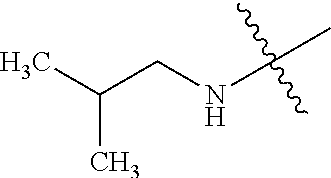
113 


114 


115 


116 


117 


118 


119 


120 


121 


122 


123 


124 


125 


126 


127 


128 


129 


130 


131 


132 


133 


134 


135 


136 


137 


138 


139 


140 


141 


142 


143 


144 


145 


146 


147 


148 


149 


150 


151 


152 


153 


154 


155 


156 


157 


158 


159 


160 


161 


162 


163 


164 


165 


- Preferred Examples of the compounds of the invention are selected from any one of Compound 101, 102, 109, 110, 124, 125, 144, 146, 147, 150, 151, and 156, or a pharmaceutically acceptable salt thereof. Alternatively, Preferred Examples of the compounds of the invention are selected from any one of Compound 101, 109, 110, 124, 125, 144, 146, 147, 150, 151, and 156, or a pharmaceutically acceptable salt thereof.
- “Alkyl” means a saturated aliphatic branched or straight-chain monovalent hydrocarbon radical having the specified number of carbon atoms. Thus, “(C1-C6) alkyl” means a radical having from 1-6 carbon atoms in a linear or branched arrangement. “(C1-C6)alkyl” includes methyl, ethyl, propyl, butyl, pentyl and hexyl.
- “Alkylene” means a saturated aliphatic straight-chain divalent hydrocarbon radical having the specified number of carbon atoms. Thus, “(C1-C6) alkylene” means a divalent saturated aliphatic radical having from 1-6 carbon atoms in a linear arrangement. “(C1-C6)alkylene” includes methylene, ethylene, propylene, butylene, pentylene and hexylene.
- “Heterocycle” means a saturated or partially unsaturated (4-7 membered) monocyclic heterocyclic ring containing one nitrogen atom and optionally 1 additional heteroatom independently selected from N, O or S. When one heteroatom is S, it can be optionally mono- or di-oxygenated (i.e. —S(O)— or —S(O)2—).
- Examples of monocyclic heterocycle include, but not limited to, azetidine, pyrrolidine, piperidine, piperazine, hexahydropyrimidine, tetrahydrofuran, tetrahydropyran, morpholine, thiomorpholine, thiomorpholine 1,1-dioxide, tetrahydro-2H-1,2-thiazine, tetrahydro-2H-1,2-thiazine 1,1-dioxide, isothiazolidine, or isothiazolidine 1,1-dioxide.
- “Cycloalkyl” means saturated aliphatic cyclic hydrocarbon ring. Thus, “C3-C7 cycloalkyl” means (3-7 membered) saturated aliphatic cyclic hydrocarbon ring. C3-C7 cycloalkyl includes, but is not limited to cyclopropyl, cyclobutyl, cyclopentyl, cyclohexyl and cycloheptyl.
- “Alkoxy” means an alkyl radical attached through an oxygen linking atom. “(C1-C6)-alkoxy” includes methoxy, ethoxy, propoxy, butoxy, pentoxy and hexoxy.
- Haloalkyl and halocycloalkyl include mono, poly, and perhaloalkyl groups where each halogen is independently selected from fluorine, chlorine, and bromine.
- “Hetero” refers to the replacement of at least one carbon atom member in a ring system with at least one heteroatom selected from N, S, and O. A hetero ring system may have 1 or 2 carbon atom members replaced by a heteroatom.
- “Halogen” and “halo” are interchangeably used herein and each refers to fluorine, chlorine, bromine, or iodine.
- “Cyano” means —C≡N.
- “Nitro” means —NO2.
- Another embodiment of the present invention is a pharmaceutical composition comprising one or more pharmaceutically acceptable carrier and/or diluent and a compound disclosed herein or a pharmaceutically acceptable salt thereof.
- “Pharmaceutically acceptable carrier” and “pharmaceutically acceptable diluent” means non-therapeutic components that are of sufficient purity and quality for use in the formulation of a composition of the invention that, when appropriately administered to an animal or human, typically do not produce an adverse reaction, and that are used as a vehicle for a drug substance (i.e. a compound of the present invention).
- Pharmaceutically acceptable salts of the compounds of the present invention are also included. For example, an acid salt of a compound of the present invention containing an amine or other basic group can be obtained by reacting the compound with a suitable organic or inorganic acid, resulting in pharmaceutically acceptable anionic salt forms. Examples of anionic salts include the acetate, benzenesulfonate, benzoate, bicarbonate, bitartrate, bromide, calcium edetate, camsylate, carbonate, chloride, citrate, dihydrochloride, edetate, edisylate, estolate, esylate, fumarate, glyceptate, gluconate, glutamate, glycollylarsanilate, hexylresorcinate, hydrobromide, hydrochloride, hydroxynaphthoate, iodide, isethionate, lactate, lactobionate, malate, maleate, mandelate, mesylate, methylsulfate, mucate, napsylate, nitrate, pamoate, pantothenate, phosphate/diphosphate, polygalacturonate, salicylate, stearate, subacetate, succinate, sulfate, tannate, tartrate, teoclate, tosylate, and triethiodide salts.
- Salts of the compounds of the present invention containing a carboxylic acid or other acidic functional group can be prepared by reacting with a suitable base. Such a pharmaceutically acceptable salt may be made with a base which affords a pharmaceutically acceptable cation, which includes alkali metal salts (especially sodium and potassium), alkaline earth metal salts (especially calcium and magnesium), aluminum salts and ammonium salts, as well as salts made from physiologically acceptable organic bases such as trimethylamine, triethylamine, morpholine, pyridine, piperidine, picoline, dicyclohexylamine, N,N′-dibenzylethylenediamine, 2-hydroxyethylamine, bis-(2-hydroxyethyl)amine, tri-(2-hydroxyethyl)amine, procaine, dibenzylpiperidine, dehydroabietylamine, N,N′-bisdehydroabietylamine, glucamine, N-methylglucamine, collidine, quinine, quinoline, and basic amino acids such as lysine and arginine.
- The invention also includes various isomers and mixtures thereof. Certain of the compounds of the present invention may exist in various stereoisomeric forms. Stereoisomers are compounds which differ only in their spatial arrangement. Enantiomers are pairs of stereoisomers whose mirror images are not superimposable, most commonly because they contain an asymmetrically substituted carbon atom that acts as a chiral center. “Enantiomer” means one of a pair of molecules that are mirror images of each other and are not superimposable. Diastereomers are stereoisomers that are not related as mirror images, most commonly because they contain two or more asymmetrically substituted carbon atoms. “R” and “S” represent the configuration of substituents around one or more chiral carbon atoms. When a chiral center is not defined as R or S, either a pure enantiomer or a mixture of both configurations is present.
- “Racemate” or “racemic mixture” means a compound of equimolar quantities of two enantiomers, wherein such mixtures exhibit no optical activity; i.e., they do not rotate the plane of polarized light.
- The compounds of the invention may be prepared as individual isomers by either isomer-specific synthesis or resolved from an isomeric mixture. Conventional resolution techniques include forming the salt of a free base of each isomer of an isomeric pair using an optically active acid (followed by fractional crystallization and regeneration of the free base), forming the salt of the acid form of each isomer of an isomeric pair using an optically active amine (followed by fractional crystallization and regeneration of the free acid), forming an ester or amide of each of the isomers of an isomeric pair using an optically pure acid, amine or alcohol (followed by chromatographic separation and removal of the chiral auxiliary), or resolving an isomeric mixture of either a starting material or a final product using various well known chromatographic methods.
- When the stereochemistry of a disclosed compound is named or depicted by structure, the named or depicted stereoisomer is at least 60%, 70%, 80%, 90%, 99% or 99.9% by weight pure relative to the other stereoisomers. When a single enantiomer is named or depicted by structure, the depicted or named enantiomer is at least 60%, 70%, 80%, 90%, 99% or 99.9% by weight optically pure. Percent optical purity by weight is the ratio of the weight of the enantiomer that is present divided by the combined weight of the enantiomer that is present and the weight of its optical isomer.
- The present invention also provides a method of treating a subject with a tetracycline-responsive disease or disorder comprising administering to the subject an effective amount of a compound of the present invention or a pharmaceutically acceptable salt thereof “Tetracycline-responsive disease or disorder” refers to a disease or disorder that can be treated, prevented, or otherwise ameliorated by the administration of a tetracycline compound of the present invention. Tetracycline-responsive disease or disorder includes infections, cancer, inflammatory disorders, autoimmune disease, arteriosclerosis, corneal ulceration, emphysema, arthritis, osteoporosis, osteoarthritis, multiple sclerosis, osteosarcoma, osteomyelitis, bronchiectasis, chronic pulmonary obstructive disease, skin and eye diseases, periodontitis, osteoporosis, rheumatoid arthritis, ulcerative colitis, inflammatory disorders, tumor growth and invasion, metastasis, acute lung injury, stroke, ischemia, diabetes, aortic or vascular aneurysms, skin tissue wounds, dry eye, bone, cartilage degradation, malaria, senescence, diabetes, vascular stroke, neurodegenerative disorders, cardiac disease, juvenile diabetes, acute and chronic bronchitis, sinusitis, and respiratory infections, including the common cold; acute and chronic gastroenteritis and colitis; acute and chronic cystitis and urethritis; acute and chronic dermatitis; acute and chronic conjunctivitis; acute and chronic serositis; uremic pericarditis; acute and chronic cholecystis; cystic fibrosis, acute and chronic vaginitis; acute and chronic uveitis; drug reactions; insect bites; burns and sunburn, bone mass disorder, acute lung injury, chronic lung disorders, ischemia, stroke or ischemic stroke, skin wound, aortic or vascular aneurysm, diabetic retinopathy, hemorrhagic stroke, angiogenesis, and other states for which tetracycline compounds have been found to be active (see, for example, U.S. Pat. Nos. 5,789,395; 5,834,450; 6,277,061 and 5,532,227, each of which is expressly incorporated herein by reference). Compounds of the invention can be used to prevent or control important mammalian and veterinary diseases such as diarrhea, urinary tract infections, infections of skin and skin structure, ear, nose and throat infections, wound infection, mastitis and the like. In addition, methods for treating neoplasms using tetracycline compounds of the invention are also included (van der Bozert et al., Cancer Res., 48: 6686-6690 (1988)).
- Infections that can be treated using compounds of the invention or a pharmaceutically acceptable salt thereof include, but are not limited to, skin infections, GI infections, urinary tract infections, genito-urinary infections, respiratory tract infections, sinuses infections, middle ear infections, systemic infections, cholera, influenza, bronchitis, acne, malaria, sexually transmitted disease including syphilis and gonorrhea, Legionnaires' disease, Lyme disease, Rocky Mountain spotted fever, Q fever, typhus, bubonic plague, gas gangrene, hospital acquired infections, leptospirosis, whooping cough, anthrax and infections caused by the agents responsible for lymphogranuloma venereum, inclusion conjunctivitis, or psittacosis. Infections can be bacterial, fungal, parasitic and viral infections (including those which are resistant to other tetracycline compounds).
- In one embodiment, the infection can be caused bacteria. In another embodiment, the infection is caused by a Gram-positive bacteria. In a specific aspect of this embodiment, the infection is caused by a Gram-positive bacteria selected from S. aureus, S. pneumoniae, P. granulosum and P. acnes.
- In another embodiment, the infection is caused by a Gram-negative bacteria. In a specific aspect of this embodiment, the infection is caused by a Gram-negative bacteria selected from E. coli or B. thetaiotaomicron.
- In another embodiment, the infection is caused by an organism selected from the group consisting of K. pneumoniae, Salmonella, E. hirae, A. baumanii, B. catarrhalis, H. influenzae, P. aeruginosa, E. faecium, E. coli, S. aureus, and E. faecalis. In another embodiment, the infection is caused by an organism selected from the group consisting of rickettsiae, chlamydiae, and Mycoplasma pneumoniae. In another embodiment, the infection is caused by an organism resistant to tetracycline. In another embodiment, the infection is caused by an organism resistant to methicillin. In another embodiment, the infection is caused by an organism resistant to vancomycin. In another embodiment the infection is a Bacillus anthracis infection. “Bacillus anthracis infection” includes any state, diseases, or disorders caused or which result from exposure or alleged exposure to Bacillus anthracis or another member of the Bacillus cereus group of bacteria.
- In another embodiment, the infection is caused by a Gram-positive bacterium. In a specific aspect of this embodiment, the infection is caused by a Gram-positive bacterium selected from class Bacilli, including, but not limited to, Staphylococcus spp., Streptococcus spp., Enterococcus spp., Bacillus spp., Listeria spp.; phylum Actinobacteria, including, but not limited to, Propionibacterium spp., Corynebacterium spp., Nocardia spp., Actinobacteria spp., and class Clostridia, including, but not limited to, Clostridium spp.
- In another embodiment, the infection is caused by a Gram-negative bacterium. In one aspect of this embodiment, the infection is caused by a phylum Proteobacteria (e.g., Betaproteobacteria and Gammaproteobacteria), including Escherichia coli, Salmonella, Shigella, other Enterobacteriaceae, Pseudomonas, Moraxella, Helicobacter, Stenotrophomonas, Bdellovibrio, acetic acid bacteria, Legionella or alpha-proteobacteria such as Wolbachia. In another aspect, the infection is caused by a Gram-negative bacterium selected from cyanobacteria, spirochaetes, green sulfur or green non-sulfur bacteria. In a specific aspect of this embodiment, the infection is caused by a Gram-negative bacteria selected from Enterobactericeae (e.g., E. coli, Klebsiella pneumoniae including those containing extended-spectrum β-lactamases and/or carbapenemases), Bacteroidetes (e.g., Bacteroides fragilis)., Vibrionaceae (Vibrio cholerae), Pasteurellaceae (e.g., Haemophilus influenzae), Pseudomonadaceae (e.g., Pseudomonas aeruginosa), Neisseriaceae (e.g. Neisseria meningitidis), Rickettsiae, Moraxellaceae (e.g., Moraxella catarrhalis), any species of Proteeae, Acinetobacter spp., Helicobacter spp., and Campylobacter spp. In a particular embodiment, the infection is caused by Gram-negative bacterium selected from the group consisting of Enterobactericeae (e.g., E. coli, Klebsiella pneumoniae), Pseudomonas, and Acinetobacter spp. In another embodiment, the infection is caused by an organism selected from the group consisting of K. pneumoniae, Salmonella, E. hirae, A. baumanii, M. catarrhalis, H. influenzae, P. aeruginosa, E. faecium, E. coli, S. aureus, and E. faecalis.
- In one embodiment, the infection is caused by an organism that grows intracellularly as part of its infection process.
- In another embodiment, the infection is caused by an organism selected from the group consisting of order Rickettsiales; phylum Chlamydiae; order Chlamydiales; Legionella spp.; class Mollicutes, including, but not limited to, Mycoplasma spp. (e.g. Mycoplasma pneumoniae); Mycobacterium spp. (e.g. Mycobacterium tuberculosis); and phylum Spriochaetales (e.g. Borrelia spp. and Treponema spp.).
- In another embodiment, the infection is caused by a Category A Biodefense organism as described at http://www.bt.cdc.gov/agent/agentlist-category.asp, the entire teachings of which are incorporated herein by reference. Examples of Category A organisms include, but are not limited to, Bacillus anthracis (anthrax), Yersinia pestis (plague), Clostridium botulinum (botulism) or Francisella tularensis (tularemia). In another embodiment the infection is a Bacillus anthracis infection. “Bacillus anthracis infection” includes any state, diseases, or disorders caused or which result from exposure or alleged exposure to Bacillus anthracis or another member of the Bacillus cereus group of bacteria.
- Additional infections that can be treated using compounds of the invention or a pharmaceutically acceptable salt thereof include, but are not limited to, anthrax, botulism, bubonic plague, and tularemia.
- In another embodiment, the infection is caused by a Category B Biodefense organism as described at http://www.bt.cdc.gov/agent/agentlist-category.asp, the entire teachings of which are incorporated herein by reference. Examples of Category B organisms include, but are not limited to, Brucella spp, Clostridium perfringens, Salmonella spp., Escherichia coli O157:H7, Shigella spp., Burkholderia mallei, Burkholderia pseudomallei, Chlamydia psittaci, Coxiella burnetii, Staphylococcal enterotoxin B, Rickettsia prowazekii, Vibrio cholerae, and Cryptosporidium parvum.
- Additional infections that can be treated using compounds of the invention or a pharmaceutically acceptable salt thereof include, but are not limited to, Brucellosis, Clostridium perfringens, food-borne illnesses, Glanders, Melioidosis, Psittacosis, Q fever, and water-borne illnesses.
- In yet another embodiment, the infection can be caused by one or more than one organism described above. Examples of such infections include, but are not limited to, intra-abdominal infections (often a mixture of a gram-negative species like E. coli and an anaerobe like B. fragilis), diabetic foot (various combinations of Streptococcus, Serratia, Staphylococcus and Enterococcus spp., anaerobes (S. E. Dowd, et al., PloS one 2008; 3:e3326, the entire teachings of which are incorporated herein by reference) and respiratory disease (especially in patients that have chronic infections like cystic fibrosis—e.g., S. aureus plus P. aeruginosa or H. influenzae, atypical pathogens), wounds and abscesses (various gram-negative and gram-positive bacteria, notably MSSA/MRSA, coagulase-negative staphylococci, enterococci, Acinetobacter, P. aeruginosa, E. coli, B. fragilis), and bloodstream infections (13% were polymicrobial (H. Wisplinghoff, et al., Clin. Infect. Dis. 2004; 39:311-317, the entire teachings of which are incorporated herein by reference)).
- In one embodiment, the infection is caused by an organism resistant to one or more antibiotics.
- In another embodiment, the infection is caused by an organism resistant to tetracycline or any member of first and second generation of tetracycline antibiotics (e.g., doxycycline or minocycline).
- In another embodiment, the infection is caused by an organism resistant to methicillin.
- In another embodiment, the infection is caused by an organism resistant to vancomycin.
- In another embodiment, the infection is caused by an organism resistant to a quinolone or fluoroquinolone.
- In another embodiment, the infection is caused by an organism resistant to tigecycline or any other tetracycline derivative. In a particular embodiment, the infection is caused by an organism resistant to tigecycline.
- In another embodiment, the infection is caused by an organism resistant to a β-lactam or cephalosporin antibiotic or an organism resistant to penems or carbapenems.
- In another embodiment, the infection is caused by an organism resistant to an antimicrobial peptide or a biosimilar therapeutic treatment. Antimicrobial peptides (also called host defense peptides) are an evolutionarily conserved component of the innate immune response and are found among all classes of life. In this case, antimicrobial peptide refers to any naturally occurring molecule or any semi/synthetic molecule that are analogs of anionic peptides, linear cationic α-helical peptides, cationic peptides enriched for specific amino acids (i.e., rich in proline, arginine, phenylalanine, glycine, tryptophan), and anionic and cationic peptides that contain cystein and form disulfide bonds.
- In another embodiment, the infection is caused by an organism resistant to macrolides, lincosamides, streptogramin antibiotics, oxazolidinones, and pleuromutilins.
- In another embodiment, the infection is caused by an organism resistant to PTK0796 (7-dimethylamino, 9-(2,2-dimethyl-propyl)-aminomethylcycline).
- In another embodiment, the infection is caused by a multidrug-resistant pathogen (having intermediate or full resistance to any two or more antibiotics).
- In a further embodiment, the tetracycline responsive disease or disorder is not a bacterial infection. In another embodiment, the tetracycline compounds of the invention are essentially non-antibacterial. For example, non-antibacterial compounds of the invention may have MIC values greater than about 4 μg/ml (as measured by assays known in the art and/or the assay given in Example 1.
- Tetracycline responsive disease or disorder also includes diseases or disorders associated with inflammatory process associated states (IPAS). The term “inflammatory process associated state” includes states in which inflammation or inflammatory factors (e.g., matrix metalloproteinases (MMPs), nitric oxide (NO), TNF, interleukins, plasma proteins, cellular defense systems, cytokines, lipid metabolites, proteases, toxic radicals, adhesion molecules, etc.) are involved or are present in an area in aberrant amounts, e.g., in amounts which may be advantageous to alter, e.g., to benefit the subject. The inflammatory process is the response of living tissue to damage. The cause of inflammation may be due to physical damage, chemical substances, micro-organisms, tissue necrosis, cancer or other agents. Acute inflammation is short-lasting, lasting only a few days. If it is longer lasting however, then it may be referred to as chronic inflammation.
- IPASs include inflammatory disorders. Inflammatory disorders are generally characterized by heat, redness, swelling, pain and loss of function. Examples of causes of inflammatory disorders include, but are not limited to, microbial infections (e.g., bacterial and fungal infections), physical agents (e.g., burns, radiation, and trauma), chemical agents (e.g., toxins and caustic substances), tissue necrosis and various types of immunologic reactions.
- Examples of inflammatory disorders can be treated using the compounds of the invention or a pharmaceutically acceptable salt thereof include, but are not limited to, osteoarthritis, rheumatoid arthritis, acute and chronic infections (bacterial and fungal, including diphtheria and pertussis); acute and chronic bronchitis, sinusitis, and upper respiratory infections, including the common cold; acute and chronic gastroenteritis and colitis; inflammatory bowel disorder; acute and chronic cystitis and urethritis; vasculitis; sepsis; nephritis; pancreatitis; hepatitis; lupus; inflammatory skin disorders including, for example, eczema, dermatitis, psoriasis, pyoderma gangrenosum, acne rosacea, and acute and chronic dermatitis; acute and chronic conjunctivitis; acute and chronic serositis (pericarditis, peritonitis, synovitis, pleuritis and tendinitis); uremic pericarditis; acute and chronic cholecystis; acute and chronic vaginitis; acute and chronic uveitis; drug reactions; insect bites; burns (thermal, chemical, and electrical); and sunburn.
- IPASs also include matrix metalloproteinase associated states (MMPAS). MMPAS include states characterized by aberrant amounts of MMPs or MMP activity. Examples of matrix metalloproteinase associated states (“MMPAS's”) can be treated using compounds of the invention or a pharmaceutically acceptable salt thereof, include, but are not limited to, arteriosclerosis, corneal ulceration, emphysema, osteoarthritis, multiple sclerosis (Liedtke et al., Ann. Neurol. 1998, 44: 35-46; Chandler et al., J. Neuroimmunol. 1997, 72: 155-71), osteosarcoma, osteomyelitis, bronchiectasis, chronic pulmonary obstructive disease, skin and eye diseases, periodontitis, osteoporosis, rheumatoid arthritis, ulcerative colitis, inflammatory disorders, tumor growth and invasion (Stetler-Stevenson et al., Annu. Rev. Cell Biol. 1993, 9: 541-73; Tryggvason et al., Biochim. Biophys. Acta 1987, 907: 191-217; Li et al., Mol. Carcillog. 1998, 22: 84-89)), metastasis, acute lung injury, stroke, ischemia, diabetes, aortic or vascular aneurysms, skin tissue wounds, dry eye, bone and cartilage degradation (Greenwald et al., Bone 1998, 22: 33-38; Ryan et al., Curr. Op. Rheumatol. 1996, 8: 238-247). Other MMPAS include those described in U.S. Pat. Nos. 5,459,135; 5,321,017; 5,308,839; 5,258,371; 4,935,412; 4,704,383, 4,666,897, and RE 34,656, incorporated herein by reference in their entirety.
- In a further embodiment, the IPAS includes disorders described in U.S. Pat. Nos. 5,929,055; and 5,532,227, incorporated herein by reference in their entirety.
- Tetracycline responsive disease or disorder also includes diseases or disorders associated with NO associated states. The term “NO associated states” includes states which involve or are associated with nitric oxide (NO) or inducible nitric oxide synthase (iNOS). NO associated state includes states which are characterized by aberrant amounts of NO and/or iNOS. Preferably, the NO associated state can be treated by administering tetracycline compounds of the invention. The disorders, diseases and states described in U.S. Pat. Nos. 6,231,894; 6,015,804; 5,919,774; and 5,789,395 are also included as NO associated states. The entire contents of each of these patents are hereby incorporated herein by reference.
- Examples of diseases or disorders associated with NO associated states can be treated using the compounds of the present invention or a pharmaceutically acceptable salt thereof include, but are not limited to, malaria, senescence, diabetes, vascular stroke, neurodegenerative disorders (Alzheimer's disease and Huntington's disease), cardiac disease (reperfusion-associated injury following infarction), juvenile diabetes, inflammatory disorders, osteoarthritis, rheumatoid arthritis, acute, recurrent and chronic infections (bacterial, viral and fungal); acute and chronic bronchitis, sinusitis, and respiratory infections, including the common cold; acute and chronic gastroenteritis and colitis; acute and chronic cystitis and urethritis; acute and chronic dermatitis; acute and chronic conjunctivitis; acute and chronic serositis (pericarditis, peritonitis, synovitis, pleuritis and tendonitis); uremic pericarditis; acute and chronic cholecystis; cystic fibrosis, acute and chronic vaginitis; acute and chronic uveitis; drug reactions; insect bites; burns (thermal, chemical, and electrical); and sunburn.
- In another embodiment, the tetracycline responsive disease or disorder is cancer. Examples of cancers that can be treated using the compounds of the invention or a pharmaceutically acceptable salt thereof include all solid tumors, i.e., carcinomas e.g., adenocarcinomas, and sarcomas. Adenocarcinomas are carcinomas derived from glandular tissue or in which the tumor cells form recognizable glandular structures. Sarcomas broadly include tumors whose cells are embedded in a fibrillar or homogeneous substance like embryonic connective tissue. Examples of carcinomas which may be treated using the methods of the invention include, but are not limited to, carcinomas of the prostate, breast, ovary, testis, lung, colon, and breast. The methods of the invention are not limited to the treatment of these tumor types, but extend to any solid tumor derived from any organ system. Examples of treatable cancers include, but are not limited to, colon cancer, bladder cancer, breast cancer, melanoma, ovarian carcinoma, prostate carcinoma, lung cancer, and a variety of other cancers as well. The methods of the invention also cause the inhibition of cancer growth in adenocarcinomas, such as, for example, those of the prostate, breast, kidney, ovary, testes, and colon. In one embodiment, the cancers treated by methods of the invention include those described in U.S. Pat. No. 6,100,248; 5,843,925; 5,837,696; or 5,668,122, incorporated herein by reference in their entirety.
- Alternatively, the tetracycline compounds may be useful for preventing or reducing the likelihood of cancer recurrence, for example, to treat residual cancer following surgical resection or radiation therapy. The tetracycline compounds useful according to the invention are especially advantageous as they are substantially non-toxic compared to other cancer treatments.
- In a further embodiment, the compounds of the invention are administered in combination with standard cancer therapy, such as, but not limited to, chemotherapy.
- Examples of tetracycline responsive states can be treated using the compounds of the invention or a pharmaceutically acceptable salt thereof also include neurological disorders which include both neuropsychiatric and neurodegenerative disorders, but are not limited to, such as Alzheimer's disease, dementias related to Alzheimer's disease (such as Pick's disease), Parkinson's and other Lewy diffuse body diseases, senile dementia, Huntington's disease, Gilles de la Tourette's syndrome, multiple sclerosis, amyotrophic lateral sclerosis (ALS), progressive supranuclear palsy, epilepsy, and Creutzfeldt-Jakob disease; autonomic function disorders such as hypertension and sleep disorders, and neuropsychiatric disorders, such as depression, schizophrenia, schizoaffective disorder, Korsakoffs psychosis, mania, anxiety disorders, or phobic disorders; learning or memory disorders, e.g., amnesia or age-related memory loss, attention deficit disorder, dysthymic disorder, major depressive disorder, mania, obsessive-compulsive disorder, psychoactive substance use disorders, anxiety, phobias, panic disorder, as well as bipolar affective disorder, e.g., severe bipolar affective (mood) disorder (BP-1), bipolar affective neurological disorders, e.g., migraine and obesity.
- Further neurological disorders include, for example, those listed in the American Psychiatric Association's Diagnostic and Statistical manual of Mental Disorders (DSM), the most current version of which is incorporated herein by reference in its entirety.
- In another embodiment, the tetracycline responsive disease or disorder is diabetes. Diabetes that can be treated using the compounds of the invention or a pharmaceutically acceptable salt thereof include, but are not limited to, juvenile diabetes, diabetes mellitus, diabetes type I, or diabetes type II. In a further embodiment, protein glycosylation is not affected by the administration of the tetracycline compounds of the invention. In another embodiment, the tetracycline compound of the invention is administered in combination with standard diabetic therapies, such as, but not limited to insulin therapy.
- In another embodiment, the tetracycline responsive disease or disorder is a bone mass disorder. Bone mass disorders that can be treated using the compounds of the invention or a pharmaceutically acceptable salt thereof include disorders where a subjects bones are disorders and states where the formation, repair or remodeling of bone is advantageous. For examples bone mass disorders include osteoporosis (e.g., a decrease in bone strength and density), bone fractures, bone formation associated with surgical procedures (e.g., facial reconstruction), osteogenesis imperfecta (brittle bone disease), hypophosphatasia, Paget's disease, fibrous dysplasia, osteopetrosis, myeloma bone disease, and the depletion of calcium in bone, such as that which is related to primary hyperparathyroidism. Bone mass disorders include all states in which the formation, repair or remodeling of bone is advantageous to the subject as well as all other disorders associated with the bones or skeletal system of a subject which can be treated with the tetracycline compounds of the invention. In a further embodiment, the bone mass disorders include those described in U.S. Pat. Nos. 5,459,135; 5,231,017; 5,998,390; 5,770,588; RE 34,656; 5,308,839; 4,925,833; 3,304,227; and 4,666,897, each of which is hereby incorporated herein by reference in its entirety.
- In another embodiment, the tetracycline responsive disease or disorder is acute lung injury. Acute lung injuries that can be treated using the compounds of the invention or a pharmaceutically acceptable salt thereof include adult respiratory distress syndrome (ARDS), post-pump syndrome (PPS), and trauma. Trauma includes any injury to living tissue caused by an extrinsic agent or event. Examples of trauma include, but are not limited to, crush injuries, contact with a hard surface, or cutting or other damage to the lungs.
- The tetracycline responsive disease or disorders of the invention also include chronic lung disorders. Examples of chronic lung disorders that can be treated using the compounds of the invention or a pharmaceutically acceptable salt thereof include, but are not limited, to asthma, cystic fibrosis, chronic obstructive pulmonary disease (COPD), and emphysema. In a further embodiment, the acute and/or chronic lung disorders that can be treated using the compounds of the invention or a pharmaceutically acceptable salt thereof include those described in U.S. Pat. Nos. 5,977,091; 6,043,231; 5,523,297; and 5,773,430, each of which is hereby incorporated herein by reference in its entirety.
- In yet another embodiment, the tetracycline responsive disease or disorder is ischemia, stroke, or ischemic stroke.
- In a further embodiment, the tetracycline compounds of the invention or a pharmaceutically acceptable salt thereof can be used to treat such disorders as described above and in U.S. Pat. Nos. 6,231,894; 5,773,430; 5,919,775 and 5,789,395, incorporated herein by reference.
- In still a further embodiment, the tetracycline compounds of the invention or a pharmaceutically acceptable salt thereof can be used to treat pain, for example, inflammatory, nociceptive or neuropathic pain. The pain can be either acute or chronic.
- In another embodiment, the tetracycline responsive disease or disorder is a skin wound. The invention also provides a method for improving the healing response of the epithelialized tissue (e.g., skin, mucosae) to acute traumatic injury (e.g., cut, burn, scrape, etc.). The method includes using a tetracycline compound of the invention or a pharmaceutically acceptable salt thereof to improve the capacity of the epithelialized tissue to heal acute wounds. The method may increase the rate of collagen accumulation of the healing tissue. The method may also decrease the proteolytic activity in the epithelialized tissue by decreasing the collagenolytic and/or gellatinolytic activity of MMPs. In a further embodiment, the tetracycline compound of the invention or a pharmaceutically acceptable salt thereof is administered to the surface of the skin (e.g., topically). In a further embodiment, the tetracycline compound of the invention or a pharmaceutically acceptable salt thereof is used to treat a skin wound, and other such disorders as described in, for example, U.S. Pat. Nos. 5,827,840; 4,704,383; 4,935,412; 5,258,371; 5,308,839, 5,459,135; 5,532,227; and 6,015,804; each of which is incorporated herein by reference in its entirety.
- In yet another embodiment, the tetracycline responsive disease or disorder is an aortic or vascular aneurysm in vascular tissue of a subject (e.g., a subject having or at risk of having an aortic or vascular aneurysm, etc.). The tetracycline compound or a pharmaceutically acceptable salt thereof may be effective to reduce the size of the vascular aneurysm or it may be administered to the subject prior to the onset of the vascular aneurysm such that the aneurysm is prevented. In one embodiment, the vascular tissue is an artery, e.g., the aorta, e.g., the abdominal aorta. In a further embodiment, the tetracycline compounds of the invention are used to treat disorders described in U.S. Pat. Nos. 6,043,225 and 5,834,449, incorporated herein by reference in their entirety.
- The compounds of the invention or a pharmaceutically acceptable salt thereof can be used alone or in combination with one or more therapeutic agent in the methods of the invention disclosed herein.
- The language “in combination with” another therapeutic agent or treatment includes co-administration of the tetracycline compound and with the other therapeutic agent or treatment as either a single combination dosage form or as multiple, separate dosage forms, administration of the tetracycline compound first, followed by the other therapeutic agent or treatment and administration of the other therapeutic agent or treatment first, followed by the tetracycline compound.
- The other therapeutic agent may be any agent that is known in the art to treat, prevent, or reduce the symptoms of a tetracycline-responsive disease or disorder. The choice of additional therapeutic agent(s) is based upon the particular tetracycline-responsive disease or disorder being treated. Such choice is within the knowledge of a treating physician. Furthermore, the other therapeutic agent may be any agent of benefit to the patient when administered in combination with the administration of a tetracycline compound.
- As used herein, the term “subject” means a mammal in need of treatment, e.g., companion animals (e.g., dogs, cats, and the like), farm animals (e.g., cows, pigs, horses, sheep, goats and the like) and laboratory animals (e.g., rats, mice, guinea pigs and the like). Typically, the subject is a human in need of the specified treatment.
- As used herein, the term “treating” or “treatment” refers to obtaining desired pharmacological and/or physiological effect. The effect can be prophylactic or therapeutic, which includes achieving, partially or substantially, one or more of the following results: partially or totally reducing the extent of the disease, disorder or syndrome; ameliorating or improving a clinical symptom or indicator associated with the disorder; delaying, inhibiting or decreasing the likelihood of the progression of the disease, disorder or syndrome; or partially or totally delaying, inhibiting or reducing the likelihood of the onset or development of disease, disorder or syndrome.
- “Effective amount” means that amount of active compound agent that elicits the desired biological response in a subject. Such response includes alleviation of the symptoms of the disease or disorder being treated. In one embodiment, the effective amount of a compound of the invention is from about 0.01 mg/kg/day to about 1000 mg/kg/day, from about 0.1 mg/kg/day to about 100 mg/kg/day, or from about 0.5 mg/kg/day to about 50 mg/kg/day.
- The invention further includes the process for making the composition comprising mixing one or more of the present compounds and an optional pharmaceutically acceptable carrier; and includes those compositions resulting from such a process, which process includes conventional pharmaceutical techniques.
- The compositions of the invention include ocular, oral, nasal, transdermal, topical with or without occlusion, intravenous (both bolus and infusion), and injection (intraperitoneally, subcutaneously, intramuscularly, intratumorally, or parenterally). The composition may be in a dosage unit such as a tablet, capsule, powder, granule, liposome, ion exchange resin, sterile ocular solution, or ocular delivery device (such as a contact lens and the like facilitating immediate release, timed release, or sustained release), parenteral solution or suspension, metered aerosol or liquid spray, drop, ampoule, auto-injector device, or suppository; for administration ocularly, orally, intranasally, sublingually, parenterally, or rectally, or by inhalation or insufflation.
- Compositions of the invention suitable for oral administration include solid forms such as pills, tablets, caplets, capsules (each including immediate release, timed release, and sustained release formulations), granules and powders; and, liquid forms such as solutions, syrups, elixirs, emulsions, and suspensions. Forms useful for ocular administration include sterile solutions or ocular delivery devices. Forms useful for parenteral administration include sterile solutions, emulsions, and suspensions.
- The compositions of the invention may be administered in a form suitable for once-weekly or once-monthly administration. For example, an insoluble salt of the active compound may be adapted to provide a depot preparation for intramuscular injection (e.g., a decanoate salt) or to provide a solution for ophthalmic administration.
- The dosage form containing the composition of the invention contains an effective amount of the active ingredient necessary to provide a therapeutic effect. The composition may contain from about 5,000 mg to about 0.5 mg (preferably, from about 1,000 mg to about 0.5 mg) of a compound of the invention or salt form thereof and may be constituted into any form suitable for the selected mode of administration. The composition may be administered about 1 to about 5 times per day. Daily administration or post-periodic dosing may be employed.
- For oral administration, the composition is preferably in the form of a tablet or capsule containing, e.g., 500 to 0.5 milligrams of the active compound. Dosages will vary depending on factors associated with the particular patient being treated (e.g., age, weight, diet, and time of administration), the severity of the condition being treated, the compound being employed, the mode of administration, and the strength of the preparation.
- The oral composition is preferably formulated as a homogeneous composition, wherein the active ingredient is dispersed evenly throughout the mixture, which may be readily subdivided into dosage units containing equal amounts of a compound of the invention. Preferably, the compositions are prepared by mixing a compound of the invention (or pharmaceutically acceptable salt thereof) with one or more optionally present pharmaceutical carriers (such as a starch, sugar, diluent, granulating agent, lubricant, glidant, binding agent, and disintegrating agent), one or more optionally present inert pharmaceutical excipients (such as water, glycols, oils, alcohols, flavoring agents, preservatives, coloring agents, and syrup), one or more optionally present conventional tableting ingredients (such as corn starch, lactose, sucrose, sorbitol, talc, stearic acid, magnesium stearate, dicalcium phosphate, and any of a variety of gums), and an optional diluent (such as water).
- Binder agents include starch, gelatin, natural sugars (e.g., glucose and beta-lactose), corn sweeteners and natural and synthetic gums (e.g., acacia and tragacanth). Disintegrating agents include starch, methyl cellulose, agar, and bentonite.
- Tablets and capsules represent an advantageous oral dosage unit form. Tablets may be sugarcoated or filmcoated using standard techniques. Tablets may also be coated or otherwise compounded to provide a prolonged, control-release therapeutic effect. The dosage form may comprise an inner dosage and an outer dosage component, wherein the outer component is in the form of an envelope over the inner component. The two components may further be separated by a layer which resists disintegration in the stomach (such as an enteric layer) and permits the inner component to pass intact into the duodenum or a layer which delays or sustains release. A variety of enteric and non-enteric layer or coating materials (such as polymeric acids, shellacs, acetyl alcohol, and cellulose acetate or combinations thereof) may be used.
- Compounds of the invention may also be administered via a slow release composition; wherein the composition includes a compound of the invention and a biodegradable slow release carrier (e.g., a polymeric carrier) or a pharmaceutically acceptable non-biodegradable slow release carrier (e.g., an ion exchange carrier).
- Biodegradable and non-biodegradable slow release carriers are well known in the art. Biodegradable carriers are used to form particles or matrices which retain an active agent(s) and which slowly degrade/dissolve in a suitable environment (e.g., aqueous, acidic, basic and the like) to release the agent. Such particles degrade/dissolve in body fluids to release the active compound(s) therein. The particles are preferably nanoparticles (e.g., in the range of about 1 to 500 nm in diameter, preferably about 50-200 nm in diameter, and most preferably about 100 nm in diameter). In a process for preparing a slow release composition, a slow release carrier and a compound of the invention are first dissolved or dispersed in an organic solvent. The resulting mixture is added into an aqueous solution containing an optional surface-active agent(s) to produce an emulsion. The organic solvent is then evaporated from the emulsion to provide a colloidal suspension of particles containing the slow release carrier and the compound of the invention.
- The compound disclosed herein may be incorporated for administration orally or by injection in a liquid form such as aqueous solutions, suitably flavored syrups, aqueous or oil suspensions, flavored emulsions with edible oils such as cottonseed oil, sesame oil, coconut oil or peanut oil and the like, or in elixirs or similar pharmaceutical vehicles. Suitable dispersing or suspending agents for aqueous suspensions, include synthetic and natural gums such as tragacanth, acacia, alginate, dextran, sodium carboxymethylcellulose, methylcellulose, polyvinyl-pyrrolidone, and gelatin. The liquid forms in suitably flavored suspending or dispersing agents may also include synthetic and natural gums. For parenteral administration, sterile suspensions and solutions are desired. Isotonic preparations, which generally contain suitable preservatives, are employed when intravenous administration is desired.
- The compounds may be administered parenterally via injection. A parenteral formulation may consist of the active ingredient dissolved in or mixed with an appropriate inert liquid carrier. Acceptable liquid carriers usually comprise aqueous solvents and other optional ingredients for aiding solubility or preservation. Such aqueous solvents include sterile water, Ringer's solution, or an isotonic aqueous saline solution. Other optional ingredients include vegetable oils (such as peanut oil, cottonseed oil, and sesame oil), and organic solvents (such as solketal, glycerol, and formyl). A sterile, non-volatile oil may be employed as a solvent or suspending agent. The parenteral formulation is prepared by dissolving or suspending the active ingredient in the liquid carrier whereby the final dosage unit contains from 0.005 to 10% by weight of the active ingredient. Other additives include preservatives, isotonizers, solubilizers, stabilizers, and pain-soothing agents. Injectable suspensions may also be prepared, in which case appropriate liquid carriers, suspending agents and the like may be employed.
- Compounds of the invention may be administered intranasally using a suitable intranasal vehicle.
- Compounds of the invention may also be administered topically using a suitable topical transdermal vehicle or a transdermal patch.
- For ocular administration, the composition is preferably in the form of an ophthalmic composition. The ophthalmic compositions are preferably formulated as eye-drop formulations and filled in appropriate containers to facilitate administration to the eye, for example a dropper fitted with a suitable pipette. Preferably, the compositions are sterile and aqueous based, using purified water. In addition to the compound of the invention, an ophthalmic composition may contain one or more of: a) a surfactant such as a polyoxyethylene fatty acid ester; b) a thickening agents such as cellulose, cellulose derivatives, carboxyvinyl polymers, polyvinyl polymers, and polyvinylpyrrolidones, typically at a concentration n the range of about 0.05 to about 5.0% (wt/vol); c) (as an alternative to or in addition to storing the composition in a container containing nitrogen and optionally including a free oxygen absorber such as Fe), an anti-oxidant such as butylated hydroxyanisol, ascorbic acid, sodium thiosulfate, or butylated hydroxytoluene at a concentration of about 0.00005 to about 0.1% (wt/vol); d) ethanol at a concentration of about 0.01 to 0.5% (wt/vol); and e) other excipients such as an isotonic agent, buffer, preservative, and/or pH-controlling agent. The pH of the ophthalmic composition is desirably within the range of 4 to 8.
- In certain embodiments, the composition of this invention includes one or more additional agents. The other therapeutic agent may be ay agent that is capable of treating, preventing or reducing the symptoms of a tetracycline-responsive disease or disorder. Alternatively, the other therapeutic agent may be any agent of benefit to a patient when administered in combination with the tetracycline compound in this invention.
- The following abbreviations and the terms have the indicated meanings:
-
Abbreviations (Boc)2O di-tert-butyl dicarbonate Ac acetyl aq aqueous BBr3 boron tribromide Bn benzyl Boc tert-butoxy carbonyl or t-butoxy carbonyl br broad brine saturated aqueous sodium chloride Bu butyl Cbz benzyloxycarbonyl CH2Cl2 methylene chloride CH3CN or acetonitrile MeCN d doublet dba dibenzylideneacetone DIC diisopropylcarbodiimide DIEA N,N-diisopropylethylamine DMAP 4-(dimethylamino)pyridine DMF N,N-dimethylformamide DMSO dimethyl sulfoxide eq or equiv equivalent ESI electrospray ionization Et ethyl Et2O ethyl ether EtOAc ethyl acetate h, hr hour HCl hydrochloric acid HOBt 1-hydroxybenzotriazole HPLC high performance liquid chromatography J coupling constant KHPO4 potassium hydrogenphosphate LDA lithium diisopropylamide LHMDS lithium bis(trimethylsilyl)amide m/z mass-to-charge ratio mCPBA meta-chloroperoxybenzoic acid Me methyl MeI methyl iodide MeOH methanol min minute MS mass spectrum Ms methanesulfonyl MS mass spectrometry MW molecular weight n normal Na2SO4 sodium sulfate NaHCO3 sodium bicarbonate NaOH sodium hydroxide NMP 1-methyl-2-pyrrolidinone NMR nuclear magnetic resonance spectrometry NOE nuclear overhauser effect o-tol ortho-tolyl Ph phenyl q quartet Rf retention factor RP reverse phase rt room temperature s singlet t triplet TBAF tetrabutylammonium fluoride TBS tert-butyldimethylsilyl THF tetrahydrofuran TLC thin layer chromatography TMEDA N,N,N′N′-tetramethylethylenediamine Xantphos 4,5-bis(diphenylphosphino)-9,9- dimethylxanthene - Intermediates useful in synthesizing compounds of the invention were prepared according to Scheme 1.
-

- Synthesis of S1-2.
-

- Sodium hydride (60% dispersion in mineral oil, 4.37 g, 109 mmol) was added portion wise to a solution of 3,5-dichloroisonicotinic acid (10.24 g, 53.3 mmol) in NMP (100 mL). After gas evolution ceased, benzyl alcohol (5.52 mL, 53.3 mmol) was added drop wise. After gas evolution ceased, the reaction mixture was heated to 80° C. After 1 hr, the reaction was complete and was allowed to cool to rt and stand overnight. The reaction mixture was diluted with water (300 mL) and was washed with Et2O (2×100 mL, discarded). The aqueous layer was brought to pH ˜2 with conc. HCl, causing a precipitate to form. The mixture was diluted with brine (100 mL) and was allowed to stand for 30 minutes. The solid was collected by filtration, washed with water (3×), and was dried in a 45° C. vacuum oven overnight. This gave 9.36 g (67%) of the product as a white solid. 1H NMR (400 MHz, DMSO-d6) δ 14.30-14.10 (bs, 1H), 8.52 (s, 1H), 8.34 (s, 1H), 7.50-7.30 (m, 5H), 5.33 (s, 2H); MS (ESI) m/z 264.20 (M+H).
- Synthesis of S1-3.
-

- Oxalyl chloride (4.9 mL, 56 mmol) was added to a suspension of S1-2 (3.71 g, 14.1 mmol) in CH2Cl2 (50 mL) over ˜2 minutes. DMF was added drop wise in ˜20 μL portions every 5 minutes until complete solution was achieved. After stirring for an additional 30 minutes, the reaction mixture was concentrated under reduced pressure. The resulting solid was dissolved in CH2Cl2 (50 mL) and phenol (2.65 g, 28.1 mmol), DMAP (0.172 g, 1.41 mmol), and Et3N (9.76 mL, 70.4 mmol) were added. After 1 hr, the reaction mixture was diluted with CH2Cl2 (50 mL) and was washed with water (2×100 mL) and NaHCO3 (saturated, aqueous, 100 mL). The organics were dried over Na2SO4, filtered, and concentrated under reduced pressure. The material was purified by column chromatography (Biotage 50 g column, 0 to 25% EtOAc in hexanes gradient), yielding 4.20 g (88%) of the product as an off-white solid. Rf=0.43 in 30% EtOAc/hexanes. 1H NMR (400 MHz, DMSO-d6) δ 8.70 (s, 1H), 8.48 (s, 1H), 7.52-7.30 (m, 8H), 7.15-7.08 (m, 2H), 5.44 (s, 2H); MS (ESI) m/z 340.25 (M+H).
- Synthesis of S1-4.
-
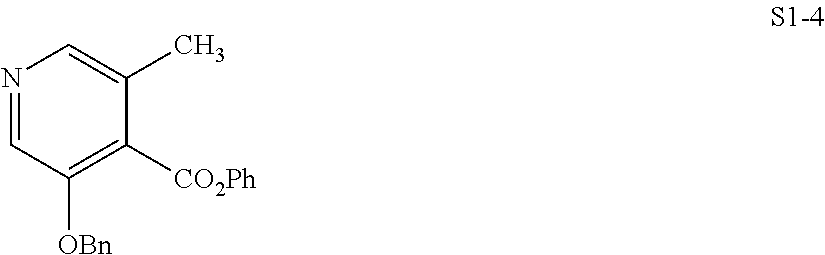
- Intermediate S1-3 (2.01 g, 5.92 mmol), methyl boronic acid (1.06 g, 17.7 mmol), dichlorobis(tricyclohexylphosphine)palladium(II) (102 mg, 0.296 mmol), and K3PO4 (3.76 g, 17.7 mmol) were heated to 100° C. in toluene (20 mL) and water (2 mL). After 16 hr, the reaction mixture was allowed to cool to rt and was diluted with EtOAc (20 mL). This was washed with water (20 mL) and brine (20 mL), dried over Na2SO4, filtered, and concentrated under reduced pressure. The material was purified by column chromatography (Biotage 50 g column, 0 to 40% EtOAc/hexanes gradient), yielding 1.66 g (88%) of the product as a white solid. Rf=0.18 in 30% EtOAc/hexanes. 1H NMR (400 MHz, DMSO-d6) δ 8.50 (s, 1H), 8.26 (s, 1H), 7.52-7.30 (m, 8H), 7.20-7.10 (m, 2H), 5.37 (s, 2H), 2.38 (s, 3H); MS (ESI) m/z 320.27 (M+H).
- Synthesis of S1-5.
-

- Intermediate S1-4 (25.9 g, 81.1 mmol) was heated to 80° C. in acetic acid (160 mL) and hydrogen peroxide (30% aqueous solution, 40 mL). After stirring overnight, LC/MS indicated that the starting material was consumed and the N-oxide present. The reaction mixture was concentrated under reduced pressure, diluted with EtOAc, and washed with NaHCO3 (saturated aqueous solution, 3 times). The organics were dried over Na2SO4, filtered, and concentrated under reduced pressure, yielding 25.4 g (93% crude) of the N-oxide as a tan solid. The material was suspended in toluene (200 mL) and heated to 80° C. at which point most of the solid had dissolved. Phosphorus oxybromide (25 g, 87.2 mmol) was added in one portion. After 30 minutes, LC/MS indicated the reaction was complete. Upon cooling to rt, the reaction mixture was poured into a solution of K2CO3 (83 g) in water (300 mL). Additional water (˜50 mL) was used to transfer the remaining material in the reaction flask into the K2CO3 solution. This was stirred for 30 minutes at rt. The layers were separated, and the aqueous layer was extracted with EtOAc. The combined extracts were dried over MgSO4, filtered through Celite, and concentrated under reduced pressure. The material was re-crystallized from EtOAc/hexanes (1:1), yielding 20.6 g (64%) of the product as an off-white solid. Single isomer by 1H-NMR. 1H NMR (400 MHz, CDCl3) δ 8.05 (s, 1H), 7.43-7.30 (m, 7H), 7.29-7.20 (m, 1H), 7.07 (d, J=8.2 Hz, 2H), 5.21 (s, 2H), 2.46 (s, 3H); MS (ESI) m/z 398.22, 400.22 (M+H).
- Synthesis of S1-6.
-

- Intermediate S1-5 (1.06 g, 2.66 mmol), dimethylamine (2.0 M solution in THF, 4.0 mL, 8.0 mmol), K3PO4 (1.7 g, 8.0 mmol), tris(dibenzylideneacetone)dipalladium (120 mg, 0.13 mmol) and 9,9-dimethyl-4,5-bis-(diphenylphosphinoxanthene (220 mg, 0.40 mmol) were heated to 100° C. in 1,4-dioxane (10 mL) in a sealed pressure vessel. After heating overnight, the reaction mixture was cooled to rt, was diluted with EtOAc (100 mL), and was washed with water (3×50 mL) and brine (50 mL). The organics were dried over Na2SO4, filtered, and concentrated under reduced pressure. The material was purified by column chromatography (Biotage 50 g column, 0 to 15% EtOAc in hexanes gradient), yielding 388 mg (40%) of intermediate S1-6. 1H NMR (400 MHz, CDCl3) δ 7.96 (s, 1H), 7.45-7.20 (m, 8H), 7.08 (d, J=8.2 Hz, 2H), 5.16 (s, 2H), 2.76 (s, 6H), 2.37 (s, 3H); MS (ESI) m/z 363.45 (M+H).
- Synthesis of S1-7.
-

- Intermediate S1-5 (8.54 g, 21.4 mmol) was heated to 80° C. in acetic acid (120 mL) and hydrogen peroxide (30% aqueous solution, 30 mL). After stirring overnight, LC/MS indicated that the starting material was mostly consumed and the N-oxide present. The reaction mixture was cooled to rt and diluted with brine (150 mL). The mixture was cooled in a −20° C. freezer for 30 minutes. The resulting precipitate was collected by filtration and was washed with water/brine (1:1, 2 times). The solid was dissolved in CH2Cl2 and was dried over Na2SO4, filtered, and concentrated under reduced pressure. This gave 7.83 g (88% crude) of the N-oxide as a tan solid. The material was suspended in toluene (200 mL) and was heated to 100° C. at which point most of the solid had dissolved. A solution of phosphorous oxybromide (10.8 g, 37.8 mmol) in toluene (10 mL) was added rapidly. After 45 minutes, LC/MS indicated the reaction was complete. Upon cooling to rt, the reaction mixture was poured into a solution of K2CO3 (40 g) in water (150 mL). Additional water (˜50 mL) was used to transfer the remaining material in the reaction flask into the K2CO3 solution. This was stirred for 30 minutes at rt. The layers were separated, and the aqueous layer was extracted with EtOAc. The combined extracts were dried over MgSO4, filtered, and concentrated under reduced pressure. The material was purified by column chromatography (Biotage 50 g column, 0 to 8% EtOAc in hexanes gradient to isolate the product then 15% EtOAc in hexanes to recover starting material), yielding 5.02 g (49%) of the product as an off-white solid. Intermediate S1-5 was also recovered. 1H NMR (400 MHz, DMSO-d6) δ 7.49-7.32 (m, 8H), 7.10 (d, J=7.3 Hz, 2H), 5.15 (s, 2H), 2.41 (s, 3H); MS (ESI) m/z 476.18, 478.16, 480.16 (M+H).
- Synthesis of S1-8.
-

- Intermediate S1-4 (9.66 g, 30.28 mmol) was heated to 80° C. in acetic acid (50 mL) and hydrogen peroxide (30% aqueous solution, 16.9 mL, 5 equiv). After 6 hr, LC/MS indicated that the starting material was consumed and the N-oxide present. Most of the acetic acid and water were removed by rotovap at 40° C. The material was then diluted with EtOAc (200 mL) and washed with NaHCO3 (saturated aqueous solution, 3×50 mL). The organics were dried over Na2SO4, filtered, and concentrated under reduced pressure. This gave 9.37 g (92% crude yield) of the N-oxide. This was dissolved in toluene (60 mL). Phosphorous oxychloride (7.69 g, 3 equiv) was added and the reaction mixture was heated to 100° C. After 2 hr, LC/MS indicated that the reaction was complete. Upon cooling to rt, the reaction mixture was poured into a solution of K2CO3 (40 g) in water (200 mL). This mixture was extracted with EtOAc (3×150 mL), and the combined extracts were dried over Na2SO4, filtered, and concentrated under reduced pressure. 1H-NMR indicated a mixture of regioisomers (4.5:1). The material was re-dissolved in EtOAc (30 mL) with heating and was then allowed to cool to rt and stand overnight. A white crystalline solid was obtained (4.99 g, 51%). Another 1.92 g (19%) of the white crystalline solid was obtained from the mother liquor after standing in a refrigerator overnight. Both are the desired pure regioisomer S1-8 by 1H-NMR. 1H NMR (400 MHz, CDCl3) δ 8.05 (s, 1H), 7.43-7.30 (m, 7H), 7.29-7.22 (m, 1H), 7.08 (d, J=8.2 Hz, 2H), 5.22 (s, 2H), 2.45 (s, 3H); MS (ESI) m/z 354.11 (M+H).
- Synthesis of S1-9.
-

- Intermediate S1-8 (4.99 g, 14.1 mmol) was dissolved in methylene chloride (30 mL) and 3-chloroperbenzoic acid (77%, 6.33 g, 28.2 mmol, 2) was added in one portion. After 6 hr, another additional 3-chloroperbenzoic acid (3.15 g, 14.10 mmol) was added, and the reaction was stirred at rt overnight. LC/MS indicated that the starting material was consumed and the N-oxide present. The reaction mixture was diluted with methylene chloride (200 mL) and was washed with Na2CO3 (saturated aqueous solution, 100 mL) and brine. The organics were dried over Na2SO4, filtered, and concentrated under reduced pressure. The material was purified by column chromatography (Biotage 70 g column, 5 to 50% EtOAc in hexanes gradient), yielding 3.90 g (75%) of the pure N-oxide as an off-white solid (Rf=0.33 in 66% EtOAc/hexanes). The N-oxide was dissolved in toluene (30 mL) and phosphorous oxybromide (6.36 g, 22.1 mmol) was added. The reaction mixture was heated to 80° C. After 1 hr, LC/MS indicated that the reaction was complete. Upon cooling to rt, the reaction mixture was poured into a solution of K2CO3 (10 g) in water (50 mL). This mixture was extracted with EtOAc (3×100 mL), and the combined extracts were dried over Na2SO4, filtered, and concentrated under reduced pressure. The resulting material was purified by column chromatography (Biotage 50 g column, 0 to 10% EtOAc in hexanes gradient), yielding 2.06 g (45%) of the desired product S1-9 as an oil which slowly solidified after standing overnight. In addition, 1.01 g (20%) intermediate S1-8 was recovered. 1H NMR (400 MHz, CDCl3) δ 7.49-7.41 (m, 2H), 7.40-7.27 (m, 7H), 7.02 (d, J=8.2 Hz, 2H), 5.15 (s, 2H), 2.43 (s, 3H); MS (ESI) m/z 432.02, 434.02 (M+H).
- S2-5, an intermediate useful in synthesizing compounds of the invention was prepared according to Scheme 2.
-

- Synthesis of S2-1.
-

- Oxalyl chloride (6.6 mL, 76 mmol) was added to a suspension of S1-2 (5.00 g, 19.0 mmol) in CH2Cl2 (100 mL) over ˜5 minutes. DMF was added drop wise in ˜20 μl portions every 5 minutes until complete solution was achieved. After stirring for an additional 30 minutes, the reaction mixture was concentrated under reduced pressure. The resulting solid was dissolved in methanol (100 mL). After 3 h, the reaction mixture was concentrated under reduced pressure, yielding 6.2 g (>100% crude yield with some residual solvent) of the product as a tan solid. The material was used without purification. 1H NMR (400 MHz, DMSO-d6) δ 8.58 (s, 1H), 8.39 (s, 1H), 7.42-7.30 (m, 5H), 5.36 (s, 2H), 3.88 (s, 3H); MS (ESI) m/z 278.24 (M+H).
- Synthesis of S2-2.
-

- The crude intermediate S2-1 (6.2 g, ≦19.0 mmol), methyl boronic acid (3.4 g, 57 mmol), dichlorobis(tricyclohexylphosphine)palladium(II) (326 mg, 0.95 mmol), and K3PO4 (12 g, 57 mmol) were heated to 100° C. in toluene (75 mL) and water (8 mL). After 16 hr, the reaction mixture was allowed to cool to rt and was diluted with EtOAc (100 mL). This was washed with water (100 mL) and brine (100 mL), dried over Na2SO4, filtered, and concentrated under reduced pressure. The material was purified by column chromatography (Biotage 50 g column, 0 to 50% EtOAc/hexanes gradient), yielding 3.99 g (82%) of the product as a thick oil. Rf=0.20 in 50% EtOAc/hexanes. 1H NMR (400 MHz, DMSO-d6) δ 8.37 (s, 1H), 8.16 (s, 1H), 7.42-7.28 (m, 5H), 5.27 (s, 2H), 3.84 (s, 3H), 2.19 (s, 3H); MS (ESI) m/z 258.27 (M+H).
- Synthesis of S2-3.
-
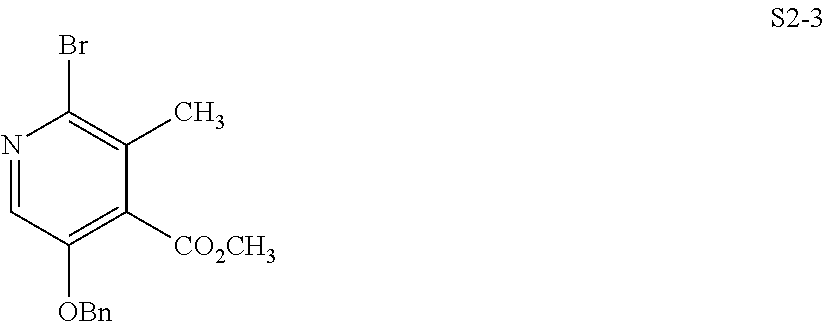
- Intermediate S2-2 (2.00 g, 7.77 mmol) was heated to 80° C. in acetic acid (10 mL) and hydrogen peroxide (30% aqueous solution, 10 mL). After 3 hr, LC/MS indicated that the starting material was consumed and the N-oxide present. The reaction mixture was concentrated under reduced pressure, diluted with EtOAc (50 mL), and washed with NaHCO3 (saturated aqueous solution, 3×50 mL). The organics were dried over Na2SO4, filtered, and concentrated under reduced pressure. The material was dissolved in toluene (20 mL) and phosphorous oxybromide (4.46 g, 15.5 mmol) was added. The reaction mixture was heated to 80° C. After 30 minutes, LC/MS indicated the reaction was complete. Upon cooling to rt, the reaction mixture was poured into a solution of K2CO3 (25 g) in water (100 mL). Additional water (˜50 mL) was used to transfer the remaining material in the reaction flask into the K2CO3 solution. This was extracted with EtOAc (3×100 mL), and the combined extracts were dried over Na2SO4, filtered, and concentrated under reduced pressure. The material was purified by column chromatography (Biotage 20 g column, 0 to 15% EtOAc/hexanes gradient), yielding 1.74 g (67%) of the product as an off-white solid. Rf=0.44 in 20% EtOAc/hexanes. 25:1 mixture of regioisomers by 1H-NMR. 1H NMR (400 MHz, DMSO-d6) δ 8.24 (s, 1H), 7.45-7.28 (m, 5H), 5.28 (s, 2H), 3.86 (s, 3H), 2.21 (s, 3H); MS (ESI) m/z 336.1, 338.1 (M+H).
- Synthesis of S2-5.
-

- Sodium methoxide (38 mg, 0.702 mmol) was added to a solution of intermediate S2-3 (118 mg, 0.351 mmol) in N-methylpyrrolidinone (2 mL), and the reaction mixture was heated to 100° C. After heating overnight, additional sodium methoxide (57 mg, 1.05 mmol) was added and heating was continued at 100° C. After 1 h, the reaction mixture was heated to 120° C. After an additional 1 h, the reaction mixture was cooled to rt, water (20 mL) was added, and the pH was adjusted to 2 with 6 N aqueous HCl. This was extracted with EtOAc (3×20 mL), and the combined extracts were dried over Na2SO4, filtered, and concentrated under reduced pressure. The crude acid intermediate was dissolved in CH2Cl2 (10 mL), and oxalyl chloride (0.123 mL, 1.40 mmol) was added After 1 h, the reaction mixture was concentrated under reduced pressure. The material was dissolved in CH2Cl2 (10 mL) and phenol (66 mg, 0.70 mmol), DMAP (4 mg, 0.035 mmol), and Et3N (0.245 mL, 1.76 mmol) were added. After 1 hr, the reaction mixture was diluted with EtOAc (50 mL) and was washed with water (2×30 mL) and brine (30 mL). The organics were dried over Na2SO4, filtered, and concentrated under reduced pressure. The material was purified by column chromatography (Biotage 10 g column, 0 to 12% EtOAc in hexanes gradient), yielding 20.3 mg (17%) of clean product. An additional 29.1 mg of product contaminated with some residual phenol was also isolated. Rf=0.39 in 20% EtOAc/hexanes. 1H NMR (400 MHz, CDCl3) δ 7.75 (s, 1H), 7.45-7.24 (m, 9H), 7.10 (d, J=7.3 Hz, 2H), 5.13 (s, 2H), 3.91 (s, 3H), 2.67 (s, 3H).
- Compounds of Formula I, wherein X and Z are simultaneously hydrogen (as well as compounds of Formula II, wherein Z is hydrogen and compounds of Formula III, wherein X is hydrogen) were prepared according to Scheme 3.
-

- Specific intermediates and compounds of the invention prepared by Scheme 3 are set forth in detail below.
- Synthesis of S3-2-1.
-

- Lithium diisopropylamide was prepared at −78° C. from n-butyllithium (1.6 M solution in hexane, 0.495 mL, 0.792 mmol) and diisopropylamine (0.112 mL, 0.792 mmol) in THF (5 mL). TMEDA (0.318 mL, 2.11 mmol) was added, followed by drop wise addition of a solution of intermediate S1-4 (169 mg, 0.529 mmol) in THF (2 mL). This resulted in a deep red colored solution. After 5 min, a solution of S3-1 (128 mg, 0.264 mmol) in THF (2 mL) was added. After complete addition, the reaction mixture was allowed to warm to −10° C. over 1 h. The reaction was quenched by the addition of ammonium chloride (saturated, aqueous solution, 20 mL) and was extracted with EtOAc (2×20 mL). The combined extracts were dried over Na2SO4, filtered, and concentrated under reduced pressure. The material was purified on a Waters Autopurification system equipped with a Sunfire Prep C18 OBD column [5 μm, 19×50 mm; flow rate, 20 mL/min; Solvent A: H2O with 0.1% HCO2H; Solvent B: CH3CN with 0.1% HCO2H; gradient: 80→100% B; mass-directed fraction collection], yielding 65.5 mg (35%) of the desired product S3-2-1 as a yellow solid. 1H NMR (400 MHz, CDCl3) δ 15.77 (s, 1H), 8.36 (s, 1H), 8.16 (s, 1H), 7.55-7.24 (m, 10H), 5.40-5.25 (m, 4H), 3.93 (d, J=11.0 Hz, 1H), 3.16-3.04 (m, 1H), 2.98-2.90 (m, 1H), 2.76-2.64 (m, 1H), 2.60-2.40 (m, 8H), 2.12 (d, J=14 Hz, 1H), 0.82 (s, 9H), 0.26 (s, 3H), 0.13 (s, 3H); MS (ESI) m/z 708.72 (M+H).
- Compound 102
-

- Aqueous HF (0.4 mL, 48%) was added to a solution of S3-2-1 (65.5 mg, 0.093 mmol) in CH3CN (0.6 mL) in a plastic vial. After 18 h, the reaction mixture was poured into a solution of K2HPO4 (4.8 g) in water (20 mL). The mixture was extracted with EtOAc (3×20 mL). The combined EtOAc extracts were dried over Na2SO4, filtered and concentrated under reduced pressure. The material was dissolved in methanol (1 mL) and 1,4-dioxane (1 mL), and palladium on carbon (Degussa, 10 wt %, ˜5 mg) was added. An atmosphere of hydrogen was introduced, and the reaction mixture was stirred for 2 h. The reaction mixture was filtered through Celite, and the filtrate was concentrated under reduced pressure. The material was purified on a Waters Autopurification system equipped with a Phenomenex Polymerx 10μ RP 100A column [10 μm, 30×21.20 mm; flow rate, 20 mL/min; Solvent A: 0.05 N HCl in water; Solvent B: CH3CN; gradient: 0→100% B; mass-directed fraction collection]. Fractions with the desired MW were collected and freeze-dried to yield 18.4 mg (41%, 2 steps) of the desired product Compound 102 as a yellow solid. 1H NMR (400 MHz, CD3OD with 1 drop DCl) δ 8.55 (s, 1H), 8.36 (s, 1H), 4.19 (s, 1H), 3.26-2.98 (m, 9H), 2.71 (t, J=14.2 Hz, 1H), 2.39-2.32 (m, 1H), 1.75-1.63 (m, 1H); MS (ESI) m/z 416.44 (M+H).
- Synthesis of S3-2-2.
-

- A solution of intermediate S3-1-6 (412 mg, 1.14 mmol) in THF (1 mL) was added drop wise to a −78° C. solution of lithium diisopropylamide (10 wt % suspension in hexanes, 2.55 mL, 1.70 mmol) and TMEDA (0.684 mL, 4.54 mmol) in THF (10 mL), resulting in a reddish orange colored solution. After 10 min, a solution of S3-1 (274 mg, 0.568 mmol) in THF (1 mL) was added drop wise. The color gradually lightened to orange. After complete addition, the reaction mixture was allowed to warm to 0° C. over 1 h. The reaction was quenched by the addition of ammonium chloride (saturated, aqueous solution), was diluted with water, and was extracted with EtOAc (3×). The combined extracts were dried over Na2SO4, filtered, and concentrated under reduced pressure. The material was purified on a Waters Autopurification system equipped with a Sunfire Prep C18 OBD column [5 μm, 19×50 mm; flow rate, 20 mL/min; Solvent A: H2O with 0.1% HCO2H; Solvent B: CH3CN with 0.1% HCO2H; gradient: 80→100% B; mass-directed fraction collection], yielding 211 mg (50%) of the desired product S3-2-2 as a yellow solid. 1H NMR (400 MHz, CDCl3) δ 15.65 (s, 1H), 8.01 (s, 1H), 7.52-7.22 (m, 10H), 5.36 (s, 2H), 5.17 (q, J=11.0 Hz, 2H), 4.02 (d, J=11.0 Hz, 1H), 3.05 (dd, J=17.2 Hz, J=11.6 Hz, 1H), 2.98-2.86 (m, 1H), 2.73 (s, 6H), 2.62-2.38 (m, 9H), 2.12 (d, J=13.4 Hz, 1H), 0.81 (s, 9H), 0.26 (s, 3H), 0.13 (s, 3H); MS (ESI) m/z 751.79 (M+H).
- Compound 109
-

- Aqueous HF (1.3 mL, 48%) was added to a solution of S3-2-2 (211 mg, 0.281 mmol) in CH3CN (1.3 mL) in a plastic vial. After 18 h, the reaction mixture was poured into a solution of K2HPO4 (15.6 g) in water (50 mL). The mixture was extracted with EtOAc (3×50 mL). The aqueous layer was diluted with brine (25 mL) and was extracted with EtOAc (2×75 mL). The combined EtOAc extracts were dried over Na2SO4, filtered and concentrated under reduced pressure. The material was dissolved in methanol (5 mL) and 1,4-dioxane (5 mL), and palladium on carbon (Degussa, 10 wt %, ˜30 mg) was added. An atmosphere of hydrogen was introduced, and the reaction mixture was stirred for 1 h. The reaction mixture was filtered through Celite, and the filtrate was concentrated under reduced pressure. The material was purified on a Waters Autopurification system equipped with a Phenomenex Polymerx 10μ RP 100A column [10 μm, 30×21.20 mm; flow rate, 20 mL/min; Solvent A: 0.05 N HCl in water; Solvent B: CH3CN; gradient: 10→100% B; mass-directed fraction collection]. Fractions with the desired MW were collected and freeze-dried to yield 142 mg (96%, 2 steps) of the desired product Compound 109 as a yellow solid. 1H NMR (400 MHz, CD3OD with 1 drop DCl) δ 8.22 (s, 1H), 4.19 (s, 1H), 3.38-3.30 (m, 2H), 3.24 (s, 6H), 3.12-2.95 (m, 7H), 2.60 (t, J=14.2 Hz, 1H), 2.42-2.34 (m, 1H), 1.75-1.63 (m, 1H); MS (ESI) m/z 459.50 (M+H).
- Synthesis of S3-2-3.
-
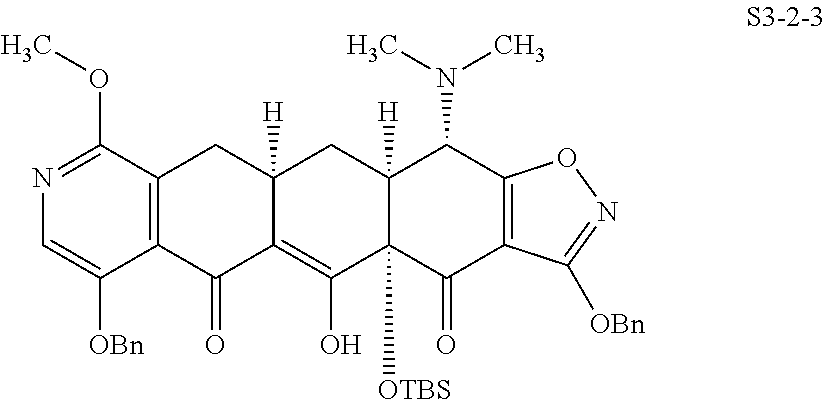
- A solution of intermediate S2-5 (20.3 mg, 0.058 mmol) in THF (1 mL) was added drop wise to a −78° C. solution of lithium diisopropylamide (1.8 M solution in hexanes, 0.050 mL, 0.090 mmol) and TMEDA (0.022 mL, 0.15 mmol) in THF (2 mL). After 10 min, a solution of S3-1 (14 mg, 0.029 mmol) in THF (0.5 mL) was added. After complete addition, the reaction mixture was allowed to warm to 0° C. over 1 h. LC/MS indicated a lot of S2-5 and S3-1 remained. The reaction mixture was again cooled to −78° C., and additional lithium diisopropylamide (1.8 M solution in hexanes, 0.050 mL, 0.090 mmol) was added. This was allowed to warm to 0° C. over 30 min. The reaction was quenched by the addition of ammonium chloride (saturated, aqueous solution, 20 mL), was diluted with water, and was extracted with EtOAc (3×20 mL). The combined extracts were dried over Na2SO4, filtered, and concentrated under reduced pressure. The material was purified on a Waters Autopurification system equipped with a Sunfire Prep C18 OBD column [5 μm, 19×50 mm; flow rate, 20 mL/min; Solvent A: H2O with 0.1% HCO2H; Solvent B: CH3CN with 0.1% HCO2H; gradient: 80→100% B; mass-directed fraction collection], yielding 5.9 mg (27%) of the desired product S3-2-3 as a yellow solid. 1H NMR (400 MHz, CDCl3) δ 15.70 (s, 1H), 7.83 (s, 1H), 7.55-7.24 (m, 10H), 5.36 (s, 2H), 5.17 (q, J=13.4 Hz, 2H), 3.98 (d, J=11.0 Hz, 1H), 3.72 (s, 3H), 3.18 (d, J=16.5 Hz, 1H), 3.04-2.96 (m, 1H), 2.60-2.30 (m, 9H), 2.15 (d, J=14 Hz, 1H), 0.82 (s, 9H), 0.26 (s, 3H), 0.13 (s, 3H); MS (ESI) m/z 738.66 (M+H).
- Compound 121
-

- Aqueous HF (0.4 mL, 48%) was added to a solution of S3-2-3 (5.9 mg, 0.008 mmol) in CH3CN (0.4 mL) in a plastic vial. After 18 h, the reaction mixture was poured into a solution of K2HPO4 (4.8 g) in water (20 mL). The mixture was extracted with EtOAc (3×20 mL). The combined EtOAc extracts were dried over Na2SO4, filtered and concentrated under reduced pressure. The material was dissolved in methanol (1 mL) and 1,4-dioxane (1 mL), and palladium on carbon (Degussa, 10 wt %, ˜5 mg) was added. An atmosphere of hydrogen was introduced, and the reaction mixture was stirred for 1 h. The reaction mixture was filtered through Celite, and the filtrate was concentrated under reduced pressure. The material was purified on a Waters Autopurification system equipped with a Phenomenex Polymerx 10μ RP 100A column [10 μm, 30×21.20 mm; flow rate, 20 mL/min; Solvent A: 0.05 N HCl in water; Solvent B: CH3CN; gradient: 10→100% B; mass-directed fraction collection]. Fractions with the desired MW were collected and freeze-dried to yield 2.1 mg (51%, 2 steps) of the desired product Compound 121 as a yellow solid. 1H NMR (400 MHz, CD3OD with 1 drop DCl) δ 7.80 (s, 1H), 4.15 (s, 1H), 3.97 (s, 3H), 3.40-2.98 (m, 9H), 2.32-2.20 (m, 2H), 1.72-1.56 (m, 1H); MS (ESI) m/z 446.39 (M+H).
- Additional compounds of Formula I, wherein X and Z are simultaneously hydrogen (as well as compounds of Formula II, wherein Z is hydrogen and compounds of Formula III, wherein X is hydrogen) were prepared according to Scheme 4.
-

- Synthesis of S3-2-4.
-

- Lithium diisopropylamide was prepared at −78° C. from n-butyllithium (1.6 M solution in hexane, 0.850 mL, 1.36 mmol) and diisopropylamine (0.192 mL, 1.36 mmol) in THF (10 mL). TMEDA (0.546 mL, 3.63 mmol) was added, followed by drop wise addition of a solution of intermediate S1-5 (361 mg, 0.907 mmol) in THF (3.5 mL). This resulted in a deep red colored solution. After 5 min, a solution of S3-1 (219 mg, 0.0.454 mmol) in THF (1 mL) was added. After complete addition, the reaction mixture was allowed to warm to 0° C. over 1.5 h. The reaction was quenched by the addition of ammonium chloride (saturated, aqueous solution) and was extracted with EtOAc (3×). The combined extracts were dried over Na2SO4, filtered, and concentrated under reduced pressure. The material was purified on a Waters Autopurification system equipped with a Sunfire Prep C18 OBD column [5 μm, 19×50 mm; flow rate, 20 mL/min; Solvent A: H2O with 0.1% HCO2H; Solvent B: CH3CN with 0.1% HCO2H; gradient: 80→100% B; mass-directed fraction collection], yielding 252 mg (71%) of the desired product S3-2-4 as a yellow solid. 1H NMR (400 MHz, CDCl3) δ 15.55 (s, 1H), 8.12 (s, 1H), 7.55-7.24 (m, 10H), 5.40-5.22 (m, 4H), 3.90 (d, J=11.0 Hz, 1H), 3.25 (dd, J=16.5 Hz, J=4.88 Hz, 1H), 3.12-3.02 (m, 1H), 2.62-2.42 (m, 9H), 2.14 (d, J=14.0 Hz, 1H), 0.82 (s, 9H), 0.26 (s, 3H), 0.13 (s, 3H); MS (ESI) m/z 786.63, 788.63 (M+H).
- Specific intermediates and compounds of the invention prepared using S3-2-4 according to Scheme 4 are set forth in detail below.
- Synthesis of S4-1-1.
-

- A solution of intermediate S3-2-4 (52.5 mg, 0.067 mmol), methylboronic acid (40 mg, 0.67 mmol), dichloro[1,1′-bis(diphenylphosphino)-ferrocene]palladium(II) methylene chloride adduct (3 mg, 0.003 mmol) and potassium phosphate (142 mg, 0.667 mmol) in toluene (1 mL), 1,4-dioxane (1 mL), and water (0.2 mL) was heated to 70° C. After 2 h, the reaction mixture was heated to 100° C. After an additional 2 h, the reaction mixture was diluted with EtOAc (20 mL) and was washed with water (15 mL) and brine (15 mL). The organics were dried over Na2SO4, filtered, and concentrated under reduced pressure. The material was purified on a Waters Autopurification system equipped with a Sunfire Prep C18 OBD column [5 μm, 19×50 mm; flow rate, 20 mL/min; Solvent A: H2O with 0.1% HCO2H; Solvent B: CH3CN with 0.1% HCO2H; gradient: 80→100% B; mass-directed fraction collection], yielding 18.3 mg (38%) of the desired product S4-1-1 as a yellow solid. 1H NMR (400 MHz, CDCl3) δ 15.71 (s, 1H), 8.24 (s, 1H), 7.55-7.24 (m, 10H), 5.36 (s, 2H), 5.30-5.20 (m, 2H), 3.95 (d, J=10.4 Hz, 1H), 3.10-2.92 (m, 2H), 2.62-2.42 (m, 12H), 2.12 (d, J=14.0 Hz, 1H), 0.82 (s, 9H), 0.26 (s, 3H), 0.14 (s, 3H); MS (ESI) m/z 722.72 (M+H).
- Compound 152
-

- Aqueous HF (0.4 mL, 48%) was added to a solution of S4-1-1 (18.3 mg, 0.025 mmol) in CH3CN (0.6 mL) in a plastic vial. After 18 h, the reaction mixture was poured into a solution of K2HPO4 (4.8 g) in water (20 mL). The mixture was extracted with EtOAc (3×20 mL). The combined EtOAc extracts were dried over Na2SO4, filtered and concentrated under reduced pressure. The material was dissolved in methanol (2 mL) and 1,4-dioxane (2 mL), and palladium on carbon (Degussa, 10 wt %, ˜5 mg) was added. An atmosphere of hydrogen was introduced, and the reaction mixture was stirred for 1 h. The reaction mixture was filtered through Celite, and the filtrate was concentrated under reduced pressure. The material was purified on a Waters Autopurification system equipped with a Phenomenex Polymerx 10μ RP 100A column [10 μm, 30×21.20 mm; flow rate, 20 mL/min; Solvent A: 0.05 N HCl in water; Solvent B: CH3CN; gradient: 0→100% B; mass-directed fraction collection]. Fractions with the desired MW were collected and freeze-dried to yield 4.3 mg (34%, 2 steps) of the desired product Compound 152 as a yellow solid. 1H NMR (400 MHz, CD3OD with 1 drop DCl) δ 8.35 (s, 1H), 4.19 (s, 1H), 3.25-2.95 (m, 9H), 2.80-2.25 (m, 5H), 1.80-1.63 (m, 1H); MS (ESI) m/z 430.46 (M+H).
- Synthesis of S4-1-2.
-

- A solution of intermediate S3-2-4 (31.6 mg, 0.040 mmol), phenylboronic acid (24.5 mg, 0.201 mmol), dichloro[1,1′-bis(diphenylphosphino)-ferrocene]palladium(II) methylene chloride adduct (1.6 mg, 0.002 mmol) and sodium carbonate (21.3 mg, 0.201 mmol) in toluene (1 mL), 1,4-dioxane (1 mL), and water (0.2 mL) was heated to 100° C. via microwave reactor for 10 min. The reaction mixture was diluted with EtOAc (10 mL) and was washed with water (5 mL) and brine (5 mL). The organics were dried over Na2SO4, filtered, and concentrated under reduced pressure. The material was purified on a Waters Autopurification system equipped with a Sunfire Prep C18 OBD column [5 μm, 19×50 mm; flow rate, 20 mL/min; Solvent A: H2O with 0.1% HCO2H; Solvent B: CH3CN with 0.1% HCO2H; gradient: 80→100% B; mass-directed fraction collection], yielding 16.9 mg (54%) of the desired product S4-1-2 as a yellow solid. 1H NMR (400 MHz, CDCl3) δ 15.66 (s, 1H), 8.48 (s, 1H), 7.52-7.24 (m, 15H), 5.42-5.30 (m, 4H), 3.97 (d, J=10.4 Hz, 1H), 3.00-2.86 (m, 2H), 2.78-2.62 (m, 1H), 2.58-2.30 (m, 8H), 2.00 (d, J=14.0 Hz, 1H), 0.80 (s, 9H), 0.25 (s, 3H), 0.14 (s, 3H); MS (ESI) m/z 784.75 (M+H).
- Compound 160
-

- Aqueous HF (0.4 mL, 48%) was added to a solution of S4-1-2 (12.2 mg, 0.0156 mmol) in CH3CN (0.6 mL) in a plastic vial. After 18 h, the reaction mixture was poured into a solution of K2HPO4 (4.8 g) in water (20 mL). The mixture was extracted with EtOAc (3×20 mL). The combined EtOAc extracts were dried over Na2SO4, filtered and concentrated under reduced pressure. The material was dissolved in methanol (2 mL) and 1,4-dioxane (2 mL), and palladium on carbon (Degussa, 10 wt %, ˜5 mg) was added. An atmosphere of hydrogen was introduced, and the reaction mixture was stirred for 2 h. The reaction mixture was filtered through Celite, and the filtrate was concentrated under reduced pressure. The material was purified on a Waters Autopurification system equipped with a Phenomenex Polymerx 10μ RP 100A column [10 μM, 30×21.20 mm; flow rate, 20 mL/min; Solvent A: 0.05 N HCl in water; Solvent B: CH3CN; gradient: 0→100% B; mass-directed fraction collection]. Fractions with the desired MW were collected and freeze-dried to yield 2.1 mg (24%, 2 steps) of the desired product Compound 160 as a yellow solid. 1H NMR (400 MHz, CD3OD with 1 drop DCl) δ 8.53 (s, 1H), 7.62 (s, 5H), 4.18 (s, 1H), 3.14-2.82 (m, 9H), 2.81-2.66 (m, 1H), 2.24-2.14 (m, 1H), 1.66-1.52 (m, 1H); MS (ESI) m/z 492.48 (M+H).
- Compounds of Formula I, wherein X is hydrogen, Y is Cl or hydrogen, and Z is —N(R3)(R4) (as well as compounds of Formula II, wherein Z is —N(R3)(R4)) were prepared according to Scheme 5.
-

- The following specific intermediates and compounds of the invention were prepared according to Scheme 5
-

- Synthesis of S5-1.
- Intermediate S1-9 (793 mg, 1.84 mmol) and S3-1 (885 mg, 1.84 mmol, 1.0 eq) were dissolved in THF (anhydrous, 16 mL) under a nitrogen atmosphere in a flame-dried Schlenck flask. The resulting solution was cooled to −78° C. in a dry ice/acetone bath. LHMDS solution (1.0 M, 5.51 mL, 3.0 equiv) was added slowly via syringe. After 10 min, LC/MS indicated that the starting material was consumed and the product present. The reaction mixture was allowed to slowly warm to 0° C. over 1 hr. A phosphate buffer solution (pH 7.0, 20 mL) was added, followed by the addition of ammonium chloride (saturated, aqueous solution, 50 mL). The resulting mixture was extracted with methylene chloride (3×50 mL), and the combined extracts were dried over Na2SO4, filtered, and concentrated under reduced pressure. The resulting brown solid was washed with cold methanol (3×5 mL) to afford the desired product S5-1 as a yellow-brown powder (1.11 g, 74%). The organics were concentrated under reduced pressure and purified by column chromatography (Biotage 20 g column, 5 to 20% EtOAc in hexanes gradient), yielding another 150 mg (10%) of intermediate S5-1. NMR (400 MHz, CDCl3) δ 15.45 (br, 1H), 7.54-7.48 (m, 4H), 7.40-7.30 (m, 6H), 5.36 (s, 2H), 5.03 (abq, J=10.4 Hz, 2H), 3.87 (d, J=11.0 Hz, 1H), 3.27-3.23 (m, 1H), 3.10-3.00 (m, 1H), 2.65-2.57 (m, 1H), 2.57-2.43 (m, 8H), 2.16 (d, J=11.0 Hz, 1H), 0.81 (s, 9H), 0.26 (s, 3H), 0.12 (s, 3H); MS (ESI) m/z 820.37, 822.37 (M+H).
- Synthesis of S5-2-1.
-

- Intermediate S5-1 (50 mg, 0.061 mmol), K3PO4 (39 mg, 0.18 mmol, 3.0 equiv), tris(dibenzylideneacetone)dipalladium (2.8 mg, 0.003 mmol, 5 mol %) and 9,9-dimethyl-4,5-bis-(diphenylphosphino)xanthene (5.1 mg, 0.009 mmol, 15 mol %) were added to a small vial equipped with a septa. After the flask was evacuated and flushed with nitrogen 3 times, 0.5 mL anhydrous dioxane was added, followed by the addition of ethylamine (2.0 M/THF, 0.091 mL, 0.18 mmol, 3 equiv). The reaction mixture was heated to 100° C. and stirred for 3 hr. LC/MS indicated that the starting material was about 40% consumed and the product present. The reaction mixture was allowed to cool to rt and was filtered through a small Celite pad. The crude black oil was purified on a Waters Autopurification system equipped with a Sunfire Prep C18 OBD column [5 μm, 19×50 mm; flow rate, 20 mL/min; Solvent A: H2O with 0.1% HCO2H; Solvent B: CH3CN with 0.1% HCO2H; gradient: 90→100% B; mass-directed fraction collection]. The fractions with the desired MW were collected and freeze-dried to yield 11 mg (23%) of the desired product S5-2-1 as a yellow solid: 1H NMR (400 MHz, CCl3D) δ 15.6 (br, 1H), 7.56-7.49 (m, 4H), 7.42-7.30 (m, 6H), 5.37 (s, 2H), 5.03 (s, 2H), 3.89 (d, J=11.0 Hz, 1H), 3.24-3.04 (m, 3H), 2.97 (dd, J=15.6, 4.9 Hz, 1H), 2.64-2.43 (m, 3H), 2.49 (s, 6H), 2.14 (d, J=15.6 Hz, 1H), 1.25 (t, J=6.8 Hz, 3H), 0.81 (s, 9H), 0.25 (s, 3H), 0.11 (s, 3H); MS (ESI) m/z 785.57 (M+H).
- Compound 110
-

- Aqueous HF (0.3 mL, 48%) was added to a solution of S5-2-1 (11 mg, 0.014 mmol) in CH3CN (7 mL) in a plastic vial. After 18 h, the reaction mixture was poured into a solution of K2HPO4 (2 g) in water (10 mL). The mixture was extracted with EtOAc (3×). The combined EtOAc extracts were dried over Na2SO4 and concentrated under reduced pressure. The material was dissolved in methanol (2 mL) and dioxane (2 mL), and palladium on carbon (Degussa, 10 wt %, 5.6 mg) was added. An atmosphere of hydrogen was introduced, and the reaction mixture was stirred for 1 h. The reaction mixture was filtered through a small Celite pad, and the filtrate was concentrated under reduced pressure. The material was purified on a Waters Autopurification system equipped with a Phenomenex Polymerx 10μ RP 100A column [10 μm, 30×21.20 mm; flow rate, 20 mL/min; Solvent A: 0.05 N HCl in water; Solvent B: CH3CN; gradient: 0→100% B; mass-directed fraction collection]. Fractions with the desired MW were collected and freeze-dried to yield 3.2 mg (46%, 2 steps) of the desired product Compound 110 as a yellow solid. 1H NMR (400 MHz, CD3OD) δ 4.08 (s, 1H), 3.43 (q, J=7.4 Hz, 2H), 3.08-2.92 (m, 9H), 2.30-2.15 (m, 2H), 1.67-1.55 (m, 1H), 1.22 (t, J=7.4 Hz, 3H); MS (ESI) m/z 493.24 (M+H).
- The following compounds were prepared according to the methods of Compound 110, substituting the appropriate amine for ethylamine:
- Compound 156
-

- 1H NMR (400 MHz, CD3OD with 1 drop DCl) δ 4.16 (s, 1H), 3.47 (t, J=7.3 Hz, 2H), 3.15-2.96 (m, 9H), 2.32-2.20 (m, 2H), 1.78-1.55 (m, 3H), 1.01 (t, J=7.4 Hz, 3H); MS (ESI) m/z 507.29 (M+H).
- Compound 112
-

- 1H NMR (400 MHz, CD3OD with 1 drop DCl) δ 4.18 (s, 1H), 3.38 (d, J=7.3 Hz, 2H), 3.20-2.96 (m, 9H), 2.34-2.20 (m, 2H), 2.10-1.98 (m, 1H), 1.68-1.54 (m, 1H), 1.00 (d, J=6.4 Hz, 6H); MS (ESI) m/z 521.40 (M+H).
- Compound 150
-

- 1H NMR (400 MHz, CD3OD with 1 drop DCl) δ 4.13 (s, 1H), 3.72-3.60 (m, 4H), 3.40 (s, 3H), 3.12-2.95 (m, 9H), 2.32-2.21 (m, 2H), 1.69-1.56 (m, 1H); MS (ESI) m/z 523.32 (M+H).
- Compound 153
-
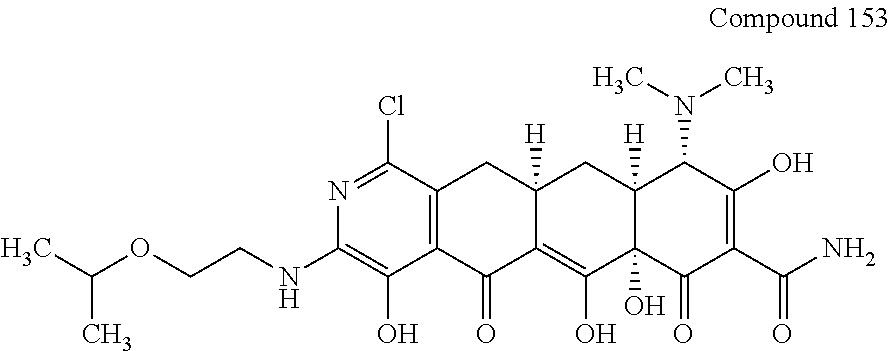
- 1H NMR (400 MHz, CD3OD with 1 drop DCl) δ 4.19 (s, 1H), 3.82-3.69 (m, 5H), 3.20-2.98 (m, 9H), 2.35-2.22 (m, 2H), 1.68-1.56 (m, 1H), 1.18 (d, J=6.4 Hz, 6H); MS (ESI) m/z 551.41 (M+H).
- Compound 101
-

- 1H NMR (400 MHz, CD3OD) δ 4.08 (s, 1H), 3.41 (s, 3H), 3.08-2.92 (m, 9H), 2.30-2.15 (m, 2H), 1.67-1.55 (m, 1H); MS (ESI) m/z 479.22 (M+H).
- Compound 154
-

- 1H NMR (400 MHz, CD3OD) δ 4.09 (s, 1H), 3.42-3.38 (m, 2H), 3.20 (s, 1H), 3.09-2.92 (m, 9H), 2.29-2.16 (m, 2H), 1.66-1.55 (m, 3H), 1.45-1.36 (m, 2H), 0.96 (t, J=7.3 Hz, 3H); MS (ESI) m/z 521.34 (M+H).
- Compound 157
-

- 1H NMR (400 MHz, CD3OD) δ 4.21-4.13 (m, 1H), 4.08 (s, 1H), 3.14-2.92 (m, 9H), 2.31-2.15 (m, 2H), 1.67-1.56 (m, 1H), 1.23 (dd, J=6.4, 1.8 Hz, 6H); MS (ESI) m/z 507.24 (M+H).
- Compound 126
-

- 1H NMR (400 MHz, CD3OD) δ 4.09 (s, 1H), 3.45-3.40 (m, 2H), 3.20 (s, 1H), 3.08-2.93 (m, 9H), 2.30-2.16 (m, 2H), 1.72-1.58 (m, 2H), 1.55-1.48 (m, 2H), 0.96 (d, J=6.4 Hz, 6H); MS (ESI) m/z 535.30 (M+H).
- Compound 162:
-

- 1H NMR (400 MHz, CD3OD) δ 4.16 (s, 1H), 3.47-3.42 (m, 2H), 3.11-2.93 (m, 9H), 2.32-2.19 (m, 2H), 1.67-1.57 (m, 1H), 1.19-1.14 (m, 1H), 0.79-0.73 (m, 2H), 0.48-0.42 (m, 2H); MS (ESI) m/z 519.30 (M+H).
- Compound 115
-

- 1H NMR (400 MHz, CD3OD) δ 4.12 (s, 1H), 3.41-3.37 (s, 2H), 3.14-2.93 (m, 9H), 2.34-2.20 (m, 2H), 1.68-1.57 (m, 1H), 1.06 (s, 9H); MS (ESI) m/z 535.34 (M+H).
- Compound 148
-

- 1H NMR (400 MHz, CD3OD) δ 4.09 (s, 1H), 3.44-3.40 (m, 2H), 3.08-2.93 (m, 9H), 2.30-2.16 (m, 2H), 1.67-1.51 (m, 3H), 0.98 (s, 9H); MS (ESI) m/z 549.34 (M+H).
- Compound 140
-

- 1H NMR (400 MHz, CD3OD) δ 4.13 (s, 1H), 3.84-3.77 (m, 2H), 3.44-3.38 (m, 2H), 3.10-2.92 (m, 15H), 2.32-2.20 (m, 2H), 1.68-1.55 (m, 1H); MS (ESI) m/z 536.25 (M+H).
- Compound 119
-

- 1H NMR (400 MHz, CD3OD) δ 4.09 (s, 1H), 3.70-3.46 (m, 4H), 3.10-2.90 (m, 15H), 2.31-2.17 (m, 2H), 2.10-2.00 (m, 2H), 1.68-1.56 (m, 1H); MS (ESI) m/z 550.34 (M+H).
- Compound 134
-

- 1H NMR (400 MHz, CD3OD) δ 4.09 (s, 1H), 3.58-3.50 (m, 1H), 3.12-2.92 (m, 13H), 2.30-2.17 (m, 2H), 2.04-1.95 (m, 2H), 1.67-1.55 (m, 1H), 1.33 (d, J=6.4 Hz, 6H); MS (ESI) m/z 564.39 (M+H).
- Compound 124
-

- 1H NMR (400 MHz, CD3OD) δ 4.22-4.15 (m, 2H), 4.09 (s, 1H), 3.08-2.92 (m, 9H), 2.33-2.18 (m, 2H), 1.68-1.57 (m, 1H) MS (ESI) m/z 547.0 (M+H).
- Compound 107
-

- 1H NMR (400 MHz, CD3OD) δ 7.29 (d, J=8.2 Hz, 2H), 7.18 (t, J=7.2 Hz, 2H), 7.08 (t, J=7.2 Hz, 1H), 5.12-5.06 (m, 1H), 3.99 (s, 1H), 2.97-2.82 (m, 9H), 2.15-2.07 (m, 2H); 1.58-1.49 (m, 1H), 1.47 (d, J=7.6 Hz, 3H); MS (ESI) m/z 569.1 (M+H).
- Compound 139
-

- 1H NMR (400 MHz, CD3OD) δ 7.77 (d, J=8.0 Hz, 2H), 7.31 (t, J=7.2 Hz, 2H), 7.01 (t, J=7.2 Hz, 1H), 4.11 (s, 1H), 3.16-2.95 (m, 9H), 2.41-2.19 (m, 2H), 1.70-1.60 (m, 1H); MS (ESI) m/z 541.1 (M+H).
- Synthesis of S5-2-19.
-

- Intermediate S5-1 (100 mg, 0.122 mmol), t-butylcarbamate (42.9 mg, 0.366 mmol), K3PO4 (77.7 mg, 0.366 mmol), tris(dibenzylideneacetone)-dipalladium (5.6 mg, 0.006 mmol) and 9,9-dimethyl-4,5-bis-(diphenylphosphino)-xanthene (10.3 mg, 0.018 mmol) were added to a vial equipped with a septum. After the flask was evacuated and flushed with nitrogen 3 times, 0.5 mL anhydrous dioxane was added. The reaction mixture was heated to 100° C. and stirred for 2 hr. The reaction mixture was allowed to cool to rt, was filtered through Celite, and was concentrated under reduced pressure. The material was purified on a Waters Autopurification system equipped with a Sunfire Prep C18 OBD column [5 μm, 19×50 mm; flow rate, 20 mL/min; Solvent A: H2O with 0.1% HCO2H; Solvent B: CH3CN with 0.1% HCO2H; gradient: 80→100% B; mass-directed fraction collection]. The fractions with the desired MW were collected and freeze-dried to yield 41.7 mg (40%) of the desired product as a yellow solid. 1H NMR (400 MHz, CDCl3) δ 15.65-15.45 (br s, 1H), 7.56-7.50 (m, 2H), 7.43-7.34 (m, 7H), 7.29-7.20 (m, 1H), 5.38 (s, 2H), 4.94 (dd, J=29.3 Hz, J=11.0 Hz, 2H), 3.90 (d, J=11.0 Hz, 1H), 3.27 (dd, J=16.4 Hz, J=11.6 Hz, 1H), 3.12-3.03 (m, 1H), 2.68-2.60 (m, 1H), 2.60-2.45 (m, 8H), 2.18 (d, J=14.6 Hz, 1H), 1.47 (s, 9H), 0.85 (s, 9H), 0.29 (s, 3H), 0.15 (s, 3H); MS (ESI) m/z 857.67 (M+H).
- Compound 147
-

- Aqueous HF (0.4 mL, 48%) was added to a solution of S5-2-19 (41.7 mg, 0.049 mmol) in CH3CN (0.6 mL) in a plastic vial. After 18 h, the reaction mixture was poured into a solution of K2HPO4 (7.8 g) in water (15 mL). The mixture was extracted with EtOAc (3×). The combined EtOAc extracts were dried over Na2SO4 and concentrated under reduced pressure. The material was dissolved in methanol (1 mL) and dioxane (1 mL), and palladium on carbon (Degussa, 10 wt %, ˜2 mg) was added. An atmosphere of hydrogen was introduced, and the reaction mixture was stirred for 3 h. The reaction mixture was filtered through a small Celite pad, and the filtrate was concentrated under reduced pressure. The material was purified on a Waters Autopurification system equipped with a Phenomenex Polymerx 10μ RP 100A column [10 μm, 30×21.20 mm; flow rate, 20 mL/min; Solvent A: 0.05 N HCl in water; Solvent B: CH3CN; gradient: 0→100% B; mass-directed fraction collection]. Fractions with the desired MW were collected and freeze-dried to yield 17.7 mg (68%, 2 steps) of Compound 148 as a yellow solid. 1H NMR (400 MHz, CD3OD with 1 drop DCl) δ 4.19 (s, 1H), 3.20-2.98 (m, 8H), 2.35-2.22 (m, 2H), 1.68-1.56 (m, 1H); MS (ESI) m/z 465.32 (M+H).
- Compound 146
-

- Aqueous HF (0.4 mL, 48%) was added to a solution of S5-2-19 (31.3 mg, 0.037 mmol) in CH3CN (0.6 mL) in a plastic vial. After 18 h, the reaction mixture was poured into a solution of K2HPO4 (7.8 g) in water (15 mL). The mixture was extracted with EtOAc (3×). The combined EtOAc extracts were dried over Na2SO4 and concentrated under reduced pressure. The material was dissolved in methanol (1 mL) and dioxane (1 mL), and palladium on carbon (Degussa, 10 wt %, ˜10 mg) was added. An atmosphere of hydrogen was introduced, and the reaction mixture was stirred overnight. LC/MS indicated that the major product was the chlorinated intermediate. The reaction mixture was filtered through Celite, and the filtrate was concentrated under reduced pressure. Approximately half of the isolated intermediate was re-subjected to the hydrogenation conditions above. After 2 days, the reaction mixture was filtered through Celite, and the filtrate was concentrated under reduced pressure. The material was purified on a Waters Autopurification system equipped with a Phenomenex Polymerx 10μ RP 100A column [10 μm, 30×21.20 mm; flow rate, 20 mL/min; Solvent A: 0.05 N HCl in water; Solvent B: CH3CN; gradient: 0→100% B; mass-directed fraction collection]. Fractions with the desired MW were collected and freeze-dried to yield 1.7 mg (18%, 2 steps) of Compound 147 as a yellow solid. NMR (400 MHz, CD3OD with 1 drop DCl) δ 7.29 (s, 1H), 4.18 (s, 1H), 3.20-2.80 (m, 8H), 2.34-2.18 (m, 2H), 1.66-1.52 (m, 1H); MS (ESI) m/z 431.33 (M+H).
- Compound 123
-

- Prepared from S5-1 by HF treatment and hydrogenation: 1H NMR (400 MHz, CD3OD) δ 8.08 (d, J=6.0 Hz, 1H), 4.09 (s, 1H), 3.08-2.92 (m, 9H), 2.30-2.15 (m, 2H), 1.70-1.58 (m, 1H); MS (ESI) m/z 450.18 (M+H).
- Compound 159 was prepared according to Scheme 6.
-

- Synthesis of S6-1.
-
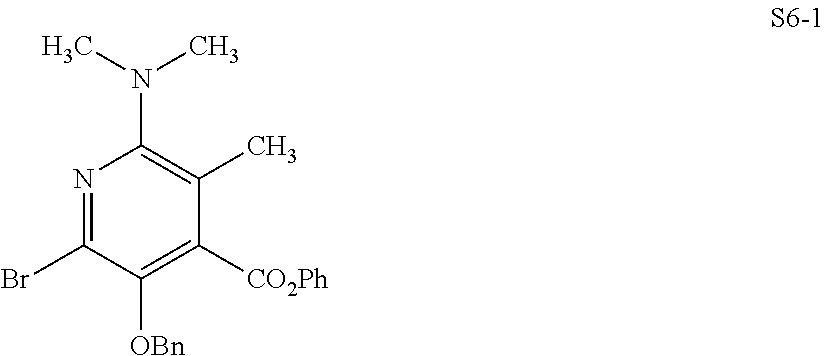
- Intermediate S1-7 (1.51 g, 3.16 mmol), Cs2CO3 (3.1 g, 9.5 mmol), tris(dibenzylideneacetone)dipalladium (145 mg, 0.158 mmol) and 9,9-dimethyl-4,5-bis-(diphenylphosphino)xanthene (267 mg, 0.474 mmol) were added to a vial equipped with a septum. After the flask was evacuated and flushed with nitrogen 3 times, 1,4-dioxane (7 mL) and dimethylamine (2.0 M solution in THF, 4.75 mL, 9.50 mmol) were added. The reaction mixture was heated to 60° C. and stirred for 4 h. The reaction mixture was allowed to cool to rt, was filtered through Celite, and was concentrated under reduced pressure. The material was purified by column chromatography (Biotage 50 g column, 0 to 10% EtOAc in hexanes gradient), yielding 868 mg (58%) of the major regioisomer S6-1. 354 mg (24%) of the minor regioisomer S6-2 was also obtained. 1H NMR (400 MHz, CDCl3) δ 7.50-7.46 (m, 2H), 7.41-7.30 (m, 5H), 7.30-7.24 (m, 1H), 7.08-7.02 (m, 2H), 5.08 (s, 2H), 2.85 (s, 6H), 2.32 (s, 3H); MS (ESI) m/z 441.19, 443.18 (M+H); Rf=0.29 in 10% EtOAc/hexanes. The regiochemistry was confirmed by an NOE between the methyl protons and the N,N-dimethylamino protons (0.61%).
- Synthesis of S6-2.
-

- Intermediate S1-7 (344 mg, 0.721 mmol) and dimethylamine (2.0 M solution in THF, 0.72 mL, 1.44 mmol) were heated to 80° C. in 1,4-dioxane (1.3 mL) in a sealed vial. After 6 h, additional dimethylamine (0.35 mL, 0.70 mmol) was added. After stirring overnight, the reaction mixture was cooled to rt and was concentrated under reduced pressure. The material was purified by column chromatography (Biotage 20 g column, 0 to 8% EtOAc in hexanes gradient), yielding 103 mg (33%) of the major regioisomer S6-2. Additional S6-2 was also isolated as a mixture with the minor regioisomer, S6-1. 1H NMR (400 MHz, CDCl3) δ 7.41-7.31 (m, 7H), 7.30-7.20 (m, 1H), 7.01 (d, J=7.3 Hz, 2H), 4.94 (s, 2H), 3.04 (s, 6H), 2.33 (s, 3H); MS (ESI) m/z 441.19, 443.18 (M+H); Rf=0.40 in 10% EtOAc/hexanes. The regiochemistry was confirmed by NOE between the benzylic protons of the O-benzyl group and the N,N-dimethylamino protons (0.44%).
- Synthesis of S6-3.
-

- A solution of intermediate S6-2 (95 mg, 0.22 mmol) in THF (1 mL) was added drop wise to a −78° C. solution of lithium diisopropylamide (10 wt % suspension in hexanes, 0.48 mL, 0.32 mmol) and TMEDA (0.13 mL, 0.86 mmol) in THF (2 mL), resulting in an immediate purple colored solution. After 2 min, a solution of S3-1 (52 mg, 0.108 mmol) in THF (1 mL) was added drop wise over ˜30 seconds. The color gradually lightened to orange. After complete addition, the reaction mixture was allowed to warm to −10° C. over ˜45 min. The reaction was quenched by the addition of ammonium chloride (saturated, aqueous solution), was diluted with water, and was extracted with EtOAc (2×). The combined extracts were dried over Na2SO4, filtered, and concentrated under reduced pressure. The material was purified on a Waters Autopurification system equipped with a Sunfire Prep C18 OBD column [5 μm, 19×50 mm; flow rate, 20 mL/min; Solvent A: H2O with 0.1% HCO2H; Solvent B: CH3CN with 0.1% HCO2H; gradient: 90→100% B; mass-directed fraction collection], yielding 31.1 mg (35%) of the desired product as a yellow solid. MS (ESI) m/z 829.44, 831.43 (M+H).
- Compound 159
-

- Aqueous HF (0.4 mL, 48%) was added to a solution of S6-3 (10 mg, 0.012 mmol) in CH3CN (0.4 mL) in a plastic vial. After 18 h, the reaction mixture was poured into a solution of K2HPO4 (4.8 g) in water (15 mL). The mixture was extracted with EtOAc (3×). The combined EtOAc extracts were dried over Na2SO4, filtered and concentrated under reduced pressure. The material was dissolved in methanol (1 mL) and 1,4-dioxane (1 mL), and palladium on carbon (Degussa, 10 wt %, ˜2 mg) was added. An atmosphere of hydrogen was introduced, and the reaction mixture was stirred for 3 h. The reaction mixture was filtered through Celite, and the filtrate was concentrated under reduced pressure. The material was purified on a Waters Autopurification system equipped with a Phenomenex Polymerx 10μ RP 100A column [10 μm, 30×21.20 mm; flow rate, 20 mL/min; Solvent A: 0.05 N HCl in water; Solvent B: CH3CN; gradient: 0→100% B; mass-directed fraction collection]. Fractions with the desired MW were collected and freeze-dried to yield 4.5 mg (70%, 2 steps) of the desired product as a yellow solid. 1H NMR (400 MHz, CD3OD with 1 drop DCl) δ 7.38 (s, 1H), 4.20 (s, 1H), 3.44 (s, 6H), 3.18-2.86 (m, 9H), 2.42-2.26 (m, 2H), 1.64-1.52 (m, 1H); MS (ESI) m/z 459.39 (M+H).
- Compound 118 was prepared according to Scheme 7.
-

- Synthesis of S7-1.
-

- Copper(I) iodide (4.7 mg, 0.025 mmol) and K3PO4 (209 mg, 0.984 mmol) were added to a vial equipped with a septum. After the vial was evacuated and flushed with nitrogen (3×), a solution of intermediate S6-1 (217 mg, 0.492 mmol) in DMF (2 mL), 1-propylamine (0.162 mL, 1.97 mmol) and 2-acetylcyclohexanone (0.013 mL, 0.098 mmol) were added. The reaction mixture was heated to 100° C. for 3 h. The reaction mixture was allowed to cool to rt, was diluted with EtOAc (50 mL), and was washed with water (3×40 mL). The organics were dried over Na2SO4, filtered, and concentrated under reduced pressure. The material was purified by column chromatography (Biotage 10 g column, 0 to 12% EtOAc in hexanes gradient), yielding 74.6 mg (36%) of the product as a thick oil. MS (ESI) m/z 420.34 (M+H); Rf=0.32 in 10% EtOAc/hexanes.
- Synthesis of S7-2.
-

- LHMDS (1.0 M solution in THF, 0.167 mL, 0.167 mmol) was added to a solution of S7-1 (63.5 mg, 0.152 mmol) in THF (2 mL), resulting in a bright yellow solution. A solution of di-t-butyldicarbonate (99.5 mg, 0.456 mmol) in THF (1 mL) was added. After 10 min, the reaction was quenched by the addition of ammonium chloride (saturated, aqueous solution,) and was extracted with EtOAc (2×). The organics were dried over Na2SO4, filtered, and concentrated under reduced pressure. The material was purified by column chromatography (Biotage 10 g column, 0 to 12% EtOAc in hexanes gradient), yielding 13.6 mg (17%) of the product. 1H NMR (400 MHz, CDCl3) δ 7.40-7.28 (m, 7H), 7.28-7.22 (m, 1H), 7.05-7.00 (m, 2H), 4.90 (s, 2H), 2.79 (s, 6H), 2.34 (s, 3H), 1.76-1.66 (m, 2H), 1.56-1.50 (m, 2H), 0.91 (t, J=7.56 Hz, 3H); MS (ESI) m/z 520.38 (M+H); Rf=0.22 in 10% EtOAc/hexanes.
- Synthesis of S7-3.
-

- A solution of intermediate S7-2 (24 mg, 0.047 mmol) in THF (0.5 mL) was added drop wise to a −78° C. solution of lithium diisopropylamide (0.5 M solution in THF, 0.102 mL, 0.051 mmol) and TMEDA (0.041 mL, 0.27 mmol) in THF (2 mL), resulting in a yellowish orange colored solution. After 10 min, a solution of S3-1 (16.4 mg, 0.034 mmol) in THF (0.5 mL) was added drop wise. After complete addition, the reaction mixture was allowed to warm to −20° C. over ˜45 min. The reaction was quenched by the addition of ammonium chloride (saturated, aqueous solution) and was extracted with EtOAc (2×). The combined extracts were dried over Na2SO4, filtered, and concentrated under reduced pressure. The material was purified on a Waters Autopurification system equipped with a Sunfire Prep C18 OBD column [5 μm, 19×50 mm; flow rate, 20 mL/min; Solvent A: H2O with 0.1% HCO2H; Solvent B: CH3CN with 0.1% HCO2H; gradient: 90→100% B; mass-directed fraction collection], yielding 6.1 mg (20%) of the desired product as a yellow solid. 1H NMR (400 MHz, CDCl3) δ 15.56 (s, 1H), 7.52-7.24 (m, 10H), 5.36 (s, 2H), 4.99-4.64 (m, 2H), 4.02 (d, J=11.0 Hz, 1H), 3.10-2.81 (m, 2H), 2.78 (s, 6H), 2.62-2.40 (m, 10H), 2.20-2.14 (m, 1H), 1.80-1.45 (m, 2H), 1.44-1.15 (m, 11H), 1.00-0.70 (m, 12H), 0.25 (s, 3H), 0.12 (s, 3H); MS (ESI) m/z 908.65 (M+H).
- Compound 118
-

- Aqueous HF (0.4 mL, 48%) was added to a solution of S7-3 (6.1 mg, 0.007 mmol) in CH3CN (0.6 mL) in a plastic vial. After 18 h, the reaction mixture was poured into a solution of K2HPO4 (4.8 g) in water (15 mL). The mixture was extracted with EtOAc (3×). The combined EtOAc extracts were dried over Na2SO4, filtered and concentrated under reduced pressure. The material was dissolved in methanol (1 mL) and 1,4-dioxane (1 mL), and palladium on carbon (Degussa, 10 wt %, ˜2 mg) was added. An atmosphere of hydrogen was introduced, and the reaction mixture was stirred for 4 h. The reaction mixture was filtered through Celite, and the filtrate was concentrated under reduced pressure. The material was purified on a Waters Autopurification system equipped with a Phenomenex Polymerx 10μ RP 100A column [10 μm, 30×21.20 mm; flow rate, 20 mL/min; Solvent A: 0.05 N HCl in water; Solvent B: CH3CN; gradient: 0→100% B; mass-directed fraction collection]. Fractions with the desired MW were collected and freeze-dried to yield 2.8 mg (70%, 2 steps) of Compound 118 as a yellow solid. 1H NMR (400 MHz, CD3OD with 1 drop DCl) δ 4.19 (s, 1H), 3.44 (t, J=7.6 Hz, 2H), 3.24-3.12 (m, 7H), 3.12-2.97 (m, 8H), 2.39-2.26 (m, 2H), 1.73-1.56 (m, 3H), 0.98 (t, J=8.4 Hz, 3H); MS (ESI) m/z 516.42 (M+H).
- Compounds 138 and 144 were prepared according to Scheme 8.
-

- Synthesis of S8-1 and S8-2.
-

- Intermediate S1-7 (2.15 g, 4.50 mmol), t-butylcarbamate (633 mg, 5.40 mmol), Cs2CO3 (2.93 g, 9.00 mmol), tris(dibenzylideneacetone)-dipalladium (206 mg, 0.225 mmol) and 9,9-dimethyl-4,5-bis-(diphenylphosphino)-xanthene (380 mg, 0.673 mmol) were weighed into a flask. This was evacuated and back-flushed with nitrogen (3×), and 1,4-dioxane (15 mL) was added. The reaction mixture was heated to 80° C. After 3 h, the reaction mixture was cooled to rt, was diluted with EtOAc (100 mL) and was washed with water (2×50 mL). The organics were dried over Na2SO4, filtered, and concentrated under reduced pressure. The material was purified by column chromatography (Biotage 50 g column, 0 to 12% EtOAc in hexanes gradient), yielding 1.43 g (62%) of a 4:1 mixture of the two regioisomeric compounds. 1H NMR (400 MHz, CDCl3) δ 7.51-7.46 (m, 2H), 7.42-7.32 (m, 7H), 7.30-7.24 (m, 1H), 7.12 (d, J=8.2 Hz, 0.5H), 7.03 (d, J=8.2 Hz, 2H), 6.88 (s, 0.25H), 6.71 (s, 1H), 5.12 (s, 2H), 5.02 (s, 0.5H), 2.43 (s, 0.75H), 2.34 (s, 3H), 1.50 (s, 9H), 1.47 (s, 2.25H); MS (ESI) m/z 535.10, 537.10 (M+Na).
- Synthesis of S8-3 and S8-4.
-

- The mixture of S8-1 and S8-2 (1.43 g, 2.78 mmol) was stirred in 4 M HCl in 1,4-dioxane (20 mL) and 1,4-dioxane (5 mL) overnight. The reaction mixture was diluted with EtOAc (100 mL) and was washed with NaHCO3 (saturated, aqueous solution, 2×100 mL). The organics were dried over Na2SO4, filtered and concentrated under reduced pressure. The material was purified by column chromatography (Biotage 20 g column, 0 to 30% EtOAc in hexanes gradient), yielding 805 mg (70%) of the major regioisomer S8-3 and 270 mg (24%) of the minor regioisomer S8-4. Data for S8-3: Rf=0.39 in 40% EtOAc/hexanes; 1H NMR (400 MHz, CDCl3) δ 7.50-7.42 (m, 2H), 7.40-7.30 (m, 5H), 7.30-7.24 (m, 1H), 7.04 (d, J=8.2 Hz, 2H), 5.06 (s, 2H), 4.56 (s, 2H), 2.16 (s, 3H); MS (ESI) m/z 413.11, 415.01 (M+H). Data for S8-4: Rf=0.72 in 40% EtOAc/hexanes; 1H NMR (400 MHz, CDCl3) δ 7.42-7.34 (m, 8H), 7.13-7.10 (m, 2H), 5.01 (s, 2H), 4.64 (s, 2H), 2.35 (s, 3H); MS (ESI) m/z 413.09, 415.09 (M+H).
- Synthesis of S8-5.
-

- HF-Pyridine solution (˜70% HF, 2 mL) was added to a 0° C. solution of intermediate S8-3 (884 mg, 2.14 mmol) in pyridine (1 mL). Sodium nitrite (177 mg, 2.57 mmol) was added (bubbling), and the reaction was allowed to slowly warm to rt. After 3 days, the reaction mixture was poured into Na2CO3 (saturated, aqueous solution, 30 mL) and was extracted with EtOAc (3×30 mL). The combined extracts were washed with HCl (1 N aqueous solution, 2×50 mL) and were dried over Na2SO4, filtered and concentrated under reduced pressure. The material was purified by column chromatography (Biotage 20 g column, 0 to 6% EtOAc in hexanes gradient), yielding 687 mg (77%) of the product as a colorless oil that slowly solidified on standing. Rf=0.39 in 10% EtOAc/hexanes; 1H NMR (400 MHz, CDCl3) δ 7.50-7.42 (m, 2H), 7.40-7.30 (m, 5H), 7.30-7.24 (m, 1H), 7.08-7.02 (m, 2H), 5.14 (s, 2H), 2.33 (s, 3H); MS (ESI) m/z 416.17, 418.15 (M+H).
- Synthesis of S8-6.
-

- LHMDS solution (1.0 M, 0.621 mL, 0.621 mmol) was added over ˜2 min to a −78° C. solution of intermediate S8-5 (86 mg, 0.207 mmol) and S3-1 (99 mg, 0.207 mmol) in THF (2 mL). After 45 min, the reaction mixture was allowed to slowly warm to −20° C. over 1 hr. The reaction mixture was quenched by the addition of NH4Cl (saturated, aqueous solution) and was extracted with EtOAc. The extracts were dried over Na2SO4, filtered, and concentrated under reduced pressure. The material was purified on a Waters Autopurification system equipped with a Sunfire Prep C18 OBD column [5 μm, 19×50 mm; flow rate, 20 mL/min; Solvent A: H2O with 0.1% HCO2H; Solvent B: CH3CN with 0.1% HCO2H; gradient: 80→100% B; mass-directed fraction collection], yielding 75.3 mg (45%) of the desired product as a yellow solid. 1H NMR (400 MHz, CDCl3) δ 15.55 (s, 1H), 7.56-7.26 (m, 10H), 5.36 (s, 2H), 5.02 (s, 2H), 3.88 (d, J=10.4 Hz, 1H), 3.18-3.04 (m, 2H), 2.62-2.58 (m, 1H), 2.58-2.40 (m, 8H), 2.17 (d, J=14.6 Hz, 1H), 0.81 (s, 9H), 0.25 (s, 3H), 0.12 (s, 3H); MS (ESI) m/z 804.34, 806.34 (M+H).
- Compound 144
-

- Aqueous HF (0.4 mL, 48%) was added to a solution of S8-6 (37.5 mg, 0.0466 mmol) in CH3CN (0.6 mL) in a plastic vial. After 18 h, the reaction mixture was poured into a solution of K2HPO4 (4.8 g) in water. The mixture was extracted with EtOAc, and the combined extracts were dried over Na2SO4, filtered and concentrated under reduced pressure. The material was dissolved in methanol (2 mL) and 1,4-dioxane (2 mL), and palladium on carbon (Degussa, 10 wt %, ˜5 mg) was added. An atmosphere of hydrogen was introduced, and the reaction mixture was stirred for 3 h. The reaction mixture was filtered through Celite, and the filtrate was concentrated under reduced pressure. The material was purified on a Waters Autopurification system equipped with a Phenomenex Polymerx 10μ RP 100A column [10 μm, 30×21.20 mm; flow rate, 20 mL/min; Solvent A: 0.05 N HCl in water; Solvent B: CH3CN; gradient: 0→100% B; mass-directed fraction collection]. Fractions with the desired MW were collected and freeze-dried to yield 14.9 mg (68%, 2 steps) of Compound 144 as a yellow solid. In addition, 3.8 mg (15%) of the 9-Br compound, Compound 138, were also isolated (see below). Data for Compound 144: 1H NMR (400 MHz, CD3OD with 1 drop DCl) δ 7.81 (s, 1H), 4.17 (s, 1H), 3.26-2.96 (m, 9H), 2.42-2.25 (m, 2H), 1.70-1.58 (m, 1H); MS (ESI) m/z 434.27 (M+H).
- Compound 138
-

- 1H NMR (400 MHz, CD3OD with 1 drop DCl) δ 4.18 (s, 1H), 3.26-2.94 (m, 9H), 2.42-2.26 (m, 2H), 1.72-1.57 (m, 1H); MS (ESI) m/z 512.17, 514.17 (M+H).
- Compounds of Formula I, wherein X is hydrogen and Z is —NH(R3) (as well as compounds of Formula II, wherein Z is —NH(R3)) were prepared according to Scheme 9.
-

- Specific intermediates and compounds of the invention prepared according to Scheme 9 are described below.
- Synthesis of S9-1-1.
-

- Intermediate S8-5 (100 mg, 0.24 mmol), Cs2CO3 (235 mg, 0.720 mmol), tris(dibenzylideneacetone)dipalladium (11 mg, 0.012 mmol) and 9,9-dimethyl-4,5-bis-(diphenylphosphino)xanthene (20 mg, 0.036 mmol) were weighed into a flask. This was evacuated and back-flushed with nitrogen (3×), and 1,4-dioxane (0.5 mL) and N,N-dimethylneopentanediamine (0.057 mL, 0.36 mmol) were added. The reaction mixture was heated to 70° C. After 1.5 h, the reaction mixture was cooled to rt and was filtered through Celite. The filtrate was concentrated under reduced pressure and was purified by column chromatography (Biotage 10 g column, 0 to 3% methanol in CH2Cl2 gradient), yielding 76.9 mg (69%) of the product. Rf=0.25 in 5% methanol/CH2Cl2; MS (ESI) m/z 466.28 (M+H).
- Synthesis of S9-24.
-

- LHMDS solution (1.0 M, 0.22 mL, 0.22 mmol) was added drop wise to a −78° C. solution of S9-1-1 (93 mg, 0.20 mmol) in THF (5 mL). After 5 min, benzyl chloroformate (0.084 mL, 0.60 mmol) was added. After 15 min, the reaction mixture was quenched by the addition of NH4Cl (saturated, aqueous solution, 15 mL) and was extracted with EtOAc. The organics were dried over Na2SO4, filtered, and concentrated under reduced pressure. The material was purified by column chromatography (Biotage 10 g column, 0 to 7% methanol in CH2Cl2 gradient), yielding 111 mg (93%) of the product. Rf=0.42 in 10% methanol/CH2Cl2; 1H NMR (400 MHz, CDCl3) δ 7.45-7.20 (m, 13H), 7.06-6.98 (m, 2H), 5.16 (s, 2H), 4.87 (s, 2H), 3.78 (br s, 2H), 2.38 (s, 3H), 2.18 (br s, 6H), 1.62 (br s, 2H), 0.90 (br s, 6H); MS (ESI) m/z 600.28 (M+H).
- Synthesis of S9-3-1.
-
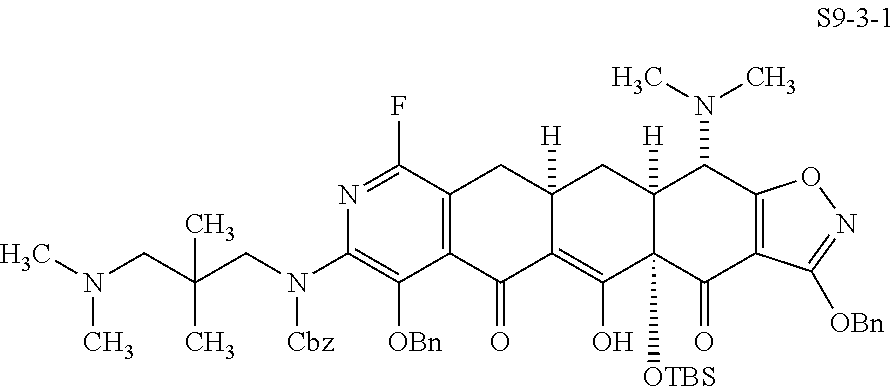
- A solution of intermediate S9-2-1 (54 mg, 0.090 mmol) in THF (0.5 mL) was added drop wise to a −78° C. solution of lithium diisopropylamide (2.0 M solution in THF, 0.112 mL, 0.224 mmol) and TMEDA (0.081 mL, 0.54 mmol) in THF (2 mL), resulting in an orange colored solution. After 10 min, a solution of S3-1 (43 mg, 0.090 mmol) in THF (0.5 mL) was added drop wise over ˜30 seconds. After complete addition, the reaction mixture was allowed to warm to −10° C. over 1 h. The reaction was quenched by the addition of ammonium chloride (saturated, aqueous solution), was diluted with water, and was extracted with EtOAc (2×). The combined extracts were dried over Na2SO4, filtered, and concentrated under reduced pressure. The material was purified on a Waters Autopurification system equipped with a Sunfire Prep C18 OBD column [5 μm, 19×50 mm; flow rate, 20 mL/min; Solvent A: H2O with 0.1% HCO2H; Solvent B: CH3CN with 0.1% HCO2H; gradient: 20→100% B; mass-directed fraction collection], yielding 22.9 mg (26%) of the desired product as a yellow solid. 1H NMR (400 MHz, CDCl3) δ 15.55 (br s, 1H), 7.52-7.20 (m, 15H), 5.36 (s, 2H), 5.20-5.00 (m, 2H), 4.80 (s, 2H), 3.90 (d, J=11.0 Hz, 1H), 3.19-3.05 (m, 2H), 2.62-2.57 (m, 1H), 2.56-2.12 (m, 19H), 0.94-0.74 (m, 15H), 0.26 (s, 3H), 0.12 (s, 3H); MS (ESI) m/z 988.59 (M+H).
- Compound 133
-

- Aqueous HF (0.4 mL, 48%) was added to a solution of S9-3-1 (22.9 mg, 0.0232 mmol) in CH3CN (0.8 mL) in a plastic vial. After 18 h, the reaction mixture was poured into a solution of K2HPO4 (4.8 g) in water. The mixture was extracted with EtOAc, and the combined extracts were dried over Na2SO4, filtered and concentrated under reduced pressure. The material was dissolved in methanol (1 mL), 0.5 M HCl in methanol (0.2 mL) and 1,4-dioxane (1 mL), and palladium on carbon (Degussa, 10 wt %, ˜2 mg) was added. An atmosphere of hydrogen was introduced, and the reaction mixture was stirred for 3 h. The reaction mixture was filtered through Celite, and the filtrate was concentrated under reduced pressure. The material was purified on a Waters Autopurification system equipped with a Phenomenex Polymerx 10μ RP 100A column [10 μm, 30×21.20 mm; flow rate, 20 mL/min; Solvent A: 0.05 N HCl in water; Solvent B: CH3CN; gradient: 0→100% B; mass-directed fraction collection]. Fractions with the desired MW were collected and freeze-dried to yield 9.9 mg (67%, 2 steps) of Compound 133 as a yellow solid. 1H NMR (400 MHz, CD3OD with 1 drop DCl) δ 4.16 (s, 1H), 3.43 (s, 2H), 3.15-2.90 (m, 17H), 2.30-2.22 (m, 1H), 2.22-2.12 (m, 1H), 1.65-1.54 (m, 1H), 1.17, (s, 6H); MS (ESI) m/z 562.43 (M+H).
- The following compounds were prepared similarly to Compound 133 by substituting the appropriate amine for N,N-dimethylneopentanediamine.
- Compound 114
-

- 1H NMR (400 MHz, CD3OD) δ 4.09 (s, 1H), 3.33 (t, J=6.9 Hz, 2H) 3.42-3.38 (m, 2H), 3.20 (s, 1H), 3.07-2.94 (m, 8H), 2.91 (dd, J=14.6, 4.6 Hz, 1H), 2.23-2.12 (m, 2H), 1.68-1.55 (m, 3H), 0.96 (t, J=7.3 Hz, 3H); MS (ESI) m/z 491.23 (M+H).
- Compound 108
-

- 1H NMR (400 MHz, CD3OD) δ 4.09 (s, 1H), 3.88-3.78 (m, 2H), 3.50-3.39 (m, 2H), 3.18-2.92 (m, 9H), 2.32-2.08 (m, 6H), 1.67-1.56 (m, 1H), 1.15 (s, 6H); MS (ESI) m/z 604.29 (M+H).
- Compound 129
-

- 1H NMR (400 MHz, CD3OD) δ 4.11 (s, 1H), 3.54-3.39 (m, 4H), 3.15-2.92 (m, 9H), 2.38-2.20 (m, 2H), 1.69-1.55 (m, 1H), 1.48 (s, 9H); MS (ESI) m/z 606.34 (M+H).
- Compound 135
-

- was isolated as a side product in the synthesis of Compound 129. 1H NMR (400 MHz, CD3OD) δ 7.85 (s, 1H), 4.12 (s, 1H), 3.68-3.45 (m, 4H), 3.17-2.94 (m, 9H), 2.42-2.21 (m, 2H), 1.69-1.59 (m, 1H), 1.47 (s, 9H); MS (ESI) m/z 572.28 (M+H).
- Compound 151
-

- 1H NMR (400 MHz, CD3OD) δ 4.10 (s, 1H), 3.51-3.36 (m, 4H), 3.10-2.92 (m, 15H), 2.33-2.18 (m, 2H), 1.68-1.57 (m, 1H), 1.174 (s, 3H), 1.169 (s, 3H); MS (ESI) m/z 578.35 (M+H).
- Compound 130
-

- was isolated as a side product in the synthesis of Compound 151. NMR (400 MHz, CD3OD) δ 7.75 (s, 1H), 4.10 (s, 1H), 3.72-3.54 (m, 4H), 3.09-2.94 (m, 15H), 2.44-2.26 (m, 2H), 1.70-1.57 (m, 1H), 1.22 (s, 3H), 1.17 (s, 3H); MS (ESI) m/z 544.49 (M+H).
- Compounds of Formula I, wherein X is hydrogen and Z is —N(R3)(R4) (as well as compounds of Formula II, wherein Z is —N(R3)(R4)) were prepared according to Scheme 10.
-

- Specific intermediates and compounds of the invention prepared according to Scheme 10 are described below.
- Synthesis of S10-11-1.
-

- Intermediate S8-5 (63 mg, 0.15 mmol), Cs2CO3 (147 mg, 0.453 mmol), tris(dibenzylideneacetone)dipalladium (6.9 mg, 0.008 mmol) and 9,9-dimethyl-4,5-bis-(diphenylphosphino)xanthene (13 mg, 0.023 mmol) were weighed into a vial. This was evacuated and back-flushed with nitrogen (3×), and 1,4-dioxane (0.4 mL) and N-methylpiperazine (0.020 mL, 0.182 mmol) were added. The reaction mixture was heated to 70° C. After 3 h, an additional portion of N-methylpiperazine (0.020 mL, 0.182 mmol) was added, and the reaction mixture was heated to 100° C. After heating overnight, the reaction mixture was cooled to rt and was filtered through Celite. The filtrate was concentrated under reduced pressure and was purified by column chromatography (Biotage 10 g column, 0 to 3% methanol in CH2Cl2 gradient), yielding 18.7 mg (28%) of the product. Rf=0.23 in 5% methanol/CH2Cl2; MS (ESI) m/z 436.16 (M+H).
- Synthesis of S10-2-1.
-

- A solution of intermediate S10-1-1 (18.7 mg, 0.043 mmol) in THF (0.5 mL) was added drop wise of a −78° C. solution of lithium diisopropylamide (2.0 M solution in THF, 0.043 mL, 0.086 mmol) and TMEDA (0.052 mL, 0.34 mmol) in THF (2 mL), resulting in a red colored solution. A solution of S3-1 (20.7 mg, 0.043 mmol) in THF (0.5 mL) was added, and the reaction mixture was allowed to warm to −10° C. The reaction was quenched by the addition of ammonium chloride (saturated, aqueous solution), was diluted with water, and was extracted with EtOAc (2×). The combined extracts were dried over Na2SO4, filtered, and concentrated under reduced pressure. The material was purified on a Waters Autopurification system equipped with a Sunfire Prep C18 OBD column [5 μm, 19×50 mm; flow rate, 20 mL/min; Solvent A: H2O with 0.1% HCO2H; Solvent B: CH3CN with 0.1% HCO2H; gradient: 20→100% B; mass-directed fraction collection], yielding 4.3 mg (12%) of the desired product as a yellow solid. NMR (400 MHz, CDCl3) δ 15.80 (br s, 1H), 7.52-7.20 (m, 10H), 5.36 (s, 2H), 4.83 (q, J=31.8 Hz, J=9.76 Hz, 2H), 3.88 (d, J=10.4 Hz, 1H), 3.85-3.72 (m, 4H), 3.01-2.94 (m, 2H), 2.88-2.76 (m, 4H), 2.60-2.32 (m, 12H), 2.16-2.10 (m, 1H), 0.81 (s, 9H), 0.26 (s, 3H), 0.12 (s, 3H); MS (ESI) m/z 824.51 (M+H).
- Compound 106
-

- Aqueous HF (0.4 mL, 48%) was added to a solution of S10-2-1 (4.3 mg, 0.0052 mmol) in CH3CN (0.8 mL) in a plastic vial. After 18 h, the reaction mixture was poured into a solution of K2HPO4 (4.8 g) in water. The mixture was extracted with EtOAc, and the combined extracts were dried over Na2SO4, filtered and concentrated under reduced pressure. The material was dissolved in methanol (1 mL), 0.5 M HCl in methanol (0.2 mL) and 1,4-dioxane (1 mL), and palladium on carbon (Degussa, 10 wt %, mg) was added. An atmosphere of hydrogen was introduced, and the reaction mixture was stirred for 3 h. The reaction mixture was filtered through Celite, and the filtrate was concentrated under reduced pressure. The material was purified on a Waters Autopurification system equipped with a Phenomenex Polymerx 10μ RP 100A column [10 μm, 30×21.20 mm; flow rate, 20 mL/min; Solvent A: 0.05 N HCl in water; Solvent B: CH3CN; gradient: 0→100% B; mass-directed fraction collection]. Fractions with the desired MW were collected and freeze-dried to yield 1.9 mg (61%, 2 steps) of Compound 106 as a yellow solid. 1H NMR (400 MHz, CD3OD with 1 drop DCl) δ 4.40-4.28 (m, 2H), 4.18 (s, 1H), 3.60-3.54 (m, 2H), 3.15-2.92 (m, 12H), 2.32-2.22 (m, 6H), 1.66-1.54 (m, 1H); MS (ESI) m/z 532.15 (M+H).
- Compounds of Formula I, wherein X is hydrogen and Z is —NH—C(O)—(C0-C6) alkylene-N(R5)(R6), —NH—S(O)2—R5 or —NH—C(O)—R5 (as well as compounds of Formula II, wherein Z is —NH—C(O)—(C0-C6) alkylene-N(R5)(R6), —NH—S(O)2—R5 or —NH—C(O)—R5) were prepared according to Scheme 11.
-

- Specific intermediates and compounds of the invention prepared according to Scheme 11 are described below.
- Synthesis of S11-1-1.
-

- Intermediate S6-1 (467 mg, 1.06 mmol), t-butylcarbamate (372 mg, 3.17 mmol), Cs2CO3 (1.04 g, 3.17 mmol), tris(dibenzylideneacetone)dipalladium (48 mg, 0.053 mmol) and 9,9-dimethyl-4,5-bis-(diphenylphosphino)xanthene (89.3 mg, 0.159 mmol) were weighed into a vial. This was evacuated and back-flushed with nitrogen (3×), and 1,4-dioxane (3 mL) was added. The reaction mixture was heated to 100° C. After 4 h, the reaction mixture was cooled to rt and was filtered through Celite. The filtrate was concentrated under reduced pressure, and the material was purified by column chromatography (Biotage 20 g column, 0 to 16% EtOAc in hexanes gradient), yielding 493 mg (98%) of the product containing ˜20% of an unidentified impurity. Rf=0.45 in 30% EtOAc/hexanes; 1H NMR (400 MHz, CDCl3) δ 7.43-7.32 (m, 8H), 7.30-7.24 (m, 1H), 7.15-7.10 (m, 2H), 6.80 (s, 1H), 4.94 (s, 2H), 2.85 (s, 6H), 2.31 (s, 3H), 1.48 (s, 9H); MS (ESI) m/z 478.27 (M+H).
- Synthesis of S11-2-1.
-

- Intermediate S11-1-1 (490 mg, 1.03 mmol) was treated with d-t-butyldicarbonate (672 mg, 3.08 mmol) and 4-dimethylaminopyridine (12.5 mg, 0.103 mmol) in DMF (5 mL). After stirring overnight, the reaction mixture was diluted with EtOAc (25 mL) and was washed with water (3×20 mL) and brine (20 mL). The organics were dried over Na2SO4, filtered, and concentrated under reduced pressure. The material was purified by column chromatography (Biotage 10 g column, 0 to 10% EtOAc in hexanes gradient), yielding 424 mg (72%) of the product. Rf=0.22 in 15% EtOAc/hexanes; 1H NMR (400 MHz, CDCl3) δ 7.42-7.24 (m, 8H), 7.06-7.00 (m, 2H), 4.92 (s, 2H), 2.79 (s, 6H), 2.36 (s, 3H), 1.39 (s, 18H); MS (ESI) m/z 578.33 (M+H).
- Synthesis of S11-3-1.
-

- Lithium diisopropylamide was prepared at −40° C. by the addition of n-BuLi (1.84 M solution in hexane, 0.458 mL, 0.843 mmol) to a solution of diisopropylamine (0.119 mL, 0.843 mmol) in THF (7 mL). TMEDA (0.507 mL, 3.37 mmol) was added, and the reaction mixture was cooled to −78° C. A solution of intermediate S11-2-1 (422 mg, 0.731 mmol) in THF (1.5 mL) was added drop wise, giving a reddish orange colored solution. After 5 min, a solution of S3-1 (271 mg, 0.562 mmol) in THF (1.5 mL) was added. The reaction mixture was allowed to warm to −10° C. over ˜30 min. The reaction mixture was quenched by the addition of NH4Cl (saturated, aqueous solution) and was extracted with EtOAc (2×). The extracts were dried over Na2SO4, filtered, and concentrated under reduced pressure. The material was purified on a Waters Autopurification system equipped with a Sunfire Prep C18 OBD column [5 μm, 19×50 mm; flow rate, 20 mL/min; Solvent A: H2O with 0.1% HCO2H; Solvent B: CH3CN with 0.1% HCO2H; gradient: 90→100% B; mass-directed fraction collection], yielding 288 mg (53%) of the desired product as a yellow solid. 1H NMR (400 MHz, CDCl3) δ 15.50 (s, 1H), 7.52-7.24 (m, 10H), 5.36 (s, 2H), 4.85 (q, J=86.1 Hz, J=9.76 Hz, 2H), 4.02 (d, J=10.4 Hz, 1H), 3.08-3.00 (m, 1H), 3.00-2.82 (m, 1H), 2.77 (s, 6H), 2.62-2.38 (m, 9H), 2.20-2.12 (m, 1H), 1.35, (br s, 18H), 0.79 (s, 9H), 0.26 (s, 3H), 0.12 (s, 3H); MS (ESI) m/z 966.59 (M+H).
- Synthesis of S11-4-1.
-

- Intermediate S11-3-1 (284 mg, 0.294 mmol) was stirred in 1,4-dioxane (3 mL) and 4 M HCl in 1,4-dioxane (3 mL) overnight. The reaction mixture was concentrated under reduced pressure, yielding 261 mg (>100% crude) of the desired product as a dark orange solid. The material was used without purification. MS (ESI) m/z 766.38 (M+H).
- Synthesis of S11-5-1.
-
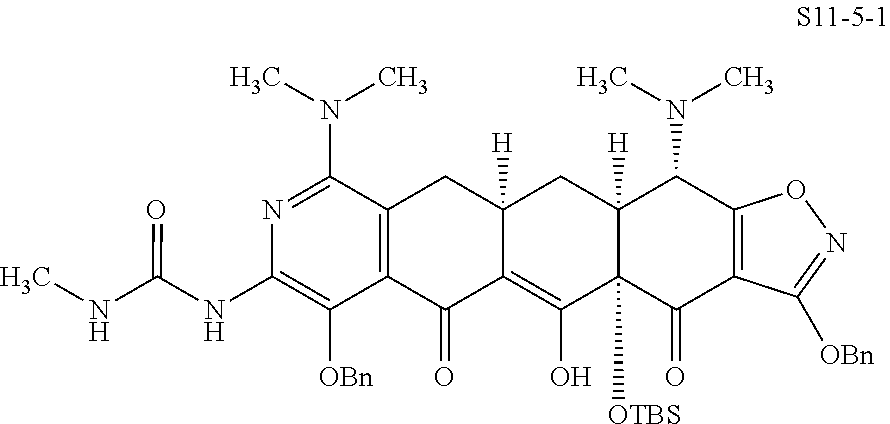
- Methylisocyanate (0.0032 mL, 0.056 mmol) was added to a solution of intermediate S11-4-1 (23.3 mg, 0.028 mmol) in THF (1 mL). After 1 h, additional methylisocyanate was added, and the reaction mixture was heated to 50° C. After heating overnight, additional methylisocyanate was added and heating was continued. After 1 h, the reaction mixture was cooled to rt and was concentrated under reduced pressure. The material was purified on a Waters Autopurification system equipped with a Sunfire Prep C18 OBD column [5 μm, 19×50 mm; flow rate, 20 mL/min; Solvent A: H2O with 0.1% HCO2H; Solvent B: CH3CN with 0.1% HCO2H; gradient: 80→100% B; mass-directed fraction collection], yielding 10.9 mg (47%) of the desired product contaminated with ˜20% of the starting amine, S11-4-1. 1H NMR (400 MHz, CDCl3) δ 15.64 (s, 0.2H), 15.52 (s, 0.8H), 9.10 (s, 0.8H), 7.58-7.24 (m, 10H), 5.36 (s, 2H), 4.98-4.78 (m, 2H), 4.02-3.98 (m, 1H), 3.00-2.75 (m, 11H), 2.62-2.40 (m, 9H), 2.20-2.10 (m, 1H), 0.80 (s, 9H), 0.26 (s, 3H), 0.12 (s, 3H); MS (ESI) m/z 823.51 (M+H).
- Compound 142
-

- Aqueous HF (0.4 mL, 48%) was added to a solution of S11-5-1 (10.9 mg, 0.013 mmol) in CH3CN (0.6 mL) in a plastic vial. After 18 h, the reaction mixture was poured into a solution of K2HPO4 (4.8 g) in water (15 mL). The mixture was extracted with EtOAc (3×15 mL), and the combined extracts were dried over Na2SO4, filtered and concentrated under reduced pressure. The material was purified on a Waters Autopurification system equipped with a Phenomenex Polymerx 10μ RP 100A column [10 μm, 30×21.20 mm; flow rate, 20 mL/min; Solvent A: 0.05 N HCl in water; Solvent B: CH3CN; gradient: 0→100% B; mass-directed fraction collection]. Fractions with the desired MW were collected and freeze-dried to yield 3.4 mg (36%, 2 steps) of the desired desilylated intermediate as a yellow solid. The material was dissolved in methanol (2 mL), 0.5 M HCl in methanol (0.2 mL), and 1,4-dioxane (2 mL), and palladium on carbon (Degussa, 10 wt %, ˜2 mg) was added. An atmosphere of hydrogen was introduced, and the reaction mixture was stirred for 3 h. The reaction mixture was filtered through Celite, and the filtrate was concentrated under reduced pressure. The material was purified on a Waters Autopurification system equipped with a Phenomenex Polymerx 10μ RP 100A column [10 μm, 30×21.20 mm; flow rate, 20 mL/min; Solvent A: 0.05 N HCl in water; Solvent B: CH3CN; gradient: 0→100% B; mass-directed fraction collection]. Fractions with the desired MW were collected and freeze-dried to yield 2.5 mg (86%) of Compound 142 as a yellow solid. 1H NMR (400 MHz, CD3OD with 1 drop DCl) δ 4.20 (s, 1H), 3.35-3.15 (m, 6H), 3.14-2.90 (m, 12H), 2.56-2.45 (m, 1H), 2.40-2.32 (m, 1H), 1.71-1.60 (m, 1H); MS (ESI) m/z 531.44 (M+H).
- Synthesis of S11-4-2.
-

- Intermediate S5-2-19 (113.7 mg, 0.133 mmol) was stirred in 4 M HCl in 1,4-dioxane (3 mL) and 1,4-dioxane (1 mL) for 1 h. The reaction mixture was concentrated under reduced pressure. The material was used without further purification or characterization. MS (ESI) m/z 757.30 (M+H).
- Synthesis of S11-5-2.
-
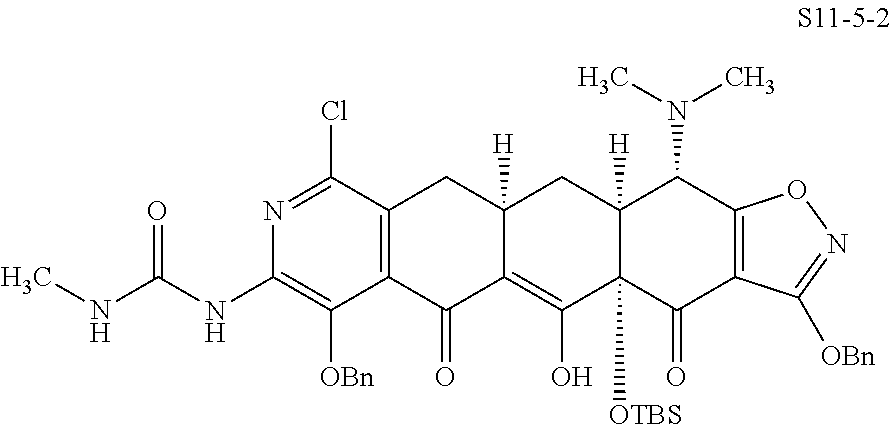
- Methylsiocyanate (19 mg, 0.033 mmol) was added to a solution of intermediate S11-4-2 (27 mg, 0.33 mmol) in THF (1 mL), and the reaction mixture was heated to 50° C. After heating overnight, the reaction mixture was heated to 70° C. After 4 h, the reaction mixture was heated to 90° C. After stirring overnight, the reaction mixture was concentrated under reduced pressure and was purified on a Waters Autopurification system equipped with a Sunfire Prep C18 OBD column [5 μm, 19×50 mm; flow rate, 20 mL/min; Solvent A: H2O with 0.1% HCO2H; Solvent B: CH3CN with 0.1% HCO2H; gradient: 70→100% B; mass-directed fraction collection]. This gave 14.4 mg of the desired product S11-5-2 mixed with un-reacted intermediate S11-4-2. The material was used directly in the next step. MS (ESI) m/z 814.41 (M+H).
- Compound 143
-

- Aqueous HF (0.4 mL, 48%) was added to a solution of S11-5-2 (14.4 mg, 0.018 mmol) in CH3CN (0.8 mL) in a plastic vial. After 18 h, the reaction mixture was poured into a solution of K2HPO4 (4.8 g) in water. The mixture was extracted with EtOAc. The combined EtOAc extracts were dried over Na2SO4, filtered and concentrated under reduced pressure. The material was dissolved in methanol (1 mL), 1,4-dioxane (1 mL) and 0.5 M HCl in methanol (0.1 mL), and palladium on carbon (Degussa, 10 wt %, ˜5 mg) was added. An atmosphere of hydrogen was introduced, and the reaction mixture was stirred for 3 h. The reaction mixture was filtered through Celite, and the filtrate was concentrated under reduced pressure. The material was purified on a Waters Autopurification system equipped with a Phenomenex Polymerx 10μ RP 100A column [10 μm, 30×21.20 mm; flow rate, 20 mL/min; Solvent A: 0.05 N HCl in water; Solvent B: CH3CN; gradient: 0→100% B; mass-directed fraction collection]. Fractions with the desired MW were collected and freeze-dried. The material was re-purified on a Waters Autopurification system equipped with a Phenomenex Polymerx 10μ RP 100A column [10 μm, 30×21.20 mm; flow rate, 20 mL/min; Solvent A: 0.05 N HCl in water; Solvent B: CH3CN; gradient: 10→50% B; mass-directed fraction collection]. Fractions with the desired MW were collected and freeze-dried to yield 3.3 mg (33%, 2 steps) of Compound 143 as a yellow solid. 1H NMR (400 MHz, CD3OD with 1 drop DCl) δ 4.19 (s, 1H), 3.20-2.90 (m, 12H), 2.56-2.45 (m, 1H), 2.40-2.32 (m, 1H), 1.71-1.60 (m, 1H); MS (ESI) m/z 522.13 (M+H).
- Synthesis of S11-5-3.
-

- Phenylisocyanate (0.036 mL, 0.33 mmol) was added to a solution of intermediate S11-4-2 (27 mg, 0.033 mmol) in THF (1 mL), and the reaction mixture was heated to 50° C. After heating overnight, the reaction mixture was heated to 70° C. After 4 h, the reaction mixture was heated to 90° C. After stirring overnight, the reaction mixture was concentrated under reduced pressure and was purified on a Waters Autopurification system equipped with a Sunfire Prep C18 OBD column [5 μm, 19×50 mm; flow rate, 20 mL/min; Solvent A: H2O with 0.1% HCO2H; Solvent B: CH3CN with 0.1% HCO2H; gradient: 70→100% B; mass-directed fraction collection]. This gave 10.1 mg of the desired product which was used directly in the next step. MS (ESI) m/z 876.43 (M+H).
- Compound 131
-

- Aqueous HF (0.4 mL, 48%) was added to a solution of S11-5-3 (10.1 mg, 0.0115 mmol) in CH3CN (0.8 mL) in a plastic vial. After 18 h, the reaction mixture was poured into a solution of K2HPO4 (4.8 g) in water. The mixture was extracted with EtOAc. The combined EtOAc extracts were dried over Na2SO4, filtered and concentrated under reduced pressure. The material was dissolved in methanol (1 mL), 1,4-dioxane (1 mL) and 0.5 M HCl in methanol (0.1 mL), and palladium on carbon (Degussa, 10 wt %, ˜5 mg) was added. An atmosphere of hydrogen was introduced, and the reaction mixture was stirred for 3 h. The reaction mixture was filtered through Celite, and the filtrate was concentrated under reduced pressure. The material was purified on a Waters Autopurification system equipped with a Phenomenex Polymer (10μ RP 100A column [10 μm, 30×21.20 mm; flow rate, 20 mL/min; Solvent A: 0.05 N HCl in water; Solvent B: CH3CN; gradient: 0→100% B; mass-directed fraction collection]. Fractions with the desired MW were collected and freeze-dried to yield 3.8 mg (54%, 2 steps) of Compound 131 as a yellow solid. 1H NMR (400 MHz, CD3OD with 1 drop DCl) δ 7.55-7.45 (m, 2H), 7.40-7.25 (m, 2H), 7.12-7.02 (m, 1H), 4.18 (s, 1H), 3.20-2.90 (m, 9H), 2.38-2.22 (m, 2H), 1.70-1.58 (m, 1H); MS (ESI) m/z 584.28 (M+H).
- Synthesis of S11-7-1.
-

- Bromoacetylchloride (11.5 mg, 0.073 mmol) was added to a solution of intermediate S11-4-1 (51 mg, 0.061 mmol) in THF (1 mL). After 2 h, additional bromoacetylchloride was added. After an additional 1 h, t-butylamine (0.064 mL, 0.61 mmol) was added, and the reaction mixture was heated to 50° C. After heating overnight, additional t-butylamine (0.060 mL, 0.57 mmol) was added, and the reaction was heated to 70° C. After 2 h, the reaction mixture was heated to 100° C. (sealed). After 1 h, the reaction mixture was cooled to rt and was concentrated under reduced pressure. The material was purified on a Waters Autopurification system equipped with a Sunfire Prep C18 OBD column [5 μm, 19×50 mm; flow rate, 20 mL/min; Solvent A: H2O with 0.1% HCO2H; Solvent B: CH3CN with 0.1% HCO2H; gradient: 50→100% B; mass-directed fraction collection], yielding 23.2 mg (43%) of the desired product as a yellow solid. 1H NMR (400 MHz, CDCl3) δ 15.4 (br s, 1H), 7.52-7.24 (m, 10H), 5.36 (s, 2H), 4.98-4.82 (m, 2H), 4.00 (d, J=11.0 Hz, 1H), 3.02-2.79 (m, 9H), 2.63-2.40 (m, 10H), 2.18 (d, J=14.1 Hz, 1H), 1.40 (br s, 9H), 0.80 (s, 9H), 0.26 (s, 3H), 0.12 (s, 3H); MS (ESI) m/z 879.63 (M+H).
- Compound 149
-

- Aqueous HF (0.4 mL, 48%) was added to a solution of S11-7-1 (23.2 mg, 0.0246 mmol) in CH3CN (0.8 mL) in a plastic vial. After 18 h, the reaction mixture was poured into a solution of K2HPO4 (4.8 g) in water. The mixture was extracted with EtOAc, and the combined extracts were dried over Na2SO4, filtered and concentrated under reduced pressure. The material was dissolved in methanol (2 mL) and 1,4-dioxane (2 mL), and palladium on carbon (Degussa, 10 wt %, ˜5 mg) was added. An atmosphere of hydrogen was introduced, and the reaction mixture was stirred for 3 h. The reaction mixture was filtered through Celite, and the filtrate was concentrated under reduced pressure. The material was purified on a Waters Autopurification system equipped with a Phenomenex Polymerx 10μ RP 100A column [10 μm, 30×21.20 mm; flow rate, 20 mL/min; Solvent A: 0.05 N HCl in water; Solvent B: CH3CN; gradient: 0→100% B; mass-directed fraction collection]. Fractions with the desired MW were collected and freeze-dried to yield 9.5 mg (55%, 2 steps) of Compound 149 as a yellow solid. 1H NMR (400 MHz, CD3OD with 1 drop DCl) δ 4.30-4.40 (m, 3H), 3.40-3.25 (m, 8H), 3.12-3.04 (m, 4H), 2.99 (s, 3H), 2.62-2.52 (m, 1H), 2.41-2.35 (m, 1H), 1.73-1.60 (m, 1H), 1.45 (s, 9H); MS (ESI) m/z 587.43 (M+H).
- Synthesis of S11-1-2.
-

- Intermediate S8-5 (538 mg, 1.29 mmol), t-butylcarbamate (302 mg, 2.58 mmol), Cs2CO3 (840 mg, 2.58 mmol), tris(dibenzylideneacetone)dipalladium (59 mg, 0.065 mmol) and 9,9-dimethyl-4,5-bis-(diphenylphosphino)xanthene (109 mg, 0.190 mmol) were weighed into a flask. This was evacuated and back-flushed with nitrogen (3×), and 1,4-dioxane (3 mL) was added. The reaction mixture was heated to 80° C. After 4 h, the reaction mixture was cooled to rt, was diluted with EtOAc (50 mL) and was washed with water (2×25 mL). The organics were dried over Na2SO4, filtered, and concentrated under reduced pressure. The material was purified by column chromatography (Biotage 20 g column, 0 to 12% EtOAc in hexanes gradient), yielding 451 mg (77%) of the product. Rf=0.35 in 20% EtOAc/hexanes; 1H NMR (400 MHz, CDCl3) δ 7.42-7.24 (m, 8H), 7.04-6.99 (m, 2H), 4.99 (s, 2H), 2.38 (s, 3H), 1.40 (s, 18H); MS (ESI) m/z 453.14 (M+H).
- Synthesis of S11-2-2.
-

- Intermediate S11-2-1 (451 mg, 1.00 mmol) was treated with d-t-butyldicarbonate (1.09 g, 5.00 mmol) and 4-dimethylaminopyridine (24 mg, 0.20 mmol) in DMF (15 mL). After 30 min, the reaction mixture was diluted with EtOAc (100 mL) and was washed with water (3×50 mL) and brine (50 mL). The organics were dried over Na2SO4, filtered, and concentrated under reduced pressure. The material was purified by column chromatography (Biotage 10 g column, 0 to 8% EtOAc in hexanes gradient), yielding 481 mg (87%) of the product. Rf=0.16 in 10% EtOAc/hexanes; 1H NMR (400 MHz, CDCl3) δ 7.42-7.24 (m, 8H), 7.04-6.99 (m, 2H), 4.99 (s, 2H), 2.38 (s, 3H), 1.40 (s, 18H); MS (ESI) m/z 575.25 (M+Na).
- Synthesis of S11-3-2.
-

- LHMDS solution (1.0 M, 2.6 mL, 2.6 mmol) was added over ˜1 min to a −78° C. solution of intermediate S11-2-2 (480 mg, 0.868 mmol) and S3-1 (418 mg, 0.867 mmol) in THF (8 mL). After 1 h, the reaction mixture was allowed to slowly warm to −10° C. over 1 hr. The reaction mixture was quenched by the addition of NH4Cl (saturated, aqueous solution, 15 mL) and was extracted with EtOAc (20 mL). The extracts were washed with water (15 mL) and were dried over Na2SO4, filtered, and concentrated under reduced pressure. The material was purified on a Waters Autopurification system equipped with a Sunfire Prep C18 OBD column [5 μm, 19×50 mm; flow rate, 20 mL/min; Solvent A: H2O with 0.1% HCO2H; Solvent B: CH3CN with 0.1% HCO2H; gradient: 80→100% B; mass-directed fraction collection], yielding 459 mg (56%) of the desired product as a yellow solid. 1H NMR (400 MHz, CDCl3) δ 15.59 (s, 1H), 7.56-7.24 (m, 10H), 5.36 (s, 2H), 4.92 (q, J=67.8 Hz, J=9.16 Hz, 2H), 3.91 (d, J=11.0 Hz, 1H), 3.20-3.02 (m, 2H), 2.62-2.45 (m, 9H), 2.19-2.12 (m, 1H), 1.37, (s, 18H), 0.82 (s, 9H), 0.26 (s, 3H), 0.13 (s, 3H); MS (ESI) m/z 941.59 (M+H).
- Synthesis of S11-4-3.
-

- Intermediate S11-3-2 (459 mg, 0.488 mmol) was stirred in 1,4-dioxane (5 mL) and 4 M HCl in 1,4-dioxane (5 mL) overnight. The reaction mixture was concentrated under reduced pressure, yielding 389 mg (98%) of the desired product as a yellow solid. The material was used without purification. MS (ESI) m/z 742.23 (M+H).
- Compound 125
-

- Aqueous HF (0.4 mL, 48%) was added to a solution of S11-4-3 (15 mg, 0.018 mmol) in CH3CN (0.6 mL) in a plastic vial. After 18 h, the reaction mixture was poured into a solution of K2HPO4 (4.8 g) in water. The mixture was extracted with EtOAc, and the combined extracts were dried over Na2SO4, filtered and concentrated under reduced pressure. The material was dissolved in methanol (1 mL), 0.5 M HCl in methanol (0.2 mL) and 1,4-dioxane (1 mL), and palladium on carbon (Degussa, 10 wt %, ˜5 mg) was added. An atmosphere of hydrogen was introduced, and the reaction mixture was stirred for 3 h. The reaction mixture was filtered through Celite, and the filtrate was concentrated under reduced pressure. The material was purified on a Waters Autopurification system equipped with a Phenomenex Polymerx 10μ RP 100A column [10 μm, 30×21.20 mm; flow rate, 20 mL/min; Solvent A: 0.05 N HCl in water; Solvent B: CH3CN; gradient: 0→100% B; mass-directed fraction collection]. Fractions with the desired MW were collected and freeze-dried to yield 4.4 mg (49%, 2 steps) of Compound 125 as a yellow solid. 1H NMR (400 MHz, CD3OD with 1 drop DCl) δ 4.20 (s, 1H), 3.40-2.90 (m, 9H), 2.42-2.22 (m, 2H), 1.70-1.54 (m, 1H); MS (ESI) m/z 449.27 (M+H).
- Synthesis of S11-7-2.
-

- Bromoacetylbromide (0.008 mL, 0.09 mmol) was added to a solution of intermediate S11-4-3 (50 mg, 0.061 mmol) in THF (1 mL). After 1.5 h, t-butylamine (0.032 mL, 0.31 mmol) was added. After 1 h, the reaction mixture was concentrated under reduced pressure. The material was purified on a Waters Autopurification system equipped with a Sunfire Prep C18 OBD column [5 μm, 19×50 mm; flow rate, 20 mL/min; Solvent A: H2O with 0.1% HCO2H; Solvent B: CH3CN with 0.1% HCO2H; gradient: 50→100% B; mass-directed fraction collection], yielding 35.4 mg (68%) of the desired product as a yellow solid. 1H NMR (400 MHz, CDCl3) δ 15.6 (br s, 1H), 7.51-7.48 (m, 2H), 7.42-7.30 (m, 8H), 5.36 (s, 2H), 4.94 (q, J=23.2 Hz, J=10.4 Hz, 2H), 3.89 (d, J=11.0 Hz, 1H), 3.17-3.02 (m, 2H), 2.63-2.58 (m, 1H), 2.56-2.40 (m, 10H), 2.15 (d, J=14.1 Hz, 1H), 1.07 (br s, 9H), 0.82 (s, 9H), 0.26 (s, 3H), 0.13 (s, 3H); MS (ESI) m/z 854.51 (M+H).
- Compound 120
-

- Aqueous HF (0.4 mL, 48%) was added to a solution of S11-7-2 (35.4 mg, 0.0414 mmol) in CH3CN (0.8 mL) in a plastic vial. After 18 h, the reaction mixture was poured into a solution of K2HPO4 (4.8 g) in water. The mixture was extracted with EtOAc, and the combined extracts were dried over Na2SO4, filtered and concentrated under reduced pressure. The material was dissolved in methanol (1 mL), 0.5 M HCl in methanol (0.2 mL) and 1,4-dioxane (1 mL), and palladium on carbon (Degussa, 10 wt %, ˜5 mg) was added. An atmosphere of hydrogen was introduced, and the reaction mixture was stirred for 3 h. The reaction mixture was filtered through Celite, and the filtrate was concentrated under reduced pressure. The material was purified on a Waters Autopurification system equipped with a Phenomenex Polymerx 10μ RP 100A column [10 μm, 30×21.20 mm; flow rate, 20 mL/min; Solvent A: 0.05 N HCl in water; Solvent B: CH3CN; gradient: 0→100% B; mass-directed fraction collection]. Fractions with the desired MW were collected and freeze-dried to yield 15.3 mg (58%, 2 steps) of the desired product as a yellow solid. NMR (400 MHz, CD3OD with 1 drop DCl) δ 4.24-4.65 (m, 3H), 3.26-2.97 (m, 9H), 2.38-2.28 (m, 2H), 1.69-1.56 (m, 1H), 1.44 (s, 9H); MS (ESI) m/z 562.37 (M+H).
- The following Compounds were prepared similarly to Compound 120 above:
- Compound 163
-

- 1H NMR (400 MHz, CD3OD with 1 drop DCl) δ 4.58-4.48 (m, 2H), 4.20 (s, 1H), 3.86-3.77 (m, 2H), 3.34-3.14 (m, 2H), 3.14-2.97 (m, 9H), 2.38-2.28 (m, 2H), 2.26-2.02 (m, 4H), 1.70-1.56 (m, 1H); MS (ESI) m/z 560.34 (M+H).
- Compound 100
-

- 1H NMR (400 MHz, CD3OD with 1 drop DCl) δ 4.50-4.40 (m, 2H), 4.19 (s, 1H), 3.14-3.01 (m, 12H), 2.98 (s, 3H), 2.39-2.28 (m, 2H), 1.69-1.57 (m, 1H); MS (ESI) m/z 534.33 (M+H).
- Compound 132
-

- 1H NMR (400 MHz, CD3OD with 1 drop DCl) δ 4.30-4.20 (s, 2H), 4.19 (s, 1H), 3.25-2.96 (m, 9H), 2.48-2.28 (m, 2H), 1.72-1.58 (m, 1H), 1.43 (s, 9H); MS (ESI) m/z 578.48 (M+H).
- Compounds of Formula I, wherein X is hydrogen, Y is Cl or hydrogen, and Z is —(C1-C6) alkylene-N(R5)(R6) (as well as compounds of Formula II, wherein Z is —(C1-C6) alkylene-N(R5)(R6)) were prepared according to Scheme 12.
-

- The following specific intermediates and compounds of the invention were prepared according to Scheme 12.
- Synthesis of S12-1.
-

- A solution of phenyllithium (0.384 mL, 1.8 M in di-n-butyl ether, 0.69 mmol) was added drop wise to a solution of intermediate S5-1 (284 mg, 0.345 mmol, 1.0 equiv) in THF (4 mL) at −78° C., forming an orange solution. After 1 min, a solution of n-butyllithium (216 μL, 1.6 M in hexanes, 0.345 mmol) was added drop wise at −78° C., followed 2 min later by the addition of N,N-dimethylformamide (133 μL, 1.73 mmol). The resulting dark red reaction mixture was stirred at −78° C. for 30 min and was then warmed to −40° C. and stirred for one hr. Ammonium chloride (saturated, aqueous solution, 10 mL) was added drop wise at −40° C. The reaction mixture was allowed to warm to 25° C., was diluted with ammonium chloride (saturated, aqueous solution), and was extracted with EtOAc (2×25 mL). The organic extracts were combined, dried over anhydrous sodium sulfate, filtered, and concentrated, affording 239 mg of the crude product as a yellow oil: MS (ESI) m/z 770.67 (M+H). This was used directly in the next reactions.
- Synthesis of S12-2-1.
-

- Dimethylamine (179 μL, 1.0 mmol), acetic acid (57.2 μL, 1.0 mmol) and sodium triacetoxyborohydride (212 mg, 1.0 mmol) were added sequentially to a solution of intermediate S12-1 (80 mg, 0.1 mmol) in methylene chloride (2 mL) at 25° C. After stirring overnight, the reaction mixture was quenched by the addition of saturated aqueous sodium bicarbonate and brine (1:1, 15 mL) and was extracted with methylene chloride (2×15 mL). The combined organic extracts were dried over anhydrous sodium sulfate, filtered, and concentrated to yield the crude product: MS (ESI) m/z 799.57 (M+H).
- Compound 128
-

- Aqueous HF (48-50%, 0.6 mL) was added to a solution of intermediate S12-2-1 (59 mg, crude) in acetonitrile (3 mL) in a polypropylene reaction vessel at 25° C. The mixture was stirred vigorously at 25° C. overnight and was poured into a solution of K2HPO4 (4.0 g) in water (20 mL). The mixture was extracted with EtOAc (3×25 mL). The combined organic extracts were dried over anhydrous sodium sulfate, filtered, and concentrated. Pd—C (10 wt %, 5 mg) was added in one portion into the yellow solution of the above crude product in a mixture of 1,4-dioxane (2 mL) and methanol (2 mL) at 25° C. The reaction vessel was sealed and purged with hydrogen by briefly evacuating the flask followed by flushing with hydrogen gas (1 atm). The resulting mixture was stirred at 25° C. for 2 hr. The reaction mixture was then filtered through a small Celite pad. The filtrate was concentrated. The residue was purified by preparative reverse phase HPLC on a Waters Autopurification system using a Phenomenex Polymerx 10μ RP-γ 100A column [10 μm, 150×21.20 mm; flow rate, 20 mL/min; Solvent A: 0.05 N HCl/water; Solvent B: CH3CN; injection volume: 3.0 mL (0.05 N HCl/water); gradient: 0→100% B over 10 min; mass-directed fraction collection]. Fractions containing the desired product were collected and freeze-dried to yield Compound 128 (3.6 mg, 6.6% for 4 steps): 1H NMR (400 MHz, CD3OD) δ 8.19 (s, 1H), 4.54 (s, 2H), 4.12 (s, 1H), 3.08-2.92 (m, 15H), 2.64-2.54 (m, 1H), 2.30-2.22 (m, 1H), 1.70-1.60 (m, 1H); MS (ESI) m/z 473.39 (M+H).
- The following compounds were prepared similarly to Compound 128 using the appropriate amine in place of dimethylamine:
- Compound 161
-

- 1H NMR (400 MHz, CD3OD) δ 8.17 (s, 1H), 4.53 (m, 2H), 4.12 (s, 1H), 3.08-2.92 (m, 9H), 2.83 (s, 3H), 2.32-2.08 (m, 2H), 1.70-1.60 (m, 1H); MS (ESI) m/z 459.36 (M+H).
- Compound 164
-

- 1H NMR (400 MHz, CD3OD) δ 8.17 (S, 1H), 4.54 (s, 2 h), 4.25-4.17 (m, 4H), 4.12 (s, 1H), 3.08-2.92 (m, 9H), 2.54-2.39 (m, 2H), 2.30-2.22 (m, 2H), 1.70-1.60 (m, 1H); MS (ESI) m/z 485.44 (M+H).
- Compound 116
-

- 1H NMR (400 MHz, CD3OD) δ 8.15 (s, 1H), 4.40 (s, 2H), 4.11 (s, 1H), 3.14-2.90 (m, 11H), 2.30-2.20 (m, 1H), 2.17-2.05 (m, 2H), 1.71-1.57 (m, 1H), 1.06 (d, J=6.4 Hz, 6H); MS (ESI) m/z 501.44 (M+H).
- Compound 137
-

- 1H NMR (400 MHz, CD3OD) δ 8.34 (s, 1H), 4.50 (s, 2H), 4.11 (s, 1H), 3.14-2.90 (m, 11H), 2.48-2.39 (m, 1H), 2.30-2.22 (m, 1H), 1.69-1.55 (m, 1H), 1.10 (s, 9H); MS (ESI) m/z 515.46 (M+H).
- Compounds of Formula I, wherein X and Z are hydrogen and Y is (C1-C6) alkylene-N(R1)(R2) are synthesized using Scheme 12′.
- Specific compounds of the invention prepared according to Scheme 12′ are described below.
-

- Compound 155
-

- A mixture of S12′-1 and S1-8 (1:2) was converted to a mixture of S12′-4 and S12-1 (1:1.8) using procedures set forth in Schemes 1, 5 and 12. The two regioisomers were separated by preparative HPLC. S12′-4 was then reductively aminated with isobutylamine, followed by deprotections under similar conditions to those described above to afford Compound 155 as a yellow solid: 1H NMR (400 MHz, CD3OD) δ 8.34 (s, 1H), 4.47, 4.23 (abq, J=15.6 Hz, 2H), 4.13 (s, 1H), 3.20-2.90 (m, 11H), 2.49-2.40 (m, 1H), 2.34-2.25 (m, 1H), 2.18-2.06 (m, 1H), 1.71-1.61 (m, 1H), 1.07 (d, J=6.4 Hz, 6H); MS (ESI) m/z 501.44 (M+H).
- Compound 105
-

- Prepared similarly to Compound 155: 1H NMR (400 MHz, CD3OD) δ 8.32 (s, 1H), 4.49, 4.24 (abq, J=15.6 Hz, 2H), 4.11 (s, 1H), 3.19-2.90 (m, 11H), 2.48-2.36 (m, 1H), 2.30-2.20 (m, 1H), 1.69-1.57 (m, 1H), 1.09 (s, 9H); MS (ESI) m/z 515.46 (M+H).
- Compounds 117 and 122 were prepared according to Scheme 13 below.
-

- Compound 117
-

- Sodium triacetoxyborohydride (16.5 mg, 0.078 mmol, 2 equiv) was added to a solution of S12-1 (30 mg, 0.039 mmol) in methylene chloride (2 mL) at 25° C. After stirring overnight, the reaction mixture was quenched by the addition of saturated aqueous sodium bicarbonate (10 mL) and was extracted with methylene chloride (2×15 mL). The combined organic extracts were dried over anhydrous sodium sulfate, filtered, and concentrated to give the alcohol intermediate. MS (ESI) m/z 772.51 (M+H). Aqueous HF (48-50%, 0.3 mL) was added to a solution of the intermediate in acetonitrile (1.5 mL) in a polypropylene reaction vessel at 25° C. The mixture was stirred vigorously at 25° C. overnight and poured into aqueous K2HPO4 (4.0 g dissolved in 20 mL water). The mixture was extracted with EtOAc (3×25 mL). The combined organic extracts were dried over anhydrous sodium sulfate, filtered, and concentrated. Pd—C (10 wt %, 5 mg) was added to a solution of the above crude product in a mixture of 1,4-dioxane (2 mL) and methanol (2 mL). The reaction vessel was sealed and purged with hydrogen by briefly evacuating the flask followed by flushing with hydrogen gas (1 atm). The resulting mixture was stirred at 25° C. for 2 hr. The reaction mixture was then filtered through a small Celite pad.
- The filtrate was concentrated. The residue was purified by preparative reverse phase HPLC on a Waters Autopurification system using a Phenomenex Polymerx 10μ RP-γ 100A column [10 μm, 150×21.20 mm; flow rate, 20 mL/min; Solvent A: 0.05 N HCl/water; Solvent B: CH3CN; injection volume: 3.0 mL (0.05 N HCl/water); gradient: 0→100% B over 10 min; mass-directed fraction collection]. Fractions containing the desired product were collected and freeze-dried to yield 4.2 mg (22%, 3 steps) of Compound 117 and 2.2 mg (13%) of Compound 122 as yellow solids. Data for Compound 117: 1H NMR (400 MHz, CD3OD) δ 4.70 (s, 2H), 4.10 (s, 1H), 3.15-2.92 (m, 9H), 2.35-2.15 (m, 2H), 1.84-1.70 (m, 1H); MS (ESI) m/z 480.22 (M+H). and des-Cl compound (2.23 mg, 12.8%)
- Compound 122
-

- 1H NMR (400 MHz, CD3OD) δ 7.68 (s, 1H), 4.15 (s, 1H), 4.04-3.90 (m, 2H), 3.14-2.90 (m, 9H), 2.30-2.12 (m, 2H), 1.80-1.71 (m, 1H); MS (ESI) m/z 446.26 (M+H).
- Compounds of Formula I, wherein X is hydrogen and Z is C1-C6 alkyl or phenyl (as well as compounds of Formula II, wherein Z is C1-C6 alkyl or phenyl were prepared according to Scheme 14.
-

- Specific intermediates and compounds of the invention prepared by Scheme 14 are described in detail below.
- Synthesis of S14-1.
-

- Lithium diisopropylamide was prepared at −40° C. by the addition of n-BuLi (2.5 M solution in hexane, 0.60 mL, 0.1.5 mmol) to a solution of diisopropylamine (0.213 mL, 0.1.51 mmol) in THF (10 mL). The reaction mixture was cooled to −78° C. and TMEDA (0.542 mL, 3.62 mmol) was added. A solution of intermediate S6-1 (266 mg, 0.603 mmol) in THF (4 mL) was added drop wise, giving a dark red colored solution. After 5 min, a solution of S3-1 (242 mg, 0.502 mmol) in THF (2 mL) was added. The reaction mixture was allowed to warm to −20° C. over ˜45 min. The reaction mixture was quenched by the addition of NH4Cl (saturated, aqueous solution) and was extracted with EtOAc (2×). The extracts were dried over Na2SO4, filtered, and concentrated under reduced pressure. The material was purified on a Waters Autopurification system equipped with a Sunfire Prep C18 OBD column [5 μm, 19×50 mm; flow rate, 20 mL/min; Solvent A: H2O with 0.1% HCO2H; Solvent B: CH3CN with 0.1% HCO2H; gradient: 90→100% B; mass-directed fraction collection], yielding 225 mg (54%) of the desired product as a yellow solid. MS (ESI) m/z 829.49, 831.48 (M+H).
- Synthesis of S14-2-1.
-

- Intermediate S14-1 (105 mg, 0.126 mmol), tetrakis(triphenylphosphine)palladium(0) (15 mg, 0.013 mmol) and potassium phosphate (80 mg, 0.379 mmol) were weighed into an 8 mL vial. This was sealed with a septum and was evacuated and back-flushed with nitrogen (3×). Toluene (1 mL), 1,4-dioxane (1 mL), and water (0.5 mL) were added, followed by allylboronic acid pinacol ester (63.7 mg, 0.379 mmol). The reaction mixture was heated to 90° C. After 2.5 h, the reaction mixture was cooled to rt and was concentrated under reduced pressure. The material was purified on a Waters Autopurification system equipped with a Sunfire Prep C18 OBD column [5 μm, 19×50 mm; flow rate, 20 mL/min; Solvent A: H2O with 0.1% HCO2H; Solvent B: CH3CN with 0.1% HCO2H; gradient: 90→100% B; mass-directed fraction collection], yielding 28.6 mg (29%) of the desired product as a yellow solid. MS (ESI) m/z 791.64 (M+H).
- Compound 141
-

- Aqueous HF (0.4 mL, 48%) was added to a solution of S14-2-1 (28.6 mg, 0.036 mmol) in 1,4-dioxane (1 mL) in a plastic vial. After 18 h, the reaction mixture was poured into a solution of K2HPO4 (4.8 g) in water. The mixture was extracted with EtOAc, and the combined extracts were dried over Na2SO4, filtered and concentrated under reduced pressure. The material was dissolved in methanol (1 mL), 0.5 M HCl in methanol (0.5 mL), and 1,4-dioxane (1 mL), and palladium on carbon (Degussa, 10 wt %, ˜5 mg) was added. An atmosphere of hydrogen was introduced, and the reaction mixture was stirred for 1 h. The reaction mixture was filtered through Celite, and the filtrate was concentrated under reduced pressure. The material was purified on a Waters Autopurification system equipped with a Phenomenex Polymerx 10μ RP 100A column [10 μm, 30×21.20 mm; flow rate, 20 mL/min; Solvent A: 0.05 N HCl in water; Solvent B: CH3CN; gradient: 0→70% B; mass-directed fraction collection]. Fractions with the desired MW were collected and freeze-dried to yield 14.3 mg (69%) of Compound 141 as a yellow solid. 1H NMR (400 MHz, CD3OD with 1 drop DCl) δ 4.20 (s, 1H), 3.38-3.15 (m, 7H), 3.14-2.94 (m, 8H), 2.91-2.82 (m, 2H), 2.56 (t, J=13.8 Hz, 1H), 2.40-2.32 (m, 1H), 1.86-1.76 (m, 2H), 1.74-1.62 (m, 1H), 1.01 (t, J=7.34 Hz, 3H); MS (ESI) m/z 501.35 (M+H).
- The following compounds were prepared similarly to Compound 141 utilizing the appropriate starting materials and alkyl or aryl boronic acids.
- Compound 104
-

- 1H NMR (400 MHz, CD3OD) δ 4.10 (s, 1H), 3.22-2.92 (m, 9H), 2.81-2.74 (m, 2H), 2.49-2.38 (m, 1H), 2.26-2.19 (m, 1H), 1.77-1.60 (m, 3H), 0.97 (t, J=7.3 Hz, 3H); MS (ESI) m/z 492.27 (M+H).
- Compound 103
-

- 1H NMR (400 MHz, CD3OD) δ 4.09 (s, 1H), 3.22-2.92 (m, 9H), 2.85 (s, 3H), 2.49-2.38 (m, 1H), 2.26-2.19 (m, 1H), 1.77-1.60 (m, 1H); MS (ESI) m/z 464.30 (M+H).
- Compound 158
-

- Isolated as a side-product in the synthesis of Compound 103. 1H NMR (400 MHz, CD3OD) δ 7.78 (s, 1H), 4.12 (s, 1H), 3.22-2.91 (m, 9H), 2.78 (s, 3H), 2.49-2.21 (m, 1H), 1.77-1.62 (m, 1H); MS (ESI) m/z 430.46 (M+H).
- Compound 136
-

- 1H NMR (400 MHz, CD3OD) δ 8.04-7.98 (m, 2H), 7.47-7.39 (m, 3H), 4.08 (s, 1H), 3.14-2.92 (m, 9H), 2.57-2.47 (m, 1H), 2.28-2.07 (m, 1H), 1.73-1.65 (m, 1H); MS (ESI) m/z 526.26 (M+H).
- Compound 165
-

- Compound 165 is isolated as a side-product in the synthesis of Compound 136. 1H NMR (400 MHz, CD3OD) δ 8.29 (s, 1H), 7.98-7.81 (m, 2H), 7.47-7.32 (m, 3H), 4.07 (s, 1H), 3.14-2.92 (m, 9H), 2.61-2.49 (m, 1H), 2.28-2.18 (m, 1H), 1.78-1.65 (m, 1H); MS (ESI) m/z 492.30 (M+H).
- Compound 145 is prepared according to Scheme 15.
-

- Synthesis of S15-1.
-

- Intermediate S14-1 (95.7 mg, 0.115 mmol), Pd(OAc)2 (2.7 mg, 0.012 mmol) and tri-(o-tolyl)phosphine (7.0 mg, 0.023 mmol) were weighed into an 8 mL vial. This was sealed with a septum and was evacuated and back-flushed with nitrogen (3×). Acetonitrile (2 mL), triethylamine (0.080 mL, 0.58 mmol), and allyloxy-t-butyldimethylsilane (0.049 mL, 0.23 mmol) were added. The reaction mixture was heated to 100° C. After 4 h, the reaction mixture was cooled to rt, was filtered through Celite, and was concentrated under reduced pressure. The material was purified on a Waters Autopurification system equipped with a Sunfire Prep C18 OBD column [5 μm, 19×50 mm; flow rate, 20 mL/min; Solvent A: H2O with 0.1% HCO2H; Solvent B: CH3CN with 0.1% HCO2H; gradient: 100→100% B; mass-directed fraction collection], yielding 55.5 mg (52%) of a mixture of the products as a yellow solid. 1H NMR (400 MHz, CDCl3) δ 15.6-15.5 (m, 1H), 7.92 (s, 1H), 7.45-7.24 (m, 10H), 6.22-5.98 (m, 0.3H), 5.27 (s, 2H), 4.86-4.78 (m, 1H), 4.78-4.50 (m, 1.3H), 4.36-4.30 (m, 0.7H), 3.98 (d, J=11.0 Hz, 1H), 3.65-3.55 (m, 0.7H), 2.98-2.88 (m, 1H), 2.87-2.55 (m, 8H), 2.54-2.30 (m, 9H), 2.11-2.04 (m, 1H), 0.84 (s, 9H), 0.71 (s, 9H), 0.17 (s, 3H), 0.06-0.05 (m, 9H); MS (ESI) m/z 921.74 (M+H).
- Synthesis of S15-2.
-

- Tetrabutylammonium fluoride (1.0 M solution in THF, 1 mL, 1 mmol) was added to a solution of intermediate S15-1 (55 mg, 0.060 mmol) in THF (1 mL). After 1 h, the reaction mixture was concentrated under reduced pressure. The material was dissolved in EtOAc and was washed with water (3×) and brine. The material was dried over Na2SO4, filtered and concentrated under reduced pressure. The crude alcohol was dissolved in THF (2 mL) and methanesulfonic anhydride (10 mg, 0.060 mmol) and triethylamine (0.084 mL, 0.060 mmol) were added. After 30 min, an additional portion of methanesulfonic anhydride (10 mg, 0.060 mmol) was added. After 30 min, dimethylamine (2.0 M solution in THF (0.3 mL, 0.6 mmol) was added. After 30 min, the reaction mixture was concentrated under reduced pressure and was purified on a Waters Autopurification system equipped with a Sunfire Prep C18 OBD column [5 μm, 19×50 mm; flow rate, 20 mL/min; Solvent A: H2O with 0.1% HCO2H; Solvent B: CH3CN with 0.1% HCO2H; gradient: 50→100% B; mass-directed fraction collection], yielding 14 mg (28%) of the desired product as a yellow solid. 1H NMR (400 MHz, CDCl3) δ 15.25 (s, 1H), 7.52-7.46 (m, 2H), 7.42-7.24 (m, 8H), 6.98-6.92 (m, 1H), 6.88-6.78 (m, 1H), 5.36 (s, 2H), 4.90-4.75 (m, 2H), 4.08-4.00 (m, 1H), 3.75-3.66 (m, 2H), 3.06-3.00 (m, 1H), 2.84 (s, 6H), 2.82-2.70 (m, 8H), 2.65-2.40 (m, 8H), 2.21-2.13 (m, 1H), 0.79 (s, 9H), 0.26 (s, 3H), 0.11 (s, 3H); MS (ESI) m/z 834.70 (M+H).
- Compound 145
-

- Aqueous HF (0.4 mL, 48%) was added to a solution of S15-2 (14.0 mg, 0.0168 mmol) in 1,4-dioxane (0.6 mL) in a plastic vial. After 18 h, the reaction mixture was poured into a solution of K2HPO4 (4.8 g) in water (15 mL). The mixture was extracted with EtOAc (3×), and the combined extracts were dried over Na2SO4, filtered and concentrated under reduced pressure. The material was dissolved in methanol (1 mL), 0.5 M HCl in methanol (0.2 mL), and 1,4-dioxane (1 mL), and palladium on carbon (Degussa, 10 wt %, ˜5 mg) was added. An atmosphere of hydrogen was introduced, and the reaction mixture was stirred for 3 h. The reaction mixture was filtered through Celite, and the filtrate was concentrated under reduced pressure. The material was purified on a Waters Autopurification system equipped with a Phenomenex Polymerx 10μ RP 100A column [10 μm, 30×21.20 mm; flow rate, 20 mL/min; Solvent A: 0.05 N HCl in water; Solvent B: CH3CN; gradient: 0→70% B; mass-directed fraction collection]. Fractions with the desired MW were collected and freeze-dried to yield 5.5 mg (50%) of Compound 145 as a yellow solid. 1H NMR (400 MHz, CD3OD with 1 drop DCl) δ 4.20 (s, 1H), 3.70-3.58 (m, 1H), 3.38-3.20 (m, 7H), 3.14-2.88 (m, 17H), 2.66-2.53 (m, 1H), 2.42-2.34 (m, 1H), 2.33-2.24 (m, 2H), 1.75-1.63 (m, 1H); MS (ESI) m/z 544.40 (M+H).
- Compounds of Formula I, wherein Y is hydrogen and Z is hydrogen (as well as compounds of Formula III, wherein Y is hydrogen) were prepared according to Scheme 16.
-

- Specific intermediates and compounds of the invention prepared by Scheme 16 are described in detail below.
- Synthesis of S16-1-1.
-

- Intermediate S1-2 (326 mg, 0.959 mmol), 4-(trifluoromethoxy)-benzyl boronic acid (579 mg, 1.92 mmol), dichlorobis(tricyclohexylphosphine)-palladium(II) (16 mg, 0.048 mmol), and K3PO4 (814 mg, 17.7 mmol) were heated to 100° C. in toluene (4 mL) and water (1 mL). After 4 h, additional 4-(trifluoromethoxy)-benzylboronic acid (579 mg, 1.92 mmol) and dichlorobis(tricyclohexylphosphine)-palladium(II) (16 mg, 0.0.048 mmol) were added. After another 4 h, additional 4-(trifluoromethoxy)benzylboronic acid (579 mg, 1.92 mmol) and dichlorobis-(tricyclohexylphosphine)palladium(II) (16 mg, 0.0.048 mmol) were added. After heating overnight, the reaction mixture was allowed to cool to rt and was diluted with EtOAc (20 mL). This was washed with water (20 mL) and NaHCO3 (saturated, aqueous solution, 20 mL), dried over Na2SO4, filtered, and concentrated under reduced pressure. The material was purified by column chromatography (Biotage 20 g column, 0 to 35% EtOAc/hexanes gradient), yielding 17.9 mg (4%) of the product as a white solid. Rf=0.21 in 30% EtOAc/hexanes. 1H NMR (400 MHz, CDCl3) δ 8.42 (s, 1H), 8.26 (s, 1H), 7.45-7.15 (m, 12H), 6.78-6.71 (m, 2H), 5.26 (s, 2H), 4.14 (s, 2H).
- Synthesis of S16-2-1.
-

- A solution of intermediate S16-1-1 (43.8 mg, 0.0907 mmol) in THF (0.5 mL) was added drop wise to a −78° C. solution of lithium diisopropylamide (1.8 M solution in hexanes, 0.050 mL, 0.091 mmol) and TMEDA (0.014 mL, 0.091 mmol) in THF (2 mL). After 5 min, a solution of S3-1 (14.6 mg, 0.0302 mmol) in THF (0.5 mL) was added drop wise. After complete addition, the reaction mixture was allowed to warm to −20° C. LC/MS indicated a lot of S16-1-1 and S3-1 remained. The reaction mixture was again cooled to −78° C., and additional lithium diisopropylamide (1.8 M solution in hexanes, 0.050 mL, 0.091 mmol) was added. The reaction mixture was allowed to warm to −10° C. and was quenched by the addition of ammonium chloride (saturated, aqueous solution), was diluted with water, and was extracted with EtOAc (2×20 mL). The combined extracts were dried over Na2SO4, filtered, and concentrated under reduced pressure. The material was purified on a Waters Autopurification system equipped with a Sunfire Prep C18 OBD column [5 μm, 19×50 mm; flow rate, 20 mL/min; Solvent A: H2O with 0.1% HCO2H; Solvent B: CH3CN with 0.1% HCO2H; gradient: 80→100% B; mass-directed fraction collection], yielding 3.9 mg (15%) of the desired product as a yellow solid. 1H NMR (400 MHz, CDCl3) δ 16.10 (s, 1H), 8.38 (s, 1H), 7.58-7.24 (m, 15H), 5.40-5.30 (m, 5H), 3.96 (d, J=11.0 Hz, 1H), 3.90-3.83 (m, 1H), 3.42-3.36 (m, 1H), 2.55-2.48 (m, 7H), 2.00-1.92 (m, 1H), 0.84 (s, 9H), 0.25 (s, 3H), 0.18 (s, 3H); MS (ESI) m/z 868.58 (M+H).
- Compound 111
-

- Aqueous HF (0.4 mL, 48%) was added to a solution of S16-2-1 (3.9 mg, 0.0045 mmol) in CH3CN (0.4 mL) in a plastic vial. After 18 h, the reaction mixture was poured into a solution of K2HPO4 (4.8 g) in water (20 mL). The mixture was extracted with EtOAc (2×20 mL). The combined EtOAc extracts were dried over Na2SO4, filtered and concentrated under reduced pressure. The material was dissolved in methanol (1 mL) and 1,4-dioxane (1 mL), and palladium on carbon (Degussa, 10 wt %, ˜2 mg) was added. An atmosphere of hydrogen was introduced, and the reaction mixture was stirred for 1 h. The reaction mixture was filtered through Celite, and the filtrate was concentrated under reduced pressure. The material was purified on a Waters Autopurification system equipped with a Phenomenex Polymerx 10μ RP 100A column [10 μm, 30×21.20 mm; flow rate, 20 mL/min; Solvent A: 0.05 N HCl in water; Solvent B: CH3CN; gradient: 10→100% B; mass-directed fraction collection]. Fractions with the desired MW were collected and freeze-dried to yield 1.7 mg (59%, 2 steps) of the desired product as a yellow solid. 1H NMR (400 MHz, D2O) δ 8.29 (s, 1H), 7.40-7.20 (m, 5H), 3.95 (s, 1H), 3.70-3.00 (br m, 3H), 2.95-2.60 (m, 7H), 1.45-1.25 (m, 1H); MS (ESI) m/z 576.35 (M+H).
- Synthesis of S16-1-2.
-

- Intermediate S1-2 (104 mg, 0.306 mmol), allylboronic acid pinacol ester (154 mg, 0.918 mmol), dichlorobis(tricyclohexylphosphine)palladium(II) (5 mg, 0.015 mmol), and K3PO4 (195 mg, 0.918 mmol) were heated to 200° C. in toluene (1 mL) and water (0.1 mL) via microwave for 5 min. The reaction mixture was diluted with EtOAc (10 mL). This was washed with water (5 mL) and brine (5 mL), dried over Na2SO4, filtered, and concentrated under reduced pressure. The material was purified by column chromatography (Biotage 10 g column, 0 to 30% EtOAc/hexanes gradient), yielding 74.6 mg (71%) of the product as a thick oil. Rf=0.43 in 50% EtOAc/hexanes. 1H NMR (400 MHz, DMSO-d6) δ 8.55 (s, 1H), 8.26 (s, 1H), 7.50-7.29 (m, 8H), 7.15-7.05 (m, 2H), 6.00-5.89 (m, 1H), 5.36 (s, 2H), 5.12-5.05 (m, 2H), 3.48 (d, J=6.44 Hz, 2H); MS (ESI) m/z 346.28 (M+H).
- Synthesis of S16-2-2.
-

- A solution of intermediate S16-1-2 (72 mg, 0.21 mmol) in THF (0.5 mL) was added drop wise to a −78° C. solution of lithium diisopropylamide (1.8 M solution in hexanes, 0.23 mL, 0.42 mmol) and TMEDA (0.125 mL, 0.832 mmol) in THF (3 mL). After 5 min, a solution of S3-1 (50 mg, 0.10 mmol) in THF (0.5 mL) was added drop wise. After complete addition, the reaction mixture was allowed to warm to 0° C. over ˜45 min. The reaction mixture was quenched by the addition of ammonium chloride (saturated, aqueous solution) and was extracted with EtOAc (3×). The combined extracts were dried over Na2SO4, filtered, and concentrated under reduced pressure. The material was purified on a Waters Autopurification system equipped with a Sunfire Prep C18 OBD column [5 μm, 19×50 mm; flow rate, 20 mL/min; Solvent A: H2O with 0.1% HCO2H; Solvent B: CH3CN with 0.1% HCO2H; gradient: 80→100% B; mass-directed fraction collection], yielding 18.7 mg (26%) of the desired product as a yellow solid. 1H NMR (400 MHz, CDCl3) δ 16.09 (s, 1H), 8.42 (s, 1H), 8.24 (s, 1H), 7.52-7.24 (m, 10H), 5.80-5.70 (m, 1H), 5.62-5.56 (m, 1H), 5.41-5.26 (m, 5H), 3.89 (d, J=10.4 Hz, 1H), 3.26 (dd, J=14.0 Hz, J=9.76 Hz, 1H), 2.85 (t, J=11.3 Hz, 1H), 2.60-2.38 (m, 8H), 2.24-2.14 (m, 1H), 0.81 (s, 9H), 0.25 (s, 3H), 0.13 (s, 3H); MS (ESI) m/z 734.70 (M+H).
- Compound 113
-

- Aqueous HF (0.4 mL, 48%) was added to a solution of S16-2-2 (18.7 mg, 0.025 mmol) in CH3CN (0.6 mL) in a plastic vial. After 18 h, the reaction mixture was poured into a solution of K2HPO4 (4.8 g) in water (20 mL). The mixture was extracted with EtOAc (3×20 mL). The combined EtOAc extracts were dried over Na2SO4, filtered and concentrated under reduced pressure. The material was dissolved in methanol (2 mL) and 1,4-dioxane (2 mL), and HCl (conc., 2 drops) and palladium on carbon (Degussa, 10 wt %, 10 mg) was added. An atmosphere of hydrogen was introduced, and the reaction mixture was stirred for 2 h. The reaction mixture was filtered through Celite, and the filtrate was concentrated under reduced pressure. The material was purified on a Waters Autopurification system equipped with a Phenomenex Polymerx 10μ RP 100A column [10 μm, 30×21.20 mm; flow rate, 20 mL/min; Solvent A: 0.05 N HCl in water; Solvent B: CH3CN; gradient: 0→50% B; mass-directed fraction collection]. Fractions with the desired MW were collected and freeze-dried to yield 6.9 mg (52%, 2 steps) of the desired product as a yellow solid. 1H NMR (400 MHz, CD3OD with 1 drop DCl) δ 8.56 (s, 1H), 8.36 (s, 1H), 4.22 (s, 1H), 3.90-3.78 (m, 1H), 3.30-2.88 (m, 8H), 2.46-2.32 (m, 1H), 2.30-2.16 (m, 1H), 2.12-1.95 (m, 1H), 1.68-1.52 (m, 1H), 0.96 (br s, 3H); MS (ESI) m/z 444.46 (M+H).
- Compounds of Formula I, wherein X is hydrogen and Z is —N—C(O)—(C1-C6 alkyl) (as well as compounds of Formula II, wherein Z is —N—C(O)—(C1-C6 alkyl)) were prepared according to Scheme 17.
-

- Specific intermediates and compounds of the invention prepared by Scheme 17 are described in detail below.
- Synthesis of S17-1.
-

- Intermediate S2-3 (2.09 g, 6.22 mmol) was added to H2SO4 (conc., 25 mL) at 50° C. After 30 min, HNO3 (conc., 1.18 mL) was added in 0.2 mL portions every 2 min. Starting material still remained by LC/MS, so an additional portion of HNO3 (conc., 0.50 mL) was added. The reaction mixture was cooled to rt and was poured onto ice (100 mL). The reaction flask was rinsed with water (50 mL) and this was added to the ice mixture. This was extracted with EtOAc (3×100 mL), and the combined extracts were dried over Na2SO4, filtered, and concentrated under reduced pressure. The crude material, benzyl bromide (1.0 mL, 8.4 mmol) and Cs2CO3 were heated to 70° C. in acetonitrile (40 mL). After 2 h, the reaction mixture was cooled to room temperature and was diluted with water (50 mL). This was extracted with EtOAc (3×50 mL), and the combined extracts were dried over Na2SO4, filtered, and concentrated under reduced pressure. The material was purified by column chromatography (Biotage 20 g column, 0 to 10% EtOAc in hexanes gradient), yielding 972 mg (41%) of the product as a yellow solid. Rf=0.45 in 50% EtOAc/hexanes. 1H NMR (400 MHz, CDCl3) δ 7.46-7.24 (m, 5H), 5.09 (s, 2H), 3.86 (s, 3H), 2.40 (s, 3H); MS (ESI) m/z 381.28 (M+H).
- Synthesis of S17-2.
-

- Zinc powder (870 mg, 13.3 mmol) was added in ˜200 mg portions to a solution of intermediate S17-1 (507 mg, 1.33 mmol) in acetic acid (4 mL) and THF (16 mL) over ˜10 min. After 1 h, the material was filtered through Celite, and the filtrate was concentrated under reduced pressure. The material was dissolved in EtOAc (50 mL) and was washed NaHCO3 (saturated, aqueous solution, 2×50 mL). The organics were dried over Na2SO4, filtered, and concentrated under reduced pressure. The crude material, di-t-butyldicarbonate (762 mg, 3.49 mmol) and 4-dimethylaminopyridine (14 mg, 0.12 mmol) were heated to 70° C. in N,N-dimethylformamide (5 mL). After heating overnight, an additional portion of di-t-butyldicarbonate (300 mg, 1.37 mmol) was added. After 30 min, the reaction mixture was cooled to room temperature, was diluted with EtOAc (20 mL), and was washed with water (3×20 mL) and brine (20 mL). The organics were dried over Na2SO4, filtered, and concentrated under reduced pressure. The material was purified by column chromatography (Biotage 10 g column, 0 to 14% EtOAc in hexanes gradient), yielding 464 mg (78%) of the product as a white, waxy solid. Rf=0.37 in 20% EtOAc/hexanes. 1H NMR (400 MHz, DMSO-d6) δ 7.46-7.29 (m, 5H), 4.85 (s, 2H), 3.89 (s, 3H), 2.29 (s, 3H), 1.34 (s, 18H); MS (ESI) m/z 551.42, 553.42 (M+H).
- Synthesis of S17-3.
-

- Lithium hydroxide monohydrate (300 mg, 7.16 mmol) was added in to a solution of S17-2 (395 mg, 0.716 mmol) in methanol (5 mL), THF (5 mL) and water (50 mL). The reaction mixture was heated to 50° C. After heating overnight, the reaction mixture was brought to pH ˜2 with 1 N HCl and was extracted with EtOAc (3×20 mL). The combined extracts were dried over Na2SO4, filtered, and concentrated under reduced pressure. The crude material, phenol (126 mg, 1.33 mmol), 1-hydroxybenzotriazole hydrate (153 mg, 0.998 mmol), diisopropylcarbodiimide (0.156 mL, 0.998 mmol) and diisopropylethylamine (0.347 mL, 2.00 mmol) were stirred for 2 h in N,N-dimethylformamide (1 mL) and methylene chloride (5 mL). An additional portion of phenol (126 mg, 1.33 mmol) was added, and the reaction mixture was heated to 40° C. After 3 h, the reaction mixture was cooled to room temperature, and the methylene chloride was removed under reduced pressure. Di-t-butyldicarbonate (725 mg, 3.33 mmol) and 4-dimethylaminopyridine (8 mg, 0.07 mmol) were added, and the reaction mixture was heated to 70° C. After 30 min, the reaction mixture was cooled to room temperature, was diluted with EtOAc (50 mL), and was washed with water (3×30 mL) and brine (30 mL). The organics were dried over Na2SO4, filtered, and concentrated under reduced pressure. The material was purified by column chromatography (Biotage 20 g column, 0 to 10% EtOAc in hexanes gradient), yielding 319 mg (78%) of the product as a thick, colorless oil. Rf=0.37 in 15% EtOAc/hexanes. NMR (400 MHz, CDCl3) δ 7.39-7.30 (m, 8H), 6.98 (d, J=7.3 Hz, 2H), 5.00 (s, 2H), 2.49 (s, 3H), 1.40 (s, 18H); MS (ESI) m/z 613.49, 615.49 (M+H).
- Synthesis of S17-4.
-

- Lithium diisopropylamide (10 wt % suspension in hexanes, 0.60 mL, 0.40 mmol) was added in ˜0.020 mL portions to a −78° C. solution of intermediate S17-3 (76.2 mg, 0.124 mmol), TMEDA (0.070 mL, 0.58 mmol) and S3-1 (35 mg, 0.072 mmol) in THF (2 mL). At this point, a reddish colored solution persisted, and the reaction mixture was allowed to warm to 0° C. The reaction mixture was quenched by the addition of ammonium chloride (saturated, aqueous solution) and was extracted with EtOAc (2×). The combined extracts were dried over Na2SO4, filtered, and concentrated under reduced pressure. The material was purified on a Waters Autopurification system equipped with a Sunfire Prep C18 OBD column [5 μm, 19×50 mm; flow rate, 20 mL/min; Solvent A: H2O with 0.1% HCO2H; Solvent B: CH3CN with 0.1% HCO2H; gradient: 80→100% B; mass-directed fraction collection], yielding 40 mg (55%) of the desired product as a yellow solid. NMR (400 MHz, CDCl3) δ 15.46 (s, 1H), 7.56-7.24 (m, 10H), 5.36 (s, 2H), 4.93 (dd, J=36.0 Hz, J=9.8 Hz, 2H), 3.90 (d, J=11.0 Hz, 1H), 3.28 (dd, J=16.5 Hz, J=5.48 Hz, 1H), 3.14-3.05 (m, 1H), 2.65-2.42 (m, 9H), 2.17 (d, J=14.6 Hz, 1H), 1.40 (s, 18H), 0.81 (s, 9H), 0.26 (s, 3H), 0.12 (s, 3H); MS (ESI) m/z 1001.86, 1003.86 (M+H).
- Synthesis of S17-5-1.
-

- Intermediate S17-4 (84.1 mg, 0.0.0839 mmol) was stirred in 4 M HCl in 1,4-dioxane (2 mL) and 1,4-dioxane (2 mL) overnight. The reaction mixture was concentrated under reduced pressure. Approximately ⅓ of the material was dissolved in pyridine (0.25 mL), and t-butylacetylchloride (0.0039 mL, 0.028 mmol) was added. After 2 h, additional t-butylacetylchloride (2 drops) was added, and the reaction mixture was heated to 40° C. After 30 min, complete diacylation was observed by LC/MS. Na2CO3 (1 M aqueous solution, 1 mL), methanol (1 mL), and THF (1 mL) were added and heating was continued at 40° C. After heating overnight, the pH was adjusted to ˜7 with 1 M aqueous HCl, and this was extracted with EtOAc (3×). The combined extracts were dried over Na2SO4, filtered, and concentrated under reduced pressure. The material was purified on a Waters Autopurification system equipped with a Sunfire Prep C18 OBD column [5 μm, 19×50 mm; flow rate, 20 mL/min; Solvent A: H2O with 0.1% HCO2H; Solvent B: CH3CN with 0.1% HCO2H; gradient: 80→100% B; mass-directed fraction collection], yielding 7.6 mg (30%) of the desired product as a yellow solid. 1H NMR (400 MHz, CDCl3) δ 15.47 (s, 1H), 7.66 (s, 1H), 7.54-7.48 (m, 2H), 7.42-7.32 (m, 8H), 5.36 (s, 2H), 4.94 (dd, J=59.8 Hz, J=11.0 Hz, 2H), 3.88 (d, J=11.0 Hz, 1H), 3.23 (dd, J=16.5 Hz, J=4.88 Hz, 1H), 3.12-3.02 (m, 1H), 2.65-2.42 (m, 9H), 2.36-2.14 (m, 3H), 1.02 (s, 9H), 0.82 (s, 9H), 0.27 (s, 3H), 0.13 (s, 3H); MS (ESI) m/z 899.75, 901.74 (M+H).
- Compound 127
-

- Aqueous HF (0.4 mL, 48%) was added to a solution of S17-5-1 (7.6 mg, 0.0084 mmol) in CH3CN (0.6 mL) in a plastic vial. After 18 h, the reaction mixture was poured into a solution of K2HPO4 (4.8 g) in water (10 mL). The mixture was extracted with EtOAc (3×15 mL). The combined EtOAc extracts were dried over Na2SO4, filtered and concentrated under reduced pressure. The material was dissolved in methanol (1 mL) and 1,4-dioxane (1 mL), and palladium on carbon (Degussa, 10 wt %, ˜15 mg) was added. An atmosphere of hydrogen was introduced, and the reaction mixture was stirred for 1 h. The reaction mixture was filtered through Celite, and the filtrate was concentrated under reduced pressure. The material was purified on a Waters Autopurification system equipped with a Phenomenex Polymerx 10μ RP 100A column [10 μm, 30×21.20 mm; flow rate, 20 mL/min; Solvent A: 0.05 N HCl in water; Solvent B: CH3CN; gradient: 0→100% B; mass-directed fraction collection]. Fractions with the desired MW were collected and freeze-dried to yield 2.0 mg (42%, 2 steps) of the desired product as a yellow solid. 1H NMR (400 MHz, CD3OD with 1 drop DCl) δ 7.82 (s, 1H), 4.18 (s, 1H), 3.40-2.95 (m, 9H), 2.65-2.54 (m, 3H), 2.36-2.28 (m, 1H), 1.70-1.59 (m, 1H), 1.12 (s, 9H); MS (ESI) m/z 529.54 (M+H).
- The antibacterial activities for the compounds of the invention were studied according to the following protocols.
- Frozen bacterial strains were thawed and subcultured onto Mueller Hinton Broth (MHB) or other appropriate media (Streptococcus requires blood and Haemophilus requires hemin and NAD). Following incubation overnight, the strains were subcultured onto Mueller Hinton Agar and again incubated overnight. Colonies were observed for appropriate colony morphology and lack of contamination. Isolated colonies were selected to prepare a starting inoculum equivalent to a 0.5 McFarland standard. The starting inoculum was diluted 1:125 using MHB for further use. Test compounds were prepared by dilution in sterile water to a final concentration of 5.128 mg/mL. Antibiotics (stored frozen, thawed and used within 3 hours of thawing) and compounds were further diluted to the desired working concentrations.
- The assays were run as follows. Fifty μL of MHB was added to wells 2-12 of a 96-well plate. One hundred μL of appropriately diluted antibiotic or compound was added to well 1. Fifty μL of antibiotics or compound was removed from well 1 and added to well 2 and the contents of well 2 mixed by pipetting up and down five times. Fifty μL of the mixture in well 2 was removed and added to well 3 and mixed as above. Serial dilutions were continued in the same manner through well 12. Fifty μL was removed from well 12 so that all contained 50 μL. Fifty μL of the working inoculum was then added to all test wells. A growth control well was prepared by adding 50 μL of working inoculum and 50 μL of MHB to an empty well. The plates were then incubated at 37° C. overnight, removed from the incubator and each well was read on a plate reading mirror. The lowest concentration (MIC) of test compound that inhibited the growth of the bacteria was recorded.
-
-
1 2 3 4 5 6 7 8 9 10 11 12 [Abt] 32 16 8 4 2 1 0.5 0.25 0.125 0.06 0.03 0.015 grow − − − − − + + + + + + + [abt] = antibiotic concentration in the well Grow = bacterial growth (cloudiness) - Interpretation: MIC=2 μg/mL
- Ninety μl of sterile 0.9% NaCl was pipetted into wells 2-6 of a 96-well microtiter plate. Fifty 50 μl of the inoculum was pipetted into well 1. Ten μL from was removed from well 1 and added it to well 2 followed by mixing. Ten μL was removed from well two and mixed with the contents of well 3 and so on creating serial dilutions through well 6. Ten μL was removed from each well and spotted onto an appropriate agar plate. The plate was placed into a CO2 incubator overnight. The colonies in spots that contain distinct colonies were counted. Viable count was calculated by multiplying the number of colonies by the dilution factor.
-
Spot from Well 1 2 3 4 5 6 Dilution 102 103 104 105 106 107 Factor - Fifteen bacterial strains, listed below, were examined in minimum inhibitory concentration (MIC) assays.
-
STRAIN ORGANISM DESIGNATION KEY PROPERTIES Staphylococcus aureus SA100 ATCC 13709, MSSA, Smith strain Staphylococcus aureus SA101 ATCC 29213, CLSI quality control strain, MSSA Staphylococcus aureus SA191 HA-MRSA, tetracycline-resistant, lung infection model isolate Staphylococcus aureus SA161 HA-MRSA, tetracycline-resistant, tet(M) Staphylococcus aureus SA158 Tetracycline-resistant tet(K) aaaureusaureus Staphylococcus epidermidis SE164 ATCC 12228, CLSI quality control strain, tetracycline-resistant Enterococcus faecalis EF103 ATCC 29212, tet-I/R, control strain Enterococcus faecalis EF159 Tetracycline-resistant, tet(M) Enterococcus faecalis EF327 Wound isolate (US) tet(M) Enterococcus faecium EF404 Blood isolate (US) tet(M) Streptococcus pneumoniae SP106 ATCC 49619, CLSI quality control strain Streptococcus pneumoniae SP160 Tetracycline-resistant, tet(M) Streptococcus pyogenes SP312 2009 clinical isolate, tet(M) Streptococcus pyogenes SP193 S. pyogenes for efficacy models; tetS; sensitive to sulfonamides Haemophilus influenzae HI262 Tetracycline-resistant, ampicillin-resistant Moraxella catarrhalis MC205 ATCC 8176, CLSI quality control strain Escherichia coli EC107 ATCC 25922, CLSI quality control strain Escherichia coli EC155 Tetracycline-resistant, tet(A) Escherichia coli EC878 MG1655 tolC::kan Escherichia coli EC880 IpxA Escherichia coli EC882 impA Escherichia coli EC200 MDR uropathogenic; serotype O17: K52: H18; UMN 026; trimeth/sulfa-R; BAA-1161 Enterobacter cloacae EC108 ATCC 13047, wt Enterobacter cloacae EC603 Urine isolate (Spain) Klebsiella pneumoniae KP109 ATCC 13883, wt Klebsiella pneumoniae KP153 Tetracycline-resistant, tet(A), MDR, ESBL+ Klebsiella pneumoniae KP457 2009 ESBL+, CTX-M, OXA Proteus mirabilis PM112 ATCC 35659 Proteus mirabilis PM385 Urine ESBL+ isolate Pseudomonas aeruginosa PA111 ATCC 27853, wt, control strain Pseudomonas aeruginosa PA169 Wt, parent of PA170-173 Pseudomonas aeruginosa PA173 PA170 ΔmexX; MexXY-(missing a functional efflux pump) Pseudomonas aeruginosa PA555 ATCC BAA-47, wild type strain PAO1 Pseudomonas aeruginosa PA556 Multiple-Mex efflux pump knockout strain Pseudomonas aeruginosa PA689 Blood isolate (US) Acinetobacter baumannii AB110 ATCC 19606, wt Acinetobacter baumannii AB250 Cystic fibrosis isolate, MDR Stenotrophomonas maltophilia SM256 Cystic fibrosis isolate, MDR Burkholderia cenocepacia BC240 Cystic fibrosis isolate, MDR *MDR, multidrug-resistant; MRSA, methicillin-resistant S. aureus; MSSA, methicillin-sensitive S. aureus; HA-MRSA, hospital-associated MRSA; tet(K), major gram-positive tetracycline efflux mechanism; tet(M), major gram-positive tetracycline ribosome-protection mechanism; ESBL+, extended spectrum β-lactamase - Values of minimum inhibition concentration (MIC) for the compounds of the invention are provided in Table 2.
- Table 2: MIC Values for Compounds of the Invention Compared to Sancycline, Minocycline and Tigecycline. A=lower than or equal to lowest MIC among three control compounds; B=greater than lowest MIC among three control compounds, but lower than highest MIC among three control compounds; C=greater than MIC of all three control compounds.
-
SA161 SA101 SA100 MRSA, SA158 EF103 EF159 SP106 SP160 Cmpd 29213 13709 tetM tetK 29212 tetM 49619 tetM 100 C C C C B C C B 101 A A B B B B A B 102 B B C C C C B C 103 C C B C B B C B 104 C B B B B B C B 105 C C C C C C C C 106 C C C C C B C B 107 C C B B B B C C 108 B B B B B B B B 109 A B C B B C B B 110 A A B B B B B B 111 C C NT B B B C B 112 B B B B B B C B 113 B B C C C C NT C 114 B B B B B B C B 115 C B B B B B C B 116 C C C C C C C C 117 C C C C C C C C 118 C C C C C C C C 119 C C B B B C C B 120 C C C C B C C B 121 B B B B B C B C 122 C C C C C C C C 123 C B C C C C C C 124 A A B B B B B B 125 B B B C B B B B 126 B B B B B B C C 127 C C C C C C C C 128 C C C C C C C C 129 B B B B B B B B 130 C C C B B B C B 131 C C B B B B C C 132 C C C C B C C C 133 C B B B B B C B 134 C C C C C C C C 135 C C C B B B C B 136 C B B B B B C B 137 C C C C C C C C 138 C C C C C C C C 139 C B B B B B C C 140 C C B B B B C B 141 B B B B B B C B 142 C C C C B B C B 143 B B C C B C B B 144 A B B C B C A B 145 C C C C C C C B 146 C B C C B C C C 147 B A B C B C A B 148 C B B B B B C C 149 C C C C B B C B 150 A A B B B B B B 151 B B B B B B A B 152 B B C B C C B C 153 B B B B B B B B 154 B B B B B B C C 155 C C C C C C C C 156 A B B B B B B B 157 C B B B B B C C 158 C C C C C C C C 159 C C C C C C C C 160 B B C B B C B B 161 C C C C C C C C 162 B B B B B B C B 163 C C C C B B C B 164 C C C C C C C C 165 C C B C B B C B San. 0.5 1 NT 4 8 8 0.25 8 Mino. 0.06 0.06 8 0.03 1 16 <0.015 2 Tige. 0.06 0.06 0.125 0.06 0.03 0.06 0.0156 0.0156 EC107 EC155 AB110 PA111 EC108 KP109 KP153 Cmpd 25922 tetA 19606 27853 13047 13883 tetA 100 C C C C C C C 101 B B A A B B B 102 B C C A B B C 103 B C C C C B C 104 C B C C C C C 105 C C C C C C C 106 C C C C C C C 107 C C C C C C C 108 B B C C B B B 109 B C C A B B C 110 B B A B B B B 111 C C C C C C C 112 C C C C C C C 113 B C B C B B C 114 B B B B B B B 115 C C C C C C C 116 C C C C C C C 117 C C C C C C C 118 C C C C C C C 119 B C C C C C C 120 B C C C C C C 121 B C C C B B C 122 C C C C C C C 123 B C C C B B C 124 B B A B B B B 125 B C C A B B C 126 C C C C C C C 127 C C C C C C C 128 C C C C C C C 129 B B C C B B B 130 B B C C B B B 131 C C C C C C C 132 B C C C B B C 133 B B C C B B B 134 C C C C C C C 135 B B C C C C B 136 C C C C C C C 137 C C C C C C C 138 C C C C C C C 139 C C C C C C C 140 B B C C B B B 141 C C C C C C C 142 B C C C C B C 143 B C C C B B C 144 B C B A B B C 145 B C C C C C C 146 B C C A B B C 147 B C C A B B C 148 C C C C C C C 149 C C C C C C C 150 B B B C B B C 151 B B C C B B B 152 B C C B B B C 153 B C B C C C C 154 C C C C C C C 155 C C C C C C C 156 B B C C C B B 157 C C C C C C C 158 B C C C B B C 159 B C C C B C C 160 B C B C B B C 161 C C C C C C C 162 C C C C C C C 163 B C C C C C C 164 C C C C C C C 165 C C C C C C C San. 8 32 0.25 >32 8 8 32 Mino. 0.5 8 0.06 16 2 1 8 Tige. 0.03 0.5 0.25 8 0.25 0.125 1 - The antibacterial activities of Compounds 108, 124, 141, 133, and 151 were evaluated against panels of E. faecalis, S. pneumoniae, and S. aureus clinical isolates in the antibacterial assay protocols described above.
- MIC50 and MIC90 are the Minimum Inhibitory Concentrations required to inhibit the growth of 50% of organisms or 90% of a collection of organisms respectfully. Both values, as well as the MIC range (the lowest and highest MIC value observed for a collection of organisms), were determined for the isolates listed in Table 3.
-
-
TABLE 3 S. pneumoniae MRSA E. faecalis 19 isolates 30 isolates 24 isolates Compound MIC50 MIC90 Range MIC50 MIC90 Range MIC50 MIC90 Range 124 1 4 <=0.016-8 0.5 2 0.25-4 4 4 0.008-4 151 0.063 0.25 <=0.016-0.25 1 2 0.5-8 0.5 2 0.031-4 133 0.13 0.25 <=0.016-0.25 1 2 0.5-8 1 2 0.25-4 141 4 4 0.25-8 4 4 2-4 8 8 1-8 108 0.0312 0.125 <=0.016-0.13 0.5 2 0.5-8 0.5 2 0.063-4 tetracycline 32 >32 0.031->32 0.25 >32 0.25->32 >32 >32 0.5->32 tigecycline <=0.016 <=0.016 ≦0.016 0.13 0.13 0.063-0.25 0.063 0.13 <=0.016-0.13 doxycycline 4 16 <=0.016-16 0.25 8 0.063-8 8 16 0.063-16
Activity of Compounds Against E. coli Recombinantly Expressing tet(M) or tet(K) - The first tetracycline antibiotics were discovered more than 50 years ago, and represented a significant advance in the treatment of many gram-positive and gram-negative bacterial infections. However, following their initial widespread use, a high incidence of tetracycline resistance among many bacteria led to tetracyclines being relegated to second- or third-line therapy. The two main acquired tetracycline-resistance mechanisms are ribosomal protection and active drug efflux. Ribosomal protection is mediated by one of 14 classes of proteins that remove tetracycline and related compounds from their binding site in the 30S ribosomal subunit and include proteins like Tet(M) and Tet(O) (see on the world wide web at faculty.washington.edu/marilynr for complete list). Tetracyclinje-specific efflux pumps can be arranged into 26 classes and include tet(K) and tet(L) found predominantly in gram-positive bacteria and tet(A) and tet(B) found primarily in gram-negative bacteria.
- To determine if novel tetracyclies were equally active in the presence or absence of tetracycline-resistant mechanisms Tet(M) and Tet(K), recombinant E. coli strains were constructed to express either protein upon arabinose induction. Genes encoding tet(M) and tet(K) were cloned by PCR from tetracycline-resistant S. pneumoniae (SP160) and S. aureus (SA158), respectively, using primers enabling cloning into the NcoI and XhoI sites of arabinose-inducible expression vector, pBAD/Myc-His (Invitrogen, Carlsbad, Calif.). Constructs were transformed into E. coli DH10B for expression. Recombinant strains were pre-induced under optimized conditions with L-arabinose prior to use as inocula in CLSI standardized MIC assays. Optimal pre-induction of DH10B(pBAD-tetM), expressing tet(M), and DH10B(pBAD-tetK), expressing tet(K), was with 1% L-arabinose at 35° C. and 0.1% L-arabinose at room temperature, respectively. MIC assays were incubated overnight at 35° C.
- As shown below unlike tetracycline and doxycycline, of the compounds tested, the activities of compound 151, compound 108 and compound 133 are minimally affected by expression of (tet)M and unaffected by expression of (tet)K. As expected, the activities of non-tetracycline antibiotics (levofloxacin, amikacin and ceftriaxone) were unaffected by tet-gene expression whereas the MICs of tetracycline and doxycycline in the presence of tet(K) expression were >8- and 4-fold higher respectively than when tet(K) was not expressed. Similarly, the MICs of tetracycline and doxycycline were impacted when the ribosomal protection protein Tet(M) was expressed. Thus, compounds 151, 108, and 133 are equally active as measured by whole cell activity in the presence of either type of major tetracycline-resistance mechanism.
-
TABLE 4 Potency of compounds in the presence of Tet (K) efflux Compound Uninduced TetK Induced TetM Ratio 124 8 16 2 151 1 1 1 108 4 2 0.5 133 2 1 0.5 141 >32 32 na Tetracycline 4 >32 >8 Doxycycline 2 8 4 Levofloxacine 0.0156 0.0156 1 Amikacin 8 8 1 Ceftriaxone 0.125 0.25 2 -
TABLE 5 Potency of Compounds against TetM ribosome protection Compounds Uninduced TetM induced Ratio 124 4 16 4 151 0.5 1 2 108 2 2 1 133 0.5 2 4 141 32 32 1 Tetracycline 4 >32 >8 Doxycycline 4 32 8 Levofloxacine 0.0156 0.0156 1 Amikacin 4 4 1 Ceftriaxone 0.0625 0.125 2 - Compound stocks prepared and diluted in sterile deionized water were assayed for inhibition of coupled in vitro transcription/translation using an E. coli S30 extract system with a firefly luciferase readout from Promega (Cat #L1020, Madison, Wis.). Briefly, compounds were diluted into water and added to reaction mix aliquoted to back-walled 96-well microtiter plates (Cat #3650, Costar, Corning, N.Y.). An appropriate three-point titration was used for each compound, and reactions were run in duplicate. The final total reaction volume was 20 μl. Plates were incubated at 37° C. for one hour and then placed on ice for 5 minutes to arrest transcription/translation. Luciferase substrate (25 μl, Promega Cat #E1500) was added to each well and luminescence was detected on a BMG LabTech LUMIstar-OPTIMA instrument. Positive assay control values, from reactions without inhibitor, were averaged per plate to determine percent inhibition of luciferase production. Results were plotted using Microsoft Excel and fifty percent inhibition values (IC50) were determined.
- Representative compounds of this class, compounds 151, 108 and 133 were shown in Table 6 to have sub-μg/ml IC50 values (0.7, 0.62, 0.6 μg/ml, respectively) in an in vitro transcription/translation system, supporting an anti-translation mechanism of action.
-
TABLE 6 In vitro transcription/translation assay Compound TnT IC50 124 >4.5 151 0.89 108 0.6 133 0.56 141 >4.5 Tetracycline 1.7 Doxycycline 2.63 TIG 0.3 Levofloxacine Amikacin Ceftriaxone - Representative compounds of this class, compounds 109, 125, 132, 120, 149, 119 and 151 were shown in Table 7 to have sub-μg/ml IC50 values in an in vitro transcription/translation system, supporting an anti-translation mechanism of action.
-
TABLE 7 Transcription/Translation (TnT) assay data. TnT IC50 Compound (μg/mL) 109 0.76 147 1.1 125 0.93 132 0.78 120 0.36 149 0.71 119 0.58 151 0.70 104 5.3 114 2.8 141 3.4 Tetracycline 2.0 Tigecycline 0.47 - The antibacterial activities of Compounds 109, 123, 144, 151, 108, 133 were studied according to the antibacterial assay described above. The antibacterial activities of Compounds MIC values were determined according to CLSI methodology. Recent clinical isolates were obtained from Eurofins-Medinet. Antibiotics were obtained from standard commercial sources.
- Results showed that, unlike tetracycline whose activity was severely abrogated by these mechanisms, the antibacterial activity of Compounds 108, 151 and 133 compounds remained potent against tet(M) and tet(S) strains of E. faecalis (≦4 μg/ml)), tet(M) strains of S. pneumoniae (≦0.25 μg/ml), tet(M) strains of S. aureus (≦8 μg/ml), and tet(K) strains of S. aureus (≦1 μg/ml).
-
TABLE 8 Representative Compounds and Spectrum of Activity S. aureus E. faecalis S. pneumoniae E. coli E. coli ATCC MRSA, ATCC ATCC ATCC TnT 29213 tetM tetK 29212 tetM 49619 tetM 25922 tetA Compound μg/ml μg/ml μg/ml μg/ml μg/ml μg/ml μg/ml μg/ml μg/ml μg/ml tetracycline 1.7 0.25 64 16 8 64 0.063 16 1 >64 doxycycline 2.6 0.13 8 2 4 4 0.06 4 1 32 minocycline 3.1 0.06 8 0.03 1 16 ≦0.016 2 0.5 8 109 0.9 0.031 16 2 1 32 0.031 8 0.13 >32 123 n/a 1 32 32 32 >32 1 32 2 >32 144 n/a 0.031 8 8 4 32 0.016 8 0.25 >32 151 0.7 0.25 2 0.13 0.25 2 0.063 0.5 0.5 8 108 0.62 0.25 2 0.13 0.5 2 0.031 0.25 2 8 133 0.6 1 2 0.5 0.5 2 0.5 1 1 8 - Compound 109 and Compound 151 were tested for antibacterial activity according to the protocols described above. MIC, MIC50) and MIC90 values were determined according to CLSI methodology. S. pneumoniae and H. influenzae isolates were obtained from Eurofins-Medinet and are recent clinical isolates. S. aureus strains were collected from various geographical sources.
-
TABLE 9 MICs (μg/ml) against screening panel of bacterial pathogens. S. S. S. E. E. S. S. E. aureus aureus MRSA aureus faecalis faecalis pneum pneum coli ATCC ATCC (tet)M SA158 ATCC EF159 ATCC SP160 ATCC Cmpd. 29213 13709 SA161 (tet)K 29212 (tet)M 49619 (tet)M 25922 109 0.03 0.13 32 1 1 32 0.03 8 0.13 151 0.25 0.5 2 0.125 0.25 2 0.016 0.125 0.5 Tetracycline 0.5 1 32 >32 16 >32 0.25 >32 2 Doxycycline 0.5 0.13 8 2 4 8 0.25 8 1 E. P. Enterobacter Klebsiella Klebsiella coli A. aeruginosa cloaceae pneum pneum EC155 baum ATCC ATCC ATCC KP153 Cmpd. (tet)A AB110 27853 13047 13883 (tet)A 109 >32 0.5 8 1 0.5 >32 151 8 2 32 2 2 8 Tetracycline >32 1 32 2 4 >32 Doxycycline 32 2 >32 4 2 32 -
TABLE 10 MIC50 and MIC90 analysis (μg/ml) S. aureus (n = 20) S. pneumoniae (n = 20) H. influenzae (n = 12) Cmpd. MIC range MIC50 MIC90 MIC range MIC50 MIC90 MIC range MIC50 MIC90 109 ≦0.016-1 ≦0.016 ≦0.016 ≦0.016-8 2 4 0.063-4 0.5 2 151 0.063-0.5 0.13 0.25 ≦0.016-0.063 ≦0.016 0.063 0.25-2 1 1 Tetracycline 0.06-32 0.13 0.25 0.13->32 >32 >32 0.25-16 0.5 16 Doxycycline ND ND ND ≦0.016-16 8 8 0.5-4 1 4 Oxacillin/ 0.06-64 8 64 ≦0.016-8 8 8 2-32 4 16 Amoxicillin - The pharmacokinetic properties of Compound 109 and Compound 151 were determined in Sprague-Dawley rats (n=5 and 3, respectively) after a single dose of 1 mg/kg or IV/10 mg/kg PO using PHARSIGHT WinNonlin, version 5.2 modeling software. The oral bioavailability of tetracycline in rats is 12.1%.
- The following pharmacokinetic parameters for Compound 109 were obtained after IV dosing: AUC 1087 ng*h/mL, Cl 919 mL/h/kg, Vz 4177 mL/kg, and T½ 3 h. The oral bioavailability in the rat was 13%.
-
TABLE 11 Pharmacokinetics of Compound 109 and Compound 151 in Sprague-Dawley rats. 151, IV (n = 3) 151, PO (n = 3) 109, IV (n = 5) 109, PO (n = 5) Parameter Mean SD Mean SD Mean SD Mean SD Half-life (hr) 4.30 0.10 5.21 0.42 3.14 0.51 4.51 2.59 Tmax (hr) 0.22 0.24 0.83 0.29 0.08 0.00 1.40 0.55 Clobs (mL/hr/kg) 202.34 14.07 — — 918.65 68.61 — — Vzobs (mL/kg) 1256.14 102.39 — — 4176.97 861.89 — — AUClast (hr · ng/mL) 4872.33 359.13 394.91 92.72 1086.51 86.55 1247.57 206.78 Cmax (ng/mL) 2404.67 1534.79 69.77 4.88 602.80 286.03 192.20 32.22 % F 0.80% 12.74% - Compounds were screened for antibacterial activity in vivo in a mouse systemic infection (septicemia) model. In the model, CD-1 female mice (18-20 grams) were injected IP with a inoculum that results in 0% survival within 24 to 48 hours. The bacterial dose required to achieve this effect was previously been established through virulence studies. At one hour post infection, mice received either 3 mg/ml IV or 30 mg/ml PO. Typically, six mice were treated per dose group. Animal survival was assessed and recorded for 48 hours. Percent survival at 48 hours was recorded for each compound.
- a.) S. aureus Septicemia Model
- S. aureus ATCC 13709 (Smith) was mixed with 5% mucin and inoculated by intraperitoneal injection at 2.1×10⁶/mouse. One hour post-challenge, mice received intravenous treatment with either compound 109, compound 151, tetracycline or tigecycline at concentrations ranging from 0.05-10 mg/kg. The PD50 in mg/kg was calculated as survival after 48 hours.
- b.) E. coli Septicemia Model E. coli ATCC 25922 at was mixed with 5% mucin and inoculated by intraperitoneal injection at 2.0×10⁷ cfu/mouse. One hour post-challenge, mice received treatment with compound 109, compound 151, tetracycline or tigecycline in concentrations ranging from 30 to 0.3 mg/kg. Survival was assessed after 48 hours and PD50 values were calculated.
- The PD50 of Compound 109 and Compound 151 in the mouse septicemia model was <0.3 and 0.36 mg/kg against S. aureus and 4.3 and 17.0 mg/kg against E. coli, respectively.
-
TABLE 12 S. aureus ATCC 13709 MIC PD50 E. coli ATCC 25922 Compound (μg/ml) (mg/kg) 95% C.I. MIC (μg/ml PD50 (mg/kg) 95% C.I. 109 0.25 <0.30 — 0.13 4.3 4.1-4.6 151 0.5 0.36 0.36-0.56 0.25 17.0 4.1-30 Tetracycline 0.5 0.35 0.34-0.37 1 17.0 7.3-26.8 Tigecycline 0.13 0.35 0.24-0.47 0.13 2.1 1.8-2.4 - While this invention has been particularly shown and described with references to example embodiments thereof, it will be understood by those skilled in the art that various changes in form and details may be made therein without departing from the scope of the invention encompassed by the appended claims.
Claims (20)


Priority Applications (1)
| Application Number | Priority Date | Filing Date | Title |
|---|---|---|---|
| US13/319,307 US8367654B2 (en) | 2009-05-08 | 2010-05-07 | 8-AZA tetracycline compounds |
Applications Claiming Priority (3)
| Application Number | Priority Date | Filing Date | Title |
|---|---|---|---|
| US21574709P | 2009-05-08 | 2009-05-08 | |
| PCT/US2010/001348 WO2010129055A1 (en) | 2009-05-08 | 2010-05-07 | 8-aza tetracycline compounds |
| US13/319,307 US8367654B2 (en) | 2009-05-08 | 2010-05-07 | 8-AZA tetracycline compounds |
Related Parent Applications (1)
| Application Number | Title | Priority Date | Filing Date |
|---|---|---|---|
| PCT/US2010/001348 A-371-Of-International WO2010129055A1 (en) | 2009-05-08 | 2010-05-07 | 8-aza tetracycline compounds |
Related Child Applications (1)
| Application Number | Title | Priority Date | Filing Date |
|---|---|---|---|
| US13/731,753 Continuation US8828988B2 (en) | 2009-05-08 | 2012-12-31 | 8-AZA tetracycline compounds |
Publications (2)
| Publication Number | Publication Date |
|---|---|
| US20120108569A1 true US20120108569A1 (en) | 2012-05-03 |
| US8367654B2 US8367654B2 (en) | 2013-02-05 |
Family
ID=42313212
Family Applications (2)
| Application Number | Title | Priority Date | Filing Date |
|---|---|---|---|
| US13/319,307 Expired - Fee Related US8367654B2 (en) | 2009-05-08 | 2010-05-07 | 8-AZA tetracycline compounds |
| US13/731,753 Expired - Fee Related US8828988B2 (en) | 2009-05-08 | 2012-12-31 | 8-AZA tetracycline compounds |
Family Applications After (1)
| Application Number | Title | Priority Date | Filing Date |
|---|---|---|---|
| US13/731,753 Expired - Fee Related US8828988B2 (en) | 2009-05-08 | 2012-12-31 | 8-AZA tetracycline compounds |
Country Status (4)
| Country | Link |
|---|---|
| US (2) | US8367654B2 (en) |
| EP (1) | EP2427190B1 (en) |
| ES (1) | ES2440000T3 (en) |
| WO (1) | WO2010129055A1 (en) |
Cited By (6)
| Publication number | Priority date | Publication date | Assignee | Title |
|---|---|---|---|---|
| US8828988B2 (en) | 2009-05-08 | 2014-09-09 | Tetraphase Pharmaceuticals, Inc. | 8-AZA tetracycline compounds |
| US9573895B2 (en) | 2012-08-31 | 2017-02-21 | Tetraphase Pharmaceuticals, Inc. | Tetracycline compounds |
| US9580758B2 (en) | 2013-11-12 | 2017-02-28 | Luc Montagnier | System and method for the detection and treatment of infection by a microbial agent associated with HIV infection |
| US9624166B2 (en) | 2009-08-28 | 2017-04-18 | Tetraphase Pharmaceuticals, Inc. | Tetracycline compounds |
| US10072007B2 (en) | 2009-05-08 | 2018-09-11 | Tetraphase Pharmaceuticals, Inc. | Tetracycline compounds |
| US10961190B2 (en) | 2016-10-19 | 2021-03-30 | Tetraphase Pharmaceuticals, Inc. | Crystalline forms of eravacycline |
Families Citing this family (23)
| Publication number | Priority date | Publication date | Assignee | Title |
|---|---|---|---|---|
| HUE026562T2 (en) | 2008-08-08 | 2016-06-28 | Tetraphase Pharmaceuticals Inc | C7-fluoro substituted tetracycline compounds |
| EP2550252B1 (en) * | 2010-03-22 | 2015-05-06 | Theravance Biopharma R&D IP, LLC | 1-(2-phenoxymethylheteroaryl)piperidine and piperazine compounds |
| WO2013102145A1 (en) | 2011-12-28 | 2013-07-04 | Global Blood Therapeutics, Inc. | Substituted heteroaryl aldehyde compounds and methods for their use in increasing tissue oxygenation |
| PE20181519A1 (en) | 2011-12-28 | 2018-09-21 | Global Blood Therapeutics Inc | SUBSTITUTE BENZALDEHYDE COMPOUNDS AND METHODS FOR THEIR USE IN INCREASING TISSUE OXYGENATION |
| US9604999B2 (en) | 2013-03-15 | 2017-03-28 | Global Blood Therapeutics, Inc. | Compounds and uses thereof for the modulation of hemoglobin |
| US20140274961A1 (en) | 2013-03-15 | 2014-09-18 | Global Blood Therapeutics, Inc. | Compounds and uses thereof for the modulation of hemoglobin |
| US8952171B2 (en) | 2013-03-15 | 2015-02-10 | Global Blood Therapeutics, Inc. | Compounds and uses thereof for the modulation of hemoglobin |
| BR112015021985B1 (en) | 2013-03-15 | 2022-12-13 | Global Blood Therapeutics, Inc | PHARMACEUTICALLY ACCEPTABLE COMPOUNDS OR SALTS THEREOF, THEIR USES AND COMPOSITION |
| US9802900B2 (en) | 2013-03-15 | 2017-10-31 | Global Blood Therapeutics, Inc. | Bicyclic heteroaryl compounds and uses thereof for the modulation of hemoglobin |
| JP6463327B2 (en) | 2013-03-15 | 2019-01-30 | グローバル ブラッド セラピューティクス インコーポレイテッド | Compounds for the modification of hemoglobin and their use |
| AP2015008718A0 (en) | 2013-03-15 | 2015-09-30 | Global Blood Therapeutics Inc | Compounds and uses thereof for the modulation of hemoglobin |
| US9458139B2 (en) | 2013-03-15 | 2016-10-04 | Global Blood Therapeutics, Inc. | Compounds and uses thereof for the modulation of hemoglobin |
| US10100043B2 (en) | 2013-03-15 | 2018-10-16 | Global Blood Therapeutics, Inc. | Substituted aldehyde compounds and methods for their use in increasing tissue oxygenation |
| US10266551B2 (en) | 2013-03-15 | 2019-04-23 | Global Blood Therapeutics, Inc. | Compounds and uses thereof for the modulation of hemoglobin |
| US9422279B2 (en) | 2013-03-15 | 2016-08-23 | Global Blood Therapeutics, Inc. | Compounds and uses thereof for the modulation of hemoglobin |
| EA202092627A1 (en) | 2013-11-18 | 2021-09-30 | Глобал Блад Терапьютикс, Инк. | COMPOUNDS AND THEIR APPLICATIONS FOR HEMOGLOBIN MODULATION |
| JP6809681B2 (en) | 2014-02-07 | 2021-01-06 | グローバル ブラッド セラピューティクス インコーポレイテッド | Crystal polymorphism of the free base of 2-hydroxy-6-((2- (1-isopropyl-1H-pyrazole-5-yl) pyridin-3-yl) methoxy) benzaldehyde |
| MA41841A (en) | 2015-03-30 | 2018-02-06 | Global Blood Therapeutics Inc | ALDEHYDE COMPOUNDS FOR THE TREATMENT OF PULMONARY FIBROSIS, HYPOXIA, AND AUTOIMMUNE AND CONNECTIVE TISSUE DISEASES |
| US11020382B2 (en) | 2015-12-04 | 2021-06-01 | Global Blood Therapeutics, Inc. | Dosing regimens for 2-hydroxy-6-((2-(1-isopropyl-1h-pyrazol-5-yl)pyridin-3-yl)methoxy)benzaldehyde |
| TWI663160B (en) | 2016-05-12 | 2019-06-21 | 全球血液治療公司 | Process for synthesizing 2-hydroxy-6-((2-(1-isopropyl-1h-pyrazol-5-yl)-pyridin-3-yl)methoxy)benzaldehyde |
| IL264878B (en) | 2016-08-30 | 2022-06-01 | Tetraphase Pharmaceuticals Inc | Tetracycline compounds and methods of treatment |
| TW202332423A (en) | 2016-10-12 | 2023-08-16 | 美商全球血液治療公司 | Tablets comprising 2-hydroxy-6-((2-(1-isopropyl-1h-pyrazol-5-yl)pyridin-3-yl)methoxy)benzaldehyde |
| US11014884B2 (en) | 2018-10-01 | 2021-05-25 | Global Blood Therapeutics, Inc. | Modulators of hemoglobin |
Citations (2)
| Publication number | Priority date | Publication date | Assignee | Title |
|---|---|---|---|---|
| WO1999037307A1 (en) * | 1998-01-23 | 1999-07-29 | Trustees Of Tufts College | Pharmaceutically active compounds and methods of use thereof |
| WO2005112945A2 (en) * | 2004-05-21 | 2005-12-01 | The President And Fellows Of Harvard College | Synthesis of tetracyclines and analogues thereof |
Family Cites Families (2)
| Publication number | Priority date | Publication date | Assignee | Title |
|---|---|---|---|---|
| US9073829B2 (en) * | 2009-04-30 | 2015-07-07 | President And Fellows Of Harvard College | Synthesis of tetracyclines and intermediates thereto |
| US8367654B2 (en) | 2009-05-08 | 2013-02-05 | Tetraphase Pharmaceuticals, Inc. | 8-AZA tetracycline compounds |
-
2010
- 2010-05-07 US US13/319,307 patent/US8367654B2/en not_active Expired - Fee Related
- 2010-05-07 EP EP10719818.6A patent/EP2427190B1/en active Active
- 2010-05-07 ES ES10719818.6T patent/ES2440000T3/en active Active
- 2010-05-07 WO PCT/US2010/001348 patent/WO2010129055A1/en not_active Ceased
-
2012
- 2012-12-31 US US13/731,753 patent/US8828988B2/en not_active Expired - Fee Related
Patent Citations (2)
| Publication number | Priority date | Publication date | Assignee | Title |
|---|---|---|---|---|
| WO1999037307A1 (en) * | 1998-01-23 | 1999-07-29 | Trustees Of Tufts College | Pharmaceutically active compounds and methods of use thereof |
| WO2005112945A2 (en) * | 2004-05-21 | 2005-12-01 | The President And Fellows Of Harvard College | Synthesis of tetracyclines and analogues thereof |
Non-Patent Citations (1)
| Title |
|---|
| Huel, Christiane. Synthesis of 1-Functionalized-6-hydroxy-4-methyl and 6,11-Dihydroxy-4-methylnaphtho[2,3-g]isoquinoline-5,12-quinones. J. Heterocyclic Chem. 28 (1991), 65-71. * |
Cited By (11)
| Publication number | Priority date | Publication date | Assignee | Title |
|---|---|---|---|---|
| US8828988B2 (en) | 2009-05-08 | 2014-09-09 | Tetraphase Pharmaceuticals, Inc. | 8-AZA tetracycline compounds |
| US10072007B2 (en) | 2009-05-08 | 2018-09-11 | Tetraphase Pharmaceuticals, Inc. | Tetracycline compounds |
| US9624166B2 (en) | 2009-08-28 | 2017-04-18 | Tetraphase Pharmaceuticals, Inc. | Tetracycline compounds |
| US9573895B2 (en) | 2012-08-31 | 2017-02-21 | Tetraphase Pharmaceuticals, Inc. | Tetracycline compounds |
| US10315992B2 (en) | 2012-08-31 | 2019-06-11 | Tetraphase Pharmaceuticals, Inc. | Tetracyline compounds |
| US10913712B2 (en) | 2012-08-31 | 2021-02-09 | Tetraphase Pharmaceuticals, Inc. | Tetracycline compounds |
| US9580758B2 (en) | 2013-11-12 | 2017-02-28 | Luc Montagnier | System and method for the detection and treatment of infection by a microbial agent associated with HIV infection |
| US10525066B2 (en) | 2013-11-12 | 2020-01-07 | Luc Montagnier | System and method for the detection and treatment of infection by a microbial agent associated with HIV infection |
| US10961190B2 (en) | 2016-10-19 | 2021-03-30 | Tetraphase Pharmaceuticals, Inc. | Crystalline forms of eravacycline |
| US11578044B2 (en) | 2016-10-19 | 2023-02-14 | Tetraphase Pharmaceuticals, Inc. | Crystalline forms of eravacycline |
| US12269807B2 (en) | 2016-10-19 | 2025-04-08 | Tetraphase Pharmaceuticals, Inc. | Crystalline forms of eravacycline |
Also Published As
| Publication number | Publication date |
|---|---|
| ES2440000T3 (en) | 2014-01-27 |
| EP2427190B1 (en) | 2013-09-18 |
| US8828988B2 (en) | 2014-09-09 |
| US8367654B2 (en) | 2013-02-05 |
| US20130345178A1 (en) | 2013-12-26 |
| EP2427190A1 (en) | 2012-03-14 |
| WO2010129055A1 (en) | 2010-11-11 |
Similar Documents
| Publication | Publication Date | Title |
|---|---|---|
| US8367654B2 (en) | 8-AZA tetracycline compounds | |
| US20250042843A1 (en) | C7-fluoro substituted tetracycline compounds | |
| US10913712B2 (en) | Tetracycline compounds | |
| US9624166B2 (en) | Tetracycline compounds | |
| KR101879751B1 (en) | Polycyclic tetracycline compounds | |
| US20120115819A1 (en) | Pentacycline Compounds | |
| HK1211917B (en) | Tetracycline compounds | |
| HK1167863A (en) | Tetracycline compounds | |
| HK1167863B (en) | Tetracycline compounds |
Legal Events
| Date | Code | Title | Description |
|---|---|---|---|
| AS | Assignment |
Owner name: TETRAPHASE PHARMACEUTICALS, INC., MASSACHUSETTS Free format text: ASSIGNMENT OF ASSIGNORS INTEREST;ASSIGNORS:CLARK, ROGER B.;HE, MINSHENG;PLAMONDON, LOUIS;AND OTHERS;REEL/FRAME:025886/0212 Effective date: 20110228 |
|
| AS | Assignment |
Owner name: TETRAPHASE PHARMACEUTICALS, INC., MASSACHUSETTS Free format text: ASSIGNMENT OF ASSIGNORS INTEREST;ASSIGNORS:CLARK, ROGER B.;HE, MINSHENG;PLAMONDON, LOUIS;AND OTHERS;REEL/FRAME:027796/0705 Effective date: 20110228 |
|
| STCF | Information on status: patent grant |
Free format text: PATENTED CASE |
|
| FEPP | Fee payment procedure |
Free format text: PAYOR NUMBER ASSIGNED (ORIGINAL EVENT CODE: ASPN); ENTITY STATUS OF PATENT OWNER: LARGE ENTITY |
|
| FPAY | Fee payment |
Year of fee payment: 4 |
|
| FEPP | Fee payment procedure |
Free format text: MAINTENANCE FEE REMINDER MAILED (ORIGINAL EVENT CODE: REM.); ENTITY STATUS OF PATENT OWNER: LARGE ENTITY |
|
| LAPS | Lapse for failure to pay maintenance fees |
Free format text: PATENT EXPIRED FOR FAILURE TO PAY MAINTENANCE FEES (ORIGINAL EVENT CODE: EXP.); ENTITY STATUS OF PATENT OWNER: LARGE ENTITY |
|
| STCH | Information on status: patent discontinuation |
Free format text: PATENT EXPIRED DUE TO NONPAYMENT OF MAINTENANCE FEES UNDER 37 CFR 1.362 |
|
| FP | Lapsed due to failure to pay maintenance fee |
Effective date: 20210205 |