US20110281908A1 - Aminoquinoline Derived Heat Shock Protein 90 Inhibitors, Methods Of Preparing Same, And Methods For Their Use - Google Patents
Aminoquinoline Derived Heat Shock Protein 90 Inhibitors, Methods Of Preparing Same, And Methods For Their Use Download PDFInfo
- Publication number
- US20110281908A1 US20110281908A1 US13/122,785 US200913122785A US2011281908A1 US 20110281908 A1 US20110281908 A1 US 20110281908A1 US 200913122785 A US200913122785 A US 200913122785A US 2011281908 A1 US2011281908 A1 US 2011281908A1
- Authority
- US
- United States
- Prior art keywords
- substituted
- unsubstituted
- hydrogen
- alkyl
- alkenyl
- Prior art date
- Legal status (The legal status is an assumption and is not a legal conclusion. Google has not performed a legal analysis and makes no representation as to the accuracy of the status listed.)
- Abandoned
Links
- 238000000034 method Methods 0.000 title claims abstract description 31
- 239000003481 heat shock protein 90 inhibitor Substances 0.000 title abstract description 27
- 150000005010 aminoquinolines Chemical class 0.000 title description 3
- 150000001875 compounds Chemical class 0.000 claims abstract description 140
- 102100034051 Heat shock protein HSP 90-alpha Human genes 0.000 claims abstract description 42
- 101001016865 Homo sapiens Heat shock protein HSP 90-alpha Proteins 0.000 claims abstract description 42
- 201000010099 disease Diseases 0.000 claims abstract description 20
- 208000037265 diseases, disorders, signs and symptoms Diseases 0.000 claims abstract description 20
- 206010028980 Neoplasm Diseases 0.000 claims abstract description 19
- 201000011510 cancer Diseases 0.000 claims abstract description 18
- 229910052739 hydrogen Inorganic materials 0.000 claims description 145
- 239000001257 hydrogen Substances 0.000 claims description 145
- 150000002431 hydrogen Chemical class 0.000 claims description 105
- 125000003342 alkenyl group Chemical group 0.000 claims description 77
- 125000000304 alkynyl group Chemical group 0.000 claims description 77
- 125000004400 (C1-C12) alkyl group Chemical group 0.000 claims description 75
- 125000003118 aryl group Chemical group 0.000 claims description 66
- 125000001072 heteroaryl group Chemical group 0.000 claims description 64
- 125000000753 cycloalkyl group Chemical group 0.000 claims description 63
- 125000000592 heterocycloalkyl group Chemical group 0.000 claims description 60
- 125000002924 primary amino group Chemical group [H]N([H])* 0.000 claims description 60
- 125000003710 aryl alkyl group Chemical group 0.000 claims description 58
- 125000001316 cycloalkyl alkyl group Chemical group 0.000 claims description 58
- 125000004446 heteroarylalkyl group Chemical group 0.000 claims description 58
- 125000005885 heterocycloalkylalkyl group Chemical group 0.000 claims description 58
- 125000004641 (C1-C12) haloalkyl group Chemical group 0.000 claims description 50
- 125000002252 acyl group Chemical group 0.000 claims description 41
- 125000002887 hydroxy group Chemical group [H]O* 0.000 claims description 39
- 239000000203 mixture Substances 0.000 claims description 38
- 150000003839 salts Chemical class 0.000 claims description 38
- 125000002496 methyl group Chemical group [H]C([H])([H])* 0.000 claims description 32
- -1 chloro, hydroxyl Chemical group 0.000 claims description 31
- 239000000651 prodrug Substances 0.000 claims description 30
- 229940002612 prodrug Drugs 0.000 claims description 30
- 125000000472 sulfonyl group Chemical group *S(*)(=O)=O 0.000 claims description 30
- 125000003545 alkoxy group Chemical group 0.000 claims description 28
- 125000004435 hydrogen atom Chemical group [H]* 0.000 claims description 27
- 229910052717 sulfur Inorganic materials 0.000 claims description 26
- 125000000217 alkyl group Chemical group 0.000 claims description 23
- 125000001495 ethyl group Chemical group [H]C([H])([H])C([H])([H])* 0.000 claims description 21
- 229910052736 halogen Inorganic materials 0.000 claims description 15
- 150000002367 halogens Chemical class 0.000 claims description 15
- UFHFLCQGNIYNRP-UHFFFAOYSA-N Hydrogen Chemical compound [H][H] UFHFLCQGNIYNRP-UHFFFAOYSA-N 0.000 claims description 13
- 125000001436 propyl group Chemical group [H]C([*])([H])C([H])([H])C([H])([H])[H] 0.000 claims description 13
- 125000002777 acetyl group Chemical group [H]C([H])([H])C(*)=O 0.000 claims description 12
- GRVDJDISBSALJP-UHFFFAOYSA-N methyloxidanyl Chemical group [O]C GRVDJDISBSALJP-UHFFFAOYSA-N 0.000 claims description 12
- 229910052760 oxygen Inorganic materials 0.000 claims description 11
- 125000004209 (C1-C8) alkyl group Chemical group 0.000 claims description 10
- 125000004648 C2-C8 alkenyl group Chemical group 0.000 claims description 10
- 150000003973 alkyl amines Chemical class 0.000 claims description 10
- RWRDLPDLKQPQOW-UHFFFAOYSA-N Pyrrolidine Chemical compound C1CCNC1 RWRDLPDLKQPQOW-UHFFFAOYSA-N 0.000 claims description 9
- 125000004169 (C1-C6) alkyl group Chemical group 0.000 claims description 8
- 125000000959 isobutyl group Chemical group [H]C([H])([H])C([H])(C([H])([H])[H])C([H])([H])* 0.000 claims description 8
- 125000000882 C2-C6 alkenyl group Chemical group 0.000 claims description 7
- 125000003601 C2-C6 alkynyl group Chemical group 0.000 claims description 7
- 125000004183 alkoxy alkyl group Chemical group 0.000 claims description 7
- 125000004103 aminoalkyl group Chemical group 0.000 claims description 7
- 150000004982 aromatic amines Chemical class 0.000 claims description 7
- 125000004104 aryloxy group Chemical group 0.000 claims description 7
- 125000000484 butyl group Chemical group [H]C([*])([H])C([H])([H])C([H])([H])C([H])([H])[H] 0.000 claims description 7
- 125000004093 cyano group Chemical group *C#N 0.000 claims description 7
- 125000002768 hydroxyalkyl group Chemical group 0.000 claims description 7
- 125000001449 isopropyl group Chemical group [H]C([H])([H])C([H])(*)C([H])([H])[H] 0.000 claims description 7
- 125000000449 nitro group Chemical group [O-][N+](*)=O 0.000 claims description 7
- NQRYJNQNLNOLGT-UHFFFAOYSA-N Piperidine Chemical compound C1CCNCC1 NQRYJNQNLNOLGT-UHFFFAOYSA-N 0.000 claims description 6
- 125000003236 benzoyl group Chemical group [H]C1=C([H])C([H])=C(C([H])=C1[H])C(*)=O 0.000 claims description 6
- 125000001797 benzyl group Chemical group [H]C1=C([H])C([H])=C(C([H])=C1[H])C([H])([H])* 0.000 claims description 6
- 125000000446 sulfanediyl group Chemical group *S* 0.000 claims description 6
- 125000003903 2-propenyl group Chemical group [H]C([*])([H])C([H])=C([H])[H] 0.000 claims description 4
- 125000003368 amide group Chemical group 0.000 claims description 4
- 239000003937 drug carrier Substances 0.000 claims description 4
- 125000001147 pentyl group Chemical group C(CCCC)* 0.000 claims description 4
- 125000002914 sec-butyl group Chemical group [H]C([H])([H])C([H])([H])C([H])(*)C([H])([H])[H] 0.000 claims description 4
- 125000004172 4-methoxyphenyl group Chemical group [H]C1=C([H])C(OC([H])([H])[H])=C([H])C([H])=C1* 0.000 claims description 3
- NOWKCMXCCJGMRR-UHFFFAOYSA-N Aziridine Chemical compound C1CN1 NOWKCMXCCJGMRR-UHFFFAOYSA-N 0.000 claims description 3
- HONIICLYMWZJFZ-UHFFFAOYSA-N azetidine Chemical compound C1CNC1 HONIICLYMWZJFZ-UHFFFAOYSA-N 0.000 claims description 3
- 125000003854 p-chlorophenyl group Chemical group [H]C1=C([H])C(*)=C([H])C([H])=C1Cl 0.000 claims description 3
- KHUXNRRPPZOJPT-UHFFFAOYSA-N phenoxy radical Chemical group O=C1C=C[CH]C=C1 KHUXNRRPPZOJPT-UHFFFAOYSA-N 0.000 claims description 3
- 125000001325 propanoyl group Chemical group O=C([*])C([H])([H])C([H])([H])[H] 0.000 claims description 3
- 125000000999 tert-butyl group Chemical group [H]C([H])([H])C(*)(C([H])([H])[H])C([H])([H])[H] 0.000 claims description 3
- 125000000171 (C1-C6) haloalkyl group Chemical group 0.000 claims 1
- 208000015122 neurodegenerative disease Diseases 0.000 abstract description 9
- 206010061218 Inflammation Diseases 0.000 abstract description 5
- 230000004054 inflammatory process Effects 0.000 abstract description 5
- 108010006519 Molecular Chaperones Proteins 0.000 abstract description 4
- 101710113864 Heat shock protein 90 Proteins 0.000 abstract description 2
- 102000005431 Molecular Chaperones Human genes 0.000 abstract description 2
- 239000003112 inhibitor Substances 0.000 abstract description 2
- 0 [1*]N([2*])C([9*])*C([8*])CC1=C2N=C([7*])C([3*])=C([4*])C2=C([5*])C([W])=C1 Chemical compound [1*]N([2*])C([9*])*C([8*])CC1=C2N=C([7*])C([3*])=C([4*])C2=C([5*])C([W])=C1 0.000 description 36
- 239000002904 solvent Substances 0.000 description 25
- 125000004404 heteroalkyl group Chemical group 0.000 description 24
- 210000004027 cell Anatomy 0.000 description 22
- ZMANZCXQSJIPKH-UHFFFAOYSA-N Triethylamine Chemical compound CCN(CC)CC ZMANZCXQSJIPKH-UHFFFAOYSA-N 0.000 description 17
- BWHMMNNQKKPAPP-UHFFFAOYSA-L potassium carbonate Chemical compound [K+].[K+].[O-]C([O-])=O BWHMMNNQKKPAPP-UHFFFAOYSA-L 0.000 description 16
- OKKJLVBELUTLKV-UHFFFAOYSA-N Methanol Chemical compound OC OKKJLVBELUTLKV-UHFFFAOYSA-N 0.000 description 15
- 101150029707 ERBB2 gene Proteins 0.000 description 13
- 239000000047 product Substances 0.000 description 13
- IAZDPXIOMUYVGZ-UHFFFAOYSA-N Dimethylsulphoxide Chemical compound CS(C)=O IAZDPXIOMUYVGZ-UHFFFAOYSA-N 0.000 description 12
- 238000003556 assay Methods 0.000 description 12
- 230000037396 body weight Effects 0.000 description 12
- 239000003795 chemical substances by application Substances 0.000 description 12
- YMWUJEATGCHHMB-UHFFFAOYSA-N Dichloromethane Chemical compound ClCCl YMWUJEATGCHHMB-UHFFFAOYSA-N 0.000 description 11
- XEKOWRVHYACXOJ-UHFFFAOYSA-N Ethyl acetate Chemical compound CCOC(C)=O XEKOWRVHYACXOJ-UHFFFAOYSA-N 0.000 description 11
- 150000001412 amines Chemical class 0.000 description 11
- 239000000243 solution Substances 0.000 description 11
- 150000003573 thiols Chemical class 0.000 description 11
- CPELXLSAUQHCOX-UHFFFAOYSA-N Hydrogen bromide Chemical class Br CPELXLSAUQHCOX-UHFFFAOYSA-N 0.000 description 10
- 238000006243 chemical reaction Methods 0.000 description 10
- 238000004440 column chromatography Methods 0.000 description 10
- RAXXELZNTBOGNW-UHFFFAOYSA-N imidazole Natural products C1=CNC=N1 RAXXELZNTBOGNW-UHFFFAOYSA-N 0.000 description 10
- 238000003786 synthesis reaction Methods 0.000 description 10
- LFQSCWFLJHTTHZ-UHFFFAOYSA-N Ethanol Chemical compound CCO LFQSCWFLJHTTHZ-UHFFFAOYSA-N 0.000 description 9
- PEDCQBHIVMGVHV-UHFFFAOYSA-N Glycerine Chemical compound OCC(O)CO PEDCQBHIVMGVHV-UHFFFAOYSA-N 0.000 description 9
- 230000015572 biosynthetic process Effects 0.000 description 9
- 239000011541 reaction mixture Substances 0.000 description 9
- CSNNHWWHGAXBCP-UHFFFAOYSA-L Magnesium sulfate Chemical compound [Mg+2].[O-][S+2]([O-])([O-])[O-] CSNNHWWHGAXBCP-UHFFFAOYSA-L 0.000 description 8
- JUJWROOIHBZHMG-UHFFFAOYSA-N Pyridine Chemical compound C1=CC=NC=C1 JUJWROOIHBZHMG-UHFFFAOYSA-N 0.000 description 8
- 238000004587 chromatography analysis Methods 0.000 description 8
- 229910000027 potassium carbonate Inorganic materials 0.000 description 8
- 238000010992 reflux Methods 0.000 description 8
- ZMXDDKWLCZADIW-UHFFFAOYSA-N N,N-Dimethylformamide Chemical compound CN(C)C=O ZMXDDKWLCZADIW-UHFFFAOYSA-N 0.000 description 7
- 229940125904 compound 1 Drugs 0.000 description 7
- 229920001223 polyethylene glycol Polymers 0.000 description 7
- 235000018102 proteins Nutrition 0.000 description 7
- 102000004169 proteins and genes Human genes 0.000 description 7
- 108090000623 proteins and genes Proteins 0.000 description 7
- DNIAPMSPPWPWGF-UHFFFAOYSA-N Propylene glycol Chemical compound CC(O)CO DNIAPMSPPWPWGF-UHFFFAOYSA-N 0.000 description 6
- UIIMBOGNXHQVGW-UHFFFAOYSA-M Sodium bicarbonate Chemical compound [Na+].OC([O-])=O UIIMBOGNXHQVGW-UHFFFAOYSA-M 0.000 description 6
- YXFVVABEGXRONW-UHFFFAOYSA-N Toluene Chemical compound CC1=CC=CC=C1 YXFVVABEGXRONW-UHFFFAOYSA-N 0.000 description 6
- 150000001350 alkyl halides Chemical class 0.000 description 6
- 239000013592 cell lysate Substances 0.000 description 6
- 150000004820 halides Chemical class 0.000 description 6
- 239000007858 starting material Substances 0.000 description 6
- FAPWRFPIFSIZLT-UHFFFAOYSA-M Sodium chloride Chemical compound [Na+].[Cl-] FAPWRFPIFSIZLT-UHFFFAOYSA-M 0.000 description 5
- 125000004656 alkyl sulfonylamino group Chemical group 0.000 description 5
- 125000004657 aryl sulfonyl amino group Chemical group 0.000 description 5
- 230000015556 catabolic process Effects 0.000 description 5
- 238000006731 degradation reaction Methods 0.000 description 5
- 230000000694 effects Effects 0.000 description 5
- 235000019439 ethyl acetate Nutrition 0.000 description 5
- 238000007429 general method Methods 0.000 description 5
- 125000005419 heteroarylsulfonylamino group Chemical group 0.000 description 5
- 230000005764 inhibitory process Effects 0.000 description 5
- VLKZOEOYAKHREP-UHFFFAOYSA-N n-Hexane Chemical compound CCCCCC VLKZOEOYAKHREP-UHFFFAOYSA-N 0.000 description 5
- 239000000546 pharmaceutical excipient Substances 0.000 description 5
- 239000000843 powder Substances 0.000 description 5
- 238000010898 silica gel chromatography Methods 0.000 description 5
- 238000004809 thin layer chromatography Methods 0.000 description 5
- 239000003981 vehicle Substances 0.000 description 5
- IKHGUXGNUITLKF-UHFFFAOYSA-N Acetaldehyde Chemical compound CC=O IKHGUXGNUITLKF-UHFFFAOYSA-N 0.000 description 4
- WEVYAHXRMPXWCK-UHFFFAOYSA-N Acetonitrile Chemical compound CC#N WEVYAHXRMPXWCK-UHFFFAOYSA-N 0.000 description 4
- IAZDPXIOMUYVGZ-WFGJKAKNSA-N Dimethyl sulfoxide Chemical compound [2H]C([2H])([2H])S(=O)C([2H])([2H])[2H] IAZDPXIOMUYVGZ-WFGJKAKNSA-N 0.000 description 4
- GUBGYTABKSRVRQ-QKKXKWKRSA-N Lactose Natural products OC[C@H]1O[C@@H](O[C@H]2[C@H](O)[C@@H](O)C(O)O[C@@H]2CO)[C@H](O)[C@@H](O)[C@H]1O GUBGYTABKSRVRQ-QKKXKWKRSA-N 0.000 description 4
- KDLHZDBZIXYQEI-UHFFFAOYSA-N Palladium Chemical compound [Pd] KDLHZDBZIXYQEI-UHFFFAOYSA-N 0.000 description 4
- ISWSIDIOOBJBQZ-UHFFFAOYSA-N Phenol Natural products OC1=CC=CC=C1 ISWSIDIOOBJBQZ-UHFFFAOYSA-N 0.000 description 4
- 239000002202 Polyethylene glycol Substances 0.000 description 4
- 239000002585 base Substances 0.000 description 4
- 230000027455 binding Effects 0.000 description 4
- 239000012267 brine Substances 0.000 description 4
- 239000000872 buffer Substances 0.000 description 4
- 239000002775 capsule Substances 0.000 description 4
- 150000004657 carbamic acid derivatives Chemical class 0.000 description 4
- 150000004678 hydrides Chemical class 0.000 description 4
- 238000005984 hydrogenation reaction Methods 0.000 description 4
- 239000003999 initiator Substances 0.000 description 4
- 229910052943 magnesium sulfate Inorganic materials 0.000 description 4
- 230000004770 neurodegeneration Effects 0.000 description 4
- 239000012044 organic layer Substances 0.000 description 4
- 239000008194 pharmaceutical composition Substances 0.000 description 4
- 239000006187 pill Substances 0.000 description 4
- 230000000069 prophylactic effect Effects 0.000 description 4
- 238000000746 purification Methods 0.000 description 4
- UMJSCPRVCHMLSP-UHFFFAOYSA-N pyridine Natural products COC1=CC=CN=C1 UMJSCPRVCHMLSP-UHFFFAOYSA-N 0.000 description 4
- 150000003246 quinazolines Chemical class 0.000 description 4
- HPALAKNZSZLMCH-UHFFFAOYSA-M sodium;chloride;hydrate Chemical compound O.[Na+].[Cl-] HPALAKNZSZLMCH-UHFFFAOYSA-M 0.000 description 4
- 239000007909 solid dosage form Substances 0.000 description 4
- 239000000725 suspension Substances 0.000 description 4
- 239000003826 tablet Substances 0.000 description 4
- 238000005160 1H NMR spectroscopy Methods 0.000 description 3
- BHZRZUBHFOODOU-UHFFFAOYSA-N 2h-oxazin-3-amine Chemical class NC1=CC=CON1 BHZRZUBHFOODOU-UHFFFAOYSA-N 0.000 description 3
- CQPGDDAKTTWVDD-UHFFFAOYSA-N 4-bromobutanenitrile Chemical compound BrCCCC#N CQPGDDAKTTWVDD-UHFFFAOYSA-N 0.000 description 3
- YGGTVPCTAKYCSQ-UHFFFAOYSA-N 6-methoxyquinolin-8-amine Chemical compound N1=CC=CC2=CC(OC)=CC(N)=C21 YGGTVPCTAKYCSQ-UHFFFAOYSA-N 0.000 description 3
- 108091003079 Bovine Serum Albumin Proteins 0.000 description 3
- 206010006187 Breast cancer Diseases 0.000 description 3
- 208000026310 Breast neoplasm Diseases 0.000 description 3
- JHUBNQSPUZXGKI-UHFFFAOYSA-N CC(C)C1=CC=C2OCOC2=C1 Chemical compound CC(C)C1=CC=C2OCOC2=C1 JHUBNQSPUZXGKI-UHFFFAOYSA-N 0.000 description 3
- 108010010803 Gelatin Proteins 0.000 description 3
- KFZMGEQAYNKOFK-UHFFFAOYSA-N Isopropanol Chemical compound CC(C)O KFZMGEQAYNKOFK-UHFFFAOYSA-N 0.000 description 3
- 239000006180 TBST buffer Substances 0.000 description 3
- 239000000969 carrier Substances 0.000 description 3
- 230000001413 cellular effect Effects 0.000 description 3
- 239000006185 dispersion Substances 0.000 description 3
- 239000002552 dosage form Substances 0.000 description 3
- 239000003814 drug Substances 0.000 description 3
- 235000019441 ethanol Nutrition 0.000 description 3
- 239000012091 fetal bovine serum Substances 0.000 description 3
- 239000000945 filler Substances 0.000 description 3
- 238000009472 formulation Methods 0.000 description 3
- 239000008273 gelatin Substances 0.000 description 3
- 229920000159 gelatin Polymers 0.000 description 3
- 235000019322 gelatine Nutrition 0.000 description 3
- 235000011852 gelatine desserts Nutrition 0.000 description 3
- 235000011187 glycerol Nutrition 0.000 description 3
- 230000012010 growth Effects 0.000 description 3
- 239000008297 liquid dosage form Substances 0.000 description 3
- 239000012280 lithium aluminium hydride Substances 0.000 description 3
- 239000000463 material Substances 0.000 description 3
- 150000007524 organic acids Chemical class 0.000 description 3
- 229940068917 polyethylene glycols Drugs 0.000 description 3
- 230000002265 prevention Effects 0.000 description 3
- 125000006239 protecting group Chemical group 0.000 description 3
- 230000019491 signal transduction Effects 0.000 description 3
- 229910000030 sodium bicarbonate Inorganic materials 0.000 description 3
- 239000011780 sodium chloride Substances 0.000 description 3
- 239000007787 solid Substances 0.000 description 3
- 239000000126 substance Substances 0.000 description 3
- 125000001424 substituent group Chemical group 0.000 description 3
- 239000000829 suppository Substances 0.000 description 3
- 208000024891 symptom Diseases 0.000 description 3
- 230000009466 transformation Effects 0.000 description 3
- 238000001262 western blot Methods 0.000 description 3
- PUPZLCDOIYMWBV-UHFFFAOYSA-N (+/-)-1,3-Butanediol Chemical compound CC(O)CCO PUPZLCDOIYMWBV-UHFFFAOYSA-N 0.000 description 2
- JNYAEWCLZODPBN-JGWLITMVSA-N (2r,3r,4s)-2-[(1r)-1,2-dihydroxyethyl]oxolane-3,4-diol Chemical compound OC[C@@H](O)[C@H]1OC[C@H](O)[C@H]1O JNYAEWCLZODPBN-JGWLITMVSA-N 0.000 description 2
- VBICKXHEKHSIBG-UHFFFAOYSA-N 1-monostearoylglycerol Chemical compound CCCCCCCCCCCCCCCCCC(=O)OCC(O)CO VBICKXHEKHSIBG-UHFFFAOYSA-N 0.000 description 2
- NKOYPDTXOAKFJL-UHFFFAOYSA-N 2-[(3,5-dinitropyridin-2-yl)amino]phenol Chemical compound OC1=CC=CC=C1NC1=NC=C([N+]([O-])=O)C=C1[N+]([O-])=O NKOYPDTXOAKFJL-UHFFFAOYSA-N 0.000 description 2
- ISPYQTSUDJAMAB-UHFFFAOYSA-N 2-chlorophenol Chemical compound OC1=CC=CC=C1Cl ISPYQTSUDJAMAB-UHFFFAOYSA-N 0.000 description 2
- QNZDCKBBTJYQDT-UHFFFAOYSA-N 3,5-dinitropyridin-2-amine Chemical compound NC1=NC=C([N+]([O-])=O)C=C1[N+]([O-])=O QNZDCKBBTJYQDT-UHFFFAOYSA-N 0.000 description 2
- BMYNFMYTOJXKLE-UHFFFAOYSA-N 3-azaniumyl-2-hydroxypropanoate Chemical compound NCC(O)C(O)=O BMYNFMYTOJXKLE-UHFFFAOYSA-N 0.000 description 2
- PEYOWBLWHDFAIZ-UHFFFAOYSA-N 3-nitro-10h-pyrido[3,2-b][1,4]benzoxazine Chemical compound C1=CC=C2OC3=CC([N+](=O)[O-])=CN=C3NC2=C1 PEYOWBLWHDFAIZ-UHFFFAOYSA-N 0.000 description 2
- CLSYWFXMLCQWAG-UHFFFAOYSA-N 3-nitro-2h-oxazine Chemical compound [O-][N+](=O)C1=CC=CON1 CLSYWFXMLCQWAG-UHFFFAOYSA-N 0.000 description 2
- SMKGJCIJFQVJII-UHFFFAOYSA-N 4-[(6-methoxyquinolin-8-yl)amino]butanenitrile Chemical compound N1=CC=CC2=CC(OC)=CC(NCCCC#N)=C21 SMKGJCIJFQVJII-UHFFFAOYSA-N 0.000 description 2
- NLQMRTMBHLZMGY-UHFFFAOYSA-N 4-chloro-6-nitro-1h-benzimidazole Chemical compound [O-][N+](=O)C1=CC(Cl)=C2NC=NC2=C1 NLQMRTMBHLZMGY-UHFFFAOYSA-N 0.000 description 2
- 229920001817 Agar Polymers 0.000 description 2
- GUBGYTABKSRVRQ-XLOQQCSPSA-N Alpha-Lactose Chemical compound O[C@@H]1[C@@H](O)[C@@H](O)[C@@H](CO)O[C@H]1O[C@@H]1[C@@H](CO)O[C@H](O)[C@H](O)[C@H]1O GUBGYTABKSRVRQ-XLOQQCSPSA-N 0.000 description 2
- QGZKDVFQNNGYKY-UHFFFAOYSA-O Ammonium Chemical compound [NH4+] QGZKDVFQNNGYKY-UHFFFAOYSA-O 0.000 description 2
- CIWBSHSKHKDKBQ-JLAZNSOCSA-N Ascorbic acid Chemical compound OC[C@H](O)[C@H]1OC(=O)C(O)=C1O CIWBSHSKHKDKBQ-JLAZNSOCSA-N 0.000 description 2
- QKLKYZRWBWRGJQ-UHFFFAOYSA-N CCN(CC)CCCCCNC1=C2C=C(C)C(C)=CC2=NC(O)=N1 Chemical compound CCN(CC)CCCCCNC1=C2C=C(C)C(C)=CC2=NC(O)=N1 QKLKYZRWBWRGJQ-UHFFFAOYSA-N 0.000 description 2
- BMYSLYUPSHGBIS-UHFFFAOYSA-N CCN(CC)CCCCCNC1=C2C=C(NC3=CC4=C(C=C3)OCO4)C=CC2=C(C(N)=O)C=C1 Chemical compound CCN(CC)CCCCCNC1=C2C=C(NC3=CC4=C(C=C3)OCO4)C=CC2=C(C(N)=O)C=C1 BMYSLYUPSHGBIS-UHFFFAOYSA-N 0.000 description 2
- FCUKQHUNLSZZNM-UHFFFAOYSA-N CCN(CC)CCCCCNC1=C2C=CC=CC2=NC(O)=N1 Chemical compound CCN(CC)CCCCCNC1=C2C=CC=CC2=NC(O)=N1 FCUKQHUNLSZZNM-UHFFFAOYSA-N 0.000 description 2
- IZQODTIYSRYEAG-UHFFFAOYSA-N CCN(CC)CCCCCNC1=C2N=C(N(CC)C3CCN(C)CC3)C=CC2=CC(O)=C1 Chemical compound CCN(CC)CCCCCNC1=C2N=C(N(CC)C3CCN(C)CC3)C=CC2=CC(O)=C1 IZQODTIYSRYEAG-UHFFFAOYSA-N 0.000 description 2
- VTYYLEPIZMXCLO-UHFFFAOYSA-L Calcium carbonate Chemical compound [Ca+2].[O-]C([O-])=O VTYYLEPIZMXCLO-UHFFFAOYSA-L 0.000 description 2
- FBPFZTCFMRRESA-FSIIMWSLSA-N D-Glucitol Natural products OC[C@H](O)[C@H](O)[C@@H](O)[C@H](O)CO FBPFZTCFMRRESA-FSIIMWSLSA-N 0.000 description 2
- FBPFZTCFMRRESA-KVTDHHQDSA-N D-Mannitol Chemical compound OC[C@@H](O)[C@@H](O)[C@H](O)[C@H](O)CO FBPFZTCFMRRESA-KVTDHHQDSA-N 0.000 description 2
- FBPFZTCFMRRESA-JGWLITMVSA-N D-glucitol Chemical compound OC[C@H](O)[C@@H](O)[C@H](O)[C@H](O)CO FBPFZTCFMRRESA-JGWLITMVSA-N 0.000 description 2
- ROSDSFDQCJNGOL-UHFFFAOYSA-N Dimethylamine Chemical compound CNC ROSDSFDQCJNGOL-UHFFFAOYSA-N 0.000 description 2
- QUSNBJAOOMFDIB-UHFFFAOYSA-N Ethylamine Chemical compound CCN QUSNBJAOOMFDIB-UHFFFAOYSA-N 0.000 description 2
- 241000206672 Gelidium Species 0.000 description 2
- WQZGKKKJIJFFOK-GASJEMHNSA-N Glucose Natural products OC[C@H]1OC(O)[C@H](O)[C@@H](O)[C@@H]1O WQZGKKKJIJFFOK-GASJEMHNSA-N 0.000 description 2
- DHMQDGOQFOQNFH-UHFFFAOYSA-N Glycine Chemical compound NCC(O)=O DHMQDGOQFOQNFH-UHFFFAOYSA-N 0.000 description 2
- MHAJPDPJQMAIIY-UHFFFAOYSA-N Hydrogen peroxide Chemical compound OO MHAJPDPJQMAIIY-UHFFFAOYSA-N 0.000 description 2
- DGAQECJNVWCQMB-PUAWFVPOSA-M Ilexoside XXIX Chemical compound C[C@@H]1CC[C@@]2(CC[C@@]3(C(=CC[C@H]4[C@]3(CC[C@@H]5[C@@]4(CC[C@@H](C5(C)C)OS(=O)(=O)[O-])C)C)[C@@H]2[C@]1(C)O)C)C(=O)O[C@H]6[C@@H]([C@H]([C@@H]([C@H](O6)CO)O)O)O.[Na+] DGAQECJNVWCQMB-PUAWFVPOSA-M 0.000 description 2
- 229930195725 Mannitol Natural products 0.000 description 2
- BAVYZALUXZFZLV-UHFFFAOYSA-N Methylamine Chemical compound NC BAVYZALUXZFZLV-UHFFFAOYSA-N 0.000 description 2
- LBUKMLXAJCKPMG-UHFFFAOYSA-N NC(=O)C1=C2C=CC=NC2=C(NCC2=CC=C3OCOC3=C2)C=C1O Chemical compound NC(=O)C1=C2C=CC=NC2=C(NCC2=CC=C3OCOC3=C2)C=C1O LBUKMLXAJCKPMG-UHFFFAOYSA-N 0.000 description 2
- HZLPDDVTZCJUQY-UHFFFAOYSA-N NC1=C2C=CC(NC3CCC(O)CC3)=CC2=NC(Cl)=N1 Chemical compound NC1=C2C=CC(NC3CCC(O)CC3)=CC2=NC(Cl)=N1 HZLPDDVTZCJUQY-UHFFFAOYSA-N 0.000 description 2
- 239000012980 RPMI-1640 medium Substances 0.000 description 2
- CDBYLPFSWZWCQE-UHFFFAOYSA-L Sodium Carbonate Chemical compound [Na+].[Na+].[O-]C([O-])=O CDBYLPFSWZWCQE-UHFFFAOYSA-L 0.000 description 2
- PMZURENOXWZQFD-UHFFFAOYSA-L Sodium Sulfate Chemical compound [Na+].[Na+].[O-]S([O-])(=O)=O PMZURENOXWZQFD-UHFFFAOYSA-L 0.000 description 2
- VMHLLURERBWHNL-UHFFFAOYSA-M Sodium acetate Chemical compound [Na+].CC([O-])=O VMHLLURERBWHNL-UHFFFAOYSA-M 0.000 description 2
- 229920002472 Starch Polymers 0.000 description 2
- CZMRCDWAGMRECN-UGDNZRGBSA-N Sucrose Chemical compound O[C@H]1[C@H](O)[C@@H](CO)O[C@@]1(CO)O[C@@H]1[C@H](O)[C@@H](O)[C@H](O)[C@@H](CO)O1 CZMRCDWAGMRECN-UGDNZRGBSA-N 0.000 description 2
- 229930006000 Sucrose Natural products 0.000 description 2
- HEDRZPFGACZZDS-MICDWDOJSA-N Trichloro(2H)methane Chemical compound [2H]C(Cl)(Cl)Cl HEDRZPFGACZZDS-MICDWDOJSA-N 0.000 description 2
- 238000010521 absorption reaction Methods 0.000 description 2
- 230000009471 action Effects 0.000 description 2
- 235000010419 agar Nutrition 0.000 description 2
- 229910052784 alkaline earth metal Inorganic materials 0.000 description 2
- 230000008901 benefit Effects 0.000 description 2
- 239000000440 bentonite Substances 0.000 description 2
- 235000012216 bentonite Nutrition 0.000 description 2
- 229910000278 bentonite Inorganic materials 0.000 description 2
- SVPXDRXYRYOSEX-UHFFFAOYSA-N bentoquatam Chemical compound O.O=[Si]=O.O=[Al]O[Al]=O SVPXDRXYRYOSEX-UHFFFAOYSA-N 0.000 description 2
- SESFRYSPDFLNCH-UHFFFAOYSA-N benzyl benzoate Chemical compound C=1C=CC=CC=1C(=O)OCC1=CC=CC=C1 SESFRYSPDFLNCH-UHFFFAOYSA-N 0.000 description 2
- WQZGKKKJIJFFOK-VFUOTHLCSA-N beta-D-glucose Chemical compound OC[C@H]1O[C@@H](O)[C@H](O)[C@@H](O)[C@@H]1O WQZGKKKJIJFFOK-VFUOTHLCSA-N 0.000 description 2
- 230000004071 biological effect Effects 0.000 description 2
- 230000003833 cell viability Effects 0.000 description 2
- OSASVXMJTNOKOY-UHFFFAOYSA-N chlorobutanol Chemical compound CC(C)(O)C(Cl)(Cl)Cl OSASVXMJTNOKOY-UHFFFAOYSA-N 0.000 description 2
- 238000000576 coating method Methods 0.000 description 2
- 238000012875 competitive assay Methods 0.000 description 2
- 239000012043 crude product Substances 0.000 description 2
- 238000010511 deprotection reaction Methods 0.000 description 2
- 150000004985 diamines Chemical class 0.000 description 2
- 239000003085 diluting agent Substances 0.000 description 2
- LOKCTEFSRHRXRJ-UHFFFAOYSA-I dipotassium trisodium dihydrogen phosphate hydrogen phosphate dichloride Chemical compound P(=O)(O)(O)[O-].[K+].P(=O)(O)([O-])[O-].[Na+].[Na+].[Cl-].[K+].[Cl-].[Na+] LOKCTEFSRHRXRJ-UHFFFAOYSA-I 0.000 description 2
- 231100000673 dose–response relationship Toxicity 0.000 description 2
- 229940079593 drug Drugs 0.000 description 2
- 239000003995 emulsifying agent Substances 0.000 description 2
- 230000001804 emulsifying effect Effects 0.000 description 2
- 239000000839 emulsion Substances 0.000 description 2
- 239000008103 glucose Substances 0.000 description 2
- 239000008187 granular material Substances 0.000 description 2
- 230000036541 health Effects 0.000 description 2
- 125000005842 heteroatom Chemical group 0.000 description 2
- 150000002460 imidazoles Chemical class 0.000 description 2
- 239000003701 inert diluent Substances 0.000 description 2
- 239000000543 intermediate Substances 0.000 description 2
- 239000008101 lactose Substances 0.000 description 2
- 239000007788 liquid Substances 0.000 description 2
- YNESATAKKCNGOF-UHFFFAOYSA-N lithium bis(trimethylsilyl)amide Chemical compound [Li+].C[Si](C)(C)[N-][Si](C)(C)C YNESATAKKCNGOF-UHFFFAOYSA-N 0.000 description 2
- HQKMJHAJHXVSDF-UHFFFAOYSA-L magnesium stearate Chemical compound [Mg+2].CCCCCCCCCCCCCCCCCC([O-])=O.CCCCCCCCCCCCCCCCCC([O-])=O HQKMJHAJHXVSDF-UHFFFAOYSA-L 0.000 description 2
- 238000012423 maintenance Methods 0.000 description 2
- 239000000594 mannitol Substances 0.000 description 2
- 235000010355 mannitol Nutrition 0.000 description 2
- 230000001404 mediated effect Effects 0.000 description 2
- 239000012528 membrane Substances 0.000 description 2
- 230000002503 metabolic effect Effects 0.000 description 2
- 150000007522 mineralic acids Chemical class 0.000 description 2
- 125000002950 monocyclic group Chemical group 0.000 description 2
- FTWLXCTUSFFHST-UHFFFAOYSA-N n',n'-diethyl-n-(6-methoxyquinolin-8-yl)butane-1,4-diamine Chemical compound C1=CN=C2C(NCCCCN(CC)CC)=CC(OC)=CC2=C1 FTWLXCTUSFFHST-UHFFFAOYSA-N 0.000 description 2
- UFWIBTONFRDIAS-UHFFFAOYSA-N naphthalene-acid Natural products C1=CC=CC2=CC=CC=C21 UFWIBTONFRDIAS-UHFFFAOYSA-N 0.000 description 2
- 150000002790 naphthalenes Chemical class 0.000 description 2
- 150000005054 naphthyridines Chemical class 0.000 description 2
- 150000002825 nitriles Chemical class 0.000 description 2
- 231100000252 nontoxic Toxicity 0.000 description 2
- 230000003000 nontoxic effect Effects 0.000 description 2
- 239000003921 oil Substances 0.000 description 2
- 235000019198 oils Nutrition 0.000 description 2
- 239000002674 ointment Substances 0.000 description 2
- 239000004006 olive oil Substances 0.000 description 2
- 235000008390 olive oil Nutrition 0.000 description 2
- YBYRMVIVWMBXKQ-UHFFFAOYSA-N phenylmethanesulfonyl fluoride Chemical compound FS(=O)(=O)CC1=CC=CC=C1 YBYRMVIVWMBXKQ-UHFFFAOYSA-N 0.000 description 2
- 239000002953 phosphate buffered saline Substances 0.000 description 2
- 239000001267 polyvinylpyrrolidone Substances 0.000 description 2
- 235000013855 polyvinylpyrrolidone Nutrition 0.000 description 2
- 229920000036 polyvinylpyrrolidone Polymers 0.000 description 2
- 229960004063 propylene glycol Drugs 0.000 description 2
- 235000013772 propylene glycol Nutrition 0.000 description 2
- 239000000376 reactant Substances 0.000 description 2
- 230000011664 signaling Effects 0.000 description 2
- 208000000587 small cell lung carcinoma Diseases 0.000 description 2
- 239000011734 sodium Substances 0.000 description 2
- 229910052708 sodium Inorganic materials 0.000 description 2
- 239000001632 sodium acetate Substances 0.000 description 2
- 235000017281 sodium acetate Nutrition 0.000 description 2
- 229910052938 sodium sulfate Inorganic materials 0.000 description 2
- 239000000600 sorbitol Substances 0.000 description 2
- 239000003381 stabilizer Substances 0.000 description 2
- 235000019698 starch Nutrition 0.000 description 2
- 239000000758 substrate Substances 0.000 description 2
- 239000005720 sucrose Substances 0.000 description 2
- 230000004083 survival effect Effects 0.000 description 2
- 230000001225 therapeutic effect Effects 0.000 description 2
- VZCYOOQTPOCHFL-UHFFFAOYSA-N trans-butenedioic acid Natural products OC(=O)C=CC(O)=O VZCYOOQTPOCHFL-UHFFFAOYSA-N 0.000 description 2
- GETQZCLCWQTVFV-UHFFFAOYSA-N trimethylamine Chemical compound CN(C)C GETQZCLCWQTVFV-UHFFFAOYSA-N 0.000 description 2
- XLYOFNOQVPJJNP-UHFFFAOYSA-N water Substances O XLYOFNOQVPJJNP-UHFFFAOYSA-N 0.000 description 2
- 239000001993 wax Substances 0.000 description 2
- 238000009736 wetting Methods 0.000 description 2
- 239000000080 wetting agent Substances 0.000 description 2
- 229940058015 1,3-butylene glycol Drugs 0.000 description 1
- LDMOEFOXLIZJOW-UHFFFAOYSA-N 1-dodecanesulfonic acid Chemical class CCCCCCCCCCCCS(O)(=O)=O LDMOEFOXLIZJOW-UHFFFAOYSA-N 0.000 description 1
- IIZPXYDJLKNOIY-JXPKJXOSSA-N 1-palmitoyl-2-arachidonoyl-sn-glycero-3-phosphocholine Chemical compound CCCCCCCCCCCCCCCC(=O)OC[C@H](COP([O-])(=O)OCC[N+](C)(C)C)OC(=O)CCC\C=C/C\C=C/C\C=C/C\C=C/CCCCC IIZPXYDJLKNOIY-JXPKJXOSSA-N 0.000 description 1
- 238000001644 13C nuclear magnetic resonance spectroscopy Methods 0.000 description 1
- DEPDDPLQZYCHOH-UHFFFAOYSA-N 1h-imidazol-2-amine Chemical class NC1=NC=CN1 DEPDDPLQZYCHOH-UHFFFAOYSA-N 0.000 description 1
- JKMHFZQWWAIEOD-UHFFFAOYSA-N 2-[4-(2-hydroxyethyl)piperazin-1-yl]ethanesulfonic acid Chemical compound OCC[NH+]1CCN(CCS([O-])(=O)=O)CC1 JKMHFZQWWAIEOD-UHFFFAOYSA-N 0.000 description 1
- WEVYNIUIFUYDGI-UHFFFAOYSA-N 3-[6-[4-(trifluoromethoxy)anilino]-4-pyrimidinyl]benzamide Chemical compound NC(=O)C1=CC=CC(C=2N=CN=C(NC=3C=CC(OC(F)(F)F)=CC=3)C=2)=C1 WEVYNIUIFUYDGI-UHFFFAOYSA-N 0.000 description 1
- 125000000474 3-butynyl group Chemical group [H]C#CC([H])([H])C([H])([H])* 0.000 description 1
- NVTURQGCEMESRV-UHFFFAOYSA-N 6-methoxyquinazolin-8-amine Chemical compound N1=CN=CC2=CC(OC)=CC(N)=C21 NVTURQGCEMESRV-UHFFFAOYSA-N 0.000 description 1
- QCFWRPRHNQZRFT-UHFFFAOYSA-N 8-[5-(diethylamino)pentylamino]quinolin-6-ol Chemical compound C1=CN=C2C(NCCCCCN(CC)CC)=CC(O)=CC2=C1 QCFWRPRHNQZRFT-UHFFFAOYSA-N 0.000 description 1
- QTBSBXVTEAMEQO-UHFFFAOYSA-M Acetate Chemical compound CC([O-])=O QTBSBXVTEAMEQO-UHFFFAOYSA-M 0.000 description 1
- 239000005995 Aluminium silicate Substances 0.000 description 1
- 208000024827 Alzheimer disease Diseases 0.000 description 1
- 108010039627 Aprotinin Proteins 0.000 description 1
- 239000004475 Arginine Substances 0.000 description 1
- DCXYFEDJOCDNAF-UHFFFAOYSA-N Asparagine Natural products OC(=O)C(N)CC(N)=O DCXYFEDJOCDNAF-UHFFFAOYSA-N 0.000 description 1
- 241000416162 Astragalus gummifer Species 0.000 description 1
- BTBUEUYNUDRHOZ-UHFFFAOYSA-N Borate Chemical compound [O-]B([O-])[O-] BTBUEUYNUDRHOZ-UHFFFAOYSA-N 0.000 description 1
- VWXPQCNFPLDDJY-UHFFFAOYSA-N C=CCN(CC=C)C(C)C.CC(C)N(C)C1=CC=CC=C1.CC(C)N1CCOCC1.CC(C)NC1=CC=CC(O)=C1.CC(C)NC1=CC=CC=C1.CC(C)NC1=NC=CC=N1.CC(C)NCCC1=CC=CC=C1.CC(C)NCCCCC1CCCCC1.CC1=CC(NC(C)C)=C(C)C=C1.CC1=CC(NC(C)C)=CC=C1.CC1=CC(NC(C)C)=CC=C1.CC1=CC(NC(C)C)=NC=C1.CC1=CC=C(NC(C)C)C(C)=C1.CC1=CC=C(NC(C)C)C(C)=C1.CC1=CC=C(NC(C)C)C=C1.CC1=CC=C(NC(C)C)C=C1.CC1=CC=C(NC(C)C)C=C1.CC1=CC=CC(C)=C1NC(C)C.CCC1=CC=CC(CC)=C1NC(C)C Chemical compound C=CCN(CC=C)C(C)C.CC(C)N(C)C1=CC=CC=C1.CC(C)N1CCOCC1.CC(C)NC1=CC=CC(O)=C1.CC(C)NC1=CC=CC=C1.CC(C)NC1=NC=CC=N1.CC(C)NCCC1=CC=CC=C1.CC(C)NCCCCC1CCCCC1.CC1=CC(NC(C)C)=C(C)C=C1.CC1=CC(NC(C)C)=CC=C1.CC1=CC(NC(C)C)=CC=C1.CC1=CC(NC(C)C)=NC=C1.CC1=CC=C(NC(C)C)C(C)=C1.CC1=CC=C(NC(C)C)C(C)=C1.CC1=CC=C(NC(C)C)C=C1.CC1=CC=C(NC(C)C)C=C1.CC1=CC=C(NC(C)C)C=C1.CC1=CC=CC(C)=C1NC(C)C.CCC1=CC=CC(CC)=C1NC(C)C VWXPQCNFPLDDJY-UHFFFAOYSA-N 0.000 description 1
- MRAWWQLWUDGSLX-UHFFFAOYSA-N CC(C)CN(CCCNC1=C2N=CC=CC2=CC(O)=C1)CC(C)C.CCCN(CCC)CCCNC1=C2N=CC=CC2=CC(O)=C1.CN(C)CCCCCNC1=C2N=CC=CC2=CC(O)=C1.OC1=CC(NCCCCCN2CCCC2)=C2N=CC=CC2=C1 Chemical compound CC(C)CN(CCCNC1=C2N=CC=CC2=CC(O)=C1)CC(C)C.CCCN(CCC)CCCNC1=C2N=CC=CC2=CC(O)=C1.CN(C)CCCCCNC1=C2N=CC=CC2=CC(O)=C1.OC1=CC(NCCCCCN2CCCC2)=C2N=CC=CC2=C1 MRAWWQLWUDGSLX-UHFFFAOYSA-N 0.000 description 1
- VHIXLDMVVAEGID-UHFFFAOYSA-N CC(C)CN(CCNC1=C2N=CC=CC2=CC(O)=C1)CC(C)C.CC(C)N(CCNC1=C2N=CC=CC2=CC(O)=C1)C(C)C.CCCCN(CCCC)CCNC1=C2N=CC=CC2=CC(O)=C1 Chemical compound CC(C)CN(CCNC1=C2N=CC=CC2=CC(O)=C1)CC(C)C.CC(C)N(CCNC1=C2N=CC=CC2=CC(O)=C1)C(C)C.CCCCN(CCCC)CCNC1=C2N=CC=CC2=CC(O)=C1 VHIXLDMVVAEGID-UHFFFAOYSA-N 0.000 description 1
- JXNIPJMRJVGQQK-UHFFFAOYSA-N CC(C)N1CCN(C2=CC=CC3=C2C=CC=C3)CC1.CC(C)N1CCN(CC2=CC=CC3=C2C=CC=C3)CC1.CC(C)N1CCN(S(=O)(=O)C2=CC(Cl)=CC(Cl)=C2O)CC1.CC(C)N1CCNCC1.CC(C1=CC=C(Cl)C=C1)C1CCN(C(C)C)CC1.CC1=CC(NC(C)C)=CC=C1.CC1=CC=C(NC(C)C)C=C1C.CC1=CC=CC(CN2CCN(C(C)C)CC2)=C1.COC1=CC(NC(C)C)=CC(OC)=C1OC.COC1=CC=C(NC(C)C)C=C1OC Chemical compound CC(C)N1CCN(C2=CC=CC3=C2C=CC=C3)CC1.CC(C)N1CCN(CC2=CC=CC3=C2C=CC=C3)CC1.CC(C)N1CCN(S(=O)(=O)C2=CC(Cl)=CC(Cl)=C2O)CC1.CC(C)N1CCNCC1.CC(C1=CC=C(Cl)C=C1)C1CCN(C(C)C)CC1.CC1=CC(NC(C)C)=CC=C1.CC1=CC=C(NC(C)C)C=C1C.CC1=CC=CC(CN2CCN(C(C)C)CC2)=C1.COC1=CC(NC(C)C)=CC(OC)=C1OC.COC1=CC=C(NC(C)C)C=C1OC JXNIPJMRJVGQQK-UHFFFAOYSA-N 0.000 description 1
- IPXGVJSZZQMXMS-UHFFFAOYSA-N CC(C)NC1=C(Br)C=C2OCOC2=C1.CC(C)NCCCCC12CC3CCC1CC(C3)C2.CC1=CC(C)=NC(NC(C)C)=C1.COC1=CC(Br)=C(NC(C)C)C=C1OC.COC1=CC(S(=O)(=O)N2CCN(C(C)C)CC2)=CC=C1CO.O=C=O.[H]C.[H]C1=C(NC(C)C)C=CC(C)=C1 Chemical compound CC(C)NC1=C(Br)C=C2OCOC2=C1.CC(C)NCCCCC12CC3CCC1CC(C3)C2.CC1=CC(C)=NC(NC(C)C)=C1.COC1=CC(Br)=C(NC(C)C)C=C1OC.COC1=CC(S(=O)(=O)N2CCN(C(C)C)CC2)=CC=C1CO.O=C=O.[H]C.[H]C1=C(NC(C)C)C=CC(C)=C1 IPXGVJSZZQMXMS-UHFFFAOYSA-N 0.000 description 1
- VMEJXEKGUJBMJQ-UHFFFAOYSA-N CC.CCN(CC)CCCCCNC1=C2N=C(NCC3=CC=CC=C3)C=CC2=CC(O)=C1 Chemical compound CC.CCN(CC)CCCCCNC1=C2N=C(NCC3=CC=CC=C3)C=CC2=CC(O)=C1 VMEJXEKGUJBMJQ-UHFFFAOYSA-N 0.000 description 1
- AHUKPMIARHSIRR-UHFFFAOYSA-N CCC.CCN(CC)CCCCCNC1=C2N=C(NCC3=CC=CC=C3)C=CC2=CC(O)=C1 Chemical compound CCC.CCN(CC)CCCCCNC1=C2N=C(NCC3=CC=CC=C3)C=CC2=CC(O)=C1 AHUKPMIARHSIRR-UHFFFAOYSA-N 0.000 description 1
- BUKCPHWJMXOGFC-UHFFFAOYSA-L CCN(CC)CC.COC1=CC(N)=C2N=C(Cl)C=CC2=C1.COC1=CC(NCCCCC#N)=C2N=C(Cl)C=CC2=C1.COC1=CC(NCCCCC#N)=C2N=C(NC3CCN(C)CC3)C=CC2=C1.COC1=CC([N+](=O)[O-])=C2C(=C1)C=CC=[N+]2(C)C.COC1=CC([N+](=O)[O-])=C2N=C(Cl)C=CC2=C1.COC1=CC([N+](=O)[O-])=C2N=C(OC)C=CC2=C1.COC1=CC([N+](=O)[O-])=C2N=CC=CC2=C1.Cl[Sn]Cl.N#CCCCCBr.O=P(Cl)(Cl)Cl.[AlH3].[LiH] Chemical compound CCN(CC)CC.COC1=CC(N)=C2N=C(Cl)C=CC2=C1.COC1=CC(NCCCCC#N)=C2N=C(Cl)C=CC2=C1.COC1=CC(NCCCCC#N)=C2N=C(NC3CCN(C)CC3)C=CC2=C1.COC1=CC([N+](=O)[O-])=C2C(=C1)C=CC=[N+]2(C)C.COC1=CC([N+](=O)[O-])=C2N=C(Cl)C=CC2=C1.COC1=CC([N+](=O)[O-])=C2N=C(OC)C=CC2=C1.COC1=CC([N+](=O)[O-])=C2N=CC=CC2=C1.Cl[Sn]Cl.N#CCCCCBr.O=P(Cl)(Cl)Cl.[AlH3].[LiH] BUKCPHWJMXOGFC-UHFFFAOYSA-L 0.000 description 1
- NKUSQZSRZSDDDV-UHFFFAOYSA-N CCN(CC)CCCCCNC1=C2C=C(C3=CC4=C(C=C3)OCO4)C=CC2=CC(O)=C1 Chemical compound CCN(CC)CCCCCNC1=C2C=C(C3=CC4=C(C=C3)OCO4)C=CC2=CC(O)=C1 NKUSQZSRZSDDDV-UHFFFAOYSA-N 0.000 description 1
- WGAJIBIYKBGUJZ-UHFFFAOYSA-N CCN(CC)CCCCCNC1=C2C=C(C3=CC4=C(C=C3)OCO4)C=CC2=NC(N)=N1 Chemical compound CCN(CC)CCCCCNC1=C2C=C(C3=CC4=C(C=C3)OCO4)C=CC2=NC(N)=N1 WGAJIBIYKBGUJZ-UHFFFAOYSA-N 0.000 description 1
- KJQZWLAEIKLJKU-UHFFFAOYSA-N CCN(CC)CCCCCNC1=C2C=C(NC3=CC4=C(C=C3)OCO4)C=CC2=NC(N)=N1 Chemical compound CCN(CC)CCCCCNC1=C2C=C(NC3=CC4=C(C=C3)OCO4)C=CC2=NC(N)=N1 KJQZWLAEIKLJKU-UHFFFAOYSA-N 0.000 description 1
- AYKTWVFBYXTBJB-UHFFFAOYSA-N CCN(CC)CCCCCNC1=C2C=C(NC3=CC=CC=C3)C=CC2=NC(N)=N1 Chemical compound CCN(CC)CCCCCNC1=C2C=C(NC3=CC=CC=C3)C=CC2=NC(N)=N1 AYKTWVFBYXTBJB-UHFFFAOYSA-N 0.000 description 1
- HXSLVQORWOMSFM-UHFFFAOYSA-N CCN(CC)CCCCCNC1=C2C=C(NC3CCCCC3)C=CC2=NC(N)=N1 Chemical compound CCN(CC)CCCCCNC1=C2C=C(NC3CCCCC3)C=CC2=NC(N)=N1 HXSLVQORWOMSFM-UHFFFAOYSA-N 0.000 description 1
- DRWSHVRLBSOGDC-UHFFFAOYSA-N CCN(CC)CCCCCNC1=C2C=C(NC3CCCCC3)C=CC2=NC(O)=C1 Chemical compound CCN(CC)CCCCCNC1=C2C=C(NC3CCCCC3)C=CC2=NC(O)=C1 DRWSHVRLBSOGDC-UHFFFAOYSA-N 0.000 description 1
- NFLHAQPGDZKTLA-UHFFFAOYSA-N CCN(CC)CCCCCNC1=C2C=C(OCC3=CC=CC=C3)C=CC2=NC(N)=N1 Chemical compound CCN(CC)CCCCCNC1=C2C=C(OCC3=CC=CC=C3)C=CC2=NC(N)=N1 NFLHAQPGDZKTLA-UHFFFAOYSA-N 0.000 description 1
- HESZBTBYZJSFTN-UHFFFAOYSA-N CCN(CC)CCCCCNC1=C2C=CC=CC2=NC(N)=N1 Chemical compound CCN(CC)CCCCCNC1=C2C=CC=CC2=NC(N)=N1 HESZBTBYZJSFTN-UHFFFAOYSA-N 0.000 description 1
- LZIRVDAEHGFDBJ-UHFFFAOYSA-N CCN(CC)CCCCCNC1=C2C=NC(CC3=CC=CC(C)=C3)=NC2=CC(O)=C1 Chemical compound CCN(CC)CCCCCNC1=C2C=NC(CC3=CC=CC(C)=C3)=NC2=CC(O)=C1 LZIRVDAEHGFDBJ-UHFFFAOYSA-N 0.000 description 1
- KNAIBTHOXUPGKW-UHFFFAOYSA-N CCN(CC)CCCCCNC1=C2N=C(C3=CC4=C(C=C3)OCO4)C=CC2=CC(O)=C1 Chemical compound CCN(CC)CCCCCNC1=C2N=C(C3=CC4=C(C=C3)OCO4)C=CC2=CC(O)=C1 KNAIBTHOXUPGKW-UHFFFAOYSA-N 0.000 description 1
- SRGXBKUZZVSXIY-UHFFFAOYSA-N CCN(CC)CCCCCNC1=C2N=C(N(CC)C3CCN(C)CC3)C=CC2=CC(O)=C1.COC1=CC(NCCCCCN)=C2N=C(NC3CCN(C)CC3)C=CC2=C1 Chemical compound CCN(CC)CCCCCNC1=C2N=C(N(CC)C3CCN(C)CC3)C=CC2=CC(O)=C1.COC1=CC(NCCCCCN)=C2N=C(NC3CCN(C)CC3)C=CC2=C1 SRGXBKUZZVSXIY-UHFFFAOYSA-N 0.000 description 1
- PXWHXMLQHGDRIY-UHFFFAOYSA-N CCN(CC)CCCCCNC1=C2N=C(NC3CCCCC3)C=CC2=CC(O)=C1 Chemical compound CCN(CC)CCCCCNC1=C2N=C(NC3CCCCC3)C=CC2=CC(O)=C1 PXWHXMLQHGDRIY-UHFFFAOYSA-N 0.000 description 1
- APTFOYFBYXLCBN-UHFFFAOYSA-N CCN(CC)CCCCCNC1=C2N=C(NC3CCCCC3)C=CC2=NC(O)=C1 Chemical compound CCN(CC)CCCCCNC1=C2N=C(NC3CCCCC3)C=CC2=NC(O)=C1 APTFOYFBYXLCBN-UHFFFAOYSA-N 0.000 description 1
- QNEUGDOYRUBULH-UHFFFAOYSA-N CCN(CC)CCCCCNC1=C2N=C(NC3CCCCC3)C=CC2=NC(O)=N1 Chemical compound CCN(CC)CCCCCNC1=C2N=C(NC3CCCCC3)C=CC2=NC(O)=N1 QNEUGDOYRUBULH-UHFFFAOYSA-N 0.000 description 1
- GLTXSDBTHBKBIJ-UHFFFAOYSA-N CCN(CC)CCCCCNC1=C2N=C(NC3CCN(C)CC3)C=CC2=CC(O)=C1 Chemical compound CCN(CC)CCCCCNC1=C2N=C(NC3CCN(C)CC3)C=CC2=CC(O)=C1 GLTXSDBTHBKBIJ-UHFFFAOYSA-N 0.000 description 1
- FHPGSJHYRIURHZ-UHFFFAOYSA-N CCN(CC)CCCCCNC1=C2N=C(NC3CCN(C)CC3)C=CC2=NC(N)=C1 Chemical compound CCN(CC)CCCCCNC1=C2N=C(NC3CCN(C)CC3)C=CC2=NC(N)=C1 FHPGSJHYRIURHZ-UHFFFAOYSA-N 0.000 description 1
- QFBBCKGNJLECRF-UHFFFAOYSA-N CCN(CC)CCCCCNC1=C2N=C(NCC3CCCCC3)C=CC2=CC(O)=C1 Chemical compound CCN(CC)CCCCCNC1=C2N=C(NCC3CCCCC3)C=CC2=CC(O)=C1 QFBBCKGNJLECRF-UHFFFAOYSA-N 0.000 description 1
- HWDJGCLFVWDGOF-UHFFFAOYSA-N CCN(CC)CCCCCNC1=C2N=C(NCC3CCCCC3)C=CC2=NC(N)=C1 Chemical compound CCN(CC)CCCCCNC1=C2N=C(NCC3CCCCC3)C=CC2=NC(N)=C1 HWDJGCLFVWDGOF-UHFFFAOYSA-N 0.000 description 1
- YKLYXDIYFHLCHO-UHFFFAOYSA-N CCN(CC)CCCCCNC1=C2N=CC=CC2=C(C(=O)O)C(O)=C1 Chemical compound CCN(CC)CCCCCNC1=C2N=CC=CC2=C(C(=O)O)C(O)=C1 YKLYXDIYFHLCHO-UHFFFAOYSA-N 0.000 description 1
- OFLVXAVSQDXLMC-UHFFFAOYSA-N CCN(CC)CCCCCNC1=C2N=CC=CC2=C(C(N)=O)C(O)=C1 Chemical compound CCN(CC)CCCCCNC1=C2N=CC=CC2=C(C(N)=O)C(O)=C1 OFLVXAVSQDXLMC-UHFFFAOYSA-N 0.000 description 1
- ATNONPLKTFYBFY-UHFFFAOYSA-N CCN(CC)CCCCCNC1=C2N=CC=CC2=C(O)C(C(N)=O)=C1 Chemical compound CCN(CC)CCCCCNC1=C2N=CC=CC2=C(O)C(C(N)=O)=C1 ATNONPLKTFYBFY-UHFFFAOYSA-N 0.000 description 1
- PXRWVYIGCHQQMK-UHFFFAOYSA-N CCN(CC)CCCCCNC1=C2N=CC=CC2=CC(N)=C1 Chemical compound CCN(CC)CCCCCNC1=C2N=CC=CC2=CC(N)=C1 PXRWVYIGCHQQMK-UHFFFAOYSA-N 0.000 description 1
- NGXYSNHHCUNWDE-UHFFFAOYSA-N CCN(CC)CCCCCNC1=C2N=CC=CC2=NC(N)=C1 Chemical compound CCN(CC)CCCCCNC1=C2N=CC=CC2=NC(N)=C1 NGXYSNHHCUNWDE-UHFFFAOYSA-N 0.000 description 1
- WJZIPWZQRPLWBM-UHFFFAOYSA-N CCN(CC)CCCCCNC1=C2N=CC=CC2=NC(O)=C1 Chemical compound CCN(CC)CCCCCNC1=C2N=CC=CC2=NC(O)=C1 WJZIPWZQRPLWBM-UHFFFAOYSA-N 0.000 description 1
- IUHDKUBYLNEZCJ-UHFFFAOYSA-N CCN(CC)CCCCCNc(cc(cc1cc2)O)c1nc2NCc1ccccc1 Chemical compound CCN(CC)CCCCCNc(cc(cc1cc2)O)c1nc2NCc1ccccc1 IUHDKUBYLNEZCJ-UHFFFAOYSA-N 0.000 description 1
- RUHWOTXSMUMTPF-UHFFFAOYSA-N CCN(CC)CCCCCOC1=C2C=NC=CC2=CC(O)=C1 Chemical compound CCN(CC)CCCCCOC1=C2C=NC=CC2=CC(O)=C1 RUHWOTXSMUMTPF-UHFFFAOYSA-N 0.000 description 1
- JUXZPOBXIVSRAY-UHFFFAOYSA-N CN1CCC(NC2=CC3=NC(Cl)=NC(N)=C3C=C2)CC1 Chemical compound CN1CCC(NC2=CC3=NC(Cl)=NC(N)=C3C=C2)CC1 JUXZPOBXIVSRAY-UHFFFAOYSA-N 0.000 description 1
- IFXGFVDBHCLOOZ-UHFFFAOYSA-N CN1CCN(C(=O)CNC2=C3C=C(NC4=CC5=C(C=C4)OCO5)C=CC3=C(C(N)=O)C=C2)CC1 Chemical compound CN1CCN(C(=O)CNC2=C3C=C(NC4=CC5=C(C=C4)OCO5)C=CC3=C(C(N)=O)C=C2)CC1 IFXGFVDBHCLOOZ-UHFFFAOYSA-N 0.000 description 1
- GPMWMBDXPBSGCA-UHFFFAOYSA-N CN1CCN(C(=O)CNC2=C3C=CC(CC4=CC5=C(C=C4)OCO5)=CC3=C(C(N)=O)C=C2)CC1 Chemical compound CN1CCN(C(=O)CNC2=C3C=CC(CC4=CC5=C(C=C4)OCO5)=CC3=C(C(N)=O)C=C2)CC1 GPMWMBDXPBSGCA-UHFFFAOYSA-N 0.000 description 1
- 101100005789 Caenorhabditis elegans cdk-4 gene Proteins 0.000 description 1
- OYPRJOBELJOOCE-UHFFFAOYSA-N Calcium Chemical compound [Ca] OYPRJOBELJOOCE-UHFFFAOYSA-N 0.000 description 1
- OKTJSMMVPCPJKN-UHFFFAOYSA-N Carbon Chemical group [C] OKTJSMMVPCPJKN-UHFFFAOYSA-N 0.000 description 1
- 229920002134 Carboxymethyl cellulose Polymers 0.000 description 1
- KRKNYBCHXYNGOX-UHFFFAOYSA-K Citrate Chemical compound [O-]C(=O)CC(O)(CC([O-])=O)C([O-])=O KRKNYBCHXYNGOX-UHFFFAOYSA-K 0.000 description 1
- WQZGKKKJIJFFOK-QTVWNMPRSA-N D-mannopyranose Chemical compound OC[C@H]1OC(O)[C@@H](O)[C@@H](O)[C@@H]1O WQZGKKKJIJFFOK-QTVWNMPRSA-N 0.000 description 1
- OKKJLVBELUTLKV-MZCSYVLQSA-N Deuterated methanol Chemical compound [2H]OC([2H])([2H])[2H] OKKJLVBELUTLKV-MZCSYVLQSA-N 0.000 description 1
- 239000004375 Dextrin Substances 0.000 description 1
- 229920001353 Dextrin Polymers 0.000 description 1
- FEWJPZIEWOKRBE-JCYAYHJZSA-N Dextrotartaric acid Chemical compound OC(=O)[C@H](O)[C@@H](O)C(O)=O FEWJPZIEWOKRBE-JCYAYHJZSA-N 0.000 description 1
- 235000019739 Dicalciumphosphate Nutrition 0.000 description 1
- KCXVZYZYPLLWCC-UHFFFAOYSA-N EDTA Chemical compound OC(=O)CN(CC(O)=O)CCN(CC(O)=O)CC(O)=O KCXVZYZYPLLWCC-UHFFFAOYSA-N 0.000 description 1
- LVGKNOAMLMIIKO-UHFFFAOYSA-N Elaidinsaeure-aethylester Natural products CCCCCCCCC=CCCCCCCCC(=O)OCC LVGKNOAMLMIIKO-UHFFFAOYSA-N 0.000 description 1
- 239000004606 Fillers/Extenders Substances 0.000 description 1
- VZCYOOQTPOCHFL-OWOJBTEDSA-N Fumaric acid Chemical compound OC(=O)\C=C\C(O)=O VZCYOOQTPOCHFL-OWOJBTEDSA-N 0.000 description 1
- JRZJKWGQFNTSRN-UHFFFAOYSA-N Geldanamycin Natural products C1C(C)CC(OC)C(O)C(C)C=C(C)C(OC(N)=O)C(OC)CCC=C(C)C(=O)NC2=CC(=O)C(OC)=C1C2=O JRZJKWGQFNTSRN-UHFFFAOYSA-N 0.000 description 1
- 239000004471 Glycine Substances 0.000 description 1
- 239000007995 HEPES buffer Substances 0.000 description 1
- 241000282412 Homo Species 0.000 description 1
- VEXZGXHMUGYJMC-UHFFFAOYSA-N Hydrochloric acid Chemical compound Cl VEXZGXHMUGYJMC-UHFFFAOYSA-N 0.000 description 1
- 238000004566 IR spectroscopy Methods 0.000 description 1
- 108060003951 Immunoglobulin Proteins 0.000 description 1
- ODKSFYDXXFIFQN-BYPYZUCNSA-P L-argininium(2+) Chemical compound NC(=[NH2+])NCCC[C@H]([NH3+])C(O)=O ODKSFYDXXFIFQN-BYPYZUCNSA-P 0.000 description 1
- DCXYFEDJOCDNAF-REOHCLBHSA-N L-asparagine Chemical compound OC(=O)[C@@H](N)CC(N)=O DCXYFEDJOCDNAF-REOHCLBHSA-N 0.000 description 1
- ZDXPYRJPNDTMRX-VKHMYHEASA-N L-glutamine Chemical compound OC(=O)[C@@H](N)CCC(N)=O ZDXPYRJPNDTMRX-VKHMYHEASA-N 0.000 description 1
- KDXKERNSBIXSRK-YFKPBYRVSA-N L-lysine Chemical compound NCCCC[C@H](N)C(O)=O KDXKERNSBIXSRK-YFKPBYRVSA-N 0.000 description 1
- JVTAAEKCZFNVCJ-UHFFFAOYSA-M Lactate Chemical compound CC(O)C([O-])=O JVTAAEKCZFNVCJ-UHFFFAOYSA-M 0.000 description 1
- 240000007472 Leucaena leucocephala Species 0.000 description 1
- 235000010643 Leucaena leucocephala Nutrition 0.000 description 1
- GDBQQVLCIARPGH-UHFFFAOYSA-N Leupeptin Natural products CC(C)CC(NC(C)=O)C(=O)NC(CC(C)C)C(=O)NC(C=O)CCCN=C(N)N GDBQQVLCIARPGH-UHFFFAOYSA-N 0.000 description 1
- WHXSMMKQMYFTQS-UHFFFAOYSA-N Lithium Chemical compound [Li] WHXSMMKQMYFTQS-UHFFFAOYSA-N 0.000 description 1
- KDXKERNSBIXSRK-UHFFFAOYSA-N Lysine Natural products NCCCCC(N)C(O)=O KDXKERNSBIXSRK-UHFFFAOYSA-N 0.000 description 1
- 239000004472 Lysine Substances 0.000 description 1
- FYYHWMGAXLPEAU-UHFFFAOYSA-N Magnesium Chemical compound [Mg] FYYHWMGAXLPEAU-UHFFFAOYSA-N 0.000 description 1
- 241000124008 Mammalia Species 0.000 description 1
- 240000003183 Manihot esculenta Species 0.000 description 1
- 235000016735 Manihot esculenta subsp esculenta Nutrition 0.000 description 1
- 206010027476 Metastases Diseases 0.000 description 1
- 241001465754 Metazoa Species 0.000 description 1
- AFVFQIVMOAPDHO-UHFFFAOYSA-M Methanesulfonate Chemical compound CS([O-])(=O)=O AFVFQIVMOAPDHO-UHFFFAOYSA-M 0.000 description 1
- AFVFQIVMOAPDHO-UHFFFAOYSA-N Methanesulfonic acid Chemical compound CS(O)(=O)=O AFVFQIVMOAPDHO-UHFFFAOYSA-N 0.000 description 1
- 229920000168 Microcrystalline cellulose Polymers 0.000 description 1
- BXBHIUUBLQIGNL-UHFFFAOYSA-N NC(=O)C1=C2C=CC=NC2=C(NCC2=CC=C3OCOC3=C2)C=C1 Chemical compound NC(=O)C1=C2C=CC=NC2=C(NCC2=CC=C3OCOC3=C2)C=C1 BXBHIUUBLQIGNL-UHFFFAOYSA-N 0.000 description 1
- LYKJFSHWCHAYSL-UHFFFAOYSA-N NC(=O)C1=C2C=CC=NC2=C(NCC2=CC=CC=C2)C=C1 Chemical compound NC(=O)C1=C2C=CC=NC2=C(NCC2=CC=CC=C2)C=C1 LYKJFSHWCHAYSL-UHFFFAOYSA-N 0.000 description 1
- KEWLVCOPRWDHIM-UHFFFAOYSA-N NC1=CC(NCC(=O)N2CCOCC2)=C2N=CC=CC2=N1 Chemical compound NC1=CC(NCC(=O)N2CCOCC2)=C2N=CC=CC2=N1 KEWLVCOPRWDHIM-UHFFFAOYSA-N 0.000 description 1
- GPRJMOCSFSFZBU-UHFFFAOYSA-N NC1=CC(NCC2=CC=C3OCOC3=C2)=C2N=CC=CC2=N1 Chemical compound NC1=CC(NCC2=CC=C3OCOC3=C2)=C2N=CC=CC2=N1 GPRJMOCSFSFZBU-UHFFFAOYSA-N 0.000 description 1
- SHAILFVMERJANS-UHFFFAOYSA-N NC1=CC(NCCN2CCCCC2)=C2N=CC=CC2=N1 Chemical compound NC1=CC(NCCN2CCCCC2)=C2N=CC=CC2=N1 SHAILFVMERJANS-UHFFFAOYSA-N 0.000 description 1
- ASQWYMRMCXWMLP-UHFFFAOYSA-N NCCCCCOC1=CC2=C(NCC3=CC=C4OCOC4=C3)N=C(N)N=C2C=C1 Chemical compound NCCCCCOC1=CC2=C(NCC3=CC=C4OCOC4=C3)N=C(N)N=C2C=C1 ASQWYMRMCXWMLP-UHFFFAOYSA-N 0.000 description 1
- 238000005481 NMR spectroscopy Methods 0.000 description 1
- 229910002651 NO3 Inorganic materials 0.000 description 1
- 239000007832 Na2SO4 Substances 0.000 description 1
- NHNBFGGVMKEFGY-UHFFFAOYSA-N Nitrate Chemical compound [O-][N+]([O-])=O NHNBFGGVMKEFGY-UHFFFAOYSA-N 0.000 description 1
- 239000000020 Nitrocellulose Substances 0.000 description 1
- MUBZPKHOEPUJKR-UHFFFAOYSA-N Oxalic acid Chemical compound OC(=O)C(O)=O MUBZPKHOEPUJKR-UHFFFAOYSA-N 0.000 description 1
- 229910019142 PO4 Inorganic materials 0.000 description 1
- 208000018737 Parkinson disease Diseases 0.000 description 1
- 235000019483 Peanut oil Nutrition 0.000 description 1
- 229920003171 Poly (ethylene oxide) Polymers 0.000 description 1
- 229920001213 Polysorbate 20 Polymers 0.000 description 1
- ZLMJMSJWJFRBEC-UHFFFAOYSA-N Potassium Chemical compound [K] ZLMJMSJWJFRBEC-UHFFFAOYSA-N 0.000 description 1
- 108091008611 Protein Kinase B Proteins 0.000 description 1
- 102000004022 Protein-Tyrosine Kinases Human genes 0.000 description 1
- 108090000412 Protein-Tyrosine Kinases Proteins 0.000 description 1
- 102000001788 Proto-Oncogene Proteins c-raf Human genes 0.000 description 1
- 108010029869 Proto-Oncogene Proteins c-raf Proteins 0.000 description 1
- 102100033479 RAF proto-oncogene serine/threonine-protein kinase Human genes 0.000 description 1
- 101710141955 RAF proto-oncogene serine/threonine-protein kinase Proteins 0.000 description 1
- PLXBWHJQWKZRKG-UHFFFAOYSA-N Resazurin Chemical compound C1=CC(=O)C=C2OC3=CC(O)=CC=C3[N+]([O-])=C21 PLXBWHJQWKZRKG-UHFFFAOYSA-N 0.000 description 1
- 239000012722 SDS sample buffer Substances 0.000 description 1
- 108010071390 Serum Albumin Proteins 0.000 description 1
- 102000007562 Serum Albumin Human genes 0.000 description 1
- DBMJMQXJHONAFJ-UHFFFAOYSA-M Sodium laurylsulphate Chemical compound [Na+].CCCCCCCCCCCCOS([O-])(=O)=O DBMJMQXJHONAFJ-UHFFFAOYSA-M 0.000 description 1
- 235000002595 Solanum tuberosum Nutrition 0.000 description 1
- 244000061456 Solanum tuberosum Species 0.000 description 1
- SSZBUIDZHHWXNJ-UHFFFAOYSA-N Stearinsaeure-hexadecylester Natural products CCCCCCCCCCCCCCCCCC(=O)OCCCCCCCCCCCCCCCC SSZBUIDZHHWXNJ-UHFFFAOYSA-N 0.000 description 1
- QAOWNCQODCNURD-UHFFFAOYSA-L Sulfate Chemical compound [O-]S([O-])(=O)=O QAOWNCQODCNURD-UHFFFAOYSA-L 0.000 description 1
- 229920001615 Tragacanth Polymers 0.000 description 1
- 239000007983 Tris buffer Substances 0.000 description 1
- 240000008042 Zea mays Species 0.000 description 1
- 235000005824 Zea mays ssp. parviglumis Nutrition 0.000 description 1
- 235000002017 Zea mays subsp mays Nutrition 0.000 description 1
- 239000001089 [(2R)-oxolan-2-yl]methanol Substances 0.000 description 1
- 239000003655 absorption accelerator Substances 0.000 description 1
- 229940022663 acetate Drugs 0.000 description 1
- 150000008065 acid anhydrides Chemical class 0.000 description 1
- 230000004913 activation Effects 0.000 description 1
- 150000001266 acyl halides Chemical class 0.000 description 1
- 239000002671 adjuvant Substances 0.000 description 1
- 239000003463 adsorbent Substances 0.000 description 1
- 150000001299 aldehydes Chemical class 0.000 description 1
- 235000010443 alginic acid Nutrition 0.000 description 1
- 239000000783 alginic acid Substances 0.000 description 1
- 229920000615 alginic acid Polymers 0.000 description 1
- 229960001126 alginic acid Drugs 0.000 description 1
- 150000004781 alginic acids Chemical class 0.000 description 1
- 239000003513 alkali Substances 0.000 description 1
- 150000001342 alkaline earth metals Chemical class 0.000 description 1
- 125000003282 alkyl amino group Chemical group 0.000 description 1
- 230000002152 alkylating effect Effects 0.000 description 1
- 208000026935 allergic disease Diseases 0.000 description 1
- 229910052782 aluminium Inorganic materials 0.000 description 1
- XAGFODPZIPBFFR-UHFFFAOYSA-N aluminium Chemical compound [Al] XAGFODPZIPBFFR-UHFFFAOYSA-N 0.000 description 1
- 235000012211 aluminium silicate Nutrition 0.000 description 1
- 150000001408 amides Chemical class 0.000 description 1
- 229940024606 amino acid Drugs 0.000 description 1
- 235000001014 amino acid Nutrition 0.000 description 1
- 150000001413 amino acids Chemical class 0.000 description 1
- 230000033115 angiogenesis Effects 0.000 description 1
- SMWDFEZZVXVKRB-UHFFFAOYSA-N anhydrous quinoline Natural products N1=CC=CC2=CC=CC=C21 SMWDFEZZVXVKRB-UHFFFAOYSA-N 0.000 description 1
- 239000003242 anti bacterial agent Substances 0.000 description 1
- 230000000844 anti-bacterial effect Effects 0.000 description 1
- 230000002942 anti-growth Effects 0.000 description 1
- 230000000259 anti-tumor effect Effects 0.000 description 1
- 239000003429 antifungal agent Substances 0.000 description 1
- 229940121375 antifungal agent Drugs 0.000 description 1
- 239000003963 antioxidant agent Substances 0.000 description 1
- 235000006708 antioxidants Nutrition 0.000 description 1
- 230000006907 apoptotic process Effects 0.000 description 1
- 238000013459 approach Methods 0.000 description 1
- 229960004405 aprotinin Drugs 0.000 description 1
- 239000007864 aqueous solution Substances 0.000 description 1
- ODKSFYDXXFIFQN-UHFFFAOYSA-N arginine Natural products OC(=O)C(N)CCCNC(N)=N ODKSFYDXXFIFQN-UHFFFAOYSA-N 0.000 description 1
- 229960005070 ascorbic acid Drugs 0.000 description 1
- 235000010323 ascorbic acid Nutrition 0.000 description 1
- 239000011668 ascorbic acid Substances 0.000 description 1
- 229960001230 asparagine Drugs 0.000 description 1
- 235000009582 asparagine Nutrition 0.000 description 1
- 125000003785 benzimidazolyl group Chemical group N1=C(NC2=C1C=CC=C2)* 0.000 description 1
- 125000000499 benzofuranyl group Chemical group O1C(=CC2=C1C=CC=C2)* 0.000 description 1
- WPYMKLBDIGXBTP-UHFFFAOYSA-N benzoic acid Chemical compound OC(=O)C1=CC=CC=C1 WPYMKLBDIGXBTP-UHFFFAOYSA-N 0.000 description 1
- 125000001164 benzothiazolyl group Chemical group S1C(=NC2=C1C=CC=C2)* 0.000 description 1
- 125000003354 benzotriazolyl group Chemical group N1N=NC2=C1C=CC=C2* 0.000 description 1
- 229960002903 benzyl benzoate Drugs 0.000 description 1
- 125000002619 bicyclic group Chemical group 0.000 description 1
- 239000011230 binding agent Substances 0.000 description 1
- 230000036760 body temperature Effects 0.000 description 1
- 238000009835 boiling Methods 0.000 description 1
- 239000006172 buffering agent Substances 0.000 description 1
- 235000019437 butane-1,3-diol Nutrition 0.000 description 1
- 229910052791 calcium Inorganic materials 0.000 description 1
- 239000011575 calcium Substances 0.000 description 1
- 229910000019 calcium carbonate Inorganic materials 0.000 description 1
- 235000010216 calcium carbonate Nutrition 0.000 description 1
- FATUQANACHZLRT-KMRXSBRUSA-L calcium glucoheptonate Chemical compound [Ca+2].OC[C@@H](O)[C@@H](O)[C@H](O)[C@@H](O)C(O)C([O-])=O.OC[C@@H](O)[C@@H](O)[C@H](O)[C@@H](O)C(O)C([O-])=O FATUQANACHZLRT-KMRXSBRUSA-L 0.000 description 1
- 239000001506 calcium phosphate Substances 0.000 description 1
- CJZGTCYPCWQAJB-UHFFFAOYSA-L calcium stearate Chemical compound [Ca+2].CCCCCCCCCCCCCCCCCC([O-])=O.CCCCCCCCCCCCCCCCCC([O-])=O CJZGTCYPCWQAJB-UHFFFAOYSA-L 0.000 description 1
- 239000008116 calcium stearate Substances 0.000 description 1
- 235000013539 calcium stearate Nutrition 0.000 description 1
- 150000001720 carbohydrates Chemical class 0.000 description 1
- 235000014633 carbohydrates Nutrition 0.000 description 1
- 125000002915 carbonyl group Chemical group [*:2]C([*:1])=O 0.000 description 1
- 239000001768 carboxy methyl cellulose Substances 0.000 description 1
- 235000010948 carboxy methyl cellulose Nutrition 0.000 description 1
- 150000001735 carboxylic acids Chemical class 0.000 description 1
- 239000008112 carboxymethyl-cellulose Substances 0.000 description 1
- 239000004359 castor oil Substances 0.000 description 1
- 235000019438 castor oil Nutrition 0.000 description 1
- 239000003054 catalyst Substances 0.000 description 1
- 150000001768 cations Chemical class 0.000 description 1
- 238000000423 cell based assay Methods 0.000 description 1
- 230000010261 cell growth Effects 0.000 description 1
- 238000000006 cell growth inhibition assay Methods 0.000 description 1
- 230000004663 cell proliferation Effects 0.000 description 1
- 238000003570 cell viability assay Methods 0.000 description 1
- 229960000541 cetyl alcohol Drugs 0.000 description 1
- 238000012512 characterization method Methods 0.000 description 1
- 239000002738 chelating agent Substances 0.000 description 1
- 125000003636 chemical group Chemical group 0.000 description 1
- 239000007795 chemical reaction product Substances 0.000 description 1
- 229960004926 chlorobutanol Drugs 0.000 description 1
- 239000007979 citrate buffer Substances 0.000 description 1
- 239000011248 coating agent Substances 0.000 description 1
- 229940110456 cocoa butter Drugs 0.000 description 1
- 235000019868 cocoa butter Nutrition 0.000 description 1
- 230000002860 competitive effect Effects 0.000 description 1
- 239000000470 constituent Substances 0.000 description 1
- 235000005822 corn Nutrition 0.000 description 1
- 235000012343 cottonseed oil Nutrition 0.000 description 1
- 239000002385 cottonseed oil Substances 0.000 description 1
- 125000000113 cyclohexyl group Chemical group [H]C1([H])C([H])([H])C([H])([H])C([H])(*)C([H])([H])C1([H])[H] 0.000 description 1
- 230000003111 delayed effect Effects 0.000 description 1
- 230000002939 deleterious effect Effects 0.000 description 1
- 230000017858 demethylation Effects 0.000 description 1
- 238000010520 demethylation reaction Methods 0.000 description 1
- 230000001419 dependent effect Effects 0.000 description 1
- 235000019425 dextrin Nutrition 0.000 description 1
- NEFBYIFKOOEVPA-UHFFFAOYSA-K dicalcium phosphate Chemical compound [Ca+2].[Ca+2].[O-]P([O-])([O-])=O NEFBYIFKOOEVPA-UHFFFAOYSA-K 0.000 description 1
- 229940038472 dicalcium phosphate Drugs 0.000 description 1
- 229910000390 dicalcium phosphate Inorganic materials 0.000 description 1
- 235000005911 diet Nutrition 0.000 description 1
- 230000037213 diet Effects 0.000 description 1
- 235000014113 dietary fatty acids Nutrition 0.000 description 1
- UGMCXQCYOVCMTB-UHFFFAOYSA-K dihydroxy(stearato)aluminium Chemical compound CCCCCCCCCCCCCCCCCC(=O)O[Al](O)O UGMCXQCYOVCMTB-UHFFFAOYSA-K 0.000 description 1
- XPPKVPWEQAFLFU-UHFFFAOYSA-J diphosphate(4-) Chemical compound [O-]P([O-])(=O)OP([O-])([O-])=O XPPKVPWEQAFLFU-UHFFFAOYSA-J 0.000 description 1
- 235000011180 diphosphates Nutrition 0.000 description 1
- 150000002016 disaccharides Chemical class 0.000 description 1
- POULHZVOKOAJMA-UHFFFAOYSA-M dodecanoate Chemical compound CCCCCCCCCCCC([O-])=O POULHZVOKOAJMA-UHFFFAOYSA-M 0.000 description 1
- 239000008298 dragée Substances 0.000 description 1
- 239000000890 drug combination Substances 0.000 description 1
- 238000001035 drying Methods 0.000 description 1
- 230000003028 elevating effect Effects 0.000 description 1
- 239000003480 eluent Substances 0.000 description 1
- 239000002702 enteric coating Substances 0.000 description 1
- 238000009505 enteric coating Methods 0.000 description 1
- 230000008029 eradication Effects 0.000 description 1
- 150000002148 esters Chemical class 0.000 description 1
- BEFDCLMNVWHSGT-UHFFFAOYSA-N ethenylcyclopentane Chemical compound C=CC1CCCC1 BEFDCLMNVWHSGT-UHFFFAOYSA-N 0.000 description 1
- 229940093499 ethyl acetate Drugs 0.000 description 1
- LVGKNOAMLMIIKO-QXMHVHEDSA-N ethyl oleate Chemical compound CCCCCCCC\C=C/CCCCCCCC(=O)OCC LVGKNOAMLMIIKO-QXMHVHEDSA-N 0.000 description 1
- 229940093471 ethyl oleate Drugs 0.000 description 1
- 230000005713 exacerbation Effects 0.000 description 1
- 230000005284 excitation Effects 0.000 description 1
- 230000029142 excretion Effects 0.000 description 1
- 239000000194 fatty acid Substances 0.000 description 1
- 229930195729 fatty acid Natural products 0.000 description 1
- 238000001914 filtration Methods 0.000 description 1
- 239000000796 flavoring agent Substances 0.000 description 1
- 239000012458 free base Substances 0.000 description 1
- 125000002541 furyl group Chemical group 0.000 description 1
- 210000001035 gastrointestinal tract Anatomy 0.000 description 1
- 239000007903 gelatin capsule Substances 0.000 description 1
- QTQAWLPCGQOSGP-GBTDJJJQSA-N geldanamycin Chemical compound N1C(=O)\C(C)=C/C=C\[C@@H](OC)[C@H](OC(N)=O)\C(C)=C/[C@@H](C)[C@@H](O)[C@H](OC)C[C@@H](C)CC2=C(OC)C(=O)C=C1C2=O QTQAWLPCGQOSGP-GBTDJJJQSA-N 0.000 description 1
- 230000002068 genetic effect Effects 0.000 description 1
- 235000001727 glucose Nutrition 0.000 description 1
- ZDXPYRJPNDTMRX-UHFFFAOYSA-N glutamine Natural products OC(=O)C(N)CCC(N)=O ZDXPYRJPNDTMRX-UHFFFAOYSA-N 0.000 description 1
- YQEMORVAKMFKLG-UHFFFAOYSA-N glycerine monostearate Natural products CCCCCCCCCCCCCCCCCC(=O)OC(CO)CO YQEMORVAKMFKLG-UHFFFAOYSA-N 0.000 description 1
- SVUQHVRAGMNPLW-UHFFFAOYSA-N glycerol monostearate Natural products CCCCCCCCCCCCCCCCC(=O)OCC(O)CO SVUQHVRAGMNPLW-UHFFFAOYSA-N 0.000 description 1
- ZEMPKEQAKRGZGQ-XOQCFJPHSA-N glycerol triricinoleate Natural products CCCCCC[C@@H](O)CC=CCCCCCCCC(=O)OC[C@@H](COC(=O)CCCCCCCC=CC[C@@H](O)CCCCCC)OC(=O)CCCCCCCC=CC[C@H](O)CCCCCC ZEMPKEQAKRGZGQ-XOQCFJPHSA-N 0.000 description 1
- 239000001963 growth medium Substances 0.000 description 1
- 229940093915 gynecological organic acid Drugs 0.000 description 1
- BXWNKGSJHAJOGX-UHFFFAOYSA-N hexadecan-1-ol Chemical compound CCCCCCCCCCCCCCCCO BXWNKGSJHAJOGX-UHFFFAOYSA-N 0.000 description 1
- IPCSVZSSVZVIGE-UHFFFAOYSA-M hexadecanoate Chemical compound CCCCCCCCCCCCCCCC([O-])=O IPCSVZSSVZVIGE-UHFFFAOYSA-M 0.000 description 1
- 238000004128 high performance liquid chromatography Methods 0.000 description 1
- 239000003906 humectant Substances 0.000 description 1
- QAOWNCQODCNURD-UHFFFAOYSA-M hydrogensulfate Chemical compound OS([O-])(=O)=O QAOWNCQODCNURD-UHFFFAOYSA-M 0.000 description 1
- 229920001477 hydrophilic polymer Polymers 0.000 description 1
- 125000002883 imidazolyl group Chemical group 0.000 description 1
- 102000018358 immunoglobulin Human genes 0.000 description 1
- 229940072221 immunoglobulins Drugs 0.000 description 1
- 238000011065 in-situ storage Methods 0.000 description 1
- 125000001041 indolyl group Chemical group 0.000 description 1
- ZPNFWUPYTFPOJU-LPYSRVMUSA-N iniprol Chemical compound C([C@H]1C(=O)NCC(=O)NCC(=O)N[C@H]2CSSC[C@H]3C(=O)N[C@@H](CCCCN)C(=O)N[C@@H](C)C(=O)N[C@@H](CCCNC(N)=N)C(=O)N[C@H](C(N[C@H](C(=O)N[C@@H](CCCNC(N)=N)C(=O)N[C@@H](CC=4C=CC(O)=CC=4)C(=O)N[C@@H](CC=4C=CC=CC=4)C(=O)N[C@@H](CC=4C=CC(O)=CC=4)C(=O)N[C@@H](CC(N)=O)C(=O)N[C@@H](C)C(=O)N[C@@H](CCCCN)C(=O)N[C@@H](C)C(=O)NCC(=O)N[C@@H](CC(C)C)C(=O)N[C@@H](CSSC[C@H](NC(=O)[C@H](CC(O)=O)NC(=O)[C@H](CCC(O)=O)NC(=O)[C@H](C)NC(=O)[C@H](CO)NC(=O)[C@H](CCCCN)NC(=O)[C@H](CC=4C=CC=CC=4)NC(=O)[C@H](CC(N)=O)NC(=O)[C@H](CC(N)=O)NC(=O)[C@H](CCCNC(N)=N)NC(=O)[C@H](CCCCN)NC(=O)[C@H](C)NC(=O)[C@H](CCCNC(N)=N)NC2=O)C(=O)N[C@@H](CCSC)C(=O)N[C@@H](CCCNC(N)=N)C(=O)N[C@@H]([C@@H](C)O)C(=O)N[C@@H](CSSC[C@H](NC(=O)[C@H](CC=2C=CC=CC=2)NC(=O)[C@H](CC(O)=O)NC(=O)[C@H]2N(CCC2)C(=O)[C@@H](N)CCCNC(N)=N)C(=O)N[C@@H](CC(C)C)C(=O)N[C@@H](CCC(O)=O)C(=O)N2[C@@H](CCC2)C(=O)N2[C@@H](CCC2)C(=O)N[C@@H](CC=2C=CC(O)=CC=2)C(=O)N[C@@H]([C@@H](C)O)C(=O)NCC(=O)N2[C@@H](CCC2)C(=O)N3)C(=O)NCC(=O)NCC(=O)N[C@@H](C)C(O)=O)C(=O)N[C@@H](CCC(N)=O)C(=O)N[C@H](C(=O)N[C@@H](CC=2C=CC=CC=2)C(=O)N[C@H](C(=O)N1)C(C)C)[C@@H](C)O)[C@@H](C)CC)=O)[C@@H](C)CC)C1=CC=C(O)C=C1 ZPNFWUPYTFPOJU-LPYSRVMUSA-N 0.000 description 1
- 239000007924 injection Substances 0.000 description 1
- 238000002347 injection Methods 0.000 description 1
- 230000003993 interaction Effects 0.000 description 1
- 230000037041 intracellular level Effects 0.000 description 1
- 230000009545 invasion Effects 0.000 description 1
- 230000007794 irritation Effects 0.000 description 1
- 238000002955 isolation Methods 0.000 description 1
- 125000005956 isoquinolyl group Chemical group 0.000 description 1
- 239000007951 isotonicity adjuster Substances 0.000 description 1
- NLYAJNPCOHFWQQ-UHFFFAOYSA-N kaolin Chemical compound O.O.O=[Al]O[Si](=O)O[Si](=O)O[Al]=O NLYAJNPCOHFWQQ-UHFFFAOYSA-N 0.000 description 1
- 150000002576 ketones Chemical class 0.000 description 1
- 229940099584 lactobionate Drugs 0.000 description 1
- JYTUSYBCFIZPBE-AMTLMPIISA-N lactobionic acid Chemical compound OC(=O)[C@H](O)[C@@H](O)[C@@H]([C@H](O)CO)O[C@@H]1O[C@H](CO)[C@H](O)[C@H](O)[C@H]1O JYTUSYBCFIZPBE-AMTLMPIISA-N 0.000 description 1
- 229940070765 laurate Drugs 0.000 description 1
- 239000000787 lecithin Substances 0.000 description 1
- 235000010445 lecithin Nutrition 0.000 description 1
- 229940067606 lecithin Drugs 0.000 description 1
- GDBQQVLCIARPGH-ULQDDVLXSA-N leupeptin Chemical compound CC(C)C[C@H](NC(C)=O)C(=O)N[C@@H](CC(C)C)C(=O)N[C@H](C=O)CCCN=C(N)N GDBQQVLCIARPGH-ULQDDVLXSA-N 0.000 description 1
- 108010052968 leupeptin Proteins 0.000 description 1
- 239000003446 ligand Substances 0.000 description 1
- 150000002632 lipids Chemical class 0.000 description 1
- 229910052744 lithium Inorganic materials 0.000 description 1
- 230000033001 locomotion Effects 0.000 description 1
- 239000000314 lubricant Substances 0.000 description 1
- 238000004020 luminiscence type Methods 0.000 description 1
- 239000006166 lysate Substances 0.000 description 1
- 239000012139 lysis buffer Substances 0.000 description 1
- 229910052749 magnesium Inorganic materials 0.000 description 1
- 239000011777 magnesium Substances 0.000 description 1
- 235000019359 magnesium stearate Nutrition 0.000 description 1
- VZCYOOQTPOCHFL-UPHRSURJSA-N maleic acid Chemical compound OC(=O)\C=C/C(O)=O VZCYOOQTPOCHFL-UPHRSURJSA-N 0.000 description 1
- 230000036210 malignancy Effects 0.000 description 1
- 238000004949 mass spectrometry Methods 0.000 description 1
- 230000035800 maturation Effects 0.000 description 1
- 230000007246 mechanism Effects 0.000 description 1
- 239000002609 medium Substances 0.000 description 1
- 230000009401 metastasis Effects 0.000 description 1
- 244000005700 microbiome Species 0.000 description 1
- 229940016286 microcrystalline cellulose Drugs 0.000 description 1
- 235000019813 microcrystalline cellulose Nutrition 0.000 description 1
- 239000008108 microcrystalline cellulose Substances 0.000 description 1
- 235000013336 milk Nutrition 0.000 description 1
- 239000008267 milk Substances 0.000 description 1
- 210000004080 milk Anatomy 0.000 description 1
- 238000002156 mixing Methods 0.000 description 1
- 230000004048 modification Effects 0.000 description 1
- 238000012986 modification Methods 0.000 description 1
- CQDGTJPVBWZJAZ-UHFFFAOYSA-N monoethyl carbonate Chemical compound CCOC(O)=O CQDGTJPVBWZJAZ-UHFFFAOYSA-N 0.000 description 1
- 150000002772 monosaccharides Chemical class 0.000 description 1
- 230000035772 mutation Effects 0.000 description 1
- 125000005487 naphthalate group Chemical group 0.000 description 1
- 125000001624 naphthyl group Chemical group 0.000 description 1
- 210000002569 neuron Anatomy 0.000 description 1
- 229920001220 nitrocellulos Polymers 0.000 description 1
- 229910052757 nitrogen Inorganic materials 0.000 description 1
- 231100000344 non-irritating Toxicity 0.000 description 1
- 239000012457 nonaqueous media Substances 0.000 description 1
- 239000002736 nonionic surfactant Substances 0.000 description 1
- QIQXTHQIDYTFRH-UHFFFAOYSA-N octadecanoic acid Chemical compound CCCCCCCCCCCCCCCCCC(O)=O QIQXTHQIDYTFRH-UHFFFAOYSA-N 0.000 description 1
- ZQPPMHVWECSIRJ-KTKRTIGZSA-M oleate Chemical compound CCCCCCCC\C=C/CCCCCCCC([O-])=O ZQPPMHVWECSIRJ-KTKRTIGZSA-M 0.000 description 1
- 229940049964 oleate Drugs 0.000 description 1
- 230000006548 oncogenic transformation Effects 0.000 description 1
- 235000005985 organic acids Nutrition 0.000 description 1
- 150000002895 organic esters Chemical class 0.000 description 1
- 239000003960 organic solvent Substances 0.000 description 1
- 229940039748 oxalate Drugs 0.000 description 1
- 125000002971 oxazolyl group Chemical group 0.000 description 1
- 229910052763 palladium Inorganic materials 0.000 description 1
- 239000012188 paraffin wax Substances 0.000 description 1
- 239000002245 particle Substances 0.000 description 1
- 230000001717 pathogenic effect Effects 0.000 description 1
- 239000000312 peanut oil Substances 0.000 description 1
- 239000002304 perfume Substances 0.000 description 1
- 239000008177 pharmaceutical agent Substances 0.000 description 1
- 239000008024 pharmaceutical diluent Substances 0.000 description 1
- 229960003742 phenol Drugs 0.000 description 1
- 125000001997 phenyl group Chemical group [H]C1=C([H])C([H])=C(*)C([H])=C1[H] 0.000 description 1
- WVDDGKGOMKODPV-ZQBYOMGUSA-N phenyl(114C)methanol Chemical compound O[14CH2]C1=CC=CC=C1 WVDDGKGOMKODPV-ZQBYOMGUSA-N 0.000 description 1
- NBIIXXVUZAFLBC-UHFFFAOYSA-K phosphate Chemical compound [O-]P([O-])([O-])=O NBIIXXVUZAFLBC-UHFFFAOYSA-K 0.000 description 1
- 239000010452 phosphate Substances 0.000 description 1
- 239000008363 phosphate buffer Substances 0.000 description 1
- 239000007981 phosphate-citrate buffer Substances 0.000 description 1
- 230000010287 polarization Effects 0.000 description 1
- 229920005862 polyol Polymers 0.000 description 1
- 150000003077 polyols Chemical class 0.000 description 1
- 239000000256 polyoxyethylene sorbitan monolaurate Substances 0.000 description 1
- 235000010486 polyoxyethylene sorbitan monolaurate Nutrition 0.000 description 1
- 229920001184 polypeptide Polymers 0.000 description 1
- 229920000136 polysorbate Polymers 0.000 description 1
- 229910052700 potassium Inorganic materials 0.000 description 1
- 239000011591 potassium Substances 0.000 description 1
- 238000002360 preparation method Methods 0.000 description 1
- 239000003755 preservative agent Substances 0.000 description 1
- 108090000765 processed proteins & peptides Proteins 0.000 description 1
- 102000004196 processed proteins & peptides Human genes 0.000 description 1
- 230000002035 prolonged effect Effects 0.000 description 1
- 230000001737 promoting effect Effects 0.000 description 1
- 239000003380 propellant Substances 0.000 description 1
- 230000004063 proteosomal degradation Effects 0.000 description 1
- 125000004076 pyridyl group Chemical group 0.000 description 1
- 125000000714 pyrimidinyl group Chemical group 0.000 description 1
- 125000000168 pyrrolyl group Chemical group 0.000 description 1
- 238000004445 quantitative analysis Methods 0.000 description 1
- 150000003856 quaternary ammonium compounds Chemical class 0.000 description 1
- 125000001453 quaternary ammonium group Chemical group 0.000 description 1
- 150000003248 quinolines Chemical class 0.000 description 1
- 125000005493 quinolyl group Chemical group 0.000 description 1
- 239000011535 reaction buffer Substances 0.000 description 1
- 210000000664 rectum Anatomy 0.000 description 1
- 230000009467 reduction Effects 0.000 description 1
- 238000000611 regression analysis Methods 0.000 description 1
- 230000025915 regulation of apoptotic process Effects 0.000 description 1
- 230000022983 regulation of cell cycle Effects 0.000 description 1
- 230000001105 regulatory effect Effects 0.000 description 1
- 238000011160 research Methods 0.000 description 1
- HSSLDCABUXLXKM-UHFFFAOYSA-N resorufin Chemical compound C1=CC(=O)C=C2OC3=CC(O)=CC=C3N=C21 HSSLDCABUXLXKM-UHFFFAOYSA-N 0.000 description 1
- 230000004044 response Effects 0.000 description 1
- 239000000523 sample Substances 0.000 description 1
- 229920006395 saturated elastomer Polymers 0.000 description 1
- 239000008299 semisolid dosage form Substances 0.000 description 1
- 239000008159 sesame oil Substances 0.000 description 1
- 235000011803 sesame oil Nutrition 0.000 description 1
- 108091006024 signal transducing proteins Proteins 0.000 description 1
- 102000034285 signal transducing proteins Human genes 0.000 description 1
- 150000004760 silicates Chemical class 0.000 description 1
- RMAQACBXLXPBSY-UHFFFAOYSA-N silicic acid Chemical compound O[Si](O)(O)O RMAQACBXLXPBSY-UHFFFAOYSA-N 0.000 description 1
- 235000012239 silicon dioxide Nutrition 0.000 description 1
- 150000003384 small molecules Chemical class 0.000 description 1
- 229910000029 sodium carbonate Inorganic materials 0.000 description 1
- 239000001509 sodium citrate Substances 0.000 description 1
- NLJMYIDDQXHKNR-UHFFFAOYSA-K sodium citrate Chemical compound O.O.[Na+].[Na+].[Na+].[O-]C(=O)CC(O)(CC([O-])=O)C([O-])=O NLJMYIDDQXHKNR-UHFFFAOYSA-K 0.000 description 1
- 238000002415 sodium dodecyl sulfate polyacrylamide gel electrophoresis Methods 0.000 description 1
- 235000019333 sodium laurylsulphate Nutrition 0.000 description 1
- 235000011152 sodium sulphate Nutrition 0.000 description 1
- 239000008247 solid mixture Substances 0.000 description 1
- 239000011877 solvent mixture Substances 0.000 description 1
- 235000010199 sorbic acid Nutrition 0.000 description 1
- 239000004334 sorbic acid Substances 0.000 description 1
- 229940075582 sorbic acid Drugs 0.000 description 1
- 241000894007 species Species 0.000 description 1
- 238000002798 spectrophotometry method Methods 0.000 description 1
- 239000007921 spray Substances 0.000 description 1
- 239000008107 starch Substances 0.000 description 1
- 238000003756 stirring Methods 0.000 description 1
- 125000003107 substituted aryl group Chemical group 0.000 description 1
- KDYFGRWQOYBRFD-UHFFFAOYSA-L succinate(2-) Chemical compound [O-]C(=O)CCC([O-])=O KDYFGRWQOYBRFD-UHFFFAOYSA-L 0.000 description 1
- 235000000346 sugar Nutrition 0.000 description 1
- 150000005846 sugar alcohols Chemical class 0.000 description 1
- 150000008163 sugars Chemical class 0.000 description 1
- 239000004094 surface-active agent Substances 0.000 description 1
- 239000000375 suspending agent Substances 0.000 description 1
- 230000002459 sustained effect Effects 0.000 description 1
- 239000003765 sweetening agent Substances 0.000 description 1
- 239000006188 syrup Substances 0.000 description 1
- 235000020357 syrup Nutrition 0.000 description 1
- 239000000454 talc Substances 0.000 description 1
- 229910052623 talc Inorganic materials 0.000 description 1
- 235000012222 talc Nutrition 0.000 description 1
- 229940095064 tartrate Drugs 0.000 description 1
- 238000012360 testing method Methods 0.000 description 1
- CBXCPBUEXACCNR-UHFFFAOYSA-N tetraethylammonium Chemical compound CC[N+](CC)(CC)CC CBXCPBUEXACCNR-UHFFFAOYSA-N 0.000 description 1
- BSYVTEYKTMYBMK-UHFFFAOYSA-N tetrahydrofurfuryl alcohol Chemical compound OCC1CCCO1 BSYVTEYKTMYBMK-UHFFFAOYSA-N 0.000 description 1
- QEMXHQIAXOOASZ-UHFFFAOYSA-N tetramethylammonium Chemical compound C[N+](C)(C)C QEMXHQIAXOOASZ-UHFFFAOYSA-N 0.000 description 1
- 229940124597 therapeutic agent Drugs 0.000 description 1
- 125000000335 thiazolyl group Chemical group 0.000 description 1
- 125000001544 thienyl group Chemical group 0.000 description 1
- JOXIMZWYDAKGHI-UHFFFAOYSA-N toluene-4-sulfonic acid Chemical compound CC1=CC=C(S(O)(=O)=O)C=C1 JOXIMZWYDAKGHI-UHFFFAOYSA-N 0.000 description 1
- 238000011200 topical administration Methods 0.000 description 1
- 230000001988 toxicity Effects 0.000 description 1
- 231100000419 toxicity Toxicity 0.000 description 1
- 235000010487 tragacanth Nutrition 0.000 description 1
- 239000000196 tragacanth Substances 0.000 description 1
- 229940116362 tragacanth Drugs 0.000 description 1
- LENZDBCJOHFCAS-UHFFFAOYSA-N tris Chemical compound OCC(N)(CO)CO LENZDBCJOHFCAS-UHFFFAOYSA-N 0.000 description 1
- 239000003656 tris buffered saline Substances 0.000 description 1
- 210000004881 tumor cell Anatomy 0.000 description 1
- 229940070710 valerate Drugs 0.000 description 1
- NQPDZGIKBAWPEJ-UHFFFAOYSA-N valeric acid Chemical compound CCCCC(O)=O NQPDZGIKBAWPEJ-UHFFFAOYSA-N 0.000 description 1
- LSGOVYNHVSXFFJ-UHFFFAOYSA-N vanadate(3-) Chemical compound [O-][V]([O-])([O-])=O LSGOVYNHVSXFFJ-UHFFFAOYSA-N 0.000 description 1
- 235000015112 vegetable and seed oil Nutrition 0.000 description 1
- 239000008158 vegetable oil Substances 0.000 description 1
- 230000035899 viability Effects 0.000 description 1
- 238000005406 washing Methods 0.000 description 1
Images

Classifications
-
- C—CHEMISTRY; METALLURGY
- C07—ORGANIC CHEMISTRY
- C07D—HETEROCYCLIC COMPOUNDS
- C07D401/00—Heterocyclic compounds containing two or more hetero rings, having nitrogen atoms as the only ring hetero atoms, at least one ring being a six-membered ring with only one nitrogen atom
- C07D401/02—Heterocyclic compounds containing two or more hetero rings, having nitrogen atoms as the only ring hetero atoms, at least one ring being a six-membered ring with only one nitrogen atom containing two hetero rings
- C07D401/12—Heterocyclic compounds containing two or more hetero rings, having nitrogen atoms as the only ring hetero atoms, at least one ring being a six-membered ring with only one nitrogen atom containing two hetero rings linked by a chain containing hetero atoms as chain links
-
- A—HUMAN NECESSITIES
- A61—MEDICAL OR VETERINARY SCIENCE; HYGIENE
- A61K—PREPARATIONS FOR MEDICAL, DENTAL OR TOILETRY PURPOSES
- A61K31/00—Medicinal preparations containing organic active ingredients
- A61K31/33—Heterocyclic compounds
- A61K31/395—Heterocyclic compounds having nitrogen as a ring hetero atom, e.g. guanethidine or rifamycins
- A61K31/435—Heterocyclic compounds having nitrogen as a ring hetero atom, e.g. guanethidine or rifamycins having six-membered rings with one nitrogen as the only ring hetero atom
- A61K31/47—Quinolines; Isoquinolines
-
- A—HUMAN NECESSITIES
- A61—MEDICAL OR VETERINARY SCIENCE; HYGIENE
- A61P—SPECIFIC THERAPEUTIC ACTIVITY OF CHEMICAL COMPOUNDS OR MEDICINAL PREPARATIONS
- A61P35/00—Antineoplastic agents
-
- C—CHEMISTRY; METALLURGY
- C07—ORGANIC CHEMISTRY
- C07D—HETEROCYCLIC COMPOUNDS
- C07D215/00—Heterocyclic compounds containing quinoline or hydrogenated quinoline ring systems
- C07D215/02—Heterocyclic compounds containing quinoline or hydrogenated quinoline ring systems having no bond between the ring nitrogen atom and a non-ring member or having only hydrogen atoms or carbon atoms directly attached to the ring nitrogen atom
- C07D215/16—Heterocyclic compounds containing quinoline or hydrogenated quinoline ring systems having no bond between the ring nitrogen atom and a non-ring member or having only hydrogen atoms or carbon atoms directly attached to the ring nitrogen atom with hetero atoms or with carbon atoms having three bonds to hetero atoms with at the most one bond to halogen, e.g. ester or nitrile radicals, directly attached to ring carbon atoms
- C07D215/38—Nitrogen atoms
- C07D215/40—Nitrogen atoms attached in position 8
-
- C—CHEMISTRY; METALLURGY
- C07—ORGANIC CHEMISTRY
- C07D—HETEROCYCLIC COMPOUNDS
- C07D215/00—Heterocyclic compounds containing quinoline or hydrogenated quinoline ring systems
- C07D215/02—Heterocyclic compounds containing quinoline or hydrogenated quinoline ring systems having no bond between the ring nitrogen atom and a non-ring member or having only hydrogen atoms or carbon atoms directly attached to the ring nitrogen atom
- C07D215/16—Heterocyclic compounds containing quinoline or hydrogenated quinoline ring systems having no bond between the ring nitrogen atom and a non-ring member or having only hydrogen atoms or carbon atoms directly attached to the ring nitrogen atom with hetero atoms or with carbon atoms having three bonds to hetero atoms with at the most one bond to halogen, e.g. ester or nitrile radicals, directly attached to ring carbon atoms
- C07D215/38—Nitrogen atoms
- C07D215/42—Nitrogen atoms attached in position 4
-
- C—CHEMISTRY; METALLURGY
- C07—ORGANIC CHEMISTRY
- C07D—HETEROCYCLIC COMPOUNDS
- C07D215/00—Heterocyclic compounds containing quinoline or hydrogenated quinoline ring systems
- C07D215/02—Heterocyclic compounds containing quinoline or hydrogenated quinoline ring systems having no bond between the ring nitrogen atom and a non-ring member or having only hydrogen atoms or carbon atoms directly attached to the ring nitrogen atom
- C07D215/16—Heterocyclic compounds containing quinoline or hydrogenated quinoline ring systems having no bond between the ring nitrogen atom and a non-ring member or having only hydrogen atoms or carbon atoms directly attached to the ring nitrogen atom with hetero atoms or with carbon atoms having three bonds to hetero atoms with at the most one bond to halogen, e.g. ester or nitrile radicals, directly attached to ring carbon atoms
- C07D215/48—Carbon atoms having three bonds to hetero atoms with at the most one bond to halogen
-
- C—CHEMISTRY; METALLURGY
- C07—ORGANIC CHEMISTRY
- C07D—HETEROCYCLIC COMPOUNDS
- C07D217/00—Heterocyclic compounds containing isoquinoline or hydrogenated isoquinoline ring systems
- C07D217/22—Heterocyclic compounds containing isoquinoline or hydrogenated isoquinoline ring systems with hetero atoms or with carbon atoms having three bonds to hetero atoms with at the most one bond to halogen, e.g. ester or nitrile radicals, directly attached to carbon atoms of the nitrogen-containing ring
- C07D217/24—Oxygen atoms
-
- C—CHEMISTRY; METALLURGY
- C07—ORGANIC CHEMISTRY
- C07D—HETEROCYCLIC COMPOUNDS
- C07D239/00—Heterocyclic compounds containing 1,3-diazine or hydrogenated 1,3-diazine rings
- C07D239/70—Heterocyclic compounds containing 1,3-diazine or hydrogenated 1,3-diazine rings condensed with carbocyclic rings or ring systems
- C07D239/72—Quinazolines; Hydrogenated quinazolines
- C07D239/95—Quinazolines; Hydrogenated quinazolines with hetero atoms directly attached in positions 2 and 4
-
- C—CHEMISTRY; METALLURGY
- C07—ORGANIC CHEMISTRY
- C07D—HETEROCYCLIC COMPOUNDS
- C07D317/00—Heterocyclic compounds containing five-membered rings having two oxygen atoms as the only ring hetero atoms
- C07D317/08—Heterocyclic compounds containing five-membered rings having two oxygen atoms as the only ring hetero atoms having the hetero atoms in positions 1 and 3
- C07D317/44—Heterocyclic compounds containing five-membered rings having two oxygen atoms as the only ring hetero atoms having the hetero atoms in positions 1 and 3 ortho- or peri-condensed with carbocyclic rings or ring systems
- C07D317/46—Heterocyclic compounds containing five-membered rings having two oxygen atoms as the only ring hetero atoms having the hetero atoms in positions 1 and 3 ortho- or peri-condensed with carbocyclic rings or ring systems condensed with one six-membered ring
- C07D317/48—Methylenedioxybenzenes or hydrogenated methylenedioxybenzenes, unsubstituted on the hetero ring
- C07D317/62—Methylenedioxybenzenes or hydrogenated methylenedioxybenzenes, unsubstituted on the hetero ring with hetero atoms or with carbon atoms having three bonds to hetero atoms with at the most one bond to halogen, e.g. ester or nitrile radicals, directly attached to atoms of the carbocyclic ring
- C07D317/66—Nitrogen atoms not forming part of a nitro radical
-
- C—CHEMISTRY; METALLURGY
- C07—ORGANIC CHEMISTRY
- C07D—HETEROCYCLIC COMPOUNDS
- C07D405/00—Heterocyclic compounds containing both one or more hetero rings having oxygen atoms as the only ring hetero atoms, and one or more rings having nitrogen as the only ring hetero atom
- C07D405/02—Heterocyclic compounds containing both one or more hetero rings having oxygen atoms as the only ring hetero atoms, and one or more rings having nitrogen as the only ring hetero atom containing two hetero rings
- C07D405/04—Heterocyclic compounds containing both one or more hetero rings having oxygen atoms as the only ring hetero atoms, and one or more rings having nitrogen as the only ring hetero atom containing two hetero rings directly linked by a ring-member-to-ring-member bond
-
- C—CHEMISTRY; METALLURGY
- C07—ORGANIC CHEMISTRY
- C07D—HETEROCYCLIC COMPOUNDS
- C07D405/00—Heterocyclic compounds containing both one or more hetero rings having oxygen atoms as the only ring hetero atoms, and one or more rings having nitrogen as the only ring hetero atom
- C07D405/02—Heterocyclic compounds containing both one or more hetero rings having oxygen atoms as the only ring hetero atoms, and one or more rings having nitrogen as the only ring hetero atom containing two hetero rings
- C07D405/12—Heterocyclic compounds containing both one or more hetero rings having oxygen atoms as the only ring hetero atoms, and one or more rings having nitrogen as the only ring hetero atom containing two hetero rings linked by a chain containing hetero atoms as chain links
-
- C—CHEMISTRY; METALLURGY
- C07—ORGANIC CHEMISTRY
- C07D—HETEROCYCLIC COMPOUNDS
- C07D471/00—Heterocyclic compounds containing nitrogen atoms as the only ring hetero atoms in the condensed system, at least one ring being a six-membered ring with one nitrogen atom, not provided for by groups C07D451/00 - C07D463/00
- C07D471/02—Heterocyclic compounds containing nitrogen atoms as the only ring hetero atoms in the condensed system, at least one ring being a six-membered ring with one nitrogen atom, not provided for by groups C07D451/00 - C07D463/00 in which the condensed system contains two hetero rings
- C07D471/04—Ortho-condensed systems
Definitions
- Cancer refers to a class of diseases that arises from the uncontrollable growth and division of normal cells. These malignant tumors are characterized by certain characteristics, including self-sufficiency in growth signaling, insensitivity to anti-growth signaling, evasion of apoptosis, sustained angiogenesis, tissue invasion and metastasis, and limitless potential to replicate ( J. Biosci. 2007, 32, 517-530).
- Hsp90 Heat shock protein 90
- Hsp90 is a molecular chaperone with significant roles in maintaining transformation and in elevating the survival and growth potential of cancer cells.
- Hsp90 The biological role of Hsp90 is mediated by its ability to interact with client substrates such as Raf-1, Akt, Her2, cdk4 and Bcr-Abl. Hsp90 is required for the ATP-dependent refolding of denatured or “unfolded” proteins and for the conformational maturation of a subset of proteins involved in the response of cells to extracellular signals. Activation of signaling pathways mediated by these Hsp90 clients is necessary for cell proliferation, regulation of cell cycle progression and apoptosis. Additionally, gain-of-function mutations responsible for transformation often require Hsp90 for maintenance of their folded, functionally active conformations. Oncogenic transformation often enhances the tumor cell's dependency on Hsp90 function.
- Hsp90 also has a significant role in the progression of neurodegenerative diseases.
- Many neurodegenerative diseases such as Alzheimer's and Parkinson's diseases, are characterized by misfolded and mutated proteins. These pathogenic forms of the proteins depend upon Hsp90 for conformational stability.
- neurodegenerative diseases often result from deviant signaling pathways which often rely upon Hsp90 for functioning.
- the inhibition of this chaperone is a potential mechanism of treating these diseases.
- Hsp90-interfering drugs represent a class of therapeutic agents that by selective inhibition of the chaperone could exhibit a broad-range of anti-tumor activity by affecting multiple aspects of transformation regulated by Hsp90.
- these agents represent a potential class of drugs that promote the survival of neurons and open up a promising approach for the treatment of neurodegenerative diseases.
- Novel methods and compositions for treating and preventing cancer and Hsp90 related diseases or conditions such as, for example, inflammation and neurodegenerative disorders are provided.
- the methods comprise administering to a subject a therapeutically effective amount of Hsp90 inhibitor.
- a first class of Hsp90 inhibitors comprises compounds of the following formula:
- A is substituted or unsubstituted C 1-6 alkyl, substituted or unsubstituted C 2-6 alkenyl, or substituted or unsubstituted C 2-6 alkynyl;
- W is NHR 6 , OR 6 , or hydrogen;
- X is NH, S, or O;
- R 1 and R 2 are each independently selected from hydrogen, substituted or unsubstituted C 1-12 alkyl, substituted or unsubstituted C 1-12 haloalkyl, substituted or unsubstituted C 2-12 alkenyl, substituted or unsubstituted C 2-12 alkynyl, substituted or unsubstituted aryl, substituted or unsubstituted cycloalkyl, substituted or unsubstituted heteroaryl, substituted or unsubstituted heterocycloalkyl, substituted or unsubstituted arylalkyl, substituted or unsubstituted arylal
- a second class of Hsp90 inhibitors comprises compounds of the following formula:
- a 1 , A 2 , A 3 , and A 4 are each independently selected from N and CR 7 , wherein R 7 is hydrogen, substituted or unsubstituted amino, substituted or unsubstituted C 1-12 alkyl, substituted or unsubstituted C 1-12 haloalkyl, substituted or unsubstituted C 2-12 alkenyl, substituted or unsubstituted C 2-12 alkynyl, substituted or unsubstituted aryl, substituted or unsubstituted cycloalkyl, substituted or unsubstituted heteroaryl, substituted or unsubstituted heterocycloalkyl, substituted or unsubstituted arylalkyl, substituted or unsubstituted heteroarylalkyl, substituted or unsubstituted cycloalkylalkyl, substituted or unsubstituted heterocyclocycloalkyl, substituted or unsubstituted aryl
- a third class of Hsp90 inhibitors comprises compounds of the following formula:
- a 1 is CH or N; X is NH, S, or O; R 12 is hydrogen or substituted or unsubstituted alkyl; and R 13 and R 14 are independently hydrogen, substituted or substituted amino, substituted or unsubstituted C 1-12 alkyl, substituted or unsubstituted C 1-12 haloalkyl, substituted or unsubstituted C 2-12 alkenyl, substituted or unsubstituted C 2-12 alkynyl, substituted or unsubstituted aryl, substituted or unsubstituted cycloalkyl, substituted or unsubstituted heteroalkyl, substituted or unsubstituted heteroaryl, substituted or unsubstituted heterocycloalkyl, substituted or unsubstituted arylalkyl, substituted or unsubstituted heteroarylalkyl, substituted or unsubstituted substituted or unsubstituted, substituted or unsubstitute
- a fourth class of Hsp90 inhibitors comprises compounds of the following formula:
- a 1 , A 2 , A 3 , and A 4 are each independently selected from N and CR 7 , wherein each R 7 is independently hydrogen or substituted or unsubstituted amino;
- R 10 is hydrogen, hydroxyl, substituted or unsubstituted alkoxyl, substituted or unsubstituted amino, substituted or unsubstituted carbamate, or substituted or unsubstituted thiol;
- R 11 is hydroxyl, substituted or unsubstituted alkoxyl, substituted or unsubstituted amino, substituted or unsubstituted carbamate, substituted or unsubstituted thiol, or substituted or unsubstituted acyl; and
- R 13 is substituted or unsubstituted amino.
- a fifth class of Hsp90 inhibitors comprises compounds of the following formula:
- Y is NR 1 , O, S, CHR 1 , or CHR 1 —CHR 2 , wherein R 1 and R 2 are each independently selected from hydrogen, substituted or unsubstituted C 1-12 alkyl, substituted or unsubstituted C 1-12 haloalkyl, substituted or unsubstituted C 2-12 alkenyl, substituted or unsubstituted C 2-12 alkynyl, substituted or unsubstituted aryl, substituted or unsubstituted cycloalkyl, substituted or unsubstituted heteroaryl, substituted or unsubstituted heterocycloalkyl, substituted or unsubstituted arylalkyl, substituted or unsubstituted heteroarylalkyl, substituted or unsubstituted cycloalkylalkyl, substituted or unsubstituted heterocycloalkyl, substituted or unsubstituted cycloalkylalky
- a sixth class of Hsp90 inhibitors comprises compounds of the following formula:
- a 1 and A 2 are each independently selected from CH and N; R 13 is substituted or unsubstituted amino, substituted or unsubstituted C 1-12 alkyl, substituted or unsubstituted C 1-12 haloalkyl, substituted or unsubstituted C 2-12 alkenyl, substituted or unsubstituted C 2-12 alkynyl, substituted or unsubstituted aryl, substituted or unsubstituted cycloalkyl, substituted or unsubstituted heteroalkyl, substituted or unsubstituted heteroaryl, substituted or unsubstituted heterocycloalkyl, substituted or unsubstituted arylalkyl, substituted or unsubstituted heteroarylalkyl, substituted or unsubstituted cycloalkylalkyl, substituted or unsubstituted cycloalkylalkyl, and substituted or unsubstituted heterocycloal
- a seventh class of Hsp90 inhibitors comprises compounds of the following formula:
- X is NH, S, or O; Y is NR 1 , O, S, and CHR 1 , wherein R 1 is hydrogen, substituted or unsubstituted C 1-12 alkyl, substituted or unsubstituted C 1-12 haloalkyl, substituted or unsubstituted C 2-12 alkenyl, substituted or unsubstituted C 2-12 alkynyl, substituted or unsubstituted aryl, substituted or unsubstituted cycloalkyl, substituted or unsubstituted heteroaryl, substituted or unsubstituted heterocycloalkyl, substituted or unsubstituted arylalkyl, substituted or unsubstituted heteroarylalkyl, substituted or unsubstituted cycloalkylalkyl, substituted or unsubstituted heterocycloalkylalkyl, substituted or unsubstituted cycloalkylalkyl, substitute
- An eighth class of Hsp90 inhibitors comprises compounds of the following formula:
- X is NH, S, or O; Y is NR 1 , O, S, and CHR 1 , wherein R 1 is hydrogen, substituted or unsubstituted C 1-12 alkyl, substituted or unsubstituted C 1-12 haloalkyl, substituted or unsubstituted C 2-12 alkenyl, substituted or unsubstituted C 2-12 alkynyl, substituted or unsubstituted aryl, substituted or unsubstituted cycloalkyl, substituted or unsubstituted heteroaryl, substituted or unsubstituted heterocycloalkyl, substituted or unsubstituted arylalkyl, substituted or unsubstituted heteroarylalkyl, substituted or unsubstituted cycloalkylalkyl, substituted or unsubstituted heterocycloalkylalkyl, substituted or unsubstituted cycloalkylalkyl, substitute
- a ninth class of Hsp90 inhibitors comprises compounds of the following formula:
- X is NH, S, or O;
- a 1 and A 2 are each independently selected from CH and N;
- R 1 is hydrogen, substituted or unsubstituted C 1-12 alkyl, substituted or unsubstituted C 1-12 haloalkyl, substituted or unsubstituted C 2-12 alkenyl, substituted or unsubstituted C 2-12 alkynyl, substituted or unsubstituted aryl, substituted or unsubstituted cycloalkyl, substituted or unsubstituted heteroaryl, substituted or unsubstituted heterocycloalkyl, substituted or unsubstituted arylalkyl, substituted or unsubstituted heteroarylalkyl, substituted or unsubstituted cycloalkylalkyl, substituted or unsubstituted heterocycloalkylalkyl, substituted or unsubstituted cycloalkylalkyl, substituted or
- a tenth class of Hsp90 inhibitors comprises compounds of the following formula:
- Ar is substituted or unsubstituted aryl or substituted or unsubstituted heteroaryl
- R 1 and R 2 are each independently selected from hydrogen, substituted or unsubstituted C 1-12 alkyl, substituted or unsubstituted C 1-12 haloalkyl, substituted or unsubstituted C 2-12 alkenyl, substituted or unsubstituted C 2-12 alkynyl, substituted or unsubstituted aryl, substituted or unsubstituted cycloalkyl, substituted or unsubstituted heteroaryl, substituted or unsubstituted heterocycloalkyl, substituted or unsubstituted arylalkyl, substituted or unsubstituted heteroarylalkyl, substituted or unsubstituted cycloalkylalkyl, substituted or unsubstituted heteroarylalkyl, substituted or unsubstituted cycloalkylalkyl
- the method of preparing compounds comprises the following steps: treating 6-methoxy-8-amino-quinoline with excess bromoalkylnitrile in solvent to produce a 4-(6-methoxyquinolin-8-ylamino)alkylnitrile; reducing the 4-(6-methoxyquinolin-8-ylamino) alkylnitrile with a hydride donor to produce a 4-(6-methoxyquinolin-8-ylamino)alkylamine; and alkylating the 4-(6-methoxyquinolin-8-ylamino)alkylamino to produce a N 1 ,N 1 -dialkyl-N 4 -(6-methoxyquinolin-8-yl)alkyldiamine.
- the method further comprises the step of treating the N 1 ,N 1 -dialkyl-N 4 -(6-methoxyquinolin-8-yl)alkyldiamine with hydrobromic acid to produce a N 1 ,N 1 -dialkyl-N 4 -(6-hydroxyquinolin-8-yl)alkyldiamine.
- the hydride donor in the reducing step is lithium aluminum hydride.
- the solvent in the treating step is a mixture of triethylamine and methanol.
- FIG. 1 is a graph showing the dose response binding inhibition of compound 1 in a competitive binding assay.
- Novel classes of Hsp90 inhibitors are provided herein. These compounds are useful in treating, preventing, and/or ameliorating cancer and other Hsp90 associated diseases or conditions such as, for example, inflammation and neurodegenerative disorders. Specifically, pharmaceutically acceptable salts, prodrugs, and derivatives of aminoquinoline compounds are provided. Methods of their synthesis and use in the treatment of Hsp90 associated conditions are also provided.
- a first group of Hsp90 inhibitors comprises compounds represented by Formula I:
- Formula I is a hydrobromide salt.
- A is substituted or unsubstituted C 1-6 alkyl, substituted or unsubstituted C 2-6 alkenyl, or substituted or unsubstituted C 2-6 alkynyl.
- W is hydrogen, NHR 6 , or OR 6 wherein R 6 is hydrogen, substituted or unsubstituted C 1-12 alkyl, substituted or unsubstituted C 2-12 alkenyl, substituted or unsubstituted C 2-12 alkynyl, substituted or unsubstituted acyl, substituted or unsubstituted aminoalkyl, substituted or unsubstituted hydroxyalkyl, or substituted or unsubstituted alkoxyalkyl.
- X is NH, S, or O. In some examples, X is NH.
- R 1 and R 2 are each independently selected from hydrogen, substituted or unsubstituted C 1-12 alkyl, substituted or unsubstituted C 1-12 haloalkyl, substituted or unsubstituted C 2-12 alkenyl, substituted or unsubstituted C 2-12 alkynyl, substituted or unsubstituted aryl, substituted or unsubstituted cycloalkyl, substituted or unsubstituted heteroaryl, substituted or unsubstituted heterocycloalkyl, substituted or unsubstituted arylalkyl, substituted or unsubstituted heteroarylalkyl, substituted or unsubstituted cycloalkylalkyl, substituted or unsubstituted heterocycloalkylalkyl, substituted or unsubstituted acyl, and substituted or unsubstituted sulfonyl.
- R 3 , R 4 , and R 5 are each independently selected from hydrogen, halogen, hydroxyl, nitro, cyano, substituted or unsubstituted amino, substituted or unsubstituted thio, substituted or unsubstituted C 1-12 alkyl, substituted or unsubstituted C 2-12 alkenyl, substituted or unsubstituted C 2-12 alkynyl, substituted or unsubstituted aryl, substituted or unsubstituted cycloalkyl, substituted or unsubstituted heteroaryl, substituted or unsubstituted heterocycloalkyl, substituted or unsubstituted arylalkyl, substituted or unsubstituted heteroarylalkyl, substituted or unsubstituted cycloalkylalkyl, substituted or unsubstituted heterocycloalkylalkyl, substituted or unsubstituted cycloalkylalkyl
- R 7 is hydrogen, hydroxyl, substituted or unsubstituted alkoxyl, substituted or unsubstituted amino, substituted or unsubstituted thio, substituted or unsubstituted C 1-12 alkyl, substituted or unsubstituted C 1-12 haloalkyl, substituted or unsubstituted C 2-12 alkenyl, substituted or unsubstituted C 2-12 alkynyl, substituted or unsubstituted aryl, substituted or unsubstituted cycloalkyl, substituted or unsubstituted heteroaryl, substituted or unsubstituted heterocycloalkyl, substituted or unsubstituted arylalkyl, substituted or unsubstituted heteroarylalkyl, substituted or unsubstituted cycloalkylalkyl, substituted or unsubstituted heterocycloalkylalkyl, substituted or unsubstituted
- R 8 and R 9 are each independently selected from hydrogen, substituted or unsubstituted C 1-12 alkyl, substituted or unsubstituted C 2-12 alkenyl, and substituted or unsubstituted C 2-12 alkynyl.
- R 1 and R 2 are not simultaneously hydrogen.
- R 9 is not hydrogen.
- An example of Formula I includes the following:
- Formula I can be Formula I-A:
- Formula I-A is a hydrobromide salt.
- A is substituted or unsubstituted C 1-6 alkyl, substituted or unsubstituted C 2-6 alkenyl, or substituted or unsubstituted C 2-6 alkynyl.
- X is S or O.
- R 1 , R 2 , and R 2 are each independently selected from hydrogen, substituted or unsubstituted C 1-12 alkyl, substituted or unsubstituted C 1-12 haloalkyl, substituted or unsubstituted C 2-12 alkenyl, substituted or unsubstituted C 2-12 alkynyl, substituted or unsubstituted aryl, substituted or unsubstituted cycloalkyl, substituted or unsubstituted heteroaryl, substituted or unsubstituted heterocycloalkyl, substituted or unsubstituted arylalkyl, substituted or unsubstituted heteroarylalkyl, substituted or unsubstituted cycloalkylalkyl, substituted or unsubstituted heterocycloalkylalkyl, substituted or unsubstituted acyl, and substituted or unsubstituted sulfonyl.
- R 1 is hydrogen, methyl, ethyl, propyl, butyl, pentyl, isopropyl, sec-butyl, isobutyl, benzyl, benzoyl, acetyl, or substituted or unsubstituted sulfonyl (e.g., SO 2 R 8 ).
- R 2 is hydrogen, methyl, ethyl, propyl, butyl, pentyl, isopropyl, sec-butyl, isobutyl, benzyl, benzoyl, acetyl, or
- R 1 and R 2 together form substituted or unsubstituted C 1-8 alkyl or substituted or unsubstituted C 2-8 alkenyl.
- R 1 —N—R 2 can combine to form aziridine, azetidine, pyrrolidine, or piperidine.
- R 7 is hydrogen, methyl, ethyl, propyl, isopropyl, butyl, isobutyl, t-butyl, acetyl, or propanoyl.
- R 3 , R 4 , and R 5 are each independently selected from hydrogen, halogen, hydroxyl, nitro, substituted or unsubstituted amino, cyano, substituted or unsubstituted C 1-12 alkyl, substituted or unsubstituted C 2-12 alkenyl, substituted or unsubstituted C 2-12 alkynyl, substituted or unsubstituted aryl, substituted or unsubstituted cycloalkyl, substituted or unsubstituted heteroaryl, substituted or unsubstituted heterocycloalkyl, substituted or unsubstituted arylalkyl, substituted or unsubstituted heteroarylalkyl, substituted or unsubstituted cycloalkylalkyl, substituted or unsubstituted heterocycloalkylalkyl, substituted or unsubstituted C 1-12 alkylamine, substituted or unsubstit
- R 3 is hydrogen, methyl, ethyl, propyl, or NH-ethyl.
- R 4 is hydrogen, methyl, ethyl, propyl, NH-ethyl, NH-phenyl, chloro, hydroxyl, methoxyl, or phenoxyl.
- R 5 is hydrogen, hydroxyl, chloro, nitro, amino, NH-phenyl, p-chlorophenyl, or p-methoxyphenyl.
- R 6 is hydrogen, substituted or unsubstituted C 1-12 alkyl, substituted or unsubstituted C 2-12 alkenyl, substituted or unsubstituted C 2-12 alkynyl, substituted or unsubstituted acyl, substituted or unsubstituted aminoalkyl, substituted or unsubstituted hydroxyalkyl, or substituted or unsubstituted alkoxyalkyl.
- R 6 is hydrogen, methyl, ethyl, allyl, acetyl, or —(CH 2 )n 1 T, wherein n 1 is 1-5 and T is hydrogen, hydroxyl, amino, or alkoxyl.
- R 8 and R 9 are each independently selected from hydrogen, substituted or unsubstituted C 1-12 alkyl, substituted or unsubstituted C 2-12 alkenyl, and substituted or unsubstituted C 2-12 alkynyl.
- one or both of R 8 and R 9 is hydrogen, methyl, or ethyl.
- Formula I can be Formula I-B:
- Formula I-B is a hydrobromide salt.
- A is substituted or unsubstituted C 1-6 alkyl, substituted or unsubstituted C 2-6 alkenyl, or substituted or unsubstituted C 2-6 alkynyl.
- R 1 and R 2 are each independently selected from hydrogen, substituted or unsubstituted C 1-12 alkyl, substituted or unsubstituted C 1-12 haloalkyl, substituted or unsubstituted C 2-12 alkenyl, substituted or unsubstituted C 2-12 alkynyl, substituted or unsubstituted aryl, substituted or unsubstituted cycloalkyl, substituted or unsubstituted heteroaryl, substituted or unsubstituted heterocycloalkyl, substituted or unsubstituted arylalkyl, substituted or unsubstituted heteroarylalkyl, substituted or unsubstituted cycloalkylalkyl, substituted or unsubstituted heterocycloalkylalkyl, substituted or unsubstituted acyl, and substituted or unsubstituted sulfonyl.
- R 1 and R 2 are not C 1-12 alkyl.
- R 1 is hydrogen, benzyl, benzoyl, acetyl, or substituted or unsubstituted sulfonyl (e.g., SO 2 R 8 ).
- R 2 is hydrogen, benzyl, benzoyl, acetyl, or
- R 1 and R 2 together form substituted or unsubstituted C 1-8 alkyl or substituted or unsubstituted C 2-8 alkenyl.
- R 1 —N—R 2 can combine to form aziridine, azetidine, pyrrolidine, or piperidine.
- R 3 , R 4 , and R 5 are each independently selected from hydrogen, halogen, hydroxyl, nitro, substituted or unsubstituted amino, cyano, substituted or unsubstituted C 1-12 alkyl, substituted or unsubstituted C 2-12 alkenyl, substituted or unsubstituted C 2-12 alkynyl, substituted or unsubstituted aryl, substituted or unsubstituted cycloalkyl, substituted or unsubstituted heteroaryl, substituted or unsubstituted heterocycloalkyl, substituted or unsubstituted arylalkyl, substituted or unsubstituted heteroarylalkyl, substituted or unsubstituted cycloalkylalkyl, substituted or unsubstituted heterocycloalkylalkyl, substituted or unsubstituted C 1-12 alkylamine, substituted or unsubstit
- R 3 is hydrogen, methyl, ethyl, propyl, or NH-ethyl.
- R 4 is hydrogen, methyl, ethyl, propyl, NH-ethyl, NH-phenyl, chloro, hydroxyl, methoxyl, or phenoxyl.
- R 5 is hydrogen, hydroxyl, chloro, nitro, amino, NH-phenyl, p-chlorophenyl, or p-methoxyphenyl.
- R 6 is hydrogen, substituted or unsubstituted C 1-12 alkyl, substituted or unsubstituted C 2-12 alkenyl, substituted or unsubstituted C 2-12 alkynyl, substituted or unsubstituted acyl, substituted or unsubstituted aminoalkyl, substituted or unsubstituted hydroxyalkyl, or substituted or unsubstituted alkoxyalkyl.
- R 6 is hydrogen, methyl, ethyl, allyl, acetyl, or —(CH 2 )n 1 T, wherein n 1 is 1-5 and T is hydrogen, hydroxyl, amino, or alkoxyl.
- R 7 is hydrogen, substituted or unsubstituted C 1-12 alkyl, substituted or unsubstituted C 1-12 haloalkyl, substituted or unsubstituted C 2-12 alkenyl, substituted or unsubstituted C 2-12 alkynyl, substituted or unsubstituted aryl, substituted or unsubstituted cycloalkyl, substituted or unsubstituted heteroaryl, substituted or unsubstituted heterocycloalkyl, substituted or unsubstituted arylalkyl, substituted or unsubstituted heteroarylalkyl, substituted or unsubstituted cycloalkylalkyl, substituted or unsubstituted heterocycloalkylalkyl, substituted or unsubstituted acyl, or substituted or unsubstituted sulfonyl.
- R 7 is hydrogen, methyl, ethyl, or methyl,
- R 8 and R 9 are each independently selected from hydrogen, substituted or unsubstituted C 1-12 alkyl, substituted or unsubstituted C 2-12 alkenyl, and substituted or unsubstituted C 2-12 alkynyl. In some examples, one or both of R 8 and R 9 is hydrogen, methyl, or ethyl.
- R 6 is hydrogen or methyl and one of R 1 or R 2 is C 1-5 alkyl, then the other of R 1 or R 2 is not hydrogen or C 1-5 alkyl. In some examples of Formula I, if R 6 is hydrogen or methyl, then R 1 and R 2 are not simultaneously hydrogen. Also, in some examples of Formula I-B, if R 6 is hydrogen or methyl and R 8 is methyl, then R 9 is not hydrogen.
- Examples of Formula I include the following:
- a second group of Hsp90 inhibitors comprises compounds represented by Formula II:
- a 1 , A 2 , A 3 , and A 4 are each independently selected from N and CR 7 , wherein at least one of A 1 , A 2 , and A 3 is N. In some examples, A 3 is N.
- R 7 is hydrogen, substituted or unsubstituted amino, substituted or unsubstituted C 1-12 alkyl, substituted or unsubstituted C 1-12 haloalkyl, substituted or unsubstituted C 2-12 alkenyl, substituted or unsubstituted C 2-12 alkynyl, substituted or unsubstituted aryl, substituted or unsubstituted cycloalkyl, substituted or unsubstituted heteroaryl, substituted or unsubstituted heterocycloalkyl, substituted or unsubstituted arylalkyl, substituted or unsubstituted heteroarylalkyl, substituted or unsubstituted cycloalkylalkyl, substituted or unsubstituted heterocycloalkylalkyl, substituted or unsubstituted acyl, or substituted or unsubstituted sulfonyl.
- R 10 is hydrogen, hydroxyl, substituted or unsubstituted alkoxyl, substituted or unsubstituted amino, or substituted or unsubstituted thiol.
- R 11 is substituted or unsubstituted C 1-12 alkyl, substituted or unsubstituted C 1-12 haloalkyl, substituted or unsubstituted C 2-12 alkenyl, substituted or unsubstituted C 2-12 alkynyl, substituted or unsubstituted aryl, substituted or unsubstituted cycloalkyl, substituted or unsubstituted heteroalkyl, substituted or unsubstituted heteroaryl, substituted or unsubstituted heterocycloalkyl, substituted or unsubstituted arylalkyl, substituted or unsubstituted heteroarylalkyl, substituted or unsubstituted cycloalkylalkyl, substituted or unsubstituted heterocycloalkylalkyl, substituted or unsubstituted amino, substituted or unsubstituted alkylsulfonylamino, substituted
- R 13 and R 14 are independently hydrogen, halogen, hydroxyl, substituted or substituted amino, substituted or unsubstituted alkoxyl, substituted or unsubstituted thiol, substituted or unsubstituted C 1-12 alkyl, substituted or unsubstituted C 1-12 haloalkyl, substituted or unsubstituted C 2-12 alkenyl, substituted or unsubstituted C 2-12 alkynyl, substituted or unsubstituted aryl, substituted or unsubstituted cycloalkyl, substituted or unsubstituted heteroalkyl, substituted or unsubstituted heteroaryl, substituted or unsubstituted heterocycloalkyl, substituted or unsubstituted arylalkyl, substituted or unsubstituted heteroarylalkyl, substituted or unsubstituted cycloalkylalkyl, and substituted or or
- Formula II can be Formula II-A:
- a 1 and A 2 are each independently selected from CH and N.
- R 10 is hydrogen, hydroxyl, substituted or unsubstituted alkoxyl, substituted or unsubstituted amino, or substituted or unsubstituted thiol. In some examples, R 10 is substituted or unsubstituted amino.
- R 11 is substituted or unsubstituted C 1-12 alkyl, substituted or unsubstituted C 1-12 haloalkyl, substituted or unsubstituted C 2-12 alkenyl, substituted or unsubstituted C 2-12 alkynyl, substituted or unsubstituted aryl, substituted or unsubstituted cycloalkyl, substituted or unsubstituted heteroalkyl, substituted or unsubstituted heteroaryl, substituted or unsubstituted heterocycloalkyl, substituted or unsubstituted arylalkyl, substituted or unsubstituted heteroarylalkyl, substituted or unsubstituted cycloalkylalkyl, substituted or unsubstituted heterocycloalkylalkyl, substituted or unsubstituted amino, substituted or unsubstituted alkylsulfonylamino,
- Examples of Formula II-A include the following:
- Formula II can be Formula II-B:
- R 1 and R 2 are each independently selected from hydrogen, substituted or unsubstituted C 1-12 alkyl, substituted or unsubstituted C 1-12 haloalkyl, substituted or unsubstituted C 2-12 alkenyl, substituted or unsubstituted C 2-12 alkynyl, substituted or unsubstituted aryl, substituted or unsubstituted cycloalkyl, substituted or unsubstituted heteroaryl, substituted or unsubstituted heterocycloalkyl, substituted or unsubstituted arylalkyl, substituted or unsubstituted heteroarylalkyl, substituted or unsubstituted cycloalkylalkyl, substituted or unsubstituted heterocycloalkylalkyl, substituted or unsubstituted acyl, and substituted or unsubstituted sulfonyl.
- R 2 is hydrogen, substituted or unsubstituted amino, substituted or unsubstituted C 1-12 alkyl, substituted or unsubstituted C 1-12 haloalkyl, substituted or unsubstituted C 2-12 alkenyl, substituted or unsubstituted C 2-12 alkynyl, substituted or unsubstituted aryl, substituted or unsubstituted cycloalkyl, substituted or unsubstituted heteroaryl, substituted or unsubstituted heterocycloalkyl, substituted or unsubstituted arylalkyl, substituted or unsubstituted heteroarylalkyl, substituted or unsubstituted cycloalkylalkyl, substituted or unsubstituted heterocycloalkylalkyl, substituted or unsubstituted acyl, or substituted or unsubstituted sulfonyl.
- R 8 and R 9 are each independently selected from hydrogen, substituted or unsubstituted C 1-12 alkyl, substituted or unsubstituted C 2-12 alkenyl, and substituted or unsubstituted C 2-12 alkynyl.
- R 10 is hydrogen, hydroxyl, substituted or unsubstituted alkoxyl, substituted or unsubstituted amino, or substituted or unsubstituted thiol.
- R 11 is substituted or unsubstituted C 1-12 alkyl, substituted or unsubstituted C 1-12 haloalkyl, substituted or unsubstituted C 2-12 alkenyl, substituted or unsubstituted C 2-12 alkynyl, substituted or unsubstituted aryl, substituted or unsubstituted cycloalkyl, substituted or unsubstituted heteroalkyl, substituted or unsubstituted heteroaryl, substituted or unsubstituted heterocycloalkyl, substituted or unsubstituted arylalkyl, substituted or unsubstituted heteroarylalkyl, substituted or unsubstituted cycloalkylalkyl, substituted or unsubstituted heterocycloalkylalkyl, substituted or unsubstituted amino, substituted or unsubstituted alkylsulfonylamino,
- R 13 and R 14 are each independently hydrogen, halogen, substituted or substituted amino, substituted or unsubstituted C 1-12 alkyl, substituted or unsubstituted C 1-12 haloalkyl, substituted or unsubstituted C 2-12 alkenyl, substituted or unsubstituted C 2-12 alkynyl, substituted or unsubstituted aryl, substituted or unsubstituted cycloalkyl, substituted or unsubstituted heteroalkyl, substituted or unsubstituted heteroaryl, substituted or unsubstituted heterocycloalkyl, substituted or unsubstituted arylalkyl, substituted or unsubstituted heteroarylalkyl, substituted or unsubstituted cycloalkylalkyl, and substituted or unsubstituted heterocycloalkylalkyl.
- Formula II can be Formula II-C:
- R 1 and R 2 are each independently selected from hydrogen, substituted or unsubstituted C 1-12 alkyl, substituted or unsubstituted C 1-12 haloalkyl, substituted or unsubstituted C 2-12 alkenyl, substituted or unsubstituted C 2-12 alkynyl, substituted or unsubstituted aryl, substituted or unsubstituted cycloalkyl, substituted or unsubstituted heteroaryl, substituted or unsubstituted heterocycloalkyl, substituted or unsubstituted arylalkyl, substituted or unsubstituted heteroarylalkyl, substituted or unsubstituted cycloalkylalkyl, substituted or unsubstituted heterocycloalkylalkyl, substituted or unsubstituted acyl, and substituted or unsubstituted sulfonyl.
- R 7 is hydrogen, substituted or unsubstituted amino, substituted or unsubstituted C 1-12 alkyl, substituted or unsubstituted C 1-12 haloalkyl, substituted or unsubstituted C 2-12 alkenyl, substituted or unsubstituted C 2-12 alkynyl, substituted or unsubstituted aryl, substituted or unsubstituted cycloalkyl, substituted or unsubstituted heteroaryl, substituted or unsubstituted heterocycloalkyl, substituted or unsubstituted arylalkyl, substituted or unsubstituted heteroarylalkyl, substituted or unsubstituted cycloalkylalkyl, substituted or unsubstituted heterocycloalkylalkyl, substituted or unsubstituted acyl, or substituted or unsubstituted sulfonyl.
- R 8 and R 9 are each independently selected from hydrogen, substituted or unsubstituted C 1-12 alkyl, substituted or unsubstituted C 2-12 alkenyl, and substituted or unsubstituted C 2-12 alkynyl.
- R 10 is hydrogen, hydroxyl, substituted or unsubstituted alkoxyl, substituted or unsubstituted amino, or substituted or unsubstituted thiol. In some examples, R 10 is substituted or unsubstituted amino.
- R 11 is substituted or unsubstituted C 1-12 alkyl, substituted or unsubstituted C 1-12 haloalkyl, substituted or unsubstituted C 2-12 alkenyl, substituted or unsubstituted C 2-12 alkynyl, substituted or unsubstituted aryl, substituted or unsubstituted cycloalkyl, substituted or unsubstituted heteroalkyl, substituted or unsubstituted heteroaryl, substituted or unsubstituted heterocycloalkyl, substituted or unsubstituted arylalkyl, substituted or unsubstituted heteroarylalkyl, substituted or unsubstituted cycloalkylalkyl, substituted or unsubstituted heterocycloalkylalkyl, substituted or unsubstituted amino, substituted or unsubstituted alkylsulfonylamino,
- R 13 and R 14 are independently hydrogen, halogen, substituted or substituted amino, substituted or unsubstituted C 1-12 alkyl, substituted or unsubstituted C 1-12 haloalkyl, substituted or unsubstituted C 2-12 alkenyl, substituted or unsubstituted C 2-12 alkynyl, substituted or unsubstituted aryl, substituted or unsubstituted cycloalkyl, substituted or unsubstituted heteroalkyl, substituted or unsubstituted heteroaryl, substituted or unsubstituted heterocycloalkyl, substituted or unsubstituted arylalkyl, substituted or unsubstituted heteroarylalkyl, substituted or unsubstituted cycloalkylalkyl, and substituted or unsubstituted heterocycloalkylalkyl.
- A is (CH 2 ) 3 , R 8 is hydrogen, and R 9 is hydrogen.
- a third group of Hsp90 inhibitors comprises compounds represented by Formula III:
- a 1 is CH and N.
- X is NH, S, or O.
- R 12 is hydrogen or substituted or unsubstituted C 1-12 alkyl.
- R 12 X is substituted or unsubstituted amino.
- R 13 and R 14 are independently hydrogen, substituted or unsubstituted C 1-12 alkyl, substituted or unsubstituted C 1-12 haloalkyl, substituted or unsubstituted C 2-12 alkenyl, substituted or unsubstituted C 2-12 alkynyl, substituted or unsubstituted aryl, substituted or unsubstituted cycloalkyl, substituted or unsubstituted heteroalkyl, substituted or unsubstituted heteroaryl, substituted or unsubstituted heterocycloalkyl, substituted or unsubstituted arylalkyl, substituted or unsubstituted heteroarylalkyl, substituted or unsubstituted cycloalkylalkyl, and substituted or unsubstituted heterocycloalkylalkyl, wherein R 13 and R 14 are not both hydrogen. In some examples, R 13 or R 14 is substituted or unsubstituted C
- a fourth group of Hsp90 inhibitors comprises compounds represented by Formula IV:
- a 1 , A 2 , A 3 , and A 4 are each independently selected from N and CR 7 . If one or more of R 7 is present in Formula IV, each R 7 is independently hydrogen, substituted or unsubstituted C 1-8 alkyl, substituted or unsubstituted C 2-8 alkenyl, or substituted or unsubstituted amino. In some examples, R 7 is hydrogen.
- A3 is CR 7 .
- a 1 , A 2 , A 3 , and A 4 are CR 7 .
- Adjacent R 7 groups can combine to form a substituted or unsubstituted cycloalkyl, a substituted or unsubstituted heterocycloalkyl, a substituted or unsubstituted aryl, or a substituted or unsubstituted heteroaryl.
- R 10 is hydrogen, hydroxyl, substituted or unsubstituted alkoxyl, substituted or unsubstituted amino, substituted or unsubstituted carbamate, or substituted or unsubstituted thiol.
- R 11 is hydroxyl, substituted or unsubstituted alkoxyl, substituted or unsubstituted amino, substituted or unsubstituted carbamate, substituted or unsubstituted thiol, or substituted or unsubstituted acyl. In some examples, R 11 is amido.
- R 13 is substituted or unsubstituted amino
- a fifth group of Hsp90 inhibitors comprises compounds represented by Formula V:
- Y is NR 1 , O, S, CHR 1 , or CHR 1 —CHR 2 , wherein R 1 and R 2 are each independently selected from hydrogen, substituted or unsubstituted C 1-12 alkyl, substituted or unsubstituted C 1-12 haloalkyl, substituted or unsubstituted C 2-12 alkenyl, substituted or unsubstituted C 2-12 alkynyl, substituted or unsubstituted aryl, substituted or unsubstituted cycloalkyl, substituted or unsubstituted heteroaryl, substituted or unsubstituted heterocycloalkyl, substituted or unsubstituted arylalkyl, substituted or unsubstituted heteroarylalkyl, substituted or unsubstituted cycloalkylalkyl, substituted or unsubstituted heterocycloalkylalkyl, substituted or unsubstituted acy
- Z is hydrogen or a halogen.
- X is NH, S, or O.
- R 12 is hydrogen or substituted or unsubstituted alkyl.
- R 13 is hydrogen, substituted or unsubstituted amino, substituted or unsubstituted C 1-12 alkyl, substituted or unsubstituted C 1-12 haloalkyl, substituted or unsubstituted C 2-12 alkenyl, substituted or unsubstituted C 2-12 alkynyl, substituted or unsubstituted aryl, substituted or unsubstituted cycloalkyl, substituted or unsubstituted heteroalkyl, substituted or unsubstituted heteroaryl, substituted or unsubstituted heterocycloalkyl, substituted or unsubstituted arylalkyl, substituted or unsubstituted heteroarylalkyl, substituted or unsubstituted cycloalkylalkyl, or substituted or unsubstituted heterocycloalkylalkyl.
- R 14 is hydrogen, substituted or unsubstituted C 1-12 alkyl, substituted or unsubstituted C 1-12 haloalkyl, substituted or unsubstituted C 2-12 alkenyl, substituted or unsubstituted C 2-12 alkynyl, substituted or unsubstituted aryl, substituted or unsubstituted cycloalkyl, substituted or unsubstituted heteroalkyl, substituted or unsubstituted heteroaryl, substituted or unsubstituted heterocycloalkyl, substituted or unsubstituted arylalkyl, substituted or unsubstituted heteroarylalkyl, substituted or unsubstituted cycloalkylalkyl, or substituted or unsubstituted heterocycloalkylalkyl.
- R 13 and R 14 are not both hydrogen.
- a sixth group of Hsp90 inhibitors comprises compounds represented by Formula VI:
- a 1 and A 2 are each independently selected from CH and N.
- R 13 is substituted or unsubstituted amino, substituted or unsubstituted C 1-12 alkyl, substituted or unsubstituted C 1-12 haloalkyl, substituted or unsubstituted C 2-12 alkenyl, substituted or unsubstituted C 2-12 alkynyl, substituted or unsubstituted aryl, substituted or unsubstituted cycloalkyl, substituted or unsubstituted heteroalkyl, substituted or unsubstituted heteroaryl, substituted or unsubstituted heterocycloalkyl, substituted or unsubstituted arylalkyl, substituted or unsubstituted heteroarylalkyl, substituted or unsubstituted cycloalkylalkyl, and substituted or unsubstituted heterocycloalkylalkyl.
- R 15 is hydrogen, hydroxyl, or substituted or unsubstituted alkoxyl.
- a seventh group of Hsp90 inhibitors comprises compounds represented by Formula VII:
- X is NH, S, or O.
- Y is NR 1 , O, S, or CHR 1 , wherein R 1 is hydrogen, substituted or unsubstituted C 1-12 alkyl, substituted or unsubstituted C 1-12 haloalkyl, substituted or unsubstituted C 2-12 alkenyl, substituted or unsubstituted C 2-12 alkynyl, substituted or unsubstituted aryl, substituted or unsubstituted cycloalkyl, substituted or unsubstituted heteroaryl, substituted or unsubstituted heterocycloalkyl, substituted or unsubstituted arylalkyl, substituted or unsubstituted heteroarylalkyl, substituted or unsubstituted cycloalkylalkyl, substituted or unsubstituted heterocycloalkylalkyl, substituted or unsubstituted acyl, or substituted or unsubstituted sul
- a 1 and A 2 are each independently selected from CH and N.
- R 13 is substituted or unsubstituted amino, substituted or unsubstituted C 1-12 alkyl, substituted or unsubstituted C 1-12 haloalkyl, substituted or unsubstituted C 2-12 alkenyl, substituted or unsubstituted C 2-12 alkynyl, substituted or unsubstituted aryl, substituted or unsubstituted cycloalkyl, substituted or unsubstituted heteroalkyl, substituted or unsubstituted heteroaryl, substituted or unsubstituted heterocycloalkyl, substituted or unsubstituted arylalkyl, substituted or unsubstituted heteroarylalkyl, substituted or unsubstituted cycloalkylalkyl, or substituted or unsubstituted heterocycloalkylalkyl.
- R 15 is hydrogen, hydroxyl, or substituted or unsubstituted alkoxyl.
- An eighth group of Hsp90 inhibitors comprises compounds represented by Formula VIII:
- X is NH, S, or O.
- Y is NR 1 , O, S, or CHR 1 , wherein R 1 is hydrogen, substituted or unsubstituted C 1-12 alkyl, substituted or unsubstituted C 1-12 haloalkyl, substituted or unsubstituted C 2-12 alkenyl, substituted or unsubstituted C 2-12 alkynyl, substituted or unsubstituted aryl, substituted or unsubstituted cycloalkyl, substituted or unsubstituted heteroaryl, substituted or unsubstituted heterocycloalkyl, substituted or unsubstituted arylalkyl, substituted or unsubstituted heteroarylalkyl, substituted or unsubstituted cycloalkylalkyl, substituted or unsubstituted heterocycloalkylalkyl, substituted or unsubstituted acyl, and substituted or unsubstituted sul
- a 1 , A 2 , and A 3 are each independently selected from CH and N.
- R 12 is hydrogen or substituted or unsubstituted alkyl.
- R 13 is substituted or unsubstituted amino, substituted or unsubstituted C 1-12 alkyl, substituted or unsubstituted C 1-12 haloalkyl, substituted or unsubstituted C 2-12 alkenyl, substituted or unsubstituted C 2-12 alkynyl, substituted or unsubstituted aryl, substituted or unsubstituted cycloalkyl, substituted or unsubstituted heteroalkyl, substituted or unsubstituted heteroaryl, substituted or unsubstituted heterocycloalkyl, substituted or unsubstituted arylalkyl, substituted or unsubstituted heteroarylalkyl, substituted or unsubstituted cycloalkylalkyl, and substituted or unsubstituted heterocycloalkylalkyl.
- a ninth group of Hsp90 inhibitors comprises compounds represented by Formula IX:
- X is NH, S, or O.
- a 1 and A 2 are each independently selected from CH and N.
- R 1 is hydrogen, substituted or unsubstituted C 1-12 alkyl, substituted or unsubstituted C 1-12 haloalkyl, substituted or unsubstituted C 2-12 alkenyl, substituted or unsubstituted C 2-12 alkynyl, substituted or unsubstituted aryl, substituted or unsubstituted cycloalkyl, substituted or unsubstituted heteroaryl, substituted or unsubstituted heterocycloalkyl, substituted or unsubstituted arylalkyl, substituted or unsubstituted heteroarylalkyl, substituted or unsubstituted cycloalkylalkyl, substituted or unsubstituted heterocycloalkylalkyl, substituted or unsubstituted acyl, and substituted or unsubstituted sulfonyl.
- R 12 is hydrogen or substituted or unsubstituted alkyl.
- R 13 is substituted or unsubstituted amino, substituted or unsubstituted C 1-12 alkyl, substituted or unsubstituted C 1-12 haloalkyl, substituted or unsubstituted C 2-12 alkenyl, substituted or unsubstituted C 2-12 alkynyl, substituted or unsubstituted aryl, substituted or unsubstituted cycloalkyl, substituted or unsubstituted heteroalkyl, substituted or unsubstituted heteroaryl, substituted or unsubstituted heterocycloalkyl, substituted or unsubstituted arylalkyl, substituted or unsubstituted heteroarylalkyl, substituted or unsubstituted cycloalkylalkyl, and substituted or unsubstituted heterocycloalkylalkyl.
- R 11 or R 13 can independently be alkyl, alkenyl, alkynyl, cycloalkyl, or aryl. In some examples of Formulas III-IX, R 13 is substituted or unsubstituted amino.
- R 11 or R 13 can independently be
- a tenth group of Hsp90 inhibitors comprises compounds represented by Formula X:
- Ar is substituted or unsubstituted aryl or substituted or unsubstituted heteroaryl.
- Ar is substituted or unsubstituted naphthalene, substituted or unsubstituted quinoline, substituted or unsubstituted quinazoline, or substituted or unsubstituted naphthyridine.
- R 1 and R 2 are each independently selected from hydrogen, substituted or unsubstituted C 1-12 alkyl, substituted or unsubstituted C 1-12 haloalkyl, substituted or unsubstituted C 2-12 alkenyl, substituted or unsubstituted C 2-12 alkynyl, substituted or unsubstituted aryl, substituted or unsubstituted cycloalkyl, substituted or unsubstituted heteroaryl, substituted or unsubstituted heterocycloalkyl, substituted or unsubstituted arylalkyl, substituted or unsubstituted heteroarylalkyl, substituted or unsubstituted cycloalkylalkyl, substituted or unsubstituted heterocycloalkylalkyl, substituted or unsubstituted acyl, and substituted or unsubstituted sulfonyl.
- R 1 and R 2 are each independently selected from hydrogen
- Hsp90 inhibitors represented by Formulas I, II, III, IV, V, VI, VII, VIII, IX, and X are provided below:
- Variations on Formulas I, II, III, IV, V, VI, VII, VIII, IX, and X include the addition, subtraction, or movement of the various constituents as described for each compound. Similarly, when one or more chiral centers are present in a molecule, the chirality of the molecule can be changed. Additionally, compound synthesis can involve the protection and deprotection of various chemical groups. The use of protection and deprotection, and the selection of appropriate protecting groups can be determined by one skilled in the art. The chemistry of protecting groups can be found, for example, in Greene, et al., Protective Groups in Organic Synthesis, 2d. Ed., Wiley & Sons, 1991, which is incorporated herein by reference in its entirety. The synthesis and subsequent testing of various compounds as described for Formulas I, II, III, IV, V, VI, VII, VIII, IX, and X to determine efficacy is contemplated.
- alkyl can include straight-chain and branched monovalent substituents. Examples include methyl, ethyl, isobutyl, cyclohexyl, cyclopentylethyl, 2-propenyl, 3-butynyl, and the like.
- Heteroalkyl “heteroalkenyl”, “heteroalkynyl”, and “heterocycloalkyl” refer to compounds that are similar to “alkyl”, “alkenyl”, “alkynyl”, and “cycloalkyl” but that further contain a hetero atom such as O, S, or N or combinations thereof.
- cycloalkylalkyl and “heterocycloalkylalkyl” refer to cycloalkyl and heterocycloalkyl groups that are bonded to alkyl.
- aryl can include monocyclic or fused bicyclic moieties such as phenyl or naphthyl and the term “heteroaryl” can include monocyclic or fused bicyclic ring systems containing one or more heteroatoms selected from O, S, and N.
- Heteroaryls can include, for example, 5-, 6-, 7-, and 8-membered rings.
- aryl and heteroaryl systems can include pyridyl, pyrimidyl, indolyl, benzimidazolyl, benzotriazolyl, isoquinolyl, quinolyl, benzothiazolyl, benzofuranyl, thienyl, furyl, pyrrolyl, thiazolyl, oxazolyl, imidazolyl and the like.
- arylalkyl and heteroarylalkyl refer to aryl and heteroaryl groups bonded to alkyl groups, including substituted or unsubstituted, saturated or unsaturated, carbon chains.
- substituted indicates the main substituent has attached to it one or more additional components, such as, for example, OH, halogen, or one of the other substituents listed above.
- Substituted aryls can include, for example, monosubstituted, disubstituted, or trisubstituted aryls.
- acyl indicated a substituted carbonyl. Acyls can include, for example, ketones, aldehydes, amides, carboxylic acids, esters, acyl halides, acid anhydrides, and the like.
- a general method of preparing a compound of Formula I includes treating a compound of Formula XI:
- X is NH, S, or O and R 16 is H, with excess bromoalkylnitrile in solvent to produce the compound of formula XI, wherein R 16 is alkylnitrile.
- the compounds of formula XI, wherein R 16 is alkylnitrile can then be reduced with a hydride donor to produce the compound of formula XI, wherein R 16 is alkylamine.
- a hydride donor that can be used in the reduction step is lithium aluminum hydride.
- the compound of formula XI, wherein R 16 is alkylamine can then be alkylated to produce the compound of formula XI, wherein R 16 is N 1 ,N 1 -dialkylamine.
- This compound can then be treated with hydrobromic acid in solvent to produce the compound of formula XI, wherein R 16 is N 1 ,N 1 -dialkylamine and R 6 is H.
- the solvent used in the treatment step can be, for example, a mixture of triethylamine and methanol.
- the aminoquinoline compounds for example, can be prepared by refluxing 6-methoxy-8-amino-quinoline and 4-bromobutanenitrile in a mixture of triethylamine and methanol. The mixture can then be concentrated and purified by chromatography to afford the desired nitrile. A solution of nitrile in THF can then be reacted with lithium aluminum hydride. The reaction can be quenched by the addition of NaHCO 3 and worked up under normal conditions. The crude product can then be dissolved in dichloromethane and acetaldehyde added. Then, NaBH(OAc) 3 can be added and the product can be stirred to allow the reaction to occur.
- silica gel chromatography provides the desired, purified diamine.
- a solution of the diamine in HBr can be reacted in a microwave initiator.
- the resulting product can then be purified by chromatography to give the desired aminoquinoline.
- Compound 1 can be synthesized according to the method shown in the following scheme:
- a general method of preparing a compound of Formulas II and III includes, for example, treating 6-alkoxy-8-quinazolinamine in pyridine with an alkyl halide.
- the reaction mixture can be heated to refluxing temperatures until there is no remaining starting material as evidenced by chromatography (e.g., TLC).
- the compound can then be purified by column chromatography to obtain 6-alkoxy-N-alkylquinazolin-8-amine, which can then undergo demethylation by treatment with HBr (48% aq) in a microwave initiator at 120° C. for 2-2.5 h.
- the reaction mixture can then be cooled to room temperature and the solvent can be evaporated using a Genevac DD-4X evaporator.
- the resulting residue can then be purified by silica gel chromatography to provide 6-alkoxy-N-alkylquinazolin-8-amine hydrobromide salt.
- the hydrobromide salt can be treated with a variety of halides in the presence of K 2 CO 3 to provide the final 6,8-substituted quinazoline derivatives.
- a 1 is represented by Y
- a 2 and A 4 are CH
- a 3 is N.
- A is (CH 2 ) 3
- R 8 and R 9 are hydrogen
- R 10 is substituted or unsubstituted amino
- a compound of Formula X wherein Ar is substituted quinozoline can also be synthesized according to this method.
- Compounds of Formula II-C can be prepared according to the method shown in the following scheme.
- A is (CH 2 ) 3
- R 8 and R 9 are hydrogen
- R 10 is substituted or unsubstituted amino
- a compound of Formula X wherein Ar is substituted naphthyridine can also be synthesized according to this method.
- a general method of preparing a compound of Formula IV includes, for example, treating a 6-halo-4-nitro-1-napththonitrile with an amine, a palladium catalyst, and a base and then reducing the product using palladium on carbon. The resulting product can then be treated with an alkyl halide in triethylamine Subsequent treatment with base and hydrogen peroxide results in the desired compound.
- a compound of Formula IV wherein A 1 , A 2 , and A 4 are CH, A 3 is CR 7 , R 7 is substituted amino, R 8 and R 9 are hydrogen, R 11 is amido, and A is (CH 2 ) 3 can be synthesized according to the method shown below.
- a compound of Formula X wherein Ar is substituted naphthalene can also be synthesized according to this method.
- a general method of preparing a compound of Formula V includes, for example, stirring a mixture of 3,5-dinitropyridin-2-amine, 2-chlorophenol, and sodium acetate in a solvent mixture (e.g., EtOH and H 2 O) under refluxing conditions.
- a solvent mixture e.g., EtOH and H 2 O
- the solvent can be evaporated to provide a residue, which can be dissolved in H 2 O and then extracted with an organic solvent (e.g., EtOAc).
- the organic layers can be combined and washed with H 2 O and brine, dried over MgSO 4 , and then concentrated in vacuo. Purification by column chromatography can provide 2-(3,5-dinitropyridin-2-ylamino)phenol.
- a mixture of the phenol compound and K 2 CO 3 in solvent can be stirred under refluxing conditions.
- the compound can be extracted with solvent (e.g., CH 2 Cl 2 ), dried over MgSO 4 , and purified by column chromatography to obtain 3-nitro-10H-benzo[e]pyrido[3,2-b][1,4]oxazine.
- the 3-nitro-oxazine can be treated with LHMDS in solvent (e.g., toluene).
- An alkyl halide can then be added and the reaction mixture heated (e.g., to 80° C.) until there is no remaining starting material as evidenced by chromatography (e.g., TLC).
- the crude compound can be purified by column chromatography to obtain 10-alkyl-3-nitro-10H-benzo[e]pyrido[3,2-b][1,4]oxazine, which can be subjected to hydrogenation to obtain amino-oxazine derivative.
- the amino-oxazine compound can then be treated with a variety of halides in the presence of pyridine or other bases to obtain substituted amines as the final products.
- a general method of preparing a compound of Formulas VI, VII, VIII, and IX includes, for example, treating 7-chloro-5-nitro-1H-benzo[d]imidazole with an amine and K 2 CO 3 under refluxing conditions in solvent, for example, CH 3 CN.
- the reaction can then be quenched and the crude product can be purified by column chromatography to obtain N-alkyl-5-nitro-1H-benzo[d]imidazol-7-amine.
- the N-alkyl-5-nitro-1H-benzo[d]imidazol-7-amine can then be treated with a variety of halides in the presence of K 2 CO 3 in solvent, for example, CH 3 CN, to provide a 5-nitro-substituted imidazole.
- the imidazole can then be subjected to hydrogenation to afford a 5-amino-7-amine-substituted imidazole. Further treatment of the amine with alkyl halides can provide the final substituted amine.
- Reactions to produce the compounds described herein can be carried out using the described or different solvents, which can be selected by one of skill in the art of organic synthesis.
- Solvents can be substantially nonreactive with the starting materials (reactants), the intermediates, or products under the conditions at which the reactions are carried out, i.e., temperature and pressure.
- Reactions can be carried out in one solvent or a mixture of more than one solvent.
- Product or intermediate formation can be monitored according to any suitable method known in the art.
- product formation can be monitored by spectroscopic means, such as nuclear magnetic resonance spectroscopy (e.g., 1 H or 13 C) infrared spectroscopy, spectrophotometry (e.g., UV-visible), or mass spectrometry, or by chromatography such as high performance liquid chromatography (HPLC) or thin layer chromatography.
- spectroscopic means such as nuclear magnetic resonance spectroscopy (e.g., 1 H or 13 C) infrared spectroscopy, spectrophotometry (e.g., UV-visible), or mass spectrometry
- chromatography such as high performance liquid chromatography (HPLC) or thin layer chromatography.
- the compounds described herein can be prepared using other methods known to one skilled in the art of organic synthesis or variations thereon as appreciated by those skilled in the art.
- the compounds described herein can be prepared from readily available starting materials. Optimum reaction conditions may vary with the particular reactants or solvents used, but such conditions can be determined by one skilled in the art.
- the compounds described herein or derivatives thereof can be provided in a pharmaceutical composition.
- the pharmaceutical composition can be in the form of solid, semi-solid or liquid dosage forms, such as, for example, tablets, suppositories, pills, capsules, powders, liquids, or suspensions, preferably in unit dosage form suitable for single administration of a precise dosage.
- the compositions will include a therapeutically effective amount of the compound described herein or derivatives thereof in combination with a pharmaceutically acceptable carrier and, in addition, may include other medicinal agents, pharmaceutical agents, carriers, or diluents.
- pharmaceutically acceptable is meant a material that is not biologically or otherwise undesirable, which can be administered to an individual along with the selected compound without causing unacceptable biological effects or interacting in a deleterious manner with the other components of the pharmaceutical composition in which it is contained.
- the term carrier encompasses any excipient, diluent, filler, salt, buffer, stabilizer, solubilizer, lipid, stabilizer, or other material well known in the art for use in pharmaceutical formulations.
- a carrier for use in a composition will depend upon the intended route of administration for the composition.
- the preparation of pharmaceutically acceptable carriers and formulations containing these materials is described in, e.g., Remington's Pharmaceutical Sciences, 21st Edition, ed. University of the Sciences in Philadelphia, Lippincott, Williams & Wilkins, Philadelphia Pa., 2005.
- physiologically acceptable carriers include buffers such as phosphate buffers, citrate buffer, and buffers with other organic acids; antioxidants including ascorbic acid; low molecular weight (less than about 10 residues) polypeptides; proteins, such as serum albumin, gelatin, or immunoglobulins; hydrophilic polymers such as polyvinylpyrrolidone; amino acids such as glycine, glutamine, asparagine, arginine or lysine; monosaccharides, disaccharides, and other carbohydrates including glucose, mannose, or dextrins; chelating agents such as EDTA; sugar alcohols such as mannitol or sorbitol; salt-forming counterions such as sodium; and/or nonionic surfactants such as TWEEN® (ICI, Inc.; Bridgewater, N.J.), polyethylene glycol (PEG), and PLURONICSTM (BASF; Florham Park, N.J.).
- buffers such as phosphate buffers, citrate buffer, and buffers with
- compositions containing the compound described herein or derivatives thereof suitable for parenteral injection may comprise physiologically acceptable sterile aqueous or nonaqueous solutions, dispersions, suspensions or emulsions, and sterile powders for reconstitution into sterile injectable solutions or dispersions.
- suitable aqueous and nonaqueous carriers, diluents, solvents or vehicles include water, ethanol, polyols (propyleneglycol, polyethyleneglycol, glycerol, and the like), suitable mixtures thereof, vegetable oils (such as olive oil) and injectable organic esters such as ethyl oleate.
- Proper fluidity can be maintained, for example, by the use of a coating such as lecithin, by the maintenance of the required particle size in the case of dispersions and by the use of surfactants.
- compositions may also contain adjuvants such as preserving, wetting, emulsifying, and dispensing agents.
- adjuvants such as preserving, wetting, emulsifying, and dispensing agents.
- Prevention of the action of microorganisms can be promoted by various antibacterial and antifungal agents, for example, parabens, chlorobutanol, phenol, sorbic acid, and the like.
- Isotonic agents for example, sugars, sodium chloride, and the like may also be included.
- Prolonged absorption of the injectable pharmaceutical form can be brought about by the use of agents delaying absorption, for example, aluminum monostearate and gelatin.
- Solid dosage forms for oral administration of the compounds described herein or derivatives thereof include capsules, tablets, pills, powders, and granules.
- the compounds described herein or derivatives thereof is admixed with at least one inert customary excipient (or carrier) such as sodium citrate or dicalcium phosphate or
- fillers or extenders as for example, starches, lactose, sucrose, glucose, mannitol, and silicic acid
- binders as for example, carboxymethylcellulose, alignates, gelatin, polyvinylpyrrolidone, sucrose, and acacia
- humectants as for example, glycerol
- disintegrating agents as for example, agar-agar, calcium carbonate, potato or tapioca starch, alginic acid, certain complex silicates, and sodium carbonate
- solution retarders as for example, paraffin
- absorption accelerators as for example, paraffin
- compositions of a similar type may also be employed as fillers in soft and hard-filled gelatin capsules using such excipients as lactose or milk sugar as well as high molecular weight polyethyleneglycols, and the like.
- Solid dosage forms such as tablets, dragees, capsules, pills, and granules can be prepared with coatings and shells, such as enteric coatings and others known in the art. They may contain opacifying agents and can also be of such composition that they release the active compound or compounds in a certain part of the intestinal tract in a delayed manner. Examples of embedding compositions that can be used are polymeric substances and waxes. The active compounds can also be in micro-encapsulated form, if appropriate, with one or more of the above-mentioned excipients.
- Liquid dosage forms for oral administration of the compounds described herein or derivatives thereof include pharmaceutically acceptable emulsions, solutions, suspensions, syrups, and elixirs.
- the liquid dosage forms may contain inert diluents commonly used in the art, such as water or other solvents, solubilizing agents, and emulsifiers, as for example, ethyl alcohol, isopropyl alcohol, ethyl carbonate, ethyl acetate, benzyl alcohol, benzyl benzoate, propyleneglycol, 1,3-butyleneglycol, dimethylformamide, oils, in particular, cottonseed oil, groundnut oil, corn germ oil, olive oil, castor oil, sesame oil, glycerol, tetrahydrofurfuryl alcohol, polyethyleneglycols, and fatty acid esters of sorbitan, or mixtures of these substances, and the like.
- inert diluents commonly used in the art
- composition can also include additional agents, such as wetting, emulsifying, suspending, sweetening, flavoring, or perfuming agents.
- additional agents such as wetting, emulsifying, suspending, sweetening, flavoring, or perfuming agents.
- Suspensions in addition to the active compounds, may contain additional agents, as for example, ethoxylated isostearyl alcohols, polyoxyethylene sorbitol and sorbitan esters, microcrystalline cellulose, aluminum metahydroxide, bentonite, agar-agar and tragacanth, or mixtures of these substances, and the like.
- additional agents as for example, ethoxylated isostearyl alcohols, polyoxyethylene sorbitol and sorbitan esters, microcrystalline cellulose, aluminum metahydroxide, bentonite, agar-agar and tragacanth, or mixtures of these substances, and the like.
- compositions of the compounds described herein or derivatives thereof for rectal administrations are preferably suppositories, which can be prepared by mixing the compounds with suitable non-irritating excipients or carriers such as cocoa butter, polyethyleneglycol or a suppository wax, which are solid at ordinary temperatures but liquid at body temperature and therefore, melt in the rectum or vaginal cavity and release the active component.
- suitable non-irritating excipients or carriers such as cocoa butter, polyethyleneglycol or a suppository wax, which are solid at ordinary temperatures but liquid at body temperature and therefore, melt in the rectum or vaginal cavity and release the active component.
- Dosage forms for topical administration of the compounds described herein or derivatives thereof include ointments, powders, sprays, and inhalants.
- the compounds described herein or derivatives thereof are admixed under sterile conditions with a physiologically acceptable carrier and any preservatives, buffers, or propellants as may be required.
- Ophthalmic formulations, ointments, powders, and solutions are also contemplated as being within the scope of the compositions.
- salts refers to those salts of the compound described herein or derivatives thereof that are, within the scope of sound medical judgment, suitable for use in contact with the tissues of subjects without undue toxicity, irritation, allergic response, and the like, commensurate with a reasonable benefit/risk ratio, and effective for their intended use, as well as the zwitterionic forms, where possible, of the compounds described herein.
- salts refers to the relatively non-toxic, inorganic and organic acid addition salts of the compounds described herein. These salts can be prepared in situ during the isolation and purification of the compounds or by separately reacting the purified compound in its free base form with a suitable organic or inorganic acid and isolating the salt thus formed.
- Representative salts include the hydrobromide, hydrochloride, sulfate, bisulfate, nitrate, acetate, oxalate, valerate, oleate, palmitate, stearate, laurate, borate, benzoate, lactate, phosphate, tosylate, citrate, maleate, fumarate, succinate, tartrate, naphthylate mesylate, glucoheptonate, lactobionate, methane sulphonate, and laurylsulphonate salts, and the like.
- alkali and alkaline earth metals such as sodium, lithium, potassium, calcium, magnesium, and the like
- non-toxic ammonium, quaternary ammonium, and amine cations including, but not limited to ammonium, tetramethylammonium, tetraethylammonium, methylamine, dimethylamine, trimethylamine, triethylamine, ethylamine, and the like.
- the compounds described above or derivatives thereof are useful in treating cancer and other Hsp90 related diseases and conditions, such as inflammation and neurodegenerative disorders in humans, e.g., including pediatric and geriatric populations, and animals, e.g., veterinary applications.
- the methods described herein comprise administering to a subject a therapeutically effective amount of the compounds described herein or a pharmaceutically acceptable salt or prodrug thereof.
- Hsp90 related diseases include cancer and neurodegenerative disorders.
- the compounds described herein are also useful in treating inflammation associated with Hsp90 related diseases.
- the terms promoting, treating, and treatment includes prevention; delay in onset; diminution, eradication, or delay in exacerbation of one or more signs or symptoms after onset; and prevention of relapse.
- a therapeutically effective amount of the compounds described herein or derivatives thereof are administered to a subject prior to onset (e.g., before obvious signs of an Hsp90 related disease), during early onset (e.g., upon initial signs and symptoms of an Hsp90 related disease), or an established Hsp90 related disease.
- Prophylactic administration can occur for several days to years prior to the manifestation of symptoms of the Hsp90 related disease.
- Prophylactic administration can be used, for example, in the preventative treatment of subjects diagnosed with genetic Hsp90 related disease.
- Therapeutic treatment involves administering to a subject a therapeutically effective amount of the compounds described herein or derivatives thereof after an Hsp90 related disease is diagnosed.
- Administration of compounds described herein or derivatives thereof can be carried out using therapeutically effective amounts of the compounds described herein or derivatives thereof for periods of time effective to treat Hsp90 related diseases.
- the effective amount of the compounds described herein or derivatives thereof may be determined by one of ordinary skill in the art and includes exemplary dosage amounts for a mammal of from about 0.5 to about 200 mg/kg of body weight of active compound per day, which may be administered in a single dose or in the form of individual divided doses, such as from 1 to 4 times per day.
- the dosage amount can be from about 0.5 to about 150 mg/kg of body weight of active compound per day, about 0.5 to 100 mg/kg of body weight of active compound per day, about 0.5 to about 75 mg/kg of body weight of active compound per day, about 0.5 to about 50 mg/kg of body weight of active compound per day, about 0.5 to about 25 mg/kg of body weight of active compound per day, about 1 to about 20 mg/kg of body weight of active compound per day, about 1 to about 10 mg/kg of body weight of active compound per day, about 20 mg/kg of body weight of active compound per day, about 10 mg/kg of body weight of active compound per day, or about 5 mg/kg of body weight of active compound per day.
- an Hsp90 related disease for example, can be further treated with one or more additional agents.
- the one or more additional agents and the compounds described herein or derivatives thereof can be administered in any order, including simultaneous administration, as well as temporally spaced order of up to several days apart.
- the methods may also include more than a single administration of the one or more additional agents and/or the compounds described herein or derivatives thereof.
- the administration of the one or more additional agents and the compounds described herein or derivatives thereof may be by the same or different routes and concurrently or sequentially.
- Compound 1 was evaluated in a competitive binding assay (Du, Moulick et al. J. Biomol. Screen, 2007, 12, 915-24).
- the assay protocol and other assay protocols useful for the methods described herein are briefly described below.
- Hsp90 To measure a therapeutically significant state of Hsp90, an FP assay that uses human cancer cell lysates (Du, Moulick et al. J. Biomol. Screen, 2007, 12, 915-24) was utilized. It probes the interaction of small molecules with tumor-specific Hsp90 and can therefore lead to inhibitors that are not only selective for cancer cells but also specific for a particular malignancy.
- the dose-response effect of Compound 1 was tested in Hsp90 binding FP competition assays to obtain the IC 50 of the compound.
- the Hsp90 FP competition assay was performed in a 384-well black plate using the small-cell lung carcinoma (SCLC) cell line NCI-N417 as a source of tumor specific Hsp90 and the Cy3B-labeled geldanamycin (GM-cy3B) as the FP ligand.
- SCLC small-cell lung carcinoma
- GM-cy3B Cy3B-labeled geldanamycin
- the compound was dissolved in DMSO and added at several concentrations to the reaction buffer containing both GM-cy3B (5 nM) and NCI-N417 cell lysate (1 mg/well) in a final volume of 50 ⁇ L.
- Free GM-cy3B (5 nM) and bound GM-cy3B with NCI-N417 cell lysate (5 nM GM-cy3B and 1 ⁇ g/well of NCI-N417 cell lysate) were included as controls in each plate. After incubating at room temperature for 2 to 16 hours, the polarization values were measured and expressed as millipolarization (mP) units using an Analyst HT plate reader (Molecular Devices).
- IC 50 values were determined using a nonlinear regression analysis as implemented in Prism 4.0 (Graphpad Software).
- FIG. 1 is a graph showing the inhibition activity of compound 1 in a FP assay.
- the IC 50 of Compound 1 was determined as 200 nM.
- Hsp90 uniquely stabilizes the Her2/Hsp90 association (Xu, Mimnaugh et al. J. Biol. Chem. 2001, 276, 3702-3708).
- Addition of Hsp90 inhibitors to cancer cells induces the proteasomal degradation of a subset of proteins involved in signal transduction such as Raf1 kinase, Aid, and certain transmembrane tyrosine kinases such as Her2.
- Her2 degradation in cells is a functional read-out of Hsp90 inhibition.
- a correlation between Hsp90 binding and Her2 degradation in cancer cells is indicative of a selective biological effect in these cells via Hsp90.
- a Western blot-based assay is used to measure the cellular level of Her2 protein in MCF-7 breast cancer cell lysates collected after 24 hours of compound treatment.
- MCF-7 cells are grown in RPMI-1640 medium supplemented with 10% fetal bovine serum (FBS). Then, 2 ⁇ 10 5 cells are seeded in 24 well plates in 500 ⁇ L PRMI1640 medium and allowed to attach overnight. The compounds are dissolved in DMSO, added to the wells, and incubated for 24 hours.
- FBS fetal bovine serum
- the cells are washed using ice-cold phosphate-buffered saline (PBS) and lysed in 1% NP40 lysis buffer (10 mM HEPES, pH 7.4, 150 mM NaCl, 1% Nonident P-40, 5 mM Pyrophosphate, 5 mM NaF, 2 mM Orthovanadate, 10 ug/ml Aprotinin, 10 ug/ml Leupeptin, 1 mM PMSF). After boiling with 6 ⁇ SDS sample buffer, the cell lysates are separated by SDS-PAGE and transferred to nitrocellulose membrane. The membranes are blocked with 5% milk in tris-buffered saline buffer. The Her2 status is revealed by Western blotting with anti-Her2 antibody (Santa Cruz Biotechnology).
- the cellular Her2 level after compound treatment is monitored by a microtiter-based Her2 degradation assay, which is the Cytoblot assay (Huezo, Vilenchik et al. Chem. Biol., 2003, 10, 629-634). This is a cell-based assay that enables the quantitative analysis of intracellular levels of Her2 protein.
- the human breast cancer cell lines SKBr3 are maintained in RPMI1640 medium supplemented with 10% FBS. 3000 cells in 100 ⁇ L of growth medium are plated per well in black, clear-bottom microtiter plates (Corning) and allowed to attach for at least 24 hours at 37° C. and 5% CO 2 . Compounds at different doses or the vehicle (DMSO) are carefully added to the wells and incubated for 24 hours. The cells are washed twice with ice-cold Tris buffer saline (TBS) containing 0.1% Tween 20 (TBST) and fixed with ice-cold methanol.
- TBS Tris buffer saline
- the plate After washing with TBST, the plate is incubated at RT for 1 hour with SuperBlock (Pierce 37535) and overnight at 4° C. with the anti-Her-2 antibody (Santa Cruz Biotechnology). The plate is then washed with TBST and incubated at RT for 2 hours with an anti-rabbit HRP-linked antibody (Sigma A0545). The chemiluminescent substrate solution (Pierce 38040) is added and the plate is read 5 minutes later in an Analyst HT plate reader (Molecular Devices). Luminescence readings resulting from compound-treated cells versus untreated cells (vehicle treated) are quantified and plotted against compound concentrations to give the IC 50 values (concentration of compound required to degrade 50% of total Her2).
- CellTiter-Blue® Cell Viability is based on the ability of living cells to convert a redox dye (resazurin) into a fluorescent end product (resorufin). Nonviable cells rapidly lose metabolic capacity and thus do not generate a fluorescent signal.
- the SKBR3 breast cancer cells are plated in 384-well microtiter plates (Costar) and allowed to attach overnight. After treatment with either the compounds or the vehicle (DMSO) for 96 hours, the cells are measured for their viability by CellTiter-Blue. Briefly, 10 ⁇ L of CelTiter-Blue are added to each well in 384-well plates and incubated at 37° C. for 4 hours. The fluorescence intensity (FI) is measured using the Analyst HT plate reader (Molecular Devices) with an excitation at 545 nm and an emission at 595 nm. The IC 50 is calculated as the compound concentration that inhibits cell viability by 50% compared with vehicle control wells.
- 6-Methoxy-8-amino-quinoline (1.5 mmol, 261.3 mg) and 4-bromobutanenitrile (2.25 mmol, 333.0 mg) were refluxed in a mixture of Et 3 N (2 ml) and MeOH (1 ml) for 24 hours. Additional 4-bromobutanenitrile (2.25 mmol, 333.0 mg) was added and the mixture was refluxed for another 48 hours. The mixture was concentrated to give a dark oily residue which was purified by chromatography using hexane/EtOAc (2:1) as the eluent to afford 4-(6-methoxyquinolin-8-ylamino)butanenitrile (148 mg, 40%).
- 6-Methoxy-8-quinazolinamine (1.0 mmol) in pyridine (5 ml) was treated with R 1 X (1.1 mmol).
- the reaction mixture was heated to refluxing temperatures until there was no remaining starting material as evidenced by chromatography (e.g., TLC).
- the compound was purified by column chromatography to obtain 6-methoxy-N-alkylquinazolin-8-amine, which was then de-methylated by treatment with HBr (1 ml, 48% aq) in a microwave initiator at 120° C. for 2-2.5 h.
- the reaction mixture was cooled to room temperature and the solvent was then evaporated using a Genevac DD-4X evaporator.
- the resulting dark brown residue was purified by silica gel chromatography to provide 6-hydroxy-N-alkylquinazolin-8-amine hydrobromide salt.
- the hydrobromide salt was then treated with a variety of halides in the presence of K 2 CO 3 to provide the final 6,8-substituted quinazoline derivatives.
- the 3-nitro-oxazine (0.1 mmol) was treated with LHMDS (1M in hexanes) in toluene for 20 min. An alkyl halide was then added and the reaction mixture was kept at 80° C. until there was no remaining starting material as evidenced by chromatography (e.g., TLC). The crude compound was purified by column chromatography to obtain 10-alkyl-3-nitro-10H-benzo[e]pyrido[3,2-b][1,4]oxazine, which was subjected to hydrogenation to obtain amino-oxazine derivative.
- the amino-oxazine compound was then treated with a variety of halides in the presence of pyridine or other bases to obtain substituted amines as the final products.
Landscapes
- Chemical & Material Sciences (AREA)
- Organic Chemistry (AREA)
- Health & Medical Sciences (AREA)
- Public Health (AREA)
- Medicinal Chemistry (AREA)
- Veterinary Medicine (AREA)
- Pharmacology & Pharmacy (AREA)
- Life Sciences & Earth Sciences (AREA)
- Animal Behavior & Ethology (AREA)
- General Health & Medical Sciences (AREA)
- Epidemiology (AREA)
- Chemical Kinetics & Catalysis (AREA)
- Nuclear Medicine, Radiotherapy & Molecular Imaging (AREA)
- General Chemical & Material Sciences (AREA)
- Pharmaceuticals Containing Other Organic And Inorganic Compounds (AREA)
Abstract
Description
- This application claims priority to U.S. Provisional Application No. 61/103,152, filed Oct. 6, 2008, which is incorporated herein by reference in its entirety.
- This invention was made with government support under Grant No. U54 HG003918-02 awarded by the National Institutes of Health. The government has certain rights in the invention.
- Cancer refers to a class of diseases that arises from the uncontrollable growth and division of normal cells. These malignant tumors are characterized by certain characteristics, including self-sufficiency in growth signaling, insensitivity to anti-growth signaling, evasion of apoptosis, sustained angiogenesis, tissue invasion and metastasis, and limitless potential to replicate (J. Biosci. 2007, 32, 517-530). Several of the key signaling proteins of cancer cells are maintained by Heat shock protein 90 (Hsp90), which ranks amongst the most highly expressed cellular proteins. Hsp90 is a molecular chaperone with significant roles in maintaining transformation and in elevating the survival and growth potential of cancer cells. The biological role of Hsp90 is mediated by its ability to interact with client substrates such as Raf-1, Akt, Her2, cdk4 and Bcr-Abl. Hsp90 is required for the ATP-dependent refolding of denatured or “unfolded” proteins and for the conformational maturation of a subset of proteins involved in the response of cells to extracellular signals. Activation of signaling pathways mediated by these Hsp90 clients is necessary for cell proliferation, regulation of cell cycle progression and apoptosis. Additionally, gain-of-function mutations responsible for transformation often require Hsp90 for maintenance of their folded, functionally active conformations. Oncogenic transformation often enhances the tumor cell's dependency on Hsp90 function.
- Hsp90 also has a significant role in the progression of neurodegenerative diseases. Many neurodegenerative diseases, such as Alzheimer's and Parkinson's diseases, are characterized by misfolded and mutated proteins. These pathogenic forms of the proteins depend upon Hsp90 for conformational stability. In addition, neurodegenerative diseases often result from deviant signaling pathways which often rely upon Hsp90 for functioning. The inhibition of this chaperone is a potential mechanism of treating these diseases. Hsp90-interfering drugs represent a class of therapeutic agents that by selective inhibition of the chaperone could exhibit a broad-range of anti-tumor activity by affecting multiple aspects of transformation regulated by Hsp90. In addition, these agents represent a potential class of drugs that promote the survival of neurons and open up a promising approach for the treatment of neurodegenerative diseases.
- Novel methods and compositions for treating and preventing cancer and Hsp90 related diseases or conditions such as, for example, inflammation and neurodegenerative disorders, are provided. The methods comprise administering to a subject a therapeutically effective amount of Hsp90 inhibitor. A first class of Hsp90 inhibitors comprises compounds of the following formula:
-

- and includes pharmaceutically acceptable salts and prodrugs thereof. In this class of molecules, A is substituted or unsubstituted C1-6 alkyl, substituted or unsubstituted C2-6 alkenyl, or substituted or unsubstituted C2-6 alkynyl; W is NHR6, OR6, or hydrogen; X is NH, S, or O; R1 and R2 are each independently selected from hydrogen, substituted or unsubstituted C1-12 alkyl, substituted or unsubstituted C1-12 haloalkyl, substituted or unsubstituted C2-12 alkenyl, substituted or unsubstituted C2-12 alkynyl, substituted or unsubstituted aryl, substituted or unsubstituted cycloalkyl, substituted or unsubstituted heteroaryl, substituted or unsubstituted heterocycloalkyl, substituted or unsubstituted arylalkyl, substituted or unsubstituted heteroarylalkyl, substituted or unsubstituted cycloalkylalkyl, substituted or unsubstituted heterocycloalkylalkyl, substituted or unsubstituted acyl, and substituted or unsubstituted sulfonyl, wherein R1 and R2 together are substituted or unsubstituted C1-8 alkyl or substituted or unsubstituted C2-8 alkenyl; R3, R4, and R5 are each independently selected from hydrogen, halogen, hydroxyl, nitro, cyano, substituted or unsubstituted amino, substituted or unsubstituted thio, substituted or unsubstituted C1-12 alkyl, substituted or unsubstituted C2-12 alkenyl, substituted or unsubstituted C2-12 alkynyl, substituted or unsubstituted aryl, substituted or unsubstituted cycloalkyl, substituted or unsubstituted heteroaryl, substituted or unsubstituted heterocycloalkyl, substituted or unsubstituted arylalkyl, substituted or unsubstituted heteroarylalkyl, substituted or unsubstituted cycloalkylalkyl, substituted or unsubstituted heterocycloalkylalkyl, substituted or unsubstituted C1-12 alkylamine, substituted or unsubstituted C2-12 alkenylamine, substituted or unsubstituted C2-12 alkynylamine, substituted or unsubstituted arylamine, substituted or unsubstituted acyl, substituted or unsubstituted alkoxyl, and substituted or unsubstituted aryloxyl; R6 is hydrogen, substituted or unsubstituted C1-12 alkyl, substituted or unsubstituted C2-12 alkenyl, substituted or unsubstituted C2-12 alkynyl, substituted or unsubstituted acyl, substituted or unsubstituted aminoalkyl, substituted or unsubstituted hydroxyalkyl, or substituted or unsubstituted alkoxyalkyl; R7 is hydrogen, hydroxyl, substituted or unsubstituted alkoxyl, substituted or unsubstituted amino, substituted or unsubstituted thio, substituted or unsubstituted C1-12alkyl, substituted or unsubstituted C1-12haloalkyl, substituted or unsubstituted C2-12 alkenyl, substituted or unsubstituted C2-12 alkynyl, substituted or unsubstituted aryl, substituted or unsubstituted cycloalkyl, substituted or unsubstituted heteroaryl, substituted or unsubstituted heterocycloalkyl, substituted or unsubstituted arylalkyl, substituted or unsubstituted heteroarylalkyl, substituted or unsubstituted cycloalkylalkyl, substituted or unsubstituted heterocycloalkylalkyl, substituted or unsubstituted acyl, or substituted or unsubstituted sulfonyl; and R8 and R9 are each independently selected from hydrogen, substituted or unsubstituted C1-12 alkyl, substituted or unsubstituted C2-12 alkenyl, and substituted or unsubstituted C2-12 alkynyl, wherein if X is NH, W is hydroxyl or methoxyl, and one of R1 or R2 is C1-5 alkyl, the other of R1 or R2 is not hydrogen or C1-5 alkyl; if X is NH and W is hydroxyl or methoxyl, R1 and R2 are not simultaneously hydrogen; and if X is NH, W is hydroxyl or methoxyl, and R8 is methyl, R9 is not hydrogen.
- A second class of Hsp90 inhibitors comprises compounds of the following formula:
-

- and includes pharmaceutically acceptable salts and prodrugs thereof. In this class of molecules, A1, A2, A3, and A4 are each independently selected from N and CR7, wherein R7 is hydrogen, substituted or unsubstituted amino, substituted or unsubstituted C1-12 alkyl, substituted or unsubstituted C1-12haloalkyl, substituted or unsubstituted C2-12 alkenyl, substituted or unsubstituted C2-12 alkynyl, substituted or unsubstituted aryl, substituted or unsubstituted cycloalkyl, substituted or unsubstituted heteroaryl, substituted or unsubstituted heterocycloalkyl, substituted or unsubstituted arylalkyl, substituted or unsubstituted heteroarylalkyl, substituted or unsubstituted cycloalkylalkyl, substituted or unsubstituted heterocycloalkylalkyl, substituted or unsubstituted acyl, or substituted or unsubstituted sulfonyl, wherein at least one of A1, A2, and A3 is N; R10 is hydrogen, hydroxyl, substituted or unsubstituted alkoxyl, substituted or unsubstituted amino, substituted or unsubstituted thiol; R11 is substituted or unsubstituted C1-12 alkyl, substituted or unsubstituted C1-12 haloalkyl, substituted or unsubstituted C2-12 alkenyl, substituted or unsubstituted C2-12 alkynyl, substituted or unsubstituted aryl, substituted or unsubstituted cycloalkyl, substituted or unsubstituted heteroalkyl, substituted or unsubstituted heteroaryl, substituted or unsubstituted heterocycloalkyl, substituted or unsubstituted arylalkyl, substituted or unsubstituted heteroarylalkyl, substituted or unsubstituted cycloalkylalkyl, substituted or unsubstituted heterocycloalkylalkyl, substituted or unsubstituted amino, substituted or unsubstituted alkylsulfonylamino, substituted or unsubstituted arylsulfonylamino, substituted or unsubstituted arylalkylsulfonylamino, substituted or unsubstituted cycloalkylsulfonylamino, substituted or unsubstituted heteroalkylsulfonylamino, substituted or unsubstituted heteroarylsulfonylamino, substituted or unsubstituted heterocycloalkylsulfonylamino, substituted or unsubstituted heteroarylalkylsulfonylamino, substituted or unsubstituted cycloalkylalkylsulfonylamino, or substituted or unsubstituted heterocycloalkylalkylsulfonylamino; and R13 and R14 are independently hydrogen, halogen, hydroxyl, substituted or substituted amino, substituted or unsubstituted alkoxyl, substituted or unsubstituted thiol, substituted or unsubstituted C1-12 alkyl, substituted or unsubstituted C1-12 haloalkyl, substituted or unsubstituted C2-12 alkenyl, substituted or unsubstituted C2-12 alkynyl, substituted or unsubstituted aryl, substituted or unsubstituted cycloalkyl, substituted or unsubstituted heteroalkyl, substituted or unsubstituted heteroaryl, substituted or unsubstituted heterocycloalkyl, substituted or unsubstituted arylalkyl, substituted or unsubstituted heteroarylalkyl, substituted or unsubstituted cycloalkylalkyl, and substituted or unsubstituted heterocycloalkylalkyl.
- A third class of Hsp90 inhibitors comprises compounds of the following formula:
-

- and includes pharmaceutically acceptable salts and prodrugs thereof. In this class of molecules, A1 is CH or N; X is NH, S, or O; R12 is hydrogen or substituted or unsubstituted alkyl; and R13 and R14 are independently hydrogen, substituted or substituted amino, substituted or unsubstituted C1-12 alkyl, substituted or unsubstituted C1-12 haloalkyl, substituted or unsubstituted C2-12 alkenyl, substituted or unsubstituted C2-12 alkynyl, substituted or unsubstituted aryl, substituted or unsubstituted cycloalkyl, substituted or unsubstituted heteroalkyl, substituted or unsubstituted heteroaryl, substituted or unsubstituted heterocycloalkyl, substituted or unsubstituted arylalkyl, substituted or unsubstituted heteroarylalkyl, substituted or unsubstituted cycloalkylalkyl, and substituted or unsubstituted heterocycloalkylalkyl, wherein R13 and R14 are not both hydrogen.
- A fourth class of Hsp90 inhibitors comprises compounds of the following formula:
-

- or a pharmaceutically acceptable salt or prodrug thereof, wherein A1, A2, A3, and A4 are each independently selected from N and CR7, wherein each R7 is independently hydrogen or substituted or unsubstituted amino; R10 is hydrogen, hydroxyl, substituted or unsubstituted alkoxyl, substituted or unsubstituted amino, substituted or unsubstituted carbamate, or substituted or unsubstituted thiol; R11 is hydroxyl, substituted or unsubstituted alkoxyl, substituted or unsubstituted amino, substituted or unsubstituted carbamate, substituted or unsubstituted thiol, or substituted or unsubstituted acyl; and R13 is substituted or unsubstituted amino.
- A fifth class of Hsp90 inhibitors comprises compounds of the following formula:
-

- and includes pharmaceutically acceptable salts and prodrugs thereof. In this class of molecules, Y is NR1, O, S, CHR1, or CHR1—CHR2, wherein R1 and R2 are each independently selected from hydrogen, substituted or unsubstituted C1-12 alkyl, substituted or unsubstituted C1-12 haloalkyl, substituted or unsubstituted C2-12 alkenyl, substituted or unsubstituted C2-12 alkynyl, substituted or unsubstituted aryl, substituted or unsubstituted cycloalkyl, substituted or unsubstituted heteroaryl, substituted or unsubstituted heterocycloalkyl, substituted or unsubstituted arylalkyl, substituted or unsubstituted heteroarylalkyl, substituted or unsubstituted cycloalkylalkyl, substituted or unsubstituted heterocycloalkylalkyl, substituted or unsubstituted acyl, and substituted or unsubstituted sulfonyl; Z is hydrogen or halogen; X is NH, S, or O; R12 is hydrogen or substituted or unsubstituted alkyl; R13 is hydrogen, substituted or unsubstituted amino, substituted or unsubstituted C1-12 alkyl, substituted or unsubstituted C1-12 haloalkyl, substituted or unsubstituted C2-12 alkenyl, substituted or unsubstituted C2-12 alkynyl, substituted or unsubstituted aryl, substituted or unsubstituted cycloalkyl, substituted or unsubstituted heteroalkyl, substituted or unsubstituted heteroaryl, substituted or unsubstituted heterocycloalkyl, substituted or unsubstituted arylalkyl, substituted or unsubstituted heteroarylalkyl, substituted or unsubstituted cycloalkylalkyl, or substituted or unsubstituted heterocycloalkylalkyl; and R14 is hydrogen, substituted or unsubstituted C1-12 alkyl, substituted or unsubstituted C1-12 haloalkyl, substituted or unsubstituted C2-12 alkenyl, substituted or unsubstituted C2-12 alkynyl, substituted or unsubstituted aryl, substituted or unsubstituted cycloalkyl, substituted or unsubstituted heteroalkyl, substituted or unsubstituted heteroaryl, substituted or unsubstituted heterocycloalkyl, substituted or unsubstituted arylalkyl, substituted or unsubstituted heteroarylalkyl, substituted or unsubstituted cycloalkylalkyl, or substituted or unsubstituted heterocycloalkylalkyl, wherein R13 and R14 are not both hydrogen.
- A sixth class of Hsp90 inhibitors comprises compounds of the following formula:
-
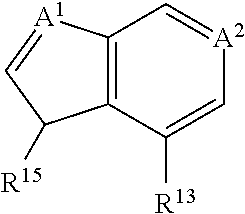
- and includes pharmaceutically acceptable salts and prodrugs thereof. In this class of molecules, A1 and A2 are each independently selected from CH and N; R13 is substituted or unsubstituted amino, substituted or unsubstituted C1-12 alkyl, substituted or unsubstituted C1-12 haloalkyl, substituted or unsubstituted C2-12 alkenyl, substituted or unsubstituted C2-12 alkynyl, substituted or unsubstituted aryl, substituted or unsubstituted cycloalkyl, substituted or unsubstituted heteroalkyl, substituted or unsubstituted heteroaryl, substituted or unsubstituted heterocycloalkyl, substituted or unsubstituted arylalkyl, substituted or unsubstituted heteroarylalkyl, substituted or unsubstituted cycloalkylalkyl, and substituted or unsubstituted heterocycloalkylalkyl; and R15 is hydrogen, hydroxyl, or substituted or unsubstituted alkoxyl.
- A seventh class of Hsp90 inhibitors comprises compounds of the following formula:
-

- and includes pharmaceutically acceptable salts and prodrugs thereof. In this class of molecules, X is NH, S, or O; Y is NR1, O, S, and CHR1, wherein R1 is hydrogen, substituted or unsubstituted C1-12 alkyl, substituted or unsubstituted C1-12 haloalkyl, substituted or unsubstituted C2-12 alkenyl, substituted or unsubstituted C2-12 alkynyl, substituted or unsubstituted aryl, substituted or unsubstituted cycloalkyl, substituted or unsubstituted heteroaryl, substituted or unsubstituted heterocycloalkyl, substituted or unsubstituted arylalkyl, substituted or unsubstituted heteroarylalkyl, substituted or unsubstituted cycloalkylalkyl, substituted or unsubstituted heterocycloalkylalkyl, substituted or unsubstituted acyl, and substituted or unsubstituted sulfonyl; A1 and A2 are each independently selected from CH and N; R13 is substituted or unsubstituted C1-12 alkyl, substituted or unsubstituted C1-12 haloalkyl, substituted or unsubstituted C2-12 alkenyl, substituted or unsubstituted C2-12 alkynyl, substituted or unsubstituted aryl, substituted or unsubstituted cycloalkyl, substituted or unsubstituted heteroalkyl, substituted or unsubstituted heteroaryl, substituted or unsubstituted heterocycloalkyl, substituted or unsubstituted arylalkyl, substituted or unsubstituted heteroarylalkyl, substituted or unsubstituted cycloalkylalkyl, and substituted or unsubstituted heterocycloalkylalkyl; and R15 is hydrogen, hydroxyl, or substituted or unsubstituted alkoxyl.
- An eighth class of Hsp90 inhibitors comprises compounds of the following formula:
-

- and includes pharmaceutically acceptable salts and prodrugs thereof. In this class of molecules, X is NH, S, or O; Y is NR1, O, S, and CHR1, wherein R1 is hydrogen, substituted or unsubstituted C1-12 alkyl, substituted or unsubstituted C1-12 haloalkyl, substituted or unsubstituted C2-12 alkenyl, substituted or unsubstituted C2-12 alkynyl, substituted or unsubstituted aryl, substituted or unsubstituted cycloalkyl, substituted or unsubstituted heteroaryl, substituted or unsubstituted heterocycloalkyl, substituted or unsubstituted arylalkyl, substituted or unsubstituted heteroarylalkyl, substituted or unsubstituted cycloalkylalkyl, substituted or unsubstituted heterocycloalkylalkyl, substituted or unsubstituted acyl, and substituted or unsubstituted sulfonyl; A1, A2, and A3 are each independently selected from CH and N; R13 is substituted or unsubstituted amino, substituted or unsubstituted C1-12 alkyl, substituted or unsubstituted C1-12 haloalkyl, substituted or unsubstituted C2-12 alkenyl, substituted or unsubstituted C2-12 alkynyl, substituted or unsubstituted aryl, substituted or unsubstituted cycloalkyl, substituted or unsubstituted heteroalkyl, substituted or unsubstituted heteroaryl, substituted or unsubstituted heterocycloalkyl, substituted or unsubstituted arylalkyl, substituted or unsubstituted heteroarylalkyl, substituted or unsubstituted cycloalkylalkyl, and substituted or unsubstituted heterocycloalkylalkyl; and R12 is hydrogen or substituted or unsubstituted alkyl.
- A ninth class of Hsp90 inhibitors comprises compounds of the following formula:
-

- and includes pharmaceutically acceptable salts and prodrugs thereof. In this class of molecules, X is NH, S, or O; A1 and A2 are each independently selected from CH and N; R1 is hydrogen, substituted or unsubstituted C1-12 alkyl, substituted or unsubstituted C1-12 haloalkyl, substituted or unsubstituted C2-12 alkenyl, substituted or unsubstituted C2-12 alkynyl, substituted or unsubstituted aryl, substituted or unsubstituted cycloalkyl, substituted or unsubstituted heteroaryl, substituted or unsubstituted heterocycloalkyl, substituted or unsubstituted arylalkyl, substituted or unsubstituted heteroarylalkyl, substituted or unsubstituted cycloalkylalkyl, substituted or unsubstituted heterocycloalkylalkyl, substituted or unsubstituted acyl, and substituted or unsubstituted sulfonyl; R12 is hydrogen or substituted or unsubstituted alkyl; and R13 is substituted or unsubstituted amino, substituted or unsubstituted C1-12 alkyl, substituted or unsubstituted C1-12 haloalkyl, substituted or unsubstituted C2-12 alkenyl, substituted or unsubstituted C2-12 alkynyl, substituted or unsubstituted aryl, substituted or unsubstituted cycloalkyl, substituted or unsubstituted heteroalkyl, substituted or unsubstituted heteroaryl, substituted or unsubstituted heterocycloalkyl, substituted or unsubstituted arylalkyl, substituted or unsubstituted heteroarylalkyl, substituted or unsubstituted cycloalkylalkyl, and substituted or unsubstituted heterocycloalkylalkyl.
- A tenth class of Hsp90 inhibitors comprises compounds of the following formula:
-

- or a pharmaceutically acceptable salt or prodrug thereof, wherein Ar is substituted or unsubstituted aryl or substituted or unsubstituted heteroaryl; and R1 and R2 are each independently selected from hydrogen, substituted or unsubstituted C1-12 alkyl, substituted or unsubstituted C1-12 haloalkyl, substituted or unsubstituted C2-12 alkenyl, substituted or unsubstituted C2-12 alkynyl, substituted or unsubstituted aryl, substituted or unsubstituted cycloalkyl, substituted or unsubstituted heteroaryl, substituted or unsubstituted heterocycloalkyl, substituted or unsubstituted arylalkyl, substituted or unsubstituted heteroarylalkyl, substituted or unsubstituted cycloalkylalkyl, substituted or unsubstituted heterocycloalkylalkyl, substituted or unsubstituted acyl, and substituted or unsubstituted sulfonyl.
- Also provided is a method of preparing compounds for use as Hsp90 inhibitors. The method of preparing compounds comprises the following steps: treating 6-methoxy-8-amino-quinoline with excess bromoalkylnitrile in solvent to produce a 4-(6-methoxyquinolin-8-ylamino)alkylnitrile; reducing the 4-(6-methoxyquinolin-8-ylamino) alkylnitrile with a hydride donor to produce a 4-(6-methoxyquinolin-8-ylamino)alkylamine; and alkylating the 4-(6-methoxyquinolin-8-ylamino)alkylamino to produce a N1,N1-dialkyl-N4-(6-methoxyquinolin-8-yl)alkyldiamine. In some embodiments, the method further comprises the step of treating the N1,N1-dialkyl-N4-(6-methoxyquinolin-8-yl)alkyldiamine with hydrobromic acid to produce a N1,N1-dialkyl-N4-(6-hydroxyquinolin-8-yl)alkyldiamine. In some embodiments, the hydride donor in the reducing step is lithium aluminum hydride. In some embodiments, the solvent in the treating step is a mixture of triethylamine and methanol.
- The details of one or more embodiments are set forth in the description below. Other features, objects, and advantages will be apparent from the description and from the claims.
-
FIG. 1 is a graph showing the dose response binding inhibition of compound 1 in a competitive binding assay. - The term “comprising” and variations thereof as used herein are used synonymously with the term “including” and variations thereof and are open, non-limiting terms.
- Novel classes of Hsp90 inhibitors are provided herein. These compounds are useful in treating, preventing, and/or ameliorating cancer and other Hsp90 associated diseases or conditions such as, for example, inflammation and neurodegenerative disorders. Specifically, pharmaceutically acceptable salts, prodrugs, and derivatives of aminoquinoline compounds are provided. Methods of their synthesis and use in the treatment of Hsp90 associated conditions are also provided.
- A first group of Hsp90 inhibitors comprises compounds represented by Formula I:
-

- or a pharmaceutically acceptable salt or prodrug thereof. In some examples, Formula I is a hydrobromide salt.
- In Formula I, A is substituted or unsubstituted C1-6 alkyl, substituted or unsubstituted C2-6 alkenyl, or substituted or unsubstituted C2-6 alkynyl.
- Also, in Formula I, W is hydrogen, NHR6, or OR6 wherein R6 is hydrogen, substituted or unsubstituted C1-12 alkyl, substituted or unsubstituted C2-12 alkenyl, substituted or unsubstituted C2-12 alkynyl, substituted or unsubstituted acyl, substituted or unsubstituted aminoalkyl, substituted or unsubstituted hydroxyalkyl, or substituted or unsubstituted alkoxyalkyl.
- Additionally, in Formula I, X is NH, S, or O. In some examples, X is NH.
- Further, in Formula I, R1 and R2 are each independently selected from hydrogen, substituted or unsubstituted C1-12 alkyl, substituted or unsubstituted C1-12 haloalkyl, substituted or unsubstituted C2-12 alkenyl, substituted or unsubstituted C2-12 alkynyl, substituted or unsubstituted aryl, substituted or unsubstituted cycloalkyl, substituted or unsubstituted heteroaryl, substituted or unsubstituted heterocycloalkyl, substituted or unsubstituted arylalkyl, substituted or unsubstituted heteroarylalkyl, substituted or unsubstituted cycloalkylalkyl, substituted or unsubstituted heterocycloalkylalkyl, substituted or unsubstituted acyl, and substituted or unsubstituted sulfonyl. In some examples, R1 and R2 together form substituted or unsubstituted C1-8 alkyl or substituted or unsubstituted C2-8 alkenyl.
- Also, in Formula I, R3, R4, and R5 are each independently selected from hydrogen, halogen, hydroxyl, nitro, cyano, substituted or unsubstituted amino, substituted or unsubstituted thio, substituted or unsubstituted C1-12 alkyl, substituted or unsubstituted C2-12 alkenyl, substituted or unsubstituted C2-12 alkynyl, substituted or unsubstituted aryl, substituted or unsubstituted cycloalkyl, substituted or unsubstituted heteroaryl, substituted or unsubstituted heterocycloalkyl, substituted or unsubstituted arylalkyl, substituted or unsubstituted heteroarylalkyl, substituted or unsubstituted cycloalkylalkyl, substituted or unsubstituted heterocycloalkylalkyl, substituted or unsubstituted C1-12 alkylamine, substituted or unsubstituted C2-12 alkenylamine, substituted or unsubstituted C2-12 alkynylamine, substituted or unsubstituted arylamine, substituted or unsubstituted acyl, substituted or unsubstituted alkoxyl, and substituted or unsubstituted aryloxyl. In some examples, R5 is substituted or unsubstituted amido.
- Further, in Formula I, R7 is hydrogen, hydroxyl, substituted or unsubstituted alkoxyl, substituted or unsubstituted amino, substituted or unsubstituted thio, substituted or unsubstituted C1-12 alkyl, substituted or unsubstituted C1-12 haloalkyl, substituted or unsubstituted C2-12 alkenyl, substituted or unsubstituted C2-12 alkynyl, substituted or unsubstituted aryl, substituted or unsubstituted cycloalkyl, substituted or unsubstituted heteroaryl, substituted or unsubstituted heterocycloalkyl, substituted or unsubstituted arylalkyl, substituted or unsubstituted heteroarylalkyl, substituted or unsubstituted cycloalkylalkyl, substituted or unsubstituted heterocycloalkylalkyl, substituted or unsubstituted acyl, or substituted or unsubstituted sulfonyl. In some examples, R7 is substituted or unsubstituted amino.
- Furthermore, in Formula I, R8 and R9 are each independently selected from hydrogen, substituted or unsubstituted C1-12 alkyl, substituted or unsubstituted C2-12 alkenyl, and substituted or unsubstituted C2-12 alkynyl.
- In some examples of Formula I, if X is NH, W is hydroxyl or methoxyl, and one of R1 or R2 is C1-5 alkyl, then the other of R1 or R2 is not hydrogen or C1-5 alkyl.
- Additionally, in some examples of Formula I, if X is NH and W is hydroxyl or methoxyl, then R1 and R2 are not simultaneously hydrogen.
- Also, in some examples of Formula I, if X is NH, W is hydroxyl or methoxyl, and R8 is methyl, then R9 is not hydrogen.
- An example of Formula I includes the following:
-

- In some examples, Formula I can be Formula I-A:
-

- or a pharmaceutically acceptable salt or prodrug thereof. In some examples, Formula I-A is a hydrobromide salt.
- In Formula I-A, A is substituted or unsubstituted C1-6 alkyl, substituted or unsubstituted C2-6 alkenyl, or substituted or unsubstituted C2-6 alkynyl.
- Also, in Formula I-A, X is S or O.
- Additionally, in Formula I-A, R1, R2, and R2 are each independently selected from hydrogen, substituted or unsubstituted C1-12 alkyl, substituted or unsubstituted C1-12 haloalkyl, substituted or unsubstituted C2-12 alkenyl, substituted or unsubstituted C2-12 alkynyl, substituted or unsubstituted aryl, substituted or unsubstituted cycloalkyl, substituted or unsubstituted heteroaryl, substituted or unsubstituted heterocycloalkyl, substituted or unsubstituted arylalkyl, substituted or unsubstituted heteroarylalkyl, substituted or unsubstituted cycloalkylalkyl, substituted or unsubstituted heterocycloalkylalkyl, substituted or unsubstituted acyl, and substituted or unsubstituted sulfonyl.
- In some examples, R1 is hydrogen, methyl, ethyl, propyl, butyl, pentyl, isopropyl, sec-butyl, isobutyl, benzyl, benzoyl, acetyl, or substituted or unsubstituted sulfonyl (e.g., SO2R8). In some examples, R2 is hydrogen, methyl, ethyl, propyl, butyl, pentyl, isopropyl, sec-butyl, isobutyl, benzyl, benzoyl, acetyl, or
-
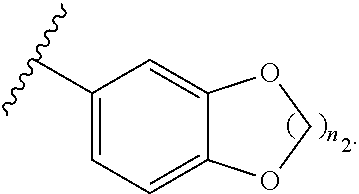
- In some examples, R1 and R2 together form substituted or unsubstituted C1-8 alkyl or substituted or unsubstituted C2-8 alkenyl. For example, R1—N—R2 can combine to form aziridine, azetidine, pyrrolidine, or piperidine. In some examples, R7 is hydrogen, methyl, ethyl, propyl, isopropyl, butyl, isobutyl, t-butyl, acetyl, or propanoyl.
- Further, in Formula I-A, R3, R4, and R5 are each independently selected from hydrogen, halogen, hydroxyl, nitro, substituted or unsubstituted amino, cyano, substituted or unsubstituted C1-12 alkyl, substituted or unsubstituted C2-12 alkenyl, substituted or unsubstituted C2-12 alkynyl, substituted or unsubstituted aryl, substituted or unsubstituted cycloalkyl, substituted or unsubstituted heteroaryl, substituted or unsubstituted heterocycloalkyl, substituted or unsubstituted arylalkyl, substituted or unsubstituted heteroarylalkyl, substituted or unsubstituted cycloalkylalkyl, substituted or unsubstituted heterocycloalkylalkyl, substituted or unsubstituted C1-12 alkylamine, substituted or unsubstituted C2-12 alkenylamine, substituted or unsubstituted C2-12 alkynylamine, substituted or unsubstituted arylamine, substituted or unsubstituted alkoxyl, and substituted or unsubstituted aryloxyl.
- In some examples, R3 is hydrogen, methyl, ethyl, propyl, or NH-ethyl. In some examples, R4 is hydrogen, methyl, ethyl, propyl, NH-ethyl, NH-phenyl, chloro, hydroxyl, methoxyl, or phenoxyl. In some examples, R5 is hydrogen, hydroxyl, chloro, nitro, amino, NH-phenyl, p-chlorophenyl, or p-methoxyphenyl.
- Additionally, in Formula I-A, R6 is hydrogen, substituted or unsubstituted C1-12 alkyl, substituted or unsubstituted C2-12 alkenyl, substituted or unsubstituted C2-12 alkynyl, substituted or unsubstituted acyl, substituted or unsubstituted aminoalkyl, substituted or unsubstituted hydroxyalkyl, or substituted or unsubstituted alkoxyalkyl. In some examples, R6 is hydrogen, methyl, ethyl, allyl, acetyl, or —(CH2)n1T, wherein n1 is 1-5 and T is hydrogen, hydroxyl, amino, or alkoxyl.
- Furthermore, in Formula I-A, R8 and R9 are each independently selected from hydrogen, substituted or unsubstituted C1-12 alkyl, substituted or unsubstituted C2-12 alkenyl, and substituted or unsubstituted C2-12 alkynyl. In some examples, one or both of R8 and R9 is hydrogen, methyl, or ethyl.
- In some examples, Formula I can be Formula I-B:
-

- or a pharmaceutically acceptable salt or prodrug thereof. In some examples, Formula I-B is a hydrobromide salt.
- In Formula I-B, A is substituted or unsubstituted C1-6 alkyl, substituted or unsubstituted C2-6 alkenyl, or substituted or unsubstituted C2-6 alkynyl.
- Also, in Formula I-B, R1 and R2 are each independently selected from hydrogen, substituted or unsubstituted C1-12 alkyl, substituted or unsubstituted C1-12 haloalkyl, substituted or unsubstituted C2-12 alkenyl, substituted or unsubstituted C2-12 alkynyl, substituted or unsubstituted aryl, substituted or unsubstituted cycloalkyl, substituted or unsubstituted heteroaryl, substituted or unsubstituted heterocycloalkyl, substituted or unsubstituted arylalkyl, substituted or unsubstituted heteroarylalkyl, substituted or unsubstituted cycloalkylalkyl, substituted or unsubstituted heterocycloalkylalkyl, substituted or unsubstituted acyl, and substituted or unsubstituted sulfonyl. In some examples, R1 and R2 are not C1-12 alkyl. In some examples, R1 is hydrogen, benzyl, benzoyl, acetyl, or substituted or unsubstituted sulfonyl (e.g., SO2R8). In some examples, R2 is hydrogen, benzyl, benzoyl, acetyl, or
-

- In some examples, R1 and R2 together form substituted or unsubstituted C1-8 alkyl or substituted or unsubstituted C2-8 alkenyl. For example, R1—N—R2 can combine to form aziridine, azetidine, pyrrolidine, or piperidine.
- Additionally, in Formula I-B, R3, R4, and R5 are each independently selected from hydrogen, halogen, hydroxyl, nitro, substituted or unsubstituted amino, cyano, substituted or unsubstituted C1-12 alkyl, substituted or unsubstituted C2-12 alkenyl, substituted or unsubstituted C2-12 alkynyl, substituted or unsubstituted aryl, substituted or unsubstituted cycloalkyl, substituted or unsubstituted heteroaryl, substituted or unsubstituted heterocycloalkyl, substituted or unsubstituted arylalkyl, substituted or unsubstituted heteroarylalkyl, substituted or unsubstituted cycloalkylalkyl, substituted or unsubstituted heterocycloalkylalkyl, substituted or unsubstituted C1-12 alkylamine, substituted or unsubstituted C2-12 alkenylamine, substituted or unsubstituted C2-12 alkynylamine, substituted or unsubstituted arylamine, substituted or unsubstituted alkoxyl, and substituted or unsubstituted aryloxyl.
- In some examples, R3 is hydrogen, methyl, ethyl, propyl, or NH-ethyl. In some examples, R4 is hydrogen, methyl, ethyl, propyl, NH-ethyl, NH-phenyl, chloro, hydroxyl, methoxyl, or phenoxyl. In some examples, R5 is hydrogen, hydroxyl, chloro, nitro, amino, NH-phenyl, p-chlorophenyl, or p-methoxyphenyl.
- Further, in Formula I-B, R6 is hydrogen, substituted or unsubstituted C1-12 alkyl, substituted or unsubstituted C2-12 alkenyl, substituted or unsubstituted C2-12 alkynyl, substituted or unsubstituted acyl, substituted or unsubstituted aminoalkyl, substituted or unsubstituted hydroxyalkyl, or substituted or unsubstituted alkoxyalkyl. In some examples, R6 is hydrogen, methyl, ethyl, allyl, acetyl, or —(CH2)n1T, wherein n1 is 1-5 and T is hydrogen, hydroxyl, amino, or alkoxyl.
- Also, in Formula I, R7 is hydrogen, substituted or unsubstituted C1-12 alkyl, substituted or unsubstituted C1-12haloalkyl, substituted or unsubstituted C2-12 alkenyl, substituted or unsubstituted C2-12 alkynyl, substituted or unsubstituted aryl, substituted or unsubstituted cycloalkyl, substituted or unsubstituted heteroaryl, substituted or unsubstituted heterocycloalkyl, substituted or unsubstituted arylalkyl, substituted or unsubstituted heteroarylalkyl, substituted or unsubstituted cycloalkylalkyl, substituted or unsubstituted heterocycloalkylalkyl, substituted or unsubstituted acyl, or substituted or unsubstituted sulfonyl. In some examples, R7 is hydrogen, methyl, ethyl, propyl, isopropyl, butyl, isobutyl, t-butyl, acetyl, or propanoyl.
- Further, in Formula I-B, R8 and R9 are each independently selected from hydrogen, substituted or unsubstituted C1-12 alkyl, substituted or unsubstituted C2-12 alkenyl, and substituted or unsubstituted C2-12 alkynyl. In some examples, one or both of R8 and R9 is hydrogen, methyl, or ethyl.
- In some examples of Formula I-B, if R6 is hydrogen or methyl and one of R1 or R2 is C1-5 alkyl, then the other of R1 or R2 is not hydrogen or C1-5 alkyl. In some examples of Formula I, if R6 is hydrogen or methyl, then R1 and R2 are not simultaneously hydrogen. Also, in some examples of Formula I-B, if R6 is hydrogen or methyl and R8 is methyl, then R9 is not hydrogen.
- Examples of Formula I include the following:
-

- A second group of Hsp90 inhibitors comprises compounds represented by Formula II:
-

- or a pharmaceutically acceptable salt or prodrug thereof.
- In Formula II, A1, A2, A3, and A4 are each independently selected from N and CR7, wherein at least one of A1, A2, and A3 is N. In some examples, A3 is N.
- Also, in Formula II, R7 is hydrogen, substituted or unsubstituted amino, substituted or unsubstituted C1-12 alkyl, substituted or unsubstituted C1-12haloalkyl, substituted or unsubstituted C2-12 alkenyl, substituted or unsubstituted C2-12 alkynyl, substituted or unsubstituted aryl, substituted or unsubstituted cycloalkyl, substituted or unsubstituted heteroaryl, substituted or unsubstituted heterocycloalkyl, substituted or unsubstituted arylalkyl, substituted or unsubstituted heteroarylalkyl, substituted or unsubstituted cycloalkylalkyl, substituted or unsubstituted heterocycloalkylalkyl, substituted or unsubstituted acyl, or substituted or unsubstituted sulfonyl.
- Additionally, in Formula II, R10 is hydrogen, hydroxyl, substituted or unsubstituted alkoxyl, substituted or unsubstituted amino, or substituted or unsubstituted thiol.
- Further, in Formula II, R11 is substituted or unsubstituted C1-12 alkyl, substituted or unsubstituted C1-12haloalkyl, substituted or unsubstituted C2-12 alkenyl, substituted or unsubstituted C2-12 alkynyl, substituted or unsubstituted aryl, substituted or unsubstituted cycloalkyl, substituted or unsubstituted heteroalkyl, substituted or unsubstituted heteroaryl, substituted or unsubstituted heterocycloalkyl, substituted or unsubstituted arylalkyl, substituted or unsubstituted heteroarylalkyl, substituted or unsubstituted cycloalkylalkyl, substituted or unsubstituted heterocycloalkylalkyl, substituted or unsubstituted amino, substituted or unsubstituted alkylsulfonylamino, substituted or unsubstituted arylsulfonylamino, substituted or unsubstituted arylalkylsulfonylamino, substituted or unsubstituted cycloalkylsulfonylamino, substituted or unsubstituted heteroalkylsulfonylamino, substituted or unsubstituted heteroarylsulfonylamino, substituted or unsubstituted heterocycloalkylsulfonylamino, substituted or unsubstituted heteroarylalkylsulfonylamino, substituted or unsubstituted cycloalkylalkylsulfonylamino, or substituted or unsubstituted heterocycloalkylalkylsulfonylamino.
- Further, in Formula II, R13 and R14 are independently hydrogen, halogen, hydroxyl, substituted or substituted amino, substituted or unsubstituted alkoxyl, substituted or unsubstituted thiol, substituted or unsubstituted C1-12 alkyl, substituted or unsubstituted C1-12haloalkyl, substituted or unsubstituted C2-12 alkenyl, substituted or unsubstituted C2-12 alkynyl, substituted or unsubstituted aryl, substituted or unsubstituted cycloalkyl, substituted or unsubstituted heteroalkyl, substituted or unsubstituted heteroaryl, substituted or unsubstituted heterocycloalkyl, substituted or unsubstituted arylalkyl, substituted or unsubstituted heteroarylalkyl, substituted or unsubstituted cycloalkylalkyl, and substituted or unsubstituted heterocycloalkylalkyl.
- In some examples, Formula II can be Formula II-A:
-

- or a pharmaceutically acceptable salt or prodrug thereof.
- In Formula II-A, A1 and A2 are each independently selected from CH and N.
- Also, in Formula II-A, R10 is hydrogen, hydroxyl, substituted or unsubstituted alkoxyl, substituted or unsubstituted amino, or substituted or unsubstituted thiol. In some examples, R10 is substituted or unsubstituted amino.
- Additionally, in Formula II-A, R11 is substituted or unsubstituted C1-12 alkyl, substituted or unsubstituted C1-12 haloalkyl, substituted or unsubstituted C2-12 alkenyl, substituted or unsubstituted C2-12 alkynyl, substituted or unsubstituted aryl, substituted or unsubstituted cycloalkyl, substituted or unsubstituted heteroalkyl, substituted or unsubstituted heteroaryl, substituted or unsubstituted heterocycloalkyl, substituted or unsubstituted arylalkyl, substituted or unsubstituted heteroarylalkyl, substituted or unsubstituted cycloalkylalkyl, substituted or unsubstituted heterocycloalkylalkyl, substituted or unsubstituted amino, substituted or unsubstituted alkylsulfonylamino, substituted or unsubstituted arylsulfonylamino, substituted or unsubstituted arylalkylsulfonylamino, substituted or unsubstituted cycloalkylsulfonylamino, substituted or unsubstituted heteroalkylsulfonylamino, substituted or unsubstituted heteroarylsulfonylamino, substituted or unsubstituted heterocycloalkylsulfonylamino, substituted or unsubstituted heteroarylalkylsulfonylamino, substituted or unsubstituted cycloalkylalkylsulfonylamino, or substituted or unsubstituted heterocycloalkylalkylsulfonylamino. In some examples, R11 is alkyl, alkenyl, alkynyl, cycloalkyl, aryl, or unsubstituted or unsubstituted amino.
- Examples of Formula II-A include the following:
-

- In some examples, Formula II can be Formula II-B:
-

- or a pharmaceutically acceptable salt or prodrug thereof.
- In Formula II-B, R1 and R2 are each independently selected from hydrogen, substituted or unsubstituted C1-12 alkyl, substituted or unsubstituted C1-12 haloalkyl, substituted or unsubstituted C2-12 alkenyl, substituted or unsubstituted C2-12 alkynyl, substituted or unsubstituted aryl, substituted or unsubstituted cycloalkyl, substituted or unsubstituted heteroaryl, substituted or unsubstituted heterocycloalkyl, substituted or unsubstituted arylalkyl, substituted or unsubstituted heteroarylalkyl, substituted or unsubstituted cycloalkylalkyl, substituted or unsubstituted heterocycloalkylalkyl, substituted or unsubstituted acyl, and substituted or unsubstituted sulfonyl. In some examples, R1 and R2 together form substituted or unsubstituted C1-8 alkyl or substituted or unsubstituted C2-8 alkenyl.
- Also, in Formula II-B, R2 is hydrogen, substituted or unsubstituted amino, substituted or unsubstituted C1-12 alkyl, substituted or unsubstituted C1-12 haloalkyl, substituted or unsubstituted C2-12 alkenyl, substituted or unsubstituted C2-12 alkynyl, substituted or unsubstituted aryl, substituted or unsubstituted cycloalkyl, substituted or unsubstituted heteroaryl, substituted or unsubstituted heterocycloalkyl, substituted or unsubstituted arylalkyl, substituted or unsubstituted heteroarylalkyl, substituted or unsubstituted cycloalkylalkyl, substituted or unsubstituted heterocycloalkylalkyl, substituted or unsubstituted acyl, or substituted or unsubstituted sulfonyl.
- Additionally, in Formula II-B, R8 and R9 are each independently selected from hydrogen, substituted or unsubstituted C1-12 alkyl, substituted or unsubstituted C2-12 alkenyl, and substituted or unsubstituted C2-12 alkynyl.
- Further, in Formula II-B, R10 is hydrogen, hydroxyl, substituted or unsubstituted alkoxyl, substituted or unsubstituted amino, or substituted or unsubstituted thiol.
- Also, in Formula II-B, R11 is substituted or unsubstituted C1-12 alkyl, substituted or unsubstituted C1-12 haloalkyl, substituted or unsubstituted C2-12 alkenyl, substituted or unsubstituted C2-12 alkynyl, substituted or unsubstituted aryl, substituted or unsubstituted cycloalkyl, substituted or unsubstituted heteroalkyl, substituted or unsubstituted heteroaryl, substituted or unsubstituted heterocycloalkyl, substituted or unsubstituted arylalkyl, substituted or unsubstituted heteroarylalkyl, substituted or unsubstituted cycloalkylalkyl, substituted or unsubstituted heterocycloalkylalkyl, substituted or unsubstituted amino, substituted or unsubstituted alkylsulfonylamino, substituted or unsubstituted arylsulfonylamino, substituted or unsubstituted arylalkylsulfonylamino, substituted or unsubstituted cycloalkylsulfonylamino, substituted or unsubstituted heteroalkylsulfonylamino, substituted or unsubstituted heteroarylsulfonylamino, substituted or unsubstituted heterocycloalkylsulfonylamino, substituted or unsubstituted heteroarylalkylsulfonylamino, substituted or unsubstituted cycloalkylalkylsulfonylamino, or substituted or unsubstituted heterocycloalkylalkylsulfonylamino.
- Further, in Formula II-B, R13 and R14 are each independently hydrogen, halogen, substituted or substituted amino, substituted or unsubstituted C1-12 alkyl, substituted or unsubstituted C1-12 haloalkyl, substituted or unsubstituted C2-12 alkenyl, substituted or unsubstituted C2-12 alkynyl, substituted or unsubstituted aryl, substituted or unsubstituted cycloalkyl, substituted or unsubstituted heteroalkyl, substituted or unsubstituted heteroaryl, substituted or unsubstituted heterocycloalkyl, substituted or unsubstituted arylalkyl, substituted or unsubstituted heteroarylalkyl, substituted or unsubstituted cycloalkylalkyl, and substituted or unsubstituted heterocycloalkylalkyl.
- In some examples, Formula II can be Formula II-C:
-

- or a pharmaceutically acceptable salt or prodrug thereof.
- In Formula II-C, R1 and R2 are each independently selected from hydrogen, substituted or unsubstituted C1-12 alkyl, substituted or unsubstituted C1-12 haloalkyl, substituted or unsubstituted C2-12 alkenyl, substituted or unsubstituted C2-12 alkynyl, substituted or unsubstituted aryl, substituted or unsubstituted cycloalkyl, substituted or unsubstituted heteroaryl, substituted or unsubstituted heterocycloalkyl, substituted or unsubstituted arylalkyl, substituted or unsubstituted heteroarylalkyl, substituted or unsubstituted cycloalkylalkyl, substituted or unsubstituted heterocycloalkylalkyl, substituted or unsubstituted acyl, and substituted or unsubstituted sulfonyl. In some examples, R1 and R2 together form substituted or unsubstituted C1-8 alkyl or substituted or unsubstituted C2-8 alkenyl.
- Also, in Formula II-C, R7 is hydrogen, substituted or unsubstituted amino, substituted or unsubstituted C1-12 alkyl, substituted or unsubstituted C1-12 haloalkyl, substituted or unsubstituted C2-12 alkenyl, substituted or unsubstituted C2-12 alkynyl, substituted or unsubstituted aryl, substituted or unsubstituted cycloalkyl, substituted or unsubstituted heteroaryl, substituted or unsubstituted heterocycloalkyl, substituted or unsubstituted arylalkyl, substituted or unsubstituted heteroarylalkyl, substituted or unsubstituted cycloalkylalkyl, substituted or unsubstituted heterocycloalkylalkyl, substituted or unsubstituted acyl, or substituted or unsubstituted sulfonyl.
- Additionally, in Formula II-C, R8 and R9 are each independently selected from hydrogen, substituted or unsubstituted C1-12 alkyl, substituted or unsubstituted C2-12 alkenyl, and substituted or unsubstituted C2-12 alkynyl.
- Further, in Formula II-C, R10 is hydrogen, hydroxyl, substituted or unsubstituted alkoxyl, substituted or unsubstituted amino, or substituted or unsubstituted thiol. In some examples, R10 is substituted or unsubstituted amino.
- Also, in Formula II-C, R11 is substituted or unsubstituted C1-12 alkyl, substituted or unsubstituted C1-12 haloalkyl, substituted or unsubstituted C2-12 alkenyl, substituted or unsubstituted C2-12 alkynyl, substituted or unsubstituted aryl, substituted or unsubstituted cycloalkyl, substituted or unsubstituted heteroalkyl, substituted or unsubstituted heteroaryl, substituted or unsubstituted heterocycloalkyl, substituted or unsubstituted arylalkyl, substituted or unsubstituted heteroarylalkyl, substituted or unsubstituted cycloalkylalkyl, substituted or unsubstituted heterocycloalkylalkyl, substituted or unsubstituted amino, substituted or unsubstituted alkylsulfonylamino, substituted or unsubstituted arylsulfonylamino, substituted or unsubstituted arylalkylsulfonylamino, substituted or unsubstituted cycloalkylsulfonylamino, substituted or unsubstituted heteroalkylsulfonylamino, substituted or unsubstituted heteroarylsulfonylamino, substituted or unsubstituted heterocycloalkylsulfonylamino, substituted or unsubstituted heteroarylalkylsulfonylamino, substituted or unsubstituted cycloalkylalkylsulfonylamino, or substituted or unsubstituted heterocycloalkylalkylsulfonylamino.
- Further, in Formula II-C, R13 and R14 are independently hydrogen, halogen, substituted or substituted amino, substituted or unsubstituted C1-12 alkyl, substituted or unsubstituted C1-12 haloalkyl, substituted or unsubstituted C2-12 alkenyl, substituted or unsubstituted C2-12 alkynyl, substituted or unsubstituted aryl, substituted or unsubstituted cycloalkyl, substituted or unsubstituted heteroalkyl, substituted or unsubstituted heteroaryl, substituted or unsubstituted heterocycloalkyl, substituted or unsubstituted arylalkyl, substituted or unsubstituted heteroarylalkyl, substituted or unsubstituted cycloalkylalkyl, and substituted or unsubstituted heterocycloalkylalkyl.
- In some examples of Formula II-C, A is (CH2)3, R8 is hydrogen, and R9 is hydrogen.
- A third group of Hsp90 inhibitors comprises compounds represented by Formula III:
-

- or pharmaceutically acceptable salts or prodrugs thereof.
- In Formula III, A1 is CH and N.
- Also, in Formula III, X is NH, S, or O.
- Additionally, in Formula III, R12 is hydrogen or substituted or unsubstituted C1-12 alkyl. In some examples, R12X is substituted or unsubstituted amino.
- Further, in Formula III, R13 and R14 are independently hydrogen, substituted or unsubstituted C1-12 alkyl, substituted or unsubstituted C1-12 haloalkyl, substituted or unsubstituted C2-12 alkenyl, substituted or unsubstituted C2-12 alkynyl, substituted or unsubstituted aryl, substituted or unsubstituted cycloalkyl, substituted or unsubstituted heteroalkyl, substituted or unsubstituted heteroaryl, substituted or unsubstituted heterocycloalkyl, substituted or unsubstituted arylalkyl, substituted or unsubstituted heteroarylalkyl, substituted or unsubstituted cycloalkylalkyl, and substituted or unsubstituted heterocycloalkylalkyl, wherein R13 and R14 are not both hydrogen. In some examples, R13 or R14 is substituted or unsubstituted amino.
- A fourth group of Hsp90 inhibitors comprises compounds represented by Formula IV:
-

- or a pharmaceutically acceptable salt or prodrug thereof.
- In Formula IV, A1, A2, A3, and A4 are each independently selected from N and CR7. If one or more of R7 is present in Formula IV, each R7 is independently hydrogen, substituted or unsubstituted C1-8 alkyl, substituted or unsubstituted C2-8 alkenyl, or substituted or unsubstituted amino. In some examples, R7 is hydrogen.
- In some examples, A3 is CR7. In some examples, A1, A2, A3, and A4 are CR7. Adjacent R7 groups can combine to form a substituted or unsubstituted cycloalkyl, a substituted or unsubstituted heterocycloalkyl, a substituted or unsubstituted aryl, or a substituted or unsubstituted heteroaryl.
- Also, in Formula IV, R10 is hydrogen, hydroxyl, substituted or unsubstituted alkoxyl, substituted or unsubstituted amino, substituted or unsubstituted carbamate, or substituted or unsubstituted thiol.
- Additionally, in Formula IV, R11 is hydroxyl, substituted or unsubstituted alkoxyl, substituted or unsubstituted amino, substituted or unsubstituted carbamate, substituted or unsubstituted thiol, or substituted or unsubstituted acyl. In some examples, R11 is amido.
- Further, in Formula IV, R13 is substituted or unsubstituted amino
- A fifth group of Hsp90 inhibitors comprises compounds represented by Formula V:
-

- or pharmaceutically acceptable salts or prodrugs thereof.
- In Formula V, Y is NR1, O, S, CHR1, or CHR1—CHR2, wherein R1 and R2 are each independently selected from hydrogen, substituted or unsubstituted C1-12 alkyl, substituted or unsubstituted C1-12 haloalkyl, substituted or unsubstituted C2-12 alkenyl, substituted or unsubstituted C2-12 alkynyl, substituted or unsubstituted aryl, substituted or unsubstituted cycloalkyl, substituted or unsubstituted heteroaryl, substituted or unsubstituted heterocycloalkyl, substituted or unsubstituted arylalkyl, substituted or unsubstituted heteroarylalkyl, substituted or unsubstituted cycloalkylalkyl, substituted or unsubstituted heterocycloalkylalkyl, substituted or unsubstituted acyl, and substituted or unsubstituted sulfonyl. In some examples, Y is NR1, O, S, or CHR1.
- Also, in Formula V, Z is hydrogen or a halogen.
- Additionally, in Formula V, X is NH, S, or O.
- Also, in Formula V, R12 is hydrogen or substituted or unsubstituted alkyl.
- Further, in Formula V, R13 is hydrogen, substituted or unsubstituted amino, substituted or unsubstituted C1-12 alkyl, substituted or unsubstituted C1-12 haloalkyl, substituted or unsubstituted C2-12 alkenyl, substituted or unsubstituted C2-12 alkynyl, substituted or unsubstituted aryl, substituted or unsubstituted cycloalkyl, substituted or unsubstituted heteroalkyl, substituted or unsubstituted heteroaryl, substituted or unsubstituted heterocycloalkyl, substituted or unsubstituted arylalkyl, substituted or unsubstituted heteroarylalkyl, substituted or unsubstituted cycloalkylalkyl, or substituted or unsubstituted heterocycloalkylalkyl.
- Furthermore, in Formula V, R14 is hydrogen, substituted or unsubstituted C1-12 alkyl, substituted or unsubstituted C1-12 haloalkyl, substituted or unsubstituted C2-12 alkenyl, substituted or unsubstituted C2-12 alkynyl, substituted or unsubstituted aryl, substituted or unsubstituted cycloalkyl, substituted or unsubstituted heteroalkyl, substituted or unsubstituted heteroaryl, substituted or unsubstituted heterocycloalkyl, substituted or unsubstituted arylalkyl, substituted or unsubstituted heteroarylalkyl, substituted or unsubstituted cycloalkylalkyl, or substituted or unsubstituted heterocycloalkylalkyl. R13 and R14 are not both hydrogen.
- A sixth group of Hsp90 inhibitors comprises compounds represented by Formula VI:
-

- or pharmaceutically acceptable salts or prodrugs thereof.
- In Formula VI, A1 and A2 are each independently selected from CH and N.
- Also, in Formula VI, R13 is substituted or unsubstituted amino, substituted or unsubstituted C1-12 alkyl, substituted or unsubstituted C1-12 haloalkyl, substituted or unsubstituted C2-12 alkenyl, substituted or unsubstituted C2-12 alkynyl, substituted or unsubstituted aryl, substituted or unsubstituted cycloalkyl, substituted or unsubstituted heteroalkyl, substituted or unsubstituted heteroaryl, substituted or unsubstituted heterocycloalkyl, substituted or unsubstituted arylalkyl, substituted or unsubstituted heteroarylalkyl, substituted or unsubstituted cycloalkylalkyl, and substituted or unsubstituted heterocycloalkylalkyl.
- Additionally, in Formula VI, R15 is hydrogen, hydroxyl, or substituted or unsubstituted alkoxyl.
- A seventh group of Hsp90 inhibitors comprises compounds represented by Formula VII:
-
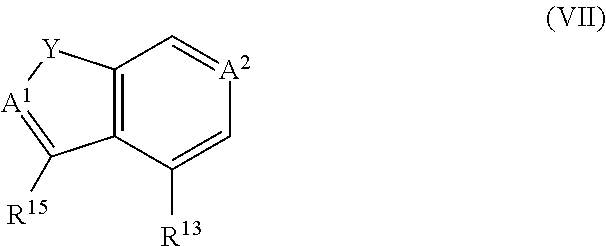
- or pharmaceutically acceptable salts or prodrugs thereof.
- In Formula VII, X is NH, S, or O.
- Also, in Formula VII, Y is NR1, O, S, or CHR1, wherein R1 is hydrogen, substituted or unsubstituted C1-12 alkyl, substituted or unsubstituted C1-12 haloalkyl, substituted or unsubstituted C2-12 alkenyl, substituted or unsubstituted C2-12 alkynyl, substituted or unsubstituted aryl, substituted or unsubstituted cycloalkyl, substituted or unsubstituted heteroaryl, substituted or unsubstituted heterocycloalkyl, substituted or unsubstituted arylalkyl, substituted or unsubstituted heteroarylalkyl, substituted or unsubstituted cycloalkylalkyl, substituted or unsubstituted heterocycloalkylalkyl, substituted or unsubstituted acyl, or substituted or unsubstituted sulfonyl.
- Additionally, in Formula VII, A1 and A2 are each independently selected from CH and N.
- Also, in Formula VII, R13 is substituted or unsubstituted amino, substituted or unsubstituted C1-12 alkyl, substituted or unsubstituted C1-12 haloalkyl, substituted or unsubstituted C2-12 alkenyl, substituted or unsubstituted C2-12 alkynyl, substituted or unsubstituted aryl, substituted or unsubstituted cycloalkyl, substituted or unsubstituted heteroalkyl, substituted or unsubstituted heteroaryl, substituted or unsubstituted heterocycloalkyl, substituted or unsubstituted arylalkyl, substituted or unsubstituted heteroarylalkyl, substituted or unsubstituted cycloalkylalkyl, or substituted or unsubstituted heterocycloalkylalkyl.
- Further, in Formula VII, R15 is hydrogen, hydroxyl, or substituted or unsubstituted alkoxyl.
- An eighth group of Hsp90 inhibitors comprises compounds represented by Formula VIII:
-

- or pharmaceutically acceptable salts or prodrugs thereof.
- In Formula VIII, X is NH, S, or O.
- Also, in Formula VIII, Y is NR1, O, S, or CHR1, wherein R1 is hydrogen, substituted or unsubstituted C1-12 alkyl, substituted or unsubstituted C1-12 haloalkyl, substituted or unsubstituted C2-12 alkenyl, substituted or unsubstituted C2-12 alkynyl, substituted or unsubstituted aryl, substituted or unsubstituted cycloalkyl, substituted or unsubstituted heteroaryl, substituted or unsubstituted heterocycloalkyl, substituted or unsubstituted arylalkyl, substituted or unsubstituted heteroarylalkyl, substituted or unsubstituted cycloalkylalkyl, substituted or unsubstituted heterocycloalkylalkyl, substituted or unsubstituted acyl, and substituted or unsubstituted sulfonyl.
- Additionally, in Formula VIII, A1, A2, and A3 are each independently selected from CH and N.
- Also, in Formula VIII, R12 is hydrogen or substituted or unsubstituted alkyl.
- Further, in Formula VIII, R13 is substituted or unsubstituted amino, substituted or unsubstituted C1-12 alkyl, substituted or unsubstituted C1-12 haloalkyl, substituted or unsubstituted C2-12 alkenyl, substituted or unsubstituted C2-12 alkynyl, substituted or unsubstituted aryl, substituted or unsubstituted cycloalkyl, substituted or unsubstituted heteroalkyl, substituted or unsubstituted heteroaryl, substituted or unsubstituted heterocycloalkyl, substituted or unsubstituted arylalkyl, substituted or unsubstituted heteroarylalkyl, substituted or unsubstituted cycloalkylalkyl, and substituted or unsubstituted heterocycloalkylalkyl.
- A ninth group of Hsp90 inhibitors comprises compounds represented by Formula IX:
-

- or pharmaceutically acceptable salts or prodrugs thereof.
- In Formula IX, X is NH, S, or O.
- Also, in Formula IX, A1 and A2 are each independently selected from CH and N.
- Additionally, in Formula IX, R1 is hydrogen, substituted or unsubstituted C1-12 alkyl, substituted or unsubstituted C1-12 haloalkyl, substituted or unsubstituted C2-12 alkenyl, substituted or unsubstituted C2-12 alkynyl, substituted or unsubstituted aryl, substituted or unsubstituted cycloalkyl, substituted or unsubstituted heteroaryl, substituted or unsubstituted heterocycloalkyl, substituted or unsubstituted arylalkyl, substituted or unsubstituted heteroarylalkyl, substituted or unsubstituted cycloalkylalkyl, substituted or unsubstituted heterocycloalkylalkyl, substituted or unsubstituted acyl, and substituted or unsubstituted sulfonyl.
- Also, in Formula IX, R12 is hydrogen or substituted or unsubstituted alkyl.
- Further, in Formula IX, R13 is substituted or unsubstituted amino, substituted or unsubstituted C1-12 alkyl, substituted or unsubstituted C1-12 haloalkyl, substituted or unsubstituted C2-12 alkenyl, substituted or unsubstituted C2-12 alkynyl, substituted or unsubstituted aryl, substituted or unsubstituted cycloalkyl, substituted or unsubstituted heteroalkyl, substituted or unsubstituted heteroaryl, substituted or unsubstituted heterocycloalkyl, substituted or unsubstituted arylalkyl, substituted or unsubstituted heteroarylalkyl, substituted or unsubstituted cycloalkylalkyl, and substituted or unsubstituted heterocycloalkylalkyl.
- In some examples of Formulas III-IX, R11 or R13 can independently be alkyl, alkenyl, alkynyl, cycloalkyl, or aryl. In some examples of Formulas III-IX, R13 is substituted or unsubstituted amino.
- In other examples of Formulas III-IX, R11 or R13 can independently be
-


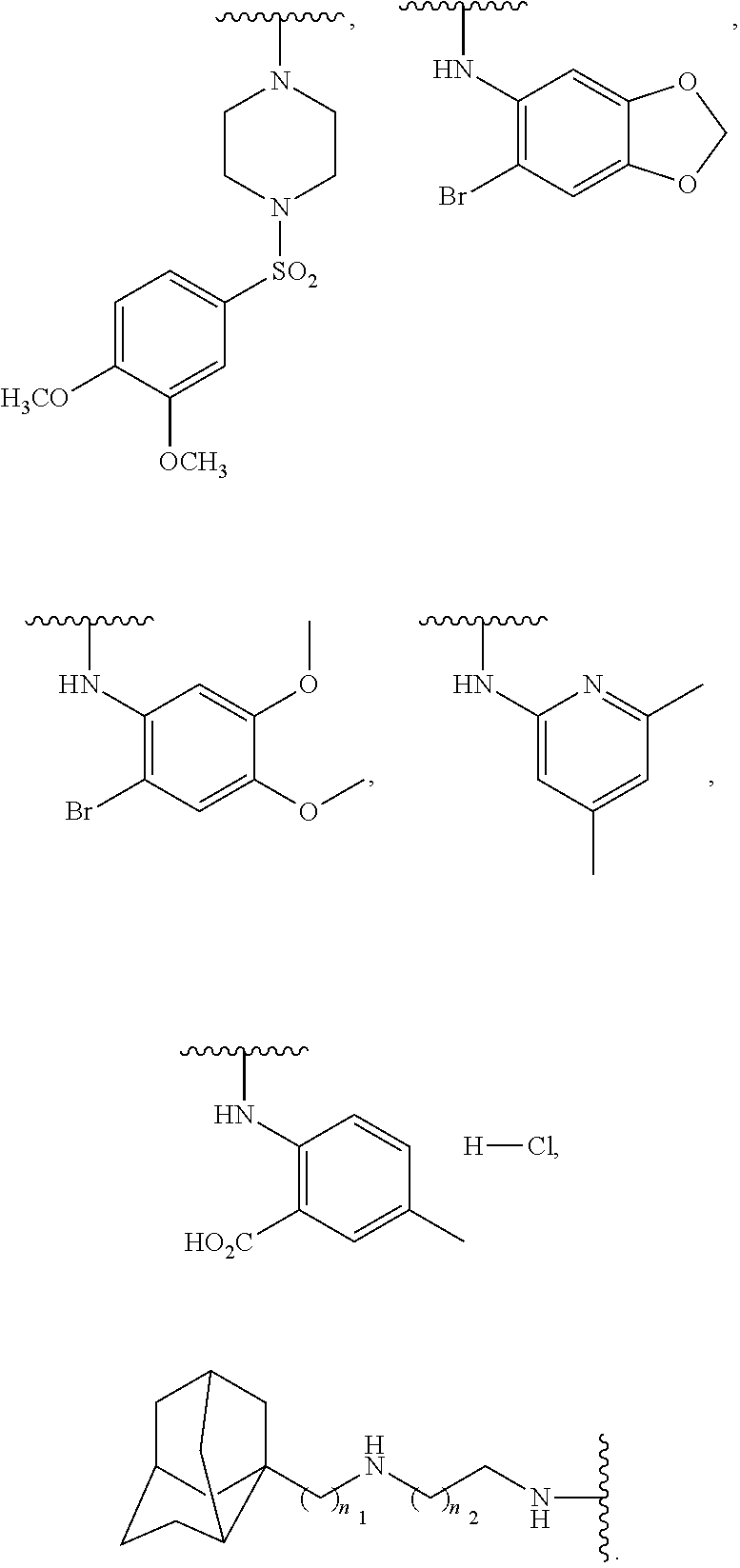
- A tenth group of Hsp90 inhibitors comprises compounds represented by Formula X:
-

- or a pharmaceutically acceptable salt or prodrug thereof.
- In Formula X, Ar is substituted or unsubstituted aryl or substituted or unsubstituted heteroaryl. In some examples, Ar is substituted or unsubstituted naphthalene, substituted or unsubstituted quinoline, substituted or unsubstituted quinazoline, or substituted or unsubstituted naphthyridine.
- Also, in Formula X, R1 and R2 are each independently selected from hydrogen, substituted or unsubstituted C1-12 alkyl, substituted or unsubstituted C1-12 haloalkyl, substituted or unsubstituted C2-12 alkenyl, substituted or unsubstituted C2-12 alkynyl, substituted or unsubstituted aryl, substituted or unsubstituted cycloalkyl, substituted or unsubstituted heteroaryl, substituted or unsubstituted heterocycloalkyl, substituted or unsubstituted arylalkyl, substituted or unsubstituted heteroarylalkyl, substituted or unsubstituted cycloalkylalkyl, substituted or unsubstituted heterocycloalkylalkyl, substituted or unsubstituted acyl, and substituted or unsubstituted sulfonyl. In some examples, R1 and R2 is substituted or unsubstituted C1-6 alkyl.
- Examples of Hsp90 inhibitors represented by Formulas I, II, III, IV, V, VI, VII, VIII, IX, and X are provided below:
-
No Compound 9 
10 
11 
12 
13 
14 
15 
16 
17 
18 
19 
20 
21 
22 
23 
24 
25 
26 
27 
28 
29 
30 
31 
32 
33 
34 
35 
36 
37 
38 
39 
40 
41 
42 
43 
44 
45 
46 
47 
48 
- Variations on Formulas I, II, III, IV, V, VI, VII, VIII, IX, and X include the addition, subtraction, or movement of the various constituents as described for each compound. Similarly, when one or more chiral centers are present in a molecule, the chirality of the molecule can be changed. Additionally, compound synthesis can involve the protection and deprotection of various chemical groups. The use of protection and deprotection, and the selection of appropriate protecting groups can be determined by one skilled in the art. The chemistry of protecting groups can be found, for example, in Greene, et al., Protective Groups in Organic Synthesis, 2d. Ed., Wiley & Sons, 1991, which is incorporated herein by reference in its entirety. The synthesis and subsequent testing of various compounds as described for Formulas I, II, III, IV, V, VI, VII, VIII, IX, and X to determine efficacy is contemplated.
- As used herein, the terms “alkyl”, “alkenyl”, “alkynyl”, and “cycloalkyl” can include straight-chain and branched monovalent substituents. Examples include methyl, ethyl, isobutyl, cyclohexyl, cyclopentylethyl, 2-propenyl, 3-butynyl, and the like. “Heteroalkyl”, “heteroalkenyl”, “heteroalkynyl”, and “heterocycloalkyl” refer to compounds that are similar to “alkyl”, “alkenyl”, “alkynyl”, and “cycloalkyl” but that further contain a hetero atom such as O, S, or N or combinations thereof. The terms “cycloalkylalkyl” and “heterocycloalkylalkyl” refer to cycloalkyl and heterocycloalkyl groups that are bonded to alkyl. The term “aryl” can include monocyclic or fused bicyclic moieties such as phenyl or naphthyl and the term “heteroaryl” can include monocyclic or fused bicyclic ring systems containing one or more heteroatoms selected from O, S, and N. Heteroaryls can include, for example, 5-, 6-, 7-, and 8-membered rings. Thus, aryl and heteroaryl systems can include pyridyl, pyrimidyl, indolyl, benzimidazolyl, benzotriazolyl, isoquinolyl, quinolyl, benzothiazolyl, benzofuranyl, thienyl, furyl, pyrrolyl, thiazolyl, oxazolyl, imidazolyl and the like. Similarly, the terms “arylalkyl” and “heteroarylalkyl” refer to aryl and heteroaryl groups bonded to alkyl groups, including substituted or unsubstituted, saturated or unsaturated, carbon chains. The term “substituted” indicates the main substituent has attached to it one or more additional components, such as, for example, OH, halogen, or one of the other substituents listed above. Substituted aryls can include, for example, monosubstituted, disubstituted, or trisubstituted aryls. As used herein, the term “acyl” indicated a substituted carbonyl. Acyls can include, for example, ketones, aldehydes, amides, carboxylic acids, esters, acyl halides, acid anhydrides, and the like.
- A general method of preparing a compound of Formula I includes treating a compound of Formula XI:
-

- wherein X is NH, S, or O and R16 is H, with excess bromoalkylnitrile in solvent to produce the compound of formula XI, wherein R16 is alkylnitrile. The compounds of formula XI, wherein R16 is alkylnitrile, can then be reduced with a hydride donor to produce the compound of formula XI, wherein R16 is alkylamine. An example of a hydride donor that can be used in the reduction step is lithium aluminum hydride. The compound of formula XI, wherein R16 is alkylamine can then be alkylated to produce the compound of formula XI, wherein R16 is N1,N1-dialkylamine. This compound can then be treated with hydrobromic acid in solvent to produce the compound of formula XI, wherein R16 is N1,N1-dialkylamine and R6 is H. The solvent used in the treatment step can be, for example, a mixture of triethylamine and methanol.
- The aminoquinoline compounds, for example, can be prepared by refluxing 6-methoxy-8-amino-quinoline and 4-bromobutanenitrile in a mixture of triethylamine and methanol. The mixture can then be concentrated and purified by chromatography to afford the desired nitrile. A solution of nitrile in THF can then be reacted with lithium aluminum hydride. The reaction can be quenched by the addition of NaHCO3 and worked up under normal conditions. The crude product can then be dissolved in dichloromethane and acetaldehyde added. Then, NaBH(OAc)3 can be added and the product can be stirred to allow the reaction to occur. After the reaction is complete, silica gel chromatography provides the desired, purified diamine. A solution of the diamine in HBr can be reacted in a microwave initiator. The resulting product can then be purified by chromatography to give the desired aminoquinoline.
- Compound 1 can be synthesized according to the method shown in the following scheme:
-


- A general method of preparing a compound of Formulas II and III includes, for example, treating 6-alkoxy-8-quinazolinamine in pyridine with an alkyl halide. The reaction mixture can be heated to refluxing temperatures until there is no remaining starting material as evidenced by chromatography (e.g., TLC). The compound can then be purified by column chromatography to obtain 6-alkoxy-N-alkylquinazolin-8-amine, which can then undergo demethylation by treatment with HBr (48% aq) in a microwave initiator at 120° C. for 2-2.5 h. The reaction mixture can then be cooled to room temperature and the solvent can be evaporated using a Genevac DD-4X evaporator. The resulting residue can then be purified by silica gel chromatography to provide 6-alkoxy-N-alkylquinazolin-8-amine hydrobromide salt. The hydrobromide salt can be treated with a variety of halides in the presence of K2CO3 to provide the final 6,8-substituted quinazoline derivatives.
- Compounds of Formula II can be prepared according to the method shown in the following scheme. In this example, A1 is represented by Y, A2 and A4 are CH, and A3 is N. Also in this example, A is (CH2)3, R8 and R9 are hydrogen, and R10 is substituted or unsubstituted amino A compound of Formula X wherein Ar is substituted quinozoline can also be synthesized according to this method.
-

- Compounds of Formula II-C can be prepared according to the method shown in the following scheme. In this example, A is (CH2)3, R8 and R9 are hydrogen, and R10 is substituted or unsubstituted amino A compound of Formula X wherein Ar is substituted naphthyridine can also be synthesized according to this method.
-

- A general method of preparing a compound of Formula IV includes, for example, treating a 6-halo-4-nitro-1-napththonitrile with an amine, a palladium catalyst, and a base and then reducing the product using palladium on carbon. The resulting product can then be treated with an alkyl halide in triethylamine Subsequent treatment with base and hydrogen peroxide results in the desired compound. For example, a compound of Formula IV wherein A1, A2, and A4 are CH, A3 is CR7, R7 is substituted amino, R8 and R9 are hydrogen, R11 is amido, and A is (CH2)3 can be synthesized according to the method shown below. A compound of Formula X wherein Ar is substituted naphthalene can also be synthesized according to this method.
-

- A general method of preparing a compound of Formula V includes, for example, stirring a mixture of 3,5-dinitropyridin-2-amine, 2-chlorophenol, and sodium acetate in a solvent mixture (e.g., EtOH and H2O) under refluxing conditions. The solvent can be evaporated to provide a residue, which can be dissolved in H2O and then extracted with an organic solvent (e.g., EtOAc). The organic layers can be combined and washed with H2O and brine, dried over MgSO4, and then concentrated in vacuo. Purification by column chromatography can provide 2-(3,5-dinitropyridin-2-ylamino)phenol. A mixture of the phenol compound and K2CO3 in solvent (e.g., DMF) can be stirred under refluxing conditions. The compound can be extracted with solvent (e.g., CH2Cl2), dried over MgSO4, and purified by column chromatography to obtain 3-nitro-10H-benzo[e]pyrido[3,2-b][1,4]oxazine. The 3-nitro-oxazine can be treated with LHMDS in solvent (e.g., toluene). An alkyl halide can then be added and the reaction mixture heated (e.g., to 80° C.) until there is no remaining starting material as evidenced by chromatography (e.g., TLC). The crude compound can be purified by column chromatography to obtain 10-alkyl-3-nitro-10H-benzo[e]pyrido[3,2-b][1,4]oxazine, which can be subjected to hydrogenation to obtain amino-oxazine derivative. The amino-oxazine compound can then be treated with a variety of halides in the presence of pyridine or other bases to obtain substituted amines as the final products.
- A general method of preparing a compound of Formulas VI, VII, VIII, and IX includes, for example, treating 7-chloro-5-nitro-1H-benzo[d]imidazole with an amine and K2CO3 under refluxing conditions in solvent, for example, CH3CN. The reaction can then be quenched and the crude product can be purified by column chromatography to obtain N-alkyl-5-nitro-1H-benzo[d]imidazol-7-amine. The N-alkyl-5-nitro-1H-benzo[d]imidazol-7-amine can then be treated with a variety of halides in the presence of K2CO3 in solvent, for example, CH3CN, to provide a 5-nitro-substituted imidazole. The imidazole can then be subjected to hydrogenation to afford a 5-amino-7-amine-substituted imidazole. Further treatment of the amine with alkyl halides can provide the final substituted amine.
- Reactions to produce the compounds described herein can be carried out using the described or different solvents, which can be selected by one of skill in the art of organic synthesis. Solvents can be substantially nonreactive with the starting materials (reactants), the intermediates, or products under the conditions at which the reactions are carried out, i.e., temperature and pressure. Reactions can be carried out in one solvent or a mixture of more than one solvent. Product or intermediate formation can be monitored according to any suitable method known in the art. For example, product formation can be monitored by spectroscopic means, such as nuclear magnetic resonance spectroscopy (e.g., 1H or 13C) infrared spectroscopy, spectrophotometry (e.g., UV-visible), or mass spectrometry, or by chromatography such as high performance liquid chromatography (HPLC) or thin layer chromatography.
- The compounds described herein can be prepared using other methods known to one skilled in the art of organic synthesis or variations thereon as appreciated by those skilled in the art. The compounds described herein can be prepared from readily available starting materials. Optimum reaction conditions may vary with the particular reactants or solvents used, but such conditions can be determined by one skilled in the art.
- The compounds described herein or derivatives thereof can be provided in a pharmaceutical composition. Depending on the intended mode of administration, the pharmaceutical composition can be in the form of solid, semi-solid or liquid dosage forms, such as, for example, tablets, suppositories, pills, capsules, powders, liquids, or suspensions, preferably in unit dosage form suitable for single administration of a precise dosage. The compositions will include a therapeutically effective amount of the compound described herein or derivatives thereof in combination with a pharmaceutically acceptable carrier and, in addition, may include other medicinal agents, pharmaceutical agents, carriers, or diluents. By pharmaceutically acceptable is meant a material that is not biologically or otherwise undesirable, which can be administered to an individual along with the selected compound without causing unacceptable biological effects or interacting in a deleterious manner with the other components of the pharmaceutical composition in which it is contained.
- As used herein, the term carrier encompasses any excipient, diluent, filler, salt, buffer, stabilizer, solubilizer, lipid, stabilizer, or other material well known in the art for use in pharmaceutical formulations. The choice of a carrier for use in a composition will depend upon the intended route of administration for the composition. The preparation of pharmaceutically acceptable carriers and formulations containing these materials is described in, e.g., Remington's Pharmaceutical Sciences, 21st Edition, ed. University of the Sciences in Philadelphia, Lippincott, Williams & Wilkins, Philadelphia Pa., 2005. Examples of physiologically acceptable carriers include buffers such as phosphate buffers, citrate buffer, and buffers with other organic acids; antioxidants including ascorbic acid; low molecular weight (less than about 10 residues) polypeptides; proteins, such as serum albumin, gelatin, or immunoglobulins; hydrophilic polymers such as polyvinylpyrrolidone; amino acids such as glycine, glutamine, asparagine, arginine or lysine; monosaccharides, disaccharides, and other carbohydrates including glucose, mannose, or dextrins; chelating agents such as EDTA; sugar alcohols such as mannitol or sorbitol; salt-forming counterions such as sodium; and/or nonionic surfactants such as TWEEN® (ICI, Inc.; Bridgewater, N.J.), polyethylene glycol (PEG), and PLURONICS™ (BASF; Florham Park, N.J.).
- Compositions containing the compound described herein or derivatives thereof suitable for parenteral injection may comprise physiologically acceptable sterile aqueous or nonaqueous solutions, dispersions, suspensions or emulsions, and sterile powders for reconstitution into sterile injectable solutions or dispersions. Examples of suitable aqueous and nonaqueous carriers, diluents, solvents or vehicles include water, ethanol, polyols (propyleneglycol, polyethyleneglycol, glycerol, and the like), suitable mixtures thereof, vegetable oils (such as olive oil) and injectable organic esters such as ethyl oleate. Proper fluidity can be maintained, for example, by the use of a coating such as lecithin, by the maintenance of the required particle size in the case of dispersions and by the use of surfactants.
- These compositions may also contain adjuvants such as preserving, wetting, emulsifying, and dispensing agents. Prevention of the action of microorganisms can be promoted by various antibacterial and antifungal agents, for example, parabens, chlorobutanol, phenol, sorbic acid, and the like. Isotonic agents, for example, sugars, sodium chloride, and the like may also be included. Prolonged absorption of the injectable pharmaceutical form can be brought about by the use of agents delaying absorption, for example, aluminum monostearate and gelatin.
- Solid dosage forms for oral administration of the compounds described herein or derivatives thereof include capsules, tablets, pills, powders, and granules. In such solid dosage forms, the compounds described herein or derivatives thereof is admixed with at least one inert customary excipient (or carrier) such as sodium citrate or dicalcium phosphate or (a) fillers or extenders, as for example, starches, lactose, sucrose, glucose, mannitol, and silicic acid, (b) binders, as for example, carboxymethylcellulose, alignates, gelatin, polyvinylpyrrolidone, sucrose, and acacia, (c) humectants, as for example, glycerol, (d) disintegrating agents, as for example, agar-agar, calcium carbonate, potato or tapioca starch, alginic acid, certain complex silicates, and sodium carbonate, (e) solution retarders, as for example, paraffin, (f) absorption accelerators, as for example, quaternary ammonium compounds, (g) wetting agents, as for example, cetyl alcohol, and glycerol monostearate, (h) adsorbents, as for example, kaolin and bentonite, and (i) lubricants, as for example, talc, calcium stearate, magnesium stearate, solid polyethylene glycols, sodium lauryl sulfate, or mixtures thereof. In the case of capsules, tablets, and pills, the dosage forms may also comprise buffering agents.
- Solid compositions of a similar type may also be employed as fillers in soft and hard-filled gelatin capsules using such excipients as lactose or milk sugar as well as high molecular weight polyethyleneglycols, and the like.
- Solid dosage forms such as tablets, dragees, capsules, pills, and granules can be prepared with coatings and shells, such as enteric coatings and others known in the art. They may contain opacifying agents and can also be of such composition that they release the active compound or compounds in a certain part of the intestinal tract in a delayed manner. Examples of embedding compositions that can be used are polymeric substances and waxes. The active compounds can also be in micro-encapsulated form, if appropriate, with one or more of the above-mentioned excipients.
- Liquid dosage forms for oral administration of the compounds described herein or derivatives thereof include pharmaceutically acceptable emulsions, solutions, suspensions, syrups, and elixirs. In addition to the active compounds, the liquid dosage forms may contain inert diluents commonly used in the art, such as water or other solvents, solubilizing agents, and emulsifiers, as for example, ethyl alcohol, isopropyl alcohol, ethyl carbonate, ethyl acetate, benzyl alcohol, benzyl benzoate, propyleneglycol, 1,3-butyleneglycol, dimethylformamide, oils, in particular, cottonseed oil, groundnut oil, corn germ oil, olive oil, castor oil, sesame oil, glycerol, tetrahydrofurfuryl alcohol, polyethyleneglycols, and fatty acid esters of sorbitan, or mixtures of these substances, and the like.
- Besides such inert diluents, the composition can also include additional agents, such as wetting, emulsifying, suspending, sweetening, flavoring, or perfuming agents.
- Suspensions, in addition to the active compounds, may contain additional agents, as for example, ethoxylated isostearyl alcohols, polyoxyethylene sorbitol and sorbitan esters, microcrystalline cellulose, aluminum metahydroxide, bentonite, agar-agar and tragacanth, or mixtures of these substances, and the like.
- Compositions of the compounds described herein or derivatives thereof for rectal administrations are preferably suppositories, which can be prepared by mixing the compounds with suitable non-irritating excipients or carriers such as cocoa butter, polyethyleneglycol or a suppository wax, which are solid at ordinary temperatures but liquid at body temperature and therefore, melt in the rectum or vaginal cavity and release the active component.
- Dosage forms for topical administration of the compounds described herein or derivatives thereof include ointments, powders, sprays, and inhalants. The compounds described herein or derivatives thereof are admixed under sterile conditions with a physiologically acceptable carrier and any preservatives, buffers, or propellants as may be required. Ophthalmic formulations, ointments, powders, and solutions are also contemplated as being within the scope of the compositions.
- The term pharmaceutically acceptable salt as used herein refers to those salts of the compound described herein or derivatives thereof that are, within the scope of sound medical judgment, suitable for use in contact with the tissues of subjects without undue toxicity, irritation, allergic response, and the like, commensurate with a reasonable benefit/risk ratio, and effective for their intended use, as well as the zwitterionic forms, where possible, of the compounds described herein. The term salts refers to the relatively non-toxic, inorganic and organic acid addition salts of the compounds described herein. These salts can be prepared in situ during the isolation and purification of the compounds or by separately reacting the purified compound in its free base form with a suitable organic or inorganic acid and isolating the salt thus formed. Representative salts include the hydrobromide, hydrochloride, sulfate, bisulfate, nitrate, acetate, oxalate, valerate, oleate, palmitate, stearate, laurate, borate, benzoate, lactate, phosphate, tosylate, citrate, maleate, fumarate, succinate, tartrate, naphthylate mesylate, glucoheptonate, lactobionate, methane sulphonate, and laurylsulphonate salts, and the like. These may include cations based on the alkali and alkaline earth metals, such as sodium, lithium, potassium, calcium, magnesium, and the like, as well as non-toxic ammonium, quaternary ammonium, and amine cations including, but not limited to ammonium, tetramethylammonium, tetraethylammonium, methylamine, dimethylamine, trimethylamine, triethylamine, ethylamine, and the like. (See S. M. Barge et al., J. Pharm. Sci. (1977) 66, 1, which is incorporated herein by reference in its entirety, at least, for compositions taught herein.)
- The compounds described above or derivatives thereof are useful in treating cancer and other Hsp90 related diseases and conditions, such as inflammation and neurodegenerative disorders in humans, e.g., including pediatric and geriatric populations, and animals, e.g., veterinary applications. The methods described herein comprise administering to a subject a therapeutically effective amount of the compounds described herein or a pharmaceutically acceptable salt or prodrug thereof. Examples of Hsp90 related diseases include cancer and neurodegenerative disorders. The compounds described herein are also useful in treating inflammation associated with Hsp90 related diseases. As used herein, the terms promoting, treating, and treatment includes prevention; delay in onset; diminution, eradication, or delay in exacerbation of one or more signs or symptoms after onset; and prevention of relapse.
- The methods and compounds as described herein are useful for both prophylactic and therapeutic treatment. For prophylactic use, a therapeutically effective amount of the compounds described herein or derivatives thereof are administered to a subject prior to onset (e.g., before obvious signs of an Hsp90 related disease), during early onset (e.g., upon initial signs and symptoms of an Hsp90 related disease), or an established Hsp90 related disease. Prophylactic administration can occur for several days to years prior to the manifestation of symptoms of the Hsp90 related disease. Prophylactic administration can be used, for example, in the preventative treatment of subjects diagnosed with genetic Hsp90 related disease. Therapeutic treatment involves administering to a subject a therapeutically effective amount of the compounds described herein or derivatives thereof after an Hsp90 related disease is diagnosed.
- Administration of compounds described herein or derivatives thereof can be carried out using therapeutically effective amounts of the compounds described herein or derivatives thereof for periods of time effective to treat Hsp90 related diseases. The effective amount of the compounds described herein or derivatives thereof may be determined by one of ordinary skill in the art and includes exemplary dosage amounts for a mammal of from about 0.5 to about 200 mg/kg of body weight of active compound per day, which may be administered in a single dose or in the form of individual divided doses, such as from 1 to 4 times per day. Alternatively, the dosage amount can be from about 0.5 to about 150 mg/kg of body weight of active compound per day, about 0.5 to 100 mg/kg of body weight of active compound per day, about 0.5 to about 75 mg/kg of body weight of active compound per day, about 0.5 to about 50 mg/kg of body weight of active compound per day, about 0.5 to about 25 mg/kg of body weight of active compound per day, about 1 to about 20 mg/kg of body weight of active compound per day, about 1 to about 10 mg/kg of body weight of active compound per day, about 20 mg/kg of body weight of active compound per day, about 10 mg/kg of body weight of active compound per day, or about 5 mg/kg of body weight of active compound per day. Those of skill in the art will understand that the specific dose level and frequency of dosage for any particular subject may be varied and will depend upon a variety of factors, including the activity of the specific compound employed, the metabolic stability and length of action of that compound, the species, age, body weight, general health, sex and diet of the subject, the mode and time of administration, rate of excretion, drug combination, and severity of the particular condition.
- In these methods, an Hsp90 related disease, for example, can be further treated with one or more additional agents. The one or more additional agents and the compounds described herein or derivatives thereof can be administered in any order, including simultaneous administration, as well as temporally spaced order of up to several days apart. The methods may also include more than a single administration of the one or more additional agents and/or the compounds described herein or derivatives thereof. The administration of the one or more additional agents and the compounds described herein or derivatives thereof may be by the same or different routes and concurrently or sequentially.
- The examples below are intended to further illustrate certain aspects of the methods and compounds described herein, and are not intended to limit the scope of the claims.
- Compound 1 was evaluated in a competitive binding assay (Du, Moulick et al. J. Biomol. Screen, 2007, 12, 915-24). The assay protocol and other assay protocols useful for the methods described herein are briefly described below.
- To measure a therapeutically significant state of Hsp90, an FP assay that uses human cancer cell lysates (Du, Moulick et al. J. Biomol. Screen, 2007, 12, 915-24) was utilized. It probes the interaction of small molecules with tumor-specific Hsp90 and can therefore lead to inhibitors that are not only selective for cancer cells but also specific for a particular malignancy.
- The dose-response effect of Compound 1 was tested in Hsp90 binding FP competition assays to obtain the IC50 of the compound. The Hsp90 FP competition assay was performed in a 384-well black plate using the small-cell lung carcinoma (SCLC) cell line NCI-N417 as a source of tumor specific Hsp90 and the Cy3B-labeled geldanamycin (GM-cy3B) as the FP ligand. The compound was dissolved in DMSO and added at several concentrations to the reaction buffer containing both GM-cy3B (5 nM) and NCI-N417 cell lysate (1 mg/well) in a final volume of 50 μL. Free GM-cy3B (5 nM) and bound GM-cy3B with NCI-N417 cell lysate (5 nM GM-cy3B and 1 μg/well of NCI-N417 cell lysate) were included as controls in each plate. After incubating at room temperature for 2 to 16 hours, the polarization values were measured and expressed as millipolarization (mP) units using an Analyst HT plate reader (Molecular Devices). The competitive efficiency of Compound 1 was expressed as a percentage of control and calculated according to the following equation: % of control=((mPc−mPf)/(mPb−mPf))×100, where mPc is the recorded mP from wells containing compound, mPf is the average recorded mP from wells containing GM-cy3B-only, and mPb is the average recorded mP from wells containing both GM-cy3B and NCI-N417 lysate. IC50 values were determined using a nonlinear regression analysis as implemented in Prism 4.0 (Graphpad Software).
-
FIG. 1 is a graph showing the inhibition activity of compound 1 in a FP assay. The IC50 of Compound 1 was determined as 200 nM. - Hsp90 uniquely stabilizes the Her2/Hsp90 association (Xu, Mimnaugh et al. J. Biol. Chem. 2001, 276, 3702-3708). Addition of Hsp90 inhibitors to cancer cells induces the proteasomal degradation of a subset of proteins involved in signal transduction such as Raf1 kinase, Aid, and certain transmembrane tyrosine kinases such as Her2. Thus, Her2 degradation in cells is a functional read-out of Hsp90 inhibition. A correlation between Hsp90 binding and Her2 degradation in cancer cells is indicative of a selective biological effect in these cells via Hsp90.
- A Western blot-based assay is used to measure the cellular level of Her2 protein in MCF-7 breast cancer cell lysates collected after 24 hours of compound treatment. MCF-7 cells are grown in RPMI-1640 medium supplemented with 10% fetal bovine serum (FBS). Then, 2×10⁵ cells are seeded in 24 well plates in 500 μL PRMI1640 medium and allowed to attach overnight. The compounds are dissolved in DMSO, added to the wells, and incubated for 24 hours. The cells are washed using ice-cold phosphate-buffered saline (PBS) and lysed in 1% NP40 lysis buffer (10 mM HEPES, pH 7.4, 150 mM NaCl, 1% Nonident P-40, 5 mM Pyrophosphate, 5 mM NaF, 2 mM Orthovanadate, 10 ug/ml Aprotinin, 10 ug/ml Leupeptin, 1 mM PMSF). After boiling with 6×SDS sample buffer, the cell lysates are separated by SDS-PAGE and transferred to nitrocellulose membrane. The membranes are blocked with 5% milk in tris-buffered saline buffer. The Her2 status is revealed by Western blotting with anti-Her2 antibody (Santa Cruz Biotechnology).
- The cellular Her2 level after compound treatment is monitored by a microtiter-based Her2 degradation assay, which is the Cytoblot assay (Huezo, Vilenchik et al. Chem. Biol., 2003, 10, 629-634). This is a cell-based assay that enables the quantitative analysis of intracellular levels of Her2 protein.
- The human breast cancer cell lines SKBr3 are maintained in RPMI1640 medium supplemented with 10% FBS. 3000 cells in 100 μL of growth medium are plated per well in black, clear-bottom microtiter plates (Corning) and allowed to attach for at least 24 hours at 37° C. and 5% CO2. Compounds at different doses or the vehicle (DMSO) are carefully added to the wells and incubated for 24 hours. The cells are washed twice with ice-cold Tris buffer saline (TBS) containing 0.1% Tween 20 (TBST) and fixed with ice-cold methanol. After washing with TBST, the plate is incubated at RT for 1 hour with SuperBlock (Pierce 37535) and overnight at 4° C. with the anti-Her-2 antibody (Santa Cruz Biotechnology). The plate is then washed with TBST and incubated at RT for 2 hours with an anti-rabbit HRP-linked antibody (Sigma A0545). The chemiluminescent substrate solution (Pierce 38040) is added and the plate is read 5 minutes later in an Analyst HT plate reader (Molecular Devices). Luminescence readings resulting from compound-treated cells versus untreated cells (vehicle treated) are quantified and plotted against compound concentrations to give the IC50 values (concentration of compound required to degrade 50% of total Her2).
- The effects of the compounds on cancer cell growth are determined using the CellTiter-Blue cell viability assay (Promega). CellTiter-Blue® Cell Viability is based on the ability of living cells to convert a redox dye (resazurin) into a fluorescent end product (resorufin). Nonviable cells rapidly lose metabolic capacity and thus do not generate a fluorescent signal.
- The SKBR3 breast cancer cells are plated in 384-well microtiter plates (Costar) and allowed to attach overnight. After treatment with either the compounds or the vehicle (DMSO) for 96 hours, the cells are measured for their viability by CellTiter-Blue. Briefly, 10 μL of CelTiter-Blue are added to each well in 384-well plates and incubated at 37° C. for 4 hours. The fluorescence intensity (FI) is measured using the Analyst HT plate reader (Molecular Devices) with an excitation at 545 nm and an emission at 595 nm. The IC50 is calculated as the compound concentration that inhibits cell viability by 50% compared with vehicle control wells.
-

- 6-Methoxy-8-amino-quinoline (1.5 mmol, 261.3 mg) and 4-bromobutanenitrile (2.25 mmol, 333.0 mg) were refluxed in a mixture of Et3N (2 ml) and MeOH (1 ml) for 24 hours. Additional 4-bromobutanenitrile (2.25 mmol, 333.0 mg) was added and the mixture was refluxed for another 48 hours. The mixture was concentrated to give a dark oily residue which was purified by chromatography using hexane/EtOAc (2:1) as the eluent to afford 4-(6-methoxyquinolin-8-ylamino)butanenitrile (148 mg, 40%). 1H NMR (400 MHz, CDCl3): δ 8.54 (dd, J=1.6 Hz, 4.0 Hz, 1H), 7.95 (dd, J=1.6 Hz, 8.4 Hz, 1H), 7.33 (dd, J=8.0 Hz, 4.4 Hz, 1H), 6.40 (d, J=2.8 Hz, 1H), 6.32 (d, J=2.8 Hz, 1H), 6.20 (m, 1H), 3.90 (s, 3H), 3.49 (q, J=6.4 Hz, 2H), 2.53 (t, J=7.2 Hz, 2H), 2.11 (quintet, J=6.8 Hz, 2H).
- To a solution of 4-(6-methoxyquinolin-8-ylamino)butanenitrile (1.0 mmol, 1 equiv, 255.31 mg) in THF (5 ml) was added LAH (2.0 mmol, 2 equiv, 1.0 M in THF) dropwise at −78° C. The reaction mixture was kept at this temperature for an additional 2 hours, which was then allowed to slowly warm up to room temperature. The reaction was quenched by the addition of NaHCO3 (satd aq) and extracted with EtOAc (3×5 ml). The combined organic layers were washed with brine and the resulting product was dried over Na2SO4. The solvent was evaporated to obtain the crude amine as an oily residue, which was subjected to the next step without further purification. To a solution of crude amine in 5 ml of CH2Cl2 at 0° C. was added acetaldehyde (85 IL, 1.52 mmol). The reaction mixture was kept at 0° C. for about 30 minutes, and then NaBH(OAc)3 (350 mg, 1.65 mmol) was added to the above mixture. The resulting solution was allowed to warm to room temperature for another 3 hours. The mixture was diluted with CH2Cl2 (30 ml) and sequentially washed with 10% NaHCO3 and brine. Drying the organic layers over sodium sulfate followed by filtration and concentration provided a residue that was purified by silica gel chromatography to obtain N1,N1-diethyl-N4-(6-methoxyquinolin-8-yl)butane-1,4-diamine (90 mg, 43%). 1H NMR (400 MHz, MeOH-d4): δ 8.61 (dd, J=3.9, 1.6 Hz, 1H), 8.13 (dd, J=8.6, 1.6 Hz, 1H), 7.36 (dd, J=8.6, 3.9 Hz, 1H), 6.86 (d, J=2.3 Hz, 1H), 6.83 (d, J=2.3 Hz, 1H), 3.88 (s, 3H), 3.37 (quartet, J=7.0 Hz, 2H), 2.47 (quartet, J=7.0 Hz, 4H), 2.35 (t, J=7.8 Hz, 2H), 1.55-1.48 (m, 2H), 1.41-1.33 (m, 2H), 1.26-1.21 (m, 2H), 0.96 (t, J=7.0 Hz, 6H). MS, m/z (C19H29N3O): calcd, 315.2; found, 316.4 (MH).
- A solution of N1,N1-Diethyl-N4-(6-methoxyquinolin-8-yl)butane-1,4-diamine (10 mg, 0.031 mmol) in HBr (1 ml, 48% aq) was heated to 120° C. in a microwave initiator for 2.5 h. The reaction mixture was cooled and the solvent was then evaporated using a Genevac DD-4X evaporator. The resulting dark brown residue was purified by silica gel chromatography to provide 8-(5-(diethylamino)pentylamino)quinolin-6-ol (8 mg, 55%) as a pale brown solid. 1H NMR (400 MHz, DMSO-d6): δ 9.12 (br s, 1H), 8.60 (d, J=3.9 Hz, 1H), 8.30 (d, J=7.8 Hz, 1H), 7.56 (dd, J=7.8, 4.6 Hz, 1H), 6.50 (s, 1H), 6.43 (s, 1H), 3.21 (t, J=7.0 Hz, 2H), 3.08 (quintet, J=7.0 Hz, 4H), 3.03-2.98 (m, 2H), 1.74-1.62 (m, 4H), 1.47-1.39 (m, 2H), 1.16 (t, J=7.0 Hz, 6H). 13C NMR (100 MHz, DMSO-d6): δ 158.5, 143.9, 142.0, 133.0, 132.9, 130.7, 122.5, 100.4, 92.4, 54.5, 51.3, 46.8, 28.1, 24.4, 23.5, 9.2, 9.1. EI, m/z (C18H27N3O): calcd, 301.4; found: 302.3 (M+H). Anal. Calcd for C18H29Br2N3O.H2O: C, 44.92; H, 6.49; N, 8.73; observed: C, 45.50; H, 6.26; N, 8.59.
-

- 6-Methoxy-8-quinazolinamine (1.0 mmol) in pyridine (5 ml) was treated with R1X (1.1 mmol). The reaction mixture was heated to refluxing temperatures until there was no remaining starting material as evidenced by chromatography (e.g., TLC). The compound was purified by column chromatography to obtain 6-methoxy-N-alkylquinazolin-8-amine, which was then de-methylated by treatment with HBr (1 ml, 48% aq) in a microwave initiator at 120° C. for 2-2.5 h. The reaction mixture was cooled to room temperature and the solvent was then evaporated using a Genevac DD-4X evaporator. The resulting dark brown residue was purified by silica gel chromatography to provide 6-hydroxy-N-alkylquinazolin-8-amine hydrobromide salt. The hydrobromide salt was then treated with a variety of halides in the presence of K2CO3 to provide the final 6,8-substituted quinazoline derivatives.
-

- A mixture of 3,5-dinitropyridin-2-amine (1.0 mmol), 2-chlorophenol (1.0 mmol) and sodium acetate (4.0 mmol) in EtOH (4 ml) and H2O (1 ml) was stirred under refluxing conditions for 24 h. The solvent was evaporated to provide a residue, which was dissolved in H2O and extracted with EtOAc. The organic layers were combined and washed with H2O and brine, dried over MgSO4, and then concentrated in vacuo. Purification by column chromatography provided 2-(3,5-dinitropyridin-2-ylamino)phenol.
- A mixture of the phenol compound (0.5 mmol) and K2CO3 (0.6 mmol) in DMF was stirred under reflux for 12 h. The compound was extracted with CH2Cl2 (3×8 ml), dried over MgSO4, and purified by column chromatography to obtain 3-nitro-10H-benzo[e]pyrido[3,2-b][1,4]oxazine.
- The 3-nitro-oxazine (0.1 mmol) was treated with LHMDS (1M in hexanes) in toluene for 20 min. An alkyl halide was then added and the reaction mixture was kept at 80° C. until there was no remaining starting material as evidenced by chromatography (e.g., TLC). The crude compound was purified by column chromatography to obtain 10-alkyl-3-nitro-10H-benzo[e]pyrido[3,2-b][1,4]oxazine, which was subjected to hydrogenation to obtain amino-oxazine derivative.
- The amino-oxazine compound was then treated with a variety of halides in the presence of pyridine or other bases to obtain substituted amines as the final products.
-

- 7-Chloro-5-nitro-1H-benzo[d]imidazole (1.0 mmol), an amine (1.1 mmol) and K2CO3 were refluxed in CH3CN (5 mL) for 12 h. The reaction was quenched and the product was purified by column chromatography to obtain N-alkyl-5-nitro-1H-benzo[d]imidazol-7-amine N-alkyl-5-nitro-1H-benzo[d]imidazol-7-amine was then treated with a variety of halides in the presence of K2CO3 in CH3CN to provide 5-nitro-substituted imidazole. The imidazole was then subjected to hydrogenation to afford 5-amino-7-amine-substituted imidazole. Further treatment of the amine with alkyl halides provided the final substituted amine.
- A number of embodiments have been described. Nevertheless, it will be understood to one skilled in the art that various modifications may be made. Further, while only certain representative combinations of the formulations, methods, or products are disclosed herein are specifically described, other combinations of the method steps or combinations of elements of a composition or product are intended to fall within the scope of the appended claims. Thus a combination of steps, elements, or components may be explicitly mentioned herein; however, all other combinations of steps, elements, and components are included, even though not explicitly stated.
Claims (23)


Priority Applications (1)
| Application Number | Priority Date | Filing Date | Title |
|---|---|---|---|
| US13/122,785 US20110281908A1 (en) | 2008-10-06 | 2009-10-06 | Aminoquinoline Derived Heat Shock Protein 90 Inhibitors, Methods Of Preparing Same, And Methods For Their Use |
Applications Claiming Priority (3)
| Application Number | Priority Date | Filing Date | Title |
|---|---|---|---|
| US10315208P | 2008-10-06 | 2008-10-06 | |
| US13/122,785 US20110281908A1 (en) | 2008-10-06 | 2009-10-06 | Aminoquinoline Derived Heat Shock Protein 90 Inhibitors, Methods Of Preparing Same, And Methods For Their Use |
| PCT/US2009/059658 WO2010042489A2 (en) | 2008-10-06 | 2009-10-06 | Aminoquinoline derived heat shock protein 90 inhibitors, methods of preparing same, and methods for their use |
Publications (1)
| Publication Number | Publication Date |
|---|---|
| US20110281908A1 true US20110281908A1 (en) | 2011-11-17 |
Family
ID=42101161
Family Applications (1)
| Application Number | Title | Priority Date | Filing Date |
|---|---|---|---|
| US13/122,785 Abandoned US20110281908A1 (en) | 2008-10-06 | 2009-10-06 | Aminoquinoline Derived Heat Shock Protein 90 Inhibitors, Methods Of Preparing Same, And Methods For Their Use |
Country Status (2)
| Country | Link |
|---|---|
| US (1) | US20110281908A1 (en) |
| WO (1) | WO2010042489A2 (en) |
Cited By (9)
| Publication number | Priority date | Publication date | Assignee | Title |
|---|---|---|---|---|
| US8912181B2 (en) | 2011-01-07 | 2014-12-16 | Taiho Pharmaceutical Co., Ltd. | Bicyclic compound or salt thereof |
| US10669272B2 (en) | 2018-06-27 | 2020-06-02 | Bristol-Myers Squibb Company | Substituted naphthyridinone compounds useful as T cell activators |
| US11584747B2 (en) | 2019-08-28 | 2023-02-21 | Bristol-Myers Squibb Company | Substituted pyridopyrimidinonyl compounds useful as T cell activators |
| US11866430B2 (en) | 2018-06-27 | 2024-01-09 | Bristol-Myers Squibb Company | Naphthyridinone compounds useful as T cell activators |
| US11964973B2 (en) | 2019-12-23 | 2024-04-23 | Bristol-Myers Squibb Company | Substituted bicyclic compounds useful as T cell activators |
| US12037346B2 (en) | 2021-04-13 | 2024-07-16 | Nuvalent, Inc. | Amino-substituted heteroaryls for treating cancers with EGFR mutations |
| CN119552085A (en) * | 2024-12-03 | 2025-03-04 | 万华化学集团股份有限公司 | A kind of preparation method of N-ethylhexanediamine |
| US12454531B2 (en) | 2019-12-23 | 2025-10-28 | Bristol-Myers Squibb Company | Substituted piperazine derivatives useful as T cell activators |
| US12492172B2 (en) | 2019-12-23 | 2025-12-09 | Bristol-Myers Squibb Company | Substituted quinazolinyl compounds useful as T cell activators |
Families Citing this family (9)
| Publication number | Priority date | Publication date | Assignee | Title |
|---|---|---|---|---|
| WO2013043744A2 (en) | 2011-09-21 | 2013-03-28 | Inception 1, Inc. | Tricyclic compounds useful as neurogenic and neuroprotective agents |
| EP3722297A1 (en) | 2015-03-04 | 2020-10-14 | Gilead Sciences, Inc. | Toll-like receptor modulating 4,6-diamino-pyrido[3,2-d]pyrimidine compounds |
| PT3507276T (en) | 2016-09-02 | 2022-01-11 | Gilead Sciences Inc | TOLL-TYPE RECEIVER MODULATING COMPOUNDS |
| EP3507288B1 (en) | 2016-09-02 | 2020-08-26 | Gilead Sciences, Inc. | 4,6-diamino-pyrido[3,2-d]pyrimidine derivaties as toll like receptor modulators |
| GB201700814D0 (en) * | 2017-01-17 | 2017-03-01 | Liverpool School Tropical Medicine | Compounds |
| TW202210480A (en) | 2019-04-17 | 2022-03-16 | 美商基利科學股份有限公司 | Solid forms of a toll-like receptor modulator |
| TWI751517B (en) | 2019-04-17 | 2022-01-01 | 美商基利科學股份有限公司 | Solid forms of a toll-like receptor modulator |
| TWI879779B (en) | 2019-06-28 | 2025-04-11 | 美商基利科學股份有限公司 | Processes for preparing toll-like receptor modulator compounds |
| CN115073355B (en) * | 2022-07-13 | 2023-11-10 | 中国科学院昆明植物研究所 | Cycloheptazazaditerpene derivatives and pharmaceutical compositions thereof and their applications in pharmaceuticals |
Family Cites Families (4)
| Publication number | Priority date | Publication date | Assignee | Title |
|---|---|---|---|---|
| GB0227555D0 (en) * | 2002-11-26 | 2002-12-31 | Syngenta Ltd | Fungicides |
| AU2006236557A1 (en) * | 2005-04-14 | 2006-10-26 | Novartis Vaccines And Diagnostics Inc. | 2-amino-quinazolin-5-ones as HSP90 inhibitors useful in treating proliferation diseases |
| DE102005022977A1 (en) * | 2005-05-19 | 2006-12-07 | Merck Patent Gmbh | Phenylchinazolinderivate |
| GB0516723D0 (en) * | 2005-08-15 | 2005-09-21 | Novartis Ag | Organic compounds |
-
2009
- 2009-10-06 US US13/122,785 patent/US20110281908A1/en not_active Abandoned
- 2009-10-06 WO PCT/US2009/059658 patent/WO2010042489A2/en not_active Ceased
Non-Patent Citations (1)
| Title |
|---|
| Leonard et al. Synthesis and CNS activities of 2-methyl/5-chloro-3-(3-substituted propoxy)quinolines. Bolletino Chimico Farmaceutico, 2002, (abstract). * |
Cited By (11)
| Publication number | Priority date | Publication date | Assignee | Title |
|---|---|---|---|---|
| US8912181B2 (en) | 2011-01-07 | 2014-12-16 | Taiho Pharmaceutical Co., Ltd. | Bicyclic compound or salt thereof |
| US10669272B2 (en) | 2018-06-27 | 2020-06-02 | Bristol-Myers Squibb Company | Substituted naphthyridinone compounds useful as T cell activators |
| US10954238B1 (en) | 2018-06-27 | 2021-03-23 | Bristol-Myers Squibb Company | Substituted naphthyridinone compounds useful as T cell activators |
| US11713316B2 (en) | 2018-06-27 | 2023-08-01 | Bristol-Myers Squibb Company | Substituted naphthyridinone compounds useful as T cell activators |
| US11866430B2 (en) | 2018-06-27 | 2024-01-09 | Bristol-Myers Squibb Company | Naphthyridinone compounds useful as T cell activators |
| US11584747B2 (en) | 2019-08-28 | 2023-02-21 | Bristol-Myers Squibb Company | Substituted pyridopyrimidinonyl compounds useful as T cell activators |
| US11964973B2 (en) | 2019-12-23 | 2024-04-23 | Bristol-Myers Squibb Company | Substituted bicyclic compounds useful as T cell activators |
| US12454531B2 (en) | 2019-12-23 | 2025-10-28 | Bristol-Myers Squibb Company | Substituted piperazine derivatives useful as T cell activators |
| US12492172B2 (en) | 2019-12-23 | 2025-12-09 | Bristol-Myers Squibb Company | Substituted quinazolinyl compounds useful as T cell activators |
| US12037346B2 (en) | 2021-04-13 | 2024-07-16 | Nuvalent, Inc. | Amino-substituted heteroaryls for treating cancers with EGFR mutations |
| CN119552085A (en) * | 2024-12-03 | 2025-03-04 | 万华化学集团股份有限公司 | A kind of preparation method of N-ethylhexanediamine |
Also Published As
| Publication number | Publication date |
|---|---|
| WO2010042489A2 (en) | 2010-04-15 |
| WO2010042489A3 (en) | 2010-08-12 |
Similar Documents
| Publication | Publication Date | Title |
|---|---|---|
| US20110281908A1 (en) | Aminoquinoline Derived Heat Shock Protein 90 Inhibitors, Methods Of Preparing Same, And Methods For Their Use | |
| CA2736097C (en) | Carbazole compounds for inhibition of nf-kb activity | |
| CN102947265B (en) | Methionin specific demethylase-1 inhibitor and application thereof | |
| Kancharla et al. | Synthesis and structure–activity relationships of tambjamines and B-ring functionalized prodiginines as potent antimalarials | |
| US10822327B2 (en) | 2-substituted aromatic ring-pyrimidine derivative and preparation and application thereof | |
| US10562864B2 (en) | Chemical modulators of immune checkpoints and therapeutic use | |
| US20130060027A1 (en) | Tetrahydroisoquinolines and intermediates therefor | |
| Zatloukal et al. | Synthesis and in vitro biological evaluation of 2, 6, 9-trisubstituted purines targeting multiple cyclin-dependent kinases | |
| US12018001B2 (en) | Pyrimidine cyclohexenyl glucocorticoid receptor modulators | |
| US11981677B2 (en) | Further substituted triazolo quinoxaline derivatives | |
| US11932638B2 (en) | Ion channel inhibitor compounds for cancer treatment | |
| EP2970128B1 (en) | Base addition salts of nitroxoline and uses thereof | |
| US20210101891A1 (en) | Histone acetyltransferase (hat) inhibitor and use thereof | |
| US20120022070A1 (en) | Heat Shock Protein 90 Inhibitors, Methods Of Preparing Same, And Methods For Their Use | |
| JP5802872B2 (en) | Condensed diimidazodiazepine compounds and methods for their use and production | |
| US10501466B2 (en) | WDR5 inhibitors and modulators | |
| US11999747B2 (en) | Furoquinolinediones as inhibitors of TDP2 | |
| JP6190067B2 (en) | Fluorophenylpyrazole compounds | |
| JP6838045B2 (en) | Compound | |
| US20260028321A1 (en) | 1,3,4-oxadiazole derivative compounds as histone deacetylase 6 inhibitor, and uses thereof | |
| RU2811402C2 (en) | Pyridonamide prodrugs used as sodium channels modulators | |
| US20180369222A1 (en) | Phenylethynyl-substituted benzenes and heterocycles for the treatment of cancer | |
| CN113773273A (en) | Benzisothiazole compound, preparation method and application thereof |
Legal Events
| Date | Code | Title | Description |
|---|---|---|---|
| AS | Assignment |
Owner name: EMORY UNIVERSITY, GEORGIA Free format text: ASSIGNMENT OF ASSIGNORS INTEREST;ASSIGNORS:SUN, AIMING;GANESH, THOTA;MIN, JAEKI;AND OTHERS;SIGNING DATES FROM 20091109 TO 20100812;REEL/FRAME:024830/0420 |
|
| AS | Assignment |
Owner name: EMORY UNIVERSITY, GEORGIA Free format text: ASSIGNMENT OF ASSIGNORS INTEREST;ASSIGNORS:SUN, AIMING;THOTA, GANESH;MIN, JAEKI;AND OTHERS;SIGNING DATES FROM 20110512 TO 20110728;REEL/FRAME:026684/0083 |
|
| AS | Assignment |
Owner name: NATIONAL INSTITUTES OF HEALTH (NIH), U.S. DEPT. OF Free format text: CONFIRMATORY LICENSE;ASSIGNOR:EMORY UNIVERSITY;REEL/FRAME:028240/0524 Effective date: 20120517 |
|
| AS | Assignment |
Owner name: NATIONAL INSTITUTES OF HEALTH (NIH), U.S. DEPT. OF Free format text: CONFIRMATORY LICENSE;ASSIGNOR:EMORY UNIVERSITY;REEL/FRAME:029793/0577 Effective date: 20130208 |
|
| STCB | Information on status: application discontinuation |
Free format text: ABANDONED -- FAILURE TO RESPOND TO AN OFFICE ACTION |