US20110190286A1 - Therapeutically active cyclopentanes - Google Patents
Therapeutically active cyclopentanes Download PDFInfo
- Publication number
- US20110190286A1 US20110190286A1 US13/011,082 US201113011082A US2011190286A1 US 20110190286 A1 US20110190286 A1 US 20110190286A1 US 201113011082 A US201113011082 A US 201113011082A US 2011190286 A1 US2011190286 A1 US 2011190286A1
- Authority
- US
- United States
- Prior art keywords
- compound
- chloro
- thiophene
- propyl
- optionally substituted
- Prior art date
- Legal status (The legal status is an assumption and is not a legal conclusion. Google has not performed a legal analysis and makes no representation as to the accuracy of the status listed.)
- Granted
Links
- 150000001940 cyclopentanes Chemical class 0.000 title description 4
- 150000001875 compounds Chemical class 0.000 claims abstract description 71
- 239000000203 mixture Substances 0.000 claims abstract description 26
- 150000003839 salts Chemical group 0.000 claims description 19
- 238000000034 method Methods 0.000 claims description 17
- 208000010412 Glaucoma Diseases 0.000 claims description 16
- 125000004450 alkenylene group Chemical group 0.000 claims description 15
- 125000002947 alkylene group Chemical group 0.000 claims description 15
- 125000004419 alkynylene group Chemical group 0.000 claims description 13
- 125000001436 propyl group Chemical group [H]C([*])([H])C([H])([H])C([H])([H])[H] 0.000 claims description 9
- 239000007788 liquid Substances 0.000 claims description 8
- 125000000392 cycloalkenyl group Chemical group 0.000 claims description 7
- 125000005842 heteroatom Chemical group 0.000 claims description 7
- 125000000753 cycloalkyl group Chemical group 0.000 claims description 6
- 125000002496 methyl group Chemical group [H]C([H])([H])* 0.000 claims description 6
- 206010030043 Ocular hypertension Diseases 0.000 claims description 5
- 125000004051 hexyl group Chemical group [H]C([H])([H])C([H])([H])C([H])([H])C([H])([H])C([H])([H])C([H])([H])* 0.000 claims description 5
- 125000005346 substituted cycloalkyl group Chemical group 0.000 claims description 5
- 125000004169 (C1-C6) alkyl group Chemical group 0.000 claims description 4
- JEUSKENANYBUJT-NCXUSEDFSA-N 5-[3-[(1r,2r,3r,5r)-5-chloro-2-(2-cyclohexylethyl)-3-hydroxycyclopentyl]propyl]thiophene-2-carboxylic acid Chemical compound C([C@H]1[C@H](Cl)C[C@H]([C@@H]1CCC1CCCCC1)O)CCC1=CC=C(C(O)=O)S1 JEUSKENANYBUJT-NCXUSEDFSA-N 0.000 claims description 4
- QDEFLQVXIJVSPD-SSGKUCQKSA-N 5-[3-[(1r,2r,3r,5r)-5-chloro-3-hydroxy-2-[2-(1-pentylcyclohexyl)ethyl]cyclopentyl]propyl]thiophene-2-carboxylic acid Chemical compound C([C@@H]1[C@H]([C@H](Cl)C[C@H]1O)CCCC=1SC(=CC=1)C(O)=O)CC1(CCCCC)CCCCC1 QDEFLQVXIJVSPD-SSGKUCQKSA-N 0.000 claims description 4
- HBAQYPYDRFILMT-UHFFFAOYSA-N 8-[3-(1-cyclopropylpyrazol-4-yl)-1H-pyrazolo[4,3-d]pyrimidin-5-yl]-3-methyl-3,8-diazabicyclo[3.2.1]octan-2-one Chemical class C1(CC1)N1N=CC(=C1)C1=NNC2=C1N=C(N=C2)N1C2C(N(CC1CC2)C)=O HBAQYPYDRFILMT-UHFFFAOYSA-N 0.000 claims description 4
- 150000004677 hydrates Chemical group 0.000 claims description 4
- 125000004433 nitrogen atom Chemical group N* 0.000 claims description 4
- 125000001997 phenyl group Chemical group [H]C1=C([H])C([H])=C(*)C([H])=C1[H] 0.000 claims description 4
- 239000012453 solvate Chemical group 0.000 claims description 4
- QERYCTSHXKAMIS-UHFFFAOYSA-M thiophene-2-carboxylate Chemical compound [O-]C(=O)C1=CC=CS1 QERYCTSHXKAMIS-UHFFFAOYSA-M 0.000 claims description 4
- QERYCTSHXKAMIS-UHFFFAOYSA-N thiophene-2-carboxylic acid Chemical compound OC(=O)C1=CC=CS1 QERYCTSHXKAMIS-UHFFFAOYSA-N 0.000 claims description 4
- FEWYBPTYMMKPLK-BRSBDYLESA-N 5-[3-[(1r,2r,3r,5r)-5-chloro-2-(2-cyclopentylethyl)-3-hydroxycyclopentyl]propyl]thiophene-2-carboxylic acid Chemical compound C([C@H]1[C@H](Cl)C[C@H]([C@@H]1CCC1CCCC1)O)CCC1=CC=C(C(O)=O)S1 FEWYBPTYMMKPLK-BRSBDYLESA-N 0.000 claims description 3
- 239000013078 crystal Chemical group 0.000 claims description 3
- 125000000113 cyclohexyl group Chemical group [H]C1([H])C([H])([H])C([H])([H])C([H])(*)C([H])([H])C1([H])[H] 0.000 claims description 2
- 125000001511 cyclopentyl group Chemical group [H]C1([H])C([H])([H])C([H])([H])C([H])(*)C1([H])[H] 0.000 claims description 2
- KTEZHJHPBMMXMC-UAFMIMERSA-N methyl 5-[3-[(1r,2r,3r,5r)-5-chloro-2-(2-cyclohexylethyl)-3-hydroxycyclopentyl]propyl]thiophene-2-carboxylate Chemical compound S1C(C(=O)OC)=CC=C1CCC[C@@H]1[C@@H](CCC2CCCCC2)[C@H](O)C[C@H]1Cl KTEZHJHPBMMXMC-UAFMIMERSA-N 0.000 claims description 2
- APKSFMUHSJFLCT-NCXUSEDFSA-N methyl 5-[3-[(1r,2r,3r,5r)-5-chloro-2-(2-cyclopentylethyl)-3-hydroxycyclopentyl]propyl]thiophene-2-carboxylate Chemical compound S1C(C(=O)OC)=CC=C1CCC[C@@H]1[C@@H](CCC2CCCC2)[C@H](O)C[C@H]1Cl APKSFMUHSJFLCT-NCXUSEDFSA-N 0.000 claims description 2
- QLAXMXCEUPZCCK-MOUTVQLLSA-N methyl 5-[3-[(1r,2r,3r,5r)-5-chloro-3-hydroxy-2-[2-(1-pentylcyclohexyl)ethyl]cyclopentyl]propyl]thiophene-2-carboxylate Chemical compound C([C@@H]1[C@H]([C@H](Cl)C[C@H]1O)CCCC=1SC(=CC=1)C(=O)OC)CC1(CCCCC)CCCCC1 QLAXMXCEUPZCCK-MOUTVQLLSA-N 0.000 claims description 2
- 125000000325 methylidene group Chemical group [H]C([H])=* 0.000 claims 1
- 239000003814 drug Substances 0.000 abstract description 10
- 238000002560 therapeutic procedure Methods 0.000 abstract 1
- XEKOWRVHYACXOJ-UHFFFAOYSA-N Ethyl acetate Chemical compound CCOC(C)=O XEKOWRVHYACXOJ-UHFFFAOYSA-N 0.000 description 33
- 239000000243 solution Substances 0.000 description 29
- YMWUJEATGCHHMB-UHFFFAOYSA-N Dichloromethane Chemical compound ClCCl YMWUJEATGCHHMB-UHFFFAOYSA-N 0.000 description 24
- 235000002639 sodium chloride Nutrition 0.000 description 21
- 125000004122 cyclic group Chemical group 0.000 description 17
- 125000004432 carbon atom Chemical group C* 0.000 description 15
- 125000001424 substituent group Chemical group 0.000 description 15
- 125000000217 alkyl group Chemical group 0.000 description 14
- XLYOFNOQVPJJNP-UHFFFAOYSA-N water Substances O XLYOFNOQVPJJNP-UHFFFAOYSA-N 0.000 description 12
- 0 *CC1C(O)CC([Y])C1CCC(C)=O Chemical compound *CC1C(O)CC([Y])C1CCC(C)=O 0.000 description 11
- VLKZOEOYAKHREP-UHFFFAOYSA-N n-Hexane Chemical class CCCCCC VLKZOEOYAKHREP-UHFFFAOYSA-N 0.000 description 10
- HEMHJVSKTPXQMS-UHFFFAOYSA-M Sodium hydroxide Chemical compound [OH-].[Na+] HEMHJVSKTPXQMS-UHFFFAOYSA-M 0.000 description 9
- 125000003342 alkenyl group Chemical group 0.000 description 9
- 125000000623 heterocyclic group Chemical group 0.000 description 9
- PEDCQBHIVMGVHV-UHFFFAOYSA-N Glycerine Chemical compound OCC(O)CO PEDCQBHIVMGVHV-UHFFFAOYSA-N 0.000 description 8
- 125000003118 aryl group Chemical group 0.000 description 8
- 239000000651 prodrug Substances 0.000 description 8
- 229940002612 prodrug Drugs 0.000 description 8
- LFQSCWFLJHTTHZ-UHFFFAOYSA-N Ethanol Chemical compound CCO LFQSCWFLJHTTHZ-UHFFFAOYSA-N 0.000 description 7
- 125000000304 alkynyl group Chemical group 0.000 description 7
- 238000006243 chemical reaction Methods 0.000 description 7
- 239000007787 solid Substances 0.000 description 7
- 239000007832 Na2SO4 Substances 0.000 description 6
- PMZURENOXWZQFD-UHFFFAOYSA-L Sodium Sulfate Chemical compound [Na+].[Na+].[O-]S([O-])(=O)=O PMZURENOXWZQFD-UHFFFAOYSA-L 0.000 description 6
- 125000001072 heteroaryl group Chemical group 0.000 description 6
- 229910052938 sodium sulfate Inorganic materials 0.000 description 6
- VYPSYNLAJGMNEJ-UHFFFAOYSA-N Silicium dioxide Chemical compound O=[Si]=O VYPSYNLAJGMNEJ-UHFFFAOYSA-N 0.000 description 5
- 239000002253 acid Substances 0.000 description 5
- 239000012267 brine Substances 0.000 description 5
- 125000001309 chloro group Chemical group Cl* 0.000 description 5
- 229940079593 drug Drugs 0.000 description 5
- 150000002148 esters Chemical class 0.000 description 5
- 238000003818 flash chromatography Methods 0.000 description 5
- 238000009472 formulation Methods 0.000 description 5
- 125000001183 hydrocarbyl group Chemical group 0.000 description 5
- -1 lower alkyldiamino Chemical group 0.000 description 5
- 239000003755 preservative agent Substances 0.000 description 5
- 239000000741 silica gel Substances 0.000 description 5
- 229910002027 silica gel Inorganic materials 0.000 description 5
- HPALAKNZSZLMCH-UHFFFAOYSA-M sodium;chloride;hydrate Chemical compound O.[Na+].[Cl-] HPALAKNZSZLMCH-UHFFFAOYSA-M 0.000 description 5
- 239000000126 substance Substances 0.000 description 5
- 239000000725 suspension Substances 0.000 description 5
- FAPWRFPIFSIZLT-UHFFFAOYSA-M Sodium chloride Chemical compound [Na+].[Cl-] FAPWRFPIFSIZLT-UHFFFAOYSA-M 0.000 description 4
- 125000001246 bromo group Chemical group Br* 0.000 description 4
- 239000000872 buffer Substances 0.000 description 4
- 238000002360 preparation method Methods 0.000 description 4
- 150000003180 prostaglandins Chemical class 0.000 description 4
- 230000001225 therapeutic effect Effects 0.000 description 4
- 239000003981 vehicle Substances 0.000 description 4
- 201000002862 Angle-Closure Glaucoma Diseases 0.000 description 3
- IAZDPXIOMUYVGZ-UHFFFAOYSA-N Dimethylsulphoxide Chemical compound CS(C)=O IAZDPXIOMUYVGZ-UHFFFAOYSA-N 0.000 description 3
- WQZGKKKJIJFFOK-GASJEMHNSA-N Glucose Natural products OC[C@H]1OC(O)[C@H](O)[C@@H](O)[C@@H]1O WQZGKKKJIJFFOK-GASJEMHNSA-N 0.000 description 3
- 241000124008 Mammalia Species 0.000 description 3
- LQZMLBORDGWNPD-UHFFFAOYSA-N N-iodosuccinimide Chemical compound IN1C(=O)CCC1=O LQZMLBORDGWNPD-UHFFFAOYSA-N 0.000 description 3
- 206010030348 Open-Angle Glaucoma Diseases 0.000 description 3
- YXFVVABEGXRONW-UHFFFAOYSA-N Toluene Chemical compound CC1=CC=CC=C1 YXFVVABEGXRONW-UHFFFAOYSA-N 0.000 description 3
- 230000001154 acute effect Effects 0.000 description 3
- 150000001412 amines Chemical class 0.000 description 3
- 210000002159 anterior chamber Anatomy 0.000 description 3
- 210000001742 aqueous humor Anatomy 0.000 description 3
- 125000004104 aryloxy group Chemical group 0.000 description 3
- WQZGKKKJIJFFOK-VFUOTHLCSA-N beta-D-glucose Chemical compound OC[C@H]1O[C@@H](O)[C@H](O)[C@@H](O)[C@@H]1O WQZGKKKJIJFFOK-VFUOTHLCSA-N 0.000 description 3
- 239000002738 chelating agent Substances 0.000 description 3
- 239000013626 chemical specie Substances 0.000 description 3
- 239000002552 dosage form Substances 0.000 description 3
- 239000003995 emulsifying agent Substances 0.000 description 3
- 239000000839 emulsion Substances 0.000 description 3
- 235000011187 glycerol Nutrition 0.000 description 3
- 229910052736 halogen Inorganic materials 0.000 description 3
- 150000002367 halogens Chemical class 0.000 description 3
- 125000002887 hydroxy group Chemical group [H]O* 0.000 description 3
- RAXXELZNTBOGNW-UHFFFAOYSA-N imidazole Natural products C1=CNC=N1 RAXXELZNTBOGNW-UHFFFAOYSA-N 0.000 description 3
- 238000001727 in vivo Methods 0.000 description 3
- 230000004410 intraocular pressure Effects 0.000 description 3
- 231100000252 nontoxic Toxicity 0.000 description 3
- 230000003000 nontoxic effect Effects 0.000 description 3
- 229940094443 oxytocics prostaglandins Drugs 0.000 description 3
- 239000008194 pharmaceutical composition Substances 0.000 description 3
- 239000000546 pharmaceutical excipient Substances 0.000 description 3
- 230000002335 preservative effect Effects 0.000 description 3
- WGJJROVFWIXTPA-OALUTQOASA-N prostanoic acid Chemical class CCCCCCCC[C@H]1CCC[C@@H]1CCCCCCC(O)=O WGJJROVFWIXTPA-OALUTQOASA-N 0.000 description 3
- 239000011780 sodium chloride Substances 0.000 description 3
- 125000000472 sulfonyl group Chemical group *S(*)(=O)=O 0.000 description 3
- 239000004094 surface-active agent Substances 0.000 description 3
- 230000000699 topical effect Effects 0.000 description 3
- BLXSFCHWMBESKV-UHFFFAOYSA-N 1-iodopentane Chemical compound CCCCCI BLXSFCHWMBESKV-UHFFFAOYSA-N 0.000 description 2
- VBICKXHEKHSIBG-UHFFFAOYSA-N 1-monostearoylglycerol Chemical compound CCCCCCCCCCCCCCCCCC(=O)OCC(O)CO VBICKXHEKHSIBG-UHFFFAOYSA-N 0.000 description 2
- NLXLAEXVIDQMFP-UHFFFAOYSA-N Ammonia chloride Chemical class [NH4+].[Cl-] NLXLAEXVIDQMFP-UHFFFAOYSA-N 0.000 description 2
- 201000004569 Blindness Diseases 0.000 description 2
- CPELXLSAUQHCOX-UHFFFAOYSA-M Bromide Chemical compound [Br-] CPELXLSAUQHCOX-UHFFFAOYSA-M 0.000 description 2
- KXDHJXZQYSOELW-UHFFFAOYSA-M Carbamate Chemical compound NC([O-])=O KXDHJXZQYSOELW-UHFFFAOYSA-M 0.000 description 2
- 208000002177 Cataract Diseases 0.000 description 2
- VEXZGXHMUGYJMC-UHFFFAOYSA-M Chloride anion Chemical compound [Cl-] VEXZGXHMUGYJMC-UHFFFAOYSA-M 0.000 description 2
- FBPFZTCFMRRESA-KVTDHHQDSA-N D-Mannitol Chemical compound OC[C@@H](O)[C@@H](O)[C@H](O)[C@H](O)CO FBPFZTCFMRRESA-KVTDHHQDSA-N 0.000 description 2
- RTZKZFJDLAIYFH-UHFFFAOYSA-N Diethyl ether Chemical compound CCOCC RTZKZFJDLAIYFH-UHFFFAOYSA-N 0.000 description 2
- YNQLUTRBYVCPMQ-UHFFFAOYSA-N Ethylbenzene Chemical compound CCC1=CC=CC=C1 YNQLUTRBYVCPMQ-UHFFFAOYSA-N 0.000 description 2
- KRHYYFGTRYWZRS-UHFFFAOYSA-M Fluoride anion Chemical compound [F-] KRHYYFGTRYWZRS-UHFFFAOYSA-M 0.000 description 2
- VEXZGXHMUGYJMC-UHFFFAOYSA-N Hydrochloric acid Chemical compound Cl VEXZGXHMUGYJMC-UHFFFAOYSA-N 0.000 description 2
- 206010020772 Hypertension Diseases 0.000 description 2
- 229910010084 LiAlH4 Inorganic materials 0.000 description 2
- 229930195725 Mannitol Natural products 0.000 description 2
- YNAVUWVOSKDBBP-UHFFFAOYSA-N Morpholine Chemical compound C1COCCN1 YNAVUWVOSKDBBP-UHFFFAOYSA-N 0.000 description 2
- IMNFDUFMRHMDMM-UHFFFAOYSA-N N-Heptane Chemical class CCCCCCC IMNFDUFMRHMDMM-UHFFFAOYSA-N 0.000 description 2
- 206010028980 Neoplasm Diseases 0.000 description 2
- 208000022873 Ocular disease Diseases 0.000 description 2
- WCUXLLCKKVVCTQ-UHFFFAOYSA-M Potassium chloride Chemical compound [Cl-].[K+] WCUXLLCKKVVCTQ-UHFFFAOYSA-M 0.000 description 2
- VMHLLURERBWHNL-UHFFFAOYSA-M Sodium acetate Chemical compound [Na+].CC([O-])=O VMHLLURERBWHNL-UHFFFAOYSA-M 0.000 description 2
- UIIMBOGNXHQVGW-UHFFFAOYSA-M Sodium bicarbonate Chemical class [Na+].OC([O-])=O UIIMBOGNXHQVGW-UHFFFAOYSA-M 0.000 description 2
- ZMANZCXQSJIPKH-UHFFFAOYSA-N Triethylamine Chemical compound CCN(CC)CC ZMANZCXQSJIPKH-UHFFFAOYSA-N 0.000 description 2
- 230000002378 acidificating effect Effects 0.000 description 2
- 150000007513 acids Chemical class 0.000 description 2
- 201000001326 acute closed-angle glaucoma Diseases 0.000 description 2
- 125000002252 acyl group Chemical group 0.000 description 2
- 125000002723 alicyclic group Chemical group 0.000 description 2
- 125000003545 alkoxy group Chemical group 0.000 description 2
- 125000003282 alkyl amino group Chemical group 0.000 description 2
- 125000003368 amide group Chemical group 0.000 description 2
- 239000003963 antioxidant agent Substances 0.000 description 2
- 230000003078 antioxidant effect Effects 0.000 description 2
- 125000000852 azido group Chemical group *N=[N+]=[N-] 0.000 description 2
- 125000002619 bicyclic group Chemical group 0.000 description 2
- RYYVLZVUVIJVGH-UHFFFAOYSA-N caffeine Chemical compound CN1C(=O)N(C)C(=O)C2=C1N=CN2C RYYVLZVUVIJVGH-UHFFFAOYSA-N 0.000 description 2
- 239000011203 carbon fibre reinforced carbon Substances 0.000 description 2
- 125000003178 carboxy group Chemical group [H]OC(*)=O 0.000 description 2
- OSASVXMJTNOKOY-UHFFFAOYSA-N chlorobutanol Chemical compound CC(C)(O)C(Cl)(Cl)Cl OSASVXMJTNOKOY-UHFFFAOYSA-N 0.000 description 2
- 239000008121 dextrose Substances 0.000 description 2
- 230000000694 effects Effects 0.000 description 2
- 150000002066 eicosanoids Chemical class 0.000 description 2
- 125000001495 ethyl group Chemical group [H]C([H])([H])C([H])([H])* 0.000 description 2
- 125000001188 haloalkyl group Chemical group 0.000 description 2
- GNOIPBMMFNIUFM-UHFFFAOYSA-N hexamethylphosphoric triamide Chemical compound CN(C)P(=O)(N(C)C)N(C)C GNOIPBMMFNIUFM-UHFFFAOYSA-N 0.000 description 2
- XMBWDFGMSWQBCA-UHFFFAOYSA-N hydrogen iodide Chemical compound I XMBWDFGMSWQBCA-UHFFFAOYSA-N 0.000 description 2
- 238000000338 in vitro Methods 0.000 description 2
- 239000004615 ingredient Substances 0.000 description 2
- 239000007924 injection Substances 0.000 description 2
- 238000002347 injection Methods 0.000 description 2
- 239000012280 lithium aluminium hydride Substances 0.000 description 2
- HQKMJHAJHXVSDF-UHFFFAOYSA-L magnesium stearate Chemical compound [Mg+2].CCCCCCCCCCCCCCCCCC([O-])=O.CCCCCCCCCCCCCCCCCC([O-])=O HQKMJHAJHXVSDF-UHFFFAOYSA-L 0.000 description 2
- 235000010355 mannitol Nutrition 0.000 description 2
- 239000000594 mannitol Substances 0.000 description 2
- 125000001570 methylene group Chemical group [H]C([H])([*:1])[*:2] 0.000 description 2
- CTSLXHKWHWQRSH-UHFFFAOYSA-N oxalyl chloride Chemical compound ClC(=O)C(Cl)=O CTSLXHKWHWQRSH-UHFFFAOYSA-N 0.000 description 2
- 125000005254 oxyacyl group Chemical group 0.000 description 2
- 229910052760 oxygen Inorganic materials 0.000 description 2
- 239000006179 pH buffering agent Substances 0.000 description 2
- 238000007911 parenteral administration Methods 0.000 description 2
- LPNYRYFBWFDTMA-UHFFFAOYSA-N potassium tert-butoxide Chemical compound [K+].CC(C)(C)[O-] LPNYRYFBWFDTMA-UHFFFAOYSA-N 0.000 description 2
- 201000006366 primary open angle glaucoma Diseases 0.000 description 2
- GMVPRGQOIOIIMI-DWKJAMRDSA-N prostaglandin E1 Chemical compound CCCCC[C@H](O)\C=C\[C@H]1[C@H](O)CC(=O)[C@@H]1CCCCCCC(O)=O GMVPRGQOIOIIMI-DWKJAMRDSA-N 0.000 description 2
- 239000008213 purified water Substances 0.000 description 2
- 238000010992 reflux Methods 0.000 description 2
- 239000001632 sodium acetate Substances 0.000 description 2
- 235000017281 sodium acetate Nutrition 0.000 description 2
- 229960004249 sodium acetate Drugs 0.000 description 2
- 239000007909 solid dosage form Substances 0.000 description 2
- 125000003107 substituted aryl group Chemical group 0.000 description 2
- PXQLVRUNWNTZOS-UHFFFAOYSA-N sulfanyl Chemical class [SH] PXQLVRUNWNTZOS-UHFFFAOYSA-N 0.000 description 2
- 229940124530 sulfonamide Drugs 0.000 description 2
- 150000003456 sulfonamides Chemical class 0.000 description 2
- 229910052717 sulfur Inorganic materials 0.000 description 2
- 239000003826 tablet Substances 0.000 description 2
- 238000012546 transfer Methods 0.000 description 2
- 230000004393 visual impairment Effects 0.000 description 2
- 238000009736 wetting Methods 0.000 description 2
- 239000000080 wetting agent Substances 0.000 description 2
- ABCHJPQOHVSJSO-UHFFFAOYSA-N (1-pentylcyclohexyl)methanol Chemical compound CCCCCC1(CO)CCCCC1 ABCHJPQOHVSJSO-UHFFFAOYSA-N 0.000 description 1
- PXGPLTODNUVGFL-BRIYLRKRSA-N (E,Z)-(1R,2R,3R,5S)-7-(3,5-Dihydroxy-2-((3S)-(3-hydroxy-1-octenyl))cyclopentyl)-5-heptenoic acid Chemical compound CCCCC[C@H](O)C=C[C@H]1[C@H](O)C[C@H](O)[C@@H]1CC=CCCCC(O)=O PXGPLTODNUVGFL-BRIYLRKRSA-N 0.000 description 1
- ICLYJLBTOGPLMC-KVVVOXFISA-N (z)-octadec-9-enoate;tris(2-hydroxyethyl)azanium Chemical compound OCCN(CCO)CCO.CCCCCCCC\C=C/CCCCCCCC(O)=O ICLYJLBTOGPLMC-KVVVOXFISA-N 0.000 description 1
- JCIIKRHCWVHVFF-UHFFFAOYSA-N 1,2,4-thiadiazol-5-amine;hydrochloride Chemical compound Cl.NC1=NC=NS1 JCIIKRHCWVHVFF-UHFFFAOYSA-N 0.000 description 1
- JDRBNCUBKGPAMT-UHFFFAOYSA-N 1-(2-iodoethyl)-1-pentylcyclohexane Chemical compound CCCCCC1(CCI)CCCCC1 JDRBNCUBKGPAMT-UHFFFAOYSA-N 0.000 description 1
- RFXOSRVAOPFJPX-UHFFFAOYSA-N 1-ethenyl-1-pentylcyclohexane Chemical compound CCCCCC1(C=C)CCCCC1 RFXOSRVAOPFJPX-UHFFFAOYSA-N 0.000 description 1
- LQHUBGRXLPTWIX-UHFFFAOYSA-N 1-pentylcyclohexane-1-carbaldehyde Chemical compound CCCCCC1(C=O)CCCCC1 LQHUBGRXLPTWIX-UHFFFAOYSA-N 0.000 description 1
- IPCODCXOSQWEPF-UHFFFAOYSA-N 2-(1-pentylcyclohexyl)ethanol Chemical compound CCCCCC1(CCO)CCCCC1 IPCODCXOSQWEPF-UHFFFAOYSA-N 0.000 description 1
- SGUARWQDISKGTC-UHFFFAOYSA-N 2-hydroxyimino-2-nitroacetonitrile Chemical compound ON=C(C#N)[N+]([O-])=O SGUARWQDISKGTC-UHFFFAOYSA-N 0.000 description 1
- XZIIFPSPUDAGJM-UHFFFAOYSA-N 6-chloro-2-n,2-n-diethylpyrimidine-2,4-diamine Chemical compound CCN(CC)C1=NC(N)=CC(Cl)=N1 XZIIFPSPUDAGJM-UHFFFAOYSA-N 0.000 description 1
- AMKGKYQBASDDJB-UHFFFAOYSA-N 9$l^{2}-borabicyclo[3.3.1]nonane Chemical compound C1CCC2CCCC1[B]2 AMKGKYQBASDDJB-UHFFFAOYSA-N 0.000 description 1
- IYDIZBOKVLHCQZ-UHFFFAOYSA-N 9-(9-borabicyclo[3.3.1]nonan-9-yl)-9-borabicyclo[3.3.1]nonane Chemical compound C1CCC2CCCC1B2B1C2CCCC1CCC2 IYDIZBOKVLHCQZ-UHFFFAOYSA-N 0.000 description 1
- FEJUGLKDZJDVFY-UHFFFAOYSA-N 9-borabicyclo[3.3.1]nonane Substances C1CCC2CCCC1B2 FEJUGLKDZJDVFY-UHFFFAOYSA-N 0.000 description 1
- GUBGYTABKSRVRQ-XLOQQCSPSA-N Alpha-Lactose Chemical compound O[C@@H]1[C@@H](O)[C@@H](O)[C@@H](CO)O[C@H]1O[C@@H]1[C@@H](CO)O[C@H](O)[C@H](O)[C@H]1O GUBGYTABKSRVRQ-XLOQQCSPSA-N 0.000 description 1
- 229940121840 Beta adrenoreceptor antagonist Drugs 0.000 description 1
- BTBUEUYNUDRHOZ-UHFFFAOYSA-N Borate Chemical compound [O-]B([O-])[O-] BTBUEUYNUDRHOZ-UHFFFAOYSA-N 0.000 description 1
- 239000004255 Butylated hydroxyanisole Substances 0.000 description 1
- 239000004322 Butylated hydroxytoluene Substances 0.000 description 1
- NLZUEZXRPGMBCV-UHFFFAOYSA-N Butylhydroxytoluene Chemical compound CC1=CC(C(C)(C)C)=C(O)C(C(C)(C)C)=C1 NLZUEZXRPGMBCV-UHFFFAOYSA-N 0.000 description 1
- JVUBKSGBEJAVIY-UHFFFAOYSA-N C.C.CC.CC.CC(C)C1=CC=CC=C1.CC(C)C1=CC=CC=C1.CC(C)C1=CC=CC=C1.CO Chemical compound C.C.CC.CC.CC(C)C1=CC=CC=C1.CC(C)C1=CC=CC=C1.CC(C)C1=CC=CC=C1.CO JVUBKSGBEJAVIY-UHFFFAOYSA-N 0.000 description 1
- LAYCPJQXSVVZRA-ZSRRLOFGSA-N C=CC1(CCCCC)CCCCC1.CCCCCC1(C=O)CCCCC1.CCCCCC1(CCC2[C@H](O)C[C@@H](Cl)[C@@H]2CCCC2=CC=C(C(=O)O)S2)CCCCC1.CCCCCC1(CCI)CCCCC1.CCCCCC1(CCO)CCCCC1.CCCCCC1(CO)CCCCC1.CCCCCC1(COC=O)CCCCC1.COC(=O)C1CCCCC1 Chemical compound C=CC1(CCCCC)CCCCC1.CCCCCC1(C=O)CCCCC1.CCCCCC1(CCC2[C@H](O)C[C@@H](Cl)[C@@H]2CCCC2=CC=C(C(=O)O)S2)CCCCC1.CCCCCC1(CCI)CCCCC1.CCCCCC1(CCO)CCCCC1.CCCCCC1(CO)CCCCC1.CCCCCC1(COC=O)CCCCC1.COC(=O)C1CCCCC1 LAYCPJQXSVVZRA-ZSRRLOFGSA-N 0.000 description 1
- OGDFSNPXNALBMI-UHFFFAOYSA-N CC(C)C(=O)OCCN1CCCCC1 Chemical compound CC(C)C(=O)OCCN1CCCCC1 OGDFSNPXNALBMI-UHFFFAOYSA-N 0.000 description 1
- SGBWYJUVFMARCK-ZGFBMJKBSA-N CCCCCC1(CC[C@H]2[C@H](O)C[C@@H](Cl)[C@@H]2CCCC2=CC=C(C)S2)CCCCC1 Chemical compound CCCCCC1(CC[C@H]2[C@H](O)C[C@@H](Cl)[C@@H]2CCCC2=CC=C(C)S2)CCCCC1 SGBWYJUVFMARCK-ZGFBMJKBSA-N 0.000 description 1
- OYPRJOBELJOOCE-UHFFFAOYSA-N Calcium Chemical compound [Ca] OYPRJOBELJOOCE-UHFFFAOYSA-N 0.000 description 1
- BVKZGUZCCUSVTD-UHFFFAOYSA-L Carbonate Chemical compound [O-]C([O-])=O BVKZGUZCCUSVTD-UHFFFAOYSA-L 0.000 description 1
- 229920002134 Carboxymethyl cellulose Polymers 0.000 description 1
- 241000282693 Cercopithecidae Species 0.000 description 1
- 206010018325 Congenital glaucomas Diseases 0.000 description 1
- 206010012565 Developmental glaucoma Diseases 0.000 description 1
- ZGTMUACCHSMWAC-UHFFFAOYSA-L EDTA disodium salt (anhydrous) Chemical group [Na+].[Na+].OC(=O)CN(CC([O-])=O)CCN(CC(O)=O)CC([O-])=O ZGTMUACCHSMWAC-UHFFFAOYSA-L 0.000 description 1
- 208000031969 Eye Hemorrhage Diseases 0.000 description 1
- 206010018307 Glaucoma and ocular hypertension Diseases 0.000 description 1
- UFHFLCQGNIYNRP-UHFFFAOYSA-N Hydrogen Chemical compound [H][H] UFHFLCQGNIYNRP-UHFFFAOYSA-N 0.000 description 1
- 239000004354 Hydroxyethyl cellulose Substances 0.000 description 1
- 206010020565 Hyperaemia Diseases 0.000 description 1
- DGAQECJNVWCQMB-PUAWFVPOSA-M Ilexoside XXIX Chemical compound C[C@@H]1CC[C@@]2(CC[C@@]3(C(=CC[C@H]4[C@]3(CC[C@@H]5[C@@]4(CC[C@@H](C5(C)C)OS(=O)(=O)[O-])C)C)[C@@H]2[C@]1(C)O)C)C(=O)O[C@H]6[C@@H]([C@H]([C@@H]([C@H](O6)CO)O)O)O.[Na+] DGAQECJNVWCQMB-PUAWFVPOSA-M 0.000 description 1
- 206010067684 Iris bombe Diseases 0.000 description 1
- LPHGQDQBBGAPDZ-UHFFFAOYSA-N Isocaffeine Natural products CN1C(=O)N(C)C(=O)C2=C1N(C)C=N2 LPHGQDQBBGAPDZ-UHFFFAOYSA-N 0.000 description 1
- PWKSKIMOESPYIA-BYPYZUCNSA-N L-N-acetyl-Cysteine Chemical compound CC(=O)N[C@@H](CS)C(O)=O PWKSKIMOESPYIA-BYPYZUCNSA-N 0.000 description 1
- GUBGYTABKSRVRQ-QKKXKWKRSA-N Lactose Natural products OC[C@H]1O[C@@H](O[C@H]2[C@H](O)[C@@H](O)C(O)O[C@@H]2CO)[C@H](O)[C@@H](O)[C@H]1O GUBGYTABKSRVRQ-QKKXKWKRSA-N 0.000 description 1
- WHXSMMKQMYFTQS-UHFFFAOYSA-N Lithium Chemical compound [Li] WHXSMMKQMYFTQS-UHFFFAOYSA-N 0.000 description 1
- FYYHWMGAXLPEAU-UHFFFAOYSA-N Magnesium Chemical compound [Mg] FYYHWMGAXLPEAU-UHFFFAOYSA-N 0.000 description 1
- WHNWPMSKXPGLAX-UHFFFAOYSA-N N-Vinyl-2-pyrrolidone Chemical compound C=CN1CCCC1=O WHNWPMSKXPGLAX-UHFFFAOYSA-N 0.000 description 1
- 206010068960 Narrow anterior chamber angle Diseases 0.000 description 1
- HDJDXZBBVXNKAH-ZOWXICDYSA-N O=C(O)C1=CC=C(CCC[C@H]2[C@H](Cl)C[C@@H](O)[C@@H]2/C=C/C2CCCC2)S1 Chemical compound O=C(O)C1=CC=C(CCC[C@H]2[C@H](Cl)C[C@@H](O)[C@@H]2/C=C/C2CCCC2)S1 HDJDXZBBVXNKAH-ZOWXICDYSA-N 0.000 description 1
- IRFFTKWKCBEBPO-URXOVSPMSA-N O=C(O)C1=CC=C(CCC[C@H]2[C@H](Cl)C[C@@H](O)[C@@H]2/C=C/C2CCCCC2)S1 Chemical compound O=C(O)C1=CC=C(CCC[C@H]2[C@H](Cl)C[C@@H](O)[C@@H]2/C=C/C2CCCCC2)S1 IRFFTKWKCBEBPO-URXOVSPMSA-N 0.000 description 1
- 239000004372 Polyvinyl alcohol Substances 0.000 description 1
- ZLMJMSJWJFRBEC-UHFFFAOYSA-N Potassium Chemical compound [K] ZLMJMSJWJFRBEC-UHFFFAOYSA-N 0.000 description 1
- 101150109738 Ptger4 gene Proteins 0.000 description 1
- JUJWROOIHBZHMG-UHFFFAOYSA-N Pyridine Chemical group C1=CC=NC=C1 JUJWROOIHBZHMG-UHFFFAOYSA-N 0.000 description 1
- 229920002472 Starch Polymers 0.000 description 1
- CZMRCDWAGMRECN-UGDNZRGBSA-N Sucrose Chemical compound O[C@H]1[C@H](O)[C@@H](CO)O[C@@]1(CO)O[C@@H]1[C@H](O)[C@@H](O)[C@H](O)[C@@H](CO)O1 CZMRCDWAGMRECN-UGDNZRGBSA-N 0.000 description 1
- 229930006000 Sucrose Natural products 0.000 description 1
- GSEJCLTVZPLZKY-UHFFFAOYSA-N Triethanolamine Chemical compound OCCN(CCO)CCO GSEJCLTVZPLZKY-UHFFFAOYSA-N 0.000 description 1
- 206010046851 Uveitis Diseases 0.000 description 1
- DEZQDVUDABSEKW-AATRIKPKSA-N [(e)-2-iodoethenyl]cyclopentane Chemical compound I\C=C\C1CCCC1 DEZQDVUDABSEKW-AATRIKPKSA-N 0.000 description 1
- 238000010521 absorption reaction Methods 0.000 description 1
- 239000008351 acetate buffer Substances 0.000 description 1
- 229960004308 acetylcysteine Drugs 0.000 description 1
- 230000009471 action Effects 0.000 description 1
- 239000004480 active ingredient Substances 0.000 description 1
- 239000013543 active substance Substances 0.000 description 1
- 239000000443 aerosol Substances 0.000 description 1
- 150000001299 aldehydes Chemical class 0.000 description 1
- 150000001345 alkine derivatives Chemical class 0.000 description 1
- 125000004849 alkoxymethyl group Chemical group 0.000 description 1
- 125000005907 alkyl ester group Chemical group 0.000 description 1
- 150000003863 ammonium salts Chemical class 0.000 description 1
- 238000004458 analytical method Methods 0.000 description 1
- 239000002220 antihypertensive agent Substances 0.000 description 1
- 239000007864 aqueous solution Substances 0.000 description 1
- 125000004429 atom Chemical group 0.000 description 1
- 239000012752 auxiliary agent Substances 0.000 description 1
- 230000008901 benefit Effects 0.000 description 1
- 229960000686 benzalkonium chloride Drugs 0.000 description 1
- CADWTSSKOVRVJC-UHFFFAOYSA-N benzyl(dimethyl)azanium;chloride Chemical compound [Cl-].C[NH+](C)CC1=CC=CC=C1 CADWTSSKOVRVJC-UHFFFAOYSA-N 0.000 description 1
- 239000007853 buffer solution Substances 0.000 description 1
- 125000000484 butyl group Chemical group [H]C([*])([H])C([H])([H])C([H])([H])C([H])([H])[H] 0.000 description 1
- 235000019282 butylated hydroxyanisole Nutrition 0.000 description 1
- CZBZUDVBLSSABA-UHFFFAOYSA-N butylated hydroxyanisole Chemical compound COC1=CC=C(O)C(C(C)(C)C)=C1.COC1=CC=C(O)C=C1C(C)(C)C CZBZUDVBLSSABA-UHFFFAOYSA-N 0.000 description 1
- 229940043253 butylated hydroxyanisole Drugs 0.000 description 1
- 235000010354 butylated hydroxytoluene Nutrition 0.000 description 1
- 229940095259 butylated hydroxytoluene Drugs 0.000 description 1
- 229960001948 caffeine Drugs 0.000 description 1
- VJEONQKOZGKCAK-UHFFFAOYSA-N caffeine Natural products CN1C(=O)N(C)C(=O)C2=C1C=CN2C VJEONQKOZGKCAK-UHFFFAOYSA-N 0.000 description 1
- 239000011575 calcium Substances 0.000 description 1
- 229910052791 calcium Inorganic materials 0.000 description 1
- 230000003185 calcium uptake Effects 0.000 description 1
- 150000001721 carbon Chemical group 0.000 description 1
- 229910052799 carbon Inorganic materials 0.000 description 1
- 239000001768 carboxy methyl cellulose Substances 0.000 description 1
- 235000010948 carboxy methyl cellulose Nutrition 0.000 description 1
- 150000001735 carboxylic acids Chemical class 0.000 description 1
- 229920003090 carboxymethyl hydroxyethyl cellulose Polymers 0.000 description 1
- 239000008112 carboxymethyl-cellulose Substances 0.000 description 1
- 239000000969 carrier Substances 0.000 description 1
- 239000001913 cellulose Substances 0.000 description 1
- 229920002678 cellulose Polymers 0.000 description 1
- 201000005667 central retinal vein occlusion Diseases 0.000 description 1
- 150000005829 chemical entities Chemical class 0.000 description 1
- 229960004926 chlorobutanol Drugs 0.000 description 1
- 201000005682 chronic closed-angle glaucoma Diseases 0.000 description 1
- 230000001684 chronic effect Effects 0.000 description 1
- 239000007979 citrate buffer Substances 0.000 description 1
- 238000011109 contamination Methods 0.000 description 1
- 239000006184 cosolvent Substances 0.000 description 1
- 239000006071 cream Substances 0.000 description 1
- 230000002939 deleterious effect Effects 0.000 description 1
- 230000001419 dependent effect Effects 0.000 description 1
- 238000003745 diagnosis Methods 0.000 description 1
- 125000004663 dialkyl amino group Chemical group 0.000 description 1
- 230000010339 dilation Effects 0.000 description 1
- XEYBRNLFEZDVAW-ARSRFYASSA-N dinoprostone Chemical compound CCCCC[C@H](O)\C=C\[C@H]1[C@H](O)CC(=O)[C@@H]1C\C=C/CCCC(O)=O XEYBRNLFEZDVAW-ARSRFYASSA-N 0.000 description 1
- 201000010099 disease Diseases 0.000 description 1
- 230000006806 disease prevention Effects 0.000 description 1
- 208000037265 diseases, disorders, signs and symptoms Diseases 0.000 description 1
- 239000003937 drug carrier Substances 0.000 description 1
- 238000012377 drug delivery Methods 0.000 description 1
- 238000009510 drug design Methods 0.000 description 1
- 229940124274 edetate disodium Drugs 0.000 description 1
- 239000003974 emollient agent Substances 0.000 description 1
- 125000004185 ester group Chemical group 0.000 description 1
- 150000002169 ethanolamines Chemical class 0.000 description 1
- 210000000416 exudates and transudate Anatomy 0.000 description 1
- 238000001914 filtration Methods 0.000 description 1
- 125000001153 fluoro group Chemical group F* 0.000 description 1
- 125000000524 functional group Chemical group 0.000 description 1
- 210000001035 gastrointestinal tract Anatomy 0.000 description 1
- 239000000499 gel Substances 0.000 description 1
- 239000011521 glass Substances 0.000 description 1
- 239000008103 glucose Substances 0.000 description 1
- 125000003976 glyceryl group Chemical group [H]C([*])([H])C(O[H])([H])C(O[H])([H])[H] 0.000 description 1
- 229940075507 glyceryl monostearate Drugs 0.000 description 1
- 150000004820 halides Chemical class 0.000 description 1
- 229910052739 hydrogen Inorganic materials 0.000 description 1
- 239000001257 hydrogen Substances 0.000 description 1
- 125000004435 hydrogen atom Chemical group [H]* 0.000 description 1
- 230000007062 hydrolysis Effects 0.000 description 1
- 238000006460 hydrolysis reaction Methods 0.000 description 1
- 235000019447 hydroxyethyl cellulose Nutrition 0.000 description 1
- 239000001866 hydroxypropyl methyl cellulose Substances 0.000 description 1
- 229920003088 hydroxypropyl methyl cellulose Polymers 0.000 description 1
- 235000010979 hydroxypropyl methyl cellulose Nutrition 0.000 description 1
- UFVKGYZPFZQRLF-UHFFFAOYSA-N hydroxypropyl methyl cellulose Chemical compound OC1C(O)C(OC)OC(CO)C1OC1C(O)C(O)C(OC2C(C(O)C(OC3C(C(O)C(O)C(CO)O3)O)C(CO)O2)O)C(CO)O1 UFVKGYZPFZQRLF-UHFFFAOYSA-N 0.000 description 1
- 230000001631 hypertensive effect Effects 0.000 description 1
- 208000027866 inflammatory disease Diseases 0.000 description 1
- 208000014674 injury Diseases 0.000 description 1
- 150000007529 inorganic bases Chemical class 0.000 description 1
- 229910001410 inorganic ion Inorganic materials 0.000 description 1
- 230000003993 interaction Effects 0.000 description 1
- 150000004694 iodide salts Chemical class 0.000 description 1
- 125000002346 iodo group Chemical group I* 0.000 description 1
- 150000002500 ions Chemical class 0.000 description 1
- 125000001972 isopentyl group Chemical group [H]C([H])([H])C([H])(C([H])([H])[H])C([H])([H])C([H])([H])* 0.000 description 1
- 125000001449 isopropyl group Chemical group [H]C([H])([H])C([H])(*)C([H])([H])[H] 0.000 description 1
- 239000008101 lactose Substances 0.000 description 1
- 239000006193 liquid solution Substances 0.000 description 1
- 239000006194 liquid suspension Substances 0.000 description 1
- 229910052744 lithium Inorganic materials 0.000 description 1
- 208000018769 loss of vision Diseases 0.000 description 1
- 231100000864 loss of vision Toxicity 0.000 description 1
- 239000011777 magnesium Substances 0.000 description 1
- 229910052749 magnesium Inorganic materials 0.000 description 1
- ZLNQQNXFFQJAID-UHFFFAOYSA-L magnesium carbonate Chemical compound [Mg+2].[O-]C([O-])=O ZLNQQNXFFQJAID-UHFFFAOYSA-L 0.000 description 1
- 239000001095 magnesium carbonate Substances 0.000 description 1
- 229910000021 magnesium carbonate Inorganic materials 0.000 description 1
- 235000019359 magnesium stearate Nutrition 0.000 description 1
- 238000007726 management method Methods 0.000 description 1
- 238000004519 manufacturing process Methods 0.000 description 1
- 239000000463 material Substances 0.000 description 1
- ICKQUSNLGXOHNG-UHFFFAOYSA-N methyl 1-pentylcyclohexane-1-carboxylate Chemical compound CCCCCC1(C(=O)OC)CCCCC1 ICKQUSNLGXOHNG-UHFFFAOYSA-N 0.000 description 1
- 230000000116 mitigating effect Effects 0.000 description 1
- 238000012986 modification Methods 0.000 description 1
- 230000004048 modification Effects 0.000 description 1
- 239000001788 mono and diglycerides of fatty acids Substances 0.000 description 1
- 125000003518 norbornenyl group Chemical group C12(C=CC(CC1)C2)* 0.000 description 1
- 125000002868 norbornyl group Chemical group C12(CCC(CC1)C2)* 0.000 description 1
- 239000002674 ointment Substances 0.000 description 1
- 239000002997 ophthalmic solution Substances 0.000 description 1
- 150000007530 organic bases Chemical class 0.000 description 1
- 230000003204 osmotic effect Effects 0.000 description 1
- 125000004043 oxo group Chemical group O=* 0.000 description 1
- 239000003961 penetration enhancing agent Substances 0.000 description 1
- 230000003285 pharmacodynamic effect Effects 0.000 description 1
- 229940096826 phenylmercuric acetate Drugs 0.000 description 1
- PDTFCHSETJBPTR-UHFFFAOYSA-N phenylmercuric nitrate Chemical compound [O-][N+](=O)O[Hg]C1=CC=CC=C1 PDTFCHSETJBPTR-UHFFFAOYSA-N 0.000 description 1
- 239000008363 phosphate buffer Substances 0.000 description 1
- 239000002504 physiological saline solution Substances 0.000 description 1
- 239000006187 pill Substances 0.000 description 1
- 229920001983 poloxamer Polymers 0.000 description 1
- 229920001515 polyalkylene glycol Polymers 0.000 description 1
- 235000010482 polyoxyethylene sorbitan monooleate Nutrition 0.000 description 1
- 229920000053 polysorbate 80 Polymers 0.000 description 1
- 229920002451 polyvinyl alcohol Polymers 0.000 description 1
- 235000019422 polyvinyl alcohol Nutrition 0.000 description 1
- 229920000036 polyvinylpyrrolidone Polymers 0.000 description 1
- 235000013855 polyvinylpyrrolidone Nutrition 0.000 description 1
- 239000011591 potassium Substances 0.000 description 1
- 229910052700 potassium Inorganic materials 0.000 description 1
- 239000001103 potassium chloride Substances 0.000 description 1
- 235000011164 potassium chloride Nutrition 0.000 description 1
- 229940069328 povidone Drugs 0.000 description 1
- 239000000843 powder Substances 0.000 description 1
- 239000002244 precipitate Substances 0.000 description 1
- 125000002924 primary amino group Chemical group [H]N([H])* 0.000 description 1
- 230000002250 progressing effect Effects 0.000 description 1
- PXGPLTODNUVGFL-JZFBHDEDSA-N prostaglandin F2beta Chemical compound CCCCC[C@H](O)\C=C\[C@H]1[C@H](O)C[C@@H](O)[C@@H]1C\C=C/CCCC(O)=O PXGPLTODNUVGFL-JZFBHDEDSA-N 0.000 description 1
- 210000001747 pupil Anatomy 0.000 description 1
- 230000009467 reduction Effects 0.000 description 1
- 208000004644 retinal vein occlusion Diseases 0.000 description 1
- 239000011734 sodium Substances 0.000 description 1
- 229910052708 sodium Inorganic materials 0.000 description 1
- HRZFUMHJMZEROT-UHFFFAOYSA-L sodium disulfite Chemical compound [Na+].[Na+].[O-]S(=O)S([O-])(=O)=O HRZFUMHJMZEROT-UHFFFAOYSA-L 0.000 description 1
- 229940001584 sodium metabisulfite Drugs 0.000 description 1
- 235000010262 sodium metabisulphite Nutrition 0.000 description 1
- AKHNMLFCWUSKQB-UHFFFAOYSA-L sodium thiosulfate Chemical compound [Na+].[Na+].[O-]S([O-])(=O)=S AKHNMLFCWUSKQB-UHFFFAOYSA-L 0.000 description 1
- 229940001474 sodium thiosulfate Drugs 0.000 description 1
- 235000019345 sodium thiosulphate Nutrition 0.000 description 1
- ILJOYZVVZZFIKA-UHFFFAOYSA-M sodium;1,1-dioxo-1,2-benzothiazol-3-olate;hydrate Chemical compound O.[Na+].C1=CC=C2C(=O)[N-]S(=O)(=O)C2=C1 ILJOYZVVZZFIKA-UHFFFAOYSA-M 0.000 description 1
- 229940035044 sorbitan monolaurate Drugs 0.000 description 1
- 239000003381 stabilizer Substances 0.000 description 1
- 238000010561 standard procedure Methods 0.000 description 1
- 239000008107 starch Substances 0.000 description 1
- 235000019698 starch Nutrition 0.000 description 1
- 238000003756 stirring Methods 0.000 description 1
- 125000005017 substituted alkenyl group Chemical group 0.000 description 1
- 125000000547 substituted alkyl group Chemical group 0.000 description 1
- 125000004426 substituted alkynyl group Chemical group 0.000 description 1
- 239000005720 sucrose Substances 0.000 description 1
- 238000001356 surgical procedure Methods 0.000 description 1
- 230000002459 sustained effect Effects 0.000 description 1
- 238000003786 synthesis reaction Methods 0.000 description 1
- 238000010189 synthetic method Methods 0.000 description 1
- 239000006188 syrup Substances 0.000 description 1
- 235000020357 syrup Nutrition 0.000 description 1
- 239000000454 talc Substances 0.000 description 1
- 235000012222 talc Nutrition 0.000 description 1
- 229910052623 talc Inorganic materials 0.000 description 1
- 238000012360 testing method Methods 0.000 description 1
- RTKIYNMVFMVABJ-UHFFFAOYSA-L thimerosal Chemical compound [Na+].CC[Hg]SC1=CC=CC=C1C([O-])=O RTKIYNMVFMVABJ-UHFFFAOYSA-L 0.000 description 1
- 229940033663 thimerosal Drugs 0.000 description 1
- 239000012049 topical pharmaceutical composition Substances 0.000 description 1
- 210000001585 trabecular meshwork Anatomy 0.000 description 1
- 230000008733 trauma Effects 0.000 description 1
- 125000005270 trialkylamine group Chemical group 0.000 description 1
- 229940117013 triethanolamine oleate Drugs 0.000 description 1
- RIOQSEWOXXDEQQ-UHFFFAOYSA-N triphenylphosphine Chemical compound C1=CC=CC=C1P(C=1C=CC=CC=1)C1=CC=CC=C1 RIOQSEWOXXDEQQ-UHFFFAOYSA-N 0.000 description 1
- LENZDBCJOHFCAS-UHFFFAOYSA-N tris Chemical compound OCC(N)(CO)CO LENZDBCJOHFCAS-UHFFFAOYSA-N 0.000 description 1
- 229960004418 trolamine Drugs 0.000 description 1
- 229960000281 trometamol Drugs 0.000 description 1
- 210000003462 vein Anatomy 0.000 description 1
Classifications
-
- C—CHEMISTRY; METALLURGY
- C07—ORGANIC CHEMISTRY
- C07D—HETEROCYCLIC COMPOUNDS
- C07D333/00—Heterocyclic compounds containing five-membered rings having one sulfur atom as the only ring hetero atom
- C07D333/02—Heterocyclic compounds containing five-membered rings having one sulfur atom as the only ring hetero atom not condensed with other rings
- C07D333/04—Heterocyclic compounds containing five-membered rings having one sulfur atom as the only ring hetero atom not condensed with other rings not substituted on the ring sulphur atom
- C07D333/26—Heterocyclic compounds containing five-membered rings having one sulfur atom as the only ring hetero atom not condensed with other rings not substituted on the ring sulphur atom with hetero atoms or with carbon atoms having three bonds to hetero atoms with at the most one bond to halogen, e.g. ester or nitrile radicals, directly attached to ring carbon atoms
- C07D333/38—Carbon atoms having three bonds to hetero atoms with at the most one bond to halogen, e.g. ester or nitrile radicals
- C07D333/40—Thiophene-2-carboxylic acid
-
- A—HUMAN NECESSITIES
- A61—MEDICAL OR VETERINARY SCIENCE; HYGIENE
- A61P—SPECIFIC THERAPEUTIC ACTIVITY OF CHEMICAL COMPOUNDS OR MEDICINAL PREPARATIONS
- A61P27/00—Drugs for disorders of the senses
- A61P27/02—Ophthalmic agents
- A61P27/06—Antiglaucoma agents or miotics
Definitions
- the present invention relates generally to compounds and methods for treating ocular disorders.
- the invention relates specifically to the use of certain well-defined cyclopentanes for the treatment of ocular hypertension and glaucoma.
- Ocular hypotensive agents are useful in the treatment of a number of various ocular hypertensive conditions, such as post-surgical and post-laser trabeculectomy ocular hypertensive episodes, glaucoma, and as presurgical adjuncts.
- Glaucoma is a disease of the eye characterized by increased intraocular pressure. On the basis of its etiology, glaucoma has been classified as primary or secondary. For example, primary glaucoma in adults (congenital glaucoma) may be either open-angle or acute or chronic angle-closure. Secondary glaucoma results from pre-existing ocular diseases such as uveitis, intraocular tumor or an enlarged cataract.
- the underlying causes of primary glaucoma are not yet known.
- the increased intraocular tension is due to the obstruction of aqueous humor outflow.
- chronic open-angle glaucoma the anterior chamber and its anatomic structures appear normal, but drainage of the aqueous humor is impeded.
- acute or chronic angle-closure glaucoma the anterior chamber is shallow, the filtration angle is narrowed, and the iris may obstruct the trabecular meshwork at the entrance of the canal of Schlemm. Dilation of the pupil may push the root of the iris forward against the angle, and may produce pupilary block and thus precipitate an acute attack. Eyes with narrow anterior chamber angles are predisposed to acute angle-closure glaucoma attacks of various degrees of severity.
- Glaucoma is caused by any interference with the flow of aqueous humor from the posterior chamber into the anterior chamber and subsequently, into the canal of Schlemm. Inflammatory disease of the anterior segment may prevent aqueous escape by causing complete posterior synechia in iris bombe, and may plug the drainage channel with exudates. Other common causes are intraocular tumors, enlarged cataracts, central retinal vein occlusion, trauma to the eye, operative procedures and intraocular hemorrhage. Considering all types together, glaucoma occurs in about 2% of all persons over the age of 40 and may be asymptotic for years before progressing to rapid loss of vision. In cases where surgery is not indicated, topical ⁇ -adrenoreceptor antagonists have traditionally been the drugs of choice for treating glaucoma.
- Eicosanoids and their derivatives are currently commercially available for use in glaucoma management.
- Eicosanoids and derivatives include numerous biologically important compounds such as prostaglandins and their derivatives.
- Prostaglandins can be described as derivatives of prostanoic acid which have the following structural formula:
- prostaglandins are known, depending on the structure and substituents carried on the alicyclic ring of the prostanoic acid skeleton. Further classification is based on the number of unsaturated bonds in the side chain indicated by numerical subscripts after the generic type of prostaglandin [e.g. prostaglandin E 1 (PGE 1 ), prostaglandin E 2 (PGE 2 )], and on the configuration of the substituents on the alicyclic ring indicated by ⁇ or ⁇ [e.g. prostaglandin F 2 ⁇ (PGF 2 ⁇ )].
- PGE 1 prostaglandin E 1
- PGE 2 prostaglandin E 2
- PPF 2 ⁇ prostaglandin F 2 ⁇
- the invention provides well-defined cyclopentanes for treating glaucoma and ocular hypertension.
- compounds having the structure:
- compositions including at least one compound of the invention, wherein the composition is a liquid which is ophthalmically acceptable.
- glaucoma or ocular hypertension there are provided methods for treating glaucoma or ocular hypertension. Such methods can be performed, for example, by administering to a subject in need thereof a compound of the invention.
- kits including at least one composition of the invention, a container, and instructions for administration of the composition to a subject in need thereof for the treatment of glaucoma or ocular hypertension.
- alkyl refers to straight or branched chain hydrocarbyl groups having from 1 up to about 100 carbon atoms. Whenever it appears herein, a numerical range, such as “1 to 100” or “C 1 -C 100 ”, refers to each integer in the given range; e.g., “C 1 -C 100 alkyl” means that an alkyl group may comprise only 1 carbon atom, 2 carbon atoms, 3 carbon atoms, etc., up to and including 100 carbon atoms, although the term “alkyl” also includes instances where no numerical range of carbon atoms is designated.
- Substituted alkyl refers to alkyl moieties bearing substituents including alkyl, alkenyl, alkynyl, hydroxy, oxo, alkoxy, mercapto, cycloalkyl, substituted cycloalkyl, heterocyclic, substituted heterocyclic, aryl, substituted aryl, heteroaryl, substituted heteroaryl, aryloxy, substituted aryloxy, halogen, haloalkyl, cyano, nitro, nitrone, amino, lower alkylamino, lower alkyldiamino, amido, azido, —C(O)H, —C(O)R D , —CH 2 OR 7 , —C(O)—, —C(O)—, —S—, —S(O) 2 , —OC(O)—O—, wherein R 7 is H or lower alkyl, acyl, oxyacyl, carboxyl, carboxy
- alkylene refers to a divalent alkyl moiety, meaning the alkylene moiety is attached to the rest of the molecule at both ends of the alkyl unit.
- alkenyl refers to straight or branched chain hydrocarbyl groups having at least one carbon-carbon double bond, and having in the range of about 2 up to about 100 carbon atoms
- substituted alkenyl refers to alkenyl groups further bearing one or more substituents as set forth above.
- lower alkenyl refers to alkenyl moieties having from 2 to about 6 carbon atoms.
- alkenylene refers to a divalent alkenyl moiety, meaning the alkenylene moiety is attached to the rest of the molecule at two positions.
- alkynyl refers to straight or branched chain hydrocarbyl groups having at least one carbon-carbon triple bond, and having in the range of about 2 up to about 100 carbon atoms
- substituted alkynyl refers to alkynyl groups further bearing one or more substituents as set forth above.
- lower alkynyl refers to alkynyl moieties having from 2 to about 6 carbon atoms.
- cycloalkyl refers to cyclic (i.e., ring-containing) alkyl moieties typically containing in the range of about 3 up to about 8 carbon atoms
- substituted cycloalkyl refers to cycloalkyl groups further bearing one or more substituents as set forth above.
- Cycloalkyl also refers to bicyclic moieties, such as norbornyl, and the like.
- cycloalkenyl refers to cyclic (i.e., ring-containing) alkenyl moieties typically containing in the range of about 3 up to about 8 carbon atoms
- substituted cycloalkenyl refers to cycloalkenyl groups further bearing one or more substituents as set forth above.
- Cycloalkenyl also refers to bicyclic moieties, such as norbornenyl, and the like.
- aryl refers to aromatic groups having in the range of 5 up to 14 carbon atoms and “substituted aryl” refers to aryl groups further bearing one or more substituents as set forth above.
- heteroaryl refers to aromatic moieties containing one or more heteroatoms (e.g., N, O, S, or the like) as part of the ring structure and having in the range of 5 up to 14 total atoms in the ring structure (i.e., carbon atoms and heteroatoms).
- substituted heterocyclic refers to heterocyclic groups further bearing one or more substituents as set forth above.
- interarylene refers to an aryl ring or ring system or a heteroaryl ring or ring system which connects two other parts of a molecule, i.e. the two parts are bonded to the ring in two distinct ring positions.
- Interarylene or interheteroarylene may be substituted or unsubstituted. Unsubstituted interarylene or interheteroarylene has no substituents other than the two parts of the molecule it connects. Substituted interarylene or interheteroarylene has substituents in addition to the two parts of the molecule it connects.
- heterocyclic refers to non-aromatic cyclic (i.e., ring-containing) groups containing one or more heteroatoms (e.g., N, O, S, or the like) as part of the ring structure, and having in the range of 3 up to 14 carbon atoms and “substituted heterocyclic” refers to heterocyclic groups further bearing one or more substituents as set forth above.
- heteroatoms e.g., N, O, S, or the like
- halogen refers to fluoride, chloride, bromide or iodide. “Fluoride, chloride, bromide or iodide” may also be referred to as “fluoro, chloro, bromo, or iodo”.
- the compounds of the invention may contain one or more asymmetric centers, such that the compounds may exist in enantiomeric as well as in diastereomeric forms. Unless it is specifically noted otherwise, the scope of the present invention includes all enantiomers, diastereomers and racemic mixtures. Some of the compounds of the invention may form salts with pharmaceutically acceptable acids or bases, and such pharmaceutically acceptable salts of the compounds described herein are also within the scope of the invention.
- the invention provides well-defined cyclopentanes having the structure:
- Y is —Cl, —F, —CN, or —CF 3 .
- Y is —Cl.
- Y is —F.
- Y is —CN.
- Y is —Br.
- Y is —CF 3 .
- X and Z are each independently C 2 -C 6 alkylene, alkenylene, or alkynylene. In certain embodiments, X is C 2 alkylene, alkenylene, or alkynylene. In certain embodiments, Z is C 3 alkylene, alkenylene, or alkynylene.
- the interarylene or interheteroarylene is substituted or unsubstituted interphenylene, interthiophenylene, interfurylene, interpyridinylene, interoxazolylene, or interthiazolene.
- the interarylene is interthiophenylene.
- the interheteroarylene is furylene and interthiazolene.
- A is cycloalkyl. In certain embodiments A is cyclopentyl or cyclohexyl.
- the compounds of the invention may contain a wide a variety of substituents.
- substituents are typically selected from alkyl, alkenyl, alkynyl, hydroxy, alkoxy, heterocyclic, aryl, heteroaryl, aryloxy, halogen, haloalkyl, cyano, nitro, amino, lower alkylamino, lower dialkylamino, amido, azido, acyl (—C(O)R 6 ), alkoxymethyl, mercapto (—S—R 6 ), sulfoxy (—S(O)—R 6 ), sulfonyl (—S(O) 2 —R 6 ), sulfonamide (—S(O) 2 N(R 6 ) 2 ), carbonate (—OC(O)—O—R 6 ), oxyacyl (—OC(O)—R 6 ), carboxyl (—C(O)OH), ester (—C(O)OR 6 ),
- Z, X, and A bear hydroxy substituents.
- esters of invention compounds are contemplated for use.
- R consists of: 1) C 1-6 alkyl or phenyl, and 2) from 0 to 2 —OH moieties.
- examples of R include:
- ethyldialkylamino esters are contemplated for use in the practice of the invention.
- esters include, but are not limited to, the following compounds:
- a “pharmaceutically acceptable salt” is any salt that retains the activity of the parent compound and does not impart any additional deleterious or untoward effects on the subject to which it is administered and in the context in which it is administered compared to the parent compound.
- a pharmaceutically acceptable salt also refers to any salt which may form in vivo as a result of administration of an acid, another salt, or a prodrug which is converted into an acid or salt.
- Pharmaceutically acceptable salts of acidic functional groups may be derived from organic or inorganic bases.
- the salt may comprise a mono or polyvalent ion.
- the inorganic ions lithium, sodium, potassium, calcium, and magnesium.
- Organic salts may be made with amines, particularly ammonium salts such as mono-, di- and trialkyl amines or ethanol amines. Salts may also be formed with caffeine, tromethamine and similar molecules.
- Hydrochloric acid or some other pharmaceutically acceptable acid may form a salt with a compound that includes a basic group, such as an amine or a pyridine ring. Salts can form from or incorporate one or more deprotonated acidic groups (e.g. carboxylic acids), one or more protonated basic groups (e.g. amines), or both (e.g. zwitterions).
- a “prodrug” is a compound which is converted to a therapeutically active compound after administration, and the term should be interpreted as broadly herein as is generally understood in the art. While not intending to limit the scope of the invention, conversion may occur by hydrolysis of an ester group or some other biologically labile group. Generally, but not necessarily, a prodrug is inactive or less active than the therapeutically active compound to which it is converted.
- Prodrug preparation is well known in the art.
- “Prodrugs and Drug Delivery Systems,” which is a chapter in Richard B. Silverman, Organic Chemistry of Drug Design and Drug Action, 2d Ed., Elsevier Academic Press: Amsterdam, 2004, pp. 496-557 provides further detail on the subject.
- alkyl esters having such as methyl, ethyl, isopropyl, and the like are contemplated.
- prodrugs containing a polar group such as hydroxyl or morpholine. Examples of such prodrugs include compounds containing the moieties —CO 2 (CH 2 ) 2 OH,
- the compounds of the invention are useful for reducing intraocular pressure. Reduction of intraocular pressure has been shown to delay or prevent the onset of primary open angle glaucoma, and to delay or prevent further vision loss in patients with primary open angle glaucoma. Thus, these compounds are also useful for treating glaucoma.
- suitable dosage forms and medicaments are well known in the art, and can be readily adapted for delivery of the compounds disclosed herein.
- the compound could be dissolved or suspended in an aqueous solution or emulsion that is buffered to an appropriate pH, and administered topically to an eye of a mammal (see U.S. Pat. No. 7,091,231).
- treat refers to the use of a compound, composition, therapeutically active agent, or drug in the diagnosis, cure, mitigation, treatment, or prevention of disease or other undesirable condition.
- reference to a compound should be construed broadly to include pharmaceutically acceptable salts, prodrugs, tautomers, alternate solid forms, non-covalent complexes, and combinations thereof, of a chemical entity of a depicted structure or chemical name.
- Tautomers are isomers that are in rapid equilibrium with one another.
- tautomers may be related by transfer of a proton, hydrogen atom, or hydride ion.
- a structure is intended to include every possible stereoisomer, both pure or in any possible mixture.
- Alternate solid forms are different solid forms than those that may result from practicing the procedures described herein.
- alternate solid forms may be polymorphs, different kinds of amorphous solid forms, glasses, and the like.
- Non-covalent complexes are complexes that may form between the compound and one or more additional chemical species that do not involve a covalent bonding interaction between the compound and the additional chemical species. They may or may not have a specific ratio between the compound and the additional chemical species. Examples might include solvates, hydrates, charge transfer complexes, and the like.
- a drug to be administered systemically it may be confected as a powder, pill, tablet or the like, or as a solution, emulsion, suspension, aerosol, syrup or elixir suitable for oral or parenteral administration or inhalation.
- non-toxic solid carriers include, but are not limited to, pharmaceutical grades of mannitol, lactose, starch, magnesium stearate, sodium saccharin, the polyalkylene glycols, talcum, cellulose, glucose, sucrose and magnesium carbonate.
- the solid dosage forms may be uncoated or they may be coated by known techniques to delay disintegration and absorption in the gastrointestinal tract and thereby provide a sustained action over a longer period.
- a time delay material such as glyceryl monostearate or glyceryl distcarate may be employed. They may also be coated by the technique described in the U.S. Pat. Nos.
- Liquid pharmaceutically administrable dosage forms can, for example, comprise a solution or suspension of one or more of the presently useful compounds and optional pharmaceutical adjutants in a carrier, such as for example, water, saline, aqueous dextrose, glycerol, ethanol and the like, to thereby form a solution or suspension.
- a carrier such as for example, water, saline, aqueous dextrose, glycerol, ethanol and the like, to thereby form a solution or suspension.
- the pharmaceutical composition to be administered may also contain minor amounts of nontoxic auxiliary substances such as wetting or emulsifying agents, pH buffering agents and the like.
- auxiliary agents are sodium acetate, sorbitan monolaurate, triethanolamine, sodium acetate, triethanolamine oleate, etc.
- Actual methods of preparing such dosage forms are known, or will be apparent, to those skilled in this art; for example, see Remington's Pharmaceutical Sciences, Mack Publishing Company, Easton, Pa., 16th Edition, 1980.
- the composition of the formulation to be administered, in any event contains a quantity of one or more of the presently useful compounds in an amount effective to provide the desired therapeutic effect.
- Parenteral administration is generally characterized by injection, either subcutaneously, intramuscularly or intravenously.
- Injectables can be prepared in conventional forms, either as liquid solutions or suspensions, solid forms suitable for solution or suspension in liquid prior to injection, or as emulsions. Suitable excipients are, for example, water, saline, dextrose, glycerol, ethanol and the like.
- the injectable pharmaceutical compositions to be administered may also contain minor amounts of non-toxic auxiliary substances such as wetting or emulsifying agents, pH buffering agents and the like.
- the amount of the presently useful compound or compounds administered is, of course, dependent on the therapeutic effect or effects desired, on the specific mammal being treated, on the severity and nature of the mammal's condition, on the manner of administration, on the potency and pharmacodynamics of the particular compound or compounds employed, and on the judgment of the prescribing physician.
- the therapeutically effective dosage of the presently useful compound or compounds is preferably in the range of about 0.5 or about 1 to about 100 mg/kg/day.
- a liquid which is ophthalmically acceptable is formulated such that it can be administered topically to the eye.
- the comfort should be maximized as much as possible, although sometimes formulation considerations (e.g. drug stability) may necessitate less than optimal comfort.
- the liquid should be formulated such that the liquid is tolerable to the patient for topical ophthalmic use.
- an ophthalmically acceptable liquid should either be packaged for single use, or contain a preservative to prevent contamination over multiple uses.
- solutions or medicaments are often prepared using a physiological saline solution as a major vehicle.
- Ophthalmic solutions should preferably be maintained at a comfortable pH with an appropriate buffer system.
- the formulations may also contain conventional, pharmaceutically acceptable preservatives, stabilizers and surfactants.
- Preservatives that may be used in the pharmaceutical compositions of the present invention include, but are not limited to, benzalkonium chloride, chlorobutanol, thimerosal, phenylmercuric acetate and phenylmercuric nitrate.
- a useful surfactant is, for example, Tween 80.
- various useful vehicles may be used in the ophthalmic preparations of the present invention. These vehicles include, but are not limited to, polyvinyl alcohol, povidone, hydroxypropyl methyl cellulose, poloxamers, carboxymethyl cellulose, hydroxyethyl cellulose and purified water.
- Tonicity adjustors may be added as needed or convenient. They include, but are not limited to, salts, particularly sodium chloride, potassium chloride, mannitol and glycerin, or any other suitable ophthalmically acceptable tonicity adjustor.
- buffers include acetate buffers, citrate buffers, phosphate buffers and borate buffers. Acids or bases may be used to adjust the pH of these formulations as needed.
- an ophthalmically acceptable antioxidant for use in the present invention includes, but is not limited to, sodium metabisulfite, sodium thiosulfate, acetylcysteine, butylated hydroxyanisole and butylated hydroxytoluene.
- excipient components which may be included in the ophthalmic preparations are chelating agents.
- a useful chelating agent is edetate disodium, although other chelating agents may also be used in place or in conjunction with it.
- the ingredients are usually used in the following amounts:
- Ingredient Amount (% w/v) active ingredient about 0.001-5 preservative 0-0.10 vehicle 0-40 tonicity adjustor 1-10 buffer 0.01-10 pH adjustor q.s. pH 4.5-7.5 antioxidant as needed surfactant as needed purified water as needed to make 100%
- Topical formulations may generally be comprised of a pharmaceutical carrier, cosolvent, emulsifier, penetration enhancer, preservative system, and emollient.
- the actual dose of the active compounds of the present invention depends on the specific compound, and on the condition to be treated; the selection of the appropriate dose is well within the knowledge of the skilled artisan.
- Methyl 1-pentylcyclohexanecarboxylate (2-2). A solution of ester 2-1 (2.053 g, 14.4 mmol) in THF (22 mL) was added, by cannula, to a ⁇ 78° C. solution of LDA (8 mL, 16 mmol, 2 M in heptanes/THF/ethyl benzene from Aldrich), rinsing with 1 mL THF. After 30 min., a solution of n-pentyliodide (3.147 g, 15.9 mmol) in HMPA (2.6 mL) was added. The resulting solution was stirred for 10 min. at ⁇ 78° C.
- LDA 8 mL, 16 mmol, 2 M in heptanes/THF/ethyl benzene from Aldrich
Landscapes
- Chemical & Material Sciences (AREA)
- Organic Chemistry (AREA)
- Health & Medical Sciences (AREA)
- Ophthalmology & Optometry (AREA)
- Engineering & Computer Science (AREA)
- Bioinformatics & Cheminformatics (AREA)
- Chemical Kinetics & Catalysis (AREA)
- General Chemical & Material Sciences (AREA)
- Medicinal Chemistry (AREA)
- Nuclear Medicine, Radiotherapy & Molecular Imaging (AREA)
- Pharmacology & Pharmacy (AREA)
- Life Sciences & Earth Sciences (AREA)
- Animal Behavior & Ethology (AREA)
- General Health & Medical Sciences (AREA)
- Public Health (AREA)
- Veterinary Medicine (AREA)
- Pharmaceuticals Containing Other Organic And Inorganic Compounds (AREA)
Abstract

Description
- This application claims the benefit of U.S. Provisional Application Ser. No. 61/299,562, filed Jan. 29, 2010, the disclosure of which is hereby incorporated in its entirety herein by reference.
- The present invention relates generally to compounds and methods for treating ocular disorders. The invention relates specifically to the use of certain well-defined cyclopentanes for the treatment of ocular hypertension and glaucoma.
- Ocular hypotensive agents are useful in the treatment of a number of various ocular hypertensive conditions, such as post-surgical and post-laser trabeculectomy ocular hypertensive episodes, glaucoma, and as presurgical adjuncts.
- Glaucoma is a disease of the eye characterized by increased intraocular pressure. On the basis of its etiology, glaucoma has been classified as primary or secondary. For example, primary glaucoma in adults (congenital glaucoma) may be either open-angle or acute or chronic angle-closure. Secondary glaucoma results from pre-existing ocular diseases such as uveitis, intraocular tumor or an enlarged cataract.
- The underlying causes of primary glaucoma are not yet known. The increased intraocular tension is due to the obstruction of aqueous humor outflow. In chronic open-angle glaucoma, the anterior chamber and its anatomic structures appear normal, but drainage of the aqueous humor is impeded. In acute or chronic angle-closure glaucoma, the anterior chamber is shallow, the filtration angle is narrowed, and the iris may obstruct the trabecular meshwork at the entrance of the canal of Schlemm. Dilation of the pupil may push the root of the iris forward against the angle, and may produce pupilary block and thus precipitate an acute attack. Eyes with narrow anterior chamber angles are predisposed to acute angle-closure glaucoma attacks of various degrees of severity.
- Secondary glaucoma is caused by any interference with the flow of aqueous humor from the posterior chamber into the anterior chamber and subsequently, into the canal of Schlemm. Inflammatory disease of the anterior segment may prevent aqueous escape by causing complete posterior synechia in iris bombe, and may plug the drainage channel with exudates. Other common causes are intraocular tumors, enlarged cataracts, central retinal vein occlusion, trauma to the eye, operative procedures and intraocular hemorrhage. Considering all types together, glaucoma occurs in about 2% of all persons over the age of 40 and may be asymptotic for years before progressing to rapid loss of vision. In cases where surgery is not indicated, topical β-adrenoreceptor antagonists have traditionally been the drugs of choice for treating glaucoma.
- Certain eicosanoids and their derivatives are currently commercially available for use in glaucoma management. Eicosanoids and derivatives include numerous biologically important compounds such as prostaglandins and their derivatives. Prostaglandins can be described as derivatives of prostanoic acid which have the following structural formula:
-
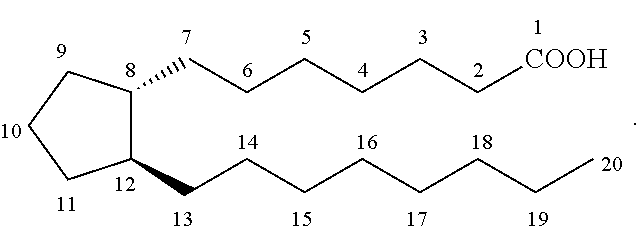
- Various types of prostaglandins are known, depending on the structure and substituents carried on the alicyclic ring of the prostanoic acid skeleton. Further classification is based on the number of unsaturated bonds in the side chain indicated by numerical subscripts after the generic type of prostaglandin [e.g. prostaglandin E1 (PGE1), prostaglandin E2 (PGE2)], and on the configuration of the substituents on the alicyclic ring indicated by α or β [e.g. prostaglandin F2α (PGF2β)].
- The invention provides well-defined cyclopentanes for treating glaucoma and ocular hypertension. In one embodiment of the invention, there are provided compounds having the structure:
-
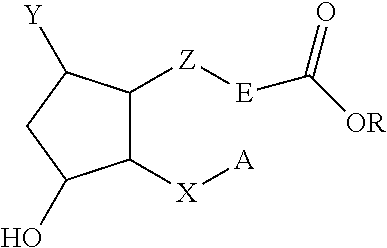
- wherein:
-
- Y is —Cl, —F, —Br, —CN, or —CF3;
- X C0-C14 optionally substituted alkylene, optionally substituted alkenylene, or optionally substituted alkynylene;
- Z is optionally substituted methylene or C2-C14 optionally substituted alkylene, optionally substituted alkenylene, or optionally substituted alkynylene;
- E is interarylene or interheteroarylene;
- R is H, C1-6 alkyl, phenyl, —CH2CH2OH, or —CH2CH2—N(R1)2 wherein R1 is C1 to C6 alkyl, or each R1 taken together with the nitrogen atom forms a ring optionally containing an additional heteroatom; and
- A is optionally substituted cycloalkyl or optionally substituted cycloalkenyl;
or pharmaceutically acceptable salts, hydrates, solvates, and crystal forms, isomers, tautomers, enantiomers, and diastereomers thereof.
- In another embodiment of the invention, there are provided compositions including at least one compound of the invention, wherein the composition is a liquid which is ophthalmically acceptable.
- In another embodiment of the invention there are provided methods for treating glaucoma or ocular hypertension. Such methods can be performed, for example, by administering to a subject in need thereof a compound of the invention.
- In still another embodiment of the invention, there are provided kits including at least one composition of the invention, a container, and instructions for administration of the composition to a subject in need thereof for the treatment of glaucoma or ocular hypertension.
- It is to be understood that both the foregoing general description and the following detailed description are exemplary and explanatory only and are not restrictive of the invention claimed. As used herein, the use of the singular includes the plural unless specifically stated otherwise. As used herein, “or” means “and/or” unless stated otherwise. Furthermore, use of the term “including” as well as other forms, such as “includes,” and “included,” is not limiting. The section headings used herein are for organizational purposes only and are not to be construed as limiting the subject matter described.
- Unless specific definitions are provided, the nomenclatures utilized in connection with, and the laboratory procedures and techniques of analytical chemistry, synthetic organic and inorganic chemistry described herein are those known in the art. Standard chemical symbols are used interchangeably with the full names represented by such symbols. Thus, for example, the terms “hydrogen” and “H” are understood to have identical meaning Standard techniques may be used for chemical syntheses, chemical analyses, and formulation.
- As used herein, “alkyl” refers to straight or branched chain hydrocarbyl groups having from 1 up to about 100 carbon atoms. Whenever it appears herein, a numerical range, such as “1 to 100” or “C1-C100”, refers to each integer in the given range; e.g., “C1-C100 alkyl” means that an alkyl group may comprise only 1 carbon atom, 2 carbon atoms, 3 carbon atoms, etc., up to and including 100 carbon atoms, although the term “alkyl” also includes instances where no numerical range of carbon atoms is designated. “Substituted alkyl” refers to alkyl moieties bearing substituents including alkyl, alkenyl, alkynyl, hydroxy, oxo, alkoxy, mercapto, cycloalkyl, substituted cycloalkyl, heterocyclic, substituted heterocyclic, aryl, substituted aryl, heteroaryl, substituted heteroaryl, aryloxy, substituted aryloxy, halogen, haloalkyl, cyano, nitro, nitrone, amino, lower alkylamino, lower alkyldiamino, amido, azido, —C(O)H, —C(O)RD, —CH2OR7, —C(O)—, —C(O)—, —S—, —S(O)2, —OC(O)—O—, wherein R7 is H or lower alkyl, acyl, oxyacyl, carboxyl, carbamate, sulfonyl, sulfonamide, sulfuryl, and the like. As used herein, “lower alkyl” refers to alkyl moieties having from 1 to about 6 carbon atoms.
- As used herein, the term “alkylene” refers to a divalent alkyl moiety, meaning the alkylene moiety is attached to the rest of the molecule at both ends of the alkyl unit.
- As used herein, “alkenyl” refers to straight or branched chain hydrocarbyl groups having at least one carbon-carbon double bond, and having in the range of about 2 up to about 100 carbon atoms, and “substituted alkenyl” refers to alkenyl groups further bearing one or more substituents as set forth above. As used herein, “lower alkenyl” refers to alkenyl moieties having from 2 to about 6 carbon atoms.
- As used herein, the term “alkenylene” refers to a divalent alkenyl moiety, meaning the alkenylene moiety is attached to the rest of the molecule at two positions.
- As used herein, “alkynyl” refers to straight or branched chain hydrocarbyl groups having at least one carbon-carbon triple bond, and having in the range of about 2 up to about 100 carbon atoms, and “substituted alkynyl” refers to alkynyl groups further bearing one or more substituents as set forth above. As used herein, “lower alkynyl” refers to alkynyl moieties having from 2 to about 6 carbon atoms.
- As used herein, “cycloalkyl” refers to cyclic (i.e., ring-containing) alkyl moieties typically containing in the range of about 3 up to about 8 carbon atoms, and “substituted cycloalkyl” refers to cycloalkyl groups further bearing one or more substituents as set forth above. “Cycloalkyl” also refers to bicyclic moieties, such as norbornyl, and the like.
- As used herein, “cycloalkenyl” refers to cyclic (i.e., ring-containing) alkenyl moieties typically containing in the range of about 3 up to about 8 carbon atoms, and “substituted cycloalkenyl” refers to cycloalkenyl groups further bearing one or more substituents as set forth above. “Cycloalkenyl” also refers to bicyclic moieties, such as norbornenyl, and the like.
- As used herein, “aryl” refers to aromatic groups having in the range of 5 up to 14 carbon atoms and “substituted aryl” refers to aryl groups further bearing one or more substituents as set forth above.
- As used herein, “heteroaryl” refers to aromatic moieties containing one or more heteroatoms (e.g., N, O, S, or the like) as part of the ring structure and having in the range of 5 up to 14 total atoms in the ring structure (i.e., carbon atoms and heteroatoms). “Substituted heterocyclic” refers to heterocyclic groups further bearing one or more substituents as set forth above.
- As used herein “interarylene” refers to an aryl ring or ring system or a heteroaryl ring or ring system which connects two other parts of a molecule, i.e. the two parts are bonded to the ring in two distinct ring positions. Interarylene or interheteroarylene may be substituted or unsubstituted. Unsubstituted interarylene or interheteroarylene has no substituents other than the two parts of the molecule it connects. Substituted interarylene or interheteroarylene has substituents in addition to the two parts of the molecule it connects.
- As used herein, “heterocyclic” refers to non-aromatic cyclic (i.e., ring-containing) groups containing one or more heteroatoms (e.g., N, O, S, or the like) as part of the ring structure, and having in the range of 3 up to 14 carbon atoms and “substituted heterocyclic” refers to heterocyclic groups further bearing one or more substituents as set forth above.
- As used herein, “halogen” or “halide” refers to fluoride, chloride, bromide or iodide. “Fluoride, chloride, bromide or iodide” may also be referred to as “fluoro, chloro, bromo, or iodo”.
- It will be readily apparent to those skilled in the art that some of the compounds of the invention may contain one or more asymmetric centers, such that the compounds may exist in enantiomeric as well as in diastereomeric forms. Unless it is specifically noted otherwise, the scope of the present invention includes all enantiomers, diastereomers and racemic mixtures. Some of the compounds of the invention may form salts with pharmaceutically acceptable acids or bases, and such pharmaceutically acceptable salts of the compounds described herein are also within the scope of the invention.
- The invention provides well-defined cyclopentanes having the structure:
-

- wherein:
-
- Y is —Cl, —F, —Br, —CN, or —CF3;
- X is C0-C14 optionally substituted alkylene, optionally substituted alkenylene, or optionally substituted alkynylene;
- Z is optionally substituted methylene or C2-C14 optionally substituted alkylene, optionally substituted alkenylene, or optionally substituted alkynylene;
- E is interarylene or interheteroarylene;
- R is H, C1-6 alkyl, phenyl, —CH2CH2OH, or —CH2CH2—N(R1)2 wherein R1 is C1 to C6 alkyl, or each R1 taken together with the nitrogen atom forms a ring optionally containing an additional heteroatom; and
- A is optionally substituted cycloalkyl or optionally substituted cycloalkenyl;
or pharmaceutically acceptable salts, hydrates, solvates, and crystal forms, isomers, tautomers, enantiomers, and diastereomers thereof.
- In some embodiments of the invention, Y is —Cl, —F, —CN, or —CF3. In one embodiment, Y is —Cl. In another embodiment Y is —F. In another embodiment Y is —CN. In another embodiment Y is —Br. In another embodiment Y is —CF3.
- In some embodiments of the invention, X and Z are each independently C2-C6 alkylene, alkenylene, or alkynylene. In certain embodiments, X is C2 alkylene, alkenylene, or alkynylene. In certain embodiments, Z is C3 alkylene, alkenylene, or alkynylene.
- In some embodiments of the invention the interarylene or interheteroarylene is substituted or unsubstituted interphenylene, interthiophenylene, interfurylene, interpyridinylene, interoxazolylene, or interthiazolene. In certain embodiments of the invention, the interarylene is interthiophenylene. In other embodiments the interheteroarylene is furylene and interthiazolene.
- In other embodiments of the invention A is cycloalkyl. In certain embodiments A is cyclopentyl or cyclohexyl.
- The compounds of the invention may contain a wide a variety of substituents. When invention compounds bear substituents, the substituents are typically selected from alkyl, alkenyl, alkynyl, hydroxy, alkoxy, heterocyclic, aryl, heteroaryl, aryloxy, halogen, haloalkyl, cyano, nitro, amino, lower alkylamino, lower dialkylamino, amido, azido, acyl (—C(O)R6), alkoxymethyl, mercapto (—S—R6), sulfoxy (—S(O)—R6), sulfonyl (—S(O)2—R6), sulfonamide (—S(O)2N(R6)2), carbonate (—OC(O)—O—R6), oxyacyl (—OC(O)—R6), carboxyl (—C(O)OH), ester (—C(O)OR6), carbamate (—OC(O)—N(R6)2), wherein R6 is H or lower alkyl, lower alkenyl, lower alkynyl, aryl, heteroaryl, heterocycle, and the like.
- In certain embodiments of the invention, Z, X, and A bear hydroxy substituents.
- Exemplary compounds contemplated for use in the practice of the invention include, but are not limited to,
- 5-(3-((1R,2R,3R,5R)-5-chloro-3-hydroxy-2-(2-(1 pentylcyclohexyl)ethyl)cyclopentyl)propyl)thiophene-2-carboxylic acid;
- methyl 5-(3-((1R,2R,3R,5R)-5-chloro-3-hydroxy-2-(2-(1-pentylcyclohexyl)ethyl)cyclopentyl)propyl)thiophene-2-carboxylate;
- 5-(3-((1R,2R,3R,5R)-5-chloro-2-(E)-2-cyclopentylvinyl)-3-hydroxycyclopentyl)propyl)thiophene-2-carboxylic acid;
- methyl 5-(3-((1R,2R,3R,5R)-5-chloro-2-(E)-2-cyclopentylvinyl)-3-hydroxycyclopentyl)propyl)thiophene-2-carboxylate;
- methyl 5-(3-((1R,2R,3R,5R)-5-chloro-2-(2-cyclopentylethyl)-3-hydroxycyclopentyl)propyl)thiophene-2-carboxylate;
- 5-(3-((1R,2R,3R,5R)-5-chloro-2-(2-cyclopentylethyl)-3-hydroxycyclopentyl)propyl)thiophene-2-carboxylic acid;
- 5-(3-((1R,2R,3R,5R)-5-chloro-2-(2-cyclohexylethyl)-3-hydroxycyclopentyl)propyl)thiophene-2-carboxylic acid;
- methyl 5-(3-((1R,2R,3R,5R)-5-chloro-2-(2-cyclohexylethyl)-3-hydroxycyclopentyl)propyl)thiophene-2-carboxylate;
- methyl 5-(3-((1R,2R,3R,5R)-5-chloro-2-(E)-2-cyclohexylvinyl)-3-hydroxycyclopentyl)propyl)thiophene-2-carboxylate; or
- 5-(3-((1R,2R,3R,5R)-5-chloro-2-(E)-2-cyclohexylvinyl)-3-hydroxycyclopentyl)propyl)thiophene-2-carboxylic acid.
- In other embodiments of the invention, esters of invention compounds are contemplated for use. As such, R consists of: 1) C1-6 alkyl or phenyl, and 2) from 0 to 2 —OH moieties. In other words, examples of R include:
- —CH3, —C2H5, —C3H7, —C4H9, C5H11, —C6H13, cyclic —C3H6, cyclic —C4H8, cyclic —C5H10, or cyclic —C6H12, wherein “cyclic” indicates the presence of a ring;
- —CH2—OH, —C2H4—OH, —C3H6—OH, —C4H8—OH, C5H10—OH, —C6H12—OH, cyclic —C3H5OH, cyclic —C4H7—OH, cyclic —C5H9—OH, or cyclic —C6H11—OH, wherein the —OH may be in any position on the hydrocarbyl moiety;
- —C2H3—(OH)2, —C3H5—(OH)2, —C4H7—(OH)2, —C5H9—(OH)2, or —C6H11—(OH)2, cyclic —C3H4—(OH)2, cyclic —C4H6—(OH)2, cyclic —C5H8—(OH)2, or cyclic —C6H10—(OH)2, wherein —(OH)2 represents 2 distinct —OH moieties, and each —OH may be in any position on the hydrocarbyl moiety; or
-

- In other embodiments, ethyldialkylamino esters are contemplated for use in the practice of the invention. In this embodiment —CH2CH2—N(R1)2 wherein R1 is C1 to C6 alkyl, or each R1 taken together with the nitrogen atom forms a ring optionally containing an additional heteroatom.
- Exemplary esters include, but are not limited to, the following compounds:
-

- A “pharmaceutically acceptable salt” is any salt that retains the activity of the parent compound and does not impart any additional deleterious or untoward effects on the subject to which it is administered and in the context in which it is administered compared to the parent compound. A pharmaceutically acceptable salt also refers to any salt which may form in vivo as a result of administration of an acid, another salt, or a prodrug which is converted into an acid or salt.
- Pharmaceutically acceptable salts of acidic functional groups may be derived from organic or inorganic bases. The salt may comprise a mono or polyvalent ion. Of particular interest are the inorganic ions, lithium, sodium, potassium, calcium, and magnesium. Organic salts may be made with amines, particularly ammonium salts such as mono-, di- and trialkyl amines or ethanol amines. Salts may also be formed with caffeine, tromethamine and similar molecules. Hydrochloric acid or some other pharmaceutically acceptable acid may form a salt with a compound that includes a basic group, such as an amine or a pyridine ring. Salts can form from or incorporate one or more deprotonated acidic groups (e.g. carboxylic acids), one or more protonated basic groups (e.g. amines), or both (e.g. zwitterions).
- A “prodrug” is a compound which is converted to a therapeutically active compound after administration, and the term should be interpreted as broadly herein as is generally understood in the art. While not intending to limit the scope of the invention, conversion may occur by hydrolysis of an ester group or some other biologically labile group. Generally, but not necessarily, a prodrug is inactive or less active than the therapeutically active compound to which it is converted.
- Prodrug preparation is well known in the art. For example, “Prodrugs and Drug Delivery Systems,” which is a chapter in Richard B. Silverman, Organic Chemistry of Drug Design and Drug Action, 2d Ed., Elsevier Academic Press: Amsterdam, 2004, pp. 496-557, provides further detail on the subject. In particular, alkyl esters having such as methyl, ethyl, isopropyl, and the like are contemplated. Also contemplated are prodrugs containing a polar group such as hydroxyl or morpholine. Examples of such prodrugs include compounds containing the moieties —CO2(CH2)2OH,
-
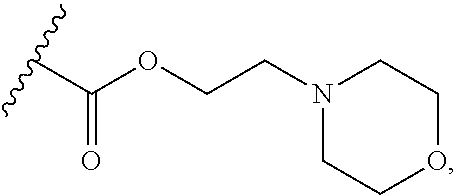
- and the like.
- The compounds of the invention are useful for reducing intraocular pressure. Reduction of intraocular pressure has been shown to delay or prevent the onset of primary open angle glaucoma, and to delay or prevent further vision loss in patients with primary open angle glaucoma. Thus, these compounds are also useful for treating glaucoma. Different types of suitable dosage forms and medicaments are well known in the art, and can be readily adapted for delivery of the compounds disclosed herein. For example, the compound could be dissolved or suspended in an aqueous solution or emulsion that is buffered to an appropriate pH, and administered topically to an eye of a mammal (see U.S. Pat. No. 7,091,231).
- For the purposes of this disclosure, “treat,” “treating,” or “treatment” refer to the use of a compound, composition, therapeutically active agent, or drug in the diagnosis, cure, mitigation, treatment, or prevention of disease or other undesirable condition.
- Unless otherwise indicated, reference to a compound should be construed broadly to include pharmaceutically acceptable salts, prodrugs, tautomers, alternate solid forms, non-covalent complexes, and combinations thereof, of a chemical entity of a depicted structure or chemical name.
- Tautomers are isomers that are in rapid equilibrium with one another. For example, tautomers may be related by transfer of a proton, hydrogen atom, or hydride ion. Unless stereochemistry is explicitly and unambiguously depicted, a structure is intended to include every possible stereoisomer, both pure or in any possible mixture.
- Alternate solid forms are different solid forms than those that may result from practicing the procedures described herein. For example, alternate solid forms may be polymorphs, different kinds of amorphous solid forms, glasses, and the like.
- Non-covalent complexes are complexes that may form between the compound and one or more additional chemical species that do not involve a covalent bonding interaction between the compound and the additional chemical species. They may or may not have a specific ratio between the compound and the additional chemical species. Examples might include solvates, hydrates, charge transfer complexes, and the like.
- Those skilled in the art will readily understand that for administration or the manufacture of medicaments the compounds disclosed herein can be admixed with pharmaceutically acceptable excipients which per se are well known in the art. Specifically, a drug to be administered systemically, it may be confected as a powder, pill, tablet or the like, or as a solution, emulsion, suspension, aerosol, syrup or elixir suitable for oral or parenteral administration or inhalation.
- For solid dosage forms or medicaments, non-toxic solid carriers include, but are not limited to, pharmaceutical grades of mannitol, lactose, starch, magnesium stearate, sodium saccharin, the polyalkylene glycols, talcum, cellulose, glucose, sucrose and magnesium carbonate. The solid dosage forms may be uncoated or they may be coated by known techniques to delay disintegration and absorption in the gastrointestinal tract and thereby provide a sustained action over a longer period. For example, a time delay material such as glyceryl monostearate or glyceryl distcarate may be employed. They may also be coated by the technique described in the U.S. Pat. Nos. 4,256,108; 4,166,452; and 4,265,874 to form osmotic therapeutic tablets for control release. Liquid pharmaceutically administrable dosage forms can, for example, comprise a solution or suspension of one or more of the presently useful compounds and optional pharmaceutical adjutants in a carrier, such as for example, water, saline, aqueous dextrose, glycerol, ethanol and the like, to thereby form a solution or suspension. If desired, the pharmaceutical composition to be administered may also contain minor amounts of nontoxic auxiliary substances such as wetting or emulsifying agents, pH buffering agents and the like. Typical examples of such auxiliary agents are sodium acetate, sorbitan monolaurate, triethanolamine, sodium acetate, triethanolamine oleate, etc. Actual methods of preparing such dosage forms are known, or will be apparent, to those skilled in this art; for example, see Remington's Pharmaceutical Sciences, Mack Publishing Company, Easton, Pa., 16th Edition, 1980. The composition of the formulation to be administered, in any event, contains a quantity of one or more of the presently useful compounds in an amount effective to provide the desired therapeutic effect.
- Parenteral administration is generally characterized by injection, either subcutaneously, intramuscularly or intravenously. Injectables can be prepared in conventional forms, either as liquid solutions or suspensions, solid forms suitable for solution or suspension in liquid prior to injection, or as emulsions. Suitable excipients are, for example, water, saline, dextrose, glycerol, ethanol and the like. In addition, if desired, the injectable pharmaceutical compositions to be administered may also contain minor amounts of non-toxic auxiliary substances such as wetting or emulsifying agents, pH buffering agents and the like.
- The amount of the presently useful compound or compounds administered is, of course, dependent on the therapeutic effect or effects desired, on the specific mammal being treated, on the severity and nature of the mammal's condition, on the manner of administration, on the potency and pharmacodynamics of the particular compound or compounds employed, and on the judgment of the prescribing physician. The therapeutically effective dosage of the presently useful compound or compounds is preferably in the range of about 0.5 or about 1 to about 100 mg/kg/day.
- A liquid which is ophthalmically acceptable is formulated such that it can be administered topically to the eye. The comfort should be maximized as much as possible, although sometimes formulation considerations (e.g. drug stability) may necessitate less than optimal comfort. In the case that comfort cannot be maximized, the liquid should be formulated such that the liquid is tolerable to the patient for topical ophthalmic use. Additionally, an ophthalmically acceptable liquid should either be packaged for single use, or contain a preservative to prevent contamination over multiple uses.
- For ophthalmic application, solutions or medicaments are often prepared using a physiological saline solution as a major vehicle. Ophthalmic solutions should preferably be maintained at a comfortable pH with an appropriate buffer system. The formulations may also contain conventional, pharmaceutically acceptable preservatives, stabilizers and surfactants.
- Preservatives that may be used in the pharmaceutical compositions of the present invention include, but are not limited to, benzalkonium chloride, chlorobutanol, thimerosal, phenylmercuric acetate and phenylmercuric nitrate. A useful surfactant is, for example, Tween 80. Likewise, various useful vehicles may be used in the ophthalmic preparations of the present invention. These vehicles include, but are not limited to, polyvinyl alcohol, povidone, hydroxypropyl methyl cellulose, poloxamers, carboxymethyl cellulose, hydroxyethyl cellulose and purified water.
- Tonicity adjustors may be added as needed or convenient. They include, but are not limited to, salts, particularly sodium chloride, potassium chloride, mannitol and glycerin, or any other suitable ophthalmically acceptable tonicity adjustor.
- Various buffers and means for adjusting pH may be used so long as the resulting preparation is ophthalmically acceptable. Accordingly, buffers include acetate buffers, citrate buffers, phosphate buffers and borate buffers. Acids or bases may be used to adjust the pH of these formulations as needed.
- In a similar vein, an ophthalmically acceptable antioxidant for use in the present invention includes, but is not limited to, sodium metabisulfite, sodium thiosulfate, acetylcysteine, butylated hydroxyanisole and butylated hydroxytoluene.
- Other excipient components which may be included in the ophthalmic preparations are chelating agents. A useful chelating agent is edetate disodium, although other chelating agents may also be used in place or in conjunction with it.
- The ingredients are usually used in the following amounts:
-
Ingredient Amount (% w/v) active ingredient about 0.001-5 preservative 0-0.10 vehicle 0-40 tonicity adjustor 1-10 buffer 0.01-10 pH adjustor q.s. pH 4.5-7.5 antioxidant as needed surfactant as needed purified water as needed to make 100% - For topical use, creams, ointments, gels, solutions or suspensions, etc., containing the compound disclosed herein are employed. Topical formulations may generally be comprised of a pharmaceutical carrier, cosolvent, emulsifier, penetration enhancer, preservative system, and emollient.
- The actual dose of the active compounds of the present invention depends on the specific compound, and on the condition to be treated; the selection of the appropriate dose is well within the knowledge of the skilled artisan.
- The following examples are intended only to illustrate the invention and should in no way be construed as limiting the invention.
- While there are many ways to prepare the compounds disclosed herein, useful compounds may be obtained by using or adapting the following exemplary procedures.
-
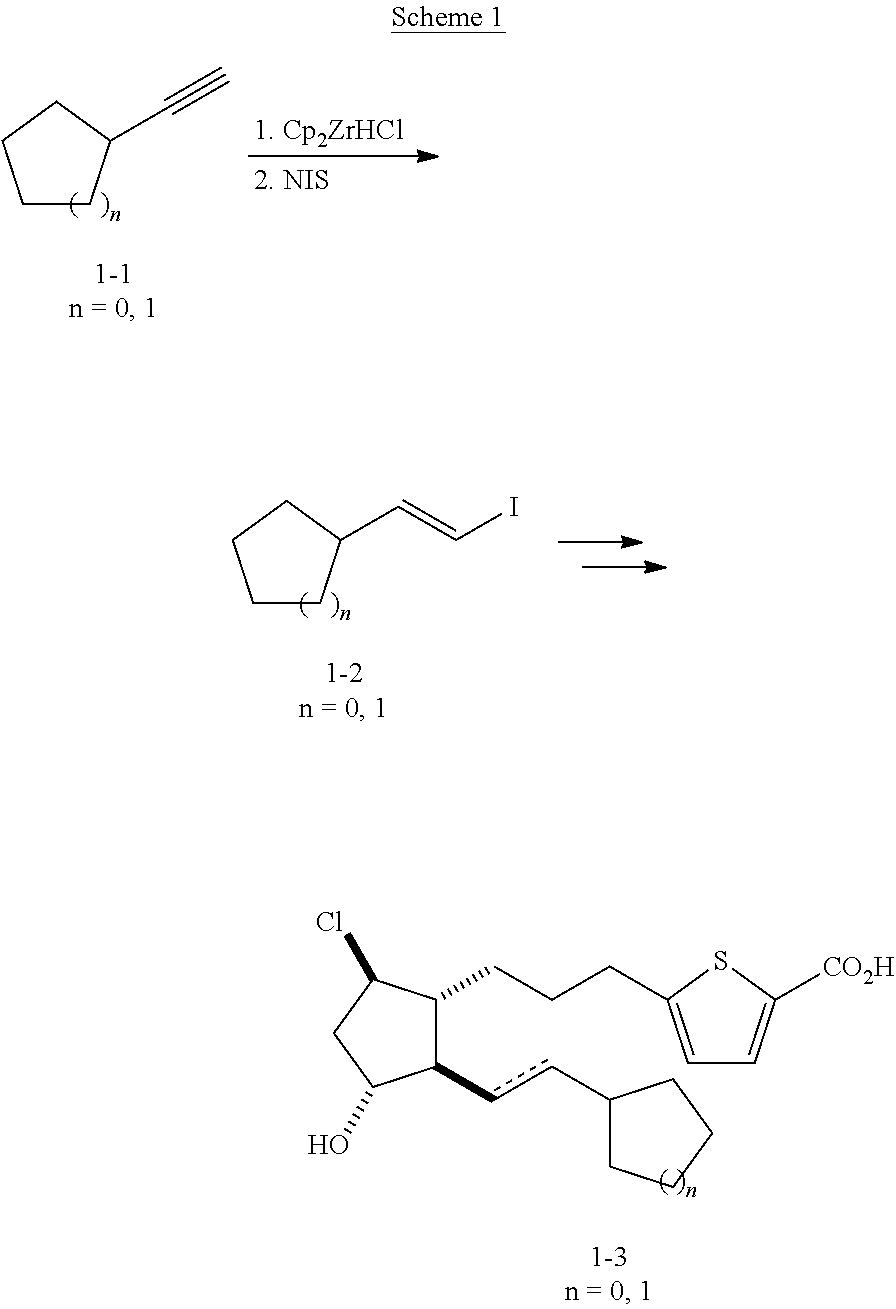
-
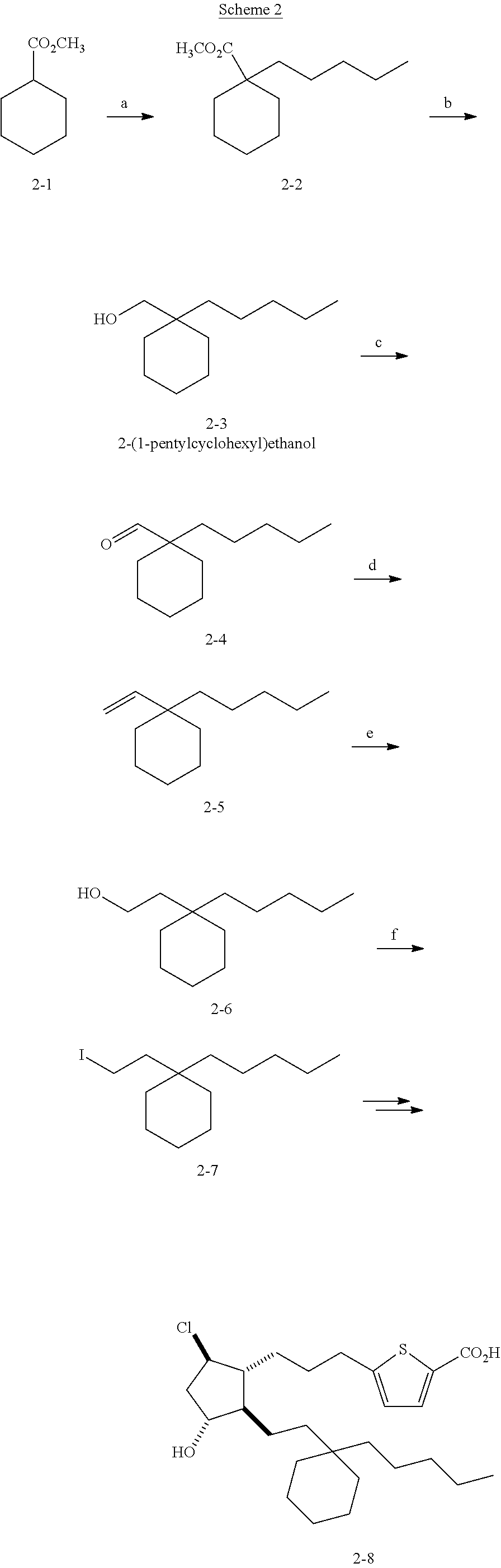
-
- Conditions: (a) LDA; n-pentyliodide, HMPA; (b) LiAlH4; (c) Swern [O]; (d) Ph3PCH3Br, tert-BuOK; (e) 9-BBN; H2O2; NaOH, H2O; (f) Ph3P, I2, imidazole, CH2Cl2.
- Representative procedure: (E)-(2-iodovinyl)cyclopentane (1-2, n=1). Cp2ZrHCl (1.805 g, 7.00 mmol) was added to a solution of alkyne 1-1 (n=1,497 mg, 4.60 mmol) in CH2Cl2 (19 mL). The reaction was stirred for 45 min. and N-iodosuccinimide (NIS, 1.552 g, 6.90 mmol) was added. After 2 h, saturated NaHCO3 solution (20 mL) was added and the resulting mixture was extracted with CH2Cl2 (3×50 mL). The combined CH2Cl2 solution was washed with brine and then was dried (Na2SO4), filtered and evaporated. The residue was purified by flash chromatography using a Combiflash system by Teledyne Isco (40 g silica gel, 0→100% ethyl acetate/hexanes) which gave the title compound (978 mg, 90%). The intermediate iodides were converted to the final compounds (1-3) by a sequence similar to that described in U.S. patent application Ser. No. 12/265,062.
- Methyl 1-pentylcyclohexanecarboxylate (2-2). A solution of ester 2-1 (2.053 g, 14.4 mmol) in THF (22 mL) was added, by cannula, to a −78° C. solution of LDA (8 mL, 16 mmol, 2 M in heptanes/THF/ethyl benzene from Aldrich), rinsing with 1 mL THF. After 30 min., a solution of n-pentyliodide (3.147 g, 15.9 mmol) in HMPA (2.6 mL) was added. The resulting solution was stirred for 10 min. at −78° C. and then was allowed to warm to room temperature. After 1 h, 100 mL H2O was added. The resulting mixture was extracted with ethyl acetate and the ethyl acetate solution was washed with H2O (3×100 mL) and brine and then was dried (Na2SO4), filtered and evaporated. The residue was purified by flash chromatography using a Combiflash system by Teledyne Isco (120 g silica gel, 0→25% ethyl acetate/hexanes) which gave the title compound (1.773 g, 12.5 mmol, 87%).
- (1-Pentylcyclohexyl)methanol (2-3). LiAlH4 (15 mL, 30 mmol, 2 M/THF) was added drop wise to a solution of 2-2 (1.773 g, 12.5 mmol) in ether (9 mL) at a rate to maintain a gentle reflux. The mixture was stirred further for 15 min. and then was cooled to 0° C. H2O (1 mL) was added followed by 3 M NaOH (1.2 mL) and more H2O (3 mL). The resulting mixture was allowed to warm to room temperature and after 1 h of stirring, 50 mL saturated NH4Cl solution was added. The mixture was extracted with dichloromethane (3×30 mL) and the combined dichloromethane solution was washed with brine and then was dried (Na2SO4), filtered and evaporated. The residue was purified by flash chromatography using a combiflash system by Teledyne Isco (80 g silica gel, 0→100% ethyl acetate/hexanes) which gave the title compound (968 mg, 5.3 mmol, 42%).
- 1-Pentylcyclohexanecarbaldehyde (2-4). DMSO (930 L) was added to a −78° C. solution of oxalyl chloride (3.2 mL, 2 M/toluene) in CH2Cl2 (44 mL). After 15 min., a solution of alcohol 2-3 (968 mg, 5.3 mmol) in 14 mL CH2Cl2 was added by cannula, rinsing with 2 mL CH2Cl2. The reaction was stirred for 15 min. and Et3N (5.9 mL) was added. The reaction was allowed to warm to 0° C. and after 2 h, 100 mL saturated NaHCO3 solution was added. The resulting mixture was extracted with CH2Cl2 (3×) and the combined CH2Cl2 solution was washed with H2O and brine and then was dried (Na2SO4), filtered and evaporated to give the title compound.
- 1-Pentyl-1-vinylcyclohexane (2-5). Tert-BuOK (2.2 mL, 2.2 mmol, 1 M/THF) was added to a solution of Ph3PCH3Br (1.42 mmol) in THF (7.2 mL). After 1 h, a solution of aldehyde 2-4 (130 mg, 0.71 mmol) in THF (2 mL) was added by cannula, rinsing with 1 mL THF. The reaction was stirred at room temperature for 2 h and was then quenched by addition of 10 mL saturated NH4Cl solution. The resulting mixture was extracted with ethyl acetate (3×20 mL) and the combined ethyl acetate solution was dried (Na2SO4), filtered and evaporated. The residue was purified by flash chromatography using a Combiflash system by Teledyne Isco (4 g silica gel, 0→50% ethyl acetate/hexanes) which gave the title compound (62 mg, 0.34 mmol, 48%).
- 2-(1-Pentylcyclohexyl)ethanol (2-6). A solution of 2-5 (90 mg, 0.50 mmol) in THF (3.4 mL) was added to a solution of 9-BBN dimer (206 mg, 0.84 mmol) in THF (3 mL). The reaction was placed in a 60° C. oil bath and after 2.5 h, a solution of H2O2 (35%, 1.4 mL)/NaOH (0.5 M, 1.4 mL)/H2O (0.35 mL) was added. The reaction was heated to reflux for 1 h and then allowed to cool to room temperature. H2O (20 mL) was added and the mixture was extracted with ethyl acetate (3×25 mL). The combined ethyl acetate solution was washed with brine and then was dried (Na2SO4), filtered and evaporated. The residue was purified by flash chromatography using a Combiflash system by Teledyne Isco (4 g silica gel, 0→30% ethyl acetate/hexanes) which gave the title compound (70 mg, 71%).
- 1-(2-iodoethyl)-1-pentylcyclohexane (2-7). The procedure used to prepare the title compound was described in U.S. Pat. No. 7,091,231 B2.
- 5-(3-((1R,2R,3R,5R)-5-chloro-3-hydroxy-2-(2-(1-pentylcyclohexyl)ethyl)cyclopentyl)propyl)thiophene-2-carboxylic acid (2-8). The title compound was prepared using a sequence described in U.S. patent application Ser. No. 12/265,062.
- U.S. Pat. No. 7,091,231, incorporated by reference herein, describes the methods used to obtain the in vivo test results presented in Table 1.
-
TABLE 1 DOG MONKEY Conc. Max. Max. (g/100 IOP Max. IOP ENTRY STRUCTURE mL) (%) hyperemia (%) 1 
0.005% 40 2.0 47 - U.S. Pat. No. 7,427,685 incorporated by reference herein, describes the methods used to obtain the in vitro data in Table 2 below.
-
EP2 OTHER cAMP Ca2+ EP4 RECEPTORS EC50 Ki EC50 Ca2+ Ki Ca2+ Entry STRUCTURE (nM) (nM) (nM) EC50 (nM) (nM) EC50 (nM) 1 
0.6 9 4 3070 2617 DP(259) NA: EP1, EP3, FP, IP, TP 2 
0.9 10 3 1349 2737 DP(191), NA: EP1, EP3, FDP, IP, TP 3 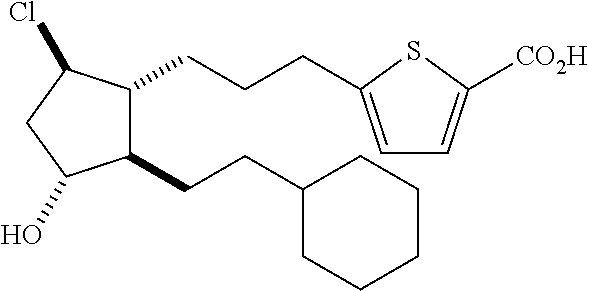
0.2 0.8 12 6639 2154 DP(548), EP3(9052) NA: EP1, FP, IP, TP 4 
0.5 4 7 3,322 2709 DP(2162), EP3(5221) NA: EP1, FP, IP, TP 5 
152 1038 2412 9330 5059 NA: DP, EP1, EP3, FP, IP, - While this invention has been described with respect to these specific examples, it is understood that other modifications and variations are possible without departing from the spirit of the invention.
Claims (19)

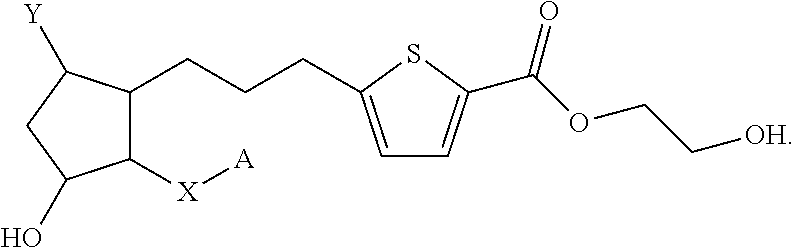

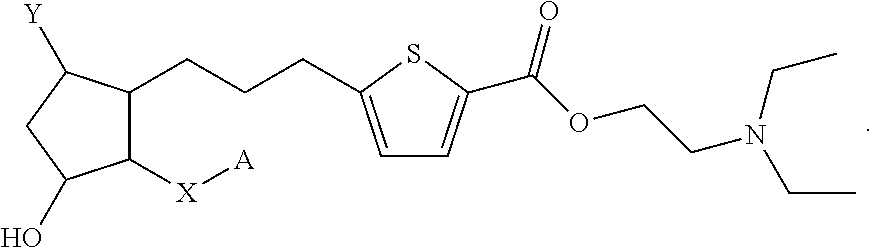
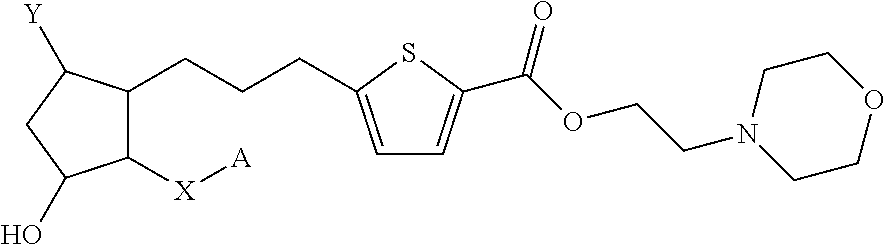
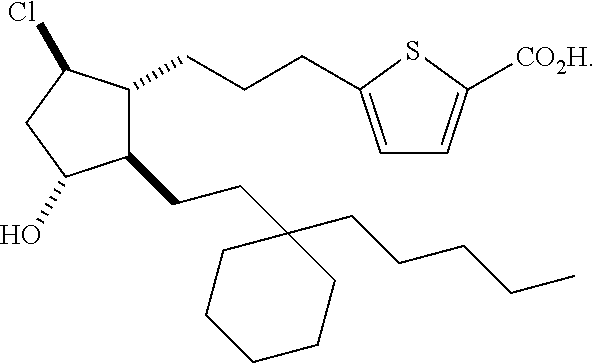
Priority Applications (1)
| Application Number | Priority Date | Filing Date | Title |
|---|---|---|---|
| US13/011,082 US8299068B2 (en) | 2010-01-29 | 2011-01-21 | Therapeutically active cyclopentanes |
Applications Claiming Priority (2)
| Application Number | Priority Date | Filing Date | Title |
|---|---|---|---|
| US29956210P | 2010-01-29 | 2010-01-29 | |
| US13/011,082 US8299068B2 (en) | 2010-01-29 | 2011-01-21 | Therapeutically active cyclopentanes |
Publications (2)
| Publication Number | Publication Date |
|---|---|
| US20110190286A1 true US20110190286A1 (en) | 2011-08-04 |
| US8299068B2 US8299068B2 (en) | 2012-10-30 |
Family
ID=43858227
Family Applications (1)
| Application Number | Title | Priority Date | Filing Date |
|---|---|---|---|
| US13/011,082 Active US8299068B2 (en) | 2010-01-29 | 2011-01-21 | Therapeutically active cyclopentanes |
Country Status (5)
| Country | Link |
|---|---|
| US (1) | US8299068B2 (en) |
| EP (1) | EP2528907A1 (en) |
| AU (1) | AU2011209770A1 (en) |
| CA (1) | CA2787946A1 (en) |
| WO (1) | WO2011094225A1 (en) |
Citations (12)
| Publication number | Priority date | Publication date | Assignee | Title |
|---|---|---|---|---|
| US4012429A (en) * | 1973-04-19 | 1977-03-15 | Sankyo Company Limited | 16,16-Dimethyl 9-oxo-11α-hydroxymethyl-15ε-hydroxyprosta-5(cis), 13(trans)-dienoic acid derivatives and process for the preparation thereof |
| US4166452A (en) * | 1976-05-03 | 1979-09-04 | Generales Constantine D J Jr | Apparatus for testing human responses to stimuli |
| US4256108A (en) * | 1977-04-07 | 1981-03-17 | Alza Corporation | Microporous-semipermeable laminated osmotic system |
| US4265874A (en) * | 1980-04-25 | 1981-05-05 | Alza Corporation | Method of delivering drug with aid of effervescent activity generated in environment of use |
| US5698598A (en) * | 1995-08-04 | 1997-12-16 | Allergan | EP2 -receptor agonists as agents for lowering intraocular pressure |
| US5877211A (en) * | 1997-11-21 | 1999-03-02 | Allergan | EP2 receptor agonists as neuroprotective agents for the eye |
| US6262293B1 (en) * | 1997-12-25 | 2001-07-17 | Ono Pharmaceutical Co., Ltd. | ω-Cycloalkly-prostaglandin e2 derivatives |
| US7091231B2 (en) * | 2004-12-10 | 2006-08-15 | Allergan, Inc. | 12-Aryl prostaglandin analogs |
| US20070129552A1 (en) * | 2005-12-06 | 2007-06-07 | Allergan, Inc. | Therapeutic Substituted Cyclopentanes |
| WO2009006370A1 (en) * | 2007-07-03 | 2009-01-08 | Allergan, Inc. | Therapeutic substituted cyclopentanes for reducing intraocular pressure |
| US7585895B2 (en) * | 2005-12-06 | 2009-09-08 | Allergan, Inc. | Therapeutic substituted cyclopentanes |
| US7960378B2 (en) * | 2008-03-18 | 2011-06-14 | Allergan, Inc. | Therapeutic compounds |
Family Cites Families (3)
| Publication number | Priority date | Publication date | Assignee | Title |
|---|---|---|---|---|
| CA2657719C (en) | 2006-07-11 | 2015-12-29 | Allergan, Inc. | Cyclopentane derivatives as antiglaucoma agents |
| WO2008073752A2 (en) | 2006-12-11 | 2008-06-19 | Allergan, Inc. | Cyclobutyl derivatives for the treatment of glaucoma |
| ATE496903T1 (en) | 2007-02-01 | 2011-02-15 | Allergan Inc | THIOPHENE DERIVATIVES AS MEDICATIONS FOR THE TREATMENT OF OCCULAR HYPERTENSION |
-
2011
- 2011-01-21 US US13/011,082 patent/US8299068B2/en active Active
- 2011-01-25 WO PCT/US2011/022451 patent/WO2011094225A1/en not_active Ceased
- 2011-01-25 AU AU2011209770A patent/AU2011209770A1/en not_active Abandoned
- 2011-01-25 CA CA2787946A patent/CA2787946A1/en not_active Abandoned
- 2011-01-25 EP EP11702110A patent/EP2528907A1/en not_active Withdrawn
Patent Citations (14)
| Publication number | Priority date | Publication date | Assignee | Title |
|---|---|---|---|---|
| US4012429A (en) * | 1973-04-19 | 1977-03-15 | Sankyo Company Limited | 16,16-Dimethyl 9-oxo-11α-hydroxymethyl-15ε-hydroxyprosta-5(cis), 13(trans)-dienoic acid derivatives and process for the preparation thereof |
| US4166452A (en) * | 1976-05-03 | 1979-09-04 | Generales Constantine D J Jr | Apparatus for testing human responses to stimuli |
| US4256108A (en) * | 1977-04-07 | 1981-03-17 | Alza Corporation | Microporous-semipermeable laminated osmotic system |
| US4265874A (en) * | 1980-04-25 | 1981-05-05 | Alza Corporation | Method of delivering drug with aid of effervescent activity generated in environment of use |
| US5698598A (en) * | 1995-08-04 | 1997-12-16 | Allergan | EP2 -receptor agonists as agents for lowering intraocular pressure |
| US5877211A (en) * | 1997-11-21 | 1999-03-02 | Allergan | EP2 receptor agonists as neuroprotective agents for the eye |
| US6262293B1 (en) * | 1997-12-25 | 2001-07-17 | Ono Pharmaceutical Co., Ltd. | ω-Cycloalkly-prostaglandin e2 derivatives |
| US7091231B2 (en) * | 2004-12-10 | 2006-08-15 | Allergan, Inc. | 12-Aryl prostaglandin analogs |
| US20060205800A1 (en) * | 2004-12-10 | 2006-09-14 | Yariv Donde | Therapeutic Compounds |
| US20070129552A1 (en) * | 2005-12-06 | 2007-06-07 | Allergan, Inc. | Therapeutic Substituted Cyclopentanes |
| US7427685B2 (en) * | 2005-12-06 | 2008-09-23 | Allergan, Inc. | Therapeutic substituted cyclopentanes |
| US7585895B2 (en) * | 2005-12-06 | 2009-09-08 | Allergan, Inc. | Therapeutic substituted cyclopentanes |
| WO2009006370A1 (en) * | 2007-07-03 | 2009-01-08 | Allergan, Inc. | Therapeutic substituted cyclopentanes for reducing intraocular pressure |
| US7960378B2 (en) * | 2008-03-18 | 2011-06-14 | Allergan, Inc. | Therapeutic compounds |
Non-Patent Citations (2)
| Title |
|---|
| Byrn et al. Solid-State Chemistry of Drugs, 2nd ed. Chapter 11, "Hydrates and Solvates," p. 233-247. * |
| Byrn et al. Solid-State Chemistry of Drugs, 2nd ed. Chapter 11, "Hydrates and Solvates," p.233-247 (1999). * |
Also Published As
| Publication number | Publication date |
|---|---|
| WO2011094225A1 (en) | 2011-08-04 |
| US8299068B2 (en) | 2012-10-30 |
| EP2528907A1 (en) | 2012-12-05 |
| CA2787946A1 (en) | 2011-08-04 |
| AU2011209770A1 (en) | 2012-08-16 |
Similar Documents
| Publication | Publication Date | Title |
|---|---|---|
| US7947732B2 (en) | Therapeutic substituted chlorocyclopentanols | |
| EP2094678B1 (en) | Prostaglandin prodrugs as ocular hypotensive agents | |
| US9006464B2 (en) | Substituted cyclopentanes having prostaglandin activity | |
| US7863319B2 (en) | Cyclopentane heptan(ene)oic acid, 2-heteroarylalkenyl derivatives as therapeutic agents | |
| US8633220B2 (en) | Therapeutic agents for ocular hypertension | |
| US9090584B2 (en) | Therapeutic agents for treatment of ocular hypertension | |
| US8168680B2 (en) | Cyclopentane heptan(ENE)OIC acid, 2-heteroarylalkenyl derivatives as therapeutic agents | |
| US7101904B2 (en) | Cyclopentane heptan(ENE)OIC acid, 2-heteroarylalkenyl derivatives as therapeutic agents | |
| US8377984B2 (en) | Substituted gamma lactams as therapeutic agents | |
| US9981938B2 (en) | Quaternary ammonium alkyl esters as stable prodrugs | |
| US8299068B2 (en) | Therapeutically active cyclopentanes | |
| US20100173981A1 (en) | Therapeutic compounds | |
| EP2628725A1 (en) | Prostaglandins and analogues as agents for lowering intraocular pressure | |
| US9315486B2 (en) | Therapeutic cyclopentanols, compositions thereof, and methods for use thereof | |
| US8609658B2 (en) | N,N-dialkylalkylenyl esters, compositions thereof, and methods for use thereof | |
| US9000032B2 (en) | Substituted cyclopentenes as therapeutic agents | |
| AU2007323857B2 (en) | Prostaglandin prodrugs as ocular hypotensive agents | |
| US9714238B2 (en) | Therapeutic agents for ocular hypertension | |
| HK1178524A (en) | Therapeutic agents for treatment of ocular hypertension | |
| HK1178524B (en) | Therapeutic agents for treatment of ocular hypertension |
Legal Events
| Date | Code | Title | Description |
|---|---|---|---|
| AS | Assignment |
Owner name: ALLERGAN, INC., CALIFORNIA Free format text: ASSIGNMENT OF ASSIGNORS INTEREST;ASSIGNORS:DONDE, YARIV;NGUYEN, JEREMIAH H.;REEL/FRAME:026105/0728 Effective date: 20110411 |
|
| STCF | Information on status: patent grant |
Free format text: PATENTED CASE |
|
| FPAY | Fee payment |
Year of fee payment: 4 |
|
| MAFP | Maintenance fee payment |
Free format text: PAYMENT OF MAINTENANCE FEE, 8TH YEAR, LARGE ENTITY (ORIGINAL EVENT CODE: M1552); ENTITY STATUS OF PATENT OWNER: LARGE ENTITY Year of fee payment: 8 |
|
| MAFP | Maintenance fee payment |
Free format text: PAYMENT OF MAINTENANCE FEE, 12TH YEAR, LARGE ENTITY (ORIGINAL EVENT CODE: M1553); ENTITY STATUS OF PATENT OWNER: LARGE ENTITY Year of fee payment: 12 |