US20110049016A1 - Bitumen upgrading using supercritical fluids - Google Patents
Bitumen upgrading using supercritical fluids Download PDFInfo
- Publication number
- US20110049016A1 US20110049016A1 US12/663,843 US66384308A US2011049016A1 US 20110049016 A1 US20110049016 A1 US 20110049016A1 US 66384308 A US66384308 A US 66384308A US 2011049016 A1 US2011049016 A1 US 2011049016A1
- Authority
- US
- United States
- Prior art keywords
- supercritical
- providing
- catalyst
- mixture
- oil
- Prior art date
- Legal status (The legal status is an assumption and is not a legal conclusion. Google has not performed a legal analysis and makes no representation as to the accuracy of the status listed.)
- Granted
Links
- 239000010426 asphalt Substances 0.000 title claims description 22
- 239000012530 fluid Substances 0.000 title abstract description 12
- 238000000034 method Methods 0.000 claims abstract description 50
- 230000008569 process Effects 0.000 claims abstract description 46
- 239000003054 catalyst Substances 0.000 claims abstract description 39
- CURLTUGMZLYLDI-UHFFFAOYSA-N Carbon dioxide Chemical compound O=C=O CURLTUGMZLYLDI-UHFFFAOYSA-N 0.000 claims abstract description 25
- VLKZOEOYAKHREP-UHFFFAOYSA-N n-Hexane Chemical compound CCCCCC VLKZOEOYAKHREP-UHFFFAOYSA-N 0.000 claims abstract description 24
- UFHFLCQGNIYNRP-UHFFFAOYSA-N Hydrogen Chemical compound [H][H] UFHFLCQGNIYNRP-UHFFFAOYSA-N 0.000 claims abstract description 23
- 229930195733 hydrocarbon Natural products 0.000 claims abstract description 22
- 150000002430 hydrocarbons Chemical class 0.000 claims abstract description 20
- 239000000463 material Substances 0.000 claims abstract description 19
- 229910002092 carbon dioxide Inorganic materials 0.000 claims abstract description 17
- 239000004215 Carbon black (E152) Substances 0.000 claims abstract description 16
- 239000000758 substrate Substances 0.000 claims abstract description 15
- XLYOFNOQVPJJNP-UHFFFAOYSA-N water Substances O XLYOFNOQVPJJNP-UHFFFAOYSA-N 0.000 claims abstract description 12
- 239000001569 carbon dioxide Substances 0.000 claims abstract description 8
- 238000000527 sonication Methods 0.000 claims abstract description 5
- UFWIBTONFRDIAS-UHFFFAOYSA-N Naphthalene Chemical compound C1=CC=CC2=CC=CC=C21 UFWIBTONFRDIAS-UHFFFAOYSA-N 0.000 claims description 50
- 239000002904 solvent Substances 0.000 claims description 26
- 239000000203 mixture Substances 0.000 claims description 22
- OKKJLVBELUTLKV-UHFFFAOYSA-N Methanol Chemical compound OC OKKJLVBELUTLKV-UHFFFAOYSA-N 0.000 claims description 21
- 125000005575 polycyclic aromatic hydrocarbon group Chemical group 0.000 claims description 21
- 238000006243 chemical reaction Methods 0.000 claims description 19
- MWPLVEDNUUSJAV-UHFFFAOYSA-N anthracene Chemical compound C1=CC=CC2=CC3=CC=CC=C3C=C21 MWPLVEDNUUSJAV-UHFFFAOYSA-N 0.000 claims description 16
- 239000011269 tar Substances 0.000 claims description 16
- YXFVVABEGXRONW-UHFFFAOYSA-N Toluene Natural products CC1=CC=CC=C1 YXFVVABEGXRONW-UHFFFAOYSA-N 0.000 claims description 13
- 239000012429 reaction media Substances 0.000 claims description 13
- FCEHBMOGCRZNNI-UHFFFAOYSA-N 1-benzothiophene Chemical compound C1=CC=C2SC=CC2=C1 FCEHBMOGCRZNNI-UHFFFAOYSA-N 0.000 claims description 8
- 239000004058 oil shale Substances 0.000 claims description 8
- YNPNZTXNASCQKK-UHFFFAOYSA-N phenanthrene Chemical compound C1=CC=C2C3=CC=CC=C3C=CC2=C1 YNPNZTXNASCQKK-UHFFFAOYSA-N 0.000 claims description 8
- BBEAQIROQSPTKN-UHFFFAOYSA-N pyrene Chemical compound C1=CC=C2C=CC3=CC=CC4=CC=C1C2=C43 BBEAQIROQSPTKN-UHFFFAOYSA-N 0.000 claims description 8
- 229910052759 nickel Inorganic materials 0.000 claims description 7
- 229910052697 platinum Inorganic materials 0.000 claims description 7
- SIKJAQJRHWYJAI-UHFFFAOYSA-N Indole Chemical compound C1=CC=C2NC=CC2=C1 SIKJAQJRHWYJAI-UHFFFAOYSA-N 0.000 claims description 6
- MCMNRKCIXSYSNV-UHFFFAOYSA-N Zirconium dioxide Chemical compound O=[Zr]=O MCMNRKCIXSYSNV-UHFFFAOYSA-N 0.000 claims description 6
- 239000003607 modifier Substances 0.000 claims description 6
- 229910052763 palladium Inorganic materials 0.000 claims description 6
- 229910052707 ruthenium Inorganic materials 0.000 claims description 6
- 229910052717 sulfur Inorganic materials 0.000 claims description 6
- 229910052723 transition metal Inorganic materials 0.000 claims description 6
- 150000003624 transition metals Chemical class 0.000 claims description 6
- NINIDFKCEFEMDL-UHFFFAOYSA-N Sulfur Chemical compound [S] NINIDFKCEFEMDL-UHFFFAOYSA-N 0.000 claims description 5
- 239000011593 sulfur Substances 0.000 claims description 5
- IJGRMHOSHXDMSA-UHFFFAOYSA-N Atomic nitrogen Chemical compound N#N IJGRMHOSHXDMSA-UHFFFAOYSA-N 0.000 claims description 4
- 229910003294 NiMo Inorganic materials 0.000 claims description 4
- 239000006184 cosolvent Substances 0.000 claims description 4
- GVEPBJHOBDJJJI-UHFFFAOYSA-N fluoranthrene Natural products C1=CC(C2=CC=CC=C22)=C3C2=CC=CC3=C1 GVEPBJHOBDJJJI-UHFFFAOYSA-N 0.000 claims description 4
- 229910052703 rhodium Inorganic materials 0.000 claims description 4
- 239000011275 tar sand Substances 0.000 claims description 4
- 230000004913 activation Effects 0.000 claims description 3
- PZOUSPYUWWUPPK-UHFFFAOYSA-N indole Natural products CC1=CC=CC2=C1C=CN2 PZOUSPYUWWUPPK-UHFFFAOYSA-N 0.000 claims description 3
- RKJUIXBNRJVNHR-UHFFFAOYSA-N indolenine Natural products C1=CC=C2CC=NC2=C1 RKJUIXBNRJVNHR-UHFFFAOYSA-N 0.000 claims description 3
- 229910052741 iridium Inorganic materials 0.000 claims description 3
- 229910052742 iron Inorganic materials 0.000 claims description 3
- 238000002156 mixing Methods 0.000 claims description 3
- IJDNQMDRQITEOD-UHFFFAOYSA-N n-butane Chemical compound CCCC IJDNQMDRQITEOD-UHFFFAOYSA-N 0.000 claims description 3
- 229910052758 niobium Inorganic materials 0.000 claims description 3
- 229910052757 nitrogen Inorganic materials 0.000 claims description 3
- 239000003027 oil sand Substances 0.000 claims description 3
- 125000002080 perylenyl group Chemical group C1(=CC=C2C=CC=C3C4=CC=CC5=CC=CC(C1=C23)=C45)* 0.000 claims description 3
- CSHWQDPOILHKBI-UHFFFAOYSA-N peryrene Natural products C1=CC(C2=CC=CC=3C2=C2C=CC=3)=C3C2=CC=CC3=C1 CSHWQDPOILHKBI-UHFFFAOYSA-N 0.000 claims description 3
- 229910052594 sapphire Inorganic materials 0.000 claims description 3
- 229910052715 tantalum Inorganic materials 0.000 claims description 3
- TUQOTMZNTHZOKS-UHFFFAOYSA-N tributylphosphine Chemical compound CCCCP(CCCC)CCCC TUQOTMZNTHZOKS-UHFFFAOYSA-N 0.000 claims description 3
- WLPUWLXVBWGYMZ-UHFFFAOYSA-N tricyclohexylphosphine Chemical compound C1CCCCC1P(C1CCCCC1)C1CCCCC1 WLPUWLXVBWGYMZ-UHFFFAOYSA-N 0.000 claims description 3
- 229920005547 polycyclic aromatic hydrocarbon Polymers 0.000 claims description 2
- 125000003944 tolyl group Chemical group 0.000 claims description 2
- 239000001257 hydrogen Substances 0.000 abstract description 12
- 229910052739 hydrogen Inorganic materials 0.000 abstract description 12
- -1 hydrogen gas Chemical compound 0.000 abstract description 4
- 235000015076 Shorea robusta Nutrition 0.000 abstract description 3
- 244000166071 Shorea robusta Species 0.000 abstract description 3
- 238000005984 hydrogenation reaction Methods 0.000 description 25
- 238000000605 extraction Methods 0.000 description 18
- CXWXQJXEFPUFDZ-UHFFFAOYSA-N tetralin Chemical compound C1=CC=C2CCCCC2=C1 CXWXQJXEFPUFDZ-UHFFFAOYSA-N 0.000 description 12
- 239000003921 oil Substances 0.000 description 11
- NNBZCPXTIHJBJL-UHFFFAOYSA-N decalin Chemical compound C1CCCC2CCCCC21 NNBZCPXTIHJBJL-UHFFFAOYSA-N 0.000 description 9
- ATUOYWHBWRKTHZ-UHFFFAOYSA-N Propane Chemical compound CCC ATUOYWHBWRKTHZ-UHFFFAOYSA-N 0.000 description 8
- PXHVJJICTQNCMI-UHFFFAOYSA-N Nickel Chemical compound [Ni] PXHVJJICTQNCMI-UHFFFAOYSA-N 0.000 description 7
- 239000000047 product Substances 0.000 description 7
- IMNFDUFMRHMDMM-UHFFFAOYSA-N N-Heptane Chemical compound CCCCCCC IMNFDUFMRHMDMM-UHFFFAOYSA-N 0.000 description 6
- 238000007142 ring opening reaction Methods 0.000 description 6
- VYPSYNLAJGMNEJ-UHFFFAOYSA-N Silicium dioxide Chemical compound O=[Si]=O VYPSYNLAJGMNEJ-UHFFFAOYSA-N 0.000 description 5
- PNEYBMLMFCGWSK-UHFFFAOYSA-N aluminium oxide Inorganic materials [O-2].[O-2].[O-2].[Al+3].[Al+3] PNEYBMLMFCGWSK-UHFFFAOYSA-N 0.000 description 5
- 229910052751 metal Inorganic materials 0.000 description 5
- 239000002184 metal Substances 0.000 description 5
- OKTJSMMVPCPJKN-UHFFFAOYSA-N Carbon Chemical compound [C] OKTJSMMVPCPJKN-UHFFFAOYSA-N 0.000 description 4
- LFQSCWFLJHTTHZ-UHFFFAOYSA-N Ethanol Chemical compound CCO LFQSCWFLJHTTHZ-UHFFFAOYSA-N 0.000 description 4
- 230000008901 benefit Effects 0.000 description 4
- 229910052593 corundum Inorganic materials 0.000 description 4
- 239000007788 liquid Substances 0.000 description 4
- 239000001294 propane Substances 0.000 description 4
- PXXNTAGJWPJAGM-UHFFFAOYSA-N vertaline Natural products C1C2C=3C=C(OC)C(OC)=CC=3OC(C=C3)=CC=C3CCC(=O)OC1CC1N2CCCC1 PXXNTAGJWPJAGM-UHFFFAOYSA-N 0.000 description 4
- 229910001845 yogo sapphire Inorganic materials 0.000 description 4
- UHOVQNZJYSORNB-UHFFFAOYSA-N Benzene Chemical compound C1=CC=CC=C1 UHOVQNZJYSORNB-UHFFFAOYSA-N 0.000 description 3
- 238000010794 Cyclic Steam Stimulation Methods 0.000 description 3
- ZMXDDKWLCZADIW-UHFFFAOYSA-N N,N-Dimethylformamide Chemical compound CN(C)C=O ZMXDDKWLCZADIW-UHFFFAOYSA-N 0.000 description 3
- 238000010796 Steam-assisted gravity drainage Methods 0.000 description 3
- 125000003118 aryl group Chemical group 0.000 description 3
- 230000015572 biosynthetic process Effects 0.000 description 3
- 238000004939 coking Methods 0.000 description 3
- 238000004821 distillation Methods 0.000 description 3
- 230000000694 effects Effects 0.000 description 3
- 238000005516 engineering process Methods 0.000 description 3
- 239000007789 gas Substances 0.000 description 3
- 238000002309 gasification Methods 0.000 description 3
- 125000005842 heteroatom Chemical group 0.000 description 3
- 239000002815 homogeneous catalyst Substances 0.000 description 3
- 150000002431 hydrogen Chemical class 0.000 description 3
- 230000008707 rearrangement Effects 0.000 description 3
- 239000004576 sand Substances 0.000 description 3
- 239000000243 solution Substances 0.000 description 3
- CSCPPACGZOOCGX-UHFFFAOYSA-N Acetone Chemical compound CC(C)=O CSCPPACGZOOCGX-UHFFFAOYSA-N 0.000 description 2
- ZTQSAGDEMFDKMZ-UHFFFAOYSA-N Butyraldehyde Chemical compound CCCC=O ZTQSAGDEMFDKMZ-UHFFFAOYSA-N 0.000 description 2
- QQONPFPTGQHPMA-UHFFFAOYSA-N Propene Chemical compound CC=C QQONPFPTGQHPMA-UHFFFAOYSA-N 0.000 description 2
- 238000005865 alkene metathesis reaction Methods 0.000 description 2
- 229910052799 carbon Inorganic materials 0.000 description 2
- 230000015556 catabolic process Effects 0.000 description 2
- 238000004523 catalytic cracking Methods 0.000 description 2
- WDECIBYCCFPHNR-UHFFFAOYSA-N chrysene Chemical compound C1=CC=CC2=CC=C3C4=CC=CC=C4C=CC3=C21 WDECIBYCCFPHNR-UHFFFAOYSA-N 0.000 description 2
- 238000005336 cracking Methods 0.000 description 2
- 239000010779 crude oil Substances 0.000 description 2
- 230000003247 decreasing effect Effects 0.000 description 2
- 238000006731 degradation reaction Methods 0.000 description 2
- 239000010432 diamond Substances 0.000 description 2
- CJNBYAVZURUTKZ-UHFFFAOYSA-N hafnium(IV) oxide Inorganic materials O=[Hf]=O CJNBYAVZURUTKZ-UHFFFAOYSA-N 0.000 description 2
- 238000009904 heterogeneous catalytic hydrogenation reaction Methods 0.000 description 2
- 238000009905 homogeneous catalytic hydrogenation reaction Methods 0.000 description 2
- 239000000543 intermediate Substances 0.000 description 2
- UAEPNZWRGJTJPN-UHFFFAOYSA-N methylcyclohexane Chemical compound CC1CCCCC1 UAEPNZWRGJTJPN-UHFFFAOYSA-N 0.000 description 2
- 238000012986 modification Methods 0.000 description 2
- 230000004048 modification Effects 0.000 description 2
- 239000003208 petroleum Substances 0.000 description 2
- 238000006303 photolysis reaction Methods 0.000 description 2
- 230000015843 photosynthesis, light reaction Effects 0.000 description 2
- 239000011541 reaction mixture Substances 0.000 description 2
- 230000009467 reduction Effects 0.000 description 2
- MHOVAHRLVXNVSD-UHFFFAOYSA-N rhodium atom Chemical compound [Rh] MHOVAHRLVXNVSD-UHFFFAOYSA-N 0.000 description 2
- 238000001228 spectrum Methods 0.000 description 2
- 239000000126 substance Substances 0.000 description 2
- 238000003786 synthesis reaction Methods 0.000 description 2
- 239000002028 Biomass Substances 0.000 description 1
- VFXFIRATVQELNC-UHFFFAOYSA-N C1=CC=C2C=CC=CC2=C1.C1=CC=C2CCCCC2=C1.[H]C12CCCCC1([H])CCCC2 Chemical compound C1=CC=C2C=CC=CC2=C1.C1=CC=C2CCCCC2=C1.[H]C12CCCCC1([H])CCCC2 VFXFIRATVQELNC-UHFFFAOYSA-N 0.000 description 1
- 241000183712 Cerinthe major Species 0.000 description 1
- 238000010485 C−C bond formation reaction Methods 0.000 description 1
- ROSDSFDQCJNGOL-UHFFFAOYSA-N Dimethylamine Chemical compound CNC ROSDSFDQCJNGOL-UHFFFAOYSA-N 0.000 description 1
- 241000196324 Embryophyta Species 0.000 description 1
- WQZGKKKJIJFFOK-GASJEMHNSA-N Glucose Natural products OC[C@H]1OC(O)[C@H](O)[C@@H](O)[C@@H]1O WQZGKKKJIJFFOK-GASJEMHNSA-N 0.000 description 1
- 125000001931 aliphatic group Chemical group 0.000 description 1
- 150000001336 alkenes Chemical class 0.000 description 1
- 230000004075 alteration Effects 0.000 description 1
- 238000013459 approach Methods 0.000 description 1
- 150000004945 aromatic hydrocarbons Chemical class 0.000 description 1
- QVGXLLKOCUKJST-UHFFFAOYSA-N atomic oxygen Chemical compound [O] QVGXLLKOCUKJST-UHFFFAOYSA-N 0.000 description 1
- 125000002915 carbonyl group Chemical group [*:2]C([*:1])=O 0.000 description 1
- 238000006555 catalytic reaction Methods 0.000 description 1
- 239000001913 cellulose Substances 0.000 description 1
- 229920002678 cellulose Polymers 0.000 description 1
- 238000001311 chemical methods and process Methods 0.000 description 1
- 239000003153 chemical reaction reagent Substances 0.000 description 1
- 239000004927 clay Substances 0.000 description 1
- 238000003776 cleavage reaction Methods 0.000 description 1
- 239000003426 co-catalyst Substances 0.000 description 1
- 229910052681 coesite Inorganic materials 0.000 description 1
- 229910052906 cristobalite Inorganic materials 0.000 description 1
- 238000006356 dehydrogenation reaction Methods 0.000 description 1
- 230000001419 dependent effect Effects 0.000 description 1
- 238000011161 development Methods 0.000 description 1
- 238000010586 diagram Methods 0.000 description 1
- 230000003292 diminished effect Effects 0.000 description 1
- 238000010494 dissociation reaction Methods 0.000 description 1
- 230000005593 dissociations Effects 0.000 description 1
- 238000004090 dissolution Methods 0.000 description 1
- 238000001035 drying Methods 0.000 description 1
- 239000012847 fine chemical Substances 0.000 description 1
- RMBPEFMHABBEKP-UHFFFAOYSA-N fluorene Chemical compound C1=CC=C2C3=C[CH]C=CC3=CC2=C1 RMBPEFMHABBEKP-UHFFFAOYSA-N 0.000 description 1
- 238000005755 formation reaction Methods 0.000 description 1
- 239000002803 fossil fuel Substances 0.000 description 1
- 238000006062 fragmentation reaction Methods 0.000 description 1
- 239000008103 glucose Substances 0.000 description 1
- 238000010438 heat treatment Methods 0.000 description 1
- 230000002363 herbicidal effect Effects 0.000 description 1
- 239000004009 herbicide Substances 0.000 description 1
- 125000001072 heteroaryl group Chemical group 0.000 description 1
- 239000002638 heterogeneous catalyst Substances 0.000 description 1
- 238000007172 homogeneous catalysis Methods 0.000 description 1
- 238000007037 hydroformylation reaction Methods 0.000 description 1
- 230000007062 hydrolysis Effects 0.000 description 1
- 238000006460 hydrolysis reaction Methods 0.000 description 1
- 230000006872 improvement Effects 0.000 description 1
- 238000011065 in-situ storage Methods 0.000 description 1
- 230000010354 integration Effects 0.000 description 1
- JEIPFZHSYJVQDO-UHFFFAOYSA-N iron(III) oxide Inorganic materials O=[Fe]O[Fe]=O JEIPFZHSYJVQDO-UHFFFAOYSA-N 0.000 description 1
- 238000006317 isomerization reaction Methods 0.000 description 1
- 238000012804 iterative process Methods 0.000 description 1
- 150000002576 ketones Chemical class 0.000 description 1
- 229920005610 lignin Polymers 0.000 description 1
- 150000002739 metals Chemical class 0.000 description 1
- GYNNXHKOJHMOHS-UHFFFAOYSA-N methyl-cycloheptane Natural products CC1CCCCCC1 GYNNXHKOJHMOHS-UHFFFAOYSA-N 0.000 description 1
- 238000005065 mining Methods 0.000 description 1
- 229910000510 noble metal Inorganic materials 0.000 description 1
- NIHNNTQXNPWCJQ-UHFFFAOYSA-N o-biphenylenemethane Natural products C1=CC=C2CC3=CC=CC=C3C2=C1 NIHNNTQXNPWCJQ-UHFFFAOYSA-N 0.000 description 1
- 150000002894 organic compounds Chemical class 0.000 description 1
- 238000006053 organic reaction Methods 0.000 description 1
- 230000003647 oxidation Effects 0.000 description 1
- 238000007254 oxidation reaction Methods 0.000 description 1
- 239000001301 oxygen Substances 0.000 description 1
- 229910052760 oxygen Inorganic materials 0.000 description 1
- AXFBAIOSECPASO-UHFFFAOYSA-N pentacyclo[6.6.2.02,7.04,16.011,15]hexadeca-1(14),2(7),3,5,8(16),9,11(15),12-octaene Chemical compound C1=C(C=C23)C4=C5C3=CC=CC5=CC=C4C2=C1 AXFBAIOSECPASO-UHFFFAOYSA-N 0.000 description 1
- 239000003348 petrochemical agent Substances 0.000 description 1
- 239000003209 petroleum derivative Substances 0.000 description 1
- 231100000572 poisoning Toxicity 0.000 description 1
- 230000000607 poisoning effect Effects 0.000 description 1
- 150000004032 porphyrins Chemical group 0.000 description 1
- 239000002244 precipitate Substances 0.000 description 1
- 238000002360 preparation method Methods 0.000 description 1
- 238000012545 processing Methods 0.000 description 1
- 230000001737 promoting effect Effects 0.000 description 1
- 238000000197 pyrolysis Methods 0.000 description 1
- 230000035484 reaction time Effects 0.000 description 1
- 238000011084 recovery Methods 0.000 description 1
- 230000008521 reorganization Effects 0.000 description 1
- 238000011160 research Methods 0.000 description 1
- 238000007152 ring opening metathesis polymerisation reaction Methods 0.000 description 1
- 150000003839 salts Chemical class 0.000 description 1
- 230000007017 scission Effects 0.000 description 1
- 239000012056 semi-solid material Substances 0.000 description 1
- 239000003079 shale oil Substances 0.000 description 1
- 239000000377 silicon dioxide Substances 0.000 description 1
- 239000007787 solid Substances 0.000 description 1
- 229910052682 stishovite Inorganic materials 0.000 description 1
- 239000011550 stock solution Substances 0.000 description 1
- 238000006467 substitution reaction Methods 0.000 description 1
- 238000004227 thermal cracking Methods 0.000 description 1
- 238000012546 transfer Methods 0.000 description 1
- 230000009466 transformation Effects 0.000 description 1
- 238000000844 transformation Methods 0.000 description 1
- 229910052905 tridymite Inorganic materials 0.000 description 1
- 229910052720 vanadium Inorganic materials 0.000 description 1
- LEONUFNNVUYDNQ-UHFFFAOYSA-N vanadium atom Chemical compound [V] LEONUFNNVUYDNQ-UHFFFAOYSA-N 0.000 description 1
- 239000011345 viscous material Substances 0.000 description 1
- 239000002699 waste material Substances 0.000 description 1
Images


Classifications
-
- C—CHEMISTRY; METALLURGY
- C10—PETROLEUM, GAS OR COKE INDUSTRIES; TECHNICAL GASES CONTAINING CARBON MONOXIDE; FUELS; LUBRICANTS; PEAT
- C10G—CRACKING HYDROCARBON OILS; PRODUCTION OF LIQUID HYDROCARBON MIXTURES, e.g. BY DESTRUCTIVE HYDROGENATION, OLIGOMERISATION, POLYMERISATION; RECOVERY OF HYDROCARBON OILS FROM OIL-SHALE, OIL-SAND, OR GASES; REFINING MIXTURES MAINLY CONSISTING OF HYDROCARBONS; REFORMING OF NAPHTHA; MINERAL WAXES
- C10G1/00—Production of liquid hydrocarbon mixtures from oil-shale, oil-sand, or non-melting solid carbonaceous or similar materials, e.g. wood, coal
- C10G1/04—Production of liquid hydrocarbon mixtures from oil-shale, oil-sand, or non-melting solid carbonaceous or similar materials, e.g. wood, coal by extraction
- C10G1/042—Production of liquid hydrocarbon mixtures from oil-shale, oil-sand, or non-melting solid carbonaceous or similar materials, e.g. wood, coal by extraction by the use of hydrogen-donor solvents
-
- C—CHEMISTRY; METALLURGY
- C10—PETROLEUM, GAS OR COKE INDUSTRIES; TECHNICAL GASES CONTAINING CARBON MONOXIDE; FUELS; LUBRICANTS; PEAT
- C10G—CRACKING HYDROCARBON OILS; PRODUCTION OF LIQUID HYDROCARBON MIXTURES, e.g. BY DESTRUCTIVE HYDROGENATION, OLIGOMERISATION, POLYMERISATION; RECOVERY OF HYDROCARBON OILS FROM OIL-SHALE, OIL-SAND, OR GASES; REFINING MIXTURES MAINLY CONSISTING OF HYDROCARBONS; REFORMING OF NAPHTHA; MINERAL WAXES
- C10G1/00—Production of liquid hydrocarbon mixtures from oil-shale, oil-sand, or non-melting solid carbonaceous or similar materials, e.g. wood, coal
- C10G1/002—Production of liquid hydrocarbon mixtures from oil-shale, oil-sand, or non-melting solid carbonaceous or similar materials, e.g. wood, coal in combination with oil conversion- or refining processes
-
- C—CHEMISTRY; METALLURGY
- C10—PETROLEUM, GAS OR COKE INDUSTRIES; TECHNICAL GASES CONTAINING CARBON MONOXIDE; FUELS; LUBRICANTS; PEAT
- C10G—CRACKING HYDROCARBON OILS; PRODUCTION OF LIQUID HYDROCARBON MIXTURES, e.g. BY DESTRUCTIVE HYDROGENATION, OLIGOMERISATION, POLYMERISATION; RECOVERY OF HYDROCARBON OILS FROM OIL-SHALE, OIL-SAND, OR GASES; REFINING MIXTURES MAINLY CONSISTING OF HYDROCARBONS; REFORMING OF NAPHTHA; MINERAL WAXES
- C10G1/00—Production of liquid hydrocarbon mixtures from oil-shale, oil-sand, or non-melting solid carbonaceous or similar materials, e.g. wood, coal
- C10G1/04—Production of liquid hydrocarbon mixtures from oil-shale, oil-sand, or non-melting solid carbonaceous or similar materials, e.g. wood, coal by extraction
-
- C—CHEMISTRY; METALLURGY
- C10—PETROLEUM, GAS OR COKE INDUSTRIES; TECHNICAL GASES CONTAINING CARBON MONOXIDE; FUELS; LUBRICANTS; PEAT
- C10G—CRACKING HYDROCARBON OILS; PRODUCTION OF LIQUID HYDROCARBON MIXTURES, e.g. BY DESTRUCTIVE HYDROGENATION, OLIGOMERISATION, POLYMERISATION; RECOVERY OF HYDROCARBON OILS FROM OIL-SHALE, OIL-SAND, OR GASES; REFINING MIXTURES MAINLY CONSISTING OF HYDROCARBONS; REFORMING OF NAPHTHA; MINERAL WAXES
- C10G1/00—Production of liquid hydrocarbon mixtures from oil-shale, oil-sand, or non-melting solid carbonaceous or similar materials, e.g. wood, coal
- C10G1/06—Production of liquid hydrocarbon mixtures from oil-shale, oil-sand, or non-melting solid carbonaceous or similar materials, e.g. wood, coal by destructive hydrogenation
- C10G1/065—Production of liquid hydrocarbon mixtures from oil-shale, oil-sand, or non-melting solid carbonaceous or similar materials, e.g. wood, coal by destructive hydrogenation in the presence of a solvent
Definitions
- This invention relates to the extraction and upgrading of fossil fuels and in particular, the upgrading of bitumen using supercritical fluids.
- Athabasca tar sands in Alberta are estimated to contain at least 1.7 trillion barrels of oil, and as such may represent around one-third of the world's total petroleum resources. Over 85% of known bitumen reserves lie in this deposit, and their high concentration makes them economically recoverable. Other significant deposits of tar sands exist in Venezuela and the USA, and similar deposits of oil shale are found in various locations around the world. These deposits consist of a mixture of clay or shale, sand, water and bitumen. Bitumen is a viscous, tar-like material composed primarily of polycyclic aromatic hydrocarbons (PAHs).
- PAHs polycyclic aromatic hydrocarbons
- bitumen has been successfully recovered from Stuart oil shale in Queensland using supercritical carbon dioxide (scCO 2 ), and from Utah oil sands using supercritical propane (sc propane).
- scCO 2 supercritical carbon dioxide
- sc propane supercritical propane
- Raytheon announced the use of scCO 2 in combination with RF heating to extract oil shale deposits beneath Federal land in Colorado, Utah and Wyoming.
- Bitumen typically contains around 83% carbon, 10% hydrogen and 5% sulfur by weight, along with significant ppm amounts of transition metals like vanadium and nickel associated with porphyrin residues.
- This low-grade material commonly needs to be converted into synthetic crude oil or refined directly into petroleum products before it can be used for most applications. Typically, this is carried out by catalytic cracking, which redistributes the hydrogen in the material. Catalytic cracking produces a range of ‘upgraded’ organic products with relatively high hydrogen content, but leaves behind a substance known as asphaltene, which is even more intractable than bitumen and contains very little hydrogen. Unless this asphaltene is upgraded by reaction with hydrogen, it is effectively a waste product.
- the invention relates to a process for extracting and upgrading a hydrocarbon.
- the process comprises the steps of providing a substrate containing a hydrocarbon comprising at least one of oil, tar and bituminous material to be extracted and upgraded; providing a reaction medium comprising hydrogen gas, a catalyst, and a supercritical or near-critical solvent that serves to extract the at least one of oil, tar and bituminous material from the substrate, and that serves to dissolve the hydrogen gas; mixing the substrate, supercritical or near-critical solvent, hydrogen gas, and the catalyst; and maintaining the mixture at temperature sufficient to cause reaction for a length of time calculated to allow said reaction to proceed to a desired extent.
- oil, tar or bituminous material is extracted and upgraded in a unitary operation.
- the process further comprises the step of providing a modifier.
- the modifier is toluene or methanol.
- the process further comprises the step of sonication.
- the process further comprises the step of photochemical activation.
- the hydrocarbon comprises at least one of bitumen and a polycyclic aromatic hydrocarbon (PAH).
- the substrate comprises at least one of oil sand, oil shale deposits, and tar sand.
- the PAH comprises at least one of naphthalene, anthracene, phenanthrene, pyrene, perylene, benzothiophene and indole.
- the PAH contains nitrogen, sulfur, or a transition metal.
- the supercritical or near-critical solvent is carbon dioxide.
- the catalyst comprises at least one of Mn 2 (CO) 8 (PBu 3 ) 2 , RuH 2 (H 2 )(PCy 3 ) 2 , Pd, Pt, Ru, Ni Rh, Nb, and Ta.
- the process further comprises the step of providing a co-solvent.
- the co-solvent is a selected one of n-butane and methanol.
- the supercritical or near-critical solvent is a selected one of hexane and water.
- the catalyst comprises at least one of ⁇ -Al 2 O 3 , HfO 2 , ZrO 2 , NiMo, Fe, Ni, Ru, Ru, Pd, Pt, and Ir.
- the step of maintaining the mixture at temperature sufficient to cause reaction comprises maintaining the mixture at a temperature in the range of 50° C. to 400° C. In some embodiments, the step of maintaining the mixture at temperature sufficient to cause reaction comprises maintaining the mixture at a temperature in the range of 50° C. to 150° C. In some embodiments, the step of maintaining the mixture at temperature sufficient to cause reaction comprises maintaining the mixture at a temperature in the range of 250° C. to 350° C.
- the step of providing a reaction medium comprising hydrogen gas, a catalyst, and a supercritical or near-critical solvent comprises providing said supercritical or near-critical solvent at a pressure in the range of 50 bar to 1000 bar. In some embodiments, the step of providing a reaction medium comprising hydrogen gas, a catalyst, and a supercritical or near-critical solvent comprises providing said supercritical or near-critical solvent at a pressure in the range of 100 bar to 500 bar. In some embodiments, the step of providing a reaction medium comprising hydrogen gas, a catalyst, and a supercritical or near-critical solvent comprises providing said supercritical or near-critical solvent at a pressure in the range of 150 bar to 400 bar.
- FIG. 1 is a schematic diagram of an oil sands petrochemicals process with integrated distillation, coking and upgrading.
- FIG. 2 is a graph showing hydrogenation of naphthalene as a function of initial concentration of naphthalene according to one embodiment of the invention.
- FIG. 3 is a graph showing the hydrogenation of naphthalene as a function of time according to one embodiment of the invention.
- This invention teaches a combined SCF process for extracting and upgrading bitumen, thereby enabling a more efficient and integrated procedure for use in the processing of low-grade petroleum deposits in tar sands and/or oil shales. While supercritical fluids have been used to extract oil and bituminous materials from sand and shale deposits, and have been used as reaction media for a range of homogeneous and heterogeneous chemical processes, they have never been used in the combined extraction/chemical reaction process of this invention. In this invention, mining or in situ extraction produces bitumen that feeds into a combined distillation, coking and upgrading process.
- Bitumen is a semi-solid material consisting of a mixture of hydrocarbons with increasing molecular weight and heteroatom functionalities. If bitumen is dissolved in hydrocarbons such as n-heptane, a precipitate known as asphaltene forms. This is the most complex component of crude oil, consisting of large PAHs. It has been shown that asphaltenes are soluble in toluene but insoluble in n-heptane at reasonable temperatures, which indicates that it is possible to form bituminous solutions. Solubilities of tar sand bitumen in scCO 2 have been reported at temperatures between 84° C. and 120° C. These studies reveal that its solubility is temperature- and pressure-dependent, with low temperatures and higher pressures giving optimum solubilities.
- CO 2 With its low T c , P c , and cost, CO 2 has found many applications as a SCF medium for a range of processes. It is already established as an excellent extraction medium, and has demonstrated utility in the extraction of bituminous materials from tar sands and oil shale, as described above.
- the low T c for CO 2 means that an effective operating range for this medium will be 50-150° C. This is significantly lower than the temperatures required for thermal cracking of PAHs and asphaltenes into smaller volatile fractions, but significant advantage may be gained by a pre-hydrogenation step, as this will furnish a hydrogen-enriched substrate that will provide increased yields of upgraded materials in any subsequent cracking stage.
- PAHs like anthracene, phenanthrene, pyrene and perylene have been shown to be surprisingly soluble in scCO 2 , and the fluid is an excellent hydrogenation medium.
- There is extensive literature on catalyzed organic hydrogenation reactions in scCO 2 Of specific interest is research carried out on highly unsaturated and aromatic substrates such as naphthalene and anthracene.
- Simple PAHs such as naphthalene, anthracene, pyrene and phenanthrene have been successfully hydrogenated to the corresponding hydrocarbon in conventional solvents using homogeneous metal carbonyl catalysts like Mn 2 (CO) 8 (PBu 3 ) 2 , and RuH 2 (H 2 )(PCy 3 ) 2 , although homogeneous hydrogenations usually require severe reaction conditions and are not widely reported.
- naphthalene and anthracene have been hydrogenated with a supported Ru catalyst, and anthracene has been upgraded in this way using an active carbon-supported Ni catalyst.
- anthracene has been upgraded in this way using an active carbon-supported Ni catalyst.
- a supported Ru catalyst Of particular interest in this regard is a recent report describing the facile hydrogenation of naphthalene in scCO 2 in the presence of a supported Rh catalyst in 100% yield at the low temperature of 60° C.
- Homogeneous hydrogenation of heteroaromatic molecules such as benzothiophene (S containing) and indole (N containing) has been successfully demonstrated with a variety of simple catalysts at reasonable temperatures ( ⁇ 100° C.), with no poisoning of the catalysts by the heteroatom components.
- Hexane offers an intermediate operating range (ca. 250-350° C.).
- Supercritical propane has been demonstrated as a direct extraction technology, and the recovery of bitumen from mined tar sands using a light hydrocarbon liquid is a patented technology.
- thermal rearrangement of the carbon skeleton becomes accessible.
- alumina-supported noble metal catalysts have been used in the ring-opening of naphthalene and methylcyclohexane at 350° C., and substantial isomerization of the ring-opened products was observed.
- Homogeneous rhodium-catalyzed ring opening and hydrodesulfurization of benzothiophene has been shown to be successful at 160° C.
- Supercritical H 2 O has found utility in promoting a wide range of organic reactions, including hydrogenation and dehydrogenation; C—C bond formation and breaking; hydrolysis; and oxidation.
- Hydrogenation of simple PAHs and heteroaromatic hydrocarbons in the presence of sulfur-pretreated NiMo/Al 2 O 3 catalysts has been demonstrated in scH 2 O at 400° C.
- This medium possesses properties very different from those of ambient-temperature water, including a decreased dielectric constant, a diminished degree of hydrogen bonding and an enhanced (by three orders of magnitude) dissociation constant. Accordingly, many organic compounds are highly soluble in scH 2 O, and the pure fluid is an excellent environment for acid- and base-catalyzed reactions.
- SCH 2 O has recently been shown to act as an effective medium for the gasification of biomass derived from lignin, glucose and cellulose, because at temperatures around 400° C. major degradation and reorganization of the carbon skeleton occurs.
- pyrolysis in the presence of high amounts of dissolved H 2 and a Ni or Ru catalyst leads to a range of volatile products such as CO, CO 2 and CH 4 .
- Hydrogenations of simple PAHs and heteroaromatic hydrocarbons in the presence of sulfur pretreated NiMo/Al 2 O 3 catalysts have also been shown to be successful in scH 2 O at 400° C.
- carbon dioxide, hexane and water as supercritical fluid reaction media are capable of integration with an extraction technology: scCO 2 has been demonstrated as an effective medium for the extraction of bitumen from tar sand and oil shale deposits; sc propane has been used to extract bitumen from oil sands, and the outflow from current CSS, SAGD or VAPEX extraction technologies may be easily converted into a supercritical bitumen-water mixture. Use of scH 2 O appears to be unexplored in tar sands technologies.
- heterogeneous hydrogenation reactions has also been carried out successfully in scCO 2 , including Fischer-Tropsch synthesis using a Ru/Al 2 O 3 or a Co/La/SiO 2 catalyst system.
- Heterogeneous Group 8 metal catalysts are also very effective in the synthesis of N,N-dimethylformamide from CO 2 , H 2 and Me 2 NH under supercritical conditions, and the hydrogenation of unsaturated ketones using a supported Pd catalyst has been carried out under mild conditions in scCO 2 .
- Oil, tar or bituminous material from oil sand or oil shale deposits can be extracted using a supercritical or near-critical solvent.
- the solubility of bitumen in supercritical CO 2 and supercritical hexane can be increased, and subsequently its extraction from tar sands can be enhanced by adding modifiers such as toluene or methanol and by using sonication to encourage dissolution. Sonication has recently been claimed to accelerate chemical reactions in a supercritical fluid medium.
- carbon dioxide is used as a supercritical medium for the combined extraction and upgrading process.
- Carbon dioxide has the most accessible critical temperature and is cheap, but lacks polarity and will be limited to a low temperature upgrading process.
- Modifiers such as toluene or methanol can be added to help dissolve bituminous material.
- hexane is used as a supercritical medium for the combined extraction and upgrading process. It offers a medium temperature possibility, but also suffers from the lack of a dipole moment and is the most costly of the three medium.
- water is used as a supercritical medium for the combined extraction and upgrading process.
- Water has the highest critical temperature. The polar nature and negligible cost of water are attractive characteristics.
- An appropriate amount of hydrogen gas is introduced into this supercritical or near-critical mixture.
- the appropriate amount of hydrogen gas will vary according to the amount of unsaturation present in the hydrocarbon to be upgraded, and in relation to the proportion of hydrogen that is desired to be maintained in the reaction medium.
- a number homogeneous and heterogeneous catalysts may be used with PAH substrates for a combination of hydrogenation and ring opening reactions in scC 6 H 14 , and cleavage, hydrogenation and gasification in scH 2 O.
- These homogeneous catalysts include Nb and Ta, which have been shown to be effective for the hydrogenation of a variety of arene substrates.
- Heterogeneous supported systems are likely to prove more robust and long-lived than homogeneous catalysts.
- scCO 2 there is a wide range of commercially available hydrogenation catalysts including heterogeneous Ni and Ru systems supported on alumina or carbon, and metals like Rh and Pt that can be costly.
- the reaction mixture can be activated by photochemical irradiation using light in the ultraviolet and/or visible region of the electromagnetic spectrum. This activation can be used to accelerate the ring-opening, fragmentation and hydrogenation reactions involved in the upgrading process.
- the reaction mixture is maintained at an appropriate temperature for an appropriate length of time to effect the desired hydrogenation, rearrangement, or degradation of the bituminous material in the mixture.
- the required temperature and length of time will vary depending on the concentration of reagents in the system and the quantity of material that one wishes to upgrade.
- FIG. 2 is a graph showing hydrogenation of naphthalene as a function of initial concentration of naphthalene, in which the amount of naphthalene is indicated by diamonds, the amount of tetralin is indicated by squares, and the amount of decalin is indicated by triangles.
- the vertical axis represents relative concentration of hydrocarbon in percent total hydrocarbon, and the horizontal axis represents initial concentration of naphthalene in moles.
- naphthalene concentrations of 0.1 M, 0.2 M, 0.3 M, 0.4 M, and 0.5 M. Under these reaction conditions, total hydrogenation of naphthalene was achieved at concentrations greater than 0.1 M. The result at 0.4 M is possibly due to errors associated with new equipment.
- FIG. 3 is a graph showing the hydrogenation of naphthalene as a function of time, in which the amount of naphthalene is indicated by diamonds, the amount of tetralin is indicated by squares, and the amount of decalin is indicated by triangles.
- the vertical axis represents relative concentration of hydrocarbon in percent total hydrocarbon, and the horizontal axis represents duration of the reaction process in units of hours.
- naphthalene As indicated in FIG. 3 , 80% of naphthalene was converted to tetralin (50%) and decalin (30%) within 30 minutes. As the reaction time increased, naphthalene decreased further and formations of products increased. After 4 hours 90% of naphthalene had been converted to fully saturated decalin. Therefore, it is believed that only about 4 hours is required for complete hydrogenation, rather than 16 hours.
Landscapes
- Chemical & Material Sciences (AREA)
- Engineering & Computer Science (AREA)
- Oil, Petroleum & Natural Gas (AREA)
- Life Sciences & Earth Sciences (AREA)
- Wood Science & Technology (AREA)
- Chemical Kinetics & Catalysis (AREA)
- General Chemical & Material Sciences (AREA)
- Organic Chemistry (AREA)
- Production Of Liquid Hydrocarbon Mixture For Refining Petroleum (AREA)
- Organic Low-Molecular-Weight Compounds And Preparation Thereof (AREA)
Abstract
Description
- This application claims priority to and the benefit of co-pending U.S. provisional patent application Ser. No. 60/943,173, filed Jun. 11, 2007, which application is incorporated herein by reference in its entirety.
- This invention relates to the extraction and upgrading of fossil fuels and in particular, the upgrading of bitumen using supercritical fluids.
- The Athabasca tar sands in Alberta are estimated to contain at least 1.7 trillion barrels of oil, and as such may represent around one-third of the world's total petroleum resources. Over 85% of known bitumen reserves lie in this deposit, and their high concentration makes them economically recoverable. Other significant deposits of tar sands exist in Venezuela and the USA, and similar deposits of oil shale are found in various locations around the world. These deposits consist of a mixture of clay or shale, sand, water and bitumen. Bitumen is a viscous, tar-like material composed primarily of polycyclic aromatic hydrocarbons (PAHs). Extraction of the useful bitumen in tar sands is a non-trivial operation, and many processes have been developed or proposed. Lower viscosity deposits can be pumped out of the sand, but more viscous material is generally extracted with superheated steam, using processes known as cyclic steam stimulation (CSS) or steam assisted gravity drainage (SAGD). More recently, this latter technology has been adapted to use hydrocarbon solvents instead of steam, in a vapor extraction (VAPEX) process. Supercritical fluids (SCFs) have been considered a potentially attractive extractant for bituminous deposits since the 1970s. Their low densities and low viscosities make them particularly effective at permeating tar sands and oil shales and extracting organic deposits, and the energy costs associated with the moderate temperatures and pressures required to produce them compare very favourably with those processes that use superheated steam. For example, bitumen has been successfully recovered from Stuart oil shale in Queensland using supercritical carbon dioxide (scCO2), and from Utah oil sands using supercritical propane (sc propane). Very recently, Raytheon announced the use of scCO2 in combination with RF heating to extract oil shale deposits beneath Federal land in Colorado, Utah and Wyoming.
- Bitumen typically contains around 83% carbon, 10% hydrogen and 5% sulfur by weight, along with significant ppm amounts of transition metals like vanadium and nickel associated with porphyrin residues. This low-grade material commonly needs to be converted into synthetic crude oil or refined directly into petroleum products before it can be used for most applications. Typically, this is carried out by catalytic cracking, which redistributes the hydrogen in the material. Catalytic cracking produces a range of ‘upgraded’ organic products with relatively high hydrogen content, but leaves behind a substance known as asphaltene, which is even more intractable than bitumen and contains very little hydrogen. Unless this asphaltene is upgraded by reaction with hydrogen, it is effectively a waste product.
- In one aspect, the invention relates to a process for extracting and upgrading a hydrocarbon. The process comprises the steps of providing a substrate containing a hydrocarbon comprising at least one of oil, tar and bituminous material to be extracted and upgraded; providing a reaction medium comprising hydrogen gas, a catalyst, and a supercritical or near-critical solvent that serves to extract the at least one of oil, tar and bituminous material from the substrate, and that serves to dissolve the hydrogen gas; mixing the substrate, supercritical or near-critical solvent, hydrogen gas, and the catalyst; and maintaining the mixture at temperature sufficient to cause reaction for a length of time calculated to allow said reaction to proceed to a desired extent. By this process, oil, tar or bituminous material is extracted and upgraded in a unitary operation.
- In one embodiment, the process further comprises the step of providing a modifier. In one embodiment, the modifier is toluene or methanol. In one embodiment, the process further comprises the step of sonication. In one embodiment, the process further comprises the step of photochemical activation. In one embodiment, the hydrocarbon comprises at least one of bitumen and a polycyclic aromatic hydrocarbon (PAH). In one embodiment, the substrate comprises at least one of oil sand, oil shale deposits, and tar sand. In one embodiment, the PAH comprises at least one of naphthalene, anthracene, phenanthrene, pyrene, perylene, benzothiophene and indole. In one embodiment, the PAH contains nitrogen, sulfur, or a transition metal. In one embodiment, the supercritical or near-critical solvent is carbon dioxide.
- In one embodiment, the catalyst comprises at least one of Mn2(CO)8(PBu3)2, RuH2(H2)(PCy3)2, Pd, Pt, Ru, Ni Rh, Nb, and Ta. In one embodiment, the process further comprises the step of providing a co-solvent. In one embodiment, the co-solvent is a selected one of n-butane and methanol. In one embodiment, the supercritical or near-critical solvent is a selected one of hexane and water. In one embodiment, the catalyst comprises at least one of α-Al2O3, HfO2, ZrO2, NiMo, Fe, Ni, Ru, Ru, Pd, Pt, and Ir.
- In some embodiments, the step of maintaining the mixture at temperature sufficient to cause reaction comprises maintaining the mixture at a temperature in the range of 50° C. to 400° C. In some embodiments, the step of maintaining the mixture at temperature sufficient to cause reaction comprises maintaining the mixture at a temperature in the range of 50° C. to 150° C. In some embodiments, the step of maintaining the mixture at temperature sufficient to cause reaction comprises maintaining the mixture at a temperature in the range of 250° C. to 350° C.
- In some embodiments, the step of providing a reaction medium comprising hydrogen gas, a catalyst, and a supercritical or near-critical solvent comprises providing said supercritical or near-critical solvent at a pressure in the range of 50 bar to 1000 bar. In some embodiments, the step of providing a reaction medium comprising hydrogen gas, a catalyst, and a supercritical or near-critical solvent comprises providing said supercritical or near-critical solvent at a pressure in the range of 100 bar to 500 bar. In some embodiments, the step of providing a reaction medium comprising hydrogen gas, a catalyst, and a supercritical or near-critical solvent comprises providing said supercritical or near-critical solvent at a pressure in the range of 150 bar to 400 bar.
- Combining the operations of extraction, distillation, coking and upgrading will allow for major cost savings in energy, capital equipment and plant and process management systems. It will also have the added advantage of permitting significant reductions in CO2 emissions through increased efficiency.
- The foregoing and other objects, aspects, features, and advantages of the invention will become more apparent from the following description and from the claims.
- The objects and features of the invention can be better understood with reference to the drawings described below, and the claims. The drawings are not necessarily to scale, emphasis instead generally being placed upon illustrating the principles of the invention. In the drawings, like numerals are used to indicate like parts throughout the various views.
-
FIG. 1 is a schematic diagram of an oil sands petrochemicals process with integrated distillation, coking and upgrading. -
FIG. 2 is a graph showing hydrogenation of naphthalene as a function of initial concentration of naphthalene according to one embodiment of the invention. -
FIG. 3 is a graph showing the hydrogenation of naphthalene as a function of time according to one embodiment of the invention. - This invention teaches a combined SCF process for extracting and upgrading bitumen, thereby enabling a more efficient and integrated procedure for use in the processing of low-grade petroleum deposits in tar sands and/or oil shales. While supercritical fluids have been used to extract oil and bituminous materials from sand and shale deposits, and have been used as reaction media for a range of homogeneous and heterogeneous chemical processes, they have never been used in the combined extraction/chemical reaction process of this invention. In this invention, mining or in situ extraction produces bitumen that feeds into a combined distillation, coking and upgrading process.
- Bitumen is a semi-solid material consisting of a mixture of hydrocarbons with increasing molecular weight and heteroatom functionalities. If bitumen is dissolved in hydrocarbons such as n-heptane, a precipitate known as asphaltene forms. This is the most complex component of crude oil, consisting of large PAHs. It has been shown that asphaltenes are soluble in toluene but insoluble in n-heptane at reasonable temperatures, which indicates that it is possible to form bituminous solutions. Solubilities of tar sand bitumen in scCO2 have been reported at temperatures between 84° C. and 120° C. These studies reveal that its solubility is temperature- and pressure-dependent, with low temperatures and higher pressures giving optimum solubilities.
- In addition to their excellent extraction properties, supercritical fluids have developed recently into unique and valuable reaction media, and now occupy an important role in synthetic chemistry and industry. They combine the most desirable properties of a liquid with those of a gas. These include the ability to dissolve solids and total miscibility with permanent gases. This is particularly valuable in the case of hydrogen, whose low solubility in conventional solvents is a major obstacle to synthetic chemists. For example, scCO2 with 50 bar of added H2 at 50° C. is 3 M in H2, a concentration that cannot be reached in liquid benzene except at an H2 pressure of 1000 bar.
- Two US patents describe the application of SCFs to the upgrading and cracking of heavy hydrocarbons. U.S. Pat. No. 4,483,761 describes the addition of light olefins to an SCF solution, and U.S. Pat. No. 5,496,464 describes the hydrotreating of such a solution.
- With its low Tc, Pc, and cost, CO2 has found many applications as a SCF medium for a range of processes. It is already established as an excellent extraction medium, and has demonstrated utility in the extraction of bituminous materials from tar sands and oil shale, as described above. The low Tc for CO2 means that an effective operating range for this medium will be 50-150° C. This is significantly lower than the temperatures required for thermal cracking of PAHs and asphaltenes into smaller volatile fractions, but significant advantage may be gained by a pre-hydrogenation step, as this will furnish a hydrogen-enriched substrate that will provide increased yields of upgraded materials in any subsequent cracking stage. PAHs like anthracene, phenanthrene, pyrene and perylene have been shown to be surprisingly soluble in scCO2, and the fluid is an excellent hydrogenation medium. There is extensive literature on catalyzed organic hydrogenation reactions in scCO2. Of specific interest is research carried out on highly unsaturated and aromatic substrates such as naphthalene and anthracene. Simple PAHs such as naphthalene, anthracene, pyrene and phenanthrene have been successfully hydrogenated to the corresponding hydrocarbon in conventional solvents using homogeneous metal carbonyl catalysts like Mn2(CO)8(PBu3)2, and RuH2(H2)(PCy3)2, although homogeneous hydrogenations usually require severe reaction conditions and are not widely reported. Heterogeneous conditions using a range of transition metal systems, including alumina-supported Pd and Pt, and a reduced Fe2O3 system are effective hydrogenation catalysts at reasonably low temperatures (<100° C.). Both naphthalene and anthracene have been hydrogenated with a supported Ru catalyst, and anthracene has been upgraded in this way using an active carbon-supported Ni catalyst. Of particular interest in this regard is a recent report describing the facile hydrogenation of naphthalene in scCO2 in the presence of a supported Rh catalyst in 100% yield at the low temperature of 60° C. Homogeneous hydrogenation of heteroaromatic molecules such as benzothiophene (S containing) and indole (N containing) has been successfully demonstrated with a variety of simple catalysts at reasonable temperatures (<100° C.), with no poisoning of the catalysts by the heteroatom components. Photolysis of benzo[α]pyrene, chrysene and fluorene has been carried out in a water/ethanol mixture in the presence of oxygen to form a variety of ring opening products. There are few reports of photochemical transformations carried out in SCFs; however the transparency of CO2 across much of the UV region of the spectrum allows substitution of ethanol with scCO2 while still achieving similar photolysis results with PAHs in this medium.
- Hexane offers an intermediate operating range (ca. 250-350° C.). Supercritical propane has been demonstrated as a direct extraction technology, and the recovery of bitumen from mined tar sands using a light hydrocarbon liquid is a patented technology. In the temperature regime of scC6H14, thermal rearrangement of the carbon skeleton becomes accessible. For example, alumina-supported noble metal catalysts have been used in the ring-opening of naphthalene and methylcyclohexane at 350° C., and substantial isomerization of the ring-opened products was observed. Homogeneous rhodium-catalyzed ring opening and hydrodesulfurization of benzothiophene has been shown to be successful at 160° C. with relatively low pressures of hydrogen (30 bar) in acetone and THF. The high concentrations of H2 that can be supported in the SCF medium, in tandem with a heterogeneous hydrogenation co-catalyst (q.v.), is likely to result in simultaneous hydrogenation of ring-opened intermediates and their isomers, breaking up the high molecular weight unsaturated aromatic molecules and turning them into volatile aliphatic materials.
- Supercritical H2O (scH2O) has found utility in promoting a wide range of organic reactions, including hydrogenation and dehydrogenation; C—C bond formation and breaking; hydrolysis; and oxidation. Hydrogenation of simple PAHs and heteroaromatic hydrocarbons in the presence of sulfur-pretreated NiMo/Al2O3 catalysts has been demonstrated in scH2O at 400° C. This medium possesses properties very different from those of ambient-temperature water, including a decreased dielectric constant, a diminished degree of hydrogen bonding and an enhanced (by three orders of magnitude) dissociation constant. Accordingly, many organic compounds are highly soluble in scH2O, and the pure fluid is an excellent environment for acid- and base-catalyzed reactions. SCH2O has recently been shown to act as an effective medium for the gasification of biomass derived from lignin, glucose and cellulose, because at temperatures around 400° C. major degradation and reorganization of the carbon skeleton occurs. Thus, pyrolysis in the presence of high amounts of dissolved H2 and a Ni or Ru catalyst leads to a range of volatile products such as CO, CO2 and CH4. This represents a significant improvement over conventional gasification procedures, which operate at 700-1000° C. Hydrogenations of simple PAHs and heteroaromatic hydrocarbons in the presence of sulfur pretreated NiMo/Al2O3 catalysts have also been shown to be successful in scH2O at 400° C.
- In principle, carbon dioxide, hexane and water as supercritical fluid reaction media are capable of integration with an extraction technology: scCO2 has been demonstrated as an effective medium for the extraction of bitumen from tar sand and oil shale deposits; sc propane has been used to extract bitumen from oil sands, and the outflow from current CSS, SAGD or VAPEX extraction technologies may be easily converted into a supercritical bitumen-water mixture. Use of scH2O appears to be unexplored in tar sands technologies.
- The enhanced miscibility of H2 with scCO2 has found a wide range of applications in homogeneous catalysis, including enantioselective preparation of fine chemicals like the herbicide (S)-metolaclor by Novartis. Facile hydroformylation of propene using a CO2(CO)8 catalyst has also been demonstrated, and an enhanced selectivity for the linear product n-butyraldehyde was observed compared with a conventional liquid solvent. Olefin metathesis, involving the breaking and rearrangement of C═C bonds, has been demonstrated in SCF media under mild conditions. A range of heterogeneous hydrogenation reactions has also been carried out successfully in scCO2, including Fischer-Tropsch synthesis using a Ru/Al2O3 or a Co/La/SiO2 catalyst system. Heterogeneous Group 8 metal catalysts are also very effective in the synthesis of N,N-dimethylformamide from CO2, H2 and Me2NH under supercritical conditions, and the hydrogenation of unsaturated ketones using a supported Pd catalyst has been carried out under mild conditions in scCO2.
- Oil, tar or bituminous material from oil sand or oil shale deposits can be extracted using a supercritical or near-critical solvent. The solubility of bitumen in supercritical CO2 and supercritical hexane can be increased, and subsequently its extraction from tar sands can be enhanced by adding modifiers such as toluene or methanol and by using sonication to encourage dissolution. Sonication has recently been claimed to accelerate chemical reactions in a supercritical fluid medium.
- In one embodiment of the invention, carbon dioxide is used as a supercritical medium for the combined extraction and upgrading process. Carbon dioxide has the most accessible critical temperature and is cheap, but lacks polarity and will be limited to a low temperature upgrading process. Modifiers such as toluene or methanol can be added to help dissolve bituminous material.
- In another embodiment of this invention, hexane is used as a supercritical medium for the combined extraction and upgrading process. It offers a medium temperature possibility, but also suffers from the lack of a dipole moment and is the most costly of the three medium.
- In another embodiment of this invention, water is used as a supercritical medium for the combined extraction and upgrading process. Water has the highest critical temperature. The polar nature and negligible cost of water are attractive characteristics.
- An appropriate amount of hydrogen gas is introduced into this supercritical or near-critical mixture. The appropriate amount of hydrogen gas will vary according to the amount of unsaturation present in the hydrocarbon to be upgraded, and in relation to the proportion of hydrogen that is desired to be maintained in the reaction medium.
- Hydrogenation and ring-opening reactions of simple PAHs like naphthalene and anthracene, and of more complex PAHs, including mixtures of PAHs containing heteroatoms like N and S, and transition metals, are conducted in these SCF media using a wide range of catalysts. Such mixtures are representative of the chemical constitution of bitumen and shale oil.
- A number homogeneous and heterogeneous catalysts may be used with PAH substrates for a combination of hydrogenation and ring opening reactions in scC6H14, and cleavage, hydrogenation and gasification in scH2O. These homogeneous catalysts include Nb and Ta, which have been shown to be effective for the hydrogenation of a variety of arene substrates. Heterogeneous supported systems are likely to prove more robust and long-lived than homogeneous catalysts. For scCO2, there is a wide range of commercially available hydrogenation catalysts including heterogeneous Ni and Ru systems supported on alumina or carbon, and metals like Rh and Pt that can be costly.
- Small amounts of co-solvents like n-butane and methanol can also be added to the scCO2 medium to enhance the solubility of PAHs in scCO2.
- The reaction mixture can be activated by photochemical irradiation using light in the ultraviolet and/or visible region of the electromagnetic spectrum. This activation can be used to accelerate the ring-opening, fragmentation and hydrogenation reactions involved in the upgrading process.
- Only the most robust catalysts will be compatible with the reactive and/or high temperature environment in scC6H14 and scH2O. However, α-Al2O3, HfO2 and ZrO2 are all physically and chemically stable under these conditions, and can be used to support finely divided metal catalysts. Late transition metals like Fe, Ni, Ru, Rh, Pd and Pt are effective hydrogen transfer catalysts to unsaturated organic moieties including the aromatic rings of PAHs, whereas Ru and Ir are known to be good catalysts for ring-opening and olefin metathesis.
- Development of an optimal heterogeneous supported catalyst that combines these two processes under supercritical conditions is an iterative process necessitating a combinatorial approach at the outset. However, the simple expedient of e.g. impregnating Al2O3 with stock solutions of metal salts, followed by drying and reduction with H2 gas is remarkably effective in producing high activity catalysts for these types of processes.
- The reaction mixture is maintained at an appropriate temperature for an appropriate length of time to effect the desired hydrogenation, rearrangement, or degradation of the bituminous material in the mixture. The required temperature and length of time will vary depending on the concentration of reagents in the system and the quantity of material that one wishes to upgrade.
- The following examples are intended to be illustrative of embodiments of the present invention. Those of skill in the art may effect alterations, modifications and variations to the particular embodiments without departing from the scope of the invention, which is set forth in the claims.
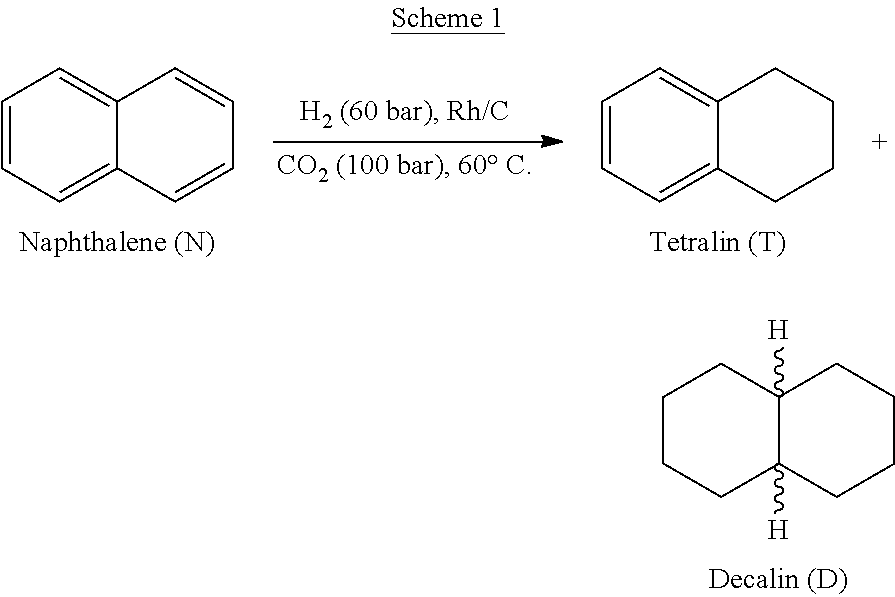
- Hydrogenation of naphthalene, a PAH, was carried out in the presence of Rh/C with H2 (60 bar, 870 psi) and scCO2 (100 bar, 1450 psi). Reactions were carried out for 16 hours according to the reaction conditions shown in
Scheme 1. -
-
FIG. 2 is a graph showing hydrogenation of naphthalene as a function of initial concentration of naphthalene, in which the amount of naphthalene is indicated by diamonds, the amount of tetralin is indicated by squares, and the amount of decalin is indicated by triangles. The vertical axis represents relative concentration of hydrocarbon in percent total hydrocarbon, and the horizontal axis represents initial concentration of naphthalene in moles. - The reaction was repeated using naphthalene concentrations of 0.1 M, 0.2 M, 0.3 M, 0.4 M, and 0.5 M. Under these reaction conditions, total hydrogenation of naphthalene was achieved at concentrations greater than 0.1 M. The result at 0.4 M is possibly due to errors associated with new equipment.
- Hydrogenation of naphthalene, a PAH, was carried out by mixing 0.1 M naphthalene in the presence of Rh/C with H2 (60 bar, 870 psi) and scCO2 (100 bar, 1450 psi) at 60° C. The percentage of tetralin and decalin formed was analyzed at 30 minutes, 1 hour, 2 hours, 3 hours and 4 hours.
FIG. 3 is a graph showing the hydrogenation of naphthalene as a function of time, in which the amount of naphthalene is indicated by diamonds, the amount of tetralin is indicated by squares, and the amount of decalin is indicated by triangles. The vertical axis represents relative concentration of hydrocarbon in percent total hydrocarbon, and the horizontal axis represents duration of the reaction process in units of hours. - As indicated in
FIG. 3 , 80% of naphthalene was converted to tetralin (50%) and decalin (30%) within 30 minutes. As the reaction time increased, naphthalene decreased further and formations of products increased. After 4hours 90% of naphthalene had been converted to fully saturated decalin. Therefore, it is believed that only about 4 hours is required for complete hydrogenation, rather than 16 hours. - While the present invention has been particularly shown and described with reference to the structure and methods disclosed herein and as illustrated in the drawings, it is not confined to the details set forth and this invention is intended to cover any modifications and changes as may come within the scope and spirit of the following claims.
Claims (21)
Priority Applications (2)
| Application Number | Priority Date | Filing Date | Title |
|---|---|---|---|
| US12/663,843 US8691084B2 (en) | 2007-06-11 | 2008-06-11 | Bitumen upgrading using supercritical fluids |
| US12/708,898 US9376635B2 (en) | 2007-06-11 | 2010-02-19 | Carbonaceous material upgrading using supercritical fluids |
Applications Claiming Priority (3)
| Application Number | Priority Date | Filing Date | Title |
|---|---|---|---|
| US94317307P | 2007-06-11 | 2007-06-11 | |
| PCT/US2008/066545 WO2008154576A1 (en) | 2007-06-11 | 2008-06-11 | Bitumen upgrading using supercritical fluids |
| US12/663,843 US8691084B2 (en) | 2007-06-11 | 2008-06-11 | Bitumen upgrading using supercritical fluids |
Related Parent Applications (1)
| Application Number | Title | Priority Date | Filing Date |
|---|---|---|---|
| PCT/US2008/066545 A-371-Of-International WO2008154576A1 (en) | 2007-06-11 | 2008-06-11 | Bitumen upgrading using supercritical fluids |
Related Child Applications (1)
| Application Number | Title | Priority Date | Filing Date |
|---|---|---|---|
| US12/708,898 Continuation-In-Part US9376635B2 (en) | 2007-06-11 | 2010-02-19 | Carbonaceous material upgrading using supercritical fluids |
Publications (2)
| Publication Number | Publication Date |
|---|---|
| US20110049016A1 true US20110049016A1 (en) | 2011-03-03 |
| US8691084B2 US8691084B2 (en) | 2014-04-08 |
Family
ID=40130197
Family Applications (1)
| Application Number | Title | Priority Date | Filing Date |
|---|---|---|---|
| US12/663,843 Expired - Fee Related US8691084B2 (en) | 2007-06-11 | 2008-06-11 | Bitumen upgrading using supercritical fluids |
Country Status (5)
| Country | Link |
|---|---|
| US (1) | US8691084B2 (en) |
| EP (1) | EP2164930A4 (en) |
| JP (2) | JP2010529286A (en) |
| CA (1) | CA2690727C (en) |
| WO (1) | WO2008154576A1 (en) |
Cited By (32)
| Publication number | Priority date | Publication date | Assignee | Title |
|---|---|---|---|---|
| US20100199559A1 (en) * | 2009-02-11 | 2010-08-12 | Natural Energy Systems Inc. | Process for the conversion of organic material to methane rich fuel gas |
| US20120160737A1 (en) * | 2009-07-14 | 2012-06-28 | Statoil Asa | Process |
| WO2013033812A1 (en) | 2011-09-08 | 2013-03-14 | Steve Kresnyak | Enhancement of fischer-tropsch process for hydrocarbon fuel formulation in a gtl environment |
| WO2013070312A1 (en) * | 2011-11-08 | 2013-05-16 | Exxonmobil Upstream Research Company | Processing a hydrocarbon stream using supercritical water |
| KR101314296B1 (en) | 2011-09-30 | 2013-10-02 | 홍익대학교 산학협력단 | System and method for bitumen recovery from oil sands |
| US8701788B2 (en) | 2011-12-22 | 2014-04-22 | Chevron U.S.A. Inc. | Preconditioning a subsurface shale formation by removing extractible organics |
| US8839860B2 (en) | 2010-12-22 | 2014-09-23 | Chevron U.S.A. Inc. | In-situ Kerogen conversion and product isolation |
| US8851177B2 (en) | 2011-12-22 | 2014-10-07 | Chevron U.S.A. Inc. | In-situ kerogen conversion and oxidant regeneration |
| US8889746B2 (en) | 2011-09-08 | 2014-11-18 | Expander Energy Inc. | Enhancement of Fischer-Tropsch process for hydrocarbon fuel formulation in a GTL environment |
| US8992771B2 (en) | 2012-05-25 | 2015-03-31 | Chevron U.S.A. Inc. | Isolating lubricating oils from subsurface shale formations |
| US9033033B2 (en) | 2010-12-21 | 2015-05-19 | Chevron U.S.A. Inc. | Electrokinetic enhanced hydrocarbon recovery from oil shale |
| US9044731B2 (en) | 2012-07-13 | 2015-06-02 | Harris Corporation | Radio frequency hydrocarbon resource upgrading apparatus including parallel paths and related methods |
| US9057237B2 (en) | 2012-07-13 | 2015-06-16 | Harris Corporation | Method for recovering a hydrocarbon resource from a subterranean formation including additional upgrading at the wellhead and related apparatus |
| WO2015094948A1 (en) * | 2013-12-18 | 2015-06-25 | Saudi Arabian Oil Company | Production of upgraded petroleum by supercritical water |
| US9115324B2 (en) | 2011-02-10 | 2015-08-25 | Expander Energy Inc. | Enhancement of Fischer-Tropsch process for hydrocarbon fuel formulation |
| US9156691B2 (en) | 2011-04-20 | 2015-10-13 | Expander Energy Inc. | Process for co-producing commercially valuable products from byproducts of heavy oil and bitumen upgrading process |
| US9169446B2 (en) | 2013-12-30 | 2015-10-27 | Saudi Arabian Oil Company | Demulsification of emulsified petroleum using carbon dioxide and resin supplement without precipitation of asphaltenes |
| US9169443B2 (en) | 2011-04-20 | 2015-10-27 | Expander Energy Inc. | Process for heavy oil and bitumen upgrading |
| US9181467B2 (en) | 2011-12-22 | 2015-11-10 | Uchicago Argonne, Llc | Preparation and use of nano-catalysts for in-situ reaction with kerogen |
| US9200506B2 (en) | 2012-07-13 | 2015-12-01 | Harris Corporation | Apparatus for transporting and upgrading a hydrocarbon resource through a pipeline and related methods |
| US9212319B2 (en) | 2012-05-09 | 2015-12-15 | Expander Energy Inc. | Enhancement of Fischer-Tropsch process for hydrocarbon fuel formulation in a GTL environment |
| WO2015191244A1 (en) * | 2014-06-10 | 2015-12-17 | Saudi Arabian Oil Company | Integrated systems and methods for separation and extraction of polynuclear aromatic hydrocarbons, heterocyclic compounds, and organometallic compounds from hydrocarbon feedstocks |
| US9266730B2 (en) | 2013-03-13 | 2016-02-23 | Expander Energy Inc. | Partial upgrading process for heavy oil and bitumen |
| US9296954B2 (en) | 2013-05-22 | 2016-03-29 | Syncrude Canada Ltd. In Trust For The Owners Of The Syncrude Project As Such Owners Exist Now And In The Future | Treatment of poor processing bitumen froth using supercritical fluid extraction |
| US9315452B2 (en) | 2011-09-08 | 2016-04-19 | Expander Energy Inc. | Process for co-producing commercially valuable products from byproducts of fischer-tropsch process for hydrocarbon fuel formulation in a GTL environment |
| US9328291B2 (en) | 2013-05-24 | 2016-05-03 | Expander Energy Inc. | Refinery process for heavy oil and bitumen |
| US9394489B2 (en) | 2013-12-16 | 2016-07-19 | Saudi Arabian Oil Company | Methods for recovering organic heteroatom compounds from hydrocarbon feedstocks |
| CN107427792A (en) * | 2015-03-24 | 2017-12-01 | 沙特阿拉伯石油公司 | Method for mixing in hydrocarbon conversion processes |
| US10161233B2 (en) | 2012-07-13 | 2018-12-25 | Harris Corporation | Method of upgrading and recovering a hydrocarbon resource for pipeline transport and related system |
| WO2020191407A1 (en) * | 2019-03-21 | 2020-09-24 | Carbon Holdings Intellectual Properties, Llc | Supercritical co2 solvated process to convert coal to carbon fibers |
| WO2022146478A1 (en) * | 2021-01-04 | 2022-07-07 | Saudi Arabian Oil Company | Systems and processes for hydrocarbon upgrading |
| US11384294B1 (en) | 2021-01-04 | 2022-07-12 | Saudi Arabian Oil Company | Systems and processes for treating disulfide oil |
Families Citing this family (7)
| Publication number | Priority date | Publication date | Assignee | Title |
|---|---|---|---|---|
| WO2010096692A2 (en) * | 2009-02-19 | 2010-08-26 | Hsm Systems, Inc. | Carbonaceous material upgrading using supercritical fluids |
| US8551323B2 (en) | 2009-08-31 | 2013-10-08 | Chevron U.S.A. Inc. | Systems and methods for hydroprocessing a heavy oil feedstock |
| US10144874B2 (en) | 2013-03-15 | 2018-12-04 | Terrapower, Llc | Method and system for performing thermochemical conversion of a carbonaceous feedstock to a reaction product |
| JP6248253B2 (en) * | 2013-08-29 | 2017-12-20 | 国立大学法人秋田大学 | Method and system for recovering heavy oil in solution |
| CN110121544B (en) | 2017-01-04 | 2022-04-12 | 沙特阿拉伯石油公司 | System and method for separating and extracting heterocyclic compounds and polynuclear aromatics from a hydrocarbon feedstock |
| US10760004B2 (en) | 2017-03-24 | 2020-09-01 | Terrapower, Llc | Method for recycling pyrolysis tail gas through conversion into formic acid |
| US10787610B2 (en) | 2017-04-11 | 2020-09-29 | Terrapower, Llc | Flexible pyrolysis system and method |
Citations (5)
| Publication number | Priority date | Publication date | Assignee | Title |
|---|---|---|---|---|
| US3853749A (en) * | 1973-07-06 | 1974-12-10 | Mobil Oil Corp | Stabilization of hydrocracked lube oil by contacting said oil with a catalyst of the zsm-5 type |
| US4397736A (en) * | 1981-04-01 | 1983-08-09 | Phillips Petroleum Company | Hydrotreating supercritical solvent extracts in the presence of alkane extractants |
| US5017281A (en) * | 1984-12-21 | 1991-05-21 | Tar Sands Energy Ltd. | Treatment of carbonaceous materials |
| US7008528B2 (en) * | 2001-03-22 | 2006-03-07 | Mitchell Allen R | Process and system for continuously extracting oil from solid or liquid oil bearing material |
| US20090011960A1 (en) * | 2007-07-04 | 2009-01-08 | An Ming Wu | Drilling fluid composition comprising hydrophobically associating polymers and methods of use thereof |
Family Cites Families (14)
| Publication number | Priority date | Publication date | Assignee | Title |
|---|---|---|---|---|
| ZA753184B (en) * | 1974-05-31 | 1976-04-28 | Standard Oil Co | Process for recovering upgraded hydrocarbon products |
| JPS5814257B2 (en) * | 1975-04-18 | 1983-03-18 | 三菱油化株式会社 | Suisotenkashiyokubainoseizohou |
| US4363717A (en) * | 1981-01-15 | 1982-12-14 | Mobil Oil Corporation | Conversion of heavy hydrocarbon oils |
| USRE32120E (en) * | 1981-04-01 | 1986-04-22 | Phillips Petroleum Company | Hydrotreating supercritical solvent extracts in the presence of alkane extractants |
| US4390411A (en) * | 1981-04-02 | 1983-06-28 | Phillips Petroleum Company | Recovery of hydrocarbon values from low organic carbon content carbonaceous materials via hydrogenation and supercritical extraction |
| KR100528257B1 (en) * | 1998-12-23 | 2005-11-15 | 텍사코 디벨롭먼트 코포레이션 | Filtration of feed to integration of solvent deasphalting and gasification |
| IL152455A0 (en) | 2000-04-24 | 2003-05-29 | Shell Int Research | In situ recovery of hydrocarbons from a kerogen-containing formation |
| US20020154852A1 (en) | 2001-04-23 | 2002-10-24 | Levine Jules D. | Electro-optical waveguide switching method and apparatus |
| US6918443B2 (en) * | 2001-04-24 | 2005-07-19 | Shell Oil Company | In situ thermal processing of an oil shale formation to produce hydrocarbons having a selected carbon number range |
| JP4342156B2 (en) * | 2002-07-10 | 2009-10-14 | 三井化学株式会社 | Method for hydrogenating aromatic compounds |
| PT1572839E (en) * | 2002-12-20 | 2006-10-31 | Eni Spa | PROCESS FOR THE TRANSFORMATION OF HEAVY RAW MATERIALS, SUCH AS RAW HEAVY OILS AND DISTILLATION WASTES |
| JP4512762B2 (en) * | 2004-01-14 | 2010-07-28 | 独立行政法人産業技術総合研究所 | Environmentally friendly naphthalene hydrogenation system |
| US7909985B2 (en) * | 2004-12-23 | 2011-03-22 | University Of Utah Research Foundation | Fragmentation of heavy hydrocarbons using an ozone-containing fragmentation fluid |
| US7947165B2 (en) * | 2005-09-14 | 2011-05-24 | Yeda Research And Development Co.Ltd | Method for extracting and upgrading of heavy and semi-heavy oils and bitumens |
-
2008
- 2008-06-11 JP JP2010512320A patent/JP2010529286A/en active Pending
- 2008-06-11 CA CA2690727A patent/CA2690727C/en not_active Expired - Fee Related
- 2008-06-11 WO PCT/US2008/066545 patent/WO2008154576A1/en not_active Ceased
- 2008-06-11 US US12/663,843 patent/US8691084B2/en not_active Expired - Fee Related
- 2008-06-11 EP EP08770701.4A patent/EP2164930A4/en not_active Withdrawn
-
2014
- 2014-07-04 JP JP2014138263A patent/JP5964890B2/en not_active Expired - Fee Related
Patent Citations (5)
| Publication number | Priority date | Publication date | Assignee | Title |
|---|---|---|---|---|
| US3853749A (en) * | 1973-07-06 | 1974-12-10 | Mobil Oil Corp | Stabilization of hydrocracked lube oil by contacting said oil with a catalyst of the zsm-5 type |
| US4397736A (en) * | 1981-04-01 | 1983-08-09 | Phillips Petroleum Company | Hydrotreating supercritical solvent extracts in the presence of alkane extractants |
| US5017281A (en) * | 1984-12-21 | 1991-05-21 | Tar Sands Energy Ltd. | Treatment of carbonaceous materials |
| US7008528B2 (en) * | 2001-03-22 | 2006-03-07 | Mitchell Allen R | Process and system for continuously extracting oil from solid or liquid oil bearing material |
| US20090011960A1 (en) * | 2007-07-04 | 2009-01-08 | An Ming Wu | Drilling fluid composition comprising hydrophobically associating polymers and methods of use thereof |
Cited By (53)
| Publication number | Priority date | Publication date | Assignee | Title |
|---|---|---|---|---|
| US8343241B2 (en) * | 2009-02-11 | 2013-01-01 | Natural Energy Systems Inc. | Process for the conversion of organic material to methane rich fuel gas |
| US20100199559A1 (en) * | 2009-02-11 | 2010-08-12 | Natural Energy Systems Inc. | Process for the conversion of organic material to methane rich fuel gas |
| US20120160737A1 (en) * | 2009-07-14 | 2012-06-28 | Statoil Asa | Process |
| US9234407B2 (en) * | 2009-07-14 | 2016-01-12 | Statoil Petroleum As | Process for simultaneously extracting and upgrading by controlled extraction a heavy hydrocarbon mixture |
| US9033033B2 (en) | 2010-12-21 | 2015-05-19 | Chevron U.S.A. Inc. | Electrokinetic enhanced hydrocarbon recovery from oil shale |
| US9133398B2 (en) | 2010-12-22 | 2015-09-15 | Chevron U.S.A. Inc. | In-situ kerogen conversion and recycling |
| US8839860B2 (en) | 2010-12-22 | 2014-09-23 | Chevron U.S.A. Inc. | In-situ Kerogen conversion and product isolation |
| US8936089B2 (en) | 2010-12-22 | 2015-01-20 | Chevron U.S.A. Inc. | In-situ kerogen conversion and recovery |
| US8997869B2 (en) | 2010-12-22 | 2015-04-07 | Chevron U.S.A. Inc. | In-situ kerogen conversion and product upgrading |
| US9115324B2 (en) | 2011-02-10 | 2015-08-25 | Expander Energy Inc. | Enhancement of Fischer-Tropsch process for hydrocarbon fuel formulation |
| US9169443B2 (en) | 2011-04-20 | 2015-10-27 | Expander Energy Inc. | Process for heavy oil and bitumen upgrading |
| US9732281B2 (en) | 2011-04-20 | 2017-08-15 | Expander Energy Inc. | Process for co-producing commercially valuable products from byproducts of heavy oil and bitumen upgrading process |
| US9156691B2 (en) | 2011-04-20 | 2015-10-13 | Expander Energy Inc. | Process for co-producing commercially valuable products from byproducts of heavy oil and bitumen upgrading process |
| WO2013033812A1 (en) | 2011-09-08 | 2013-03-14 | Steve Kresnyak | Enhancement of fischer-tropsch process for hydrocarbon fuel formulation in a gtl environment |
| US8889746B2 (en) | 2011-09-08 | 2014-11-18 | Expander Energy Inc. | Enhancement of Fischer-Tropsch process for hydrocarbon fuel formulation in a GTL environment |
| US9315452B2 (en) | 2011-09-08 | 2016-04-19 | Expander Energy Inc. | Process for co-producing commercially valuable products from byproducts of fischer-tropsch process for hydrocarbon fuel formulation in a GTL environment |
| KR101314296B1 (en) | 2011-09-30 | 2013-10-02 | 홍익대학교 산학협력단 | System and method for bitumen recovery from oil sands |
| WO2013070312A1 (en) * | 2011-11-08 | 2013-05-16 | Exxonmobil Upstream Research Company | Processing a hydrocarbon stream using supercritical water |
| US9505989B2 (en) | 2011-11-08 | 2016-11-29 | Exxonmobil Upstream Research Company | Processing a hydrocarbon stream using supercritical water |
| US8701788B2 (en) | 2011-12-22 | 2014-04-22 | Chevron U.S.A. Inc. | Preconditioning a subsurface shale formation by removing extractible organics |
| US9181467B2 (en) | 2011-12-22 | 2015-11-10 | Uchicago Argonne, Llc | Preparation and use of nano-catalysts for in-situ reaction with kerogen |
| US8851177B2 (en) | 2011-12-22 | 2014-10-07 | Chevron U.S.A. Inc. | In-situ kerogen conversion and oxidant regeneration |
| US9212319B2 (en) | 2012-05-09 | 2015-12-15 | Expander Energy Inc. | Enhancement of Fischer-Tropsch process for hydrocarbon fuel formulation in a GTL environment |
| US8992771B2 (en) | 2012-05-25 | 2015-03-31 | Chevron U.S.A. Inc. | Isolating lubricating oils from subsurface shale formations |
| US9777222B2 (en) | 2012-07-13 | 2017-10-03 | Harris Corporation | Radio frequency hydrocarbon resource upgrading apparatus including parallel paths and related methods |
| US9057237B2 (en) | 2012-07-13 | 2015-06-16 | Harris Corporation | Method for recovering a hydrocarbon resource from a subterranean formation including additional upgrading at the wellhead and related apparatus |
| US9200506B2 (en) | 2012-07-13 | 2015-12-01 | Harris Corporation | Apparatus for transporting and upgrading a hydrocarbon resource through a pipeline and related methods |
| US10161233B2 (en) | 2012-07-13 | 2018-12-25 | Harris Corporation | Method of upgrading and recovering a hydrocarbon resource for pipeline transport and related system |
| US9044731B2 (en) | 2012-07-13 | 2015-06-02 | Harris Corporation | Radio frequency hydrocarbon resource upgrading apparatus including parallel paths and related methods |
| US9266730B2 (en) | 2013-03-13 | 2016-02-23 | Expander Energy Inc. | Partial upgrading process for heavy oil and bitumen |
| US9296954B2 (en) | 2013-05-22 | 2016-03-29 | Syncrude Canada Ltd. In Trust For The Owners Of The Syncrude Project As Such Owners Exist Now And In The Future | Treatment of poor processing bitumen froth using supercritical fluid extraction |
| US9328291B2 (en) | 2013-05-24 | 2016-05-03 | Expander Energy Inc. | Refinery process for heavy oil and bitumen |
| US9340732B2 (en) | 2013-05-24 | 2016-05-17 | Expander Energy Inc. | Refinery process for heavy oil and bitumen |
| US9394489B2 (en) | 2013-12-16 | 2016-07-19 | Saudi Arabian Oil Company | Methods for recovering organic heteroatom compounds from hydrocarbon feedstocks |
| US9771527B2 (en) | 2013-12-18 | 2017-09-26 | Saudi Arabian Oil Company | Production of upgraded petroleum by supercritical water |
| US10059891B2 (en) | 2013-12-18 | 2018-08-28 | Saudi Arabian Oil Company | Production of upgraded petroleum by supercritical water |
| US10927312B2 (en) | 2013-12-18 | 2021-02-23 | Saudi Arabian Oil Company | Production of upgraded petroleum by supercritical water |
| US10723962B2 (en) | 2013-12-18 | 2020-07-28 | Saudi Arabian Oil Company | Production of upgraded petroleum by supercritical water |
| CN106170532A (en) * | 2013-12-18 | 2016-11-30 | 沙特阿拉伯石油公司 | Production of upgraded petroleum via supercritical water |
| US10472578B2 (en) | 2013-12-18 | 2019-11-12 | Saudi Arabian Oil Company | Production of upgraded petroleum by supercritical water |
| WO2015094948A1 (en) * | 2013-12-18 | 2015-06-25 | Saudi Arabian Oil Company | Production of upgraded petroleum by supercritical water |
| US9169446B2 (en) | 2013-12-30 | 2015-10-27 | Saudi Arabian Oil Company | Demulsification of emulsified petroleum using carbon dioxide and resin supplement without precipitation of asphaltenes |
| WO2015191244A1 (en) * | 2014-06-10 | 2015-12-17 | Saudi Arabian Oil Company | Integrated systems and methods for separation and extraction of polynuclear aromatic hydrocarbons, heterocyclic compounds, and organometallic compounds from hydrocarbon feedstocks |
| KR101995703B1 (en) | 2014-06-10 | 2019-07-03 | 사우디 아라비안 오일 컴퍼니 | Integrated systems and methods for separation and extraction of polynuclear aromatic hydrocarbons, heterocyclic compounds, and organometallic compounds from hydrocarbon feedstocks |
| KR20170018824A (en) * | 2014-06-10 | 2017-02-20 | 사우디 아라비안 오일 컴퍼니 | Integrated systems and methods for separation and extraction of polynuclear aromatic hydrocarbons, heterocyclic compounds, and organometallic compounds from hydrocarbon feedstocks |
| US9688923B2 (en) | 2014-06-10 | 2017-06-27 | Saudi Arabian Oil Company | Integrated methods for separation and extraction of polynuclear aromatic hydrocarbons, heterocyclic compounds, and organometallic compounds from hydrocarbon feedstocks |
| CN106459774A (en) * | 2014-06-10 | 2017-02-22 | 沙特阿拉伯石油公司 | Integrated systems and methods for separation and extraction of polynuclear aromatic hydrocarbons, heterocyclic compounds, and organometallic compounds from hydrocarbon feedstocks |
| CN107427792A (en) * | 2015-03-24 | 2017-12-01 | 沙特阿拉伯石油公司 | Method for mixing in hydrocarbon conversion processes |
| WO2020191407A1 (en) * | 2019-03-21 | 2020-09-24 | Carbon Holdings Intellectual Properties, Llc | Supercritical co2 solvated process to convert coal to carbon fibers |
| US11525091B2 (en) | 2019-03-21 | 2022-12-13 | Carbon Holdings Intellectual Properties, Llc | Supercritical CO2 solvated process to convert coal to carbon fibers |
| WO2022146478A1 (en) * | 2021-01-04 | 2022-07-07 | Saudi Arabian Oil Company | Systems and processes for hydrocarbon upgrading |
| US11384294B1 (en) | 2021-01-04 | 2022-07-12 | Saudi Arabian Oil Company | Systems and processes for treating disulfide oil |
| US11466221B2 (en) | 2021-01-04 | 2022-10-11 | Saudi Arabian Oil Company | Systems and processes for hydrocarbon upgrading |
Also Published As
| Publication number | Publication date |
|---|---|
| JP2010529286A (en) | 2010-08-26 |
| EP2164930A1 (en) | 2010-03-24 |
| WO2008154576A1 (en) | 2008-12-18 |
| JP5964890B2 (en) | 2016-08-03 |
| CA2690727A1 (en) | 2008-12-18 |
| EP2164930A4 (en) | 2015-01-28 |
| US8691084B2 (en) | 2014-04-08 |
| CA2690727C (en) | 2016-12-13 |
| JP2014205850A (en) | 2014-10-30 |
Similar Documents
| Publication | Publication Date | Title |
|---|---|---|
| US8691084B2 (en) | Bitumen upgrading using supercritical fluids | |
| US9376635B2 (en) | Carbonaceous material upgrading using supercritical fluids | |
| Arcelus-Arrillaga et al. | Application of water in hydrothermal conditions for upgrading heavy oils: a review | |
| Vriamont et al. | From lignin to chemicals: hydrogenation of lignin models and mechanistic insights into hydrodeoxygenation via low-temperature C–O bond cleavage | |
| Snape et al. | High liquid yields from bituminous coal via hydropyrolysis with dispersed catalysts | |
| US7909985B2 (en) | Fragmentation of heavy hydrocarbons using an ozone-containing fragmentation fluid | |
| Djimasbe et al. | Deep insights into heavy oil upgrading using supercritical water by a comprehensive analysis of GC, GC–MS, NMR, and SEM–EDX with the aid of EPR as a complementary technical analysis | |
| Zhao et al. | A review on the role of hydrogen donors in upgrading heavy oil and bitumen | |
| US4101416A (en) | Process for hydrogenation of hydrocarbon tars | |
| WO2009003634A1 (en) | Process for the conversion of heavy hydrocarbon feedstocks to distillates with the self-production of hydrogen | |
| Xiong et al. | An in situ reduction approach for bio-oil hydroprocessing | |
| US3796653A (en) | Solvent deasphalting and non-catalytic hydrogenation | |
| US20120279902A1 (en) | Carbonaceous material upgrading using supercritical fluids | |
| KR101778628B1 (en) | Process for the hydroconversion of a low quality hydrocarbonaceous feedstock | |
| WO2009003633A1 (en) | Process for the conversion of heavy hydrocarbon feedstocks to distillates with the self- production of hydrogen | |
| Mukhamatdinov et al. | Influence of naphthenic hydrocarbons and polar solvents on the composition and structure of heavy-oil aquathermolysis products | |
| CN105705617A (en) | Hydroprocess for a hydrocarbon stream from coal tar | |
| CN105705616A (en) | Process for providing aromatics from coal tar | |
| US10030200B2 (en) | Hydroprocessing oil sands-derived, bitumen compositions | |
| WO2010096692A2 (en) | Carbonaceous material upgrading using supercritical fluids | |
| Haghighat et al. | Experimental study on catalytic hydroprocessing of solubilized asphaltene in water: A proof of concept to upgrade asphaltene in the aqueous phase | |
| Tan et al. | Catalytic cracking of 4-(1-naphthylmethyl) bibenzyl in sub-and supercritical water | |
| Alawad et al. | Advances in upgrading process of petroleum residue: a review | |
| Brough et al. | Low temperature extraction and upgrading of oil sands and bitumen in supercritical fluid mixtures | |
| CA2316084C (en) | Method for extracting and upgrading of heavy and semi-heavy oils and bitumens |
Legal Events
| Date | Code | Title | Description |
|---|---|---|---|
| AS | Assignment |
Owner name: UNIVERSITY OF NEW BRUNSWICK, CANADA Free format text: ASSIGNMENT OF ASSIGNORS INTEREST;ASSIGNORS:WILLSON, CHRISTOPHER;MCGRADY, GERARD SEAN;BROUGH, SARAH ANN;REEL/FRAME:024048/0057 Effective date: 20100308 Owner name: HSM SYSTEMS, INC., CANADA Free format text: ASSIGNMENT OF ASSIGNORS INTEREST;ASSIGNORS:WILLSON, CHRISTOPHER;MCGRADY, GERARD SEAN;BROUGH, SARAH ANN;REEL/FRAME:024048/0057 Effective date: 20100308 |
|
| FEPP | Fee payment procedure |
Free format text: MAINTENANCE FEE REMINDER MAILED (ORIGINAL EVENT CODE: REM.) |
|
| LAPS | Lapse for failure to pay maintenance fees |
Free format text: PATENT EXPIRED FOR FAILURE TO PAY MAINTENANCE FEES (ORIGINAL EVENT CODE: EXP.) |
|
| STCH | Information on status: patent discontinuation |
Free format text: PATENT EXPIRED DUE TO NONPAYMENT OF MAINTENANCE FEES UNDER 37 CFR 1.362 |
|
| FP | Lapsed due to failure to pay maintenance fee |
Effective date: 20180408 |