US20110045358A1 - Non-aqueous electrolyte for a lithium battery and lithium battery including the same - Google Patents
Non-aqueous electrolyte for a lithium battery and lithium battery including the same Download PDFInfo
- Publication number
- US20110045358A1 US20110045358A1 US12/907,485 US90748510A US2011045358A1 US 20110045358 A1 US20110045358 A1 US 20110045358A1 US 90748510 A US90748510 A US 90748510A US 2011045358 A1 US2011045358 A1 US 2011045358A1
- Authority
- US
- United States
- Prior art keywords
- organic solvent
- weight
- parts
- lithium
- aqueous electrolyte
- Prior art date
- Legal status (The legal status is an assumption and is not a legal conclusion. Google has not performed a legal analysis and makes no representation as to the accuracy of the status listed.)
- Abandoned
Links
- 229910052744 lithium Inorganic materials 0.000 title claims abstract description 53
- WHXSMMKQMYFTQS-UHFFFAOYSA-N Lithium Chemical compound [Li] WHXSMMKQMYFTQS-UHFFFAOYSA-N 0.000 title claims abstract description 50
- 239000011255 nonaqueous electrolyte Substances 0.000 title claims abstract description 39
- 239000011356 non-aqueous organic solvent Substances 0.000 claims abstract description 43
- QAMFBRUWYYMMGJ-UHFFFAOYSA-N hexafluoroacetylacetone Chemical compound FC(F)(F)C(=O)CC(=O)C(F)(F)F QAMFBRUWYYMMGJ-UHFFFAOYSA-N 0.000 claims abstract description 23
- 229910003002 lithium salt Inorganic materials 0.000 claims abstract description 15
- 159000000002 lithium salts Chemical class 0.000 claims abstract description 15
- 239000003660 carbonate based solvent Substances 0.000 claims abstract description 13
- 239000003759 ester based solvent Substances 0.000 claims abstract description 11
- 239000005453 ketone based solvent Substances 0.000 claims abstract description 7
- 150000001875 compounds Chemical class 0.000 claims description 20
- OKTJSMMVPCPJKN-UHFFFAOYSA-N Carbon Chemical compound [C] OKTJSMMVPCPJKN-UHFFFAOYSA-N 0.000 claims description 17
- UHOVQNZJYSORNB-UHFFFAOYSA-N Benzene Chemical compound C1=CC=CC=C1 UHOVQNZJYSORNB-UHFFFAOYSA-N 0.000 claims description 15
- 229910052751 metal Inorganic materials 0.000 claims description 14
- 239000002184 metal Substances 0.000 claims description 14
- 150000004945 aromatic hydrocarbons Chemical class 0.000 claims description 13
- 239000011149 active material Substances 0.000 claims description 11
- XEKOWRVHYACXOJ-UHFFFAOYSA-N Ethyl acetate Chemical compound CCOC(C)=O XEKOWRVHYACXOJ-UHFFFAOYSA-N 0.000 claims description 9
- YXFVVABEGXRONW-UHFFFAOYSA-N Toluene Chemical compound CC1=CC=CC=C1 YXFVVABEGXRONW-UHFFFAOYSA-N 0.000 claims description 9
- 229910052799 carbon Inorganic materials 0.000 claims description 9
- 229910016210 LixNi1-y-zCoyMz Inorganic materials 0.000 claims description 7
- 229910014281 LixNi1−y−zCoyMz Inorganic materials 0.000 claims description 7
- 229910052782 aluminium Inorganic materials 0.000 claims description 7
- 125000000008 (C1-C10) alkyl group Chemical group 0.000 claims description 6
- GETTZEONDQJALK-UHFFFAOYSA-N (trifluoromethyl)benzene Chemical compound FC(F)(F)C1=CC=CC=C1 GETTZEONDQJALK-UHFFFAOYSA-N 0.000 claims description 6
- YEJRWHAVMIAJKC-UHFFFAOYSA-N 4-Butyrolactone Chemical compound O=C1CCCO1 YEJRWHAVMIAJKC-UHFFFAOYSA-N 0.000 claims description 6
- OZJPLYNZGCXSJM-UHFFFAOYSA-N 5-valerolactone Chemical compound O=C1CCCCO1 OZJPLYNZGCXSJM-UHFFFAOYSA-N 0.000 claims description 6
- 229910001290 LiPF6 Inorganic materials 0.000 claims description 6
- QARVLSVVCXYDNA-UHFFFAOYSA-N bromobenzene Chemical compound BrC1=CC=CC=C1 QARVLSVVCXYDNA-UHFFFAOYSA-N 0.000 claims description 6
- MVPPADPHJFYWMZ-UHFFFAOYSA-N chlorobenzene Chemical compound ClC1=CC=CC=C1 MVPPADPHJFYWMZ-UHFFFAOYSA-N 0.000 claims description 6
- 239000002131 composite material Substances 0.000 claims description 6
- FKRCODPIKNYEAC-UHFFFAOYSA-N ethyl propionate Chemical compound CCOC(=O)CC FKRCODPIKNYEAC-UHFFFAOYSA-N 0.000 claims description 6
- JBFHTYHTHYHCDJ-UHFFFAOYSA-N gamma-caprolactone Chemical compound CCC1CCC(=O)O1 JBFHTYHTHYHCDJ-UHFFFAOYSA-N 0.000 claims description 6
- GAEKPEKOJKCEMS-UHFFFAOYSA-N gamma-valerolactone Chemical compound CC1CCC(=O)O1 GAEKPEKOJKCEMS-UHFFFAOYSA-N 0.000 claims description 6
- 229910052736 halogen Inorganic materials 0.000 claims description 6
- 150000002367 halogens Chemical class 0.000 claims description 6
- 125000004435 hydrogen atom Chemical group [H]* 0.000 claims description 6
- 229910052717 sulfur Inorganic materials 0.000 claims description 6
- 229910000733 Li alloy Inorganic materials 0.000 claims description 5
- KWGKDLIKAYFUFQ-UHFFFAOYSA-M lithium chloride Chemical compound [Li+].[Cl-] KWGKDLIKAYFUFQ-UHFFFAOYSA-M 0.000 claims description 5
- 229910052718 tin Inorganic materials 0.000 claims description 5
- 229920000049 Carbon (fiber) Polymers 0.000 claims description 4
- 229910016254 LixNi1-y-zMnyMz Inorganic materials 0.000 claims description 4
- 229910014290 LixNi1−y−zMnyMz Inorganic materials 0.000 claims description 4
- 229910003481 amorphous carbon Inorganic materials 0.000 claims description 4
- 239000004917 carbon fiber Substances 0.000 claims description 4
- 229910052731 fluorine Inorganic materials 0.000 claims description 4
- 229910052733 gallium Inorganic materials 0.000 claims description 4
- 239000001989 lithium alloy Substances 0.000 claims description 4
- HSZCZNFXUDYRKD-UHFFFAOYSA-M lithium iodide Inorganic materials [Li+].[I-] HSZCZNFXUDYRKD-UHFFFAOYSA-M 0.000 claims description 4
- PYLWMHQQBFSUBP-UHFFFAOYSA-N monofluorobenzene Chemical compound FC1=CC=CC=C1 PYLWMHQQBFSUBP-UHFFFAOYSA-N 0.000 claims description 4
- 229910052710 silicon Inorganic materials 0.000 claims description 4
- 229910052720 vanadium Inorganic materials 0.000 claims description 4
- MMZYCBHLNZVROM-UHFFFAOYSA-N 1-fluoro-2-methylbenzene Chemical compound CC1=CC=CC=C1F MMZYCBHLNZVROM-UHFFFAOYSA-N 0.000 claims description 3
- MPXDAIBTYWGBSL-UHFFFAOYSA-N 2,4-difluoro-1-methylbenzene Chemical compound CC1=CC=C(F)C=C1F MPXDAIBTYWGBSL-UHFFFAOYSA-N 0.000 claims description 3
- 229910001559 LiC4F9SO3 Inorganic materials 0.000 claims description 3
- 229910000552 LiCF3SO3 Inorganic materials 0.000 claims description 3
- 229910017206 LixMn1-yMy Inorganic materials 0.000 claims description 3
- 229910017203 LixMn1−yMy Inorganic materials 0.000 claims description 3
- 229910015349 LixMn2O4-z Inorganic materials 0.000 claims description 3
- 229910015310 LixMn2O4−z Inorganic materials 0.000 claims description 3
- 229910014210 LixNi1-yCoyO2-z Inorganic materials 0.000 claims description 3
- 229910014218 LixNi1-yMy Inorganic materials 0.000 claims description 3
- 229910014331 LixNi1−yCoyO2−z Inorganic materials 0.000 claims description 3
- 229910014350 LixNi1−yMy Inorganic materials 0.000 claims description 3
- RJUFJBKOKNCXHH-UHFFFAOYSA-N Methyl propionate Chemical compound CCC(=O)OC RJUFJBKOKNCXHH-UHFFFAOYSA-N 0.000 claims description 3
- CTQNGGLPUBDAKN-UHFFFAOYSA-N O-Xylene Chemical compound CC1=CC=CC=C1C CTQNGGLPUBDAKN-UHFFFAOYSA-N 0.000 claims description 3
- XBDQKXXYIPTUBI-UHFFFAOYSA-M Propionate Chemical compound CCC([O-])=O XBDQKXXYIPTUBI-UHFFFAOYSA-M 0.000 claims description 3
- KXKVLQRXCPHEJC-UHFFFAOYSA-N acetic acid trimethyl ester Natural products COC(C)=O KXKVLQRXCPHEJC-UHFFFAOYSA-N 0.000 claims description 3
- 229910052785 arsenic Inorganic materials 0.000 claims description 3
- 229910052796 boron Inorganic materials 0.000 claims description 3
- 229910052791 calcium Inorganic materials 0.000 claims description 3
- 229910052804 chromium Inorganic materials 0.000 claims description 3
- 229940093499 ethyl acetate Drugs 0.000 claims description 3
- 229910052732 germanium Inorganic materials 0.000 claims description 3
- MHCFAGZWMAWTNR-UHFFFAOYSA-M lithium perchlorate Chemical compound [Li+].[O-]Cl(=O)(=O)=O MHCFAGZWMAWTNR-UHFFFAOYSA-M 0.000 claims description 3
- 229910001496 lithium tetrafluoroborate Inorganic materials 0.000 claims description 3
- ACFSQHQYDZIPRL-UHFFFAOYSA-N lithium;bis(1,1,2,2,2-pentafluoroethylsulfonyl)azanide Chemical compound [Li+].FC(F)(F)C(F)(F)S(=O)(=O)[N-]S(=O)(=O)C(F)(F)C(F)(F)F ACFSQHQYDZIPRL-UHFFFAOYSA-N 0.000 claims description 3
- 229910052749 magnesium Inorganic materials 0.000 claims description 3
- 229910052748 manganese Inorganic materials 0.000 claims description 3
- AUHZEENZYGFFBQ-UHFFFAOYSA-N mesitylene Substances CC1=CC(C)=CC(C)=C1 AUHZEENZYGFFBQ-UHFFFAOYSA-N 0.000 claims description 3
- 125000001827 mesitylenyl group Chemical group [H]C1=C(C(*)=C(C([H])=C1C([H])([H])[H])C([H])([H])[H])C([H])([H])[H] 0.000 claims description 3
- VNWKTOKETHGBQD-UHFFFAOYSA-N methane Chemical compound C VNWKTOKETHGBQD-UHFFFAOYSA-N 0.000 claims description 3
- 229940017219 methyl propionate Drugs 0.000 claims description 3
- YKYONYBAUNKHLG-UHFFFAOYSA-N n-Propyl acetate Natural products CCCOC(C)=O YKYONYBAUNKHLG-UHFFFAOYSA-N 0.000 claims description 3
- 229910052760 oxygen Inorganic materials 0.000 claims description 3
- 229920005735 poly(methyl vinyl ketone) Polymers 0.000 claims description 3
- 229910052700 potassium Inorganic materials 0.000 claims description 3
- 229940090181 propyl acetate Drugs 0.000 claims description 3
- 229910052761 rare earth metal Inorganic materials 0.000 claims description 3
- 229910052708 sodium Inorganic materials 0.000 claims description 3
- 229910052719 titanium Inorganic materials 0.000 claims description 3
- NQPDZGIKBAWPEJ-UHFFFAOYSA-N valeric acid Chemical compound CCCCC(O)=O NQPDZGIKBAWPEJ-UHFFFAOYSA-N 0.000 claims description 3
- 239000008096 xylene Substances 0.000 claims description 3
- 229910013131 LiN Inorganic materials 0.000 claims description 2
- 229910021447 LiN(CxF2x+1SO2)(CyF2y+1SO2) Inorganic materials 0.000 claims description 2
- 229910015214 LixMn2-yMy Inorganic materials 0.000 claims description 2
- 229910015277 LixMn2−yMy Inorganic materials 0.000 claims description 2
- 239000003610 charcoal Substances 0.000 claims description 2
- 229910001486 lithium perchlorate Inorganic materials 0.000 claims description 2
- QSZMZKBZAYQGRS-UHFFFAOYSA-N lithium;bis(trifluoromethylsulfonyl)azanide Chemical compound [Li+].FC(F)(F)S(=O)(=O)[N-]S(=O)(=O)C(F)(F)F QSZMZKBZAYQGRS-UHFFFAOYSA-N 0.000 claims description 2
- 229910052726 zirconium Inorganic materials 0.000 claims description 2
- 229910010088 LiAlO4 Inorganic materials 0.000 claims 1
- 229910001547 lithium hexafluoroantimonate(V) Inorganic materials 0.000 claims 1
- 229910001540 lithium hexafluoroarsenate(V) Inorganic materials 0.000 claims 1
- 229910001537 lithium tetrachloroaluminate Inorganic materials 0.000 claims 1
- 229910052698 phosphorus Inorganic materials 0.000 claims 1
- 239000003960 organic solvent Substances 0.000 abstract description 18
- 239000004210 ether based solvent Substances 0.000 abstract description 6
- -1 LiAsF6 Inorganic materials 0.000 description 22
- 239000003792 electrolyte Substances 0.000 description 17
- 239000011267 electrode slurry Substances 0.000 description 13
- 239000000203 mixture Substances 0.000 description 13
- 230000000052 comparative effect Effects 0.000 description 10
- 238000004321 preservation Methods 0.000 description 9
- KMTRUDSVKNLOMY-UHFFFAOYSA-N Ethylene carbonate Chemical compound O=C1OCCO1 KMTRUDSVKNLOMY-UHFFFAOYSA-N 0.000 description 8
- 239000011230 binding agent Substances 0.000 description 8
- 238000000034 method Methods 0.000 description 8
- 239000002904 solvent Substances 0.000 description 8
- 239000004698 Polyethylene Substances 0.000 description 7
- 239000006258 conductive agent Substances 0.000 description 7
- JBTWLSYIZRCDFO-UHFFFAOYSA-N ethyl methyl carbonate Chemical compound CCOC(=O)OC JBTWLSYIZRCDFO-UHFFFAOYSA-N 0.000 description 7
- 238000012423 maintenance Methods 0.000 description 7
- 239000007773 negative electrode material Substances 0.000 description 7
- 229920000573 polyethylene Polymers 0.000 description 7
- SECXISVLQFMRJM-UHFFFAOYSA-N N-Methylpyrrolidone Chemical compound CN1CCCC1=O SECXISVLQFMRJM-UHFFFAOYSA-N 0.000 description 6
- WYURNTSHIVDZCO-UHFFFAOYSA-N Tetrahydrofuran Chemical compound C1CCOC1 WYURNTSHIVDZCO-UHFFFAOYSA-N 0.000 description 6
- 150000005678 chain carbonates Chemical class 0.000 description 6
- 150000005676 cyclic carbonates Chemical class 0.000 description 6
- 230000014509 gene expression Effects 0.000 description 6
- 239000010410 layer Substances 0.000 description 6
- OIFBSDVPJOWBCH-UHFFFAOYSA-N Diethyl carbonate Chemical compound CCOC(=O)OCC OIFBSDVPJOWBCH-UHFFFAOYSA-N 0.000 description 5
- HBBGRARXTFLTSG-UHFFFAOYSA-N Lithium ion Chemical compound [Li+] HBBGRARXTFLTSG-UHFFFAOYSA-N 0.000 description 5
- 239000004743 Polypropylene Substances 0.000 description 5
- 239000007772 electrode material Substances 0.000 description 5
- 229910001416 lithium ion Inorganic materials 0.000 description 5
- 239000011572 manganese Substances 0.000 description 5
- 229920001155 polypropylene Polymers 0.000 description 5
- 239000007774 positive electrode material Substances 0.000 description 5
- RUOJZAUFBMNUDX-UHFFFAOYSA-N propylene carbonate Chemical compound CC1COC(=O)O1 RUOJZAUFBMNUDX-UHFFFAOYSA-N 0.000 description 5
- 239000002562 thickening agent Substances 0.000 description 5
- 229910018699 LixCo1-yMy Inorganic materials 0.000 description 4
- 229910018707 LixCo1−yMy Inorganic materials 0.000 description 4
- 239000002033 PVDF binder Substances 0.000 description 4
- XAGFODPZIPBFFR-UHFFFAOYSA-N aluminium Chemical compound [Al] XAGFODPZIPBFFR-UHFFFAOYSA-N 0.000 description 4
- IEJIGPNLZYLLBP-UHFFFAOYSA-N dimethyl carbonate Chemical compound COC(=O)OC IEJIGPNLZYLLBP-UHFFFAOYSA-N 0.000 description 4
- VUPKGFBOKBGHFZ-UHFFFAOYSA-N dipropyl carbonate Chemical compound CCCOC(=O)OCCC VUPKGFBOKBGHFZ-UHFFFAOYSA-N 0.000 description 4
- CYEDOLFRAIXARV-UHFFFAOYSA-N ethyl propyl carbonate Chemical compound CCCOC(=O)OCC CYEDOLFRAIXARV-UHFFFAOYSA-N 0.000 description 4
- KKQAVHGECIBFRQ-UHFFFAOYSA-N methyl propyl carbonate Chemical compound CCCOC(=O)OC KKQAVHGECIBFRQ-UHFFFAOYSA-N 0.000 description 4
- 229920002981 polyvinylidene fluoride Polymers 0.000 description 4
- RYGMFSIKBFXOCR-UHFFFAOYSA-N Copper Chemical compound [Cu] RYGMFSIKBFXOCR-UHFFFAOYSA-N 0.000 description 3
- ZMXDDKWLCZADIW-UHFFFAOYSA-N N,N-Dimethylformamide Chemical compound CN(C)C=O ZMXDDKWLCZADIW-UHFFFAOYSA-N 0.000 description 3
- ATJFFYVFTNAWJD-UHFFFAOYSA-N Tin Chemical compound [Sn] ATJFFYVFTNAWJD-UHFFFAOYSA-N 0.000 description 3
- 229910021383 artificial graphite Inorganic materials 0.000 description 3
- 239000011575 calcium Substances 0.000 description 3
- 239000011651 chromium Substances 0.000 description 3
- 239000008151 electrolyte solution Substances 0.000 description 3
- 239000011888 foil Substances 0.000 description 3
- 229910002804 graphite Inorganic materials 0.000 description 3
- 239000010439 graphite Substances 0.000 description 3
- 150000002500 ions Chemical class 0.000 description 3
- 239000011777 magnesium Substances 0.000 description 3
- 239000002931 mesocarbon microbead Substances 0.000 description 3
- 150000002894 organic compounds Chemical class 0.000 description 3
- 238000007789 sealing Methods 0.000 description 3
- 239000011734 sodium Substances 0.000 description 3
- YLQBMQCUIZJEEH-UHFFFAOYSA-N tetrahydrofuran Natural products C=1C=COC=1 YLQBMQCUIZJEEH-UHFFFAOYSA-N 0.000 description 3
- 239000010936 titanium Substances 0.000 description 3
- ZZXUZKXVROWEIF-UHFFFAOYSA-N 1,2-butylene carbonate Chemical compound CCC1COC(=O)O1 ZZXUZKXVROWEIF-UHFFFAOYSA-N 0.000 description 2
- DURPTKYDGMDSBL-UHFFFAOYSA-N 1-butoxybutane Chemical compound CCCCOCCCC DURPTKYDGMDSBL-UHFFFAOYSA-N 0.000 description 2
- JWUJQDFVADABEY-UHFFFAOYSA-N 2-methyltetrahydrofuran Chemical compound CC1CCCO1 JWUJQDFVADABEY-UHFFFAOYSA-N 0.000 description 2
- LWLOKSXSAUHTJO-UHFFFAOYSA-N 4,5-dimethyl-1,3-dioxolan-2-one Chemical compound CC1OC(=O)OC1C LWLOKSXSAUHTJO-UHFFFAOYSA-N 0.000 description 2
- BJWMSGRKJIOCNR-UHFFFAOYSA-N 4-ethenyl-1,3-dioxolan-2-one Chemical compound C=CC1COC(=O)O1 BJWMSGRKJIOCNR-UHFFFAOYSA-N 0.000 description 2
- LSUWCXHZPFTZSF-UHFFFAOYSA-N 4-ethyl-5-methyl-1,3-dioxolan-2-one Chemical compound CCC1OC(=O)OC1C LSUWCXHZPFTZSF-UHFFFAOYSA-N 0.000 description 2
- SBLRHMKNNHXPHG-UHFFFAOYSA-N 4-fluoro-1,3-dioxolan-2-one Chemical compound FC1COC(=O)O1 SBLRHMKNNHXPHG-UHFFFAOYSA-N 0.000 description 2
- AUXJVUDWWLIGRU-UHFFFAOYSA-N 4-propyl-1,3-dioxolan-2-one Chemical compound CCCC1COC(=O)O1 AUXJVUDWWLIGRU-UHFFFAOYSA-N 0.000 description 2
- 229920002134 Carboxymethyl cellulose Polymers 0.000 description 2
- KRHYYFGTRYWZRS-UHFFFAOYSA-M Fluoride anion Chemical compound [F-] KRHYYFGTRYWZRS-UHFFFAOYSA-M 0.000 description 2
- GYHNNYVSQQEPJS-UHFFFAOYSA-N Gallium Chemical compound [Ga] GYHNNYVSQQEPJS-UHFFFAOYSA-N 0.000 description 2
- 229910032387 LiCoO2 Inorganic materials 0.000 description 2
- 229920003171 Poly (ethylene oxide) Polymers 0.000 description 2
- XUIMIQQOPSSXEZ-UHFFFAOYSA-N Silicon Chemical compound [Si] XUIMIQQOPSSXEZ-UHFFFAOYSA-N 0.000 description 2
- NINIDFKCEFEMDL-UHFFFAOYSA-N Sulfur Chemical compound [S] NINIDFKCEFEMDL-UHFFFAOYSA-N 0.000 description 2
- 239000003125 aqueous solvent Substances 0.000 description 2
- 239000006229 carbon black Substances 0.000 description 2
- 239000001768 carboxy methyl cellulose Substances 0.000 description 2
- 235000010948 carboxy methyl cellulose Nutrition 0.000 description 2
- 239000008112 carboxymethyl-cellulose Substances 0.000 description 2
- 239000000571 coke Substances 0.000 description 2
- 239000010949 copper Substances 0.000 description 2
- 239000011889 copper foil Substances 0.000 description 2
- 230000001747 exhibiting effect Effects 0.000 description 2
- BHEPBYXIRTUNPN-UHFFFAOYSA-N hydridophosphorus(.) (triplet) Chemical compound [PH] BHEPBYXIRTUNPN-UHFFFAOYSA-N 0.000 description 2
- 238000002347 injection Methods 0.000 description 2
- 239000007924 injection Substances 0.000 description 2
- 230000005012 migration Effects 0.000 description 2
- 238000013508 migration Methods 0.000 description 2
- 229910021382 natural graphite Inorganic materials 0.000 description 2
- 239000010703 silicon Substances 0.000 description 2
- 239000002356 single layer Substances 0.000 description 2
- 229920003048 styrene butadiene rubber Polymers 0.000 description 2
- 239000011593 sulfur Substances 0.000 description 2
- LEONUFNNVUYDNQ-UHFFFAOYSA-N vanadium atom Chemical compound [V] LEONUFNNVUYDNQ-UHFFFAOYSA-N 0.000 description 2
- XLYOFNOQVPJJNP-UHFFFAOYSA-N water Substances O XLYOFNOQVPJJNP-UHFFFAOYSA-N 0.000 description 2
- KPZGRMZPZLOPBS-UHFFFAOYSA-N 1,3-dichloro-2,2-bis(chloromethyl)propane Chemical compound ClCC(CCl)(CCl)CCl KPZGRMZPZLOPBS-UHFFFAOYSA-N 0.000 description 1
- 229910000838 Al alloy Inorganic materials 0.000 description 1
- ZOXJGFHDIHLPTG-UHFFFAOYSA-N Boron Chemical compound [B] ZOXJGFHDIHLPTG-UHFFFAOYSA-N 0.000 description 1
- DKPFZGUDAPQIHT-UHFFFAOYSA-N Butyl acetate Natural products CCCCOC(C)=O DKPFZGUDAPQIHT-UHFFFAOYSA-N 0.000 description 1
- OYPRJOBELJOOCE-UHFFFAOYSA-N Calcium Chemical compound [Ca] OYPRJOBELJOOCE-UHFFFAOYSA-N 0.000 description 1
- 239000004215 Carbon black (E152) Substances 0.000 description 1
- VYZAMTAEIAYCRO-UHFFFAOYSA-N Chromium Chemical compound [Cr] VYZAMTAEIAYCRO-UHFFFAOYSA-N 0.000 description 1
- 229910000881 Cu alloy Inorganic materials 0.000 description 1
- IAYPIBMASNFSPL-UHFFFAOYSA-N Ethylene oxide Chemical compound C1CO1 IAYPIBMASNFSPL-UHFFFAOYSA-N 0.000 description 1
- 239000004354 Hydroxyethyl cellulose Substances 0.000 description 1
- 229920000663 Hydroxyethyl cellulose Polymers 0.000 description 1
- 229920002153 Hydroxypropyl cellulose Polymers 0.000 description 1
- DGAQECJNVWCQMB-PUAWFVPOSA-M Ilexoside XXIX Chemical compound C[C@@H]1CC[C@@]2(CC[C@@]3(C(=CC[C@H]4[C@]3(CC[C@@H]5[C@@]4(CC[C@@H](C5(C)C)OS(=O)(=O)[O-])C)C)[C@@H]2[C@]1(C)O)C)C(=O)O[C@H]6[C@@H]([C@H]([C@@H]([C@H](O6)CO)O)O)O.[Na+] DGAQECJNVWCQMB-PUAWFVPOSA-M 0.000 description 1
- XEEYBQQBJWHFJM-UHFFFAOYSA-N Iron Chemical compound [Fe] XEEYBQQBJWHFJM-UHFFFAOYSA-N 0.000 description 1
- 229910018276 LaSrCoO3 Inorganic materials 0.000 description 1
- 229910018281 LaSrMnO3 Inorganic materials 0.000 description 1
- 229910015160 LixMn2-y Inorganic materials 0.000 description 1
- FYYHWMGAXLPEAU-UHFFFAOYSA-N Magnesium Chemical compound [Mg] FYYHWMGAXLPEAU-UHFFFAOYSA-N 0.000 description 1
- PWHULOQIROXLJO-UHFFFAOYSA-N Manganese Chemical compound [Mn] PWHULOQIROXLJO-UHFFFAOYSA-N 0.000 description 1
- FXHOOIRPVKKKFG-UHFFFAOYSA-N N,N-Dimethylacetamide Chemical compound CN(C)C(C)=O FXHOOIRPVKKKFG-UHFFFAOYSA-N 0.000 description 1
- 229920000459 Nitrile rubber Polymers 0.000 description 1
- 239000004372 Polyvinyl alcohol Substances 0.000 description 1
- ZLMJMSJWJFRBEC-UHFFFAOYSA-N Potassium Chemical compound [K] ZLMJMSJWJFRBEC-UHFFFAOYSA-N 0.000 description 1
- GWEVSGVZZGPLCZ-UHFFFAOYSA-N Titan oxide Chemical compound O=[Ti]=O GWEVSGVZZGPLCZ-UHFFFAOYSA-N 0.000 description 1
- RTAQQCXQSZGOHL-UHFFFAOYSA-N Titanium Chemical compound [Ti] RTAQQCXQSZGOHL-UHFFFAOYSA-N 0.000 description 1
- 238000002441 X-ray diffraction Methods 0.000 description 1
- CHHOPPGAFVFXFS-UHFFFAOYSA-M [Li+].[O-]S(F)(=O)=O Chemical class [Li+].[O-]S(F)(=O)=O CHHOPPGAFVFXFS-UHFFFAOYSA-M 0.000 description 1
- JFBZPFYRPYOZCQ-UHFFFAOYSA-N [Li].[Al] Chemical compound [Li].[Al] JFBZPFYRPYOZCQ-UHFFFAOYSA-N 0.000 description 1
- 239000006230 acetylene black Substances 0.000 description 1
- 239000000654 additive Substances 0.000 description 1
- 229910052787 antimony Inorganic materials 0.000 description 1
- WATWJIUSRGPENY-UHFFFAOYSA-N antimony atom Chemical compound [Sb] WATWJIUSRGPENY-UHFFFAOYSA-N 0.000 description 1
- RQNWIZPPADIBDY-UHFFFAOYSA-N arsenic atom Chemical compound [As] RQNWIZPPADIBDY-UHFFFAOYSA-N 0.000 description 1
- QVGXLLKOCUKJST-UHFFFAOYSA-N atomic oxygen Chemical compound [O] QVGXLLKOCUKJST-UHFFFAOYSA-N 0.000 description 1
- 229910052797 bismuth Inorganic materials 0.000 description 1
- JCXGWMGPZLAOME-UHFFFAOYSA-N bismuth atom Chemical compound [Bi] JCXGWMGPZLAOME-UHFFFAOYSA-N 0.000 description 1
- 229910052793 cadmium Inorganic materials 0.000 description 1
- BDOSMKKIYDKNTQ-UHFFFAOYSA-N cadmium atom Chemical compound [Cd] BDOSMKKIYDKNTQ-UHFFFAOYSA-N 0.000 description 1
- OJIJEKBXJYRIBZ-UHFFFAOYSA-N cadmium nickel Chemical compound [Ni].[Cd] OJIJEKBXJYRIBZ-UHFFFAOYSA-N 0.000 description 1
- 239000006231 channel black Substances 0.000 description 1
- 239000011248 coating agent Substances 0.000 description 1
- 238000000576 coating method Methods 0.000 description 1
- 229910017052 cobalt Inorganic materials 0.000 description 1
- 239000010941 cobalt Substances 0.000 description 1
- GUTLYIVDDKVIGB-UHFFFAOYSA-N cobalt atom Chemical compound [Co] GUTLYIVDDKVIGB-UHFFFAOYSA-N 0.000 description 1
- 230000008602 contraction Effects 0.000 description 1
- 229910052802 copper Inorganic materials 0.000 description 1
- 230000003247 decreasing effect Effects 0.000 description 1
- 238000010586 diagram Methods 0.000 description 1
- NJLLQSBAHIKGKF-UHFFFAOYSA-N dipotassium dioxido(oxo)titanium Chemical compound [K+].[K+].[O-][Ti]([O-])=O NJLLQSBAHIKGKF-UHFFFAOYSA-N 0.000 description 1
- 238000007599 discharging Methods 0.000 description 1
- 238000010494 dissociation reaction Methods 0.000 description 1
- 230000005593 dissociations Effects 0.000 description 1
- 238000003487 electrochemical reaction Methods 0.000 description 1
- 230000002349 favourable effect Effects 0.000 description 1
- GNPVGFCGXDBREM-UHFFFAOYSA-N germanium atom Chemical compound [Ge] GNPVGFCGXDBREM-UHFFFAOYSA-N 0.000 description 1
- 229910021385 hard carbon Inorganic materials 0.000 description 1
- FUZZWVXGSFPDMH-UHFFFAOYSA-M hexanoate Chemical compound CCCCCC([O-])=O FUZZWVXGSFPDMH-UHFFFAOYSA-M 0.000 description 1
- 229930195733 hydrocarbon Natural products 0.000 description 1
- 150000002430 hydrocarbons Chemical class 0.000 description 1
- 235000019447 hydroxyethyl cellulose Nutrition 0.000 description 1
- 229920003063 hydroxymethyl cellulose Polymers 0.000 description 1
- 229940031574 hydroxymethyl cellulose Drugs 0.000 description 1
- 239000001863 hydroxypropyl cellulose Substances 0.000 description 1
- 235000010977 hydroxypropyl cellulose Nutrition 0.000 description 1
- 229910052738 indium Inorganic materials 0.000 description 1
- APFVFJFRJDLVQX-UHFFFAOYSA-N indium atom Chemical compound [In] APFVFJFRJDLVQX-UHFFFAOYSA-N 0.000 description 1
- 239000003273 ketjen black Substances 0.000 description 1
- YQNQTEBHHUSESQ-UHFFFAOYSA-N lithium aluminate Chemical compound [Li+].[O-][Al]=O YQNQTEBHHUSESQ-UHFFFAOYSA-N 0.000 description 1
- 239000000463 material Substances 0.000 description 1
- 230000001404 mediated effect Effects 0.000 description 1
- 239000011302 mesophase pitch Substances 0.000 description 1
- 229910052987 metal hydride Inorganic materials 0.000 description 1
- 150000002739 metals Chemical class 0.000 description 1
- SWVGZFQJXVPIKM-UHFFFAOYSA-N n,n-bis(methylamino)propan-1-amine Chemical compound CCCN(NC)NC SWVGZFQJXVPIKM-UHFFFAOYSA-N 0.000 description 1
- 239000004745 nonwoven fabric Substances 0.000 description 1
- 239000001301 oxygen Substances 0.000 description 1
- 229920003229 poly(methyl methacrylate) Polymers 0.000 description 1
- 229920002239 polyacrylonitrile Polymers 0.000 description 1
- 229920000120 polyethyl acrylate Polymers 0.000 description 1
- 229920000642 polymer Polymers 0.000 description 1
- 239000004926 polymethyl methacrylate Substances 0.000 description 1
- 229920000098 polyolefin Polymers 0.000 description 1
- 229920001343 polytetrafluoroethylene Polymers 0.000 description 1
- 239000004810 polytetrafluoroethylene Substances 0.000 description 1
- 239000011118 polyvinyl acetate Substances 0.000 description 1
- 229920002689 polyvinyl acetate Polymers 0.000 description 1
- 229920002451 polyvinyl alcohol Polymers 0.000 description 1
- 229920000915 polyvinyl chloride Polymers 0.000 description 1
- 239000004800 polyvinyl chloride Substances 0.000 description 1
- 229920001289 polyvinyl ether Polymers 0.000 description 1
- 229920002717 polyvinylpyridine Polymers 0.000 description 1
- 229920000036 polyvinylpyrrolidone Polymers 0.000 description 1
- 239000001267 polyvinylpyrrolidone Substances 0.000 description 1
- 235000013855 polyvinylpyrrolidone Nutrition 0.000 description 1
- 239000011591 potassium Substances 0.000 description 1
- 229920005989 resin Polymers 0.000 description 1
- 239000011347 resin Substances 0.000 description 1
- VSZWPYCFIRKVQL-UHFFFAOYSA-N selanylidenegallium;selenium Chemical compound [Se].[Se]=[Ga].[Se]=[Ga] VSZWPYCFIRKVQL-UHFFFAOYSA-N 0.000 description 1
- 229910052712 strontium Inorganic materials 0.000 description 1
- CIOAGBVUUVVLOB-UHFFFAOYSA-N strontium atom Chemical compound [Sr] CIOAGBVUUVVLOB-UHFFFAOYSA-N 0.000 description 1
- 230000002522 swelling effect Effects 0.000 description 1
- JBQYATWDVHIOAR-UHFFFAOYSA-N tellanylidenegermanium Chemical compound [Te]=[Ge] JBQYATWDVHIOAR-UHFFFAOYSA-N 0.000 description 1
- 239000006234 thermal black Substances 0.000 description 1
- XOLBLPGZBRYERU-UHFFFAOYSA-N tin dioxide Chemical compound O=[Sn]=O XOLBLPGZBRYERU-UHFFFAOYSA-N 0.000 description 1
- 229910001887 tin oxide Inorganic materials 0.000 description 1
- QUBMWJKTLKIJNN-UHFFFAOYSA-B tin(4+);tetraphosphate Chemical compound [Sn+4].[Sn+4].[Sn+4].[O-]P([O-])([O-])=O.[O-]P([O-])([O-])=O.[O-]P([O-])([O-])=O.[O-]P([O-])([O-])=O QUBMWJKTLKIJNN-UHFFFAOYSA-B 0.000 description 1
- OGIDPMRJRNCKJF-UHFFFAOYSA-N titanium oxide Inorganic materials [Ti]=O OGIDPMRJRNCKJF-UHFFFAOYSA-N 0.000 description 1
- 239000002759 woven fabric Substances 0.000 description 1
Images


Classifications
-
- H—ELECTRICITY
- H01—ELECTRIC ELEMENTS
- H01M—PROCESSES OR MEANS, e.g. BATTERIES, FOR THE DIRECT CONVERSION OF CHEMICAL ENERGY INTO ELECTRICAL ENERGY
- H01M10/00—Secondary cells; Manufacture thereof
- H01M10/05—Accumulators with non-aqueous electrolyte
- H01M10/056—Accumulators with non-aqueous electrolyte characterised by the materials used as electrolytes, e.g. mixed inorganic/organic electrolytes
- H01M10/0564—Accumulators with non-aqueous electrolyte characterised by the materials used as electrolytes, e.g. mixed inorganic/organic electrolytes the electrolyte being constituted of organic materials only
- H01M10/0566—Liquid materials
-
- H—ELECTRICITY
- H01—ELECTRIC ELEMENTS
- H01M—PROCESSES OR MEANS, e.g. BATTERIES, FOR THE DIRECT CONVERSION OF CHEMICAL ENERGY INTO ELECTRICAL ENERGY
- H01M10/00—Secondary cells; Manufacture thereof
- H01M10/05—Accumulators with non-aqueous electrolyte
- H01M10/052—Li-accumulators
- H01M10/0525—Rocking-chair batteries, i.e. batteries with lithium insertion or intercalation in both electrodes; Lithium-ion batteries
-
- H—ELECTRICITY
- H01—ELECTRIC ELEMENTS
- H01M—PROCESSES OR MEANS, e.g. BATTERIES, FOR THE DIRECT CONVERSION OF CHEMICAL ENERGY INTO ELECTRICAL ENERGY
- H01M10/00—Secondary cells; Manufacture thereof
- H01M10/05—Accumulators with non-aqueous electrolyte
- H01M10/056—Accumulators with non-aqueous electrolyte characterised by the materials used as electrolytes, e.g. mixed inorganic/organic electrolytes
- H01M10/0564—Accumulators with non-aqueous electrolyte characterised by the materials used as electrolytes, e.g. mixed inorganic/organic electrolytes the electrolyte being constituted of organic materials only
- H01M10/0566—Liquid materials
- H01M10/0567—Liquid materials characterised by the additives
-
- H—ELECTRICITY
- H01—ELECTRIC ELEMENTS
- H01M—PROCESSES OR MEANS, e.g. BATTERIES, FOR THE DIRECT CONVERSION OF CHEMICAL ENERGY INTO ELECTRICAL ENERGY
- H01M10/00—Secondary cells; Manufacture thereof
- H01M10/05—Accumulators with non-aqueous electrolyte
- H01M10/056—Accumulators with non-aqueous electrolyte characterised by the materials used as electrolytes, e.g. mixed inorganic/organic electrolytes
- H01M10/0564—Accumulators with non-aqueous electrolyte characterised by the materials used as electrolytes, e.g. mixed inorganic/organic electrolytes the electrolyte being constituted of organic materials only
- H01M10/0566—Liquid materials
- H01M10/0569—Liquid materials characterised by the solvents
-
- H—ELECTRICITY
- H01—ELECTRIC ELEMENTS
- H01M—PROCESSES OR MEANS, e.g. BATTERIES, FOR THE DIRECT CONVERSION OF CHEMICAL ENERGY INTO ELECTRICAL ENERGY
- H01M4/00—Electrodes
- H01M4/02—Electrodes composed of, or comprising, active material
- H01M4/36—Selection of substances as active materials, active masses, active liquids
- H01M4/48—Selection of substances as active materials, active masses, active liquids of inorganic oxides or hydroxides
- H01M4/485—Selection of substances as active materials, active masses, active liquids of inorganic oxides or hydroxides of mixed oxides or hydroxides for inserting or intercalating light metals, e.g. LiTi2O4 or LiTi2OxFy
-
- H—ELECTRICITY
- H01—ELECTRIC ELEMENTS
- H01M—PROCESSES OR MEANS, e.g. BATTERIES, FOR THE DIRECT CONVERSION OF CHEMICAL ENERGY INTO ELECTRICAL ENERGY
- H01M4/00—Electrodes
- H01M4/02—Electrodes composed of, or comprising, active material
- H01M4/13—Electrodes for accumulators with non-aqueous electrolyte, e.g. for lithium-accumulators; Processes of manufacture thereof
- H01M4/131—Electrodes based on mixed oxides or hydroxides, or on mixtures of oxides or hydroxides, e.g. LiCoOx
-
- H—ELECTRICITY
- H01—ELECTRIC ELEMENTS
- H01M—PROCESSES OR MEANS, e.g. BATTERIES, FOR THE DIRECT CONVERSION OF CHEMICAL ENERGY INTO ELECTRICAL ENERGY
- H01M4/00—Electrodes
- H01M4/02—Electrodes composed of, or comprising, active material
- H01M4/13—Electrodes for accumulators with non-aqueous electrolyte, e.g. for lithium-accumulators; Processes of manufacture thereof
- H01M4/131—Electrodes based on mixed oxides or hydroxides, or on mixtures of oxides or hydroxides, e.g. LiCoOx
- H01M4/1315—Electrodes based on mixed oxides or hydroxides, or on mixtures of oxides or hydroxides, e.g. LiCoOx containing halogen atoms, e.g. LiCoOxFy
-
- H—ELECTRICITY
- H01—ELECTRIC ELEMENTS
- H01M—PROCESSES OR MEANS, e.g. BATTERIES, FOR THE DIRECT CONVERSION OF CHEMICAL ENERGY INTO ELECTRICAL ENERGY
- H01M4/00—Electrodes
- H01M4/02—Electrodes composed of, or comprising, active material
- H01M4/13—Electrodes for accumulators with non-aqueous electrolyte, e.g. for lithium-accumulators; Processes of manufacture thereof
- H01M4/133—Electrodes based on carbonaceous material, e.g. graphite-intercalation compounds or CFx
-
- H—ELECTRICITY
- H01—ELECTRIC ELEMENTS
- H01M—PROCESSES OR MEANS, e.g. BATTERIES, FOR THE DIRECT CONVERSION OF CHEMICAL ENERGY INTO ELECTRICAL ENERGY
- H01M4/00—Electrodes
- H01M4/02—Electrodes composed of, or comprising, active material
- H01M4/13—Electrodes for accumulators with non-aqueous electrolyte, e.g. for lithium-accumulators; Processes of manufacture thereof
- H01M4/134—Electrodes based on metals, Si or alloys
-
- Y—GENERAL TAGGING OF NEW TECHNOLOGICAL DEVELOPMENTS; GENERAL TAGGING OF CROSS-SECTIONAL TECHNOLOGIES SPANNING OVER SEVERAL SECTIONS OF THE IPC; TECHNICAL SUBJECTS COVERED BY FORMER USPC CROSS-REFERENCE ART COLLECTIONS [XRACs] AND DIGESTS
- Y02—TECHNOLOGIES OR APPLICATIONS FOR MITIGATION OR ADAPTATION AGAINST CLIMATE CHANGE
- Y02E—REDUCTION OF GREENHOUSE GAS [GHG] EMISSIONS, RELATED TO ENERGY GENERATION, TRANSMISSION OR DISTRIBUTION
- Y02E60/00—Enabling technologies; Technologies with a potential or indirect contribution to GHG emissions mitigation
- Y02E60/10—Energy storage using batteries
Definitions
- Embodiments of the present invention relate to a non-aqueous electrolyte for a lithium battery and a lithium battery including the same.
- Lithium batteries e.g., secondary lithium batteries
- alkaline batteries nickel-metal hydride (Ni-MH) batteries, nickel-cadmium (Ni—Cd) batteries, and so forth.
- Ni-MH nickel-metal hydride
- Ni—Cd nickel-cadmium
- An electrolyte solution of a lithium battery may require electrochemical stability in a charge/discharge voltage range of about 0 V to about 4.2 V in order to ensure high driving voltage. Further, the electrolyte solution may require high ionic conductivity, a high dielectric constant, and low viscosity. However, the conventional electrolyte solution of the lithium battery may fail to exhibit the three above requirements, i.e., all of high ionic conductivity, a high dielectric constant, and low viscosity. Therefore, there is a need for a non-aqueous electrolyte for a lithium battery capable of improving lifespan and preservation properties of the lithium battery, while maintaining good performance thereof.
- Embodiments of the present invention are therefore directed to a non-aqueous electrolyte for a lithium battery and a lithium battery including the same, which substantially overcome one or more of the disadvantages of the related art.
- a non-aqueous electrolyte for a lithium battery including a non-aqueous organic solvent, a lithium salt, and a hexafluoroacetylacetone in an amount of about 0.02 parts by weight to about 10 parts by weight, based on 100 parts by weight of the non-aqueous organic solvent.
- the lithium salt may include one or more of LiPF 6 , LiClO 4 , LiAsF 6 , LiN(C 2 F 5 SO 3 ) 2 , LiN(C 2 F 5 SO 2 ) 2 , LiN(CF 3 SO 2 ) 2 , LiSbF 6 , LiCF 3 SO 3 , LiC 4 F 9 SO 3 , LiAlO 4 , LiAlCl 4 , LiCl, LiI, and/or LiN(C x F 2x+1 SO 2 )(C y F 2y+1 SO 2 ) wherein x and y are each independently a positive integer, and a concentration of the lithium salt in the non-aqueous electrolyte may be about 0.6 M to about 2.0 M.
- the non-aqueous organic solvent may include one or more of a carbonate-based solvent, an ester-based solvent, an ether-based solvent, and/or a ketone-based solvent
- the carbonate-based solvent may include a mixture of at least one cyclic carbonate-based organic solvent and at least one chain carbonate-based organic solvent.
- the cyclic carbonate-based organic solvent may include one or more of ethylene carbonate (EC), propylene carbonate (PC), 1,2-butylene carbonate (BC), 2,3-butylene carbonate, 1,2-pentylene carbonate, and/or 2,3-pentylene carbonate
- the chain carbonate-based organic solvent may include one or more of dimethyl carbonate (DMC), diethyl carbonate (DEC), dipropyl carbonate (DPC), ethyl methyl carbonate (EMC), methyl propyl carbonate (MPC), and/or ethyl propyl carbonate (EPC).
- the non-aqueous organic solvent may include the cyclic carbonate-based organic solvent and the chain carbonate-based organic at a volumetric ratio of about 1:1 to about 1:9.
- the non-aqueous organic solvent may include an ester-based solvent, the ester-based solvent having one or more of methyl acetate, ethyl acetate, propyl acetate, methyl propionate, ethyl propionate, ⁇ -butyrolactone, ⁇ -valerolactone, ⁇ -caprolactone, ⁇ -valerolactone, and/or ⁇ -caprolactone.
- the non-aqueous organic solvent may include an ether-based solvent having one or more of tetrahydrofuran, 2-methyltetrahydrofuran, and/or dibutyl ether.
- the non-aqueous organic solvent may include polymethylvinylketone.
- the non-aqueous electrolyte may further include an aromatic hydrocarbon-based compound represented by a general Formula I,
- R may be a hydrogen atom, a halogen, or a C 1 -C 10 alkyl group, and q may be an integer from 1 to 6.
- the aromatic hydrocarbon-based compound may include one or more of benzene, fluorobenzene, bromobenzene, chlorobenzene, toluene, xylene, mesitylene, fluorotoluene, difluorotoluene, and/or trifluorotoluene.
- the non-aqueous organic solvent may include a carbonate-based solvent, and the aromatic hydrocarbon-based compound and the carbonate-based solvent may be at a volumetric ratio of about 1:1 to about 1:30.
- a lithium battery including a positive electrode facing a negative electrode, a non-aqueous electrolyte between the positive and negative electrodes, and a separator electrically separating the positive and negative electrodes, wherein the non-aqueous electrolyte includes a non-aqueous organic solvent, a lithium salt, and a hexafluoroacetylacetone in an amount of about 0.02 parts by weight to about 10 parts by weight, based on 100 parts by weight of the non-aqueous organic solvent.
- the non-aqueous organic solvent may include one or more of a carbonate-based solvent, an ester-based solvent, an ether-based solvent, and/or a ketone-based solvent.
- the non-aqueous organic solvent may further include an aromatic hydrocarbon-based compound represented by a general Formula II,
- R may be a hydrogen atom, a halogen, or a C 1 -C 10 alkyl group, and q may be an integer from 1 to 6.
- the positive electrode may include a metal coated with an active material, the active material having one or more of, LixMn 1 ⁇ y M y A 2 , Li x Mn2O 4 ⁇ z X z , Li x Mn 2 ⁇ y M y M′ z A 4 , Li x Co 1 ⁇ y M y A 2 , Li x Co 1 ⁇ y M y O 2 ⁇ z X z , Li x Ni 1 ⁇ y M y O 2 ⁇ z X z , Li x Ni 1 ⁇ y Co y O 2 ⁇ z X z , Li x Ni 1 ⁇ y ⁇ z Co y M z A ⁇ , Li x Ni 1 ⁇ y ⁇ z Co y M z O 2 ⁇ X ⁇ , Li x N i 1 ⁇ y ⁇ z Mn y Mn y M z A ⁇ and Li x Ni 1 ⁇ y ⁇ z Mn y M z O 2 ⁇ X ⁇ , wherein 0.9 ⁇ x ⁇ 1.1, 0 ⁇ y
- FIG. 1 illustrates a schematic diagram of a lithium secondary battery including a non-aqueous electrolyte according to an embodiment of the present invention.
- each of the expressions “at least one,” “one or more,” and “and/or” are open-ended expressions that are both conjunctive and disjunctive in operation.
- each of the expressions “at least one of A, B, and C,” “at least one of A, B, or C,” “one or more of A, B, and C,” “one or more of A, B, or C” and “A, B, and/or C” includes the following meanings: A alone; B alone; C alone; both A and B together; both A and C together; both B and C together; and all three of A, B, and C together.
- an aromatic hydrocarbon-based compound may represent a single compound, e.g., benzene, or multiple compounds in combination, e.g., benzene mixed with fluorobenzene.
- non-aqueous electrolyte may include a non-aqueous organic solvent and a lithium salt.
- non-aqueous refers to a compound including substantially no water (H 2 O).
- the non-aqueous organic solvent of the non-aqueous electrolyte may function as a medium allowing migration of electrochemical reaction-mediated ions in batteries.
- the non-aqueous organic solvent may have a high dielectric constant, i.e., high polarity, and low viscosity.
- the non-aqueous organic solvent may include a mixture including at least one solvent with a high dielectric constant and high viscosity, and at least one solvent with a low dielectric constant and a low viscosity.
- the non-aqueous organic solvent may include one or more of a carbonate-based solvent, an ester-based solvent, an ether-based solvent, and/or a ketone-based solvent.
- the carbonate-based solvent may include a mixture of at least one cyclic carbonate-based organic solvent and at least one chain carbonate-based organic solvent.
- a volumetric ratio of the cyclic carbonate-based organic solvent to the chain carbonate-based organic solvent may be about 1:1 to about 1:9, e.g., about 1:1.5 to about 1:4, in order to provide good lifespan and preservation properties to a battery.
- the cyclic carbonate-based organic solvent may include, e.g., one or more of ethylene carbonate (EC), propylene carbonate (PC), 1,2-butylene carbonate (BC), 2,3-butylene carbonate, 1,2-pentylene carbonate, and/or 2,3-pentylene carbonate.
- the chain carbonate-based organic solvent may include, e.g., one or more of dimethyl carbonate (DMC), diethyl carbonate (DEC), dipropyl carbonate (DPC), ethyl methyl carbonate (EMC), methyl propyl carbonate (MPC), and/or ethyl propyl carbonate (EPC).
- the carbonate-based solvent may include a mixture including EC and/or PC, as a solvent having a high dielectric constant, and DMC, EMC and/or DEC, as a solvent having a low viscosity. If, for example, artificial graphite is used as a negative electrode active material, EC may be preferred as a solvent.
- the ester-based solvent may include, e.g., one or more of methyl acetate, ethyl acetate, propyl acetate, methyl propionate, ethyl propionate, butyl acetate, ⁇ -butyrolactone, ⁇ -valerolactone, ⁇ -caprolactone, ⁇ -valerolactone, and/or ⁇ -caprolactone.
- the ether-based solvent may include, e.g., one or more of tetrahydrofuran, 2-methyltetrahydrofuran, and/or dibutyl ether.
- the ketone-based solvent may include, e.g., polymethylvinylketone.
- the non-aqueous organic solvent may further include at least one aromatic hydrocarbon-based organic compound represented by a general Formula I below,
- R may be a hydrogen atom, a halogen, or a C 1 -C 10 alkyl group, and q may be any integer from 1 to 6.
- the aromatic hydrocarbon-based organic compound may be benzene.
- the hydrogen atom, halogen, and/or a C 1 -C 10 alkyl group may be present in the hydrocarbon-based organic compound alone or in combination, e.g., in fluorobenzene, bromobenzene, chlorobenzene, toluene, xylene, mesitylene, fluorotoluene, difluorotoluene, trifluorotoluene, and so forth.
- a volumetric ratio of the aromatic hydrocarbon-based compound to the carbonate-based solvent may be about 1:1 to about 1:30.
- the lithium salt of the non-aqueous electrolyte may be dissolved in the non-aqueous organic solvent, and may function as a source of lithium ions in lithium batteries, thus enabling operation of the lithium batteries.
- a concentration of the lithium salt in the non-aqueous electrolyte may be about 0.6 M to about 2.0 M, e.g., about 0.7 M to about 1.6 M, in order to provide good electrical conductivity to the electrolyte and good viscosity to the lithium ions in terms of mobility.
- lithium salt may include one or more of lithium hexafluorophosphate (LiPF 6 ), lithium perchlorate (LiClO 4 ), lithium hexafluoroarsenate (LiAsF 6 ), lithium tetrafluoroborate (LiBF 4 ), lithium hexafluoroantimonate (LiSbF 6 ), lithium aluminate (LiAlO 4 ), lithium aluminum tetrachloride (LiAlCl 4 ), lithium chloride (LiCl), lithium iodide (LiI), and/or lithium fluorosulfonate salts, e.g., LiCF 3 SO 3 , LiC 4 F 9 SO 3 , LiN(C 2 F 5 SO 3 ) 2 , LiN(C 2 F 5 SO 2 ) 2 , LiN(CF 3 SO 2 )(C x F 2x+1 SO 2 )(C y F 2y+1 SO 2 ) (wherein x
- the non-aqueous electrolyte may further include a hexafluoroacetylacetone represented by Formula II below.
- An amount of the hexafluoroacetylacetone in the non-aqueous electrolyte may be about 0.02 parts by weight to about 10 parts by weight, based on 100 parts by weight of the non-aqueous organic solvent.
- a hexafluoroacetylacetone in an amount above about 0.02 parts by weight based on 100 parts by weight of the non-aqueous organic solvent and below about 10 parts by weight based on 100 parts by weight of the non-aqueous organic solvent may provide an optimal capacity to the battery.
- the non-aqueous electrolyte may further include additives to improve lifespan and preservation properties of a battery.
- the non-aqueous electrolyte according to embodiments of the present invention may be advantageous in exhibiting superior preservation properties and long lifespan at a temperature range of about ( ⁇ 20)° C. to about 60° C., thus improving stability and reliability of the battery.
- the non-aqueous electrolyte of the present invention may be employed in any lithium secondary battery, e.g., a lithium ion battery, a lithium polymer battery, and so forth.
- a lithium secondary battery may include an electrolyte 130 , a positive electrode 100 , a negative electrode 110 , and a separator 140 therebetween.
- the positive and negative electrodes 100 and 110 may be arranged to face each other, and the non-aqueous electrolyte 130 may be therebetween.
- illustration of LiCoO 2 and Li X C n as positive and negative active materials, respectively, in FIG. 1 is merely exemplary.
- the electrolyte 130 of the lithium secondary battery may be the non-aqueous electrolyte discussed previously, and therefore, its detailed description will not be repeated.
- the positive electrode 100 of the lithium secondary battery may be made of metal coated with a positive active material.
- the positive active material may include one or more of Li x Mn 1 ⁇ y M y A 2 , Li x Mn 2 O 4 ⁇ z X z , Li x Mn 2 ⁇ y M′ z A 4 , Li x Co 1 ⁇ y M y A 2 , Li x Co 1 ⁇ y M y O 2 ⁇ z X z , Li x Ni 1 ⁇ y M y O 2 ⁇ z X z , Li x Ni 1 ⁇ y Co y O 2 ⁇ z X z , Li x Ni 1 ⁇ y ⁇ z Co y M z A ⁇ , Li x Ni 1 ⁇ y ⁇ z Co y M z O 2 ⁇ , Li x Ni 1 ⁇ y ⁇ z Co y M z O 2 ⁇ X ⁇ , Li x Ni 1 ⁇ y ⁇ z M y M z A ⁇ , Li x Ni 1 ⁇ y ⁇ z Co y M z
- M and M′ may be substantially the same or different, and each may independently be, e.g., magnesium (Mg), aluminum (Al), cobalt (Co), potassium (K), sodium (Na), calcium (Ca), silicon (Si), titanium (Ti), tin (Sn), vanadium (V), germanium (Ge), gallium (Ga), boron (B), arsenic (As), zirconium (Zr), manganese (Mn), chromium (Cr), iron (Fe), strontium (Sr), vanadium (V) or a rare earth element.
- A may be, e.g., oxygen (O), fluoride (F), sulfur (S), or phosphorous (P).
- X may be, e.g., fluoride (F), sulfur (S), or phosphorous (P).
- the negative electrode 110 of the lithium secondary battery may include metal coated with a negative active material, e.g., carbon or lithium.
- the negative active material may include amorphous carbon, crystalline carbon, a carbon composite, a carbon fiber, and so forth.
- Use of carbon may be advantageous due to its ability to reversibly intercalate and de-intercalate lithium ions.
- amorphous carbon may include hard carbon, coke, mesocarbon microbeads (MCMBs) calcinated at about 1,500° C. or lower, mesophase pitch-based carbon fibers (MPCFs), and so forth.
- Examples of crystalline carbon may include graphite-based materials, e.g., natural graphite, graphitized coke, graphitized MCMBs, graphitized MPCFs, and the like.
- the carbon may have a d002 interplanar distance of about 3.35 angstroms to about 3.38 angstroms, and may have a crystallite size (Lc) of about 20 nm or more as measured by X-ray diffraction.
- the negative active material of the negative electrode 110 may include a lithium metal, a lithium alloy, and/or a lithium composite.
- the lithium alloy may include an alloy of lithium and a metal.
- the metal may be one or more of aluminum (Al), zinc (Zn), bismuth (Bi), cadmium (Cd), antimony (Sb), silicon (Si), lead (Pb), tin (Sn), gallium (Ga), and/or indium (In).
- the metals for the positive and negative electrodes 100 and 110 may allow an external voltage to be applied thereto during charging, and may discharge the voltage during discharging.
- the positive active material may collect positive charges
- the negative active material may collect negative charges.
- the positive and negative electrodes 100 and 110 may be fabricated by preparing positive and negative electrode slurry compositions, respectively, and applying each composition to a respective, i.e., positive or negative, electrode collector.
- a positive electrode collector may include Al or Al-alloy.
- a negative electrode collector may include copper (Cu) or Cu-alloy.
- the positive and negative electrode collectors may have any suitable structure, e.g., a foil, a film, a sheet, a punched metal, a porous metal, an expanded metal, and so forth.
- the electrode slurry composition may include an active material, a binder, and a conductive agent dispersed in a solvent.
- the electrode slurry composition may further include a thickening agent.
- the binder of the electrode slurry composition may hold the electrode components together by facilitating adhesion of electrode active materials to one another and to the collectors, and may offset swelling and contraction of active materials.
- Suitable examples of binder may include polyvinylidene fluoride, polyhexafluoropropylene-polyvinylidene fluoride copolymers, poly(vinylacetate), polyvinyl alcohol, polyethylene oxide, polyvinyl pyrrolidone, alkylated polyethylene oxide, polyvinyl ether, poly(methylmethacrylate), poly(ethylacrylate), polytetrafluoroethylene, polyvinylchloride, polyacrylonitrile, polyvinyl pyridine, styrene-butadiene rubbers, acrylonitrile-butadiene rubbers, and the like.
- An amount of the binder may be about 0.1% to about 30% by weight of a weight of the electrode active material. If an amount of the binder is too low, adhesion between the electrode active material and the collector may be insufficient. If the amount of the binder is too high, adhesion may be sufficient, but an amount of the electrode active material may be decreased, thus increasing a battery capacity.
- the conductive agent of the electrode slurry composition may improve electrical conductivity.
- the conductive agent may be one or more of a graphite-based compound, a carbon black-based compound, and/or a metal-based compound.
- the graphite-based compounds may include artificial graphite and natural graphite.
- the carbon black-based compound may include acetylene black, ketjen black, denka black, thermal black, channel black, and the like.
- the metal based compounds may include tin, tin oxide, tin phosphate (SnPO 4 ), titanium oxide, potassium titanate, and a perovskite, e.g., LaSrCoO 3 or LaSrMnO 3 .
- An amount of the conductive agent may be about 0.1% to about 10% by weight of a weight of the electrode active material. An amount of the conductive agent below about 0.1% may deteriorate electrochemical properties of the electrolyte. An amount of the conductive agent about 10% may decrease an energy density per weight.
- the solvent of the electrode slurry composition may be any suitable non-aqueous or aqueous solvent.
- suitable non-aqueous solvents may include N-methyl-2-pyrrolidone (NMP), dimethylformamide, dimethylacetamide, N,N-dimethylaminopropylamine, ethylene oxide, tetrahydrofuran, and the like.
- the thickening agent of the electrode slurry composition may be any suitable thickening agent capable of controlling viscosity of the active material.
- suitable thickening agents may include one or more of carboxymethyl cellulose, hydroxymethyl cellulose, hydroxyethyl cellulose, and/or hydroxypropyl cellulose.
- the separator 140 of the lithium secondary battery may electrically separate the positive electrode 100 from the negative electrode 110 , thereby preventing a short-circuit, while allowing passage of lithium ions.
- the separator 140 may have a single-layer structure or a multi-layer structure.
- the layers, whether monolayers or multi-layers, may include a microporous film, a woven fabric, and/or a non-woven fabric.
- the separator 140 may include a porous polyolefin film coated with a highly stable resin.
- the separator 140 may include a polyethylene or polypropylene monolayer; a polyethylene/polypropylene bi-layer; or a polyethylene/polypropylene/polyethylene or polypropylene/polyethylene/polypropylene trilayer.
- the positive and negative electrodes 100 and 110 with the separator 140 therebetween may be arranged in a can-type container, i.e., a battery case, followed by sealing an upper part of the container via, e.g., a cap assembly, to form a lithium secondary battery.
- the cap assembly may include a cap plate, an insulating plate, a terminal plate, and an electrode terminal.
- the cap assembly may be combined with an insulating case to seal the battery case.
- a terminal hole, into which an electrode terminal is inserted may be arranged in the center of the cap plate.
- a tube-type gasket provided on an external surface of the electrode terminal may be also inserted into the terminal hole to insulate the electrode terminal from the cap plate.
- the electrolyte 130 may be injected into the container through an electrolyte injection hole, followed by sealing the electrolyte injection hole with a sealing means.
- the electrode terminal may be coupled to a negative electrode tap of the negative electrode and to a positive electrode tap of the positive electrode, thus operating as a negative or positive electrode terminal.
- the battery case of the lithium secondary battery may have any suitable shape, e.g., a cylinder, a pouch.
- a positive electrode was prepared as follows. LiCoO 2 , i.e., a positive active material, polyvinylidene fluoride (PVDF), i.e., a binder, and carbon, i.e., a conductive agent, were mixed at a weight ratio of 92:4:4, and were dispersed in N-methyl-2-pyrrolidone to form a positive electrode slurry, followed by coating the positive electrode slurry on an aluminum foil having a thickness of 20 ⁇ m The positive electrode slurry on the aluminum foil was dried and rolled to form the positive electrode.
- LiCoO 2 i.e., a positive active material
- PVDF polyvinylidene fluoride
- carbon i.e., a conductive agent
- a negative electrode was prepared as follows. Artificial graphite, i.e., a negative active material, a styrene-butadiene rubber (SBR), i.e., a binder, and carboxymethyl cellulose, i.e., a thickening agent, were mixed at a weight ratio of 96:2:2, and were dispersed in water to form a negative electrode slurry.
- the negative electrode slurry was coated on a copper foil having a thickness of 15 ⁇ m. The negative electrode slurry on the copper foil were dried and rolled to form the negative electrode.
- a polyethylene (PE) film separator having a thickness of 20 ⁇ m was interposed between the positive and negative electrodes.
- the electrodes with the separator were rolled, pressed, and inserted into a cylindrical can.
- An electrolyte was added to the cylindrical can to form a secondary lithium battery.
- the electrolyte was prepared as follows. Ethylene carbonate (EC), ethyl methyl carbonate (EMC), and dimethyl carbonate (DMC) were mixed at a volumetric ratio of 1:1:1 to form an organic solvent. Vinyl ethylene carbonate (VEC) and fluoroethylene carbonate (FEC) were added to the organic solvent. Lithium salt, i.e., LiPF 6 , was dissolved in the organic solvent. Amounts of the organic solvent and LiPF 6 were adjusted so the concentration of the LiPF 6 in the solvent was 1.3M. Hexafluoroacetylacetone was added to the mixture of lithium salt and organic solvent in an amount of 0.05 parts by weight based on 100 parts by weight of the organic solvent.
- a lithium battery was produced in substantially the same method of Example 1, with the exception of using the hexafluoroacetylacetone in an amount of 0.1 parts by weight based on 100 parts by weight of the non-aqueous organic solvent.
- a lithium battery was produced in substantially the same method of Example 1, with the exception of using the hexafluoroacetylacetone in an amount of 1.0 part by weight based on 100 parts by weight of the non-aqueous organic solvent.
- a lithium battery was produced in substantially the same method of Example 1, with the exception of using the hexafluoroacetylacetone in an amount of 2.0 parts by weight based on 100 parts by weight of the non-aqueous organic solvent.
- a lithium battery was produced in substantially the same method of Example 1, with the exception of using the hexafluoroacetylacetone in an amount of 5.0 parts by weight based on 100 parts by weight of the non-aqueous organic solvent.
- a lithium battery was produced in substantially the same method of Example 1, with the exception of using no hexafluoroacetylacetone in the electrolyte.
- a lithium battery was produced in substantially the same method of Example 1, with the exception of using hexafluoroacetylacetone in an amount of 0.01 parts by weight based on 100 parts by weight of the non-aqueous organic solvent.
- a lithium battery was produced in substantially the same method of Example 1, with the exception of using hexafluoroacetylacetone in an amount of 15 parts by weight based on 100 parts by weight of the non-aqueous organic solvent.
- Battery Lifespan batteries produced in Examples 1-5 and Comparative Examples 1-3 were charged under CC-CV conditions of 0.5 C/4.2 V at 25° C. for 3 hours, followed by discharge at 1 C CC to a cut off voltage of 3 V. The charge/discharge procedure was repeated 300 times.
- the capacity maintenance ratio (%) at a 300th cycle of each battery was calculated as ratio between discharge capacity at the 300th cycle to a discharge capacity at the first cycle, i.e., according to Formula III below. Results are reported in Table 2.
- Capacity ⁇ ⁇ Main . Disch . ⁇ Capacity ⁇ ⁇ at ⁇ ⁇ 300 ⁇ th ⁇ ⁇ Cycle Disch . ⁇ Capacity ⁇ ⁇ at ⁇ ⁇ 1 ⁇ st ⁇ ⁇ Cycle ⁇ 100 ⁇ % Formula ⁇ ⁇ III
- High-temperature preservation batteries produced in Examples 1-5 and Comparative Examples 1-3 were charged under CC-CV conditions of 0.5 C/4.2V at 25° C. for 3 hours, followed by storage at 85° C. for 4 days. Variation in thickness of the batteries, as compared to initial thickness, was measured after 4 days.
- the electrolytes of Examples 1-5 exhibited capacity maintenance ratios after 300 cycles of 70% or more at ambient temperature, and superior high-temperature preservation property, i.e., very low thickness variation.
- the electrolyte of Comparative Example 2 i.e., an electrolyte including only 0.01 parts by weight of hexafluoroacetylacetone, exhibited only 65% of capacity maintenance ratio at a 300th cycle and a 25% increase in thickness after preservation at 85° C. for 4 days.
- the electrolyte of Comparative Example 3 i.e., an electrolyte including 15 parts by weight of hexafluoroacetylacetone, exhibited a poor standard capacity, i.e., only 72%, and a low capacity maintenance ratio, i.e., only 45%, at a 300th cycle at ambient temperature.
- the non-aqueous electrolyte according to embodiments of the present invention may be advantageous in providing an improved capacity maintenance ratio and thickness variation ratio during high-temperature preservation.
- the non-aqueous electrolyte according to embodiments of the present invention may include hexafluoroacetylacetone in an amount providing improved performance and lifespan of lithium batteries.
Landscapes
- Chemical & Material Sciences (AREA)
- Engineering & Computer Science (AREA)
- Chemical Kinetics & Catalysis (AREA)
- Electrochemistry (AREA)
- General Chemical & Material Sciences (AREA)
- Manufacturing & Machinery (AREA)
- Inorganic Chemistry (AREA)
- Physics & Mathematics (AREA)
- Condensed Matter Physics & Semiconductors (AREA)
- General Physics & Mathematics (AREA)
- Materials Engineering (AREA)
- Secondary Cells (AREA)
Abstract
A non-aqueous electrolyte for a lithium battery includes a non-aqueous organic solvent, the organic solvent including one or more of a carbonate-based solvent, an ester-based solvent, an ether-based solvent, and/or a ketone-based solvent, a lithium salt, and a hexafluoroacetylacetone in an amount of about 0.02 parts by weight to about 10 parts by weight, based on 100 parts by weight of the non-aqueous organic solvent.
Description
- 1. Field of the Invention
- Embodiments of the present invention relate to a non-aqueous electrolyte for a lithium battery and a lithium battery including the same.
- 2. Description of the Related Art
- Lithium batteries, e.g., secondary lithium batteries, may have an average discharge voltage of about 3.6 V to about 3.7 V, thereby exhibiting a higher electric power than, e.g., alkaline batteries, nickel-metal hydride (Ni-MH) batteries, nickel-cadmium (Ni—Cd) batteries, and so forth.
- An electrolyte solution of a lithium battery may require electrochemical stability in a charge/discharge voltage range of about 0 V to about 4.2 V in order to ensure high driving voltage. Further, the electrolyte solution may require high ionic conductivity, a high dielectric constant, and low viscosity. However, the conventional electrolyte solution of the lithium battery may fail to exhibit the three above requirements, i.e., all of high ionic conductivity, a high dielectric constant, and low viscosity. Therefore, there is a need for a non-aqueous electrolyte for a lithium battery capable of improving lifespan and preservation properties of the lithium battery, while maintaining good performance thereof.
- Embodiments of the present invention are therefore directed to a non-aqueous electrolyte for a lithium battery and a lithium battery including the same, which substantially overcome one or more of the disadvantages of the related art.
- It is therefore a feature of an embodiment of the present invention to provide a non-aqueous electrolyte capable of imparting improved capacity and performance to a battery.
- It is another feature of an embodiment of the present invention to provide a lithium battery with a non-aqueous electrolyte capable of imparting improved capacity and performance thereto.
- At least one of the above and other features and advantages of the present invention may be realized by providing a non-aqueous electrolyte for a lithium battery, including a non-aqueous organic solvent, a lithium salt, and a hexafluoroacetylacetone in an amount of about 0.02 parts by weight to about 10 parts by weight, based on 100 parts by weight of the non-aqueous organic solvent. The lithium salt may include one or more of LiPF6, LiClO4, LiAsF6, LiN(C2F5SO3)2, LiN(C2F5SO2)2, LiN(CF3SO2)2, LiSbF6, LiCF3SO3, LiC4F9SO3, LiAlO4, LiAlCl4, LiCl, LiI, and/or LiN(CxF2x+1SO2)(CyF2y+1SO2) wherein x and y are each independently a positive integer, and a concentration of the lithium salt in the non-aqueous electrolyte may be about 0.6 M to about 2.0 M.
- The non-aqueous organic solvent may include one or more of a carbonate-based solvent, an ester-based solvent, an ether-based solvent, and/or a ketone-based solvent The carbonate-based solvent may include a mixture of at least one cyclic carbonate-based organic solvent and at least one chain carbonate-based organic solvent. The cyclic carbonate-based organic solvent may include one or more of ethylene carbonate (EC), propylene carbonate (PC), 1,2-butylene carbonate (BC), 2,3-butylene carbonate, 1,2-pentylene carbonate, and/or 2,3-pentylene carbonate, and the chain carbonate-based organic solvent may include one or more of dimethyl carbonate (DMC), diethyl carbonate (DEC), dipropyl carbonate (DPC), ethyl methyl carbonate (EMC), methyl propyl carbonate (MPC), and/or ethyl propyl carbonate (EPC). The non-aqueous organic solvent may include the cyclic carbonate-based organic solvent and the chain carbonate-based organic at a volumetric ratio of about 1:1 to about 1:9. The non-aqueous organic solvent may include an ester-based solvent, the ester-based solvent having one or more of methyl acetate, ethyl acetate, propyl acetate, methyl propionate, ethyl propionate, γ-butyrolactone, γ-valerolactone, γ-caprolactone, δ-valerolactone, and/or ∈-caprolactone. The non-aqueous organic solvent may include an ether-based solvent having one or more of tetrahydrofuran, 2-methyltetrahydrofuran, and/or dibutyl ether. The non-aqueous organic solvent may include polymethylvinylketone.
- The non-aqueous electrolyte may further include an aromatic hydrocarbon-based compound represented by a general Formula I,
-

- wherein R may be a hydrogen atom, a halogen, or a C1-C10 alkyl group, and q may be an integer from 1 to 6. The aromatic hydrocarbon-based compound may include one or more of benzene, fluorobenzene, bromobenzene, chlorobenzene, toluene, xylene, mesitylene, fluorotoluene, difluorotoluene, and/or trifluorotoluene. The non-aqueous organic solvent may include a carbonate-based solvent, and the aromatic hydrocarbon-based compound and the carbonate-based solvent may be at a volumetric ratio of about 1:1 to about 1:30.
- At least one of the above and other features and advantages of the present invention may be realized by providing a lithium battery, including a positive electrode facing a negative electrode, a non-aqueous electrolyte between the positive and negative electrodes, and a separator electrically separating the positive and negative electrodes, wherein the non-aqueous electrolyte includes a non-aqueous organic solvent, a lithium salt, and a hexafluoroacetylacetone in an amount of about 0.02 parts by weight to about 10 parts by weight, based on 100 parts by weight of the non-aqueous organic solvent. The non-aqueous organic solvent may include one or more of a carbonate-based solvent, an ester-based solvent, an ether-based solvent, and/or a ketone-based solvent. The non-aqueous organic solvent may further include an aromatic hydrocarbon-based compound represented by a general Formula II,
-

- wherein R may be a hydrogen atom, a halogen, or a C1-C10 alkyl group, and q may be an integer from 1 to 6.
- The positive electrode may include a metal coated with an active material, the active material having one or more of, LixMn1−yMyA2, LixMn2O4−zXz, LixMn2−yMyM′zA4, LixCo1−yMyA2, LixCo1−yMyO2−zXz, LixNi1−yMyO2−zXz, LixNi1−yCoyO2−zXz, LixNi1−y−zCoyMzAα, LixNi1−y−zCoyMzO2−αXα, LixN i1−y−zMnyMnyMzAα and LixNi1−y−zMnyMzO2−αXα, wherein 0.9≦x≦1.1, 0≦y≦0.5, 0≦z≦0.5, 0≦α≦2, each of M and M′ may be independently Mg, Al, Co, K, Na, Ca, Si, Ti, Sn, V, Ge, Ga, B, As, Zr, Mn, Cr, Fe, Sr, V or a rare earth element, A may be O, F, S, or P, and X may be F, S, or P. The negative electrode may include metal coated with an active material, the active material including one or more of crystalline carbon, amorphous carbon, a carbon composite, a carbon fiber, a lithium metal, a lithium alloy, and/or a lithium composite.
- The above and other features and advantages of the present invention will become more apparent to those of ordinary skill in the art by describing in detail exemplary embodiments thereof with reference to the attached drawings, in which:
-
FIG. 1 illustrates a schematic diagram of a lithium secondary battery including a non-aqueous electrolyte according to an embodiment of the present invention. - Korean Patent Application No. 10-2006-0132144, filed on Dec. 21, 2006, in the Korean Intellectual Property Office, and entitled: “Non-aqueous Electrolyte for Lithium Secondary Battery and Lithium Secondary Battery Comprising the Same,” is incorporated by reference herein in its entirety.
- Embodiments of the present invention will now be described more fully hereinafter with reference to the accompanying drawing, in which an exemplary embodiment of the invention is illustrated. Aspects of the invention may, however, be embodied in different forms and should not be construed as limited to the embodiments set forth herein. Rather, these embodiments are provided so that this disclosure will be thorough and complete, and will fully convey the scope of the invention to those skilled in the art.
- In the figure, the dimensions of layers and regions may be exaggerated for clarity of illustration. It will also be understood that when an element is referred to as being “between” two layers or elements, it can be the only element between the two elements, or one or more intervening elements may also be present.
- As used herein, the expressions “at least one,” “one or more,” and “and/or” are open-ended expressions that are both conjunctive and disjunctive in operation. For example, each of the expressions “at least one of A, B, and C,” “at least one of A, B, or C,” “one or more of A, B, and C,” “one or more of A, B, or C” and “A, B, and/or C” includes the following meanings: A alone; B alone; C alone; both A and B together; both A and C together; both B and C together; and all three of A, B, and C together. Further, these expressions are open-ended, unless expressly designated to the contrary by their combination with the term “consisting of:” For example, the expression “at least one of A, B, and C” may also include an nth member, where n is greater than 3, whereas the expression “at least one selected from the group consisting of A, B, and C” does not.
- As used herein, the terms “a” and “an” are open terms that may be used in conjunction with singular items or plural items. For example, the term “an aromatic hydrocarbon-based compound” may represent a single compound, e.g., benzene, or multiple compounds in combination, e.g., benzene mixed with fluorobenzene.
- An exemplary embodiment of a non-aqueous electrolyte according to the present invention may include a non-aqueous organic solvent and a lithium salt. In this respect, it is noted that hereinafter “non-aqueous” refers to a compound including substantially no water (H2O).
- The non-aqueous organic solvent of the non-aqueous electrolyte may function as a medium allowing migration of electrochemical reaction-mediated ions in batteries. To secure favorable migration of the ions through an increase in dissociation degree of the ions, the non-aqueous organic solvent may have a high dielectric constant, i.e., high polarity, and low viscosity. For example, the non-aqueous organic solvent may include a mixture including at least one solvent with a high dielectric constant and high viscosity, and at least one solvent with a low dielectric constant and a low viscosity. The non-aqueous organic solvent may include one or more of a carbonate-based solvent, an ester-based solvent, an ether-based solvent, and/or a ketone-based solvent.
- The carbonate-based solvent may include a mixture of at least one cyclic carbonate-based organic solvent and at least one chain carbonate-based organic solvent. A volumetric ratio of the cyclic carbonate-based organic solvent to the chain carbonate-based organic solvent may be about 1:1 to about 1:9, e.g., about 1:1.5 to about 1:4, in order to provide good lifespan and preservation properties to a battery. The cyclic carbonate-based organic solvent may include, e.g., one or more of ethylene carbonate (EC), propylene carbonate (PC), 1,2-butylene carbonate (BC), 2,3-butylene carbonate, 1,2-pentylene carbonate, and/or 2,3-pentylene carbonate. The chain carbonate-based organic solvent may include, e.g., one or more of dimethyl carbonate (DMC), diethyl carbonate (DEC), dipropyl carbonate (DPC), ethyl methyl carbonate (EMC), methyl propyl carbonate (MPC), and/or ethyl propyl carbonate (EPC). For example, the carbonate-based solvent may include a mixture including EC and/or PC, as a solvent having a high dielectric constant, and DMC, EMC and/or DEC, as a solvent having a low viscosity. If, for example, artificial graphite is used as a negative electrode active material, EC may be preferred as a solvent.
- The ester-based solvent may include, e.g., one or more of methyl acetate, ethyl acetate, propyl acetate, methyl propionate, ethyl propionate, butyl acetate, γ-butyrolactone, γ-valerolactone, γ-caprolactone, δ-valerolactone, and/or ∈-caprolactone. The ether-based solvent may include, e.g., one or more of tetrahydrofuran, 2-methyltetrahydrofuran, and/or dibutyl ether. The ketone-based solvent may include, e.g., polymethylvinylketone.
- The non-aqueous organic solvent may further include at least one aromatic hydrocarbon-based organic compound represented by a general Formula I below,
-
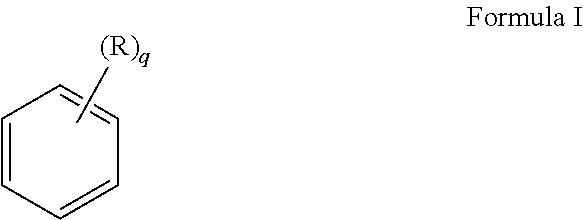
- wherein R may be a hydrogen atom, a halogen, or a C1-C10 alkyl group, and q may be any integer from 1 to 6. For example, the aromatic hydrocarbon-based organic compound may be benzene. The hydrogen atom, halogen, and/or a C1-C10 alkyl group may be present in the hydrocarbon-based organic compound alone or in combination, e.g., in fluorobenzene, bromobenzene, chlorobenzene, toluene, xylene, mesitylene, fluorotoluene, difluorotoluene, trifluorotoluene, and so forth. If the aromatic hydrocarbon-based compound is used with a carbonate-based solvent, a volumetric ratio of the aromatic hydrocarbon-based compound to the carbonate-based solvent may be about 1:1 to about 1:30.
- The lithium salt of the non-aqueous electrolyte may be dissolved in the non-aqueous organic solvent, and may function as a source of lithium ions in lithium batteries, thus enabling operation of the lithium batteries. A concentration of the lithium salt in the non-aqueous electrolyte may be about 0.6 M to about 2.0 M, e.g., about 0.7 M to about 1.6 M, in order to provide good electrical conductivity to the electrolyte and good viscosity to the lithium ions in terms of mobility. Suitable examples of lithium salt may include one or more of lithium hexafluorophosphate (LiPF6), lithium perchlorate (LiClO4), lithium hexafluoroarsenate (LiAsF6), lithium tetrafluoroborate (LiBF4), lithium hexafluoroantimonate (LiSbF6), lithium aluminate (LiAlO4), lithium aluminum tetrachloride (LiAlCl4), lithium chloride (LiCl), lithium iodide (LiI), and/or lithium fluorosulfonate salts, e.g., LiCF3SO3, LiC4F9SO3, LiN(C2F5SO3)2, LiN(C2F5SO2)2, LiN(CF3SO2)(CxF2x+1SO2)(CyF2y+1SO2) (wherein x and y may each independently be a positive integer), and so forth.
- The non-aqueous electrolyte may further include a hexafluoroacetylacetone represented by Formula II below.
-

- An amount of the hexafluoroacetylacetone in the non-aqueous electrolyte may be about 0.02 parts by weight to about 10 parts by weight, based on 100 parts by weight of the non-aqueous organic solvent. A hexafluoroacetylacetone in an amount above about 0.02 parts by weight based on 100 parts by weight of the non-aqueous organic solvent and below about 10 parts by weight based on 100 parts by weight of the non-aqueous organic solvent may provide an optimal capacity to the battery.
- The non-aqueous electrolyte may further include additives to improve lifespan and preservation properties of a battery.
- The non-aqueous electrolyte according to embodiments of the present invention may be advantageous in exhibiting superior preservation properties and long lifespan at a temperature range of about (−20)° C. to about 60° C., thus improving stability and reliability of the battery. The non-aqueous electrolyte of the present invention may be employed in any lithium secondary battery, e.g., a lithium ion battery, a lithium polymer battery, and so forth.
- An exemplary embodiment of a lithium battery including the non-aqueous electrolyte described above is illustrated in
FIG. 1 . More specifically, as illustrated inFIG. 1 , a lithium secondary battery may include anelectrolyte 130, apositive electrode 100, anegative electrode 110, and aseparator 140 therebetween. The positive andnegative electrodes non-aqueous electrolyte 130 may be therebetween. It is noted that illustration of LiCoO2 and LiXCn as positive and negative active materials, respectively, inFIG. 1 is merely exemplary. - The
electrolyte 130 of the lithium secondary battery may be the non-aqueous electrolyte discussed previously, and therefore, its detailed description will not be repeated. - The
positive electrode 100 of the lithium secondary battery may be made of metal coated with a positive active material. The positive active material may include one or more of LixMn1−yMyA2, LixMn2O4−zXz, LixMn2−yM′zA4, LixCo1−yMyA2, LixCo1−yMyO2−zXz, LixNi1−yMyO2−zXz, LixNi1−yCoyO2−zXz, LixNi1−y−zCoyMzAα, LixNi1−y−zCoyMzO2−α, LixNi1−y−zCoyMzO2−αXα, LixNi1−y−zMnyMzAα and LixNi1−y−zMnyMzO2−αXα, wherein 0.9≦x≦1.1, 0≦y≦0.5, 0≦z≦0.5, 0≦α≦2. M and M′ may be substantially the same or different, and each may independently be, e.g., magnesium (Mg), aluminum (Al), cobalt (Co), potassium (K), sodium (Na), calcium (Ca), silicon (Si), titanium (Ti), tin (Sn), vanadium (V), germanium (Ge), gallium (Ga), boron (B), arsenic (As), zirconium (Zr), manganese (Mn), chromium (Cr), iron (Fe), strontium (Sr), vanadium (V) or a rare earth element. A may be, e.g., oxygen (O), fluoride (F), sulfur (S), or phosphorous (P). X may be, e.g., fluoride (F), sulfur (S), or phosphorous (P). - The
negative electrode 110 of the lithium secondary battery may include metal coated with a negative active material, e.g., carbon or lithium. For example, the negative active material may include amorphous carbon, crystalline carbon, a carbon composite, a carbon fiber, and so forth. Use of carbon may be advantageous due to its ability to reversibly intercalate and de-intercalate lithium ions. Examples of amorphous carbon may include hard carbon, coke, mesocarbon microbeads (MCMBs) calcinated at about 1,500° C. or lower, mesophase pitch-based carbon fibers (MPCFs), and so forth. Examples of crystalline carbon may include graphite-based materials, e.g., natural graphite, graphitized coke, graphitized MCMBs, graphitized MPCFs, and the like. The carbon may have a d002 interplanar distance of about 3.35 angstroms to about 3.38 angstroms, and may have a crystallite size (Lc) of about 20 nm or more as measured by X-ray diffraction. - In another example, the negative active material of the
negative electrode 110 may include a lithium metal, a lithium alloy, and/or a lithium composite. The lithium alloy may include an alloy of lithium and a metal. The metal may be one or more of aluminum (Al), zinc (Zn), bismuth (Bi), cadmium (Cd), antimony (Sb), silicon (Si), lead (Pb), tin (Sn), gallium (Ga), and/or indium (In). - The metals for the positive and
negative electrodes negative electrodes - The binder of the electrode slurry composition may hold the electrode components together by facilitating adhesion of electrode active materials to one another and to the collectors, and may offset swelling and contraction of active materials. Suitable examples of binder may include polyvinylidene fluoride, polyhexafluoropropylene-polyvinylidene fluoride copolymers, poly(vinylacetate), polyvinyl alcohol, polyethylene oxide, polyvinyl pyrrolidone, alkylated polyethylene oxide, polyvinyl ether, poly(methylmethacrylate), poly(ethylacrylate), polytetrafluoroethylene, polyvinylchloride, polyacrylonitrile, polyvinyl pyridine, styrene-butadiene rubbers, acrylonitrile-butadiene rubbers, and the like. An amount of the binder may be about 0.1% to about 30% by weight of a weight of the electrode active material. If an amount of the binder is too low, adhesion between the electrode active material and the collector may be insufficient. If the amount of the binder is too high, adhesion may be sufficient, but an amount of the electrode active material may be decreased, thus increasing a battery capacity.
- The conductive agent of the electrode slurry composition may improve electrical conductivity. The conductive agent may be one or more of a graphite-based compound, a carbon black-based compound, and/or a metal-based compound. Examples of the graphite-based compounds may include artificial graphite and natural graphite. Examples of the carbon black-based compound may include acetylene black, ketjen black, denka black, thermal black, channel black, and the like. Examples of the metal based compounds may include tin, tin oxide, tin phosphate (SnPO4), titanium oxide, potassium titanate, and a perovskite, e.g., LaSrCoO3 or LaSrMnO3. An amount of the conductive agent may be about 0.1% to about 10% by weight of a weight of the electrode active material. An amount of the conductive agent below about 0.1% may deteriorate electrochemical properties of the electrolyte. An amount of the conductive agent about 10% may decrease an energy density per weight.
- The solvent of the electrode slurry composition may be any suitable non-aqueous or aqueous solvent. Examples of suitable non-aqueous solvents may include N-methyl-2-pyrrolidone (NMP), dimethylformamide, dimethylacetamide, N,N-dimethylaminopropylamine, ethylene oxide, tetrahydrofuran, and the like.
- The thickening agent of the electrode slurry composition may be any suitable thickening agent capable of controlling viscosity of the active material. Examples of suitable thickening agents may include one or more of carboxymethyl cellulose, hydroxymethyl cellulose, hydroxyethyl cellulose, and/or hydroxypropyl cellulose.
- The
separator 140 of the lithium secondary battery may electrically separate thepositive electrode 100 from thenegative electrode 110, thereby preventing a short-circuit, while allowing passage of lithium ions. Theseparator 140 may have a single-layer structure or a multi-layer structure. The layers, whether monolayers or multi-layers, may include a microporous film, a woven fabric, and/or a non-woven fabric. For example, theseparator 140 may include a porous polyolefin film coated with a highly stable resin. In another example, theseparator 140 may include a polyethylene or polypropylene monolayer; a polyethylene/polypropylene bi-layer; or a polyethylene/polypropylene/polyethylene or polypropylene/polyethylene/polypropylene trilayer. - The positive and
negative electrodes separator 140 therebetween may be arranged in a can-type container, i.e., a battery case, followed by sealing an upper part of the container via, e.g., a cap assembly, to form a lithium secondary battery. The cap assembly may include a cap plate, an insulating plate, a terminal plate, and an electrode terminal. The cap assembly may be combined with an insulating case to seal the battery case. In addition, a terminal hole, into which an electrode terminal is inserted, may be arranged in the center of the cap plate. When the electrode terminal is inserted into the terminal hole, a tube-type gasket provided on an external surface of the electrode terminal may be also inserted into the terminal hole to insulate the electrode terminal from the cap plate. Once the cap assembly is coupled to the container, theelectrolyte 130 may be injected into the container through an electrolyte injection hole, followed by sealing the electrolyte injection hole with a sealing means. The electrode terminal may be coupled to a negative electrode tap of the negative electrode and to a positive electrode tap of the positive electrode, thus operating as a negative or positive electrode terminal. The battery case of the lithium secondary battery may have any suitable shape, e.g., a cylinder, a pouch. - A positive electrode was prepared as follows. LiCoO2, i.e., a positive active material, polyvinylidene fluoride (PVDF), i.e., a binder, and carbon, i.e., a conductive agent, were mixed at a weight ratio of 92:4:4, and were dispersed in N-methyl-2-pyrrolidone to form a positive electrode slurry, followed by coating the positive electrode slurry on an aluminum foil having a thickness of 20 μm The positive electrode slurry on the aluminum foil was dried and rolled to form the positive electrode.
- A negative electrode was prepared as follows. Artificial graphite, i.e., a negative active material, a styrene-butadiene rubber (SBR), i.e., a binder, and carboxymethyl cellulose, i.e., a thickening agent, were mixed at a weight ratio of 96:2:2, and were dispersed in water to form a negative electrode slurry. The negative electrode slurry was coated on a copper foil having a thickness of 15 μm. The negative electrode slurry on the copper foil were dried and rolled to form the negative electrode.
- A polyethylene (PE) film separator having a thickness of 20 μm was interposed between the positive and negative electrodes. The electrodes with the separator were rolled, pressed, and inserted into a cylindrical can. An electrolyte was added to the cylindrical can to form a secondary lithium battery.
- The electrolyte was prepared as follows. Ethylene carbonate (EC), ethyl methyl carbonate (EMC), and dimethyl carbonate (DMC) were mixed at a volumetric ratio of 1:1:1 to form an organic solvent. Vinyl ethylene carbonate (VEC) and fluoroethylene carbonate (FEC) were added to the organic solvent. Lithium salt, i.e., LiPF6, was dissolved in the organic solvent. Amounts of the organic solvent and LiPF6 were adjusted so the concentration of the LiPF6 in the solvent was 1.3M. Hexafluoroacetylacetone was added to the mixture of lithium salt and organic solvent in an amount of 0.05 parts by weight based on 100 parts by weight of the organic solvent.
- A lithium battery was produced in substantially the same method of Example 1, with the exception of using the hexafluoroacetylacetone in an amount of 0.1 parts by weight based on 100 parts by weight of the non-aqueous organic solvent.
- A lithium battery was produced in substantially the same method of Example 1, with the exception of using the hexafluoroacetylacetone in an amount of 1.0 part by weight based on 100 parts by weight of the non-aqueous organic solvent.
- A lithium battery was produced in substantially the same method of Example 1, with the exception of using the hexafluoroacetylacetone in an amount of 2.0 parts by weight based on 100 parts by weight of the non-aqueous organic solvent.
- A lithium battery was produced in substantially the same method of Example 1, with the exception of using the hexafluoroacetylacetone in an amount of 5.0 parts by weight based on 100 parts by weight of the non-aqueous organic solvent.
- A lithium battery was produced in substantially the same method of Example 1, with the exception of using no hexafluoroacetylacetone in the electrolyte.
- A lithium battery was produced in substantially the same method of Example 1, with the exception of using hexafluoroacetylacetone in an amount of 0.01 parts by weight based on 100 parts by weight of the non-aqueous organic solvent.
- A lithium battery was produced in substantially the same method of Example 1, with the exception of using hexafluoroacetylacetone in an amount of 15 parts by weight based on 100 parts by weight of the non-aqueous organic solvent.
- Standard capacity: batteries produced in Examples 1-5 and Comparative Examples 1-3 were charged under constant current-constant voltage (CC-CV) condition of 0.5 C/4.2 V for 3 hours. The standard capacity of each battery is reported in Table 1.
- Battery Lifespan: batteries produced in Examples 1-5 and Comparative Examples 1-3 were charged under CC-CV conditions of 0.5 C/4.2 V at 25° C. for 3 hours, followed by discharge at 1 C CC to a cut off voltage of 3 V. The charge/discharge procedure was repeated 300 times. The capacity maintenance ratio (%) at a 300th cycle of each battery was calculated as ratio between discharge capacity at the 300th cycle to a discharge capacity at the first cycle, i.e., according to Formula III below. Results are reported in Table 2.
-
- High-temperature preservation: batteries produced in Examples 1-5 and Comparative Examples 1-3 were charged under CC-CV conditions of 0.5 C/4.2V at 25° C. for 3 hours, followed by storage at 85° C. for 4 days. Variation in thickness of the batteries, as compared to initial thickness, was measured after 4 days.
-
TABLE 1 Amount of Standard Variation in Capacity Example HFAAc* capacity battery maintenance No. (wt. parts) (%) thickness (%) ratio (%) Ex. 1 0.05 100 10 70 Ex. 2 0.1 100 6 82 Ex. 3 1 100 5 80 Ex. 4 2 98 4 81 Ex. 5 5 98 5 75 Comp. Ex. 1 0 98 24 62 Comp. Ex. 2 0.01 98 25 65 Comp. Ex. 3 15 72 5 45 *HFAAc: hexafluoroacetylacetone - As can be seen in Table 1 above, the electrolytes of Examples 1-5 exhibited capacity maintenance ratios after 300 cycles of 70% or more at ambient temperature, and superior high-temperature preservation property, i.e., very low thickness variation.
- The electrolyte of Comparative Examples 1, i.e., an electrolyte including no hexafluoroacetylacetone, exhibited only 62% of capacity maintenance ratio and a 24% increase in thickness after preservation at 85° C. for 4 days. The thickness increase of Comparative Example 1, i.e., a 24% increase, was about 2.5-5 times higher than a thickness increase of Examples 1-5.
- The electrolyte of Comparative Example 2, i.e., an electrolyte including only 0.01 parts by weight of hexafluoroacetylacetone, exhibited only 65% of capacity maintenance ratio at a 300th cycle and a 25% increase in thickness after preservation at 85° C. for 4 days.
- The electrolyte of Comparative Example 3, i.e., an electrolyte including 15 parts by weight of hexafluoroacetylacetone, exhibited a poor standard capacity, i.e., only 72%, and a low capacity maintenance ratio, i.e., only 45%, at a 300th cycle at ambient temperature.
- The non-aqueous electrolyte according to embodiments of the present invention may be advantageous in providing an improved capacity maintenance ratio and thickness variation ratio during high-temperature preservation. The non-aqueous electrolyte according to embodiments of the present invention may include hexafluoroacetylacetone in an amount providing improved performance and lifespan of lithium batteries.
- Exemplary embodiments of the present invention have been disclosed herein, and although specific terms are employed, they are used and are to be interpreted in a generic and descriptive sense only and not for purpose of limitation. Accordingly, it will be understood by those of ordinary skill in the art that various changes in form and details may be made without departing from the spirit and scope of the present invention as set forth in the following claims.
Claims (16)
1. A non-aqueous electrolyte for a lithium battery, comprising:
a non-aqueous organic solvent, wherein the non-aqueous organic solvent comprises one or more of an ester-based solvent and/or one or more of a ketone-based solvent;
a lithium salt; and
a hexafluoroacetylacetone in an amount of about 0.02 parts by weight to about 10 parts by weight, based on 100 parts by weight of the non-aqueous organic solvent.
2.-5. (canceled)
6. The non-aqueous electrolyte as claimed in claim 1 , wherein the non-aqueous organic solvent includes an ester-based solvent, the ester-based solvent having one or more of methyl acetate, ethyl acetate, propyl acetate, methyl propionate, ethyl propionate, γ-butyrolactone, γ-valerolactone, γ-caprolactone, δ-valerolactone, and/or ∈-caprolactone.
7. (canceled)
8. The non-aqueous electrolyte as claimed in claim 1 , wherein the non-aqueous organic solvent includes polymethylvinylketone.
9. The non-aqueous electrolyte as claimed in claim 1 , wherein the non-aqueous organic solvent further comprises an aromatic hydrocarbon-based compound represented by a general Formula I,

wherein R is a hydrogen atom, a halogen, or a C1-C10 alkyl group, and q equals any integer from 1 to 6.
10. The non-aqueous electrolyte as claimed in claim 9 , wherein the aromatic hydrocarbon-based compound includes one or more of benzene, fluorobenzene, bromobenzene, chlorobenzene, toluene, xylene, mesitylene, fluorotoluene, difluorotoluene, and/or trifluorotoluene.
11. The non-aqueous electrolyte as claimed in claim 9 , wherein the non-aqueous organic solvent includes a carbonate-based solvent, and the aromatic hydrocarbon-based compound and the carbonate-based solvent are at a volumetric ratio of about 1:1 to about 1:30.
12. The non-aqueous electrolyte as claimed in claim 1 , wherein the lithium salt includes one or more of LiPF6, LiClO4, LiAsF6, LiBF4, LiN(C2F5SO3)2, LiN(C2F5SO2)2, LiN(CF3SO2)2, LiSbF6, LiCF3SO3, LiC4F9SO3, LiAlO4, LiAlCl4, LiCl, LiI, and/or LiN(CxF2x+1SO2)(CyF2y+1SO2), wherein x and y are each independently a positive integer, and a concentration of the lithium salt in the non-aqueous electrolyte is about 0.6 M to about 2.0 M.
13. A lithium battery, comprising:
a positive electrode facing a negative electrode;
a non-aqueous electrolyte between the positive and negative electrodes; and
a separator electrically separating the positive and negative electrodes,
wherein the non-aqueous electrolyte includes a non-aqueous organic solvent, wherein the non-aqueous organic solvent comprises one or more of an ester-based solvent and/or one or more of a ketone-based solvent; a lithium salt; and a hexafluoroacetylacetone in an amount of about 0.02 parts by weight to about 10 parts by weight, based on 100 parts by weight of the non-aqueous organic solvent.
14. (canceled)
15. The lithium battery as claimed in claim 13 , wherein the non-aqueous organic solvent further comprises an aromatic hydrocarbon-based compound represented by a general Formula II,

wherein R is a hydrogen atom, a halogen or a C1-C10 alkyl group, and q equals any integer from 1 to 6.
16. The lithium battery as claimed in claim 13 , wherein the positive electrode includes a metal coated with an active material, the active material including one or more of LixMn1−yMyA2, LixMn2O4−zXz, LixMn2−yMyM′zA4, LixCO1−yMyA2, LixCO1−yMyO2−zXz, LixNi1−yMyO2−zXz, LixNi1−yCoyO2−zXz, LixNi1−y−zCoyMzAα, LixNi1−y−zCoyMzO2−αXα and LixNi1−y−zMnyMzO2−αXα,
wherein 0.9≦x≦1.1, 0≦y≦0.5, 0≦z≦0.5, 0≦α≦2;
each of M and M′ is independently Mg, Al, Co, K, Na, Ca, Si, Ti, Sn, V, Ge, Ga, B, As, Zr, Mn, Cr, Fe, Sr, V or a rare earth element;
A is O, F, S or P; and
X is F, S, or P.
17. The lithium battery as claimed in claim 13 , wherein the negative electrode includes metal coated with an active material, the active material including one or more of crystalline carbon, amorphous carbon, a carbon composite, a carbon fiber, a lithium metal, a lithium alloy, and/or a lithium composite.
18. The non-aqueous electrolyte as claimed in claim 1 , wherein the hexafluoroacetylacetone is present in an amount of about 0.1 parts by weight to about 5 parts by weight, based on 100 parts by weight of the non-aqueous organic solvent.
19. The lithium battery as claimed in claim 13 , wherein the hexafluoroacetylacetone is present in an amount of about 0.1 parts by weight to about 5 parts by weight, based on 100 parts by weight of the non-aqueous organic solvent.
Priority Applications (1)
| Application Number | Priority Date | Filing Date | Title |
|---|---|---|---|
| US12/907,485 US20110045358A1 (en) | 2006-12-21 | 2010-10-19 | Non-aqueous electrolyte for a lithium battery and lithium battery including the same |
Applications Claiming Priority (4)
| Application Number | Priority Date | Filing Date | Title |
|---|---|---|---|
| KR1020060132144A KR100767427B1 (en) | 2006-12-21 | 2006-12-21 | Non-aqueous electrolyte solution for lithium secondary batteries and lithium secondary battery comprising same |
| KR10-2006-0132144 | 2006-12-21 | ||
| US12/000,704 US7816039B2 (en) | 2006-12-21 | 2007-12-17 | Non-aqueous electrolyte for a lithium battery and lithium battery including the same |
| US12/907,485 US20110045358A1 (en) | 2006-12-21 | 2010-10-19 | Non-aqueous electrolyte for a lithium battery and lithium battery including the same |
Related Parent Applications (1)
| Application Number | Title | Priority Date | Filing Date |
|---|---|---|---|
| US12/000,704 Division US7816039B2 (en) | 2006-12-21 | 2007-12-17 | Non-aqueous electrolyte for a lithium battery and lithium battery including the same |
Publications (1)
| Publication Number | Publication Date |
|---|---|
| US20110045358A1 true US20110045358A1 (en) | 2011-02-24 |
Family
ID=38814870
Family Applications (2)
| Application Number | Title | Priority Date | Filing Date |
|---|---|---|---|
| US12/000,704 Active 2028-03-31 US7816039B2 (en) | 2006-12-21 | 2007-12-17 | Non-aqueous electrolyte for a lithium battery and lithium battery including the same |
| US12/907,485 Abandoned US20110045358A1 (en) | 2006-12-21 | 2010-10-19 | Non-aqueous electrolyte for a lithium battery and lithium battery including the same |
Family Applications Before (1)
| Application Number | Title | Priority Date | Filing Date |
|---|---|---|---|
| US12/000,704 Active 2028-03-31 US7816039B2 (en) | 2006-12-21 | 2007-12-17 | Non-aqueous electrolyte for a lithium battery and lithium battery including the same |
Country Status (3)
| Country | Link |
|---|---|
| US (2) | US7816039B2 (en) |
| KR (1) | KR100767427B1 (en) |
| CN (1) | CN101207208B (en) |
Families Citing this family (10)
| Publication number | Priority date | Publication date | Assignee | Title |
|---|---|---|---|---|
| CN102754268B (en) * | 2010-02-12 | 2014-11-19 | 三菱化学株式会社 | Nonaqueous electrolyte and nonaqueous electrolyte secondary battery |
| JP5605928B2 (en) * | 2010-08-13 | 2014-10-15 | エルジー・ケム・リミテッド | Nonaqueous electrolyte for lithium secondary battery and lithium secondary battery including the same |
| CN103608962B (en) * | 2011-01-31 | 2016-10-26 | 三菱化学株式会社 | Non-aqueous electrolytic solution and non-aqueous electrolytic solution secondary battery using the non-aqueous electrolytic solution |
| CN104649301B (en) | 2011-04-11 | 2017-07-14 | 三菱化学株式会社 | Method for producing lithium fluorosulfonate, lithium fluorosulfonate, nonaqueous electrolytic solution, and nonaqueous electrolyte secondary battery |
| EP2785805B1 (en) * | 2011-11-29 | 2019-08-28 | Axalta Coating Systems IP Co. LLC | Use of a non-aqueous solvent composition as a barrier liquid |
| US9660268B2 (en) * | 2012-03-28 | 2017-05-23 | Sharp Laboratories Of America, Inc. | Alkali-ion battery with enhanced transition metal cyanometallate electrode structure |
| CN102780037B (en) * | 2012-07-19 | 2017-07-28 | 宁德新能源科技有限公司 | A kind of nonaqueous electrolyte and the lithium ion battery comprising the nonaqueous electrolyte |
| KR101520158B1 (en) * | 2012-09-21 | 2015-05-13 | 주식회사 엘지화학 | Electrolyte solution for lithium secondary battery and lithium secondary battery comprising the same |
| CN104969406B (en) * | 2013-01-25 | 2018-11-02 | 富士胶片和光纯药株式会社 | Electrolyte for electrochemical devices and electrochemical devices |
| KR102910659B1 (en) * | 2022-10-13 | 2026-01-08 | 삼성에스디아이 주식회사 | Rechargeable lithium battery |
Citations (8)
| Publication number | Priority date | Publication date | Assignee | Title |
|---|---|---|---|---|
| US5352548A (en) * | 1992-07-27 | 1994-10-04 | Sanyo Electric Co., Ltd. | Secondary battery |
| US5633099A (en) * | 1992-11-18 | 1997-05-27 | Mitsui Petrochemical Industries, Ltd. | Carbonate compounds, non-aqueous electrolytic solutions and batteries comprising non-aqueous electrolytic solutions |
| US5712059A (en) * | 1995-09-26 | 1998-01-27 | Valence Technology, Inc. | Carbonaceous electrode and compatible electrolyte solvent |
| US5714281A (en) * | 1994-07-29 | 1998-02-03 | Sony Corporation | Non-aqueous liquid electrolyte secondary cell |
| US6048637A (en) * | 1997-12-17 | 2000-04-11 | Fuji Photo Film Co., Ltd. | Nonaqueous secondary battery |
| US6114070A (en) * | 1997-06-19 | 2000-09-05 | Sanyo Electric Co., Ltd. | Lithium secondary battery |
| US6506524B1 (en) * | 1996-10-03 | 2003-01-14 | National Research Council Of Canada | Electrolyte comprising fluoro-ethylene carbonate and propylene carbonate, for alkali metal-ion secondary battery |
| US6919145B1 (en) * | 1999-06-18 | 2005-07-19 | Mitsubishi Chemical Corporation | Nonaqueous electrolytic solution type secondary battery |
Family Cites Families (8)
| Publication number | Priority date | Publication date | Assignee | Title |
|---|---|---|---|---|
| JPS6447013A (en) * | 1987-08-18 | 1989-02-21 | Nippon Chemicon | Electrolyte for electrolytic condenser |
| JP2962782B2 (en) | 1990-07-26 | 1999-10-12 | 三洋電機株式会社 | Non-aqueous electrolyte battery |
| JP3294400B2 (en) | 1992-11-18 | 2002-06-24 | ソニー株式会社 | Non-aqueous electrolyte and non-aqueous electrolyte battery |
| CA2683826C (en) * | 1996-12-30 | 2013-06-11 | Hydro-Quebec | Pentacyclic anion salts or tetrazapentalene derivatives and their uses as ionic conducting materials |
| JP2001006729A (en) | 1999-06-18 | 2001-01-12 | Mitsubishi Chemicals Corp | Non-aqueous electrolyte secondary battery |
| JP2006172726A (en) | 2004-12-13 | 2006-06-29 | Matsushita Electric Ind Co Ltd | Non-aqueous electrolyte secondary battery |
| KR100624970B1 (en) * | 2005-01-28 | 2006-09-19 | 삼성에스디아이 주식회사 | Cathode active material for lithium secondary battery, manufacturing method thereof, and lithium secondary battery |
| JP4957944B2 (en) * | 2005-11-29 | 2012-06-20 | ソニー株式会社 | Secondary battery |
-
2006
- 2006-12-21 KR KR1020060132144A patent/KR100767427B1/en active Active
-
2007
- 2007-12-17 US US12/000,704 patent/US7816039B2/en active Active
- 2007-12-21 CN CN2007103015422A patent/CN101207208B/en active Active
-
2010
- 2010-10-19 US US12/907,485 patent/US20110045358A1/en not_active Abandoned
Patent Citations (8)
| Publication number | Priority date | Publication date | Assignee | Title |
|---|---|---|---|---|
| US5352548A (en) * | 1992-07-27 | 1994-10-04 | Sanyo Electric Co., Ltd. | Secondary battery |
| US5633099A (en) * | 1992-11-18 | 1997-05-27 | Mitsui Petrochemical Industries, Ltd. | Carbonate compounds, non-aqueous electrolytic solutions and batteries comprising non-aqueous electrolytic solutions |
| US5714281A (en) * | 1994-07-29 | 1998-02-03 | Sony Corporation | Non-aqueous liquid electrolyte secondary cell |
| US5712059A (en) * | 1995-09-26 | 1998-01-27 | Valence Technology, Inc. | Carbonaceous electrode and compatible electrolyte solvent |
| US6506524B1 (en) * | 1996-10-03 | 2003-01-14 | National Research Council Of Canada | Electrolyte comprising fluoro-ethylene carbonate and propylene carbonate, for alkali metal-ion secondary battery |
| US6114070A (en) * | 1997-06-19 | 2000-09-05 | Sanyo Electric Co., Ltd. | Lithium secondary battery |
| US6048637A (en) * | 1997-12-17 | 2000-04-11 | Fuji Photo Film Co., Ltd. | Nonaqueous secondary battery |
| US6919145B1 (en) * | 1999-06-18 | 2005-07-19 | Mitsubishi Chemical Corporation | Nonaqueous electrolytic solution type secondary battery |
Also Published As
| Publication number | Publication date |
|---|---|
| US7816039B2 (en) | 2010-10-19 |
| US20080153006A1 (en) | 2008-06-26 |
| KR100767427B1 (en) | 2007-10-17 |
| CN101207208B (en) | 2010-09-29 |
| CN101207208A (en) | 2008-06-25 |
Similar Documents
| Publication | Publication Date | Title |
|---|---|---|
| US12218306B2 (en) | Electrolyte for lithium secondary battery and lithium secondary battery including the same | |
| EP2154746B1 (en) | Rechargeable Battery | |
| KR102030347B1 (en) | Electrolyte for lithium secondary battery including additives,and lithium secondary battery | |
| US7816039B2 (en) | Non-aqueous electrolyte for a lithium battery and lithium battery including the same | |
| US11437647B2 (en) | Electrolyte for secondary battery and lithium secondary battery including the same | |
| KR20190092149A (en) | Electrolyte for secondary battery and secondary battery containing the same | |
| KR101581780B1 (en) | electrolyte for lithium secondary battery and lithium secondary battery containing the same | |
| US20100092863A1 (en) | Non-aqueous electrolyte for secondary battery and secondary battery including the same | |
| US20080241670A1 (en) | Electrolyte for lithium ion rechargeable battery and lithium rechargeable battery including the same | |
| EP1970989B1 (en) | Electrolyte for lithium ion rechargeable battery and lithium ion rechargeable battery including the same | |
| KR20180076489A (en) | Electrolyte for secondary battery and secondary battery containing the same | |
| KR101542071B1 (en) | Electrolyte for long cycle life secondary battery and secondary battery containing the same | |
| KR20200105242A (en) | A compound, and an electrolyte solution and a secondary battery comprising the compound | |
| KR20200105233A (en) | A compound, and an electrolyte solution and a secondary battery comprising the compound | |
| KR20080062671A (en) | Non-aqueous electrolyte solution for lithium secondary batteries and lithium secondary battery comprising same | |
| KR101340027B1 (en) | Non-aqueous electrolyte and a rechargeable batter including the same | |
| KR100864318B1 (en) | Non-aqueous electrolyte solution for lithium secondary batteries and lithium secondary battery comprising same | |
| KR20080061692A (en) | Non-aqueous electrolyte solution for lithium secondary batteries containing trimethylsilyl phosphite and lithium secondary batteries comprising same | |
| WO2008082048A1 (en) | Nonaqueous electrolyte for li-secondary battery and li secondary battery thereby | |
| KR101638001B1 (en) | electrolyte for lithium secondary battery and lithium secondary battery containing the same | |
| KR101637999B1 (en) | electrolyte for lithium secondary battery and lithium secondary battery containing the same | |
| KR20130142375A (en) | Electrolyte for lithium secondary battery including additives, and lithium secondary battery | |
| KR20080061866A (en) | Non-aqueous electrolyte solution for lithium secondary batteries and lithium secondary battery comprising same | |
| KR100845047B1 (en) | Non-aqueous electrolyte solution for lithium secondary batteries and lithium secondary battery comprising same | |
| KR20200113922A (en) | Electrolyte for lithium secondary battery and lithium secondary battery including the same |
Legal Events
| Date | Code | Title | Description |
|---|---|---|---|
| STCB | Information on status: application discontinuation |
Free format text: ABANDONED -- FAILURE TO RESPOND TO AN OFFICE ACTION |