US20110009353A1 - Targeting cdk4 and cdk6 in cancer therapy - Google Patents
Targeting cdk4 and cdk6 in cancer therapy Download PDFInfo
- Publication number
- US20110009353A1 US20110009353A1 US12/741,884 US74188408A US2011009353A1 US 20110009353 A1 US20110009353 A1 US 20110009353A1 US 74188408 A US74188408 A US 74188408A US 2011009353 A1 US2011009353 A1 US 2011009353A1
- Authority
- US
- United States
- Prior art keywords
- cells
- cancer
- cdk4
- cdk6
- inhibitor
- Prior art date
- Legal status (The legal status is an assumption and is not a legal conclusion. Google has not performed a legal analysis and makes no representation as to the accuracy of the status listed.)
- Granted
Links
- 230000008685 targeting Effects 0.000 title description 14
- 238000011275 oncology therapy Methods 0.000 title description 3
- 101100005789 Caenorhabditis elegans cdk-4 gene Proteins 0.000 title 1
- 206010028980 Neoplasm Diseases 0.000 claims abstract description 219
- 108010025464 Cyclin-Dependent Kinase 4 Proteins 0.000 claims abstract description 205
- 108010025468 Cyclin-Dependent Kinase 6 Proteins 0.000 claims abstract description 205
- 201000011510 cancer Diseases 0.000 claims abstract description 180
- 229940127089 cytotoxic agent Drugs 0.000 claims abstract description 146
- 239000002246 antineoplastic agent Substances 0.000 claims abstract description 138
- 238000000034 method Methods 0.000 claims abstract description 138
- 230000002401 inhibitory effect Effects 0.000 claims abstract description 52
- 230000022131 cell cycle Effects 0.000 claims abstract description 45
- 239000003814 drug Substances 0.000 claims abstract description 22
- 229940079593 drug Drugs 0.000 claims abstract description 15
- 102100036252 Cyclin-dependent kinase 4 Human genes 0.000 claims abstract 24
- 102100026804 Cyclin-dependent kinase 6 Human genes 0.000 claims abstract 24
- 210000004027 cell Anatomy 0.000 claims description 311
- 239000003112 inhibitor Substances 0.000 claims description 190
- 206010035226 Plasma cell myeloma Diseases 0.000 claims description 136
- 229960001467 bortezomib Drugs 0.000 claims description 129
- GXJABQQUPOEUTA-RDJZCZTQSA-N bortezomib Chemical compound C([C@@H](C(=O)N[C@@H](CC(C)C)B(O)O)NC(=O)C=1N=CC=NC=1)C1=CC=CC=C1 GXJABQQUPOEUTA-RDJZCZTQSA-N 0.000 claims description 129
- 201000000050 myeloid neoplasm Diseases 0.000 claims description 118
- 210000004881 tumor cell Anatomy 0.000 claims description 99
- 150000007523 nucleic acids Chemical class 0.000 claims description 71
- 102000039446 nucleic acids Human genes 0.000 claims description 69
- 108020004707 nucleic acids Proteins 0.000 claims description 69
- 238000011282 treatment Methods 0.000 claims description 56
- 239000004055 small Interfering RNA Substances 0.000 claims description 48
- 241000124008 Mammalia Species 0.000 claims description 47
- 230000014509 gene expression Effects 0.000 claims description 47
- 125000000217 alkyl group Chemical group 0.000 claims description 44
- 230000006907 apoptotic process Effects 0.000 claims description 40
- 238000004113 cell culture Methods 0.000 claims description 34
- 230000005855 radiation Effects 0.000 claims description 34
- 108091027967 Small hairpin RNA Proteins 0.000 claims description 33
- 108020004999 messenger RNA Proteins 0.000 claims description 31
- 239000003795 chemical substances by application Substances 0.000 claims description 28
- -1 anthracycline Substances 0.000 claims description 27
- 239000002254 cytotoxic agent Substances 0.000 claims description 26
- UREBDLICKHMUKA-CXSFZGCWSA-N dexamethasone Chemical compound C1CC2=CC(=O)C=C[C@]2(C)[C@]2(F)[C@@H]1[C@@H]1C[C@@H](C)[C@@](C(=O)CO)(O)[C@@]1(C)C[C@@H]2O UREBDLICKHMUKA-CXSFZGCWSA-N 0.000 claims description 26
- 231100000599 cytotoxic agent Toxicity 0.000 claims description 25
- 229960003957 dexamethasone Drugs 0.000 claims description 25
- 230000000694 effects Effects 0.000 claims description 24
- 125000001997 phenyl group Chemical group [H]C1=C([H])C([H])=C(*)C([H])=C1[H] 0.000 claims description 23
- 102000004889 Interleukin-6 Human genes 0.000 claims description 22
- 108090001005 Interleukin-6 Proteins 0.000 claims description 22
- 229940100601 interleukin-6 Drugs 0.000 claims description 22
- 125000001072 heteroaryl group Chemical group 0.000 claims description 21
- 230000000295 complement effect Effects 0.000 claims description 20
- 150000001875 compounds Chemical class 0.000 claims description 20
- 125000000753 cycloalkyl group Chemical group 0.000 claims description 19
- 208000034578 Multiple myelomas Diseases 0.000 claims description 18
- 229910052760 oxygen Inorganic materials 0.000 claims description 17
- 238000012360 testing method Methods 0.000 claims description 17
- 101000599951 Homo sapiens Insulin-like growth factor I Proteins 0.000 claims description 16
- QVGXLLKOCUKJST-UHFFFAOYSA-N atomic oxygen Chemical compound [O] QVGXLLKOCUKJST-UHFFFAOYSA-N 0.000 claims description 16
- 239000001301 oxygen Substances 0.000 claims description 16
- 230000012010 growth Effects 0.000 claims description 15
- 210000002997 osteoclast Anatomy 0.000 claims description 15
- KDCGOANMDULRCW-UHFFFAOYSA-N 7H-purine Chemical compound N1=CNC2=NC=NC2=C1 KDCGOANMDULRCW-UHFFFAOYSA-N 0.000 claims description 14
- 210000002536 stromal cell Anatomy 0.000 claims description 14
- 230000000340 anti-metabolite Effects 0.000 claims description 12
- 229940100197 antimetabolite Drugs 0.000 claims description 12
- 239000002256 antimetabolite Substances 0.000 claims description 12
- BASFCYQUMIYNBI-UHFFFAOYSA-N platinum Chemical compound [Pt] BASFCYQUMIYNBI-UHFFFAOYSA-N 0.000 claims description 12
- 239000003504 photosensitizing agent Substances 0.000 claims description 11
- ZGXJTSGNIOSYLO-UHFFFAOYSA-N 88755TAZ87 Chemical compound NCC(=O)CCC(O)=O ZGXJTSGNIOSYLO-UHFFFAOYSA-N 0.000 claims description 10
- 229940079156 Proteasome inhibitor Drugs 0.000 claims description 10
- 229960002749 aminolevulinic acid Drugs 0.000 claims description 10
- 239000003207 proteasome inhibitor Substances 0.000 claims description 10
- 230000035945 sensitivity Effects 0.000 claims description 10
- 101001076408 Homo sapiens Interleukin-6 Proteins 0.000 claims description 9
- 102100037852 Insulin-like growth factor I Human genes 0.000 claims description 9
- NWIBSHFKIJFRCO-WUDYKRTCSA-N Mytomycin Chemical compound C1N2C(C(C(C)=C(N)C3=O)=O)=C3[C@@H](COC(N)=O)[C@@]2(OC)[C@@H]2[C@H]1N2 NWIBSHFKIJFRCO-WUDYKRTCSA-N 0.000 claims description 9
- 238000012258 culturing Methods 0.000 claims description 9
- 229910052739 hydrogen Inorganic materials 0.000 claims description 9
- 239000001257 hydrogen Substances 0.000 claims description 9
- 125000004435 hydrogen atom Chemical group [H]* 0.000 claims description 9
- 150000003431 steroids Chemical class 0.000 claims description 9
- 208000031261 Acute myeloid leukaemia Diseases 0.000 claims description 8
- 206010025323 Lymphomas Diseases 0.000 claims description 8
- 208000033776 Myeloid Acute Leukemia Diseases 0.000 claims description 8
- 229940100198 alkylating agent Drugs 0.000 claims description 8
- 239000002168 alkylating agent Substances 0.000 claims description 8
- 229940045799 anthracyclines and related substance Drugs 0.000 claims description 8
- 230000004069 differentiation Effects 0.000 claims description 8
- 229910052757 nitrogen Inorganic materials 0.000 claims description 8
- 230000035755 proliferation Effects 0.000 claims description 8
- 208000025205 Mantle-Cell Lymphoma Diseases 0.000 claims description 7
- 229940122803 Vinca alkaloid Drugs 0.000 claims description 7
- 201000005787 hematologic cancer Diseases 0.000 claims description 7
- 208000024200 hematopoietic and lymphoid system neoplasm Diseases 0.000 claims description 7
- 102000044162 human IGF1 Human genes 0.000 claims description 7
- 108010024976 Asparaginase Proteins 0.000 claims description 6
- 102000015790 Asparaginase Human genes 0.000 claims description 6
- 208000010839 B-cell chronic lymphocytic leukemia Diseases 0.000 claims description 6
- 208000032791 BCR-ABL1 positive chronic myelogenous leukemia Diseases 0.000 claims description 6
- 229940123414 Folate antagonist Drugs 0.000 claims description 6
- 208000017604 Hodgkin disease Diseases 0.000 claims description 6
- 208000010747 Hodgkins lymphoma Diseases 0.000 claims description 6
- 208000031422 Lymphocytic Chronic B-Cell Leukemia Diseases 0.000 claims description 6
- CZPWVGJYEJSRLH-UHFFFAOYSA-N Pyrimidine Chemical compound C1=CN=CN=C1 CZPWVGJYEJSRLH-UHFFFAOYSA-N 0.000 claims description 6
- 201000000582 Retinoblastoma Diseases 0.000 claims description 6
- 229940123237 Taxane Drugs 0.000 claims description 6
- 208000032852 chronic lymphocytic leukemia Diseases 0.000 claims description 6
- 239000004052 folic acid antagonist Substances 0.000 claims description 6
- 125000005843 halogen group Chemical group 0.000 claims description 6
- 229960004857 mitomycin Drugs 0.000 claims description 6
- 229910052697 platinum Inorganic materials 0.000 claims description 6
- 230000001235 sensitizing effect Effects 0.000 claims description 6
- 208000010833 Chronic myeloid leukaemia Diseases 0.000 claims description 5
- UHDGCWIWMRVCDJ-CCXZUQQUSA-N Cytarabine Chemical compound O=C1N=C(N)C=CN1[C@H]1[C@@H](O)[C@H](O)[C@@H](CO)O1 UHDGCWIWMRVCDJ-CCXZUQQUSA-N 0.000 claims description 5
- 239000012625 DNA intercalator Substances 0.000 claims description 5
- 206010059866 Drug resistance Diseases 0.000 claims description 5
- 208000021519 Hodgkin lymphoma Diseases 0.000 claims description 5
- 208000033761 Myelogenous Chronic BCR-ABL Positive Leukemia Diseases 0.000 claims description 5
- 208000015914 Non-Hodgkin lymphomas Diseases 0.000 claims description 5
- 229960003272 asparaginase Drugs 0.000 claims description 5
- DCXYFEDJOCDNAF-UHFFFAOYSA-M asparaginate Chemical compound [O-]C(=O)C(N)CC(N)=O DCXYFEDJOCDNAF-UHFFFAOYSA-M 0.000 claims description 5
- 229960002438 carfilzomib Drugs 0.000 claims description 5
- BLMPQMFVWMYDKT-NZTKNTHTSA-N carfilzomib Chemical compound C([C@@H](C(=O)N[C@@H](CC(C)C)C(=O)N[C@@H](CC=1C=CC=CC=1)C(=O)N[C@@H](CC(C)C)C(=O)[C@]1(C)OC1)NC(=O)CN1CCOCC1)CC1=CC=CC=C1 BLMPQMFVWMYDKT-NZTKNTHTSA-N 0.000 claims description 5
- 230000018486 cell cycle phase Effects 0.000 claims description 5
- YJGVMLPVUAXIQN-UHFFFAOYSA-N epipodophyllotoxin Natural products COC1=C(OC)C(OC)=CC(C2C3=CC=4OCOC=4C=C3C(O)C3C2C(OC3)=O)=C1 YJGVMLPVUAXIQN-UHFFFAOYSA-N 0.000 claims description 5
- 229930013356 epothilone Natural products 0.000 claims description 5
- 125000005842 heteroatom Chemical group 0.000 claims description 5
- 102000052611 human IL6 Human genes 0.000 claims description 5
- 229940075439 smac mimetic Drugs 0.000 claims description 5
- YJGVMLPVUAXIQN-LGWHJFRWSA-N (5s,5ar,8ar,9r)-5-hydroxy-9-(3,4,5-trimethoxyphenyl)-5a,6,8a,9-tetrahydro-5h-[2]benzofuro[5,6-f][1,3]benzodioxol-8-one Chemical compound COC1=C(OC)C(OC)=CC([C@@H]2C3=CC=4OCOC=4C=C3[C@@H](O)[C@@H]3[C@@H]2C(OC3)=O)=C1 YJGVMLPVUAXIQN-LGWHJFRWSA-N 0.000 claims description 4
- XXJGBENTLXFVFI-UHFFFAOYSA-N 1-amino-methylene Chemical compound N[CH2] XXJGBENTLXFVFI-UHFFFAOYSA-N 0.000 claims description 4
- 208000003950 B-cell lymphoma Diseases 0.000 claims description 4
- 208000017733 acquired polycythemia vera Diseases 0.000 claims description 4
- 239000003534 dna topoisomerase inhibitor Substances 0.000 claims description 4
- 150000003883 epothilone derivatives Chemical class 0.000 claims description 4
- 230000003394 haemopoietic effect Effects 0.000 claims description 4
- 229940116886 human interleukin-6 Drugs 0.000 claims description 4
- 230000001404 mediated effect Effects 0.000 claims description 4
- 208000037244 polycythemia vera Diseases 0.000 claims description 4
- 230000010076 replication Effects 0.000 claims description 4
- DKPFODGZWDEEBT-QFIAKTPHSA-N taxane Chemical class C([C@]1(C)CCC[C@@H](C)[C@H]1C1)C[C@H]2[C@H](C)CC[C@@H]1C2(C)C DKPFODGZWDEEBT-QFIAKTPHSA-N 0.000 claims description 4
- 229940044693 topoisomerase inhibitor Drugs 0.000 claims description 4
- 108010021331 carfilzomib Proteins 0.000 claims description 3
- 229940044683 chemotherapy drug Drugs 0.000 claims description 3
- SJFBTAPEPRWNKH-CCKFTAQKSA-N delanzomib Chemical compound CC(C)C[C@@H](B(O)O)NC(=O)[C@H]([C@@H](C)O)NC(=O)C1=CC=CC(C=2C=CC=CC=2)=N1 SJFBTAPEPRWNKH-CCKFTAQKSA-N 0.000 claims description 3
- 230000005764 inhibitory process Effects 0.000 abstract description 38
- 230000006369 cell cycle progression Effects 0.000 abstract description 16
- 238000002512 chemotherapy Methods 0.000 abstract 2
- 102000013701 Cyclin-Dependent Kinase 4 Human genes 0.000 description 181
- 102000013698 Cyclin-Dependent Kinase 6 Human genes 0.000 description 181
- AHJRHEGDXFFMBM-UHFFFAOYSA-N palbociclib Chemical compound N1=C2N(C3CCCC3)C(=O)C(C(=O)C)=C(C)C2=CN=C1NC(N=C1)=CC=C1N1CCNCC1 AHJRHEGDXFFMBM-UHFFFAOYSA-N 0.000 description 148
- 230000002147 killing effect Effects 0.000 description 68
- 230000037057 G1 phase arrest Effects 0.000 description 48
- 101150086017 Bcl2l11 gene Proteins 0.000 description 36
- 230000002195 synergetic effect Effects 0.000 description 33
- 239000000203 mixture Substances 0.000 description 31
- 230000001472 cytotoxic effect Effects 0.000 description 30
- 231100000433 cytotoxic Toxicity 0.000 description 29
- 230000006698 induction Effects 0.000 description 29
- 108090000623 proteins and genes Proteins 0.000 description 29
- 101000715943 Caenorhabditis elegans Cyclin-dependent kinase 4 homolog Proteins 0.000 description 26
- 108020004414 DNA Proteins 0.000 description 26
- 238000002648 combination therapy Methods 0.000 description 26
- 125000003729 nucleotide group Chemical group 0.000 description 25
- 108020004459 Small interfering RNA Proteins 0.000 description 24
- 102000004169 proteins and genes Human genes 0.000 description 24
- 102100037795 Interleukin-6 receptor subunit beta Human genes 0.000 description 23
- 101710152369 Interleukin-6 receptor subunit beta Proteins 0.000 description 23
- 241000283973 Oryctolagus cuniculus Species 0.000 description 23
- 230000018199 S phase Effects 0.000 description 23
- 239000002773 nucleotide Substances 0.000 description 23
- 241001465754 Metazoa Species 0.000 description 22
- 230000004913 activation Effects 0.000 description 22
- 230000005754 cellular signaling Effects 0.000 description 22
- 230000001360 synchronised effect Effects 0.000 description 22
- 101001056180 Homo sapiens Induced myeloid leukemia cell differentiation protein Mcl-1 Proteins 0.000 description 21
- 102100026539 Induced myeloid leukemia cell differentiation protein Mcl-1 Human genes 0.000 description 21
- 238000003119 immunoblot Methods 0.000 description 21
- 241000699666 Mus <mouse, genus> Species 0.000 description 20
- 241000699670 Mus sp. Species 0.000 description 19
- 101150074164 PMAIP1 gene Proteins 0.000 description 19
- 231100001143 noxa Toxicity 0.000 description 19
- 230000002459 sustained effect Effects 0.000 description 18
- 230000000692 anti-sense effect Effects 0.000 description 17
- 210000001185 bone marrow Anatomy 0.000 description 17
- 108700039689 bcl-2 Homologous Antagonist-Killer Proteins 0.000 description 16
- 108091032973 (ribonucleotides)n+m Proteins 0.000 description 15
- 102100021569 Apoptosis regulator Bcl-2 Human genes 0.000 description 15
- 101000971171 Homo sapiens Apoptosis regulator Bcl-2 Proteins 0.000 description 15
- 230000028161 membrane depolarization Effects 0.000 description 15
- 102000011727 Caspases Human genes 0.000 description 14
- 108010076667 Caspases Proteins 0.000 description 14
- 102000053642 Catalytic RNA Human genes 0.000 description 14
- 108090000994 Catalytic RNA Proteins 0.000 description 14
- 208000037265 diseases, disorders, signs and symptoms Diseases 0.000 description 14
- 108091092562 ribozyme Proteins 0.000 description 14
- 230000035899 viability Effects 0.000 description 14
- 201000010099 disease Diseases 0.000 description 13
- 210000001700 mitochondrial membrane Anatomy 0.000 description 13
- 239000008194 pharmaceutical composition Substances 0.000 description 13
- 239000000243 solution Substances 0.000 description 13
- WOVKYSAHUYNSMH-RRKCRQDMSA-N 5-bromodeoxyuridine Chemical compound C1[C@H](O)[C@@H](CO)O[C@H]1N1C(=O)NC(=O)C(Br)=C1 WOVKYSAHUYNSMH-RRKCRQDMSA-N 0.000 description 12
- 239000000443 aerosol Substances 0.000 description 12
- 238000004458 analytical method Methods 0.000 description 12
- 210000000988 bone and bone Anatomy 0.000 description 12
- 230000004044 response Effects 0.000 description 12
- 230000011664 signaling Effects 0.000 description 12
- 102100033189 Diablo IAP-binding mitochondrial protein Human genes 0.000 description 11
- 101150099493 STAT3 gene Proteins 0.000 description 11
- 230000003190 augmentative effect Effects 0.000 description 11
- 238000009472 formulation Methods 0.000 description 11
- 230000009467 reduction Effects 0.000 description 11
- 101710101225 Diablo IAP-binding mitochondrial protein Proteins 0.000 description 10
- 238000012413 Fluorescence activated cell sorting analysis Methods 0.000 description 10
- 239000000843 powder Substances 0.000 description 10
- 150000003384 small molecules Chemical class 0.000 description 10
- 102100031065 Choline kinase alpha Human genes 0.000 description 9
- 210000004271 bone marrow stromal cell Anatomy 0.000 description 9
- 230000006870 function Effects 0.000 description 9
- 230000001965 increasing effect Effects 0.000 description 9
- 238000011534 incubation Methods 0.000 description 9
- 239000002245 particle Substances 0.000 description 9
- 230000002829 reductive effect Effects 0.000 description 9
- 150000003839 salts Chemical class 0.000 description 9
- IJGRMHOSHXDMSA-UHFFFAOYSA-N Atomic nitrogen Chemical compound N#N IJGRMHOSHXDMSA-UHFFFAOYSA-N 0.000 description 8
- 102000004091 Caspase-8 Human genes 0.000 description 8
- 108090000538 Caspase-8 Proteins 0.000 description 8
- 239000002585 base Substances 0.000 description 8
- 230000001413 cellular effect Effects 0.000 description 8
- 230000001351 cycling effect Effects 0.000 description 8
- 238000003197 gene knockdown Methods 0.000 description 8
- 238000001727 in vivo Methods 0.000 description 8
- 230000027829 mitochondrial depolarization Effects 0.000 description 8
- 239000007787 solid Substances 0.000 description 8
- 230000004614 tumor growth Effects 0.000 description 8
- 238000000692 Student's t-test Methods 0.000 description 7
- 230000001640 apoptogenic effect Effects 0.000 description 7
- 230000015572 biosynthetic process Effects 0.000 description 7
- 239000000969 carrier Substances 0.000 description 7
- 238000010586 diagram Methods 0.000 description 7
- 239000002552 dosage form Substances 0.000 description 7
- 238000002474 experimental method Methods 0.000 description 7
- 125000000623 heterocyclic group Chemical group 0.000 description 7
- 230000006882 induction of apoptosis Effects 0.000 description 7
- 230000003834 intracellular effect Effects 0.000 description 7
- 239000007788 liquid Substances 0.000 description 7
- 210000003470 mitochondria Anatomy 0.000 description 7
- 230000004083 survival effect Effects 0.000 description 7
- 238000002560 therapeutic procedure Methods 0.000 description 7
- 0 CC1CCCCC1.O=C1cc-c2cCC(CC3=CC=CC=C3)cc-2C1.[1*]C.[1*]C.[1*]C.[2*]C1=CC=C2N/N=C(/C(=O)NC)C2=C1 Chemical compound CC1CCCCC1.O=C1cc-c2cCC(CC3=CC=CC=C3)cc-2C1.[1*]C.[1*]C.[1*]C.[2*]C1=CC=C2N/N=C(/C(=O)NC)C2=C1 0.000 description 6
- LFQSCWFLJHTTHZ-UHFFFAOYSA-N Ethanol Chemical compound CCO LFQSCWFLJHTTHZ-UHFFFAOYSA-N 0.000 description 6
- FAPWRFPIFSIZLT-UHFFFAOYSA-M Sodium chloride Chemical compound [Na+].[Cl-] FAPWRFPIFSIZLT-UHFFFAOYSA-M 0.000 description 6
- 108700012411 TNFSF10 Proteins 0.000 description 6
- 239000002253 acid Substances 0.000 description 6
- 230000029918 bioluminescence Effects 0.000 description 6
- 238000005415 bioluminescence Methods 0.000 description 6
- 230000032823 cell division Effects 0.000 description 6
- 230000003833 cell viability Effects 0.000 description 6
- 238000003776 cleavage reaction Methods 0.000 description 6
- 230000006378 damage Effects 0.000 description 6
- 230000001419 dependent effect Effects 0.000 description 6
- 238000009396 hybridization Methods 0.000 description 6
- 230000001939 inductive effect Effects 0.000 description 6
- 239000004615 ingredient Substances 0.000 description 6
- 230000007246 mechanism Effects 0.000 description 6
- 239000012528 membrane Substances 0.000 description 6
- 238000001959 radiotherapy Methods 0.000 description 6
- 230000007017 scission Effects 0.000 description 6
- 230000001629 suppression Effects 0.000 description 6
- 208000024891 symptom Diseases 0.000 description 6
- 238000012353 t test Methods 0.000 description 6
- 239000003826 tablet Substances 0.000 description 6
- 230000007704 transition Effects 0.000 description 6
- 230000005760 tumorsuppression Effects 0.000 description 6
- 239000003981 vehicle Substances 0.000 description 6
- XLYOFNOQVPJJNP-UHFFFAOYSA-N water Substances O XLYOFNOQVPJJNP-UHFFFAOYSA-N 0.000 description 6
- PEDCQBHIVMGVHV-UHFFFAOYSA-N Glycerine Chemical compound OCC(O)CO PEDCQBHIVMGVHV-UHFFFAOYSA-N 0.000 description 5
- 206010027476 Metastases Diseases 0.000 description 5
- 102000012338 Poly(ADP-ribose) Polymerases Human genes 0.000 description 5
- 108010061844 Poly(ADP-ribose) Polymerases Proteins 0.000 description 5
- 229920000776 Poly(Adenosine diphosphate-ribose) polymerase Polymers 0.000 description 5
- 239000004480 active ingredient Substances 0.000 description 5
- 230000001093 anti-cancer Effects 0.000 description 5
- 230000015556 catabolic process Effects 0.000 description 5
- 230000003915 cell function Effects 0.000 description 5
- 235000010980 cellulose Nutrition 0.000 description 5
- 229920002678 cellulose Polymers 0.000 description 5
- 239000001913 cellulose Substances 0.000 description 5
- 229940043378 cyclin-dependent kinase inhibitor Drugs 0.000 description 5
- 230000001086 cytosolic effect Effects 0.000 description 5
- 239000003085 diluting agent Substances 0.000 description 5
- VJJPUSNTGOMMGY-MRVIYFEKSA-N etoposide Chemical compound COC1=C(O)C(OC)=CC([C@@H]2C3=CC=4OCOC=4C=C3[C@@H](O[C@H]3[C@@H]([C@@H](O)[C@@H]4O[C@H](C)OC[C@H]4O3)O)[C@@H]3[C@@H]2C(OC3)=O)=C1 VJJPUSNTGOMMGY-MRVIYFEKSA-N 0.000 description 5
- 229960005420 etoposide Drugs 0.000 description 5
- 238000003384 imaging method Methods 0.000 description 5
- 238000001114 immunoprecipitation Methods 0.000 description 5
- 238000002347 injection Methods 0.000 description 5
- 239000007924 injection Substances 0.000 description 5
- 239000000463 material Substances 0.000 description 5
- 230000009401 metastasis Effects 0.000 description 5
- 230000037361 pathway Effects 0.000 description 5
- 230000001105 regulatory effect Effects 0.000 description 5
- 239000007921 spray Substances 0.000 description 5
- 239000000126 substance Substances 0.000 description 5
- RCINICONZNJXQF-MZXODVADSA-N taxol Chemical compound O([C@@H]1[C@@]2(C[C@@H](C(C)=C(C2(C)C)[C@H](C([C@]2(C)[C@@H](O)C[C@H]3OC[C@]3([C@H]21)OC(C)=O)=O)OC(=O)C)OC(=O)[C@H](O)[C@@H](NC(=O)C=1C=CC=CC=1)C=1C=CC=CC=1)O)C(=O)C1=CC=CC=C1 RCINICONZNJXQF-MZXODVADSA-N 0.000 description 5
- 238000010361 transduction Methods 0.000 description 5
- 238000013519 translation Methods 0.000 description 5
- 230000005909 tumor killing Effects 0.000 description 5
- 125000004169 (C1-C6) alkyl group Chemical group 0.000 description 4
- VTYYLEPIZMXCLO-UHFFFAOYSA-L Calcium carbonate Chemical compound [Ca+2].[O-]C([O-])=O VTYYLEPIZMXCLO-UHFFFAOYSA-L 0.000 description 4
- 102000004039 Caspase-9 Human genes 0.000 description 4
- 108090000566 Caspase-9 Proteins 0.000 description 4
- 108010024986 Cyclin-Dependent Kinase 2 Proteins 0.000 description 4
- 102100036239 Cyclin-dependent kinase 2 Human genes 0.000 description 4
- 102100030497 Cytochrome c Human genes 0.000 description 4
- 108010075031 Cytochromes c Proteins 0.000 description 4
- 102000004127 Cytokines Human genes 0.000 description 4
- 108090000695 Cytokines Proteins 0.000 description 4
- AOJJSUZBOXZQNB-TZSSRYMLSA-N Doxorubicin Chemical compound O([C@H]1C[C@@](O)(CC=2C(O)=C3C(=O)C=4C=CC=C(C=4C(=O)C3=C(O)C=21)OC)C(=O)CO)[C@H]1C[C@H](N)[C@H](O)[C@H](C)O1 AOJJSUZBOXZQNB-TZSSRYMLSA-N 0.000 description 4
- 102000004190 Enzymes Human genes 0.000 description 4
- 108090000790 Enzymes Proteins 0.000 description 4
- 108010010803 Gelatin Proteins 0.000 description 4
- 208000002250 Hematologic Neoplasms Diseases 0.000 description 4
- 101000980932 Homo sapiens Cyclin-dependent kinase inhibitor 2A Proteins 0.000 description 4
- 101000733249 Homo sapiens Tumor suppressor ARF Proteins 0.000 description 4
- 102100029604 Interferon alpha-inducible protein 27, mitochondrial Human genes 0.000 description 4
- FBOZXECLQNJBKD-ZDUSSCGKSA-N L-methotrexate Chemical compound C=1N=C2N=C(N)N=C(N)C2=NC=1CN(C)C1=CC=C(C(=O)N[C@@H](CCC(O)=O)C(O)=O)C=C1 FBOZXECLQNJBKD-ZDUSSCGKSA-N 0.000 description 4
- 229930012538 Paclitaxel Natural products 0.000 description 4
- 108050002653 Retinoblastoma protein Proteins 0.000 description 4
- 238000011579 SCID mouse model Methods 0.000 description 4
- 229920002472 Starch Polymers 0.000 description 4
- FOCVUCIESVLUNU-UHFFFAOYSA-N Thiotepa Chemical compound C1CN1P(N1CC1)(=S)N1CC1 FOCVUCIESVLUNU-UHFFFAOYSA-N 0.000 description 4
- GWEVSGVZZGPLCZ-UHFFFAOYSA-N Titan oxide Chemical compound O=[Ti]=O GWEVSGVZZGPLCZ-UHFFFAOYSA-N 0.000 description 4
- 108050008367 Transmembrane emp24 domain-containing protein 7 Proteins 0.000 description 4
- 102100033254 Tumor suppressor ARF Human genes 0.000 description 4
- ISAKRJDGNUQOIC-UHFFFAOYSA-N Uracil Chemical compound O=C1C=CNC(=O)N1 ISAKRJDGNUQOIC-UHFFFAOYSA-N 0.000 description 4
- RJURFGZVJUQBHK-UHFFFAOYSA-N actinomycin D Natural products CC1OC(=O)C(C(C)C)N(C)C(=O)CN(C)C(=O)C2CCCN2C(=O)C(C(C)C)NC(=O)C1NC(=O)C1=C(N)C(=O)C(C)=C2OC(C(C)=CC=C3C(=O)NC4C(=O)NC(C(N5CCCC5C(=O)N(C)CC(=O)N(C)C(C(C)C)C(=O)OC4C)=O)C(C)C)=C3N=C21 RJURFGZVJUQBHK-UHFFFAOYSA-N 0.000 description 4
- 230000000259 anti-tumor effect Effects 0.000 description 4
- 230000005775 apoptotic pathway Effects 0.000 description 4
- 108700000711 bcl-X Proteins 0.000 description 4
- 102000055104 bcl-X Human genes 0.000 description 4
- TZSMWSKOPZEMAJ-UHFFFAOYSA-N bis[(2-methoxyphenyl)methyl] carbonate Chemical compound COC1=CC=CC=C1COC(=O)OCC1=CC=CC=C1OC TZSMWSKOPZEMAJ-UHFFFAOYSA-N 0.000 description 4
- 229960002092 busulfan Drugs 0.000 description 4
- 239000002775 capsule Substances 0.000 description 4
- 230000030833 cell death Effects 0.000 description 4
- 238000006243 chemical reaction Methods 0.000 description 4
- 230000000973 chemotherapeutic effect Effects 0.000 description 4
- 239000006071 cream Substances 0.000 description 4
- OPTASPLRGRRNAP-UHFFFAOYSA-N cytosine Chemical compound NC=1C=CNC(=O)N=1 OPTASPLRGRRNAP-UHFFFAOYSA-N 0.000 description 4
- 238000006731 degradation reaction Methods 0.000 description 4
- 238000001514 detection method Methods 0.000 description 4
- 229940088598 enzyme Drugs 0.000 description 4
- 125000001495 ethyl group Chemical group [H]C([H])([H])C([H])([H])* 0.000 description 4
- 239000013604 expression vector Substances 0.000 description 4
- 238000001943 fluorescence-activated cell sorting Methods 0.000 description 4
- 239000008273 gelatin Substances 0.000 description 4
- 229920000159 gelatin Polymers 0.000 description 4
- 235000019322 gelatine Nutrition 0.000 description 4
- 235000011852 gelatine desserts Nutrition 0.000 description 4
- 230000001771 impaired effect Effects 0.000 description 4
- 239000006210 lotion Substances 0.000 description 4
- HQKMJHAJHXVSDF-UHFFFAOYSA-L magnesium stearate Chemical compound [Mg+2].CCCCCCCCCCCCCCCCCC([O-])=O.CCCCCCCCCCCCCCCCCC([O-])=O HQKMJHAJHXVSDF-UHFFFAOYSA-L 0.000 description 4
- 210000004962 mammalian cell Anatomy 0.000 description 4
- 229940071648 metered dose inhaler Drugs 0.000 description 4
- 229960000485 methotrexate Drugs 0.000 description 4
- 230000002438 mitochondrial effect Effects 0.000 description 4
- 230000004048 modification Effects 0.000 description 4
- 238000012986 modification Methods 0.000 description 4
- 238000006386 neutralization reaction Methods 0.000 description 4
- 239000002674 ointment Substances 0.000 description 4
- 229960001592 paclitaxel Drugs 0.000 description 4
- 239000000546 pharmaceutical excipient Substances 0.000 description 4
- 230000026731 phosphorylation Effects 0.000 description 4
- 238000006366 phosphorylation reaction Methods 0.000 description 4
- 210000004180 plasmocyte Anatomy 0.000 description 4
- 229920001223 polyethylene glycol Polymers 0.000 description 4
- 230000002441 reversible effect Effects 0.000 description 4
- 210000003491 skin Anatomy 0.000 description 4
- 238000010186 staining Methods 0.000 description 4
- 239000008107 starch Substances 0.000 description 4
- 235000019698 starch Nutrition 0.000 description 4
- 239000000725 suspension Substances 0.000 description 4
- 229940124597 therapeutic agent Drugs 0.000 description 4
- RWQNBRDOKXIBIV-UHFFFAOYSA-N thymine Chemical compound CC1=CNC(=O)NC1=O RWQNBRDOKXIBIV-UHFFFAOYSA-N 0.000 description 4
- 231100000331 toxic Toxicity 0.000 description 4
- 230000026683 transduction Effects 0.000 description 4
- 230000005748 tumor development Effects 0.000 description 4
- MZOFCQQQCNRIBI-VMXHOPILSA-N (3s)-4-[[(2s)-1-[[(2s)-1-[[(1s)-1-carboxy-2-hydroxyethyl]amino]-4-methyl-1-oxopentan-2-yl]amino]-5-(diaminomethylideneamino)-1-oxopentan-2-yl]amino]-3-[[2-[[(2s)-2,6-diaminohexanoyl]amino]acetyl]amino]-4-oxobutanoic acid Chemical compound OC[C@@H](C(O)=O)NC(=O)[C@H](CC(C)C)NC(=O)[C@H](CCCN=C(N)N)NC(=O)[C@H](CC(O)=O)NC(=O)CNC(=O)[C@@H](N)CCCCN MZOFCQQQCNRIBI-VMXHOPILSA-N 0.000 description 3
- ASJSAQIRZKANQN-CRCLSJGQSA-N 2-deoxy-D-ribose Chemical class OC[C@@H](O)[C@@H](O)CC=O ASJSAQIRZKANQN-CRCLSJGQSA-N 0.000 description 3
- CSCPPACGZOOCGX-UHFFFAOYSA-N Acetone Chemical compound CC(C)=O CSCPPACGZOOCGX-UHFFFAOYSA-N 0.000 description 3
- 208000024893 Acute lymphoblastic leukemia Diseases 0.000 description 3
- 208000014697 Acute lymphocytic leukaemia Diseases 0.000 description 3
- 108091007065 BIRCs Proteins 0.000 description 3
- 102000051485 Bcl-2 family Human genes 0.000 description 3
- 108700038897 Bcl-2 family Proteins 0.000 description 3
- 206010006187 Breast cancer Diseases 0.000 description 3
- 208000026310 Breast neoplasm Diseases 0.000 description 3
- COVZYZSDYWQREU-UHFFFAOYSA-N Busulfan Chemical compound CS(=O)(=O)OCCCCOS(C)(=O)=O COVZYZSDYWQREU-UHFFFAOYSA-N 0.000 description 3
- CFUAUKUINOMQIB-CAKMCEGRSA-N CC(=O)C1=C(C)C2=C(N=C(NC3=CC=C(N4CCNCC4)C=N3)N=C2)N(C2CCCC2)C1=O.CC(C)(C)C1=CN=C(CSC2=CN=C(NC(=O)C3CCNCC3)S2)O1.CCC1=C2N=C(N3CCCC[C@H]3CCO)C=C(NCC3=CC=C[N+]([O-])=C3)N2N=C1.CCNCC1=CN=CC(C2=CC=C3CN=C(C4=NC5=C(C=C(F)C=C5F)N4)C3=C2)=C1C.CN1CCC(C2=C3OC([Ar])=CC(=O)C3=C(O)C=C2O)C1CO.COC1=CC=C(F)C(F)=C1C(=O)C1=C(N)N=C(CC2CCN(S(C)(=O)=O)CC2)N=C1.O=C(NC1CCNCC1)C1=NNC=C1NC(=O)C1=C(Cl)C=CC=C1Cl.O=C1C2=C(C=CC=C2)N2=C1C1=C(C=C2)C2=CC=CC=C2N1 Chemical compound CC(=O)C1=C(C)C2=C(N=C(NC3=CC=C(N4CCNCC4)C=N3)N=C2)N(C2CCCC2)C1=O.CC(C)(C)C1=CN=C(CSC2=CN=C(NC(=O)C3CCNCC3)S2)O1.CCC1=C2N=C(N3CCCC[C@H]3CCO)C=C(NCC3=CC=C[N+]([O-])=C3)N2N=C1.CCNCC1=CN=CC(C2=CC=C3CN=C(C4=NC5=C(C=C(F)C=C5F)N4)C3=C2)=C1C.CN1CCC(C2=C3OC([Ar])=CC(=O)C3=C(O)C=C2O)C1CO.COC1=CC=C(F)C(F)=C1C(=O)C1=C(N)N=C(CC2CCN(S(C)(=O)=O)CC2)N=C1.O=C(NC1CCNCC1)C1=NNC=C1NC(=O)C1=C(Cl)C=CC=C1Cl.O=C1C2=C(C=CC=C2)N2=C1C1=C(C=C2)C2=CC=CC=C2N1 CFUAUKUINOMQIB-CAKMCEGRSA-N 0.000 description 3
- 108091007914 CDKs Proteins 0.000 description 3
- PTOAARAWEBMLNO-KVQBGUIXSA-N Cladribine Chemical compound C1=NC=2C(N)=NC(Cl)=NC=2N1[C@H]1C[C@H](O)[C@@H](CO)O1 PTOAARAWEBMLNO-KVQBGUIXSA-N 0.000 description 3
- 102000003910 Cyclin D Human genes 0.000 description 3
- 108090000259 Cyclin D Proteins 0.000 description 3
- 108010058544 Cyclin D2 Proteins 0.000 description 3
- 102000003903 Cyclin-dependent kinases Human genes 0.000 description 3
- 108090000266 Cyclin-dependent kinases Proteins 0.000 description 3
- CMSMOCZEIVJLDB-UHFFFAOYSA-N Cyclophosphamide Chemical compound ClCCN(CCCl)P1(=O)NCCCO1 CMSMOCZEIVJLDB-UHFFFAOYSA-N 0.000 description 3
- 102100037024 E3 ubiquitin-protein ligase XIAP Human genes 0.000 description 3
- 241000196324 Embryophyta Species 0.000 description 3
- GHASVSINZRGABV-UHFFFAOYSA-N Fluorouracil Chemical compound FC1=CNC(=O)NC1=O GHASVSINZRGABV-UHFFFAOYSA-N 0.000 description 3
- 102100024185 G1/S-specific cyclin-D2 Human genes 0.000 description 3
- 102100034343 Integrase Human genes 0.000 description 3
- 101710203526 Integrase Proteins 0.000 description 3
- KFZMGEQAYNKOFK-UHFFFAOYSA-N Isopropanol Chemical compound CC(C)O KFZMGEQAYNKOFK-UHFFFAOYSA-N 0.000 description 3
- 239000005089 Luciferase Substances 0.000 description 3
- 229930192392 Mitomycin Natural products 0.000 description 3
- 108091028043 Nucleic acid sequence Proteins 0.000 description 3
- 208000006664 Precursor Cell Lymphoblastic Leukemia-Lymphoma Diseases 0.000 description 3
- 108010029485 Protein Isoforms Proteins 0.000 description 3
- 102000001708 Protein Isoforms Human genes 0.000 description 3
- 238000010240 RT-PCR analysis Methods 0.000 description 3
- QHNORJFCVHUPNH-UHFFFAOYSA-L To-Pro-3 Chemical compound [I-].[I-].S1C2=CC=CC=C2[N+](C)=C1C=CC=C1C2=CC=CC=C2N(CCC[N+](C)(C)C)C=C1 QHNORJFCVHUPNH-UHFFFAOYSA-L 0.000 description 3
- 101710183280 Topoisomerase Proteins 0.000 description 3
- 108060008682 Tumor Necrosis Factor Proteins 0.000 description 3
- 102000000852 Tumor Necrosis Factor-alpha Human genes 0.000 description 3
- JXLYSJRDGCGARV-WWYNWVTFSA-N Vinblastine Natural products O=C(O[C@H]1[C@](O)(C(=O)OC)[C@@H]2N(C)c3c(cc(c(OC)c3)[C@]3(C(=O)OC)c4[nH]c5c(c4CCN4C[C@](O)(CC)C[C@H](C3)C4)cccc5)[C@@]32[C@H]2[C@@]1(CC)C=CCN2CC3)C JXLYSJRDGCGARV-WWYNWVTFSA-N 0.000 description 3
- 108700031544 X-Linked Inhibitor of Apoptosis Proteins 0.000 description 3
- 239000003963 antioxidant agent Substances 0.000 description 3
- 235000006708 antioxidants Nutrition 0.000 description 3
- 238000013459 approach Methods 0.000 description 3
- WPYMKLBDIGXBTP-UHFFFAOYSA-N benzoic acid Chemical compound OC(=O)C1=CC=CC=C1 WPYMKLBDIGXBTP-UHFFFAOYSA-N 0.000 description 3
- 230000033228 biological regulation Effects 0.000 description 3
- 230000000903 blocking effect Effects 0.000 description 3
- 239000000872 buffer Substances 0.000 description 3
- 239000007975 buffered saline Substances 0.000 description 3
- 125000000484 butyl group Chemical group [H]C([*])([H])C([H])([H])C([H])([H])C([H])([H])[H] 0.000 description 3
- 239000007894 caplet Substances 0.000 description 3
- 230000003197 catalytic effect Effects 0.000 description 3
- 230000009743 cell cycle entry Effects 0.000 description 3
- 230000010261 cell growth Effects 0.000 description 3
- KRKNYBCHXYNGOX-UHFFFAOYSA-N citric acid Chemical compound OC(=O)CC(O)(C(O)=O)CC(O)=O KRKNYBCHXYNGOX-UHFFFAOYSA-N 0.000 description 3
- 238000003501 co-culture Methods 0.000 description 3
- 230000001276 controlling effect Effects 0.000 description 3
- 230000002596 correlated effect Effects 0.000 description 3
- 230000008878 coupling Effects 0.000 description 3
- 238000010168 coupling process Methods 0.000 description 3
- 238000005859 coupling reaction Methods 0.000 description 3
- 229960004397 cyclophosphamide Drugs 0.000 description 3
- 238000011161 development Methods 0.000 description 3
- 230000018109 developmental process Effects 0.000 description 3
- 239000002270 dispersing agent Substances 0.000 description 3
- 239000003937 drug carrier Substances 0.000 description 3
- 239000000839 emulsion Substances 0.000 description 3
- 229960002949 fluorouracil Drugs 0.000 description 3
- 230000030279 gene silencing Effects 0.000 description 3
- 230000009368 gene silencing by RNA Effects 0.000 description 3
- 230000002068 genetic effect Effects 0.000 description 3
- 230000002489 hematologic effect Effects 0.000 description 3
- 238000000338 in vitro Methods 0.000 description 3
- 238000009830 intercalation Methods 0.000 description 3
- 238000002955 isolation Methods 0.000 description 3
- 231100000636 lethal dose Toxicity 0.000 description 3
- 230000003211 malignant effect Effects 0.000 description 3
- 229950002736 marizomib Drugs 0.000 description 3
- 201000001441 melanoma Diseases 0.000 description 3
- 238000002844 melting Methods 0.000 description 3
- 230000008018 melting Effects 0.000 description 3
- 230000001394 metastastic effect Effects 0.000 description 3
- 125000002496 methyl group Chemical group [H]C([H])([H])* 0.000 description 3
- IKEOZQLIVHGQLJ-UHFFFAOYSA-M mitoTracker Red Chemical compound [Cl-].C1=CC(CCl)=CC=C1C(C1=CC=2CCCN3CCCC(C=23)=C1O1)=C2C1=C(CCC1)C3=[N+]1CCCC3=C2 IKEOZQLIVHGQLJ-UHFFFAOYSA-M 0.000 description 3
- 125000002950 monocyclic group Chemical group 0.000 description 3
- 210000001672 ovary Anatomy 0.000 description 3
- 125000001147 pentyl group Chemical group C(CCCC)* 0.000 description 3
- 239000002953 phosphate buffered saline Substances 0.000 description 3
- 231100000614 poison Toxicity 0.000 description 3
- 239000003755 preservative agent Substances 0.000 description 3
- 125000001436 propyl group Chemical group [H]C([*])([H])C([H])([H])C([H])([H])[H] 0.000 description 3
- 230000001681 protective effect Effects 0.000 description 3
- 150000003254 radicals Chemical class 0.000 description 3
- 230000022983 regulation of cell cycle Effects 0.000 description 3
- 210000002345 respiratory system Anatomy 0.000 description 3
- 238000003757 reverse transcription PCR Methods 0.000 description 3
- NGWSFRIPKNWYAO-SHTIJGAHSA-N salinosporamide A Chemical compound C([C@@H]1[C@H](O)[C@]23C(=O)O[C@]2([C@H](C(=O)N3)CCCl)C)CCC=C1 NGWSFRIPKNWYAO-SHTIJGAHSA-N 0.000 description 3
- 239000002904 solvent Substances 0.000 description 3
- 230000000638 stimulation Effects 0.000 description 3
- 229910052717 sulfur Inorganic materials 0.000 description 3
- 239000000375 suspending agent Substances 0.000 description 3
- 238000013268 sustained release Methods 0.000 description 3
- 239000012730 sustained-release form Substances 0.000 description 3
- 238000003786 synthesis reaction Methods 0.000 description 3
- 239000000454 talc Substances 0.000 description 3
- 229910052623 talc Inorganic materials 0.000 description 3
- 235000012222 talc Nutrition 0.000 description 3
- 230000001225 therapeutic effect Effects 0.000 description 3
- 239000002562 thickening agent Substances 0.000 description 3
- 229960001196 thiotepa Drugs 0.000 description 3
- 230000002588 toxic effect Effects 0.000 description 3
- 238000001890 transfection Methods 0.000 description 3
- JXLYSJRDGCGARV-XQKSVPLYSA-N vincaleukoblastine Chemical compound C([C@@H](C[C@]1(C(=O)OC)C=2C(=CC3=C([C@]45[C@H]([C@@]([C@H](OC(C)=O)[C@]6(CC)C=CCN([C@H]56)CC4)(O)C(=O)OC)N3C)C=2)OC)C[C@@](C2)(O)CC)N2CCC2=C1NC1=CC=CC=C21 JXLYSJRDGCGARV-XQKSVPLYSA-N 0.000 description 3
- OGWKCGZFUXNPDA-XQKSVPLYSA-N vincristine Chemical compound C([N@]1C[C@@H](C[C@]2(C(=O)OC)C=3C(=CC4=C([C@]56[C@H]([C@@]([C@H](OC(C)=O)[C@]7(CC)C=CCN([C@H]67)CC5)(O)C(=O)OC)N4C=O)C=3)OC)C[C@@](C1)(O)CC)CC1=C2NC2=CC=CC=C12 OGWKCGZFUXNPDA-XQKSVPLYSA-N 0.000 description 3
- 229960004528 vincristine Drugs 0.000 description 3
- OGWKCGZFUXNPDA-UHFFFAOYSA-N vincristine Natural products C1C(CC)(O)CC(CC2(C(=O)OC)C=3C(=CC4=C(C56C(C(C(OC(C)=O)C7(CC)C=CCN(C67)CC5)(O)C(=O)OC)N4C=O)C=3)OC)CN1CCC1=C2NC2=CC=CC=C12 OGWKCGZFUXNPDA-UHFFFAOYSA-N 0.000 description 3
- YBJHBAHKTGYVGT-ZKWXMUAHSA-N (+)-Biotin Chemical compound N1C(=O)N[C@@H]2[C@H](CCCCC(=O)O)SC[C@@H]21 YBJHBAHKTGYVGT-ZKWXMUAHSA-N 0.000 description 2
- ZZKNRXZVGOYGJT-VKHMYHEASA-N (2s)-2-[(2-phosphonoacetyl)amino]butanedioic acid Chemical compound OC(=O)C[C@@H](C(O)=O)NC(=O)CP(O)(O)=O ZZKNRXZVGOYGJT-VKHMYHEASA-N 0.000 description 2
- RFLVMTUMFYRZCB-UHFFFAOYSA-N 1-methylguanine Chemical compound O=C1N(C)C(N)=NC2=C1N=CN2 RFLVMTUMFYRZCB-UHFFFAOYSA-N 0.000 description 2
- VBICKXHEKHSIBG-UHFFFAOYSA-N 1-monostearoylglycerol Chemical compound CCCCCCCCCCCCCCCCCC(=O)OCC(O)CO VBICKXHEKHSIBG-UHFFFAOYSA-N 0.000 description 2
- FZWGECJQACGGTI-UHFFFAOYSA-N 2-amino-7-methyl-1,7-dihydro-6H-purin-6-one Chemical compound NC1=NC(O)=C2N(C)C=NC2=N1 FZWGECJQACGGTI-UHFFFAOYSA-N 0.000 description 2
- OVONXEQGWXGFJD-UHFFFAOYSA-N 4-sulfanylidene-1h-pyrimidin-2-one Chemical compound SC=1C=CNC(=O)N=1 OVONXEQGWXGFJD-UHFFFAOYSA-N 0.000 description 2
- OIVLITBTBDPEFK-UHFFFAOYSA-N 5,6-dihydrouracil Chemical compound O=C1CCNC(=O)N1 OIVLITBTBDPEFK-UHFFFAOYSA-N 0.000 description 2
- ZLAQATDNGLKIEV-UHFFFAOYSA-N 5-methyl-2-sulfanylidene-1h-pyrimidin-4-one Chemical compound CC1=CNC(=S)NC1=O ZLAQATDNGLKIEV-UHFFFAOYSA-N 0.000 description 2
- LRFVTYWOQMYALW-UHFFFAOYSA-N 9H-xanthine Chemical compound O=C1NC(=O)NC2=C1NC=N2 LRFVTYWOQMYALW-UHFFFAOYSA-N 0.000 description 2
- 102000007469 Actins Human genes 0.000 description 2
- 108010085238 Actins Proteins 0.000 description 2
- 208000036762 Acute promyelocytic leukaemia Diseases 0.000 description 2
- 208000010507 Adenocarcinoma of Lung Diseases 0.000 description 2
- 229920000936 Agarose Polymers 0.000 description 2
- CIWBSHSKHKDKBQ-JLAZNSOCSA-N Ascorbic acid Chemical compound OC[C@H](O)[C@H]1OC(=O)C(O)=C1O CIWBSHSKHKDKBQ-JLAZNSOCSA-N 0.000 description 2
- 102100026596 Bcl-2-like protein 1 Human genes 0.000 description 2
- KSFOVUSSGSKXFI-GAQDCDSVSA-N CC1=C/2NC(\C=C3/N=C(/C=C4\N\C(=C/C5=N/C(=C\2)/C(C=C)=C5C)C(C=C)=C4C)C(C)=C3CCC(O)=O)=C1CCC(O)=O Chemical compound CC1=C/2NC(\C=C3/N=C(/C=C4\N\C(=C/C5=N/C(=C\2)/C(C=C)=C5C)C(C=C)=C4C)C(C)=C3CCC(O)=O)=C1CCC(O)=O KSFOVUSSGSKXFI-GAQDCDSVSA-N 0.000 description 2
- 229940124297 CDK 4/6 inhibitor Drugs 0.000 description 2
- CURLTUGMZLYLDI-UHFFFAOYSA-N Carbon dioxide Chemical compound O=C=O CURLTUGMZLYLDI-UHFFFAOYSA-N 0.000 description 2
- 108091026890 Coding region Proteins 0.000 description 2
- 108091033380 Coding strand Proteins 0.000 description 2
- 102000016736 Cyclin Human genes 0.000 description 2
- 108050006400 Cyclin Proteins 0.000 description 2
- 108010052832 Cytochromes Proteins 0.000 description 2
- 102000018832 Cytochromes Human genes 0.000 description 2
- HMFHBZSHGGEWLO-SOOFDHNKSA-N D-ribofuranose Chemical compound OC[C@H]1OC(O)[C@H](O)[C@@H]1O HMFHBZSHGGEWLO-SOOFDHNKSA-N 0.000 description 2
- 102000053602 DNA Human genes 0.000 description 2
- 230000005778 DNA damage Effects 0.000 description 2
- 231100000277 DNA damage Toxicity 0.000 description 2
- 108010092160 Dactinomycin Proteins 0.000 description 2
- 101710156605 Diablo homolog, mitochondrial Proteins 0.000 description 2
- KCXVZYZYPLLWCC-UHFFFAOYSA-N EDTA Chemical compound OC(=O)CN(CC(O)=O)CCN(CC(O)=O)CC(O)=O KCXVZYZYPLLWCC-UHFFFAOYSA-N 0.000 description 2
- 208000000461 Esophageal Neoplasms Diseases 0.000 description 2
- 108010039471 Fas Ligand Protein Proteins 0.000 description 2
- DHCLVCXQIBBOPH-UHFFFAOYSA-N Glycerol 2-phosphate Chemical compound OCC(CO)OP(O)(O)=O DHCLVCXQIBBOPH-UHFFFAOYSA-N 0.000 description 2
- 241000282412 Homo Species 0.000 description 2
- VEXZGXHMUGYJMC-UHFFFAOYSA-N Hydrochloric acid Chemical compound Cl VEXZGXHMUGYJMC-UHFFFAOYSA-N 0.000 description 2
- 102000055031 Inhibitor of Apoptosis Proteins Human genes 0.000 description 2
- 102100037792 Interleukin-6 receptor subunit alpha Human genes 0.000 description 2
- OUYCCCASQSFEME-QMMMGPOBSA-N L-tyrosine Chemical compound OC(=O)[C@@H](N)CC1=CC=C(O)C=C1 OUYCCCASQSFEME-QMMMGPOBSA-N 0.000 description 2
- 240000007472 Leucaena leucocephala Species 0.000 description 2
- 235000010643 Leucaena leucocephala Nutrition 0.000 description 2
- 102000007651 Macrophage Colony-Stimulating Factor Human genes 0.000 description 2
- 108010046938 Macrophage Colony-Stimulating Factor Proteins 0.000 description 2
- 229920000168 Microcrystalline cellulose Polymers 0.000 description 2
- 102000029749 Microtubule Human genes 0.000 description 2
- 108091022875 Microtubule Proteins 0.000 description 2
- 201000003793 Myelodysplastic syndrome Diseases 0.000 description 2
- 208000014767 Myeloproliferative disease Diseases 0.000 description 2
- HYVABZIGRDEKCD-UHFFFAOYSA-N N(6)-dimethylallyladenine Chemical compound CC(C)=CCNC1=NC=NC2=C1N=CN2 HYVABZIGRDEKCD-UHFFFAOYSA-N 0.000 description 2
- 102000003945 NF-kappa B Human genes 0.000 description 2
- 108010057466 NF-kappa B Proteins 0.000 description 2
- 108091092724 Noncoding DNA Proteins 0.000 description 2
- 102000035195 Peptidases Human genes 0.000 description 2
- 108091005804 Peptidases Proteins 0.000 description 2
- 108091093037 Peptide nucleic acid Proteins 0.000 description 2
- 239000004698 Polyethylene Substances 0.000 description 2
- 208000033826 Promyelocytic Acute Leukemia Diseases 0.000 description 2
- 239000004365 Protease Substances 0.000 description 2
- 102000004245 Proteasome Endopeptidase Complex Human genes 0.000 description 2
- 108090000708 Proteasome Endopeptidase Complex Proteins 0.000 description 2
- 102000001253 Protein Kinase Human genes 0.000 description 2
- 238000012228 RNA interference-mediated gene silencing Methods 0.000 description 2
- 230000006819 RNA synthesis Effects 0.000 description 2
- 102000000574 RNA-Induced Silencing Complex Human genes 0.000 description 2
- 108010016790 RNA-Induced Silencing Complex Proteins 0.000 description 2
- 108091030071 RNAI Proteins 0.000 description 2
- 241000700159 Rattus Species 0.000 description 2
- 206010038111 Recurrent cancer Diseases 0.000 description 2
- 108700025701 Retinoblastoma Genes Proteins 0.000 description 2
- PYMYPHUHKUWMLA-LMVFSUKVSA-N Ribose Natural products OC[C@@H](O)[C@@H](O)[C@@H](O)C=O PYMYPHUHKUWMLA-LMVFSUKVSA-N 0.000 description 2
- 229940124639 Selective inhibitor Drugs 0.000 description 2
- VYPSYNLAJGMNEJ-UHFFFAOYSA-N Silicium dioxide Chemical compound O=[Si]=O VYPSYNLAJGMNEJ-UHFFFAOYSA-N 0.000 description 2
- UIIMBOGNXHQVGW-UHFFFAOYSA-M Sodium bicarbonate Chemical compound [Na+].OC([O-])=O UIIMBOGNXHQVGW-UHFFFAOYSA-M 0.000 description 2
- 229930006000 Sucrose Natural products 0.000 description 2
- CZMRCDWAGMRECN-UGDNZRGBSA-N Sucrose Chemical compound O[C@H]1[C@H](O)[C@@H](CO)O[C@@]1(CO)O[C@@H]1[C@H](O)[C@@H](O)[C@H](O)[C@@H](CO)O1 CZMRCDWAGMRECN-UGDNZRGBSA-N 0.000 description 2
- GUGOEEXESWIERI-UHFFFAOYSA-N Terfenadine Chemical compound C1=CC(C(C)(C)C)=CC=C1C(O)CCCN1CCC(C(O)(C=2C=CC=CC=2)C=2C=CC=CC=2)CC1 GUGOEEXESWIERI-UHFFFAOYSA-N 0.000 description 2
- 101710120037 Toxin CcdB Proteins 0.000 description 2
- 239000013504 Triton X-100 Substances 0.000 description 2
- 229920004890 Triton X-100 Polymers 0.000 description 2
- GLNADSQYFUSGOU-GPTZEZBUSA-J Trypan blue Chemical compound [Na+].[Na+].[Na+].[Na+].C1=C(S([O-])(=O)=O)C=C2C=C(S([O-])(=O)=O)C(/N=N/C3=CC=C(C=C3C)C=3C=C(C(=CC=3)\N=N\C=3C(=CC4=CC(=CC(N)=C4C=3O)S([O-])(=O)=O)S([O-])(=O)=O)C)=C(O)C2=C1N GLNADSQYFUSGOU-GPTZEZBUSA-J 0.000 description 2
- 102000004243 Tubulin Human genes 0.000 description 2
- 108090000704 Tubulin Proteins 0.000 description 2
- 102100031988 Tumor necrosis factor ligand superfamily member 6 Human genes 0.000 description 2
- 230000001133 acceleration Effects 0.000 description 2
- 150000007513 acids Chemical class 0.000 description 2
- RJURFGZVJUQBHK-IIXSONLDSA-N actinomycin D Chemical compound C[C@H]1OC(=O)[C@H](C(C)C)N(C)C(=O)CN(C)C(=O)[C@@H]2CCCN2C(=O)[C@@H](C(C)C)NC(=O)[C@H]1NC(=O)C1=C(N)C(=O)C(C)=C2OC(C(C)=CC=C3C(=O)N[C@@H]4C(=O)N[C@@H](C(N5CCC[C@H]5C(=O)N(C)CC(=O)N(C)[C@@H](C(C)C)C(=O)O[C@@H]4C)=O)C(C)C)=C3N=C21 RJURFGZVJUQBHK-IIXSONLDSA-N 0.000 description 2
- 230000009471 action Effects 0.000 description 2
- 239000012190 activator Substances 0.000 description 2
- OIRDTQYFTABQOQ-KQYNXXCUSA-N adenosine Chemical compound C1=NC=2C(N)=NC=NC=2N1[C@@H]1O[C@H](CO)[C@@H](O)[C@H]1O OIRDTQYFTABQOQ-KQYNXXCUSA-N 0.000 description 2
- 125000004453 alkoxycarbonyl group Chemical group 0.000 description 2
- HMFHBZSHGGEWLO-UHFFFAOYSA-N alpha-D-Furanose-Ribose Natural products OCC1OC(O)C(O)C1O HMFHBZSHGGEWLO-UHFFFAOYSA-N 0.000 description 2
- 230000004075 alteration Effects 0.000 description 2
- 150000001413 amino acids Chemical group 0.000 description 2
- 230000003321 amplification Effects 0.000 description 2
- 238000010171 animal model Methods 0.000 description 2
- 150000001450 anions Chemical class 0.000 description 2
- 230000003042 antagnostic effect Effects 0.000 description 2
- 230000002424 anti-apoptotic effect Effects 0.000 description 2
- 125000003118 aryl group Chemical group 0.000 description 2
- 238000003556 assay Methods 0.000 description 2
- 125000004429 atom Chemical group 0.000 description 2
- 210000003719 b-lymphocyte Anatomy 0.000 description 2
- 239000011324 bead Substances 0.000 description 2
- 230000008901 benefit Effects 0.000 description 2
- 210000002798 bone marrow cell Anatomy 0.000 description 2
- 210000000481 breast Anatomy 0.000 description 2
- 229910000019 calcium carbonate Inorganic materials 0.000 description 2
- 230000025084 cell cycle arrest Effects 0.000 description 2
- 230000033077 cellular process Effects 0.000 description 2
- 238000005119 centrifugation Methods 0.000 description 2
- 239000003153 chemical reaction reagent Substances 0.000 description 2
- 125000001309 chloro group Chemical group Cl* 0.000 description 2
- 229960002436 cladribine Drugs 0.000 description 2
- 238000000576 coating method Methods 0.000 description 2
- 239000002299 complementary DNA Substances 0.000 description 2
- 125000000113 cyclohexyl group Chemical group [H]C1([H])C([H])([H])C([H])([H])C([H])(*)C([H])([H])C1([H])[H] 0.000 description 2
- 125000001511 cyclopentyl group Chemical group [H]C1([H])C([H])([H])C([H])([H])C([H])(*)C1([H])[H] 0.000 description 2
- 229960000640 dactinomycin Drugs 0.000 description 2
- 230000034994 death Effects 0.000 description 2
- 230000006735 deficit Effects 0.000 description 2
- 238000012217 deletion Methods 0.000 description 2
- 230000037430 deletion Effects 0.000 description 2
- 230000003831 deregulation Effects 0.000 description 2
- WVYXNIXAMZOZFK-UHFFFAOYSA-N diaziquone Chemical compound O=C1C(NC(=O)OCC)=C(N2CC2)C(=O)C(NC(=O)OCC)=C1N1CC1 WVYXNIXAMZOZFK-UHFFFAOYSA-N 0.000 description 2
- 239000000539 dimer Substances 0.000 description 2
- 229940042399 direct acting antivirals protease inhibitors Drugs 0.000 description 2
- 239000006185 dispersion Substances 0.000 description 2
- 231100000673 dose–response relationship Toxicity 0.000 description 2
- 229960004679 doxorubicin Drugs 0.000 description 2
- 239000006196 drop Substances 0.000 description 2
- 239000003995 emulsifying agent Substances 0.000 description 2
- 238000005516 engineering process Methods 0.000 description 2
- 230000007717 exclusion Effects 0.000 description 2
- GIUYCYHIANZCFB-FJFJXFQQSA-N fludarabine phosphate Chemical compound C1=NC=2C(N)=NC(F)=NC=2N1[C@@H]1O[C@H](COP(O)(O)=O)[C@@H](O)[C@@H]1O GIUYCYHIANZCFB-FJFJXFQQSA-N 0.000 description 2
- 238000005194 fractionation Methods 0.000 description 2
- 238000013467 fragmentation Methods 0.000 description 2
- 238000006062 fragmentation reaction Methods 0.000 description 2
- 108020001507 fusion proteins Proteins 0.000 description 2
- 102000037865 fusion proteins Human genes 0.000 description 2
- 208000005017 glioblastoma Diseases 0.000 description 2
- 235000011187 glycerol Nutrition 0.000 description 2
- 239000003102 growth factor Substances 0.000 description 2
- UYTPUPDQBNUYGX-UHFFFAOYSA-N guanine Chemical compound O=C1NC(N)=NC2=C1N=CN2 UYTPUPDQBNUYGX-UHFFFAOYSA-N 0.000 description 2
- 201000010536 head and neck cancer Diseases 0.000 description 2
- 208000014829 head and neck neoplasm Diseases 0.000 description 2
- 230000009033 hematopoietic malignancy Effects 0.000 description 2
- 239000001866 hydroxypropyl methyl cellulose Substances 0.000 description 2
- 235000010979 hydroxypropyl methyl cellulose Nutrition 0.000 description 2
- 229920003088 hydroxypropyl methyl cellulose Polymers 0.000 description 2
- UFVKGYZPFZQRLF-UHFFFAOYSA-N hydroxypropyl methyl cellulose Chemical compound OC1C(O)C(OC)OC(CO)C1OC1C(O)C(O)C(OC2C(C(O)C(OC3C(C(O)C(O)C(CO)O3)O)C(CO)O2)O)C(CO)O1 UFVKGYZPFZQRLF-UHFFFAOYSA-N 0.000 description 2
- FDGQSTZJBFJUBT-UHFFFAOYSA-N hypoxanthine Chemical compound O=C1NC=NC2=C1NC=N2 FDGQSTZJBFJUBT-UHFFFAOYSA-N 0.000 description 2
- 229960001101 ifosfamide Drugs 0.000 description 2
- HOMGKSMUEGBAAB-UHFFFAOYSA-N ifosfamide Chemical compound ClCCNP1(=O)OCCCN1CCCl HOMGKSMUEGBAAB-UHFFFAOYSA-N 0.000 description 2
- 230000002055 immunohistochemical effect Effects 0.000 description 2
- 230000002779 inactivation Effects 0.000 description 2
- 239000005414 inactive ingredient Substances 0.000 description 2
- 238000001802 infusion Methods 0.000 description 2
- 230000003993 interaction Effects 0.000 description 2
- 230000034727 intrinsic apoptotic signaling pathway Effects 0.000 description 2
- 125000000959 isobutyl group Chemical group [H]C([H])([H])C([H])(C([H])([H])[H])C([H])([H])* 0.000 description 2
- 125000001972 isopentyl group Chemical group [H]C([H])([H])C([H])(C([H])([H])[H])C([H])([H])C([H])([H])* 0.000 description 2
- 125000001449 isopropyl group Chemical group [H]C([H])([H])C([H])(*)C([H])([H])[H] 0.000 description 2
- 208000032839 leukemia Diseases 0.000 description 2
- 239000003446 ligand Substances 0.000 description 2
- 230000000670 limiting effect Effects 0.000 description 2
- 210000004072 lung Anatomy 0.000 description 2
- 201000005249 lung adenocarcinoma Diseases 0.000 description 2
- 235000019359 magnesium stearate Nutrition 0.000 description 2
- 238000004519 manufacturing process Methods 0.000 description 2
- 229960004961 mechlorethamine Drugs 0.000 description 2
- HAWPXGHAZFHHAD-UHFFFAOYSA-N mechlorethamine Chemical compound ClCCN(C)CCCl HAWPXGHAZFHHAD-UHFFFAOYSA-N 0.000 description 2
- SGDBTWWWUNNDEQ-LBPRGKRZSA-N melphalan Chemical compound OC(=O)[C@@H](N)CC1=CC=C(N(CCCl)CCCl)C=C1 SGDBTWWWUNNDEQ-LBPRGKRZSA-N 0.000 description 2
- 229960001924 melphalan Drugs 0.000 description 2
- 208000037819 metastatic cancer Diseases 0.000 description 2
- 208000011575 metastatic malignant neoplasm Diseases 0.000 description 2
- 239000004530 micro-emulsion Substances 0.000 description 2
- 235000019813 microcrystalline cellulose Nutrition 0.000 description 2
- 239000008108 microcrystalline cellulose Substances 0.000 description 2
- 229940016286 microcrystalline cellulose Drugs 0.000 description 2
- 210000004688 microtubule Anatomy 0.000 description 2
- 230000005012 migration Effects 0.000 description 2
- 238000013508 migration Methods 0.000 description 2
- 239000002480 mineral oil Substances 0.000 description 2
- 238000002156 mixing Methods 0.000 description 2
- 201000005328 monoclonal gammopathy of uncertain significance Diseases 0.000 description 2
- 125000002911 monocyclic heterocycle group Chemical group 0.000 description 2
- 229940100662 nasal drops Drugs 0.000 description 2
- 230000003472 neutralizing effect Effects 0.000 description 2
- 238000003199 nucleic acid amplification method Methods 0.000 description 2
- 238000007911 parenteral administration Methods 0.000 description 2
- 229960002340 pentostatin Drugs 0.000 description 2
- FPVKHBSQESCIEP-JQCXWYLXSA-N pentostatin Chemical compound C1[C@H](O)[C@@H](CO)O[C@H]1N1C(N=CNC[C@H]2O)=C2N=C1 FPVKHBSQESCIEP-JQCXWYLXSA-N 0.000 description 2
- 239000000137 peptide hydrolase inhibitor Substances 0.000 description 2
- 208000010626 plasma cell neoplasm Diseases 0.000 description 2
- 239000004033 plastic Substances 0.000 description 2
- 229920003023 plastic Polymers 0.000 description 2
- 239000002574 poison Substances 0.000 description 2
- 229920000642 polymer Polymers 0.000 description 2
- 239000002243 precursor Substances 0.000 description 2
- 230000037452 priming Effects 0.000 description 2
- 230000000861 pro-apoptotic effect Effects 0.000 description 2
- 230000008569 process Effects 0.000 description 2
- 230000002035 prolonged effect Effects 0.000 description 2
- 108060006633 protein kinase Proteins 0.000 description 2
- 229950003776 protoporphyrin Drugs 0.000 description 2
- 238000003753 real-time PCR Methods 0.000 description 2
- YGSDEFSMJLZEOE-UHFFFAOYSA-N salicylic acid Chemical compound OC(=O)C1=CC=CC=C1O YGSDEFSMJLZEOE-UHFFFAOYSA-N 0.000 description 2
- 125000002914 sec-butyl group Chemical group [H]C([H])([H])C([H])([H])C([H])(*)C([H])([H])[H] 0.000 description 2
- 210000002966 serum Anatomy 0.000 description 2
- 239000000344 soap Substances 0.000 description 2
- 239000011780 sodium chloride Substances 0.000 description 2
- 241000894007 species Species 0.000 description 2
- 239000003381 stabilizer Substances 0.000 description 2
- 238000007619 statistical method Methods 0.000 description 2
- 210000000130 stem cell Anatomy 0.000 description 2
- 210000002784 stomach Anatomy 0.000 description 2
- 239000000758 substrate Substances 0.000 description 2
- 239000005720 sucrose Substances 0.000 description 2
- 239000004094 surface-active agent Substances 0.000 description 2
- NRUKOCRGYNPUPR-QBPJDGROSA-N teniposide Chemical compound COC1=C(O)C(OC)=CC([C@@H]2C3=CC=4OCOC=4C=C3[C@@H](O[C@H]3[C@@H]([C@@H](O)[C@@H]4O[C@@H](OC[C@H]4O3)C=3SC=CC=3)O)[C@@H]3[C@@H]2C(OC3)=O)=C1 NRUKOCRGYNPUPR-QBPJDGROSA-N 0.000 description 2
- 229960001278 teniposide Drugs 0.000 description 2
- 125000000999 tert-butyl group Chemical group [H]C([H])([H])C(*)(C([H])([H])[H])C([H])([H])[H] 0.000 description 2
- 238000011285 therapeutic regimen Methods 0.000 description 2
- 210000001519 tissue Anatomy 0.000 description 2
- 239000004408 titanium dioxide Substances 0.000 description 2
- 235000010215 titanium dioxide Nutrition 0.000 description 2
- 238000011200 topical administration Methods 0.000 description 2
- 230000001988 toxicity Effects 0.000 description 2
- 231100000419 toxicity Toxicity 0.000 description 2
- 238000013518 transcription Methods 0.000 description 2
- 230000035897 transcription Effects 0.000 description 2
- 230000007306 turnover Effects 0.000 description 2
- 229940035893 uracil Drugs 0.000 description 2
- 210000003708 urethra Anatomy 0.000 description 2
- 239000013598 vector Substances 0.000 description 2
- 235000015112 vegetable and seed oil Nutrition 0.000 description 2
- 239000008158 vegetable oil Substances 0.000 description 2
- 229960003048 vinblastine Drugs 0.000 description 2
- NMDYYWFGPIMTKO-KLCPSUAYSA-N vinflunine Chemical compound C([C@@](C1=C(C2=CC=CC=C2N1)C1)(C2=C(OC)C=C3N(C)[C@@H]4[C@@]5(C3=C2)CCN2CC=C[C@]([C@@H]52)([C@H]([C@]4(O)C(=O)OC)OC(C)=O)CC)C(=O)OC)[C@@H]2C[C@@H](C(C)(F)F)CN1C2 NMDYYWFGPIMTKO-KLCPSUAYSA-N 0.000 description 2
- XWTYSIMOBUGWOL-UHFFFAOYSA-N (+-)-Terbutaline Chemical compound CC(C)(C)NCC(O)C1=CC(O)=CC(O)=C1 XWTYSIMOBUGWOL-UHFFFAOYSA-N 0.000 description 1
- HBUBKKRHXORPQB-FJFJXFQQSA-N (2R,3S,4S,5R)-2-(6-amino-2-fluoro-9-purinyl)-5-(hydroxymethyl)oxolane-3,4-diol Chemical compound C1=NC=2C(N)=NC(F)=NC=2N1[C@@H]1O[C@H](CO)[C@@H](O)[C@@H]1O HBUBKKRHXORPQB-FJFJXFQQSA-N 0.000 description 1
- UEXTVLKDFZEPMH-PAEMJXPASA-N (4r)-4-[(3r,5s,6r,7r,8s,9s,10s,11s,13r,14s,17r)-6-ethyl-3,7,11-trihydroxy-10,13-dimethyl-2,3,4,5,6,7,8,9,11,12,14,15,16,17-tetradecahydro-1h-cyclopenta[a]phenanthren-17-yl]pentanoic acid Chemical compound C([C@@]12C)C[C@@H](O)C[C@H]1[C@@H](CC)[C@@H](O)[C@@H]1[C@@H]2[C@@H](O)C[C@]2(C)[C@@H]([C@H](C)CCC(O)=O)CC[C@H]21 UEXTVLKDFZEPMH-PAEMJXPASA-N 0.000 description 1
- DEQANNDTNATYII-OULOTJBUSA-N (4r,7s,10s,13r,16s,19r)-10-(4-aminobutyl)-19-[[(2r)-2-amino-3-phenylpropanoyl]amino]-16-benzyl-n-[(2r,3r)-1,3-dihydroxybutan-2-yl]-7-[(1r)-1-hydroxyethyl]-13-(1h-indol-3-ylmethyl)-6,9,12,15,18-pentaoxo-1,2-dithia-5,8,11,14,17-pentazacycloicosane-4-carboxa Chemical compound C([C@@H](N)C(=O)N[C@H]1CSSC[C@H](NC(=O)[C@H]([C@@H](C)O)NC(=O)[C@H](CCCCN)NC(=O)[C@@H](CC=2C3=CC=CC=C3NC=2)NC(=O)[C@H](CC=2C=CC=CC=2)NC1=O)C(=O)N[C@H](CO)[C@H](O)C)C1=CC=CC=C1 DEQANNDTNATYII-OULOTJBUSA-N 0.000 description 1
- FPVKHBSQESCIEP-UHFFFAOYSA-N (8S)-3-(2-deoxy-beta-D-erythro-pentofuranosyl)-3,6,7,8-tetrahydroimidazo[4,5-d][1,3]diazepin-8-ol Natural products C1C(O)C(CO)OC1N1C(NC=NCC2O)=C2N=C1 FPVKHBSQESCIEP-UHFFFAOYSA-N 0.000 description 1
- 125000000008 (C1-C10) alkyl group Chemical group 0.000 description 1
- 125000004178 (C1-C4) alkyl group Chemical group 0.000 description 1
- 125000004191 (C1-C6) alkoxy group Chemical group 0.000 description 1
- 125000006272 (C3-C7) cycloalkyl group Chemical group 0.000 description 1
- 125000006705 (C5-C7) cycloalkyl group Chemical group 0.000 description 1
- FDKXTQMXEQVLRF-ZHACJKMWSA-N (E)-dacarbazine Chemical compound CN(C)\N=N\c1[nH]cnc1C(N)=O FDKXTQMXEQVLRF-ZHACJKMWSA-N 0.000 description 1
- GVJHHUAWPYXKBD-IEOSBIPESA-N (R)-alpha-Tocopherol Natural products OC1=C(C)C(C)=C2O[C@@](CCC[C@H](C)CCC[C@H](C)CCCC(C)C)(C)CCC2=C1C GVJHHUAWPYXKBD-IEOSBIPESA-N 0.000 description 1
- 102000040650 (ribonucleotides)n+m Human genes 0.000 description 1
- CQNPJDPXKDFNJB-NBLXOJGSSA-N *.CC(C)C[C@H](NC(=O)[C@H](CC1=CC=CC=C1)NC(=O)C1=NC=CN=C1)B(O)O.S Chemical compound *.CC(C)C[C@H](NC(=O)[C@H](CC1=CC=CC=C1)NC(=O)C1=NC=CN=C1)B(O)O.S CQNPJDPXKDFNJB-NBLXOJGSSA-N 0.000 description 1
- DDMOUSALMHHKOS-UHFFFAOYSA-N 1,2-dichloro-1,1,2,2-tetrafluoroethane Chemical compound FC(F)(Cl)C(F)(F)Cl DDMOUSALMHHKOS-UHFFFAOYSA-N 0.000 description 1
- TZCPCKNHXULUIY-RGULYWFUSA-N 1,2-distearoyl-sn-glycero-3-phosphoserine Chemical compound CCCCCCCCCCCCCCCCCC(=O)OC[C@H](COP(O)(=O)OC[C@H](N)C(O)=O)OC(=O)CCCCCCCCCCCCCCCCC TZCPCKNHXULUIY-RGULYWFUSA-N 0.000 description 1
- WJNGQIYEQLPJMN-IOSLPCCCSA-N 1-methylinosine Chemical compound C1=NC=2C(=O)N(C)C=NC=2N1[C@@H]1O[C@H](CO)[C@@H](O)[C@H]1O WJNGQIYEQLPJMN-IOSLPCCCSA-N 0.000 description 1
- YBYIRNPNPLQARY-UHFFFAOYSA-N 1H-indene Natural products C1=CC=C2CC=CC2=C1 YBYIRNPNPLQARY-UHFFFAOYSA-N 0.000 description 1
- HLYBTPMYFWWNJN-UHFFFAOYSA-N 2-(2,4-dioxo-1h-pyrimidin-5-yl)-2-hydroxyacetic acid Chemical compound OC(=O)C(O)C1=CNC(=O)NC1=O HLYBTPMYFWWNJN-UHFFFAOYSA-N 0.000 description 1
- SGAKLDIYNFXTCK-UHFFFAOYSA-N 2-[(2,4-dioxo-1h-pyrimidin-5-yl)methylamino]acetic acid Chemical compound OC(=O)CNCC1=CNC(=O)NC1=O SGAKLDIYNFXTCK-UHFFFAOYSA-N 0.000 description 1
- YSAJFXWTVFGPAX-UHFFFAOYSA-N 2-[(2,4-dioxo-1h-pyrimidin-5-yl)oxy]acetic acid Chemical compound OC(=O)COC1=CNC(=O)NC1=O YSAJFXWTVFGPAX-UHFFFAOYSA-N 0.000 description 1
- QXLQZLBNPTZMRK-UHFFFAOYSA-N 2-[(dimethylamino)methyl]-1-(2,4-dimethylphenyl)prop-2-en-1-one Chemical compound CN(C)CC(=C)C(=O)C1=CC=C(C)C=C1C QXLQZLBNPTZMRK-UHFFFAOYSA-N 0.000 description 1
- AJDHGXMBHVOOLT-UHFFFAOYSA-N 2-[bis(2-chloroethyl)amino]phenol Chemical compound OC1=CC=CC=C1N(CCCl)CCCl AJDHGXMBHVOOLT-UHFFFAOYSA-N 0.000 description 1
- QKNYBSVHEMOAJP-UHFFFAOYSA-N 2-amino-2-(hydroxymethyl)propane-1,3-diol;hydron;chloride Chemical compound Cl.OCC(N)(CO)CO QKNYBSVHEMOAJP-UHFFFAOYSA-N 0.000 description 1
- XMSMHKMPBNTBOD-UHFFFAOYSA-N 2-dimethylamino-6-hydroxypurine Chemical compound N1C(N(C)C)=NC(=O)C2=C1N=CN2 XMSMHKMPBNTBOD-UHFFFAOYSA-N 0.000 description 1
- SMADWRYCYBUIKH-UHFFFAOYSA-N 2-methyl-7h-purin-6-amine Chemical compound CC1=NC(N)=C2NC=NC2=N1 SMADWRYCYBUIKH-UHFFFAOYSA-N 0.000 description 1
- 125000004493 2-methylbut-1-yl group Chemical group CC(C*)CC 0.000 description 1
- NDMPLJNOPCLANR-UHFFFAOYSA-N 3,4-dihydroxy-15-(4-hydroxy-18-methoxycarbonyl-5,18-seco-ibogamin-18-yl)-16-methoxy-1-methyl-6,7-didehydro-aspidospermidine-3-carboxylic acid methyl ester Natural products C1C(CC)(O)CC(CC2(C(=O)OC)C=3C(=CC4=C(C56C(C(C(O)C7(CC)C=CCN(C67)CC5)(O)C(=O)OC)N4C)C=3)OC)CN1CCC1=C2NC2=CC=CC=C12 NDMPLJNOPCLANR-UHFFFAOYSA-N 0.000 description 1
- WUIABRMSWOKTOF-OYALTWQYSA-N 3-[[2-[2-[2-[[(2s,3r)-2-[[(2s,3s,4r)-4-[[(2s,3r)-2-[[6-amino-2-[(1s)-3-amino-1-[[(2s)-2,3-diamino-3-oxopropyl]amino]-3-oxopropyl]-5-methylpyrimidine-4-carbonyl]amino]-3-[(2r,3s,4s,5s,6s)-3-[(2r,3s,4s,5r,6r)-4-carbamoyloxy-3,5-dihydroxy-6-(hydroxymethyl)ox Chemical compound OS([O-])(=O)=O.N([C@H](C(=O)N[C@H](C)[C@@H](O)[C@H](C)C(=O)N[C@@H]([C@H](O)C)C(=O)NCCC=1SC=C(N=1)C=1SC=C(N=1)C(=O)NCCC[S+](C)C)[C@@H](O[C@H]1[C@H]([C@@H](O)[C@H](O)[C@H](CO)O1)O[C@@H]1[C@H]([C@@H](OC(N)=O)[C@H](O)[C@@H](CO)O1)O)C=1NC=NC=1)C(=O)C1=NC([C@H](CC(N)=O)NC[C@H](N)C(N)=O)=NC(N)=C1C WUIABRMSWOKTOF-OYALTWQYSA-N 0.000 description 1
- 125000003542 3-methylbutan-2-yl group Chemical group [H]C([H])([H])C([H])(*)C([H])(C([H])([H])[H])C([H])([H])[H] 0.000 description 1
- KOLPWZCZXAMXKS-UHFFFAOYSA-N 3-methylcytosine Chemical compound CN1C(N)=CC=NC1=O KOLPWZCZXAMXKS-UHFFFAOYSA-N 0.000 description 1
- AOJJSUZBOXZQNB-VTZDEGQISA-N 4'-epidoxorubicin Chemical compound O([C@H]1C[C@@](O)(CC=2C(O)=C3C(=O)C=4C=CC=C(C=4C(=O)C3=C(O)C=21)OC)C(=O)CO)[C@H]1C[C@H](N)[C@@H](O)[C@H](C)O1 AOJJSUZBOXZQNB-VTZDEGQISA-N 0.000 description 1
- CYDQOEWLBCCFJZ-UHFFFAOYSA-N 4-(4-fluorophenyl)oxane-4-carboxylic acid Chemical compound C=1C=C(F)C=CC=1C1(C(=O)O)CCOCC1 CYDQOEWLBCCFJZ-UHFFFAOYSA-N 0.000 description 1
- GJAKJCICANKRFD-UHFFFAOYSA-N 4-acetyl-4-amino-1,3-dihydropyrimidin-2-one Chemical compound CC(=O)C1(N)NC(=O)NC=C1 GJAKJCICANKRFD-UHFFFAOYSA-N 0.000 description 1
- HIQIXEFWDLTDED-UHFFFAOYSA-N 4-hydroxy-1-piperidin-4-ylpyrrolidin-2-one Chemical compound O=C1CC(O)CN1C1CCNCC1 HIQIXEFWDLTDED-UHFFFAOYSA-N 0.000 description 1
- RANONBLIHMVXAJ-UHFFFAOYSA-N 4-hydroxycyclophosphamide Chemical compound OC1CCOP(=O)(N(CCCl)CCCl)N1 RANONBLIHMVXAJ-UHFFFAOYSA-N 0.000 description 1
- MQJSSLBGAQJNER-UHFFFAOYSA-N 5-(methylaminomethyl)-1h-pyrimidine-2,4-dione Chemical compound CNCC1=CNC(=O)NC1=O MQJSSLBGAQJNER-UHFFFAOYSA-N 0.000 description 1
- NMUSYJAQQFHJEW-UHFFFAOYSA-N 5-Azacytidine Natural products O=C1N=C(N)N=CN1C1C(O)C(O)C(CO)O1 NMUSYJAQQFHJEW-UHFFFAOYSA-N 0.000 description 1
- LSLYOANBFKQKPT-DIFFPNOSSA-N 5-[(1r)-1-hydroxy-2-[[(2r)-1-(4-hydroxyphenyl)propan-2-yl]amino]ethyl]benzene-1,3-diol Chemical compound C([C@@H](C)NC[C@H](O)C=1C=C(O)C=C(O)C=1)C1=CC=C(O)C=C1 LSLYOANBFKQKPT-DIFFPNOSSA-N 0.000 description 1
- WPYRHVXCOQLYLY-UHFFFAOYSA-N 5-[(methoxyamino)methyl]-2-sulfanylidene-1h-pyrimidin-4-one Chemical compound CONCC1=CNC(=S)NC1=O WPYRHVXCOQLYLY-UHFFFAOYSA-N 0.000 description 1
- NMUSYJAQQFHJEW-KVTDHHQDSA-N 5-azacytidine Chemical compound O=C1N=C(N)N=CN1[C@H]1[C@H](O)[C@H](O)[C@@H](CO)O1 NMUSYJAQQFHJEW-KVTDHHQDSA-N 0.000 description 1
- LQLQRFGHAALLLE-UHFFFAOYSA-N 5-bromouracil Chemical compound BrC1=CNC(=O)NC1=O LQLQRFGHAALLLE-UHFFFAOYSA-N 0.000 description 1
- VKLFQTYNHLDMDP-PNHWDRBUSA-N 5-carboxymethylaminomethyl-2-thiouridine Chemical compound O[C@@H]1[C@H](O)[C@@H](CO)O[C@H]1N1C(=S)NC(=O)C(CNCC(O)=O)=C1 VKLFQTYNHLDMDP-PNHWDRBUSA-N 0.000 description 1
- ZFTBZKVVGZNMJR-UHFFFAOYSA-N 5-chlorouracil Chemical compound ClC1=CNC(=O)NC1=O ZFTBZKVVGZNMJR-UHFFFAOYSA-N 0.000 description 1
- FHIDNBAQOFJWCA-UAKXSSHOSA-N 5-fluorouridine Chemical compound O[C@@H]1[C@H](O)[C@@H](CO)O[C@H]1N1C(=O)NC(=O)C(F)=C1 FHIDNBAQOFJWCA-UAKXSSHOSA-N 0.000 description 1
- KSNXJLQDQOIRIP-UHFFFAOYSA-N 5-iodouracil Chemical compound IC1=CNC(=O)NC1=O KSNXJLQDQOIRIP-UHFFFAOYSA-N 0.000 description 1
- KELXHQACBIUYSE-UHFFFAOYSA-N 5-methoxy-1h-pyrimidine-2,4-dione Chemical compound COC1=CNC(=O)NC1=O KELXHQACBIUYSE-UHFFFAOYSA-N 0.000 description 1
- LRSASMSXMSNRBT-UHFFFAOYSA-N 5-methylcytosine Chemical compound CC1=CNC(=O)N=C1N LRSASMSXMSNRBT-UHFFFAOYSA-N 0.000 description 1
- WYWHKKSPHMUBEB-UHFFFAOYSA-N 6-Mercaptoguanine Natural products N1C(N)=NC(=S)C2=C1N=CN2 WYWHKKSPHMUBEB-UHFFFAOYSA-N 0.000 description 1
- DCPSTSVLRXOYGS-UHFFFAOYSA-N 6-amino-1h-pyrimidine-2-thione Chemical compound NC1=CC=NC(S)=N1 DCPSTSVLRXOYGS-UHFFFAOYSA-N 0.000 description 1
- 102100038222 60 kDa heat shock protein, mitochondrial Human genes 0.000 description 1
- 101710154868 60 kDa heat shock protein, mitochondrial Proteins 0.000 description 1
- STQGQHZAVUOBTE-UHFFFAOYSA-N 7-Cyan-hept-2t-en-4,6-diinsaeure Natural products C1=2C(O)=C3C(=O)C=4C(OC)=CC=CC=4C(=O)C3=C(O)C=2CC(O)(C(C)=O)CC1OC1CC(N)C(O)C(C)O1 STQGQHZAVUOBTE-UHFFFAOYSA-N 0.000 description 1
- GOJJWDOZNKBUSR-UHFFFAOYSA-N 7-sulfamoyloxyheptyl sulfamate Chemical compound NS(=O)(=O)OCCCCCCCOS(N)(=O)=O GOJJWDOZNKBUSR-UHFFFAOYSA-N 0.000 description 1
- ZCYVEMRRCGMTRW-UHFFFAOYSA-N 7553-56-2 Chemical group [I] ZCYVEMRRCGMTRW-UHFFFAOYSA-N 0.000 description 1
- MKBLHFILKIKSQM-UHFFFAOYSA-N 9-methyl-3-[(2-methyl-1h-imidazol-3-ium-3-yl)methyl]-2,3-dihydro-1h-carbazol-4-one;chloride Chemical compound Cl.CC1=NC=CN1CC1C(=O)C(C=2C(=CC=CC=2)N2C)=C2CC1 MKBLHFILKIKSQM-UHFFFAOYSA-N 0.000 description 1
- MSSXOMSJDRHRMC-UHFFFAOYSA-N 9H-purine-2,6-diamine Chemical compound NC1=NC(N)=C2NC=NC2=N1 MSSXOMSJDRHRMC-UHFFFAOYSA-N 0.000 description 1
- GJCOSYZMQJWQCA-UHFFFAOYSA-N 9H-xanthene Chemical compound C1=CC=C2CC3=CC=CC=C3OC2=C1 GJCOSYZMQJWQCA-UHFFFAOYSA-N 0.000 description 1
- 208000030507 AIDS Diseases 0.000 description 1
- 244000215068 Acacia senegal Species 0.000 description 1
- QTBSBXVTEAMEQO-UHFFFAOYSA-M Acetate Chemical compound CC([O-])=O QTBSBXVTEAMEQO-UHFFFAOYSA-M 0.000 description 1
- NIXOWILDQLNWCW-UHFFFAOYSA-M Acrylate Chemical compound [O-]C(=O)C=C NIXOWILDQLNWCW-UHFFFAOYSA-M 0.000 description 1
- 241000251468 Actinopterygii Species 0.000 description 1
- 206010000830 Acute leukaemia Diseases 0.000 description 1
- 208000006468 Adrenal Cortex Neoplasms Diseases 0.000 description 1
- 239000005995 Aluminium silicate Substances 0.000 description 1
- 101100236700 Arabidopsis thaliana MCC1 gene Proteins 0.000 description 1
- 206010003445 Ascites Diseases 0.000 description 1
- 241000416162 Astragalus gummifer Species 0.000 description 1
- 208000023275 Autoimmune disease Diseases 0.000 description 1
- 241000271566 Aves Species 0.000 description 1
- 208000025324 B-cell acute lymphoblastic leukemia Diseases 0.000 description 1
- 102000051819 Baculoviral IAP Repeat-Containing 3 Human genes 0.000 description 1
- 108700003785 Baculoviral IAP Repeat-Containing 3 Proteins 0.000 description 1
- 108010040168 Bcl-2-Like Protein 11 Proteins 0.000 description 1
- 239000005711 Benzoic acid Substances 0.000 description 1
- BVKZGUZCCUSVTD-UHFFFAOYSA-M Bicarbonate Chemical compound OC([O-])=O BVKZGUZCCUSVTD-UHFFFAOYSA-M 0.000 description 1
- 108010006654 Bleomycin Proteins 0.000 description 1
- 208000006386 Bone Resorption Diseases 0.000 description 1
- 241000283690 Bos taurus Species 0.000 description 1
- 208000003174 Brain Neoplasms Diseases 0.000 description 1
- WKBOTKDWSSQWDR-UHFFFAOYSA-N Bromine atom Chemical group [Br] WKBOTKDWSSQWDR-UHFFFAOYSA-N 0.000 description 1
- 239000004255 Butylated hydroxyanisole Substances 0.000 description 1
- 239000004322 Butylated hydroxytoluene Substances 0.000 description 1
- NLZUEZXRPGMBCV-UHFFFAOYSA-N Butylhydroxytoluene Chemical compound CC1=CC(C(C)(C)C)=C(O)C(C(C)(C)C)=C1 NLZUEZXRPGMBCV-UHFFFAOYSA-N 0.000 description 1
- 239000002126 C01EB10 - Adenosine Substances 0.000 description 1
- RCINICONZNJXQF-VAZQATRQSA-N CC(=O)O[C@H]1C(=O)[C@@]2(C)C([C@H](OC(=O)C3=CC=CC=C3)[C@]3(O)C[C@H](OC(=O)[C@H](O)[C@@H](NC(=O)C4=CC=CC=C4)C4=CC=CC=C4)/C(C)=C/1C3(C)C)[C@]1(OC(C)=O)CO[C@@H]1C[C@@H]2O Chemical compound CC(=O)O[C@H]1C(=O)[C@@]2(C)C([C@H](OC(=O)C3=CC=CC=C3)[C@]3(O)C[C@H](OC(=O)[C@H](O)[C@@H](NC(=O)C4=CC=CC=C4)C4=CC=CC=C4)/C(C)=C/1C3(C)C)[C@]1(OC(C)=O)CO[C@@H]1C[C@@H]2O RCINICONZNJXQF-VAZQATRQSA-N 0.000 description 1
- DPOXQCAJKQCGLE-HGAAZESMSA-N CC(C)(C)C1=CN=C(CSC2=CN=C(NC(=O)C3CCNCC3)S2)O1.CCC1=C2N=C(N3CCCC[C@H]3CCO)C=C(NCC3=CC=C[N+]([O-])=C3)N2N=C1.CCNCC1=CN=CC(C2=CC=C3CN=C(C4=NC5=C(C=C(F)C=C5F)N4)C3=C2)=C1C.CN1CCC(C2=C3OC([Ar])=CC(=O)C3=C(O)C=C2O)C1CO.COC1=CC=C(F)C(F)=C1C(=O)C1=C(N)N=C(CC2CCN(S(C)(=O)=O)CC2)N=C1.O=C(NC1CCNCC1)C1=NNC=C1NC(=O)C1=C(Cl)C=CC=C1Cl.O=C1C2=C(C=CC=C2)N2=C1C1=C(C=C2)C2=CC=CC=C2N1 Chemical compound CC(C)(C)C1=CN=C(CSC2=CN=C(NC(=O)C3CCNCC3)S2)O1.CCC1=C2N=C(N3CCCC[C@H]3CCO)C=C(NCC3=CC=C[N+]([O-])=C3)N2N=C1.CCNCC1=CN=CC(C2=CC=C3CN=C(C4=NC5=C(C=C(F)C=C5F)N4)C3=C2)=C1C.CN1CCC(C2=C3OC([Ar])=CC(=O)C3=C(O)C=C2O)C1CO.COC1=CC=C(F)C(F)=C1C(=O)C1=C(N)N=C(CC2CCN(S(C)(=O)=O)CC2)N=C1.O=C(NC1CCNCC1)C1=NNC=C1NC(=O)C1=C(Cl)C=CC=C1Cl.O=C1C2=C(C=CC=C2)N2=C1C1=C(C=C2)C2=CC=CC=C2N1 DPOXQCAJKQCGLE-HGAAZESMSA-N 0.000 description 1
- IKVLNUCORDXMFH-JROHXMOLSA-N CC(C)C[C@@H](CC(=O)[C@@H](CC1=CC=CC=C1)NC(=O)C1=NC=CN=C1)B(O)O.CC(C)C[C@H](CC(=O)[C@H](CCC1=CC=CC=C1)NC(=O)CN1CCOCC1)C(=O)N[C@@H](CC1=CC=CC=C1)C(=O)C[C@@H](CC(C)C)C(=O)C1(C)CO1.CC(C)C[C@H](NC(=O)[C@@H](CC(=O)C1=CC=CC(C2=CC=CC=C2)=N1)[C@@H](C)O)B(O)O Chemical compound CC(C)C[C@@H](CC(=O)[C@@H](CC1=CC=CC=C1)NC(=O)C1=NC=CN=C1)B(O)O.CC(C)C[C@H](CC(=O)[C@H](CCC1=CC=CC=C1)NC(=O)CN1CCOCC1)C(=O)N[C@@H](CC1=CC=CC=C1)C(=O)C[C@@H](CC(C)C)C(=O)C1(C)CO1.CC(C)C[C@H](NC(=O)[C@@H](CC(=O)C1=CC=CC(C2=CC=CC=C2)=N1)[C@@H](C)O)B(O)O IKVLNUCORDXMFH-JROHXMOLSA-N 0.000 description 1
- 101710186200 CCAAT/enhancer-binding protein Proteins 0.000 description 1
- 101100327692 Caenorhabditis elegans hsp-60 gene Proteins 0.000 description 1
- OYPRJOBELJOOCE-UHFFFAOYSA-N Calcium Chemical compound [Ca] OYPRJOBELJOOCE-UHFFFAOYSA-N 0.000 description 1
- KLWPJMFMVPTNCC-UHFFFAOYSA-N Camptothecin Natural products CCC1(O)C(=O)OCC2=C1C=C3C4Nc5ccccc5C=C4CN3C2=O KLWPJMFMVPTNCC-UHFFFAOYSA-N 0.000 description 1
- 241000282472 Canis lupus familiaris Species 0.000 description 1
- 241000283707 Capra Species 0.000 description 1
- 229920002134 Carboxymethyl cellulose Polymers 0.000 description 1
- 201000009030 Carcinoma Diseases 0.000 description 1
- 208000017897 Carcinoma of esophagus Diseases 0.000 description 1
- DLGOEMSEDOSKAD-UHFFFAOYSA-N Carmustine Chemical compound ClCCNC(=O)N(N=O)CCCl DLGOEMSEDOSKAD-UHFFFAOYSA-N 0.000 description 1
- 229940123587 Cell cycle inhibitor Drugs 0.000 description 1
- 208000006332 Choriocarcinoma Diseases 0.000 description 1
- KRKNYBCHXYNGOX-UHFFFAOYSA-K Citrate Chemical compound [O-]C(=O)CC(O)(CC([O-])=O)C([O-])=O KRKNYBCHXYNGOX-UHFFFAOYSA-K 0.000 description 1
- 241000723375 Colchicum Species 0.000 description 1
- 229920002261 Corn starch Polymers 0.000 description 1
- 244000303965 Cyamopsis psoralioides Species 0.000 description 1
- 102000003909 Cyclin E Human genes 0.000 description 1
- 108090000257 Cyclin E Proteins 0.000 description 1
- 102000009503 Cyclin-Dependent Kinase Inhibitor p18 Human genes 0.000 description 1
- 108010009367 Cyclin-Dependent Kinase Inhibitor p18 Proteins 0.000 description 1
- IGXWBGJHJZYPQS-SSDOTTSWSA-N D-Luciferin Chemical compound OC(=O)[C@H]1CSC(C=2SC3=CC=C(O)C=C3N=2)=N1 IGXWBGJHJZYPQS-SSDOTTSWSA-N 0.000 description 1
- FBPFZTCFMRRESA-KVTDHHQDSA-N D-Mannitol Chemical compound OC[C@@H](O)[C@@H](O)[C@H](O)[C@H](O)CO FBPFZTCFMRRESA-KVTDHHQDSA-N 0.000 description 1
- 102000003915 DNA Topoisomerases Human genes 0.000 description 1
- 108090000323 DNA Topoisomerases Proteins 0.000 description 1
- CYCGRDQQIOGCKX-UHFFFAOYSA-N Dehydro-luciferin Natural products OC(=O)C1=CSC(C=2SC3=CC(O)=CC=C3N=2)=N1 CYCGRDQQIOGCKX-UHFFFAOYSA-N 0.000 description 1
- FEWJPZIEWOKRBE-JCYAYHJZSA-N Dextrotartaric acid Chemical compound OC(=O)[C@H](O)[C@@H](O)C(O)=O FEWJPZIEWOKRBE-JCYAYHJZSA-N 0.000 description 1
- 239000004338 Dichlorodifluoromethane Substances 0.000 description 1
- SHIBSTMRCDJXLN-UHFFFAOYSA-N Digoxigenin Natural products C1CC(C2C(C3(C)CCC(O)CC3CC2)CC2O)(O)C2(C)C1C1=CC(=O)OC1 SHIBSTMRCDJXLN-UHFFFAOYSA-N 0.000 description 1
- MYMOFIZGZYHOMD-UHFFFAOYSA-N Dioxygen Chemical compound O=O MYMOFIZGZYHOMD-UHFFFAOYSA-N 0.000 description 1
- 206010013142 Disinhibition Diseases 0.000 description 1
- 101150029707 ERBB2 gene Proteins 0.000 description 1
- 206010014759 Endometrial neoplasm Diseases 0.000 description 1
- 108010074604 Epoetin Alfa Proteins 0.000 description 1
- 241000283086 Equidae Species 0.000 description 1
- 208000032027 Essential Thrombocythemia Diseases 0.000 description 1
- VGGSQFUCUMXWEO-UHFFFAOYSA-N Ethene Chemical compound C=C VGGSQFUCUMXWEO-UHFFFAOYSA-N 0.000 description 1
- 239000005977 Ethylene Substances 0.000 description 1
- DBVJJBKOTRCVKF-UHFFFAOYSA-N Etidronic acid Chemical compound OP(=O)(O)C(O)(C)P(O)(O)=O DBVJJBKOTRCVKF-UHFFFAOYSA-N 0.000 description 1
- 208000006168 Ewing Sarcoma Diseases 0.000 description 1
- 241000282326 Felis catus Species 0.000 description 1
- 229920001917 Ficoll Polymers 0.000 description 1
- 108010029961 Filgrastim Proteins 0.000 description 1
- 239000004606 Fillers/Extenders Substances 0.000 description 1
- BJGNCJDXODQBOB-UHFFFAOYSA-N Fivefly Luciferin Natural products OC(=O)C1CSC(C=2SC3=CC(O)=CC=C3N=2)=N1 BJGNCJDXODQBOB-UHFFFAOYSA-N 0.000 description 1
- 230000010190 G1 phase Effects 0.000 description 1
- 230000004707 G1/S transition Effects 0.000 description 1
- 230000010337 G2 phase Effects 0.000 description 1
- 230000037059 G2/M phase arrest Effects 0.000 description 1
- 241000287828 Gallus gallus Species 0.000 description 1
- ZWZWYGMENQVNFU-UHFFFAOYSA-N Glycerophosphorylserin Natural products OC(=O)C(N)COP(O)(=O)OCC(O)CO ZWZWYGMENQVNFU-UHFFFAOYSA-N 0.000 description 1
- BLCLNMBMMGCOAS-URPVMXJPSA-N Goserelin Chemical compound C([C@@H](C(=O)N[C@H](COC(C)(C)C)C(=O)N[C@@H](CC(C)C)C(=O)N[C@@H](CCCN=C(N)N)C(=O)N1[C@@H](CCC1)C(=O)NNC(N)=O)NC(=O)[C@H](CO)NC(=O)[C@H](CC=1C2=CC=CC=C2NC=1)NC(=O)[C@H](CC=1NC=NC=1)NC(=O)[C@H]1NC(=O)CC1)C1=CC=C(O)C=C1 BLCLNMBMMGCOAS-URPVMXJPSA-N 0.000 description 1
- 108010069236 Goserelin Proteins 0.000 description 1
- 208000009329 Graft vs Host Disease Diseases 0.000 description 1
- 102100039619 Granulocyte colony-stimulating factor Human genes 0.000 description 1
- 102100039620 Granulocyte-macrophage colony-stimulating factor Human genes 0.000 description 1
- 229920000084 Gum arabic Polymers 0.000 description 1
- 208000017605 Hodgkin disease nodular sclerosis Diseases 0.000 description 1
- 101000715942 Homo sapiens Cyclin-dependent kinase 4 Proteins 0.000 description 1
- 101000911961 Homo sapiens Cyclin-dependent kinase 6 Proteins 0.000 description 1
- 101000871228 Homo sapiens Diablo IAP-binding mitochondrial protein Proteins 0.000 description 1
- 101000950695 Homo sapiens Mitogen-activated protein kinase 8 Proteins 0.000 description 1
- 101001067170 Homo sapiens Plexin-B2 Proteins 0.000 description 1
- 101100369992 Homo sapiens TNFSF10 gene Proteins 0.000 description 1
- VSNHCAURESNICA-UHFFFAOYSA-N Hydroxyurea Chemical compound NC(=O)NO VSNHCAURESNICA-UHFFFAOYSA-N 0.000 description 1
- UGQMRVRMYYASKQ-UHFFFAOYSA-N Hypoxanthine nucleoside Natural products OC1C(O)C(CO)OC1N1C(NC=NC2=O)=C2N=C1 UGQMRVRMYYASKQ-UHFFFAOYSA-N 0.000 description 1
- 102000040104 IAP family Human genes 0.000 description 1
- 108091069885 IAP family Proteins 0.000 description 1
- XDXDZDZNSLXDNA-TZNDIEGXSA-N Idarubicin Chemical compound C1[C@H](N)[C@H](O)[C@H](C)O[C@H]1O[C@@H]1C2=C(O)C(C(=O)C3=CC=CC=C3C3=O)=C3C(O)=C2C[C@@](O)(C(C)=O)C1 XDXDZDZNSLXDNA-TZNDIEGXSA-N 0.000 description 1
- XDXDZDZNSLXDNA-UHFFFAOYSA-N Idarubicin Natural products C1C(N)C(O)C(C)OC1OC1C2=C(O)C(C(=O)C3=CC=CC=C3C3=O)=C3C(O)=C2CC(O)(C(C)=O)C1 XDXDZDZNSLXDNA-UHFFFAOYSA-N 0.000 description 1
- DGAQECJNVWCQMB-PUAWFVPOSA-M Ilexoside XXIX Chemical compound C[C@@H]1CC[C@@]2(CC[C@@]3(C(=CC[C@H]4[C@]3(CC[C@@H]5[C@@]4(CC[C@@H](C5(C)C)OS(=O)(=O)[O-])C)C)[C@@H]2[C@]1(C)O)C)C(=O)O[C@H]6[C@@H]([C@H]([C@@H]([C@H](O6)CO)O)O)O.[Na+] DGAQECJNVWCQMB-PUAWFVPOSA-M 0.000 description 1
- 229930010555 Inosine Natural products 0.000 description 1
- UGQMRVRMYYASKQ-KQYNXXCUSA-N Inosine Chemical compound O[C@@H]1[C@H](O)[C@@H](CO)O[C@H]1N1C2=NC=NC(O)=C2N=C1 UGQMRVRMYYASKQ-KQYNXXCUSA-N 0.000 description 1
- 102100040018 Interferon alpha-2 Human genes 0.000 description 1
- 108010079944 Interferon-alpha2b Proteins 0.000 description 1
- 108010050904 Interferons Proteins 0.000 description 1
- 102000014150 Interferons Human genes 0.000 description 1
- 241000713321 Intracisternal A-particles Species 0.000 description 1
- 108091092195 Intron Proteins 0.000 description 1
- 102100027670 Islet amyloid polypeptide Human genes 0.000 description 1
- 108010055717 JNK Mitogen-Activated Protein Kinases Proteins 0.000 description 1
- 102000019145 JUN kinase activity proteins Human genes 0.000 description 1
- 208000007766 Kaposi sarcoma Diseases 0.000 description 1
- 229940124091 Keratolytic Drugs 0.000 description 1
- GUBGYTABKSRVRQ-QKKXKWKRSA-N Lactose Natural products OC[C@H]1O[C@@H](O[C@H]2[C@H](O)[C@@H](O)C(O)O[C@@H]2CO)[C@H](O)[C@@H](O)[C@H]1O GUBGYTABKSRVRQ-QKKXKWKRSA-N 0.000 description 1
- 108010000817 Leuprolide Proteins 0.000 description 1
- HLFSDGLLUJUHTE-SNVBAGLBSA-N Levamisole Chemical compound C1([C@H]2CN3CCSC3=N2)=CC=CC=C1 HLFSDGLLUJUHTE-SNVBAGLBSA-N 0.000 description 1
- WHXSMMKQMYFTQS-UHFFFAOYSA-N Lithium Chemical compound [Li] WHXSMMKQMYFTQS-UHFFFAOYSA-N 0.000 description 1
- 108060001084 Luciferase Proteins 0.000 description 1
- DDWFXDSYGUXRAY-UHFFFAOYSA-N Luciferin Natural products CCc1c(C)c(CC2NC(=O)C(=C2C=C)C)[nH]c1Cc3[nH]c4C(=C5/NC(CC(=O)O)C(C)C5CC(=O)O)CC(=O)c4c3C DDWFXDSYGUXRAY-UHFFFAOYSA-N 0.000 description 1
- OFOBLEOULBTSOW-UHFFFAOYSA-L Malonate Chemical compound [O-]C(=O)CC([O-])=O OFOBLEOULBTSOW-UHFFFAOYSA-L 0.000 description 1
- 229930195725 Mannitol Natural products 0.000 description 1
- 208000007650 Meningeal Carcinomatosis Diseases 0.000 description 1
- 206010027406 Mesothelioma Diseases 0.000 description 1
- 206010051696 Metastases to meninges Diseases 0.000 description 1
- AFVFQIVMOAPDHO-UHFFFAOYSA-N Methanesulfonic acid Chemical compound CS(O)(=O)=O AFVFQIVMOAPDHO-UHFFFAOYSA-N 0.000 description 1
- 108060004795 Methyltransferase Proteins 0.000 description 1
- 102100037808 Mitogen-activated protein kinase 8 Human genes 0.000 description 1
- 229920000881 Modified starch Polymers 0.000 description 1
- 208000010190 Monoclonal Gammopathy of Undetermined Significance Diseases 0.000 description 1
- 101100325747 Mus musculus Bak1 gene Proteins 0.000 description 1
- UQOFGTXDASPNLL-XHNCKOQMSA-N Muscarine Chemical compound C[C@@H]1O[C@H](C[N+](C)(C)C)C[C@H]1O UQOFGTXDASPNLL-XHNCKOQMSA-N 0.000 description 1
- SGSSKEDGVONRGC-UHFFFAOYSA-N N(2)-methylguanine Chemical compound O=C1NC(NC)=NC2=C1N=CN2 SGSSKEDGVONRGC-UHFFFAOYSA-N 0.000 description 1
- UHDGCWIWMRVCDJ-JDNPWWSISA-N NC1=NC(=O)N([C@@H]2O[C@H](CO)[C@H](O)C2O)C=C1 Chemical compound NC1=NC(=O)N([C@@H]2O[C@H](CO)[C@H](O)C2O)C=C1 UHDGCWIWMRVCDJ-JDNPWWSISA-N 0.000 description 1
- 108010052419 NF-KappaB Inhibitor alpha Proteins 0.000 description 1
- 102100039337 NF-kappa-B inhibitor alpha Human genes 0.000 description 1
- 229910002651 NO3 Inorganic materials 0.000 description 1
- 229910020700 Na3VO4 Inorganic materials 0.000 description 1
- NHNBFGGVMKEFGY-UHFFFAOYSA-N Nitrate Chemical compound [O-][N+]([O-])=O NHNBFGGVMKEFGY-UHFFFAOYSA-N 0.000 description 1
- 108010016076 Octreotide Proteins 0.000 description 1
- 102000004140 Oncostatin M Human genes 0.000 description 1
- 108090000630 Oncostatin M Proteins 0.000 description 1
- 108700026244 Open Reading Frames Proteins 0.000 description 1
- 108020002230 Pancreatic Ribonuclease Proteins 0.000 description 1
- 206010061902 Pancreatic neoplasm Diseases 0.000 description 1
- 102000005891 Pancreatic ribonuclease Human genes 0.000 description 1
- 241001494479 Pecora Species 0.000 description 1
- 102000057297 Pepsin A Human genes 0.000 description 1
- 108090000284 Pepsin A Proteins 0.000 description 1
- 241000286209 Phasianidae Species 0.000 description 1
- 108091000080 Phosphotransferase Proteins 0.000 description 1
- 208000007913 Pituitary Neoplasms Diseases 0.000 description 1
- 201000005746 Pituitary adenoma Diseases 0.000 description 1
- 206010061538 Pituitary tumour benign Diseases 0.000 description 1
- ZLMJMSJWJFRBEC-UHFFFAOYSA-N Potassium Chemical compound [K] ZLMJMSJWJFRBEC-UHFFFAOYSA-N 0.000 description 1
- 208000032758 Precursor T-lymphoblastic lymphoma/leukaemia Diseases 0.000 description 1
- 102100025513 Prefoldin subunit 5 Human genes 0.000 description 1
- 208000000236 Prostatic Neoplasms Diseases 0.000 description 1
- 102100035548 Protein Bop Human genes 0.000 description 1
- 108050008794 Protein Bop Proteins 0.000 description 1
- 108010090931 Proto-Oncogene Proteins c-bcl-2 Proteins 0.000 description 1
- 102000013535 Proto-Oncogene Proteins c-bcl-2 Human genes 0.000 description 1
- 201000004681 Psoriasis Diseases 0.000 description 1
- 102000014128 RANK Ligand Human genes 0.000 description 1
- 108010025832 RANK Ligand Proteins 0.000 description 1
- 102000006382 Ribonucleases Human genes 0.000 description 1
- 108010083644 Ribonucleases Proteins 0.000 description 1
- 102000004495 STAT3 Transcription Factor Human genes 0.000 description 1
- 108010017324 STAT3 Transcription Factor Proteins 0.000 description 1
- 206010039491 Sarcoma Diseases 0.000 description 1
- 108020004682 Single-Stranded DNA Proteins 0.000 description 1
- 208000000453 Skin Neoplasms Diseases 0.000 description 1
- DBMJMQXJHONAFJ-UHFFFAOYSA-M Sodium laurylsulphate Chemical compound [Na+].CCCCCCCCCCCCOS([O-])(=O)=O DBMJMQXJHONAFJ-UHFFFAOYSA-M 0.000 description 1
- SSZBUIDZHHWXNJ-UHFFFAOYSA-N Stearinsaeure-hexadecylester Natural products CCCCCCCCCCCCCCCCCC(=O)OCCCCCCCCCCCCCCCC SSZBUIDZHHWXNJ-UHFFFAOYSA-N 0.000 description 1
- 241000282887 Suidae Species 0.000 description 1
- QAOWNCQODCNURD-UHFFFAOYSA-L Sulfate Chemical compound [O-]S([O-])(=O)=O QAOWNCQODCNURD-UHFFFAOYSA-L 0.000 description 1
- NINIDFKCEFEMDL-UHFFFAOYSA-N Sulfur Chemical compound [S] NINIDFKCEFEMDL-UHFFFAOYSA-N 0.000 description 1
- 101800001271 Surface protein Proteins 0.000 description 1
- 210000001744 T-lymphocyte Anatomy 0.000 description 1
- 102000046283 TNF-Related Apoptosis-Inducing Ligand Human genes 0.000 description 1
- BGNXCDMCOKJUMV-UHFFFAOYSA-N Tert-Butylhydroquinone Chemical compound CC(C)(C)C1=CC(O)=CC=C1O BGNXCDMCOKJUMV-UHFFFAOYSA-N 0.000 description 1
- 208000000728 Thymus Neoplasms Diseases 0.000 description 1
- 229920001615 Tragacanth Polymers 0.000 description 1
- 108091023040 Transcription factor Proteins 0.000 description 1
- 102000040945 Transcription factor Human genes 0.000 description 1
- 108700019146 Transgenes Proteins 0.000 description 1
- 239000007983 Tris buffer Substances 0.000 description 1
- 108700025716 Tumor Suppressor Genes Proteins 0.000 description 1
- 102000044209 Tumor Suppressor Genes Human genes 0.000 description 1
- 108010040002 Tumor Suppressor Proteins Proteins 0.000 description 1
- 102000001742 Tumor Suppressor Proteins Human genes 0.000 description 1
- 208000006105 Uterine Cervical Neoplasms Diseases 0.000 description 1
- 241000863480 Vinca Species 0.000 description 1
- 108020005202 Viral DNA Proteins 0.000 description 1
- 241000700605 Viruses Species 0.000 description 1
- 208000033559 Waldenström macroglobulinemia Diseases 0.000 description 1
- MIFGOLAMNLSLGH-QOKNQOGYSA-N Z-Val-Ala-Asp(OMe)-CH2F Chemical compound COC(=O)C[C@@H](C(=O)CF)NC(=O)[C@H](C)NC(=O)[C@H](C(C)C)NC(=O)OCC1=CC=CC=C1 MIFGOLAMNLSLGH-QOKNQOGYSA-N 0.000 description 1
- ZGXJTSGNIOSYLO-UHFFFAOYSA-O [Cl-].[NH3+]CC(=O)CCC(=O)O Chemical compound [Cl-].[NH3+]CC(=O)CCC(=O)O ZGXJTSGNIOSYLO-UHFFFAOYSA-O 0.000 description 1
- DDMVCDHOXLIOTO-KMGLCZCKSA-N [H]C(=O)[C@]1(O)CC2=C(O)C3=C(C(=O)C4=C(C=CC=C4OC)C3=O)C(O)=C2C[C@@]1([H])OC1CC(N)[C@H](O)C(C)O1.[H][C@@]1(OC2CC(N)[C@H](O)C(C)O2)CC2=C(O)C3=C(C(=O)C4=C(C3=O)C(OC)=CC=C4)C(O)=C2C[C@@]1(O)C(=O)O Chemical compound [H]C(=O)[C@]1(O)CC2=C(O)C3=C(C(=O)C4=C(C=CC=C4OC)C3=O)C(O)=C2C[C@@]1([H])OC1CC(N)[C@H](O)C(C)O1.[H][C@@]1(OC2CC(N)[C@H](O)C(C)O2)CC2=C(O)C3=C(C(=O)C4=C(C3=O)C(OC)=CC=C4)C(O)=C2C[C@@]1(O)C(=O)O DDMVCDHOXLIOTO-KMGLCZCKSA-N 0.000 description 1
- 230000001594 aberrant effect Effects 0.000 description 1
- 235000010489 acacia gum Nutrition 0.000 description 1
- 239000000205 acacia gum Substances 0.000 description 1
- 238000009825 accumulation Methods 0.000 description 1
- 125000002777 acetyl group Chemical group [H]C([H])([H])C(*)=O 0.000 description 1
- 230000002378 acidificating effect Effects 0.000 description 1
- QAWIHIJWNYOLBE-OKKQSCSOSA-N acivicin Chemical compound OC(=O)[C@@H](N)[C@@H]1CC(Cl)=NO1 QAWIHIJWNYOLBE-OKKQSCSOSA-N 0.000 description 1
- 229950008427 acivicin Drugs 0.000 description 1
- 230000001154 acute effect Effects 0.000 description 1
- 125000002252 acyl group Chemical group 0.000 description 1
- 229960000643 adenine Drugs 0.000 description 1
- 229960005305 adenosine Drugs 0.000 description 1
- 239000002998 adhesive polymer Substances 0.000 description 1
- 239000002671 adjuvant Substances 0.000 description 1
- 230000000274 adsorptive effect Effects 0.000 description 1
- NDAUXUAQIAJITI-UHFFFAOYSA-N albuterol Chemical compound CC(C)(C)NCC(O)C1=CC=C(O)C(CO)=C1 NDAUXUAQIAJITI-UHFFFAOYSA-N 0.000 description 1
- 229960005310 aldesleukin Drugs 0.000 description 1
- 108700025316 aldesleukin Proteins 0.000 description 1
- 235000010443 alginic acid Nutrition 0.000 description 1
- 229920000615 alginic acid Polymers 0.000 description 1
- 150000001335 aliphatic alkanes Chemical class 0.000 description 1
- 229910052783 alkali metal Inorganic materials 0.000 description 1
- 150000001340 alkali metals Chemical class 0.000 description 1
- 229910052784 alkaline earth metal Inorganic materials 0.000 description 1
- 150000001342 alkaline earth metals Chemical class 0.000 description 1
- 229930013930 alkaloid Natural products 0.000 description 1
- 125000003545 alkoxy group Chemical group 0.000 description 1
- 125000003282 alkyl amino group Chemical group 0.000 description 1
- 125000005115 alkyl carbamoyl group Chemical group 0.000 description 1
- 125000002947 alkylene group Chemical group 0.000 description 1
- 229960003459 allopurinol Drugs 0.000 description 1
- OFCNXPDARWKPPY-UHFFFAOYSA-N allopurinol Chemical compound OC1=NC=NC2=C1C=NN2 OFCNXPDARWKPPY-UHFFFAOYSA-N 0.000 description 1
- 229940087168 alpha tocopherol Drugs 0.000 description 1
- 235000012211 aluminium silicate Nutrition 0.000 description 1
- HUVXQFBFIFIDDU-UHFFFAOYSA-N aluminum phthalocyanine Chemical compound [Al+3].C12=CC=CC=C2C(N=C2[N-]C(C3=CC=CC=C32)=N2)=NC1=NC([C]1C=CC=CC1=1)=NC=1N=C1[C]3C=CC=CC3=C2[N-]1 HUVXQFBFIFIDDU-UHFFFAOYSA-N 0.000 description 1
- 150000001412 amines Chemical class 0.000 description 1
- 229940024606 amino acid Drugs 0.000 description 1
- 125000003277 amino group Chemical group 0.000 description 1
- 206010002022 amyloidosis Diseases 0.000 description 1
- 210000004102 animal cell Anatomy 0.000 description 1
- 239000010775 animal oil Substances 0.000 description 1
- 239000003242 anti bacterial agent Substances 0.000 description 1
- 230000003432 anti-folate effect Effects 0.000 description 1
- 230000001387 anti-histamine Effects 0.000 description 1
- 229940121363 anti-inflammatory agent Drugs 0.000 description 1
- 239000002260 anti-inflammatory agent Substances 0.000 description 1
- 230000003110 anti-inflammatory effect Effects 0.000 description 1
- 230000000845 anti-microbial effect Effects 0.000 description 1
- 230000000118 anti-neoplastic effect Effects 0.000 description 1
- 230000001028 anti-proliverative effect Effects 0.000 description 1
- 230000001147 anti-toxic effect Effects 0.000 description 1
- 229940127074 antifolate Drugs 0.000 description 1
- 239000000427 antigen Substances 0.000 description 1
- 108091007433 antigens Proteins 0.000 description 1
- 102000036639 antigens Human genes 0.000 description 1
- 239000000739 antihistaminic agent Substances 0.000 description 1
- 229940045686 antimetabolites antineoplastic purine analogs Drugs 0.000 description 1
- 229940045688 antineoplastic antimetabolites pyrimidine analogues Drugs 0.000 description 1
- 230000003078 antioxidant effect Effects 0.000 description 1
- 210000000436 anus Anatomy 0.000 description 1
- 238000003782 apoptosis assay Methods 0.000 description 1
- 239000007864 aqueous solution Substances 0.000 description 1
- 239000008135 aqueous vehicle Substances 0.000 description 1
- 125000003435 aroyl group Chemical group 0.000 description 1
- 229940072107 ascorbate Drugs 0.000 description 1
- 235000010323 ascorbic acid Nutrition 0.000 description 1
- 239000011668 ascorbic acid Substances 0.000 description 1
- 229960002756 azacitidine Drugs 0.000 description 1
- VSRXQHXAPYXROS-UHFFFAOYSA-N azanide;cyclobutane-1,1-dicarboxylic acid;platinum(2+) Chemical compound [NH2-].[NH2-].[Pt+2].OC(=O)C1(C(O)=O)CCC1 VSRXQHXAPYXROS-UHFFFAOYSA-N 0.000 description 1
- 150000001541 aziridines Chemical class 0.000 description 1
- 230000001580 bacterial effect Effects 0.000 description 1
- 150000007514 bases Chemical class 0.000 description 1
- 102000055574 bcl-2 Homologous Antagonist-Killer Human genes 0.000 description 1
- 230000009286 beneficial effect Effects 0.000 description 1
- 239000000440 bentonite Substances 0.000 description 1
- 229910000278 bentonite Inorganic materials 0.000 description 1
- SVPXDRXYRYOSEX-UHFFFAOYSA-N bentoquatam Chemical compound O.O=[Si]=O.O=[Al]O[Al]=O SVPXDRXYRYOSEX-UHFFFAOYSA-N 0.000 description 1
- 125000000499 benzofuranyl group Chemical group O1C(=CC2=C1C=CC=C2)* 0.000 description 1
- 235000010233 benzoic acid Nutrition 0.000 description 1
- 125000003236 benzoyl group Chemical group [H]C1=C([H])C([H])=C(C([H])=C1[H])C(*)=O 0.000 description 1
- 125000002618 bicyclic heterocycle group Chemical group 0.000 description 1
- 239000011230 binding agent Substances 0.000 description 1
- 239000000090 biomarker Substances 0.000 description 1
- 230000001851 biosynthetic effect Effects 0.000 description 1
- 239000011616 biotin Substances 0.000 description 1
- 229960002685 biotin Drugs 0.000 description 1
- 235000020958 biotin Nutrition 0.000 description 1
- 229960004395 bleomycin sulfate Drugs 0.000 description 1
- 230000037396 body weight Effects 0.000 description 1
- 210000002449 bone cell Anatomy 0.000 description 1
- 230000024279 bone resorption Effects 0.000 description 1
- 229910021538 borax Inorganic materials 0.000 description 1
- PHEZJEYUWHETKO-UHFFFAOYSA-N brequinar Chemical compound N1=C2C=CC(F)=CC2=C(C(O)=O)C(C)=C1C(C=C1)=CC=C1C1=CC=CC=C1F PHEZJEYUWHETKO-UHFFFAOYSA-N 0.000 description 1
- 229950010231 brequinar Drugs 0.000 description 1
- 229940124630 bronchodilator Drugs 0.000 description 1
- 239000006172 buffering agent Substances 0.000 description 1
- 235000019282 butylated hydroxyanisole Nutrition 0.000 description 1
- 229940043253 butylated hydroxyanisole Drugs 0.000 description 1
- CZBZUDVBLSSABA-UHFFFAOYSA-N butylated hydroxyanisole Chemical compound COC1=CC=C(O)C(C(C)(C)C)=C1.COC1=CC=C(O)C=C1C(C)(C)C CZBZUDVBLSSABA-UHFFFAOYSA-N 0.000 description 1
- 235000010354 butylated hydroxytoluene Nutrition 0.000 description 1
- 229940095259 butylated hydroxytoluene Drugs 0.000 description 1
- 125000004063 butyryl group Chemical group O=C([*])C([H])([H])C([H])([H])C([H])([H])[H] 0.000 description 1
- 150000001669 calcium Chemical class 0.000 description 1
- 229910052791 calcium Inorganic materials 0.000 description 1
- 229960005069 calcium Drugs 0.000 description 1
- 235000008207 calcium folinate Nutrition 0.000 description 1
- 239000011687 calcium folinate Substances 0.000 description 1
- KVUAALJSMIVURS-ZEDZUCNESA-L calcium folinate Chemical compound [Ca+2].C1NC=2NC(N)=NC(=O)C=2N(C=O)C1CNC1=CC=C(C(=O)N[C@@H](CCC([O-])=O)C([O-])=O)C=C1 KVUAALJSMIVURS-ZEDZUCNESA-L 0.000 description 1
- 235000013539 calcium stearate Nutrition 0.000 description 1
- 239000008116 calcium stearate Substances 0.000 description 1
- 238000004364 calculation method Methods 0.000 description 1
- VSJKWCGYPAHWDS-FQEVSTJZSA-N camptothecin Chemical compound C1=CC=C2C=C(CN3C4=CC5=C(C3=O)COC(=O)[C@]5(O)CC)C4=NC2=C1 VSJKWCGYPAHWDS-FQEVSTJZSA-N 0.000 description 1
- 229940127093 camptothecin Drugs 0.000 description 1
- 230000004611 cancer cell death Effects 0.000 description 1
- 239000012830 cancer therapeutic Substances 0.000 description 1
- 125000003917 carbamoyl group Chemical group [H]N([H])C(*)=O 0.000 description 1
- 125000001589 carboacyl group Chemical group 0.000 description 1
- 239000001569 carbon dioxide Substances 0.000 description 1
- 229910002092 carbon dioxide Inorganic materials 0.000 description 1
- 229960004424 carbon dioxide Drugs 0.000 description 1
- 150000005323 carbonate salts Chemical class 0.000 description 1
- 229960004562 carboplatin Drugs 0.000 description 1
- 239000001768 carboxy methyl cellulose Substances 0.000 description 1
- 235000010948 carboxy methyl cellulose Nutrition 0.000 description 1
- 150000001735 carboxylic acids Chemical class 0.000 description 1
- 239000008112 carboxymethyl-cellulose Substances 0.000 description 1
- 208000002458 carcinoid tumor Diseases 0.000 description 1
- 229960005243 carmustine Drugs 0.000 description 1
- 108700021031 cdc Genes Proteins 0.000 description 1
- 230000024245 cell differentiation Effects 0.000 description 1
- 239000002771 cell marker Substances 0.000 description 1
- 210000000170 cell membrane Anatomy 0.000 description 1
- 230000004663 cell proliferation Effects 0.000 description 1
- 239000002458 cell surface marker Substances 0.000 description 1
- 210000003169 central nervous system Anatomy 0.000 description 1
- 229960000541 cetyl alcohol Drugs 0.000 description 1
- 238000009104 chemotherapy regimen Methods 0.000 description 1
- 229940112822 chewing gum Drugs 0.000 description 1
- 235000015218 chewing gum Nutrition 0.000 description 1
- 235000013330 chicken meat Nutrition 0.000 description 1
- 201000002797 childhood leukemia Diseases 0.000 description 1
- 229960004630 chlorambucil Drugs 0.000 description 1
- JCKYGMPEJWAADB-UHFFFAOYSA-N chlorambucil Chemical compound OC(=O)CCCC1=CC=C(N(CCCl)CCCl)C=C1 JCKYGMPEJWAADB-UHFFFAOYSA-N 0.000 description 1
- 229910052801 chlorine Inorganic materials 0.000 description 1
- 235000017168 chlorine Nutrition 0.000 description 1
- 125000003016 chromanyl group Chemical group O1C(CCC2=CC=CC=C12)* 0.000 description 1
- 208000024207 chronic leukemia Diseases 0.000 description 1
- DQLATGHUWYMOKM-UHFFFAOYSA-L cisplatin Chemical compound N[Pt](N)(Cl)Cl DQLATGHUWYMOKM-UHFFFAOYSA-L 0.000 description 1
- 229960004316 cisplatin Drugs 0.000 description 1
- 235000015165 citric acid Nutrition 0.000 description 1
- 208000013056 classic Hodgkin lymphoma Diseases 0.000 description 1
- 238000010367 cloning Methods 0.000 description 1
- 230000006690 co-activation Effects 0.000 description 1
- 210000001072 colon Anatomy 0.000 description 1
- 239000003086 colorant Substances 0.000 description 1
- 238000004040 coloring Methods 0.000 description 1
- 230000002995 comedolytic effect Effects 0.000 description 1
- 230000000052 comparative effect Effects 0.000 description 1
- 230000001447 compensatory effect Effects 0.000 description 1
- 230000001143 conditioned effect Effects 0.000 description 1
- 229920001577 copolymer Polymers 0.000 description 1
- 239000008120 corn starch Substances 0.000 description 1
- 244000038559 crop plants Species 0.000 description 1
- 238000011461 current therapy Methods 0.000 description 1
- 125000004122 cyclic group Chemical group 0.000 description 1
- 239000002875 cyclin dependent kinase inhibitor Substances 0.000 description 1
- 125000000582 cycloheptyl group Chemical group [H]C1([H])C([H])([H])C([H])([H])C([H])([H])C([H])(*)C([H])([H])C1([H])[H] 0.000 description 1
- 125000001559 cyclopropyl group Chemical group [H]C1([H])C([H])([H])C1([H])* 0.000 description 1
- 229960000684 cytarabine Drugs 0.000 description 1
- 210000000805 cytoplasm Anatomy 0.000 description 1
- 229940104302 cytosine Drugs 0.000 description 1
- 210000004292 cytoskeleton Anatomy 0.000 description 1
- 210000000172 cytosol Anatomy 0.000 description 1
- 239000002619 cytotoxin Substances 0.000 description 1
- SPTYHKZRPFATHJ-HYZXJONISA-N dT6 Chemical compound O=C1NC(=O)C(C)=CN1[C@@H]1O[C@H](COP(O)(=O)O[C@@H]2[C@H](O[C@H](C2)N2C(NC(=O)C(C)=C2)=O)COP(O)(=O)O[C@@H]2[C@H](O[C@H](C2)N2C(NC(=O)C(C)=C2)=O)COP(O)(=O)O[C@@H]2[C@H](O[C@H](C2)N2C(NC(=O)C(C)=C2)=O)COP(O)(=O)O[C@@H]2[C@H](O[C@H](C2)N2C(NC(=O)C(C)=C2)=O)COP(O)(=O)O[C@@H]2[C@H](O[C@H](C2)N2C(NC(=O)C(C)=C2)=O)CO)[C@@H](O)C1 SPTYHKZRPFATHJ-HYZXJONISA-N 0.000 description 1
- 229960003901 dacarbazine Drugs 0.000 description 1
- STQGQHZAVUOBTE-VGBVRHCVSA-N daunorubicin Chemical compound O([C@H]1C[C@@](O)(CC=2C(O)=C3C(=O)C=4C=CC=C(C=4C(=O)C3=C(O)C=21)OC)C(C)=O)[C@H]1C[C@H](N)[C@H](O)[C@H](C)O1 STQGQHZAVUOBTE-VGBVRHCVSA-N 0.000 description 1
- 229960000975 daunorubicin Drugs 0.000 description 1
- 230000007423 decrease Effects 0.000 description 1
- 230000003247 decreasing effect Effects 0.000 description 1
- 230000002939 deleterious effect Effects 0.000 description 1
- 238000013461 design Methods 0.000 description 1
- 239000003599 detergent Substances 0.000 description 1
- 238000000502 dialysis Methods 0.000 description 1
- 229950002389 diaziquone Drugs 0.000 description 1
- PXBRQCKWGAHEHS-UHFFFAOYSA-N dichlorodifluoromethane Chemical compound FC(F)(Cl)Cl PXBRQCKWGAHEHS-UHFFFAOYSA-N 0.000 description 1
- 235000019404 dichlorodifluoromethane Nutrition 0.000 description 1
- 229940042935 dichlorodifluoromethane Drugs 0.000 description 1
- 229940087091 dichlorotetrafluoroethane Drugs 0.000 description 1
- 235000014113 dietary fatty acids Nutrition 0.000 description 1
- RGLYKWWBQGJZGM-ISLYRVAYSA-N diethylstilbestrol Chemical compound C=1C=C(O)C=CC=1C(/CC)=C(\CC)C1=CC=C(O)C=C1 RGLYKWWBQGJZGM-ISLYRVAYSA-N 0.000 description 1
- 229960000452 diethylstilbestrol Drugs 0.000 description 1
- 230000007120 differential activation Effects 0.000 description 1
- QONQRTHLHBTMGP-UHFFFAOYSA-N digitoxigenin Natural products CC12CCC(C3(CCC(O)CC3CC3)C)C3C11OC1CC2C1=CC(=O)OC1 QONQRTHLHBTMGP-UHFFFAOYSA-N 0.000 description 1
- SHIBSTMRCDJXLN-KCZCNTNESA-N digoxigenin Chemical compound C1([C@@H]2[C@@]3([C@@](CC2)(O)[C@H]2[C@@H]([C@@]4(C)CC[C@H](O)C[C@H]4CC2)C[C@H]3O)C)=CC(=O)OC1 SHIBSTMRCDJXLN-KCZCNTNESA-N 0.000 description 1
- 230000003292 diminished effect Effects 0.000 description 1
- LOKCTEFSRHRXRJ-UHFFFAOYSA-I dipotassium trisodium dihydrogen phosphate hydrogen phosphate dichloride Chemical compound P(=O)(O)(O)[O-].[K+].P(=O)(O)([O-])[O-].[Na+].[Na+].[Cl-].[K+].[Cl-].[Na+] LOKCTEFSRHRXRJ-UHFFFAOYSA-I 0.000 description 1
- 208000035475 disorder Diseases 0.000 description 1
- 238000006073 displacement reaction Methods 0.000 description 1
- 238000004090 dissolution Methods 0.000 description 1
- 238000009826 distribution Methods 0.000 description 1
- VSJKWCGYPAHWDS-UHFFFAOYSA-N dl-camptothecin Natural products C1=CC=C2C=C(CN3C4=CC5=C(C3=O)COC(=O)C5(O)CC)C4=NC2=C1 VSJKWCGYPAHWDS-UHFFFAOYSA-N 0.000 description 1
- 229940112141 dry powder inhaler Drugs 0.000 description 1
- 210000001198 duodenum Anatomy 0.000 description 1
- 238000010410 dusting Methods 0.000 description 1
- 239000000975 dye Substances 0.000 description 1
- 230000008482 dysregulation Effects 0.000 description 1
- 230000002828 effect on organs or tissue Effects 0.000 description 1
- 230000002500 effect on skin Effects 0.000 description 1
- 239000012636 effector Substances 0.000 description 1
- 230000013020 embryo development Effects 0.000 description 1
- 210000000750 endocrine system Anatomy 0.000 description 1
- 210000002472 endoplasmic reticulum Anatomy 0.000 description 1
- 230000002708 enhancing effect Effects 0.000 description 1
- 229960003388 epoetin alfa Drugs 0.000 description 1
- HESCAJZNRMSMJG-KKQRBIROSA-N epothilone A Chemical class C/C([C@@H]1C[C@@H]2O[C@@H]2CCC[C@@H]([C@@H]([C@@H](C)C(=O)C(C)(C)[C@@H](O)CC(=O)O1)O)C)=C\C1=CSC(C)=N1 HESCAJZNRMSMJG-KKQRBIROSA-N 0.000 description 1
- 230000008029 eradication Effects 0.000 description 1
- 210000003238 esophagus Anatomy 0.000 description 1
- ITSGNOIFAJAQHJ-BMFNZSJVSA-N esorubicin Chemical compound O([C@H]1C[C@@](O)(CC=2C(O)=C3C(=O)C=4C=CC=C(C=4C(=O)C3=C(O)C=21)OC)C(=O)CO)[C@H]1C[C@H](N)C[C@H](C)O1 ITSGNOIFAJAQHJ-BMFNZSJVSA-N 0.000 description 1
- 125000003754 ethoxycarbonyl group Chemical group C(=O)(OCC)* 0.000 description 1
- LYCAIKOWRPUZTN-UHFFFAOYSA-N ethylene glycol Natural products OCCO LYCAIKOWRPUZTN-UHFFFAOYSA-N 0.000 description 1
- DEFVIWRASFVYLL-UHFFFAOYSA-N ethylene glycol bis(2-aminoethyl)tetraacetic acid Chemical compound OC(=O)CN(CC(O)=O)CCOCCOCCN(CC(O)=O)CC(O)=O DEFVIWRASFVYLL-UHFFFAOYSA-N 0.000 description 1
- 229940009626 etidronate Drugs 0.000 description 1
- LIQODXNTTZAGID-OCBXBXKTSA-N etoposide phosphate Chemical compound COC1=C(OP(O)(O)=O)C(OC)=CC([C@@H]2C3=CC=4OCOC=4C=C3[C@@H](O[C@H]3[C@@H]([C@@H](O)[C@@H]4O[C@H](C)OC[C@H]4O3)O)[C@@H]3[C@@H]2C(OC3)=O)=C1 LIQODXNTTZAGID-OCBXBXKTSA-N 0.000 description 1
- 229960000752 etoposide phosphate Drugs 0.000 description 1
- 238000010195 expression analysis Methods 0.000 description 1
- 239000000284 extract Substances 0.000 description 1
- 230000034725 extrinsic apoptotic signaling pathway Effects 0.000 description 1
- 239000003889 eye drop Substances 0.000 description 1
- 229940012356 eye drops Drugs 0.000 description 1
- 239000000194 fatty acid Substances 0.000 description 1
- 229930195729 fatty acid Natural products 0.000 description 1
- 229960001022 fenoterol Drugs 0.000 description 1
- 210000002950 fibroblast Anatomy 0.000 description 1
- 229960004177 filgrastim Drugs 0.000 description 1
- 239000000945 filler Substances 0.000 description 1
- 238000000684 flow cytometry Methods 0.000 description 1
- 229960000961 floxuridine Drugs 0.000 description 1
- ODKNJVUHOIMIIZ-RRKCRQDMSA-N floxuridine Chemical compound C1[C@H](O)[C@@H](CO)O[C@H]1N1C(=O)NC(=O)C(F)=C1 ODKNJVUHOIMIIZ-RRKCRQDMSA-N 0.000 description 1
- 229960000390 fludarabine Drugs 0.000 description 1
- 229960005304 fludarabine phosphate Drugs 0.000 description 1
- MHMNJMPURVTYEJ-UHFFFAOYSA-N fluorescein-5-isothiocyanate Chemical compound O1C(=O)C2=CC(N=C=S)=CC=C2C21C1=CC=C(O)C=C1OC1=CC(O)=CC=C21 MHMNJMPURVTYEJ-UHFFFAOYSA-N 0.000 description 1
- 239000007850 fluorescent dye Substances 0.000 description 1
- 229910052731 fluorine Inorganic materials 0.000 description 1
- 125000001153 fluoro group Chemical group F* 0.000 description 1
- 239000006260 foam Substances 0.000 description 1
- 230000037406 food intake Effects 0.000 description 1
- 125000002485 formyl group Chemical group [H]C(*)=O 0.000 description 1
- 238000004108 freeze drying Methods 0.000 description 1
- 239000012737 fresh medium Substances 0.000 description 1
- 230000002538 fungal effect Effects 0.000 description 1
- 125000002541 furyl group Chemical group 0.000 description 1
- 239000007789 gas Substances 0.000 description 1
- 210000001035 gastrointestinal tract Anatomy 0.000 description 1
- 238000003304 gavage Methods 0.000 description 1
- 239000000499 gel Substances 0.000 description 1
- 239000007903 gelatin capsule Substances 0.000 description 1
- 239000003349 gelling agent Substances 0.000 description 1
- SDUQYLNIPVEERB-QPPQHZFASA-N gemcitabine Chemical compound O=C1N=C(N)C=CN1[C@H]1C(F)(F)[C@H](O)[C@@H](CO)O1 SDUQYLNIPVEERB-QPPQHZFASA-N 0.000 description 1
- 230000004547 gene signature Effects 0.000 description 1
- 238000012226 gene silencing method Methods 0.000 description 1
- 210000004602 germ cell Anatomy 0.000 description 1
- 201000007116 gestational trophoblastic neoplasm Diseases 0.000 description 1
- YQEMORVAKMFKLG-UHFFFAOYSA-N glycerine monostearate Natural products CCCCCCCCCCCCCCCCCC(=O)OC(CO)CO YQEMORVAKMFKLG-UHFFFAOYSA-N 0.000 description 1
- SVUQHVRAGMNPLW-UHFFFAOYSA-N glycerol monostearate Natural products CCCCCCCCCCCCCCCCC(=O)OCC(O)CO SVUQHVRAGMNPLW-UHFFFAOYSA-N 0.000 description 1
- 150000002334 glycols Chemical class 0.000 description 1
- 229960002913 goserelin Drugs 0.000 description 1
- 208000024908 graft versus host disease Diseases 0.000 description 1
- 229960003607 granisetron hydrochloride Drugs 0.000 description 1
- 230000007773 growth pattern Effects 0.000 description 1
- 230000036541 health Effects 0.000 description 1
- 208000006359 hepatoblastoma Diseases 0.000 description 1
- BXWNKGSJHAJOGX-UHFFFAOYSA-N hexadecan-1-ol Chemical compound CCCCCCCCCCCCCCCCO BXWNKGSJHAJOGX-UHFFFAOYSA-N 0.000 description 1
- 125000003104 hexanoyl group Chemical group O=C([*])C([H])([H])C([H])([H])C([H])([H])C([H])([H])C([H])([H])[H] 0.000 description 1
- 125000004051 hexyl group Chemical group [H]C([H])([H])C([H])([H])C([H])([H])C([H])([H])C([H])([H])C([H])([H])* 0.000 description 1
- 231100000086 high toxicity Toxicity 0.000 description 1
- 102000048992 human CDK4 Human genes 0.000 description 1
- 102000048993 human CDK6 Human genes 0.000 description 1
- 230000036571 hydration Effects 0.000 description 1
- 238000006703 hydration reaction Methods 0.000 description 1
- 150000002430 hydrocarbons Chemical group 0.000 description 1
- QYZRTBKYBJRGJB-UHFFFAOYSA-N hydron;1-methyl-n-(9-methyl-9-azabicyclo[3.3.1]nonan-3-yl)indazole-3-carboxamide;chloride Chemical compound Cl.C1=CC=C2C(C(=O)NC3CC4CCCC(C3)N4C)=NN(C)C2=C1 QYZRTBKYBJRGJB-UHFFFAOYSA-N 0.000 description 1
- 230000002209 hydrophobic effect Effects 0.000 description 1
- WGCNASOHLSPBMP-UHFFFAOYSA-N hydroxyacetaldehyde Natural products OCC=O WGCNASOHLSPBMP-UHFFFAOYSA-N 0.000 description 1
- 229960001330 hydroxycarbamide Drugs 0.000 description 1
- 229920003063 hydroxymethyl cellulose Polymers 0.000 description 1
- 229940031574 hydroxymethyl cellulose Drugs 0.000 description 1
- 229960000908 idarubicin Drugs 0.000 description 1
- 125000002883 imidazolyl group Chemical group 0.000 description 1
- 230000006028 immune-suppresssive effect Effects 0.000 description 1
- 230000000415 inactivating effect Effects 0.000 description 1
- 238000010348 incorporation Methods 0.000 description 1
- 125000003454 indenyl group Chemical group C1(C=CC2=CC=CC=C12)* 0.000 description 1
- 125000001041 indolyl group Chemical group 0.000 description 1
- 208000015181 infectious disease Diseases 0.000 description 1
- 229910052500 inorganic mineral Inorganic materials 0.000 description 1
- 229960003786 inosine Drugs 0.000 description 1
- 230000002687 intercalation Effects 0.000 description 1
- 230000002452 interceptive effect Effects 0.000 description 1
- 229940079322 interferon Drugs 0.000 description 1
- 230000000968 intestinal effect Effects 0.000 description 1
- 238000007918 intramuscular administration Methods 0.000 description 1
- 238000007912 intraperitoneal administration Methods 0.000 description 1
- 238000011459 intrathecal therapy Methods 0.000 description 1
- 238000001990 intravenous administration Methods 0.000 description 1
- 229910052740 iodine Inorganic materials 0.000 description 1
- 238000010884 ion-beam technique Methods 0.000 description 1
- 230000005865 ionizing radiation Effects 0.000 description 1
- 229960004768 irinotecan Drugs 0.000 description 1
- UWKQSNNFCGGAFS-XIFFEERXSA-N irinotecan Chemical compound C1=C2C(CC)=C3CN(C(C4=C([C@@](C(=O)OC4)(O)CC)C=4)=O)C=4C3=NC2=CC=C1OC(=O)N(CC1)CCC1N1CCCCC1 UWKQSNNFCGGAFS-XIFFEERXSA-N 0.000 description 1
- 125000000904 isoindolyl group Chemical group C=1(NC=C2C=CC=CC12)* 0.000 description 1
- 235000015110 jellies Nutrition 0.000 description 1
- NLYAJNPCOHFWQQ-UHFFFAOYSA-N kaolin Chemical compound O.O.O=[Al]O[Si](=O)O[Si](=O)O[Al]=O NLYAJNPCOHFWQQ-UHFFFAOYSA-N 0.000 description 1
- 230000001530 keratinolytic effect Effects 0.000 description 1
- 210000003734 kidney Anatomy 0.000 description 1
- 238000002372 labelling Methods 0.000 description 1
- 239000008101 lactose Substances 0.000 description 1
- 238000013532 laser treatment Methods 0.000 description 1
- 229960002293 leucovorin calcium Drugs 0.000 description 1
- GFIJNRVAKGFPGQ-LIJARHBVSA-N leuprolide Chemical compound CCNC(=O)[C@@H]1CCCN1C(=O)[C@H](CCCNC(N)=N)NC(=O)[C@H](CC(C)C)NC(=O)[C@@H](CC(C)C)NC(=O)[C@@H](NC(=O)[C@H](CO)NC(=O)[C@H](CC=1C2=CC=CC=C2NC=1)NC(=O)[C@H](CC=1N=CNC=1)NC(=O)[C@H]1NC(=O)CC1)CC1=CC=C(O)C=C1 GFIJNRVAKGFPGQ-LIJARHBVSA-N 0.000 description 1
- 229960004338 leuprorelin Drugs 0.000 description 1
- 229960001614 levamisole Drugs 0.000 description 1
- 239000002502 liposome Substances 0.000 description 1
- 229910052744 lithium Inorganic materials 0.000 description 1
- 208000014018 liver neoplasm Diseases 0.000 description 1
- 244000144972 livestock Species 0.000 description 1
- 238000011068 loading method Methods 0.000 description 1
- 230000007774 longterm Effects 0.000 description 1
- 231100000053 low toxicity Toxicity 0.000 description 1
- 239000007937 lozenge Substances 0.000 description 1
- 239000000314 lubricant Substances 0.000 description 1
- 210000004698 lymphocyte Anatomy 0.000 description 1
- 230000000527 lymphocytic effect Effects 0.000 description 1
- 239000008176 lyophilized powder Substances 0.000 description 1
- 239000006166 lysate Substances 0.000 description 1
- 239000012139 lysis buffer Substances 0.000 description 1
- 238000002803 maceration Methods 0.000 description 1
- 201000000564 macroglobulinemia Diseases 0.000 description 1
- ZLNQQNXFFQJAID-UHFFFAOYSA-L magnesium carbonate Chemical compound [Mg+2].[O-]C([O-])=O ZLNQQNXFFQJAID-UHFFFAOYSA-L 0.000 description 1
- 239000001095 magnesium carbonate Substances 0.000 description 1
- 229910000021 magnesium carbonate Inorganic materials 0.000 description 1
- 239000000395 magnesium oxide Substances 0.000 description 1
- CPLXHLVBOLITMK-UHFFFAOYSA-N magnesium oxide Inorganic materials [Mg]=O CPLXHLVBOLITMK-UHFFFAOYSA-N 0.000 description 1
- AXZKOIWUVFPNLO-UHFFFAOYSA-N magnesium;oxygen(2-) Chemical compound [O-2].[Mg+2] AXZKOIWUVFPNLO-UHFFFAOYSA-N 0.000 description 1
- 239000000594 mannitol Substances 0.000 description 1
- 235000010355 mannitol Nutrition 0.000 description 1
- 208000008585 mastocytosis Diseases 0.000 description 1
- 239000011159 matrix material Substances 0.000 description 1
- 230000010534 mechanism of action Effects 0.000 description 1
- 210000001370 mediastinum Anatomy 0.000 description 1
- 229960004616 medroxyprogesterone Drugs 0.000 description 1
- FRQMUZJSZHZSGN-HBNHAYAOSA-N medroxyprogesterone Chemical compound C([C@@]12C)CC(=O)C=C1[C@@H](C)C[C@@H]1[C@@H]2CC[C@]2(C)[C@@](O)(C(C)=O)CC[C@H]21 FRQMUZJSZHZSGN-HBNHAYAOSA-N 0.000 description 1
- 206010061289 metastatic neoplasm Diseases 0.000 description 1
- 125000001160 methoxycarbonyl group Chemical group [H]C([H])([H])OC(*)=O 0.000 description 1
- 150000004702 methyl esters Chemical class 0.000 description 1
- 238000002493 microarray Methods 0.000 description 1
- 239000011859 microparticle Substances 0.000 description 1
- 235000013336 milk Nutrition 0.000 description 1
- 210000004080 milk Anatomy 0.000 description 1
- 235000010755 mineral Nutrition 0.000 description 1
- 235000010446 mineral oil Nutrition 0.000 description 1
- CFCUWKMKBJTWLW-BKHRDMLASA-N mithramycin Chemical compound O([C@@H]1C[C@@H](O[C@H](C)[C@H]1O)OC=1C=C2C=C3C[C@H]([C@@H](C(=O)C3=C(O)C2=C(O)C=1C)O[C@@H]1O[C@H](C)[C@@H](O)[C@H](O[C@@H]2O[C@H](C)[C@H](O)[C@H](O[C@@H]3O[C@H](C)[C@@H](O)[C@@](C)(O)C3)C2)C1)[C@H](OC)C(=O)[C@@H](O)[C@@H](C)O)[C@H]1C[C@@H](O)[C@H](O)[C@@H](C)O1 CFCUWKMKBJTWLW-BKHRDMLASA-N 0.000 description 1
- 230000004065 mitochondrial dysfunction Effects 0.000 description 1
- KKZJGLLVHKMTCM-UHFFFAOYSA-N mitoxantrone Chemical compound O=C1C2=C(O)C=CC(O)=C2C(=O)C2=C1C(NCCNCCO)=CC=C2NCCNCCO KKZJGLLVHKMTCM-UHFFFAOYSA-N 0.000 description 1
- 229960001156 mitoxantrone Drugs 0.000 description 1
- 230000003020 moisturizing effect Effects 0.000 description 1
- 230000009456 molecular mechanism Effects 0.000 description 1
- ZDZOTLJHXYCWBA-BSEPLHNVSA-N molport-006-823-826 Chemical compound O([C@H]1[C@H]2[C@@](C([C@H](O)C3=C(C)[C@@H](OC(=O)[C@H](O)[C@@H](NC(=O)OC(C)(C)C)C=4C=CC=CC=4)C[C@@]1(O)C3(C)C)=O)(C)[C@@H](O)C[C@H]1OC[C@]12OC(=O)C)C(=O)C1=CC=CC=C1 ZDZOTLJHXYCWBA-BSEPLHNVSA-N 0.000 description 1
- 238000012544 monitoring process Methods 0.000 description 1
- 229910052901 montmorillonite Inorganic materials 0.000 description 1
- 125000004573 morpholin-4-yl group Chemical group N1(CCOCC1)* 0.000 description 1
- 125000002757 morpholinyl group Chemical group 0.000 description 1
- 239000002324 mouth wash Substances 0.000 description 1
- 230000035772 mutation Effects 0.000 description 1
- 208000017869 myelodysplastic/myeloproliferative disease Diseases 0.000 description 1
- 239000002105 nanoparticle Substances 0.000 description 1
- 125000001038 naphthoyl group Chemical group C1(=CC=CC2=CC=CC=C12)C(=O)* 0.000 description 1
- 125000001624 naphthyl group Chemical group 0.000 description 1
- 210000000822 natural killer cell Anatomy 0.000 description 1
- 229920005615 natural polymer Polymers 0.000 description 1
- 229940086322 navelbine Drugs 0.000 description 1
- 239000006199 nebulizer Substances 0.000 description 1
- 230000007524 negative regulation of DNA replication Effects 0.000 description 1
- 230000021616 negative regulation of cell division Effects 0.000 description 1
- 230000035407 negative regulation of cell proliferation Effects 0.000 description 1
- 125000001971 neopentyl group Chemical group [H]C([*])([H])C(C([H])([H])[H])(C([H])([H])[H])C([H])([H])[H] 0.000 description 1
- 230000007935 neutral effect Effects 0.000 description 1
- 125000004433 nitrogen atom Chemical group N* 0.000 description 1
- 208000002154 non-small cell lung carcinoma Diseases 0.000 description 1
- 239000012038 nucleophile Substances 0.000 description 1
- 229960002700 octreotide Drugs 0.000 description 1
- 230000009437 off-target effect Effects 0.000 description 1
- 238000006384 oligomerization reaction Methods 0.000 description 1
- 229960000770 ondansetron hydrochloride Drugs 0.000 description 1
- 210000000056 organ Anatomy 0.000 description 1
- 150000007524 organic acids Chemical class 0.000 description 1
- 239000003960 organic solvent Substances 0.000 description 1
- 201000008968 osteosarcoma Diseases 0.000 description 1
- 230000002018 overexpression Effects 0.000 description 1
- 230000001590 oxidative effect Effects 0.000 description 1
- 125000004430 oxygen atom Chemical group O* 0.000 description 1
- 229960000649 oxyphenbutazone Drugs 0.000 description 1
- HFHZKZSRXITVMK-UHFFFAOYSA-N oxyphenbutazone Chemical compound O=C1C(CCCC)C(=O)N(C=2C=CC=CC=2)N1C1=CC=C(O)C=C1 HFHZKZSRXITVMK-UHFFFAOYSA-N 0.000 description 1
- 229940124641 pain reliever Drugs 0.000 description 1
- WRUUGTRCQOWXEG-UHFFFAOYSA-N pamidronate Chemical compound NCCC(O)(P(O)(O)=O)P(O)(O)=O WRUUGTRCQOWXEG-UHFFFAOYSA-N 0.000 description 1
- 229940046231 pamidronate Drugs 0.000 description 1
- 229940127255 pan-caspase inhibitor Drugs 0.000 description 1
- 210000000496 pancreas Anatomy 0.000 description 1
- FJKROLUGYXJWQN-UHFFFAOYSA-N papa-hydroxy-benzoic acid Natural products OC(=O)C1=CC=C(O)C=C1 FJKROLUGYXJWQN-UHFFFAOYSA-N 0.000 description 1
- 239000012188 paraffin wax Substances 0.000 description 1
- 239000006072 paste Substances 0.000 description 1
- 235000010603 pastilles Nutrition 0.000 description 1
- 201000009612 pediatric lymphoma Diseases 0.000 description 1
- 229960001744 pegaspargase Drugs 0.000 description 1
- 108010001564 pegaspargase Proteins 0.000 description 1
- 210000003899 penis Anatomy 0.000 description 1
- 229940111202 pepsin Drugs 0.000 description 1
- 239000002304 perfume Substances 0.000 description 1
- 230000035699 permeability Effects 0.000 description 1
- 102000020233 phosphotransferase Human genes 0.000 description 1
- 230000002165 photosensitisation Effects 0.000 description 1
- 238000001126 phototherapy Methods 0.000 description 1
- 230000035790 physiological processes and functions Effects 0.000 description 1
- 125000004193 piperazinyl group Chemical group 0.000 description 1
- 125000005936 piperidyl group Chemical group 0.000 description 1
- 208000021310 pituitary gland adenoma Diseases 0.000 description 1
- 239000013600 plasmid vector Substances 0.000 description 1
- 229960003171 plicamycin Drugs 0.000 description 1
- 229960001237 podophyllotoxin Drugs 0.000 description 1
- YJGVMLPVUAXIQN-XVVDYKMHSA-N podophyllotoxin Chemical compound COC1=C(OC)C(OC)=CC([C@@H]2C3=CC=4OCOC=4C=C3[C@H](O)[C@@H]3[C@@H]2C(OC3)=O)=C1 YJGVMLPVUAXIQN-XVVDYKMHSA-N 0.000 description 1
- YVCVYCSAAZQOJI-UHFFFAOYSA-N podophyllotoxin Natural products COC1=C(O)C(OC)=CC(C2C3=CC=4OCOC=4C=C3C(O)C3C2C(OC3)=O)=C1 YVCVYCSAAZQOJI-UHFFFAOYSA-N 0.000 description 1
- 229920000058 polyacrylate Polymers 0.000 description 1
- 229920000151 polyglycol Polymers 0.000 description 1
- 239000010695 polyglycol Substances 0.000 description 1
- 229920001451 polypropylene glycol Polymers 0.000 description 1
- 229920001296 polysiloxane Polymers 0.000 description 1
- 239000001267 polyvinylpyrrolidone Substances 0.000 description 1
- 235000013855 polyvinylpyrrolidone Nutrition 0.000 description 1
- 150000004032 porphyrins Chemical class 0.000 description 1
- 230000001124 posttranscriptional effect Effects 0.000 description 1
- 230000032361 posttranscriptional gene silencing Effects 0.000 description 1
- 239000011591 potassium Substances 0.000 description 1
- 229910052700 potassium Inorganic materials 0.000 description 1
- 230000003389 potentiating effect Effects 0.000 description 1
- 238000002360 preparation method Methods 0.000 description 1
- 238000002203 pretreatment Methods 0.000 description 1
- 208000003476 primary myelofibrosis Diseases 0.000 description 1
- 230000005522 programmed cell death Effects 0.000 description 1
- 230000002250 progressing effect Effects 0.000 description 1
- KIWATKANDHUUOB-UHFFFAOYSA-N propan-2-yl 2-hydroxypropanoate Chemical compound CC(C)OC(=O)C(C)O KIWATKANDHUUOB-UHFFFAOYSA-N 0.000 description 1
- 125000001325 propanoyl group Chemical group O=C([*])C([H])([H])C([H])([H])[H] 0.000 description 1
- 239000003380 propellant Substances 0.000 description 1
- XJMOSONTPMZWPB-UHFFFAOYSA-M propidium iodide Chemical compound [I-].[I-].C12=CC(N)=CC=C2C2=CC=C(N)C=C2[N+](CCC[N+](C)(CC)CC)=C1C1=CC=CC=C1 XJMOSONTPMZWPB-UHFFFAOYSA-M 0.000 description 1
- 125000002572 propoxy group Chemical group [*]OC([H])([H])C(C([H])([H])[H])([H])[H] 0.000 description 1
- 125000004742 propyloxycarbonyl group Chemical group 0.000 description 1
- 210000002307 prostate Anatomy 0.000 description 1
- 201000001514 prostate carcinoma Diseases 0.000 description 1
- 238000002661 proton therapy Methods 0.000 description 1
- 238000010298 pulverizing process Methods 0.000 description 1
- 125000003072 pyrazolidinyl group Chemical group 0.000 description 1
- 125000003226 pyrazolyl group Chemical group 0.000 description 1
- BWESROVQGZSBRX-UHFFFAOYSA-N pyrido[3,2-d]pyrimidine Chemical compound C1=NC=NC2=CC=CN=C21 BWESROVQGZSBRX-UHFFFAOYSA-N 0.000 description 1
- 125000004076 pyridyl group Chemical group 0.000 description 1
- 150000003230 pyrimidines Chemical class 0.000 description 1
- 125000000714 pyrimidinyl group Chemical group 0.000 description 1
- 125000000719 pyrrolidinyl group Chemical group 0.000 description 1
- 125000000168 pyrrolyl group Chemical group 0.000 description 1
- 238000012797 qualification Methods 0.000 description 1
- 150000003856 quaternary ammonium compounds Chemical class 0.000 description 1
- 125000005493 quinolyl group Chemical group 0.000 description 1
- 230000000191 radiation effect Effects 0.000 description 1
- 108091006084 receptor activators Proteins 0.000 description 1
- 210000000664 rectum Anatomy 0.000 description 1
- 210000001350 reed-sternberg cell Anatomy 0.000 description 1
- 208000016691 refractory malignant neoplasm Diseases 0.000 description 1
- 230000003014 reinforcing effect Effects 0.000 description 1
- 230000008439 repair process Effects 0.000 description 1
- 230000003362 replicative effect Effects 0.000 description 1
- 229920005989 resin Polymers 0.000 description 1
- 239000011347 resin Substances 0.000 description 1
- 230000000979 retarding effect Effects 0.000 description 1
- 230000006965 reversible inhibition Effects 0.000 description 1
- 238000012552 review Methods 0.000 description 1
- 206010039073 rheumatoid arthritis Diseases 0.000 description 1
- 150000003290 ribose derivatives Chemical class 0.000 description 1
- 230000000630 rising effect Effects 0.000 description 1
- 229960002052 salbutamol Drugs 0.000 description 1
- 229960004889 salicylic acid Drugs 0.000 description 1
- NGWSFRIPKNWYAO-UHFFFAOYSA-N salinosporamide A Natural products N1C(=O)C(CCCl)C2(C)OC(=O)C21C(O)C1CCCC=C1 NGWSFRIPKNWYAO-UHFFFAOYSA-N 0.000 description 1
- 108010038379 sargramostim Proteins 0.000 description 1
- 229960002530 sargramostim Drugs 0.000 description 1
- 238000009288 screen filtration Methods 0.000 description 1
- 125000003548 sec-pentyl group Chemical group [H]C([H])([H])C([H])([H])C([H])([H])C([H])(*)C([H])([H])[H] 0.000 description 1
- 238000007493 shaping process Methods 0.000 description 1
- 102000035025 signaling receptors Human genes 0.000 description 1
- 108091005475 signaling receptors Proteins 0.000 description 1
- 239000000377 silicon dioxide Substances 0.000 description 1
- 235000012239 silicon dioxide Nutrition 0.000 description 1
- 210000000162 simple eye Anatomy 0.000 description 1
- 208000000587 small cell lung carcinoma Diseases 0.000 description 1
- 210000000813 small intestine Anatomy 0.000 description 1
- 239000011734 sodium Substances 0.000 description 1
- 229910052708 sodium Inorganic materials 0.000 description 1
- 235000017557 sodium bicarbonate Nutrition 0.000 description 1
- 229910000030 sodium bicarbonate Inorganic materials 0.000 description 1
- FQENQNTWSFEDLI-UHFFFAOYSA-J sodium diphosphate Chemical compound [Na+].[Na+].[Na+].[Na+].[O-]P([O-])(=O)OP([O-])([O-])=O FQENQNTWSFEDLI-UHFFFAOYSA-J 0.000 description 1
- 239000001540 sodium lactate Substances 0.000 description 1
- 229940005581 sodium lactate Drugs 0.000 description 1
- 235000011088 sodium lactate Nutrition 0.000 description 1
- 235000019333 sodium laurylsulphate Nutrition 0.000 description 1
- 239000001488 sodium phosphate Substances 0.000 description 1
- 229910000162 sodium phosphate Inorganic materials 0.000 description 1
- 229940048086 sodium pyrophosphate Drugs 0.000 description 1
- 235000010339 sodium tetraborate Nutrition 0.000 description 1
- 210000004872 soft tissue Anatomy 0.000 description 1
- 230000003381 solubilizing effect Effects 0.000 description 1
- 125000006850 spacer group Chemical group 0.000 description 1
- 238000001228 spectrum Methods 0.000 description 1
- 230000007480 spreading Effects 0.000 description 1
- 238000003892 spreading Methods 0.000 description 1
- 230000000087 stabilizing effect Effects 0.000 description 1
- 238000010561 standard procedure Methods 0.000 description 1
- 229960001052 streptozocin Drugs 0.000 description 1
- ZSJLQEPLLKMAKR-GKHCUFPYSA-N streptozocin Chemical compound O=NN(C)C(=O)N[C@H]1[C@@H](O)O[C@H](CO)[C@@H](O)[C@@H]1O ZSJLQEPLLKMAKR-GKHCUFPYSA-N 0.000 description 1
- 238000007920 subcutaneous administration Methods 0.000 description 1
- 238000006467 substitution reaction Methods 0.000 description 1
- KDYFGRWQOYBRFD-UHFFFAOYSA-L succinate(2-) Chemical compound [O-]C(=O)CCC([O-])=O KDYFGRWQOYBRFD-UHFFFAOYSA-L 0.000 description 1
- 235000000346 sugar Nutrition 0.000 description 1
- 150000008163 sugars Chemical class 0.000 description 1
- BDHFUVZGWQCTTF-UHFFFAOYSA-M sulfonate Chemical compound [O-]S(=O)=O BDHFUVZGWQCTTF-UHFFFAOYSA-M 0.000 description 1
- 125000001273 sulfonato group Chemical group [O-]S(*)(=O)=O 0.000 description 1
- 239000011593 sulfur Substances 0.000 description 1
- 125000004434 sulfur atom Chemical group 0.000 description 1
- 229920001059 synthetic polymer Polymers 0.000 description 1
- LMBFAGIMSUYTBN-MPZNNTNKSA-N teixobactin Chemical compound C([C@H](C(=O)N[C@@H]([C@@H](C)CC)C(=O)N[C@@H](CO)C(=O)N[C@H](CCC(N)=O)C(=O)N[C@H]([C@@H](C)CC)C(=O)N[C@@H]([C@@H](C)CC)C(=O)N[C@@H](CO)C(=O)N[C@H]1C(N[C@@H](C)C(=O)N[C@@H](C[C@@H]2NC(=N)NC2)C(=O)N[C@H](C(=O)O[C@H]1C)[C@@H](C)CC)=O)NC)C1=CC=CC=C1 LMBFAGIMSUYTBN-MPZNNTNKSA-N 0.000 description 1
- 229960000195 terbutaline Drugs 0.000 description 1
- 229960000351 terfenadine Drugs 0.000 description 1
- 125000001973 tert-pentyl group Chemical group [H]C([H])([H])C([H])([H])C(*)(C([H])([H])[H])C([H])([H])[H] 0.000 description 1
- 230000002381 testicular Effects 0.000 description 1
- 210000001550 testis Anatomy 0.000 description 1
- 125000003718 tetrahydrofuranyl group Chemical group 0.000 description 1
- 235000019818 tetrasodium diphosphate Nutrition 0.000 description 1
- 239000001577 tetrasodium phosphonato phosphate Substances 0.000 description 1
- 229940124788 therapeutic inhibitor Drugs 0.000 description 1
- 125000000335 thiazolyl group Chemical group 0.000 description 1
- 230000008719 thickening Effects 0.000 description 1
- 125000001544 thienyl group Chemical group 0.000 description 1
- RYYWUUFWQRZTIU-UHFFFAOYSA-K thiophosphate Chemical compound [O-]P([O-])([O-])=S RYYWUUFWQRZTIU-UHFFFAOYSA-K 0.000 description 1
- 229940113082 thymine Drugs 0.000 description 1
- 201000009377 thymus cancer Diseases 0.000 description 1
- 229960003087 tioguanine Drugs 0.000 description 1
- MNRILEROXIRVNJ-UHFFFAOYSA-N tioguanine Chemical compound N1C(N)=NC(=S)C2=NC=N[C]21 MNRILEROXIRVNJ-UHFFFAOYSA-N 0.000 description 1
- AOBORMOPSGHCAX-DGHZZKTQSA-N tocofersolan Chemical compound OCCOC(=O)CCC(=O)OC1=C(C)C(C)=C2O[C@](CCC[C@H](C)CCC[C@H](C)CCCC(C)C)(C)CCC2=C1C AOBORMOPSGHCAX-DGHZZKTQSA-N 0.000 description 1
- 229960000984 tocofersolan Drugs 0.000 description 1
- JOXIMZWYDAKGHI-UHFFFAOYSA-N toluene-4-sulfonic acid Chemical compound CC1=CC=C(S(O)(=O)=O)C=C1 JOXIMZWYDAKGHI-UHFFFAOYSA-N 0.000 description 1
- 230000000699 topical effect Effects 0.000 description 1
- 239000012049 topical pharmaceutical composition Substances 0.000 description 1
- 229960000303 topotecan Drugs 0.000 description 1
- UCFGDBYHRUNTLO-QHCPKHFHSA-N topotecan Chemical compound C1=C(O)C(CN(C)C)=C2C=C(CN3C4=CC5=C(C3=O)COC(=O)[C@]5(O)CC)C4=NC2=C1 UCFGDBYHRUNTLO-QHCPKHFHSA-N 0.000 description 1
- 239000003440 toxic substance Substances 0.000 description 1
- 235000010487 tragacanth Nutrition 0.000 description 1
- 239000000196 tragacanth Substances 0.000 description 1
- 229940116362 tragacanth Drugs 0.000 description 1
- CYRMSUTZVYGINF-UHFFFAOYSA-N trichlorofluoromethane Chemical compound FC(Cl)(Cl)Cl CYRMSUTZVYGINF-UHFFFAOYSA-N 0.000 description 1
- 229940029284 trichlorofluoromethane Drugs 0.000 description 1
- LENZDBCJOHFCAS-UHFFFAOYSA-N tris Chemical compound OCC(N)(CO)CO LENZDBCJOHFCAS-UHFFFAOYSA-N 0.000 description 1
- BSVBQGMMJUBVOD-UHFFFAOYSA-N trisodium borate Chemical compound [Na+].[Na+].[Na+].[O-]B([O-])[O-] BSVBQGMMJUBVOD-UHFFFAOYSA-N 0.000 description 1
- RYFMWSXOAZQYPI-UHFFFAOYSA-K trisodium phosphate Chemical compound [Na+].[Na+].[Na+].[O-]P([O-])([O-])=O RYFMWSXOAZQYPI-UHFFFAOYSA-K 0.000 description 1
- IHIXIJGXTJIKRB-UHFFFAOYSA-N trisodium vanadate Chemical compound [Na+].[Na+].[Na+].[O-][V]([O-])([O-])=O IHIXIJGXTJIKRB-UHFFFAOYSA-N 0.000 description 1
- 208000029729 tumor suppressor gene on chromosome 11 Diseases 0.000 description 1
- 239000000225 tumor suppressor protein Substances 0.000 description 1
- 238000013414 tumor xenograft model Methods 0.000 description 1
- OUYCCCASQSFEME-UHFFFAOYSA-N tyrosine Natural products OC(=O)C(N)CC1=CC=C(O)C=C1 OUYCCCASQSFEME-UHFFFAOYSA-N 0.000 description 1
- 210000000689 upper leg Anatomy 0.000 description 1
- 238000011144 upstream manufacturing Methods 0.000 description 1
- 210000003932 urinary bladder Anatomy 0.000 description 1
- 125000003774 valeryl group Chemical group O=C([*])C([H])([H])C([H])([H])C([H])([H])C([H])([H])[H] 0.000 description 1
- 229940099039 velcade Drugs 0.000 description 1
- UGGWPQSBPIFKDZ-KOTLKJBCSA-N vindesine Chemical compound C([C@@H](C[C@]1(C(=O)OC)C=2C(=CC3=C([C@]45[C@H]([C@@]([C@H](O)[C@]6(CC)C=CCN([C@H]56)CC4)(O)C(N)=O)N3C)C=2)OC)C[C@@](C2)(O)CC)N2CCC2=C1N=C1[C]2C=CC=C1 UGGWPQSBPIFKDZ-KOTLKJBCSA-N 0.000 description 1
- 229960004355 vindesine Drugs 0.000 description 1
- 229960000922 vinflunine Drugs 0.000 description 1
- GBABOYUKABKIAF-IELIFDKJSA-N vinorelbine Chemical compound C1N(CC=2C3=CC=CC=C3NC=22)CC(CC)=C[C@H]1C[C@]2(C(=O)OC)C1=CC([C@]23[C@H]([C@@]([C@H](OC(C)=O)[C@]4(CC)C=CCN([C@H]34)CC2)(O)C(=O)OC)N2C)=C2C=C1OC GBABOYUKABKIAF-IELIFDKJSA-N 0.000 description 1
- 229960002066 vinorelbine Drugs 0.000 description 1
- CILBMBUYJCWATM-PYGJLNRPSA-N vinorelbine ditartrate Chemical compound OC(=O)[C@H](O)[C@@H](O)C(O)=O.OC(=O)[C@H](O)[C@@H](O)C(O)=O.C1N(CC=2C3=CC=CC=C3NC=22)CC(CC)=C[C@H]1C[C@]2(C(=O)OC)C1=CC([C@]23[C@H]([C@@]([C@H](OC(C)=O)[C@]4(CC)C=CCN([C@H]34)CC2)(O)C(=O)OC)N2C)=C2C=C1OC CILBMBUYJCWATM-PYGJLNRPSA-N 0.000 description 1
- 229940088594 vitamin Drugs 0.000 description 1
- 235000013343 vitamin Nutrition 0.000 description 1
- 239000011782 vitamin Substances 0.000 description 1
- 229930003231 vitamin Natural products 0.000 description 1
- 150000003722 vitamin derivatives Chemical class 0.000 description 1
- 239000001993 wax Substances 0.000 description 1
- 238000001262 western blot Methods 0.000 description 1
- 229920001285 xanthan gum Polymers 0.000 description 1
- 229940075420 xanthine Drugs 0.000 description 1
- XOOUIPVCVHRTMJ-UHFFFAOYSA-L zinc stearate Chemical compound [Zn+2].CCCCCCCCCCCCCCCCCC([O-])=O.CCCCCCCCCCCCCCCCCC([O-])=O XOOUIPVCVHRTMJ-UHFFFAOYSA-L 0.000 description 1
- 239000002076 α-tocopherol Substances 0.000 description 1
- 235000004835 α-tocopherol Nutrition 0.000 description 1
Images


Classifications
-
- A—HUMAN NECESSITIES
- A61—MEDICAL OR VETERINARY SCIENCE; HYGIENE
- A61K—PREPARATIONS FOR MEDICAL, DENTAL OR TOILETRY PURPOSES
- A61K31/00—Medicinal preparations containing organic active ingredients
-
- A—HUMAN NECESSITIES
- A61—MEDICAL OR VETERINARY SCIENCE; HYGIENE
- A61K—PREPARATIONS FOR MEDICAL, DENTAL OR TOILETRY PURPOSES
- A61K31/00—Medicinal preparations containing organic active ingredients
- A61K31/33—Heterocyclic compounds
- A61K31/395—Heterocyclic compounds having nitrogen as a ring hetero atom, e.g. guanethidine or rifamycins
- A61K31/40—Heterocyclic compounds having nitrogen as a ring hetero atom, e.g. guanethidine or rifamycins having five-membered rings with one nitrogen as the only ring hetero atom, e.g. sulpiride, succinimide, tolmetin, buflomedil
- A61K31/4025—Heterocyclic compounds having nitrogen as a ring hetero atom, e.g. guanethidine or rifamycins having five-membered rings with one nitrogen as the only ring hetero atom, e.g. sulpiride, succinimide, tolmetin, buflomedil not condensed and containing further heterocyclic rings, e.g. cromakalim
-
- A—HUMAN NECESSITIES
- A61—MEDICAL OR VETERINARY SCIENCE; HYGIENE
- A61K—PREPARATIONS FOR MEDICAL, DENTAL OR TOILETRY PURPOSES
- A61K31/00—Medicinal preparations containing organic active ingredients
- A61K31/33—Heterocyclic compounds
- A61K31/395—Heterocyclic compounds having nitrogen as a ring hetero atom, e.g. guanethidine or rifamycins
- A61K31/41—Heterocyclic compounds having nitrogen as a ring hetero atom, e.g. guanethidine or rifamycins having five-membered rings with two or more ring hetero atoms, at least one of which being nitrogen, e.g. tetrazole
- A61K31/415—1,2-Diazoles
- A61K31/416—1,2-Diazoles condensed with carbocyclic ring systems, e.g. indazole
-
- A—HUMAN NECESSITIES
- A61—MEDICAL OR VETERINARY SCIENCE; HYGIENE
- A61K—PREPARATIONS FOR MEDICAL, DENTAL OR TOILETRY PURPOSES
- A61K31/00—Medicinal preparations containing organic active ingredients
- A61K31/33—Heterocyclic compounds
- A61K31/395—Heterocyclic compounds having nitrogen as a ring hetero atom, e.g. guanethidine or rifamycins
- A61K31/435—Heterocyclic compounds having nitrogen as a ring hetero atom, e.g. guanethidine or rifamycins having six-membered rings with one nitrogen as the only ring hetero atom
- A61K31/44—Non condensed pyridines; Hydrogenated derivatives thereof
- A61K31/4427—Non condensed pyridines; Hydrogenated derivatives thereof containing further heterocyclic ring systems
- A61K31/4439—Non condensed pyridines; Hydrogenated derivatives thereof containing further heterocyclic ring systems containing a five-membered ring with nitrogen as a ring hetero atom, e.g. omeprazole
-
- A—HUMAN NECESSITIES
- A61—MEDICAL OR VETERINARY SCIENCE; HYGIENE
- A61K—PREPARATIONS FOR MEDICAL, DENTAL OR TOILETRY PURPOSES
- A61K31/00—Medicinal preparations containing organic active ingredients
- A61K31/33—Heterocyclic compounds
- A61K31/395—Heterocyclic compounds having nitrogen as a ring hetero atom, e.g. guanethidine or rifamycins
- A61K31/435—Heterocyclic compounds having nitrogen as a ring hetero atom, e.g. guanethidine or rifamycins having six-membered rings with one nitrogen as the only ring hetero atom
- A61K31/44—Non condensed pyridines; Hydrogenated derivatives thereof
- A61K31/445—Non condensed piperidines, e.g. piperocaine
-
- A—HUMAN NECESSITIES
- A61—MEDICAL OR VETERINARY SCIENCE; HYGIENE
- A61K—PREPARATIONS FOR MEDICAL, DENTAL OR TOILETRY PURPOSES
- A61K31/00—Medicinal preparations containing organic active ingredients
- A61K31/33—Heterocyclic compounds
- A61K31/395—Heterocyclic compounds having nitrogen as a ring hetero atom, e.g. guanethidine or rifamycins
- A61K31/495—Heterocyclic compounds having nitrogen as a ring hetero atom, e.g. guanethidine or rifamycins having six-membered rings with two or more nitrogen atoms as the only ring heteroatoms, e.g. piperazine or tetrazines
- A61K31/505—Pyrimidines; Hydrogenated pyrimidines, e.g. trimethoprim
- A61K31/506—Pyrimidines; Hydrogenated pyrimidines, e.g. trimethoprim not condensed and containing further heterocyclic rings
-
- A—HUMAN NECESSITIES
- A61—MEDICAL OR VETERINARY SCIENCE; HYGIENE
- A61K—PREPARATIONS FOR MEDICAL, DENTAL OR TOILETRY PURPOSES
- A61K31/00—Medicinal preparations containing organic active ingredients
- A61K31/33—Heterocyclic compounds
- A61K31/395—Heterocyclic compounds having nitrogen as a ring hetero atom, e.g. guanethidine or rifamycins
- A61K31/495—Heterocyclic compounds having nitrogen as a ring hetero atom, e.g. guanethidine or rifamycins having six-membered rings with two or more nitrogen atoms as the only ring heteroatoms, e.g. piperazine or tetrazines
- A61K31/505—Pyrimidines; Hydrogenated pyrimidines, e.g. trimethoprim
- A61K31/519—Pyrimidines; Hydrogenated pyrimidines, e.g. trimethoprim ortho- or peri-condensed with heterocyclic rings
-
- A—HUMAN NECESSITIES
- A61—MEDICAL OR VETERINARY SCIENCE; HYGIENE
- A61P—SPECIFIC THERAPEUTIC ACTIVITY OF CHEMICAL COMPOUNDS OR MEDICINAL PREPARATIONS
- A61P35/00—Antineoplastic agents
- A61P35/04—Antineoplastic agents specific for metastasis
-
- G—PHYSICS
- G01—MEASURING; TESTING
- G01N—INVESTIGATING OR ANALYSING MATERIALS BY DETERMINING THEIR CHEMICAL OR PHYSICAL PROPERTIES
- G01N33/00—Investigating or analysing materials by specific methods not covered by groups G01N1/00 - G01N31/00
- G01N33/48—Biological material, e.g. blood, urine; Haemocytometers
- G01N33/50—Chemical analysis of biological material, e.g. blood, urine; Testing involving biospecific ligand binding methods; Immunological testing
- G01N33/5005—Chemical analysis of biological material, e.g. blood, urine; Testing involving biospecific ligand binding methods; Immunological testing involving human or animal cells
- G01N33/5008—Chemical analysis of biological material, e.g. blood, urine; Testing involving biospecific ligand binding methods; Immunological testing involving human or animal cells for testing or evaluating the effect of chemical or biological compounds, e.g. drugs, cosmetics
- G01N33/5011—Chemical analysis of biological material, e.g. blood, urine; Testing involving biospecific ligand binding methods; Immunological testing involving human or animal cells for testing or evaluating the effect of chemical or biological compounds, e.g. drugs, cosmetics for testing antineoplastic activity
-
- G—PHYSICS
- G01—MEASURING; TESTING
- G01N—INVESTIGATING OR ANALYSING MATERIALS BY DETERMINING THEIR CHEMICAL OR PHYSICAL PROPERTIES
- G01N33/00—Investigating or analysing materials by specific methods not covered by groups G01N1/00 - G01N31/00
- G01N33/48—Biological material, e.g. blood, urine; Haemocytometers
- G01N33/50—Chemical analysis of biological material, e.g. blood, urine; Testing involving biospecific ligand binding methods; Immunological testing
- G01N33/5005—Chemical analysis of biological material, e.g. blood, urine; Testing involving biospecific ligand binding methods; Immunological testing involving human or animal cells
- G01N33/5008—Chemical analysis of biological material, e.g. blood, urine; Testing involving biospecific ligand binding methods; Immunological testing involving human or animal cells for testing or evaluating the effect of chemical or biological compounds, e.g. drugs, cosmetics
- G01N33/5044—Chemical analysis of biological material, e.g. blood, urine; Testing involving biospecific ligand binding methods; Immunological testing involving human or animal cells for testing or evaluating the effect of chemical or biological compounds, e.g. drugs, cosmetics involving specific cell types
Definitions
- cancers occur and progress due to loss of both cell cycle and apoptotic controls.
- cancer chemotherapies center on the use of cytotoxic agents, which kill cancer cells but do not prevent them from dividing. This approach is often insufficient to control the rapid expansion of cancer cells during aggressive tumor growth and relapse.
- No anti-cancer compounds are currently available that also selectively inhibit the cell cycle. Consequently devastating cancers such as multiple myeloma are generally fatal.
- cyclin-dependent kinase (CDK)4 and the closely related CDK6 are essential for control of cell cycle reentry and progression through G1 phase of the cell cycle.
- CDK4 and CDK6 Aberrant expression of CDK4 and CDK6 is a hallmark of cancer.
- treatment of cancer cells with inhibitors of CDK4 and/or CDK6 makes those cancer cells more vulnerable to chemotherapeutic agents.
- CDK4 and/or CDK6 inhibitors when CDK4 and/or CDK6 inhibitors are administered, lower concentrations of chemotherapeutic agents are needed to effectively treat cancer.
- Even drug-resistant cancers exhibit significantly reduced cell growth and greater susceptibility to chemotherapeutic agents.
- Use of CDK4 and/or CDK6 inhibitors also promotes cancer cell apoptosis and inhibits osteoclast differentiation, thereby reducing the incidence of metastasis of cancer cells to bone and destruction of bone.
- one aspect of the invention involves a method of sensitizing cancer and/or tumor cells in a mammal to a chemotherapeutic agent comprising: administering to the mammal an inhibitor of CDK4 and/or CDK6 in an amount sufficient to arrest the cancer and/or tumor cell cycle at G1 to thereby sensitize the cancer and/or tumor cells in the mammal to a chemotherapeutic agent.
- Cell cycle inhibition is achieved by administering at least one CDK4 small molecule inhibitor, CDK6 small molecule inhibitor, CDK4 inhibitory nucleic acid, CDK6 inhibitory nucleic acid (generally referred to herein collectively as “CDK4 and/or CDK6 inhibitors”), or a combination thereof.
- One aspect of the invention is a method of sensitizing cancer and/or tumor cells in a mammal to a chemotherapeutic agent or to radiation comprising: administering to the mammal an inhibitor of CDK4 and/or CDK6 in an amount sufficient to arrest the cancer and/or tumor cell cycle at G1 to thereby sensitize the cancer and/or tumor cells in the mammal to a chemotherapeutic agent or to radiation.
- the method can further comprise administering to the mammal a chemotherapeutic agent in an amount sufficient to inhibit growth of the cancer and/or tumor cells in the mammal.
- the method can further comprise treating the mammal with radiation in an amount sufficient to inhibit growth of the cancer and/or tumor cells in the mammal.
- an amount of chemotherapeutic agent or radiation is used that is sufficient to induce apoptosis in the cancer and/or tumor cells in the mammal.
- the inhibitor of CDK4 and/or CDK6 is administered for several days to several weeks.
- the inhibitor of CDK4 and/or CDK6 can be administered from about one to about seven days prior to administration of the chemotherapeutic agent or the radiation.
- the inhibitor of CDK4 and/or CDK6 is administered for about one to twelve days.
- the inhibitor of CDK4 and/or CDK6 is administered for at least about three days prior to administration of the chemotherapeutic agent or the radiation.
- the method involving administration of the inhibitor of CDK4 and/or CDK6 followed by administration of a chemotherapeutic agent and/or radiation can be repeated at least two times. In some embodiments, the method is repeated indefinitely until remission of the cancer or tumor.
- numerous cycles of administration of the CDK4 and/or CDK6 inhibitor(s) with a chemotherapeutic agent or radiation can be performed.
- the inhibitor of CDK4 and/or CDK6 can be administered at a dosage of about 0.1 mg/Kg to about 500 mg/Kg per day. In other embodiments, the inhibitor of CDK4 and/or CDK6 is administered at a dosage of about 50 mg to about 150 mg per day.
- CDK4 and/or CDK6 inhibitors examples include compounds of formulae I or II:
- X is N or NH.
- CDK4 and/or CDK6 inhibitors include compounds with the following structures:
- the inhibitor of CDK4 and/or CDK6 is an inhibitory nucleic acid that can reduce the expression and/or activity of a CDK4 and/or CDK6 mRNA, comprising a nucleic acid that is complementary to SEQ ID NO:1 or 3.
- the inhibitory nucleic acid can be a shRNA with sequence CCGGACAGTTCGTGAG GTGGCTTTACTCGAGTAAAGCCA CCTCACGAACTGTTTTTTTT (SEQ ID NO:5), CCGGGACCTGGAAAGGT GCAAAGAACTCGAGTTCTTTGC ACCTTTCCAGGTCTTTTTG (SEQ ID NO:6), or a combination thereof.
- the methods of the invention have particular utility for treating cancer cells and/or tumor cells that are already resistant to a chemotherapeutic drug.
- chemotherapeutic agents examples include a proteasome inhibitor, steroid, cytotoxic agent, photosensitizing agent, folate antagonist, pyrimidine antimetabolite, purine antimetabolite, 5-aminolevulinic acid, alkylating agent, platinum anti-tumor agent, anthracycline, DNA intercalator, epipodophyllotoxin, DNA topoisomerase inhibitor, microtubule-targeting agent, vinca alkaloid, SMAC mimetic, taxane, epothilone, an asparaginase or a combination thereof.
- the chemotherapeutic agent is bortezomib, dexamethasone, CEP 18770, carfilzomib, cytosine arabinoside or a combination thereof.
- the chemotherapeutic agent can be administered at a dosage of about 0.001 mg/Kg to about 100 mg/Kg per day.
- the chemotherapeutic agent is administered at a dosage of about 0.01 mg/Kg to about 5 mg/Kg per day.
- the amount of chemotherapeutic agent administered is lower than that used when the inhibitor of CDK4 and/or CDK6 is not administered.
- the methods of the invention can be used to treat any type of cancer or tumor.
- cancer and/or tumor cells that can be treated include cancer cells and/or tumor cells in which the retinoblastoma gene (Rb) is expressed.
- the cancer and/or tumor cells are hematopoietic/blood cancer cells.
- cancer and/or tumor cells examples include mantle cell lymphoma cells, diffused large B cell lymphoma cells, acute myeloid leukemia cells, chronic lymphatic leukemia cells, chronic myelocytic leukemia cells, polycythemia vera cells, malignant lymphoma cells, multiple myeloma cells, Hodgkin's lymphoma cells, non-Hodgkin's lymphoma cells or combinations thereof.
- Other examples include breast cancer, glioblastoma, and metastatic lung adenocarcinoma, where CDK4 is overexpressed or the levels of physiologic inhibitors of CDK4 or CDK6 are insufficient.
- the cancer and/or tumor cells treated with the methods of the invention are myeloma cells.
- the methods of the invention reduce the growth of the cancer and/or tumor cells or kill the cancer and/or tumor cells. In some embodiments, the methods of the invention induce apoptosis in the cancer and/or tumor cells. Moreover, the methods of the invention can also inhibit osteoclast differentiation, which can inhibit metastasis of the cancer and/or tumor cells to the bone.
- the methods of the invention have fewer side effects than methods where the chemotherapeutic agent is administered without administration of the inhibitor of CDK4 and/or CDK6.
- the chemotherapeutic agent or radiation is administered while administering the inhibitor of CDK4 and/or CDK6.
- the chemotherapeutic agent or radiation can be administered while administering the inhibitor of CDK4 and/or CDK6 but after administration of the inhibitor of CDK4 and/or CDK6 for at least two days.
- Another aspect of the invention is an ex vivo cell culture system that recapitulates a patient's tumor cell drug sensitivity and/or tumor cell drug resistance, which comprises:
- the cell culture system includes about 1:1 to about 3:1 cancer/tumor cells to HS-5/HS-27A cells.
- the HS-5 or HS-27A human stromal cells can also be treated with mitomycin C to inhibit replication;
- the cell culture system can include about 10 to about 80 units IL-6 per ml, as well as about 30 to about 200 ng insulin-like growth factor-1 per ml.
- the methods of identifying effective chemotherapeutic agents and effective dosages thereof include use of about 1:1 to about 3:1 cancer/tumor cells to HS-5/HS-27A cells.
- the mixed cell culture can also contain an amount of human IL-6 and human insulin-like growth factor-1 effective for proliferation of the cancer or tumor cells. For example, about 10 to about 80 units IL-6 per ml as well as about of 30 to about 200 ng insulin-like growth factor-1 per ml can be included.
- the inhibitor of CDK4 and/or CDK6 used in these methods of identifying effective chemotherapeutic agents and effective dosages thereof can be any of the CDK4 and/or CDK6 inhibitors described herein.
- the method of identifying effective chemotherapeutic agents and an effective dosages thereof can involve addition of the inhibitor of CDK4 and/or CDK6 to the culture from 4 to 24 hours prior to addition of the chemotherapeutic agent.
- the inhibitor of CDK4 and/or CDK6 is removed from the culture prior to addition of the chemotherapeutic agent.
- the chemotherapeutic agent to be tested or evaluated can, for example, be a proteasome inhibitor, steroid, cytotoxic agent, photosensitizing agent, folate antagonist, pyrimidine antimetabolite, purine antimetabolite, 5-aminolevulinic acid, alkylating agent, platinum anti-tumor agent, anthracycline, DNA intercalator, epipodophyllotoxin, DNA topoisomerase inhibitor, microtubule-targeting agent, vinca alkaloid, taxane, epothilone and/or asparaginase.
- a proteasome inhibitor e.g., steroid, cytotoxic agent, photosensitizing agent, folate antagonist, pyrimidine antimetabolite, purine antimetabolite, 5-aminolevulinic acid, alkylating agent, platinum anti-tumor agent, anthracycline, DNA intercalator, epipodophyllotoxin, DNA topoisomerase inhibitor, microtubul
- an inhibitory nucleic acid that can reduce the expression and/or activity of a CDK4 and/or CDK6 mRNA, comprising a nucleic acid that is complementary to SEQ ID NO:1 or 3.
- the inhibitory nucleic acid can be a shRNA with sequence CCGGACAGTTCGTGAGGTGGCTTTACTCGAGT AAAG CCACCTCACGAACTGTTTTTT (SEQ ID NO:5) or CCGGGACCTGG AAAGGTGCAAAGAACTCGAGTTCTTTGCACCTTTCCAGGTCTTTTTG (SEQ ID NO:6).
- Another aspect of the invention is a method of treating cancer or tumors in a mammal comprising: (a) administering at least one CDK4 and/or CDK6 inhibitor on days one (1) to fourteen (14); and (b) administering one or more chemotherapeutic agents, or radiation, periodically after about day three (3), for several weeks (e.g., about 2 to about 6 weeks). Administration of the chemotherapeutic agent(s) and the radiation can then be stopped at least temporarily. In some embodiments, this method is repeated after cessation of the chemotherapeutic agent or radiation, for example, at least two times. In some embodiments, the method is repeated indefinitely. In other embodiments, the method is repeated for ten to fifty times.
- FIG. 1A-J illustrate that PD 0332991 induces G1 arrest and synchronous cell cycle progression, which primes myeloma cells for cytotoxic killing.
- FIG. 1A is a schematic diagram of reversible inhibition of CDK4/6 by PD 0332991 (PD) (cyclin D is “D”).
- MM1.S cells were cultured with PD 0332991 for 24 hours (h) before removal of PD 0332991 and incubated further in fresh media.
- MM1.S and MM1.R human myeloma cell lines (HMCLs) are described in Greenstein et al. (Exper. Hematol. 31: 271-282 (2003)).
- FIG. 1A is a schematic diagram of reversible inhibition of CDK4/6 by PD 0332991 (PD) (cyclin D is “D”).
- MM1.S cells were cultured with PD 0332991 for 24 hours (h) before removal of PD 0332991 and incubated further in fresh
- FIG. 1B shows the percentage of dividing cells (detected with BrdU) and the cell cycle phase after treatment with PD for 24 hours (PD was removed at time 0). BrdU was added at time indicated (*) for 30 min before FACS analysis of BrdU uptake and DNA content.
- sub-G1 ⁇ 2N
- S >2N ⁇ 4N
- G2/M 4N
- Numbers indicate the percentage of BrdU-positive cells.
- FIG. 1C illustrates the viability of MM1.S cells cultured with PD 0332991 for the number of days (d) indicated.
- FIG. 1D illustrates the mitochondrial membrane potential (MT ⁇ ) of MM1.S cells cultured with PD 0332991 for the number of days indicated.
- FIG. 1E illustrates FACS analysis of BrdU-uptake (using BrdU exposure for 30 minutes) and the DNA content per cell at the indicated times after incubation with, or removal of, PD 0332991.
- FIG. 1F-J illustrate the effect of the anti-cancer agent, bortezomib, upon myeloma cells when cells were also treated with PD 0332991. At 0, 4, 8 or 12 h after PD 0332991 removal, cells were incubated in the absence or presence of 250 nM bortezomib for 1 h.
- FIG. 1F shows the loss of mitochondrial membrane potential (MT ⁇ ) and FIG.
- 1J shows the percent cell viability in MM1.S cells after treatment and removal of PD 0332991, followed by incubation with bortezomib at the indicated concentrations for 12 h before analysis of MT ⁇ and viability. Data are representative of 3 independent experiments.
- FIG. 2A-N illustrate that induction of sustained G1 arrest enhances cytotoxic killing of myeloma cells.
- FIG. 2A shows the percentage of viable MM1.S cells relative to input after culturing as diagrammed.
- FIG. 2B shows the mitochondrial membrane potential (MT ⁇ ) of MM1.S. after culturing as diagrammed.
- FIG. 2C shows simultaneous analysis of BrdU uptake and DNA content after 24 hr of PD 0332991 pretreatment followed by incubation with bortezomib (4 nM) for 24 hr.
- FIG. 2D shows an immunoblot of cell proteins probed with antibodies directed against the proteins listed to the left of the blot.
- FIG. 2E is an immunoblots showing that CDK4 and CDK6 expression is dramatically reduced by shRNA interference but that such knockdown of CDK4 and CDK6 expression also dramatically increases p27 expression.
- MM1.S cells were transduced with CDK4 (clone 520) and CDK6 (clone 744), or with the non-targeting (n-t) shRNA lentiviral particles. At 66 h post transduction, the expression of CDK4, CDK6 and p27 were determined by immunoblotting.
- FIG. 2F shows the percentage of BrdU-positive cells at 72 hr post-transduction as determined by FACS.
- FIG. 2G shows the percentage of increase in MT ⁇ in cells transduced with CDK4 (clone 520) and CDK6 (clone 744) shRNA and subsequently treated with bortezmib (6 nM) for 17 h.
- FIG. 2H shows the viability of cells transduced with CDK4 (clone 520) and CDK6 (clone 744) shRNA and subsequently treated with bortezmib (6 nM) for 17 h.
- FIGS. 2I and 2J show the viability of dexamethasone-sensitive MM1.S cells and dexamethasone-resistant MM1.R cells respectively after treatment with dexamethasone (dex) using the protocol depicted in the schematic diagrams to the left of the graphs.
- FIGS. 2K and 2L show the mitochondrial membrane potential (MT ⁇ ) of dexamethasone-sensitive MM1.S cells ( FIG. 2K ) and dexamethasone-resistant MM1.R cells ( FIG. 2L ) after treatment with PD and dexamethasone (dex) at the indicated concentrations as detected by JC-1 red ⁇ . p-value was determined by two-tailed t-test.
- FIG. 1 mitochondrial membrane potential
- FIG. 2M shows the BrdU incorporation and DNA content of dexamethasone-sensitive MM1.S cells treated as shown in the schematic diagram to the left.
- FIG. 2N shows the mitochondrial membrane potential (MT ⁇ ) of dexamethasone-sensitive MM1.S cells after treatment with PD and dexamethasone (dex) at the indicated concentrations as detected by JC-1. Data are representative of 3 independent experiments.
- FIG. 3A-J show that induction of G1 arrest primes primary myeloma cells for killing by bortezomib.
- FIG. 3A shows the mitochondrial membrane potential (MT ⁇ ) of dexamethasone-sensitive MM1.S cells after culture in media or with HS-5 cells, with or without 24 h PD 0332991 (2 ⁇ M) pretreatment and 24 h bortezomib incubation.
- FIG. 3B shows the viability of dexamethasone-sensitive MM1.S cells after culture in media or with HS-5 cells, with or without 24 h PD 0332991 (2 ⁇ M) pretreatment and 24 h bortezomib incubation.
- FIG. 3C and 3D show the viability of primary CD138 + BM myeloma cells (BMM) isolated from patients (MM1 and MM16, respectively) that were co-cultured with HS-5 cells in the presence or absence of 2 ⁇ M PD 0332991 for 24 h before addition of bortezomib at indicated concentration for 24 h.
- FIG. 3E shows BrdU-uptake in primary myeloma cells isolated from patient MM16 during the initial 16 hr of PD 0332991 incubation.
- FIG. 3F shows the viability of primary CD138 + human BM myeloma (BMM) cells from different patients (MM) treated with different amounts of bortezomib.
- FIG. 3G further illustrates the cell viability of BMM cells from various patients (MM) where the cells were treated with PD 0332991 and bortezomib as indicated for 24 h.
- FIG. 3G further illustrates the cell viability of BMM cells from various patients (MM) where the cells were treated with PD 0332991 and bortezomib as indicated for 24 h.
- 3H-J also illustrates the viability of BMM cells from various patients (MM), where the cells were pre-treated with PD 0332991 (2 ⁇ M) for 24 h, or left untreated, and incubated with bortezomib at indicated concentrations for 24 h and analyzed for viable cells. Data represent mean ⁇ s.d. in triplicate. p-value was determined by two-tailed or *one-tailed t-test.
- FIG. 4A-E show that sustained G1 arrest overcomes chemoresistance in primary myeloma cells.
- FIG. A-D illustrate the viability of primary BMM cells co-cultured with HS-5 cells in the presence of bortezomib (4 nM) for 24 h after pretreatment with PD 0332991 (2 ⁇ M) for 4 or 17 h ( FIG. 4A ), or for 4 or 24 h ( FIG. 4B ).
- the amount of bortezomib (BZ; 4 nM or 6 nM) is shown below the bar graph, opposite “BZ.”
- FIGS. 4C and 4D illustrate the viability of the BMM cells from MM8 (also shown in FIG.
- 4E illustrates synergistic tumor suppression by the combination of PD 0332991 and bortezomib using serial noninvasive bioluminescence imaging (BLI) to visualize tumor mass on day 8 of NOD/SCID mice treated with PD 0332991 and bortezomib as diagrammed in FIG. 5A .
- FIG. 5A-H illustrate synergistic tumor suppression by PD 0332991 in combination with bortezomib.
- FIG. 5A is a schematic diagram illustrating the timing of agents administered to, followed by bioluminescence imaging (BLI) and MT ⁇ (FACS) analyses of, NOD/SCID mice that developed aggressive tumors after injection with Luc+GFP+M1.S cells. Mice were treated with PD 0332991 (150 mg/Kg) and bortezomib (0.25 mg/Kg) on the days shown.
- FIG. 5B graphically illustrates the fold of tumor growth as observed by BLI on day 9, relative to day 1 for the same mice.
- FIG. 5A is a schematic diagram illustrating the timing of agents administered to, followed by bioluminescence imaging (BLI) and MT ⁇ (FACS) analyses of, NOD/SCID mice that developed aggressive tumors after injection with Luc+GFP+M1.S cells. Mice were treated with PD 0332991 (150 mg
- FIG. 5C shows a FACS analysis of GFP + MM1.S cells and BM cells that were flushed from mouse femurs on day 11 (after treatment as described in FIG. 5A ), and stained with MitoTracker Red CMXRos. The percentage of MT ⁇ (mean ⁇ s.d.) is as indicated.
- FIG. 5D shows a schematic diagram of the experimental treatment received by mice injected with NOD/SCID mice, after early in tumor development. Mice received PD 0332991 (80 mg/kg) and bortezomib (0.25 mg/Kg) at the indicated times.
- FIG. 5E shows bioluminescence images of tumors in mice on days 1 and 22, after treatment as indicated in FIG. 5D .
- FIG. 5E shows bioluminescence images of tumors in mice on days 1 and 22, after treatment as indicated in FIG. 5D .
- FIG. 5F shows the tumor mass in mice treated as indicated and described in FIG. 5D .
- Bioluminescence was used as a measure of tumor mass (photons/s/cm 2 /steradian) on days indicated.
- p-value was determined by two-tailed or *one-tailed t-test. Data are representative of 3 independent experiments.
- FIG. 5G-H illustrate activation of caspase-8, but not TRAIL, by PD 0332991-bortezomib.
- FIG. 5G shows a FACS analysis of activated caspase-8 while FIG. 5H shows a q-RT-PCR analysis of TRAIL mRNA in MM1.S cells treated as described in FIG. 5A .
- FIG. 6A-H illustrate that suppression of gp130 signaling augments activation of Bim, Noxa and caspase by bortezomib.
- FIG. 6A shows an immunoblot of proteins from MM1.S cells, illustrating caspase-8,-9 and PARP cleavage in MM1.S cells cultured in media or with HS-5 cells in the presence of absence of bortezomib (4 nM) for 12 h, with or without PD 0332991 (0.25 ⁇ M) pretreatment for 24 h.
- FIG. 6B shows an immunoblot of BMM cellular proteins, illustrating PARP cleavage in the BMM cells shown in FIG. 4A , with or without PD 0332991 pretreatment for 17 h.
- FIG. 6C shows a FACS analysis of surface IL-6R ⁇ and gp130 in MM1.S cells treated with increasing concentrations of PD 0332991 for 36 h (upper panels), or with 0.25 ⁇ M PD 0332991 for 20 h before bortezomib (4 nM) was added for 16 h (lower panels).
- FIG. 6D shows an immunoblot of proteins from MM1.S cells, illustrating Tyr 705 phosphorylated Stat3 (p-Stat3) and total Stat 3 in MM 1.S cells cultured as shown in the lower panel of FIG. 6C and treated with 5 ng/ml human IL-6 for 10 min.
- FIG. 6E graphically illustrates the relative p-Stat3 levels in the lanes shown in FIG.
- FIG. 6D illustrates gp130 expression, the percentage of MT ⁇ cells and cell viability as detected by FACS analysis after 15 h of bortezomib treatment and knocking down gp130 expression using gp130 shRNAs (n-t shRNA is a non-target shRNA).
- FIG. 6H illustrates relative mRNA levels of Bim, Noxa, Mcl-1 and Bcl-2 mRNAs after 13 hr of bortezomib treatment as detected by q-RT-PCR.
- bortezomib (4 nM) was added at 72 h post transduction of MM1.S cells with gp130 shRNA lentiviral particles. gp130 expression and the percentage of MT ⁇ cells were analyzed by FACS at 15 h of bortezomib treatment ( FIG. 6F-G ), and q-RT-PCR analysis of Bim, Noxa, Mcl-1 and Bcl-2 mRNAs was performed at 13 hr ( FIG. 6H ).
- FIG. 7A-G illustrate that Bim mediates PD-B induced apoptosis via enhanced neutralization of Mcl-1 and Bcl-2.
- FIG. 7A illustrates the relative mRNA levels of the indicated genes in MM1.S cells that were incubated with bortezomib (4 nM) for 12 h, with or without pretreatment with PD 0332991 (0.25 ⁇ M) for 24 hr as detected by q-RT-PCR analysis.
- FIG. 7B shows an immunoblots where a family of Bcl-2 proteins were detected.
- FIG. 7C illustrates immunoprecipitation (IP) and immunoblotting of Bim and proteins that interact with Bim.
- IP immunoprecipitation
- FIG. 7D is a schematic diagram illustrating transfection of MM1.S cells with Bim or non-targeting (n-t) siRNA and the time of addition of PD 0332991 and bortezomib, as well as the time for immunoblotting (IB) and FACS analysis of MT ⁇ .
- FIG. 7E shows an immunoblot of cellular proteins from these myeloma cells, where Bim isoforms were detected at 72 h post-transfection in the absence of PD 0332991 treatment.
- FIG. 7F shows the viability of MM1.S cells transduced with Bim or non-targeting (n-t) siRNA.
- FIG. 7G shows a FACS analysis of MT ⁇ in cells treated as shown in FIG. 7D with bortezomib and PD 0332991. Data are representative of 4 independent experiments. p-value was determined by two-tailed t-test.
- FIG. 8 A illustrates activation of Bak and release of Smac by PD 0332991-boretzomib in MM1.
- S cells incubated with bortezomib (4 nM) for 12 h after pretreatment with PD 0332991 (0.25 ⁇ M) for 24 h.
- FIG. 8A shows an immunoblot of cellular proteins from these MM1.S cells where Bak and Bak dimer are detected in Bak immune complexes.
- FIG. 8B shows an immunoblot of cellular proteins from these MM1.S cells where cytochrome c (Cyt c), Smac, Bcl-2-family and IAP-family were detected in cytosolic (C) or mitochondrial (M) fractions.
- Cyt c cytochrome c
- Smac cytosolic
- M mitochondrial
- FIG. 8C is a schematic diagram illustrating the key events in synergistic induction of apoptosis by inhibition of CDK4 and CDK6 with PD 0332991 and induction of sustained G1 arrest in combination with induction of apoptosis by low dose cytotoxic agent.
- the invention involves methods and compositions for treating cancer that include use of CDK4 and/or CDK6 inhibitors.
- the CDK4 and/or CDK6 inhibitors are used in combination with other chemotherapeutic agents.
- the CDK4 and/or CDK6 inhibitors can be used prior to treatment with cytotoxic chemotherapeutic agents.
- Such pre-treatment with CDK4 and/or CDK6 inhibitors arrests the cancerous cell cycle (e.g., at the G1 or G1-S phase of the cell cycle).
- the cancer cells synchronously begin to proceed through the cell cycle.
- the cancer cells become particularly vulnerable to cytotoxins just as they are released from the cell cycle blockade. Hence, a greater proportion of cancer cells are killed when the CDK4 and/or CDK6 inhibitors are used (e.g. before administering an chemotherapeutic agent) than when no CDK4 and/or CDK6 inhibitors are used.
- the combination therapy both prevents tumor cell replication and induces synergistic killing of tumor cells.
- the combination therapy as invented is based on two principles.
- prolonging the inhibition of G1 cell cycle progression can disrupt the coupling between cellular function and cell cycle progression, thereby preferentially sensitizing cycling cancer or tumor cells to killing by a cytotoxic agent.
- inhibition of G1 cell cycle progression can lead to synchronous S phase entry, thereby enhancing the killing of replicating cancer or tumor cells by a cytotoxic agent.
- CDK4 and CDK6 cyclin-dependent kinase activity by gain of function or loss of inhibition are one of the most frequent aberrations in cancer (Malumbres and Barbacid, 2007).
- CDK4 and CDK6 promote cell cycle entry and progression through G1 by antagonizing the INK4 family of CDK inhibitors (CKI)s and titrating the Cip/Kip CKIs that inhibit CDK2-cyclin E and CDK2-cyclin A (Sherr and Roberts, 1999).
- CKI CDK inhibitors
- CDK6 over-expression has been reported in hematopoietic malignancies such as lymphoma and leukemia as well as melanoma.
- CDK4 While germline mutation of CDK4 is rare in human cancer, rare cases of hereditary melanoma do arise. Moreover, amplification of CDK4 and deletion of CDK4/6-specific CKIs, p16 INK4a and p15 INK4b , are among the most common genomic alternations in human lung adenocarcinoma (Weir et al., 2007).
- CKI p18 INK4e (Guan et al., 1994; Hirai et al., 1995), which suppresses pituitary adenoma development in mice (Franklin et al., 1998), is a tumor suppressor gene for human glioblastoma development (Wiedemeyer et al., 2008).
- CDK4 and CDK6 are dispensable during embryonic development, although they are required for the expansion of hematopoietic progenitors in mice (Malumbres et al., 2004).
- CDK4 In preclinical models, disruption of CDK4 function protects mice from developing mammary and breast tumors induced by ErbB-2 and Ras (Landis et al., 2006; Yu et al., 2006). Thus, increasing the expression and/or function of CDK4 and/or CDK6 can give rise to cancer.
- PD 0332991 is a cell permeable pyridopyrimidine with oral bioavailability.
- PD 0332991 has little or no activity against at least thirty-eight other types of kinases, including CDK2 (Fry et al., 2004).
- MM myeloma
- INK4c INK4c
- Cyclin-dependent kinase (CDK)4 and CDK6 associate with the D-type cyclin to promote cell cycle entry and progression through G1 by inactivating the retinoblastoma protein Rb and antagonizing the INK4 family of CDK inhibitors (CKI)s. They also function to titrate the Cip/Kip CKIs that inhibit CDK2-cyclin E and CDK2-cyclin A (Sherr and Roberts, 1999).
- PD 0332991 effectively inhibited CDK4/6 in mantle cell lymphoma (MCL) and acute myeloid leukemia cells (AML) ex vivo (Marzec et al., 2006; Wang et al., 2007), and suppressed tumor growth in myeloma, AML and solid tumor xenograft models (Baughn et al., 2006; Fry et al., 2004; Wang et al., 2007). However, myeloma tumor growth resumed upon discontinuation of PD 0332991 (Baughn et al., 2006). Therefore, administration of PD 0332991 alone is not sufficient.
- arrest of the cell cycle for example, using inhibitors of cyclin-dependent kinase 4 (CDK4) and/or cyclin-dependent kinase 6 (CDK6) primes cancer cells to cytotoxic killing.
- CDK4 cyclin-dependent kinase 4
- CDK6 cyclin-dependent kinase 6
- CDK4 and/or CDK6 inhibitors can be used in the compositions and methods of the invention.
- the inhibitor can be a compound of formula I:
- X is a heteroatom (e.g., O, N, NH, or S);
- each R 1 is independently a hydrogen, lower alkyl, carboxy-lower alkyl (—(C ⁇ O)-lower alkyl), oxygen ( ⁇ O), or cycloalkyl groups.
- PD 0332991 is one example of a compound of formula I with excellent inhibitory activity against CDK4 (IC 50 , 0.011 ⁇ mol/L) and CDK6 (IC 50 , 0.016 ⁇ mol/L). Moreover, PD 0332991 has little or no activity against other protein kinases.
- the chemical name for PD 0332991 is 6-acetyl-8-cyclopentyl-5-methyl-2-[5-piperazin-1-yl-pyridin-2-ylamino)-8H-pyrido[2,3-d]pyrimidin-7-one.
- the structure for PD 0332991 is shown below.
- PD 0332991 is a potent anti-proliferative agent, for example, against retinoblastoma (Rb)-positive tumor cells, inducing an exclusive G 1 arrest, with a concomitant reduction of phosphorylation of the Ser 780 /Ser 795 residues on the retinoblastoma (Rb) protein. Further information on PD 0332991 and related compounds can be found in the Examples of this application and in U.S. Application Publication 2005/0059670, the contents of which are specifically incorporated herein in their entirety.
- the inhibitor can be a compound of formula II:
- R 2 is a hydrogen or halogen atom, an NH 2 , NHR 2 , NHCOR 2 , NO 2 , CN, CH 2 NH 2 and CH 2 NHR 2 ; or phenyl or heteroaromatic group, wherein the phenyl or heteroaromatic group is optionally substituted with 1-3 lower alkyl, carboxy-lower alkyl (—(C ⁇ O)-lower alkyl), oxygen ( ⁇ O), or cycloalkyl groups;
- Ar is phenyl or heteroaromatic group, wherein the phenyl or heteroaromatic group is optionally substituted with 1-3 lower alkyl, carboxy-lower alkyl (—(C ⁇ O)-lower alkyl), oxygen or cycloalkyl groups; and
- n 0, 1, 2 or 3.
- CDK4 and/or CDK6 inhibitors that can be used in the compositions and methods of the invention also include the following:
- Ar is phenyl or heteroaromatic group, wherein the phenyl or heteroaromatic group is optionally substituted with 1-3 lower alkyl, carboxy-lower alkyl (—(C ⁇ O)-lower alkyl), oxygen ( ⁇ O), or cycloalkyl groups.
- CDK4 and/or CDK6 inhibitors For further information on CDK4 and/or CDK6 inhibitors see, Malumbres et al., T RENDS P HARM . S CI. 29(1): 16-21 (2008); Joshi et al., M OL . C ANCER T HER. 6(3): 918-25 (2007, the contents of which are specifically incorporated herein in their entireties.
- salts may be appropriate.
- acceptable salts are organic acid addition salts formed with acids which form a physiological acceptable anion, for example, tosylate, methanesulfonate, acetate, citrate, malonate, tartarate, succinate, benzoate, ascorbate, ⁇ -ketoglutarate, and ⁇ -glycerophosphate.
- Suitable inorganic salts may also be formed, including hydrochloride, sulfate, nitrate, bicarbonate, and carbonate salts.
- Acceptable salts may be obtained using standard procedures well known in the art, for example by reacting a sufficiently basic compound such as an amine with a suitable acid affording a physiologically acceptable anion.
- a sufficiently basic compound such as an amine
- a suitable acid affording a physiologically acceptable anion.
- Alkali metal (for example, sodium, potassium or lithium) or alkaline earth metal (for example calcium) salts of carboxylic acids can also be made.
- Alkyl includes straight or branched C 1-10 alkyl groups, e.g., methyl, ethyl, propyl, butyl, pentyl, isopropyl, isobutyl, 1-methylpropyl, 3-methylbutyl, hexyl, and the like.
- Lower alkyl includes straight or branched C 1-6 alkyl groups, e.g., methyl, ethyl, propyl, 1-methylethyl, butyl, 1-methylpropyl, 2-methylpropyl, 1,1-dimethylethyl, pentyl, 1-methylbutyl, 2-methylbutyl, 3-methylbutyl, 1,1-dimethylpropyl, 1,2-dimethylpropyl, 2,2-dimethylpropyl, and the like.
- C 1-6 alkyl groups e.g., methyl, ethyl, propyl, 1-methylethyl, butyl, 1-methylpropyl, 2-methylpropyl, 1,1-dimethylethyl, pentyl, 1-methylbutyl, 2-methylbutyl, 3-methylbutyl, 1,1-dimethylpropyl, 1,2-dimethylpropyl, 2,2-dimethylpropyl, and the like.
- alkylene refers to a divalent straight or branched hydrocarbon chain (e.g., ethylene: —CH 2 —CH 2 —).
- Cycloalkyl includes groups such as, cyclopropyl, cyclopentyl, cyclohexyl, cycloheptyl, and the like, and alkyl-substituted cycloalkyl group, preferably straight or branched C 1-6 alkyl group such as methyl, ethyl, propyl, butyl or pentyl.
- the cycloalkyl is C 3-7 cycloalkyl, and in other embodiments the cycloalkyl is a C 5-7 cycloalkyl group such as, cyclopentyl or cyclohexyl, and the like.
- Lower alkoxy includes C 1-6 alkoxy groups, such as methoxy, ethoxy or propoxy, and the like.
- Lower alkanoyl includes C 1-6 alkanoyl groups, such as formyl, acetyl, propanoyl, butanoyl, pentanoyl or hexanoyl, and the like.
- Lower alkoxycarbonyl includes C 2-7 alkoxycarbonyl groups, such as methoxycarbonyl, ethoxycarbonyl or propoxycarbonyl, and the like.
- Lower alkylamino group means amino group substituted by C 1-6 alkyl group, such as, methylamino, ethylamino, propylamino, butylamino, and the like.
- Lower alkylcarbamoyl group means carbamoyl group substituted by C 1-6 alkyl group (e.g., methylcarbamoyl, ethylcarbamoyl, propylcarbamoyl, butylcarbamoyl).
- Halogen atom means halogen atom such as fluorine atom, chlorine atom, bromine atom or iodine atom.
- Aryl refers to a C 6-10 monocyclic or fused cyclic aryl group, such as phenyl, indenyl, or naphthyl, and the like.
- C 7-11 aroyl includes groups such as benzoyl or naphthoyl.
- Heterocyclic or heterocycle refers to monocyclic saturated heterocyclic groups, or unsaturated monocyclic or fused heterocyclic group containing at least one heteroatom, e.g., 0-3 nitrogen atoms (—NR d — where R d is H, alkyl), 0-1 oxygen atom (—O—), and 0-1 sulfur atom (—S—).
- saturated monocyclic heterocyclic group includes 5 or 6 membered saturated heterocyclic group, such as tetrahydrofuranyl, pyrrolidinyl, morpholinyl, piperidyl, piperazinyl or pyrazolidinyl.
- Non-limiting examples of unsaturated monocyclic heterocyclic group includes 5 or 6 membered unsaturated heterocyclic group, such as furyl, pyrrolyl, pyrazolyl, imidazolyl, thiazolyl, thienyl, pyridyl or pyrimidinyl.
- Non-limiting examples of unsaturated fused heterocyclic groups includes unsaturated bicyclic heterocyclic group, such as indolyl, isoindolyl, quinolyl, benzothizolyl, chromanyl, benzofuranyl, and the like.
- nucleic acids that can inhibit the expression and/or translation of CDK4 and/or CDK6 can also be used as inhibitors of CDK4 and/or CDK6.
- Such inhibitory nucleic acids can hybridize to a CDK4 and/or CDK6 nucleic acid under intracellular or stringent conditions.
- the inhibitory nucleic acid is capable of reducing expression or translation of a nucleic acid encoding the CDK4 and/or CDK6.
- a nucleic acid encoding a CDK4 and/or CDK6 may be genomic DNA as well as messenger RNA. It may be incorporated into a plasmid vector or viral DNA. It may be single strand or double strand, circular or linear. Examples of nucleic acids encoding CDK4 and CDK6 are set forth in SEQ ID NO:1 and SEQ ID NO:2.
- Nucleic acid and amino acid sequences for CDK4 and CDK6 can be found in the art, for example, in the database maintained by the National Center for Biotechnology Information (NCBI). See website at ncbi.nlm.nih.gov. For example, one nucleic acid sequence for human CDK4 is provided below for easy reference as SEQ ID NO:1 (NCBI accession number NM 000075; gi: 16936531).
- the CDK4 protein encoded by SEQ ID NO:1 has NCBI accession number NM 000066 (gi: 4502735) and is provided below for easy reference (SEQ ID NO:2).
- nucleic acid sequence for human CDK6 is provided below for easy reference as SEQ ID NO:3 (NCBI accession number NM 001259; gi: 45827787).
- the CDK6 protein encoded by SEQ ID NO:3 has NCBI accession number NP 001250 (gi: 4502741) and is provided below for easy reference (SEQ ID NO:4).
- An inhibitory nucleic acid is a polymer of ribose nucleotides or deoxyribose nucleotides having more than three nucleotides in length.
- An inhibitory nucleic acid may include naturally-occurring nucleotides; synthetic, modified, or pseudo-nucleotides such as phosphorothiolates; as well as nucleotides having a detectable label such as 32 P, biotin, fluorescent dye or digoxigenin.
- An inhibitory nucleic acid that can reduce the expression and/or activity of a CDK4 and/or CDK6 nucleic acid may be completely complementary to the CDK4 and/or CDK6 nucleic acid (e.g., SEQ ID NO:1 or 3). Alternatively, some variability between the sequences may be permitted.
- An inhibitory nucleic acid of the invention can hybridize to a CDK4 and/or CDK6 nucleic acid under intracellular conditions or under stringent hybridization conditions.
- the inhibitory nucleic acids of the invention are sufficiently complementary to endogenous CDK4 and/or CDK6 nucleic acids to inhibit expression of a CDK4 and/or CDK6 nucleic acid under either or both conditions.
- Intracellular conditions refer to conditions such as temperature, pH and salt concentrations typically found inside a cell, e.g. a mammalian cell.
- a mammalian cell is a cancer cell (e.g., a myeloma cell), or any cell where CDK4 and/or CDK6 is or may be expressed.
- stringent hybridization conditions are selected to be about 5° C. lower than the thermal melting point (T m ) for the specific sequence at a defined ionic strength and pH.
- stringent conditions encompass temperatures in the range of about 1° C. to about 20° C. lower than the thermal melting point of the selected sequence, depending upon the desired degree of stringency as otherwise qualified herein.
- Inhibitory nucleic acids that comprise, for example, 2, 3, 4, or 5 or more stretches of contiguous nucleotides that are precisely complementary to a CDK4 and/or CDK6 coding sequence, each separated by a stretch of contiguous nucleotides that are not complementary to adjacent coding sequences, may inhibit the function of a CDK4 and/or CDK6 nucleic acid.
- each stretch of contiguous nucleotides is at least 4, 5, 6, 7, or 8 or more nucleotides in length.
- Non-complementary intervening sequences may be 1, 2, 3, or 4 nucleotides in length.
- One skilled in the art can easily use the calculated melting point of an inhibitory nucleic acid hybridized to a sense nucleic acid to estimate the degree of mismatching that will be tolerated for inhibiting expression of a particular target nucleic acid.
- Inhibitory nucleic acids of the invention include, for example, a ribozyme or an antisense nucleic acid molecule.
- the antisense nucleic acid molecule may be single or double stranded (e.g. a small interfering RNA (siRNA)), and may function in an enzyme-dependent manner or by steric blocking.
- Antisense molecules that function in an enzyme-dependent manner include forms dependent on RNase H activity to degrade target mRNA. These include single-stranded DNA, RNA and phosphorothioate molecules, as well as the double-stranded RNAi/siRNA system that involves target mRNA recognition through sense-antisense strand pairing followed by degradation of the target mRNA by the RNA-induced silencing complex.
- Steric blocking antisense which are RNase-H independent, interferes with gene expression or other mRNA-dependent cellular processes by binding to a target mRNA and getting in the way of other processes.
- Steric blocking antisense includes 2′-O alkyl (usually in chimeras with RNase-H dependent antisense), peptide nucleic acid (PNA), locked nucleic acid (LNA) and morpholino antisense.
- Small interfering RNAs may be used to specifically reduce CDK4 and/or CDK6 translation such that the level of CDK4 and/or CDK6 polypeptide is reduced.
- siRNAs mediate post-transcriptional gene silencing in a sequence-specific manner. See, for example, http://www.ambion.com/techlib/hottopics/rnai/rnai_may2002_print.html (last retrieved May 10, 2006).
- siRNA mediate cleavage of the homologous endogenous mRNA transcript by guiding the complex to the homologous mRNA transcript, which is then cleaved by the complex.
- the siRNA may be homologous to any region of the CDK4 and/or CDK6 mRNA transcript.
- the region of homology may be 30 nucleotides or less in length, preferable less than 25 nucleotides, and more preferably about 21 to 23 nucleotides in length.
- SiRNA is typically double stranded and may have two-nucleotide 3′ overhangs, for example, 3′ overhanging UU dinucleotides.
- Methods for designing siRNAs are known to those skilled in the art. See, for example, Elbashir et al. Nature 411: 494-498 (2001); Harborth et al. Antisense Nucleic Acid Drug Dev. 13: 83-106 (2003).
- siRNAs may be chemically synthesized, created by in vitro transcription, or expressed from an siRNA expression vector or a PCR expression cassette. See, e.g., http://www.ambion.com/techlib/tb/tb — 506html (last retrieved May 10, 2006).
- the insert encoding the siRNA may be expressed as an RNA transcript that folds into an siRNA hairpin.
- the RNA transcript may include a sense siRNA sequence that is linked to its reverse complementary antisense siRNA sequence by a spacer sequence that forms the loop of the hairpin as well as a string of U′ s at the 3′ end.
- the loop of the hairpin may be of any appropriate lengths, for example, 3 to 30 nucleotides in length, preferably, 3 to 23 nucleotides in length, and may be of various nucleotide sequences including, AUG, CCC, UUCG, CCACC, CTCGAG, AAGCUU, CCACACC and UUCAAGAGA (SEQ ID NO:7).
- SiRNAs also may be produced in vivo by cleavage of double-stranded RNA introduced directly or via a transgene or virus. Amplification by an RNA-dependent RNA polymerase may occur in some organisms.
- An antisense inhibitory nucleic acid may also be used to specifically reduce CDK4 and/or CDK6 expression, for example, by inhibiting transcription and/or translation.
- An antisense inhibitory nucleic acid is complementary to a sense nucleic acid encoding a CDK4 and/or CDK6. For example, it may be complementary to the coding strand of a double-stranded cDNA molecule or complementary to an mRNA sequence. It may be complementary to an entire coding strand or to only a portion thereof. It may also be complementary to all or part of the noncoding region of a nucleic acid encoding a CDK4 and/or CDK6.
- the non-coding region includes the 5′ and 3′ regions that flank the coding region, for example, the 5′ and 3′ untranslated sequences.
- An antisense inhibitory nucleic acid is generally at least six nucleotides in length, but may be about 8, 12, 15, 20, 25, 30, 35, 40, 45, or 50 nucleotides long. Longer inhibitory nucleic acids may also be used.
- an antisense inhibitory nucleic acid may be prepared using methods known in the art, for example, by expression from an expression vector encoding the antisense inhibitory nucleic acid or from an expression cassette. Alternatively, it may be prepared by chemical synthesis using naturally-occurring nucleotides, modified nucleotides or any combinations thereof. In some embodiments, the inhibitory nucleic acids are made from modified nucleotides or non-phosphodiester bonds, for example, that are designed to increase biological stability of the inhibitory nucleic acid or to increase intracellular stability of the duplex formed between the antisense inhibitory nucleic acid and the sense nucleic acid.
- Naturally-occurring nucleotides include the ribose or deoxyribose nucleotides adenosine, guanine, cytosine, thymine and uracil.
- modified nucleotides include 5-fluorouracil, 5-bromouracil, 5-chlorouracil, 5-iodouracil, hypoxanthine, xanthine, 4-acetylcytosine, 5-(carboxyhydroxylmethyl) uracil, 5-carboxymethylaminomethyl-2-thiouridine, 5-carboxymethylaminomethyluracil, dihydrouracil, beta-D-galactosylqueosine, inosine, N6-isopentenyladenine, 1-methylguanine, 1-methylinosine, 2,2-dimethylguanine, 2-methyladenine, 2-methylguanine, 3-methylcytosine, 5-methylcytosine, N6-adenine, 7-methylguanine, 5-methylaminomethyluracil, 5-methoxyaminomethyl-2-thiouracil, beta-D-mannosylqueosine, 5′-methoxycarboxymethyluracil, 5-methoxyuracil,
- inhibitory nucleic acids of the invention may include modified nucleotides, as well as natural nucleotides such as combinations of ribose and deoxyribose nucleotides, and an antisense inhibitory nucleic acid of the invention may be of any length discussed above and that is complementary SEQ ID NO:1 and/or 3.
- An inhibitor of the invention can also be a small hairpin RNA or short hairpin RNA (shRNA) is a sequence of RNA that makes a tight hairpin turn that can be used to silence gene expression via RNA interference.
- shRNA hairpin structure is cleaved by the cellular machinery into a siRNA, which is then binds to and cleaves the target mRNA.
- shRNA can be introduced into cells via a vector encoding the shRNA, where the shRNA coding region is operably linked to a promoter.
- the selected promoter permits expression of the shRNA.
- the promoter can be a U6 promoter, which is useful for continuous expression of the shRNA.
- the vector can, for example, be passed on to daughter cells, allowing the gene silencing to be inherited.
- shRNAs Short hairpin RNAs ( shRNAs ) induce sequence - specific silencing in mammalian cells , G ENES D EV. 16 (8): 948-58 (2002).
- An inhibitor of the invention may also be a ribozyme.
- a ribozyme is an RNA molecule with catalytic activity and is capable of cleaving a single-stranded nucleic acid such as an mRNA that has a homologous region. See, for example, Cech, Science 236: 1532-1539 (1987); Cech, Ann. Rev. Biochem. 59:543-568 (1990); Cech, Curr. Opin. Struct. Biol. 2: 605-609 (1992); Couture and Stinchcomb, Trends Genet. 12: 510-515 (1996).
- a ribozyme may be used to catalytically cleave a CDK4 and/or CDK6 mRNA transcript and thereby inhibit translation of the mRNA. See, for example, Haseloff et al., U.S. Pat. No. 5,641,673.
- a ribozyme having specificity for a CDK4 and/or CDK6 nucleic acid may be designed based on the nucleotide sequence of SEQ ID NO:1 and/or 3.
- RNA molecules in trans in a highly sequence specific manner have been developed and described in the art. See, for example, Haseloff et al., Nature 334:585-591 (1988).
- a ribozyme may be targeted to a specific RNA by engineering a discrete “hybridization” region into the ribozyme.
- the hybridization region contains a sequence complementary to the target RNA that enables the ribozyme to specifically hybridize with the target. See, for example, Gerlach et al., EP 321,201.
- the target sequence may be a segment of about 5, 6, 7, 8, 9, 10, 12, 15, 20, or 50 contiguous nucleotides selected from a nucleotide sequence having SEQ ID NO:1 and/or 3. Longer complementary sequences may be used to increase the affinity of the hybridization sequence for the target.
- the hybridizing and cleavage regions of the ribozyme can be integrally related; thus, upon hybridizing to the target RNA through the complementary regions, the catalytic region of the ribozyme can cleave the target.
- an existing ribozyme may be modified to target a CDK4 and/or CDK6 nucleic acid of the invention by modifying the hybridization region of the ribozyme to include a sequence that is complementary to the target CDK4 and/or CDK6 nucleic acid.
- an mRNA encoding a CDK4 and/or CDK6 may be used to select a catalytic RNA having a specific ribonuclease activity from a pool of RNA molecules. See, for example, Bartel & Szostak, Science 261:1411-1418 (1993).
- One example of a sequence of an shRNA that can be used to knock down CDK4 is CCGGACAGTTCGTGAGGTGGCTTTA CTCGAG TAAAGCCACCTCACGA ACTGTTTTTT (SEQ ID NO:5).
- An example of an shRNA sequence that can be used to knock down CDK6 is CCGGGACCTGGAAAGGTGCAAAGAA CTCGAG TT CTTTGCACCTTTCCAGGTCTTTTTG (SEQ ID NO:6).
- CDK4 and/or CDK6 inhibitors are cell cycle inhibitors. Targeting the cell cycle in combination with cytotoxic killing is a promising approach to rational cancer therapy. According to the invention effective control of the cell cycle, by controlling cyclin-dependent kinases CDK4 and CDK6, is a key to effective cancer treatment.
- tumor cell proliferation is not only inhibited but cell cycle-coupled apoptosis is activated in cancer cells, including highly aggressive and intractable cancer cells such as multiple myeloma cells.
- Treatment of, or treating, cancer is intended to include the alleviation of or diminishment of at least one symptom typically associated with the disease.
- the treatment also includes alleviation or diminishment of more than one symptom.
- the treatment may cure the cancer, e.g., it may substantially kill the cancer cells and/or it may arrest or inhibit the growth of the cancerous tumor.
- the treatment can also promote apoptosis of cancer cells.
- CDK4 and/or CDK6 inhibitors can promote a cascade of activities that leads to cellular apoptosis, particularly in cancer cells.
- One aspect of the present invention is a method of treating cancer in an animal, for example, for treatment of human and veterinary animals, which includes administering to a subject animal (e.g., a human), a therapeutically effective amount of a CDK4 and/or CDK6 inhibitor, or a combination of CDK4 and/or CDK6 inhibitors.
- a subject animal e.g., a human
- CDK4 and/or CDK6 inhibitors include CDK4 small molecule inhibitors, CDK6 small molecule inhibitors, CDK4 inhibitory nucleic acids, and/or CDK6 inhibitory nucleic acids.
- Another aspect of the invention is a method of treating cancer in an animal which includes administering to a subject animal (e.g., a human), a therapeutically effective amount of a CDK4 and/or CDK6 inhibitor, or a combination of CDK4 and/or CDK6 inhibitors, prior to administering a chemotherapeutic agent or anti-tumor agent.
- a subject animal e.g., a human
- a therapeutically effective amount of a CDK4 and/or CDK6 inhibitor e.g., a human
- a combination of CDK4 and/or CDK6 inhibitors e.g., a combination of CDK4 and/or CDK6 inhibitors
- the CDK4 and/or CDK6 inhibitors are administered for a time sufficient to induce G1 arrest.
- a time needed to induce G1 arrest can be determined by immunohistochemical assay for phosphorylation of retinoblastoma (Rb) protein by CDK4/6 and Ki67 staining of cycling cells for a selected cancer type or disease.
- Ki67 is a molecule that can be easily detected in growing cells in order to gain an understanding of the rate at which cancer cells or the cells within a tumor are growing. Ki67 can be detected using commercially available anti-Ki67 antibodies (e.g., from Thermo Fisher Scientific) and standard immunohistochemical procedures. In general, it is believed from preliminary results that administration of CDK4 and/or CDK6 inhibitors for about three days is sufficient to induce G1 arrest for most cancer and/or tumor cell types.
- the CDK4 and/or CDK6 inhibitor, or a combination of CDK4 and/or CDK6 inhibitors is administered about 9 or 10 days prior to administering a chemotherapeutic agent or anti-tumor agent. In other embodiments, the CDK4 and/or CDK6 inhibitor, or a combination of CDK4 and/or CDK6 inhibitors is administered about 8 days prior to administering a chemotherapeutic agent or anti-tumor agent. In further embodiments, the CDK4 and/or CDK6 inhibitor, or a combination of CDK4 and/or CDK6 inhibitors is administered about 7 days prior to administering a chemotherapeutic agent or anti-tumor agent.
- the CDK4 and/or CDK6 inhibitor, or a combination of CDK4 and/or CDK6 inhibitors is administered about 5 or 6 days prior to administering a chemotherapeutic agent or anti-tumor agent. In other embodiments, the CDK4 and/or CDK6 inhibitor, or a combination of CDK4 and/or CDK6 inhibitors is administered about 3 or 4 days prior to administering a chemotherapeutic agent or anti-tumor agent. In further embodiments, the CDK4 and/or CDK6 inhibitor, or a combination of CDK4 and/or CDK6 inhibitors is administered about 1 or 2 days prior to administering a chemotherapeutic agent or anti-tumor agent. In some embodiments, the inhibitor of CDK4 and/or CDK6 is administered from 2 to 7 days prior to the chemotherapeutic agent, or from 4 to 24 hours prior to administration of the chemotherapeutic agent.
- the CDK4 and/or CDK6 inhibitor(s) can be administered to an animal in single or multiple doses per day over a period of time sufficient to sensitize the cancer cells to a chemotherapeutic agent.
- the CDK4 and/or CDK6 inhibitor(s) can be administered to an animal in single or multiple doses per day over a period of from one to 180 days, or one to 150 days, or one to 120 days, or one to ninety days, or one to forty-five days, or one to thirty days, or one to twenty one days, or one to fourteen days, or one to twelve days, or one to seven days, or one to four days, or one to three days, or one to two days.
- the administration of the CDK4 and/or CDK6 inhibitor(s) can be followed by administration of an chemotherapeutic agent to the animal.
- the CDK4 and/or CDK6 inhibitor(s) can be administered at the same time as the chemotherapeutic agent(s).
- the CDK4 and/or CDK6 inhibitor(s) are administered before administering one or more chemotherapeutic agents, and then such CDK4/6 inhibitor administration is either terminated or continued during administration of one or more chemotherapeutic agent(s).
- the CDK4 and/or CDK6 inhibitor(s) are administered before and during intermittent administration of one or more chemotherapeutic agent(s).
- PD 0332991 acts reversibly.
- cancer cells e.g., myeloma cells
- chemotherapeutic agents e.g., bortezomib
- the CDK4 and/or CDK6 inhibitor(s) are administered on days one (1) to seven (7) days and then administration of these inhibitors is terminated. However, at about day three (3), one or more chemotherapeutic agents (e.g., bortezomib and/or dexamethasone) or radiation is periodically administered. Such administration of chemotherapeutic agents and/or radiation is continued for at least about three to about six weeks. This therapeutic regimen can be repeated.
- another cycle begins with administration of the CDK4 and/or CDK6 inhibitor(s) (e.g., PD 0332991) for seven (7) days and with administration of one or more chemotherapeutic agents (e.g., bortezomib and/or dexamethasone), or radiation, periodically for three to six weeks. Therefore, the chemotherapeutic agents are administered both with and without the PD 0332991 so that the chemotherapeutic agents can kill both the sensitized cells exposed to the CDK4 and/or CDK6 inhibitor(s) as well as the synchronized cells that are proceeding through the cell cycle (without CDK4 and/or CDK6 inhibitor(s)).
- the CDK4 and/or CDK6 inhibitor(s) e.g., PD 0332991
- one or more chemotherapeutic agents e.g., bortezomib and/or dexamethasone
- Treatment of, or treating, cancer is intended to include the alleviation of or diminishment of at least one symptom typically associated with the disease.
- the treatment also includes alleviation or diminishment of more than one symptom.
- the treatment may cure the cancer, e.g., it may substantially kill the cancer cells and/or it may arrest or inhibit the growth of the cancerous tumor.
- the treatment can also promote apoptosis of cancer cells.
- inhibitors of CDK4/6 actually inhibit the cascade of activities that leads to progression through the cell cycle, particularly in cancer cells where retinoblastoma (Rb) is involved in the control of the cell cycle.
- Anti-cancer activity can be evaluated against varieties of cancers using methods available to one of skill in the art.
- Anti-cancer activity for example, is determined by identifying the lethal dose (LD100) or the 50% effective dose (ED50) or the dose that inhibits growth at 50% (GI50) of an agent of the present invention that inhibits the growth of a cancer.
- anti-cancer activity is the amount of the agents that kills 50% or 100% of the cancer cells, for example, when measured using standard dose response methods.
- the present invention also provides a method of monitoring responses to therapy and/or evaluating a therapeutically effective dosage for treating a cancer with an inhibitor of the invention.
- dosages can be evaluated by determining the LD100 or ED50 of the agent in vitro.
- Such a method permits calculation of the approximate amount of agent needed per volume to inhibit cancer cell growth or to kill 50% to 100% of the cancer cells.
- amounts can be determined, for example, by standard microdilution methods.
- genes are related to the cell cycle arrest and amplified apoptotic pathway related to administration of CDK4 and/or CDK6 inhibitor(s).
- expression or activity of Noxa, BIM, MCC1, SMAC, Bak, ciap1, and/or ciap2 that can be used to monitor and evaluate responses to the therapy. These can be measured by RT-PCR, gene profiling, SNP analysis or Western blot.
- Another way to monitor in vivo responses to therapy this is by observing mitochondrial depolarization, using FACS and Mitotracker (a dye taken up by intact mitochondria).
- animal refers to an animal, such as a warm-blooded animal, which is susceptible to or has a disease associated with protease expression, for example, cancer.
- Mammals include cattle, buffalo, sheep, goats, pigs, horses, dogs, cats, rats, rabbits, mice, and humans. Also included are other livestock, domesticated animals and captive animals.
- farm animals includes chickens, turkeys, fish, and other farmed animals. Mammals and other animals including birds may be treated by the methods and compositions described and claimed herein.
- the animal is a human, for example, a human patient suffering from cancer.
- CDK4 and/or CDK6 inhibitors also inhibit osteoclast differentiation, for example, through inhibition of progenitor cell expansion.
- Osteoclasts are a type of bone cell that removes bone tissue by removing its mineralized matrix. Osteoclasts are normally involved in bone resorption, however, bone destruction is a key issue in metastasis to the bone in many cancers. Accordingly, by inhibiting osteoclast differentiation, the CDK4 and/or CDK6 inhibitors can inhibit metastasis of cancer cells to bone.
- the invention is also directed to a method of inhibiting osteoclast differentiation in an animal by administering to the animal a therapeutically effective amount of one or more CDK4 and/or CDK6 inhibitors of the invention to thereby inhibit osteoclast differentiation.
- the amount of CDK4 and/or CDK6 inhibitor administered can vary with the type of inhibitor. However, in some embodiments, the CDK4 and/or CDK6 inhibitors are used in dosages of about 1 to about 500 mg, or about 2 mg to about 400 mg, or about 5 mg to about 300 mg, or about 10 mg to about 200 mg. For example, in some embodiments, the PD 0332991 inhibitor is used in dosages of about 100 mg.
- chemotherapeutic agents and/or radiation is administered to an animal or patient who may be suffering from cancer after administration of one or more CDK4 and/or CDK6 inhibitors.
- Any available chemotherapeutic agent can be used with the CDK4 and/or CDK6 inhibitors of the invention.
- one aspect of the invention is a method of sensitizing cancer and/or tumor cells in a mammal to a radiation therapy comprising: administering to the mammal an inhibitor of CDK4 and/or CDK6 in an amount sufficient to arrest the cancer and/or tumor cell cycle at G1 to thereby sensitize the cancer and/or tumor cells in the mammal to radiation.
- the method involves treating the mammal with radiation for a time sufficient to inhibit growth of the cancer and/or tumor cells in the mammal.
- radiation therapy is the medical use of ionizing radiation as part of cancer treatment to control the growth and spreading of malignant cells.
- Proton radiotherapy works by sending protons with varying kinetic energy to precisely stop at the tumor.
- Radiation therapy works by damaging the DNA of cells. The damage is caused by a photon, electron, proton, neutron or ion beam directly or indirectly ionizing the atoms which make up the DNA chain. Indirect ionization happens as a result of the ionization of water, forming free radicals, notably hydroxyl radicals, which then damage the DNA. In the most common forms of radiation therapy, most of the radiation effect is through free radicals.
- cancer cells Because cells have mechanisms for repairing DNA damage, breaking the DNA on both strands proves to be the most significant technique in modifying cell characteristics. Because cancer cells generally are undifferentiated and stem cell-like, they reproduce more, and have a diminished ability to repair sub-lethal damage compared to most healthy differentiated cells. Thus, the DNA damage to cancer cells is inherited through cell division, causing them to die or reproduce more slowly.
- the total dose radiation is often fractionated (spread out over time) in order to give normal cells time to recover.
- Fractionation regimes are highly individualized between different radiotherapy centers and even between individual doctors.
- the typical fractionation schedule for adults is 1.8 to 2 Gy per day, five days a week.
- fractions are more commonly 2.67 to 2.75 Gy per day.
- a typical fraction is 1.5 to 1.7 Gy per day, reducing the chance and severity of late-onset side effects.
- two fractions per day are used near the end of a course of treatment.
- This schedule known as a concomitant boost regimen or hyperfractionation, is used on tumors that regenerate more quickly when they are smaller, for example, some tumors in the head and neck.
- chemotherapeutic agents such as proteasome inhibitors and steroids
- bortezomib is a reversible proteasome inhibitor that is effective in treating some but not all myeloma cases.
- Use of CDK4 and/or CDK6 inhibitors improves the efficacy of bortezomib. Similar results are observed with the steroid dexamethasone.
- Bortezomib can be used in dosages of about 1 m g/m 2 to about 3 mg/m 2 human skin. The average surface area of a human is about 1 to 2 m 2 .
- bortezomib is used in dosages of about 0.5 mg to about 3 mg.
- Dexamethasone can be used in dosages of about 1 to about 100 mg, or about 2 mg to about 50 mg, or about 5 mg to about 40 mg, or about 10 mg to about 30 mg. In some embodiments, dexamethasone is used in dosages of about 20 mg.
- chemotherapeutic agents can be employed with the CDK4 and/or CDK6 inhibitors of the invention.
- any chemotherapeutic agent useful for modulating, treating, killing or otherwise affecting the physiological state of a cancer or tumor cell can be used in the methods of the invention (e.g., with or after administration of one or more CDK4 and/or CDK6 inhibitors).
- chemotherapeutic agents that can be used with the CDK4 and/or CDK6 inhibitors include proteasome inhibitors, mimetics of second mitochondria-derived activator of caspases (SMAC), steroids, cytotoxic agents, photosensitizing agents, folate antagonists, pyrimidine antimetabolites, purine antimetabolites, 5-aminolevulinic acid, alkylating agents, platinum anti-tumor agents, anthracyclines, DNA intercalators, epipodophyllotoxins, DNA topoisomerases, microtubule-targeting agents, vinca alkaloids, taxanes, epothilones and asparaginases.
- proteasome inhibitors mimetics of second mitochondria-derived activator of caspases (SMAC), steroids, cytotoxic agents, photosensitizing agents, folate antagonists, pyrimidine antimetabolites, purine antimetabolites, 5-aminolevulinic acid, alkylating agents, platinum anti-tumor agents, anthracycl
- Proteasomes are enzyme complexes that are present in all cells and that break down intracellular proteins in a regulated manner within both healthy and cancerous cells, Intracellular proteins are involved in pathways by which cancer cells multiply, spread, interact with other cells and avoid programmed cell death. Inhibition of proteasomes by inhibitors such as bortezomib, NPI-0052 (salinosporamide A) CEP 18770 and PR-171 (carfilzomib) prevents the regulated breakdown of these intracellular proteins, thereby interfering with numerous cellular processes. This disruption of essential processes and pathways within cancer cells lead to cell death and inhibit tumor growth.
- inhibitors such as bortezomib, NPI-0052 (salinosporamide A) CEP 18770 and PR-171 (carfilzomib
- Smac Second mitochondria-derived activator of caspases
- Smac mimetics also induce apoptosis in cancer cells (e.g., in multiple myeloma (MM) cells).
- MM myeloma
- SMAC mimtics that can be used in the invention include compounds with the following structures.
- R3 is hydrogen (H) or CO 2 —C(CH 3 ) 3 .
- Folic acid antagonists are cytotoxic agents used as antineoplastic, antimicrobial, anti-inflammatory, and immune-suppressive agents. While several folate antagonists have been developed, and several are now in clinical trial, methotrexate (MTX) is the antifolate with the most extensive history and widest spectrum of use. MTX is often a key drug in the chemotherapy regimens used to treat patients with acute lymphoblastic leukemia, lymphoma, osteosarcoma, breast cancer, choriocarcinoma, and head and neck cancer, as well as being an important agent in the therapy of patients with nonmalignant diseases, such as rheumatoid arthritis, psoriasis, and graft-versus-host disease.
- MTX methotrexate
- Pyrimidine antimetabolites include fluorouracil, cytosine arabinoside, 5-azacytidine, and 2′,2′-difluoro-2′-deoxycytidine.
- the compositions and methods of the invention include use of cytosine arabinoside, whose structure is shown below.
- Purine antimetabolites include 6-mercatopurine, thioguanine, allopurinol (4-hydroxypyrazolo-3,4-d-pyrimidine), deoxycoformycin (pentostatin), 2-fluoroadenosine arabinoside (fludarabine; 9- ⁇ -d-arabinofuranosyl-2-fluoradenine), and 2-chlorodeoxyadenosine (Cl-dAdo, cladribine).
- other agents have been developed that inhibit biosynthetic reactions leading to the ultimate nucleic acid precursors. These include phosphonacetyl-L-aspartic acid (PALA), brequinar, acivicin, and hydroxyurea.
- Alkylating agents and the platinum anti-tumor compounds form strong chemical bonds with electron-rich atoms (nucleophiles), such as sulfur in proteins and nitrogen in DNA. Although these compounds react with many biologic molecules, the primary cytotoxic actions of both classes of agents appear to be the inhibition of DNA replication and cell division produced by their reactions with DNA. However, the chemical differences between these two classes of agents produce significant differences in their anti-tumor and toxic effects.
- the most frequently used alkylating agents are the nitrogen mustards. Although thousands of nitrogen mustards have been synthesized and tested, only five are commonly used in cancer therapy today. These are mechlorethamine (the original “nitrogen mustard”), cyclophosphamide, ifosfamide, melphalan, and chlorambucil.
- thiotepa triethylene thiophosphoramide
- AZQ diaziquone
- Busulfan has a most interesting, but poorly understood, selective toxicity for early myeloid precursors. This selective effect is probably responsible for its activity against chronic myelocytic leukemia (CML).
- CML chronic myelocytic leukemia
- Photosensitizing agents induce cytotoxic effects on cells and tissues. Upon exposure to light the photosensitizing compound may become toxic or may release toxic substances such as singlet oxygen or other oxidizing radicals that are damaging to cellular material or biomolecules, including the membranes of cells and cell structures, and such cellular or membrane damage can eventually kill the cells.
- a range of photosensitizing agents can be used, including psoralens, porphyrins, chlorines, aluminum phthalocyanine with 2 to 4 sulfonate groups on phenyl rings (e.g., AlPcS 2a or AlPcS 4 ) and phthalocyanins. Such chemotherapeutic agents become toxic when exposed to light.
- the photosensitizing agent is an amino acid called 5-aminolevulinic acid, which is converted to protoporphyrin IX, a fluorescent photosensitizer.
- 5-aminolevulinic acid is converted to protoporphyrin IX, a fluorescent photosensitizer.
- the structure of 5-aminolevulinic acid is shown below.
- 5-Aminolevulinic acid has been approved for treating skin and esophagus cancers and is in clinical trial for brain tumor detection and therapy. After administration, 5-aminolevulinic acid is generally metabolically converted to protoporphyrin IX. Light therapy is used to activate this photosensitizing agent. For example, laser treatment can be used. Alternatively, light rods can be inserted into the flesh.
- Topoisomerase poisons are believed to bind to DNA, the topoisomerase, or either molecule at or near the region of the enzyme involved in the formation of the DNA protein covalent linkage.
- Many topoisomerase poisons such as the anthracyclines and actinomycin D, are relatively planar hydrophobic compounds that bind to DNA with high affinity by intercalation, which involves stacking of the compound between adjacent base pairs.
- Anthracyclines intercalate into double-stranded DNA and produce structural changes that interfere with DNA and RNA syntheses. Two of the clinically relevant anthracyclines are shown below.
- Non-intercalating topoisomerase-targeting drugs include epipodophyllotoxins such as etoposide and teniposide. Etoposide is approved in the United States for the treatment of testicular and small cell lung carcinomas. Etoposide phosphate is more water soluble than etoposide and is rapidly converted to etoposide in vivo. Other non-intercalating topoisomerase-targeting drugs include topotecan and irinotecan.
- chemotherapeutic agents have been derived from plants. As distinct from those agents derived from bacterial and fungal sources, the plant products, represented by the Vinca and Colchicum alkaloids, as well as other plant-derived products such as paclitaxel (Taxol) and podophyllotoxin, do not target DNA. Rather, they either interact with intact microtubules, integral components of the cytoskeleton of the cell, or with their subunit molecules, the tubulins.
- Clinically useful plant products that target microtubules include the Vinca alkaloids, primarily vinblastine (VLB), vincristine (VCR), vinorelbine (Navelbine, VRLB), and a newer Vinca alkaloid, vinflunine (VFL; 20′,20′-difluoro-3′,4′-dihydrovinorelbine), as well as the two taxanes, paclitaxel and docetaxel (Taxotere).
- VLB vinblastine
- VCR vincristine
- VFL vinflunine
- VFL 20′,20′-difluoro-3′,4′-dihydrovinorelbine
- Taxotere docetaxel
- chemotherapeutic agents include, but are not limited to, aldesleukin, 5-aminolevulinic acid, asparaginase, bleomycin sulfate, camptothecin, carboplatin, carmustine, cisplatin, cladribine, cyclophosphamide (lyophilized), cyclophosphamide (non-lyophilized), cytarabine (lyophilized powder), dacarbazine, dactinomycin, daunorubicin, diethylstilbestrol, doxorubicin (doxorubicin, 4′-epidoxorubicin, 4- or 4′-deoxydoxorubicin), epoetin alfa, esperamycin, etidronate, etoposide, N,N-bis(2-chloroethyl)-hydroxyaniline, 4-hydroxycyclophosphamide, fenoterol
- the CDK4/6 inhibitors described herein are useful for treating cancer.
- cancer includes solid mammalian tumors as well as hematological malignancies.
- tumor cell(s) and “cancer cells(s)” are used interchangeably herein.
- Solid mammalian tumors include cancers of the head and neck, lung, mesothelioma, mediastinum, esophagus, stomach, pancreas, hepatobiliary system, small intestine, colon, colorectal, rectum, anus, kidney, urethra, bladder, prostate, urethra, penis, testis, gynecological organs, ovaries, breast, endocrine system, skin central nervous system; sarcomas of the soft tissue and bone; and melanoma of cutaneous and intraocular origin.
- hematological malignancies includes childhood leukemia and lymphomas, Hodgkin's disease, lymphomas of lymphocytic and cutaneous origin, acute and chronic leukemia, plasma cell neoplasms and cancers associated with AIDS.
- the cancer is associated with inactivation of the retinoblastoma gene or protein.
- the retinoblastoma protein (abbreviated Rb) is a tumor suppressor protein that is dysfunctional in many if not all types of cancer.
- Exemplary Rb protein-expressing cancers include, without limitation, all acute myelogenous leukemias (AML); acute promyelocytic leukemia (APL); all myeloproliferative disorders (MPD), including chronic myelogenous leukemia (CML), polycythemia vera, essential thrombocythemia, and idiopathic myelofibrosis; all myelodysplastic syndromes (MDS) and myelodysplastic/myeloproliferative diseases; all acute lymphoblastic leukemias (ALL), including precursor B-lymphoblastic leukemia/lymphoma and precursor T lymphoblastic leukemia/lymphoma; chronic lymphocytic leukemia (CCL); multiple myeloma (MM); monoclonal gammopathy of undetermined significance (MGUS); amyloidosis; Hodgkin lymphoma (HL), including all classical Hodgkin lymphoma cell types (e.g., Reed
- a cancer at any stage of progression can be treated, such as primary, metastatic, and recurrent cancers.
- the invention can also be used to treat autoimmune deficiency syndrome-associated Kaposi's sarcoma, cancer of the adrenal cortex, cancer of the cervix, cancer of the endometrium, cancer of the esophagus, cancer of the head and neck, cancer of the liver, cancer of the pancreas, cancer of the prostate, cancer of the thymus, carcinoid tumors, chronic lymphocytic leukemia, Ewing's sarcoma, gestational trophoblastic tumors, hepatoblastoma, multiple myeloma, non-small cell lung cancer, retinoblastoma, or tumors in the ovaries.
- a cancer at any stage of progression can be treated or detected, such as primary, metastatic, and recurrent cancers.
- Information regarding numerous types of cancer can be found, e.g., from the American Cancer Society (www.cancer.org), or from, e.g., Wilson et al. (1991) Harrison's Principles of Internal Medicine, 12th Edition, McGraw-Hill, Inc. Both human and veterinary uses are contemplated.
- normal mammalian cell and “normal animal cell” are defined as a cell that is growing under normal growth control mechanisms (e.g., genetic control) and that displays normal cellular differentiation and normal migration patterns. Cancer cells differ from normal cells in their growth patterns, migration and in the nature of their cell surfaces. For example cancer cells tend to grow continuously and chaotically, without regard for their neighbors, and can sometimes migrate to distal sites to generate tumors in other areas of the body.
- normal growth control mechanisms e.g., genetic control
- Cancer cells differ from normal cells in their growth patterns, migration and in the nature of their cell surfaces. For example cancer cells tend to grow continuously and chaotically, without regard for their neighbors, and can sometimes migrate to distal sites to generate tumors in other areas of the body.
- the invention also provides cell culture systems and methods for assessing the resistance or sensitivity of tumor and/or cancer cells in a mammal to various chemotherapeutic agents and dosing regimens.
- the invention provides an ex vivo cell culture system that recapitulates a patient's tumor cell drug sensitivity and/or tumor cell drug resistance.
- This cell culture system includes (a) primary cancer or tumor cells isolated from the patient; (b) HS-5 or HS-27A human stromal cells; and (c) an amount of human interleukin-6 (IL-6) and human insulin-like growth factor-1 (IGF-1) effective for maintaining proliferation of the cancer or tumor cells.
- IL-6 human interleukin-6
- IGF-1 insulin-like growth factor-1
- This cell culture system can be used in a method for evaluating the resistance or sensitivity of tumor and/or cancer cells to chemotherapeutic agents and dosing regimens by: (a) isolating primary cancer or tumor cells from a mammal; (b) co-culturing the primary cancer or tumor cells with HS-5 or HS-27A human stromal cells to form a mixed cell culture; (c) incubating the mixed cell culture with an inhibitor of CDK4 and/or CDK6, wherein the inhibitor is present in an amount sufficient to arrest the primary cancer or tumor cells at cell cycle phase G1, to thereby form an arrested cell culture; (d) adding a test chemotherapeutic agent to the arrested cell culture to form a test culture; and (e) observing whether the cancer or tumor cells in the test culture undergo apoptosis, to thereby identify a chemotherapeutic agent effective for treatment of a cancer or tumor in a mammal.
- Apoptosis can be detected using any available procedure.
- any of the following apoptotic parameters can be detected or monitored to assess apoptosis: (i) fragmentation of DNA in populations of cells or in individual cells, in which apoptotic DNA breaks into different length pieces; (ii) alterations in membrane asymmetry; (iii) activation of apoptotic caspases; and (iv) release of cytochrome C and AIF into cytoplasm by mitochondria.
- Membrane asymmetry can be monitored by observing whether phosphatidylserine translocates from the cytoplasmic to the extracellular side of the cell membrane.
- Caspases are a family of proteases that set off a cascade of events resulting in loss of a multitude of cell functions.
- apoptosis can be detected using a TUNEL method according to the manufacturer's instructions (Roche, Indianapolis, Ind.).
- the invention provides a pharmaceutical composition comprising an inhibitor of CDK4 and/or CDK6.
- the inhibitor can be any available CDK4 and/or CDK6 inhibitor, including the small molecule inhibitors and inhibitory nucleic acids described herein.
- Compositions of the invention can include more than one inhibitor. Combinations of inhibitors may be used, for example, a combination of small molecule inhibitors and/or a combination of inhibitory nucleic acids. In some embodiments, both small molecule inhibitors and inhibitory nucleic acids are used in the same composition.
- an inhibitor of the invention may be administered as single or divided dosages, for example, of at least about 0.01 mg/kg to about 750 mg/kg, of at least about 0.1 mg/kg to about 500 mg/kg, at least about 1 mg/kg to about 300 mg/kg, or at least about 10 mg/kg to about 250 mg/kg of body weight, although other dosages may provide beneficial results.
- the dosage is about 25 mg/kg to about 200 mg/kg.
- the inhibitor of CDK4 and/or CDK6 is administered at a dosage of about 0.1 mg/Kg to about 150 mg/Kg per day. or at a dosage of about 125 mg per day.
- Daily doses of the inhibitors of the invention can vary as well. Such daily doses can range, for example, from about 0.001 g/day to about 5 g/day, from about 0.005 g/day to about 2.5 g/day, from about 0.01 g/day to about 2 g/day, from about 0.025 g/day to about 8 g/day, from about 0.04 g/day to about 4 g/day, and from about 0.05 g/day to about 2 g/day.
- the inhibitor of CDK4 and/or CDK6 is administered at a dosage of about 125 mg per day.
- the absolute weight of a given inhibitor included in a unit dose can vary widely. For example, about 0.001 to about 2 g, or about 0.01 to about 1 g, of at least one inhibitor of the invention, or a plurality of inhibitors can be administered.
- the unit dosage can vary from about 0.001 g to about 2 g, from about 0.01 g to about 1 g, from about 0.1 g to about 0.5 g, from about 0.05 g to about 0.4 g, from about 0.5 g to about 0.2 g, or about 125 mg.
- an inhibitor of the invention is synthesized or otherwise obtained, purified as necessary or desired, and optionally lyophilized and/or stabilized.
- the composition is then prepared by mixing the inhibitor with a carrier (e.g., a pharmaceutically acceptable carrier), adjusting it to the appropriate concentration and then optionally combining this composition with one or more other agents or excipients.
- a carrier e.g., a pharmaceutically acceptable carrier
- pharmaceutically acceptable it is meant a carrier, diluent, excipient, and/or salt that is compatible with the other ingredients of the formulation, and not deleterious to the recipient thereof.
- compositions containing a therapeutic inhibitor of the invention can be prepared by procedures known in the art using well-known and readily available ingredients.
- the inhibitor can be formulated with common excipients, diluents, or carriers, and formed into tablets, capsules, solutions, suspensions, powders, aerosols and the like.
- excipients, diluents, and carriers that are suitable for such formulations include buffers, as well as fillers and extenders such as starch, cellulose, sugars, mannitol, and silicic derivatives.
- Binding agents can also be included such as carboxymethyl cellulose, hydroxymethylcellulose, hydroxypropyl methylcellulose and other cellulose derivatives, alginates, gelatin, and polyvinyl-pyrrolidone.
- Moisturizing agents can be included such as glycerol, disintegrating agents such as calcium carbonate and sodium bicarbonate. Agents for retarding dissolution can also be included such as paraffin. Resorption accelerators such as quaternary ammonium compounds can also be included. Surface active agents such as cetyl alcohol and glycerol monostearate can be included. Adsorptive carriers such as kaolin and bentonite can be added. Lubricants such as talc, calcium and magnesium stearate, and solid polyethyl glycols can also be included. Preservatives may also be added. The compositions of the invention can also contain thickening agents such as cellulose and/or cellulose derivatives. They may also contain gums such as xanthan, guar or carbo gum or gum arabic, or alternatively polyethylene glycols, bentones and montmorillonites, and the like.
- an inhibitor e.g., a small molecule inhibitor
- the inhibitor may also be presented as a bolus, electuary or paste.
- the formulations may, where appropriate, be conveniently presented in discrete unit dosage forms and may be prepared by any of the methods well known to the pharmaceutical arts including the step of mixing the therapeutic agent with liquid carriers, solid matrices, semi-solid carriers, finely divided solid carriers or combinations thereof, and then, if necessary, introducing or shaping the product into the desired delivery system.
- the total active ingredients in such formulations comprise from 0.1 to 99.9% by weight of the formulation.
- the inhibitors of the invention are administered as tablets and/or capsules.
- small molecule inhibitors are often administered as tablets or capsules.
- Tablets or caplets containing the inhibitors of the invention can include buffering agents such as calcium carbonate, magnesium oxide and magnesium carbonate.
- Caplets and tablets can also include inactive ingredients such as cellulose, pre-gelatinized starch, silicon dioxide, hydroxy propyl methyl cellulose, magnesium stearate, microcrystalline cellulose, starch, talc, titanium dioxide, benzoic acid, citric acid, corn starch, mineral oil, polypropylene glycol, sodium phosphate, zinc stearate, and the like.
- Hard or soft gelatin capsules containing at least one inhibitor of the invention can contain inactive ingredients such as gelatin, microcrystalline cellulose, sodium lauryl sulfate, starch, talc, and titanium dioxide, and the like, as well as liquid vehicles such as polyethylene glycols (PEGs) and vegetable oil.
- inactive ingredients such as gelatin, microcrystalline cellulose, sodium lauryl sulfate, starch, talc, and titanium dioxide, and the like
- liquid vehicles such as polyethylene glycols (PEGs) and vegetable oil.
- enteric-coated caplets or tablets containing one or more inhibitors of the invention are designed to resist disintegration in the stomach and dissolve in the more neutral to alkaline environment of the duodenum.
- Orally administered inhibitors of the invention can also be formulated for sustained release.
- an inhibitor of the invention can be coated, micro-encapsulated (see WO 94/07529, and U.S. Pat. No. 4,962,091), or otherwise placed within a sustained delivery device.
- a sustained-release formulation can be designed to release the inhibitor, for example, in a particular part of the intestinal or respiratory tract, possibly over a period of time.
- Coatings, envelopes, and protective matrices may be made, for example, from polymeric substances, such as polylactide-glycolates, liposomes, microemulsions, microparticles, nanoparticles, or waxes. These coatings, envelopes, and protective matrices are useful to coat indwelling devices, e.g., stents, catheters, peritoneal dialysis tubing, draining devices and the like.
- An inhibitor of the invention can also be formulated as elixirs or solutions for convenient oral administration or as solutions appropriate for parenteral administration, for instance by intramuscular, subcutaneous, intraperitoneal or intravenous routes.
- a pharmaceutical formulation of an inhibitor of the invention can also take the form of an aqueous or anhydrous solution or dispersion, or alternatively the form of an emulsion or suspension or salve.
- the inhibitory nucleic acids are administered parenterally, for example, at the site of a tumor or systemically to inhibit metastasis of cancerous cells.
- an inhibitor may be formulated for parenteral administration (e.g., by injection, for example, bolus injection or continuous infusion) and may be presented in unit dose form in ampoules, pre-filled syringes, small volumes infusion containers or in multi-dose containers.
- preservatives can be added to help maintain the shelve life of the dosage form.
- the inhibitors and other ingredients may form suspensions, solutions, or emulsions in oily or aqueous vehicles, and may contain formulatory agents such as suspending, stabilizing and/or dispersing agents.
- the inhibitors and other ingredients may be in powder form, obtained by aseptic isolation of sterile solid or by lyophilization from solution, for constitution with a suitable vehicle, e.g., sterile, pyrogen-free water, before use.
- formulations can contain pharmaceutically acceptable carriers, vehicles and adjuvants that are well known in the art. It is possible, for example, to prepare solutions using one or more organic solvent(s) that is/are acceptable from the physiological standpoint, chosen, in addition to water, from solvents such as acetone, ethanol, isopropyl alcohol, glycol ethers such as the products sold under the name “Dowanol,” polyglycols and polyethylene glycols, C 1 -C 4 alkyl esters of short-chain acids, ethyl or isopropyl lactate, fatty acid triglycerides such as the products marketed under the name “Miglyol,” isopropyl myristate, animal, mineral and vegetable oils and polysiloxanes.
- organic solvent(s) that is/are acceptable from the physiological standpoint, chosen, in addition to water, from solvents such as acetone, ethanol, isopropyl alcohol, glycol ethers such as the products sold under the name “Dowanol,” polyg
- antioxidants such as antioxidants, surfactants, preservatives, film-forming, keratolytic or comedolytic agents, perfumes, flavorings and colorings.
- Antioxidants such as t-butylhydroquinone, butylated hydroxyanisole, butylated hydroxytoluene and ⁇ -tocopherol and its derivatives can also be added.
- the inhibitors may be formulated as is known in the art for direct application to a target area.
- Forms chiefly conditioned for topical application take the form, for example, of creams, milks, gels, dispersion or microemulsions, lotions thickened to a greater or lesser extent, impregnated pads, ointments or sticks, aerosol formulations (e.g., sprays or foams), soaps, detergents, lotions or cakes of soap.
- an inhibitor of the invention can be formulated as a cream to be applied topically.
- Other conventional forms for this purpose include wound dressings, coated bandages or other polymer coverings, ointments, creams, lotions, pastes, jellies, sprays, and aerosols.
- the inhibitors of the invention can be delivered via patches or bandages for dermal administration.
- the inhibitor can be formulated to be part of an adhesive polymer, such as polyacrylate or acrylate/vinyl acetate copolymer.
- an adhesive polymer such as polyacrylate or acrylate/vinyl acetate copolymer.
- the backing layer can be any appropriate thickness that will provide the desired protective and support functions. A suitable thickness will generally be from about 10 to about 200 microns.
- Ointments and creams may, for example, be formulated with an aqueous or oily base with the addition of suitable thickening and/or gelling agents.
- Lotions may be formulated with an aqueous or oily base and will in general also contain one or more emulsifying agents, stabilizing agents, dispersing agents, suspending agents, thickening agents, or coloring agents.
- the inhibitors can also be delivered via iontophoresis, e.g., as disclosed in U.S. Pat. Nos. 4,140,122; 4,383,529; or 4,051,842.
- the percent by weight of a therapeutic agent of the invention present in a topical formulation will depend on various factors, but generally will be from 0.01% to 95% of the total weight of the formulation, and typically 0.1-85% by weight.
- Drops such as eye drops or nose drops, may be formulated with one or more of the inhibitors in an aqueous or non-aqueous base also comprising one or more dispersing agents, solubilizing agents or suspending agents.
- Liquid sprays are conveniently delivered from pressurized packs. Drops can be delivered via a simple eye dropper-capped bottle, or via a plastic bottle adapted to deliver liquid contents dropwise, via a specially shaped closure.
- the inhibitors may further be formulated for topical administration in the mouth or throat.
- the active ingredients may be formulated as a lozenge further comprising a flavored base, usually sucrose and acacia or tragacanth; pastilles comprising the composition in an inert base such as gelatin and glycerin or sucrose and acacia; and mouthwashes comprising the composition of the present invention in a suitable liquid carrier.
- the pharmaceutical formulations of the present invention may include, as optional ingredients, pharmaceutically acceptable carriers, diluents, solubilizing or emulsifying agents, and salts of the type that are available in the art.
- pharmaceutically acceptable carriers such as physiologically buffered saline solutions and water.
- diluents such as phosphate buffered saline solutions pH 7.0-8.0.
- the inhibitors of the invention can also be administered to the respiratory tract.
- the present invention also provides aerosol pharmaceutical formulations and dosage forms for use in the methods of the invention.
- dosage forms comprise an amount of at least one of the agents of the invention effective to treat or prevent the clinical symptoms of disease (e.g., cancer). Any statistically significant attenuation of one or more symptoms of the disease (e.g., cancer) treated pursuant to the methods of the present invention is considered to be a treatment of such disease within the scope of the invention.
- the composition may take the form of a dry powder, for example, a powder mix of the therapeutic agent and a suitable powder base such as lactose or starch.
- the powder composition may be presented in unit dosage form in, for example, capsules or cartridges, or, e.g., gelatin or blister packs from which the powder may be administered orally or with the aid of an inhalator, insufflator, or a metered-dose inhaler (see, for example, the pressurized metered dose inhaler (MDI) and the dry powder inhaler disclosed in Newman, S. P. in Aerosols and the Lung , Clarke, S. W. and Davia, D. eds., pp. 197-224, Butterworths, London, England, 1984).
- MDI pressurized metered dose inhaler
- the dry powder inhaler disclosed in Newman, S. P. in Aerosols and the Lung , Clarke, S. W. and Davia, D. eds., pp
- Inhibitors of the present invention can also be administered in an aqueous solution when administered in an oral, aerosol or inhaled form.
- other aerosol pharmaceutical formulations may comprise, for example, a physiologically acceptable buffered saline solution containing between about 0.1 mg/mL and about 100 mg/mL of one or more of the inhibitors of the present invention specific for the indication or disease (e.g., cancer) to be treated.
- Dry aerosol in the form of finely divided solid inhibitor or nucleic acid particles that are not dissolved or suspended in a liquid are also useful in the practice of the present invention.
- Inhibitors of the present invention may be formulated as dusting powders and comprise finely divided particles having an average particle size of between about 1 and 5 ⁇ m, alternatively between 2 and 3 ⁇ m.
- Finely divided particles may be prepared by pulverization and screen filtration using techniques well known in the art.
- the particles may be administered by inhaling a predetermined quantity of the finely divided material, which can be in the form of a powder.
- the unit content of active ingredient or ingredients contained in an individual aerosol dose of each dosage form need not in itself constitute an effective amount for treating the particular infection, indication or disease since the necessary effective amount can be reached by administration of a plurality of dosage units.
- the effective amount may be achieved using less than the dose in the dosage form, either individually, or in a series of administrations.
- the inhibitors of the invention are conveniently delivered from a nebulizer or a pressurized pack or other convenient means of delivering an aerosol spray.
- Pressurized packs may comprise a suitable propellant such as dichlorodifluoromethane, trichlorofluoromethane, dichlorotetrafluoroethane, carbon dioxide or other suitable gas.
- the dosage unit may be determined by providing a valve to deliver a metered amount.
- Nebulizers include, but are not limited to, those described in U.S. Pat. Nos. 4,624,251; 3,703,173; 3,561,444; and 4,635,627.
- Aerosol delivery systems of the type disclosed herein are available from numerous commercial sources including Fisons Corporation (Bedford, Mass.), Schering Corp. (Kenilworth, N.J.) and American Pharmoseal Co., (Valencia, Calif.).
- the therapeutic inhibitory agent may also be administered via nose drops, a liquid spray, such as via a plastic bottle atomizer or metered-dose inhaler.
- atomizers are the Mistometer (Wintrop) and the Medihaler (Riker).
- An inhibitor of the invention may also be used in combination with one or more known therapeutic agents, for example, a pain reliever; a vitamin; an antioxidant; an antibacterial agent; an anti-cancer agent; an anti-inflammatory agent; an antihistamine; a bronchodilator and appropriate combinations thereof, whether for the conditions described herein or some other condition.
- a pain reliever for example, a vitamin; an antioxidant; an antibacterial agent; an anti-cancer agent; an anti-inflammatory agent; an antihistamine; a bronchodilator and appropriate combinations thereof, whether for the conditions described herein or some other condition.
- the invention provides an article of manufacture that includes a pharmaceutical composition containing an inhibitor of the invention for any of the uses and methods of the invention.
- a pharmaceutical composition containing an inhibitor of the invention for any of the uses and methods of the invention.
- Such articles may be a useful device such as a sustained release device, bandage, transdermal patch or a similar device.
- the device holds a therapeutically effective amount of a pharmaceutical composition.
- the device may be packaged in a kit along with instructions for using the pharmaceutical composition for any of the uses or methods described herein.
- the pharmaceutical composition includes at least one inhibitor of the present invention, in a therapeutically effective amount such that the use or method is accomplished.
- kits that includes a composition containing an inhibitor of the invention packaged in a kit along with an anti-cancer agent and instructions for using the pharmaceutical composition and the chemotherapeutic agent for any of the uses or methods described herein.
- One aspect of the invention is a combination therapy that inhibits (i.e., substantially prevents) tumor cell replication and induces synergistic killing of tumor cells.
- This combination therapy is accomplished by prolonged inhibition of CDK4 and CDK6 to induce G1 cell cycle arrest, followed by treatment with a chemotherapeutic agent/cytotoxic agent or radiation in the presence of the CDK4 and CDK6 inhibitor.
- a combination therapy has been invented that sensitizes cancer cells (e.g., primary myeloma cells and clonal human myeloma cell lines (HMCLs)) to killing by the chemotherapeutic or cytotoxic agent.
- cancer cells e.g., primary myeloma cells and clonal human myeloma cell lines (HMCLs)
- chemotherapeutic agents for example, bortezomib or dexamethasone.
- the invention identifies the optimal order and timing of addition of the CDK inhibitor and the chemotherapeutic agent or radiation that maximize the killing of multiple myeloma cells.
- inhibitors of CDK4 and/or CDK6 are employed prior to administration or addition of the chemotherapeutic or cytotoxic agent.
- Another aspect of the invention involves induction of synchronous S phase entry by cancer and/or tumor cells.
- This method comprises inhibition of CDK4 and CDK6 with induction of G1 arrest followed by release of CDK4 and CDK6 inhibition, which lead to synchronous S phase entry.
- Cancer and tumor cells become particularly vulnerable to chemotherapeutic and cytotoxic agents upon entry into S phase.
- Work by the inventors indicates that this method leads to synchronous S phase entry by about 70% of human myeloma cell lines and greater than 82% of human mantle cell lymphoma cell lines.
- This is the first demonstration that selective inhibition of CDK4 and CDK6 can lead to effectively synchronous S phase entry. According to the invention, this is the most effective method for induction of synchronous S phase entry.
- This combination therapy induces synergistic killing of tumor cells by inducing synchronous S phase entry following the release of G1 arrest induced by inhibition of CDK4 and CDK6, and preferential killing of tumor cells that are in the S phase of the cell cycle.
- this combination therapies sensitize drug-resistant primary myeloma cells to killing by the same drug, to which they were previously insensitive. This is accomplished by pretreatment with one or more inhibitors of CDK4 and CDK6.
- the combination therapies can also sensitize drug resistant myeloma cells to killing by an alternative cytotoxic agent, for example killing primary myeloma cells resistant to the combination of PD 0332991/bortezomib by PD 0332991/NPI-0052, PD 0332991/PR-171 or by PD 0332991/dexamethasone.
- an alternative cytotoxic agent for example killing primary myeloma cells resistant to the combination of PD 0332991/bortezomib by PD 0332991/NPI-0052, PD 0332991/PR-171 or by PD 0332991/dexamethasone.
- the combination therapies kill myeloma cells at doses of cytotoxic agent that are substantially lower than those used when the cytotoxic agent is used as a single agent. Even though two potentially cytotoxic agents (or a cytotoxic agent and radiation) are used, the combination therapy still reduces cytotoxic side effects.
- the combination therapies also preferentially target cycling tumor cells and induces synergistic tumor suppression in human myeloma NOD/SCID mouse xenograft models without significant side effects in the host mice.
- the combination therapies induce synergistic killing of human myeloma cells by induction of preferential release of the second mitochondria activator of caspase (SMAC), mitochondria depolarization and caspase activation.
- SMAC caspase
- Another aspect of the invention is a combination therapy which combines the inhibition of CDK4 and CDK6 (e.g., using PD 0332991) with small molecule inhibitors that selectively target the apoptotic pathway identified in this invention, such as XIAP and the release of cytochrome C.
- cancers/tumors that can be effectively treated by inducing synchronous S phase entry following the release of G1 arrest (induced by the inhibition of CDK4 and CDK6) include a variety of Rb-expressing and primary hematological cancers.
- tumors and cancers that can be treated by this method include but not limited to multiple myeloma, Walderstrom's macroglobulinemia, lymphoma (mantle cell lymphoma, Burkett's lymphoma, diffused large B cell lymphoma) and leukemia.
- the methods of the invention also involve determining cell cycle gene signatures as biomarkers for blood cancers by induction of synchronous S phase entry and analysis of the types of genes expressed and time course of their gene expression profile. Such analysis of gene expression can be evaluated, for example, by microarray gene expression analysis and real time RT-PCR.
- methods involving such combination therapy can be used to control relapse of solid tumors and to suppress the progression of all cancers that have metastasized or can metastasize to the bone.
- the combination therapies of the invention effectively kill primary myeloma cells by overriding the protection from bone stromal cells.
- Another aspect of the invention is to use this combination therapy to inhibit cell cycle reentry and expansion of cancer stem cells.
- Another aspect of the invention is a method for assessing cancer/tumor cell drug sensitivity or drug resistance.
- This method involves first co-culturing a patient's primary cancer cells from the bone marrow with a HS-5 human stromal cell line in the presence of cytokines (human IL-6) and growth factor (human IGF-1).
- cytokines human IL-6
- growth factor human IGF-1
- these cells would be CD138 positive cells
- the bone marrow cells to co-culture with the HS-5 cell line would carry, and be selectable by cell surface markers (e.g., as shown in the Examples).
- this culture is incubated with a CDK4/CDK6 inhibitor to keep these cells in G1.
- a test chemotherapeutic agent or a test dosage of a chemotherapeutic agent is added to the culture, and the amount of cell death or cell survival of the cells carrying the hematological cell marker of the cancer being studied in the culture is determined.
- Different types and combinations of chemotherapeutic agents can be tested as well as different amounts of chemotherapeutic agents.
- Use of this culture system and these methods permits one of skill in the art to determine optimal therapeutic regimens for treatment of cancer.
- the inventors have invented the first ex vivo cell culture system that recapitulates tumor cell drug sensitivity and resistance in the patient.
- CD138 is a cell surface marker of plasma cells and malignant myeloma cells.
- Human interleukin 6 (IL-6) and human insulin-like growth factor-1 (IGF-1) are available from R&D systems (catalog nos. 206-IL and 291-G1-050, respectively; Minneapolis, Minn.).
- the invention can be used to treat multiple myeloma patients for example, during aggressive tumor growth or relapse by targeting cell division and induction of synergistic tumor killing using the combination therapy, for example, using a combination of PD 0332991 with bortezomib, or PD 0332991 with dexamethasone.
- the invention can be used to predict in advance which myeloma patient will respond to a specific combination therapy and which specific combination will benefit a specific patient by testing the tumor cells isolated from patients in the co-culture system ex vivo for only 3-7 days.
- the invention can be used to select in advance the optimal cytotoxic agent for controlling myeloma progression for each myeloma patient using this combination therapy and the co-culture system.
- the invention involves application of a combination therapy as an intervention for a variety of Rb-expressing and hematopoietic/blood cancers characterized by uncontrolled cell division. Typically, such uncontrolled cell division occurs during drug resistance and aggressive tumor growth.
- the cancers include, but are not limited to, mantle cell lymphoma, diffused large B cell lymphoma, acute myeloid leukemia, chronic lymphatic leukemia, chronic myelocytic leukemia, polycythemia vera, malignant lymphoma, multiple myeloma, Hodgkin's lymphoma, non-Hodgkin's lymphoma or combinations thereof.
- the invention is also useful for inhibiting, controlling and treating the relapse of solid tumors and to suppress the progression of all cancers that may metastasize to the bone.
- the invention can be used to develop combination therapy in which inhibition of CDK4/6 with PD 0332991 is combined with drugs that selectively target the apoptotic pathway identified in this invention, such as SMAC.
- This Example describes some of the materials and methods used in developing the invention.
- Bone marrow specimens were obtained from multiple myeloma patients at the New York-Presbyterian Hospital under informed consent as part of an Institutional Review Board approved study.
- Primary CD138 + human BM myeloma (BMM) cells were isolated as previously described (Baughn et al., 2006) from the patients described in Table 1.
- BMM cells were removed from stromal cells by gentle pipetting. The purity of the BMM cells was determined to be >96% by staining with a PE-conjugated anti-human CD138 mouse mAb (Invitrogen, Carlsbad, Calif.).
- MM1.S and MM1.R human myeloma cell lines are described in Greenstein et al. (Exper. Hematol. 31: 271-282 (2003)). Cells were treated with PD 0332991 (2 ⁇ M for BMM cells and 0.25 ⁇ M for HMCLs, unless stated otherwise) (Pfizer, San Diego, Calif.), bortezomib (Millennium Pharmaceuticals, Inc. Cambridge, Mass.), or dexamethasone (Sigma, St. Louis, Mo.) at concentrations and for times indicated.
- PD 0332991 2 ⁇ M for BMM cells and 0.25 ⁇ M for HMCLs, unless stated otherwise
- bortezomib Millennium Pharmaceuticals, Inc. Cambridge, Mass.
- dexamethasone Sigma, St. Louis, Mo.
- IL-6Ra and gp130 were cultured in the presence of 5 ng/ml recombinant human IL-6 (PeproTech, Rocky Hill, N.J.). Cell viability was determined by trypan blue exclusion and presented as percentage of the starting number of cells (% input). The surface expression of IL-6Ra and gp130 was detected with PE-conjugated anti-human CD126 (Immunotech, Marseille, France) and gp130 (R&D, Minneapolis, Minn.) mouse mAbs.
- Activated caspase-8 was stained by using a CaspGLOWTM red active caspase-8 staining kit (MBL, Woburn, Mass.) and analyzed using a FACSCalibur and Cell Quest (BD Biosciences, San Jose, Calif.) and the FloJo software (TreeStar, San Carlos, Calif.).
- mitochondrial membrane depolarization MMD
- MitoProbeTM JC-1 or 33 nM MitoTracker Red CMXRos Invitrogen
- To-Pro-3 To-Pro-3 was added just before acquisition.
- MM1.S cells were transfected with 100 nM Bim siRNA using a SignalSilence® Bim siRNA Kit (Cell Signaling Technology, Danvers, Mass.) following the manufacturer's instructions.
- MM1.S cells were transduced simultaneously with CDK4 TRCN0000000520 and CDK6 TRCN0000039744, or with gp130 TRCN0000058283 (283), 284, 286 MISSION® shRNA lentiviral transduction particles (Sigma), following the manufacturer's instructions.
- the MISSION® non-target shRNA lentiviral transduction particles were used as a control. Knockdown of Bim, CDK4 and CDK6 was validated by immunoblotting and expression of surface gp130 was determined by FACS analysis, at 72 h post-transfection.
- the sequence of shRNA that was used to knock down CDK4 is CCGGACAGTTCGTGAGGTGGCTTTA CTCGAG TAAAGCCACCTCACGAACTG TTTTTT (SEQ ID NO:5)
- the sequence of shRNA that was used to knock down CDK6 is CCGGGACCTGGAAAGGTGCAAAGAA CTCGAG TTCTTTGC ACCTTTCCAGGTCTTTTTG (SEQ ID NO:6).
- Viable cells were obtained by Ficoll density centrifugation (GE Healthcare, Piscataway, N.J.). Cytosolic and mitochondrial fractions were isolated as described (Yang et al., 1997). Whole cells or purified mitochondria were lysed in a buffer containing 10 mM Tris-HCl, pH 7.5, 150 mM NaCl, 5 mM EDTA, 1% Triton X-100, and protease inhibitors.
- lysate 50 ⁇ g of protein was precleared with 20 ⁇ l of Protein G PLUS-agarose beads (Santa Cruz Biotechnology, Santa Cruz, Calif.) and incubated with rabbit anti-Bim, anti Bcl-XL (Cell signaling Technology), anti-Mcl1 (Santa Cruz), anti-Bak (Sigma) or mouse anti-Bcl-2 (DakoCytomation, Carpinteria, Calif.) overnight at 4° C.
- the immunocomplexes were collected by incubation with Protein G PLUS-agarose beads (Santa Cruz) and centrifugation. These immunocomplex samples were then analyzed by immunoblotting.
- the primary antibodies used in immunoblotting are as summarized in Table 2.
- mice stably expressing the HSV-TK-eGFP-luciferase fusion protein were injected intravenously to NOD/SCID (NOD/LTSZPrko/J) mice (Jackson Laboratories, Bar Harbor, Me.) at 8-9 weeks of age as described (Wu et al., 2005).
- NOD/SCID NOD/LTSZPrko/J mice
- the tumor distribution was followed by serial whole-body noninvasive imaging of visible light emitted by luciferase-expressing myeloma cells upon injection of mice with luciferin. Mice with established disseminated MM were divided into 4 cohorts, with statistically equivalent tumor burden evaluated by bioluminescence imaging between cohorts.
- PD 0332991 was dissolved in vehicle (50 mM sodium lactate, pH 4.0) and administered daily at 80 mg/kg or 150 mg/kg by gavage for time indicated. Bortezomib (0.25 mg/kg) was administered intravenously. The control mice received the vehicle through the same route.
- This Example illustrates two novel strategies to arrest the cell cycle and prime myeloma cells for cytotoxic killing.
- CDK4 and CDK6 Primes Myeloma Cells for Cytotoxic Killing by Inducing G1 Arrest or Synchronous S Phase Entry
- Inhibition of CDK4 and CDK6 by PD 0332991 leads to exclusive G1 arrest unaccompanied by apoptosis in primary CD138 + human BM myeloma (BMM) cells and human myeloma cell lines (HMCLs) (Baughn et al., 2006).
- BMM human BM myeloma
- HMCLs human myeloma cell lines
- sustained G1 arrest may perturb cell cycle-coupled cellular function, thereby sensitizing cycling myeloma cells to cytotoxic killing.
- PD 0332991 acts reversibly. Therefore, the inventors further hypothesized that release of the G1 block may lead to a synchronous G1-S transition and also heighten the sensitivity to cytotoxic agents.
- a complete G1 arrest was induced with PD 0332991 (0.25 ⁇ M) in HMCLs, including MM1.S, as depicted in FIG. 1A .
- PD 0332991 (0.25 ⁇ M) in HMCLs, including MM1.S, as depicted in FIG. 1A .
- the cells began to enter S phase as determined by simultaneous analyses of BrdU-uptake (30 minutes) and DNA content per cell.
- the cells progressed synchronously through the cell cycle, leading to a sharp increase in the proportion of cells in S phase, to 65% by 12 hours and 67% by 18 hours with some progressing to G2( FIG. 1B ).
- myeloma cells were treated with bortezomib at high dose at various times after PD 0332991 removal.
- bortezomib is also called Velcade and is available from Millennium Pharmaceuticals. The structure of Bortezomib is shown below.
- Bortezomib is a general proteasome inhibitor that has anti-cancer activity in diverse cancers and has previously been used at dosages associated with toxicity. Its exact molecular mechanism of action was previously not known, due to the pleiotrophic effects of a generalized inhibition of proteasome function.
- Cytotoxic killing was determined 6 hours later in the absence of bortezomib, by assessing cell viability and mitochondrial membrane depolarization (MMD) (loss of mitochondrial membrane potential) indicative of apoptosis ( FIG. 1F ).
- MMD mitochondrial membrane depolarization
- FIG. 1F Cytotoxic killing was determined 6 hours later in the absence of bortezomib, by assessing cell viability and mitochondrial membrane depolarization (MMD) (loss of mitochondrial membrane potential) indicative of apoptosis ( FIG. 1F ).
- MMD mitochondrial membrane depolarization
- FIG. 1G The simultaneous loss of BrdU-uptake and G2/M cells along with increased DNA fragmentation confirmed that bortezomib killing was enhanced before or during S phase entry ( FIG. 1H ).
- Bortezomib (6 nM) alone induced a striking loss of cells in the S phase and prominent increase in the proportion of G2/M cells and dead cells, consistent with preferential killing of cells entering the S phase.
- bortezomib killed myeloma cells in G1 in synergy with prior PD 0332991 treatment, as observed with high doses of bortezomib (FIGS. 2 C and 1 F-H). This correlated with synergistic elevation of p27 Kip1 protein and reduction of cyclin D2, corroborating that the cells were arrested in 01 ( FIG. 2D ).
- induction of G1 arrest by PD 0332991 augmented MMD and cytotoxic killing by low dose dexamethasone (Dex) (5-50 nM), at a level comparable to simultaneous treatment with substantially higher concentrations of PD 0332991 (2 mM) and Dex (0.1-1.0 mM) (Baughn et al., 2006) (Baughn et al., 2006)( FIG. 2I-L ).
- Dex dexamethasone
- PD 0332991 sensitized Dex-resistant MM1.R cells (a clonal derivative of MM1.S cells) to killing by low dose bortezomib, leading to virtual eradication of cells in 24 hours through dramatic acceleration of MMD independent of Dex ( FIG.
- HMCLs including chemoresistant myeloma cells, for killing by more than one cytotoxic agent through synergistic induction of MMD.
- PD-B induction of sustained G1 arrest with PD 0332991 followed by low doses of bortezomib killing
- PD-B bortezomib killing
- FIG. 3A-B demonstrate that synergistic killing of HMCLs by PD-B was maintained in the presence of BMSC, despite protection from bortezomib killing.
- the reduction of live BMM cells in 24 hours ex vivo was greater in the presence of PD 0332991 (1-2 ⁇ M), presumably due to acceleration of G1 arrest, or bortezomib because it induces apoptosis ( FIG. 3C-E ).
- Pretreatment with PD 0332991 for 4-24 hours markedly augmented bortezomib killing, except for those BMM cells that were exceptionally sensitive to bortezomib (e.g., MM 13) ( FIG. 3E-I ).
- pretreatment with PD 0332991 for 4 hours was sufficient to sensitize BMM cells isolated from some bortezomib-refractory patients (MM10) to killing by bortezomib ( FIG. 4A ).
- Extending PD 0332991 pretreatment to 24 hours rendered other bortezomib-refractory BMM cells susceptible to bortezomib killing, whether they remained resistant (MM 8) or became sensitive to bortezomib with time of culturing (MM 9) ( FIG. 4B ).
- Synergistic killing was amplified by 48 hours of bortezomib treatment (MM 8) as evidenced by the To-Pro3 assay ( FIG. 4C ). Induction of G1 arrest by PD 0332991 therefore primes primary BM myeloma cells to cytotoxic killing and overcomes chemoresistance despite protection by BMSCs.
- the anti-tumor activity of inhibiting CDK4/6 in combination therapy was then evaluated in a NOD/SCID xenograft human myeloma model by serial noninvasive bioluminescence imaging (BLI).
- BBI serial noninvasive bioluminescence imaging
- disseminated tumors develop following injection of Luc + GFP + MM1.
- S cells that stably express the HSV-TK-eGFP-luciferase fusion protein (Wu et al., 2005).
- mice developing aggressive tumors were treated with a sub-optimal dose of bortezomib (0.25 mg/kg) on day 4, after being given PD 0332991 (150 mg/kg) daily for 3 days, and on day 7 when cell cycle resumed following the decline of serum PD 0332991 ( FIG. 5A and data not shown).
- PD 0332991 inhibits CDK4/6 in tumor cells overnight and reduced tumor burden profoundly by day 9 in a related CAG NOD/SCID myeloma model (Baughn et al., 2006).
- Prolonging treatments with low concentrations of PD 0332991 (80 mg/kg, 10 days) and bortezomib (0.25 mg/kg, days 10, 13, 17, and 20) early in tumor development reduced tumor growth to 20% of the vehicle treated mice by day 21, as opposed to less than 50% by PD 0332991 or bortezomib alone ( FIG. 5D-F ). Therefore, sequential treatment with sub-optimal concentration of PD 0332991 and bortezomib early in disease development also leads to synergistic tumor suppression.
- a likely survival signal candidate might be IL-6, which is essential for BMM survival, produced at high levels by BMSCs such as HS-5 cells (Roecklein and Torok-Storb, 1995) and can antagonize bortezomib killing of myeloma cells through IL-6 signaling (Chauhan et al., 1996).
- Noxa does not contribute to the induction of apoptosis by PD 0332991+bortezomib treatment (PD-B) because Noxa mRNA and protein were no longer detectable following PD 0332991-induced G1 arrest ( FIGS. 7A-B ).
- Bim and MCL-1, but not Bcl-2, mRNAs were coordinately elevated by bortezomib and further by PD-B, whereas the control Rb mRNA remained unchanged ( FIG. 7A ).
- the prominent increases in Bim and Mcl-1 mRNAs were not mirrored by the modest increases in Bim isoforms by PD-B or in Mcl-1 protein by bortezomib ( FIG.
- Bim is thought to mediate bortezomib killing of myeloma cells by neutralizing Mcl-1 and Bcl-2 (Gomez-Bougie et al., 2005). Reciprocal immunoprecipitation-immunoblotting revealed an increase in the association of Bim with Mcl-1 or Bcl-2, but not with Bcl-xL, in response to PD-B but not to either PD 0332991 or bortezomib ( FIG. 7C ).
- cytotoxic killing is enhanced by continuous inhibition of CDK4/6 with PD 0332991, which induces sustained cell cycle arrest in early G1 in the absence of apoptosis in myeloma cells ( FIG. 1-2 ). While it is generally believed that non-cycling cells turn over more slowly than cycling cells under physiologic conditions, transformed cells seem to be exceptions to the rule.
- Myeloma cells become more vulnerable to cytotoxic killing when arrested in early G1, by either knocking down CDK4 and CDK6 expression by shRNA interference or inhibiting the CDK4/6 catalytic activity with PD 0332991 ( FIG. 2 ).
- Synergistic killing was induced by exposure to bortezomib, briefly at a high concentration to simulate its rapid decay in vivo (Orlowski and Kuhn, 2008) or continuously at a sub-optimal concentration to rule out any off-target effect ( FIGS. 1-2 ). It was also induced by other proteasome inhibitors and steroids with diverse mode of action also ( FIG. 1-2 and data not shown).
- PD 0332991 The ability of PD 0332991 to induce exclusive and reversible G1 arrest in the absence of apoptosis ( FIG. 1 ) further suggests that PD 0332991 is an ideal reagent for cell cycle synchronization.
- CDK2 can compensate for the loss of both CDK4 and CDK6 in mouse embryonic fibroblasts to promote cell cycle entry and progression in response to serum stimulation (Malumbres et al., 2004).
- Induction of G1 arrest by inhibiting CDK4/6 demonstrates that the loss of CDK4/6 activity cannot be functionally compensated by CDK2 in myeloma cells.
- Possible explanations include a lack of compensatory increase in CDK2 or cyclin E, the marked elevation of p27 Kip1 ( FIG.
- IL-6 is critical for the survival of cancer cells in general, gp130 is also a co-receptor for other cytokines such as oncostatin M and Stat3 mediates the signals of a large number of cytokines and growth factors. Cell cycle control of gp130 and Stat3 signaling may therefore have broader implications for the coupling of the cell cycle to apoptosis in cancer cells as well as non-transformed cells.
- genes of the Bcl-2 family are differentially regulated by the cell cycle.
- One prominent example is the silencing of Noxa RNA synthesis in early G1 arrest induced by PD 0332991, which overrides the increase of Noxa RNA by bortezomib and precludes a role for Noxa in mediating synergistic killing by PD-B ( FIGS. 7-8C ).
- the increase in Bim and Mcl-1 RNA in response to bortezomib is markedly augmented in PD-B, which contributes to the enhanced neutralization of Mcl-1 by Bim in PD-B ( FIG. 7 ).
- PD-B modestly augments bortezomib activation of Erk and inhibition of NF- ⁇ B ( FIG. 6 ), in line with reduction of cyclin D2, a target of both pathways, and the absence of TNF- ⁇ and TRAIL that activate NF-KB ( FIGS. 2 and 6 ).
- Activation of Bim RNA synthesis in PD-B appears to be mediated by the transcription factor C/EBP (data not shown), but the pathways linking early G1 arrest and impairment of IL-6 signaling to differential regulation of Noxa and Bim remain to be determined.
- induction of sustained early G1 arrest sensitizes primary bone marrow myeloma cells isolated from bortezomib-refractory patients to killing by low dose bortezomib and other cytotoxic agents ( FIG. 3-4 and data not shown).
- Induction of synergistic killing is mediated by caspase activation and sustained in the presence of BMSCs ( FIGS. 3-4 and 6 A), suggesting that synergistic killing by PD-B is likely relevant in vivo. While it is not feasible to determine whether PD-B killing of primary BMMs is augmented further by induction of synchronous cell cycle progression due to limited proliferation ex vivo, we have addressed this possibility in two preclinical animal models.
- This Example describes preliminary results on tests performed to ascertain whether PD 0332991, alone and in combination with bortezomib, may inhibit osteoclastogenesis.
- Non-adherent mononuclear bone marrow cells from multiple myeloma patients were cultured in the presence of macrophage colony stimulating factor (M-CSF) and Receptor Activator for Nuclear Factor ⁇ B lingand (RANKL) for three weeks.
- M-CSF macrophage colony stimulating factor
- RNKL Receptor Activator for Nuclear Factor ⁇ B lingand
- PD 0332991 is the only known selective inhibitor of CDK4 and CDK6, which at concentration below 5 uM does not cross react with at least 38 kinases or when used alone does not induce apoptosis. Taken together, these data indicate that by inducing G1 arrest and inhibiting progenitor expansion, PD 0332991 is a powerful and selective inhibitor for osteoclastogenesis. Therefore, targeting CDK4/6 with PD 0332291 in combination therapy is a promising therapeutic strategy to improve bone integrity in multiple myeloma patients.
Landscapes
- Health & Medical Sciences (AREA)
- Life Sciences & Earth Sciences (AREA)
- Chemical & Material Sciences (AREA)
- General Health & Medical Sciences (AREA)
- Medicinal Chemistry (AREA)
- Engineering & Computer Science (AREA)
- Animal Behavior & Ethology (AREA)
- Public Health (AREA)
- Veterinary Medicine (AREA)
- Pharmacology & Pharmacy (AREA)
- Epidemiology (AREA)
- Immunology (AREA)
- Biomedical Technology (AREA)
- Hematology (AREA)
- Urology & Nephrology (AREA)
- Molecular Biology (AREA)
- Cell Biology (AREA)
- Analytical Chemistry (AREA)
- General Physics & Mathematics (AREA)
- Microbiology (AREA)
- Biotechnology (AREA)
- Tropical Medicine & Parasitology (AREA)
- Food Science & Technology (AREA)
- Physics & Mathematics (AREA)
- Toxicology (AREA)
- Biochemistry (AREA)
- Bioinformatics & Cheminformatics (AREA)
- Pathology (AREA)
- Oncology (AREA)
- Chemical Kinetics & Catalysis (AREA)
- General Chemical & Material Sciences (AREA)
- Nuclear Medicine, Radiotherapy & Molecular Imaging (AREA)
- Organic Chemistry (AREA)
- Pharmaceuticals Containing Other Organic And Inorganic Compounds (AREA)
- Medicines That Contain Protein Lipid Enzymes And Other Medicines (AREA)
- Medicines Containing Material From Animals Or Micro-Organisms (AREA)
Abstract
Description
- This application claims priority to U.S. Provisional Application Ser. No. 60/986,176, filed Nov. 7, 2007, the contents of which are specifically incorporated herein in their entirety.
- This invention was made with U.S. Government support under grant numbers R01 AR 49436 and 1R01CA 120531, from the National Institutes of Health. As a result the U.S. government has certain rights in the invention.
- Cancers occur and progress due to loss of both cell cycle and apoptotic controls. Currently, cancer chemotherapies center on the use of cytotoxic agents, which kill cancer cells but do not prevent them from dividing. This approach is often insufficient to control the rapid expansion of cancer cells during aggressive tumor growth and relapse. No anti-cancer compounds are currently available that also selectively inhibit the cell cycle. Consequently devastating cancers such as multiple myeloma are generally fatal.
- According to the invention, cyclin-dependent kinase (CDK)4 and the closely related CDK6 are essential for control of cell cycle reentry and progression through G1 phase of the cell cycle. Aberrant expression of CDK4 and CDK6 is a hallmark of cancer. As demonstrated herein, treatment of cancer cells with inhibitors of CDK4 and/or CDK6 makes those cancer cells more vulnerable to chemotherapeutic agents. Thus, when CDK4 and/or CDK6 inhibitors are administered, lower concentrations of chemotherapeutic agents are needed to effectively treat cancer. Even drug-resistant cancers exhibit significantly reduced cell growth and greater susceptibility to chemotherapeutic agents. Use of CDK4 and/or CDK6 inhibitors also promotes cancer cell apoptosis and inhibits osteoclast differentiation, thereby reducing the incidence of metastasis of cancer cells to bone and destruction of bone.
- Therefore, one aspect of the invention involves a method of sensitizing cancer and/or tumor cells in a mammal to a chemotherapeutic agent comprising: administering to the mammal an inhibitor of CDK4 and/or CDK6 in an amount sufficient to arrest the cancer and/or tumor cell cycle at G1 to thereby sensitize the cancer and/or tumor cells in the mammal to a chemotherapeutic agent. Cell cycle inhibition is achieved by administering at least one CDK4 small molecule inhibitor, CDK6 small molecule inhibitor, CDK4 inhibitory nucleic acid, CDK6 inhibitory nucleic acid (generally referred to herein collectively as “CDK4 and/or CDK6 inhibitors”), or a combination thereof.
- One aspect of the invention is a method of sensitizing cancer and/or tumor cells in a mammal to a chemotherapeutic agent or to radiation comprising: administering to the mammal an inhibitor of CDK4 and/or CDK6 in an amount sufficient to arrest the cancer and/or tumor cell cycle at G1 to thereby sensitize the cancer and/or tumor cells in the mammal to a chemotherapeutic agent or to radiation. The method can further comprise administering to the mammal a chemotherapeutic agent in an amount sufficient to inhibit growth of the cancer and/or tumor cells in the mammal. Alternatively, the method can further comprise treating the mammal with radiation in an amount sufficient to inhibit growth of the cancer and/or tumor cells in the mammal. In some embodiments, an amount of chemotherapeutic agent or radiation is used that is sufficient to induce apoptosis in the cancer and/or tumor cells in the mammal.
- The inhibitor of CDK4 and/or CDK6 is administered for several days to several weeks. For example, the inhibitor of CDK4 and/or CDK6 can be administered from about one to about seven days prior to administration of the chemotherapeutic agent or the radiation. In other embodiments, the inhibitor of CDK4 and/or CDK6 is administered for about one to twelve days. In further embodiments, the inhibitor of CDK4 and/or CDK6 is administered for at least about three days prior to administration of the chemotherapeutic agent or the radiation. The method involving administration of the inhibitor of CDK4 and/or CDK6 followed by administration of a chemotherapeutic agent and/or radiation can be repeated at least two times. In some embodiments, the method is repeated indefinitely until remission of the cancer or tumor. Thus, numerous cycles of administration of the CDK4 and/or CDK6 inhibitor(s) with a chemotherapeutic agent or radiation can be performed.
- The inhibitor of CDK4 and/or CDK6 can be administered at a dosage of about 0.1 mg/Kg to about 500 mg/Kg per day. In other embodiments, the inhibitor of CDK4 and/or CDK6 is administered at a dosage of about 50 mg to about 150 mg per day.
- Examples of CDK4 and/or CDK6 inhibitors that can be used include compounds of formulae I or II:
-

- wherein:
-
- X is a heteroatom; and
- each R1 is independently a hydrogen, lower alkyl, carboxy-lower alkyl, oxygen, or cycloalkyl;
- R2 is a hydrogen or halogen atom, an NH2, NHR2, NHCOR2, NO2, CN, CH2NH2 and CH2NHR2; or phenyl or heteroaromatic group, wherein the phenyl or heteroaromatic group is optionally substituted with 1-3 lower alkyl, carboxy-lower alkyl, oxygen, or cycloalkyl groups;
- Ar is phenyl or heteroaromatic group, wherein the phenyl or heteroaromatic group is optionally substituted with 1-3 lower alkyl, carboxy-lower alkyl (—(C═O)-lower alkyl), oxygen (═O), or cycloalkyl groups; and
- n is 0, 1, 2 or 3.
- In some embodiments, X is N or NH.
- Other examples of CDK4 and/or CDK6 inhibitors include compounds with the following structures:
-

-
- wherein Ar is phenyl or heteroaromatic group that is optionally substituted with 1-3 lower alkyl, carboxy-lower alkyl, oxygen, or cycloalkyl groups.
- In other embodiments, the inhibitor of CDK4 and/or CDK6 is an inhibitory nucleic acid that can reduce the expression and/or activity of a CDK4 and/or CDK6 mRNA, comprising a nucleic acid that is complementary to SEQ ID NO:1 or 3. For example, the inhibitory nucleic acid can be a shRNA with sequence CCGGACAGTTCGTGAG GTGGCTTTACTCGAGTAAAGCCA CCTCACGAACTGTTTTTT (SEQ ID NO:5), CCGGGACCTGGAAAGGT GCAAAGAACTCGAGTTCTTTGC ACCTTTCCAGGTCTTTTTG (SEQ ID NO:6), or a combination thereof.
- The methods of the invention have particular utility for treating cancer cells and/or tumor cells that are already resistant to a chemotherapeutic drug.
- Examples of chemotherapeutic agents that can be used in the methods of the invention include a proteasome inhibitor, steroid, cytotoxic agent, photosensitizing agent, folate antagonist, pyrimidine antimetabolite, purine antimetabolite, 5-aminolevulinic acid, alkylating agent, platinum anti-tumor agent, anthracycline, DNA intercalator, epipodophyllotoxin, DNA topoisomerase inhibitor, microtubule-targeting agent, vinca alkaloid, SMAC mimetic, taxane, epothilone, an asparaginase or a combination thereof. In some embodiments, the chemotherapeutic agent is bortezomib, dexamethasone, CEP 18770, carfilzomib, cytosine arabinoside or a combination thereof. The chemotherapeutic agent can be administered at a dosage of about 0.001 mg/Kg to about 100 mg/Kg per day. Alternatively, the chemotherapeutic agent is administered at a dosage of about 0.01 mg/Kg to about 5 mg/Kg per day. In many embodiments, the amount of chemotherapeutic agent administered is lower than that used when the inhibitor of CDK4 and/or CDK6 is not administered.
- The methods of the invention can be used to treat any type of cancer or tumor. Examples of cancer and/or tumor cells that can be treated include cancer cells and/or tumor cells in which the retinoblastoma gene (Rb) is expressed. In some embodiments, the cancer and/or tumor cells are hematopoietic/blood cancer cells. Examples of cancer and/or tumor cells that can be treated with the methods of the invention include mantle cell lymphoma cells, diffused large B cell lymphoma cells, acute myeloid leukemia cells, chronic lymphatic leukemia cells, chronic myelocytic leukemia cells, polycythemia vera cells, malignant lymphoma cells, multiple myeloma cells, Hodgkin's lymphoma cells, non-Hodgkin's lymphoma cells or combinations thereof. Other examples include breast cancer, glioblastoma, and metastatic lung adenocarcinoma, where CDK4 is overexpressed or the levels of physiologic inhibitors of CDK4 or CDK6 are insufficient. In some embodiments, the cancer and/or tumor cells treated with the methods of the invention are myeloma cells.
- The methods of the invention reduce the growth of the cancer and/or tumor cells or kill the cancer and/or tumor cells. In some embodiments, the methods of the invention induce apoptosis in the cancer and/or tumor cells. Moreover, the methods of the invention can also inhibit osteoclast differentiation, which can inhibit metastasis of the cancer and/or tumor cells to the bone.
- In general, the methods of the invention have fewer side effects than methods where the chemotherapeutic agent is administered without administration of the inhibitor of CDK4 and/or CDK6.
- In some embodiments, the chemotherapeutic agent or radiation is administered while administering the inhibitor of CDK4 and/or CDK6. Moreover, the chemotherapeutic agent or radiation can be administered while administering the inhibitor of CDK4 and/or CDK6 but after administration of the inhibitor of CDK4 and/or CDK6 for at least two days.
- Another aspect of the invention is an ex vivo cell culture system that recapitulates a patient's tumor cell drug sensitivity and/or tumor cell drug resistance, which comprises:
-
- primary cancer or tumor cells isolated from the patient;
- HS-5 or HS-27A human stromal cells; and
- an amount of human interleukin-6 (IL-6) and human insulin-like growth factor-1 (IGF-1) effective for maintaining proliferation of the cancer or tumor cells.
- In some embodiments, the cell culture system includes about 1:1 to about 3:1 cancer/tumor cells to HS-5/HS-27A cells. The HS-5 or HS-27A human stromal cells can also be treated with mitomycin C to inhibit replication; In addition, the cell culture system can include about 10 to about 80 units IL-6 per ml, as well as about 30 to about 200 ng insulin-like growth factor-1 per ml.
- Another aspect of the invention is a method of identifying a chemotherapeutic agent effective for treatment of a cancer or tumor in a mammal comprising:
-
- isolating primary cancer or tumor cells from the mammal;
- co-culturing the primary cancer or tumor cells with HS-5 or HS-27A human stromal cells to form a mixed cell culture;
- incubating the mixed cell culture with an inhibitor of CDK4 and/or CDK6, wherein the inhibitor is present in an amount sufficient to arrest the primary cancer or tumor cells at cell cycle phase G1, to thereby form an arrested cell culture;
- adding a test chemotherapeutic agent to the arrested cell culture to form a test culture; and
- observing whether the cancer or tumor cells in the test culture undergo apoptosis, to thereby identify a chemotherapeutic agent effective for treatment of a cancer or tumor in a mammal.
- Another aspect of the invention is a method of identifying an effective dosage range of a chemotherapeutic agent for treatment of a cancer or tumor in a mammal comprising:
-
- isolating primary cancer or tumor cells from the mammal;
- co-culturing the primary cancer or tumor cells with HS-5 or HS-27A human stromal cells to form a mixed cell culture;
- incubating the mixed cell culture with an inhibitor of CDK4 and/or CDK6, wherein the inhibitor is present in an amount sufficient to arrest the primary cancer or tumor cells at cell cycle phase G1, to thereby form an arrested cell culture;
- adding a test amount of a chemotherapeutic agent to the arrested cell culture to form a test culture; and
- observing what amounts of the chemotherapeutic agent induce apoptosis of the cancer or tumor cells in the test cell culture and converting those amounts into a dosage amount, to thereby identify an effective dosage range of a chemotherapeutic agent for treatment of a cancer or tumor in the mammal.
- In some embodiments, the methods of identifying effective chemotherapeutic agents and effective dosages thereof include use of about 1:1 to about 3:1 cancer/tumor cells to HS-5/HS-27A cells. The mixed cell culture can also contain an amount of human IL-6 and human insulin-like growth factor-1 effective for proliferation of the cancer or tumor cells. For example, about 10 to about 80 units IL-6 per ml as well as about of 30 to about 200 ng insulin-like growth factor-1 per ml can be included.
- The inhibitor of CDK4 and/or CDK6 used in these methods of identifying effective chemotherapeutic agents and effective dosages thereof can be any of the CDK4 and/or CDK6 inhibitors described herein.
- The method of identifying effective chemotherapeutic agents and an effective dosages thereof can involve addition of the inhibitor of CDK4 and/or CDK6 to the culture from 4 to 24 hours prior to addition of the chemotherapeutic agent. In some embodiments, the inhibitor of CDK4 and/or CDK6 is removed from the culture prior to addition of the chemotherapeutic agent. These methods are useful for primary cancer or tumor cells from the mammal that are resistant to one or more chemotherapeutic agents. The chemotherapeutic agent to be tested or evaluated can, for example, be a proteasome inhibitor, steroid, cytotoxic agent, photosensitizing agent, folate antagonist, pyrimidine antimetabolite, purine antimetabolite, 5-aminolevulinic acid, alkylating agent, platinum anti-tumor agent, anthracycline, DNA intercalator, epipodophyllotoxin, DNA topoisomerase inhibitor, microtubule-targeting agent, vinca alkaloid, taxane, epothilone and/or asparaginase.
- Another aspect of the invention is an inhibitory nucleic acid that can reduce the expression and/or activity of a CDK4 and/or CDK6 mRNA, comprising a nucleic acid that is complementary to SEQ ID NO:1 or 3. For example, the inhibitory nucleic acid can be a shRNA with sequence CCGGACAGTTCGTGAGGTGGCTTTACTCGAGT AAAG CCACCTCACGAACTGTTTTTT (SEQ ID NO:5) or CCGGGACCTGG AAAGGTGCAAAGAACTCGAGTTCTTTGCACCTTTCCAGGTCTTTTTG (SEQ ID NO:6).
- Another aspect of the invention is a method of treating cancer or tumors in a mammal comprising: (a) administering at least one CDK4 and/or CDK6 inhibitor on days one (1) to fourteen (14); and (b) administering one or more chemotherapeutic agents, or radiation, periodically after about day three (3), for several weeks (e.g., about 2 to about 6 weeks). Administration of the chemotherapeutic agent(s) and the radiation can then be stopped at least temporarily. In some embodiments, this method is repeated after cessation of the chemotherapeutic agent or radiation, for example, at least two times. In some embodiments, the method is repeated indefinitely. In other embodiments, the method is repeated for ten to fifty times.
-
FIG. 1A-J illustrate thatPD 0332991 induces G1 arrest and synchronous cell cycle progression, which primes myeloma cells for cytotoxic killing.FIG. 1A is a schematic diagram of reversible inhibition of CDK4/6 by PD 0332991 (PD) (cyclin D is “D”). MM1.S cells were cultured withPD 0332991 for 24 hours (h) before removal ofPD 0332991 and incubated further in fresh media. MM1.S and MM1.R human myeloma cell lines (HMCLs) are described in Greenstein et al. (Exper. Hematol. 31: 271-282 (2003)).FIG. 1B shows the percentage of dividing cells (detected with BrdU) and the cell cycle phase after treatment with PD for 24 hours (PD was removed at time 0). BrdU was added at time indicated (*) for 30 min before FACS analysis of BrdU uptake and DNA content. sub-G1 (<2N), G1 (2N), S (>2N<4N) and G2/M (4N). Numbers indicate the percentage of BrdU-positive cells.FIG. 1C illustrates the viability of MM1.S cells cultured withPD 0332991 for the number of days (d) indicated.FIG. 1D illustrates the mitochondrial membrane potential (MT−) of MM1.S cells cultured withPD 0332991 for the number of days indicated.FIG. 1E illustrates FACS analysis of BrdU-uptake (using BrdU exposure for 30 minutes) and the DNA content per cell at the indicated times after incubation with, or removal of,PD 0332991.FIG. 1F-J illustrate the effect of the anti-cancer agent, bortezomib, upon myeloma cells when cells were also treated withPD 0332991. At 0, 4, 8 or 12 h afterPD 0332991 removal, cells were incubated in the absence or presence of 250 nM bortezomib for 1 h. At 6 hr after removal of bortezomib (total 7 h), loss of mitochondrial membrane potential (MT−) [or mitochondrial membrane depolarization (MMD)] by MitoTracker Red CMXRos (FIG. 1F ), percentage viable cells (FIG. 1G ), as well as BrdU uptake and DNA content (FIG. 1H ) were monitored. The number of viable cells was determined by trypan blue exclusion staining in triplicate and presented as the percentage of the number of cells at the start of the experiment (% input).FIG. 1I shows the loss of mitochondrial membrane potential (MT−) andFIG. 1J shows the percent cell viability in MM1.S cells after treatment and removal ofPD 0332991, followed by incubation with bortezomib at the indicated concentrations for 12 h before analysis of MT− and viability. Data are representative of 3 independent experiments. -
FIG. 2A-N illustrate that induction of sustained G1 arrest enhances cytotoxic killing of myeloma cells.FIG. 2A shows the percentage of viable MM1.S cells relative to input after culturing as diagrammed.FIG. 2B shows the mitochondrial membrane potential (MT−) of MM1.S. after culturing as diagrammed.FIG. 2C shows simultaneous analysis of BrdU uptake and DNA content after 24 hr ofPD 0332991 pretreatment followed by incubation with bortezomib (4 nM) for 24 hr.FIG. 2D shows an immunoblot of cell proteins probed with antibodies directed against the proteins listed to the left of the blot. Cells were incubated for 12 h or 24 h with bortezomib after 24 hr ofPD 0332991 pretreatment.FIG. 2E is an immunoblots showing that CDK4 and CDK6 expression is dramatically reduced by shRNA interference but that such knockdown of CDK4 and CDK6 expression also dramatically increases p27 expression. MM1.S cells were transduced with CDK4 (clone 520) and CDK6 (clone 744), or with the non-targeting (n-t) shRNA lentiviral particles. At 66 h post transduction, the expression of CDK4, CDK6 and p27 were determined by immunoblotting.FIG. 2F shows the percentage of BrdU-positive cells at 72 hr post-transduction as determined by FACS.FIG. 2G shows the percentage of increase in MT− in cells transduced with CDK4 (clone 520) and CDK6 (clone 744) shRNA and subsequently treated with bortezmib (6 nM) for 17 h.FIG. 2H shows the viability of cells transduced with CDK4 (clone 520) and CDK6 (clone 744) shRNA and subsequently treated with bortezmib (6 nM) for 17 h.FIGS. 2I and 2J show the viability of dexamethasone-sensitive MM1.S cells and dexamethasone-resistant MM1.R cells respectively after treatment with dexamethasone (dex) using the protocol depicted in the schematic diagrams to the left of the graphs.FIGS. 2K and 2L show the mitochondrial membrane potential (MT−) of dexamethasone-sensitive MM1.S cells (FIG. 2K ) and dexamethasone-resistant MM1.R cells (FIG. 2L ) after treatment with PD and dexamethasone (dex) at the indicated concentrations as detected by JC-1 red−. p-value was determined by two-tailed t-test.FIG. 2M shows the BrdU incorporation and DNA content of dexamethasone-sensitive MM1.S cells treated as shown in the schematic diagram to the left.FIG. 2N shows the mitochondrial membrane potential (MT−) of dexamethasone-sensitive MM1.S cells after treatment with PD and dexamethasone (dex) at the indicated concentrations as detected by JC-1. Data are representative of 3 independent experiments. -
FIG. 3A-J show that induction of G1 arrest primes primary myeloma cells for killing by bortezomib.FIG. 3A shows the mitochondrial membrane potential (MT−) of dexamethasone-sensitive MM1.S cells after culture in media or with HS-5 cells, with or without 24 h PD 0332991 (2 μM) pretreatment and 24 h bortezomib incubation.FIG. 3B shows the viability of dexamethasone-sensitive MM1.S cells after culture in media or with HS-5 cells, with or without 24 h PD 0332991 (2 μM) pretreatment and 24 h bortezomib incubation.FIGS. 3C and 3D show the viability of primary CD138+ BM myeloma cells (BMM) isolated from patients (MM1 and MM16, respectively) that were co-cultured with HS-5 cells in the presence or absence of 2μM PD 0332991 for 24 h before addition of bortezomib at indicated concentration for 24 h.FIG. 3E shows BrdU-uptake in primary myeloma cells isolated from patient MM16 during the initial 16 hr ofPD 0332991 incubation.FIG. 3F shows the viability of primary CD138+ human BM myeloma (BMM) cells from different patients (MM) treated with different amounts of bortezomib. BMMs were incubated withPD 0332991 for time indicated before treatment with bortezomib for 24 h and analysis of cell viability. Data represent mean±s.d. in triplicate. p-value was determined by two-tailed or *one-tailed t-test.FIG. 3G further illustrates the cell viability of BMM cells from various patients (MM) where the cells were treated withPD 0332991 and bortezomib as indicated for 24 h.FIG. 3H-J also illustrates the viability of BMM cells from various patients (MM), where the cells were pre-treated with PD 0332991 (2 μM) for 24 h, or left untreated, and incubated with bortezomib at indicated concentrations for 24 h and analyzed for viable cells. Data represent mean±s.d. in triplicate. p-value was determined by two-tailed or *one-tailed t-test. -
FIG. 4A-E show that sustained G1 arrest overcomes chemoresistance in primary myeloma cells. FIG. A-D illustrate the viability of primary BMM cells co-cultured with HS-5 cells in the presence of bortezomib (4 nM) for 24 h after pretreatment with PD 0332991 (2 μM) for 4 or 17 h (FIG. 4A ), or for 4 or 24 h (FIG. 4B ). The amount of bortezomib (BZ; 4 nM or 6 nM) is shown below the bar graph, opposite “BZ.”FIGS. 4C and 4D illustrate the viability of the BMM cells from MM8 (also shown inFIG. 4B ) immediately after isolation (−24), at 24 h after incubation in the presence or absence of PD 0332991 (0), and at 24 h and 48 h after addition of bortezomib (4 nM). Cell death was determined by labeling DNA with To-Pro-3 at 48 h of incubation with bortezomib and indicated by the numbers shown (right). Data represent mean±s.d. in triplicate. p-value was determined by two-tailed t-test.FIG. 4E illustrates synergistic tumor suppression by the combination ofPD 0332991 and bortezomib using serial noninvasive bioluminescence imaging (BLI) to visualize tumor mass onday 8 of NOD/SCID mice treated withPD 0332991 and bortezomib as diagrammed inFIG. 5A . V, ventral; D, dorsal. -
FIG. 5A-H illustrate synergistic tumor suppression byPD 0332991 in combination with bortezomib.FIG. 5A is a schematic diagram illustrating the timing of agents administered to, followed by bioluminescence imaging (BLI) and MT− (FACS) analyses of, NOD/SCID mice that developed aggressive tumors after injection with Luc+GFP+M1.S cells. Mice were treated with PD 0332991 (150 mg/Kg) and bortezomib (0.25 mg/Kg) on the days shown.FIG. 5B graphically illustrates the fold of tumor growth as observed by BLI onday 9, relative today 1 for the same mice.FIG. 5C shows a FACS analysis of GFP+ MM1.S cells and BM cells that were flushed from mouse femurs on day 11 (after treatment as described inFIG. 5A ), and stained with MitoTracker Red CMXRos. The percentage of MT− (mean±s.d.) is as indicated.FIG. 5D shows a schematic diagram of the experimental treatment received by mice injected with NOD/SCID mice, after early in tumor development. Mice received PD 0332991 (80 mg/kg) and bortezomib (0.25 mg/Kg) at the indicated times.FIG. 5E shows bioluminescence images of tumors in mice ondays FIG. 5D .FIG. 5F shows the tumor mass in mice treated as indicated and described inFIG. 5D . Bioluminescence was used as a measure of tumor mass (photons/s/cm2/steradian) on days indicated. V, ventral; D, dorsal. p-value was determined by two-tailed or *one-tailed t-test. Data are representative of 3 independent experiments.FIG. 5G-H illustrate activation of caspase-8, but not TRAIL, by PD 0332991-bortezomib.FIG. 5G shows a FACS analysis of activated caspase-8 whileFIG. 5H shows a q-RT-PCR analysis of TRAIL mRNA in MM1.S cells treated as described inFIG. 5A . -
FIG. 6A-H illustrate that suppression of gp130 signaling augments activation of Bim, Noxa and caspase by bortezomib.FIG. 6A shows an immunoblot of proteins from MM1.S cells, illustrating caspase-8,-9 and PARP cleavage in MM1.S cells cultured in media or with HS-5 cells in the presence of absence of bortezomib (4 nM) for 12 h, with or without PD 0332991 (0.25 μM) pretreatment for 24 h.FIG. 6B shows an immunoblot of BMM cellular proteins, illustrating PARP cleavage in the BMM cells shown inFIG. 4A , with or withoutPD 0332991 pretreatment for 17 h.FIG. 6C shows a FACS analysis of surface IL-6Rα and gp130 in MM1.S cells treated with increasing concentrations ofPD 0332991 for 36 h (upper panels), or with 0.25μM PD 0332991 for 20 h before bortezomib (4 nM) was added for 16 h (lower panels).FIG. 6D shows an immunoblot of proteins from MM1.S cells, illustrating Tyr 705 phosphorylated Stat3 (p-Stat3) andtotal Stat 3 in MM 1.S cells cultured as shown in the lower panel ofFIG. 6C and treated with 5 ng/ml human IL-6 for 10 min.FIG. 6E graphically illustrates the relative p-Stat3 levels in the lanes shown inFIG. 6D , as determined by dividing the p-Stat3 level by the total Stat3 level in each culturing condition and compared to that of IL-6 stimulation alone (lane 5).FIG. 6F-G illustrate gp130 expression, the percentage of MT− cells and cell viability as detected by FACS analysis after 15 h of bortezomib treatment and knocking down gp130 expression using gp130 shRNAs (n-t shRNA is a non-target shRNA).FIG. 6H illustrates relative mRNA levels of Bim, Noxa, Mcl-1 and Bcl-2 mRNAs after 13 hr of bortezomib treatment as detected by q-RT-PCR. ForFIG. 6F-H , bortezomib (4 nM) was added at 72 h post transduction of MM1.S cells with gp130 shRNA lentiviral particles. gp130 expression and the percentage of MT− cells were analyzed by FACS at 15 h of bortezomib treatment (FIG. 6F-G ), and q-RT-PCR analysis of Bim, Noxa, Mcl-1 and Bcl-2 mRNAs was performed at 13 hr (FIG. 6H ). -
FIG. 7A-G illustrate that Bim mediates PD-B induced apoptosis via enhanced neutralization of Mcl-1 and Bcl-2.FIG. 7A illustrates the relative mRNA levels of the indicated genes in MM1.S cells that were incubated with bortezomib (4 nM) for 12 h, with or without pretreatment with PD 0332991 (0.25 μM) for 24 hr as detected by q-RT-PCR analysis.FIG. 7B shows an immunoblots where a family of Bcl-2 proteins were detected.FIG. 7C illustrates immunoprecipitation (IP) and immunoblotting of Bim and proteins that interact with Bim.FIG. 7D is a schematic diagram illustrating transfection of MM1.S cells with Bim or non-targeting (n-t) siRNA and the time of addition ofPD 0332991 and bortezomib, as well as the time for immunoblotting (IB) and FACS analysis of MT−.FIG. 7E shows an immunoblot of cellular proteins from these myeloma cells, where Bim isoforms were detected at 72 h post-transfection in the absence ofPD 0332991 treatment.FIG. 7F shows the viability of MM1.S cells transduced with Bim or non-targeting (n-t) siRNA.FIG. 7G shows a FACS analysis of MT− in cells treated as shown inFIG. 7D with bortezomib andPD 0332991. Data are representative of 4 independent experiments. p-value was determined by two-tailed t-test. - FIG. 8A—illustrates activation of Bak and release of Smac by PD 0332991-boretzomib in MM1.S cells incubated with bortezomib (4 nM) for 12 h after pretreatment with PD 0332991 (0.25 μM) for 24 h.
FIG. 8A shows an immunoblot of cellular proteins from these MM1.S cells where Bak and Bak dimer are detected in Bak immune complexes.FIG. 8B shows an immunoblot of cellular proteins from these MM1.S cells where cytochrome c (Cyt c), Smac, Bcl-2-family and IAP-family were detected in cytosolic (C) or mitochondrial (M) fractions. 10 μg of protein was loaded in each lane. Tubulin andHsp 60 were probed as loading controls for the cytosolic and the mitochondrial fraction, respectively. Data are representative of 4 independent experiments.FIG. 8C is a schematic diagram illustrating the key events in synergistic induction of apoptosis by inhibition of CDK4 and CDK6 withPD 0332991 and induction of sustained G1 arrest in combination with induction of apoptosis by low dose cytotoxic agent. - The invention involves methods and compositions for treating cancer that include use of CDK4 and/or CDK6 inhibitors. In some embodiments, the CDK4 and/or CDK6 inhibitors are used in combination with other chemotherapeutic agents. For example, the CDK4 and/or CDK6 inhibitors can be used prior to treatment with cytotoxic chemotherapeutic agents. Such pre-treatment with CDK4 and/or CDK6 inhibitors arrests the cancerous cell cycle (e.g., at the G1 or G1-S phase of the cell cycle). When the CDK4 and/or CDK6 inhibitors are no longer administered, the cancer cells synchronously begin to proceed through the cell cycle. However, according to the invention, the cancer cells become particularly vulnerable to cytotoxins just as they are released from the cell cycle blockade. Hence, a greater proportion of cancer cells are killed when the CDK4 and/or CDK6 inhibitors are used (e.g. before administering an chemotherapeutic agent) than when no CDK4 and/or CDK6 inhibitors are used.
- Thus, the combination therapy both prevents tumor cell replication and induces synergistic killing of tumor cells. The combination therapy as invented is based on two principles.
- First, prolonging the inhibition of G1 cell cycle progression can disrupt the coupling between cellular function and cell cycle progression, thereby preferentially sensitizing cycling cancer or tumor cells to killing by a cytotoxic agent.
- Second, inhibition of G1 cell cycle progression can lead to synchronous S phase entry, thereby enhancing the killing of replicating cancer or tumor cells by a cytotoxic agent.
- Dysregulation of the cyclin-dependent kinase (CDK)4 and CDK6 activity by gain of function or loss of inhibition is one of the most frequent aberrations in cancer (Malumbres and Barbacid, 2007). Together with the regulatory D-type cyclin, CDK4 and CDK6 promote cell cycle entry and progression through G1 by antagonizing the INK4 family of CDK inhibitors (CKI)s and titrating the Cip/Kip CKIs that inhibit CDK2-cyclin E and CDK2-cyclin A (Sherr and Roberts, 1999). For example, CDK6 over-expression has been reported in hematopoietic malignancies such as lymphoma and leukemia as well as melanoma. While germline mutation of CDK4 is rare in human cancer, rare cases of hereditary melanoma do arise. Moreover, amplification of CDK4 and deletion of CDK4/6-specific CKIs, p16INK4a and p15INK4b, are among the most common genomic alternations in human lung adenocarcinoma (Weir et al., 2007). Emerging evidence further suggests that a related CKI p18INK4e (Guan et al., 1994; Hirai et al., 1995), which suppresses pituitary adenoma development in mice (Franklin et al., 1998), is a tumor suppressor gene for human glioblastoma development (Wiedemeyer et al., 2008). CDK4 and CDK6 are dispensable during embryonic development, although they are required for the expansion of hematopoietic progenitors in mice (Malumbres et al., 2004). In preclinical models, disruption of CDK4 function protects mice from developing mammary and breast tumors induced by ErbB-2 and Ras (Landis et al., 2006; Yu et al., 2006). Thus, increasing the expression and/or function of CDK4 and/or CDK6 can give rise to cancer.
- According to the invention, inhibition of CDK4 and CDK6 can significantly improve cancer therapeutic outcome by halting unscheduled cancer cell division, especially aggressive and relapsed tumors. However, targeting the cell cycle in cancer with pan-CDK inhibitors has achieved modest success so far, in part due to lack of selectivity and high toxicity (Malumbres et al., 2008).
PD 0332991 is a cell permeable pyridopyrimidine with oral bioavailability. Unlike other broad-spectrum CDK inhibitors, at concentrations specific for inhibition of CDK4 and CDK6 (below 5 μM)PD 0332991 has little or no activity against at least thirty-eight other types of kinases, including CDK2 (Fry et al., 2004). - Deregulation of CDK4 and CDK6 is correlated with the loss of cell cycle control in multiple myeloma (MM), the second most common hematopoietic malignancy that is rapidly rising in incidence but remains incurable. In MM, malignant plasma cells retain self-renewing potential in contrast to normal plasma cells, which are permanently arrested in G1 due to inhibition of CDK4 and CDK6 by p 18INK4c (Morse et al., 1997; Tourigny et al., 2002). During the stable phase of the disease, myeloma cells accumulate in the bone marrow (BM) mainly because of impaired apoptosis. However, they inevitably re-enter the cell cycle and proliferate without restraint during relapse (Chen-Kiang, 2003). While the genetic basis for cell cycle deregulation in MM remains undefined, deletion and inactivation of p18INK4c and other INK4 CKIs have been noted (Dib et al., 2006; Ng et al., 1997), and cyclin D is frequently overexpressed (Chesi et al., 1996; Shaughnessy et al., 2001). Gain of cyclin D expression alone, however, is insufficient to drive cell cycle progression in MM. Instead, proliferation of primary CD138+ human bone marrow myeloma (BMM) cells in vivo is preceded by mutually exclusive co-activation of CDK4-cyclin D1 or CDK6-cyclin D2 specific for each case of MM (Ely et al., 2005), suggesting that CDK4 and CDK6 are promising targets for cell cycle control in MM.
- Cyclin-dependent kinase (CDK)4 and CDK6 associate with the D-type cyclin to promote cell cycle entry and progression through G1 by inactivating the retinoblastoma protein Rb and antagonizing the INK4 family of CDK inhibitors (CKI)s. They also function to titrate the Cip/Kip CKIs that inhibit CDK2-cyclin E and CDK2-cyclin A (Sherr and Roberts, 1999).
- Inhibition of CDK4 and CDK6 by
PD 0332991 in freshly isolated primary human BMM cells and myeloma cell lines (HMCL)s ex vivo (IC50, 0.06 μM) led to exclusive G1 arrest in the absence of apoptosis. Additionally,PD 0332991 effectively inhibited CDK4/6 in mantle cell lymphoma (MCL) and acute myeloid leukemia cells (AML) ex vivo (Marzec et al., 2006; Wang et al., 2007), and suppressed tumor growth in myeloma, AML and solid tumor xenograft models (Baughn et al., 2006; Fry et al., 2004; Wang et al., 2007). However, myeloma tumor growth resumed upon discontinuation of PD 0332991 (Baughn et al., 2006). Therefore, administration ofPD 0332991 alone is not sufficient. - CDK4 and/or CDK6 Inhibitors
- According to the invention, arrest of the cell cycle, for example, using inhibitors of cyclin-dependent kinase 4 (CDK4) and/or cyclin-dependent kinase 6 (CDK6) primes cancer cells to cytotoxic killing.
- A variety of CDK4 and/or CDK6 inhibitors can be used in the compositions and methods of the invention. For example, in some embodiments, the inhibitor can be a compound of formula I:
-

- wherein:
- X is a heteroatom (e.g., O, N, NH, or S);
- each R1 is independently a hydrogen, lower alkyl, carboxy-lower alkyl (—(C═O)-lower alkyl), oxygen (═O), or cycloalkyl groups.
-
PD 0332991 is one example of a compound of formula I with excellent inhibitory activity against CDK4 (IC50, 0.011 μmol/L) and CDK6 (IC50, 0.016 μmol/L). Moreover,PD 0332991 has little or no activity against other protein kinases. The chemical name forPD 0332991 is 6-acetyl-8-cyclopentyl-5-methyl-2-[5-piperazin-1-yl-pyridin-2-ylamino)-8H-pyrido[2,3-d]pyrimidin-7-one. The structure forPD 0332991 is shown below. -

-
PD 0332991 is a potent anti-proliferative agent, for example, against retinoblastoma (Rb)-positive tumor cells, inducing an exclusive G1 arrest, with a concomitant reduction of phosphorylation of the Ser780/Ser795 residues on the retinoblastoma (Rb) protein. Further information onPD 0332991 and related compounds can be found in the Examples of this application and in U.S. Application Publication 2005/0059670, the contents of which are specifically incorporated herein in their entirety. - In other embodiments, the inhibitor can be a compound of formula II:
-

- wherein:
- R2 is a hydrogen or halogen atom, an NH2, NHR2, NHCOR2, NO2, CN, CH2NH2 and CH2NHR2; or phenyl or heteroaromatic group, wherein the phenyl or heteroaromatic group is optionally substituted with 1-3 lower alkyl, carboxy-lower alkyl (—(C═O)-lower alkyl), oxygen (═O), or cycloalkyl groups;
- Ar is phenyl or heteroaromatic group, wherein the phenyl or heteroaromatic group is optionally substituted with 1-3 lower alkyl, carboxy-lower alkyl (—(C═O)-lower alkyl), oxygen or cycloalkyl groups; and
- n is 0, 1, 2 or 3.
- Examples of CDK4 and/or CDK6 inhibitors that can be used in the compositions and methods of the invention also include the following:
-

- wherein Ar is phenyl or heteroaromatic group, wherein the phenyl or heteroaromatic group is optionally substituted with 1-3 lower alkyl, carboxy-lower alkyl (—(C═O)-lower alkyl), oxygen (═O), or cycloalkyl groups.
- For further information on CDK4 and/or CDK6 inhibitors see, Malumbres et al., T
RENDS PHARM . SCI. 29(1): 16-21 (2008); Joshi et al., MOL . CANCER THER. 6(3): 918-25 (2007, the contents of which are specifically incorporated herein in their entireties. - In cases where compounds are sufficiently basic or acidic to form acid or base salts, use of the compounds as salts may be appropriate. Examples of acceptable salts are organic acid addition salts formed with acids which form a physiological acceptable anion, for example, tosylate, methanesulfonate, acetate, citrate, malonate, tartarate, succinate, benzoate, ascorbate, ÿ-ketoglutarate, and ÿ-glycerophosphate. Suitable inorganic salts may also be formed, including hydrochloride, sulfate, nitrate, bicarbonate, and carbonate salts.
- Acceptable salts may be obtained using standard procedures well known in the art, for example by reacting a sufficiently basic compound such as an amine with a suitable acid affording a physiologically acceptable anion. Alkali metal (for example, sodium, potassium or lithium) or alkaline earth metal (for example calcium) salts of carboxylic acids can also be made.
- Alkyl includes straight or branched C1-10 alkyl groups, e.g., methyl, ethyl, propyl, butyl, pentyl, isopropyl, isobutyl, 1-methylpropyl, 3-methylbutyl, hexyl, and the like. Lower alkyl includes straight or branched C1-6 alkyl groups, e.g., methyl, ethyl, propyl, 1-methylethyl, butyl, 1-methylpropyl, 2-methylpropyl, 1,1-dimethylethyl, pentyl, 1-methylbutyl, 2-methylbutyl, 3-methylbutyl, 1,1-dimethylpropyl, 1,2-dimethylpropyl, 2,2-dimethylpropyl, and the like.
- The term “alkylene” refers to a divalent straight or branched hydrocarbon chain (e.g., ethylene: —CH2—CH2—).
- Cycloalkyl includes groups such as, cyclopropyl, cyclopentyl, cyclohexyl, cycloheptyl, and the like, and alkyl-substituted cycloalkyl group, preferably straight or branched C1-6 alkyl group such as methyl, ethyl, propyl, butyl or pentyl. In some embodiments, the cycloalkyl is C3-7 cycloalkyl, and in other embodiments the cycloalkyl is a C5-7 cycloalkyl group such as, cyclopentyl or cyclohexyl, and the like.
- Lower alkoxy includes C1-6 alkoxy groups, such as methoxy, ethoxy or propoxy, and the like. Lower alkanoyl includes C1-6 alkanoyl groups, such as formyl, acetyl, propanoyl, butanoyl, pentanoyl or hexanoyl, and the like. Lower alkoxycarbonyl includes C2-7 alkoxycarbonyl groups, such as methoxycarbonyl, ethoxycarbonyl or propoxycarbonyl, and the like. Lower alkylamino group means amino group substituted by C1-6 alkyl group, such as, methylamino, ethylamino, propylamino, butylamino, and the like. Lower alkylcarbamoyl group means carbamoyl group substituted by C1-6 alkyl group (e.g., methylcarbamoyl, ethylcarbamoyl, propylcarbamoyl, butylcarbamoyl). Halogen atom means halogen atom such as fluorine atom, chlorine atom, bromine atom or iodine atom.
- Aryl refers to a C6-10 monocyclic or fused cyclic aryl group, such as phenyl, indenyl, or naphthyl, and the like. C7-11 aroyl, includes groups such as benzoyl or naphthoyl.
- Heterocyclic or heterocycle refers to monocyclic saturated heterocyclic groups, or unsaturated monocyclic or fused heterocyclic group containing at least one heteroatom, e.g., 0-3 nitrogen atoms (—NRd— where Rd is H, alkyl), 0-1 oxygen atom (—O—), and 0-1 sulfur atom (—S—). Non-limiting examples of saturated monocyclic heterocyclic group includes 5 or 6 membered saturated heterocyclic group, such as tetrahydrofuranyl, pyrrolidinyl, morpholinyl, piperidyl, piperazinyl or pyrazolidinyl. Non-limiting examples of unsaturated monocyclic heterocyclic group includes 5 or 6 membered unsaturated heterocyclic group, such as furyl, pyrrolyl, pyrazolyl, imidazolyl, thiazolyl, thienyl, pyridyl or pyrimidinyl. Non-limiting examples of unsaturated fused heterocyclic groups includes unsaturated bicyclic heterocyclic group, such as indolyl, isoindolyl, quinolyl, benzothizolyl, chromanyl, benzofuranyl, and the like.
- In addition, as illustrated herein, nucleic acids that can inhibit the expression and/or translation of CDK4 and/or CDK6 can also be used as inhibitors of CDK4 and/or CDK6. Such inhibitory nucleic acids can hybridize to a CDK4 and/or CDK6 nucleic acid under intracellular or stringent conditions. The inhibitory nucleic acid is capable of reducing expression or translation of a nucleic acid encoding the CDK4 and/or CDK6. A nucleic acid encoding a CDK4 and/or CDK6 may be genomic DNA as well as messenger RNA. It may be incorporated into a plasmid vector or viral DNA. It may be single strand or double strand, circular or linear. Examples of nucleic acids encoding CDK4 and CDK6 are set forth in SEQ ID NO:1 and SEQ ID NO:2.
- Nucleic acid and amino acid sequences for CDK4 and CDK6 can be found in the art, for example, in the database maintained by the National Center for Biotechnology Information (NCBI). See website at ncbi.nlm.nih.gov. For example, one nucleic acid sequence for human CDK4 is provided below for easy reference as SEQ ID NO:1 (NCBI accession number NM 000075; gi: 16936531).
-
1 AGCCCTCCCA GTTTCCGCGC GCCTCTTTGG CAGCTGGTCA 41 CATGGTGAGG GTGGGGGTGA GGGGGCCTCT CTAGCTTGCG 81 GCCTGTGTCT ATGGTCGGGC CCTCTGCGTC CAGCTGCTCC 121 GGACCGAGCT CGGGTGTATG GGGCCGTAGG AACCGGCTCC 161 GGGGCCCCGA TAACGGGCCG CCCCCACAGC ACCCCGGGCT 201 GGCGTGAGGG TCTCCCTTGA TCTGAGAATG GCTACCsTCTC 241 GATATGAGCC AGTGGCTGAA ATTGGTGTCG GTGCCTATGG 281 GACAGTGTAC AAGGCCCGTG ATCCCCACAG TGGCCACTTT 321 GTGGCCCTCA AGAGTGTGAG AGTCCCCAAT GGAGGAGGAG 361 GTGGAGGAGG CCTTCCCATC AGCACAGTTC GTGAGGTGGC 401 TTTACTGAGG CGACTGGAGG CTTTTGAGCA TCCCAATGTT 441 GTCCGGCTGA TGGACGTCTG TGCCACATCC CGAACTGACC 481 GGGAGATCAA GGTAACCCTG GTGTTTGAGC ATGTAGACCA 521 GGACCTAAGG ACATATCTGG ACAAGGCACC CCCACCAGGC 561 TTGCCAGCCG AAACGATCAA GGATCTGATG CGCCAGTTTC 601 TAAGAGGCCT AGATTTCCTT CATGCCAATT GCATCGTTCA 641 CCGAGATCTG AAGCCAGAGA ACATTCTGGT GACAAGTGGT 681 GGAACAGTCA AGCTGGCTGA CTTTGGCCTG GCCAGAATCT 721 ACAGCTACCA GATGGCACTT ACACCCGTGG TTGTTACACT 761 CTGGTACCGA GCTCCCGAAG TTCTTCTGCA GTCCACATAT 801 GCAACACCTG TGGACATGTG GAGTGTTGGC TGTATCTTTG 841 CAGAGATGTT TCGTCGAAAG CCTCTCTTCT GTGGAAACTC 881 TGAAGCCGAC CAGTTGGGCA AAATCTTTGA CCTGATTGGG 921 CTGCCTCCAG AGGATGACTG GCCTCGAGAT GTATCCCTGC 961 CCCGTGGAGC CTTTCCCCCC AGAGGGCCCC GCCCAGTGCA 1001 GTCGGTGGTA CCTGAGATGG AGGAGTCGGG AGCACAGCTG 1041 CTGCTGGAAA TGCTGACTTT TAACCCACAC AAGCGAATCT 1081 CTGCCTTTCG AGCTCTGCAG CACTCTTATC TACATAAGGA 1121 TGAAGGTAAT CCGGAGTGAG CAATGGAGTG GCTGCCATGG 1161 AAGGAAGAAA AGCTGCCATT TCCCTTCTGG ACACTGAGAG 1201 GGCAATCTTT GCCTTTATCT CTGAGGCTAT GGAGGGTCCT 1241 CCTCCATCTT TCTACAGAGA TTACTTTGCT GCCTTAATGA 1281 CATTCCCCTC CCACCTCTCC TTTTGAGGCT TCTCCTTCTC 1321 CTTCCCATTT CTCTACACTA AGGGGTATGT TCCCTCTTGT 1361 CCCTTTCCCT ACCTTTATAT TTGGGGTCCT TTTTTATACA 1401 GGAAAAACAA AACAAAGAAA TAATGGTCTT TTTTTTTTTT 1441 TTAAAAAAAA AAAAAAAAAA AAAAAAAAAA AAAA - The CDK4 protein encoded by SEQ ID NO:1 has NCBI accession number NM 000066 (gi: 4502735) and is provided below for easy reference (SEQ ID NO:2).
-
1 MATSRYEPVA EIGVGAYGTV YKARDPHSGH FVALKSVRVP 41 NGGGGGGGLP ISTVREVALL RRLEAFEHPN VVRLMDVCAT 81 SRTDREIKVT LVFEHVDQDL RTYLDKAPPP GLPAETIKDL 121 MRQFLRGLDF LHANCIVHRD LKPENILVTS GGTVKLADFG 161 LARIYSYQMA LTPVVVTLWY RAPEVLLQST YATPVDMWSV 201 GCIFAEMFRR KPLFCGNSEA DQLGKIFDLI GLPPEDDWPR 241 DVSLPRGAFP PRGPRPVQSV VPEMEESGAQ LLLEMLTFNP 281 HKRISAFRAL QHSYLHKDEG NPE - One example of a nucleic acid sequence for human CDK6 is provided below for easy reference as SEQ ID NO:3 (NCBI accession number NM 001259; gi: 45827787).
-
1 GGCTTCAGCC CTGCAGGGAA AGAAAAGTGC AATGATTCTG 41 GACTGAGACG CGCTTGGGCA GAGGCTATGT AATCGTGTCT 81 GTGTTGAGGA CTTCGCTTCG AGGAGGGAAG AGGAGGGATC 121 GGCTCGCTCC TCCGGCGGCG GCGGCGGCGG CGACTCTGCA 161 GGCGGAGTTT CGCGGCGGCG GCACCAGGGT TACGCCAGCC 201 CCGCGGGGAG GTCTCTCCAT CCAGCTTCTG CAGCGGCGAA 241 AGCCCCAGCG CCCGAGCGCC TGAGCCGGCG GGGAGCAAGT 281 AAAGCTAGAC CGATCTCCGG GGAGCCCCGG AGTAGGCGAG 321 CGGCGGCCGC CAGCTAGTTG AGCGCACCCC CCGCCCGCCC 361 CAGCGGCGCC GCGGCGGGCG GCGTCCAGGC GGCATGGAGA 401 AGGACGGCCT GTGCCGCGCT GACCAGCAGT ACGAATGCGT 441 GGCGGAGATC GGGGAGGGCG CCTATGGGAA GGTGTTCAAG 481 GCCCGCGACT TGAAGAACGG AGGCCGTTTC GTGGCGTTGA 521 AGCGCGTGCG GGTGCAGACC GGCGAGGAGG GCATGCCGCT 561 CTCCACCATC CGCGAGGTGG CGGTGCTGAG GCACCTGGAG 601 ACCTTCGAGC ACCCCAACGT GGTCAGGTTG TTTGATGTGT 641 GCACAGTGTC ACGAACAGAC AGAGAAACCA AACTAACTTT 681 AGTGTTTGAA CATGTCGATC AAGACTTGAC CACTTACTTG 721 GATAAAGTTC CAGAGCCTGG AGTGCCCACT GAAACCATAA 761 AGGATATGAT GTTTCAGCTT CTCCGAGGTC TGGACTTTCT 801 TCATTCACAC CGAGTAGTGC ATCGCGATCT AAAACCACAG 841 AACATTCTGG TGACCAGCAG CGGACAAATA AAACTCGCTG 881 ACTTCGGCCT TGCCCGCATC TATAGTTTCC AGATGGCTCT 921 AACCTCAGTG GTCGTCACGC TGTGGTACAG AGCACCCGAA 961 GTCTTGCTCC AGTCCAGCTA CGCCACCCCC GTGGATCTCT 1001 GGAGTGTTGG CTGCATATTT GCAGAAATGT TTCGTAGAAA 1041 GCCTCTTTTT CGTGGAAGTT CAGATGTTGA TCAACTAGGA 1081 AAAATCTTGG ACGTGATTGG ACTCCCAGGA GAAGAAGACT 1121 GGCCTAGAGA TGTTGCCCTT CCCAGGCAGG CTTTTCATTC 1161 AAAATCTGCC CAACCAATTG AGAAGTTTGT AACAGATATC 1201 GATGAACTAG GCAAAGACCT ACTTCTGAAG TGTTTGACAT 1241 TTAACCCAGC CAAAAGAATA TCTGCCTACA GTGCCCTGTC 1281 TCACCCATAC TTCCAGGACC TGGAAAGGTG CAAAGAAAAC 1321 CTGGATTCCC ACCTGCCGCC CAGCCAGAAC ACCTCGGAGC 1361 TGAATACAGC CTGAGGCCTC AGCAGCCGCC TTAAGCTGAT 1401 CCTGCGGAGA ACACCCTTGG TGGCTTATGG GTCCCCCTCA 1441 GCAAGCCCTA CAGAGCTGTG GAGGATTGCT ATCTGGAGGC 1481 CTTCCAGCTG CTGTCTTCTG GACAGGCTCT GCTTCTCCAA 1521 GGAAACCGCC TAGTTTACTG TTTTGAAATC AATGCAAGAG 1561 TGATTGCAGC TTTATGTTCA TTTGTTTGTT TGTTTGTCTG 1601 TTTGTTTCAA GAACCTGGAA AAATTCCAGA AGAAGAGAAG 1641 CTGCTGACCA ATTGTGCTGC CATTTGATTT TTCTAACCTT 1681 GAATGCTGCC AGTGTGGAGT GGGTAATCCA GGCACAGCTG 1721 AGTTATGATG TAATCTCTCT GCAGCTGCCG GGCCTGATTT 1761 GGTACTTTTG AGTGTGTGTG TGCATGTGTG TGTGTGTGTG 1801 TGTGTGTGTG TGTGTGTATG TGAGAGATTC TGTGATCTTT 1841 TAAAGTGTTA CTTTTTGTAA ACGACAAGAA TAATTCAATT 1881 TTAAAGACTC AAGGTGGTCA GTAAATAACA GGCATTTGTT 1921 CACTGAAGGT GATTCACCAA AATAGTCTTC TCAAATTAGA 1961 AAGTTAACCC CATGTCCTCA GCATTTCTTT TCTGGCCAAA 2001 AGCAGTAAAT TTGCTAGCAG TAAAAGATGA AGTTTTATAC 2041 ACACAGCAAA AAGGAGAAAA AATTCTAGTA TATTTTAAGA 2081 GATGTGCATG CATTCTATTT AGTCTTCAGA ATGCTGAATT 2121 TACTTGTTGT AAGTCTATTT TAACCTTCTG TATGACATCA 2161 TGCTTTATCA TTTCTTTTGG AAAATAGCCT GTAAGCTTTT 2201 TATTACTTGC TATAGGTTTA GGGAGTGTAC CTCAGATAGA 2241 TTTTAAAAAA AAGAATAGAA AGCCTTTATT TCCTGGTTTG 2281 AAATTCCTTT CTTCCCTTTT TTTGTTGTTG TTATTGTTGT 2321 TTGTTGTTGT TATTTTGTTT TTGTTTTTAG GAATTTGTCA 2361 GAAACTCTTT CCTGTTTTGG TTTGGAGAGT AGTTCTCTCT 2401 AACTAGAGAC AGGAGTGGCC TTGAAATTTT CCTCATCTAT 2441 TACACTGTAC TTTCTGCCAC ACACTGCCTT GTTGGCAAAG 2481 TATCCATCTT GTCTATCTCC CGGCACTTCT GAAATATATT 2521 GCTACCATTG TATAACTAAT AACAGATTGC TTAAGCTGTT 2561 CCCATGCACC ACCTGTTTGC TTGCTTTCAA TGAACCTTTC 2601 ATAAATTCGC AGTCTCAGCT TATGGTTTAT GGCCTCGATT 2641 CTGCAAACCT AACAGGGTCA CATATGTTCT CTAATGCAGT 2681 CCTTCTACCT GGTGTTTACT TTTGCTACCC AAATAATGAG 2721 TAGGATCTTG TTTTCGTATA CCCCCACCAC TCCCATTGCT 2761 ACCAACTGTC ACCTTGTGCA CTCCTTTTTT ATAGAAGATA 2801 TTTTCAGTGT CTTTACCTGA GGGTATGTCT TTAGCTATGT 2841 TTTAGGGCCA TACATTTACT CTATCAAATG ATCTTTTCTC 2881 CATCCCCCAG GCTGTGCTTA TTTCTAGTGC CTTGTGCTCA 2921 CTCCTGCTCT CTACAGAGCC AGCCTGGCCT GGGCATTGTA 2961 AACAGCTTTT CCTTTTTCTC TTACTGTTTT CTCTACAGTC 3001 CTTTATATTT CATACCATCT CTGCCTTATA AGTGGTTTAG 3041 TGCTCAGTTG GCTCTAGTAA CCAGAGGACA CAGAAAGTAT 3081 CTTTTGGAAA GTTTAGCCAC CTGTGCTTTC TGACTCAGAG 3121 TGCATGCAAC AGTTAGATCA TGCAACAGTT AGATTATGTT 3161 TAGGGTTAGG ATTTTCAAAG AATGGAGGTT GCTGCACTCA 3201 GAAAATAATT CAGATCATGT TTATGCATTA TTAAGTTGTA 3241 CTGAATTCTT TGCAGCTTAA TGTGATATAT GACTATCTTG 3281 AACAAGAGAA AAAACTAGGA GATGTTTCTC CTGAAGAGCT 3321 TTTGGGGTTG GGAACTATTC TTTTTTAATT GCTGTACTAC 3361 TTAACATTGT TCTAATTCAG TAGCTTGAGG AACAGGAACA 3401 TTGTTTTCTA GAGCAAGATA ATAAAGGAGA TGGGCCATAC 3441 AAATGTTTTC TACTTTCGTT GTGACAACAT TGATTAGGTG 3481 TTGTCAGTAC TATAAATGCT TGAGATATAA TGAATCCACA 3521 GCATTCAAGG TCAGGTCTAC TCAAAGTCTC ACATGGAAAA 3561 GTGAGTTCTG CCTTTCCTTT GATCGAGGGT CAAAATACAA 3601 AGACATTTTT GCTAGGGCCT ACAAATTGAA TTTAAAAACT 3641 CACTGCACTG ATTCATCTGA GCTTTTTGGT TAGTATTCAT 3681 GGCTAGAGTG AACATAGCTT TAGTTTTTGC TGTTGTAAAA 3721 GTGTTTTCAT AAGTTCACTC AAGAAAAATG CAGCTGTTCT 3761 GAACTGGAAT TTTTCAGCAT TCTTTAGAAT TTTAAATGAG 3801 TAGAGAGCTC AACTTTTATT CCTAGCATCT GCTTTTGACT 3841 CATTTCTAGG CAGTGCTTAT GAAGAAAAAT TAAAGCACAA 3881 ACATTCTGGC ATTCAATCGT TGGCAGATTA TCTTCTGATG 3921 ACACAGAATG AAAGGGCATC TCAGCCTCTC TGAACTTTGT 3961 AAAAATCTGT CCCCAGTTCT TCCATCGGTG TAGTTGTTGC 4001 ATTTGAGTGA ATACTCTCTT GATTTATGTA TTTTATGTCC 4041 AGATTCGCCA TTTCTGAAAT CCAGATCCAA CACAAGCAGT 4081 CTTGCCGTTA GGGCATTTTG AAGCAGATAG TAGAGTAAGA 4121 ACTTAGTGAC TACAGCTTAT TCTTCTGTAA CATATGGTTT 4161 CAAACATCTT TGCCAAAAGC TAAGCAGTGG TGAACTGAAA 4201 AGGGCATATT GCCCCAAGGT TACACTGAAG CAGCTCATAG 4241 CAAGTTAAAA TATTGTGACA GATTTGAAAT CATGTTTGAA 4281 TTTCATAGTA GGACCAGTAC AAGAATGTCC CTGCTAGTTT 4321 CTGTTTGATG TTTGGTTCTG GCGGCTCAGG CATTTTGGGA 4361 ACTGTTGCAC AGGGTGCAGT CAAAACAACC TACATATAAA 4401 AATTACATAA AAGAACCTTG TCCATTTAGC TTTCATAAGA 4441 AATCCCATGG CAAAGAGTAA TAAAAAGGAC CTAATCTTAA 4481 AAATACAATT TCTAAGCACT TGTAAGAACC CAGTGGGTTG 4521 GAGCCTCCCA CTTTGTCCCT CCTTTGAAGT GGATGGGAAC 4561 TCAAGGTGCA AAGAACCTGT TTTGGAAGAA AGCTTGGGGC 4601 CATTTCAGCC CCCTGTATTC TCATGATTTT CTCTCAGGAA 4641 GCACACACTG TGAATGGCAG ACTTTTCATT TAGCCCCAGG 4681 TGACTTACTA AAAATAGTTG AAAATTATTC ACCTAAGAAT 4721 AGAATCTCAG CATTGTGTTA AATAAAAATG AAAGCTTTAG 4761 AAGGCATGAG ATGTTCCTAT CTTAAATAAA GCATGTTTCT 4801 TTTCTATAGA GAAATGTATA GTTTGACTCT CCAGAATGTA 4841 CTATCCATCT TGATGAGAAA ACTCTTAAAT AGTACCAAAC 4881 ATTTTGAACT TTAAATTATG TATTTAAAGT GAGTGTTTAA 4921 GAAACTGTAG CTGCTTCTTT TACAAGTGGT GCCTATTAAA 4961 GTCAGTAATG GCCATTATTG TTCCATTGTG GAAATTAAAT 5001 TATGTAAGCT TCCTAATATC ATAAACATAT TAAAATTCTT 5041 CTAAAATATT GCTTTTCTTT TAAGTGACAA TTTGACTATT 5081 CTTATGATAA GCACATGAGA GTGTCTTACA TTTTCCAAAA 5121 GCAGGCTTTA ATTGCATAGT TGAGTCTAGG AAAAAATAAT 5161 GTTAAAAGTG AATATGCCAC CATAATTACT TAATTATGTT 5201 AGTATAGAAA CTACAGAATA TTTACCCTGG AAAGAAAATA 5241 TTGGAATGTT ATTATAAACT CTTAGATATT TATATAATTC 5281 AAAAGAATGC ATGTTTCACA TTGTGACAGA TAAAGATGTA 5321 TGATTTCTAA GGCTTTAAAA ATTATTCATA AAACAGTGGG 5361 CAATAGATAA AGGAAATTCT GGAGAAAATG AAGGTATTTA 5401 AAGGGTAGTT TCAAAGCTAT ATATATTTTG AAGGATATAT 5441 TCTTTATGAA CAAATATATT GTAAAAATTT ATACTAAGGT 5481 CATCTGGTAA CTGTGGGATT AATATGGTCG AAAACAAATG 5521 TTATGGAGAA GCTGTCCCAA GCAAACTAAA TTACCTGTAC 5561 TTTTTTCCCA TTTCAAGGGA AGAGGCAACC ACATGAAGCA 5601 ATACTTCTTA CACATGCCTA AGAACGTTCA TTGAAAAAAT 5641 AAATTTTTAA AAGGCATGTG TTTCCTATGC CACCAATACT 5681 TTTGAAAAAT TGTGAACCTT ACCCAAAACC ATTTATCATG 5721 TCCATTAAGT ATATTTGGGT ATATAATTAG GAAGATATTT 5761 ACATGTTCCA TCTCCACAGT GGAAAAACTT ATTGAGGCTA 5801 CCAAAGTGTG CCAAGAAATG TAAGTCCTTA GAGTAATTAG 5841 AAATGCTGTT TTCCTCAAAA GCATGAGAAA CTAGCATTTT 5881 CATTTCTTAT TTACTCCCTT TCTATATCAA TGCAATTCAC 5821 AACCCAATTT TAATACATCC CTATATCTCA AGCATTTCTA 5861 TCTTGTACTT TTTCAGAAAA TAAACCAAAA ATAATCCTTT 6001 GGTCTCTCTA TCTTCTGACC TTTGTAAGCA ACAGAAATGT 6041 AAAAACAGAA GGGGTCCAAT TTTTACACGT TTTTTTCTCA 6081 AGTAGCCTTT CTGGGGATTT TTATTTTCTT AATGAAGTGC 6121 CAATCAGCTT TTCAAAATGT TTTCTATTTC TCAGCATTTC 6161 CAGGAAGTGA TAACGTTTAG CTAAATGAGT AGAAGTGGAC 6201 TTCCTTCAAC ATATTGTTAC CTTGTCTAGC CTTAGGAAGA 6241 AAACAAGAGC CACCTGAAAA TAAATACAGG CTCTTTTCGA 6281 GCATCTGCTG AAATACTGTT ACAGCAATTT GAAGTTGATG 6321 TGGTAGGAAA GGAAGGTGAC TTTTCTTGCA AAAGTCTTTC 6361 TAAACATTCA CACTGTCCTA AGAGATGAGC TTTCTTGTTT 6401 TATTCCGGTA TATTCCACAA GGTGGCACTT TTAGAGAAAA 6441 ACAAATCTGA TGAAGACTAA AGAGGTACTT CTAAAAGAGA 6481 TTTCATTCTA ACTTTATTTT TCTGCGCATA TTTAACTCTT 6521 TCCTAGCACT TGTTTTTTGG GATGATTAAT AGTCTCTATA 6561 ATGTTCTGTA ACTTCAATAT TTTACTTGTT ACCTAGGTTC 6601 TGAACAATTG TCTGCAAATA AATTGTTCTT AAGGATGGAT 6641 AATACACCCA TTTTGATCAT TTAAGTAAAG AAAGCCTAGT 6681 CATTCATTCA GTCAAGAAAA AATTTTTGAA GTACCCAGTT 6721 ACCTTACTTT TCTAGATTAA AACAGGCTTA GTTACTAAAA 6761 AGGCAGTCCT CATCTGTGAA CAGGATAGTT TCGTTAGAAG 6801 TATAAAACTC CTTTAGTGGC CCCAGTTAAA ACACACATAC 6841 CCTCTCTGCT GCTTTCAAAT TCCCTAGCAT GGTGGCCTTT 6881 CAACATTGAT TAAATTTTAA AATCCTAATT TAAAGATCAG 6921 GTGAGCAAAA TGAGTAGCAC ATCAGTAATT CAGTAGACAA 6961 AACTTTTGTC TGAAAAATTG CTGTATTGAA ACAGAGCCCT 7001 AAAATACCAA AAGACCAGGT AATTTTAACA TTTGTGGAAT 7041 CACAAATGTA AATTCATAAG AAGCTCTAAT TAAAAAAAAA 7081 AAGTCTGAAG TATATGAGCA TAACAACTTA GGAGTGTGTC 7121 TACATACTTA ACTTTTGAAG TTTTTTGGCA ACTTTATATA 7161 CTTTTTTTAA ATTTACAAGT CTACTTAAAG ACTTCTTATA 7201 CCCCAAATGA TTAAGTTAAT TTTAGAGGTC ACCTTTCTCA 7241 CAGCAGTGTC ACTTGAAATT TAGTAGGGAA GGATATTGCA 7281 GTATTTTTCA GTTTCCTTAG CACAGCACCA CAGAAAGCAG 7321 CTTATTCCTT TTGAGTGGCA GACACTCGAC GGTGCCTGCC 7361 CAACTTTCCT CCTGAGTGGC AAGCAGATGA GTCTCAGTAA 7401 TTCATACTGA ACCAAAATGC CACATACACT AGGGGCAGTC 7441 AGAAACTGGC TGAGAAATCC CCCGCCTCAT TCGCCCCTCT 7481 GCTCCCAGGA ACTAGAGTCC AGTTAAAGCC CCTATGCGAA 7521 AGGCCGAATT CCACCCCAGG GTTTGTTATA ACAGTGGCCA 7561 GTCTGAACCC CATTTGCTCG TGCTCAAAAC TTGATTCCCA 7601 CTTGAAAGCC TTCCGGGCGC GCTGCCTCGT TGCCCCGCCC 7641 CTTTGGCAGG AGAGAGGCAG TGGGCGAGGC CGGGCTGGGG 7681 CCCCGCCTCC CACTCACCTG CCGGTGCCTG AAATTATGTG 7721 CGGCCCCGCG GGCTGCTTTC CGAGGTCAGA GTGCCCTGCT 7761 GCTGTCTCAG AGGCATCTGT TCTGCAAATC TTAGGAAGAA 7801 AAATGTCCCT AGTAGCAAAC GGGTGTCTTC TGTGCATAAA 7841 TAAGTACAAC ACAATTCTCC GAAAGTTCGG GTAAAAAGAG 7881 ATGCGGTAGC AGCTGCCCTG TGTGAAGCTG TCTACCCCGC 7921 ATCTCTCAGG CGCTAAGCTC AGTTTTTGTT TTTGTTTTTG 7961 TTTTTTTAAA GAAAAGATGT ATAATTGCAG GAATTTTTTT 8001 TTATTTTTTT ATTTTCCATC ATTCTATATA TGTGATGGTG 8041 AAAGATATGC CTGGAAAAGT TTTGTTTTGA AAAGTTTATT 8081 TTCTGCTTCG TCTTCAGTTG GCAAAAGCTC TCAATTCTTT 8121 AGCTTCCAGT TTCTTTTCTC TCTTTTTCTT TGTTAGGTAA 8161 TTAAAGGTAT GTAAACAAAT TATCTCATGT AGCAGGGGAT 8201 TTTCATGTTG AGAGGAATCT TCCGTGTGAG TTGTTTGGTC 8241 ACACAAATAA CCCTTTCTCA ATTTTAGGAG TTTGGATTGT 8281 CAAATGTAGG TTTTTCTCAA AGGGGGCATA TAACTACATA 8321 TTGACTGCCA AGAACTATGA CTGTAGCACT AATCAGCACA 8361 CATAGAGCCA CACAATTATT TAATTTCTAA CTCTCTGTGG 8401 TCCCTAGAAA AATTCCGTTG ATGTGCTTAG GTTAAAGTTC 8441 TGAAGATACC CGTTGTACCC TTACTTGAAA GTTTCTAATC 8481 TTAAGTTTTA TGAAATGCAA TAATATGTAT CAGCTAGCAA 8521 TATTTCTGTG ATCACCAACA ACTCTCAGTT TGATCTTAAA 8561 GTCTGAATAA TAAAACAAAT CCCAGCAGTA ATACATTTCT 8601 TAAACCTCAC AGTGCATGAT ATATCTTTTC ATTCTGATCC 8641 TGTGTTTGCA AAAATATACA CATGTATATC ATAGTTCCTC 8681 ACTTTTTATT CATTTGTTTT CCTATTACCT GTAGTAAATA 8721 TATTAGTTAG TACATGGAAT TTATAGCATC AGCTACCCCC 8761 AGGAACAGCA CCTGACAGGC GGGGGATTTT TTTTCAAGTT 8801 GTTCTACATT TGCATAAATT ATTTCTATTA TTATTCATGT 8841 ATGTTATTTA TTTCTGAATC ACACTAGTCC TGTGAAAGTA 8881 CAACTGAAGG CAGAAAGTGT TAGGATTTTG CATCTAATGT 8921 TCATTATCAT GGTATTGATG GACCTAAGAA AATAAAAATT 8961 AGACTAAGCC CCCAAATAAG CTGCATGCAT TTGTAACATG 9001 ATTAGTAGAT TTGAATATAT AGATGTAGTA TTTTGGGTAT 9041 CTAGGTGTTT TATCATTATG TAAAGGAATT AAAGTAAAGG 9081 ACTTTGTAGT TGTTTTTATT AAATATGCAT ATAGTAGAGT 9121 GCAAAAATAT AGCAAAAATA AAAACTAAAG GTAGAAAAGC 9161 ATTTTAGATA TGCCTTAATT TAGAAACTGT GCCAGGTGGC 9201 CCTCGGAATA GATGCCAGGC AGAGACCAGT GCCTGGGTGG 9241 TGCCTCCTCT TGTCTGCCCT CATGAAGAAG CTTCCCTCAC 9281 GTGATGTAGT GCCCTCGTAG GTGTCATGTG GAGTAGTGGG 9301 AACAGGCAGT ACTGTTGAGA GGAGAGCAGT GTGAGAGTTT 9361 TTCTGTAGAA GCAGAACTGT CAGCTTGTGC CTTGAGGCTT 9401 CCAGAACGTG TCAGATGGAG AAGTCCAAGT TTCCATGCTT 9441 CAGGCAACTT AGCTGTGTAC AGAAGCAATC CAGTGTGGTA 9481 ATAAAAAGCA AGGATTGCCT GTATAATTTA TTATAAAATA 9521 AAAGGGATTT TAACAACCAA CAATTCCCAA CACCTCAAAA 9561 GCTTGTTGCA TTTTTTGGTA TTTGAGGTTT TTATCTGAAG 9601 GTTAAAGGGC AAGTGTTTGG TATAGAAGAG CAGTATGTGT 9641 TAAGAAAAGA AAAATATTGG TTCACGTAGA GTGCAAATTA 9681 GAACTAGAAA GTTTTATACG ATTATCATTT TGAGATGTGT 9721 TAAAGTAGGT TTTCACTGTA AAATGTATTA GTGTTTCTGC 9761 ATTGCCATAG GGCCTGGTTA AAACTTTCTC TTAGGTTTCA 9801 GGAAGACTGT CACATACAGT AAGCTTTTTT CCTTCTGACT 9841 TATAATAGAA AATGTTTTGA AAGTAAAAAA AAAAAATCTA 9881 ATTTGGAAAT TTGACTTGTT AGTTTCTGTG TTTGAAATCA 9921 TGGTTCTAGA AATGTAGAAA TTGTGTATAT CAGATACTCA 9961 TCTAGGCTGT GTGAACCAGC CCAAGATGAC CAACATCCCC 10001 ACACCTCTAC ATCTCTGTCC CCTGTATCTC TTCCTTTCTA 10041 CCACTAAAGT GTTCCCTGCT ACCATCCTGG CTTGTCCACA 10081 TGGTGCTCTC CATCTTCCTC CACATCATGG ACCACAGGTG 10121 TGCCTGTCTA GGCCTGGCCA CCACTCCCAA CTTGACCTAG 10161 CCACATTCAT CTAGAGATGG TTCCTGATGC TGGGCACAGA 10201 CTGTGCTCAT GGCACCCATT AGAAATGCCT CTAGCATCTT 10241 TGTATGCATC TTGATTTTTA AACCAAGTCA TTGTACAGAG 10281 CATTCAGTTT TGGCTGTGGT ACCAAGAGAA AAACTAATCA 10321 AGAATATAAA CCACATTCCA GGCTGCTGTT TTCTCTCCAT 10361 CTACAGGCCA CACTTTTACT GTATTTCTTC ATACTTGAAA 10401 TTCATTCTGC TATTTTCATA TCAGGGTACA GACTTATAAG 10441 GGTGCATGTT CCTTAAAGGT GCATAATTAT TCTTATTCCG 10481 TTTGCTTATA TTGCTACAGA ATGCTCTGTT TTGGTGCTTT 10521 GAGTTCTGCA GACCCAAGAA GCAGTGTGGA AATTCACTGC 10561 CTGGGACACA GTCTTATAAG AATGTTGGCA GGTGACTTTG 10601 TATCAGATGT TGCTTCTCTT TTCTCTGTAC ACAGATTGAG 10641 AGTTACCACA GTGGCCTGTC GGGTCCACCC TGTGGGTGCA 10681 GCACAGCTCT CTGAAAGCAA GAACCTTCCT ACCTATTCTA 10721 ACGTTTTTGC CCTCTAAGAA AAATGGCCTC AGGTATGGTA 10761 TAGACATAGC AAGAGGGGAA GGGCTGTCTC ACTCTAGCAA 10801 CCATCCCTCC ATTACACACA GAAAGCCCTC TTGAAGCAAA 10841 AGAAGAAGAA AGAAAGAAAG CTTATCTCTA AGGCTACTGT 10881 CTTCAGAATG CTCTGAGCTG AATGCTCTTG CTCCTTTCCC 10921 AAGAGGCAGA TGAAAATATA GCCAGTTTAT CTATACCCTT 10961 CCTATCTGAG GAGGAGAATA GAAAAGTAGG GTAAATATGT 11001 AACGTAAAAT ATGTCATTCA AGGACCACCA AAACTTTAAG 11041 TACCCTATCA TTAAAAATCT GGTTTTAAAA GTAGCTCAAG 11081 TAAGGGATGC TTTGTGACCC AGGGTTTCTG AAGTCAGATA 11121 GCCATTCTTA CCTGCCCCTT ACTCTGACTT ATTGGGAAAG 11161 GGAGAACTGC AGTGGTGTTT CTGTTGCAGT GGCAAAGGTA 11201 ACATGTCAGA AAATTCAGAG GGTTGCATAC CAATAATCCT 11241 TTGGAAACTG GATGTCTTAC TGGGTGCTAG AATGAAAATG 11281 TAGGTATTTA TTGTCAGATG ATGAAGTTCA TTGTTTTTTT 11321 CAAAATTGGT GTTGAAATAT CACTGTCCAA TGTGTTCACT 11361 TATGTGAAAG CTAAATTGAA TGAGGCAAAA AGAGCAAATA 11401 GTTTGTATAT TTGTAATACC TTTTGTATTT CTTACAATAA 11441 AAATATTGGT AGCAAATAAA AATAATAAAA ACAATAACTT 11481 TAAACTGCTT TCTGGAGATG AATTACTCTC CTGGCTATTT 11521 TCTTTTTTAC TTTAATGTAA AATGAGTATA ACTGTAGTGA 11561 GTAAAATTCA TTAAATTCCA AGTTTTAGCA GAAAAAAAAA 11601 AAAAAAAAAA A - The CDK6 protein encoded by SEQ ID NO:3 has NCBI accession number NP 001250 (gi: 4502741) and is provided below for easy reference (SEQ ID NO:4).
-
1 MEKDGLCRAD QQYECVAEIG EGAYGKVFKA RDLKNGGRFV 41 ALKRVRVQTG EEGMPLSTIR EVAVLRHLET FEHPNVVRLF 81 DVCTVSRTDR ETKLTLVFEH VDQDLTTYLD KVPEPGVPTE 121 TIKDMMFQLL RGLDFLHSHR VVHRDLKPQN ILVTSSGQIK 161 LADFGLARIY SFQMALTSVV VTLWYRAPEV LLQSSYATPV 201 DLWSVGCIFA EMFRRKPLFR GSSDVDQLGK ILDVIGLPGE 241 EDWPRDVALP RQAFHSKSAQ PIEKFVTDID ELGKDLLLKC 281 LTFNPAKRIS AYSALSHPYF QDLERCKENL DSHLPPSQNT 321 SELNTA - An inhibitory nucleic acid is a polymer of ribose nucleotides or deoxyribose nucleotides having more than three nucleotides in length. An inhibitory nucleic acid may include naturally-occurring nucleotides; synthetic, modified, or pseudo-nucleotides such as phosphorothiolates; as well as nucleotides having a detectable label such as 32P, biotin, fluorescent dye or digoxigenin. An inhibitory nucleic acid that can reduce the expression and/or activity of a CDK4 and/or CDK6 nucleic acid may be completely complementary to the CDK4 and/or CDK6 nucleic acid (e.g., SEQ ID NO:1 or 3). Alternatively, some variability between the sequences may be permitted.
- An inhibitory nucleic acid of the invention can hybridize to a CDK4 and/or CDK6 nucleic acid under intracellular conditions or under stringent hybridization conditions. The inhibitory nucleic acids of the invention are sufficiently complementary to endogenous CDK4 and/or CDK6 nucleic acids to inhibit expression of a CDK4 and/or CDK6 nucleic acid under either or both conditions. Intracellular conditions refer to conditions such as temperature, pH and salt concentrations typically found inside a cell, e.g. a mammalian cell. One example of such a mammalian cell is a cancer cell (e.g., a myeloma cell), or any cell where CDK4 and/or CDK6 is or may be expressed.
- Generally, stringent hybridization conditions are selected to be about 5° C. lower than the thermal melting point (Tm) for the specific sequence at a defined ionic strength and pH. However, stringent conditions encompass temperatures in the range of about 1° C. to about 20° C. lower than the thermal melting point of the selected sequence, depending upon the desired degree of stringency as otherwise qualified herein. Inhibitory nucleic acids that comprise, for example, 2, 3, 4, or 5 or more stretches of contiguous nucleotides that are precisely complementary to a CDK4 and/or CDK6 coding sequence, each separated by a stretch of contiguous nucleotides that are not complementary to adjacent coding sequences, may inhibit the function of a CDK4 and/or CDK6 nucleic acid. In general, each stretch of contiguous nucleotides is at least 4, 5, 6, 7, or 8 or more nucleotides in length. Non-complementary intervening sequences may be 1, 2, 3, or 4 nucleotides in length. One skilled in the art can easily use the calculated melting point of an inhibitory nucleic acid hybridized to a sense nucleic acid to estimate the degree of mismatching that will be tolerated for inhibiting expression of a particular target nucleic acid. Inhibitory nucleic acids of the invention include, for example, a ribozyme or an antisense nucleic acid molecule.
- The antisense nucleic acid molecule may be single or double stranded (e.g. a small interfering RNA (siRNA)), and may function in an enzyme-dependent manner or by steric blocking. Antisense molecules that function in an enzyme-dependent manner include forms dependent on RNase H activity to degrade target mRNA. These include single-stranded DNA, RNA and phosphorothioate molecules, as well as the double-stranded RNAi/siRNA system that involves target mRNA recognition through sense-antisense strand pairing followed by degradation of the target mRNA by the RNA-induced silencing complex. Steric blocking antisense, which are RNase-H independent, interferes with gene expression or other mRNA-dependent cellular processes by binding to a target mRNA and getting in the way of other processes. Steric blocking antisense includes 2′-O alkyl (usually in chimeras with RNase-H dependent antisense), peptide nucleic acid (PNA), locked nucleic acid (LNA) and morpholino antisense.
- Small interfering RNAs, for example, may be used to specifically reduce CDK4 and/or CDK6 translation such that the level of CDK4 and/or CDK6 polypeptide is reduced. siRNAs mediate post-transcriptional gene silencing in a sequence-specific manner. See, for example, http://www.ambion.com/techlib/hottopics/rnai/rnai_may2002_print.html (last retrieved May 10, 2006). Once incorporated into an RNA-induced silencing complex, siRNA mediate cleavage of the homologous endogenous mRNA transcript by guiding the complex to the homologous mRNA transcript, which is then cleaved by the complex. The siRNA may be homologous to any region of the CDK4 and/or CDK6 mRNA transcript. The region of homology may be 30 nucleotides or less in length, preferable less than 25 nucleotides, and more preferably about 21 to 23 nucleotides in length. SiRNA is typically double stranded and may have two-
nucleotide 3′ overhangs, for example, 3′ overhanging UU dinucleotides. Methods for designing siRNAs are known to those skilled in the art. See, for example, Elbashir et al. Nature 411: 494-498 (2001); Harborth et al. Antisense Nucleic Acid Drug Dev. 13: 83-106 (2003). Typically, a target site that begin with AA, have 3′ UU overhangs for both the sense and antisense siRNA strands, and have an approximate 50% G/C content is selected. siRNAs may be chemically synthesized, created by in vitro transcription, or expressed from an siRNA expression vector or a PCR expression cassette. See, e.g., http://www.ambion.com/techlib/tb/tb—506html (last retrieved May 10, 2006). - When an siRNA is expressed from an expression vector or a PCR expression cassette, the insert encoding the siRNA may be expressed as an RNA transcript that folds into an siRNA hairpin. Thus, the RNA transcript may include a sense siRNA sequence that is linked to its reverse complementary antisense siRNA sequence by a spacer sequence that forms the loop of the hairpin as well as a string of U′ s at the 3′ end. The loop of the hairpin may be of any appropriate lengths, for example, 3 to 30 nucleotides in length, preferably, 3 to 23 nucleotides in length, and may be of various nucleotide sequences including, AUG, CCC, UUCG, CCACC, CTCGAG, AAGCUU, CCACACC and UUCAAGAGA (SEQ ID NO:7). SiRNAs also may be produced in vivo by cleavage of double-stranded RNA introduced directly or via a transgene or virus. Amplification by an RNA-dependent RNA polymerase may occur in some organisms.
- An antisense inhibitory nucleic acid may also be used to specifically reduce CDK4 and/or CDK6 expression, for example, by inhibiting transcription and/or translation. An antisense inhibitory nucleic acid is complementary to a sense nucleic acid encoding a CDK4 and/or CDK6. For example, it may be complementary to the coding strand of a double-stranded cDNA molecule or complementary to an mRNA sequence. It may be complementary to an entire coding strand or to only a portion thereof. It may also be complementary to all or part of the noncoding region of a nucleic acid encoding a CDK4 and/or CDK6. The non-coding region includes the 5′ and 3′ regions that flank the coding region, for example, the 5′ and 3′ untranslated sequences. An antisense inhibitory nucleic acid is generally at least six nucleotides in length, but may be about 8, 12, 15, 20, 25, 30, 35, 40, 45, or 50 nucleotides long. Longer inhibitory nucleic acids may also be used.
- An antisense inhibitory nucleic acid may be prepared using methods known in the art, for example, by expression from an expression vector encoding the antisense inhibitory nucleic acid or from an expression cassette. Alternatively, it may be prepared by chemical synthesis using naturally-occurring nucleotides, modified nucleotides or any combinations thereof. In some embodiments, the inhibitory nucleic acids are made from modified nucleotides or non-phosphodiester bonds, for example, that are designed to increase biological stability of the inhibitory nucleic acid or to increase intracellular stability of the duplex formed between the antisense inhibitory nucleic acid and the sense nucleic acid.
- Naturally-occurring nucleotides include the ribose or deoxyribose nucleotides adenosine, guanine, cytosine, thymine and uracil.
- Examples of modified nucleotides include 5-fluorouracil, 5-bromouracil, 5-chlorouracil, 5-iodouracil, hypoxanthine, xanthine, 4-acetylcytosine, 5-(carboxyhydroxylmethyl) uracil, 5-carboxymethylaminomethyl-2-thiouridine, 5-carboxymethylaminomethyluracil, dihydrouracil, beta-D-galactosylqueosine, inosine, N6-isopentenyladenine, 1-methylguanine, 1-methylinosine, 2,2-dimethylguanine, 2-methyladenine, 2-methylguanine, 3-methylcytosine, 5-methylcytosine, N6-adenine, 7-methylguanine, 5-methylaminomethyluracil, 5-methoxyaminomethyl-2-thiouracil, beta-D-mannosylqueosine, 5′-methoxycarboxymethyluracil, 5-methoxyuracil, 2-methylthio-N6-isopentenyladeninje, uracil-5oxyacetic acid, butoxosine, pseudouracil, queosine, 2-thiocytosine, 5-methyl-2-thiouracil, 2-thiouracil, 4-thiouracil, 5-methyluracil, uracil-5-oxacetic acid methylester, uracil-5-oxacetic acid, 5-methyl-2-thiouracil, 3-(3-amino-3-N-2-carboxypropyl)uracil, (acp3)w, and 2,6-diaminopurine.
- Thus, inhibitory nucleic acids of the invention may include modified nucleotides, as well as natural nucleotides such as combinations of ribose and deoxyribose nucleotides, and an antisense inhibitory nucleic acid of the invention may be of any length discussed above and that is complementary SEQ ID NO:1 and/or 3.
- An inhibitor of the invention can also be a small hairpin RNA or short hairpin RNA (shRNA) is a sequence of RNA that makes a tight hairpin turn that can be used to silence gene expression via RNA interference. The shRNA hairpin structure is cleaved by the cellular machinery into a siRNA, which is then binds to and cleaves the target mRNA. shRNA can be introduced into cells via a vector encoding the shRNA, where the shRNA coding region is operably linked to a promoter. The selected promoter permits expression of the shRNA. For example, the promoter can be a U6 promoter, which is useful for continuous expression of the shRNA. The vector can, for example, be passed on to daughter cells, allowing the gene silencing to be inherited. See, McIntyre G, Fanning G, Design and cloning strategies for constructing shRNA expression vectors, BMC B
IOTECHNOL. 6:1 (2006); Paddison et al., Short hairpin RNAs (shRNAs) induce sequence-specific silencing in mammalian cells, GENES DEV. 16 (8): 948-58 (2002). - An inhibitor of the invention may also be a ribozyme. A ribozyme is an RNA molecule with catalytic activity and is capable of cleaving a single-stranded nucleic acid such as an mRNA that has a homologous region. See, for example, Cech, Science 236: 1532-1539 (1987); Cech, Ann. Rev. Biochem. 59:543-568 (1990); Cech, Curr. Opin. Struct. Biol. 2: 605-609 (1992); Couture and Stinchcomb, Trends Genet. 12: 510-515 (1996). A ribozyme may be used to catalytically cleave a CDK4 and/or CDK6 mRNA transcript and thereby inhibit translation of the mRNA. See, for example, Haseloff et al., U.S. Pat. No. 5,641,673. A ribozyme having specificity for a CDK4 and/or CDK6 nucleic acid may be designed based on the nucleotide sequence of SEQ ID NO:1 and/or 3.
- Methods of designing and constructing a ribozyme that can cleave an RNA molecule in trans in a highly sequence specific manner have been developed and described in the art. See, for example, Haseloff et al., Nature 334:585-591 (1988). A ribozyme may be targeted to a specific RNA by engineering a discrete “hybridization” region into the ribozyme. The hybridization region contains a sequence complementary to the target RNA that enables the ribozyme to specifically hybridize with the target. See, for example, Gerlach et al., EP 321,201. The target sequence may be a segment of about 5, 6, 7, 8, 9, 10, 12, 15, 20, or 50 contiguous nucleotides selected from a nucleotide sequence having SEQ ID NO:1 and/or 3. Longer complementary sequences may be used to increase the affinity of the hybridization sequence for the target.
- The hybridizing and cleavage regions of the ribozyme can be integrally related; thus, upon hybridizing to the target RNA through the complementary regions, the catalytic region of the ribozyme can cleave the target. Thus, an existing ribozyme may be modified to target a CDK4 and/or CDK6 nucleic acid of the invention by modifying the hybridization region of the ribozyme to include a sequence that is complementary to the target CDK4 and/or CDK6 nucleic acid. Alternatively, an mRNA encoding a CDK4 and/or CDK6 may be used to select a catalytic RNA having a specific ribonuclease activity from a pool of RNA molecules. See, for example, Bartel & Szostak, Science 261:1411-1418 (1993).
- One example of a sequence of an shRNA that can be used to knock down CDK4 is CCGGACAGTTCGTGAGGTGGCTTTACTCGAGTAAAGCCACCTCACGA ACTGTTTTTT (SEQ ID NO:5). An example of an shRNA sequence that can be used to knock down CDK6 is CCGGGACCTGGAAAGGTGCAAAGAACTCGAGTT CTTTGCACCTTTCCAGGTCTTTTTG (SEQ ID NO:6).
- According to the invention, administration of CDK4 and/or CDK6 inhibitors is useful for treating cancer, particularly when used in conjunction with other chemotherapeutic agents. As described and illustrated herein, CDK4 and/or CDK6 inhibitors are cell cycle inhibitors. Targeting the cell cycle in combination with cytotoxic killing is a promising approach to rational cancer therapy. According to the invention effective control of the cell cycle, by controlling cyclin-dependent kinases CDK4 and CDK6, is a key to effective cancer treatment. By combining CDK4 and CDK6-specific inhibitors with at least one chemotherapeutic agent tumor cell proliferation is not only inhibited but cell cycle-coupled apoptosis is activated in cancer cells, including highly aggressive and intractable cancer cells such as multiple myeloma cells.
- Treatment of, or treating, cancer is intended to include the alleviation of or diminishment of at least one symptom typically associated with the disease. The treatment also includes alleviation or diminishment of more than one symptom. The treatment may cure the cancer, e.g., it may substantially kill the cancer cells and/or it may arrest or inhibit the growth of the cancerous tumor. The treatment can also promote apoptosis of cancer cells. Thus, by inhibiting cell cycle progression, CDK4 and/or CDK6 inhibitors can promote a cascade of activities that leads to cellular apoptosis, particularly in cancer cells.
- One aspect of the present invention is a method of treating cancer in an animal, for example, for treatment of human and veterinary animals, which includes administering to a subject animal (e.g., a human), a therapeutically effective amount of a CDK4 and/or CDK6 inhibitor, or a combination of CDK4 and/or CDK6 inhibitors. Such CDK4 and/or CDK6 inhibitors include CDK4 small molecule inhibitors, CDK6 small molecule inhibitors, CDK4 inhibitory nucleic acids, and/or CDK6 inhibitory nucleic acids.
- Another aspect of the invention is a method of treating cancer in an animal which includes administering to a subject animal (e.g., a human), a therapeutically effective amount of a CDK4 and/or CDK6 inhibitor, or a combination of CDK4 and/or CDK6 inhibitors, prior to administering a chemotherapeutic agent or anti-tumor agent.
- The CDK4 and/or CDK6 inhibitors are administered for a time sufficient to induce G1 arrest. Such a time needed to induce G1 arrest can be determined by immunohistochemical assay for phosphorylation of retinoblastoma (Rb) protein by CDK4/6 and Ki67 staining of cycling cells for a selected cancer type or disease. Ki67 is a molecule that can be easily detected in growing cells in order to gain an understanding of the rate at which cancer cells or the cells within a tumor are growing. Ki67 can be detected using commercially available anti-Ki67 antibodies (e.g., from Thermo Fisher Scientific) and standard immunohistochemical procedures. In general, it is believed from preliminary results that administration of CDK4 and/or CDK6 inhibitors for about three days is sufficient to induce G1 arrest for most cancer and/or tumor cell types.
- In some embodiments, the CDK4 and/or CDK6 inhibitor, or a combination of CDK4 and/or CDK6 inhibitors, is administered about 9 or 10 days prior to administering a chemotherapeutic agent or anti-tumor agent. In other embodiments, the CDK4 and/or CDK6 inhibitor, or a combination of CDK4 and/or CDK6 inhibitors is administered about 8 days prior to administering a chemotherapeutic agent or anti-tumor agent. In further embodiments, the CDK4 and/or CDK6 inhibitor, or a combination of CDK4 and/or CDK6 inhibitors is administered about 7 days prior to administering a chemotherapeutic agent or anti-tumor agent. In still further embodiments, the CDK4 and/or CDK6 inhibitor, or a combination of CDK4 and/or CDK6 inhibitors is administered about 5 or 6 days prior to administering a chemotherapeutic agent or anti-tumor agent. In other embodiments, the CDK4 and/or CDK6 inhibitor, or a combination of CDK4 and/or CDK6 inhibitors is administered about 3 or 4 days prior to administering a chemotherapeutic agent or anti-tumor agent. In further embodiments, the CDK4 and/or CDK6 inhibitor, or a combination of CDK4 and/or CDK6 inhibitors is administered about 1 or 2 days prior to administering a chemotherapeutic agent or anti-tumor agent. In some embodiments, the inhibitor of CDK4 and/or CDK6 is administered from 2 to 7 days prior to the chemotherapeutic agent, or from 4 to 24 hours prior to administration of the chemotherapeutic agent.
- The CDK4 and/or CDK6 inhibitor(s) (compounds and/or nucleic acids) can be administered to an animal in single or multiple doses per day over a period of time sufficient to sensitize the cancer cells to a chemotherapeutic agent. For example, the CDK4 and/or CDK6 inhibitor(s) can be administered to an animal in single or multiple doses per day over a period of from one to 180 days, or one to 150 days, or one to 120 days, or one to ninety days, or one to forty-five days, or one to thirty days, or one to twenty one days, or one to fourteen days, or one to twelve days, or one to seven days, or one to four days, or one to three days, or one to two days.
- The administration of the CDK4 and/or CDK6 inhibitor(s) can be followed by administration of an chemotherapeutic agent to the animal. Alternatively, the CDK4 and/or CDK6 inhibitor(s) can be administered at the same time as the chemotherapeutic agent(s). In some embodiments, the CDK4 and/or CDK6 inhibitor(s) are administered before administering one or more chemotherapeutic agents, and then such CDK4/6 inhibitor administration is either terminated or continued during administration of one or more chemotherapeutic agent(s). In further embodiments, the CDK4 and/or CDK6 inhibitor(s) are administered before and during intermittent administration of one or more chemotherapeutic agent(s).
-
PD 0332991 acts reversibly. WhenPD 0332991 is no longer administered, cancer cells (e.g., myeloma cells) synchronously enter the S phase of the cell cycle and are sensitized to killing by low doses of chemotherapeutic agents (e.g., bortezomib) during G1/S transition. This has been shown by the inventors in myeloma cell lines in vitro and in the animal models in vivo. - In some embodiments, the CDK4 and/or CDK6 inhibitor(s) (e.g., PD 0332991) are administered on days one (1) to seven (7) days and then administration of these inhibitors is terminated. However, at about day three (3), one or more chemotherapeutic agents (e.g., bortezomib and/or dexamethasone) or radiation is periodically administered. Such administration of chemotherapeutic agents and/or radiation is continued for at least about three to about six weeks. This therapeutic regimen can be repeated. Thus, for example, after about twenty-one (21) to about forty-two (42) days, another cycle begins with administration of the CDK4 and/or CDK6 inhibitor(s) (e.g., PD 0332991) for seven (7) days and with administration of one or more chemotherapeutic agents (e.g., bortezomib and/or dexamethasone), or radiation, periodically for three to six weeks. Therefore, the chemotherapeutic agents are administered both with and without the
PD 0332991 so that the chemotherapeutic agents can kill both the sensitized cells exposed to the CDK4 and/or CDK6 inhibitor(s) as well as the synchronized cells that are proceeding through the cell cycle (without CDK4 and/or CDK6 inhibitor(s)). - Treatment of, or treating, cancer is intended to include the alleviation of or diminishment of at least one symptom typically associated with the disease. The treatment also includes alleviation or diminishment of more than one symptom. The treatment may cure the cancer, e.g., it may substantially kill the cancer cells and/or it may arrest or inhibit the growth of the cancerous tumor. The treatment can also promote apoptosis of cancer cells. Thus, inhibitors of CDK4/6 actually inhibit the cascade of activities that leads to progression through the cell cycle, particularly in cancer cells where retinoblastoma (Rb) is involved in the control of the cell cycle.
- Anti-cancer activity can be evaluated against varieties of cancers using methods available to one of skill in the art. Anti-cancer activity, for example, is determined by identifying the lethal dose (LD100) or the 50% effective dose (ED50) or the dose that inhibits growth at 50% (GI50) of an agent of the present invention that inhibits the growth of a cancer. In one aspect, anti-cancer activity is the amount of the agents that kills 50% or 100% of the cancer cells, for example, when measured using standard dose response methods.
- The present invention also provides a method of monitoring responses to therapy and/or evaluating a therapeutically effective dosage for treating a cancer with an inhibitor of the invention. For example, dosages can be evaluated by determining the LD100 or ED50 of the agent in vitro. Such a method permits calculation of the approximate amount of agent needed per volume to inhibit cancer cell growth or to kill 50% to 100% of the cancer cells. Such amounts can be determined, for example, by standard microdilution methods.
- Moreover, according to the invention, several genes are related to the cell cycle arrest and amplified apoptotic pathway related to administration of CDK4 and/or CDK6 inhibitor(s). For example, expression or activity of Noxa, BIM, MCC1, SMAC, Bak, ciap1, and/or ciap2 that can be used to monitor and evaluate responses to the therapy. These can be measured by RT-PCR, gene profiling, SNP analysis or Western blot. Another way to monitor in vivo responses to therapy this is by observing mitochondrial depolarization, using FACS and Mitotracker (a dye taken up by intact mitochondria).
- The term “animal,” as used herein, refers to an animal, such as a warm-blooded animal, which is susceptible to or has a disease associated with protease expression, for example, cancer. Mammals include cattle, buffalo, sheep, goats, pigs, horses, dogs, cats, rats, rabbits, mice, and humans. Also included are other livestock, domesticated animals and captive animals. The term “farm animals” includes chickens, turkeys, fish, and other farmed animals. Mammals and other animals including birds may be treated by the methods and compositions described and claimed herein. In some embodiments, the animal is a human, for example, a human patient suffering from cancer.
- Another aspect of the invention is a method of inhibiting osteoclast differentiation. According to the invention, CDK4 and/or CDK6 inhibitors also inhibit osteoclast differentiation, for example, through inhibition of progenitor cell expansion. Osteoclasts are a type of bone cell that removes bone tissue by removing its mineralized matrix. Osteoclasts are normally involved in bone resorption, however, bone destruction is a key issue in metastasis to the bone in many cancers. Accordingly, by inhibiting osteoclast differentiation, the CDK4 and/or CDK6 inhibitors can inhibit metastasis of cancer cells to bone.
- Thus, the invention is also directed to a method of inhibiting osteoclast differentiation in an animal by administering to the animal a therapeutically effective amount of one or more CDK4 and/or CDK6 inhibitors of the invention to thereby inhibit osteoclast differentiation.
- The amount of CDK4 and/or CDK6 inhibitor administered can vary with the type of inhibitor. However, in some embodiments, the CDK4 and/or CDK6 inhibitors are used in dosages of about 1 to about 500 mg, or about 2 mg to about 400 mg, or about 5 mg to about 300 mg, or about 10 mg to about 200 mg. For example, in some embodiments, the
PD 0332991 inhibitor is used in dosages of about 100 mg. - Chemotherapeutic Agents and/or Radiation
- According to the invention, chemotherapeutic agents and/or radiation is administered to an animal or patient who may be suffering from cancer after administration of one or more CDK4 and/or CDK6 inhibitors. Any available chemotherapeutic agent can be used with the CDK4 and/or CDK6 inhibitors of the invention.
- In some embodiments, radiation is used with or after administration of one or more CDK4 and/or CDK6 inhibitors. Thus, one aspect of the invention is a method of sensitizing cancer and/or tumor cells in a mammal to a radiation therapy comprising: administering to the mammal an inhibitor of CDK4 and/or CDK6 in an amount sufficient to arrest the cancer and/or tumor cell cycle at G1 to thereby sensitize the cancer and/or tumor cells in the mammal to radiation. After administration of one or more CDK4 and/or CDK6 inhibitors, the method involves treating the mammal with radiation for a time sufficient to inhibit growth of the cancer and/or tumor cells in the mammal.
- In general, radiation therapy (or radiotherapy) is the medical use of ionizing radiation as part of cancer treatment to control the growth and spreading of malignant cells. Proton radiotherapy works by sending protons with varying kinetic energy to precisely stop at the tumor. Radiation therapy works by damaging the DNA of cells. The damage is caused by a photon, electron, proton, neutron or ion beam directly or indirectly ionizing the atoms which make up the DNA chain. Indirect ionization happens as a result of the ionization of water, forming free radicals, notably hydroxyl radicals, which then damage the DNA. In the most common forms of radiation therapy, most of the radiation effect is through free radicals. Because cells have mechanisms for repairing DNA damage, breaking the DNA on both strands proves to be the most significant technique in modifying cell characteristics. Because cancer cells generally are undifferentiated and stem cell-like, they reproduce more, and have a diminished ability to repair sub-lethal damage compared to most healthy differentiated cells. Thus, the DNA damage to cancer cells is inherited through cell division, causing them to die or reproduce more slowly.
- The total dose radiation is often fractionated (spread out over time) in order to give normal cells time to recover. Fractionation regimes are highly individualized between different radiotherapy centers and even between individual doctors. In the United States, Australia, and much of Europe, the typical fractionation schedule for adults is 1.8 to 2 Gy per day, five days a week. In the northern United Kingdom, fractions are more commonly 2.67 to 2.75 Gy per day. For children, a typical fraction is 1.5 to 1.7 Gy per day, reducing the chance and severity of late-onset side effects. In some cases, two fractions per day are used near the end of a course of treatment. This schedule, known as a concomitant boost regimen or hyperfractionation, is used on tumors that regenerate more quickly when they are smaller, for example, some tumors in the head and neck.
- Also, as illustrated herein, administration of chemotherapeutic agents such as proteasome inhibitors and steroids can be used in the methods of the invention. For example, bortezomib is a reversible proteasome inhibitor that is effective in treating some but not all myeloma cases. Use of CDK4 and/or CDK6 inhibitors improves the efficacy of bortezomib. Similar results are observed with the steroid dexamethasone. Bortezomib can be used in dosages of about 1 m g/m2 to about 3 mg/m2 human skin. The average surface area of a human is about 1 to 2 m2. Therefore, in some embodiments, bortezomib is used in dosages of about 0.5 mg to about 3 mg. Dexamethasone can be used in dosages of about 1 to about 100 mg, or about 2 mg to about 50 mg, or about 5 mg to about 40 mg, or about 10 mg to about 30 mg. In some embodiments, dexamethasone is used in dosages of about 20 mg.
- In addition to proteasome inhibitors and steroids, other chemotherapeutic agents can be employed with the CDK4 and/or CDK6 inhibitors of the invention. According to the invention, any chemotherapeutic agent useful for modulating, treating, killing or otherwise affecting the physiological state of a cancer or tumor cell can be used in the methods of the invention (e.g., with or after administration of one or more CDK4 and/or CDK6 inhibitors).
- Examples of chemotherapeutic agents that can be used with the CDK4 and/or CDK6 inhibitors include proteasome inhibitors, mimetics of second mitochondria-derived activator of caspases (SMAC), steroids, cytotoxic agents, photosensitizing agents, folate antagonists, pyrimidine antimetabolites, purine antimetabolites, 5-aminolevulinic acid, alkylating agents, platinum anti-tumor agents, anthracyclines, DNA intercalators, epipodophyllotoxins, DNA topoisomerases, microtubule-targeting agents, vinca alkaloids, taxanes, epothilones and asparaginases. Further types of chemotherapeutic agents and information on such agent can be found in Bast et al., C
ANCER MEDICINE ,edition 5, which is available free as a digital book. See website at ncbi.nlm.nih.gov/books/bv.fcgi?call=bv View..ShowTOC&rid=cmed. TOC&depth=2. - Proteasomes are enzyme complexes that are present in all cells and that break down intracellular proteins in a regulated manner within both healthy and cancerous cells, Intracellular proteins are involved in pathways by which cancer cells multiply, spread, interact with other cells and avoid programmed cell death. Inhibition of proteasomes by inhibitors such as bortezomib, NPI-0052 (salinosporamide A) CEP 18770 and PR-171 (carfilzomib) prevents the regulated breakdown of these intracellular proteins, thereby interfering with numerous cellular processes. This disruption of essential processes and pathways within cancer cells lead to cell death and inhibit tumor growth.
-

- Second mitochondria-derived activator of caspases (Smac) promotes apoptosis via activation of caspases. Similarly, Smac mimetics also induce apoptosis in cancer cells (e.g., in multiple myeloma (MM) cells). Even cancer cells resistant to conventional and Bortezomib therapies can become vulnerable to SMAC mimetics. Examples of SMAC mimtics that can be used in the invention include compounds with the following structures.
-

- wherein R3 is hydrogen (H) or CO2—C(CH3)3.
- Folic acid antagonists are cytotoxic agents used as antineoplastic, antimicrobial, anti-inflammatory, and immune-suppressive agents. While several folate antagonists have been developed, and several are now in clinical trial, methotrexate (MTX) is the antifolate with the most extensive history and widest spectrum of use. MTX is often a key drug in the chemotherapy regimens used to treat patients with acute lymphoblastic leukemia, lymphoma, osteosarcoma, breast cancer, choriocarcinoma, and head and neck cancer, as well as being an important agent in the therapy of patients with nonmalignant diseases, such as rheumatoid arthritis, psoriasis, and graft-versus-host disease.
- Pyrimidine antimetabolites include fluorouracil, cytosine arabinoside, 5-azacytidine, and 2′,2′-difluoro-2′-deoxycytidine. In some embodiments, the compositions and methods of the invention include use of cytosine arabinoside, whose structure is shown below.
-

- Purine antimetabolites include 6-mercatopurine, thioguanine, allopurinol (4-hydroxypyrazolo-3,4-d-pyrimidine), deoxycoformycin (pentostatin), 2-fluoroadenosine arabinoside (fludarabine; 9-β-d-arabinofuranosyl-2-fluoradenine), and 2-chlorodeoxyadenosine (Cl-dAdo, cladribine). In addition to purine and pyrimidine analogues, other agents have been developed that inhibit biosynthetic reactions leading to the ultimate nucleic acid precursors. These include phosphonacetyl-L-aspartic acid (PALA), brequinar, acivicin, and hydroxyurea.
- Alkylating agents and the platinum anti-tumor compounds form strong chemical bonds with electron-rich atoms (nucleophiles), such as sulfur in proteins and nitrogen in DNA. Although these compounds react with many biologic molecules, the primary cytotoxic actions of both classes of agents appear to be the inhibition of DNA replication and cell division produced by their reactions with DNA. However, the chemical differences between these two classes of agents produce significant differences in their anti-tumor and toxic effects. The most frequently used alkylating agents are the nitrogen mustards. Although thousands of nitrogen mustards have been synthesized and tested, only five are commonly used in cancer therapy today. These are mechlorethamine (the original “nitrogen mustard”), cyclophosphamide, ifosfamide, melphalan, and chlorambucil. Closely related to the nitrogen mustards are the aziridines, which are represented in current therapy by thiotepa, mitomycin C, and diaziquone (AZQ). Thiotepa (triethylene thiophosphoramide) has been used in the treatment of carcinomas of the ovary and breast and for the intrathecal therapy of meningeal carcinomatosis. The alkyl alkane sulfonate, busulfan, was one of the earliest alkylating agents. This compound is one of the few currently used agents that clearly alkylate through an SN2 reaction. Hepsulfam, an alkyl sulfamate analogue of busulfan with a wider range of anti-tumor activity in preclinical studies, has been evaluated in clinical trials but thus far has demonstrated no superiority to busulfan. Busulfan has a most interesting, but poorly understood, selective toxicity for early myeloid precursors. This selective effect is probably responsible for its activity against chronic myelocytic leukemia (CML).
- Photosensitizing agents induce cytotoxic effects on cells and tissues. Upon exposure to light the photosensitizing compound may become toxic or may release toxic substances such as singlet oxygen or other oxidizing radicals that are damaging to cellular material or biomolecules, including the membranes of cells and cell structures, and such cellular or membrane damage can eventually kill the cells. A range of photosensitizing agents can be used, including psoralens, porphyrins, chlorines, aluminum phthalocyanine with 2 to 4 sulfonate groups on phenyl rings (e.g., AlPcS2a or AlPcS4) and phthalocyanins. Such chemotherapeutic agents become toxic when exposed to light. In one embodiment, the photosensitizing agent is an amino acid called 5-aminolevulinic acid, which is converted to protoporphyrin IX, a fluorescent photosensitizer. The structure of 5-aminolevulinic acid is shown below.
-

- 5-Aminolevulinic acid has been approved for treating skin and esophagus cancers and is in clinical trial for brain tumor detection and therapy. After administration, 5-aminolevulinic acid is generally metabolically converted to protoporphyrin IX. Light therapy is used to activate this photosensitizing agent. For example, laser treatment can be used. Alternatively, light rods can be inserted into the flesh.
- Topoisomerase poisons are believed to bind to DNA, the topoisomerase, or either molecule at or near the region of the enzyme involved in the formation of the DNA protein covalent linkage. Many topoisomerase poisons, such as the anthracyclines and actinomycin D, are relatively planar hydrophobic compounds that bind to DNA with high affinity by intercalation, which involves stacking of the compound between adjacent base pairs. Anthracyclines intercalate into double-stranded DNA and produce structural changes that interfere with DNA and RNA syntheses. Two of the clinically relevant anthracyclines are shown below.
-

- Non-intercalating topoisomerase-targeting drugs include epipodophyllotoxins such as etoposide and teniposide. Etoposide is approved in the United States for the treatment of testicular and small cell lung carcinomas. Etoposide phosphate is more water soluble than etoposide and is rapidly converted to etoposide in vivo. Other non-intercalating topoisomerase-targeting drugs include topotecan and irinotecan.
- Unique classes of natural chemotherapeutic agents have been derived from plants. As distinct from those agents derived from bacterial and fungal sources, the plant products, represented by the Vinca and Colchicum alkaloids, as well as other plant-derived products such as paclitaxel (Taxol) and podophyllotoxin, do not target DNA. Rather, they either interact with intact microtubules, integral components of the cytoskeleton of the cell, or with their subunit molecules, the tubulins. Clinically useful plant products that target microtubules include the Vinca alkaloids, primarily vinblastine (VLB), vincristine (VCR), vinorelbine (Navelbine, VRLB), and a newer Vinca alkaloid, vinflunine (VFL; 20′,20′-difluoro-3′,4′-dihydrovinorelbine), as well as the two taxanes, paclitaxel and docetaxel (Taxotere). The structure of paclitaxel is provided below.
-

- Hence, examples of chemotherapeutic agents that can be used include, but are not limited to, aldesleukin, 5-aminolevulinic acid, asparaginase, bleomycin sulfate, camptothecin, carboplatin, carmustine, cisplatin, cladribine, cyclophosphamide (lyophilized), cyclophosphamide (non-lyophilized), cytarabine (lyophilized powder), dacarbazine, dactinomycin, daunorubicin, diethylstilbestrol, doxorubicin (doxorubicin, 4′-epidoxorubicin, 4- or 4′-deoxydoxorubicin), epoetin alfa, esperamycin, etidronate, etoposide, N,N-bis(2-chloroethyl)-hydroxyaniline, 4-hydroxycyclophosphamide, fenoterol, filgrastim, floxuridine, fludarabine phosphate, fluorocytidine, fluorouracil, fluorouridine, goserelin, granisetron hydrochloride, idarubicin, ifosfamide, interferon alpha-2a, interferon alpha-2b, leucovorin calcium, leuprolide, levamisole, mechiorethamine, medroxyprogesterone, melphalan, methotrexate, mitomycin, mitoxantrone, muscarine, octreotide, ondansetron hydrochloride, oxyphenbutazone, paclitaxel, pamidronate, pegaspargase, plicamycin, salicylic acid, salbutamol, sargramostim, streptozocin, taxol, terbutaline, terfenadine, thiotepa, teniposide, vinblastine, vindesine and vincristine. Other chemotherapeutic agents and toxic effector molecules for use in the present invention are disclosed, for example, in WO 98/13059; Payne, 2003; US 2002/0147138 and other references available to one of skill in the art.
- According to the invention, the CDK4/6 inhibitors described herein are useful for treating cancer. As used herein, the term “cancer” includes solid mammalian tumors as well as hematological malignancies. The terms “tumor cell(s)” and “cancer cells(s)” are used interchangeably herein.
- “Solid mammalian tumors” include cancers of the head and neck, lung, mesothelioma, mediastinum, esophagus, stomach, pancreas, hepatobiliary system, small intestine, colon, colorectal, rectum, anus, kidney, urethra, bladder, prostate, urethra, penis, testis, gynecological organs, ovaries, breast, endocrine system, skin central nervous system; sarcomas of the soft tissue and bone; and melanoma of cutaneous and intraocular origin.
- The term “hematological malignancies” includes childhood leukemia and lymphomas, Hodgkin's disease, lymphomas of lymphocytic and cutaneous origin, acute and chronic leukemia, plasma cell neoplasms and cancers associated with AIDS.
- In some embodiments, the cancer is associated with inactivation of the retinoblastoma gene or protein. The retinoblastoma protein (abbreviated Rb) is a tumor suppressor protein that is dysfunctional in many if not all types of cancer. Exemplary Rb protein-expressing cancers include, without limitation, all acute myelogenous leukemias (AML); acute promyelocytic leukemia (APL); all myeloproliferative disorders (MPD), including chronic myelogenous leukemia (CML), polycythemia vera, essential thrombocythemia, and idiopathic myelofibrosis; all myelodysplastic syndromes (MDS) and myelodysplastic/myeloproliferative diseases; all acute lymphoblastic leukemias (ALL), including precursor B-lymphoblastic leukemia/lymphoma and precursor T lymphoblastic leukemia/lymphoma; chronic lymphocytic leukemia (CCL); multiple myeloma (MM); monoclonal gammopathy of undetermined significance (MGUS); amyloidosis; Hodgkin lymphoma (HL), including all classical Hodgkin lymphoma cell types (e.g., Reed Sternberg cell; including nodular sclerosis, mixed cellularity and lymphocyte depleted types); all non-Hodgkin's lymphomas (NHL) including all B cell, all T cell and all NK cell types; histiocytic disorders and mastocytosis.
- In addition, a cancer at any stage of progression can be treated, such as primary, metastatic, and recurrent cancers. The invention can also be used to treat autoimmune deficiency syndrome-associated Kaposi's sarcoma, cancer of the adrenal cortex, cancer of the cervix, cancer of the endometrium, cancer of the esophagus, cancer of the head and neck, cancer of the liver, cancer of the pancreas, cancer of the prostate, cancer of the thymus, carcinoid tumors, chronic lymphocytic leukemia, Ewing's sarcoma, gestational trophoblastic tumors, hepatoblastoma, multiple myeloma, non-small cell lung cancer, retinoblastoma, or tumors in the ovaries. A cancer at any stage of progression can be treated or detected, such as primary, metastatic, and recurrent cancers. Information regarding numerous types of cancer can be found, e.g., from the American Cancer Society (www.cancer.org), or from, e.g., Wilson et al. (1991) Harrison's Principles of Internal Medicine, 12th Edition, McGraw-Hill, Inc. Both human and veterinary uses are contemplated.
- As used herein the terms “normal mammalian cell” and “normal animal cell” are defined as a cell that is growing under normal growth control mechanisms (e.g., genetic control) and that displays normal cellular differentiation and normal migration patterns. Cancer cells differ from normal cells in their growth patterns, migration and in the nature of their cell surfaces. For example cancer cells tend to grow continuously and chaotically, without regard for their neighbors, and can sometimes migrate to distal sites to generate tumors in other areas of the body.
- The invention also provides cell culture systems and methods for assessing the resistance or sensitivity of tumor and/or cancer cells in a mammal to various chemotherapeutic agents and dosing regimens. In particular, the invention provides an ex vivo cell culture system that recapitulates a patient's tumor cell drug sensitivity and/or tumor cell drug resistance. This cell culture system includes (a) primary cancer or tumor cells isolated from the patient; (b) HS-5 or HS-27A human stromal cells; and (c) an amount of human interleukin-6 (IL-6) and human insulin-like growth factor-1 (IGF-1) effective for maintaining proliferation of the cancer or tumor cells.
- This cell culture system can be used in a method for evaluating the resistance or sensitivity of tumor and/or cancer cells to chemotherapeutic agents and dosing regimens by: (a) isolating primary cancer or tumor cells from a mammal; (b) co-culturing the primary cancer or tumor cells with HS-5 or HS-27A human stromal cells to form a mixed cell culture; (c) incubating the mixed cell culture with an inhibitor of CDK4 and/or CDK6, wherein the inhibitor is present in an amount sufficient to arrest the primary cancer or tumor cells at cell cycle phase G1, to thereby form an arrested cell culture; (d) adding a test chemotherapeutic agent to the arrested cell culture to form a test culture; and (e) observing whether the cancer or tumor cells in the test culture undergo apoptosis, to thereby identify a chemotherapeutic agent effective for treatment of a cancer or tumor in a mammal.
- Apoptosis can be detected using any available procedure. For example, any of the following apoptotic parameters can be detected or monitored to assess apoptosis: (i) fragmentation of DNA in populations of cells or in individual cells, in which apoptotic DNA breaks into different length pieces; (ii) alterations in membrane asymmetry; (iii) activation of apoptotic caspases; and (iv) release of cytochrome C and AIF into cytoplasm by mitochondria. Membrane asymmetry can be monitored by observing whether phosphatidylserine translocates from the cytoplasmic to the extracellular side of the cell membrane. Caspases are a family of proteases that set off a cascade of events resulting in loss of a multitude of cell functions.
- In some embodiments, apoptosis can be detected using a TUNEL method according to the manufacturer's instructions (Roche, Indianapolis, Ind.).
- In one embodiment, the invention provides a pharmaceutical composition comprising an inhibitor of CDK4 and/or CDK6. The inhibitor can be any available CDK4 and/or CDK6 inhibitor, including the small molecule inhibitors and inhibitory nucleic acids described herein. Compositions of the invention can include more than one inhibitor. Combinations of inhibitors may be used, for example, a combination of small molecule inhibitors and/or a combination of inhibitory nucleic acids. In some embodiments, both small molecule inhibitors and inhibitory nucleic acids are used in the same composition.
- The inhibitors are present in the compositions in therapeutically effective amounts where the precise amount to be administered to an animal or patient will be the responsibility of the veterinarian or attendant physician. However, to achieve the desired effect(s), an inhibitor of the invention, or a combination thereof, may be administered as single or divided dosages, for example, of at least about 0.01 mg/kg to about 750 mg/kg, of at least about 0.1 mg/kg to about 500 mg/kg, at least about 1 mg/kg to about 300 mg/kg, or at least about 10 mg/kg to about 250 mg/kg of body weight, although other dosages may provide beneficial results. In some embodiments, the dosage is about 25 mg/kg to about 200 mg/kg. In other embodiments, the inhibitor of CDK4 and/or CDK6 is administered at a dosage of about 0.1 mg/Kg to about 150 mg/Kg per day. or at a dosage of about 125 mg per day.
- Daily doses of the inhibitors of the invention can vary as well. Such daily doses can range, for example, from about 0.001 g/day to about 5 g/day, from about 0.005 g/day to about 2.5 g/day, from about 0.01 g/day to about 2 g/day, from about 0.025 g/day to about 8 g/day, from about 0.04 g/day to about 4 g/day, and from about 0.05 g/day to about 2 g/day. In some embodiments, the inhibitor of CDK4 and/or CDK6 is administered at a dosage of about 125 mg per day.
- The absolute weight of a given inhibitor included in a unit dose can vary widely. For example, about 0.001 to about 2 g, or about 0.01 to about 1 g, of at least one inhibitor of the invention, or a plurality of inhibitors can be administered. Alternatively, the unit dosage can vary from about 0.001 g to about 2 g, from about 0.01 g to about 1 g, from about 0.1 g to about 0.5 g, from about 0.05 g to about 0.4 g, from about 0.5 g to about 0.2 g, or about 125 mg.
- To prepare such a pharmaceutical composition, an inhibitor of the invention is synthesized or otherwise obtained, purified as necessary or desired, and optionally lyophilized and/or stabilized. The composition is then prepared by mixing the inhibitor with a carrier (e.g., a pharmaceutically acceptable carrier), adjusting it to the appropriate concentration and then optionally combining this composition with one or more other agents or excipients.
- By “pharmaceutically acceptable” it is meant a carrier, diluent, excipient, and/or salt that is compatible with the other ingredients of the formulation, and not deleterious to the recipient thereof.
- Pharmaceutical formulations containing a therapeutic inhibitor of the invention can be prepared by procedures known in the art using well-known and readily available ingredients. For example, the inhibitor can be formulated with common excipients, diluents, or carriers, and formed into tablets, capsules, solutions, suspensions, powders, aerosols and the like. Examples of excipients, diluents, and carriers that are suitable for such formulations include buffers, as well as fillers and extenders such as starch, cellulose, sugars, mannitol, and silicic derivatives. Binding agents can also be included such as carboxymethyl cellulose, hydroxymethylcellulose, hydroxypropyl methylcellulose and other cellulose derivatives, alginates, gelatin, and polyvinyl-pyrrolidone.
- Moisturizing agents can be included such as glycerol, disintegrating agents such as calcium carbonate and sodium bicarbonate. Agents for retarding dissolution can also be included such as paraffin. Resorption accelerators such as quaternary ammonium compounds can also be included. Surface active agents such as cetyl alcohol and glycerol monostearate can be included. Adsorptive carriers such as kaolin and bentonite can be added. Lubricants such as talc, calcium and magnesium stearate, and solid polyethyl glycols can also be included. Preservatives may also be added. The compositions of the invention can also contain thickening agents such as cellulose and/or cellulose derivatives. They may also contain gums such as xanthan, guar or carbo gum or gum arabic, or alternatively polyethylene glycols, bentones and montmorillonites, and the like.
- For oral administration, an inhibitor (e.g., a small molecule inhibitor) may be present as a powder, a granular formulation, a solution, a suspension, an emulsion or in a natural or synthetic polymer or resin for ingestion of the active ingredients from a chewing gum. The inhibitor may also be presented as a bolus, electuary or paste. The formulations may, where appropriate, be conveniently presented in discrete unit dosage forms and may be prepared by any of the methods well known to the pharmaceutical arts including the step of mixing the therapeutic agent with liquid carriers, solid matrices, semi-solid carriers, finely divided solid carriers or combinations thereof, and then, if necessary, introducing or shaping the product into the desired delivery system. The total active ingredients in such formulations comprise from 0.1 to 99.9% by weight of the formulation.
- In some embodiments, the inhibitors of the invention are administered as tablets and/or capsules. For example, small molecule inhibitors are often administered as tablets or capsules. Tablets or caplets containing the inhibitors of the invention can include buffering agents such as calcium carbonate, magnesium oxide and magnesium carbonate. Caplets and tablets can also include inactive ingredients such as cellulose, pre-gelatinized starch, silicon dioxide, hydroxy propyl methyl cellulose, magnesium stearate, microcrystalline cellulose, starch, talc, titanium dioxide, benzoic acid, citric acid, corn starch, mineral oil, polypropylene glycol, sodium phosphate, zinc stearate, and the like. Hard or soft gelatin capsules containing at least one inhibitor of the invention can contain inactive ingredients such as gelatin, microcrystalline cellulose, sodium lauryl sulfate, starch, talc, and titanium dioxide, and the like, as well as liquid vehicles such as polyethylene glycols (PEGs) and vegetable oil. Moreover, enteric-coated caplets or tablets containing one or more inhibitors of the invention are designed to resist disintegration in the stomach and dissolve in the more neutral to alkaline environment of the duodenum.
- Orally administered inhibitors of the invention can also be formulated for sustained release. In this case, an inhibitor of the invention can be coated, micro-encapsulated (see WO 94/07529, and U.S. Pat. No. 4,962,091), or otherwise placed within a sustained delivery device. A sustained-release formulation can be designed to release the inhibitor, for example, in a particular part of the intestinal or respiratory tract, possibly over a period of time. Coatings, envelopes, and protective matrices may be made, for example, from polymeric substances, such as polylactide-glycolates, liposomes, microemulsions, microparticles, nanoparticles, or waxes. These coatings, envelopes, and protective matrices are useful to coat indwelling devices, e.g., stents, catheters, peritoneal dialysis tubing, draining devices and the like.
- An inhibitor of the invention can also be formulated as elixirs or solutions for convenient oral administration or as solutions appropriate for parenteral administration, for instance by intramuscular, subcutaneous, intraperitoneal or intravenous routes. A pharmaceutical formulation of an inhibitor of the invention can also take the form of an aqueous or anhydrous solution or dispersion, or alternatively the form of an emulsion or suspension or salve. In some embodiments, the inhibitory nucleic acids are administered parenterally, for example, at the site of a tumor or systemically to inhibit metastasis of cancerous cells.
- Thus, an inhibitor may be formulated for parenteral administration (e.g., by injection, for example, bolus injection or continuous infusion) and may be presented in unit dose form in ampoules, pre-filled syringes, small volumes infusion containers or in multi-dose containers. As noted above, preservatives can be added to help maintain the shelve life of the dosage form. The inhibitors and other ingredients may form suspensions, solutions, or emulsions in oily or aqueous vehicles, and may contain formulatory agents such as suspending, stabilizing and/or dispersing agents. Alternatively, the inhibitors and other ingredients may be in powder form, obtained by aseptic isolation of sterile solid or by lyophilization from solution, for constitution with a suitable vehicle, e.g., sterile, pyrogen-free water, before use.
- These formulations can contain pharmaceutically acceptable carriers, vehicles and adjuvants that are well known in the art. It is possible, for example, to prepare solutions using one or more organic solvent(s) that is/are acceptable from the physiological standpoint, chosen, in addition to water, from solvents such as acetone, ethanol, isopropyl alcohol, glycol ethers such as the products sold under the name “Dowanol,” polyglycols and polyethylene glycols, C1-C4 alkyl esters of short-chain acids, ethyl or isopropyl lactate, fatty acid triglycerides such as the products marketed under the name “Miglyol,” isopropyl myristate, animal, mineral and vegetable oils and polysiloxanes.
- Other ingredients can be included such as antioxidants, surfactants, preservatives, film-forming, keratolytic or comedolytic agents, perfumes, flavorings and colorings. Antioxidants such as t-butylhydroquinone, butylated hydroxyanisole, butylated hydroxytoluene and α-tocopherol and its derivatives can also be added.
- For topical administration, the inhibitors may be formulated as is known in the art for direct application to a target area. Forms chiefly conditioned for topical application take the form, for example, of creams, milks, gels, dispersion or microemulsions, lotions thickened to a greater or lesser extent, impregnated pads, ointments or sticks, aerosol formulations (e.g., sprays or foams), soaps, detergents, lotions or cakes of soap. Thus, in one embodiment, an inhibitor of the invention can be formulated as a cream to be applied topically. Other conventional forms for this purpose include wound dressings, coated bandages or other polymer coverings, ointments, creams, lotions, pastes, jellies, sprays, and aerosols. Thus, the inhibitors of the invention can be delivered via patches or bandages for dermal administration. Alternatively, the inhibitor can be formulated to be part of an adhesive polymer, such as polyacrylate or acrylate/vinyl acetate copolymer. For long-term applications it might be desirable to use microporous and/or breathable backing laminates, so hydration or maceration of the skin can be minimized. The backing layer can be any appropriate thickness that will provide the desired protective and support functions. A suitable thickness will generally be from about 10 to about 200 microns.
- Ointments and creams may, for example, be formulated with an aqueous or oily base with the addition of suitable thickening and/or gelling agents. Lotions may be formulated with an aqueous or oily base and will in general also contain one or more emulsifying agents, stabilizing agents, dispersing agents, suspending agents, thickening agents, or coloring agents. The inhibitors can also be delivered via iontophoresis, e.g., as disclosed in U.S. Pat. Nos. 4,140,122; 4,383,529; or 4,051,842. The percent by weight of a therapeutic agent of the invention present in a topical formulation will depend on various factors, but generally will be from 0.01% to 95% of the total weight of the formulation, and typically 0.1-85% by weight.
- Drops, such as eye drops or nose drops, may be formulated with one or more of the inhibitors in an aqueous or non-aqueous base also comprising one or more dispersing agents, solubilizing agents or suspending agents. Liquid sprays are conveniently delivered from pressurized packs. Drops can be delivered via a simple eye dropper-capped bottle, or via a plastic bottle adapted to deliver liquid contents dropwise, via a specially shaped closure.
- The inhibitors may further be formulated for topical administration in the mouth or throat. For example, the active ingredients may be formulated as a lozenge further comprising a flavored base, usually sucrose and acacia or tragacanth; pastilles comprising the composition in an inert base such as gelatin and glycerin or sucrose and acacia; and mouthwashes comprising the composition of the present invention in a suitable liquid carrier.
- The pharmaceutical formulations of the present invention may include, as optional ingredients, pharmaceutically acceptable carriers, diluents, solubilizing or emulsifying agents, and salts of the type that are available in the art. Examples of such substances include normal saline solutions such as physiologically buffered saline solutions and water. Specific non-limiting examples of the carriers and/or diluents that are useful in the pharmaceutical formulations of the present invention include water and physiologically acceptable buffered saline solutions such as phosphate buffered saline solutions pH 7.0-8.0.
- The inhibitors of the invention can also be administered to the respiratory tract. Thus, the present invention also provides aerosol pharmaceutical formulations and dosage forms for use in the methods of the invention. In general, such dosage forms comprise an amount of at least one of the agents of the invention effective to treat or prevent the clinical symptoms of disease (e.g., cancer). Any statistically significant attenuation of one or more symptoms of the disease (e.g., cancer) treated pursuant to the methods of the present invention is considered to be a treatment of such disease within the scope of the invention.
- Alternatively, for administration by inhalation or insufflation, the composition may take the form of a dry powder, for example, a powder mix of the therapeutic agent and a suitable powder base such as lactose or starch. The powder composition may be presented in unit dosage form in, for example, capsules or cartridges, or, e.g., gelatin or blister packs from which the powder may be administered orally or with the aid of an inhalator, insufflator, or a metered-dose inhaler (see, for example, the pressurized metered dose inhaler (MDI) and the dry powder inhaler disclosed in Newman, S. P. in Aerosols and the Lung, Clarke, S. W. and Davia, D. eds., pp. 197-224, Butterworths, London, England, 1984).
- Inhibitors of the present invention can also be administered in an aqueous solution when administered in an oral, aerosol or inhaled form. Thus, other aerosol pharmaceutical formulations may comprise, for example, a physiologically acceptable buffered saline solution containing between about 0.1 mg/mL and about 100 mg/mL of one or more of the inhibitors of the present invention specific for the indication or disease (e.g., cancer) to be treated. Dry aerosol in the form of finely divided solid inhibitor or nucleic acid particles that are not dissolved or suspended in a liquid are also useful in the practice of the present invention. Inhibitors of the present invention may be formulated as dusting powders and comprise finely divided particles having an average particle size of between about 1 and 5 μm, alternatively between 2 and 3 μm. Finely divided particles may be prepared by pulverization and screen filtration using techniques well known in the art. The particles may be administered by inhaling a predetermined quantity of the finely divided material, which can be in the form of a powder. It will be appreciated that the unit content of active ingredient or ingredients contained in an individual aerosol dose of each dosage form need not in itself constitute an effective amount for treating the particular infection, indication or disease since the necessary effective amount can be reached by administration of a plurality of dosage units. Moreover, the effective amount may be achieved using less than the dose in the dosage form, either individually, or in a series of administrations.
- For administration to the upper (nasal) or lower respiratory tract by inhalation, the inhibitors of the invention are conveniently delivered from a nebulizer or a pressurized pack or other convenient means of delivering an aerosol spray. Pressurized packs may comprise a suitable propellant such as dichlorodifluoromethane, trichlorofluoromethane, dichlorotetrafluoroethane, carbon dioxide or other suitable gas. In the case of a pressurized aerosol, the dosage unit may be determined by providing a valve to deliver a metered amount. Nebulizers include, but are not limited to, those described in U.S. Pat. Nos. 4,624,251; 3,703,173; 3,561,444; and 4,635,627. Aerosol delivery systems of the type disclosed herein are available from numerous commercial sources including Fisons Corporation (Bedford, Mass.), Schering Corp. (Kenilworth, N.J.) and American Pharmoseal Co., (Valencia, Calif.). For intra-nasal administration, the therapeutic inhibitory agent may also be administered via nose drops, a liquid spray, such as via a plastic bottle atomizer or metered-dose inhaler. Typical of atomizers are the Mistometer (Wintrop) and the Medihaler (Riker).
- An inhibitor of the invention may also be used in combination with one or more known therapeutic agents, for example, a pain reliever; a vitamin; an antioxidant; an antibacterial agent; an anti-cancer agent; an anti-inflammatory agent; an antihistamine; a bronchodilator and appropriate combinations thereof, whether for the conditions described herein or some other condition.
- In one embodiment, the invention provides an article of manufacture that includes a pharmaceutical composition containing an inhibitor of the invention for any of the uses and methods of the invention. Such articles may be a useful device such as a sustained release device, bandage, transdermal patch or a similar device. The device holds a therapeutically effective amount of a pharmaceutical composition. The device may be packaged in a kit along with instructions for using the pharmaceutical composition for any of the uses or methods described herein. The pharmaceutical composition includes at least one inhibitor of the present invention, in a therapeutically effective amount such that the use or method is accomplished.
- Another aspect of the invention is a kit that includes a composition containing an inhibitor of the invention packaged in a kit along with an anti-cancer agent and instructions for using the pharmaceutical composition and the chemotherapeutic agent for any of the uses or methods described herein.
- One aspect of the invention is a combination therapy that inhibits (i.e., substantially prevents) tumor cell replication and induces synergistic killing of tumor cells. This combination therapy is accomplished by prolonged inhibition of CDK4 and CDK6 to induce G1 cell cycle arrest, followed by treatment with a chemotherapeutic agent/cytotoxic agent or radiation in the presence of the CDK4 and CDK6 inhibitor. By prolonging the inhibition of CDK4/6 and G1 arrest before addition of a chemotherapeutic or cytotoxic drug, a combination therapy has been invented that sensitizes cancer cells (e.g., primary myeloma cells and clonal human myeloma cell lines (HMCLs)) to killing by the chemotherapeutic or cytotoxic agent. Such methods are effective even when the cancer cells (e.g. myeloma cells) are resistant to cytotoxic and/or chemotherapeutic agents (for example, bortezomib or dexamethasone).
- The invention identifies the optimal order and timing of addition of the CDK inhibitor and the chemotherapeutic agent or radiation that maximize the killing of multiple myeloma cells. Thus, inhibitors of CDK4 and/or CDK6 are employed prior to administration or addition of the chemotherapeutic or cytotoxic agent.
- Another aspect of the invention involves induction of synchronous S phase entry by cancer and/or tumor cells. This method comprises inhibition of CDK4 and CDK6 with induction of G1 arrest followed by release of CDK4 and CDK6 inhibition, which lead to synchronous S phase entry. Cancer and tumor cells become particularly vulnerable to chemotherapeutic and cytotoxic agents upon entry into S phase. Work by the inventors indicates that this method leads to synchronous S phase entry by about 70% of human myeloma cell lines and greater than 82% of human mantle cell lymphoma cell lines. This is the first demonstration that selective inhibition of CDK4 and CDK6 can lead to effectively synchronous S phase entry. According to the invention, this is the most effective method for induction of synchronous S phase entry.
- This combination therapy induces synergistic killing of tumor cells by inducing synchronous S phase entry following the release of G1 arrest induced by inhibition of CDK4 and CDK6, and preferential killing of tumor cells that are in the S phase of the cell cycle. By induction of synergistic killing, this combination therapies sensitize drug-resistant primary myeloma cells to killing by the same drug, to which they were previously insensitive. This is accomplished by pretreatment with one or more inhibitors of CDK4 and CDK6. The combination therapies can also sensitize drug resistant myeloma cells to killing by an alternative cytotoxic agent, for example killing primary myeloma cells resistant to the combination of
PD 0332991/bortezomib byPD 0332991/NPI-0052,PD 0332991/PR-171 or byPD 0332991/dexamethasone. - Moreover, the combination therapies kill myeloma cells at doses of cytotoxic agent that are substantially lower than those used when the cytotoxic agent is used as a single agent. Even though two potentially cytotoxic agents (or a cytotoxic agent and radiation) are used, the combination therapy still reduces cytotoxic side effects.
- The combination therapies also preferentially target cycling tumor cells and induces synergistic tumor suppression in human myeloma NOD/SCID mouse xenograft models without significant side effects in the host mice.
- The combination therapies induce synergistic killing of human myeloma cells by induction of preferential release of the second mitochondria activator of caspase (SMAC), mitochondria depolarization and caspase activation.
- Another aspect of the invention is a combination therapy which combines the inhibition of CDK4 and CDK6 (e.g., using PD 0332991) with small molecule inhibitors that selectively target the apoptotic pathway identified in this invention, such as XIAP and the release of cytochrome C.
- Examples of cancers/tumors that can be effectively treated by inducing synchronous S phase entry following the release of G1 arrest (induced by the inhibition of CDK4 and CDK6) include a variety of Rb-expressing and primary hematological cancers. For example, tumors and cancers that can be treated by this method include but not limited to multiple myeloma, Walderstrom's macroglobulinemia, lymphoma (mantle cell lymphoma, Burkett's lymphoma, diffused large B cell lymphoma) and leukemia.
- In some embodiments, the methods of the invention also involve determining cell cycle gene signatures as biomarkers for blood cancers by induction of synchronous S phase entry and analysis of the types of genes expressed and time course of their gene expression profile. Such analysis of gene expression can be evaluated, for example, by microarray gene expression analysis and real time RT-PCR.
- According to the invention, methods involving such combination therapy can be used to control relapse of solid tumors and to suppress the progression of all cancers that have metastasized or can metastasize to the bone.
- While not wishing to be limited to one mechanism of action, it is believed that the combination therapies of the invention effectively kill primary myeloma cells by overriding the protection from bone stromal cells.
- Another aspect of the invention is to use this combination therapy to inhibit cell cycle reentry and expansion of cancer stem cells.
- Another aspect of the invention is a method for assessing cancer/tumor cell drug sensitivity or drug resistance. This method involves first co-culturing a patient's primary cancer cells from the bone marrow with a HS-5 human stromal cell line in the presence of cytokines (human IL-6) and growth factor (human IGF-1). For plasma cell neoplasms, such as multiple myeloma, these cells would be CD138 positive cells, for other hematological malignacies, the bone marrow cells to co-culture with the HS-5 cell line would carry, and be selectable by cell surface markers (e.g., as shown in the Examples). Then this culture is incubated with a CDK4/CDK6 inhibitor to keep these cells in G1. Next, a test chemotherapeutic agent or a test dosage of a chemotherapeutic agent is added to the culture, and the amount of cell death or cell survival of the cells carrying the hematological cell marker of the cancer being studied in the culture is determined. Different types and combinations of chemotherapeutic agents can be tested as well as different amounts of chemotherapeutic agents. Use of this culture system and these methods permits one of skill in the art to determine optimal therapeutic regimens for treatment of cancer. Thus, the inventors have invented the first ex vivo cell culture system that recapitulates tumor cell drug sensitivity and resistance in the patient. CD138 is a cell surface marker of plasma cells and malignant myeloma cells. Human interleukin 6 (IL-6) and human insulin-like growth factor-1 (IGF-1) are available from R&D systems (catalog nos. 206-IL and 291-G1-050, respectively; Minneapolis, Minn.).
- The invention can be used to treat multiple myeloma patients for example, during aggressive tumor growth or relapse by targeting cell division and induction of synergistic tumor killing using the combination therapy, for example, using a combination of
PD 0332991 with bortezomib, orPD 0332991 with dexamethasone. - The invention can be used to predict in advance which myeloma patient will respond to a specific combination therapy and which specific combination will benefit a specific patient by testing the tumor cells isolated from patients in the co-culture system ex vivo for only 3-7 days.
- The invention can be used to select in advance the optimal cytotoxic agent for controlling myeloma progression for each myeloma patient using this combination therapy and the co-culture system.
- The invention involves application of a combination therapy as an intervention for a variety of Rb-expressing and hematopoietic/blood cancers characterized by uncontrolled cell division. Typically, such uncontrolled cell division occurs during drug resistance and aggressive tumor growth. The cancers include, but are not limited to, mantle cell lymphoma, diffused large B cell lymphoma, acute myeloid leukemia, chronic lymphatic leukemia, chronic myelocytic leukemia, polycythemia vera, malignant lymphoma, multiple myeloma, Hodgkin's lymphoma, non-Hodgkin's lymphoma or combinations thereof.
- The invention is also useful for inhibiting, controlling and treating the relapse of solid tumors and to suppress the progression of all cancers that may metastasize to the bone.
- The invention can be used to develop combination therapy in which inhibition of CDK4/6 with
PD 0332991 is combined with drugs that selectively target the apoptotic pathway identified in this invention, such as SMAC. - The invention is further illustrated by the following non-limiting Examples.
- This Example describes some of the materials and methods used in developing the invention.
- Bone marrow specimens were obtained from multiple myeloma patients at the New York-Presbyterian Hospital under informed consent as part of an Institutional Review Board approved study. Primary CD138+ human BM myeloma (BMM) cells were isolated as previously described (Baughn et al., 2006) from the patients described in Table 1.
-
TABLE 1 Clinical information of myeloma cases in this study. Ig Prior MM # Age Dx Stage Isotype Tx 1 59 MM III Gκ Y 2 43 MM II ′κ Y** 3 46 MGUS 0 Gκ N 4 36 MM III Gκ Y* 5 57 MM III ′κ Y* 6 44 MM III Gκ Y 7 55 MM III Gκ N 8 63 MM III ′ κ Y 9 60 MM III Gκ Y* 10 55 MM III Gκ Y 13 72 MM III Aκ Y 14 82 MM III Gλ N 15 44 MM II ′ λ N 16 68 MM II Gλ Y
BMM cells were co-cultured, at a 2:1 ratio with mitomycin C-arrested HS-5 stromal cells (ATCC, Manassas, Va.). For analysis, BMM cells were removed from stromal cells by gentle pipetting. The purity of the BMM cells was determined to be >96% by staining with a PE-conjugated anti-human CD138 mouse mAb (Invitrogen, Carlsbad, Calif.). - MM1.S and MM1.R human myeloma cell lines (HMCLs) are described in Greenstein et al. (Exper. Hematol. 31: 271-282 (2003)). Cells were treated with PD 0332991 (2 μM for BMM cells and 0.25 μM for HMCLs, unless stated otherwise) (Pfizer, San Diego, Calif.), bortezomib (Millennium Pharmaceuticals, Inc. Cambridge, Mass.), or dexamethasone (Sigma, St. Louis, Mo.) at concentrations and for times indicated. To induce phosphorylation of Stat3, cells were cultured in the presence of 5 ng/ml recombinant human IL-6 (PeproTech, Rocky Hill, N.J.). Cell viability was determined by trypan blue exclusion and presented as percentage of the starting number of cells (% input). The surface expression of IL-6Ra and gp130 was detected with PE-conjugated anti-human CD126 (Immunotech, Marseille, France) and gp130 (R&D, Minneapolis, Minn.) mouse mAbs. Activated caspase-8 was stained by using a CaspGLOW™ red active caspase-8 staining kit (MBL, Woburn, Mass.) and analyzed using a FACSCalibur and Cell Quest (BD Biosciences, San Jose, Calif.) and the FloJo software (TreeStar, San Carlos, Calif.).
- Cells were incubated with 5-bromo-2-deoxyuridine (BrdU, 5 μg/ml; Sigma) at 37° C. for 30 min (HMCLs) or 16 h (BMM cells). Cells were fixed with 70% ethanol overnight at 4° C., incubated with 0.4 mg/ml pepsin for 20 min at room temperature and 2N HCl for 10 min at 37° C. Samples were washed with 50 mM sodium borate (pH 8.5) and then 0.1% BSA/PBS. To detect BrdU, cells were incubated with a FITC-conjugated anti-BrdU mouse mAb (Roche Diagnostics, Pleasanton, Calif.) for 30 min at room temperature. For DNA content analysis, cells were incubated further with 50 μg/ml propidium iodide and 100 U/ml ribonuclease A (Sigma) for 30 min at 37° C. Samples were analyzed by flow cytometry.
- To detect mitochondrial membrane depolarization (MMD), cells were incubated with 66 nM MitoProbe™ JC-1 or 33 nM MitoTracker Red CMXRos (Invitrogen) for 30 min at 37° C. and re-suspended in PBS for FACS analysis. To detect
cell death 2 nM To-Pro-3 (Invitrogen) was added just before acquisition. - To knock down Bim expression, MM1.S cells were transfected with 100 nM Bim siRNA using a SignalSilence® Bim siRNA Kit (Cell Signaling Technology, Danvers, Mass.) following the manufacturer's instructions. To knock down CDK4 and CDK6 or gp130, MM1.S cells were transduced simultaneously with CDK4 TRCN0000000520 and CDK6 TRCN0000039744, or with gp130 TRCN0000058283 (283), 284, 286 MISSION® shRNA lentiviral transduction particles (Sigma), following the manufacturer's instructions. The MISSION® non-target shRNA lentiviral transduction particles were used as a control. Knockdown of Bim, CDK4 and CDK6 was validated by immunoblotting and expression of surface gp130 was determined by FACS analysis, at 72 h post-transfection.
- The sequence of shRNA that was used to knock down CDK4 is CCGGACAGTTCGTGAGGTGGCTTTACTCGAGTAAAGCCACCTCACGAACTG TTTTTT (SEQ ID NO:5), and the sequence of shRNA that was used to knock down CDK6 is CCGGGACCTGGAAAGGTGCAAAGAACTCGAGTTCTTTGC ACCTTTCCAGGTCTTTTTG (SEQ ID NO:6).
- Total RNA was isolated using the TRIzol reagent (Invitrogen). The first strand cDNA was synthesized using SuperScript 111 (Invitrogen) and subjected to real-time RT-PCR using the Assays-on-Demand gene expression mixes specific for human Noxa, Bim, Mcl-1, Bc12, TRAIL, Rb or β-actin, and the TaqMan Universal PCR Master Mix (Applied Biosystems, Foster City, Calif.). Reactions were carried out in triplicate in the ABI PRISM 7900 HT Sequence Detection System. The relative amount of products was determined by the comparative Ct method according to the manufacturer's instructions.
- Viable cells were obtained by Ficoll density centrifugation (GE Healthcare, Piscataway, N.J.). Cytosolic and mitochondrial fractions were isolated as described (Yang et al., 1997). Whole cells or purified mitochondria were lysed in a buffer containing 10 mM Tris-HCl, pH 7.5, 150 mM NaCl, 5 mM EDTA, 1% Triton X-100, and protease inhibitors. For detection of phosphorylated Stat3, cells were lysed in a buffer containing 20 mM Tris, pH 7.5, 150 mM NaCl, 1 mM EDTA, 1 mM EGTA, 1% Triton X-100, 2.5 mM sodium pyrophosphate, 1 mM β-glycerophosphate, 1 mM Na3VO4, and protease inhibitors. Immunoblotting was performed as described in Huang et al. (2004). The primary antibodies used are summarized in Table 2. Signals were developed with the SuperSignal West Femto Maximum Sensitivity Substrate (Pierce Biotechnology, Rockford, Ill.).
-
TABLE 2 Antibodies used in immunoblotting and immunoprecipitations. Antibody Source Species Clone; Cat.# Isotype Cyclin D2 (M20) Santa Cruz Rabbit sc-593 IgG p27 (C-19) Santa Cruz Rabbit sc-528 IgG Phospho-Stat3 Cell Signaling Mouse #9138 IgG1 Stat3 Upstate Rabbit #06-596 Noxa Alexis Mouse 114C307.1; IgG1 Biochemicals #ALX804408 Bim Alexis Rat 3C5; IgG2aκ Biochemicals #ALX804527 Bim Cell Signaling Rabbit #4582 Bid Cell Signaling Rabbit #2002 Puma Cell Signaling Rabbit #4976 Bak Sigma Rabbit #B5897 IgG Bak (TC-100) Calbiochem Mouse #AM03T IgG2a Bax Cell Signaling Rabbit #2772 Bcl-2 DakoCytomation Mouse 124; M0887 IgG1 Bcl-2 Cell Signaling Rabbit #2876 Bcl-XL Cell Signaling Rabbit #2762 Bcl-XL SouthernBiotech mouse 7B2.5; IgG3 #10030-01 Mcl-1 Santa Cruz Rabbit sc-819 IgG Smac Cell Signaling Mouse #2954 IgG1 Cytochrome c Cell Signaling Rabbit #4272 IgG XIAP Cell Signaling Rabbit #2045 IgG c-IAP1 Cell Signaling Rabbit #4952 c-IAP2 Cell Signaling Rabbit #3130 Caspase-9 Cell Signaling Rabbit #9502 Caspase-8 Cell Signaling Mouse #9746 IgG1 PARP BD Pharmingen Mouse #65196E Ascite Hsp60 BD Biosciences Mouse #611562 IgG1 Tubulin Cell Signaling Rabbit #2144 Actin Santa Cruz Rabbit sc-1615-R IgG p44/p42 Cell Signaling Rabbit #9102 Phospho-p44/42 Cell Signaling Mouse #9106 JNK1/2 Cell Signaling Rabbit #9258 Phospho-JNK1/2 Cell Signaling Mouse #9255 IgG1 IκB-α Santa Cruz Rabbit sc-371 Phospho-IκBα Cell Signaling Mouse #9246 - For immunoprecipitation, lysate (50 μg of protein) was precleared with 20 μl of Protein G PLUS-agarose beads (Santa Cruz Biotechnology, Santa Cruz, Calif.) and incubated with rabbit anti-Bim, anti Bcl-XL (Cell signaling Technology), anti-Mcl1 (Santa Cruz), anti-Bak (Sigma) or mouse anti-Bcl-2 (DakoCytomation, Carpinteria, Calif.) overnight at 4° C. The immunocomplexes were collected by incubation with Protein G PLUS-agarose beads (Santa Cruz) and centrifugation. These immunocomplex samples were then analyzed by immunoblotting. The primary antibodies used in immunoblotting are as summarized in Table 2.
- Signals were developed with the SuperSignal West Femto Maximum Sensitivity Substrate (Pierce Biotechnology, Rockford, Ill.). Samples were then washed in lysis buffer and immunoblotted with specific antibody against Bim, Mcl-1, Bcl-2, Bcl-XL or Bak.
- MM1.S cells (1×10⁷) stably expressing the HSV-TK-eGFP-luciferase fusion protein were injected intravenously to NOD/SCID (NOD/LTSZPrko/J) mice (Jackson Laboratories, Bar Harbor, Me.) at 8-9 weeks of age as described (Wu et al., 2005). The tumor distribution was followed by serial whole-body noninvasive imaging of visible light emitted by luciferase-expressing myeloma cells upon injection of mice with luciferin. Mice with established disseminated MM were divided into 4 cohorts, with statistically equivalent tumor burden evaluated by bioluminescence imaging between cohorts.
PD 0332991 was dissolved in vehicle (50 mM sodium lactate, pH 4.0) and administered daily at 80 mg/kg or 150 mg/kg by gavage for time indicated. Bortezomib (0.25 mg/kg) was administered intravenously. The control mice received the vehicle through the same route. - All statistical analyses were performed by using the Student's t-test, and significance was set at p<0.05.
- This Example illustrates two novel strategies to arrest the cell cycle and prime myeloma cells for cytotoxic killing.
- Inhibition of CDK4 and CDK6 by
PD 0332991 leads to exclusive G1 arrest unaccompanied by apoptosis in primary CD138+ human BM myeloma (BMM) cells and human myeloma cell lines (HMCLs) (Baughn et al., 2006). However, the inventors hypothesized that sustained G1 arrest may perturb cell cycle-coupled cellular function, thereby sensitizing cycling myeloma cells to cytotoxic killing.PD 0332991 acts reversibly. Therefore, the inventors further hypothesized that release of the G1 block may lead to a synchronous G1-S transition and also heighten the sensitivity to cytotoxic agents. - To address these possibilities, a complete G1 arrest was induced with PD 0332991 (0.25 μM) in HMCLs, including MM1.S, as depicted in
FIG. 1A . Four hours afterPD 0332991 removal (wash-out), the cells began to enter S phase as determined by simultaneous analyses of BrdU-uptake (30 minutes) and DNA content per cell. The cells progressed synchronously through the cell cycle, leading to a sharp increase in the proportion of cells in S phase, to 65% by 12 hours and 67% by 18 hours with some progressing to G2(FIG. 1B ). Induction of G1 arrest and synchronous S phase entry byPD 0332991 was maintained in the absence of apoptosis for at least 6 days, reinforcing the exceptional selectivity and reversibility with whichPD 0332991 inhibits CDK4/6 and cell cycle progression through G1 (FIG. 1C-E ). - To determine whether cytotoxic killing is coupled to the cell cycle, myeloma cells were treated with bortezomib at high dose at various times after
PD 0332991 removal. - To determine whether cytotoxic killing is coupled to the cell cycle, myeloma cells were treated with bortezomib at high doses for one hour at various times after
PD 0332991 removal. Note that bortezomib is also called Velcade and is available from Millennium Pharmaceuticals. The structure of Bortezomib is shown below. -

- Bortezomib is a general proteasome inhibitor that has anti-cancer activity in diverse cancers and has previously been used at dosages associated with toxicity. Its exact molecular mechanism of action was previously not known, due to the pleiotrophic effects of a generalized inhibition of proteasome function.
- Cytotoxic killing was determined 6 hours later in the absence of bortezomib, by assessing cell viability and mitochondrial membrane depolarization (MMD) (loss of mitochondrial membrane potential) indicative of apoptosis (
FIG. 1F ). Bortezomib killing was profoundly enhanced by prior G1 arrest regardless of the continuous presence or absence ofPD 0332991, and augmented further in cells pulsed with bortezomib during synchronous G1-S transition at 4 hours postPD 0332991 removal (FIG. 1G ). The simultaneous loss of BrdU-uptake and G2/M cells along with increased DNA fragmentation confirmed that bortezomib killing was enhanced before or during S phase entry (FIG. 1H ). As a corollary, adding bortezomib at sub-optimal concentrations (4 or 6 nM) upon removal ofPD 0332991 also led to greater MMD and loss of viability in the continuous presence of bortezomib when compared with unsynchronized cells (FIG. 1I-J ). Thus, by inducing exclusive and reversible G1 arrest in the absence of apoptosis, selective inhibition of CDK4 and CDK6 byPD 0332991 sensitizes cycling myeloma cells to bortezomib killing, and this is markedly augmented during synchronous G1-S transition following the removal of the G1 block. - Killing by low dose bortezomib (2-6 nM) was greater when it was added to HMCLs at 24 or 48 hours after
PD 0332991 treatment than when bortezomib was present concurrently with PD 0332991 (FIG. 2A-B ; some data not shown). These results further verify that sustained G1 arrest enhances cytotoxic killing of myeloma. As expected, the absence of BrdU-uptake in PD 0332991-treated cells was accompanied by a marked accumulation of G1 cells, but not dead cells (FIG. 2C ). Bortezomib (6 nM) alone induced a striking loss of cells in the S phase and prominent increase in the proportion of G2/M cells and dead cells, consistent with preferential killing of cells entering the S phase. However, bortezomib killed myeloma cells in G1 in synergy withprior PD 0332991 treatment, as observed with high doses of bortezomib (FIGS. 2C and 1F-H). This correlated with synergistic elevation of p27Kip1 protein and reduction of cyclin D2, corroborating that the cells were arrested in 01 (FIG. 2D ). Furthermore, induction of G1 arrest by knocking down both CDK4 and CDK6 with shRNA interference, shown by the dramatic increase in p27 protein and reduction in BrdU-uptake, markedly augmented bortezomib killing by increasing MMD (FIG. 2E-H ). Sustained inhibition of CDK4/6 byPD 0332991, therefore, primes cycling myeloma cells to cytotoxic killing in early G1. - Similarly, induction of G1 arrest by
PD 0332991 augmented MMD and cytotoxic killing by low dose dexamethasone (Dex) (5-50 nM), at a level comparable to simultaneous treatment with substantially higher concentrations of PD 0332991 (2 mM) and Dex (0.1-1.0 mM) (Baughn et al., 2006) (Baughn et al., 2006)(FIG. 2I-L ). Of particular interest,PD 0332991 sensitized Dex-resistant MM1.R cells (a clonal derivative of MM1.S cells) to killing by low dose bortezomib, leading to virtual eradication of cells in 24 hours through dramatic acceleration of MMD independent of Dex (FIG. 2I-L ). Induction of sustained G1 arrest byPD 0332991 inhibition of CDK4/6, therefore, primes HMCLs, including chemoresistant myeloma cells, for killing by more than one cytotoxic agent through synergistic induction of MMD. - The possibility that induction of sustained G1 arrest with
PD 0332991 followed by low doses of bortezomib killing (referred to as PD-B) may overcome chemoresistance was addressed in freshly isolated CD138+ BMM cells obtained from the patients described in Table 1. Freshly isolated CD138+BMM cells were co-cultured with mitomycin-treated human HS-5 BM stromal cells (BMSC)s in the presence of IL-6 and IGF-1. Under these conditions, proliferation of BMM cells is extended transiently, while BMSC are insensitive to PD-B killing due to G2/M arrest. -
FIG. 3A-B demonstrate that synergistic killing of HMCLs by PD-B was maintained in the presence of BMSC, despite protection from bortezomib killing. The reduction of live BMM cells in 24 hours ex vivo was greater in the presence of PD 0332991 (1-2 μM), presumably due to acceleration of G1 arrest, or bortezomib because it induces apoptosis (FIG. 3C-E ). Pretreatment withPD 0332991 for 4-24 hours markedly augmented bortezomib killing, except for those BMM cells that were exceptionally sensitive to bortezomib (e.g., MM 13) (FIG. 3E-I ). - Importantly, pretreatment with
PD 0332991 for 4 hours was sufficient to sensitize BMM cells isolated from some bortezomib-refractory patients (MM10) to killing by bortezomib (FIG. 4A ). ExtendingPD 0332991 pretreatment to 24 hours rendered other bortezomib-refractory BMM cells susceptible to bortezomib killing, whether they remained resistant (MM 8) or became sensitive to bortezomib with time of culturing (MM 9) (FIG. 4B ). Synergistic killing was amplified by 48 hours of bortezomib treatment (MM 8) as evidenced by the To-Pro3 assay (FIG. 4C ). Induction of G1 arrest byPD 0332991 therefore primes primary BM myeloma cells to cytotoxic killing and overcomes chemoresistance despite protection by BMSCs. - Synergistic Tumor Suppression by Inhibiting CDK4/6 in Combination with Cytotoxic Killing
- The anti-tumor activity of inhibiting CDK4/6 in combination therapy was then evaluated in a NOD/SCID xenograft human myeloma model by serial noninvasive bioluminescence imaging (BLI). In this model, disseminated tumors develop following injection of Luc+GFP+MM1.S cells that stably express the HSV-TK-eGFP-luciferase fusion protein (Wu et al., 2005).
- To augment cytotoxic killing by sustained G1 arrest as well as synchronous G1-S transition, mice developing aggressive tumors were treated with a sub-optimal dose of bortezomib (0.25 mg/kg) on
day 4, after being given PD 0332991 (150 mg/kg) daily for 3 days, and onday 7 when cell cycle resumed following the decline of serum PD 0332991 (FIG. 5A and data not shown). At this concentration,PD 0332991 inhibits CDK4/6 in tumor cells overnight and reduced tumor burden profoundly byday 9 in a related CAG NOD/SCID myeloma model (Baughn et al., 2006). BLI analysis onday 8 demonstrated that tumor development was synergistically suppressed by the combination therapy, while only modestly reduced byPD 0332991 or bortezomib treatment alone (FIG. 5B andFIG. 4E ). Moreover, MMD was differentially induced by bortezomib in human myeloma cells but not in the mouse BM cells, and was augmented byPD 0332991 pretreatment (FIG. 5C ). These observation indicate that induction of G1 arrest and synchronous cell cycle progression byPD 0332991 leads to synergistic tumor suppression by amplifying differential killing of myeloma cells by bortezomib in vivo. - Prolonging treatments with low concentrations of PD 0332991 (80 mg/kg, 10 days) and bortezomib (0.25 mg/kg,
days day 21, as opposed to less than 50% byPD 0332991 or bortezomib alone (FIG. 5D-F ). Therefore, sequential treatment with sub-optimal concentration ofPD 0332991 and bortezomib early in disease development also leads to synergistic tumor suppression. - To address the mechanism that underlies synergistic killing in early G1 by PD-B, the inventors focused on signaling upstream and downstream of MMD, a signature for priming of myeloma cells by
PD 0332991 to cytotoxic killing. Killing by PD-B is caspase-dependent as it is completely inhibited by the pan-caspase inhibitor ZVAD-FMK (data not shown). The cleavage of caspase-9 as well as poly ADP-ribose polymerase (PARP) was synergistically induced by PD-B in HMCLs and BMMs regardless of the presence of BMSCs, demonstrating that the downstream intrinsic apoptosis pathway was activated (FIGS. 6A-B ). Activation of capase-8 by bortezomib was similarly augmented byprior PD 0332991 treatment (FIG. 6A andFIG. 5G-H ), suggesting that death ligands such as TNF-α, FasL and TRAIL might have been induced to trigger the extrinsic apoptotic pathway (Petersen et al., 2007; Varfolomeev et al., 2007; Vince et al., 2007). However, no TNF-α or FasL mRNA was detected in myeloma cells under any condition, and TRAIL mRNA remained unchanged by PD-B despite a marginal increase by bortezomib (FIG. 5H and data not shown). Activation of caspase-8, therefore, is likely secondary to activation of the intrinsic apoptosis pathway (Slee et al., 1999), as a means to amplify apoptosis in PD-B. - The absence of death ligands during synergistic activation of MMD and caspase-8 by PD-B despite protection by BMSCs (
FIGS. 3-4 , and 6A) suggests that critical BMSC-derived survival signals must have been disrupted. The inventors hypothesized that a likely survival signal candidate might be IL-6, which is essential for BMM survival, produced at high levels by BMSCs such as HS-5 cells (Roecklein and Torok-Storb, 1995) and can antagonize bortezomib killing of myeloma cells through IL-6 signaling (Chauhan et al., 1996). Testing indicated that the expression of surface IL-6a (gp80) on myeloma cells was virtually eliminated by PD 0332991 (0.25 mM), but did not vary in response to low dose bortezomib (4 nM). gp130, the signaling receptor subunit, was reduced synergistically by PD-B, but only modestly byPD 0332991 or bortezomib alone (FIG. 6C ). Correspondingly, tyrosine phosphorylation of Stat3 (p-Stat3) upon IL-6 stimulation was impaired by treatment of cells withPD 0332991 and bortezomib, in part due to reduction of Stat3 protein in response to PD 0332991 (FIG. 6D-E ). These data demonstrate that IL-6 signaling is impaired in cells treated withPD 0332991 and bortezomib due to differential reduction of IL-6Rα and Stat3 in G1-arrest and synergistic suppression of surface gp130 expression. - Survival of myeloma and normal plasma cells is tightly modulated by the interplay between anti-apoptotic and pro-apoptotic BH3-domain only proteins of the Bcl-2 family (Altmeyer et al., 1997; Gomez-Bougie et al., 2004), as is MMD (Adams and Cory, 2007). Bim and Noxa, two BH3-only proteins, are upregulated by bortezomib to induce apoptosis of myeloma cells (Gomez-Bougie et al., 2007; Qin et al., 2005). They are also exquisitely activated by cytokine withdrawal and endoplasmic reticulum stress (Dijkers et al., 2000; Puthalakath et al., 2007), suggesting that they may be up-regulated by impaired IL-6 signaling to enhance bortezomib killing. Knocking down gp130 expression by shRNA interference profoundly augmented MMD and loss of viability, as well as induction of Bim, Noxa and Mcl-1, but not Bcl-2, mRNAs, in response to bortezomib (
FIGS. 6F-H ). Collectively, these data indicate that in concert with loss of IL-6Rα and Stat3 expression, suppression of gp130 signaling impairs IL-6 signaling and augments bortezomib killing through differential activation of Bim, Noxa and Mcl-1 synthesis in cells treated withPD 0332991 and bortezomib. - Noxa, however, does not contribute to the induction of apoptosis by
PD 0332991+bortezomib treatment (PD-B) because Noxa mRNA and protein were no longer detectable following PD 0332991-induced G1 arrest (FIGS. 7A-B ). By contrast, Bim and MCL-1, but not Bcl-2, mRNAs were coordinately elevated by bortezomib and further by PD-B, whereas the control Rb mRNA remained unchanged (FIG. 7A ). The prominent increases in Bim and Mcl-1 mRNAs were not mirrored by the modest increases in Bim isoforms by PD-B or in Mcl-1 protein by bortezomib (FIG. 7B ), suggesting these proteins were kept in check with PD-B by rapid turnover. Consistent with this possibility, activation of ERK, which is known to promote Bim degradation (Ley et al., 2003) but not JNK, was modestly increased in PD-B, as was inhibition of NF-KB (data not shown). Nonetheless, the increases in Bim and Mcl-1 proteins were specific because other BH3-only (Puma and Bid) and anti-apoptotic (Bcl-2 and Bcl-xL) proteins did not vary appreciably (FIG. 7B ). - Bim is thought to mediate bortezomib killing of myeloma cells by neutralizing Mcl-1 and Bcl-2 (Gomez-Bougie et al., 2005). Reciprocal immunoprecipitation-immunoblotting revealed an increase in the association of Bim with Mcl-1 or Bcl-2, but not with Bcl-xL, in response to PD-B but not to either
PD 0332991 or bortezomib (FIG. 7C ). Confirming a role for Bim in the induction of apoptosis in PD-B, knocking down all three Bim isoforms by siRNA interference increased the viability and reduced MMD in myeloma cells, including those treated withPD 0332991 or bortezomib (FIG. 7D-F ), or in combination when MMD was extensive (FIG. 7G ). Taken together, these data indicate that Bim and Mcl-1 are coordinately increased upon disruption of IL-6 signaling and that through selective neutralization of Mcl-1 and Bcl-2, Bim mediates synergistic killing of myeloma cells by PD-B. - Preferential Activation of Bak and Release of Smac by Sustained G1 Arrest in Combination with Bortezomib
- Neutralization of Mcl-1 and Bcl-2 by Bim could lead to displacement and activation of the pro-apoptotic multi-domain Bak and Bax, which oligomerize on the outer mitochondrial membrane to increase membrane permeability and induce the release of apoptotic factors (Willis et al., 2005). Bak was appreciably increased and activated in myeloma cells, as evidenced by the enhanced formation of dimers (Willis et al., 2005) by 12 hours of bortezomib treatment following PD 0332991-induced G1 arrest (
FIG. 8A ). This correlated with enhanced association of Bak with the mitochondria, determined by immunoblotting of cytosolic extracts and membrane fractions enriched in intact mitochondria (at 6-fold cellular equivalent) (FIG. 8B ). This was specific, because Bax remained predominantly localized to the cytosol, whereas Bcl-2, Mcl-1 and Noxa were largely associated with mitochondria, with Noxa being virtually absent in G1-arrested cells as expected (FIG. 8B ). - Notably, the increase in the association of Bak with the mitochondrial membrane in PD-B was coincidental with enhanced release of the second mitochondrial-derived activator of caspase (Smac/DIABLO) (Du et al., 2000), but not cytochrome c (Cyto c) (Yang et al., 1997) (
FIG. 8B ). Smac relieves the inhibition of caspase activation by IAPs (inhibitors of apoptosis) (Roy et al., 1997), in part through binding to c-IAP1 and causing its rapid degradation (Yang and Du, 2004). Both c-IAP-1 and c-IAP-2, while marginally increased by bortezomib due to inhibition of proteasome-mediated degradation, were significantly reduced in G1-arrested MM1.S. cells, even in the presence of bortezomib. By contrast, the XIAP level did not vary (FIG. 8B ). These data indicate that enhanced oligomerization of Bak on the mitochondrial membrane triggers synergistic mitochondrial membrane depolarization and preferential release of Smac, which, in concert with reduction of c-IAPs, promotes caspase activation in PD-B. - Through selective inhibition of CDK4 and CDK6 with
PD 0332991, two novel strategies have been developed to target the cell cycle in order to prime myeloma cells for cytotoxic killing. In the first strategy, cytotoxic killing is enhanced by continuous inhibition of CDK4/6 withPD 0332991, which induces sustained cell cycle arrest in early G1 in the absence of apoptosis in myeloma cells (FIG. 1-2 ). While it is generally believed that non-cycling cells turn over more slowly than cycling cells under physiologic conditions, transformed cells seem to be exceptions to the rule. Myeloma cells become more vulnerable to cytotoxic killing when arrested in early G1, by either knocking down CDK4 and CDK6 expression by shRNA interference or inhibiting the CDK4/6 catalytic activity with PD 0332991 (FIG. 2 ). Synergistic killing was induced by exposure to bortezomib, briefly at a high concentration to simulate its rapid decay in vivo (Orlowski and Kuhn, 2008) or continuously at a sub-optimal concentration to rule out any off-target effect (FIGS. 1-2 ). It was also induced by other proteasome inhibitors and steroids with diverse mode of action also (FIG. 1-2 and data not shown). Priming of myeloma cells for cytotoxic killing by induction of sustained early G1 arrest, therefore, is likely rooted in the uncoupling of cellular function from cell cycle progression that results in lowering the threshold for apoptosis. This is particularly notable in the case of bortezomib, which preferentially kills myeloma cells during S phase entry (FIG. 2B ) yet potently induces apoptosis at a sub-optimal concentration in early G1 in PD 0332991-treated myeloma cells, including primary bone marrow myeloma cells isolated from bortezomib-refractory patients (FIG. 2-4 ). - In the second strategy, removal of the G1 block induced by
PD 0332991 leads to synchronous cell cycle progression and a dramatic increase in bortezomib killing in cells during G1-S transition or in S phase (FIG. 1 and data not shown). This suggests that myeloma cells are censored by apoptosis during G1-S transition. This apoptotic checkpoint is present in non-synchronized cells but does not extent to G2 or M phase of the cell cycle, given the loss of S phase cells and increase in the proportion of G2/M cells following bortezomib treatment (FIG. 2B ). It is amplified by cell cycle synchronization, judging from the dramatic loss of cells in S, G2 and M in response to bortezomib (FIGS. 1E and 2B ). Since the cytotoxic partners for targeting CDK4/6 may vary in myeloma and be specific for each disease, the selection of one or the other strategy for targeting CDK4/6 in combination therapy should take into consideration the cell cycle-specificity with which individual cytotoxic agents kill cancer cells and its interplay with the cell cycle-coupled apoptotic checkpoint. - The ability of
PD 0332991 to induce exclusive and reversible G1 arrest in the absence of apoptosis (FIG. 1 ) further suggests thatPD 0332991 is an ideal reagent for cell cycle synchronization. Genetic evidence indicated that CDK2 can compensate for the loss of both CDK4 and CDK6 in mouse embryonic fibroblasts to promote cell cycle entry and progression in response to serum stimulation (Malumbres et al., 2004). Induction of G1 arrest by inhibiting CDK4/6 demonstrates that the loss of CDK4/6 activity cannot be functionally compensated by CDK2 in myeloma cells. Possible explanations include a lack of compensatory increase in CDK2 or cyclin E, the marked elevation of p27Kip1 (FIG. 2C and data not shown) and the intrinsic differences between embryonic and adult cells. However, optimal inhibition of CDK4/6 byPD 0332991 requires p18INK4c, at least in antigen-activated, non-transformed primary B cells ex vivo (Baughn et al., 2006). It is not yet known whether this is the case in other cell types or transformed cells, or whether other INK4 CKIs can substitute for p18INK4c. Understanding the mechanism by whichPD 0332991 cooperates with CKI and the cell type specificity should significantly advance studies of cell cycle coupled cellular function as well as targeting CDK4/6 in a clinical setting. - The exceptional selectivity and potency with which
PD 0332991 inhibits CDK4 and CDK6 further provides a unique system to address the coupling between the cell cycle and apoptosis. In this proof-of-concept study, we showed that induction of sustained early G1 arrest byPD 0332991 directs bortezomib to induce apoptosis in early G1, when bortezomib alone preferentially kills myeloma cells during S phase entry. Although induction of apoptosis by PD-B and bortezomib converge in mitochondrial dysfunction and caspase activation, the two pathways are distinct in part due to cell cycle-specific gene expression (FIG. 8C ). - First, induction of early G1 arrest leads to coordinated suppression of surface IL-6Rα expression and reduction of Stat3, and primes myeloma cells for synergistic loss of surface gp130 in response to suboptimal concentration bortezomib (
FIG. 6 ). The precise mechanism of IL-6Rα and gp130 regulation in G1 remains to be defined, but post-transcriptional regulation appears to play a major role (data not shown). gp130 has been reported to be cleaved by caspase in response to higher doses of bortezomib (Hideshima et al., 2003). However, synergistic reduction of surface gp130 in PD-B precedes significant caspase activation (data not shown) and knocking down gp130 expression activates the apoptosis pathway induced by PD-B (FIG. 6 ). On this basis, it is tempting to postulate that the impairment of IL-6 signaling is an early event in PD-B that triggers synergistic induction of apoptosis in the IL-6-rich bone marrow microenvironment. IL-6 is critical for the survival of cancer cells in general, gp130 is also a co-receptor for other cytokines such as oncostatin M and Stat3 mediates the signals of a large number of cytokines and growth factors. Cell cycle control of gp130 and Stat3 signaling may therefore have broader implications for the coupling of the cell cycle to apoptosis in cancer cells as well as non-transformed cells. - Second, genes of the Bcl-2 family are differentially regulated by the cell cycle. One prominent example is the silencing of Noxa RNA synthesis in early G1 arrest induced by
PD 0332991, which overrides the increase of Noxa RNA by bortezomib and precludes a role for Noxa in mediating synergistic killing by PD-B (FIGS. 7-8C ). By contrast, the increase in Bim and Mcl-1 RNA in response to bortezomib is markedly augmented in PD-B, which contributes to the enhanced neutralization of Mcl-1 by Bim in PD-B (FIG. 7 ). PD-B modestly augments bortezomib activation of Erk and inhibition of NF-κB (FIG. 6 ), in line with reduction of cyclin D2, a target of both pathways, and the absence of TNF-α and TRAIL that activate NF-KB (FIGS. 2 and 6 ). Activation of Bim RNA synthesis in PD-B appears to be mediated by the transcription factor C/EBP (data not shown), but the pathways linking early G1 arrest and impairment of IL-6 signaling to differential regulation of Noxa and Bim remain to be determined. - Third, induction of early G1 arrest leads to enhanced activation of Bak and association of Bak with the mitochondrial membrane as well as preferential release of SMAC and reduction of c-IAP, in contrast to the enhancement of Bax association with the mitochondrial membrane and preferential release of cytochrome c by boretezomib (
FIG. 8A ). Accordingly, synergistic induction of apoptosis by PD-B is further augmented by Smac-mimetics (Huang and Chen-Kiang unpublished). - Most importantly, induction of sustained early G1 arrest sensitizes primary bone marrow myeloma cells isolated from bortezomib-refractory patients to killing by low dose bortezomib and other cytotoxic agents (
FIG. 3-4 and data not shown). Induction of synergistic killing is mediated by caspase activation and sustained in the presence of BMSCs (FIGS. 3-4 and 6A), suggesting that synergistic killing by PD-B is likely relevant in vivo. While it is not feasible to determine whether PD-B killing of primary BMMs is augmented further by induction of synchronous cell cycle progression due to limited proliferation ex vivo, we have addressed this possibility in two preclinical animal models. We demonstrated by BLI that treatment with a suboptimal concentration of bortezomib during G1 arrest induced byPD 0332991 and again during synchronous cell cycle progression led to synergistic suppression of human myeloma tumor development in a NOD/SCID xenograft model (FIG. 5 ). In a complementary study, we show in the immuno-competent 5T33 mouse myeloma model that sequential induction of G1 arrest and bortezmib treatment prolonged the survival of mice developing aggressive myeloma (Menu et al., 2008). Given that inhibition of cell proliferation byPD 0332991 is tissue-specific in mice (Ramsey et al., 2007), the tumor and cell type specificity are important considerations for targeting CDK4/6 withPD 0332991 in combination with cytotoxic killing. - On the basis of the superior selectivity, oral bioavailability and low toxicity of
PD 0332991 and the novel approaches we have developed in this study, a proof-of-concept phaseI/II clinical trial targeting CDK4 and CDK6 in combination with bortezomib and dexamethasone is in progress in multiple myeloma. Already, preliminary data have validated thatPD 0332991 completely inhibits CDK4 and CDK6 and halts tumor cell division within the tolerable dose in humans (data not shown). Mechanism-based targeting of CDK4/6 in combination therapy, therefore, may have significant therapeutic benefit for multiple myeloma and potentially other cancers. - This Example describes preliminary results on tests performed to ascertain whether
PD 0332991, alone and in combination with bortezomib, may inhibit osteoclastogenesis. - Non-adherent mononuclear bone marrow cells from multiple myeloma patients were cultured in the presence of macrophage colony stimulating factor (M-CSF) and Receptor Activator for Nuclear Factor κB lingand (RANKL) for three weeks.
- Treatment of human osteoclast cultures with
PD 0332991 for 3 weeks decreased osteoclast formation in a dose-dependent manner with an IC50 of 50 nM. The combination ofPD 0332991 and bortezomib led to synergistic inhibition of osteoclast formation, and completely abrogated osteoclastogenesis using only low doses of PD 0332991 (25 nM) and bortezomib (2 nM). A time course study ofPD 0332991 treatment indicated that a first week, but not second or the third week, was sufficient to inhibit osteoclast formation. -
PD 0332991 is the only known selective inhibitor of CDK4 and CDK6, which at concentration below 5 uM does not cross react with at least 38 kinases or when used alone does not induce apoptosis. Taken together, these data indicate that by inducing G1 arrest and inhibiting progenitor expansion,PD 0332991 is a powerful and selective inhibitor for osteoclastogenesis. Therefore, targeting CDK4/6 with PD 0332291 in combination therapy is a promising therapeutic strategy to improve bone integrity in multiple myeloma patients. -
- Adams, J., and Kauffman, M. (2004). Development of the proteasome inhibitor Velcade (Bortezomib).
Cancer Invest 22, 304-311. - Adams, J. M., and Cory, S. (2007). The Bcl-2 apoptotic switch in cancer development and therapy. Oncogene 26, 1324-1337.
- Altmeyer, A., Simmons, R. C., Krajewski, S., Reed, J. C., Bornkamm, G. W., and Chen-King, S. (1997). Reversal of EBV immortalization precedes apoptosis in IL-6-induced human B cell terminal differentiation.
Immunity 7, 667-677. - Baughn, L. B., Di Liberto, M., Wu, K., Toogood, P. L., Louie, T., Gottschalk, R., Niesvizky, R., Cho, H., Ely, S., Moore, M. A., et al. (2006). A novel orally active small molecule potently induces G1 arrest in primary myeloma cells and prevents tumor growth by specific inhibition of cyclin-
dependent kinase 4/6. Cancer Research 66, 7661-7667. - Chauhan, D., Uchiyama, H., Akbarali, Y., Urashima, M., Yamamoto, K., Libermann, T. A., and Anderson, K. C. (1996). Multiple myeloma cell adhesion-induced interleukin-6 expression in bone marrow stromal cells involves activation of NF-kappa B. Blood 87, 1104-1112.
- Chen-Kiang, S. (2003). Cell-cycle control of plasma cell differentiation and tumorigenesis. Immunol Rev 194, 39-47.
- Chesi, M., Bergsagel, P. L., Brents, L. A., Smith, C. M., Gerhard, D. S., and Kuehl, W. M. (1996). Dysregulation of cyclin D1 by translocation into an IgH gamma switch region in two multiple myeloma cell lines.
Blood 88, 674-681. - Dib, A., Peterson, T. R., Raducha-Grace, L., Zingone, A., Zhan, F., Hanamura, I., Barlogie, B., Shaughnessy, J., Jr., and Kuehl, W. M. (2006). Paradoxical expression of INK4c in proliferative multiple myeloma tumors: bi-allelic deletion vs increased expression.
Cell Div 1, 23. - Dijkers, P. F., Medema, R. H., Lammers, J. W., Koenderman, L., and Coffer, P. J. (2000). Expression of the pro-apoptotic Bcl-2 family member Bim is regulated by the forkhead transcription factor FKHR-L1.
Curr Biol 10, 1201-1204. - Du, C., Fang, M., Li, Y., Li, L., and Wang, X. (2000). Smac, a mitochondrial protein that promotes cytochrome c-dependent caspase activation by eliminating IAP inhibition. Cell 102, 33-42.
- Durie, B. G. (1986). Staging and kinetics of multiple myeloma.
Semin Oncol 13, 300-309. - Ely, S. A., Di Liberto*, M., Niesvizky, R., Baughn, L. B., Cho, H., Hatada, E., Knowles, D. M., Lane, J., and Chen-Kiang, S. (2005). Mutually exclusive Cdk-4-Cyclin D1 and Cdk6-Cyclin D2 pairing inactivates Rb and promotes cell cycle dysregulation in multiple myeloma (*equal contribution). Cancer Research 65, 11345-11353.
- Franklin, D. S., Godfrey, V. L., Lee, H., Kovalev, G. I., Schoonhoven, R., Chen-Kiang, S., Su, L., and Xiong, Y. (1998). CDK inhibitors p18(INK4c) and p27(Kip1) mediate two separate pathways to collaboratively suppress pituitary tumorigenesis. Genes &
Development 12, 2899-2911. - Fry, D. W., Harvey, P. J., Keller, P. R., Elliott, W. L., Meade, M., Trachet, E., Albassam, M., Zheng, X., Leopold, W. R., Pryer, N. K., et al. (2004). Specific inhibition of cyclin-
dependent kinase 4/6 byPD 0332991 and associated antitumor activity in human tumor xenografts.Molecular Cancer Therapeutics 3, 1427-1438. - Gomez-Bougie, P., Bataille, R., and Amiot, M. (2004). The imbalance between Bim and Mcl-1 expression controls the survival of human myeloma cells.
Eur J Immunol 34, 3156-3164. - Gomez-Bougie, P., Bataille, R., and Amiot, M. (2005). Endogenous association of Bim BH3-only protein with Mcl-1, Bcl-xL and Bcl-2 on mitochondria in human B cells.
Eur J Immunol 35, 971-976. - Gomez-Bougie, P., Wuilleme-Toumi, S., Menoret, E., Trichet, V., Robillard, N., Philippe, M., Bataille, R., and Amiot, M. (2007). Noxa up-regulation and Mcl-1 cleavage are associated to apoptosis induction by bortezomib in multiple myeloma. Cancer Research 67, 5418-5424.
- Guan, K. L., Jenkins, C. W., Li, Y., Nichols, M. A., Wu, X., O'Keefe, C. L., Matera, A. G., and Xiong, Y. (1994). Growth suppression by p18, a p16INK4/MTS1- and p14INK4B/MTS2-related CDK6 inhibitor, correlates with wild-type pRb function. Genes &
Development 8, 2939-2952. - Hideshima, T., Chauhan, D., Hayashi, T., Akiyama, M., Mitsiades, N., Mitsiades, C., Podar, K., Munshi, N. C., Richardson, P. G., and Anderson, K. C. (2003). Proteasome inhibitor PS-341 abrogates IL-6 triggered signaling cascades via caspase-dependent downregulation of gp130 in multiple myeloma.
Oncogene 22, 8386-8393. - Hideshima, T., Richardson, P., Chauhan, D., Palombella, V. J., Elliott, P. J., Adams, J., and Anderson, K. C. (2001). The proteasome inhibitor PS-341 inhibits growth, induces apoptosis, and overcomes drug resistance in human multiple myeloma cells. Cancer Research 61, 3071-3076.
- Hirai, H., Roussel, M. F., Kato, J. Y., Ashmun, R. A., and Sherr, C. J. (1995). Novel INK4 proteins, p19 and p18, are specific inhibitors of the cyclin D-dependent kinases CDK4 and CDK6.
Mol Cell Biol 15, 2672-2681. - Huang, X., Di Liberto, M., Cunningham, A. F., Kang, L., Cheng, S., Ely, S., Liou, H. C., Maclennan, I. C., and Chen-Kiang, S. (2004). Homeostatic cell-cycle control by BLyS: Induction of cell-cycle entry but not G1/S transition in opposition to p18INK4c and p27Kip1. Proc Natl Acad Sci USA 101, 17789-17794.
- Jeffrey, P. D., Tong, L., and Pavletich, N. P. (2000). Structural basis of inhibition of CDK-cyclin complexes by INK4 inhibitors. Genes &
Development 14, 3115-3125. - Landis, M. W., Pawlyk, B. S., Li, T., Sicinski, P., and Hinds, P. W. (2006). Cyclin D1-dependent kinase activity in murine development and mammary tumorigenesis.
Cancer Cell 9, 13-22. - Ley, R., Balmanno, K., Hadfield, K., Weston, C., and Cook, S. J. (2003). Activation of the ERK1/2 signaling pathway promotes phosphorylation and proteasome-dependent degradation of the BH3-only protein, Bim. J Biol Chem 278, 18811-18816.
- Lu, H., and Schulze-Gahmen, U. (2006). Toward understanding the structural basis of cyclin-
dependent kinase 6 specific inhibition. Journal ofmedicinal chemistry 49, 3826-3831. - Malumbres, M., and Barbacid, M. (2007). Cell cycle kinases in cancer. Current Opinion in Genetics &
Development 17, 60-65. - Malumbres, M., Pevarello, P., Barbacid, M., and Bischoff, J. R. (2008). CDK inhibitors in cancer therapy: what is next? Trends in Pharmacological Sciences 29, 16-21.
- Malumbres, M., Sotillo, R., Santamaria, D., Galan, J., Cerezo, A., Ortega, S., Dubus, P., and Barbacid, M. (2004). Mammalian cells cycle without the D-type cyclin-dependent kinases Cdk4 and Cdk6. Cell 118, 493-504.
- Marzec, M., Kasprzycka, M., Lai, R., Gladden, A. B., Wlodarski, P., Tomczak, E., Nowell, P., Deprimo, S. E., Sadis, S., Eck, S., et al. (2006). Mantle cell lymphoma cells express predominantly cyclin D1a isoform and are highly sensitive to selective inhibition of CDK4 kinase activity. Blood 108, 1744-1750.
- Menu, E., Garcia, J., Huang, X., Di Liberto, M., Toogood, P. L., Chen, I., Vanderkerken, K., and Chen-Kiang, S. (2008). A novel therapeutic
combination using PD 0332991 and bortezomib: study in the 5T33MM myeloma model. Cancer Research 68, 5519-5523. - Morse, L., Chen, D., Franklin, D., Xiong, Y., and Chen-Kiang, S. (1997). Induction of cell cycle arrest and B cell terminal differentiation by CDK inhibitor p18(INK4c) and IL-6.
Immunity 6, 47-56. - Ng, M. H., Chung, Y. F., Lo, K. W., Wickham, N. W., Lee, J. C., and Huang, D. P. (1997). Frequent hypermethylation of p16 and p15 genes in multiple myeloma.
Blood 89, 2500-2506. - Orlowski, R. Z., and Kuhn, D. J. (2008). Proteasome inhibitors in cancer therapy: lessons from the first decade.
Clin Cancer Res 14, 1649-1657. - Petersen, S. L., Wang, L., Yalcin-Chin, A., Li, L., Peyton, M., Minna, J., Harran, P., and Wang, X. (2007). Autocrine TNFalpha signaling renders human cancer cells susceptible to Smac-mimetic-induced apoptosis.
Cancer Cell 12, 445-456. - Puthalakath, H., O'Reilly, L. A., Gunn, P., Lee, L., Kelly, P. N., Huntington, N. D., Hughes, P. D., Michalak, E. M., McKimm-Breschkin, J., Motoyama, N., et al. (2007). ER stress triggers apoptosis by activating BH3-only protein Bim. Cell 129, 1337-1349.
- Qin, J. Z., Ziffra, J., Stennett, L., Bodner, B., Bonish, B. K., Chaturvedi, V., Bennett, F., Pollock, P. M., Trent, J. M., Hendrix, M. J., et al. (2005). Proteasome inhibitors trigger NOXA-mediated apoptosis in melanoma and myeloma cells. Cancer Research 65, 6282-6293.
- Ramsey, M. R., Krishnamurthy, J., Pei, X. H., Torrice, C., Lin, W., Carrasco, D. R., Ligon, K. L., Xiong, Y., and Sharpless, N. E. (2007). Expression of p16Ink4a compensates for p18Ink4c loss in cyclin-
dependent kinase 4/6-dependent tumors and tissues. Cancer Research 67, 4732-4741. - Richardson, P. G., Mitsiades, C., Hideshima, T., and Anderson, K. C. (2006). Bortezomib: proteasome inhibition as an effective anticancer therapy. Annual Review of
Medicine 57, 33-47. - Roecklein, B. A., and Torok-Storb, B. (1995). Functionally distinct human marrow stromal cell lines immortalized by transduction with the human papilloma virus E6/E7 genes. Blood 85, 997-1005.
- Roy, N., Deveraux, Q. L., Takahashi, R., Salvesen, G. S., and Reed, J. C. (1997). The c-IAP-1 and c-IAP-2 proteins are direct inhibitors of specific caspases.
Embo J 16, 6914-6925. - Shaughnessy, J., Jr., Gabrea, A., Qi, Y., Brents, L., Zhan, F., Tian, E., Sawyer, J., Barlogie, B., Bergsagel, P. L., and Kuehl, M. (2001). Cyclin D3 at 6p21 is dysregulated by recurrent chromosomal translocations to immunoglobulin loci in multiple myeloma. Blood 98, 217-223.
- Sherr, C. J., and Roberts, J. M. (1999). CDK inhibitors: positive and negative regulators of G1-phase progression. Genes &
Development 13, 1501-1512. - Slee, E. A., Harte, M. T., Kluck, R. M., Wolf, B. B., Casiano, C. A., Newmeyer, D. D., Wang, H. G., Reed, J. C., Nicholson, D. W., Alnemri, E. S., et al. (1999). Ordering the cytochrome c-initiated caspase cascade: hierarchical activation of caspases-2, -3, -6, -7, -8, and -10 in a caspase-9-dependent manner. The Journal of Cell Biology 144, 281-292.
- Tourigny, M. R., Ursini-Siegel, J., Lee, H., Toellner, K. M., Cunningham, A. F., Franklin, D. S., Ely, S., Chen, M., Qin, X. F., Xiong, Y., et al. (2002). CDK inhibitor p18(INK4c) is required for the generation of functional plasma cells.
Immunity 17, 179-189. - Varfolomeev, E., Blankenship, J. W., Wayson, S. M., Fedorova, A. V., Kayagaki, N., Garg, P., Zobel, K., Dynek, J. N., Elliott, L. O., Wallweber, H. J., et al. (2007). IAP antagonists induce autoubiquitination of c-IAPB, NF-kappaB activation, and TNFalpha-dependent apoptosis. Cell 131, 669-681.
- Vince, J. E., Wong, W. W., Khan, N., Feltham, R., Chau, D., Ahmed, A. U., Benetatos, C. A., Chunduru, S. K., Condon, S. M., McKinlay, M., et al. (2007). IAP antagonists target cIAP1 to induce TNFalpha-dependent apoptosis. Cell 131, 682-693.
- Wang, L., Wang, J., Blaser, B. W., Duchemin, A. M., Kusewitt, D. F., Liu, T., Caligiuri, M. A., and Briesewitz, R. (2007). Pharmacologic inhibition of CDK4/6: mechanistic evidence for selective activity or acquired resistance in acute myeloid leukemia. Blood 110, 2075-2083.
- Weir, B. A., Woo, M. S., Getz, G., Perner, S., Ding, L., Beroukhim, R., Lin, W. M., Province, M. A., Kraja, A., Johnson, L. A., et al. (2007). Characterizing the cancer genome in lung adenocarcinoma. Nature 450, 893-898.
- Wiedemeyer, R., Brennan, C., Heffernan, T. P., Xiao, Y., Mahoney, J., Protopopov, A., Zheng, H., Bignell, G., Furnari, F., Cavenee, W. K., et al. (2008). Feedback circuit among INK4 tumor suppressors constrains human glioblastoma development.
Cancer Cell 13, 355-364. - Willis, S. N., Chen, L., Dewson, G., Wei, A., Naik, E., Fletcher, J. I., Adams, J. M., and Huang, D. C. (2005). Proapoptotic Bak is sequestered by Mcl-1 and Bcl-xL, but not Bcl-2, until displaced by BH3-only proteins. Genes &
Development 19, 1294-1305. - Wu, K. D., Cho, Y. S., Katz, J., Ponomarev, V., Chen-Kiang, S., Danishefsky, S. J., and Moore, M. A. (2005). Investigation of antitumor effects of synthetic epothilone analogs in human myeloma models in vitro and in vivo. Proc Natl Acad Sci USA 102, 10640-10645.
- Yang, J., Liu, X., Bhalla, K., Kim, C. N., Ibrado, A. M., Cai, J., Peng, T. I., Jones, D. P., and Wang, X. (1997). Prevention of apoptosis by Bcl-2: release of cytochrome c from mitochondria blocked. Science 275, 1129-1132.
- Yang, Q. H., and Du, C. (2004). Smac/DIABLO selectively reduces the levels of c-IAP1 and c-IAP2 but not that of XIAP and livin in HeLa cells. J Biol Chem 279, 16963-16970.
- Yu, Q., Sicinska, E., Geng, Y., Ahnstrom, M., Zagozdzon, A., Kong, Y., Gardner, H., Kiyokawa, H., Harris, L. N., Stal, O., et al. (2006). Requirement for CDK4 kinase function in breast cancer.
Cancer Cell 9, 23-32. - All patents and publications referenced or mentioned herein are indicative of the levels of skill of those skilled in the art to which the invention pertains, and each such referenced patent or publication is hereby incorporated by reference to the same extent as if it had been incorporated by reference in its entirety individually or set forth herein in its entirety. Applicants reserve the right to physically incorporate into this specification any and all materials and information from any such cited patents or publications.
- The specific methods and compositions described herein are representative of preferred embodiments and are exemplary and not intended as limitations on the scope of the invention. Other objects, aspects, and embodiments will occur to those skilled in the art upon consideration of this specification, and are encompassed within the spirit of the invention as defined by the scope of the claims. It will be readily apparent to one skilled in the art that varying substitutions and modifications may be made to the invention disclosed herein without departing from the scope and spirit of the invention. The invention illustratively described herein suitably may be practiced in the absence of any element or elements, or limitation or limitations, which is not specifically disclosed herein as essential. The methods and processes illustratively described herein suitably may be practiced in differing orders of steps, and that they are not necessarily restricted to the orders of steps indicated herein or in the claims. As used herein and in the appended claims, the singular forms “a,” “an,” and “the” include plural reference unless the context clearly dictates otherwise. Thus, for example, a reference to “an antibody” includes a plurality (for example, a solution of antibodies or a series of antibody preparations) of such antibodies, and so forth. Under no circumstances may the patent be interpreted to be limited to the specific examples or embodiments or methods specifically disclosed herein. Under no circumstances may the patent be interpreted to be limited by any statement made by any Examiner or any other official or employee of the Patent and Trademark Office unless such statement is specifically and without qualification or reservation expressly adopted in a responsive writing by Applicants.
- The terms and expressions that have been employed are used as terms of description and not of limitation, and there is no intent in the use of such terms and expressions to exclude any equivalent of the features shown and described or portions thereof, but it is recognized that various modifications are possible within the scope of the invention as claimed. Thus, it will be understood that although the present invention has been specifically disclosed by preferred embodiments and optional features, modification and variation of the concepts herein disclosed may be resorted to by those skilled in the art, and that such modifications and variations are considered to be within the scope of this invention as defined by the appended claims.
- The invention has been described broadly and generically herein. Each of the narrower species and subgeneric groupings falling within the generic disclosure also form part of the invention. This includes the generic description of the invention with a proviso or negative limitation removing any subject matter from the genus, regardless of whether or not the excised material is specifically recited herein.
- Other embodiments are within the following claims. In addition, where features or aspects of the invention are described in terms of Markush groups, those skilled in the art will recognize that the invention is also thereby described in terms of any individual member or subgroup of members of the Markush group.
Claims (57)


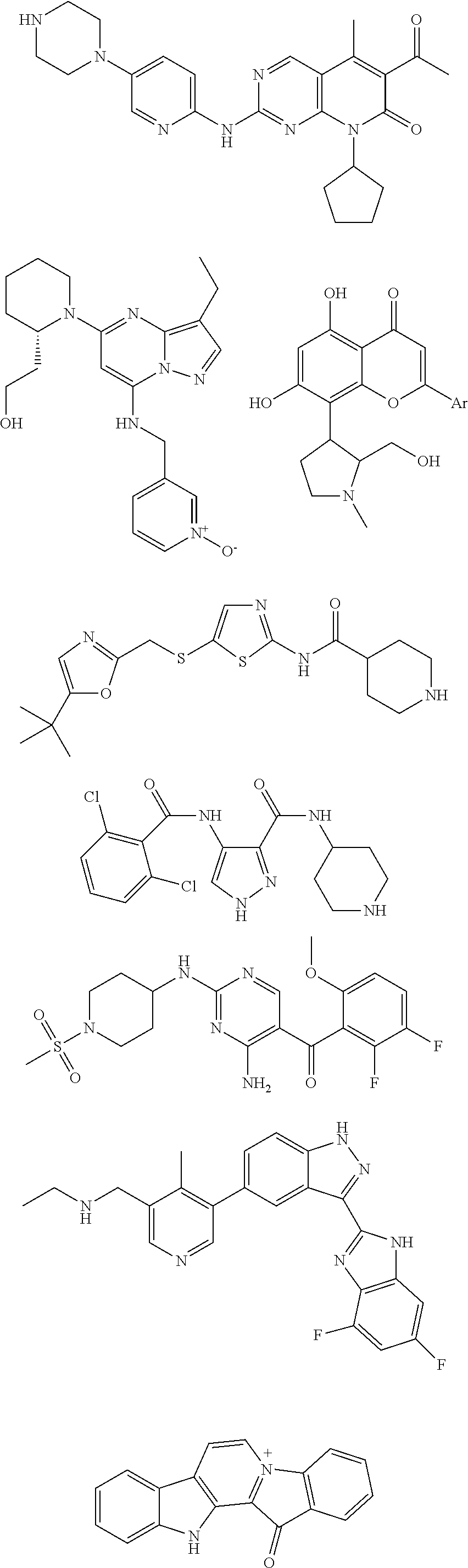
Priority Applications (1)
| Application Number | Priority Date | Filing Date | Title |
|---|---|---|---|
| US12/741,884 US9259399B2 (en) | 2007-11-07 | 2008-10-01 | Targeting CDK4 and CDK6 in cancer therapy |
Applications Claiming Priority (3)
| Application Number | Priority Date | Filing Date | Title |
|---|---|---|---|
| US98617607P | 2007-11-07 | 2007-11-07 | |
| US12/741,884 US9259399B2 (en) | 2007-11-07 | 2008-10-01 | Targeting CDK4 and CDK6 in cancer therapy |
| PCT/US2008/011331 WO2009061345A2 (en) | 2007-11-07 | 2008-10-01 | Targeting cdk4 and cdk6 in cancer therapy |
Publications (2)
| Publication Number | Publication Date |
|---|---|
| US20110009353A1 true US20110009353A1 (en) | 2011-01-13 |
| US9259399B2 US9259399B2 (en) | 2016-02-16 |
Family
ID=40202004
Family Applications (1)
| Application Number | Title | Priority Date | Filing Date |
|---|---|---|---|
| US12/741,884 Active 2031-05-22 US9259399B2 (en) | 2007-11-07 | 2008-10-01 | Targeting CDK4 and CDK6 in cancer therapy |
Country Status (2)
| Country | Link |
|---|---|
| US (1) | US9259399B2 (en) |
| WO (1) | WO2009061345A2 (en) |
Cited By (58)
| Publication number | Priority date | Publication date | Assignee | Title |
|---|---|---|---|---|
| US20110034441A1 (en) * | 2009-08-10 | 2011-02-10 | Epitherix, Llc | Indazoles as wnt/b-catenin signaling pathway inhibitors and therapeutic uses thereof |
| US20110190290A1 (en) * | 2009-12-21 | 2011-08-04 | Epitherix, Llc | 1h-pyrazolo[3,4-b]pyridines and therapeutic uses thereof |
| US8252812B2 (en) | 2009-08-10 | 2012-08-28 | Samumed, Llc | Indazole inhibitors of the WNT signal pathway and therapeutic uses thereof |
| US8618128B1 (en) | 2012-05-04 | 2013-12-31 | Samumed, Llc | 1H-pyrazolo[3,4-b]pyridines and therapeutic uses thereof |
| US8664241B2 (en) | 2012-04-04 | 2014-03-04 | Samumed, Llc | Indazole inhibitors of the Wnt signal pathway and therapeutic uses thereof |
| US8697887B2 (en) | 2011-09-14 | 2014-04-15 | Samumed, Llc | Indazole-3-carboxamides and their use as Wnt/β-catenin signaling pathway inhibitors |
| WO2014022830A3 (en) * | 2012-08-03 | 2014-05-01 | Foundation Medicine, Inc. | Human papilloma virus as predictor of cancer prognosis |
| JP2015524656A (en) * | 2012-07-09 | 2015-08-27 | ノバルティス アーゲー | Biomarkers associated with CDK inhibitors |
| WO2016040858A1 (en) * | 2014-09-12 | 2016-03-17 | G1 Therapeutics, Inc. | Combinations and dosing regimes to treat rb-positive tumors |
| US20160121221A1 (en) * | 2013-06-07 | 2016-05-05 | Sony Computer Entertainment Inc. | Information processing system |
| US9464092B2 (en) | 2013-03-15 | 2016-10-11 | G1 Therapeutics, Inc. | Transient protection of normal cells during chemotherapy |
| US9475825B2 (en) | 2014-09-08 | 2016-10-25 | Samumed, Llc | 3-(3H-imidazo[4,5-C]pyridin-2-yl)-1H-pyrazolo[3,4-C]pyridine and therapeutic uses thereof |
| US9475807B2 (en) | 2014-09-08 | 2016-10-25 | Samumed, Llc | 2-(1H-indazol-3-yl)-1H-imidazo[4,5-C]pyridine and therapeutic uses thereof |
| US9481691B2 (en) | 2010-10-25 | 2016-11-01 | G1 Therapeutics, Inc. | CDK inhibitors |
| US9493487B2 (en) | 2014-09-08 | 2016-11-15 | Samumed, Llc | 3-(1H-imidazo[4,5-C]pyridin-2-YL)-1H-pyrazolo[3,4-B]pyridine and therapeutic uses thereof |
| US9493833B1 (en) * | 2009-11-06 | 2016-11-15 | The Regents Of The University Of California | Methods for preventing induced synthesis of proteasomes in human cells |
| US9540398B2 (en) | 2014-09-08 | 2017-01-10 | Samumed, Llc | 3-(1h-imidazo[4,5-C]pyridin-2-yl)-1h-pyrazolo[3,4-C]pyridine and therapeutic uses thereof |
| US9546185B2 (en) | 2014-09-08 | 2017-01-17 | Samumed, Llc | 3-(3H-imidazo[4,5-B]pyridin-2-yl)-1H-pyrazolo[3,4-C]pyridine and therapeutic uses thereof |
| US9657016B2 (en) | 2014-09-08 | 2017-05-23 | Samumed, Llc | 3-(1h-benzo[d]imidazol-2-yl)-1h-pyrazolo[3,4-c]pyridine and therapeutic uses thereof |
| US9738638B2 (en) | 2014-09-08 | 2017-08-22 | Samumed, Llc | 2-(1H-indazol-3-yl)-3H-imidazo[4,5-B]pyridine and therapeutic uses thereof |
| US9758531B2 (en) | 2014-09-08 | 2017-09-12 | Samumed, Llc | 3-(3H-imidazo[4,5-B]pyridin-2-yl)-1H-pyrazolo[3,4-B]pyridine and therapeutic uses thereof |
| US9908867B2 (en) | 2013-01-08 | 2018-03-06 | Samumed, Llc | 3-(benzoimidazol-2-yl)-indazole inhibitors of the Wnt signaling pathway and therapeutic uses thereof |
| US10072004B2 (en) | 2016-06-01 | 2018-09-11 | Samumed, Llc | Process for preparing N-(5-(3-(7-(3-fluorophenyl)-3H-imidazo [4,5-C]pyridin-2-yl)-1H-indazol-5-yl)pyridin-3-yl)-3-methylbutanamide |
| US10166218B2 (en) | 2015-08-03 | 2019-01-01 | Samumed, Llc | 3-(1H-indol-2-yl)-1H-pyrazolo[3,4-C]pyridines and therapeutic uses thereof |
| US10188634B2 (en) | 2015-08-03 | 2019-01-29 | Samumed, Llc | 3-(3H-imidazo[4,5-C]pyridin-2-yl)-1 H-pyrazolo[4,3-B]pyridines and therapeutic uses thereof |
| US10195185B2 (en) | 2015-08-03 | 2019-02-05 | Samumed, Llc | 3-(1H-imidazo[4,5-C]pyridin-2-yl)-1H-pyrazolo[4,3-B]pyridines and therapeutic uses thereof |
| US10206908B2 (en) | 2015-08-03 | 2019-02-19 | Samumed, Llc | 3-(1H-pyrrolo[3,2-C]pyridin-2-YL)-1H-pyrazolo[3,4-C]pyridines and therapeutic uses thereof |
| US10206909B2 (en) | 2015-08-03 | 2019-02-19 | Samumed, Llc | 3-(1H-pyrrolo[2,3-B]pyridin-2-yl)-1H-pyrazolo[4,3-B]pyridines and therapeutic uses thereof |
| US20190062248A1 (en) * | 2013-12-16 | 2019-02-28 | The Johns Hopkins University | Treating and preventing diseases by modulating cell mechanics |
| US10226448B2 (en) | 2015-08-03 | 2019-03-12 | Samumed, Llc | 3-(1H-pyrrolo[3,2-C]pyridin-2-yl)-1H-pyrazolo[3,4-B]pyridines and therapeutic uses thereof |
| US10226453B2 (en) | 2015-08-03 | 2019-03-12 | Samumed, Llc | 3-(1H-indol-2-yl)-1H-pyrazolo[4,3-B]pyridines and therapeutic uses thereof |
| US10231956B2 (en) | 2015-08-03 | 2019-03-19 | Samumed, Llc | 3-(1H-pyrrolo[3,2-C]pyridin-2-YL)-1 H-pyrazolo[4,3-B]pyridines and therapeutic uses thereof |
| US10285983B2 (en) | 2015-08-03 | 2019-05-14 | Samumed, Llc | 3-(1H-pyrrolo[2,3-B]pyridin-2-yl)-1H-pyrazolo[3,4-B] pyridines and therapeutic uses thereof |
| US10285982B2 (en) | 2015-08-03 | 2019-05-14 | Samumed, Llc | 3-(1H-pyrrolo[2,3-B]pyridin-2-yl)-1H-pyrazolo[3,4-C]pyridines and therapeutic uses thereof |
| US10329309B2 (en) | 2015-08-03 | 2019-06-25 | Samumed, Llc | 3-(3H-imidazo[4,5-B]pyridin-2-yl)-1H-pyrazolo[4,3-B]pyridines and therapeutic uses thereof |
| US10350199B2 (en) | 2015-08-03 | 2019-07-16 | Samumed, Llc | 3-(1h-pyrrolo[2,3-b]pyridin-2-yl)-1h-indazoles and therapeutic uses thereof |
| WO2019148161A1 (en) * | 2018-01-29 | 2019-08-01 | Beta Pharma, Inc. | 2h-indazole derivatives as cdk4 and cdk6 inhibitors and therapeutic uses thereof |
| US10383861B2 (en) | 2015-08-03 | 2019-08-20 | Sammumed, LLC | 3-(1H-pyrrolo[2,3-C]pyridin-2-yl)-1H-pyrazolo[3,4-C]pyridines and therapeutic uses thereof |
| US10392383B2 (en) | 2015-08-03 | 2019-08-27 | Samumed, Llc | 3-(1H-benzo[d]imidazol-2-yl)-1H-pyrazolo[4,3-b]pyridines and therapeutic uses thereof |
| US10413547B2 (en) | 2014-09-12 | 2019-09-17 | G1 Therapeutics, Inc. | Treatment of Rb-negative tumors using topoisomerase with cyclin dependent kinase 4/6 inhibitors |
| US10449195B2 (en) | 2016-03-29 | 2019-10-22 | Shenzhen Pharmacin Co., Ltd. | Pharmaceutical formulation of palbociclib and a preparation method thereof |
| US10463651B2 (en) | 2015-08-03 | 2019-11-05 | Samumed, Llc | 3-(1H-pyrrolo[3,2-C]pyridin-2-YL)-1H-indazoles and therapeutic uses thereof |
| US10519169B2 (en) | 2015-08-03 | 2019-12-31 | Samumed, Llc | 3-(1H-pyrrolo[2,3-C]pyridin-2-yl)-1 H-pyrazolo[4,3-B]pyridines and therapeutic uses thereof |
| US10544139B2 (en) | 2015-11-06 | 2020-01-28 | Samumed, Llc | Treatment of osteoarthritis |
| WO2020055758A1 (en) | 2018-09-10 | 2020-03-19 | Mirati Therapeutics, Inc. | Combination therapies |
| US10604512B2 (en) | 2015-08-03 | 2020-03-31 | Samumed, Llc | 3-(1H-indol-2-yl)-1H-indazoles and therapeutic uses thereof |
| US10709711B2 (en) | 2013-03-15 | 2020-07-14 | G1 Therapeutics, Inc. | Highly active anti-neoplastic and anti-proliferative agents |
| US10758523B2 (en) | 2016-11-07 | 2020-09-01 | Samumed, Llc | Single-dose, ready-to-use injectable formulations |
| US10806726B2 (en) | 2016-10-21 | 2020-10-20 | Samumed, Llc | Methods of using indazole-3-carb oxamides and their use as Wnt/B-catenin signaling pathway inhibitors |
| US10988479B1 (en) | 2020-06-15 | 2021-04-27 | G1 Therapeutics, Inc. | Morphic forms of trilaciclib and methods of manufacture thereof |
| US11261193B2 (en) | 2017-06-29 | 2022-03-01 | GI Therapeutics, Inc. | Morphic forms of G1T38 and methods of manufacture thereof |
| US11364222B2 (en) | 2017-01-06 | 2022-06-21 | G1 Therapeutics, Inc. | Combination therapy for treatment of cancer |
| US11395821B2 (en) | 2017-01-30 | 2022-07-26 | G1 Therapeutics, Inc. | Treatment of EGFR-driven cancer with fewer side effects |
| US11471418B2 (en) | 2020-09-29 | 2022-10-18 | Shenzhen Pharmacin Co., Ltd. | Pharmaceutical compositions of amorphous solid dispersions and methods of preparation thereof |
| CN115491353A (en) * | 2022-09-05 | 2022-12-20 | 武汉大学中南医院 | Application of Compound Kushen Injection in Promoting the Proliferation and Killing Activity of Natural Killer Cells |
| US11529352B2 (en) | 2016-12-05 | 2022-12-20 | G1 Therapeutics, Inc. | Preservation of immune response during chemotherapy regimens |
| WO2023131179A1 (en) * | 2022-01-05 | 2023-07-13 | 贝达药业股份有限公司 | Use of benzimidazole derivative or salt thereof in treatment of leukemia |
| US11708337B2 (en) | 2018-08-24 | 2023-07-25 | G1 Therapeutics, Inc. | Synthesis of 1,4-diazaspiro[5.5]undecan-3-one |
Families Citing this family (43)
| Publication number | Priority date | Publication date | Assignee | Title |
|---|---|---|---|---|
| US9259399B2 (en) | 2007-11-07 | 2016-02-16 | Cornell University | Targeting CDK4 and CDK6 in cancer therapy |
| BRPI0821209A2 (en) | 2007-12-19 | 2019-09-24 | Amgen Inc | compound, pharmaceutical composition, methods of treating cancer, reducing tumor size, treating disorders, and reducing metastasis in a tumor. |
| ATE531372T1 (en) | 2008-04-07 | 2011-11-15 | Amgen Inc | GEM-DISUBSTITUTED AND SPIROCYCLIC AMINOPYRIDINES/PYRIMIDINES AS CELL CYCLE INHIBITORS |
| AU2009310352A1 (en) * | 2008-10-01 | 2010-05-06 | The University Of North Carolina At Chapel Hill | Hematopoietic protection against ionizing radiation using selective cyclin-dependent kinase 4/6 inhibitors |
| EP3025724B1 (en) | 2009-05-13 | 2018-07-11 | The University of North Carolina At Chapel Hill | Cyclin dependent kinase inhibitors and methods of use |
| NZ596541A (en) * | 2009-05-27 | 2013-12-20 | Cephalon Inc | Combination therapy for the treatment of multiple myeloma using cep-18770 together with bortezomib or mephalan |
| CA2763471A1 (en) | 2009-05-27 | 2010-12-02 | Cephalon, Inc. | Combination therapy for the treatment of multiple myeloma |
| BR112012003637A2 (en) | 2009-08-17 | 2017-04-25 | Memorial Sloan Kettering Cancer Center | "heat shock protein binding compounds, compositions, and methods for preparing and using them" |
| CA2800327A1 (en) | 2010-04-13 | 2011-10-20 | Novartis Ag | Combination comprising a cyclin dependent kinase 4 or cyclin dependent kinase 6 (cdk4/6) inhibitor and an mtor inhibitor for treating cancer |
| WO2012068381A2 (en) | 2010-11-17 | 2012-05-24 | The University Of North Carolina At Chapel Hill | Protection of renal tissues from schema through inhibition of the proliferative kisses cdk4 and cdk6 |
| MX2013010871A (en) | 2011-03-23 | 2014-01-31 | Amgen Inc | FUSIONED DOUBLE TRICICLIC INHIBITORS OF CDK 4/6 AND FLT3. |
| KR20140040769A (en) * | 2011-07-01 | 2014-04-03 | 노파르티스 아게 | Combination therapy |
| WO2013071415A1 (en) * | 2011-11-15 | 2013-05-23 | University Health Network | Targeting the rb pathway for the prevention of cancer |
| MX2015012741A (en) | 2013-03-15 | 2016-02-19 | Concert Pharmaceuticals Inc | Deuterated palbociclib. |
| WO2015161283A1 (en) | 2014-04-17 | 2015-10-22 | G1 Therapeutics, Inc. | Tricyclic lactams for use in hspc-sparing treatments for rb-positive abnormal cellular proliferation |
| EA201692155A1 (en) | 2014-05-13 | 2017-04-28 | Мемориал Слоун-Кеттеринг Кэнсэ Сентр | Hsp70 modulators and methods for their production and use |
| CN110117273B (en) * | 2014-07-24 | 2022-02-01 | 贝达医药公司 | 2H-indazole derivatives as Cyclin Dependent Kinase (CDK) inhibitors and their medical use |
| KR102615733B1 (en) * | 2015-03-11 | 2023-12-18 | 치아타이 티안큉 파마수티컬 그룹 주식회사 | Substituted 2-H-pyrazole derivatives as anticancer agents |
| CN104830776A (en) * | 2015-05-05 | 2015-08-12 | 中国医学科学院血液病医院(血液学研究所) | Drug-resistant multiple myeloma animal model and construction method thereof |
| JP6902025B2 (en) * | 2015-06-18 | 2021-07-14 | ティン セラピューティックス エルエルシー | Methods and compositions for the prevention and treatment of hearing loss |
| US11077110B2 (en) | 2016-03-18 | 2021-08-03 | Tufts Medical Center | Compositions and methods for treating and preventing metabolic disorders |
| IL295472B2 (en) * | 2016-03-28 | 2024-10-01 | Presage Biosciences Inc | Pharmaceutical combinations for cancer treatment |
| AR108325A1 (en) | 2016-04-27 | 2018-08-08 | Samumed Llc | ISOQUINOLIN-3-IL CARBOXAMIDS AND PREPARATION AND USE OF THE SAME |
| US11865176B2 (en) | 2016-11-08 | 2024-01-09 | Dana-Farber Cancer Institute, Inc. | Compositions and methods of modulating anti-tumor immunity |
| US11913075B2 (en) | 2017-04-01 | 2024-02-27 | The Broad Institute, Inc. | Methods and compositions for detecting and modulating an immunotherapy resistance gene signature in cancer |
| WO2019070755A1 (en) | 2017-10-02 | 2019-04-11 | The Broad Institute, Inc. | Methods and compositions for detecting and modulating an immunotherapy resistance gene signature in cancer |
| BR112020013915A2 (en) | 2018-01-08 | 2020-12-01 | G1 Therapeutics, Inc. | dosing regimen for release, and, method to treat cancer dependent on cdk4 / 6 replication in a human |
| US12486280B2 (en) | 2018-07-27 | 2025-12-02 | California Institute Of Technology | CDK inhibitors and uses thereof |
| US11066404B2 (en) | 2018-10-11 | 2021-07-20 | Incyte Corporation | Dihydropyrido[2,3-d]pyrimidinone compounds as CDK2 inhibitors |
| WO2020168197A1 (en) | 2019-02-15 | 2020-08-20 | Incyte Corporation | Pyrrolo[2,3-d]pyrimidinone compounds as cdk2 inhibitors |
| US11472791B2 (en) | 2019-03-05 | 2022-10-18 | Incyte Corporation | Pyrazolyl pyrimidinylamine compounds as CDK2 inhibitors |
| WO2020186101A1 (en) | 2019-03-12 | 2020-09-17 | The Broad Institute, Inc. | Detection means, compositions and methods for modulating synovial sarcoma cells |
| US11919904B2 (en) | 2019-03-29 | 2024-03-05 | Incyte Corporation | Sulfonylamide compounds as CDK2 inhibitors |
| US11440914B2 (en) | 2019-05-01 | 2022-09-13 | Incyte Corporation | Tricyclic amine compounds as CDK2 inhibitors |
| WO2020223558A1 (en) | 2019-05-01 | 2020-11-05 | Incyte Corporation | Tricyclic amine compounds as cdk2 inhibitors |
| CA3150681A1 (en) | 2019-08-14 | 2021-02-18 | Incyte Corporation | Imidazolyl pyrimidinylamine compounds as cdk2 inhibitors |
| WO2021072232A1 (en) | 2019-10-11 | 2021-04-15 | Incyte Corporation | Bicyclic amines as cdk2 inhibitors |
| US11857551B1 (en) | 2020-07-10 | 2024-01-02 | Ting Therapeutics Llc | Methods for the prevention and treatment of hearing loss |
| AR124154A1 (en) | 2020-11-27 | 2023-02-22 | Rhizen Pharmaceuticals Ag | CDK INHIBITORS |
| WO2022149057A1 (en) | 2021-01-05 | 2022-07-14 | Rhizen Pharmaceuticals Ag | Cdk inhibitors |
| US11981671B2 (en) | 2021-06-21 | 2024-05-14 | Incyte Corporation | Bicyclic pyrazolyl amines as CDK2 inhibitors |
| US11976073B2 (en) | 2021-12-10 | 2024-05-07 | Incyte Corporation | Bicyclic amines as CDK2 inhibitors |
| AU2024249644A1 (en) * | 2023-03-27 | 2025-11-13 | The Cleveland Clinic Foundation | Topical pala therapy for cancer |
Citations (2)
| Publication number | Priority date | Publication date | Assignee | Title |
|---|---|---|---|---|
| US20050059670A1 (en) * | 2003-07-11 | 2005-03-17 | Pfizer Inc | Isethionate salt of a selective CKD4 inhibitor |
| US20060004000A1 (en) * | 2002-10-02 | 2006-01-05 | Sanofi-Aventis | Indazolecarboxamide derivatives, preparation and use thereof as CDK1, CDK2 and CDK4 inhibitors |
Family Cites Families (21)
| Publication number | Priority date | Publication date | Assignee | Title |
|---|---|---|---|---|
| US6608053B2 (en) | 2000-04-27 | 2003-08-19 | Yamanouchi Pharmaceutical Co., Ltd. | Fused heteroaryl derivatives |
| WO2005094830A1 (en) | 2004-03-30 | 2005-10-13 | Pfizer Products Inc. | Combinations of signal transduction inhibitors |
| US9259399B2 (en) | 2007-11-07 | 2016-02-16 | Cornell University | Targeting CDK4 and CDK6 in cancer therapy |
| US20100160322A1 (en) | 2008-12-04 | 2010-06-24 | Abbott Laboratories | Apoptosis-inducing agents for the treatment of cancer and immune and autoimmune diseases |
| UA108193C2 (en) | 2008-12-04 | 2015-04-10 | APOPTOZINDUCE FOR THE TREATMENT OF CANCER AND IMMUNE AND AUTO-IMMUNE DISEASES | |
| WO2012078492A1 (en) | 2010-12-06 | 2012-06-14 | Celgene Corporation | A combination therapy with lenalidomide and a cdk inhibitor for treating multiple myeloma |
| PH12013501855A1 (en) | 2011-03-11 | 2018-03-21 | Gilead Calistoga Llc | Combination therapies for hematologic malignancies |
| WO2012135588A2 (en) | 2011-04-01 | 2012-10-04 | Sloan Kettering Institute For Cancer Research | Methods of treating serosal cancer |
| WO2014008375A1 (en) | 2012-07-05 | 2014-01-09 | Mersana Therapeutics, Inc. | Terminally modified polymers and conjugates thereof |
| WO2014089241A2 (en) | 2012-12-04 | 2014-06-12 | Caris Mpi, Inc. | Molecular profiling for cancer |
| NZ708870A (en) | 2012-12-21 | 2016-09-30 | Gilead Calistoga Llc | Isoquinolinone or quinazolinone phosphatidylinositol 3-kinase inhibitors |
| WO2014144740A2 (en) | 2013-03-15 | 2014-09-18 | G1 Therapeutics, Inc. | Highly active anti-neoplastic and anti-proliferative agents |
| EP2971093B1 (en) | 2013-03-15 | 2018-09-19 | Life Technologies Corporation | Classification and actionability indices for lung cancer |
| WO2014144326A1 (en) | 2013-03-15 | 2014-09-18 | G1 Therapeutics, Inc. | Transient protection of normal cells during chemotherapy |
| WO2014177915A1 (en) | 2013-05-01 | 2014-11-06 | Piramal Enterprises Limited | Cancer combination therapy using imidazo[4,5-c]quinoline derivatives |
| BR112015030595A2 (en) | 2013-06-19 | 2017-07-25 | Seragon Pharmaceuticals Inc | azetidine estrogen receptor modulators and uses thereof |
| EA031077B1 (en) | 2013-06-19 | 2018-11-30 | Серагон Фармасьютикалз, Инк. | Estrogen receptor modulator and uses thereof |
| US10316080B2 (en) | 2013-10-11 | 2019-06-11 | Asana Biosciences, Llc | Protein-polymer-drug conjugates |
| CA2929181A1 (en) | 2013-11-13 | 2015-05-21 | Novartis Ag | Mtor inhibitors for enhancing the immune response |
| AU2014354769A1 (en) | 2013-11-26 | 2016-05-26 | Gilead Sciences, Inc. | Therapies for treating myeloproliferative disorders |
| WO2015084892A1 (en) | 2013-12-02 | 2015-06-11 | Cornell University | Methods for treating b cell proliferative disorders |
-
2008
- 2008-10-01 US US12/741,884 patent/US9259399B2/en active Active
- 2008-10-01 WO PCT/US2008/011331 patent/WO2009061345A2/en not_active Ceased
Patent Citations (2)
| Publication number | Priority date | Publication date | Assignee | Title |
|---|---|---|---|---|
| US20060004000A1 (en) * | 2002-10-02 | 2006-01-05 | Sanofi-Aventis | Indazolecarboxamide derivatives, preparation and use thereof as CDK1, CDK2 and CDK4 inhibitors |
| US20050059670A1 (en) * | 2003-07-11 | 2005-03-17 | Pfizer Inc | Isethionate salt of a selective CKD4 inhibitor |
Non-Patent Citations (1)
| Title |
|---|
| Shah et al. (Cyclin-dependent kinases as targets for cancer therapy, Cancer Chemother Biol Response Modif. 2003;21:145-70) * |
Cited By (156)
| Publication number | Priority date | Publication date | Assignee | Title |
|---|---|---|---|---|
| US8822478B2 (en) | 2009-08-10 | 2014-09-02 | Samumed, Llc | Indazole inhibitors of the WNT signal pathway and therapeutic uses thereof |
| US9381192B2 (en) | 2009-08-10 | 2016-07-05 | Samumed, Llc | Indazole inhibitors of the Wnt signal pathway and therapeutic uses thereof |
| US8252812B2 (en) | 2009-08-10 | 2012-08-28 | Samumed, Llc | Indazole inhibitors of the WNT signal pathway and therapeutic uses thereof |
| US9763927B2 (en) | 2009-08-10 | 2017-09-19 | Samumed, Llc | Indazole inhibitors of the Wnt signal pathway and therapeutic uses thereof |
| US8604052B2 (en) | 2009-08-10 | 2013-12-10 | Samumed, Llc | Indazole inhibitors of the WNT signal pathway and therapeutic uses thereof |
| US20110034441A1 (en) * | 2009-08-10 | 2011-02-10 | Epitherix, Llc | Indazoles as wnt/b-catenin signaling pathway inhibitors and therapeutic uses thereof |
| US10016406B2 (en) | 2009-08-10 | 2018-07-10 | Samumed, Llc | Indazole inhibitors of the WNT signal pathway and therapeutic uses thereof |
| US9090613B2 (en) | 2009-08-10 | 2015-07-28 | Samumed, Llc | Indazole inhibitors of the Wnt signal pathway and therapeutic uses thereof |
| US8703794B2 (en) | 2009-08-10 | 2014-04-22 | Samumed, Llc | Indazole inhibitors of the Wnt signal pathway and therapeutic uses thereof |
| US9493833B1 (en) * | 2009-11-06 | 2016-11-15 | The Regents Of The University Of California | Methods for preventing induced synthesis of proteasomes in human cells |
| US9067939B2 (en) | 2009-12-21 | 2015-06-30 | Samumed, Llc | 1H-pyrazolo[3,4-b]pyridines and therapeutic uses thereof |
| US9855272B2 (en) | 2009-12-21 | 2018-01-02 | Samumed, Llc | 1H-pyrazolo[3,4-B]pyridines and therapeutic uses thereof |
| US20110190290A1 (en) * | 2009-12-21 | 2011-08-04 | Epitherix, Llc | 1h-pyrazolo[3,4-b]pyridines and therapeutic uses thereof |
| US8846714B2 (en) | 2009-12-21 | 2014-09-30 | Samumed, Llc | 1H-pyrazolo[3,4-β]pyridines and therapeutic uses thereof |
| US8450340B2 (en) | 2009-12-21 | 2013-05-28 | Samumed, Llc | 1H-pyrazolo[3,4-b]pyridines and therapeutic uses thereof |
| US8901150B2 (en) | 2009-12-21 | 2014-12-02 | Samumed, Llc | 1H-pyrazolo[3,4-B]pyridines and therapeutic uses thereof |
| US10105370B2 (en) | 2009-12-21 | 2018-10-23 | Samumed, Llc | 1H-pyrazolo[3,4-B]pyridines and therapeutic uses thereof |
| US8815897B2 (en) | 2009-12-21 | 2014-08-26 | Samumed, Llc | 1H-pyrazolo[3,4-B]pyridines and therapeutic uses thereof |
| US9446035B2 (en) | 2009-12-21 | 2016-09-20 | Samumed, Llc | 1H-pyrazolo[3,4-b]pyridines and therapeutic uses thereof |
| US10189851B2 (en) | 2010-10-25 | 2019-01-29 | G1 Therapeutics, Inc. | CDK inhibitors |
| US10189849B2 (en) | 2010-10-25 | 2019-01-29 | G1 Therapeutics, Inc. | CDK inhibitors |
| US9957276B2 (en) | 2010-10-25 | 2018-05-01 | GI Therapeutics, Inc. | CDK inhibitors |
| US9499564B2 (en) | 2010-10-25 | 2016-11-22 | G1 Therapeutics, Inc. | CDK inhibitors |
| US10927120B2 (en) | 2010-10-25 | 2021-02-23 | GI Therapeutics, Inc. | CDK inhibitors |
| US9481691B2 (en) | 2010-10-25 | 2016-11-01 | G1 Therapeutics, Inc. | CDK inhibitors |
| US10696682B2 (en) | 2010-10-25 | 2020-06-30 | G1 Therapeutics, Inc. | CDK inhibitors |
| US10189850B2 (en) | 2010-10-25 | 2019-01-29 | G1 Therapeutics, Inc. | CDK inhibitors |
| US8697887B2 (en) | 2011-09-14 | 2014-04-15 | Samumed, Llc | Indazole-3-carboxamides and their use as Wnt/β-catenin signaling pathway inhibitors |
| US11066388B2 (en) | 2011-09-14 | 2021-07-20 | Biosplice Therapeutics, Inc. | Indazole-3-carboxamides and their use as WNT/B-catenin signaling pathway inhibitors |
| US9802916B2 (en) | 2011-09-14 | 2017-10-31 | Samumed, Llc | Indazole-3-carboxamides and their use as Wnt/beta-catenin signaling pathway inhibitors |
| US11780823B2 (en) | 2011-09-14 | 2023-10-10 | Biosplice Therapeutics, Inc. | Indazole-3-carboxamides and their use as Wnt/β-catenin signaling pathway inhibitors |
| US9221793B2 (en) | 2011-09-14 | 2015-12-29 | Samumed, Llc | Indazole-3-carboxamides and their use as Wnt/β-catenin signaling pathway inhibitors |
| US10464924B2 (en) | 2011-09-14 | 2019-11-05 | Samumed, Llc | Indazole-3-carboxamides and their use as Wnt/β-catenin signaling pathway inhibitors |
| US11697649B2 (en) | 2012-04-04 | 2023-07-11 | Biosplice Therapeutics, Inc. | Indazole inhibitors of the Wnt signal pathway and therapeutic uses thereof |
| US10947228B2 (en) | 2012-04-04 | 2021-03-16 | Samumed, Llc | Indazole inhibitors of the Wnt signal pathway and therapeutic uses thereof |
| US10407425B2 (en) | 2012-04-04 | 2019-09-10 | Samumed, Llc | Indazole inhibitors of the Wnt signal pathway and therapeutic uses thereof |
| US8664241B2 (en) | 2012-04-04 | 2014-03-04 | Samumed, Llc | Indazole inhibitors of the Wnt signal pathway and therapeutic uses thereof |
| US8673936B2 (en) | 2012-04-04 | 2014-03-18 | Samumed, Llc | Indazole inhibitors of the Wnt signal pathway and therapeutic uses thereof |
| US8987298B2 (en) | 2012-04-04 | 2015-03-24 | Samumed, Llc | Indazole inhibitors of the Wnt signal pathway and therapeutic uses thereof |
| US9994563B2 (en) | 2012-04-04 | 2018-06-12 | Samumed, Llc | Indazole inhibitors of the wnt signal pathway and therapeutic uses thereof |
| US9199991B2 (en) | 2012-04-04 | 2015-12-01 | Samumed, Llc | Indazole inhibitors of the WNT signal pathway and therapeutic uses thereof |
| US8883822B2 (en) | 2012-05-04 | 2014-11-11 | Samumed, Llc | 1H-pyrazolo[3,4-B]pyridines and therapeutic uses thereof |
| US9586977B2 (en) | 2012-05-04 | 2017-03-07 | Samumed, Llc | 1H-pyrazolo[3,4-b]pyridines and therapeutic uses thereof |
| US10342788B2 (en) | 2012-05-04 | 2019-07-09 | Samumed, Llc | 1H-pyrazolo[3,4-b]pyridines and therapeutic uses thereof |
| US8618128B1 (en) | 2012-05-04 | 2013-12-31 | Samumed, Llc | 1H-pyrazolo[3,4-b]pyridines and therapeutic uses thereof |
| US10071086B2 (en) | 2012-05-04 | 2018-09-11 | Samumed, Llc | 1H-pyrazolo[3,4-b]pyridines and therapeutic uses thereof |
| US9012472B2 (en) | 2012-05-04 | 2015-04-21 | Samumed, Llc | 1H-pyrazolo[3,4-B]pyridines and therapeutic uses thereof |
| US9233104B2 (en) | 2012-05-04 | 2016-01-12 | Samumed, Llc | 1H-pyrazolo[3,4-B]pyridines and therapeutic uses thereof |
| JP2015524656A (en) * | 2012-07-09 | 2015-08-27 | ノバルティス アーゲー | Biomarkers associated with CDK inhibitors |
| US9907798B2 (en) | 2012-08-03 | 2018-03-06 | Foundation Medicine, Inc. | Methods of treating head and neck cancer |
| AU2013296237B2 (en) * | 2012-08-03 | 2019-05-16 | Foundation Medicine, Inc. | Human papilloma virus as predictor of cancer prognosis |
| US11058687B2 (en) | 2012-08-03 | 2021-07-13 | Foundation Medicine, Inc. | Human papilloma virus as predictor of cancer prognosis |
| US11766439B2 (en) | 2012-08-03 | 2023-09-26 | Foundation Medicine, Inc. | Human papilloma virus as predictor of cancer prognosis |
| US9410954B2 (en) | 2012-08-03 | 2016-08-09 | Foundation Medicine, Inc. | Human papilloma virus as predictor of cancer prognosis |
| WO2014022830A3 (en) * | 2012-08-03 | 2014-05-01 | Foundation Medicine, Inc. | Human papilloma virus as predictor of cancer prognosis |
| US10183929B2 (en) | 2013-01-08 | 2019-01-22 | Samumed, Llc | 3-(benzoimidazol-2-yl)-indazole inhibitors of the Wnt signaling pathway and therapeutic uses thereof |
| US9908867B2 (en) | 2013-01-08 | 2018-03-06 | Samumed, Llc | 3-(benzoimidazol-2-yl)-indazole inhibitors of the Wnt signaling pathway and therapeutic uses thereof |
| US10654832B2 (en) | 2013-01-08 | 2020-05-19 | Samumed, Llc | 3-(benzoimidazol-2-YL)-indazole inhibitors of the Wnt signaling pathway and therapeutic uses thereof |
| US9527857B2 (en) | 2013-03-15 | 2016-12-27 | GI Therapeutics, Inc. | HSPC-sparing treatments for RB-positive abnormal cellular proliferation |
| US10925878B2 (en) | 2013-03-15 | 2021-02-23 | G1 Therapeutics, Inc. | HSPC-sparing treatments for RB-positive abnormal cellular proliferation |
| US10076523B2 (en) | 2013-03-15 | 2018-09-18 | G1 Therapeutics, Inc. | HSPC-sparing treatments for RB-positive abnormal cellular proliferation |
| US10709711B2 (en) | 2013-03-15 | 2020-07-14 | G1 Therapeutics, Inc. | Highly active anti-neoplastic and anti-proliferative agents |
| US10085992B2 (en) | 2013-03-15 | 2018-10-02 | G1 Therapeutics, Inc. | Transient protection of normal cells during chemotherapy |
| US9464092B2 (en) | 2013-03-15 | 2016-10-11 | G1 Therapeutics, Inc. | Transient protection of normal cells during chemotherapy |
| US11717523B2 (en) | 2013-03-15 | 2023-08-08 | G1 Therapeutics, Inc. | Transient protection of normal cells during chemotherapy |
| US10660896B2 (en) | 2013-03-15 | 2020-05-26 | GI Therapeutics, Inc. | Transient protection of normal cells during chemotherapy |
| US9931345B2 (en) | 2013-03-15 | 2018-04-03 | Presidents And Fellows Of Harvard College | Transient protection of normal cells during chemotherapy |
| US11654148B2 (en) | 2013-03-15 | 2023-05-23 | G1 Therapeutics, Inc. | HSPC-sparing treatments for RB-positive abnormal cellular proliferation |
| US9487530B2 (en) | 2013-03-15 | 2016-11-08 | G1 Therapeutics, Inc. | Transient protection of normal cells during chemotherapy |
| US10966984B2 (en) | 2013-03-15 | 2021-04-06 | G1 Therapeutics, Inc. | Transient protection of normal cells during chemotherapy |
| US10434104B2 (en) | 2013-03-15 | 2019-10-08 | G1 Therapeutics, Inc. | HSPC-sparing treatments for Rb-positive abnormal cellular proliferation |
| US11040042B2 (en) | 2013-03-15 | 2021-06-22 | G1 Therapeutics, Inc. | Transient protection of normal cells during chemotherapy |
| US20160121221A1 (en) * | 2013-06-07 | 2016-05-05 | Sony Computer Entertainment Inc. | Information processing system |
| US20190062248A1 (en) * | 2013-12-16 | 2019-02-28 | The Johns Hopkins University | Treating and preventing diseases by modulating cell mechanics |
| US11834401B2 (en) * | 2013-12-16 | 2023-12-05 | The Johns Hopkins University | Treating and preventing diseases by modulating cell mechanics |
| US10787410B2 (en) * | 2013-12-16 | 2020-09-29 | The Johns Hopkins University | Treating and preventing diseases by modulating cell mechanics |
| US9540398B2 (en) | 2014-09-08 | 2017-01-10 | Samumed, Llc | 3-(1h-imidazo[4,5-C]pyridin-2-yl)-1h-pyrazolo[3,4-C]pyridine and therapeutic uses thereof |
| US9546185B2 (en) | 2014-09-08 | 2017-01-17 | Samumed, Llc | 3-(3H-imidazo[4,5-B]pyridin-2-yl)-1H-pyrazolo[3,4-C]pyridine and therapeutic uses thereof |
| US9844536B2 (en) | 2014-09-08 | 2017-12-19 | Samumed, Llc | 3-(1H-imidazo[4,5-C]pyridin-2-yl)-1H-pyrazolo[3,4-C]pyridine and therapeutic uses thereof |
| US9889140B2 (en) | 2014-09-08 | 2018-02-13 | Samumed, Llc | 3-(1H-imidazo[4,5-C]pyridin-2-yl)-1H-pyrazolo[3,4-B]pyridine and therapeutic uses thereof |
| US10596154B2 (en) | 2014-09-08 | 2020-03-24 | Samumed, Llc | 3-(1H-imidazo[4,5-C]pyridin-2-yl)-1H-pyrazolo[3,4-C]pyridine and therapeutic uses thereof |
| US10280166B2 (en) | 2014-09-08 | 2019-05-07 | Samumed, Llc | 2-(1H-indazol-3-yl)-3H-imidazo[4,5-B]pyridine and therapeutic uses thereof |
| US10023572B2 (en) | 2014-09-08 | 2018-07-17 | Samumed, Llc | 2-(1h-indazol-3-yl)-3h-imidazo[4,5-b]pyridine and therapeutic uses thereof |
| US10052331B2 (en) | 2014-09-08 | 2018-08-21 | Samumed, Llc | 3-(3H-imidazo[4,5-C]pyridin-2-yl)-1H-pyrazolo[3,4-C]pyridine and therapeutic uses thereof |
| US9758531B2 (en) | 2014-09-08 | 2017-09-12 | Samumed, Llc | 3-(3H-imidazo[4,5-B]pyridin-2-yl)-1H-pyrazolo[3,4-B]pyridine and therapeutic uses thereof |
| US9738638B2 (en) | 2014-09-08 | 2017-08-22 | Samumed, Llc | 2-(1H-indazol-3-yl)-3H-imidazo[4,5-B]pyridine and therapeutic uses thereof |
| US10206929B2 (en) | 2014-09-08 | 2019-02-19 | Samumed, Llc | 3-(1H-imidazo[4,5-c]pyridin-2-yl)-1H-pyrazolo[3,4-b]pyridine and therapeutic uses thereof |
| US9763951B2 (en) | 2014-09-08 | 2017-09-19 | Samumed, Llc | 3-(3H-imidazo[4,5-C]pyridin-2-yl)-1H-pyrazolo[3,4-C]pyridine and therapeutic uses thereof |
| US9475807B2 (en) | 2014-09-08 | 2016-10-25 | Samumed, Llc | 2-(1H-indazol-3-yl)-1H-imidazo[4,5-C]pyridine and therapeutic uses thereof |
| US9475825B2 (en) | 2014-09-08 | 2016-10-25 | Samumed, Llc | 3-(3H-imidazo[4,5-C]pyridin-2-yl)-1H-pyrazolo[3,4-C]pyridine and therapeutic uses thereof |
| US10533020B2 (en) | 2014-09-08 | 2020-01-14 | Samumed, Llc | 3-(3H-imidazo[4,5-B]pyridin-2-yl)-1 H-pyrazolo[3,4-C]pyridine and therapeutic uses thereof |
| US9657016B2 (en) | 2014-09-08 | 2017-05-23 | Samumed, Llc | 3-(1h-benzo[d]imidazol-2-yl)-1h-pyrazolo[3,4-c]pyridine and therapeutic uses thereof |
| US10526347B2 (en) | 2014-09-08 | 2020-01-07 | Samumed, Llc | 3-(3H-imidazo[4,5-B]pyridin-2-yl)-1H-pyrazolo[3,4-B]pyridine and therapeutic uses thereof |
| US10202377B2 (en) | 2014-09-08 | 2019-02-12 | Samumed, Llc | 3-(1H-benzo[D]imidazol-2-yl)-1H-pyrazolo[3,4-C]pyridine and therapeutic uses thereof |
| US10131677B2 (en) | 2014-09-08 | 2018-11-20 | Samumed, Llc | 3-(3H-imidazo[4,5-B]pyridin-2-yl)-1H-pyrazolo[3,4-B]pyridine and therapeutic uses thereof |
| US9493487B2 (en) | 2014-09-08 | 2016-11-15 | Samumed, Llc | 3-(1H-imidazo[4,5-C]pyridin-2-YL)-1H-pyrazolo[3,4-B]pyridine and therapeutic uses thereof |
| US10081631B2 (en) | 2014-09-08 | 2018-09-25 | Samumed, Llc | 2-(1H-indazol-3-yl)-1H-imidazo[4,5-C]pyridine and therapeutic uses thereof |
| WO2016040858A1 (en) * | 2014-09-12 | 2016-03-17 | G1 Therapeutics, Inc. | Combinations and dosing regimes to treat rb-positive tumors |
| US10413547B2 (en) | 2014-09-12 | 2019-09-17 | G1 Therapeutics, Inc. | Treatment of Rb-negative tumors using topoisomerase with cyclin dependent kinase 4/6 inhibitors |
| US11446295B2 (en) | 2014-09-12 | 2022-09-20 | G1 Therapeutics, Inc. | Anti-neoplastic combinations and dosing regimens using CDK4/6 inhibitor compounds to treat Rb-positive tumors |
| US11090306B2 (en) | 2014-09-12 | 2021-08-17 | G1 Therapeutics, Inc. | Treatment of Rb-negative tumors using topoisomerase inhibitors in combination with cyclin dependent kinase 4/6 inhibitors |
| US12285431B2 (en) | 2014-09-12 | 2025-04-29 | Pharmacosmos Holding A/S | Treatment of Rb-negative tumors using topoisomerase inhibitors in combination with cyclin dependent kinase 4/6 inhibitors |
| US10231969B2 (en) | 2014-09-12 | 2019-03-19 | GI Therapeutics, Inc. | Anti-neoplastic combinations and dosing regimens using CDK4/6 inhibitor compounds to treat RB-positive tumors |
| US10350199B2 (en) | 2015-08-03 | 2019-07-16 | Samumed, Llc | 3-(1h-pyrrolo[2,3-b]pyridin-2-yl)-1h-indazoles and therapeutic uses thereof |
| US10604512B2 (en) | 2015-08-03 | 2020-03-31 | Samumed, Llc | 3-(1H-indol-2-yl)-1H-indazoles and therapeutic uses thereof |
| US10188634B2 (en) | 2015-08-03 | 2019-01-29 | Samumed, Llc | 3-(3H-imidazo[4,5-C]pyridin-2-yl)-1 H-pyrazolo[4,3-B]pyridines and therapeutic uses thereof |
| US10166218B2 (en) | 2015-08-03 | 2019-01-01 | Samumed, Llc | 3-(1H-indol-2-yl)-1H-pyrazolo[3,4-C]pyridines and therapeutic uses thereof |
| US10519169B2 (en) | 2015-08-03 | 2019-12-31 | Samumed, Llc | 3-(1H-pyrrolo[2,3-C]pyridin-2-yl)-1 H-pyrazolo[4,3-B]pyridines and therapeutic uses thereof |
| US10195185B2 (en) | 2015-08-03 | 2019-02-05 | Samumed, Llc | 3-(1H-imidazo[4,5-C]pyridin-2-yl)-1H-pyrazolo[4,3-B]pyridines and therapeutic uses thereof |
| US10463651B2 (en) | 2015-08-03 | 2019-11-05 | Samumed, Llc | 3-(1H-pyrrolo[3,2-C]pyridin-2-YL)-1H-indazoles and therapeutic uses thereof |
| US10206908B2 (en) | 2015-08-03 | 2019-02-19 | Samumed, Llc | 3-(1H-pyrrolo[3,2-C]pyridin-2-YL)-1H-pyrazolo[3,4-C]pyridines and therapeutic uses thereof |
| US10392383B2 (en) | 2015-08-03 | 2019-08-27 | Samumed, Llc | 3-(1H-benzo[d]imidazol-2-yl)-1H-pyrazolo[4,3-b]pyridines and therapeutic uses thereof |
| US10383861B2 (en) | 2015-08-03 | 2019-08-20 | Sammumed, LLC | 3-(1H-pyrrolo[2,3-C]pyridin-2-yl)-1H-pyrazolo[3,4-C]pyridines and therapeutic uses thereof |
| US10329309B2 (en) | 2015-08-03 | 2019-06-25 | Samumed, Llc | 3-(3H-imidazo[4,5-B]pyridin-2-yl)-1H-pyrazolo[4,3-B]pyridines and therapeutic uses thereof |
| US10206909B2 (en) | 2015-08-03 | 2019-02-19 | Samumed, Llc | 3-(1H-pyrrolo[2,3-B]pyridin-2-yl)-1H-pyrazolo[4,3-B]pyridines and therapeutic uses thereof |
| US10226448B2 (en) | 2015-08-03 | 2019-03-12 | Samumed, Llc | 3-(1H-pyrrolo[3,2-C]pyridin-2-yl)-1H-pyrazolo[3,4-B]pyridines and therapeutic uses thereof |
| US10285982B2 (en) | 2015-08-03 | 2019-05-14 | Samumed, Llc | 3-(1H-pyrrolo[2,3-B]pyridin-2-yl)-1H-pyrazolo[3,4-C]pyridines and therapeutic uses thereof |
| US10285983B2 (en) | 2015-08-03 | 2019-05-14 | Samumed, Llc | 3-(1H-pyrrolo[2,3-B]pyridin-2-yl)-1H-pyrazolo[3,4-B] pyridines and therapeutic uses thereof |
| US10231956B2 (en) | 2015-08-03 | 2019-03-19 | Samumed, Llc | 3-(1H-pyrrolo[3,2-C]pyridin-2-YL)-1 H-pyrazolo[4,3-B]pyridines and therapeutic uses thereof |
| US10226453B2 (en) | 2015-08-03 | 2019-03-12 | Samumed, Llc | 3-(1H-indol-2-yl)-1H-pyrazolo[4,3-B]pyridines and therapeutic uses thereof |
| US10899757B2 (en) | 2015-11-06 | 2021-01-26 | Samumed, Llc | 2-(1H-indazol-3-yl)-3H-imidazo[4,5-C]pyridines and their anti-inflammatory uses thereof |
| US10544139B2 (en) | 2015-11-06 | 2020-01-28 | Samumed, Llc | Treatment of osteoarthritis |
| US11667632B2 (en) | 2015-11-06 | 2023-06-06 | Biosplice Therapeutics, Inc. | 2-(1H-indazol-3-yl)-3H-imidazo[4,5-C]pyridines and their anti-inflammatory uses thereof |
| US10882860B2 (en) | 2015-11-06 | 2021-01-05 | Samumed, Llc | Treatment of osteoarthritis |
| US11560378B2 (en) | 2015-11-06 | 2023-01-24 | Biosplice Therapeutics, Inc. | Treatment of osteoarthritis |
| US10813937B2 (en) | 2016-03-29 | 2020-10-27 | Shenzhen Pharmacin Co., Ltd. | Pharmaceutical formulation of palbociclib and a preparation method thereof |
| US10449195B2 (en) | 2016-03-29 | 2019-10-22 | Shenzhen Pharmacin Co., Ltd. | Pharmaceutical formulation of palbociclib and a preparation method thereof |
| US11464779B2 (en) | 2016-03-29 | 2022-10-11 | Shenzhen Pharmacin Co., Ltd. | Pharmaceutical formulation of palbociclib and a preparation method thereof |
| US10894049B2 (en) | 2016-03-29 | 2021-01-19 | Shenzhen Pharmacin Co., Ltd. | Pharmaceutical formulation of palbociclib and a preparation method thereof |
| US12012401B2 (en) | 2016-06-01 | 2024-06-18 | Biosplice Therapeutics, Inc. | Process for preparing N-(5-(3-(7-(3-fluorophenyl)-3H-imidazo[4,5-c]pyridin-2-yl)-1H-indazol-5-yl)pyridin-3-yl)-3-methylbutanamide |
| US10633380B2 (en) | 2016-06-01 | 2020-04-28 | Samumed, Llc | Process for preparing N-(5-(3-(7-(3-fluorophenyl)-3H-imidazo[4,5-C]pyridin-2-yl)-1H-indazol-5-yl)pyridin-3-yl)-3-methylbutanamide |
| US10072004B2 (en) | 2016-06-01 | 2018-09-11 | Samumed, Llc | Process for preparing N-(5-(3-(7-(3-fluorophenyl)-3H-imidazo [4,5-C]pyridin-2-yl)-1H-indazol-5-yl)pyridin-3-yl)-3-methylbutanamide |
| US11684615B2 (en) | 2016-10-21 | 2023-06-27 | Biosplice Therapeutics, Inc. | Methods of using indazole-3-carboxamides and their use as Wnt/β-catenin signaling pathway inhibitors |
| US10806726B2 (en) | 2016-10-21 | 2020-10-20 | Samumed, Llc | Methods of using indazole-3-carb oxamides and their use as Wnt/B-catenin signaling pathway inhibitors |
| US11446288B2 (en) | 2016-11-07 | 2022-09-20 | Biosplice Therapeutics, Inc. | Single-dose, ready-to-use injectable formulations |
| US11819499B2 (en) | 2016-11-07 | 2023-11-21 | Biosplice Therapeutics, Inc. | Single-dose, ready-to-use injectable formulations |
| US10758523B2 (en) | 2016-11-07 | 2020-09-01 | Samumed, Llc | Single-dose, ready-to-use injectable formulations |
| US12527798B2 (en) | 2016-12-05 | 2026-01-20 | Pharmacosmos Holding A/S | Preservation of immune response during chemotherapy regimens |
| US11529352B2 (en) | 2016-12-05 | 2022-12-20 | G1 Therapeutics, Inc. | Preservation of immune response during chemotherapy regimens |
| US11364222B2 (en) | 2017-01-06 | 2022-06-21 | G1 Therapeutics, Inc. | Combination therapy for treatment of cancer |
| US11395821B2 (en) | 2017-01-30 | 2022-07-26 | G1 Therapeutics, Inc. | Treatment of EGFR-driven cancer with fewer side effects |
| US12139494B2 (en) | 2017-06-29 | 2024-11-12 | G1 Therapeutics, Inc. | Morphic forms of G1T38 and methods of manufacture thereof |
| US11261193B2 (en) | 2017-06-29 | 2022-03-01 | GI Therapeutics, Inc. | Morphic forms of G1T38 and methods of manufacture thereof |
| WO2019148161A1 (en) * | 2018-01-29 | 2019-08-01 | Beta Pharma, Inc. | 2h-indazole derivatives as cdk4 and cdk6 inhibitors and therapeutic uses thereof |
| US11352341B2 (en) | 2018-01-29 | 2022-06-07 | Beta Pharma, Inc. | 2H-indazole derivatives as CDK4 and CDK6 inhibitors and therapeutic uses thereof |
| US12264135B2 (en) | 2018-08-24 | 2025-04-01 | Pharmacosmos Holding A/S | Synthesis of 1,4-diazaspiro[5.5]undecan-3-one |
| US11708337B2 (en) | 2018-08-24 | 2023-07-25 | G1 Therapeutics, Inc. | Synthesis of 1,4-diazaspiro[5.5]undecan-3-one |
| WO2020055758A1 (en) | 2018-09-10 | 2020-03-19 | Mirati Therapeutics, Inc. | Combination therapies |
| US12168666B2 (en) | 2020-06-15 | 2024-12-17 | G1 Therapeutics, Inc. | Morphic forms of trilaciclib and methods of manufacture thereof |
| US10988479B1 (en) | 2020-06-15 | 2021-04-27 | G1 Therapeutics, Inc. | Morphic forms of trilaciclib and methods of manufacture thereof |
| US12479855B2 (en) | 2020-06-15 | 2025-11-25 | Pharmacosmos Holding A/S | Morphic forms of trilaciclib and methods of manufacture thereof |
| US12497404B2 (en) | 2020-06-15 | 2025-12-16 | Pharmacosmos Holding A/S | Morphic forms of trilaciclib and methods of manufacture thereof |
| US12534472B2 (en) | 2020-06-15 | 2026-01-27 | Pharmacosmos Holding A/S | Morphic forms of trilaciclib and methods of manufacture thereof |
| US11471418B2 (en) | 2020-09-29 | 2022-10-18 | Shenzhen Pharmacin Co., Ltd. | Pharmaceutical compositions of amorphous solid dispersions and methods of preparation thereof |
| WO2023131179A1 (en) * | 2022-01-05 | 2023-07-13 | 贝达药业股份有限公司 | Use of benzimidazole derivative or salt thereof in treatment of leukemia |
| CN115491353A (en) * | 2022-09-05 | 2022-12-20 | 武汉大学中南医院 | Application of Compound Kushen Injection in Promoting the Proliferation and Killing Activity of Natural Killer Cells |
Also Published As
| Publication number | Publication date |
|---|---|
| WO2009061345A3 (en) | 2009-12-03 |
| WO2009061345A2 (en) | 2009-05-14 |
| US9259399B2 (en) | 2016-02-16 |
Similar Documents
| Publication | Publication Date | Title |
|---|---|---|
| US9259399B2 (en) | Targeting CDK4 and CDK6 in cancer therapy | |
| EP3750530B1 (en) | Combinations of irs/stat3 dual modulators and anti-cancer agents for treating cancer | |
| US11446300B2 (en) | Cerdulatinib for treating hematological cancers | |
| BR112019011410A2 (en) | methods for treating a patient having cancer, for increasing a proinflammatory immune effector cell population, for increasing the level of t-cell activation, for reducing the population of regulatory t-cells, for inhibiting the immunosuppressive function of regulatory t-cells, for the long-term enhancement of tumor-specific memory t-cell generation and to protect intratumoral immune cells from chemotherapy. | |
| JP2017178969A (en) | Combination of mek inhibitor and aurora-a kinase selective inhibitor | |
| KR102613106B1 (en) | Cerdulatinib for the treatment of b-cell malignancies | |
| EP2178369A2 (en) | Treatments of b-cell proliferative disorders | |
| EP2178370A1 (en) | Combinations for the treatment of b-cell proliferative disorders | |
| KR20200115607A (en) | Combination therapy for the treatment of gastrointestinal stromal tumors | |
| EP2217231B1 (en) | Use of 3-(indolyl)- or 3-(azaindolyl)-4-arylmaleimide derivatives in leukemia management | |
| TW201806600A (en) | Combination of BCL-2 inhibitor and MCL1 inhibitor, use thereof and pharmaceutical composition | |
| KR20230092962A (en) | Use of N-Myristoyl Transferase (NMT) Inhibitors in the Treatment of Cancer, Autoimmune Disorders, and Inflammatory Disorders | |
| US20210315909A1 (en) | Polymorphic compounds and uses thereof | |
| KR20210019422A (en) | Cancer treatment method | |
| US20230074759A1 (en) | Methods and compositions for treating b-cell malignancies | |
| Liu et al. | An overview of pim kinase as a target in multiple myeloma | |
| JP6373252B2 (en) | Methods of treating cancer using aurora kinase inhibitors | |
| RU2746705C2 (en) | Combination of bcl-2 inhibitor and mcl-1 inhibitor, use and pharmaceutical compositions thereof | |
| JP2020524677A (en) | Combination therapy including targeted therapeutic agents | |
| WO2023149450A1 (en) | Cancer treatment agent including malt1 inhibiting drug as active ingredient | |
| WO2017205514A1 (en) | Methods of sensitizing cancer to immunotherapy | |
| EP4085908A1 (en) | Pharmaceutical combination for treating tumors and application thereof | |
| IL295067A (en) | Pharmaceutical combination for cancer treatment | |
| HK40113151A (en) | Improved treatments for advanced/metastatic cancers with checkpoint inhibitor resistance or resistance susceptibility | |
| HK1262118A1 (en) | Cerdulatinib and venetoclax for treating non-hodgkin's lymphoma |
Legal Events
| Date | Code | Title | Description |
|---|---|---|---|
| AS | Assignment |
Owner name: CORNELL UNIVERSITY, NEW YORK Free format text: ASSIGNMENT OF ASSIGNORS INTEREST;ASSIGNORS:CHEN-KIANG, SELINA;DI LIBERTO, MAURIZIO;HUANG, XIANGAO;REEL/FRAME:025012/0578 Effective date: 20100802 |
|
| AS | Assignment |
Owner name: NATIONAL INSTITUTES OF HEALTH (NIH), U.S. DEPT. OF Free format text: CONFIRMATORY LICENSE;ASSIGNOR:CORNELL UNIVERSITY / CORNELL RESEARCH FOUNDATION, INC.;REEL/FRAME:026133/0143 Effective date: 20110316 |
|
| STCF | Information on status: patent grant |
Free format text: PATENTED CASE |
|
| CC | Certificate of correction | ||
| MAFP | Maintenance fee payment |
Free format text: PAYMENT OF MAINTENANCE FEE, 4TH YR, SMALL ENTITY (ORIGINAL EVENT CODE: M2551); ENTITY STATUS OF PATENT OWNER: SMALL ENTITY Year of fee payment: 4 |
|
| MAFP | Maintenance fee payment |
Free format text: PAYMENT OF MAINTENANCE FEE, 8TH YR, SMALL ENTITY (ORIGINAL EVENT CODE: M2552); ENTITY STATUS OF PATENT OWNER: SMALL ENTITY Year of fee payment: 8 |