US20100316579A1 - Novel use of alkyl phosphate esters - Google Patents
Novel use of alkyl phosphate esters Download PDFInfo
- Publication number
- US20100316579A1 US20100316579A1 US12/446,086 US44608607A US2010316579A1 US 20100316579 A1 US20100316579 A1 US 20100316579A1 US 44608607 A US44608607 A US 44608607A US 2010316579 A1 US2010316579 A1 US 2010316579A1
- Authority
- US
- United States
- Prior art keywords
- phosphate
- alkyl
- use according
- acid
- sodium
- Prior art date
- Legal status (The legal status is an assumption and is not a legal conclusion. Google has not performed a legal analysis and makes no representation as to the accuracy of the status listed.)
- Abandoned
Links
- -1 alkyl phosphate esters Chemical class 0.000 title claims abstract description 37
- 239000000203 mixture Substances 0.000 claims abstract description 33
- 229910019142 PO4 Inorganic materials 0.000 claims abstract description 28
- 230000003628 erosive effect Effects 0.000 claims abstract description 26
- 208000004188 Tooth Wear Diseases 0.000 claims abstract description 14
- YVIGPQSYEAOLAD-UHFFFAOYSA-L disodium;dodecyl phosphate Chemical group [Na+].[Na+].CCCCCCCCCCCCOP([O-])([O-])=O YVIGPQSYEAOLAD-UHFFFAOYSA-L 0.000 claims description 22
- 239000010452 phosphate Substances 0.000 claims description 20
- 150000002500 ions Chemical class 0.000 claims description 10
- NBIIXXVUZAFLBC-UHFFFAOYSA-K phosphate Chemical compound [O-]P([O-])([O-])=O NBIIXXVUZAFLBC-UHFFFAOYSA-K 0.000 claims description 7
- 125000003342 alkenyl group Chemical group 0.000 claims description 5
- 125000000217 alkyl group Chemical group 0.000 claims description 5
- 239000003975 dentin desensitizing agent Substances 0.000 claims description 5
- 238000000034 method Methods 0.000 claims description 5
- CMCBDXRRFKYBDG-UHFFFAOYSA-N 1-dodecoxydodecane Chemical compound CCCCCCCCCCCCOCCCCCCCCCCCC CMCBDXRRFKYBDG-UHFFFAOYSA-N 0.000 claims description 4
- 229910052783 alkali metal Inorganic materials 0.000 claims description 4
- 150000001340 alkali metals Chemical class 0.000 claims description 4
- GWTCIAGIKURVBJ-UHFFFAOYSA-L dipotassium;dodecyl phosphate Chemical compound [K+].[K+].CCCCCCCCCCCCOP([O-])([O-])=O GWTCIAGIKURVBJ-UHFFFAOYSA-L 0.000 claims description 4
- QGZKDVFQNNGYKY-UHFFFAOYSA-O Ammonium Chemical compound [NH4+] QGZKDVFQNNGYKY-UHFFFAOYSA-O 0.000 claims description 3
- ZLMJMSJWJFRBEC-UHFFFAOYSA-N Potassium Chemical compound [K] ZLMJMSJWJFRBEC-UHFFFAOYSA-N 0.000 claims description 3
- 238000004519 manufacturing process Methods 0.000 claims description 3
- 229910052700 potassium Inorganic materials 0.000 claims description 3
- 239000011591 potassium Substances 0.000 claims description 3
- 239000011734 sodium Substances 0.000 claims description 3
- 125000006539 C12 alkyl group Chemical group [H]C([H])([H])C([H])([H])C([H])([H])C([H])([H])C([H])([H])C([H])([H])C([H])([H])C([H])([H])C([H])([H])C([H])([H])C([H])([H])C([H])([H])* 0.000 claims description 2
- NIFGJMWDJOVFPC-UHFFFAOYSA-L disodium;2-ethylhexyl phosphate Chemical compound [Na+].[Na+].CCCCC(CC)COP([O-])([O-])=O NIFGJMWDJOVFPC-UHFFFAOYSA-L 0.000 claims description 2
- 229910052739 hydrogen Inorganic materials 0.000 claims description 2
- 239000001257 hydrogen Substances 0.000 claims description 2
- 125000004435 hydrogen atom Chemical group [H]* 0.000 claims description 2
- AOBMIXQSBXYCFW-UHFFFAOYSA-M sodium;bis(2-ethylhexyl) phosphate Chemical compound [Na+].CCCCC(CC)COP([O-])(=O)OCC(CC)CCCC AOBMIXQSBXYCFW-UHFFFAOYSA-M 0.000 claims description 2
- QAEVVAMQWJMMGX-UHFFFAOYSA-M sodium;didodecyl phosphate Chemical compound [Na+].CCCCCCCCCCCCOP([O-])(=O)OCCCCCCCCCCCC QAEVVAMQWJMMGX-UHFFFAOYSA-M 0.000 claims description 2
- 235000021317 phosphate Nutrition 0.000 abstract description 24
- 229940091249 fluoride supplement Drugs 0.000 description 29
- 239000002253 acid Substances 0.000 description 27
- 210000003298 dental enamel Anatomy 0.000 description 25
- KRKNYBCHXYNGOX-UHFFFAOYSA-N citric acid Chemical compound OC(=O)CC(O)(C(O)=O)CC(O)=O KRKNYBCHXYNGOX-UHFFFAOYSA-N 0.000 description 24
- KRHYYFGTRYWZRS-UHFFFAOYSA-M Fluoride anion Chemical compound [F-] KRHYYFGTRYWZRS-UHFFFAOYSA-M 0.000 description 20
- JVTAAEKCZFNVCJ-UHFFFAOYSA-N lactic acid Chemical compound CC(O)C(O)=O JVTAAEKCZFNVCJ-UHFFFAOYSA-N 0.000 description 14
- 210000004268 dentin Anatomy 0.000 description 13
- XLYOFNOQVPJJNP-UHFFFAOYSA-N water Substances O XLYOFNOQVPJJNP-UHFFFAOYSA-N 0.000 description 10
- NBIIXXVUZAFLBC-UHFFFAOYSA-N Phosphoric acid Chemical compound OP(O)(O)=O NBIIXXVUZAFLBC-UHFFFAOYSA-N 0.000 description 9
- 238000011282 treatment Methods 0.000 description 9
- 229960004106 citric acid Drugs 0.000 description 8
- PUZPDOWCWNUUKD-UHFFFAOYSA-M sodium fluoride Chemical compound [F-].[Na+] PUZPDOWCWNUUKD-UHFFFAOYSA-M 0.000 description 8
- 238000005115 demineralization Methods 0.000 description 7
- 239000004310 lactic acid Substances 0.000 description 7
- 235000014655 lactic acid Nutrition 0.000 description 7
- 210000005239 tubule Anatomy 0.000 description 7
- OYPRJOBELJOOCE-UHFFFAOYSA-N Calcium Chemical compound [Ca] OYPRJOBELJOOCE-UHFFFAOYSA-N 0.000 description 6
- 239000011575 calcium Substances 0.000 description 6
- 229910052791 calcium Inorganic materials 0.000 description 6
- 208000002925 dental caries Diseases 0.000 description 6
- 229910052500 inorganic mineral Inorganic materials 0.000 description 6
- 239000011707 mineral Substances 0.000 description 6
- 235000010755 mineral Nutrition 0.000 description 6
- 230000009467 reduction Effects 0.000 description 6
- 239000000606 toothpaste Substances 0.000 description 6
- 229910000147 aluminium phosphate Inorganic materials 0.000 description 5
- 201000002170 dentin sensitivity Diseases 0.000 description 5
- 235000005911 diet Nutrition 0.000 description 5
- 230000000378 dietary effect Effects 0.000 description 5
- 239000013641 positive control Substances 0.000 description 5
- ISWSIDIOOBJBQZ-UHFFFAOYSA-N Phenol Chemical compound OC1=CC=CC=C1 ISWSIDIOOBJBQZ-UHFFFAOYSA-N 0.000 description 4
- 150000007513 acids Chemical class 0.000 description 4
- 239000007864 aqueous solution Substances 0.000 description 4
- HNPSIPDUKPIQMN-UHFFFAOYSA-N dioxosilane;oxo(oxoalumanyloxy)alumane Chemical compound O=[Si]=O.O=[Al]O[Al]=O HNPSIPDUKPIQMN-UHFFFAOYSA-N 0.000 description 4
- 239000013642 negative control Substances 0.000 description 4
- 210000003296 saliva Anatomy 0.000 description 4
- 239000003352 sequestering agent Substances 0.000 description 4
- 239000011775 sodium fluoride Substances 0.000 description 4
- 235000013024 sodium fluoride Nutrition 0.000 description 4
- QTBSBXVTEAMEQO-UHFFFAOYSA-N Acetic acid Chemical compound CC(O)=O QTBSBXVTEAMEQO-UHFFFAOYSA-N 0.000 description 3
- 230000001580 bacterial effect Effects 0.000 description 3
- 238000011284 combination treatment Methods 0.000 description 3
- 150000001875 compounds Chemical class 0.000 description 3
- 239000008367 deionised water Substances 0.000 description 3
- 230000005764 inhibitory process Effects 0.000 description 3
- 230000001404 mediated effect Effects 0.000 description 3
- 210000004416 odontoblast Anatomy 0.000 description 3
- 150000003014 phosphoric acid esters Chemical class 0.000 description 3
- 230000001681 protective effect Effects 0.000 description 3
- 230000004044 response Effects 0.000 description 3
- 239000000243 solution Substances 0.000 description 3
- OVSKIKFHRZPJSS-UHFFFAOYSA-N 2,4-D Chemical compound OC(=O)COC1=CC=C(Cl)C=C1Cl OVSKIKFHRZPJSS-UHFFFAOYSA-N 0.000 description 2
- 241000894006 Bacteria Species 0.000 description 2
- HVMDRQHGTJBGFO-UHFFFAOYSA-M CP(C)(=O)O[Y] Chemical compound CP(C)(=O)O[Y] HVMDRQHGTJBGFO-UHFFFAOYSA-M 0.000 description 2
- VTYYLEPIZMXCLO-UHFFFAOYSA-L Calcium carbonate Chemical compound [Ca+2].[O-]C([O-])=O VTYYLEPIZMXCLO-UHFFFAOYSA-L 0.000 description 2
- YASYEJJMZJALEJ-UHFFFAOYSA-N Citric acid monohydrate Chemical compound O.OC(=O)CC(O)(C(O)=O)CC(O)=O YASYEJJMZJALEJ-UHFFFAOYSA-N 0.000 description 2
- KCXVZYZYPLLWCC-UHFFFAOYSA-N EDTA Chemical compound OC(=O)CN(CC(O)=O)CCN(CC(O)=O)CC(O)=O KCXVZYZYPLLWCC-UHFFFAOYSA-N 0.000 description 2
- 206010020751 Hypersensitivity Diseases 0.000 description 2
- WCUXLLCKKVVCTQ-UHFFFAOYSA-M Potassium chloride Chemical compound [Cl-].[K+] WCUXLLCKKVVCTQ-UHFFFAOYSA-M 0.000 description 2
- 208000002599 Smear Layer Diseases 0.000 description 2
- 229910021536 Zeolite Inorganic materials 0.000 description 2
- 238000005299 abrasion Methods 0.000 description 2
- 229910001515 alkali metal fluoride Inorganic materials 0.000 description 2
- 208000026935 allergic disease Diseases 0.000 description 2
- 229910000323 aluminium silicate Inorganic materials 0.000 description 2
- 230000008901 benefit Effects 0.000 description 2
- 230000015572 biosynthetic process Effects 0.000 description 2
- 239000003795 chemical substances by application Substances 0.000 description 2
- 229960002303 citric acid monohydrate Drugs 0.000 description 2
- 230000008021 deposition Effects 0.000 description 2
- 201000010099 disease Diseases 0.000 description 2
- 208000037265 diseases, disorders, signs and symptoms Diseases 0.000 description 2
- 230000000694 effects Effects 0.000 description 2
- RRAFCDWBNXTKKO-UHFFFAOYSA-N eugenol Chemical compound COC1=CC(CC=C)=CC=C1O RRAFCDWBNXTKKO-UHFFFAOYSA-N 0.000 description 2
- 239000000796 flavoring agent Substances 0.000 description 2
- 239000012530 fluid Substances 0.000 description 2
- 230000009610 hypersensitivity Effects 0.000 description 2
- 239000004615 ingredient Substances 0.000 description 2
- 150000002989 phenols Chemical class 0.000 description 2
- 229960003975 potassium Drugs 0.000 description 2
- FGIUAXJPYTZDNR-UHFFFAOYSA-N potassium nitrate Chemical compound [K+].[O-][N+]([O-])=O FGIUAXJPYTZDNR-UHFFFAOYSA-N 0.000 description 2
- 230000000750 progressive effect Effects 0.000 description 2
- 150000003839 salts Chemical class 0.000 description 2
- 238000011272 standard treatment Methods 0.000 description 2
- DHEQXMRUPNDRPG-UHFFFAOYSA-N strontium nitrate Chemical compound [Sr+2].[O-][N+]([O-])=O.[O-][N+]([O-])=O DHEQXMRUPNDRPG-UHFFFAOYSA-N 0.000 description 2
- 239000004094 surface-active agent Substances 0.000 description 2
- MGSRCZKZVOBKFT-UHFFFAOYSA-N thymol Chemical compound CC(C)C1=CC=C(C)C=C1O MGSRCZKZVOBKFT-UHFFFAOYSA-N 0.000 description 2
- 229940034610 toothpaste Drugs 0.000 description 2
- 239000010457 zeolite Substances 0.000 description 2
- XGRSAFKZAGGXJV-UHFFFAOYSA-N 3-azaniumyl-3-cyclohexylpropanoate Chemical compound OC(=O)CC(N)C1CCCCC1 XGRSAFKZAGGXJV-UHFFFAOYSA-N 0.000 description 1
- 208000032841 Bulimia Diseases 0.000 description 1
- 206010006550 Bulimia nervosa Diseases 0.000 description 1
- QFOHBWFCKVYLES-UHFFFAOYSA-N Butylparaben Chemical compound CCCCOC(=O)C1=CC=C(O)C=C1 QFOHBWFCKVYLES-UHFFFAOYSA-N 0.000 description 1
- 229910014497 Ca10(PO4)6(OH)2 Inorganic materials 0.000 description 1
- BVKZGUZCCUSVTD-UHFFFAOYSA-L Carbonate Chemical compound [O-]C([O-])=O BVKZGUZCCUSVTD-UHFFFAOYSA-L 0.000 description 1
- NPBVQXIMTZKSBA-UHFFFAOYSA-N Chavibetol Natural products COC1=CC=C(CC=C)C=C1O NPBVQXIMTZKSBA-UHFFFAOYSA-N 0.000 description 1
- 208000006558 Dental Calculus Diseases 0.000 description 1
- 239000004150 EU approved colour Substances 0.000 description 1
- 239000005770 Eugenol Substances 0.000 description 1
- DGAQECJNVWCQMB-PUAWFVPOSA-M Ilexoside XXIX Chemical compound C[C@@H]1CC[C@@]2(CC[C@@]3(C(=CC[C@H]4[C@]3(CC[C@@H]5[C@@]4(CC[C@@H](C5(C)C)OS(=O)(=O)[O-])C)C)[C@@H]2[C@]1(C)O)C)C(=O)O[C@H]6[C@@H]([C@H]([C@@H]([C@H](O6)CO)O)O)O.[Na+] DGAQECJNVWCQMB-PUAWFVPOSA-M 0.000 description 1
- IMQLKJBTEOYOSI-GPIVLXJGSA-N Inositol-hexakisphosphate Chemical compound OP(O)(=O)O[C@H]1[C@H](OP(O)(O)=O)[C@@H](OP(O)(O)=O)[C@H](OP(O)(O)=O)[C@H](OP(O)(O)=O)[C@@H]1OP(O)(O)=O IMQLKJBTEOYOSI-GPIVLXJGSA-N 0.000 description 1
- FYYHWMGAXLPEAU-UHFFFAOYSA-N Magnesium Chemical compound [Mg] FYYHWMGAXLPEAU-UHFFFAOYSA-N 0.000 description 1
- IMQLKJBTEOYOSI-UHFFFAOYSA-N Phytic acid Natural products OP(O)(=O)OC1C(OP(O)(O)=O)C(OP(O)(O)=O)C(OP(O)(O)=O)C(OP(O)(O)=O)C1OP(O)(O)=O IMQLKJBTEOYOSI-UHFFFAOYSA-N 0.000 description 1
- HLCFGWHYROZGBI-JJKGCWMISA-M Potassium gluconate Chemical compound [K+].OC[C@@H](O)[C@@H](O)[C@H](O)[C@@H](O)C([O-])=O HLCFGWHYROZGBI-JJKGCWMISA-M 0.000 description 1
- UVMRYBDEERADNV-UHFFFAOYSA-N Pseudoeugenol Natural products COC1=CC(C(C)=C)=CC=C1O UVMRYBDEERADNV-UHFFFAOYSA-N 0.000 description 1
- 241000194019 Streptococcus mutans Species 0.000 description 1
- 229930006000 Sucrose Natural products 0.000 description 1
- CZMRCDWAGMRECN-UGDNZRGBSA-N Sucrose Chemical compound O[C@H]1[C@H](O)[C@@H](CO)O[C@@]1(CO)O[C@@H]1[C@H](O)[C@@H](O)[C@H](O)[C@@H](CO)O1 CZMRCDWAGMRECN-UGDNZRGBSA-N 0.000 description 1
- 239000005844 Thymol Substances 0.000 description 1
- 208000008312 Tooth Loss Diseases 0.000 description 1
- HCHKCACWOHOZIP-UHFFFAOYSA-N Zinc Chemical compound [Zn] HCHKCACWOHOZIP-UHFFFAOYSA-N 0.000 description 1
- 239000003082 abrasive agent Substances 0.000 description 1
- 230000002053 acidogenic effect Effects 0.000 description 1
- 239000004480 active ingredient Substances 0.000 description 1
- 238000013019 agitation Methods 0.000 description 1
- 150000003973 alkyl amines Chemical class 0.000 description 1
- PNEYBMLMFCGWSK-UHFFFAOYSA-N aluminium oxide Inorganic materials [O-2].[O-2].[O-2].[Al+3].[Al+3] PNEYBMLMFCGWSK-UHFFFAOYSA-N 0.000 description 1
- 150000001413 amino acids Chemical class 0.000 description 1
- 150000001450 anions Chemical group 0.000 description 1
- 230000001458 anti-acid effect Effects 0.000 description 1
- 230000000845 anti-microbial effect Effects 0.000 description 1
- 230000002882 anti-plaque Effects 0.000 description 1
- 239000004599 antimicrobial Substances 0.000 description 1
- 239000007844 bleaching agent Substances 0.000 description 1
- 239000002981 blocking agent Substances 0.000 description 1
- 230000001680 brushing effect Effects 0.000 description 1
- 206010006514 bruxism Diseases 0.000 description 1
- 229910000019 calcium carbonate Inorganic materials 0.000 description 1
- 150000001720 carbohydrates Chemical class 0.000 description 1
- 235000014171 carbonated beverage Nutrition 0.000 description 1
- RECUKUPTGUEGMW-UHFFFAOYSA-N carvacrol Chemical compound CC(C)C1=CC=C(C)C(O)=C1 RECUKUPTGUEGMW-UHFFFAOYSA-N 0.000 description 1
- HHTWOMMSBMNRKP-UHFFFAOYSA-N carvacrol Natural products CC(=C)C1=CC=C(C)C(O)=C1 HHTWOMMSBMNRKP-UHFFFAOYSA-N 0.000 description 1
- 235000007746 carvacrol Nutrition 0.000 description 1
- 150000001768 cations Chemical class 0.000 description 1
- 230000008859 change Effects 0.000 description 1
- 239000002738 chelating agent Substances 0.000 description 1
- 235000015218 chewing gum Nutrition 0.000 description 1
- 239000011248 coating agent Substances 0.000 description 1
- 238000000576 coating method Methods 0.000 description 1
- 210000002531 dentinal fluid Anatomy 0.000 description 1
- 238000000586 desensitisation Methods 0.000 description 1
- 150000005690 diesters Chemical class 0.000 description 1
- XPPKVPWEQAFLFU-UHFFFAOYSA-N diphosphoric acid Chemical compound OP(O)(=O)OP(O)(O)=O XPPKVPWEQAFLFU-UHFFFAOYSA-N 0.000 description 1
- 238000004090 dissolution Methods 0.000 description 1
- 235000013399 edible fruits Nutrition 0.000 description 1
- 239000004403 ethyl p-hydroxybenzoate Substances 0.000 description 1
- 235000010228 ethyl p-hydroxybenzoate Nutrition 0.000 description 1
- 229940043351 ethyl-p-hydroxybenzoate Drugs 0.000 description 1
- NUVBSKCKDOMJSU-UHFFFAOYSA-N ethylparaben Chemical compound CCOC(=O)C1=CC=C(O)C=C1 NUVBSKCKDOMJSU-UHFFFAOYSA-N 0.000 description 1
- 229960002217 eugenol Drugs 0.000 description 1
- 235000019634 flavors Nutrition 0.000 description 1
- 235000013355 food flavoring agent Nutrition 0.000 description 1
- 235000003599 food sweetener Nutrition 0.000 description 1
- 208000021302 gastroesophageal reflux disease Diseases 0.000 description 1
- 239000000499 gel Substances 0.000 description 1
- 238000000227 grinding Methods 0.000 description 1
- IXCSERBJSXMMFS-UHFFFAOYSA-N hcl hcl Chemical compound Cl.Cl IXCSERBJSXMMFS-UHFFFAOYSA-N 0.000 description 1
- 238000010438 heat treatment Methods 0.000 description 1
- 239000003906 humectant Substances 0.000 description 1
- 238000000338 in vitro Methods 0.000 description 1
- 238000001727 in vivo Methods 0.000 description 1
- 208000014674 injury Diseases 0.000 description 1
- 230000007794 irritation Effects 0.000 description 1
- WYXXLXHHWYNKJF-UHFFFAOYSA-N isocarvacrol Natural products CC(C)C1=CC=C(O)C(C)=C1 WYXXLXHHWYNKJF-UHFFFAOYSA-N 0.000 description 1
- 239000007937 lozenge Substances 0.000 description 1
- 239000011777 magnesium Substances 0.000 description 1
- 229910052749 magnesium Inorganic materials 0.000 description 1
- 235000012054 meals Nutrition 0.000 description 1
- 210000000412 mechanoreceptor Anatomy 0.000 description 1
- 108091008704 mechanoreceptors Proteins 0.000 description 1
- 238000012544 monitoring process Methods 0.000 description 1
- 229940074371 monofluorophosphate Drugs 0.000 description 1
- 210000000214 mouth Anatomy 0.000 description 1
- 239000002324 mouth wash Substances 0.000 description 1
- 210000005036 nerve Anatomy 0.000 description 1
- 229910000392 octacalcium phosphate Inorganic materials 0.000 description 1
- 239000003921 oil Substances 0.000 description 1
- ZVVSSOQAYNYNPP-UHFFFAOYSA-N olaflur Chemical compound F.F.CCCCCCCCCCCCCCCCCCN(CCO)CCCN(CCO)CCO ZVVSSOQAYNYNPP-UHFFFAOYSA-N 0.000 description 1
- 229960001245 olaflur Drugs 0.000 description 1
- 229940006093 opthalmologic coloring agent diagnostic Drugs 0.000 description 1
- 235000010603 pastilles Nutrition 0.000 description 1
- 230000001717 pathogenic effect Effects 0.000 description 1
- XYJRXVWERLGGKC-UHFFFAOYSA-D pentacalcium;hydroxide;triphosphate Chemical compound [OH-].[Ca+2].[Ca+2].[Ca+2].[Ca+2].[Ca+2].[O-]P([O-])([O-])=O.[O-]P([O-])([O-])=O.[O-]P([O-])([O-])=O XYJRXVWERLGGKC-UHFFFAOYSA-D 0.000 description 1
- 208000028169 periodontal disease Diseases 0.000 description 1
- 150000002978 peroxides Chemical class 0.000 description 1
- 235000011007 phosphoric acid Nutrition 0.000 description 1
- 150000003016 phosphoric acids Chemical class 0.000 description 1
- 230000004962 physiological condition Effects 0.000 description 1
- 229940068041 phytic acid Drugs 0.000 description 1
- 239000000467 phytic acid Substances 0.000 description 1
- 235000002949 phytic acid Nutrition 0.000 description 1
- XAEFZNCEHLXOMS-UHFFFAOYSA-M potassium benzoate Chemical compound [K+].[O-]C(=O)C1=CC=CC=C1 XAEFZNCEHLXOMS-UHFFFAOYSA-M 0.000 description 1
- 229910000028 potassium bicarbonate Inorganic materials 0.000 description 1
- 239000011736 potassium bicarbonate Substances 0.000 description 1
- 235000015497 potassium bicarbonate Nutrition 0.000 description 1
- 229940094025 potassium bicarbonate Drugs 0.000 description 1
- 239000001103 potassium chloride Substances 0.000 description 1
- 235000011164 potassium chloride Nutrition 0.000 description 1
- 229960002816 potassium chloride Drugs 0.000 description 1
- 239000001508 potassium citrate Substances 0.000 description 1
- 229960002635 potassium citrate Drugs 0.000 description 1
- QEEAPRPFLLJWCF-UHFFFAOYSA-K potassium citrate (anhydrous) Chemical compound [K+].[K+].[K+].[O-]C(=O)CC(O)(CC([O-])=O)C([O-])=O QEEAPRPFLLJWCF-UHFFFAOYSA-K 0.000 description 1
- 235000011082 potassium citrates Nutrition 0.000 description 1
- 239000004224 potassium gluconate Substances 0.000 description 1
- 235000013926 potassium gluconate Nutrition 0.000 description 1
- 229960003189 potassium gluconate Drugs 0.000 description 1
- TYJJADVDDVDEDZ-UHFFFAOYSA-M potassium hydrogencarbonate Chemical compound [K+].OC([O-])=O TYJJADVDDVDEDZ-UHFFFAOYSA-M 0.000 description 1
- 239000004323 potassium nitrate Substances 0.000 description 1
- 235000010333 potassium nitrate Nutrition 0.000 description 1
- 239000000843 powder Substances 0.000 description 1
- 239000003755 preservative agent Substances 0.000 description 1
- 230000008569 process Effects 0.000 description 1
- 108090000623 proteins and genes Proteins 0.000 description 1
- 102000004169 proteins and genes Human genes 0.000 description 1
- 229940005657 pyrophosphoric acid Drugs 0.000 description 1
- 230000028327 secretion Effects 0.000 description 1
- 239000002002 slurry Substances 0.000 description 1
- 229910052708 sodium Inorganic materials 0.000 description 1
- FQENQNTWSFEDLI-UHFFFAOYSA-J sodium diphosphate Chemical compound [Na+].[Na+].[Na+].[Na+].[O-]P([O-])(=O)OP([O-])([O-])=O FQENQNTWSFEDLI-UHFFFAOYSA-J 0.000 description 1
- 229960004711 sodium monofluorophosphate Drugs 0.000 description 1
- 229940048086 sodium pyrophosphate Drugs 0.000 description 1
- 159000000000 sodium salts Chemical class 0.000 description 1
- 235000019832 sodium triphosphate Nutrition 0.000 description 1
- 238000000527 sonication Methods 0.000 description 1
- 238000002798 spectrophotometry method Methods 0.000 description 1
- 239000007921 spray Substances 0.000 description 1
- ANOBYBYXJXCGBS-UHFFFAOYSA-L stannous fluoride Chemical compound F[Sn]F ANOBYBYXJXCGBS-UHFFFAOYSA-L 0.000 description 1
- 229960002799 stannous fluoride Drugs 0.000 description 1
- 230000000638 stimulation Effects 0.000 description 1
- 210000002784 stomach Anatomy 0.000 description 1
- 229910001631 strontium chloride Inorganic materials 0.000 description 1
- AHBGXTDRMVNFER-UHFFFAOYSA-L strontium dichloride Chemical compound [Cl-].[Cl-].[Sr+2] AHBGXTDRMVNFER-UHFFFAOYSA-L 0.000 description 1
- 159000000008 strontium salts Chemical class 0.000 description 1
- RXSHXLOMRZJCLB-UHFFFAOYSA-L strontium;diacetate Chemical compound [Sr+2].CC([O-])=O.CC([O-])=O RXSHXLOMRZJCLB-UHFFFAOYSA-L 0.000 description 1
- 239000000126 substance Substances 0.000 description 1
- 239000005720 sucrose Substances 0.000 description 1
- 239000006228 supernatant Substances 0.000 description 1
- 239000003765 sweetening agent Substances 0.000 description 1
- 239000003826 tablet Substances 0.000 description 1
- YIGWVOWKHUSYER-UHFFFAOYSA-F tetracalcium;hydrogen phosphate;diphosphate Chemical compound [Ca+2].[Ca+2].[Ca+2].[Ca+2].OP([O-])([O-])=O.[O-]P([O-])([O-])=O.[O-]P([O-])([O-])=O YIGWVOWKHUSYER-UHFFFAOYSA-F 0.000 description 1
- 235000019818 tetrasodium diphosphate Nutrition 0.000 description 1
- 239000001577 tetrasodium phosphonato phosphate Substances 0.000 description 1
- 239000002562 thickening agent Substances 0.000 description 1
- 229960000790 thymol Drugs 0.000 description 1
- 230000008733 trauma Effects 0.000 description 1
- UNXRWKVEANCORM-UHFFFAOYSA-N triphosphoric acid Chemical compound OP(O)(=O)OP(O)(=O)OP(O)(O)=O UNXRWKVEANCORM-UHFFFAOYSA-N 0.000 description 1
- 235000014348 vinaigrettes Nutrition 0.000 description 1
- 229910052725 zinc Inorganic materials 0.000 description 1
- 239000011701 zinc Substances 0.000 description 1
Classifications
-
- A—HUMAN NECESSITIES
- A61—MEDICAL OR VETERINARY SCIENCE; HYGIENE
- A61K—PREPARATIONS FOR MEDICAL, DENTAL OR TOILETRY PURPOSES
- A61K8/00—Cosmetics or similar toiletry preparations
- A61K8/18—Cosmetics or similar toiletry preparations characterised by the composition
- A61K8/30—Cosmetics or similar toiletry preparations characterised by the composition containing organic compounds
- A61K8/55—Phosphorus compounds
-
- A—HUMAN NECESSITIES
- A61—MEDICAL OR VETERINARY SCIENCE; HYGIENE
- A61K—PREPARATIONS FOR MEDICAL, DENTAL OR TOILETRY PURPOSES
- A61K8/00—Cosmetics or similar toiletry preparations
- A61K8/18—Cosmetics or similar toiletry preparations characterised by the composition
- A61K8/30—Cosmetics or similar toiletry preparations characterised by the composition containing organic compounds
- A61K8/55—Phosphorus compounds
- A61K8/556—Derivatives containing from 2 to 10 oxyalkylene groups
-
- A—HUMAN NECESSITIES
- A61—MEDICAL OR VETERINARY SCIENCE; HYGIENE
- A61P—SPECIFIC THERAPEUTIC ACTIVITY OF CHEMICAL COMPOUNDS OR MEDICINAL PREPARATIONS
- A61P1/00—Drugs for disorders of the alimentary tract or the digestive system
- A61P1/02—Stomatological preparations, e.g. drugs for caries, aphtae, periodontitis
-
- A—HUMAN NECESSITIES
- A61—MEDICAL OR VETERINARY SCIENCE; HYGIENE
- A61Q—SPECIFIC USE OF COSMETICS OR SIMILAR TOILETRY PREPARATIONS
- A61Q11/00—Preparations for care of the teeth, of the oral cavity or of dentures; Dentifrices, e.g. toothpastes; Mouth rinses
Definitions
- the present invention relates to the use of an oral care composition comprising certain alkyl phosphates, optionally with a source of fluoride ions, for combating (ie helping to prevent, inhibit and/or treat) dental erosion and/or tooth wear.
- Tooth mineral is composed predominantly of calcium hydroxyapatite, Ca 10 (PO 4 ) 6 (OH) 2 , which may be partially substituted with anions such as carbonate or fluoride, and cations such as zinc or magnesium. Tooth mineral may also contain non-apatitic mineral phases such as octacalcium phosphate and calcium carbonate.
- Tooth loss may occur as a result of dental caries, which is a multifactorial disease where bacterial acids such as lactic acid produce sub-surface demineralisation that does not fully remineralise, resulting in progressive tissue loss and eventually cavity formation.
- bacterial acids such as lactic acid produce sub-surface demineralisation that does not fully remineralise, resulting in progressive tissue loss and eventually cavity formation.
- acidogenic bacteria such as Streptococcus mutans may become pathogenic when levels of easily fermentable carbohydrate, such as sucrose, are elevated for extended periods of time.
- Dental erosion i.e. acid erosion or acid wear
- acid erosion is a surface phenomenon that involves demineralisation, and ultimately complete dissolution of the tooth surface by acids that are not of bacterial origin.
- the acid will be of dietary origin, such as citric acid from fruit or carbonated drinks, phosphoric acid from cola drinks and acetic acid such as from vinaigrette.
- Dental erosion may also be caused by repeated contact with hydrochloric acid (HCl) produced by the stomach, which may enter the oral cavity through an involuntary response such as gastroesophageal reflux, or through an induced response as may be encountered in sufferers of bulimia.
- HCl hydrochloric acid
- Tooth wear i.e. physical tooth wear
- Attrition occurs when tooth surfaces rub against each other, a form of two-body wear.
- An often dramatic example is that observed in subjects with bruxism, a grinding habit where the applied forces are high, and is characterised by accelerated wear, particularly on the occlusal surfaces.
- Abrasion typically occurs as a result of three-body wear and the most common example is that associated with brushing with a toothpaste.
- levels of wear caused by commercially available toothpastes are minimal and of little or no clinical consequence.
- enamel has been demineralised and softened by exposure to an erosive challenge, the enamel becomes more susceptible to tooth wear.
- Dentine is much softer than enamel and consequently is more susceptible to wear. Subjects with exposed dentine should avoid the use of highly abrasive toothpastes, such as those based on alumina. Again, softening of dentine by an erosive challenge will increase susceptibility of the tissue to wear.
- Dentine is a vital tissue that in vivo is normally covered by enamel or cementum depending on the location i.e. crown versus root respectively. Dentine has a much higher organic content than enamel and its structure is characterised by the presence of fluid-filled tubules that run from the surface of the dentine-enamel or dentine-cementum junction to the odontoblast/pulp interface. It is widely accepted that the origins of dentine hypersensitivity relate to changes in fluid flow in exposed tubules, (the hydrodynamic theory), that result in stimulation of mechanoreceptors thought to be located close to the odontoblast/pulp interface.
- dentine is sensitive since it is generally covered with a smear layer; an occlusive mixture comprised predominantly of mineral and proteins derived from dentine itself, but also containing organic components from saliva. Over time, the lumen of the tubule may become progressively occluded with mineralised tissue. The formation of reparative dentine in response to trauma or chemical irritation of the pulp is also well documented. Nonetheless, an erosive challenge can remove the smear layer and tubule “plugs” causing outward dentinal fluid flow, making the dentine much more susceptible to external stimuli such as hot, cold and pressure. As previously indicated, an erosive challenge can also make the dentine surface much more susceptible to wear.
- dentine hypersensitivity worsens as the diameter of the exposed tubules increases, and since the tubule diameter increases as one proceeds in the direction of the odontoblast/pulp interface, progressive dentine wear can result in an increase in hypersensitivity, especially in cases where dentine wear is rapid.
- JP 5-320032 (Kao Corporation) describes a composition for oral use containing an alkyl phosphoric acid ester, a calcium sequestering agent and a phenol derivative. The composition is suggested to have antiplaque activity and anti-acid properties for use in preventing dental caries and periodontal disease.
- Example 2 of JP 5-320032 presents data for the change in the hardness of enamel challenged with lactic acid when exposed to various compounds and mixtures.
- WO 04/075774 describes compositions containing a surfactant agent consisting essentially of water soluble salts of monoalkyl and dialkyl phosphate esters with a molar ratio of monoesters to diesters of greater than 1. It is suggested that these compounds provide an ablatable coating for anti-adherence of stain and bacteria to teeth; desensitisation of teeth having dental hypersensitivity; low irritancy and improved tissue compatibility or tolerance; increased deposition of various ingredients including anti-microbials and flavour oils; compatibility with peroxide whitening agents, and anti-tartar characteristics. There is no suggestion of any utility in protecting against dental erosion.
- R is a C 6 -C 22 alkyl or alkenyl group
- a and b are individually and separately 0 to 20
- n and m are individually and separately 2 to 4
- X is a counter ion or (C n H 2n O) a (C m H 2m O) b OR as hereinbefore defined
- Y is hydrogen or a counter ion.
- alkyl phosphate of formula (I) the alkyl groups may be branched or linear.
- R is suitably C 8 -C 16 alkyl or alkenyl, typically C 10 -C 14 alkyl or alkenyl, for example R is C 12 alkyl.
- a and b are individually and separately 0 to 10, for example 0 to 5.
- a and/or b are 0.
- n is 2.
- b is greater than or equal to 1, suitably m is 3.
- X is a counter ion.
- a counter ion for X or Y is that which forms an orally acceptable salt with an alkyl phosphate.
- examples include an alkali metal, an ammonium ion, a protonated alkyl amine, a protonated alkanolamine and a protonated basic amino acid.
- Suitable counter ions for X or Y include an alkali metal such as sodium or potassium or an ammonium ion.
- Alkyl phosphates for use in the invention include sodium dodecyl phosphate (SDP), potassium dodecyl phosphate (PDP), potassium dodecyl ether (1EO) phosphate (PDEP), sodium 2-ethylhexyl phosphate, sodium di-(2-ethylhexyl)phosphate, sodium di-(dodecyl)phosphate, Tryfac 5559 (CH 3 —(CH 2 ) 11-14 —O—(CH 2 CH 2 O) 5 —PO 3 K 2 ) or Crafol AP261 (CH 3 —(CH 2 ) 11-14 —O—(CH 2 CH 2 O) 9 —PO 3 Na 2 ) or a mixture of two or more thereof. Many of these alkyl phosphates are available from Rhodia or Cognis.
- compositions for use in the present invention can include a mixture of a monoalkyl phosphate (where X is a counter ion) with a dialkyl phosphate (where X is (C n H 2n O) a (C m H 2m O) b OR), suitably they contain solely or predominantly a monoalkyl phosphate.
- a suitable alkyl phosphate is sodium dodecyl phosphate.
- compositions for use in the present invention comprise from 0.01 to 90.0% w/w of alkyl phosphate, suitably from 0.1 to 10.0% w/w, typically from 0.2 to 5.0% w/w, for example from 0.5 to 2.0% w/w.
- compositions for use in the present invention do not contain a calcium sequestering agent (eg an aluminosilicate zeolite or a chelating agent selected from pyrophosphoric acid, tripolyphosphoric acid, tetrapolyphosphoric acid, citric acid, phytic acid, or EDTA (ethylenediaminetetraacetic acid) or a sodium salt thereof) in combination with a phenol derivative of the type described in the above-noted Kao Corp patent application.
- a calcium sequestering agent eg an aluminosilicate zeolite or a chelating agent selected from pyrophosphoric acid, tripolyphosphoric acid, tetrapolyphosphoric acid, citric acid, phytic acid, or EDTA (ethylenediaminetetraacetic acid) or a sodium salt thereof
- the composition may contain 0.1 to 0.5% by weight of sodium fluoride, eg 0.205% by weight (equating to 927 ppm of fluoride ions), 0.2542% by weight (equating to 1150 ppm of fluoride ions) or 0.315% by weight (equating to 1426 ppm of fluoride ions).
- alkyl phosphate of formula (I) with a source of fluoride ions provides improved protection against acid demineralisation, dental erosion and/or tooth wear, as evidenced by the data in Examples 1 and 2.
- Fluoride ions enhance remineralisation and decrease demineralisation of dental enamel. Therefore the combination of the alkyl phosphate of formula (I) with a source of fluoride ions is of benefit in combating caries in addition to dental erosion.
- compositions for use in the present invention will contain appropriate formulating agents such as abrasives, surfactants, thickening agents, humectants, flavouring agents, sweetening agents, opacifying or colouring agents, preservatives and water, selected from those conventionally used in the oral care composition art for such purposes.
- appropriate formulating agents such as abrasives, surfactants, thickening agents, humectants, flavouring agents, sweetening agents, opacifying or colouring agents, preservatives and water, selected from those conventionally used in the oral care composition art for such purposes. Examples of such agents are as described in EP 929287.
- compositions for use in the present invention are typically formulated in the form of toothpastes, sprays, mouthwashes, gels, lozenges, chewing gums, tablets, pastilles, instant powders, oral strips and buccal patches.
- Additional oral care actives may be included in the compositions for use in the present invention.
- the oral compositions for use in the present invention may further comprise a desensitising amount of a desensitising agent.
- desensitising agents include tubule blocking agents or nerve desensitising agents and mixtures thereof, for example as described in WO 02/15809.
- Suitable desensitising agents include a strontium salt such as strontium chloride, strontium acetate or strontium nitrate or a potassium salt such as potassium citrate, potassium chloride, potassium bicarbonate, potassium gluconate and especially potassium nitrate.
- compositions for use in the present invention may be prepared by admixing the ingredients in the appropriate relative amount in any order that is convenient and which aids solubilisation of the active ingredients and if necessary, adjusting the pH to a desired value.
- the alkyl phosphate of formula (I) may be solubilised by heating and/or sonication during the manufacture of compositions for use in the present invention.
- the present invention also provides a method of combating dental erosion and/or tooth wear which comprises applying an effective amount of a composition comprising an alkyl phosphate as hereinbefore described to an individual in need thereof. Additionally, such a composition has benefit in combating dentine hypersensitivity.
- the first stage of dental erosion and acid wear involves demineralisation of the hard tissue surface and consequent surface softening.
- the present study employed a Duramin Microhardness Tester to assess the protective effect of SDP and PDEP against an erosive challenge based on citric acid. A Vickers indentor was employed, and a load of 1.961N applied for 20 seconds.
- Sound human enamel specimens were polished with 2400 grit abrasive and subsequently immersed in an aqueous solution of the specified treatment at pH 7 for 2 minutes under ambient conditions, with agitation. After rinsing with deionised water, the enamel specimens were exposed to an erosive challenge comprising an aqueous solution of 0.30% w/w citric acid monohydrate, pH 3.6. The extent of acid damage was assessed by monitoring the decrease in enamel surface hardness as a function of acid exposure time. The microhardness value for each specimen at a given time point was based on the mean of 6 indents. Each treatment leg employed 3 enamel specimens, which were randomised according to baseline microhardness.
- a 300 ppm fluoride ion solution (from NaF) was employed as the positive control; deionised water was employed as the negative control.
- the protective effects of combination treatment solutions i.e. 0.50% alkyl phosphate plus 300 ppm fluoride, were also investigated.
- Example 1 The microindentation protocol described in Example 1 was used to evaluate a number of alkyl polyoxyethylene phosphates including Tryfac 5559 and Crafol AP261.
- the actives were tested as aqueous solutions at 0.50% w/w and pH 7.
- the results of this study are shown in FIG. 2 and Table 2. These show that Tryfac 5559, Crafol AP261 and the fluoride positive control give similar and statistically significant inhibition of surface softening at the 20 and 30 minute time points relative to the water control.
- Tryfac 5559 appeared to give somewhat greater protection against the citric acid challenge.
- Tryfac 5559 was tested in combination with 300 ppm fluoride, no statistically significant improvements were seen compared to the single active treatments, however the combination treatment was directionally superior at 30 minutes.
- ESR enamel solubility reduction
Landscapes
- Health & Medical Sciences (AREA)
- Life Sciences & Earth Sciences (AREA)
- Animal Behavior & Ethology (AREA)
- General Health & Medical Sciences (AREA)
- Public Health (AREA)
- Veterinary Medicine (AREA)
- Birds (AREA)
- Epidemiology (AREA)
- Oral & Maxillofacial Surgery (AREA)
- Bioinformatics & Cheminformatics (AREA)
- Engineering & Computer Science (AREA)
- Chemical & Material Sciences (AREA)
- Chemical Kinetics & Catalysis (AREA)
- General Chemical & Material Sciences (AREA)
- Medicinal Chemistry (AREA)
- Nuclear Medicine, Radiotherapy & Molecular Imaging (AREA)
- Organic Chemistry (AREA)
- Pharmacology & Pharmacy (AREA)
- Cosmetics (AREA)
- Pharmaceuticals Containing Other Organic And Inorganic Compounds (AREA)
Abstract
The use of an oral care composition comprising certain alkyl phosphates is described for combating dental erosion and tooth wear.
Description
- The present invention relates to the use of an oral care composition comprising certain alkyl phosphates, optionally with a source of fluoride ions, for combating (ie helping to prevent, inhibit and/or treat) dental erosion and/or tooth wear.
- Tooth mineral is composed predominantly of calcium hydroxyapatite, Ca10(PO4)6(OH)2, which may be partially substituted with anions such as carbonate or fluoride, and cations such as zinc or magnesium. Tooth mineral may also contain non-apatitic mineral phases such as octacalcium phosphate and calcium carbonate.
- Tooth loss may occur as a result of dental caries, which is a multifactorial disease where bacterial acids such as lactic acid produce sub-surface demineralisation that does not fully remineralise, resulting in progressive tissue loss and eventually cavity formation. The presence of a plaque biofilm is a prerequisite for dental caries, and acidogenic bacteria such as Streptococcus mutans may become pathogenic when levels of easily fermentable carbohydrate, such as sucrose, are elevated for extended periods of time.
- Even in the absence of disease, loss of dental hard tissues can occur as a result of acid erosion and/or physical tooth wear; these processes are believed to act synergistically. Exposure of the dental hard tissues to acid causes demineralisation, resulting in surface softening and a decrease in mineral density. Under normal physiological conditions, demineralised tissues self-repair through the remineralising effects of saliva. Saliva is supersaturated with respect to calcium and phosphate, and in healthy individuals saliva secretion serves to wash out the acid challenge, and raises the pH so as to alter the equilibrium in favour of mineral deposition.
- Dental erosion (i.e. acid erosion or acid wear) is a surface phenomenon that involves demineralisation, and ultimately complete dissolution of the tooth surface by acids that are not of bacterial origin. Most commonly the acid will be of dietary origin, such as citric acid from fruit or carbonated drinks, phosphoric acid from cola drinks and acetic acid such as from vinaigrette. Dental erosion may also be caused by repeated contact with hydrochloric acid (HCl) produced by the stomach, which may enter the oral cavity through an involuntary response such as gastroesophageal reflux, or through an induced response as may be encountered in sufferers of bulimia.
- Tooth wear (i.e. physical tooth wear) is caused by attrition and/or abrasion. Attrition occurs when tooth surfaces rub against each other, a form of two-body wear. An often dramatic example is that observed in subjects with bruxism, a grinding habit where the applied forces are high, and is characterised by accelerated wear, particularly on the occlusal surfaces. Abrasion typically occurs as a result of three-body wear and the most common example is that associated with brushing with a toothpaste. In the case of fully mineralised enamel, levels of wear caused by commercially available toothpastes are minimal and of little or no clinical consequence. However, if enamel has been demineralised and softened by exposure to an erosive challenge, the enamel becomes more susceptible to tooth wear. Dentine is much softer than enamel and consequently is more susceptible to wear. Subjects with exposed dentine should avoid the use of highly abrasive toothpastes, such as those based on alumina. Again, softening of dentine by an erosive challenge will increase susceptibility of the tissue to wear.
- Dentine is a vital tissue that in vivo is normally covered by enamel or cementum depending on the location i.e. crown versus root respectively. Dentine has a much higher organic content than enamel and its structure is characterised by the presence of fluid-filled tubules that run from the surface of the dentine-enamel or dentine-cementum junction to the odontoblast/pulp interface. It is widely accepted that the origins of dentine hypersensitivity relate to changes in fluid flow in exposed tubules, (the hydrodynamic theory), that result in stimulation of mechanoreceptors thought to be located close to the odontoblast/pulp interface. Not all exposed dentine is sensitive since it is generally covered with a smear layer; an occlusive mixture comprised predominantly of mineral and proteins derived from dentine itself, but also containing organic components from saliva. Over time, the lumen of the tubule may become progressively occluded with mineralised tissue. The formation of reparative dentine in response to trauma or chemical irritation of the pulp is also well documented. Nonetheless, an erosive challenge can remove the smear layer and tubule “plugs” causing outward dentinal fluid flow, making the dentine much more susceptible to external stimuli such as hot, cold and pressure. As previously indicated, an erosive challenge can also make the dentine surface much more susceptible to wear. In addition, dentine hypersensitivity worsens as the diameter of the exposed tubules increases, and since the tubule diameter increases as one proceeds in the direction of the odontoblast/pulp interface, progressive dentine wear can result in an increase in hypersensitivity, especially in cases where dentine wear is rapid.
- Loss of the protective enamel layer through erosion and/or acid-mediated wear will expose the underlying dentine, and are therefore primary aetiological factors in the development of dentine hypersensitivity.
- It has been claimed that an increased intake of dietary acids, and a move away from formalised meal times, has been accompanied by a rise in the incidence of dental erosion and tooth wear. In view of this, oral care compositions which can help prevent dental erosion and tooth wear would be advantageous.
- JP 5-320032 (Kao Corporation) describes a composition for oral use containing an alkyl phosphoric acid ester, a calcium sequestering agent and a phenol derivative. The composition is suggested to have antiplaque activity and anti-acid properties for use in preventing dental caries and periodontal disease. Example 2 of JP 5-320032 presents data for the change in the hardness of enamel challenged with lactic acid when exposed to various compounds and mixtures. The reported data suggests that a combination of an alkyl phosphoric acid ester, a calcium sequestering agent (such as an aluminosilicate zeolite, sodium pyrophosphate or sodium tripolyphosphate) and a phenol (such as ethyl p-hydroxybenzoate, eugenol, thymol, butyl p-hydroxybenzoate or carvacrol) is effective at reducing enamel softening in a caries model based upon a lactic acid challenge. By contrast the data reported in Example 2 suggest that a monoalkyl phosphoric acid ester or a dialkyl phosphoric acid ester is not effective in the absence of a calcium sequestering agent and phenol. Furthermore there is no suggestion of any utility in protecting against dental erosion.
- WO 04/075774 (Rhodia) describes compositions containing a surfactant agent consisting essentially of water soluble salts of monoalkyl and dialkyl phosphate esters with a molar ratio of monoesters to diesters of greater than 1. It is suggested that these compounds provide an ablatable coating for anti-adherence of stain and bacteria to teeth; desensitisation of teeth having dental hypersensitivity; low irritancy and improved tissue compatibility or tolerance; increased deposition of various ingredients including anti-microbials and flavour oils; compatibility with peroxide whitening agents, and anti-tartar characteristics. There is no suggestion of any utility in protecting against dental erosion.
- Surprisingly it has now been found that demineralisation of dental hard tissues by dietary acids and consequent erosion and/or tooth wear may be reduced or prevented by the use of an oral care composition containing certain alkyl phosphates.
- Accordingly, the present invention provides the use of an alkyl phosphate of formula (I):
-
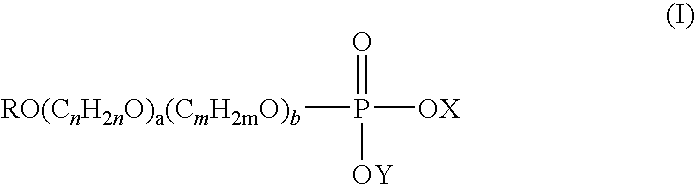
- in the manufacture of an oral care composition for combating dental erosion and/or tooth wear, wherein:
R is a C6-C22 alkyl or alkenyl group,
a and b are individually and separately 0 to 20,
n and m are individually and separately 2 to 4,
X is a counter ion or (CnH2nO)a(CmH2mO)bOR as hereinbefore defined, and
Y is hydrogen or a counter ion. - In the alkyl phosphate of formula (I) the alkyl groups may be branched or linear.
- R is suitably C8-C16 alkyl or alkenyl, typically C10-C14 alkyl or alkenyl, for example R is C12 alkyl.
- Suitably a and b are individually and separately 0 to 10, for example 0 to 5.
- Suitably a and/or b are 0.
- When a is greater than or equal to 1, suitably n is 2. When b is greater than or equal to 1, suitably m is 3.
- Suitably X is a counter ion.
- A counter ion for X or Y is that which forms an orally acceptable salt with an alkyl phosphate. Examples include an alkali metal, an ammonium ion, a protonated alkyl amine, a protonated alkanolamine and a protonated basic amino acid.
- Suitable counter ions for X or Y include an alkali metal such as sodium or potassium or an ammonium ion.
- Alkyl phosphates for use in the invention include sodium dodecyl phosphate (SDP), potassium dodecyl phosphate (PDP), potassium dodecyl ether (1EO) phosphate (PDEP), sodium 2-ethylhexyl phosphate, sodium di-(2-ethylhexyl)phosphate, sodium di-(dodecyl)phosphate, Tryfac 5559 (CH3—(CH2)11-14—O—(CH2CH2O)5—PO3K2) or Crafol AP261 (CH3—(CH2)11-14—O—(CH2CH2O)9—PO3Na2) or a mixture of two or more thereof. Many of these alkyl phosphates are available from Rhodia or Cognis.
- Whilst the compositions for use in the present invention can include a mixture of a monoalkyl phosphate (where X is a counter ion) with a dialkyl phosphate (where X is (CnH2nO)a(CmH2mO)bOR), suitably they contain solely or predominantly a monoalkyl phosphate.
- A suitable alkyl phosphate is sodium dodecyl phosphate.
- Compounds of formula (I), and mixtures thereof, are known from WO 04/075774 and can be prepared by methods disclosed therein.
- Compositions for use in the present invention comprise from 0.01 to 90.0% w/w of alkyl phosphate, suitably from 0.1 to 10.0% w/w, typically from 0.2 to 5.0% w/w, for example from 0.5 to 2.0% w/w.
- Suitably the compositions for use in the present invention do not contain a calcium sequestering agent (eg an aluminosilicate zeolite or a chelating agent selected from pyrophosphoric acid, tripolyphosphoric acid, tetrapolyphosphoric acid, citric acid, phytic acid, or EDTA (ethylenediaminetetraacetic acid) or a sodium salt thereof) in combination with a phenol derivative of the type described in the above-noted Kao Corp patent application.
- Compositions for use in the present invention may further comprise a source of soluble fluoride ions such as those provided by an alkali metal fluoride such as sodium fluoride, an alkali metal monofluorophosphate such a sodium monofluorophosphate, stannous fluoride, or an amine fluoride in an amount to provide from 25 to 3500 pm of fluoride ions, typically from 50 to 3000 ppm, for example from 100 to 1500 ppm. A suitable source of fluoride ions is an alkali metal fluoride such as sodium fluoride. For example the composition may contain 0.1 to 0.5% by weight of sodium fluoride, eg 0.205% by weight (equating to 927 ppm of fluoride ions), 0.2542% by weight (equating to 1150 ppm of fluoride ions) or 0.315% by weight (equating to 1426 ppm of fluoride ions).
- The combination of the alkyl phosphate of formula (I) with a source of fluoride ions provides improved protection against acid demineralisation, dental erosion and/or tooth wear, as evidenced by the data in Examples 1 and 2.
- Fluoride ions enhance remineralisation and decrease demineralisation of dental enamel. Therefore the combination of the alkyl phosphate of formula (I) with a source of fluoride ions is of benefit in combating caries in addition to dental erosion.
- Compositions for use in the present invention will contain appropriate formulating agents such as abrasives, surfactants, thickening agents, humectants, flavouring agents, sweetening agents, opacifying or colouring agents, preservatives and water, selected from those conventionally used in the oral care composition art for such purposes. Examples of such agents are as described in EP 929287.
- Compositions for use in the present invention are typically formulated in the form of toothpastes, sprays, mouthwashes, gels, lozenges, chewing gums, tablets, pastilles, instant powders, oral strips and buccal patches.
- Additional oral care actives may be included in the compositions for use in the present invention.
- In order to treat dentine hypersensitivity the oral compositions for use in the present invention may further comprise a desensitising amount of a desensitising agent. Examples of desensitising agents include tubule blocking agents or nerve desensitising agents and mixtures thereof, for example as described in WO 02/15809. Suitable desensitising agents include a strontium salt such as strontium chloride, strontium acetate or strontium nitrate or a potassium salt such as potassium citrate, potassium chloride, potassium bicarbonate, potassium gluconate and especially potassium nitrate.
- The compositions for use in the present invention may be prepared by admixing the ingredients in the appropriate relative amount in any order that is convenient and which aids solubilisation of the active ingredients and if necessary, adjusting the pH to a desired value. The alkyl phosphate of formula (I) may be solubilised by heating and/or sonication during the manufacture of compositions for use in the present invention.
- The present invention also provides a method of combating dental erosion and/or tooth wear which comprises applying an effective amount of a composition comprising an alkyl phosphate as hereinbefore described to an individual in need thereof. Additionally, such a composition has benefit in combating dentine hypersensitivity.
- The invention is further illustrated by the following Examples.
- The first stage of dental erosion and acid wear involves demineralisation of the hard tissue surface and consequent surface softening. The present study employed a Duramin Microhardness Tester to assess the protective effect of SDP and PDEP against an erosive challenge based on citric acid. A Vickers indentor was employed, and a load of 1.961N applied for 20 seconds.
- Sound human enamel specimens were polished with 2400 grit abrasive and subsequently immersed in an aqueous solution of the specified treatment at pH 7 for 2 minutes under ambient conditions, with agitation. After rinsing with deionised water, the enamel specimens were exposed to an erosive challenge comprising an aqueous solution of 0.30% w/w citric acid monohydrate, pH 3.6. The extent of acid damage was assessed by monitoring the decrease in enamel surface hardness as a function of acid exposure time. The microhardness value for each specimen at a given time point was based on the mean of 6 indents. Each treatment leg employed 3 enamel specimens, which were randomised according to baseline microhardness. A 300 ppm fluoride ion solution (from NaF) was employed as the positive control; deionised water was employed as the negative control. The protective effects of combination treatment solutions i.e. 0.50% alkyl phosphate plus 300 ppm fluoride, were also investigated.
- The results of this study are shown in FIG. 1 and Table 1. These clearly show that all the active treatments conferred statistically significant levels of protection against the erosive challenge compared to the negative control. Moreover, whilst the levels of protection of SDP, PDEP and the fluoride positive control were comparable at 10 and 20 minutes, SDP and PLEP were statistically superior to the fluoride positive control at 30 minutes. The combination treatments were statistically superior to the single-active treatments at all three time points.
-
TABLE 1 300 ppm SDP + PDEP + Fluoride SDP PDEP 300 ppm F 300 ppm F Water Baseline 100 100 100 100 100 100 10 mins 95 ± 1.2 94 ± 1.7 92.5 ± 1.8 98.5 ± 0.8 97 ± 1.8 73 ± 4.0 Acid 20 mins 86 ± 2.3 84 ± 4.0 82.5 ± 2.7 95 ± 2.3 94 ± 2.1 64 ± 2.5 Acid 30 mins 70 ± 1.5 80 ± 2.0 78 ± 2.8 85 ± 2.6 83.5 ± 1.8 52 ± 3.1 Acid ± = Standard Deviation - The microindentation protocol described in Example 1 was used to evaluate a number of alkyl polyoxyethylene phosphates including Tryfac 5559 and Crafol AP261. The actives were tested as aqueous solutions at 0.50% w/w and pH 7. The results of this study are shown in FIG. 2 and Table 2. These show that Tryfac 5559, Crafol AP261 and the fluoride positive control give similar and statistically significant inhibition of surface softening at the 20 and 30 minute time points relative to the water control. Of the two alkyl phosphates, Tryfac 5559 appeared to give somewhat greater protection against the citric acid challenge. When Tryfac 5559 was tested in combination with 300 ppm fluoride, no statistically significant improvements were seen compared to the single active treatments, however the combination treatment was directionally superior at 30 minutes.
-
TABLE 2 300 ppm Tryfac + Fluoride Tryfac 300 ppm F Crafol Water Baseline 100 100 100 100 100 10 mins 90 ± 1.2 84 ± 5.7 80 ± 6.0 82 ± 2.1 78 ± 6.4 Acid 20 mins 81 ± 4.0 80 ± 3.5 82 ± 6.8 75 ± 3.6 63 ± 4.5 Acid 30 mins 74 ± 3.8 74 ± 1.2 79 ± 4.6 69 ± 4.6 60 ± 1.7 Acid ± = Standard Deviation - FDA caries monograph enamel solubility reduction (ESR) model #33 is designed to evaluate in vitro the utility of fluoride toothpastes to protect enamel against a bacterial (lactic) acid challenge. In brief, enamel specimens are placed in a lactic acid challenge (pH 4.5) and the solubility determined by spectrophotometric analysis of released phosphate. Specimens are then placed in the relevant treatment solution derived from the supernatant of a 1:3 slurry of the toothpaste in deionised water. After 5 minutes the specimens are removed, rinsed, and placed in a fresh lactic acid challenge. The enamel solubility is determined once again, and the ESR value calculated as a percentage reduction relative to the baseline solubility.
- The methodology described above was modified in order to evaluate the ability of putative anti-erosion actives to confer protection against a more aggressive dietary acid challenge. In this model variant the lactic acid was replaced with 1.0% w/w citric acid monohydrate pH 3.75. The alkyl phosphates were tested as 0.50% w/w aqueous solutions at pH 7. Fluoride was included as a positive control, and Crest Cavity Protection was also run as an additional control standard. The performance of SDP, PDEP and fluoride is shown in FIG. 3 and Table 3; the data have been normalised with respect to the water negative control.
-
TABLE 3 Enamel Solubility Standard Treatment Reduction (%) Deviation PDEP 17.77 4.67 SDP 36.76 3.27 Water 0.00 4.98 300 ppm Fluoride 36.16 2.02 Crest Regular 23.43 2.81 - All the active treatments conferred statistically significant protection against the citric acid challenge when compared to the water negative control. SDP was not statistically different to the 300 ppm fluoride control, however PDEP was statistically inferior to both SDP and the fluoride control. SDP was directionally superior to fluoride.
- FDA ESR Model #33 was modified by replacing lactic acid with phosphoric acid, a dietary acid most commonly associated with cola drinks. The performance of SDP and fluoride in this phosphoric acid-based ESR model is shown in FIG. 4 and Table 4. Determination of enamel solubility in this study was based on analysis of the released calcium to prevent interference from the acid challenge.
- The only treatments that conferred statistically significant protection against the phosphoric acid challenge when compared to the negative water control were SDP and the 300 ppm fluoride. Treatment with SDP conferred statistically superior acid protection versus the 300 ppm fluoride.
-
TABLE 4 Enamel Solubility Standard Treatment Reduction (%) Deviation Water 0.00 2.56 Crest Regular 1.22 2.53 SDP 16.02 3.07 300 ppm Fluoride 6.29 2.36
Claims (11)
1. The use of an alkyl phosphate of formula (I):
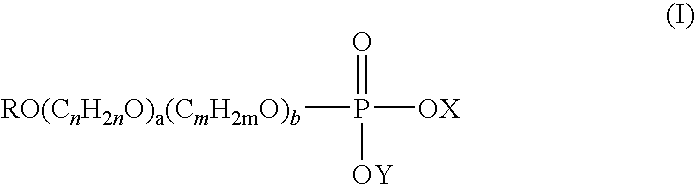
in the manufacture of an oral care composition for combating dental erosion and/or tooth wear, wherein:
R is a C6-C22 alkyl or alkenyl group,
a and b are individually and separately 0 to 20,
n and m are individually and separately 2 to 4,
X is a counter ion or (CnH2nO)a(CmH2mO)bOR as hereinbefore defined, and
Y is hydrogen or a counter ion.
2. The use according to claim 1 wherein R is C10-C14 alkyl or alkenyl.
3. The use according to claim 1 wherein R is C12 alkyl.
4. The use according to claim 1 wherein a and/or b are 0.
5. The use according to claim 1 wherein X is a counter ion.
6. The use according to claim 1 wherein a counter ion is an alkali metal or an ammonium ion.
7. The use according to claim 1 wherein the alkyl phosphate is selected from sodium dodecyl phosphate (SDP), potassium dodecyl phosphate (PDP), potassium dodecyl ether (1EO) phosphate (PDEP), sodium 2-ethylhexyl phosphate, sodium di-(2-ethylhexyl)phosphate, sodium di-(dodecyl)phosphate, Tryfac 5559 (CH3—(CH2)11-14—O—(CH2CH2O)5—PO3K2) and Crafol AP261 (CH3—(CH2)11-14—O—(CH2CH2O)9—PO3Na2) and a mixture of two or more thereof.
8. The use according to claim 1 wherein the alkyl phosphate is sodium dodecyl phosphate.
9. The use according to claim 1 wherein the oral composition further comprises a source of fluoride ions.
10. The use according to claim 1 wherein the oral composition further comprises a desensitising agent.
11. A method for combating dental erosion and/or toothwear which comprises applying an effective amount of an oral care composition as claimed in claim 1 to an individual in need thereof.
Applications Claiming Priority (3)
| Application Number | Priority Date | Filing Date | Title |
|---|---|---|---|
| GBGB0621329.2A GB0621329D0 (en) | 2006-10-26 | 2006-10-26 | Novel composition |
| GB0621329.2 | 2006-10-26 | ||
| PCT/EP2007/061461 WO2008049878A1 (en) | 2006-10-26 | 2007-10-25 | Novel use of alkyl phosphate esters |
Publications (1)
| Publication Number | Publication Date |
|---|---|
| US20100316579A1 true US20100316579A1 (en) | 2010-12-16 |
Family
ID=37546033
Family Applications (1)
| Application Number | Title | Priority Date | Filing Date |
|---|---|---|---|
| US12/446,086 Abandoned US20100316579A1 (en) | 2006-10-26 | 2007-10-25 | Novel use of alkyl phosphate esters |
Country Status (11)
| Country | Link |
|---|---|
| US (1) | US20100316579A1 (en) |
| EP (1) | EP2073784A1 (en) |
| JP (1) | JP2010507622A (en) |
| AR (1) | AR063377A1 (en) |
| AU (1) | AU2007310819A1 (en) |
| BR (1) | BRPI0718501A2 (en) |
| CA (1) | CA2664943A1 (en) |
| GB (1) | GB0621329D0 (en) |
| MX (1) | MX2009004462A (en) |
| TW (1) | TW200835520A (en) |
| WO (1) | WO2008049878A1 (en) |
Cited By (3)
| Publication number | Priority date | Publication date | Assignee | Title |
|---|---|---|---|---|
| US20090169493A1 (en) * | 2003-02-21 | 2009-07-02 | Rhodia, Inc. | Anti-senstivity, anti-caries, anti-staining, anti-plaque, ultra-mild oral hygiene agent |
| US20110089073A1 (en) * | 2009-09-11 | 2011-04-21 | The Procter & Gamble Company | Methods And Compositions For Hydrophobic Modification Of Oral Cavity Surfaces |
| US9839599B2 (en) | 2014-11-13 | 2017-12-12 | Rhodia Operations | Ablative, renewable, multi-functional protective coating for dental surfaces |
Families Citing this family (2)
| Publication number | Priority date | Publication date | Assignee | Title |
|---|---|---|---|---|
| US9139731B2 (en) * | 1999-11-12 | 2015-09-22 | The Procter & Gamble Company | Compositions and methods for improving overall tooth health and appearance |
| EP2467192A2 (en) * | 2009-08-17 | 2012-06-27 | The Procter & Gamble Company | Oral care compositions and methods |
Citations (2)
| Publication number | Priority date | Publication date | Assignee | Title |
|---|---|---|---|---|
| US6254391B1 (en) * | 1997-11-22 | 2001-07-03 | Daniel Henry Darnell | Device for heating the teeth and uses therefor |
| US20040185027A1 (en) * | 2003-02-21 | 2004-09-23 | Reierson Robert Lee | Anti-sensitivity, anti-caries, anti-staining, anti-plaque, ultra-mild oral hygiene agent |
Family Cites Families (2)
| Publication number | Priority date | Publication date | Assignee | Title |
|---|---|---|---|---|
| GB8828018D0 (en) * | 1988-12-01 | 1989-01-05 | Unilever Plc | Topical composition |
| JPH05320032A (en) * | 1992-05-20 | 1993-12-03 | Kao Corp | Oral composition |
-
2006
- 2006-10-26 GB GBGB0621329.2A patent/GB0621329D0/en not_active Ceased
-
2007
- 2007-10-24 AR ARP070104709A patent/AR063377A1/en not_active Application Discontinuation
- 2007-10-24 TW TW096139921A patent/TW200835520A/en unknown
- 2007-10-25 CA CA002664943A patent/CA2664943A1/en not_active Abandoned
- 2007-10-25 WO PCT/EP2007/061461 patent/WO2008049878A1/en not_active Ceased
- 2007-10-25 US US12/446,086 patent/US20100316579A1/en not_active Abandoned
- 2007-10-25 EP EP07821824A patent/EP2073784A1/en not_active Withdrawn
- 2007-10-25 BR BRPI0718501-4A patent/BRPI0718501A2/en not_active Application Discontinuation
- 2007-10-25 JP JP2009533840A patent/JP2010507622A/en active Pending
- 2007-10-25 AU AU2007310819A patent/AU2007310819A1/en not_active Abandoned
- 2007-10-25 MX MX2009004462A patent/MX2009004462A/en not_active Application Discontinuation
Patent Citations (2)
| Publication number | Priority date | Publication date | Assignee | Title |
|---|---|---|---|---|
| US6254391B1 (en) * | 1997-11-22 | 2001-07-03 | Daniel Henry Darnell | Device for heating the teeth and uses therefor |
| US20040185027A1 (en) * | 2003-02-21 | 2004-09-23 | Reierson Robert Lee | Anti-sensitivity, anti-caries, anti-staining, anti-plaque, ultra-mild oral hygiene agent |
Cited By (6)
| Publication number | Priority date | Publication date | Assignee | Title |
|---|---|---|---|---|
| US20090169493A1 (en) * | 2003-02-21 | 2009-07-02 | Rhodia, Inc. | Anti-senstivity, anti-caries, anti-staining, anti-plaque, ultra-mild oral hygiene agent |
| US9034308B2 (en) | 2003-02-21 | 2015-05-19 | Rhodia Operations | Anti-sensitivity, anti-caries, anti-staining, anti-plaque ultra-mild oral hygiene agent |
| US9040025B2 (en) | 2003-02-21 | 2015-05-26 | Rhodia Operations | Anti-senstivity, anti-caries, anti-staining, anti-plaque, ultra-mild oral hygiene agent |
| US20110089073A1 (en) * | 2009-09-11 | 2011-04-21 | The Procter & Gamble Company | Methods And Compositions For Hydrophobic Modification Of Oral Cavity Surfaces |
| US9839599B2 (en) | 2014-11-13 | 2017-12-12 | Rhodia Operations | Ablative, renewable, multi-functional protective coating for dental surfaces |
| US10238595B2 (en) | 2014-11-13 | 2019-03-26 | Rhodia Operations | Ablative, renewable, multi-functional protective coating for dental surfaces |
Also Published As
| Publication number | Publication date |
|---|---|
| AR063377A1 (en) | 2009-01-28 |
| JP2010507622A (en) | 2010-03-11 |
| MX2009004462A (en) | 2009-05-08 |
| TW200835520A (en) | 2008-09-01 |
| AU2007310819A1 (en) | 2008-05-02 |
| WO2008049878A1 (en) | 2008-05-02 |
| GB0621329D0 (en) | 2006-12-06 |
| BRPI0718501A2 (en) | 2013-12-03 |
| CA2664943A1 (en) | 2008-05-02 |
| EP2073784A1 (en) | 2009-07-01 |
Similar Documents
| Publication | Publication Date | Title |
|---|---|---|
| US9034308B2 (en) | Anti-sensitivity, anti-caries, anti-staining, anti-plaque ultra-mild oral hygiene agent | |
| EP3463584A1 (en) | Therapeutic dental pastes and related methods and kits | |
| JP2013136614A (en) | Alkyl sulfate free and orthophosphate free dentifrice composition comprising fluoride source and silica dental abrasive | |
| AU2016346191A1 (en) | Oral care products and methods | |
| US20100316579A1 (en) | Novel use of alkyl phosphate esters | |
| JP6038567B2 (en) | Oral composition | |
| JP7754902B2 (en) | Dentifrice containing a carboxylic acid or an alkali metal salt thereof and a source of free fluoride ions | |
| CN102245157B (en) | Novel use of triple polymer system and a source of fluoride ions in oral care composition | |
| CN101180099B (en) | Alkyl sulfate free and orthophosphate free dentifrice composition comprising a fluoride source and a silica dental abrasive | |
| US20110052507A1 (en) | Oral care compositions comprising casein, ovalbumin, whey or soy protein | |
| WO2007065856A1 (en) | Oral compositions comprising rod-shaped apatite nanocrystals | |
| KR102550067B1 (en) | Oral Composition having policresulen and fluorine compound | |
| HK1113100B (en) | Alkyl sulfate free and orthophosphate free dentifrice composition comprising a fluoride source and a silica dental abrasive |
Legal Events
| Date | Code | Title | Description |
|---|---|---|---|
| AS | Assignment |
Owner name: GLAXO GROUP LIMITED, UNITED KINGDOM Free format text: ASSIGNMENT OF ASSIGNORS INTEREST;ASSIGNORS:FOWLER, CHRISTABEL, MS.;REES, GARETH DAVID, MR;REEL/FRAME:022561/0203 Effective date: 20071126 |
|
| STCB | Information on status: application discontinuation |
Free format text: ABANDONED -- FAILURE TO RESPOND TO AN OFFICE ACTION |