US20100311825A1 - Novel taxoid-based compositions - Google Patents
Novel taxoid-based compositions Download PDFInfo
- Publication number
- US20100311825A1 US20100311825A1 US12/757,255 US75725510A US2010311825A1 US 20100311825 A1 US20100311825 A1 US 20100311825A1 US 75725510 A US75725510 A US 75725510A US 2010311825 A1 US2010311825 A1 US 2010311825A1
- Authority
- US
- United States
- Prior art keywords
- composition according
- acid
- lecithin
- chosen
- phosphatidylglycerol
- Prior art date
- Legal status (The legal status is an assumption and is not a legal conclusion. Google has not performed a legal analysis and makes no representation as to the accuracy of the status listed.)
- Granted
Links
- MDPJZUPBIPEXJV-IUZMSKRISA-N CC(C)=O.[H][C@]12[C@H](OC(=O)C3=CC=CC=C3)[C@]3(O)CC(OC(=O)[C@H](O)[C@@H](NC(C)=O)C4=CC=CC=C4)C(C)=C([C@@H](OC(C)=O)C(=O)[C@@]14C[C@H]4C[C@H]1OC[C@]12OC(C)=O)C3(C)C.[H][C@]12[C@H](OC(=O)C3=CC=CC=C3)[C@]3(O)CC(OC(=O)[C@H](O)[C@@H](NC(C)=O)C4=CC=CC=C4)C(C)=C([C@@H](OC)C(=O)[C@]1(C)[C@@H](OC)C[C@H]1OC[C@]12C)C3(C)C Chemical compound CC(C)=O.[H][C@]12[C@H](OC(=O)C3=CC=CC=C3)[C@]3(O)CC(OC(=O)[C@H](O)[C@@H](NC(C)=O)C4=CC=CC=C4)C(C)=C([C@@H](OC(C)=O)C(=O)[C@@]14C[C@H]4C[C@H]1OC[C@]12OC(C)=O)C3(C)C.[H][C@]12[C@H](OC(=O)C3=CC=CC=C3)[C@]3(O)CC(OC(=O)[C@H](O)[C@@H](NC(C)=O)C4=CC=CC=C4)C(C)=C([C@@H](OC)C(=O)[C@]1(C)[C@@H](OC)C[C@H]1OC[C@]12C)C3(C)C MDPJZUPBIPEXJV-IUZMSKRISA-N 0.000 description 1
- DPUVCMLHXISHRP-NOSCCTPQSA-N CC(C)=O.[H][C@]12[C@H](OC(=O)C3=CC=CC=C3)[C@]3(O)C[C@H](OC(=O)[C@H](O)[C@@H](NC(C)=O)C4=CC=CC=C4)C(C)=C([C@@H](OC)C(=O)[C@]1(C)[C@@H](OC)C[C@H]1OC[C@]12OC(=O)C1=CC=CC=C1)C3(C)C Chemical compound CC(C)=O.[H][C@]12[C@H](OC(=O)C3=CC=CC=C3)[C@]3(O)C[C@H](OC(=O)[C@H](O)[C@@H](NC(C)=O)C4=CC=CC=C4)C(C)=C([C@@H](OC)C(=O)[C@]1(C)[C@@H](OC)C[C@H]1OC[C@]12OC(=O)C1=CC=CC=C1)C3(C)C DPUVCMLHXISHRP-NOSCCTPQSA-N 0.000 description 1
- FZBHJHSOPCAFST-LSXRMJMQSA-N [H][C@]12[C@H](OC(=O)C3=CC=CC=C3)[C@]3(O)CC(OC(=O)[C@H](O)[C@@H](NC(C)=O)C4=CC=CC=C4)C(C)=C([C@@H](OC(C)=O)C(=O)[C@@]14C[C@H]4C[C@H]1OC[C@]12OC(C)=O)C3(C)C Chemical compound [H][C@]12[C@H](OC(=O)C3=CC=CC=C3)[C@]3(O)CC(OC(=O)[C@H](O)[C@@H](NC(C)=O)C4=CC=CC=C4)C(C)=C([C@@H](OC(C)=O)C(=O)[C@@]14C[C@H]4C[C@H]1OC[C@]12OC(C)=O)C3(C)C FZBHJHSOPCAFST-LSXRMJMQSA-N 0.000 description 1
Classifications
-
- A—HUMAN NECESSITIES
- A61—MEDICAL OR VETERINARY SCIENCE; HYGIENE
- A61K—PREPARATIONS FOR MEDICAL, DENTAL OR TOILETRY PURPOSES
- A61K9/00—Medicinal preparations characterised by special physical form
- A61K9/0012—Galenical forms characterised by the site of application
- A61K9/0019—Injectable compositions; Intramuscular, intravenous, arterial, subcutaneous administration; Compositions to be administered through the skin in an invasive manner
-
- A—HUMAN NECESSITIES
- A61—MEDICAL OR VETERINARY SCIENCE; HYGIENE
- A61K—PREPARATIONS FOR MEDICAL, DENTAL OR TOILETRY PURPOSES
- A61K47/00—Medicinal preparations characterised by the non-active ingredients used, e.g. carriers or inert additives; Targeting or modifying agents chemically bound to the active ingredient
- A61K47/06—Organic compounds, e.g. natural or synthetic hydrocarbons, polyolefins, mineral oil, petrolatum or ozokerite
- A61K47/24—Organic compounds, e.g. natural or synthetic hydrocarbons, polyolefins, mineral oil, petrolatum or ozokerite containing atoms other than carbon, hydrogen, oxygen, halogen, nitrogen or sulfur, e.g. cyclomethicone or phospholipids
-
- A—HUMAN NECESSITIES
- A61—MEDICAL OR VETERINARY SCIENCE; HYGIENE
- A61K—PREPARATIONS FOR MEDICAL, DENTAL OR TOILETRY PURPOSES
- A61K47/00—Medicinal preparations characterised by the non-active ingredients used, e.g. carriers or inert additives; Targeting or modifying agents chemically bound to the active ingredient
- A61K47/44—Oils, fats or waxes according to two or more groups of A61K47/02-A61K47/42; Natural or modified natural oils, fats or waxes, e.g. castor oil, polyethoxylated castor oil, montan wax, lignite, shellac, rosin, beeswax or lanolin
-
- A—HUMAN NECESSITIES
- A61—MEDICAL OR VETERINARY SCIENCE; HYGIENE
- A61K—PREPARATIONS FOR MEDICAL, DENTAL OR TOILETRY PURPOSES
- A61K9/00—Medicinal preparations characterised by special physical form
- A61K9/10—Dispersions; Emulsions
- A61K9/107—Emulsions ; Emulsion preconcentrates; Micelles
- A61K9/1075—Microemulsions or submicron emulsions; Preconcentrates or solids thereof; Micelles, e.g. made of phospholipids or block copolymers
-
- A—HUMAN NECESSITIES
- A61—MEDICAL OR VETERINARY SCIENCE; HYGIENE
- A61P—SPECIFIC THERAPEUTIC ACTIVITY OF CHEMICAL COMPOUNDS OR MEDICINAL PREPARATIONS
- A61P33/00—Antiparasitic agents
-
- A—HUMAN NECESSITIES
- A61—MEDICAL OR VETERINARY SCIENCE; HYGIENE
- A61P—SPECIFIC THERAPEUTIC ACTIVITY OF CHEMICAL COMPOUNDS OR MEDICINAL PREPARATIONS
- A61P35/00—Antineoplastic agents
-
- A—HUMAN NECESSITIES
- A61—MEDICAL OR VETERINARY SCIENCE; HYGIENE
- A61K—PREPARATIONS FOR MEDICAL, DENTAL OR TOILETRY PURPOSES
- A61K9/00—Medicinal preparations characterised by special physical form
- A61K9/10—Dispersions; Emulsions
- A61K9/107—Emulsions ; Emulsion preconcentrates; Micelles
Definitions
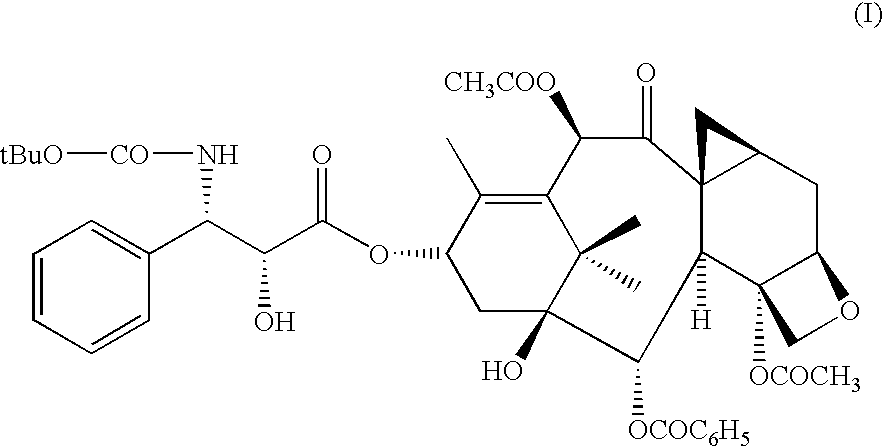
- the present invention relates to a novel pharmaceutical form based on a therapeutic agent that has antitumour and antileukemic activity. It relates more particularly to a novel injectable form containing the derivative of general formula (I) below:
- the compound of formula (I) is better known under the international non-proprietary name larotaxel, it is currently in clinical trials and known by the abbreviation XRP9881.
- the compound of formula (II) is also currently in clinical trials and known by the name XRP6258.
- a first solution known as a “stock solution”
- a solvent mixture composed of:
- a stock solution was prepared that contains the active principle in a mixture of solvents composed of ethanol, which is the best biocompatible solvent for taxane-class active principles, and of a surfactant chosen from the polysorbates sold, in particular, under the names Tween and Montanox, or the esters/ethers of ethylene oxide and of fatty acid glycerides (hydrogenated or non-hydrogenated castor oil) sold, for example, under the name Cremophor or Emulphor.
- the stock solution having a low ethanol content, preferably contains less than 5% ethanol, even more preferably it contains less than 2% ethanol.
- This solution is stable and may thus contain up to 200 mg/ml and preferably up to 80 mg/ml of active principle in the surfactant.
- the paclitaxel stock solution had, according to that invention, a concentration between 6 and 20 mg/ml of active principle in the surfactant.
- the docetaxel stock solution preferably had a concentration between 20 and 80 mg/ml of active principle in the surfactant.
- solutions in the surfactant optionally contain small amounts of ethanol which may be dissolved in the perfusion solute but with extremely vigorous stirring, for example using a vortex-type apparatus.
- Patent EP 0 671 912 has made it possible to solve the problems left by the previous patent and therefore consisted in producing an intermediate solution between the solution of the taxane-class derivatives in the surfactant and an aqueous solution containing an additive that subsequently promotes the dissolution of said intermediate solution in the perfusion solute.
- additives were chosen from the set of additives that were capable of breaking up or preventing the formation of the gelled phase that is formed between the emulsifier containing the taxane-class derivative and the water.
- the perfusions of docetaxel or of paclitaxel were then injected into a person at a flow rate that was predetermined as a function of the amount of active principle that it was desired to inject.
- the emulsion when it is prepared, must be subjected to lyophilisation within a matter of hours or minutes, and when it is reconstituted the lyophilisate must also be used within a matter of hours or minutes.
- Table 2 describes solutions of paclitaxel in oil with lecithin, their stability after 36 days at 60° C. is good for Miglyol and soybean oil. A solution containing water with sesame oil is also described.
- formulations are always being sought that make it possible to administer sufficient doses of taxoid-class agents while avoiding using surfactants of the polyoxyethylenated castor oil or polysorbate type, and in which the taxoid is stable at ambient temperature and is in a liquid form that can be mixed with the perfusion solute without the appearance of physical phenomena that result in phase separation, that is to say either the precipitation or the separation of liquid phases.
- formulations are sought that make it possible to administer the taxoid as a bolus while avoiding perfusions.
- the desired formulation must allow the product to be kept stable at ambient temperature over time and must prevent the degradation of the taxoid, for example via hydrolysis.
- the present invention responds to these objectives and relates to an emulsion, based on a pharmaceutically acceptable oil in water in the presence of lecithin or a semi-synthetic phospholipid, and containing the taxoid.
- soybean oil used alone or of medium-chain (C8-C10) triglycerides such as MiglyolTM or MCTTM used alone, or else preferably it is possible to use a mixture of soybean oil and MCT.
- the weight ratio of the soybean oil to the triglyceride is 1:1.
- the emulsion is formed by the addition of soybean or egg lecithin, preferably egg lecithin such as that sold under the trademark Lipoid E80, or by preferential addition of a phosphatidylcholine, which is a zwitterionic surfactant.
- the emulsion has a better physical stability when the lecithin or the phosphatidylcholine is combined with an anionic phospholipid chosen, in particular, from phosphatidylglycerols or phosphatidic acids.
- phosphatidylglycerols mention may be made of dilauroylphosphatidylglycerol (DLPG), di-myristoyl-phosphatidylglycerol (DMPG) or dipalmitoylphosphatidylglycerol (DPPG).
- DLPG dilauroylphosphatidylglycerol
- DMPG di-myristoyl-phosphatidylglycerol
- DPPG dipalmitoylphosphatidylglycerol
- DLPA dilauroylglycerophosphatidic acid
- DMPA dimyristoylglycerophosphatidic acid
- DPPA dipalmitoylglycerophosphatidic acid
- the weight ratio of, respectively, the lecithin or of the phosphatidylcholine to the phosphatidylglycerol or to the phosphatidic acid is preferably between 500 and 3 and more preferably still between 100 and 10.
- anionic phospholipids dilauroylphosphatidylglycerol is preferred.
- the pH of the formulation may be adjusted between 3 and 7 by addition of acid.
- a buffer is used to keep the pH in this region, possibly in combination with an acid.
- the buffer is preferably histidine. It is preferred to use 5 mM to 50 mM of histidine in the solution.
- the acid is preferably chosen from hydrochloric acid, citric acid or ascorbic acid.
- the isotonicity of the solution may be adjusted by addition of glycerol.
- the weight composition of the formulation is within the following limits:
- oily phase 10 to 30% lecithin or phosphatidylcholine 0.6 to 5% phosphatidylglycerol 0.01 to 0.2% glycerol 0 to 2.5% ethanol 0 to 2% water qs for 100%
- the preparation of the emulsion is preferably carried out using a microfluidization apparatus or a high-pressure homogenizer so as to obtain droplets having a size between 100 nm and 1 ⁇ m and preferably between 100 and 500 nm. Formulations where the average size of the droplets is between 150 and 350 nm are even more particularly preferred.
- the final formulation is inerted, preferably by nitrogen or by an inert gas that does not contain oxygen.
- concentrations of active principle of formula (I) or of formula (II) are less than 10 mg/ml and are especially used at a concentration between 0.5 and 6 mg/ml and preferably around 4 mg/ml.
- the aqueous phase was added to the oily phase and the whole mixture was homogenized in a mill (Ultra-Turrax) before passing into a Microfluidizer (11 cycles at 11 000 psi).
- the size of the droplets obtained was around 250 nm.
- glycerol 2.5 g were added, with stirring, to 75.7 g of a 10 mM aqueous histidine buffer adjusted to pH 6 (HCl) until a homogeneous mixture was obtained.
- the aqueous phase was added to the oily phase and the whole mixture was homogenized in the Ultra-Turrax before passing into a Microfluidizer (11 cycles at 11 000 psi).
- the size of the droplets obtained was around 280 nm.
- the aqueous phase was added to the oily phase and the whole mixture was homogenized in the Ultra-Turrax before passing into a Microfluidizer (11 cycles at 11 000 psi).
- the average size of the droplets obtained was around 140 nm (Dv 50 ).
- glycerol 2.5 g were added, with stirring, to 75.7 g of a 10 mM aqueous histidine buffer adjusted to pH 6 (HCl) until a homogeneous mixture was obtained.
- the aqueous phase was added to the oily phase and the whole mixture was homogenized in the Ultra-Turrax before passing into a Microfluidizer (11 cycles at 11 000 psi).
- the average size of the droplets obtained was around 140 nm (Dv 50 ).
- glycerol 2.5 g were added, with stirring, to 75.7 g of a 10 mM aqueous histidine buffer adjusted to pH 6 (HCl) until a homogeneous mixture was obtained.
- the aqueous phase was added to the oily phase and the whole mixture was homogenized in the Ultra-Turrax before passing into a Microfluidizer (11 cycles at 11 000 psi).
- the average size of the droplets obtained was around 280 nm (Dv 50 ).
- the aqueous phase was added to the oily phase and the whole mixture was homogenized in the Ultra-Turrax before passing into a Microfluidizer (11 cycles at 11 000 psi).
- the average size of the droplets obtained was around 140 nm (Dv 50 ).
- Lipoid E80 and 0.03 g of DPPA were dissolved at 60° C. in a mixture of MCT (10 g) and soybean oil (10 g).
- the aqueous phase was added to the oily phase and the whole mixture was homogenized in the Ultra-Turrax before passing into a Microfluidizer (11 cycles at 11 000 psi).
- the average size of the droplets obtained was around 140 nm (Dv 50 ).
- glycerol 2.5 g were added, with stirring, to 75.7 g of a 10 mM aqueous histidine buffer adjusted to pH 6 (HCl) until a homogeneous mixture was obtained.
- the aqueous phase was added to the oily phase and the whole mixture was homogenized in the Ultra-Turrax before passing into a Microfluidizer (11 cycles at 11 000 psi).
- the average size of the droplets obtained was around 260 nm.
- Lipoid E80 batch 1031471-7/906: supplier: LIPOID KG.
- Lyophilisation The conditions applied are described below. Freezing: shelf temperature ⁇ 45° C.—product temperature ⁇ 39° C.
Landscapes
- Health & Medical Sciences (AREA)
- Chemical & Material Sciences (AREA)
- Life Sciences & Earth Sciences (AREA)
- Veterinary Medicine (AREA)
- Animal Behavior & Ethology (AREA)
- Medicinal Chemistry (AREA)
- Pharmacology & Pharmacy (AREA)
- General Health & Medical Sciences (AREA)
- Public Health (AREA)
- Epidemiology (AREA)
- Oil, Petroleum & Natural Gas (AREA)
- General Chemical & Material Sciences (AREA)
- Chemical Kinetics & Catalysis (AREA)
- Molecular Biology (AREA)
- Biophysics (AREA)
- Organic Chemistry (AREA)
- Dermatology (AREA)
- Engineering & Computer Science (AREA)
- Nuclear Medicine, Radiotherapy & Molecular Imaging (AREA)
- Dispersion Chemistry (AREA)
- Tropical Medicine & Parasitology (AREA)
- Pharmaceuticals Containing Other Organic And Inorganic Compounds (AREA)
- Medicinal Preparation (AREA)
- Epoxy Compounds (AREA)
Abstract
Description
- The present invention relates to a novel pharmaceutical form based on a therapeutic agent that has antitumour and antileukemic activity. It relates more particularly to a novel injectable form containing the derivative of general formula (I) below:
-
- or the derivative of general formula (II) below:
-

- The compound of formula (I) is better known under the international non-proprietary name larotaxel, it is currently in clinical trials and known by the abbreviation XRP9881. The compound of formula (II) is also currently in clinical trials and known by the name XRP6258.
- These products exhibit, in vivo, a substantial activity on malignant tumours that has enabled them to be studied in the treatment of diseases that are resistant to all other anti-cancer therapies.
- Unfortunately, this type of product, especially docetaxel or paclitaxel, has such a low solubility in water that it has been necessary to prepare a formulation for an injectable preparation based on a surfactant and ethanol. Ethanol is the best pharmaceutical solvent that makes it possible to dissolve the molecules corresponding to formula (I) and to formula (II). Such a formulation is, for example, described in Patent EP 0 593 656 or in the following publication.
- By way of example, according to the publication by Rowinsky, Lorraine, Cazenave and Donehower which appeared in the Journal of the National Cancer Institute, Vol. 82, No. 15, pages 1247-1259 on 1 Aug. 1990, concerning Taxol which has a solubility close to the compounds of formula (I) or (II) a first solution, known as a “stock solution”, is prepared that contains approximately 6 mg/ml of taxol in a solvent mixture composed of:
-
- 50 vol % ethanol; and
- 50 vol % polyoxyethylenated castor oil (e.g. Cremophor EL).
- Still according to this publication, in order to obtain such concentrations (between 0.3 and 1 mg/ml), it is necessary to inject solutions containing, at the same time as the active principle, concentrations of each of the following compounds, ethanol and above all Cremophor, of approximately 8 g per 100 of perfusion solution. Since the treatment often requires the administration of high doses of active principle, and since the concentration of the active principle in the solution is relatively low, the injection of a large volume has the effect of causing, in addition to anaphylactic manifestations, manifestations of alcohol poisoning during the treatment.
- It has been discovered, according to European Patent EP 0 593 601, that the use of different pharmaceutical forms made it possible either to greatly reduce the ethanol concentrations, or else to completely remove the Cremophor and the ethanol in perfusion solutes.
- For this, a stock solution was prepared that contains the active principle in a mixture of solvents composed of ethanol, which is the best biocompatible solvent for taxane-class active principles, and of a surfactant chosen from the polysorbates sold, in particular, under the names Tween and Montanox, or the esters/ethers of ethylene oxide and of fatty acid glycerides (hydrogenated or non-hydrogenated castor oil) sold, for example, under the name Cremophor or Emulphor.
- The stock solution, having a low ethanol content, preferably contains less than 5% ethanol, even more preferably it contains less than 2% ethanol. This solution is stable and may thus contain up to 200 mg/ml and preferably up to 80 mg/ml of active principle in the surfactant.
- The paclitaxel stock solution had, according to that invention, a concentration between 6 and 20 mg/ml of active principle in the surfactant. The docetaxel stock solution preferably had a concentration between 20 and 80 mg/ml of active principle in the surfactant.
- These solutions in the surfactant optionally contain small amounts of ethanol which may be dissolved in the perfusion solute but with extremely vigorous stirring, for example using a vortex-type apparatus.
- The invention described in Patent EP 0 671 912 has made it possible to solve the problems left by the previous patent and therefore consisted in producing an intermediate solution between the solution of the taxane-class derivatives in the surfactant and an aqueous solution containing an additive that subsequently promotes the dissolution of said intermediate solution in the perfusion solute.
- These additives were chosen from the set of additives that were capable of breaking up or preventing the formation of the gelled phase that is formed between the emulsifier containing the taxane-class derivative and the water.
- Among the additives that make it possible to break up or prevent the formation of this gelled phase, the following were given as examples:
-
- ethanol;
- glucose;
- glycerol;
- propylene glycol;
- glycine;
- sorbitol;
- mannitol;
- benzyl alcohol; and
- polyethylene glycols.
- The perfusions of docetaxel or of paclitaxel were then injected into a person at a flow rate that was predetermined as a function of the amount of active principle that it was desired to inject.
- With all the formulations of the prior art more or less mild anaphylactic shock phenomena were observed, which had been anticipated by administration, prior to the perfusion, of an antihistamine and/or corticosteroid.
- Among the recent solutions that have made it possible to prevent the appearance of these anaphylactic manifestations, formulations have appeared where the taxoid is encapsulated in an albumin-based envelope. This solution prevents the appearance of anaphylactic shocks and therefore avoids the pre-treatment with antihistamines and/or corticosteroids and allows the administration of stronger doses with reduced side effects relative to the solutions of the prior art. This formulation is, for example, described in U.S. Pat. No. 6,537,579.
- Patent Application US 2003/0099674 claims lyophilised compositions composed of a taxoid dissolved in an oil droplet that is encapsulated by a surfactant. This lyophilised formulation does not collapse and does not degrade during storage. The oil described contains medium-chain triglycerides (Miglyol 812N or MCT) and soybean oil, amongst many other oils. It is written on page 7 [0072] that these lyophilisates suffer fewer losses and less deterioration than liquid emulsions. It is also mentioned [0089] that the emulsion, when it is prepared, must be subjected to lyophilisation within a matter of hours or minutes, and when it is reconstituted the lyophilisate must also be used within a matter of hours or minutes.
- Among the examples, Table 2 describes solutions of paclitaxel in oil with lecithin, their stability after 36 days at 60° C. is good for Miglyol and soybean oil. A solution containing water with sesame oil is also described.
- Among the emulsions obtained by dissolving the lyophilisate, only stabilities carried out at −20° C. over 1 month are described. These stability conditions do not exhibit any advantage compared to the solutions described in the first patents with regard to their stability, our objective being to obtain ready-to-use formulations that are stable over at least one year at ambient temperature.
- To date, formulations are always being sought that make it possible to administer sufficient doses of taxoid-class agents while avoiding using surfactants of the polyoxyethylenated castor oil or polysorbate type, and in which the taxoid is stable at ambient temperature and is in a liquid form that can be mixed with the perfusion solute without the appearance of physical phenomena that result in phase separation, that is to say either the precipitation or the separation of liquid phases. In addition, formulations are sought that make it possible to administer the taxoid as a bolus while avoiding perfusions.
- In addition, the desired formulation must allow the product to be kept stable at ambient temperature over time and must prevent the degradation of the taxoid, for example via hydrolysis.
- The present invention responds to these objectives and relates to an emulsion, based on a pharmaceutically acceptable oil in water in the presence of lecithin or a semi-synthetic phospholipid, and containing the taxoid.
- Among the pharmaceutically acceptable oils, mention may be made of soybean oil used alone or of medium-chain (C8-C10) triglycerides such as Miglyol™ or MCT™ used alone, or else preferably it is possible to use a mixture of soybean oil and MCT. In particular, the weight ratio of the soybean oil to the triglyceride is 1:1.
- The emulsion is formed by the addition of soybean or egg lecithin, preferably egg lecithin such as that sold under the trademark Lipoid E80, or by preferential addition of a phosphatidylcholine, which is a zwitterionic surfactant.
- The emulsion has a better physical stability when the lecithin or the phosphatidylcholine is combined with an anionic phospholipid chosen, in particular, from phosphatidylglycerols or phosphatidic acids.
- Among the phosphatidylglycerols, mention may be made of dilauroylphosphatidylglycerol (DLPG), di-myristoyl-phosphatidylglycerol (DMPG) or dipalmitoylphosphatidylglycerol (DPPG). Among the phosphatidic acids, mention may be made of the sodium salts of dilauroylglycerophosphatidic acid (DLPA), of dimyristoylglycerophosphatidic acid (DMPA) or of dipalmitoylglycerophosphatidic acid (DPPA).
- The weight ratio of, respectively, the lecithin or of the phosphatidylcholine to the phosphatidylglycerol or to the phosphatidic acid is preferably between 500 and 3 and more preferably still between 100 and 10. Among all the anionic phospholipids, dilauroylphosphatidylglycerol is preferred.
- The pH of the formulation may be adjusted between 3 and 7 by addition of acid. Preferably a buffer is used to keep the pH in this region, possibly in combination with an acid. The buffer is preferably histidine. It is preferred to use 5 mM to 50 mM of histidine in the solution. The acid is preferably chosen from hydrochloric acid, citric acid or ascorbic acid.
- The isotonicity of the solution may be adjusted by addition of glycerol.
- It is possible to use 0 to 2% ethanol for ease of preparing the formulation.
- Preferably, the weight composition of the formulation is within the following limits:
-
oily phase 10 to 30% lecithin or phosphatidylcholine 0.6 to 5% phosphatidylglycerol 0.01 to 0.2% glycerol 0 to 2.5% ethanol 0 to 2% water qs for 100% - The preparation of the emulsion is preferably carried out using a microfluidization apparatus or a high-pressure homogenizer so as to obtain droplets having a size between 100 nm and 1 μm and preferably between 100 and 500 nm. Formulations where the average size of the droplets is between 150 and 350 nm are even more particularly preferred. The final formulation is inerted, preferably by nitrogen or by an inert gas that does not contain oxygen.
- The concentrations of active principle of formula (I) or of formula (II) are less than 10 mg/ml and are especially used at a concentration between 0.5 and 6 mg/ml and preferably around 4 mg/ml.
- The invention will be described more fully with the aid of the following examples, which should not be considered as limiting the invention.
- 1 g of DPPC and 0.03 g of DLPG were dissolved at 60° C. in a mixture of MCT (10 g), soybean oil (10 g) and ethanol (0.4 g).
- 0.4 g of the compound of formula (I) was dissolved in lipid solution obtained previously.
- 2.5 g of glycerol were added, with stirring, to 75.7 g of a 10 mM aqueous histidine buffer until a homogeneous mixture was obtained.
- The aqueous phase was added to the oily phase and the whole mixture was homogenized in a mill (Ultra-Turrax) before passing into a Microfluidizer (11 cycles at 11 000 psi). The size of the droplets obtained was around 250 nm.
- 1 g of DPPC and 0.03 g of DLPG were dissolved at 60° C. in a mixture of MCT (10 g), soybean oil (10 g) and ethanol (2 g).
- 0.4 g of the compound of formula (I) was dissolved in lipid solution obtained previously.
- 2.5 g of glycerol were added, with stirring, to 75.7 g of a 10 mM aqueous histidine buffer adjusted to pH 6 (HCl) until a homogeneous mixture was obtained.
- The aqueous phase was added to the oily phase and the whole mixture was homogenized in the Ultra-Turrax before passing into a Microfluidizer (11 cycles at 11 000 psi). The size of the droplets obtained was around 280 nm.
- 1.2 g of Lipoid E80 and 0.03 g of DLPG were dissolved at 60° C. in a mixture of MCT (10 g) and soybean oil (10 g).
- 0.4 g of the compound of formula (I XRP9881) was dissolved in lipid solution obtained previously.
- 2.5 g of glycerol were added, with stirring, to 75.7 g of a 10 mM aqueous histidine buffer until a homogeneous mixture was obtained.
- The aqueous phase was added to the oily phase and the whole mixture was homogenized in the Ultra-Turrax before passing into a Microfluidizer (11 cycles at 11 000 psi). The average size of the droplets obtained was around 140 nm (Dv50).
- Physical stability after 1 month at 60° C.: sizes unchanged (Dv50 and Dv90).
- 1.2 g of Lipoid E80 and 0.03 g of DLPG were dissolved at 60° C. in a mixture of MCT (10 g) and soybean oil (10 g).
- 0.4 g of the compound of formula (I XRP9881) was dissolved in lipid solution obtained previously.
- 2.5 g of glycerol were added, with stirring, to 75.7 g of a 10 mM aqueous histidine buffer adjusted to pH 6 (HCl) until a homogeneous mixture was obtained.
- The aqueous phase was added to the oily phase and the whole mixture was homogenized in the Ultra-Turrax before passing into a Microfluidizer (11 cycles at 11 000 psi). The average size of the droplets obtained was around 140 nm (Dv50).
- Physical stability after 1 month at 60° C.: sizes unchanged (Dv50 and Dv90).
- 1 g of DPPC and 0.03 g of DLPG were dissolved at 60° C. in a mixture of MCT (10 g), soybean oil (10 g) and ethanol (0.4 g).
- 0.4 g of the compound of formula (I XRP9881) was dissolved in lipid solution obtained previously.
- 2.5 g of glycerol were added, with stirring, to 75.7 g of a 10 mM aqueous histidine buffer adjusted to pH 6 (HCl) until a homogeneous mixture was obtained.
- The aqueous phase was added to the oily phase and the whole mixture was homogenized in the Ultra-Turrax before passing into a Microfluidizer (11 cycles at 11 000 psi).
- The average size of the droplets obtained was around 280 nm (Dv50).
- Physical stability after 1 month at 60° C.: sizes unchanged (Dv50 and Dv90).
- 1.2 g of Lipoid E80 and 0.03 g of DMPG were dissolved at 60° C. in a mixture of MCT (10 g) and soybean oil (10 g).
- 0.4 g of the compound of formula (I XRP9881) was dissolved in lipid solution obtained previously.
- 2.5 g of glycerol were added, with stirring, to 75.7 g of WFI water until a homogeneous mixture was obtained.
- The aqueous phase was added to the oily phase and the whole mixture was homogenized in the Ultra-Turrax before passing into a Microfluidizer (11 cycles at 11 000 psi). The average size of the droplets obtained was around 140 nm (Dv50).
- Physical stability after 1 month at 60° C.: sizes unchanged (Dv50 and Dv90).
- 1.2 g Lipoid E80 and 0.03 g of DPPA were dissolved at 60° C. in a mixture of MCT (10 g) and soybean oil (10 g).
- 0.4 g of the compound of formula (I XRP9881) was dissolved in lipid solution obtained previously.
- 2.5 g of glycerol were added, with stirring, to 75.7 g of WFI water until a homogeneous mixture was obtained.
- The aqueous phase was added to the oily phase and the whole mixture was homogenized in the Ultra-Turrax before passing into a Microfluidizer (11 cycles at 11 000 psi). The average size of the droplets obtained was around 140 nm (Dv50).
- Physical stability after 1 month at 60° C.: sizes unchanged (Dv50 and Dv90).
- 1 g of DPPC and 0.03 g of DLPG were dissolved at 60° C. in a mixture of MCT (10 g), soybean oil (10 g) and ethanol (0.4 g).
- 0.4 g of the compound of formula (II XRP6258) was dissolved in lipid solution obtained previously.
- 2.5 g of glycerol were added, with stirring, to 75.7 g of a 10 mM aqueous histidine buffer adjusted to pH 6 (HCl) until a homogeneous mixture was obtained.
- The aqueous phase was added to the oily phase and the whole mixture was homogenized in the Ultra-Turrax before passing into a Microfluidizer (11 cycles at 11 000 psi).
- The average size of the droplets obtained was around 260 nm.
- The following example was carried out in comparison with Patent Application US 2003/0099674 to show that lyophilisation is a technology that cannot be applied to the formulations of the invention because it gives rise to an enlargement of the lipid particles of the invention.
- 1. Materials and Methods
- 1.1. Materials
- Lipoid E80—batch 1031471-7/906: supplier: LIPOID KG.
- Miglyol 812
- Maltose monohydrate.
- Saccharose.
- 1.2. Formula
-
Formula % Unit (g) XRP9881* 0.340 0.002 0.007 Miglyol 812 17.0 0.085 0.340 Lipoid E80 1.0 0.005 0.020 Purified water 66.6 0.333 1.333 Cryoprotectant 15.0 0.075 0.300 Total 100 0.5 2 Lyophilisate height 1 mm 6 mm *pure, solvent-free product - 1.3. Emulsion Preparation Method
- 1) Dissolution of the active principle in the oil.
- 2) Pre-dispersion of the oily phase in water+lecithin using the Ultra-Turrax.
- 3) Homogenization through a microfluidizer at 11 000 psi (11 passes).
- 4) Division of the emulsion into 2 fractions—Addition of 15% maltose or saccharose.
- 5) Spreading qs for a height of 1 mm and 6 mm.
- 6) Lyophilisation: The conditions applied are described below. Freezing: shelf temperature −45° C.—product temperature −39° C.
- Sublimation: shelf temperature −25° C.—pressure 50 microbar.
- Secondary drying at 30° C.
- 2. Results
- 2.1. Before Lyophilisation
- Size before addition of cryoprotectants 250 nm (Coulter N4+, measurement method: quasi-elastic light scattering).
- No change in the size after addition of cryoprotectants (before lyophilisation).
- 2.2. After Lyophilisation
- 2.2.1. Appearance and Reconstitution
-
- Appearance of the lyophilisate: no collapse or shrinkage→correct appearance.
- Reconstitution with WFI water: immediate reconstitution, the emulsion obtained is of homogeneous appearance.
- 2.2.2. Size after Reconstitution
-
- Presence of vesicles having a size between 300 nm and 10 μm (metastable system).
- No visible or measured difference between maltose and saccharose, nor between lyophilisate heights of 1 and 6 mm.
Claims (16)

Applications Claiming Priority (3)
| Application Number | Priority Date | Filing Date | Title |
|---|---|---|---|
| FR0707092 | 2007-10-10 | ||
| FR0707092A FR2922107B1 (en) | 2007-10-10 | 2007-10-10 | NEW TAXOID COMPOSITIONS |
| PCT/FR2008/001410 WO2009083664A1 (en) | 2007-10-10 | 2008-10-09 | Novel taxoid-based compositions |
Related Parent Applications (1)
| Application Number | Title | Priority Date | Filing Date |
|---|---|---|---|
| PCT/FR2008/001410 Continuation WO2009083664A1 (en) | 2007-10-10 | 2008-10-09 | Novel taxoid-based compositions |
Publications (2)
| Publication Number | Publication Date |
|---|---|
| US20100311825A1 true US20100311825A1 (en) | 2010-12-09 |
| US8481589B2 US8481589B2 (en) | 2013-07-09 |
Family
ID=39356621
Family Applications (1)
| Application Number | Title | Priority Date | Filing Date |
|---|---|---|---|
| US12/757,255 Active 2030-02-09 US8481589B2 (en) | 2007-10-10 | 2010-04-09 | Taxoid-based compositions |
Country Status (38)
| Country | Link |
|---|---|
| US (1) | US8481589B2 (en) |
| EP (1) | EP2197492B1 (en) |
| JP (1) | JP5574965B2 (en) |
| KR (1) | KR20100075490A (en) |
| CN (1) | CN101820918A (en) |
| AR (1) | AR072333A1 (en) |
| AT (1) | ATE534406T1 (en) |
| AU (1) | AU2008345527A1 (en) |
| BR (1) | BRPI0818597A2 (en) |
| CA (1) | CA2701789A1 (en) |
| CL (1) | CL2008003002A1 (en) |
| CO (1) | CO6260107A2 (en) |
| CR (1) | CR11335A (en) |
| CY (1) | CY1112388T1 (en) |
| DK (1) | DK2197492T3 (en) |
| DO (1) | DOP2010000098A (en) |
| EA (1) | EA016619B1 (en) |
| ES (1) | ES2377352T3 (en) |
| FR (1) | FR2922107B1 (en) |
| GT (1) | GT201000075A (en) |
| HR (1) | HRP20120165T1 (en) |
| IL (1) | IL204950A0 (en) |
| MA (1) | MA31840B1 (en) |
| MX (1) | MX2010003914A (en) |
| NI (1) | NI201000048A (en) |
| NZ (1) | NZ584544A (en) |
| PA (1) | PA8798101A1 (en) |
| PE (1) | PE20090962A1 (en) |
| PL (1) | PL2197492T3 (en) |
| PT (1) | PT2197492E (en) |
| RS (1) | RS52131B (en) |
| SI (1) | SI2197492T1 (en) |
| TN (1) | TN2010000129A1 (en) |
| TW (1) | TW200922552A (en) |
| UA (1) | UA97418C2 (en) |
| UY (1) | UY31386A1 (en) |
| WO (1) | WO2009083664A1 (en) |
| ZA (1) | ZA201002504B (en) |
Cited By (4)
| Publication number | Priority date | Publication date | Assignee | Title |
|---|---|---|---|---|
| US8927592B2 (en) | 2009-10-29 | 2015-01-06 | Aventis Pharma Sa | Antitumoral use of cabazitaxel |
| US8940786B2 (en) | 2012-10-01 | 2015-01-27 | Teikoku Pharma Usa, Inc. | Non-aqueous taxane nanodispersion formulations and methods of using the same |
| EP2741745A4 (en) * | 2011-08-10 | 2015-01-28 | Scidose Llc | Cabazitaxel formulations and methods of preparing thereof |
| US10842770B2 (en) | 2010-05-03 | 2020-11-24 | Teikoku Pharma Usa, Inc. | Non-aqueous taxane pro-emulsion formulations and methods of making and using the same |
Families Citing this family (3)
| Publication number | Priority date | Publication date | Assignee | Title |
|---|---|---|---|---|
| JP2012051823A (en) * | 2010-08-31 | 2012-03-15 | Fujifilm Corp | Oil-in-water emulsion composition containing poorly-soluble drug, and method for manufacturing the same |
| CN104225615B (en) * | 2014-09-24 | 2017-02-01 | 东南大学 | Taxol phospholipids compound, medicine composition and application thereof |
| EP3384961B1 (en) * | 2017-04-05 | 2021-10-13 | RaySearch Laboratories AB | System and method for modelling of dose calculation in radiotherapy treatment planning |
Citations (10)
| Publication number | Priority date | Publication date | Assignee | Title |
|---|---|---|---|---|
| US5254580A (en) * | 1993-01-19 | 1993-10-19 | Bristol-Myers Squibb Company | 7,8-cyclopropataxanes |
| US5403858A (en) * | 1991-07-08 | 1995-04-04 | Rhone-Poulenc Rorer, S.A. | New compositions containing taxane derivatives |
| US5415869A (en) * | 1993-11-12 | 1995-05-16 | The Research Foundation Of State University Of New York | Taxol formulation |
| US5438072A (en) * | 1992-12-02 | 1995-08-01 | Rhone-Poulenc Rorer S.A. | Taxoid-based compositions |
| US5616330A (en) * | 1994-07-19 | 1997-04-01 | Hemagen/Pfc | Stable oil-in-water emulsions incorporating a taxine (taxol) and method of making same |
| US5750561A (en) * | 1991-07-08 | 1998-05-12 | Rhone-Poulenc Rorer, S.A. | Compositions containing taxane derivatives |
| US20010051736A1 (en) * | 1995-03-27 | 2001-12-13 | Rhone-Poulenc Rorer,S.A. | Methods of treating cell lines expressing multidrug resistance P-glycoprotein |
| US20020001613A1 (en) * | 2000-02-08 | 2002-01-03 | Susan Niemiec | Method of manufacturing liposomes |
| US6537579B1 (en) * | 1993-02-22 | 2003-03-25 | American Bioscience, Inc. | Compositions and methods for administration of pharmacologically active compounds |
| US20030099674A1 (en) * | 2001-08-11 | 2003-05-29 | Chen Andrew X. | Lyophilized injectable formulations containing paclitaxel or other taxoid drugs |
Family Cites Families (7)
| Publication number | Priority date | Publication date | Assignee | Title |
|---|---|---|---|---|
| JP3208517B2 (en) * | 1992-07-01 | 2001-09-17 | ブリストル−マイヤーズ スクイブ カンパニー | 7,8-Cyclopropataxanes |
| HUP0104000A3 (en) * | 1998-08-20 | 2003-01-28 | Aventis Pharma Sa | New use of taxoid derivatives |
| JP2006525345A (en) * | 2003-04-29 | 2006-11-09 | バクスター・インターナショナル・インコーポレイテッド | Formulations that give antibacterial drugs efficacy against organisms normally considered to be drug resistant |
| EP1498120A1 (en) * | 2003-07-18 | 2005-01-19 | Aventis Pharma S.A. | Semi-solid formulations for the oral administration of taxoids |
| EP1498143A1 (en) * | 2003-07-18 | 2005-01-19 | Aventis Pharma S.A. | Self-emulsifying and self-microemulsifying formulations for the oral administration of taxoids |
| US8557861B2 (en) * | 2004-09-28 | 2013-10-15 | Mast Therapeutics, Inc. | Low oil emulsion compositions for delivering taxoids and other insoluble drugs |
| JP5089887B2 (en) * | 2006-01-23 | 2012-12-05 | 日本精化株式会社 | Bioactive substance-containing complex |
-
2007
- 2007-10-10 FR FR0707092A patent/FR2922107B1/en not_active Expired - Fee Related
-
2008
- 2008-09-24 TW TW097136649A patent/TW200922552A/en unknown
- 2008-10-07 PE PE2008001737A patent/PE20090962A1/en not_active Application Discontinuation
- 2008-10-08 AR ARP080104386A patent/AR072333A1/en not_active Application Discontinuation
- 2008-10-08 PA PA20088798101A patent/PA8798101A1/en unknown
- 2008-10-09 RS RS20120058A patent/RS52131B/en unknown
- 2008-10-09 UA UAA201005592A patent/UA97418C2/en unknown
- 2008-10-09 JP JP2010528443A patent/JP5574965B2/en active Active
- 2008-10-09 ES ES08868434T patent/ES2377352T3/en active Active
- 2008-10-09 NZ NZ584544A patent/NZ584544A/en not_active IP Right Cessation
- 2008-10-09 AT AT08868434T patent/ATE534406T1/en active
- 2008-10-09 DK DK08868434.5T patent/DK2197492T3/en active
- 2008-10-09 EA EA201070448A patent/EA016619B1/en not_active IP Right Cessation
- 2008-10-09 CN CN200880110996A patent/CN101820918A/en active Pending
- 2008-10-09 CA CA2701789A patent/CA2701789A1/en not_active Abandoned
- 2008-10-09 PL PL08868434T patent/PL2197492T3/en unknown
- 2008-10-09 AU AU2008345527A patent/AU2008345527A1/en not_active Abandoned
- 2008-10-09 HR HR20120165T patent/HRP20120165T1/en unknown
- 2008-10-09 PT PT08868434T patent/PT2197492E/en unknown
- 2008-10-09 EP EP08868434A patent/EP2197492B1/en active Active
- 2008-10-09 MX MX2010003914A patent/MX2010003914A/en active IP Right Grant
- 2008-10-09 SI SI200830554T patent/SI2197492T1/en unknown
- 2008-10-09 WO PCT/FR2008/001410 patent/WO2009083664A1/en not_active Ceased
- 2008-10-09 BR BRPI0818597 patent/BRPI0818597A2/en not_active IP Right Cessation
- 2008-10-09 KR KR1020107007728A patent/KR20100075490A/en not_active Withdrawn
- 2008-10-09 CL CL2008003002A patent/CL2008003002A1/en unknown
- 2008-10-10 UY UY31386A patent/UY31386A1/en unknown
-
2010
- 2010-03-22 TN TNP2010000129A patent/TN2010000129A1/en unknown
- 2010-03-24 CR CR11335A patent/CR11335A/en not_active Application Discontinuation
- 2010-04-06 GT GT201000075A patent/GT201000075A/en unknown
- 2010-04-08 IL IL204950A patent/IL204950A0/en unknown
- 2010-04-08 DO DO2010000098A patent/DOP2010000098A/en unknown
- 2010-04-08 NI NI201000048A patent/NI201000048A/en unknown
- 2010-04-09 CO CO10041381A patent/CO6260107A2/en not_active Application Discontinuation
- 2010-04-09 US US12/757,255 patent/US8481589B2/en active Active
- 2010-04-09 ZA ZA2010/02504A patent/ZA201002504B/en unknown
- 2010-05-10 MA MA32825A patent/MA31840B1/en unknown
-
2012
- 2012-02-23 CY CY20121100186T patent/CY1112388T1/en unknown
Patent Citations (10)
| Publication number | Priority date | Publication date | Assignee | Title |
|---|---|---|---|---|
| US5403858A (en) * | 1991-07-08 | 1995-04-04 | Rhone-Poulenc Rorer, S.A. | New compositions containing taxane derivatives |
| US5750561A (en) * | 1991-07-08 | 1998-05-12 | Rhone-Poulenc Rorer, S.A. | Compositions containing taxane derivatives |
| US5438072A (en) * | 1992-12-02 | 1995-08-01 | Rhone-Poulenc Rorer S.A. | Taxoid-based compositions |
| US5254580A (en) * | 1993-01-19 | 1993-10-19 | Bristol-Myers Squibb Company | 7,8-cyclopropataxanes |
| US6537579B1 (en) * | 1993-02-22 | 2003-03-25 | American Bioscience, Inc. | Compositions and methods for administration of pharmacologically active compounds |
| US5415869A (en) * | 1993-11-12 | 1995-05-16 | The Research Foundation Of State University Of New York | Taxol formulation |
| US5616330A (en) * | 1994-07-19 | 1997-04-01 | Hemagen/Pfc | Stable oil-in-water emulsions incorporating a taxine (taxol) and method of making same |
| US20010051736A1 (en) * | 1995-03-27 | 2001-12-13 | Rhone-Poulenc Rorer,S.A. | Methods of treating cell lines expressing multidrug resistance P-glycoprotein |
| US20020001613A1 (en) * | 2000-02-08 | 2002-01-03 | Susan Niemiec | Method of manufacturing liposomes |
| US20030099674A1 (en) * | 2001-08-11 | 2003-05-29 | Chen Andrew X. | Lyophilized injectable formulations containing paclitaxel or other taxoid drugs |
Non-Patent Citations (1)
| Title |
|---|
| Strickley, Pharmaceutical Research, 2004, Plenum Publishing Corp., vol. 21, no. 2, pp. 201-230 * |
Cited By (9)
| Publication number | Priority date | Publication date | Assignee | Title |
|---|---|---|---|---|
| US8927592B2 (en) | 2009-10-29 | 2015-01-06 | Aventis Pharma Sa | Antitumoral use of cabazitaxel |
| US10583110B2 (en) | 2009-10-29 | 2020-03-10 | Sanofi Mature Ip | Antitumoral use of cabazitaxel |
| US10716777B2 (en) | 2009-10-29 | 2020-07-21 | Sanofi Mature Ip | Antitumoral use of cabazitaxel |
| US12453712B2 (en) | 2009-10-29 | 2025-10-28 | Sanofi Mature Ip | Antitumoral use of cabazitaxel |
| US10842770B2 (en) | 2010-05-03 | 2020-11-24 | Teikoku Pharma Usa, Inc. | Non-aqueous taxane pro-emulsion formulations and methods of making and using the same |
| EP2741745A4 (en) * | 2011-08-10 | 2015-01-28 | Scidose Llc | Cabazitaxel formulations and methods of preparing thereof |
| US8940786B2 (en) | 2012-10-01 | 2015-01-27 | Teikoku Pharma Usa, Inc. | Non-aqueous taxane nanodispersion formulations and methods of using the same |
| US9308195B2 (en) | 2012-10-01 | 2016-04-12 | Teikoku Pharma Usa, Inc. | Non-aqueous taxane formulations and methods of using the same |
| US9763880B2 (en) | 2012-10-01 | 2017-09-19 | Teikoku Pharma Usa, Inc. | Non-aqueous taxane formulations and methods of using the same |
Also Published As
Similar Documents
| Publication | Publication Date | Title |
|---|---|---|
| ES2199338T3 (en) | PHARMACEUTICAL COMPOSITIONS IN EMULSION, CONTAINING (3'-DESOXI-3'-OXO-MEBMT) 1- (VAL) 2-CYCLOSPORIN. | |
| TWI355946B (en) | Proliposomal and liposomal compositions of poorly | |
| US8481589B2 (en) | Taxoid-based compositions | |
| US20110275705A1 (en) | Stable injectable oil-in-water docetaxel nanoemulsion | |
| CN1859898B (en) | Compositions for delivering highly water soluble drugs | |
| CN101926757A (en) | A liquid composition of poorly soluble drugs and its preparation method | |
| US10278946B2 (en) | Liquid formulation of cabazitaxel | |
| US11260028B2 (en) | Nanosome formulations of aprepitant and methods and applications thereof | |
| US20050186230A1 (en) | Elemene compositions containing liquid oil | |
| KR20210102936A (en) | Stable anesthetic formulations and related dosage forms | |
| CN1895262B (en) | Emulsion for injecting epirubicin and its production | |
| EP4169515B1 (en) | Emulsion, injection agent, and emulsion preparation method | |
| HK1145807A (en) | Novel taxoid-based compositions | |
| US20220288009A1 (en) | Cabazitaxel liquid formulations | |
| US20170128542A1 (en) | Non-aqueous glucagon formulations | |
| HK1154502B (en) | Preparation method of drug loaded emulsion | |
| HK1154502A1 (en) | Preparation method of drug loaded emulsion |
Legal Events
| Date | Code | Title | Description |
|---|---|---|---|
| AS | Assignment |
Owner name: AVENTIS PHARMA S.A., FRANCE Free format text: ASSIGNMENT OF ASSIGNORS INTEREST;ASSIGNORS:RORTAIS, PATRICIA;GACHON, CARINE;SIGNING DATES FROM 20100608 TO 20100802;REEL/FRAME:026006/0191 |
|
| STCF | Information on status: patent grant |
Free format text: PATENTED CASE |
|
| CC | Certificate of correction | ||
| FPAY | Fee payment |
Year of fee payment: 4 |
|
| MAFP | Maintenance fee payment |
Free format text: PAYMENT OF MAINTENANCE FEE, 8TH YEAR, LARGE ENTITY (ORIGINAL EVENT CODE: M1552); ENTITY STATUS OF PATENT OWNER: LARGE ENTITY Year of fee payment: 8 |
|
| MAFP | Maintenance fee payment |
Free format text: PAYMENT OF MAINTENANCE FEE, 12TH YEAR, LARGE ENTITY (ORIGINAL EVENT CODE: M1553); ENTITY STATUS OF PATENT OWNER: LARGE ENTITY Year of fee payment: 12 |