US20100286765A1 - Medical Device Coatings and Coated Stents - Google Patents
Medical Device Coatings and Coated Stents Download PDFInfo
- Publication number
- US20100286765A1 US20100286765A1 US12/436,963 US43696309A US2010286765A1 US 20100286765 A1 US20100286765 A1 US 20100286765A1 US 43696309 A US43696309 A US 43696309A US 2010286765 A1 US2010286765 A1 US 2010286765A1
- Authority
- US
- United States
- Prior art keywords
- stent
- medical device
- coating
- coated stents
- vessel
- Prior art date
- Legal status (The legal status is an assumption and is not a legal conclusion. Google has not performed a legal analysis and makes no representation as to the accuracy of the status listed.)
- Abandoned
Links
- 238000000576 coating method Methods 0.000 title description 12
- YOAHKNVSNCMZGQ-XPWFQUROSA-J P(1),P(4)-bis(5'-adenosyl) tetraphosphate(4-) Chemical compound C1=NC2=C(N)N=CN=C2N1[C@@H]([C@H](O)[C@@H]1O)O[C@@H]1COP([O-])(=O)OP([O-])(=O)OP([O-])(=O)OP([O-])(=O)OC[C@H]([C@@H](O)[C@H]1O)O[C@H]1N1C(N=CN=C2N)=C2N=C1 YOAHKNVSNCMZGQ-XPWFQUROSA-J 0.000 claims abstract description 31
- 230000002792 vascular Effects 0.000 claims abstract description 5
- 239000003814 drug Substances 0.000 description 14
- 239000011248 coating agent Substances 0.000 description 11
- 229920000642 polymer Polymers 0.000 description 10
- 229940079593 drug Drugs 0.000 description 8
- 150000001875 compounds Chemical class 0.000 description 7
- 238000000034 method Methods 0.000 description 7
- 208000037803 restenosis Diseases 0.000 description 7
- 239000003795 chemical substances by application Substances 0.000 description 5
- 230000008569 process Effects 0.000 description 5
- 238000002399 angioplasty Methods 0.000 description 4
- 230000000702 anti-platelet effect Effects 0.000 description 4
- 239000003146 anticoagulant agent Substances 0.000 description 4
- 230000000694 effects Effects 0.000 description 4
- 239000000203 mixture Substances 0.000 description 4
- 208000007536 Thrombosis Diseases 0.000 description 3
- 102100023038 WD and tetratricopeptide repeats protein 1 Human genes 0.000 description 3
- 125000004429 atom Chemical group 0.000 description 3
- 238000003618 dip coating Methods 0.000 description 3
- 229910052751 metal Inorganic materials 0.000 description 3
- 239000002184 metal Substances 0.000 description 3
- 125000004430 oxygen atom Chemical group O* 0.000 description 3
- 238000004528 spin coating Methods 0.000 description 3
- 208000010110 spontaneous platelet aggregation Diseases 0.000 description 3
- 238000005507 spraying Methods 0.000 description 3
- 229940124597 therapeutic agent Drugs 0.000 description 3
- KDCGOANMDULRCW-UHFFFAOYSA-N 7H-purine Chemical compound N1=CNC2=NC=NC2=C1 KDCGOANMDULRCW-UHFFFAOYSA-N 0.000 description 2
- ZKHQWZAMYRWXGA-KQYNXXCUSA-J ATP(4-) Chemical compound C1=NC=2C(N)=NC=NC=2N1[C@@H]1O[C@H](COP([O-])(=O)OP([O-])(=O)OP([O-])([O-])=O)[C@@H](O)[C@H]1O ZKHQWZAMYRWXGA-KQYNXXCUSA-J 0.000 description 2
- ZKHQWZAMYRWXGA-UHFFFAOYSA-N Adenosine triphosphate Natural products C1=NC=2C(N)=NC=NC=2N1C1OC(COP(O)(=O)OP(O)(=O)OP(O)(O)=O)C(O)C1O ZKHQWZAMYRWXGA-UHFFFAOYSA-N 0.000 description 2
- YDHWWBZFRZWVHO-UHFFFAOYSA-H [oxido-[oxido(phosphonatooxy)phosphoryl]oxyphosphoryl] phosphate Chemical compound [O-]P([O-])(=O)OP([O-])(=O)OP([O-])(=O)OP([O-])([O-])=O YDHWWBZFRZWVHO-UHFFFAOYSA-H 0.000 description 2
- 239000013543 active substance Substances 0.000 description 2
- 125000000217 alkyl group Chemical group 0.000 description 2
- 230000015572 biosynthetic process Effects 0.000 description 2
- 210000004027 cell Anatomy 0.000 description 2
- 230000035602 clotting Effects 0.000 description 2
- 239000003102 growth factor Substances 0.000 description 2
- 238000001727 in vivo Methods 0.000 description 2
- 238000012986 modification Methods 0.000 description 2
- 230000004048 modification Effects 0.000 description 2
- 108090000765 processed proteins & peptides Proteins 0.000 description 2
- 230000002441 reversible effect Effects 0.000 description 2
- 239000007921 spray Substances 0.000 description 2
- 239000000126 substance Substances 0.000 description 2
- BQCIDUSAKPWEOX-UHFFFAOYSA-N 1,1-Difluoroethene Chemical compound FC(F)=C BQCIDUSAKPWEOX-UHFFFAOYSA-N 0.000 description 1
- 125000002124 5'-adenosyl group Chemical group N1=CN=C2N(C=NC2=C1N)[C@H]1[C@H](O)[C@H](O)[C@H](O1)C* 0.000 description 1
- 229910001316 Ag alloy Inorganic materials 0.000 description 1
- 229910001020 Au alloy Inorganic materials 0.000 description 1
- 108090000790 Enzymes Proteins 0.000 description 1
- 102000004190 Enzymes Human genes 0.000 description 1
- 229920000219 Ethylene vinyl alcohol Polymers 0.000 description 1
- HTTJABKRGRZYRN-UHFFFAOYSA-N Heparin Chemical compound OC1C(NC(=O)C)C(O)OC(COS(O)(=O)=O)C1OC1C(OS(O)(=O)=O)C(O)C(OC2C(C(OS(O)(=O)=O)C(OC3C(C(O)C(O)C(O3)C(O)=O)OS(O)(=O)=O)C(CO)O2)NS(O)(=O)=O)C(C(O)=O)O1 HTTJABKRGRZYRN-UHFFFAOYSA-N 0.000 description 1
- ZIYKASRTVUABLB-UHFFFAOYSA-J NC1=CC=NC2=C1N=CN2C1OC(COP(=O)([O-])OP(=O)([O-])OP(=O)([O-])OP(=O)([O-])OCC2OC(N3C=NC4=C3N=CN=C4N)C(O)C2O)C(O)C1O Chemical compound NC1=CC=NC2=C1N=CN2C1OC(COP(=O)([O-])OP(=O)([O-])OP(=O)([O-])OP(=O)([O-])OCC2OC(N3C=NC4=C3N=CN=C4N)C(O)C2O)C(O)C1O ZIYKASRTVUABLB-UHFFFAOYSA-J 0.000 description 1
- 102000004861 Phosphoric Diester Hydrolases Human genes 0.000 description 1
- 108090001050 Phosphoric Diester Hydrolases Proteins 0.000 description 1
- 229920003171 Poly (ethylene oxide) Polymers 0.000 description 1
- 229920001244 Poly(D,L-lactide) Polymers 0.000 description 1
- 229920002319 Poly(methyl acrylate) Polymers 0.000 description 1
- 239000004372 Polyvinyl alcohol Substances 0.000 description 1
- CZPWVGJYEJSRLH-UHFFFAOYSA-N Pyrimidine Chemical compound C1=CN=CN=C1 CZPWVGJYEJSRLH-UHFFFAOYSA-N 0.000 description 1
- BQCADISMDOOEFD-UHFFFAOYSA-N Silver Chemical compound [Ag] BQCADISMDOOEFD-UHFFFAOYSA-N 0.000 description 1
- 229910001362 Ta alloys Inorganic materials 0.000 description 1
- 108090000190 Thrombin Proteins 0.000 description 1
- 229910001069 Ti alloy Inorganic materials 0.000 description 1
- RTAQQCXQSZGOHL-UHFFFAOYSA-N Titanium Chemical compound [Ti] RTAQQCXQSZGOHL-UHFFFAOYSA-N 0.000 description 1
- 230000004913 activation Effects 0.000 description 1
- GFFGJBXGBJISGV-UHFFFAOYSA-N adenyl group Chemical group N1=CN=C2N=CNC2=C1N GFFGJBXGBJISGV-UHFFFAOYSA-N 0.000 description 1
- 230000002776 aggregation Effects 0.000 description 1
- 238000004220 aggregation Methods 0.000 description 1
- 239000000556 agonist Substances 0.000 description 1
- 125000003545 alkoxy group Chemical group 0.000 description 1
- 125000003368 amide group Chemical group 0.000 description 1
- 150000001408 amides Chemical class 0.000 description 1
- 150000001413 amino acids Chemical class 0.000 description 1
- 230000001028 anti-proliverative effect Effects 0.000 description 1
- 238000003556 assay Methods 0.000 description 1
- 229920002988 biodegradable polymer Polymers 0.000 description 1
- 239000004621 biodegradable polymer Substances 0.000 description 1
- 125000005621 boronate group Chemical group 0.000 description 1
- 239000006227 byproduct Substances 0.000 description 1
- 238000006243 chemical reaction Methods 0.000 description 1
- 239000007795 chemical reaction product Substances 0.000 description 1
- 230000002860 competitive effect Effects 0.000 description 1
- 239000004035 construction material Substances 0.000 description 1
- 238000000151 deposition Methods 0.000 description 1
- 238000009792 diffusion process Methods 0.000 description 1
- 238000001035 drying Methods 0.000 description 1
- 238000007720 emulsion polymerization reaction Methods 0.000 description 1
- 210000002889 endothelial cell Anatomy 0.000 description 1
- 229940088598 enzyme Drugs 0.000 description 1
- 230000003628 erosive effect Effects 0.000 description 1
- 150000002148 esters Chemical class 0.000 description 1
- BFMKFCLXZSUVPI-UHFFFAOYSA-N ethyl but-3-enoate Chemical compound CCOC(=O)CC=C BFMKFCLXZSUVPI-UHFFFAOYSA-N 0.000 description 1
- 239000004715 ethylene vinyl alcohol Substances 0.000 description 1
- 210000003527 eukaryotic cell Anatomy 0.000 description 1
- 239000004744 fabric Substances 0.000 description 1
- 230000006870 function Effects 0.000 description 1
- PCHJSUWPFVWCPO-UHFFFAOYSA-N gold Chemical compound [Au] PCHJSUWPFVWCPO-UHFFFAOYSA-N 0.000 description 1
- 239000010931 gold Substances 0.000 description 1
- 239000008187 granular material Substances 0.000 description 1
- 125000001475 halogen functional group Chemical group 0.000 description 1
- 230000035876 healing Effects 0.000 description 1
- 229960002897 heparin Drugs 0.000 description 1
- 229920000669 heparin Polymers 0.000 description 1
- RZXDTJIXPSCHCI-UHFFFAOYSA-N hexa-1,5-diene-2,5-diol Chemical compound OC(=C)CCC(O)=C RZXDTJIXPSCHCI-UHFFFAOYSA-N 0.000 description 1
- HCDGVLDPFQMKDK-UHFFFAOYSA-N hexafluoropropylene Chemical group FC(F)=C(F)C(F)(F)F HCDGVLDPFQMKDK-UHFFFAOYSA-N 0.000 description 1
- 229910052739 hydrogen Inorganic materials 0.000 description 1
- 239000001257 hydrogen Substances 0.000 description 1
- 125000004435 hydrogen atom Chemical class [H]* 0.000 description 1
- 230000003301 hydrolyzing effect Effects 0.000 description 1
- 125000002887 hydroxy group Chemical group [H]O* 0.000 description 1
- 238000002513 implantation Methods 0.000 description 1
- 230000028709 inflammatory response Effects 0.000 description 1
- 239000003112 inhibitor Substances 0.000 description 1
- 230000002401 inhibitory effect Effects 0.000 description 1
- 230000000977 initiatory effect Effects 0.000 description 1
- 238000003780 insertion Methods 0.000 description 1
- 230000037431 insertion Effects 0.000 description 1
- 230000002427 irreversible effect Effects 0.000 description 1
- JJTUDXZGHPGLLC-UHFFFAOYSA-N lactide Chemical compound CC1OC(=O)C(C)OC1=O JJTUDXZGHPGLLC-UHFFFAOYSA-N 0.000 description 1
- 239000000463 material Substances 0.000 description 1
- 150000002739 metals Chemical class 0.000 description 1
- 125000002496 methyl group Chemical group [H]C([H])([H])* 0.000 description 1
- 125000000325 methylidene group Chemical group [H]C([H])=* 0.000 description 1
- 229910001000 nickel titanium Inorganic materials 0.000 description 1
- HLXZNVUGXRDIFK-UHFFFAOYSA-N nickel titanium Chemical compound [Ti].[Ti].[Ti].[Ti].[Ti].[Ti].[Ti].[Ti].[Ti].[Ti].[Ti].[Ni].[Ni].[Ni].[Ni].[Ni].[Ni].[Ni].[Ni].[Ni].[Ni].[Ni].[Ni].[Ni].[Ni] HLXZNVUGXRDIFK-UHFFFAOYSA-N 0.000 description 1
- 125000002467 phosphate group Chemical group [H]OP(=O)(O[H])O[*] 0.000 description 1
- 229920000307 polymer substrate Polymers 0.000 description 1
- 229920002451 polyvinyl alcohol Polymers 0.000 description 1
- 239000011148 porous material Substances 0.000 description 1
- 125000002924 primary amino group Chemical group [H]N([H])* 0.000 description 1
- 230000037452 priming Effects 0.000 description 1
- 210000001236 prokaryotic cell Anatomy 0.000 description 1
- 238000001243 protein synthesis Methods 0.000 description 1
- 150000003212 purines Chemical class 0.000 description 1
- 150000003230 pyrimidines Chemical class 0.000 description 1
- 238000011555 rabbit model Methods 0.000 description 1
- ZAHRKKWIAAJSAO-UHFFFAOYSA-N rapamycin Natural products COCC(O)C(=C/C(C)C(=O)CC(OC(=O)C1CCCCN1C(=O)C(=O)C2(O)OC(CC(OC)C(=CC=CC=CC(C)CC(C)C(=O)C)C)CCC2C)C(C)CC3CCC(O)C(C3)OC)C ZAHRKKWIAAJSAO-UHFFFAOYSA-N 0.000 description 1
- 230000002829 reductive effect Effects 0.000 description 1
- 238000007634 remodeling Methods 0.000 description 1
- 230000004044 response Effects 0.000 description 1
- 125000000548 ribosyl group Chemical group C1([C@H](O)[C@H](O)[C@H](O1)CO)* 0.000 description 1
- 229910001285 shape-memory alloy Inorganic materials 0.000 description 1
- 239000004332 silver Substances 0.000 description 1
- QFJCIRLUMZQUOT-HPLJOQBZSA-N sirolimus Chemical compound C1C[C@@H](O)[C@H](OC)C[C@@H]1C[C@@H](C)[C@H]1OC(=O)[C@@H]2CCCCN2C(=O)C(=O)[C@](O)(O2)[C@H](C)CC[C@H]2C[C@H](OC)/C(C)=C/C=C/C=C/[C@@H](C)C[C@@H](C)C(=O)[C@H](OC)[C@H](O)/C(C)=C/[C@@H](C)C(=O)C1 QFJCIRLUMZQUOT-HPLJOQBZSA-N 0.000 description 1
- 229960002930 sirolimus Drugs 0.000 description 1
- 210000000329 smooth muscle myocyte Anatomy 0.000 description 1
- 239000010935 stainless steel Substances 0.000 description 1
- 229910001256 stainless steel alloy Inorganic materials 0.000 description 1
- 229910052717 sulfur Inorganic materials 0.000 description 1
- 125000004434 sulfur atom Chemical group 0.000 description 1
- 238000003786 synthesis reaction Methods 0.000 description 1
- GUVRBAGPIYLISA-UHFFFAOYSA-N tantalum atom Chemical compound [Ta] GUVRBAGPIYLISA-UHFFFAOYSA-N 0.000 description 1
- 238000011287 therapeutic dose Methods 0.000 description 1
- 229960004072 thrombin Drugs 0.000 description 1
- 230000001732 thrombotic effect Effects 0.000 description 1
- 239000010936 titanium Substances 0.000 description 1
- 231100000331 toxic Toxicity 0.000 description 1
- 230000002588 toxic effect Effects 0.000 description 1
- 231100000419 toxicity Toxicity 0.000 description 1
- 230000001988 toxicity Effects 0.000 description 1
- 230000014616 translation Effects 0.000 description 1
- 208000019553 vascular disease Diseases 0.000 description 1
- PAPBSGBWRJIAAV-UHFFFAOYSA-N ε-Caprolactone Chemical compound O=C1CCCCCO1 PAPBSGBWRJIAAV-UHFFFAOYSA-N 0.000 description 1
Classifications
-
- A—HUMAN NECESSITIES
- A61—MEDICAL OR VETERINARY SCIENCE; HYGIENE
- A61F—FILTERS IMPLANTABLE INTO BLOOD VESSELS; PROSTHESES; DEVICES PROVIDING PATENCY TO, OR PREVENTING COLLAPSING OF, TUBULAR STRUCTURES OF THE BODY, e.g. STENTS; ORTHOPAEDIC, NURSING OR CONTRACEPTIVE DEVICES; FOMENTATION; TREATMENT OR PROTECTION OF EYES OR EARS; BANDAGES, DRESSINGS OR ABSORBENT PADS; FIRST-AID KITS
- A61F2/00—Filters implantable into blood vessels; Prostheses, i.e. artificial substitutes or replacements for parts of the body; Appliances for connecting them with the body; Devices providing patency to, or preventing collapsing of, tubular structures of the body, e.g. stents
- A61F2/82—Devices providing patency to, or preventing collapsing of, tubular structures of the body, e.g. stents
-
- A—HUMAN NECESSITIES
- A61—MEDICAL OR VETERINARY SCIENCE; HYGIENE
- A61F—FILTERS IMPLANTABLE INTO BLOOD VESSELS; PROSTHESES; DEVICES PROVIDING PATENCY TO, OR PREVENTING COLLAPSING OF, TUBULAR STRUCTURES OF THE BODY, e.g. STENTS; ORTHOPAEDIC, NURSING OR CONTRACEPTIVE DEVICES; FOMENTATION; TREATMENT OR PROTECTION OF EYES OR EARS; BANDAGES, DRESSINGS OR ABSORBENT PADS; FIRST-AID KITS
- A61F2250/00—Special features of prostheses classified in groups A61F2/00 - A61F2/26 or A61F2/82 or A61F9/00 or A61F11/00 or subgroups thereof
- A61F2250/0058—Additional features; Implant or prostheses properties not otherwise provided for
- A61F2250/0067—Means for introducing or releasing pharmaceutical products into the body
Definitions
- the invention relates to a medical device, e.g., a stent having drugs, agents or compounds affixed thereto to minimize a biological organism's reaction to the introduction of the medical device into the organism.
- a medical device e.g., a stent having drugs, agents or compounds affixed thereto to minimize a biological organism's reaction to the introduction of the medical device into the organism.
- a stent One of the many implantable medical devices used in the treatment of vascular disease is a stent.
- the stent is designed to prevent collapse of a vessel that has been weakened or damaged by angioplasty. Insertion of stents has been shown to prevent harmful remodeling of the vessel while healing of the vessel proceeds over several months after angioplasty.
- Known stent designs include monofilament wire coil stents, welded metal cages and thin-walled metal cylinders with axial slots formed around the circumference.
- Known construction materials for use in stents include polymers, organic fabrics and biocompatible metals, such as stainless steel, silver, gold, tantalum, titanium, and shape memory alloys such as Nitinol.
- Vascular stents are typically introduced percutaneously and transported intraluminally to a desired location within the vessel.
- the stent is then expanded within the vessel either mechanically, such as by the expansion of a balloon within the stent, or self-expanding by releasing stored energy upon actuation within the vessel.
- drugs or agents have been utilized to coat the stent or to otherwise be diffusably released by the stent.
- heparin coating of the stent has been shown to reduce restenosis.
- Other agents having anti-proliferative activity have been used, such as paclitataxel and rapamycin.
- These and other agents have been incorporated into bioabsorbable or biodegradable polymers as a coating on the stent, or have been applied to the surface of the stent through dip, spray, or spin coating processes, or by electrostatic abluminal coating.
- many of the drugs or agents used for this purpose have their own associated toxicities and may therefore be less than optimally suitable.
- a compound used to render a deployed stent less subject to restenosis should be sufficiently active to produce a therapeutic dose for an extended period of time, should not be toxic to the regrowth of endothelial cells within the vessel lumen, and should function to prevent blood clot formation within the stent.
- the compound diadenosine 5′, 5′′′, P 1 , P 4 tetraphosphate (Ap 4 A) was first discovered by Moffatt, Can. J. Chem. 42: 599 (1964) as a minor by-product of the chemical synthesis of adenosine triphosphate (ATP). It was subsequently shown by Zamecnik et al., Biochem. Biophys. Res. Comm. 24: 91-97 (1966) to be present as the back reaction product in amino acid activation, the first step in protein synthesis, and to be a ubiquitous component of eukaryotic and prokaryotic cells. Flodgaard and Klenow, Biochem. J. 208: 737 (1982) discovered that platelets have a high content of Ap 4 A in their dense granules.
- the invention provides medical devices coated with Ap 4 A and/or Ap 4 A analogs, either alone or in combination with other medicaments.
- the medical devices according to the invention are expected to prevent restenosis and thrombus formation associated with some drug coated stents.
- the invention provides medical devices coated with Ap 4 A and/or Ap 4 A analogs, either alone or in combination with other medicaments.
- the medical devices according to the invention are expected to prevent restenosis and thrombus formation associated with some drug coated stents.
- the invention provides a vascular stent that is coated with Ap 4 A and/or Ap 4 A analogs.
- stent is given its conventional meaning within the medical devices art and includes both mechanically expandable and self-expandable stents.
- the term “coated with” means that the stent is associated with Ap 4 A or a Ap 4 A analog in a manner that allows the Ap 4 A or an Ap 4 A analog to locally contact platelets and other cell types that are in contact with, or in the immediate vicinity of the stent.
- Such associations include covalent attachment of the molecule to the stent. Such covalent attachment may be reversible or irreversible. In preferred embodiments, reversible attachment to the stent may be via a chemical linkage that is labile in vivo. Such labile linkages include ester linkages, including phosphoester linkages, as well as amide or peptide linkages.
- US2006/0217801A1 discloses a stent having an engineered abluminal surface that is engineered to have a material comprising a mixture of a polymer and a drug extending from the abluminal surface by depositing microdrops of the mixture onto the abluminal surface of the stent.
- US2006/0229706A1 discloses a stent having a drug-release coating of a thickness of 3-30 microns and composed of 20-80 weight percent polymer substrate and 20-80 weight percent active compound, where the coating is effective to release an amount of the active compound to prevent restenosis at the site of the stent.
- the stent body is metallic and the polymer is selected from polymethylacrylate, ethylene vinyl alcohol, poly-lactide polymers (especially poly-dl-lactide), ⁇ -caprolactone, ethyl vinyl acetate, polyvinyl alcohol and polyethylene oxide.
- US2006/0222756A1 discloses a method for coating a stent with a therapeutic agent comprising the steps of creating a polymer utilizing vinylidene fluoride and hexafluoropropylene in a batch emulsion polymerization process, priming the stent with the polymer utilizing a dip coating process, creating a polymer and therapeutic agent mixture, applying the polymer and therapeutic agent mixture on the primer layer utilizing a spin coating process, and drying the coated stent in a vacuum oven for approximately sixteen hours at a temperature in the range of fifty to sixty degrees centigrade.
- US2006/0216431A1 discloses a method for electrostatically coating the abluminal surfaces of a stent that is crimp-mounted on a balloon catheter comprising threading a wire through a lumen of the stent-balloon assembly and applying a charge to the wire, while the stent is grounded, and applying an electrostatic spray coating to the stent-balloon assembly.
- a charge can be applied to the stent that is opposite to the charge applied to the wire.
- the wire is the guidewire for the catheter which is threaded through the guidewire lumen.
- the delivery of an active agent from the coating to the vascular wall is through diffusion of the active agent through either a bulk polymer or through pores that are created in the polymer structure, or by erosion of a biodegradable coating.
- Ap 4 A refers to diadenosine 5′, 5′′′, P 1 , P 4 tetraphosphate, which has the structural formula (I):
- an “Ap 4 A analog” is a compound having anti-platelet activity similar to or greater than Ap 4 A, and a structural formula derived from (I), wherein one or more atom is replaced by another atom or atoms or one or more chemical bond.
- one or more bridging oxygen atoms in formula (I) may be replaced by a methylene, halomethylene, or dihalomethylene group.
- One or more non-bridging oxygen atom may be replaced by a sulfur atom, by a lower alkyl group (including a methyl group), by an O-lower alkyl group (including an O-methyl group), by an amino or amido group, or by a boronate group.
- One or more phosphate group may be replaced by a peptide linkage.
- One or both hydroxyl moieties on either or both ribosyl groups may be replaced by hydrogen, or by halo or alkoxy groups, or may be in a locked 2′,4′ ring configuration.
- One adenine moiety may be missing or replaced by purine or another purine analog, or by pyrimidine or another pyrimidine analog.
- One adenosyl moiety may be missing.
- Similar to means at least about one tenth the anti-platelet activity of Ap 4 A in a conventional anti-platelet assay, e.g., as taught in Chan et al., Proc. Natl. Acad. Sci. USA 94: 4034-4039 (1997).
- Ap 4 A or an Ap 4 A analog should be present on the stent or in the stent coating in an amount effective to prevent platelet aggregation on a surface of the stent or within the stent.
Landscapes
- Health & Medical Sciences (AREA)
- Engineering & Computer Science (AREA)
- Biomedical Technology (AREA)
- Cardiology (AREA)
- Oral & Maxillofacial Surgery (AREA)
- Transplantation (AREA)
- Heart & Thoracic Surgery (AREA)
- Vascular Medicine (AREA)
- Life Sciences & Earth Sciences (AREA)
- Animal Behavior & Ethology (AREA)
- General Health & Medical Sciences (AREA)
- Public Health (AREA)
- Veterinary Medicine (AREA)
- Materials For Medical Uses (AREA)
Abstract
The invention provides a medical device coated with Ap4A and/or an Ap4A analog. In a preferred embodiment the medical device is a vascular stent.
Description
- 1. Field of the invention
- The invention relates to a medical device, e.g., a stent having drugs, agents or compounds affixed thereto to minimize a biological organism's reaction to the introduction of the medical device into the organism.
- 2. Summary of the Related Art
- One of the many implantable medical devices used in the treatment of vascular disease is a stent. The stent is designed to prevent collapse of a vessel that has been weakened or damaged by angioplasty. Insertion of stents has been shown to prevent harmful remodeling of the vessel while healing of the vessel proceeds over several months after angioplasty.
- Known stent designs include monofilament wire coil stents, welded metal cages and thin-walled metal cylinders with axial slots formed around the circumference. Known construction materials for use in stents include polymers, organic fabrics and biocompatible metals, such as stainless steel, silver, gold, tantalum, titanium, and shape memory alloys such as Nitinol.
- Vascular stents are typically introduced percutaneously and transported intraluminally to a desired location within the vessel. The stent is then expanded within the vessel either mechanically, such as by the expansion of a balloon within the stent, or self-expanding by releasing stored energy upon actuation within the vessel.
- Upon expansion of the stent during angioplasty, smooth muscle cells within the vessel wall become injured, initiating a thrombotic and inflammatory response. Contributing factors in this response include cell derived growth factors such as platelet derived growth factors, thrombin and other factors released by platelets. The resulting restenosis of the vessel is reduced through the permanent implantation of the stent, as apposed to balloon angioplasty alone. Nevertheless, blockage or even collapse of the stent may occur.
- To reduce restenosis of the vessel in which the stent has been deployed, numerous drugs or agents have been utilized to coat the stent or to otherwise be diffusably released by the stent. For example, heparin coating of the stent has been shown to reduce restenosis. Other agents having anti-proliferative activity have been used, such as paclitataxel and rapamycin. These and other agents have been incorporated into bioabsorbable or biodegradable polymers as a coating on the stent, or have been applied to the surface of the stent through dip, spray, or spin coating processes, or by electrostatic abluminal coating. Unfortunately, many of the drugs or agents used for this purpose have their own associated toxicities and may therefore be less than optimally suitable.
- More recently, doctors have found that a small number of patients develop blood clots within some drug coated stents long after they are implanted. Optimally a compound used to render a deployed stent less subject to restenosis should be sufficiently active to produce a therapeutic dose for an extended period of time, should not be toxic to the regrowth of endothelial cells within the vessel lumen, and should function to prevent blood clot formation within the stent.
- The compound diadenosine 5′, 5′″, P1, P4 tetraphosphate (Ap4A) was first discovered by Moffatt, Can. J. Chem. 42: 599 (1964) as a minor by-product of the chemical synthesis of adenosine triphosphate (ATP). It was subsequently shown by Zamecnik et al., Biochem. Biophys. Res. Comm. 24: 91-97 (1966) to be present as the back reaction product in amino acid activation, the first step in protein synthesis, and to be a ubiquitous component of eukaryotic and prokaryotic cells. Flodgaard and Klenow, Biochem. J. 208: 737 (1982) discovered that platelets have a high content of Ap4A in their dense granules.
- Subsequent studies showed some promise for clinical applications for Ap4A. Louie et al., Thromb. Res. 49: 557-565 (1988) showed that Ap4A acts as a competitive inhibitor of ADP-induced platelet aggregation and inhibited clot formation in a rabbit model. However, Ap4A was found to have a short in vivo half life due to phosphodiesterase activity. Consequently, analogs of Ap4A were developed and studied. Zamecnik et al., Proc. Natl. Acad. Sci. USA 89: 2370-2373 (1992) teaches that Ap4A analogs having a halogenated methylene bridge in place of an oxygen atom are superior to Ap4A in inhibiting ADP-induced aggregation of human platelets and are resistant to hydrolytic enzymes. Chan et al., Proc. Natl. Acad. Sci. USA 94: 4034-4039 (1997) discloses additional Ap4A analogs that are effective at preventing platelet aggregation induced by ADP and other agonists.
- The invention provides medical devices coated with Ap4A and/or Ap4A analogs, either alone or in combination with other medicaments. The medical devices according to the invention are expected to prevent restenosis and thrombus formation associated with some drug coated stents.
- The invention provides medical devices coated with Ap4A and/or Ap4A analogs, either alone or in combination with other medicaments. The medical devices according to the invention are expected to prevent restenosis and thrombus formation associated with some drug coated stents.
- The patents and publications cited herein reflect the level of knowledge in the field and are hereby incorporated by reference in their entirety. Any conflict between the teachings of these references and this specification shall be resolved in favor of the latter.
- In a first aspect, the invention provides a vascular stent that is coated with Ap4A and/or Ap4A analogs.
- For purposes of the invention, the term “stent” is given its conventional meaning within the medical devices art and includes both mechanically expandable and self-expandable stents.
- For purposes of the invention, the term “coated with” means that the stent is associated with Ap4A or a Ap4A analog in a manner that allows the Ap4A or an Ap4A analog to locally contact platelets and other cell types that are in contact with, or in the immediate vicinity of the stent. Such associations include covalent attachment of the molecule to the stent. Such covalent attachment may be reversible or irreversible. In preferred embodiments, reversible attachment to the stent may be via a chemical linkage that is labile in vivo. Such labile linkages include ester linkages, including phosphoester linkages, as well as amide or peptide linkages.
- Many means of coating the stent are known in the art, including dip, spray or spin coating processes. For example, US2006/0217801A1 discloses a stent having an engineered abluminal surface that is engineered to have a material comprising a mixture of a polymer and a drug extending from the abluminal surface by depositing microdrops of the mixture onto the abluminal surface of the stent. US2006/0229706A1 discloses a stent having a drug-release coating of a thickness of 3-30 microns and composed of 20-80 weight percent polymer substrate and 20-80 weight percent active compound, where the coating is effective to release an amount of the active compound to prevent restenosis at the site of the stent. In a preferred embodiment, the stent body is metallic and the polymer is selected from polymethylacrylate, ethylene vinyl alcohol, poly-lactide polymers (especially poly-dl-lactide), ε-caprolactone, ethyl vinyl acetate, polyvinyl alcohol and polyethylene oxide. US2006/0222756A1 discloses a method for coating a stent with a therapeutic agent comprising the steps of creating a polymer utilizing vinylidene fluoride and hexafluoropropylene in a batch emulsion polymerization process, priming the stent with the polymer utilizing a dip coating process, creating a polymer and therapeutic agent mixture, applying the polymer and therapeutic agent mixture on the primer layer utilizing a spin coating process, and drying the coated stent in a vacuum oven for approximately sixteen hours at a temperature in the range of fifty to sixty degrees centigrade. US2006/0216431A1 discloses a method for electrostatically coating the abluminal surfaces of a stent that is crimp-mounted on a balloon catheter comprising threading a wire through a lumen of the stent-balloon assembly and applying a charge to the wire, while the stent is grounded, and applying an electrostatic spray coating to the stent-balloon assembly. Alternatively, a charge can be applied to the stent that is opposite to the charge applied to the wire. In a preferred embodiment, the wire is the guidewire for the catheter which is threaded through the guidewire lumen. Generally, the delivery of an active agent from the coating to the vascular wall is through diffusion of the active agent through either a bulk polymer or through pores that are created in the polymer structure, or by erosion of a biodegradable coating.
- For purposes of the invention, Ap4A refers to diadenosine 5′, 5′″, P1, P4 tetraphosphate, which has the structural formula (I):
-
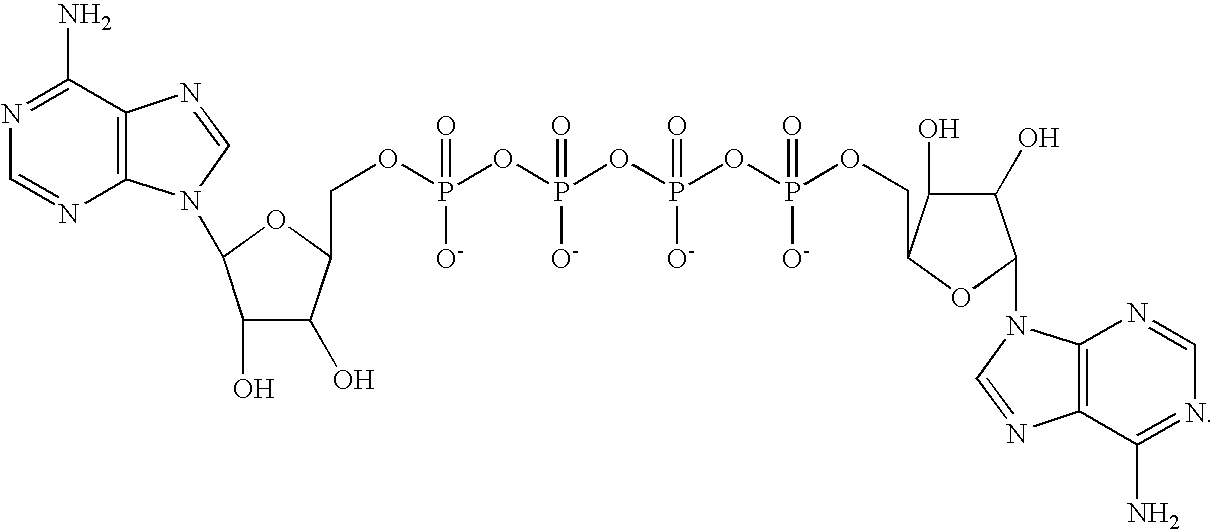
- For purposes of the invention, an “Ap4A analog” is a compound having anti-platelet activity similar to or greater than Ap4A, and a structural formula derived from (I), wherein one or more atom is replaced by another atom or atoms or one or more chemical bond. For example, one or more bridging oxygen atoms in formula (I) may be replaced by a methylene, halomethylene, or dihalomethylene group. One or more non-bridging oxygen atom may be replaced by a sulfur atom, by a lower alkyl group (including a methyl group), by an O-lower alkyl group (including an O-methyl group), by an amino or amido group, or by a boronate group. One or more phosphate group may be replaced by a peptide linkage. One or both hydroxyl moieties on either or both ribosyl groups may be replaced by hydrogen, or by halo or alkoxy groups, or may be in a locked 2′,4′ ring configuration. One adenine moiety may be missing or replaced by purine or another purine analog, or by pyrimidine or another pyrimidine analog. One adenosyl moiety may be missing. These modifications, or any combination of these modifications are within the intended scope of an “Ap4A analog”, as long as the resultant compound exhibits an anti-platelet activity similar to or greater than Ap4A. “Similar to” means at least about one tenth the anti-platelet activity of Ap4A in a conventional anti-platelet assay, e.g., as taught in Chan et al., Proc. Natl. Acad. Sci. USA 94: 4034-4039 (1997).
- Ap4A or an Ap4A analog should be present on the stent or in the stent coating in an amount effective to prevent platelet aggregation on a surface of the stent or within the stent.
- Those skilled in the art will recognize that the present invention can be used alone or in conjunction with other medicaments to coat the stent.
Claims (2)
1. A medical device coated with Ap4A and/or an Ap4A analog.
2. The medical device according to claim 2 which is a vascular stent.
Priority Applications (1)
| Application Number | Priority Date | Filing Date | Title |
|---|---|---|---|
| US12/436,963 US20100286765A1 (en) | 2009-05-07 | 2009-05-07 | Medical Device Coatings and Coated Stents |
Applications Claiming Priority (1)
| Application Number | Priority Date | Filing Date | Title |
|---|---|---|---|
| US12/436,963 US20100286765A1 (en) | 2009-05-07 | 2009-05-07 | Medical Device Coatings and Coated Stents |
Publications (1)
| Publication Number | Publication Date |
|---|---|
| US20100286765A1 true US20100286765A1 (en) | 2010-11-11 |
Family
ID=43062840
Family Applications (1)
| Application Number | Title | Priority Date | Filing Date |
|---|---|---|---|
| US12/436,963 Abandoned US20100286765A1 (en) | 2009-05-07 | 2009-05-07 | Medical Device Coatings and Coated Stents |
Country Status (1)
| Country | Link |
|---|---|
| US (1) | US20100286765A1 (en) |
Citations (8)
| Publication number | Priority date | Publication date | Assignee | Title |
|---|---|---|---|---|
| US5049550A (en) * | 1987-11-05 | 1991-09-17 | Worcester Foundation For Experimental Biology | Diadenosine 5', 5'"-p1, p4,-tetraphosphate analogs as antithrombotic agents |
| US5219841A (en) * | 1989-11-24 | 1993-06-15 | Fujirebio, Inc. | Treatment of arrhythmia by administration of Ap4 A |
| US5527337A (en) * | 1987-06-25 | 1996-06-18 | Duke University | Bioabsorbable stent and method of making the same |
| US20060122143A1 (en) * | 2000-08-21 | 2006-06-08 | Boyer Jose L | Drug-eluting stents coated with P2Y12 receptor antagonist compound |
| US20060217801A1 (en) * | 2005-03-25 | 2006-09-28 | Labcoat, Ltd. | Device with engineered surface architecture coating for controlled drug release |
| US20060216431A1 (en) * | 2005-03-28 | 2006-09-28 | Kerrigan Cameron K | Electrostatic abluminal coating of a stent crimped on a balloon catheter |
| US20060222756A1 (en) * | 2000-09-29 | 2006-10-05 | Cordis Corporation | Medical devices, drug coatings and methods of maintaining the drug coatings thereon |
| US20060229706A1 (en) * | 2001-11-05 | 2006-10-12 | Shulze John E | Drug-Delivery Endovascular Stent and Method for Treating Restenosis |
-
2009
- 2009-05-07 US US12/436,963 patent/US20100286765A1/en not_active Abandoned
Patent Citations (8)
| Publication number | Priority date | Publication date | Assignee | Title |
|---|---|---|---|---|
| US5527337A (en) * | 1987-06-25 | 1996-06-18 | Duke University | Bioabsorbable stent and method of making the same |
| US5049550A (en) * | 1987-11-05 | 1991-09-17 | Worcester Foundation For Experimental Biology | Diadenosine 5', 5'"-p1, p4,-tetraphosphate analogs as antithrombotic agents |
| US5219841A (en) * | 1989-11-24 | 1993-06-15 | Fujirebio, Inc. | Treatment of arrhythmia by administration of Ap4 A |
| US20060122143A1 (en) * | 2000-08-21 | 2006-06-08 | Boyer Jose L | Drug-eluting stents coated with P2Y12 receptor antagonist compound |
| US20060222756A1 (en) * | 2000-09-29 | 2006-10-05 | Cordis Corporation | Medical devices, drug coatings and methods of maintaining the drug coatings thereon |
| US20060229706A1 (en) * | 2001-11-05 | 2006-10-12 | Shulze John E | Drug-Delivery Endovascular Stent and Method for Treating Restenosis |
| US20060217801A1 (en) * | 2005-03-25 | 2006-09-28 | Labcoat, Ltd. | Device with engineered surface architecture coating for controlled drug release |
| US20060216431A1 (en) * | 2005-03-28 | 2006-09-28 | Kerrigan Cameron K | Electrostatic abluminal coating of a stent crimped on a balloon catheter |
Similar Documents
| Publication | Publication Date | Title |
|---|---|---|
| US7682387B2 (en) | Drug-delivery endovascular stent and method for treating restenosis | |
| CN102083397B (en) | Stents having bioabsorbable layers | |
| US8257729B2 (en) | Implants with membrane diffusion-controlled release of active ingredient | |
| US7001421B2 (en) | Stent with phenoxy primer coating | |
| US8518097B2 (en) | Plasticized stent coatings | |
| US20110257732A1 (en) | Stents having controlled elution | |
| US20050202061A1 (en) | Optimized dosing for drug coated stents | |
| US20040024450A1 (en) | Drug-delivery endovascular stent and method for treating restenosis | |
| ES2926865T3 (en) | Drug-eluting stent with a biodegradable release layer attached with an electrografted primer coating | |
| EP1440698A1 (en) | Drug-polymer coated stent with pegylated styrenic block polymers | |
| JP4894519B2 (en) | Indwelling stent | |
| JP2009506869A (en) | Modified polyimine-derived nitric oxide releasing polymer | |
| JP2007512103A (en) | Coating for implantable device comprising bioerodible polyester and method for producing the same | |
| JP2004536799A (en) | Sustained release drug delivery systems containing co-drugs | |
| JP2008279278A (en) | Drug-delivery endovascular stent and method for treating restenosis | |
| JP2009505727A (en) | Nitric oxide releasing biodegradable polymers useful as medical devices and their coatings | |
| WO2004017892A2 (en) | Drug eluting coatings for medical implants | |
| JP2009519110A (en) | Anti-adhesive substances for drug coatings | |
| EP1440699A1 (en) | Stent with epoxy primer coating | |
| US20100092534A1 (en) | Combination Local Delivery Using a Stent | |
| US20100286765A1 (en) | Medical Device Coatings and Coated Stents | |
| WO2008063806A2 (en) | Medical device coatings and coated stents | |
| US20140228968A1 (en) | Biocorrodible implant with anti-corrosion coating | |
| CN121175082A (en) | Multi-coating of stent | |
| WO2006044989A1 (en) | Devices and methods for delivery of pimecrolimus and other therapeutic agents |
Legal Events
| Date | Code | Title | Description |
|---|---|---|---|
| STCB | Information on status: application discontinuation |
Free format text: ABANDONED -- FAILURE TO RESPOND TO AN OFFICE ACTION |