US20100197924A1 - Preparation of aminotetralin compounds - Google Patents
Preparation of aminotetralin compounds Download PDFInfo
- Publication number
- US20100197924A1 US20100197924A1 US12/639,239 US63923909A US2010197924A1 US 20100197924 A1 US20100197924 A1 US 20100197924A1 US 63923909 A US63923909 A US 63923909A US 2010197924 A1 US2010197924 A1 US 2010197924A1
- Authority
- US
- United States
- Prior art keywords
- formula
- compound
- optionally substituted
- aliphatic
- ring
- Prior art date
- Legal status (The legal status is an assumption and is not a legal conclusion. Google has not performed a legal analysis and makes no representation as to the accuracy of the status listed.)
- Abandoned
Links
- 238000002360 preparation method Methods 0.000 title abstract description 45
- JRZGPXSSNPTNMA-UHFFFAOYSA-N 1,2,3,4-tetrahydronaphthalen-1-amine Chemical class C1=CC=C2C(N)CCCC2=C1 JRZGPXSSNPTNMA-UHFFFAOYSA-N 0.000 title abstract description 6
- 238000000034 method Methods 0.000 claims abstract description 80
- 230000008569 process Effects 0.000 claims abstract description 63
- 150000001875 compounds Chemical class 0.000 claims description 145
- 239000011541 reaction mixture Substances 0.000 claims description 62
- 125000001931 aliphatic group Chemical group 0.000 claims description 59
- 125000003118 aryl group Chemical group 0.000 claims description 59
- KDLHZDBZIXYQEI-UHFFFAOYSA-N Palladium Chemical compound [Pd] KDLHZDBZIXYQEI-UHFFFAOYSA-N 0.000 claims description 53
- -1 hydroxyimino Chemical group 0.000 claims description 52
- 238000006243 chemical reaction Methods 0.000 claims description 49
- HEMHJVSKTPXQMS-UHFFFAOYSA-M Sodium hydroxide Chemical compound [OH-].[Na+] HEMHJVSKTPXQMS-UHFFFAOYSA-M 0.000 claims description 48
- 239000000203 mixture Substances 0.000 claims description 42
- ZMXDDKWLCZADIW-UHFFFAOYSA-N N,N-Dimethylformamide Chemical compound CN(C)C=O ZMXDDKWLCZADIW-UHFFFAOYSA-N 0.000 claims description 39
- 125000001072 heteroaryl group Chemical group 0.000 claims description 39
- 229910052757 nitrogen Inorganic materials 0.000 claims description 39
- 125000003277 amino group Chemical group 0.000 claims description 35
- 229910052739 hydrogen Inorganic materials 0.000 claims description 33
- 239000001257 hydrogen Substances 0.000 claims description 33
- 239000002904 solvent Substances 0.000 claims description 33
- 125000000623 heterocyclic group Chemical group 0.000 claims description 31
- 239000003054 catalyst Substances 0.000 claims description 28
- 229910052763 palladium Inorganic materials 0.000 claims description 27
- 125000001424 substituent group Chemical group 0.000 claims description 27
- XYFCBTPGUUZFHI-UHFFFAOYSA-N Phosphine Chemical compound P XYFCBTPGUUZFHI-UHFFFAOYSA-N 0.000 claims description 26
- 125000004178 (C1-C4) alkyl group Chemical group 0.000 claims description 25
- 238000005859 coupling reaction Methods 0.000 claims description 25
- 125000004433 nitrogen atom Chemical group N* 0.000 claims description 25
- 150000002431 hydrogen Chemical group 0.000 claims description 23
- 229910052799 carbon Inorganic materials 0.000 claims description 19
- KWYUFKZDYYNOTN-UHFFFAOYSA-M Potassium hydroxide Chemical compound [OH-].[K+] KWYUFKZDYYNOTN-UHFFFAOYSA-M 0.000 claims description 18
- 229910052801 chlorine Inorganic materials 0.000 claims description 18
- 239000003446 ligand Substances 0.000 claims description 18
- 229910052794 bromium Inorganic materials 0.000 claims description 16
- RYHBNJHYFVUHQT-UHFFFAOYSA-N 1,4-Dioxane Chemical compound C1COCCO1 RYHBNJHYFVUHQT-UHFFFAOYSA-N 0.000 claims description 15
- 125000000217 alkyl group Chemical group 0.000 claims description 15
- 150000001721 carbon Chemical group 0.000 claims description 15
- 125000005842 heteroatom Chemical group 0.000 claims description 15
- 150000003839 salts Chemical class 0.000 claims description 15
- RIOQSEWOXXDEQQ-UHFFFAOYSA-N triphenylphosphine Chemical compound C1=CC=CC=C1P(C=1C=CC=CC=1)C1=CC=CC=C1 RIOQSEWOXXDEQQ-UHFFFAOYSA-N 0.000 claims description 15
- ZMANZCXQSJIPKH-UHFFFAOYSA-N Triethylamine Chemical compound CCN(CC)CC ZMANZCXQSJIPKH-UHFFFAOYSA-N 0.000 claims description 14
- 230000008878 coupling Effects 0.000 claims description 14
- 238000010168 coupling process Methods 0.000 claims description 14
- 229910052731 fluorine Inorganic materials 0.000 claims description 14
- 229910052717 sulfur Inorganic materials 0.000 claims description 14
- 229910000073 phosphorus hydride Inorganic materials 0.000 claims description 13
- WMFOQBRAJBCJND-UHFFFAOYSA-M Lithium hydroxide Chemical compound [Li+].[OH-] WMFOQBRAJBCJND-UHFFFAOYSA-M 0.000 claims description 12
- CDBYLPFSWZWCQE-UHFFFAOYSA-L Sodium Carbonate Chemical compound [Na+].[Na+].[O-]C([O-])=O CDBYLPFSWZWCQE-UHFFFAOYSA-L 0.000 claims description 12
- DKGAVHZHDRPRBM-UHFFFAOYSA-N Tert-Butanol Chemical compound CC(C)(C)O DKGAVHZHDRPRBM-UHFFFAOYSA-N 0.000 claims description 12
- 229910052740 iodine Inorganic materials 0.000 claims description 12
- 229910052760 oxygen Inorganic materials 0.000 claims description 12
- YJVFFLUZDVXJQI-UHFFFAOYSA-L palladium(ii) acetate Chemical compound [Pd+2].CC([O-])=O.CC([O-])=O YJVFFLUZDVXJQI-UHFFFAOYSA-L 0.000 claims description 12
- CXNIUSPIQKWYAI-UHFFFAOYSA-N xantphos Chemical compound C=12OC3=C(P(C=4C=CC=CC=4)C=4C=CC=CC=4)C=CC=C3C(C)(C)C2=CC=CC=1P(C=1C=CC=CC=1)C1=CC=CC=C1 CXNIUSPIQKWYAI-UHFFFAOYSA-N 0.000 claims description 12
- UFHFLCQGNIYNRP-UHFFFAOYSA-N Hydrogen Chemical compound [H][H] UFHFLCQGNIYNRP-UHFFFAOYSA-N 0.000 claims description 11
- 125000002947 alkylene group Chemical group 0.000 claims description 11
- FJDQFPXHSGXQBY-UHFFFAOYSA-L caesium carbonate Chemical compound [Cs+].[Cs+].[O-]C([O-])=O FJDQFPXHSGXQBY-UHFFFAOYSA-L 0.000 claims description 11
- NFHFRUOZVGFOOS-UHFFFAOYSA-N palladium;triphenylphosphane Chemical compound [Pd].C1=CC=CC=C1P(C=1C=CC=CC=1)C1=CC=CC=C1.C1=CC=CC=C1P(C=1C=CC=CC=1)C1=CC=CC=C1.C1=CC=CC=C1P(C=1C=CC=CC=1)C1=CC=CC=C1.C1=CC=CC=C1P(C=1C=CC=CC=1)C1=CC=CC=C1 NFHFRUOZVGFOOS-UHFFFAOYSA-N 0.000 claims description 11
- COIOYMYWGDAQPM-UHFFFAOYSA-N tris(2-methylphenyl)phosphane Chemical compound CC1=CC=CC=C1P(C=1C(=CC=CC=1)C)C1=CC=CC=C1C COIOYMYWGDAQPM-UHFFFAOYSA-N 0.000 claims description 11
- 229910000024 caesium carbonate Inorganic materials 0.000 claims description 10
- 125000002496 methyl group Chemical group [H]C([H])([H])* 0.000 claims description 10
- LXNAVEXFUKBNMK-UHFFFAOYSA-N palladium(II) acetate Substances [Pd].CC(O)=O.CC(O)=O LXNAVEXFUKBNMK-UHFFFAOYSA-N 0.000 claims description 10
- BWHMMNNQKKPAPP-UHFFFAOYSA-L potassium carbonate Chemical compound [K+].[K+].[O-]C([O-])=O BWHMMNNQKKPAPP-UHFFFAOYSA-L 0.000 claims description 10
- 230000002140 halogenating effect Effects 0.000 claims description 9
- 229910052698 phosphorus Inorganic materials 0.000 claims description 9
- 125000000041 C6-C10 aryl group Chemical group 0.000 claims description 8
- SECXISVLQFMRJM-UHFFFAOYSA-N N-Methylpyrrolidone Chemical compound CN1CCCC1=O SECXISVLQFMRJM-UHFFFAOYSA-N 0.000 claims description 8
- 125000005843 halogen group Chemical group 0.000 claims description 8
- 125000005931 tert-butyloxycarbonyl group Chemical group [H]C([H])([H])C(OC(*)=O)(C([H])([H])[H])C([H])([H])[H] 0.000 claims description 8
- UGOMMVLRQDMAQQ-UHFFFAOYSA-N xphos Chemical group CC(C)C1=CC(C(C)C)=CC(C(C)C)=C1C1=CC=CC=C1P(C1CCCCC1)C1CCCCC1 UGOMMVLRQDMAQQ-UHFFFAOYSA-N 0.000 claims description 8
- 150000003512 tertiary amines Chemical class 0.000 claims description 7
- OKTJSMMVPCPJKN-UHFFFAOYSA-N Carbon Chemical compound [C] OKTJSMMVPCPJKN-UHFFFAOYSA-N 0.000 claims description 6
- JGFZNNIVVJXRND-UHFFFAOYSA-N N,N-Diisopropylethylamine (DIPEA) Chemical compound CCN(C(C)C)C(C)C JGFZNNIVVJXRND-UHFFFAOYSA-N 0.000 claims description 6
- PIBWKRNGBLPSSY-UHFFFAOYSA-L palladium(II) chloride Chemical compound Cl[Pd]Cl PIBWKRNGBLPSSY-UHFFFAOYSA-L 0.000 claims description 6
- 229910000029 sodium carbonate Inorganic materials 0.000 claims description 6
- MFRIHAYPQRLWNB-UHFFFAOYSA-N sodium tert-butoxide Chemical compound [Na+].CC(C)(C)[O-] MFRIHAYPQRLWNB-UHFFFAOYSA-N 0.000 claims description 6
- CFOAUYCPAUGDFF-UHFFFAOYSA-N tosmic Chemical compound CC1=CC=C(S(=O)(=O)C[N+]#[C-])C=C1 CFOAUYCPAUGDFF-UHFFFAOYSA-N 0.000 claims description 6
- CYPYTURSJDMMMP-WVCUSYJESA-N (1e,4e)-1,5-diphenylpenta-1,4-dien-3-one;palladium Chemical compound [Pd].[Pd].C=1C=CC=CC=1\C=C\C(=O)\C=C\C1=CC=CC=C1.C=1C=CC=CC=1\C=C\C(=O)\C=C\C1=CC=CC=C1.C=1C=CC=CC=1\C=C\C(=O)\C=C\C1=CC=CC=C1 CYPYTURSJDMMMP-WVCUSYJESA-N 0.000 claims description 5
- 125000006163 5-membered heteroaryl group Chemical group 0.000 claims description 5
- FXHOOIRPVKKKFG-UHFFFAOYSA-N N,N-Dimethylacetamide Chemical compound CN(C)C(C)=O FXHOOIRPVKKKFG-UHFFFAOYSA-N 0.000 claims description 5
- 239000002253 acid Substances 0.000 claims description 5
- 125000001797 benzyl group Chemical group [H]C1=C([H])C([H])=C(C([H])=C1[H])C([H])([H])* 0.000 claims description 5
- 239000003153 chemical reaction reagent Substances 0.000 claims description 5
- NXQGGXCHGDYOHB-UHFFFAOYSA-L cyclopenta-1,4-dien-1-yl(diphenyl)phosphane;dichloropalladium;iron(2+) Chemical compound [Fe+2].Cl[Pd]Cl.[CH-]1C=CC(P(C=2C=CC=CC=2)C=2C=CC=CC=2)=C1.[CH-]1C=CC(P(C=2C=CC=CC=2)C=2C=CC=CC=2)=C1 NXQGGXCHGDYOHB-UHFFFAOYSA-L 0.000 claims description 5
- YNHIGQDRGKUECZ-UHFFFAOYSA-N dichloropalladium;triphenylphosphanium Chemical compound Cl[Pd]Cl.C1=CC=CC=C1[PH+](C=1C=CC=CC=1)C1=CC=CC=C1.C1=CC=CC=C1[PH+](C=1C=CC=CC=1)C1=CC=CC=C1 YNHIGQDRGKUECZ-UHFFFAOYSA-N 0.000 claims description 5
- 125000001495 ethyl group Chemical group [H]C([H])([H])C([H])([H])* 0.000 claims description 5
- 125000006162 fluoroaliphatic group Chemical group 0.000 claims description 5
- 125000001979 organolithium group Chemical group 0.000 claims description 5
- 229910000027 potassium carbonate Inorganic materials 0.000 claims description 5
- 125000006239 protecting group Chemical group 0.000 claims description 5
- 125000006661 (C4-C6) heterocyclic group Chemical group 0.000 claims description 4
- 125000006570 (C5-C6) heteroaryl group Chemical group 0.000 claims description 4
- KZPYGQFFRCFCPP-UHFFFAOYSA-N 1,1'-bis(diphenylphosphino)ferrocene Chemical compound [Fe+2].C1=CC=C[C-]1P(C=1C=CC=CC=1)C1=CC=CC=C1.C1=CC=C[C-]1P(C=1C=CC=CC=1)C1=CC=CC=C1 KZPYGQFFRCFCPP-UHFFFAOYSA-N 0.000 claims description 4
- GQHTUMJGOHRCHB-UHFFFAOYSA-N 2,3,4,6,7,8,9,10-octahydropyrimido[1,2-a]azepine Chemical compound C1CCCCN2CCCN=C21 GQHTUMJGOHRCHB-UHFFFAOYSA-N 0.000 claims description 4
- 125000004008 6 membered carbocyclic group Chemical group 0.000 claims description 4
- 125000004070 6 membered heterocyclic group Chemical group 0.000 claims description 4
- WKBOTKDWSSQWDR-UHFFFAOYSA-N Bromine atom Chemical compound [Br] WKBOTKDWSSQWDR-UHFFFAOYSA-N 0.000 claims description 4
- PCLIMKBDDGJMGD-UHFFFAOYSA-N N-bromosuccinimide Chemical compound BrN1C(=O)CCC1=O PCLIMKBDDGJMGD-UHFFFAOYSA-N 0.000 claims description 4
- PXIPVTKHYLBLMZ-UHFFFAOYSA-N Sodium azide Chemical compound [Na+].[N-]=[N+]=[N-] PXIPVTKHYLBLMZ-UHFFFAOYSA-N 0.000 claims description 4
- UIIMBOGNXHQVGW-DEQYMQKBSA-M Sodium bicarbonate-14C Chemical compound [Na+].O[14C]([O-])=O UIIMBOGNXHQVGW-DEQYMQKBSA-M 0.000 claims description 4
- RYXZOQOZERSHHQ-UHFFFAOYSA-N [2-(2-diphenylphosphanylphenoxy)phenyl]-diphenylphosphane Chemical compound C=1C=CC=C(P(C=2C=CC=CC=2)C=2C=CC=CC=2)C=1OC1=CC=CC=C1P(C=1C=CC=CC=1)C1=CC=CC=C1 RYXZOQOZERSHHQ-UHFFFAOYSA-N 0.000 claims description 4
- 238000009835 boiling Methods 0.000 claims description 4
- GDTBXPJZTBHREO-UHFFFAOYSA-N bromine Substances BrBr GDTBXPJZTBHREO-UHFFFAOYSA-N 0.000 claims description 4
- 125000002883 imidazolyl group Chemical group 0.000 claims description 4
- 238000004519 manufacturing process Methods 0.000 claims description 4
- 125000002734 organomagnesium group Chemical group 0.000 claims description 4
- SCVFZCLFOSHCOH-UHFFFAOYSA-M potassium acetate Chemical compound [K+].CC([O-])=O SCVFZCLFOSHCOH-UHFFFAOYSA-M 0.000 claims description 4
- LPNYRYFBWFDTMA-UHFFFAOYSA-N potassium tert-butoxide Chemical compound [K+].CC(C)(C)[O-] LPNYRYFBWFDTMA-UHFFFAOYSA-N 0.000 claims description 4
- GGCZERPQGJTIQP-UHFFFAOYSA-N sodium;9,10-dioxoanthracene-2-sulfonic acid Chemical compound [Na+].C1=CC=C2C(=O)C3=CC(S(=O)(=O)O)=CC=C3C(=O)C2=C1 GGCZERPQGJTIQP-UHFFFAOYSA-N 0.000 claims description 4
- 125000003831 tetrazolyl group Chemical group 0.000 claims description 4
- DLQYXUGCCKQSRJ-UHFFFAOYSA-N tris(furan-2-yl)phosphane Chemical compound C1=COC(P(C=2OC=CC=2)C=2OC=CC=2)=C1 DLQYXUGCCKQSRJ-UHFFFAOYSA-N 0.000 claims description 4
- ZCYVEMRRCGMTRW-UHFFFAOYSA-N 7553-56-2 Chemical compound [I] ZCYVEMRRCGMTRW-UHFFFAOYSA-N 0.000 claims description 3
- 150000001412 amines Chemical class 0.000 claims description 3
- 239000011630 iodine Substances 0.000 claims description 3
- 125000003854 p-chlorophenyl group Chemical group [H]C1=C([H])C(*)=C([H])C([H])=C1Cl 0.000 claims description 3
- 125000001997 phenyl group Chemical group [H]C1=C([H])C([H])=C(*)C([H])=C1[H] 0.000 claims description 3
- VNFWTIYUKDMAOP-UHFFFAOYSA-N sphos Chemical group COC1=CC=CC(OC)=C1C1=CC=CC=C1P(C1CCCCC1)C1CCCCC1 VNFWTIYUKDMAOP-UHFFFAOYSA-N 0.000 claims description 3
- PAAZPARNPHGIKF-UHFFFAOYSA-N 1,2-dibromoethane Chemical compound BrCCBr PAAZPARNPHGIKF-UHFFFAOYSA-N 0.000 claims description 2
- 101100347605 Arabidopsis thaliana VIII-A gene Proteins 0.000 claims description 2
- 101100347612 Arabidopsis thaliana VIII-B gene Proteins 0.000 claims description 2
- VMHLLURERBWHNL-UHFFFAOYSA-M Sodium acetate Chemical compound [Na+].CC([O-])=O VMHLLURERBWHNL-UHFFFAOYSA-M 0.000 claims description 2
- 125000005620 boronic acid group Chemical group 0.000 claims description 2
- QVQGTNFYPJQJNM-UHFFFAOYSA-N dicyclohexylmethanamine Chemical compound C1CCCCC1C(N)C1CCCCC1 QVQGTNFYPJQJNM-UHFFFAOYSA-N 0.000 claims description 2
- 125000002887 hydroxy group Chemical group [H]O* 0.000 claims description 2
- 125000000842 isoxazolyl group Chemical group 0.000 claims description 2
- RAYLUPYCGGKXQO-UHFFFAOYSA-N n,n-dimethylacetamide;hydrate Chemical compound O.CN(C)C(C)=O RAYLUPYCGGKXQO-UHFFFAOYSA-N 0.000 claims description 2
- WHQSYGRFZMUQGQ-UHFFFAOYSA-N n,n-dimethylformamide;hydrate Chemical compound O.CN(C)C=O WHQSYGRFZMUQGQ-UHFFFAOYSA-N 0.000 claims description 2
- 125000002971 oxazolyl group Chemical group 0.000 claims description 2
- 239000002798 polar solvent Substances 0.000 claims description 2
- 235000011056 potassium acetate Nutrition 0.000 claims description 2
- 125000003226 pyrazolyl group Chemical group 0.000 claims description 2
- 239000001632 sodium acetate Substances 0.000 claims description 2
- 235000017281 sodium acetate Nutrition 0.000 claims description 2
- 125000001425 triazolyl group Chemical group 0.000 claims description 2
- BWHDROKFUHTORW-UHFFFAOYSA-N tritert-butylphosphane Chemical compound CC(C)(C)P(C(C)(C)C)C(C)(C)C BWHDROKFUHTORW-UHFFFAOYSA-N 0.000 claims description 2
- 229910052725 zinc Inorganic materials 0.000 claims description 2
- 239000011701 zinc Substances 0.000 claims description 2
- 239000000543 intermediate Substances 0.000 abstract description 11
- 230000002401 inhibitory effect Effects 0.000 abstract description 5
- 108091000080 Phosphotransferase Proteins 0.000 abstract description 3
- 102000020233 phosphotransferase Human genes 0.000 abstract description 3
- XEKOWRVHYACXOJ-UHFFFAOYSA-N Ethyl acetate Chemical compound CCOC(C)=O XEKOWRVHYACXOJ-UHFFFAOYSA-N 0.000 description 97
- YMWUJEATGCHHMB-UHFFFAOYSA-N Dichloromethane Chemical compound ClCCl YMWUJEATGCHHMB-UHFFFAOYSA-N 0.000 description 81
- 239000000243 solution Substances 0.000 description 77
- BDAGIHXWWSANSR-UHFFFAOYSA-N methanoic acid Natural products OC=O BDAGIHXWWSANSR-UHFFFAOYSA-N 0.000 description 74
- OKKJLVBELUTLKV-UHFFFAOYSA-N Methanol Chemical compound OC OKKJLVBELUTLKV-UHFFFAOYSA-N 0.000 description 72
- IAZDPXIOMUYVGZ-UHFFFAOYSA-N Dimethylsulphoxide Chemical compound CS(C)=O IAZDPXIOMUYVGZ-UHFFFAOYSA-N 0.000 description 59
- VLKZOEOYAKHREP-UHFFFAOYSA-N n-Hexane Chemical compound CCCCCC VLKZOEOYAKHREP-UHFFFAOYSA-N 0.000 description 59
- 238000004895 liquid chromatography mass spectrometry Methods 0.000 description 52
- VYPSYNLAJGMNEJ-UHFFFAOYSA-N Silicium dioxide Chemical compound O=[Si]=O VYPSYNLAJGMNEJ-UHFFFAOYSA-N 0.000 description 51
- 235000019439 ethyl acetate Nutrition 0.000 description 42
- XLYOFNOQVPJJNP-UHFFFAOYSA-N water Substances O XLYOFNOQVPJJNP-UHFFFAOYSA-N 0.000 description 42
- 239000007787 solid Substances 0.000 description 40
- OSWFIVFLDKOXQC-UHFFFAOYSA-N 4-(3-methoxyphenyl)aniline Chemical compound COC1=CC=CC(C=2C=CC(N)=CC=2)=C1 OSWFIVFLDKOXQC-UHFFFAOYSA-N 0.000 description 37
- 235000019253 formic acid Nutrition 0.000 description 37
- WYURNTSHIVDZCO-UHFFFAOYSA-N Tetrahydrofuran Chemical compound C1CCOC1 WYURNTSHIVDZCO-UHFFFAOYSA-N 0.000 description 36
- 238000005160 1H NMR spectroscopy Methods 0.000 description 28
- IJGRMHOSHXDMSA-UHFFFAOYSA-N Atomic nitrogen Chemical compound N#N IJGRMHOSHXDMSA-UHFFFAOYSA-N 0.000 description 27
- 239000000377 silicon dioxide Substances 0.000 description 23
- RTZKZFJDLAIYFH-UHFFFAOYSA-N Diethyl ether Chemical compound CCOCC RTZKZFJDLAIYFH-UHFFFAOYSA-N 0.000 description 21
- VEXZGXHMUGYJMC-UHFFFAOYSA-N Hydrochloric acid Chemical compound Cl VEXZGXHMUGYJMC-UHFFFAOYSA-N 0.000 description 21
- YLQBMQCUIZJEEH-UHFFFAOYSA-N tetrahydrofuran Natural products C=1C=COC=1 YLQBMQCUIZJEEH-UHFFFAOYSA-N 0.000 description 20
- 238000010828 elution Methods 0.000 description 19
- 239000012074 organic phase Substances 0.000 description 19
- YXFVVABEGXRONW-UHFFFAOYSA-N Toluene Chemical compound CC1=CC=CC=C1 YXFVVABEGXRONW-UHFFFAOYSA-N 0.000 description 18
- 239000012267 brine Substances 0.000 description 18
- HPALAKNZSZLMCH-UHFFFAOYSA-M sodium;chloride;hydrate Chemical compound O.[Na+].[Cl-] HPALAKNZSZLMCH-UHFFFAOYSA-M 0.000 description 18
- LFQSCWFLJHTTHZ-UHFFFAOYSA-N Ethanol Chemical compound CCO LFQSCWFLJHTTHZ-UHFFFAOYSA-N 0.000 description 17
- 239000002585 base Substances 0.000 description 17
- 150000003840 hydrochlorides Chemical class 0.000 description 16
- QTBSBXVTEAMEQO-UHFFFAOYSA-N Acetic acid Chemical compound CC(O)=O QTBSBXVTEAMEQO-UHFFFAOYSA-N 0.000 description 15
- 239000008346 aqueous phase Substances 0.000 description 15
- WEVYAHXRMPXWCK-UHFFFAOYSA-N Acetonitrile Chemical compound CC#N WEVYAHXRMPXWCK-UHFFFAOYSA-N 0.000 description 13
- 239000003921 oil Substances 0.000 description 13
- 239000000047 product Substances 0.000 description 13
- HEDRZPFGACZZDS-MICDWDOJSA-N Trichloro(2H)methane Chemical compound [2H]C(Cl)(Cl)Cl HEDRZPFGACZZDS-MICDWDOJSA-N 0.000 description 12
- 229910052681 coesite Inorganic materials 0.000 description 12
- 229910052906 cristobalite Inorganic materials 0.000 description 12
- 229910052682 stishovite Inorganic materials 0.000 description 12
- 229910052905 tridymite Inorganic materials 0.000 description 12
- QTBSBXVTEAMEQO-UHFFFAOYSA-M Acetate Chemical compound CC([O-])=O QTBSBXVTEAMEQO-UHFFFAOYSA-M 0.000 description 11
- KFZMGEQAYNKOFK-UHFFFAOYSA-N Isopropanol Chemical compound CC(C)O KFZMGEQAYNKOFK-UHFFFAOYSA-N 0.000 description 11
- 238000004440 column chromatography Methods 0.000 description 11
- 238000001914 filtration Methods 0.000 description 11
- 125000006413 ring segment Chemical group 0.000 description 11
- KXDAEFPNCMNJSK-UHFFFAOYSA-N Benzamide Chemical compound NC(=O)C1=CC=CC=C1 KXDAEFPNCMNJSK-UHFFFAOYSA-N 0.000 description 10
- 239000002244 precipitate Substances 0.000 description 10
- 150000003254 radicals Chemical class 0.000 description 10
- 239000007858 starting material Substances 0.000 description 10
- XKRFYHLGVUSROY-UHFFFAOYSA-N Argon Chemical compound [Ar] XKRFYHLGVUSROY-UHFFFAOYSA-N 0.000 description 8
- 239000000706 filtrate Substances 0.000 description 8
- 125000000524 functional group Chemical group 0.000 description 8
- 230000002829 reductive effect Effects 0.000 description 8
- MZRVEZGGRBJDDB-UHFFFAOYSA-N N-Butyllithium Chemical compound [Li]CCCC MZRVEZGGRBJDDB-UHFFFAOYSA-N 0.000 description 7
- 238000000746 purification Methods 0.000 description 7
- QGZKDVFQNNGYKY-UHFFFAOYSA-N Ammonia Chemical compound N QGZKDVFQNNGYKY-UHFFFAOYSA-N 0.000 description 6
- UMVOQQDNEYOJOK-UHFFFAOYSA-N CC1=CC(C)=CC(C(=O)O)=C1 Chemical compound CC1=CC(C)=CC(C(=O)O)=C1 UMVOQQDNEYOJOK-UHFFFAOYSA-N 0.000 description 6
- MPNOWCCCZSJTBJ-UHFFFAOYSA-N CC1=CC=NC2=C1CCC(=O)N2 Chemical compound CC1=CC=NC2=C1CCC(=O)N2 MPNOWCCCZSJTBJ-UHFFFAOYSA-N 0.000 description 6
- OKKJLVBELUTLKV-MZCSYVLQSA-N Deuterated methanol Chemical compound [2H]OC([2H])([2H])[2H] OKKJLVBELUTLKV-MZCSYVLQSA-N 0.000 description 6
- 101100342473 Drosophila melanogaster Raf gene Proteins 0.000 description 6
- CSNNHWWHGAXBCP-UHFFFAOYSA-L Magnesium sulfate Chemical compound [Mg+2].[O-][S+2]([O-])([O-])[O-] CSNNHWWHGAXBCP-UHFFFAOYSA-L 0.000 description 6
- 206010028980 Neoplasm Diseases 0.000 description 6
- JUJWROOIHBZHMG-UHFFFAOYSA-N Pyridine Chemical compound C1=CC=NC=C1 JUJWROOIHBZHMG-UHFFFAOYSA-N 0.000 description 6
- 101100523543 Rattus norvegicus Raf1 gene Proteins 0.000 description 6
- UIIMBOGNXHQVGW-UHFFFAOYSA-M Sodium bicarbonate Chemical class [Na+].OC([O-])=O UIIMBOGNXHQVGW-UHFFFAOYSA-M 0.000 description 6
- DTQVDTLACAAQTR-UHFFFAOYSA-N Trifluoroacetic acid Chemical compound OC(=O)C(F)(F)F DTQVDTLACAAQTR-UHFFFAOYSA-N 0.000 description 6
- 101100523549 Xenopus laevis raf1 gene Proteins 0.000 description 6
- 101150037250 Zhx2 gene Proteins 0.000 description 6
- 125000003342 alkenyl group Chemical group 0.000 description 6
- 125000004432 carbon atom Chemical group C* 0.000 description 6
- 238000004587 chromatography analysis Methods 0.000 description 6
- RAXXELZNTBOGNW-UHFFFAOYSA-N imidazole Natural products C1=CNC=N1 RAXXELZNTBOGNW-UHFFFAOYSA-N 0.000 description 6
- 239000012071 phase Substances 0.000 description 6
- 238000003756 stirring Methods 0.000 description 6
- DYHSDKLCOJIUFX-UHFFFAOYSA-N tert-butoxycarbonyl anhydride Chemical compound CC(C)(C)OC(=O)OC(=O)OC(C)(C)C DYHSDKLCOJIUFX-UHFFFAOYSA-N 0.000 description 6
- JEVIHIXTYLDDSK-SBSPUUFOSA-N (7r)-7-amino-5,6,7,8-tetrahydronaphthalen-2-ol;hydrobromide Chemical compound Br.C1=C(O)C=C2C[C@H](N)CCC2=C1 JEVIHIXTYLDDSK-SBSPUUFOSA-N 0.000 description 5
- KKVYYGGCHJGEFJ-UHFFFAOYSA-N 1-n-(4-chlorophenyl)-6-methyl-5-n-[3-(7h-purin-6-yl)pyridin-2-yl]isoquinoline-1,5-diamine Chemical compound N=1C=CC2=C(NC=3C(=CC=CN=3)C=3C=4N=CNC=4N=CN=3)C(C)=CC=C2C=1NC1=CC=C(Cl)C=C1 KKVYYGGCHJGEFJ-UHFFFAOYSA-N 0.000 description 5
- JTCSKPKPAUOTJS-OAQYLSRUSA-N CC1=CC(C)=CC(C(=O)N[C@@H]2CCC3=CC=C(OC4=CC=NC5=C4CCC(=O)N5)C=C3C2)=C1 Chemical compound CC1=CC(C)=CC(C(=O)N[C@@H]2CCC3=CC=C(OC4=CC=NC5=C4CCC(=O)N5)C=C3C2)=C1 JTCSKPKPAUOTJS-OAQYLSRUSA-N 0.000 description 5
- QTSOXIXJGKEYIG-GFCCVEGCSA-N C[C@@H]1CCC2=CC=C(OC3=CC=NC4=C3CCC(=O)N4)C=C2C1 Chemical compound C[C@@H]1CCC2=CC=C(OC3=CC=NC4=C3CCC(=O)N4)C=C2C1 QTSOXIXJGKEYIG-GFCCVEGCSA-N 0.000 description 5
- 230000004913 activation Effects 0.000 description 5
- 125000003710 aryl alkyl group Chemical group 0.000 description 5
- 201000011510 cancer Diseases 0.000 description 5
- 210000004027 cell Anatomy 0.000 description 5
- 125000006574 non-aromatic ring group Chemical group 0.000 description 5
- 229920006395 saturated elastomer Polymers 0.000 description 5
- AKXZHHUNPSVWEB-INIZCTEOSA-N tert-butyl 3-[(1r)-2-[tert-butyl(dimethyl)silyl]oxy-1-hydroxyethyl]-5-(trifluoromethyl)benzoate Chemical compound CC(C)(C)OC(=O)C1=CC([C@@H](O)CO[Si](C)(C)C(C)(C)C)=CC(C(F)(F)F)=C1 AKXZHHUNPSVWEB-INIZCTEOSA-N 0.000 description 5
- OZXQUXNMBFUPKE-UHFFFAOYSA-N tert-butyl 3-formyl-5-(trifluoromethyl)benzoate Chemical compound CC(C)(C)OC(=O)C1=CC(C=O)=CC(C(F)(F)F)=C1 OZXQUXNMBFUPKE-UHFFFAOYSA-N 0.000 description 5
- 0 *OC(C=C)O* Chemical compound *OC(C=C)O* 0.000 description 4
- FBRJYBGLCHWYOE-UHFFFAOYSA-N 2-(trifluoromethyl)benzoic acid Chemical compound OC(=O)C1=CC=CC=C1C(F)(F)F FBRJYBGLCHWYOE-UHFFFAOYSA-N 0.000 description 4
- YETSLNXVXOYWKP-UHFFFAOYSA-N 3-(2-methylpyrazol-3-yl)-5-(trifluoromethyl)benzoic acid Chemical compound CN1N=CC=C1C1=CC(C(O)=O)=CC(C(F)(F)F)=C1 YETSLNXVXOYWKP-UHFFFAOYSA-N 0.000 description 4
- GYESJOLDUDITCN-CYBMUJFWSA-N 5-[[(7r)-7-amino-5,6,7,8-tetrahydronaphthalen-2-yl]oxy]-3,4-dihydro-1h-1,8-naphthyridin-2-one Chemical compound N1C(=O)CCC2=C1N=CC=C2OC1=CC=C2CC[C@@H](N)CC2=C1 GYESJOLDUDITCN-CYBMUJFWSA-N 0.000 description 4
- NOGFPJHXTCXVDA-UHFFFAOYSA-N 5-fluoro-3,4-dihydro-1h-1,8-naphthyridin-2-one Chemical compound N1C(=O)CCC2=C1N=CC=C2F NOGFPJHXTCXVDA-UHFFFAOYSA-N 0.000 description 4
- BAVYZALUXZFZLV-UHFFFAOYSA-N Methylamine Chemical compound NC BAVYZALUXZFZLV-UHFFFAOYSA-N 0.000 description 4
- 101100381978 Mus musculus Braf gene Proteins 0.000 description 4
- IMNFDUFMRHMDMM-UHFFFAOYSA-N N-Heptane Chemical compound CCCCCCC IMNFDUFMRHMDMM-UHFFFAOYSA-N 0.000 description 4
- 125000000304 alkynyl group Chemical group 0.000 description 4
- 229910052786 argon Inorganic materials 0.000 description 4
- 125000006615 aromatic heterocyclic group Chemical group 0.000 description 4
- 125000004429 atom Chemical group 0.000 description 4
- WGQKYBSKWIADBV-UHFFFAOYSA-N benzylamine Chemical compound NCC1=CC=CC=C1 WGQKYBSKWIADBV-UHFFFAOYSA-N 0.000 description 4
- 125000004122 cyclic group Chemical group 0.000 description 4
- 125000002950 monocyclic group Chemical group 0.000 description 4
- 108010077182 raf Kinases Proteins 0.000 description 4
- 102000009929 raf Kinases Human genes 0.000 description 4
- 238000010992 reflux Methods 0.000 description 4
- XKXIEAYUTFPKAN-UHFFFAOYSA-N tert-butyl 3-bromo-5-(trifluoromethyl)benzoate Chemical compound CC(C)(C)OC(=O)C1=CC(Br)=CC(C(F)(F)F)=C1 XKXIEAYUTFPKAN-UHFFFAOYSA-N 0.000 description 4
- IYOWLYMUPABZSO-UHFFFAOYSA-N 3-(1-methylimidazol-4-yl)-5-(trifluoromethyl)benzoic acid Chemical compound CN1C=NC(C=2C=C(C=C(C=2)C(O)=O)C(F)(F)F)=C1 IYOWLYMUPABZSO-UHFFFAOYSA-N 0.000 description 3
- QUFBEZJXTTZDKO-UHFFFAOYSA-N 3-(1-methylpyrazol-4-yl)-5-(trifluoromethyl)benzoic acid Chemical compound C1=NN(C)C=C1C1=CC(C(O)=O)=CC(C(F)(F)F)=C1 QUFBEZJXTTZDKO-UHFFFAOYSA-N 0.000 description 3
- WOEZXHVIDDYRPV-LLVKDONJSA-N 3-[(1s)-2-hydroxy-1-[(2-methylpropan-2-yl)oxycarbonylamino]ethyl]-5-(trifluoromethyl)benzoic acid Chemical compound CC(C)(C)OC(=O)N[C@H](CO)C1=CC(C(O)=O)=CC(C(F)(F)F)=C1 WOEZXHVIDDYRPV-LLVKDONJSA-N 0.000 description 3
- VCPSMSCGUVFAMY-UHFFFAOYSA-N 3-[2-[(2-methylpropan-2-yl)oxycarbonylamino]propan-2-yl]-5-(trifluoromethyl)benzoic acid Chemical compound CC(C)(C)OC(=O)NC(C)(C)C1=CC(C(O)=O)=CC(C(F)(F)F)=C1 VCPSMSCGUVFAMY-UHFFFAOYSA-N 0.000 description 3
- MRUHYGWLFIMRCX-UHFFFAOYSA-N 3-[[methyl-[(2-methylpropan-2-yl)oxycarbonyl]amino]methyl]-5-(trifluoromethyl)benzoic acid Chemical compound CC(C)(C)OC(=O)N(C)CC1=CC(C(O)=O)=CC(C(F)(F)F)=C1 MRUHYGWLFIMRCX-UHFFFAOYSA-N 0.000 description 3
- CSCPPACGZOOCGX-UHFFFAOYSA-N Acetone Chemical compound CC(C)=O CSCPPACGZOOCGX-UHFFFAOYSA-N 0.000 description 3
- UHOVQNZJYSORNB-UHFFFAOYSA-N Benzene Chemical compound C1=CC=CC=C1 UHOVQNZJYSORNB-UHFFFAOYSA-N 0.000 description 3
- IGFATUJSFREYNA-UHFFFAOYSA-N CNC1=C(C)C(C)=CC=N1 Chemical compound CNC1=C(C)C(C)=CC=N1 IGFATUJSFREYNA-UHFFFAOYSA-N 0.000 description 3
- 239000004215 Carbon black (E152) Substances 0.000 description 3
- RYGMFSIKBFXOCR-UHFFFAOYSA-N Copper Chemical compound [Cu] RYGMFSIKBFXOCR-UHFFFAOYSA-N 0.000 description 3
- 102100024193 Mitogen-activated protein kinase 1 Human genes 0.000 description 3
- KWYHDKDOAIKMQN-UHFFFAOYSA-N N,N,N',N'-tetramethylethylenediamine Chemical compound CN(C)CCN(C)C KWYHDKDOAIKMQN-UHFFFAOYSA-N 0.000 description 3
- YZCKVEUIGOORGS-IGMARMGPSA-N Protium Chemical compound [1H] YZCKVEUIGOORGS-IGMARMGPSA-N 0.000 description 3
- PMZURENOXWZQFD-UHFFFAOYSA-L Sodium Sulfate Chemical compound [Na+].[Na+].[O-]S([O-])(=O)=O PMZURENOXWZQFD-UHFFFAOYSA-L 0.000 description 3
- NINIDFKCEFEMDL-UHFFFAOYSA-N Sulfur Chemical compound [S] NINIDFKCEFEMDL-UHFFFAOYSA-N 0.000 description 3
- 229910021529 ammonia Inorganic materials 0.000 description 3
- 239000012298 atmosphere Substances 0.000 description 3
- 125000002619 bicyclic group Chemical group 0.000 description 3
- 239000010949 copper Substances 0.000 description 3
- 229910052802 copper Inorganic materials 0.000 description 3
- 239000000284 extract Substances 0.000 description 3
- 125000004475 heteroaralkyl group Chemical group 0.000 description 3
- 229930195733 hydrocarbon Natural products 0.000 description 3
- 229910052943 magnesium sulfate Inorganic materials 0.000 description 3
- KJJBSBKRXUVBMX-UHFFFAOYSA-N magnesium;butane Chemical compound [Mg+2].CCC[CH2-].CCC[CH2-] KJJBSBKRXUVBMX-UHFFFAOYSA-N 0.000 description 3
- CHJZZYDOCDJKFY-UHFFFAOYSA-N methyl 3-bromo-5-(trifluoromethyl)benzoate Chemical compound COC(=O)C1=CC(Br)=CC(C(F)(F)F)=C1 CHJZZYDOCDJKFY-UHFFFAOYSA-N 0.000 description 3
- 125000005254 oxyacyl group Chemical group 0.000 description 3
- 125000001644 phenoxazinyl group Chemical group C1(=CC=CC=2OC3=CC=CC=C3NC12)* 0.000 description 3
- 125000003367 polycyclic group Chemical group 0.000 description 3
- 125000002924 primary amino group Chemical group [H]N([H])* 0.000 description 3
- UMJSCPRVCHMLSP-UHFFFAOYSA-N pyridine Natural products COC1=CC=CN=C1 UMJSCPRVCHMLSP-UHFFFAOYSA-N 0.000 description 3
- 229910052938 sodium sulfate Inorganic materials 0.000 description 3
- 235000011152 sodium sulphate Nutrition 0.000 description 3
- 239000012321 sodium triacetoxyborohydride Substances 0.000 description 3
- 125000000472 sulfonyl group Chemical group *S(*)(=O)=O 0.000 description 3
- 239000011593 sulfur Substances 0.000 description 3
- QAOWNCQODCNURD-UHFFFAOYSA-N sulfuric acid Substances OS(O)(=O)=O QAOWNCQODCNURD-UHFFFAOYSA-N 0.000 description 3
- 239000000725 suspension Substances 0.000 description 3
- 238000003786 synthesis reaction Methods 0.000 description 3
- PUWIRYZSDQKVII-UHFFFAOYSA-N tert-butyl n-(4-fluoro-3-iodopyridin-2-yl)carbamate Chemical compound CC(C)(C)OC(=O)NC1=NC=CC(F)=C1I PUWIRYZSDQKVII-UHFFFAOYSA-N 0.000 description 3
- VIUIAFNUKMJWFD-UHFFFAOYSA-N tert-butyl n-(4-fluoropyridin-2-yl)carbamate Chemical compound CC(C)(C)OC(=O)NC1=CC(F)=CC=N1 VIUIAFNUKMJWFD-UHFFFAOYSA-N 0.000 description 3
- 125000003039 tetrahydroisoquinolinyl group Chemical group C1(NCCC2=CC=CC=C12)* 0.000 description 3
- 125000000147 tetrahydroquinolinyl group Chemical group N1(CCCC2=CC=CC=C12)* 0.000 description 3
- ZNWNWWLWFCCREO-SNVBAGLBSA-N (2r)-7-methoxy-1,2,3,4-tetrahydronaphthalen-2-amine Chemical compound C1C[C@@H](N)CC2=CC(OC)=CC=C21 ZNWNWWLWFCCREO-SNVBAGLBSA-N 0.000 description 2
- PMBXUCCIODNPGO-UHFFFAOYSA-N (7-methoxy-1,2,3,4-tetrahydronaphthalen-2-yl)azanium;chloride Chemical compound Cl.C1CC(N)CC2=CC(OC)=CC=C21 PMBXUCCIODNPGO-UHFFFAOYSA-N 0.000 description 2
- LMDZBCPBFSXMTL-UHFFFAOYSA-N 1-Ethyl-3-(3-dimethylaminopropyl)carbodiimide Substances CCN=C=NCCCN(C)C LMDZBCPBFSXMTL-UHFFFAOYSA-N 0.000 description 2
- RSUMDWVTDBQLIL-UHFFFAOYSA-N 1-[3-bromo-5-(trifluoromethyl)phenyl]-n,n-dimethylmethanamine Chemical compound CN(C)CC1=CC(Br)=CC(C(F)(F)F)=C1 RSUMDWVTDBQLIL-UHFFFAOYSA-N 0.000 description 2
- IMSODMZESSGVBE-UHFFFAOYSA-N 2-Oxazoline Chemical compound C1CN=CO1 IMSODMZESSGVBE-UHFFFAOYSA-N 0.000 description 2
- GPJQIBUROHJSIW-UHFFFAOYSA-N 3-(1h-imidazol-5-yl)-5-(trifluoromethyl)benzoic acid Chemical compound FC(F)(F)C1=CC(C(=O)O)=CC(C=2NC=NC=2)=C1 GPJQIBUROHJSIW-UHFFFAOYSA-N 0.000 description 2
- ILVMQWHURFOGAX-UHFFFAOYSA-N 3-(2-acetamidopropan-2-yl)-5-(trifluoromethyl)benzoic acid Chemical compound CC(=O)NC(C)(C)C1=CC(C(O)=O)=CC(C(F)(F)F)=C1 ILVMQWHURFOGAX-UHFFFAOYSA-N 0.000 description 2
- JDWQPPMRWLCNEN-UHFFFAOYSA-N 3-(2-aminopropan-2-yl)-5-(trifluoromethyl)benzoic acid Chemical compound CC(C)(N)C1=CC(C(O)=O)=CC(C(F)(F)F)=C1 JDWQPPMRWLCNEN-UHFFFAOYSA-N 0.000 description 2
- BMBDCDCNNPSLBE-UHFFFAOYSA-N 3-(aminomethyl)-5-(trifluoromethyl)benzoic acid Chemical compound NCC1=CC(C(O)=O)=CC(C(F)(F)F)=C1 BMBDCDCNNPSLBE-UHFFFAOYSA-N 0.000 description 2
- FPQQSJJWHUJYPU-UHFFFAOYSA-N 3-(dimethylamino)propyliminomethylidene-ethylazanium;chloride Chemical compound Cl.CCN=C=NCCCN(C)C FPQQSJJWHUJYPU-UHFFFAOYSA-N 0.000 description 2
- RKBACUXBHLQXBM-UHFFFAOYSA-N 3-(methylaminomethyl)-5-(trifluoromethyl)benzoic acid Chemical compound CNCC1=CC(C(O)=O)=CC(C(F)(F)F)=C1 RKBACUXBHLQXBM-UHFFFAOYSA-N 0.000 description 2
- ISPBEDINGCMJIK-NFBKMPQASA-N 3-[(1s)-1-amino-2-hydroxyethyl]-n-[(2r)-7-[(7-oxo-6,8-dihydro-5h-1,8-naphthyridin-4-yl)oxy]-1,2,3,4-tetrahydronaphthalen-2-yl]-5-(trifluoromethyl)benzamide Chemical compound FC(F)(F)C1=CC([C@@H](CO)N)=CC(C(=O)N[C@H]2CC3=CC(OC=4C=5CCC(=O)NC=5N=CC=4)=CC=C3CC2)=C1 ISPBEDINGCMJIK-NFBKMPQASA-N 0.000 description 2
- OHAFUYYFYNUAOA-UHFFFAOYSA-N 3-[(dimethylamino)methyl]-5-(trifluoromethyl)benzoic acid Chemical compound CN(C)CC1=CC(C(O)=O)=CC(C(F)(F)F)=C1 OHAFUYYFYNUAOA-UHFFFAOYSA-N 0.000 description 2
- AMZBKZQMAZWIJM-UHFFFAOYSA-N 3-bromo-5-(trifluoromethyl)benzoic acid Chemical compound OC(=O)C1=CC(Br)=CC(C(F)(F)F)=C1 AMZBKZQMAZWIJM-UHFFFAOYSA-N 0.000 description 2
- FLVDHGPUIZYARJ-UHFFFAOYSA-N 5-chloro-3,4-dihydro-1h-1,8-naphthyridin-2-one Chemical compound N1C(=O)CCC2=C1N=CC=C2Cl FLVDHGPUIZYARJ-UHFFFAOYSA-N 0.000 description 2
- KDCGOANMDULRCW-UHFFFAOYSA-N 7H-purine Chemical compound N1=CNC2=NC=NC2=C1 KDCGOANMDULRCW-UHFFFAOYSA-N 0.000 description 2
- USFZMSVCRYTOJT-UHFFFAOYSA-N Ammonium acetate Chemical compound N.CC(O)=O USFZMSVCRYTOJT-UHFFFAOYSA-N 0.000 description 2
- 239000005695 Ammonium acetate Substances 0.000 description 2
- VHUUQVKOLVNVRT-UHFFFAOYSA-N Ammonium hydroxide Chemical compound [NH4+].[OH-] VHUUQVKOLVNVRT-UHFFFAOYSA-N 0.000 description 2
- OQZDIUWEGNIVGP-UHFFFAOYSA-N B.CC(C)C Chemical compound B.CC(C)C OQZDIUWEGNIVGP-UHFFFAOYSA-N 0.000 description 2
- 241000283725 Bos Species 0.000 description 2
- 108091003079 Bovine Serum Albumin Proteins 0.000 description 2
- 238000006443 Buchwald-Hartwig cross coupling reaction Methods 0.000 description 2
- FNMMFHYZFCPEJF-UHFFFAOYSA-N C.CNC1=CC(C)=CC=N1 Chemical compound C.CNC1=CC(C)=CC=N1 FNMMFHYZFCPEJF-UHFFFAOYSA-N 0.000 description 2
- SWTCKROTRCNTNG-UHFFFAOYSA-N C.[H]N(C)C Chemical compound C.[H]N(C)C SWTCKROTRCNTNG-UHFFFAOYSA-N 0.000 description 2
- NGTBIKBRQXBBRP-OAHLLOKOSA-N CC(=O)N[C@@H]1CCC2=CC=C(OC3=CC=NC4=C3CCC(=O)N4)C=C2C1 Chemical compound CC(=O)N[C@@H]1CCC2=CC=C(OC3=CC=NC4=C3CCC(=O)N4)C=C2C1 NGTBIKBRQXBBRP-OAHLLOKOSA-N 0.000 description 2
- MZVSTDHRRYQFGI-UHFFFAOYSA-N CC1=CC=NC(Cl)=C1 Chemical compound CC1=CC=NC(Cl)=C1 MZVSTDHRRYQFGI-UHFFFAOYSA-N 0.000 description 2
- OUCNFOFAWLQHKH-MRVPVSSYSA-N C[C@@H]1CCC2=CC=C(O)C=C2C1 Chemical compound C[C@@H]1CCC2=CC=C(O)C=C2C1 OUCNFOFAWLQHKH-MRVPVSSYSA-N 0.000 description 2
- ROSDSFDQCJNGOL-UHFFFAOYSA-N Dimethylamine Chemical compound CNC ROSDSFDQCJNGOL-UHFFFAOYSA-N 0.000 description 2
- 239000006144 Dulbecco’s modified Eagle's medium Substances 0.000 description 2
- KCXVZYZYPLLWCC-UHFFFAOYSA-N EDTA Chemical compound OC(=O)CN(CC(O)=O)CCN(CC(O)=O)CC(O)=O KCXVZYZYPLLWCC-UHFFFAOYSA-N 0.000 description 2
- CPELXLSAUQHCOX-UHFFFAOYSA-N Hydrogen bromide Chemical compound Br CPELXLSAUQHCOX-UHFFFAOYSA-N 0.000 description 2
- WTDHULULXKLSOZ-UHFFFAOYSA-N Hydroxylamine hydrochloride Chemical compound Cl.ON WTDHULULXKLSOZ-UHFFFAOYSA-N 0.000 description 2
- 108700020796 Oncogene Proteins 0.000 description 2
- 102000001708 Protein Isoforms Human genes 0.000 description 2
- 108010029485 Protein Isoforms Proteins 0.000 description 2
- KYQCOXFCLRTKLS-UHFFFAOYSA-N Pyrazine Chemical compound C1=CN=CC=N1 KYQCOXFCLRTKLS-UHFFFAOYSA-N 0.000 description 2
- KAESVJOAVNADME-UHFFFAOYSA-N Pyrrole Chemical compound C=1C=CNC=1 KAESVJOAVNADME-UHFFFAOYSA-N 0.000 description 2
- 102100033479 RAF proto-oncogene serine/threonine-protein kinase Human genes 0.000 description 2
- FAPWRFPIFSIZLT-UHFFFAOYSA-M Sodium chloride Chemical compound [Na+].[Cl-] FAPWRFPIFSIZLT-UHFFFAOYSA-M 0.000 description 2
- WQDUMFSSJAZKTM-UHFFFAOYSA-N Sodium methoxide Chemical compound [Na+].[O-]C WQDUMFSSJAZKTM-UHFFFAOYSA-N 0.000 description 2
- YTPLMLYBLZKORZ-UHFFFAOYSA-N Thiophene Chemical compound C=1C=CSC=1 YTPLMLYBLZKORZ-UHFFFAOYSA-N 0.000 description 2
- 102000040945 Transcription factor Human genes 0.000 description 2
- 108091023040 Transcription factor Proteins 0.000 description 2
- 125000000641 acridinyl group Chemical group C1(=CC=CC2=NC3=CC=CC=C3C=C12)* 0.000 description 2
- 230000003213 activating effect Effects 0.000 description 2
- 125000002252 acyl group Chemical group 0.000 description 2
- 125000000266 alpha-aminoacyl group Chemical group 0.000 description 2
- 235000019257 ammonium acetate Nutrition 0.000 description 2
- 229940043376 ammonium acetate Drugs 0.000 description 2
- 125000005160 aryl oxy alkyl group Chemical group 0.000 description 2
- QVGXLLKOCUKJST-UHFFFAOYSA-N atomic oxygen Chemical compound [O] QVGXLLKOCUKJST-UHFFFAOYSA-N 0.000 description 2
- 125000003785 benzimidazolyl group Chemical group N1=C(NC2=C1C=CC=C2)* 0.000 description 2
- 125000000499 benzofuranyl group Chemical group O1C(=CC2=C1C=CC=C2)* 0.000 description 2
- 125000001164 benzothiazolyl group Chemical group S1C(=NC2=C1C=CC=C2)* 0.000 description 2
- 125000004196 benzothienyl group Chemical group S1C(=CC2=C1C=CC=C2)* 0.000 description 2
- 125000000609 carbazolyl group Chemical group C1(=CC=CC=2C3=CC=CC=C3NC12)* 0.000 description 2
- 239000011203 carbon fibre reinforced carbon Substances 0.000 description 2
- 230000010261 cell growth Effects 0.000 description 2
- 230000004663 cell proliferation Effects 0.000 description 2
- KXZJHVJKXJLBKO-UHFFFAOYSA-N chembl1408157 Chemical compound N=1C2=CC=CC=C2C(C(=O)O)=CC=1C1=CC=C(O)C=C1 KXZJHVJKXJLBKO-UHFFFAOYSA-N 0.000 description 2
- 125000000259 cinnolinyl group Chemical group N1=NC(=CC2=CC=CC=C12)* 0.000 description 2
- 239000012230 colorless oil Substances 0.000 description 2
- 125000000753 cycloalkyl group Chemical group 0.000 description 2
- 125000001995 cyclobutyl group Chemical group [H]C1([H])C([H])([H])C([H])(*)C1([H])[H] 0.000 description 2
- 238000010511 deprotection reaction Methods 0.000 description 2
- 208000037265 diseases, disorders, signs and symptoms Diseases 0.000 description 2
- 230000000694 effects Effects 0.000 description 2
- 239000012091 fetal bovine serum Substances 0.000 description 2
- 229910052736 halogen Inorganic materials 0.000 description 2
- 150000002367 halogens Chemical class 0.000 description 2
- GNOIPBMMFNIUFM-UHFFFAOYSA-N hexamethylphosphoric triamide Chemical compound CN(C)P(=O)(N(C)C)N(C)C GNOIPBMMFNIUFM-UHFFFAOYSA-N 0.000 description 2
- 125000004435 hydrogen atom Chemical group [H]* 0.000 description 2
- 125000003392 indanyl group Chemical group C1(CCC2=CC=CC=C12)* 0.000 description 2
- 125000003453 indazolyl group Chemical group N1N=C(C2=C1C=CC=C2)* 0.000 description 2
- 125000003387 indolinyl group Chemical group N1(CCC2=CC=CC=C12)* 0.000 description 2
- 125000001041 indolyl group Chemical group 0.000 description 2
- 125000000904 isoindolyl group Chemical group C=1(NC=C2C=CC=CC12)* 0.000 description 2
- 125000005956 isoquinolyl group Chemical group 0.000 description 2
- UBJFKNSINUCEAL-UHFFFAOYSA-N lithium;2-methylpropane Chemical compound [Li+].C[C-](C)C UBJFKNSINUCEAL-UHFFFAOYSA-N 0.000 description 2
- DBTNVRCCIDISMV-UHFFFAOYSA-L lithium;magnesium;propane;dichloride Chemical compound [Li+].[Mg+2].[Cl-].[Cl-].C[CH-]C DBTNVRCCIDISMV-UHFFFAOYSA-L 0.000 description 2
- 238000001819 mass spectrum Methods 0.000 description 2
- 239000000463 material Substances 0.000 description 2
- 201000001441 melanoma Diseases 0.000 description 2
- WVSWDMLFSJVKRA-UHFFFAOYSA-N methyl 3-(1-methylpyrazol-4-yl)-5-(trifluoromethyl)benzoate Chemical compound FC(F)(F)C1=CC(C(=O)OC)=CC(C2=CN(C)N=C2)=C1 WVSWDMLFSJVKRA-UHFFFAOYSA-N 0.000 description 2
- 125000004573 morpholin-4-yl group Chemical group N1(CCOCC1)* 0.000 description 2
- 230000035772 mutation Effects 0.000 description 2
- CYTFNYMXLRGENK-UHFFFAOYSA-N n-benzyl-7-methoxy-1,2,3,4-tetrahydronaphthalen-2-amine Chemical compound C1C2=CC(OC)=CC=C2CCC1NCC1=CC=CC=C1 CYTFNYMXLRGENK-UHFFFAOYSA-N 0.000 description 2
- CTSLXHKWHWQRSH-UHFFFAOYSA-N oxalyl chloride Chemical compound ClC(=O)C(Cl)=O CTSLXHKWHWQRSH-UHFFFAOYSA-N 0.000 description 2
- 239000001301 oxygen Substances 0.000 description 2
- 230000037361 pathway Effects 0.000 description 2
- 125000004934 phenanthridinyl group Chemical group C1(=CC=CC2=NC=C3C=CC=CC3=C12)* 0.000 description 2
- 125000001791 phenazinyl group Chemical group C1(=CC=CC2=NC3=CC=CC=C3N=C12)* 0.000 description 2
- 125000001484 phenothiazinyl group Chemical group C1(=CC=CC=2SC3=CC=CC=C3NC12)* 0.000 description 2
- 239000002953 phosphate buffered saline Substances 0.000 description 2
- 230000026731 phosphorylation Effects 0.000 description 2
- 238000006366 phosphorylation reaction Methods 0.000 description 2
- 125000004592 phthalazinyl group Chemical group C1(=NN=CC2=CC=CC=C12)* 0.000 description 2
- 230000002062 proliferating effect Effects 0.000 description 2
- 108090000623 proteins and genes Proteins 0.000 description 2
- 125000000719 pyrrolidinyl group Chemical group 0.000 description 2
- 125000002294 quinazolinyl group Chemical group N1=C(N=CC2=CC=CC=C12)* 0.000 description 2
- 125000005493 quinolyl group Chemical group 0.000 description 2
- 125000001567 quinoxalinyl group Chemical group N1=C(C=NC2=CC=CC=C12)* 0.000 description 2
- 102000016914 ras Proteins Human genes 0.000 description 2
- 108010014186 ras Proteins Proteins 0.000 description 2
- YPNVIBVEFVRZPJ-UHFFFAOYSA-L silver sulfate Chemical compound [Ag+].[Ag+].[O-]S([O-])(=O)=O YPNVIBVEFVRZPJ-UHFFFAOYSA-L 0.000 description 2
- 229910000367 silver sulfate Inorganic materials 0.000 description 2
- GEHJYWRUCIMESM-UHFFFAOYSA-L sodium sulfite Chemical compound [Na+].[Na+].[O-]S([O-])=O GEHJYWRUCIMESM-UHFFFAOYSA-L 0.000 description 2
- 239000000126 substance Substances 0.000 description 2
- LZDCPFUJKLWABL-UHFFFAOYSA-N tert-butyl 3-(1-methylimidazol-4-yl)-5-(trifluoromethyl)benzoate Chemical compound CN1C=NC(C=2C=C(C=C(C=2)C(=O)OC(C)(C)C)C(F)(F)F)=C1 LZDCPFUJKLWABL-UHFFFAOYSA-N 0.000 description 2
- AINCMGKBYUDYJS-UHFFFAOYSA-N tert-butyl 3-(1h-imidazol-5-yl)-5-(trifluoromethyl)benzoate Chemical compound FC(F)(F)C1=CC(C(=O)OC(C)(C)C)=CC(C=2NC=NC=2)=C1 AINCMGKBYUDYJS-UHFFFAOYSA-N 0.000 description 2
- OOZNACAFABFYEF-UHFFFAOYSA-N tert-butyl 3-(2-hydroxypropan-2-yl)-5-(trifluoromethyl)benzoate Chemical compound CC(C)(C)OC(=O)C1=CC(C(C)(C)O)=CC(C(F)(F)F)=C1 OOZNACAFABFYEF-UHFFFAOYSA-N 0.000 description 2
- FDPJAQKTWXYETA-UHFFFAOYSA-N tert-butyl 3-(methylaminomethyl)-5-(trifluoromethyl)benzoate Chemical compound CNCC1=CC(C(=O)OC(C)(C)C)=CC(C(F)(F)F)=C1 FDPJAQKTWXYETA-UHFFFAOYSA-N 0.000 description 2
- WKOJFCKYFZTMIM-NSHDSACASA-N tert-butyl 3-[(1r)-1,2-dihydroxyethyl]-5-(trifluoromethyl)benzoate Chemical compound CC(C)(C)OC(=O)C1=CC([C@@H](O)CO)=CC(C(F)(F)F)=C1 WKOJFCKYFZTMIM-NSHDSACASA-N 0.000 description 2
- OXUJUQZWJLLSSF-MRXNPFEDSA-N tert-butyl 3-[(1s)-1-amino-2-[tert-butyl(dimethyl)silyl]oxyethyl]-5-(trifluoromethyl)benzoate Chemical compound CC(C)(C)OC(=O)C1=CC([C@H](N)CO[Si](C)(C)C(C)(C)C)=CC(C(F)(F)F)=C1 OXUJUQZWJLLSSF-MRXNPFEDSA-N 0.000 description 2
- YINFETWWZCZFRC-IDUWFGFVSA-N tert-butyl 3-[(z)-hydroxyiminomethyl]-5-(trifluoromethyl)benzoate Chemical compound CC(C)(C)OC(=O)C1=CC(\C=N/O)=CC(C(F)(F)F)=C1 YINFETWWZCZFRC-IDUWFGFVSA-N 0.000 description 2
- GCBKAKXNFWCQJG-UHFFFAOYSA-N tert-butyl 3-ethenyl-5-(trifluoromethyl)benzoate Chemical compound CC(C)(C)OC(=O)C1=CC(C=C)=CC(C(F)(F)F)=C1 GCBKAKXNFWCQJG-UHFFFAOYSA-N 0.000 description 2
- HDYKNKFGGZRZBQ-ZEQKJWHPSA-N tert-butyl n-[(1s)-2-hydroxy-1-[3-[[(2r)-7-[(7-oxo-6,8-dihydro-5h-1,8-naphthyridin-4-yl)oxy]-1,2,3,4-tetrahydronaphthalen-2-yl]carbamoyl]-5-(trifluoromethyl)phenyl]ethyl]carbamate Chemical compound FC(F)(F)C1=CC([C@@H](CO)NC(=O)OC(C)(C)C)=CC(C(=O)N[C@H]2CC3=CC(OC=4C=5CCC(=O)NC=5N=CC=4)=CC=C3CC2)=C1 HDYKNKFGGZRZBQ-ZEQKJWHPSA-N 0.000 description 2
- 125000001712 tetrahydronaphthyl group Chemical group C1(CCCC2=CC=CC=C12)* 0.000 description 2
- JOXIMZWYDAKGHI-UHFFFAOYSA-N toluene-4-sulfonic acid Chemical compound CC1=CC=C(S(O)(=O)=O)C=C1 JOXIMZWYDAKGHI-UHFFFAOYSA-N 0.000 description 2
- IMNIMPAHZVJRPE-UHFFFAOYSA-N triethylenediamine Chemical compound C1CN2CCN1CC2 IMNIMPAHZVJRPE-UHFFFAOYSA-N 0.000 description 2
- 125000004169 (C1-C6) alkyl group Chemical group 0.000 description 1
- IWYDHOAUDWTVEP-ZETCQYMHSA-N (S)-mandelic acid Chemical compound OC(=O)[C@@H](O)C1=CC=CC=C1 IWYDHOAUDWTVEP-ZETCQYMHSA-N 0.000 description 1
- FTTATHOUSOIFOQ-UHFFFAOYSA-N 1,2,3,4,6,7,8,8a-octahydropyrrolo[1,2-a]pyrazine Chemical compound C1NCCN2CCCC21 FTTATHOUSOIFOQ-UHFFFAOYSA-N 0.000 description 1
- FLBAYUMRQUHISI-UHFFFAOYSA-N 1,8-naphthyridine Chemical compound N1=CC=CC2=CC=CN=C21 FLBAYUMRQUHISI-UHFFFAOYSA-N 0.000 description 1
- 125000004973 1-butenyl group Chemical group C(=CCC)* 0.000 description 1
- 125000004972 1-butynyl group Chemical group [H]C([H])([H])C([H])([H])C#C* 0.000 description 1
- 125000006039 1-hexenyl group Chemical group 0.000 description 1
- UCNGGGYMLHAMJG-UHFFFAOYSA-N 1-methyl-4-(4,4,5,5-tetramethyl-1,3,2-dioxaborolan-2-yl)pyrazole Chemical compound C1=NN(C)C=C1B1OC(C)(C)C(C)(C)O1 UCNGGGYMLHAMJG-UHFFFAOYSA-N 0.000 description 1
- HLXOVAMYQUFLPE-UHFFFAOYSA-N 1-methyl-5-(4,4,5,5-tetramethyl-1,3,2-dioxaborolan-2-yl)pyrazole Chemical compound CN1N=CC=C1B1OC(C)(C)C(C)(C)O1 HLXOVAMYQUFLPE-UHFFFAOYSA-N 0.000 description 1
- 125000006023 1-pentenyl group Chemical group 0.000 description 1
- 125000006017 1-propenyl group Chemical group 0.000 description 1
- 125000000530 1-propynyl group Chemical group [H]C([H])([H])C#C* 0.000 description 1
- XWIYUCRMWCHYJR-UHFFFAOYSA-N 1h-pyrrolo[3,2-b]pyridine Chemical compound C1=CC=C2NC=CC2=N1 XWIYUCRMWCHYJR-UHFFFAOYSA-N 0.000 description 1
- 125000004206 2,2,2-trifluoroethyl group Chemical group [H]C([H])(*)C(F)(F)F 0.000 description 1
- 125000004778 2,2-difluoroethyl group Chemical group [H]C([H])(*)C([H])(F)F 0.000 description 1
- TYPVHTOETJVYIV-UHFFFAOYSA-N 2,4-dichloropyridine Chemical compound ClC1=CC=NC(Cl)=C1 TYPVHTOETJVYIV-UHFFFAOYSA-N 0.000 description 1
- FGSAQRJRWCZLOB-UHFFFAOYSA-N 2-chloro-4-fluoropyridine Chemical compound FC1=CC=NC(Cl)=C1 FGSAQRJRWCZLOB-UHFFFAOYSA-N 0.000 description 1
- LIOLIMKSCNQPLV-UHFFFAOYSA-N 2-fluoro-n-methyl-4-[7-(quinolin-6-ylmethyl)imidazo[1,2-b][1,2,4]triazin-2-yl]benzamide Chemical class C1=C(F)C(C(=O)NC)=CC=C1C1=NN2C(CC=3C=C4C=CC=NC4=CC=3)=CN=C2N=C1 LIOLIMKSCNQPLV-UHFFFAOYSA-N 0.000 description 1
- 125000004777 2-fluoroethyl group Chemical group [H]C([H])(F)C([H])([H])* 0.000 description 1
- 125000000094 2-phenylethyl group Chemical group [H]C1=C([H])C([H])=C(C([H])=C1[H])C([H])([H])C([H])([H])* 0.000 description 1
- 125000003903 2-propenyl group Chemical group [H]C([*])([H])C([H])=C([H])[H] 0.000 description 1
- 125000001494 2-propynyl group Chemical group [H]C#CC([H])([H])* 0.000 description 1
- UAIUNKRWKOVEES-UHFFFAOYSA-N 3,3',5,5'-tetramethylbenzidine Chemical compound CC1=C(N)C(C)=CC(C=2C=C(C)C(N)=C(C)C=2)=C1 UAIUNKRWKOVEES-UHFFFAOYSA-N 0.000 description 1
- MCIPQLOKVXSHTD-UHFFFAOYSA-N 3,3-diethoxyprop-1-ene Chemical compound CCOC(C=C)OCC MCIPQLOKVXSHTD-UHFFFAOYSA-N 0.000 description 1
- AZGJHEXVDFPTCF-OAQYLSRUSA-N 3-(1h-imidazol-5-yl)-n-[(2r)-7-[(7-oxo-6,8-dihydro-5h-1,8-naphthyridin-4-yl)oxy]-1,2,3,4-tetrahydronaphthalen-2-yl]-5-(trifluoromethyl)benzamide Chemical compound C=1C(C(F)(F)F)=CC(C(=O)N[C@H]2CC3=CC(OC=4C=5CCC(=O)NC=5N=CC=4)=CC=C3CC2)=CC=1C1=CN=CN1 AZGJHEXVDFPTCF-OAQYLSRUSA-N 0.000 description 1
- XGNFHHSCKHFDJR-UHFFFAOYSA-N 3-(1h-pyrazol-4-yl)-5-(trifluoromethyl)benzoic acid Chemical compound FC(F)(F)C1=CC(C(=O)O)=CC(C2=CNN=C2)=C1 XGNFHHSCKHFDJR-UHFFFAOYSA-N 0.000 description 1
- TYNVRRIEZSSJLW-UHFFFAOYSA-N 3-(1h-pyrazol-5-yl)-5-(trifluoromethyl)benzoic acid Chemical compound FC(F)(F)C1=CC(C(=O)O)=CC(C=2NN=CC=2)=C1 TYNVRRIEZSSJLW-UHFFFAOYSA-N 0.000 description 1
- GXEGTVQATHKFDH-OAQYLSRUSA-N 3-(2-aminopropan-2-yl)-n-[(2r)-7-[(7-oxo-6,8-dihydro-5h-1,8-naphthyridin-4-yl)oxy]-1,2,3,4-tetrahydronaphthalen-2-yl]-5-(trifluoromethyl)benzamide Chemical compound FC(F)(F)C1=CC(C(C)(N)C)=CC(C(=O)N[C@H]2CC3=CC(OC=4C=5CCC(=O)NC=5N=CC=4)=CC=C3CC2)=C1 GXEGTVQATHKFDH-OAQYLSRUSA-N 0.000 description 1
- ALVMSWWSJKOZJK-OAQYLSRUSA-N 3-(3-hydroxyazetidin-3-yl)-n-[(2r)-7-[(7-oxo-6,8-dihydro-5h-1,8-naphthyridin-4-yl)oxy]-1,2,3,4-tetrahydronaphthalen-2-yl]-5-(trifluoromethyl)benzamide Chemical compound C=1C(C(=O)N[C@H]2CC3=CC(OC=4C=5CCC(=O)NC=5N=CC=4)=CC=C3CC2)=CC(C(F)(F)F)=CC=1C1(O)CNC1 ALVMSWWSJKOZJK-OAQYLSRUSA-N 0.000 description 1
- AZKSAVLVSZKNRD-UHFFFAOYSA-M 3-(4,5-dimethylthiazol-2-yl)-2,5-diphenyltetrazolium bromide Chemical compound [Br-].S1C(C)=C(C)N=C1[N+]1=NC(C=2C=CC=CC=2)=NN1C1=CC=CC=C1 AZKSAVLVSZKNRD-UHFFFAOYSA-M 0.000 description 1
- CHOXZXLXXUVMGG-OAQYLSRUSA-N 3-(methylaminomethyl)-n-[(2r)-7-[(7-oxo-6,8-dihydro-5h-1,8-naphthyridin-4-yl)oxy]-1,2,3,4-tetrahydronaphthalen-2-yl]-5-(trifluoromethyl)benzamide Chemical compound FC(F)(F)C1=CC(CNC)=CC(C(=O)N[C@H]2CC3=CC(OC=4C=5CCC(=O)NC=5N=CC=4)=CC=C3CC2)=C1 CHOXZXLXXUVMGG-OAQYLSRUSA-N 0.000 description 1
- FCZYFSVTWYQAGM-CYBMUJFWSA-N 3-[(1s)-1-amino-2-[tert-butyl(dimethyl)silyl]oxyethyl]-5-(trifluoromethyl)benzoic acid Chemical compound CC(C)(C)[Si](C)(C)OC[C@@H](N)C1=CC(C(O)=O)=CC(C(F)(F)F)=C1 FCZYFSVTWYQAGM-CYBMUJFWSA-N 0.000 description 1
- DZUFTTMDQLYMBE-JOCHJYFZSA-N 3-[(dimethylamino)methyl]-n-[(2r)-7-[(7-oxo-6,8-dihydro-5h-1,8-naphthyridin-4-yl)oxy]-1,2,3,4-tetrahydronaphthalen-2-yl]-5-(trifluoromethyl)benzamide Chemical compound FC(F)(F)C1=CC(CN(C)C)=CC(C(=O)N[C@H]2CC3=CC(OC=4C=5CCC(=O)NC=5N=CC=4)=CC=C3CC2)=C1 DZUFTTMDQLYMBE-JOCHJYFZSA-N 0.000 description 1
- BMYNFMYTOJXKLE-UHFFFAOYSA-N 3-azaniumyl-2-hydroxypropanoate Chemical compound NCC(O)C(O)=O BMYNFMYTOJXKLE-UHFFFAOYSA-N 0.000 description 1
- PCRLZGCXLNNMFL-UHFFFAOYSA-N 3-bromo-5-(trifluoromethyl)benzaldehyde Chemical compound FC(F)(F)C1=CC(Br)=CC(C=O)=C1 PCRLZGCXLNNMFL-UHFFFAOYSA-N 0.000 description 1
- FQXQBFUUVCDIRK-UHFFFAOYSA-N 3-trifluoromethylbenzoic acid Chemical compound OC(=O)C1=CC=CC(C(F)(F)F)=C1 FQXQBFUUVCDIRK-UHFFFAOYSA-N 0.000 description 1
- YUCBLVFHJWOYDN-PPIALRKJSA-N 4-[(r)-[(2r,4s,5r)-5-ethyl-1-azabicyclo[2.2.2]octan-2-yl]-(6-methoxyquinolin-4-yl)methoxy]-1-[(r)-[(2r,4r,5s)-5-ethyl-1-azabicyclo[2.2.2]octan-2-yl]-(6-methoxyquinolin-4-yl)methoxy]phthalazine Chemical compound C1=C(OC)C=C2C([C@@H](OC=3C4=CC=CC=C4C(O[C@@H]([C@@H]4N5CC[C@@H]([C@@H](C5)CC)C4)C=4C5=CC(OC)=CC=C5N=CC=4)=NN=3)[C@H]3C[C@@H]4CCN3C[C@@H]4CC)=CC=NC2=C1 YUCBLVFHJWOYDN-PPIALRKJSA-N 0.000 description 1
- GAMYYCRTACQSBR-UHFFFAOYSA-N 4-azabenzimidazole Chemical compound C1=CC=C2NC=NC2=N1 GAMYYCRTACQSBR-UHFFFAOYSA-N 0.000 description 1
- 125000002471 4H-quinolizinyl group Chemical group C=1(C=CCN2C=CC=CC12)* 0.000 description 1
- KDOPAZIWBAHVJB-UHFFFAOYSA-N 5h-pyrrolo[3,2-d]pyrimidine Chemical compound C1=NC=C2NC=CC2=N1 KDOPAZIWBAHVJB-UHFFFAOYSA-N 0.000 description 1
- ZNWNWWLWFCCREO-UHFFFAOYSA-N 7-methoxy-1,2,3,4-tetrahydronaphthalen-2-amine Chemical compound C1CC(N)CC2=CC(OC)=CC=C21 ZNWNWWLWFCCREO-UHFFFAOYSA-N 0.000 description 1
- XEAPZXNZOJGVCZ-UHFFFAOYSA-N 7-methoxy-3,4-dihydro-1h-naphthalen-2-one Chemical compound C1CC(=O)CC2=CC(OC)=CC=C21 XEAPZXNZOJGVCZ-UHFFFAOYSA-N 0.000 description 1
- 101150019464 ARAF gene Proteins 0.000 description 1
- ZKHQWZAMYRWXGA-UHFFFAOYSA-N Adenosine triphosphate Natural products C1=NC=2C(N)=NC=NC=2N1C1OC(COP(O)(=O)OP(O)(=O)OP(O)(O)=O)C(O)C1O ZKHQWZAMYRWXGA-UHFFFAOYSA-N 0.000 description 1
- CGJKSYGHOLZBLH-UHFFFAOYSA-N B.CC1=CC(C(C)C)=CC(C(=O)NC2CCC3=CC=C(OC4=CC=NC5=C4CCC(=O)N5)C=C3C2)=C1 Chemical compound B.CC1=CC(C(C)C)=CC(C(=O)NC2CCC3=CC=C(OC4=CC=NC5=C4CCC(=O)N5)C=C3C2)=C1 CGJKSYGHOLZBLH-UHFFFAOYSA-N 0.000 description 1
- CGJKSYGHOLZBLH-GNAFDRTKSA-N B.CC1=CC(C(C)C)=CC(C(=O)N[C@@H]2CCC3=CC=C(OC4=CC=NC5=C4CCC(=O)N5)C=C3C2)=C1 Chemical compound B.CC1=CC(C(C)C)=CC(C(=O)N[C@@H]2CCC3=CC=C(OC4=CC=NC5=C4CCC(=O)N5)C=C3C2)=C1 CGJKSYGHOLZBLH-GNAFDRTKSA-N 0.000 description 1
- 241000944683 Bandara Species 0.000 description 1
- OOEHQAXOVLDNBM-MUXCPTRHSA-N Br.Br.COC1=CC=C2CCC(=O)CC2=C1.COC1=CC=C2CCC(N)CC2=C1.COC1=CC=C2CC[C@@H](N)CC2=C1.N[C@@H]1CCC2=CC=C(O)C=C2C1 Chemical compound Br.Br.COC1=CC=C2CCC(=O)CC2=C1.COC1=CC=C2CCC(N)CC2=C1.COC1=CC=C2CC[C@@H](N)CC2=C1.N[C@@H]1CCC2=CC=C(O)C=C2C1 OOEHQAXOVLDNBM-MUXCPTRHSA-N 0.000 description 1
- NQRLJEMSVMYCSY-LTZWAGDZSA-M Br.N[C@@H]1CCC2=CC=C(O)C=C2C1.N[C@@H]1CCC2=CC=C(OC3=CC=NC4=C3CCC(=O)N4)C=C2C1.O=C1CCC2=C(N=CC=C2Cl)N1.O=COO[Cs].[CsH] Chemical compound Br.N[C@@H]1CCC2=CC=C(O)C=C2C1.N[C@@H]1CCC2=CC=C(OC3=CC=NC4=C3CCC(=O)N4)C=C2C1.O=C1CCC2=C(N=CC=C2Cl)N1.O=COO[Cs].[CsH] NQRLJEMSVMYCSY-LTZWAGDZSA-M 0.000 description 1
- AUCYTCBRRBOGRZ-LTZWAGDZSA-M Br.N[C@@H]1CCC2=CC=C(O)C=C2C1.N[C@@H]1CCC2=CC=C(OC3=CC=NC4=C3CCC(=O)N4)C=C2C1.O=C1CCC2=C(N=CC=C2F)N1.O=COO[Cs].[CsH] Chemical compound Br.N[C@@H]1CCC2=CC=C(O)C=C2C1.N[C@@H]1CCC2=CC=C(OC3=CC=NC4=C3CCC(=O)N4)C=C2C1.O=C1CCC2=C(N=CC=C2F)N1.O=COO[Cs].[CsH] AUCYTCBRRBOGRZ-LTZWAGDZSA-M 0.000 description 1
- CPELXLSAUQHCOX-UHFFFAOYSA-M Bromide Chemical compound [Br-] CPELXLSAUQHCOX-UHFFFAOYSA-M 0.000 description 1
- 238000006418 Brown reaction Methods 0.000 description 1
- QSBNUFNDRZKPMV-UHFFFAOYSA-N C.CC1=CC(N(C)C)=CC(C(=O)NC2CCC3=CC=C(OC4=CC=NC5=C4CCC(=O)N5)C=C3C2)=C1 Chemical compound C.CC1=CC(N(C)C)=CC(C(=O)NC2CCC3=CC=C(OC4=CC=NC5=C4CCC(=O)N5)C=C3C2)=C1 QSBNUFNDRZKPMV-UHFFFAOYSA-N 0.000 description 1
- QSBNUFNDRZKPMV-ZMBIFBSDSA-N C.CC1=CC(N(C)C)=CC(C(=O)N[C@@H]2CCC3=CC=C(OC4=CC=NC5=C4CCC(=O)N5)C=C3C2)=C1 Chemical compound C.CC1=CC(N(C)C)=CC(C(=O)N[C@@H]2CCC3=CC=C(OC4=CC=NC5=C4CCC(=O)N5)C=C3C2)=C1 QSBNUFNDRZKPMV-ZMBIFBSDSA-N 0.000 description 1
- GKKTZPKMVNYXBZ-UHFFFAOYSA-N C=CC(OCC)OCC.CC(C)(C)OC(=O)NC1=C(I)C(F)=CC=N1.CC(C)(C)OC(=O)NC1=CC(F)=CC=N1.FC1=CC=NC(Cl)=C1.O=C1CCC2=C(N=CC=C2F)N1 Chemical compound C=CC(OCC)OCC.CC(C)(C)OC(=O)NC1=C(I)C(F)=CC=N1.CC(C)(C)OC(=O)NC1=CC(F)=CC=N1.FC1=CC=NC(Cl)=C1.O=C1CCC2=C(N=CC=C2F)N1 GKKTZPKMVNYXBZ-UHFFFAOYSA-N 0.000 description 1
- SJUFGRPFUUZVNI-NYZMSIGFSA-N CC(C)(C)OC(=O)C1=CC(/C=N\O)=CC(C(F)(F)F)=C1.NCC1=CC(C(F)(F)F)=CC(C(=O)O)=C1.[H]C(=O)C1=CC(C(F)(F)F)=CC(C(=O)OC(C)(C)C)=C1 Chemical compound CC(C)(C)OC(=O)C1=CC(/C=N\O)=CC(C(F)(F)F)=C1.NCC1=CC(C(F)(F)F)=CC(C(=O)O)=C1.[H]C(=O)C1=CC(C(F)(F)F)=CC(C(=O)OC(C)(C)C)=C1 SJUFGRPFUUZVNI-NYZMSIGFSA-N 0.000 description 1
- JCVPZKKGAGHYOI-UHFFFAOYSA-N CC(C)(C)OC(=O)C1=CC(Br)=CC(C(F)(F)F)=C1.CC(C)(C)OC(=O)C1=CC(C(C)(C)O)=CC(C(F)(F)F)=C1.CC(C)(C)OC(=O)NC(C)(C)C1=CC(C(F)(F)F)=CC(C(=O)O)=C1.CC(C)(N)C1=CC(C(F)(F)F)=CC(C(=O)O)=C1 Chemical compound CC(C)(C)OC(=O)C1=CC(Br)=CC(C(F)(F)F)=C1.CC(C)(C)OC(=O)C1=CC(C(C)(C)O)=CC(C(F)(F)F)=C1.CC(C)(C)OC(=O)NC(C)(C)C1=CC(C(F)(F)F)=CC(C(=O)O)=C1.CC(C)(N)C1=CC(C(F)(F)F)=CC(C(=O)O)=C1 JCVPZKKGAGHYOI-UHFFFAOYSA-N 0.000 description 1
- OIDPMMWAUUPRKD-UHFFFAOYSA-N CC(C)(C)OC(=O)C1=CC(Br)=CC(C(F)(F)F)=C1.O=C(O)C1=CC(Br)=CC(C(F)(F)F)=C1.[H]C(=O)C1=CC(C(F)(F)F)=CC(C(=O)OC(C)(C)C)=C1 Chemical compound CC(C)(C)OC(=O)C1=CC(Br)=CC(C(F)(F)F)=C1.O=C(O)C1=CC(Br)=CC(C(F)(F)F)=C1.[H]C(=O)C1=CC(C(F)(F)F)=CC(C(=O)OC(C)(C)C)=C1 OIDPMMWAUUPRKD-UHFFFAOYSA-N 0.000 description 1
- ULGKLIODPSOPCA-UHFFFAOYSA-N CC(C)(C)OC(=O)C1=CC(C2=CN=CN2)=CC(C(F)(F)F)=C1.CC(C)(C)OC(=O)C1=CC(C=O)=CC(C(F)(F)F)=C1.O=C(O)C1=CC(C2=CN=CN2)=CC(C(F)(F)F)=C1 Chemical compound CC(C)(C)OC(=O)C1=CC(C2=CN=CN2)=CC(C(F)(F)F)=C1.CC(C)(C)OC(=O)C1=CC(C=O)=CC(C(F)(F)F)=C1.O=C(O)C1=CC(C2=CN=CN2)=CC(C(F)(F)F)=C1 ULGKLIODPSOPCA-UHFFFAOYSA-N 0.000 description 1
- RJEVPTMLOYFWPP-KSKGOMFVSA-N CC(C)(C)OC(=O)N[C@H](CO)C1=CC(C(F)(F)F)=CC(C(=O)O)=C1.N[C@@H]1CCC2=CC=C(OC3=CC=NC4=C3CCC(=O)N4)C=C2C1.N[C@H](CO)C1=CC(C(=O)N[C@@H]2CCC3=CC=C(OC4=CC=NC5=C4CCC(=O)N5)C=C3C2)=CC(C(F)(F)F)=C1 Chemical compound CC(C)(C)OC(=O)N[C@H](CO)C1=CC(C(F)(F)F)=CC(C(=O)O)=C1.N[C@@H]1CCC2=CC=C(OC3=CC=NC4=C3CCC(=O)N4)C=C2C1.N[C@H](CO)C1=CC(C(=O)N[C@@H]2CCC3=CC=C(OC4=CC=NC5=C4CCC(=O)N5)C=C3C2)=CC(C(F)(F)F)=C1 RJEVPTMLOYFWPP-KSKGOMFVSA-N 0.000 description 1
- SVSZEIQJAYGXJQ-UHFFFAOYSA-N CC.CC(C)(C)OC(=O)C1=CC(C(F)(F)F)=CC(Br)=C1.CN1N=CC=C1B1OC(C)(C)C(C)(C)O1.CN1N=CC=C1C1=CC(C(F)(F)F)=CC(C(=O)O)=C1.CN1N=CC=C1C1=CC(C(F)(F)F)=CC(C(=O)OC(C)(C)C)=C1 Chemical compound CC.CC(C)(C)OC(=O)C1=CC(C(F)(F)F)=CC(Br)=C1.CN1N=CC=C1B1OC(C)(C)C(C)(C)O1.CN1N=CC=C1C1=CC(C(F)(F)F)=CC(C(=O)O)=C1.CN1N=CC=C1C1=CC(C(F)(F)F)=CC(C(=O)OC(C)(C)C)=C1 SVSZEIQJAYGXJQ-UHFFFAOYSA-N 0.000 description 1
- MNVRDGITRQFSNU-UHFFFAOYSA-N CC.CC(C)(C)OC(=O)C1=CC(C=O)=CC(C(F)(F)F)=C1.CN1C=NC(C2=CC(C(F)(F)F)=CC(C(=O)O)=C2)=C1.CN1C=NC(C2=CC(C(F)(F)F)=CC(C(=O)OC(C)(C)C)=C2)=C1 Chemical compound CC.CC(C)(C)OC(=O)C1=CC(C=O)=CC(C(F)(F)F)=C1.CN1C=NC(C2=CC(C(F)(F)F)=CC(C(=O)O)=C2)=C1.CN1C=NC(C2=CC(C(F)(F)F)=CC(C(=O)OC(C)(C)C)=C2)=C1 MNVRDGITRQFSNU-UHFFFAOYSA-N 0.000 description 1
- JTCSKPKPAUOTJS-UHFFFAOYSA-N CC1=CC(C)=CC(C(=O)NC2CCC3=CC=C(OC4=CC=NC5=C4CCC(=O)N5)C=C3C2)=C1 Chemical compound CC1=CC(C)=CC(C(=O)NC2CCC3=CC=C(OC4=CC=NC5=C4CCC(=O)N5)C=C3C2)=C1 JTCSKPKPAUOTJS-UHFFFAOYSA-N 0.000 description 1
- IETUFXFGYNOBGP-UHFFFAOYSA-N CC1=CC=NC(NP)=C1C Chemical compound CC1=CC=NC(NP)=C1C IETUFXFGYNOBGP-UHFFFAOYSA-N 0.000 description 1
- VFEDHQJMZTYOKI-FIOBSCOQSA-N CC1=N(O)[Pd]2(Cl[Pd]3(Cl2)C2=C(C=CC(O)=C2)C(C)=N3O)C2=CC(O)=CC=C21 Chemical compound CC1=N(O)[Pd]2(Cl[Pd]3(Cl2)C2=C(C=CC(O)=C2)C(C)=N3O)C2=CC(O)=CC=C21 VFEDHQJMZTYOKI-FIOBSCOQSA-N 0.000 description 1
- WWECPMCPDBGTKY-UHFFFAOYSA-M CN(C)CC1=CC(C(F)(F)F)=CC(Br)=C1.[H]C(=O)C1=CC(C(F)(F)F)=CC(Br)=C1.[Li]OC(=O)C1=CC(CN(C)C)=CC(C(F)(F)F)=C1 Chemical compound CN(C)CC1=CC(C(F)(F)F)=CC(Br)=C1.[H]C(=O)C1=CC(C(F)(F)F)=CC(Br)=C1.[Li]OC(=O)C1=CC(CN(C)C)=CC(C(F)(F)F)=C1 WWECPMCPDBGTKY-UHFFFAOYSA-M 0.000 description 1
- DYBWUSOYEUOUJA-UHFFFAOYSA-N CN(CC1=CC(C(F)(F)F)=CC(C(=O)O)=C1)C(=O)OC(C)(C)C.CNCC1=CC(C(F)(F)F)=CC(C(=O)OC(C)(C)C)=C1.[H]C(=O)C1=CC(C(F)(F)F)=CC(C(=O)OC(C)(C)C)=C1 Chemical compound CN(CC1=CC(C(F)(F)F)=CC(C(=O)O)=C1)C(=O)OC(C)(C)C.CNCC1=CC(C(F)(F)F)=CC(C(=O)OC(C)(C)C)=C1.[H]C(=O)C1=CC(C(F)(F)F)=CC(C(=O)OC(C)(C)C)=C1 DYBWUSOYEUOUJA-UHFFFAOYSA-N 0.000 description 1
- MHZGGGPLQHEIHH-UHFFFAOYSA-N CN1C=C(B2OC(C)(C)C(C)(C)O2)C=N1.CN1C=C(C2=CC(C(F)(F)F)=CC(C(=O)O)=C2)C=N1.COC(=O)C1=CC(Br)=CC(C(F)(F)F)=C1.COC(=O)C1=CC(C2=CN(C)N=C2)=CC(C(F)(F)F)=C1 Chemical compound CN1C=C(B2OC(C)(C)C(C)(C)O2)C=N1.CN1C=C(C2=CC(C(F)(F)F)=CC(C(=O)O)=C2)C=N1.COC(=O)C1=CC(Br)=CC(C(F)(F)F)=C1.COC(=O)C1=CC(C2=CN(C)N=C2)=CC(C(F)(F)F)=C1 MHZGGGPLQHEIHH-UHFFFAOYSA-N 0.000 description 1
- IZPYADMVSHCHBJ-UHFFFAOYSA-N COC(=O)C1=CC(Br)=CC(C(F)(F)F)=C1.O=C(O)C1=CC(Br)=CC(C(F)(F)F)=C1 Chemical compound COC(=O)C1=CC(Br)=CC(C(F)(F)F)=C1.O=C(O)C1=CC(Br)=CC(C(F)(F)F)=C1 IZPYADMVSHCHBJ-UHFFFAOYSA-N 0.000 description 1
- 102000008130 Cyclic AMP-Dependent Protein Kinases Human genes 0.000 description 1
- 102000004127 Cytokines Human genes 0.000 description 1
- 108090000695 Cytokines Proteins 0.000 description 1
- YZCKVEUIGOORGS-OUBTZVSYSA-N Deuterium Chemical compound [2H] YZCKVEUIGOORGS-OUBTZVSYSA-N 0.000 description 1
- 102000004190 Enzymes Human genes 0.000 description 1
- 108090000790 Enzymes Proteins 0.000 description 1
- LYCAIKOWRPUZTN-UHFFFAOYSA-N Ethylene glycol Chemical compound OCCO LYCAIKOWRPUZTN-UHFFFAOYSA-N 0.000 description 1
- 239000007821 HATU Substances 0.000 description 1
- 238000007341 Heck reaction Methods 0.000 description 1
- 101000984753 Homo sapiens Serine/threonine-protein kinase B-raf Proteins 0.000 description 1
- WHXSMMKQMYFTQS-UHFFFAOYSA-N Lithium Chemical compound [Li] WHXSMMKQMYFTQS-UHFFFAOYSA-N 0.000 description 1
- 230000037364 MAPK/ERK pathway Effects 0.000 description 1
- ZKGNPQKYVKXMGJ-UHFFFAOYSA-N N,N-dimethylacetamide Chemical compound CN(C)C(C)=O.CN(C)C(C)=O ZKGNPQKYVKXMGJ-UHFFFAOYSA-N 0.000 description 1
- 102000007999 Nuclear Proteins Human genes 0.000 description 1
- 108010089610 Nuclear Proteins Proteins 0.000 description 1
- SODKVIFPYQJHBW-OAQYLSRUSA-N O=C(C1CCCCCCC1)N[C@H]1Cc2cc(Oc3c(CCC(N4)=O)c4ncc3)ccc2CC1 Chemical compound O=C(C1CCCCCCC1)N[C@H]1Cc2cc(Oc3c(CCC(N4)=O)c4ncc3)ccc2CC1 SODKVIFPYQJHBW-OAQYLSRUSA-N 0.000 description 1
- ZCQWOFVYLHDMMC-UHFFFAOYSA-N Oxazole Chemical compound C1=COC=N1 ZCQWOFVYLHDMMC-UHFFFAOYSA-N 0.000 description 1
- PCNDJXKNXGMECE-UHFFFAOYSA-N Phenazine Natural products C1=CC=CC2=NC3=CC=CC=C3N=C21 PCNDJXKNXGMECE-UHFFFAOYSA-N 0.000 description 1
- WTKZEGDFNFYCGP-UHFFFAOYSA-N Pyrazole Chemical compound C=1C=NNC=1 WTKZEGDFNFYCGP-UHFFFAOYSA-N 0.000 description 1
- CZPWVGJYEJSRLH-UHFFFAOYSA-N Pyrimidine Chemical compound C1=CN=CN=C1 CZPWVGJYEJSRLH-UHFFFAOYSA-N 0.000 description 1
- 101710141955 RAF proto-oncogene serine/threonine-protein kinase Proteins 0.000 description 1
- 239000007868 Raney catalyst Substances 0.000 description 1
- NPXOKRUENSOPAO-UHFFFAOYSA-N Raney nickel Chemical compound [Al].[Ni] NPXOKRUENSOPAO-UHFFFAOYSA-N 0.000 description 1
- 229910000564 Raney nickel Inorganic materials 0.000 description 1
- 101000744436 Saccharomyces cerevisiae (strain ATCC 204508 / S288c) Trans-acting factor D Proteins 0.000 description 1
- 102100027103 Serine/threonine-protein kinase B-raf Human genes 0.000 description 1
- KEAYESYHFKHZAL-UHFFFAOYSA-N Sodium Chemical compound [Na] KEAYESYHFKHZAL-UHFFFAOYSA-N 0.000 description 1
- 238000006069 Suzuki reaction reaction Methods 0.000 description 1
- 239000012317 TBTU Substances 0.000 description 1
- FZWLAAWBMGSTSO-UHFFFAOYSA-N Thiazole Chemical compound C1=CSC=N1 FZWLAAWBMGSTSO-UHFFFAOYSA-N 0.000 description 1
- YZCKVEUIGOORGS-NJFSPNSNSA-N Tritium Chemical compound [3H] YZCKVEUIGOORGS-NJFSPNSNSA-N 0.000 description 1
- BFPLMTPHDFFMTG-UHFFFAOYSA-N [1,3]oxazolo[5,4-b]pyridine Chemical compound C1=CN=C2OC=NC2=C1 BFPLMTPHDFFMTG-UHFFFAOYSA-N 0.000 description 1
- WFIHKLWVLPBMIQ-UHFFFAOYSA-N [1,3]thiazolo[5,4-b]pyridine Chemical compound C1=CN=C2SC=NC2=C1 WFIHKLWVLPBMIQ-UHFFFAOYSA-N 0.000 description 1
- CTCBPRXHVPZNHB-VQFZJOCSSA-N [[(2r,3s,4r,5r)-5-(6-aminopurin-9-yl)-3,4-dihydroxyoxolan-2-yl]methoxy-hydroxyphosphoryl] phosphono hydrogen phosphate;(2r,3r,4s,5r)-2-(6-aminopurin-9-yl)-5-(hydroxymethyl)oxolane-3,4-diol Chemical compound C1=NC=2C(N)=NC=NC=2N1[C@@H]1O[C@H](CO)[C@@H](O)[C@H]1O.C1=NC=2C(N)=NC=NC=2N1[C@@H]1O[C@H](COP(O)(=O)OP(O)(=O)OP(O)(O)=O)[C@@H](O)[C@H]1O CTCBPRXHVPZNHB-VQFZJOCSSA-N 0.000 description 1
- SORGEQQSQGNZFI-UHFFFAOYSA-N [azido(phenoxy)phosphoryl]oxybenzene Chemical compound C=1C=CC=CC=1OP(=O)(N=[N+]=[N-])OC1=CC=CC=C1 SORGEQQSQGNZFI-UHFFFAOYSA-N 0.000 description 1
- CLZISMQKJZCZDN-UHFFFAOYSA-N [benzotriazol-1-yloxy(dimethylamino)methylidene]-dimethylazanium Chemical compound C1=CC=C2N(OC(N(C)C)=[N+](C)C)N=NC2=C1 CLZISMQKJZCZDN-UHFFFAOYSA-N 0.000 description 1
- 230000001594 aberrant effect Effects 0.000 description 1
- YBCVMFKXIKNREZ-UHFFFAOYSA-N acoh acetic acid Chemical compound CC(O)=O.CC(O)=O YBCVMFKXIKNREZ-UHFFFAOYSA-N 0.000 description 1
- 125000003545 alkoxy group Chemical group 0.000 description 1
- HSFWRNGVRCDJHI-UHFFFAOYSA-N alpha-acetylene Natural products C#C HSFWRNGVRCDJHI-UHFFFAOYSA-N 0.000 description 1
- 150000001408 amides Chemical class 0.000 description 1
- 230000033115 angiogenesis Effects 0.000 description 1
- 125000002178 anthracenyl group Chemical group C1(=CC=CC2=CC3=CC=CC=C3C=C12)* 0.000 description 1
- 150000004945 aromatic hydrocarbons Chemical class 0.000 description 1
- 230000008901 benefit Effects 0.000 description 1
- 125000002047 benzodioxolyl group Chemical group O1OC(C2=C1C=CC=C2)* 0.000 description 1
- WPYMKLBDIGXBTP-UHFFFAOYSA-N benzoic acid Chemical compound OC(=O)C1=CC=CC=C1 WPYMKLBDIGXBTP-UHFFFAOYSA-N 0.000 description 1
- 125000004541 benzoxazolyl group Chemical group O1C(=NC2=C1C=CC=C2)* 0.000 description 1
- AFYNADDZULBEJA-UHFFFAOYSA-N bicinchoninic acid Chemical compound C1=CC=CC2=NC(C=3C=C(C4=CC=CC=C4N=3)C(=O)O)=CC(C(O)=O)=C21 AFYNADDZULBEJA-UHFFFAOYSA-N 0.000 description 1
- 125000002618 bicyclic heterocycle group Chemical group 0.000 description 1
- 230000015572 biosynthetic process Effects 0.000 description 1
- 229940098773 bovine serum albumin Drugs 0.000 description 1
- 125000000484 butyl group Chemical group [H]C([*])([H])C([H])([H])C([H])([H])C([H])([H])[H] 0.000 description 1
- 230000030833 cell death Effects 0.000 description 1
- 210000000170 cell membrane Anatomy 0.000 description 1
- 230000003833 cell viability Effects 0.000 description 1
- 239000003638 chemical reducing agent Substances 0.000 description 1
- 125000003016 chromanyl group Chemical group O1C(CCC2=CC=CC=C12)* 0.000 description 1
- 230000000536 complexating effect Effects 0.000 description 1
- 238000001816 cooling Methods 0.000 description 1
- 238000006880 cross-coupling reaction Methods 0.000 description 1
- 125000006165 cyclic alkyl group Chemical group 0.000 description 1
- 125000000392 cycloalkenyl group Chemical group 0.000 description 1
- 125000001162 cycloheptenyl group Chemical group C1(=CCCCCC1)* 0.000 description 1
- 125000000582 cycloheptyl group Chemical group [H]C1([H])C([H])([H])C([H])([H])C([H])([H])C([H])(*)C([H])([H])C1([H])[H] 0.000 description 1
- 125000000596 cyclohexenyl group Chemical group C1(=CCCCC1)* 0.000 description 1
- 125000000113 cyclohexyl group Chemical group [H]C1([H])C([H])([H])C([H])([H])C([H])(*)C([H])([H])C1([H])[H] 0.000 description 1
- 125000000522 cyclooctenyl group Chemical group C1(=CCCCCCC1)* 0.000 description 1
- 125000000640 cyclooctyl group Chemical group [H]C1([H])C([H])([H])C([H])([H])C([H])([H])C([H])(*)C([H])([H])C([H])([H])C1([H])[H] 0.000 description 1
- 125000002433 cyclopentenyl group Chemical group C1(=CCCC1)* 0.000 description 1
- 125000001511 cyclopentyl group Chemical group [H]C1([H])C([H])([H])C([H])([H])C([H])(*)C1([H])[H] 0.000 description 1
- 125000001559 cyclopropyl group Chemical group [H]C1([H])C([H])([H])C1([H])* 0.000 description 1
- 230000001086 cytosolic effect Effects 0.000 description 1
- DEZRYPDIMOWBDS-UHFFFAOYSA-N dcm dichloromethane Chemical compound ClCCl.ClCCl DEZRYPDIMOWBDS-UHFFFAOYSA-N 0.000 description 1
- 125000004856 decahydroquinolinyl group Chemical group N1(CCCC2CCCCC12)* 0.000 description 1
- 230000001419 dependent effect Effects 0.000 description 1
- 229910052805 deuterium Inorganic materials 0.000 description 1
- 239000012973 diazabicyclooctane Substances 0.000 description 1
- 125000002576 diazepinyl group Chemical group N1N=C(C=CC=C1)* 0.000 description 1
- 230000004069 differentiation Effects 0.000 description 1
- 125000001028 difluoromethyl group Chemical group [H]C(F)(F)* 0.000 description 1
- UXGNZZKBCMGWAZ-UHFFFAOYSA-N dimethylformamide dmf Chemical compound CN(C)C=O.CN(C)C=O UXGNZZKBCMGWAZ-UHFFFAOYSA-N 0.000 description 1
- 125000000532 dioxanyl group Chemical group 0.000 description 1
- 125000005879 dioxolanyl group Chemical group 0.000 description 1
- LOKCTEFSRHRXRJ-UHFFFAOYSA-I dipotassium trisodium dihydrogen phosphate hydrogen phosphate dichloride Chemical compound P(=O)(O)(O)[O-].[K+].P(=O)(O)([O-])[O-].[Na+].[Na+].[Cl-].[K+].[Cl-].[Na+] LOKCTEFSRHRXRJ-UHFFFAOYSA-I 0.000 description 1
- 201000010099 disease Diseases 0.000 description 1
- 208000035475 disorder Diseases 0.000 description 1
- 238000004090 dissolution Methods 0.000 description 1
- VHJLVAABSRFDPM-QWWZWVQMSA-N dithiothreitol Chemical compound SC[C@@H](O)[C@H](O)CS VHJLVAABSRFDPM-QWWZWVQMSA-N 0.000 description 1
- LBAQSKZHMLAFHH-UHFFFAOYSA-N ethoxyethane;hydron;chloride Chemical compound Cl.CCOCC LBAQSKZHMLAFHH-UHFFFAOYSA-N 0.000 description 1
- 125000002534 ethynyl group Chemical group [H]C#C* 0.000 description 1
- OJCSPXHYDFONPU-UHFFFAOYSA-N etoac etoac Chemical compound CCOC(C)=O.CCOC(C)=O OJCSPXHYDFONPU-UHFFFAOYSA-N 0.000 description 1
- 239000012467 final product Substances 0.000 description 1
- 125000003983 fluorenyl group Chemical group C1(=CC=CC=2C3=CC=CC=C3CC12)* 0.000 description 1
- 125000001153 fluoro group Chemical group F* 0.000 description 1
- 125000004216 fluoromethyl group Chemical group [H]C([H])(F)* 0.000 description 1
- 239000012458 free base Substances 0.000 description 1
- 230000006870 function Effects 0.000 description 1
- 239000003102 growth factor Substances 0.000 description 1
- 125000000262 haloalkenyl group Chemical group 0.000 description 1
- 125000004438 haloalkoxy group Chemical group 0.000 description 1
- 125000001188 haloalkyl group Chemical group 0.000 description 1
- 125000001475 halogen functional group Chemical group 0.000 description 1
- 238000010438 heat treatment Methods 0.000 description 1
- 125000004415 heterocyclylalkyl group Chemical group 0.000 description 1
- 125000004051 hexyl group Chemical group [H]C([H])([H])C([H])([H])C([H])([H])C([H])([H])C([H])([H])C([H])([H])* 0.000 description 1
- 238000007172 homogeneous catalysis Methods 0.000 description 1
- 150000002430 hydrocarbons Chemical class 0.000 description 1
- 230000007062 hydrolysis Effects 0.000 description 1
- 238000006460 hydrolysis reaction Methods 0.000 description 1
- 238000000338 in vitro Methods 0.000 description 1
- 238000001727 in vivo Methods 0.000 description 1
- 238000011065 in-situ storage Methods 0.000 description 1
- HOBCFUWDNJPFHB-UHFFFAOYSA-N indolizine Chemical compound C1=CC=CN2C=CC=C21 HOBCFUWDNJPFHB-UHFFFAOYSA-N 0.000 description 1
- 239000003112 inhibitor Substances 0.000 description 1
- 230000031146 intracellular signal transduction Effects 0.000 description 1
- ZLTPDFXIESTBQG-UHFFFAOYSA-N isothiazole Chemical compound C=1C=NSC=1 ZLTPDFXIESTBQG-UHFFFAOYSA-N 0.000 description 1
- CTAPFRYPJLPFDF-UHFFFAOYSA-N isoxazole Chemical compound C=1C=NOC=1 CTAPFRYPJLPFDF-UHFFFAOYSA-N 0.000 description 1
- 150000003951 lactams Chemical class 0.000 description 1
- 239000010410 layer Substances 0.000 description 1
- 230000000670 limiting effect Effects 0.000 description 1
- 239000007788 liquid Substances 0.000 description 1
- 238000002514 liquid chromatography mass spectrum Methods 0.000 description 1
- 229910052744 lithium Inorganic materials 0.000 description 1
- DLEDOFVPSDKWEF-UHFFFAOYSA-N lithium butane Chemical compound [Li+].CCC[CH2-] DLEDOFVPSDKWEF-UHFFFAOYSA-N 0.000 description 1
- 230000003211 malignant effect Effects 0.000 description 1
- COTNUBDHGSIOTA-UHFFFAOYSA-N meoh methanol Chemical compound OC.OC COTNUBDHGSIOTA-UHFFFAOYSA-N 0.000 description 1
- 125000001570 methylene group Chemical group [H]C([H])([*:1])[*:2] 0.000 description 1
- 230000005012 migration Effects 0.000 description 1
- 238000013508 migration Methods 0.000 description 1
- 125000002757 morpholinyl group Chemical group 0.000 description 1
- PEECTLLHENGOKU-UHFFFAOYSA-N n,n-dimethylpyridin-4-amine Chemical compound CN(C)C1=CC=NC=C1.CN(C)C1=CC=NC=C1 PEECTLLHENGOKU-UHFFFAOYSA-N 0.000 description 1
- QPMHNEWPHATGSK-OAQYLSRUSA-N n-[(2r)-7-[(7-oxo-6,8-dihydro-5h-1,8-naphthyridin-4-yl)oxy]-1,2,3,4-tetrahydronaphthalen-2-yl]-3-(1h-pyrazol-5-yl)-5-(trifluoromethyl)benzamide Chemical compound C=1C(C(F)(F)F)=CC(C(=O)N[C@H]2CC3=CC(OC=4C=5CCC(=O)NC=5N=CC=4)=CC=C3CC2)=CC=1C1=CC=NN1 QPMHNEWPHATGSK-OAQYLSRUSA-N 0.000 description 1
- WOOWBQQQJXZGIE-UHFFFAOYSA-N n-ethyl-n-propan-2-ylpropan-2-amine Chemical compound CCN(C(C)C)C(C)C.CCN(C(C)C)C(C)C WOOWBQQQJXZGIE-UHFFFAOYSA-N 0.000 description 1
- 125000001624 naphthyl group Chemical group 0.000 description 1
- 125000004923 naphthylmethyl group Chemical group C1(=CC=CC2=CC=CC=C12)C* 0.000 description 1
- 150000002829 nitrogen Chemical class 0.000 description 1
- TVMXDCGIABBOFY-UHFFFAOYSA-N octane Chemical compound CCCCCCCC TVMXDCGIABBOFY-UHFFFAOYSA-N 0.000 description 1
- 231100000590 oncogenic Toxicity 0.000 description 1
- 230000002246 oncogenic effect Effects 0.000 description 1
- 238000011275 oncology therapy Methods 0.000 description 1
- 239000012044 organic layer Substances 0.000 description 1
- 238000006053 organic reaction Methods 0.000 description 1
- 150000002902 organometallic compounds Chemical class 0.000 description 1
- 230000002018 overexpression Effects 0.000 description 1
- WCPAKWJPBJAGKN-UHFFFAOYSA-N oxadiazole Chemical compound C1=CON=N1 WCPAKWJPBJAGKN-UHFFFAOYSA-N 0.000 description 1
- 125000000160 oxazolidinyl group Chemical group 0.000 description 1
- 230000020477 pH reduction Effects 0.000 description 1
- NXJCBFBQEVOTOW-UHFFFAOYSA-L palladium(2+);dihydroxide Chemical compound O[Pd]O NXJCBFBQEVOTOW-UHFFFAOYSA-L 0.000 description 1
- 125000006340 pentafluoro ethyl group Chemical group FC(F)(F)C(F)(F)* 0.000 description 1
- 125000001147 pentyl group Chemical group C(CCCC)* 0.000 description 1
- 125000004193 piperazinyl group Chemical group 0.000 description 1
- 125000003386 piperidinyl group Chemical group 0.000 description 1
- BDAWXSQJJCIFIK-UHFFFAOYSA-N potassium methoxide Chemical compound [K+].[O-]C BDAWXSQJJCIFIK-UHFFFAOYSA-N 0.000 description 1
- 239000000843 powder Substances 0.000 description 1
- 150000003141 primary amines Chemical class 0.000 description 1
- 230000035755 proliferation Effects 0.000 description 1
- VVWRJUBEIPHGQF-UHFFFAOYSA-N propan-2-yl n-propan-2-yloxycarbonyliminocarbamate Chemical compound CC(C)OC(=O)N=NC(=O)OC(C)C VVWRJUBEIPHGQF-UHFFFAOYSA-N 0.000 description 1
- 230000000069 prophylactic effect Effects 0.000 description 1
- 125000001436 propyl group Chemical group [H]C([*])([H])C([H])([H])C([H])([H])[H] 0.000 description 1
- CPNGPNLZQNNVQM-UHFFFAOYSA-N pteridine Chemical compound N1=CN=CC2=NC=CN=C21 CPNGPNLZQNNVQM-UHFFFAOYSA-N 0.000 description 1
- PBMFSQRYOILNGV-UHFFFAOYSA-N pyridazine Chemical compound C1=CC=NN=C1 PBMFSQRYOILNGV-UHFFFAOYSA-N 0.000 description 1
- ILVXOBCQQYKLDS-UHFFFAOYSA-N pyridine N-oxide Chemical compound [O-][N+]1=CC=CC=C1 ILVXOBCQQYKLDS-UHFFFAOYSA-N 0.000 description 1
- HAMAGKWXRRTWCJ-UHFFFAOYSA-N pyrido[2,3-b][1,4]oxazin-3-one Chemical compound C1=CN=C2OC(=O)C=NC2=C1 HAMAGKWXRRTWCJ-UHFFFAOYSA-N 0.000 description 1
- 125000004929 pyrrolidonyl group Chemical group N1(C(CCC1)=O)* 0.000 description 1
- 125000001422 pyrrolinyl group Chemical group 0.000 description 1
- 125000004621 quinuclidinyl group Chemical group N12C(CC(CC1)CC2)* 0.000 description 1
- 102000027426 receptor tyrosine kinases Human genes 0.000 description 1
- 108091008598 receptor tyrosine kinases Proteins 0.000 description 1
- 230000007115 recruitment Effects 0.000 description 1
- 230000004044 response Effects 0.000 description 1
- 238000007363 ring formation reaction Methods 0.000 description 1
- 239000000523 sample Substances 0.000 description 1
- 230000019491 signal transduction Effects 0.000 description 1
- 230000011664 signaling Effects 0.000 description 1
- 239000002002 slurry Substances 0.000 description 1
- 235000010378 sodium ascorbate Nutrition 0.000 description 1
- PPASLZSBLFJQEF-RKJRWTFHSA-M sodium ascorbate Substances [Na+].OC[C@@H](O)[C@H]1OC(=O)C(O)=C1[O-] PPASLZSBLFJQEF-RKJRWTFHSA-M 0.000 description 1
- 229960005055 sodium ascorbate Drugs 0.000 description 1
- 229910000030 sodium bicarbonate Inorganic materials 0.000 description 1
- WBHQBSYUUJJSRZ-UHFFFAOYSA-M sodium bisulfate Chemical compound [Na+].OS([O-])(=O)=O WBHQBSYUUJJSRZ-UHFFFAOYSA-M 0.000 description 1
- 229910000342 sodium bisulfate Inorganic materials 0.000 description 1
- 239000011780 sodium chloride Substances 0.000 description 1
- 239000012312 sodium hydride Substances 0.000 description 1
- 229910000104 sodium hydride Inorganic materials 0.000 description 1
- 235000010265 sodium sulphite Nutrition 0.000 description 1
- PPASLZSBLFJQEF-RXSVEWSESA-M sodium-L-ascorbate Chemical compound [Na+].OC[C@H](O)[C@H]1OC(=O)C(O)=C1[O-] PPASLZSBLFJQEF-RXSVEWSESA-M 0.000 description 1
- 238000000527 sonication Methods 0.000 description 1
- 238000001228 spectrum Methods 0.000 description 1
- 230000000638 stimulation Effects 0.000 description 1
- 238000006467 substitution reaction Methods 0.000 description 1
- 239000000758 substrate Substances 0.000 description 1
- 238000000967 suction filtration Methods 0.000 description 1
- 150000003457 sulfones Chemical class 0.000 description 1
- 150000003462 sulfoxides Chemical class 0.000 description 1
- 125000004434 sulfur atom Chemical group 0.000 description 1
- 230000004083 survival effect Effects 0.000 description 1
- ALOAZMMJUIHXPC-UHFFFAOYSA-N tert-butyl 3-(2-methylpyrazol-3-yl)-5-(trifluoromethyl)benzoate Chemical compound CN1N=CC=C1C1=CC(C(=O)OC(C)(C)C)=CC(C(F)(F)F)=C1 ALOAZMMJUIHXPC-UHFFFAOYSA-N 0.000 description 1
- DFXQVDYJTCGBCA-UHFFFAOYSA-N tert-butyl 3-(aminomethyl)-5-(trifluoromethyl)benzoate Chemical compound CC(C)(C)OC(=O)C1=CC(CN)=CC(C(F)(F)F)=C1 DFXQVDYJTCGBCA-UHFFFAOYSA-N 0.000 description 1
- UAFBVTLSEYIQDS-MRXNPFEDSA-N tert-butyl 3-[(1s)-1-azido-2-[tert-butyl(dimethyl)silyl]oxyethyl]-5-(trifluoromethyl)benzoate Chemical compound CC(C)(C)OC(=O)C1=CC([C@@H](CO[Si](C)(C)C(C)(C)C)N=[N+]=[N-])=CC(C(F)(F)F)=C1 UAFBVTLSEYIQDS-MRXNPFEDSA-N 0.000 description 1
- 125000000999 tert-butyl group Chemical group [H]C([H])([H])C(*)(C([H])([H])[H])C([H])([H])[H] 0.000 description 1
- XBXCNNQPRYLIDE-UHFFFAOYSA-N tert-butylcarbamic acid Chemical compound CC(C)(C)NC(O)=O XBXCNNQPRYLIDE-UHFFFAOYSA-N 0.000 description 1
- BCNZYOJHNLTNEZ-UHFFFAOYSA-N tert-butyldimethylsilyl chloride Chemical compound CC(C)(C)[Si](C)(C)Cl BCNZYOJHNLTNEZ-UHFFFAOYSA-N 0.000 description 1
- 125000001981 tert-butyldimethylsilyl group Chemical group [H]C([H])([H])[Si]([H])(C([H])([H])[H])[*]C(C([H])([H])[H])(C([H])([H])[H])C([H])([H])[H] 0.000 description 1
- WHRNULOCNSKMGB-UHFFFAOYSA-N tetrahydrofuran thf Chemical compound C1CCOC1.C1CCOC1 WHRNULOCNSKMGB-UHFFFAOYSA-N 0.000 description 1
- 125000003718 tetrahydrofuranyl group Chemical group 0.000 description 1
- 125000005958 tetrahydrothienyl group Chemical group 0.000 description 1
- 150000003536 tetrazoles Chemical class 0.000 description 1
- 230000001225 therapeutic effect Effects 0.000 description 1
- VLLMWSRANPNYQX-UHFFFAOYSA-N thiadiazole Chemical compound C1=CSN=N1.C1=CSN=N1 VLLMWSRANPNYQX-UHFFFAOYSA-N 0.000 description 1
- 125000005308 thiazepinyl group Chemical group S1N=C(C=CC=C1)* 0.000 description 1
- 229930192474 thiophene Natural products 0.000 description 1
- 150000003852 triazoles Chemical class 0.000 description 1
- OVCXRBARSPBVMC-UHFFFAOYSA-N triazolopyridine Chemical compound C=1N2C(C(C)C)=NN=C2C=CC=1C=1OC=NC=1C1=CC=C(F)C=C1 OVCXRBARSPBVMC-UHFFFAOYSA-N 0.000 description 1
- YWBFPKPWMSWWEA-UHFFFAOYSA-O triazolopyrimidine Chemical compound BrC1=CC=CC(C=2N=C3N=CN[N+]3=C(NCC=3C=CN=CC=3)C=2)=C1 YWBFPKPWMSWWEA-UHFFFAOYSA-O 0.000 description 1
- 125000006168 tricyclic group Chemical group 0.000 description 1
- 125000002023 trifluoromethyl group Chemical group FC(F)(F)* 0.000 description 1
- 229910052722 tritium Inorganic materials 0.000 description 1
- 238000001665 trituration Methods 0.000 description 1
- 210000004881 tumor cell Anatomy 0.000 description 1
- 125000000391 vinyl group Chemical group [H]C([*])=C([H])[H] 0.000 description 1
- 229920002554 vinyl polymer Polymers 0.000 description 1
- 238000005406 washing Methods 0.000 description 1
Classifications
-
- C—CHEMISTRY; METALLURGY
- C07—ORGANIC CHEMISTRY
- C07D—HETEROCYCLIC COMPOUNDS
- C07D471/00—Heterocyclic compounds containing nitrogen atoms as the only ring hetero atoms in the condensed system, at least one ring being a six-membered ring with one nitrogen atom, not provided for by groups C07D451/00 - C07D463/00
- C07D471/02—Heterocyclic compounds containing nitrogen atoms as the only ring hetero atoms in the condensed system, at least one ring being a six-membered ring with one nitrogen atom, not provided for by groups C07D451/00 - C07D463/00 in which the condensed system contains two hetero rings
- C07D471/04—Ortho-condensed systems
-
- C—CHEMISTRY; METALLURGY
- C07—ORGANIC CHEMISTRY
- C07D—HETEROCYCLIC COMPOUNDS
- C07D213/00—Heterocyclic compounds containing six-membered rings, not condensed with other rings, with one nitrogen atom as the only ring hetero atom and three or more double bonds between ring members or between ring members and non-ring members
- C07D213/02—Heterocyclic compounds containing six-membered rings, not condensed with other rings, with one nitrogen atom as the only ring hetero atom and three or more double bonds between ring members or between ring members and non-ring members having three double bonds between ring members or between ring members and non-ring members
- C07D213/04—Heterocyclic compounds containing six-membered rings, not condensed with other rings, with one nitrogen atom as the only ring hetero atom and three or more double bonds between ring members or between ring members and non-ring members having three double bonds between ring members or between ring members and non-ring members having no bond between the ring nitrogen atom and a non-ring member or having only hydrogen or carbon atoms directly attached to the ring nitrogen atom
- C07D213/60—Heterocyclic compounds containing six-membered rings, not condensed with other rings, with one nitrogen atom as the only ring hetero atom and three or more double bonds between ring members or between ring members and non-ring members having three double bonds between ring members or between ring members and non-ring members having no bond between the ring nitrogen atom and a non-ring member or having only hydrogen or carbon atoms directly attached to the ring nitrogen atom with hetero atoms or with carbon atoms having three bonds to hetero atoms with at the most one bond to halogen, e.g. ester or nitrile radicals, directly attached to ring carbon atoms
- C07D213/72—Nitrogen atoms
- C07D213/73—Unsubstituted amino or imino radicals
-
- C—CHEMISTRY; METALLURGY
- C07—ORGANIC CHEMISTRY
- C07D—HETEROCYCLIC COMPOUNDS
- C07D213/00—Heterocyclic compounds containing six-membered rings, not condensed with other rings, with one nitrogen atom as the only ring hetero atom and three or more double bonds between ring members or between ring members and non-ring members
- C07D213/02—Heterocyclic compounds containing six-membered rings, not condensed with other rings, with one nitrogen atom as the only ring hetero atom and three or more double bonds between ring members or between ring members and non-ring members having three double bonds between ring members or between ring members and non-ring members
- C07D213/04—Heterocyclic compounds containing six-membered rings, not condensed with other rings, with one nitrogen atom as the only ring hetero atom and three or more double bonds between ring members or between ring members and non-ring members having three double bonds between ring members or between ring members and non-ring members having no bond between the ring nitrogen atom and a non-ring member or having only hydrogen or carbon atoms directly attached to the ring nitrogen atom
- C07D213/60—Heterocyclic compounds containing six-membered rings, not condensed with other rings, with one nitrogen atom as the only ring hetero atom and three or more double bonds between ring members or between ring members and non-ring members having three double bonds between ring members or between ring members and non-ring members having no bond between the ring nitrogen atom and a non-ring member or having only hydrogen or carbon atoms directly attached to the ring nitrogen atom with hetero atoms or with carbon atoms having three bonds to hetero atoms with at the most one bond to halogen, e.g. ester or nitrile radicals, directly attached to ring carbon atoms
- C07D213/72—Nitrogen atoms
- C07D213/75—Amino or imino radicals, acylated by carboxylic or carbonic acids, or by sulfur or nitrogen analogues thereof, e.g. carbamates
-
- C—CHEMISTRY; METALLURGY
- C07—ORGANIC CHEMISTRY
- C07D—HETEROCYCLIC COMPOUNDS
- C07D213/00—Heterocyclic compounds containing six-membered rings, not condensed with other rings, with one nitrogen atom as the only ring hetero atom and three or more double bonds between ring members or between ring members and non-ring members
- C07D213/02—Heterocyclic compounds containing six-membered rings, not condensed with other rings, with one nitrogen atom as the only ring hetero atom and three or more double bonds between ring members or between ring members and non-ring members having three double bonds between ring members or between ring members and non-ring members
- C07D213/04—Heterocyclic compounds containing six-membered rings, not condensed with other rings, with one nitrogen atom as the only ring hetero atom and three or more double bonds between ring members or between ring members and non-ring members having three double bonds between ring members or between ring members and non-ring members having no bond between the ring nitrogen atom and a non-ring member or having only hydrogen or carbon atoms directly attached to the ring nitrogen atom
- C07D213/60—Heterocyclic compounds containing six-membered rings, not condensed with other rings, with one nitrogen atom as the only ring hetero atom and three or more double bonds between ring members or between ring members and non-ring members having three double bonds between ring members or between ring members and non-ring members having no bond between the ring nitrogen atom and a non-ring member or having only hydrogen or carbon atoms directly attached to the ring nitrogen atom with hetero atoms or with carbon atoms having three bonds to hetero atoms with at the most one bond to halogen, e.g. ester or nitrile radicals, directly attached to ring carbon atoms
- C07D213/78—Carbon atoms having three bonds to hetero atoms, with at the most one bond to halogen, e.g. ester or nitrile radicals
- C07D213/79—Acids; Esters
Definitions
- the present invention relates to synthetic processes for preparation of aminotetralin compounds with kinase inhibitory activity.
- the invention also provides synthetic intermediates useful in the processes of the invention.
- Intracellular signaling pathways activated in response to growth factor/cytokine stimulation are known to control functions such as proliferation, differentiation and cell death (Chiloeches and Marais, In Targets for Cancer Therapy; Transcription Factors and Other Nuclear Proteins, 179-206 (La Thangue and Bandara, eds., Totowa, Humana Press 2002)).
- Ras-Raf-MEK-ERK pathway which is controlled by receptor tyrosine kinase activation. Activation of Ras proteins at the cell membrane leads to phosphorylation and recruitment of accessory factors and Raf which is then activated by phosphorylation. Activation of Raf leads to downstream activation of MEK and ERK.
- ERK has several cytoplasmic and nuclear substrates, including ELK and Ets-family transcription factor, which regulates genes involved in cell growth, survival and migration (Marais et al., J. Biol. Chem., 272:4378-4383 (1997); Peyssonnaux and Eychene, Biol. Cell, 93-53-62 (2001)).
- ELK ELK
- Ets-family transcription factor which regulates genes involved in cell growth, survival and migration
- this pathway is an important mediator of tumor cell proliferation and angiogenesis.
- overexpression of constitutively active B-Raf can induce an oncogenic event in untransformed cells (Wellbrock et al., Cancer Res., 64:2338-2342 (2004)).
- B-Raf Aberrant activation of the pathway, such as by activating Ras and/or Raf mutations, is known to be associated with a malignant phenotype in a variety of tumor types (Bos, Hematol. Pathol., 2:55-63 (1988); Downward, Nature Rev. Cancer, 3:11-22 (2003); Karasarides et al., Oncogene, 23:6292-6298 (2004); Tuveson, Cancer Cell, 4:95-98 (2003); Bos, Cancer Res, 49:4682-4689 (1989)). Activating mutations in B-Raf are found in 60-70% of melanomas.
- Inhibitors of the Raf kinases may be expected to interrupt the Ras-Raf signaling cascade and thereby provide new methods for the treatment of proliferative disorders, such as cancer.
- U.S. Ser. No. 07/0,149,533 reports aminotetralin compounds with Raf kinase inhibitory activity. The compounds are useful for inhibiting Raf kinase activity in vitro and in vivo. The compounds also are useful for inhibiting cell proliferation, and are particularly useful for the treatment of various cell proliferative diseases. There is thus a need for improved synthetic procedures for preparing such aminotetralin compounds.
- the present invention provides synthetic processes useful for preparing aminotetralin compounds.
- the invention also provides synthetic intermediates useful in the processes of the invention.
- the invention provides a process for preparing a compound of formula (I):
- the process comprises treating a compound of formula (II):
- X 1 is Cl or F, and X 2 is Br or I. In some embodiments X 1 is F. In some embodiments, X 2 is 1. In certain embodiments, X 1 is F and X 2 is I.
- each R independently is C 1-4 alkyl, —C(O)—(C 1-4 alkyl), C 6-10 ar(C 1-4 )alkyl, or —C(O)—(C 6-10 ar(C 1-4 )alkyl), where the aryl portion of any such groups is substituted or unsubstituted.
- each R is C 1-4 alkyl or C 6-10 ar(C 1-4 )alkyl, where the aryl portion is substituted or unsubstituted.
- each R is methyl, ethyl, or benzyl. In certain particular embodiments, each R is methyl or ethyl.
- the coupling reaction of a compound of formula (II) with a compound of formula (III) is effected in the presence of a palladium catalyst and a base.
- Palladium catalysts suitable for use in the coupling reaction include those generally known in the art to be useful in Heck reactions. (Brase, Stefan; De Meijere, Armin. Metal - Catalyzed Cross - Coupling Reactions , (1998), 99-166).
- the palladium catalyst is selected from the group consisting of palladium(II) chloride, palladium(II) acetate, tris(dibenzylideneacetone)-dipalladium, tetrakis(triphenylphosphine)palladium, bis(triphenylphosphine)palladium dichloride, (1,1′-bis(diphenylphosphino)ferrocene)palladium dichloride, di-chlorobis[5-chloro-2-[(4-chlorophenyl)(hydroxyimino)methyl]phenyl-C]di-palladium (Najéra's catalyst), and trans-di- ⁇ -acetobis [2-(di-o-tolylphosphino)benzyl]dipalladium (Hermann's catalyst).
- the reaction mixture further comprises an added phosphine ligand.
- An added phosphine ligand is particularly advantageous in those embodiments wherein the palladium catalyst is selected from the group consisting of palladium(II) chloride, palladium(II) acetate, tris(dibenzylideneacetone)dipalladium, bis(triphenylphosphine)palladium dichloride, (1,1′-bis(diphenylphosphino)ferrocene)palladium dichloride.
- Nonlimiting examples of suitable ligands include triphenylphosphine, tri(o-tolyl)-phosphine, tri(tert-butyl)phosphine, tri(2-furyl)phosphine, 1,1′-bis(diphenylphosphino)-ferrocene, 1,1′-bis(diphenylphosphino)methane, 1,1′-bis(diphenylphosphino)ethane, and 2-dicyclohexylphosphino-2′,4′,6′-triisopropylbiphenyl (XPhos).
- triphenylphosphine tri(o-tolyl)-phosphine, tri(tert-butyl)phosphine, tri(2-furyl)phosphine, 1,1′-bis(diphenylphosphino)-ferrocene, 1,1′-bis(diphenylphosphino)methane, 1,1′-bis(diphen
- the palladium catalyst is di-chlorobis[5-chloro-2-[(4-chlorophenyl)(hydroxyimino)methyl]phenyl-C]di-palladium or trans-di- ⁇ -acetobis-2-(di-o-tolylphosphino)benzyl]dipalladium.
- the palladium catalyst is palladium(II) acetate, and the reaction mixture further comprises tri(o-tolyl)phosphine.
- the palladium catalyst is palladium(II) acetate, and the reaction mixture does not comprise an added phosphine ligand.
- the reaction mixture also comprises a base.
- the base is selected from the group consisting of potassium carbonate, cesium carbonate, sodium carbonate, sodium bicarbonate, sodium hydroxide, potassium hydroxide, lithium hydroxide, sodium acetate, and potassium acetate.
- the base is a tertiary amine base.
- the tertiary amine base is selected from the group consisting of triethylamine, diisopropylethylamine, dicyclohexylmethylamine, and 1,8-diazabicyclo-[5.4.0]undec-7-ene.
- the reaction mixture typically also comprises a solvent.
- the solvent has a boiling point above 90° C., above 100° C., above 110° C., above 120° C., or above 130° C.
- the coupling reaction of a compound of formula (II) with a compound of formula (III) is conducted in a solvent comprising dimethylformamide (DMF), dimethylacetamide (DMA), N-methylpyrrolidone (NMP), 1,4-dioxane, tert-butanol, or a mixture thereof.
- the solvent also comprises water.
- the solvent comprises dimethylformamide-water or dimethylacetamide-water.
- the coupling reaction preferably is conducted at elevated temperature.
- the reaction mixture is heated at a temperature in the range of about 100° C. to about 170° C. In some embodiments, the reaction mixture is heated at a temperature in the range of about 120° C. to about 150° C.
- P is hydrogen or an amino group protecting moiety.
- P is an amino group protecting moiety, it must be labile to the reaction conditions in order for cyclization of the lactam to occur.
- P is tert-butoxycarbonyl.
- the solvent preferably includes water to effect hydrolysis of P under the reaction conditions. Without wishing to be bound by theory, applicants believe that the tert-butoxycarbonyl group is removed from the compound of formula (II) prior to coupling with the compound of formula (III).
- the process of the invention further comprises preparation of the compound of formula (II). In some such embodiments, the process further comprises the steps:
- Step (aa) preferably is conducted under conditions known in the art to be effective for Hartwig-Buchwald coupling reactions.
- the palladium catalyst in step (aa) is selected from the group consisting of palladium(II) chloride, palladium(II) acetate, tris(dibenzylideneacetone)-dipalladium, tetrakis(triphenylphosphine)palladium, bis(triphenylphosphine)palladium dichloride, and (1,1′-bis(diphenylphosphino)ferrocene)palladium dichloride.
- the reaction mixture in step (aa) further comprises an added phosphine ligand.
- suitable ligands include tri(o-tolyl)phosphine, triphenylphosphine, tri(2-furyl)phosphine, 1,1′-bis(diphenylphosphino)-ferrocene, 1,1′-bis(diphenylphosphino)methane, 1,1′-bis(diphenylphosphino)ethane, (oxydi-2,1-phenylene)bis(diphenylphosphine), 4,5-bis(diphenylphosphino)-9,9-dimethylxanthene (xantphos), 2-dicyclohexylphosphino-2′,6′-dimethoxybiphenyl (SPhos), and 2-dicyclohexylphosphino-2′,4′,6′-triisopropylbiphenyl (XPhos).
- the palladium catalyst is palladium(II) acetate
- the phosphine ligand is xantphos, Xphos, or (oxydi-2,1-phenylene)bis(diphenylphosphine).
- the base employed in step (aa) is selected from the group consisting of potassium carbonate, cesium carbonate, sodium carbonate, sodium bicarbonate, sodium tert-butoxide, potassium tert-butoxide, sodium hydroxide, potassium hydroxide, and lithium hydroxide.
- the coupling reaction (aa) is conducted in a high-boiling solvent.
- the coupling reaction of a compound of formula (IV) is conducted in a solvent comprising dimethylformamide, dimethylacetamide, N-methylpyrrolidone (NMP), 1,4-dioxane, isopropanol, tert-butanol, toluene, benzene, or a mixture thereof.
- the solvent is 1,4-dioxane or toluene.
- the coupling reaction of step (aa) preferably is conducted at elevated temperature.
- the reaction mixture is heated at a temperature in the range of about 70° C. to about 150° C.
- the reaction mixture is heated at a temperature in the range of about 80° C. to about 110° C.
- the halogenating step (bb) comprises treating the compound of formula (V) with a base and iodine to form the compound of formula (II) wherein X 2 is I, and P is an amino group protecting moiety.
- the base is an organolithium, an organomagnesium, or a silver salt.
- the base is selected from the group consisting of tert-butyllithium, n-butyllithium, di-n-butylmagnesium and silver sulfate.
- the halogenating step (bb) comprises treating the compound of formula (V) with a base and a brominating reagent to form the compound of formula (II), wherein X 2 is Br, and P is an amino group protecting moiety.
- the brominating reagent is selected from the group consisting of ethylene bromide, N-bromosuccinimide, and bromine.
- the base is an organolithium, an organomagnesium, or a silver salt In certain embodiments, the base is selected from the group consisting of tert-butyllithium, n-butyllithium, di-n-butylmagnesium and silver sulfate.
- the reaction mixture may additionally comprise a ligand that complexes lithium.
- complexing ligands include tetrahydrofuran (THF), tetramethylethylenediamine (TMEDA), hexamethylphosphoramide (HMPA), and 1,4-diazabicyclo[2.2.2]octane (DABCO).
- the halogenating step (bb) comprises treating the compound of formula (V) with a tertiary amine and bromine to form the compound of formula (II), wherein X 2 is Br, and P is an amino group protecting moiety.
- the tertiary amine is triethylamine.
- the compound of formula (II) formed by steps (aa) and (bb) is used directly in the coupling reaction with a compound of formula (III).
- P 1 is an amino group protecting moiety that is labile to the reaction conditions for coupling the compound of formula (II) with a compound of formula (III).
- preparation of the compound of formula (II) further comprises the step:
- the amino group protecting moiety P 1 can be any protecting group that is conveniently removed in step (cc).
- Non-limiting examples of amino group protecting moieties can be found in P. G. M. Wuts and T. W. Greene, Greene's Protective Groups in Organic Synthesis (4 th ed.), John Wiley & Sons, NJ (2007), and include, e.g., acyl, sulfonyl, oxyacyl, and aminoacyl groups.
- the invention provides a process for preparing a compound of formula (VI):
- the process comprises the steps:
- R 2 is an amino group protecting moiety
- the protecting moiety must be removed to form the compound of formula (VI).
- the deprotection may occur in situ in the reaction mixture for the coupling reaction, or it may be accomplished in a separate step.
- the coupling of a compound of formula (I) with a compound of formula (VII) can be accomplished under a variety of reaction conditions.
- the coupling is conducted in a reaction mixture comprising a copper or palladium catalyst.
- the coupling is conducted in a reaction mixture comprising a base and a high-boiling, polar solvent.
- bases include, without limitation, cesium carbonate, potassium carbonate, potassium hydroxide, potassium-tert-butoxide, sodium-tert-butoxide, sodium methoxide, potassium methoxide, and sodium hydride.
- Suitable solvents include, without limitation, dimethylformamide, dimethylacetamide, dimethyl sulfoxide, and 1,4-dioxane.
- the reaction mixture comprises cesium carbonate and dimethylformamide.
- the coupling reaction is conducted at elevated temperature.
- the reaction mixture is heated at a temperature in the range of about 80° C. to about 260° C.
- the reaction mixture is heated at a temperature in the range of about 90° C. to about 160° C.
- the reaction mixture is heated at a temperature in the range of about 140° C. to about 150° C.
- microwave irradiation is utilized to facilitate the reaction.
- R 2 is an amino group protecting moiety. In some such embodiments, R 2 is an oxyacyl moiety. In certain such embodiments, R 2 is tert-butoxycarbonyl. In some other embodiments, R 2 is an acid addition salt. In certain such embodiments, R 2 is H.HBr. In some embodiments, R 2 is selected from the group consisting of hydrogen, tert-butoxycarbonyl, and H.HBr.
- the process further comprises the step:
- Ring A is a substituted or unsubstituted phenyl ring, to form a compound of formula (IX):
- Amide forming reaction conditions suitable for use in the condensing step (iii) are well known in the art.
- the compound of formula (VIII) is characterized by formula (VIII-A):
- each R 6x independently is C 1-4 aliphatic, C 1-4 fluoroaliphatic, or C 6-10 ar(C 1-4 )alkyl, the aryl portion of which may be optionally substituted.
- R A is a substituted or unsubstituted pyrazolyl, oxazolyl, isoxazolyl, imidazolyl, triazolyl, or tetrazolyl ring.
- each substitutable ring carbon atom in R A independently is unsubstituted or is substituted with halo, —OR 5x , —N(R 4x )(R 4y ), —N(R 4x )—C(O)—R 5 , —C(O)—N(R 4x )(R 4y ), or a C 1-4 aliphatic or C 1-4 fluoroaliphatic group optionally substituted with ⁇ O, —OR 5x , —N(R 4x )(R 4y )—C(O)—R 5 , or —C(O)—N(R 4x )(R 4y ); and each substitutable ring nitrogen atom in R A is unsubstituted pyrazolyl
- R A has the formula —C(R a )(R b )—N(R c )(R d ), where:
- R 4x , R 4y , R 4z , R 5x , and R 5z have the values described above.
- the compound of formula (VIII) is characterized by formula (VIII-B):
- the process further comprises the step:
- Step (iv-a) preferably is conducted under conditions known in the art to be effective for Suzuki coupling (Herrmann, Wolfgang A. Applied Homogeneous Catalysis with Organometallic Compounds (2nd Edition) 2002, 1 591-598), Stile coupling (Farina, V.; Krishnamurthy, V.; Scott, W. J., Org. React. 1998, 50, 1-652.), or Negishi coupling (Negishi, Ei-ichi; Hu, Qian; Huang, Zhihong; Qian, Mingxing; Wang, Guangwei Aldrichimica Acta 2005, 38, 71-88).
- Examples of palladium catalysts and phosphine ligands useful for step (iv-a) include those described above for step (a).
- the process further comprises the step:
- Step (iv-b) preferably is conducted under conditions known to be effective for Hartwig-Buchwald coupling reactions.
- palladium catalysts and phosphine ligands suitable for use in step (iv-b) include those described above for step (aa).
- Step (iv-b) also can be conducted using conditions known to be effective for Ullmann copper catalysed coupling reactions (Elson, Todd D. and Crouch, R. David Organic Reactions, 63:265-555 (2004)).
- the compound of formula (VIII) is characterized by formula (VIII-C):
- the process further comprises treating the compound of formula (IX-C) with sodium azide to form a compound of formula (IX), wherein R A is tetrazolyl.
- the process further comprises treating the compound of formula (IXC) with p-tolylsulfonylmethyl isocyanide to form a compound of formula (IX), wherein R A is 1,3-oxazol-5-yl.
- the process further comprises treating the compound of formula (IX-C) with p-tolylsulfonylmethyl isocyanide, followed by ammonia or a primary amine, to form a compound of formula (IX), wherein R A is imidazolyl.
- the process further comprises treating the compound of formula (IX-C) with an amine of formula HN(R c )(R d ) and a reducing agent to form a compound of formula (IX), wherein R A has the formula —CH 2 N(R c )(R d ).
- the invention provides novel compounds useful in the processes of the invention.
- the invention provides a compound of formula (I) or a salt thereof:
- the invention provides a compound of formula (II) or a salt thereof:
- the invention provides a compound of formula (VI-A):
- R 2 is hydrogen, an amino group protecting moiety, or an acid addition salt.
- Raf and Raf kinase are used interchangeably, and unless otherwise specified refer to any member of the Raf family of kinase enzymes, including without limitation, the isoforms A-Raf, B-Raf, and C-Raf. These enzymes, and the corresponding genes, also may be referred to in the literature by variants of these terms, e.g., RAF, raf, BRAF, B-raf.
- the isoform C-Raf also is referred to by the terms Raf-1 and C-Raf-1.
- amino group protecting moiety refers to any group useful in organic synthesis for protecting an amino group.
- the amino group protecting moiety is conveniently added and removed under conditions that do not interfere with other functional groups in the molecule.
- Non-limiting examples of amino group protecting moieties can be found in P. G. M. Wuts and T. W. Greene, Greene's Protective Groups in Organic Synthesis (4 th ed.), John Wiley & Sons, NJ (2007), and include, e.g., acyl, sulfonyl, oxyacyl, and aminoacyl groups.
- aliphatic or “aliphatic group”, as used herein, means a substituted or unsubstituted straight-chain, branched, or cyclic C 1-12 hydrocarbon, which is completely saturated or which contains one or more units of unsaturation, but which is not aromatic.
- suitable aliphatic groups include substituted or unsubstituted linear, branched or cyclic alkyl, alkenyl, or alkynyl groups and hybrids thereof, such as (cycloalkyl)alkyl, (cycloalkenyl)alkyl or (cycloalkyl)alkenyl.
- the aliphatic group has 1 to 12, 1 to 8, 1 to 6, 1 to 4, or 1 to 3 carbons.
- alkyl refers to a straight or branched chain aliphatic group having from 1 to 12 carbon atoms.
- alkyl will be used when the carbon atom attaching the aliphatic group to the rest of the molecule is a saturated carbon atom.
- an alkyl group may include unsaturation at other carbon atoms.
- alkyl groups include, without limitation, methyl, ethyl, propyl, allyl, propargyl, butyl, pentyl, and hexyl.
- alkenyl will be used when the carbon atom attaching the aliphatic group to the rest of the molecule forms part of a carbon-carbon double bond.
- Alkenyl groups include, without limitation, vinyl, 1-propenyl, 1-butenyl, 1-pentenyl, and 1-hexenyl.
- alkynyl will be used when the carbon atom attaching the aliphatic group to the rest of the molecule forms part of a carbon-carbon triple bond.
- Alkynyl groups include, without limitation, ethynyl, 1-propynyl, 1-butynyl, 1-pentynyl, and 1-hexynyl.
- cycloaliphatic used alone or as part of a larger moiety, refers to a saturated or partially unsaturated cyclic aliphatic ring system having from 3 to about 14 members, wherein the aliphatic ring system is optionally substituted.
- the cycloaliphatic is a monocyclic hydrocarbon having 3-8 or 3-6 ring carbon atoms.
- Nonlimiting examples include cyclopropyl, cyclobutyl, cyclopentyl, cyclopentenyl, cyclohexyl, cyclohexenyl, cycloheptyl, cycloheptenyl, cyclooctyl, cyclooctenyl, and cyclooctadienyl.
- the cycloaliphatic is a bridged or fused bicyclic hydrocarbon having 6-12, 6-10, or 6-8 ring carbon atoms, wherein any individual ring in the bicyclic ring system has 3-8 members.
- two adjacent substituents on the cycloaliphatic ring taken together with the intervening ring atoms, form an optionally substituted fused 5- to 6-membered aromatic or 3- to 8-membered non-aromatic ring having 0-3 ring heteroatoms selected from the group consisting of O, N, and S.
- cycloaliphatic includes aliphatic rings that are fused to one or more aryl, heteroaryl, or heterocyclyl rings.
- Nonlimiting examples include indanyl, 5,6,7,8-tetrahydroquinoxalinyl, decahydronaphthyl, or tetrahydronaphthyl, where the radical or point of attachment is on the aliphatic ring.
- aryl and “ar-”, used alone or as part of a larger moiety e.g., “aralkyl”, “aralkoxy”, or “aryloxyalkyl”, refer to a C 6 to C 14 aromatic hydrocarbon, comprising one to three rings, each of which is optionally substituted.
- the aryl group is a C 6-10 aryl group.
- Aryl groups include, without limitation, phenyl, naphthyl, and anthracenyl.
- two adjacent substituents on the aryl ring taken together with the intervening ring atoms, form an optionally substituted fused 5- to 6-membered aromatic or 4- to 8-membered non-aromatic ring having 0-3 ring heteroatoms selected from the group consisting of O, N, and S.
- aryl includes groups in which an aryl ring is fused to one or more heteroaryl, cycloaliphatic, or heterocyclyl rings, where the radical or point of attachment is on the aromatic ring.
- Nonlimiting examples of such fused ring systems include indolyl, isoindolyl, benzothienyl, benzofuranyl, dibenzofuranyl, indazolyl, benzimidazolyl, benzthiazolyl, quinolyl, isoquinolyl, cinnolinyl, phthalazinyl, quinazolinyl, quinoxalinyl, carbazolyl, acridinyl, phenazinyl, phenothiazinyl, phenoxazinyl, tetrahydroquinolinyl, tetrahydroisoquinolinyl, fluorenyl, indanyl, phenanthridinyl, tetrahydronaphthyl, indolinyl, phenoxazinyl, benzodioxanyl, and benzodioxolyl.
- aryl group may be mono-, bi-, tri-, or polycyclic, preferably mono-, bi-, or tricyclic, more preferably mono- or bicyclic.
- aryl may be used interchangeably with the terms “aryl group”, “aryl moiety”, and “aryl ring”.
- an “aralkyl” or “arylalkyl” group comprises an aryl group covalently attached to an alkyl group, either of which independently is optionally substituted.
- the aralkyl group is C 6-10 aryl(C 1-6 )alkyl, C 6-10 aryl(C 1-4 )alkyl, or C 6-10 aryl(C 1-3 )alkyl, including, without limitation, benzyl, phenethyl, and naphthylmethyl.
- heteroaryl and “heteroar-”, used alone or as part of a larger moiety, e.g., heteroaralkyl, or “heteroaralkoxy”, refer to groups having 5 to 14 ring atoms, preferably 5, 6, 9, or 10 ring atoms; having 6, 10, or 14 ⁇ electrons shared in a cyclic array; and having, in addition to carbon atoms, from one to four heteroatoms.
- heteroatom refers to nitrogen, oxygen, or sulfur, and includes any oxidized form of nitrogen or sulfur, and any quaternized form of a basic nitrogen.
- nitrogen when used in reference to a ring atom of a heteroaryl, includes an oxidized nitrogen (as in pyridine N-oxide). Certain nitrogen atoms of 5-membered heteroaryl groups also are substitutable, as further defined below.
- Heteroaryl groups include, without limitation, radicals derived from thiophene, furan, pyrrole, imidazole, pyrazole, triazole, tetrazole, oxazole, isoxazole, oxadiazole, thiazole, isothiazole, thiadiazole, pyridine, pyridazine, pyrimidine, pyrazine, indolizine, naphthyridine, pteridine, pyrrolopyridine, imidazopyridine, oxazolopyridine, thiazolopyridine, triazolopyridine, pyrrolopyrimidine, purine, and triazolopyrimidine.
- Nonlimiting examples include indolyl, isoindolyl, benzothienyl, benzofuranyl, dibenzofuranyl, indazolyl, benzimidazolyl, benzthiazolyl, benzoxazolyl, quinolyl, isoquinolyl, cinnolinyl, phthalazinyl, quinazolinyl, quinoxalinyl, 4H-quinolizinyl, carbazolyl, acridinyl, phenazinyl, phenothiazinyl, phenoxazinyl, tetrahydroquinolinyl, tetrahydroisoquinolinyl, and pyrido[2,3-b]-1,4-oxazin-3(4H)-one.
- a heteroaryl group may be mono-, bi-, tri-, or polycyclic, preferably mono-, bi-, or tricyclic, more preferably mono- or bicyclic.
- heteroaryl may be used interchangeably with the terms “heteroaryl ring”, or “heteroaryl group”, any of which terms include rings that are optionally substituted.
- heteroarylkyl refers to an alkyl group substituted by a heteroaryl, wherein the alkyl and heteroaryl portions independently are optionally substituted.
- aromatic ring and “aromatic ring system” refer to an optionally substituted mono-, bi-, or tricyclic group having 0-6, preferably 0-4 ring heteroatoms, and having 6, 10, or 14 ⁇ electrons shared in a cyclic array.
- aromatic ring and “aromatic ring system” encompass both aryl and heteroaryl groups.
- heterocycle As used herein, the terms “heterocycle”, “heterocyclyl”, “heterocyclic radical”, and “heterocyclic ring” are used interchangeably and refer to a stable 3- to 7-membered monocyclic, or to a fused 7- to 10-membered or bridged 6- to 10-membered bicyclic heterocyclic moiety that is either saturated or partially unsaturated, and having, in addition to carbon atoms, one or more, preferably one to four, heteroatoms, as defined above.
- nitrogen includes a substituted nitrogen.
- the nitrogen may be N (as in 3,4-dihydro-2H-pyrrolyl), NH (as in pyrrolidinyl), or + NR (as in N-substituted pyrrolidinyl).
- a heterocyclic ring can be attached to its pendant group at any heteroatom or carbon atom that results in a stable structure, and any of the ring atoms can be optionally substituted.
- saturated or partially unsaturated heterocyclic radicals include, without limitation, tetrahydrofuranyl, tetrahydrothienyl, pyrrolidinyl, pyrrolidonyl, piperidinyl, pyrrolinyl, tetrahydroquirtolirtyl, tetrahydroisoquinolinyl, decahydroquinolinyl, oxazolidinyl, piperazinyl, dioxanyl, dioxolanyl, diazepinyl, oxazepinyl, thiazepinyl, morpholinyl, and quinuclidinyl.
- two adjacent substituents on a heterocyclic ring taken together with the intervening ring atoms, form an optionally substituted fused 5- to 6-membered aromatic or 3- to 8-membered non-aromatic ring having 0-3 ring heteroatoms selected from the group consisting of O, N, and S.
- heterocycle used interchangeably herein, and include groups in which a heterocyclyl ring is fused to one or more aryl, heteroaryl, or cycloaliphatic rings, such as indolinyl, 3H-indolyl, chromanyl, phenanthridinyl, or tetrahydroquinolinyl, where the radical or point of attachment is on the heterocyclyl ring.
- a heterocyclyl group may be mono-, bi-, tri-, or polycyclic, preferably mono-, bi-, or tricyclic, more preferably mono- or bicyclic.
- heterocyclylalkyl refers to an alkyl group substituted by a heterocyclyl, wherein the alkyl and heterocyclyl portions independently are optionally substituted.
- partially unsaturated refers to a ring moiety that includes at least one double or triple bond between ring atoms.
- the term “partially unsaturated” is intended to encompass rings having multiple sites of unsaturation, but is not intended to include aryl or heteroaryl moieties, as herein defined.
- haloaliphatic refers to an aliphatic, alkyl, alkenyl or alkoxy group, as the case may be, which is substituted with one or more halogen atoms.
- halogen or “halo” means F, Cl, Br, or I.
- fluoroaliphatic refers to a haloaliphatic wherein the halogen is fluoro, including perfluorinated aliphatic groups.
- fluoroaliphatic groups include, without limitation, fluoromethyl, difluoromethyl, trifluoromethyl, 2-fluoroethyl, 2,2,2-trifluoroethyl, 1,1,2-trifluoroethyl, 1,2,2-trifluoroethyl, and pentafluoroethyl.
- alkylene refers to a bivalent alkyl group.
- An “alkylene chain” is a polymethylene group, i.e., —(CH 2 )n—, wherein n is a positive integer, preferably from 1 to 6, from 1 to 4, from 1 to 3, from 1 to 2, or from 2 to 3.
- a substituted alkylene chain is a polymethylene group in which one or more methylene hydrogen atoms is replaced with a substituent. Suitable substituents include those described below for a substituted aliphatic group.
- An alkylene chain also may be substituted at one or more positions with an aliphatic group or a substituted aliphatic group.
- An alkylene chain also can be optionally interrupted by a functional group.
- An alkylene chain is “interrupted” by a functional group when an internal methylene unit is replaced with the functional group.
- suitable “interrupting functional groups” include —C(R*) ⁇ C(R*)—, —O—, —S—, —S(O)—, —S(O) 2 —, —S(O) 2 N(R + )—, —N(R*)—, —N(R + )CO—, —N(R + )C(O)N(R + )—, —N(R + )C( ⁇ NR + )—N(R + )—, —N(R + )—C( ⁇ NR + )—, —N(R + )CO 2 —, —N(R 4 )SO 2 —, —N(R + )SO 2 N(R + )—, —OC(O)—,
- Each R + independently, is hydrogen or an optionally substituted aliphatic, aryl, heteroaryl, or heterocyclyl group, or two R + on the same nitrogen atom, taken together with the nitrogen atom, form a 5-8 membered aromatic or non-aromatic ring having, in addition to the nitrogen atom, 0-2 ring heteroatoms selected from N, O, and S.
- Each R* independently is hydrogen or an optionally substituted aliphatic, aryl, heteroaryl, or heterocyclyl group.
- alkylene chains that are “interrupted” with functional groups include —CH 2 ZCH 2 —, —CH 2 Z(CH 2 ) 2 —, —CH 2 Z(CH 2 ) 3 —, —CH 2 Z(CH 2 ) 4 —, —(CH 2 ) 2 ZCH 2 —, —(CH 2 ) 2 Z(CH 2 ) 2 —, —(CH 2 ) 2 Z(CH 2 ) 3 —, —(CH 2 ) 3 Z(CH 2 )—, —(CH 2 ) 3 Z(CH 2 ) 2 —, and —(CH 2 ) 4 Z(CH 2 )—, wherein Z is one of the “interrupting” functional groups listed above.
- a stable or chemically feasible compound is one in which the chemical structure is not substantially altered when kept at a temperature from about ⁇ 80° C. to about +40° C., preferably ⁇ 20° C. to about +40° C., in the absence of moisture or other chemically reactive conditions, for at least a week, or a compound which maintains its integrity long enough to be useful for therapeutic or prophylactic administration to a patient.
- substituted means that a hydrogen radical of the designated moiety is replaced with the radical of a specified substituent, provided that the substitution results in a stable or chemically feasible compound.
- substituted when used in reference to a designated atom, means that attached to the atom is a hydrogen radical, which can be replaced with the radical of a suitable substituent.
- substituents refers to a number of substituents that equals from one to the maximum number of substituents possible based on the number of available bonding sites, provided that the above conditions of stability and chemical feasibility are met.
- an optionally substituted group may have a substituent at each substitutable position of the group, and the substituents may be either the same or different.
- the term “independently selected” means that the same or different values may be selected for multiple instances of a given variable in a single compound.
- aryl including the aryl moiety in aralkyl, aralkoxy, aryloxyalkyl and the like
- heteroaryl including the heteroaryl moiety in heteroaralkyl and heteroaralkoxy and the like
- An aliphatic group or a non-aromatic heterocyclic ring may be substituted with one or more substituents.
- suitable substituents on the saturated carbon of an aliphatic group or of a non-aromatic heterocyclic ring include, without limitation, those listed above for the unsaturated carbon of an aryl or heteroaryl group and the following: ⁇ O, ⁇ S, ⁇ C(R*) 2 , ⁇ N—N(R*) 2 , ⁇ N—NHC(O)R*, ⁇ N—NHCO 2 R o , ⁇ N—NHSO 2 R o , or ⁇ N—R*, where each R* and R o is as defined above.
- Suitable substituents on a substitutable nitrogen atom of a heteroaryl or non-aromatic heterocyclic ring include —R*, —N(R*) 2 , —C(O)R*, —C(O)N(R*) 2 , —CO 2 R*, —C(O)—C(O)R* —C(O)CH 2 C(O)R*, —SO 2 R*, —SO 2 N(R*) 2 , —C( ⁇ S)N(R*) 2 , —C( ⁇ NH)—N(R*) 2 , and —NR*SO 2 R*; wherein each R* is as defined above.
- a ring nitrogen atom of a heteroaryl or non-aromatic heterocyclic ring also may be oxidized to form the corresponding N-hydroxy or N-oxide compound.
- a nonlimiting example of such a heteroaryl having an oxidized ring nitrogen atom is N-oxidopyridyl.
- a ring sulfur atom of a heterocyclic ring may be oxidized to form the corresponding sulfoxide or sulfone.
- structures depicted herein are also meant to include compounds which differ only in the presence of one or more isotopically enriched atoms.
- compounds having the present structure except for the replacement of a hydrogen atom by a deuterium or tritium, or the replacement of a carbon atom by a 13 C- or 14 C-enriched carbon are within the scope of the invention.
- N-benzyl-7-methoxy-1,2,3,4-tetrahydronaphthalen-2-amine (28.0 g, 105 mmol) was dissolved in reagent ethanol (400 mL). AcOH (92 mL, 1600 mmol) was added. The dark solution was degassed under reduced pressure and backfilled with nitrogen. Palladium hydroxide (7.0 g, 20% on carbon) was added. Hydrogen gas was bubbled through the reaction for 5 minutes then the reaction was placed under an atmosphere of hydrogen (balloon) and stirred at rt for 24 h, at which time the reaction was complete. Hydrogen was removed under reduced pressure and the flask was backfilled with nitrogen. The reaction mixture was filtered through a Celite pad, which was subsequently washed thoroughly.
- the resulting solids (16.95 g) were isolated by filtration, washed with minimal ethyl acetate and dried in vacuo.
- the salt was then suspended in an 80/20 methanol/water solution (55 mL) and warmed to reflux. Additional 80/20 methanol/water solution was added until the solution became homogeneous (about 10 mL). Upon complete dissolution, the solution was stirred at reflux 30 min, cooled to room temperature and allowed to stand undisturbed over night.
- the resulting white solids which precipitated were collected by suction filtration (11.94 g) and dried in vacuo.
- the solids were recrystallized as above from 80/20 methanol/water (ca.
- reaction mixture was cooled to rt, and carefully treated with a solution of HCl (1 M).
- the reaction mixture was then diluted with DCM and filtered through Celite.
- the phases were separated and the aqueous phase was brought to pH 7 by the addition of a solution of NaOH (1.0 M).
- the brown precipitate was then removed by filtration through Celite, and the filtrate was washed with DCM.
- the aqueous phase was then brought to pH 14 by addition of a solution of NaOH (1.0 M) and an off-white precipitate formed.
- This suspension was treated with solid NaCl and stirred for 1 h.
- the solid was isolated by filtration and dried under vacuum to give a 17.7 g of an off-white solid (88% yield).
- Step 1 Preparation of tert-butyl ⁇ (1S)-2-hydroxy-1-[3-[( ⁇ (2R)-7-[(7-oxo-5,6,7,8-tetrahydro-1,8-naphthyridin-4-yl)oxy]-1,2,3,4-tetrahydronaphthalen-2-yl ⁇ amino)carbonyl]-5-(trifluoromethyl)phenyl]ethyl ⁇ carbamate
Landscapes
- Chemical & Material Sciences (AREA)
- Organic Chemistry (AREA)
- Pharmaceuticals Containing Other Organic And Inorganic Compounds (AREA)
- Plural Heterocyclic Compounds (AREA)
- Nitrogen Condensed Heterocyclic Rings (AREA)
Abstract
The present invention relates to synthetic processes for preparation of aminotetralin compounds with kinase inhibitory activity. The invention also provides synthetic intermediates useful in the processes of the invention.
Description
- The present application claims the benefit of U.S. Provisional Application Ser. No. 61/203,419, filed Dec. 22, 2008 (pending). The entire contents of U.S. Provisional Application Ser. No. 61/203,419 is incorporated herein by this reference.
- 1. Field of the Invention
- The present invention relates to synthetic processes for preparation of aminotetralin compounds with kinase inhibitory activity. The invention also provides synthetic intermediates useful in the processes of the invention.
- 2. Background of the Invention
- Intracellular signaling pathways activated in response to growth factor/cytokine stimulation are known to control functions such as proliferation, differentiation and cell death (Chiloeches and Marais, In Targets for Cancer Therapy; Transcription Factors and Other Nuclear Proteins, 179-206 (La Thangue and Bandara, eds., Totowa, Humana Press 2002)). One example is the Ras-Raf-MEK-ERK pathway which is controlled by receptor tyrosine kinase activation. Activation of Ras proteins at the cell membrane leads to phosphorylation and recruitment of accessory factors and Raf which is then activated by phosphorylation. Activation of Raf leads to downstream activation of MEK and ERK. ERK has several cytoplasmic and nuclear substrates, including ELK and Ets-family transcription factor, which regulates genes involved in cell growth, survival and migration (Marais et al., J. Biol. Chem., 272:4378-4383 (1997); Peyssonnaux and Eychene, Biol. Cell, 93-53-62 (2001)). As a result, this pathway is an important mediator of tumor cell proliferation and angiogenesis. For instance, overexpression of constitutively active B-Raf can induce an oncogenic event in untransformed cells (Wellbrock et al., Cancer Res., 64:2338-2342 (2004)). Aberrant activation of the pathway, such as by activating Ras and/or Raf mutations, is known to be associated with a malignant phenotype in a variety of tumor types (Bos, Hematol. Pathol., 2:55-63 (1988); Downward, Nature Rev. Cancer, 3:11-22 (2003); Karasarides et al., Oncogene, 23:6292-6298 (2004); Tuveson, Cancer Cell, 4:95-98 (2003); Bos, Cancer Res, 49:4682-4689 (1989)). Activating mutations in B-Raf are found in 60-70% of melanomas. Melanoma cells that carry mutated B-Raf-V600E are transformed, and cell growth, ERK signaling and cell viability are dependent on mutant B-Raf function (Karasarides et al., Oncogene, 23:6292-6298 (2004)).
- Inhibitors of the Raf kinases may be expected to interrupt the Ras-Raf signaling cascade and thereby provide new methods for the treatment of proliferative disorders, such as cancer. U.S. Ser. No. 07/0,149,533 reports aminotetralin compounds with Raf kinase inhibitory activity. The compounds are useful for inhibiting Raf kinase activity in vitro and in vivo. The compounds also are useful for inhibiting cell proliferation, and are particularly useful for the treatment of various cell proliferative diseases. There is thus a need for improved synthetic procedures for preparing such aminotetralin compounds.
- The present invention provides synthetic processes useful for preparing aminotetralin compounds. The invention also provides synthetic intermediates useful in the processes of the invention.
- In a first aspect, the invention provides a process for preparing a compound of formula (I):
-
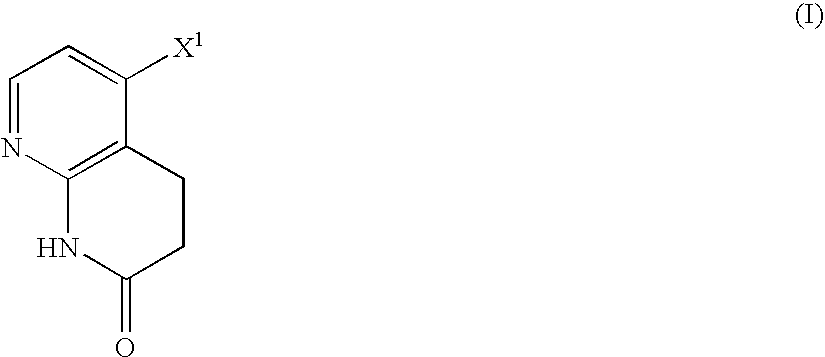
-
- wherein X1 is Cl or F.
- The process comprises treating a compound of formula (II):
-
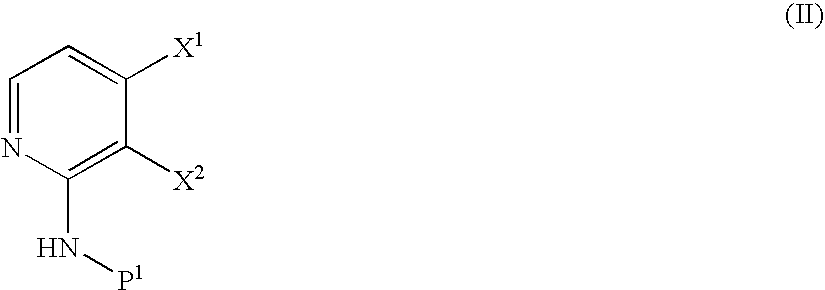
-
- wherein X1 is Cl or F, X2 is Br or I, and P1 is hydrogen or an amino group protecting moiety that is labile to the reaction conditions;
- with a compound of formula (III):
-

-
- wherein each R independently is C1-4 alkyl, —C(O)—(C1-4 alkyl), C6-10 ar(C1-4)alkyl, or —C(O)—(C6-10 ar(C1-4)alkyl), where the aryl portion of any such groups is substituted or unsubstituted;
- in a reaction mixture comprising a palladium catalyst and a base, to form the compound of formula (I).
- In the compounds of formulae (I)-(II), X1 is Cl or F, and X2 is Br or I. In some embodiments X1 is F. In some embodiments, X2 is 1. In certain embodiments, X1 is F and X2 is I.
- In the compounds of formula (III), each R independently is C1-4 alkyl, —C(O)—(C1-4 alkyl), C6-10 ar(C1-4)alkyl, or —C(O)—(C6-10 ar(C1-4)alkyl), where the aryl portion of any such groups is substituted or unsubstituted. In some embodiments, each R is C1-4 alkyl or C6-10 ar(C1-4)alkyl, where the aryl portion is substituted or unsubstituted. In certain embodiments, each R is methyl, ethyl, or benzyl. In certain particular embodiments, each R is methyl or ethyl.
- The coupling reaction of a compound of formula (II) with a compound of formula (III) is effected in the presence of a palladium catalyst and a base. Palladium catalysts suitable for use in the coupling reaction include those generally known in the art to be useful in Heck reactions. (Brase, Stefan; De Meijere, Armin. Metal-Catalyzed Cross-Coupling Reactions, (1998), 99-166). In some embodiments, the palladium catalyst is selected from the group consisting of palladium(II) chloride, palladium(II) acetate, tris(dibenzylideneacetone)-dipalladium, tetrakis(triphenylphosphine)palladium, bis(triphenylphosphine)palladium dichloride, (1,1′-bis(diphenylphosphino)ferrocene)palladium dichloride, di-chlorobis[5-chloro-2-[(4-chlorophenyl)(hydroxyimino)methyl]phenyl-C]di-palladium (Najéra's catalyst), and trans-di-μ-acetobis [2-(di-o-tolylphosphino)benzyl]dipalladium (Hermann's catalyst).
- In some embodiments, the reaction mixture further comprises an added phosphine ligand. An added phosphine ligand is particularly advantageous in those embodiments wherein the palladium catalyst is selected from the group consisting of palladium(II) chloride, palladium(II) acetate, tris(dibenzylideneacetone)dipalladium, bis(triphenylphosphine)palladium dichloride, (1,1′-bis(diphenylphosphino)ferrocene)palladium dichloride. Nonlimiting examples of suitable ligands include triphenylphosphine, tri(o-tolyl)-phosphine, tri(tert-butyl)phosphine, tri(2-furyl)phosphine, 1,1′-bis(diphenylphosphino)-ferrocene, 1,1′-bis(diphenylphosphino)methane, 1,1′-bis(diphenylphosphino)ethane, and 2-dicyclohexylphosphino-2′,4′,6′-triisopropylbiphenyl (XPhos).
- In certain particular embodiments, the palladium catalyst is di-chlorobis[5-chloro-2-[(4-chlorophenyl)(hydroxyimino)methyl]phenyl-C]di-palladium or trans-di-μ-acetobis-2-(di-o-tolylphosphino)benzyl]dipalladium. In certain other particular embodiments, the palladium catalyst is palladium(II) acetate, and the reaction mixture further comprises tri(o-tolyl)phosphine. In certain other particular embodiments, the palladium catalyst is palladium(II) acetate, and the reaction mixture does not comprise an added phosphine ligand.
- The reaction mixture also comprises a base. In some embodiments, the base is selected from the group consisting of potassium carbonate, cesium carbonate, sodium carbonate, sodium bicarbonate, sodium hydroxide, potassium hydroxide, lithium hydroxide, sodium acetate, and potassium acetate. In some other embodiments, the base is a tertiary amine base. In some such embodiments, the tertiary amine base is selected from the group consisting of triethylamine, diisopropylethylamine, dicyclohexylmethylamine, and 1,8-diazabicyclo-[5.4.0]undec-7-ene.
- The reaction mixture typically also comprises a solvent. In various embodiments, the solvent has a boiling point above 90° C., above 100° C., above 110° C., above 120° C., or above 130° C. In some embodiments, the coupling reaction of a compound of formula (II) with a compound of formula (III) is conducted in a solvent comprising dimethylformamide (DMF), dimethylacetamide (DMA), N-methylpyrrolidone (NMP), 1,4-dioxane, tert-butanol, or a mixture thereof. In some embodiments, the solvent also comprises water. In certain embodiments, the solvent comprises dimethylformamide-water or dimethylacetamide-water.
- The coupling reaction preferably is conducted at elevated temperature. In some embodiments, the reaction mixture is heated at a temperature in the range of about 100° C. to about 170° C. In some embodiments, the reaction mixture is heated at a temperature in the range of about 120° C. to about 150° C.
- In the compounds of formula (II), P is hydrogen or an amino group protecting moiety. When P is an amino group protecting moiety, it must be labile to the reaction conditions in order for cyclization of the lactam to occur. In some embodiments, P is tert-butoxycarbonyl. In such embodiments, the solvent preferably includes water to effect hydrolysis of P under the reaction conditions. Without wishing to be bound by theory, applicants believe that the tert-butoxycarbonyl group is removed from the compound of formula (II) prior to coupling with the compound of formula (III).
- In some embodiments, the process of the invention further comprises preparation of the compound of formula (II). In some such embodiments, the process further comprises the steps:
-
- (aa) treating a compound of formula (IV):
-
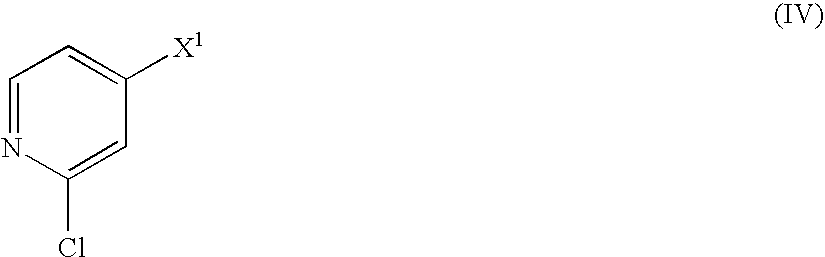
-
- wherein X1 is Cl or F;
- with a compound of formula P1—NH2, wherein P1 is an amino group protecting moiety, in a reaction mixture comprising a palladium catalyst and a base to form a compound of formula (V):
-
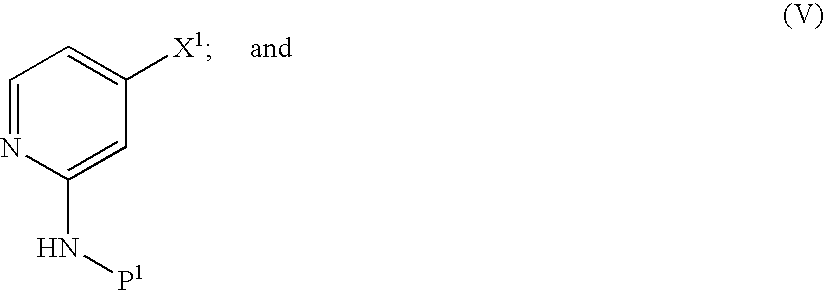
-
- (bb) halogenating the compound of formula (V) to form the compound of formula (II); wherein P is an amino group protecting moiety.
- Step (aa) preferably is conducted under conditions known in the art to be effective for Hartwig-Buchwald coupling reactions. (Hartwig, J. F, Angew. Chem. Int. Ed., 1998, 37, 2046-2067). In some embodiments, the palladium catalyst in step (aa) is selected from the group consisting of palladium(II) chloride, palladium(II) acetate, tris(dibenzylideneacetone)-dipalladium, tetrakis(triphenylphosphine)palladium, bis(triphenylphosphine)palladium dichloride, and (1,1′-bis(diphenylphosphino)ferrocene)palladium dichloride.
- In some embodiments, the reaction mixture in step (aa) further comprises an added phosphine ligand. Nonlimiting examples of suitable ligands include tri(o-tolyl)phosphine, triphenylphosphine, tri(2-furyl)phosphine, 1,1′-bis(diphenylphosphino)-ferrocene, 1,1′-bis(diphenylphosphino)methane, 1,1′-bis(diphenylphosphino)ethane, (oxydi-2,1-phenylene)bis(diphenylphosphine), 4,5-bis(diphenylphosphino)-9,9-dimethylxanthene (xantphos), 2-dicyclohexylphosphino-2′,6′-dimethoxybiphenyl (SPhos), and 2-dicyclohexylphosphino-2′,4′,6′-triisopropylbiphenyl (XPhos). In certain embodiments, the palladium catalyst is palladium(II) acetate, and the phosphine ligand is xantphos, Xphos, or (oxydi-2,1-phenylene)bis(diphenylphosphine).
- In some embodiments, the base employed in step (aa) is selected from the group consisting of potassium carbonate, cesium carbonate, sodium carbonate, sodium bicarbonate, sodium tert-butoxide, potassium tert-butoxide, sodium hydroxide, potassium hydroxide, and lithium hydroxide.
- Preferably the coupling reaction (aa) is conducted in a high-boiling solvent. In some embodiments, the coupling reaction of a compound of formula (IV) is conducted in a solvent comprising dimethylformamide, dimethylacetamide, N-methylpyrrolidone (NMP), 1,4-dioxane, isopropanol, tert-butanol, toluene, benzene, or a mixture thereof. In certain embodiments, the solvent is 1,4-dioxane or toluene.
- The coupling reaction of step (aa) preferably is conducted at elevated temperature. In some embodiments, the reaction mixture is heated at a temperature in the range of about 70° C. to about 150° C. In some embodiments, the reaction mixture is heated at a temperature in the range of about 80° C. to about 110° C.
- In some embodiments, the halogenating step (bb) comprises treating the compound of formula (V) with a base and iodine to form the compound of formula (II) wherein X2 is I, and P is an amino group protecting moiety. In some such embodiments, the base is an organolithium, an organomagnesium, or a silver salt. In certain embodiments, the base is selected from the group consisting of tert-butyllithium, n-butyllithium, di-n-butylmagnesium and silver sulfate.
- In some other embodiments, the halogenating step (bb) comprises treating the compound of formula (V) with a base and a brominating reagent to form the compound of formula (II), wherein X2 is Br, and P is an amino group protecting moiety. In some such embodiments, the brominating reagent is selected from the group consisting of ethylene bromide, N-bromosuccinimide, and bromine. In some such embodiments, the base is an organolithium, an organomagnesium, or a silver salt In certain embodiments, the base is selected from the group consisting of tert-butyllithium, n-butyllithium, di-n-butylmagnesium and silver sulfate.
- When an organolithium is used in the halogenating step (bb), the reaction mixture may additionally comprise a ligand that complexes lithium. Nonlimiting examples of such complexing ligands include tetrahydrofuran (THF), tetramethylethylenediamine (TMEDA), hexamethylphosphoramide (HMPA), and 1,4-diazabicyclo[2.2.2]octane (DABCO).
- In some other embodiments, the halogenating step (bb) comprises treating the compound of formula (V) with a tertiary amine and bromine to form the compound of formula (II), wherein X2 is Br, and P is an amino group protecting moiety. In some such embodiments, the tertiary amine is triethylamine.
- In some embodiments, the compound of formula (II) formed by steps (aa) and (bb) is used directly in the coupling reaction with a compound of formula (III). In such embodiments, P1 is an amino group protecting moiety that is labile to the reaction conditions for coupling the compound of formula (II) with a compound of formula (III).
- In other embodiments, preparation of the compound of formula (II) further comprises the step:
-
- (cc) removing the protecting group P1 to form the compound of formula (II), wherein P is hydrogen.
- In such embodiments, the amino group protecting moiety P1 can be any protecting group that is conveniently removed in step (cc). Non-limiting examples of amino group protecting moieties can be found in P. G. M. Wuts and T. W. Greene, Greene's Protective Groups in Organic Synthesis (4th ed.), John Wiley & Sons, NJ (2007), and include, e.g., acyl, sulfonyl, oxyacyl, and aminoacyl groups.
- In another aspect, the invention provides a process for preparing a compound of formula (VI):
-

- The process comprises the steps:
-
- (i) coupling a compound of formula (I):
-

-
- wherein X1 is Cl or F;
- with a compound of formula (VII):
-

-
- wherein R2 is hydrogen, an amino group protecting moiety, or an acid addition salt; to form the compound of formula (VI-A):
-
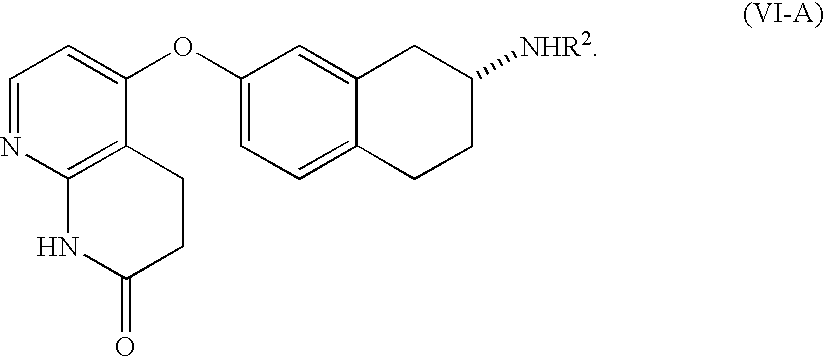
- When R2 is an amino group protecting moiety, the protecting moiety must be removed to form the compound of formula (VI). The deprotection may occur in situ in the reaction mixture for the coupling reaction, or it may be accomplished in a separate step.
- The coupling of a compound of formula (I) with a compound of formula (VII) can be accomplished under a variety of reaction conditions. In some embodiments, the coupling is conducted in a reaction mixture comprising a copper or palladium catalyst. In some other embodiments, the coupling is conducted in a reaction mixture comprising a base and a high-boiling, polar solvent. Suitable bases include, without limitation, cesium carbonate, potassium carbonate, potassium hydroxide, potassium-tert-butoxide, sodium-tert-butoxide, sodium methoxide, potassium methoxide, and sodium hydride. Suitable solvents include, without limitation, dimethylformamide, dimethylacetamide, dimethyl sulfoxide, and 1,4-dioxane. In some embodiments, the reaction mixture comprises cesium carbonate and dimethylformamide. Preferably, the coupling reaction is conducted at elevated temperature. In some embodiments, the reaction mixture is heated at a temperature in the range of about 80° C. to about 260° C. In some embodiments, the reaction mixture is heated at a temperature in the range of about 90° C. to about 160° C. In certain embodiments, the reaction mixture is heated at a temperature in the range of about 140° C. to about 150° C. In some embodiments, microwave irradiation is utilized to facilitate the reaction.
- In some embodiments, R2 is an amino group protecting moiety. In some such embodiments, R2 is an oxyacyl moiety. In certain such embodiments, R2 is tert-butoxycarbonyl. In some other embodiments, R2 is an acid addition salt. In certain such embodiments, R2 is H.HBr. In some embodiments, R2 is selected from the group consisting of hydrogen, tert-butoxycarbonyl, and H.HBr.
- In some embodiments, the process further comprises the step:
-
- (iii) condensing the compound of formula (VI) with a compound of formula (VIII):
-

- wherein Ring A is a substituted or unsubstituted phenyl ring, to form a compound of formula (IX):
-
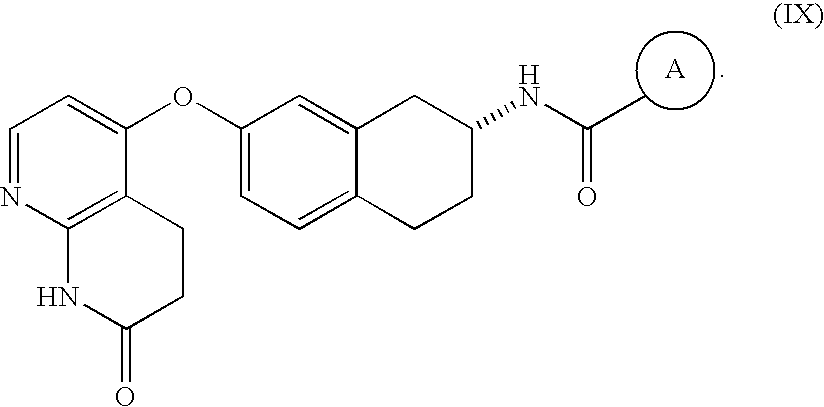
- Amide forming reaction conditions suitable for use in the condensing step (iii) are well known in the art.
- In some embodiments, the compound of formula (VIII) is characterized by formula (VIII-A):
-
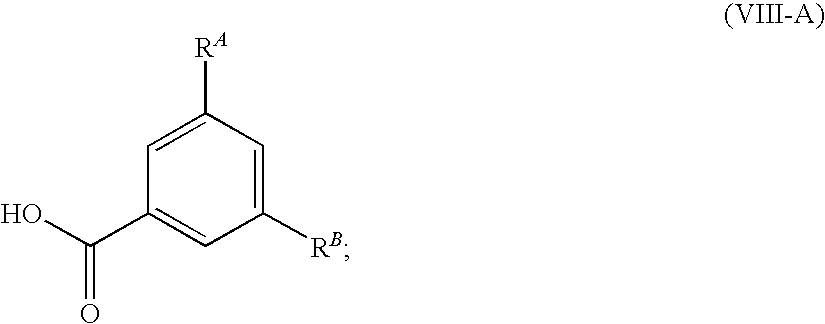
- and the compound of formula (IX) is characterized by formula (IX-A):
-

- wherein:
-
- RA is halo, —CN, —CHO, —C(R5x)═C(R5x)(R5y), —C≡C—R5Y, —OR5z, —N(R4y)(R4z), —CO2R6x, —C(O)N(R4x)(R4y); or RA is a C1-6 aliphatic or C1-6 fluoroaliphatic optionally substituted with one or two substituents independently selected from the group consisting of —OR5z, —N(R4y)(R4z), —SR6x, —CO2R6x, or —C(O)N(R4x)(R4y); or RA is an optionally substituted 5- or 6-membered nitrogen-containing heterocyclyl or heteroaryl ring;
- RB is selected from the group consisting of C1-4 aliphatic, C1-4 fluoroaliphatic, —O(C1-4aliphatic), —O(C1-4fluoroaliphatic), and halo; and
- R4x is hydrogen, C1-4 aliphatic, C1-4 fluoroaliphatic, or C6-10 ar(C1-4)alkyl, the aryl portion of which may be optionally substituted;
- R4y is hydrogen, C6-10 ar(C1-4)alkyl, the aryl portion of which may be optionally substituted, an optionally substituted 5- or 6-membered aryl, heteroaryl, or heterocyclyl ring, or a C1-4 aliphatic or C1-4 fluoroaliphatic optionally substituted with one or two substituents independently selected from the group consisting of —OR5x, —N(R4x)2, —CO2R5x, or —C(O)N(R4x)2;
- R4z is an amino group protecting moiety, C1-4 aliphatic, C1-4 fluoroaliphatic, or C6-10 ar(C1-4)alkyl, the aryl portion of which may be optionally substituted; or
- R4x and R4y, taken together with the nitrogen atom to which they are attached, form an optionally substituted 4- to 8-membered heterocyclyl or 5-membered heteroaryl ring having, in addition to the nitrogen atom, 0-2 ring heteroatoms independently selected from N, O, and S; or
- R4y and R4z, taken together with the nitrogen atom to which they are attached, form an optionally substituted 4- to 8-membered heterocyclyl or 5-membered heteroaryl ring having, in addition to the nitrogen atom, 0-2 ring heteroatoms independently selected from N, O, and S;
- each R5x independently is hydrogen, C1-4 aliphatic, C1-4 fluoroaliphatic, or C6-10 ar(C1-4)alkyl, the aryl portion of which may be optionally substituted, or an optionally substituted 5- or 6-membered aryl, heteroaryl, or heterocyclyl ring;
- each R5y independently is hydrogen, an optionally substituted monocyclic nitrogen-containing heterocyclyl, an optionally substituted C6-10 aryl, a C6-10ar(C1-4)alkyl, the aryl portion of which is optionally substituted, or a C1-4 aliphatic or C1-4 fluoroaliphatic optionally substituted with one or two substituents independently selected from the group consisting of —OR5x, —N(R4x)2, —CO2R5x, or —C(O)N(R4x)2;
- each R5z independently is hydrogen, a hydroxy group protecting moiety, an optionally substituted monocyclic nitrogen-containing heterocyclyl, an optionally substituted C6-10 aryl, a C6-10ar(C1-4)alkyl, the aryl portion of which is optionally substituted, or a C1-4 aliphatic or C1-4 fluoroaliphatic optionally substituted with one or two substituents independently selected from the group consisting of —OR5z, —N(R4x)(R4y), —CO2R6x, or —C(O)N(R4x)(R4y); and
- each R6x independently is C1-4 aliphatic, C1-4 fluoroaliphatic, or C6-10 ar(C1-4)alkyl, the aryl portion of which may be optionally substituted.
- In some such embodiments, RA is a substituted or unsubstituted pyrazolyl, oxazolyl, isoxazolyl, imidazolyl, triazolyl, or tetrazolyl ring. In some embodiments, each substitutable ring carbon atom in RA independently is unsubstituted or is substituted with halo, —OR5x, —N(R4x)(R4y), —N(R4x)—C(O)—R5, —C(O)—N(R4x)(R4y), or a C1-4 aliphatic or C1-4 fluoroaliphatic group optionally substituted with ═O, —OR5x, —N(R4x)(R4y)—C(O)—R5, or —C(O)—N(R4x)(R4y); and each substitutable ring nitrogen atom in RA is unsubstituted or is substituted with —C(O)—R5, —C(O)N(R5x)2, —SO2—R5, or a C1-4 aliphatic or C1-4 fluoroaliphatic group optionally substituted with ═O, —OR5x, —N(R4x)(R4y), —N(R4x)—C(O)—R5, or —C(O)—N(R4x)(R4y), where the variables R4x, R4y, R5, and R5x have the values described above.
- In some other embodiments, RA has the formula —C(Ra)(Rb)—N(Rc)(Rd), where:
-
- Ra is hydrogen, C1-4 aliphatic, C1-4 fluoroaliphatic, or -T1-R2; or Ra, taken together with Rb and the carbon atom to which they are attached, forms a substituted or unsubstituted 3- to 6-membered carbocyclic ring; or Ra, taken together with Rc and the intervening carbon and nitrogen atoms, form a substituted or unsubstituted 4- to 6-membered heterocyclic ring;
- Rb is hydrogen, C1-4 aliphatic, or C1-4 fluoroaliphatic; or Rb, taken together with Ra and the carbon atom to which they are attached, forms a substituted or unsubstituted 3- to 6-membered carbocyclic ring;
- Rc is hydrogen, C1-4 aliphatic, C1-4 fluoroaliphatic, or -T1-R2; or Rc, taken together with Ra and the intervening carbon and nitrogen atoms, form a substituted or unsubstituted 4- to 6-membered heterocyclic ring; or Rc, taken together with Rd and the nitrogen atom to which they are attached, forms a substituted or unsubstituted 3- to 6-membered heterocyclic ring or 5- to 6-membered heteroaryl ring;
- Rd is an amino group protecting moiety, C1-4 aliphatic, or C1-4 fluoroaliphatic, or -T1-R2; or Rd, taken together with Rc and the nitrogen atom to which they are attached, forms a substituted or unsubstituted 3- to 6-membered heterocyclic ring or 5- to 6-membered heteroaryl ring;
- T1 is a C1-3 alkylene chain;
- R2 is —OR5z, —N(R4y)(R4z), —N(R4x)—C(O)—R5x, or —C(O)—N(R4x)(R4y); and
- the variables R4x, R4y, R4z, R5x, and R5z have the values described above.
- In some other embodiments, the compound of formula (VIII) is characterized by formula (VIII-B):
-
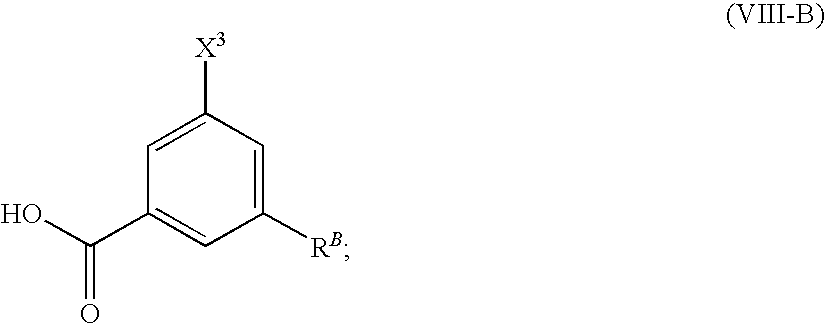
- and the compound of formula (IX) is characterized by formula (IX-B):
-
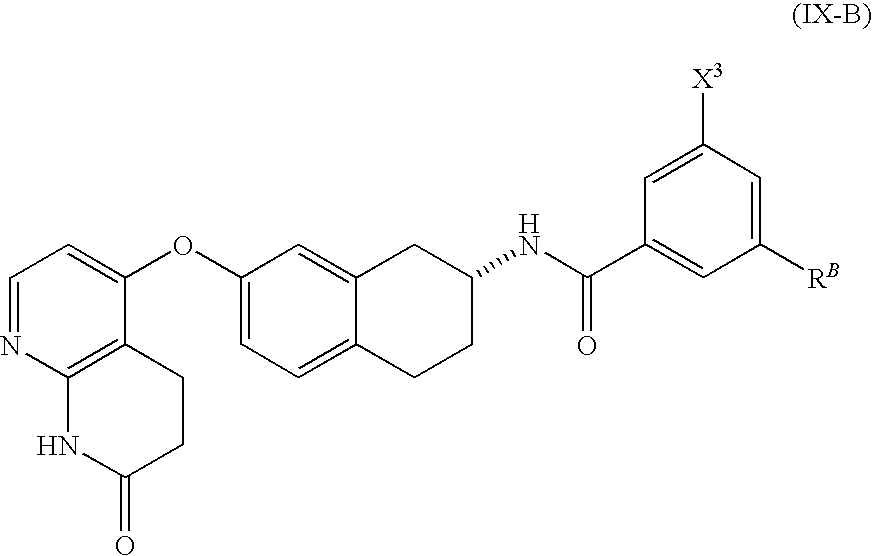
- wherein:
-
- X3 is Br or I; and
- RB is selected from the group consisting of Cl, C1-4 aliphatic, C1-4 fluoroaliphatic, —O(C1-4 aliphatic), and —O(C1-4 fluoroaliphatic).
- In some embodiments, the process further comprises the step:
-
- (iv-a) coupling the compound of formula (IX-B) with a compound of formula (X):
-
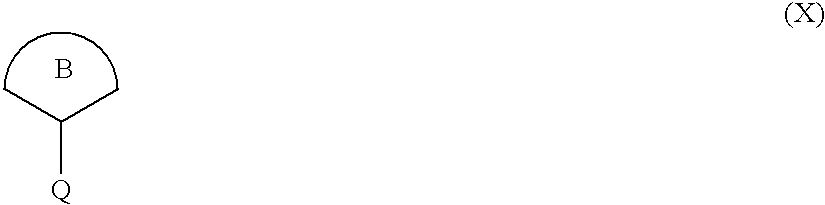
-
- wherein Ring 13 is a substituted or unsubstituted aryl or heteroaryl ring; and
- Q is a moiety selected from the group consisting of boronic acid, zinc halide, and trialkyltin;
- in a reaction mixture comprising a palladium catalyst, to form a compound of formula (IX-C):
-
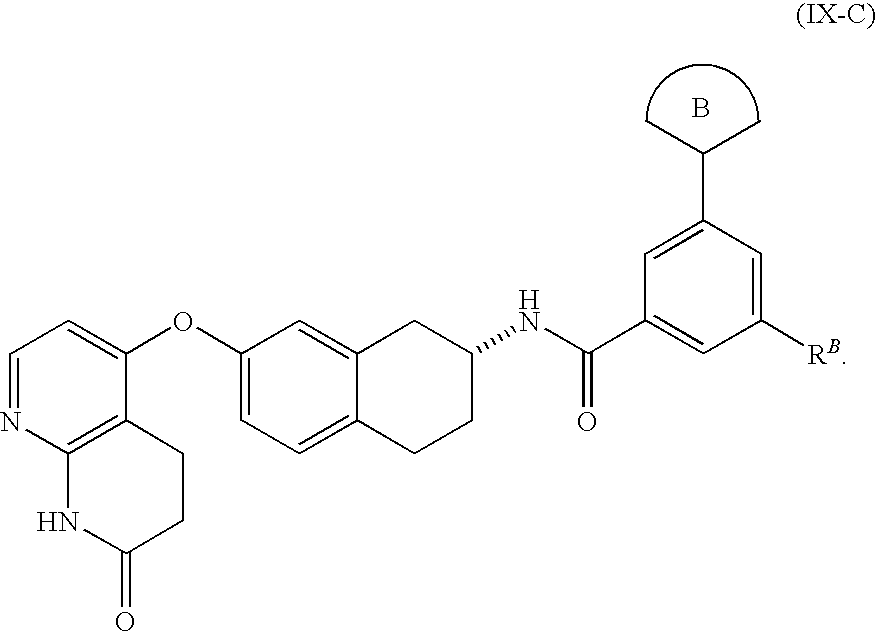
- Step (iv-a) preferably is conducted under conditions known in the art to be effective for Suzuki coupling (Herrmann, Wolfgang A. Applied Homogeneous Catalysis with Organometallic Compounds (2nd Edition) 2002, 1 591-598), Stile coupling (Farina, V.; Krishnamurthy, V.; Scott, W. J., Org. React. 1998, 50, 1-652.), or Negishi coupling (Negishi, Ei-ichi; Hu, Qian; Huang, Zhihong; Qian, Mingxing; Wang, Guangwei Aldrichimica Acta 2005, 38, 71-88). Examples of palladium catalysts and phosphine ligands useful for step (iv-a) include those described above for step (a).
- In some other embodiments, the process further comprises the step:
-
- (iv-b) coupling the compound of formula (IX-B) with a compound of formula (XI):
-

-
- wherein Ring C is a substituted or unsubstituted heteroaryl ring;
- in a reaction mixture comprising a copper or palladium catalyst, to form a compound of formula (IX-D):
-

- Step (iv-b) preferably is conducted under conditions known to be effective for Hartwig-Buchwald coupling reactions. Examples of palladium catalysts and phosphine ligands suitable for use in step (iv-b) include those described above for step (aa). Step (iv-b) also can be conducted using conditions known to be effective for Ullmann copper catalysed coupling reactions (Elson, Todd D. and Crouch, R. David Organic Reactions, 63:265-555 (2004)).
- In some other embodiments, the compound of formula (VIII) is characterized by formula (VIII-C):
-
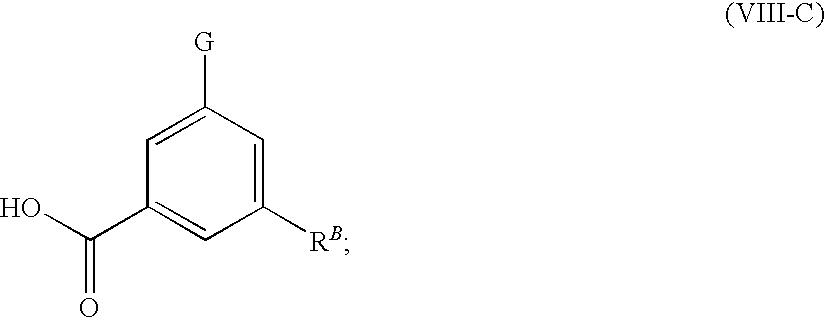
- and the compound of formula (IX) is characterized by formula (IX-C):
-

- wherein:
-
- G is —CN or —CHO; and
- R5 is selected from the group consisting of Cl, C1-4 aliphatic, C1-4 fluoroaliphatic, —O(C1-4 aliphatic), and —O(C1-4 fluoroaliphatic).
- In some such embodiments, wherein G is —CN, the process further comprises treating the compound of formula (IX-C) with sodium azide to form a compound of formula (IX), wherein RA is tetrazolyl.
- In some other such embodiments, wherein G is —CHO, the process further comprises treating the compound of formula (IXC) with p-tolylsulfonylmethyl isocyanide to form a compound of formula (IX), wherein RA is 1,3-oxazol-5-yl.
- In some other such embodiments, wherein G is —CHO, the process further comprises treating the compound of formula (IX-C) with p-tolylsulfonylmethyl isocyanide, followed by ammonia or a primary amine, to form a compound of formula (IX), wherein RA is imidazolyl.
- In some other such embodiments, wherein G is —CHO, the process further comprises treating the compound of formula (IX-C) with an amine of formula HN(Rc)(Rd) and a reducing agent to form a compound of formula (IX), wherein RA has the formula —CH2N(Rc)(Rd).
- In another aspect, the invention provides novel compounds useful in the processes of the invention. In one embodiment, the invention provides a compound of formula (I) or a salt thereof:
-
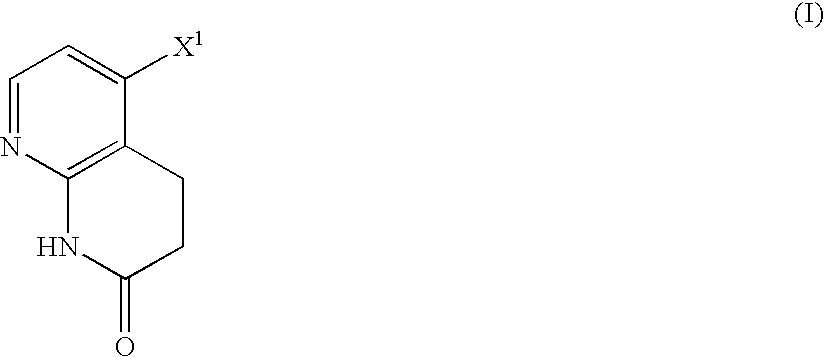
-
- wherein X1 is Cl or F.
- In another embodiment, the invention provides a compound of formula (II) or a salt thereof:
-

-
- wherein X1 is Cl or F, X2 is Br or I, and P1 is hydrogen or an amino group protecting moiety.
- In yet another embodiment, the invention provides a compound of formula (VI-A):
-

- wherein R2 is hydrogen, an amino group protecting moiety, or an acid addition salt.
- The terms “Raf” and “Raf kinase” are used interchangeably, and unless otherwise specified refer to any member of the Raf family of kinase enzymes, including without limitation, the isoforms A-Raf, B-Raf, and C-Raf. These enzymes, and the corresponding genes, also may be referred to in the literature by variants of these terms, e.g., RAF, raf, BRAF, B-raf. The isoform C-Raf also is referred to by the terms Raf-1 and C-Raf-1.
- The term “amino group protecting moiety” refers to any group useful in organic synthesis for protecting an amino group. Preferably, the amino group protecting moiety is conveniently added and removed under conditions that do not interfere with other functional groups in the molecule. Non-limiting examples of amino group protecting moieties can be found in P. G. M. Wuts and T. W. Greene, Greene's Protective Groups in Organic Synthesis (4th ed.), John Wiley & Sons, NJ (2007), and include, e.g., acyl, sulfonyl, oxyacyl, and aminoacyl groups.
- The term “aliphatic” or “aliphatic group”, as used herein, means a substituted or unsubstituted straight-chain, branched, or cyclic C1-12 hydrocarbon, which is completely saturated or which contains one or more units of unsaturation, but which is not aromatic. For example, suitable aliphatic groups include substituted or unsubstituted linear, branched or cyclic alkyl, alkenyl, or alkynyl groups and hybrids thereof, such as (cycloalkyl)alkyl, (cycloalkenyl)alkyl or (cycloalkyl)alkenyl. In various embodiments, the aliphatic group has 1 to 12, 1 to 8, 1 to 6, 1 to 4, or 1 to 3 carbons.
- The terms “alkyl”, “alkenyl”, and “alkynyl”, used alone or as part of a larger moiety, refer to a straight or branched chain aliphatic group having from 1 to 12 carbon atoms. For purposes of the present invention, the term “alkyl” will be used when the carbon atom attaching the aliphatic group to the rest of the molecule is a saturated carbon atom. However, an alkyl group may include unsaturation at other carbon atoms. Thus, alkyl groups include, without limitation, methyl, ethyl, propyl, allyl, propargyl, butyl, pentyl, and hexyl.
- For purposes of the present invention, the term “alkenyl” will be used when the carbon atom attaching the aliphatic group to the rest of the molecule forms part of a carbon-carbon double bond. Alkenyl groups include, without limitation, vinyl, 1-propenyl, 1-butenyl, 1-pentenyl, and 1-hexenyl.
- For purposes of the present invention, the term “alkynyl” will be used when the carbon atom attaching the aliphatic group to the rest of the molecule forms part of a carbon-carbon triple bond. Alkynyl groups include, without limitation, ethynyl, 1-propynyl, 1-butynyl, 1-pentynyl, and 1-hexynyl.
- The term “cycloaliphatic”, used alone or as part of a larger moiety, refers to a saturated or partially unsaturated cyclic aliphatic ring system having from 3 to about 14 members, wherein the aliphatic ring system is optionally substituted. In some embodiments, the cycloaliphatic is a monocyclic hydrocarbon having 3-8 or 3-6 ring carbon atoms. Nonlimiting examples include cyclopropyl, cyclobutyl, cyclopentyl, cyclopentenyl, cyclohexyl, cyclohexenyl, cycloheptyl, cycloheptenyl, cyclooctyl, cyclooctenyl, and cyclooctadienyl. In some embodiments, the cycloaliphatic is a bridged or fused bicyclic hydrocarbon having 6-12, 6-10, or 6-8 ring carbon atoms, wherein any individual ring in the bicyclic ring system has 3-8 members.
- In some embodiments, two adjacent substituents on the cycloaliphatic ring, taken together with the intervening ring atoms, form an optionally substituted fused 5- to 6-membered aromatic or 3- to 8-membered non-aromatic ring having 0-3 ring heteroatoms selected from the group consisting of O, N, and S. Thus, the term “cycloaliphatic” includes aliphatic rings that are fused to one or more aryl, heteroaryl, or heterocyclyl rings. Nonlimiting examples include indanyl, 5,6,7,8-tetrahydroquinoxalinyl, decahydronaphthyl, or tetrahydronaphthyl, where the radical or point of attachment is on the aliphatic ring.
- The terms “aryl” and “ar-”, used alone or as part of a larger moiety, e.g., “aralkyl”, “aralkoxy”, or “aryloxyalkyl”, refer to a C6 to C14 aromatic hydrocarbon, comprising one to three rings, each of which is optionally substituted. Preferably, the aryl group is a C6-10 aryl group. Aryl groups include, without limitation, phenyl, naphthyl, and anthracenyl. In some embodiments, two adjacent substituents on the aryl ring, taken together with the intervening ring atoms, form an optionally substituted fused 5- to 6-membered aromatic or 4- to 8-membered non-aromatic ring having 0-3 ring heteroatoms selected from the group consisting of O, N, and S. Thus, the term “aryl”, as used herein, includes groups in which an aryl ring is fused to one or more heteroaryl, cycloaliphatic, or heterocyclyl rings, where the radical or point of attachment is on the aromatic ring. Nonlimiting examples of such fused ring systems include indolyl, isoindolyl, benzothienyl, benzofuranyl, dibenzofuranyl, indazolyl, benzimidazolyl, benzthiazolyl, quinolyl, isoquinolyl, cinnolinyl, phthalazinyl, quinazolinyl, quinoxalinyl, carbazolyl, acridinyl, phenazinyl, phenothiazinyl, phenoxazinyl, tetrahydroquinolinyl, tetrahydroisoquinolinyl, fluorenyl, indanyl, phenanthridinyl, tetrahydronaphthyl, indolinyl, phenoxazinyl, benzodioxanyl, and benzodioxolyl. An aryl group may be mono-, bi-, tri-, or polycyclic, preferably mono-, bi-, or tricyclic, more preferably mono- or bicyclic. The term “aryl” may be used interchangeably with the terms “aryl group”, “aryl moiety”, and “aryl ring”.
- An “aralkyl” or “arylalkyl” group comprises an aryl group covalently attached to an alkyl group, either of which independently is optionally substituted. Preferably, the aralkyl group is C6-10 aryl(C1-6)alkyl, C6-10 aryl(C1-4)alkyl, or C6-10 aryl(C1-3)alkyl, including, without limitation, benzyl, phenethyl, and naphthylmethyl.
- The terms “heteroaryl” and “heteroar-”, used alone or as part of a larger moiety, e.g., heteroaralkyl, or “heteroaralkoxy”, refer to groups having 5 to 14 ring atoms, preferably 5, 6, 9, or 10 ring atoms; having 6, 10, or 14 π electrons shared in a cyclic array; and having, in addition to carbon atoms, from one to four heteroatoms. The term “heteroatom” refers to nitrogen, oxygen, or sulfur, and includes any oxidized form of nitrogen or sulfur, and any quaternized form of a basic nitrogen. Thus, when used in reference to a ring atom of a heteroaryl, the term “nitrogen” includes an oxidized nitrogen (as in pyridine N-oxide). Certain nitrogen atoms of 5-membered heteroaryl groups also are substitutable, as further defined below. Heteroaryl groups include, without limitation, radicals derived from thiophene, furan, pyrrole, imidazole, pyrazole, triazole, tetrazole, oxazole, isoxazole, oxadiazole, thiazole, isothiazole, thiadiazole, pyridine, pyridazine, pyrimidine, pyrazine, indolizine, naphthyridine, pteridine, pyrrolopyridine, imidazopyridine, oxazolopyridine, thiazolopyridine, triazolopyridine, pyrrolopyrimidine, purine, and triazolopyrimidine. As used herein, the phrase “radical derived from” means a monovalent radical produced by removal of a hydrogen radical from the parent heteroaromatic ring system. The radical (i.e., the point of attachment of the heteroaryl to the rest of the molecule) may be created at any substitutable position on any ring of the parent heteroaryl ring system.
- In some embodiments, two adjacent substituents on the heteroaryl, taken together with the intervening ring atoms, form an optionally substituted fused 5- to 6-membered aromatic or 4- to 8-membered non-aromatic ring having 0-3 ring heteroatoms selected from the group consisting of O, N, and S. Thus, the terms “heteroaryl” and “heteroar-”, as used herein, also include groups in which a heteroaromatic ring is fused to one or more aryl, cycloaliphatic, or heterocyclyl rings, where the radical or point of attachment is on the heteroaromatic ring. Nonlimiting examples include indolyl, isoindolyl, benzothienyl, benzofuranyl, dibenzofuranyl, indazolyl, benzimidazolyl, benzthiazolyl, benzoxazolyl, quinolyl, isoquinolyl, cinnolinyl, phthalazinyl, quinazolinyl, quinoxalinyl, 4H-quinolizinyl, carbazolyl, acridinyl, phenazinyl, phenothiazinyl, phenoxazinyl, tetrahydroquinolinyl, tetrahydroisoquinolinyl, and pyrido[2,3-b]-1,4-oxazin-3(4H)-one. A heteroaryl group may be mono-, bi-, tri-, or polycyclic, preferably mono-, bi-, or tricyclic, more preferably mono- or bicyclic. The term “heteroaryl” may be used interchangeably with the terms “heteroaryl ring”, or “heteroaryl group”, any of which terms include rings that are optionally substituted. The term “heteroaralkyl” refers to an alkyl group substituted by a heteroaryl, wherein the alkyl and heteroaryl portions independently are optionally substituted.
- As used herein, the terms “aromatic ring” and “aromatic ring system” refer to an optionally substituted mono-, bi-, or tricyclic group having 0-6, preferably 0-4 ring heteroatoms, and having 6, 10, or 14 π electrons shared in a cyclic array. Thus, the terms “aromatic ring” and “aromatic ring system” encompass both aryl and heteroaryl groups.
- As used herein, the terms “heterocycle”, “heterocyclyl”, “heterocyclic radical”, and “heterocyclic ring” are used interchangeably and refer to a stable 3- to 7-membered monocyclic, or to a fused 7- to 10-membered or bridged 6- to 10-membered bicyclic heterocyclic moiety that is either saturated or partially unsaturated, and having, in addition to carbon atoms, one or more, preferably one to four, heteroatoms, as defined above. When used in reference to a ring atom of a heterocycle, the term “nitrogen” includes a substituted nitrogen. As an example, in a heterocyclyl ring having 1-3 heteroatoms selected from oxygen, sulfur or nitrogen, the nitrogen may be N (as in 3,4-dihydro-2H-pyrrolyl), NH (as in pyrrolidinyl), or +NR (as in N-substituted pyrrolidinyl). A heterocyclic ring can be attached to its pendant group at any heteroatom or carbon atom that results in a stable structure, and any of the ring atoms can be optionally substituted. Examples of such saturated or partially unsaturated heterocyclic radicals include, without limitation, tetrahydrofuranyl, tetrahydrothienyl, pyrrolidinyl, pyrrolidonyl, piperidinyl, pyrrolinyl, tetrahydroquirtolirtyl, tetrahydroisoquinolinyl, decahydroquinolinyl, oxazolidinyl, piperazinyl, dioxanyl, dioxolanyl, diazepinyl, oxazepinyl, thiazepinyl, morpholinyl, and quinuclidinyl.
- In some embodiments, two adjacent substituents on a heterocyclic ring, taken together with the intervening ring atoms, form an optionally substituted fused 5- to 6-membered aromatic or 3- to 8-membered non-aromatic ring having 0-3 ring heteroatoms selected from the group consisting of O, N, and S. Thus, the terms “heterocycle”, “heterocyclyl”, “heterocyclyl ring”, “heterocyclic group”, “heterocyclic moiety”, and “heterocyclic radical”, are used interchangeably herein, and include groups in which a heterocyclyl ring is fused to one or more aryl, heteroaryl, or cycloaliphatic rings, such as indolinyl, 3H-indolyl, chromanyl, phenanthridinyl, or tetrahydroquinolinyl, where the radical or point of attachment is on the heterocyclyl ring. A heterocyclyl group may be mono-, bi-, tri-, or polycyclic, preferably mono-, bi-, or tricyclic, more preferably mono- or bicyclic. The term “heterocyclylalkyl” refers to an alkyl group substituted by a heterocyclyl, wherein the alkyl and heterocyclyl portions independently are optionally substituted.
- As used herein, the term “partially unsaturated” refers to a ring moiety that includes at least one double or triple bond between ring atoms. The term “partially unsaturated” is intended to encompass rings having multiple sites of unsaturation, but is not intended to include aryl or heteroaryl moieties, as herein defined.
- The terms “haloaliphatic”, “haloalkyl”, “haloalkenyl” and “haloalkoxy” refer to an aliphatic, alkyl, alkenyl or alkoxy group, as the case may be, which is substituted with one or more halogen atoms. As used herein, the term “halogen” or “halo” means F, Cl, Br, or I. The term “fluoroaliphatic” refers to a haloaliphatic wherein the halogen is fluoro, including perfluorinated aliphatic groups. Examples of fluoroaliphatic groups include, without limitation, fluoromethyl, difluoromethyl, trifluoromethyl, 2-fluoroethyl, 2,2,2-trifluoroethyl, 1,1,2-trifluoroethyl, 1,2,2-trifluoroethyl, and pentafluoroethyl.
- The term “alkylene” refers to a bivalent alkyl group. An “alkylene chain” is a polymethylene group, i.e., —(CH2)n—, wherein n is a positive integer, preferably from 1 to 6, from 1 to 4, from 1 to 3, from 1 to 2, or from 2 to 3. A substituted alkylene chain is a polymethylene group in which one or more methylene hydrogen atoms is replaced with a substituent. Suitable substituents include those described below for a substituted aliphatic group. An alkylene chain also may be substituted at one or more positions with an aliphatic group or a substituted aliphatic group.
- An alkylene chain also can be optionally interrupted by a functional group. An alkylene chain is “interrupted” by a functional group when an internal methylene unit is replaced with the functional group. Examples of suitable “interrupting functional groups” include —C(R*)═C(R*)—, —O—, —S—, —S(O)—, —S(O)2—, —S(O)2N(R+)—, —N(R*)—, —N(R+)CO—, —N(R+)C(O)N(R+)—, —N(R+)C(═NR+)—N(R+)—, —N(R+)—C(═NR+)—, —N(R+)CO2—, —N(R4)SO2—, —N(R+)SO2N(R+)—, —OC(O)—, —OC(O)O—, —OC(O)N(R+)—, —C(O)—, —CO2—, —C(O)N(R+)—, —C(O)—C(O)—, —C(═NR+)—N(R+)—, —C(NR+)═N—, —C(═NR+)—O—, —C(OR*)═N—, —C(Ro)═N—O—, or —N(R+)—N(R+)—. Each R+, independently, is hydrogen or an optionally substituted aliphatic, aryl, heteroaryl, or heterocyclyl group, or two R+ on the same nitrogen atom, taken together with the nitrogen atom, form a 5-8 membered aromatic or non-aromatic ring having, in addition to the nitrogen atom, 0-2 ring heteroatoms selected from N, O, and S. Each R* independently is hydrogen or an optionally substituted aliphatic, aryl, heteroaryl, or heterocyclyl group.
- Examples of C3-6 alkylene chains that have been “interrupted” with —O— include CH2OCH2—, —CH2O(CH2)2—, —CH2O(CH2)3—, —CH2O(CH2)4—, —(CH2)2OCH2, —(CH2)2O(CH2)2—, —(CH2)2O(CH2)3—, —(CH2)3O(CH2)—, —(CH2)3O(CH2)2—, and —(CH2)4O(CH2)—. Other examples of alkylene chains that are “interrupted” with functional groups include —CH2ZCH2—, —CH2Z(CH2)2—, —CH2Z(CH2)3—, —CH2Z(CH2)4—, —(CH2)2ZCH2—, —(CH2)2Z(CH2)2—, —(CH2)2Z(CH2)3—, —(CH2)3Z(CH2)—, —(CH2)3Z(CH2)2—, and —(CH2)4Z(CH2)—, wherein Z is one of the “interrupting” functional groups listed above.
- For purposes of clarity, all bivalent groups described herein are intended to be read from left to right, with a corresponding left-to-right reading of the formula or structure in which the variable appears.
- One of ordinary skill in the art will recognize that when an alkylene chain having an interruption is attached to a functional group, certain combinations would not be sufficiently stable for pharmaceutical use. Only stable or chemically feasible compounds are within the scope of the present invention. A stable or chemically feasible compound is one in which the chemical structure is not substantially altered when kept at a temperature from about −80° C. to about +40° C., preferably −20° C. to about +40° C., in the absence of moisture or other chemically reactive conditions, for at least a week, or a compound which maintains its integrity long enough to be useful for therapeutic or prophylactic administration to a patient.
- The term “substituted”, as used herein, means that a hydrogen radical of the designated moiety is replaced with the radical of a specified substituent, provided that the substitution results in a stable or chemically feasible compound. The term “substitutable”, when used in reference to a designated atom, means that attached to the atom is a hydrogen radical, which can be replaced with the radical of a suitable substituent.
- The phrase “one or more substituents”, as used herein, refers to a number of substituents that equals from one to the maximum number of substituents possible based on the number of available bonding sites, provided that the above conditions of stability and chemical feasibility are met. Unless otherwise indicated, an optionally substituted group may have a substituent at each substitutable position of the group, and the substituents may be either the same or different.
- As used herein, the term “independently selected” means that the same or different values may be selected for multiple instances of a given variable in a single compound.
- An aryl (including the aryl moiety in aralkyl, aralkoxy, aryloxyalkyl and the like) or heteroaryl (including the heteroaryl moiety in heteroaralkyl and heteroaralkoxy and the like) group may contain one or more substituents. Examples of suitable substituents on the unsaturated carbon atom of an aryl or heteroaryl group include -halo, —NO2, —CN, —R*, —C(R*)═C(R*)2, —C≡C—R*, —OR*, —SRo, —S(O)Ro, —SO2Ro, —SO3R*, —SO2N(R+)2, —N(R+)2, —NR+C(O)R*, —NR+C(O)N(R+)2, —N(R+)C(═NR+)—N(R+)2, —N(R+)C(═NR+)—Ro, —NR+CO2Ro, —NR+SO2Ro, —NR+SO2N(R+)2, —O—C(O)R*, —O—CO2R*, —OC(O)N(R+)2, —C(O)R*, —CO2R*, —C(O)—C(O)R*, —C(O)N(R+)2, —C(O)N(R+)—OR*, —C(O)N(R+)C(═NR+)—N(R+)2, —N(Rf)C(═NR+)—N(R+)—C(O)R*, —C(═NR+)—N(R+)2, —C(═NR+)—OR*, —N(R+)—N(R+)2, —C(═NR+)—N(R+)—OR*, —C(Ro)═N—OR*, —P(O)(R*)2, —P(O)(OR*)2, —O—P(O)—OR*, and —P(O)(NR+)—N(R+)2, wherein Ro is an optionally substituted aliphatic, aryl, or heteroaryl group, and R+ and R* are as defined above, or two adjacent substituents, taken together with their intervening atoms, form a 5-6 membered unsaturated or partially unsaturated ring having 0-3 ring atoms selected from the group consisting of N, O, and S.
- An aliphatic group or a non-aromatic heterocyclic ring may be substituted with one or more substituents. Examples of suitable substituents on the saturated carbon of an aliphatic group or of a non-aromatic heterocyclic ring include, without limitation, those listed above for the unsaturated carbon of an aryl or heteroaryl group and the following: ═O, ═S, ═C(R*)2, ═N—N(R*)2, ═N—NHC(O)R*, ═N—NHCO2Ro, ═N—NHSO2Ro, or ═N—R*, where each R* and Ro is as defined above.
- Suitable substituents on a substitutable nitrogen atom of a heteroaryl or non-aromatic heterocyclic ring include —R*, —N(R*)2, —C(O)R*, —C(O)N(R*)2, —CO2R*, —C(O)—C(O)R* —C(O)CH2C(O)R*, —SO2R*, —SO2N(R*)2, —C(═S)N(R*)2, —C(═NH)—N(R*)2, and —NR*SO2R*; wherein each R* is as defined above. A ring nitrogen atom of a heteroaryl or non-aromatic heterocyclic ring also may be oxidized to form the corresponding N-hydroxy or N-oxide compound. A nonlimiting example of such a heteroaryl having an oxidized ring nitrogen atom is N-oxidopyridyl. A ring sulfur atom of a heterocyclic ring may be oxidized to form the corresponding sulfoxide or sulfone.
- The term “about” is used herein to mean approximately, in the region of, roughly, or around. When the term “about” is used in conjunction with a numerical range, it modifies that range by extending the boundaries above and below the numerical values set forth. In general, the term “about” is used herein to modify a numerical value above and below the stated value by a variance of 10%.
- As used herein, the term “comprises” means “includes, but is not limited to.”
- It will be apparent to one skilled in the art that certain compounds of this invention may exist in tautomeric forms, all such tautomeric forms of the compounds being within the scope of the invention. Unless otherwise stated, structures depicted herein are also meant to include all geometric (or conformational) isomers, i.e., (Z) and (E) double bond isomers and (Z) and (E) conformational isomers, as well as all stereochemical forms of the structure; i.e., the R and S configurations for each asymmetric center. Therefore, single stereochemical isomers as well as enantiomeric and diastereomeric mixtures of the present compounds are within the scope of the invention. When a mixture is enriched in one stereoisomer relative to another stereoisomer, the mixture may contain, for example, an enantiomeric excess of at least 50%, 75%, 90%, 99%, or 99.5%.
- Unless otherwise stated, structures depicted herein are also meant to include compounds which differ only in the presence of one or more isotopically enriched atoms. For example, compounds having the present structure except for the replacement of a hydrogen atom by a deuterium or tritium, or the replacement of a carbon atom by a 13C- or 14C-enriched carbon are within the scope of the invention.
- In order that this invention be more fully understood, the following preparative examples are set forth. These examples illustrate how to make specific compounds, and are not to be construed as limiting the scope of the invention in any way.
-
- AcOH acetic acid
- ACN acetonitrile
- ATP adenosine triphosphate
- BCA bicinchoninic acid
- BSA bovine serum albumin
- BOC tert-butoxycarbonyl
- DABCO 1,4-diazabicyclo[2.22]octane
- DCM dichloromethane
- DIPEA diisopropyl ethyl amine
- DMA dimethylacetamide
- DMAP 4-dimethylaminopyridine
- DMEM Dulbecco's Modified Eagle's medium
- DMF dimethylformamide
- DTT dithiothreitol
- EDCI 1-(3-dimethylaminopropyl)-3-ethylcarbodiimide
- EDTA ethylenediaminetetraacetic acid
- EtOAc ethyl acetate
- Et2O ethyl ether
- FA formic acid
- FBS fetal bovine serum
- h hours
- HATU O-(7-azabenzotriazol-1-yl)-N,N,N′,N′-tetramethyluronium hexafluorophosphate
- MeOH methanol
- min minutes
- MTT methylthiazoletetrazolium
- MWI microwave irradiation
- NMP 1-methyl-2-pyrrolidinone
- PBS phosphate buffered saline
- pTSA p-toluenesulfonic acid
- PKA cAMP-dependent protein kinase
- sec seconds
- rt room temperature
- TBTU O-(1H-benzotriazol-1-yl)-N,N,N′,N′-tetramethyluronium tetrafluoroborate
- TEA triethylamine
- THF tetrahydrofuran
- TMB 3,3′,5,5′-tetramethylbenzidine
- WST (4-[3-(4-iodophenyl)-2-(4-nitrophenyl)-2H-5-tetrazolio]-1,3-benzene disulfonate sodium salt)
- m/z mass to charge
- MS mass spectrum
- LC/MS liquid chromatography mass spectrum
- HRMS high resolution mass spectrum
- Spectra were run on a Phenominex Luna 5 μm C18 50×4.6 mm column on a Hewlett-Packard HP1100 at 2.5 ml/min for a 3 minute run using the following gradients:
-
- Formic Acid (FA): Acetonitrile containing zero to 100 percent 0.1% formic acid in water.
- Ammonium Acetate (AA): Acetonitrile containing zero to 100 percent 10 mM ammonium acetate in water.
-

- Palladium acetate (341 mg, 1.52 mmol) and 4,5-bis(diphenylphosphino)-9,9-dimethylxanthene (1.76 g, 3.04 mmol) were added to a 3-necked round bottomed flask, and the flask was purged three times with argon. Degassed 1,4-dioxane (240 mL) was added and the mixture was stirred and degassed again with argon. To this solution was added a solution of 2-chloro-4-fluoropyridine (20 g, 152 mmol) in degassed 1,4-dioxane (120 mL), t-butyl carbamate (19.6 g, 167 mmol), NaOH (8.88 g, 222 mmol) and degassed water (4.0 mL, 222 mmol). The resulting mixture was stirred at 100° C. After 1.5 h, the reaction mixture was cooled to rt and filtered through a pad of Celite. The pad was washed well with dioxane and the filtrate was concentrated under reduced pressure to dryness. The resulting solid was recrystallized from 2-propanol (˜250 mL) to give 25.65 g of a pale yellow crystalline solid (79.5% yield). LC/MS: (FA) ES+ 213. 1H NMR (400 MHz, d6 DMSO): δ 10.14 (s, 1H), 8.28-8.25 (m, 1H), 7.62-7.58 (m, 1H), 6.97-6.93 (m, 1H), and 1.47 (s, 9H).
- An oven-dried 3-neck round bottom flask equipped with an overhead stirrer, temperature probe, and addition funnel was charged with tert-butyl (4-fluoropyridin-2-yl)carbamate (31.8 g, 150 mmol), TMEDA (56.6 mL, 375 mmol) and THF (200 mL). The solution was cooled to −78° C. and a solution of n-BuLi (2.50 M in hexane, 150 mL, 375 mmol) was added dropwise so that the reaction mixture temperature remained below −70° C. The reaction mixture was stirred at −78° C. for 1 h, and a solution of I2 (95.2 g, 375 mmol) in THF (160 mL) was added via addition funnel. The addition was controlled to keep the reaction mixture temperature below −70° C., and the resulting mixture was stirred at −78° C. for 1 h. A solution of NaHSO4 (61 g, 580 mmol) in water (200 mL) was added to the reaction mixture as it warmed to rt. Ethyl acetate was added and the 2 phase mixture was stirred at rt for 1 h. Water (500 mL) was added and the phases were separated. The aqueous phase was extracted with EtOAc (3×400 mL), the organic phases were combined, dried over MgSO4, filtered and concentrated to give an off white solid. This solid was suspended in DCM (50 mL) and the solid was isolated by filtration and washed with a minimum of DCM. The filtrate was concentrated and filtered to give a second crop of product. The solids were combined and dried under vacuum to give 45.63 g of a white solid (86% yield). LC/MS: (FA) ES+ 339. 1H NMR (400 MHz, d6 DMSO): δ 9.47 (s, 1H), 8.33-8.30 (m, 1H), 7.20-7.17 (m, 1H), and 1.44 (s, 9H).
- To a solution of tert-butyl (4-fluoropyridin-2-yl)carbamate (2.00 g, 9.42 mmol) in THF (40 mL), at 2° C. under an atmosphere of nitrogen, was added 1.0M dibutylmagnesium in hexane (20.7 mL, 20.7 mmol) dropwise, maintaining the internal temperature below 7° C. When addition was complete, the reaction was allowed to warm to rt, and then heated at 50° C. for 3 h. The reaction was then allowed to cool to rt. A solution of iodine (10.5 g, 41.5 mmol) in THF (30 ml) was added dropwise over approximately 30 min., maintaining the internal temperature between 19° C. and 22° C. by the occasional use of an ice bath. The reaction mixture was allowed to stir overnight at rt. A 0.5 M solution of sodium ascorbate in water (60 mL, 300 mmol) was added and the phases were separated. The aqueous phase was extracted with EtOAc (40 mL) and the combined organic phases were washed with brine, dried (MgSO4) and evaporated to approximately 4 mL. On standing for 1 h. some solids were formed. Heptane (10 mL) and EtOAc (2 mL) were added and the suspension was stirred at rt for 30 min. The precipitate was filtered off, and the solid was washed with heptane and dried under vacuum at 40° C. to provide 2.31 g of yellow solid (72.5% yield).
-
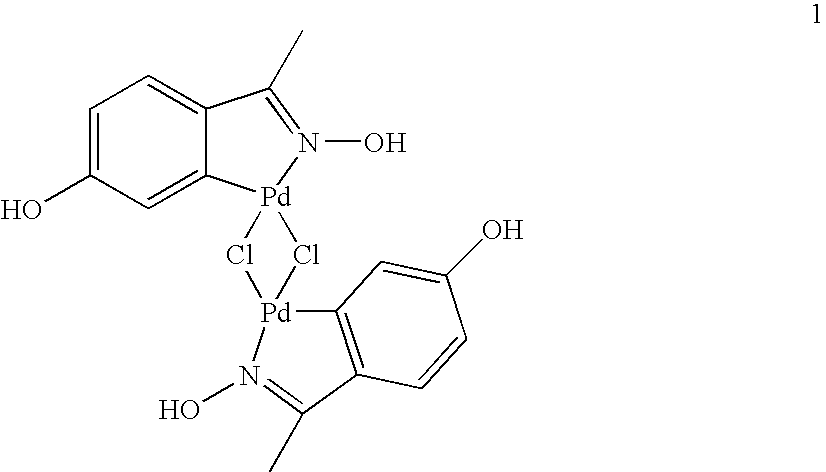
- A round bottom flask was charged with tert-butyl (4-fluoro-3-iodopyridin-2-yl)carbamate (20.0 g, 59.2 mmol), 3,3-diethoxy-1-propene (13.5 mL, 88.7 mmol), DMF (150 mL), water (50 mL), DIPEA (15.4 mL, 88.7 mmol) and Pd catalyst 1 (Corma, A.; Garcia, H.; Leyva, A. Tetrahedron 61, 9848, 2005) (480 mg, 0.827 mmol) and the reaction mixture was stirred in an oil bath at 140° C. After 5 h, the reaction mixture was cooled in a refrigerator for 2 days. The precipitate was isolated by filtration, washed with diethyl ether, and dried to give 3.25 g of pink needles. The filtrate was concentrated to give a reddish semi-solid. This material was redissolved in DCM, and the solution was passed through 200 g of SiO2. Concentration of the resulting solution provided a red/orange residue which was recrystallized from 2-propanol (150 mL) to give 9.4 g of a pink solid. Purification of this pink solid by column chromatography (SiO2, elution with 0-75% EtOAc/DCM) provided 1.41 g of a white powder. Overall, 4.66 g of final product was isolated (47% yield). LC/MS: (FA) ES+ 167. 1H NMR (300 MHz, d6 DMSO): δ 10.67 (s, 1H), 8.13-8.08 (m, 1H), 6.93-6.88 (m, 1H), 2.87 (t, 2H), and 2.51 (t, 2H). This reaction may also be carried out under the same conditions using Pd(OAc)2 as catalyst, both in the presence or absence of tri-o-tolylphosphine as ligand.
- In a method analogous to that described for 5-fluoro-3,4-dihydro-1,8-naphthyridin-2(1H)-one, 5-chloro-3,4-dihydro-1,8-naphthyridin-2(1H)-one was prepared from 2,4-dichloropyridine. LC/MS: (AA) ES+ 183. 1H NMR (400 MHz, d6 DMSO): δ 10.68 (s, 1H), 8.07-8.06 (m, 1H), 7.13-7.11 (m, 1H), 2.96 (t, 2H), and 2.55 (t, 2H).
-
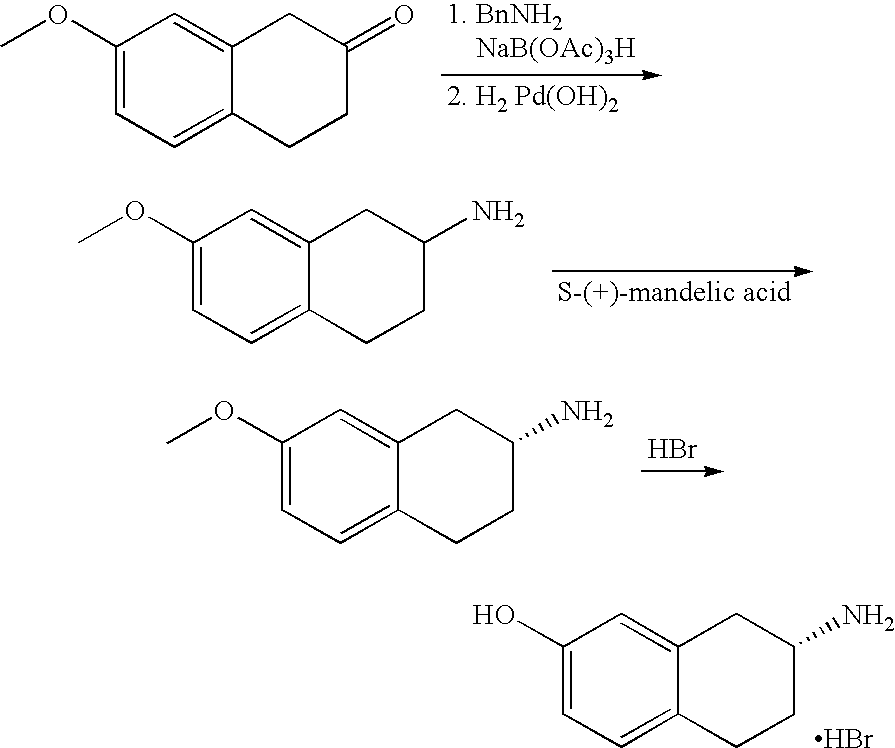
- 7-Methoxy-2-tetralone (18.37 g, 104 mmol) was dissolved in methylene chloride (400 mL), to which was subsequently added benzylamine (11.4 mL, 104 mmol). After stirring for 15 min, sodium triacetoxyborohydride (30.9 g, 146 mmol) and AcOH (5.9 mL, 100 mmol) were added to the dark mixture. The mixture lightened on addition of AcOH and the reaction mixture was allowed to stir overnight (15 h) at rt under nitrogen. The red/brown reaction mixture was diluted with DCM (400 mL) and washed with 1M sodium hydroxide solution (4×200 mL). The washings were combined and extracted with DCM (150 mL). The extracts were combined and washed with brine, dried over sodium sulfate, filtered and concentrated under reduced pressure to afford the benzylamine product (28.0 g, 100% as a brown oil). LC/MS: (AA) ES+ 268.
- N-benzyl-7-methoxy-1,2,3,4-tetrahydronaphthalen-2-amine (28.0 g, 105 mmol) was dissolved in reagent ethanol (400 mL). AcOH (92 mL, 1600 mmol) was added. The dark solution was degassed under reduced pressure and backfilled with nitrogen. Palladium hydroxide (7.0 g, 20% on carbon) was added. Hydrogen gas was bubbled through the reaction for 5 minutes then the reaction was placed under an atmosphere of hydrogen (balloon) and stirred at rt for 24 h, at which time the reaction was complete. Hydrogen was removed under reduced pressure and the flask was backfilled with nitrogen. The reaction mixture was filtered through a Celite pad, which was subsequently washed thoroughly. The filtrate was concentrated under reduced pressure and further dried in vacuo. The resulting dark oil was dissolved in ether and the solution acidified by the addition of 2.0 M HCl in ether (100 mL) added in portions by pipet. A gummy precipitate formed on acidification. Thorough sonication of the gum provided a white to light tan silty precipitate which was collected by filtration and dried in vacuo. Yield: 22.4 g (92%). LC/MS: (AA) ES+ 178.
- 7-methoxy-1,2,3,4-tetrahydronaphthalen-2-amine hydrochloride (21.7 g) was partitioned between 1M NaOH (200 mL) and ethyl acetate (200 mL). The aqueous phase was extracted with ethyl acetate (3×200 mL). The extracts were combined, washed with brine, dried over sodium sulfate, filtered and concentrated to afford a brown oil (17.7 g, 99.6 mmol).
- To a stirred solution of S-(+)-mandelic acid (15.4 g, 101 mmol), isopropyl alcohol (78 mL) and 80/20 methanol/water (51 mL) was added a solution of the free base of 7-methoxy-1,2,3,4-tetrahydronaphthalen-2-amine in toluene (10 mL) and 80/20 methanol/water (40 mL) via a dropping funnel. After addition was completed, the mixture was stirred at reflux for 30 min. The mixture was then cooled to rt. The mixture was allowed to stand at rt over the weekend. The resulting solids (16.95 g) were isolated by filtration, washed with minimal ethyl acetate and dried in vacuo. The salt was then suspended in an 80/20 methanol/water solution (55 mL) and warmed to reflux. Additional 80/20 methanol/water solution was added until the solution became homogeneous (about 10 mL). Upon complete dissolution, the solution was stirred at reflux 30 min, cooled to room temperature and allowed to stand undisturbed over night. The resulting white solids which precipitated were collected by suction filtration (11.94 g) and dried in vacuo. The solids were recrystallized as above from 80/20 methanol/water (ca. 60 mL) to afford 10.05 g of the S-(+)-mandelate salt ([α]═+90°, c═0.5, MeOH (Eur. J. Med. Chem. 1994, 29, 259-267)). The salt was partitioned between 4.00 M of sodium hydroxide in water (30.0 mL) and ethyl acetate (100 mL). The phases were separated and the aqueous phase was extracted with ethyl acetate (2×100 mL). The extracts were combined, washed with brine (35 mL), dried over sodium sulfate, filtered and concentrated to afford the desired amine (5.39 g, 60% of theoretical) as an oil. LC/MS: (AA) ES+ 178.
- A suspension of (2R)-7-methoxy-1,2,3,4-tetrahydronaphthalen-2-amine (5.92 g, 33.7 mmol) in hydrobromic acid (48% in water, 80 mL) was warmed to reflux. After 1.75 h, the reaction solution was cooled to rt. The solvent was removed under reduced pressure. The oily residue was twice dissolved in ethanol (100 mL) and concentrated to dryness. The resulting oil was further dried in vacuo, affording the desired product as a brown waxy solid (9.128 g, 99% yield, ([α]+91°, c═0.5, MeOH). (Eur. J. Med. Chem. 1994, 29, 259-267). LC/MS: (AA) ES+ 164.
-
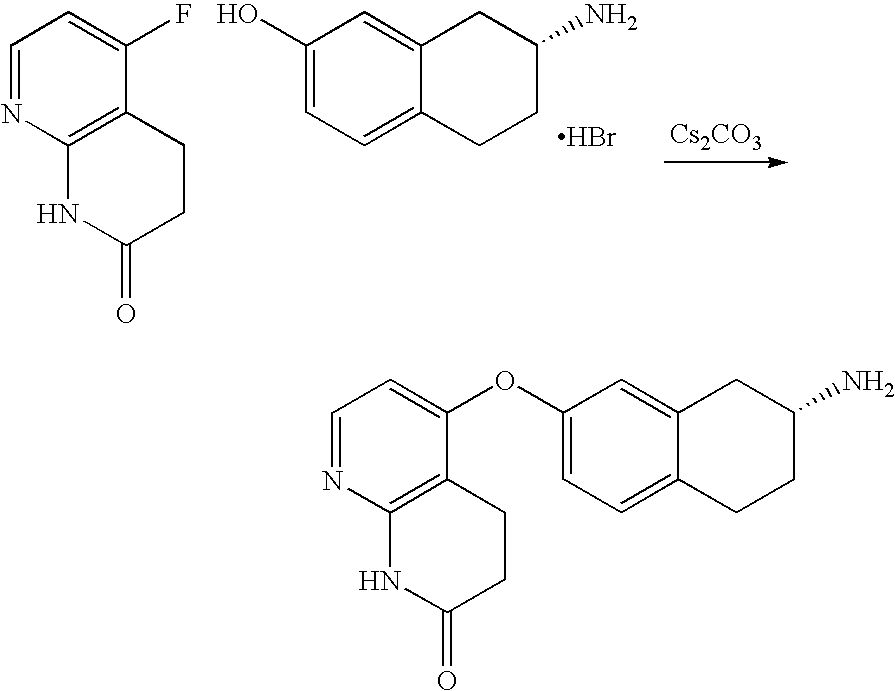
- A mixture of (7R)-7-amino-5,6,7,8-tetrahydronaphthalen-2-ol hydrobromide (16.7 g, 68.2 mmol), 5-fluoro-3,4-dihydro-1,8-naphthyridin-2(1H)-one (11.36 g, 64.95 mmol), and cesium carbonate (63.49 g, 194.9 mmol) in DMF (216 mL) was stirred at 140° C. for 2 h. The reaction was not complete, so additional (7R)-7-amino-5,6,7,8-tetrahydronaphthalen-2-ol hydrobromide (1.70 g, 6.82 mmol) was added. After an additional 1 h at 140° C., the reaction mixture was cooled to rt, and carefully treated with a solution of HCl (1 M). The reaction mixture was then diluted with DCM and filtered through Celite. The phases were separated and the aqueous phase was brought to pH 7 by the addition of a solution of NaOH (1.0 M). The brown precipitate was then removed by filtration through Celite, and the filtrate was washed with DCM. The aqueous phase was then brought to pH 14 by addition of a solution of NaOH (1.0 M) and an off-white precipitate formed. This suspension was treated with solid NaCl and stirred for 1 h. The solid was isolated by filtration and dried under vacuum to give a 17.7 g of an off-white solid (88% yield). LC/MS: (AA) ES+ 310. 1H NMR (400 MHz, d6 DMSO) δ: 10.47 (s, 1H), 7.94 (d, 1H), 7.12 (d, 1H), 6.85-6.81 (m, 2H), 6.26 (d, 1H), 3.03-2.96 (m, 1H), 2.89 (t, 2H), 2.85-2.79 (m, 1H), 2.76-2.66 (m, 1H), 2.51 (t, 2H), 2.44-2.38 (m, 1H), 1.90-1.84 (m, 1H), 1.65 (br s, 2H), and 1.50-1.40 (m, 1H).
-
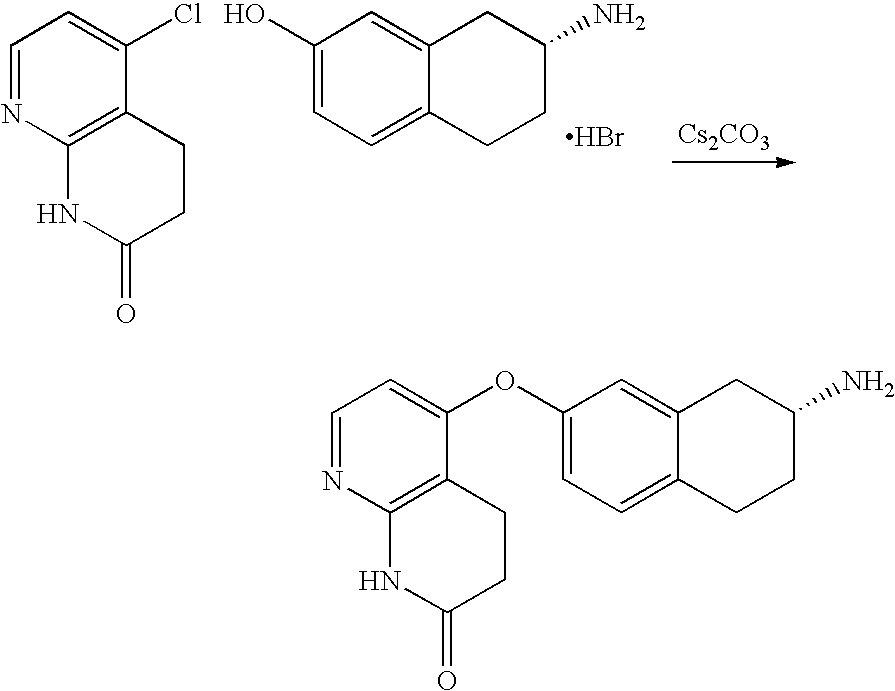
- A mixture of (7R)-7-amino-5,6,7,8-tetrahydronaphthalen-2-ol hydrobromide (735 mg, 3.01 mmol), 5-chloro-3,4-dihydro-1,8-naphthyridin-2(1H)-one (500 mg, 2.74 mmol), and cesium carbonate (2.68 g, 8.21 mmol) in DMF (10 mL) was heated in a microwave reactor at 250° C. for 6 min. The reaction mixture was cooled to rt, and the solvents were evaporated. 1N NaOH solution (100 mL) was added and the mixture was extracted with DCM (150 mL×3). The organic layers were dried (Na2SO4) and evaporated. Purification by column chromatography (SiO2, elution with 50:40:9:1 DCM:MeCN:MeOH:NH4OH) provided 580 mg of an off-white solid (65% yield). LC/MS: (AA) ES+ 310. 1H NMR (400 MHz, d6 DMSO) δ: 10.47 (s, 1H), 7.94 (d, 1H), 7.12 (d, 1H), 6.85-6.81 (m, 2H), 6.26 (d, 1H), 3.03-2.96 (m, 1H), 2.89 (t, 2H), 2.85-2.79 (m, 1H), 2.76-2.66 (m, 1H), 2.51 (t, 2H), 2.44-2.38 (m, 1H), 1.90-1.84 (m, 1H), 1.65 (br s, 2H), and 1.50-1.40 (m, 1H).
-
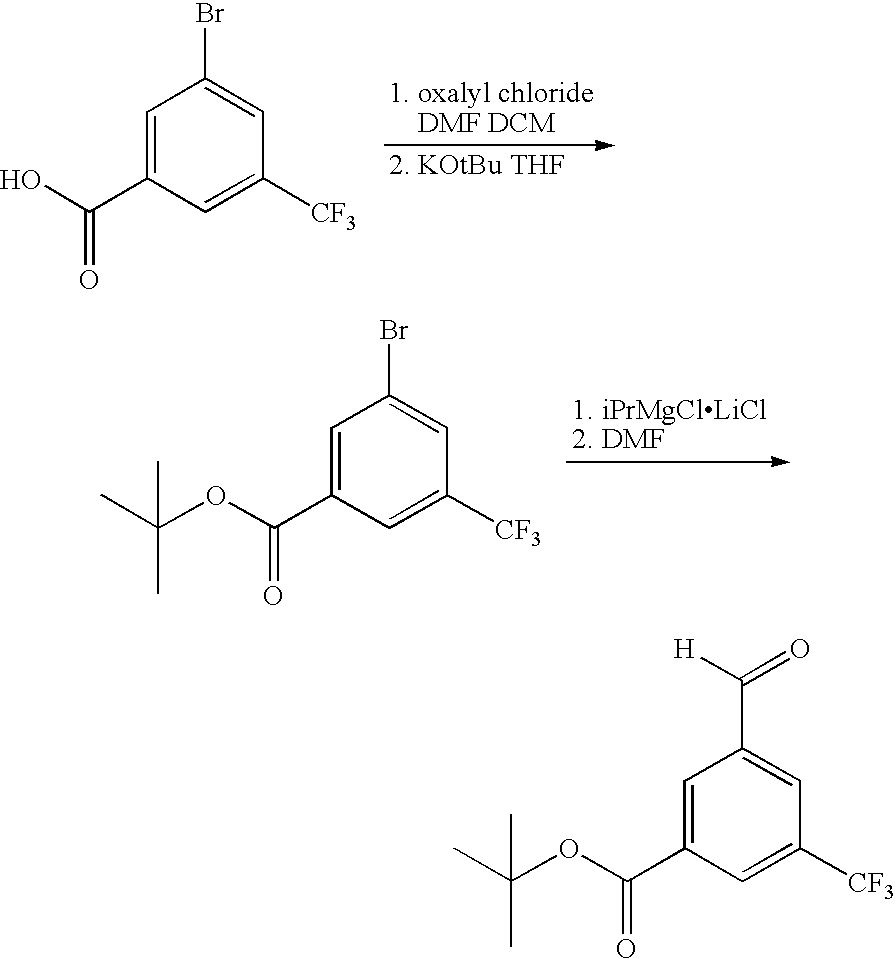
- Step 1 Preparation of tert-butyl 3-bromo-5-(trifluoromethyl)benzoate
- To a solution of 3-bromo-5-(trifluoromethyl)benzoic acid (95.2 g, 354 mmol) in DCM (470 mL), was added DMF (11.0 mL, 567 mmol). Oxalyl chloride (48.0 mL, 567 mmol) was added dropwise. The reaction was stirred for 18 h. The solvents were evaporated and the residue was azeotroped with toluene (2×). THF (470 mL) was added and the reaction was cooled to 0° C. Potassium tert-butoxide (1.0 M solution in THF, 708 mL, 708 mmol) was added dropwise. When addition was complete the reaction was stirred at it for 1 h. LC/MS indicated that the reaction was complete. Water was added and the mixture was extracted into EtOAc (2×). The combined organic phases were washed with water and brine, dried (Na2SO4) and evaporated. The residue was purified by filtration through silica in a 3 L fritted funnel, eluting with 5% EtOAc/hexane to provide the desired product as an oil (105 g, 91.1%). 1H NMR (300 MHz, CDCl3): δ 8.28 (s, 1H), 8.16 (s, 1H), 7.91 (s, 1H), and 1.61 (s, 9H).
- A solution of tert-butyl 3-bromo-5-(trifluoromethyl)benzoate (90.0 g, 277 mmol) in THF (674 mL) was degassed with argon for 15 min, and cooled to −20° C. A 1.3 M solution of isopropylmagnesiumchloride lithium chloride complex in THF (256 mL, 332 mmol) was added dropwise over approximately 30 min, maintaining the temperature during addition between −20° C. and −30° C. When addition was complete the reaction was stirred at −20° C. to −30° C. for 1 h. DMF (23.6 mL, 304 mmol) was added dropwise, maintaining the temperature between −20° C. and −30° C., and then the reaction was stirred at this temperature for a further 30 min. The reaction was then allowed to warm to 0° C. TLC (10% EtOAc/hexane) showed that the reaction was complete. 1.0 M HCl solution (111 mL, 1.11 mmol) was added and the reaction was allowed to stir at rt for 45 min. Et2O was added and the layers were separated. The aqueous phase was extracted with Et2O and the combined organic phases were washed with saturated NaHCO3 solution, then brine, dried (Na2SO4) and evaporated. The residue was purified by filtration through silica in a 3 L fritted funnel, eluting with hexane, 10% DCM/hexane 20% DCM/hexane then 10% EtOAc/hexane to provide the desired product as an off-white solid (52.1 g, 68.7%). 1H NMR (300 MHz, CDCl3): δ 10.13 (s, 1H), 8.64 (s, 1H), 8.48 (s, 1H), 8.30 (s, 1H), and 1.64 (s, 9H).
-
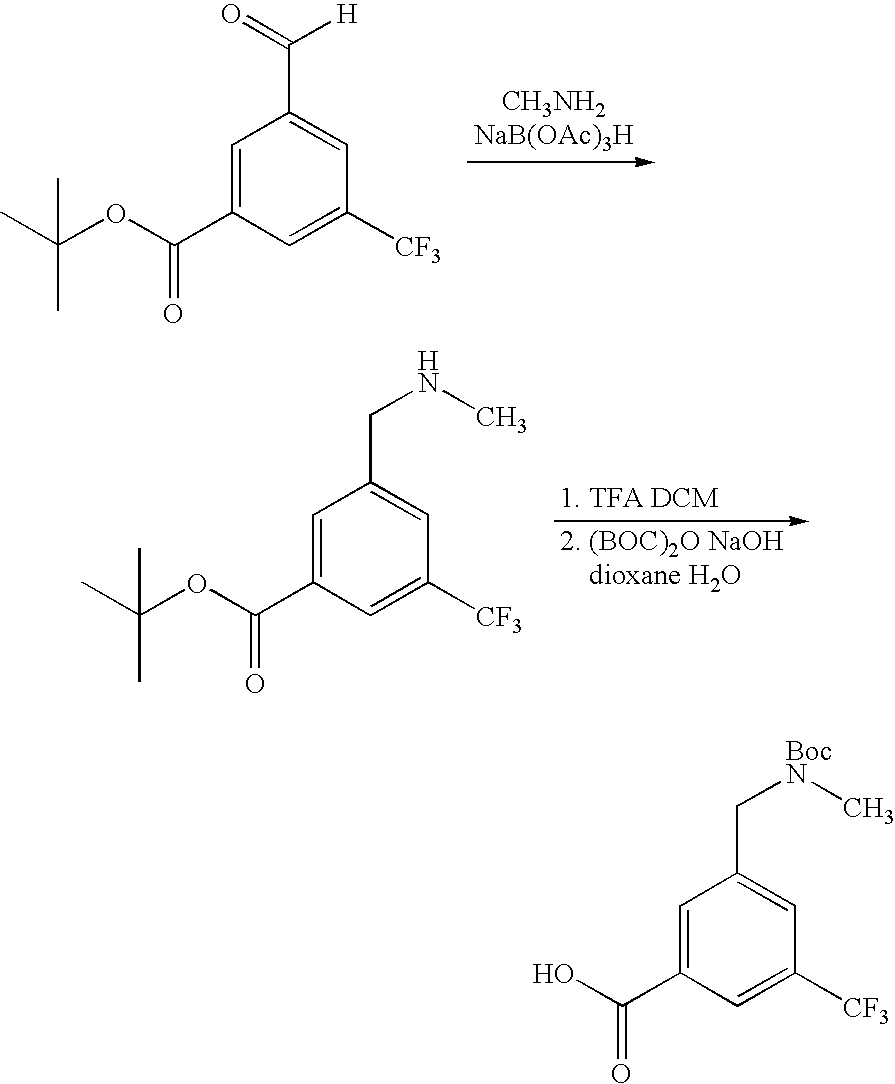
- A solution of 2.0 M of methylamine in tetrahydrofuran (10.0 mL, 20.0 mmol) was added to a solution of tert-butyl 3-formyl-5-(trifluoromethyl)benzoate (2.20 g, 8.02 mmol) in methylene chloride (80 mL). This solution was stirred at rt for 15 minutes, and then sodium triacetoxyborohydride (4.25 g, 20.0 mmol) was added. The resulting solution was stirred at rt overnight. The reaction mixture was diluted with saturated sodium bicarbonate solution (50 mL) and extracted three times with methylene chloride. The organic phase was washed with water and brine, dried over Na2SO4, filtered, and concentrated. Purification by column chromatography (SiO2, elution with 0-10% methanol in ethyl acetate) provided a 1.05 g of a white solid (45% yield). LC/MS: (FA) ES+ 290.
- A solution of tert-butyl 3-[(methylamino)methyl]-5-(trifluoromethyl)benzoate (1.00 g, 3.46 mmol) was dissolved in DCM (6.0 mL) and trifluoroacetic acid (2.66 mL, 3.46 mmol) was added. The resulting solution was stirred at rt for 120 min, and then the solvents were removed in vacuo. The residue was dissolved in methylene chloride (1.0 mL) and 2.0 M of hydrochloric acid in ether (5.0 mL, 10.0 mmol) was added. The solvent was evaporated to dryness and gave 895 mg of a white solid (96% yield). LC/MS: (AA) ES+ 234.
- 3-[(methylamino)methyl]-5-(trifluoromethyl)benzoic acid.HCl (3, 0.895 g, 3.32 mmol) was added 1,4-dioxane (10 mL), water (7.0 mL) and 1.0 M of sodium hydroxide (13.0 mL, 13.0 mmol). Then di-tert-butyldicarbonate (1.45 g, 6.64 mmol) was added and the resulting solution was stirred at rt for 90 min. Dioxane was removed under reduced pressure and pH was adjusted to 3 by the addition of 1N HCl. The aqueous phase was extracted three times with ethyl acetate. The organic phase was washed with brine, dried over Na2SO4, filtered, and concentrated. Purification by column chromatography (SiO2, elution with 0-15% methanol in methylene chloride) provided a 1.01 g of a white solid (91% yield). LC/MS: (FA) ES− 332
- Compounds in the following table were prepared from the appropriate starting materials in a method analogous to that described for 3-([(tert-butoxycarbonyl)(methyl)amino]-methyl)-5-(trifluoromethyl)benzoic acid and the corresponding intermediates:
-
3-((tert-butoxycarbonyl(2,2-difluoroethyl)amino)methyl)- LC/MS: (FA) 5-(trifluoromethyl)benzoic acid ES− 382. 3-{[3-(hydroxymethyl)morpholin-4-yl]methyl}-5- LC/MS: (AA) (trifluoromethyl)benzoic acid ES+ 320. 3-{[(tert-butoxycarbonyl)(ethyl)amino]methyl}-5- LC/MS: (FA) (trifluoromethyl)benzoic acid ES− 346. -
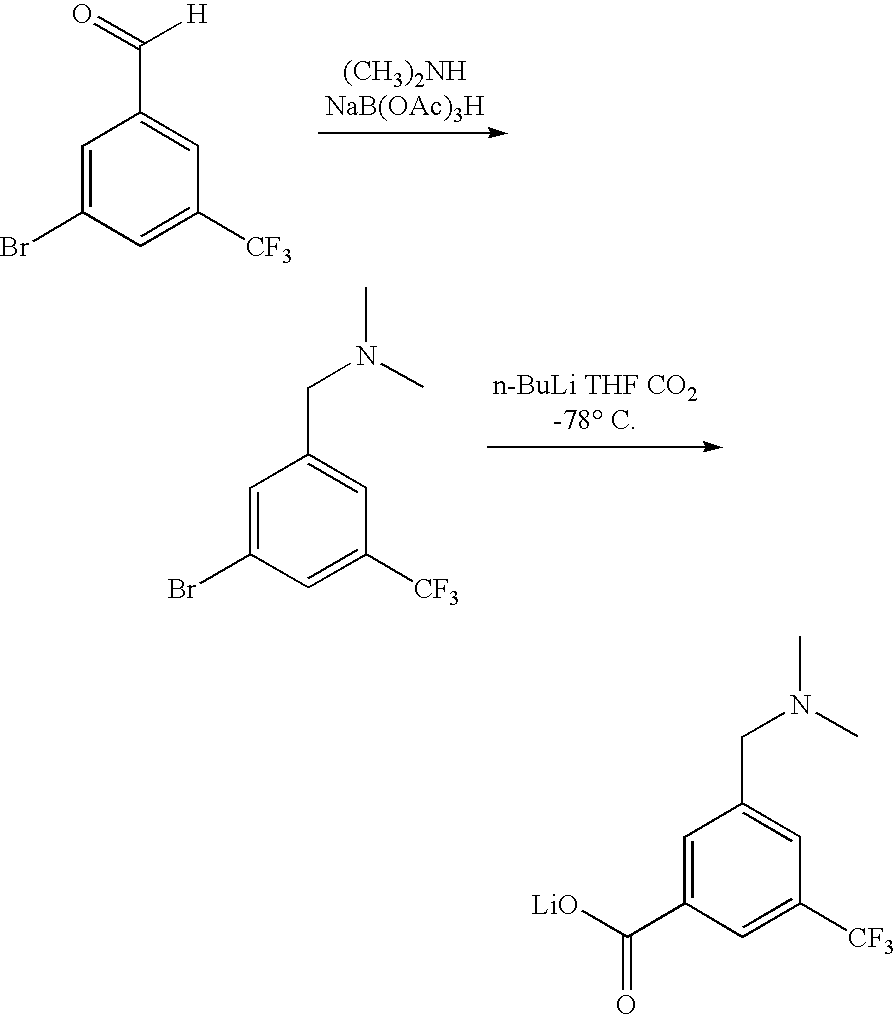
- To a solution of 3-bromo-5-(trifluoromethyl)benzaldehyde (30.0 g, 118.6 mmol) in methylene chloride (150 mL) was added a solution of 2.0 M of dimethylamine in THF (118 mL) and the reaction was stirred at rt for 15 min. The reaction was cooled to 0° C. and sodium triacetoxyborohydride (37.7 g, 178 mmol) was added. The resulting mixture was warmed to rt and stirred for 3 hours. The solvents were evaporated; saturated sodium bicarbonate solution was added and the resulting mixture was extracted three times with ethyl acetate. The organic phase was washed with brine, dried over Na2SO4, filtered, and concentrated. Purification by column chromatography (SiO2, elution with 10-40% ethyl acetate in hexanes) provided a 24.9 g of a colorless oil (74% yield). LC/MS: (FA) ES+ 282.
- To a solution of 1-[3-bromo-5-(trifluoromethyl)phenyl]-N,N-dimethylmethanamine (2.0 g, 7.1 mmol) in THF (40 mL) at −78° C. was added dropwise a solution of 2.50 M of n-butyllithium in hexane (3.12 mL, 7.81 mmol). The resulting mixture was stirred at −78° C. for 20 min. Crushed solid CO2 was added and the mixture was stirred at −78° C. for another 15 min. The reaction was quenched by the addition of water (0.156 mL), and allowed to warm to room temperature. The solvents were evaporated and the solid was dried overnight under vacuum to give a 1.38 g of a white solid (77%). LC/MS: (FA) ES+ 248.
-

- To a solution of tert-butyl 3-formyl-5-(trifluoromethyl)benzoate (1.75 g, 6.40 mmol), in EtOH (60 mL) was added pyridine (2.58 mL, 31.9 mmol) and hydroxylamine hydrochloride (887 mg, 12.8 mmol). The reaction mixture was allowed to stir at rt for 5 h. After this time LC/MS showed complete reaction. Water was added and the mixture was extracted into EtOAc. The organic phase was washed with brine, dried (Na2SO4) and evaporated to provide the desired product as a yellow oil (1.97 g, quant). LC/MS: (FA) ES+ 290.
- To a solution of tert-butyl 3-[(Z)-(hydroxyimino)methyl]-5-(trifluoromethyl)benzoate (1.97 g, 6.81 mmol) in 7.0 M ammonia in methanol (50.0 mL) was added Raney Nickel (2800 slurry in water 50% by volume, 0.50 mL). The mixture was treated with hydrogen gas at 50 psi for 18 h. The mixture was then diluted with MeOH and filtered through celite. The filtrate was evaporated and the residue was dissolved in ethyl acetate, washed with brine, dried (Na2SO4) and evaporated to provide the desired compound as a yellow oil (1.24 g, 66.1%). LC/MS: (FA) ES+ 276.
- To a solution of tert-butyl 3-(aminomethyl)-5-(trifluoromethyl)benzoate (1.24 g, 4.50 mmol) in DCM (40.0 mL) at 0° C., was added trifluoroacetic acid (3.47 mL, 45.1 mmol) dropwise. The reaction was allowed to warm to rt and was stirred overnight. The solvents were evaporated and the residue was triturated with Et2O to provide the desired compound as a white solid (892 mg, 90.4%). LC/MS: (FA) ES+ 220.
-
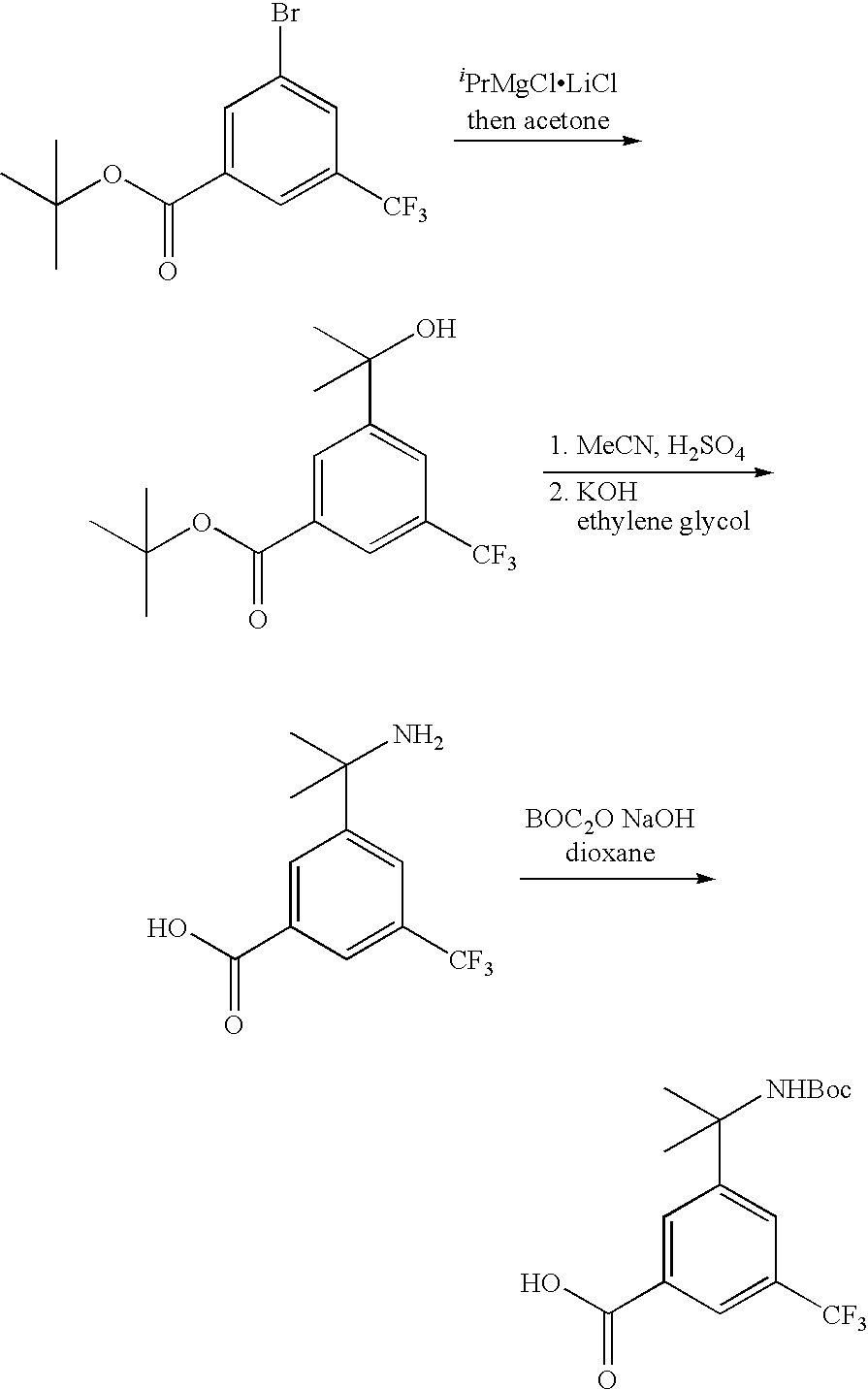
- A solution of tert-butyl 3-bromo-5-(trifluoromethyl)benzoate (35.0 g, 108 mmol) in THF (262 mL) was degassed with argon and cooled to −20° C. A 1.3 M solution of isopropylmagnesium chloride lithium chloride complex in THF (99.4 mL, 129 mmol) was added dropwise, maintaining the temperature of the reaction at −20 to −30° C. When addition was complete, the reaction was stirred at this temperature for 90 min. Acetone (8.69 mL, 118 mmol) was added dropwise maintaining the temperature of the reaction at −20 to −30° C., then the reaction was stirred at this temperature for 30 min. The reaction was allowed to warm to 0° C. and stirred for 45 min. A solution of 1 M HCl (430 mL, 430 mmol) was added, and the reaction was warmed to rt and stirred for 45 min. Et2O was added and the phases were separated. The aqueous phase was extracted with further Et2O and the combined organic phases were washed with sat NaHCO3 solution, then brine, dried (Na2SO4) and evaporated. The residue was purified by chromatography on silica (elution with 5% to 20% EtOAc/hexane) to provide the desired compound as a pale yellow oil (16.2 g, 49.3%) LC/MS: (FA) ES+ 287 (M-18)
- To a solution of tert-butyl 3-(1-hydroxy-1-methylethyl)-5-(trifluoromethyl)benzoate (5.13 g, 16.8 mmol) in acetonitrile (160 mL), was added concentrated sulfuric acid (3.59 mL, 67.4 mmol) dropwise. The reaction was stirred at rt for 3 h. EtOAc was added and the mixture was washed with water (2×). The organic phase was extracted with 1 N NaOH solution (3×) and the basic aqueous phases were acidified to pH 1 by the addition of 6 N HCl solution. The aqueous phase was then extracted into EtOAc (2×) and the organic phases were dried (Na2SO4), filtered, and evaporated to provide the desired compound as a white solid (4.48 g, 91.9%). LC/MS: (FA) ES+ 290
- A mixture of 3-[1-(acetylamino)-1-methylethyl]-5-(trifluoromethyl)benzoic acid (4.48 g, 15.5 mmol), 1,2-ethanediol (20 mL) and KOH (8.69 g, 155 mmol) was heated at 150° C. for 3 days. The reaction was cooled to rt and approximately 20 mL of water as added. The mixture was washed with Et2O (2×) and the aqueous phase was acidified to pH 5 by the addition of 6 N HCl solution. The precipitate was filtered off and washed with water. The solid was collected, triturated with water and dried under vacuum to provide the desired compound as a white solid (3.84 g, 100%). LC/MS: (FA) ES+ 248.
- To a solution of 3-(1-amino-1-methylethyl)-5-(trifluoromethyl)benzoic acid (17.2 g, 69.5 mmol) in dioxane (180 mL), was added a solution of 1 N NaOH (208 mL, 208 mmol) and di-tert-butyldicarbonate (60.7 g, 278 mmol). The reaction mixture was stirred overnight. The dioxane was evaporated and the residue was diluted with water and washed with Et2O (2×). EtOAc was added to the aqueous phase followed by addition of 6 N HCl to acidify the aqueous phase to pH 1. The mixture was extracted with EtOAc (2×). The organic phases were washed with water then brine, dried (Na2SO4) and evaporated. The residue was purified by filtration through silica (elution with DCM, then 10% MeOH/1% AcOH/DCM) followed by trituration of the product with DCM. The product was dried under vacuum to provide the desired compound as a white solid (15.0 g, 62.2%). LC/MS: (FA) ES− 346.
- Compounds in the following table were prepared from the appropriate starting materials in a method analogous to that described for 3-{1-[(tert-butoxycarbonyl)amino]-1-methylethyl}-5-(trifluoromethyl)benzoic acid and the corresponding intermediates:
-
3-{1-[(tert-butoxycarbonyl)amino]cyclobutyl}-5- LC/MS: (FA) (trifluoromethyl)benzoic acid ES+ 358. 3-[1-(diphenylmethyl)-3-hydroxyazetidin-3-yl]-5- LC/MS: (AA) (trifluoromethyl)benzoic acid ES+ 428. -
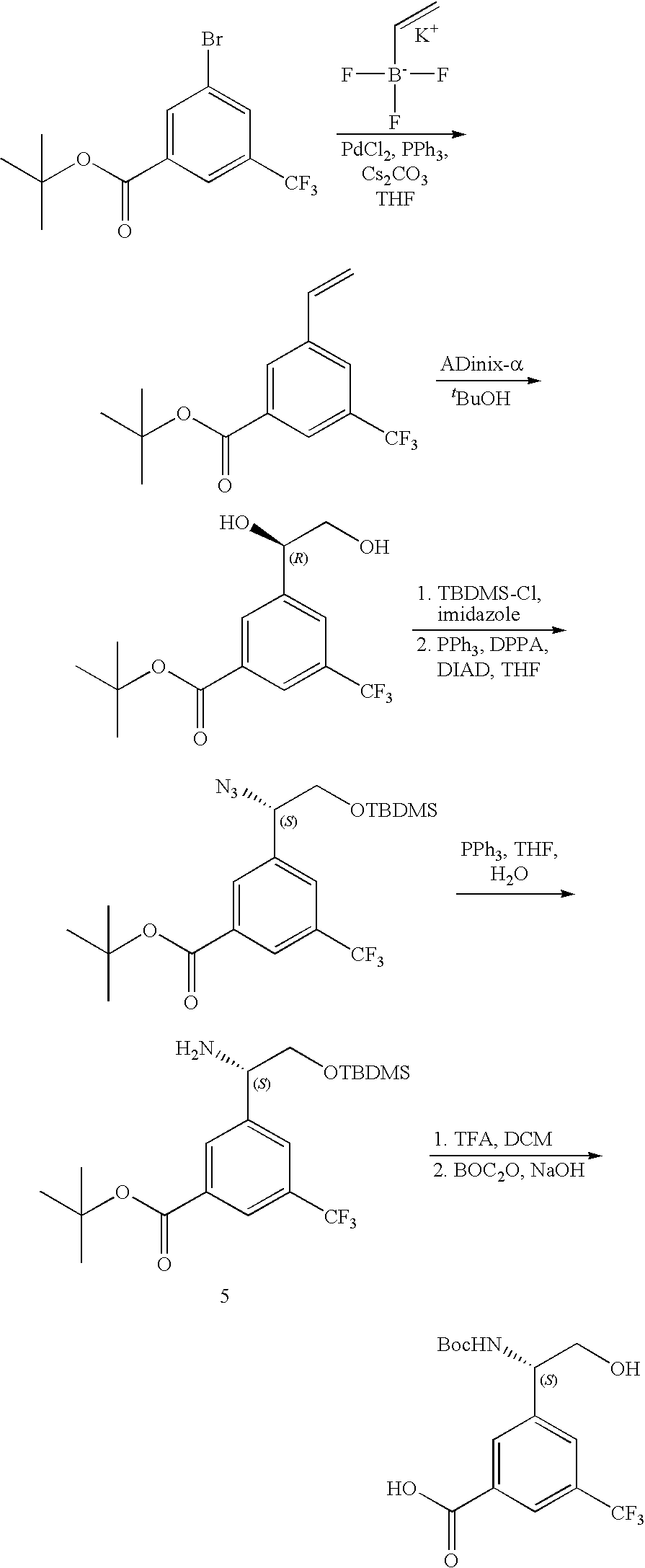
- A mixture of tert-butyl 3-bromo-5-(trifluoromethyl)benzoate (1.83 g, 5.60 mmol), potassiumvinyltrifluoroborate (867 mg, 6.50 mmol), triphenylphosphine (88.6 mg, 0.34 mmol), palladium (II) chloride (20.0 mg, 0.11 mmol), and cesium carbonate (5.50 g, 16.9 mmol) in THF (13.7 mL) and water (1.52 mL) was heated in a sealed tube at 85° C., overnight. The reaction mixture was cooled to rt, and diluted with water (20.3 mL). The mixture was extracted with DCM (2×), and the organic phases were dried (MgSO4) and evaporated. The residue was purified by chromatography on silica (elution with hexane) to provide the desired product as a yellow liquid which was contaminated with approximately 10% bromide starting material (1.0 g, 65.2%). 1H NMR (300 MHz, CDCl3): δ 8.18 (s, 1H), 8.10 (s, 1H), 7.78 (s, 1H), 6.77 (dd, 1H), 5.89 (d, 1H), 5.43 (d, 1H), and 1.62 (s, 9H).
- A solution of AD-mix-alpha (2.25 g), in tert-butyl alcohol (8.17 mL) and water (8.17 mL) was cooled in an ice bath, and tert-butyl 3-(trifluoromethyl)-5-vinylbenzoate (440 mg, 1.60 mmol) dissolved in a minimum amount of tert-butyl alcohol was added. The reaction mixture was allowed to stir overnight at rt. Sodium sulfite (2.25 g, 17.8 mmol) was added and the mixture was stirred for 30 min. The solvents were evaporated and water was added. The mixture was extracted into EtOAc (2×), and the organic phases were dried and evaporated. The residue was purified by chromatography on silica (elution with 0% to 20% EtOAc/DCM) to provide the desired compound (390 mg, 78.8%, 92.8% ee). 1H NMR (300 MHz, CDCl3): δ 8.14 (s, 2H), 7.83 (s, 1H) 4.94 (dd, 1H), 3.84 (dd, 1H), 3.66 (dd, 1H), and 1.60 (s, 9H).
- To a solution of tert-butyl 3-[(1R)-1,2-dihydroxyethyl]-5-(trifluoromethyl)benzoate (194 mg, 0.63 mmol) in DMF (6 mL) at 0° C. was added tert-butyldimethylsilyl chloride (114 mg, 0.76 mmol) and imidazole (64.7 mg, 0.95 mmol). The reaction mixture was allowed to warm to room temperature and stirred for 4 h. LC/MS showed complete reaction. Water was added and the mixture was extracted into EtOAc. The organic phase was washed with water (3×), then brine, dried (Na2SO4) and evaporated. The residue was purified by filtration through a small pad of silica (elution with 10% EtOAc/hexane) to provide the desired compound (229 mg, 85.9%). LC/MS: (FA) ES− 419.
- A solution of tert-butyl 3-((1R)-2-{[tert-butyl(dimethyl)silyl]oxy}-1-hydroxyethyl)-5-(trifluoromethyl)benzoate (3) (229 mg, 0.54 mmol) in THF (5.0 mL), was cooled to 0° C. Triphenylphosphine (357 mg, 1.36 mmol) was added, followed by the dropwise addition of diisopropyl azodicarboxylate (268 uL, 1.36 mmol) and diphenylphosphonic azide (293 uL, 1.36 mmol). The reaction mixture was stirred at 0° C. for 2 h. The LC/MS showed consumption of the starting material. The solvents were evaporated and the residue was purified by chromatography on silica (elution with 2% to 10% EtOAc/hexane) to provide the desired compound as a clear oil (202 mg, 83.3%). 1H NMR (400 MHz, CDCl3): δ 8.17 (s, 1H), 8.09 (s, 1H), 7.76 (s, 1H), 4.70 (dd, 1H), 3.83 (m, 2H), 1.62 (s, 9H), 0.88 (s, 9H), 0.05 (s, 3H), and 0.03 (s, 3H).
- To a solution of tert-butyl 3-((1S)-1-azido-2-{[tert-butyl(dimethyl)silyl]oxy}ethyl)-5-(trifluoromethyl)benzoate (202 mg, 0.45 mmol) in THF (4.00 mL) and water (81.7 uL, 4.50 mmol), was added triphenylphosphine (357 mg, 1.36 mmol). The reaction mixture was heated at 60° C. for 3 h. After this time, water (81.7 uL, 4.50 mmol) was added and heating continued overnight. The reaction mixture was cooled to rt and the solvents were evaporated. The residue was purified by chromatography on silica (elution with 12% to 50% EtOAc/hexane) to provide the desired product as a clear oil (136 mg, 71.5%). LC/MS: (FA) ES+ 420.3.
- To a solution of tert-butyl 3-((1S)-1-amino-2-{[tert-butyl(dimethyl)silyl]oxy}ethyl)-5-(trifluoromethyl)benzoate (136 mg, 0.32 mmol) in DCM (3.00 mL) at 0° C. was added TFA (250 uL, 3.20 mmol) dropwise. The reaction mixture was allowed to warm slowly to rt and stirred for 48 h. LC/MS of the reaction mixture showed the desired product which was contaminated with approximately 40% 3-((1S)-1-amino-2-{[tert-butyl(dimethyl)silyl]oxy}ethyl)-5-(trifluoromethyl)benzoic acid. The solvents were evaporated. The residue was dissolved in dioxane (6.0 mL) and 1N NaOH solution (1.85 mL, 1.85 mmol) was added, followed by the addition of di-tert-butyldicarbonate (270 mg, 1.20 mmol). The reaction mixture was stirred at rt for 3 h. The solvents were evaporated and the residue was dissolved in EtOAc. 1N HCl was added to acidify the aqueous phase, and extracted into EtOAc (3×). The combined organic phases were washed with 1N HCl, then brine, dried (Na2SO4) and evaporated. The residue was purified by chromatography on silica (elution with 15% to 60% of (10% MeOH/1% AcOH/DCM)/DCM to provide the desired product (50.0 mg, 44.0%). LC/MS: (FA) ES− 348.2.
-
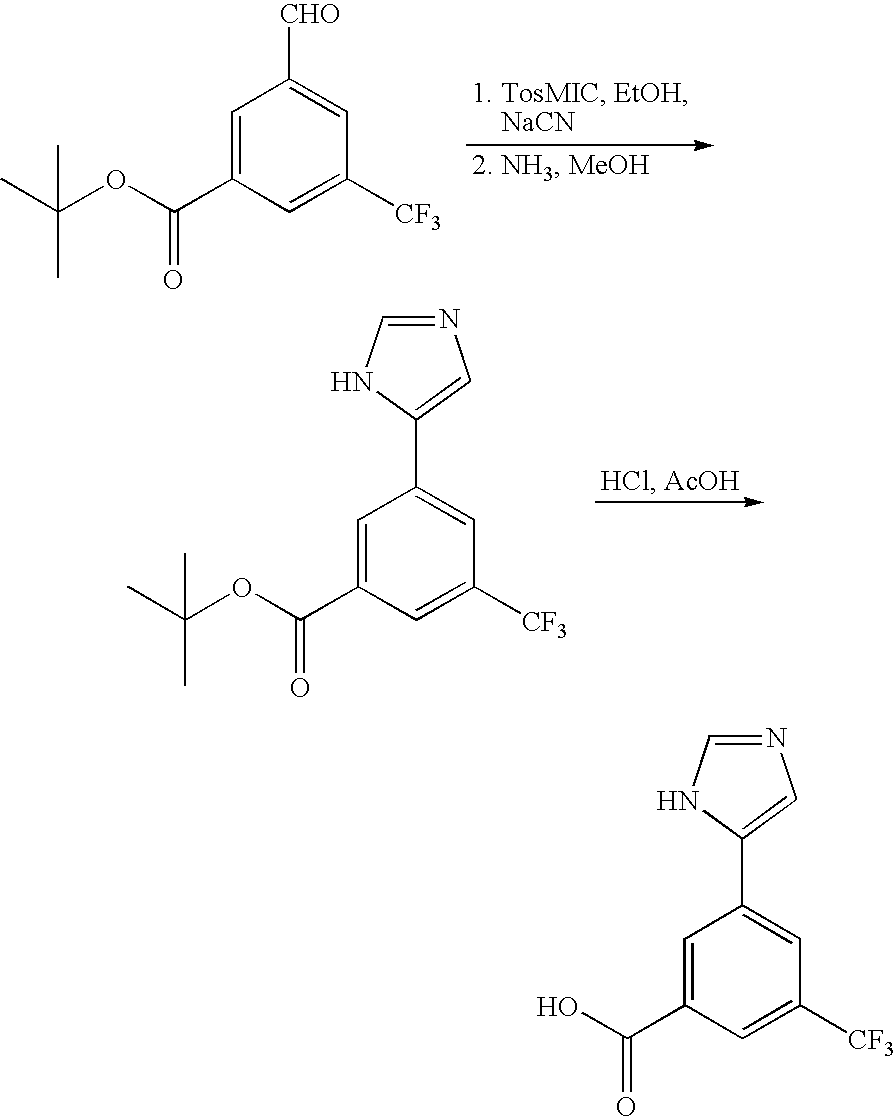
- To a solution of tent-butyl 3-formyl-5-(trifluoromethyl)benzoate (1.05 g, 3.83 mmol) and p-tolylsulfonylmethyl isocyanide (748 mg, 3.83 mmol) in ethanol (10.0 mL), was added sodium cyanide (18.8 mg, 0.38 mmol). The reaction was stirred at rt for 1 h. LCMS showed the desired oxazoline intermediate. The solvents were evaporated and the residue was dissolved in 7.0 M ammonia in methanol solution (9.45 mL, 66.1 mmol) and the mixture was heated at 100° C. in a sealed tube for 3 h. After this time LCMS showed the desired product. The solvents were evaporated and the residue was purified by column chromatography (SiO2, elution with 1.5-6% MeOH/DCM) to provide the desired compound as a beige solid (269 mg, 22.5%). LC/MS: (FA) ES+ 313, ES− 311.
- tert-butyl 3-(1H-imidazol-5-yl)-5-(trifluoromethyl)benzoate (479 mg, 1.53 mmol) was dissolved in a mixture of acetic acid (5.00 mL) and concentrated hydrochloric acid (94.0 uL, 3.07 mmol) and the reaction mixture was stirred overnight. The solvents were evaporated and the residue was azeotroped with toluene and hexane, then triturated with EtOAc and dried under vacuum to provide the desired compound as a beige solid (397 mg, 100%). LC/MS: (FA) ES+ 257, ES− 255
-
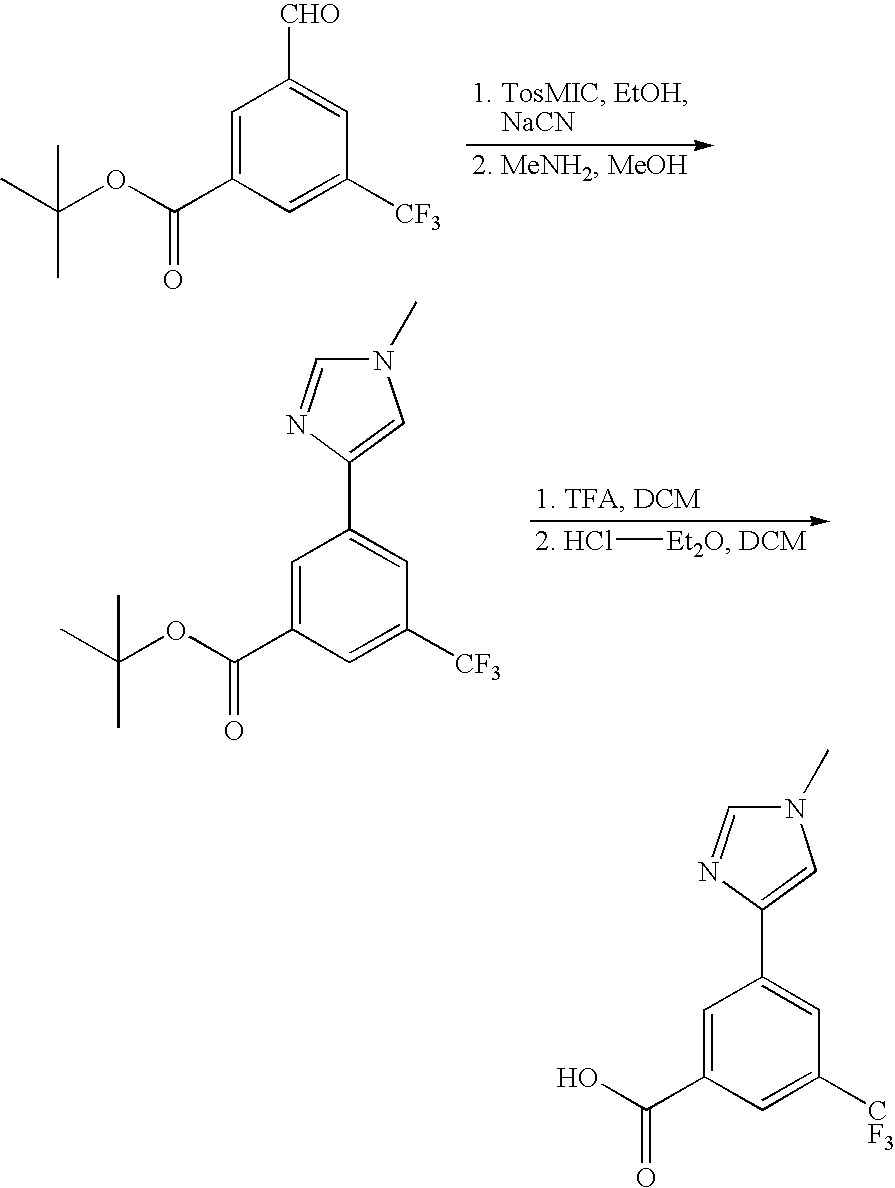
- To a solution of tert-butyl 3-formyl-5-(trifluoromethyl)benzoate (4.00 g, 14.6 mmol) and p-tolylsulfonylmethyl isocyanide (2.85 g, 14.6 mmol) in ethanol (800 mL), was added sodium cyanide (71.5 mg, 1.46 mmol). The reaction was stirred at rt for 1 h. LCMS showed the desired oxazoline intermediate. The solvents were evaporated until 5-10 mL ethanol remained and the residue was dissolved in 2.0 M methylamine in methanol (36.5 mL, 72.9 mmol) and the mixture was heated at 75° C. in a sealed tube for 4 h. On cooling a precipitate formed which was filtered off. The filtrate was evaporated and the residue was purified by column chromatography (SiO2, elution 1.2% to 5% MeOH/DCM). The material was further purified by column chromatography (SiO2, elution 17% to 70% EtOAc/hexane) to provide the desired compound as a solid (262 mg, 5.5%). LC/MS: (FA) ES+ 327
- To a solution of tert-butyl 3-(1-methyl-1H-imidazol-4-yl)-5-(trifluoromethyl)benzoate in DCM (1.00 mL), was added TFA (1.21 mL). The reaction was stirred for 3 h. The solvents were evaporated and the residue was azeotroped with toluene. The residue was then treated with DCM and 2.0 M HCl-Et2O solution and the solvents were evaporated to provide the desired compound as the HCl salt (254 mg, 100%). LC/MS: (FA) ES+ 271.
-
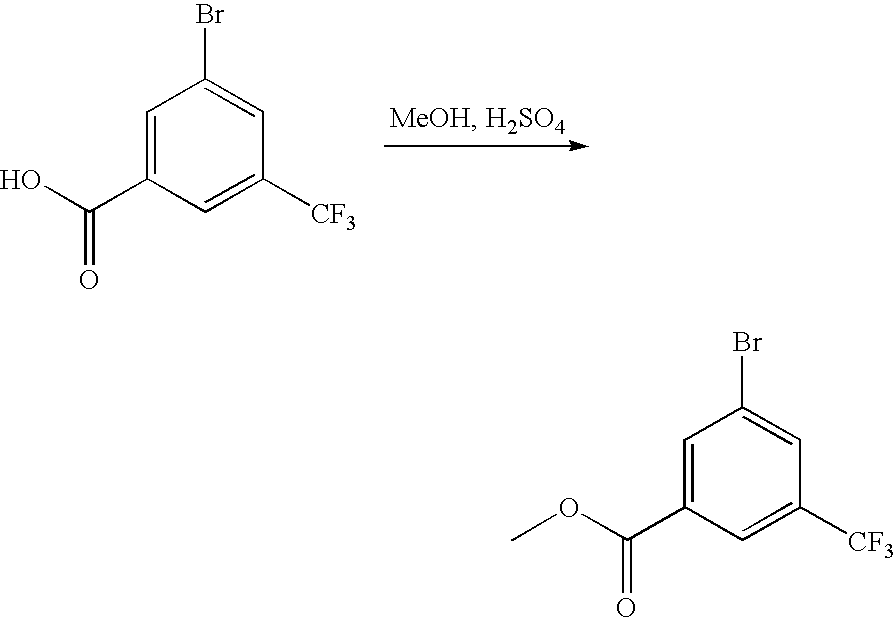
- Sulfuric acid (7.90 mL, 148 mmol) was added dropwise to a solution of 3-bromo-5-(trifluoromethyl)benzoic acid (10.0 g, 37.2 mmol) in methanol (150 mL). The mixture was heated at 60° C. overnight. The methanol was evaporated and EtOAc was added. The mixture was basified by the addition of saturated NaHCO3 solution and extracted into EtOAc (2×). The combined organic phases were washed with water and brine, dried (Na2SO4) and evaporated to provide the desired compound as an oil (10.5 g, 94.6%). 1H NMR (400 MHz, CDCl3): δ 8.36 (s, 1H), 8.23 (s, 1H), 7.95 (s, 1H), and 5.97 (s, 3H).
-
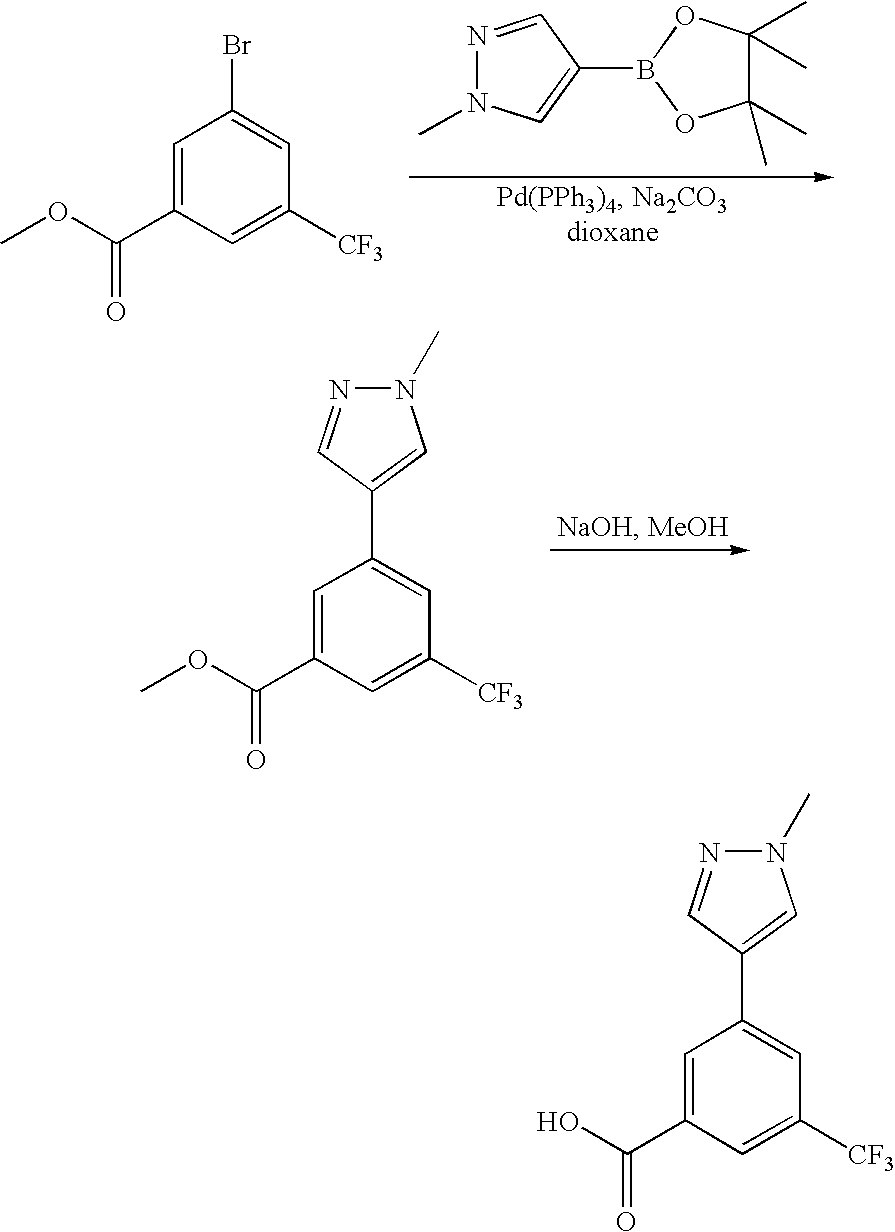
- To a solution of methyl 3-bromo-5-(trifluoromethyl)benzoate (21.8 g, 77.0 mmol) in dioxane (218 mL), and water (131 mL), was added 1-methyl-4-(4,4,5,5-tetramethyl-1,3,2-dioxaborolan-2-yl)-1H-pyrazole (24.0 g, 116 mmol), sodium carbonate (27.7 g, 261 mmol) and tetrakis(triphenyphosphine)palladium(0) (4.40 g, 3.80 mmol). The reaction mixture was heated at 80° C. for 3 h. after which time TLC (20% EtOAc/hexane) showed consumption of the starting material. The reaction was cooled to rt and the precipitate was filtered off. The filtrate was diluted with water and extracted into EtOAc (2×). The organic phases were washed with brine, dried (Na2SO4) and evaporated. The residue was purified by filtration through silica, eluting with 0% to 40% EtOAc/hexane to provide the desired compound as a pale yellow solid (22.3 g, 100%). LC/MS: (FA) ES+ 285.
- To a solution of methyl 3-(1-methyl-1H-pyrazol-4-yl)-5-(trifluoromethyl)benzoate (22.3 g, 78.5 mmol) in methanol (375 mL), was added 1 N NaOH solution (314 mL, 314 mmol). The reaction was stirred at rt for 2 h. The methanol was evaporated and the aqueous residue was acidified to pH 2 with 1 N HCl. The precipitate was filtered off, washed with water and hexane and dried under vacuum to provide the desired compound as a white solid (20.3 g, 95.7%). LC/MS: (FA) ES+ 271, ES− 269.
- 3-(1H-pyrazol-4-yl)-5-(trifluoromethyl)benzoic acid was prepared from the appropriate starting materials in a method analogous to that described for 3-(1-methyl-1H-pyrazol-4-yl)-5-(trifluoromethyl)benzoic acid and the corresponding intermediates. LC/MS: (FA) ES+ 257.
-

- tent-Butyl 3-bromo-5-(trifluoromethyl)benzoate (0.380 g, 1.17 mmol) and 1-methyl-5-(4,4,5,5-tetramethyl-1,3,2-dioxaborolan-2-yl)-1H-pyrazole (0.250 g, 1.20 mmol) were added to a microwave-safe vial. 1,4-Dioxane (2 mL) and 2.0 M sodium carbonate solution (1.71 mL, 3.42 mmol) were added. The reaction was degassed under an atmosphere of nitrogen for 3 minutes and tetrakis(triphenylphosphine)palladium(0) (0.270 g, 0.234 mmol) was added. The vial was then sealed and irradiated in the microwave at 100° C. for 10 minutes. The reaction vial was unsealed, and the mixture was diluted with ethyl acetate. The organic phase was washed with water and brine, dried over Na2SO4, filtered, and concentrated. Purification by column chromatography (SiO2, elution with 0-10% ethyl acetate in dichloromethane) provided a 259 mg of a colorless oil (68% yield). LC/MS: (FA) ES+ 327.
- 3-(1-methyl-1H-pyrazol-5-yl)-5-(trifluoromethyl)benzoic acid was prepared from the appropriate starting materials in a method analogous to that described for 3-(1-methyl-1H-imidazol-4-yl)-5-(trifluoromethyl)benzoic acid.HCl. LC/MS: (FA) ES+ 271.
- 3-(1H-pyrazol-5-yl)-5-(trifluoromethyl)benzoic acid was prepared from the appropriate starting materials in a method analogous to that described for 3-(1-methyl-1H-pyrazol-5-yl)-5-(trifluoromethyl)benzoic acid and the corresponding intermediates. LC/MS: (FA) ES+ 257.
-
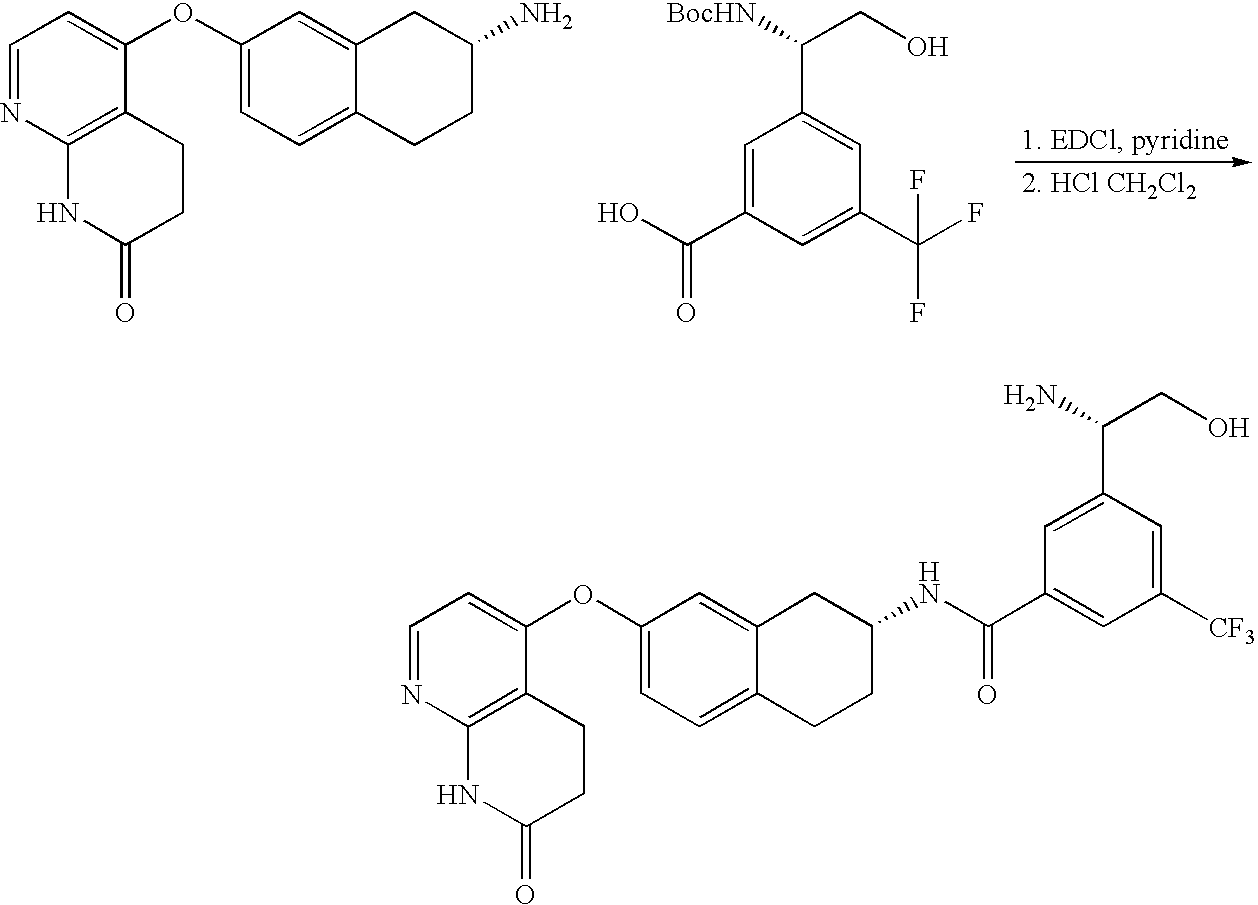
- To a solution of 3-{(1S)-1-[(tert-butoxycarbonyl)amino]-2-hydroxyethyl}-5-(trifluoromethyl)benzoic acid (24.0 mg, 0.07 mmol) and 5-{[(7R)-7-amino-5,6,7,8-tetrahydronaphthalen-2-yl]oxy}-3,4-dihydro-1,8-naphthyridin-2(1H)-one (21.2 mg, 0.07 mmol) in pyridine (1.00 mL) was added N-(3-dimethylaminopropyl)-N-ethylcarbodiimide hydrochloride (19.8 mg, 0.10 mmol). The reaction was stirred at rt overnight. The solvents were evaporated and the residue was purified by column chromatography (SiO2, elution with 1.5% to 6% MeOH/DCM) to provide the desired compound as a white solid (21.0 mg, 48%). LC/MS: (FA) ES+ 641.34.
- To a solution of tert-butyl {(1S)-2-hydroxy-1-[3-[({(2R)-7-[(7-oxo-5,6,7,8-tetrahydro-1,8-naphthyridin-4-yl)oxy]-1,2,3,4-tetrahydronaphthalen-2-yl}amino)carbonyl]-5-(trifluoromethyl)phenyl]ethyl}carbamate (0.021 g, 0.033 mmol) in DCM (1 mL) was added a solution of HCl in ether (2.0 M, 0.500 mL, 1.0 mmol). The reaction mixture was stirred at rt for 90 min and then the solvents were removed under reduced pressure. Purification by column chromatography (SiO2, elution with 2.5-10% MeOH in DCM with 1% NH4OH) provided a white solid. LC/MS: (FA) ES+ 541. 1H NMR (400 MHz, d6 DMSO): δ 10.55 (s, 1H), 8.82 (d, 1H), 8.58 (br s, 2H), 8.36 (s, 1H), 8.25 (s, 1H), 8.08 (s, 1H), 7.98 (d, 1H), 7.21 (d, 1H), 6.93-6.90 (m, 2H), 6.32 (d, 1H), 4.56-4.49 (m, 1H), 4.25-4.20 (m, 1H), 3.83-3.73 (m, 2H), 3.10-3.05 (m, 1H), 2.94-2.80 (m, 5H), 2.54 (t, 2H), 2.12-2.05 (m, 1H), and 1.88-1.78 (m, 1H).
- Compounds in the following table were prepared from the appropriate starting materials in a method analogous to that described for 3-[(1S)-1-amino-2-hydroxyethyl]-N-{(2R)-7-[(7-oxo-5,6,7,8-tetrahydro-1,8-naphthyridin-4-yl)oxy]-1,2,3,4-tetrahydronaphthalen-2-yl}-5-(trifluoromethyl)benzamide.HCl salt and the corresponding intermediates.
-
3-{[(2,2-difluoroethyl)amino]methyl}-N-{(2R)-7-[(7-oxo-5,6,7,8-tetrahydro-1,8-naphthyridin-4- yl)oxy]-1,2,3,4-tetrahydronaphthalen-2-yl}-5-(trifluoromethyl)benzamide 1H NMR (300 MHz, d6 DMSO): δ 10.65 (br s, 1H), 10.10 (br s, 1H), 8.8 5(d, 1H), 8.45 (br s, 1H), 8.3 (br s, 1H), 8.20 (br s, 1H), 8.0 (br s, 1H), 7.20 (d, 1H), 6.95(m, 2H), 6.39 (m, 1H), 4.40 (br s, 1H), ), 4.20 (m, 2H), 3.60 (m, 2H), 3.40 (m, 1H), 3.07 (m, 1H), 2.90 (m, 4H), 2.10 (m, 1H), 1.85 (m, 1H), and 1.10 (m, 1H). 3-(1-amino-1-methylethyl)-N-{(2R)-7-[(7-oxo-5,6,7,8-tetrahydro-1,8-naphthyridin-4-yl)oxy]- 1,2,3,4-tetrahydronaphthalen-2-yl}-5-(trifluoromethyl)benzamide 1H NMR (400 MHz, d6 DMSO, 2 HCl salt): δ 10.77 (s, 1H), 8.98-8.96 (m, 4H), 8.53 (s, 1H), 8.20 (s, 1H), 8.10 (s, 1H), 8.03 (d, 1H), 7.22 (d, 1H), 6.94-6.91 (m, 2H), 6.39 (d, 1H), 4.21 (br s, 1H), 3.11- 3.04 (m, 1H), 2.96-2.86 (m, 5H), 2.56 (t, 2H), 2.10-2.05 (m, 1H), 1.90-1.80 (m, 1H), and 1.70 (s, 6H). 3-(aminomethyl)-N-{(2R)-7-[(7-oxo-5,6,7,8-tetrahydro-1,8-naphthyridin-4-yl)oxy]-1,2,3,4- tetrahydronaphthalen-2-yl}-5-(trifluoromethyl)benzamide 1H NMR (400 MHz, d6 DMSO, 2 HCl salt): δ 10.60 (s, 1H), 8.83 (d, 1H), 8.46 (br s, 2H), 8.37 (s, 1H), 8.24 (s, 1H), 8.08 (s, 1H), 7.99 (d, 1H), 7.21 (d, 1H), 6.95-6.91 (m, 2H), 6.34 (d, 1H), 4.24-4.18 (m, 3H), 3.11-3.05 (m, 1H), 2.94-2.81 (m, 5H), 2.54 (t, 2H), 2.09-2.04 (m, 1H), and 1.88-1.79 (m, 1H). 3-[(dimethylamino)methyl]-N-{(2R)-7-[(7-oxo-5,6,7,8-tetrahydro-1,8-naphthyridin-4-yl)oxy]- 1,2,3,4-tetrahydronaphthalen-2-yl}-5-(trifluoromethyl)benzamide 1H NMR (400 MHz, d6 DMSO, 2 HCl salt) δ 10.67 (s, 1H), 8.86 (d, 1H), 8.43 (s, 1H), 8.31 (s, 1H), 8.20 (s, 1H), 8.00 (d, 1H), 7.22 (d, 1H), 6.91-6.96 (m, 2H), 6.36 (d, 1H), 4.42-4.49 (m, 2H), 4.17-4.28 (m, 1H), 3.04-3.12 (m, 1H), 2.81-2.97 (m, 5H), 2.69-2.75 (m, 6H), 2.53-2.59 (m, 2H), 2.03-2.14 (m, 1H), and 1.77-1.89 (m, 1H). 3-[(methylamino)methyl]-N-{(2R)-7-[(7-oxo-5,6,7,8-tetrahydro-1,8-naphthyridin-4-yl)oxy]- 1,2,3,4-tetrahydronaphthalen-2-yl}-5-(trifluoromethyl)benzamide 1H NMR (400 MHz, d6 DMSO, 2 HCl salt): δ 9.26-9.36 (m, 2H), 8.85 (d, 1H), 8.40 (s, 1H), 8.27 (s, 1H), 8.13 (s, 1H), 8.00 (d, 1H), 7.20-7.24 (m, 1H), 6.90-6.94 (m, 2H), 6.35 (d, 1H), 4.18-4.31 (m, 3H), 3.04-3.11 (m, 1H), 2.80-2.95 (m, 5H), 2.53-2.59 (m, 5H), 2.04-2.11 (m, 1H), and 1.79-1.88 (m, 1H). 3-(1-aminocyclobutyl)-N-{(2R)-7-[(7-oxo-5,6,7,8-tetrahydro-1,8-naphthyridin-4-yl)oxy]-1,2,3,4- tetrahydronaphthalen-2-yl}-5-(trifluoromethyl)benzamide 1H NMR (400 MHz, d6 DMSO, 2 HCl salt): δ 10.60 (s, 1H), 8.92 (d, 1H), 8.85 (br s, 2H), 8.40 (s, 1H), 8.25 (s, 1H), 8.02 (s, 1H), 7.99 (d, 1H), 7.22 (d, 1H), 6.93-6.91 (m, 2H), 6.34 (d, 1H), 4.22 (br s, 1H), 3.11-3.05 (m, 1H), 2.94-2.83 (m, 5H), 2.75-2.58 (m, 4H), 2.54 (t, 2H), 2.28-2.19 (m, 1H), 2.11- 2.06 (m, 1H), and 1.88-1.78 (m, 2H). 3-{[3-(hydroxymethyl)morpholin-4-yl]methyl}-N-{(2R)-7-[(7-oxo-5,6,7,8-tetrahydro-1,8- naphthyridin-4-yl)oxy]-1,2,3,4-tetranydronaphthalen-2-yl}-5-(trifluoromethyl)benzamide 1H NMR (300 MHz, d6 DMSO): δ 10.47 (s, 1H), 8.69 (d, 1H), 8.08 (s, 2H), 7.95 (d, 1H), 7.83 (s, 1H), 7.20 (d, 1H), 6.91 (s, 2H), 6.30 (d, 1H), 4.64 (s, 1H), 4.18 (d, 2H), 3.75 (d, 1H), 3.68-3.54 (m, 2H), 3.47-3.32 (m, 6H), 3.07 (d, 1H), 2.92-2.82 (m, 5H), 2.52 (d, 1H), 2.24-2.05 (m, 2H), and 1.86- 1.73 (m, 1H). 3-[(ethylamino)methyl]-N-{(2R)-7-[(7-oxo-5,6,7,8-tetrahydro-1,8-naphthyridin-4-yl)oxy]-1,2,3,4- tetrahydronaphthalen-2-yl}-5-(trifluoromethyl)benzamide 1H NMR (400 MHz, CD3OD, 2HCl salt): δ 8.37 (s, 1H), 8.26 (s, 1H), 8.11 (d, 1H), 8.07 (s, 1H), 7.32 (d, 1H), 7.05-6.99 (m, 2H), 6.73 (d, 1H), 4.41-4.31 (m, 3H), 3.25-3.15 (m, 5H), 3.06-2.92 (m, 3H), 2.82 (t, 2H), 2.27-2.19 (m, 1H), 2.02-1.9 (m, 1H), and 1.37 (t, 3H). 3-(1-methyl-1H-pyrazol-4-yl)-N-{(2R)-7-[(7-oxo-5,6,7,8-tetrahydro-1,8-naphthyridin-4-yl)oxy]- 1,2,3,4-tetrahydronaphthalen-2-yl}-5-(trifluoromethyl)benzamide 1H NMR (400 MHz, d6 DMSO, HCl salt): δ: 10.56 (s, 1H), 8.74 (d, 1H), 8.40 (s, 1H), 8.31 (s, 1H), 8.09-8.07 (m, 2H), 7.98-7.97 (m, 2H), 7.21 (d, 1H), 6.94-6.90 (m, 2H), 6.33 (d, 1H), 4.22 (br s, 1H), 3.89 (s, 3H), 3.13-3.06 (m, 1H), 2.94-2.80 (m, 5H), 2.54 (t, 2H), 2.13-2.06 (m, 1H), and 1.88-1.79 (m, 1H). N-{(2R)-7-[(7-oxo-5,6,7,8-tetrahydro-1,8-naphthyridin-4-yl)oxy]-1,2,3,4-tetrahydronaphthalen-2- yl}-3-(1H-pyrazol-4-yl)-5-(trifluoromethyl)benzamide 1H NMR (400 MHz, d6 DMSO, HCl salt): δ 10.61 (s, 1H), 8.75 (d, 1H), 8.37 (s, 1H), 8.31 (s, 2H), 8.12 (s, 1H), 7.99-7.98 (m, 2H), 7.22 (d, 1H), 6.94-6.91 (m, 2H), 6.35 (d, 1H), 4.22 (br s, 1H), 3.12- 3.07 (m, 1H), 2.95-2.81 (m, 5H), 2.55 (t, 2H), 2.14-2.07 (m, 1H), and 1.87-1.78 (m, 1H). 3-(1-methyl-1H-imidazol-4-yl)-N-{(2R)-7-[(7-oxo-5,6,7,8-tetrahydro-1,8-naphthyridin-4-yl)oxy]- 1,2,3,4-tetrahydronaphthalen-2-yl}-5-(trifluoromethyl)benzamide 1H NMR (400 MHz, d6 DMSO, 2 HCl salt): δ: 10.63 (s, 1H), 9.23 (s, 1H), 8.95 (d, 1H), 8.75 (s, 1H), 8.48 (s, 1H), 8.43 (s, 1H), 8.26 (s, 1H), 7.99 (d, 1H), 7.22 (d, 1H), 6.94-6.91 (m, 2H), 6.35 (d, 1H), 4.25 (br s, 1H), 3.91 (s, 3H), 3.12-3.06 (m, 1H), 2.96-2.85 (m, 5H), 2.55 (t, 2H), 2.13-2.07 (m, 1H), and 1.91-1.81 (m, 1H). 3-(1H-imidazol-4-yl)-N-{(2R)-7-[(7-oxo-5,6,7,8-tetrahydro-1,8-naphthyridin-4-yl)oxy]-1,2,3,4- tetrahydronaphthalen-2-yl}-5-(trifluoromethyl)benzamide 1H NMR (400 MHz, d6 DMSO, 2 HCl salt): δ 10.53 (s, 1H), 9.25 (s, 1H), 8.90 (d, 1H), 8.73 (s, 1H), 8.47 (s, 1H), 8.43 (s, 1H), 8.25 (s, 1H), 7.98 (d, 1H), 7.22 (d, 1H), 6.93-6.90 (m, 2H), 6.32 (d, 1H), 4.25 (br s, 1H), 3.13-3.07 (m, 1H), 2.93-2.84 (m, 5H), 2.54 (t, 2H), 2.12-2.08 (m, 1H), and 2.91-2.81 (m, 1H). 3-(1-methyl-1H-pyrazol-5-yl)-N-{(2R)-7-[(7-oxo-5,6,7,8-tetrahydro-1,8-naphthyridin-4-yl)oxy]- 1,2,3,4-tetrahydronaphthalen-2-yl}-5-(trifluoromethyl)benzamide 1H NMR (400 MHz, CD3OD, HCl salt): δ 8.25 (s, 1H), 8.23 (s, 1H), 7.98 (s, 1H), 7.93 (d, 1H), 7.56 (d, 1H), 7.22 (d, 1H), 6.88-6.91 (m, 2H), 6.54 (d, 1H), 6.35 (d, 1H), 4.32-4.40 (m, 1H), 3.92 (s, 3H), 3.15-3.20 (m, 1H), 2.98-3.07 (m, 4H), 2.85-2.92 (m, 1H), 2.66-2.68 (m, 2H), 2.19-2.26 (m, 1H), and 1.86-1.96 (m, 1H). N-{(2R)-7-[(7-oxo-5,6,7,8-tetrahydro-1,8-naphthyridin-4-yl)oxy]-1,2,3,4-tetrahydronaphthalen-2- yl}-3-(1H-pyrazol-5-yl)-5-(trifluoromethyl)benzamide 1H NMR (400 MHz, CD3OD, HCl salt): δ 8.53 (s, 1H), 8.28 (s, 1H), 8.09 (s, 1H), 7.94 (d, 1H), 7.77 (d, 1H), 7.22 (d, 1H), 6.86-6.90 (m, 3H), 6.36 (d, 1H), 4.32-4.40 (m, 1H), 3.16-3.21 (m, 1H), 2.99- 3.07 (m, 4H), 2.87-2.93 (m, 1H), 2.64-2.68 (m, 2H), 2.20-2.26 (m, 1H), and 1.86-1.98 (m, 1H). - 3-(3-hydroxyazetidin-3-yl)-N-{(2R)-7-[(7-oxo-5,6,7,8-tetrahydro-1,8-naphthyridin-4-yl)oxy]-1,2,3,4-tetrahydronaphthalen-2-yl}-5-(trifluoromethyl)benzamide was prepared from the appropriate starting materials in a method analogous to that described for the preparation of tert3-[(1S)-1-amino-2-hydroxyethyl]-N-{(2R)-7-[(7-oxo-5,6,7,8-tetrahydro-1,8-naphthyridin-4-yl)oxy]-1,2,3,4-tetrahydronaphthalen-2-yl}-5-(trifluoromethyl)benzamide HCl salt (step 1) and the corresponding intermediates, followed by standard deprotection and HCl salt formation conditions. 1H NMR (300 MHz, d6 DMSO, 2 HCl salt): δ 10.55 (s, 1H), 9.40 (br s, 1H), 9.25 (br s, 1H), 8.92 (d, 1H), 8.52 (s, 1H), 8.21 (s, 1H), 8.07 (s, 1H), 7.98 (d, 1H), 7.33 (d, 1H), 6.93-6.90 (m, 2H), 6.33 (d, 1H), 4.49-4.40 (m, 2H), 4.29-4.11 (m, 3H), 3.11-3.03 (m, 1H), 2.95-2.85 (m, 5H), 2.54 (t, 2H), 2.13-2.04 (m, 1H), and 1.93-1.81 (m, 1H).
- While the foregoing invention has been described in some detail for purposes of clarity and understanding, these particular embodiments are to be considered as illustrative and not restrictive. It will be appreciated by one skilled in the art from a reading of this disclosure that various changes in form and detail can be made without departing from the true scope of the invention, which is to be defined by the appended claims rather than by the specific embodiments.
- The patent and scientific literature referred to herein establishes knowledge that is available to those with skill in the art. Unless otherwise defined, all technical and scientific terms used herein have the same meaning as commonly understood by one of ordinary skill in the art to which this invention belongs. The issued patents, applications, and references that are cited herein are hereby incorporated by reference to the same extent as if each was specifically and individually indicated to be incorporated by reference. In the case of inconsistencies, the present disclosure, including definitions, will control.
Claims (44)
1. A process for preparing a compound of formula (I):

wherein X1 is Cl or F;
the process comprising coupling a compound of formula (II):

wherein:
X1 is Cl or F;
X2 is Br or I; and
P is hydrogen or an amino group protecting moiety that is labile to the reaction conditions;
with a compound of formula (III):
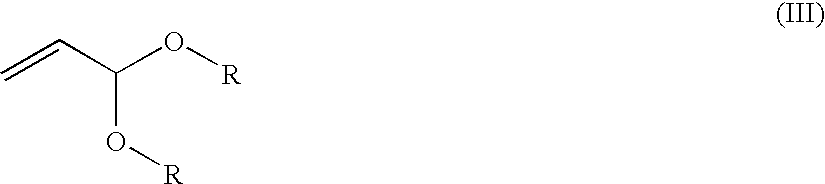
wherein each R independently is C1-4 alkyl, —C(O)—(C1-4 alkyl), C6-10 ar(C1-4)alkyl, or —C(O)—(C6-10 ar(C1-4)alkyl), where the aryl portion of any such groups is substituted or unsubstituted;
in a reaction mixture comprising a palladium catalyst and a base, to form a compound of formula (I).
2. The process of claim 1 , wherein the palladium catalyst is selected from the group consisting of palladium(II) chloride, palladium(II) acetate, tris(dibenzylideneacetone)-dipalladium, tetrakis(triphenylphosphine)palladium, bis(triphenylphosphine)palladium dichloride, (1,1′-bis(diphenylphosphino)ferrocene)palladium dichloride, di-chlorobis[5-chloro-2-[(4-chlorophenyl)(hydroxyimino)methyl]phenyl-C]di-palladium, trans-di-μ-acetobis [2-(di-o-tolylphosphino)benzyl]dipalladium.
3. The process of claim 1 , wherein the reaction mixture further comprises an added phosphine ligand.
4. The process of claim 2 , wherein the phosphine ligand is selected from the group consisting of triphenylphosphine, tri(o-tolyl)phosphine, tri(tert-butyl)phosphine, tri(2-furyl)-phosphine, 1,1′-bis(diphenylphosphino)ferrocene, 1,1′-bis(diphenylphosphino)methane, 1,1′-bis(diphenylphosphino)ethane, and 2-dicyclohexylphosphino-2′,4′,6′-triisopropylbiphenyl.
5. The process of claim 1 , wherein each R is ethyl.
6. The process of claim 1 , wherein the base is selected from the group consisting of potassium carbonate, cesium carbonate, sodium carbonate, sodium bicarbonate, sodium hydroxide, potassium hydroxide, lithium hydroxide, sodium acetate, and potassium acetate.
7. The process of claim 1 , wherein the base is a tertiary amine base.
8. The process of claim 7 , wherein the tertiary amine base is selected from the group consisting of triethylamine, diisopropylethylamine, dicyclohexylmethylamine, and 1,8-diazabicyclo[5.4.0]undec-7-ene.
9. The process of claim 1 , wherein the reaction mixture comprises a solvent comprising dimethylformamide, dimethylacetamide, N-methylpyrrolidone, 1,4-dioxane, tert-butanol, or a mixture or aqueous mixture thereof.
10. The process of claim 9 , wherein the solvent comprises dimethylformamide-water or dimethylacetamide-water.
11. The process of claim 10 , wherein P is tert-butoxycarbonyl.
12. The process of claim 1 , wherein the process further comprises preparing the compound of formula (II) by the steps:
(aa) treating a compound of formula (IV):

wherein X1 is Cl or F;
with a compound of formula P1—NH2, wherein P1 is an amino group protecting moiety, in a reaction mixture comprising a palladium catalyst and a base to form a compound of formula (V):
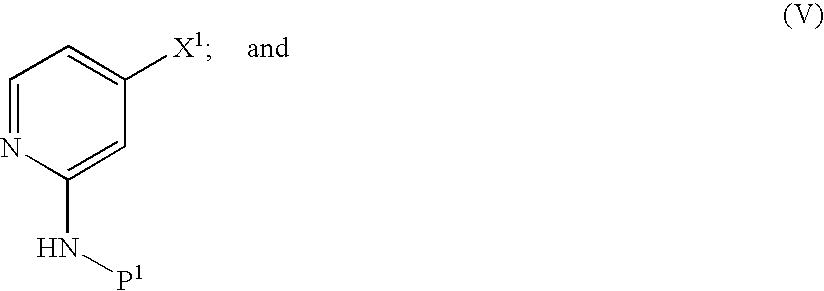
(bb) halogenating the compound of formula (V) to form the compound of formula (II), wherein P is an amino group protecting moiety.
13. The process of claim 12 , further comprising the step:
(cc) removing the protecting group P1 to form the compound of formula (II), wherein P is hydrogen.
14. The process of claim 12 , wherein the palladium catalyst in step (aa) is selected from the group consisting of palladium(II) chloride, palladium(II) acetate, tris(dibenzylideneacetone)dipalladium, tetrakis(triphenylphosphine)palladium, bis(triphenylphosphine)palladium dichloride, and (1,1′-bis(diphenylphosphino)ferrocene) palladium dichloride.
15. The process of claim 12 , wherein the reaction mixture in step (aa) further comprises an added phosphine ligand.
16. The process of claim 15 , wherein the phosphine ligand is selected from the group consisting of tri(o-tolyl)phosphine, triphenylphosphine, tri(2-furyl)phosphine, 1,1′-bis(diphenylphosphino)ferrocene, 1,1′-bis(diphenylphosphino)methane, 1,1′-bis(diphenylphosphino)ethane, (oxydi-2,1-phenylene)bis(diphenylphosphine), 4,5-bis(diphenylphosphino)-9,9-dimethylxanthene, 2-dicyclohexylphosphino-2′,6′-dimethoxybiphenyl, and 2-dicyclohexylphosphino-2′,4′,6′-triisopropylbiphenyl.
17. The process of claim 16 , wherein the palladium catalyst is palladium(II) acetate, and the phosphine ligand is 4,5-bis(diphenylphosphino)-9,9-dimethylxanthene, 2-dicyclohexylphosphino-2′,4′,6′-triisopropylbiphenyl, or (oxydi-2,1-phenylene)-bis(diphenylphosphine).
18. The process of claim 12 , wherein the palladium catalyst is palladium(II) acetate, and the reaction mixture does not comprise an added phosphine ligand.
19. The process of claim 12 , wherein the base is selected from the group consisting of potassium carbonate, cesium carbonate, sodium carbonate, sodium bicarbonate, sodium tert-butoxide, potassium tert-butoxide, sodium hydroxide, potassium hydroxide, and lithium hydroxide.
20. The process of claim 12 , wherein halogenating step (bb) comprises treating the compound of formula (V) with a base and iodine to form the compound of formula (II), wherein X2 is I, and P is an amino group protecting moiety.
21. The process of claim 20 , wherein the base is an organolithium, an organomagnesium, or a silver salt.
22. The process of claim 12 , wherein the halogenating step (bb) comprises treating the compound of formula (V) with a base and a brominating reagent to form the compound of formula (II), wherein X2 is Br, and P is an amino group protecting moiety, wherein the brominating reagent is selected from the group consisting of ethylene bromide, N-bromosuccinimide, and bromine.
23. The process of claim 22 , wherein the base is an organolithium, an organomagnesium, or a silver salt.
24. The process of claim 12 , wherein the halogenating step (bb) comprises treating the compound of formula (V) with a tertiary amine and bromine to form the compound of formula (II), wherein X2 is Br, and P is an amino group protecting moiety.
25. A process for preparing a compound of formula (VI):
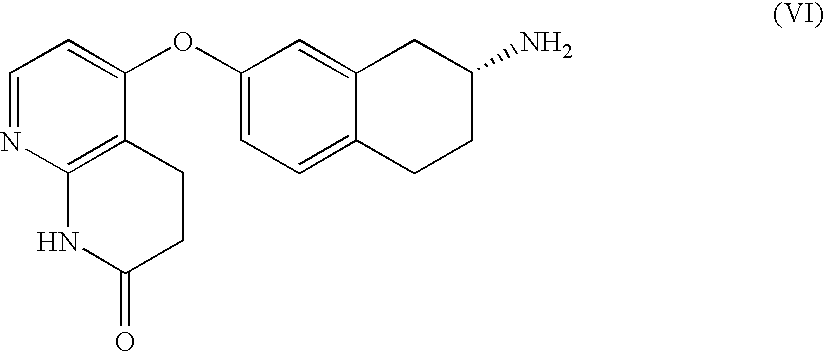
the process comprising
(i) coupling a compound of formula (I):

wherein X1 is Cl or F;
with a compound of formula (VII):

wherein R2 is hydrogen, an amino group protecting moiety, or an acid addition salt; to form the compound of formula (VI-A):
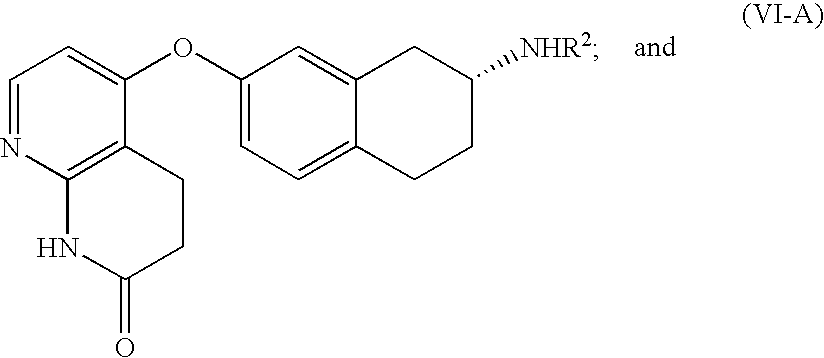
(ii) when R2 is an amino group protecting moiety, removing the amino group protecting moiety to form the compound of formula (VI).
26. The process of claim 25 , wherein steps (i) and (ii) occur in the same reaction mixture.
27. The process of claim 25 , wherein the coupling is conducted in a reaction mixture comprising a base and a high-boiling polar solvent.
28. The process of claim 27 , wherein the reaction mixture comprises Cs2CO3 and dimethylformamide.
29. The process of claim 25 , wherein R2 is hydrogen, tert-butoxycarbonyl, or H.HBr.
30. The process of claim 25 , further comprising the step:
(iii) condensing the compound of formula (VI) with a compound of formula (VIII):

wherein Ring A is a substituted or unsubstituted phenyl ring, to form a compound of formula (IX):

31. The process of claim 30 , wherein the compound of formula (VIII) is characterized by formula (VIII-A):
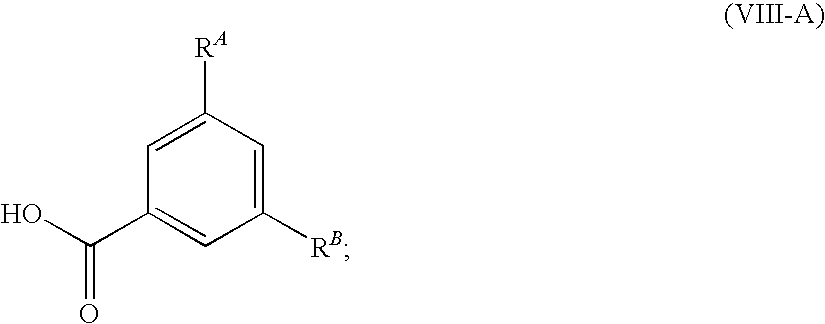
and the compound of formula (IX) is characterized by formula (IX-A):
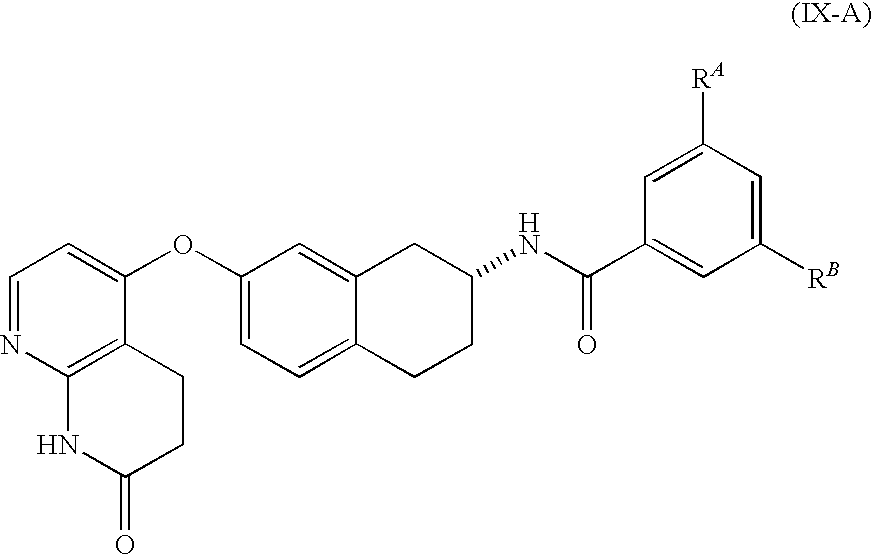
wherein:
RA is halo, —CN, —CHO, —C(R5x)═C(R5x)(R5y), —C≡C—R5y, —OR5z, —SR6x, —N(R4y)(R4z), —CO2R6x, —C(O)N(R4x)(R4y); or RA is a C1-6 aliphatic or C1-6 fluoroaliphatic optionally substituted with one or two substituents independently selected from the group consisting of —OR5x, —N(R4y)(R4z), —SR6x, —CO2R6x, or —C(O)N(R4x)(R4y); or RA is an optionally substituted 5- or 6-membered nitrogen-containing heterocyclyl or heteroaryl ring;
RB is selected from the group consisting of C1-4 aliphatic, C1-4 fluoroaliphatic, —O(C1-4 aliphatic), —O(C1-4 fluoroaliphatic), and halo; and
R4x is hydrogen, C1-4, aliphatic, C1-4 fluoroaliphatic, or C6-10 ar(C1-4)alkyl, the aryl portion of which may be optionally substituted;
R4y is hydrogen, C6-10 ar(C1-4)alkyl, the aryl portion of which may be optionally substituted, an optionally substituted 5- or 6-membered aryl, heteroaryl, or heterocyclyl ring, or a C1-4 aliphatic or C1-4 fluoroaliphatic optionally substituted with one or two substituents independently selected from the group consisting of —OR5x, —N(R4x)2, —CO2R5x, or —C(O)N(R4x)2;
R4x is an amino group protecting moiety, C1-4 aliphatic, C1-4 fluoroaliphatic, or C6-10 ar(C1-4)alkyl, the aryl portion of which may be optionally substituted; or
R4x and R4y, taken together with the nitrogen atom to which they are attached, form an optionally substituted 4- to 8-membered heterocyclyl or 5-membered heteroaryl ring having, in addition to the nitrogen atom, 0-2 ring heteroatoms independently selected from N, O, and S; or
R4y and R4z, taken together with the nitrogen atom to which they are attached, form an optionally substituted 4- to 8-membered heterocyclyl or 5-membered heteroaryl ring having, in addition to the nitrogen atom, 0-2 ring heteroatoms independently selected from N, O, and S;
each R5x independently is hydrogen, C1-4 aliphatic, C1-4 fluoroaliphatic, or C6-10 ar(C1-4)alkyl, the aryl portion of which may be optionally substituted, or an optionally substituted 5- or 6-membered aryl, heteroaryl, or heterocyclyl ring;
each R5y independently is hydrogen, an optionally substituted monocyclic nitrogen-containing heterocyclyl, an optionally substituted C6-10 aryl, a C6-10ar(C1-4)alkyl, the aryl portion of which is optionally substituted, or a C1-4 aliphatic or C1-4 fluoroaliphatic optionally substituted with one or two substituents independently selected from the group consisting of —OR5x, —N(R4x)2, —CO2R5x, or —C(O)N(R4x)2;
each R5z independently is hydrogen, a hydroxy group protecting moiety, an optionally substituted monocyclic nitrogen-containing heterocyclyl, an optionally substituted C6-10 aryl, a C6-10ar(C1-4)alkyl, the aryl portion of which is optionally substituted, or a C1-4 aliphatic or C1-4 fluoroaliphatic optionally substituted with one or two substituents independently selected from the group consisting of —OR5z, —N(R4x)(R4y), —CO2R6x, or —C(O)N(R4x)(R4y); and
each R6x independently is C1-4 aliphatic, C1-4 fluoroaliphatic, or C6-10 ar(c)alkyl, the aryl portion of which may be optionally substituted.
32. The process of claim 31 , wherein RA is a substituted or unsubstituted pyrazolyl, oxazolyl, isoxazolyl, imidazolyl, triazolyl, or tetrazolyl ring.
33. The process of claim 32 , wherein:
each substitutable ring carbon atom in RA independently is unsubstituted or is substituted with halo, —OR5x, —N(R4x)(R4y), —N(R4x)—C(O)—R5, —C(O)—N(R4x)(R4y), or a C1-4 aliphatic or C1-4 fluoroaliphatic group optionally substituted with ═O, —OR5x, —N(R4x)(R4y), —N(R4x)—C(O)—R5, or —C(O)—N(R4x)(R4y);
each substitutable ring nitrogen atom in RA is unsubstituted or is substituted with —C(O)—R5, —C(O)N(R5x)2, —SO2R5, or a C1-4 aliphatic or C1-4 fluoroaliphatic group optionally substituted with ═O, —OR5x, —N(R4x)(R4y), —N(R4x)—C(O)—R5, or —C(O)—N(R4x)(R4).
34. The process of claim 31 , wherein:
RA has the formula —C(Ra)(Rb)—N(Rc)(Rd);
Ra is hydrogen, C1-4 aliphatic, C1-4 fluoroaliphatic, or -T1-R2; or Ra, taken together with Rb and the carbon atom to which they are attached, forms a substituted or unsubstituted 3- to 6-membered carbocyclic ring; or Ra, taken together with Rc and the intervening carbon and nitrogen atoms, form a substituted or unsubstituted 4- to 6-membered heterocyclic ring;
Rb is hydrogen, C1-4 aliphatic, or C1-4 fluoroaliphatic; or Rb, taken together with Ra and the carbon atom to which they are attached, forms a substituted or unsubstituted 3- to 6-membered carbocyclic ring;
Rc is hydrogen, C1-4 aliphatic, C1-4 fluoroaliphatic, or -T1-R2; or Rc, taken together with Ra and the intervening carbon and nitrogen atoms, form a substituted or unsubstituted 4- to 6-membered heterocyclic ring; or Rc, taken together with Rd and the nitrogen atom to which they are attached, forms a substituted or unsubstituted 3- to 6-membered heterocyclic ring or 5- to 6-membered heteroaryl ring;
Rd is an amino group protecting moiety, C1-4 aliphatic, or C1-4 fluoroaliphatic, or -T1-R2; or Rd, taken together with Rc and the nitrogen atom to which they are attached, forms a substituted or unsubstituted 3- to 6-membered heterocyclic ring or 5- to 6-membered heteroaryl ring;
T1 is a C1-3 alkylene chain; and
R2 is —OR5z, —N(R4y)(R4z), —N(R4x)—C(O)—R5x, or —C(O)—N(R4x)(R4y).
35. The process of claim 30 , wherein the compound of formula (VIII) is characterized by formula (VIII-B):
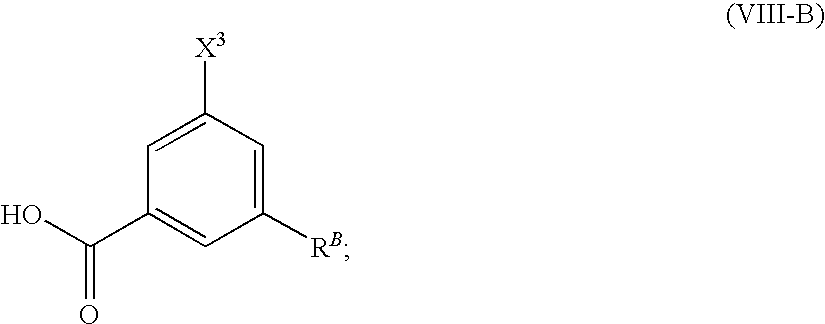
and the compound of formula (IX) is characterized by formula (IX-B):

wherein:
X3 is Br or I; and
RB is selected from the group consisting of Cl, C1-4 aliphatic, C1-4 fluoroaliphatic, —O(C1-4 aliphatic), and —O(C1-4 fluoroaliphatic).
36. The process of claim 35 , further comprising the step:
(iv-a) coupling the compound of formula (IX-B) with a compound of formula (X):
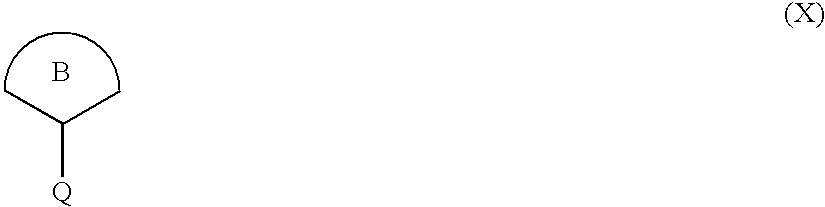
wherein Ring B is a substituted or unsubstituted aryl or heteroaryl ring; and
Q is a moiety selected from the group consisting of boronic acid, zinc halide, and trialkyltin;
in a reaction mixture comprising a palladium catalyst, to form a compound of formula (IX-C):
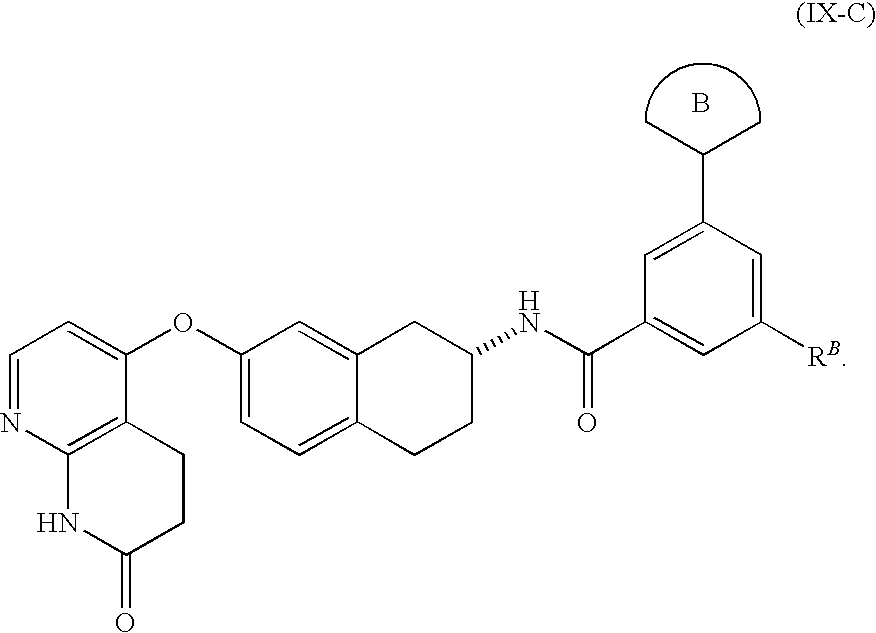
37. The process of claim 35 , further comprising the step
(iv-b) coupling the compound of formula (IX-B) with a compound of formula (XI):

wherein Ring C is a substituted or unsubstituted heteroaryl ring;
in a reaction mixture comprising a palladium catalyst, to form a compound of formula (IX-D):
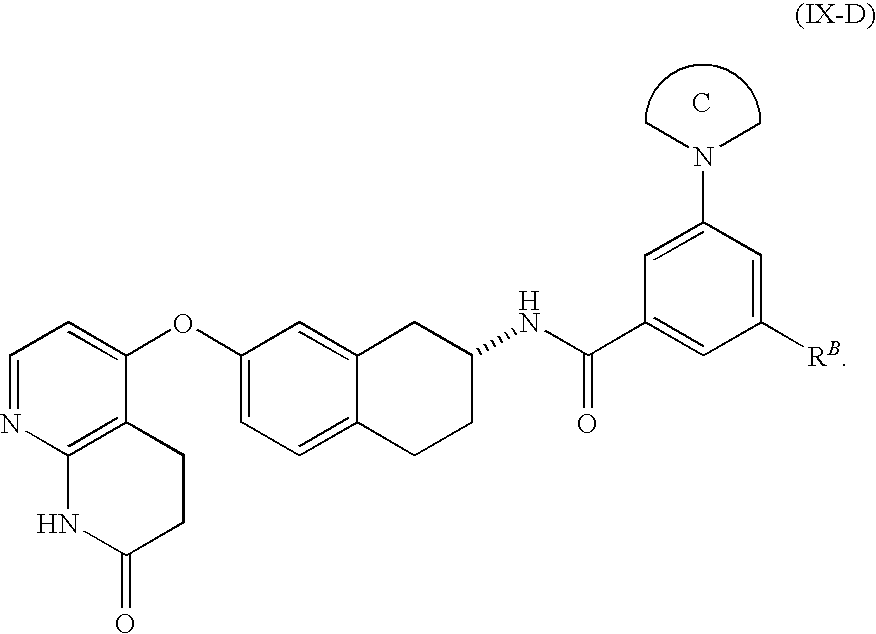
38. The process of claim 30 , wherein the compound of formula (VIII) is characterized by formula (VIII-C):
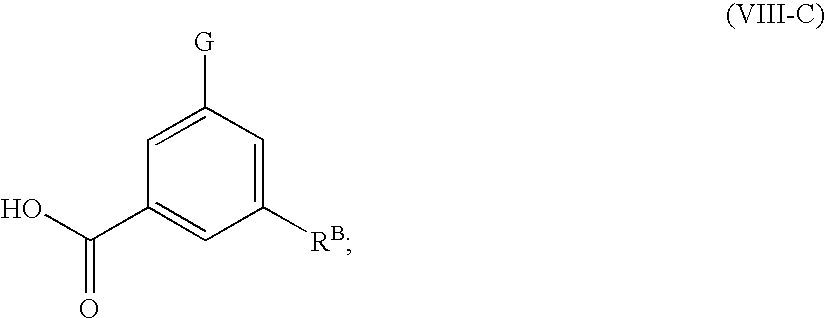
and the compound of formula (IX) is characterized by formula (IX-C):
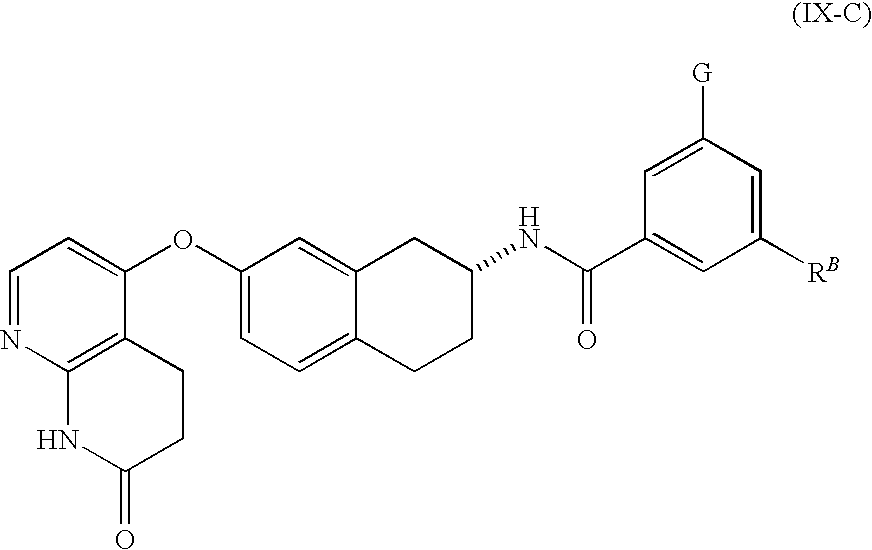
wherein:
G is —CN or —CHO; and
R3 is selected from the group consisting of Cl, C1-4 aliphatic, C1-4 fluoroaliphatic, —O(C1-4 aliphatic), and —O(C1-4 fluoroaliphatic).
39. The process of claim 38 , wherein G is —CN, and the process further comprises treating the compound of formula (IX-C) with sodium azide to form a compound of formula (IX), wherein RA is tetrazolyl.
40. The process of claim 38 , wherein G is —CHO, and the process further comprises treating the compound of formula (IX-C) with p-tolylsulfonylmethyl isocyanide to form a compound of formula (IX), wherein RA is 1,3-oxazol-5-yl.
41. The process of claim 38 , wherein G is —CHO, and the process further comprises treating the compound of formula (IX-C) with p-tolylsulfonylmethyl isocyanide, followed by an amine, to form a compound of formula (IX), wherein RA is imidazolyl.
42. A compound of formula (I) or a salt thereof:

wherein X1 is Cl or F.
43. A compound of formula (II) or a salt thereof:

wherein X1 is Cl or F, X2 is Br or I, and P1 is hydrogen or an amino group protecting moiety.
44. A compound of formula (VI-A) or a salt thereof:
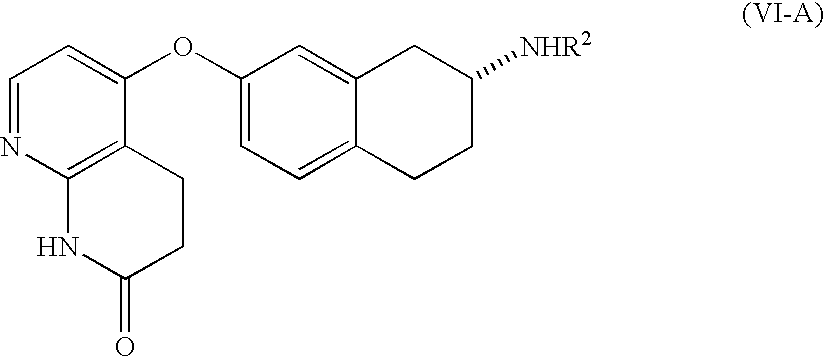
wherein R2 is hydrogen, an amino group protecting moiety, or an acid addition salt.
Priority Applications (3)
| Application Number | Priority Date | Filing Date | Title |
|---|---|---|---|
| US12/639,239 US20100197924A1 (en) | 2008-12-22 | 2009-12-16 | Preparation of aminotetralin compounds |
| US14/050,711 US20140256947A1 (en) | 2008-12-22 | 2013-10-10 | Preparation of aminotetralin compounds |
| US14/289,689 US20150112071A1 (en) | 2008-12-22 | 2014-05-29 | Preparation of aminotetralin compounds |
Applications Claiming Priority (2)
| Application Number | Priority Date | Filing Date | Title |
|---|---|---|---|
| US20341908P | 2008-12-22 | 2008-12-22 | |
| US12/639,239 US20100197924A1 (en) | 2008-12-22 | 2009-12-16 | Preparation of aminotetralin compounds |
Related Child Applications (1)
| Application Number | Title | Priority Date | Filing Date |
|---|---|---|---|
| US14/050,711 Continuation US20140256947A1 (en) | 2008-12-22 | 2013-10-10 | Preparation of aminotetralin compounds |
Publications (1)
| Publication Number | Publication Date |
|---|---|
| US20100197924A1 true US20100197924A1 (en) | 2010-08-05 |
Family
ID=42398244
Family Applications (3)
| Application Number | Title | Priority Date | Filing Date |
|---|---|---|---|
| US12/639,239 Abandoned US20100197924A1 (en) | 2008-12-22 | 2009-12-16 | Preparation of aminotetralin compounds |
| US14/050,711 Abandoned US20140256947A1 (en) | 2008-12-22 | 2013-10-10 | Preparation of aminotetralin compounds |
| US14/289,689 Abandoned US20150112071A1 (en) | 2008-12-22 | 2014-05-29 | Preparation of aminotetralin compounds |
Family Applications After (2)
| Application Number | Title | Priority Date | Filing Date |
|---|---|---|---|
| US14/050,711 Abandoned US20140256947A1 (en) | 2008-12-22 | 2013-10-10 | Preparation of aminotetralin compounds |
| US14/289,689 Abandoned US20150112071A1 (en) | 2008-12-22 | 2014-05-29 | Preparation of aminotetralin compounds |
Country Status (1)
| Country | Link |
|---|---|
| US (3) | US20100197924A1 (en) |
Cited By (20)
| Publication number | Priority date | Publication date | Assignee | Title |
|---|---|---|---|---|
| WO2012068450A1 (en) | 2010-11-19 | 2012-05-24 | Incyte Corporation | Cyclobutyl substituted pyrrolopyridine and pyrrolopyrimidine derivatives as jak inhibitors |
| WO2013097224A1 (en) * | 2011-12-31 | 2013-07-04 | Beigene, Ltd. | Fused tricyclic compounds as raf kinase inhibitors |
| WO2014206344A1 (en) | 2013-06-28 | 2014-12-31 | Beigene, Ltd. | Fused tricyclic amide compounds as multiple kinase inhibitors |
| CN105348299A (en) * | 2011-12-31 | 2016-02-24 | 百济神州有限公司 | Condensed tricyclic compounds as RAF kinase inhibitors |
| CN106008357A (en) * | 2016-06-14 | 2016-10-12 | 浙江华海药业股份有限公司 | Novel impurity of telmisartan and synthesis method thereof |
| CN106008356A (en) * | 2016-06-07 | 2016-10-12 | 浙江华海药业股份有限公司 | Preparation method for telmisartan |
| WO2016165626A1 (en) * | 2015-04-15 | 2016-10-20 | Beigene, Ltd. | Maleate salts of a b-raf kinase inhibitor, crystalline forms, methods of preparation, and uses therefore |
| JP2016196446A (en) * | 2016-01-04 | 2016-11-24 | ベイジーン リミテッド | Condensed tricyclic compounds as Raf kinase inhibitors |
| US9670203B2 (en) | 2013-06-28 | 2017-06-06 | Beigene, Ltd. | Fused tricyclic urea compounds as Raf kinase and/or Raf kinase dimer inhibitors |
| US9834606B2 (en) | 2013-09-13 | 2017-12-05 | Beigene, Ltd | Anti-PD1 antibodies and their use as therapeutics and diagnostics |
| WO2018007885A1 (en) * | 2016-07-05 | 2018-01-11 | Beigene, Ltd. | COMBINATION OF A PD-l ANTAGONIST AND A RAF INHIBITOR FOR TREATING CANCER |
| US10428146B2 (en) | 2014-07-22 | 2019-10-01 | Cb Therapeutics, Inc. | Anti PD-1 antibodies |
| US10435470B2 (en) | 2014-08-05 | 2019-10-08 | Cb Therapeutics, Inc. | Anti-PD-L1 antibodies |
| US10544225B2 (en) | 2014-07-03 | 2020-01-28 | Beigene, Ltd. | Anti-PD-L1 antibodies and their use as therapeutics and diagnostics |
| US11207283B2 (en) * | 2016-10-10 | 2021-12-28 | Northwestern University | Inactivators of toxoplasma gondii ornithine aminotransferase for treating toxoplasmosis and malaria |
| US11555038B2 (en) | 2017-01-25 | 2023-01-17 | Beigene, Ltd. | Crystalline forms of (S)-7-(1-(but-2-ynoyl)piperidin-4-yl)-2-(4-phenoxyphenyl)-4,5,6,7-tetrahydropyrazolo[1,5-a]pyrimidine-3-carboxamide, preparation, and uses thereof |
| US11597768B2 (en) | 2017-06-26 | 2023-03-07 | Beigene, Ltd. | Immunotherapy for hepatocellular carcinoma |
| US11701357B2 (en) | 2016-08-19 | 2023-07-18 | Beigene Switzerland Gmbh | Treatment of B cell cancers using a combination comprising Btk inhibitors |
| US11786529B2 (en) | 2017-11-29 | 2023-10-17 | Beigene Switzerland Gmbh | Treatment of indolent or aggressive B-cell lymphomas using a combination comprising BTK inhibitors |
| JP2024504285A (en) * | 2020-12-29 | 2024-01-31 | ティーエックスイノ バイオサイエンス インコーポレイテッド | Novel naphthyridinone derivatives having inhibitory activity on ectonucleotide pyrophosphatase-phosphodiesterase and their uses |
-
2009
- 2009-12-16 US US12/639,239 patent/US20100197924A1/en not_active Abandoned
-
2013
- 2013-10-10 US US14/050,711 patent/US20140256947A1/en not_active Abandoned
-
2014
- 2014-05-29 US US14/289,689 patent/US20150112071A1/en not_active Abandoned
Cited By (48)
| Publication number | Priority date | Publication date | Assignee | Title |
|---|---|---|---|---|
| WO2012068450A1 (en) | 2010-11-19 | 2012-05-24 | Incyte Corporation | Cyclobutyl substituted pyrrolopyridine and pyrrolopyrimidine derivatives as jak inhibitors |
| US10576087B2 (en) | 2011-12-31 | 2020-03-03 | Beigene, Ltd. | Fused tricyclic compounds as Raf kinase inhibitors |
| WO2013097224A1 (en) * | 2011-12-31 | 2013-07-04 | Beigene, Ltd. | Fused tricyclic compounds as raf kinase inhibitors |
| CN103596926A (en) * | 2011-12-31 | 2014-02-19 | 百济神州有限公司 | Fused tricyclic compounds as RAF kinase inhibitors |
| US9895376B2 (en) | 2011-12-31 | 2018-02-20 | Beigene, Ltd. | Fused tricyclic compounds as Raf kinase inhibitors |
| JP2015506353A (en) * | 2011-12-31 | 2015-03-02 | ベイジーン リミテッド | Condensed tricyclic compounds as Raf kinase inhibitors |
| CN103596926B (en) * | 2011-12-31 | 2015-11-25 | 百济神州有限公司 | Fused tricyclic compounds as RAF kinase inhibitors |
| CN105348299A (en) * | 2011-12-31 | 2016-02-24 | 百济神州有限公司 | Condensed tricyclic compounds as RAF kinase inhibitors |
| US9273046B2 (en) | 2011-12-31 | 2016-03-01 | Beigene, Ltd. | Fused tricyclic compounds as Raf kinase inhibitors |
| EP3124472A1 (en) | 2011-12-31 | 2017-02-01 | BeiGene, Ltd. | Fused tricyclic compounds as raf kinase inhibitors |
| EA025597B1 (en) * | 2011-12-31 | 2017-01-30 | Бейджен, Лтд. | FUSED TRICYCLIC COMPOUNDS AS Raf KINASE INHIBITORS |
| US9670231B2 (en) | 2013-06-28 | 2017-06-06 | Beigene, Ltd. | Fused tricyclic amide compounds as multiple kinase inhibitors |
| US9670203B2 (en) | 2013-06-28 | 2017-06-06 | Beigene, Ltd. | Fused tricyclic urea compounds as Raf kinase and/or Raf kinase dimer inhibitors |
| US10208038B2 (en) | 2013-06-28 | 2019-02-19 | Beigene, Ltd. | Fused tricyclic urea compounds as Raf kinase and/or Raf kinase dimer inhibitors |
| US10562899B2 (en) | 2013-06-28 | 2020-02-18 | Beigene, Ltd. | Fused tricyclic urea compounds as Raf kinase and/or Raf kinase dimer inhibitors |
| WO2014206344A1 (en) | 2013-06-28 | 2014-12-31 | Beigene, Ltd. | Fused tricyclic amide compounds as multiple kinase inhibitors |
| US9920055B2 (en) | 2013-06-28 | 2018-03-20 | Beigene, Ltd. | Fused tricyclic urea compounds as raf kinase and/or raf kinase dimer inhibitors |
| US11186637B2 (en) | 2013-09-13 | 2021-11-30 | Beigene Switzerland Gmbh | Anti-PD1 antibodies and their use as therapeutics and diagnostics |
| US11673951B2 (en) | 2013-09-13 | 2023-06-13 | Beigene Switzerland Gmbh | Anti-PD1 antibodies and their use as therapeutics and diagnostics |
| US9834606B2 (en) | 2013-09-13 | 2017-12-05 | Beigene, Ltd | Anti-PD1 antibodies and their use as therapeutics and diagnostics |
| US10519235B2 (en) | 2013-09-13 | 2019-12-31 | Beigene Switzerland Gmbh | Anti-PD1 antibodies and their use as therapeutics and diagnostics |
| US9988450B2 (en) | 2013-09-13 | 2018-06-05 | Beigene Switzerland Gmbh | Anti-PD1 antibodies and their use as therapeutics and diagnostics |
| US11512132B2 (en) | 2014-07-03 | 2022-11-29 | Beigene, Ltd. | Anti-PD-L1 antibodies and their use as therapeutics and diagnostics |
| US10544225B2 (en) | 2014-07-03 | 2020-01-28 | Beigene, Ltd. | Anti-PD-L1 antibodies and their use as therapeutics and diagnostics |
| US10428146B2 (en) | 2014-07-22 | 2019-10-01 | Cb Therapeutics, Inc. | Anti PD-1 antibodies |
| US11560429B2 (en) | 2014-07-22 | 2023-01-24 | Apollomics Inc. | Anti PD-1 antibodies |
| US10981994B2 (en) | 2014-07-22 | 2021-04-20 | Apollomics Inc. | Anti PD-1 antibodies |
| US11827707B2 (en) | 2014-08-05 | 2023-11-28 | Apollomics Inc. | Anti PD-L1 antibodies |
| US11111300B2 (en) | 2014-08-05 | 2021-09-07 | Apollomics Inc. | Anti PD-L1 antibodies |
| US10435470B2 (en) | 2014-08-05 | 2019-10-08 | Cb Therapeutics, Inc. | Anti-PD-L1 antibodies |
| EA035680B1 (en) * | 2015-04-15 | 2020-07-24 | Бейджин, Лтд. | BRAF KINASE INHIBITOR MALE SALTS, CRYSTALLINE FORMS, METHODS FOR THEIR PREPARATION AND APPLICATION |
| CN107531682A (en) * | 2015-04-15 | 2018-01-02 | 百济神州有限公司 | Maleate salts of B-RAF kinase inhibitors, their crystalline forms, methods of preparation and uses |
| WO2016165626A1 (en) * | 2015-04-15 | 2016-10-20 | Beigene, Ltd. | Maleate salts of a b-raf kinase inhibitor, crystalline forms, methods of preparation, and uses therefore |
| US10351559B2 (en) | 2015-04-15 | 2019-07-16 | Beigene, Ltd. | Maleate salts of a B-RAF kinase inhibitor, crystalline forms, methods of preparation, and uses therefore |
| JP2016196446A (en) * | 2016-01-04 | 2016-11-24 | ベイジーン リミテッド | Condensed tricyclic compounds as Raf kinase inhibitors |
| CN106008356B (en) * | 2016-06-07 | 2023-02-28 | 浙江华海药业股份有限公司 | Preparation method of telmisartan |
| CN106008356A (en) * | 2016-06-07 | 2016-10-12 | 浙江华海药业股份有限公司 | Preparation method for telmisartan |
| CN106008357A (en) * | 2016-06-14 | 2016-10-12 | 浙江华海药业股份有限公司 | Novel impurity of telmisartan and synthesis method thereof |
| US10864203B2 (en) | 2016-07-05 | 2020-12-15 | Beigene, Ltd. | Combination of a PD-1 antagonist and a RAF inhibitor for treating cancer |
| US11534431B2 (en) | 2016-07-05 | 2022-12-27 | Beigene Switzerland Gmbh | Combination of a PD-1 antagonist and a RAF inhibitor for treating cancer |
| WO2018007885A1 (en) * | 2016-07-05 | 2018-01-11 | Beigene, Ltd. | COMBINATION OF A PD-l ANTAGONIST AND A RAF INHIBITOR FOR TREATING CANCER |
| AU2017293423B2 (en) * | 2016-07-05 | 2023-05-25 | Beone Medicines I Gmbh | Combination of a PD-1 antagonist and a RAF inhibitor for treating cancer |
| US11701357B2 (en) | 2016-08-19 | 2023-07-18 | Beigene Switzerland Gmbh | Treatment of B cell cancers using a combination comprising Btk inhibitors |
| US11207283B2 (en) * | 2016-10-10 | 2021-12-28 | Northwestern University | Inactivators of toxoplasma gondii ornithine aminotransferase for treating toxoplasmosis and malaria |
| US11555038B2 (en) | 2017-01-25 | 2023-01-17 | Beigene, Ltd. | Crystalline forms of (S)-7-(1-(but-2-ynoyl)piperidin-4-yl)-2-(4-phenoxyphenyl)-4,5,6,7-tetrahydropyrazolo[1,5-a]pyrimidine-3-carboxamide, preparation, and uses thereof |
| US11597768B2 (en) | 2017-06-26 | 2023-03-07 | Beigene, Ltd. | Immunotherapy for hepatocellular carcinoma |
| US11786529B2 (en) | 2017-11-29 | 2023-10-17 | Beigene Switzerland Gmbh | Treatment of indolent or aggressive B-cell lymphomas using a combination comprising BTK inhibitors |
| JP2024504285A (en) * | 2020-12-29 | 2024-01-31 | ティーエックスイノ バイオサイエンス インコーポレイテッド | Novel naphthyridinone derivatives having inhibitory activity on ectonucleotide pyrophosphatase-phosphodiesterase and their uses |
Also Published As
| Publication number | Publication date |
|---|---|
| US20150112071A1 (en) | 2015-04-23 |
| US20140256947A1 (en) | 2014-09-11 |
Similar Documents
| Publication | Publication Date | Title |
|---|---|---|
| US20100197924A1 (en) | Preparation of aminotetralin compounds | |
| JP2025124819A (en) | GLP-1 receptor agonist, pharmaceutical composition containing same, and method for producing same | |
| JP2022548104A (en) | Pyridine nitrogen oxide and its production method and use | |
| US20190185454A1 (en) | Inhibitors of ret | |
| AU2016297754A1 (en) | Compounds useful for treating disorders related to KIT and PDGFR | |
| US9889122B2 (en) | Positive allosteric modulators of nicotinic acetylcholine receptor | |
| JP2008519814A (en) | Nitrogen heteroaromatic compounds that bind to the active site of protein kinase enzymes | |
| TWI538675B (en) | New positive ectopic regulator of nicotinic acetylcholine receptor | |
| CA2756152A1 (en) | 9h-pyrrolo[2,3-b: 5,4-c'] dipyridine azacarboline derivatives, preparation thereof, and therapeutic use thereof | |
| Capobianco et al. | Asymmetric tandem hemiaminal-heterocyclization-aza-Mannich reaction of 2-formylbenzonitriles and amines using chiral phase transfer catalysis: an experimental and theoretical study | |
| KR20170137137A (en) | Pyridopyrimidinone and its use as an NMDA receptor modulator | |
| CN116891437A (en) | Amino acid derivatives, pharmaceutical compositions and preparation methods and applications thereof | |
| IL95121A (en) | N-n'bis (alkoxyalkyl)-pyridine-2,4-dicarboxylic acid diamides, process for their preparation and pharmaceutical compositions containing them | |
| Papaioannou et al. | Regioselective Amidomethylation of 4-Chloro-3-Fluoropyridine by Metalation and Minisci-Type Reactions | |
| JPH0761940A (en) | Azabicycloheptane derivative | |
| US20240294532A1 (en) | Synthesis of chiral substituted pyrazolopyrimidine compounds | |
| JPH1135545A (en) | Urethane derivatives | |
| CN114181257B (en) | Pyridine compound, pharmaceutical composition containing the same, preparation method and use thereof | |
| EP4140977A1 (en) | Fluorinated compound | |
| JP2021512171A (en) | Pentafluorosulfanyl substituted amide derivative, manufacturing method for it and its medical use | |
| JP2005506335A (en) | N-heterocyclylhydrazide as a neurotrophic agent | |
| CN118894903A (en) | Amino acid compound and its preparation method and medical application | |
| JP2005060375A (en) | Oxygenated heterocyclic compounds | |
| WO2003077906A1 (en) | Cyclic etheramine derivatives as medicaments for malignant tumors | |
| FR2950891A1 (en) | New pyrrolo-dipyridine azacarboline derivatives are protein kinase inhibitors useful for treating cancer |
Legal Events
| Date | Code | Title | Description |
|---|---|---|---|
| AS | Assignment |
Owner name: MILLENNIUM PHARMACEUTICALS, INC., MASSACHUSETTS Free format text: ASSIGNMENT OF ASSIGNORS INTEREST;ASSIGNORS:GOULD, ALEXANDRA E.;HARRISON, SEAN J.;MIZUTANI, HIROTAKE;AND OTHERS;SIGNING DATES FROM 20100308 TO 20100402;REEL/FRAME:024268/0974 |
|
| STCB | Information on status: application discontinuation |
Free format text: ABANDONED -- FAILURE TO RESPOND TO AN OFFICE ACTION |