US20100063076A1 - Endothelin receptor antagonists - Google Patents
Endothelin receptor antagonists Download PDFInfo
- Publication number
- US20100063076A1 US20100063076A1 US12/460,575 US46057509A US2010063076A1 US 20100063076 A1 US20100063076 A1 US 20100063076A1 US 46057509 A US46057509 A US 46057509A US 2010063076 A1 US2010063076 A1 US 2010063076A1
- Authority
- US
- United States
- Prior art keywords
- compound
- deuterium
- mixture
- hydrogen
- tert
- Prior art date
- Legal status (The legal status is an assumption and is not a legal conclusion. Google has not performed a legal analysis and makes no representation as to the accuracy of the status listed.)
- Granted
Links
- 239000002308 endothelin receptor antagonist Substances 0.000 title abstract description 8
- 229940118365 Endothelin receptor antagonist Drugs 0.000 title abstract description 6
- 150000001875 compounds Chemical class 0.000 claims abstract description 181
- 239000000203 mixture Substances 0.000 claims abstract description 138
- 238000000034 method Methods 0.000 claims abstract description 54
- 208000037265 diseases, disorders, signs and symptoms Diseases 0.000 claims abstract description 37
- 150000003839 salts Chemical class 0.000 claims abstract description 29
- 201000010099 disease Diseases 0.000 claims abstract description 25
- 229910052805 deuterium Inorganic materials 0.000 claims description 56
- YZCKVEUIGOORGS-OUBTZVSYSA-N Deuterium Chemical compound [2H] YZCKVEUIGOORGS-OUBTZVSYSA-N 0.000 claims description 54
- 125000004429 atom Chemical group 0.000 claims description 23
- 230000000155 isotopic effect Effects 0.000 claims description 22
- 229910052739 hydrogen Inorganic materials 0.000 claims description 20
- 239000001257 hydrogen Substances 0.000 claims description 20
- UFHFLCQGNIYNRP-UHFFFAOYSA-N Hydrogen Chemical compound [H][H] UFHFLCQGNIYNRP-UHFFFAOYSA-N 0.000 claims description 12
- 208000035475 disorder Diseases 0.000 claims description 12
- 206010020772 Hypertension Diseases 0.000 claims description 11
- 206010064911 Pulmonary arterial hypertension Diseases 0.000 claims description 11
- 208000002815 pulmonary hypertension Diseases 0.000 claims description 11
- 208000026151 Chronic thromboembolic pulmonary hypertension Diseases 0.000 claims description 7
- 206010039710 Scleroderma Diseases 0.000 claims description 7
- 208000003287 Eisenmenger Complex Diseases 0.000 claims description 6
- 208000020686 Eisenmenger syndrome Diseases 0.000 claims description 6
- 201000009794 Idiopathic Pulmonary Fibrosis Diseases 0.000 claims description 6
- 208000036971 interstitial lung disease 2 Diseases 0.000 claims description 6
- 208000029523 Interstitial Lung disease Diseases 0.000 claims description 5
- 229910052731 fluorine Inorganic materials 0.000 claims description 5
- 239000011737 fluorine Substances 0.000 claims description 5
- 208000007056 sickle cell anemia Diseases 0.000 claims description 5
- 208000010228 Erectile Dysfunction Diseases 0.000 claims description 4
- PXGOKWXKJXAPGV-UHFFFAOYSA-N Fluorine Chemical compound FF PXGOKWXKJXAPGV-UHFFFAOYSA-N 0.000 claims description 4
- 208000000453 Skin Neoplasms Diseases 0.000 claims description 4
- 206010040943 Skin Ulcer Diseases 0.000 claims description 4
- 206010050207 Skin fibrosis Diseases 0.000 claims description 4
- 201000001881 impotence Diseases 0.000 claims description 4
- 201000000849 skin cancer Diseases 0.000 claims description 4
- 201000001320 Atherosclerosis Diseases 0.000 claims description 3
- 206010004446 Benign prostatic hyperplasia Diseases 0.000 claims description 3
- 201000006474 Brain Ischemia Diseases 0.000 claims description 3
- 206010008120 Cerebral ischaemia Diseases 0.000 claims description 3
- 208000006545 Chronic Obstructive Pulmonary Disease Diseases 0.000 claims description 3
- 206010013935 Dysmenorrhoea Diseases 0.000 claims description 3
- 206010019280 Heart failures Diseases 0.000 claims description 3
- 206010021143 Hypoxia Diseases 0.000 claims description 3
- 206010061216 Infarction Diseases 0.000 claims description 3
- 208000019695 Migraine disease Diseases 0.000 claims description 3
- 208000000450 Pelvic Pain Diseases 0.000 claims description 3
- 208000004403 Prostatic Hyperplasia Diseases 0.000 claims description 3
- 208000003782 Raynaud disease Diseases 0.000 claims description 3
- 208000012322 Raynaud phenomenon Diseases 0.000 claims description 3
- 208000032851 Subarachnoid Hemorrhage Diseases 0.000 claims description 3
- 208000002903 Thalassemia Diseases 0.000 claims description 3
- 230000000747 cardiac effect Effects 0.000 claims description 3
- 206010008118 cerebral infarction Diseases 0.000 claims description 3
- 150000002431 hydrogen Chemical class 0.000 claims description 3
- 230000007954 hypoxia Effects 0.000 claims description 3
- 230000007574 infarction Effects 0.000 claims description 3
- 206010027599 migraine Diseases 0.000 claims description 3
- 201000011461 pre-eclampsia Diseases 0.000 claims description 3
- 210000001147 pulmonary artery Anatomy 0.000 claims description 3
- 239000002253 acid Substances 0.000 abstract description 9
- 206010047139 Vasoconstriction Diseases 0.000 abstract description 4
- 230000025033 vasoconstriction Effects 0.000 abstract description 4
- 108050009340 Endothelin Proteins 0.000 abstract description 3
- 102000002045 Endothelin Human genes 0.000 abstract description 3
- ZUBDGKVDJUIMQQ-UBFCDGJISA-N endothelin-1 Chemical compound C([C@@H](C(=O)N[C@@H](CC(C)C)C(=O)N[C@@H](CC(O)=O)C(=O)N[C@@H]([C@@H](C)CC)C(=O)N[C@@H]([C@@H](C)CC)C(=O)N[C@@H](CC=1C2=CC=CC=C2NC=1)C(O)=O)NC(=O)[C@H]1NC(=O)[C@H](CC=2C=CC=CC=2)NC(=O)[C@@H](CC=2C=CC(O)=CC=2)NC(=O)[C@H](C(C)C)NC(=O)[C@H]2CSSC[C@@H](C(N[C@H](CO)C(=O)N[C@@H](CO)C(=O)N[C@H](CC(C)C)C(=O)N[C@@H](CCSC)C(=O)N[C@H](CC(O)=O)C(=O)N[C@@H](CCCCN)C(=O)N[C@@H](CCC(O)=O)C(=O)N2)=O)NC(=O)[C@@H](CO)NC(=O)[C@H](N)CSSC1)C1=CNC=N1 ZUBDGKVDJUIMQQ-UBFCDGJISA-N 0.000 abstract description 3
- 230000019491 signal transduction Effects 0.000 abstract description 3
- XEKOWRVHYACXOJ-UHFFFAOYSA-N Ethyl acetate Chemical compound CCOC(C)=O XEKOWRVHYACXOJ-UHFFFAOYSA-N 0.000 description 86
- LFQSCWFLJHTTHZ-UHFFFAOYSA-N Ethanol Chemical compound CCO LFQSCWFLJHTTHZ-UHFFFAOYSA-N 0.000 description 78
- YXFVVABEGXRONW-UHFFFAOYSA-N Toluene Chemical compound CC1=CC=CC=C1 YXFVVABEGXRONW-UHFFFAOYSA-N 0.000 description 63
- XLYOFNOQVPJJNP-UHFFFAOYSA-N water Substances O XLYOFNOQVPJJNP-UHFFFAOYSA-N 0.000 description 63
- 239000007787 solid Substances 0.000 description 54
- 229910001868 water Inorganic materials 0.000 description 54
- 239000000243 solution Substances 0.000 description 53
- WEVYAHXRMPXWCK-UHFFFAOYSA-N Acetonitrile Chemical compound CC#N WEVYAHXRMPXWCK-UHFFFAOYSA-N 0.000 description 48
- 239000003814 drug Substances 0.000 description 46
- 239000000725 suspension Substances 0.000 description 43
- 230000002829 reductive effect Effects 0.000 description 37
- YMWUJEATGCHHMB-UHFFFAOYSA-N Dichloromethane Chemical compound ClCCl YMWUJEATGCHHMB-UHFFFAOYSA-N 0.000 description 36
- OKKJLVBELUTLKV-UHFFFAOYSA-N Methanol Chemical compound OC OKKJLVBELUTLKV-UHFFFAOYSA-N 0.000 description 36
- IMNFDUFMRHMDMM-UHFFFAOYSA-N N-Heptane Chemical class CCCCCCC IMNFDUFMRHMDMM-UHFFFAOYSA-N 0.000 description 36
- 229940124597 therapeutic agent Drugs 0.000 description 32
- GJPICJJJRGTNOD-UHFFFAOYSA-N bosentan Chemical compound COC1=CC=CC=C1OC(C(=NC(=N1)C=2N=CC=CN=2)OCCO)=C1NS(=O)(=O)C1=CC=C(C(C)(C)C)C=C1 GJPICJJJRGTNOD-UHFFFAOYSA-N 0.000 description 31
- 229960003065 bosentan Drugs 0.000 description 28
- 235000002639 sodium chloride Nutrition 0.000 description 27
- VEXZGXHMUGYJMC-UHFFFAOYSA-N Hydrochloric acid Chemical compound Cl VEXZGXHMUGYJMC-UHFFFAOYSA-N 0.000 description 26
- BDAGIHXWWSANSR-UHFFFAOYSA-N methanoic acid Natural products OC=O BDAGIHXWWSANSR-UHFFFAOYSA-N 0.000 description 24
- 239000003921 oil Substances 0.000 description 22
- HEMHJVSKTPXQMS-UHFFFAOYSA-M Sodium hydroxide Chemical compound [OH-].[Na+] HEMHJVSKTPXQMS-UHFFFAOYSA-M 0.000 description 21
- 235000019198 oils Nutrition 0.000 description 21
- 239000008194 pharmaceutical composition Substances 0.000 description 18
- VYPSYNLAJGMNEJ-UHFFFAOYSA-N Silicium dioxide Chemical compound O=[Si]=O VYPSYNLAJGMNEJ-UHFFFAOYSA-N 0.000 description 17
- 230000015572 biosynthetic process Effects 0.000 description 16
- 238000003786 synthesis reaction Methods 0.000 description 16
- WYURNTSHIVDZCO-UHFFFAOYSA-N Tetrahydrofuran Chemical compound C1CCOC1 WYURNTSHIVDZCO-UHFFFAOYSA-N 0.000 description 14
- 238000011282 treatment Methods 0.000 description 14
- UHOVQNZJYSORNB-UHFFFAOYSA-N Benzene Chemical compound C1=CC=CC=C1 UHOVQNZJYSORNB-UHFFFAOYSA-N 0.000 description 13
- 238000006243 chemical reaction Methods 0.000 description 13
- 238000010992 reflux Methods 0.000 description 13
- 239000002904 solvent Substances 0.000 description 13
- 238000005160 1H NMR spectroscopy Methods 0.000 description 12
- OSWFIVFLDKOXQC-UHFFFAOYSA-N 4-(3-methoxyphenyl)aniline Chemical compound COC1=CC=CC(C=2C=CC(N)=CC=2)=C1 OSWFIVFLDKOXQC-UHFFFAOYSA-N 0.000 description 12
- IAZDPXIOMUYVGZ-WFGJKAKNSA-N Dimethyl sulfoxide Chemical compound [2H]C([2H])([2H])S(=O)C([2H])([2H])[2H] IAZDPXIOMUYVGZ-WFGJKAKNSA-N 0.000 description 12
- XLYOFNOQVPJJNP-ZSJDYOACSA-N Heavy water Chemical compound [2H]O[2H] XLYOFNOQVPJJNP-ZSJDYOACSA-N 0.000 description 12
- HEDRZPFGACZZDS-MICDWDOJSA-N Trichloro(2H)methane Chemical compound [2H]C(Cl)(Cl)Cl HEDRZPFGACZZDS-MICDWDOJSA-N 0.000 description 12
- 235000019253 formic acid Nutrition 0.000 description 12
- 229940013688 formic acid Drugs 0.000 description 12
- 238000010348 incorporation Methods 0.000 description 12
- 239000011541 reaction mixture Substances 0.000 description 12
- 239000000741 silica gel Substances 0.000 description 12
- 229910002027 silica gel Inorganic materials 0.000 description 12
- PMZURENOXWZQFD-UHFFFAOYSA-L Sodium Sulfate Chemical compound [Na+].[Na+].[O-]S([O-])(=O)=O PMZURENOXWZQFD-UHFFFAOYSA-L 0.000 description 11
- 238000009472 formulation Methods 0.000 description 11
- 239000007788 liquid Substances 0.000 description 11
- 239000000047 product Substances 0.000 description 11
- 229910052938 sodium sulfate Inorganic materials 0.000 description 11
- HPALAKNZSZLMCH-UHFFFAOYSA-M sodium;chloride;hydrate Chemical compound O.[Na+].[Cl-] HPALAKNZSZLMCH-UHFFFAOYSA-M 0.000 description 11
- HTZCNXWZYVXIMZ-UHFFFAOYSA-M benzyl(triethyl)azanium;chloride Chemical compound [Cl-].CC[N+](CC)(CC)CC1=CC=CC=C1 HTZCNXWZYVXIMZ-UHFFFAOYSA-M 0.000 description 10
- 239000012267 brine Substances 0.000 description 10
- 239000012043 crude product Substances 0.000 description 10
- 238000000746 purification Methods 0.000 description 10
- LYCAIKOWRPUZTN-UHFFFAOYSA-N Ethylene glycol Chemical compound OCCO LYCAIKOWRPUZTN-UHFFFAOYSA-N 0.000 description 9
- DGAQECJNVWCQMB-PUAWFVPOSA-M Ilexoside XXIX Chemical compound C[C@@H]1CC[C@@]2(CC[C@@]3(C(=CC[C@H]4[C@]3(CC[C@@H]5[C@@]4(CC[C@@H](C5(C)C)OS(=O)(=O)[O-])C)C)[C@@H]2[C@]1(C)O)C)C(=O)O[C@H]6[C@@H]([C@H]([C@@H]([C@H](O6)CO)O)O)O.[Na+] DGAQECJNVWCQMB-PUAWFVPOSA-M 0.000 description 9
- 239000002552 dosage form Substances 0.000 description 9
- 229940079593 drug Drugs 0.000 description 9
- -1 hydrogen bisulfide Chemical class 0.000 description 9
- 239000000543 intermediate Substances 0.000 description 9
- 239000000463 material Substances 0.000 description 9
- 239000011734 sodium Substances 0.000 description 9
- 229910052708 sodium Inorganic materials 0.000 description 9
- 235000011152 sodium sulphate Nutrition 0.000 description 9
- 239000003795 chemical substances by application Substances 0.000 description 8
- 238000000576 coating method Methods 0.000 description 8
- 238000004128 high performance liquid chromatography Methods 0.000 description 8
- 239000012074 organic phase Substances 0.000 description 8
- BWHMMNNQKKPAPP-UHFFFAOYSA-L potassium carbonate Chemical compound [K+].[K+].[O-]C([O-])=O BWHMMNNQKKPAPP-UHFFFAOYSA-L 0.000 description 8
- 238000002360 preparation method Methods 0.000 description 8
- 239000000126 substance Substances 0.000 description 8
- KHBQMWCZKVMBLN-UHFFFAOYSA-N Benzenesulfonamide Chemical compound NS(=O)(=O)C1=CC=CC=C1 KHBQMWCZKVMBLN-UHFFFAOYSA-N 0.000 description 7
- 102100033902 Endothelin-1 Human genes 0.000 description 7
- 101800004490 Endothelin-1 Proteins 0.000 description 7
- 230000014759 maintenance of location Effects 0.000 description 7
- OKKJLVBELUTLKV-VMNATFBRSA-N methanol-d1 Chemical compound [2H]OC OKKJLVBELUTLKV-VMNATFBRSA-N 0.000 description 7
- 239000012453 solvate Substances 0.000 description 7
- 102000004328 Cytochrome P-450 CYP3A Human genes 0.000 description 6
- 108010081668 Cytochrome P-450 CYP3A Proteins 0.000 description 6
- IAZDPXIOMUYVGZ-UHFFFAOYSA-N Dimethylsulphoxide Chemical compound CS(C)=O IAZDPXIOMUYVGZ-UHFFFAOYSA-N 0.000 description 6
- WQDUMFSSJAZKTM-UHFFFAOYSA-N Sodium methoxide Chemical compound [Na+].[O-]C WQDUMFSSJAZKTM-UHFFFAOYSA-N 0.000 description 6
- 239000012472 biological sample Substances 0.000 description 6
- 229960001123 epoprostenol Drugs 0.000 description 6
- KAQKFAOMNZTLHT-VVUHWYTRSA-N epoprostenol Chemical compound O1C(=CCCCC(O)=O)C[C@@H]2[C@@H](/C=C/[C@@H](O)CCCCC)[C@H](O)C[C@@H]21 KAQKFAOMNZTLHT-VVUHWYTRSA-N 0.000 description 6
- 239000000706 filtrate Substances 0.000 description 6
- 230000002503 metabolic effect Effects 0.000 description 6
- VLKZOEOYAKHREP-UHFFFAOYSA-N n-Hexane Chemical class CCCCCC VLKZOEOYAKHREP-UHFFFAOYSA-N 0.000 description 6
- 239000003826 tablet Substances 0.000 description 6
- YLQBMQCUIZJEEH-UHFFFAOYSA-N tetrahydrofuran Natural products C=1C=COC=1 YLQBMQCUIZJEEH-UHFFFAOYSA-N 0.000 description 6
- 230000001225 therapeutic effect Effects 0.000 description 6
- VZCYOOQTPOCHFL-UHFFFAOYSA-N trans-butenedioic acid Natural products OC(=O)C=CC(O)=O VZCYOOQTPOCHFL-UHFFFAOYSA-N 0.000 description 6
- 238000001644 13C nuclear magnetic resonance spectroscopy Methods 0.000 description 5
- WFOVEDJTASPCIR-UHFFFAOYSA-N 3-[(4-methyl-5-pyridin-4-yl-1,2,4-triazol-3-yl)methylamino]-n-[[2-(trifluoromethyl)phenyl]methyl]benzamide Chemical compound N=1N=C(C=2C=CN=CC=2)N(C)C=1CNC(C=1)=CC=CC=1C(=O)NCC1=CC=CC=C1C(F)(F)F WFOVEDJTASPCIR-UHFFFAOYSA-N 0.000 description 5
- TWRXJAOTZQYOKJ-UHFFFAOYSA-L Magnesium chloride Chemical compound [Mg+2].[Cl-].[Cl-] TWRXJAOTZQYOKJ-UHFFFAOYSA-L 0.000 description 5
- 239000002775 capsule Substances 0.000 description 5
- 239000000969 carrier Substances 0.000 description 5
- 239000003153 chemical reaction reagent Substances 0.000 description 5
- 238000002425 crystallisation Methods 0.000 description 5
- 230000008025 crystallization Effects 0.000 description 5
- 230000000694 effects Effects 0.000 description 5
- 238000000921 elemental analysis Methods 0.000 description 5
- 238000010438 heat treatment Methods 0.000 description 5
- 125000004435 hydrogen atom Chemical group [H]* 0.000 description 5
- HEWVGINPCZDHJF-UHFFFAOYSA-N methyl 2-[(2-methylpropan-2-yl)oxy]acetate Chemical compound COC(=O)COC(C)(C)C HEWVGINPCZDHJF-UHFFFAOYSA-N 0.000 description 5
- 210000000056 organ Anatomy 0.000 description 5
- 229920001223 polyethylene glycol Polymers 0.000 description 5
- 210000001519 tissue Anatomy 0.000 description 5
- BDLXTDLGTWNUFM-UHFFFAOYSA-N 2-[(2-methylpropan-2-yl)oxy]ethanol Chemical class CC(C)(C)OCCO BDLXTDLGTWNUFM-UHFFFAOYSA-N 0.000 description 4
- KYDZEZNYRFJCSA-GQALSZNTSA-N 4-[1,1,1,3,3,3-hexadeuterio-2-(trideuteriomethyl)propan-2-yl]benzenesulfonamide Chemical compound [2H]C([2H])([2H])C(C([2H])([2H])[2H])(C([2H])([2H])[2H])C1=CC=C(S(N)(=O)=O)C=C1 KYDZEZNYRFJCSA-GQALSZNTSA-N 0.000 description 4
- MUBZPKHOEPUJKR-UHFFFAOYSA-N Oxalic acid Chemical compound OC(=O)C(O)=O MUBZPKHOEPUJKR-UHFFFAOYSA-N 0.000 description 4
- 239000002202 Polyethylene glycol Substances 0.000 description 4
- FAPWRFPIFSIZLT-UHFFFAOYSA-M Sodium chloride Chemical compound [Na+].[Cl-] FAPWRFPIFSIZLT-UHFFFAOYSA-M 0.000 description 4
- 239000004480 active ingredient Substances 0.000 description 4
- 230000008901 benefit Effects 0.000 description 4
- 239000011248 coating agent Substances 0.000 description 4
- 239000003937 drug carrier Substances 0.000 description 4
- 230000001965 increasing effect Effects 0.000 description 4
- 239000004615 ingredient Substances 0.000 description 4
- 238000002347 injection Methods 0.000 description 4
- 239000007924 injection Substances 0.000 description 4
- VZCYOOQTPOCHFL-UPHRSURJSA-N maleic acid Chemical compound OC(=O)\C=C/C(O)=O VZCYOOQTPOCHFL-UPHRSURJSA-N 0.000 description 4
- 238000004519 manufacturing process Methods 0.000 description 4
- 239000000546 pharmaceutical excipient Substances 0.000 description 4
- 229920000642 polymer Polymers 0.000 description 4
- 229910000027 potassium carbonate Inorganic materials 0.000 description 4
- 230000002265 prevention Effects 0.000 description 4
- 150000003815 prostacyclins Chemical class 0.000 description 4
- 102000005962 receptors Human genes 0.000 description 4
- 108020003175 receptors Proteins 0.000 description 4
- 239000000523 sample Substances 0.000 description 4
- BNRNXUUZRGQAQC-UHFFFAOYSA-N sildenafil Chemical compound CCCC1=NN(C)C(C(N2)=O)=C1N=C2C(C(=CC=1)OCC)=CC=1S(=O)(=O)N1CCN(C)CC1 BNRNXUUZRGQAQC-UHFFFAOYSA-N 0.000 description 4
- 241000894007 species Species 0.000 description 4
- 230000002194 synthesizing effect Effects 0.000 description 4
- 238000012360 testing method Methods 0.000 description 4
- 0 *C(*)(*)C(*)(*)*=*C(*)(*)c(cc1)ccc1S(Nc(nc(-c1ncccn1)nc1OCC(*)(*)O)c1Oc1ccccc1OC(*)(*)C#N)(=O)=O Chemical compound *C(*)(*)C(*)(*)*=*C(*)(*)c(cc1)ccc1S(Nc(nc(-c1ncccn1)nc1OCC(*)(*)O)c1Oc1ccccc1OC(*)(*)C#N)(=O)=O 0.000 description 3
- YEZADZMMVHWFIY-GQALSZNTSA-N 4-[1,1,1,3,3,3-hexadeuterio-2-(trideuteriomethyl)propan-2-yl]benzenesulfonyl chloride Chemical compound [2H]C([2H])([2H])C(C([2H])([2H])[2H])(C([2H])([2H])[2H])C1=CC=C(S(Cl)(=O)=O)C=C1 YEZADZMMVHWFIY-GQALSZNTSA-N 0.000 description 3
- GJPICJJJRGTNOD-GKOSEXJESA-N 4-tert-butyl-n-[6-(2-hydroxyethoxy)-2-pyrimidin-2-yl-5-[2-(trideuteriomethoxy)phenoxy]pyrimidin-4-yl]benzenesulfonamide Chemical compound [2H]C([2H])([2H])OC1=CC=CC=C1OC(C(=NC(=N1)C=2N=CC=CN=2)OCCO)=C1NS(=O)(=O)C1=CC=C(C(C)(C)C)C=C1 GJPICJJJRGTNOD-GKOSEXJESA-N 0.000 description 3
- QTBSBXVTEAMEQO-UHFFFAOYSA-N Acetic acid Chemical compound CC(O)=O QTBSBXVTEAMEQO-UHFFFAOYSA-N 0.000 description 3
- WVDDGKGOMKODPV-UHFFFAOYSA-N Benzyl alcohol Chemical compound OCC1=CC=CC=C1 WVDDGKGOMKODPV-UHFFFAOYSA-N 0.000 description 3
- IMJYPIGRLHPJSW-UHFFFAOYSA-N CC(C)(O)COC1=NC(C2=NC=CC=N2)=NC(NS(=O)(=O)C2=CC=C(C(C(C)(C)C)(C(C)(C)C)C(C)(C)C)C=C2)=C1OC1=CC=CC=C1OC(C)(C)C Chemical compound CC(C)(O)COC1=NC(C2=NC=CC=N2)=NC(NS(=O)(=O)C2=CC=C(C(C(C)(C)C)(C(C)(C)C)C(C)(C)C)C=C2)=C1OC1=CC=CC=C1OC(C)(C)C IMJYPIGRLHPJSW-UHFFFAOYSA-N 0.000 description 3
- VZCYOOQTPOCHFL-OWOJBTEDSA-N Fumaric acid Chemical compound OC(=O)\C=C\C(O)=O VZCYOOQTPOCHFL-OWOJBTEDSA-N 0.000 description 3
- 241000282412 Homo Species 0.000 description 3
- AFVFQIVMOAPDHO-UHFFFAOYSA-N Methanesulfonic acid Chemical compound CS(O)(=O)=O AFVFQIVMOAPDHO-UHFFFAOYSA-N 0.000 description 3
- DNIAPMSPPWPWGF-UHFFFAOYSA-N Propylene glycol Chemical compound CC(O)CO DNIAPMSPPWPWGF-UHFFFAOYSA-N 0.000 description 3
- DKGAVHZHDRPRBM-UHFFFAOYSA-N Tert-Butanol Chemical class CC(C)(C)O DKGAVHZHDRPRBM-UHFFFAOYSA-N 0.000 description 3
- WPYMKLBDIGXBTP-UHFFFAOYSA-N benzoic acid Chemical compound OC(=O)C1=CC=CC=C1 WPYMKLBDIGXBTP-UHFFFAOYSA-N 0.000 description 3
- 210000004369 blood Anatomy 0.000 description 3
- 239000008280 blood Substances 0.000 description 3
- KRKNYBCHXYNGOX-UHFFFAOYSA-N citric acid Chemical compound OC(=O)CC(O)(C(O)=O)CC(O)=O KRKNYBCHXYNGOX-UHFFFAOYSA-N 0.000 description 3
- 239000003085 diluting agent Substances 0.000 description 3
- 239000002270 dispersing agent Substances 0.000 description 3
- 229940093476 ethylene glycol Drugs 0.000 description 3
- 239000006260 foam Substances 0.000 description 3
- 229940093915 gynecological organic acid Drugs 0.000 description 3
- 238000000338 in vitro Methods 0.000 description 3
- 238000011534 incubation Methods 0.000 description 3
- RBTARNINKXHZNM-UHFFFAOYSA-K iron trichloride Chemical compound Cl[Fe](Cl)Cl RBTARNINKXHZNM-UHFFFAOYSA-K 0.000 description 3
- 239000002502 liposome Substances 0.000 description 3
- 210000004072 lung Anatomy 0.000 description 3
- 125000002496 methyl group Chemical group [H]C([H])([H])* 0.000 description 3
- XKISWHVJIZSPSC-GQALSZNTSA-N n-[6-chloro-5-(2-methoxyphenoxy)-2-pyrimidin-2-ylpyrimidin-4-yl]-4-[1,1,1,3,3,3-hexadeuterio-2-(trideuteriomethyl)propan-2-yl]benzenesulfonamide Chemical compound C1=CC(C(C([2H])([2H])[2H])(C([2H])([2H])[2H])C([2H])([2H])[2H])=CC=C1S(=O)(=O)NC1=NC(C=2N=CC=CN=2)=NC(Cl)=C1OC1=CC=CC=C1OC XKISWHVJIZSPSC-GQALSZNTSA-N 0.000 description 3
- 229930027945 nicotinamide-adenine dinucleotide Natural products 0.000 description 3
- 150000007524 organic acids Chemical class 0.000 description 3
- 235000005985 organic acids Nutrition 0.000 description 3
- WYMSBXTXOHUIGT-UHFFFAOYSA-N paraoxon Chemical compound CCOP(=O)(OCC)OC1=CC=C([N+]([O-])=O)C=C1 WYMSBXTXOHUIGT-UHFFFAOYSA-N 0.000 description 3
- XHXFXVLFKHQFAL-UHFFFAOYSA-N phosphoryl trichloride Chemical compound ClP(Cl)(Cl)=O XHXFXVLFKHQFAL-UHFFFAOYSA-N 0.000 description 3
- 239000000843 powder Substances 0.000 description 3
- 239000000651 prodrug Substances 0.000 description 3
- 229940002612 prodrug Drugs 0.000 description 3
- 239000000375 suspending agent Substances 0.000 description 3
- 208000024891 symptom Diseases 0.000 description 3
- 230000000699 topical effect Effects 0.000 description 3
- 239000003981 vehicle Substances 0.000 description 3
- 238000005406 washing Methods 0.000 description 3
- PUPZLCDOIYMWBV-UHFFFAOYSA-N (+/-)-1,3-Butanediol Chemical compound CC(O)CCO PUPZLCDOIYMWBV-UHFFFAOYSA-N 0.000 description 2
- KEQGZUUPPQEDPF-UHFFFAOYSA-N 1,3-dichloro-5,5-dimethylimidazolidine-2,4-dione Chemical compound CC1(C)N(Cl)C(=O)N(Cl)C1=O KEQGZUUPPQEDPF-UHFFFAOYSA-N 0.000 description 2
- BWZVCCNYKMEVEX-UHFFFAOYSA-N 2,4,6-Trimethylpyridine Chemical compound CC1=CC(C)=NC(C)=C1 BWZVCCNYKMEVEX-UHFFFAOYSA-N 0.000 description 2
- LHGVFZTZFXWLCP-FIBGUPNXSA-N 2-(trideuteriomethoxy)phenol Chemical compound [2H]C([2H])([2H])OC1=CC=CC=C1O LHGVFZTZFXWLCP-FIBGUPNXSA-N 0.000 description 2
- HQLILHPGWSURBT-UHFFFAOYSA-N 2-[(2-methylpropan-2-yl)oxy]acetic acid Chemical compound CC(C)(C)OCC(O)=O HQLILHPGWSURBT-UHFFFAOYSA-N 0.000 description 2
- BMYNFMYTOJXKLE-UHFFFAOYSA-N 3-azaniumyl-2-hydroxypropanoate Chemical compound NCC(O)C(O)=O BMYNFMYTOJXKLE-UHFFFAOYSA-N 0.000 description 2
- GJPICJJJRGTNOD-MGKWXGLJSA-N 4-[1,1,1,3,3,3-hexadeuterio-2-(trideuteriomethyl)propan-2-yl]-n-[6-(2-hydroxyethoxy)-2-pyrimidin-2-yl-5-[2-(trideuteriomethoxy)phenoxy]pyrimidin-4-yl]benzenesulfonamide Chemical compound [2H]C([2H])([2H])OC1=CC=CC=C1OC(C(=NC(=N1)C=2N=CC=CN=2)OCCO)=C1NS(=O)(=O)C1=CC=C(C(C([2H])([2H])[2H])(C([2H])([2H])[2H])C([2H])([2H])[2H])C=C1 GJPICJJJRGTNOD-MGKWXGLJSA-N 0.000 description 2
- GJPICJJJRGTNOD-GQALSZNTSA-N 4-[1,1,1,3,3,3-hexadeuterio-2-(trideuteriomethyl)propan-2-yl]-n-[6-(2-hydroxyethoxy)-5-(2-methoxyphenoxy)-2-pyrimidin-2-ylpyrimidin-4-yl]benzenesulfonamide Chemical compound C1=CC(C(C([2H])([2H])[2H])(C([2H])([2H])[2H])C([2H])([2H])[2H])=CC=C1S(=O)(=O)NC1=NC(C=2N=CC=CN=2)=NC(OCCO)=C1OC1=CC=CC=C1OC GJPICJJJRGTNOD-GQALSZNTSA-N 0.000 description 2
- KYDZEZNYRFJCSA-UHFFFAOYSA-N 4-tert-butylbenzenesulfonamide Chemical class CC(C)(C)C1=CC=C(S(N)(=O)=O)C=C1 KYDZEZNYRFJCSA-UHFFFAOYSA-N 0.000 description 2
- HBAQYPYDRFILMT-UHFFFAOYSA-N 8-[3-(1-cyclopropylpyrazol-4-yl)-1H-pyrazolo[4,3-d]pyrimidin-5-yl]-3-methyl-3,8-diazabicyclo[3.2.1]octan-2-one Chemical class C1(CC1)N1N=CC(=C1)C1=NNC2=C1N=C(N=C2)N1C2C(N(CC1CC2)C)=O HBAQYPYDRFILMT-UHFFFAOYSA-N 0.000 description 2
- CIWBSHSKHKDKBQ-JLAZNSOCSA-N Ascorbic acid Chemical compound OC[C@H](O)[C@H]1OC(=O)C(O)=C1O CIWBSHSKHKDKBQ-JLAZNSOCSA-N 0.000 description 2
- HEDRZPFGACZZDS-UHFFFAOYSA-N Chloroform Chemical compound ClC(Cl)Cl HEDRZPFGACZZDS-UHFFFAOYSA-N 0.000 description 2
- 229920002261 Corn starch Polymers 0.000 description 2
- RGHNJXZEOKUKBD-SQOUGZDYSA-N D-gluconic acid Chemical compound OC[C@@H](O)[C@@H](O)[C@H](O)[C@@H](O)C(O)=O RGHNJXZEOKUKBD-SQOUGZDYSA-N 0.000 description 2
- FEWJPZIEWOKRBE-JCYAYHJZSA-N Dextrotartaric acid Chemical compound OC(=O)[C@H](O)[C@@H](O)C(O)=O FEWJPZIEWOKRBE-JCYAYHJZSA-N 0.000 description 2
- 244000166102 Eucalyptus leucoxylon Species 0.000 description 2
- 235000004694 Eucalyptus leucoxylon Nutrition 0.000 description 2
- PEDCQBHIVMGVHV-UHFFFAOYSA-N Glycerine Chemical compound OCC(O)CO PEDCQBHIVMGVHV-UHFFFAOYSA-N 0.000 description 2
- DHMQDGOQFOQNFH-UHFFFAOYSA-N Glycine Chemical compound NCC(O)=O DHMQDGOQFOQNFH-UHFFFAOYSA-N 0.000 description 2
- 229910021578 Iron(III) chloride Inorganic materials 0.000 description 2
- GUBGYTABKSRVRQ-QKKXKWKRSA-N Lactose Natural products OC[C@H]1O[C@@H](O[C@H]2[C@H](O)[C@@H](O)C(O)O[C@@H]2CO)[C@H](O)[C@@H](O)[C@H]1O GUBGYTABKSRVRQ-QKKXKWKRSA-N 0.000 description 2
- 235000010643 Leucaena leucocephala Nutrition 0.000 description 2
- 240000007472 Leucaena leucocephala Species 0.000 description 2
- 241000124008 Mammalia Species 0.000 description 2
- 239000007832 Na2SO4 Substances 0.000 description 2
- 229910019142 PO4 Inorganic materials 0.000 description 2
- KDLHZDBZIXYQEI-UHFFFAOYSA-N Palladium Chemical compound [Pd] KDLHZDBZIXYQEI-UHFFFAOYSA-N 0.000 description 2
- 229940099471 Phosphodiesterase inhibitor Drugs 0.000 description 2
- NBIIXXVUZAFLBC-UHFFFAOYSA-N Phosphoric acid Chemical compound OP(O)(O)=O NBIIXXVUZAFLBC-UHFFFAOYSA-N 0.000 description 2
- ZLMJMSJWJFRBEC-UHFFFAOYSA-N Potassium Chemical compound [K] ZLMJMSJWJFRBEC-UHFFFAOYSA-N 0.000 description 2
- OFOBLEOULBTSOW-UHFFFAOYSA-N Propanedioic acid Natural products OC(=O)CC(O)=O OFOBLEOULBTSOW-UHFFFAOYSA-N 0.000 description 2
- HEMHJVSKTPXQMS-DYCDLGHISA-M Sodium hydroxide-d Chemical compound [Na+].[2H][O-] HEMHJVSKTPXQMS-DYCDLGHISA-M 0.000 description 2
- 229930006000 Sucrose Natural products 0.000 description 2
- CZMRCDWAGMRECN-UGDNZRGBSA-N Sucrose Chemical compound O[C@H]1[C@H](O)[C@@H](CO)O[C@@]1(CO)O[C@@H]1[C@H](O)[C@@H](O)[C@H](O)[C@@H](CO)O1 CZMRCDWAGMRECN-UGDNZRGBSA-N 0.000 description 2
- QAOWNCQODCNURD-UHFFFAOYSA-N Sulfuric acid Chemical compound OS(O)(=O)=O QAOWNCQODCNURD-UHFFFAOYSA-N 0.000 description 2
- KXUHSQYYJYAXGZ-KIROAFHOSA-N [1,1,2,3,3,3-hexadeuterio-2-(trideuteriomethyl)propyl]benzene Chemical compound C(C([2H])([2H])[2H])(C([2H])([2H])[2H])(C([2H])([2H])C1=CC=CC=C1)[2H] KXUHSQYYJYAXGZ-KIROAFHOSA-N 0.000 description 2
- 150000007513 acids Chemical class 0.000 description 2
- 239000002671 adjuvant Substances 0.000 description 2
- 150000001408 amides Chemical class 0.000 description 2
- RDOXTESZEPMUJZ-UHFFFAOYSA-N anisole Chemical compound COC1=CC=CC=C1 RDOXTESZEPMUJZ-UHFFFAOYSA-N 0.000 description 2
- 238000013459 approach Methods 0.000 description 2
- 210000001367 artery Anatomy 0.000 description 2
- SRSXLGNVWSONIS-UHFFFAOYSA-N benzenesulfonic acid Chemical compound OS(=O)(=O)C1=CC=CC=C1 SRSXLGNVWSONIS-UHFFFAOYSA-N 0.000 description 2
- 229960002890 beraprost Drugs 0.000 description 2
- CTPOHARTNNSRSR-APJZLKAGSA-N beraprost Chemical compound O([C@H]1C[C@@H](O)[C@@H]([C@@H]21)/C=C/[C@@H](O)C(C)CC#CC)C1=C2C=CC=C1CCCC(O)=O CTPOHARTNNSRSR-APJZLKAGSA-N 0.000 description 2
- 229920002988 biodegradable polymer Polymers 0.000 description 2
- 239000004621 biodegradable polymer Substances 0.000 description 2
- 239000000872 buffer Substances 0.000 description 2
- 239000011111 cardboard Substances 0.000 description 2
- 125000003636 chemical group Chemical group 0.000 description 2
- XTHPWXDJESJLNJ-UHFFFAOYSA-N chlorosulfonic acid Substances OS(Cl)(=O)=O XTHPWXDJESJLNJ-UHFFFAOYSA-N 0.000 description 2
- 238000001816 cooling Methods 0.000 description 2
- 239000008120 corn starch Substances 0.000 description 2
- 229940099112 cornstarch Drugs 0.000 description 2
- 238000007405 data analysis Methods 0.000 description 2
- 150000001975 deuterium Chemical group 0.000 description 2
- 238000002405 diagnostic procedure Methods 0.000 description 2
- 235000014113 dietary fatty acids Nutrition 0.000 description 2
- LNBQBURECUEBKZ-UHFFFAOYSA-N dimethyl 2-chloropropanedioate Chemical compound COC(=O)C(Cl)C(=O)OC LNBQBURECUEBKZ-UHFFFAOYSA-N 0.000 description 2
- 239000000839 emulsion Substances 0.000 description 2
- 210000003038 endothelium Anatomy 0.000 description 2
- 230000002708 enhancing effect Effects 0.000 description 2
- 238000011156 evaluation Methods 0.000 description 2
- 230000029142 excretion Effects 0.000 description 2
- 238000002474 experimental method Methods 0.000 description 2
- 239000000194 fatty acid Substances 0.000 description 2
- 229930195729 fatty acid Natural products 0.000 description 2
- 150000004665 fatty acids Chemical class 0.000 description 2
- 210000003608 fece Anatomy 0.000 description 2
- 125000000524 functional group Chemical group 0.000 description 2
- 125000005456 glyceride group Chemical group 0.000 description 2
- 239000008187 granular material Substances 0.000 description 2
- 230000036541 health Effects 0.000 description 2
- XMBWDFGMSWQBCA-UHFFFAOYSA-N hydrogen iodide Chemical compound I XMBWDFGMSWQBCA-UHFFFAOYSA-N 0.000 description 2
- 230000007062 hydrolysis Effects 0.000 description 2
- 238000006460 hydrolysis reaction Methods 0.000 description 2
- 239000005457 ice water Substances 0.000 description 2
- 229960002240 iloprost Drugs 0.000 description 2
- HIFJCPQKFCZDDL-ACWOEMLNSA-N iloprost Chemical compound C1\C(=C/CCCC(O)=O)C[C@@H]2[C@@H](/C=C/[C@@H](O)C(C)CC#CC)[C@H](O)C[C@@H]21 HIFJCPQKFCZDDL-ACWOEMLNSA-N 0.000 description 2
- 150000002500 ions Chemical class 0.000 description 2
- JVTAAEKCZFNVCJ-UHFFFAOYSA-N lactic acid Chemical compound CC(O)C(O)=O JVTAAEKCZFNVCJ-UHFFFAOYSA-N 0.000 description 2
- 239000008101 lactose Substances 0.000 description 2
- 238000012417 linear regression Methods 0.000 description 2
- 150000002632 lipids Chemical class 0.000 description 2
- 239000012280 lithium aluminium hydride Substances 0.000 description 2
- 229910001629 magnesium chloride Inorganic materials 0.000 description 2
- HQKMJHAJHXVSDF-UHFFFAOYSA-L magnesium stearate Chemical compound [Mg+2].CCCCCCCCCCCCCCCCCC([O-])=O.CCCCCCCCCCCCCCCCCC([O-])=O HQKMJHAJHXVSDF-UHFFFAOYSA-L 0.000 description 2
- 239000011976 maleic acid Substances 0.000 description 2
- 239000002207 metabolite Substances 0.000 description 2
- QPJVMBTYPHYUOC-UHFFFAOYSA-N methyl benzoate Chemical compound COC(=O)C1=CC=CC=C1 QPJVMBTYPHYUOC-UHFFFAOYSA-N 0.000 description 2
- 239000002480 mineral oil Substances 0.000 description 2
- 235000010446 mineral oil Nutrition 0.000 description 2
- 150000007522 mineralic acids Chemical class 0.000 description 2
- 238000011294 monotherapeutic Methods 0.000 description 2
- 239000012452 mother liquor Substances 0.000 description 2
- 210000002464 muscle smooth vascular Anatomy 0.000 description 2
- WJNQCZYLIZZQGJ-UHFFFAOYSA-N n-[2-[4-bromo-n-[(3-methylimidazol-4-yl)methyl]anilino]ethyl]-1-methyl-n-(pyridin-2-ylmethyl)imidazole-4-sulfonamide Chemical class CN1C=NC(S(=O)(=O)N(CCN(CC=2N(C=NC=2)C)C=2C=CC(Br)=CC=2)CC=2N=CC=CC=2)=C1 WJNQCZYLIZZQGJ-UHFFFAOYSA-N 0.000 description 2
- 231100000252 nontoxic Toxicity 0.000 description 2
- 230000003000 nontoxic effect Effects 0.000 description 2
- 239000000346 nonvolatile oil Substances 0.000 description 2
- 239000003208 petroleum Substances 0.000 description 2
- 235000021317 phosphate Nutrition 0.000 description 2
- 239000002590 phosphodiesterase V inhibitor Substances 0.000 description 2
- 239000002571 phosphodiesterase inhibitor Substances 0.000 description 2
- 229920001983 poloxamer Polymers 0.000 description 2
- 239000011591 potassium Substances 0.000 description 2
- 229910052700 potassium Inorganic materials 0.000 description 2
- 239000008057 potassium phosphate buffer Substances 0.000 description 2
- 230000008569 process Effects 0.000 description 2
- 125000006239 protecting group Chemical group 0.000 description 2
- YGSDEFSMJLZEOE-UHFFFAOYSA-N salicylic acid Chemical compound OC(=O)C1=CC=CC=C1O YGSDEFSMJLZEOE-UHFFFAOYSA-N 0.000 description 2
- 210000002966 serum Anatomy 0.000 description 2
- 229960003310 sildenafil Drugs 0.000 description 2
- 238000009097 single-agent therapy Methods 0.000 description 2
- 239000011780 sodium chloride Substances 0.000 description 2
- 239000011550 stock solution Substances 0.000 description 2
- 239000005720 sucrose Substances 0.000 description 2
- YBBRCQOCSYXUOC-UHFFFAOYSA-N sulfuryl dichloride Chemical compound ClS(Cl)(=O)=O YBBRCQOCSYXUOC-UHFFFAOYSA-N 0.000 description 2
- JRMUNVKIHCOMHV-UHFFFAOYSA-M tetrabutylammonium bromide Chemical compound [Br-].CCCC[N+](CCCC)(CCCC)CCCC JRMUNVKIHCOMHV-UHFFFAOYSA-M 0.000 description 2
- 238000011200 topical administration Methods 0.000 description 2
- 231100000331 toxic Toxicity 0.000 description 2
- 230000002588 toxic effect Effects 0.000 description 2
- 230000009466 transformation Effects 0.000 description 2
- 238000000844 transformation Methods 0.000 description 2
- 229960005032 treprostinil Drugs 0.000 description 2
- PAJMKGZZBBTTOY-ZFORQUDYSA-N treprostinil Chemical compound C1=CC=C(OCC(O)=O)C2=C1C[C@@H]1[C@@H](CC[C@@H](O)CCCCC)[C@H](O)C[C@@H]1C2 PAJMKGZZBBTTOY-ZFORQUDYSA-N 0.000 description 2
- 210000002700 urine Anatomy 0.000 description 2
- 238000010626 work up procedure Methods 0.000 description 2
- AOSZTAHDEDLTLQ-AZKQZHLXSA-N (1S,2S,4R,8S,9S,11S,12R,13S,19S)-6-[(3-chlorophenyl)methyl]-12,19-difluoro-11-hydroxy-8-(2-hydroxyacetyl)-9,13-dimethyl-6-azapentacyclo[10.8.0.02,9.04,8.013,18]icosa-14,17-dien-16-one Chemical compound C([C@@H]1C[C@H]2[C@H]3[C@]([C@]4(C=CC(=O)C=C4[C@@H](F)C3)C)(F)[C@@H](O)C[C@@]2([C@@]1(C1)C(=O)CO)C)N1CC1=CC=CC(Cl)=C1 AOSZTAHDEDLTLQ-AZKQZHLXSA-N 0.000 description 1
- SZUVGFMDDVSKSI-WIFOCOSTSA-N (1s,2s,3s,5r)-1-(carboxymethyl)-3,5-bis[(4-phenoxyphenyl)methyl-propylcarbamoyl]cyclopentane-1,2-dicarboxylic acid Chemical class O=C([C@@H]1[C@@H]([C@](CC(O)=O)([C@H](C(=O)N(CCC)CC=2C=CC(OC=3C=CC=CC=3)=CC=2)C1)C(O)=O)C(O)=O)N(CCC)CC(C=C1)=CC=C1OC1=CC=CC=C1 SZUVGFMDDVSKSI-WIFOCOSTSA-N 0.000 description 1
- WRIDQFICGBMAFQ-UHFFFAOYSA-N (E)-8-Octadecenoic acid Natural products CCCCCCCCCC=CCCCCCCC(O)=O WRIDQFICGBMAFQ-UHFFFAOYSA-N 0.000 description 1
- RYHBNJHYFVUHQT-UHFFFAOYSA-N 1,4-Dioxane Chemical compound C1COCCO1 RYHBNJHYFVUHQT-UHFFFAOYSA-N 0.000 description 1
- IIZPXYDJLKNOIY-JXPKJXOSSA-N 1-palmitoyl-2-arachidonoyl-sn-glycero-3-phosphocholine Chemical compound CCCCCCCCCCCCCCCC(=O)OC[C@H](COP([O-])(=O)OCC[N+](C)(C)C)OC(=O)CCC\C=C/C\C=C/C\C=C/C\C=C/CCCCC IIZPXYDJLKNOIY-JXPKJXOSSA-N 0.000 description 1
- MNELLQACUSWKSP-FIBGUPNXSA-N 1-phenylmethoxy-2-(trideuteriomethoxy)benzene Chemical compound [2H]C([2H])([2H])OC1=CC=CC=C1OCC1=CC=CC=C1 MNELLQACUSWKSP-FIBGUPNXSA-N 0.000 description 1
- HCSBTDBGTNZOAB-UHFFFAOYSA-N 2,3-dinitrobenzoic acid Chemical compound OC(=O)C1=CC=CC([N+]([O-])=O)=C1[N+]([O-])=O HCSBTDBGTNZOAB-UHFFFAOYSA-N 0.000 description 1
- CHHHXKFHOYLYRE-UHFFFAOYSA-M 2,4-Hexadienoic acid, potassium salt (1:1), (2E,4E)- Chemical compound [K+].CC=CC=CC([O-])=O CHHHXKFHOYLYRE-UHFFFAOYSA-M 0.000 description 1
- MFYSUUPKMDJYPF-UHFFFAOYSA-N 2-[(4-methyl-2-nitrophenyl)diazenyl]-3-oxo-n-phenylbutanamide Chemical compound C=1C=CC=CC=1NC(=O)C(C(=O)C)N=NC1=CC=C(C)C=C1[N+]([O-])=O MFYSUUPKMDJYPF-UHFFFAOYSA-N 0.000 description 1
- LEACJMVNYZDSKR-UHFFFAOYSA-N 2-octyldodecan-1-ol Chemical compound CCCCCCCCCCC(CO)CCCCCCCC LEACJMVNYZDSKR-UHFFFAOYSA-N 0.000 description 1
- CCZCXFHJMKINPE-UHFFFAOYSA-N 2-phenylmethoxyphenol Chemical compound OC1=CC=CC=C1OCC1=CC=CC=C1 CCZCXFHJMKINPE-UHFFFAOYSA-N 0.000 description 1
- LQJBNNIYVWPHFW-UHFFFAOYSA-N 20:1omega9c fatty acid Natural products CCCCCCCCCCC=CCCCCCCCC(O)=O LQJBNNIYVWPHFW-UHFFFAOYSA-N 0.000 description 1
- WHBMMWSBFZVSSR-UHFFFAOYSA-N 3-hydroxybutyric acid Chemical compound CC(O)CC(O)=O WHBMMWSBFZVSSR-UHFFFAOYSA-N 0.000 description 1
- ASHGTJPOSUFTGB-UHFFFAOYSA-N 3-methoxyphenol Chemical compound COC1=CC=CC(O)=C1 ASHGTJPOSUFTGB-UHFFFAOYSA-N 0.000 description 1
- IZGOBGVYADHVKH-FIBGUPNXSA-N 4,6-dichloro-2-pyrimidin-2-yl-5-[2-(trideuteriomethoxy)phenoxy]pyrimidine Chemical compound [2H]C([2H])([2H])OC1=CC=CC=C1OC1=C(Cl)N=C(C=2N=CC=CN=2)N=C1Cl IZGOBGVYADHVKH-FIBGUPNXSA-N 0.000 description 1
- IZGOBGVYADHVKH-UHFFFAOYSA-N 4,6-dichloro-5-(2-methoxyphenoxy)-2-pyrimidin-2-ylpyrimidine Chemical compound COC1=CC=CC=C1OC1=C(Cl)N=C(C=2N=CC=CN=2)N=C1Cl IZGOBGVYADHVKH-UHFFFAOYSA-N 0.000 description 1
- PXACTUVBBMDKRW-UHFFFAOYSA-N 4-bromobenzenesulfonic acid Chemical compound OS(=O)(=O)C1=CC=C(Br)C=C1 PXACTUVBBMDKRW-UHFFFAOYSA-N 0.000 description 1
- OBKXEAXTFZPCHS-UHFFFAOYSA-N 4-phenylbutyric acid Chemical compound OC(=O)CCCC1=CC=CC=C1 OBKXEAXTFZPCHS-UHFFFAOYSA-N 0.000 description 1
- XJGDOUHGXFOVAW-UHFFFAOYSA-N 5-chloro-2-(5-chloropyrimidin-2-yl)pyrimidine Chemical compound ClC=1C=NC(=NC=1)C1=NC=C(C=N1)Cl XJGDOUHGXFOVAW-UHFFFAOYSA-N 0.000 description 1
- QSBYPNXLFMSGKH-UHFFFAOYSA-N 9-Heptadecensaeure Natural products CCCCCCCC=CCCCCCCCC(O)=O QSBYPNXLFMSGKH-UHFFFAOYSA-N 0.000 description 1
- QTBSBXVTEAMEQO-UHFFFAOYSA-M Acetate Chemical compound CC([O-])=O QTBSBXVTEAMEQO-UHFFFAOYSA-M 0.000 description 1
- NIXOWILDQLNWCW-UHFFFAOYSA-M Acrylate Chemical compound [O-]C(=O)C=C NIXOWILDQLNWCW-UHFFFAOYSA-M 0.000 description 1
- VHUUQVKOLVNVRT-UHFFFAOYSA-N Ammonium hydroxide Chemical compound [NH4+].[OH-] VHUUQVKOLVNVRT-UHFFFAOYSA-N 0.000 description 1
- 241000416162 Astragalus gummifer Species 0.000 description 1
- 239000005711 Benzoic acid Substances 0.000 description 1
- LSNNMFCWUKXFEE-UHFFFAOYSA-M Bisulfite Chemical compound OS([O-])=O LSNNMFCWUKXFEE-UHFFFAOYSA-M 0.000 description 1
- 102000004506 Blood Proteins Human genes 0.000 description 1
- 108010017384 Blood Proteins Proteins 0.000 description 1
- 206010048962 Brain oedema Diseases 0.000 description 1
- CPELXLSAUQHCOX-UHFFFAOYSA-M Bromide Chemical compound [Br-] CPELXLSAUQHCOX-UHFFFAOYSA-M 0.000 description 1
- BQBFPJIPDGWEJW-ZNMYCHJSSA-N C.C.C.C.CC(C)(C)OC1=CC=CC=C1OC1=C(NS(=O)(=O)C2=CC=C(C(C(C)(C)C)(C(C)(C)C)C(C)(C)C)C=C2)N=C(C2=NC=CC=N2)N=C1Cl.CC(C)(C)OC1=CC=CC=C1OC1=C(NS(=O)(=O)C2=CC=C(C(C(C)(C)C)(C(C)(C)C)C(C)(C)C)C=C2)N=C(C2=NC=CC=N2)N=C1OCC(=O)O.CCOC(=O)CO.CCOC(=O)COC1=NC(C2=NC=CC=N2)=NC(NS(=O)(=O)C2=CC=C(C(C(C)(C)C)(C(C)(C)C)C(C)(C)C)C=C2)=C1OC1=CC=CC=C1OC(C)(C)C.[2H]C([2H])(O)COC1=NC(C2=NC=CC=N2)=NC(NS(=O)(=O)C2=CC=C(C(C(C)(C)C)(C(C)(C)C)C(C)(C)C)C=C2)=C1OC1=CC=CC=C1OC(C)(C)C.[2H][AlH]([2H])([2H])([2H])[Li] Chemical compound C.C.C.C.CC(C)(C)OC1=CC=CC=C1OC1=C(NS(=O)(=O)C2=CC=C(C(C(C)(C)C)(C(C)(C)C)C(C)(C)C)C=C2)N=C(C2=NC=CC=N2)N=C1Cl.CC(C)(C)OC1=CC=CC=C1OC1=C(NS(=O)(=O)C2=CC=C(C(C(C)(C)C)(C(C)(C)C)C(C)(C)C)C=C2)N=C(C2=NC=CC=N2)N=C1OCC(=O)O.CCOC(=O)CO.CCOC(=O)COC1=NC(C2=NC=CC=N2)=NC(NS(=O)(=O)C2=CC=C(C(C(C)(C)C)(C(C)(C)C)C(C)(C)C)C=C2)=C1OC1=CC=CC=C1OC(C)(C)C.[2H]C([2H])(O)COC1=NC(C2=NC=CC=N2)=NC(NS(=O)(=O)C2=CC=C(C(C(C)(C)C)(C(C)(C)C)C(C)(C)C)C=C2)=C1OC1=CC=CC=C1OC(C)(C)C.[2H][AlH]([2H])([2H])([2H])[Li] BQBFPJIPDGWEJW-ZNMYCHJSSA-N 0.000 description 1
- ZKAVYEPIJPYVQI-UDZLGRMOSA-K C.C.C.C1=CC=CC=C1.C1CCOC1.COC1=CC=CC=C1OC1=C(Cl)N=C(C2=NC=CC=N2)N=C1Cl.ClC(Cl)Cl.Cl[Fe](Cl)Cl.N.O.O=S(=O)(O)Cl.[2H]C([2H])([2H])C(C1=CC=C(S(=O)(=O)Cl)C=C1)(C([2H])([2H])[2H])C([2H])([2H])[2H].[2H]C([2H])([2H])C(C1=CC=C(S(=O)(=O)NC2=C(OC3=CC=CC=C3OC)C(Cl)=NC(C3=NC=CC=N3)=N2)C=C1)(C([2H])([2H])[2H])C([2H])([2H])[2H].[2H]C([2H])([2H])C(C1=CC=C(S(N)(=O)=O)C=C1)(C([2H])([2H])[2H])C([2H])([2H])[2H].[2H]C([2H])([2H])C(C1=CC=CC=C1)(C([2H])([2H])[2H])C([2H])([2H])[2H].[2H]C([2H])([2H])C(O)(C([2H])([2H])[2H])C([2H])([2H])[2H] Chemical compound C.C.C.C1=CC=CC=C1.C1CCOC1.COC1=CC=CC=C1OC1=C(Cl)N=C(C2=NC=CC=N2)N=C1Cl.ClC(Cl)Cl.Cl[Fe](Cl)Cl.N.O.O=S(=O)(O)Cl.[2H]C([2H])([2H])C(C1=CC=C(S(=O)(=O)Cl)C=C1)(C([2H])([2H])[2H])C([2H])([2H])[2H].[2H]C([2H])([2H])C(C1=CC=C(S(=O)(=O)NC2=C(OC3=CC=CC=C3OC)C(Cl)=NC(C3=NC=CC=N3)=N2)C=C1)(C([2H])([2H])[2H])C([2H])([2H])[2H].[2H]C([2H])([2H])C(C1=CC=C(S(N)(=O)=O)C=C1)(C([2H])([2H])[2H])C([2H])([2H])[2H].[2H]C([2H])([2H])C(C1=CC=CC=C1)(C([2H])([2H])[2H])C([2H])([2H])[2H].[2H]C([2H])([2H])C(O)(C([2H])([2H])[2H])C([2H])([2H])[2H] ZKAVYEPIJPYVQI-UDZLGRMOSA-K 0.000 description 1
- YKTIWDVGHLRZAO-MKLBWYOSSA-N C.C.C.CC(=O)O.CC(C)(C)C1=CC=C(S(N)(=O)=O)C=C1.CO.CO.CO[Na].N=C(N)C1=NC=CC=N1.O=P(Cl)(Cl)Cl.OC1=CC=CC=C1OCC1=CC=CC=C1.[2H]C([2H])([2H])OC1=CC=CC=C1O.[2H]C([2H])([2H])OC1=CC=CC=C1OC(C(=O)OC)C(=O)OC.[2H]C([2H])([2H])OC1=CC=CC=C1OC1=C(Cl)N=C(C2=NC=CC=N2)N=C1Cl.[2H]C([2H])([2H])OC1=CC=CC=C1OC1=C(N([K])S(=O)(=O)C2=CC=C(C(C)(C)C)C=C2)N=C(C2=NC=CC=N2)N=C1Cl.[2H]C([2H])([2H])OC1=CC=CC=C1OC1C(=O)N=C(C2=NC=CC=N2)NC1=O.[2H]C([2H])([2H])OC1=CC=CC=C1OCC1=CC=CC=C1 Chemical compound C.C.C.CC(=O)O.CC(C)(C)C1=CC=C(S(N)(=O)=O)C=C1.CO.CO.CO[Na].N=C(N)C1=NC=CC=N1.O=P(Cl)(Cl)Cl.OC1=CC=CC=C1OCC1=CC=CC=C1.[2H]C([2H])([2H])OC1=CC=CC=C1O.[2H]C([2H])([2H])OC1=CC=CC=C1OC(C(=O)OC)C(=O)OC.[2H]C([2H])([2H])OC1=CC=CC=C1OC1=C(Cl)N=C(C2=NC=CC=N2)N=C1Cl.[2H]C([2H])([2H])OC1=CC=CC=C1OC1=C(N([K])S(=O)(=O)C2=CC=C(C(C)(C)C)C=C2)N=C(C2=NC=CC=N2)N=C1Cl.[2H]C([2H])([2H])OC1=CC=CC=C1OC1C(=O)N=C(C2=NC=CC=N2)NC1=O.[2H]C([2H])([2H])OC1=CC=CC=C1OCC1=CC=CC=C1 YKTIWDVGHLRZAO-MKLBWYOSSA-N 0.000 description 1
- YBQVXTVOYUKXPC-UHFFFAOYSA-N C.C.CC(C)(C)C(C1=CC=C(S(N)(=O)=O)C=C1)(C(C)(C)C)C(C)(C)C.CC(C)(C)OC(C)(C)CO.CC(C)(C)OC1=CC=CC=C1O.CC(C)(C)OC1=CC=CC=C1OC1=C(Cl)N=C(C2=NC=CC=N2)N=C1Cl.CC(C)(C)OC1=CC=CC=C1OC1=C(NS(=O)(=O)C2=CC=C(C(C(C)(C)C)(C(C)(C)C)C(C)(C)C)C=C2)N=C(C2=NC=CC=N2)N=C1Cl.CC(C)(C)OC1=CC=CC=C1OC1C(=O)N=C(C2=NC=CC=N2)NC1=O.COC(=O)C(Cl)C(=O)OC.COC(=O)C(OC1=CC=CC=C1OC(C)(C)C)C(=O)OC.N=C(N)C1=NC=CC=N1.O=P(Cl)(Cl)Cl Chemical compound C.C.CC(C)(C)C(C1=CC=C(S(N)(=O)=O)C=C1)(C(C)(C)C)C(C)(C)C.CC(C)(C)OC(C)(C)CO.CC(C)(C)OC1=CC=CC=C1O.CC(C)(C)OC1=CC=CC=C1OC1=C(Cl)N=C(C2=NC=CC=N2)N=C1Cl.CC(C)(C)OC1=CC=CC=C1OC1=C(NS(=O)(=O)C2=CC=C(C(C(C)(C)C)(C(C)(C)C)C(C)(C)C)C=C2)N=C(C2=NC=CC=N2)N=C1Cl.CC(C)(C)OC1=CC=CC=C1OC1C(=O)N=C(C2=NC=CC=N2)NC1=O.COC(=O)C(Cl)C(=O)OC.COC(=O)C(OC1=CC=CC=C1OC(C)(C)C)C(=O)OC.N=C(N)C1=NC=CC=N1.O=P(Cl)(Cl)Cl YBQVXTVOYUKXPC-UHFFFAOYSA-N 0.000 description 1
- ZIOQHDJGJJZVCY-UHFFFAOYSA-K C1=CC=CC=C1.CC(C)(C)C(C1=CC=C(S(=O)(=O)Cl)C=C1)(C(C)(C)C)C(C)(C)C.CC(C)(C)C(C1=CC=C(S(N)(=O)=O)C=C1)(C(C)(C)C)C(C)(C)C.CC(C)(C)C(C1=CC=CC=C1)(C(C)(C)C)C(C)(C)C.CC(C)(C)C(O)(C(C)(C)C)C(C)(C)C.ClC(Cl)Cl.Cl[Fe](Cl)Cl.N.O.O=S(=O)(O)Cl Chemical compound C1=CC=CC=C1.CC(C)(C)C(C1=CC=C(S(=O)(=O)Cl)C=C1)(C(C)(C)C)C(C)(C)C.CC(C)(C)C(C1=CC=C(S(N)(=O)=O)C=C1)(C(C)(C)C)C(C)(C)C.CC(C)(C)C(C1=CC=CC=C1)(C(C)(C)C)C(C)(C)C.CC(C)(C)C(O)(C(C)(C)C)C(C)(C)C.ClC(Cl)Cl.Cl[Fe](Cl)Cl.N.O.O=S(=O)(O)Cl ZIOQHDJGJJZVCY-UHFFFAOYSA-K 0.000 description 1
- RJUVJKABDNCIIY-VYWVDSBRSA-N C1CCOC1.CC(C)(C)OCC(=O)O.CC(C)(O)COC(C)(C)C.[2H]B([2H])[2H-] Chemical compound C1CCOC1.CC(C)(C)OCC(=O)O.CC(C)(O)COC(C)(C)C.[2H]B([2H])[2H-] RJUVJKABDNCIIY-VYWVDSBRSA-N 0.000 description 1
- YWTZDKTYWJVVLM-NMVZILKPSA-N C1CCOC1.CCC(=O)OC.CO[Na].[2H]C([2H])(C)C(=O)OC.[2H]C([2H])(C)CO.[2H]OC.[AlH3].[LiH] Chemical compound C1CCOC1.CCC(=O)OC.CO[Na].[2H]C([2H])(C)C(=O)OC.[2H]C([2H])(C)CO.[2H]OC.[AlH3].[LiH] YWTZDKTYWJVVLM-NMVZILKPSA-N 0.000 description 1
- CETCSKMLMVARNU-REXDONCDSA-N C1CCOC1.COC(=O)COC(C)(C)C.CO[Na].[2H]C([2H])(CO)OC(C)(C)C.[2H]C([2H])(OC(C)(C)C)C(=O)OC.[2H]OC.[AlH3].[LiH] Chemical compound C1CCOC1.COC(=O)COC(C)(C)C.CO[Na].[2H]C([2H])(CO)OC(C)(C)C.[2H]C([2H])(OC(C)(C)C)C(=O)OC.[2H]OC.[AlH3].[LiH] CETCSKMLMVARNU-REXDONCDSA-N 0.000 description 1
- KCBAMQOKOLXLOX-BSZYMOERSA-N CC1=C(SC=N1)C2=CC=C(C=C2)[C@H](C)NC(=O)[C@@H]3C[C@H](CN3C(=O)[C@H](C(C)(C)C)NC(=O)CCCCCCCCCCNCCCONC(=O)C4=C(C(=C(C=C4)F)F)NC5=C(C=C(C=C5)I)F)O Chemical compound CC1=C(SC=N1)C2=CC=C(C=C2)[C@H](C)NC(=O)[C@@H]3C[C@H](CN3C(=O)[C@H](C(C)(C)C)NC(=O)CCCCCCCCCCNCCCONC(=O)C4=C(C(=C(C=C4)F)F)NC5=C(C=C(C=C5)I)F)O KCBAMQOKOLXLOX-BSZYMOERSA-N 0.000 description 1
- RTFACKXYHVYRNW-RIMXRPOISA-L CCO.COC1=CC=CC=C1OC1=C(N([K])S(=O)(=O)C2=CC=C(C(C)(C)C)C=C2)N=C(C2=NC=CC=N2)N=C1Cl.O=CO.O[Na].[2H]C([2H])(CO)OC(C)(C)C.[2H]C([2H])(COC1=NC(C2=NC=CC=N2)=NC(NS(=O)(=O)C2=CC=C(C(C)(C)C)C=C2)=C1OC1=CC=CC=C1OC)OC(C)(C)C.[2H]C([2H])(O)COC1=NC(C2=NC=CC=N2)=NC(NS(=O)(=O)C2=CC=C(C(C)(C)C)C=C2)=C1OC1=CC=CC=C1OC.[2H]O[Na].[H]C(=O)OC([2H])([2H])COC1=NC(C2=NC=CC=N2)=NC(NS(=O)(=O)C2=CC=C(C(C)(C)C)C=C2)=C1OC1=CC=CC=C1OC Chemical compound CCO.COC1=CC=CC=C1OC1=C(N([K])S(=O)(=O)C2=CC=C(C(C)(C)C)C=C2)N=C(C2=NC=CC=N2)N=C1Cl.O=CO.O[Na].[2H]C([2H])(CO)OC(C)(C)C.[2H]C([2H])(COC1=NC(C2=NC=CC=N2)=NC(NS(=O)(=O)C2=CC=C(C(C)(C)C)C=C2)=C1OC1=CC=CC=C1OC)OC(C)(C)C.[2H]C([2H])(O)COC1=NC(C2=NC=CC=N2)=NC(NS(=O)(=O)C2=CC=C(C(C)(C)C)C=C2)=C1OC1=CC=CC=C1OC.[2H]O[Na].[H]C(=O)OC([2H])([2H])COC1=NC(C2=NC=CC=N2)=NC(NS(=O)(=O)C2=CC=C(C(C)(C)C)C=C2)=C1OC1=CC=CC=C1OC RTFACKXYHVYRNW-RIMXRPOISA-L 0.000 description 1
- RTFACKXYHVYRNW-GZGJFXMPSA-L CCO.O=CO.O[Na].[2H]C([2H])(CO)OC(C)(C)C.[2H]C([2H])(O)COC1=NC(C2=NC=CC=N2)=NC(NS(=O)(=O)C2=CC=C(C(C([2H])([2H])[2H])(C([2H])([2H])[2H])C([2H])([2H])[2H])C=C2)=C1OC1=CC=CC=C1OC([2H])([2H])[2H].[2H]C([2H])([2H])OC1=CC=CC=C1OC1=C(N([K])S(=O)(=O)C2=CC=C(C(C([2H])([2H])[2H])(C([2H])([2H])[2H])C([2H])([2H])[2H])C=C2)N=C(C2=NC=CC=N2)N=C1Cl.[2H]C([2H])([2H])OC1=CC=CC=C1OC1=C(NS(=O)(=O)C2=CC=C(C(C([2H])([2H])[2H])(C([2H])([2H])[2H])C([2H])([2H])[2H])C=C2)N=C(C2=NC=CC=N2)N=C1OCC([2H])([2H])OC(C)(C)C.[2H]O[Na].[H]C(=O)OC([2H])([2H])COC1=NC(C2=NC=CC=N2)=NC(NS(=O)(=O)C2=CC=C(C(C([2H])([2H])[2H])(C([2H])([2H])[2H])C([2H])([2H])[2H])C=C2)=C1OC1=CC=CC=C1OC([2H])([2H])[2H] Chemical compound CCO.O=CO.O[Na].[2H]C([2H])(CO)OC(C)(C)C.[2H]C([2H])(O)COC1=NC(C2=NC=CC=N2)=NC(NS(=O)(=O)C2=CC=C(C(C([2H])([2H])[2H])(C([2H])([2H])[2H])C([2H])([2H])[2H])C=C2)=C1OC1=CC=CC=C1OC([2H])([2H])[2H].[2H]C([2H])([2H])OC1=CC=CC=C1OC1=C(N([K])S(=O)(=O)C2=CC=C(C(C([2H])([2H])[2H])(C([2H])([2H])[2H])C([2H])([2H])[2H])C=C2)N=C(C2=NC=CC=N2)N=C1Cl.[2H]C([2H])([2H])OC1=CC=CC=C1OC1=C(NS(=O)(=O)C2=CC=C(C(C([2H])([2H])[2H])(C([2H])([2H])[2H])C([2H])([2H])[2H])C=C2)N=C(C2=NC=CC=N2)N=C1OCC([2H])([2H])OC(C)(C)C.[2H]O[Na].[H]C(=O)OC([2H])([2H])COC1=NC(C2=NC=CC=N2)=NC(NS(=O)(=O)C2=CC=C(C(C([2H])([2H])[2H])(C([2H])([2H])[2H])C([2H])([2H])[2H])C=C2)=C1OC1=CC=CC=C1OC([2H])([2H])[2H] RTFACKXYHVYRNW-GZGJFXMPSA-L 0.000 description 1
- VEXZGXHMUGYJMC-UHFFFAOYSA-M Chloride anion Chemical compound [Cl-] VEXZGXHMUGYJMC-UHFFFAOYSA-M 0.000 description 1
- KRKNYBCHXYNGOX-UHFFFAOYSA-K Citrate Chemical compound [O-]C(=O)CC(O)(CC([O-])=O)C([O-])=O KRKNYBCHXYNGOX-UHFFFAOYSA-K 0.000 description 1
- 229940126657 Compound 17 Drugs 0.000 description 1
- 208000032170 Congenital Abnormalities Diseases 0.000 description 1
- 206010010356 Congenital anomaly Diseases 0.000 description 1
- FBPFZTCFMRRESA-KVTDHHQDSA-N D-Mannitol Chemical compound OC[C@@H](O)[C@@H](O)[C@H](O)[C@H](O)CO FBPFZTCFMRRESA-KVTDHHQDSA-N 0.000 description 1
- RGHNJXZEOKUKBD-UHFFFAOYSA-N D-gluconic acid Natural products OCC(O)C(O)C(O)C(O)C(O)=O RGHNJXZEOKUKBD-UHFFFAOYSA-N 0.000 description 1
- VEXZGXHMUGYJMC-DYCDLGHISA-N Deuterium chloride Chemical compound [2H]Cl VEXZGXHMUGYJMC-DYCDLGHISA-N 0.000 description 1
- 238000009007 Diagnostic Kit Methods 0.000 description 1
- 229920005682 EO-PO block copolymer Polymers 0.000 description 1
- 102000048186 Endothelin-converting enzyme 1 Human genes 0.000 description 1
- 108030001679 Endothelin-converting enzyme 1 Proteins 0.000 description 1
- 241000792859 Enema Species 0.000 description 1
- 102000004190 Enzymes Human genes 0.000 description 1
- 108090000790 Enzymes Proteins 0.000 description 1
- BDAGIHXWWSANSR-UHFFFAOYSA-M Formate Chemical compound [O-]C=O BDAGIHXWWSANSR-UHFFFAOYSA-M 0.000 description 1
- IAJILQKETJEXLJ-UHFFFAOYSA-N Galacturonsaeure Natural products O=CC(O)C(O)C(O)C(O)C(O)=O IAJILQKETJEXLJ-UHFFFAOYSA-N 0.000 description 1
- 108010010803 Gelatin Proteins 0.000 description 1
- WHUUTDBJXJRKMK-UHFFFAOYSA-N Glutamic acid Natural products OC(=O)C(N)CCC(O)=O WHUUTDBJXJRKMK-UHFFFAOYSA-N 0.000 description 1
- 239000004471 Glycine Substances 0.000 description 1
- AEMRFAOFKBGASW-UHFFFAOYSA-M Glycolate Chemical compound OCC([O-])=O AEMRFAOFKBGASW-UHFFFAOYSA-M 0.000 description 1
- 206010019233 Headaches Diseases 0.000 description 1
- 102000008100 Human Serum Albumin Human genes 0.000 description 1
- 108091006905 Human Serum Albumin Proteins 0.000 description 1
- 208000001953 Hypotension Diseases 0.000 description 1
- OWYWGLHRNBIFJP-UHFFFAOYSA-N Ipazine Chemical compound CCN(CC)C1=NC(Cl)=NC(NC(C)C)=N1 OWYWGLHRNBIFJP-UHFFFAOYSA-N 0.000 description 1
- WHUUTDBJXJRKMK-VKHMYHEASA-N L-glutamic acid Chemical compound OC(=O)[C@@H](N)CCC(O)=O WHUUTDBJXJRKMK-VKHMYHEASA-N 0.000 description 1
- JVTAAEKCZFNVCJ-UHFFFAOYSA-M Lactate Chemical compound CC(O)C([O-])=O JVTAAEKCZFNVCJ-UHFFFAOYSA-M 0.000 description 1
- 229910010084 LiAlH4 Inorganic materials 0.000 description 1
- 206010067125 Liver injury Diseases 0.000 description 1
- OFOBLEOULBTSOW-UHFFFAOYSA-L Malonate Chemical compound [O-]C(=O)CC([O-])=O OFOBLEOULBTSOW-UHFFFAOYSA-L 0.000 description 1
- 229930195725 Mannitol Natural products 0.000 description 1
- 241001465754 Metazoa Species 0.000 description 1
- BZLVMXJERCGZMT-UHFFFAOYSA-N Methyl tert-butyl ether Chemical compound COC(C)(C)C BZLVMXJERCGZMT-UHFFFAOYSA-N 0.000 description 1
- FXHOOIRPVKKKFG-UHFFFAOYSA-N N,N-Dimethylacetamide Chemical compound CN(C)C(C)=O FXHOOIRPVKKKFG-UHFFFAOYSA-N 0.000 description 1
- ZMXDDKWLCZADIW-UHFFFAOYSA-N N,N-Dimethylformamide Chemical compound CN(C)C=O ZMXDDKWLCZADIW-UHFFFAOYSA-N 0.000 description 1
- OPFJDXRVMFKJJO-ZHHKINOHSA-N N-{[3-(2-benzamido-4-methyl-1,3-thiazol-5-yl)-pyrazol-5-yl]carbonyl}-G-dR-G-dD-dD-dD-NH2 Chemical compound S1C(C=2NN=C(C=2)C(=O)NCC(=O)N[C@H](CCCN=C(N)N)C(=O)NCC(=O)N[C@H](CC(O)=O)C(=O)N[C@H](CC(O)=O)C(=O)N[C@H](CC(O)=O)C(N)=O)=C(C)N=C1NC(=O)C1=CC=CC=C1 OPFJDXRVMFKJJO-ZHHKINOHSA-N 0.000 description 1
- XJLXINKUBYWONI-NNYOXOHSSA-N NADP zwitterion Chemical compound NC(=O)C1=CC=C[N+]([C@H]2[C@@H]([C@H](O)[C@@H](COP([O-])(=O)OP(O)(=O)OC[C@@H]3[C@H]([C@@H](OP(O)(O)=O)[C@@H](O3)N3C4=NC=NC(N)=C4N=C3)O)O2)O)=C1 XJLXINKUBYWONI-NNYOXOHSSA-N 0.000 description 1
- 238000005481 NMR spectroscopy Methods 0.000 description 1
- 206010028980 Neoplasm Diseases 0.000 description 1
- 206010030113 Oedema Diseases 0.000 description 1
- 239000005642 Oleic acid Substances 0.000 description 1
- ZQPPMHVWECSIRJ-UHFFFAOYSA-N Oleic acid Natural products CCCCCCCCC=CCCCCCCCC(O)=O ZQPPMHVWECSIRJ-UHFFFAOYSA-N 0.000 description 1
- 229910019213 POCl3 Inorganic materials 0.000 description 1
- 206010033557 Palpitations Diseases 0.000 description 1
- NBIIXXVUZAFLBC-UHFFFAOYSA-L Phosphate ion(2-) Chemical compound OP([O-])([O-])=O NBIIXXVUZAFLBC-UHFFFAOYSA-L 0.000 description 1
- RVGRUAULSDPKGF-UHFFFAOYSA-N Poloxamer Chemical compound C1CO1.CC1CO1 RVGRUAULSDPKGF-UHFFFAOYSA-N 0.000 description 1
- 239000004743 Polypropylene Substances 0.000 description 1
- 229920001214 Polysorbate 60 Polymers 0.000 description 1
- XBDQKXXYIPTUBI-UHFFFAOYSA-M Propionate Chemical compound CCC([O-])=O XBDQKXXYIPTUBI-UHFFFAOYSA-M 0.000 description 1
- 102000007327 Protamines Human genes 0.000 description 1
- 108010007568 Protamines Proteins 0.000 description 1
- KEAYESYHFKHZAL-UHFFFAOYSA-N Sodium Chemical compound [Na] KEAYESYHFKHZAL-UHFFFAOYSA-N 0.000 description 1
- HVUMOYIDDBPOLL-XWVZOOPGSA-N Sorbitan monostearate Chemical compound CCCCCCCCCCCCCCCCCC(=O)OC[C@@H](O)[C@H]1OC[C@H](O)[C@H]1O HVUMOYIDDBPOLL-XWVZOOPGSA-N 0.000 description 1
- KDYFGRWQOYBRFD-UHFFFAOYSA-N Succinic acid Natural products OC(=O)CCC(O)=O KDYFGRWQOYBRFD-UHFFFAOYSA-N 0.000 description 1
- QAOWNCQODCNURD-UHFFFAOYSA-L Sulfate Chemical compound [O-]S([O-])(=O)=O QAOWNCQODCNURD-UHFFFAOYSA-L 0.000 description 1
- LSNNMFCWUKXFEE-UHFFFAOYSA-N Sulfurous acid Chemical compound OS(O)=O LSNNMFCWUKXFEE-UHFFFAOYSA-N 0.000 description 1
- FEWJPZIEWOKRBE-UHFFFAOYSA-N Tartaric acid Natural products [H+].[H+].[O-]C(=O)C(O)C(O)C([O-])=O FEWJPZIEWOKRBE-UHFFFAOYSA-N 0.000 description 1
- 229920001615 Tragacanth Polymers 0.000 description 1
- 208000025865 Ulcer Diseases 0.000 description 1
- ZZXDRXVIRVJQBT-UHFFFAOYSA-M Xylenesulfonate Chemical compound CC1=CC=CC(S([O-])(=O)=O)=C1C ZZXDRXVIRVJQBT-UHFFFAOYSA-M 0.000 description 1
- ZEEBGORNQSEQBE-UHFFFAOYSA-N [2-(3-phenylphenoxy)-6-(trifluoromethyl)pyridin-4-yl]methanamine Chemical compound C1(=CC(=CC=C1)OC1=NC(=CC(=C1)CN)C(F)(F)F)C1=CC=CC=C1 ZEEBGORNQSEQBE-UHFFFAOYSA-N 0.000 description 1
- QCWXDVFBZVHKLV-WVZRYRIDSA-N [2H]C([2H])([2H])C(C1=CC=C(C)C=C1)(C([2H])([2H])[2H])C([2H])([2H])[2H] Chemical compound [2H]C([2H])([2H])C(C1=CC=C(C)C=C1)(C([2H])([2H])[2H])C([2H])([2H])[2H] QCWXDVFBZVHKLV-WVZRYRIDSA-N 0.000 description 1
- GNWWJPYBMNPJRP-ABJYDZQLSA-N [2H]C([2H])([2H])C(C1=CC=C(S(=O)(=O)NC2=C(OC3=CC=CC=C3OC)C(Cl)=NC(C3=NC=CC=N3)=N2)C=C1)(C([2H])([2H])[2H])C([2H])([2H])[2H].[2H]C([2H])([2H])C(C1=CC=C(S(=O)(=O)NC2=C(OC3=CC=CC=C3OC)C(OCCO)=NC(C3=NC=CC=N3)=N2)C=C1)(C([2H])([2H])[2H])C([2H])([2H])[2H] Chemical compound [2H]C([2H])([2H])C(C1=CC=C(S(=O)(=O)NC2=C(OC3=CC=CC=C3OC)C(Cl)=NC(C3=NC=CC=N3)=N2)C=C1)(C([2H])([2H])[2H])C([2H])([2H])[2H].[2H]C([2H])([2H])C(C1=CC=C(S(=O)(=O)NC2=C(OC3=CC=CC=C3OC)C(OCCO)=NC(C3=NC=CC=N3)=N2)C=C1)(C([2H])([2H])[2H])C([2H])([2H])[2H] GNWWJPYBMNPJRP-ABJYDZQLSA-N 0.000 description 1
- GDKBPHVYUMHUDJ-JJNKQMGPSA-N [2H]C([2H])([2H])C(C1=CC=C(S(N)(=O)=O)C=C1)(C([2H])([2H])[2H])C([2H])([2H])[2H].[2H]C([2H])([2H])OC1=CC=CC=C1OC1=C(Cl)N=C(C2=NC=CC=N2)N=C1Cl.[2H]C([2H])([2H])OC1=CC=CC=C1OC1=C(N([K])S(=O)(=O)C2=CC=C(C(C([2H])([2H])[2H])(C([2H])([2H])[2H])C([2H])([2H])[2H])C=C2)N=C(C2=NC=CC=N2)N=C1Cl.[2H]C([2H])([2H])OC1=CC=CC=C1OC1=C(NS(=O)(=O)C2=CC=C(C(C([2H])([2H])[2H])(C([2H])([2H])[2H])C([2H])([2H])[2H])C=C2)N=C(C2=NC=CC=N2)N=C1OCCO Chemical compound [2H]C([2H])([2H])C(C1=CC=C(S(N)(=O)=O)C=C1)(C([2H])([2H])[2H])C([2H])([2H])[2H].[2H]C([2H])([2H])OC1=CC=CC=C1OC1=C(Cl)N=C(C2=NC=CC=N2)N=C1Cl.[2H]C([2H])([2H])OC1=CC=CC=C1OC1=C(N([K])S(=O)(=O)C2=CC=C(C(C([2H])([2H])[2H])(C([2H])([2H])[2H])C([2H])([2H])[2H])C=C2)N=C(C2=NC=CC=N2)N=C1Cl.[2H]C([2H])([2H])OC1=CC=CC=C1OC1=C(NS(=O)(=O)C2=CC=C(C(C([2H])([2H])[2H])(C([2H])([2H])[2H])C([2H])([2H])[2H])C=C2)N=C(C2=NC=CC=N2)N=C1OCCO GDKBPHVYUMHUDJ-JJNKQMGPSA-N 0.000 description 1
- 229940124532 absorption promoter Drugs 0.000 description 1
- 238000010521 absorption reaction Methods 0.000 description 1
- IPBVNPXQWQGGJP-UHFFFAOYSA-N acetic acid phenyl ester Natural products CC(=O)OC1=CC=CC=C1 IPBVNPXQWQGGJP-UHFFFAOYSA-N 0.000 description 1
- DPXJVFZANSGRMM-UHFFFAOYSA-N acetic acid;2,3,4,5,6-pentahydroxyhexanal;sodium Chemical compound [Na].CC(O)=O.OCC(O)C(O)C(O)C(O)C=O DPXJVFZANSGRMM-UHFFFAOYSA-N 0.000 description 1
- OZBMXRVMNUXJJQ-UHFFFAOYSA-N acetic acid;pyrimidine-2-carboximidamide Chemical compound CC([O-])=O.NC(=N)C1=NC=CC=[NH+]1 OZBMXRVMNUXJJQ-UHFFFAOYSA-N 0.000 description 1
- YTIVTFGABIZHHX-UHFFFAOYSA-L acetylenedicarboxylate(2-) Chemical compound [O-]C(=O)C#CC([O-])=O YTIVTFGABIZHHX-UHFFFAOYSA-L 0.000 description 1
- 230000002378 acidificating effect Effects 0.000 description 1
- 239000008186 active pharmaceutical agent Substances 0.000 description 1
- 239000013543 active substance Substances 0.000 description 1
- 239000000674 adrenergic antagonist Substances 0.000 description 1
- IAJILQKETJEXLJ-QTBDOELSSA-N aldehydo-D-glucuronic acid Chemical compound O=C[C@H](O)[C@@H](O)[C@H](O)[C@H](O)C(O)=O IAJILQKETJEXLJ-QTBDOELSSA-N 0.000 description 1
- 208000026935 allergic disease Diseases 0.000 description 1
- PNEYBMLMFCGWSK-UHFFFAOYSA-N aluminium oxide Inorganic materials [O-2].[O-2].[O-2].[Al+3].[Al+3] PNEYBMLMFCGWSK-UHFFFAOYSA-N 0.000 description 1
- 229910000147 aluminium phosphate Inorganic materials 0.000 description 1
- CEGOLXSVJUTHNZ-UHFFFAOYSA-K aluminium tristearate Chemical compound [Al+3].CCCCCCCCCCCCCCCCCC([O-])=O.CCCCCCCCCCCCCCCCCC([O-])=O.CCCCCCCCCCCCCCCCCC([O-])=O CEGOLXSVJUTHNZ-UHFFFAOYSA-K 0.000 description 1
- 229940063655 aluminum stearate Drugs 0.000 description 1
- 229940024606 amino acid Drugs 0.000 description 1
- 239000000908 ammonium hydroxide Substances 0.000 description 1
- 239000003708 ampul Substances 0.000 description 1
- 238000012443 analytical study Methods 0.000 description 1
- 239000002333 angiotensin II receptor antagonist Substances 0.000 description 1
- 229940126317 angiotensin II receptor antagonist Drugs 0.000 description 1
- 239000005557 antagonist Substances 0.000 description 1
- 230000003276 anti-hypertensive effect Effects 0.000 description 1
- 239000003963 antioxidant agent Substances 0.000 description 1
- 235000006708 antioxidants Nutrition 0.000 description 1
- 239000008346 aqueous phase Substances 0.000 description 1
- 239000007900 aqueous suspension Substances 0.000 description 1
- 235000010323 ascorbic acid Nutrition 0.000 description 1
- 239000011668 ascorbic acid Substances 0.000 description 1
- 229960005070 ascorbic acid Drugs 0.000 description 1
- 238000003556 assay Methods 0.000 description 1
- 239000002585 base Substances 0.000 description 1
- 235000013871 bee wax Nutrition 0.000 description 1
- 239000012166 beeswax Substances 0.000 description 1
- 230000009286 beneficial effect Effects 0.000 description 1
- 229940092714 benzenesulfonic acid Drugs 0.000 description 1
- 235000010233 benzoic acid Nutrition 0.000 description 1
- 235000019445 benzyl alcohol Nutrition 0.000 description 1
- 239000012455 biphasic mixture Substances 0.000 description 1
- 230000007698 birth defect Effects 0.000 description 1
- 229910000085 borane Inorganic materials 0.000 description 1
- 208000006752 brain edema Diseases 0.000 description 1
- 244000309464 bull Species 0.000 description 1
- DQXBYHZEEUGOBF-UHFFFAOYSA-N but-3-enoic acid;ethene Chemical compound C=C.OC(=O)CC=C DQXBYHZEEUGOBF-UHFFFAOYSA-N 0.000 description 1
- KDYFGRWQOYBRFD-NUQCWPJISA-N butanedioic acid Chemical compound O[14C](=O)CC[14C](O)=O KDYFGRWQOYBRFD-NUQCWPJISA-N 0.000 description 1
- 201000011510 cancer Diseases 0.000 description 1
- 125000004432 carbon atom Chemical group C* 0.000 description 1
- BVKZGUZCCUSVTD-UHFFFAOYSA-N carbonic acid Chemical compound OC(O)=O BVKZGUZCCUSVTD-UHFFFAOYSA-N 0.000 description 1
- 125000003178 carboxy group Chemical group [H]OC(*)=O 0.000 description 1
- 239000001768 carboxy methyl cellulose Substances 0.000 description 1
- 239000004359 castor oil Substances 0.000 description 1
- 235000019438 castor oil Nutrition 0.000 description 1
- 210000004027 cell Anatomy 0.000 description 1
- 239000001913 cellulose Substances 0.000 description 1
- 229920002678 cellulose Polymers 0.000 description 1
- 235000010980 cellulose Nutrition 0.000 description 1
- 238000005119 centrifugation Methods 0.000 description 1
- 229940081733 cetearyl alcohol Drugs 0.000 description 1
- 239000003610 charcoal Substances 0.000 description 1
- KVSASDOGYIBWTA-UHFFFAOYSA-N chloro benzoate Chemical compound ClOC(=O)C1=CC=CC=C1 KVSASDOGYIBWTA-UHFFFAOYSA-N 0.000 description 1
- 238000011260 co-administration Methods 0.000 description 1
- 239000008199 coating composition Substances 0.000 description 1
- 229940110456 cocoa butter Drugs 0.000 description 1
- 235000019868 cocoa butter Nutrition 0.000 description 1
- 239000008119 colloidal silica Substances 0.000 description 1
- 239000003086 colorant Substances 0.000 description 1
- 239000012230 colorless oil Substances 0.000 description 1
- 238000002648 combination therapy Methods 0.000 description 1
- 229940126543 compound 14 Drugs 0.000 description 1
- 229940126086 compound 21 Drugs 0.000 description 1
- 229940125833 compound 23 Drugs 0.000 description 1
- 238000009833 condensation Methods 0.000 description 1
- 230000005494 condensation Effects 0.000 description 1
- 239000000470 constituent Substances 0.000 description 1
- 229940124558 contraceptive agent Drugs 0.000 description 1
- 239000003433 contraceptive agent Substances 0.000 description 1
- 238000013270 controlled release Methods 0.000 description 1
- 238000007796 conventional method Methods 0.000 description 1
- 239000006071 cream Substances 0.000 description 1
- 230000006378 damage Effects 0.000 description 1
- GHVNFZFCNZKVNT-UHFFFAOYSA-M decanoate Chemical compound CCCCCCCCCC([O-])=O GHVNFZFCNZKVNT-UHFFFAOYSA-M 0.000 description 1
- GHVNFZFCNZKVNT-UHFFFAOYSA-N decanoic acid Chemical compound CCCCCCCCCC(O)=O GHVNFZFCNZKVNT-UHFFFAOYSA-N 0.000 description 1
- 230000003247 decreasing effect Effects 0.000 description 1
- 230000006735 deficit Effects 0.000 description 1
- 230000002939 deleterious effect Effects 0.000 description 1
- 238000010511 deprotection reaction Methods 0.000 description 1
- 238000013461 design Methods 0.000 description 1
- 125000004431 deuterium atom Chemical group 0.000 description 1
- 238000011161 development Methods 0.000 description 1
- AQEFLFZSWDEAIP-UHFFFAOYSA-N di-tert-butyl ether Chemical compound CC(C)(C)OC(C)(C)C AQEFLFZSWDEAIP-UHFFFAOYSA-N 0.000 description 1
- NBIIXXVUZAFLBC-UHFFFAOYSA-M dihydrogenphosphate Chemical compound OP(O)([O-])=O NBIIXXVUZAFLBC-UHFFFAOYSA-M 0.000 description 1
- GXGAKHNRMVGRPK-UHFFFAOYSA-N dimagnesium;dioxido-bis[[oxido(oxo)silyl]oxy]silane Chemical compound [Mg+2].[Mg+2].[O-][Si](=O)O[Si]([O-])([O-])O[Si]([O-])=O GXGAKHNRMVGRPK-UHFFFAOYSA-N 0.000 description 1
- SBUXKADXTZOBJV-UHFFFAOYSA-N dimethyl 2-(2-methoxyphenoxy)propanedioate Chemical compound COC(=O)C(C(=O)OC)OC1=CC=CC=C1OC SBUXKADXTZOBJV-UHFFFAOYSA-N 0.000 description 1
- SBUXKADXTZOBJV-FIBGUPNXSA-N dimethyl 2-[2-(trideuteriomethoxy)phenoxy]propanedioate Chemical compound [2H]C([2H])([2H])OC1=CC=CC=C1OC(C(=O)OC)C(=O)OC SBUXKADXTZOBJV-FIBGUPNXSA-N 0.000 description 1
- XPPKVPWEQAFLFU-UHFFFAOYSA-J diphosphate(4-) Chemical compound [O-]P([O-])(=O)OP([O-])([O-])=O XPPKVPWEQAFLFU-UHFFFAOYSA-J 0.000 description 1
- 235000011180 diphosphates Nutrition 0.000 description 1
- ZPWVASYFFYYZEW-UHFFFAOYSA-L dipotassium hydrogen phosphate Chemical compound [K+].[K+].OP([O-])([O-])=O ZPWVASYFFYYZEW-UHFFFAOYSA-L 0.000 description 1
- 229910000396 dipotassium phosphate Inorganic materials 0.000 description 1
- 235000019797 dipotassium phosphate Nutrition 0.000 description 1
- BNIILDVGGAEEIG-UHFFFAOYSA-L disodium hydrogen phosphate Chemical compound [Na+].[Na+].OP([O-])([O-])=O BNIILDVGGAEEIG-UHFFFAOYSA-L 0.000 description 1
- 238000004090 dissolution Methods 0.000 description 1
- 229940052760 dopamine agonists Drugs 0.000 description 1
- 239000003136 dopamine receptor stimulating agent Substances 0.000 description 1
- 238000012377 drug delivery Methods 0.000 description 1
- 238000001035 drying Methods 0.000 description 1
- 230000009977 dual effect Effects 0.000 description 1
- 239000003792 electrolyte Substances 0.000 description 1
- 238000010828 elution Methods 0.000 description 1
- 239000003995 emulsifying agent Substances 0.000 description 1
- 230000001804 emulsifying effect Effects 0.000 description 1
- 239000008387 emulsifying waxe Substances 0.000 description 1
- 239000007920 enema Substances 0.000 description 1
- 229940095399 enema Drugs 0.000 description 1
- 150000002148 esters Chemical class 0.000 description 1
- CCIVGXIOQKPBKL-UHFFFAOYSA-M ethanesulfonate Chemical compound CCS([O-])(=O)=O CCIVGXIOQKPBKL-UHFFFAOYSA-M 0.000 description 1
- BEFDCLMNVWHSGT-UHFFFAOYSA-N ethenylcyclopentane Chemical compound C=CC1CCCC1 BEFDCLMNVWHSGT-UHFFFAOYSA-N 0.000 description 1
- ZANNOFHADGWOLI-UHFFFAOYSA-N ethyl 2-hydroxyacetate Chemical compound CCOC(=O)CO ZANNOFHADGWOLI-UHFFFAOYSA-N 0.000 description 1
- WBJINCZRORDGAQ-UHFFFAOYSA-N ethyl formate Chemical compound CCOC=O WBJINCZRORDGAQ-UHFFFAOYSA-N 0.000 description 1
- 239000005038 ethylene vinyl acetate Substances 0.000 description 1
- 235000019197 fats Nutrition 0.000 description 1
- 238000001914 filtration Methods 0.000 description 1
- 239000000796 flavoring agent Substances 0.000 description 1
- 125000001153 fluoro group Chemical group F* 0.000 description 1
- 238000011010 flushing procedure Methods 0.000 description 1
- 239000011888 foil Substances 0.000 description 1
- 239000012458 free base Substances 0.000 description 1
- 229940050411 fumarate Drugs 0.000 description 1
- 239000001530 fumaric acid Substances 0.000 description 1
- 229960002598 fumaric acid Drugs 0.000 description 1
- 210000001035 gastrointestinal tract Anatomy 0.000 description 1
- 239000000499 gel Substances 0.000 description 1
- 239000008273 gelatin Substances 0.000 description 1
- 229920000159 gelatin Polymers 0.000 description 1
- 239000007903 gelatin capsule Substances 0.000 description 1
- 235000019322 gelatine Nutrition 0.000 description 1
- 235000011852 gelatine desserts Nutrition 0.000 description 1
- 239000011521 glass Substances 0.000 description 1
- 239000000174 gluconic acid Substances 0.000 description 1
- 235000012208 gluconic acid Nutrition 0.000 description 1
- 229950006191 gluconic acid Drugs 0.000 description 1
- 229940097043 glucuronic acid Drugs 0.000 description 1
- 235000013922 glutamic acid Nutrition 0.000 description 1
- 239000004220 glutamic acid Substances 0.000 description 1
- 229960002989 glutamic acid Drugs 0.000 description 1
- 150000004676 glycans Chemical class 0.000 description 1
- 235000011187 glycerol Nutrition 0.000 description 1
- ZEMPKEQAKRGZGQ-XOQCFJPHSA-N glycerol triricinoleate Natural products CCCCCC[C@@H](O)CC=CCCCCCCCC(=O)OC[C@@H](COC(=O)CCCCCCCC=CC[C@@H](O)CCCCCC)OC(=O)CCCCCCCC=CC[C@H](O)CCCCCC ZEMPKEQAKRGZGQ-XOQCFJPHSA-N 0.000 description 1
- 229960002449 glycine Drugs 0.000 description 1
- LHGVFZTZFXWLCP-UHFFFAOYSA-N guaiacol Chemical class COC1=CC=CC=C1O LHGVFZTZFXWLCP-UHFFFAOYSA-N 0.000 description 1
- 231100000869 headache Toxicity 0.000 description 1
- 231100000234 hepatic damage Toxicity 0.000 description 1
- 230000010224 hepatic metabolism Effects 0.000 description 1
- MNWFXJYAOYHMED-UHFFFAOYSA-N heptanoic acid Chemical compound CCCCCCC(O)=O MNWFXJYAOYHMED-UHFFFAOYSA-N 0.000 description 1
- KKLGDUSGQMHBPB-UHFFFAOYSA-N hex-2-ynedioic acid Chemical compound OC(=O)CCC#CC(O)=O KKLGDUSGQMHBPB-UHFFFAOYSA-N 0.000 description 1
- 230000003054 hormonal effect Effects 0.000 description 1
- 239000000017 hydrogel Substances 0.000 description 1
- QAOWNCQODCNURD-UHFFFAOYSA-M hydrogensulfate Chemical compound OS([O-])(=O)=O QAOWNCQODCNURD-UHFFFAOYSA-M 0.000 description 1
- 229940071870 hydroiodic acid Drugs 0.000 description 1
- 230000036543 hypotension Effects 0.000 description 1
- 238000002513 implantation Methods 0.000 description 1
- 230000006872 improvement Effects 0.000 description 1
- 239000012535 impurity Substances 0.000 description 1
- 239000003112 inhibitor Substances 0.000 description 1
- 239000007972 injectable composition Substances 0.000 description 1
- 229940102223 injectable solution Drugs 0.000 description 1
- 229940102213 injectable suspension Drugs 0.000 description 1
- 229910052500 inorganic mineral Inorganic materials 0.000 description 1
- 230000003993 interaction Effects 0.000 description 1
- 238000007918 intramuscular administration Methods 0.000 description 1
- 238000001990 intravenous administration Methods 0.000 description 1
- 230000007794 irritation Effects 0.000 description 1
- KQNPFQTWMSNSAP-UHFFFAOYSA-N isobutyric acid Chemical compound CC(C)C(O)=O KQNPFQTWMSNSAP-UHFFFAOYSA-N 0.000 description 1
- QXJSBBXBKPUZAA-UHFFFAOYSA-N isooleic acid Natural products CCCCCCCC=CCCCCCCCCC(O)=O QXJSBBXBKPUZAA-UHFFFAOYSA-N 0.000 description 1
- 239000004310 lactic acid Substances 0.000 description 1
- 235000014655 lactic acid Nutrition 0.000 description 1
- 239000000787 lecithin Substances 0.000 description 1
- 235000010445 lecithin Nutrition 0.000 description 1
- 229940067606 lecithin Drugs 0.000 description 1
- 230000000670 limiting effect Effects 0.000 description 1
- 238000004895 liquid chromatography mass spectrometry Methods 0.000 description 1
- 238000001294 liquid chromatography-tandem mass spectrometry Methods 0.000 description 1
- 239000006194 liquid suspension Substances 0.000 description 1
- 210000004185 liver Anatomy 0.000 description 1
- 230000008818 liver damage Effects 0.000 description 1
- 239000006210 lotion Substances 0.000 description 1
- 210000003141 lower extremity Anatomy 0.000 description 1
- 239000007937 lozenge Substances 0.000 description 1
- 239000000314 lubricant Substances 0.000 description 1
- 239000000391 magnesium silicate Substances 0.000 description 1
- 235000019359 magnesium stearate Nutrition 0.000 description 1
- 229910000386 magnesium trisilicate Inorganic materials 0.000 description 1
- 229940099273 magnesium trisilicate Drugs 0.000 description 1
- 235000019793 magnesium trisilicate Nutrition 0.000 description 1
- IWYDHOAUDWTVEP-UHFFFAOYSA-M mandelate Chemical compound [O-]C(=O)C(O)C1=CC=CC=C1 IWYDHOAUDWTVEP-UHFFFAOYSA-M 0.000 description 1
- 239000000594 mannitol Substances 0.000 description 1
- 235000010355 mannitol Nutrition 0.000 description 1
- 230000004060 metabolic process Effects 0.000 description 1
- 125000005341 metaphosphate group Chemical group 0.000 description 1
- 229940098779 methanesulfonic acid Drugs 0.000 description 1
- IZYBEMGNIUSSAX-UHFFFAOYSA-N methyl benzenecarboperoxoate Chemical compound COOC(=O)C1=CC=CC=C1 IZYBEMGNIUSSAX-UHFFFAOYSA-N 0.000 description 1
- 229940095102 methyl benzoate Drugs 0.000 description 1
- 239000011707 mineral Substances 0.000 description 1
- 229940042472 mineral oil Drugs 0.000 description 1
- 238000002156 mixing Methods 0.000 description 1
- 238000012986 modification Methods 0.000 description 1
- 230000004048 modification Effects 0.000 description 1
- FAJQMBCLPZWTQJ-UHFFFAOYSA-N n-[6-(2-hydroxyethoxy)-5-(2-methoxyphenoxy)-2-pyrimidin-2-ylpyrimidin-4-yl]-4-(1-hydroxy-2-methylpropan-2-yl)benzenesulfonamide Chemical compound COC1=CC=CC=C1OC(C(=NC(=N1)C=2N=CC=CN=2)OCCO)=C1NS(=O)(=O)C1=CC=C(C(C)(C)CO)C=C1 FAJQMBCLPZWTQJ-UHFFFAOYSA-N 0.000 description 1
- PSZYNBSKGUBXEH-UHFFFAOYSA-N naphthalene-1-sulfonic acid Chemical compound C1=CC=C2C(S(=O)(=O)O)=CC=CC2=C1 PSZYNBSKGUBXEH-UHFFFAOYSA-N 0.000 description 1
- KVBGVZZKJNLNJU-UHFFFAOYSA-N naphthalene-2-sulfonic acid Chemical compound C1=CC=CC2=CC(S(=O)(=O)O)=CC=C21 KVBGVZZKJNLNJU-UHFFFAOYSA-N 0.000 description 1
- 239000007922 nasal spray Substances 0.000 description 1
- 201000009240 nasopharyngitis Diseases 0.000 description 1
- 239000000712 neurohormone Substances 0.000 description 1
- 102000008434 neuropeptide hormone activity proteins Human genes 0.000 description 1
- 108040002669 neuropeptide hormone activity proteins Proteins 0.000 description 1
- 231100000344 non-irritating Toxicity 0.000 description 1
- GLDOVTGHNKAZLK-UHFFFAOYSA-N octadecan-1-ol Chemical compound CCCCCCCCCCCCCCCCCCO GLDOVTGHNKAZLK-UHFFFAOYSA-N 0.000 description 1
- WWZKQHOCKIZLMA-UHFFFAOYSA-M octanoate Chemical compound CCCCCCCC([O-])=O WWZKQHOCKIZLMA-UHFFFAOYSA-M 0.000 description 1
- 239000002674 ointment Substances 0.000 description 1
- ZQPPMHVWECSIRJ-KTKRTIGZSA-N oleic acid Chemical compound CCCCCCCC\C=C/CCCCCCCC(O)=O ZQPPMHVWECSIRJ-KTKRTIGZSA-N 0.000 description 1
- 239000004006 olive oil Substances 0.000 description 1
- 235000008390 olive oil Nutrition 0.000 description 1
- 238000005457 optimization Methods 0.000 description 1
- 235000006408 oxalic acid Nutrition 0.000 description 1
- FJKROLUGYXJWQN-UHFFFAOYSA-N papa-hydroxy-benzoic acid Natural products OC(=O)C1=CC=C(O)C=C1 FJKROLUGYXJWQN-UHFFFAOYSA-N 0.000 description 1
- 239000011087 paperboard Substances 0.000 description 1
- 238000007911 parenteral administration Methods 0.000 description 1
- 230000036961 partial effect Effects 0.000 description 1
- 239000002245 particle Substances 0.000 description 1
- 235000010603 pastilles Nutrition 0.000 description 1
- 230000001717 pathogenic effect Effects 0.000 description 1
- 239000008188 pellet Substances 0.000 description 1
- 238000001050 pharmacotherapy Methods 0.000 description 1
- DYUMLJSJISTVPV-UHFFFAOYSA-N phenyl propanoate Chemical compound CCC(=O)OC1=CC=CC=C1 DYUMLJSJISTVPV-UHFFFAOYSA-N 0.000 description 1
- WVDDGKGOMKODPV-ZQBYOMGUSA-N phenyl(114C)methanol Chemical compound O[14CH2]C1=CC=CC=C1 WVDDGKGOMKODPV-ZQBYOMGUSA-N 0.000 description 1
- 229940049953 phenylacetate Drugs 0.000 description 1
- WLJVXDMOQOGPHL-UHFFFAOYSA-N phenylacetic acid Chemical compound OC(=O)CC1=CC=CC=C1 WLJVXDMOQOGPHL-UHFFFAOYSA-N 0.000 description 1
- 229950009215 phenylbutanoic acid Drugs 0.000 description 1
- 239000010452 phosphate Substances 0.000 description 1
- NBIIXXVUZAFLBC-UHFFFAOYSA-K phosphate Chemical compound [O-]P([O-])([O-])=O NBIIXXVUZAFLBC-UHFFFAOYSA-K 0.000 description 1
- 150000003904 phospholipids Chemical class 0.000 description 1
- 150000003013 phosphoric acid derivatives Chemical class 0.000 description 1
- XNGIFLGASWRNHJ-UHFFFAOYSA-L phthalate(2-) Chemical compound [O-]C(=O)C1=CC=CC=C1C([O-])=O XNGIFLGASWRNHJ-UHFFFAOYSA-L 0.000 description 1
- 229920003023 plastic Polymers 0.000 description 1
- 239000004033 plastic Substances 0.000 description 1
- 229960000502 poloxamer Drugs 0.000 description 1
- 229920001200 poly(ethylene-vinyl acetate) Polymers 0.000 description 1
- 229920000747 poly(lactic acid) Polymers 0.000 description 1
- 229920000058 polyacrylate Polymers 0.000 description 1
- 239000004632 polycaprolactone Substances 0.000 description 1
- 229920001610 polycaprolactone Polymers 0.000 description 1
- 239000004626 polylactic acid Substances 0.000 description 1
- 235000010482 polyoxyethylene sorbitan monooleate Nutrition 0.000 description 1
- 239000001818 polyoxyethylene sorbitan monostearate Substances 0.000 description 1
- 235000010989 polyoxyethylene sorbitan monostearate Nutrition 0.000 description 1
- 229920002503 polyoxyethylene-polyoxypropylene Polymers 0.000 description 1
- 229920001155 polypropylene Polymers 0.000 description 1
- 229920001282 polysaccharide Polymers 0.000 description 1
- 239000005017 polysaccharide Substances 0.000 description 1
- 229940113124 polysorbate 60 Drugs 0.000 description 1
- 229920000053 polysorbate 80 Polymers 0.000 description 1
- 239000001267 polyvinylpyrrolidone Substances 0.000 description 1
- 229920000036 polyvinylpyrrolidone Polymers 0.000 description 1
- 235000013855 polyvinylpyrrolidone Nutrition 0.000 description 1
- 239000004302 potassium sorbate Substances 0.000 description 1
- 235000010241 potassium sorbate Nutrition 0.000 description 1
- 229940069338 potassium sorbate Drugs 0.000 description 1
- 230000003389 potentiating effect Effects 0.000 description 1
- 230000001376 precipitating effect Effects 0.000 description 1
- 239000002243 precursor Substances 0.000 description 1
- 230000035935 pregnancy Effects 0.000 description 1
- 239000003755 preservative agent Substances 0.000 description 1
- 238000003825 pressing Methods 0.000 description 1
- 125000002924 primary amino group Chemical group [H]N([H])* 0.000 description 1
- 108090000765 processed proteins & peptides Proteins 0.000 description 1
- KCXFHTAICRTXLI-UHFFFAOYSA-N propane-1-sulfonic acid Chemical compound CCCS(O)(=O)=O KCXFHTAICRTXLI-UHFFFAOYSA-N 0.000 description 1
- 230000000069 prophylactic effect Effects 0.000 description 1
- UORVCLMRJXCDCP-UHFFFAOYSA-M propynoate Chemical compound [O-]C(=O)C#C UORVCLMRJXCDCP-UHFFFAOYSA-M 0.000 description 1
- 229950008679 protamine sulfate Drugs 0.000 description 1
- 235000018102 proteins Nutrition 0.000 description 1
- 102000004169 proteins and genes Human genes 0.000 description 1
- 108090000623 proteins and genes Proteins 0.000 description 1
- 201000003086 pulmonary systemic sclerosis Diseases 0.000 description 1
- IIHQNAXFIODVDU-UHFFFAOYSA-N pyrimidine-2-carbonitrile Chemical compound N#CC1=NC=CC=N1 IIHQNAXFIODVDU-UHFFFAOYSA-N 0.000 description 1
- 150000003230 pyrimidines Chemical class 0.000 description 1
- 238000001953 recrystallisation Methods 0.000 description 1
- 229940100618 rectal suppository Drugs 0.000 description 1
- 239000006215 rectal suppository Substances 0.000 description 1
- 210000000664 rectum Anatomy 0.000 description 1
- 230000009467 reduction Effects 0.000 description 1
- 238000011160 research Methods 0.000 description 1
- 238000012552 review Methods 0.000 description 1
- 210000005241 right ventricle Anatomy 0.000 description 1
- 238000007363 ring formation reaction Methods 0.000 description 1
- YGSDEFSMJLZEOE-UHFFFAOYSA-M salicylate Chemical compound OC1=CC=CC=C1C([O-])=O YGSDEFSMJLZEOE-UHFFFAOYSA-M 0.000 description 1
- 229960004889 salicylic acid Drugs 0.000 description 1
- 229920006395 saturated elastomer Polymers 0.000 description 1
- 229940116351 sebacate Drugs 0.000 description 1
- CXMXRPHRNRROMY-UHFFFAOYSA-L sebacate(2-) Chemical compound [O-]C(=O)CCCCCCCCC([O-])=O CXMXRPHRNRROMY-UHFFFAOYSA-L 0.000 description 1
- 238000007493 shaping process Methods 0.000 description 1
- 238000010898 silica gel chromatography Methods 0.000 description 1
- 239000002002 slurry Substances 0.000 description 1
- 235000019812 sodium carboxymethyl cellulose Nutrition 0.000 description 1
- 229920001027 sodium carboxymethylcellulose Polymers 0.000 description 1
- 239000012312 sodium hydride Substances 0.000 description 1
- 229910000104 sodium hydride Inorganic materials 0.000 description 1
- 230000003381 solubilizing effect Effects 0.000 description 1
- 235000010199 sorbic acid Nutrition 0.000 description 1
- 239000004334 sorbic acid Substances 0.000 description 1
- 229940075582 sorbic acid Drugs 0.000 description 1
- 239000001587 sorbitan monostearate Substances 0.000 description 1
- 235000011076 sorbitan monostearate Nutrition 0.000 description 1
- 229940035048 sorbitan monostearate Drugs 0.000 description 1
- 239000007858 starting material Substances 0.000 description 1
- 238000003756 stirring Methods 0.000 description 1
- 238000007920 subcutaneous administration Methods 0.000 description 1
- TYFQFVWCELRYAO-UHFFFAOYSA-L suberate(2-) Chemical compound [O-]C(=O)CCCCCCC([O-])=O TYFQFVWCELRYAO-UHFFFAOYSA-L 0.000 description 1
- 125000001424 substituent group Chemical group 0.000 description 1
- 238000006467 substitution reaction Methods 0.000 description 1
- KDYFGRWQOYBRFD-UHFFFAOYSA-L succinate(2-) Chemical compound [O-]C(=O)CCC([O-])=O KDYFGRWQOYBRFD-UHFFFAOYSA-L 0.000 description 1
- 229940124530 sulfonamide Drugs 0.000 description 1
- 150000003456 sulfonamides Chemical class 0.000 description 1
- BDHFUVZGWQCTTF-UHFFFAOYSA-M sulfonate Chemical compound [O-]S(=O)=O BDHFUVZGWQCTTF-UHFFFAOYSA-M 0.000 description 1
- 150000003460 sulfonic acids Chemical class 0.000 description 1
- 239000006228 supernatant Substances 0.000 description 1
- 239000000829 suppository Substances 0.000 description 1
- 238000013269 sustained drug release Methods 0.000 description 1
- 238000013268 sustained release Methods 0.000 description 1
- 239000012730 sustained-release form Substances 0.000 description 1
- 210000002820 sympathetic nervous system Anatomy 0.000 description 1
- 230000002195 synergetic effect Effects 0.000 description 1
- 235000002906 tartaric acid Nutrition 0.000 description 1
- 239000011975 tartaric acid Substances 0.000 description 1
- 229940095064 tartrate Drugs 0.000 description 1
- KKEYFWRCBNTPAC-UHFFFAOYSA-L terephthalate(2-) Chemical compound [O-]C(=O)C1=CC=C(C([O-])=O)C=C1 KKEYFWRCBNTPAC-UHFFFAOYSA-L 0.000 description 1
- 125000000999 tert-butyl group Chemical group [H]C([H])([H])C(*)(C([H])([H])[H])C([H])([H])[H] 0.000 description 1
- 238000010998 test method Methods 0.000 description 1
- MHXBHWLGRWOABW-UHFFFAOYSA-N tetradecyl octadecanoate Chemical compound CCCCCCCCCCCCCCCCCC(=O)OCCCCCCCCCCCCCC MHXBHWLGRWOABW-UHFFFAOYSA-N 0.000 description 1
- 238000002560 therapeutic procedure Methods 0.000 description 1
- 239000002562 thickening agent Substances 0.000 description 1
- JOXIMZWYDAKGHI-UHFFFAOYSA-N toluene-4-sulfonic acid Chemical compound CC1=CC=C(S(O)(=O)=O)C=C1 JOXIMZWYDAKGHI-UHFFFAOYSA-N 0.000 description 1
- 231100000419 toxicity Toxicity 0.000 description 1
- 230000001988 toxicity Effects 0.000 description 1
- 239000000196 tragacanth Substances 0.000 description 1
- 235000010487 tragacanth Nutrition 0.000 description 1
- 229940116362 tragacanth Drugs 0.000 description 1
- INQOMBQAUSQDDS-FIBGUPNXSA-N trideuterio(iodo)methane Chemical compound [2H]C([2H])([2H])I INQOMBQAUSQDDS-FIBGUPNXSA-N 0.000 description 1
- UORVGPXVDQYIDP-UHFFFAOYSA-N trihydridoboron Substances B UORVGPXVDQYIDP-UHFFFAOYSA-N 0.000 description 1
- 230000036269 ulceration Effects 0.000 description 1
- 230000002792 vascular Effects 0.000 description 1
- 239000005526 vasoconstrictor agent Substances 0.000 description 1
- 235000013311 vegetables Nutrition 0.000 description 1
- 235000012431 wafers Nutrition 0.000 description 1
- 238000010792 warming Methods 0.000 description 1
- 239000003643 water by type Substances 0.000 description 1
- 239000008215 water for injection Substances 0.000 description 1
- 239000001993 wax Substances 0.000 description 1
- 239000000080 wetting agent Substances 0.000 description 1
- 210000002268 wool Anatomy 0.000 description 1
- 229940071104 xylenesulfonate Drugs 0.000 description 1
- 150000003751 zinc Chemical class 0.000 description 1
Images

Classifications
-
- C—CHEMISTRY; METALLURGY
- C07—ORGANIC CHEMISTRY
- C07C—ACYCLIC OR CARBOCYCLIC COMPOUNDS
- C07C309/00—Sulfonic acids; Halides, esters, or anhydrides thereof
- C07C309/01—Sulfonic acids
- C07C309/28—Sulfonic acids having sulfo groups bound to carbon atoms of six-membered aromatic rings of a carbon skeleton
- C07C309/29—Sulfonic acids having sulfo groups bound to carbon atoms of six-membered aromatic rings of a carbon skeleton of non-condensed six-membered aromatic rings
- C07C309/30—Sulfonic acids having sulfo groups bound to carbon atoms of six-membered aromatic rings of a carbon skeleton of non-condensed six-membered aromatic rings of six-membered aromatic rings substituted by alkyl groups
- C07C309/31—Sulfonic acids having sulfo groups bound to carbon atoms of six-membered aromatic rings of a carbon skeleton of non-condensed six-membered aromatic rings of six-membered aromatic rings substituted by alkyl groups by alkyl groups containing at least three carbon atoms
-
- A—HUMAN NECESSITIES
- A61—MEDICAL OR VETERINARY SCIENCE; HYGIENE
- A61P—SPECIFIC THERAPEUTIC ACTIVITY OF CHEMICAL COMPOUNDS OR MEDICINAL PREPARATIONS
- A61P9/00—Drugs for disorders of the cardiovascular system
- A61P9/10—Drugs for disorders of the cardiovascular system for treating ischaemic or atherosclerotic diseases, e.g. antianginal drugs, coronary vasodilators, drugs for myocardial infarction, retinopathy, cerebrovascula insufficiency, renal arteriosclerosis
-
- A—HUMAN NECESSITIES
- A61—MEDICAL OR VETERINARY SCIENCE; HYGIENE
- A61P—SPECIFIC THERAPEUTIC ACTIVITY OF CHEMICAL COMPOUNDS OR MEDICINAL PREPARATIONS
- A61P9/00—Drugs for disorders of the cardiovascular system
- A61P9/12—Antihypertensives
-
- C—CHEMISTRY; METALLURGY
- C07—ORGANIC CHEMISTRY
- C07C—ACYCLIC OR CARBOCYCLIC COMPOUNDS
- C07C309/00—Sulfonic acids; Halides, esters, or anhydrides thereof
- C07C309/78—Halides of sulfonic acids
- C07C309/86—Halides of sulfonic acids having halosulfonyl groups bound to carbon atoms of six-membered aromatic rings of a carbon skeleton
-
- C—CHEMISTRY; METALLURGY
- C07—ORGANIC CHEMISTRY
- C07C—ACYCLIC OR CARBOCYCLIC COMPOUNDS
- C07C311/00—Amides of sulfonic acids, i.e. compounds having singly-bound oxygen atoms of sulfo groups replaced by nitrogen atoms, not being part of nitro or nitroso groups
- C07C311/15—Sulfonamides having sulfur atoms of sulfonamide groups bound to carbon atoms of six-membered aromatic rings
- C07C311/16—Sulfonamides having sulfur atoms of sulfonamide groups bound to carbon atoms of six-membered aromatic rings having the nitrogen atom of at least one of the sulfonamide groups bound to hydrogen atoms or to an acyclic carbon atom
-
- C—CHEMISTRY; METALLURGY
- C07—ORGANIC CHEMISTRY
- C07D—HETEROCYCLIC COMPOUNDS
- C07D239/00—Heterocyclic compounds containing 1,3-diazine or hydrogenated 1,3-diazine rings
- C07D239/02—Heterocyclic compounds containing 1,3-diazine or hydrogenated 1,3-diazine rings not condensed with other rings
- C07D239/24—Heterocyclic compounds containing 1,3-diazine or hydrogenated 1,3-diazine rings not condensed with other rings having three or more double bonds between ring members or between ring members and non-ring members
- C07D239/26—Heterocyclic compounds containing 1,3-diazine or hydrogenated 1,3-diazine rings not condensed with other rings having three or more double bonds between ring members or between ring members and non-ring members with only hydrogen atoms, hydrocarbon or substituted hydrocarbon radicals, directly attached to ring carbon atoms
-
- C—CHEMISTRY; METALLURGY
- C07—ORGANIC CHEMISTRY
- C07D—HETEROCYCLIC COMPOUNDS
- C07D239/00—Heterocyclic compounds containing 1,3-diazine or hydrogenated 1,3-diazine rings
- C07D239/02—Heterocyclic compounds containing 1,3-diazine or hydrogenated 1,3-diazine rings not condensed with other rings
- C07D239/24—Heterocyclic compounds containing 1,3-diazine or hydrogenated 1,3-diazine rings not condensed with other rings having three or more double bonds between ring members or between ring members and non-ring members
- C07D239/28—Heterocyclic compounds containing 1,3-diazine or hydrogenated 1,3-diazine rings not condensed with other rings having three or more double bonds between ring members or between ring members and non-ring members with hetero atoms or with carbon atoms having three bonds to hetero atoms with at the most one bond to halogen, directly attached to ring carbon atoms
- C07D239/32—One oxygen, sulfur or nitrogen atom
- C07D239/34—One oxygen atom
-
- C—CHEMISTRY; METALLURGY
- C07—ORGANIC CHEMISTRY
- C07D—HETEROCYCLIC COMPOUNDS
- C07D239/00—Heterocyclic compounds containing 1,3-diazine or hydrogenated 1,3-diazine rings
- C07D239/02—Heterocyclic compounds containing 1,3-diazine or hydrogenated 1,3-diazine rings not condensed with other rings
- C07D239/24—Heterocyclic compounds containing 1,3-diazine or hydrogenated 1,3-diazine rings not condensed with other rings having three or more double bonds between ring members or between ring members and non-ring members
- C07D239/28—Heterocyclic compounds containing 1,3-diazine or hydrogenated 1,3-diazine rings not condensed with other rings having three or more double bonds between ring members or between ring members and non-ring members with hetero atoms or with carbon atoms having three bonds to hetero atoms with at the most one bond to halogen, directly attached to ring carbon atoms
- C07D239/69—Benzenesulfonamido-pyrimidines
-
- C—CHEMISTRY; METALLURGY
- C07—ORGANIC CHEMISTRY
- C07B—GENERAL METHODS OF ORGANIC CHEMISTRY; APPARATUS THEREFOR
- C07B2200/00—Indexing scheme relating to specific properties of organic compounds
- C07B2200/05—Isotopically modified compounds, e.g. labelled
Definitions
- Bosentan is known by the chemical names N[6-(2-hydroxyethoxy)-5-(2-methoxyphenoxy)-2-pyrimidin-2-yl-pyrimidin-4-yl]-4-tert-butyl-benzenesulfonamide and 4-tert-butyl-N[6-(2-hydroxy-ethoxy)-5-(2-methoxy-phenoxy)[2,2]-bipyrimidin-4-yl]-benzenesulfonamide.
- Bosentan is a tetrasubstituted pyrimidine derivative that was reported in U.S. Pat. No. 5,292,740 to be useful for treating circulatory disorders, such as hypertension. Bosentan is now known to be a dual endothelin receptor antagonist that blocks the binding of endothelin to both the ET A and ET B receptors.
- ET-1 Endothelin-1
- ET A and ET B are receptors in the endothelium and vascular smooth muscle.
- ET-1 levels are elevated in the plasma and lung tissue of patients with pulmonary arterial hypertension, which suggests that ET-1 has a pathogenic role in this disease.
- Bosentan is believed to work by competitively and specifically binding to ET A and ET B receptor sites in the endothelium and vascular smooth muscle with a slightly higher affinity for ET A and ET B receptor sites in the endothelium and vascular smooth muscle with a slightly higher affinity for
- ET A than for ET B .
- This binding inhibits ET-1 from binding to ET A and/or ET B , which interferes with a signaling pathway that is responsible for causing vasoconstriction.
- Bosentan has been approved by the U.S. Food and Drug Administration to treat the symptoms of pulmonary arterial hypertension, high blood pressure within the main artery that carries blood from the heart's right ventricle to the lungs. Bosentan has been shown to be effective in decreasing the constriction of this artery, thereby increasing the supply of blood to the lungs and reducing the workload incurred by the heart.
- Bosentan has been reported to have a half-life in humans of approximately five hours and is eliminated mainly through hepatic metabolism, followed by biliary excretion of three metabolites (see Center for Drug Evaluation and Research Approval Package for Application Number 21-290; Clinical Pharmacology and Biopharmaceutics Review; Aug. 16, 2001).
- One of these metabolites, hydroxybosentan is active and responsible for up to 20% of the overall pharmaceutical properties of bosentan.
- Bosentan is typically administered twice per day due to its short half-life. Multiple dosing can lead to compliance problems such as missed doses and overdosing when compensating for missed doses. Moreover, bosentan may cause liver damage due to bilary excretion and birth defects if taken during pregnancy. Thus, bosentan cannot be safely administered to patients who are pregnant or who suffer from liver impairment. Less serious side-effects of bosentan include headache, nasopharyngitis, flushing, edema of the lower limbs, hypotension, and palpitations. Bosentan may also decrease the effectiveness of hormonal contraceptives, regardless of the route of administration. Bosentan may also irreversibly lower sperm count in some men. These side effects may be attributable to one or more of the metabolites of bosentan and/or overdosing due to poor compliance.
- This invention relates to novel endothelin receptor antagonists, derivatives, and pharmaceutically acceptable acid addition salts thereof.
- the invention also provides compositions comprising a compound of this invention and the use of such compositions in methods of treating diseases and conditions that are beneficially treated by compounds that block the endothelin signaling pathway that leads to vasoconstriction and in particular those diseases or conditions beneficially treated by endothelin receptor antagonists.
- the FIGURE is a graph showing the percent of compound remaining versus time post incubation of Bosentan, Compound 102, Compound 106 and Compound 101 with CYP3A4 supersomes.
- ameliorate and “treat” are used interchangeably and both mean decrease, suppress, attenuate, diminish, arrest, or stabilize the development or progression of a disease (e.g., a disease or disorder delineated herein).
- disease is meant any condition or disorder that damages or interferes with the normal function of a cell, tissue, or organ.
- a position designated as having deuterium when a particular position is designated as having deuterium, it is understood that the abundance of deuterium at that position is substantially greater than the natural abundance of deuterium, which is 0.015%.
- a position designated as having deuterium typically has a minimum isotopic enrichment factor of at least 3000 (45% deuterium incorporation) at each atom designated as deuterium in said compound.
- isotopic enrichment factor means the ratio between the isotopic abundance and the natural abundance of a specified isotope.
- a compound of this invention has an isotopic enrichment factor for each designated deuterium atom of at least 3500 (52.5% deuterium incorporation at each designated deuterium atom), at least 4000 (60% deuterium incorporation), at least 4500 (67.5% deuterium incorporation), at least 5000 (75% deuterium incorporation), at least 5500 (82.5% deuterium incorporation), at least 6000 (90% deuterium incorporation), at least 6333.3 (95% deuterium incorporation), at least 6466.7 (97% deuterium incorporation), at least 6600 (99% deuterium incorporation), or at least 6633.3 (99.5% deuterium incorporation).
- a compound of the invention contains less than 10%, preferably less than 6%, and more preferably less than 3% of all other isotopologues combined, including a form that lacks any deuterium.
- the compound contains less than “X” % of all other isotopologues combined, including a form that lacks any deuterium; where X is any number between 0 and 10 (e.g., 1, 0.5, 0.001) inclusive.
- Compositions of matter that contain greater than 10% of all other isotopologues combined are referred to herein as “mixtures” and must meet the parameters set forth below.
- any atom not specifically designated as a particular isotope is meant to represent any stable isotope of that atom.
- a position is designated specifically as “H” or “hydrogen”, the position is understood to have hydrogen at its natural abundance isotopic composition.
- isotopologue refers to a species that differs from a specific compound of this invention only in the isotopic composition thereof or of its ions.
- a compound represented by a particular chemical structure containing indicated deuterium atoms will also contain lesser amounts of isotopologues having hydrogen atoms at one or more of the designated deuterium positions in that structure.
- the relative amount of such isotopologues in a compound of this invention will depend upon a number of factors including the isotopic purity of deuterated reagents used to make the compound and the efficiency of incorporation of deuterium in the various synthesis steps used to prepare the compound. However, as set forth above the relative amount of such isotopologues in toto will be less than 55% of the compound.
- the invention also provides salts of the compounds of the invention.
- a salt of a compound of this invention is formed between an acid and a basic group of the compound, such as an amino functional group or a base and an acidic group of the compound, such as a carboxyl functional group.
- the compound is a pharmaceutically acceptable acid addition salt.
- Such pharmaceutically acceptable salts thus include sulfate, pyrosulfate, bisulfate, sulfite, bisulfite, phosphate, monohydrogenphosphate, dihydrogenphosphate, metaphosphate, pyrophosphate, chloride, bromide, iodide, acetate, propionate, decanoate, caprylate, acrylate, formate, isobutyrate, caprate, heptanoate, propiolate, oxalate, malonate, succinate, suberate, sebacate, fumarate, maleate, butyne-1,4-dioate, hexyne-1,6-dioate, benzoate, chlorobenzoate, methylbenzoate, dinitrobenzoate, hydroxybenzoate, methoxybenzoate, phthalate, terephthalate, sulfonate, xylenesulfonate, phenylacetate, phenylpropionate,
- the compounds of the present invention may contain one or more asymmetric carbon atoms.
- a compound of this invention can exist as the individual stereoisomers (enantiomers or diastereomers) as well a mixture of any possible stereoisomers. Accordingly, a compound of the present invention will include not only a stereoisomeric mixture, but also individual respective stereoisomers that are substantially free from other stereoisomers.
- substantially free of other stereoisomers means less than 25% of other stereoisomers, preferably less than 10% of other stereoisomers, more preferably less than 5% of other stereoisomers and most preferably less than 2% of other stereoisomers, or less than “X”% of other stereoisomers (wherein X is a number between 0 and 100, inclusive) are present.
- Methods of obtaining or synthesizing diastereomers are well known in the art and may be applied as practicable to final compounds or to starting material or intermediates. Other embodiments are those wherein the compound is an isolated compound.
- at least X% enantiomerically enriched as used herein means that at least X% of the compound is a single enantiomeric form, wherein X is a number between 0 and 100, inclusive.
- stable compounds refers to compounds which possess stability sufficient to allow for their manufacture and which maintain the integrity of the compound for a sufficient period of time to be useful for the purposes detailed herein (e.g., formulation into therapeutic products, intermediates for use in production of therapeutic compounds, isolatable or storable intermediate compounds, treating a disease or condition responsive to therapeutic agents).
- D refers to deuterium.
- Stepoisomer refers to both enantiomers and diastereomers.
- tert refers to tertiary.
- 1 Bu refers to t-butyl.
- each Y is the same.
- Y 1a , Y 1b and Y 1c are simultaneously deuterium.
- Y 2b , Y 2c Y 2d , Y 2e , Y 2f , Y 2g , Y 2h , Y 2i are the same.
- Y 2a , Y 2b , Y 2c Y 2d , Y 2e , Y 2f , Y 2g , Y 2h , Y 2i are the same.
- Y 1a Y 1b and Y 1c are simultaneously deuterium and Y 2a , Y 2b , Y 2c Y 2d , Y 2e , Y 2f , Y 2g , Y 2h , Y 2i are simultaneously hydrogen.
- Y 1a , Y 1b and Y 1c are simultaneously deuterium; Y 2a is OH; and Y 2b , Y 2c Y 2d , Y 2f , Y 2g , Y 2h , Y 2i are simultaneously hydrogen.
- Y 2b and Y 2c are simultaneously deuterium; and Y 2a is OH.
- Y 2a , Y 2b , Y 2c Y 2d , Y 2e and Y 2f are simultaneously deuterium.
- Y 2b , Y 2c Y 2d , Y 2e and Y 2f are simultaneously deuterium; and Y 2a is OH.
- Y 2a , Y 2b , Y 2c Y 2d , Y 2e , Y 2f , Y 2g , Y 2h , Y 2i are simultaneously deuterium.
- Y 2b , Y 2c Y 2d , Y 2e , Y 2f , Y 2g , Y 2h , Y 2i are simultaneously deuterium; and Y 2a is OH.
- each of Z 1a and Z 1b are independently selected from fluorine and deuterium. In a more specific embodiment, Z 1a and Z 1b are simultaneously deuterium.
- each Y 1 is the same, each of Y 2b , Y 2c Y 2d , Y 2e , Y 2f , Y 2g , Y 2h , Y 2i is the same; each Z is the same, and the compound (Cmpd) is selected from any one of the compounds described in Table 1 (below).
- any atom not designated as deuterium in any of the embodiments set forth above is present at its natural isotopic abundance.
- the compound of Formula I is selected from:
- the exemplary synthesis depicted in Scheme 1 involves condensation of 2-chloromalonic acid dimethyl ester 11 with an appropriately deuterated guaiacol 10 to afford the 2-(2-methoxyphenoxy)malonic acid dimethyl ester 12, followed by cyclization of 12 with 13 to afford the corresponding bipyrimidinedione 14.
- This compound 14 is treated with refluxing POCl 3 to afford the dichlorobipyrimidine 15, which is subsequently treated with an appropriately deuterated 4-tert-butylphenylsulfonamide 16, K 2 CO 3 and tetrabutylammonium bromide (TBAB) in toluene to provide the monosubstituted sulfonamide 17.
- Compound 17 is thereafter treated with an appropriately deuterated or fluorinated ethyleneglycol mono-tert-butyl ether 18b and NaOH in hot toluene to afford the tert-butyl ether protected intermediate, which is thereafter deprotected by reaction with formic acid to afford the formate ester.
- This ester is then hydrolyzed with NaOH in a mixture of water and ethanol, to afford the target compounds of Formula I.
- Such compounds of Formula I are readily purified by crystallization, comprising heating the crude product into a mixture of ethanol and water to afford a solution and thereafter allowing the solution to cool.
- Other approaches to synthesizing compounds of the formulae herein can readily be adapted from references cited herein. Variations of these procedures and their optimization are within the skill of the ordinary practitioner.
- tert-butanol 19 such as commercially available d9-tert-butanol
- benzene in the presence of ferric chloride (see Potts, W M et al., J Am Chem Soc, 1939, 61: 2553) to provide 20, which is then reacted with chlorosulfonic acid to provide the sulfonyl chloride 21 (Gayen, S et al., Internet Electronic J Mol Design, 2005, 4: 556).
- the sulfonyl chloride is converted to the sulfonamide 16 according to the method of Morimoto, H et al., J Med Chem, 2001, 44: 3355.
- ethyleneglycol mono-tert-butyl ethers 18 and 18a may be prepared as shown in Schemes 3a and 3b.
- 2-tert-butoxyacetic acid (22) is reduced with d3-borane according to the method of Yoon, N M et al., J Org Chem, 1973, 38: 2786 to produce the corresponding deuterated ethyleneglycol mono-tert-butyl ether 18.
- the appropriately deuterated sulfonamide 17 from Scheme 1 is treated with ethyl 2-hydroxyacetate (24) to produce the corresponding ester 25 according to the method of Harada, H et al., Chem Pharm Bull, 2001, 49: 606-612.
- the ester 25 is hydrolyzed to the corresponding acid 26, which is then reduced with deuterodiborane in THF to the deuterated compound of Formula I.
- the ester 25 may be reduced directly to the deuterated compound of Formula I by treatment with LiAlD 4 .
- the invention further provides a mixture of a compound of this invention and its lighter isotopologues. These mixtures may occur, for instance, simply as the result of an inefficiency of incorporating the isotope at a given position; intentional or inadvertent exchange of protons for deuterium, e.g. exchange of bulk solvent for heteroatom-attached deuterium; or intentional mixtures of pure compounds.
- such mixtures comprise at least about 50% of the heavy atom isotopic compound (i.e., less than about 50% of lighter isotopologues). More preferable is a mixture comprising at least 80% of the heavy atom isotopic compound. Most preferable is a mixture comprising 90% of the heavy atom isotopic compound. In one aspect, is a mixture at least about “X”% of the heavy atom isotopic compound (i.e., less than about X% of lighter isotopologues), where X is a number between 0 and 100, inclusive.
- compositions comprising an effective amount of a compound of Formula I (e.g., including any of the formulae herein), or a pharmaceutically acceptable salt thereof; and an acceptable carrier.
- a composition of this invention is formulated for pharmaceutical use (“a pharmaceutical composition”), wherein the carrier is a pharmaceutically acceptable carrier.
- the carrier(s) must be “acceptable” in the sense of being compatible with the other ingredients of the formulation and, in the case of a pharmaceutically acceptable carrier, not deleterious to the recipient thereof in amounts typically used in medicaments.
- Pharmaceutically acceptable carriers, adjuvants and vehicles that may be used in the pharmaceutical compositions of this invention include, but are not limited to, ion exchangers, alumina, aluminum stearate, lecithin, serum proteins, such as human serum albumin, buffer substances such as phosphates, glycine, sorbic acid, potassium sorbate, partial glyceride mixtures of saturated vegetable fatty acids, water, salts or electrolytes, such as protamine sulfate, disodium hydrogen phosphate, potassium hydrogen phosphate, sodium chloride, zinc salts, colloidal silica, magnesium trisilicate, polyvinyl pyrrolidone, cellulose-based substances, polyethylene glycol, sodium carboxymethylcellulose, polyacrylates, waxes, polyethylene-polyoxypropylene-block polymers, polyethylene glycol and wool fat.
- ion exchangers alumina, aluminum stearate, lecithin
- serum proteins such as human serum albumin
- buffer substances such as phosphat
- solubility and bioavailability of the compounds of the present invention in pharmaceutical compositions may be enhanced by methods well-known in the art.
- One method includes the use of lipid excipients in the formulation. See “Oral Lipid-Based Formulations: Enhancing the Bioavailability of Poorly Water-Soluble Drugs (Drugs and the Pharmaceutical Sciences),” David J. Hauss, ed. Informa Healthcare, 2007; and “Role of Lipid Excipients in Modifying Oral and Parenteral Drug Delivery: Basic Principles and Biological Examples,” Kishor M. Wasan, ed. Wiley-Interscience, 2006.
- Another known method of enhancing bioavailability is the use of an amorphous form of a compound of this invention optionally formulated with a poloxamer, such as LUTROLTM and PLURONICTM (BASF Corporation), or block copolymers of ethylene oxide and propylene oxide. See U.S. Pat. No. 7,014,866; and United States patent publications 20060094744 and 20060079502.
- a poloxamer such as LUTROLTM and PLURONICTM (BASF Corporation
- compositions of the invention include those suitable for oral, rectal, nasal, topical (including buccal and sublingual), vaginal or parenteral (including subcutaneous, intramuscular, intravenous and intradermal) administration.
- the compound of the formulae herein is administered transdermally (e.g., using a transdermal patch or iontophoretic techniques).
- Other formulations may conveniently be presented in unit dosage form, e.g., tablets, sustained release capsules, and in liposomes, and may be prepared by any methods well known in the art of pharmacy. See, for example, Remington: The Science and Practice of Pharmacy, Lippincott Williams & Wilkins, Baltimore, Md. (20th ed. 2000).
- Such preparative methods include the step of bringing into association with the molecule to be administered ingredients such as the carrier that constitutes one or more accessory ingredients.
- ingredients such as the carrier that constitutes one or more accessory ingredients.
- the compositions are prepared by uniformly and intimately bringing into association the active ingredients with liquid carriers, liposomes or finely divided solid carriers, or both, and then, if necessary, shaping the product.
- compositions of the present invention suitable for oral administration may be presented as discrete units such as capsules, sachets, or tablets each containing a predetermined amount of the active ingredient; a powder or granules; a solution or a suspension in an aqueous liquid or a non-aqueous liquid; an oil-in-water liquid emulsion; a water-in-oil liquid emulsion; packed in liposomes; or as a bolus, etc.
- Soft gelatin capsules can be useful for containing such suspensions, which may beneficially increase the rate of compound absorption.
- carriers that are commonly used include lactose and corn starch.
- Lubricating agents such as magnesium stearate, are also typically added.
- useful diluents include lactose and dried cornstarch.
- aqueous suspensions are administered orally, the active ingredient is combined with emulsifying and suspending agents. If desired, certain sweetening and/or flavoring and/or coloring agents may be added.
- compositions suitable for oral administration include lozenges comprising the ingredients in a flavored basis, usually sucrose and acacia or tragacanth; and pastilles comprising the active ingredient in an inert basis such as gelatin and glycerin, or sucrose and acacia.
- compositions suitable for parenteral administration include aqueous and non-aqueous sterile injection solutions which may contain anti-oxidants, buffers, bacteriostats and solutes which render the formulation isotonic with the blood of the intended recipient; and aqueous and non-aqueous sterile suspensions which may include suspending agents and thickening agents.
- the formulations may be presented in unit-dose or multi-dose containers, for example, sealed ampules and vials, and may be stored in a freeze dried (lyophilized) condition requiring only the addition of the sterile liquid carrier, for example water for injections, immediately prior to use.
- Extemporaneous injection solutions and suspensions may be prepared from sterile powders, granules and tablets.
- Such injection solutions may be in the form, for example, of a sterile injectable aqueous or oleaginous suspension.
- This suspension may be formulated according to techniques known in the art using suitable dispersing or wetting agents (such as, for example, Tween 80) and suspending agents.
- the sterile injectable preparation may also be a sterile injectable solution or suspension in a non-toxic parenterally-acceptable diluent or solvent, for example, as a solution in 1,3-butanediol.
- the acceptable vehicles and solvents that may be employed are mannitol, water, Ringer's solution and isotonic sodium chloride solution.
- sterile, fixed oils are conventionally employed as a solvent or suspending medium.
- any bland fixed oil may be employed including synthetic mono- or diglycerides.
- Fatty acids, such as oleic acid and its glyceride derivatives are useful in the preparation of injectables, as are natural pharmaceutically-acceptable oils, such as olive oil or castor oil, especially in their polyoxyethylated versions.
- These oil solutions or suspensions may also contain a long-chain alcohol diluent or dispersant.
- compositions of this invention may be administered in the form of suppositories for rectal administration.
- These compositions can be prepared by mixing a compound of this invention with a suitable non-irritating excipient which is solid at room temperature but liquid at the rectal temperature and therefore will melt in the rectum to release the active components.
- suitable non-irritating excipient include, but are not limited to, cocoa butter, beeswax and polyethylene glycols.
- compositions of this invention may be administered by nasal aerosol or inhalation.
- Such compositions are prepared according to techniques well-known in the art of pharmaceutical formulation and may be prepared as solutions in saline, employing benzyl alcohol or other suitable preservatives, absorption promoters to enhance bioavailability, fluorocarbons, and/or other solubilizing or dispersing agents known in the art. See, e.g.: Rabinowitz J D and Zaffaroni A C, U.S. Pat. No. 6,803,031, assigned to Alexza Molecular Delivery Corporation.
- Topical administration of the pharmaceutical compositions of this invention is especially useful when the desired treatment involves areas or organs readily accessible by topical application.
- the pharmaceutical composition should be formulated with a suitable ointment containing the active components suspended or dissolved in a carrier.
- Carriers for topical administration of the compounds of this invention include, but are not limited to, mineral oil, liquid petroleum, white petroleum, propylene glycol, polyoxyethylene polyoxypropylene compound, emulsifying wax, and water.
- the pharmaceutical composition can be formulated with a suitable lotion or cream containing the active compound suspended or dissolved in a carrier.
- Suitable carriers include, but are not limited to, mineral oil, sorbitan monostearate, polysorbate 60, cetyl esters wax, cetearyl alcohol, 2-octyldodecanol, benzyl alcohol, and water.
- the pharmaceutical compositions of this invention may also be topically applied to the lower intestinal tract by rectal suppository formulation or in a suitable enema formulation. Topically-transdermal patches and iontophoretic administration are also included in this invention.
- Application of the subject therapeutics may be local, so as to be administered at the site of interest.
- Various techniques can be used for providing the subject compositions at the site of interest, such as injection, use of catheters, trocars, projectiles, pluronic gel, stents, sustained drug release polymers or other device which provides for internal access.
- the compounds of this invention may be incorporated into compositions for coating an implantable medical device, such as prostheses, artificial valves, vascular grafts, stents, or catheters.
- an implantable medical device such as prostheses, artificial valves, vascular grafts, stents, or catheters.
- Suitable coatings and the general preparation of coated implantable devices are known in the art and are exemplified in U.S. Pat. Nos. 6,099,562; 5,886,026; and 5,304,121.
- the coatings are typically biocompatible polymeric materials such as a hydrogel polymer, polymethyldisiloxane, polycaprolactone, polyethylene glycol, polylactic acid, ethylene vinyl acetate, and mixtures thereof.
- the coatings may optionally be further covered by a suitable topcoat of fluorosilicone, polysaccharides, polyethylene glycol, phospholipids or combinations thereof to impart controlled release characteristics in the composition.
- Coatings for invasive devices are to be included within the definition of pharmaceutically acceptable carrier, adjuvant or vehicle, as those terms are used herein.
- the invention provides a method of coating an implantable medical device comprising the step of contacting said device with the coating composition described above. It will be obvious to those skilled in the art that the coating of the device will occur prior to implantation into a mammal.
- the invention provides a method of impregnating an implantable drug release device comprising the step of contacting said drug release device with a compound or composition of this invention.
- Implantable drug release devices include, but are not limited to, biodegradable polymer capsules or bullets, non-degradable, diffusible polymer capsules and biodegradable polymer wafers.
- the invention provides an implantable medical device coated with a compound or a composition comprising a compound of this invention, such that said compound is therapeutically active.
- the invention provides an implantable drug release device impregnated with or containing a compound or a composition comprising a compound of this invention, such that said compound is released from said device and is therapeutically active.
- composition of this invention may be painted onto the organ, or a composition of this invention may be applied in any other convenient way.
- a composition of the present invention further comprises a second therapeutic agent.
- the second therapeutic agent includes any compound or therapeutic agent known to have or that demonstrates advantageous properties when administered with an endothelin antagonist.
- Such agents are the same as those indicated as useful in combination with bosentan, including, but not limited to those described in U.S. Pat. Nos. 6,635,648; 6,586,391; 6,869,970; 5,945,448; and 5,696,116; and in PCT patent publications WO 2005101608; WO 2004082637; WO 2004017993; and WO 2002074034.
- the second therapeutic agent is an agent useful in the treatment or prevention of a disease or condition selected from pulmonary arterial hypertension, erectile dysfunction, chronic obstructive pulmonary disease, chronic pelvic pain syndrome type III, primary dysmenorrhea, pre-eclampsia, thalassemia, skin fibrosis, hypertension, hypoxia-induced pulmonary artery hypertension, interstitial lung disease, scleroderma, idiopathic pulmonary fibrosis, pulmonary hypertension, chronic thromboembolic pulmonary hypertension, Eisenmenger's syndrome, benign prostatic hyperplasia, high blood pressure, coronary disorders, cardiac insufficiency, renal cerebral ischemia, cardiac infarct, migraine, subarachnoid haemorrhage, Raynaud syndrome, skin cancer, atherosclerosis, sickle cell disease, digital ulcers, and others, including, but not limited to those disclosed in U.S.
- a disease or condition selected from pulmonary arterial hypertension, erectile dysfunction, chronic
- the second therapeutic agent is selected from a prostacyclin, a prostacyclin derivative, a second endothelin antagonist, a dopaminergic agonist, a phosphodiesterase inhibitor, a sympathetic nervous system antagonist, an inhibitor of endothelin converting enzyme, an antihypertensive, an alpha-adrenergic blocker, or an angiotensin II receptor antagonist.
- the second therapeutic agent is selected from a phosphodiesterase inhibitor, such as sildenafil.
- the second therapeutic agent is selected from a prostacyclin or prostacyclin derivative, such as epoprostenol, treprostinil, iloprost, or beraprost.
- the invention provides separate dosage forms of a compound of this invention and a second therapeutic agent that are associated with one another.
- association with one another means that the separate dosage forms are packaged together or otherwise attached to one another such that it is readily apparent that the separate dosage forms are intended to be sold and administered together (within less than 24 hours of one another, consecutively or simultaneously).
- the compound of the present invention is present in an effective amount.
- the term “effective amount” refers to an amount which, when administered in a proper dosing regimen, is sufficient to treat (therapeutically or prophylactically) the target disorder. For example, to reduce or ameliorate the severity, duration or progression of the disorder being treated, prevent the advancement of the disorder being treated, cause the regression of the disorder being treated, or enhance or improve the prophylactic or therapeutic effect(s) of another therapy.
- An effective amount of a compound of this invention to be administered to a normal adult human can range from about 1 mg to about 1000 mg/day, more preferably from about 5 mg to about 500 mg/day, more preferably from about 25 mg/ to about 250 mg/day. Daily amounts of a compound of this invention will be administered in from one to about nine unit dosages per day.
- Effective doses will also vary, as recognized by those skilled in the art, depending on the diseases treated, the severity of the disease, the route of administration, the sex, age and general health condition of the patient, excipient usage, the possibility of co-usage with other therapeutic treatments such as use of other agents and the judgment of the treating physician.
- the invention provides a method of treating a disease that is beneficially treated by bosentan comprising the step of administering to a subject in need thereof an effective amount of a compound or a composition of this invention.
- conditions and diseases are well known in the art and include but are not limited to pulmonary arterial hypertension, erectile dysfunction, chronic obstructive pulmonary disease, chronic pelvic pain syndrome type III, primary dysmenorrhea, pre-eclampsia, thalassemia, skin fibrosis, hypertension, hypoxia-induced pulmonary artery hypertension, interstitial lung disease, scleroderma, idiopathic pulmonary fibrosis, pulmonary hypertension, chronic thromboembolic pulmonary hypertension, Eisenmenger's syndrome, benign prostatic hyperplasia, high blood pressure, coronary disorders, cardiac insufficiency, renal cerebral ischemia, cardiac infarct, migraine, subarachnoid haemorrhage, Raynaud syndrome, skin cancer, atherosclerosis
- the method of this invention is used to treat a subject suffering from or susceptible to a disease or condition selected from pulmonary arterial hypertension, erectile dysfunction, skin fibrosis, interstitial lung disease, scleroderma, chronic thromboembolic pulmonary hypertension, Eisenmenger's syndrome, skin cancer, sickle cell disease, digital ulcers.
- a disease or condition selected from pulmonary arterial hypertension, erectile dysfunction, skin fibrosis, interstitial lung disease, scleroderma, chronic thromboembolic pulmonary hypertension, Eisenmenger's syndrome, skin cancer, sickle cell disease, digital ulcers.
- Methods delineated herein include those wherein the subject is identified as in need of a particular stated treatment. Identifying a subject in need of such treatment can be in the judgment of a subject or a health care professional and can be subjective (e.g. opinion) or objective (e.g. measurable by a test or diagnostic method).
- the invention provides a method of modulating the interaction between ET-1 and its receptors in a cell, said modulation comprising contacting a cell with one or more compounds of any of the formulae herein.
- the above method of treatment comprises the further step of co-administering to the patient one or more second therapeutic agents.
- second therapeutic agent may be made from any second therapeutic agent known to be useful for co-administration with bosentan. Examples of such agents and the conditions and diseases for which each may be used in conjunction with a compound of this invention are described in PCT publications WO 04017993A1 and WO 9638173A1.
- the second therapeutic agent is an agent useful in the treatment or prevention of a disease or condition selected from pulmonary arterial hypertension, brain edema or Eisenmenger's syndrome.
- the second therapeutic agent is selected from a prostacyclin or a prostacyclin analogue and the condition treated is pulmonary arterial hypertension.
- the prostacyclin or prostacyclin analogue is selected from epoprostenol, treprostinil, iloprost, or beraprost.
- the second therapeutic agent is a phosphodiesterase V inhibitor and the condition treated is selected from pulmonary arterial hypertension and Eisenmenger's syndrome.
- the phosphodiesterase V inhibitor is sildenafil.
- composition of this invention comprising both a compound of the invention and a second therapeutic agent to a subject does not preclude the separate administration of that same therapeutic agent, any other second therapeutic agent or any compound of this invention to said subject at another time during a course of treatment.
- the effective amount of the compound of this invention is less than its effective amount would be where the second therapeutic agent is not administered. In another embodiment, the effective amount of the second therapeutic agent is less than its effective amount would be where the compound of this invention is not administered. In this way, undesired side effects associated with high doses of either agent may be minimized. Other potential advantages (including without limitation improved dosing regimens and/or reduced drug cost) will be apparent to those of skill in the art.
- the invention provides the use of a compound of formula I alone or together with one or more of the above-described second therapeutic agents in the manufacture of a medicament, either as a single composition or as separate dosage forms, for treatment or prevention in a subject of a disease, disorder or symptom set forth above.
- Another aspect of the invention is a compound of the formulae herein for use in the treatment or prevention in a subject of a disease, disorder or symptom thereof delineated herein.
- the invention provides a method of determining the concentration, in a solution or a biological sample, of bosentan, comprising the steps of:
- Measuring devices that can distinguish bosentan from the corresponding compound of Formula I include any measuring device that can distinguish between two compounds that differ from one another only in isotopic abundance.
- Exemplary measuring devices include a mass spectrometer, NMR spectrometer, or IR spectrometer.
- the invention provides a method of evaluating the metabolic stability of a compound of Formula I comprising the steps of contacting the compound of Formula I with a metabolizing enzyme source for a period of time and comparing the amount of the compound of Formula I with the metabolic products of the compound of Formula I after the period of time.
- kits for use to treat a condition or disease selected from pulmonary arterial hypertension, scleroderma, chronic thromboembolic pulmonary hypertension, and idiopathic pulmonary fibrosis comprise (a) a pharmaceutical composition comprising a compound of Formula I or a salt thereof; or a prodrug, or a salt of a prodrug thereof; or a or polymorph thereof, wherein said pharmaceutical composition is in a container; and (b) instructions describing a method of using the pharmaceutical composition to treat a condition or disease selected from pulmonary arterial hypertension, scleroderma, chronic thromboembolic pulmonary hypertension, and idiopathic pulmonary fibrosis.
- the container may be any vessel or other sealed or sealable apparatus that can hold said pharmaceutical composition.
- Examples include bottles, divided or multi-chambered holders bottles, wherein each division or chamber comprises a single dose of said composition, a divided foil packet wherein each division comprises a single dose of said composition, or a dispenser that dispenses single doses of said composition.
- the container can be in any conventional shape or form as known in the art which is made of a pharmaceutically acceptable material, for example a paper or cardboard box, a glass or plastic bottle or jar, a re-sealable bag (for example, to hold a “refill” of tablets for placement into a different container), or a blister pack with individual doses for pressing out of the pack according to a therapeutic schedule.
- the container employed can depend on the exact dosage form involved, for example a conventional cardboard box would not generally be used to hold a liquid suspension. It is feasible that more than one container can be used together in a single package to market a single dosage form.
- tablets may be contained in a bottle, which is in turn contained within a box.
- the container is a blister pack.
- kits of this invention may also comprise a device to administer or to measure out a unit dose of the pharmaceutical composition.
- a device to administer or to measure out a unit dose of the pharmaceutical composition may include an inhaler if said composition is an inhalable composition; a syringe and needle if said composition is an injectable composition; a syringe, spoon, pump, or a vessel with or without volume markings if said composition is an oral liquid composition; or any other measuring or delivery device appropriate to the dosage formulation of the composition present in the kit.
- the composition comprising the second active agent may be in a vessel or container that is separate from the vessel containing the composition comprising a compound of Formula I.
- Step 1 (tent-Butyl-d 9 )-benzene (20a).
- a solution of d 9 -tert-butanol, 19a (25.0 g, 0.3012 mol, 1.0 equiv) in benzene (20 mL) was added over 0.25 hour to a suspension of iron(III) chloride (48.8 g, 0.3012 mol, 1.0 equiv) in benzene (175 mL, 1.9615 mol, 6.5 equiv).
- Mild cooling was used to maintain the reaction temperature at 22-27° C. during the addition (benzene (5 mL) was used to rinse the addition funnel).
- the suspension was stirred at room temperature for 7.5 hours then diluted with hexanes (200 mL).
- Step 2 4-(tert-Butyl-d 9 )-benzene-1-sulfonyl chloride (21a).
- a solution of (tert-butyl-d 9 )-benzene, 20a (19.3 g, 0.135 mol, 1.0 equiv) in chloroform (250 mL) was cooled to ⁇ 5° C. in an ice/brine bath.
- Chlorosulfonic acid (44.1 g, 25 mL, 0.377 mol, 2.8 equiv) was added dropwise over 0.75 hour, maintaining the reaction temperature at ⁇ 5° C. ⁇ 1° C.
- the ice/brine bath was replaced with an ice/water bath and the mixture was stirred at 0-2° C.
- Step 3 4-(tert-Butyl-d 9 )-benzenesulfonamide (16a) A mixture of about 15N ammonium hydroxide (24.6 mL, 0.3703 mol, 3.5 equiv) and tetrahydrofuran (200 mL) was cooled to about 2° C. and a solution of crude 4-(tert-butyl-d 9 )-benzene-1-sulfonyl chloride, 21a (25.5 g, 0.1058 mol, 1.0 equiv) in tetrahydrofuran (200 mL) was added dropwise over 0.75 hour at 2-5° C. The mixture (some solids coating sides of flask) was allowed to warm to room temperature and stirred 0.5 hour.
- the crude product was absorbed onto silica gel using dichloromethane and dry-loaded on a column of silica gel (250 g) packed in toluene.
- the column was eluted with toluene (1.5 L), 10% ethyl acetate/toluene (2 L) and 25% ethyl acetate/toluene (1 L).
- the one mixed fraction was purified a second time by silica gel chromatography (150 g), eluting with a gradient of 0-30% ethyl acetate/heptanes.
- Step 4 4-(tert-Butyl-d 9 )-N-(6-chloro-5-(2-methoxyphenoxy)-2,2′-bipyrimidin-4-yl)benzenesulfonamide (17a) 60% Sodium hydride (0.97 g, 24.2 mmol, 2.2 equiv) was suspended in N,N′dimethylacetamide (50 mL) and the mixture was cooled in an ice-bath. 4-(tert-Butyl-d 9 )-benzenesulfonamide, 16a (2.44 g, 11 mmol, 1.1 equiv) was added portionwise as a solid, maintaining the reaction temperature below 3° C.
- Step 1 1-(Benzyloxy)-2-(methoxy-d 3 )benzene (9a). Powdered potassium carbonate (69.0 g, 0.5 mol, 2.0 equiv) was added to a solution of 2-benzyloxyphenol (50 g, 0.25 mol, 1.0 equiv) in N,N'dimethylformamide (500 mL) with formation of a gray suspension. Iodomethane-d 3 (Isotec, 99.5 atom % D, 50 g, 0.3448 mol, 1.38 equiv) was added. The reaction temperature increased from 22° C. to 25° C. over 10 minutes, holding at 25° C. for 0.5 hour before dropping.
- the reaction mixture was stirred 10 min before the addition of dimethyl chloromalonate, 11 (44.4 g, 34 mL, 0.2674 mol, 1.11 equiv). The mixture was stirred 20 minutes during which time a light suspension formed. The mixture was heated to approximately 45° C. and held at this temperature for 6.25 hours. The mixture was cooled to room temperature and stirred overnight. The resulting brownish light suspension was concentrated under reduced pressure to remove methanol. The residual oily solid was partitioned between water (500 mL) and 1:1 toluene/heptanes (1 L).
- Step 4 5-(2-(Methoxy-d 3 )rthenoxy)-2-(pyrimidin-2-yl)pyrimidine-4.6(1H,5H)-dione (14a). 25 wt % Sodium methoxide in methanol (60.0 g, 63 mL, 278.0 mmol, 3.125 equiv) was added to methanol (600 mL). Pyrimidine-2-carboximidamide acetate, 13 (16.2 g, 89.0 mmol, 1.0 equiv; prepared from 2-cyanopyrimidine as described in Japanese Patent Application 2000344755A) was added and the orange solution stirred 10 minutes.
- reaction mixture was warmed slowly to reflux. A yellow-orange solution formed on heating which darkened to brown at reflux. After heating at reflux for 6 hours, the reaction mixture was cooled to room temperature and stirred overnight. The mixture was poured slowly into ice water (500 mL) with stirring. Ice was added periodically to temper the exothermic hydrolysis. The resulting suspension was stirred 10 minutes then extracted with dichloromethane (1 ⁇ 500 mL, 1 ⁇ 200 mL). The combined organic solution was washed with water (500 mL) and brine (500 mL). The organic phase was stirred 0.25 hour with sodium sulfate and charcoal (1.5 g). The mixture was filtered through a Celite pad (1 ⁇ 4 inch) topped with silica gel (1 ⁇ 4 inch).
- the filtrate was concentrated under reduced pressure to near dryness.
- the solid was triturated with 1:1 toluene/heptanes (120 mL) and the mixture concentrated to dryness.
- the solid was slurried in heptanes, filtered and dried to give 11.3 g (68%) of 15b as a white solid.
- Step 7 4-tert-Butyl-N-(6-(-2-hydroxyethoxy)-5-(2-(methoxy-d 3 )phenoxy)-2,2′-bipyrimidin-4-yl)benzenesulfonamide (Compound 102).
- Metallic sodium (0.26 g, 11.34 mmol, 3.0 equiv) was added to ethylene glycol (15 mL) and the mixture was heated at 45-48° C. until all sodium dissolved.
- To the clear solution crude 17b (K + salt) (2.00 g, 3.78 mmol, 1.0 equiv) was added in one portion. The suspension was heated at 95-98° C. for 3.5 hours. A clear pale yellow solution formed after approximately 1 hour.
- the mixture was cooled to room temperature and stirred overnight.
- the mixture was poured into water (250 mL).
- the suspension was acidified with 1N hydrochloric acid (25 mL).
- the pale yellow suspension was stirred 10 minutes then allowed to stand for 15 minutes.
- the solid was filtered, washed with water (100 mL) and dried on the filter for 4 hours.
- the solid was dissolved in ethanol (15 mL) and water (15 mL) was added slowly and the mixture was heated to approximately 50° C.
- the solution was allowed to cool slowly to room temperature.
- a oil began forming.
- Ethanol (3 mL) was added dropwise and the mixture heated to near reflux. The solution was allowed to cool slowly to room temperature within the heating mantle and was stirred overnight.
- Step 1 Potassium (4-(tert-Butyl-d 9 )-phenylsulfony)(6-chloro-5-(2-(methoxy-4)-phenoxy)-2,2′-bipyrimidin-2-yl)amide (17c (K + salt)).
- Step 2 4-(tert-Butyl-d 9 )-N-(6-(-2-hydroxyethoxy)-5-(2-(methoxy-d 3 )-phenoxy)-2,2′-bipyrimidin-4-yl)benzenesulfonamide (Compound 101).
- Metallic sodium (0.24 g, 10.42 mmol, 3.0 equiv) was added to ethylene glycol (15 mL) and the mixture heated at approximately 45° C. until all sodium dissolved.
- crude 17c (K + salt) (2.00 g, 3.47 mmol, 1.0 equiv) was added in one portion. The suspension was heated at approximately 95° C. for 6 hours. A clear pale yellow solution formed after approximately 1 hour.
- the mixture was cooled to room temperature and stirred overnight.
- the mixture was poured into water (150 mL).
- the suspension was acidified with 1N hydrochloric acid (20 mL).
- the pale yellow suspension was allowed to stand for 10 minutes.
- the particle size of the suspension was too fine for filtration so the mixture was extracted with ethyl acetate (150 mL).
- the organic phase was washed with water (2 ⁇ 50 mL), brine (50 mL), dried over sodium sulfate, filtered and the solvent removed under reduced pressure to give a yellow foam. Residual ethyl acetate was coevaporated with ethanol (2 ⁇ 40 mL) to give a yellow gummy foam.
- Step 1 Methyl 2-tent-butoxy-2,2-d 2 -acetate (28).
- Metallic sodium (0.40 g, 0.0174 mol, 11 mol %) was dissolved in methanol-dl (Aldrich, 99.5 atom % D, 25 mL) and the solution was added to a solution of crude methyl 2-tert-butoxyacetate, 27 (22.5 g, 0.154 mol, see Denmark, S. et al., JOC, 2008, 73(12): 4582-4595) in methanol-d1 (240 mL). The mixture was stirred at room temperature for 95 hours, then concentrated under reduced pressure (bath temperature 17-19° C.) to give a yellow oil.
- Step 1 N-(6-(2-tert-butoxy-2,2-d 2 -ethoxy)-5-(2-methoxyphenoxy)-2,2′-bipyrimidin-4-y1)-4-tert-butylbenzenesulfonamide (29a).
- a mixture of 6N sodium hydroxide (1.7 mL, 10.2 mmol, 2.0 equiv) and toluene (150 mL) was heated to reflux with a Dean-Stark trap to remove water. The mixture was cooled to approximately 30° C., and a crude portion of known 17d (K + salt) (2.87 g, 5.1 mmol, 1.0 equiv; see Harrington, P J. et al., Org. Proc. Res.
- Step 2 2-(6-(4-tert-Butylphenylsulfonamido)-5-(2-methoxyphenoxy)-2,2′-bipyrimidin-4-yloxy)-1,1-d 2 -ethyl formate (30a (EtOH solvate)).
- a mixture of 29a (2.55 g) and 96% formic acid (17 mL) was heated at 85-90° C. for 3 hours. The mixture was cooled to room temperature, diluted with toluene (50 mL) and concentrated under reduced pressure. Residual formic acid was coevaporated with toluene (2 ⁇ 50 mL).
- Step 3 4-tert-Butyl-N-(6-(2-hydroxy-2,2-d 2 -ethoxy)-5-(2-methoxyphenoxy)-2,2′-bipyrimidin-4-yl)benzenesulfonamide (Compound 104).
- Step 1 4-(tert-Butyl-d 9 )-N-(6-(-2-tert-butoxy-2,2-d 2 -ethoxy)-5-(2-(methoxy-d 3 )phenoxy)-2,2′-bipyrimidin-4-yl)benzenesulfonamide (29b).
- the green suspension was cooled to room temperature, transferred to a separatory funnel and shaken with 1N hydrochloric acid (50 mL).
- the organic phase was washed with water (50 mL), brine (100 mL), dried over sodium sulfate, filtered and the solvent removed under reduced pressure to give a yellow viscous oil.
- the crude product was adsorbed onto silica gel using dichloromethane and dry-loaded onto a column of silica gel (100 g) packed in 50% ethyl acetate/heptanes.
- the column was eluted with 50% ethyl acetate/heptanes, 75% ethyl acetate/heptanes followed by 100% ethyl acetate.
- Product fractions were concentrated under reduced pressure to near dryness. Residual ethyl acetate was co-evaporated with toluene (2 ⁇ 50 mL) to give 2.20 g of 29b as a yellow
- Step 2 4-(tert-Butyl-d 9 )-N-(6-(-2-formyloxy-2,2-d 2 -ethoxy)-5-(2-(methoxy-d 3 )phenoxy)-2,2′-bipyrimidin-4-y1)benzenesulfonamide (30b (EtOH solvate)).
- a mixture of 29a (2.13 g) and 96% formic acid (20 mL) was heated at 85-90° C. for 4 hours. The mixture was cooled to room temperature, diluted with toluene (50 mL) and concentrated under reduced pressure. Residual formic acid was co-evaporated with toluene (50 mL).
- Step 3 4-(tert-Butyl-d 9 )-N-(6-(2-hydroxy-2,2-d 2 -ethoxy)-5-(2-(methoxy-d 3 )phenoxy)-2,2′-bipyrimidin-4-yl)benzenesulfonamide (Compound 106).
- the EtOH solvate of 30b (1.64 g, 2.57 mmol, 1.0 equiv) was dissolved in methanol-d1 (Aldrich, 99.5 atom % D, 30 mL). Several minutes after dissolution, solids began precipitating.
- the suspension was diluted with deuterium oxide (Cambridge Isotopes, 99 atom % D, 10 mL) and 40 wt % sodium hydroxide-d in deuterium oxide (Aldrich, 99 atom % D, 0.79 g, 0.52 mL, 7.70 mmol, 3.0 equiv) was added drop-wise giving a pale yellow solution.
- the mixture was stirred at room temperature for 1 hour.
- the mixture was cooled in an ice/water bath and acidified to pH of approximately 3 with concentrated hydrochloric acid. Water (4 mL) was added drop-wise over 1 hour to the cold solution until faint turbidity persisted.
- the mixture was allowed to warm to room temperature with solids slowly forming.
- CYP3A4 supersomes TM were obtained from BD Gentest. ⁇ -nicotinamide adenine dinucleotide phosphate, reduced form (NADPH), magnesium chloride (MgCl 2 ), and dimethyl sulfoxide (DMSO) were purchased from Sigma-Aldrich.
- 7.5 mM stock solutions of test compounds were prepared in DMSO.
- the 7.5 mM stock solutions were diluted to 50 ⁇ M in acetonitrile (ACN).
- ACN acetonitrile
- the 1000 pmol/mL CYP3A4 supersomes were diluted to 50 pmol/mL in 0.1 M potassium phosphate buffer, pH 7.4, containing 3 mM MgCl 2 .
- the diluted supersomes were added to wells of a 96-well deep-well polypropylene plate in triplicate. 10 ⁇ L of the 50 ⁇ M test compound was added to the supersomes and the mixture was pre-warmed for 10 minutes. Reactions were initiated by addition of pre-warmed NADPH solution.
- the final reaction volume was 0.5 mL and contained 40 pmol/mL CYP3A4 supersomes, 1 ⁇ M test compound, and 2 mM NADPH in 0.1 M potassium phosphate buffer, pH 7.4, and 3 mM MgCl 2 .
- the reaction mixtures were incubated at 37° C. and 50 ⁇ L aliquots were removed at 0, 5, 10, 20, and 30 minutes and added to shallow-well 96-well plates which contained 50 ⁇ L of ice-cold ACN with internal standard to stop the reactions.
- the plates were stored at 4° C. for 20 minutes after which 100 ⁇ L of water was added to the wells of the plate before centrifugation to pellet precipitated proteins. Supernatants were transferred to another 96-well plate and analyzed for amounts of parent remaining by LC-MS/MS using an Applied Bio-systems API 4000 mass spectrometer.
Landscapes
- Chemical & Material Sciences (AREA)
- Organic Chemistry (AREA)
- Health & Medical Sciences (AREA)
- Engineering & Computer Science (AREA)
- Bioinformatics & Cheminformatics (AREA)
- Medicinal Chemistry (AREA)
- Animal Behavior & Ethology (AREA)
- Cardiology (AREA)
- Chemical Kinetics & Catalysis (AREA)
- General Chemical & Material Sciences (AREA)
- Veterinary Medicine (AREA)
- Nuclear Medicine, Radiotherapy & Molecular Imaging (AREA)
- Public Health (AREA)
- Pharmacology & Pharmacy (AREA)
- Life Sciences & Earth Sciences (AREA)
- Heart & Thoracic Surgery (AREA)
- General Health & Medical Sciences (AREA)
- Urology & Nephrology (AREA)
- Vascular Medicine (AREA)
- Pharmaceuticals Containing Other Organic And Inorganic Compounds (AREA)
Abstract
Description
- This application is a continuation-in-part of U.S. application Ser. No. 12/008,698, filed Jan. 11, 2008, which claims the benefit of U.S. Provisional Patent Application No. 60/884,654, filed Jan. 12, 2007. The entire teachings of the above applications are incorporated herein by reference.
- Bosentan is known by the chemical names N[6-(2-hydroxyethoxy)-5-(2-methoxyphenoxy)-2-pyrimidin-2-yl-pyrimidin-4-yl]-4-tert-butyl-benzenesulfonamide and 4-tert-butyl-N[6-(2-hydroxy-ethoxy)-5-(2-methoxy-phenoxy)[2,2]-bipyrimidin-4-yl]-benzenesulfonamide.
- Bosentan is a tetrasubstituted pyrimidine derivative that was reported in U.S. Pat. No. 5,292,740 to be useful for treating circulatory disorders, such as hypertension. Bosentan is now known to be a dual endothelin receptor antagonist that blocks the binding of endothelin to both the ETA and ETB receptors.
- Endothelin-1 (ET-1), a 21-amino acid peptide neurohormone, was first isolated and described in 1998 and is an extremely potent and long-acting vasoconstrictor (Itoh, Y et al., FEBS Lett, 1988, 231:440). ET-1 causes vasoconstriction by binding to ETA and ETB, which are receptors in the endothelium and vascular smooth muscle. ET-1 levels are elevated in the plasma and lung tissue of patients with pulmonary arterial hypertension, which suggests that ET-1 has a pathogenic role in this disease. Bosentan is believed to work by competitively and specifically binding to ETA and ETB receptor sites in the endothelium and vascular smooth muscle with a slightly higher affinity for
- ETA than for ETB. This binding inhibits ET-1 from binding to ETA and/or ETB, which interferes with a signaling pathway that is responsible for causing vasoconstriction.
- Bosentan has been approved by the U.S. Food and Drug Administration to treat the symptoms of pulmonary arterial hypertension, high blood pressure within the main artery that carries blood from the heart's right ventricle to the lungs. Bosentan has been shown to be effective in decreasing the constriction of this artery, thereby increasing the supply of blood to the lungs and reducing the workload incurred by the heart.
- Bosentan has been reported to have a half-life in humans of approximately five hours and is eliminated mainly through hepatic metabolism, followed by biliary excretion of three metabolites (see Center for Drug Evaluation and Research Approval Package for Application Number 21-290; Clinical Pharmacology and Biopharmaceutics Review; Aug. 16, 2001). One of these metabolites, hydroxybosentan, is active and responsible for up to 20% of the overall pharmaceutical properties of bosentan.
- Bosentan is typically administered twice per day due to its short half-life. Multiple dosing can lead to compliance problems such as missed doses and overdosing when compensating for missed doses. Moreover, bosentan may cause liver damage due to bilary excretion and birth defects if taken during pregnancy. Thus, bosentan cannot be safely administered to patients who are pregnant or who suffer from liver impairment. Less serious side-effects of bosentan include headache, nasopharyngitis, flushing, edema of the lower limbs, hypotension, and palpitations. Bosentan may also decrease the effectiveness of hormonal contraceptives, regardless of the route of administration. Bosentan may also irreversibly lower sperm count in some men. These side effects may be attributable to one or more of the metabolites of bosentan and/or overdosing due to poor compliance.
- Despite the beneficial activities of bosentan, there is a continuing need for new compounds to treat the aforementioned diseases and conditions.
- This invention relates to novel endothelin receptor antagonists, derivatives, and pharmaceutically acceptable acid addition salts thereof. The invention also provides compositions comprising a compound of this invention and the use of such compositions in methods of treating diseases and conditions that are beneficially treated by compounds that block the endothelin signaling pathway that leads to vasoconstriction and in particular those diseases or conditions beneficially treated by endothelin receptor antagonists.
- The FIGURE is a graph showing the percent of compound remaining versus time post incubation of Bosentan,
Compound 102,Compound 106 and Compound 101 with CYP3A4 supersomes. - The terms “ameliorate” and “treat” are used interchangeably and both mean decrease, suppress, attenuate, diminish, arrest, or stabilize the development or progression of a disease (e.g., a disease or disorder delineated herein).
- By “disease” is meant any condition or disorder that damages or interferes with the normal function of a cell, tissue, or organ.
- It will be recognized that some variation of natural isotopic abundance occurs in a synthesized compound depending upon the origin of chemical materials used in the synthesis. Thus, a preparation of bosentan will inherently contain small amounts of deuterated isotopologues. The concentration of naturally abundant stable hydrogen isotopes, notwithstanding this variation, is small and immaterial with respect to the degree of stable isotopic substitution of compounds of this invention. See for instance Wada E et al., Seikagaku 1994, 66:15; Gannes L Z et al., Comp Biochem Physiol Mol Integr Physiol 1998, 119:725. In a compound of this invention, when a particular position is designated as having deuterium, it is understood that the abundance of deuterium at that position is substantially greater than the natural abundance of deuterium, which is 0.015%. A position designated as having deuterium typically has a minimum isotopic enrichment factor of at least 3000 (45% deuterium incorporation) at each atom designated as deuterium in said compound.
- The term “isotopic enrichment factor” as used herein means the ratio between the isotopic abundance and the natural abundance of a specified isotope.
- In other embodiments, a compound of this invention has an isotopic enrichment factor for each designated deuterium atom of at least 3500 (52.5% deuterium incorporation at each designated deuterium atom), at least 4000 (60% deuterium incorporation), at least 4500 (67.5% deuterium incorporation), at least 5000 (75% deuterium incorporation), at least 5500 (82.5% deuterium incorporation), at least 6000 (90% deuterium incorporation), at least 6333.3 (95% deuterium incorporation), at least 6466.7 (97% deuterium incorporation), at least 6600 (99% deuterium incorporation), or at least 6633.3 (99.5% deuterium incorporation).
- In some embodiment, a compound of the invention, contains less than 10%, preferably less than 6%, and more preferably less than 3% of all other isotopologues combined, including a form that lacks any deuterium. In certain aspects, the compound contains less than “X” % of all other isotopologues combined, including a form that lacks any deuterium; where X is any number between 0 and 10 (e.g., 1, 0.5, 0.001) inclusive. Compositions of matter that contain greater than 10% of all other isotopologues combined are referred to herein as “mixtures” and must meet the parameters set forth below. These limits of isotopic composition and all references to isotopic composition herein, refer solely to the relative amounts of deuterium/hydrogen present in the active, free base form of the compound of Formula I, and neither includes the isotopic composition of counterions, or of any other atoms.
- In the compounds of this invention any atom not specifically designated as a particular isotope is meant to represent any stable isotope of that atom. Unless otherwise stated, when a position is designated specifically as “H” or “hydrogen”, the position is understood to have hydrogen at its natural abundance isotopic composition.
- The term “isotopologue” refers to a species that differs from a specific compound of this invention only in the isotopic composition thereof or of its ions.
- The term “compound,” when referring to a compound of this invention, refers to a collection of molecules having an identical chemical structure, except that there may be isotopic variation among the constituent atoms of the molecules. Thus, it will be clear to those of skill in the art that a compound represented by a particular chemical structure containing indicated deuterium atoms, will also contain lesser amounts of isotopologues having hydrogen atoms at one or more of the designated deuterium positions in that structure. The relative amount of such isotopologues in a compound of this invention will depend upon a number of factors including the isotopic purity of deuterated reagents used to make the compound and the efficiency of incorporation of deuterium in the various synthesis steps used to prepare the compound. However, as set forth above the relative amount of such isotopologues in toto will be less than 55% of the compound.
- The invention also provides salts of the compounds of the invention.
- A salt of a compound of this invention is formed between an acid and a basic group of the compound, such as an amino functional group or a base and an acidic group of the compound, such as a carboxyl functional group. According to another embodiment, the compound is a pharmaceutically acceptable acid addition salt.
- The term “pharmaceutically acceptable,” as used herein, refers to a component that is, within the scope of sound medical judgment, suitable for use in contact with the tissues of humans and other mammals without undue toxicity, irritation, allergic response and the like, and are commensurate with a reasonable benefit/risk ratio. A “pharmaceutically acceptable salt” means any non-toxic salt that, upon administration to a recipient, is capable of providing, either directly or indirectly, a compound or a prodrug of a compound of this invention. A “pharmaceutically acceptable counterion” is an ionic portion of a salt that is not toxic when released from the salt upon administration to a recipient.
- Acids commonly employed to form pharmaceutically acceptable salts include inorganic acids such as hydrogen bisulfide, hydrochloric acid, hydrobromic acid, hydroiodic acid, sulfuric acid and phosphoric acid, as well as organic acids such as para-toluenesulfonic acid, salicylic acid, tartaric acid, bitartaric acid, ascorbic acid, maleic acid, besylic acid, fumaric acid, gluconic acid, glucuronic acid, formic acid, glutamic acid, methanesulfonic acid, ethanesulfonic acid, benzenesulfonic acid, lactic acid, oxalic acid, para-bromophenylsulfonic acid, carbonic acid, succinic acid, citric acid, benzoic acid and acetic acid, as well as related inorganic and organic acids. Such pharmaceutically acceptable salts thus include sulfate, pyrosulfate, bisulfate, sulfite, bisulfite, phosphate, monohydrogenphosphate, dihydrogenphosphate, metaphosphate, pyrophosphate, chloride, bromide, iodide, acetate, propionate, decanoate, caprylate, acrylate, formate, isobutyrate, caprate, heptanoate, propiolate, oxalate, malonate, succinate, suberate, sebacate, fumarate, maleate, butyne-1,4-dioate, hexyne-1,6-dioate, benzoate, chlorobenzoate, methylbenzoate, dinitrobenzoate, hydroxybenzoate, methoxybenzoate, phthalate, terephthalate, sulfonate, xylenesulfonate, phenylacetate, phenylpropionate, phenylbutyrate, citrate, lactate, β-hydroxybutyrate, glycolate, maleate, tartrate, methanesulfonate, propanesulfonate, naphthalene-1-sulfonate, naphthalene-2-sulfonate, mandelate and other salts. In one embodiment, pharmaceutically acceptable acid addition salts include those formed with mineral acids such as hydrochloric acid and hydrobromic acid, and especially those formed with organic acids such as maleic acid.
- The compounds of the present invention may contain one or more asymmetric carbon atoms. As such, a compound of this invention can exist as the individual stereoisomers (enantiomers or diastereomers) as well a mixture of any possible stereoisomers. Accordingly, a compound of the present invention will include not only a stereoisomeric mixture, but also individual respective stereoisomers that are substantially free from other stereoisomers. The term “substantially free of other stereoisomers” as used herein means less than 25% of other stereoisomers, preferably less than 10% of other stereoisomers, more preferably less than 5% of other stereoisomers and most preferably less than 2% of other stereoisomers, or less than “X”% of other stereoisomers (wherein X is a number between 0 and 100, inclusive) are present. Methods of obtaining or synthesizing diastereomers are well known in the art and may be applied as practicable to final compounds or to starting material or intermediates. Other embodiments are those wherein the compound is an isolated compound. The term “at least X% enantiomerically enriched” as used herein means that at least X% of the compound is a single enantiomeric form, wherein X is a number between 0 and 100, inclusive.
- The term “stable compounds”, as used herein, refers to compounds which possess stability sufficient to allow for their manufacture and which maintain the integrity of the compound for a sufficient period of time to be useful for the purposes detailed herein (e.g., formulation into therapeutic products, intermediates for use in production of therapeutic compounds, isolatable or storable intermediate compounds, treating a disease or condition responsive to therapeutic agents).
- “D” refers to deuterium. “Stereoisomer” refers to both enantiomers and diastereomers. “tert” refers to tertiary. “1Bu” refers to t-butyl.
- Throughout this specification, a variable may be referred to generally (e.g., “each Y”) or may be referred to specifically (e.g., Y1a, Y1b, Y1c, Y2a, Y2b, Y2c, Y2d, etc.). Unless otherwise indicated, when a variable is referred to generally, it is meant to include all specific embodiments of that particular variable.
- The present invention provides a compound of Formula I:
-

- or a pharmaceutically acceptable salt thereof, wherein:
-
- each Y is independently selected from hydrogen and deuterium, and Y2a is additionally selected from OH;
- each Z is independently selected from hydrogen, deuterium, and fluorine; and at least one Y or Z is deuterium.
- In one embodiment, each Y is the same. In a more specific embodiment, Y1a, Y1b and Y1c are simultaneously deuterium.
- In another embodiment, Y2b, Y2c Y2d, Y2e, Y2f, Y2g, Y2h, Y2i are the same. In still another embodiment, Y2a, Y2b, Y2c Y2d, Y2e, Y2f, Y2g, Y2h, Y2i are the same.
- In another embodiment, Y1aY1b and Y1c are simultaneously deuterium and Y2a, Y2b, Y2c Y2d, Y2e, Y2f, Y2g, Y2h, Y2i are simultaneously hydrogen.
- In another embodiment, Y1a, Y1b and Y1c are simultaneously deuterium; Y2a is OH; and Y2b, Y2c Y2d, Y2f, Y2g, Y2h, Y2i are simultaneously hydrogen.
- In another embodiment, Y2a, Y2b and Y2c are simultaneously deuterium.
- In another embodiment, Y2b and Y2c are simultaneously deuterium; and Y2a is OH.
- In another embodiment, Y2a, Y2b, Y2c Y2d, Y2e and Y2f are simultaneously deuterium.
- In another embodiment, Y2b, Y2c Y2d, Y2e and Y2f are simultaneously deuterium; and Y2a is OH.
- In another embodiment, Y2a, Y2b, Y2c Y2d, Y2e, Y2f, Y2g, Y2h, Y2i are simultaneously deuterium.
- In another embodiment, Y2b, Y2c Y2d, Y2e, Y2f, Y2g, Y2h, Y2i are simultaneously deuterium; and Y2a is OH.
- In another embodiment, each Z is the same.
- In another embodiment each of Z1a and Z1b are independently selected from fluorine and deuterium. In a more specific embodiment, Z1a and Z1b are simultaneously deuterium.
- In another embodiment, each Y1 is the same, each of Y2b, Y2c Y2d, Y2e, Y2f, Y2g, Y2h, Y2i is the same; each Z is the same, and the compound (Cmpd) is selected from any one of the compounds described in Table 1 (below).
-
TABLE 1 Description of Exemplary Compounds of This Invention Cmpd Each Y1 Y2a Y2b-Y2i Each Z 100 D H H D 101 D D D H 102 D H H H 103 H D D H 104 H H H D 105 H D D D 106 D D D D 107 D OH H D 108 D OH D H 109 D OH H H 110 H OH D H 111 H OH H D 112 H OH D D 113 D OH D D 114 D H H F 115 D D D F 116 H D D F 117 D OH H F 118 D OH D F 119 H OH D F - In another set of embodiments, any atom not designated as deuterium in any of the embodiments set forth above is present at its natural isotopic abundance.
- In an even more specific embodiment, the compound of Formula I is selected from:
-

- The synthesis of compounds of the formulae herein (e.g., Formula I) can be readily achieved by synthetic chemists of ordinary skill. Relevant procedures and intermediates are disclosed, for instance, in U.S. Pat. Nos. 5,292,740 and 6,139,971; PCT patent publication WO2001005120; and Harrington, P J et al., Org Process Res Dev, 6(2): 120. Such methods can be carried out utilizing corresponding deuterated reagents to synthesize the compounds delineated herein, or invoking standard synthetic protocols known in the art for introducing isotopic atoms to a chemical structure.
- A convenient method for producing compounds of the formulae herein (e.g., Formula I) is illustrated in Scheme 1.
-


- The exemplary synthesis depicted in Scheme 1 involves condensation of 2-chloromalonic acid dimethyl ester 11 with an appropriately
deuterated guaiacol 10 to afford the 2-(2-methoxyphenoxy)malonic acid dimethyl ester 12, followed by cyclization of 12 with 13 to afford the corresponding bipyrimidinedione 14. This compound 14 is treated with refluxing POCl3 to afford thedichlorobipyrimidine 15, which is subsequently treated with an appropriately deuterated 4-tert-butylphenylsulfonamide 16, K2CO3 and tetrabutylammonium bromide (TBAB) in toluene to provide the monosubstituted sulfonamide 17. Compound 17 is thereafter treated with an appropriately deuterated or fluorinated ethyleneglycol mono-tert-butyl ether 18b and NaOH in hot toluene to afford the tert-butyl ether protected intermediate, which is thereafter deprotected by reaction with formic acid to afford the formate ester. This ester is then hydrolyzed with NaOH in a mixture of water and ethanol, to afford the target compounds of Formula I. Such compounds of Formula I are readily purified by crystallization, comprising heating the crude product into a mixture of ethanol and water to afford a solution and thereafter allowing the solution to cool. Other approaches to synthesizing compounds of the formulae herein (e.g., Formula I) can readily be adapted from references cited herein. Variations of these procedures and their optimization are within the skill of the ordinary practitioner. - An appropriately deuterated 4-tert-butylphenylsulfonamide 16 can be synthesized as in Scheme 2.
-
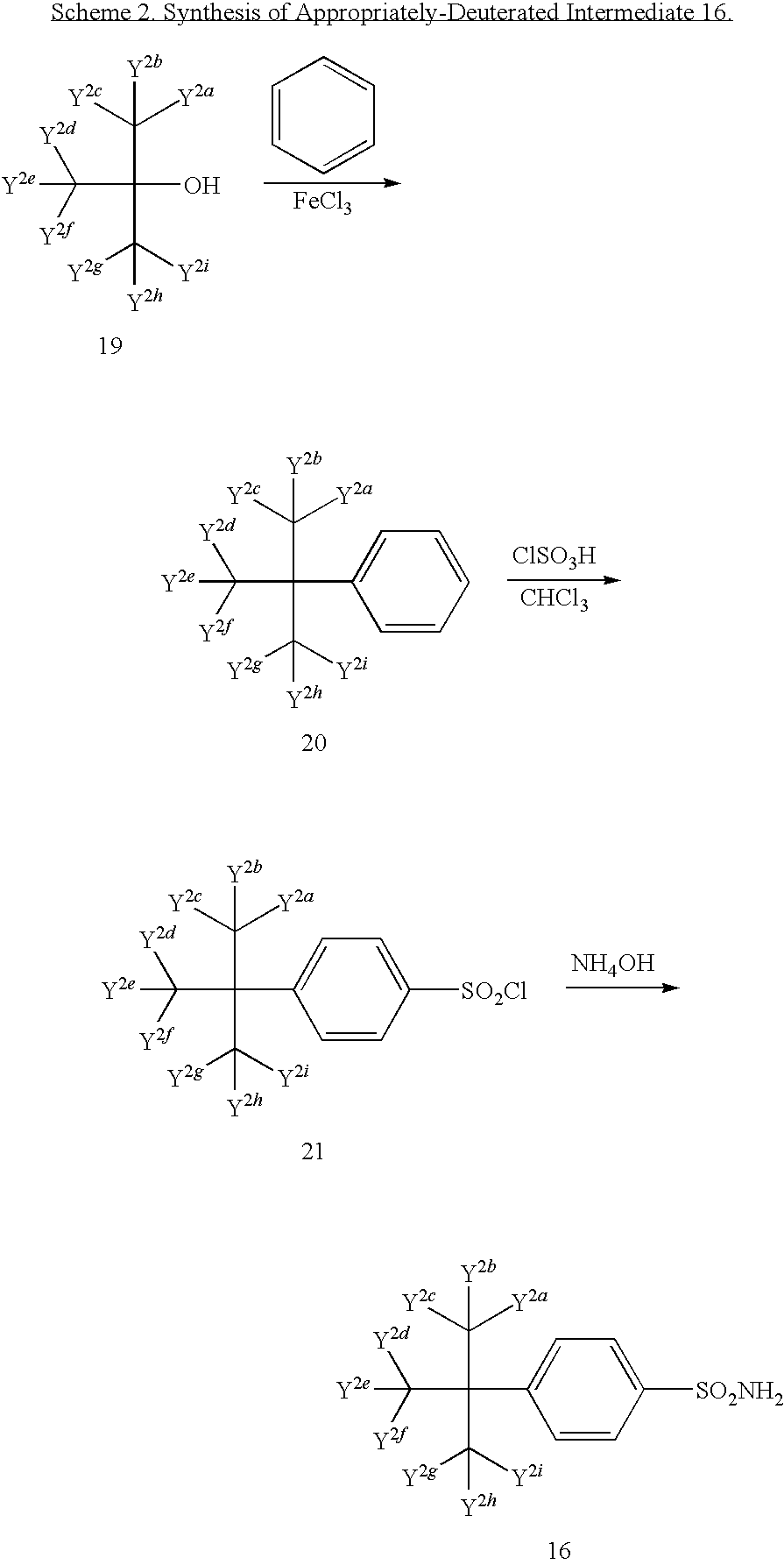
- An appropriately deuterated tert-butanol 19, such as commercially available d9-tert-butanol, is reacted with benzene in the presence of ferric chloride (see Potts, W M et al., J Am Chem Soc, 1939, 61: 2553) to provide 20, which is then reacted with chlorosulfonic acid to provide the sulfonyl chloride 21 (Gayen, S et al., Internet Electronic J Mol Design, 2005, 4: 556). The sulfonyl chloride is converted to the sulfonamide 16 according to the method of Morimoto, H et al., J Med Chem, 2001, 44: 3355. Although not shown in Scheme 2, the sulfonic acid analog of compound 21 (compound 23) is readily available via hydrolysis of 21 in aqueous dioxane according to the method of Tonnet, M L et al., Aus J Chem, 1971, 24: 703.
- Appropriately-deuterated ethyleneglycol mono-tert-
butyl ethers 18 and 18a may be prepared as shown in Schemes 3a and 3b. -

- Commercially available 2-tert-butoxyacetic acid (22) is reduced with d3-borane according to the method of Yoon, N M et al., J Org Chem, 1973, 38: 2786 to produce the corresponding deuterated ethyleneglycol mono-tert-
butyl ether 18. -
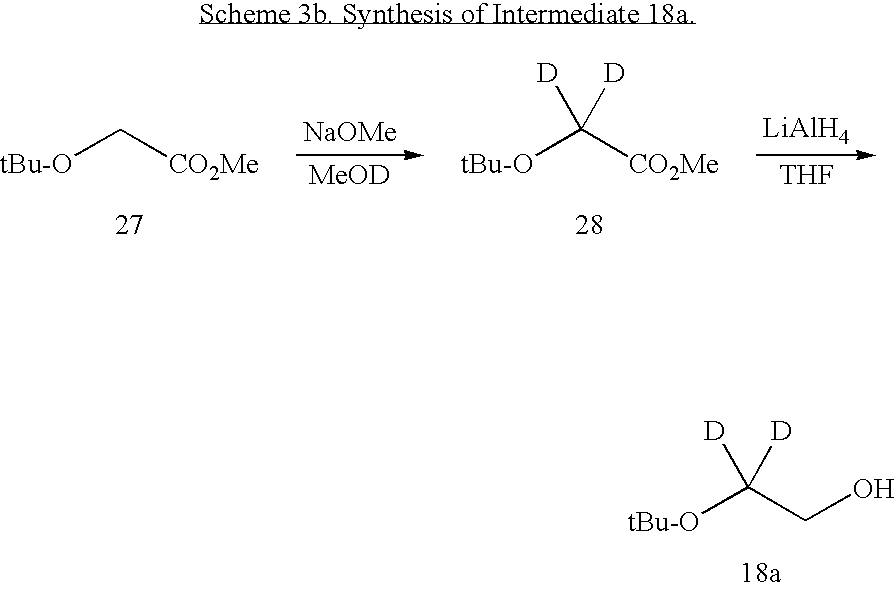
- Treatment of commercially available methyl 2-tert-butoxyacetate (27) with NaOMe in Me0D to produce the corresponding deuterated methyl 2-tert-butoxyacetate (28) followed by reduction with LiAlH4 affords the ethyleneglycol mono-tert-butyl ether 18a, a deuterated example of intermediate 18b.
- An alternate route to a compound of Formula I, wherein each Z is deuterium is shown in Scheme 4.
-

- The appropriately deuterated sulfonamide 17 from Scheme 1 is treated with ethyl 2-hydroxyacetate (24) to produce the corresponding
ester 25 according to the method of Harada, H et al., Chem Pharm Bull, 2001, 49: 606-612. Theester 25 is hydrolyzed to the corresponding acid 26, which is then reduced with deuterodiborane in THF to the deuterated compound of Formula I. Alternatively, theester 25 may be reduced directly to the deuterated compound of Formula I by treatment with LiAlD4. - Certain intermediates that are useful for preparing compounds of Formula I are new. Accordingly, other embodiments of this invention relate to a compound of any one of
formulae 12, 14, 15, 16, 17, 18b, 21 or 23 shown in Schemes 1-3b. - The specific approaches and compounds shown above are not intended to be limiting. The chemical structures in the schemes herein depict variables that are hereby defined commensurately with chemical group definitions (moieties, atoms, etc.) of the corresponding position in the compound formulae herein, whether identified by the same variable name (e.g., Y1a, Y1b, Y1c, Y2a, Y2b, Y2c, Y2d, Y2e, Y2f, Y2g, Y2h, Y2i, Z1a and Z2b) or not. The suitability of a chemical group in a compound structure for use in synthesis of another compound structure is within the knowledge of one of ordinary skill in the art.
- Additional methods of synthesizing compounds of the formulae herein (e.g., Formula I) and their synthetic precursors, including those within routes not explicitly shown in schemes herein, are within the means of chemists of ordinary skill in the art. Synthetic chemistry transformations and protecting group methodologies (protection and deprotection) useful in synthesizing the applicable compounds are known in the art and include, for example, those described in R. Larock, Comprehensive Organic Transformations, VCH Publishers (1989); T. W. Greene and P. G. M. Wuts, Protective Groups in Organic Synthesis, 3rd Ed., John Wiley and Sons (1999); L. Fieser and M. Fieser, Fieser and Fieser's Reagents for Organic Synthesis, John Wiley and Sons (1994); and L. Paquette, ed., Encyclopedia of Reagents for Organic Synthesis, John Wiley and Sons (1995) and subsequent editions thereof.
- Combinations of substituents and variables envisioned by this invention are only those that result in the formation of stable compounds.
- The invention further provides a mixture of a compound of this invention and its lighter isotopologues. These mixtures may occur, for instance, simply as the result of an inefficiency of incorporating the isotope at a given position; intentional or inadvertent exchange of protons for deuterium, e.g. exchange of bulk solvent for heteroatom-attached deuterium; or intentional mixtures of pure compounds.
- In one embodiment, such mixtures comprise at least about 50% of the heavy atom isotopic compound (i.e., less than about 50% of lighter isotopologues). More preferable is a mixture comprising at least 80% of the heavy atom isotopic compound. Most preferable is a mixture comprising 90% of the heavy atom isotopic compound. In one aspect, is a mixture at least about “X”% of the heavy atom isotopic compound (i.e., less than about X% of lighter isotopologues), where X is a number between 0 and 100, inclusive.
- The invention also provides compositions comprising an effective amount of a compound of Formula I (e.g., including any of the formulae herein), or a pharmaceutically acceptable salt thereof; and an acceptable carrier. Preferably, a composition of this invention is formulated for pharmaceutical use (“a pharmaceutical composition”), wherein the carrier is a pharmaceutically acceptable carrier. The carrier(s) must be “acceptable” in the sense of being compatible with the other ingredients of the formulation and, in the case of a pharmaceutically acceptable carrier, not deleterious to the recipient thereof in amounts typically used in medicaments.
- Pharmaceutically acceptable carriers, adjuvants and vehicles that may be used in the pharmaceutical compositions of this invention include, but are not limited to, ion exchangers, alumina, aluminum stearate, lecithin, serum proteins, such as human serum albumin, buffer substances such as phosphates, glycine, sorbic acid, potassium sorbate, partial glyceride mixtures of saturated vegetable fatty acids, water, salts or electrolytes, such as protamine sulfate, disodium hydrogen phosphate, potassium hydrogen phosphate, sodium chloride, zinc salts, colloidal silica, magnesium trisilicate, polyvinyl pyrrolidone, cellulose-based substances, polyethylene glycol, sodium carboxymethylcellulose, polyacrylates, waxes, polyethylene-polyoxypropylene-block polymers, polyethylene glycol and wool fat.
- If required, the solubility and bioavailability of the compounds of the present invention in pharmaceutical compositions may be enhanced by methods well-known in the art. One method includes the use of lipid excipients in the formulation. See “Oral Lipid-Based Formulations: Enhancing the Bioavailability of Poorly Water-Soluble Drugs (Drugs and the Pharmaceutical Sciences),” David J. Hauss, ed. Informa Healthcare, 2007; and “Role of Lipid Excipients in Modifying Oral and Parenteral Drug Delivery: Basic Principles and Biological Examples,” Kishor M. Wasan, ed. Wiley-Interscience, 2006.
- Another known method of enhancing bioavailability is the use of an amorphous form of a compound of this invention optionally formulated with a poloxamer, such as LUTROL™ and PLURONIC™ (BASF Corporation), or block copolymers of ethylene oxide and propylene oxide. See U.S. Pat. No. 7,014,866; and United States patent publications 20060094744 and 20060079502.
- The pharmaceutical compositions of the invention include those suitable for oral, rectal, nasal, topical (including buccal and sublingual), vaginal or parenteral (including subcutaneous, intramuscular, intravenous and intradermal) administration. In certain embodiments, the compound of the formulae herein is administered transdermally (e.g., using a transdermal patch or iontophoretic techniques). Other formulations may conveniently be presented in unit dosage form, e.g., tablets, sustained release capsules, and in liposomes, and may be prepared by any methods well known in the art of pharmacy. See, for example, Remington: The Science and Practice of Pharmacy, Lippincott Williams & Wilkins, Baltimore, Md. (20th ed. 2000).
- Such preparative methods include the step of bringing into association with the molecule to be administered ingredients such as the carrier that constitutes one or more accessory ingredients. In general, the compositions are prepared by uniformly and intimately bringing into association the active ingredients with liquid carriers, liposomes or finely divided solid carriers, or both, and then, if necessary, shaping the product.
- In certain embodiments, the compound is administered orally. Compositions of the present invention suitable for oral administration may be presented as discrete units such as capsules, sachets, or tablets each containing a predetermined amount of the active ingredient; a powder or granules; a solution or a suspension in an aqueous liquid or a non-aqueous liquid; an oil-in-water liquid emulsion; a water-in-oil liquid emulsion; packed in liposomes; or as a bolus, etc. Soft gelatin capsules can be useful for containing such suspensions, which may beneficially increase the rate of compound absorption.
- In the case of tablets for oral use, carriers that are commonly used include lactose and corn starch. Lubricating agents, such as magnesium stearate, are also typically added. For oral administration in a capsule form, useful diluents include lactose and dried cornstarch. When aqueous suspensions are administered orally, the active ingredient is combined with emulsifying and suspending agents. If desired, certain sweetening and/or flavoring and/or coloring agents may be added.
- Compositions suitable for oral administration include lozenges comprising the ingredients in a flavored basis, usually sucrose and acacia or tragacanth; and pastilles comprising the active ingredient in an inert basis such as gelatin and glycerin, or sucrose and acacia.
- Compositions suitable for parenteral administration include aqueous and non-aqueous sterile injection solutions which may contain anti-oxidants, buffers, bacteriostats and solutes which render the formulation isotonic with the blood of the intended recipient; and aqueous and non-aqueous sterile suspensions which may include suspending agents and thickening agents. The formulations may be presented in unit-dose or multi-dose containers, for example, sealed ampules and vials, and may be stored in a freeze dried (lyophilized) condition requiring only the addition of the sterile liquid carrier, for example water for injections, immediately prior to use. Extemporaneous injection solutions and suspensions may be prepared from sterile powders, granules and tablets.
- Such injection solutions may be in the form, for example, of a sterile injectable aqueous or oleaginous suspension. This suspension may be formulated according to techniques known in the art using suitable dispersing or wetting agents (such as, for example, Tween 80) and suspending agents. The sterile injectable preparation may also be a sterile injectable solution or suspension in a non-toxic parenterally-acceptable diluent or solvent, for example, as a solution in 1,3-butanediol. Among the acceptable vehicles and solvents that may be employed are mannitol, water, Ringer's solution and isotonic sodium chloride solution. In addition, sterile, fixed oils are conventionally employed as a solvent or suspending medium. For this purpose, any bland fixed oil may be employed including synthetic mono- or diglycerides. Fatty acids, such as oleic acid and its glyceride derivatives are useful in the preparation of injectables, as are natural pharmaceutically-acceptable oils, such as olive oil or castor oil, especially in their polyoxyethylated versions. These oil solutions or suspensions may also contain a long-chain alcohol diluent or dispersant.
- The pharmaceutical compositions of this invention may be administered in the form of suppositories for rectal administration. These compositions can be prepared by mixing a compound of this invention with a suitable non-irritating excipient which is solid at room temperature but liquid at the rectal temperature and therefore will melt in the rectum to release the active components. Such materials include, but are not limited to, cocoa butter, beeswax and polyethylene glycols.
- The pharmaceutical compositions of this invention may be administered by nasal aerosol or inhalation. Such compositions are prepared according to techniques well-known in the art of pharmaceutical formulation and may be prepared as solutions in saline, employing benzyl alcohol or other suitable preservatives, absorption promoters to enhance bioavailability, fluorocarbons, and/or other solubilizing or dispersing agents known in the art. See, e.g.: Rabinowitz J D and Zaffaroni A C, U.S. Pat. No. 6,803,031, assigned to Alexza Molecular Delivery Corporation.
- Topical administration of the pharmaceutical compositions of this invention is especially useful when the desired treatment involves areas or organs readily accessible by topical application. For topical application to the skin, the pharmaceutical composition should be formulated with a suitable ointment containing the active components suspended or dissolved in a carrier. Carriers for topical administration of the compounds of this invention include, but are not limited to, mineral oil, liquid petroleum, white petroleum, propylene glycol, polyoxyethylene polyoxypropylene compound, emulsifying wax, and water. Alternatively, the pharmaceutical composition can be formulated with a suitable lotion or cream containing the active compound suspended or dissolved in a carrier. Suitable carriers include, but are not limited to, mineral oil, sorbitan monostearate,
polysorbate 60, cetyl esters wax, cetearyl alcohol, 2-octyldodecanol, benzyl alcohol, and water. The pharmaceutical compositions of this invention may also be topically applied to the lower intestinal tract by rectal suppository formulation or in a suitable enema formulation. Topically-transdermal patches and iontophoretic administration are also included in this invention. - Application of the subject therapeutics may be local, so as to be administered at the site of interest. Various techniques can be used for providing the subject compositions at the site of interest, such as injection, use of catheters, trocars, projectiles, pluronic gel, stents, sustained drug release polymers or other device which provides for internal access.
- Thus, according to yet another embodiment, the compounds of this invention may be incorporated into compositions for coating an implantable medical device, such as prostheses, artificial valves, vascular grafts, stents, or catheters. Suitable coatings and the general preparation of coated implantable devices are known in the art and are exemplified in U.S. Pat. Nos. 6,099,562; 5,886,026; and 5,304,121. The coatings are typically biocompatible polymeric materials such as a hydrogel polymer, polymethyldisiloxane, polycaprolactone, polyethylene glycol, polylactic acid, ethylene vinyl acetate, and mixtures thereof. The coatings may optionally be further covered by a suitable topcoat of fluorosilicone, polysaccharides, polyethylene glycol, phospholipids or combinations thereof to impart controlled release characteristics in the composition. Coatings for invasive devices are to be included within the definition of pharmaceutically acceptable carrier, adjuvant or vehicle, as those terms are used herein.
- According to another embodiment, the invention provides a method of coating an implantable medical device comprising the step of contacting said device with the coating composition described above. It will be obvious to those skilled in the art that the coating of the device will occur prior to implantation into a mammal.
- According to another embodiment, the invention provides a method of impregnating an implantable drug release device comprising the step of contacting said drug release device with a compound or composition of this invention. Implantable drug release devices include, but are not limited to, biodegradable polymer capsules or bullets, non-degradable, diffusible polymer capsules and biodegradable polymer wafers.
- According to another embodiment, the invention provides an implantable medical device coated with a compound or a composition comprising a compound of this invention, such that said compound is therapeutically active.
- According to another embodiment, the invention provides an implantable drug release device impregnated with or containing a compound or a composition comprising a compound of this invention, such that said compound is released from said device and is therapeutically active.
- Where an organ or tissue is accessible because of removal from the patient, such organ or tissue may be bathed in a medium containing a composition of this invention, a composition of this invention may be painted onto the organ, or a composition of this invention may be applied in any other convenient way.
- In another embodiment, a composition of the present invention further comprises a second therapeutic agent. The second therapeutic agent includes any compound or therapeutic agent known to have or that demonstrates advantageous properties when administered with an endothelin antagonist. Such agents are the same as those indicated as useful in combination with bosentan, including, but not limited to those described in U.S. Pat. Nos. 6,635,648; 6,586,391; 6,869,970; 5,945,448; and 5,696,116; and in PCT patent publications WO 2005101608; WO 2004082637; WO 2004017993; and WO 2002074034. Preferably, the second therapeutic agent is an agent useful in the treatment or prevention of a disease or condition selected from pulmonary arterial hypertension, erectile dysfunction, chronic obstructive pulmonary disease, chronic pelvic pain syndrome type III, primary dysmenorrhea, pre-eclampsia, thalassemia, skin fibrosis, hypertension, hypoxia-induced pulmonary artery hypertension, interstitial lung disease, scleroderma, idiopathic pulmonary fibrosis, pulmonary hypertension, chronic thromboembolic pulmonary hypertension, Eisenmenger's syndrome, benign prostatic hyperplasia, high blood pressure, coronary disorders, cardiac insufficiency, renal cerebral ischemia, cardiac infarct, migraine, subarachnoid haemorrhage, Raynaud syndrome, skin cancer, atherosclerosis, sickle cell disease, digital ulcers, and others, including, but not limited to those disclosed in U.S. Pat. No. 6,635,648; U.S. Pat. No. 5,292,740; U.S. Pat. No. 6,586,391; U.S. Pat. No. 6,869,970; U.S. Pat. No. 5,945,448; U.S. Pat. No. 5,696,116; WO 2005101608; WO 2004082637; WO 2004017993; WO 2002074034; and WO 9638173A1.
- In one embodiment, the second therapeutic agent is selected from a prostacyclin, a prostacyclin derivative, a second endothelin antagonist, a dopaminergic agonist, a phosphodiesterase inhibitor, a sympathetic nervous system antagonist, an inhibitor of endothelin converting enzyme, an antihypertensive, an alpha-adrenergic blocker, or an angiotensin II receptor antagonist.
- In another embodiment, the second therapeutic agent is selected from a phosphodiesterase inhibitor, such as sildenafil.
- In another embodiment, the second therapeutic agent is selected from a prostacyclin or prostacyclin derivative, such as epoprostenol, treprostinil, iloprost, or beraprost.
- In another embodiment, the invention provides separate dosage forms of a compound of this invention and a second therapeutic agent that are associated with one another. The term “associated with one another” as used herein means that the separate dosage forms are packaged together or otherwise attached to one another such that it is readily apparent that the separate dosage forms are intended to be sold and administered together (within less than 24 hours of one another, consecutively or simultaneously).
- In the pharmaceutical compositions of the invention, the compound of the present invention is present in an effective amount. As used herein, the term “effective amount” refers to an amount which, when administered in a proper dosing regimen, is sufficient to treat (therapeutically or prophylactically) the target disorder. For example, to reduce or ameliorate the severity, duration or progression of the disorder being treated, prevent the advancement of the disorder being treated, cause the regression of the disorder being treated, or enhance or improve the prophylactic or therapeutic effect(s) of another therapy.
- The interrelationship of dosages for animals and humans (based on milligrams per meter squared of body surface) is described in Freireich et al., (1966) Cancer Chemother. Rep 50: 219. Body surface area may be approximately determined from height and weight of the patient. See, e.g., Scientific Tables, Geigy Pharmaceuticals, Ardsley, N.Y., 1970, 537. An effective amount of a compound of this invention to be administered to a normal adult human can range from about 1 mg to about 1000 mg/day, more preferably from about 5 mg to about 500 mg/day, more preferably from about 25 mg/ to about 250 mg/day. Daily amounts of a compound of this invention will be administered in from one to about nine unit dosages per day. Effective doses will also vary, as recognized by those skilled in the art, depending on the diseases treated, the severity of the disease, the route of administration, the sex, age and general health condition of the patient, excipient usage, the possibility of co-usage with other therapeutic treatments such as use of other agents and the judgment of the treating physician.
- For pharmaceutical compositions that comprise a second therapeutic agent, an effective amount of the second therapeutic agent is between about 20% and 100% of the dosage normally utilized in a monotherapy regime using just that agent. Preferably, an effective amount is between about 70% and 100% of the normal monotherapeutic dose. The normal monotherapeutic dosages of these second therapeutic agents are well known in the art. See, e.g., Wells et al., eds., Pharmacotherapy Handbook, 2nd Edition, Appleton and Lange, Stamford, Conn. (2000); PDR Pharmacopoeia, Tarascon Pocket Pharmacopoeia 2000, Deluxe Edition, Tarascon Publishing, Loma Linda, Calif. (2000), each of which references are incorporated herein by reference in their entirety.
- It is expected that some of the second therapeutic agents referenced above will act synergistically with the compounds of this invention. When this occurs, it will allow the effective dosage of the second therapeutic agent and/or the compound of this invention to be reduced from that required in a monotherapy. This has the advantage of minimizing toxic side effects of either the second therapeutic agent of a compound of this invention, synergistic improvements in efficacy, improved ease of administration or use and/or reduced overall expense of compound preparation or formulation.
- According to another embodiment, the invention provides a method of treating a disease that is beneficially treated by bosentan comprising the step of administering to a subject in need thereof an effective amount of a compound or a composition of this invention. Such conditions and diseases are well known in the art and include but are not limited to pulmonary arterial hypertension, erectile dysfunction, chronic obstructive pulmonary disease, chronic pelvic pain syndrome type III, primary dysmenorrhea, pre-eclampsia, thalassemia, skin fibrosis, hypertension, hypoxia-induced pulmonary artery hypertension, interstitial lung disease, scleroderma, idiopathic pulmonary fibrosis, pulmonary hypertension, chronic thromboembolic pulmonary hypertension, Eisenmenger's syndrome, benign prostatic hyperplasia, high blood pressure, coronary disorders, cardiac insufficiency, renal cerebral ischemia, cardiac infarct, migraine, subarachnoid haemorrhage, Raynaud syndrome, skin cancer, atherosclerosis, sickle cell disease, and digital ulcers.
- In a more specific embodiment, the method of this invention is used to treat a subject suffering from or susceptible to a disease or condition selected from pulmonary arterial hypertension, erectile dysfunction, skin fibrosis, interstitial lung disease, scleroderma, chronic thromboembolic pulmonary hypertension, Eisenmenger's syndrome, skin cancer, sickle cell disease, digital ulcers.
- In an even more specific embodiment, the method of this invention is used to treat a subject suffering from or susceptible to a disease or condition selected from pulmonary hypertension (including pediatric subjects, subjects with class II disease who are mildly symptomatic, patients with sickle cell anemia, and patients with chronic thromboembolic pulmonary hypertension), idiopathic pulmonary fibrosis, digital ulcerations in patients with scleroderma, and interstitial lung disease in patients with scleroderma.
- Methods delineated herein include those wherein the subject is identified as in need of a particular stated treatment. Identifying a subject in need of such treatment can be in the judgment of a subject or a health care professional and can be subjective (e.g. opinion) or objective (e.g. measurable by a test or diagnostic method).
- In another embodiment, the invention provides a method of modulating the interaction between ET-1 and its receptors in a cell, said modulation comprising contacting a cell with one or more compounds of any of the formulae herein.
- In another embodiment, the above method of treatment comprises the further step of co-administering to the patient one or more second therapeutic agents. The choice of second therapeutic agent may be made from any second therapeutic agent known to be useful for co-administration with bosentan. Examples of such agents and the conditions and diseases for which each may be used in conjunction with a compound of this invention are described in PCT publications WO 04017993A1 and WO 9638173A1. Preferably, the second therapeutic agent is an agent useful in the treatment or prevention of a disease or condition selected from pulmonary arterial hypertension, brain edema or Eisenmenger's syndrome.
- In one embodiment, the second therapeutic agent is selected from a prostacyclin or a prostacyclin analogue and the condition treated is pulmonary arterial hypertension. In a more specific embodiment, the prostacyclin or prostacyclin analogue is selected from epoprostenol, treprostinil, iloprost, or beraprost.
- In another embodiment, the second therapeutic agent is a phosphodiesterase V inhibitor and the condition treated is selected from pulmonary arterial hypertension and Eisenmenger's syndrome. In a more specific embodiment, the phosphodiesterase V inhibitor is sildenafil.
- The term “co-administered” as used herein means that the second therapeutic agent may be administered together with a compound of this invention as part of a single dosage form (such as a composition of this invention comprising a compound of the invention and an second therapeutic agent as described above) or as separate, multiple dosage forms. Alternatively, the additional agent may be administered prior to, consecutively with, or following the administration of a compound of this invention. In such combination therapy treatment, both the compounds of this invention and the second therapeutic agent(s) are administered by conventional methods. The administration of a composition of this invention comprising both a compound of the invention and a second therapeutic agent to a subject does not preclude the separate administration of that same therapeutic agent, any other second therapeutic agent or any compound of this invention to said subject at another time during a course of treatment.
- Effective amounts of these second therapeutic agents are well known to those skilled in the art and guidance for dosing may be found in patents and published patent applications referenced herein, as well as in Wells et al., eds., Pharmacotherapy
- Handbook, 2nd Edition, Appleton and Lange, Stamford, Conn. (2000); PDR Pharmacopoeia, Tarascon Pocket Pharmacopoeia 2000, Deluxe Edition, Tarascon Publishing, Loma Linda, Calif. (2000), and other medical texts. However, it is well within the skilled artisan's purview to determine the second therapeutic agent's optimal effective-amount range.
- In one embodiment of the invention where a second therapeutic agent is administered to a subject, the effective amount of the compound of this invention is less than its effective amount would be where the second therapeutic agent is not administered. In another embodiment, the effective amount of the second therapeutic agent is less than its effective amount would be where the compound of this invention is not administered. In this way, undesired side effects associated with high doses of either agent may be minimized. Other potential advantages (including without limitation improved dosing regimens and/or reduced drug cost) will be apparent to those of skill in the art.
- In yet another aspect, the invention provides the use of a compound of formula I alone or together with one or more of the above-described second therapeutic agents in the manufacture of a medicament, either as a single composition or as separate dosage forms, for treatment or prevention in a subject of a disease, disorder or symptom set forth above. Another aspect of the invention is a compound of the formulae herein for use in the treatment or prevention in a subject of a disease, disorder or symptom thereof delineated herein.
- The compounds and compositions of this invention are also useful as reagents in methods for determining the concentration of bosentan in solution or biological sample such as plasma, examining the metabolism of bosentan and other analytical studies.
- According to one embodiment, the invention provides a method of determining the concentration, in a solution or a biological sample, of bosentan, comprising the steps of:
-
- a) adding a known concentration of a compound of Formula I to the solution of biological sample;
- b) subjecting the solution or biological sample to a measuring device that distinguishes bosentan from a compound of Formula I;
- c) calibrating the measuring device to correlate the detected quantity of the compound of Formula I with the known concentration of the compound of Formula I added to the biological sample or solution; and
- d) measuring the quantity of bosentan in the biological sample with said calibrated measuring device; and
- e) determining the concentration of bosentan in the solution of sample using the correlation between detected quantity and concentration obtained for a compound of Formula I.
- Measuring devices that can distinguish bosentan from the corresponding compound of Formula I include any measuring device that can distinguish between two compounds that differ from one another only in isotopic abundance. Exemplary measuring devices include a mass spectrometer, NMR spectrometer, or IR spectrometer.
- In another embodiment, the invention provides a method of evaluating the metabolic stability of a compound of Formula I comprising the steps of contacting the compound of Formula I with a metabolizing enzyme source for a period of time and comparing the amount of the compound of Formula I with the metabolic products of the compound of Formula I after the period of time.
- In a related embodiment, the invention provides a method of evaluating the metabolic stability of a compound of Formula I in a patient following administration of the compound of Formula I. This method comprises the steps of obtaining a serum, urine or feces sample from the patient at a period of time following the administration of the compound of Formula Ito the subject; and comparing the amount of the compound of Formula I with the metabolic products of the compound of Formula I in the serum, urine or feces sample.
- The present invention also provides kits for use to treat a condition or disease selected from pulmonary arterial hypertension, scleroderma, chronic thromboembolic pulmonary hypertension, and idiopathic pulmonary fibrosis. These kits comprise (a) a pharmaceutical composition comprising a compound of Formula I or a salt thereof; or a prodrug, or a salt of a prodrug thereof; or a or polymorph thereof, wherein said pharmaceutical composition is in a container; and (b) instructions describing a method of using the pharmaceutical composition to treat a condition or disease selected from pulmonary arterial hypertension, scleroderma, chronic thromboembolic pulmonary hypertension, and idiopathic pulmonary fibrosis.
- The container may be any vessel or other sealed or sealable apparatus that can hold said pharmaceutical composition. Examples include bottles, divided or multi-chambered holders bottles, wherein each division or chamber comprises a single dose of said composition, a divided foil packet wherein each division comprises a single dose of said composition, or a dispenser that dispenses single doses of said composition. The container can be in any conventional shape or form as known in the art which is made of a pharmaceutically acceptable material, for example a paper or cardboard box, a glass or plastic bottle or jar, a re-sealable bag (for example, to hold a “refill” of tablets for placement into a different container), or a blister pack with individual doses for pressing out of the pack according to a therapeutic schedule. The container employed can depend on the exact dosage form involved, for example a conventional cardboard box would not generally be used to hold a liquid suspension. It is feasible that more than one container can be used together in a single package to market a single dosage form. For example, tablets may be contained in a bottle, which is in turn contained within a box. Preferably, the container is a blister pack.
- The kits of this invention may also comprise a device to administer or to measure out a unit dose of the pharmaceutical composition. Such device may include an inhaler if said composition is an inhalable composition; a syringe and needle if said composition is an injectable composition; a syringe, spoon, pump, or a vessel with or without volume markings if said composition is an oral liquid composition; or any other measuring or delivery device appropriate to the dosage formulation of the composition present in the kit.
- In an embodiment of the kits of this invention, the composition comprising the second active agent may be in a vessel or container that is separate from the vessel containing the composition comprising a compound of Formula I.
-

- Step 1. (tent-Butyl-d9)-benzene (20a). A solution of d9-tert-butanol, 19a (25.0 g, 0.3012 mol, 1.0 equiv) in benzene (20 mL) was added over 0.25 hour to a suspension of iron(III) chloride (48.8 g, 0.3012 mol, 1.0 equiv) in benzene (175 mL, 1.9615 mol, 6.5 equiv). Mild cooling was used to maintain the reaction temperature at 22-27° C. during the addition (benzene (5 mL) was used to rinse the addition funnel). The suspension was stirred at room temperature for 7.5 hours then diluted with hexanes (200 mL). The mixture was filtered through a pad of silica gel (0.5 in) topped with Celite (0.5 in), washing the pad with hexanes (700 mL). The filtrate was concentrated under reduced pressure (bath temperature about 20° C.) to a yellow liquid. The crude product was distilled to give 19.8 g (46%) of (tert-butyl-d9)-benzene, 20a as a colorless liquid, by 55-60° C., 35-37 Torr).
- Step 2. 4-(tert-Butyl-d9 )-benzene-1-sulfonyl chloride (21a). A solution of (tert-butyl-d9)-benzene, 20a (19.3 g, 0.135 mol, 1.0 equiv) in chloroform (250 mL) was cooled to −5° C. in an ice/brine bath. Chlorosulfonic acid (44.1 g, 25 mL, 0.377 mol, 2.8 equiv) was added dropwise over 0.75 hour, maintaining the reaction temperature at −5° C.±1° C. The ice/brine bath was replaced with an ice/water bath and the mixture was stirred at 0-2° C. for 1 hour, then allowed to warm to room temperature and stirred 1 hour. The turbid mixture was poured cautiously onto ice (600 mL). The biphasic mixture was diluted with dichloromethane (200 mL). The organic phase was washed with water (500 mL), brine (2×500 mL), dried (Na2SO4), filtered and the filtrate concentrated under reduced pressure to an oily solid. The oily solid was placed under high vacuum for 1 hour to give 26.1 g (80%) of crude 4-(tert-butyl-d9)-benzene-1-sulfonyl chloride, 21a. The crude product was used without further purification.
- Step 3. 4-(tert-Butyl-d9)-benzenesulfonamide (16a) A mixture of about 15N ammonium hydroxide (24.6 mL, 0.3703 mol, 3.5 equiv) and tetrahydrofuran (200 mL) was cooled to about 2° C. and a solution of crude 4-(tert-butyl-d9)-benzene-1-sulfonyl chloride, 21a (25.5 g, 0.1058 mol, 1.0 equiv) in tetrahydrofuran (200 mL) was added dropwise over 0.75 hour at 2-5° C. The mixture (some solids coating sides of flask) was allowed to warm to room temperature and stirred 0.5 hour. Water (about 50 mL) was added to dissolve solids and the mixture was concentrated under reduced pressure to remove the bulk of the tetrahydrofuran. The residual oily mixture was partitioned between ethyl acetate (500 mL) and IN hydrochloric acid (100 mL). The organic phase was washed with brine (100 mL), dried (Na2SO4), filtered and the filtrate concentrated under reduced pressure to a white solid, crude weight 25.9 g. TLC (30% ethyl acetate/heptanes): product (Rf=0.47) and 3 minor impurities (Rf=0.73, Rf=0.66, Rf=0.54). The crude product was absorbed onto silica gel using dichloromethane and dry-loaded on a column of silica gel (250 g) packed in toluene. The column was eluted with toluene (1.5 L), 10% ethyl acetate/toluene (2 L) and 25% ethyl acetate/toluene (1 L). The one mixed fraction was purified a second time by silica gel chromatography (150 g), eluting with a gradient of 0-30% ethyl acetate/heptanes. Product fractions from both columns were concentrated under reduced pressure to a white solid that was triturated with heptanes (150 mL), filtered and dried to give 21.9 g (93%) of 4-(tert-butyl-d9)-benzenesulfonamide, 16a. 1H-NMR (300 MHz, CDCl3): δ 4.93 (s, 2H), 7.52 (d, J=8.2, 2H), 7.86 (d, J=8.7, 2H). HPLC (method: 20 mm C18-RP column—gradient method 2-95% ACN+0.1% formic acid in 3.3 min with 1.7 min hold at 95% ACN; Wavelength: 254 nm): retention time=3.10 min. MS (M+H): 223.2, 206.1.
- Step 4. 4-(tert-Butyl-d9)-N-(6-chloro-5-(2-methoxyphenoxy)-2,2′-bipyrimidin-4-yl)benzenesulfonamide (17a) 60% Sodium hydride (0.97 g, 24.2 mmol, 2.2 equiv) was suspended in N,N′dimethylacetamide (50 mL) and the mixture was cooled in an ice-bath. 4-(tert-Butyl-d9)-benzenesulfonamide, 16a (2.44 g, 11 mmol, 1.1 equiv) was added portionwise as a solid, maintaining the reaction temperature below 3° C. The white suspension was allowed to warm to room temperature over 0.75 hour, then cooled to approximately 5° C. 4,6-Dichloro-5-(2-methoxyphenoxy)-2,2-bipyrimidine, 15a [prepared by the method described in Bioorg. & Med. Chem., 2001, 9: 2955] (3.49 g, 10 mmol, 1.0 equiv) was added as a solid. The reaction mixture developed a yellow color but no exotherm was observed. The mixture was stirred at 2-5° C. for 0.25 hour (slow H2 evolution), then was allowed to warm to room temperature and was stirred 3.5 hours (the rate of H2 evolution increased as the mixture warmed, and the color of the mixture deepened to yellow-orange). The suspension was poured slowly into ice-water (200 mL) and the yellow suspension was adjusted to pH 1-2 with 1N hydrochloric acid. The yellow solid was filtered, washed with water (300 mL), dried on the filter for 1.5 hours, then dried overnight in a vacuum oven at 40-50° C. The crude product was dissolved in a minimum amount of dichloromethane containing a few mL of methanol and was absorbed onto silica gel. The absorbed material was dry-loaded onto a column of silica gel (65 g) packed in dichloromethane. The column was eluted with a gradient of 0-5% methanol/dichloromethane (slow elution). Clean product fractions were concentrated under reduced pressure to give a yellow foamy solid. The foamy solid was triturated with ethyl acetate (about 50 mL) to give a suspension. The suspension was concentrated to near dryness and diluted with 1:1 ethyl acetate/heptanes (150 mL). The solid was filtered, washed with 1:1 ethyl acetate/heptanes (25 mL) and dried to give 3.51 g (66%) of 4-d9-tert-butyl-N-(6-chloro-5-(2-methoxyphenoxy)-2,2′-bipyrimidin-4-yl)benzenesulfonamide, 17a as a light-yellow solid. 1H-NMR (300 MHz, DMSO-d6): δ 3.78 (s, 3H), 6.59 (bs, 1H), 6.81 (t, J=7.6, 1H), 7.02 (t, J=7.6, 1H), 7.09 (d, J=7.6, 1H), 7.42 (bs, 2H), 7.66 (t, J=4.7, 1H), 8.02 (bs, 2H), 9.05 (d, J=4.1, 2H). HPLC (method: 150 mm C18-RP column—gradient method 5-95% ACN; Wavelength: 254 nm): retention time=3.85min. MS (M+H): 535.1.
-
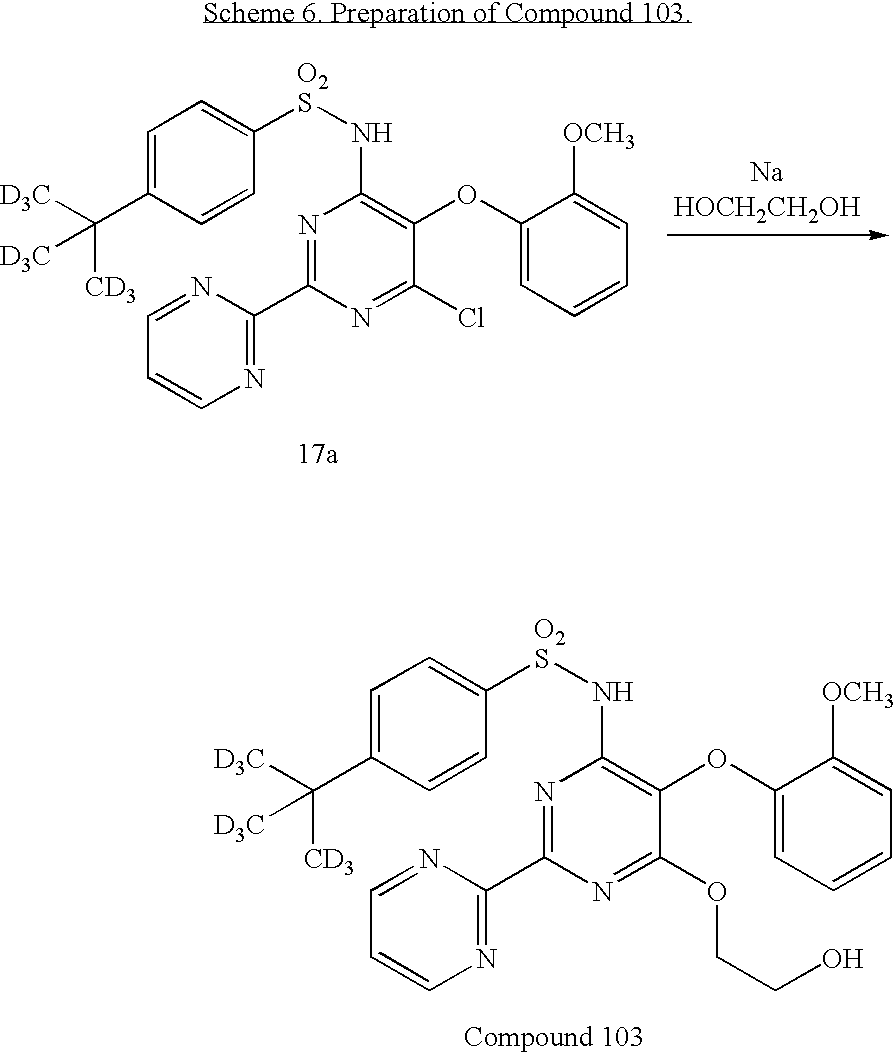
- 4-(tert-Butyl-d9)-N-(6-(-2-hydroxyethoxy)-5-(2-methoxyphenoxy)-2,2′-bipyrimidin-4-yl)benzenesulfonamide (Compound 103). Metallic sodium (0.14 g, 6.0 mmol, 3.0 equiv) was added to ethylene glycol (10 mL) and the mixture was heated at approximately 45° C. until all sodium dissolved. The clear solution was cooled to 30° C. and crude 17a (1.07 g, 2.0 mmol, 1.0 equiv) was added in one portion. The suspension was heated to approximately 95° C. A clear pale yellow solution formed after approximately 0.5 hour. The mixture was heated at approximately 95° C. for 3 hours, cooled to room temperature and stirred overnight. The mixture was poured into water (250 mL) and the light solution was acidified to pH 1-2 with 1N hydrochloric acid. The pale yellow suspension was stirred 10 minutes then allowed to stand for 10 minutes. The solid was filtered, washed well with water (100 mL), dried on the filter for 1.5 hours, then dried in a vacuum oven at 50-60° C. overnight. Recrystallization of the crude solid (1.00 g) from ethanol/water gave material of only 96.7% purity by HPLC. This solid and that recovered from the mother liquor were combined, dissolved in dichloromethane and adsorbed onto silica gel. The adsorbed material was dry-loaded onto a column of silica gel (25 g) packed in 75% ethyl acetate/heptanes. The column was eluted with 75% ethyl acetate/heptanes (400 mL), 100 ethyl acetate (500 mL), 2% methanol/ethyl acetate (800 mL) followed by 3% methanol/ethyl acetate. Product-containing fractions were concentrated under reduced pressure to a foamy oil. The foamy oil was dissolved in hot ethanol (10 mL), water (10 mL) was added dropwise and the mixture was allowed to cool to room temperature. Solids began to slowly form after approximately 2 hours. The suspension was stirred overnight. The solids were filtered, washed with cold 50% ethanol/water (5 mL) and dried. The solids were further dried in a vacuum oven at approximately 50° C. for 8 hours to give 0.57 g (51%) of Compound 103 as a pale yellow solid, mp 144.5-146.6° C. 1H-NMR (300 MHz, CDCl3): δ 3.85-3.87 (m, 2H), 3.95 (s, 3H), 4.58-4.60 (m, 2H), 4.88 (bs, 1H), 6.85-6.90 (m, 1H), 6.98-7.16 (m, 3H), 7.40-7.44 (m, 3H), 8.40 (d, J=8.5, 2H), 8.75-8.78 (m, 1H,) 9.01 (d, J=5.0, 2H). 13C-NMR (75 MHz, DMSO-d6): δ 34.47, 56.00, 62.69, 72.10, 77.24, 112.42, 119.06, 121.20, 121.30, 124.62, 125.37, 129.46, 136.01, 145.53, 149.66, 151.73, 155.22, 157.26, 157.73, 161.19, 161.40. HPLC (method: 20 mm C18-RP column—gradient method 2-95% ACN+0.1% formic acid in 3.3 min with 1.7 min hold at 95% ACN; Wavelength: 254 nm): retention time: 3.56 min; 99.3% purity. MS (M+H): 561.3. Elemental Analysis (C27H20D9N5O6S): Calculated: C=57.85, H=5.21, N=12.49, S=5.72. Found: C=57.63, H=5.19, N=12.46, S=5.74.
-


- Step 1. 1-(Benzyloxy)-2-(methoxy-d3)benzene (9a). Powdered potassium carbonate (69.0 g, 0.5 mol, 2.0 equiv) was added to a solution of 2-benzyloxyphenol (50 g, 0.25 mol, 1.0 equiv) in N,N'dimethylformamide (500 mL) with formation of a gray suspension. Iodomethane-d3 (Isotec, 99.5 atom % D, 50 g, 0.3448 mol, 1.38 equiv) was added. The reaction temperature increased from 22° C. to 25° C. over 10 minutes, holding at 25° C. for 0.5 hour before dropping. The reaction mixture was stirred at room temperature for 1 hour, then heated at approximately 45° C. for 3 hours. The brown/tan suspension was cooled to room temperature and poured into water (1.5 L) giving an oil that crystallized. The aqueous mixture was extracted with 3:2 ethyl acetate/heptanes (1.25 L). The organic phase was diluted with heptanes (250 mL) and washed with water (4×500 mL), brine (500 mL), dried over sodium sulfate, filtered and the solvent removed under reduced pressure. The light yellow-brown oil was seeded to induce crystallization to give 54.6 g (approximately 100%) of 1-(benzyloxy)-2-d3-methoxybenzene as a yellow-brown solid that was used without further purification.
- Step 2. 2-(Methoxy-d3)phenol (10a). 20% Palladium on carbon (approximately 55% water; 2.7 g) was added to a mixture of 1-(benzyloxy)-2-d3-methoxybenzene (54.0 g, 0.2488 mol), methanol (900 mL) and 2N hydrochloric acid (30 mL). The mixture was hydrogenated at approximately 40 psi H2 for 1 hour after uptake of H2 ceased. The mixture was filtered through Celite, washing the Celite pad with methanol (500 mL). The filtrate was concentrated under reduced pressure. The oily residue was dissolved in dichloromethane and the organic solution washed with saturated brine (200 mL). The aqueous phase was back-extracted with dichloromethane (200 mL). The combined organic solution was dried over sodium sulfate, filtered and the solvent removed under reduced pressure to give 30.6 g (97%) of 2-d3-methoxyphenol as a yellow-brown oil that was used without further purification.
- Step 3. Dimethyl 2-(2-(Methoxy-d3)-phenoxy)malonate (12a). A solution of 2-(methoxy-d3)phenol, 10a (30.6 g, 0.2409 mol, 1.00 equiv) in methanol (200 mL) was cooled to 10° C. and a 25 wt % solution of sodium methoxide in methanol (52.0 g, 55 mL, 0.2409 mol, 1.00 equiv) was added slowly using methanol (100 mL) to rinse the graduated cylinder. A dark brown color developed and the reaction temperature increased from 10° C. to 19° C. The reaction mixture was stirred 10 min before the addition of dimethyl chloromalonate, 11 (44.4 g, 34 mL, 0.2674 mol, 1.11 equiv). The mixture was stirred 20 minutes during which time a light suspension formed. The mixture was heated to approximately 45° C. and held at this temperature for 6.25 hours. The mixture was cooled to room temperature and stirred overnight. The resulting brownish light suspension was concentrated under reduced pressure to remove methanol. The residual oily solid was partitioned between water (500 mL) and 1:1 toluene/heptanes (1 L). The organic phase was washed with 1% sodium hydroxide (500 mL), water (500 mL), brine (300 mL), dried over sodium sulfate, filtered and the solvent removed under reduced pressure to give 42.2 g (68%) of crude 12a as a pale yellow oil that was used without further purification.
- Step 4. 5-(2-(Methoxy-d3)rthenoxy)-2-(pyrimidin-2-yl)pyrimidine-4.6(1H,5H)-dione (14a). 25 wt % Sodium methoxide in methanol (60.0 g, 63 mL, 278.0 mmol, 3.125 equiv) was added to methanol (600 mL). Pyrimidine-2-carboximidamide acetate, 13 (16.2 g, 89.0 mmol, 1.0 equiv; prepared from 2-cyanopyrimidine as described in Japanese Patent Application 2000344755A) was added and the orange solution stirred 10 minutes. Crude 14a (22.9 g, 89 mmol, 1.0 equiv) was added and the mixture heated to reflux. Upon heating the mixture developed a dark brown color which grew lighter once the reaction mixture reached reflux. The mixture was heated at reflux for 22 hours. The yellow-brown suspension was cooled to room temperature, concentrated under reduced pressure to near dryness and the residue was dissolved in water (350 mL). The dark green solution was cooled in an ice bath and acidified to pH 1-2 with 3N hydrochloric acid. The resulting suspension was stirred at room temperature for 0.25 hour then filtered. The solid was washed with water (250 mL) and dried on the filter for 0.25 hour. The tan solid was washed with 1:1 ethanol/heptanes (150 mL) followed by MTBE (150 mL) and dried to give 18.2 g (65%) of 14a that was used without further purification.
-
Step 5. 4,6-Dichloro-5-(2-(methoxy-d3)phenoxy)-2,2′-bipyrimidine (15b). Intermediate 14a (14.9 g, 47.3 mmol, 1.0 equiv) was added portionwise to phosphorous oxychloride (72.8 g, 44 mL, 473 mmol, 10.0 equiv) with mild cooling to keep the reaction temperature below 30° C. The thick yellow-orange slurry was stirred 5 minutes before the dropwise addition (via syringe) of 2,4,6-trimethylpyridine (5.7 g, 5.9 mL, 47.3 mmol, 1.0 equiv), maintaining the reaction temperature below 25° C. during the exothermic addition. The reaction mixture was warmed slowly to reflux. A yellow-orange solution formed on heating which darkened to brown at reflux. After heating at reflux for 6 hours, the reaction mixture was cooled to room temperature and stirred overnight. The mixture was poured slowly into ice water (500 mL) with stirring. Ice was added periodically to temper the exothermic hydrolysis. The resulting suspension was stirred 10 minutes then extracted with dichloromethane (1×500 mL, 1×200 mL). The combined organic solution was washed with water (500 mL) and brine (500 mL). The organic phase was stirred 0.25 hour with sodium sulfate and charcoal (1.5 g). The mixture was filtered through a Celite pad (¼ inch) topped with silica gel (¼ inch). The filtrate was concentrated under reduced pressure to near dryness. The solid was triturated with 1:1 toluene/heptanes (120 mL) and the mixture concentrated to dryness. The solid was slurried in heptanes, filtered and dried to give 11.3 g (68%) of 15b as a white solid. - Step 6. Potassium (4-tert-Butylphenylsulfony)(6-chloro-5-(2-(methoxy-d3)phenoxy)-2,2′-bipyrimidin-2-yl)amide (17b (K+ salt)). A suspension of 15b (3.52 g, 10 mmol, 1.0 equiv), 16b (2.13 g, 10 mmol, 1.0 equiv; commercially-available), powdered potassium carbonate (1.66 g, 12 mmol, 1.2 equiv) and benzyltriethylammonium chloride (0.02 g) in toluene (150 mL) was heated at reflux for 22 hours with removal of water via a Dean-Stark trap. The mixture was cooled to room temperature, concentrated under reduced pressure to a small volume and the mixture was diluted with 1:1 toluene/ethyl acetate (50 mL). The solids were filtered, washed with 1:1 toluene/ethyl acetate (25 mL), dried under N2 for 3 hours then in a vacuum oven for 2 hours at 50-55° C. to give 6.23 g (118%) of crude 17b (K+ salt) as an off-white powder.
- Step 7. 4-tert-Butyl-N-(6-(-2-hydroxyethoxy)-5-(2-(methoxy-d3)phenoxy)-2,2′-bipyrimidin-4-yl)benzenesulfonamide (Compound 102). Metallic sodium (0.26 g, 11.34 mmol, 3.0 equiv) was added to ethylene glycol (15 mL) and the mixture was heated at 45-48° C. until all sodium dissolved. To the clear solution crude 17b (K+ salt) (2.00 g, 3.78 mmol, 1.0 equiv) was added in one portion. The suspension was heated at 95-98° C. for 3.5 hours. A clear pale yellow solution formed after approximately 1 hour. The mixture was cooled to room temperature and stirred overnight. The mixture was poured into water (250 mL). The suspension was acidified with 1N hydrochloric acid (25 mL). The pale yellow suspension was stirred 10 minutes then allowed to stand for 15 minutes. The solid was filtered, washed with water (100 mL) and dried on the filter for 4 hours. The solid was dissolved in ethanol (15 mL) and water (15 mL) was added slowly and the mixture was heated to approximately 50° C. The solution was allowed to cool slowly to room temperature. A oil began forming. Ethanol (3 mL) was added dropwise and the mixture heated to near reflux. The solution was allowed to cool slowly to room temperature within the heating mantle and was stirred overnight. The resulting solids were filtered, washed with cold 50% ethanol/water (24 mL) and dried to give 0.98 g (47%) of
Compound 102 as a pale yellow solid, mp 138.8-139.7° C. 1H-NMR (300 MHz, CDCl3): δ 1.29 (s, 9H), 3.85-3.87 (m, 2H), 4.57-4.60 (m, 2H), 6.87-6.97 (m, 1H), 6.99-7.12 (m, 3H), 7.40-7.45 (m, 3H), 8.44 (d, J=8.5, 2H), 8.85 (bs, 1H,) 9.01 (d, J=5.0, 2H). 13C-NMR (75 MHz, DMSO-d6): δ 31.03, 35.14, 62.66, 72.06, 77.25, 112.39, 119.05, 121.17, 121.31, 124.61, 125.37, 129.45, 136.03, 145.52, 149.63, 151.74, 155.22, 157.22, 157.73, 161.20, 161.38. HPLC (method: 20 mm C18-RP column—gradient method 2-95% ACN+0.1% formic acid in 3.3 min with 1.7 min hold at 95% ACN; Wavelength: 254 nm): retention time: 3.54 min; 99.8% purity. MS (M+H): 555.3. Elemental Analysis (C27H26D3N5O6S): Calculated: C=58.47, H=5.27, N=12.63, S=5.78. Found: C=57.94, H=5.15, N=12.44, S=5.92. -

- Step 1. Potassium (4-(tert-Butyl-d9)-phenylsulfony)(6-chloro-5-(2-(methoxy-4)-phenoxy)-2,2′-bipyrimidin-2-yl)amide (17c (K+ salt)). A suspension of 15b (3.52 g, 10 mmol, 1.0 equiv, see Example 3,
Step 5 for preparation), 16a (2.22 g, 10 mmol, 1.0 equiv, see Example 1, Step 3 for preparation), powdered potassium carbonate (1.66 g, 12 mmol, 1.2 equiv) and benzyltriethylammonium chloride (0.02 g) in toluene (150 mL) was heated to reflux for 8 hours with removal of water via a Dean-Stark trap. The suspension was cooled to room temperature and stirred overnight. The reaction mixture was concentrated to approximately ⅓ volume and diluted with ethyl acetate (50 mL). The solids were filtered, washed with 1:1 toluene/ethyl acetate (50 mL), dried under N2 for 0.75 hour then in a vacuum oven at approximately 50° C. for 6 hours to give 6.17 g (107%) of crude 17c (K+ salt) as an off-white solid that was used without further purification. - Step 2. 4-(tert-Butyl-d9)-N-(6-(-2-hydroxyethoxy)-5-(2-(methoxy-d3)-phenoxy)-2,2′-bipyrimidin-4-yl)benzenesulfonamide (Compound 101). Metallic sodium (0.24 g, 10.42 mmol, 3.0 equiv) was added to ethylene glycol (15 mL) and the mixture heated at approximately 45° C. until all sodium dissolved. To the clear solution, crude 17c (K+ salt) (2.00 g, 3.47 mmol, 1.0 equiv) was added in one portion. The suspension was heated at approximately 95° C. for 6 hours. A clear pale yellow solution formed after approximately 1 hour. The mixture was cooled to room temperature and stirred overnight. The mixture was poured into water (150 mL). The suspension was acidified with 1N hydrochloric acid (20 mL). The pale yellow suspension was allowed to stand for 10 minutes. The particle size of the suspension was too fine for filtration so the mixture was extracted with ethyl acetate (150 mL). The organic phase was washed with water (2×50 mL), brine (50 mL), dried over sodium sulfate, filtered and the solvent removed under reduced pressure to give a yellow foam. Residual ethyl acetate was coevaporated with ethanol (2×40 mL) to give a yellow gummy foam. The crude product was dissolved in ethanol (15 mL), water (15 mL) was added slowly, and the mixture was heated to reflux. The solution was allowed to cool slowly to room temperature and was stirred overnight. The solids were filtered, washed with cold 50% ethanol/water (10 mL) dried on the filter for 2 hours then in a vacuum oven at approximately 45-50° C. for 4 hours to give 1.05 g (54%) of
Compound 101 as a pale yellow solid, mp 138.7-139.5° C. 1H-NMR (300 MHz, CDCl3): δ 3.84-3.88 (m, 2H), 4.58-4.60 (m, 2H), 4.92 (t, J=6.4, 1H), 6.84-6.90 (m, 1H), 6.97-7.15 (m, 3H), 7.40-7.44 (m, 3H), 8.44 (d, J=8.8, 2H), 8.81 (bs, 1H,) 9.01 (d, J=5.0, 2H). 13C-NMR (75 MHz, DMSO-d6): δ 34.72, 62.97, 72.42, 77.46, 112.64, 119.34, 121.42, 121.54, 124.88, 125.61, 129.70, 136.23, 145.76, 149.90, 151.98, 155.46, 157.50, 157.97, 161.42, 161.64. HPLC (method: 20 mm C18-RP column—gradient method 2-95% ACN+0.1% formic acid in 3.3 min with 1.7 min hold at 95% ACN; Wavelength: 254 nm): retention time: 3.53 min; 99.5% purity. MS (M+H): 564.3. Elemental Analysis (C27H17D12N5O6S): Calculated: C=57.54, H=5.19, N=12.43, S=5.69. Found: C=57.11, H=5.07, N=12.24, S=5.70. -

- Step 1. Methyl 2-tent-butoxy-2,2-d2-acetate (28). Metallic sodium (0.40 g, 0.0174 mol, 11 mol %) was dissolved in methanol-dl (Aldrich, 99.5 atom % D, 25 mL) and the solution was added to a solution of crude methyl 2-tert-butoxyacetate, 27 (22.5 g, 0.154 mol, see Denmark, S. et al., JOC, 2008, 73(12): 4582-4595) in methanol-d1 (240 mL). The mixture was stirred at room temperature for 95 hours, then concentrated under reduced pressure (bath temperature 17-19° C.) to give a yellow oil. 1H NMR showed that the hydrogen/deuterium exchange was approximately 80% complete. The oil was dissolved in fresh methanol-d1 (140 mL) and the solution was stirred at room temperature over the weekend. The mixture was concentrated under reduced pressure (bath temperature 16-17° C.). The residual oily solid was partitioned between hexanes (250 mL) and a solution of 35% deuterium chloride solution in deuterium oxide (Aldrich, 99 atom % D, 0.5 mL) in deuterium oxide (Cambridge Isotopes, 99 atom % D, 10 mL). The organic phase was dried over sodium sulfate, filtered and the solvent removed under reduced pressure (bath temperature 16-17° C.) to give a pale yellow oil (approximately 17.0 g). 1H NMR showed that the hydrogen/deuterium exchange was approximately 94.5%. The oil was dissolved in methanol-d1 (150 mL) and a solution of metallic sodium (0.23 g) in methanol-d1 (10 mL) was added. The mixture was stirred at room temperature for 96 hours. Work-up as above gave a pale yellow oil (approximately 13 g). 1H NMR showed that the hydrogen/deuterium exchange was approximately 97%. The oil was subjected to a 4th exchange cycle (0.19 g of sodium, 150 mL of methanol-d1) for 4 days. Work-up as above gave 10.6 of methyl 2-tert-butoxy-2,2-d2-acetate, 28 as a pale yellow oil that was used without further purification. 1H NMR showed that the hydrogen/deuterium exchange was approximately 99%.
- Step 2. 2-tent-Butoxy-2,2-d2-ethanol (18a). A solution of methyl 2-tert-butoxy-2,2-d2-acetate, 28 (7.76 g, 51.8 mmol, 1.0 equiv) in tetrahydrofuran (75 mL) was cooled to −20° C. and 1M lithium aluminum hydride in tetrahydrofuran (64 mL, 64 mmol, 1.23 equiv) was added via syringe, maintaining the reaction temperature at or below −10° C. A suspension formed during the addition, which then dissolved to give a clear solution. The reaction mixture was stirred at −20±5° C. for 1 hour, then allowed to warm to room temperature over 1.5 hours. The mixture was cooled in a ice bath and quenched by sequential dropwise addition of water (2.4 mL), 15% sodium hydroxide (2.4 mL) and water (7.2 mL) maintaining the reaction temperature at or below −10° C. The white suspension was allowed to warm to room temperature and was stirred 0.5 hour. The mixture was filtered, washing the solids with tetrahydrofuran (200 mL). The filtrate was concentrated under reduced pressure to give 5.24 g (84%) of 2-tert-butoxy-2,2-d2-ethanol, 18a as a colorless oil. 1H NMR showed approximately 97.5-98% isotopic purity. The crude product was used without further purification.
-

- Step 1. N-(6-(2-tert-butoxy-2,2-d2-ethoxy)-5-(2-methoxyphenoxy)-2,2′-bipyrimidin-4-y1)-4-tert-butylbenzenesulfonamide (29a). A mixture of 6N sodium hydroxide (1.7 mL, 10.2 mmol, 2.0 equiv) and toluene (150 mL) was heated to reflux with a Dean-Stark trap to remove water. The mixture was cooled to approximately 30° C., and a crude portion of known 17d (K+ salt) (2.87 g, 5.1 mmol, 1.0 equiv; see Harrington, P J. et al., Org. Proc. Res. Dev., 2002, 6(2): 120-124) and 2-tert-butoxy-2,2-d2-ethanol, 18a (1.83 g, 15.25 mmol, 3.0 equiv, see Example 5) were added. The suspension was heated overnight at approximately 55° C. Benzyltriethylammonium chloride (0.11 g, 10 mol %) was added and the reaction mixture was heated an additional 24 hours at approximately 55° C. The yellow-green suspension was cooled to room temperature and diluted with ethyl acetate (100 mL). The mixture was washed with 0.5 N hydrochloric acid (50 mL), water (50 mL), brine (100 mL), dried over sodium sulfate, filtered and the solvent removed under reduced pressure to give a yellow viscous oil. The crude product was adsorbed onto silica gel using dichloromethane and dry-loaded onto a column of silica gel (100 g) packed in 75% ethyl acetate/heptanes. The column was eluted with 75% ethyl acetate/heptanes followed by 100% ethyl acetate. Product-containing fractions were concentrated under reduced pressure to near dryness. Residual ethyl acetate was coevaporated with toluene (2×50 mL) to afford 29a, 2.55 g of a yellow viscous oil, which was used in the following step without further purification.
- Step 2. 2-(6-(4-tert-Butylphenylsulfonamido)-5-(2-methoxyphenoxy)-2,2′-bipyrimidin-4-yloxy)-1,1-d2-ethyl formate (30a (EtOH solvate)). A mixture of 29a (2.55 g) and 96% formic acid (17 mL) was heated at 85-90° C. for 3 hours. The mixture was cooled to room temperature, diluted with toluene (50 mL) and concentrated under reduced pressure. Residual formic acid was coevaporated with toluene (2×50 mL). The residual oil was dissolved in ethanol (30 mL) and the mixture rotated on a rotary evaporator until crystallization was complete. The mixture was concentrated under reduced pressure to give 2.12 g of crude 30a EtOH solvate as a tan solid. The crude product was used without further purification.
- Step 3. 4-tert-Butyl-N-(6-(2-hydroxy-2,2-d2-ethoxy)-5-(2-methoxyphenoxy)-2,2′-bipyrimidin-4-yl)benzenesulfonamide (Compound 104). 40 wt % Sodium hydroxide-d in deuterium oxide (Aldrich, 99 atom % D, 1.00 g, 0.66 mL, 9.85 mmol, 3.0 equiv) was added to a suspension of 30a EtOH solvate (2.06 g, 3.28 mmol, 1.0 equiv) in methanol-d1 (Aldrich, 99.5 atom % D, 30 mL) and deuterium oxide (Cambridge Isotopes, 99 atom % D, 10 mL) with a clear yellow solution forming. The mixture was stirred at room temperature for 1 hour, then cooled in an ice bath and acidified to pH approximately 5 with concentrated hydrochloric acid. While cold, water (20 mL) was added drop-wise to the reaction mixture. Turbidity developed followed by formation of a yellow gum that was allowed to stand overnight. The partially solidified product was extracted into dichloromethane (75 mL). The organic solution was dried over sodium sulfate, filtered and the solvent removed under reduced pressure to give a yellow foamy gum. The gum was dissolved in ethanol (25 mL) and the solution heated to approximately 60° C. Water (15 mL) was added slowly drop-wise at 50-60° C. The faintly turbid mixture was allowed to cool to room temperature and stirred over a weekend. The solid was filtered, washed with cold 50% ethanol/water (12 mL) and dried to give 0.97 g (54%) of Compound 104 as a pale yellow solid, mp 142.3-144.4° C. The sample was further dried in a vacuum oven at approximately 45° C. for 6 hours. 1H-NMR (300 MHz, CDCl3): δ 1.30 (s, 9H), 3.95 (s, 3H), 4.58 (s, 2H), 4.87 (s, 1H), 6.86-6.91 (m, 1H), 6.99-7.16 (m, 3H), 7.41-7.46 (m, 3H), 8.44 (d, J=8.5, 2H), 8.74 (bs, 1H,) 9.01 (d, J=5.0, 2H). 13C-NMR (75 MHz, DMSO-d6): δ 31.04, 35.15, 56.00, 72.08, 77.22, 112.42, 119.10, 121.21, 121.30, 124.64, 125.37, 129.47, 136.01, 145.53, 149.68, 151.73, 155.23, 157.24, 157.74, 161.18, 161.41. HPLC (method: 20 mm C18-RP column—gradient method 2-95% ACN+0.1% formic acid in 3.3 min with 1.7 min hold at 95% ACN; Wavelength: 254 nm): retention time: 3.53 min; 99.6% purity. MS (M+H): 554.1. Elemental Analysis (C27H27D2N5O6S•H2O): Calculated: C=57.64, H=5.37, N=12.45, S=5.70. Found: C=57.68, H=5.21, N=12.38, S=5.78.
-
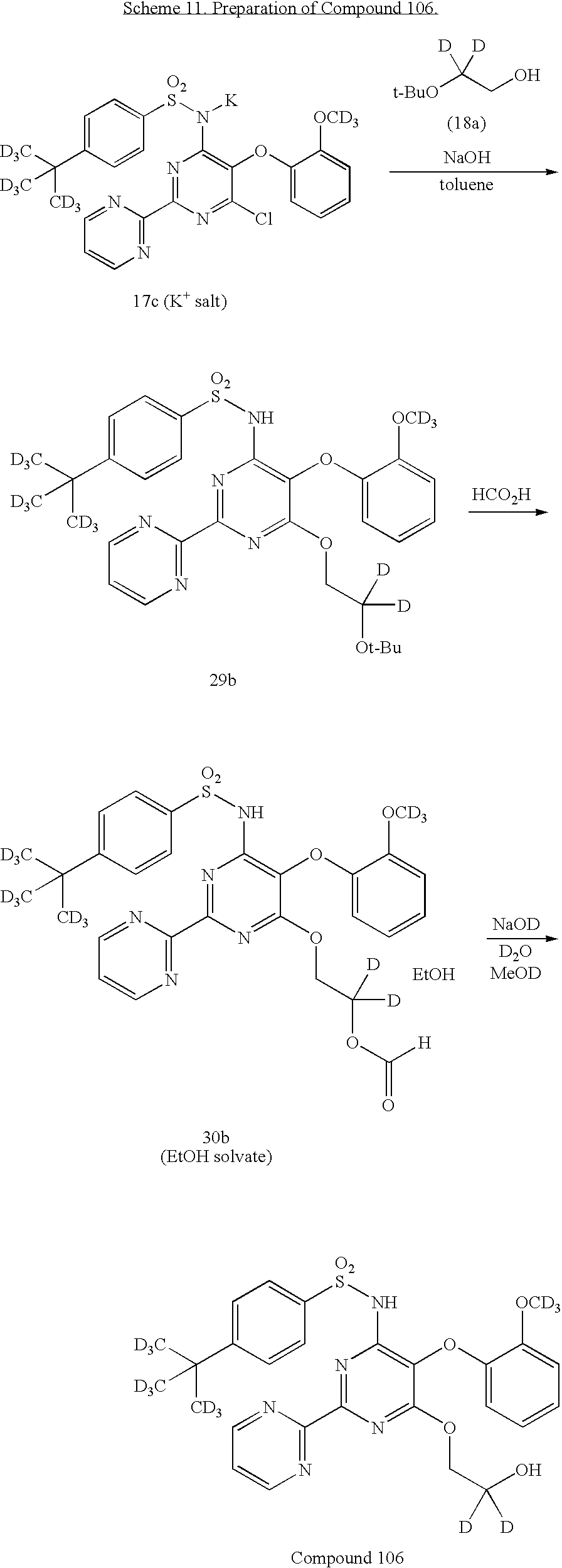
- Step 1. 4-(tert-Butyl-d9)-N-(6-(-2-tert-butoxy-2,2-d2-ethoxy)-5-(2-(methoxy-d3)phenoxy)-2,2′-bipyrimidin-4-yl)benzenesulfonamide (29b). A mixture of 6N sodium hydroxide (1.7 mL, 10.0 mmol, 2.0 equiv) and toluene (150 mL) was heated to reflux with a Dean-Stark trap to remove water. The mixture was cooled to room temperature, crude 17c (K+ salt) (2.88 g, 5.0 mmol, 1.0 equiv) and 2-tert-butoxy-2,2-d2-ethanol, 18a (1.80 g, 15.0 mmol, 3.0 equiv) and benzyltriethylammonium chloride (0.11 g, 10 mol %) were added. The suspension was heated over a weekend at approximately 55° C. Benzyltriethylammonium chloride (0.11 g, 10 mol %) was added and the reaction mixture was heated an additional 24 hours at approximately 55° C. 6N Sodium hydroxide (0.85 mL) was added and the mixture heated at approximately 55° C. for an additional 3 days. The green suspension was cooled to room temperature, transferred to a separatory funnel and shaken with 1N hydrochloric acid (50 mL). The organic phase was washed with water (50 mL), brine (100 mL), dried over sodium sulfate, filtered and the solvent removed under reduced pressure to give a yellow viscous oil. The crude product was adsorbed onto silica gel using dichloromethane and dry-loaded onto a column of silica gel (100 g) packed in 50% ethyl acetate/heptanes. The column was eluted with 50% ethyl acetate/heptanes, 75% ethyl acetate/heptanes followed by 100% ethyl acetate. Product fractions were concentrated under reduced pressure to near dryness. Residual ethyl acetate was co-evaporated with toluene (2×50 mL) to give 2.20 g of 29b as a yellow gum.
- Step 2. 4-(tert-Butyl-d9)-N-(6-(-2-formyloxy-2,2-d2-ethoxy)-5-(2-(methoxy-d3)phenoxy)-2,2′-bipyrimidin-4-y1)benzenesulfonamide (30b (EtOH solvate)). A mixture of 29a (2.13 g) and 96% formic acid (20 mL) was heated at 85-90° C. for 4 hours. The mixture was cooled to room temperature, diluted with toluene (50 mL) and concentrated under reduced pressure. Residual formic acid was co-evaporated with toluene (50 mL). The residual oil was dissolved in ethanol (25 mL) and the solution was concentrated under reduced pressure. This process was repeated to effect crystallization of the solvate, but crystallization did not occur. The mixture was concentrated under reduced pressure to give 1.87 g of crude 30b EtOH solvate as a pale yellow foam.
- Step 3. 4-(tert-Butyl-d9)-N-(6-(2-hydroxy-2,2-d2-ethoxy)-5-(2-(methoxy-d3)phenoxy)-2,2′-bipyrimidin-4-yl)benzenesulfonamide (Compound 106). The EtOH solvate of 30b (1.64 g, 2.57 mmol, 1.0 equiv) was dissolved in methanol-d1 (Aldrich, 99.5 atom % D, 30 mL). Several minutes after dissolution, solids began precipitating. The suspension was diluted with deuterium oxide (Cambridge Isotopes, 99 atom % D, 10 mL) and 40 wt % sodium hydroxide-d in deuterium oxide (Aldrich, 99 atom % D, 0.79 g, 0.52 mL, 7.70 mmol, 3.0 equiv) was added drop-wise giving a pale yellow solution. The mixture was stirred at room temperature for 1 hour. The mixture was cooled in an ice/water bath and acidified to pH of approximately 3 with concentrated hydrochloric acid. Water (4 mL) was added drop-wise over 1 hour to the cold solution until faint turbidity persisted. The mixture was allowed to warm to room temperature with solids slowly forming. The mixture was stirred overnight, filtered, and the solids were washed with cold 50% ethanol/water. After drying for 1 hour, LCMS of the solid (1.11 g) showed purity was approximately 97.3%. The solid was dissolved in ethanol (25 mL) by warming to approximately 60° C., and water (15 mL) was added drop-wise at 55-60° C. The mixture was allowed to cool to room temperature and stirred. No solids precipitated. More water (approximately 5 mL) was added drop-wise and the mixture stirred overnight. Precipitated solids were filtered and washed with cold 50% ethanol/water (14 mL). The solids were dried on the filter for 1 hour then in a vacuum oven at approximately 50° C. overnight to give 0.43 g of
Compound 106 as a pale yellow solid, mp 144.8-145.0° C. The mother liquor was concentrated to a yellow, tacky solid. The material was recrystallized from 50% ethanol/water (20 mL) to give an additional 0.41 g ofCompound 106 as a as a pale yellow solid, mp 139.6-140.2° C. Total yield ofCompound 106 was 0.83 g (57%). 1H-NMR (300 MHz, CDCl3): δ 4.58 (s, 2H), 4.87, (s, 1H), 6.86-6.91 (m, 1H), 6.98-7.16 (m, 3H), 7.40-7.45 (m, 3H), 8.44 (d, J=8.8, 2H), 8.74 (bs, 1H,) 9.01 (d, J=4.7, 2H). 13C-NMR (75 MHz, DMSO-d6): δ 34.72, 62.97, 72.42, 77.46, 112.64, 119.34, 121.42, 121.54, 124.88, 125.61, 129.70, 136.23, 145.76, 149.90, 151.98, 155.46, 157.50, 157.97, 161.42, 161.64. HPLC (method: Waters Atlantis T3 2.1×50 mm 3 μm C18-RP column—gradient method 5-95% ACN+0.1% formic acid in 14 min (1.0 mL/min) with 4 min hold at 95% ACN; Wavelength: 254 nm): retention time: 7.56 min; 98.6% purity. MS (M+H): 566.4. Elemental Analysis (C27H15D14N5O6S•H2O): Calculated: C=56.44, H=5.26, N=12.19, S=5.58. Found: C=56.20, H=5.19, N=12.21, S=5.64. - Materials: CYP3A4 supersomesTM were obtained from BD Gentest. β-nicotinamide adenine dinucleotide phosphate, reduced form (NADPH), magnesium chloride (MgCl2), and dimethyl sulfoxide (DMSO) were purchased from Sigma-Aldrich.
- Determination of Metabolic Stability: 7.5 mM stock solutions of test compounds were prepared in DMSO. The 7.5 mM stock solutions were diluted to 50 μM in acetonitrile (ACN). The 1000 pmol/mL CYP3A4 supersomes were diluted to 50 pmol/mL in 0.1 M potassium phosphate buffer, pH 7.4, containing 3 mM MgCl2. The diluted supersomes were added to wells of a 96-well deep-well polypropylene plate in triplicate. 10 μL of the 50 μM test compound was added to the supersomes and the mixture was pre-warmed for 10 minutes. Reactions were initiated by addition of pre-warmed NADPH solution. The final reaction volume was 0.5 mL and contained 40 pmol/mL CYP3A4 supersomes, 1 μM test compound, and 2 mM NADPH in 0.1 M potassium phosphate buffer, pH 7.4, and 3 mM MgCl2. The reaction mixtures were incubated at 37° C. and 50 μL aliquots were removed at 0, 5, 10, 20, and 30 minutes and added to shallow-well 96-well plates which contained 50 μL of ice-cold ACN with internal standard to stop the reactions. The plates were stored at 4° C. for 20 minutes after which 100 μL of water was added to the wells of the plate before centrifugation to pellet precipitated proteins. Supernatants were transferred to another 96-well plate and analyzed for amounts of parent remaining by LC-MS/MS using an Applied Bio-systems API 4000 mass spectrometer.
- Data analysis: The in vitro t1/2s for test compounds were calculated from the slopes of the linear regression of % parent remaining (ln) vs incubation time relationship.
-
- in vitro t1/2=0.693/k
- k=−[slope of linear regression of % parent remaining(ln) vs incubation time]
- Data analysis was performed using Microsoft Excel Software.
- The results are shown in the FIGURE and Table 2, below.
-
TABLE 2 Calculated Half-Lives of Compounds of the Invention in CYP3A4 Supersomes. t1/2 (minutes) Experiment Experiment Ave t1/2 Compound 1 2 (minutes) % Difference* Bosentan 34.3 37.2 35.8 — Compound 103 35.9 40.5 38.2 6.7 Compound 10245.7 46.8 46.2 29.1 Compound 104 30.9 32.4 31.6 −11.7 Compound 10653.3 57.2 55.2 54.2 Compound 10141.0 41.3 41.2 15.1 *% Difference = [(deuterated species) − (nondeuterated species)](100)/(nondeuterated species) - Under the assay conditions tested, the in vitro tins for
Compounds - Without further description, it is believed that one of ordinary skill in the art can, using the preceding description and the illustrative examples, make and utilize the compounds of the present invention and practice the claimed methods. It should be understood that the foregoing discussion and examples merely present a detailed description of certain preferred embodiments. It will be apparent to those of ordinary skill in the art that various modifications and equivalents can be made without departing from the spirit and scope of the invention.
Claims (23)


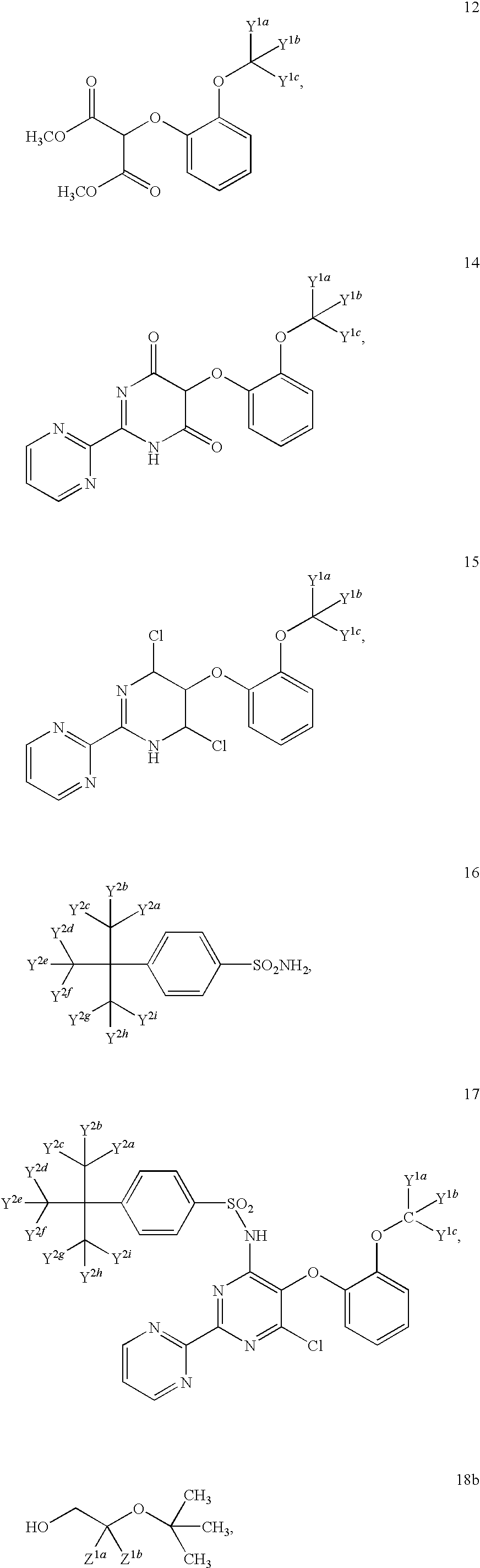

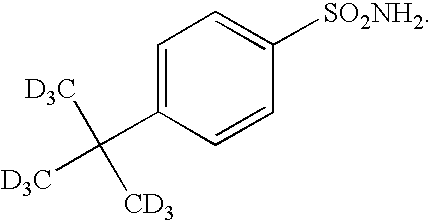
Priority Applications (1)
| Application Number | Priority Date | Filing Date | Title |
|---|---|---|---|
| US12/460,575 US8080549B2 (en) | 2007-01-12 | 2009-07-20 | Endothelin receptor antagonists |
Applications Claiming Priority (3)
| Application Number | Priority Date | Filing Date | Title |
|---|---|---|---|
| US88465407P | 2007-01-12 | 2007-01-12 | |
| US12/008,698 US8071596B2 (en) | 2007-01-12 | 2008-01-11 | Endothelin receptor antagonists |
| US12/460,575 US8080549B2 (en) | 2007-01-12 | 2009-07-20 | Endothelin receptor antagonists |
Related Parent Applications (1)
| Application Number | Title | Priority Date | Filing Date |
|---|---|---|---|
| US12/008,698 Continuation-In-Part US8071596B2 (en) | 2007-01-12 | 2008-01-11 | Endothelin receptor antagonists |
Publications (2)
| Publication Number | Publication Date |
|---|---|
| US20100063076A1 true US20100063076A1 (en) | 2010-03-11 |
| US8080549B2 US8080549B2 (en) | 2011-12-20 |
Family
ID=41799810
Family Applications (1)
| Application Number | Title | Priority Date | Filing Date |
|---|---|---|---|
| US12/460,575 Active 2028-01-17 US8080549B2 (en) | 2007-01-12 | 2009-07-20 | Endothelin receptor antagonists |
Country Status (1)
| Country | Link |
|---|---|
| US (1) | US8080549B2 (en) |
Cited By (2)
| Publication number | Priority date | Publication date | Assignee | Title |
|---|---|---|---|---|
| US20080255036A1 (en) * | 2007-04-10 | 2008-10-16 | Auspex Pharmaceuticals, Inc. | Substituted thiophenes |
| US20090005394A1 (en) * | 2007-01-12 | 2009-01-01 | Harbeson Scott L | Endothelin receptor antagonists |
Citations (26)
| Publication number | Priority date | Publication date | Assignee | Title |
|---|---|---|---|---|
| US5292740A (en) * | 1991-06-13 | 1994-03-08 | Hoffmann-La Roche Inc. | Sulfonamides |
| US5696116A (en) * | 1993-07-15 | 1997-12-09 | Hoffmann-La Roche Inc. | Pharmaceutical composition which contains a renin angiotensin system inhibitor and an endothelin antagonist |
| US5846514A (en) * | 1994-03-25 | 1998-12-08 | Isotechnika, Inc. | Enhancement of the efficacy of nifedipine by deuteration |
| US5945448A (en) * | 1995-06-02 | 1999-08-31 | Shionogi & Co., Ltd. | Brain edema inhibitor |
| US6087368A (en) * | 1998-06-08 | 2000-07-11 | Bristol-Myers Squibb Company | Quinazolinone inhibitors of cGMP phosphodiesterase |
| US6139971A (en) * | 1996-07-25 | 2000-10-31 | Siemens Aktiengesellschaft | Stratified structure with a ferroelectric layer and process for producing the same |
| US6221335B1 (en) * | 1994-03-25 | 2001-04-24 | Isotechnika, Inc. | Method of using deuterated calcium channel blockers |
| US6440710B1 (en) * | 1998-12-10 | 2002-08-27 | The Scripps Research Institute | Antibody-catalyzed deuteration, tritiation, dedeuteration or detritiation of carbonyl compounds |
| US6586391B1 (en) * | 1996-03-13 | 2003-07-01 | Queen's University At Kingston | Method of ameliorating erectile dysfunction |
| US20030144300A1 (en) * | 2000-01-31 | 2003-07-31 | Magee Thomas Victor | Pyrimidine carboxamides useful as inhibitors of pde4 isozymes |
| US6603008B1 (en) * | 1999-12-03 | 2003-08-05 | Pfizer Inc. | Sulfamoylheleroaryl pyrazole compounds as anti-inflammatory/analgesic agents |
| US6635648B2 (en) * | 2000-08-18 | 2003-10-21 | Queen's University At Kingston | Combination therapy using sympathetic nervous system antagonists and endothelin antagonists |
| US6696719B2 (en) * | 1999-12-09 | 2004-02-24 | Nec Corporation | Semiconductor device with improved peripheral resistance element and method for fabricating same |
| US20040063731A1 (en) * | 2001-02-02 | 2004-04-01 | Hans-Michael Eggenweiler | Pharmaceutical formulation comprising pyrazolo[4,3-d]pyrimidines and endothelin receptor antagonists or thienopyrimidines and endothelin receptor antagonists |
| US20040063719A1 (en) * | 1998-08-26 | 2004-04-01 | Queen's University At Kingston | Combination therapy using antihypertensive agents and endothelin antagonists |
| US6869970B2 (en) * | 2002-02-04 | 2005-03-22 | Novartis Ag | Crystalline salt forms of valsartan |
| US7019013B2 (en) * | 2000-12-23 | 2006-03-28 | Merck Patent Gmbh | Sulfamidothienopyrimidines |
| US20060205733A1 (en) * | 2004-08-26 | 2006-09-14 | Encysive Pharmaceuticals | Endothelin a receptor antagonists in combination with phosphodiesterase 5 inhibitors and uses thereof |
| US20070037831A1 (en) * | 2004-11-18 | 2007-02-15 | Cynthia Cuffie-Jackson | Methods of using PDE 5 inhibitors for the treatment of congestive heart failure |
| US20070082929A1 (en) * | 2005-10-06 | 2007-04-12 | Gant Thomas G | Inhibitors of the gastric H+, K+-atpase with enhanced therapeutic properties |
| US7208602B2 (en) * | 2002-02-06 | 2007-04-24 | Schering Corporation | Gamma secretase inhibitors |
| US20070197695A1 (en) * | 2006-02-10 | 2007-08-23 | Sigma-Aldrich Co. | Stabilized deuteroborane-tetrahydrofuran complex |
| US20080103122A1 (en) * | 2006-09-05 | 2008-05-01 | Schering Corporation | Pharmaceutical combinations for lipid management and in the treatment of atherosclerosis and hepatic steatosis |
| US20090005394A1 (en) * | 2007-01-12 | 2009-01-01 | Harbeson Scott L | Endothelin receptor antagonists |
| US20090069351A1 (en) * | 2007-09-09 | 2009-03-12 | Protia, Llc | Deuterium-enriched bosentan |
| US7515990B2 (en) * | 2003-05-21 | 2009-04-07 | Panasonic Corporation | Article control system, article control server, article control method |
Family Cites Families (8)
| Publication number | Priority date | Publication date | Assignee | Title |
|---|---|---|---|---|
| US6707791B1 (en) | 1999-07-08 | 2004-03-16 | Telefonaktiebolaget Lm Ericsson (Publ) | Internet protocol stack for real time applications |
| DE10113366A1 (en) | 2001-03-20 | 2002-09-26 | Boehringer Ingelheim Pharma | Medicament for treating inflammatory or obstructive respiratory diseases, e.g. asthma or chronic obstructive pulmonary disease, containing synergistic combination of anticholinergic agent and endothelin antagonist |
| WO2004017993A1 (en) | 2002-08-12 | 2004-03-04 | Actelion Pharmaceuticals Ltd | Combination of prostacyclin or prostacyclin analogues and endothelin receptor antagonists for the treatment of pulmonary arterial hypertension |
| TW200413273A (en) | 2002-11-15 | 2004-08-01 | Wako Pure Chem Ind Ltd | Heavy hydrogenation method of heterocyclic rings |
| CL2004000545A1 (en) | 2003-03-18 | 2005-01-28 | Pharmacia Corp Sa Organizada B | USE OF AN ANTAGONIST OF ALDOSTERONE RECEPTORS AND AN ENDOTHELINE RECEIVER ANTAGONIST FOR THE TREATMENT OR PROFILAXIS OF A PATHOLOGICAL CONDITION RELATED TO HYPERTENSION, RENAL DYSFUNCTION, INSULINOPATHY AND CARDIOVASCUL DISEASES |
| US7149099B2 (en) | 2004-04-13 | 2006-12-12 | Equalizer Industries, Inc. | Modeler's power panel and field charging apparatus, and method for powering a modeler's field accessories and model control devices |
| AU2006275702A1 (en) | 2005-07-29 | 2007-02-08 | Concert Pharmaceuticals Inc. | Novel pharmaceutical compounds |
| JO2630B1 (en) | 2006-04-13 | 2012-06-17 | نوفارتيس ايه جي | Organic Compounds |
-
2009
- 2009-07-20 US US12/460,575 patent/US8080549B2/en active Active
Patent Citations (26)
| Publication number | Priority date | Publication date | Assignee | Title |
|---|---|---|---|---|
| US5292740A (en) * | 1991-06-13 | 1994-03-08 | Hoffmann-La Roche Inc. | Sulfonamides |
| US5696116A (en) * | 1993-07-15 | 1997-12-09 | Hoffmann-La Roche Inc. | Pharmaceutical composition which contains a renin angiotensin system inhibitor and an endothelin antagonist |
| US5846514A (en) * | 1994-03-25 | 1998-12-08 | Isotechnika, Inc. | Enhancement of the efficacy of nifedipine by deuteration |
| US6221335B1 (en) * | 1994-03-25 | 2001-04-24 | Isotechnika, Inc. | Method of using deuterated calcium channel blockers |
| US5945448A (en) * | 1995-06-02 | 1999-08-31 | Shionogi & Co., Ltd. | Brain edema inhibitor |
| US6586391B1 (en) * | 1996-03-13 | 2003-07-01 | Queen's University At Kingston | Method of ameliorating erectile dysfunction |
| US6139971A (en) * | 1996-07-25 | 2000-10-31 | Siemens Aktiengesellschaft | Stratified structure with a ferroelectric layer and process for producing the same |
| US6087368A (en) * | 1998-06-08 | 2000-07-11 | Bristol-Myers Squibb Company | Quinazolinone inhibitors of cGMP phosphodiesterase |
| US20040063719A1 (en) * | 1998-08-26 | 2004-04-01 | Queen's University At Kingston | Combination therapy using antihypertensive agents and endothelin antagonists |
| US6440710B1 (en) * | 1998-12-10 | 2002-08-27 | The Scripps Research Institute | Antibody-catalyzed deuteration, tritiation, dedeuteration or detritiation of carbonyl compounds |
| US6603008B1 (en) * | 1999-12-03 | 2003-08-05 | Pfizer Inc. | Sulfamoylheleroaryl pyrazole compounds as anti-inflammatory/analgesic agents |
| US6696719B2 (en) * | 1999-12-09 | 2004-02-24 | Nec Corporation | Semiconductor device with improved peripheral resistance element and method for fabricating same |
| US20030144300A1 (en) * | 2000-01-31 | 2003-07-31 | Magee Thomas Victor | Pyrimidine carboxamides useful as inhibitors of pde4 isozymes |
| US6635648B2 (en) * | 2000-08-18 | 2003-10-21 | Queen's University At Kingston | Combination therapy using sympathetic nervous system antagonists and endothelin antagonists |
| US7019013B2 (en) * | 2000-12-23 | 2006-03-28 | Merck Patent Gmbh | Sulfamidothienopyrimidines |
| US20040063731A1 (en) * | 2001-02-02 | 2004-04-01 | Hans-Michael Eggenweiler | Pharmaceutical formulation comprising pyrazolo[4,3-d]pyrimidines and endothelin receptor antagonists or thienopyrimidines and endothelin receptor antagonists |
| US6869970B2 (en) * | 2002-02-04 | 2005-03-22 | Novartis Ag | Crystalline salt forms of valsartan |
| US7208602B2 (en) * | 2002-02-06 | 2007-04-24 | Schering Corporation | Gamma secretase inhibitors |
| US7515990B2 (en) * | 2003-05-21 | 2009-04-07 | Panasonic Corporation | Article control system, article control server, article control method |
| US20060205733A1 (en) * | 2004-08-26 | 2006-09-14 | Encysive Pharmaceuticals | Endothelin a receptor antagonists in combination with phosphodiesterase 5 inhibitors and uses thereof |
| US20070037831A1 (en) * | 2004-11-18 | 2007-02-15 | Cynthia Cuffie-Jackson | Methods of using PDE 5 inhibitors for the treatment of congestive heart failure |
| US20070082929A1 (en) * | 2005-10-06 | 2007-04-12 | Gant Thomas G | Inhibitors of the gastric H+, K+-atpase with enhanced therapeutic properties |
| US20070197695A1 (en) * | 2006-02-10 | 2007-08-23 | Sigma-Aldrich Co. | Stabilized deuteroborane-tetrahydrofuran complex |
| US20080103122A1 (en) * | 2006-09-05 | 2008-05-01 | Schering Corporation | Pharmaceutical combinations for lipid management and in the treatment of atherosclerosis and hepatic steatosis |
| US20090005394A1 (en) * | 2007-01-12 | 2009-01-01 | Harbeson Scott L | Endothelin receptor antagonists |
| US20090069351A1 (en) * | 2007-09-09 | 2009-03-12 | Protia, Llc | Deuterium-enriched bosentan |
Cited By (4)
| Publication number | Priority date | Publication date | Assignee | Title |
|---|---|---|---|---|
| US20090005394A1 (en) * | 2007-01-12 | 2009-01-01 | Harbeson Scott L | Endothelin receptor antagonists |
| US8071596B2 (en) | 2007-01-12 | 2011-12-06 | Concert Pharmaceuticals, Inc. | Endothelin receptor antagonists |
| US20080255036A1 (en) * | 2007-04-10 | 2008-10-16 | Auspex Pharmaceuticals, Inc. | Substituted thiophenes |
| US7863308B2 (en) | 2007-04-10 | 2011-01-04 | Auspex Pharmaceuticals, Inc. | Substituted thiophenes |
Also Published As
| Publication number | Publication date |
|---|---|
| US8080549B2 (en) | 2011-12-20 |
Similar Documents
| Publication | Publication Date | Title |
|---|---|---|
| US8003646B2 (en) | Substituted triazolo-pyridazine derivatives | |
| US8410124B2 (en) | Deuterated etravirine | |
| US20090137457A1 (en) | Pyrimidinedione derivatives | |
| US8071596B2 (en) | Endothelin receptor antagonists | |
| US9108902B2 (en) | Deuterated 2-amino-3-hydroxypropanoic acid derivatives | |
| US8993570B2 (en) | Substituted triazolo-pyridazine derivatives | |
| US20110313004A1 (en) | Deuterated pyridinones | |
| US20130005742A1 (en) | Substituted Diphenylpyrazine Derivatives | |
| US20100256240A1 (en) | Prostacyclin derivatives | |
| US20100076010A1 (en) | Alpha 1a-adrenoceptor antagonists | |
| US20080262006A1 (en) | Selective endothelin type-a antagonists | |
| US8367674B2 (en) | Piperazine derivatives | |
| US8080549B2 (en) | Endothelin receptor antagonists | |
| EP2197847B1 (en) | Deuterated 4 -oxoquinoline derivative for the treatment of hiv infection | |
| US20090197899A1 (en) | 3-(Dihydro-1H-pyrazolo[4,3-d]pyrimidin-5-yl)-4-propoxybenzenesulfonamide Derivatives and Methods of Use | |
| WO2009126844A2 (en) | Derivatives of 3-(2-hydroxy-5-methyphenyl)-n,n-diisopropyl-3-phenylpropylamine and methods of use thereof | |
| US20100120786A1 (en) | Piperazine Derivatives | |
| US20110301113A1 (en) | Pyridineamine derivatives | |
| WO2009099620A1 (en) | 3-(dihydro-1h-pyrazolo[4,3-d]pyrimidin-5-yl)-4-propoxybenzenesulfonamide derivatives and methods of use | |
| WO2010002451A1 (en) | Naphthyridin derivatives | |
| HK1147098B (en) | Deuterated etravirine |
Legal Events
| Date | Code | Title | Description |
|---|---|---|---|
| AS | Assignment |
Owner name: CONCERT PHARMACEUTICALS, INC.,MASSACHUSETTS Free format text: ASSIGNMENT OF ASSIGNORS INTEREST;ASSIGNOR:HARBESON, SCOTT L.;REEL/FRAME:023528/0279 Effective date: 20091015 Owner name: CONCERT PHARMACEUTICALS, INC., MASSACHUSETTS Free format text: ASSIGNMENT OF ASSIGNORS INTEREST;ASSIGNOR:HARBESON, SCOTT L.;REEL/FRAME:023528/0279 Effective date: 20091015 |
|
| STCF | Information on status: patent grant |
Free format text: PATENTED CASE |
|
| CC | Certificate of correction | ||
| FEPP | Fee payment procedure |
Free format text: PAT HOLDER CLAIMS SMALL ENTITY STATUS, ENTITY STATUS SET TO SMALL (ORIGINAL EVENT CODE: LTOS); ENTITY STATUS OF PATENT OWNER: SMALL ENTITY |
|
| FPAY | Fee payment |
Year of fee payment: 4 |
|
| MAFP | Maintenance fee payment |
Free format text: PAYMENT OF MAINTENANCE FEE, 8TH YR, SMALL ENTITY (ORIGINAL EVENT CODE: M2552); ENTITY STATUS OF PATENT OWNER: SMALL ENTITY Year of fee payment: 8 |
|
| FEPP | Fee payment procedure |
Free format text: ENTITY STATUS SET TO UNDISCOUNTED (ORIGINAL EVENT CODE: BIG.); ENTITY STATUS OF PATENT OWNER: LARGE ENTITY |
|
| MAFP | Maintenance fee payment |
Free format text: PAYMENT OF MAINTENANCE FEE, 12TH YEAR, LARGE ENTITY (ORIGINAL EVENT CODE: M1553); ENTITY STATUS OF PATENT OWNER: LARGE ENTITY Year of fee payment: 12 |
|
| AS | Assignment |
Owner name: SUN PHARMACEUTICAL INDUSTRIES, INC., NEW JERSEY Free format text: MERGER;ASSIGNOR:CONCERT PHARMACEUTICALS, INC.;REEL/FRAME:064523/0014 Effective date: 20230328 |