US20090317372A1 - Small molecules for the reduction of high blood glucose level - Google Patents
Small molecules for the reduction of high blood glucose level Download PDFInfo
- Publication number
- US20090317372A1 US20090317372A1 US12/394,789 US39478909A US2009317372A1 US 20090317372 A1 US20090317372 A1 US 20090317372A1 US 39478909 A US39478909 A US 39478909A US 2009317372 A1 US2009317372 A1 US 2009317372A1
- Authority
- US
- United States
- Prior art keywords
- compound
- blood glucose
- glucose
- administered
- thioxanthen
- Prior art date
- Legal status (The legal status is an assumption and is not a legal conclusion. Google has not performed a legal analysis and makes no representation as to the accuracy of the status listed.)
- Abandoned
Links
- WQZGKKKJIJFFOK-GASJEMHNSA-N Glucose Natural products OC[C@H]1OC(O)[C@H](O)[C@@H](O)[C@@H]1O WQZGKKKJIJFFOK-GASJEMHNSA-N 0.000 title claims abstract description 164
- 239000008103 glucose Substances 0.000 title claims abstract description 164
- 210000004369 blood Anatomy 0.000 title claims abstract description 118
- 239000008280 blood Substances 0.000 title claims abstract description 118
- 230000009467 reduction Effects 0.000 title claims description 7
- 150000003384 small molecules Chemical class 0.000 title description 2
- 206010012601 diabetes mellitus Diseases 0.000 claims abstract description 51
- 208000001072 type 2 diabetes mellitus Diseases 0.000 claims abstract description 48
- 206010022489 Insulin Resistance Diseases 0.000 claims abstract description 39
- 201000001421 hyperglycemia Diseases 0.000 claims abstract description 29
- -1 thioxanthene compounds [3-(3,4-dimethyl-9-oxo-9H-thioxanthen-2-yloxy)-2-hydroxypropyl]trimethylammonium chloride Chemical class 0.000 claims abstract description 14
- 150000002391 heterocyclic compounds Chemical class 0.000 claims abstract description 12
- XMBWDFGMSWQBCA-UHFFFAOYSA-N hydrogen iodide Chemical compound I XMBWDFGMSWQBCA-UHFFFAOYSA-N 0.000 claims abstract description 6
- 125000000956 methoxy group Chemical group [H]C([H])([H])O* 0.000 claims abstract description 6
- DYCDLJDPTQIATI-UHFFFAOYSA-M trimethyl(3-thioxanthen-9-ylidenepropyl)azanium;iodide Chemical compound [I-].C1=CC=C2C(=CCC[N+](C)(C)C)C3=CC=CC=C3SC2=C1 DYCDLJDPTQIATI-UHFFFAOYSA-M 0.000 claims abstract description 6
- 229950004354 phosphorylcholine Drugs 0.000 claims abstract description 5
- QUSNBJAOOMFDIB-UHFFFAOYSA-O ethylaminium Chemical compound CC[NH3+] QUSNBJAOOMFDIB-UHFFFAOYSA-O 0.000 claims abstract description 4
- YRHRIQCWCFGUEQ-UHFFFAOYSA-N thioxanthen-9-one Chemical compound C1=CC=C2C(=O)C3=CC=CC=C3SC2=C1 YRHRIQCWCFGUEQ-UHFFFAOYSA-N 0.000 claims abstract description 4
- WQZGKKKJIJFFOK-VFUOTHLCSA-N beta-D-glucose Chemical compound OC[C@H]1O[C@@H](O)[C@H](O)[C@@H](O)[C@@H]1O WQZGKKKJIJFFOK-VFUOTHLCSA-N 0.000 claims description 162
- NOESYZHRGYRDHS-UHFFFAOYSA-N insulin Chemical compound N1C(=O)C(NC(=O)C(CCC(N)=O)NC(=O)C(CCC(O)=O)NC(=O)C(C(C)C)NC(=O)C(NC(=O)CN)C(C)CC)CSSCC(C(NC(CO)C(=O)NC(CC(C)C)C(=O)NC(CC=2C=CC(O)=CC=2)C(=O)NC(CCC(N)=O)C(=O)NC(CC(C)C)C(=O)NC(CCC(O)=O)C(=O)NC(CC(N)=O)C(=O)NC(CC=2C=CC(O)=CC=2)C(=O)NC(CSSCC(NC(=O)C(C(C)C)NC(=O)C(CC(C)C)NC(=O)C(CC=2C=CC(O)=CC=2)NC(=O)C(CC(C)C)NC(=O)C(C)NC(=O)C(CCC(O)=O)NC(=O)C(C(C)C)NC(=O)C(CC(C)C)NC(=O)C(CC=2NC=NC=2)NC(=O)C(CO)NC(=O)CNC2=O)C(=O)NCC(=O)NC(CCC(O)=O)C(=O)NC(CCCNC(N)=N)C(=O)NCC(=O)NC(CC=3C=CC=CC=3)C(=O)NC(CC=3C=CC=CC=3)C(=O)NC(CC=3C=CC(O)=CC=3)C(=O)NC(C(C)O)C(=O)N3C(CCC3)C(=O)NC(CCCCN)C(=O)NC(C)C(O)=O)C(=O)NC(CC(N)=O)C(O)=O)=O)NC(=O)C(C(C)CC)NC(=O)C(CO)NC(=O)C(C(C)O)NC(=O)C1CSSCC2NC(=O)C(CC(C)C)NC(=O)C(NC(=O)C(CCC(N)=O)NC(=O)C(CC(N)=O)NC(=O)C(NC(=O)C(N)CC=1C=CC=CC=1)C(C)C)CC1=CN=CN1 NOESYZHRGYRDHS-UHFFFAOYSA-N 0.000 claims description 84
- 150000001875 compounds Chemical class 0.000 claims description 83
- 102000004877 Insulin Human genes 0.000 claims description 42
- 108090001061 Insulin Proteins 0.000 claims description 42
- 229940125396 insulin Drugs 0.000 claims description 42
- 238000000034 method Methods 0.000 claims description 40
- HYAFETHFCAUJAY-UHFFFAOYSA-N pioglitazone Chemical compound N1=CC(CC)=CC=C1CCOC(C=C1)=CC=C1CC1C(=O)NC(=O)S1 HYAFETHFCAUJAY-UHFFFAOYSA-N 0.000 claims description 27
- XZWYZXLIPXDOLR-UHFFFAOYSA-N metformin Chemical compound CN(C)C(=N)NC(N)=N XZWYZXLIPXDOLR-UHFFFAOYSA-N 0.000 claims description 24
- 238000002347 injection Methods 0.000 claims description 21
- 239000007924 injection Substances 0.000 claims description 21
- 229960003105 metformin Drugs 0.000 claims description 21
- 102000004338 Transferrin Human genes 0.000 claims description 20
- 108090000901 Transferrin Proteins 0.000 claims description 20
- 239000012581 transferrin Substances 0.000 claims description 20
- 238000007912 intraperitoneal administration Methods 0.000 claims description 18
- YASAKCUCGLMORW-UHFFFAOYSA-N Rosiglitazone Chemical compound C=1C=CC=NC=1N(C)CCOC(C=C1)=CC=C1CC1SC(=O)NC1=O YASAKCUCGLMORW-UHFFFAOYSA-N 0.000 claims description 15
- 239000003795 chemical substances by application Substances 0.000 claims description 15
- 229960005095 pioglitazone Drugs 0.000 claims description 12
- 241000124008 Mammalia Species 0.000 claims description 11
- 102000012404 Orosomucoid Human genes 0.000 claims description 9
- 108010061952 Orosomucoid Proteins 0.000 claims description 9
- ZJJXGWJIGJFDTL-UHFFFAOYSA-N glipizide Chemical compound C1=NC(C)=CN=C1C(=O)NCCC1=CC=C(S(=O)(=O)NC(=O)NC2CCCCC2)C=C1 ZJJXGWJIGJFDTL-UHFFFAOYSA-N 0.000 claims description 9
- 239000000203 mixture Substances 0.000 claims description 8
- 102000002260 Alkaline Phosphatase Human genes 0.000 claims description 7
- 108020004774 Alkaline Phosphatase Proteins 0.000 claims description 7
- 229910052739 hydrogen Inorganic materials 0.000 claims description 7
- 239000001257 hydrogen Substances 0.000 claims description 7
- 125000002496 methyl group Chemical group [H]C([H])([H])* 0.000 claims description 7
- RTZKZFJDLAIYFH-UHFFFAOYSA-N Diethyl ether Chemical compound CCOCC RTZKZFJDLAIYFH-UHFFFAOYSA-N 0.000 claims description 6
- 150000001336 alkenes Chemical class 0.000 claims description 6
- 150000001412 amines Chemical class 0.000 claims description 6
- 229960004580 glibenclamide Drugs 0.000 claims description 6
- 229960004346 glimepiride Drugs 0.000 claims description 6
- WIGIZIANZCJQQY-RUCARUNLSA-N glimepiride Chemical compound O=C1C(CC)=C(C)CN1C(=O)NCCC1=CC=C(S(=O)(=O)NC(=O)N[C@@H]2CC[C@@H](C)CC2)C=C1 WIGIZIANZCJQQY-RUCARUNLSA-N 0.000 claims description 6
- 229960001381 glipizide Drugs 0.000 claims description 6
- ZNNLBTZKUZBEKO-UHFFFAOYSA-N glyburide Chemical compound COC1=CC=C(Cl)C=C1C(=O)NCCC1=CC=C(S(=O)(=O)NC(=O)NC2CCCCC2)C=C1 ZNNLBTZKUZBEKO-UHFFFAOYSA-N 0.000 claims description 6
- 239000003112 inhibitor Substances 0.000 claims description 6
- OETHQSJEHLVLGH-UHFFFAOYSA-N metformin hydrochloride Chemical compound Cl.CN(C)C(=N)N=C(N)N OETHQSJEHLVLGH-UHFFFAOYSA-N 0.000 claims description 6
- 229960004586 rosiglitazone Drugs 0.000 claims description 6
- MFFMDFFZMYYVKS-SECBINFHSA-N sitagliptin Chemical compound C([C@H](CC(=O)N1CC=2N(C(=NN=2)C(F)(F)F)CC1)N)C1=CC(F)=C(F)C=C1F MFFMDFFZMYYVKS-SECBINFHSA-N 0.000 claims description 6
- 229960004034 sitagliptin Drugs 0.000 claims description 6
- 238000007920 subcutaneous administration Methods 0.000 claims description 6
- 125000000623 heterocyclic group Chemical group 0.000 claims description 5
- 229940123208 Biguanide Drugs 0.000 claims description 4
- 150000001298 alcohols Chemical class 0.000 claims description 4
- 150000001335 aliphatic alkanes Chemical class 0.000 claims description 4
- 150000004283 biguanides Chemical class 0.000 claims description 4
- 150000002170 ethers Chemical class 0.000 claims description 4
- 150000002431 hydrogen Chemical class 0.000 claims description 4
- XUFXOAAUWZOOIT-SXARVLRPSA-N (2R,3R,4R,5S,6R)-5-[[(2R,3R,4R,5S,6R)-5-[[(2R,3R,4S,5S,6R)-3,4-dihydroxy-6-methyl-5-[[(1S,4R,5S,6S)-4,5,6-trihydroxy-3-(hydroxymethyl)-1-cyclohex-2-enyl]amino]-2-oxanyl]oxy]-3,4-dihydroxy-6-(hydroxymethyl)-2-oxanyl]oxy]-6-(hydroxymethyl)oxane-2,3,4-triol Chemical compound O([C@H]1O[C@H](CO)[C@H]([C@@H]([C@H]1O)O)O[C@H]1O[C@@H]([C@H]([C@H](O)[C@H]1O)N[C@@H]1[C@@H]([C@@H](O)[C@H](O)C(CO)=C1)O)C)[C@@H]1[C@@H](CO)O[C@@H](O)[C@H](O)[C@H]1O XUFXOAAUWZOOIT-SXARVLRPSA-N 0.000 claims description 3
- SWLAMJPTOQZTAE-UHFFFAOYSA-N 4-[2-[(5-chloro-2-methoxybenzoyl)amino]ethyl]benzoic acid Chemical class COC1=CC=C(Cl)C=C1C(=O)NCCC1=CC=C(C(O)=O)C=C1 SWLAMJPTOQZTAE-UHFFFAOYSA-N 0.000 claims description 3
- HCEQQASHRRPQFE-UHFFFAOYSA-N 5-chloro-n-[2-[4-(cyclohexylcarbamoylsulfamoyl)phenyl]ethyl]-2-methoxybenzamide;3-(diaminomethylidene)-1,1-dimethylguanidine;hydrochloride Chemical compound Cl.CN(C)C(=N)N=C(N)N.COC1=CC=C(Cl)C=C1C(=O)NCCC1=CC=C(S(=O)(=O)NC(=O)NC2CCCCC2)C=C1 HCEQQASHRRPQFE-UHFFFAOYSA-N 0.000 claims description 3
- RKWGIWYCVPQPMF-UHFFFAOYSA-N Chloropropamide Chemical compound CCCNC(=O)NS(=O)(=O)C1=CC=C(Cl)C=C1 RKWGIWYCVPQPMF-UHFFFAOYSA-N 0.000 claims description 3
- 108010067722 Dipeptidyl Peptidase 4 Proteins 0.000 claims description 3
- 102100025012 Dipeptidyl peptidase 4 Human genes 0.000 claims description 3
- 108010004460 Gastric Inhibitory Polypeptide Proteins 0.000 claims description 3
- 108010088406 Glucagon-Like Peptides Proteins 0.000 claims description 3
- FAEKWTJYAYMJKF-QHCPKHFHSA-N GlucoNorm Chemical compound C1=C(C(O)=O)C(OCC)=CC(CC(=O)N[C@@H](CC(C)C)C=2C(=CC=CC=2)N2CCCCC2)=C1 FAEKWTJYAYMJKF-QHCPKHFHSA-N 0.000 claims description 3
- UFHFLCQGNIYNRP-UHFFFAOYSA-N Hydrogen Chemical group [H][H] UFHFLCQGNIYNRP-UHFFFAOYSA-N 0.000 claims description 3
- IBAQFPQHRJAVAV-ULAWRXDQSA-N Miglitol Chemical compound OCCN1C[C@H](O)[C@@H](O)[C@H](O)[C@H]1CO IBAQFPQHRJAVAV-ULAWRXDQSA-N 0.000 claims description 3
- 229940123464 Thiazolidinedione Drugs 0.000 claims description 3
- JLRGJRBPOGGCBT-UHFFFAOYSA-N Tolbutamide Chemical compound CCCCNC(=O)NS(=O)(=O)C1=CC=C(C)C=C1 JLRGJRBPOGGCBT-UHFFFAOYSA-N 0.000 claims description 3
- KLQWZWNTTNRVOZ-UHFFFAOYSA-M [3-(3,4-dimethyl-9-oxothioxanthen-2-yl)oxy-2-hydroxypropyl]-trimethylazanium;chloride Chemical compound [Cl-].C1=CC=C2C(=O)C3=CC(OCC(O)C[N+](C)(C)C)=C(C)C(C)=C3SC2=C1 KLQWZWNTTNRVOZ-UHFFFAOYSA-M 0.000 claims description 3
- 229960002632 acarbose Drugs 0.000 claims description 3
- XUFXOAAUWZOOIT-UHFFFAOYSA-N acarviostatin I01 Natural products OC1C(O)C(NC2C(C(O)C(O)C(CO)=C2)O)C(C)OC1OC(C(C1O)O)C(CO)OC1OC1C(CO)OC(O)C(O)C1O XUFXOAAUWZOOIT-UHFFFAOYSA-N 0.000 claims description 3
- 229940054739 avandamet Drugs 0.000 claims description 3
- 229940111640 avandaryl Drugs 0.000 claims description 3
- 239000002775 capsule Substances 0.000 claims description 3
- 229960001761 chlorpropamide Drugs 0.000 claims description 3
- OEYIOHPDSNJKLS-UHFFFAOYSA-N choline Chemical compound C[N+](C)(C)CCO OEYIOHPDSNJKLS-UHFFFAOYSA-N 0.000 claims description 3
- 229940012584 duetact Drugs 0.000 claims description 3
- 125000001495 ethyl group Chemical group [H]C([H])([H])C([H])([H])* 0.000 claims description 3
- 229940095884 glucophage Drugs 0.000 claims description 3
- 229940112611 glucovance Drugs 0.000 claims description 3
- 229940088597 hormone Drugs 0.000 claims description 3
- 239000005556 hormone Substances 0.000 claims description 3
- MGXWVYUBJRZYPE-YUGYIWNOSA-N incretin Chemical class C([C@@H](C(=O)N[C@@H](CO)C(=O)N[C@@H]([C@@H](C)CC)C(=O)N[C@@H](C)C(=O)N[C@@H](CCSC)C(=O)N[C@@H](CC(O)=O)C(=O)N[C@@H](CCCCN)C(=O)N[C@@H]([C@@H](C)CC)C(=O)N[C@@H](CC=1NC=NC=1)C(=O)N[C@@H](CCC(N)=O)C(=O)N[C@@H](CCC(N)=O)C(=O)N[C@@H](CC(O)=O)C(=O)N[C@@H](CC=1C=CC=CC=1)C(=O)N[C@@H](C(C)C)C(=O)N[C@@H](CC(N)=O)C(=O)N[C@@H](CC=1C2=CC=CC=C2NC=1)C(=O)N[C@@H](CC(C)C)C(=O)N[C@@H](CC(C)C)C(=O)N[C@@H](C)C(=O)N[C@@H](CCC(N)=O)C(=O)N[C@@H](CCCCN)C(=O)NCC(=O)N[C@@H](CCCCN)C(=O)N[C@@H](CCCCN)C(=O)N[C@@H](CC(N)=O)C(=O)N[C@@H](CC(O)=O)C(=O)N[C@@H](CC=1C2=CC=CC=C2NC=1)C(=O)N[C@@H](CCCCN)C(=O)N[C@@H](CC=1NC=NC=1)C(=O)N[C@@H](CC(N)=O)C(=O)N[C@@H]([C@@H](C)CC)C(=O)N[C@@H]([C@@H](C)O)C(=O)N[C@@H](CCC(N)=O)C(O)=O)NC(=O)[C@H](CC(O)=O)NC(=O)[C@H](CO)NC(=O)[C@@H](NC(=O)[C@H](CC=1C=CC=CC=1)NC(=O)[C@@H](NC(=O)CNC(=O)[C@H](CCC(O)=O)NC(=O)[C@H](C)NC(=O)[C@@H](N)CC=1C=CC(O)=CC=1)[C@@H](C)O)[C@@H](C)CC)C1=CC=C(O)C=C1 MGXWVYUBJRZYPE-YUGYIWNOSA-N 0.000 claims description 3
- 239000000859 incretin Substances 0.000 claims description 3
- 238000001990 intravenous administration Methods 0.000 claims description 3
- 229940103445 janumet Drugs 0.000 claims description 3
- 239000007788 liquid Substances 0.000 claims description 3
- 229950004994 meglitinide Drugs 0.000 claims description 3
- 229940054183 metaglip Drugs 0.000 claims description 3
- 229960001110 miglitol Drugs 0.000 claims description 3
- 239000002504 physiological saline solution Substances 0.000 claims description 3
- 102000004169 proteins and genes Human genes 0.000 claims description 3
- 108090000623 proteins and genes Proteins 0.000 claims description 3
- 229960002354 repaglinide Drugs 0.000 claims description 3
- SUFUKZSWUHZXAV-BTJKTKAUSA-N rosiglitazone maleate Chemical compound [H+].[H+].[O-]C(=O)\C=C/C([O-])=O.C=1C=CC=NC=1N(C)CCOC(C=C1)=CC=C1CC1SC(=O)NC1=O SUFUKZSWUHZXAV-BTJKTKAUSA-N 0.000 claims description 3
- 150000001467 thiazolidinediones Chemical class 0.000 claims description 3
- 229960002277 tolazamide Drugs 0.000 claims description 3
- OUDSBRTVNLOZBN-UHFFFAOYSA-N tolazamide Chemical compound C1=CC(C)=CC=C1S(=O)(=O)NC(=O)NN1CCCCCC1 OUDSBRTVNLOZBN-UHFFFAOYSA-N 0.000 claims description 3
- 229960005371 tolbutamide Drugs 0.000 claims description 3
- CPELXLSAUQHCOX-UHFFFAOYSA-M Bromide Chemical compound [Br-] CPELXLSAUQHCOX-UHFFFAOYSA-M 0.000 claims description 2
- LFQSCWFLJHTTHZ-UHFFFAOYSA-N Ethanol Chemical compound CCO LFQSCWFLJHTTHZ-UHFFFAOYSA-N 0.000 claims description 2
- 102100024295 Maltase-glucoamylase Human genes 0.000 claims description 2
- 150000001299 aldehydes Chemical class 0.000 claims description 2
- 108010028144 alpha-Glucosidases Proteins 0.000 claims description 2
- 150000001408 amides Chemical class 0.000 claims description 2
- 150000004945 aromatic hydrocarbons Chemical class 0.000 claims description 2
- 150000001735 carboxylic acids Chemical class 0.000 claims description 2
- 238000013270 controlled release Methods 0.000 claims description 2
- 150000001924 cycloalkanes Chemical class 0.000 claims description 2
- 238000001802 infusion Methods 0.000 claims description 2
- 238000001361 intraarterial administration Methods 0.000 claims description 2
- 238000007918 intramuscular administration Methods 0.000 claims description 2
- 150000002576 ketones Chemical class 0.000 claims description 2
- 238000004519 manufacturing process Methods 0.000 claims description 2
- 150000002825 nitriles Chemical class 0.000 claims description 2
- 230000003204 osmotic effect Effects 0.000 claims description 2
- 125000003396 thiol group Chemical class [H]S* 0.000 claims 3
- 125000003903 2-propenyl group Chemical group [H]C([*])([H])C([H])=C([H])[H] 0.000 claims 1
- PQJUJGAVDBINPI-UHFFFAOYSA-N 9H-thioxanthene Chemical compound C1=CC=C2CC3=CC=CC=C3SC2=C1 PQJUJGAVDBINPI-UHFFFAOYSA-N 0.000 claims 1
- 229960001231 choline Drugs 0.000 claims 1
- 125000002887 hydroxy group Chemical group [H]O* 0.000 claims 1
- 125000002924 primary amino group Chemical group [H]N([H])* 0.000 claims 1
- 125000001436 propyl group Chemical group [H]C([*])([H])C([H])([H])C([H])([H])[H] 0.000 claims 1
- 230000001575 pathological effect Effects 0.000 abstract description 6
- 201000010099 disease Diseases 0.000 abstract description 5
- 208000037265 diseases, disorders, signs and symptoms Diseases 0.000 abstract description 5
- 125000001453 quaternary ammonium group Chemical group 0.000 abstract description 4
- 238000001727 in vivo Methods 0.000 abstract 1
- 238000011282 treatment Methods 0.000 description 70
- 241000699670 Mus sp. Species 0.000 description 60
- 241001465754 Metazoa Species 0.000 description 44
- 238000002474 experimental method Methods 0.000 description 41
- 206010028980 Neoplasm Diseases 0.000 description 33
- 230000000694 effects Effects 0.000 description 29
- 201000011510 cancer Diseases 0.000 description 17
- 238000007446 glucose tolerance test Methods 0.000 description 16
- 102100024321 Alkaline phosphatase, placental type Human genes 0.000 description 14
- 108010031345 placental alkaline phosphatase Proteins 0.000 description 14
- 230000037396 body weight Effects 0.000 description 10
- 230000002301 combined effect Effects 0.000 description 10
- 230000002218 hypoglycaemic effect Effects 0.000 description 10
- 208000013016 Hypoglycemia Diseases 0.000 description 9
- 241000700159 Rattus Species 0.000 description 9
- 229940079593 drug Drugs 0.000 description 9
- 239000003814 drug Substances 0.000 description 9
- 235000012054 meals Nutrition 0.000 description 9
- 210000001519 tissue Anatomy 0.000 description 9
- 235000013305 food Nutrition 0.000 description 8
- 208000008589 Obesity Diseases 0.000 description 7
- 206010052428 Wound Diseases 0.000 description 7
- 208000027418 Wounds and injury Diseases 0.000 description 7
- 235000020824 obesity Nutrition 0.000 description 7
- 230000002829 reductive effect Effects 0.000 description 7
- 238000005303 weighing Methods 0.000 description 7
- 206010006895 Cachexia Diseases 0.000 description 6
- 208000028399 Critical Illness Diseases 0.000 description 6
- 208000002705 Glucose Intolerance Diseases 0.000 description 6
- 206010061902 Pancreatic neoplasm Diseases 0.000 description 6
- 208000021017 Weight Gain Diseases 0.000 description 6
- 208000015486 malignant pancreatic neoplasm Diseases 0.000 description 6
- 201000002528 pancreatic cancer Diseases 0.000 description 6
- 208000008443 pancreatic carcinoma Diseases 0.000 description 6
- 201000009104 prediabetes syndrome Diseases 0.000 description 6
- 238000012360 testing method Methods 0.000 description 6
- 230000004584 weight gain Effects 0.000 description 6
- 235000019786 weight gain Nutrition 0.000 description 6
- 208000031229 Cardiomyopathies Diseases 0.000 description 5
- 208000024172 Cardiovascular disease Diseases 0.000 description 5
- 241000699666 Mus <mouse, genus> Species 0.000 description 5
- 208000017442 Retinal disease Diseases 0.000 description 5
- 206010038923 Retinopathy Diseases 0.000 description 5
- 230000001154 acute effect Effects 0.000 description 5
- 230000002354 daily effect Effects 0.000 description 5
- 230000010030 glucose lowering effect Effects 0.000 description 5
- 235000003642 hunger Nutrition 0.000 description 5
- 208000017169 kidney disease Diseases 0.000 description 5
- 210000004185 liver Anatomy 0.000 description 5
- 230000007246 mechanism Effects 0.000 description 5
- 201000001119 neuropathy Diseases 0.000 description 5
- 230000007823 neuropathy Effects 0.000 description 5
- 230000002093 peripheral effect Effects 0.000 description 5
- 230000037351 starvation Effects 0.000 description 5
- 230000004936 stimulating effect Effects 0.000 description 5
- 206010000599 Acromegaly Diseases 0.000 description 4
- IAZDPXIOMUYVGZ-UHFFFAOYSA-N Dimethylsulphoxide Chemical compound CS(C)=O IAZDPXIOMUYVGZ-UHFFFAOYSA-N 0.000 description 4
- 108090000144 Human Proteins Proteins 0.000 description 4
- 102000003839 Human Proteins Human genes 0.000 description 4
- 206010060378 Hyperinsulinaemia Diseases 0.000 description 4
- 208000001145 Metabolic Syndrome Diseases 0.000 description 4
- 206010040047 Sepsis Diseases 0.000 description 4
- 208000006011 Stroke Diseases 0.000 description 4
- 201000000690 abdominal obesity-metabolic syndrome Diseases 0.000 description 4
- 230000003178 anti-diabetic effect Effects 0.000 description 4
- 239000003472 antidiabetic agent Substances 0.000 description 4
- 230000001684 chronic effect Effects 0.000 description 4
- 230000004110 gluconeogenesis Effects 0.000 description 4
- 230000003451 hyperinsulinaemic effect Effects 0.000 description 4
- 201000008980 hyperinsulinism Diseases 0.000 description 4
- 208000014674 injury Diseases 0.000 description 4
- 230000035935 pregnancy Effects 0.000 description 4
- 238000010254 subcutaneous injection Methods 0.000 description 4
- 208000037816 tissue injury Diseases 0.000 description 4
- 230000008733 trauma Effects 0.000 description 4
- 238000011269 treatment regimen Methods 0.000 description 4
- 230000009471 action Effects 0.000 description 3
- 230000003247 decreasing effect Effects 0.000 description 3
- 230000034659 glycolysis Effects 0.000 description 3
- 230000003914 insulin secretion Effects 0.000 description 3
- 230000005919 time-dependent effect Effects 0.000 description 3
- XLYOFNOQVPJJNP-UHFFFAOYSA-N water Substances O XLYOFNOQVPJJNP-UHFFFAOYSA-N 0.000 description 3
- 208000016261 weight loss Diseases 0.000 description 3
- 230000029663 wound healing Effects 0.000 description 3
- 102000002281 Adenylate kinase Human genes 0.000 description 2
- 108020000543 Adenylate kinase Proteins 0.000 description 2
- 0 C.[1*]C1=C([2*])C([3*])=C([4*])C2=C1[V]([9*])([10*])C1=C([Y]2)C([5*])=C([6*])C([7*])=C1[8*] Chemical compound C.[1*]C1=C([2*])C([3*])=C([4*])C2=C1[V]([9*])([10*])C1=C([Y]2)C([5*])=C([6*])C([7*])=C1[8*] 0.000 description 2
- 208000018522 Gastrointestinal disease Diseases 0.000 description 2
- 102000051325 Glucagon Human genes 0.000 description 2
- 108060003199 Glucagon Proteins 0.000 description 2
- 108010016731 PPAR gamma Proteins 0.000 description 2
- 102100038825 Peroxisome proliferator-activated receptor gamma Human genes 0.000 description 2
- 239000000654 additive Substances 0.000 description 2
- 230000000996 additive effect Effects 0.000 description 2
- 210000001789 adipocyte Anatomy 0.000 description 2
- 210000000577 adipose tissue Anatomy 0.000 description 2
- 238000010171 animal model Methods 0.000 description 2
- 238000013459 approach Methods 0.000 description 2
- 210000000227 basophil cell of anterior lobe of hypophysis Anatomy 0.000 description 2
- 230000008901 benefit Effects 0.000 description 2
- 230000008859 change Effects 0.000 description 2
- 230000002708 enhancing effect Effects 0.000 description 2
- 230000003203 everyday effect Effects 0.000 description 2
- MASNOZXLGMXCHN-ZLPAWPGGSA-N glucagon Chemical compound C([C@@H](C(=O)N[C@H](C(=O)N[C@@H](CCC(N)=O)C(=O)N[C@@H](CC=1C2=CC=CC=C2NC=1)C(=O)N[C@@H](CC(C)C)C(=O)N[C@@H](CCSC)C(=O)N[C@@H](CC(N)=O)C(=O)N[C@@H]([C@@H](C)O)C(O)=O)C(C)C)NC(=O)[C@H](CC(O)=O)NC(=O)[C@H](CCC(N)=O)NC(=O)[C@H](C)NC(=O)[C@H](CCCNC(N)=N)NC(=O)[C@H](CCCNC(N)=N)NC(=O)[C@H](CO)NC(=O)[C@H](CC(O)=O)NC(=O)[C@H](CC(C)C)NC(=O)[C@H](CC=1C=CC(O)=CC=1)NC(=O)[C@H](CCCCN)NC(=O)[C@H](CO)NC(=O)[C@H](CC=1C=CC(O)=CC=1)NC(=O)[C@H](CC(O)=O)NC(=O)[C@H](CO)NC(=O)[C@@H](NC(=O)[C@H](CC=1C=CC=CC=1)NC(=O)[C@@H](NC(=O)CNC(=O)[C@H](CCC(N)=O)NC(=O)[C@H](CO)NC(=O)[C@@H](N)CC=1NC=NC=1)[C@@H](C)O)[C@@H](C)O)C1=CC=CC=C1 MASNOZXLGMXCHN-ZLPAWPGGSA-N 0.000 description 2
- 229960004666 glucagon Drugs 0.000 description 2
- 230000004190 glucose uptake Effects 0.000 description 2
- 239000004030 hiv protease inhibitor Substances 0.000 description 2
- 238000002513 implantation Methods 0.000 description 2
- 210000004153 islets of langerhan Anatomy 0.000 description 2
- 238000013187 longer-term treatment Methods 0.000 description 2
- 230000001404 mediated effect Effects 0.000 description 2
- 210000003205 muscle Anatomy 0.000 description 2
- 244000052769 pathogen Species 0.000 description 2
- 230000001717 pathogenic effect Effects 0.000 description 2
- 230000008569 process Effects 0.000 description 2
- 230000002441 reversible effect Effects 0.000 description 2
- 239000000523 sample Substances 0.000 description 2
- 230000028327 secretion Effects 0.000 description 2
- 210000002966 serum Anatomy 0.000 description 2
- 210000002027 skeletal muscle Anatomy 0.000 description 2
- 239000000126 substance Substances 0.000 description 2
- 230000004083 survival effect Effects 0.000 description 2
- 150000003573 thiols Chemical class 0.000 description 2
- QRPHXNJDDWMSID-UHFFFAOYSA-N 2-[3-(diethylamino)propoxymethyl]thioxanthen-9-one;hydrochloride Chemical compound Cl.C1=CC=C2C(=O)C3=CC(COCCCN(CC)CC)=CC=C3SC2=C1 QRPHXNJDDWMSID-UHFFFAOYSA-N 0.000 description 1
- IUTFRXVPZFIIGO-UHFFFAOYSA-N 2-[3-(dimethylamino)propoxymethyl]thioxanthen-9-one;hydrochloride Chemical compound Cl.C1=CC=C2C(=O)C3=CC(COCCCN(C)C)=CC=C3SC2=C1 IUTFRXVPZFIIGO-UHFFFAOYSA-N 0.000 description 1
- STSYJEKNQIZBGE-UHFFFAOYSA-M 2-hydroxyethyl-dimethyl-[(9-oxothioxanthen-2-yl)methyl]azanium;bromide Chemical compound [Br-].C1=CC=C2C(=O)C3=CC(C[N+](C)(CCO)C)=CC=C3SC2=C1 STSYJEKNQIZBGE-UHFFFAOYSA-M 0.000 description 1
- JOPKVJHJTZDQML-UHFFFAOYSA-M 3-(9-hydroxythioxanthen-9-yl)propyl-trimethylazanium;iodide Chemical compound [I-].C1=CC=C2C(CCC[N+](C)(C)C)(O)C3=CC=CC=C3SC2=C1 JOPKVJHJTZDQML-UHFFFAOYSA-M 0.000 description 1
- HBOFIIPIRQKFLV-UHFFFAOYSA-M 3-hydroxypropyl-dimethyl-[(9-oxothioxanthen-2-yl)methyl]azanium;bromide Chemical compound [Br-].C1=CC=C2C(=O)C3=CC(C[N+](C)(CCCO)C)=CC=C3SC2=C1 HBOFIIPIRQKFLV-UHFFFAOYSA-M 0.000 description 1
- 210000002237 B-cell of pancreatic islet Anatomy 0.000 description 1
- 201000004569 Blindness Diseases 0.000 description 1
- VQCMJWLEUZVTEP-UHFFFAOYSA-N Br.CCN(CC)(CCO)CC1=CC2=C(C=C1)SC1=CC=CC=C1C2=O Chemical compound Br.CCN(CC)(CCO)CC1=CC2=C(C=C1)SC1=CC=CC=C1C2=O VQCMJWLEUZVTEP-UHFFFAOYSA-N 0.000 description 1
- 206010006187 Breast cancer Diseases 0.000 description 1
- 208000026310 Breast neoplasm Diseases 0.000 description 1
- DSPSZIUOQRESHJ-UHFFFAOYSA-N CC1=C(C)C2=C(C=C1OCC(O)C[N+](C)(C)C)C(=O)C1=C(C=CC=C1)S2.[Cl-] Chemical compound CC1=C(C)C2=C(C=C1OCC(O)C[N+](C)(C)C)C(=O)C1=C(C=CC=C1)S2.[Cl-] DSPSZIUOQRESHJ-UHFFFAOYSA-N 0.000 description 1
- FVTUUYKMNMZKKZ-UHFFFAOYSA-M CCN(C)(C)CCCOCC1=CC2=C(C=C1)SC1=CC=CC=C1C2=O.[I-] Chemical compound CCN(C)(C)CCCOCC1=CC2=C(C=C1)SC1=CC=CC=C1C2=O.[I-] FVTUUYKMNMZKKZ-UHFFFAOYSA-M 0.000 description 1
- ZXGSTPKKMSOSRL-UHFFFAOYSA-M CCN(C)(C)CCOCC1=CC2=C(C=C1)SC1=CC=CC=C1C2=O.[I-] Chemical compound CCN(C)(C)CCOCC1=CC2=C(C=C1)SC1=CC=CC=C1C2=O.[I-] ZXGSTPKKMSOSRL-UHFFFAOYSA-M 0.000 description 1
- PLIFDFYZIGOOOM-UHFFFAOYSA-M CCN(C)(CC)CCCOCC1=CC2=C(C=C1)SC1=CC=CC=C1C2=O.[I-] Chemical compound CCN(C)(CC)CCCOCC1=CC2=C(C=C1)SC1=CC=CC=C1C2=O.[I-] PLIFDFYZIGOOOM-UHFFFAOYSA-M 0.000 description 1
- BGXFFLFPQAPBJO-UHFFFAOYSA-M CCN(C)(CC)CCOCC1=CC2=C(C=C1)SC1=CC=CC=C1C2=O.[I-] Chemical compound CCN(C)(CC)CCOCC1=CC2=C(C=C1)SC1=CC=CC=C1C2=O.[I-] BGXFFLFPQAPBJO-UHFFFAOYSA-M 0.000 description 1
- HLXBZHOACWDFDE-UHFFFAOYSA-M CCN(CC)(CC)CCCOCC1=CC2=C(C=C1)SC1=CC=CC=C1C2=O.[I-] Chemical compound CCN(CC)(CC)CCCOCC1=CC2=C(C=C1)SC1=CC=CC=C1C2=O.[I-] HLXBZHOACWDFDE-UHFFFAOYSA-M 0.000 description 1
- GSELVMVJCAZVJZ-UHFFFAOYSA-M CCN(CC)(CC)CCOCC1=CC2=C(C=C1)SC1=CC=CC=C1C2=O.[I-] Chemical compound CCN(CC)(CC)CCOCC1=CC2=C(C=C1)SC1=CC=CC=C1C2=O.[I-] GSELVMVJCAZVJZ-UHFFFAOYSA-M 0.000 description 1
- UMEXPDCOGMTKJD-UHFFFAOYSA-M CCN(CC)(CCCO)CC1=CC2=C(C=C1)SC1=CC=CC=C1C2=O.[Br-] Chemical compound CCN(CC)(CCCO)CC1=CC2=C(C=C1)SC1=CC=CC=C1C2=O.[Br-] UMEXPDCOGMTKJD-UHFFFAOYSA-M 0.000 description 1
- SJDWSIYDMUOSNG-YVLHZVERSA-N CC[N+](C)(C)CC/C=C1\c2cc(C)ccc2Sc2ccccc12 Chemical compound CC[N+](C)(C)CC/C=C1\c2cc(C)ccc2Sc2ccccc12 SJDWSIYDMUOSNG-YVLHZVERSA-N 0.000 description 1
- RISFDSLCPSHISL-UHFFFAOYSA-M CN(C)(C)CCCC1(O)C2=C(C=CC=C2)SC2=C1C=CC=C2.[I-] Chemical compound CN(C)(C)CCCC1(O)C2=C(C=CC=C2)SC2=C1C=CC=C2.[I-] RISFDSLCPSHISL-UHFFFAOYSA-M 0.000 description 1
- QQMPBRODHDHBAQ-UHFFFAOYSA-M CN(C)(C)CCCC1(O)C2=C(C=CC=C2)[Se]C2=C1C=CC=C2.[I-] Chemical compound CN(C)(C)CCCC1(O)C2=C(C=CC=C2)[Se]C2=C1C=CC=C2.[I-] QQMPBRODHDHBAQ-UHFFFAOYSA-M 0.000 description 1
- LGFQSPUVVZNISM-UHFFFAOYSA-M CN(C)(C)CCCOCC1=CC2=C(C=C1)SC1=CC=CC=C1C2=O.[I-] Chemical compound CN(C)(C)CCCOCC1=CC2=C(C=C1)SC1=CC=CC=C1C2=O.[I-] LGFQSPUVVZNISM-UHFFFAOYSA-M 0.000 description 1
- ZOEOUZYSWCZJRE-UHFFFAOYSA-M CN(C)(C)CCOCC1=CC2=C(C=C1)SC1=C(C=CC=C1)C2=O.[I-] Chemical compound CN(C)(C)CCOCC1=CC2=C(C=C1)SC1=C(C=CC=C1)C2=O.[I-] ZOEOUZYSWCZJRE-UHFFFAOYSA-M 0.000 description 1
- DEIKEALVASIYKK-UHFFFAOYSA-M CN(C)(CCCO)CC1=CC2=C(C=C1)SC1=CC=CC=C1C2=O.[Br-] Chemical compound CN(C)(CCCO)CC1=CC2=C(C=C1)SC1=CC=CC=C1C2=O.[Br-] DEIKEALVASIYKK-UHFFFAOYSA-M 0.000 description 1
- DOTBFCFVJNEBEW-UHFFFAOYSA-M CN(C)(CCO)CC1=CC2=C(C=C1)SC1=CC=CC=C1C2=O.[Br-] Chemical compound CN(C)(CCO)CC1=CC2=C(C=C1)SC1=CC=CC=C1C2=O.[Br-] DOTBFCFVJNEBEW-UHFFFAOYSA-M 0.000 description 1
- ISEAROVGKFUGMR-UHFFFAOYSA-N C[N+](C)(C)CCCC1(c2ccccc2Sc2ccccc12)O Chemical compound C[N+](C)(C)CCCC1(c2ccccc2Sc2ccccc12)O ISEAROVGKFUGMR-UHFFFAOYSA-N 0.000 description 1
- SIXBLCSMKNAWTL-UHFFFAOYSA-N C[N](C)(CCCO)Cc(cc12)ccc1Sc1ccccc1C2=O Chemical compound C[N](C)(CCCO)Cc(cc12)ccc1Sc1ccccc1C2=O SIXBLCSMKNAWTL-UHFFFAOYSA-N 0.000 description 1
- 108010078791 Carrier Proteins Proteins 0.000 description 1
- HGNYRTVGDHAATN-ZDLGFXPLSA-N Cc(cc12)ccc1Sc1ccccc1/C2=C/CC[N+](C)(C)CC=C Chemical compound Cc(cc12)ccc1Sc1ccccc1/C2=C/CC[N+](C)(C)CC=C HGNYRTVGDHAATN-ZDLGFXPLSA-N 0.000 description 1
- 208000021910 Cerebral Arterial disease Diseases 0.000 description 1
- 102000004127 Cytokines Human genes 0.000 description 1
- 108090000695 Cytokines Proteins 0.000 description 1
- 238000011765 DBA/2 mouse Methods 0.000 description 1
- 208000032928 Dyslipidaemia Diseases 0.000 description 1
- 101000766306 Homo sapiens Serotransferrin Proteins 0.000 description 1
- VEXZGXHMUGYJMC-UHFFFAOYSA-N Hydrochloric acid Chemical compound Cl VEXZGXHMUGYJMC-UHFFFAOYSA-N 0.000 description 1
- 102000004889 Interleukin-6 Human genes 0.000 description 1
- 108090001005 Interleukin-6 Proteins 0.000 description 1
- 102000016267 Leptin Human genes 0.000 description 1
- 108010092277 Leptin Proteins 0.000 description 1
- 208000017170 Lipid metabolism disease Diseases 0.000 description 1
- 229920004011 Macrolon® Polymers 0.000 description 1
- 206010030113 Oedema Diseases 0.000 description 1
- 241000700157 Rattus norvegicus Species 0.000 description 1
- 208000001647 Renal Insufficiency Diseases 0.000 description 1
- FAPWRFPIFSIZLT-UHFFFAOYSA-M Sodium chloride Chemical compound [Na+].[Cl-] FAPWRFPIFSIZLT-UHFFFAOYSA-M 0.000 description 1
- 102000000019 Sterol Esterase Human genes 0.000 description 1
- 108010055297 Sterol Esterase Proteins 0.000 description 1
- 102000058018 Suppressor of Cytokine Signaling 1 Human genes 0.000 description 1
- 108700027336 Suppressor of Cytokine Signaling 1 Proteins 0.000 description 1
- 108060008682 Tumor Necrosis Factor Proteins 0.000 description 1
- 102000000852 Tumor Necrosis Factor-alpha Human genes 0.000 description 1
- 206010067584 Type 1 diabetes mellitus Diseases 0.000 description 1
- ZAASRDIHECJWKR-LFYAFSDUSA-M [Br-].[H]/C(CCN(C)(C)CC=C)=C1\C2=C(C=CC=C2)SC2=C1C=C(C)C=C2 Chemical compound [Br-].[H]/C(CCN(C)(C)CC=C)=C1\C2=C(C=CC=C2)SC2=C1C=C(C)C=C2 ZAASRDIHECJWKR-LFYAFSDUSA-M 0.000 description 1
- LZDPTNOCHCUVPG-GRWWMUSUSA-M [Br-].[H]/C(CCN(CC)(CC)CC=C)=C1\C2=C(C=CC=C2)SC2=C1C=C(C)C=C2 Chemical compound [Br-].[H]/C(CCN(CC)(CC)CC=C)=C1\C2=C(C=CC=C2)SC2=C1C=C(C)C=C2 LZDPTNOCHCUVPG-GRWWMUSUSA-M 0.000 description 1
- XOVGZGXRMZABQQ-UHFFFAOYSA-M [Cl-].[H]N(C)(C)CCCOCC1=CC2=C(C=C1)SC1=CC=CC=C1C2=O Chemical compound [Cl-].[H]N(C)(C)CCCOCC1=CC2=C(C=C1)SC1=CC=CC=C1C2=O XOVGZGXRMZABQQ-UHFFFAOYSA-M 0.000 description 1
- LCVNZEOXIVEWOK-UHFFFAOYSA-M [Cl-].[H]N(CC)(CC)CCCOCC1=CC2=C(C=C1)SC1=CC=CC=C1C2=O Chemical compound [Cl-].[H]N(CC)(CC)CCCOCC1=CC2=C(C=C1)SC1=CC=CC=C1C2=O LCVNZEOXIVEWOK-UHFFFAOYSA-M 0.000 description 1
- FWIKQGAULGPIAX-UHFFFAOYSA-M [Cl-].[H]N(CC)(CC)CCOCC1=CC2=C(C=C1)SC1=CC=CC=C1C2=O Chemical compound [Cl-].[H]N(CC)(CC)CCOCC1=CC2=C(C=C1)SC1=CC=CC=C1C2=O FWIKQGAULGPIAX-UHFFFAOYSA-M 0.000 description 1
- KFWSILVCRSMTRN-LFMIJCLESA-M [H]/C(CCN(C)(C)C)=C1\C2=C(C=CC=C2)SC2=C1C=C(C)C=C2.[I-] Chemical compound [H]/C(CCN(C)(C)C)=C1\C2=C(C=CC=C2)SC2=C1C=C(C)C=C2.[I-] KFWSILVCRSMTRN-LFMIJCLESA-M 0.000 description 1
- MQCLYTJKUMSOSA-HVHKRRFMSA-M [H]/C(CCN(C)(C)CC)=C1\C2=C(C=CC=C2)SC2=C1C=C(C)C=C2.[I-] Chemical compound [H]/C(CCN(C)(C)CC)=C1\C2=C(C=CC=C2)SC2=C1C=C(C)C=C2.[I-] MQCLYTJKUMSOSA-HVHKRRFMSA-M 0.000 description 1
- DDUAMBCRCBUNCG-VVTVMFAVSA-M [H]/C(CCN(C)(CC)CC)=C1\C2=C(C=CC=C2)SC2=C1C=C(C)C=C2.[I-] Chemical compound [H]/C(CCN(C)(CC)CC)=C1\C2=C(C=CC=C2)SC2=C1C=C(C)C=C2.[I-] DDUAMBCRCBUNCG-VVTVMFAVSA-M 0.000 description 1
- CPNNWNKOGHQXCI-JHMJKTBASA-M [H]/C(CCN(CC)(CC)CC)=C1\C2=C(C=CC=C2)SC2=C1C=C(C)C=C2.[I-] Chemical compound [H]/C(CCN(CC)(CC)CC)=C1\C2=C(C=CC=C2)SC2=C1C=C(C)C=C2.[I-] CPNNWNKOGHQXCI-JHMJKTBASA-M 0.000 description 1
- QKTKLIMSJWPXNC-UHFFFAOYSA-M [H]C(CCN(C)(C)C)=C1C2=C(C=CC=C2)SC2=C1C=CC=C2.[I-] Chemical compound [H]C(CCN(C)(C)C)=C1C2=C(C=CC=C2)SC2=C1C=CC=C2.[I-] QKTKLIMSJWPXNC-UHFFFAOYSA-M 0.000 description 1
- PJUWKQNNYVVYAB-UHFFFAOYSA-M [H]C(CCN(C)(C)C)=C1C2=C(C=CC=C2)[Se]C2=C1C=CC=C2.[I-] Chemical compound [H]C(CCN(C)(C)C)=C1C2=C(C=CC=C2)[Se]C2=C1C=CC=C2.[I-] PJUWKQNNYVVYAB-UHFFFAOYSA-M 0.000 description 1
- 230000002159 abnormal effect Effects 0.000 description 1
- 238000010521 absorption reaction Methods 0.000 description 1
- 239000013543 active substance Substances 0.000 description 1
- 102000015395 alpha 1-Antitrypsin Human genes 0.000 description 1
- 108010050122 alpha 1-Antitrypsin Proteins 0.000 description 1
- 229940024142 alpha 1-antitrypsin Drugs 0.000 description 1
- 238000004458 analytical method Methods 0.000 description 1
- 208000007502 anemia Diseases 0.000 description 1
- 229940125708 antidiabetic agent Drugs 0.000 description 1
- 239000000090 biomarker Substances 0.000 description 1
- 230000015572 biosynthetic process Effects 0.000 description 1
- 230000007211 cardiovascular event Effects 0.000 description 1
- 239000000969 carrier Substances 0.000 description 1
- 230000030833 cell death Effects 0.000 description 1
- 230000010261 cell growth Effects 0.000 description 1
- 230000002490 cerebral effect Effects 0.000 description 1
- 238000006243 chemical reaction Methods 0.000 description 1
- 201000002758 colorectal adenoma Diseases 0.000 description 1
- 230000001447 compensatory effect Effects 0.000 description 1
- 238000007796 conventional method Methods 0.000 description 1
- 208000029078 coronary artery disease Diseases 0.000 description 1
- 230000002950 deficient Effects 0.000 description 1
- 230000001419 dependent effect Effects 0.000 description 1
- 238000011161 development Methods 0.000 description 1
- 230000018109 developmental process Effects 0.000 description 1
- 238000003745 diagnosis Methods 0.000 description 1
- 235000014113 dietary fatty acids Nutrition 0.000 description 1
- XJTRQDJZIKUCBM-UHFFFAOYSA-M diethyl-(2-hydroxyethyl)-[(9-oxothioxanthen-2-yl)methyl]azanium;bromide Chemical compound [Br-].C1=CC=C2C(=O)C3=CC(C[N+](CC)(CCO)CC)=CC=C3SC2=C1 XJTRQDJZIKUCBM-UHFFFAOYSA-M 0.000 description 1
- XIGLZQKYUNGKSZ-UHFFFAOYSA-M diethyl-(3-hydroxypropyl)-[(9-oxothioxanthen-2-yl)methyl]azanium;bromide Chemical compound [Br-].C1=CC=C2C(=O)C3=CC(C[N+](CC)(CCCO)CC)=CC=C3SC2=C1 XIGLZQKYUNGKSZ-UHFFFAOYSA-M 0.000 description 1
- KLRVKWMBNBUISQ-UHFFFAOYSA-M diethyl-methyl-[2-[(9-oxothioxanthen-2-yl)methoxy]ethyl]azanium;iodide Chemical compound [I-].C1=CC=C2C(=O)C3=CC(COCC[N+](C)(CC)CC)=CC=C3SC2=C1 KLRVKWMBNBUISQ-UHFFFAOYSA-M 0.000 description 1
- WJGLILONTNRSFQ-UHFFFAOYSA-M diethyl-methyl-[3-(2-methylthioxanthen-9-ylidene)propyl]azanium;iodide Chemical compound [I-].C1=C(C)C=C2C(=CCC[N+](C)(CC)CC)C3=CC=CC=C3SC2=C1 WJGLILONTNRSFQ-UHFFFAOYSA-M 0.000 description 1
- FMQJIHQPGDFGNU-UHFFFAOYSA-M diethyl-methyl-[3-[(9-oxothioxanthen-2-yl)methoxy]propyl]azanium;iodide Chemical compound [I-].C1=CC=C2C(=O)C3=CC(COCCC[N+](C)(CC)CC)=CC=C3SC2=C1 FMQJIHQPGDFGNU-UHFFFAOYSA-M 0.000 description 1
- 125000001664 diethylamino group Chemical group [H]C([H])([H])C([H])([H])N(*)C([H])([H])C([H])([H])[H] 0.000 description 1
- 238000010790 dilution Methods 0.000 description 1
- 239000012895 dilution Substances 0.000 description 1
- LOKCTEFSRHRXRJ-UHFFFAOYSA-I dipotassium trisodium dihydrogen phosphate hydrogen phosphate dichloride Chemical compound P(=O)(O)(O)[O-].[K+].P(=O)(O)([O-])[O-].[Na+].[Na+].[Cl-].[K+].[Cl-].[Na+] LOKCTEFSRHRXRJ-UHFFFAOYSA-I 0.000 description 1
- 230000004064 dysfunction Effects 0.000 description 1
- 235000006694 eating habits Nutrition 0.000 description 1
- 125000001301 ethoxy group Chemical group [H]C([H])([H])C([H])([H])O* 0.000 description 1
- BYIQCSOUTYMQJR-UHFFFAOYSA-M ethyl-dimethyl-[2-[(9-oxothioxanthen-2-yl)methoxy]ethyl]azanium;iodide Chemical compound [I-].C1=CC=C2C(=O)C3=CC(COCC[N+](C)(C)CC)=CC=C3SC2=C1 BYIQCSOUTYMQJR-UHFFFAOYSA-M 0.000 description 1
- RXUACNCNGOQNJA-UHFFFAOYSA-M ethyl-dimethyl-[3-(2-methylthioxanthen-9-ylidene)propyl]azanium;iodide Chemical compound [I-].C1=C(C)C=C2C(=CCC[N+](C)(C)CC)C3=CC=CC=C3SC2=C1 RXUACNCNGOQNJA-UHFFFAOYSA-M 0.000 description 1
- MKMOISSOEAWJFM-UHFFFAOYSA-M ethyl-dimethyl-[3-[(9-oxothioxanthen-2-yl)methoxy]propyl]azanium;iodide Chemical compound [I-].C1=CC=C2C(=O)C3=CC(COCCC[N+](C)(C)CC)=CC=C3SC2=C1 MKMOISSOEAWJFM-UHFFFAOYSA-M 0.000 description 1
- 239000000194 fatty acid Substances 0.000 description 1
- 229930195729 fatty acid Natural products 0.000 description 1
- 150000004665 fatty acids Chemical class 0.000 description 1
- 210000002950 fibroblast Anatomy 0.000 description 1
- 235000012631 food intake Nutrition 0.000 description 1
- 230000037406 food intake Effects 0.000 description 1
- 235000021588 free fatty acids Nutrition 0.000 description 1
- 239000000182 glucono-delta-lactone Substances 0.000 description 1
- 230000009229 glucose formation Effects 0.000 description 1
- 230000004153 glucose metabolism Effects 0.000 description 1
- 230000006377 glucose transport Effects 0.000 description 1
- 244000144993 groups of animals Species 0.000 description 1
- 230000000910 hyperinsulinemic effect Effects 0.000 description 1
- 230000002401 inhibitory effect Effects 0.000 description 1
- 229940102223 injectable solution Drugs 0.000 description 1
- 229940100601 interleukin-6 Drugs 0.000 description 1
- 210000000936 intestine Anatomy 0.000 description 1
- 201000006370 kidney failure Diseases 0.000 description 1
- 208000006443 lactic acidosis Diseases 0.000 description 1
- NRYBAZVQPHGZNS-ZSOCWYAHSA-N leptin Chemical compound O=C([C@H](CO)NC(=O)[C@H](CC(C)C)NC(=O)[C@H](CC(O)=O)NC(=O)[C@H](CC(C)C)NC(=O)[C@H](CCC(N)=O)NC(=O)[C@H](CC=1C2=CC=CC=C2NC=1)NC(=O)[C@H](CC(C)C)NC(=O)[C@@H](NC(=O)[C@H](CC(O)=O)NC(=O)[C@H](CCC(N)=O)NC(=O)[C@H](CC(C)C)NC(=O)[C@H](CO)NC(=O)CNC(=O)[C@H](CCC(N)=O)NC(=O)[C@@H](N)CC(C)C)CCSC)N1CCC[C@H]1C(=O)NCC(=O)N[C@@H](CS)C(O)=O NRYBAZVQPHGZNS-ZSOCWYAHSA-N 0.000 description 1
- 229940039781 leptin Drugs 0.000 description 1
- 238000011542 limb amputation Methods 0.000 description 1
- 230000037356 lipid metabolism Effects 0.000 description 1
- 235000008528 macronutrient intake Nutrition 0.000 description 1
- 238000005259 measurement Methods 0.000 description 1
- 238000002483 medication Methods 0.000 description 1
- 230000004060 metabolic process Effects 0.000 description 1
- 210000000663 muscle cell Anatomy 0.000 description 1
- 230000035772 mutation Effects 0.000 description 1
- 208000010125 myocardial infarction Diseases 0.000 description 1
- 210000004165 myocardium Anatomy 0.000 description 1
- 238000010606 normalization Methods 0.000 description 1
- 238000013116 obese mouse model Methods 0.000 description 1
- 210000000056 organ Anatomy 0.000 description 1
- 230000008816 organ damage Effects 0.000 description 1
- 210000002571 pancreatic alpha cell Anatomy 0.000 description 1
- 208000030613 peripheral artery disease Diseases 0.000 description 1
- 239000002953 phosphate buffered saline Substances 0.000 description 1
- 230000037081 physical activity Effects 0.000 description 1
- 238000002360 preparation method Methods 0.000 description 1
- 230000035755 proliferation Effects 0.000 description 1
- 230000002035 prolonged effect Effects 0.000 description 1
- 230000001737 promoting effect Effects 0.000 description 1
- 230000000644 propagated effect Effects 0.000 description 1
- 208000023958 prostate neoplasm Diseases 0.000 description 1
- XNSAINXGIQZQOO-SRVKXCTJSA-N protirelin Chemical compound NC(=O)[C@@H]1CCCN1C(=O)[C@@H](NC(=O)[C@H]1NC(=O)CC1)CC1=CN=CN1 XNSAINXGIQZQOO-SRVKXCTJSA-N 0.000 description 1
- 238000000746 purification Methods 0.000 description 1
- 238000009790 rate-determining step (RDS) Methods 0.000 description 1
- 102000005962 receptors Human genes 0.000 description 1
- 108020003175 receptors Proteins 0.000 description 1
- 230000000306 recurrent effect Effects 0.000 description 1
- 230000001105 regulatory effect Effects 0.000 description 1
- 230000004044 response Effects 0.000 description 1
- 230000036560 skin regeneration Effects 0.000 description 1
- 235000011888 snacks Nutrition 0.000 description 1
- 235000000891 standard diet Nutrition 0.000 description 1
- 238000011272 standard treatment Methods 0.000 description 1
- 238000003860 storage Methods 0.000 description 1
- 235000021151 substantial meals Nutrition 0.000 description 1
- 230000002194 synthesizing effect Effects 0.000 description 1
- 239000008399 tap water Substances 0.000 description 1
- 235000020679 tap water Nutrition 0.000 description 1
- 230000002123 temporal effect Effects 0.000 description 1
- 238000002560 therapeutic procedure Methods 0.000 description 1
- 238000002054 transplantation Methods 0.000 description 1
- FECUWJOIBIQBCA-UHFFFAOYSA-M triethyl-[2-[(9-oxothioxanthen-2-yl)methoxy]ethyl]azanium;iodide Chemical compound [I-].C1=CC=C2C(=O)C3=CC(COCC[N+](CC)(CC)CC)=CC=C3SC2=C1 FECUWJOIBIQBCA-UHFFFAOYSA-M 0.000 description 1
- COWBDGWEBGGCAQ-UHFFFAOYSA-M triethyl-[3-(2-methylthioxanthen-9-ylidene)propyl]azanium;iodide Chemical compound [I-].C1=C(C)C=C2C(=CCC[N+](CC)(CC)CC)C3=CC=CC=C3SC2=C1 COWBDGWEBGGCAQ-UHFFFAOYSA-M 0.000 description 1
- CBQRYTNZBLZJJC-UHFFFAOYSA-M trimethyl(3-selenoxanthen-9-ylidenepropyl)azanium;iodide Chemical compound [I-].C1=CC=C2C(=CCC[N+](C)(C)C)C3=CC=CC=C3[Se]C2=C1 CBQRYTNZBLZJJC-UHFFFAOYSA-M 0.000 description 1
- PBVRVFGGNJUBSU-UHFFFAOYSA-M trimethyl(propyl)azanium;iodide Chemical compound [I-].CCC[N+](C)(C)C PBVRVFGGNJUBSU-UHFFFAOYSA-M 0.000 description 1
- GXUNUZPRRZNNPV-UHFFFAOYSA-M trimethyl-[2-[(9-oxothioxanthen-2-yl)methoxy]ethyl]azanium;iodide Chemical compound [I-].C1=CC=C2C(=O)C3=CC(COCC[N+](C)(C)C)=CC=C3SC2=C1 GXUNUZPRRZNNPV-UHFFFAOYSA-M 0.000 description 1
- ILCYTKDPXJQFEI-UHFFFAOYSA-M trimethyl-[3-(2-methylthioxanthen-9-ylidene)propyl]azanium;iodide Chemical compound [I-].C1=CC=C2C(=CCC[N+](C)(C)C)C3=CC(C)=CC=C3SC2=C1 ILCYTKDPXJQFEI-UHFFFAOYSA-M 0.000 description 1
- HUGWNPVBQJEEKJ-UHFFFAOYSA-M trimethyl-[3-[(9-oxothioxanthen-2-yl)methoxy]propyl]azanium;iodide Chemical compound [I-].C1=CC=C2C(=O)C3=CC(COCCC[N+](C)(C)C)=CC=C3SC2=C1 HUGWNPVBQJEEKJ-UHFFFAOYSA-M 0.000 description 1
- 230000004614 tumor growth Effects 0.000 description 1
- 230000004580 weight loss Effects 0.000 description 1
Classifications
-
- A—HUMAN NECESSITIES
- A61—MEDICAL OR VETERINARY SCIENCE; HYGIENE
- A61K—PREPARATIONS FOR MEDICAL, DENTAL OR TOILETRY PURPOSES
- A61K31/00—Medicinal preparations containing organic active ingredients
- A61K31/33—Heterocyclic compounds
- A61K31/38—Heterocyclic compounds having sulfur as a ring hetero atom
- A61K31/382—Heterocyclic compounds having sulfur as a ring hetero atom having six-membered rings, e.g. thioxanthenes
-
- A—HUMAN NECESSITIES
- A61—MEDICAL OR VETERINARY SCIENCE; HYGIENE
- A61K—PREPARATIONS FOR MEDICAL, DENTAL OR TOILETRY PURPOSES
- A61K38/00—Medicinal preparations containing peptides
- A61K38/16—Peptides having more than 20 amino acids; Gastrins; Somatostatins; Melanotropins; Derivatives thereof
- A61K38/17—Peptides having more than 20 amino acids; Gastrins; Somatostatins; Melanotropins; Derivatives thereof from animals; from humans
- A61K38/1703—Peptides having more than 20 amino acids; Gastrins; Somatostatins; Melanotropins; Derivatives thereof from animals; from humans from vertebrates
- A61K38/1709—Peptides having more than 20 amino acids; Gastrins; Somatostatins; Melanotropins; Derivatives thereof from animals; from humans from vertebrates from mammals
- A61K38/1741—Peptides having more than 20 amino acids; Gastrins; Somatostatins; Melanotropins; Derivatives thereof from animals; from humans from vertebrates from mammals alpha-Glycoproteins
-
- A—HUMAN NECESSITIES
- A61—MEDICAL OR VETERINARY SCIENCE; HYGIENE
- A61K—PREPARATIONS FOR MEDICAL, DENTAL OR TOILETRY PURPOSES
- A61K38/00—Medicinal preparations containing peptides
- A61K38/16—Peptides having more than 20 amino acids; Gastrins; Somatostatins; Melanotropins; Derivatives thereof
- A61K38/17—Peptides having more than 20 amino acids; Gastrins; Somatostatins; Melanotropins; Derivatives thereof from animals; from humans
- A61K38/40—Transferrins, e.g. lactoferrins, ovotransferrins
-
- A—HUMAN NECESSITIES
- A61—MEDICAL OR VETERINARY SCIENCE; HYGIENE
- A61K—PREPARATIONS FOR MEDICAL, DENTAL OR TOILETRY PURPOSES
- A61K38/00—Medicinal preparations containing peptides
- A61K38/16—Peptides having more than 20 amino acids; Gastrins; Somatostatins; Melanotropins; Derivatives thereof
- A61K38/43—Enzymes; Proenzymes; Derivatives thereof
- A61K38/46—Hydrolases (3)
- A61K38/465—Hydrolases (3) acting on ester bonds (3.1), e.g. lipases, ribonucleases
-
- A—HUMAN NECESSITIES
- A61—MEDICAL OR VETERINARY SCIENCE; HYGIENE
- A61K—PREPARATIONS FOR MEDICAL, DENTAL OR TOILETRY PURPOSES
- A61K45/00—Medicinal preparations containing active ingredients not provided for in groups A61K31/00 - A61K41/00
- A61K45/06—Mixtures of active ingredients without chemical characterisation, e.g. antiphlogistics and cardiaca
-
- A—HUMAN NECESSITIES
- A61—MEDICAL OR VETERINARY SCIENCE; HYGIENE
- A61P—SPECIFIC THERAPEUTIC ACTIVITY OF CHEMICAL COMPOUNDS OR MEDICINAL PREPARATIONS
- A61P3/00—Drugs for disorders of the metabolism
- A61P3/08—Drugs for disorders of the metabolism for glucose homeostasis
- A61P3/10—Drugs for disorders of the metabolism for glucose homeostasis for hyperglycaemia, e.g. antidiabetics
-
- C—CHEMISTRY; METALLURGY
- C12—BIOCHEMISTRY; BEER; SPIRITS; WINE; VINEGAR; MICROBIOLOGY; ENZYMOLOGY; MUTATION OR GENETIC ENGINEERING
- C12Y—ENZYMES
- C12Y301/00—Hydrolases acting on ester bonds (3.1)
- C12Y301/03—Phosphoric monoester hydrolases (3.1.3)
- C12Y301/03001—Alkaline phosphatase (3.1.3.1)
Definitions
- the invention generally relates to a family of heterocyclic compounds containing a quaternary ammonium group as exemplified by the thioxanthone and thioxanthene compounds [3-(3,4-dimethyl-9-oxo-9H-thioxanthen-2-yloxy)-2-hydroxypropyl]trimethylammonium chloride, or CCcompound1, N,N,-diethyl-N-methyl-2-[9-oxo-9H-thioxanthen-2-yl)methoxy]ethanaminium iodide, or CCcompound3, and N,N,N-trimethyl-3-(9H-thioxanthen-9-ylidene)-propane-1-aminium iodide, or CCcompound19, to reduce higher than normal blood glucose level into or closer to the normal physiological range without causing hypoglycemia as well as reduce, delay or prevent diseases, complications, and pathological states associated with hyperglycemia and diabetes.
- IGT impaired glucose tolerance
- a major regulator of blood glucose is insulin which, following a meal, is secreted from the pancreatic islet ⁇ -cells normally only at needed amounts.
- the primary targets of insulin are skeletal and cardiac muscle, adipose tissue and liver.
- the rate-limiting step in glucose utilization and storage is its uptake into the muscle and fat cells by specific transporters. If the concentration of glucose is lowered below 5 mM, pancreatic ⁇ -cells secrete glucagon which increases gluconeogenesis and glycolysis in the liver thereby re-adjusting the normal blood glucose level. Normally, insulin inhibits gluconeogenesis and glycolysis in the liver.
- the target tissues do not respond to respective stimulatory and inhibitory effects of insulin to sufficient extents this results in IGT and hyperglycemia.
- insulin resistance of the adipose tissue results in increased formation and release of fatty acids into the circulation which further reduces the insulin effects in the muscle. Obesity may result in the amount of free fatty acids in the circulation being high. Therefore, insulin resistance often develops in obese subjects eventually leading to hyperglycemia and diabetes [Erdman, J., Kallabis, B., Oppel, U., Sypchenko, O., Wagenpfell, S. and Schusdziarra, V.
- Gastroenterology 133, 1423-1429 ; Stattin, P., Bjor, O., Ferrari, P., Lukanova, A., Lenner, P., Lindahl, B., Hallmans, G. and Kaaks, R. (2007) Prospective study of hyperglycemia and cancer risk. Diabetes Care 30, 561-567].
- pancreatic cancer A special case is the relationship between diabetes and pancreatic cancer. Recent studies indicate that pancreatic cancer not only causes diabetes via triggering dysfunction of islet cells, but also causes insulin resistance; furthermore, diabetes is a risk factor for pancreatic cancer [Wang, F., Gupta, S. and Holly, E. A. (2006) Diabetes mellitus and pancreatic cancer in a population - based case - control study in the San Francisco Bay Area, California. Cancer Epidemiol. Biomerkers Prev. 15, 1458-1463; Chari, S. T., Leibson, C. L., Rabe, K. G., Timmons, L. J., Ransom, J., De Andrade, M. and Petersen, G. M.
- Pancreatic cancer - associated diabetes mellitus Prevalence and temporal association with diagnosis of cancer.
- Gastroenterology 134 95-101; Pannala, R., Leirness, J. B., Bamlet, W. R., Basu, A., Petersen, G. M. and Chari, S. T. (2008) Prevalence and clinical profile of pancreatic cancer - associated diabetes mellitus.
- HIV-protease inhibitors include HIV-protease inhibitors [Carper, M. J., Cade, W. T., Cam, M., Zhang, S., Shalev, A., Yarashenski, K. E. and Ramanadham, S. (2007) HIV - protease inhibitors induce expression of suppressor of cytokine signaling- 1 in insulin - sensitive tissues and promote insulin resistance and type 2 diabetes mellitus. Am. J. Physiol. Endocrinol. Metab. 294, E558-E567].
- Diabetes is a potentially very dangerous disease because it is associated with markedly increased incidence of coronary, cerebral, and peripheral artery disease. As a result, patients with diabetes have a much higher risk of myocardial infarction, stroke, limb-amputation, renal failure, diabetic wounds, or blindness.
- Type 2 diabetes an aggressive control of hyperglycemia by medication is essential; otherwise this disease will progress into the even more dangerous Type 1 diabetes.
- Insulin secretogogues including sulphonylureas (e.g., Tolbutamide, Glimepiride, Glyburide, Glipizide, Tolazamide, Acetohexamine, Chlorpropamide), meglitinides (e.g., Nateglidine and Repaglinide), incretin hormones (glucagon-like peptide and glucose-dependent insulinotropic peptide as well as their analogs), and inhibitors of dipeptidyl peptidase-4 (Sitagliptin) enhance secretion of insulin by acting on the pancreatic ⁇ -cells. While these therapies can decrease blood glucose level, they may have limited efficacy and tolerability. In addition, they usually cause weight gain and may induce hypoglycemia. Finally, patients often become refractory to these treatments.
- sulphonylureas e.g., Tolbutamide, Glimepiride, Glyburide, Glipizide, Tolazamide, Acetohexamine, Ch
- Biguanides e.g., Metformin or Glucophage
- AMPK AMP kinase
- Inhibitors of ⁇ -glucosidase decrease absorption of glucose from the intestine. These agents also often cause gastrointestinal disturbances.
- Thiazolidinediones act on a specific receptor (peroxisome proliferator-activated receptor-gamma or PPAR ⁇ ). They primarily regulate lipid metabolism and thus enhance the response of fat and other tissues to the actions of insulin. Recent studies indicate that they also enhance survival of ⁇ -cells and may directly enhance glucose transport in the skeletal muscle. On the negative side, frequent use of these drugs may lead to weight gain and may induce edema and anemia. Some studies also hint that this class of drugs may enhance the number of cardiovascular events.
- PPAR ⁇ peroxisome proliferator-activated receptor-gamma
- Insulin is used in more severe cases, either alone or in combination with the above agents.
- the real danger with insulin is that it may cause hypoglycemia. It also increases weight gain which, paradoxically further reduces insulin sensitivity of peripheral tissues.
- Each of these agents has some side effect such as weight gain. Even more importantly, almost all agents become less efficient after prolonged treatments. For these reasons, new approaches to control Type 2 diabetes are needed.
- the present invention relates to the use of heterocyclic compounds containing a quaternary ammonium group as exemplified by the thioxanthone and thioxanthene compounds [3-(3,4-dimethyl-9-oxo-9H-thioxanthen-2-yloxy)-2-hydroxypropyl]trimethylammonium chloride, or CCcompound1, N,N,-diethyl-N-methyl-2-[9-oxo-9H-thioxanthen-2-yl)methoxy]ethanaminium iodide, or CCcompound3, and N,N,N-trimethyl-3-(9H-thioxanthen-9-ylidene)-propane-1-aminium iodide, or CCcompound19 to reduce higher than normal blood glucose level within, or closer to, the normal range in subjects with insulin resistance, hyperglycemia and diabetes.
- CC compounds significantly decreased blood glucose level in glucose tolerance tests performed with non-diabetic mice and rats as well as obese diabetic mice. The effects were particularly pronounced during the first 2 hours of treatment. CC compounds also lowered blood glucose level in normally fed diabetic mice particularly during the first hour of the treatment. Thus, a suitable CC compound can bring pathologically high blood glucose levels within, or closer to, the normal physiological range.
- the CC compound is administered to a subject with insulin resistance, hyperglycemia or type 2 diabetes to induce rapid reduction in the abnormally high blood glucose level.
- a CC compound is administered to a subject with insulin resistance, hyperglycemia or type 2 diabetes shortly prior to a meal to prevent large excursions in the blood glucose level during and after the meal.
- a CC compound is administered to a subject whose insulin resistance, hyperglycemia or diabetes results from one of the following conditions; cachexia, cancer, sepsis, pregnancy, starvation, burn trauma, metabolic syndrome, obesity, or acromegaly.
- a suitable CC compound may be administered alone or along with an oral or injectable antidiabetic agent and/or any standard treatment that is employed to treat cachexia, cancer, sepsis, pregnancy, starvation, burn trauma, metabolic syndrome, diabetic wounds, obesity, or acromegaly, to reduce or prevent hyperglycemia.
- the invention provides a treatment regimen for the treatment of a mammal with insulin resistance, hyperglycemia or type 2 diabetes comprising periodically administering a therapeutically effective amount of a suitable CC compound alone or together with another diabetes treatment or any treatment indicated for the above conditions.
- the treatment regimen for the treatment of a mammal with insulin resistance, hyperglycemia or type 2 diabetes is provided to improve or prevent complications resulting from elevated blood glucose level including increased mortality from critical illness and macrovascular as well as microvascular or other tissue injury-related events leading to cardiomyopathy, cardiovascular disease, various neuropathies, retinopathy, nephropathy, stroke, and diabetic wounds.
- the treatment regimen is provided to reduce or overcome insulin resistance and hyperglycemia in cancer patients.
- the treatment regimen is provided to reduce or overcome insulin resistance and high blood glucose level in obese subjects.
- the invention provides for the use of a CC compound in the manufacture of a composition useful for the normalization of pathologically high levels of blood glucose.
- the mammal is administered a therapeutically effective amount of a suitable CC compound such as CCcompound1, CCcompound3 or CCcompound19.
- a suitable CC compound such as CCcompound1, CCcompound3 or CCcompound19.
- CCcompound1, CCcompound3 or CCcompound19 a suitable CC compound such as CCcompound1, CCcompound3 or CCcompound19.
- CCcompound1 CCcompound1
- CCcompound3 CCcompound19.
- therapeutically effective amount is used in this application to mean a dose that significantly reduces high blood glucose level without causing hypoglycemia.
- pathologically high blood glucose level means that either an untreated subject has a blood glucose higher than 6 mM, or during a meal or a glucose tolerance test elevated blood glucose returns to the normal level only slowly compared to healthy subjects, for example due to resistance of peripheral tissues to insulin and/or insufficient secretion of insulin.
- reduce or overcome insulin resistance does not necessarily means that
- patients that have abnormally high blood glucose levels are subjected to any of the treatments described herein.
- an indication for the treatments described herein may be a blood glucose level that is higher than about 6 mM, higher than about 7 mM, higher than about 8 mM, higher than about 10 mM, higher than about 15 mM, or higher than about 20 mM.
- Another indication for the treatments described herein may be that a subject has a history of blood glucose levels being above any of these levels and is about to undergo an event that may increase blood glucose levels (for example, the subject is about to have a large meal). Additional examples of such methods of treatment are described below.
- CC compounds contain a heterocyclic moiety to which a quaternary ammonium-containing moiety is attached at one or more of the following positions; the R 2 , R 10 , V and/or Y of the heterocyclic moiety represented by the formula:
- R1 and R3-8 are independently hydrogen, C1-C26 straight, branched or cyclic alkanes or alkenes, aromatic hydrocarbons, alcohols, ethers, aldehydes, ketones, carboxylic acids, amines, amides, nitriles, or five- and/or six-membered heterocyclic moieties; wherein R9 and R10 considered together are ⁇ O or ⁇ CH-L-N + (R11, R12, R13) or wherein R9 and R10 considered independently are —OH or -L-N + (R11, R12, R13);
- R2 is represented by the formula: —X or —X′-L-N + (R 11, R12, R13)Z ⁇ or -L-N+(R11, R12, R13)Z ⁇ ;
- V is —S—, —Se—, —C—, —O— or —N;
- Y is —S—, —Se—, —C—, —O— or —N;
- -L-N + (R11, R12, R13) can be linked to V or Y if V or Y is —N or can be linked to V and Y if V and Y are both —N;
- X is CH3 or Hydrogen or —OH
- —X′ is —CH2-, —OCH2-, —CH20-, —SCH2- or —CH2S—;
- L is a C1-C4 straight alkane, alkene, thiol, ether, alcohol, or amine;
- R11, R12 and R13 are independently Hydrogen, C1-C4 straight alkanes, alkenes, thiols, amines, ethers or alcohols;
- Z- is Cl ⁇ , Br ⁇ or I ⁇ .
- One embodiment of these compounds is [3-(3,4-Dimethyl-9-oxo-9H-thioxanthen-2-yloxy)-2-hydroxypropyl]trimethyl-ammonium chloride, or CCcompound1.
- Two other embodiments of these compounds are N,N-diethyl-N-methyl-2-[(9-oxo-9H-thioxanthen-2-yl)methoxy]-ethanaminium iodide or CCcompound3, and N,N,N-trimethyl-3-(9H-thioxanthen-9-ylidene)-propane-1-aminium iodide, or CCcompound19.
- Exemplary methods of synthesizing representative CCcompounds are described in U.S.
- Table 1 shows a representative list of CC compounds.
- CC compounds are used in this invention to reduce higher than normal level of blood glucose in subjects with hyperglycemia or diabetes by overcoming insulin resistance and/or reduced insulin secretion. Consequentially, they are also suitable to prevent or reduce complications resulting from insulin resistance, hyperglycemia and diabetes including increased mortality from critical illness and macrovascular as well as microvascular or other tissue injury-related events leading to cardiomyopathy, cardiovascular disease, various neuropathies, retinopathy, nephropathy, stroke, and diabetic wounds.
- the CC compounds are well soluble in water as well as in dimethylsulfoxide. Accordingly, oral application is one of the major administration routes to deliver a CC compound.
- the CC compound is in the form of a tablet, gel capsule, a liquid, or the like.
- the CC compound is mixed with one or more carriers chosen by one having ordinary skill in the art to best suit the goal of treatment.
- the tablet or gel capsule may contain any component that is presently used in the pharmaceutical field to ensure firmness, stability, solubility and appropriate taste.
- additional components of the tablet or gel will be chemically inert, i.e., it will not participate in a chemical reaction with the CC compound or the additives.
- CC compounds may also be applied via intravenous, intraarterial, intraportal, intradermal, intraperitoneal, subcutaneous, intra-tissue or intramuscular delivery routes.
- the CC compound may be delivered via infusion over a period of time or by using an osmotic minipump inserted under the skin for controlled release.
- the injectable solution may be prepared by dissolving or dispersing a suitable preparation of the CC compound in water or water-based carrier such as 0.9% NaCl (physiological saline) or phosphate buffered saline.
- the CC compound may be dissolved first in dimethylsulfoxide and then diluted (100-400-fold dilution) in a physiologically compatible carrier using conventional methods.
- a suitable composition for the practice in the method comprises a CC compound in a 0.9% physiological saline solution to yield a total CC compound concentration of between about 0.1-g/ml and about 25.0-g/ml, between about 1.0-g/ml and about 10.0-g/ml, about 0.1-g/ml, about 10.0-g/ml, or about 25.0-g/ml.
- a suitable dosage for oral or injection administration may be calculated in milligrams or grams of the active agent(s) per square meter of body surface area for the subject.
- the therapeutically effective amount of CC compound is administered orally at a dose between 100-mg to 2,000-mg, or between 200-mg to 1,000-mg, per m 2 body surface of the mammal.
- the CC compound is administered by an injection method at a dose of 50-mg to 1,000-mg, or between 100-mg to 500-mg, per m 2 body surface of the mammal.
- the amount of the CC compound may vary depending on the method of application. For example, in case of intravenous application the required amount may approach the lower limit, while in case of subcutaneous application the required amount may be closer to the upper limit. Also, if oral application is repeated several times a day, the dose may be lowered.
- CC compound orally or by an injection method may be repeated as many times as needed to achieve a satisfactory reduction in blood glucose level.
- oral administration can be made more frequent than injection applications.
- the therapeutically effective amount of CC compound may be administered once daily. In another embodiment, the dose is administered twice or three times daily.
- the CC compound is taken orally or by an injection application 15-45 min prior the meal.
- the CC compound may be used together with insulin or any other oral or injectable anti-diabetic medication if deemed necessary to reduce hyperglycemia and to prevent or reduce complications resulting from hyperglycemia and diabetes including increased mortality from critical illness and macrovascular as well as microvascular or other tissue injury-related events leading to cardiomyopathy, cardiovascular disease, various neuropathies, retinopathy, nephropathy, stroke, and diabetic wounds.
- Such diabetic medication may be chosen from sulphonylureas (e.g., Tolbutamide, Glimepiride, Glyburide, Glipizide, Tolazamide, Acetohexamine, Chlorpropamide), meglitinides (e.g., Nateglidine and Repaglinide), incretin hormones (glucagon-like peptide and glucose-dependent insulinotropic peptide as well as their analogs), inhibitors of dipeptidyl peptidase-4 (Sitagliptin), biguanides (e.g., Metformin or Glucophage), inhibitors of-glucosidase (e.g., Acarbose, Miglitol), thiazolidinediones (e.g., Pioglitazone, Rosiglitazone), Metaglip (Glipizide+Metformin), Avandamet (Rosiglitazone+Metformin), Glucovance (Glyburide+Metformin),
- the CC compound may also be used together with other human proteins such as alkaline phosphatase [see Z. Kiss, U.S. Pat. No. 7,014,852, “Alkaline Phosphatase to Induce Weight Loss or Reduce Weight Gain”; Z. Kiss, U.S. Pat. No. 7,048,914, “Placental Alkaline Phosphatase to Control Diabetes”, which are herein incorporated by reference in its entirety], transferrin [see Z. Kiss, U.S. patent application Ser. No. 11/616,378, “Transferrin and Transferrin-Based Compositions for Diabetes Treatment”, which is herein incorporated by reference in its entirety], or ⁇ 1-acid glycoprotein [see Z. Kiss, U.S. patent application Ser.
- Combinations of a CC compound with an alkaline phosphatase, and/or transferrin, and/or ⁇ 1-acid glycoprotein are suitable to reduce hyperglycemia and to prevent or reduce complications resulting from insulin resistance, hyperglycemia and diabetes including increased mortality from critical illness and macrovascular as well as microvascular or other tissue injury-related events leading to cardiomyopathy, cardiovascular disease, various neuropathies, retinopathy, nephropathy, stroke, and diabetic wounds.
- the CC compound When CC compound is used together with alkaline phosphatase, transferrin, or ⁇ 1-acid glycoprotein, the CC compound may be administered daily or intermittently orally or by an injection method, for example at any of the dosage levels described herein.
- the human proteins are administered by an injection method once, twice, or three times a week at a dose of 100-mg to 2,000-mg per m 2 body surface of the mammal, or at any other dosage levels described in the incorporated patents and patent applications.
- the CC compounds may also be used together with other treatments, for example to treat patients with hyperglycemia or type 2 diabetes who also developed cancer or one or more other associated pathological conditions such as cachexia, sepsis, pregnancy, starvation, burn trauma, metabolic syndrome, obesity, diabetic wounds, or acromegaly.
- CC compounds may enhance the effectiveness of wound healing combinations [see, for example, Z. Kiss, U.S. Pat. No. 7,011,965, “Compositions and Methods for Stimulating Wound Healing and Fibroblast Proliferation”; and Z. Kiss, U.S. Pat. No. 7,312,198, “Protein Compositions for Promoting Wound Healing and Skin Regeneration”, which are incorporated herein by reference in their entirety].
- such treatments may comprise one or more CC compounds, an alkaline phosphatase, and optionally transferrin and/or ⁇ 1-antitrypsin, and/or ⁇ 1-acid glycoprotein.
- the other treatments may be applied simultaneously or separately from the CC compound.
- the CC compound and the other drug may be dissolved or suspended in the same physiologically compatible carrier substance, or they can be applied separately.
- CCcompound1 Does Not Alter Blood Glucose Level in Normal (Non-Diabetic) Mice without Glucose Challenge
- mice Female C57/BL/6 mice (25-27-g body weight) were deprived of food for 2 hours and then injected with 4.5-mg/kg of CCcompound1. Blood samples for glucose measurements were taken from the eyes (canthus) just before the administration of CCcompound1 (0 min) as well as 30 min and 120 min after the administration of CCcompound1. Glucose concentrations in whole blood samples were immediately measured with the Fast Glucose C test. The data are the mean ⁇ std.dev. of 5 determinations, i.e. one determination with each of the 5 animals.
- CCcompound1 (CC1), CCcompound3 (CC3), and CCcompound19 (CC19) each Reduce Blood Glucose Level in Glucose Tolerance Test Performed with Normal Mice
- mice with CCcompound1, CCcompound3, and CCcompound19 one hour prior to glucose administration (indicated in TABLE 3 as “-1 h”) reduced blood glucose levels by 33%, 19%, and 23% respectively, by the 30th min of test period (TABLE 3).
- the CC compounds also had glucose lowering effects at later time points.
- the treatments with CCcompound1 were performed 24 hours prior to glucose administration (indicated in TABLE 3 as “-24 h) its effects were smaller and not reproducible in additional experiments. This most probably reflects relatively rapid clearance of this compound from the circulation.
- this experiment demonstrated that in normal mice CC compounds have relatively rapid and substantial glucose lowering effects in the glucose tolerance test.
- mice Female C57/BL/6 mice weighing 22-23-g and fasted for 14 hours prior to i.p. glucose administration (3-g/kg) were used. None of the animals received any food during the experiment other than glucose. The animals received i.p. injections of 2.0 or 4.5-mg/kg of CCcompound1 either 30 min, 60 min or 120 min prior to glucose administration. Blood samples were taken and glucose concentrations were immediately measured as described earlier. Each group included six animals. The data are the mean ⁇ std. dev. of 6 determinations, i.e. one determination with each of the six animals. “-min” indicates the length of period in minutes elapsed between the administration of CCcompound1 (first) and glucose (second).
- mice Female C57/BL/6 mice weighing 24-26-g and fasted for 12 hours before i.p. glucose administration (3 g/kg) were used. None of the animals received any food during the experiment other than glucose.
- One group of animals was untreated while animals in other groups received subcutaneous (s.c.) injections of 2.0 or 4.5-mg/kg of CCcompound1 either 30 min or 60 min prior to glucose administration as indicated in TABLE 5.
- Two groups of animals received i.p. injections of 0.4-mg per mouse ( ⁇ 16-mg per kg) of highly purified PALP 24 hours prior to glucose administration. Purification of PALP was described in detail earlier [Z. Kiss, U.S. Pat. No.
- a sub-optimal dose of insulin (0.02 international unit-IU) was used to probe if CCcompound1 indeed can enhance the effect of insulin on blood glucose.
- insulin used at the 0.02 IU dose alone had only a small effect at 30 min and it had no effect 60 min after glucose administration.
- CCcompound1 alone had significant effects at the 30 and 60 min time points, even though it was added only 15 min prior to glucose. This time, CCcompound1 and insulin had less than additive effects at the 30th min. After 60 min of glucose administration, the combined effect was equal to that of CCcompound1 alone, indicating that in animals with larger body weight the small effect of 0.02 IU insulin alone does not last beyond 30 min.
- the experimental PC-3 human tumors were developed in a homozygous line of C.B.-171 cr scid/scid adult female mice that were kept at specified pathogen free (SPF) hygienic level.
- Treatments with CCcompound1 (4.5 mg/kg) were started on day 12 after tumor implantation and conducted for 5+5 days with 2 treatment-free days inserted between the 2 series of treatments.
- a control group (10 mice) received no treatment, while another group (10 mice) received 4.5-mg/kg of CCcompound1 once every day between days 12-24.
- the results, shown in TABLE 8, indicate that between days 12 and 24 after tumor implantation, the prostate tumor caused about 6.9-g loss in lean body weight (4.1-g loss in total body weight).
- animals treated with CCcompound1 actually gained 6.3-g lean body weight.
- CCcompound1 also reduced tumor volume by nearly 50%.
- CCcompound1 will generally also improve insulin sensitivity of peripheral tissues both chronically and acutely. Since cytokines, such as tumor necrosis factor- ⁇ and interleukin 6, are common mediators of insulin resistance in many pathological conditions, a CC compound is expected to enhance insulin sensitivity in all related pathological conditions including diabetes.
- CCcompound1 reduces tumor weight and prevents body weight loss in the PC-3 tumor model Days after tumor transplantation CCcompound1; mg/kg Weight (g) 12 24 0 Total weight 25.5 ⁇ 0.9 21.6 ⁇ 1.1 Tumor weight 0.2 ⁇ 0.1 3.1 ⁇ 0.6 Body weight (lean) 25.3 18.5 4.5 Total weight 25.2 ⁇ 1.3 31.9 ⁇ 2.5 Tumor weight 0.2 ⁇ 0.1 1.6 ⁇ 0.4 Body weight (lean) 25.0 30.3
- mice Male Wistar rats weighing 240-270-g were divided into 3 groups, each group consisting of 6 or 7 animals. To ensure standard conditions animals were starved for 14 hours before the start of the experiment. CCcompound1 and CCcompound3 were injected (i.p.) 30 min prior to injecting 3-g/kg of glucose (i.p.). Blood sugar values of the experimental animals were measured with the Fast Glucose C-test; blood samples were taken from the tail. The data are the mean ⁇ std. dev. of 6-7 determinations, i.e. one determination with each of the 6-7 animals in the respective groups.
- CC compounds exert bi-directional normalizing effects on blood glucose level in glucose tolerance test.
- Blood glucose (mM) Treatment 0 min 30 min 60 min 90 min 120 min No treatment 3.35 ⁇ 0.31 9.45 ⁇ 0.65 8.03 ⁇ 0.31 5.70 ⁇ 0.25 4.56 ⁇ 0.28 CCcompound 1 5.03 ⁇ 0.44* 9.21 ⁇ 0.45 5.73 ⁇ 0.39* 5.11 ⁇ 0.42 5.37 ⁇ 0.36 CCcompound 3 4.73 ⁇ 0.24* 9.36 ⁇ 0.43 6.66 ⁇ 0.33* 5.71 ⁇ 0.38 5.43 ⁇ 0.60 *Significantly (P ⁇ 0.01) different from the values obtained in the “No treatment” group.
- mice Male female leptin-deficient ob/ob obese diabetic inbred specified pathogen free (SPF) hygienic category mice from Charles River VRF 1 were used for these experiments. The mice weighed 32-36-g at arrival.
- the ob/ob obese mouse is an extensively used animal model for the study of non-insulin-dependent-diabetes mellitus (NIDDM). The mutation was propagated in the C57BL/6J (BL/6) inbred strain. Homozygous obese (ob/ob) animals developed hyperglycemia due to insulin resistance, hyperinsulinemia (to compensate for reduced insulin action), and obesity. In these animals gluconeogenesis is enhanced despite their hyperinsulinemic state.
- NIDDM non-insulin-dependent-diabetes mellitus
- the animals were kept in macrolon cages at 22-24° C. and 50-60% humidity, with lighting regimen of 12/12 h light dark. They had free access to tap water and were fed a sterilized standard diet (Charles River VRF 1 , autoclavable). The animals were cared for according to the “Guiding Principles for the Care and Use for Animals” based upon the Helsinki declaration.
- the ob/ob mice gained weight rapidly and developed a marked obesity by 5-6 weeks of age. Correspondingly, food intake was greatly increased. When arrived they were 5 weeks old (when the experiment was performed with CCcompound1) or 4.5 weeks old (when the experiment was performed with CCcompound3 and CCcompound19). The treatments started 8 days later in the experiment performed with CCcompound1 and 10 days later in the experiment performed with CCcompound3 and CCcompound19.
- mice were injected subcutaneously (s.c.) at regular intervals once daily for 14 days with CCcompound1 or an analog (CCcompound3 or CCcompound19) each at the dose of 4.5-mg per kg.
- Control groups were also selected from ob/ob mice that remained untreated during the entire length of the experiment.
- blood samples were taken either 45 min or 6 hours after treatments with CCcompound1.
- blood samples were taken 45 min after treatments with the analogs of CCcompound1.
- Blood glucose was determined with the Fast Glucose C test.
- Both the untreated and CC compound-treated groups included 5 animals. The data are the mean ⁇ std. dev.
- CCcompound 3 and CCcompound19 also significantly reduced blood glucose level in ob/ob mice when blood samples were withdrawn after treatments for 45 min; the data is shown in TABLE 12.
- This experiment also indicated that replacement of two methyl groups with two ethyl groups still resulted in an active compound (CCcompound3).
- the position of the choline moiety did not seem to significantly affect efficacy.
- other CC compounds as well listed in TABLE 1 and further described in the specification will exert rapid glucose lowering effects in obese subjects with hyperglycemia.
- this experiment together with the experiment shown in TABLE 11 further confirms that in diabetic mice, and by extension in diabetic human subjects, CC compounds reduce blood glucose level without causing hypoglycemia.
- mice 43 days old ob/ob mice weighing 40.3 ⁇ 1.8-g on average were used.
- One group of mice (5 animals) remained untreated for the subsequent 14 days.
- Two other groups of mice (each including 5 animals) were treated on each day for 13 days with 4.5-mg/kg dose of CCcompound1.
- the first group received only i.p. injection of glucose (3-g/kg) (first column in TABLE 13); the second group first received s.c. injection of CCcompound1, followed six hours later by i.p. injection of glucose (3-g/kg) (second column in TABLE 13); the third group first received s.c. injection of CCcompound1, followed 45 min later by i.p.
- Transferrin (TF) and ⁇ 1-acid glycoprotein (AGP) are two human proteins with recently reported longer-term antidiabetic effects [Z. Kiss, U.S. patent application Ser. No. 11/616,378, “Transferrin and Transferrin-Based Compositions for Diabetes Treatment”; Z. Kiss, U.S. patent application Ser. No. 11/568,926, “Alpha-1-Acid Glycoprotein for the Treatment of Diabetes”].
- AGP Transferrin
- TF ⁇ 1-acid glycoprotein
- mice were chosen (5 mice in each group) that were 43 days old and weighed on average 40.3 ⁇ 1.9-g on the first day of experiment.
- Three groups of mice were treated with s.c. injection of 4.5-mg/kg CCcompound1 once every day for 17 days.
- Mice in one of these CCcompound1-treated groups received no other treatment, and their blood was drawn for glucose analysis on day 14 and 17 exactly 45 min after treatment.
- the second CCcompound1-treated group also received 0.5-mg/mouse ( ⁇ 11 mg/kg) dose of greater than 98% pure commercial human transferrin [catalogue number, T 3309 according to 2004/2005 Sigma catalogue].
- CCcompound1 and PALP were also shown in TABLE 5 to lower blood glucose level more effectively in combination than alone in a glucose tolerance test performed with non-diabetic mice.
Landscapes
- Health & Medical Sciences (AREA)
- Life Sciences & Earth Sciences (AREA)
- Chemical & Material Sciences (AREA)
- General Health & Medical Sciences (AREA)
- Veterinary Medicine (AREA)
- Medicinal Chemistry (AREA)
- Pharmacology & Pharmacy (AREA)
- Animal Behavior & Ethology (AREA)
- Public Health (AREA)
- Epidemiology (AREA)
- Engineering & Computer Science (AREA)
- Bioinformatics & Cheminformatics (AREA)
- Gastroenterology & Hepatology (AREA)
- Immunology (AREA)
- Proteomics, Peptides & Aminoacids (AREA)
- Zoology (AREA)
- Organic Chemistry (AREA)
- Diabetes (AREA)
- Marine Sciences & Fisheries (AREA)
- Biochemistry (AREA)
- Wood Science & Technology (AREA)
- Genetics & Genomics (AREA)
- General Engineering & Computer Science (AREA)
- Nuclear Medicine, Radiotherapy & Molecular Imaging (AREA)
- Endocrinology (AREA)
- Emergency Medicine (AREA)
- Hematology (AREA)
- Obesity (AREA)
- General Chemical & Material Sciences (AREA)
- Chemical Kinetics & Catalysis (AREA)
- Pharmaceuticals Containing Other Organic And Inorganic Compounds (AREA)
- Acyclic And Carbocyclic Compounds In Medicinal Compositions (AREA)
Abstract
Embodiments of the present invention include the in vivo use of a family of heterocyclic compounds containing a quaternary ammonium group as exemplified by the thioxanthone and thioxanthene compounds [3-(3,4-dimethyl-9-oxo-9H-thioxanthen-2-yloxy)-2-hydroxypropyl]trimethylammonium chloride, or CCcompound1, N,N,-diethyl-N-methyl-2-[9-oxo-9H-thioxanthen-2-yl)methoxy]ethanaminium iodide, or CCcompound3, and N,N,N-trimethyl-3-(9H-thioxanthen-9-ylidene)-propane-1-aminium iodide, or CCcompound19 to reduce higher than normal blood glucose level within or close to the normal range in subjects with insulin resistance, hyperglycemia, and diabetes thereby also reducing or preventing associated diseases, complications, and pathological states.
Description
- This application claims the benefit of provisional application Ser. No. 61/074,329 filed Jun. 20, 2008, titled “Small Molecules to Normalize Pathological Levels of Blood Glucose” which is herein incorporated by reference in its entirety.
- The invention generally relates to a family of heterocyclic compounds containing a quaternary ammonium group as exemplified by the thioxanthone and thioxanthene compounds [3-(3,4-dimethyl-9-oxo-9H-thioxanthen-2-yloxy)-2-hydroxypropyl]trimethylammonium chloride, or CCcompound1, N,N,-diethyl-N-methyl-2-[9-oxo-9H-thioxanthen-2-yl)methoxy]ethanaminium iodide, or CCcompound3, and N,N,N-trimethyl-3-(9H-thioxanthen-9-ylidene)-propane-1-aminium iodide, or CCcompound19, to reduce higher than normal blood glucose level into or closer to the normal physiological range without causing hypoglycemia as well as reduce, delay or prevent diseases, complications, and pathological states associated with hyperglycemia and diabetes.
- According to a recent estimate, about ten percent of Americans will develop type 2 diabetes during their lifetime. This type of diabetes is preceded by impaired glucose tolerance (IGT) that >20 percent of Americans will develop. IGT results from decreased uptake and metabolism of glucose by target tissues and is the consequence of insulin resistance and dyslipidemia. IGT is defined as a serum glucose concentration between 140-199 mg/dl 2 hours after a 75-g glucose load, while diabetes is defined as a 2 hours value of 200 mg/dl or higher [Singleton, J. R., Smith, A. G., Russell, J. W. and Feldman, E. L. (2003) Microvascular complications of impaired glucose tolerance. Diabetes 52, 2867-2873].
- Proper functioning and survival of each organ requires continuous supply of glucose. However, blood glucose level needs to be maintained in a relatively narrow range around 5 mM, because hypoglycemia can lead to cell death while chronic hyperglycemia causes organ damage that can result in cardiomyopathy, cardiovascular disease, a variety of neuropathies, retinopathy, nephropathy and other diseases.
- A major regulator of blood glucose is insulin which, following a meal, is secreted from the pancreatic islet β-cells normally only at needed amounts. The primary targets of insulin are skeletal and cardiac muscle, adipose tissue and liver. The rate-limiting step in glucose utilization and storage is its uptake into the muscle and fat cells by specific transporters. If the concentration of glucose is lowered below 5 mM, pancreatic α-cells secrete glucagon which increases gluconeogenesis and glycolysis in the liver thereby re-adjusting the normal blood glucose level. Normally, insulin inhibits gluconeogenesis and glycolysis in the liver.
- If the target tissues do not respond to respective stimulatory and inhibitory effects of insulin to sufficient extents this results in IGT and hyperglycemia. Since normally insulin inhibits hormone sensitive lipase-mediated lypolysis in adipocytes, insulin resistance of the adipose tissue results in increased formation and release of fatty acids into the circulation which further reduces the insulin effects in the muscle. Obesity may result in the amount of free fatty acids in the circulation being high. Therefore, insulin resistance often develops in obese subjects eventually leading to hyperglycemia and diabetes [Erdman, J., Kallabis, B., Oppel, U., Sypchenko, O., Wagenpfell, S. and Schusdziarra, V. (2008) Development of hyperinsulinemia and insulin resistance during the early stage of weight gain. Am. J. Physiol. Endocrinol. Metab. 294, E568-E575]. It is estimated that about 60% of type 2 diabetes cases are due to obesity while the rest of cases have other causes. For example, cachexia, sepsis, pregnancy, starvation, burn trauma, metabolic syndrome, and acromegaly are risk factors for hyperglycemia and diabetes. Also, patients with cancer often exhibit insulin resistance and hyperglycemia [Lundholm, K., Holm, G. and Schersten, T. (1978) Insulin resistance in patients with cancer. Cancer Res. 38, 4665-4670]. The reverse is also true: many studies indicate that insulin resistance and hyperinsulinemia are risk factors for various cancers [Giovannucci, E. (2005) The role of insulin resistance and hyperinsulinemia in cancer causation. Curr. Med. Chem.-Immun. Endoc. & Metab. Agents 5, 53-60; Flood, A., Mai, V., Pfeiffer, R., Kahle, L., Relaley, A. T. Lanza, E. and Schatzkin, A. (2007) Elevated serum concentrations of insulin and glucose increase risk of recurrent colorectal adenomas. Gastroenterology 133, 1423-1429; Stattin, P., Bjor, O., Ferrari, P., Lukanova, A., Lenner, P., Lindahl, B., Hallmans, G. and Kaaks, R. (2007) Prospective study of hyperglycemia and cancer risk. Diabetes Care 30, 561-567].
- A special case is the relationship between diabetes and pancreatic cancer. Recent studies indicate that pancreatic cancer not only causes diabetes via triggering dysfunction of islet cells, but also causes insulin resistance; furthermore, diabetes is a risk factor for pancreatic cancer [Wang, F., Gupta, S. and Holly, E. A. (2006) Diabetes mellitus and pancreatic cancer in a population-based case-control study in the San Francisco Bay Area, California. Cancer Epidemiol. Biomerkers Prev. 15, 1458-1463; Chari, S. T., Leibson, C. L., Rabe, K. G., Timmons, L. J., Ransom, J., De Andrade, M. and Petersen, G. M. (2008) Pancreatic cancer-associated diabetes mellitus: Prevalence and temporal association with diagnosis of cancer. Gastroenterology 134, 95-101; Pannala, R., Leirness, J. B., Bamlet, W. R., Basu, A., Petersen, G. M. and Chari, S. T. (2008) Prevalence and clinical profile of pancreatic cancer-associated diabetes mellitus. Gastroenterology 134, 981-987].
- Some treatments can also lead to insulin resistance; for example, such drugs include HIV-protease inhibitors [Carper, M. J., Cade, W. T., Cam, M., Zhang, S., Shalev, A., Yarashenski, K. E. and Ramanadham, S. (2007) HIV-protease inhibitors induce expression of suppressor of cytokine signaling-1 in insulin-sensitive tissues and promote insulin resistance and type 2 diabetes mellitus. Am. J. Physiol. Endocrinol. Metab. 294, E558-E567].
- Diabetes is a potentially very dangerous disease because it is associated with markedly increased incidence of coronary, cerebral, and peripheral artery disease. As a result, patients with diabetes have a much higher risk of myocardial infarction, stroke, limb-amputation, renal failure, diabetic wounds, or blindness.
- Generally, there is also an association between hyperglycemia/diabetes and mortality of critically ill patients [Krinsley, J. S. (2003) Association between hyperglycemia and increased hospital mortality in a heterogeneous population of critically ill patients. Mayo Clin. Proc. 78, 1471-1478] including cancer patients [Batty, G. D., Shipley, M. J., Marmot, M. and Smith, G. D. (2004) Diabetes status and post-load plasma glucose concentration in relation to site-specific cancer mortality: findings from the original Whitehall study. Cancer Causes Contr. 15, 873-881; Borugian, M. J., Sheps, S. B., Kim-Sing, C., Patten, C. V., Potter, J. D., Dunn, B., Gallagher, R. P. and Hislop, T. G. (2004) Insulin, macronutrient intake and physical activity: Are potential indicators of insulin resistance associated with mortality from breast cancer? Cancer Epidemiol. Biomarkers Prev. 13, 1163-1172].
- In Type 2 diabetes, an aggressive control of hyperglycemia by medication is essential; otherwise this disease will progress into the even more dangerous Type 1 diabetes. Several drugs in five major categories, each acting by a different mechanism and none fully effective in itself, are available for this purpose.
- (i) Insulin secretogogues, including sulphonylureas (e.g., Tolbutamide, Glimepiride, Glyburide, Glipizide, Tolazamide, Acetohexamine, Chlorpropamide), meglitinides (e.g., Nateglidine and Repaglinide), incretin hormones (glucagon-like peptide and glucose-dependent insulinotropic peptide as well as their analogs), and inhibitors of dipeptidyl peptidase-4 (Sitagliptin) enhance secretion of insulin by acting on the pancreatic β-cells. While these therapies can decrease blood glucose level, they may have limited efficacy and tolerability. In addition, they usually cause weight gain and may induce hypoglycemia. Finally, patients often become refractory to these treatments.
- (ii) Biguanides (e.g., Metformin or Glucophage) are thought to act in part by stimulating AMP kinase (AMPK) activity thereby decreasing glucose production in the liver. Biguanides often cause gastrointestinal disturbances and lactic acidosis, which may limit their use.
- (iii) Inhibitors of α-glucosidase (e.g., Acarbose, Miglitol) decrease absorption of glucose from the intestine. These agents also often cause gastrointestinal disturbances.
- (iv) Thiazolidinediones (e.g., Pioglitazone, Rosiglitazone) act on a specific receptor (peroxisome proliferator-activated receptor-gamma or PPARγ). They primarily regulate lipid metabolism and thus enhance the response of fat and other tissues to the actions of insulin. Recent studies indicate that they also enhance survival of β-cells and may directly enhance glucose transport in the skeletal muscle. On the negative side, frequent use of these drugs may lead to weight gain and may induce edema and anemia. Some studies also hint that this class of drugs may enhance the number of cardiovascular events.
- (v) Insulin is used in more severe cases, either alone or in combination with the above agents. The real danger with insulin is that it may cause hypoglycemia. It also increases weight gain which, paradoxically further reduces insulin sensitivity of peripheral tissues.
- All these medications are given to the patient, alone or in various combinations (Metaglip, Glipizide+Metformin; Avandamet, Rosiglitazone+Metformin; Glucovance, Glyburide+Metformin; ActoPlus, Pioglitazone+Metformin; Avandaryl, Pioglitazone+Glimepiride; Janumet, Sitagliptin+Metformin; Duetact, Pioglitazone and Metformin) often two or three times a day.
- Each of these agents has some side effect such as weight gain. Even more importantly, almost all agents become less efficient after prolonged treatments. For these reasons, new approaches to control Type 2 diabetes are needed.
- The present invention relates to the use of heterocyclic compounds containing a quaternary ammonium group as exemplified by the thioxanthone and thioxanthene compounds [3-(3,4-dimethyl-9-oxo-9H-thioxanthen-2-yloxy)-2-hydroxypropyl]trimethylammonium chloride, or CCcompound1, N,N,-diethyl-N-methyl-2-[9-oxo-9H-thioxanthen-2-yl)methoxy]ethanaminium iodide, or CCcompound3, and N,N,N-trimethyl-3-(9H-thioxanthen-9-ylidene)-propane-1-aminium iodide, or CCcompound19 to reduce higher than normal blood glucose level within, or closer to, the normal range in subjects with insulin resistance, hyperglycemia and diabetes.
- Several CC compounds significantly decreased blood glucose level in glucose tolerance tests performed with non-diabetic mice and rats as well as obese diabetic mice. The effects were particularly pronounced during the first 2 hours of treatment. CC compounds also lowered blood glucose level in normally fed diabetic mice particularly during the first hour of the treatment. Thus, a suitable CC compound can bring pathologically high blood glucose levels within, or closer to, the normal physiological range.
- In one embodiment, the CC compound is administered to a subject with insulin resistance, hyperglycemia or type 2 diabetes to induce rapid reduction in the abnormally high blood glucose level.
- In another embodiment a CC compound is administered to a subject with insulin resistance, hyperglycemia or type 2 diabetes shortly prior to a meal to prevent large excursions in the blood glucose level during and after the meal.
- In a further embodiment, a CC compound is administered to a subject whose insulin resistance, hyperglycemia or diabetes results from one of the following conditions; cachexia, cancer, sepsis, pregnancy, starvation, burn trauma, metabolic syndrome, obesity, or acromegaly.
- A suitable CC compound may be administered alone or along with an oral or injectable antidiabetic agent and/or any standard treatment that is employed to treat cachexia, cancer, sepsis, pregnancy, starvation, burn trauma, metabolic syndrome, diabetic wounds, obesity, or acromegaly, to reduce or prevent hyperglycemia.
- In a certain embodiment, the invention provides a treatment regimen for the treatment of a mammal with insulin resistance, hyperglycemia or type 2 diabetes comprising periodically administering a therapeutically effective amount of a suitable CC compound alone or together with another diabetes treatment or any treatment indicated for the above conditions.
- In another embodiment, the treatment regimen for the treatment of a mammal with insulin resistance, hyperglycemia or type 2 diabetes is provided to improve or prevent complications resulting from elevated blood glucose level including increased mortality from critical illness and macrovascular as well as microvascular or other tissue injury-related events leading to cardiomyopathy, cardiovascular disease, various neuropathies, retinopathy, nephropathy, stroke, and diabetic wounds.
- In yet another embodiment, the treatment regimen is provided to reduce or overcome insulin resistance and hyperglycemia in cancer patients.
- In a further embodiment, the treatment regimen is provided to reduce or overcome insulin resistance and high blood glucose level in obese subjects.
- In an additional embodiment, the invention provides for the use of a CC compound in the manufacture of a composition useful for the normalization of pathologically high levels of blood glucose.
- In some embodiments, the mammal is administered a therapeutically effective amount of a suitable CC compound such as CCcompound1, CCcompound3 or CCcompound19. The term “therapeutically effective amount” is used in this application to mean a dose that significantly reduces high blood glucose level without causing hypoglycemia. The term “pathologically high blood glucose level” means that either an untreated subject has a blood glucose higher than 6 mM, or during a meal or a glucose tolerance test elevated blood glucose returns to the normal level only slowly compared to healthy subjects, for example due to resistance of peripheral tissues to insulin and/or insufficient secretion of insulin. The term “reduce or overcome insulin resistance” does not necessarily means that the CC compound enhances either the insulin effect or insulin secretion. A CC compound may reduce or overcome insulin resistance at least in part merely by acting via an insulin-independent mechanism thereby lessening the burden on the insulin-dependent system.
- In some embodiments, patients that have abnormally high blood glucose levels are subjected to any of the treatments described herein. For example, an indication for the treatments described herein may be a blood glucose level that is higher than about 6 mM, higher than about 7 mM, higher than about 8 mM, higher than about 10 mM, higher than about 15 mM, or higher than about 20 mM. Another indication for the treatments described herein may be that a subject has a history of blood glucose levels being above any of these levels and is about to undergo an event that may increase blood glucose levels (for example, the subject is about to have a large meal). Additional examples of such methods of treatment are described below.
- The compounds used in the application, collectively termed “CC compounds”, contain a heterocyclic moiety to which a quaternary ammonium-containing moiety is attached at one or more of the following positions; the R2, R10, V and/or Y of the heterocyclic moiety represented by the formula:
-

- wherein R1 and R3-8 are independently hydrogen, C1-C26 straight, branched or cyclic alkanes or alkenes, aromatic hydrocarbons, alcohols, ethers, aldehydes, ketones, carboxylic acids, amines, amides, nitriles, or five- and/or six-membered heterocyclic moieties; wherein R9 and R10 considered together are ═O or ═CH-L-N+(R11, R12, R13) or wherein R9 and R10 considered independently are —OH or -L-N+(R11, R12, R13);
- wherein R2 is represented by the formula: —X or —X′-L-N+(R 11, R12, R13)Z− or -L-N+(R11, R12, R13)Z−;
- wherein V is —S—, —Se—, —C—, —O— or —N;
- wherein Y is —S—, —Se—, —C—, —O— or —N;
- wherein -L-N+(R11, R12, R13) can be linked to V or Y if V or Y is —N or can be linked to V and Y if V and Y are both —N;
- wherein X is CH3 or Hydrogen or —OH;
- wherein —X′ is —CH2-, —OCH2-, —CH20-, —SCH2- or —CH2S—;
- wherein L is a C1-C4 straight alkane, alkene, thiol, ether, alcohol, or amine;
- wherein R11, R12 and R13 are independently Hydrogen, C1-C4 straight alkanes, alkenes, thiols, amines, ethers or alcohols; and
- wherein Z- is Cl−, Br− or I−.
- One embodiment of these compounds is [3-(3,4-Dimethyl-9-oxo-9H-thioxanthen-2-yloxy)-2-hydroxypropyl]trimethyl-ammonium chloride, or CCcompound1. Two other embodiments of these compounds are N,N-diethyl-N-methyl-2-[(9-oxo-9H-thioxanthen-2-yl)methoxy]-ethanaminium iodide or CCcompound3, and N,N,N-trimethyl-3-(9H-thioxanthen-9-ylidene)-propane-1-aminium iodide, or CCcompound19. Exemplary methods of synthesizing representative CCcompounds are described in U.S. patent application Ser. No. 11/458,502, filed Jul. 19, 2006, entitled “Compounds and compositions to control abnormal cell growth”; inventor: Zoltan Kiss, which is incorporated herein by reference in its entirety.
- The Examples described below show that the CC compounds possess glucose lowering properties.
- Table 1 shows a representative list of CC compounds.
-
TABLE 1 A Representative List of CC compounds Used in the Invention. Trivial name Chemical name Structure CCcompound 1 [3-(3,4-Dimethyl-9-oxo- 9H-thioxanthen-2-yloxy)- 2- hydroxypropyl]trimethyl- ammonium chloride 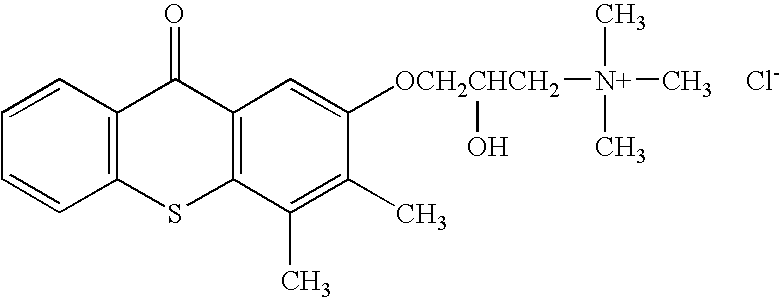
CCcompound 2 N,N,N-Trimethyl-2-[(9- oxo-9H-thioxanthen-2- yl)methoxy]- ethanaminium iodide 
CCcompound 3 N,N-Diethyl-N-methyl-2- [9-oxo-9H-thioxanthen-2- yl)methoxy]- ethanaminium iodide 
CCcompound 4 N,N,N-Triethyl-2-[(9-oxo- 9H-thioxanthen-2- yl)methoxy]- ethanaminium iodide 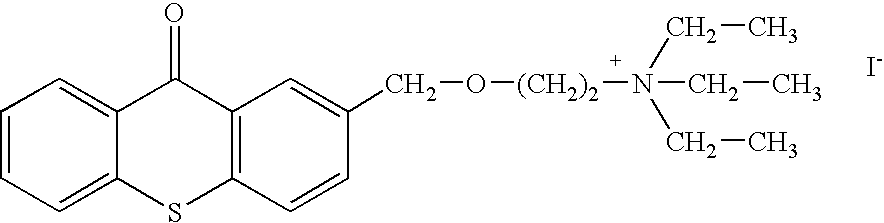
CCcompound 5 N-Ethyl-N,N-dimethyl-2- [(9-oxo-9H-thioxanthen-2- yl)methoxy]- ethanaminium iodide 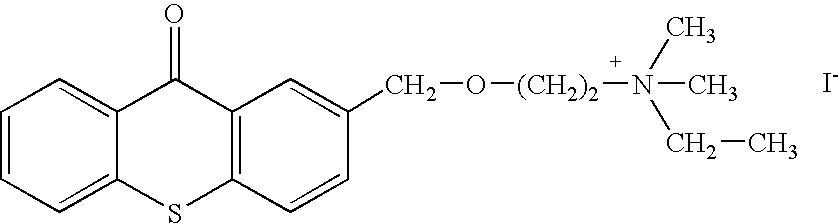
CCcompound 6 2-{[2- (Diethylamino)ethoxy]me- thyl}-9H-thioxanthen-9- one hydrochloride 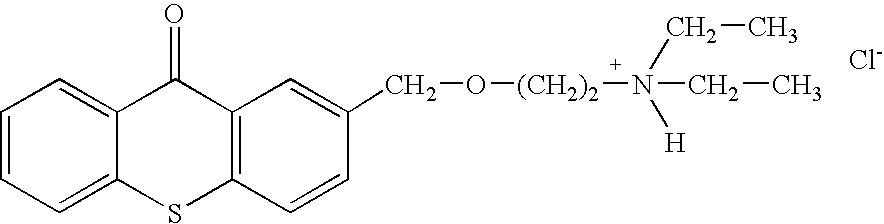
CCcompound 7 N,N,N-Trimethyl-3-[(9- oxo-9H-thioxanthen-2- yl)methoxy]-propane-1- aminium iodide 
CCcompound 8 2-{[3- (Dimethylamino)propoxy] methyl}-9H-thioxanthen- 9-one hydrochloride 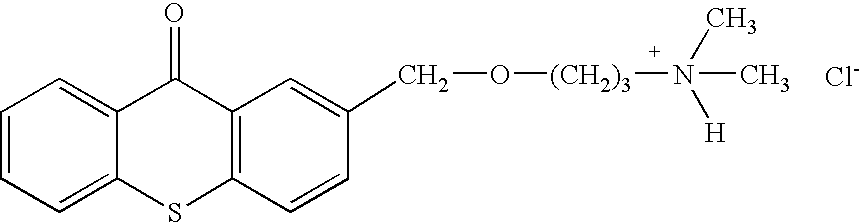
CCcompound 9 N,N,N-Triethyl-3-[(9-oxo- 9H-thioxanthen-2- yl)methoxy]-propane-1- aminium iodide 
CCcompound 10 N,N-Diethyl-N-methyl-3- [(9-oxo-9H-thioxanthen- 2-yl)methoxy]-propane- 1-aminium iodide 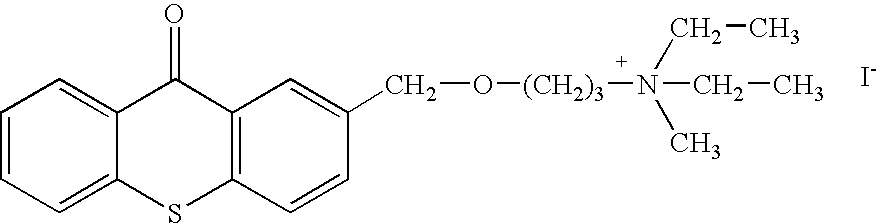
CCcompound 11 N,N-Dimethyl-N-ethyl-3- [(9-oxo-9H-thioxanthen- 2-yl)methoxy]-propane- 1-aminium iodide 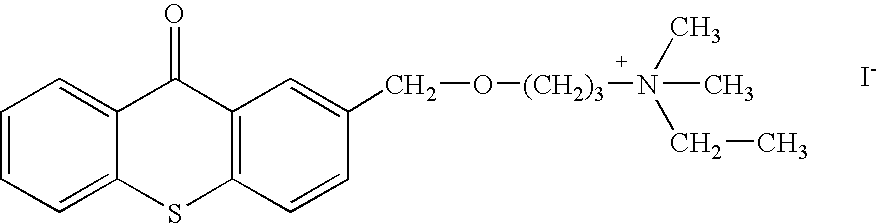
CCcompound 12 2-{[3- (Diethylamino)propoxy] methyl}-9H-thioxanthen-9- one hydrochloride 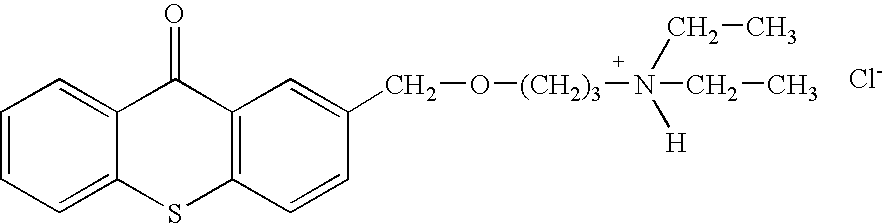
CCcompound 13 2-Hydroxy-N,N- dimethyl-N-[(9-oxo-9H- thioxanthen-2-yl)methyl]- ethanaminium bromide 
CCcompound 14 2-Hydroxy-N,N-Diethyl- N-[(9-oxo-9H- thioxanthen-2-yl)methyl]- ethanaminium bromide 
CCcompound 15 3-Hydroxy-N,N-dimethyl- N-[(9-oxo-9H- thioxanthen-2- yl)methyl]propane-1- aminium bromide 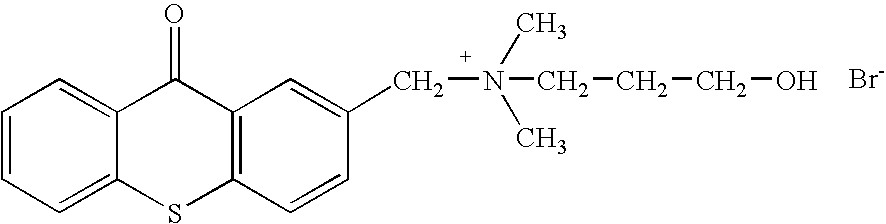
CCcompound 16 3-Hydroxy-N,N-diethyl- N-[(9-oxo-9H- thioxanthen-2-yl)methyl]- propane-1-aminium bromide 
CCcompound 17 3-(9-hydroxy-9H- thioxanthen-9-yl)-N,N,N- trimethyl-propane-1- aminium iodide 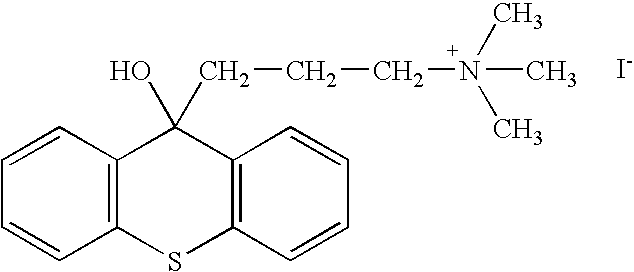
CCcompound 18 3-(9-hydroxy-9H- selenoxanthen-9-yl)- N,N,N-trimethyl-propane- 1-aminium iodide 
CCcompound 19 N,N,N-trimethyl-3-(9H- thioxanthen-9-ylidene)- propane-1-aminium iodide 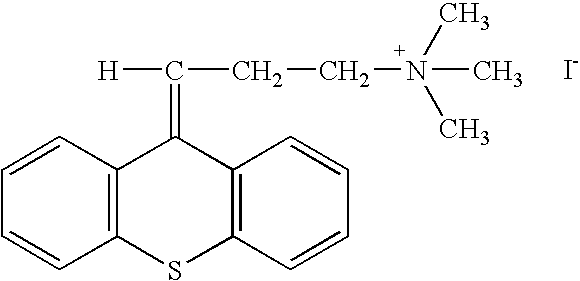
CCcompound 20 N,N,N-trimethyl-3-(9H- selenoxanthen-9-ylidene)- propane-1-aminium iodide 
CCcompound 21 N,N,N-trimethyl-3-(2- methyl-9H-thioxanthen-9- ylidene)-propane-1- aminium iodide 
CCcompound 22 N,N-Dimethyl-N-ethyl-3- (2-methyl-9H- thioxanthen-9-ylidene)- propane-1-aminium iodide 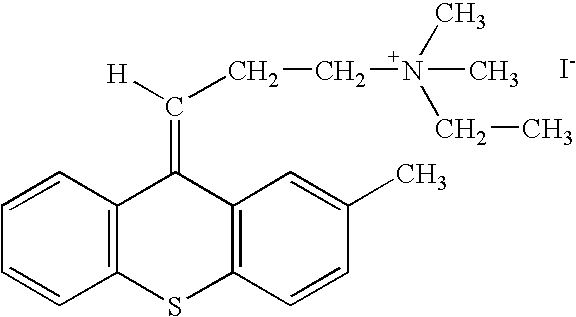
CCcompound 23 N,N-Diethyl-N-methyl-3- (2-methyl-9H- thioxanthen-9-ylidene)- propane-1-aminium iodide 
CCcompound 24 N,N-Dimethyl-N-allyl-3- (2-methyl-9H- thioxanthen-9-ylidene)- propane-1-aminium bromide 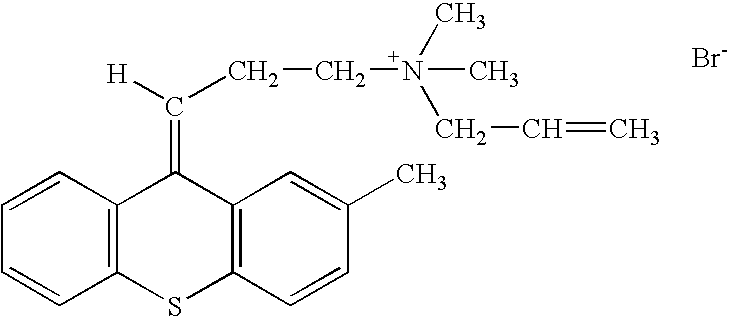
CCcompound 25 N,N,N-Triethyl-3-(2- methyl-9H-thioxanthen-9- ylidene)-propane-1- aminium iodide 
CCcompound 26 N,N-Diethyl-N-allyl-3-(2- methyl-9H-thioxanthen-9- ylidene)-propane-1- aminium bromide 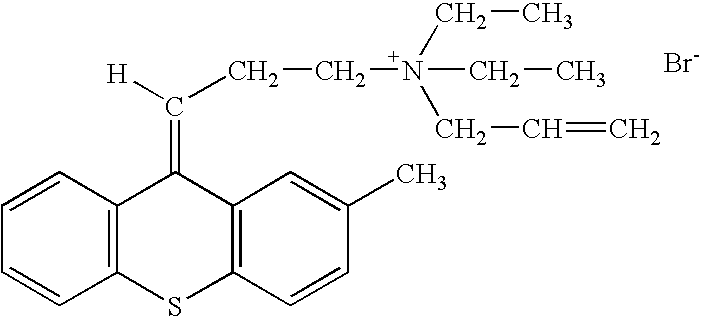
- CC compounds are used in this invention to reduce higher than normal level of blood glucose in subjects with hyperglycemia or diabetes by overcoming insulin resistance and/or reduced insulin secretion. Consequentially, they are also suitable to prevent or reduce complications resulting from insulin resistance, hyperglycemia and diabetes including increased mortality from critical illness and macrovascular as well as microvascular or other tissue injury-related events leading to cardiomyopathy, cardiovascular disease, various neuropathies, retinopathy, nephropathy, stroke, and diabetic wounds.
- The CC compounds are well soluble in water as well as in dimethylsulfoxide. Accordingly, oral application is one of the major administration routes to deliver a CC compound. In one embodiment of the invention, the CC compound is in the form of a tablet, gel capsule, a liquid, or the like. In each case, the CC compound is mixed with one or more carriers chosen by one having ordinary skill in the art to best suit the goal of treatment. In addition to the active compounds, the tablet or gel capsule may contain any component that is presently used in the pharmaceutical field to ensure firmness, stability, solubility and appropriate taste. In some embodiments, additional components of the tablet or gel will be chemically inert, i.e., it will not participate in a chemical reaction with the CC compound or the additives.
- CC compounds may also be applied via intravenous, intraarterial, intraportal, intradermal, intraperitoneal, subcutaneous, intra-tissue or intramuscular delivery routes. In some embodiments, the CC compound may be delivered via infusion over a period of time or by using an osmotic minipump inserted under the skin for controlled release. The injectable solution may be prepared by dissolving or dispersing a suitable preparation of the CC compound in water or water-based carrier such as 0.9% NaCl (physiological saline) or phosphate buffered saline. Alternatively, the CC compound may be dissolved first in dimethylsulfoxide and then diluted (100-400-fold dilution) in a physiologically compatible carrier using conventional methods. As an example only, a suitable composition for the practice in the method comprises a CC compound in a 0.9% physiological saline solution to yield a total CC compound concentration of between about 0.1-g/ml and about 25.0-g/ml, between about 1.0-g/ml and about 10.0-g/ml, about 0.1-g/ml, about 10.0-g/ml, or about 25.0-g/ml.
- A suitable dosage for oral or injection administration may be calculated in milligrams or grams of the active agent(s) per square meter of body surface area for the subject. In one embodiment, the therapeutically effective amount of CC compound is administered orally at a dose between 100-mg to 2,000-mg, or between 200-mg to 1,000-mg, per m2 body surface of the mammal. In another embodiment, the CC compound is administered by an injection method at a dose of 50-mg to 1,000-mg, or between 100-mg to 500-mg, per m2 body surface of the mammal.
- The amount of the CC compound may vary depending on the method of application. For example, in case of intravenous application the required amount may approach the lower limit, while in case of subcutaneous application the required amount may be closer to the upper limit. Also, if oral application is repeated several times a day, the dose may be lowered.
- Application of the CC compound orally or by an injection method may be repeated as many times as needed to achieve a satisfactory reduction in blood glucose level. However, for practical reasons, oral administration can be made more frequent than injection applications.
- In one embodiment, the therapeutically effective amount of CC compound may be administered once daily. In another embodiment, the dose is administered twice or three times daily.
- Considering the relatively short-term effectiveness of the CC compound, one of the recommended practical uses is to prevent large excursions in blood glucose level during a substantial meal. For this, the CC compound is taken orally or by an injection application 15-45 min prior the meal.
- The CC compound may be used together with insulin or any other oral or injectable anti-diabetic medication if deemed necessary to reduce hyperglycemia and to prevent or reduce complications resulting from hyperglycemia and diabetes including increased mortality from critical illness and macrovascular as well as microvascular or other tissue injury-related events leading to cardiomyopathy, cardiovascular disease, various neuropathies, retinopathy, nephropathy, stroke, and diabetic wounds. Such diabetic medication may be chosen from sulphonylureas (e.g., Tolbutamide, Glimepiride, Glyburide, Glipizide, Tolazamide, Acetohexamine, Chlorpropamide), meglitinides (e.g., Nateglidine and Repaglinide), incretin hormones (glucagon-like peptide and glucose-dependent insulinotropic peptide as well as their analogs), inhibitors of dipeptidyl peptidase-4 (Sitagliptin), biguanides (e.g., Metformin or Glucophage), inhibitors of-glucosidase (e.g., Acarbose, Miglitol), thiazolidinediones (e.g., Pioglitazone, Rosiglitazone), Metaglip (Glipizide+Metformin), Avandamet (Rosiglitazone+Metformin), Glucovance (Glyburide+Metformin), ActoPlus (Pioglitazone+Metformin), Avandaryl (Pioglitazone+Glimepiride), Janumet (Sitagliptin+Metformin), and Duetact (Pioglitazone and Metformin), or combinations thereof. These agents are administered using the respective approved doses and administration routes while the CC compound may be administered daily or intermittently orally or by an injection method, for example at any of the dosage levels described herein.
- The CC compound may also be used together with other human proteins such as alkaline phosphatase [see Z. Kiss, U.S. Pat. No. 7,014,852, “Alkaline Phosphatase to Induce Weight Loss or Reduce Weight Gain”; Z. Kiss, U.S. Pat. No. 7,048,914, “Placental Alkaline Phosphatase to Control Diabetes”, which are herein incorporated by reference in its entirety], transferrin [see Z. Kiss, U.S. patent application Ser. No. 11/616,378, “Transferrin and Transferrin-Based Compositions for Diabetes Treatment”, which is herein incorporated by reference in its entirety], or α1-acid glycoprotein [see Z. Kiss, U.S. patent application Ser. No. 11/568,926, “Alpha-1-Acid Glycoprotein for the Treatment of Diabetes,” which is herein incorporated by reference in its entirety]. Combinations of a CC compound with an alkaline phosphatase, and/or transferrin, and/or α1-acid glycoprotein are suitable to reduce hyperglycemia and to prevent or reduce complications resulting from insulin resistance, hyperglycemia and diabetes including increased mortality from critical illness and macrovascular as well as microvascular or other tissue injury-related events leading to cardiomyopathy, cardiovascular disease, various neuropathies, retinopathy, nephropathy, stroke, and diabetic wounds. When CC compound is used together with alkaline phosphatase, transferrin, or α1-acid glycoprotein, the CC compound may be administered daily or intermittently orally or by an injection method, for example at any of the dosage levels described herein. In such combinations the human proteins are administered by an injection method once, twice, or three times a week at a dose of 100-mg to 2,000-mg per m2 body surface of the mammal, or at any other dosage levels described in the incorporated patents and patent applications.
- The CC compounds may also be used together with other treatments, for example to treat patients with hyperglycemia or type 2 diabetes who also developed cancer or one or more other associated pathological conditions such as cachexia, sepsis, pregnancy, starvation, burn trauma, metabolic syndrome, obesity, diabetic wounds, or acromegaly.
- In some embodiments, CC compounds may enhance the effectiveness of wound healing combinations [see, for example, Z. Kiss, U.S. Pat. No. 7,011,965, “Compositions and Methods for Stimulating Wound Healing and Fibroblast Proliferation”; and Z. Kiss, U.S. Pat. No. 7,312,198, “Protein Compositions for Promoting Wound Healing and Skin Regeneration”, which are incorporated herein by reference in their entirety]. For example, such treatments may comprise one or more CC compounds, an alkaline phosphatase, and optionally transferrin and/or α1-antitrypsin, and/or α1-acid glycoprotein.
- In case of oral administration of the CC compound, the other treatments may be applied simultaneously or separately from the CC compound. In case of injection application, the CC compound and the other drug may be dissolved or suspended in the same physiologically compatible carrier substance, or they can be applied separately.
- Female C57/BL/6 mice (25-27-g body weight) were deprived of food for 2 hours and then injected with 4.5-mg/kg of CCcompound1. Blood samples for glucose measurements were taken from the eyes (canthus) just before the administration of CCcompound1 (0 min) as well as 30 min and 120 min after the administration of CCcompound1. Glucose concentrations in whole blood samples were immediately measured with the Fast Glucose C test. The data are the mean±std.dev. of 5 determinations, i.e. one determination with each of the 5 animals.
- The data presented in TABLE 2 show that acute treatments with CCcompound1 do not change the blood glucose level in mice that were deprived of food for 2 hours. In this experiment, the period of food deprivation was short enough that compensatory mechanisms could maintain the blood glucose level near the normal 5-mM value. The condition employed also reflects the human eating habits, because normally there is at least a 2 hours interval between meals and snacks. Thus, with normal subjects under normal conditions, CC compounds are not expected to appreciably change the physiological level of blood glucose level that is about 5-mM on average.
-
TABLE 2 Effect of CCcompound1 on blood glucose level in normal mice. Treatment with CCcompound1 (min) Blood glucose (mM) 0 5.1 ± 0.5 30 4.9 ± 0.4 120 4.9 ± 0.6 - C57/BL/6 female mice weighing 22-23-g and fasted for 14 hours before intraperitoneal (i.p.) administration of glucose (3-g/kg) were used. None of the animals received any food during the experiment other than glucose. The animals received i.p. injections of 4.5-mg/kg of CCcompound1, CCcompound3, or CCcompound19 either 1 hour or 24 hours prior to glucose administration as indicated in TABLE 3. Blood samples were taken from the eyes (canthus), and glucose concentrations in whole blood samples were immediately measured with the Fast Glucose C test. Each group included six animals. The data, shown in TABLE 3, are the mean±std. dev. of 6 determinations, i.e. one determination with each of the six animals. In this and all subsequent experiments the values at 0 min reflect glucose concentration in blood samples collected 1-5 minutes prior to the administration of glucose.
- Treatment of mice with CCcompound1, CCcompound3, and CCcompound19 one hour prior to glucose administration (indicated in TABLE 3 as “-1 h”) reduced blood glucose levels by 33%, 19%, and 23% respectively, by the 30th min of test period (TABLE 3). The CC compounds also had glucose lowering effects at later time points. In contrast, when the treatments with CCcompound1 were performed 24 hours prior to glucose administration (indicated in TABLE 3 as “-24 h) its effects were smaller and not reproducible in additional experiments. This most probably reflects relatively rapid clearance of this compound from the circulation. Overall, this experiment demonstrated that in normal mice CC compounds have relatively rapid and substantial glucose lowering effects in the glucose tolerance test. The experiment also indicated that replacement of two methyl groups with two ethyl groups still resulted in an active compound. In addition, the position of the choline moiety did not significantly affect efficacy. Thus, it is reasonable to expect that CC compounds listed in TABLE 1 and further described in the specification also exert glucose lowering effects. Finally, this experiment indicates that CC compounds reduce blood glucose level only when it is elevated beyond the normal 4-6-mM range, thus, it is unlikely to cause hypoglycemia.
-
TABLE 3 CC compounds lower blood glucose in a glucose tolerance test performed with normal mice. Blood glucose (mM) Treatment 0 min 30 min 60 min 120 min 180 min No treatment 1.3 ± 0.2 8.1 ± 0.6 6.0 ± 0.5 4.5 ± 0.3 3.2 ± 0.3 CC1; −1 h 1.3 ± 0.3 5.4 ± 0.5 4.3 ± 0.4 2.8 ± 0.2 2.2 ± 0.2 CC3; −1 h 1.7 ± 0.5 6.6 ± 0.3 5.0 ± 0.2 3.6 ± 0.5 2.7 ± 0.4 CC19; −1 h 2.1 ± 0.5 5.7 ± 0.4 4.6 ± 0.6 3.1 ± 0.2 2.2 ± 0.4 CC1; −24 h 1.4 ± 0.2 7.0 ± 0.7 5.2 ± 0.4 3.4 ± 0.3 2.8 ± 0.2 - Female C57/BL/6 mice weighing 22-23-g and fasted for 14 hours prior to i.p. glucose administration (3-g/kg) were used. None of the animals received any food during the experiment other than glucose. The animals received i.p. injections of 2.0 or 4.5-mg/kg of CCcompound1 either 30 min, 60 min or 120 min prior to glucose administration. Blood samples were taken and glucose concentrations were immediately measured as described earlier. Each group included six animals. The data are the mean±std. dev. of 6 determinations, i.e. one determination with each of the six animals. “-min” indicates the length of period in minutes elapsed between the administration of CCcompound1 (first) and glucose (second).
- The results, shown in TABLE 4, indicate that, within the margin of experimental error, CCcompound1 was about as effective at the 2-mg/kg dose as at the 4.5-mg/kg dose. Second, these doses of CCcompound1 were similarly effective whether administered 30 min or 60 min prior to glucose. However, CCcompound1 was practically ineffective when administered 120 min prior to glucose. These data indicate that an effective time for the CC compounds to be administered is around 30 min or between 30-60 min prior to meal, and it can be expected that it will remain effective for about another hour or little longer.
-
TABLE 4 Concentration- and time-dependent effects of CCcompound1 on blood glucose in glucose tolerance test performed with mice. Blood glucose (mM) CCcompound1 0 min 30 min 60 min 120 min 180 min No treatment 1.35 ± 0.20 8.10 ± 0.40 6.10 ± 0.35 4.45 ± 0.35 3.20 ± 0.25 2 mg/kg; −30 min 1.30 ± 0.20 5.40 ± 0.45 4.15 ± 0.45 3.50 ± 0.30 2.80 ± 0.30 4.5 mg/kg; −30 min 1.50 ± 0.25 5.05 ± 0.20 3.55 ± 0.25 2.95 ± 0.25 1.95 ± 0.30 2 mg/kg; −60 min 1.30 ± 0.30 5.70 ± 0.35 4.30 ± 0.30 3.70 ± 0.30 3.25 ± 0.35 4.5 mg/kg; −60 min 1.40 ± 0.25 5.25 ± 0.30 3.90 ± 0.20 3.20 ± 0.15 2.85 ± 0.15 4.5 mg/kg; −120 min 1.35 ± 0.15 7.80 ± 0.40 5.90 ± 0.45 4.30 ± 0.40 3.00 ± 0.20 - Female C57/BL/6 mice weighing 24-26-g and fasted for 12 hours before i.p. glucose administration (3 g/kg) were used. None of the animals received any food during the experiment other than glucose. One group of animals was untreated while animals in other groups received subcutaneous (s.c.) injections of 2.0 or 4.5-mg/kg of CCcompound1 either 30 min or 60 min prior to glucose administration as indicated in TABLE 5. Two groups of animals received i.p. injections of 0.4-mg per mouse (˜16-mg per kg) of highly purified PALP 24 hours prior to glucose administration. Purification of PALP was described in detail earlier [Z. Kiss, U.S. Pat. No. 7,048,914, “Placental Alkaline Phosphatase to Control Diabetes]. Animals in one of the PALP treated group also received s.c. injections of 4.5-mg/kg of CCcompound1 30 min prior to glucose administration as indicated in TABLE 5. Blood samples were taken and glucose concentrations were immediately measured as described earlier. Each group included five animals. The data are the mean±std. dev. of 5 determinations, i.e. one determination with each of the five animals. “-min” and “-h” indicates the length of period in minutes and hours, respectively, elapsed between the administration of test agents (first) and glucose (second).
- The results, shown in TABLE 5, confirm that CCcompound1 at the dose of 2-mg/kg and 4.5-mg/kg doses are similarly effective. Also in this experiment, as in the previous experiment, CCcompound1 was similarly effective when administered 30 min or 60 min prior to glucose. PALP alone also significantly reduced blood glucose after 30 min of glucose administration. Furthermore, at the 30th min PALP and CCcompound1 in combination reduced blood glucose level more than either agent did alone. This indicates that combination of longer-term treatment with PALP with shorter-term treatment of CCcompound1 is a more effective method than using them alone to prevent large excursion of blood glucose level during a meal without causing hypoglycemia.
-
TABLE 5 Combined effects of placental alkaline phosphatase and CCcompound1 on the blood glucose level of C57/BL/6 mice. Blood glucose (mM) Treatment 0 min 30 min 60 min 120 min No treatment 3.6 ± 0.3 9.6 ± 0.5 6.7 ± 0.5 5.0 ± 0.4 CC1, 2 mg/kg −30 min 3.7 ± 0.4 6.6 ± 0.4* 4.9 ± 0.6 4.4 ± 0.5 CC1, 4.5 mg/kg 3.6 ± 0.4 6.2 ± 0.4* 4.5 ± 0.3 4.2 ± 0.4 −30 min CC1, 2 mg/kg −60 min 3.9 ± 0.6 6.7 ± 0.5* 5.2 ± 0.3 4.6 ± 0.3 CC1, 4.5 mg/kg, 3.8 ± 0.5 6.4 ± 0.3* 4.5 ± 0.5 4.1 ± 0.6 −60 min PALP, 0.4 mg/mouse, 3.7 ± 0.5 6.8 ± 0.3* 5.3 ± 0.4 4.3 ± 0.5 −24 h CC1, 4.5 mg/kg, 4.0 ± 0.6 5.2 ± 0.4** 4.1 ± 0.5 4.0 ± 0.2 −30 min + PALP, 0.4 mg/mouse, −24 h *Significantly (P < 0.01) different from the “No treatment” group. **Significantly (P < 0.05) different from the group treated with 4.5-mg/kg CCcompound1 30 min prior to glucose load. - In this experiment, a sub-optimal dose of insulin (0.02 international unit-IU) was used to probe if CCcompound1 indeed can enhance the effect of insulin on blood glucose. Again C57/BL/6 female mice weighing 22-23-g and fasted for 14 hours prior to i.p. glucose administration (3-g/kg), were used. None of the animals received any food during the experiment other than glucose. The animals received i.p. injections of 4.5-mg/kg of CCcompound1 and/or 0.02 Unit insulin 60 min and 15 min prior to glucose administration, respectively. Blood samples were taken and glucose concentrations measured as indicated earlier. Each group included six animals. The data are the mean±std. dev. of 6 determinations, i.e. one determination with each of the six animals.
- As shown in TABLE 6, insulin alone had a small effect at 30 min but not at later times. As in the previous experiments, CCcompound1 alone had significant effects at all times, and at the 30 min and 60 min time points the combined effects of the two agents appeared to be additive.
-
TABLE 6 Combined effects of CCcompound1 and sub-optimal insulin on blood glucose in glucose tolerance test. Blood glucose (mM) Treatment 0 min 30 min 60 min 120 min No treatment 2.0 ± 0.4 8.3 ± 0.6 5.9 ± 0.7 4.2 ± 0.4 Insulin 2.1 ± 0.6 7.2 ± 0.4 5.6 ± 0.5 3.8 ± 0.4 CCcompound1 1.8 ± 0.4 5.1 ± 0.5 4.1 ± 0.4 3.3 ± 0.3 Insulin + CCcompound1 1.9 ± 0.3 3.5 ± 0.5 3.3 ± 0.4 2.9 ± 0.2 - In this experiment again, a sub-optimal dose of insulin was used to probe if CCcompound1 can enhance the effect of insulin on blood glucose. This time first generation hybrid BDF1 (C57/BL/6 female×DBA/2 male) adult (10-12 weeks old) male mice weighing 28-30-g and fasted for 14 hours before i.p. glucose administration (3-g/kg) were used. These mice were about 20% heavier than mice in the previous experiment described under Example 5. None of the animals received any food during the experiment other than glucose. The animals received i.p. injections of 4.5-mg/kg of CCcompound1 and 0.02 IU of insulin 15 min and 10 min prior to glucose administration. Blood samples were taken and glucose concentrations in whole blood samples determined as described earlier. Each group included six animals. The data are the mean±std. dev. of 6 determinations, i.e. one determination with each of the six animals.
- Perhaps because the body weight of mice was about 20% larger in this experiment compared to mice used in the previous experiment, this time fasting did not cause such a large drop in blood glucose level (TABLE 7). As also shown in TABLE 7, in this new experiment, insulin used at the 0.02 IU dose alone had only a small effect at 30 min and it had no effect 60 min after glucose administration. As in the previous experiments, CCcompound1 alone had significant effects at the 30 and 60 min time points, even though it was added only 15 min prior to glucose. This time, CCcompound1 and insulin had less than additive effects at the 30th min. After 60 min of glucose administration, the combined effect was equal to that of CCcompound1 alone, indicating that in animals with larger body weight the small effect of 0.02 IU insulin alone does not last beyond 30 min.
-
TABLE 7 Combined effects of CCcompound1 and sub-optimal amount of insulin on blood glucose in glucose tolerance test. Blood glucose (mM) Treatment 0 min 30 min 60 min No treatment 3.5 ± 0.4 8.0 ± 0.3 6.1 ± 0.4 CCcompound1; −15 min 3.1 ± 0.2 4.8 ± 0.3 3.5 ± 0.2 Insulin; 0.02 IU; −10 min 3.1 ± 0.4 6.4 ± 0.5 5.6 ± 0.3 CCcompound1 + Insulin; 0.02 IU 3.3 ± 0.2 4.2 ± 0.2 3.4 ± 0.2 - The experimental PC-3 human tumors were developed in a homozygous line of C.B.-171 cr scid/scid adult female mice that were kept at specified pathogen free (SPF) hygienic level. Treatments with CCcompound1 (4.5 mg/kg) were started on day 12 after tumor implantation and conducted for 5+5 days with 2 treatment-free days inserted between the 2 series of treatments. A control group (10 mice) received no treatment, while another group (10 mice) received 4.5-mg/kg of CCcompound1 once every day between days 12-24. The results, shown in TABLE 8, indicate that between days 12 and 24 after tumor implantation, the prostate tumor caused about 6.9-g loss in lean body weight (4.1-g loss in total body weight). In contrast, animals treated with CCcompound1 actually gained 6.3-g lean body weight. CCcompound1 also reduced tumor volume by nearly 50%. These data have been confirmed in another similar experiment.
- Tumors and cachexia are usually associated with insulin resistance. In the above experiment, on day 25, a glucose tolerance study was performed to see if PC-3 tumors also caused insulin resistance and if chronic and/or acute treatments with CCcompound1 could reverse it. Both groups were starved for 14 hours and divided into two sub-groups; one subgroup remained untreated on day 25, another subgroup was administered 4.5-mg/kg of CCcompound1 60 min prior to administration of 3-g/kg of glucose. Blood samples were taken and blood glucose was analyzed as described earlier. The results, shown in TABLE 9, show that between 30-120 min after glucose administration, reduction of blood glucose level in animals with PC-3 tumor was slower than previously observed with animals without tumor. In contrast, in animals that received chronic (C) treatment with CCcompound1 for 12 days, reduction in blood glucose level was clearly faster. Importantly, acute (A) treatment with CCcompound1 was almost as effective in cancer mice as in normal mice in reducing blood glucose level
- Since most cancer patients develop insulin resistance, the results presented in TABLE 8 and Table 9 can be extended to indicate that in cancer patients CCcompound1 will generally also improve insulin sensitivity of peripheral tissues both chronically and acutely. Since cytokines, such as tumor necrosis factor-α and interleukin 6, are common mediators of insulin resistance in many pathological conditions, a CC compound is expected to enhance insulin sensitivity in all related pathological conditions including diabetes.
-
TABLE 8 CCcompound1 reduces tumor weight and prevents body weight loss in the PC-3 tumor model Days after tumor transplantation CCcompound1; mg/kg Weight (g) 12 24 0 Total weight 25.5 ± 0.9 21.6 ± 1.1 Tumor weight 0.2 ± 0.1 3.1 ± 0.6 Body weight (lean) 25.3 18.5 4.5 Total weight 25.2 ± 1.3 31.9 ± 2.5 Tumor weight 0.2 ± 0.1 1.6 ± 0.4 Body weight (lean) 25.0 30.3 -
TABLE 9 Effects of chronic (C) and acute (A) treatments with CCcompound1 on blood glucose level in the PC-3 tumor model. Blood glucose (mM) Treatments 0 min 30 min 60 min 120 min No treatment 1.7 ± 0.5 9.8 ± 0.7 8.0 ± 0.6 6.5 ± 0.5 CCcompound1, A 2.3 ± 0.2 5.5 ± 0.6 4.4 ± 0.7 3.5 ± 0.4 CCcompound1, C 1.8 ± 0.4 7.1 ± 0.5 6.5 ± 0.4 4.9 ± 0.6 CCcompound1, C + A 2.1 ± 0.5 5.1 ± 0.4 3.9 ± 0.4 3.1 ± 0.3 - Male Wistar rats weighing 240-270-g were divided into 3 groups, each group consisting of 6 or 7 animals. To ensure standard conditions animals were starved for 14 hours before the start of the experiment. CCcompound1 and CCcompound3 were injected (i.p.) 30 min prior to injecting 3-g/kg of glucose (i.p.). Blood sugar values of the experimental animals were measured with the Fast Glucose C-test; blood samples were taken from the tail. The data are the mean±std. dev. of 6-7 determinations, i.e. one determination with each of the 6-7 animals in the respective groups.
- The results presented in TABLE 10 point to a somewhat more complex action of CC compounds in rats than that observed in experiments with mice. First, in rats, starvation for 14 hours also caused hypoglycemia similar to mice. However, in rats, unlike in mice, CC compounds were able to maintain normoglycemia prior to glucose administration. According to our present knowledge, this is possible only if in the liver CC compounds are able to enhance glucagon-regulated gluconeogenesis and glycolysis and thereby increase glucose output. Third, in rats, unlike in mice, after 30 min of glucose administration CC compounds had practically no effects on blood glucose level, but after 60 min they had clear significant effects (control versus CCcompound1, P=0.004; control versus CCcompound3, P=0.054). This may reflect the time needed for a shift from stimulating glucose output to reducing glucose output and instead enhancing glucose uptake and metabolism into muscle. This may also reflect that insulin secretion as well as access to the peripheral tissues is a longer process in rats than in mice. Fourth, while at the 120th min the control animals again approached the hypoglycemic state, the CC compounds clearly prevented this process. Overall, this experiment indicates that a CC compound is capable of preventing or reducing longer-term deviations of blood glucose level in both directions.
-
TABLE 10 In starved rats, CC compounds exert bi-directional normalizing effects on blood glucose level in glucose tolerance test. Blood glucose (mM) Treatment 0 min 30 min 60 min 90 min 120 min No treatment 3.35 ± 0.31 9.45 ± 0.65 8.03 ± 0.31 5.70 ± 0.25 4.56 ± 0.28 CCcompound 1 5.03 ± 0.44* 9.21 ± 0.45 5.73 ± 0.39* 5.11 ± 0.42 5.37 ± 0.36 CCcompound 3 4.73 ± 0.24* 9.36 ± 0.43 6.66 ± 0.33* 5.71 ± 0.38 5.43 ± 0.60 *Significantly (P < 0.01) different from the values obtained in the “No treatment” group. - Adult female leptin-deficient ob/ob obese diabetic inbred specified pathogen free (SPF) hygienic category mice from Charles River VRF1 were used for these experiments. The mice weighed 32-36-g at arrival. The ob/ob obese mouse is an extensively used animal model for the study of non-insulin-dependent-diabetes mellitus (NIDDM). The mutation was propagated in the C57BL/6J (BL/6) inbred strain. Homozygous obese (ob/ob) animals developed hyperglycemia due to insulin resistance, hyperinsulinemia (to compensate for reduced insulin action), and obesity. In these animals gluconeogenesis is enhanced despite their hyperinsulinemic state.
- The animals were kept in macrolon cages at 22-24° C. and 50-60% humidity, with lighting regimen of 12/12 h light dark. They had free access to tap water and were fed a sterilized standard diet (Charles River VRF1, autoclavable). The animals were cared for according to the “Guiding Principles for the Care and Use for Animals” based upon the Helsinki declaration. The ob/ob mice gained weight rapidly and developed a marked obesity by 5-6 weeks of age. Correspondingly, food intake was greatly increased. When arrived they were 5 weeks old (when the experiment was performed with CCcompound1) or 4.5 weeks old (when the experiment was performed with CCcompound3 and CCcompound19). The treatments started 8 days later in the experiment performed with CCcompound1 and 10 days later in the experiment performed with CCcompound3 and CCcompound19.
- Experimental groups selected from ob/ob mice were injected subcutaneously (s.c.) at regular intervals once daily for 14 days with CCcompound1 or an analog (CCcompound3 or CCcompound19) each at the dose of 4.5-mg per kg. Control groups were also selected from ob/ob mice that remained untreated during the entire length of the experiment. In the first experiment, for which the data is presented in TABLE 11, blood samples were taken either 45 min or 6 hours after treatments with CCcompound1. In the second experiment, for which the data is presented in TABLE 12, blood samples were taken 45 min after treatments with the analogs of CCcompound1. Blood glucose was determined with the Fast Glucose C test. Both the untreated and CC compound-treated groups included 5 animals. The data are the mean±std. dev.
- In the experiment described in TABLE 11, the blood glucose concentration of untreated ob/ob mice (first column) was increased from 9.5 mM to 19.1 mM between day 1 and 14. When the blood samples were taken 6 hours after treatment with CCcompound1 (second column), there was only a slight reduction in the blood glucose level that, however, reached statistical significance (P<0.05) on day 7 and day 14. In contrast, when blood samples were taken 45 min after treatment with CCcompound1 (third column), on each day examined there was a statistically highly significant (P<0.001) drop in the blood glucose level.
- These results indicated that in the ob/ob mice CCcompound1 rapidly and effectively reduces blood glucose level, however, these effects become less pronounced after 6 hours of the treatment.
- Since in ob/ob mice the high blood glucose is the results of insulin resistance, the results indicate that in the short term CCcompound1 effectively overcame the result of insulin resistance, perhaps either by enhancing insulin sensitivity of peripheral tissues, or by stimulating an insulin-independent glucose uptake mechanism, or both.
-
TABLE 11 Time-dependent effects of CCcompound 1 on blood glucose level in ob/ob mice Glucose level (mM) CCcompound 1 CCcompound 1 Days No Treatment 6 hours 45 min 1 9.5 ± 0.4 9.3 ± 0.4 6.2 ± 0.4** 4 12.5 ± 0.3 11.3 ± 0.7 7.4 ± 0.3** 7 15.0 ± 0.5 13.8 ± 0.4* 8.4 ± 0.2** 11 16.8 ± 0.6 15.7 ± 0.4 9.2 ± 0.3** 14 19.1 ± 0.8 17.5 ± 0.4* 10.2 ± 0.3** - CCcompound 3 and CCcompound19 also significantly reduced blood glucose level in ob/ob mice when blood samples were withdrawn after treatments for 45 min; the data is shown in TABLE 12. This experiment also indicated that replacement of two methyl groups with two ethyl groups still resulted in an active compound (CCcompound3). In addition, the position of the choline moiety did not seem to significantly affect efficacy. Thus, it is reasonable to expect that other CC compounds as well listed in TABLE 1 and further described in the specification will exert rapid glucose lowering effects in obese subjects with hyperglycemia. Finally, this experiment together with the experiment shown in TABLE 11 further confirms that in diabetic mice, and by extension in diabetic human subjects, CC compounds reduce blood glucose level without causing hypoglycemia.
-
TABLE 12 Effects of CCcompound 3 (CC3) and CCcompound 19 (CC19) on blood glucose level of ob/ob mice Blood glucose (mM) Day No Treatment CC3 CC19 0 9.2 ± 0.9 9.1 ± 0.6 9.3 ± 0.7 1 9.4 ± 1.0 7.6 ± 0.7 6.2 ± 0.9 5 12.3 ± 0.8 8.6 ± 0.9 7.7 ± 0.5 10 16.5 ± 1.2 11.0 ± 0.6 9.3 ± 0.9 15 19.5 ± 1.3 12.6 ± 0.5 10.4 ± 1.0 - In this experiment, 43 days old ob/ob mice weighing 40.3±1.8-g on average were used. One group of mice (5 animals) remained untreated for the subsequent 14 days. Two other groups of mice (each including 5 animals) were treated on each day for 13 days with 4.5-mg/kg dose of CCcompound1. On the 14th day the first group received only i.p. injection of glucose (3-g/kg) (first column in TABLE 13); the second group first received s.c. injection of CCcompound1, followed six hours later by i.p. injection of glucose (3-g/kg) (second column in TABLE 13); the third group first received s.c. injection of CCcompound1, followed 45 min later by i.p. injection of glucose (3-g/kg) (third column in TABLE 13). In each case, blood was first drawn 1-5 min prior to the administration of glucose, followed by drawing blood samples at 30 min, 60 min, 120 min and 180 min. The results shown in TABLE 13 indicate that CCcompound1 can effectively lower blood glucose level even after administration of a large amount of glucose. The finding that CCcompound1 was less effective to prevent the rise in blood glucose when it was administered six hours prior to glucose (TABLE 13) is likely due to its relatively rapid clearance from the circulation. This probably means that the effect of CCcompound1 on blood glucose level requires its physical presence in the circulation and is not mediated by a secondary mechanism.
-
TABLE 13 Effects of CCcompound 1 on blood glucose level in a glucose tolerance test performed with ob/ob mice. Blood glucose (mM) CCcompound 1 CCcompound 1 Time (min) No Treatment 6 hours 45 min 0 19.4 ± 0.6 17.8 ± 0.3* 10.7 ± 0.2** 30 24.0 ± 0.5 20.7 ± 0.2* 11.9 ± 0.4** 60 23.3 ± 0.5 20.2 ± 0.2* 11.4 ± 0.3** 120 22.0 ± 0.5 19.6 ± 0.2* 11.0 ± 0.3** 180 20.6 ± 0.5 18.9 ± 0.3* 10.9 ± 0.3** *, **significantly (P < 0.01* and P < 0.001**) different from the corresponding values in the “No treatment” group. - Transferrin (TF) and α1-acid glycoprotein (AGP) are two human proteins with recently reported longer-term antidiabetic effects [Z. Kiss, U.S. patent application Ser. No. 11/616,378, “Transferrin and Transferrin-Based Compositions for Diabetes Treatment”; Z. Kiss, U.S. patent application Ser. No. 11/568,926, “Alpha-1-Acid Glycoprotein for the Treatment of Diabetes”]. In the following experiment, the possible benefit of using AGP and TF together with a CC compound to lower blood glucose level in the type 2 diabetes ob/ob model was examined.
- For each experimental group, ob/ob mice were chosen (5 mice in each group) that were 43 days old and weighed on average 40.3±1.9-g on the first day of experiment. Three groups of mice were treated with s.c. injection of 4.5-mg/kg CCcompound1 once every day for 17 days. Mice in one of these CCcompound1-treated groups received no other treatment, and their blood was drawn for glucose analysis on day 14 and 17 exactly 45 min after treatment. The second CCcompound1-treated group also received 0.5-mg/mouse (˜11 mg/kg) dose of greater than 98% pure commercial human transferrin [catalogue number, T 3309 according to 2004/2005 Sigma catalogue]. In this second group the blood was drawn on day 14 just prior to TF administration and on day 17 two hours after TF and 45 min after CCcompound1 administration. An additional group of animals received only TF treatment. The third CCcompound1-treated group also received 1.2-mg/mouse (26.6-mg/kg) dose of >99% pure human AGP [catalogue number G 9885 according to 2004/2005 Sigma catalogue]; in this group the blood was drawn on day 14 just prior to AGP administration and on day 17 two hours and 45 minutes after administration of AGP and CCcompound1, respectively. An additional group of animals received only AGP treatment, and yet another group of animals received no treatment at all. On day 1, prior to any treatment, the blood glucose level of all animals was in the range of 7.2-7.9 mM.
- The results shown in TABLE 14 indicate that longer-term treatments with both AGP and TF significantly lowered blood glucose level. In addition, both TF and AGP added to the shorter-term effect of CCcompound1 so that combinations of CCcompound1 with both AGP and TF were significantly greater than the effects of CCcompound1 alone. These data indicate that both AGP and TF may be used together with a CC compound, such as CCcompound1, to lower blood glucose level in diabetic subjects.
- CCcompound1 and PALP were also shown in TABLE 5 to lower blood glucose level more effectively in combination than alone in a glucose tolerance test performed with non-diabetic mice.
-
TABLE 14 Combined effects of CCcompound 1 (CC1) and human antidiabetic proteins on blood glucose level in ob/ob mice. Blood glucose level (mM) Treatment 14th day 17th day No treatment 15.9 ± 0.6 16.1 ± 0.7 CC1 10.9 ± 0.9* 11.4 ± 0.4* AGP 16.0 ± 0.5 12.4 ± 0.6* TF 15.8 ± 0.4 13.6 ± 0.7* CC1 + AGP 11.4 ± 0.3* 9.8 ± 0.3** CC1 + TF 11.3 ± 0.3* 10.2 ± 0.4** *Significantly (P < 0.001) different from the corresponding values of “No treatment” group. **Significantly (P < 0.05-0.01) different from the corresponding value obtained with CCcompound 1 alone.
Claims (22)
1. A method to reduce abnormally high blood glucose level to within, or closer to, the normal range in humans and other mammals with insulin resistance, hyperglycemia, or diabetes, the method comprising administering a heterocyclic compound represented by the formula:
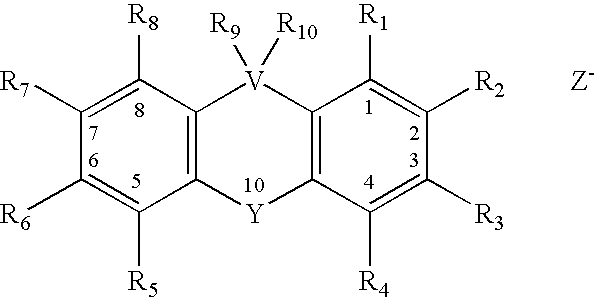
wherein R1 and R3-8 are independently hydrogen, C1-C26 straight, branched or cyclic alkanes or alkenes, aromatic hydrocarbons, alcohols, ethers, aldehydes, ketones, carboxylic acids, amines, amides, nitriles, or five- and/or six-membered heterocyclic moieties;
wherein R9 and R10 considered together are ═O or ═CH-L-N+(R11, R12, R13) or
wherein R9 and R10 considered independently are —OH or -L-N+(R11, R12, R13);
wherein R2 is represented by the formula: —X or -X′-L-N+(R11, R12, R13)Z− or
-L-N+(R11, R12, R13)−;
wherein V is —S—, —Se—, —C—, —O— or —N;
wherein Y is —S—, —Se—, —C—, —O— or —N;
wherein -L-N+(R11, R12, R13) can be linked to V or Y if V or Y is —N or can be linked to V and Y if V and Y are both —N;
wherein X is CH3 or Hydrogen or —OH;
wherein —X′ is —CH2-, —OCH2-, —CH20-, —SCH2- or —CH2S—;
wherein L is a C1-C4 straight alkane, alkene, thiol, ether, alcohol, or amine;
wherein R11, R12 and R13 are independently Hydrogen, C1-C4 straight alkanes, alkenes, thiols, amines, ethers or alcohols; and
wherein Z- is Cl−, Br− or I−.
2. The method of claim 1 wherein R11, R12, and R13 are independently methyl, ethyl, propyl, allyl, ether, sulfhydryl, amino, or hydroxyl groups.; L is —(CH2)2— or —(CH2)3—; and R1 and R3-8 are hydrogen or methyl.
3. The method of claim 1 wherein L-N+(R11, R12, R13) is choline.
4. The method of claim 1 wherein the compound is a thioxanthone.
5 The method of claim 4 wherein R9 and R10 considered together are ═O and R2 is —X-L-N+(R11, R12, R13)Z−.
6. The method of claim 5 wherein the compound is [3-(3,4-dimethyl-9-oxo-9H-thioxanthen-2-yloxy)-2-hydroxypropyl]trimethylammonium chloride.
7. The method of claim 5 wherein the compound is N,N,-diethyl-N-methyl-2-[9-oxo-9H-thioxanthen-2-yl)methoxy]ethanaminium iodide.
8. The method of claim 1 wherein the compound is a thioxanthene.
9. The method of claim 8 wherein R2 is O or X and R9 and R10 considered together are ═CH-L-N+(R11, R12, R13); L is —(CH2)2- or —(CH2)3-; and R1 and R3-8 are hydrogren or methyl.
10. The method of claim 8 wherein the compound is N,N,N-trimethyl-3-(9H-thioxanthen-9-ylidene)-propane-1-aminium iodide.
11. The method of claim 8 wherein the compound is N,N-Diethyl-N-allyl-3-(2-methyl-9H-thioxanthen-9-ylidene)-propane-1-aminium bromide.
12. The method of claim 1 wherein the heterocyclic compound is administered orally in the form of a tablet, gel capsule, or liquid, or in any other suitable form.
13. The method of claim 12 wherein the heterocyclic compound is administered orally at a dose between 100-mg to 2,000-mg per m2 body surface of the mammal.
14. The method of claim 13 wherein the heterocyclic compound is administered once, twice, or thrice daily, or three-times a week, or intermittently wherein daily administration is interrupted for days or weeks.
15. The method of claim 1 wherein the heterocyclic compound is dissolved in a suitable physiologically compatible liquid carrier, such as physiological saline, and administered via an injection method selected from intravenous, intraarterial, subcutaneous, intraperitoneal, intradermal, or intramuscular, or via infusion, or by using an internally or subcutaneously inserted osmotic minipump to ensure controlled release.
16. The method of claim 15 wherein the heterocyclic compound is administered at a dose between 50-mg to 1,000-mg per m body surface of the mammal once, twice, or thrice daily, or three-times a week, or intermittently wherein daily administration is interrupted for days or weeks.
17. The method of claim 1 wherein the heterocyclic compound is administered simultaneously or sequentially with one or more oral or injectable agents suitable to reduce, prevent or treat insulin resistance, hyperglycemia, or diabetes.
18. The method of claim 17 wherein the agent or agents is/are selected from insulin, sulphonylureas (e.g., Tolbutamide, Glimepiride, Glyburide, Glipizide, Tolazamide, Acetohexamine, Chlorpropamide), meglitinides (e.g., Nateglidine and Repaglinide), incretin hormones (glucagon-like peptide and glucose-dependent insulinotropic peptide as well as their analogs), inhibitors of dipeptidyl peptidase-4 (Sitagliptin), biguanides (e.g., Metformin or Glucophage), inhibitors of α-glucosidase (e.g., Acarbose, Miglitol), thiazolidinediones (e.g., Pioglitazone, Rosiglitazone), Metaglip (Glipizide+Metformin), Avandamet (Rosiglitazone+Metformin), Glucovance (Glyburide+Metformin), ActoPlus (Pioglitazone+Metformin), Avandaryl (Pioglitazone+Glimepiride), Janumet (Sitagliptin+Metformin), and Duetact (Pioglitazone and Metformin).
19. The method of claim 17 wherein the agent or agents are administered using the respective approved doses and administration routes while the heterocyclic compound may be administered daily or intermittently orally or by an injection method at a dose of 50-mg to 2,000-mg per m2 body surface of the mammal.
20. The method of claim 17 wherein the agent is alkaline phosphatase, transferrin, or α1-acid glycoprotein, or combinations of these proteins.
21. The method of claim 20 wherein the alkaline phosphatase, transferrin, or α1-acid glycoprotein are administered once, twice, or three-times a week using a dose range from 100 mg to 2,000 mg per m2 body surface while the heterocyclic compound is administered daily or intermittently orally or by an injection method at a dose of 50-mg to 2,000-mg per m2 body surface of the mammal.
22. The method of claim 1 wherein a heterocyclic CC compound is used in the manufacture of a composition useful for the reduction of pathologically high levels of blood glucose.
Priority Applications (1)
| Application Number | Priority Date | Filing Date | Title |
|---|---|---|---|
| US12/394,789 US20090317372A1 (en) | 2008-06-20 | 2009-02-27 | Small molecules for the reduction of high blood glucose level |
Applications Claiming Priority (2)
| Application Number | Priority Date | Filing Date | Title |
|---|---|---|---|
| US7432908P | 2008-06-20 | 2008-06-20 | |
| US12/394,789 US20090317372A1 (en) | 2008-06-20 | 2009-02-27 | Small molecules for the reduction of high blood glucose level |
Publications (1)
| Publication Number | Publication Date |
|---|---|
| US20090317372A1 true US20090317372A1 (en) | 2009-12-24 |
Family
ID=41431515
Family Applications (1)
| Application Number | Title | Priority Date | Filing Date |
|---|---|---|---|
| US12/394,789 Abandoned US20090317372A1 (en) | 2008-06-20 | 2009-02-27 | Small molecules for the reduction of high blood glucose level |
Country Status (1)
| Country | Link |
|---|---|
| US (1) | US20090317372A1 (en) |
Cited By (20)
| Publication number | Priority date | Publication date | Assignee | Title |
|---|---|---|---|---|
| WO2011127175A1 (en) * | 2010-04-06 | 2011-10-13 | Isis Pharmaceuticals, Inc. | Modulation of cd130 (gp130) expression |
| WO2012054057A1 (en) * | 2010-10-22 | 2012-04-26 | Zoltan Kiss Consulting | Alkaline phosphatase to correct insulin resistance, hyperinsulinemia, and dyslipidemia |
| WO2013072915A1 (en) * | 2011-11-15 | 2013-05-23 | Yissum Research Development Company Of The Hebrew University Of Jerusalem Ltd. | Tricyclic compounds, compositions comprising them and uses thereof |
| US20150025496A1 (en) * | 2009-12-24 | 2015-01-22 | Rani Therapeutics, Llc | Swallowable drug delivery device and method of delivery |
| US9629799B2 (en) | 2010-12-23 | 2017-04-25 | Rani Therapeutics, Llc | Therapeutic agent preparations for delivery into a lumen of the intestinal tract using a swallowable drug delivery device |
| US9757514B2 (en) | 2010-12-23 | 2017-09-12 | Rani Therapeutics, Llc | Device, system and methods for the oral delivery of therapeutic compounds |
| US9808510B2 (en) | 2011-06-29 | 2017-11-07 | Rani Therapeutics, Llc | Method for delivering gonadotropin releasing hormone into a lumen of the intestinal tract |
| US9814763B2 (en) | 2010-12-23 | 2017-11-14 | Incube Labs, Llc | Method for delivery of somatostatin into a lumen of the intestinal tract |
| US9844655B2 (en) | 2010-12-23 | 2017-12-19 | Rani Therapeutics, Llc | Therapeutic agent preparations for delivery into a lumen of the intestinal tract using a swallowable drug delivery device |
| US9844505B2 (en) | 2010-12-23 | 2017-12-19 | Rani Therapeutics, Llc | Methods for delivering etanercept preparations into a lumen of the intestinal tract using a swallowable drug delivery device |
| US9861683B2 (en) | 2010-12-23 | 2018-01-09 | Rani Therapeutics, Llc | Therapeutic agent preparations for delivery into a lumen of the intestinal tract using a swallowable drug delivery device |
| US9907747B2 (en) | 2010-12-23 | 2018-03-06 | Rani Therapeutics, Llc | Therapeutic agent preparations for delivery into a lumen of the intestinal tract using a swallowable drug delivery device |
| US9956178B2 (en) | 2010-12-23 | 2018-05-01 | Rani Therapeutics, Llc | Methods for delivering insulin preparations into a lumen of the intestinal tract using a swallowable drug delivery device |
| US9987487B2 (en) | 2009-08-03 | 2018-06-05 | Incube Labs, Llc | Swallowable capsule and method for stimulating incretin production within the intestinal tract |
| US10004783B2 (en) | 2010-12-23 | 2018-06-26 | Rani Therapeutics, Llc | Method for delivering pramlintide into a lumen of the intestinal tract using a swallowable drug delivery device |
| US10029080B2 (en) | 2010-12-23 | 2018-07-24 | Rani Therapeutics, Llc | Method for delivering exenatide into a lumen of the intestinal tract using a swallowable drug delivery device |
| US10487145B2 (en) | 2010-12-23 | 2019-11-26 | Rani Therapeutics, Llc | Therapeutic agent preparations for delivery into a lumen of the intestinal tract using a swallowable drug delivery device |
| US10639272B2 (en) | 2010-12-23 | 2020-05-05 | Rani Therapeutics, Llc | Methods for delivering etanercept preparations into a lumen of the intestinal tract using a swallowable drug delivery device |
| US10752681B2 (en) | 2010-12-23 | 2020-08-25 | Rani Therapeutics, Llc | Therapeutic agent preparations for delivery into a lumen of the intestinal tract using a swallowable drug delivery device |
| US12097179B2 (en) | 2015-06-15 | 2024-09-24 | Raziel Therapeutics Ltd. | Carbazole derivatives for the treatment of fibrotic diseases and related symptoms, and conditions thereof |
Citations (2)
| Publication number | Priority date | Publication date | Assignee | Title |
|---|---|---|---|---|
| US3174901A (en) * | 1963-01-31 | 1965-03-23 | Jan Marcel Didier Aron Samuel | Process for the oral treatment of diabetes |
| US7014852B2 (en) * | 2002-12-12 | 2006-03-21 | Zoltan Laboratories | Alkaline phosphatase to induce weight loss or to reduce weight gain |
-
2009
- 2009-02-27 US US12/394,789 patent/US20090317372A1/en not_active Abandoned
Patent Citations (2)
| Publication number | Priority date | Publication date | Assignee | Title |
|---|---|---|---|---|
| US3174901A (en) * | 1963-01-31 | 1965-03-23 | Jan Marcel Didier Aron Samuel | Process for the oral treatment of diabetes |
| US7014852B2 (en) * | 2002-12-12 | 2006-03-21 | Zoltan Laboratories | Alkaline phosphatase to induce weight loss or to reduce weight gain |
Cited By (70)
| Publication number | Priority date | Publication date | Assignee | Title |
|---|---|---|---|---|
| US11872396B2 (en) | 2009-08-03 | 2024-01-16 | Incube Labs, Llc | Swallowable capsule and method for stimulating incretin production within the intestinal tract |
| US9987487B2 (en) | 2009-08-03 | 2018-06-05 | Incube Labs, Llc | Swallowable capsule and method for stimulating incretin production within the intestinal tract |
| US12403308B2 (en) | 2009-08-03 | 2025-09-02 | Alva Therapeutics, Inc. | Swallowable capsule and method for stimulating incretin production within the intestinal tract |
| US11439817B2 (en) | 2009-08-03 | 2022-09-13 | Incube Labs, Llc | Swallowable capsule and method for stimulating incretin production within the intestinal tract |
| US9757548B2 (en) | 2009-12-24 | 2017-09-12 | Rani Therapeutics, Llc | Method for delivering a therapeutic agent into the wall of the small intestine |
| US10987499B2 (en) | 2009-12-24 | 2021-04-27 | Rani Therapeutics, Llc | Swallowable drug delivery device and method of delivery |
| US12268831B2 (en) | 2009-12-24 | 2025-04-08 | Rani Therapeutics, Llc | Swallowable drug delivery device and methods of drug delivery |
| US11376405B2 (en) | 2009-12-24 | 2022-07-05 | Rani Therapeutics, Llc | Therapeutic agent preparations into a lumen of the intestinal tract using a swallowable drug delivery device |
| US10039908B2 (en) * | 2009-12-24 | 2018-08-07 | Rani Therapeutics, Llc | Swallowable drug delivery device and method of delivery |
| US11338118B2 (en) | 2009-12-24 | 2022-05-24 | Rani Therapeutics, Llc | Swallowable drug delivery device and methods of drug delivery |
| US11253686B2 (en) | 2009-12-24 | 2022-02-22 | Rani Therapeutics, Llc | Swallowable drug delivery device and methods of drug delivery |
| US20150025496A1 (en) * | 2009-12-24 | 2015-01-22 | Rani Therapeutics, Llc | Swallowable drug delivery device and method of delivery |
| US10603475B2 (en) | 2009-12-24 | 2020-03-31 | Rani Therapeutics, Llc | Swallowable drug delivery device and methods of drug delivery |
| US10596359B2 (en) | 2009-12-24 | 2020-03-24 | Rani Therapeutics, Llc | Therapeutic agent preparations into a lumen of the intestinal tract using a swallowable drug delivery device |
| US10493253B2 (en) | 2009-12-24 | 2019-12-03 | Rani Therapeutics, Llc | Therapeutic agent preparations into a lumen of the intestinal tract using a swallowable drug delivery device |
| US10252039B2 (en) | 2009-12-24 | 2019-04-09 | Rani Therapeutics, Llc | Therapeutic agent preparations into a lumen of the intestinal tract using a swallowable drug delivery device |
| US10179228B2 (en) | 2009-12-24 | 2019-01-15 | Rani Therapeutics, Llc | Swallowable drug delivery device and methods of drug delivery |
| WO2011127175A1 (en) * | 2010-04-06 | 2011-10-13 | Isis Pharmaceuticals, Inc. | Modulation of cd130 (gp130) expression |
| WO2012054057A1 (en) * | 2010-10-22 | 2012-04-26 | Zoltan Kiss Consulting | Alkaline phosphatase to correct insulin resistance, hyperinsulinemia, and dyslipidemia |
| US9956178B2 (en) | 2010-12-23 | 2018-05-01 | Rani Therapeutics, Llc | Methods for delivering insulin preparations into a lumen of the intestinal tract using a swallowable drug delivery device |
| US10926073B2 (en) | 2010-12-23 | 2021-02-23 | Rani Therapeutics, Llc | Therapeutic agent preparations for delivery into a lumen of the intestinal tract using a swallowable drug delivery device |
| US10004783B2 (en) | 2010-12-23 | 2018-06-26 | Rani Therapeutics, Llc | Method for delivering pramlintide into a lumen of the intestinal tract using a swallowable drug delivery device |
| US12263325B2 (en) | 2010-12-23 | 2025-04-01 | Rani Therapeutics, Llc | Device, system and methods for the oral delivery of therapeutic compounds |
| US9907747B2 (en) | 2010-12-23 | 2018-03-06 | Rani Therapeutics, Llc | Therapeutic agent preparations for delivery into a lumen of the intestinal tract using a swallowable drug delivery device |
| US10300010B2 (en) | 2010-12-23 | 2019-05-28 | Rani Therapeutics, Llc | Methods for delivering entanercept preparations into a lumen of the intestinal tract using a swallowable drug delivery device |
| US10307579B2 (en) | 2010-12-23 | 2019-06-04 | Rani Therapeutics, Llc | Therapeutic agent preparations for delivery into a lumen of the intestinal tract using a swallowable drug delivery device |
| US11844867B2 (en) | 2010-12-23 | 2023-12-19 | Rani Therapeutics, Llc | Method of delivering insulin into a lumen of the intestinal tract using a swallowable drug delivery device |
| US10314892B2 (en) | 2010-12-23 | 2019-06-11 | Rani Therapeutics, Llc | Method of delivering a somatostatin compound into a lumen of the intestinal tract using a swallowable drug delivery device |
| US10314891B2 (en) | 2010-12-23 | 2019-06-11 | Rani Therapeutics, Llc | Method for delivering pramlintide into a lumen of the intestinal tract using a swallowable drug delivery device |
| US10322167B2 (en) | 2010-12-23 | 2019-06-18 | Rani Therapeutics, Llc | Method of delivering gonadotropin releasing hormone or an analogue thereof into a lumen of the intestinal tract using a swallowable drug delivery device |
| US10335463B2 (en) | 2010-12-23 | 2019-07-02 | Rani Therapeutics, Llc | Therapeutic agent preparations for delivery into a lumen of the intestinal tract using a swallowable drug delivery device |
| US10350163B2 (en) | 2010-12-23 | 2019-07-16 | Rani Therapeutics, Llc | Therapeutic agent preparations for delivery into a lumen of the intestinal tract using a swallowable drug delivery device |
| US10478396B2 (en) | 2010-12-23 | 2019-11-19 | Rani Therapeutics, Llc | Therapeutic agent preparations for delivery into a lumen of the intestinal tract using a swallowable drug delivery device |
| US10487145B2 (en) | 2010-12-23 | 2019-11-26 | Rani Therapeutics, Llc | Therapeutic agent preparations for delivery into a lumen of the intestinal tract using a swallowable drug delivery device |
| US9861683B2 (en) | 2010-12-23 | 2018-01-09 | Rani Therapeutics, Llc | Therapeutic agent preparations for delivery into a lumen of the intestinal tract using a swallowable drug delivery device |
| US10548850B2 (en) | 2010-12-23 | 2020-02-04 | Rani Therapeutics, Llc | Therapeutic composition comprising insulin prepared for delivery into an intestinal tract |
| US9844505B2 (en) | 2010-12-23 | 2017-12-19 | Rani Therapeutics, Llc | Methods for delivering etanercept preparations into a lumen of the intestinal tract using a swallowable drug delivery device |
| US9844655B2 (en) | 2010-12-23 | 2017-12-19 | Rani Therapeutics, Llc | Therapeutic agent preparations for delivery into a lumen of the intestinal tract using a swallowable drug delivery device |
| US10632251B2 (en) | 2010-12-23 | 2020-04-28 | Rani Therapeutics, Llc | Device, system and methods for the oral delivery of therapeutic compounds |
| US10639272B2 (en) | 2010-12-23 | 2020-05-05 | Rani Therapeutics, Llc | Methods for delivering etanercept preparations into a lumen of the intestinal tract using a swallowable drug delivery device |
| US10752681B2 (en) | 2010-12-23 | 2020-08-25 | Rani Therapeutics, Llc | Therapeutic agent preparations for delivery into a lumen of the intestinal tract using a swallowable drug delivery device |
| US10864254B2 (en) | 2010-12-23 | 2020-12-15 | Rani Therapeutics, Llc | Method of delivering gonadotropin releasing hormone or an analogue thereof into a lumen of the intestinal tract using a swallowable drug delivery device |
| US10874840B2 (en) | 2010-12-23 | 2020-12-29 | Rani Therapeutics, Llc | Preparation comprising exanatide for delivery into a lumen of the intestinal tract |
| US10888517B2 (en) | 2010-12-23 | 2021-01-12 | Rani Therapeutics, Llc | Therapeutic agent preparations for delivery into a lumen of the intestinal tract using a swallowable drug delivery device |
| US10029080B2 (en) | 2010-12-23 | 2018-07-24 | Rani Therapeutics, Llc | Method for delivering exenatide into a lumen of the intestinal tract using a swallowable drug delivery device |
| US10953077B2 (en) | 2010-12-23 | 2021-03-23 | Rani Therapeutics, Llc | Method of delivering a somatostatin compound into a lumen of the intestinal tract using a swallowable drug delivery device |
| US10967050B2 (en) | 2010-12-23 | 2021-04-06 | Rani Therapeutics, Llc | Therapeutic agent preparations for delivery into a lumen of the intestinal tract using a swallowable drug delivery device |
| US10980749B2 (en) | 2010-12-23 | 2021-04-20 | Rani Therapeutics, Llc | Therapeutic preparation comprising insulin for delivery into a lumen of the intestinal tract using a swallowable drug delivery device |
| US9814763B2 (en) | 2010-12-23 | 2017-11-14 | Incube Labs, Llc | Method for delivery of somatostatin into a lumen of the intestinal tract |
| US11229684B2 (en) | 2010-12-23 | 2022-01-25 | Rani Therapeutics, Llc | Therapeutic agent preparations for delivery into a lumen of the intestinal tract using a swallowable drug delivery device |
| US11814427B2 (en) | 2010-12-23 | 2023-11-14 | Rani Therapeutics, Llc | Therapeutic agent preparations for delivery into a lumen of the intestinal tract using a swallowable drug delivery device |
| US11304895B2 (en) | 2010-12-23 | 2022-04-19 | Rani Therapeutics, Llc | Therapeutic agent preparations for delivery into a lumen of the intestinal tract using a swallowable drug delivery device |
| US9757514B2 (en) | 2010-12-23 | 2017-09-12 | Rani Therapeutics, Llc | Device, system and methods for the oral delivery of therapeutic compounds |
| US11813314B2 (en) | 2010-12-23 | 2023-11-14 | Rani Therapeutics, Llc | Method of delivering a somatostatin compound into a lumen of the intestinal tract using a swallowable drug delivery device |
| US11419812B2 (en) | 2010-12-23 | 2022-08-23 | Rani Therapeutics, Llc | Methods for delivering etanercept preparations into a lumen of the intestinal tract using a swallowable drug delivery device |
| US9629799B2 (en) | 2010-12-23 | 2017-04-25 | Rani Therapeutics, Llc | Therapeutic agent preparations for delivery into a lumen of the intestinal tract using a swallowable drug delivery device |
| US11555068B2 (en) | 2010-12-23 | 2023-01-17 | Rani Therapeutics, Llc | Therapeutic agent preparations for delivery into a lumen of the intestinal tract using a swallowable drug delivery device |
| US11638690B2 (en) | 2010-12-23 | 2023-05-02 | Rani Therapeutics, Llc | Therapeutic agent preparations for delivery into a lumen of the intestinal tract using a swallowable drug delivery device |
| US11654182B2 (en) | 2010-12-23 | 2023-05-23 | Rani Therapeutics, Llc | Method of delivering gonadotropin releasing hormone or an analogue thereof into a lumen of the intestinal tract using a swallowable drug delivery device |
| US11684761B2 (en) | 2010-12-23 | 2023-06-27 | Rani Therapeutics, Llc | Preparation comprising exanatide for delivery into a lumen of the intestinal tract |
| US11771879B2 (en) | 2010-12-23 | 2023-10-03 | Rani Therapeutics, Llc | Therapeutic agent preparations for delivery into a lumen of the intestinal tract using a swallowable drug delivery device |
| US11806504B2 (en) | 2010-12-23 | 2023-11-07 | Rani Therapeutics, Llc | Device, system and methods for the oral delivery of therapeutic compounds |
| US9808510B2 (en) | 2011-06-29 | 2017-11-07 | Rani Therapeutics, Llc | Method for delivering gonadotropin releasing hormone into a lumen of the intestinal tract |
| RU2624446C2 (en) * | 2011-11-15 | 2017-07-04 | Йиссум Ресерч Девелопмент Компани оф де Хебрю Юниверсити оф Джерусалем Лтд. | Tricyclic compounds, compositions containing these compounds and their use |
| KR101986272B1 (en) | 2011-11-15 | 2019-06-05 | 이섬 리서치 디벨러프먼트 컴파니 오브 더 히브루 유니버시티 오브 예루살렘 엘티디. | Tricyclic compounds, compositions comprising them and uses thereof |
| US9447040B2 (en) | 2011-11-15 | 2016-09-20 | Yissum Research Development Company Of The Hebrew University Of Jerusalem Ltd. | Tricyclic compounds, compositions comprising them and uses thereof |
| RU2624446C9 (en) * | 2011-11-15 | 2018-04-04 | Йиссум Ресерч Девелопмент Компани оф де Хебрю Юниверсити оф Джерусалем Лтд. | Tricyclic compounds, compositions containing these compounds and their use |
| KR20140099492A (en) * | 2011-11-15 | 2014-08-12 | 이섬 리서치 디벨러프먼트 컴파니 오브 더 히브루 유니버시티 오브 예루살렘 엘티디. | Tricyclic compounds, compositions comprising them and uses thereof |
| WO2013072915A1 (en) * | 2011-11-15 | 2013-05-23 | Yissum Research Development Company Of The Hebrew University Of Jerusalem Ltd. | Tricyclic compounds, compositions comprising them and uses thereof |
| US12097179B2 (en) | 2015-06-15 | 2024-09-24 | Raziel Therapeutics Ltd. | Carbazole derivatives for the treatment of fibrotic diseases and related symptoms, and conditions thereof |
Similar Documents
| Publication | Publication Date | Title |
|---|---|---|
| US20090317372A1 (en) | Small molecules for the reduction of high blood glucose level | |
| JP6066144B2 (en) | Concomitant medication | |
| US8541456B2 (en) | Roflumilast for the treatment of diabetes mellitus type 2 | |
| KR101934328B1 (en) | Pharmaceutical composition for preventing or treating diabetes mellitus containing amodiaquine and antidiabetic drug | |
| EP2135603B1 (en) | Compositions and methods for increasing insulin sensitivity | |
| US20060247171A1 (en) | Use of a peptide | |
| JP2002529417A (en) | Diabetic combination drug containing sulfonylurea, glitazone and biguanide | |
| JP2005533775A (en) | Compositions and methods for treating diabetes | |
| US8492426B1 (en) | Use of carvedilol for treatment of diabetes mellitus | |
| US20220409598A1 (en) | Method of controlling blood sugar level and treatment of diabetes and related conditions | |
| Crepaldi et al. | Dipeptidyl peptidase 4 (DPP-4) inhibitors and their role in Type 2 diabetes management | |
| US20240245656A1 (en) | Therapeutic uses of glucokinase activators in combination with insulin or insulin analogs | |
| CN111246859B (en) | Pharmaceutical composition for preventing or treating diabetes containing zinc salt, cyclic dipeptide-histidine proline and antidiabetic drug as active ingredients | |
| Rendell | Advances in diabetes for the millennium: drug therapy of type 2 diabetes | |
| RU2653478C2 (en) | Method of improvement of liver function | |
| JP6657101B2 (en) | Compounds for the treatment of diabetes and disease complications resulting therefrom | |
| CN114306601A (en) | Method for effectively intervening diabetes by using L-type amino acid transporter inhibitor or antagonist | |
| TWI912639B (en) | A pharmaceutical composition including a nitrogen heterocyclic compound, and its use for the preparation of a drug | |
| WO2024055932A1 (en) | Azacyclic compound, pharmaceutical composition thereof, and use thereof for preventing and/or treating disease | |
| US20240285565A1 (en) | Use of (s)-3-amino-4-(difluoromethylenyl)cyclopent-1-ene-1-carboxylic acid in the treatment of diabetes and pre-diabetes | |
| KR20220138654A (en) | Compound for preventing or treating diabetes mellitus | |
| CN114794487A (en) | a method of treating diabetes | |
| US20070225212A1 (en) | Use of a peptide | |
| HK1198577A1 (en) | Treatment protocol of diabetes type 2 |
Legal Events
| Date | Code | Title | Description |
|---|---|---|---|
| STCB | Information on status: application discontinuation |
Free format text: ABANDONED -- FAILURE TO RESPOND TO AN OFFICE ACTION |