US20090240329A1 - Compounds Suitable as Polymerizable Yellow Dyes; Polymerizable and/or Crosslinkable Compositions, Polymer Matrices and Intraocular Lenses Containing them - Google Patents
Compounds Suitable as Polymerizable Yellow Dyes; Polymerizable and/or Crosslinkable Compositions, Polymer Matrices and Intraocular Lenses Containing them Download PDFInfo
- Publication number
- US20090240329A1 US20090240329A1 US11/992,462 US99246206A US2009240329A1 US 20090240329 A1 US20090240329 A1 US 20090240329A1 US 99246206 A US99246206 A US 99246206A US 2009240329 A1 US2009240329 A1 US 2009240329A1
- Authority
- US
- United States
- Prior art keywords
- formula
- polymerizable
- composition according
- compound
- monomers
- Prior art date
- Legal status (The legal status is an assumption and is not a legal conclusion. Google has not performed a legal analysis and makes no representation as to the accuracy of the status listed.)
- Abandoned
Links
- 239000000203 mixture Substances 0.000 title claims abstract description 58
- 150000001875 compounds Chemical class 0.000 title claims abstract description 54
- 229920000642 polymer Polymers 0.000 title claims abstract description 27
- 239000001043 yellow dye Substances 0.000 claims abstract description 17
- 238000002360 preparation method Methods 0.000 claims abstract description 14
- AJDUTMFFZHIJEM-UHFFFAOYSA-N n-(9,10-dioxoanthracen-1-yl)-4-[4-[[4-[4-[(9,10-dioxoanthracen-1-yl)carbamoyl]phenyl]phenyl]diazenyl]phenyl]benzamide Chemical compound O=C1C2=CC=CC=C2C(=O)C2=C1C=CC=C2NC(=O)C(C=C1)=CC=C1C(C=C1)=CC=C1N=NC(C=C1)=CC=C1C(C=C1)=CC=C1C(=O)NC1=CC=CC2=C1C(=O)C1=CC=CC=C1C2=O AJDUTMFFZHIJEM-UHFFFAOYSA-N 0.000 claims abstract description 11
- 239000011159 matrix material Substances 0.000 claims description 24
- 238000000034 method Methods 0.000 claims description 18
- 230000008569 process Effects 0.000 claims description 18
- 239000000178 monomer Substances 0.000 claims description 17
- 239000002243 precursor Substances 0.000 claims description 13
- WOBHKFSMXKNTIM-UHFFFAOYSA-N Hydroxyethyl methacrylate Chemical compound CC(=C)C(=O)OCCO WOBHKFSMXKNTIM-UHFFFAOYSA-N 0.000 claims description 12
- NIXOWILDQLNWCW-UHFFFAOYSA-N acrylic acid group Chemical group C(C=C)(=O)O NIXOWILDQLNWCW-UHFFFAOYSA-N 0.000 claims description 12
- 239000003431 cross linking reagent Substances 0.000 claims description 10
- -1 polysiloxanes Polymers 0.000 claims description 9
- 125000000217 alkyl group Chemical group 0.000 claims description 8
- 125000004432 carbon atom Chemical group C* 0.000 claims description 8
- 238000004132 cross linking Methods 0.000 claims description 8
- SUPCQIBBMFXVTL-UHFFFAOYSA-N ethyl 2-methylprop-2-enoate Chemical compound CCOC(=O)C(C)=C SUPCQIBBMFXVTL-UHFFFAOYSA-N 0.000 claims description 8
- 125000002768 hydroxyalkyl group Chemical group 0.000 claims description 8
- 229920001296 polysiloxane Polymers 0.000 claims description 8
- VVQNEPGJFQJSBK-UHFFFAOYSA-N Methyl methacrylate Chemical compound COC(=O)C(C)=C VVQNEPGJFQJSBK-UHFFFAOYSA-N 0.000 claims description 7
- 150000003440 styrenes Chemical class 0.000 claims description 7
- 239000001257 hydrogen Substances 0.000 claims description 6
- 229910052739 hydrogen Inorganic materials 0.000 claims description 6
- 125000002496 methyl group Chemical group [H]C([H])([H])* 0.000 claims description 6
- 238000007334 copolymerization reaction Methods 0.000 claims description 5
- XFOFBPRPOAWWPA-UHFFFAOYSA-N 6-hydroxyhexyl 2-methylprop-2-enoate Chemical compound CC(=C)C(=O)OCCCCCCO XFOFBPRPOAWWPA-UHFFFAOYSA-N 0.000 claims description 4
- NIXOWILDQLNWCW-UHFFFAOYSA-M Acrylate Chemical compound [O-]C(=O)C=C NIXOWILDQLNWCW-UHFFFAOYSA-M 0.000 claims description 4
- UFHFLCQGNIYNRP-UHFFFAOYSA-N Hydrogen Chemical compound [H][H] UFHFLCQGNIYNRP-UHFFFAOYSA-N 0.000 claims description 4
- 230000002209 hydrophobic effect Effects 0.000 claims description 4
- 239000003505 polymerization initiator Substances 0.000 claims description 4
- ZRZHXNCATOYMJH-UHFFFAOYSA-N 1-(chloromethyl)-4-ethenylbenzene Chemical compound ClCC1=CC=C(C=C)C=C1 ZRZHXNCATOYMJH-UHFFFAOYSA-N 0.000 claims description 3
- 239000006097 ultraviolet radiation absorber Substances 0.000 claims description 3
- 125000006527 (C1-C5) alkyl group Chemical group 0.000 claims description 2
- 125000004209 (C1-C8) alkyl group Chemical group 0.000 claims description 2
- 239000000010 aprotic solvent Substances 0.000 claims description 2
- 125000004435 hydrogen atom Chemical group [H]* 0.000 claims description 2
- 125000001997 phenyl group Chemical group [H]C1=C([H])C([H])=C(*)C([H])=C1[H] 0.000 claims description 2
- PXOZAFXVEWKXED-UHFFFAOYSA-N chembl1590721 Chemical compound C1=CC(NC(=O)C)=CC=C1N=NC1=CC(C)=CC=C1O PXOZAFXVEWKXED-UHFFFAOYSA-N 0.000 abstract description 7
- PXOZAFXVEWKXED-ISLYRVAYSA-N 4-(2-hydroxy-5-methylphenylazo)acetanilide Chemical compound C1=CC(NC(=O)C)=CC=C1\N=N\C1=CC(C)=CC=C1O PXOZAFXVEWKXED-ISLYRVAYSA-N 0.000 abstract description 6
- 239000000975 dye Substances 0.000 description 40
- ZMXDDKWLCZADIW-UHFFFAOYSA-N N,N-Dimethylformamide Chemical compound CN(C)C=O ZMXDDKWLCZADIW-UHFFFAOYSA-N 0.000 description 9
- 238000006116 polymerization reaction Methods 0.000 description 8
- 230000005540 biological transmission Effects 0.000 description 7
- 238000004519 manufacturing process Methods 0.000 description 7
- 239000000463 material Substances 0.000 description 7
- IMNBHNRXUAJVQE-UHFFFAOYSA-N (4-benzoyl-3-hydroxyphenyl) 2-methylprop-2-enoate Chemical compound OC1=CC(OC(=O)C(=C)C)=CC=C1C(=O)C1=CC=CC=C1 IMNBHNRXUAJVQE-UHFFFAOYSA-N 0.000 description 6
- DBCAQXHNJOFNGC-UHFFFAOYSA-N 4-bromo-1,1,1-trifluorobutane Chemical compound FC(F)(F)CCCBr DBCAQXHNJOFNGC-UHFFFAOYSA-N 0.000 description 6
- XKRFYHLGVUSROY-UHFFFAOYSA-N Argon Chemical compound [Ar] XKRFYHLGVUSROY-UHFFFAOYSA-N 0.000 description 6
- RTZKZFJDLAIYFH-UHFFFAOYSA-N Diethyl ether Chemical compound CCOCC RTZKZFJDLAIYFH-UHFFFAOYSA-N 0.000 description 6
- KWYUFKZDYYNOTN-UHFFFAOYSA-M Potassium hydroxide Chemical compound [OH-].[K+] KWYUFKZDYYNOTN-UHFFFAOYSA-M 0.000 description 6
- STVZJERGLQHEKB-UHFFFAOYSA-N ethylene glycol dimethacrylate Substances CC(=C)C(=O)OCCOC(=O)C(C)=C STVZJERGLQHEKB-UHFFFAOYSA-N 0.000 description 6
- OZAIFHULBGXAKX-UHFFFAOYSA-N 2-(2-cyanopropan-2-yldiazenyl)-2-methylpropanenitrile Chemical compound N#CC(C)(C)N=NC(C)(C)C#N OZAIFHULBGXAKX-UHFFFAOYSA-N 0.000 description 5
- 0 CC.CC.[1*]/C(C1=CC=C(COC2=C(N=NC3=CC=C(N(CC4=CC=C(/C(C)=C(\[H])C)C=C4)C(C)=O)C=C3)C=C(C)C=C2)C=C1)=C(\[2*])[H] Chemical compound CC.CC.[1*]/C(C1=CC=C(COC2=C(N=NC3=CC=C(N(CC4=CC=C(/C(C)=C(\[H])C)C=C4)C(C)=O)C=C3)C=C(C)C=C2)C=C1)=C(\[2*])[H] 0.000 description 5
- XLYOFNOQVPJJNP-UHFFFAOYSA-N water Substances O XLYOFNOQVPJJNP-UHFFFAOYSA-N 0.000 description 5
- 239000004342 Benzoyl peroxide Substances 0.000 description 4
- OMPJBNCRMGITSC-UHFFFAOYSA-N Benzoylperoxide Chemical compound C=1C=CC=CC=1C(=O)OOC(=O)C1=CC=CC=C1 OMPJBNCRMGITSC-UHFFFAOYSA-N 0.000 description 4
- IAZDPXIOMUYVGZ-UHFFFAOYSA-N Dimethylsulphoxide Chemical compound CS(C)=O IAZDPXIOMUYVGZ-UHFFFAOYSA-N 0.000 description 4
- 239000004904 UV filter Substances 0.000 description 4
- 125000003368 amide group Chemical group 0.000 description 4
- 235000019400 benzoyl peroxide Nutrition 0.000 description 4
- 125000002887 hydroxy group Chemical group [H]O* 0.000 description 4
- 239000000047 product Substances 0.000 description 4
- OKKJLVBELUTLKV-UHFFFAOYSA-N Methanol Chemical compound OC OKKJLVBELUTLKV-UHFFFAOYSA-N 0.000 description 3
- 229910052786 argon Inorganic materials 0.000 description 3
- 239000000470 constituent Substances 0.000 description 3
- 238000001914 filtration Methods 0.000 description 3
- 239000011521 glass Substances 0.000 description 3
- 239000008188 pellet Substances 0.000 description 3
- 239000012071 phase Substances 0.000 description 3
- 239000012429 reaction media Substances 0.000 description 3
- 239000011541 reaction mixture Substances 0.000 description 3
- 238000000411 transmission spectrum Methods 0.000 description 3
- 238000002604 ultrasonography Methods 0.000 description 3
- 238000002371 ultraviolet--visible spectrum Methods 0.000 description 3
- AZQWKYJCGOJGHM-UHFFFAOYSA-N 1,4-benzoquinone Chemical compound O=C1C=CC(=O)C=C1 AZQWKYJCGOJGHM-UHFFFAOYSA-N 0.000 description 2
- PFFDAISTXGEANC-UHFFFAOYSA-N C=CC1=CC=C(COC2=C(N=NC3=CC=C(N(CC4=CC=C(C=C)C=C4)C(C)=O)C=C3)C=C(C)C=C2)C=C1 Chemical compound C=CC1=CC=C(COC2=C(N=NC3=CC=C(N(CC4=CC=C(C=C)C=C4)C(C)=O)C=C3)C=C(C)C=C2)C=C1 PFFDAISTXGEANC-UHFFFAOYSA-N 0.000 description 2
- DSQHMSINZJSXMT-UHFFFAOYSA-N CC.[H]/C([Y][Y])=C(/[Y])C1=CC=C(CCl)C=C1 Chemical compound CC.[H]/C([Y][Y])=C(/[Y])C1=CC=C(CCl)C=C1 DSQHMSINZJSXMT-UHFFFAOYSA-N 0.000 description 2
- 206010051819 Cyanopsia Diseases 0.000 description 2
- JIGUQPWFLRLWPJ-UHFFFAOYSA-N Ethyl acrylate Chemical compound CCOC(=O)C=C JIGUQPWFLRLWPJ-UHFFFAOYSA-N 0.000 description 2
- 241000511976 Hoya Species 0.000 description 2
- PMZURENOXWZQFD-UHFFFAOYSA-L Sodium Sulfate Chemical compound [Na+].[Na+].[O-]S([O-])(=O)=O PMZURENOXWZQFD-UHFFFAOYSA-L 0.000 description 2
- 238000002835 absorbance Methods 0.000 description 2
- 238000005804 alkylation reaction Methods 0.000 description 2
- 230000008901 benefit Effects 0.000 description 2
- 230000001588 bifunctional effect Effects 0.000 description 2
- 230000015572 biosynthetic process Effects 0.000 description 2
- 238000006243 chemical reaction Methods 0.000 description 2
- 238000004040 coloring Methods 0.000 description 2
- 239000008367 deionised water Substances 0.000 description 2
- 229910021641 deionized water Inorganic materials 0.000 description 2
- 238000006266 etherification reaction Methods 0.000 description 2
- 239000012467 final product Substances 0.000 description 2
- 239000000017 hydrogel Substances 0.000 description 2
- CERQOIWHTDAKMF-UHFFFAOYSA-M methacrylate group Chemical group C(C(=C)C)(=O)[O-] CERQOIWHTDAKMF-UHFFFAOYSA-M 0.000 description 2
- 230000004048 modification Effects 0.000 description 2
- 238000012986 modification Methods 0.000 description 2
- PNJWIWWMYCMZRO-UHFFFAOYSA-N pent‐4‐en‐2‐one Natural products CC(=O)CC=C PNJWIWWMYCMZRO-UHFFFAOYSA-N 0.000 description 2
- 239000011347 resin Substances 0.000 description 2
- 229920005989 resin Polymers 0.000 description 2
- 229910052938 sodium sulfate Inorganic materials 0.000 description 2
- 235000011152 sodium sulphate Nutrition 0.000 description 2
- 239000000126 substance Substances 0.000 description 2
- 238000003786 synthesis reaction Methods 0.000 description 2
- 125000000391 vinyl group Chemical group [H]C([*])=C([H])[H] 0.000 description 2
- KQVIDCCKLYDABT-UHFFFAOYSA-N 1,3-bis(4-benzoyl-3-hydroxyphenoxy)propan-2-yl prop-2-enoate Chemical compound C=1C=C(C(=O)C=2C=CC=CC=2)C(O)=CC=1OCC(OC(=O)C=C)COC(C=C1O)=CC=C1C(=O)C1=CC=CC=C1 KQVIDCCKLYDABT-UHFFFAOYSA-N 0.000 description 1
- HSOOIVBINKDISP-UHFFFAOYSA-N 1-(2-methylprop-2-enoyloxy)butyl 2-methylprop-2-enoate Chemical compound CC(=C)C(=O)OC(CCC)OC(=O)C(C)=C HSOOIVBINKDISP-UHFFFAOYSA-N 0.000 description 1
- FWTGTVWNYRCZAI-UHFFFAOYSA-N 1-(2-methylprop-2-enoyloxy)decyl 2-methylprop-2-enoate Chemical compound CCCCCCCCCC(OC(=O)C(C)=C)OC(=O)C(C)=C FWTGTVWNYRCZAI-UHFFFAOYSA-N 0.000 description 1
- OGBWMWKMTUSNKE-UHFFFAOYSA-N 1-(2-methylprop-2-enoyloxy)hexyl 2-methylprop-2-enoate Chemical compound CCCCCC(OC(=O)C(C)=C)OC(=O)C(C)=C OGBWMWKMTUSNKE-UHFFFAOYSA-N 0.000 description 1
- HGWZSJBCZYDDHY-UHFFFAOYSA-N 1-prop-2-enoyloxydecyl prop-2-enoate Chemical compound CCCCCCCCCC(OC(=O)C=C)OC(=O)C=C HGWZSJBCZYDDHY-UHFFFAOYSA-N 0.000 description 1
- VOBUAPTXJKMNCT-UHFFFAOYSA-N 1-prop-2-enoyloxyhexyl prop-2-enoate Chemical compound CCCCCC(OC(=O)C=C)OC(=O)C=C VOBUAPTXJKMNCT-UHFFFAOYSA-N 0.000 description 1
- WYGWHHGCAGTUCH-UHFFFAOYSA-N 2-[(2-cyano-4-methylpentan-2-yl)diazenyl]-2,4-dimethylpentanenitrile Chemical compound CC(C)CC(C)(C#N)N=NC(C)(C#N)CC(C)C WYGWHHGCAGTUCH-UHFFFAOYSA-N 0.000 description 1
- LTHJXDSHSVNJKG-UHFFFAOYSA-N 2-[2-[2-[2-(2-methylprop-2-enoyloxy)ethoxy]ethoxy]ethoxy]ethyl 2-methylprop-2-enoate Chemical compound CC(=C)C(=O)OCCOCCOCCOCCOC(=O)C(C)=C LTHJXDSHSVNJKG-UHFFFAOYSA-N 0.000 description 1
- 125000003903 2-propenyl group Chemical group [H]C([*])([H])C([H])=C([H])[H] 0.000 description 1
- GCSJLQSCSDMKTP-UHFFFAOYSA-N C=C[Si](C)(C)C Chemical compound C=C[Si](C)(C)C GCSJLQSCSDMKTP-UHFFFAOYSA-N 0.000 description 1
- XFLGITVLBZOKJF-UHFFFAOYSA-N CC(C)(C#N)N=NC(C)(C)C#N.CC(C)CC(C)(C#N)N=NC(C)(C#N)CC(C)C Chemical compound CC(C)(C#N)N=NC(C)(C)C#N.CC(C)CC(C)(C#N)N=NC(C)(C#N)CC(C)C XFLGITVLBZOKJF-UHFFFAOYSA-N 0.000 description 1
- PQDJYEQOELDLCP-UHFFFAOYSA-N C[SiH](C)C Chemical compound C[SiH](C)C PQDJYEQOELDLCP-UHFFFAOYSA-N 0.000 description 1
- 208000002177 Cataract Diseases 0.000 description 1
- BLRPTPMANUNPDV-UHFFFAOYSA-N Silane Chemical group [SiH4] BLRPTPMANUNPDV-UHFFFAOYSA-N 0.000 description 1
- IMIRTMYIIZODPG-UHFFFAOYSA-N [2-(benzotriazol-2-yl)-4-methylphenyl] 2-methylprop-2-enoate Chemical compound CC(=C)C(=O)OC1=CC=C(C)C=C1N1N=C2C=CC=CC2=N1 IMIRTMYIIZODPG-UHFFFAOYSA-N 0.000 description 1
- 230000009471 action Effects 0.000 description 1
- 230000029936 alkylation Effects 0.000 description 1
- 125000003118 aryl group Chemical group 0.000 description 1
- QVGXLLKOCUKJST-UHFFFAOYSA-N atomic oxygen Chemical compound [O] QVGXLLKOCUKJST-UHFFFAOYSA-N 0.000 description 1
- RWCCWEUUXYIKHB-UHFFFAOYSA-N benzophenone Chemical compound C=1C=CC=CC=1C(=O)C1=CC=CC=C1 RWCCWEUUXYIKHB-UHFFFAOYSA-N 0.000 description 1
- 239000012965 benzophenone Substances 0.000 description 1
- 239000001049 brown dye Substances 0.000 description 1
- 239000003054 catalyst Substances 0.000 description 1
- 230000008859 change Effects 0.000 description 1
- 150000005829 chemical entities Chemical class 0.000 description 1
- 125000003636 chemical group Chemical group 0.000 description 1
- 239000003153 chemical reaction reagent Substances 0.000 description 1
- 230000001427 coherent effect Effects 0.000 description 1
- 230000000295 complement effect Effects 0.000 description 1
- 229920001577 copolymer Polymers 0.000 description 1
- 239000007857 degradation product Substances 0.000 description 1
- 125000004386 diacrylate group Chemical group 0.000 description 1
- 239000006185 dispersion Substances 0.000 description 1
- 239000012153 distilled water Substances 0.000 description 1
- 230000008030 elimination Effects 0.000 description 1
- 238000003379 elimination reaction Methods 0.000 description 1
- 238000010828 elution Methods 0.000 description 1
- 238000000605 extraction Methods 0.000 description 1
- 230000009477 glass transition Effects 0.000 description 1
- NZYMWGXNIUZYRC-UHFFFAOYSA-N hexadecyl 3,5-ditert-butyl-4-hydroxybenzoate Chemical compound CCCCCCCCCCCCCCCCOC(=O)C1=CC(C(C)(C)C)=C(O)C(C(C)(C)C)=C1 NZYMWGXNIUZYRC-UHFFFAOYSA-N 0.000 description 1
- 238000010348 incorporation Methods 0.000 description 1
- 239000011261 inert gas Substances 0.000 description 1
- 239000003999 initiator Substances 0.000 description 1
- 238000003780 insertion Methods 0.000 description 1
- 230000037431 insertion Effects 0.000 description 1
- 231100000053 low toxicity Toxicity 0.000 description 1
- 125000005395 methacrylic acid group Chemical group 0.000 description 1
- 238000005457 optimization Methods 0.000 description 1
- 239000001048 orange dye Substances 0.000 description 1
- 239000012074 organic phase Substances 0.000 description 1
- 239000001301 oxygen Substances 0.000 description 1
- 229910052760 oxygen Inorganic materials 0.000 description 1
- 150000002978 peroxides Chemical class 0.000 description 1
- 230000004962 physiological condition Effects 0.000 description 1
- 229920003023 plastic Polymers 0.000 description 1
- 238000000425 proton nuclear magnetic resonance spectrum Methods 0.000 description 1
- JEXVQSWXXUJEMA-UHFFFAOYSA-N pyrazol-3-one Chemical compound O=C1C=CN=N1 JEXVQSWXXUJEMA-UHFFFAOYSA-N 0.000 description 1
- 239000007870 radical polymerization initiator Substances 0.000 description 1
- 230000009257 reactivity Effects 0.000 description 1
- 230000000717 retained effect Effects 0.000 description 1
- 210000001525 retina Anatomy 0.000 description 1
- 239000001488 sodium phosphate Substances 0.000 description 1
- 229910000162 sodium phosphate Inorganic materials 0.000 description 1
- 239000002904 solvent Substances 0.000 description 1
- 125000006850 spacer group Chemical group 0.000 description 1
- 238000001228 spectrum Methods 0.000 description 1
- 230000006641 stabilisation Effects 0.000 description 1
- 238000011105 stabilization Methods 0.000 description 1
- 238000003756 stirring Methods 0.000 description 1
- 238000001356 surgical procedure Methods 0.000 description 1
- RYFMWSXOAZQYPI-UHFFFAOYSA-K trisodium phosphate Chemical compound [Na+].[Na+].[Na+].[O-]P([O-])([O-])=O RYFMWSXOAZQYPI-UHFFFAOYSA-K 0.000 description 1
- NCPXQVVMIXIKTN-UHFFFAOYSA-N trisodium;phosphite Chemical compound [Na+].[Na+].[Na+].[O-]P([O-])[O-] NCPXQVVMIXIKTN-UHFFFAOYSA-N 0.000 description 1
- 238000004383 yellowing Methods 0.000 description 1
Images


Classifications
-
- C—CHEMISTRY; METALLURGY
- C07—ORGANIC CHEMISTRY
- C07C—ACYCLIC OR CARBOCYCLIC COMPOUNDS
- C07C245/00—Compounds containing chains of at least two nitrogen atoms with at least one nitrogen-to-nitrogen multiple bond
- C07C245/02—Azo compounds, i.e. compounds having the free valencies of —N=N— groups attached to different atoms, e.g. diazohydroxides
- C07C245/06—Azo compounds, i.e. compounds having the free valencies of —N=N— groups attached to different atoms, e.g. diazohydroxides with nitrogen atoms of azo groups bound to carbon atoms of six-membered aromatic rings
- C07C245/08—Azo compounds, i.e. compounds having the free valencies of —N=N— groups attached to different atoms, e.g. diazohydroxides with nitrogen atoms of azo groups bound to carbon atoms of six-membered aromatic rings with the two nitrogen atoms of azo groups bound to carbon atoms of six-membered aromatic rings, e.g. azobenzene
-
- A—HUMAN NECESSITIES
- A61—MEDICAL OR VETERINARY SCIENCE; HYGIENE
- A61L—METHODS OR APPARATUS FOR STERILISING MATERIALS OR OBJECTS IN GENERAL; DISINFECTION, STERILISATION OR DEODORISATION OF AIR; CHEMICAL ASPECTS OF BANDAGES, DRESSINGS, ABSORBENT PADS OR SURGICAL ARTICLES; MATERIALS FOR BANDAGES, DRESSINGS, ABSORBENT PADS OR SURGICAL ARTICLES
- A61L27/00—Materials for grafts or prostheses or for coating grafts or prostheses
- A61L27/14—Macromolecular materials
- A61L27/16—Macromolecular materials obtained by reactions only involving carbon-to-carbon unsaturated bonds
-
- A—HUMAN NECESSITIES
- A61—MEDICAL OR VETERINARY SCIENCE; HYGIENE
- A61L—METHODS OR APPARATUS FOR STERILISING MATERIALS OR OBJECTS IN GENERAL; DISINFECTION, STERILISATION OR DEODORISATION OF AIR; CHEMICAL ASPECTS OF BANDAGES, DRESSINGS, ABSORBENT PADS OR SURGICAL ARTICLES; MATERIALS FOR BANDAGES, DRESSINGS, ABSORBENT PADS OR SURGICAL ARTICLES
- A61L27/00—Materials for grafts or prostheses or for coating grafts or prostheses
- A61L27/50—Materials characterised by their function or physical properties, e.g. injectable or lubricating compositions, shape-memory materials, surface modified materials
-
- C—CHEMISTRY; METALLURGY
- C09—DYES; PAINTS; POLISHES; NATURAL RESINS; ADHESIVES; COMPOSITIONS NOT OTHERWISE PROVIDED FOR; APPLICATIONS OF MATERIALS NOT OTHERWISE PROVIDED FOR
- C09B—ORGANIC DYES OR CLOSELY-RELATED COMPOUNDS FOR PRODUCING DYES, e.g. PIGMENTS; MORDANTS; LAKES
- C09B56/00—Azo dyes containing other chromophoric systems
- C09B56/08—Styryl-azo dyes
-
- C—CHEMISTRY; METALLURGY
- C09—DYES; PAINTS; POLISHES; NATURAL RESINS; ADHESIVES; COMPOSITIONS NOT OTHERWISE PROVIDED FOR; APPLICATIONS OF MATERIALS NOT OTHERWISE PROVIDED FOR
- C09B—ORGANIC DYES OR CLOSELY-RELATED COMPOUNDS FOR PRODUCING DYES, e.g. PIGMENTS; MORDANTS; LAKES
- C09B69/00—Dyes not provided for by a single group of this subclass
- C09B69/10—Polymeric dyes; Reaction products of dyes with monomers or with macromolecular compounds
- C09B69/106—Polymeric dyes; Reaction products of dyes with monomers or with macromolecular compounds containing an azo dye
-
- A—HUMAN NECESSITIES
- A61—MEDICAL OR VETERINARY SCIENCE; HYGIENE
- A61L—METHODS OR APPARATUS FOR STERILISING MATERIALS OR OBJECTS IN GENERAL; DISINFECTION, STERILISATION OR DEODORISATION OF AIR; CHEMICAL ASPECTS OF BANDAGES, DRESSINGS, ABSORBENT PADS OR SURGICAL ARTICLES; MATERIALS FOR BANDAGES, DRESSINGS, ABSORBENT PADS OR SURGICAL ARTICLES
- A61L2300/00—Biologically active materials used in bandages, wound dressings, absorbent pads or medical devices
- A61L2300/40—Biologically active materials used in bandages, wound dressings, absorbent pads or medical devices characterised by a specific therapeutic activity or mode of action
- A61L2300/442—Colorants, dyes
-
- A—HUMAN NECESSITIES
- A61—MEDICAL OR VETERINARY SCIENCE; HYGIENE
- A61L—METHODS OR APPARATUS FOR STERILISING MATERIALS OR OBJECTS IN GENERAL; DISINFECTION, STERILISATION OR DEODORISATION OF AIR; CHEMICAL ASPECTS OF BANDAGES, DRESSINGS, ABSORBENT PADS OR SURGICAL ARTICLES; MATERIALS FOR BANDAGES, DRESSINGS, ABSORBENT PADS OR SURGICAL ARTICLES
- A61L2430/00—Materials or treatment for tissue regeneration
- A61L2430/16—Materials or treatment for tissue regeneration for reconstruction of eye parts, e.g. intraocular lens, cornea
Definitions
- the present invention principally relates to compounds suitable as polymerizable yellow dyes and to their use for coloring more particularly intraocular lenses.
- the present invention relates more precisely to:
- the present invention has been developed in the context of the surgical treatment of cataract and intraocular lenses.
- Such yellow intraocular lenses have also been proposed in the context of the possible damage which blue light (400-500 nm) might cause to the retina.
- the aim is quite obviously to provide stable high-performance products under advantageous conditions of preparation.
- Alcon has proposed the following:
- Said dyes which are bifunctional, are particularly valuable as polymerizable products by virtue of their ease of preparation, their stability and their reactivity, and as dyes for coloring intraocular lenses by virtue of their color, which is capable of imparting to said lenses a UV-visible spectrum similar to that of the natural lens of a 25-year-old man.
- said dyes are capable of imparting:
- Said novel compounds constitute the novel dyes referred to above.
- R when i has other than the value zero, R is advantageously linear alkyl or hydroxyalkyl containing 1 or 2 carbon atoms; when j has other than the value zero, R′ is advantageously linear alkyl or hydroxyalkyl containing 1 or 2 carbon atoms.
- R′ 1 R 1 .
- R′ 2 R 2 .
- the present invention relates to the process for the preparation of the novel compounds of formula (I) above. It is an analogy process, i.e. a process of etherification of the hydroxyl group and alkylation of the amide group of the compound of formula (II) below (4-(2-hydroxy-5-methyl-phenylazo)acetanilide):
- Said etherification and alkylation process is carried out in an alkaline, polar, aprotic solvent medium in the presence of a strong base such as KOH. It is advantageously carried out in dimethyl sulfoxide (DMSO) or dimethylformamide (DMF).
- DMSO dimethyl sulfoxide
- DMF dimethylformamide
- Y is a linear alkyl or hydroxyalkyl group containing from 1 to 4 carbon atoms
- Y 1 and Y 2 independently are hydrogen or a methyl group, said at least one styrene derivative being used in stoichiometric excess.
- the hydroxyl and amide groups of the compound of formula (II) are respectively etherified and alkylated with 4-chloromethylstyrene (unique compound of formula III to be used).
- the styrene derivative of formula III (or the styrene derivatives of formula III, taken as a whole) is (are) always used in stoichiometric excess.
- the aim is thus to react the hydroxyl and amide groups of the compound of formula (II).
- said at least one styrene derivative is used in an amount corresponding to at least twice the stoichiometric amount and advantageously in an amount corresponding to at least three times the stoichiometric amount.
- the compound of formula (II), listed under CAS no. 2832-40-8, is known as C.I. Disperse Yellow 3. It is a high-performance yellow dye.
- the present invention relates to such dyes, in other words to the use of the compounds of formula (I) as dyes.
- These novel dyes are particularly valuable and high-performance for the following reasons:
- compositions which are polymerizable and/or crosslinkable by a free-radical process and comprise a mixture of:
- Said composition can be any composition that is convertible to a matrix in which the dye(s) has (have) been trapped and fixed via at least one of its (their) reactive polymerizable groups.
- the precursors in question can be monomers and the dyes of the invention constitute comonomers in the mixtures.
- This type of mixture is copolymerized and generally crosslinked as well in order to generate a coherent polymer matrix.
- the precursors in question can be polymers, in which case the dyes of the invention are fixed to their skeleton beforehand and/or when they are crosslinked.
- the effective amount in question is generally between 0.02 and 0.15% by weight of the mixture (mainly: precursors of the matrix+dye(s), i.e. the reaction mixture).
- the mixtures in question which are destined to react in order to generate a matrix in which the dye is fixed, generally contain the following in conventional manner:
- Reagents of this type are used very particularly in a mixture of comonomers to be copolymerized.
- the latter compound being particularly preferred for its low toxicity, as well as that of its degradation products (it is noted, however, that in general the polymerization initiator is used in a very small amount and is generally removed at the end of the process for the production of the intraocular lenses of the invention); or
- compositions polymerizable by a photochemical process are not excluded within the framework of the invention.
- an effective amount of at least one conventional photoinitiator, e.g. of benzophenone type, is used in said compositions.
- crosslinking agent at least bifunctional
- a crosslinking agent is therefore generally used, in an effective amount, during the copolymerization of the comonomers or the crosslinking of the polymers.
- This effective amount generally at most a few parts by weight: in principle between 0.5 and 5 parts by weight, advantageously between 0.5 and 2.5 parts by weight, per 100 parts by weight of reactants—must obviously remain reasonable.
- the crosslinking agent used should not constitute a “comonomer” and consequently modify the properties, especially mechanical properties, of the expected copolymer.
- crosslinking agent As regards the reactive groups of said crosslinking agent, they are advantageously acrylate and/or methacrylate groups. Those skilled in the art are familiar with numerous crosslinking agents that carry such groups, especially the following:
- EDMA ethylene glycol dimethacrylate
- polymerizable and/or crosslinkable compositions of the invention generally contain crosslinking agents of this type (or of an equivalent type), traces of which are obviously found in the polymer matrices obtained from said compositions.
- compositions may also generally contain an effective amount of at least one ultraviolet absorber.
- ultraviolet absorber is itself also copolymerizable, i.e. has an appropriate reactive chemical entity, such as a double bond or an acrylate or methacrylate group, in its formula.
- the UV filters are generally used in an amount of 0.25 to 5 parts by weight, advantageously of 0.25 to 2 parts by weight, in the reactive mixture.
- the polymerizable and/or crosslinkable compositions of the invention are based on polymer matrix precursors containing an effective amount of at least one dye of the invention.
- said polymer matrix precursors are selected from polysiloxanes and monomers of acrylic type. Very advantageously, they are selected from monomers of acrylic type.
- the first containing at least one polysiloxane with vinyl end groups and a catalyst
- the second containing at least one polysiloxane with vinyl end groups and a polysiloxane with silicon hydride groups.
- the monomers of acrylic type in question can fall into two categories: they can be suitable for generating a hydrophilic matrix or for generating a hydrophobic matrix.
- hydrophilic refers to a matrix with hydroxyl groups that allow said matrix to absorb water. Such a matrix is also called a hydrogel.
- preferred precursor mixtures are those based on:
- preferred precursor mixtures are those based on monomers of the formula
- R is hydrogen or a methyl group and R′ is a linear or branched alkyl group containing from 1 to 5 carbon atoms or a (C1-C5 alkyl)phenyl group.
- Very particularly preferred mixtures are those based on methyl methacrylate (MMA) or those based on ethyl acrylate (EA) and ethyl methacrylate (EMA) (especially the mixtures described in EP-A-674 684).
- MMA methyl methacrylate
- EA ethyl acrylate
- EMA ethyl methacrylate
- the present invention relates to the colored polymer matrices obtainable by free-radical copolymerization and/or crosslinking of the polymerizable and/or crosslinkable compositions described above.
- Said matrices characteristically contain the yellow dye of formula (I), said yellow dye being stably contained therein. It forms an integral part of said matrices. It has reacted via its double bond(s) in order to enter their structure.
- the colored matrices are advantageously of polysiloxane or acrylic type (cf. above).
- the present invention finally relates to intraocular lenses consisting wholly or partly of colored polymer matrices of the invention. At least the optics of said lenses are thus made up of colored polymer matrices of the invention.
- the optics and the haptics of said lenses are made up of colored polymer matrices of the invention.
- Such lenses are particularly high-performance in view of the advantages stated above in the present text for the compounds of formula (I) used as a yellow dye within them.
- the first step was to prepare a polymerizable yellow dye according to the invention—the compound of formula (Ia)—and this was then incorporated into polymerizable and crosslinkable compositions, which were polymerized and crosslinked in order to generate colored polymer matrices that were perfectly suitable as a constituent material of intraocular lenses.
- FIG. 1 shows the 1 H NMR spectrum of said compound of formula (Ia), as prepared. The following characteristic peaks are found in said spectrum:
- Said preparation is carried out at room temperature.
- the monomer (compound of formula (Ia)) is extracted with ether.
- the organic phase is subsequently washed with 5 times 100 ml of deionized water and then dried over sodium sulfate; the solvent is evaporated off.
- the monomer is recrystallized from ether previously dried over sodium sulfate.
- the mixture is homogenized by ultrasound and degassed with argon. Polymerization (crosslinking) is then effected at 40° C. for 96 h. Subsequent curing of the blanks is assured by a thermal post-polymerization phase of 3 hours at 100° C.
- the loss of absorbance of said pellets remained below 10% between 400 and 500 nm and reached 20% for the weak transmissions between 350 and 400 nm. Such a loss of absorbance is not a serious problem.
- the material obtained offers a good filtering power for the blue rays which is similar to that obtained by the natural lens of a 25-year-old man, and a very good transmission for the wavelengths beyond the blue.
- the material obtained offers a good filtering power for the blue rays which is similar to that obtained by the natural lens of a 25-year-old man, and a very good transmission for the wavelengths beyond the blue. This is shown in appended FIG. 2 .
- the mixture is homogenized by ultrasound and degassed with argon. Polymerization (crosslinking) is then effected at 40° C. for 96 h. Subsequent curing of the blanks is assured by a thermal post-polymerization phase of 3 hours at 100° C.
- the material obtained offers a good filtering power for the blue rays which is similar to that obtained by the natural lens of a 25-year-old man, and a very good transmission for the wavelengths beyond the blue.
Landscapes
- Chemical & Material Sciences (AREA)
- Organic Chemistry (AREA)
- Health & Medical Sciences (AREA)
- Medicinal Chemistry (AREA)
- Animal Behavior & Ethology (AREA)
- Veterinary Medicine (AREA)
- Epidemiology (AREA)
- Life Sciences & Earth Sciences (AREA)
- Oral & Maxillofacial Surgery (AREA)
- General Health & Medical Sciences (AREA)
- Public Health (AREA)
- Transplantation (AREA)
- Dermatology (AREA)
- Chemical Kinetics & Catalysis (AREA)
- Prostheses (AREA)
- Materials For Medical Uses (AREA)
- Addition Polymer Or Copolymer, Post-Treatments, Or Chemical Modifications (AREA)
- Polymers & Plastics (AREA)
- Eyeglasses (AREA)
Abstract
The present invention relates to:
-
- novel compounds which are polymerizable functionalized derivatives of the yellow dye product known as C.I. Disperse Yellow 3, listed under CAS no. 2832-40-8, and have the formula

-
- the preparation of said novel compounds;
- their use as yellow dyes;
- polymerizable and/or crosslinkable compositions containing them;
- colored polymer matrices obtainable from such compositions; and finally
- intraocular lenses consisting wholly or partly of such colored polymer matrices.
Description
- The present invention principally relates to compounds suitable as polymerizable yellow dyes and to their use for coloring more particularly intraocular lenses.
- The present invention relates more precisely to:
-
- novel compounds which are polymerizable functionalized derivatives of the yellow dye product known as C.I. Disperse Yellow 3, listed under CAS no. 2832-40-8 (i.e. 4-(2-hydroxy-5-methylphenylazo)acetanilide);
- the preparation of said novel compounds;
- their use as yellow dyes;
- polymerizable and/or crosslinkable compositions containing them;
- colored polymer matrices obtainable from such compositions; and finally
- intraocular lenses consisting wholly or partly of such colored polymer matrices.
- The present invention has been developed in the context of the surgical treatment of cataract and intraocular lenses.
- Elderly people whose natural lens has been replaced with an intraocular lens generally suffer from cyanopsia: the objects around them tend to appear blue, which is the complementary color to yellow. This modification of vision is explained by the fact that the transmission spectrum of the natural lens changes with age due to a yellowing of said natural lens, whereas the intraocular lens that replaces said aged, i.e. yellowed, natural lens is colorless. It has thus been proposed for some years to correct this modification of vision by using yellow intraocular lenses.
- Such yellow intraocular lenses have also been proposed in the context of the possible damage which blue light (400-500 nm) might cause to the retina.
- A very large number of parameters are involved in the production of these colored intraocular lenses, as in that of colored contact lenses:
-
- the nature of the yellow dye in question,
- the nature of the matrix in which it is used,
- the mode of use of said dye in said matrix: simple dispersion or true fixation (the purpose of any fixation is to avoid elimination of the dye by elution),
- the type of true fixation in question: the nature of the chemical groups involved, the optional insertion of a spacer group in the chemical structure of the dye, etc.
- The aim is quite obviously to provide stable high-performance products under advantageous conditions of preparation.
- Products of this type have been described in the patent literature, especially by the following companies: Menikon, Hoya, Alcon and Canon-Staar.
- Menikon has proposed the following:
-
- in patent application JP-A-1 280 464: soluble dyes whose chemical formula contains a polymerizable group of the acryloyloxy, methacryloyloxy, vinyl or allyl type, and which are intended to be used as comonomers in the preparation of colored polymer matrices;
- in patent application JP-A-2 232 056: polymerizable compounds which are both dyes and UV filters, and which are also intended for use in polymer matrices;
- in patent application EP-A-634 518: a process for the production of tinted contact lenses;
- in U.S. Pat. No. 6,242,551: polymerizable dyes which are also intended for use in polymer matrices.
- Hoya has proposed the following:
-
- in patent application EP-A-359 829: a process for the production of intraocular lenses which are capable of correcting cyanopsia and whose constituent material contains a yellow, yellow-brown or orange dye;
- in patent application EP-A-799 864: polymerizable quinone dyes and the soft contact lenses containing them;
- in patent application JP-A-10 195 324: a polymerizable yellow dye of the pyrazolone family and its use in the production of soft intraocular lenses by copolymerization;
- in patent application EP-A-1 043 365: polymerizable 1,2-dipyrazoethenes which are also suitable as polymerizable yellow dyes for plastic ophthalmic lenses.
- Alcon has proposed the following:
-
- in patent application EP-A-674 684: other polymerizable yellow dyes (obtained by a two-step synthesis) and their use for the production of ophthalmic lenses. Said dyes are polymerizable by virtue of the presence, in their formula, of at least one polymerizable group selected from acrylic and methacrylic groups. According to the teaching of said document, these acrylic-type groups have been shown to perform better than vinylic-type groups.
- Finally, Canon-Staar has proposed the following:
-
- in patent application US-A-2003/0078359: two novel families of polymerizable dyes, the incorporation of such dyes into silicone material, and intraocular lenses containing said dyes.
- In such a context, the Applicant now proposes a novel family of polymerizable yellow dyes.
- Said dyes, which are bifunctional, are particularly valuable as polymerizable products by virtue of their ease of preparation, their stability and their reactivity, and as dyes for coloring intraocular lenses by virtue of their color, which is capable of imparting to said lenses a UV-visible spectrum similar to that of the natural lens of a 25-year-old man. In fact, said dyes are capable of imparting:
-
- a quasi-zero transmission up to 400 nm,
- a constant increase in transmission between 400 and 500 nm, and then
- a maximum transmission at the higher wavelengths (corresponding to non-harmful rays).
- According to its first subject, the present invention therefore relates to novel compounds of formula (I) below:
-

- in which
R and R′ independently are a linear alkyl or hydroxyalkyl group containing from 1 to 4 carbon atoms;
i and j independently are an integer selected from 0, 1, 2, 3 and 4, it being possible for the different R, when i=2, 3 or 4, to be identical or different, and it being possible for the different R′, when j=2, 3 or 4, to be identical or different; and
R1, R2, R′1 and R′2 independently are hydrogen or a methyl group. - Said novel compounds constitute the novel dyes referred to above.
- In formula (I) above, when i has other than the value zero, R is advantageously linear alkyl or hydroxyalkyl containing 1 or 2 carbon atoms; when j has other than the value zero, R′ is advantageously linear alkyl or hydroxyalkyl containing 1 or 2 carbon atoms.
- In said formula (I) above, the following definitions are advantageous:
- (R′)j=(R)i,
- R′1=R1, and
- R′2=R2.
- In said formula (I) above, the following definitions are very advantageous: i=j=0 and R1=R2=R′1=R′2=H.
- The compound of formula (Ia) below:
-

- is thus particularly preferred.
- According to its second subject, the present invention relates to the process for the preparation of the novel compounds of formula (I) above. It is an analogy process, i.e. a process of etherification of the hydroxyl group and alkylation of the amide group of the compound of formula (II) below (4-(2-hydroxy-5-methyl-phenylazo)acetanilide):
-

- Said etherification and alkylation process is carried out in an alkaline, polar, aprotic solvent medium in the presence of a strong base such as KOH. It is advantageously carried out in dimethyl sulfoxide (DMSO) or dimethylformamide (DMF).
- In said process, said compound of formula (II) above is reacted with at least one styrene derivative of formula (III):
-

- in which
Y is a linear alkyl or hydroxyalkyl group containing from 1 to 4 carbon atoms;
z is an integer selected from 0, 1, 2, 3 and 4, it being possible for the different Y, when z=2, 3 or 4, to be identical or different; and
Y1 and Y2 independently are hydrogen or a methyl group,
said at least one styrene derivative being used in stoichiometric excess. - When one compound of formula (III) is used, the compound of formula (I) obtained has two similar ends.
- To prepare the preferred compound of formula (Ia), the hydroxyl and amide groups of the compound of formula (II) are respectively etherified and alkylated with 4-chloromethylstyrene (unique compound of formula III to be used).
- When at least two different compounds of formula (III) are used, a mixture of several compounds of formula (I) is obtained, namely compounds of formula (I) having two similar ends and compounds of formula (I) having different ends. Compounds of a given formula (I) can be isolated from such mixtures in a manner known per se.
- The styrene derivative of formula III (or the styrene derivatives of formula III, taken as a whole) is (are) always used in stoichiometric excess.
- The aim is thus to react the hydroxyl and amide groups of the compound of formula (II).
- In general, said at least one styrene derivative is used in an amount corresponding to at least twice the stoichiometric amount and advantageously in an amount corresponding to at least three times the stoichiometric amount.
- The preparation of the compounds of formula (III)—styrene derivatives—does not present those skilled in the art with any particular difficulties.
- As indicated above, the compound of formula (II), listed under CAS no. 2832-40-8, is known as C.I. Disperse Yellow 3. It is a high-performance yellow dye.
- Starting from such a known compound (known dye), the process of the invention makes it possible in a single step (constituting a definite advantage compared with the process according to the teaching of EP-A-674 684) to obtain the novel compounds of formula (I) of the invention. These are particularly valuable compounds which themselves are high-performance dyes.
- According to its third subject, the present invention relates to such dyes, in other words to the use of the compounds of formula (I) as dyes. These novel dyes are particularly valuable and high-performance for the following reasons:
-
- their synthesis comprises only one step;
- the ether and amide groups which carry the polymerizable groups are not cleavable under physiological conditions;
- the polymerizable group—styrene group—is very reactive and generates very stable bonds after reaction;
- said novel dyes have virtually retained the color of the compound from which they are derived, namely C.I. Disperse Yellow 3 (in another connection, a small color change is observed between the polymerizable and/or crosslinkable compositions that contain the dye in disperse form and the polymer matrices that contain said dye in covalently bonded form, the former generally being yellow-brown and the latter generally being yellow-orange);
- said dyes make it possible to prepare matrices whose UV-visible spectra are similar to that of a 25-year-old man.
- The other subjects of the invention all relate to the use of the novel compounds of formula (I) as dyes in:
-
- polymerizable and/or crosslinkable compositions, and
- colored polymer matrices obtainable from such compositions and useful especially as the constituent material of intraocular lenses.
- Thus, according to its fourth subject, the present invention relates to compositions which are polymerizable and/or crosslinkable by a free-radical process and comprise a mixture of:
-
- precursors of a polymer matrix; and
- an effective amount of at least one dye of the invention (a compound of formula (I)).
- Said composition can be any composition that is convertible to a matrix in which the dye(s) has (have) been trapped and fixed via at least one of its (their) reactive polymerizable groups.
- The precursors in question can be monomers and the dyes of the invention constitute comonomers in the mixtures. This type of mixture is copolymerized and generally crosslinked as well in order to generate a coherent polymer matrix.
- The precursors in question can be polymers, in which case the dyes of the invention are fixed to their skeleton beforehand and/or when they are crosslinked.
- Irrespective of the exact contexts in which the dyes of the invention are used, they are quite obviously used in an effective amount for imparting the desired color to the final product, imparting the desired color to the composition that is the precursor of said final product. The effective amount in question is generally between 0.02 and 0.15% by weight of the mixture (mainly: precursors of the matrix+dye(s), i.e. the reaction mixture).
- The mixtures in question, which are destined to react in order to generate a matrix in which the dye is fixed, generally contain the following in conventional manner:
- an effective amount of at least one polymerization initiator; and/or
- an effective amount of at least one crosslinking agent.
- Reagents of this type are used very particularly in a mixture of comonomers to be copolymerized.
- As an initiator of the free-radical copolymerization, by a thermal process, particularly of comonomers of acrylic type, it is recommended to use:
-
- a mixture of sodium phosphite and sodium phosphate (or any other redox couple);
- an azo compound such as azobisisobutyronitrile (AIBN) or 2,2′-azobis-(2,4-dimethylvaleronitrile) (AIVN), which is marketed in particular by WAKO under the reference V65, the structural formulae of these compounds being as shown below:
- a mixture of sodium phosphite and sodium phosphate (or any other redox couple);
-
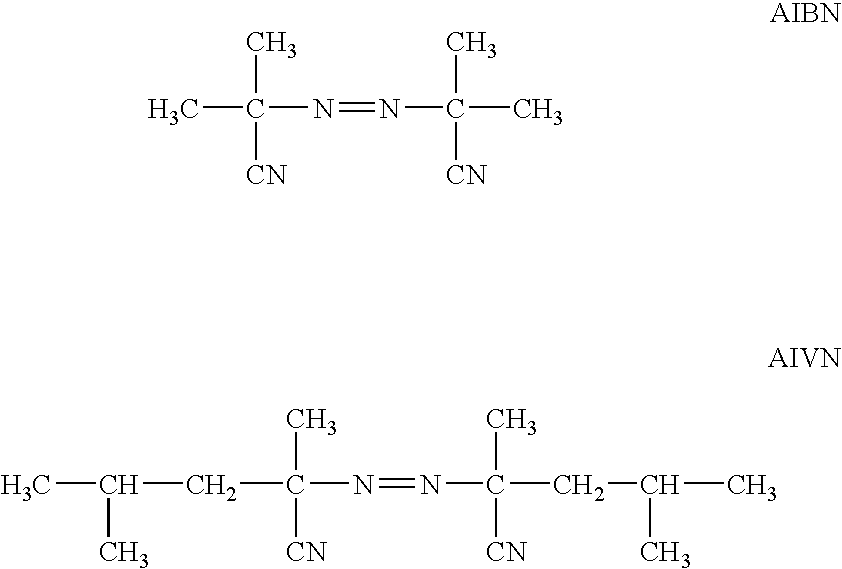
- the latter compound being particularly preferred for its low toxicity, as well as that of its degradation products (it is noted, however, that in general the polymerization initiator is used in a very small amount and is generally removed at the end of the process for the production of the intraocular lenses of the invention); or
-
- a peroxide such as benzoyl peroxide.
- Those skilled in the art know how to control the amount of said free-radical polymerization initiator used (generally less than 1 part by weight per 100 parts by weight of monomers to be copolymerized) and, in general, the polymerization kinetics of the reaction medium. They know in particular that, as oxygen neutralizes the action of said polymerization initiator, it is highly preferable to remove it from the reaction mixture before the temperature rises. It is highly recommended to bubble inert gas through said reaction mixture. As far as the heating program is concerned, its optimization is within the capability of those skilled in the art.
- The preparation of compositions polymerizable by a photochemical process is not excluded within the framework of the invention. In this case an effective amount of at least one conventional photoinitiator, e.g. of benzophenone type, is used in said compositions.
- Reference has also been made to an effective amount of at least one crosslinking agent. Such crosslinking can prove essential for ensuring the cohesion of the matrix and its stability. A crosslinking agent (at least bifunctional) is therefore generally used, in an effective amount, during the copolymerization of the comonomers or the crosslinking of the polymers. This effective amount—generally at most a few parts by weight: in principle between 0.5 and 5 parts by weight, advantageously between 0.5 and 2.5 parts by weight, per 100 parts by weight of reactants—must obviously remain reasonable. For example, the crosslinking agent used should not constitute a “comonomer” and consequently modify the properties, especially mechanical properties, of the expected copolymer.
- Whatever the case may be, those skilled in the art are not unaware that increasing the proportion of crosslinking agent used reduces the water content of the hydrogels and increases their glass transition temperature.
- As regards the reactive groups of said crosslinking agent, they are advantageously acrylate and/or methacrylate groups. Those skilled in the art are familiar with numerous crosslinking agents that carry such groups, especially the following:
- butanediol dimethacrylate and diacrylate,
- hexanediol dimethacrylate and diacrylate,
- decanediol dimethacrylate and diacrylate,
- ethylene glycol dimethacrylate (EDMA),
- tetraethylene glycol dimethacrylate.
- Within the framework of the present invention, it is recommended, without in any way implying a limitation, to use the crosslinking agents listed above, and very particularly EDMA.
- Thus the polymerizable and/or crosslinkable compositions of the invention generally contain crosslinking agents of this type (or of an equivalent type), traces of which are obviously found in the polymer matrices obtained from said compositions.
- In the context of producing intraocular lenses, those skilled in the art understand that said compositions may also generally contain an effective amount of at least one ultraviolet absorber. Those skilled in the art do not ignore the interest for a compound of this type, which will act as a UV filter, to be stabilized in the structure of intraocular lenses. The sought-after stabilization will be optimal if said ultraviolet absorber is itself also copolymerizable, i.e. has an appropriate reactive chemical entity, such as a double bond or an acrylate or methacrylate group, in its formula.
- Those skilled in the art are familiar with such compounds and several of them are commercially available, especially:
- 4-(2-acryloxyethoxy)-2-hydroxybenzophenone,
- 4-methacryloxy-2-hydroxybenzophenone (MOBP),
- 1,3-bis(4-benzoyl-3-hydroxyphenoxy)-2-propyl acrylate,
- 2-(2′-methacryloxy-5′-methylphenyl)benzotriazole.
- All these compounds are suitable within the framework of the present invention, but the Applicant has more particularly used MOBP insofar as it has been handling this UV filter for many years in the manufacture of intraocular lenses.
- The UV filters are generally used in an amount of 0.25 to 5 parts by weight, advantageously of 0.25 to 2 parts by weight, in the reactive mixture.
- The polymerizable and/or crosslinkable compositions of the invention are based on polymer matrix precursors containing an effective amount of at least one dye of the invention.
- Advantageously, said polymer matrix precursors are selected from polysiloxanes and monomers of acrylic type. Very advantageously, they are selected from monomers of acrylic type.
- The (crosslinkable) polysiloxanes used are known to those skilled in the art. There are actually two solutions to be handled:
- the first containing at least one polysiloxane with vinyl end groups and a catalyst,
- the second containing at least one polysiloxane with vinyl end groups and a polysiloxane with silicon hydride groups.
- When these two solutions are brought into contact, the groups
-

- react with the groups
-

- to form a resin (matrix). When dye of the invention is present, it becomes fixed and trapped within said resin.
- The monomers of acrylic type in question can fall into two categories: they can be suitable for generating a hydrophilic matrix or for generating a hydrophobic matrix. Conventionally, hydrophilic refers to a matrix with hydroxyl groups that allow said matrix to absorb water. Such a matrix is also called a hydrogel.
- In the context of hydrophilic matrices, preferred precursor mixtures are those based on:
-
- 2-hydroxyethyl methacrylate (HEMA) and
- at least one C1-C8 alkyl or hydroxyalkyl (meth)acrylate.
- Mixtures of the following types are very particularly preferred:
-
- 2-hydroxyethyl methacrylate (HEMA) and methyl methacrylate (MMA), especially the mixtures from which MENTOR produced lenses marketed at the time under the name MEMORYLENS®;
- 2-hydroxyethyl methacrylate (HEMA) and ethyl methacrylate (EMA), especially the mixtures described in FR-A-2 757 065; or
- 2-hydroxyethyl methacrylate (HEMA) and 6-hydroxyhexyl methacrylate (HHMA), especially the mixtures described in U.S. Pat. No. 5,217,491.
- In the context of hydrophobic matrices, preferred precursor mixtures are those based on monomers of the formula
-

- in which R is hydrogen or a methyl group and R′ is a linear or branched alkyl group containing from 1 to 5 carbon atoms or a (C1-C5 alkyl)phenyl group.
- Very particularly preferred mixtures are those based on methyl methacrylate (MMA) or those based on ethyl acrylate (EA) and ethyl methacrylate (EMA) (especially the mixtures described in EP-A-674 684).
- According to its fifth subject, the present invention relates to the colored polymer matrices obtainable by free-radical copolymerization and/or crosslinking of the polymerizable and/or crosslinkable compositions described above. Said matrices characteristically contain the yellow dye of formula (I), said yellow dye being stably contained therein. It forms an integral part of said matrices. It has reacted via its double bond(s) in order to enter their structure.
- The colored matrices are advantageously of polysiloxane or acrylic type (cf. above).
- According to its last subject, the present invention finally relates to intraocular lenses consisting wholly or partly of colored polymer matrices of the invention. At least the optics of said lenses are thus made up of colored polymer matrices of the invention. Advantageously, the optics and the haptics of said lenses are made up of colored polymer matrices of the invention.
- Such lenses are particularly high-performance in view of the advantages stated above in the present text for the compounds of formula (I) used as a yellow dye within them.
- The invention is illustrated by the following Examples and the appended Figures.
- The first step was to prepare a polymerizable yellow dye according to the invention—the compound of formula (Ia)—and this was then incorporated into polymerizable and crosslinkable compositions, which were polymerized and crosslinked in order to generate colored polymer matrices that were perfectly suitable as a constituent material of intraocular lenses.
-
FIG. 1 shows the 1H NMR spectrum of said compound of formula (Ia), as prepared. The following characteristic peaks are found in said spectrum: - aromatic rings between 7 and 8 ppm,
- vinylic bonds at 6.70, 5.75 and 5.20 ppm,
- CH2—N at 5.25 ppm,
- CH2—Ar at 4.95 ppm,
- CH3—Ar at 2.31 ppm and
- CH3—CO—N at 1.97 ppm.
- Transmission spectra are shown in
FIG. 2 , which is discussed below. - Said preparation is carried out at room temperature.
- 1 g of C.I. Disperse Yellow 3 (CAS no. 2832-40-8) is introduced into a round-bottomed flask and then covered with 50 ml of dimethylformamide. The whole is stirred for 1 h. The addition of 0.32 g of potassium hydroxide causes the solution to turn violet. Stirring is then maintained for 40 min.
- 4-Chloromethylstyrene (0.48 ml) is then added. The reaction medium is stirred for 42 h.
- When these 42 h have elapsed, 100 ml of deionized water are added to said reaction medium.
- The monomer (compound of formula (Ia)) is extracted with ether. The organic phase is subsequently washed with 5
times 100 ml of deionized water and then dried over sodium sulfate; the solvent is evaporated off. - The monomer is recrystallized from ether previously dried over sodium sulfate.
- The compound of formula (Ia) is weighed into a glass flask and then added to a solution of monomers containing:
-
- 82.5 g of 2-hydroxyethyl methacrylate (HEMA),
- 17.5 g of ethyl methacrylate (EMA),
- 0.8 g of ethylene glycol dimethacrylate and
- 0.5 g of 4-methacryloxy-2-hydroxybenzophenone,
in such a way that the concentration of dye is between 0.02 and 0.15% by weight, depending on the sample.
- Benzoyl peroxide (0.2 g) is then added.
- The mixture is homogenized by ultrasound and degassed with argon. Polymerization (crosslinking) is then effected at 40° C. for 96 h. Subsequent curing of the blanks is assured by a thermal post-polymerization phase of 3 hours at 100° C.
- The efficacy of the polymerization (crosslinking) reaction, or, more precisely, that of the trapping of the dye, was evaluated in the manner specified below.
- Hydrated pellets were extracted for a minimum of 6 hours with a mixture of equal volumes of methanol and distilled water. The UV-visible spectra of said pellets before and after extraction were compared.
- The loss of absorbance of said pellets remained below 10% between 400 and 500 nm and reached 20% for the weak transmissions between 350 and 400 nm. Such a loss of absorbance is not a serious problem.
- Furthermore, the material obtained offers a good filtering power for the blue rays which is similar to that obtained by the natural lens of a 25-year-old man, and a very good transmission for the wavelengths beyond the blue.
- The compound of formula (Ia) is weighed into a glass flask and then added to a solution of monomers containing:
-
- 82.5 g of 2-hydroxyethyl methacrylate (HEMA),
- 17.5 g of methyl methacrylate (MMA),
- 0.8 g of ethylene glycol dimethacrylate and
- 0.5 g of 4-methacryloxy-2-hydroxybenzophenone,
in such a way that the concentration of dye is between 0.02 and 0.15% by weight, depending on the sample.
- Benzoyl peroxide (0.2 g) is then added.
- The mixture is homogenized by ultrasound and degassed with argon. Polymerization (crosslinking) is then effected at 40° C. for 96 h. Subsequent curing of the blanks is assured by a thermal post-polymerization phase of 3 hours at 100° C.
- The material obtained offers a good filtering power for the blue rays which is similar to that obtained by the natural lens of a 25-year-old man, and a very good transmission for the wavelengths beyond the blue. This is shown in appended
FIG. 2 . - Said
FIG. 2 shows three transmission spectra, T=f(λ): -
- the first (- . . . -) representing the natural lens of a 25-year-old man,
- the third (-) representing a colored matrix (HEMA+MMA+dye of the invention in a proportion of 0.075% by weight), as prepared above,
- and the second (-) representing the corresponding transparent matrix (HEMA+MMA), prepared in the same manner without the use of dye.
- The compound of formula (Ia) is weighed into a glass flask and then added to a solution of monomers containing:
-
- 100 g of methyl methacrylate (MMA),
- 0.8 g of ethylene glycol dimethacrylate and
- 0.5 g of 4-methacryloxy-2-hydroxybenzophenone,
in such a way that the concentration of dye is between 0.02 and 0.15% by weight, depending on the sample.
- Benzoyl peroxide (0.2 g) is then added.
- The mixture is homogenized by ultrasound and degassed with argon. Polymerization (crosslinking) is then effected at 40° C. for 96 h. Subsequent curing of the blanks is assured by a thermal post-polymerization phase of 3 hours at 100° C.
- The material obtained offers a good filtering power for the blue rays which is similar to that obtained by the natural lens of a 25-year-old man, and a very good transmission for the wavelengths beyond the blue.
Claims (18)
1. Compounds of the formula

in which
R and R′ independently are a linear alkyl or hydroxyalkyl group containing from 1 to 4 carbon atoms;
i and j independently are an integer selected from 0, 1, 2, 3 and 4, it being possible for the different R, when i=2, 3 or 4, to be identical or different, and it being possible for the different R′, when j=2, 3 or 4, to be identical or different; and
R1, R2, R′1 and R′2 independently are hydrogen or a methyl group.
2. Compounds according to claim 1 of formula (I) in which
(R′)j=(R)i,
R′1=R1, and
R′2=R2.
3. Compound according to claim 1 of the formula

4. Process for the preparation of a compound according to claim 1 , wherein the process comprises reacting the compound of formula (II):

in an alkaline, polar, aprotic solvent medium, with at least one styrene derivative of formula (III):

in which
Y is a linear alkyl or hydroxyalkyl group containing from 1 to 4 carbon atoms;
z is an integer selected from 0, 1, 2, 3 and 4, it being possible for the different Y, when z=2, 3 or 4, to be identical or different; and
Y1 and Y2 independently are hydrogen or a methyl group,
said at least one styrene derivative being used in stoichiometric excess.
5. Process according to claim 4 , wherein said at least one compound of formula (III) is used in an amount corresponding to at least twice the stoichiometric amount and advantageously at least three times said stoichiometric amount.
6. Process according to claim 4 , wherein the process comprises reacting said compound of formula (II) with 4-chloromethylstyrene.
7. Polymerizable yellow dye consisting of a compound according to claim 1 .
8. Composition which is polymerizable and/or crosslinkable by a free-radical process, wherein the composition comprises a mixture of:
precursors of a polymer matrix; and
an effective amount of at least one polymerizable yellow dye according to claim 7 , said effective amount generally representing 0.02 to 0.15% by weight of said mixture.
9. Composition according to claim 8 , wherein said mixture also contains an effective amount of at least one polymerization initiator and/or an effective amount of at least one crosslinking agent.
10. Composition according to claim 8 , wherein said mixture also contains an effective amount of at least one ultraviolet absorber that is advantageously copolymerizable.
11. Composition according to claim 8 , wherein said polymer matrix precursors are selected from polysiloxanes and monomers of acrylic type.
12. Composition according to claim 8 , wherein said precursors are monomers of acrylic type that are suitable for generating a hydrophilic matrix.
13. Composition according to claim 12 , wherein the monomers of acrylic type consist of 2-hydroxyethyl methacrylate (HEMA) and at least one C1-C8 alkyl or hydroxyalkyl (meth)acrylate.
14. Composition according to claim 12 , wherein said monomers of acrylic type consist of the following mixtures:
2-hydroxyethyl methacrylate (HEMA) and methyl methacrylate (MMA);
2-hydroxyethyl methacrylate (HEMA) and ethyl methacrylate (EMA); or
2-hydroxyethyl methacrylate (HEMA) and 6-hydroxyhexyl methacrylate (HHMA).
15. Composition according to claim 8 , wherein said precursors are monomers of acrylic type that are suitable for generating a hydrophobic matrix.
16. Composition according to claim 15 , wherein said monomers of acrylic type have the formula

in which R is hydrogen or a methyl group and R′ is a linear or branched alkyl group containing from 1 to 5 carbon atoms or a (C1-C5 alkyl)phenyl group.
17. Colored polymer matrix obtainable by free-radical copolymerization and/or crosslinking of a polymerizable and/or crosslinkable composition according to claim 8 .
18. Intraocular lenses possessing optics and haptics, wherein said optics (said optics and said haptics) are made up of a colored polymer matrix according to claim 17 .
Applications Claiming Priority (3)
| Application Number | Priority Date | Filing Date | Title |
|---|---|---|---|
| FR0509882 | 2005-09-28 | ||
| FR0509882A FR2891276B1 (en) | 2005-09-28 | 2005-09-28 | COMPOUNDS SUITABLE FOR YELLOW POLYMERIZABLE COLORANTS; POLYMERIZABLE AND / OR CROSS - LINKABLE COMPOSITIONS, POLYMERIC MATRICES AND INTRAOCULAR LENSES REFLECTING THEREOF. |
| PCT/FR2006/050945 WO2007036672A2 (en) | 2005-09-28 | 2006-09-27 | Compounds suitable as polymerizable yellow dyes; polymerizable and/or crooslinkable compositions, polymer matrices and intraocular lenses containing same |
Publications (1)
| Publication Number | Publication Date |
|---|---|
| US20090240329A1 true US20090240329A1 (en) | 2009-09-24 |
Family
ID=36636382
Family Applications (1)
| Application Number | Title | Priority Date | Filing Date |
|---|---|---|---|
| US11/992,462 Abandoned US20090240329A1 (en) | 2005-09-28 | 2006-09-27 | Compounds Suitable as Polymerizable Yellow Dyes; Polymerizable and/or Crosslinkable Compositions, Polymer Matrices and Intraocular Lenses Containing them |
Country Status (6)
| Country | Link |
|---|---|
| US (1) | US20090240329A1 (en) |
| EP (1) | EP1931621B1 (en) |
| JP (1) | JP2009510209A (en) |
| DE (1) | DE602006015978D1 (en) |
| FR (1) | FR2891276B1 (en) |
| WO (1) | WO2007036672A2 (en) |
Cited By (7)
| Publication number | Priority date | Publication date | Assignee | Title |
|---|---|---|---|---|
| US20100296051A1 (en) * | 2008-02-12 | 2010-11-25 | Aaren Scientific Inc. | Ophthalmic lens having a yellow dye light blocking component |
| EP2657304A4 (en) * | 2010-10-25 | 2015-12-16 | Menicon Co Ltd | AZOIC COLORANT, OCULAR LENS MATERIAL, METHOD FOR PRODUCING OCULAR LENS MATERIAL, AND OCULAR LENSES |
| US10175574B2 (en) | 2014-01-31 | 2019-01-08 | Fujifilm Corporation | Coloring composition, and cured film, color filter, pattern forming method, method for manufacturing color filter, solid-state imaging device, image display device, and dye multimer, each using the coloring composition |
| US10191369B2 (en) | 2013-09-06 | 2019-01-29 | Fujifilm Corporation | Colored composition, cured film, color filter, color-filter manufacturing method, solid-state imaging element, image display device, polymer, and xanthene dye |
| US10551637B2 (en) | 2006-03-20 | 2020-02-04 | High Performance Optics, Inc. | High performance selective light wavelength filtering providing improved contrast sensitivity |
| CN112154165A (en) * | 2018-06-26 | 2020-12-29 | 荷兰联合利华有限公司 | Novel polymers, compositions, methods and kits for whitening teeth |
| US11701315B2 (en) | 2006-03-20 | 2023-07-18 | High Performance Optics, Inc. | High energy visible light filter systems with yellowness index values |
Families Citing this family (3)
| Publication number | Priority date | Publication date | Assignee | Title |
|---|---|---|---|---|
| JP2011106064A (en) * | 2009-11-18 | 2011-06-02 | Menicon Co Ltd | Dye composition for ophthalmic lens, method for producing colored ophthalmic lens using the same, and colored ophthalmic lens |
| US20130313733A1 (en) * | 2012-05-25 | 2013-11-28 | Ivan Nunez | Method of making a fully polymerized uv blocking silicone hydrogel lens |
| EP3274323A4 (en) * | 2015-03-25 | 2018-12-12 | Arkema, Inc. | Colored organic peroxide compositions |
Citations (7)
| Publication number | Priority date | Publication date | Assignee | Title |
|---|---|---|---|---|
| US5374663A (en) * | 1988-03-03 | 1994-12-20 | Hoya Corporation | Process for producing cyanopsia-correctable intraocular lens |
| US5470932A (en) * | 1993-10-18 | 1995-11-28 | Alcon Laboratories, Inc. | Polymerizable yellow dyes and their use in opthalmic lenses |
| US5496899A (en) * | 1993-09-06 | 1996-03-05 | France Telecom | Crosslinkable polymer material which may be used in non-linear optics and process for obtaining it |
| US5516467A (en) * | 1993-07-16 | 1996-05-14 | Menicon Co., Ltd. | Process for producing a tinted contact lens |
| US5919880A (en) * | 1996-04-05 | 1999-07-06 | Hoya Corporation | Reactive dyes and lenses utilizing the same |
| US6242551B1 (en) * | 1997-03-13 | 2001-06-05 | Menicon Co., Ltd. | Polymeric colorant and colored material for ocular lens using the colorant |
| US6310215B1 (en) * | 1999-04-07 | 2001-10-30 | Hoya Healthcare Corporation | Pyrazolone compounds and ophthalmic plastic lens using the same |
Family Cites Families (6)
| Publication number | Priority date | Publication date | Assignee | Title |
|---|---|---|---|---|
| JPS6030393A (en) * | 1983-07-28 | 1985-02-15 | Mitsubishi Chem Ind Ltd | Monoazo thermal transfer recording dye |
| JP2604799B2 (en) * | 1988-05-27 | 1997-04-30 | 株式会社メニコン | Intraocular lens material |
| US5217491A (en) | 1990-12-27 | 1993-06-08 | American Cyanamid Company | Composite intraocular lens |
| FR2757065B1 (en) | 1996-12-17 | 1999-03-05 | Corneal Ind | INTRAOCULAR LENS FLEXIBLE IN HYDROPHILIC ACRYLIC MATERIAL AND PREPARATION THEREOF |
| JPH10195324A (en) | 1997-01-16 | 1998-07-28 | Hoya Corp | Yellow reactive dye and spectacle lens containing the same |
| JP4210719B2 (en) | 2001-09-14 | 2009-01-21 | スター・ジャパン株式会社 | Ophthalmic lens |
-
2005
- 2005-09-28 FR FR0509882A patent/FR2891276B1/en not_active Expired - Fee Related
-
2006
- 2006-09-27 DE DE602006015978T patent/DE602006015978D1/en active Active
- 2006-09-27 WO PCT/FR2006/050945 patent/WO2007036672A2/en not_active Ceased
- 2006-09-27 EP EP06831232A patent/EP1931621B1/en not_active Not-in-force
- 2006-09-27 US US11/992,462 patent/US20090240329A1/en not_active Abandoned
- 2006-09-27 JP JP2008532839A patent/JP2009510209A/en active Pending
Patent Citations (7)
| Publication number | Priority date | Publication date | Assignee | Title |
|---|---|---|---|---|
| US5374663A (en) * | 1988-03-03 | 1994-12-20 | Hoya Corporation | Process for producing cyanopsia-correctable intraocular lens |
| US5516467A (en) * | 1993-07-16 | 1996-05-14 | Menicon Co., Ltd. | Process for producing a tinted contact lens |
| US5496899A (en) * | 1993-09-06 | 1996-03-05 | France Telecom | Crosslinkable polymer material which may be used in non-linear optics and process for obtaining it |
| US5470932A (en) * | 1993-10-18 | 1995-11-28 | Alcon Laboratories, Inc. | Polymerizable yellow dyes and their use in opthalmic lenses |
| US5919880A (en) * | 1996-04-05 | 1999-07-06 | Hoya Corporation | Reactive dyes and lenses utilizing the same |
| US6242551B1 (en) * | 1997-03-13 | 2001-06-05 | Menicon Co., Ltd. | Polymeric colorant and colored material for ocular lens using the colorant |
| US6310215B1 (en) * | 1999-04-07 | 2001-10-30 | Hoya Healthcare Corporation | Pyrazolone compounds and ophthalmic plastic lens using the same |
Cited By (9)
| Publication number | Priority date | Publication date | Assignee | Title |
|---|---|---|---|---|
| US10551637B2 (en) | 2006-03-20 | 2020-02-04 | High Performance Optics, Inc. | High performance selective light wavelength filtering providing improved contrast sensitivity |
| US11701315B2 (en) | 2006-03-20 | 2023-07-18 | High Performance Optics, Inc. | High energy visible light filter systems with yellowness index values |
| US11774783B2 (en) | 2006-03-20 | 2023-10-03 | High Performance Optics, Inc. | High performance selective light wavelength filtering providing improved contrast sensitivity |
| US20100296051A1 (en) * | 2008-02-12 | 2010-11-25 | Aaren Scientific Inc. | Ophthalmic lens having a yellow dye light blocking component |
| US8394906B2 (en) | 2008-02-12 | 2013-03-12 | Aaren Scientific Inc. | Ophthalmic lens having a yellow dye light blocking component |
| EP2657304A4 (en) * | 2010-10-25 | 2015-12-16 | Menicon Co Ltd | AZOIC COLORANT, OCULAR LENS MATERIAL, METHOD FOR PRODUCING OCULAR LENS MATERIAL, AND OCULAR LENSES |
| US10191369B2 (en) | 2013-09-06 | 2019-01-29 | Fujifilm Corporation | Colored composition, cured film, color filter, color-filter manufacturing method, solid-state imaging element, image display device, polymer, and xanthene dye |
| US10175574B2 (en) | 2014-01-31 | 2019-01-08 | Fujifilm Corporation | Coloring composition, and cured film, color filter, pattern forming method, method for manufacturing color filter, solid-state imaging device, image display device, and dye multimer, each using the coloring composition |
| CN112154165A (en) * | 2018-06-26 | 2020-12-29 | 荷兰联合利华有限公司 | Novel polymers, compositions, methods and kits for whitening teeth |
Also Published As
| Publication number | Publication date |
|---|---|
| DE602006015978D1 (en) | 2010-09-16 |
| EP1931621B1 (en) | 2010-08-04 |
| FR2891276A1 (en) | 2007-03-30 |
| JP2009510209A (en) | 2009-03-12 |
| WO2007036672A2 (en) | 2007-04-05 |
| WO2007036672A3 (en) | 2007-05-24 |
| FR2891276B1 (en) | 2007-12-21 |
| EP1931621A2 (en) | 2008-06-18 |
Similar Documents
| Publication | Publication Date | Title |
|---|---|---|
| US10421830B2 (en) | Nanohybrid polymers for ophthalmic applications | |
| JP5758407B2 (en) | Visible light absorbers for ophthalmic lens materials | |
| US6036891A (en) | Polymerizable hydrophilic ultraviolet light absorbing monomers | |
| JPH08503997A (en) | Polymerizable yellow dye and its use in ophthalmic lenses | |
| RU2635918C1 (en) | Stable polymerisable uv-absorbing dye for intraocular lens | |
| US20090240329A1 (en) | Compounds Suitable as Polymerizable Yellow Dyes; Polymerizable and/or Crosslinkable Compositions, Polymer Matrices and Intraocular Lenses Containing them | |
| AU603960B2 (en) | Ocular lens material | |
| JP2014196500A (en) | Improved method of producing tinted polymers | |
| EP0913713B1 (en) | Crosslinkable compound and an optical material employing it | |
| JPH09235309A (en) | Ophthalmic lens material containing ultraviolet absorbing polymer having no polymerizable group and method for producing the same | |
| JP2022071514A (en) | Ophthalmic material with contrast improving function | |
| JP2804279B2 (en) | Ophthalmic lens materials | |
| JP3150771B2 (en) | Ophthalmic lens materials | |
| JPH0622565B2 (en) | Intraocular lens material | |
| JP3040259B2 (en) | Ophthalmic lens materials | |
| JPH0777673A (en) | Hydrous soft contact lens |
Legal Events
| Date | Code | Title | Description |
|---|---|---|---|
| AS | Assignment |
Owner name: CORNEAL INNOVATION, FRANCE Free format text: ASSIGNMENT OF ASSIGNORS INTEREST;ASSIGNOR:GOUSSE, CECILE;REEL/FRAME:022058/0914 Effective date: 20080327 |
|
| STCB | Information on status: application discontinuation |
Free format text: ABANDONED -- FAILURE TO RESPOND TO AN OFFICE ACTION |