US20090156645A1 - Method for Increasing the Susceptibility of Peptide Deformylase Inhibitors by Using Efflux Pump Inhibitors - Google Patents
Method for Increasing the Susceptibility of Peptide Deformylase Inhibitors by Using Efflux Pump Inhibitors Download PDFInfo
- Publication number
- US20090156645A1 US20090156645A1 US11/570,954 US57095408A US2009156645A1 US 20090156645 A1 US20090156645 A1 US 20090156645A1 US 57095408 A US57095408 A US 57095408A US 2009156645 A1 US2009156645 A1 US 2009156645A1
- Authority
- US
- United States
- Prior art keywords
- gram
- negative bacteria
- pump
- influenzae
- alkyl
- Prior art date
- Legal status (The legal status is an assumption and is not a legal conclusion. Google has not performed a legal analysis and makes no representation as to the accuracy of the status listed.)
- Abandoned
Links
- 239000003112 inhibitor Substances 0.000 title claims abstract description 117
- 238000000034 method Methods 0.000 title claims abstract description 43
- 239000000081 peptide deformylase inhibitor Substances 0.000 title 1
- 241000894006 Bacteria Species 0.000 claims description 94
- 241000606768 Haemophilus influenzae Species 0.000 claims description 74
- 125000000217 alkyl group Chemical group 0.000 claims description 50
- 150000001875 compounds Chemical class 0.000 claims description 49
- 229910052739 hydrogen Inorganic materials 0.000 claims description 39
- 239000001257 hydrogen Substances 0.000 claims description 39
- 241000588724 Escherichia coli Species 0.000 claims description 33
- UFHFLCQGNIYNRP-UHFFFAOYSA-N Hydrogen Chemical compound [H][H] UFHFLCQGNIYNRP-UHFFFAOYSA-N 0.000 claims description 24
- 125000001997 phenyl group Chemical group [H]C1=C([H])C([H])=C(*)C([H])=C1[H] 0.000 claims description 23
- 125000000547 substituted alkyl group Chemical group 0.000 claims description 22
- 229910052736 halogen Inorganic materials 0.000 claims description 21
- 150000002367 halogens Chemical class 0.000 claims description 21
- 125000001072 heteroaryl group Chemical group 0.000 claims description 19
- 125000003545 alkoxy group Chemical group 0.000 claims description 18
- 150000003839 salts Chemical class 0.000 claims description 17
- 239000000651 prodrug Substances 0.000 claims description 16
- 229940002612 prodrug Drugs 0.000 claims description 16
- 125000003118 aryl group Chemical group 0.000 claims description 13
- 208000027096 gram-negative bacterial infections Diseases 0.000 claims description 12
- 125000002887 hydroxy group Chemical group [H]O* 0.000 claims description 12
- 241000124008 Mammalia Species 0.000 claims description 11
- 241000588652 Neisseria gonorrhoeae Species 0.000 claims description 11
- 239000008194 pharmaceutical composition Substances 0.000 claims description 11
- 208000035143 Bacterial infection Diseases 0.000 claims description 6
- 208000022362 bacterial infectious disease Diseases 0.000 claims description 6
- 239000003937 drug carrier Substances 0.000 claims description 5
- 150000002431 hydrogen Chemical class 0.000 claims 3
- 239000000203 mixture Substances 0.000 abstract description 11
- AYCMYBACERJYNY-HIFRSBDPSA-N (2s)-n-(5-fluoro-1-hydroxypyridin-2-ylidene)-1-[(2r)-2-[[formyl(hydroxy)amino]methyl]hexanoyl]pyrrolidine-2-carboxamide Chemical compound CCCC[C@H](CN(O)C=O)C(=O)N1CCC[C@H]1C(=O)N=C1N(O)C=C(F)C=C1 AYCMYBACERJYNY-HIFRSBDPSA-N 0.000 description 49
- 108010088346 NVP PDF 713 Proteins 0.000 description 49
- 101150079343 acrR gene Proteins 0.000 description 39
- 239000000758 substrate Substances 0.000 description 38
- 101150004068 acrB gene Proteins 0.000 description 27
- 101100394050 Escherichia coli (strain K12) gyrB gene Proteins 0.000 description 26
- -1 but not limited to Chemical group 0.000 description 25
- ULGZDMOVFRHVEP-RWJQBGPGSA-N Erythromycin Chemical compound O([C@@H]1[C@@H](C)C(=O)O[C@@H]([C@@]([C@H](O)[C@@H](C)C(=O)[C@H](C)C[C@@](C)(O)[C@H](O[C@H]2[C@@H]([C@H](C[C@@H](C)O2)N(C)C)O)[C@H]1C)(C)O)CC)[C@H]1C[C@@](C)(OC)[C@@H](O)[C@H](C)O1 ULGZDMOVFRHVEP-RWJQBGPGSA-N 0.000 description 22
- 239000003242 anti bacterial agent Substances 0.000 description 21
- 239000012634 fragment Substances 0.000 description 20
- 230000003247 decreasing effect Effects 0.000 description 19
- 0 *NC(=O)C1CCCN1C(=O)C([4*])([5*])C([2*])([3*])N(O)C([H])=O Chemical compound *NC(=O)C1CCCN1C(=O)C([4*])([5*])C([2*])([3*])N(O)C([H])=O 0.000 description 18
- 239000003795 chemical substances by application Substances 0.000 description 18
- 108090000623 proteins and genes Proteins 0.000 description 18
- 108020004414 DNA Proteins 0.000 description 17
- 229940088710 antibiotic agent Drugs 0.000 description 16
- 230000035772 mutation Effects 0.000 description 16
- 230000000694 effects Effects 0.000 description 15
- 230000014509 gene expression Effects 0.000 description 15
- 238000003780 insertion Methods 0.000 description 14
- 230000037431 insertion Effects 0.000 description 14
- 239000003120 macrolide antibiotic agent Substances 0.000 description 14
- 239000012528 membrane Substances 0.000 description 14
- 241001465754 Metazoa Species 0.000 description 13
- 229960002227 clindamycin Drugs 0.000 description 12
- KDLRVYVGXIQJDK-AWPVFWJPSA-N clindamycin Chemical compound CN1C[C@H](CCC)C[C@H]1C(=O)N[C@H]([C@H](C)Cl)[C@@H]1[C@H](O)[C@H](O)[C@@H](O)[C@@H](SC)O1 KDLRVYVGXIQJDK-AWPVFWJPSA-N 0.000 description 12
- 125000004435 hydrogen atom Chemical group [H]* 0.000 description 12
- 229930027917 kanamycin Natural products 0.000 description 12
- 229960000318 kanamycin Drugs 0.000 description 12
- SBUJHOSQTJFQJX-NOAMYHISSA-N kanamycin Chemical compound O[C@@H]1[C@@H](O)[C@H](O)[C@@H](CN)O[C@@H]1O[C@H]1[C@H](O)[C@@H](O[C@@H]2[C@@H]([C@@H](N)[C@H](O)[C@@H](CO)O2)O)[C@H](N)C[C@@H]1N SBUJHOSQTJFQJX-NOAMYHISSA-N 0.000 description 12
- 229930182823 kanamycin A Natural products 0.000 description 12
- 101150066706 acrA gene Proteins 0.000 description 11
- 229960003276 erythromycin Drugs 0.000 description 11
- 230000006870 function Effects 0.000 description 11
- 229940041033 macrolides Drugs 0.000 description 11
- 108010078791 Carrier Proteins Proteins 0.000 description 10
- 239000004098 Tetracycline Substances 0.000 description 10
- 125000002496 methyl group Chemical group [H]C([H])([H])* 0.000 description 10
- 229960002180 tetracycline Drugs 0.000 description 10
- 229930101283 tetracycline Natural products 0.000 description 10
- 235000019364 tetracycline Nutrition 0.000 description 10
- 150000003522 tetracyclines Chemical class 0.000 description 10
- 108090000862 Ion Channels Proteins 0.000 description 9
- 102000004310 Ion Channels Human genes 0.000 description 9
- ZNHUFUZDUQRKBB-VXKWHMMOSA-N MC-207,110 Chemical compound C([C@H](N)C(=O)N[C@@H](CCCN=C(N)N)C(=O)NC=1C=C2C=CC=CC2=CC=1)C1=CC=CC=C1 ZNHUFUZDUQRKBB-VXKWHMMOSA-N 0.000 description 9
- 108700026244 Open Reading Frames Proteins 0.000 description 9
- 239000002773 nucleotide Substances 0.000 description 9
- 125000003729 nucleotide group Chemical group 0.000 description 9
- 239000013612 plasmid Substances 0.000 description 9
- 125000004432 carbon atom Chemical group C* 0.000 description 8
- 210000004027 cell Anatomy 0.000 description 8
- 210000000170 cell membrane Anatomy 0.000 description 8
- 239000007330 chocolate agar Substances 0.000 description 8
- 230000007423 decrease Effects 0.000 description 8
- 125000005842 heteroatom Chemical group 0.000 description 8
- 230000002779 inactivation Effects 0.000 description 8
- 208000015181 infectious disease Diseases 0.000 description 8
- 238000012163 sequencing technique Methods 0.000 description 8
- 239000002609 medium Substances 0.000 description 7
- 125000001424 substituent group Chemical group 0.000 description 7
- 239000003981 vehicle Substances 0.000 description 7
- ZETUFNNCORDVMQ-CVEARBPZSA-N [H]C(=O)N(O)C[C@@H](CCCC)C(=O)N1CCC[C@H]1C(=O)NC1=[N+]([O-])C=C(C)C=C1 Chemical compound [H]C(=O)N(O)C[C@@H](CCCC)C(=O)N1CCC[C@H]1C(=O)NC1=[N+]([O-])C=C(C)C=C1 ZETUFNNCORDVMQ-CVEARBPZSA-N 0.000 description 6
- 230000001580 bacterial effect Effects 0.000 description 6
- 239000013599 cloning vector Substances 0.000 description 6
- 125000004093 cyano group Chemical group *C#N 0.000 description 6
- 229940079593 drug Drugs 0.000 description 6
- 239000003814 drug Substances 0.000 description 6
- 125000000449 nitro group Chemical group [O-][N+](*)=O 0.000 description 6
- 230000002018 overexpression Effects 0.000 description 6
- LFQSCWFLJHTTHZ-UHFFFAOYSA-N Ethanol Chemical compound CCO LFQSCWFLJHTTHZ-UHFFFAOYSA-N 0.000 description 5
- 125000002252 acyl group Chemical group 0.000 description 5
- 125000004423 acyloxy group Chemical group 0.000 description 5
- 230000008859 change Effects 0.000 description 5
- 238000012217 deletion Methods 0.000 description 5
- 230000037430 deletion Effects 0.000 description 5
- 125000004404 heteroalkyl group Chemical group 0.000 description 5
- 239000007788 liquid Substances 0.000 description 5
- 230000002829 reductive effect Effects 0.000 description 5
- 238000012360 testing method Methods 0.000 description 5
- XLYOFNOQVPJJNP-UHFFFAOYSA-N water Substances O XLYOFNOQVPJJNP-UHFFFAOYSA-N 0.000 description 5
- DNXIKVLOVZVMQF-UHFFFAOYSA-N (3beta,16beta,17alpha,18beta,20alpha)-17-hydroxy-11-methoxy-18-[(3,4,5-trimethoxybenzoyl)oxy]-yohimban-16-carboxylic acid, methyl ester Natural products C1C2CN3CCC(C4=CC=C(OC)C=C4N4)=C4C3CC2C(C(=O)OC)C(O)C1OC(=O)C1=CC(OC)=C(OC)C(OC)=C1 DNXIKVLOVZVMQF-UHFFFAOYSA-N 0.000 description 4
- 241000588626 Acinetobacter baumannii Species 0.000 description 4
- 108010016626 Dipeptides Proteins 0.000 description 4
- 206010059866 Drug resistance Diseases 0.000 description 4
- 241000282412 Homo Species 0.000 description 4
- 241000588747 Klebsiella pneumoniae Species 0.000 description 4
- LCQMZZCPPSWADO-UHFFFAOYSA-N Reserpilin Natural products COC(=O)C1COCC2CN3CCc4c([nH]c5cc(OC)c(OC)cc45)C3CC12 LCQMZZCPPSWADO-UHFFFAOYSA-N 0.000 description 4
- QEVHRUUCFGRFIF-SFWBKIHZSA-N Reserpine Natural products O=C(OC)[C@@H]1[C@H](OC)[C@H](OC(=O)c2cc(OC)c(OC)c(OC)c2)C[C@H]2[C@@H]1C[C@H]1N(C2)CCc2c3c([nH]c12)cc(OC)cc3 QEVHRUUCFGRFIF-SFWBKIHZSA-N 0.000 description 4
- 125000004390 alkyl sulfonyl group Chemical group 0.000 description 4
- 230000003115 biocidal effect Effects 0.000 description 4
- 230000037396 body weight Effects 0.000 description 4
- 238000010367 cloning Methods 0.000 description 4
- 239000006071 cream Substances 0.000 description 4
- 125000000753 cycloalkyl group Chemical group 0.000 description 4
- 238000009472 formulation Methods 0.000 description 4
- 230000037433 frameshift Effects 0.000 description 4
- 235000018102 proteins Nutrition 0.000 description 4
- 102000004169 proteins and genes Human genes 0.000 description 4
- BJOIZNZVOZKDIG-MDEJGZGSSA-N reserpine Chemical compound O([C@H]1[C@@H]([C@H]([C@H]2C[C@@H]3C4=C([C]5C=CC(OC)=CC5=N4)CCN3C[C@H]2C1)C(=O)OC)OC)C(=O)C1=CC(OC)=C(OC)C(OC)=C1 BJOIZNZVOZKDIG-MDEJGZGSSA-N 0.000 description 4
- 229960003147 reserpine Drugs 0.000 description 4
- MDMGHDFNKNZPAU-UHFFFAOYSA-N roserpine Natural products C1C2CN3CCC(C4=CC=C(OC)C=C4N4)=C4C3CC2C(OC(C)=O)C(OC)C1OC(=O)C1=CC(OC)=C(OC)C(OC)=C1 MDMGHDFNKNZPAU-UHFFFAOYSA-N 0.000 description 4
- 239000000243 solution Substances 0.000 description 4
- 239000002904 solvent Substances 0.000 description 4
- 125000005309 thioalkoxy group Chemical group 0.000 description 4
- 125000002023 trifluoromethyl group Chemical group FC(F)(F)* 0.000 description 4
- QTBSBXVTEAMEQO-UHFFFAOYSA-N Acetic acid Chemical compound CC(O)=O QTBSBXVTEAMEQO-UHFFFAOYSA-N 0.000 description 3
- 244000063299 Bacillus subtilis Species 0.000 description 3
- 108020004705 Codon Proteins 0.000 description 3
- FBPFZTCFMRRESA-FSIIMWSLSA-N D-Glucitol Natural products OC[C@H](O)[C@H](O)[C@@H](O)[C@H](O)CO FBPFZTCFMRRESA-FSIIMWSLSA-N 0.000 description 3
- CMFIPUGNHAMNJJ-UHFFFAOYSA-N MF-EA-371alpha Natural products O=C1C2=C(O)C=C(OS(O)(=O)=O)C=C2C(C)(C)C2=C1C(O)=C1CCC(C=C(C(=C3O)C(O)=O)CCCCC)=C3C1=C2 CMFIPUGNHAMNJJ-UHFFFAOYSA-N 0.000 description 3
- OFOBLEOULBTSOW-UHFFFAOYSA-N Malonic acid Chemical compound OC(=O)CC(O)=O OFOBLEOULBTSOW-UHFFFAOYSA-N 0.000 description 3
- PYUSHNKNPOHWEZ-YFKPBYRVSA-N N-formyl-L-methionine Chemical compound CSCC[C@@H](C(O)=O)NC=O PYUSHNKNPOHWEZ-YFKPBYRVSA-N 0.000 description 3
- DNIAPMSPPWPWGF-UHFFFAOYSA-N Propylene glycol Chemical compound CC(O)CO DNIAPMSPPWPWGF-UHFFFAOYSA-N 0.000 description 3
- DBMJMQXJHONAFJ-UHFFFAOYSA-M Sodium laurylsulphate Chemical compound [Na+].CCCCCCCCCCCCOS([O-])(=O)=O DBMJMQXJHONAFJ-UHFFFAOYSA-M 0.000 description 3
- 235000001014 amino acid Nutrition 0.000 description 3
- 150000001413 amino acids Chemical group 0.000 description 3
- 230000000845 anti-microbial effect Effects 0.000 description 3
- KRKNYBCHXYNGOX-UHFFFAOYSA-N citric acid Chemical compound OC(=O)CC(O)(C(O)=O)CC(O)=O KRKNYBCHXYNGOX-UHFFFAOYSA-N 0.000 description 3
- 230000007812 deficiency Effects 0.000 description 3
- 230000002950 deficient Effects 0.000 description 3
- 238000011161 development Methods 0.000 description 3
- 125000001495 ethyl group Chemical group [H]C([H])([H])C([H])([H])* 0.000 description 3
- 238000001125 extrusion Methods 0.000 description 3
- 125000002485 formyl group Chemical group [H]C(*)=O 0.000 description 3
- 239000000499 gel Substances 0.000 description 3
- 238000001727 in vivo Methods 0.000 description 3
- 230000005764 inhibitory process Effects 0.000 description 3
- 239000003550 marker Substances 0.000 description 3
- 235000016709 nutrition Nutrition 0.000 description 3
- 239000002674 ointment Substances 0.000 description 3
- 239000000546 pharmaceutical excipient Substances 0.000 description 3
- 230000003389 potentiating effect Effects 0.000 description 3
- 238000002360 preparation method Methods 0.000 description 3
- 239000003755 preservative agent Substances 0.000 description 3
- 235000019333 sodium laurylsulphate Nutrition 0.000 description 3
- 239000000600 sorbitol Substances 0.000 description 3
- 235000010356 sorbitol Nutrition 0.000 description 3
- 239000000725 suspension Substances 0.000 description 3
- 239000006188 syrup Substances 0.000 description 3
- 235000020357 syrup Nutrition 0.000 description 3
- 239000003826 tablet Substances 0.000 description 3
- ZMZDMBWJUHKJPS-UHFFFAOYSA-N thiocyanic acid Chemical compound SC#N ZMZDMBWJUHKJPS-UHFFFAOYSA-N 0.000 description 3
- 230000009466 transformation Effects 0.000 description 3
- 125000000008 (C1-C10) alkyl group Chemical group 0.000 description 2
- 125000004178 (C1-C4) alkyl group Chemical group 0.000 description 2
- GVEZIHKRYBHEFX-MNOVXSKESA-N 13C-Cerulenin Natural products CC=CCC=CCCC(=O)[C@H]1O[C@@H]1C(N)=O GVEZIHKRYBHEFX-MNOVXSKESA-N 0.000 description 2
- HZAXFHJVJLSVMW-UHFFFAOYSA-N 2-Aminoethan-1-ol Chemical compound NCCO HZAXFHJVJLSVMW-UHFFFAOYSA-N 0.000 description 2
- XMIIGOLPHOKFCH-UHFFFAOYSA-N 3-phenylpropionic acid Chemical compound OC(=O)CCC1=CC=CC=C1 XMIIGOLPHOKFCH-UHFFFAOYSA-N 0.000 description 2
- 241001136175 Burkholderia pseudomallei Species 0.000 description 2
- 241000282472 Canis lupus familiaris Species 0.000 description 2
- 108091006146 Channels Proteins 0.000 description 2
- FBPFZTCFMRRESA-JGWLITMVSA-N D-glucitol Chemical compound OC[C@H](O)[C@@H](O)[C@H](O)[C@H](O)CO FBPFZTCFMRRESA-JGWLITMVSA-N 0.000 description 2
- RGHNJXZEOKUKBD-SQOUGZDYSA-N D-gluconic acid Chemical group OC[C@@H](O)[C@@H](O)[C@H](O)[C@@H](O)C(O)=O RGHNJXZEOKUKBD-SQOUGZDYSA-N 0.000 description 2
- 102000016928 DNA-directed DNA polymerase Human genes 0.000 description 2
- 108010014303 DNA-directed DNA polymerase Proteins 0.000 description 2
- 101100364969 Dictyostelium discoideum scai gene Proteins 0.000 description 2
- 102000004190 Enzymes Human genes 0.000 description 2
- 108090000790 Enzymes Proteins 0.000 description 2
- PXGOKWXKJXAPGV-UHFFFAOYSA-N Fluorine Chemical compound FF PXGOKWXKJXAPGV-UHFFFAOYSA-N 0.000 description 2
- VZCYOOQTPOCHFL-OWOJBTEDSA-N Fumaric acid Chemical compound OC(=O)\C=C\C(O)=O VZCYOOQTPOCHFL-OWOJBTEDSA-N 0.000 description 2
- 108010010803 Gelatin Proteins 0.000 description 2
- PEDCQBHIVMGVHV-UHFFFAOYSA-N Glycerine Chemical compound OCC(O)CO PEDCQBHIVMGVHV-UHFFFAOYSA-N 0.000 description 2
- AEMRFAOFKBGASW-UHFFFAOYSA-N Glycolic acid Chemical compound OCC(O)=O AEMRFAOFKBGASW-UHFFFAOYSA-N 0.000 description 2
- VEXZGXHMUGYJMC-UHFFFAOYSA-N Hydrochloric acid Chemical compound Cl VEXZGXHMUGYJMC-UHFFFAOYSA-N 0.000 description 2
- 235000010643 Leucaena leucocephala Nutrition 0.000 description 2
- 240000007472 Leucaena leucocephala Species 0.000 description 2
- PFBKOGZUHMKYFK-UHFFFAOYSA-N MF-EA-371delta Natural products C1=C(OS(O)(=O)=O)C=C2C(C)(C)C3=CC4=C(C(O)=C(C(CCCCC)=C5)C(O)=O)C5=CC=C4C(O)=C3C(=O)C2=C1O PFBKOGZUHMKYFK-UHFFFAOYSA-N 0.000 description 2
- AFVFQIVMOAPDHO-UHFFFAOYSA-N Methanesulfonic acid Chemical compound CS(O)(=O)=O AFVFQIVMOAPDHO-UHFFFAOYSA-N 0.000 description 2
- 241000588655 Moraxella catarrhalis Species 0.000 description 2
- 101100364971 Mus musculus Scai gene Proteins 0.000 description 2
- 206010034133 Pathogen resistance Diseases 0.000 description 2
- NBIIXXVUZAFLBC-UHFFFAOYSA-N Phosphoric acid Chemical compound OP(O)(O)=O NBIIXXVUZAFLBC-UHFFFAOYSA-N 0.000 description 2
- 241000589776 Pseudomonas putida Species 0.000 description 2
- LCTONWCANYUPML-UHFFFAOYSA-N Pyruvic acid Chemical compound CC(=O)C(O)=O LCTONWCANYUPML-UHFFFAOYSA-N 0.000 description 2
- 108700005075 Regulator Genes Proteins 0.000 description 2
- 241000607715 Serratia marcescens Species 0.000 description 2
- VYPSYNLAJGMNEJ-UHFFFAOYSA-N Silicium dioxide Chemical compound O=[Si]=O VYPSYNLAJGMNEJ-UHFFFAOYSA-N 0.000 description 2
- 241000122973 Stenotrophomonas maltophilia Species 0.000 description 2
- QAOWNCQODCNURD-UHFFFAOYSA-N Sulfuric acid Chemical compound OS(O)(=O)=O QAOWNCQODCNURD-UHFFFAOYSA-N 0.000 description 2
- 239000013504 Triton X-100 Substances 0.000 description 2
- 229920004890 Triton X-100 Polymers 0.000 description 2
- LYPFVIYNUQCDPM-HIFRSBDPSA-N [H]C(=O)N(O)C[C@@H](CCCC)C(=O)N1CCC[C@H]1C(=O)NC1=[N+]([O-])C=C(F)C=C1 Chemical compound [H]C(=O)N(O)C[C@@H](CCCC)C(=O)N1CCC[C@H]1C(=O)NC1=[N+]([O-])C=C(F)C=C1 LYPFVIYNUQCDPM-HIFRSBDPSA-N 0.000 description 2
- 239000002253 acid Substances 0.000 description 2
- 239000000654 additive Substances 0.000 description 2
- 125000001931 aliphatic group Chemical group 0.000 description 2
- 239000004599 antimicrobial Substances 0.000 description 2
- 239000002246 antineoplastic agent Substances 0.000 description 2
- 239000002585 base Substances 0.000 description 2
- WPYMKLBDIGXBTP-UHFFFAOYSA-N benzoic acid Chemical compound OC(=O)C1=CC=CC=C1 WPYMKLBDIGXBTP-UHFFFAOYSA-N 0.000 description 2
- 239000003833 bile salt Substances 0.000 description 2
- 229940093761 bile salts Drugs 0.000 description 2
- GVEZIHKRYBHEFX-UHFFFAOYSA-N caerulein A Natural products CC=CCC=CCCC(=O)C1OC1C(N)=O GVEZIHKRYBHEFX-UHFFFAOYSA-N 0.000 description 2
- 239000002775 capsule Substances 0.000 description 2
- 125000004181 carboxyalkyl group Chemical group 0.000 description 2
- 239000000969 carrier Substances 0.000 description 2
- GVEZIHKRYBHEFX-NQQPLRFYSA-N cerulenin Chemical compound C\C=C\C\C=C\CCC(=O)[C@H]1O[C@H]1C(N)=O GVEZIHKRYBHEFX-NQQPLRFYSA-N 0.000 description 2
- 229950005984 cerulenin Drugs 0.000 description 2
- 238000006243 chemical reaction Methods 0.000 description 2
- 125000004122 cyclic group Chemical group 0.000 description 2
- 125000001559 cyclopropyl group Chemical group [H]C1([H])C([H])([H])C1([H])* 0.000 description 2
- 210000000805 cytoplasm Anatomy 0.000 description 2
- 229940127089 cytotoxic agent Drugs 0.000 description 2
- 230000007547 defect Effects 0.000 description 2
- 239000003599 detergent Substances 0.000 description 2
- XBDQKXXYIPTUBI-UHFFFAOYSA-N dimethylselenoniopropionate Natural products CCC(O)=O XBDQKXXYIPTUBI-UHFFFAOYSA-N 0.000 description 2
- 239000000975 dye Substances 0.000 description 2
- 239000000839 emulsion Substances 0.000 description 2
- 150000002148 esters Chemical class 0.000 description 2
- 235000019441 ethanol Nutrition 0.000 description 2
- 238000011049 filling Methods 0.000 description 2
- 229910052731 fluorine Inorganic materials 0.000 description 2
- 239000011737 fluorine Substances 0.000 description 2
- 239000008273 gelatin Substances 0.000 description 2
- 229920000159 gelatin Polymers 0.000 description 2
- 235000019322 gelatine Nutrition 0.000 description 2
- 235000011852 gelatine desserts Nutrition 0.000 description 2
- 239000001963 growth medium Substances 0.000 description 2
- 238000000338 in vitro Methods 0.000 description 2
- 230000002401 inhibitory effect Effects 0.000 description 2
- 230000000977 initiatory effect Effects 0.000 description 2
- 230000003993 interaction Effects 0.000 description 2
- SUMDYPCJJOFFON-UHFFFAOYSA-N isethionic acid Chemical compound OCCS(O)(=O)=O SUMDYPCJJOFFON-UHFFFAOYSA-N 0.000 description 2
- JVTAAEKCZFNVCJ-UHFFFAOYSA-N lactic acid Chemical compound CC(O)C(O)=O JVTAAEKCZFNVCJ-UHFFFAOYSA-N 0.000 description 2
- 230000000670 limiting effect Effects 0.000 description 2
- 239000006210 lotion Substances 0.000 description 2
- HQKMJHAJHXVSDF-UHFFFAOYSA-L magnesium stearate Chemical compound [Mg+2].CCCCCCCCCCCCCCCCCC([O-])=O.CCCCCCCCCCCCCCCCCC([O-])=O HQKMJHAJHXVSDF-UHFFFAOYSA-L 0.000 description 2
- 230000007246 mechanism Effects 0.000 description 2
- 230000002503 metabolic effect Effects 0.000 description 2
- 125000000956 methoxy group Chemical group [H]C([H])([H])O* 0.000 description 2
- 238000012986 modification Methods 0.000 description 2
- 230000004048 modification Effects 0.000 description 2
- TXXHDPDFNKHHGW-UHFFFAOYSA-N muconic acid Chemical compound OC(=O)C=CC=CC(O)=O TXXHDPDFNKHHGW-UHFFFAOYSA-N 0.000 description 2
- 125000004108 n-butyl group Chemical group [H]C([H])([H])C([H])([H])C([H])([H])C([H])([H])* 0.000 description 2
- FUZZWVXGSFPDMH-UHFFFAOYSA-N n-hexanoic acid Natural products CCCCCC(O)=O FUZZWVXGSFPDMH-UHFFFAOYSA-N 0.000 description 2
- 210000001322 periplasm Anatomy 0.000 description 2
- 230000035699 permeability Effects 0.000 description 2
- 125000002924 primary amino group Chemical group [H]N([H])* 0.000 description 2
- 238000001243 protein synthesis Methods 0.000 description 2
- YGSDEFSMJLZEOE-UHFFFAOYSA-N salicylic acid Chemical compound OC(=O)C1=CC=CC=C1O YGSDEFSMJLZEOE-UHFFFAOYSA-N 0.000 description 2
- 229920006395 saturated elastomer Polymers 0.000 description 2
- 238000006467 substitution reaction Methods 0.000 description 2
- 125000003396 thiol group Chemical group [H]S* 0.000 description 2
- VZCYOOQTPOCHFL-UHFFFAOYSA-N trans-butenedioic acid Natural products OC(=O)C=CC(O)=O VZCYOOQTPOCHFL-UHFFFAOYSA-N 0.000 description 2
- 230000014616 translation Effects 0.000 description 2
- 230000032258 transport Effects 0.000 description 2
- 238000011144 upstream manufacturing Methods 0.000 description 2
- 235000012431 wafers Nutrition 0.000 description 2
- 239000008215 water for injection Substances 0.000 description 2
- 239000000080 wetting agent Substances 0.000 description 2
- QBYIENPQHBMVBV-HFEGYEGKSA-N (2R)-2-hydroxy-2-phenylacetic acid Chemical compound O[C@@H](C(O)=O)c1ccccc1.O[C@@H](C(O)=O)c1ccccc1 QBYIENPQHBMVBV-HFEGYEGKSA-N 0.000 description 1
- LNAZSHAWQACDHT-XIYTZBAFSA-N (2r,3r,4s,5r,6s)-4,5-dimethoxy-2-(methoxymethyl)-3-[(2s,3r,4s,5r,6r)-3,4,5-trimethoxy-6-(methoxymethyl)oxan-2-yl]oxy-6-[(2r,3r,4s,5r,6r)-4,5,6-trimethoxy-2-(methoxymethyl)oxan-3-yl]oxyoxane Chemical compound CO[C@@H]1[C@@H](OC)[C@H](OC)[C@@H](COC)O[C@H]1O[C@H]1[C@H](OC)[C@@H](OC)[C@H](O[C@H]2[C@@H]([C@@H](OC)[C@H](OC)O[C@@H]2COC)OC)O[C@@H]1COC LNAZSHAWQACDHT-XIYTZBAFSA-N 0.000 description 1
- ALSTYHKOOCGGFT-KTKRTIGZSA-N (9Z)-octadecen-1-ol Chemical compound CCCCCCCC\C=C/CCCCCCCCO ALSTYHKOOCGGFT-KTKRTIGZSA-N 0.000 description 1
- 125000000229 (C1-C4)alkoxy group Chemical group 0.000 description 1
- MIOPJNTWMNEORI-GMSGAONNSA-N (S)-camphorsulfonic acid Chemical compound C1C[C@@]2(CS(O)(=O)=O)C(=O)C[C@@H]1C2(C)C MIOPJNTWMNEORI-GMSGAONNSA-N 0.000 description 1
- BJEPYKJPYRNKOW-REOHCLBHSA-N (S)-malic acid Chemical compound OC(=O)[C@@H](O)CC(O)=O BJEPYKJPYRNKOW-REOHCLBHSA-N 0.000 description 1
- WBYWAXJHAXSJNI-VOTSOKGWSA-M .beta-Phenylacrylic acid Natural products [O-]C(=O)\C=C\C1=CC=CC=C1 WBYWAXJHAXSJNI-VOTSOKGWSA-M 0.000 description 1
- ZORQXIQZAOLNGE-UHFFFAOYSA-N 1,1-difluorocyclohexane Chemical compound FC1(F)CCCCC1 ZORQXIQZAOLNGE-UHFFFAOYSA-N 0.000 description 1
- 125000004066 1-hydroxyethyl group Chemical group [H]OC([H])([*])C([H])([H])[H] 0.000 description 1
- IIZPXYDJLKNOIY-JXPKJXOSSA-N 1-palmitoyl-2-arachidonoyl-sn-glycero-3-phosphocholine Chemical compound CCCCCCCCCCCCCCCC(=O)OC[C@H](COP([O-])(=O)OCC[N+](C)(C)C)OC(=O)CCC\C=C/C\C=C/C\C=C/C\C=C/CCCCC IIZPXYDJLKNOIY-JXPKJXOSSA-N 0.000 description 1
- IZXIZTKNFFYFOF-UHFFFAOYSA-N 2-Oxazolidone Chemical compound O=C1NCCO1 IZXIZTKNFFYFOF-UHFFFAOYSA-N 0.000 description 1
- 125000000143 2-carboxyethyl group Chemical group [H]OC(=O)C([H])([H])C([H])([H])* 0.000 description 1
- 125000000954 2-hydroxyethyl group Chemical group [H]C([*])([H])C([H])([H])O[H] 0.000 description 1
- XLZYKTYMLBOINK-UHFFFAOYSA-N 3-(4-hydroxybenzoyl)benzoic acid Chemical compound OC(=O)C1=CC=CC(C(=O)C=2C=CC(O)=CC=2)=C1 XLZYKTYMLBOINK-UHFFFAOYSA-N 0.000 description 1
- BMYNFMYTOJXKLE-UHFFFAOYSA-N 3-azaniumyl-2-hydroxypropanoate Chemical compound NCC(O)C(O)=O BMYNFMYTOJXKLE-UHFFFAOYSA-N 0.000 description 1
- ZRPLANDPDWYOMZ-UHFFFAOYSA-N 3-cyclopentylpropionic acid Chemical compound OC(=O)CCC1CCCC1 ZRPLANDPDWYOMZ-UHFFFAOYSA-N 0.000 description 1
- RJWBTWIBUIGANW-UHFFFAOYSA-N 4-chlorobenzenesulfonic acid Chemical compound OS(=O)(=O)C1=CC=C(Cl)C=C1 RJWBTWIBUIGANW-UHFFFAOYSA-N 0.000 description 1
- ZCYVEMRRCGMTRW-UHFFFAOYSA-N 7553-56-2 Chemical compound [I] ZCYVEMRRCGMTRW-UHFFFAOYSA-N 0.000 description 1
- HBAQYPYDRFILMT-UHFFFAOYSA-N 8-[3-(1-cyclopropylpyrazol-4-yl)-1H-pyrazolo[4,3-d]pyrimidin-5-yl]-3-methyl-3,8-diazabicyclo[3.2.1]octan-2-one Chemical class C1(CC1)N1N=CC(=C1)C1=NNC2=C1N=C(N=C2)N1C2C(N(CC1CC2)C)=O HBAQYPYDRFILMT-UHFFFAOYSA-N 0.000 description 1
- 108010006533 ATP-Binding Cassette Transporters Proteins 0.000 description 1
- 102000005416 ATP-Binding Cassette Transporters Human genes 0.000 description 1
- QTBSBXVTEAMEQO-UHFFFAOYSA-M Acetate Chemical compound CC([O-])=O QTBSBXVTEAMEQO-UHFFFAOYSA-M 0.000 description 1
- 229920001817 Agar Polymers 0.000 description 1
- 235000019489 Almond oil Nutrition 0.000 description 1
- 102000003669 Antiporters Human genes 0.000 description 1
- 108090000084 Antiporters Proteins 0.000 description 1
- 241000416162 Astragalus gummifer Species 0.000 description 1
- 239000005711 Benzoic acid Substances 0.000 description 1
- 241000283690 Bos taurus Species 0.000 description 1
- WKBOTKDWSSQWDR-UHFFFAOYSA-N Bromine atom Chemical compound [Br] WKBOTKDWSSQWDR-UHFFFAOYSA-N 0.000 description 1
- WWZKQHOCKIZLMA-UHFFFAOYSA-N Caprylic acid Natural products CCCCCCCC(O)=O WWZKQHOCKIZLMA-UHFFFAOYSA-N 0.000 description 1
- 229920002134 Carboxymethyl cellulose Polymers 0.000 description 1
- ZAMOUSCENKQFHK-UHFFFAOYSA-N Chlorine atom Chemical compound [Cl] ZAMOUSCENKQFHK-UHFFFAOYSA-N 0.000 description 1
- WBYWAXJHAXSJNI-SREVYHEPSA-N Cinnamic acid Chemical compound OC(=O)\C=C/C1=CC=CC=C1 WBYWAXJHAXSJNI-SREVYHEPSA-N 0.000 description 1
- 229920002261 Corn starch Polymers 0.000 description 1
- RGHNJXZEOKUKBD-UHFFFAOYSA-N D-gluconic acid Chemical group OCC(O)C(O)C(O)C(O)C(O)=O RGHNJXZEOKUKBD-UHFFFAOYSA-N 0.000 description 1
- FEWJPZIEWOKRBE-JCYAYHJZSA-N Dextrotartaric acid Chemical compound OC(=O)[C@H](O)[C@@H](O)C(O)=O FEWJPZIEWOKRBE-JCYAYHJZSA-N 0.000 description 1
- 241000283086 Equidae Species 0.000 description 1
- IAYPIBMASNFSPL-UHFFFAOYSA-N Ethylene oxide Chemical compound C1CO1 IAYPIBMASNFSPL-UHFFFAOYSA-N 0.000 description 1
- 241000282326 Felis catus Species 0.000 description 1
- 241000192125 Firmicutes Species 0.000 description 1
- BDAGIHXWWSANSR-UHFFFAOYSA-M Formate Chemical compound [O-]C=O BDAGIHXWWSANSR-UHFFFAOYSA-M 0.000 description 1
- 206010064571 Gene mutation Diseases 0.000 description 1
- WQZGKKKJIJFFOK-GASJEMHNSA-N Glucose Natural products OC[C@H]1OC(O)[C@H](O)[C@@H](O)[C@@H]1O WQZGKKKJIJFFOK-GASJEMHNSA-N 0.000 description 1
- WHUUTDBJXJRKMK-UHFFFAOYSA-N Glutamic acid Chemical group OC(=O)C(N)CCC(O)=O WHUUTDBJXJRKMK-UHFFFAOYSA-N 0.000 description 1
- DHMQDGOQFOQNFH-UHFFFAOYSA-N Glycine Chemical compound NCC(O)=O DHMQDGOQFOQNFH-UHFFFAOYSA-N 0.000 description 1
- 239000004354 Hydroxyethyl cellulose Substances 0.000 description 1
- 229920000663 Hydroxyethyl cellulose Polymers 0.000 description 1
- WHUUTDBJXJRKMK-VKHMYHEASA-N L-glutamic acid Chemical group OC(=O)[C@@H](N)CCC(O)=O WHUUTDBJXJRKMK-VKHMYHEASA-N 0.000 description 1
- GUBGYTABKSRVRQ-QKKXKWKRSA-N Lactose Natural products OC[C@H]1O[C@@H](O[C@H]2[C@H](O)[C@@H](O)C(O)O[C@@H]2CO)[C@H](O)[C@@H](O)[C@H]1O GUBGYTABKSRVRQ-QKKXKWKRSA-N 0.000 description 1
- 235000019759 Maize starch Nutrition 0.000 description 1
- 102000018897 Membrane Fusion Proteins Human genes 0.000 description 1
- 108010027796 Membrane Fusion Proteins Proteins 0.000 description 1
- 102000005741 Metalloproteases Human genes 0.000 description 1
- 108010006035 Metalloproteases Proteins 0.000 description 1
- TXXHDPDFNKHHGW-CCAGOZQPSA-N Muconic acid Natural products OC(=O)\C=C/C=C\C(O)=O TXXHDPDFNKHHGW-CCAGOZQPSA-N 0.000 description 1
- 241000699670 Mus sp. Species 0.000 description 1
- MBBZMMPHUWSWHV-BDVNFPICSA-N N-methylglucamine Chemical compound CNC[C@H](O)[C@@H](O)[C@H](O)[C@H](O)CO MBBZMMPHUWSWHV-BDVNFPICSA-N 0.000 description 1
- BAWFJGJZGIEFAR-NNYOXOHSSA-N NAD zwitterion Chemical compound NC(=O)C1=CC=C[N+]([C@H]2[C@@H]([C@H](O)[C@@H](COP([O-])(=O)OP(O)(=O)OC[C@@H]3[C@H]([C@@H](O)[C@@H](O3)N3C4=NC=NC(N)=C4N=C3)O)O2)O)=C1 BAWFJGJZGIEFAR-NNYOXOHSSA-N 0.000 description 1
- KUXYCYLURMIFID-IFMALSPDSA-N NCCC[C@@H](N)C(=O)N[C@H](CCC1=CC=CC=C1)C(=O)NC1=CC2=C(C=CC=C2)N=C1 Chemical compound NCCC[C@@H](N)C(=O)N[C@H](CCC1=CC=CC=C1)C(=O)NC1=CC2=C(C=CC=C2)N=C1 KUXYCYLURMIFID-IFMALSPDSA-N 0.000 description 1
- MWHIVLDZWWNQPL-SXSPYAJSSA-N NC[C@@H]1CN[C@@H](C(=O)N[C@H](CCC2=CC=CC=C2)C(=O)NC2=CC3=C(C=C2)N=CC=C3)C1 Chemical compound NC[C@@H]1CN[C@@H](C(=O)N[C@H](CCC2=CC=CC=C2)C(=O)NC2=CC3=C(C=C2)N=CC=C3)C1 MWHIVLDZWWNQPL-SXSPYAJSSA-N 0.000 description 1
- GRYLNZFGIOXLOG-UHFFFAOYSA-N Nitric acid Chemical compound O[N+]([O-])=O GRYLNZFGIOXLOG-UHFFFAOYSA-N 0.000 description 1
- 108091034117 Oligonucleotide Proteins 0.000 description 1
- 238000010222 PCR analysis Methods 0.000 description 1
- 241001494479 Pecora Species 0.000 description 1
- 239000002202 Polyethylene glycol Substances 0.000 description 1
- 241000288906 Primates Species 0.000 description 1
- 241000589517 Pseudomonas aeruginosa Species 0.000 description 1
- 101100237386 Pseudomonas aeruginosa (strain ATCC 15692 / DSM 22644 / CIP 104116 / JCM 14847 / LMG 12228 / 1C / PRS 101 / PAO1) mexR gene Proteins 0.000 description 1
- 101100406476 Pseudomonas aeruginosa (strain ATCC 15692 / DSM 22644 / CIP 104116 / JCM 14847 / LMG 12228 / 1C / PRS 101 / PAO1) oprM gene Proteins 0.000 description 1
- 101710194805 Putative repressor Proteins 0.000 description 1
- IWYDHOAUDWTVEP-UHFFFAOYSA-N R-2-phenyl-2-hydroxyacetic acid Natural products OC(=O)C(O)C1=CC=CC=C1 IWYDHOAUDWTVEP-UHFFFAOYSA-N 0.000 description 1
- 241000700159 Rattus Species 0.000 description 1
- 108010034634 Repressor Proteins Proteins 0.000 description 1
- 102000009661 Repressor Proteins Human genes 0.000 description 1
- 241000589180 Rhizobium Species 0.000 description 1
- 239000004141 Sodium laurylsulphate Substances 0.000 description 1
- 235000021355 Stearic acid Nutrition 0.000 description 1
- KDYFGRWQOYBRFD-UHFFFAOYSA-N Succinic acid Natural products OC(=O)CCC(O)=O KDYFGRWQOYBRFD-UHFFFAOYSA-N 0.000 description 1
- 241000282887 Suidae Species 0.000 description 1
- FEWJPZIEWOKRBE-UHFFFAOYSA-N Tartaric acid Natural products [H+].[H+].[O-]C(=O)C(O)C(O)C([O-])=O FEWJPZIEWOKRBE-UHFFFAOYSA-N 0.000 description 1
- 229920001615 Tragacanth Polymers 0.000 description 1
- GSEJCLTVZPLZKY-UHFFFAOYSA-N Triethanolamine Chemical compound OCCN(CCO)CCO GSEJCLTVZPLZKY-UHFFFAOYSA-N 0.000 description 1
- 229930003448 Vitamin K Natural products 0.000 description 1
- JLCPHMBAVCMARE-UHFFFAOYSA-N [3-[[3-[[3-[[3-[[3-[[3-[[3-[[3-[[3-[[3-[[3-[[5-(2-amino-6-oxo-1H-purin-9-yl)-3-[[3-[[3-[[3-[[3-[[3-[[5-(2-amino-6-oxo-1H-purin-9-yl)-3-[[5-(2-amino-6-oxo-1H-purin-9-yl)-3-hydroxyoxolan-2-yl]methoxy-hydroxyphosphoryl]oxyoxolan-2-yl]methoxy-hydroxyphosphoryl]oxy-5-(5-methyl-2,4-dioxopyrimidin-1-yl)oxolan-2-yl]methoxy-hydroxyphosphoryl]oxy-5-(6-aminopurin-9-yl)oxolan-2-yl]methoxy-hydroxyphosphoryl]oxy-5-(6-aminopurin-9-yl)oxolan-2-yl]methoxy-hydroxyphosphoryl]oxy-5-(6-aminopurin-9-yl)oxolan-2-yl]methoxy-hydroxyphosphoryl]oxy-5-(6-aminopurin-9-yl)oxolan-2-yl]methoxy-hydroxyphosphoryl]oxyoxolan-2-yl]methoxy-hydroxyphosphoryl]oxy-5-(5-methyl-2,4-dioxopyrimidin-1-yl)oxolan-2-yl]methoxy-hydroxyphosphoryl]oxy-5-(4-amino-2-oxopyrimidin-1-yl)oxolan-2-yl]methoxy-hydroxyphosphoryl]oxy-5-(5-methyl-2,4-dioxopyrimidin-1-yl)oxolan-2-yl]methoxy-hydroxyphosphoryl]oxy-5-(5-methyl-2,4-dioxopyrimidin-1-yl)oxolan-2-yl]methoxy-hydroxyphosphoryl]oxy-5-(6-aminopurin-9-yl)oxolan-2-yl]methoxy-hydroxyphosphoryl]oxy-5-(6-aminopurin-9-yl)oxolan-2-yl]methoxy-hydroxyphosphoryl]oxy-5-(4-amino-2-oxopyrimidin-1-yl)oxolan-2-yl]methoxy-hydroxyphosphoryl]oxy-5-(4-amino-2-oxopyrimidin-1-yl)oxolan-2-yl]methoxy-hydroxyphosphoryl]oxy-5-(4-amino-2-oxopyrimidin-1-yl)oxolan-2-yl]methoxy-hydroxyphosphoryl]oxy-5-(6-aminopurin-9-yl)oxolan-2-yl]methoxy-hydroxyphosphoryl]oxy-5-(4-amino-2-oxopyrimidin-1-yl)oxolan-2-yl]methyl [5-(6-aminopurin-9-yl)-2-(hydroxymethyl)oxolan-3-yl] hydrogen phosphate Polymers Cc1cn(C2CC(OP(O)(=O)OCC3OC(CC3OP(O)(=O)OCC3OC(CC3O)n3cnc4c3nc(N)[nH]c4=O)n3cnc4c3nc(N)[nH]c4=O)C(COP(O)(=O)OC3CC(OC3COP(O)(=O)OC3CC(OC3COP(O)(=O)OC3CC(OC3COP(O)(=O)OC3CC(OC3COP(O)(=O)OC3CC(OC3COP(O)(=O)OC3CC(OC3COP(O)(=O)OC3CC(OC3COP(O)(=O)OC3CC(OC3COP(O)(=O)OC3CC(OC3COP(O)(=O)OC3CC(OC3COP(O)(=O)OC3CC(OC3COP(O)(=O)OC3CC(OC3COP(O)(=O)OC3CC(OC3COP(O)(=O)OC3CC(OC3COP(O)(=O)OC3CC(OC3COP(O)(=O)OC3CC(OC3COP(O)(=O)OC3CC(OC3CO)n3cnc4c(N)ncnc34)n3ccc(N)nc3=O)n3cnc4c(N)ncnc34)n3ccc(N)nc3=O)n3ccc(N)nc3=O)n3ccc(N)nc3=O)n3cnc4c(N)ncnc34)n3cnc4c(N)ncnc34)n3cc(C)c(=O)[nH]c3=O)n3cc(C)c(=O)[nH]c3=O)n3ccc(N)nc3=O)n3cc(C)c(=O)[nH]c3=O)n3cnc4c3nc(N)[nH]c4=O)n3cnc4c(N)ncnc34)n3cnc4c(N)ncnc34)n3cnc4c(N)ncnc34)n3cnc4c(N)ncnc34)O2)c(=O)[nH]c1=O JLCPHMBAVCMARE-UHFFFAOYSA-N 0.000 description 1
- 238000010521 absorption reaction Methods 0.000 description 1
- 230000035508 accumulation Effects 0.000 description 1
- 238000009825 accumulation Methods 0.000 description 1
- 125000002777 acetyl group Chemical group [H]C([H])([H])C(*)=O 0.000 description 1
- 230000002378 acidificating effect Effects 0.000 description 1
- 230000009471 action Effects 0.000 description 1
- 239000000443 aerosol Substances 0.000 description 1
- 239000008272 agar Substances 0.000 description 1
- 238000000246 agarose gel electrophoresis Methods 0.000 description 1
- 229910001413 alkali metal ion Inorganic materials 0.000 description 1
- 125000003342 alkenyl group Chemical group 0.000 description 1
- 125000004453 alkoxycarbonyl group Chemical group 0.000 description 1
- 125000000304 alkynyl group Chemical group 0.000 description 1
- 125000005336 allyloxy group Chemical group 0.000 description 1
- 239000008168 almond oil Substances 0.000 description 1
- BJEPYKJPYRNKOW-UHFFFAOYSA-N alpha-hydroxysuccinic acid Natural products OC(=O)C(O)CC(O)=O BJEPYKJPYRNKOW-UHFFFAOYSA-N 0.000 description 1
- 230000004075 alteration Effects 0.000 description 1
- 229910052782 aluminium Inorganic materials 0.000 description 1
- 229910000147 aluminium phosphate Inorganic materials 0.000 description 1
- CEGOLXSVJUTHNZ-UHFFFAOYSA-K aluminium tristearate Chemical compound [Al+3].CCCCCCCCCCCCCCCCCC([O-])=O.CCCCCCCCCCCCCCCCCC([O-])=O.CCCCCCCCCCCCCCCCCC([O-])=O CEGOLXSVJUTHNZ-UHFFFAOYSA-K 0.000 description 1
- 239000003708 ampul Substances 0.000 description 1
- 238000004458 analytical method Methods 0.000 description 1
- 125000005428 anthryl group Chemical group [H]C1=C([H])C([H])=C2C([H])=C3C(*)=C([H])C([H])=C([H])C3=C([H])C2=C1[H] 0.000 description 1
- 230000003466 anti-cipated effect Effects 0.000 description 1
- 229940124350 antibacterial drug Drugs 0.000 description 1
- 238000009635 antibiotic susceptibility testing Methods 0.000 description 1
- 150000001483 arginine derivatives Chemical class 0.000 description 1
- 125000004104 aryloxy group Chemical group 0.000 description 1
- 125000004429 atom Chemical group 0.000 description 1
- 230000010455 autoregulation Effects 0.000 description 1
- 229930185621 benastatin Natural products 0.000 description 1
- SRSXLGNVWSONIS-UHFFFAOYSA-N benzenesulfonic acid Chemical compound OS(=O)(=O)C1=CC=CC=C1 SRSXLGNVWSONIS-UHFFFAOYSA-N 0.000 description 1
- 229940092714 benzenesulfonic acid Drugs 0.000 description 1
- 235000010233 benzoic acid Nutrition 0.000 description 1
- 150000001558 benzoic acid derivatives Chemical class 0.000 description 1
- GONOPSZTUGRENK-UHFFFAOYSA-N benzyl(trichloro)silane Chemical compound Cl[Si](Cl)(Cl)CC1=CC=CC=C1 GONOPSZTUGRENK-UHFFFAOYSA-N 0.000 description 1
- WQZGKKKJIJFFOK-VFUOTHLCSA-N beta-D-glucose Chemical compound OC[C@H]1O[C@@H](O)[C@H](O)[C@@H](O)[C@@H]1O WQZGKKKJIJFFOK-VFUOTHLCSA-N 0.000 description 1
- 239000011230 binding agent Substances 0.000 description 1
- 239000003139 biocide Substances 0.000 description 1
- 230000033228 biological regulation Effects 0.000 description 1
- 230000015572 biosynthetic process Effects 0.000 description 1
- 230000036983 biotransformation Effects 0.000 description 1
- 210000004556 brain Anatomy 0.000 description 1
- GDTBXPJZTBHREO-UHFFFAOYSA-N bromine Substances BrBr GDTBXPJZTBHREO-UHFFFAOYSA-N 0.000 description 1
- 229910052794 bromium Inorganic materials 0.000 description 1
- 238000002815 broth microdilution Methods 0.000 description 1
- 239000006172 buffering agent Substances 0.000 description 1
- KDYFGRWQOYBRFD-NUQCWPJISA-N butanedioic acid Chemical compound O[14C](=O)CC[14C](O)=O KDYFGRWQOYBRFD-NUQCWPJISA-N 0.000 description 1
- 125000004063 butyryl group Chemical group O=C([*])C([H])([H])C([H])([H])C([H])([H])[H] 0.000 description 1
- 210000004899 c-terminal region Anatomy 0.000 description 1
- 239000001506 calcium phosphate Substances 0.000 description 1
- 229910000389 calcium phosphate Inorganic materials 0.000 description 1
- 235000011010 calcium phosphates Nutrition 0.000 description 1
- 150000004657 carbamic acid derivatives Chemical class 0.000 description 1
- 125000002837 carbocyclic group Chemical group 0.000 description 1
- 229910052799 carbon Inorganic materials 0.000 description 1
- 125000002915 carbonyl group Chemical group [*:2]C([*:1])=O 0.000 description 1
- 239000001768 carboxy methyl cellulose Substances 0.000 description 1
- 235000010948 carboxy methyl cellulose Nutrition 0.000 description 1
- 125000002057 carboxymethyl group Chemical group [H]OC(=O)C([H])([H])[*] 0.000 description 1
- 239000008112 carboxymethyl-cellulose Substances 0.000 description 1
- 230000003915 cell function Effects 0.000 description 1
- 238000001311 chemical methods and process Methods 0.000 description 1
- 229960005091 chloramphenicol Drugs 0.000 description 1
- WIIZWVCIJKGZOK-RKDXNWHRSA-N chloramphenicol Chemical compound ClC(Cl)C(=O)N[C@H](CO)[C@H](O)C1=CC=C([N+]([O-])=O)C=C1 WIIZWVCIJKGZOK-RKDXNWHRSA-N 0.000 description 1
- 229910052801 chlorine Inorganic materials 0.000 description 1
- 239000000460 chlorine Substances 0.000 description 1
- 125000001309 chloro group Chemical group Cl* 0.000 description 1
- 235000013985 cinnamic acid Nutrition 0.000 description 1
- 229930016911 cinnamic acid Natural products 0.000 description 1
- 235000015165 citric acid Nutrition 0.000 description 1
- 239000003086 colorant Substances 0.000 description 1
- 230000000295 complement effect Effects 0.000 description 1
- 238000012790 confirmation Methods 0.000 description 1
- 238000011109 contamination Methods 0.000 description 1
- 230000001276 controlling effect Effects 0.000 description 1
- 239000012050 conventional carrier Substances 0.000 description 1
- 150000001924 cycloalkanes Chemical class 0.000 description 1
- 125000001995 cyclobutyl group Chemical group [H]C1([H])C([H])([H])C([H])(*)C1([H])[H] 0.000 description 1
- 125000000113 cyclohexyl group Chemical group [H]C1([H])C([H])([H])C([H])([H])C([H])(*)C([H])([H])C1([H])[H] 0.000 description 1
- 125000001511 cyclopentyl group Chemical group [H]C1([H])C([H])([H])C([H])([H])C([H])(*)C1([H])[H] 0.000 description 1
- 238000001514 detection method Methods 0.000 description 1
- ZBCBWPMODOFKDW-UHFFFAOYSA-N diethanolamine Chemical compound OCCNCCO ZBCBWPMODOFKDW-UHFFFAOYSA-N 0.000 description 1
- 238000010790 dilution Methods 0.000 description 1
- 239000012895 dilution Substances 0.000 description 1
- 239000007884 disintegrant Substances 0.000 description 1
- MOTZDAYCYVMXPC-UHFFFAOYSA-N dodecyl hydrogen sulfate Chemical group CCCCCCCCCCCCOS(O)(=O)=O MOTZDAYCYVMXPC-UHFFFAOYSA-N 0.000 description 1
- 239000002552 dosage form Substances 0.000 description 1
- 238000009509 drug development Methods 0.000 description 1
- 239000003221 ear drop Substances 0.000 description 1
- 229940047652 ear drops Drugs 0.000 description 1
- 239000008157 edible vegetable oil Substances 0.000 description 1
- 239000003974 emollient agent Substances 0.000 description 1
- 239000003995 emulsifying agent Substances 0.000 description 1
- 108010030074 endodeoxyribonuclease MluI Proteins 0.000 description 1
- AFAXGSQYZLGZPG-UHFFFAOYSA-N ethanedisulfonic acid Chemical compound OS(=O)(=O)CCS(O)(=O)=O AFAXGSQYZLGZPG-UHFFFAOYSA-N 0.000 description 1
- CCIVGXIOQKPBKL-UHFFFAOYSA-M ethanesulfonate Chemical compound CCS([O-])(=O)=O CCIVGXIOQKPBKL-UHFFFAOYSA-M 0.000 description 1
- BEFDCLMNVWHSGT-UHFFFAOYSA-N ethenylcyclopentane Chemical compound C=CC1CCCC1 BEFDCLMNVWHSGT-UHFFFAOYSA-N 0.000 description 1
- 230000001747 exhibiting effect Effects 0.000 description 1
- 238000010195 expression analysis Methods 0.000 description 1
- 239000013604 expression vector Substances 0.000 description 1
- 238000000605 extraction Methods 0.000 description 1
- 239000003889 eye drop Substances 0.000 description 1
- 229940012356 eye drops Drugs 0.000 description 1
- 239000003885 eye ointment Substances 0.000 description 1
- 239000003925 fat Substances 0.000 description 1
- 239000000945 filler Substances 0.000 description 1
- 238000001914 filtration Methods 0.000 description 1
- 239000000796 flavoring agent Substances 0.000 description 1
- 239000012530 fluid Substances 0.000 description 1
- 125000001153 fluoro group Chemical group F* 0.000 description 1
- 101150069904 ftsN gene Proteins 0.000 description 1
- 239000001530 fumaric acid Substances 0.000 description 1
- 235000011087 fumaric acid Nutrition 0.000 description 1
- 125000000524 functional group Chemical group 0.000 description 1
- 238000003208 gene overexpression Methods 0.000 description 1
- 230000002068 genetic effect Effects 0.000 description 1
- 239000000174 gluconic acid Chemical group 0.000 description 1
- 235000012208 gluconic acid Nutrition 0.000 description 1
- 239000008103 glucose Substances 0.000 description 1
- 239000004220 glutamic acid Chemical group 0.000 description 1
- 235000013922 glutamic acid Nutrition 0.000 description 1
- 235000011187 glycerol Nutrition 0.000 description 1
- 244000000058 gram-negative pathogen Species 0.000 description 1
- 239000008187 granular material Substances 0.000 description 1
- 229940047650 haemophilus influenzae Drugs 0.000 description 1
- 125000005843 halogen group Chemical group 0.000 description 1
- BTIJJDXEELBZFS-QDUVMHSLSA-K hemin Chemical compound CC1=C(CCC(O)=O)C(C=C2C(CCC(O)=O)=C(C)\C(N2[Fe](Cl)N23)=C\4)=N\C1=C/C2=C(C)C(C=C)=C3\C=C/1C(C)=C(C=C)C/4=N\1 BTIJJDXEELBZFS-QDUVMHSLSA-K 0.000 description 1
- 229940025294 hemin Drugs 0.000 description 1
- 125000004356 hydroxy functional group Chemical group O* 0.000 description 1
- 235000019447 hydroxyethyl cellulose Nutrition 0.000 description 1
- 150000002443 hydroxylamines Chemical class 0.000 description 1
- 125000004029 hydroxymethyl group Chemical group [H]OC([H])([H])* 0.000 description 1
- 230000003116 impacting effect Effects 0.000 description 1
- 230000006698 induction Effects 0.000 description 1
- 230000004941 influx Effects 0.000 description 1
- 238000001802 infusion Methods 0.000 description 1
- 239000002054 inoculum Substances 0.000 description 1
- 230000007154 intracellular accumulation Effects 0.000 description 1
- 239000011630 iodine Substances 0.000 description 1
- 229910052740 iodine Inorganic materials 0.000 description 1
- 150000002500 ions Chemical class 0.000 description 1
- 125000000959 isobutyl group Chemical group [H]C([H])([H])C([H])(C([H])([H])[H])C([H])([H])* 0.000 description 1
- 125000001449 isopropyl group Chemical group [H]C([H])([H])C([H])(*)C([H])([H])[H] 0.000 description 1
- 239000004310 lactic acid Substances 0.000 description 1
- 235000014655 lactic acid Nutrition 0.000 description 1
- 239000008101 lactose Substances 0.000 description 1
- 239000000787 lecithin Substances 0.000 description 1
- 235000010445 lecithin Nutrition 0.000 description 1
- 229940067606 lecithin Drugs 0.000 description 1
- 239000003589 local anesthetic agent Substances 0.000 description 1
- 239000007937 lozenge Substances 0.000 description 1
- 239000008176 lyophilized powder Substances 0.000 description 1
- 235000019359 magnesium stearate Nutrition 0.000 description 1
- VZCYOOQTPOCHFL-UPHRSURJSA-N maleic acid Chemical compound OC(=O)\C=C/C(O)=O VZCYOOQTPOCHFL-UPHRSURJSA-N 0.000 description 1
- 239000011976 maleic acid Substances 0.000 description 1
- 239000001630 malic acid Substances 0.000 description 1
- 235000011090 malic acid Nutrition 0.000 description 1
- 229960002510 mandelic acid Drugs 0.000 description 1
- 239000000463 material Substances 0.000 description 1
- 230000035800 maturation Effects 0.000 description 1
- 239000000155 melt Substances 0.000 description 1
- 229910021645 metal ion Inorganic materials 0.000 description 1
- 229940098779 methanesulfonic acid Drugs 0.000 description 1
- 125000004184 methoxymethyl group Chemical group [H]C([H])([H])OC([H])([H])* 0.000 description 1
- 229920000609 methyl cellulose Polymers 0.000 description 1
- 239000004292 methyl p-hydroxybenzoate Substances 0.000 description 1
- 235000010270 methyl p-hydroxybenzoate Nutrition 0.000 description 1
- WBYWAXJHAXSJNI-UHFFFAOYSA-N methyl p-hydroxycinnamate Natural products OC(=O)C=CC1=CC=CC=C1 WBYWAXJHAXSJNI-UHFFFAOYSA-N 0.000 description 1
- 239000001923 methylcellulose Substances 0.000 description 1
- 235000010981 methylcellulose Nutrition 0.000 description 1
- 125000004170 methylsulfonyl group Chemical group [H]C([H])([H])S(*)(=O)=O 0.000 description 1
- 101150035926 mexR gene Proteins 0.000 description 1
- 239000004530 micro-emulsion Substances 0.000 description 1
- 150000007522 mineralic acids Chemical class 0.000 description 1
- 230000000116 mitigating effect Effects 0.000 description 1
- 238000002703 mutagenesis Methods 0.000 description 1
- 231100000350 mutagenesis Toxicity 0.000 description 1
- 230000000869 mutational effect Effects 0.000 description 1
- 125000003136 n-heptyl group Chemical group [H]C([H])([H])C([H])([H])C([H])([H])C([H])([H])C([H])([H])C([H])([H])C([H])([H])* 0.000 description 1
- 125000001280 n-hexyl group Chemical group C(CCCCC)* 0.000 description 1
- 125000000740 n-pentyl group Chemical group [H]C([H])([H])C([H])([H])C([H])([H])C([H])([H])C([H])([H])* 0.000 description 1
- 125000004123 n-propyl group Chemical group [H]C([H])([H])C([H])([H])C([H])([H])* 0.000 description 1
- KVBGVZZKJNLNJU-UHFFFAOYSA-N naphthalene-2-sulfonic acid Chemical compound C1=CC=CC2=CC(S(=O)(=O)O)=CC=C21 KVBGVZZKJNLNJU-UHFFFAOYSA-N 0.000 description 1
- 125000001624 naphthyl group Chemical group 0.000 description 1
- 125000001971 neopentyl group Chemical group [H]C([*])([H])C(C([H])([H])[H])(C([H])([H])[H])C([H])([H])[H] 0.000 description 1
- 229910017604 nitric acid Inorganic materials 0.000 description 1
- 230000024121 nodulation Effects 0.000 description 1
- 239000002687 nonaqueous vehicle Substances 0.000 description 1
- 231100000252 nontoxic Toxicity 0.000 description 1
- 230000003000 nontoxic effect Effects 0.000 description 1
- QIQXTHQIDYTFRH-UHFFFAOYSA-N octadecanoic acid Chemical compound CCCCCCCCCCCCCCCCCC(O)=O QIQXTHQIDYTFRH-UHFFFAOYSA-N 0.000 description 1
- OQCDKBAXFALNLD-UHFFFAOYSA-N octadecanoic acid Natural products CCCCCCCC(C)CCCCCCCCC(O)=O OQCDKBAXFALNLD-UHFFFAOYSA-N 0.000 description 1
- 239000003883 ointment base Substances 0.000 description 1
- 229940055577 oleyl alcohol Drugs 0.000 description 1
- XMLQWXUVTXCDDL-UHFFFAOYSA-N oleyl alcohol Natural products CCCCCCC=CCCCCCCCCCCO XMLQWXUVTXCDDL-UHFFFAOYSA-N 0.000 description 1
- 244000039328 opportunistic pathogen Species 0.000 description 1
- 230000003287 optical effect Effects 0.000 description 1
- 150000007524 organic acids Chemical class 0.000 description 1
- 235000005985 organic acids Nutrition 0.000 description 1
- 150000007530 organic bases Chemical class 0.000 description 1
- 229910052760 oxygen Inorganic materials 0.000 description 1
- 125000004430 oxygen atom Chemical group O* 0.000 description 1
- FJKROLUGYXJWQN-UHFFFAOYSA-N papa-hydroxy-benzoic acid Natural products OC(=O)C1=CC=C(O)C=C1 FJKROLUGYXJWQN-UHFFFAOYSA-N 0.000 description 1
- 238000007911 parenteral administration Methods 0.000 description 1
- 239000003182 parenteral nutrition solution Substances 0.000 description 1
- 244000052769 pathogen Species 0.000 description 1
- 230000001717 pathogenic effect Effects 0.000 description 1
- 230000035515 penetration Effects 0.000 description 1
- 125000001151 peptidyl group Chemical group 0.000 description 1
- 230000000144 pharmacologic effect Effects 0.000 description 1
- 125000000951 phenoxy group Chemical group [H]C1=C([H])C([H])=C(O*)C([H])=C1[H] 0.000 description 1
- SHUZOJHMOBOZST-UHFFFAOYSA-N phylloquinone Natural products CC(C)CCCCC(C)CCC(C)CCCC(=CCC1=C(C)C(=O)c2ccccc2C1=O)C SHUZOJHMOBOZST-UHFFFAOYSA-N 0.000 description 1
- IUGYQRQAERSCNH-UHFFFAOYSA-N pivalic acid Chemical compound CC(C)(C)C(O)=O IUGYQRQAERSCNH-UHFFFAOYSA-N 0.000 description 1
- 229920001223 polyethylene glycol Polymers 0.000 description 1
- 229920001592 potato starch Polymers 0.000 description 1
- 239000000843 powder Substances 0.000 description 1
- 230000002335 preservative effect Effects 0.000 description 1
- 125000001325 propanoyl group Chemical group O=C([*])C([H])([H])C([H])([H])[H] 0.000 description 1
- 235000019260 propionic acid Nutrition 0.000 description 1
- 239000004405 propyl p-hydroxybenzoate Substances 0.000 description 1
- 235000010232 propyl p-hydroxybenzoate Nutrition 0.000 description 1
- 235000013772 propylene glycol Nutrition 0.000 description 1
- QELSKZZBTMNZEB-UHFFFAOYSA-N propylparaben Chemical compound CCCOC(=O)C1=CC=C(O)C=C1 QELSKZZBTMNZEB-UHFFFAOYSA-N 0.000 description 1
- 235000004252 protein component Nutrition 0.000 description 1
- 238000003906 pulsed field gel electrophoresis Methods 0.000 description 1
- 125000004076 pyridyl group Chemical group 0.000 description 1
- 125000000714 pyrimidinyl group Chemical group 0.000 description 1
- 229940107700 pyruvic acid Drugs 0.000 description 1
- IUVKMZGDUIUOCP-BTNSXGMBSA-N quinbolone Chemical compound O([C@H]1CC[C@H]2[C@H]3[C@@H]([C@]4(C=CC(=O)C=C4CC3)C)CC[C@@]21C)C1=CCCC1 IUVKMZGDUIUOCP-BTNSXGMBSA-N 0.000 description 1
- 230000001105 regulatory effect Effects 0.000 description 1
- 238000011160 research Methods 0.000 description 1
- 230000008261 resistance mechanism Effects 0.000 description 1
- 230000000241 respiratory effect Effects 0.000 description 1
- 108091008146 restriction endonucleases Proteins 0.000 description 1
- 229960004889 salicylic acid Drugs 0.000 description 1
- 238000007789 sealing Methods 0.000 description 1
- 125000002914 sec-butyl group Chemical group [H]C([H])([H])C([H])([H])C([H])(*)C([H])([H])[H] 0.000 description 1
- 238000011896 sensitive detection Methods 0.000 description 1
- 230000035945 sensitivity Effects 0.000 description 1
- 239000000377 silicon dioxide Substances 0.000 description 1
- 239000004334 sorbic acid Substances 0.000 description 1
- 235000010199 sorbic acid Nutrition 0.000 description 1
- 229940075582 sorbic acid Drugs 0.000 description 1
- 239000001593 sorbitan monooleate Substances 0.000 description 1
- 235000011069 sorbitan monooleate Nutrition 0.000 description 1
- 229940035049 sorbitan monooleate Drugs 0.000 description 1
- 241000894007 species Species 0.000 description 1
- 238000001228 spectrum Methods 0.000 description 1
- 239000007921 spray Substances 0.000 description 1
- 239000007858 starting material Substances 0.000 description 1
- 239000008117 stearic acid Substances 0.000 description 1
- 230000001954 sterilising effect Effects 0.000 description 1
- 238000004659 sterilization and disinfection Methods 0.000 description 1
- 235000000346 sugar Nutrition 0.000 description 1
- 229910052717 sulfur Inorganic materials 0.000 description 1
- 150000003467 sulfuric acid derivatives Chemical class 0.000 description 1
- 239000004094 surface-active agent Substances 0.000 description 1
- 230000004083 survival effect Effects 0.000 description 1
- 239000000375 suspending agent Substances 0.000 description 1
- 208000024891 symptom Diseases 0.000 description 1
- 238000003786 synthesis reaction Methods 0.000 description 1
- 239000002278 tabletting lubricant Substances 0.000 description 1
- 239000000454 talc Substances 0.000 description 1
- 229910052623 talc Inorganic materials 0.000 description 1
- 239000011975 tartaric acid Substances 0.000 description 1
- 235000002906 tartaric acid Nutrition 0.000 description 1
- 125000000999 tert-butyl group Chemical group [H]C([H])([H])C(*)(C([H])([H])[H])C([H])([H])[H] 0.000 description 1
- 101150061166 tetR gene Proteins 0.000 description 1
- 210000001519 tissue Anatomy 0.000 description 1
- JOXIMZWYDAKGHI-UHFFFAOYSA-N toluene-4-sulfonic acid Chemical compound CC1=CC=C(S(O)(=O)=O)C=C1 JOXIMZWYDAKGHI-UHFFFAOYSA-N 0.000 description 1
- 239000012049 topical pharmaceutical composition Substances 0.000 description 1
- 230000002110 toxicologic effect Effects 0.000 description 1
- 231100000759 toxicological effect Toxicity 0.000 description 1
- 239000000196 tragacanth Substances 0.000 description 1
- 235000010487 tragacanth Nutrition 0.000 description 1
- 229940116362 tragacanth Drugs 0.000 description 1
- QORWJWZARLRLPR-UHFFFAOYSA-H tricalcium bis(phosphate) Chemical compound [Ca+2].[Ca+2].[Ca+2].[O-]P([O-])([O-])=O.[O-]P([O-])([O-])=O QORWJWZARLRLPR-UHFFFAOYSA-H 0.000 description 1
- LENZDBCJOHFCAS-UHFFFAOYSA-N tris Chemical compound OCC(N)(CO)CO LENZDBCJOHFCAS-UHFFFAOYSA-N 0.000 description 1
- 229960000281 trometamol Drugs 0.000 description 1
- 241001446247 uncultured actinomycete Species 0.000 description 1
- 238000009827 uniform distribution Methods 0.000 description 1
- 235000019168 vitamin K Nutrition 0.000 description 1
- 239000011712 vitamin K Substances 0.000 description 1
- 150000003721 vitamin K derivatives Chemical class 0.000 description 1
- 229940046010 vitamin k Drugs 0.000 description 1
Images


Classifications
-
- A—HUMAN NECESSITIES
- A61—MEDICAL OR VETERINARY SCIENCE; HYGIENE
- A61K—PREPARATIONS FOR MEDICAL, DENTAL OR TOILETRY PURPOSES
- A61K45/00—Medicinal preparations containing active ingredients not provided for in groups A61K31/00 - A61K41/00
- A61K45/06—Mixtures of active ingredients without chemical characterisation, e.g. antiphlogistics and cardiaca
-
- A—HUMAN NECESSITIES
- A61—MEDICAL OR VETERINARY SCIENCE; HYGIENE
- A61K—PREPARATIONS FOR MEDICAL, DENTAL OR TOILETRY PURPOSES
- A61K31/00—Medicinal preparations containing organic active ingredients
-
- A—HUMAN NECESSITIES
- A61—MEDICAL OR VETERINARY SCIENCE; HYGIENE
- A61K—PREPARATIONS FOR MEDICAL, DENTAL OR TOILETRY PURPOSES
- A61K31/00—Medicinal preparations containing organic active ingredients
- A61K31/16—Amides, e.g. hydroxamic acids
- A61K31/165—Amides, e.g. hydroxamic acids having aromatic rings, e.g. colchicine, atenolol, progabide
- A61K31/167—Amides, e.g. hydroxamic acids having aromatic rings, e.g. colchicine, atenolol, progabide having the nitrogen of a carboxamide group directly attached to the aromatic ring, e.g. lidocaine, paracetamol
-
- A—HUMAN NECESSITIES
- A61—MEDICAL OR VETERINARY SCIENCE; HYGIENE
- A61K—PREPARATIONS FOR MEDICAL, DENTAL OR TOILETRY PURPOSES
- A61K31/00—Medicinal preparations containing organic active ingredients
- A61K31/33—Heterocyclic compounds
- A61K31/395—Heterocyclic compounds having nitrogen as a ring hetero atom, e.g. guanethidine or rifamycins
- A61K31/435—Heterocyclic compounds having nitrogen as a ring hetero atom, e.g. guanethidine or rifamycins having six-membered rings with one nitrogen as the only ring hetero atom
- A61K31/44—Non condensed pyridines; Hydrogenated derivatives thereof
- A61K31/4427—Non condensed pyridines; Hydrogenated derivatives thereof containing further heterocyclic ring systems
- A61K31/4439—Non condensed pyridines; Hydrogenated derivatives thereof containing further heterocyclic ring systems containing a five-membered ring with nitrogen as a ring hetero atom, e.g. omeprazole
-
- A—HUMAN NECESSITIES
- A61—MEDICAL OR VETERINARY SCIENCE; HYGIENE
- A61P—SPECIFIC THERAPEUTIC ACTIVITY OF CHEMICAL COMPOUNDS OR MEDICINAL PREPARATIONS
- A61P31/00—Antiinfectives, i.e. antibiotics, antiseptics, chemotherapeutics
- A61P31/04—Antibacterial agents
-
- A—HUMAN NECESSITIES
- A61—MEDICAL OR VETERINARY SCIENCE; HYGIENE
- A61P—SPECIFIC THERAPEUTIC ACTIVITY OF CHEMICAL COMPOUNDS OR MEDICINAL PREPARATIONS
- A61P43/00—Drugs for specific purposes, not provided for in groups A61P1/00-A61P41/00
-
- Y—GENERAL TAGGING OF NEW TECHNOLOGICAL DEVELOPMENTS; GENERAL TAGGING OF CROSS-SECTIONAL TECHNOLOGIES SPANNING OVER SEVERAL SECTIONS OF THE IPC; TECHNICAL SUBJECTS COVERED BY FORMER USPC CROSS-REFERENCE ART COLLECTIONS [XRACs] AND DIGESTS
- Y02—TECHNOLOGIES OR APPLICATIONS FOR MITIGATION OR ADAPTATION AGAINST CLIMATE CHANGE
- Y02A—TECHNOLOGIES FOR ADAPTATION TO CLIMATE CHANGE
- Y02A50/00—TECHNOLOGIES FOR ADAPTATION TO CLIMATE CHANGE in human health protection, e.g. against extreme weather
- Y02A50/30—Against vector-borne diseases, e.g. mosquito-borne, fly-borne, tick-borne or waterborne diseases whose impact is exacerbated by climate change
Definitions
- the present invention relates to peptidyl deformylase (PDF) inhibitors and in particular, to methods for improving the effectiveness of PDF inhibitors against Gram-negative bacteria by utilizing efflux pump inhibitors.
- PDF peptidyl deformylase
- PDF is required for bacterial growth. Since synthesis in eukaryotic organisms does not depend on fMet for initiation, agents that will inhibit PDF are attractive candidates for development of new antimicrobial and antibacterial drugs.
- the Gram-negative efflux pumps of the resistance-nodulation-cell division (RND) family appear to have the broadest substrate range, and are therefore most generally relevant vis a vis drug resistance in Gram-negatives.
- RTD resistance-nodulation-cell division
- They consist of an inner membrane proton-drug antiporter, an outer membrane channel and a so-called membrane fusion protein that is thought to function in facilitating the interaction between the inner- and outer-membrane components in the periplasm.
- Substrate extrusion is driven by the proton motive force and recent data indicates that substrates may be pumped from the periplasm or the inner leaflet of the cytoplasmic membrane. See Elkins and Nikaido, J Bacteriol , Vol. 184, No. 23, pp.
- efflux pumps particularly those of the RND family
- the broad substrate range accommodated by efflux pumps is such that their potential to render less effective even highly target-active novel antimicrobials must be anticipated and considered in drug development programs striving for broad-range or Gram-negative coverage.
- regulatory mutations turning on or increasing efflux pump expression presumably selected for by exposure to antimicrobial agents or biocides, can confer additional resistance to several or all of the substrates for a given pump. See Chuanchuen et al., Antimicrob Agents Chemother , Vol. 45, No. 2, pp. 428-432 (2001).
- Efflux pump overexpressors have been isolated clinically [see Beinlich, Chuanchuen and Schweizer, FEMS Microbiol Lett , Vol. 198, No. 2, pp.
- Pseudomonas aeruginosa ( P. aeruginosa ), an important emerging opportunistic pathogen, represents one end of the spectrum of efflux based resistance, having multiple RND family pumps of overlapping substrate range and a notably impermeable outer membrane which has been shown to significantly increase the efficiency of the pumps by limiting influx.
- P. aeruginosa an important emerging opportunistic pathogen
- H. influenzae Haemophilus influenzae
- H. influenzae an important respiratory pathogen
- H. influenzae may represent an example of a Gram-negative pathogen where efflux based intrinsic and acquired resistance may be expected to pose less of a problem.
- erythromycin being a substrate of the acrAB homolog of H. influenzae [see Sanchez, Pan, Vinas and Nikaido (1997), supra], moderate levels of intrinsic resistance to macrolides in H. influenzae clinical isolates has been associated with efflux.
- the above discussion indicates that the active efflux of antibacterial agents by efflux pumps present in bacteria, particularly Gram-negative bacteria, can be an important factor in contributing to resistance of the bacteria to these agents. Accordingly, the development and use of inhibitors of bacterial efflux pumps in combination with antibacterial agents may improve the susceptibility of bacteria, particularly Gram-negative bacteria, to various antibacterial agents for which the bacteria have reduced susceptibility due to the agents' efflux from the bacteria.
- the present invention provides a method for treating a Gram-negative bacterial infection in a mammal is provided, which comprises administering an effective amount of a compound of formula (I)
- the present invention provides a method for treating a Gram-negative bacterial infection in a mammal which is caused by a Gram-negative bacteria possessing an RND efflux pump.
- the method comprises administering an effective amount of the compound
- the present invention provides a method for increasing the susceptibility of Gram-negative bacteria to a compound of formula (I):
- the present invention provides a method for increasing the susceptibility of Gram-negative bacteria possessing an RND efflux pump to the compound
- the method comprises contacting the Gram-negative bacteria with the compound and an efflux pump inhibitor in an amount effective to inhibit the RND pump in the Gram-negative bacteria.
- the present invention provides a pharmaceutical composition
- a pharmaceutical composition comprising a compound of formula (I)
- FIG. 1 Structures of the novel PDF inhibitors LBM415 and LBK611.
- FIG. 2 Genetic arrangement of the acrAB efflux pump genes in H. influenzae showing the positions and orientations of kanamycin resistance markers (arrows) used for insertional inactivation. Also shown is the position and orientation of the kanamycin resistance marker inserted in ORF HI1462 (toIC).
- FIG. 3 Region of acrA missing in clinical isolate NB65062 (black bar). The positions of primers used for PCR are indicated. Primer pair acrAHIF/acrAHIR do not generate a product since the site for acrAHIF is missing in NB65062.
- FIG. 4 Comparison of truncated acrR genes from four clinical H. influenzae isolates with reduced susceptibility to LBM415 and LBK611, to wild-type acrR.
- the mutations are as follows: NB65016, 1 base (C) insertion after nucleotide 442 (frameshift); NB65027, 8 bp deletion-GTT insertion after nucleotide 366 (frameshift), additional 1 base insertion downstream; NB65051, 4 bp deletion after nucleotide 322 (frameshift); NB65063, C252T substitution (stop).
- cycloalkane or “cycloalkyl” contains from 3- to 7-ring carbon atoms, and is, e.g., cyclopropyl, cyclobutyl, cyclopentyl and cyclohexyl.
- alkyl refers to saturated or unsaturated aliphatic groups, such as alkenyl or alkynyl, cycloalkyl or substituted alkyl including straight-chain, branched-chain and cyclic groups having from 1-10 carbons atoms.
- alkyl or alk whenever it occurs, is a saturated aliphatic group or cycloalkyl, more preferably C 1-7 alkyl, particularly C 1-4 alkyl.
- alkyl or “alk” include, but are not limited to, methyl, ethyl, n-propyl, isopropyl, n-butyl, isobutyl, sec-butyl, t-butyl, n-pentyl, neopentyl, n-hexyl or n-heptyl, cyclopropyl and, especially, n-butyl.
- substituted alkyl refers to an alkyl group that is substituted with 1 or more substituents, preferably 1-3 substituents including, but not limited to, substituents, such as halogen, lower alkoxy, hydroxy, mercapto, carboxy, cycloalkyl, aryl, heteroaryl and the like.
- substituents such as halogen, lower alkoxy, hydroxy, mercapto, carboxy, cycloalkyl, aryl, heteroaryl and the like.
- substituted alkyl groups include, but are not limited to, —CF 3 , —CF 2 —CF 3 , hydroxymethyl, 1- or 2-hydroxyethyl, methoxymethyl, 1- or 2-ethoxyethyl, carboxymethyl, 1- or 2-carboxyethyl and the like.
- aryl refers to an aromatic carbocyclic group of 6-14 carbon atoms having a single ring including, but not limited to, groups, such as phenyl; or multiple condensed rings including, but not limited to, groups, such as naphthyl or anthryl; and is especially phenyl.
- heteroaryl refers to a 4- to 7-membered, monocyclic aromatic heterocycle or a bicycle that is composed of a 4- to 7-membered, monocyclic aromatic heterocycle and a fused-on benzene ring.
- the heteroaryl has at least 1 hetero atom, preferably 1 or 2 heteroatoms including, but not limited to, heteroatoms, such as N, O and S, within the ring.
- a preferred heteroaryl group is pyridinyl, pyrimidinyl or benzodioxolanyl.
- the aryl or heteroaryl may be unsubstituted or substituted by 1 or more substituents including, but not limited to, C 1-7 alkyl, particularly C 1-4 alkyl, such as methyl, hydroxy, alkoxy, acyl, acyloxy, SCN, halogen, cyano, nitro, thioalkoxy, phenyl, heteroalkylaryl, alkylsulfonyl and formyl.
- substituents including, but not limited to, C 1-7 alkyl, particularly C 1-4 alkyl, such as methyl, hydroxy, alkoxy, acyl, acyloxy, SCN, halogen, cyano, nitro, thioalkoxy, phenyl, heteroalkylaryl, alkylsulfonyl and formyl.
- carbonylamine refers to a —NHC(O)— group, wherein the amino portion of the group is linked to the aryl/heteroaryl and the carbonyl portion of the group is linked to the azacyclo 4-7 alkane, thiazacyclo 4-7 alkane or imidazacyclo 4-7 alkane.
- heteroalkyl refers to saturated or YY unsaturated C 1-10 alkyl as defined above, and especially C 1-4 heteroalkyl which contain 1 or more heteroatoms, as part of the main, branched or cyclic chains in the group.
- Heteroatoms may independently be selected from the group consisting of —NR—, where R is hydrogen or alkyl, —S—, —O— and —P—; preferably —NR—, where R is hydrogen or alkyl; and/or —O—.
- Heteroalkyl groups may be attached to the remainder of the molecule either at a heteroatom (if a valence is available) or at a carbon atom.
- heteroalkyl groups include, but are not limited to, groups, such as —O—CH 3 , —CH 2 —O—CH 3 , —CH 2 —CH 2 —O—CH 3 , —S—CH 2 —CH 2 —CH 3 , —CH 2 —CH(CH 3 )—S—CH 3 and —CH 2 —CH 2 —NH—CH 2 —CH 2 —.
- the heteroalkyl group may be unsubstituted or substituted with 1 or more substituents, preferably 1-3 substituents including, but not limited to, alkyl, halogen, alkoxy, hydroxyl, mercapto, carboxy and, especially, phenyl.
- the heteroatom(s), as well as the carbon atoms of the group may be substituted.
- the heteroatom(s) may also be in oxidized form.
- alkoxy refers to a C 1-10 alkyl linked to an oxygen atom or, preferably C 1-7 alkoxy, more preferably C 1-4 alkoxy.
- alkoxy groups include, but are not limited to, groups, such as methoxy, ethoxy, n-butoxy, tert-butoxy and allyloxy.
- acyl refers to the group —(O)CR, where R is alkyl, especially C 1-7 alkyl, such as methyl.
- R is alkyl, especially C 1-7 alkyl, such as methyl.
- acyl groups include, but are not limited to, acetyl, propanoyl and butanoyl.
- acyloxy refers to the group —OC(O)R, wherein R is hydrogen or alkyl, especially C 1-7 alkyl, such as methyl or ethyl; or phenyl or substituted alkyl, as defined above.
- alkoxycarbonyl refers to the group —COOR, wherein R is alkyl, especially C 1-7 alkyl, such as methyl or ethyl.
- halogen refers to chlorine, bromine, fluorine, iodine and, is especially, fluorine.
- thioalkoxy means a group —SR, where R is an alkyl, as defined above, e.g., methylthio, ethylthio, propylthio, butylthio and the like.
- heteroalkylaryl means a heteroalkyl group, e.g., —O—CH 2 — substituted with an aryl group, especially phenyl.
- the phenyl group itself may also be substituted with 1 or more substituents, such as halogen, especially fluoro and chloro; and alkoxy, such as methoxy.
- alkylsulfonyl means a group —SO 2 R, wherein R is alkyl, especially C 1-7 alkyl, such as methyl sulfonyl.
- susceptibility refers to the sensitivity of a Gram-positive or Gram-negative bacteria for the presence of a PDF inhibitor, disclosed herein.
- increase the susceptibility of a bacteria to the PDF inhibitor means that the bacteria will be inhibited by a lower concentration of the PDF inhibitor in the medium surrounding the bacteria.
- efflux pump refers to a pump made of 1 or more protein components located in the cell membrane of bacteria which transports substrate molecules, e.g., antibiotics, out of the bacteria.
- the majority of multi-drug efflux pumps contain 3 components: a transporter protein located in the cytoplasmic membrane (inner membrane), an outer membrane channel and a periplasmic linker protein connecting the two.
- the efflux pump traverses the inner and outer membranes and thus exports substrate from the cytoplasm or cytoplasmic membrane into the external medium.
- the transporter proteins of the 3-component efflux pumps use proton-motive force to efflux substrates in exchange for protons, and belong to the major facilitator (MF) superfamily or to the resistance-nodulation-division (RND) family.
- RND efflux pump refers to an efflux pump possessing a transporter protein belonging to the RND family.
- the predicted structure of the RND transporter protein contains 12 transmembrane helices, but also contains 2 large periplasmic domains between the transmembrane helices 1 and 2, and 7 and 8.
- the RND efflux pumps are able to pump out a wide range of substrates, including almost all lipophilic and amphiphilic antibiotics; chemotherapeutic agents; metabolic inhibitors, such as cerulenin; dyes; detergents, such as SDS, Triton X-100 and bile salts; and solvents.
- Homologous RND efflux pumps are found, e.g., In E. coli, P. aeruginosa, H. influenzae and Neisseria gonorrhoeae.
- efflux pump inhibitor refers to a compound which specifically interferes with the ability of an efflux pump to transport substrates, e.g., antibiotics.
- treating includes, but is not limited to, preventing, reducing and/or eliminating the clinical symptoms caused by an infection of an animal by a bacteria; preventing, reducing, and/or eliminating an infection of an animal by bacteria; or preventing, reducing, and/or eliminating contamination of an animal by bacteria.
- the bacteria involved is preferably Gram-negative bacteria and the animal is preferably a mammal.
- mammal includes humans and other primates, mice, rats, sheep, cattle, horses, dogs, pigs, cats, dogs and other species.
- the term “effective amount”, as used herein, means the individual amounts of a PDF inhibitor and an efflux pump inhibitor, which when utilized in combination, to treat a bacterial infection in an animal or to improve the susceptibility of bacteria to the PDF inhibitor, is sufficient to inhibit PDF.
- the effective amount will vary depending on the particular PDF inhibitor and efflux pump inhibitor used, the particular bacteria involved, the age, weight, sex, and medical condition of the animal, the type and severity of the infection and the route of administration, but may nevertheless be readily determined by one skilled in the art.
- the effective amount of a PDF inhibitor needed to be completely efficacious in treating a bacterial infection or to increase the susceptibility of bacteria is much lower than would be needed if the PDF inhibitor was administered without the efflux pump inhibitor.
- pharmaceutically acceptable carrier means an excipient that is useful in preparing a pharmaceutical composition that is generally safe, non-toxic and neither biologically nor otherwise undesirable, and includes an excipient that is acceptable for veterinary use and human use.
- pharmaceutically acceptable carrier includes both 1 or more than 1 such carriers.
- the present invention generally relates to PDF inhibitors and the finding that in bacteria, particularly Gram-negative bacteria, such as H. influenzae, E. coli, Bacillus subtilus, Klebsiella pneumoniae, P. aeruginosa and Neisseria gonorrhoeae , inactivation of genes coding for components of an RND efflux pump significantly increases the susceptibility of the bacteria to PDF inhibitors. It has also been observed that inactivation of the gene encoding a repressor protein that inhibits expression of an RND efflux pump in Gram-negative bacteria such as H. influenza , decreases susceptibility of the bacteria to the disclosed PDF inhibitors.
- Gram-negative bacteria such as H. influenzae, E. coli, Bacillus subtilus, Klebsiella pneumoniae, P. aeruginosa and Neisseria gonorrhoeae
- the present invention is directed to the use of a PDF inhibitor as described below in combination with an efflux pump inhibitor, to treat bacterial infections in animals, particularly humans and other mammals and to increase the susceptibility of bacteria to a PDF inhibitor.
- the present invention is also directed to pharmaceutical compositions comprising the combination of a PDF inhibitor and an efflux pump inhibitor.
- PDF inhibitors refer to compounds of the formula (I)
- R 1 is a heteroaryl of formula (II)
- each of R 6 , R 7 , R 8 and R 9 is hydrogen, alkyl, substituted alkyl, hydroxy, alkoxy, acyl, acyloxy, SCN, halogen, cyano, nitro, thioalkoxy, phenyl, heteroalkylaryl, alkylsulfonyl or formyl.
- R 1 is preferably a heteroaryl of formula (II.1)
- R 6 , R 7 , R 8 and R 9 are as defined above for formula (II), e.g.,
- R 1 is of formula (II.2)
- the R 1 is of formula (III)
- the heteroaryl is of formula (III.1)
- R 6 , R 7 , R 8 and R 9 are as defined above for formula (III).
- R 1 is an unsubstituted phenyl or the phenyl is substituted with alkoxy, e.g., methoxy; or aryloxy, e.g., phenoxy.
- R 1 is of formula (IV)
- each of R 10 and R 11 independently, is hydrogen or halogen, in particular, R 10 and R 11 , are both either hydrogen or both halogen.
- the compounds of formula (I) may exist in the form of optical isomers, racemates or diastereoisomers.
- a compound of formula (I), wherein R 2 and R 3 are different residues, or wherein R 4 and R 5 are different residues is asymmetric and may have the R- or S-configuration.
- the compounds of formula (I) embrace all enantiomers and their mixtures. Similar considerations apply in relation to starting materials exhibiting assymetric carbon atoms as mentioned.
- the compounds of formula (I), may exist in free form or in salt form, e.g., in form of a pharmaceutically acceptable salt.
- a “pharmaceutically acceptable salt” of a compound means a physiologically and pharmaceutically acceptable salt that possesses the desired pharmacological activity of the parent compound and does not impart undesired toxicological effects.
- Such salts include:
- the compounds of formula (I) may act as a pro-drug.
- “Prodrug” means any compound which releases an active parent drug according to formula (I) in vivo when such prodrug is administered to a mammalian subject.
- Prodrugs of a compound of formula (I) are prepared by modifying functional groups present in the compound of formula (I) in such a way that the modifications may be cleaved in vivo to release the parent compound.
- Prodrugs include compounds of formula (I), wherein a hydroxy, amino or sulfhydryl group is bonded to any group that may be cleaved in vivo to regenerate the free hydroxyl, amino or sulfhydryl group, respectively.
- prodrugs include, but are not limited to, esters, e.g., acetate, formate and benzoate derivatives; carbamates, e.g., N,N-dimethylamino-carbonyl; of hydroxy functional groups in compounds of formula (I) and the like.
- the compounds of formula (I) can be obtained by synthetic chemistry methods know to those skilled in the art and as described, e.g., in WO 02/102790 A1.
- the present invention provides a method for treating bacterial infections, particularly Gram-negative bacterial infections, in an animal, preferably a mammal.
- the method includes administering an effective amount of a PDF inhibitor, i.e., a compound embraced by the formula (I) or a salt thereof or a prodrug thereof, and an efflux pump inhibitor.
- the combination of a PDF inhibitor and efflux inhibitor increases the susceptibility of the Gram-negative bacteria for the PDF inhibitor. Accordingly, in using the combination of PDF inhibitor and efflux pump inhibitor, a Gram-negative infection caused by bacteria which are resistant, i.e., have decreased susceptibility, to a particular PDF inhibitor in the absence of the efflux pump inhibitor may be treatable with that particular PDF inhibitor.
- Gram-negative infections in which the bacteria are susceptible to the PDF inhibitors in the absence of an efflux inhibitor can be treated utilizing lower dosages of the PDF inhibitor, thus, mitigating the risk of side effects that can occur from utilizing high dosages of the PDF inhibitor.
- a transporter protein located in the cytoplasmic membrane (inner membrane), an outer membrane channel and a periplasmic linker protein connecting the two.
- the efflux pump traverses the inner and outer membranes and thus exports substrate such as an antibiotic from the cytoplasm or cytoplasmic membrane into the external medium.
- the transporter proteins of the 3-component efflux pumps use proton-motive force to efflux substrates in exchange for protons, and belong to the MF superfamily or to the RND family. See Nikaido (1998), supra.
- the Gram-negative bacterial infection to be treated is caused by Gram-negative bacteria possessing an RND efflux pump.
- RND efflux pump refers to an efflux pump possessing a transporter protein belonging to the RND family, which includes in addition a putative transporter of nodulation signal molecules in Rhizobium . See Saier et al., FASEB J , Vol. 12, pp. 265-274 (1998); and Saier et al., Mol Microbiol , Vol. 11, pp. 841-847 (1994). All members of the RND efflux pump family have similar structures.
- Gram-negative bacteria possessing an RND efflux pump include, but are not limited to, Serratia marcescens, E. coli, Moraxella catarrhalis, Bacillus subtilus, Klebsiella pneumoniae, P. aeruginosa, H. influenzae, Neisseria gonorrhoeae, Burholderia cepacia, Burkholderia pseudomallei, Stenotrophomonas maltophilia, Acinetobacter baumannii ( A. baumannii ) and Pseudomonas putida .
- Homologous efflux RND pumps can be found in Gram-negative bacteria such as E. coli, P. aeruginosa, H. influenzae and Neisseria gonorrhoeae . See Nikaido, Curr Opin Microbiol (1998), supra.
- the Gram-negative bacteria possessing an RND pump is H. influenzae.
- Efflux pump inhibitors specific for efflux pumps, particularly RND efflux pumps, in Gram-negative bacteria are well-known in the art.
- U.S. Pat. No. 6,114,310 describes a generic class of efflux pump dipeptide inhibitors that enhance the activity of a wide range of antibiotics against a variety of Gram-negative bacteria.
- An example of a dipeptide efflux pump inhibitor within this generic class is MC-04,124 having the structure
- RND efflux pump inhibitors that enhance the activity of antibiotics against Gram-negative bacteria include the dipeptide inhibitor, MC-207,110 having the structure
- RND efflux pump inhibitors that enhance the activity of oxazolidinone antibacterial agents against Gram-negative bacteria are arginine derivatives as described in U.S. Pat. No. 6,251,869.
- efflux pump inhibitors specific for RND efflux pump in Gram-negative bacteria such as P. aeruginosa are sulfates of benastatins A and B produced by an actinomycete, e.g., MF-EA-371 ⁇ having the structure
- a PDF inhibitor and an efflux pump inhibitor or pharmaceutical compositions thereof can be administered by any conventional route, e.g., locally or systemically, e.g., orally, topically, parenterally, subdermally or by inhalation.
- the route chosen will depend on the type, severity and location of the infection and the type of bacteria causing the infection.
- an effective amount of dosage e.g., for human treatment
- an effective amount of dosage will range, for example, from about 1-3000 mg per day, for instance 1500 mg per day depending on the route and frequency of administration.
- Such a dosage corresponds to about 0.015-50 mg/kg of body weight per day.
- the dosage is for example, from about 5-20 mg/kg of body weight per day.
- the amount of a particular efflux pump inhibitor to be used will depend on various factors, e.g., the type of Gram-negative bacteria, susceptibility of the Gram-negative bacteria to the particular PDF inhibitor, and the absorption by the animal being treated. Sufficient amounts of the efflux pump inhibitor should be used to make the Gram-negative bacteria susceptible to a pharmaceutically acceptable level of the PDF inhibitor in the treated animal.
- the sufficient amount of a particular efflux inhibitor can be readily determined by testing for minimum inhibitory concentration (MIC) of the PDF inhibitor and comparing the MIC of that PDF inhibitor alone, with the MIC of that PDF inhibitor utilized in combination with the efflux pump inhibitor.
- MIC minimum inhibitory concentration
- the molar ratio of an efflux pump inhibitor to a PDF inhibitor which is administered is from about 0.01 to 10.
- the molar ratio is from about 0.1 to 1.0.
- the daily dosage of an efflux pump inhibitor for treating a gram-negative bacterial infection in an animal can range from about 0.0015-5 mg/kg of body weight per day.
- the daily dosage is from about 0.5-2 mg/kg of body weight per day.
- the efflux pump inhibitor can be administered before the PDF inhibitor is administered, or can be administered simultaneously with the PDF inhibitor.
- the present invention provides a method for increasing the susceptibility of Gram-negative bacteria to a PDF inhibitor, comprising contacting the bacteria with a PDF inhibitor and an efflux pump inhibitor, in an amount effective to Inhibit an efflux pump in the Gram-negative bacteria.
- the method improves the effectiveness of the PDF inhibitor against the Gram-negative bacterial cell which expresses an efflux pump when treated with the combination of a PDF inhibitor and efflux pump inhibitor.
- the Gram-negative bacterial infection is caused by a Gram-negative bacteria possessing an RND efflux pump, e.g., Serratia marcescens, E. coli, Moraxella catarrhalis, Bacillus subtilus, Klebsiella pneumoniae, P. aeruginosa, H. influenzae, Neisseria gonorrhoeae, Burholderia cepacia, Burkholderia pseudomallei, Stenotrophomonas maltophilia, Acinetobacter baumannii and Pseudomonas putida .
- an RND efflux pump e.g., Serratia marcescens, E. coli, Moraxella catarrhalis, Bacillus subtilus, Klebsiella pneumoniae, P. aeruginosa, H. influenzae, Neisseria gonorrhoeae, Burholderia cepacia, Burkholderia pseudomallei, Stenotrophomonas
- the Gram-negative bacteria possessing an RND efflux pump includes E. coli, P. aeruginosa, H. influenzae and Neisseria gonorrhoeae .
- the Gram-negative bacteria possessing an RND efflux pump is H. influenzae .
- Particularly useful PDF inhibitors and efflux pump inhibitors that can be utilized in this method are as described above.
- Efficacy of a particular efflux pump inhibitor in increasing the susceptibility of Gram-negative bacteria to a particular PDF inhibitor can be evaluated e.g., in vitro using the checkerboard method as described in Lorian, ed., Antibiotics in Laboratory Medicine, 3 rd Ed., p. 432, Williams & Wilkins, Baltimore, Md.
- the present invention provides pharmaceutical compositions effective for treatment of a bacterial infection, particularly a Gram-negative bacterial infection, in an animal, e.g., a mammal.
- the composition includes a PDF inhibitor and efflux pump inhibitor as described above and a pharmaceutically acceptable carrier.
- compositions may be in any form known in the art including, but not limited to, tablets, capsules, wafers, fast melts (without wafers), powders, granules, lozenges, creams or liquid preparations, such as oral or sterile parenteral solutions or suspensions.
- the PDF inhibitor and efflux pump inhibitor may also be administered in liposomal, micellar or microemulsion formulations.
- the PDF inhibitor present in the composition may also be administered as prodrugs, where the prodrug administered undergoes biotransformation in the treated mammal to a form which is biologically active.
- the topical formulations of the present invention may be presented as, i.e., ointments; creams or lotions; solutions; salves; emulsions; plasters; eye ointments and eye or ear drops; impregnated dressings; transdermal patches; sprays and aerosols; and may contain appropriate conventional additives, such as preservatives; solvents to assist drug penetration; and emollients in ointments and creams.
- the formulations may also contain compatible conventional carriers, such as cream or ointment bases and ethanol; or oleyl alcohol for lotions.
- Such carriers may be present, e.g., from about 1% up to about 99% of the formulation. For example, they may form up to about 80% of the formulation.
- Tablets and capsules for oral administration may be in unit dose presentation form, and may contain conventional excipients, such as binding agents, e.g., syrup, acacia, gelatin, sorbitol, tragacanth or polyvinylpyrollidone; fillers, e.g., lactose, sugar, maize-starch, calcium phosphate, sorbitol or glycine; tabletting lubricants, e.g., magnesium stearate, talc, polyethylene glycol or silica; disintegrants, e.g., potato starch; or acceptable wetting agents, such as sodium lauryl sulphate.
- the tablets may be coated according to methods well-known in standard pharmaceutical practice.
- Oral liquid preparations may be in the form of, for example, aqueous or oily suspensions, solutions, emulsions, syrups or elixirs, or may be presented as a dry product for reconstitution with water or another suitable vehicle before use.
- Such liquid preparations may contain conventional additives, such as suspending agents, e.g., sorbitol, methyl cellulose, glucose syrup, gelatin, hydroxyethyl cellulose, carboxymethyl cellulose, aluminium stearate gel or hydrogenated edible fats; emulsifying agents, e.g., lecithin, sorbitan monooleate or acacia; non-aqueous vehicles (which may include edible oils), e.g., almond oil; oily esters, such as glycerine, propylene glycol or ethyl alcohol; preservatives, e.g., methyl or propyl p-hydroxybenzoate or sorbic acid, and, if desired, conventional flavoring or coloring agents.
- suspending agents e.g., sorbitol, methyl cellulose, glucose syrup, gelatin, hydroxyethyl cellulose, carboxymethyl cellulose, aluminium stearate gel or hydrogenated edible fats
- fluid unit dosage forms are prepared utilizing the compound and a sterile vehicle, water being preferred.
- the PDF inhibitor and efflux pump inhibitor depending on the vehicle and concentration used, may be either suspended or dissolved in the vehicle or other suitable solvent.
- the PDF and efflux inhibitors may be dissolved in water for injection and filter sterilized before filling into a suitable vial or ampule and sealing.
- agents such as a local anesthetic preservative and buffering agents, may be dissolved in the vehicle.
- the composition may be frozen after filling into the vial and the water removed under vacuum.
- the dry lyophilized powder is then sealed in the vial and an accompanying vial of water for injection may be supplied to reconstitute the liquid prior to use.
- Parenteral suspensions are prepared in substantially the same manner except that the PDF inhibitor and efflux pump inhibitor are suspended in the vehicle instead of being dissolved and sterilization cannot be accomplished by filtration.
- the PDF and efflux inhibitor may be sterilized by exposure to ethylene oxide before suspending in the sterile vehicle.
- a surfactant or wetting agent is included in the composition to facilitate uniform distribution of the compound.
- the PDF inhibitor may be administered in free form or in pharmaceutically acceptable salt form, e.g., as indicated above.
- Such salts may be prepared in conventional manner and exhibit the same order of activity as the free compounds.
- L-broth or L-agar (Difco) is used for routine growth of Escherichia coli ( E. coli ).
- Chocolate agar plates (Remel) are used for routine growth of H. influenzae .
- Brain heart infusion broth (Remel) supplemented with 10 ⁇ g/mL of ⁇ -NAD (Fluka) and 10 ⁇ g/mL hemin/vitamin K solution (sBHI) (Remel) is used for liquid broth cultivation of H. influenzae .
- nutritional downshift is induced using M-IV medium as described previously. See Poje and Redfield, Methods Mol Med , Vol. 71, No., pp. 57-70 (2003).
- Kanamycin is added to growth media at 50 ⁇ g/mL ( E. coli ) or 5 ⁇ g/mL ( H. influenzae ) as required.
- influenzae NEB pBAD18 Cloning/expression vector source of TN903 Km r marker Beckwith pBluescript SK Cloning vector *See Fleischmann et al. (1995), supra. **See Hoang, Karkhoff-Schweizer, Kutchma and Schweizer, Gene, Vol. 212, No. 1, pp. 77-86 (1998).
- Antibiotic and substrate MICs are determined by broth microdilution using 2-fold dilution in HTM in accordance with the procedures established by the National Committee for Clinical Laboratory Standards (NCCLS). See NCCLS, Approved standard M7-A5, Wayne, Pa. (2003). PDF inhibitors are synthesized at the Novartis Institutes for BioMedical Research, Cambridge, Mass. All remaining antibiotics are obtained from Sigma (St. Louis, Mo.).
- H. influenzae genomic DNA is isolated using the Puregene tissue kit from Gentra Systems Inc. (Minneapolis, Minn.) according to the instructions. Oligonucleotides for PCR and sequencing are obtained from Genelink (Hawthorne, N.Y.), and PCR reactions are carried out using the Easystart mix-in-a-tube system from Molecular Bio-Products Inc. (San Diego, Calif.) according to the supplied instructions. Prepared genomic DNA or cells from isolated colonies are used as template in PCR reactions. Restriction endonucleases and modifying enzymes are used according to the instructions supplied with the enzymes.
- DNA fragments are purified, or isolated following agarose gel electrophoresis, using the QIAquick PCR cleanup or gel extraction kits from Qiagen Inc. (Valencia, Calif.) as specified in the instructions. Nucleotide sequencing is performed by Agencourt Inc. (Waltham, Mass.).
- primers acrBHIF (5′-CCACTTTAATGTATGAGGAAATCCG-3′) (SEQ ID NO. 1) and acrBHIR3 (5′-CGAATTACGTAAGATAACCTAAGTGCG-3′) (SEQ ID NO. 2) are used to generate a 3.1 kb PCR fragment encompassing the acrB gene using H. influenzae NB65001 genomic template DNA.
- the acrB PCR product is ligated into PCR 2.1-Topo by Invitrogen (Carlsbad, Calif.), according to the instructions provided with the kit, then the acrB fragment is excised using EcoRI and ligated into pEX18Tc. This construct is then linearized at the unique Mfel site within the acrB fragment, blunt-ended with T4 DNA polymerase and ligated to a 1.2 kb blunt PCR fragment encompassing the TN903 kanamycin resistance determinant generated from pACYC177 using primers TN903KanF (5′-GCCACGTTGTGTCTCAAAATCTCTG-3′) (SEQ ID NO.
- plasmid pCDBKm A 177 bp DNA fragment containing the H. influenzae DNA uptake sequence is PCR amplified from NB65044 genomic DNA using previously described primers. See Akerley et al., Proc Natl Acad Sci USA , Vol. 99, No. 2, pp. 966-971 (2002).
- the product is cloned into PCR2.1-Topo by Invitrogen, according to the instructions, then excised with KpnI and ligated into the KpnI site within the multi-cloning site of pCDBKm to give pCDBKmUS.
- Inclusion of the uptake sequence has been shown to facilitate much greater levels of transformation, which makes it useful for introducing DNA into various isolates which may not efficiently take up linear DNA by natural transformation. See Akerley et al. (2002), supra.
- HI1462 To construct an insertion knockout of open-reading frame (ORF) HI1462 (toIC) [see Trepod and Mott, Antimicrob Agents Chemother , Vol. 48, No. 4, pp. 1416-1418 (2004)], primers HI1462IF (5′-CACGCTTGCTTTGTTGATGTCTGGTGC-3′) (SEQ ID NO. 5) and HI1462IR (5′-TCCCGCCATTGAGCTATATACCGCA-3′) (SEQ ID NO. 6) are used to generate a 1.3 kb PCR fragment encompassing most of HI1462 from NB65001 genomic DNA template and ligated directly into PCR 2.1-Topo, by Invitrogen, according to the instructions.
- ORF open-reading frame
- the insert is then recovered as an EcoRI fragment and ligated into the EcoRI site of pBluescriptSK.
- a TN903 kanamycin resistance determinant isolated from pBAD18Tc as a 1.8 kb Haell fragment and blunt-ended with T4 DNA polymerase, is then ligated into the unique MluI site within HI1462, which had been rendered blunt, to generate pCD14 Km.
- This construct has the kanamycin resistance determinant in the same orientation as HI1462. See FIG. 1 .
- primers acrRHIF2 (5′-TAATGATGAAAAGTGCGGTTAATT-3′) (SEQ ID NO. 7) and acrRHIR (5′-TTTCTGAATCGCACGCCAAGAGCGT) (SEQ ID NO. 8) are used to generate a 752 bp PCR fragment encompassing ORF HI0893 from NB65001 genomic DNA.
- This PCR fragment is ligated into PCR 2.1 Topo, by Invitrogen, according to the instructions provided with the kit, then excised as an EcoRI fragment and cloned into EcoRI cut pBluescriptSK.
- the construct is then linearized with Sful and ligated to a 1.2 kb blunt PCR fragment encompassing the TN903 kanamycin resistance determinant, generated from pACYC177 using the primers described above, to give plasmid pCDRKm.
- H. influenzae strains is grown to early log phase (OD 600 approximately 0.2) in sBHI and natural competence is induced by nutritional downshift into M-IV medium as described by Poje and Redfield (2003), supra.
- Competent cells are transformed with pCDBKmUS (linearized with XbaI) or pCDRKm (linearized with ScaI), as previously described [see Poje and Redfield (2003), supra], and plated on chocolate agar containing 5 ⁇ g/mL kanamycin to select for cells containing the kanamycin resistance marker on their genome.
- competent cells are transformed with pCD14Km (linearized with ScaI) and selected on chocolate agar plates, as described above.
- the recipient cells are made competent as described above, transformed with genomic DNA isolated from strain NB65044-CDS0001 and selected on chocolate agar plates containing 5 ⁇ g/mL kanamycin. Insertions are confirmed by PCR and sequencing of fragments generated using primers flanking the insertion site.
- primers acrRHIF1 (5′-GTGCGGTGCCACCGCAAGGACATA-3′) (SEQ ID NO. 9) and acrAHIR (5′-TGCAGGCTCTATTGCACCCACAATG-3′) (SEQ ID NO. 10) are used to generate a PCR fragment from NB65062 genomic DNA. See FIG. 2 . The fragment is gel purified and the nucleotide sequence is determined.
- genomic DNA from NB65044 which contains a functional acrAB pump, is used to transform NB65062 using the nutritional downshift method described above.
- Transformed cells are plated on chocolate agar containing either 4 ⁇ g/mL LBM415 or 2 ⁇ g/mL erythromycin, both substrates of the acrAB efflux pump.
- Insertional inactivation of acrB in the laboratory strain NB65044 significantly increases susceptibility to LBM415, reflects in the MIC of LBM415 dropping from 4 ⁇ g/mL against the parent strain to 0.25 ⁇ g/mL against the acrB-deficient derivative NB65044-CDS0001. See Table 2 below.
- the insertion also increases susceptibility to LBK611 and the known pump substrate erythromycin [see Sanchez, Pan, Vinas and Nikaido (1997), supra), and more dramatically to another macrolide (clindamycin), while not significantly affecting susceptibility to the pump non-substrate [see Sanchez, Pan, Vinas and Nikaido (1997), supra], tetracycline. See Table 2.
- Another known pump non-substrate, chloramphenicol is also unaffected by loss of acrB (data not shown). This confirms that the AcrAB pump of H. influenzae is a major driver of reduced susceptibility to LBM415.
- Pulse field gel electrophoresis analysis of the transformants give identical restriction patterns to that of NB65062, while PCR and sequencing reveal the restoration of full-length acrA, confirming that hyper-susceptibility is indeed the result of a lack of the acrAB pump in strain NB65062.
- HI1462 shows total identity over its C-terminal encoding half to another ORF HI1340.
- the differences between HI1462 and HI1340 over their N-terminal portions may specify interactions with different pumps, at least in NB65044.
- emrAB pump homolog HI0898 and HI0899 respectively, separate from the acrAB pump only by one gene, ftsN, that could function with HI1340. Inactivation of the emrAB pump in H.
- influenzae does not affect susceptibility to a wide range of compounds [Trepod and Mott (2004), supra], suggesting that this pump might not efficiently extrude antibiotics, typical for pumps of that family. However it is inactivated in the presence of the acrAB pump which may extrude compounds preferentially over the emrAB pump and so the absence of the pump in that context might not reveal its ability to pump some or all of the substrates tested.
- HI1340 may be capable of functioning with the acrAB pump but may not be expressed significantly. The potential role of HI1340 as an efflux pump component remains to be determined.
- acrB is inactivated (see FIG. 1 ) in strains NB65016, NB65027, NB65051, NB65063, NB65069 and NB65076, all of which exhibit decrease susceptibility to LBM415, LBK611 and clindamycin.
- Loss of the pump substantially increases susceptibility to both classes of antimicrobial in all cases, while having no impact on pump non-substrates (see Table 3 below) providing direct confirmation that the acrAB pump is widely-distributed and is a major contributor to decreased susceptibility exhibited by these strains.
- inactivation of HI1462 in strains NB65027 and NB65051, similarly increases susceptibility specifically to pump substrates (see Table 3), further confirming the role of this outer membrane channel in acrAB pump action in clinical isolates.
- NB65044-CDS0011 acrR has a C ⁇ T nucleotide change at position 253, introducing a stop codon.
- NB65044-CDS0014 acrR has a T ⁇ C nucleotide change at position 164 resulting in an L ⁇ P amino acid substitution.
- acrR is a Repressor of acrAB Pump Expression
- ORF HI0983 located immediately upstream of acrAB (see FIG. 1 ), encodes an acrR/tetR family repressor which may be involved in controlling expression of acrAB.
- Nucleotide sequencing of HI0893 from NB65016, NB65027, NB65051 and NB65063 reveals the presence of insertion/deletions or point mutations leading to either frameshifts or introduction of stop codons. See FIG. 4 .
- Sequencing of the acrR genes from NB65069 and NB65076 reveals point mutations leading to amino acid changes relative to the published sequence for the acrR gene (data not shown). This preponderance of acrR mutations strongly suggests that the acrAB efflux pump is being over-expressed in these strains due to loss of acrR repressor function.
- acrR is a negative regulator of acrAB pump expression, and consequently if loss of acrR function results in decreased susceptibility to LBM415 and macrolides, the acrR gene is insertionally-inactivated in the laboratory strain NB65044. See FIG. 1 . This results in a 2-fold decrease in susceptibility to LBM415 and a 4-fold decrease in susceptibility to LBK611 and clindamycin, while not altering susceptibility to the pump non-substrate tetracycline NB65044-CDS0008. See Table 3. This suggests that acrR is acting as a negative repressor of acrAB gene expression.
- the kanamycin cartridge resides in acrR in the same orientation as the downstream acrAB locus (see FIG. 1 ) and increased expression of acrAB resulting from polar effects cannot be ruled out. Therefore, to further clarify the role of acrR mutation in decreasing susceptibility to LBM415 and macrolides, it is tested whether exposure of NB65044 to LBM415 at 8 ⁇ g/mL will select mutants with altered acrR genes.
- Mutants of strain NB65044 are selected on chocolate agar containing 8 ⁇ g/mL of LBM415 (frequency; 10 ⁇ 6 -10 ⁇ 9 ), and examination of the acrR genes from 10 isolated mutants reveals acrR mutations in all 10 isolates (data not shown).
- H. influenzae NB65044-CDS0011 is used for H. influenzae testing. This strain has increased pump expression which is thought to result in more sensitive detection of pump inhibition.
- strain NB27006 is used for E. coli testing. This strain is deficient in its native AcrAB pump (described in H Okusu et al. J. Bacteriol. 1996 178: 306-308) and is a suitable host for cloning the H. influenzae acrAB pump genes.
- H. influenzae MIC determinations are conducted in 96 well sterile plates with a range of LBM415 along one axis and range of efflux inhibitor along the other axis. Medium used is HTM (Remel). Inoculum is set to approximately 10-5 bacteria per well using the BBL prompt system.
- E. coli MIC determines are conducted as described above except using Mueller-Hinton test medium.
- H. influenzae AcrAB pump components are PCR amplified from NB65044 genomic DNA using the primers acrA prom F1 (5′-AATTACGTAAGATAA CCTAAGTGCG-3′) (SEQ ID NO. 11) and acrBR3 potentiation of LBM415 by MC-207,110 and Reserpine in H. influenzae and E. coli 5′-TATTAGCGGAATTATCTGAAG-3′′) (SEQ ID NO. 12).
- the acrAB containing product is cloned into Topo PCR2.1 (Invitrogen) and transformed into Top10 competent cells (Invitrogen).
- An insert bearing plasmid is isolated and sequenced to ensure that mutations are not introduced during PCR and cloning. This plasmid is then transformed into E. coli strain NB27006, which lacks its native AcrAB-ToIC pump function.
- strains deficient in the AcrAB-ToIC pump function are sensitive (MIC typically approximately 1 ⁇ g/ml).
- Complementation of the pump defect in E. coli strain NB27006 using the H. influenzae acrAB genes results in significantly increased resistance to LBM415 (MIC 32 ⁇ g/ml). This indicates that the acrAB genes are functional in E. coli and that they are able to form a functional unit with the E. coli ToIC outer membrane channel.
Landscapes
- Health & Medical Sciences (AREA)
- Chemical & Material Sciences (AREA)
- Medicinal Chemistry (AREA)
- Pharmacology & Pharmacy (AREA)
- Life Sciences & Earth Sciences (AREA)
- Animal Behavior & Ethology (AREA)
- General Health & Medical Sciences (AREA)
- Public Health (AREA)
- Veterinary Medicine (AREA)
- Epidemiology (AREA)
- Pain & Pain Management (AREA)
- Chemical Kinetics & Catalysis (AREA)
- General Chemical & Material Sciences (AREA)
- Nuclear Medicine, Radiotherapy & Molecular Imaging (AREA)
- Organic Chemistry (AREA)
- Engineering & Computer Science (AREA)
- Bioinformatics & Cheminformatics (AREA)
- Communicable Diseases (AREA)
- Oncology (AREA)
- Pharmaceuticals Containing Other Organic And Inorganic Compounds (AREA)
- Acyclic And Carbocyclic Compounds In Medicinal Compositions (AREA)
- Medicines That Contain Protein Lipid Enzymes And Other Medicines (AREA)
- Plural Heterocyclic Compounds (AREA)
Abstract
The present invention provides methods and compositions for increasing the susceptibility of PDF inhibitors against Gram-negative organisms by using efflux pump inhibitors.
Description
- The present invention relates to peptidyl deformylase (PDF) inhibitors and in particular, to methods for improving the effectiveness of PDF inhibitors against Gram-negative bacteria by utilizing efflux pump inhibitors.
- The continued emergence and spread of target-based resistance to the current armamentarium of antibiotics makes obvious the need for either compound modifications aimed at circumvention of these mechanisms, or better, the discovery of compounds directed at novel cellular functions for which pre-existing target-based resistance would not be expected to confer cross-resistance. A hovel class of hydroxylamine compounds inhibiting the so-far unexploited function of PDF show great promise in this regard, particularly towards Gram-positive bacteria, including those with well-characterized resistance mechanisms for commonly used antibiotics. See WO 02/102790A1. PDF is a metallopeptidase found in prokaryotic organisms such as bacteria. Protein synthesis in prokaryotic organisms begins with N-formyl methionine (fMet). After initiation of protein synthesis, the formyl group is removed by PDF. This activity is essential for maturation of proteins. It has been shown that PDF is required for bacterial growth. Since synthesis in eukaryotic organisms does not depend on fMet for initiation, agents that will inhibit PDF are attractive candidates for development of new antimicrobial and antibacterial drugs.
- A major potential hurdle in the development of these novel agents however are those general mechanisms responsible for intrinsic resistance to a wide range of structurally unrelated compounds. These include membrane impermeability and efflux, which manifest most acutely in the case of Gram-negative bacteria, where the outer membrane and efflux pumps have been shown to act synergistically to minimize intracellular accumulation of a variety of structurally unrelated compounds. See Nikaido, J Bacteriol, Vol. 178, No. 20, pp. 5853-5859 (1996); Nikaido, Curr Opin Microbiol, Vol. 1, No. 5, pp. 516-523 (1998); and Nikaido and Zgurskaya, J Mol Microbiol Biotechnol, Vol. 3, No. 2, pp. 215-218 (2001). The Gram-negative efflux pumps of the resistance-nodulation-cell division (RND) family appear to have the broadest substrate range, and are therefore most generally relevant vis a vis drug resistance in Gram-negatives. Architecturally, they consist of an inner membrane proton-drug antiporter, an outer membrane channel and a so-called membrane fusion protein that is thought to function in facilitating the interaction between the inner- and outer-membrane components in the periplasm. Substrate extrusion is driven by the proton motive force and recent data indicates that substrates may be pumped from the periplasm or the inner leaflet of the cytoplasmic membrane. See Elkins and Nikaido, J Bacteriol, Vol. 184, No. 23, pp. 6490-6498 (2002); Li, Ma, Livermore and Nikaido, Antimicrob Agents Chemother, Vol. 38, No. 8, pp. 1742-1752 (1994); and Yu et al., Science, Vol. 300, No. 5621, pp. 976-980 (2003).
- The broad substrate range accommodated by efflux pumps, particularly those of the RND family, is such that their potential to render less effective even highly target-active novel antimicrobials must be anticipated and considered in drug development programs striving for broad-range or Gram-negative coverage. Moreover, regulatory mutations turning on or increasing efflux pump expression, presumably selected for by exposure to antimicrobial agents or biocides, can confer additional resistance to several or all of the substrates for a given pump. See Chuanchuen et al., Antimicrob Agents Chemother, Vol. 45, No. 2, pp. 428-432 (2001). Efflux pump overexpressors have been isolated clinically [see Beinlich, Chuanchuen and Schweizer, FEMS Microbiol Lett, Vol. 198, No. 2, pp. 129-134 (2001); Mazzariol et al., Antimicrob Agents Chemother, Vol. 44, No. 12, pp. 3441-3443 (2000); and Ziha-Zarifi et al., Antimicrob Agents Chemother, Vol. 43, No. 2, pp. 287-291 (1999)], and pump over-expression can contribute significantly to increased drug resistance. Therefore, while cross resistance to novel agents may not pre-exist in the form of target based mutations selected by other antibiotics, antimicrobial exposures may select pump mutants with decreased susceptibility to new agents.
- Pseudomonas aeruginosa (P. aeruginosa), an important emerging opportunistic pathogen, represents one end of the spectrum of efflux based resistance, having multiple RND family pumps of overlapping substrate range and a notably impermeable outer membrane which has been shown to significantly increase the efficiency of the pumps by limiting influx. See Poole, J Mol Microbiol Biotechnol, Vol. 3, No. 2, pp. 255-264 (2001). Perhaps representing the other end is Haemophilus influenzae (H. influenzae), an important respiratory pathogen [see Dagan et al., Pediatr Infect Dis J, Vol. 19, No. 2, pp. 95-104 (2000); Gotfried, Am J Med, Vol. 111, Suppl. 9A, pp. 25S-29S (2001); Pfaller, Ehrhardt and Jones, Am J Med, Vol. 111, Suppl. 9A, pp. 4S-12S (2001); and Sokol, Am J Med, Vol. 111, Suppl. 9A, pp. 19S-24S (2001)] that has only one known RND family (acrAB homolog) pump [see Fleischmann et al., Science, Vol. 269, No. 5223, pp. 496-512 (1995); and Sanchez, Pan, Vinas and Nikaido, J Bacteriol, Vol. 179, No. 21, pp. 6855-6857 (1997)] and is characterized by a relatively permeable outer membrane. The increased permeability of the outer membrane has been implicated in limiting the efficiency of the efflux pump even for relatively large substrates such as erythromycin. See Sanchez, Pan, Vinas and Nikaido (1997), supra. Therefore, H. influenzae may represent an example of a Gram-negative pathogen where efflux based intrinsic and acquired resistance may be expected to pose less of a problem. Despite this, and consistent with erythromycin being a substrate of the acrAB homolog of H. influenzae [see Sanchez, Pan, Vinas and Nikaido (1997), supra], moderate levels of intrinsic resistance to macrolides in H. influenzae clinical isolates has been associated with efflux. See Peric, Bozdogan, Jacobs and Appelbaum, Antimicrob Agents Chemother, Vol. 47, No. 3, pp. 1017-1022 (2003). It has also been observed that H. influenzae clinical strains show generally reduced susceptibility to various novel PDF inhibitors.
- In summary, the above discussion indicates that the active efflux of antibacterial agents by efflux pumps present in bacteria, particularly Gram-negative bacteria, can be an important factor in contributing to resistance of the bacteria to these agents. Accordingly, the development and use of inhibitors of bacterial efflux pumps in combination with antibacterial agents may improve the susceptibility of bacteria, particularly Gram-negative bacteria, to various antibacterial agents for which the bacteria have reduced susceptibility due to the agents' efflux from the bacteria.
- In one aspect, the present invention provides a method for treating a Gram-negative bacterial infection in a mammal is provided, which comprises administering an effective amount of a compound of formula (I)
-
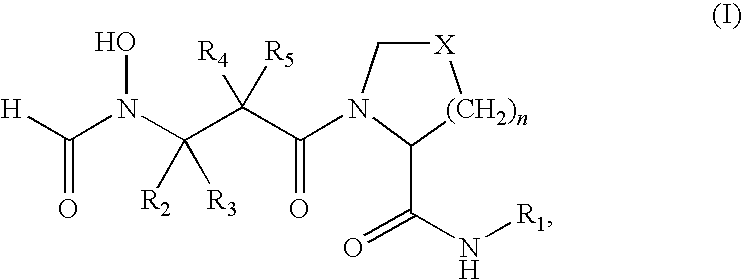
- wherein
-
- X is —CH2—, —S—, —CH(OH), —CH(OR)—, —CH(SH)—, —CH(SR)—, —CF2—, —C═N(OR)— or —CH(F)—, wherein R is alkyl;
- R1 is aryl or heteroaryl;
- each of R2, R3, R4 and R5, independently, is hydrogen or alkyl, or
- R2 or R3 and R4 or R5, collectively, form a C4-7cycloalkyl; and
- n is 0-3, provided that when n is 0, X is —CH2—,
or a salt thereof or a prodrug thereof;
and an efflux pump inhibitor.
- In one useful embodiment, the present invention provides a method for treating a Gram-negative bacterial infection in a mammal which is caused by a Gram-negative bacteria possessing an RND efflux pump. The method comprises administering an effective amount of the compound
-
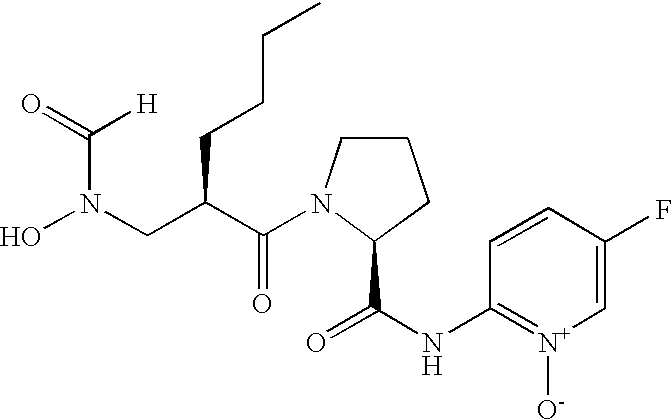
- and an efflux inhibitor that inhibits the RND efflux pump in the Gram-negative bacteria.
- In another aspect, the present invention provides a method for increasing the susceptibility of Gram-negative bacteria to a compound of formula (I):
-

- wherein
-
- X is —CH2—, —S—, —CH(OH)—, —CH(OR)—, —CH(SH)—, —CH(SR)—, —CF2—, —C═N(OR)— or —CH(F)—, wherein R is alkyl;
- R1 is aryl or heteroaryl;
- each of R2, R3, R4 and R5, independently, is hydrogen or alkyl, or
- R2 or R3 and R4 or R5 collectively form a C4-7cycloalkyl; and
- n is 0-3, provided that when n is 0, X is —CH2—; or
a salt thereof or a prodrug thereof. The method comprises contacting the bacteria with the compound of formula (I) and an efflux pump inhibitor in an amount effective to inhibit an efflux pump in the Gram-negative bacteria.
- In one embodiment, the present invention provides a method for increasing the susceptibility of Gram-negative bacteria possessing an RND efflux pump to the compound
-
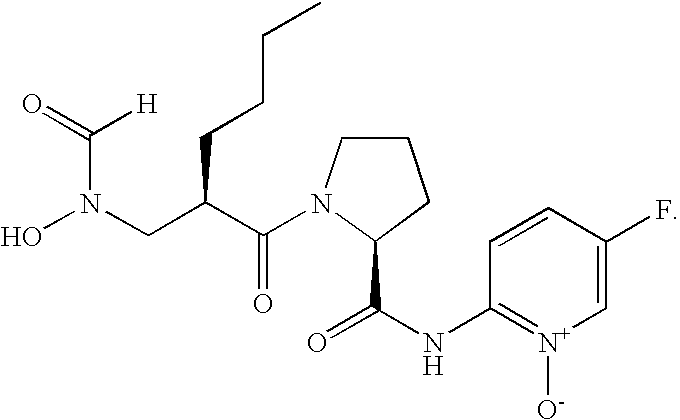
- The method comprises contacting the Gram-negative bacteria with the compound and an efflux pump inhibitor in an amount effective to inhibit the RND pump in the Gram-negative bacteria.
- In another aspect, the present invention provides a pharmaceutical composition comprising a compound of formula (I)
-
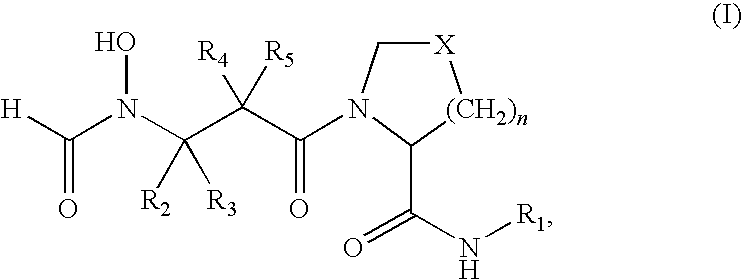
- wherein
-
- X is —CH2—, —S—, —CH(OH)—, —CH(OR)—, —CH(SH)—, —CH(SR)—, —CF2—, —C═N(OR)— or —CH(F)—, wherein R is alkyl;
- R1 is aryl or heteroaryl;
- each of R2, R3, R4 and R5, independently, is hydrogen or alkyl, or
- R2 or R3 and R4 or R5, collectively, form a C4-7cycloalkyl; and
- N is 0-3, provided that when n is 0, x is —CH2—,
or a salt thereof or a prodrug thereof, an efflux pump inhibitor and a pharmaceutically acceptable carrier.
-
FIG. 1 . Structures of the novel PDF inhibitors LBM415 and LBK611. -
FIG. 2 . Genetic arrangement of the acrAB efflux pump genes in H. influenzae showing the positions and orientations of kanamycin resistance markers (arrows) used for insertional inactivation. Also shown is the position and orientation of the kanamycin resistance marker inserted in ORF HI1462 (toIC). -
FIG. 3 . Region of acrA missing in clinical isolate NB65062 (black bar). The positions of primers used for PCR are indicated. Primer pair acrAHIF/acrAHIR do not generate a product since the site for acrAHIF is missing in NB65062. -
FIG. 4 . Comparison of truncated acrR genes from four clinical H. influenzae isolates with reduced susceptibility to LBM415 and LBK611, to wild-type acrR. The mutations are as follows: NB65016, 1 base (C) insertion after nucleotide 442 (frameshift); NB65027, 8 bp deletion-GTT insertion after nucleotide 366 (frameshift), additional 1 base insertion downstream; NB65051, 4 bp deletion after nucleotide 322 (frameshift); NB65063, C252T substitution (stop). - All patent applications, patents and literature references cited herein are hereby incorporated by reference in their entirety.
- Unless otherwise stated, the following terms as used in the specification have the following meaning.
- The term “cycloalkane” or “cycloalkyl” contains from 3- to 7-ring carbon atoms, and is, e.g., cyclopropyl, cyclobutyl, cyclopentyl and cyclohexyl.
- The term “alkyl” refers to saturated or unsaturated aliphatic groups, such as alkenyl or alkynyl, cycloalkyl or substituted alkyl including straight-chain, branched-chain and cyclic groups having from 1-10 carbons atoms. Preferably “alkyl” or “alk”, whenever it occurs, is a saturated aliphatic group or cycloalkyl, more preferably C1-7alkyl, particularly C1-4alkyl. Examples of “alkyl” or “alk” include, but are not limited to, methyl, ethyl, n-propyl, isopropyl, n-butyl, isobutyl, sec-butyl, t-butyl, n-pentyl, neopentyl, n-hexyl or n-heptyl, cyclopropyl and, especially, n-butyl.
- The term “substituted alkyl” refers to an alkyl group that is substituted with 1 or more substituents, preferably 1-3 substituents including, but not limited to, substituents, such as halogen, lower alkoxy, hydroxy, mercapto, carboxy, cycloalkyl, aryl, heteroaryl and the like. Examples of substituted alkyl groups include, but are not limited to, —CF3, —CF2—CF3, hydroxymethyl, 1- or 2-hydroxyethyl, methoxymethyl, 1- or 2-ethoxyethyl, carboxymethyl, 1- or 2-carboxyethyl and the like.
- The term “aryl” or “Ar” refers to an aromatic carbocyclic group of 6-14 carbon atoms having a single ring including, but not limited to, groups, such as phenyl; or multiple condensed rings including, but not limited to, groups, such as naphthyl or anthryl; and is especially phenyl.
- The term “heteroaryl” or “HetAr” refers to a 4- to 7-membered, monocyclic aromatic heterocycle or a bicycle that is composed of a 4- to 7-membered, monocyclic aromatic heterocycle and a fused-on benzene ring. The heteroaryl has at least 1 hetero atom, preferably 1 or 2 heteroatoms including, but not limited to, heteroatoms, such as N, O and S, within the ring. A preferred heteroaryl group is pyridinyl, pyrimidinyl or benzodioxolanyl.
- The aryl or heteroaryl may be unsubstituted or substituted by 1 or more substituents including, but not limited to, C1-7alkyl, particularly C1-4alkyl, such as methyl, hydroxy, alkoxy, acyl, acyloxy, SCN, halogen, cyano, nitro, thioalkoxy, phenyl, heteroalkylaryl, alkylsulfonyl and formyl.
- The term “carbonylamine”, as used herein, refers to a —NHC(O)— group, wherein the amino portion of the group is linked to the aryl/heteroaryl and the carbonyl portion of the group is linked to the azacyclo4-7alkane, thiazacyclo4-7alkane or imidazacyclo4-7alkane.
- The term “heteroalkyl” refers to saturated or YY unsaturated C1-10alkyl as defined above, and especially C1-4heteroalkyl which contain 1 or more heteroatoms, as part of the main, branched or cyclic chains in the group. Heteroatoms may independently be selected from the group consisting of —NR—, where R is hydrogen or alkyl, —S—, —O— and —P—; preferably —NR—, where R is hydrogen or alkyl; and/or —O—. Heteroalkyl groups may be attached to the remainder of the molecule either at a heteroatom (if a valence is available) or at a carbon atom. Examples of heteroalkyl groups include, but are not limited to, groups, such as —O—CH3, —CH2—O—CH3, —CH2—CH2—O—CH3, —S—CH2—CH2—CH3, —CH2—CH(CH3)—S—CH3 and —CH2—CH2—NH—CH2—CH2—.
- The heteroalkyl group may be unsubstituted or substituted with 1 or more substituents, preferably 1-3 substituents including, but not limited to, alkyl, halogen, alkoxy, hydroxyl, mercapto, carboxy and, especially, phenyl. The heteroatom(s), as well as the carbon atoms of the group may be substituted. The heteroatom(s) may also be in oxidized form.
- The term “alkoxy”, as used herein, refers to a C1-10alkyl linked to an oxygen atom or, preferably C1-7alkoxy, more preferably C1-4alkoxy. Examples of alkoxy groups include, but are not limited to, groups, such as methoxy, ethoxy, n-butoxy, tert-butoxy and allyloxy.
- The term “acyl”, as used herein, refers to the group —(O)CR, where R is alkyl, especially C1-7alkyl, such as methyl. Examples of acyl groups include, but are not limited to, acetyl, propanoyl and butanoyl.
- The term “acyloxy”, as used herein, refers to the group —OC(O)R, wherein R is hydrogen or alkyl, especially C1-7alkyl, such as methyl or ethyl; or phenyl or substituted alkyl, as defined above.
- The term “alkoxycarbonyl”, as used herein, refers to the group —COOR, wherein R is alkyl, especially C1-7alkyl, such as methyl or ethyl.
- The term “halogen” or “halo”, as used herein, refers to chlorine, bromine, fluorine, iodine and, is especially, fluorine.
- The term “thioalkoxy”, as used herein, means a group —SR, where R is an alkyl, as defined above, e.g., methylthio, ethylthio, propylthio, butylthio and the like.
- The term “heteroalkylaryl”, as used herein, means a heteroalkyl group, e.g., —O—CH2— substituted with an aryl group, especially phenyl. The phenyl group itself may also be substituted with 1 or more substituents, such as halogen, especially fluoro and chloro; and alkoxy, such as methoxy.
- The term “alkylsulfonyl”, as used herein, means a group —SO2R, wherein R is alkyl, especially C1-7alkyl, such as methyl sulfonyl.
- The term “susceptibility” refers to the sensitivity of a Gram-positive or Gram-negative bacteria for the presence of a PDF inhibitor, disclosed herein. To “increase the susceptibility” of a bacteria to the PDF inhibitor means that the bacteria will be inhibited by a lower concentration of the PDF inhibitor in the medium surrounding the bacteria.
- The term “efflux pump”, as used herein, refers to a pump made of 1 or more protein components located in the cell membrane of bacteria which transports substrate molecules, e.g., antibiotics, out of the bacteria. Some efflux pumps in Gram-negative bacteria, as well as all Gram-positive multi-drug efflux pumps export substrates across a singe cytoplasmic membrane layer and are composed of 1 component, a transporter protein located in the cytoplasmic membrane. In Gram-negative bacteria, the majority of multi-drug efflux pumps contain 3 components: a transporter protein located in the cytoplasmic membrane (inner membrane), an outer membrane channel and a periplasmic linker protein connecting the two. In this arrangement, the efflux pump traverses the inner and outer membranes and thus exports substrate from the cytoplasm or cytoplasmic membrane into the external medium. The transporter proteins of the 3-component efflux pumps use proton-motive force to efflux substrates in exchange for protons, and belong to the major facilitator (MF) superfamily or to the resistance-nodulation-division (RND) family.
- The term “RND efflux pump”, as used herein, refers to an efflux pump possessing a transporter protein belonging to the RND family. The predicted structure of the RND transporter protein contains 12 transmembrane helices, but also contains 2 large periplasmic domains between the
transmembrane helices 1 and 2, and 7 and 8. The RND efflux pumps are able to pump out a wide range of substrates, including almost all lipophilic and amphiphilic antibiotics; chemotherapeutic agents; metabolic inhibitors, such as cerulenin; dyes; detergents, such as SDS, Triton X-100 and bile salts; and solvents. Homologous RND efflux pumps are found, e.g., In E. coli, P. aeruginosa, H. influenzae and Neisseria gonorrhoeae. - The term “efflux pump inhibitor”, as used herein, refers to a compound which specifically interferes with the ability of an efflux pump to transport substrates, e.g., antibiotics.
- The term “treating”, as used herein, includes, but is not limited to, preventing, reducing and/or eliminating the clinical symptoms caused by an infection of an animal by a bacteria; preventing, reducing, and/or eliminating an infection of an animal by bacteria; or preventing, reducing, and/or eliminating contamination of an animal by bacteria. The bacteria involved is preferably Gram-negative bacteria and the animal is preferably a mammal.
- The term “mammal”, as used herein, includes humans and other primates, mice, rats, sheep, cattle, horses, dogs, pigs, cats, dogs and other species.
- The term “effective amount”, as used herein, means the individual amounts of a PDF inhibitor and an efflux pump inhibitor, which when utilized in combination, to treat a bacterial infection in an animal or to improve the susceptibility of bacteria to the PDF inhibitor, is sufficient to inhibit PDF. The effective amount will vary depending on the particular PDF inhibitor and efflux pump inhibitor used, the particular bacteria involved, the age, weight, sex, and medical condition of the animal, the type and severity of the infection and the route of administration, but may nevertheless be readily determined by one skilled in the art. The effective amount of a PDF inhibitor needed to be completely efficacious in treating a bacterial infection or to increase the susceptibility of bacteria is much lower than would be needed if the PDF inhibitor was administered without the efflux pump inhibitor.
- The term “pharmaceutically acceptable carrier”, as used herein, means an excipient that is useful in preparing a pharmaceutical composition that is generally safe, non-toxic and neither biologically nor otherwise undesirable, and includes an excipient that is acceptable for veterinary use and human use. A “pharmaceutically acceptable carrier”, as used in the specification and claims, includes both 1 or more than 1 such carriers.
- The present invention generally relates to PDF inhibitors and the finding that in bacteria, particularly Gram-negative bacteria, such as H. influenzae, E. coli, Bacillus subtilus, Klebsiella pneumoniae, P. aeruginosa and Neisseria gonorrhoeae, inactivation of genes coding for components of an RND efflux pump significantly increases the susceptibility of the bacteria to PDF inhibitors. It has also been observed that inactivation of the gene encoding a repressor protein that inhibits expression of an RND efflux pump in Gram-negative bacteria such as H. influenza, decreases susceptibility of the bacteria to the disclosed PDF inhibitors. These findings combined with other evidence below (see Examples) indicate that efflux pumps, particularly RND efflux pumps, play a major role in creating the intrinsic resistance of bacteria, particularly Gram-negative bacteria, to the PDF inhibitors. These findings further indicate that inhibition of an efflux pump in bacteria can improve the susceptibility of bacteria, particularly Gram-negative bacteria, to the PDF inhibitors.
- To this end, the present invention is directed to the use of a PDF inhibitor as described below in combination with an efflux pump inhibitor, to treat bacterial infections in animals, particularly humans and other mammals and to increase the susceptibility of bacteria to a PDF inhibitor. The present invention is also directed to pharmaceutical compositions comprising the combination of a PDF inhibitor and an efflux pump inhibitor.
- The term “PDF inhibitors” as used herein refer to compounds of the formula (I)
-
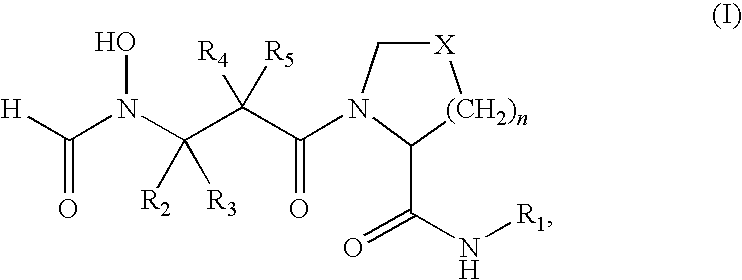
- wherein
-
- X is —CH2—, —S—, —CH(OH)—, —CH(OR)—, —CH(SH)—, —CH(SR)—, —CF2—, —C═N(OR)— or —CH(F)—, wherein R is alkyl;
- R1 is aryl or heteroaryl;
- each of R2, R3, R4 and R5, independently, is hydrogen or alkyl, or
- R2 or R3 and R4 or R5 collectively form a C4-7cycloalkyl; and
- n is 0-3, provided that when n is 0, X is —CH2—,
or a salt thereof or a prodrug thereof.
- In one embodiment, R1 is a heteroaryl of formula (II)
-
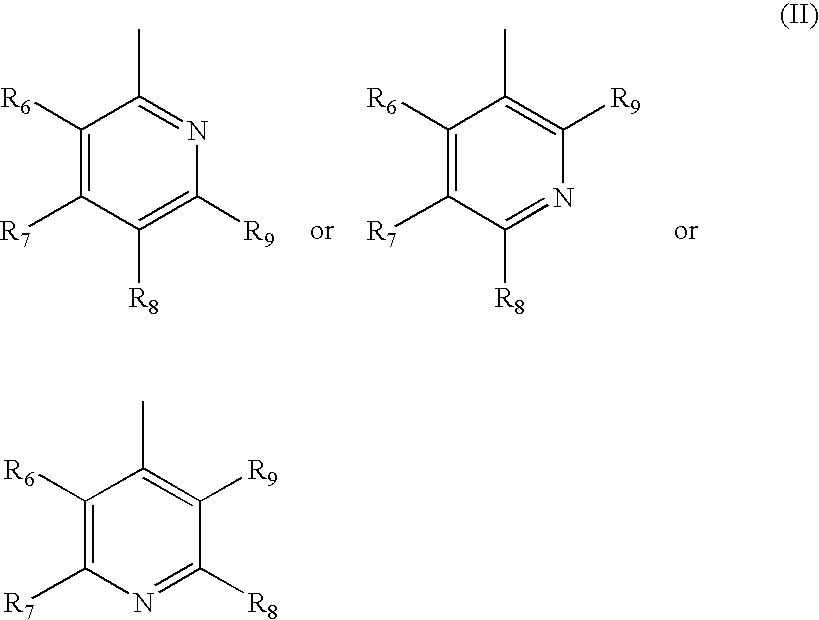
- wherein each of R6, R7, R8 and R9, independently, is hydrogen, alkyl, substituted alkyl, hydroxy, alkoxy, acyl, acyloxy, SCN, halogen, cyano, nitro, thioalkoxy, phenyl, heteroalkylaryl, alkylsulfonyl or formyl.
- In another embodiment, R1 is preferably a heteroaryl of formula (II.1)
-
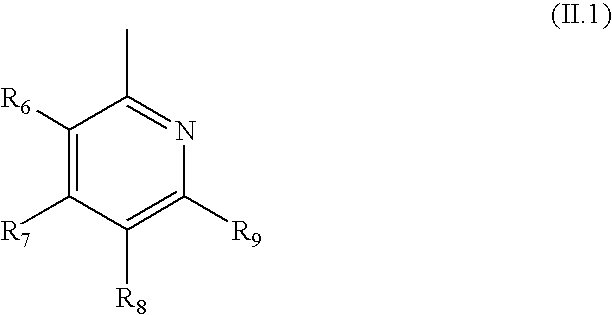
- wherein R6, R7, R8 and R9 are as defined above for formula (II), e.g.,
-
- wherein
- a) R6 is nitro, alkyl, substituted alkyl, phenyl, hydroxy, formyl, heteroalkylaryl, alkoxy, acyl or acyloxy, preferably alkyl, especially C1-7alkyl, hydroxyl or alkoxy, especially a C1-7alkoxy; and
- R7, R8 and R9 are hydrogen, or
- b) R6, R8 and R9 are hydrogen; and
- R7 is alkyl, substituted alkyl, phenyl, halogen, alkoxy or cyano (preferably alkyl, especially C1-7alkyl), substituted alkyl (especially substituted C1-7alkyl, such as —CF3 or alkoxy (especially C1-7alkoxy), or
- c) R6, R7 and R9 are hydrogen; and
- R8 is alkyl, substituted alkyl, halogen, nitro, cyano, thioalkoxy, acyloxy, phenyl, alkylsulfonyl or carboxyalkyl (preferably alkyl, especially C1-7alkyl), substituted alkyl (especially —CF3), halogen or carboxyalkyl, or
- d) R6, R7 and R8 are hydrogen; and
- R9 is alkyl, halogen or hydroxy, or
- e) R7 and R9 are hydrogen; and
- each of R6 and R8, independently, is halogen, alkyl, substituted alkyl, phenyl or cyano, or
- f) each of R7 and R8 is alkyl or substituted alkyl; and
- R6 and R8 are hydrogen, or
- g) R6 and R8 are hydrogen;
- R7 is alkyl or substituted alkyl; and
- R8 is nitro, or
- h) R8 and R9 are hydrogen;
- R6 is cyano; and
- R7 is alkoxy, or
- i) R7 and R8 are hydrogen; and
- R6 is alkyl, substituted alkyl, alkoxy or SCN; and
- R9 is alkyl or substituted alkyl, or
- j) R6 and R7 are hydrogen;
- R8 is nitro or halogen; and
- R9 is alkyl or substituted alkyl, or
- k) R6, R7, R8 and R9 are hydrogen, or
- l) R6 and R7, together with the carbon atoms to which they are attached, form a phenyl group, preferably substituted with hydroxy; and
- R8 and R9 are hydrogen, or
- m) R6 and R7 are hydrogen; and
- R8 and R9, together with the carbon atoms to which they are attached, form a phenyl group, or
- n) n is 0, or
- o) n is 0; and
- each of R6, R7, R8 and R9, independently, is hydrogen, alkyl or halogen and, more particularly R6, R7, R8 and R9 are hydrogen, or
- p) n is 0;
- R6, R8 and R9 are hydrogen; and
- R7 is alkyl, or
- q) n is 0;
- R6R7 and R9 are hydrogen; and
- R8 is alkyl or halogen.
- In another embodiment, R1 is of formula (II.2)
-
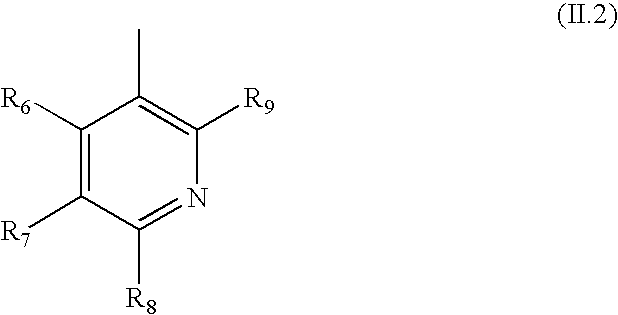
- wherein
-
- R6, R7, R8 and R9 are as defined above for formula (II), in particular, R7 and R8, together with the carbon atoms to which they are attached, form a phenyl group; and
- R6 and R9 are hydrogen.
- In yet another embodiment, the R1 is of formula (III)
-

- wherein
-
- each of R6, R7, R8 and R9, independently, is hydrogen, alkyl, substituted alkyl, phenyl, halogen, hydroxy or alkoxy, e.g.,
- wherein
- a) R6 and R8 are hydrogen;
- R9 is hydrogen or alkyl; and
- R7 is alkyl, substituted alkyl or phenyl, or
- b) R6, R7 and R9 are hydrogen; and
- R8 is halogen, alkyl or substituted alkyl, or
- c) R7, R8 and R9 are hydrogen; and
- R6 is hydroxy.
- In a particularly useful embodiment, the heteroaryl is of formula (III.1)
-
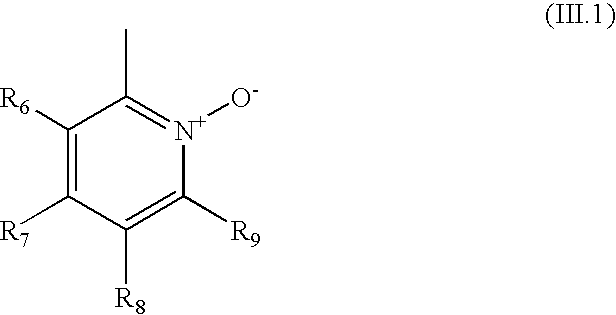
- wherein R6, R7, R8 and R9 are as defined above for formula (III).
- In another embodiment, R1 is an unsubstituted phenyl or the phenyl is substituted with alkoxy, e.g., methoxy; or aryloxy, e.g., phenoxy.
- In a particularly useful embodiment, the compound of formula (III.1) is
-
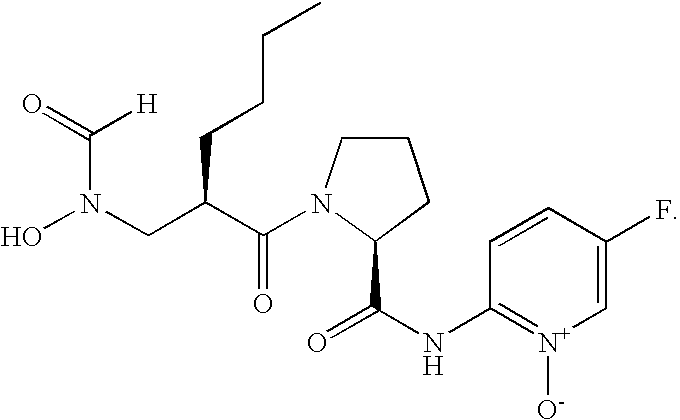
- In another embodiment, the R1 is of formula (IV)
-
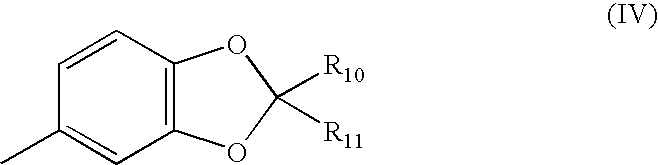
- wherein each of R10 and R11, independently, is hydrogen or halogen, in particular, R10 and R11, are both either hydrogen or both halogen.
- It will be appreciated that the compounds of formula (I) may exist in the form of optical isomers, racemates or diastereoisomers. For example, a compound of formula (I), wherein R2 and R3 are different residues, or wherein R4 and R5 are different residues, is asymmetric and may have the R- or S-configuration. It is to be understood that the compounds of formula (I) embrace all enantiomers and their mixtures. Similar considerations apply in relation to starting materials exhibiting assymetric carbon atoms as mentioned.
- The compounds of formula (I), may exist in free form or in salt form, e.g., in form of a pharmaceutically acceptable salt. A “pharmaceutically acceptable salt” of a compound means a physiologically and pharmaceutically acceptable salt that possesses the desired pharmacological activity of the parent compound and does not impart undesired toxicological effects. Such salts include:
-
- (1) acid addition salts formed with inorganic acids, such as hydrochloric acid, hydrobromic acid, sulfuric acid, nitric acid, phosphoric acid and the like; or formed with organic acids, such as acetic acid, propionic acid, hexanoic acid, cyclopentanepropionic acid, glycolic acid, pyruvic acid, lactic acid, malonic acid, succinic acid, malic acid, maleic acid, fumaric acid, tartaric acid, citric acid, benzoic acid, 3-(4-hydroxybenzoyl)benzoic acid, cinnamic acid, mandelic acid, methanesulfonic acid, ethanesulfonic acid, 1,2-ethane-disulfonic acid, 2-hydroxyethanesulfonic acid, benzenesulfonic acid, 4-chlorobenzenesulfonic acid, 2-napthalenesulfonic acid, 4-toluenesulfonic acid, camphorsulfonic acid, 3-phenylpropionic acid, trimethylacetic acid, tertiary butylacetic acid, lauryl sulfuric acid, gluconic acid, glutamic acid, hydroxynapthoic acid, salicylic acid, stearic acid, muconic acid and the like; or
- (2) salts formed when an acidic proton present in the parent compound either is replaced by a metal ion, e.g., an alkali metal ion, an alkaline earth ion or an aluminum ion; or coordinates with an organic base, such as ethanolamine, diethanolamine, triethanolamine, tromethamine, N-methylglucamine and the like.
- The compounds of formula (I) may act as a pro-drug. “Prodrug” means any compound which releases an active parent drug according to formula (I) in vivo when such prodrug is administered to a mammalian subject. Prodrugs of a compound of formula (I) are prepared by modifying functional groups present in the compound of formula (I) in such a way that the modifications may be cleaved in vivo to release the parent compound. Prodrugs include compounds of formula (I), wherein a hydroxy, amino or sulfhydryl group is bonded to any group that may be cleaved in vivo to regenerate the free hydroxyl, amino or sulfhydryl group, respectively. Examples of prodrugs include, but are not limited to, esters, e.g., acetate, formate and benzoate derivatives; carbamates, e.g., N,N-dimethylamino-carbonyl; of hydroxy functional groups in compounds of formula (I) and the like.
- The compounds of formula (I) can be obtained by synthetic chemistry methods know to those skilled in the art and as described, e.g., in WO 02/102790 A1.
- In one aspect, the present invention provides a method for treating bacterial infections, particularly Gram-negative bacterial infections, in an animal, preferably a mammal. The method includes administering an effective amount of a PDF inhibitor, i.e., a compound embraced by the formula (I) or a salt thereof or a prodrug thereof, and an efflux pump inhibitor.
- The combination of a PDF inhibitor and efflux inhibitor increases the susceptibility of the Gram-negative bacteria for the PDF inhibitor. Accordingly, in using the combination of PDF inhibitor and efflux pump inhibitor, a Gram-negative infection caused by bacteria which are resistant, i.e., have decreased susceptibility, to a particular PDF inhibitor in the absence of the efflux pump inhibitor may be treatable with that particular PDF inhibitor In addition, Gram-negative infections in which the bacteria are susceptible to the PDF inhibitors in the absence of an efflux inhibitor, can be treated utilizing lower dosages of the PDF inhibitor, thus, mitigating the risk of side effects that can occur from utilizing high dosages of the PDF inhibitor.
- As stated above, the majority of the Gram-negative bacteria possess a 3-component efflux pump consisting of a transporter protein located in the cytoplasmic membrane (inner membrane), an outer membrane channel and a periplasmic linker protein connecting the two. See Nikaido (1996), supra; Nikaido, Clin Infect Dis, Vol. 27 (Supp. 1), pp. S32-S41 (1998); and Zgurskaya and Nikaido, Mol Microbiol, Vol. 37, No. 2, pp. 219-225 (2000). In this arrangement, the efflux pump traverses the inner and outer membranes and thus exports substrate such as an antibiotic from the cytoplasm or cytoplasmic membrane into the external medium. See Zgurskaya and Nikaido (2000), supra. The transporter proteins of the 3-component efflux pumps use proton-motive force to efflux substrates in exchange for protons, and belong to the MF superfamily or to the RND family. See Nikaido (1998), supra.
- In one embodiment, the Gram-negative bacterial infection to be treated is caused by Gram-negative bacteria possessing an RND efflux pump. As stated above, the term “RND efflux pump” refers to an efflux pump possessing a transporter protein belonging to the RND family, which includes in addition a putative transporter of nodulation signal molecules in Rhizobium. See Saier et al., FASEB J, Vol. 12, pp. 265-274 (1998); and Saier et al., Mol Microbiol, Vol. 11, pp. 841-847 (1994). All members of the RND efflux pump family have similar structures. Their proposed structure contains 12 transmembrane helices and also contains 2 large periplasmic domains between the
transmembrane helices 1 and 2, and 7 and 8. See Nikaido (1998), supra; and Zgurskaya and Nikaido (2000), supra. The RND efflux pumps are able to pump out a wide range of substrates, including almost all lipophilic and amphiphilic antibiotics; chemotherapeutic agents; metabolic inhibitors, such as cerulenin; dyes; detergents, such as SDS, Triton X-100 and bile salts; and solvents. See Nikaido, Curr Opin Microbiol (1998), supra; and Nikaido (1996), supra. Most of the efflux transporters that mediate resistance to clinically relevant antibiotics are members of RND family. See Saier et al., FASEB J (1998), supra. Gram-negative bacteria possessing an RND efflux pump include, but are not limited to, Serratia marcescens, E. coli, Moraxella catarrhalis, Bacillus subtilus, Klebsiella pneumoniae, P. aeruginosa, H. influenzae, Neisseria gonorrhoeae, Burholderia cepacia, Burkholderia pseudomallei, Stenotrophomonas maltophilia, Acinetobacter baumannii (A. baumannii) and Pseudomonas putida. Homologous efflux RND pumps can be found in Gram-negative bacteria such as E. coli, P. aeruginosa, H. influenzae and Neisseria gonorrhoeae. See Nikaido, Curr Opin Microbiol (1998), supra. In a particular useful embodiment, the Gram-negative bacteria possessing an RND pump is H. influenzae. - In particularly useful embodiments of the method for treating a Gram-negative bacterial infection, the compound of formula (I) is
-
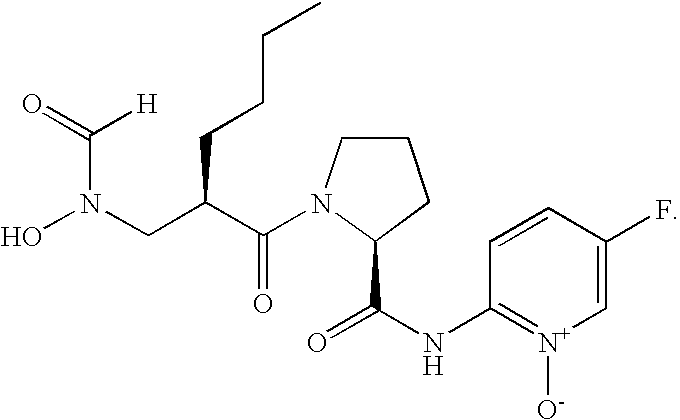
- Efflux pump inhibitors specific for efflux pumps, particularly RND efflux pumps, in Gram-negative bacteria are well-known in the art. For example, U.S. Pat. No. 6,114,310 describes a generic class of efflux pump dipeptide inhibitors that enhance the activity of a wide range of antibiotics against a variety of Gram-negative bacteria. An example of a dipeptide efflux pump inhibitor within this generic class is MC-04,124 having the structure
-

- which has been shown to inhibit RND efflux pumps and enhance the activity of several antibiotics against a variety of Gram-negative bacteria, such as E. coli, Klebsiella pneumoniae, P. aeruginosa, H. influenzae and A. Baumannii. See Cho et al., 40th ICAAC (2000); and Watkins et al., Bioorgan Med Chem Lett, Vol. 13, pp. 4241-4244 (2003). Other examples of RND efflux pump inhibitors that enhance the activity of antibiotics against Gram-negative bacteria include the dipeptide inhibitor, MC-207,110 having the structure
-

- as described in Renau et al., J Med Chem, Vol. 42, pp. 4928-4931 (1999); and Lomovskaya et al., Antimicrob Agents Chem, Vol. 45, No. 1, pp. 105-116 (1991), and the dipeptide inhibitor, MC-002,595, having the structure
-
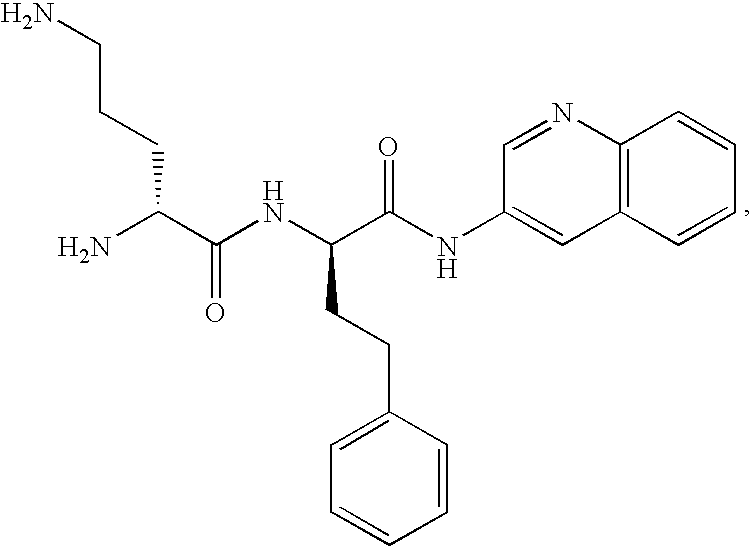
- as described in Lomovskaya et al., Antimicrob Agents Chem (1991), supra.
- Another example of RND efflux pump inhibitors that enhance the activity of oxazolidinone antibacterial agents against Gram-negative bacteria are arginine derivatives as described in U.S. Pat. No. 6,251,869.
- Yet another example of efflux pump inhibitors specific for RND efflux pump in Gram-negative bacteria, such as P. aeruginosa are sulfates of benastatins A and B produced by an actinomycete, e.g., MF-EA-371α having the structure
-
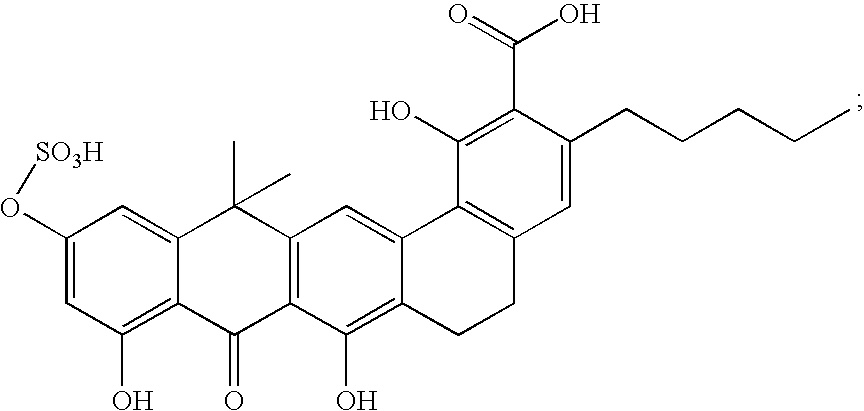
- and MF-EA-371δ having the structure
-
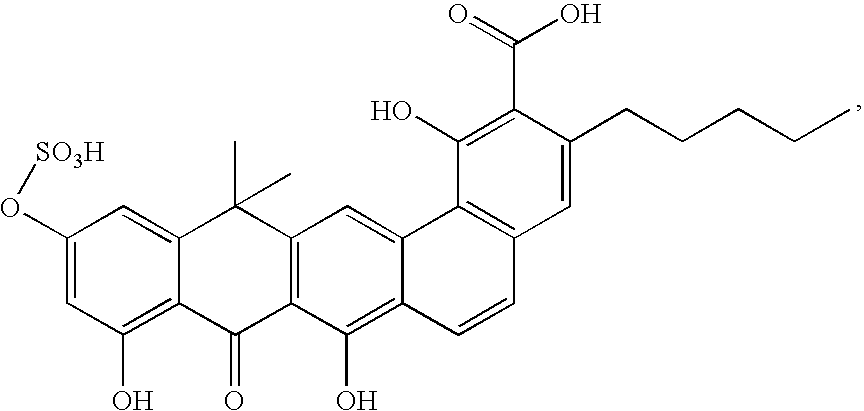
- as described in Lee et al. (2000), 40th ICAAC (2000).
- For treatment of a Gram-negative bacterial infection in humans and other animals, particularly humans and other mammals. that have been diagnosed as having a Gram-negative bacterial infection, a PDF inhibitor and an efflux pump inhibitor or pharmaceutical compositions thereof, can be administered by any conventional route, e.g., locally or systemically, e.g., orally, topically, parenterally, subdermally or by inhalation. The route chosen will depend on the type, severity and location of the infection and the type of bacteria causing the infection.
- The required dosage of PDF inhibitor to achieve an “effective amount” will of course depend on various factors as described above, e.g., the mode of administration, the type and severity of infection to be treated and the effect desired. Generally, an effective amount of dosage, e.g., for human treatment, will range, for example, from about 1-3000 mg per day, for instance 1500 mg per day depending on the route and frequency of administration. Such a dosage corresponds to about 0.015-50 mg/kg of body weight per day. Suitably the dosage, is for example, from about 5-20 mg/kg of body weight per day.
- The amount of a particular efflux pump inhibitor to be used will depend on various factors, e.g., the type of Gram-negative bacteria, susceptibility of the Gram-negative bacteria to the particular PDF inhibitor, and the absorption by the animal being treated. Sufficient amounts of the efflux pump inhibitor should be used to make the Gram-negative bacteria susceptible to a pharmaceutically acceptable level of the PDF inhibitor in the treated animal. The sufficient amount of a particular efflux inhibitor can be readily determined by testing for minimum inhibitory concentration (MIC) of the PDF inhibitor and comparing the MIC of that PDF inhibitor alone, with the MIC of that PDF inhibitor utilized in combination with the efflux pump inhibitor. Generally, the molar ratio of an efflux pump inhibitor to a PDF inhibitor which is administered is from about 0.01 to 10. Suitably the molar ratio is from about 0.1 to 1.0. Accordingly, the daily dosage of an efflux pump inhibitor for treating a gram-negative bacterial infection in an animal can range from about 0.0015-5 mg/kg of body weight per day. Suitably, the daily dosage is from about 0.5-2 mg/kg of body weight per day. The efflux pump inhibitor can be administered before the PDF inhibitor is administered, or can be administered simultaneously with the PDF inhibitor.
- In another aspect, the present invention provides a method for increasing the susceptibility of Gram-negative bacteria to a PDF inhibitor, comprising contacting the bacteria with a PDF inhibitor and an efflux pump inhibitor, in an amount effective to Inhibit an efflux pump in the Gram-negative bacteria. The method improves the effectiveness of the PDF inhibitor against the Gram-negative bacterial cell which expresses an efflux pump when treated with the combination of a PDF inhibitor and efflux pump inhibitor.
- In one embodiment of the method for increasing the susceptibility of a Gram-negative bacteria to a PDF inhibitor, the Gram-negative bacterial infection is caused by a Gram-negative bacteria possessing an RND efflux pump, e.g., Serratia marcescens, E. coli, Moraxella catarrhalis, Bacillus subtilus, Klebsiella pneumoniae, P. aeruginosa, H. influenzae, Neisseria gonorrhoeae, Burholderia cepacia, Burkholderia pseudomallei, Stenotrophomonas maltophilia, Acinetobacter baumannii and Pseudomonas putida. In a further embodiment, the Gram-negative bacteria possessing an RND efflux pump includes E. coli, P. aeruginosa, H. influenzae and Neisseria gonorrhoeae. In a particular useful embodiment, the Gram-negative bacteria possessing an RND efflux pump is H. influenzae. Particularly useful PDF inhibitors and efflux pump inhibitors that can be utilized in this method are as described above.
- Efficacy of a particular efflux pump inhibitor in increasing the susceptibility of Gram-negative bacteria to a particular PDF inhibitor can be evaluated e.g., in vitro using the checkerboard method as described in Lorian, ed., Antibiotics in Laboratory Medicine, 3rd Ed., p. 432, Williams & Wilkins, Baltimore, Md.
- In a further aspect, the present invention provides pharmaceutical compositions effective for treatment of a bacterial infection, particularly a Gram-negative bacterial infection, in an animal, e.g., a mammal. The composition includes a PDF inhibitor and efflux pump inhibitor as described above and a pharmaceutically acceptable carrier.
- The compositions may be in any form known in the art including, but not limited to, tablets, capsules, wafers, fast melts (without wafers), powders, granules, lozenges, creams or liquid preparations, such as oral or sterile parenteral solutions or suspensions. The PDF inhibitor and efflux pump inhibitor may also be administered in liposomal, micellar or microemulsion formulations. The PDF inhibitor present in the composition may also be administered as prodrugs, where the prodrug administered undergoes biotransformation in the treated mammal to a form which is biologically active.
- The topical formulations of the present invention may be presented as, i.e., ointments; creams or lotions; solutions; salves; emulsions; plasters; eye ointments and eye or ear drops; impregnated dressings; transdermal patches; sprays and aerosols; and may contain appropriate conventional additives, such as preservatives; solvents to assist drug penetration; and emollients in ointments and creams.
- The formulations may also contain compatible conventional carriers, such as cream or ointment bases and ethanol; or oleyl alcohol for lotions. Such carriers may be present, e.g., from about 1% up to about 99% of the formulation. For example, they may form up to about 80% of the formulation.
- Tablets and capsules for oral administration may be in unit dose presentation form, and may contain conventional excipients, such as binding agents, e.g., syrup, acacia, gelatin, sorbitol, tragacanth or polyvinylpyrollidone; fillers, e.g., lactose, sugar, maize-starch, calcium phosphate, sorbitol or glycine; tabletting lubricants, e.g., magnesium stearate, talc, polyethylene glycol or silica; disintegrants, e.g., potato starch; or acceptable wetting agents, such as sodium lauryl sulphate. The tablets may be coated according to methods well-known in standard pharmaceutical practice.
- Oral liquid preparations may be in the form of, for example, aqueous or oily suspensions, solutions, emulsions, syrups or elixirs, or may be presented as a dry product for reconstitution with water or another suitable vehicle before use. Such liquid preparations may contain conventional additives, such as suspending agents, e.g., sorbitol, methyl cellulose, glucose syrup, gelatin, hydroxyethyl cellulose, carboxymethyl cellulose, aluminium stearate gel or hydrogenated edible fats; emulsifying agents, e.g., lecithin, sorbitan monooleate or acacia; non-aqueous vehicles (which may include edible oils), e.g., almond oil; oily esters, such as glycerine, propylene glycol or ethyl alcohol; preservatives, e.g., methyl or propyl p-hydroxybenzoate or sorbic acid, and, if desired, conventional flavoring or coloring agents.
- For parenteral administration, fluid unit dosage forms are prepared utilizing the compound and a sterile vehicle, water being preferred. The PDF inhibitor and efflux pump inhibitor, depending on the vehicle and concentration used, may be either suspended or dissolved in the vehicle or other suitable solvent. In preparing solutions, the PDF and efflux inhibitors may be dissolved in water for injection and filter sterilized before filling into a suitable vial or ampule and sealing. Advantageously, agents, such as a local anesthetic preservative and buffering agents, may be dissolved in the vehicle. To enhance the stability, the composition may be frozen after filling into the vial and the water removed under vacuum. The dry lyophilized powder is then sealed in the vial and an accompanying vial of water for injection may be supplied to reconstitute the liquid prior to use. Parenteral suspensions are prepared in substantially the same manner except that the PDF inhibitor and efflux pump inhibitor are suspended in the vehicle instead of being dissolved and sterilization cannot be accomplished by filtration. The PDF and efflux inhibitor may be sterilized by exposure to ethylene oxide before suspending in the sterile vehicle. Advantageously, a surfactant or wetting agent is included in the composition to facilitate uniform distribution of the compound.
- The PDF inhibitor may be administered in free form or in pharmaceutically acceptable salt form, e.g., as indicated above. Such salts may be prepared in conventional manner and exhibit the same order of activity as the free compounds.
- The following examples serve to illustrate the invention but do not to limit the scope thereof in any way.
- The bacterial strains and plasmids used in this study are listed in Table 1 below. L-broth or L-agar (Difco) is used for routine growth of Escherichia coli (E. coli). Chocolate agar plates (Remel) are used for routine growth of H. influenzae. Brain heart infusion broth (Remel) supplemented with 10 μg/mL of β-NAD (Fluka) and 10 μg/mL hemin/vitamin K solution (sBHI) (Remel) is used for liquid broth cultivation of H. influenzae. For induction of natural competence in H. influenzae, nutritional downshift is induced using M-IV medium as described previously. See Poje and Redfield, Methods Mol Med, Vol. 71, No., pp. 57-70 (2003). Kanamycin is added to growth media at 50 μg/mL (E. coli) or 5 μg/mL (H. influenzae) as required.
-
TABLE 1 Bacterial Strains and Plasmids Used in This Study Reference or Strain or Plasmid Genotype or Relevant Characteristics Source H. influenzae NB65044 Rd KW20 Fleischmann* NB65001 ATCC 49247 NB65062 Clinical isolate, LBM415 hyper-susceptible Jones NB65016 Clinical isolate, decreased LBM415 susceptibility Chopra NB65027 Clinical isolate, decreased LBM415 susceptibility Willinger NB65051 Clinical isolate, decreased LBM415 susceptibility Jones NB65063 Clinical isolate, decreased LBM415 susceptibility Jones NB65069 Clinical isolate, decreased LBM415 susceptibility Jones NB65076 Clinical isolate, decreased LBM415 susceptibility Jones NB65062-CDS0037 NB65062 derivative, complemented for acrA deficiency This study NB65062-CDS0038 NB65062 derivative, complemented for acrA deficiency This study NB65044-CDS0001 NB65044 acrB::Km This study NB65044-CDS0020 NB65044 acrB::Km This study NB65044-CDS0008 NB65044 acrR::Km This study NB65044-CDS0011 NB65044, acrR mutant selected on 8 μg/mL LBM415 This study NB65044-CDS0014 NB65044, acrR mutant selected on 8 μg/mL LBM415 This study NB65016-CDS0004 NB65016 acrB::Km This study NB65027-CDS0021 NB65027 acrB::Km This study NB65027-CDS0003 NB65027 HI1462::Km This study NB65051-CDS0002 NB65051 acrB::Km This study NB65051-CDS0022 NB65051 acrB::Km This study NB65063-CDS0005 NB65063 acrB::Km This study NB65069-CDS0007 NB65069 acrB::Km This study NB65076-CDS0006 NB65076 acrB::Km This study E. coli Top 10 Invitrogen Plasmids pCR 2.1 topo Cloning vector Invitrogen pEX18Tc Cloning vector Hoang** pCDBKmUS pEX18Tc derivative containing the H. influenzae uptake This study sequence and acrB interrupted by a TN903 derived Kmr cassette pCD14Km pBluescript containing ORF HI1462 interrupted by a This study TN903 derived Kmr cassette pCDRKm pBluescript containing acrR interrupted by a TN903 This study derived Kmr cassette pACYC177 Cloning vector, source of TN903 Kmr cassette NEB pACYC184 Cloning vector, replicates in H. influenzae NEB pBAD18 Cloning/expression vector, source of TN903 Kmr marker Beckwith pBluescript SK Cloning vector *See Fleischmann et al. (1995), supra. **See Hoang, Karkhoff-Schweizer, Kutchma and Schweizer, Gene, Vol. 212, No. 1, pp. 77-86 (1998). - Antibiotic and substrate MICs are determined by broth microdilution using 2-fold dilution in HTM in accordance with the procedures established by the National Committee for Clinical Laboratory Standards (NCCLS). See NCCLS, Approved standard M7-A5, Wayne, Pa. (2003). PDF inhibitors are synthesized at the Novartis Institutes for BioMedical Research, Cambridge, Mass. All remaining antibiotics are obtained from Sigma (St. Louis, Mo.).
- H. influenzae genomic DNA is isolated using the Puregene tissue kit from Gentra Systems Inc. (Minneapolis, Minn.) according to the instructions. Oligonucleotides for PCR and sequencing are obtained from Genelink (Hawthorne, N.Y.), and PCR reactions are carried out using the Easystart mix-in-a-tube system from Molecular Bio-Products Inc. (San Diego, Calif.) according to the supplied instructions. Prepared genomic DNA or cells from isolated colonies are used as template in PCR reactions. Restriction endonucleases and modifying enzymes are used according to the instructions supplied with the enzymes. DNA fragments are purified, or isolated following agarose gel electrophoresis, using the QIAquick PCR cleanup or gel extraction kits from Qiagen Inc. (Valencia, Calif.) as specified in the instructions. Nucleotide sequencing is performed by Agencourt Inc. (Waltham, Mass.).
- To construct an insertion knockout of the acrB homolog in H. influenzae, primers acrBHIF (5′-CCACTTTAATGTATGAGGAAATCCG-3′) (SEQ ID NO. 1) and acrBHIR3 (5′-CGAATTACGTAAGATAACCTAAGTGCG-3′) (SEQ ID NO. 2) are used to generate a 3.1 kb PCR fragment encompassing the acrB gene using H. influenzae NB65001 genomic template DNA. The acrB PCR product is ligated into PCR 2.1-Topo by Invitrogen (Carlsbad, Calif.), according to the instructions provided with the kit, then the acrB fragment is excised using EcoRI and ligated into pEX18Tc. This construct is then linearized at the unique Mfel site within the acrB fragment, blunt-ended with T4 DNA polymerase and ligated to a 1.2 kb blunt PCR fragment encompassing the TN903 kanamycin resistance determinant generated from pACYC177 using primers TN903KanF (5′-GCCACGTTGTGTCTCAAAATCTCTG-3′) (SEQ ID NO. 3) and TN903KanR (5′CCAGTGTTACACCAATTAACCAA-3′) (SEQ ID NO. 4), to give plasmid pCDBKm. A 177 bp DNA fragment containing the H. influenzae DNA uptake sequence is PCR amplified from NB65044 genomic DNA using previously described primers. See Akerley et al., Proc Natl Acad Sci USA, Vol. 99, No. 2, pp. 966-971 (2002). The product is cloned into PCR2.1-Topo by Invitrogen, according to the instructions, then excised with KpnI and ligated into the KpnI site within the multi-cloning site of pCDBKm to give pCDBKmUS. Inclusion of the uptake sequence has been shown to facilitate much greater levels of transformation, which makes it useful for introducing DNA into various isolates which may not efficiently take up linear DNA by natural transformation. See Akerley et al. (2002), supra.
- To construct an insertion knockout of open-reading frame (ORF) HI1462 (toIC) [see Trepod and Mott, Antimicrob Agents Chemother, Vol. 48, No. 4, pp. 1416-1418 (2004)], primers HI1462IF (5′-CACGCTTGCTTTGTTGATGTCTGGTGC-3′) (SEQ ID NO. 5) and HI1462IR (5′-TCCCGCCATTGAGCTATATACCGCA-3′) (SEQ ID NO. 6) are used to generate a 1.3 kb PCR fragment encompassing most of HI1462 from NB65001 genomic DNA template and ligated directly into PCR 2.1-Topo, by Invitrogen, according to the instructions. The insert is then recovered as an EcoRI fragment and ligated into the EcoRI site of pBluescriptSK. A TN903 kanamycin resistance determinant, isolated from pBAD18Tc as a 1.8 kb Haell fragment and blunt-ended with T4 DNA polymerase, is then ligated into the unique MluI site within HI1462, which had been rendered blunt, to generate pCD14 Km. This construct has the kanamycin resistance determinant in the same orientation as HI1462. See
FIG. 1 . - To construct an insertion knockout of ORF H10893, an acrR homolog and putative repressor of acrAB expression, primers acrRHIF2 (5′-TAATGATGAAAAGTGCGGTTAATT-3′) (SEQ ID NO. 7) and acrRHIR (5′-TTTCTGAATCGCACGCCAAGAGCGT) (SEQ ID NO. 8) are used to generate a 752 bp PCR fragment encompassing ORF HI0893 from NB65001 genomic DNA. This PCR fragment is ligated into PCR 2.1 Topo, by Invitrogen, according to the instructions provided with the kit, then excised as an EcoRI fragment and cloned into EcoRI cut pBluescriptSK. The construct is then linearized with Sful and ligated to a 1.2 kb blunt PCR fragment encompassing the TN903 kanamycin resistance determinant, generated from pACYC177 using the primers described above, to give plasmid pCDRKm.
- To introduce the acrB::Km and acrR::Km insertions into the genome, H. influenzae strains is grown to early log phase (OD600 approximately 0.2) in sBHI and natural competence is induced by nutritional downshift into M-IV medium as described by Poje and Redfield (2003), supra. Competent cells are transformed with pCDBKmUS (linearized with XbaI) or pCDRKm (linearized with ScaI), as previously described [see Poje and Redfield (2003), supra], and plated on chocolate agar containing 5 μg/mL kanamycin to select for cells containing the kanamycin resistance marker on their genome. To introduce the HI1462::Km insertion into the genome of strain NB65044, competent cells are transformed with pCD14Km (linearized with ScaI) and selected on chocolate agar plates, as described above. To introduce this insertion into strains NB65027 and NB65051, the recipient cells are made competent as described above, transformed with genomic DNA isolated from strain NB65044-CDS0001 and selected on chocolate agar plates containing 5 μg/mL kanamycin. Insertions are confirmed by PCR and sequencing of fragments generated using primers flanking the insertion site.
- PCR Analysis of Hyper-Susceptible Strain NB65062 and Complementation of the acrA Deletion
- To obtain the region encompassing the acrA gene in strain NB65062, primers acrRHIF1 (5′-GTGCGGTGCCACCGCAAGGACATA-3′) (SEQ ID NO. 9) and acrAHIR (5′-TGCAGGCTCTATTGCACCCACAATG-3′) (SEQ ID NO. 10) are used to generate a PCR fragment from NB65062 genomic DNA. See
FIG. 2 . The fragment is gel purified and the nucleotide sequence is determined. - For complementation of the acrA defect, genomic DNA from NB65044, which contains a functional acrAB pump, is used to transform NB65062 using the nutritional downshift method described above. Transformed cells are plated on chocolate agar containing either 4 μg/mL LBM415 or 2 μg/mL erythromycin, both substrates of the acrAB efflux pump.
- Insertional inactivation of acrB in the laboratory strain NB65044 (see
FIG. 1 ), significantly increases susceptibility to LBM415, reflects in the MIC of LBM415 dropping from 4 μg/mL against the parent strain to 0.25 μg/mL against the acrB-deficient derivative NB65044-CDS0001. See Table 2 below. The insertion also increases susceptibility to LBK611 and the known pump substrate erythromycin [see Sanchez, Pan, Vinas and Nikaido (1997), supra), and more dramatically to another macrolide (clindamycin), while not significantly affecting susceptibility to the pump non-substrate [see Sanchez, Pan, Vinas and Nikaido (1997), supra], tetracycline. See Table 2. Another known pump non-substrate, chloramphenicol, is also unaffected by loss of acrB (data not shown). This confirms that the AcrAB pump of H. influenzae is a major driver of reduced susceptibility to LBM415. -
TABLE 2 Contribution of the AcrAB Efflux Pump to Intrinsic Resistance to LBM415, LBK611 and Macrolides in H. influenzae MIC (μg/mL) Strain LBM415 LBK611 ERM CLD TET NB65044 4 4 4 8 0.5 NB65044-CDS0001 0.25 0.25 0.25 0.5 0.5 NB65044-CDS0020 0.125 0.125 0.25 0.5 1 NB65062 ≦0.25 ND ND ≦0.25 0.5 NB65062-CDS0037 8 ND ND 16 1 NB65062-CDS0038 8 ND ND 16 1 ERM = erythromycin CLD = clindamycin TET = tetracycline ND = not done - Efflux has previously been implicated in mediating moderate levels of macrolide resistance in H. influenzae clinical isolates based on a relative lack of accumulation of radiolabelled erythromycin in resistant strains compared to susceptible strains, whereas high level resistance to macrolides is associated with target mutations. See Peric, Bozdogan, Jacobs and Appelbaum (2003), supra. A small proportion of clinical strains previously examined [see Peric, Bozdogan, Jacobs and Appelbaum (2003), supra] are hyper-susceptibility to macrolides and do not accumulate radiolabelled erythromycin, suggesting that they lack an efflux pump. It is also noticed that a small percentage of isolates are hyper-susceptible to both macrolides and PDF inhibitors. Using PCR diagnostics, acrR-, acrA- or acrB-derived fragments are obtained for several of these strains (data not shown), suggesting that the pump genes are widely-distributed, even in hyper-susceptible strains. For hyper-susceptible in strain NB65062 however (see Table 2), no acrA product is obtained, indicating that there might be a genomic deletion. Generation of a PCR fragment encompassing the acrA region using flanking primers (see
FIG. 3 ) resulting in a fragment of substantially smaller size than the predicted 2 kb. Nucleotide sequencing of the fragment reveals an 873 bp deletion (seeFIG. 3 ) resulting in the loss of most of acrA. Transformation of NB65062 with genomic DNA from NB65044, which possesses an intact acrAB locus, and selection on chocolate agar containing LBM415 (4 μg/mL) or erythromycin (2 μg/mL), results in isolates with decreased susceptibility to both classes of antibiotic and no change in susceptibility to pump non-substrates strains NB65062-CDS0038 and NB65044-CDS0039. See Table 2. Pulse field gel electrophoresis analysis of the transformants give identical restriction patterns to that of NB65062, while PCR and sequencing reveal the restoration of full-length acrA, confirming that hyper-susceptibility is indeed the result of a lack of the acrAB pump in strain NB65062. This is consistent with the role of the AcrAB pump in providing intrinsic resistance to PDF inhibitors and macrolides, and implies that rather than failing to acquire the efflux pump, as suggested previously [see Peric, Bozdogan, Jacobs and Appelbaum (2003), supra], macrolide and LBM415 hyper-susceptible strains may result from mutational loss of efflux pump components. Sequencing of the acrR genes from these strains also reveal no difference from the parent strain indicating that an acrR mutation is not also selected during exposure to either LBM415 or erythromycin in the selective plates. The remaining hyper-susceptible strains that give predicted PCR products for various acr genes may have other less obvious mutations compromising pump function, but this remains to be confirmed. - Given the identification of only one RND family pump in H. influenzae to date, it might be expected that it serves an important function in survival in the human host, the only natural environment known for H. influenzae. The loss of this pump in certain clinical isolates is curious in that the pump is generally maintained in H. influenzae but apparently can be lost in certain instances, suggesting its role is not indispensable.
- Having confirmed that the acrAB pump is a major contributor to intrinsic resistance to both PDF inhibitors and macrolides in H. influenzae, it was of interest to identify the outer membrane channel component of the pump to complete the pumps tripartite architecture. Protein homology searches of the H. influenzae genome using the ToIC outer membrane channel that partners with acrAB in E. coli, reveals significant similarity to ORF HI1462 (expectation value 2.9×10⁻⁶). Interestingly, the oprM component of the P. aeruginosa mexAB-oprM pump yields an even closer match to HI1462 with an expectation value of 2.8×10⁻²², indicating that HI1462 is a good candidate for the outer membrane channel. Consistent with this, inactivation of HI1462 (see
FIG. 1 ) in H. influenzae NB65044 increases susceptibility to erythromycin, clindamycin and LBM415, all substrates of the acrAB pump, while not affecting susceptibility to the pump non-substrate tetracycline NB65044-CDS0022. See Table 2. Recently, another group [see Trepod and Mott (2004), supra], has also reported the identification of HI1462 as the outer membrane channel for this pump. The data included here therefore supports this finding and extends the role of this channel component in mediating resistance to LBM415. - Interestingly, HI1462 shows total identity over its C-terminal encoding half to another ORF HI1340. Despite this similarity, the clear impact of losing HI1462 on specific susceptibility to pump substrates confirms its role as the channel, with perhaps little clinically relevant contribution from HI1340. The differences between HI1462 and HI1340 over their N-terminal portions may specify interactions with different pumps, at least in NB65044. Indeed, there is an emrAB pump homolog HI0898 and HI0899, respectively, separate from the acrAB pump only by one gene, ftsN, that could function with HI1340. Inactivation of the emrAB pump in H. influenzae does not affect susceptibility to a wide range of compounds [Trepod and Mott (2004), supra], suggesting that this pump might not efficiently extrude antibiotics, typical for pumps of that family. However it is inactivated in the presence of the acrAB pump which may extrude compounds preferentially over the emrAB pump and so the absence of the pump in that context might not reveal its ability to pump some or all of the substrates tested. Alternatively, HI1340 may be capable of functioning with the acrAB pump but may not be expressed significantly. The potential role of HI1340 as an efflux pump component remains to be determined.
- Decreased susceptibility to antibiotics in clinical isolates of a number of bacteria has been associated with over-expression of efflux pumps. Historically, identification of repressor mutations and/or pump gene over-expression in clinical isolates has been taken as sufficient to attribute decreased resistance to efflux, which is likely often the case, however there is not always a clear association between repressor gene mutations and/or pump expression status and resistance to specific antibiotics. See Sobel, McKay and Poole, Antimicrob Agents Chemother, Vol. 47, No. 10, pp. 3202-3207 (2003). Therefore to directly address whether the acrAB pump plays a significant role in mediating decreased susceptibility in those clinical strains with the lowest susceptibilities to the PDF inhibitors, acrB is inactivated (see
FIG. 1 ) in strains NB65016, NB65027, NB65051, NB65063, NB65069 and NB65076, all of which exhibit decrease susceptibility to LBM415, LBK611 and clindamycin. Loss of the pump substantially increases susceptibility to both classes of antimicrobial in all cases, while having no impact on pump non-substrates (see Table 3 below) providing direct confirmation that the acrAB pump is widely-distributed and is a major contributor to decreased susceptibility exhibited by these strains. Moreover, inactivation of HI1462 (seeFIG. 1 ), in strains NB65027 and NB65051, similarly increases susceptibility specifically to pump substrates (see Table 3), further confirming the role of this outer membrane channel in acrAB pump action in clinical isolates. -
TABLE 3 Contribution of the acrAB Efflux Pump to Decrease Susceptibility to LBM415 and LBK611 in Various H. influenzae Clinical Isolates and Role of acrR in Modulating Resistance MIC (μg/mL) Strain Knockout LBM415 LBK611 ERM CLD TET NB65016 16 16 16 16 1 NB65016-CDS0004 acrB 0.25 0.25 0.25 0.5 1 NB65027 32 32 16 32 1 NB65027-CDS0021 acrB 0.5 0.5 0.25 2 0.5 NB65027-CDS0003 HI1462 0.5 0.25 0.125 2 1 NB65051 32 32 16 32 1 NB65051-CDS0002 acrB 0.25 0.25 0.25 0.5 1 NB65051-CDS0022 HI1462 0.25 0.25 0.125 0.5 1 NB65063 32 64 8 16 1 NB65063- CDS0005 acrB 1 1 0.25 0.5 1 NB65069 16 32 16 16 1 NB65069-CDS0007 acrB 0.25 0.5 0.125 0.5 1 NB65076 16 32 16 32 2 NB65076-CDS0006 acrB 0.25 0.25 0.125 0.5 1 NB65044 4 4 4 8 0.5 NB65044-CDS0008 acrR 8 16 8 32 0.5 NB65044-CDS0011 32 32 8 32 1 NB65044-CDS0014 32 32 8 32 1 ERM = erythromycin CLD = clindamycin TET = tetracycline Note: Strains NB65044-CDS0011 and NB65044-CDS0014 are acrR mutants selected on chocolate agar plates containing 8 μg/mL LBM415. NB65044-CDS0011 acrR has a C → T nucleotide change at position 253, introducing a stop codon. NB65044-CDS0014 acrR has a T → C nucleotide change at position 164 resulting in an L → P amino acid substitution. - The demonstration that the acrAB efflux pump is the major contributor to decreased susceptibility to LBM415 and macrolides in H. influenzae clinical isolates with reduced susceptibility to these agents suggests that increased pump expression leads to decreases in susceptibility. Although the emerging picture of efflux pump regulation is becoming increasingly complex, there are many cases where pump over-expression is the result of simple mutations in regulatory genes. For example, P. aeruginosa nalB strains over-express mexAB-oprM due to mutations in the mexR gene encoding a repressor, located immediately upstream of the mexAB-oprM genes. See Poole et al., Antimicrob Agents Chemother, Vol. 40, No. 9, pp. 2021-2028 (1996). In H. influenzae, ORF HI0983, located immediately upstream of acrAB (see
FIG. 1 ), encodes an acrR/tetR family repressor which may be involved in controlling expression of acrAB. Nucleotide sequencing of HI0893 from NB65016, NB65027, NB65051 and NB65063 reveals the presence of insertion/deletions or point mutations leading to either frameshifts or introduction of stop codons. SeeFIG. 4 . Sequencing of the acrR genes from NB65069 and NB65076 reveals point mutations leading to amino acid changes relative to the published sequence for the acrR gene (data not shown). This preponderance of acrR mutations strongly suggests that the acrAB efflux pump is being over-expressed in these strains due to loss of acrR repressor function. - To further examine whether acrR is a negative regulator of acrAB pump expression, and consequently if loss of acrR function results in decreased susceptibility to LBM415 and macrolides, the acrR gene is insertionally-inactivated in the laboratory strain NB65044. See
FIG. 1 . This results in a 2-fold decrease in susceptibility to LBM415 and a 4-fold decrease in susceptibility to LBK611 and clindamycin, while not altering susceptibility to the pump non-substrate tetracycline NB65044-CDS0008. See Table 3. This suggests that acrR is acting as a negative repressor of acrAB gene expression. However, the kanamycin cartridge resides in acrR in the same orientation as the downstream acrAB locus (seeFIG. 1 ) and increased expression of acrAB resulting from polar effects cannot be ruled out. Therefore, to further clarify the role of acrR mutation in decreasing susceptibility to LBM415 and macrolides, it is tested whether exposure of NB65044 to LBM415 at 8 μg/mL will select mutants with altered acrR genes. Mutants of strain NB65044 are selected on chocolate agar containing 8 μg/mL of LBM415 (frequency; 10−6-10−9), and examination of the acrR genes from 10 isolated mutants reveals acrR mutations in all 10 isolates (data not shown). - Susceptibility testing of two of these mutants, NB65044-CDS0014 and NB65044-CDS0014, possessing an introduced stop codon and an amino acid change, respectively, (see Table 3 legend) reveals an 8-fold decrease in susceptibility to LBM415 and LBK611 and a 4-fold decrease in susceptibility to clindamycin with, again, no change in susceptibility to tetracycline. See Table 3. Furthermore, expression profiling reveals an increased abundance of acrAB transcripts (approximately 2.5-fold) in both mutants, as well as the acrR inactivated strain NB65044-CDs0011, supporting increased expression of the pump (data not shown). A similar increase in abundance of acrR transcripts is also observed suggesting autoregulation of acrR, a phenomenon observed for many efflux pump regulatory genes, such as mexZ and mexR in P. aeruginosa. The similarity in drug resistance profiles between the selected acrR mutants NB65044-CDs0011 and NB65044-CDS0014, and strain NB65044-CDS0008, where acrR is inactivated by insertion of a TN903 kanamycin resistance determinant in the same orientation as the downstream acrAB locus, suggests that over-expression of the pump in strain NB65044-CDS0008 does not result from polar effects from the TN903 cartridge promoter. Taken together, these data will show that decreased susceptibility to LBM415 can be acquired mutationally in the form of acrAB efflux pump over-expression resulting from acrR mutations. This contrasts previous reports of inactivation of acrR in H. influenzae, where no alteration of susceptibility to a wide range of compounds in the acrR knockout strain is observed. See Trepod and Mott (2004), supra. Increased pump expression does not always affect all pump substrates equally, particularly in the case of modest increases in expression of pumps, such as mexAB-oprM or acrAB, which are already expressed at significant levels. Since pump efficiency is likely specifically related to individual substrate properties, significant changes in susceptibility resulting from modest pump over-expression might only be observed for certain subsets of pump substrates that are efficiently extruded at typical levels of pump expression, including in this case, LBM415, LBK611 and clindamycin.
- H. influenzae NB65044-CDS0011 is used for H. influenzae testing. This strain has increased pump expression which is thought to result in more sensitive detection of pump inhibition.
- For E. coli testing, strain NB27006 is used. This strain is deficient in its native AcrAB pump (described in H Okusu et al. J. Bacteriol. 1996 178: 306-308) and is a suitable host for cloning the H. influenzae acrAB pump genes.
- H. influenzae: MIC determinations are conducted in 96 well sterile plates with a range of LBM415 along one axis and range of efflux inhibitor along the other axis. Medium used is HTM (Remel). Inoculum is set to approximately 10-5 bacteria per well using the BBL prompt system.
- E. coli: MIC determines are conducted as described above except using Mueller-Hinton test medium.
- Genes encoding H. influenzae AcrAB pump components are PCR amplified from NB65044 genomic DNA using the primers acrA prom F1 (5′-AATTACGTAAGATAA CCTAAGTGCG-3′) (SEQ ID NO. 11) and acrBR3 potentiation of LBM415 by MC-207,110 and Reserpine in H. influenzae and E. coli 5′-TATTAGCGGAATTATCTGAAG-3″) (SEQ ID NO. 12). The acrAB containing product is cloned into Topo PCR2.1 (Invitrogen) and transformed into Top10 competent cells (Invitrogen). An insert bearing plasmid is isolated and sequenced to ensure that mutations are not introduced during PCR and cloning. This plasmid is then transformed into E. coli strain NB27006, which lacks its native AcrAB-ToIC pump function.
- Since LBM415 is known to be pumped by AcrAB-ToIC, potentiation of activity by MC-207,110 is consistent with the reported ability of this compound to interfere with RND family pump function. MC-207,110 has also been observed to potentiate clindamycin, another substrate that is extruded relatively efficiently by AcrAB-ToIC in H. influenzae. There is no potentiation of the non pump substrate tetracycline observed in the potentiation of LBM415 by MC-207, 110. Taken together, the data (not shown) suggest that the effect on LBM415 is indeed the result of the general ability of MC-207,110 to interfere with extrusion by the AcrAB-ToIC efflux pump. However, Reserpine did not potentiate either LBM415 or clindamycin (data not shown). Reserpine is a well characterized inhibitor of for example ABC transporter based efflux but has shown little activity against RND family pumps.
- The activity of MC-207,110 in potentiation of two pump substrates, clindamycin and LBM415 while not impacting the pump non substrate tetracycline, in H. influenzae overexpressing the AcrAB pump components suggests that MC-207, 110 functions, weakly, as an AcrAB-ToIC pump inhibitor in H. influenzae. To further examine this, the H. influenzae acrAB genes are cloned and used to complement, in trans, an AcrAB pump deficiency in E. coli strain NB27006. The native AcrAB-ToIC pump of E. coli has been shown to confer significant intrinsic resistance to LBM415 (MIC typically 128 μg/ml and higher). Correspondingly, strains deficient in the AcrAB-ToIC pump function are sensitive (MIC typically approximately 1 μg/ml). Complementation of the pump defect in E. coli strain NB27006 using the H. influenzae acrAB genes results in significantly increased resistance to LBM415 (MIC 32 μg/ml). This indicates that the acrAB genes are functional in E. coli and that they are able to form a functional unit with the E. coli ToIC outer membrane channel.
- Since efflux pumps are impacted by such factors as outer membrane permeability, and E. coli is thought to have a less permeable outer membrane than H. influenzae (possibly accounting for increased impact of efflux on drug resistance), it has reasoned that the detection of H. influenzae AcrAB pump inhibition might be more sensitive in an E. coli background. Consistent with this, the potentiating activity of MC-207,110 for both LBM415 and clindamycin in E. coli NB2007 complemented in trans with the H. influenzae acrAB genes is observed. Furthermore, no potentiation of tetracycline is detected. This is interesting in that the native E. coli AcrAB-ToIC pump does extrude tetracycline. This suggests that the antibiotic substrate profile of the H. influenzae pump is being preserved in the E. coli strain. This data further supports the notion that MC-207, 110 is able to interfere with extrusion of LBM415 by the H. influenzae AcrAB-ToIC pump.
Claims (24)
1. A method for treating a Gram-negative bacterial infection in a mammal comprising administering an effective amount of a compound of formula (I)
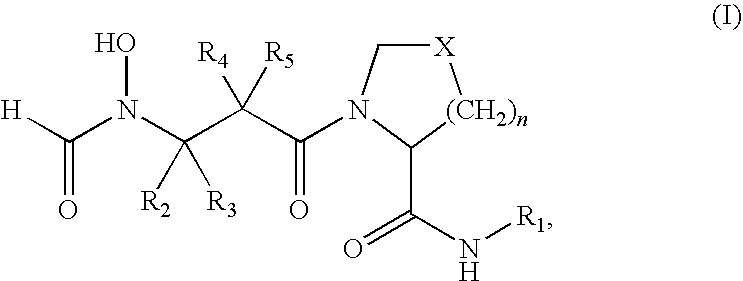
wherein
X is —CH2—, —S—, —CH(OH)—, —CH(OR)—, —CH(SH)—, —CH(SR)—, —CF2—, —C═N(OR)— or —CH(F)—, wherein R is alkyl;
R1 is aryl or heteroaryl;
each of R2, R3, R4 and R5, independently, is hydrogen or alkyl, or
R2 or R3 and R4 or R5, collectively, form a C4-7cycloalkyl; and
n is 0-3, provided that when n is 0, X is —CH2—,
or a salt thereof or a prodrug thereof;
and an efflux pump inhibitor.
2. The method of claim 1 , wherein the heteroaryl is a residue of formula (III)

wherein
each of R6, R7, R8 and R9, independently, is hydrogen, alkyl, substituted alkyl, phenyl, halogen, hydroxy or alkoxy.
3. The method of claim 11 , wherein the compound of formula (III) is
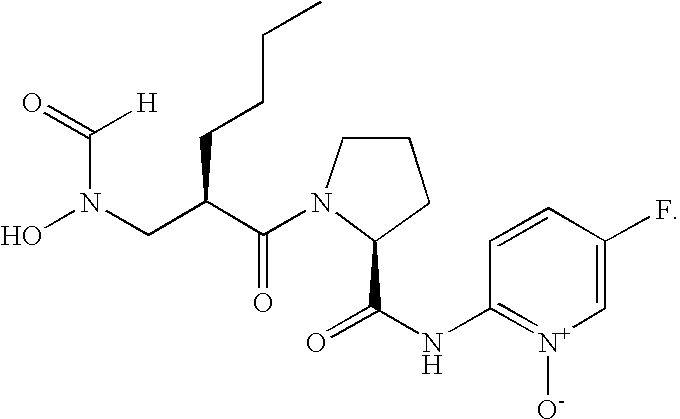
4. The method of claim 2 , wherein the bacterial infection is caused by Gram-negative bacteria possessing an RND efflux pump.
5. The method of claim 4 , wherein the Gram-negative bacteria is selected from the group consisting of E. coli, P. aeruginosa, H. influenzae and Neisseria gonorrhoeae.
6. The method of claim 5 , wherein the Gram-negative bacteria is H. influenzae.
7. A method for treating a Gram-negative bacterial infection in a mammal which is caused by Gram-negative bacteria possessing an RND efflux pump, the method comprising administering an effective amount of the compound
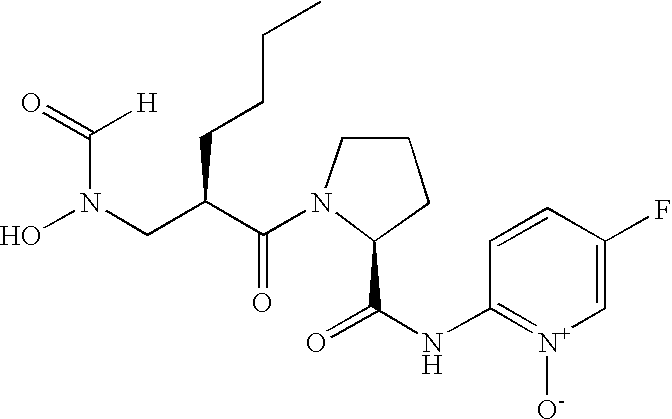
and an efflux inhibitor that inhibits the RND efflux pump in the Gram-negative bacteria.
8. The method of claim 7 , wherein the Gram-negative bacteria is selected from the group consisting of E. coli, P. aeruginosa, H. influenzae and Neisseria gonorrhoeae.
9. The method of claim 8 , wherein the Gram-negative bacteria is H. influenzae.
10. A method for increasing the susceptibility of Gram-negative bacteria to a compound of formula (I):
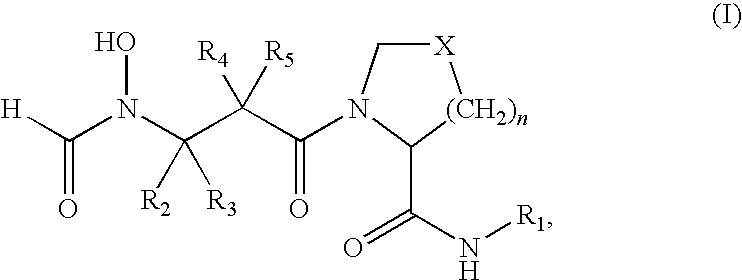
wherein
X is —CH2—, —S—, —CH(OH)—, —CH(OR)—, —CH(SH)—, —CH(SR)—, —CF2—, —C═N(OR)— or —CH(F)—, wherein R is alkyl;
R1 is aryl or heteroaryl;
each of R2, R3, R4 and R5, independently, is hydrogen or alkyl, or
R2 or R3 and R4 or R5 collectively form a C4-7cycloalkyl; and
n is 0-3, provided that when n is 0, X is —CH2—; or
a salt thereof or a prodrug thereof, the method comprising:
contacting the bacteria with the compound of formula (I) and an efflux pump inhibitor in an amount effective to inhibit an efflux pump in the Gram-negative bacteria.
11. The method of claim 10 , wherein the heteroaryl is a residue of formula (III)
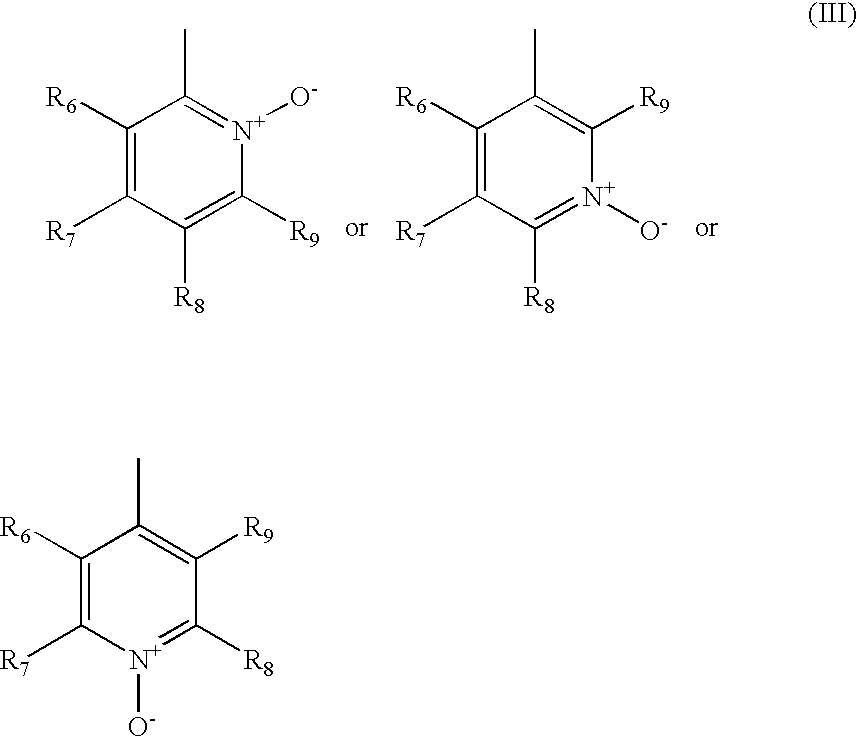
wherein
each of R6, R7, R8 and R9, independently, is hydrogen, alkyl, substituted alkyl, phenyl, halogen, hydroxy or alkoxy.
12. The method of claim 11 , wherein the compound of formula (III) is
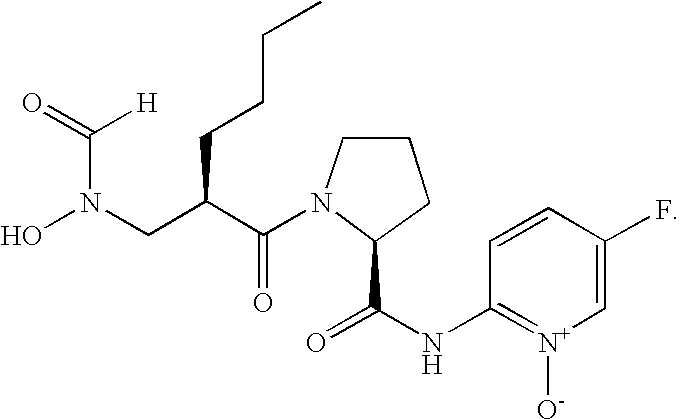
13. The method of claim 10 , wherein the efflux pump in the Gram-negative bacteria is an RND efflux pump.
14. The method of claim 13 , wherein the Gram-negative bacteria is selected from the group consisting of E. coli, P. aeruginosa, H. influenzae and Neisseria gonorrhoeae.
15. The method of claim 14 , wherein the Gram-negative bacteria is H. influenzae.
16. A method for increasing the susceptibility of Gram-negative bacteria possessing an RND efflux pump to the compound
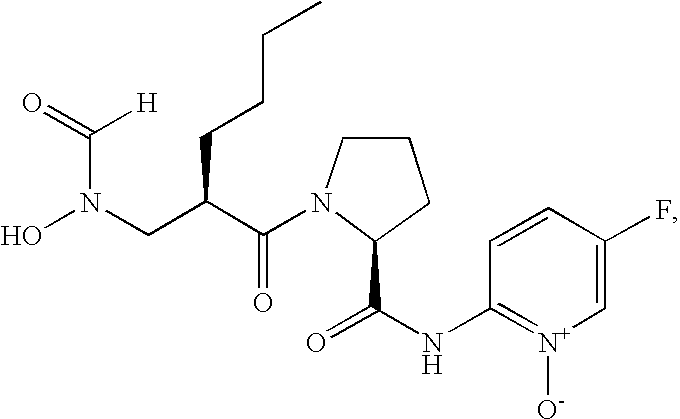
comprising contacting the Gram-negative bacteria with the compound and an efflux pump inhibitor in an amount effective to inhibit the RND pump in the Gram-negative bacteria.
17. The method of claim 16 , wherein the Gram-negative bacteria is selected from the group consisting of E. coli, P. aeruginosa, H. influenzae and Neisseria gonorrhoeae.
18. The method of claim 17 , wherein the Gram-negative bacteria is H. influenzae.
19. A pharmaceutical composition comprising a compound of formula (I)
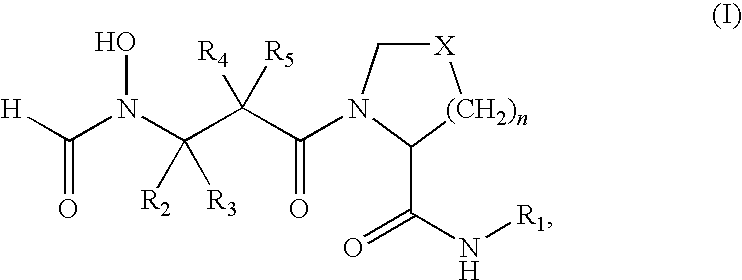
wherein
X is —CH2—, —S—, —CH(OH)—, —CH(OR)—, —CH(SH)—, —CH(SR)—, —CF2—, —C═N(OR)— or —CH(F)—, wherein R is alkyl;
R1 is aryl or heteroaryl;
each of R2, R3, R4 and R5, independently, is hydrogen or alkyl, or
R2 or R3 and R4 or R5, collectively, form a C4-7cycloalkyl; and
N is 0-3, provided that when n is 0, x is —CH2—,
or a salt thereof or a prodrug thereof, an efflux pump inhibitor and a pharmaceutically acceptable carrier.
20. The pharmaceutical composition of claim 19 , wherein the heteroaryl of the compound of formula (I) is a residue of formula (III)
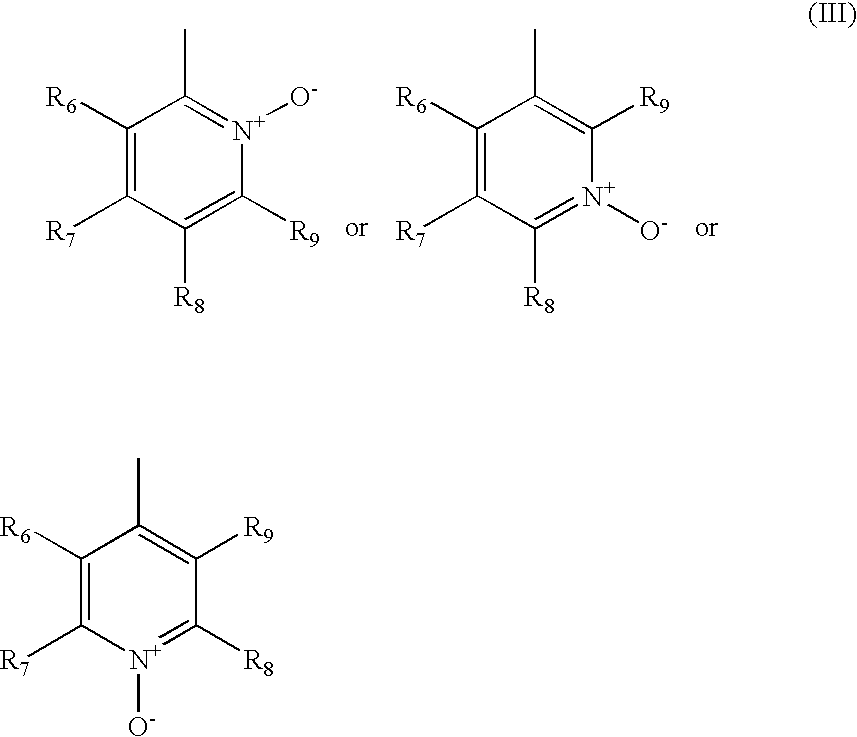
wherein
each of R6, R7, R8 and R9, independently, is hydrogen, alkyl, substituted alkyl, phenyl, halogen, hydroxy or alkoxy.
21. The pharmaceutical composition of claim 20 , wherein the compound of formula (III) is

22. The pharmaceutical composition of claim 19 , wherein the efflux inhibitor inhibits an RND efflux pump in Gram-negative bacteria.
23. The pharmaceutical composition of claim 22 , wherein the Gram-negative bacteria is selected from the group consisting of E. coli, P. aeruginosa, H. influenzae and Neisseria gonorrhoeae.
24. The pharmaceutical composition of claim 23 , wherein the Gram-negative bacteria is H. influenzae.
Priority Applications (1)
| Application Number | Priority Date | Filing Date | Title |
|---|---|---|---|
| US11/570,954 US20090156645A1 (en) | 2004-06-30 | 2005-06-29 | Method for Increasing the Susceptibility of Peptide Deformylase Inhibitors by Using Efflux Pump Inhibitors |
Applications Claiming Priority (3)
| Application Number | Priority Date | Filing Date | Title |
|---|---|---|---|
| US58402304P | 2004-06-30 | 2004-06-30 | |
| PCT/EP2005/007008 WO2006002896A1 (en) | 2004-06-30 | 2005-06-29 | Method for increasing the susceptibility of peptide deformylase inhibitors by using efflux pump inhibitors |
| US11/570,954 US20090156645A1 (en) | 2004-06-30 | 2005-06-29 | Method for Increasing the Susceptibility of Peptide Deformylase Inhibitors by Using Efflux Pump Inhibitors |
Publications (1)
| Publication Number | Publication Date |
|---|---|
| US20090156645A1 true US20090156645A1 (en) | 2009-06-18 |
Family
ID=35149202
Family Applications (1)
| Application Number | Title | Priority Date | Filing Date |
|---|---|---|---|
| US11/570,954 Abandoned US20090156645A1 (en) | 2004-06-30 | 2005-06-29 | Method for Increasing the Susceptibility of Peptide Deformylase Inhibitors by Using Efflux Pump Inhibitors |
Country Status (12)
| Country | Link |
|---|---|
| US (1) | US20090156645A1 (en) |
| EP (1) | EP1763348A1 (en) |
| JP (1) | JP2008505145A (en) |
| KR (1) | KR20070030244A (en) |
| CN (1) | CN1976703A (en) |
| AU (1) | AU2005259488B2 (en) |
| BR (1) | BRPI0512865A (en) |
| CA (1) | CA2569681A1 (en) |
| MX (1) | MXPA06015106A (en) |
| RU (1) | RU2007103299A (en) |
| TW (1) | TW200607492A (en) |
| WO (1) | WO2006002896A1 (en) |
Cited By (1)
| Publication number | Priority date | Publication date | Assignee | Title |
|---|---|---|---|---|
| US20180325871A1 (en) * | 2014-02-21 | 2018-11-15 | Frost Biologic, Inc. | Antimitotic amides for the treatment of cancer and proliferative disorders |
Families Citing this family (4)
| Publication number | Priority date | Publication date | Assignee | Title |
|---|---|---|---|---|
| TW465235B (en) | 1998-09-17 | 2001-11-21 | United Video Properties Inc | Electronic program guide with digital storage |
| CA2622193A1 (en) | 2005-09-29 | 2007-04-12 | Nektar Therapeutics | Antibiotic formulations, unit doses, kits, and methods |
| KR20170015504A (en) * | 2014-06-13 | 2017-02-08 | 유니버시티 오브 로체스터 | Small molecule efflux pump inhibitors |
| CN111658646B (en) * | 2020-06-28 | 2021-03-02 | 河南工业大学 | Application of 2, 6-bis (2-benzimidazolyl) pyridine in preparation of carbapenem pseudomonas aeruginosa infection resistant medicine |
Family Cites Families (4)
| Publication number | Priority date | Publication date | Assignee | Title |
|---|---|---|---|---|
| US6114310A (en) * | 1998-01-23 | 2000-09-05 | Microcide Pharmaceuticals, Inc. | Efflux pump inhibitors |
| NZ508256A (en) * | 1998-05-18 | 2003-08-29 | Upjohn Co | Enhancement of oxazolidinone antibacterial agents activity by using arginine derivatives |
| AR036053A1 (en) * | 2001-06-15 | 2004-08-04 | Versicor Inc | N-FORMIL-HYDROXYLAMINE COMPOUNDS, A PROCESS FOR PREPARATION AND PHARMACEUTICAL COMPOSITIONS |
| WO2004062674A2 (en) * | 2003-01-07 | 2004-07-29 | Paratek Pharmaceuticals, Inc. | Substituted polyamines as inhibitors of bacterial efflux pumps |
-
2005
- 2005-06-29 RU RU2007103299/14A patent/RU2007103299A/en not_active Application Discontinuation
- 2005-06-29 MX MXPA06015106A patent/MXPA06015106A/en not_active Application Discontinuation
- 2005-06-29 CN CNA2005800220392A patent/CN1976703A/en active Pending
- 2005-06-29 CA CA002569681A patent/CA2569681A1/en not_active Abandoned
- 2005-06-29 AU AU2005259488A patent/AU2005259488B2/en not_active Ceased
- 2005-06-29 EP EP05772146A patent/EP1763348A1/en not_active Withdrawn
- 2005-06-29 KR KR1020067027827A patent/KR20070030244A/en not_active Withdrawn
- 2005-06-29 TW TW094121996A patent/TW200607492A/en unknown
- 2005-06-29 WO PCT/EP2005/007008 patent/WO2006002896A1/en not_active Ceased
- 2005-06-29 JP JP2007519681A patent/JP2008505145A/en active Pending
- 2005-06-29 US US11/570,954 patent/US20090156645A1/en not_active Abandoned
- 2005-06-29 BR BRPI0512865-0A patent/BRPI0512865A/en not_active IP Right Cessation
Cited By (4)
| Publication number | Priority date | Publication date | Assignee | Title |
|---|---|---|---|---|
| US20180325871A1 (en) * | 2014-02-21 | 2018-11-15 | Frost Biologic, Inc. | Antimitotic amides for the treatment of cancer and proliferative disorders |
| US10772872B2 (en) * | 2014-02-21 | 2020-09-15 | Frost Biologic, Inc. | Antimitotic amides for the treatment of cancer and proliferative disorders |
| US11129813B2 (en) | 2014-02-21 | 2021-09-28 | Frost Biologic, Inc. | Antimitotic amides for the treatment of cancer and proliferative disorders |
| US12383533B2 (en) | 2014-02-21 | 2025-08-12 | Frost Biologic, Inc. | Antimitotic amides for the treatment of cancer and proliferative disorders |
Also Published As
| Publication number | Publication date |
|---|---|
| EP1763348A1 (en) | 2007-03-21 |
| BRPI0512865A (en) | 2008-04-08 |
| CN1976703A (en) | 2007-06-06 |
| RU2007103299A (en) | 2008-08-10 |
| KR20070030244A (en) | 2007-03-15 |
| AU2005259488A1 (en) | 2006-01-12 |
| MXPA06015106A (en) | 2007-02-08 |
| CA2569681A1 (en) | 2006-12-06 |
| TW200607492A (en) | 2006-03-01 |
| AU2005259488B2 (en) | 2009-10-01 |
| WO2006002896A1 (en) | 2006-01-12 |
| JP2008505145A (en) | 2008-02-21 |
Similar Documents
| Publication | Publication Date | Title |
|---|---|---|
| US6436980B1 (en) | Peptidomimetic efflux pump inhibitors | |
| US20120316105A1 (en) | Polymyxin Derivates Useful As Antibacterial Agents | |
| US8673888B2 (en) | Depsipeptide for therapy of kidney cancer | |
| US10857138B2 (en) | Pharmaceutical compositions comprising antibacterial agents | |
| BR112021002632A2 (en) | urea compounds and compositions as smarca2/brm atpase inhibitors | |
| CN102548552B (en) | Spectinomycin amide as tuberculosis | |
| US20090156645A1 (en) | Method for Increasing the Susceptibility of Peptide Deformylase Inhibitors by Using Efflux Pump Inhibitors | |
| EP3706744B1 (en) | Small molecule inhibitors of shared epitope-calreticulin interactions and methods of use | |
| WO2017143112A2 (en) | An oxazolidinone for treatment of infections with mycobacterium tuberculosis | |
| US20240342171A1 (en) | Discovery of a f-atp synthase inhibitor for the treatment of mycobacterium abscessus diseases | |
| US20170065566A1 (en) | Pharmaceutical combinations comprising antibacterial agents | |
| US20210113598A1 (en) | Combination of MIDH1 Inhibitors and DNA Hypomethylating Agents (HMA) | |
| US9827235B2 (en) | Pharmaceutical compositions comprising antibacterial agents | |
| US8729090B1 (en) | Compositions and methods for inhibiting collagen production | |
| US7153826B2 (en) | Treatment of rosacea | |
| AU2014338612A1 (en) | Pharmaceutical compositions comprising antibacterial agents | |
| WO2017168393A1 (en) | Antibacterial compositions | |
| EP3217979B1 (en) | Pharmaceutical compositions comprising antibacterial agents | |
| HK40119430A (en) | Oxazolidinone liposome compositions | |
| HK40093312A (en) | Oxazolidinone compounds, liposome compositions comprising oxazolidinone compounds and methods of use thereof | |
| WO2002085412A1 (en) | Tissue fibrosis inhibitors | |
| HK1108113A (en) | Method for increasing the susceptibility of peptide deformylase inhibitors by using efflux pump inhibitors | |
| HK1171388A (en) | Spectinamides as anti-tuberculosis agents | |
| HK1171388B (en) | Spectinamides as anti-tuberculosis agents |
Legal Events
| Date | Code | Title | Description |
|---|---|---|---|
| AS | Assignment |
Owner name: NOVARTIS AG, SWITZERLAND Free format text: ASSIGNMENT OF ASSIGNORS INTEREST;ASSIGNORS:DEAN, CHARLES RICHARD;RYDER, NEIL STEWART;REEL/FRAME:022657/0889 Effective date: 20080902 |
|
| STCB | Information on status: application discontinuation |
Free format text: ABANDONED -- FAILURE TO RESPOND TO AN OFFICE ACTION |