US20090105346A1 - Novel crystalline forms of armodafinil and preparation thereof - Google Patents
Novel crystalline forms of armodafinil and preparation thereof Download PDFInfo
- Publication number
- US20090105346A1 US20090105346A1 US12/287,011 US28701108A US2009105346A1 US 20090105346 A1 US20090105346 A1 US 20090105346A1 US 28701108 A US28701108 A US 28701108A US 2009105346 A1 US2009105346 A1 US 2009105346A1
- Authority
- US
- United States
- Prior art keywords
- armodafinil
- xylene
- process according
- crystalline form
- theta
- Prior art date
- Legal status (The legal status is an assumption and is not a legal conclusion. Google has not performed a legal analysis and makes no representation as to the accuracy of the status listed.)
- Abandoned
Links
- YFGHCGITMMYXAQ-LJQANCHMSA-N armodafinil Chemical compound C=1C=CC=CC=1C([S@](=O)CC(=O)N)C1=CC=CC=C1 YFGHCGITMMYXAQ-LJQANCHMSA-N 0.000 title claims abstract description 88
- 229960004823 armodafinil Drugs 0.000 title claims abstract description 55
- 238000002360 preparation method Methods 0.000 title description 7
- 238000000034 method Methods 0.000 claims abstract description 27
- 239000008194 pharmaceutical composition Substances 0.000 claims abstract description 20
- 208000032140 Sleepiness Diseases 0.000 claims abstract description 8
- 206010041349 Somnolence Diseases 0.000 claims abstract description 8
- 230000037321 sleepiness Effects 0.000 claims abstract description 8
- IAZDPXIOMUYVGZ-UHFFFAOYSA-N Dimethylsulphoxide Chemical compound CS(C)=O IAZDPXIOMUYVGZ-UHFFFAOYSA-N 0.000 claims description 22
- 238000001144 powder X-ray diffraction data Methods 0.000 claims description 16
- CTQNGGLPUBDAKN-UHFFFAOYSA-N O-Xylene Chemical compound CC1=CC=CC=C1C CTQNGGLPUBDAKN-UHFFFAOYSA-N 0.000 claims description 14
- 239000008096 xylene Substances 0.000 claims description 13
- URLKBWYHVLBVBO-UHFFFAOYSA-N Para-Xylene Chemical group CC1=CC=C(C)C=C1 URLKBWYHVLBVBO-UHFFFAOYSA-N 0.000 claims description 12
- IVSZLXZYQVIEFR-UHFFFAOYSA-N m-xylene Chemical group CC1=CC=CC(C)=C1 IVSZLXZYQVIEFR-UHFFFAOYSA-N 0.000 claims description 12
- 238000004519 manufacturing process Methods 0.000 claims description 12
- 239000000546 pharmaceutical excipient Substances 0.000 claims description 12
- 239000002244 precipitate Substances 0.000 claims description 12
- 239000000725 suspension Substances 0.000 claims description 12
- 238000001816 cooling Methods 0.000 claims description 10
- 238000010438 heat treatment Methods 0.000 claims description 10
- 239000000203 mixture Substances 0.000 abstract description 16
- 238000009472 formulation Methods 0.000 abstract description 9
- 239000013078 crystal Substances 0.000 description 13
- VLKZOEOYAKHREP-UHFFFAOYSA-N n-Hexane Chemical compound CCCCCC VLKZOEOYAKHREP-UHFFFAOYSA-N 0.000 description 9
- 208000019888 Circadian rhythm sleep disease Diseases 0.000 description 8
- 239000000843 powder Substances 0.000 description 8
- 201000002859 sleep apnea Diseases 0.000 description 8
- YFGHCGITMMYXAQ-UHFFFAOYSA-N 2-[(diphenylmethyl)sulfinyl]acetamide Chemical compound C=1C=CC=CC=1C(S(=O)CC(=O)N)C1=CC=CC=C1 YFGHCGITMMYXAQ-UHFFFAOYSA-N 0.000 description 7
- 239000003814 drug Substances 0.000 description 7
- 239000002552 dosage form Substances 0.000 description 6
- 229940079593 drug Drugs 0.000 description 6
- 239000003085 diluting agent Substances 0.000 description 5
- 239000000463 material Substances 0.000 description 5
- 239000007787 solid Substances 0.000 description 5
- 239000003826 tablet Substances 0.000 description 5
- 239000011230 binding agent Substances 0.000 description 4
- 230000015572 biosynthetic process Effects 0.000 description 4
- 239000007884 disintegrant Substances 0.000 description 4
- 238000001914 filtration Methods 0.000 description 4
- 239000000314 lubricant Substances 0.000 description 4
- 229960001165 modafinil Drugs 0.000 description 4
- 201000003631 narcolepsy Diseases 0.000 description 4
- 208000001797 obstructive sleep apnea Diseases 0.000 description 4
- 230000000704 physical effect Effects 0.000 description 4
- 239000000243 solution Substances 0.000 description 4
- 238000005406 washing Methods 0.000 description 4
- 239000002775 capsule Substances 0.000 description 3
- 239000001913 cellulose Substances 0.000 description 3
- 235000010980 cellulose Nutrition 0.000 description 3
- 229920002678 cellulose Polymers 0.000 description 3
- KRKNYBCHXYNGOX-UHFFFAOYSA-N citric acid Chemical compound OC(=O)CC(O)(C(O)=O)CC(O)=O KRKNYBCHXYNGOX-UHFFFAOYSA-N 0.000 description 3
- 238000004090 dissolution Methods 0.000 description 3
- 239000012453 solvate Substances 0.000 description 3
- 239000002904 solvent Substances 0.000 description 3
- XPCTZQVDEJYUGT-UHFFFAOYSA-N 3-hydroxy-2-methyl-4-pyrone Chemical compound CC=1OC=CC(=O)C=1O XPCTZQVDEJYUGT-UHFFFAOYSA-N 0.000 description 2
- HBAQYPYDRFILMT-UHFFFAOYSA-N 8-[3-(1-cyclopropylpyrazol-4-yl)-1H-pyrazolo[4,3-d]pyrimidin-5-yl]-3-methyl-3,8-diazabicyclo[3.2.1]octan-2-one Chemical class C1(CC1)N1N=CC(=C1)C1=NNC2=C1N=C(N=C2)N1C2C(N(CC1CC2)C)=O HBAQYPYDRFILMT-UHFFFAOYSA-N 0.000 description 2
- XKJMBINCVNINCA-UHFFFAOYSA-N Alfalone Chemical compound CON(C)C(=O)NC1=CC=C(Cl)C(Cl)=C1 XKJMBINCVNINCA-UHFFFAOYSA-N 0.000 description 2
- VTYYLEPIZMXCLO-UHFFFAOYSA-L Calcium carbonate Chemical compound [Ca+2].[O-]C([O-])=O VTYYLEPIZMXCLO-UHFFFAOYSA-L 0.000 description 2
- FBPFZTCFMRRESA-FSIIMWSLSA-N D-Glucitol Natural products OC[C@H](O)[C@H](O)[C@@H](O)[C@H](O)CO FBPFZTCFMRRESA-FSIIMWSLSA-N 0.000 description 2
- FBPFZTCFMRRESA-KVTDHHQDSA-N D-Mannitol Chemical compound OC[C@@H](O)[C@@H](O)[C@H](O)[C@H](O)CO FBPFZTCFMRRESA-KVTDHHQDSA-N 0.000 description 2
- FBPFZTCFMRRESA-JGWLITMVSA-N D-glucitol Chemical compound OC[C@H](O)[C@@H](O)[C@H](O)[C@H](O)CO FBPFZTCFMRRESA-JGWLITMVSA-N 0.000 description 2
- RTZKZFJDLAIYFH-UHFFFAOYSA-N Diethyl ether Chemical compound CCOCC RTZKZFJDLAIYFH-UHFFFAOYSA-N 0.000 description 2
- 239000004097 EU approved flavor enhancer Substances 0.000 description 2
- VZCYOOQTPOCHFL-OWOJBTEDSA-N Fumaric acid Chemical compound OC(=O)\C=C\C(O)=O VZCYOOQTPOCHFL-OWOJBTEDSA-N 0.000 description 2
- 108010010803 Gelatin Proteins 0.000 description 2
- 229930195725 Mannitol Natural products 0.000 description 2
- 229920000881 Modified starch Polymers 0.000 description 2
- IMNFDUFMRHMDMM-UHFFFAOYSA-N N-Heptane Chemical compound CCCCCCC IMNFDUFMRHMDMM-UHFFFAOYSA-N 0.000 description 2
- PPBRXRYQALVLMV-UHFFFAOYSA-N Styrene Chemical compound C=CC1=CC=CC=C1 PPBRXRYQALVLMV-UHFFFAOYSA-N 0.000 description 2
- 239000007864 aqueous solution Substances 0.000 description 2
- 238000000576 coating method Methods 0.000 description 2
- 229920001577 copolymer Polymers 0.000 description 2
- 238000001035 drying Methods 0.000 description 2
- 239000002702 enteric coating Substances 0.000 description 2
- 238000009505 enteric coating Methods 0.000 description 2
- CBOQJANXLMLOSS-UHFFFAOYSA-N ethyl vanillin Chemical group CCOC1=CC(C=O)=CC=C1O CBOQJANXLMLOSS-UHFFFAOYSA-N 0.000 description 2
- 239000000796 flavoring agent Substances 0.000 description 2
- 235000013355 food flavoring agent Nutrition 0.000 description 2
- 235000019264 food flavour enhancer Nutrition 0.000 description 2
- 235000003599 food sweetener Nutrition 0.000 description 2
- 229920000159 gelatin Polymers 0.000 description 2
- 239000008273 gelatin Substances 0.000 description 2
- 235000019322 gelatine Nutrition 0.000 description 2
- 235000011852 gelatine desserts Nutrition 0.000 description 2
- 238000002955 isolation Methods 0.000 description 2
- HQKMJHAJHXVSDF-UHFFFAOYSA-L magnesium stearate Chemical compound [Mg+2].CCCCCCCCCCCCCCCCCC([O-])=O.CCCCCCCCCCCCCCCCCC([O-])=O HQKMJHAJHXVSDF-UHFFFAOYSA-L 0.000 description 2
- 239000000594 mannitol Substances 0.000 description 2
- 235000010355 mannitol Nutrition 0.000 description 2
- 239000000825 pharmaceutical preparation Substances 0.000 description 2
- 229940127557 pharmaceutical product Drugs 0.000 description 2
- XNGIFLGASWRNHJ-UHFFFAOYSA-N phthalic acid Chemical compound OC(=O)C1=CC=CC=C1C(O)=O XNGIFLGASWRNHJ-UHFFFAOYSA-N 0.000 description 2
- 238000000634 powder X-ray diffraction Methods 0.000 description 2
- 239000003755 preservative agent Substances 0.000 description 2
- 229940117394 provigil Drugs 0.000 description 2
- 239000000600 sorbitol Substances 0.000 description 2
- 238000003860 storage Methods 0.000 description 2
- 239000000126 substance Substances 0.000 description 2
- 239000003765 sweetening agent Substances 0.000 description 2
- 238000003786 synthesis reaction Methods 0.000 description 2
- VZCYOOQTPOCHFL-UHFFFAOYSA-N trans-butenedioic acid Natural products OC(=O)C=CC(O)=O VZCYOOQTPOCHFL-UHFFFAOYSA-N 0.000 description 2
- 150000003738 xylenes Chemical class 0.000 description 2
- NOOLISFMXDJSKH-UTLUCORTSA-N (+)-Neomenthol Chemical compound CC(C)[C@@H]1CC[C@@H](C)C[C@@H]1O NOOLISFMXDJSKH-UTLUCORTSA-N 0.000 description 1
- LNAZSHAWQACDHT-XIYTZBAFSA-N (2r,3r,4s,5r,6s)-4,5-dimethoxy-2-(methoxymethyl)-3-[(2s,3r,4s,5r,6r)-3,4,5-trimethoxy-6-(methoxymethyl)oxan-2-yl]oxy-6-[(2r,3r,4s,5r,6r)-4,5,6-trimethoxy-2-(methoxymethyl)oxan-3-yl]oxyoxane Chemical compound CO[C@@H]1[C@@H](OC)[C@H](OC)[C@@H](COC)O[C@H]1O[C@H]1[C@H](OC)[C@@H](OC)[C@H](O[C@H]2[C@@H]([C@@H](OC)[C@H](OC)O[C@@H]2COC)OC)O[C@@H]1COC LNAZSHAWQACDHT-XIYTZBAFSA-N 0.000 description 1
- IXPNQXFRVYWDDI-UHFFFAOYSA-N 1-methyl-2,4-dioxo-1,3-diazinane-5-carboximidamide Chemical compound CN1CC(C(N)=N)C(=O)NC1=O IXPNQXFRVYWDDI-UHFFFAOYSA-N 0.000 description 1
- 108010011485 Aspartame Proteins 0.000 description 1
- 239000004255 Butylated hydroxyanisole Substances 0.000 description 1
- 239000004322 Butylated hydroxytoluene Substances 0.000 description 1
- NLZUEZXRPGMBCV-UHFFFAOYSA-N Butylhydroxytoluene Chemical compound CC1=CC(C(C)(C)C)=C(O)C(C(C)(C)C)=C1 NLZUEZXRPGMBCV-UHFFFAOYSA-N 0.000 description 1
- QVVGEOWRVJQBPS-UHFFFAOYSA-M COC(=O)CS(=O)C(C1=CC=CC=C1)C1=CC=CC=C1.NC(=O)CS(=O)C(C1=CC=CC=C1)C1=CC=CC=C1.O=C(O)CS(=O)C(C1=CC=CC=C1)C1=CC=CC=C1.O=C(O)CS(=O)C(C1=CC=CC=C1)C1=CC=CC=C1.O=COO[Na] Chemical compound COC(=O)CS(=O)C(C1=CC=CC=C1)C1=CC=CC=C1.NC(=O)CS(=O)C(C1=CC=CC=C1)C1=CC=CC=C1.O=C(O)CS(=O)C(C1=CC=CC=C1)C1=CC=CC=C1.O=C(O)CS(=O)C(C1=CC=CC=C1)C1=CC=CC=C1.O=COO[Na] QVVGEOWRVJQBPS-UHFFFAOYSA-M 0.000 description 1
- 229920002134 Carboxymethyl cellulose Polymers 0.000 description 1
- XDTMQSROBMDMFD-UHFFFAOYSA-N Cyclohexane Chemical compound C1CCCCC1 XDTMQSROBMDMFD-UHFFFAOYSA-N 0.000 description 1
- NOOLISFMXDJSKH-UHFFFAOYSA-N DL-menthol Natural products CC(C)C1CCC(C)CC1O NOOLISFMXDJSKH-UHFFFAOYSA-N 0.000 description 1
- 229920001353 Dextrin Polymers 0.000 description 1
- 239000004375 Dextrin Substances 0.000 description 1
- FEWJPZIEWOKRBE-JCYAYHJZSA-N Dextrotartaric acid Chemical compound OC(=O)[C@H](O)[C@@H](O)C(O)=O FEWJPZIEWOKRBE-JCYAYHJZSA-N 0.000 description 1
- KCXVZYZYPLLWCC-UHFFFAOYSA-N EDTA Chemical compound OC(=O)CN(CC(O)=O)CCN(CC(O)=O)CC(O)=O KCXVZYZYPLLWCC-UHFFFAOYSA-N 0.000 description 1
- LFQSCWFLJHTTHZ-UHFFFAOYSA-N Ethanol Chemical compound CCO LFQSCWFLJHTTHZ-UHFFFAOYSA-N 0.000 description 1
- 239000001856 Ethyl cellulose Substances 0.000 description 1
- ZZSNKZQZMQGXPY-UHFFFAOYSA-N Ethyl cellulose Chemical compound CCOCC1OC(OC)C(OCC)C(OCC)C1OC1C(O)C(O)C(OC)C(CO)O1 ZZSNKZQZMQGXPY-UHFFFAOYSA-N 0.000 description 1
- YIKYNHJUKRTCJL-UHFFFAOYSA-N Ethyl maltol Chemical compound CCC=1OC=CC(=O)C=1O YIKYNHJUKRTCJL-UHFFFAOYSA-N 0.000 description 1
- 239000005715 Fructose Substances 0.000 description 1
- 229930091371 Fructose Natural products 0.000 description 1
- RFSUNEUAIZKAJO-ARQDHWQXSA-N Fructose Chemical compound OC[C@H]1O[C@](O)(CO)[C@@H](O)[C@@H]1O RFSUNEUAIZKAJO-ARQDHWQXSA-N 0.000 description 1
- WQZGKKKJIJFFOK-GASJEMHNSA-N Glucose Natural products OC[C@H]1OC(O)[C@H](O)[C@@H](O)[C@@H]1O WQZGKKKJIJFFOK-GASJEMHNSA-N 0.000 description 1
- 229920000084 Gum arabic Polymers 0.000 description 1
- UFHFLCQGNIYNRP-UHFFFAOYSA-N Hydrogen Chemical compound [H][H] UFHFLCQGNIYNRP-UHFFFAOYSA-N 0.000 description 1
- 239000004354 Hydroxyethyl cellulose Substances 0.000 description 1
- 229920000663 Hydroxyethyl cellulose Polymers 0.000 description 1
- 229920002153 Hydroxypropyl cellulose Polymers 0.000 description 1
- HYMLWHLQFGRFIY-UHFFFAOYSA-N Maltol Natural products CC1OC=CC(=O)C1=O HYMLWHLQFGRFIY-UHFFFAOYSA-N 0.000 description 1
- VVQNEPGJFQJSBK-UHFFFAOYSA-N Methyl methacrylate Chemical compound COC(=O)C(C)=C VVQNEPGJFQJSBK-UHFFFAOYSA-N 0.000 description 1
- 229920000168 Microcrystalline cellulose Polymers 0.000 description 1
- WHNWPMSKXPGLAX-UHFFFAOYSA-N N-Vinyl-2-pyrrolidone Chemical compound C=CN1CCCC1=O WHNWPMSKXPGLAX-UHFFFAOYSA-N 0.000 description 1
- 239000004372 Polyvinyl alcohol Substances 0.000 description 1
- OFOBLEOULBTSOW-UHFFFAOYSA-N Propanedioic acid Natural products OC(=O)CC(O)=O OFOBLEOULBTSOW-UHFFFAOYSA-N 0.000 description 1
- WINXNKPZLFISPD-UHFFFAOYSA-M Saccharin sodium Chemical compound [Na+].C1=CC=C2C(=O)[N-]S(=O)(=O)C2=C1 WINXNKPZLFISPD-UHFFFAOYSA-M 0.000 description 1
- 229920002472 Starch Polymers 0.000 description 1
- 229930006000 Sucrose Natural products 0.000 description 1
- CZMRCDWAGMRECN-UGDNZRGBSA-N Sucrose Chemical compound O[C@H]1[C@H](O)[C@@H](CO)O[C@@]1(CO)O[C@@H]1[C@H](O)[C@@H](O)[C@H](O)[C@@H](CO)O1 CZMRCDWAGMRECN-UGDNZRGBSA-N 0.000 description 1
- FEWJPZIEWOKRBE-UHFFFAOYSA-N Tartaric acid Natural products [H+].[H+].[O-]C(=O)C(O)C(O)C([O-])=O FEWJPZIEWOKRBE-UHFFFAOYSA-N 0.000 description 1
- 238000002441 X-ray diffraction Methods 0.000 description 1
- 238000010521 absorption reaction Methods 0.000 description 1
- 235000010489 acacia gum Nutrition 0.000 description 1
- 239000000205 acacia gum Substances 0.000 description 1
- 150000001338 aliphatic hydrocarbons Chemical class 0.000 description 1
- 150000004945 aromatic hydrocarbons Chemical class 0.000 description 1
- 239000000605 aspartame Substances 0.000 description 1
- 235000010357 aspartame Nutrition 0.000 description 1
- IAOZJIPTCAWIRG-QWRGUYRKSA-N aspartame Chemical compound OC(=O)C[C@H](N)C(=O)N[C@H](C(=O)OC)CC1=CC=CC=C1 IAOZJIPTCAWIRG-QWRGUYRKSA-N 0.000 description 1
- 229960003438 aspartame Drugs 0.000 description 1
- WQZGKKKJIJFFOK-VFUOTHLCSA-N beta-D-glucose Chemical compound OC[C@H]1O[C@@H](O)[C@H](O)[C@@H](O)[C@@H]1O WQZGKKKJIJFFOK-VFUOTHLCSA-N 0.000 description 1
- 235000019282 butylated hydroxyanisole Nutrition 0.000 description 1
- 229940043253 butylated hydroxyanisole Drugs 0.000 description 1
- CZBZUDVBLSSABA-UHFFFAOYSA-N butylated hydroxyanisole Chemical compound COC1=CC=C(O)C(C(C)(C)C)=C1.COC1=CC=C(O)C=C1C(C)(C)C CZBZUDVBLSSABA-UHFFFAOYSA-N 0.000 description 1
- 235000010354 butylated hydroxytoluene Nutrition 0.000 description 1
- 229940095259 butylated hydroxytoluene Drugs 0.000 description 1
- 229910000019 calcium carbonate Inorganic materials 0.000 description 1
- JUNWLZAGQLJVLR-UHFFFAOYSA-J calcium diphosphate Chemical compound [Ca+2].[Ca+2].[O-]P([O-])(=O)OP([O-])([O-])=O JUNWLZAGQLJVLR-UHFFFAOYSA-J 0.000 description 1
- CJZGTCYPCWQAJB-UHFFFAOYSA-L calcium stearate Chemical compound [Ca+2].CCCCCCCCCCCCCCCCCC([O-])=O.CCCCCCCCCCCCCCCCCC([O-])=O CJZGTCYPCWQAJB-UHFFFAOYSA-L 0.000 description 1
- 235000013539 calcium stearate Nutrition 0.000 description 1
- 239000008116 calcium stearate Substances 0.000 description 1
- 235000010948 carboxy methyl cellulose Nutrition 0.000 description 1
- 239000001768 carboxy methyl cellulose Substances 0.000 description 1
- 239000008112 carboxymethyl-cellulose Substances 0.000 description 1
- 229920002301 cellulose acetate Polymers 0.000 description 1
- 239000002738 chelating agent Substances 0.000 description 1
- 239000003795 chemical substances by application Substances 0.000 description 1
- 229960004106 citric acid Drugs 0.000 description 1
- 239000011248 coating agent Substances 0.000 description 1
- 150000001875 compounds Chemical class 0.000 description 1
- 229960000913 crospovidone Drugs 0.000 description 1
- 230000001627 detrimental effect Effects 0.000 description 1
- 235000019425 dextrin Nutrition 0.000 description 1
- 235000019821 dicalcium diphosphate Nutrition 0.000 description 1
- 229910000393 dicalcium diphosphate Inorganic materials 0.000 description 1
- 239000003937 drug carrier Substances 0.000 description 1
- 229960001484 edetic acid Drugs 0.000 description 1
- 235000019441 ethanol Nutrition 0.000 description 1
- MVPICKVDHDWCJQ-UHFFFAOYSA-N ethyl 3-pyrrolidin-1-ylpropanoate Chemical compound CCOC(=O)CCN1CCCC1 MVPICKVDHDWCJQ-UHFFFAOYSA-N 0.000 description 1
- 235000019325 ethyl cellulose Nutrition 0.000 description 1
- 229920001249 ethyl cellulose Polymers 0.000 description 1
- 229940093503 ethyl maltol Drugs 0.000 description 1
- 229940073505 ethyl vanillin Drugs 0.000 description 1
- -1 flavorings Substances 0.000 description 1
- 230000037406 food intake Effects 0.000 description 1
- 229960002737 fructose Drugs 0.000 description 1
- 239000001530 fumaric acid Substances 0.000 description 1
- 229960002598 fumaric acid Drugs 0.000 description 1
- 210000001035 gastrointestinal tract Anatomy 0.000 description 1
- 239000008103 glucose Substances 0.000 description 1
- 229960001031 glucose Drugs 0.000 description 1
- 235000001727 glucose Nutrition 0.000 description 1
- 239000008187 granular material Substances 0.000 description 1
- 235000019447 hydroxyethyl cellulose Nutrition 0.000 description 1
- 235000010977 hydroxypropyl cellulose Nutrition 0.000 description 1
- 239000001863 hydroxypropyl cellulose Substances 0.000 description 1
- 235000010979 hydroxypropyl methyl cellulose Nutrition 0.000 description 1
- 239000001866 hydroxypropyl methyl cellulose Substances 0.000 description 1
- 229920003088 hydroxypropyl methyl cellulose Polymers 0.000 description 1
- UFVKGYZPFZQRLF-UHFFFAOYSA-N hydroxypropyl methyl cellulose Chemical compound OC1C(O)C(OC)OC(CO)C1OC1C(O)C(O)C(OC2C(C(O)C(OC3C(C(O)C(O)C(CO)O3)O)C(CO)O2)O)C(CO)O1 UFVKGYZPFZQRLF-UHFFFAOYSA-N 0.000 description 1
- 229940031704 hydroxypropyl methylcellulose phthalate Drugs 0.000 description 1
- 239000004615 ingredient Substances 0.000 description 1
- 230000009878 intermolecular interaction Effects 0.000 description 1
- 238000007918 intramuscular administration Methods 0.000 description 1
- 238000001990 intravenous administration Methods 0.000 description 1
- 229960004903 invert sugar Drugs 0.000 description 1
- 239000006194 liquid suspension Substances 0.000 description 1
- 229940031703 low substituted hydroxypropyl cellulose Drugs 0.000 description 1
- 239000007937 lozenge Substances 0.000 description 1
- 235000019359 magnesium stearate Nutrition 0.000 description 1
- VZCYOOQTPOCHFL-UPHRSURJSA-N maleic acid Chemical compound OC(=O)\C=C/C(O)=O VZCYOOQTPOCHFL-UPHRSURJSA-N 0.000 description 1
- 239000011976 maleic acid Substances 0.000 description 1
- 229940043353 maltol Drugs 0.000 description 1
- 229960001855 mannitol Drugs 0.000 description 1
- 238000002844 melting Methods 0.000 description 1
- 230000008018 melting Effects 0.000 description 1
- 229940041616 menthol Drugs 0.000 description 1
- 229920003145 methacrylic acid copolymer Polymers 0.000 description 1
- 229920000609 methyl cellulose Polymers 0.000 description 1
- 235000010981 methylcellulose Nutrition 0.000 description 1
- 239000001923 methylcellulose Substances 0.000 description 1
- 239000008108 microcrystalline cellulose Substances 0.000 description 1
- 229940016286 microcrystalline cellulose Drugs 0.000 description 1
- 235000019813 microcrystalline cellulose Nutrition 0.000 description 1
- 238000012986 modification Methods 0.000 description 1
- 230000004048 modification Effects 0.000 description 1
- 238000000655 nuclear magnetic resonance spectrum Methods 0.000 description 1
- 229940078552 o-xylene Drugs 0.000 description 1
- 235000010987 pectin Nutrition 0.000 description 1
- 239000001814 pectin Substances 0.000 description 1
- 229920001277 pectin Polymers 0.000 description 1
- 239000003208 petroleum Substances 0.000 description 1
- XNGIFLGASWRNHJ-UHFFFAOYSA-L phthalate(2-) Chemical compound [O-]C(=O)C1=CC=CC=C1C([O-])=O XNGIFLGASWRNHJ-UHFFFAOYSA-L 0.000 description 1
- 239000004014 plasticizer Substances 0.000 description 1
- 229920000058 polyacrylate Polymers 0.000 description 1
- 229920002451 polyvinyl alcohol Polymers 0.000 description 1
- 235000013809 polyvinylpolypyrrolidone Nutrition 0.000 description 1
- 229920000523 polyvinylpolypyrrolidone Polymers 0.000 description 1
- 229920003124 powdered cellulose Polymers 0.000 description 1
- 235000019814 powdered cellulose Nutrition 0.000 description 1
- 238000000746 purification Methods 0.000 description 1
- 230000005855 radiation Effects 0.000 description 1
- 235000019204 saccharin Nutrition 0.000 description 1
- 229940081974 saccharin Drugs 0.000 description 1
- 239000000901 saccharin and its Na,K and Ca salt Substances 0.000 description 1
- 150000003839 salts Chemical class 0.000 description 1
- 238000013341 scale-up Methods 0.000 description 1
- 235000010413 sodium alginate Nutrition 0.000 description 1
- 239000000661 sodium alginate Substances 0.000 description 1
- 229940005550 sodium alginate Drugs 0.000 description 1
- WXMKPNITSTVMEF-UHFFFAOYSA-M sodium benzoate Chemical compound [Na+].[O-]C(=O)C1=CC=CC=C1 WXMKPNITSTVMEF-UHFFFAOYSA-M 0.000 description 1
- 235000010234 sodium benzoate Nutrition 0.000 description 1
- 239000004299 sodium benzoate Substances 0.000 description 1
- 229960003885 sodium benzoate Drugs 0.000 description 1
- 229920003109 sodium starch glycolate Polymers 0.000 description 1
- 239000008109 sodium starch glycolate Substances 0.000 description 1
- 229940079832 sodium starch glycolate Drugs 0.000 description 1
- 229940045902 sodium stearyl fumarate Drugs 0.000 description 1
- 239000007909 solid dosage form Substances 0.000 description 1
- 239000008247 solid mixture Substances 0.000 description 1
- 235000019698 starch Nutrition 0.000 description 1
- 239000008107 starch Substances 0.000 description 1
- 229940032147 starch Drugs 0.000 description 1
- 238000007920 subcutaneous administration Methods 0.000 description 1
- 239000005720 sucrose Substances 0.000 description 1
- 229960004793 sucrose Drugs 0.000 description 1
- 235000000346 sugar Nutrition 0.000 description 1
- 150000005846 sugar alcohols Chemical class 0.000 description 1
- 150000008163 sugars Chemical class 0.000 description 1
- 239000000829 suppository Substances 0.000 description 1
- 239000011975 tartaric acid Substances 0.000 description 1
- 235000002906 tartaric acid Nutrition 0.000 description 1
- 229960001367 tartaric acid Drugs 0.000 description 1
- 238000001291 vacuum drying Methods 0.000 description 1
- 239000001993 wax Substances 0.000 description 1
Images


Classifications
-
- C—CHEMISTRY; METALLURGY
- C07—ORGANIC CHEMISTRY
- C07C—ACYCLIC OR CARBOCYCLIC COMPOUNDS
- C07C317/00—Sulfones; Sulfoxides
- C07C317/44—Sulfones; Sulfoxides having sulfone or sulfoxide groups and carboxyl groups bound to the same carbon skeleton
-
- A—HUMAN NECESSITIES
- A61—MEDICAL OR VETERINARY SCIENCE; HYGIENE
- A61P—SPECIFIC THERAPEUTIC ACTIVITY OF CHEMICAL COMPOUNDS OR MEDICINAL PREPARATIONS
- A61P25/00—Drugs for disorders of the nervous system
Definitions
- the invention encompasses crystalline forms of armodafinil, processes for preparing the crystalline forms of armodafinil, pharmaceutical formulation thereof, and method of treating excessive sleepiness using the formulations of the invention.
- Provigil® is a racemic mixture of its R and S enantiomers.
- Provigil® is indicated for the treatment of excessive sleepiness associated with narcolepsy, shift work sleep disorder (SWSD), and obstructive sleep apnea/hypopnea syndrome (OSA/HS).
- SWSD shift work sleep disorder
- OSA/HS obstructive sleep apnea/hypopnea syndrome
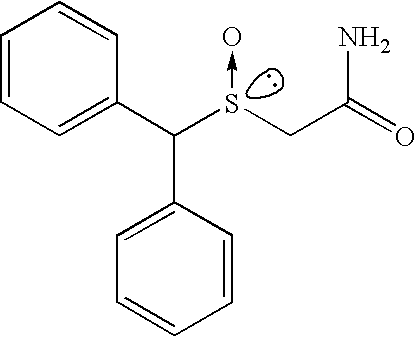
- the R enantiomer of modafinil is known as armodafinil and has the chemical name 2-[(R)-(diphenylmethyl)sulfinyl]acetamide.
- the molecular weight of armodafinil is 273.34 and it has the following chemical structure:
- Armodafinil is commercially available as NuvigilTM.
- Armodafinil can exist in several crystalline forms, some of which are disclosed in WO 2005/023198 (“WO '198”), WO 2005/077894 (“WO '894”), and WO 2004/060858 (“WO '858”).
- WO '858 purportedly discloses armodafinil Forms I-IV and an amorphous form, as well as solvates of armodafinil.
- WO '894 purportedly discloses armodafinil Forms III-V, as well as solvates of armodafinil, and
- WO '198 purportedly discloses solvates of armodafinil.
- polymorphism The occurrence of different crystal forms (polymorphism) is a property of some molecules and molecular complexes.
- a single molecule like armodafinil, may give rise to a variety of solids having distinct physical properties such as melting point, X-ray diffraction pattern, infrared absorption fingerprint, and NMR spectrum.
- the differences in the physical properties of polymorphs result from the orientation and intermolecular interactions of adjacent molecules (complexes) in the bulk solid. Accordingly, polymorphs are distinct solids sharing the same molecular formula yet having distinct advantageous and/or disadvantageous physical properties compared to other forms in the polymorph family.
- One of the most important physical properties of polymorphs in pharmaceutical is their solubility in aqueous solution.
- Polymorphs exhibit different solubilities in aqueous solution which may affect the dissolution rate of a drug and consequently affect its bioavailability in the body.
- Pharmaceutical drugs are often administered orally as a crystalline solid and dissolution rates depend on the exact crystal form of a polymorph. For example, polymorphs in a more rapidly dissolving form are likely to be more effective over a more slowly dissolving form for drugs that are absorbed rapidly. On the other hand, drugs that are slowly absorbed may also be unstable in the gastrointestinal tract and therefore benefit from a slow dissolution rate as not to increase the drug concentration in this detrimental environment. Therefore, polymorphism is important in the development of pharmaceutical ingredients.
- One embodiment of the invention encompasses a crystalline form of armodafinil characterized by a powder XRD pattern having peaks at about 12.4, 14.3, 17.2, 18.1, 21.6, and 23.2 ⁇ 0.2 degrees 2-theta, herein defined as armodafinil form SJ1.
- Another embodiment of the invention encompasses a process for preparing armodafinil form SJ1 comprising dissolving armodafinil in xylene; heating; cooling to obtain a precipitate; and isolating the precipitate.
- Another embodiment of the invention encompasses a crystalline form of armodafinil characterized by a powder XRD pattern having peaks at about 5.2, 10.5, 13.8, 18.5, and 19.0 ⁇ 0.2 degrees 2-theta, herein defined as armodafinil form SJ6.
- Another embodiment of the invention encompasses a process for preparing armodafinil form SJ6 comprising combining armodafinil form I with dimethyl sulfoxide to obtain a suspension; maintaining the suspension to obtain a precipitate; and isolating the precipitate.
- Another embodiment of the invention encompasses a pharmaceutical formulation comprising a therapeutically effective amount of at least one of crystalline form SJ1 or SJ6 of armodafinil and at least one pharmaceutically acceptable excipient.
- Another embodiment of the invention encompasses a process for preparing a pharmaceutical formulation of armodafinil comprising combining at least one of crystalline forms SJ1 or SJ6 of armodafinil and at least one pharmaceutically acceptable excipient.
- Another embodiment of the invention encompasses the use of a pharmaceutical formulation comprising a therapeutically effective amount of at least one of crystalline form SJ1 or SJ6 of armodafinil and at least one pharmaceutically acceptable excipient in the manufacture of a medicament for treatment of excessive sleepiness associated with narcolepsy, shift work sleep disorder (“SWSD”), and obstructive sleep apnea/hypopnea syndrome (“OSA/HS”)
- SWSD shift work sleep disorder
- OSA/HS obstructive sleep apnea/hypopnea syndrome
- FIG. 1 illustrates the powder XRD pattern of armodafinil Form SJ1.
- FIG. 2 illustrates the powder XRD pattern of armodafinil Form SJ6.
- the invention encompasses crystalline forms of armodafinil and processes for making these crystalline forms of armodafinil.
- Each solid form possesses properties that are unique and useful to the pharmaceutical formulator during formulation. These and other properties may be advantageous to the process chemist when designing scale-up synthesis, purification, and/or storage conditions of armodafinil.
- the processes described herein are useful in the production of crystalline forms of armodafinil in laboratory and commercial scale operations.
- One embodiment of the invention encompasses a crystalline form of armodafinil characterized by a powder XRD pattern having peaks at about 12.4, 14.3, 17.2, 18.1, 21.6, and 23.2 ⁇ 0.2 degrees 2-theta, herein defined as armodafinil form SJ1.
- Armodafinil form SJ1 may be further characterized by a powder XRD pattern having additional peaks at about 7.2, 9.1, and 20.1 ⁇ 0.2 degrees 2-theta or a powder XRD pattern as substantially depicted in FIG. 1 .
- the invention also encompasses a process for preparing armodafinil form SJ1 by crystallizing armodafinil from xylene.
- the process comprises dissolving armodafinil in xylene; heating; cooling to obtain a precipitate; and isolating the precipitate.
- Armodafinil may be prepared according to U.S. Pat. No. 4,927,855, hereby incorporated by reference.
- armodafinil form I can be used as the starting armodafinil.
- Armodafinil form I may be prepared according to WO 2004/060858, hereby incorporated by reference.
- xylene is present in a form of one of its isomers or as a mixture of xylene isomers.
- xylene is selected from the group consisting of o-xylene, m-xylene, p-xylene, and mixtures thereof
- p-xylene or m-xylene is used.
- xylene is present in an amount of about 20 ml to 60 ml per gram of armodafinil. More preferably, xylene is present in an amount of about 30 ml to about 50 ml per gram of armodafinil.
- armodafinil is dissolved in xylene while heating.
- the heating is at a temperature of about 50° C. to about 140° C. More preferably, the heating is at a temperature of about 65° C. to 115° C. Preferably, the heating is for about 10 to 30 minutes. Most preferably, the heating is a temperature of about 75° C. to 115° C. for about 15 minutes.
- the cooling step is performed at a temperature of about 30° C. to about 13° C., and preferably, at a temperature of about 25° C. to about 15° C. More preferably, the cooling step is done at a temperature of about 20° C.
- the cooling step is performed at a temperature of about 30° C. to about 0° C., preferably, at a temperature of about 25° C. to about 15° C. More preferably, the cooling step is done at a temperature of about 20° C.
- the cooling step is done for about 1 hour to about 20 hours, and more preferably, about 2 hours to about 12 hours. Most preferably, it is done for about overnight.
- the term “overnight” refers to a period of time of about 12 hours.
- the isolation can be achieved using any method known in the art, for example, by filtration.
- the crystals of armodafinil Form SJ1 are isolated by filtration.
- the crystals are washed.
- the washing is with C 6 -C 8 aliphatic and aromatic hydrocarbons or mixtures thereof. More preferably, the washing is with a solvent selected from the group consisting of: hexane, heptane, cyclohexane and petroleum ether. Most preferably, the washing is with n-hexane.
- the crystals are air dried. Optionally, the drying can be done under vacuum.
- vacuum refers to vacuum drying under a pressure of about 100 mbar to about 0.1 mbar, preferably, under a pressure of about 10 mbar to about 1 mbar.
- armodafinil form SJ6 may be further characterized by a powder XRD pattern having additional peaks at about 9.2, 21.0 and 22.9 ⁇ 0.2 degrees 2-theta or a powder XRD pattern as substantially depicted in FIG. 2 .
- the invention further encompasses a process for preparing armodafinil form SJ6 by suspending armodafinil form I in dimethyl sulfoxide (“DMSO”).
- DMSO dimethyl sulfoxide
- the process comprising combining armodafinil form I with DMSO to obtain a suspension; maintaining the suspension to obtain a precipitate; and isolating the precipitate.
- DMSO is present in an amount of about 0.2 ml to about 0.7 ml per gram of armodafinil. More preferably, DMSO is present in amount of about 0.3 ml to about 0.5 ml per gram of armodafinil.
- the suspension is maintained at a temperature of about 15° C. to about 40° C., and more preferably, at a temperature of about 19° C. to about 40° C. Most preferably, the suspension is maintained at a temperature of 20° C. Preferably, the suspension is maintained for about 1 hour to about 20 hours, and more preferably, for about 2 hours to about 12 hours. Most preferably, it is maintained for about overnight.
- the isolation can be achieved using any method known in the art, for example, by filtration.
- Another embodiment of the invention encompasses a pharmaceutical formulation comprising a therapeutically effective amount of at least one of crystalline form SJ1 or SJ6 of armodafinil and at least one pharmaceutically acceptable excipient.
- the present invention also encompasses a process for preparing such pharmaceutical formulations comprising combining at least one of crystalline forms SJ1 or SJ6 of armodafinil and at least one pharmaceutically acceptable carrier. These pharmaceutical formulations can be used for treatment of excessive sleepiness.
- Therapeutically effective amounts of armodafinil include, but are not limited to, 50 mg, 150 mg, and 250 mg per dosage forms of armodafinil.
- Pharmaceutically acceptable excipients may include excipients commonly used in pharmaceutical formulations.
- Pharmaceutically acceptable excipients used in the formulation include, but are not limited to, diluents, binders, disintegrants, lubricants, flavorings, sweeteners, or preservatives.
- Diluents used in the formulation include diluents commonly used in pharmaceutical formulations.
- diluents include, but are not limited to, cellulose-derived materials, such as powdered cellulose, microcrystalline cellulose, microfine cellulose, methyl cellulose, ethyl cellulose, hydroxyethyl cellulose, hydroxypropyl cellulose, hydroxypropylmethyl cellulose, carboxymethyl cellulose salts and other substituted and unsubstituted celluloses; starch; pregelatinized starch; inorganic diluents, such as calcium carbonate and calcium diphosphate; waxes; sugars; sugar alcohols, such as mannitol and sorbitol; acrylate polymers and copolymers; pectin; dextrin; or gelatin.
- cellulose-derived materials such as powdered cellulose, microcrystalline cellulose, microfine cellulose, methyl cellulose, ethyl cellulose, hydroxyethyl cellulose, hydroxy
- Binders used in the formulation include binders commonly used in pharmaceutical formulations.
- binders include, but are not limited to, acacia gum, pregelatinized starch, sodium alginate, or glucose.
- Disintegrants used in the formulation include disintegrants commonly used in pharmaceutical formulations.
- disintegrants include, but are not limited to, sodium starch glycolate, crospovidone, or low-substituted hydroxypropyl cellulose.
- Lubricants used in the formulation include lubricants commonly used in pharmaceutical formulations.
- lubricants include, but are not limited to magnesium stearate, calcium stearate, or sodium stearyl fumarate.
- Flavoring agents and flavor enhancers make the dosage form more palatable to the patient.
- Common flavoring agents and flavor enhancers for pharmaceutical products that can be included in the composition of the invention include maltol, vanillin, ethyl vanillin, menthol, citric acid, fumaric acid, ethyl maltol, and tartaric acid.
- Sweetening agents such as sorbitol, saccharin, sodium saccharin, sucrose, aspartame, fructose, mannitol, and invert sugar can be added to improve the taste.
- Preservatives and chelating agents such as alcohol, sodium benzoate, butylated hydroxy toluene, butylated hydroxyanisole, and ethylenediamine tetraacetic acid can be added at levels safe for ingestion to improve storage stability.
- the pharmaceutical formulations of the invention may be provided in dosage forms for oral, parenteral (including subcutaneous, intramuscular, and intravenous), inhalant, or ophthalmic administration.
- parenteral including subcutaneous, intramuscular, and intravenous
- inhalant or ophthalmic administration.
- ophthalmic administration Although the most suitable route in any given case will depend on the nature and severity of the condition being treated, the most preferred route of the invention is oral. Dosages may be conveniently presented in unit dosage form and prepared by any of the methods well-known in the art of pharmacy.
- Dosage forms include solid dosage forms, such as tablets, powders, capsules, suppositories, sachets, troches, and lozenges, as well as liquid suspensions and elixirs.
- Capsule dosages will contain the solid composition within a capsule which may be made of gelatin or other conventional encapsulating material.
- Tablets and powders may be coated, for example, with an enteric coating.
- the enteric-coated powder forms may have coatings comprising phthalic acid cellulose acetate, hydroxypropylmethyl-cellulose phthalate, polyvinyl alcohol phthalate, carboxymethylethylcellulose, a copolymer of styrene and maleic acid, a copolymer of methacrylic acid and methyl methacrylate, and like materials, and if desired, they may be employed with suitable plasticizers and/or extending agents.
- a coated tablet may have a coating on the surface of the tablet or may be a tablet comprising a powder or granules with an enteric-coating.
- Another embodiment of the invention encompasses methods of treating patients suffering from excessive sleepiness associated with narcolepsy, shift work sleep disorder (“SWSD”), and obstructive sleep apnea/hypopnea syndrome (“OSA/HS”) comprising administering to a patient in need thereof a therapeutically effective amount of a pharmaceutical formulation comprising at least one crystalline form SJ1 or SJ6 of armodafinil and at least one pharmaceutically acceptable excipient.
- SWSD shift work sleep disorder
- OSA/HS obstructive sleep apnea/hypopnea syndrome
- Another embodiment of the invention encompasses the use of a pharmaceutical formulation comprising a therapeutically effective amount of at least one of crystalline form SJ1 or SJ6 of armodafinil and at least one pharmaceutically acceptable excipient in the manufacture of a medicament for treatment of excessive sleepiness associated with narcolepsy, shift work sleep disorder (“SWSD”), and obstructive sleep apnea/hypopnea syndrome (“OSA/HS”)
- SWSD shift work sleep disorder
- OSA/HS obstructive sleep apnea/hypopnea syndrome
- X-ray powder diffraction data were obtained by the following method.
- a powder X-ray diffractometer model Philips X'pert Pro was employed with CuK ⁇ radiation of 1.5418 ⁇ .
- the scanning parameters were: range: 4-40 degrees two-theta; scan mode: continuous scan; step size: 0.0167 degrees; and scan step time was 30.8 seconds. All peak positions are within ⁇ 0.2 degrees two theta.
- Armodafinil Form I (300 mg) was mixed with 150 ⁇ l dimethyl sulfoxide and allowed to stand overnight at 20° C. Within this time, the original suspension solidified and crystals were formed. The crystals were analyzed by powder X-ray diffractometer and identified as armodafinil Form SJ6.
Landscapes
- Chemical & Material Sciences (AREA)
- Organic Chemistry (AREA)
- Health & Medical Sciences (AREA)
- Nuclear Medicine, Radiotherapy & Molecular Imaging (AREA)
- Pharmacology & Pharmacy (AREA)
- Neurosurgery (AREA)
- Biomedical Technology (AREA)
- Chemical Kinetics & Catalysis (AREA)
- General Chemical & Material Sciences (AREA)
- Medicinal Chemistry (AREA)
- Bioinformatics & Cheminformatics (AREA)
- Engineering & Computer Science (AREA)
- Neurology (AREA)
- Life Sciences & Earth Sciences (AREA)
- Animal Behavior & Ethology (AREA)
- General Health & Medical Sciences (AREA)
- Public Health (AREA)
- Veterinary Medicine (AREA)
- Pharmaceuticals Containing Other Organic And Inorganic Compounds (AREA)
- Acyclic And Carbocyclic Compounds In Medicinal Compositions (AREA)
Abstract
The invention encompasses crystalline forms of armodafinil, processes for preparing the crystalline forms of armodafinil, pharmaceutical formulation thereof, and method of treating excessive sleepiness using the formulations of the invention.
Description
- This application claims the benefit of U.S. Provisional Application No. 60/977,000, filed Oct. 2, 2007, hereby incorporated by reference.
- The invention encompasses crystalline forms of armodafinil, processes for preparing the crystalline forms of armodafinil, pharmaceutical formulation thereof, and method of treating excessive sleepiness using the formulations of the invention.
- Modafinil is currently marketed by Cephalon, Inc. under the trade name Provigil® as a racemic mixture of its R and S enantiomers. Provigil® is indicated for the treatment of excessive sleepiness associated with narcolepsy, shift work sleep disorder (SWSD), and obstructive sleep apnea/hypopnea syndrome (OSA/HS).
- Studies have shown that while both enantiomers of modafinil are pharmacologically active, the S enantiomer is eliminated from the body three times faster than the R enantiomer. Prisinzano et al., Tetrahedron: Asymmetry, vol. 5 1053-1058 (2004). It is, therefore, preferable to develop pharmaceutical compositions of the R enantiomer of modafinil, as opposed to its racemic mixture.
- The R enantiomer of modafinil is known as armodafinil and has the chemical name 2-[(R)-(diphenylmethyl)sulfinyl]acetamide. The molecular weight of armodafinil is 273.34 and it has the following chemical structure:
-
- Armodafinil is commercially available as Nuvigil™.
- Armodafinil and process for its preparation were first disclosed in U.S. Pat. No. 4,927,855 (“'855 patent”) and EP Publication No. 0233106, both of which were originally assigned to Laboratoire L. Lafon. The '855 patent purportedly describes the synthesis of armodafinil as shown in the following general scheme:
-
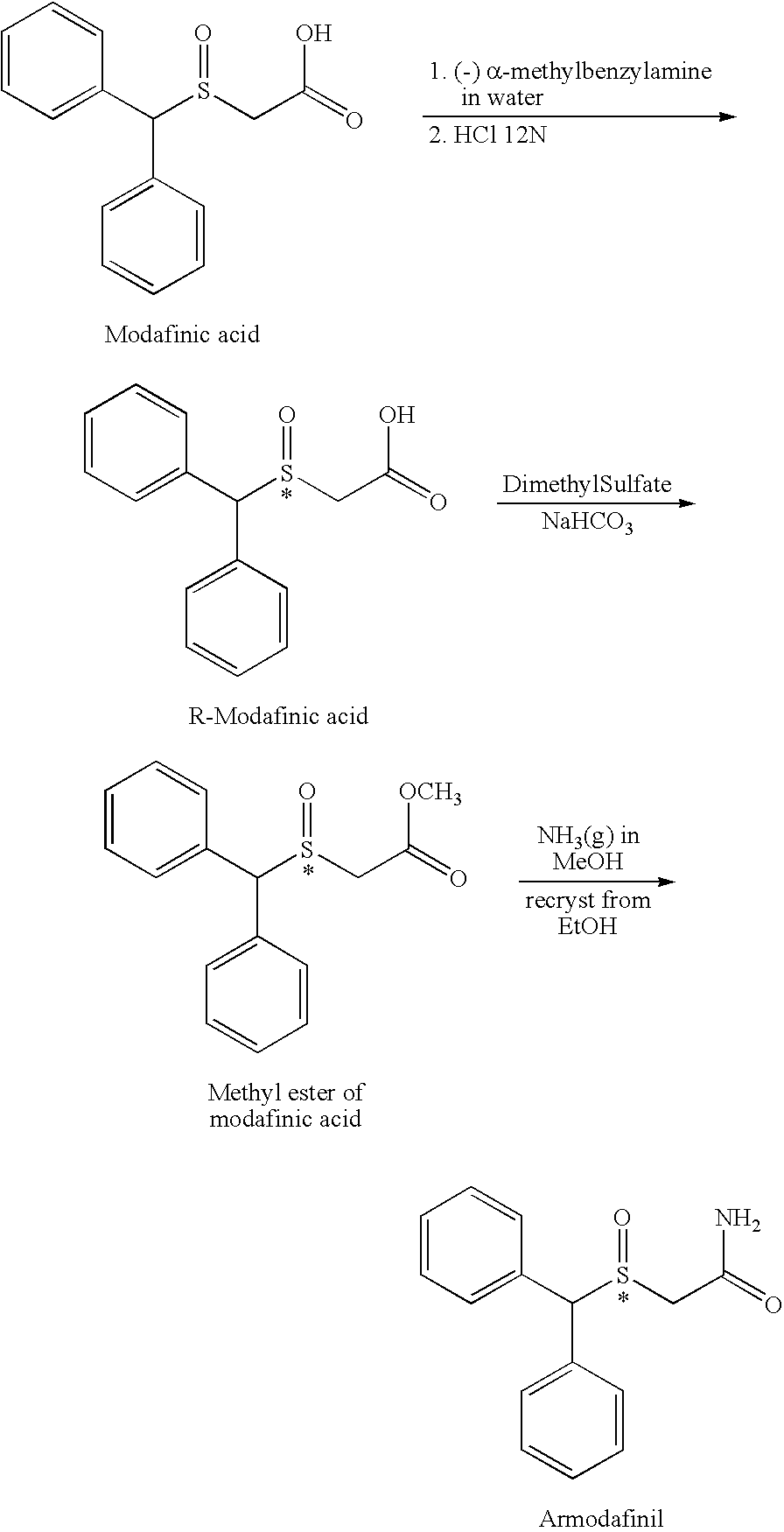
- See '855 patent, col. 2, 11. 16-53.
- Armodafinil can exist in several crystalline forms, some of which are disclosed in WO 2005/023198 (“WO '198”), WO 2005/077894 (“WO '894”), and WO 2004/060858 (“WO '858”).
- WO '858 purportedly discloses armodafinil Forms I-IV and an amorphous form, as well as solvates of armodafinil. WO '894 purportedly discloses armodafinil Forms III-V, as well as solvates of armodafinil, and WO '198 purportedly discloses solvates of armodafinil.
- The occurrence of different crystal forms (polymorphism) is a property of some molecules and molecular complexes. A single molecule, like armodafinil, may give rise to a variety of solids having distinct physical properties such as melting point, X-ray diffraction pattern, infrared absorption fingerprint, and NMR spectrum. The differences in the physical properties of polymorphs result from the orientation and intermolecular interactions of adjacent molecules (complexes) in the bulk solid. Accordingly, polymorphs are distinct solids sharing the same molecular formula yet having distinct advantageous and/or disadvantageous physical properties compared to other forms in the polymorph family. One of the most important physical properties of polymorphs in pharmaceutical is their solubility in aqueous solution. Polymorphs exhibit different solubilities in aqueous solution which may affect the dissolution rate of a drug and consequently affect its bioavailability in the body. Pharmaceutical drugs are often administered orally as a crystalline solid and dissolution rates depend on the exact crystal form of a polymorph. For example, polymorphs in a more rapidly dissolving form are likely to be more effective over a more slowly dissolving form for drugs that are absorbed rapidly. On the other hand, drugs that are slowly absorbed may also be unstable in the gastrointestinal tract and therefore benefit from a slow dissolution rate as not to increase the drug concentration in this detrimental environment. Therefore, polymorphism is important in the development of pharmaceutical ingredients.
- The discovery of new forms of a pharmaceutically useful compound provides a new opportunity to improve the performance characteristics of a pharmaceutical product. It enlarges the repertoire of materials that a formulation scientist has available for designing, for example, a pharmaceutical dosage form of a drug with a targeted release profile or other desired characteristic. Thus, there remains a need in the art for additional forms of armodafinil and/or processes for their preparation.
- One embodiment of the invention encompasses a crystalline form of armodafinil characterized by a powder XRD pattern having peaks at about 12.4, 14.3, 17.2, 18.1, 21.6, and 23.2±0.2 degrees 2-theta, herein defined as armodafinil form SJ1.
- Another embodiment of the invention encompasses a process for preparing armodafinil form SJ1 comprising dissolving armodafinil in xylene; heating; cooling to obtain a precipitate; and isolating the precipitate.
- Another embodiment of the invention encompasses a crystalline form of armodafinil characterized by a powder XRD pattern having peaks at about 5.2, 10.5, 13.8, 18.5, and 19.0±0.2 degrees 2-theta, herein defined as armodafinil form SJ6.
- Another embodiment of the invention encompasses a process for preparing armodafinil form SJ6 comprising combining armodafinil form I with dimethyl sulfoxide to obtain a suspension; maintaining the suspension to obtain a precipitate; and isolating the precipitate.
- Another embodiment of the invention encompasses a pharmaceutical formulation comprising a therapeutically effective amount of at least one of crystalline form SJ1 or SJ6 of armodafinil and at least one pharmaceutically acceptable excipient.
- Another embodiment of the invention encompasses a process for preparing a pharmaceutical formulation of armodafinil comprising combining at least one of crystalline forms SJ1 or SJ6 of armodafinil and at least one pharmaceutically acceptable excipient.
- Another embodiment of the invention encompasses the use of a pharmaceutical formulation comprising a therapeutically effective amount of at least one of crystalline form SJ1 or SJ6 of armodafinil and at least one pharmaceutically acceptable excipient in the manufacture of a medicament for treatment of excessive sleepiness associated with narcolepsy, shift work sleep disorder (“SWSD”), and obstructive sleep apnea/hypopnea syndrome (“OSA/HS”)
-
FIG. 1 illustrates the powder XRD pattern of armodafinil Form SJ1. -
FIG. 2 illustrates the powder XRD pattern of armodafinil Form SJ6. - The invention encompasses crystalline forms of armodafinil and processes for making these crystalline forms of armodafinil. Each solid form possesses properties that are unique and useful to the pharmaceutical formulator during formulation. These and other properties may be advantageous to the process chemist when designing scale-up synthesis, purification, and/or storage conditions of armodafinil. In addition, the processes described herein are useful in the production of crystalline forms of armodafinil in laboratory and commercial scale operations.
- One embodiment of the invention encompasses a crystalline form of armodafinil characterized by a powder XRD pattern having peaks at about 12.4, 14.3, 17.2, 18.1, 21.6, and 23.2±0.2 degrees 2-theta, herein defined as armodafinil form SJ1. Armodafinil form SJ1 may be further characterized by a powder XRD pattern having additional peaks at about 7.2, 9.1, and 20.1±0.2 degrees 2-theta or a powder XRD pattern as substantially depicted in
FIG. 1 . - The invention also encompasses a process for preparing armodafinil form SJ1 by crystallizing armodafinil from xylene. The process comprises dissolving armodafinil in xylene; heating; cooling to obtain a precipitate; and isolating the precipitate.
- Armodafinil may be prepared according to U.S. Pat. No. 4,927,855, hereby incorporated by reference. Optionally, armodafinil form I can be used as the starting armodafinil. Armodafinil form I may be prepared according to WO 2004/060858, hereby incorporated by reference.
- Typically, xylene is present in a form of one of its isomers or as a mixture of xylene isomers. For example, xylene is selected from the group consisting of o-xylene, m-xylene, p-xylene, and mixtures thereof Preferably, p-xylene or m-xylene is used. Preferably, xylene is present in an amount of about 20 ml to 60 ml per gram of armodafinil. More preferably, xylene is present in an amount of about 30 ml to about 50 ml per gram of armodafinil.
- Typically, armodafinil is dissolved in xylene while heating. Preferably, the heating is at a temperature of about 50° C. to about 140° C. More preferably, the heating is at a temperature of about 65° C. to 115° C. Preferably, the heating is for about 10 to 30 minutes. Most preferably, the heating is a temperature of about 75° C. to 115° C. for about 15 minutes.
- Typically, when the solvent is p-xylene, the cooling step is performed at a temperature of about 30° C. to about 13° C., and preferably, at a temperature of about 25° C. to about 15° C. More preferably, the cooling step is done at a temperature of about 20° C. Typically, when the solvent is m-xylene or a mixture of xylenes, the cooling step is performed at a temperature of about 30° C. to about 0° C., preferably, at a temperature of about 25° C. to about 15° C. More preferably, the cooling step is done at a temperature of about 20° C.
- Preferably, the cooling step is done for about 1 hour to about 20 hours, and more preferably, about 2 hours to about 12 hours. Most preferably, it is done for about overnight. As used herein, the term “overnight” refers to a period of time of about 12 hours.
- The isolation can be achieved using any method known in the art, for example, by filtration. Generally, the crystals of armodafinil Form SJ1 are isolated by filtration. Preferably, after the filtration step, the crystals are washed. Preferably the washing is with C6-C8 aliphatic and aromatic hydrocarbons or mixtures thereof. More preferably, the washing is with a solvent selected from the group consisting of: hexane, heptane, cyclohexane and petroleum ether. Most preferably, the washing is with n-hexane. Preferably, after the washing, the crystals are air dried. Optionally, the drying can be done under vacuum.
- As described herein, when referring to drying crystalline armodafinil under vacuum, the term “vacuum” refers to vacuum drying under a pressure of about 100 mbar to about 0.1 mbar, preferably, under a pressure of about 10 mbar to about 1 mbar.
- Another embodiment of the invention encompasses a crystalline form of armodafinil characterized by a powder XRD pattern having peaks at about 5.2, 10.5, 13.8, 18.5 and 19.0±0.2 degrees 2-theta, herein defined as armodafinil form SJ6. Armodafinil form SJ6 may be further characterized by a powder XRD pattern having additional peaks at about 9.2, 21.0 and 22.9±0.2 degrees 2-theta or a powder XRD pattern as substantially depicted in
FIG. 2 . - The invention further encompasses a process for preparing armodafinil form SJ6 by suspending armodafinil form I in dimethyl sulfoxide (“DMSO”). The process comprising combining armodafinil form I with DMSO to obtain a suspension; maintaining the suspension to obtain a precipitate; and isolating the precipitate.
- Preferably, DMSO is present in an amount of about 0.2 ml to about 0.7 ml per gram of armodafinil. More preferably, DMSO is present in amount of about 0.3 ml to about 0.5 ml per gram of armodafinil.
- Preferably, the suspension is maintained at a temperature of about 15° C. to about 40° C., and more preferably, at a temperature of about 19° C. to about 40° C. Most preferably, the suspension is maintained at a temperature of 20° C. Preferably, the suspension is maintained for about 1 hour to about 20 hours, and more preferably, for about 2 hours to about 12 hours. Most preferably, it is maintained for about overnight.
- The isolation can be achieved using any method known in the art, for example, by filtration.
- Another embodiment of the invention encompasses a pharmaceutical formulation comprising a therapeutically effective amount of at least one of crystalline form SJ1 or SJ6 of armodafinil and at least one pharmaceutically acceptable excipient.
- The present invention also encompasses a process for preparing such pharmaceutical formulations comprising combining at least one of crystalline forms SJ1 or SJ6 of armodafinil and at least one pharmaceutically acceptable carrier. These pharmaceutical formulations can be used for treatment of excessive sleepiness.
- Therapeutically effective amounts of armodafinil include, but are not limited to, 50 mg, 150 mg, and 250 mg per dosage forms of armodafinil.
- Pharmaceutically acceptable excipients may include excipients commonly used in pharmaceutical formulations. Pharmaceutically acceptable excipients used in the formulation include, but are not limited to, diluents, binders, disintegrants, lubricants, flavorings, sweeteners, or preservatives.
- Diluents used in the formulation include diluents commonly used in pharmaceutical formulations. For example, diluents include, but are not limited to, cellulose-derived materials, such as powdered cellulose, microcrystalline cellulose, microfine cellulose, methyl cellulose, ethyl cellulose, hydroxyethyl cellulose, hydroxypropyl cellulose, hydroxypropylmethyl cellulose, carboxymethyl cellulose salts and other substituted and unsubstituted celluloses; starch; pregelatinized starch; inorganic diluents, such as calcium carbonate and calcium diphosphate; waxes; sugars; sugar alcohols, such as mannitol and sorbitol; acrylate polymers and copolymers; pectin; dextrin; or gelatin.
- Binders used in the formulation include binders commonly used in pharmaceutical formulations. For example, binders include, but are not limited to, acacia gum, pregelatinized starch, sodium alginate, or glucose.
- Disintegrants used in the formulation include disintegrants commonly used in pharmaceutical formulations. For example, disintegrants include, but are not limited to, sodium starch glycolate, crospovidone, or low-substituted hydroxypropyl cellulose.
- Lubricants used in the formulation include lubricants commonly used in pharmaceutical formulations. For example, lubricants include, but are not limited to magnesium stearate, calcium stearate, or sodium stearyl fumarate.
- Flavoring agents and flavor enhancers make the dosage form more palatable to the patient. Common flavoring agents and flavor enhancers for pharmaceutical products that can be included in the composition of the invention include maltol, vanillin, ethyl vanillin, menthol, citric acid, fumaric acid, ethyl maltol, and tartaric acid.
- Sweetening agents such as sorbitol, saccharin, sodium saccharin, sucrose, aspartame, fructose, mannitol, and invert sugar can be added to improve the taste.
- Preservatives and chelating agents such as alcohol, sodium benzoate, butylated hydroxy toluene, butylated hydroxyanisole, and ethylenediamine tetraacetic acid can be added at levels safe for ingestion to improve storage stability.
- The pharmaceutical formulations of the invention may be provided in dosage forms for oral, parenteral (including subcutaneous, intramuscular, and intravenous), inhalant, or ophthalmic administration. Although the most suitable route in any given case will depend on the nature and severity of the condition being treated, the most preferred route of the invention is oral. Dosages may be conveniently presented in unit dosage form and prepared by any of the methods well-known in the art of pharmacy.
- Dosage forms include solid dosage forms, such as tablets, powders, capsules, suppositories, sachets, troches, and lozenges, as well as liquid suspensions and elixirs.
- Capsule dosages will contain the solid composition within a capsule which may be made of gelatin or other conventional encapsulating material.
- Tablets and powders may be coated, for example, with an enteric coating. The enteric-coated powder forms may have coatings comprising phthalic acid cellulose acetate, hydroxypropylmethyl-cellulose phthalate, polyvinyl alcohol phthalate, carboxymethylethylcellulose, a copolymer of styrene and maleic acid, a copolymer of methacrylic acid and methyl methacrylate, and like materials, and if desired, they may be employed with suitable plasticizers and/or extending agents. A coated tablet may have a coating on the surface of the tablet or may be a tablet comprising a powder or granules with an enteric-coating.
- Another embodiment of the invention encompasses methods of treating patients suffering from excessive sleepiness associated with narcolepsy, shift work sleep disorder (“SWSD”), and obstructive sleep apnea/hypopnea syndrome (“OSA/HS”) comprising administering to a patient in need thereof a therapeutically effective amount of a pharmaceutical formulation comprising at least one crystalline form SJ1 or SJ6 of armodafinil and at least one pharmaceutically acceptable excipient.
- Another embodiment of the invention encompasses the use of a pharmaceutical formulation comprising a therapeutically effective amount of at least one of crystalline form SJ1 or SJ6 of armodafinil and at least one pharmaceutically acceptable excipient in the manufacture of a medicament for treatment of excessive sleepiness associated with narcolepsy, shift work sleep disorder (“SWSD”), and obstructive sleep apnea/hypopnea syndrome (“OSA/HS”)
- Having described the invention with reference to certain preferred embodiments, other embodiments will become apparent to one skilled in the art from consideration of the specification. The invention is further defined by reference to the following examples describing in detail the preparation of armodafinil crystalline forms of the invention. It will be apparent to those skilled in the art that many modifications, both to materials and methods, may be practiced without departing from the scope of the invention.
- X-ray powder diffraction data were obtained by the following method. A powder X-ray diffractometer model Philips X'pert Pro was employed with CuKα radiation of 1.5418 Å. An X'Celerator detector with active length (2 theta)=2.122 degrees was used and the laboratory temperature of 22-25° C. was used. The scanning parameters were: range: 4-40 degrees two-theta; scan mode: continuous scan; step size: 0.0167 degrees; and scan step time was 30.8 seconds. All peak positions are within ±0.2 degrees two theta.
- Preparation of Armodafinil Form SJ1 from m-Xylene
- Armodafinil Form I (300 mg) was added to 10 ml m-xylene and heated at 75° C. for about 15 minutes forming a solution. The solution was allowed to cooled to 20° C. within about 20 minutes and then it was allowed to stand overnight which resulted in the formation of crystals. The crystals were subsequently filtered, washed with 10 ml n-hexane and air dried for about 1 hour (Yield=242 mg). The crystals were analyzed by powder X-ray diffractometer and identified as armodafinil Form SJ1.
-
-
- Preparation of Armodafinil Form SJ1 from p-Xylene
- Armodafinil Form I (300 mg) was added to 15 ml p-xylene and heated at 100° C. for about 15 minutes forming a solution. The solution was allowed to cooled to 20° C. within about 20 minutes and then it was allowed to stand overnight which resulted in the formation of crystals. The crystals were subsequently filtered, washed with 10 ml n-hexane and dried on air for about 1 hour (Yield=181 mg). The crystals were analyzed by powder X-ray diffractometer and identified as armodafinil Form SJ1.
- Armodafinil Form I (300 mg) was mixed with 150 μl dimethyl sulfoxide and allowed to stand overnight at 20° C. Within this time, the original suspension solidified and crystals were formed. The crystals were analyzed by powder X-ray diffractometer and identified as armodafinil Form SJ6.
Claims (20)
1. A crystalline form of armodafinil characterized by a powder XRD pattern having peaks at about 12.4, 14.3, 17.2, 18.1, 21.6, and 23.2±0.2 degrees 2-theta.
2. The crystalline form according to claim 1 further characterized by a powder XRD pattern having peaks at about 7.2, 9.1, and 20.1±0.2 degrees 2-theta.
3. The crystalline form according to claim 1 further characterized by a PXRD pattern substantially depicted in FIG. 1 .
4. A process for preparing armodafinil form SJ1 comprising dissolving armodafinil in xylene; heating; cooling to obtain a precipitate; and isolating the precipitate.
5. The process according claim 4 , wherein the xylene is p-xylene or m-xylene.
6. The process according to claim 4 , wherein xylene is present in an amount of about 20 ml to 60 ml per gram of armodafinil.
7. The process according to claim 4 , wherein dissolving in xylene is done while heating.
8. The process according to claim 4 , wherein the heating is at a temperature of about 50° C. to about 140° C.
9. The process according to claim 4 , wherein the cooling is at a temperature of about 30° C. to about 0° C.
10. The process according to claim 4 , wherein the cooling step is carried out for about 2 hours to about 12 hours.
11. A crystalline form of armodafinil characterized by a powder XRD pattern having peaks at about 5.2, 10.5, 13.8, 18.5, and 19.0±0.2 degrees 2-theta.
12. The crystalline form according to claim 11 further characterized by a powder XRD pattern having peaks at about 9.2, 21.0, and 22.9±0.2 degrees 2-theta.
13. The crystalline form according to claim 11 further characterized by a PXRD pattern substantially depicted in FIG. 2 .
14. A process for preparing armodafinil form SJ6 comprising combining armodafinil form I with dimethyl sulfoxide to obtain a suspension; maintaining the suspension to obtain a precipitate; and isolating the precipitate.
15. The process according to claim 14 , wherein dimethyl sulfoxide is present in an amount of about 0.2 ml to about 0.7 ml per gram of armodafinil.
16. The process according to claim 14 , wherein the suspension is maintained at a temperature of about 15° C. to about 40° C.
17. The process according to claim 14 , the suspension is maintained for about 2 hours to about 12 hours.
18. A pharmaceutical formulation comprising a therapeutically effective amount of at least one of crystalline form SJ1 or SJ6 of armodafinil and at least one pharmaceutically acceptable excipient.
19. A process for preparing a pharmaceutical formulation of armodafinil comprising combining at least one of crystalline forms SJ1 or SJ6 of armodafinil and at least one pharmaceutically acceptable excipient.
20. A method of treating patients suffering from excessive sleepiness comprising administering to a patient in need thereof a therapeutically effective amount of a pharmaceutical formulation comprising at least one crystalline form SJ1 or SJ6 of armodafinil and at least one pharmaceutically acceptable excipient.
Priority Applications (1)
| Application Number | Priority Date | Filing Date | Title |
|---|---|---|---|
| US12/287,011 US20090105346A1 (en) | 2007-10-02 | 2008-10-02 | Novel crystalline forms of armodafinil and preparation thereof |
Applications Claiming Priority (2)
| Application Number | Priority Date | Filing Date | Title |
|---|---|---|---|
| US97700007P | 2007-10-02 | 2007-10-02 | |
| US12/287,011 US20090105346A1 (en) | 2007-10-02 | 2008-10-02 | Novel crystalline forms of armodafinil and preparation thereof |
Publications (1)
| Publication Number | Publication Date |
|---|---|
| US20090105346A1 true US20090105346A1 (en) | 2009-04-23 |
Family
ID=40194035
Family Applications (1)
| Application Number | Title | Priority Date | Filing Date |
|---|---|---|---|
| US12/287,011 Abandoned US20090105346A1 (en) | 2007-10-02 | 2008-10-02 | Novel crystalline forms of armodafinil and preparation thereof |
Country Status (2)
| Country | Link |
|---|---|
| US (1) | US20090105346A1 (en) |
| WO (1) | WO2009045488A2 (en) |
Cited By (2)
| Publication number | Priority date | Publication date | Assignee | Title |
|---|---|---|---|---|
| US20060241320A1 (en) * | 2002-12-20 | 2006-10-26 | Cephalon France | Process for the preparation of and crystalline forms of optical enantiomers of modafinil |
| US8318979B2 (en) | 2003-09-19 | 2012-11-27 | Cephalon France | Process for enantioselective synthesis of single enantiomers of modafinil by asymmetric oxidation |
Citations (5)
| Publication number | Priority date | Publication date | Assignee | Title |
|---|---|---|---|---|
| US20020043207A1 (en) * | 2000-07-27 | 2002-04-18 | Claude Singer | Oxidation method for preparing highly pure modafinil, crystalline forms of modafinil, and methods of preparing the crystalline forms |
| US20030166701A1 (en) * | 2001-05-14 | 2003-09-04 | Pfizer Inc. | Tartrate salts of 5,8, 14-triazateracyclo[10.3.1.02,11 04.9]-hexadeca-2(11),3,5,7,9-pentaene and pharmaceutical compositions thereof |
| US20080153918A1 (en) * | 2002-08-09 | 2008-06-26 | Cephalon France | Modafinil Polymorphic Forms |
| US20090018202A1 (en) * | 2004-02-06 | 2009-01-15 | Cephalon, Inc. | Modafinil compositions |
| US20100048719A1 (en) * | 2002-12-20 | 2010-02-25 | Cephalon France | Process for the Preparation of and Crystalline Forms of Optical Enantiomers of Modafinil |
Family Cites Families (2)
| Publication number | Priority date | Publication date | Assignee | Title |
|---|---|---|---|---|
| NZ545133A (en) * | 2003-09-04 | 2009-12-24 | Cephalon Inc | Modafinil compositions |
| CA2556106A1 (en) * | 2004-02-06 | 2005-08-25 | Cephalon, Inc. | Modafinil compositions |
-
2008
- 2008-10-02 US US12/287,011 patent/US20090105346A1/en not_active Abandoned
- 2008-10-02 WO PCT/US2008/011432 patent/WO2009045488A2/en not_active Ceased
Patent Citations (6)
| Publication number | Priority date | Publication date | Assignee | Title |
|---|---|---|---|---|
| US20020043207A1 (en) * | 2000-07-27 | 2002-04-18 | Claude Singer | Oxidation method for preparing highly pure modafinil, crystalline forms of modafinil, and methods of preparing the crystalline forms |
| US20030166701A1 (en) * | 2001-05-14 | 2003-09-04 | Pfizer Inc. | Tartrate salts of 5,8, 14-triazateracyclo[10.3.1.02,11 04.9]-hexadeca-2(11),3,5,7,9-pentaene and pharmaceutical compositions thereof |
| US20080153918A1 (en) * | 2002-08-09 | 2008-06-26 | Cephalon France | Modafinil Polymorphic Forms |
| US20100048719A1 (en) * | 2002-12-20 | 2010-02-25 | Cephalon France | Process for the Preparation of and Crystalline Forms of Optical Enantiomers of Modafinil |
| US20090018202A1 (en) * | 2004-02-06 | 2009-01-15 | Cephalon, Inc. | Modafinil compositions |
| US20100210731A1 (en) * | 2004-02-06 | 2010-08-19 | Cephalon, Inc. | Modafinil Compositions |
Cited By (12)
| Publication number | Priority date | Publication date | Assignee | Title |
|---|---|---|---|---|
| US20060241320A1 (en) * | 2002-12-20 | 2006-10-26 | Cephalon France | Process for the preparation of and crystalline forms of optical enantiomers of modafinil |
| US20090281193A1 (en) * | 2002-12-20 | 2009-11-12 | Cephalon France | Process for the Preparation of and Crystalline Forms of Optical Enantiomers of Modafinil |
| US20090281192A1 (en) * | 2002-12-20 | 2009-11-12 | Cephalon France | Process for the Preparation of and Crystalline Forms of Optical Enantiomers of Modafinil |
| US20100022653A1 (en) * | 2002-12-20 | 2010-01-28 | Cephalon France | Process for the Preparation of and Crystalline Forms of Optical Enantiomers of Modafinil |
| US20100048719A1 (en) * | 2002-12-20 | 2010-02-25 | Cephalon France | Process for the Preparation of and Crystalline Forms of Optical Enantiomers of Modafinil |
| US20100048718A1 (en) * | 2002-12-20 | 2010-02-25 | Cephalon France | Process for the Preparation of and Crystalline Forms of Optical Enantiomers of Modafinil |
| US20100048720A1 (en) * | 2002-12-20 | 2010-02-25 | Cephalon France | Process for the Preparation of and Crystalline Forms of Optical Enantiomers of Modafinil |
| US8729305B2 (en) | 2002-12-20 | 2014-05-20 | Teva Sante | Process for the preparation of and crystalline forms of optical enantiomers of modafinil |
| US8975442B2 (en) | 2002-12-20 | 2015-03-10 | Teva Sante | Process for the preparation of and crystalline forms of optical enantiomers of modafinil |
| US9382200B2 (en) | 2002-12-20 | 2016-07-05 | Teva Sante | Process for the preparation of and crystalline forms of optical enantiomers of modafinil |
| US8318979B2 (en) | 2003-09-19 | 2012-11-27 | Cephalon France | Process for enantioselective synthesis of single enantiomers of modafinil by asymmetric oxidation |
| US8759583B2 (en) | 2003-09-19 | 2014-06-24 | Teva Sante | Process for enantioselective synthesis of single enantiomers of modafinil by asymmetric oxidation |
Also Published As
| Publication number | Publication date |
|---|---|
| WO2009045488A2 (en) | 2009-04-09 |
| WO2009045488A3 (en) | 2009-07-30 |
Similar Documents
| Publication | Publication Date | Title |
|---|---|---|
| JP5702494B2 (en) | A novel crystalline form of pitavastatin calcium | |
| JP6359971B2 (en) | Ivabradine hydrochloride Form IV | |
| KR20080015888A (en) | Carvedilol | |
| US20090292025A1 (en) | Novel crystalline forms of armodafinil and preparation thereof | |
| CN102639531B (en) | The anhydrate of tiotropium bromide | |
| KR20080089659A (en) | Amorphous and Crystalline Forms of Aprepitant and Methods for Making the Same | |
| JP2008546719A (en) | Crystalline O-desmethylvenlafaxine | |
| WO2009017813A1 (en) | O-desmethyl venlafaxine saccharinate | |
| US20090105346A1 (en) | Novel crystalline forms of armodafinil and preparation thereof | |
| US20090018182A1 (en) | Crystalline forms of atorvastatin | |
| US12534448B2 (en) | Solid state form of lemborexant | |
| JP2006500337A (en) | Polymorphic and amorphous forms of benazepril hydrochloride | |
| US20220389022A1 (en) | Solid forms of ponatinib hydrochloride and process thereof | |
| WO2025141465A1 (en) | Solid state forms of zipalertinib hydrochloride and process for preparation thereof | |
| ZA200210282B (en) | Carvedilol. | |
| CN101454279A (en) | Novel crystalline forms of armodafinil and preparation thereof |
Legal Events
| Date | Code | Title | Description |
|---|---|---|---|
| AS | Assignment |
Owner name: TEVA PHARMACEUTICALS USA, INC., PENNSYLVANIA Free format text: ASSIGNMENT OF ASSIGNORS INTEREST;ASSIGNOR:TEVA PHARMACEUTICAL INDUSTRIES LTD.;REEL/FRAME:022026/0305 Effective date: 20081130 Owner name: TEVA PHARMACEUTICAL INDUSTRIES LTD., ISRAEL Free format text: ASSIGNMENT OF ASSIGNORS INTEREST;ASSIGNOR:JEGOROV, ALEXANDR;REEL/FRAME:022026/0720 Effective date: 20081110 |
|
| STCB | Information on status: application discontinuation |
Free format text: ABANDONED -- FAILURE TO RESPOND TO AN OFFICE ACTION |