US20090060869A1 - Ejection liquid, ejection method, method of making droplets from liquid, cartridge and ejection device - Google Patents
Ejection liquid, ejection method, method of making droplets from liquid, cartridge and ejection device Download PDFInfo
- Publication number
- US20090060869A1 US20090060869A1 US11/908,600 US90860006A US2009060869A1 US 20090060869 A1 US20090060869 A1 US 20090060869A1 US 90860006 A US90860006 A US 90860006A US 2009060869 A1 US2009060869 A1 US 2009060869A1
- Authority
- US
- United States
- Prior art keywords
- liquid
- ejection
- protein
- compound
- ink jet
- Prior art date
- Legal status (The legal status is an assumption and is not a legal conclusion. Google has not performed a legal analysis and makes no representation as to the accuracy of the status listed.)
- Abandoned
Links
- 239000007788 liquid Substances 0.000 title claims abstract description 203
- 238000000034 method Methods 0.000 title claims abstract description 47
- 238000004519 manufacturing process Methods 0.000 title claims abstract description 13
- 102000004169 proteins and genes Human genes 0.000 claims abstract description 95
- 108090000623 proteins and genes Proteins 0.000 claims abstract description 95
- 108090000765 processed proteins & peptides Proteins 0.000 claims abstract description 48
- 150000001875 compounds Chemical class 0.000 claims abstract description 47
- 239000004094 surface-active agent Substances 0.000 claims abstract description 30
- KWIUHFFTVRNATP-UHFFFAOYSA-N glycine betaine Chemical group C[N+](C)(C)CC([O-])=O KWIUHFFTVRNATP-UHFFFAOYSA-N 0.000 claims description 64
- -1 fatty acid ester Chemical class 0.000 claims description 48
- NOESYZHRGYRDHS-UHFFFAOYSA-N insulin Chemical compound N1C(=O)C(NC(=O)C(CCC(N)=O)NC(=O)C(CCC(O)=O)NC(=O)C(C(C)C)NC(=O)C(NC(=O)CN)C(C)CC)CSSCC(C(NC(CO)C(=O)NC(CC(C)C)C(=O)NC(CC=2C=CC(O)=CC=2)C(=O)NC(CCC(N)=O)C(=O)NC(CC(C)C)C(=O)NC(CCC(O)=O)C(=O)NC(CC(N)=O)C(=O)NC(CC=2C=CC(O)=CC=2)C(=O)NC(CSSCC(NC(=O)C(C(C)C)NC(=O)C(CC(C)C)NC(=O)C(CC=2C=CC(O)=CC=2)NC(=O)C(CC(C)C)NC(=O)C(C)NC(=O)C(CCC(O)=O)NC(=O)C(C(C)C)NC(=O)C(CC(C)C)NC(=O)C(CC=2NC=NC=2)NC(=O)C(CO)NC(=O)CNC2=O)C(=O)NCC(=O)NC(CCC(O)=O)C(=O)NC(CCCNC(N)=N)C(=O)NCC(=O)NC(CC=3C=CC=CC=3)C(=O)NC(CC=3C=CC=CC=3)C(=O)NC(CC=3C=CC(O)=CC=3)C(=O)NC(C(C)O)C(=O)N3C(CCC3)C(=O)NC(CCCCN)C(=O)NC(C)C(O)=O)C(=O)NC(CC(N)=O)C(O)=O)=O)NC(=O)C(C(C)CC)NC(=O)C(CO)NC(=O)C(C(C)O)NC(=O)C1CSSCC2NC(=O)C(CC(C)C)NC(=O)C(NC(=O)C(CCC(N)=O)NC(=O)C(CC(N)=O)NC(=O)C(NC(=O)C(N)CC=1C=CC=CC=1)C(C)C)CC1=CN=CN1 NOESYZHRGYRDHS-UHFFFAOYSA-N 0.000 claims description 30
- 239000000126 substance Substances 0.000 claims description 27
- 102000004877 Insulin Human genes 0.000 claims description 15
- 108090001061 Insulin Proteins 0.000 claims description 15
- 229940125396 insulin Drugs 0.000 claims description 15
- 125000004432 carbon atom Chemical group C* 0.000 claims description 13
- 125000000217 alkyl group Chemical group 0.000 claims description 12
- 235000014113 dietary fatty acids Nutrition 0.000 claims description 12
- 239000000194 fatty acid Substances 0.000 claims description 12
- 229930195729 fatty acid Natural products 0.000 claims description 12
- XLYOFNOQVPJJNP-UHFFFAOYSA-N water Substances O XLYOFNOQVPJJNP-UHFFFAOYSA-N 0.000 claims description 12
- 229920001214 Polysorbate 60 Polymers 0.000 claims description 6
- 102000051325 Glucagon Human genes 0.000 claims description 5
- 108060003199 Glucagon Proteins 0.000 claims description 5
- 125000002947 alkylene group Chemical group 0.000 claims description 5
- MASNOZXLGMXCHN-ZLPAWPGGSA-N glucagon Chemical compound C([C@@H](C(=O)N[C@H](C(=O)N[C@@H](CCC(N)=O)C(=O)N[C@@H](CC=1C2=CC=CC=C2NC=1)C(=O)N[C@@H](CC(C)C)C(=O)N[C@@H](CCSC)C(=O)N[C@@H](CC(N)=O)C(=O)N[C@@H]([C@@H](C)O)C(O)=O)C(C)C)NC(=O)[C@H](CC(O)=O)NC(=O)[C@H](CCC(N)=O)NC(=O)[C@H](C)NC(=O)[C@H](CCCNC(N)=N)NC(=O)[C@H](CCCNC(N)=N)NC(=O)[C@H](CO)NC(=O)[C@H](CC(O)=O)NC(=O)[C@H](CC(C)C)NC(=O)[C@H](CC=1C=CC(O)=CC=1)NC(=O)[C@H](CCCCN)NC(=O)[C@H](CO)NC(=O)[C@H](CC=1C=CC(O)=CC=1)NC(=O)[C@H](CC(O)=O)NC(=O)[C@H](CO)NC(=O)[C@@H](NC(=O)[C@H](CC=1C=CC=CC=1)NC(=O)[C@@H](NC(=O)CNC(=O)[C@H](CCC(N)=O)NC(=O)[C@H](CO)NC(=O)[C@@H](N)CC=1NC=NC=1)[C@@H](C)O)[C@@H](C)O)C1=CC=CC=C1 MASNOZXLGMXCHN-ZLPAWPGGSA-N 0.000 claims description 5
- 229960004666 glucagon Drugs 0.000 claims description 5
- 150000002500 ions Chemical class 0.000 claims description 5
- 108010050904 Interferons Proteins 0.000 claims description 4
- 102000014150 Interferons Human genes 0.000 claims description 4
- 150000001450 anions Chemical class 0.000 claims description 4
- 229940079322 interferon Drugs 0.000 claims description 4
- 239000000137 peptide hydrolase inhibitor Substances 0.000 claims description 4
- 102000055006 Calcitonin Human genes 0.000 claims description 3
- 108060001064 Calcitonin Proteins 0.000 claims description 3
- 102000004127 Cytokines Human genes 0.000 claims description 3
- 108090000695 Cytokines Proteins 0.000 claims description 3
- 102000018997 Growth Hormone Human genes 0.000 claims description 3
- 108010051696 Growth Hormone Proteins 0.000 claims description 3
- 229940124158 Protease/peptidase inhibitor Drugs 0.000 claims description 3
- BBBFJLBPOGFECG-VJVYQDLKSA-N calcitonin Chemical compound N([C@H](C(=O)N[C@@H](CC(C)C)C(=O)NCC(=O)N[C@@H](CCCCN)C(=O)N[C@@H](CC(C)C)C(=O)N[C@@H](CO)C(=O)N[C@@H](CCC(N)=O)C(=O)N[C@@H](CCC(O)=O)C(=O)N[C@@H](CC(C)C)C(=O)N[C@@H](CC=1NC=NC=1)C(=O)N[C@@H](CCCCN)C(=O)N[C@@H](CC(C)C)C(=O)N[C@@H](CCC(N)=O)C(=O)N[C@@H]([C@@H](C)O)C(=O)N[C@@H](CC=1C=CC(O)=CC=1)C(=O)N1[C@@H](CCC1)C(=O)N[C@@H](CCCNC(N)=N)C(=O)N[C@@H]([C@@H](C)O)C(=O)N[C@@H](CC(N)=O)C(=O)N[C@@H]([C@@H](C)O)C(=O)NCC(=O)N[C@@H](CO)C(=O)NCC(=O)N[C@@H]([C@@H](C)O)C(=O)N1[C@@H](CCC1)C(N)=O)C(C)C)C(=O)[C@@H]1CSSC[C@H](N)C(=O)N[C@@H](CO)C(=O)N[C@@H](CC(N)=O)C(=O)N[C@@H](CC(C)C)C(=O)N[C@@H](CO)C(=O)N[C@@H]([C@@H](C)O)C(=O)N1 BBBFJLBPOGFECG-VJVYQDLKSA-N 0.000 claims description 3
- 229960004015 calcitonin Drugs 0.000 claims description 3
- 239000000122 growth hormone Substances 0.000 claims description 3
- 230000003394 haemopoietic effect Effects 0.000 claims description 3
- 125000000623 heterocyclic group Chemical group 0.000 claims description 3
- 150000003839 salts Chemical class 0.000 claims description 2
- 239000000203 mixture Substances 0.000 abstract description 31
- 230000000694 effects Effects 0.000 abstract description 15
- 239000007864 aqueous solution Substances 0.000 abstract description 3
- 230000001976 improved effect Effects 0.000 abstract description 3
- KWIUHFFTVRNATP-UHFFFAOYSA-O N,N,N-trimethylglycinium Chemical group C[N+](C)(C)CC(O)=O KWIUHFFTVRNATP-UHFFFAOYSA-O 0.000 abstract 3
- 239000012669 liquid formulation Substances 0.000 description 31
- 239000000758 substrate Substances 0.000 description 24
- 239000000243 solution Substances 0.000 description 23
- 230000000052 comparative effect Effects 0.000 description 20
- 229920003171 Poly (ethylene oxide) Polymers 0.000 description 18
- 229960003237 betaine Drugs 0.000 description 15
- 239000012460 protein solution Substances 0.000 description 15
- 239000000654 additive Substances 0.000 description 14
- 230000000996 additive effect Effects 0.000 description 14
- 210000004072 lung Anatomy 0.000 description 13
- 229920001213 Polysorbate 20 Polymers 0.000 description 12
- 239000002245 particle Substances 0.000 description 11
- LFQSCWFLJHTTHZ-UHFFFAOYSA-N Ethanol Chemical compound CCO LFQSCWFLJHTTHZ-UHFFFAOYSA-N 0.000 description 10
- 229940030675 betaine 10 mg/ml Drugs 0.000 description 10
- 239000003814 drug Substances 0.000 description 10
- 229940079593 drug Drugs 0.000 description 9
- HDKLIZDXVUCLHQ-UHFFFAOYSA-N non-3-en-2-one Chemical compound CCCCCC=CC(C)=O HDKLIZDXVUCLHQ-UHFFFAOYSA-N 0.000 description 9
- 101710150365 Albumin-1 Proteins 0.000 description 8
- PEDCQBHIVMGVHV-UHFFFAOYSA-N Glycerine Chemical compound OCC(O)CO PEDCQBHIVMGVHV-UHFFFAOYSA-N 0.000 description 8
- 235000010486 polyoxyethylene sorbitan monolaurate Nutrition 0.000 description 8
- 239000000256 polyoxyethylene sorbitan monolaurate Substances 0.000 description 8
- 229920000053 polysorbate 80 Polymers 0.000 description 8
- 230000008859 change Effects 0.000 description 7
- 238000006243 chemical reaction Methods 0.000 description 7
- 238000009826 distribution Methods 0.000 description 7
- 238000009472 formulation Methods 0.000 description 7
- 239000007789 gas Substances 0.000 description 7
- 229920001223 polyethylene glycol Polymers 0.000 description 7
- 108010088751 Albumins Proteins 0.000 description 6
- 102000009027 Albumins Human genes 0.000 description 6
- 239000002202 Polyethylene glycol Substances 0.000 description 6
- 230000015572 biosynthetic process Effects 0.000 description 6
- 239000003795 chemical substances by application Substances 0.000 description 6
- KRKNYBCHXYNGOX-UHFFFAOYSA-N citric acid Chemical compound OC(=O)CC(O)(C(O)=O)CC(O)=O KRKNYBCHXYNGOX-UHFFFAOYSA-N 0.000 description 6
- 235000010482 polyoxyethylene sorbitan monooleate Nutrition 0.000 description 6
- 238000000018 DNA microarray Methods 0.000 description 5
- 238000002474 experimental method Methods 0.000 description 5
- 238000011049 filling Methods 0.000 description 5
- 230000002209 hydrophobic effect Effects 0.000 description 5
- 230000007246 mechanism Effects 0.000 description 5
- 238000012216 screening Methods 0.000 description 5
- 229920003169 water-soluble polymer Polymers 0.000 description 5
- CIWBSHSKHKDKBQ-JLAZNSOCSA-N Ascorbic acid Chemical compound OC[C@H](O)[C@H]1OC(=O)C(O)=C1O CIWBSHSKHKDKBQ-JLAZNSOCSA-N 0.000 description 4
- 102100039364 Metalloproteinase inhibitor 1 Human genes 0.000 description 4
- FAPWRFPIFSIZLT-UHFFFAOYSA-M Sodium chloride Chemical compound [Na+].[Cl-] FAPWRFPIFSIZLT-UHFFFAOYSA-M 0.000 description 4
- 238000000889 atomisation Methods 0.000 description 4
- 239000004359 castor oil Substances 0.000 description 4
- 239000011521 glass Substances 0.000 description 4
- 235000011187 glycerol Nutrition 0.000 description 4
- 238000010438 heat treatment Methods 0.000 description 4
- 238000004128 high performance liquid chromatography Methods 0.000 description 4
- 230000036571 hydration Effects 0.000 description 4
- 238000006703 hydration reaction Methods 0.000 description 4
- 238000002156 mixing Methods 0.000 description 4
- HLERILKGMXJNBU-UHFFFAOYSA-N norvaline betaine Chemical compound CCCC(C([O-])=O)[N+](C)(C)C HLERILKGMXJNBU-UHFFFAOYSA-N 0.000 description 4
- 229920002503 polyoxyethylene-polyoxypropylene Polymers 0.000 description 4
- 230000008569 process Effects 0.000 description 4
- 230000000087 stabilizing effect Effects 0.000 description 4
- 230000001225 therapeutic effect Effects 0.000 description 4
- 108010092408 Eosinophil Peroxidase Proteins 0.000 description 3
- LYCAIKOWRPUZTN-UHFFFAOYSA-N Ethylene glycol Chemical compound OCCO LYCAIKOWRPUZTN-UHFFFAOYSA-N 0.000 description 3
- HEMHJVSKTPXQMS-UHFFFAOYSA-M Sodium hydroxide Chemical compound [OH-].[Na+] HEMHJVSKTPXQMS-UHFFFAOYSA-M 0.000 description 3
- 0 [*-][5*][N+]([3*])([4*])[2*]NC([1*])=O Chemical compound [*-][5*][N+]([3*])([4*])[2*]NC([1*])=O 0.000 description 3
- 230000009471 action Effects 0.000 description 3
- 230000002776 aggregation Effects 0.000 description 3
- 238000004220 aggregation Methods 0.000 description 3
- 150000001413 amino acids Chemical group 0.000 description 3
- 235000019438 castor oil Nutrition 0.000 description 3
- 239000006059 cover glass Substances 0.000 description 3
- 238000005516 engineering process Methods 0.000 description 3
- 238000011156 evaluation Methods 0.000 description 3
- ZEMPKEQAKRGZGQ-XOQCFJPHSA-N glycerol triricinoleate Natural products CCCCCC[C@@H](O)CC=CCCCCCCCC(=O)OC[C@@H](COC(=O)CCCCCCCC=CC[C@@H](O)CCCCCC)OC(=O)CCCCCCCC=CC[C@H](O)CCCCCC ZEMPKEQAKRGZGQ-XOQCFJPHSA-N 0.000 description 3
- 239000004615 ingredient Substances 0.000 description 3
- 230000010355 oscillation Effects 0.000 description 3
- 238000002360 preparation method Methods 0.000 description 3
- 235000002639 sodium chloride Nutrition 0.000 description 3
- 239000002904 solvent Substances 0.000 description 3
- 230000002195 synergetic effect Effects 0.000 description 3
- YBJHBAHKTGYVGT-ZKWXMUAHSA-N (+)-Biotin Chemical compound N1C(=O)N[C@@H]2[C@H](CCCCC(=O)O)SC[C@@H]21 YBJHBAHKTGYVGT-ZKWXMUAHSA-N 0.000 description 2
- JNYAEWCLZODPBN-JGWLITMVSA-N (2r,3r,4s)-2-[(1r)-1,2-dihydroxyethyl]oxolane-3,4-diol Chemical compound OC[C@@H](O)[C@H]1OC[C@H](O)[C@H]1O JNYAEWCLZODPBN-JGWLITMVSA-N 0.000 description 2
- 102100038518 Calcitonin Human genes 0.000 description 2
- VEXZGXHMUGYJMC-UHFFFAOYSA-M Chloride anion Chemical compound [Cl-] VEXZGXHMUGYJMC-UHFFFAOYSA-M 0.000 description 2
- 102000004190 Enzymes Human genes 0.000 description 2
- 108090000790 Enzymes Proteins 0.000 description 2
- 101710198884 GATA-type zinc finger protein 1 Proteins 0.000 description 2
- DTHNMHAUYICORS-KTKZVXAJSA-N Glucagon-like peptide 1 Chemical compound C([C@@H](C(=O)N[C@@H]([C@@H](C)CC)C(=O)N[C@@H](C)C(=O)N[C@@H](CC=1C2=CC=CC=C2NC=1)C(=O)N[C@@H](CC(C)C)C(=O)N[C@@H](C(C)C)C(=O)N[C@@H](CCCCN)C(=O)NCC(=O)N[C@@H](CCCNC(N)=N)C(N)=O)NC(=O)[C@H](CCC(O)=O)NC(=O)[C@H](CCCCN)NC(=O)[C@H](C)NC(=O)[C@H](C)NC(=O)[C@H](CCC(N)=O)NC(=O)CNC(=O)[C@H](CCC(O)=O)NC(=O)[C@H](CC(C)C)NC(=O)[C@H](CC=1C=CC(O)=CC=1)NC(=O)[C@H](CO)NC(=O)[C@H](CO)NC(=O)[C@@H](NC(=O)[C@H](CC(O)=O)NC(=O)[C@H](CO)NC(=O)[C@@H](NC(=O)[C@H](CC=1C=CC=CC=1)NC(=O)[C@@H](NC(=O)CNC(=O)[C@H](CCC(O)=O)NC(=O)[C@H](C)NC(=O)[C@@H](N)CC=1N=CNC=1)[C@@H](C)O)[C@@H](C)O)C(C)C)C1=CC=CC=C1 DTHNMHAUYICORS-KTKZVXAJSA-N 0.000 description 2
- 101001002657 Homo sapiens Interleukin-2 Proteins 0.000 description 2
- 101001002709 Homo sapiens Interleukin-4 Proteins 0.000 description 2
- 101001076408 Homo sapiens Interleukin-6 Proteins 0.000 description 2
- 102000000588 Interleukin-2 Human genes 0.000 description 2
- 108010002350 Interleukin-2 Proteins 0.000 description 2
- 102000004388 Interleukin-4 Human genes 0.000 description 2
- 108090000978 Interleukin-4 Proteins 0.000 description 2
- 102000004889 Interleukin-6 Human genes 0.000 description 2
- 108090001005 Interleukin-6 Proteins 0.000 description 2
- 239000004166 Lanolin Substances 0.000 description 2
- 108010046938 Macrophage Colony-Stimulating Factor Proteins 0.000 description 2
- 102000007651 Macrophage Colony-Stimulating Factor Human genes 0.000 description 2
- 108090000854 Oxidoreductases Proteins 0.000 description 2
- 102000004316 Oxidoreductases Human genes 0.000 description 2
- ISWSIDIOOBJBQZ-UHFFFAOYSA-N Phenol Chemical compound OC1=CC=CC=C1 ISWSIDIOOBJBQZ-UHFFFAOYSA-N 0.000 description 2
- WCUXLLCKKVVCTQ-UHFFFAOYSA-M Potassium chloride Chemical compound [Cl-].[K+] WCUXLLCKKVVCTQ-UHFFFAOYSA-M 0.000 description 2
- 102100040918 Pro-glucagon Human genes 0.000 description 2
- 108010048233 Procalcitonin Proteins 0.000 description 2
- 102000004879 Racemases and epimerases Human genes 0.000 description 2
- 108090001066 Racemases and epimerases Proteins 0.000 description 2
- UIIMBOGNXHQVGW-UHFFFAOYSA-M Sodium bicarbonate Chemical compound [Na+].OC([O-])=O UIIMBOGNXHQVGW-UHFFFAOYSA-M 0.000 description 2
- 239000004147 Sorbitan trioleate Substances 0.000 description 2
- PRXRUNOAOLTIEF-ADSICKODSA-N Sorbitan trioleate Chemical compound CCCCCCCC\C=C/CCCCCCCC(=O)OC[C@@H](OC(=O)CCCCCCC\C=C/CCCCCCCC)[C@H]1OC[C@H](O)[C@H]1OC(=O)CCCCCCC\C=C/CCCCCCCC PRXRUNOAOLTIEF-ADSICKODSA-N 0.000 description 2
- XSQUKJJJFZCRTK-UHFFFAOYSA-N Urea Chemical compound NC(N)=O XSQUKJJJFZCRTK-UHFFFAOYSA-N 0.000 description 2
- 125000002252 acyl group Chemical group 0.000 description 2
- 150000005215 alkyl ethers Chemical class 0.000 description 2
- RDOXTESZEPMUJZ-UHFFFAOYSA-N anisole Chemical compound COC1=CC=CC=C1 RDOXTESZEPMUJZ-UHFFFAOYSA-N 0.000 description 2
- 235000010323 ascorbic acid Nutrition 0.000 description 2
- 239000011668 ascorbic acid Substances 0.000 description 2
- 229960005070 ascorbic acid Drugs 0.000 description 2
- 235000013871 bee wax Nutrition 0.000 description 2
- 239000012166 beeswax Substances 0.000 description 2
- 230000008901 benefit Effects 0.000 description 2
- WPYMKLBDIGXBTP-UHFFFAOYSA-N benzoic acid Chemical compound OC(=O)C1=CC=CC=C1 WPYMKLBDIGXBTP-UHFFFAOYSA-N 0.000 description 2
- 235000010233 benzoic acid Nutrition 0.000 description 2
- 239000011230 binding agent Substances 0.000 description 2
- 150000001720 carbohydrates Chemical class 0.000 description 2
- 150000001768 cations Chemical class 0.000 description 2
- 239000003153 chemical reaction reagent Substances 0.000 description 2
- 230000003247 decreasing effect Effects 0.000 description 2
- 230000036425 denaturation Effects 0.000 description 2
- 238000004925 denaturation Methods 0.000 description 2
- 229940088598 enzyme Drugs 0.000 description 2
- RTZKZFJDLAIYFH-UHFFFAOYSA-N ether Substances CCOCC RTZKZFJDLAIYFH-UHFFFAOYSA-N 0.000 description 2
- 150000004665 fatty acids Chemical class 0.000 description 2
- 239000012530 fluid Substances 0.000 description 2
- 239000003102 growth factor Substances 0.000 description 2
- 102000055277 human IL2 Human genes 0.000 description 2
- 102000055229 human IL4 Human genes 0.000 description 2
- 102000052611 human IL6 Human genes 0.000 description 2
- 235000019388 lanolin Nutrition 0.000 description 2
- 229940039717 lanolin Drugs 0.000 description 2
- 229940094506 lauryl betaine Drugs 0.000 description 2
- 229940071648 metered dose inhaler Drugs 0.000 description 2
- 230000003020 moisturizing effect Effects 0.000 description 2
- DVEKCXOJTLDBFE-UHFFFAOYSA-N n-dodecyl-n,n-dimethylglycinate Chemical compound CCCCCCCCCCCC[N+](C)(C)CC([O-])=O DVEKCXOJTLDBFE-UHFFFAOYSA-N 0.000 description 2
- 229920000136 polysorbate Polymers 0.000 description 2
- 102000004196 processed proteins & peptides Human genes 0.000 description 2
- 239000008213 purified water Substances 0.000 description 2
- 239000011780 sodium chloride Substances 0.000 description 2
- 235000019337 sorbitan trioleate Nutrition 0.000 description 2
- 229960000391 sorbitan trioleate Drugs 0.000 description 2
- 238000003756 stirring Methods 0.000 description 2
- 239000002562 thickening agent Substances 0.000 description 2
- NOOLISFMXDJSKH-UTLUCORTSA-N (+)-Neomenthol Chemical compound CC(C)[C@@H]1CC[C@@H](C)C[C@@H]1O NOOLISFMXDJSKH-UTLUCORTSA-N 0.000 description 1
- QDZOEBFLNHCSSF-PFFBOGFISA-N (2S)-2-[[(2R)-2-[[(2S)-1-[(2S)-6-amino-2-[[(2S)-1-[(2R)-2-amino-5-carbamimidamidopentanoyl]pyrrolidine-2-carbonyl]amino]hexanoyl]pyrrolidine-2-carbonyl]amino]-3-(1H-indol-3-yl)propanoyl]amino]-N-[(2R)-1-[[(2S)-1-[[(2R)-1-[[(2S)-1-[[(2S)-1-amino-4-methyl-1-oxopentan-2-yl]amino]-4-methyl-1-oxopentan-2-yl]amino]-3-(1H-indol-3-yl)-1-oxopropan-2-yl]amino]-1-oxo-3-phenylpropan-2-yl]amino]-3-(1H-indol-3-yl)-1-oxopropan-2-yl]pentanediamide Chemical compound C([C@@H](C(=O)N[C@H](CC=1C2=CC=CC=C2NC=1)C(=O)N[C@@H](CC(C)C)C(=O)N[C@@H](CC(C)C)C(N)=O)NC(=O)[C@@H](CC=1C2=CC=CC=C2NC=1)NC(=O)[C@H](CCC(N)=O)NC(=O)[C@@H](CC=1C2=CC=CC=C2NC=1)NC(=O)[C@H]1N(CCC1)C(=O)[C@H](CCCCN)NC(=O)[C@H]1N(CCC1)C(=O)[C@H](N)CCCNC(N)=N)C1=CC=CC=C1 QDZOEBFLNHCSSF-PFFBOGFISA-N 0.000 description 1
- ZORQXIQZAOLNGE-UHFFFAOYSA-N 1,1-difluorocyclohexane Chemical compound FC1(F)CCCCC1 ZORQXIQZAOLNGE-UHFFFAOYSA-N 0.000 description 1
- VBICKXHEKHSIBG-UHFFFAOYSA-N 1-monostearoylglycerol Chemical compound CCCCCCCCCCCCCCCCCC(=O)OCC(O)CO VBICKXHEKHSIBG-UHFFFAOYSA-N 0.000 description 1
- IIZPXYDJLKNOIY-JXPKJXOSSA-N 1-palmitoyl-2-arachidonoyl-sn-glycero-3-phosphocholine Chemical compound CCCCCCCCCCCCCCCC(=O)OC[C@H](COP([O-])(=O)OCC[N+](C)(C)C)OC(=O)CCC\C=C/C\C=C/C\C=C/C\C=C/CCCCC IIZPXYDJLKNOIY-JXPKJXOSSA-N 0.000 description 1
- JKMHFZQWWAIEOD-UHFFFAOYSA-N 2-[4-(2-hydroxyethyl)piperazin-1-yl]ethanesulfonic acid Chemical compound OCC[NH+]1CCN(CCS([O-])(=O)=O)CC1 JKMHFZQWWAIEOD-UHFFFAOYSA-N 0.000 description 1
- QTWJRLJHJPIABL-UHFFFAOYSA-N 2-methylphenol;3-methylphenol;4-methylphenol Chemical compound CC1=CC=C(O)C=C1.CC1=CC=CC(O)=C1.CC1=CC=CC=C1O QTWJRLJHJPIABL-UHFFFAOYSA-N 0.000 description 1
- TVIMZSOUQXNWHO-UHFFFAOYSA-N 2-tetradecanoylglycerol Chemical compound CCCCCCCCCCCCCC(=O)OC(CO)CO TVIMZSOUQXNWHO-UHFFFAOYSA-N 0.000 description 1
- XZIIFPSPUDAGJM-UHFFFAOYSA-N 6-chloro-2-n,2-n-diethylpyrimidine-2,4-diamine Chemical compound CCN(CC)C1=NC(N)=CC(Cl)=N1 XZIIFPSPUDAGJM-UHFFFAOYSA-N 0.000 description 1
- FHVDTGUDJYJELY-UHFFFAOYSA-N 6-{[2-carboxy-4,5-dihydroxy-6-(phosphanyloxy)oxan-3-yl]oxy}-4,5-dihydroxy-3-phosphanyloxane-2-carboxylic acid Chemical compound O1C(C(O)=O)C(P)C(O)C(O)C1OC1C(C(O)=O)OC(OP)C(O)C1O FHVDTGUDJYJELY-UHFFFAOYSA-N 0.000 description 1
- 108010064733 Angiotensins Proteins 0.000 description 1
- 102000015427 Angiotensins Human genes 0.000 description 1
- 108090001008 Avidin Proteins 0.000 description 1
- 239000005711 Benzoic acid Substances 0.000 description 1
- 108010039209 Blood Coagulation Factors Proteins 0.000 description 1
- 102000015081 Blood Coagulation Factors Human genes 0.000 description 1
- 241000283690 Bos taurus Species 0.000 description 1
- 108090000715 Brain-derived neurotrophic factor Proteins 0.000 description 1
- 102000004219 Brain-derived neurotrophic factor Human genes 0.000 description 1
- CPELXLSAUQHCOX-UHFFFAOYSA-M Bromide Chemical compound [Br-] CPELXLSAUQHCOX-UHFFFAOYSA-M 0.000 description 1
- 108050001186 Chaperonin Cpn60 Proteins 0.000 description 1
- 102000052603 Chaperonins Human genes 0.000 description 1
- 229920000858 Cyclodextrin Polymers 0.000 description 1
- PMATZTZNYRCHOR-CGLBZJNRSA-N Cyclosporin A Chemical compound CC[C@@H]1NC(=O)[C@H]([C@H](O)[C@H](C)C\C=C\C)N(C)C(=O)[C@H](C(C)C)N(C)C(=O)[C@H](CC(C)C)N(C)C(=O)[C@H](CC(C)C)N(C)C(=O)[C@@H](C)NC(=O)[C@H](C)NC(=O)[C@H](CC(C)C)N(C)C(=O)[C@H](C(C)C)NC(=O)[C@H](CC(C)C)N(C)C(=O)CN(C)C1=O PMATZTZNYRCHOR-CGLBZJNRSA-N 0.000 description 1
- 108010036949 Cyclosporine Proteins 0.000 description 1
- FBPFZTCFMRRESA-FSIIMWSLSA-N D-Glucitol Natural products OC[C@H](O)[C@H](O)[C@@H](O)[C@H](O)CO FBPFZTCFMRRESA-FSIIMWSLSA-N 0.000 description 1
- FBPFZTCFMRRESA-JGWLITMVSA-N D-glucitol Chemical compound OC[C@H](O)[C@@H](O)[C@H](O)[C@H](O)CO FBPFZTCFMRRESA-JGWLITMVSA-N 0.000 description 1
- NOOLISFMXDJSKH-UHFFFAOYSA-N DL-menthol Natural products CC(C)C1CCC(C)CC1O NOOLISFMXDJSKH-UHFFFAOYSA-N 0.000 description 1
- 108010000437 Deamino Arginine Vasopressin Proteins 0.000 description 1
- FPVVYTCTZKCSOJ-UHFFFAOYSA-N Ethylene glycol distearate Chemical compound CCCCCCCCCCCCCCCCCC(=O)OCCOC(=O)CCCCCCCCCCCCCCCCC FPVVYTCTZKCSOJ-UHFFFAOYSA-N 0.000 description 1
- IAYPIBMASNFSPL-UHFFFAOYSA-N Ethylene oxide Chemical compound C1CO1 IAYPIBMASNFSPL-UHFFFAOYSA-N 0.000 description 1
- KRHYYFGTRYWZRS-UHFFFAOYSA-M Fluoride anion Chemical compound [F-] KRHYYFGTRYWZRS-UHFFFAOYSA-M 0.000 description 1
- 241000287828 Gallus gallus Species 0.000 description 1
- WQZGKKKJIJFFOK-GASJEMHNSA-N Glucose Natural products OC[C@H]1OC(O)[C@H](O)[C@@H](O)[C@@H]1O WQZGKKKJIJFFOK-GASJEMHNSA-N 0.000 description 1
- 108010017080 Granulocyte Colony-Stimulating Factor Proteins 0.000 description 1
- 102000004269 Granulocyte Colony-Stimulating Factor Human genes 0.000 description 1
- 108010017213 Granulocyte-Macrophage Colony-Stimulating Factor Proteins 0.000 description 1
- 102100039620 Granulocyte-macrophage colony-stimulating factor Human genes 0.000 description 1
- 101000904173 Homo sapiens Progonadoliberin-1 Proteins 0.000 description 1
- 101000611183 Homo sapiens Tumor necrosis factor Proteins 0.000 description 1
- 102000002265 Human Growth Hormone Human genes 0.000 description 1
- 108010000521 Human Growth Hormone Proteins 0.000 description 1
- 239000000854 Human Growth Hormone Substances 0.000 description 1
- VEXZGXHMUGYJMC-UHFFFAOYSA-N Hydrochloric acid Chemical compound Cl VEXZGXHMUGYJMC-UHFFFAOYSA-N 0.000 description 1
- UFHFLCQGNIYNRP-UHFFFAOYSA-N Hydrogen Chemical compound [H][H] UFHFLCQGNIYNRP-UHFFFAOYSA-N 0.000 description 1
- RAXXELZNTBOGNW-UHFFFAOYSA-O Imidazolium Chemical compound C1=C[NH+]=CN1 RAXXELZNTBOGNW-UHFFFAOYSA-O 0.000 description 1
- 102000000589 Interleukin-1 Human genes 0.000 description 1
- 108010002352 Interleukin-1 Proteins 0.000 description 1
- 102000003814 Interleukin-10 Human genes 0.000 description 1
- 108090000174 Interleukin-10 Proteins 0.000 description 1
- 102000003815 Interleukin-11 Human genes 0.000 description 1
- 108090000177 Interleukin-11 Proteins 0.000 description 1
- 102000013462 Interleukin-12 Human genes 0.000 description 1
- 108010065805 Interleukin-12 Proteins 0.000 description 1
- 108010002386 Interleukin-3 Proteins 0.000 description 1
- 102000000646 Interleukin-3 Human genes 0.000 description 1
- 108010002616 Interleukin-5 Proteins 0.000 description 1
- 102100039897 Interleukin-5 Human genes 0.000 description 1
- 108010002586 Interleukin-7 Proteins 0.000 description 1
- 102100021592 Interleukin-7 Human genes 0.000 description 1
- 108090001007 Interleukin-8 Proteins 0.000 description 1
- 102000004890 Interleukin-8 Human genes 0.000 description 1
- 108010002335 Interleukin-9 Proteins 0.000 description 1
- 102000000585 Interleukin-9 Human genes 0.000 description 1
- 102000015696 Interleukins Human genes 0.000 description 1
- 108010063738 Interleukins Proteins 0.000 description 1
- 102000004195 Isomerases Human genes 0.000 description 1
- 108090000769 Isomerases Proteins 0.000 description 1
- 102100020880 Kit ligand Human genes 0.000 description 1
- 101710177504 Kit ligand Proteins 0.000 description 1
- KDXKERNSBIXSRK-YFKPBYRVSA-N L-lysine Chemical compound NCCCC[C@H](N)C(O)=O KDXKERNSBIXSRK-YFKPBYRVSA-N 0.000 description 1
- 102100032352 Leukemia inhibitory factor Human genes 0.000 description 1
- 108090000581 Leukemia inhibitory factor Proteins 0.000 description 1
- GDBQQVLCIARPGH-UHFFFAOYSA-N Leupeptin Natural products CC(C)CC(NC(C)=O)C(=O)NC(CC(C)C)C(=O)NC(C=O)CCCN=C(N)N GDBQQVLCIARPGH-UHFFFAOYSA-N 0.000 description 1
- 102000003960 Ligases Human genes 0.000 description 1
- 108090000364 Ligases Proteins 0.000 description 1
- 102000004317 Lyases Human genes 0.000 description 1
- 108090000856 Lyases Proteins 0.000 description 1
- YFGBQHOOROIVKG-FKBYEOEOSA-N Met-enkephalin Chemical compound C([C@@H](C(=O)N[C@@H](CCSC)C(O)=O)NC(=O)CNC(=O)CNC(=O)[C@@H](N)CC=1C=CC(O)=CC=1)C1=CC=CC=C1 YFGBQHOOROIVKG-FKBYEOEOSA-N 0.000 description 1
- 101710170181 Metalloproteinase inhibitor Proteins 0.000 description 1
- 102100026262 Metalloproteinase inhibitor 2 Human genes 0.000 description 1
- 241001465754 Metazoa Species 0.000 description 1
- 108010042237 Methionine Enkephalin Proteins 0.000 description 1
- 108010025020 Nerve Growth Factor Proteins 0.000 description 1
- 102000015336 Nerve Growth Factor Human genes 0.000 description 1
- 102400000050 Oxytocin Human genes 0.000 description 1
- 101800000989 Oxytocin Proteins 0.000 description 1
- XNOPRXBHLZRZKH-UHFFFAOYSA-N Oxytocin Natural products N1C(=O)C(N)CSSCC(C(=O)N2C(CCC2)C(=O)NC(CC(C)C)C(=O)NCC(N)=O)NC(=O)C(CC(N)=O)NC(=O)C(CCC(N)=O)NC(=O)C(C(C)CC)NC(=O)C1CC1=CC=C(O)C=C1 XNOPRXBHLZRZKH-UHFFFAOYSA-N 0.000 description 1
- 108010001014 Plasminogen Activators Proteins 0.000 description 1
- 102000001938 Plasminogen Activators Human genes 0.000 description 1
- 229920001219 Polysorbate 40 Polymers 0.000 description 1
- 102100024028 Progonadoliberin-1 Human genes 0.000 description 1
- DBMJMQXJHONAFJ-UHFFFAOYSA-M Sodium laurylsulphate Chemical compound [Na+].CCCCCCCCCCCCOS([O-])(=O)=O DBMJMQXJHONAFJ-UHFFFAOYSA-M 0.000 description 1
- 102100022831 Somatoliberin Human genes 0.000 description 1
- 101710142969 Somatoliberin Proteins 0.000 description 1
- 102000005157 Somatostatin Human genes 0.000 description 1
- 108010056088 Somatostatin Proteins 0.000 description 1
- IYFATESGLOUGBX-YVNJGZBMSA-N Sorbitan monopalmitate Chemical compound CCCCCCCCCCCCCCCC(=O)OC[C@@H](O)[C@H]1OC[C@H](O)[C@H]1O IYFATESGLOUGBX-YVNJGZBMSA-N 0.000 description 1
- 108010090804 Streptavidin Proteins 0.000 description 1
- 108010023197 Streptokinase Proteins 0.000 description 1
- 102400000096 Substance P Human genes 0.000 description 1
- 101800003906 Substance P Proteins 0.000 description 1
- 229930006000 Sucrose Natural products 0.000 description 1
- 241000282898 Sus scrofa Species 0.000 description 1
- 101000996723 Sus scrofa Gonadotropin-releasing hormone receptor Proteins 0.000 description 1
- 108010046075 Thymosin Proteins 0.000 description 1
- 102000007501 Thymosin Human genes 0.000 description 1
- 108010031374 Tissue Inhibitor of Metalloproteinase-1 Proteins 0.000 description 1
- 108010031372 Tissue Inhibitor of Metalloproteinase-2 Proteins 0.000 description 1
- 102000004357 Transferases Human genes 0.000 description 1
- 108090000992 Transferases Proteins 0.000 description 1
- 239000007983 Tris buffer Substances 0.000 description 1
- 102100040247 Tumor necrosis factor Human genes 0.000 description 1
- 108090000435 Urokinase-type plasminogen activator Proteins 0.000 description 1
- 102000003990 Urokinase-type plasminogen activator Human genes 0.000 description 1
- GXBMIBRIOWHPDT-UHFFFAOYSA-N Vasopressin Natural products N1C(=O)C(CC=2C=C(O)C=CC=2)NC(=O)C(N)CSSCC(C(=O)N2C(CCC2)C(=O)NC(CCCN=C(N)N)C(=O)NCC(N)=O)NC(=O)C(CC(N)=O)NC(=O)C(CCC(N)=O)NC(=O)C1CC1=CC=CC=C1 GXBMIBRIOWHPDT-UHFFFAOYSA-N 0.000 description 1
- 108010004977 Vasopressins Proteins 0.000 description 1
- 102000002852 Vasopressins Human genes 0.000 description 1
- IJCWFDPJFXGQBN-RYNSOKOISA-N [(2R)-2-[(2R,3R,4S)-4-hydroxy-3-octadecanoyloxyoxolan-2-yl]-2-octadecanoyloxyethyl] octadecanoate Chemical compound CCCCCCCCCCCCCCCCCC(=O)OC[C@@H](OC(=O)CCCCCCCCCCCCCCCCC)[C@H]1OC[C@H](O)[C@H]1OC(=O)CCCCCCCCCCCCCCCCC IJCWFDPJFXGQBN-RYNSOKOISA-N 0.000 description 1
- 238000010521 absorption reaction Methods 0.000 description 1
- 239000000443 aerosol Substances 0.000 description 1
- 150000001298 alcohols Chemical class 0.000 description 1
- 229940072056 alginate Drugs 0.000 description 1
- 235000010443 alginic acid Nutrition 0.000 description 1
- 229920000615 alginic acid Polymers 0.000 description 1
- 125000005037 alkyl phenyl group Chemical group 0.000 description 1
- 150000008051 alkyl sulfates Chemical class 0.000 description 1
- 239000013566 allergen Substances 0.000 description 1
- 229910000147 aluminium phosphate Inorganic materials 0.000 description 1
- 125000000539 amino acid group Chemical group 0.000 description 1
- 150000001449 anionic compounds Chemical class 0.000 description 1
- 125000000129 anionic group Chemical group 0.000 description 1
- 239000003945 anionic surfactant Substances 0.000 description 1
- 239000003242 anti bacterial agent Substances 0.000 description 1
- 229940019748 antifibrinolytic proteinase inhibitors Drugs 0.000 description 1
- 239000000427 antigen Substances 0.000 description 1
- 108091007433 antigens Proteins 0.000 description 1
- 102000036639 antigens Human genes 0.000 description 1
- 239000004599 antimicrobial Substances 0.000 description 1
- KBZOIRJILGZLEJ-LGYYRGKSSA-N argipressin Chemical compound C([C@H]1C(=O)N[C@@H](CCC(N)=O)C(=O)N[C@@H](CC(N)=O)C(=O)N[C@@H](CSSC[C@@H](C(N[C@@H](CC=2C=CC(O)=CC=2)C(=O)N1)=O)N)C(=O)N1[C@@H](CCC1)C(=O)N[C@@H](CCCN=C(N)N)C(=O)NCC(N)=O)C1=CC=CC=C1 KBZOIRJILGZLEJ-LGYYRGKSSA-N 0.000 description 1
- 230000004888 barrier function Effects 0.000 description 1
- 229960000686 benzalkonium chloride Drugs 0.000 description 1
- 150000001559 benzoic acids Chemical class 0.000 description 1
- CADWTSSKOVRVJC-UHFFFAOYSA-N benzyl(dimethyl)azanium;chloride Chemical compound [Cl-].C[NH+](C)CC1=CC=CC=C1 CADWTSSKOVRVJC-UHFFFAOYSA-N 0.000 description 1
- WQZGKKKJIJFFOK-VFUOTHLCSA-N beta-D-glucose Chemical compound OC[C@H]1O[C@@H](O)[C@H](O)[C@@H](O)[C@@H]1O WQZGKKKJIJFFOK-VFUOTHLCSA-N 0.000 description 1
- 230000000975 bioactive effect Effects 0.000 description 1
- 230000004071 biological effect Effects 0.000 description 1
- 229960002685 biotin Drugs 0.000 description 1
- 235000020958 biotin Nutrition 0.000 description 1
- 239000011616 biotin Substances 0.000 description 1
- 239000003114 blood coagulation factor Substances 0.000 description 1
- 229940019700 blood coagulation factors Drugs 0.000 description 1
- 229940006460 bromide ion Drugs 0.000 description 1
- 230000005587 bubbling Effects 0.000 description 1
- 239000000872 buffer Substances 0.000 description 1
- 239000007853 buffer solution Substances 0.000 description 1
- 239000004202 carbamide Substances 0.000 description 1
- 125000002091 cationic group Chemical group 0.000 description 1
- 239000001913 cellulose Substances 0.000 description 1
- 229920002678 cellulose Polymers 0.000 description 1
- 229960001265 ciclosporin Drugs 0.000 description 1
- 238000012790 confirmation Methods 0.000 description 1
- 239000002537 cosmetic Substances 0.000 description 1
- 229930003836 cresol Natural products 0.000 description 1
- GVJHHUAWPYXKBD-UHFFFAOYSA-N d-alpha-tocopherol Natural products OC1=C(C)C(C)=C2OC(CCCC(C)CCCC(C)CCCC(C)C)(C)CCC2=C1C GVJHHUAWPYXKBD-UHFFFAOYSA-N 0.000 description 1
- 238000000354 decomposition reaction Methods 0.000 description 1
- 230000007547 defect Effects 0.000 description 1
- 230000008021 deposition Effects 0.000 description 1
- 239000000645 desinfectant Substances 0.000 description 1
- NFLWUMRGJYTJIN-NXBWRCJVSA-N desmopressin Chemical compound C([C@H]1C(=O)N[C@H](C(N[C@@H](CC(N)=O)C(=O)N[C@@H](CSSCCC(=O)N[C@@H](CC=2C=CC(O)=CC=2)C(=O)N1)C(=O)N1[C@@H](CCC1)C(=O)N[C@@H](CCCNC(N)=N)C(=O)NCC(N)=O)=O)CCC(=O)N)C1=CC=CC=C1 NFLWUMRGJYTJIN-NXBWRCJVSA-N 0.000 description 1
- 229960004281 desmopressin Drugs 0.000 description 1
- 238000001514 detection method Methods 0.000 description 1
- 230000006866 deterioration Effects 0.000 description 1
- 238000011161 development Methods 0.000 description 1
- 230000018109 developmental process Effects 0.000 description 1
- 238000003745 diagnosis Methods 0.000 description 1
- 235000013681 dietary sucrose Nutrition 0.000 description 1
- MTHSVFCYNBDYFN-UHFFFAOYSA-N diethylene glycol Chemical compound OCCOCCO MTHSVFCYNBDYFN-UHFFFAOYSA-N 0.000 description 1
- ZPWVASYFFYYZEW-UHFFFAOYSA-L dipotassium hydrogen phosphate Chemical compound [K+].[K+].OP([O-])([O-])=O ZPWVASYFFYYZEW-UHFFFAOYSA-L 0.000 description 1
- 229910000396 dipotassium phosphate Inorganic materials 0.000 description 1
- 235000019797 dipotassium phosphate Nutrition 0.000 description 1
- BNIILDVGGAEEIG-UHFFFAOYSA-L disodium hydrogen phosphate Chemical compound [Na+].[Na+].OP([O-])([O-])=O BNIILDVGGAEEIG-UHFFFAOYSA-L 0.000 description 1
- 229910000397 disodium phosphate Inorganic materials 0.000 description 1
- 235000019800 disodium phosphate Nutrition 0.000 description 1
- 239000006185 dispersion Substances 0.000 description 1
- 239000003937 drug carrier Substances 0.000 description 1
- 238000012377 drug delivery Methods 0.000 description 1
- 239000003792 electrolyte Substances 0.000 description 1
- 239000003480 eluent Substances 0.000 description 1
- 239000000839 emulsion Substances 0.000 description 1
- 230000002255 enzymatic effect Effects 0.000 description 1
- 210000000981 epithelium Anatomy 0.000 description 1
- BEFDCLMNVWHSGT-UHFFFAOYSA-N ethenylcyclopentane Chemical compound C=CC1CCCC1 BEFDCLMNVWHSGT-UHFFFAOYSA-N 0.000 description 1
- 229940117927 ethylene oxide Drugs 0.000 description 1
- 239000000796 flavoring agent Substances 0.000 description 1
- 235000019634 flavors Nutrition 0.000 description 1
- 238000007667 floating Methods 0.000 description 1
- 235000013305 food Nutrition 0.000 description 1
- 235000003599 food sweetener Nutrition 0.000 description 1
- 125000000524 functional group Chemical group 0.000 description 1
- 239000008103 glucose Substances 0.000 description 1
- 150000002327 glycerophospholipids Chemical class 0.000 description 1
- 229940100608 glycol distearate Drugs 0.000 description 1
- 150000002334 glycols Chemical class 0.000 description 1
- XLXSAKCOAKORKW-UHFFFAOYSA-N gonadorelin Chemical compound C1CCC(C(=O)NCC(N)=O)N1C(=O)C(CCCN=C(N)N)NC(=O)C(CC(C)C)NC(=O)CNC(=O)C(NC(=O)C(CO)NC(=O)C(CC=1C2=CC=CC=C2NC=1)NC(=O)C(CC=1NC=NC=1)NC(=O)C1NC(=O)CC1)CC1=CC=C(O)C=C1 XLXSAKCOAKORKW-UHFFFAOYSA-N 0.000 description 1
- 230000036541 health Effects 0.000 description 1
- 229940088597 hormone Drugs 0.000 description 1
- 239000005556 hormone Substances 0.000 description 1
- 239000001257 hydrogen Substances 0.000 description 1
- 229910052739 hydrogen Inorganic materials 0.000 description 1
- 150000002433 hydrophilic molecules Chemical class 0.000 description 1
- 125000001165 hydrophobic group Chemical group 0.000 description 1
- XLYOFNOQVPJJNP-UHFFFAOYSA-M hydroxide Chemical compound [OH-] XLYOFNOQVPJJNP-UHFFFAOYSA-M 0.000 description 1
- 125000002887 hydroxy group Chemical group [H]O* 0.000 description 1
- 230000002401 inhibitory effect Effects 0.000 description 1
- 238000002347 injection Methods 0.000 description 1
- 239000007924 injection Substances 0.000 description 1
- 238000007641 inkjet printing Methods 0.000 description 1
- XMBWDFGMSWQBCA-UHFFFAOYSA-M iodide Chemical compound [I-] XMBWDFGMSWQBCA-UHFFFAOYSA-M 0.000 description 1
- 229940006461 iodide ion Drugs 0.000 description 1
- 238000002372 labelling Methods 0.000 description 1
- 235000010445 lecithin Nutrition 0.000 description 1
- 239000000787 lecithin Substances 0.000 description 1
- 229940067606 lecithin Drugs 0.000 description 1
- GDBQQVLCIARPGH-ULQDDVLXSA-N leupeptin Chemical compound CC(C)C[C@H](NC(C)=O)C(=O)N[C@@H](CC(C)C)C(=O)N[C@H](C=O)CCCN=C(N)N GDBQQVLCIARPGH-ULQDDVLXSA-N 0.000 description 1
- 108010052968 leupeptin Proteins 0.000 description 1
- 230000014759 maintenance of location Effects 0.000 description 1
- 230000000873 masking effect Effects 0.000 description 1
- 238000005259 measurement Methods 0.000 description 1
- 229940041616 menthol Drugs 0.000 description 1
- 229910021645 metal ion Inorganic materials 0.000 description 1
- 229910044991 metal oxide Inorganic materials 0.000 description 1
- 150000004706 metal oxides Chemical class 0.000 description 1
- 239000003475 metalloproteinase inhibitor Substances 0.000 description 1
- 229940126170 metalloproteinase inhibitor Drugs 0.000 description 1
- UZKWTJUDCOPSNM-UHFFFAOYSA-N methoxybenzene Substances CCCCOC=C UZKWTJUDCOPSNM-UHFFFAOYSA-N 0.000 description 1
- 244000005700 microbiome Species 0.000 description 1
- 239000003595 mist Substances 0.000 description 1
- 238000012986 modification Methods 0.000 description 1
- 230000004048 modification Effects 0.000 description 1
- 229910000402 monopotassium phosphate Inorganic materials 0.000 description 1
- 235000019796 monopotassium phosphate Nutrition 0.000 description 1
- 229910000403 monosodium phosphate Inorganic materials 0.000 description 1
- 235000019799 monosodium phosphate Nutrition 0.000 description 1
- 229940053128 nerve growth factor Drugs 0.000 description 1
- 229910017604 nitric acid Inorganic materials 0.000 description 1
- 239000003921 oil Substances 0.000 description 1
- 210000000056 organ Anatomy 0.000 description 1
- 150000007524 organic acids Chemical class 0.000 description 1
- 150000002891 organic anions Chemical class 0.000 description 1
- 150000002892 organic cations Chemical class 0.000 description 1
- 239000003960 organic solvent Substances 0.000 description 1
- 230000003647 oxidation Effects 0.000 description 1
- 238000007254 oxidation reaction Methods 0.000 description 1
- XNOPRXBHLZRZKH-DSZYJQQASA-N oxytocin Chemical compound C([C@H]1C(=O)N[C@H](C(N[C@@H](CCC(N)=O)C(=O)N[C@@H](CC(N)=O)C(=O)N[C@@H](CSSC[C@H](N)C(=O)N1)C(=O)N1[C@@H](CCC1)C(=O)N[C@@H](CC(C)C)C(=O)NCC(N)=O)=O)[C@@H](C)CC)C1=CC=C(O)C=C1 XNOPRXBHLZRZKH-DSZYJQQASA-N 0.000 description 1
- 229960001723 oxytocin Drugs 0.000 description 1
- 229950000964 pepstatin Drugs 0.000 description 1
- 108010091212 pepstatin Proteins 0.000 description 1
- FAXGPCHRFPCXOO-LXTPJMTPSA-N pepstatin A Chemical compound OC(=O)C[C@H](O)[C@H](CC(C)C)NC(=O)[C@H](C)NC(=O)C[C@H](O)[C@H](CC(C)C)NC(=O)[C@H](C(C)C)NC(=O)[C@H](C(C)C)NC(=O)CC(C)C FAXGPCHRFPCXOO-LXTPJMTPSA-N 0.000 description 1
- 150000002989 phenols Chemical class 0.000 description 1
- NBIIXXVUZAFLBC-UHFFFAOYSA-N phosphoric acid Substances OP(O)(O)=O NBIIXXVUZAFLBC-UHFFFAOYSA-N 0.000 description 1
- PJNZPQUBCPKICU-UHFFFAOYSA-N phosphoric acid;potassium Chemical compound [K].OP(O)(O)=O PJNZPQUBCPKICU-UHFFFAOYSA-N 0.000 description 1
- 230000000704 physical effect Effects 0.000 description 1
- 229940127126 plasminogen activator Drugs 0.000 description 1
- 229920000259 polyoxyethylene lauryl ether Polymers 0.000 description 1
- 239000000244 polyoxyethylene sorbitan monooleate Substances 0.000 description 1
- 235000010483 polyoxyethylene sorbitan monopalmitate Nutrition 0.000 description 1
- 239000000249 polyoxyethylene sorbitan monopalmitate Substances 0.000 description 1
- 235000010989 polyoxyethylene sorbitan monostearate Nutrition 0.000 description 1
- 239000001818 polyoxyethylene sorbitan monostearate Substances 0.000 description 1
- 235000010988 polyoxyethylene sorbitan tristearate Nutrition 0.000 description 1
- 239000001816 polyoxyethylene sorbitan tristearate Substances 0.000 description 1
- 229920001184 polypeptide Polymers 0.000 description 1
- 235000011164 potassium chloride Nutrition 0.000 description 1
- 239000001103 potassium chloride Substances 0.000 description 1
- 238000001556 precipitation Methods 0.000 description 1
- 230000006916 protein interaction Effects 0.000 description 1
- 125000001453 quaternary ammonium group Chemical group 0.000 description 1
- 150000003242 quaternary ammonium salts Chemical class 0.000 description 1
- GHBFNMLVSPCDGN-UHFFFAOYSA-N rac-1-monooctanoylglycerol Chemical compound CCCCCCCC(=O)OCC(O)CO GHBFNMLVSPCDGN-UHFFFAOYSA-N 0.000 description 1
- 108020003175 receptors Proteins 0.000 description 1
- 238000005215 recombination Methods 0.000 description 1
- 230000002829 reductive effect Effects 0.000 description 1
- 230000000241 respiratory effect Effects 0.000 description 1
- 238000012552 review Methods 0.000 description 1
- HFHDHCJBZVLPGP-UHFFFAOYSA-N schardinger α-dextrin Chemical compound O1C(C(C2O)O)C(CO)OC2OC(C(C2O)O)C(CO)OC2OC(C(C2O)O)C(CO)OC2OC(C(O)C2O)C(CO)OC2OC(C(C2O)O)C(CO)OC2OC2C(O)C(O)C1OC2CO HFHDHCJBZVLPGP-UHFFFAOYSA-N 0.000 description 1
- 235000017557 sodium bicarbonate Nutrition 0.000 description 1
- 229910000030 sodium bicarbonate Inorganic materials 0.000 description 1
- 229940080236 sodium cetyl sulfate Drugs 0.000 description 1
- AJPJDKMHJJGVTQ-UHFFFAOYSA-M sodium dihydrogen phosphate Chemical compound [Na+].OP(O)([O-])=O AJPJDKMHJJGVTQ-UHFFFAOYSA-M 0.000 description 1
- 235000019333 sodium laurylsulphate Nutrition 0.000 description 1
- SLBXZQMMERXQAL-UHFFFAOYSA-M sodium;1-dodecoxy-4-hydroxy-1,4-dioxobutane-2-sulfonate Chemical compound [Na+].CCCCCCCCCCCCOC(=O)C(S(O)(=O)=O)CC([O-])=O SLBXZQMMERXQAL-UHFFFAOYSA-M 0.000 description 1
- HFQQZARZPUDIFP-UHFFFAOYSA-M sodium;2-dodecylbenzenesulfonate Chemical compound [Na+].CCCCCCCCCCCCC1=CC=CC=C1S([O-])(=O)=O HFQQZARZPUDIFP-UHFFFAOYSA-M 0.000 description 1
- MWZFQMUXPSUDJQ-KVVVOXFISA-M sodium;[(z)-octadec-9-enyl] sulfate Chemical compound [Na+].CCCCCCCC\C=C/CCCCCCCCOS([O-])(=O)=O MWZFQMUXPSUDJQ-KVVVOXFISA-M 0.000 description 1
- GGHPAKFFUZUEKL-UHFFFAOYSA-M sodium;hexadecyl sulfate Chemical compound [Na+].CCCCCCCCCCCCCCCCOS([O-])(=O)=O GGHPAKFFUZUEKL-UHFFFAOYSA-M 0.000 description 1
- 210000001082 somatic cell Anatomy 0.000 description 1
- NHXLMOGPVYXJNR-ATOGVRKGSA-N somatostatin Chemical compound C([C@H]1C(=O)N[C@H](C(N[C@@H](CO)C(=O)N[C@@H](CSSC[C@@H](C(=O)N[C@@H](CCCCN)C(=O)N[C@@H](CC(N)=O)C(=O)N[C@@H](CC=2C=CC=CC=2)C(=O)N[C@@H](CC=2C=CC=CC=2)C(=O)N[C@@H](CC=2C3=CC=CC=C3NC=2)C(=O)N[C@@H](CCCCN)C(=O)N[C@H](C(=O)N1)[C@@H](C)O)NC(=O)CNC(=O)[C@H](C)N)C(O)=O)=O)[C@H](O)C)C1=CC=CC=C1 NHXLMOGPVYXJNR-ATOGVRKGSA-N 0.000 description 1
- 229960000553 somatostatin Drugs 0.000 description 1
- 235000010199 sorbic acid Nutrition 0.000 description 1
- 239000004334 sorbic acid Substances 0.000 description 1
- 229940075582 sorbic acid Drugs 0.000 description 1
- 229940035044 sorbitan monolaurate Drugs 0.000 description 1
- 235000011069 sorbitan monooleate Nutrition 0.000 description 1
- 239000001593 sorbitan monooleate Substances 0.000 description 1
- 229940035049 sorbitan monooleate Drugs 0.000 description 1
- 235000011071 sorbitan monopalmitate Nutrition 0.000 description 1
- 239000001570 sorbitan monopalmitate Substances 0.000 description 1
- 229940031953 sorbitan monopalmitate Drugs 0.000 description 1
- 235000011078 sorbitan tristearate Nutrition 0.000 description 1
- 239000001589 sorbitan tristearate Substances 0.000 description 1
- 229960004129 sorbitan tristearate Drugs 0.000 description 1
- 239000000600 sorbitol Substances 0.000 description 1
- 239000007921 spray Substances 0.000 description 1
- 238000005507 spraying Methods 0.000 description 1
- 230000006641 stabilisation Effects 0.000 description 1
- 238000011105 stabilization Methods 0.000 description 1
- 238000003860 storage Methods 0.000 description 1
- 229960005202 streptokinase Drugs 0.000 description 1
- 238000006467 substitution reaction Methods 0.000 description 1
- 229960004793 sucrose Drugs 0.000 description 1
- QAOWNCQODCNURD-UHFFFAOYSA-N sulfuric acid Substances OS(O)(=O)=O QAOWNCQODCNURD-UHFFFAOYSA-N 0.000 description 1
- 239000000725 suspension Substances 0.000 description 1
- 239000003765 sweetening agent Substances 0.000 description 1
- XOAAWQZATWQOTB-UHFFFAOYSA-N taurine Chemical compound NCCS(O)(=O)=O XOAAWQZATWQOTB-UHFFFAOYSA-N 0.000 description 1
- 238000012360 testing method Methods 0.000 description 1
- 229940126585 therapeutic drug Drugs 0.000 description 1
- 238000002560 therapeutic procedure Methods 0.000 description 1
- 239000010409 thin film Substances 0.000 description 1
- LCJVIYPJPCBWKS-NXPQJCNCSA-N thymosin Chemical compound SC[C@@H](N)C(=O)N[C@H](CO)C(=O)N[C@H](CC(O)=O)C(=O)N[C@@H](C)C(=O)N[C@@H](C)C(=O)N[C@H](C(C)C)C(=O)N[C@H](CC(O)=O)C(=O)N[C@H](C(C)C)C(=O)N[C@H](CO)C(=O)N[C@H](CO)C(=O)N[C@H](CCC(O)=O)C(=O)N[C@H]([C@@H](C)CC)C(=O)N[C@H]([C@H](C)O)C(=O)N[C@H](C(C)C)C(=O)N[C@H](CCCCN)C(=O)N[C@H](CC(O)=O)C(=O)N[C@H](CC(C)C)C(=O)N[C@H](CCCCN)C(=O)N[C@H](CCC(O)=O)C(=O)N[C@H](CCCCN)C(=O)N[C@H](CCCCN)C(=O)N[C@H](CCC(O)=O)C(=O)N[C@H](C(C)C)C(=O)N[C@H](C(C)C)C(=O)N[C@H](CCC(O)=O)C(=O)N[C@H](CCC(O)=O)C(=O)N[C@@H](C)C(=O)N[C@H](CCC(O)=O)C(O)=O LCJVIYPJPCBWKS-NXPQJCNCSA-N 0.000 description 1
- 235000010384 tocopherol Nutrition 0.000 description 1
- 229960001295 tocopherol Drugs 0.000 description 1
- 229930003799 tocopherol Natural products 0.000 description 1
- 239000011732 tocopherol Substances 0.000 description 1
- 210000003437 trachea Anatomy 0.000 description 1
- 230000001131 transforming effect Effects 0.000 description 1
- SPOMEWBVWWDQBC-UHFFFAOYSA-K tripotassium;dihydrogen phosphate;hydrogen phosphate Chemical compound [K+].[K+].[K+].OP(O)([O-])=O.OP([O-])([O-])=O SPOMEWBVWWDQBC-UHFFFAOYSA-K 0.000 description 1
- LENZDBCJOHFCAS-UHFFFAOYSA-N tris Chemical compound OCC(N)(CO)CO LENZDBCJOHFCAS-UHFFFAOYSA-N 0.000 description 1
- 229960005356 urokinase Drugs 0.000 description 1
- 229960003726 vasopressin Drugs 0.000 description 1
- 239000004034 viscosity adjusting agent Substances 0.000 description 1
- GVJHHUAWPYXKBD-IEOSBIPESA-N α-tocopherol Chemical compound OC1=C(C)C(C)=C2O[C@@](CCC[C@H](C)CCC[C@H](C)CCCC(C)C)(C)CCC2=C1C GVJHHUAWPYXKBD-IEOSBIPESA-N 0.000 description 1
Images


Classifications
-
- A—HUMAN NECESSITIES
- A61—MEDICAL OR VETERINARY SCIENCE; HYGIENE
- A61M—DEVICES FOR INTRODUCING MEDIA INTO, OR ONTO, THE BODY; DEVICES FOR TRANSDUCING BODY MEDIA OR FOR TAKING MEDIA FROM THE BODY; DEVICES FOR PRODUCING OR ENDING SLEEP OR STUPOR
- A61M15/00—Inhalators
- A61M15/0065—Inhalators with dosage or measuring devices
-
- A—HUMAN NECESSITIES
- A61—MEDICAL OR VETERINARY SCIENCE; HYGIENE
- A61K—PREPARATIONS FOR MEDICAL, DENTAL OR TOILETRY PURPOSES
- A61K9/00—Medicinal preparations characterised by special physical form
- A61K9/0002—Galenical forms characterised by the drug release technique; Application systems commanded by energy
- A61K9/0009—Galenical forms characterised by the drug release technique; Application systems commanded by energy involving or responsive to electricity, magnetism or acoustic waves; Galenical aspects of sonophoresis, iontophoresis, electroporation or electroosmosis
-
- A—HUMAN NECESSITIES
- A61—MEDICAL OR VETERINARY SCIENCE; HYGIENE
- A61K—PREPARATIONS FOR MEDICAL, DENTAL OR TOILETRY PURPOSES
- A61K9/00—Medicinal preparations characterised by special physical form
- A61K9/0012—Galenical forms characterised by the site of application
- A61K9/007—Pulmonary tract; Aromatherapy
- A61K9/0073—Sprays or powders for inhalation; Aerolised or nebulised preparations generated by other means than thermal energy
-
- A—HUMAN NECESSITIES
- A61—MEDICAL OR VETERINARY SCIENCE; HYGIENE
- A61M—DEVICES FOR INTRODUCING MEDIA INTO, OR ONTO, THE BODY; DEVICES FOR TRANSDUCING BODY MEDIA OR FOR TAKING MEDIA FROM THE BODY; DEVICES FOR PRODUCING OR ENDING SLEEP OR STUPOR
- A61M11/00—Sprayers or atomisers specially adapted for therapeutic purposes
- A61M11/04—Sprayers or atomisers specially adapted for therapeutic purposes operated by the vapour pressure of the liquid to be sprayed or atomised
- A61M11/041—Sprayers or atomisers specially adapted for therapeutic purposes operated by the vapour pressure of the liquid to be sprayed or atomised using heaters
- A61M11/042—Sprayers or atomisers specially adapted for therapeutic purposes operated by the vapour pressure of the liquid to be sprayed or atomised using heaters electrical
-
- A—HUMAN NECESSITIES
- A61—MEDICAL OR VETERINARY SCIENCE; HYGIENE
- A61M—DEVICES FOR INTRODUCING MEDIA INTO, OR ONTO, THE BODY; DEVICES FOR TRANSDUCING BODY MEDIA OR FOR TAKING MEDIA FROM THE BODY; DEVICES FOR PRODUCING OR ENDING SLEEP OR STUPOR
- A61M15/00—Inhalators
- A61M15/0001—Details of inhalators; Constructional features thereof
- A61M15/0003—Details of inhalators; Constructional features thereof with means for dispensing more than one drug
-
- A—HUMAN NECESSITIES
- A61—MEDICAL OR VETERINARY SCIENCE; HYGIENE
- A61M—DEVICES FOR INTRODUCING MEDIA INTO, OR ONTO, THE BODY; DEVICES FOR TRANSDUCING BODY MEDIA OR FOR TAKING MEDIA FROM THE BODY; DEVICES FOR PRODUCING OR ENDING SLEEP OR STUPOR
- A61M15/00—Inhalators
- A61M15/02—Inhalators with activated or ionised fluids, e.g. electrohydrodynamic [EHD] or electrostatic devices; Ozone-inhalators with radioactive tagged particles
- A61M15/025—Bubble jet droplet ejection devices
-
- A—HUMAN NECESSITIES
- A61—MEDICAL OR VETERINARY SCIENCE; HYGIENE
- A61P—SPECIFIC THERAPEUTIC ACTIVITY OF CHEMICAL COMPOUNDS OR MEDICINAL PREPARATIONS
- A61P11/00—Drugs for disorders of the respiratory system
-
- A—HUMAN NECESSITIES
- A61—MEDICAL OR VETERINARY SCIENCE; HYGIENE
- A61K—PREPARATIONS FOR MEDICAL, DENTAL OR TOILETRY PURPOSES
- A61K9/00—Medicinal preparations characterised by special physical form
- A61K9/0012—Galenical forms characterised by the site of application
- A61K9/007—Pulmonary tract; Aromatherapy
-
- A—HUMAN NECESSITIES
- A61—MEDICAL OR VETERINARY SCIENCE; HYGIENE
- A61M—DEVICES FOR INTRODUCING MEDIA INTO, OR ONTO, THE BODY; DEVICES FOR TRANSDUCING BODY MEDIA OR FOR TAKING MEDIA FROM THE BODY; DEVICES FOR PRODUCING OR ENDING SLEEP OR STUPOR
- A61M11/00—Sprayers or atomisers specially adapted for therapeutic purposes
- A61M11/005—Sprayers or atomisers specially adapted for therapeutic purposes using ultrasonics
-
- B—PERFORMING OPERATIONS; TRANSPORTING
- B01—PHYSICAL OR CHEMICAL PROCESSES OR APPARATUS IN GENERAL
- B01L—CHEMICAL OR PHYSICAL LABORATORY APPARATUS FOR GENERAL USE
- B01L3/00—Containers or dishes for laboratory use, e.g. laboratory glassware; Droppers
- B01L3/02—Burettes; Pipettes
- B01L3/0241—Drop counters; Drop formers
- B01L3/0268—Drop counters; Drop formers using pulse dispensing or spraying, eg. inkjet type, piezo actuated ejection of droplets from capillaries
-
- G—PHYSICS
- G01—MEASURING; TESTING
- G01N—INVESTIGATING OR ANALYSING MATERIALS BY DETERMINING THEIR CHEMICAL OR PHYSICAL PROPERTIES
- G01N35/00—Automatic analysis not limited to methods or materials provided for in any single one of groups G01N1/00 - G01N33/00; Handling materials therefor
- G01N35/10—Devices for transferring samples or any liquids to, in, or from, the analysis apparatus, e.g. suction devices, injection devices
- G01N2035/1027—General features of the devices
- G01N2035/1034—Transferring microquantities of liquid
- G01N2035/1041—Ink-jet like dispensers
-
- G—PHYSICS
- G01—MEASURING; TESTING
- G01N—INVESTIGATING OR ANALYSING MATERIALS BY DETERMINING THEIR CHEMICAL OR PHYSICAL PROPERTIES
- G01N35/00—Automatic analysis not limited to methods or materials provided for in any single one of groups G01N1/00 - G01N33/00; Handling materials therefor
- G01N35/10—Devices for transferring samples or any liquids to, in, or from, the analysis apparatus, e.g. suction devices, injection devices
- G01N35/1002—Reagent dispensers
Definitions
- the present invention relates to a liquid composition containing at least one kind of a protein and a peptide suitable for making droplets form the liquid composition, to a method of making droplets form the liquid composition, and to an ejection device using the method of making droplets form the liquid composition.
- protein particularly, enzyme or useful protein having bioactivity is going to be able to be mass-produced through a gene-recombination technique so that liquid droplets formation of protein can become a useful means for the search and application of protein as new medicine, and the applicable field.
- the means of administering various drugs to a patient with the use of the liquid fine droplet has become more important, particularly in the respect of administering protein, peptide and other biological substances through a lung.
- Lungs have alveoli with a surface area as large as 50 to 140 m 2 , have epithelium which is an absorption barrier as extremely thin as 0.1 ⁇ m, in addition, have enzymatic activity lower than that of the alimentary canal, and accordingly have received attention as a substituting administration route for the injection of a high-molecule-peptide-based, drug represented by insulin.
- MDI metered-dose inhaler
- a suspensoid aerosol form enables quantitative atomisation, by employing a liquefied incombustible or flame-resistant gas as a pressure carrier, and controlling a unit volume of the liquefied gas to be ejected at a single time.
- the inhaler has a problem that the size of a droplet in the above-described range is not sufficiently controlled, and besides, the pressure carrier may not be good for health.
- a spraying method used for atomising a liquid formulation which employs water and ethanol as a medium, and converts the liquid formulation to microdroplets by ejecting it together with a gas under pressure for transportation through a capillary. Accordingly, it is theoretically possible for the atomising method to control a atomised amount by specifying a fluid volume of the liquid formulation supplied into such a capillary flow path, but is difficult to control the diameter of the droplet.
- a spray type of atomisation uses a gas under pressure which has been used in a process for making microdroplets from liquid, subsequently as a gas for transporting the atomised microdroplets in a flow. For this reason, it is structurally difficult to vary a quantity (density) of the microdroplets floating in airflow for transportation according to a purpose.
- a usable pushing method includes, for instance, a method of forming bubbles for ejecting the droplets through the orifice on the chamber with the use of an electro-thermal converter such as a thin film resistor (thermal ink jet system), and a method of directly pushing a liquid through the orifice on the chamber with the use of a piezooscillator (piezo ink jet system)
- the chamber and the orifice are built in a print head element, and the print head element is connected to a supply source for a liquid and also to a controller for controlling the ejection of the droplets.
- the liquid droplet formation of the above-described protein and peptide on the basis of a principle of the ink jet system has a problem that the protein has a frail spatial configuration and therefore may cause the aggregation and decomposition of the protein when the configuration has been destroyed.
- the liquid droplets are formed based on the principle of the ink jet system, physical force such as pressure and shear force are applied to the liquid droplets, and each liquid fine droplet has its peculiar high surface energy. They make the configuration of most of proteins unstable (When the thermal ink jet system is employed, heat is added thereto in addition to them).
- the liquid droplet formation particularly on the basis of the principle of the ink jet system has the problem that storage in a long period is unstable, and further that the above-described physical force is extremely higher than the shear force and thermal energy applied in normal stirring and heat treatment. (It is considered that, for instance, the instantaneous load of 90 atmospheres at 300° C. is applied to the liquid droplets in the thermal ink jet system). In addition, a plurality of physical forces are simultaneously applied to the liquid droplets. For this reason, protein tends to become much more unstable than in a process of normally treating protein, so that there has been a case where a conventionally-used technology of stabilizing the protein is insufficient. Once the problem happens, proteins aggregate while the droplets are formed, which causes clogging in a nozzle and makes the droplets hardly ejected.
- a size of a droplet suitable for lung inhalation is 1 to 5 ⁇ m, which is very smaller than a droplet of about 16 ⁇ m used in a currently commercially available printer, and results in applying larger surface energy and shear force onto the droplet. For this reason, it is extremely difficult to eject protein as microdroplets suitable for the lung inhalation.
- a method of ejecting a protein solution is preferably based on the principle of a thermal ink jet system, because it has a low manufacturing cost and can increase the density of nozzles.
- a method of adding a water-soluble polymer or albumin, such as a surfactant, glycerol, various saccharides and polyethylene glycol, which are known as the method of stabilizing protein has little or no effect of improving ejecting performance when ejecting protein with a thermal ink jet system.
- a method of adding a compound for adjusting surface tension and/or a moisturizing agent to a protein solution for instance, the pamphlet of International Publication No. WO02/094342.
- the above method includes adding a water-soluble polymer such as a surfactant and polyethylene glycol to a protein solution, because describing that the water-soluble polymer improves the stability of protein in a solution of a formed liquid droplet, through decreasing surface tension and viscosity of the solution, and keeping the moisture of the solution.
- the pamphlet does not describe the stability of ejection
- the addition of a surfactant and a water-soluble polymer shows the insufficient effect when the concentration of protein and peptide is high, and there was a case where an additive in itself aggravated the stability of the ejection.
- many surfactants do not have an effect on the stability of the ejection at all, and in other words, surface tension, viscosity or a moisture retention effect does not control the stability of the ejection.
- the above-described method was not a general one for stabilizing the ejection when ejecting protein and peptide with a thermal ink jet system.
- an ink jet technology is well known as a method of making liquid fine droplets from a liquid sample and ejecting them, and particularly has a feature of showing high controllability for even a trace amount of a liquid to be ejected after having converted into liquid droplets.
- the fine-droplet-ejecting type of an ink jet system includes an oscillation type using a piezoelectric element and a thermal ink jet system using a micro-heater element.
- the oscillation type using the piezoelectric element has limitation in miniaturization for the piezoelectric element to be used, and accordingly in the number of installed ejection orifices per unit area.
- a necessary cost for producing an ejection device sharply increases with the increase of the number of arranged ejection orifices per unit area.
- the thermal ink jet system can comparatively easily miniaturize the micro-heater elements to be used in the ejection device, can increase the number of the arranged ejection orifices per unit area in comparison with the oscillation type system using the piezoelectric element, and can far reduce a necessary production cost for the ejection device.
- a thermal ink jet system When applying a thermal ink jet system to liquid droplet formation, it is necessary to adjust a physical property of a liquid to be ejected, so as to control an appropriate atomisation state and a liquid volume of a liquid fine droplet to be ejected from each ejection orifice.
- a liquid composition such as a type of a solvent, a composition and a concentration of a solute, which composes a liquid sample to be ejected is well adjusted so as to provide a target liquid volume of a liquid fine droplet.
- An object of the present invention is to provide a liquid composition as an ejection liquid used for stably ejecting liquid droplets containing at least one kind of a protein and a peptide by application of thermal energy to the liquid, and to provide an ejection method and an ejection device suitable for utilization of protein liquid droplets.
- the ejection liquid of the present invention is characterized by including one kind selected from a protein and a peptide, a compound having a betaine skeleton, and a liquid medium.
- the ejection method of the present invention is characterized in that liquid droplets are made from the above-described ejection liquid based on the principle of the thermal ink jet system, and the liquid droplets are ejected.
- the cartridge for ejecting a liquid according to the present invention is characterized by comprising a tank for accommodating the above-described ejection liquid, and an ejection head based on the thermal ink jet principle.
- the liquid inhalation device of the present invention is characterized by comprising the above-described cartridge, and a flow path part and opening part for guiding a liquid to be ejected, from a liquid ejection part of an ejection head of the cartridge based on the thermal ink jet principle, to an inhaling site of a user.
- the method of making liquid droplets from a liquid according to the present invention is characterized in that the method makes liquid droplets from a liquid containing at least one kind of a protein and a peptide by applying thermal energy to the liquid, wherein the above-described liquid includes a compound having a betaine skeleton.
- an ejection liquid which can be stably ejected after thermal energy has been applied thereto can be provided, by adding a compound having a betaine skeleton to a solution containing at least one kind of a protein and a peptide.
- a surfactant it is further possible to eject a protein solution with a higher concentration by further adding a surfactant to the ejection liquid, because the addition provides a synergistic effect of stabilizing ejection.
- At least one kind of a protein and a peptide is a pharmaceutically effective ingredient
- at least one kind of the protein and peptide of the pharmaceutically effective ingredient arrives at a lung by ejecting the ejection liquid from a portable ejection device to convert it into liquid droplets, and inhaling the droplet, and the pharmaceutically effective ingredient can be absorbed by the lung.
- the above-described method can be also used for the preparation of a biochip or a biosensor, sensing, and screening for a biological substance, by ejecting at least one kind of the protein and peptide onto a substrate with the method.
- FIG. 1 is a diagrammatic view for explaining a method for ejecting protein onto a substrate
- FIG. 2 is a view for showing one example of a pattern of protein arranged on a substrate
- FIG. 3 is a diagrammatic explanatory drawing of a head cartridge unit for an inhaler
- FIG. 4 is a perspective view of an inhaler
- FIG. 5 is a perspective view for a state in which an access cover is opened in FIG. 4 ;
- FIG. 6 is a graph showing an ejection rate when an albumin solution is ejected with the thermal ink jet system.
- FIG. 7 is a model view of an experimental procedure in Example 20.
- An object of the present invention is to provide a liquid composition for an ejection liquid used for stably ejecting liquid droplets containing at least one kind of a protein and a peptide by applying thermal energy to it, to provide an ejection method suitable for the use of the liquid droplet containing protein, and to provide an ejection device therefor.
- the protein used in the present invention means an arbitrary polypeptide which consists of amino acids bonded with each other by a peptide bond, and can be dissolved or dispersed in an aqueous solution.
- the peptide used in the present invention means a compound which consists of two or more and 100 or less amino acids bonded with each other through a peptide bond.
- Protein and peptide may be chemically synthesized or refined from a natural source, but typically, are native protein and a recombinant of peptide. Protein and peptide can be also chemically reformed by covalently bonding polyethylene glycol with an amino acid residue in the molecule of protein and peptide or the like, to enhance an effect of prolonging a therapeutic effect of protein and peptide and the like.
- a liquid to be used can contain various protein and peptide of which the liquid droplet is desired to be formed. Most typically, the purpose of making the liquid droplet from the liquid containing protein and peptide of the present invention is to deliver useful protein and peptide for medical treatment to a lung.
- hematopoietic factors such as calcitonin, a blood coagulation factor, ciclosporin, G-CSF, GM-CSF, SCF, EPO, GM-MSF and CSF-1; interleukin such as IL-1, IL-2, IL-3, IL-4, IL-5, IL-6, IL-7, IL-8, IL-9, IL-10, IL-11 and IL-12; an IGF; and cytokine including M-CSF, thymosin, TNF and LIF.
- interleukin such as IL-1, IL-2, IL-3, IL-4, IL-5, IL-6, IL-7, IL-8, IL-9, IL-10, IL-11 and IL-12
- IGF IGF
- cytokine including M-CSF, thymosin, TNF and LIF.
- Usable protein having another therapeutic effect includes vasoactivity peptide; interferon (alpha, beta, gamma or common interferon); a growth factor or a hormone, such as a human growth hormone and another animal growth hormone (like growth factors of bovine, pig or chicken); insulin; oxytocin; angiotensin; methionine enkephalin; substance P; ET-1; FGF; KGF; EGF; IGF; PDGF; LHRH; GHRH; FSH; DDAVP; PTH; vasopressin; glucagon; and somatostatin.
- a protease inhibitor such as leupeptin and pepstatin, and a metalloproteinase inhibitor (such as TIMP-1, TIMP-2 and other proteinase inhibitors) are also used.
- a nerve growth factor such as BDNF and NT3 is also used.
- a plasminogen activator such as tPA, urokinase and streptokinase is also used.
- a peptide part of protein having a main structure or one part of parent protein and at least one part of various biological properties of parent protein is also used.
- An analog such as a substitution or defect analog, modified amino acid such as a peptide analog, or a compound including the above-described substance modified with a water-soluble polymer such as PEG and PVA is also used. It has been clear in Critical Reviews in Therapeutic Drug Carrier Systems, 12 (2&3) (1995) that the above-described protein can be delivered to a lung.
- the following many substances in addition to the above-described protein and peptide can be also used: various enzymes such as oxidase, reductase, transferase, hydrorase, lyase, isomerase, synthetase, epimerase, mutase and racemase; various antibodies and receptors such as IgG and IgE; protein and peptide used for diagnosis, such as antigen of them, allergen, chaperonin, avidin and biotin; and the above-described substances modified with a reagent for immobilization.
- various enzymes such as oxidase, reductase, transferase, hydrorase, lyase, isomerase, synthetase, epimerase, mutase and racemase
- various antibodies and receptors such as IgG and IgE
- protein and peptide used for diagnosis such as antigen of them, allergen, chaperonin, avidin and biotin
- Usable protein and peptide contained in the above-described ejection liquid has a molecular weight, for instance, in a range of 0.5 kDa to 150 kDa.
- a content of at least one kind selected from protein and peptide is determined in accordance with a purpose and application thereof, and is preferably determined in a range of 1 ng/ml to 200 mg/ml.
- a liquid medium contains mainly water, and that a ratio of water to the medium is 50% or higher.
- a water-soluble organic solvent and an auxiliary such as alcohol can be added as the medium.
- a solution containing a compound having a betaine skeleton in a protein and peptide is suitable for forming a stable liquid droplet even when thermal energy has been applied.
- the thermal ink jet system is the method of applying the thermal energy to the liquid with a heater, heating and bubbling the liquid with the energy, and ejecting the liquid droplet from the opening of an end of a liquid-existing space; and has a feature of uniformly ejecting the highly accurate number of liquid droplets in comparison with the above-described method of heating the tube, by separating the heaters into fine many parts.
- the thermal ink jet method most conspicuously shows an improved effect for ejection properties, but the piezoelectric ink jet method of ejecting a liquid in a nozzle by using a vibratory pressure due to a piezoelectric element can be used in the present invention.
- the thermal ink jet system can enhance: the accuracy of a diameter of an ejection orifice and the heat quantity of a heat pulse used for ejection in an individual ejection unit for liquid formulation, and the accuracy of a size of a micro heater or the like used therefor; and the reproducibility.
- the thermal ink jet method can achieve a narrow distribution of the diameters of liquid droplets over the all of many ejection units for a liquid formulation, which are densely arranged on an ejection head.
- the device in a situation in which the present invention is frequently used, the device is required to satisfy demands that a manufacture cost is low, the head must be changed frequently, and the device is small, and then the thermal ink jet system is further preferably used.
- a betaine skeleton has both of a quaternary ammonium cation and an organic acid anion in a near position to each other in one molecule, and has features of: tending to be very easily hydrated; being easily modified by other molecules and being able to have an alkyl group or acyl group of a long chain in the molecule; and therefore tending to show high hydration property even when a compound having the betaine skeleton also has the alkyl group of the long chain.
- protein and peptide are strongly hydrophobic and are difficult to become stable by hydration.
- the compound having a betaine skeleton has a hydrophobic group such as the above-described alkyl group and acyl group with a long chain
- these functional group acts on a hydrophobic site in protein or peptide, and at the same time the cation and anion of the betaine skeleton hydrate the protein and the peptide by the hydration force of the cation and anion having high hydration property, to stabilize them and inhibit interaction between proteins with each other and between peptides with each other.
- the compound having a betaine skeleton can inhibit the protein and the peptide from causing denaturation and aggregation due to an energy load when the liquid is ejected based on the principle of the thermal ink jet method, and can stabilize the ejection.
- a compound having a betaine skeleton to be used in the present invention has preferably a chemical structure as is represented by the following formula (1).
- R 1 in the formula (1) is a substituted or unsubstituted alkyl group having 6 to 18 carbon atoms, and more preferably a saturated alkyl having 8 to 16 carbon atoms.
- R 2 and R 5 are each independently a substituted or unsubstituted alkylene chain having 1 to 6 carbon atoms, and more preferably and particularly, an alkylene chain having 1 to 4 carbon atoms.
- R 3 and R 4 are each independently an alkyl group or an alkylene chain each having 1 to 6 carbon atoms, and R 3 and R 4 may be bonded together to form a heterocyclic ring.
- An example of the above-described compound includes dimethyldialkylbetaine, diethyldialkylbetaine and methylethyldialkylbetaine; and imidazolium betaine having a heterocyclic ring as well represented by the following formula (2).
- A is an anion of an organic acid, and is more preferably a carboxylic group or a sulfonic group.
- R 5 has preferably a hydroxyl group.
- X 1 and X 2 are counter ions, and X 1 has only to be an anionic species, and has only to have at least one selected from inorganic and/or organic anions.
- An example of the counter ion of X 1 preferably includes a halide ion, a chloride ion, a bromide ion, an iodide ion, a fluoride ion, a hydroxide ion, a carboxylic acid ion, a nitric acid ion, a phosphoric acid ion and a sulfuric acid ion; and the counter ions may be the same or different from X 2 .
- X 2 has only to be a cationic species, and represents at least one selected from a monovalent metal ion, a metal oxide ion and an organic cation.
- the counter ion of X 2 may be the same as or different from X 1 .
- n is the repetition number of the skeleton, and is 0 or 1.
- the compound is alkylbetaine shown in the formula (3); and when n is 1, the compound is alkylamide alkylbetaine shown in the formula (4) or the formula (5).
- a compound having a betaine skeleton used in the present invention can include alkylamide alkylbetaine, a salt thereof, and a derivative thereof in such a range that the effect of the present invention is not deteriorated, and preferably alkylamide alkylbetaine is used.
- the ejection liquid of the present invention is prepared, though being not particularly limited to the following procedure, by mixing a compound having betaine skeleton having surface-active properties and at least one kind of a protein and a peptide with a liquid having a composition composed of a liquid medium mainly containing water and other additive components, which are the above-described components of the ejection liquid.
- the form of a liquid mixture is not particularly limited, and may be any of a solution type, a suspension type, an emulsion type and a dispersion type. When the liquid mixture is not the solution type, a usable size of a suspended matter, an emulsified matter or a dispersed matter in a medium is in a range of a subnanometer scale to a micrometer scale.
- the present inventors have further found that it is possible to keep the stability of ejection even when the concentration of an additive is largely decreased, by adding a surfactant together with a compound having a betaine skeleton.
- the addition of 0.2 to 1 part by weight of the surfactant with respect to 1 part by weight of a compound having the betaine skeleton can reduce an amount of a compound having the betaine skeleton to be added, with respect to a solution having the same concentration of protein, into 1/10 to 1 ⁇ 2 while keeping the stability of the ejection.
- the effect of a surfactant is considered to be different from effect of a compound having a betaine skeleton, and to stabilize ejection through the action of inhibiting the denaturation of protein and the action of redissolving protein which has once aggregated. It is considered that the combination of these two different effects develops a synergistic effect to greatly improve the stabilization of ejection. It is considered that the single addition of a surfactant could not completely inhibit the aggregation of protein because the surfactant alone has no large effect, whereby it could not secure the stability of ejection.
- a surfactant of the present invention means a compound which has both of a polar part and a nonpolar part in one molecule, has each of the above-described parts in a distant region from each other in the molecule, and has a property capable of reducing an interfacial tension between two immiscible phases by alignment of the molecular of the surfactant between the two immiscible phases and capable of forming a micell.
- surfactant typically includes, but is not limited to, sorbitan fatty acid esters such as sorbitan monocaprylate, sorbitan monolaurate and sorbitan monopalmitate; glycerin fatty acid esters such as glycerin monocaprylate, glycerin monomyristate and glycerin monostearate; polyglyceryl fatty acid esters such as decaglyceryl monostearate, decaglyceryl distearate and decaglyceryl monolinoleate; polyoxyethylene sorbitan fatty acid esters such as polyoxyethylene sorbitan monolaurate, polyoxyethylene sorbitan monooleate, polyoxyethylene sorbitan monostearate, polyoxyethylene sorbitan monopalmitate, polyoxyethylene sorbitan trioleate and polyoxyethylene sorbitan tristearate; polyoxyethylene sorbitan fatty acid esters such as polyoxyethylene sorbit tetraste
- the surfactant is preferably polyoxyethylene sorbitan fatty acid ester, is particularly preferably polyoxyethylene 20 sorbitan monolaurate, polyoxyethylene (4) sorbitan monoolate, polyoxyethylene 20 sorbitan monopalmitate, polyoxyethylene 20 sorbitan monostearate, polyoxyethylene 20 sorbitan tristearate, polyoxyethylene 20 sorbitan monolaurate, polyoxyethylene (5) sorbitan monooleate and polyoxyethylene 20 sorbitan tri-oleate, and is most preferably polyoxyethylene 20 sorbitan monolaurate and polyoxyethylene 20 sorbitan monooleate.
- the surfactant particularly preferable for lung inhalation is polyoxyethylene 20 sorbitan monolaurate and polyoxyethylene 20 sorbitan monooleate.
- a concentration of a surfactant to be added can be, for instance, 0.001 to 20% by weight in the case of insulin, though depending on coexisting protein or the like.
- the content of a surfactant to be added is preferably 0.2 to 10 parts by weight, with respect to 1 part by weight of a compound having a betaine skeleton.
- an antibacterial agent, a disinfectant and an antiseptic agent may be added in order to eliminate the influence of a microorganism.
- a compound having a betaine skeleton to be used in the present invention has the above-described effect, but the agent having the effect further includes, for instance, a quaternary ammonium salt such as benzalkonium chloride and benzathonium chloride; a phenol derivative such as phenol, cresol and anisole; benzoic acids such as benzoic acid and p-hydroxybenzoate ester; and sorbic acid.
- an ejection liquid may include oil, glycerin, ethanol, urea, cellulose, polyethylene glycol and alginate, so as to increase the physical stability for cohesion and precipitation occurring while being preserved; and may include ascorbic acid, citric acid, cyclodextrin, tocopherol and other antioxidantal agents, so as to increase the chemical stability for preventing deterioration and oxidation.
- An ejection liquid may include a buffer agent for adjusting pH.
- a usable buffer solution includes, for instance, ascorbic acid, citric acid, diluted hydrochloric acid, diluted sodium hydroxide, further sodium hydrogenphosphate, sodium dihydrogenphosphate, potassium hydrogenphosphate, potassium dihydrogenphosphate, PBS, Hepes and Tris.
- An ejection liquid may include an isotonizing agent such as aminoethyl sulfonic acid, potassium chloride, sodium chloride, glycerin and sodium hydrogen carbonate.
- an isotonizing agent such as aminoethyl sulfonic acid, potassium chloride, sodium chloride, glycerin and sodium hydrogen carbonate.
- An ejection liquid may include a corrigent for taste and smell such as saccharide like glucose and sorbitol, a sweetening agent like astel palm, menthol and various flavors.
- a corrigent for taste and smell such as saccharide like glucose and sorbitol, a sweetening agent like astel palm, menthol and various flavors.
- the usable corrigent may be not only a hydrophilic compound, but also a hydrophobic compound or an oily compound.
- the ejection liquid of the present invention is used for preparing a biochip and a biosensor or screening protein
- a system which is approximately similar to a currently commercially available ink jet printer can be used.
- a method of ejecting protein with the use of the ejection liquid of the present invention will be now described in detail with reference to FIG. 1 .
- a pattern is formed by the steps of: filling the ejection liquid into a nozzle of an ink jet head 3 from a tank 1 ; and making the ink jet head eject the ejection liquid onto a substrate 5 suitable for each purpose, by driving the ink jet head while keeping a fixed space between the substrate and the nozzle face of the ink jet head.
- reference numeral 2 denotes a liquid flow path
- reference numeral 4 denotes liquid droplets
- reference numeral 6 denotes a drive controller. It is recommended to use a drive controller when ejecting the ejection liquid so as to form the pattern according to an image pattern on the substrate, and it is preferable to form such a pattern that spots are not connected with each other as shown in FIG. 2 .
- An ejection liquid in the present invention can include various additives adaptable to a purpose of an application of an atomisation liquid, for instance, a proper amount of a surface moderator, a viscosity modifier, a solvent and a moisturizing agent, as needed.
- a blendable additive includes, for instance, a hydrophilic binder, a hydrophobic binder, a hydrophilic thickener, a hydrophobic thickener, glycol derivatives, alcohols, a corrigent for taste, a corrigent for smell and an electrolyte, which may be a single substance or a mixture selected from them.
- various substances to be used for the above exemplified additives are more preferably permitted to use in a medicinal use described in a pharmacopoeia of each country as a secondary component which may be added when preparing a liquid formulation for therapy, or in a food product and a cosmetic article.
- Various substances to be blended as the above-described additive are preferably added generally each in a range of 0.01 to 40% by a weight ratio, and more preferably in a range of 0.1 to 20%, though the value depends on a type of objective protein and peptide.
- an amount of the above-described additive to be added is preferably 0.5 to 200 parts by weight with respect to 1 part by weight of the above-described protein and peptide from a viewpoint of an ejection property, though the amount varies with a type, amount and combination of the additives.
- An atomiser of the present invention has preferably a structure having an ejection head part which can eject a liquid fine droplet of the liquid formulation while applying thermal energy to the liquid formulation and works based on a thermal ink jet principle, and many ejection units for the liquid formulation, which compose the head part and can be independently driven.
- the atomiser preferably has a form provided with: an electrical connection part used for connecting a plurality of control signals required for independently driving each of the ejection units for the liquid formulation, integrated with a wire for connecting the ejection units for the liquid formulation with each other; in addition, a tank for accommodating the above-described liquid formulation; and an integrally composed cartridge for nebulizing a liquid while including a liquid flow path, as means for supplying the liquid formulation from the tank to the ejection head based on the thermal ink jet principle.
- FIG. 3 diagrammatically shows an example of the whole configuration of such a cartridge for nebulizing a liquid.
- the cartridge illustrated in FIG. 3 is produced by arranging a head part 9 for nebulizing a liquid formulation, a tank 7 for filling the liquid formulation therein, and a liquid flow path 8 for introducing the liquid formulation from the tank 7 to the head part 9 , integrally on the same substrate.
- a controller for controlling the driving of each ejection unit for a liquid formulation in the head part 9 exchanges a driving signal, a control signal and the like with the head part 9 , through an electrical connection part 11 to which an inner wire 10 is connected.
- a head part 9 preferably employs the head for ejecting a liquid ultrafine droplet, which ejects liquid droplets in an individual liquid amount of a subpicoliter or femtoliter order, has superior controllability for the liquid amount and is disclosed in Japanese Patent Application Laid-Open No. 2003-154655.
- one type of a liquid formulation is atomised, so that there is one tank for filling the liquid formulation therein in the structure.
- two or more types of liquid formulations are atomised, it is possible to cope with the case by arranging a plurality of tanks for filling the liquid formulations appropriately corresponding to them, and making a thermal ink jet head have a configuration of having integrated a plurality of ejection units for the liquid formulations.
- the atomiser can be used for preparing a biochip, a biosensor, and a device for sensing and screening a biological substance.
- the atomiser is effectively used through employing a head capable of ejecting the above-described liquid fine droplet, when it is required to use the above-described extremely microdroplet as an individual liquid droplet to be ejected, for instance, when a somatic cell with a size of several micrometers has to be applied as a drug.
- An inhalation device of the present invention makes use of an advantage peculiar to the form in the inhalation device, which separates a process of transforming a liquid formulation to a liquid fine droplet from a process of mixing the atomised liquid fine droplet into an airflow for transporting the liquid fine droplet, which is a feature of a nebulizing method of the present invention.
- the inhalation device When nebulizing a liquid formulation containing an ejection liquid (liquid composition) in a predetermined concentration, which is specified in the present invention and can be used for a therapeutic purpose, into an airflow, and when making a person to be administered inhale the atomised liquid formulation, the inhalation device can arbitrarily set an amount of a drug compound (dose per single dosage) in the liquid composition contained in a gas to be inhaled, which can be used for the therapeutic purpose.
- a drug compound dose per single dosage
- the inhalation device to be used for the above purpose can be miniaturized so that a user can carry and hold it, by using an ejection head based on the thermal ink jet principle, which arranges openings for ejecting liquid fine droplets therein at high density per unit area, as a nebulizing mechanism for nebulizing the above-described liquid formulation.
- an essential part is a device which can eject a formulated substance of the present invention in a form of liquid droplets with particle sizes of 1 to 5 ⁇ m and with a narrow distribution.
- a head part for ejecting the liquid droplet is a removable cartridge unit which was described in the above with reference to FIG. 3 .
- An inhalation device as a controller for ejection is composed so that a user can carry and hold, and an inhaler can make a user inhale a drug in a form of liquid droplets which are ejected so as to acquire a uniform particle size and a constant amount.
- FIG. 4 is a perspective view showing an appearance of an inhaler
- reference numeral 15 denotes a main body of the inhaler
- reference numeral 12 denotes an access cover, both of which form a housing.
- Reference numeral 14 denotes a power button.
- FIG. 5 illustrates a state in which the access cover 12 is opened. When the access cover 12 is opened, a head cartridge unit 16 and a mouthpiece 113 appear.
- air flows into a mouthpiece 13 from an air intake, is mixed with a drug ejected from an ejection opening provided in a head part 9 of the head cartridge unit 16 to form a fluid mixture, and flows to an outlet of the mouthpiece which has a shape to be taken in a mouth of a human.
- the user can effectively inspire a drug solution ejected as liquid droplets from a liquid-ejecting part of a head cartridge unit, through inserting a tip of the mouthpiece inside the mouth, holding it with a tooth, and inhaling air.
- a configuration of the intake part corresponds to an inhalation mechanism for making a person to be administered inhale a gas in which liquid fine droplets of a liquid formulation produced by a nebulizing mechanism float in a mist form.
- FIG. 4 and FIG. 5 show a configuration of an example of an inhaler to be used for a medical purpose, which is miniaturized so that a user can carry and hold it.
- a main body of the inhaler 15 consists of a housing for accommodating a cartridge for nebulizing liquid, a controller thereof and a power source (battery); and a mouthpiece 13 to cover a mouth when inhaling air, mounted thereon.
- the cartridge for nebulizing liquid is integrated with a tank for a liquid formulation as is illustrated in FIG. 3 , and has such a configuration that it can be exchanged after an access cover 12 has been opened.
- FIG. 5 illustrates a state in which the access cover 12 is opened.
- a head cartridge unit 16 is installed on some midpoint of a tubular airflow path for introducing air which flows in from an air intake opening, to a mouthpiece 8 therethrough.
- a head part of the head cartridge unit 16 converts a liquid formulation into liquid fine droplets based on the principle of the thermal ink jet system, and the tubular airflow path mixes them in airflow therein, and atomises them.
- the inhaler employs a system of introducing air inside it from the air intake opening, when a user takes the mouthpiece 13 in a mouth and inhales air through the mouthpiece.
- the inhaler achieves a form which can naturally make atomised liquid fine droplets of a liquid formulation arrive at a fauces and inside the trachea of a person to be administered, together with inspired air. Accordingly, an amount (dose) of the liquid formulation to be atomised does not depend on varying volumes of the inspired air, and is independently controlled.
- a head part of a head cartridge unit 16 employs a head for ejecting the liquid ultrafine droplet disclosed in Japanese Patent Application Laid-Open No. 2003-154655, and has a configuration of controlling the diameter of the droplets to about 3 ⁇ m by average.
- a protein solution was prepared by dissolving albumin in PBS, and the solution of each concentration was ejected by using a thermal ink jet printer (trade name: PIXUS950i, manufactured by Canon Inc.) which has been remodeled so that the ejected solution can be recovered.
- the amount of ejected each albumin solution was expressed by values with respect to 100% of the ejected amount of pure water which has been ejected in the same manner. The results are shown in FIG. 6 .
- % means % by weight.
- aqueous solution containing 30% of ethanol was filled in a head cartridge having a nozzle diameter of 3 ⁇ m to be used in an ejection experiment, and a size and size distribution of the ejected particles were confirmed by measuring them with the use of a laser-diffraction-type particle size distribution measuring instrument (Spraytec manufactured by Malvern Instruments Ltd.). As a result, it was detected that the ejected particles are certainly liquid droplets having a sharp particle size distribution at 3 ⁇ m.
- An ejection liquid was prepared by the steps of: previously dissolving an appropriate concentration of albumin in purified water; further adding a compound having a betaine skeleton while stirring the solution; and then quantitatively determining the volume with purified water so that the concentration of each substance can have its desired concentration.
- a prepared ejection liquid was ejected by the steps of: filling the ejection liquid in the above-described head cartridge having the nozzle diameter of 3 ⁇ m; connecting the head cartridge with an ejection controller; setting the frequency to 20 kHz and the voltage to 12 V; ejecting the ejection liquid for one second; and again ejecting it after the interval of 3 seconds.
- the ejection liquid was ejected based on the principle of the thermal ink jet system. The ejection operation was repeated for 50 times and it was visually confirmed whether the ejection liquid was ejected, or not.
- the ejection liquid which was ejected for 50 operations was evaluated as “ ⁇ ”, the ejection liquid of 15 to 49 operations as “ ⁇ ”, and the ejection liquid of less than 15 operations as “x”.
- the atomised ejection liquid was recovered, and it was confirmed whether the composition changed or not, by analyzing the ejection liquids before and after ejection, through an HPLC analysis (in a measurement condition of apparatus: JASCO Corporation; column: YMC-Pack Diol-200, 500 ⁇ 8.0 mm ID; eluent: a liquid including 0.1M KH 2 PO 4 —K 2 HPO 4 (pH 7.0) 0.2M NaCl; flow rate: 0.7 mL/minute; temperature: 25° C.; detection: UV 215 nm).
- An ejection test shown below was carried out in the above-described conditions, with the use of a head cartridge having the above-described nozzle with the diameter of 3 ⁇ m and an ejection controller.
- an ejection liquid was prepared which contains pure water, various protein solutions and substances having nothing to do with the present invention, and was subjected to an ejection experiment as in the case of the present examples.
- Formulations and results examined on Examples and Comparative Examples were listed in the following Table 1.
- lauramidepropyl betaine or cocamidepropyl betaine was selected as a compound having a betaine skeleton and was added to each protein so as to be a predetermined concentration.
- These ejection liquids were evaluated by the same ejection experiment as in Example 1. Formulations and results examined on the present examples are listed in the following Table 2.
- alkylamide propyl betaine Although the necessary concentration of alkylamide propyl betaine to be added varies with the concentration and type of protein, the addition of alkylamide propyl betaine makes each protein normally ejected on the basis of the principle of the thermal ink jet system, and it was confirmed that alkylamide propyl betaine exerts the effect to a wide range of protein with a small amount. As a result of an HPLC analysis, Examples 13 and 14 did not show a change of a peak chart before and after ejection, and a change of a liquid composition.
- a solution was prepared by adding a compound having a betaine skeleton into protein, and an ejection liquid was prepared by further adding a surfactant to the solution. These ejection liquids were evaluated by the same ejection experiment as in Example 1. Formulations and results examined on the present examples are listed in the following Table 3.
- a protein solution simultaneously containing alkylamide propyl betaine and TWEEN as an additive could be ejected, even when the concentration of a compound having a betaine skeleton is extremely low in comparison with the case when the compound having a betaine skeleton was singly added.
- a protein solution could be ejected even when containing such a concentration of a compound having a betaine skeleton as did not make the protein solution ejected, which singly contains the same amount of it.
- a total amount of an additive can be greatly reduced.
- Examples 15 to 19 did not show a change of a peak chart before and after ejection, and a change of a liquid composition.
- a Human IL2 monoclonal antibody, a Human IL4 monoclonal antibody and a Human IL6 monoclonal antibody were prepared into a liquid having a concentration of 0.1 to 500 ⁇ g/mL, respectively.
- Each ejection liquid was prepared by adding lauramidepropyl betaine into the liquid so that the concentration of the betaine is 1% (w/w).
- the ejection liquid was filled in the head of an ink jet printer (trade name: PIXUS950i, manufactured by Canon Inc.), and was ejected onto a Poly-L-Lysin-coated slide glass.
- FIG. 7 shows a model view of the present example.
- reference numeral 17 denotes a substrate
- reference numeral 18 denotes a masking reagent
- reference numeral 19 denotes a substance (such as protein and peptide) specifically reacting with a substance to be detected
- reference numeral 20 denotes a substance to be detected
- reference numeral 21 denotes the substance specifically reacting with the substance to be detected
- reference numeral 22 denotes an indicator.
- the antibody which had been ejected onto a glass was incubated at 4° C., and the glass on which the antibody was incubated was masked with 1% BSA.
- the glass was carefully cleaned after having had been masked, and was supplied as an antibody chip substrate. Subsequently, a solution which contains 1 ⁇ g/mL each of recombinants IL2, IL4 and IL6 that were substances to be detected by the chip was prepared together with 1.0% lauramidepropyl betaine (w/w), 0.5% TWEEN20 (w/w) and 0.1% BSA (w/w).
- the liquid was filled in the head of an ink jet printer 0.10 (trade name: PIXUS950i, manufactured by Canon Inc.), and was ejected on the above-described substrate so as to form the same pattern. After the liquid was ejected, the substrate was covered with a cover glass, and was subjected to the reaction at 4° C. After the reaction, the substrate was carefully cleaned and dried.
- a solution containing a substance specifically bonded with the sample was prepared by blending each 1 ⁇ g/mL biotin-indicated antibody liquid (biotinylated Human IL2 monoclonal antibody, biotinylated Human IL4 monoclonal antibody and biotinylated Human IL6 monoclonal antibody), 1.0% lauramidepropyl betaine (w/w), 0.5% TWEEN20 (w/w) and 0.1% BSA (w/w) so that each component can be its final concentration; was filled in the head of an ink jet printer (trade name: PIXUS950i, manufactured by Canon Inc.); and was ejected onto the above-described substrate so as to form the same pattern. After the liquid was ejected, the substrate was covered with a cover glass, and was subjected to the reaction at 4° C. After the reaction, the substrate was carefully cleaned and dried.
- biotin-indicated antibody liquid biotinylated Human IL2 monoclonal antibody, biotiny
- a solution for indication was prepared by blending 10 ⁇ g/mL Cy3 labeling streptavidin, 1.0% lauramidepropyl betaine (w/w), 0.5% TWEEN20 (w/w) and 0.1% BSA (w/w) so that each component can be the final concentration; then was filled in the head of an ink jet printer (trade name: PIXUS950i, manufactured by Canon Inc.); and was ejected onto the above-described substrate so as to form the same pattern. After the liquid was ejected, the substrate was covered with a cover glass, and was subjected to the reaction at 4° C. After the reaction, the substrate was carefully cleaned and dried.
- a substrate on which the reaction has been finished was irradiated with excited light, and a quantity of fluorescent signal of light emitted from Cy3 was measured by using a fluorescence scanner having a filter for a transmitted wavelength of 532 nm arranged therein. As the measured result, a fluorescent signal corresponding to the type and concentration of a sample could be detected.
Landscapes
- Health & Medical Sciences (AREA)
- Engineering & Computer Science (AREA)
- Life Sciences & Earth Sciences (AREA)
- Bioinformatics & Cheminformatics (AREA)
- Animal Behavior & Ethology (AREA)
- General Health & Medical Sciences (AREA)
- Public Health (AREA)
- Veterinary Medicine (AREA)
- Pulmonology (AREA)
- Hematology (AREA)
- Heart & Thoracic Surgery (AREA)
- Biomedical Technology (AREA)
- Anesthesiology (AREA)
- Pharmacology & Pharmacy (AREA)
- Medicinal Chemistry (AREA)
- Chemical & Material Sciences (AREA)
- Epidemiology (AREA)
- Otolaryngology (AREA)
- Biophysics (AREA)
- Chemical Kinetics & Catalysis (AREA)
- General Chemical & Material Sciences (AREA)
- Nuclear Medicine, Radiotherapy & Molecular Imaging (AREA)
- Organic Chemistry (AREA)
- Medicines That Contain Protein Lipid Enzymes And Other Medicines (AREA)
- Medicinal Preparation (AREA)
- Application Of Or Painting With Fluid Materials (AREA)
- Coating Apparatus (AREA)
Abstract
The present invention provides a liquid composition, as an ejection liquid used for stably ejecting liquid droplets, including at least one kind of a protein and a peptide, and a compound having a betaine skeleton by application of thermal energy to the liquid; a method of making droplets form the liquid; and an ejection method and an ejection device suitable for utilizing protein liquid droplets. By adding a compound having a betaine skeleton to an aqueous solution of at least one kind of a protein and a peptide, the liquid composition is improved in stability for ejection by application of thermal energy. Further, a surfactant may be further added to the liquid composition containing the compound having a betaine skeleton, and in this case the effect of stable ejection can be obtained.
Description
- The present invention relates to a liquid composition containing at least one kind of a protein and a peptide suitable for making droplets form the liquid composition, to a method of making droplets form the liquid composition, and to an ejection device using the method of making droplets form the liquid composition.
- In these years, many attempts of using a protein solution as droplets have been made. Examples of such attempts include a transmucosal administration as a drug delivery method, and applications to a biochip or a biosensor because they need only a trace amount of protein. In addition, a method of using protein liquid microdroplets has also attracted attention in the field of screening a bioactive substance (Japanese Patent Application Laid-Open No. 2002-355025; Allain L R, et al., “Fresenius J. Anal. Chem.” 2001, Vol. 371, p. 146-150; and Howard E I, Cachau R E “Biotechniques” 2002, Vol. 33, p. 1302-1306).
- Recently, protein, particularly, enzyme or useful protein having bioactivity is going to be able to be mass-produced through a gene-recombination technique so that liquid droplets formation of protein can become a useful means for the search and application of protein as new medicine, and the applicable field. Above all, the means of administering various drugs to a patient with the use of the liquid fine droplet has become more important, particularly in the respect of administering protein, peptide and other biological substances through a lung. Lungs have alveoli with a surface area as large as 50 to 140 m2, have epithelium which is an absorption barrier as extremely thin as 0.1 μm, in addition, have enzymatic activity lower than that of the alimentary canal, and accordingly have received attention as a substituting administration route for the injection of a high-molecule-peptide-based, drug represented by insulin.
- In general, it is known that the intrapulmonary deposition of a liquid fine droplet of a drug largely depends on an aerodynamic particle size thereof, and above all, in order to deliver the droplet to the alveoli, deep parts of the lung, it is indispensable to develop an administration form capable of administering droplets having particle sizes of 1 to 5 μm and the narrow distribution of the particle sizes with high reproducibility and stable formulation.
- There have been conventionally some methods of administering a formulation to the interior of the body particularly to a perimeter of a respiratory organ, so that these methods will be now explained with examples. There is a metered-dose inhaler (MDI) of aerosolizing the formulation in a suspensoid aerosol form enables quantitative atomisation, by employing a liquefied incombustible or flame-resistant gas as a pressure carrier, and controlling a unit volume of the liquefied gas to be ejected at a single time. However, the inhaler has a problem that the size of a droplet in the above-described range is not sufficiently controlled, and besides, the pressure carrier may not be good for health. There is also a spraying method used for atomising a liquid formulation, which employs water and ethanol as a medium, and converts the liquid formulation to microdroplets by ejecting it together with a gas under pressure for transportation through a capillary. Accordingly, it is theoretically possible for the atomising method to control a atomised amount by specifying a fluid volume of the liquid formulation supplied into such a capillary flow path, but is difficult to control the diameter of the droplet.
- Particularly, a spray type of atomisation uses a gas under pressure which has been used in a process for making microdroplets from liquid, subsequently as a gas for transporting the atomised microdroplets in a flow. For this reason, it is structurally difficult to vary a quantity (density) of the microdroplets floating in airflow for transportation according to a purpose.
- As a method of producing the above-described droplets with a narrow particle size distribution, there is a report on the use of a droplet-generating device which forms extremely microdroplets based on a sort of principle used in an ink jet printing (for instance, U.S. Pat. No. 5,894,841 and Japanese Patent Application Laid-Open No. 2002-248171). Here, such ink jet system will be described. The system consists of the procedure of introducing a liquid to be ejected into a small chamber, applying pushing force to the liquid, and ejecting the droplets through an orifice. A usable pushing method includes, for instance, a method of forming bubbles for ejecting the droplets through the orifice on the chamber with the use of an electro-thermal converter such as a thin film resistor (thermal ink jet system), and a method of directly pushing a liquid through the orifice on the chamber with the use of a piezooscillator (piezo ink jet system) The chamber and the orifice are built in a print head element, and the print head element is connected to a supply source for a liquid and also to a controller for controlling the ejection of the droplets.
- When making a drug absorbed from lungs, it is necessary to precisely control the dosage particularly for the above-described protein formulation, so that liquid droplet formation based on the principle of the ink jet system is a very preferable form, because it can control an ejection rate. In addition, though a liquid is required to be reliably ejected, a protein solution having only adjusted surface tension and viscosity is ejected unstably, so that there was a case where the protein solution is hardly ejected with a high degree of reproducibility and efficiency.
- The liquid droplet formation of the above-described protein and peptide on the basis of a principle of the ink jet system has a problem that the protein has a frail spatial configuration and therefore may cause the aggregation and decomposition of the protein when the configuration has been destroyed. When the liquid droplets are formed based on the principle of the ink jet system, physical force such as pressure and shear force are applied to the liquid droplets, and each liquid fine droplet has its peculiar high surface energy. They make the configuration of most of proteins unstable (When the thermal ink jet system is employed, heat is added thereto in addition to them). The liquid droplet formation particularly on the basis of the principle of the ink jet system has the problem that storage in a long period is unstable, and further that the above-described physical force is extremely higher than the shear force and thermal energy applied in normal stirring and heat treatment. (It is considered that, for instance, the instantaneous load of 90 atmospheres at 300° C. is applied to the liquid droplets in the thermal ink jet system). In addition, a plurality of physical forces are simultaneously applied to the liquid droplets. For this reason, protein tends to become much more unstable than in a process of normally treating protein, so that there has been a case where a conventionally-used technology of stabilizing the protein is insufficient. Once the problem happens, proteins aggregate while the droplets are formed, which causes clogging in a nozzle and makes the droplets hardly ejected.
- Furthermore, a size of a droplet suitable for lung inhalation is 1 to 5 μm, which is very smaller than a droplet of about 16 μm used in a currently commercially available printer, and results in applying larger surface energy and shear force onto the droplet. For this reason, it is extremely difficult to eject protein as microdroplets suitable for the lung inhalation.
- In consideration of the above-described various uses, a method of ejecting a protein solution is preferably based on the principle of a thermal ink jet system, because it has a low manufacturing cost and can increase the density of nozzles.
- On the other hand, a method of adding a water-soluble polymer or albumin, such as a surfactant, glycerol, various saccharides and polyethylene glycol, which are known as the method of stabilizing protein, has little or no effect of improving ejecting performance when ejecting protein with a thermal ink jet system.
- In regard to a liquid composition of droplets to be inhaled into lungs, which are formed with the use of a thermal ink jet system, there is disclosed a method of adding a compound for adjusting surface tension and/or a moisturizing agent to a protein solution (for instance, the pamphlet of International Publication No. WO02/094342). The above method includes adding a water-soluble polymer such as a surfactant and polyethylene glycol to a protein solution, because describing that the water-soluble polymer improves the stability of protein in a solution of a formed liquid droplet, through decreasing surface tension and viscosity of the solution, and keeping the moisture of the solution.
- However, the pamphlet does not describe the stability of ejection, furthermore, the addition of a surfactant and a water-soluble polymer shows the insufficient effect when the concentration of protein and peptide is high, and there was a case where an additive in itself aggravated the stability of the ejection. In addition, many surfactants do not have an effect on the stability of the ejection at all, and in other words, surface tension, viscosity or a moisture retention effect does not control the stability of the ejection. To put it differently, the above-described method was not a general one for stabilizing the ejection when ejecting protein and peptide with a thermal ink jet system.
- As described above, an ink jet technology is well known as a method of making liquid fine droplets from a liquid sample and ejecting them, and particularly has a feature of showing high controllability for even a trace amount of a liquid to be ejected after having converted into liquid droplets. The fine-droplet-ejecting type of an ink jet system includes an oscillation type using a piezoelectric element and a thermal ink jet system using a micro-heater element. The oscillation type using the piezoelectric element has limitation in miniaturization for the piezoelectric element to be used, and accordingly in the number of installed ejection orifices per unit area. In addition, a necessary cost for producing an ejection device sharply increases with the increase of the number of arranged ejection orifices per unit area. In contrast to this, the thermal ink jet system can comparatively easily miniaturize the micro-heater elements to be used in the ejection device, can increase the number of the arranged ejection orifices per unit area in comparison with the oscillation type system using the piezoelectric element, and can far reduce a necessary production cost for the ejection device.
- When applying a thermal ink jet system to liquid droplet formation, it is necessary to adjust a physical property of a liquid to be ejected, so as to control an appropriate atomisation state and a liquid volume of a liquid fine droplet to be ejected from each ejection orifice. Specifically, a liquid composition such as a type of a solvent, a composition and a concentration of a solute, which composes a liquid sample to be ejected is well adjusted so as to provide a target liquid volume of a liquid fine droplet.
- Furthermore, various technological developments are being proceeded also on a droplet-ejecting mechanism based on the principle of a thermal ink jet system. While a conventional ink jet printer head ejects liquid droplets having the individual liquid volume of about several picoliters, an ejecting technology and an ejecting mechanism which have been developed recently forms an extremely liquid fine droplet of a subpicoliter or femtoliter order (see, for instance, Japanese Patent Application Laid-Open No. 2003-154655).
- An object of the present invention is to provide a liquid composition as an ejection liquid used for stably ejecting liquid droplets containing at least one kind of a protein and a peptide by application of thermal energy to the liquid, and to provide an ejection method and an ejection device suitable for utilization of protein liquid droplets.
- The ejection liquid of the present invention is characterized by including one kind selected from a protein and a peptide, a compound having a betaine skeleton, and a liquid medium.
- The ejection method of the present invention is characterized in that liquid droplets are made from the above-described ejection liquid based on the principle of the thermal ink jet system, and the liquid droplets are ejected.
- The cartridge for ejecting a liquid according to the present invention is characterized by comprising a tank for accommodating the above-described ejection liquid, and an ejection head based on the thermal ink jet principle.
- The liquid inhalation device of the present invention is characterized by comprising the above-described cartridge, and a flow path part and opening part for guiding a liquid to be ejected, from a liquid ejection part of an ejection head of the cartridge based on the thermal ink jet principle, to an inhaling site of a user.
- The method of making liquid droplets from a liquid according to the present invention is characterized in that the method makes liquid droplets from a liquid containing at least one kind of a protein and a peptide by applying thermal energy to the liquid, wherein the above-described liquid includes a compound having a betaine skeleton.
- According to the present invention, an ejection liquid which can be stably ejected after thermal energy has been applied thereto can be provided, by adding a compound having a betaine skeleton to a solution containing at least one kind of a protein and a peptide. In addition, it is further possible to eject a protein solution with a higher concentration by further adding a surfactant to the ejection liquid, because the addition provides a synergistic effect of stabilizing ejection. When at least one kind of a protein and a peptide is a pharmaceutically effective ingredient, at least one kind of the protein and peptide of the pharmaceutically effective ingredient arrives at a lung by ejecting the ejection liquid from a portable ejection device to convert it into liquid droplets, and inhaling the droplet, and the pharmaceutically effective ingredient can be absorbed by the lung. The above-described method can be also used for the preparation of a biochip or a biosensor, sensing, and screening for a biological substance, by ejecting at least one kind of the protein and peptide onto a substrate with the method.
- Other features and advantages of the present invention will be apparent from the following description taken in conjunction with the accompanying drawings, in which like reference characters designate the same or similar parts throughout the figures thereof.
-
FIG. 1 is a diagrammatic view for explaining a method for ejecting protein onto a substrate; -
FIG. 2 is a view for showing one example of a pattern of protein arranged on a substrate; -
FIG. 3 is a diagrammatic explanatory drawing of a head cartridge unit for an inhaler; -
FIG. 4 is a perspective view of an inhaler; -
FIG. 5 is a perspective view for a state in which an access cover is opened inFIG. 4 ; -
FIG. 6 is a graph showing an ejection rate when an albumin solution is ejected with the thermal ink jet system; and -
FIG. 7 is a model view of an experimental procedure in Example 20. - Preferred embodiments of the present invention will now be described in detail in accordance with the accompanying drawings.
- An object of the present invention is to provide a liquid composition for an ejection liquid used for stably ejecting liquid droplets containing at least one kind of a protein and a peptide by applying thermal energy to it, to provide an ejection method suitable for the use of the liquid droplet containing protein, and to provide an ejection device therefor.
- The present invention will be now described in detail below.
- The protein used in the present invention means an arbitrary polypeptide which consists of amino acids bonded with each other by a peptide bond, and can be dissolved or dispersed in an aqueous solution. In addition, the peptide used in the present invention means a compound which consists of two or more and 100 or less amino acids bonded with each other through a peptide bond. Protein and peptide may be chemically synthesized or refined from a natural source, but typically, are native protein and a recombinant of peptide. Protein and peptide can be also chemically reformed by covalently bonding polyethylene glycol with an amino acid residue in the molecule of protein and peptide or the like, to enhance an effect of prolonging a therapeutic effect of protein and peptide and the like.
- When implementing the present invention, a liquid to be used can contain various protein and peptide of which the liquid droplet is desired to be formed. Most typically, the purpose of making the liquid droplet from the liquid containing protein and peptide of the present invention is to deliver useful protein and peptide for medical treatment to a lung. These examples include various hematopoietic factors such as calcitonin, a blood coagulation factor, ciclosporin, G-CSF, GM-CSF, SCF, EPO, GM-MSF and CSF-1; interleukin such as IL-1, IL-2, IL-3, IL-4, IL-5, IL-6, IL-7, IL-8, IL-9, IL-10, IL-11 and IL-12; an IGF; and cytokine including M-CSF, thymosin, TNF and LIF. Usable protein having another therapeutic effect includes vasoactivity peptide; interferon (alpha, beta, gamma or common interferon); a growth factor or a hormone, such as a human growth hormone and another animal growth hormone (like growth factors of bovine, pig or chicken); insulin; oxytocin; angiotensin; methionine enkephalin; substance P; ET-1; FGF; KGF; EGF; IGF; PDGF; LHRH; GHRH; FSH; DDAVP; PTH; vasopressin; glucagon; and somatostatin. A protease inhibitor such as leupeptin and pepstatin, and a metalloproteinase inhibitor (such as TIMP-1, TIMP-2 and other proteinase inhibitors) are also used. A nerve growth factor such as BDNF and NT3 is also used. A plasminogen activator such as tPA, urokinase and streptokinase is also used. A peptide part of protein having a main structure or one part of parent protein and at least one part of various biological properties of parent protein is also used. An analog such as a substitution or defect analog, modified amino acid such as a peptide analog, or a compound including the above-described substance modified with a water-soluble polymer such as PEG and PVA is also used. It has been clear in Critical Reviews in Therapeutic Drug Carrier Systems, 12 (2&3) (1995) that the above-described protein can be delivered to a lung.
- Furthermore, in a field of the preparation of a biochip and a biosensor, the screening of protein and peptide and the like, the following many substances in addition to the above-described protein and peptide can be also used: various enzymes such as oxidase, reductase, transferase, hydrorase, lyase, isomerase, synthetase, epimerase, mutase and racemase; various antibodies and receptors such as IgG and IgE; protein and peptide used for diagnosis, such as antigen of them, allergen, chaperonin, avidin and biotin; and the above-described substances modified with a reagent for immobilization.
- Usable protein and peptide contained in the above-described ejection liquid has a molecular weight, for instance, in a range of 0.5 kDa to 150 kDa. In addition, a content of at least one kind selected from protein and peptide is determined in accordance with a purpose and application thereof, and is preferably determined in a range of 1 ng/ml to 200 mg/ml.
- It is preferable that a liquid medium contains mainly water, and that a ratio of water to the medium is 50% or higher. In addition to water which is a main component of the medium, a water-soluble organic solvent and an auxiliary such as alcohol can be added as the medium.
- It is generally known to add a surfactant and a solvent such as ethylene glycol, in order to improve ejection properties of ink to which thermal energy is applied. However, when ejecting a protein and peptide solution, the ejection properties were not perceptibly improved by adding only them, so that a new additive was necessary.
- As a result of conducting extensive studies, the present inventors found that a solution containing a compound having a betaine skeleton in a protein and peptide is suitable for forming a stable liquid droplet even when thermal energy has been applied.
- As a method for applying the above-described thermal energy to liquid droplets and ejecting them, there are, for instance, a method of heating a tube and ejecting a liquid inside it from an opening, which is disclosed in U.S. Pat. No. 6,234,167, and a method based on the principle of the thermal ink jet method. The thermal ink jet system is the method of applying the thermal energy to the liquid with a heater, heating and bubbling the liquid with the energy, and ejecting the liquid droplet from the opening of an end of a liquid-existing space; and has a feature of uniformly ejecting the highly accurate number of liquid droplets in comparison with the above-described method of heating the tube, by separating the heaters into fine many parts.
- Hereafter, a configuration based on the principle of the thermal ink jet method is mainly described because the thermal ink jet method most conspicuously shows an improved effect for ejection properties, but the piezoelectric ink jet method of ejecting a liquid in a nozzle by using a vibratory pressure due to a piezoelectric element can be used in the present invention. The thermal ink jet system can enhance: the accuracy of a diameter of an ejection orifice and the heat quantity of a heat pulse used for ejection in an individual ejection unit for liquid formulation, and the accuracy of a size of a micro heater or the like used therefor; and the reproducibility. Accordingly, the thermal ink jet method can achieve a narrow distribution of the diameters of liquid droplets over the all of many ejection units for a liquid formulation, which are densely arranged on an ejection head. In addition, in a situation in which the present invention is frequently used, the device is required to satisfy demands that a manufacture cost is low, the head must be changed frequently, and the device is small, and then the thermal ink jet system is further preferably used.
- The present inventors consider the reason why a compound having a betaine skeleton so greatly contributes to the ejection stability, in the following way. A betaine skeleton has both of a quaternary ammonium cation and an organic acid anion in a near position to each other in one molecule, and has features of: tending to be very easily hydrated; being easily modified by other molecules and being able to have an alkyl group or acyl group of a long chain in the molecule; and therefore tending to show high hydration property even when a compound having the betaine skeleton also has the alkyl group of the long chain. On the other hand, protein and peptide are strongly hydrophobic and are difficult to become stable by hydration. When the compound having a betaine skeleton has a hydrophobic group such as the above-described alkyl group and acyl group with a long chain, these functional group acts on a hydrophobic site in protein or peptide, and at the same time the cation and anion of the betaine skeleton hydrate the protein and the peptide by the hydration force of the cation and anion having high hydration property, to stabilize them and inhibit interaction between proteins with each other and between peptides with each other. By the action, the compound having a betaine skeleton can inhibit the protein and the peptide from causing denaturation and aggregation due to an energy load when the liquid is ejected based on the principle of the thermal ink jet method, and can stabilize the ejection.
- A compound having a betaine skeleton to be used in the present invention has preferably a chemical structure as is represented by the following formula (1).
-

- Here, R1 in the formula (1) is a substituted or unsubstituted alkyl group having 6 to 18 carbon atoms, and more preferably a saturated alkyl having 8 to 16 carbon atoms. In the formula (1), R2 and R5 are each independently a substituted or unsubstituted alkylene chain having 1 to 6 carbon atoms, and more preferably and particularly, an alkylene chain having 1 to 4 carbon atoms. In the formula (1), R3 and R4 are each independently an alkyl group or an alkylene chain each having 1 to 6 carbon atoms, and R3 and R4 may be bonded together to form a heterocyclic ring.
- An example of the above-described compound includes dimethyldialkylbetaine, diethyldialkylbetaine and methylethyldialkylbetaine; and imidazolium betaine having a heterocyclic ring as well represented by the following formula (2).
-

- In the
formula 1 and theformula 2, A is an anion of an organic acid, and is more preferably a carboxylic group or a sulfonic group. When A is a sulfonic group, R5 has preferably a hydroxyl group. - In the formula (1) and the formula (2), X1 and X2 are counter ions, and X1 has only to be an anionic species, and has only to have at least one selected from inorganic and/or organic anions. An example of the counter ion of X1 preferably includes a halide ion, a chloride ion, a bromide ion, an iodide ion, a fluoride ion, a hydroxide ion, a carboxylic acid ion, a nitric acid ion, a phosphoric acid ion and a sulfuric acid ion; and the counter ions may be the same or different from X2. X2 has only to be a cationic species, and represents at least one selected from a monovalent metal ion, a metal oxide ion and an organic cation. The counter ion of X2 may be the same as or different from X1.
- In the formula (1), n is the repetition number of the skeleton, and is 0 or 1. When n is 0, the compound is alkylbetaine shown in the formula (3); and when n is 1, the compound is alkylamide alkylbetaine shown in the formula (4) or the formula (5).
-
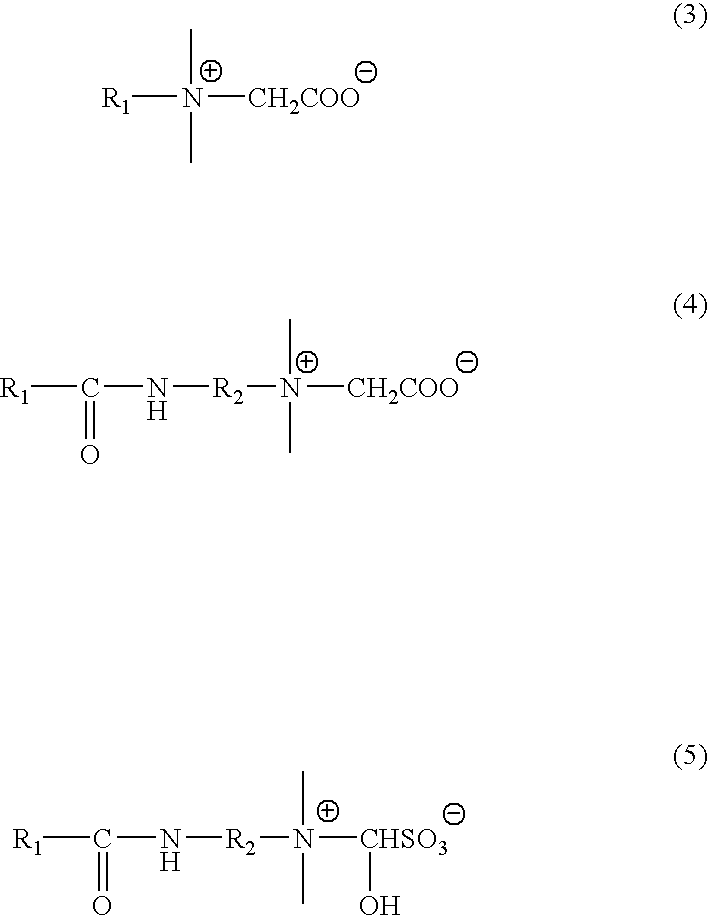
- A compound having a betaine skeleton used in the present invention can include alkylamide alkylbetaine, a salt thereof, and a derivative thereof in such a range that the effect of the present invention is not deteriorated, and preferably alkylamide alkylbetaine is used.
- The ejection liquid of the present invention is prepared, though being not particularly limited to the following procedure, by mixing a compound having betaine skeleton having surface-active properties and at least one kind of a protein and a peptide with a liquid having a composition composed of a liquid medium mainly containing water and other additive components, which are the above-described components of the ejection liquid. The form of a liquid mixture is not particularly limited, and may be any of a solution type, a suspension type, an emulsion type and a dispersion type. When the liquid mixture is not the solution type, a usable size of a suspended matter, an emulsified matter or a dispersed matter in a medium is in a range of a subnanometer scale to a micrometer scale.
- In the present invention, the present inventors have further found that it is possible to keep the stability of ejection even when the concentration of an additive is largely decreased, by adding a surfactant together with a compound having a betaine skeleton. The addition of 0.2 to 1 part by weight of the surfactant with respect to 1 part by weight of a compound having the betaine skeleton can reduce an amount of a compound having the betaine skeleton to be added, with respect to a solution having the same concentration of protein, into 1/10 to ½ while keeping the stability of the ejection.
- The effect of a surfactant is considered to be different from effect of a compound having a betaine skeleton, and to stabilize ejection through the action of inhibiting the denaturation of protein and the action of redissolving protein which has once aggregated. It is considered that the combination of these two different effects develops a synergistic effect to greatly improve the stabilization of ejection. It is considered that the single addition of a surfactant could not completely inhibit the aggregation of protein because the surfactant alone has no large effect, whereby it could not secure the stability of ejection.
- A surfactant of the present invention means a compound which has both of a polar part and a nonpolar part in one molecule, has each of the above-described parts in a distant region from each other in the molecule, and has a property capable of reducing an interfacial tension between two immiscible phases by alignment of the molecular of the surfactant between the two immiscible phases and capable of forming a micell.
- Examples of the surfactant that can be used typically includes, but is not limited to, sorbitan fatty acid esters such as sorbitan monocaprylate, sorbitan monolaurate and sorbitan monopalmitate; glycerin fatty acid esters such as glycerin monocaprylate, glycerin monomyristate and glycerin monostearate; polyglyceryl fatty acid esters such as decaglyceryl monostearate, decaglyceryl distearate and decaglyceryl monolinoleate; polyoxyethylene sorbitan fatty acid esters such as polyoxyethylene sorbitan monolaurate, polyoxyethylene sorbitan monooleate, polyoxyethylene sorbitan monostearate, polyoxyethylene sorbitan monopalmitate, polyoxyethylene sorbitan trioleate and polyoxyethylene sorbitan tristearate; polyoxyethylene sorbitan fatty acid esters such as polyoxyethylene sorbit tetrastearate and polyoxyethylene sorbit tetraoleate; polyoxyethylene glycerin fatty acid esters such as polyoxyethylene glyceryl monostearate; polyethylene glycol fatty acid esters such as polyethylene glycol distearate; polyoxyethylene alkyl ethers such as polyoxyethylene lauryl ethers; polyoxyethylene polyoxypropylene alkyl ethers such as polyoxyethylene polyoxypropylene glycol ether, polyoxyethylene polyoxypropylene propyl ether and polyoxyethylene polyoxypropylene cetyl ether; polyoxyethylene alkyl phenyl ethers such as polyoxyethylene nonylphenyl ether, polyoxyethylene hydrogenated castor oils such as polyoxyethylene castor oil and polyoxyethylene hydrogenated castor oil (polyoxyethylene hydrogen castor oil); polyoxyethylene beeswax derivatives such as polyoxyethylene sorbit beeswax; polyoxyethylene lanolin derivatives such as polyoxyethylene lanolin; polyoxyethylene stearic acid amides having HLB of 6 to 18 out of polyoxyethylene fatty acid amides; anionic surfactants including alkyl sulfate containing an alkyl group having 8 to 18 carbon atoms such as sodium cetyl sulfate, sodium lauryl sulfate and sodium oleyl sulfate, and polyoxyethylene alkyl ether sulfates containing 2 to 4 moles by average of ethyleneoxide added and an alkyl group having 8 to 18 carbon atoms such as polyoxyethylene sodium lauryl sulfate; an alkylbenzene sulfonates containing an alkyl group having 8 to 18 carbon atoms such as sodium lauryl benzenesulfonate; alkyl sulfosuccinates containing an alkyl group having 8 to 18 carbon atoms such as sodium lauryl sulfosuccinate; natural surfactants such as lecithin and glycerophospholipid; sphingophospholipids such as sphingomyelin; and saccharose fatty acid esters of a fatty acid having 8 to 18 carbon atoms. An ejection liquid (liquid composition) of the present invention can contain one or more of these surfactants in combination.
- The surfactant is preferably polyoxyethylene sorbitan fatty acid ester, is particularly preferably polyoxyethylene 20 sorbitan monolaurate, polyoxyethylene (4) sorbitan monoolate,
polyoxyethylene 20 sorbitan monopalmitate,polyoxyethylene 20 sorbitan monostearate,polyoxyethylene 20 sorbitan tristearate,polyoxyethylene 20 sorbitan monolaurate, polyoxyethylene (5) sorbitan monooleate andpolyoxyethylene 20 sorbitan tri-oleate, and is most preferablypolyoxyethylene 20 sorbitan monolaurate andpolyoxyethylene 20 sorbitan monooleate. In addition, the surfactant particularly preferable for lung inhalation ispolyoxyethylene 20 sorbitan monolaurate andpolyoxyethylene 20 sorbitan monooleate. - A concentration of a surfactant to be added can be, for instance, 0.001 to 20% by weight in the case of insulin, though depending on coexisting protein or the like. The content of a surfactant to be added is preferably 0.2 to 10 parts by weight, with respect to 1 part by weight of a compound having a betaine skeleton.
- In an embodiment of the present invention, an antibacterial agent, a disinfectant and an antiseptic agent may be added in order to eliminate the influence of a microorganism. A compound having a betaine skeleton to be used in the present invention has the above-described effect, but the agent having the effect further includes, for instance, a quaternary ammonium salt such as benzalkonium chloride and benzathonium chloride; a phenol derivative such as phenol, cresol and anisole; benzoic acids such as benzoic acid and p-hydroxybenzoate ester; and sorbic acid.
- In an embodiment of the present invention, an ejection liquid may include oil, glycerin, ethanol, urea, cellulose, polyethylene glycol and alginate, so as to increase the physical stability for cohesion and precipitation occurring while being preserved; and may include ascorbic acid, citric acid, cyclodextrin, tocopherol and other antioxidantal agents, so as to increase the chemical stability for preventing deterioration and oxidation.
- An ejection liquid may include a buffer agent for adjusting pH. A usable buffer solution includes, for instance, ascorbic acid, citric acid, diluted hydrochloric acid, diluted sodium hydroxide, further sodium hydrogenphosphate, sodium dihydrogenphosphate, potassium hydrogenphosphate, potassium dihydrogenphosphate, PBS, Hepes and Tris.
- An ejection liquid may include an isotonizing agent such as aminoethyl sulfonic acid, potassium chloride, sodium chloride, glycerin and sodium hydrogen carbonate.
- An ejection liquid may include a corrigent for taste and smell such as saccharide like glucose and sorbitol, a sweetening agent like astel palm, menthol and various flavors. In addition, the usable corrigent may be not only a hydrophilic compound, but also a hydrophobic compound or an oily compound.
- When the ejection liquid of the present invention is used for preparing a biochip and a biosensor or screening protein, a system which is approximately similar to a currently commercially available ink jet printer can be used.
- A method of ejecting protein with the use of the ejection liquid of the present invention will be now described in detail with reference to
FIG. 1 . A pattern is formed by the steps of: filling the ejection liquid into a nozzle of an ink jet head 3 from atank 1; and making the ink jet head eject the ejection liquid onto asubstrate 5 suitable for each purpose, by driving the ink jet head while keeping a fixed space between the substrate and the nozzle face of the ink jet head. InFIG. 1 ,reference numeral 2 denotes a liquid flow path,reference numeral 4 denotes liquid droplets, andreference numeral 6 denotes a drive controller. It is recommended to use a drive controller when ejecting the ejection liquid so as to form the pattern according to an image pattern on the substrate, and it is preferable to form such a pattern that spots are not connected with each other as shown inFIG. 2 . - An ejection liquid in the present invention can include various additives adaptable to a purpose of an application of an atomisation liquid, for instance, a proper amount of a surface moderator, a viscosity modifier, a solvent and a moisturizing agent, as needed.
- Specifically, a blendable additive includes, for instance, a hydrophilic binder, a hydrophobic binder, a hydrophilic thickener, a hydrophobic thickener, glycol derivatives, alcohols, a corrigent for taste, a corrigent for smell and an electrolyte, which may be a single substance or a mixture selected from them.
- Here, various substances to be used for the above exemplified additives are more preferably permitted to use in a medicinal use described in a pharmacopoeia of each country as a secondary component which may be added when preparing a liquid formulation for therapy, or in a food product and a cosmetic article.
- Various substances to be blended as the above-described additive are preferably added generally each in a range of 0.01 to 40% by a weight ratio, and more preferably in a range of 0.1 to 20%, though the value depends on a type of objective protein and peptide. In addition, an amount of the above-described additive to be added is preferably 0.5 to 200 parts by weight with respect to 1 part by weight of the above-described protein and peptide from a viewpoint of an ejection property, though the amount varies with a type, amount and combination of the additives.
- An atomiser of the present invention has preferably a structure having an ejection head part which can eject a liquid fine droplet of the liquid formulation while applying thermal energy to the liquid formulation and works based on a thermal ink jet principle, and many ejection units for the liquid formulation, which compose the head part and can be independently driven. Furthermore, the atomiser preferably has a form provided with: an electrical connection part used for connecting a plurality of control signals required for independently driving each of the ejection units for the liquid formulation, integrated with a wire for connecting the ejection units for the liquid formulation with each other; in addition, a tank for accommodating the above-described liquid formulation; and an integrally composed cartridge for nebulizing a liquid while including a liquid flow path, as means for supplying the liquid formulation from the tank to the ejection head based on the thermal ink jet principle.
-
FIG. 3 diagrammatically shows an example of the whole configuration of such a cartridge for nebulizing a liquid. The cartridge illustrated inFIG. 3 is produced by arranging ahead part 9 for nebulizing a liquid formulation, atank 7 for filling the liquid formulation therein, and aliquid flow path 8 for introducing the liquid formulation from thetank 7 to thehead part 9, integrally on the same substrate. A controller for controlling the driving of each ejection unit for a liquid formulation in thehead part 9 exchanges a driving signal, a control signal and the like with thehead part 9, through anelectrical connection part 11 to which aninner wire 10 is connected. - In the above arrangement, a
head part 9 preferably employs the head for ejecting a liquid ultrafine droplet, which ejects liquid droplets in an individual liquid amount of a subpicoliter or femtoliter order, has superior controllability for the liquid amount and is disclosed in Japanese Patent Application Laid-Open No. 2003-154655. - In examples shown in
FIG. 1 andFIG. 3 , one type of a liquid formulation is atomised, so that there is one tank for filling the liquid formulation therein in the structure. When two or more types of liquid formulations are atomised, it is possible to cope with the case by arranging a plurality of tanks for filling the liquid formulations appropriately corresponding to them, and making a thermal ink jet head have a configuration of having integrated a plurality of ejection units for the liquid formulations. - When ejecting the ejection liquid of the present invention onto a substrate with the use of the ink jet system, it is also possible to efficiently react the substrate with a substance to be detected, by ejecting a solution containing the substance to be detected onto the substrate in the same pattern, and to change the concentration of protein by only changing an amount to be ejected. Accordingly, the atomiser can be used for preparing a biochip, a biosensor, and a device for sensing and screening a biological substance. Furthermore, the atomiser is effectively used through employing a head capable of ejecting the above-described liquid fine droplet, when it is required to use the above-described extremely microdroplet as an individual liquid droplet to be ejected, for instance, when a somatic cell with a size of several micrometers has to be applied as a drug.
- An inhalation device of the present invention makes use of an advantage peculiar to the form in the inhalation device, which separates a process of transforming a liquid formulation to a liquid fine droplet from a process of mixing the atomised liquid fine droplet into an airflow for transporting the liquid fine droplet, which is a feature of a nebulizing method of the present invention. When nebulizing a liquid formulation containing an ejection liquid (liquid composition) in a predetermined concentration, which is specified in the present invention and can be used for a therapeutic purpose, into an airflow, and when making a person to be administered inhale the atomised liquid formulation, the inhalation device can arbitrarily set an amount of a drug compound (dose per single dosage) in the liquid composition contained in a gas to be inhaled, which can be used for the therapeutic purpose. The inhalation device to be used for the above purpose can be miniaturized so that a user can carry and hold it, by using an ejection head based on the thermal ink jet principle, which arranges openings for ejecting liquid fine droplets therein at high density per unit area, as a nebulizing mechanism for nebulizing the above-described liquid formulation.
- In the inhalation device which uses the above-described ejection liquid for lung inhalation, an essential part is a device which can eject a formulated substance of the present invention in a form of liquid droplets with particle sizes of 1 to 5 μm and with a narrow distribution. A head part for ejecting the liquid droplet is a removable cartridge unit which was described in the above with reference to
FIG. 3 . - An inhalation device as a controller for ejection is composed so that a user can carry and hold, and an inhaler can make a user inhale a drug in a form of liquid droplets which are ejected so as to acquire a uniform particle size and a constant amount.
- An outline of an example for an inhaler usable in the present invention will be now described with reference to
FIG. 4 andFIG. 5 . -
FIG. 4 is a perspective view showing an appearance of an inhaler,reference numeral 15 denotes a main body of the inhaler, andreference numeral 12 denotes an access cover, both of which form a housing.Reference numeral 14 denotes a power button.FIG. 5 illustrates a state in which theaccess cover 12 is opened. When theaccess cover 12 is opened, ahead cartridge unit 16 and a mouthpiece 113 appear. When a user starts an inhalation operation, air flows into amouthpiece 13 from an air intake, is mixed with a drug ejected from an ejection opening provided in ahead part 9 of thehead cartridge unit 16 to form a fluid mixture, and flows to an outlet of the mouthpiece which has a shape to be taken in a mouth of a human. The user can effectively inspire a drug solution ejected as liquid droplets from a liquid-ejecting part of a head cartridge unit, through inserting a tip of the mouthpiece inside the mouth, holding it with a tooth, and inhaling air. - In other words, a configuration of the intake part corresponds to an inhalation mechanism for making a person to be administered inhale a gas in which liquid fine droplets of a liquid formulation produced by a nebulizing mechanism float in a mist form.
-
FIG. 4 andFIG. 5 show a configuration of an example of an inhaler to be used for a medical purpose, which is miniaturized so that a user can carry and hold it. A main body of theinhaler 15 consists of a housing for accommodating a cartridge for nebulizing liquid, a controller thereof and a power source (battery); and amouthpiece 13 to cover a mouth when inhaling air, mounted thereon. The cartridge for nebulizing liquid is integrated with a tank for a liquid formulation as is illustrated inFIG. 3 , and has such a configuration that it can be exchanged after anaccess cover 12 has been opened.FIG. 5 illustrates a state in which theaccess cover 12 is opened. Ahead cartridge unit 16 is installed on some midpoint of a tubular airflow path for introducing air which flows in from an air intake opening, to amouthpiece 8 therethrough. A head part of thehead cartridge unit 16 converts a liquid formulation into liquid fine droplets based on the principle of the thermal ink jet system, and the tubular airflow path mixes them in airflow therein, and atomises them. The inhaler employs a system of introducing air inside it from the air intake opening, when a user takes themouthpiece 13 in a mouth and inhales air through the mouthpiece. - By adopting a configuration shown in
FIG. 5 , the inhaler achieves a form which can naturally make atomised liquid fine droplets of a liquid formulation arrive at a fauces and inside the trachea of a person to be administered, together with inspired air. Accordingly, an amount (dose) of the liquid formulation to be atomised does not depend on varying volumes of the inspired air, and is independently controlled. Specifically, a head part of ahead cartridge unit 16 employs a head for ejecting the liquid ultrafine droplet disclosed in Japanese Patent Application Laid-Open No. 2003-154655, and has a configuration of controlling the diameter of the droplets to about 3 μm by average. - First of all, in order to further promote understanding for difficulty in the ejection of a protein solution, an ejected amount of protein when only protein has been ejected with the thermal ink jet system will be shown. A protein solution was prepared by dissolving albumin in PBS, and the solution of each concentration was ejected by using a thermal ink jet printer (trade name: PIXUS950i, manufactured by Canon Inc.) which has been remodeled so that the ejected solution can be recovered. The amount of ejected each albumin solution was expressed by values with respect to 100% of the ejected amount of pure water which has been ejected in the same manner. The results are shown in
FIG. 6 . - It is understood that a solution containing albumin even as in a low concentration as 1 μg/mL is not completely stably ejected, and as a solution contains more protein, it is slowly hardly ejected. When carrying out such as operation as is required in the present invention, liquid droplets with a smaller diameter has to be ejected, and it is conceivable that a protein solution is hardly ejected.
- The present invention will be now described in further detail with reference to the following Examples, but Examples are specific examples shown for deeper understanding, and the present invention is not limited to these specific examples at all. Hereafter, “%” means % by weight.
- An aqueous solution containing 30% of ethanol was filled in a head cartridge having a nozzle diameter of 3 μm to be used in an ejection experiment, and a size and size distribution of the ejected particles were confirmed by measuring them with the use of a laser-diffraction-type particle size distribution measuring instrument (Spraytec manufactured by Malvern Instruments Ltd.). As a result, it was detected that the ejected particles are certainly liquid droplets having a sharp particle size distribution at 3 μm.
- (Liquid Droplet Formation from Protein Solution Based on Principle of Thermal Ink Jet System)
- An ejection liquid was prepared by the steps of: previously dissolving an appropriate concentration of albumin in purified water; further adding a compound having a betaine skeleton while stirring the solution; and then quantitatively determining the volume with purified water so that the concentration of each substance can have its desired concentration.
- A prepared ejection liquid was ejected by the steps of: filling the ejection liquid in the above-described head cartridge having the nozzle diameter of 3 μm; connecting the head cartridge with an ejection controller; setting the frequency to 20 kHz and the voltage to 12 V; ejecting the ejection liquid for one second; and again ejecting it after the interval of 3 seconds. The ejection liquid was ejected based on the principle of the thermal ink jet system. The ejection operation was repeated for 50 times and it was visually confirmed whether the ejection liquid was ejected, or not. The ejection liquid which was ejected for 50 operations was evaluated as “◯”, the ejection liquid of 15 to 49 operations as “Δ”, and the ejection liquid of less than 15 operations as “x”. In addition, the atomised ejection liquid was recovered, and it was confirmed whether the composition changed or not, by analyzing the ejection liquids before and after ejection, through an HPLC analysis (in a measurement condition of apparatus: JASCO Corporation; column: YMC-Pack Diol-200, 500×8.0 mm ID; eluent: a liquid including 0.1M KH2PO4—K2HPO4 (pH 7.0) 0.2M NaCl; flow rate: 0.7 mL/minute; temperature: 25° C.; detection: UV 215 nm). An ejection test shown below was carried out in the above-described conditions, with the use of a head cartridge having the above-described nozzle with the diameter of 3 μm and an ejection controller.
- As a comparative example, an ejection liquid was prepared which contains pure water, various protein solutions and substances having nothing to do with the present invention, and was subjected to an ejection experiment as in the case of the present examples. Formulations and results examined on Examples and Comparative Examples were listed in the following Table 1.
-
TABLE 1 Surfactant and Ejection Protein Compound having betaine skeleton additive property Type Concentration Type Concentration Type Concentration Evaluation Example 1 albumin 1 mg/ml lauramidepropyl betaine 10 mg/ml none — ◯ Example 2 albumin 1 mg/ml cocamidepropyl betaine 10 mg/ml none — ◯ Example 3 insulin 4 mg/ml cocamidepropyl betaine 10 mg/ml none — ◯ Example 4 insulin 4 mg/ml lauramidepropyl betaine 10 mg/ml none — ◯ Example 5 insulin 4 mg/ml lauryl betaine 50 mg/ml none — ◯ Example 6 glucagon 0.5 mg/ml cocamidepropyl betaine 3 mg/ml none — ◯ Example 7 GLP-1 1 mg/ml cocamidepropyl betaine 10 mg/ml none — ◯ Example 8 hGH 1 mg/ml cocamidepropyl betaine 10 mg/ml none — ◯ Example 9 EPO 1 mg/ml lauramidepropyl betaine 10 mg/ml none — ◯ Example 10 IFN α 1 mg/ml lauramidepropyl betaine 10 mg/ml none — ◯ Example 11 IFN γ 1 mg/ml lauramidepropyl betaine 10 mg/ml none — ◯ Example 12 calcitonin 1 mg/ml lauramidepropyl betaine 10 mg/ml none — ◯ Comparative water — none — none — ◯ Example 1 Comparative albumin 1 mg/ml none — none — X Example 2 Comparative insulin 4 mg/ml none — none — X Example 3 Comparative glucagon 0.5 mg/ml none — none — X Example 4 Comparative GLP-1 1 mg/ml none — none — X Example 5 Comparative hGH 1 mg/ml none — none — X Example 6 Comparative EPO 1 mg/ml none — none — X Example 7 Comparative IFN α 1 mg/ml none — none — X Example 8 Comparative IFN γ 1 mg/ml none — none — X Example 9 Comparative calcitonin 1 mg/ml none — none — X Example 10 Comparative albumin 1 mg/ml none — TWEEN80 10 mg/ml X Example 11 Comparative insulin 4 mg/ml none — TWEEN20 10 mg/ml Δ Example 12 Comparative insulin 4 mg/ml none — TWEEN20 50 mg/ml X Example 13 - Pure water of Comparative Example 1 was stably ejected because of containing no protein, whereas ejection liquids of Comparative Examples 2 to 13, which does not contain a compound having a betaine skeleton, was ejected little or was not ejected at all, regardless of the type of the protein and the presence or absence of an additive. Liquids of Comparative Examples 11 to 13 which contain a surfactant TWEEN were ejected to some extent, but was not sufficiently stably ejected. It is understood that in contrast to this, Examples 1 to 12 are normally and stably ejected. As a result of an HPLC analysis, Examples 1 to 12 did not show a change of a peak location and a peak area before and after ejection, and a change of a liquid composition, either.
- Subsequently, lauramidepropyl betaine or cocamidepropyl betaine was selected as a compound having a betaine skeleton and was added to each protein so as to be a predetermined concentration. These ejection liquids were evaluated by the same ejection experiment as in Example 1. Formulations and results examined on the present examples are listed in the following Table 2.
-
TABLE 2 Compound having Surfactant and Ejection Protein betaine skeleton additive property Type Concentration Type Concentration Type Concentration Evaluation Example 13 insulin 4 mg/ml cocamidepropyl 3 mg/ml none — ◯ betaine Example 14 insulin 4 mg/ml lauramidepropyl 3 mg/ml none — ◯ betaine Comparative insulin 4 mg/ml none — TWEEN20 3 mg/ml X Example 14 - Although the necessary concentration of alkylamide propyl betaine to be added varies with the concentration and type of protein, the addition of alkylamide propyl betaine makes each protein normally ejected on the basis of the principle of the thermal ink jet system, and it was confirmed that alkylamide propyl betaine exerts the effect to a wide range of protein with a small amount. As a result of an HPLC analysis, Examples 13 and 14 did not show a change of a peak chart before and after ejection, and a change of a liquid composition.
- A solution was prepared by adding a compound having a betaine skeleton into protein, and an ejection liquid was prepared by further adding a surfactant to the solution. These ejection liquids were evaluated by the same ejection experiment as in Example 1. Formulations and results examined on the present examples are listed in the following Table 3.
-
TABLE 3 Compound having Surfactant and Ejection Protein betaine skeleton additive property Type Concentration Type Concentration Type Concentration Evaluation Example 15 insulin 4 mg/ml lauryl betaine 2 mg/ml TWEEN20 0.5 mg/ml ◯ Example 16 albumin 1 mg/ml lauramidepropyl 5 mg/ ml TWEEN80 5 mg/ml ◯ betaine Example 17 albumin 1 mg/ml cocamidepropyl 5 mg/ ml TWEEN80 5 mg/ml ◯ betaine Example 18 albumin 1 mg/ml lauramidepropyl 3 mg/ ml TWEEN80 2 mg/ml ◯ betaine Example 19 albumin 1 mg/ml cocamidepropyl 3 mg/ ml TWEEN80 2 mg/ml ◯ betaine - A protein solution simultaneously containing alkylamide propyl betaine and TWEEN as an additive could be ejected, even when the concentration of a compound having a betaine skeleton is extremely low in comparison with the case when the compound having a betaine skeleton was singly added. In addition, a protein solution could be ejected even when containing such a concentration of a compound having a betaine skeleton as did not make the protein solution ejected, which singly contains the same amount of it. As a result, a total amount of an additive can be greatly reduced. As a result of an HPLC analysis, Examples 15 to 19 did not show a change of a peak chart before and after ejection, and a change of a liquid composition.
- A Human IL2 monoclonal antibody, a Human IL4 monoclonal antibody and a Human IL6 monoclonal antibody were prepared into a liquid having a concentration of 0.1 to 500 μg/mL, respectively. Each ejection liquid was prepared by adding lauramidepropyl betaine into the liquid so that the concentration of the betaine is 1% (w/w). The ejection liquid was filled in the head of an ink jet printer (trade name: PIXUS950i, manufactured by Canon Inc.), and was ejected onto a Poly-L-Lysin-coated slide glass.
FIG. 7 shows a model view of the present example. In the figure,reference numeral 17 denotes a substrate,reference numeral 18 denotes a masking reagent,reference numeral 19 denotes a substance (such as protein and peptide) specifically reacting with a substance to be detected,reference numeral 20 denotes a substance to be detected,reference numeral 21 denotes the substance specifically reacting with the substance to be detected, andreference numeral 22 denotes an indicator. - The antibody which had been ejected onto a glass was incubated at 4° C., and the glass on which the antibody was incubated was masked with 1% BSA.
- The glass was carefully cleaned after having had been masked, and was supplied as an antibody chip substrate. Subsequently, a solution which contains 1 μg/mL each of recombinants IL2, IL4 and IL6 that were substances to be detected by the chip was prepared together with 1.0% lauramidepropyl betaine (w/w), 0.5% TWEEN20 (w/w) and 0.1% BSA (w/w). The liquid was filled in the head of an ink jet printer 0.10 (trade name: PIXUS950i, manufactured by Canon Inc.), and was ejected on the above-described substrate so as to form the same pattern. After the liquid was ejected, the substrate was covered with a cover glass, and was subjected to the reaction at 4° C. After the reaction, the substrate was carefully cleaned and dried.
- Subsequently, a substrate specifically bonded with a sample was reacted with a substrate, and the substance was indicated. A solution containing a substance specifically bonded with the sample was prepared by blending each 1 μg/mL biotin-indicated antibody liquid (biotinylated Human IL2 monoclonal antibody, biotinylated Human IL4 monoclonal antibody and biotinylated Human IL6 monoclonal antibody), 1.0% lauramidepropyl betaine (w/w), 0.5% TWEEN20 (w/w) and 0.1% BSA (w/w) so that each component can be its final concentration; was filled in the head of an ink jet printer (trade name: PIXUS950i, manufactured by Canon Inc.); and was ejected onto the above-described substrate so as to form the same pattern. After the liquid was ejected, the substrate was covered with a cover glass, and was subjected to the reaction at 4° C. After the reaction, the substrate was carefully cleaned and dried.
- A solution for indication was prepared by blending 10 μg/mL Cy3 labeling streptavidin, 1.0% lauramidepropyl betaine (w/w), 0.5% TWEEN20 (w/w) and 0.1% BSA (w/w) so that each component can be the final concentration; then was filled in the head of an ink jet printer (trade name: PIXUS950i, manufactured by Canon Inc.); and was ejected onto the above-described substrate so as to form the same pattern. After the liquid was ejected, the substrate was covered with a cover glass, and was subjected to the reaction at 4° C. After the reaction, the substrate was carefully cleaned and dried.
- Subsequently, a substrate on which the reaction has been finished was irradiated with excited light, and a quantity of fluorescent signal of light emitted from Cy3 was measured by using a fluorescence scanner having a filter for a transmitted wavelength of 532 nm arranged therein. As the measured result, a fluorescent signal corresponding to the type and concentration of a sample could be detected.
- The present invention is not limited to the above embodiments and various changes and modifications are possible within the spirit and scope of the present invention. Therefore to apprise the public of the scope of the present invention, the following claims are made.
- This application claims priority from Japanese Patent Application No. 2005-098749 filed on Mar. 30, 2005, which is hereby incorporated by reference herein.
Claims (15)
1. An ejection liquid comprising at least one kind of a protein and a peptide, which is ejected by application of thermal energy thereto, and further comprising a compound having a betaine skeleton with a surface-active property, and a liquid medium mainly composed of water.
2. The ejection liquid according to claim 1 , wherein the compound having a betaine skeleton is a compound represented by the following formula (1):

wherein R1 represents a substituted or unsubstituted alkyl group having 6 to 18 carbon atoms;
R2 and R5 represent an alkylene chain having 1 to 6 carbon atoms;
R3 and R4 represent an alkyl group or alkylene chain having 1 to 6 carbon atoms;
R3 and R4 may be bonded with each other to form a heterocyclic ring;
A represents a carboxylic group, a sulfonic group or an anion;
X1 and X2 represent a counter ion; and
n represents 0 or 1.
3. The ejection liquid according to claim 1 or 2 , wherein the compound having a betaine skeleton is at least one compound selected from the group consisting of alkylamide alkylbetaine and a salt thereof, and a derivative thereof.
4. The ejection liquid according to any one of claims 1 to 3 , wherein the protein and the peptide are a substance selected from the group consisting of calcitonin, insulin, glucagon, interferon, a protease inhibitor, cytokine, a growth hormone, a hematopoietic factor protein, an antibody, and an analogue thereof, and a derivative thereof.
5. The ejection liquid according to any one of claims 1 to 4 , further comprising a surfactant.
6. The ejection liquid according to claim 5 , wherein the surfactant is polyoxyethylene sorbitan fatty acid ester.
7. An ejection method comprising ejecting an ejection liquid according to any one of claims 1 to 6, based on the principle of an ink jet system.
8. An ejection method comprising ejecting an ejection liquid according to any one of claims 1 to 6, based on the principle of a thermal ink jet system.
9. A liquid ejection cartridge comprising a tank for accommodating an ejection liquid according to any one of claims 1 to 6 , and an ejection head based on the principle of a thermal ink jet system.
10. An ejection device comprising: a liquid ejection cartridge according to claim 9 ; a flow path for guiding a liquid accommodated in the cartridge to be ejected from a liquid ejection part of the head of the cartridge according to claim 9 and guiding airflow for transporting the liquid; and an opening.
11. The ejection device according to claim 10 , wherein the ejection device is used for inhalation.
12. A method of making droplets from a liquid containing at least one kind of a protein and a peptide by applying thermal energy to the liquid, wherein the liquid further comprises a compound having a betaine skeleton with a surface-active property.
13. The method of making droplets from the liquid according to claim 12 , wherein the protein and the peptide are a substance selected from the group consisting of calcitonin, insulin, glucagon, interferon, a protease inhibitor, cytokine, a growth hormone, hematopoietic factor protein, an antibody, an analogue thereof and a derivative thereof.
14. The method of making droplets from the liquid according to claim 12 or 13 , wherein the liquid further comprises a surfactant.
15. The method of making droplets from the liquid according to any one of claims 12 to 14 , wherein the method makes liquid droplets from the liquid by applying thermal energy to the liquid based on the principle of a thermal ink jet system
Applications Claiming Priority (3)
| Application Number | Priority Date | Filing Date | Title |
|---|---|---|---|
| JP2005-098749 | 2005-03-30 | ||
| JP2005098749A JP4646669B2 (en) | 2005-03-30 | 2005-03-30 | Discharge liquid, discharge method, droplet forming method, cartridge, and discharge device |
| PCT/JP2006/307019 WO2006107009A1 (en) | 2005-03-30 | 2006-03-28 | Ejection liquid, ejection method, method of making droplets from liquid, cartridge and ejection device |
Related Parent Applications (1)
| Application Number | Title | Priority Date | Filing Date |
|---|---|---|---|
| PCT/JP2006/307019 A-371-Of-International WO2006107009A1 (en) | 2005-03-30 | 2006-03-28 | Ejection liquid, ejection method, method of making droplets from liquid, cartridge and ejection device |
Related Child Applications (1)
| Application Number | Title | Priority Date | Filing Date |
|---|---|---|---|
| US12/987,016 Division US8530412B2 (en) | 2005-03-30 | 2011-01-07 | Ejection liquid, ejection method, method of making droplets from liquid, cartridge and ejection device |
Publications (1)
| Publication Number | Publication Date |
|---|---|
| US20090060869A1 true US20090060869A1 (en) | 2009-03-05 |
Family
ID=37073556
Family Applications (2)
| Application Number | Title | Priority Date | Filing Date |
|---|---|---|---|
| US11/908,600 Abandoned US20090060869A1 (en) | 2005-03-30 | 2006-03-28 | Ejection liquid, ejection method, method of making droplets from liquid, cartridge and ejection device |
| US12/987,016 Expired - Fee Related US8530412B2 (en) | 2005-03-30 | 2011-01-07 | Ejection liquid, ejection method, method of making droplets from liquid, cartridge and ejection device |
Family Applications After (1)
| Application Number | Title | Priority Date | Filing Date |
|---|---|---|---|
| US12/987,016 Expired - Fee Related US8530412B2 (en) | 2005-03-30 | 2011-01-07 | Ejection liquid, ejection method, method of making droplets from liquid, cartridge and ejection device |
Country Status (8)
| Country | Link |
|---|---|
| US (2) | US20090060869A1 (en) |
| EP (1) | EP1865934A4 (en) |
| JP (1) | JP4646669B2 (en) |
| CN (1) | CN101151025A (en) |
| AU (1) | AU2006231742B2 (en) |
| CA (1) | CA2603016A1 (en) |
| RU (1) | RU2364412C2 (en) |
| WO (1) | WO2006107009A1 (en) |
Cited By (7)
| Publication number | Priority date | Publication date | Assignee | Title |
|---|---|---|---|---|
| US20070248571A1 (en) * | 2004-09-27 | 2007-10-25 | Canon Kabushiki Kaisha | Ejection Liquid, Ejection Method, Method for Forming Liquid Droplets, Liquid Ejection Cartridge and Ejection Apparatus |
| US20100069290A1 (en) * | 2006-12-04 | 2010-03-18 | Canon Kabushiki Kaisha | Ejection liquid and ejection method |
| US20100097612A1 (en) * | 2004-09-16 | 2010-04-22 | Canon Kabushiki Kaisha | Device and method for acquiring information on objective substance to be detected by detecting a change of wavelength characteristics on the optical transmittance |
| US20100327008A1 (en) * | 2009-06-29 | 2010-12-30 | Seiko Epson Corporation | Liquid for ejection and method for ejecting bio-specimen |
| US20110051153A1 (en) * | 2009-08-28 | 2011-03-03 | Omer Gila | Hard Imaging Devices, Print Devices, And Hard Imaging Methods |
| US20110102495A1 (en) * | 2005-05-02 | 2011-05-05 | Canon Kabushiki Kaisha | Ejection liquid, ejection method, method for forming liquid droplets, liquid ejection cartridge and ejection apparatus |
| US20160058958A1 (en) * | 2009-07-17 | 2016-03-03 | Nektar Therapeutics | Systems and methods for driving sealed nebulizers |
Families Citing this family (7)
| Publication number | Priority date | Publication date | Assignee | Title |
|---|---|---|---|---|
| JP4564936B2 (en) * | 2006-03-27 | 2010-10-20 | キヤノン株式会社 | Discharge liquid, discharge method, droplet forming method, liquid discharge cartridge, and discharge apparatus |
| JP5110898B2 (en) * | 2007-02-16 | 2012-12-26 | キヤノン株式会社 | Discharge liquid and discharge method |
| US10150948B2 (en) | 2013-12-11 | 2018-12-11 | The Regents Of The University Of California | Compositions and methods for producing and administering brown adipocytes |
| US11291780B2 (en) * | 2014-12-04 | 2022-04-05 | Vyaire Medical Consumables Llc | Breath-actuated nebulizer for medicine inhalation |
| WO2019074523A1 (en) * | 2017-10-13 | 2019-04-18 | Hewlett-Packard Development Company, L.P. | Biological fluids |
| CN111151314B (en) * | 2020-01-15 | 2021-07-27 | 杭州电子科技大学 | A device and method for preparing microdroplets imitating the functional structure of ant mouthparts |
| WO2021211624A1 (en) * | 2020-04-14 | 2021-10-21 | Qool Therapeutics, Inc. | Frozen particle generator using liquid micro-dispenser |
Citations (13)
| Publication number | Priority date | Publication date | Assignee | Title |
|---|---|---|---|---|
| US4654207A (en) * | 1985-03-13 | 1987-03-31 | Helene Curtis Industries, Inc. | Pearlescent shampoo and method for preparation of same |
| US5894841A (en) * | 1993-06-29 | 1999-04-20 | Ponwell Enterprises Limited | Dispenser |
| US6234167B1 (en) * | 1998-10-14 | 2001-05-22 | Chrysalis Technologies, Incorporated | Aerosol generator and methods of making and using an aerosol generator |
| US6328728B1 (en) * | 1994-11-17 | 2001-12-11 | Alza Corporation | Composition and method for enhancing electrotransport agent delivery |
| US20020092519A1 (en) * | 2001-01-16 | 2002-07-18 | Davis Colin C. | Thermal generation of droplets for aerosol |
| US20020177221A1 (en) * | 2001-03-29 | 2002-11-28 | Kenji Nishiguchi | Cellular screening substratum and manufacturing process for it, and method and apparatus for cellular screening with it |
| US20030064052A1 (en) * | 2001-05-21 | 2003-04-03 | Ponwell Enterprises, Ltd. | Compositions for protein delivery via the pulmonary route |
| US20040042972A1 (en) * | 2002-04-11 | 2004-03-04 | Medimmune Vaccines, Inc. | Spray freeze dry of compositions for intranasal administration |
| US20040142398A1 (en) * | 2003-01-21 | 2004-07-22 | Agdia, Inc. | Immunoassay and method of use |
| US6926392B2 (en) * | 2001-11-22 | 2005-08-09 | Canon Kabushiki Kaisha | Liquid ejection head |
| US20070248571A1 (en) * | 2004-09-27 | 2007-10-25 | Canon Kabushiki Kaisha | Ejection Liquid, Ejection Method, Method for Forming Liquid Droplets, Liquid Ejection Cartridge and Ejection Apparatus |
| US20070285666A1 (en) * | 2004-09-16 | 2007-12-13 | Canon Kabushiki Kaisha | Device and Method for Acquiring Information on Objective Substance to Be Detected By Detecting a Change of Wavelength Characteristics on the Optical Transmittance |
| US7344236B2 (en) * | 2003-09-12 | 2008-03-18 | Konica-Minolta Holdings, Inc. | Ink-jet cloth printing ink and an ink-jet recording method |
Family Cites Families (12)
| Publication number | Priority date | Publication date | Assignee | Title |
|---|---|---|---|---|
| GB1563311A (en) | 1975-09-26 | 1980-03-26 | Yamanouchi Pharma Co Ltd | Pharmaceutical composition of insulin for rectal use |
| US5451251A (en) * | 1993-02-26 | 1995-09-19 | Canon Kabushiki Kaisha | Ink, and ink-jet recording method and instrument using the same |
| US6267985B1 (en) | 1999-06-30 | 2001-07-31 | Lipocine Inc. | Clear oil-containing pharmaceutical compositions |
| JP4147234B2 (en) * | 2004-09-27 | 2008-09-10 | キヤノン株式会社 | Discharge liquid, discharge method, cartridge, and discharge device |
| US20020142341A1 (en) * | 2001-03-28 | 2002-10-03 | Makoto Kameyama | Method and apparatus for producing probe carrier |
| JP4378069B2 (en) | 2001-03-29 | 2009-12-02 | キヤノン株式会社 | Cell screening substrate and manufacturing method thereof, cell screening method and cell screening apparatus using the same |
| JP2003154655A (en) | 2001-11-22 | 2003-05-27 | Canon Inc | Liquid ejection head |
| JP2003221317A (en) * | 2002-01-29 | 2003-08-05 | Mitsui Chemicals Inc | Betaines-containing hair cosmetic composition |
| US7387666B2 (en) * | 2003-06-24 | 2008-06-17 | Hewlett-Packard Development Company, L.P. | Black ink-jet inks |
| SI2422789T1 (en) * | 2004-05-19 | 2018-07-31 | Los Angeles Biomedical Research Institute At Harbor-Ucla Medical Center | An injectable composition comprising sodium deoxycholate |
| JP2006036725A (en) * | 2004-07-29 | 2006-02-09 | Canon Semiconductor Equipment Inc | Solution for inkjet nebulization/inhalation |
| JP4689340B2 (en) | 2005-05-02 | 2011-05-25 | キヤノン株式会社 | Liquid pharmaceutical composition for discharge |
-
2005
- 2005-03-30 JP JP2005098749A patent/JP4646669B2/en not_active Expired - Fee Related
-
2006
- 2006-03-28 CA CA002603016A patent/CA2603016A1/en not_active Abandoned
- 2006-03-28 AU AU2006231742A patent/AU2006231742B2/en not_active Ceased
- 2006-03-28 EP EP06730967A patent/EP1865934A4/en not_active Withdrawn
- 2006-03-28 RU RU2007139929/15A patent/RU2364412C2/en not_active IP Right Cessation
- 2006-03-28 US US11/908,600 patent/US20090060869A1/en not_active Abandoned
- 2006-03-28 WO PCT/JP2006/307019 patent/WO2006107009A1/en not_active Ceased
- 2006-03-28 CN CNA2006800108556A patent/CN101151025A/en active Pending
-
2011
- 2011-01-07 US US12/987,016 patent/US8530412B2/en not_active Expired - Fee Related
Patent Citations (13)
| Publication number | Priority date | Publication date | Assignee | Title |
|---|---|---|---|---|
| US4654207A (en) * | 1985-03-13 | 1987-03-31 | Helene Curtis Industries, Inc. | Pearlescent shampoo and method for preparation of same |
| US5894841A (en) * | 1993-06-29 | 1999-04-20 | Ponwell Enterprises Limited | Dispenser |
| US6328728B1 (en) * | 1994-11-17 | 2001-12-11 | Alza Corporation | Composition and method for enhancing electrotransport agent delivery |
| US6234167B1 (en) * | 1998-10-14 | 2001-05-22 | Chrysalis Technologies, Incorporated | Aerosol generator and methods of making and using an aerosol generator |
| US20020092519A1 (en) * | 2001-01-16 | 2002-07-18 | Davis Colin C. | Thermal generation of droplets for aerosol |
| US20020177221A1 (en) * | 2001-03-29 | 2002-11-28 | Kenji Nishiguchi | Cellular screening substratum and manufacturing process for it, and method and apparatus for cellular screening with it |
| US20030064052A1 (en) * | 2001-05-21 | 2003-04-03 | Ponwell Enterprises, Ltd. | Compositions for protein delivery via the pulmonary route |
| US6926392B2 (en) * | 2001-11-22 | 2005-08-09 | Canon Kabushiki Kaisha | Liquid ejection head |
| US20040042972A1 (en) * | 2002-04-11 | 2004-03-04 | Medimmune Vaccines, Inc. | Spray freeze dry of compositions for intranasal administration |
| US20040142398A1 (en) * | 2003-01-21 | 2004-07-22 | Agdia, Inc. | Immunoassay and method of use |
| US7344236B2 (en) * | 2003-09-12 | 2008-03-18 | Konica-Minolta Holdings, Inc. | Ink-jet cloth printing ink and an ink-jet recording method |
| US20070285666A1 (en) * | 2004-09-16 | 2007-12-13 | Canon Kabushiki Kaisha | Device and Method for Acquiring Information on Objective Substance to Be Detected By Detecting a Change of Wavelength Characteristics on the Optical Transmittance |
| US20070248571A1 (en) * | 2004-09-27 | 2007-10-25 | Canon Kabushiki Kaisha | Ejection Liquid, Ejection Method, Method for Forming Liquid Droplets, Liquid Ejection Cartridge and Ejection Apparatus |
Cited By (12)
| Publication number | Priority date | Publication date | Assignee | Title |
|---|---|---|---|---|
| US20100097612A1 (en) * | 2004-09-16 | 2010-04-22 | Canon Kabushiki Kaisha | Device and method for acquiring information on objective substance to be detected by detecting a change of wavelength characteristics on the optical transmittance |
| US7944564B2 (en) | 2004-09-16 | 2011-05-17 | Canon Kabushiki Kaisha | Device and method for acquiring information on objective substance to be detected by detecting a change of wavelength characteristics on the optical transmittance |
| US20070248571A1 (en) * | 2004-09-27 | 2007-10-25 | Canon Kabushiki Kaisha | Ejection Liquid, Ejection Method, Method for Forming Liquid Droplets, Liquid Ejection Cartridge and Ejection Apparatus |
| US20110079223A1 (en) * | 2004-09-27 | 2011-04-07 | Canon Kabushiki Kaisha | Ejection liquid, ejection method, method for forming liquid droplets, liquid ejection cartridge and ejection apparatus |
| US8833363B2 (en) | 2004-09-27 | 2014-09-16 | Canon Kabushiki Kaisha | Ejection liquid, ejection method, method for forming liquid droplets, liquid ejection cartridge and ejection apparatus |
| US20110102495A1 (en) * | 2005-05-02 | 2011-05-05 | Canon Kabushiki Kaisha | Ejection liquid, ejection method, method for forming liquid droplets, liquid ejection cartridge and ejection apparatus |
| US20100069290A1 (en) * | 2006-12-04 | 2010-03-18 | Canon Kabushiki Kaisha | Ejection liquid and ejection method |
| US20100327008A1 (en) * | 2009-06-29 | 2010-12-30 | Seiko Epson Corporation | Liquid for ejection and method for ejecting bio-specimen |
| US8445285B2 (en) | 2009-06-29 | 2013-05-21 | Seiko Epson Corporation | Liquid for ejection and method for ejecting bio-specimen |
| US20160058958A1 (en) * | 2009-07-17 | 2016-03-03 | Nektar Therapeutics | Systems and methods for driving sealed nebulizers |
| US20110051153A1 (en) * | 2009-08-28 | 2011-03-03 | Omer Gila | Hard Imaging Devices, Print Devices, And Hard Imaging Methods |
| US9044953B2 (en) | 2009-08-28 | 2015-06-02 | Hewlett-Packard Development Company, L.P. | Hard imaging devices, print devices, and hard imaging methods |
Also Published As
| Publication number | Publication date |
|---|---|
| JP2006273794A (en) | 2006-10-12 |
| EP1865934A1 (en) | 2007-12-19 |
| EP1865934A4 (en) | 2012-04-04 |
| AU2006231742A1 (en) | 2006-10-12 |
| RU2007139929A (en) | 2009-05-10 |
| US8530412B2 (en) | 2013-09-10 |
| RU2364412C2 (en) | 2009-08-20 |
| WO2006107009A1 (en) | 2006-10-12 |
| CA2603016A1 (en) | 2006-10-12 |
| CN101151025A (en) | 2008-03-26 |
| AU2006231742B2 (en) | 2010-05-27 |
| US20110104113A1 (en) | 2011-05-05 |
| JP4646669B2 (en) | 2011-03-09 |
Similar Documents
| Publication | Publication Date | Title |
|---|---|---|
| US8530412B2 (en) | Ejection liquid, ejection method, method of making droplets from liquid, cartridge and ejection device | |
| US7827982B2 (en) | Ejection liquid and ejection method | |
| US8833363B2 (en) | Ejection liquid, ejection method, method for forming liquid droplets, liquid ejection cartridge and ejection apparatus | |
| US20110102495A1 (en) | Ejection liquid, ejection method, method for forming liquid droplets, liquid ejection cartridge and ejection apparatus | |
| US20130068784A1 (en) | Ejection liquid and ejection method | |
| JP4564936B2 (en) | Discharge liquid, discharge method, droplet forming method, liquid discharge cartridge, and discharge apparatus |
Legal Events
| Date | Code | Title | Description |
|---|---|---|---|
| AS | Assignment |
Owner name: CANON KABUSHIKI KAISHA, JAPAN Free format text: ASSIGNMENT OF ASSIGNORS INTEREST;ASSIGNORS:SUGITA, MASARU;MASADA, YOHEI;KANEKO, HIDEKI;REEL/FRAME:020259/0806 Effective date: 20070720 |
|
| STCB | Information on status: application discontinuation |
Free format text: ABANDONED -- FAILURE TO RESPOND TO AN OFFICE ACTION |