US20090036420A1 - Benzamide derivatives and their use for treating cns disorders - Google Patents
Benzamide derivatives and their use for treating cns disorders Download PDFInfo
- Publication number
- US20090036420A1 US20090036420A1 US12/180,566 US18056608A US2009036420A1 US 20090036420 A1 US20090036420 A1 US 20090036420A1 US 18056608 A US18056608 A US 18056608A US 2009036420 A1 US2009036420 A1 US 2009036420A1
- Authority
- US
- United States
- Prior art keywords
- phenyl
- benzamide
- methoxy
- lower alkyl
- trifluoromethyl
- Prior art date
- Legal status (The legal status is an assumption and is not a legal conclusion. Google has not performed a legal analysis and makes no representation as to the accuracy of the status listed.)
- Abandoned
Links
- 0 [1*]C1=C([2*])C([3*])=C(C(=O)N([8*])C2=CC([7*])=C([6*])C([5*])=C2[4*])C=C1 Chemical compound [1*]C1=C([2*])C([3*])=C(C(=O)N([8*])C2=CC([7*])=C([6*])C([5*])=C2[4*])C=C1 0.000 description 16
- RQOGGEIIARVSOU-UHFFFAOYSA-N CC(C)C1=CC=C(C(=O)NC2=CC=CC=C2)C=C1 Chemical compound CC(C)C1=CC=C(C(=O)NC2=CC=CC=C2)C=C1 RQOGGEIIARVSOU-UHFFFAOYSA-N 0.000 description 3
- JJWLVOIRVHMVIS-UHFFFAOYSA-N CC(C)N Chemical compound CC(C)N JJWLVOIRVHMVIS-UHFFFAOYSA-N 0.000 description 3
- DXCIHGNHNFZXOJ-UHFFFAOYSA-N COC1=C(C(=O)NC2=CC(Cl)=C(Cl)C=C2)C=CC=C1 Chemical compound COC1=C(C(=O)NC2=CC(Cl)=C(Cl)C=C2)C=CC=C1 DXCIHGNHNFZXOJ-UHFFFAOYSA-N 0.000 description 3
- DWFZMHUHVIVNCN-UHFFFAOYSA-N COC1=CC=C(OC)C(NC(=O)C2=CC([N+](=O)[O-])=CC=C2)=C1 Chemical compound COC1=CC=C(OC)C(NC(=O)C2=CC([N+](=O)[O-])=CC=C2)=C1 DWFZMHUHVIVNCN-UHFFFAOYSA-N 0.000 description 3
- GHJVCQAYICOIKX-UHFFFAOYSA-N COC1=CC=CC(NC(=O)C2=CC=C(Br)C=C2)=C1 Chemical compound COC1=CC=CC(NC(=O)C2=CC=C(Br)C=C2)=C1 GHJVCQAYICOIKX-UHFFFAOYSA-N 0.000 description 3
- XMFGGNMHIVSTGZ-UHFFFAOYSA-N O=C(NC1=CC=CC=C1)C1=C(Cl)C=C(Cl)C=C1 Chemical compound O=C(NC1=CC=CC=C1)C1=C(Cl)C=C(Cl)C=C1 XMFGGNMHIVSTGZ-UHFFFAOYSA-N 0.000 description 3
- KCBREZOWOLOPLW-UHFFFAOYSA-N O=C(NC1=CC=CC=C1)C1=CC=C([N+](=O)[O-])C=C1 Chemical compound O=C(NC1=CC=CC=C1)C1=CC=C([N+](=O)[O-])C=C1 KCBREZOWOLOPLW-UHFFFAOYSA-N 0.000 description 3
- UGYHRBSOQADCHA-UHFFFAOYSA-N C=C(OCCCC)C1=C(F)C=CC(C(=O)NC2=CC=CC(OC)=C2)=C1 Chemical compound C=C(OCCCC)C1=C(F)C=CC(C(=O)NC2=CC=CC(OC)=C2)=C1 UGYHRBSOQADCHA-UHFFFAOYSA-N 0.000 description 2
- QIUSOZVVUNACMK-UHFFFAOYSA-N CC(=O)C1=CC=CC(NC(=O)C2=CC(C(F)(F)F)=C(N3CCCC3)C=C2)=C1 Chemical compound CC(=O)C1=CC=CC(NC(=O)C2=CC(C(F)(F)F)=C(N3CCCC3)C=C2)=C1 QIUSOZVVUNACMK-UHFFFAOYSA-N 0.000 description 2
- FIDXHPNSYJUJBQ-UHFFFAOYSA-N CC(C)(C)C1=CC=C(C(=O)NC2=CC=CC=C2)C=C1 Chemical compound CC(C)(C)C1=CC=C(C(=O)NC2=CC=CC=C2)C=C1 FIDXHPNSYJUJBQ-UHFFFAOYSA-N 0.000 description 2
- WITPDKRAOQLDAQ-UHFFFAOYSA-N CC(C)C1=CC(NC(=O)C2=CC(C(F)(F)F)=C(N3CCCC3)C=C2)=CC=C1 Chemical compound CC(C)C1=CC(NC(=O)C2=CC(C(F)(F)F)=C(N3CCCC3)C=C2)=CC=C1 WITPDKRAOQLDAQ-UHFFFAOYSA-N 0.000 description 2
- PXBPMCNEAZKAKS-UHFFFAOYSA-N CC1=CC(C(=O)NC2=CC=CC(Cl)=C2)=CC=C1 Chemical compound CC1=CC(C(=O)NC2=CC=CC(Cl)=C2)=CC=C1 PXBPMCNEAZKAKS-UHFFFAOYSA-N 0.000 description 2
- RUYDNAMXAAGBCA-UHFFFAOYSA-N CC1=CC=C(C(=O)NC2=CC(Cl)=CC=C2)C=C1 Chemical compound CC1=CC=C(C(=O)NC2=CC(Cl)=CC=C2)C=C1 RUYDNAMXAAGBCA-UHFFFAOYSA-N 0.000 description 2
- PQEOPHYIUYAVDQ-UHFFFAOYSA-N CC1=CC=C(C(=O)NC2=CC=CC=C2)C=C1 Chemical compound CC1=CC=C(C(=O)NC2=CC=CC=C2)C=C1 PQEOPHYIUYAVDQ-UHFFFAOYSA-N 0.000 description 2
- LLAKMXJZVYZXCE-UHFFFAOYSA-N CC1=CC=C(C(=O)NC2=CC=CC=C2)C=C1C Chemical compound CC1=CC=C(C(=O)NC2=CC=CC=C2)C=C1C LLAKMXJZVYZXCE-UHFFFAOYSA-N 0.000 description 2
- CRWYLZLIZQKHMM-UHFFFAOYSA-N CC1=CC=C(NC(=O)C2=CC(C)=CC=C2)C=C1 Chemical compound CC1=CC=C(NC(=O)C2=CC(C)=CC=C2)C=C1 CRWYLZLIZQKHMM-UHFFFAOYSA-N 0.000 description 2
- BAOJNSWTDWRNAK-UHFFFAOYSA-N CC1=CC=C(NC(=O)C2=CC(Cl)=C(Cl)C=C2)C=C1 Chemical compound CC1=CC=C(NC(=O)C2=CC(Cl)=C(Cl)C=C2)C=C1 BAOJNSWTDWRNAK-UHFFFAOYSA-N 0.000 description 2
- YUIHXKGKVSVIEL-UHFFFAOYSA-N CC1=CC=C(NC(=O)C2=CC=CC=C2)C=C1 Chemical compound CC1=CC=C(NC(=O)C2=CC=CC=C2)C=C1 YUIHXKGKVSVIEL-UHFFFAOYSA-N 0.000 description 2
- UTSFDDXXONJZBV-UHFFFAOYSA-N CC1=CC=CC(C(=O)NC2=CC=C(Cl)C(Cl)=C2)=C1 Chemical compound CC1=CC=CC(C(=O)NC2=CC=C(Cl)C(Cl)=C2)=C1 UTSFDDXXONJZBV-UHFFFAOYSA-N 0.000 description 2
- DDOSHRIGQWXMMY-UHFFFAOYSA-N CC1=CC=CC(C(=O)NC2=CC=C(Cl)C=C2)=C1 Chemical compound CC1=CC=CC(C(=O)NC2=CC=C(Cl)C=C2)=C1 DDOSHRIGQWXMMY-UHFFFAOYSA-N 0.000 description 2
- DUSYVXRZSXLXRH-UHFFFAOYSA-N CC1=CC=CC(C(=O)NC2=CC=CC=C2)=C1 Chemical compound CC1=CC=CC(C(=O)NC2=CC=CC=C2)=C1 DUSYVXRZSXLXRH-UHFFFAOYSA-N 0.000 description 2
- VOEZRYLQOURMQV-UHFFFAOYSA-N CC1=CC=CC(NC(=O)C2=CC=CC(C)=C2)=C1 Chemical compound CC1=CC=CC(NC(=O)C2=CC=CC(C)=C2)=C1 VOEZRYLQOURMQV-UHFFFAOYSA-N 0.000 description 2
- CAWQYFNBZPYSQX-UHFFFAOYSA-N CC1=CC=CC=C1C(=O)NC1=CC(Cl)=C(Cl)C=C1 Chemical compound CC1=CC=CC=C1C(=O)NC1=CC(Cl)=C(Cl)C=C1 CAWQYFNBZPYSQX-UHFFFAOYSA-N 0.000 description 2
- GCVURDOENWBRKY-UHFFFAOYSA-N CCC(=O)OC1=CC=CC(C(=O)NC2=CC=CC(OC)=C2)=C1 Chemical compound CCC(=O)OC1=CC=CC(C(=O)NC2=CC=CC(OC)=C2)=C1 GCVURDOENWBRKY-UHFFFAOYSA-N 0.000 description 2
- XESKVJLHQVMKDM-UHFFFAOYSA-N CCC1=CC=CC(NC(=O)C2=CC(C(F)(F)F)=C(N3CCCC3)C=C2)=C1 Chemical compound CCC1=CC=CC(NC(=O)C2=CC(C(F)(F)F)=C(N3CCCC3)C=C2)=C1 XESKVJLHQVMKDM-UHFFFAOYSA-N 0.000 description 2
- XSBJGVGXCJVLCH-UHFFFAOYSA-N CCCCOC1=CC=C(C(=O)NC2=CC=CC=C2)C=C1 Chemical compound CCCCOC1=CC=C(C(=O)NC2=CC=CC=C2)C=C1 XSBJGVGXCJVLCH-UHFFFAOYSA-N 0.000 description 2
- ZOEZZKBBQFVWBD-UHFFFAOYSA-N CCCNC1=C(Cl)C=C(C(=O)NC2=CC(OC)=CC=C2)C=N1 Chemical compound CCCNC1=C(Cl)C=C(C(=O)NC2=CC(OC)=CC=C2)C=N1 ZOEZZKBBQFVWBD-UHFFFAOYSA-N 0.000 description 2
- GFQZBYZOXRVZKJ-UHFFFAOYSA-N CCOC(=O)C1=CC(C(F)(F)F)=C(Cl)N=C1C(=O)OCC Chemical compound CCOC(=O)C1=CC(C(F)(F)F)=C(Cl)N=C1C(=O)OCC GFQZBYZOXRVZKJ-UHFFFAOYSA-N 0.000 description 2
- OIGVMXFGWQJRSF-UHFFFAOYSA-N CN(C(=O)C1=CC=C(Cl)C(Cl)=C1)C1=CC=CC=C1 Chemical compound CN(C(=O)C1=CC=C(Cl)C(Cl)=C1)C1=CC=CC=C1 OIGVMXFGWQJRSF-UHFFFAOYSA-N 0.000 description 2
- VOILPFJWVAKRBY-UHFFFAOYSA-N CNC1=CC=C(C(=O)NC2=CC=CC(Cl)=C2)C=N1 Chemical compound CNC1=CC=C(C(=O)NC2=CC=CC(Cl)=C2)C=N1 VOILPFJWVAKRBY-UHFFFAOYSA-N 0.000 description 2
- ZWDJGUHBKHRAGZ-UHFFFAOYSA-N COC1=C(Cl)C=CC(NC(=O)C2=CC(C(F)(F)F)=C(N3CCCC3)C=C2)=C1 Chemical compound COC1=C(Cl)C=CC(NC(=O)C2=CC(C(F)(F)F)=C(N3CCCC3)C=C2)=C1 ZWDJGUHBKHRAGZ-UHFFFAOYSA-N 0.000 description 2
- NBKCITPTDSBOAM-UHFFFAOYSA-N COC1=C(Cl)C=CC(NC(=O)C2=CC(C)=CC=C2)=C1 Chemical compound COC1=C(Cl)C=CC(NC(=O)C2=CC(C)=CC=C2)=C1 NBKCITPTDSBOAM-UHFFFAOYSA-N 0.000 description 2
- YGUVJKUMZNSUSL-UHFFFAOYSA-N COC1=CC(NC(=O)C2=CC(C(F)(F)F)=C(Cl)C=C2)=CC=C1 Chemical compound COC1=CC(NC(=O)C2=CC(C(F)(F)F)=C(Cl)C=C2)=CC=C1 YGUVJKUMZNSUSL-UHFFFAOYSA-N 0.000 description 2
- GYKNQXUUQROFTK-UHFFFAOYSA-N COC1=CC(NC(=O)C2=CC(C(F)(F)F)=C(F)C=C2)=CC=N1 Chemical compound COC1=CC(NC(=O)C2=CC(C(F)(F)F)=C(F)C=C2)=CC=N1 GYKNQXUUQROFTK-UHFFFAOYSA-N 0.000 description 2
- QARKNLOECOZSRA-UHFFFAOYSA-N COC1=CC(NC(=O)C2=CC(C(F)(F)F)=C(N3CCC(C)CC3)C=C2)=CC=C1 Chemical compound COC1=CC(NC(=O)C2=CC(C(F)(F)F)=C(N3CCC(C)CC3)C=C2)=CC=C1 QARKNLOECOZSRA-UHFFFAOYSA-N 0.000 description 2
- DFNLQBFYJBSQFR-UHFFFAOYSA-N COC1=CC(NC(=O)C2=CC=C(N3CCCC3)C=C2)=CC=C1 Chemical compound COC1=CC(NC(=O)C2=CC=C(N3CCCC3)C=C2)=CC=C1 DFNLQBFYJBSQFR-UHFFFAOYSA-N 0.000 description 2
- DQLFRNCUXMUUDT-UHFFFAOYSA-N COC1=CC(NC(=O)C2=CC=C(OC)C(OC)=C2)=CC=C1 Chemical compound COC1=CC(NC(=O)C2=CC=C(OC)C(OC)=C2)=CC=C1 DQLFRNCUXMUUDT-UHFFFAOYSA-N 0.000 description 2
- NFTSDOZGZXXXGN-UHFFFAOYSA-N COC1=CC(NC(=O)C2=CC=C([N+](=O)[O-])C=C2)=CC(OC)=C1 Chemical compound COC1=CC(NC(=O)C2=CC=C([N+](=O)[O-])C=C2)=CC(OC)=C1 NFTSDOZGZXXXGN-UHFFFAOYSA-N 0.000 description 2
- SPKOXUOZUKBVLV-UHFFFAOYSA-N COC1=CC=C(C(=O)NC2=CC(Cl)=CC=C2)C=C1 Chemical compound COC1=CC=C(C(=O)NC2=CC(Cl)=CC=C2)C=C1 SPKOXUOZUKBVLV-UHFFFAOYSA-N 0.000 description 2
- FTFBZINSKZOBTC-UHFFFAOYSA-N COC1=CC=C(C(=O)NC2=CC(OC)=CC(OC)=C2)C=C1 Chemical compound COC1=CC=C(C(=O)NC2=CC(OC)=CC(OC)=C2)C=C1 FTFBZINSKZOBTC-UHFFFAOYSA-N 0.000 description 2
- JVSYKMQEVJDAIF-UHFFFAOYSA-N COC1=CC=C(C(=O)NC2=CC(OC)=CC=C2)C=C1 Chemical compound COC1=CC=C(C(=O)NC2=CC(OC)=CC=C2)C=C1 JVSYKMQEVJDAIF-UHFFFAOYSA-N 0.000 description 2
- XOJAJRFBOKCXPI-UHFFFAOYSA-N COC1=CC=C(C(=O)NC2=CC=CC=C2)C=C1 Chemical compound COC1=CC=C(C(=O)NC2=CC=CC=C2)C=C1 XOJAJRFBOKCXPI-UHFFFAOYSA-N 0.000 description 2
- WLMLSLDDYHIECL-UHFFFAOYSA-N COC1=CC=C(NC(=O)C2=CC=C(Cl)C(Cl)=C2)C=C1 Chemical compound COC1=CC=C(NC(=O)C2=CC=C(Cl)C(Cl)=C2)C=C1 WLMLSLDDYHIECL-UHFFFAOYSA-N 0.000 description 2
- PFLGYHSIMYVEQR-UHFFFAOYSA-N COC1=CC=C(NC(=O)C2=CC=CC(C)=C2)C=C1 Chemical compound COC1=CC=C(NC(=O)C2=CC=CC(C)=C2)C=C1 PFLGYHSIMYVEQR-UHFFFAOYSA-N 0.000 description 2
- HCVYUDNPZQUVRH-UHFFFAOYSA-N COC1=CC=C(OC)C(NC(=O)C2=CC=C(Cl)C=C2)=C1 Chemical compound COC1=CC=C(OC)C(NC(=O)C2=CC=C(Cl)C=C2)=C1 HCVYUDNPZQUVRH-UHFFFAOYSA-N 0.000 description 2
- HUMYECVYADBLCY-UHFFFAOYSA-N COC1=CC=C(OC)C(NC(=O)C2=CC=C([N+](=O)[O-])C=C2)=C1 Chemical compound COC1=CC=C(OC)C(NC(=O)C2=CC=C([N+](=O)[O-])C=C2)=C1 HUMYECVYADBLCY-UHFFFAOYSA-N 0.000 description 2
- NXCNKJUGTOLRCI-UHFFFAOYSA-N COC1=CC=CC(NC(=O)C2=CC(C(F)(F)F)=C(NCC3=CC=CC=C3)N=C2)=C1 Chemical compound COC1=CC=CC(NC(=O)C2=CC(C(F)(F)F)=C(NCC3=CC=CC=C3)N=C2)=C1 NXCNKJUGTOLRCI-UHFFFAOYSA-N 0.000 description 2
- BQFPPGBAVCUBGI-UHFFFAOYSA-N COC1=CC=CC(NC(=O)C2=CC(Cl)=C(N3CCC(C)CC3)N=C2)=C1 Chemical compound COC1=CC=CC(NC(=O)C2=CC(Cl)=C(N3CCC(C)CC3)N=C2)=C1 BQFPPGBAVCUBGI-UHFFFAOYSA-N 0.000 description 2
- WBUAHBNREGYOCI-UHFFFAOYSA-N COC1=CC=CC(NC(=O)C2=CC([N+](=O)[O-])=CC=C2)=C1 Chemical compound COC1=CC=CC(NC(=O)C2=CC([N+](=O)[O-])=CC=C2)=C1 WBUAHBNREGYOCI-UHFFFAOYSA-N 0.000 description 2
- KYIXGFJQKQLNNG-UHFFFAOYSA-N COC1=CC=CC(NC(=O)C2=CC=C(C(C)(C)C)C=C2)=C1 Chemical compound COC1=CC=CC(NC(=O)C2=CC=C(C(C)(C)C)C=C2)=C1 KYIXGFJQKQLNNG-UHFFFAOYSA-N 0.000 description 2
- LHGUCPJOIROFJT-UHFFFAOYSA-N COC1=CC=CC(NC(=O)C2=CC=C(C)C=C2)=C1 Chemical compound COC1=CC=CC(NC(=O)C2=CC=C(C)C=C2)=C1 LHGUCPJOIROFJT-UHFFFAOYSA-N 0.000 description 2
- GQLQHVBXJPGBSM-UHFFFAOYSA-N COC1=CC=CC(NC(=O)C2=CC=C(Cl)C=C2)=C1 Chemical compound COC1=CC=CC(NC(=O)C2=CC=C(Cl)C=C2)=C1 GQLQHVBXJPGBSM-UHFFFAOYSA-N 0.000 description 2
- MLUNAGSOVJWFRL-UHFFFAOYSA-N COC1=CC=CC(NC(=O)C2=CC=C3C=CC=CC3=C2)=C1 Chemical compound COC1=CC=CC(NC(=O)C2=CC=C3C=CC=CC3=C2)=C1 MLUNAGSOVJWFRL-UHFFFAOYSA-N 0.000 description 2
- JVRLXRSVFNWGJR-UHFFFAOYSA-N COC1=CC=CC(NC(=O)C2=CC=CC(F)=C2)=C1 Chemical compound COC1=CC=CC(NC(=O)C2=CC=CC(F)=C2)=C1 JVRLXRSVFNWGJR-UHFFFAOYSA-N 0.000 description 2
- DOXZXUCXDALYPI-UHFFFAOYSA-N COC1=CC=CC(NC(=O)C2=CC=CC(OC)=C2)=C1 Chemical compound COC1=CC=CC(NC(=O)C2=CC=CC(OC)=C2)=C1 DOXZXUCXDALYPI-UHFFFAOYSA-N 0.000 description 2
- UCXCRDPOWBLPHN-UHFFFAOYSA-N COC1=CC=CC(NC(=O)C2=CC=CC=C2)=C1 Chemical compound COC1=CC=CC(NC(=O)C2=CC=CC=C2)=C1 UCXCRDPOWBLPHN-UHFFFAOYSA-N 0.000 description 2
- UKYYRHCHJGCXAL-UHFFFAOYSA-N O=C(NC1=CC(Cl)=C(Cl)C=C1)C1=C(Cl)C=C(Cl)C=C1 Chemical compound O=C(NC1=CC(Cl)=C(Cl)C=C1)C1=C(Cl)C=C(Cl)C=C1 UKYYRHCHJGCXAL-UHFFFAOYSA-N 0.000 description 2
- QYZRHVLAGWNDFX-UHFFFAOYSA-N O=C(NC1=CC(Cl)=C(Cl)C=C1)C1=CC=C(C(F)(F)F)C=C1 Chemical compound O=C(NC1=CC(Cl)=C(Cl)C=C1)C1=CC=C(C(F)(F)F)C=C1 QYZRHVLAGWNDFX-UHFFFAOYSA-N 0.000 description 2
- VPOSSAFHOVHJHV-UHFFFAOYSA-N O=C(NC1=CC(Cl)=C(Cl)C=C1)C1=CC=CC(F)=C1 Chemical compound O=C(NC1=CC(Cl)=C(Cl)C=C1)C1=CC=CC(F)=C1 VPOSSAFHOVHJHV-UHFFFAOYSA-N 0.000 description 2
- JMMLZWNYIVVPOH-UHFFFAOYSA-N O=C(NC1=CC(Cl)=C(Cl)C=C1)C1=CC=CC=C1 Chemical compound O=C(NC1=CC(Cl)=C(Cl)C=C1)C1=CC=CC=C1 JMMLZWNYIVVPOH-UHFFFAOYSA-N 0.000 description 2
- RQWZZMVBASVGGO-UHFFFAOYSA-N O=C(NC1=CC(Cl)=C(Cl)C=C1)C1=CC=CC=C1Cl Chemical compound O=C(NC1=CC(Cl)=C(Cl)C=C1)C1=CC=CC=C1Cl RQWZZMVBASVGGO-UHFFFAOYSA-N 0.000 description 2
- FGHJYHIJXBBMPK-UHFFFAOYSA-N O=C(NC1=CC(Cl)=CC(Cl)=C1)C1=CC=C(N2CCOCC2)N=C1 Chemical compound O=C(NC1=CC(Cl)=CC(Cl)=C1)C1=CC=C(N2CCOCC2)N=C1 FGHJYHIJXBBMPK-UHFFFAOYSA-N 0.000 description 2
- ACBJKFUXTGAULL-UHFFFAOYSA-N O=C(NC1=CC(Cl)=CC=C1)C1=CC=C(Cl)C=C1 Chemical compound O=C(NC1=CC(Cl)=CC=C1)C1=CC=C(Cl)C=C1 ACBJKFUXTGAULL-UHFFFAOYSA-N 0.000 description 2
- HCMMPLSOWUBZAH-UHFFFAOYSA-N O=C(NC1=CC(Cl)=CC=C1)C1=CC=CC=C1 Chemical compound O=C(NC1=CC(Cl)=CC=C1)C1=CC=CC=C1 HCMMPLSOWUBZAH-UHFFFAOYSA-N 0.000 description 2
- WVXWMMZTMPMPCX-UHFFFAOYSA-N O=C(NC1=CC(Cl)=NC=C1)C1=CC(C(F)(F)F)=C(F)C=C1 Chemical compound O=C(NC1=CC(Cl)=NC=C1)C1=CC(C(F)(F)F)=C(F)C=C1 WVXWMMZTMPMPCX-UHFFFAOYSA-N 0.000 description 2
- DGFHQFZPMKCRIS-UHFFFAOYSA-N O=C(NC1=CC=C(Cl)C=C1)C1=CC=C(Cl)C(Cl)=C1 Chemical compound O=C(NC1=CC=C(Cl)C=C1)C1=CC=C(Cl)C(Cl)=C1 DGFHQFZPMKCRIS-UHFFFAOYSA-N 0.000 description 2
- PJFPJLMLHHTWDZ-UHFFFAOYSA-N O=C(NC1=CC=C(Cl)C=C1)C1=CC=CC=C1 Chemical compound O=C(NC1=CC=C(Cl)C=C1)C1=CC=CC=C1 PJFPJLMLHHTWDZ-UHFFFAOYSA-N 0.000 description 2
- RBZVZZUGJGEEON-UHFFFAOYSA-N O=C(NC1=CC=CC(Cl)=C1)C1=CC(Cl)=C(Cl)C=C1 Chemical compound O=C(NC1=CC=CC(Cl)=C1)C1=CC(Cl)=C(Cl)C=C1 RBZVZZUGJGEEON-UHFFFAOYSA-N 0.000 description 2
- XCXTUCOJHIXBIF-UHFFFAOYSA-N O=C(NC1=CC=CC(F)=C1)C1=CC(Br)=CC=C1 Chemical compound O=C(NC1=CC=CC(F)=C1)C1=CC(Br)=CC=C1 XCXTUCOJHIXBIF-UHFFFAOYSA-N 0.000 description 2
- ZGAJUNFQXBHMCI-UHFFFAOYSA-N O=C(NC1=CC=CC=C1)C1=CC(C(F)(F)F)=C([N+](=O)[O-])C=C1 Chemical compound O=C(NC1=CC=CC=C1)C1=CC(C(F)(F)F)=C([N+](=O)[O-])C=C1 ZGAJUNFQXBHMCI-UHFFFAOYSA-N 0.000 description 2
- CPHJNUHQNATEEF-UHFFFAOYSA-N O=C(NC1=CC=CC=C1)C1=CC(Cl)=C(Cl)C=C1 Chemical compound O=C(NC1=CC=CC=C1)C1=CC(Cl)=C(Cl)C=C1 CPHJNUHQNATEEF-UHFFFAOYSA-N 0.000 description 2
- QXKHQPFTDGQEON-UHFFFAOYSA-N O=C(NC1=CC=CC=C1)C1=CC=C(C(F)(F)F)C=C1 Chemical compound O=C(NC1=CC=CC=C1)C1=CC=C(C(F)(F)F)C=C1 QXKHQPFTDGQEON-UHFFFAOYSA-N 0.000 description 2
- SFHDVPIEJXCMBP-UHFFFAOYSA-N O=C(NC1=CC=CC=C1)C1=CC=C(Cl)C=C1 Chemical compound O=C(NC1=CC=CC=C1)C1=CC=C(Cl)C=C1 SFHDVPIEJXCMBP-UHFFFAOYSA-N 0.000 description 2
- HPXZWBSTCFPXTM-UHFFFAOYSA-N O=C(NC1=CC=CC=C1)C1=CC=CC(S(=O)(=O)NC2=CC=C(Br)C=C2)=C1 Chemical compound O=C(NC1=CC=CC=C1)C1=CC=CC(S(=O)(=O)NC2=CC=C(Br)C=C2)=C1 HPXZWBSTCFPXTM-UHFFFAOYSA-N 0.000 description 2
- VWIRWLAPFZXYSL-UHFFFAOYSA-N O=C(NC1=CC=CC=C1)C1=CC=CC([N+](=O)[O-])=C1 Chemical compound O=C(NC1=CC=CC=C1)C1=CC=CC([N+](=O)[O-])=C1 VWIRWLAPFZXYSL-UHFFFAOYSA-N 0.000 description 2
- ZVSKZLHKADLHSD-UHFFFAOYSA-N O=C(NC1=CC=CC=C1)C1=CC=CC=C1 Chemical compound O=C(NC1=CC=CC=C1)C1=CC=CC=C1 ZVSKZLHKADLHSD-UHFFFAOYSA-N 0.000 description 2
- RAJGXNMAMRWLQG-UHFFFAOYSA-N O=C(O)C1=CC(C(F)(F)F)=C(Cl)N=C1 Chemical compound O=C(O)C1=CC(C(F)(F)F)=C(Cl)N=C1 RAJGXNMAMRWLQG-UHFFFAOYSA-N 0.000 description 2
- KFDSMHGWDXESEL-UHFFFAOYSA-N CC(=O)NC1=CC(NC(=O)C2=CC([N+](=O)[O-])=C(N3CCOCC3)C=C2)=CC=C1 Chemical compound CC(=O)NC1=CC(NC(=O)C2=CC([N+](=O)[O-])=C(N3CCOCC3)C=C2)=CC=C1 KFDSMHGWDXESEL-UHFFFAOYSA-N 0.000 description 1
- HTJNUDDYOZBZLQ-UHFFFAOYSA-N CC(=O)NC1=CC=C(C(=O)NC2=CC=CC=C2)C=C1[N+](=O)[O-] Chemical compound CC(=O)NC1=CC=C(C(=O)NC2=CC=CC=C2)C=C1[N+](=O)[O-] HTJNUDDYOZBZLQ-UHFFFAOYSA-N 0.000 description 1
- DGFQORKYKAEYCR-UHFFFAOYSA-N CC(C)(C)OC(=O)N1CCN(C2=C(Cl)C=C(C(=O)NC3=CC(Cl)=CC=C3)C=N2)CC1 Chemical compound CC(C)(C)OC(=O)N1CCN(C2=C(Cl)C=C(C(=O)NC3=CC(Cl)=CC=C3)C=N2)CC1 DGFQORKYKAEYCR-UHFFFAOYSA-N 0.000 description 1
- HNLLTMDODIIOKR-UHFFFAOYSA-N CC(C)(C)OC(=O)N1CCN(C2=CC=C(C(=O)NC3=CC(Cl)=CC=C3)C=N2)CC1 Chemical compound CC(C)(C)OC(=O)N1CCN(C2=CC=C(C(=O)NC3=CC(Cl)=CC=C3)C=N2)CC1 HNLLTMDODIIOKR-UHFFFAOYSA-N 0.000 description 1
- NEONUMCAWBLQLU-UHFFFAOYSA-N CC(C)(C)OC(=O)N1CCN(S(=O)(=O)C2=CC=CC(C(=O)O)=C2)CC1 Chemical compound CC(C)(C)OC(=O)N1CCN(S(=O)(=O)C2=CC=CC(C(=O)O)=C2)CC1 NEONUMCAWBLQLU-UHFFFAOYSA-N 0.000 description 1
- RTHHNOMRBIUJPF-UHFFFAOYSA-N CC(C)NC1=C(Cl)C=C(C(=O)NC2=CC(Cl)=CC=C2)C=N1 Chemical compound CC(C)NC1=C(Cl)C=C(C(=O)NC2=CC(Cl)=CC=C2)C=N1 RTHHNOMRBIUJPF-UHFFFAOYSA-N 0.000 description 1
- NTVHSCKDHIRBKD-UHFFFAOYSA-N CC(C)NC1=CC=C(C(=O)NC2=CC=CC(Cl)=C2)C=N1 Chemical compound CC(C)NC1=CC=C(C(=O)NC2=CC=CC(Cl)=C2)C=N1 NTVHSCKDHIRBKD-UHFFFAOYSA-N 0.000 description 1
- INTVALPMLGGYMJ-UHFFFAOYSA-N CC(C)OC1=CC(NC(=O)C2=CC(C(F)(F)F)=C(N3CCCC3)C=C2)=CC=C1 Chemical compound CC(C)OC1=CC(NC(=O)C2=CC(C(F)(F)F)=C(N3CCCC3)C=C2)=CC=C1 INTVALPMLGGYMJ-UHFFFAOYSA-N 0.000 description 1
- IODIHKWIRVQZRS-UHFFFAOYSA-N CC1=CC(C(=O)NC2=CC([N+](=O)[O-])=CC=C2)=CC=C1 Chemical compound CC1=CC(C(=O)NC2=CC([N+](=O)[O-])=CC=C2)=CC=C1 IODIHKWIRVQZRS-UHFFFAOYSA-N 0.000 description 1
- ODGSJFNUHBIFKS-UHFFFAOYSA-N CC1=CC(NC(=O)C2=CC([N+](=O)[O-])=C(N3CCOCC3)C=C2)=NC=C1 Chemical compound CC1=CC(NC(=O)C2=CC([N+](=O)[O-])=C(N3CCOCC3)C=C2)=NC=C1 ODGSJFNUHBIFKS-UHFFFAOYSA-N 0.000 description 1
- JKLKTPNTPNIAQM-UHFFFAOYSA-N CC1=CC=C(C(=O)NC2=CC=CC=C2)C=C1S(=O)(=O)N1CCOCC1 Chemical compound CC1=CC=C(C(=O)NC2=CC=CC=C2)C=C1S(=O)(=O)N1CCOCC1 JKLKTPNTPNIAQM-UHFFFAOYSA-N 0.000 description 1
- DSGVHHRYEKIMGV-UHFFFAOYSA-N CC1=CC=C(NC(=O)C2=CC([N+](=O)[O-])=C(N3CCOCC3)C=C2)C=C1 Chemical compound CC1=CC=C(NC(=O)C2=CC([N+](=O)[O-])=C(N3CCOCC3)C=C2)C=C1 DSGVHHRYEKIMGV-UHFFFAOYSA-N 0.000 description 1
- ZPDUUEGXBZRXSU-UHFFFAOYSA-N CC1=CC=C(NC(=O)C2=CC=C(N3CCOCC3)N=C2)C=C1 Chemical compound CC1=CC=C(NC(=O)C2=CC=C(N3CCOCC3)N=C2)C=C1 ZPDUUEGXBZRXSU-UHFFFAOYSA-N 0.000 description 1
- VTPGIUMSTZHXMS-UHFFFAOYSA-N CC1=CC=CC(C(=O)NC2=CC(C#N)=CC=C2)=C1 Chemical compound CC1=CC=CC(C(=O)NC2=CC(C#N)=CC=C2)=C1 VTPGIUMSTZHXMS-UHFFFAOYSA-N 0.000 description 1
- JBTBJDYWNFRACU-UHFFFAOYSA-N CC1=CC=CC(C(=O)NC2=CC=C(C)C(Cl)=C2)=C1 Chemical compound CC1=CC=CC(C(=O)NC2=CC=C(C)C(Cl)=C2)=C1 JBTBJDYWNFRACU-UHFFFAOYSA-N 0.000 description 1
- CPHQFWZBQVNLCW-UHFFFAOYSA-N CC1=CC=CC(NC(=O)C2=CC(C(F)(F)F)=C(N3CCCC3)C=C2)=C1 Chemical compound CC1=CC=CC(NC(=O)C2=CC(C(F)(F)F)=C(N3CCCC3)C=C2)=C1 CPHQFWZBQVNLCW-UHFFFAOYSA-N 0.000 description 1
- PZBDTOLAWAKJOM-UHFFFAOYSA-N CC1=CN=C(C)N1CC1=CC(N)=CC=C1 Chemical compound CC1=CN=C(C)N1CC1=CC(N)=CC=C1 PZBDTOLAWAKJOM-UHFFFAOYSA-N 0.000 description 1
- YQSMQQVZSFSCMA-UHFFFAOYSA-N CC1=CN=C(C)N1CC1=CC(NC(=O)C2=CC(Cl)=C(Cl)C=C2)=CC=C1 Chemical compound CC1=CN=C(C)N1CC1=CC(NC(=O)C2=CC(Cl)=C(Cl)C=C2)=CC=C1 YQSMQQVZSFSCMA-UHFFFAOYSA-N 0.000 description 1
- BLHYLSPLLPPYCX-UHFFFAOYSA-N CC1=CN=C(C)N1CC1=CC([N+](=O)[O-])=CC=C1 Chemical compound CC1=CN=C(C)N1CC1=CC([N+](=O)[O-])=CC=C1 BLHYLSPLLPPYCX-UHFFFAOYSA-N 0.000 description 1
- FYEAKWTYLRQRRE-UHFFFAOYSA-N CC1CC(C)CN(C2=C(C(F)(F)F)C=C(C(=O)O)C=C2)C1 Chemical compound CC1CC(C)CN(C2=C(C(F)(F)F)C=C(C(=O)O)C=C2)C1 FYEAKWTYLRQRRE-UHFFFAOYSA-N 0.000 description 1
- OWMXZZXSAVBMTA-UHFFFAOYSA-N CC1CC(C)CN(S(=O)(=O)C2=C(F)C=CC(C(=O)O)=C2)C1 Chemical compound CC1CC(C)CN(S(=O)(=O)C2=C(F)C=CC(C(=O)O)=C2)C1 OWMXZZXSAVBMTA-UHFFFAOYSA-N 0.000 description 1
- HXUJKACGWYMWBQ-UHFFFAOYSA-N CC1CCN(C2=C(Cl)C=C(C(=O)NC3=CC(Cl)=CC=C3)C=N2)CC1 Chemical compound CC1CCN(C2=C(Cl)C=C(C(=O)NC3=CC(Cl)=CC=C3)C=N2)CC1 HXUJKACGWYMWBQ-UHFFFAOYSA-N 0.000 description 1
- QSQCHDRYCVGLHP-UHFFFAOYSA-N CC1CCN(C2=CC=C(C(=O)NC3=CC=CC(Cl)=C3)C=N2)CC1 Chemical compound CC1CCN(C2=CC=C(C(=O)NC3=CC=CC(Cl)=C3)C=N2)CC1 QSQCHDRYCVGLHP-UHFFFAOYSA-N 0.000 description 1
- YBNOKDDMZPRIGS-UHFFFAOYSA-N CCC(CC)C1=CC=C(C(=O)NC2=CC=CC=C2)C=C1 Chemical compound CCC(CC)C1=CC=C(C(=O)NC2=CC=CC=C2)C=C1 YBNOKDDMZPRIGS-UHFFFAOYSA-N 0.000 description 1
- DZBSZVBFZIAPJN-UHFFFAOYSA-N CCCCNC1=C(C(F)(F)F)C=C(C(=O)NC2=CC=CC(OC)=C2)C=C1 Chemical compound CCCCNC1=C(C(F)(F)F)C=C(C(=O)NC2=CC=CC(OC)=C2)C=C1 DZBSZVBFZIAPJN-UHFFFAOYSA-N 0.000 description 1
- KUEDCBCWZCUXSF-UHFFFAOYSA-N CCCCNC1=C(Cl)C=C(C(=O)NC2=CC(Cl)=CC=C2)C=N1 Chemical compound CCCCNC1=C(Cl)C=C(C(=O)NC2=CC(Cl)=CC=C2)C=N1 KUEDCBCWZCUXSF-UHFFFAOYSA-N 0.000 description 1
- LHMZQYLDFBWCDG-UHFFFAOYSA-N CCCCNC1=C(Cl)C=C(C(=O)NC2=CC(OC)=CC=C2)C=N1 Chemical compound CCCCNC1=C(Cl)C=C(C(=O)NC2=CC(OC)=CC=C2)C=N1 LHMZQYLDFBWCDG-UHFFFAOYSA-N 0.000 description 1
- LYEMHIHDVPXOBA-UHFFFAOYSA-N CCCCNC1=CC=C(C(=O)NC2=CC=CC(Cl)=C2)C=N1 Chemical compound CCCCNC1=CC=C(C(=O)NC2=CC=CC(Cl)=C2)C=N1 LYEMHIHDVPXOBA-UHFFFAOYSA-N 0.000 description 1
- OLVXKNBFXNVOJA-UHFFFAOYSA-N CCCCOC1=CC=C(C(=O)NC2=CC=CC(C(=O)OC)=C2)C=C1 Chemical compound CCCCOC1=CC=C(C(=O)NC2=CC=CC(C(=O)OC)=C2)C=C1 OLVXKNBFXNVOJA-UHFFFAOYSA-N 0.000 description 1
- FSBDUZDKNAIKSM-UHFFFAOYSA-N CCCNC1=C(C(F)(F)F)C=C(C(=O)NC2=CC=CC(OC)=C2)C=C1 Chemical compound CCCNC1=C(C(F)(F)F)C=C(C(=O)NC2=CC=CC(OC)=C2)C=C1 FSBDUZDKNAIKSM-UHFFFAOYSA-N 0.000 description 1
- MFWYZMWRRKRUGW-UHFFFAOYSA-N CCCNC1=C(Cl)C=C(C(=O)NC2=CC(Cl)=CC=C2)C=N1 Chemical compound CCCNC1=C(Cl)C=C(C(=O)NC2=CC(Cl)=CC=C2)C=N1 MFWYZMWRRKRUGW-UHFFFAOYSA-N 0.000 description 1
- BBLFMTCZYCXMQX-UHFFFAOYSA-N CCCNC1=C([N+](=O)[O-])C=C(C(=O)NC2=CC(OC)=CC=C2)C=C1 Chemical compound CCCNC1=C([N+](=O)[O-])C=C(C(=O)NC2=CC(OC)=CC=C2)C=C1 BBLFMTCZYCXMQX-UHFFFAOYSA-N 0.000 description 1
- IGHFEOWJSXEBGJ-UHFFFAOYSA-N CCCNC1=CC=C(C(=O)NC2=CC=CC(Cl)=C2)C=N1 Chemical compound CCCNC1=CC=C(C(=O)NC2=CC=CC(Cl)=C2)C=N1 IGHFEOWJSXEBGJ-UHFFFAOYSA-N 0.000 description 1
- HEYJEHPAAKCDNU-UHFFFAOYSA-N CCN(CC)C1=CC=C(C(=O)NC2=CC=CC(OC)=C2)C=C1 Chemical compound CCN(CC)C1=CC=C(C(=O)NC2=CC=CC(OC)=C2)C=C1 HEYJEHPAAKCDNU-UHFFFAOYSA-N 0.000 description 1
- TTZOAJROFJJRLX-UHFFFAOYSA-N CCN(CC)CCOC(=O)C1=CC=C(NC(=O)C2=CC=C(OC)C(OC)=C2)C=C1 Chemical compound CCN(CC)CCOC(=O)C1=CC=C(NC(=O)C2=CC=C(OC)C(OC)=C2)C=C1 TTZOAJROFJJRLX-UHFFFAOYSA-N 0.000 description 1
- IQIRRSCDTAFIQT-UHFFFAOYSA-N CCN(CC)CCOC(=O)C1=CC=C(NC(=O)C2=CC=CC(OC)=C2)C=C1 Chemical compound CCN(CC)CCOC(=O)C1=CC=C(NC(=O)C2=CC=CC(OC)=C2)C=C1 IQIRRSCDTAFIQT-UHFFFAOYSA-N 0.000 description 1
- NMIHJFHEMDYEQW-UHFFFAOYSA-N CCNC1=C(C(F)(F)F)C=C(C(=O)NC2=CC=CC(OC)=C2)C=C1 Chemical compound CCNC1=C(C(F)(F)F)C=C(C(=O)NC2=CC=CC(OC)=C2)C=C1 NMIHJFHEMDYEQW-UHFFFAOYSA-N 0.000 description 1
- FVSQAGACNGQOFM-UHFFFAOYSA-N CCNC1=C(Cl)C=C(C(=O)NC2=CC(Cl)=CC=C2)C=N1 Chemical compound CCNC1=C(Cl)C=C(C(=O)NC2=CC(Cl)=CC=C2)C=N1 FVSQAGACNGQOFM-UHFFFAOYSA-N 0.000 description 1
- HRMDEJZIVWLYCR-UHFFFAOYSA-N CCNC1=C([N+](=O)[O-])C=C(C(=O)NC2=CC(OC)=CC=C2)C=C1 Chemical compound CCNC1=C([N+](=O)[O-])C=C(C(=O)NC2=CC(OC)=CC=C2)C=C1 HRMDEJZIVWLYCR-UHFFFAOYSA-N 0.000 description 1
- VCKFPGFDHLOKID-UHFFFAOYSA-N CCNC1=CC=C(C(=O)NC2=CC=CC(Cl)=C2)C=N1 Chemical compound CCNC1=CC=C(C(=O)NC2=CC=CC(Cl)=C2)C=N1 VCKFPGFDHLOKID-UHFFFAOYSA-N 0.000 description 1
- VHCLYYSZPDBXMX-UHFFFAOYSA-N CCNC1=CC=C(C(=O)NC2=CC=CC(OC)=C2)C=C1 Chemical compound CCNC1=CC=C(C(=O)NC2=CC=CC(OC)=C2)C=C1 VHCLYYSZPDBXMX-UHFFFAOYSA-N 0.000 description 1
- DATVCUOOCXDCPP-UHFFFAOYSA-N CCOC(=O)C1=CC(C(F)(F)F)=C[N+]([O-])=C1C(=O)OCC Chemical compound CCOC(=O)C1=CC(C(F)(F)F)=C[N+]([O-])=C1C(=O)OCC DATVCUOOCXDCPP-UHFFFAOYSA-N 0.000 description 1
- MFAOHQYFZPZEKX-UHFFFAOYSA-N CCOC(=O)C1=CC=C(NC(=O)C2=C/C=C3/SCCCC/C3=C\2)C=C1 Chemical compound CCOC(=O)C1=CC=C(NC(=O)C2=C/C=C3/SCCCC/C3=C\2)C=C1 MFAOHQYFZPZEKX-UHFFFAOYSA-N 0.000 description 1
- KLFVWQCQUXXLOU-UHFFFAOYSA-N CCOC1=CC=CC(NC(=O)C2=CC(C(F)(F)F)=C(N3CCCC3)C=C2)=C1 Chemical compound CCOC1=CC=CC(NC(=O)C2=CC(C(F)(F)F)=C(N3CCCC3)C=C2)=C1 KLFVWQCQUXXLOU-UHFFFAOYSA-N 0.000 description 1
- JUYCZBACZOWRHD-UHFFFAOYSA-N CN(C(=O)C1=CC(F)=CC=C1)C1=CC(Cl)=CC=C1 Chemical compound CN(C(=O)C1=CC(F)=CC=C1)C1=CC(Cl)=CC=C1 JUYCZBACZOWRHD-UHFFFAOYSA-N 0.000 description 1
- JDWDJKIDNYGQGK-UHFFFAOYSA-N CN(C)C1=C(Cl)C=C(C(=O)NC2=CC(Cl)=CC=C2)C=N1 Chemical compound CN(C)C1=C(Cl)C=C(C(=O)NC2=CC(Cl)=CC=C2)C=N1 JDWDJKIDNYGQGK-UHFFFAOYSA-N 0.000 description 1
- YAPQETRQQJSRLA-UHFFFAOYSA-N CN(C)C1=CC=C(C(=O)NC2=CC=CC(Cl)=C2)C=N1 Chemical compound CN(C)C1=CC=C(C(=O)NC2=CC=CC(Cl)=C2)C=N1 YAPQETRQQJSRLA-UHFFFAOYSA-N 0.000 description 1
- BBIVKADJIGATEE-UHFFFAOYSA-N CN(C)C1=CC=C(C(=O)NC2=CC=CC=C2)C=C1 Chemical compound CN(C)C1=CC=C(C(=O)NC2=CC=CC=C2)C=C1 BBIVKADJIGATEE-UHFFFAOYSA-N 0.000 description 1
- JBIKECNTZCSBJL-UHFFFAOYSA-N CN(C)S(=O)(=O)OC1=CC=CC(C(=O)NC2=CC=CC(Cl)=C2)=C1 Chemical compound CN(C)S(=O)(=O)OC1=CC=CC(C(=O)NC2=CC=CC(Cl)=C2)=C1 JBIKECNTZCSBJL-UHFFFAOYSA-N 0.000 description 1
- IFYXJXLNHIPXDZ-UHFFFAOYSA-N CN1CCN(C2=C(Cl)C=C(C(=O)NC3=CC(Cl)=CC=C3)C=N2)CC1 Chemical compound CN1CCN(C2=C(Cl)C=C(C(=O)NC3=CC(Cl)=CC=C3)C=N2)CC1 IFYXJXLNHIPXDZ-UHFFFAOYSA-N 0.000 description 1
- RNUGBQCSZBJHIT-UHFFFAOYSA-N CN1CCN(C2=CC=C(C(=O)NC3=CC=CC(Cl)=C3)C=N2)CC1 Chemical compound CN1CCN(C2=CC=C(C(=O)NC3=CC=CC(Cl)=C3)C=N2)CC1 RNUGBQCSZBJHIT-UHFFFAOYSA-N 0.000 description 1
- CLLKIURENPKCFM-UHFFFAOYSA-N CNC1=C(C(F)(F)F)C=C(C(=O)NC2=CC=CC(OC)=C2)C=C1 Chemical compound CNC1=C(C(F)(F)F)C=C(C(=O)NC2=CC=CC(OC)=C2)C=C1 CLLKIURENPKCFM-UHFFFAOYSA-N 0.000 description 1
- IGUXQACVWZJVEW-UHFFFAOYSA-N CNC1=C(Cl)C=C(C(=O)NC2=CC(Cl)=CC=C2)C=N1 Chemical compound CNC1=C(Cl)C=C(C(=O)NC2=CC(Cl)=CC=C2)C=N1 IGUXQACVWZJVEW-UHFFFAOYSA-N 0.000 description 1
- ROCWMDUXAPBTME-UHFFFAOYSA-N CNC1=C([N+](=O)[O-])C=C(C(=O)NC2=CC(OC)=CC=C2)C=C1 Chemical compound CNC1=C([N+](=O)[O-])C=C(C(=O)NC2=CC(OC)=CC=C2)C=C1 ROCWMDUXAPBTME-UHFFFAOYSA-N 0.000 description 1
- BXADIOGMBWLDSU-UHFFFAOYSA-N CNC1=CC=C(C(=O)NC2=CC=CC(OC)=C2)C=C1 Chemical compound CNC1=CC=C(C(=O)NC2=CC=CC(OC)=C2)C=C1 BXADIOGMBWLDSU-UHFFFAOYSA-N 0.000 description 1
- WVJUJPPWUMBRND-UHFFFAOYSA-N CNS(=O)(=O)C1=CC=CC(C(=O)NC2=CC=CC(OC)=C2)=C1 Chemical compound CNS(=O)(=O)C1=CC=CC(C(=O)NC2=CC=CC(OC)=C2)=C1 WVJUJPPWUMBRND-UHFFFAOYSA-N 0.000 description 1
- SCEYNDCFCHACEM-UHFFFAOYSA-N COC(=O)C1=C(OC)C=C(NC(=O)C2=CC(C(F)(F)F)=CC=C2)C=C1 Chemical compound COC(=O)C1=C(OC)C=C(NC(=O)C2=CC(C(F)(F)F)=CC=C2)C=C1 SCEYNDCFCHACEM-UHFFFAOYSA-N 0.000 description 1
- RKUPAZMWXFKKDD-UHFFFAOYSA-N COC(=O)C1=C(OC)C=C(NC(=O)C2=CC(Cl)=C(Cl)C=C2)C=C1 Chemical compound COC(=O)C1=C(OC)C=C(NC(=O)C2=CC(Cl)=C(Cl)C=C2)C=C1 RKUPAZMWXFKKDD-UHFFFAOYSA-N 0.000 description 1
- XTLWUQQEWCDCLV-UHFFFAOYSA-N COC1=C(C2=CN=CO2)C=CC(NC(=O)C2=CC(C)=CC=C2)=C1 Chemical compound COC1=C(C2=CN=CO2)C=CC(NC(=O)C2=CC(C)=CC=C2)=C1 XTLWUQQEWCDCLV-UHFFFAOYSA-N 0.000 description 1
- FRNAQWBEAOHSFG-UHFFFAOYSA-N COC1=C(C2=CN=CO2)C=CC(NC(=O)C2=CC([N+](=O)[O-])=CC=C2)=C1 Chemical compound COC1=C(C2=CN=CO2)C=CC(NC(=O)C2=CC([N+](=O)[O-])=CC=C2)=C1 FRNAQWBEAOHSFG-UHFFFAOYSA-N 0.000 description 1
- BVBZIUAMDAQQOT-UHFFFAOYSA-N COC1=C(Cl)C=CC(NC(=O)C2=CC(C(F)(F)F)=C(F)C=C2)=C1 Chemical compound COC1=C(Cl)C=CC(NC(=O)C2=CC(C(F)(F)F)=C(F)C=C2)=C1 BVBZIUAMDAQQOT-UHFFFAOYSA-N 0.000 description 1
- MAUXOFKSNHRNRK-UHFFFAOYSA-N COC1=C(NC(=O)C2=CC(C(F)(F)F)=C(N3CCCC3)C=C2)C=C(C(C)(C)C)C=C1 Chemical compound COC1=C(NC(=O)C2=CC(C(F)(F)F)=C(N3CCCC3)C=C2)C=C(C(C)(C)C)C=C1 MAUXOFKSNHRNRK-UHFFFAOYSA-N 0.000 description 1
- ZDSCDJJAFBIPHX-UHFFFAOYSA-N COC1=C(OC)C=C(NC(=O)C2=CC=C(Br)C=C2)C=C1 Chemical compound COC1=C(OC)C=C(NC(=O)C2=CC=C(Br)C=C2)C=C1 ZDSCDJJAFBIPHX-UHFFFAOYSA-N 0.000 description 1
- MDRJAJDYSAQGBL-UHFFFAOYSA-N COC1=C(OC)C=C(NC(=O)C2=CC=C(C)C=C2)C=C1 Chemical compound COC1=C(OC)C=C(NC(=O)C2=CC=C(C)C=C2)C=C1 MDRJAJDYSAQGBL-UHFFFAOYSA-N 0.000 description 1
- BTJTYYCNWKCYRL-UHFFFAOYSA-N COC1=CC(NC(=O)C2=CC(Br)=C(F)C=C2)=CC=C1 Chemical compound COC1=CC(NC(=O)C2=CC(Br)=C(F)C=C2)=CC=C1 BTJTYYCNWKCYRL-UHFFFAOYSA-N 0.000 description 1
- RHYJMLLWIPXXIE-UHFFFAOYSA-N COC1=CC(NC(=O)C2=CC(C#N)=CC=C2)=CC=C1 Chemical compound COC1=CC(NC(=O)C2=CC(C#N)=CC=C2)=CC=C1 RHYJMLLWIPXXIE-UHFFFAOYSA-N 0.000 description 1
- UTYXNQRGPVMSGN-UHFFFAOYSA-N COC1=CC(NC(=O)C2=CC(C(C)=O)=C(F)C=C2)=CC=C1 Chemical compound COC1=CC(NC(=O)C2=CC(C(C)=O)=C(F)C=C2)=CC=C1 UTYXNQRGPVMSGN-UHFFFAOYSA-N 0.000 description 1
- CHKPRWOOTQBNPX-UHFFFAOYSA-N COC1=CC(NC(=O)C2=CC(C(F)(F)F)=C(F)C=C2)=CC=C1 Chemical compound COC1=CC(NC(=O)C2=CC(C(F)(F)F)=C(F)C=C2)=CC=C1 CHKPRWOOTQBNPX-UHFFFAOYSA-N 0.000 description 1
- IZTGWISDDCHLNG-UHFFFAOYSA-N COC1=CC(NC(=O)C2=CC(C(F)(F)F)=C(N3CC(C)CC(C)C3)C=C2)=CC=C1 Chemical compound COC1=CC(NC(=O)C2=CC(C(F)(F)F)=C(N3CC(C)CC(C)C3)C=C2)=CC=C1 IZTGWISDDCHLNG-UHFFFAOYSA-N 0.000 description 1
- ISSTYWBOHVDGPZ-UHFFFAOYSA-N COC1=CC(NC(=O)C2=CC(C(F)(F)F)=C(N3CCC(C#N)CC3)C=C2)=CC=C1 Chemical compound COC1=CC(NC(=O)C2=CC(C(F)(F)F)=C(N3CCC(C#N)CC3)C=C2)=CC=C1 ISSTYWBOHVDGPZ-UHFFFAOYSA-N 0.000 description 1
- UMUAXDIGWQQMBY-UHFFFAOYSA-N COC1=CC(NC(=O)C2=CC(C(F)(F)F)=C(N3CCC(C(F)(F)F)CC3)C=C2)=CC=C1 Chemical compound COC1=CC(NC(=O)C2=CC(C(F)(F)F)=C(N3CCC(C(F)(F)F)CC3)C=C2)=CC=C1 UMUAXDIGWQQMBY-UHFFFAOYSA-N 0.000 description 1
- PIBWKYDWMXDZSH-UHFFFAOYSA-N COC1=CC(NC(=O)C2=CC(C(F)(F)F)=C(N3CCC3)C=C2)=CC=C1 Chemical compound COC1=CC(NC(=O)C2=CC(C(F)(F)F)=C(N3CCC3)C=C2)=CC=C1 PIBWKYDWMXDZSH-UHFFFAOYSA-N 0.000 description 1
- CPIONBHLDALOOE-UHFFFAOYSA-N COC1=CC(NC(=O)C2=CC(C(F)(F)F)=C(N3CCCCC3)C=C2)=CC=C1 Chemical compound COC1=CC(NC(=O)C2=CC(C(F)(F)F)=C(N3CCCCC3)C=C2)=CC=C1 CPIONBHLDALOOE-UHFFFAOYSA-N 0.000 description 1
- SNQNZGJLHSXPKY-UHFFFAOYSA-N COC1=CC(NC(=O)C2=CC(C(F)(F)F)=C(N3CCCCCC3)C=C2)=CC=C1 Chemical compound COC1=CC(NC(=O)C2=CC(C(F)(F)F)=C(N3CCCCCC3)C=C2)=CC=C1 SNQNZGJLHSXPKY-UHFFFAOYSA-N 0.000 description 1
- QMIOSGWJIMFYKD-UHFFFAOYSA-N COC1=CC(NC(=O)C2=CC(C(F)(F)F)=C(N3CCN(C)CC3)C=C2)=CC=C1 Chemical compound COC1=CC(NC(=O)C2=CC(C(F)(F)F)=C(N3CCN(C)CC3)C=C2)=CC=C1 QMIOSGWJIMFYKD-UHFFFAOYSA-N 0.000 description 1
- APQLIEKWDVDWLW-UHFFFAOYSA-N COC1=CC(NC(=O)C2=CC(C(F)(F)F)=C(N3CCOCC3)C=C2)=CC=C1 Chemical compound COC1=CC(NC(=O)C2=CC(C(F)(F)F)=C(N3CCOCC3)C=C2)=CC=C1 APQLIEKWDVDWLW-UHFFFAOYSA-N 0.000 description 1
- HIBAZAHNDFFIRC-UHFFFAOYSA-N COC1=CC(NC(=O)C2=CC(C(F)(F)F)=C(NC(C)C)C=C2)=CC=C1 Chemical compound COC1=CC(NC(=O)C2=CC(C(F)(F)F)=C(NC(C)C)C=C2)=CC=C1 HIBAZAHNDFFIRC-UHFFFAOYSA-N 0.000 description 1
- RGNGBCPLHHJTFJ-UHFFFAOYSA-N COC1=CC(NC(=O)C2=CC(C(F)(F)F)=C(NCC3=CC=CC=C3)C=C2)=CC=C1 Chemical compound COC1=CC(NC(=O)C2=CC(C(F)(F)F)=C(NCC3=CC=CC=C3)C=C2)=CC=C1 RGNGBCPLHHJTFJ-UHFFFAOYSA-N 0.000 description 1
- BUNFJICIWLZSPG-UHFFFAOYSA-N COC1=CC(NC(=O)C2=CC(C)=C(F)C=C2)=CC=C1 Chemical compound COC1=CC(NC(=O)C2=CC(C)=C(F)C=C2)=CC=C1 BUNFJICIWLZSPG-UHFFFAOYSA-N 0.000 description 1
- KJPPLOIKMJLXFG-UHFFFAOYSA-N COC1=CC(NC(=O)C2=CC(Cl)=C(Cl)C=C2)=CC=C1 Chemical compound COC1=CC(NC(=O)C2=CC(Cl)=C(Cl)C=C2)=CC=C1 KJPPLOIKMJLXFG-UHFFFAOYSA-N 0.000 description 1
- OYXWPMCKSHEIHI-UHFFFAOYSA-N COC1=CC(NC(=O)C2=CC(Cl)=C(F)C=C2)=CC=C1 Chemical compound COC1=CC(NC(=O)C2=CC(Cl)=C(F)C=C2)=CC=C1 OYXWPMCKSHEIHI-UHFFFAOYSA-N 0.000 description 1
- GNIHIUBDWOXMIO-UHFFFAOYSA-N COC1=CC(NC(=O)C2=CC(F)=C(F)C=C2)=CC=C1 Chemical compound COC1=CC(NC(=O)C2=CC(F)=C(F)C=C2)=CC=C1 GNIHIUBDWOXMIO-UHFFFAOYSA-N 0.000 description 1
- QOKZFKUBAJPFKX-UHFFFAOYSA-N COC1=CC(NC(=O)C2=CC(F)=C(F)C=C2OC)=CC=C1 Chemical compound COC1=CC(NC(=O)C2=CC(F)=C(F)C=C2OC)=CC=C1 QOKZFKUBAJPFKX-UHFFFAOYSA-N 0.000 description 1
- GHPICZNLHQGEKX-UHFFFAOYSA-N COC1=CC(NC(=O)C2=CC(OC(F)(F)F)=C(F)C=C2)=CC=C1 Chemical compound COC1=CC(NC(=O)C2=CC(OC(F)(F)F)=C(F)C=C2)=CC=C1 GHPICZNLHQGEKX-UHFFFAOYSA-N 0.000 description 1
- SWKHIELGPXYFQI-UHFFFAOYSA-N COC1=CC(NC(=O)C2=CC(S(=O)(=O)N(C)C)=CC=C2)=CC=C1 Chemical compound COC1=CC(NC(=O)C2=CC(S(=O)(=O)N(C)C)=CC=C2)=CC=C1 SWKHIELGPXYFQI-UHFFFAOYSA-N 0.000 description 1
- AMARDIGNHBRSQQ-UHFFFAOYSA-N COC1=CC(NC(=O)C2=CC(S(=O)(=O)N3CC(C)CC(C)C3)=C(F)C=C2)=CC=C1 Chemical compound COC1=CC(NC(=O)C2=CC(S(=O)(=O)N3CC(C)CC(C)C3)=C(F)C=C2)=CC=C1 AMARDIGNHBRSQQ-UHFFFAOYSA-N 0.000 description 1
- XJZWCTPIUHUPJP-UHFFFAOYSA-N COC1=CC(NC(=O)C2=CC(S(=O)(=O)N3CC(C)CC(C)C3)=CC=C2)=CC=C1 Chemical compound COC1=CC(NC(=O)C2=CC(S(=O)(=O)N3CC(C)CC(C)C3)=CC=C2)=CC=C1 XJZWCTPIUHUPJP-UHFFFAOYSA-N 0.000 description 1
- JGLAVIBDTCMFQO-UHFFFAOYSA-N COC1=CC(NC(=O)C2=CC(S(=O)(=O)N3CCC3)=CC=C2)=CC=C1 Chemical compound COC1=CC(NC(=O)C2=CC(S(=O)(=O)N3CCC3)=CC=C2)=CC=C1 JGLAVIBDTCMFQO-UHFFFAOYSA-N 0.000 description 1
- KRXKKQGPOZIWSS-UHFFFAOYSA-N COC1=CC(NC(=O)C2=CC(S(=O)(=O)N3CCCC3)=CC=C2)=CC=C1 Chemical compound COC1=CC(NC(=O)C2=CC(S(=O)(=O)N3CCCC3)=CC=C2)=CC=C1 KRXKKQGPOZIWSS-UHFFFAOYSA-N 0.000 description 1
- TVJAFRCMRMLRQD-UHFFFAOYSA-N COC1=CC(NC(=O)C2=CC(S(=O)(=O)N3CCCCC3)=C(F)C=C2)=CC=C1 Chemical compound COC1=CC(NC(=O)C2=CC(S(=O)(=O)N3CCCCC3)=C(F)C=C2)=CC=C1 TVJAFRCMRMLRQD-UHFFFAOYSA-N 0.000 description 1
- UZLIGKLGGLZPJR-UHFFFAOYSA-N COC1=CC(NC(=O)C2=CC(S(=O)(=O)N3CCCCC3)=CC=C2)=CC=C1 Chemical compound COC1=CC(NC(=O)C2=CC(S(=O)(=O)N3CCCCC3)=CC=C2)=CC=C1 UZLIGKLGGLZPJR-UHFFFAOYSA-N 0.000 description 1
- KVGKMADFBYIEDM-UHFFFAOYSA-N COC1=CC(NC(=O)C2=CC(S(=O)(=O)N3CCCCCC3)=CC=C2)=CC=C1 Chemical compound COC1=CC(NC(=O)C2=CC(S(=O)(=O)N3CCCCCC3)=CC=C2)=CC=C1 KVGKMADFBYIEDM-UHFFFAOYSA-N 0.000 description 1
- MRWMPGPZBFQEBP-UHFFFAOYSA-N COC1=CC(NC(=O)C2=CC(S(=O)(=O)N3CCN(C(=O)OC(C)(C)C)CC3)=CC=C2)=CC=C1 Chemical compound COC1=CC(NC(=O)C2=CC(S(=O)(=O)N3CCN(C(=O)OC(C)(C)C)CC3)=CC=C2)=CC=C1 MRWMPGPZBFQEBP-UHFFFAOYSA-N 0.000 description 1
- BTHHUEQYXGNJSM-UHFFFAOYSA-N COC1=CC(NC(=O)C2=CC(S(=O)(=O)N3CCNCC3)=CC=C2)=CC=C1 Chemical compound COC1=CC(NC(=O)C2=CC(S(=O)(=O)N3CCNCC3)=CC=C2)=CC=C1 BTHHUEQYXGNJSM-UHFFFAOYSA-N 0.000 description 1
- SLBYRFPBIQUDCQ-UHFFFAOYSA-N COC1=CC(NC(=O)C2=CC(S(=O)(=O)N3CCOCC3)=C(C)C=C2)=CC=C1 Chemical compound COC1=CC(NC(=O)C2=CC(S(=O)(=O)N3CCOCC3)=C(C)C=C2)=CC=C1 SLBYRFPBIQUDCQ-UHFFFAOYSA-N 0.000 description 1
- HLAJTMXBPPWREO-UHFFFAOYSA-N COC1=CC(NC(=O)C2=CC(S(=O)(=O)NC3=CC=C(Br)C=C3)=CC=C2)=CC=C1 Chemical compound COC1=CC(NC(=O)C2=CC(S(=O)(=O)NC3=CC=C(Br)C=C3)=CC=C2)=CC=C1 HLAJTMXBPPWREO-UHFFFAOYSA-N 0.000 description 1
- XSWPFXAFBVBYCN-UHFFFAOYSA-N COC1=CC(NC(=O)C2=CC(S(C)(=O)=O)=C(Cl)C=C2)=CC=C1 Chemical compound COC1=CC(NC(=O)C2=CC(S(C)(=O)=O)=C(Cl)C=C2)=CC=C1 XSWPFXAFBVBYCN-UHFFFAOYSA-N 0.000 description 1
- JZCWLFVMZXPJJO-UHFFFAOYSA-N COC1=CC(NC(=O)C2=CC(S(C)(=O)=O)=CC=C2)=CC=C1 Chemical compound COC1=CC(NC(=O)C2=CC(S(C)(=O)=O)=CC=C2)=CC=C1 JZCWLFVMZXPJJO-UHFFFAOYSA-N 0.000 description 1
- JLUIVABUOGACPQ-UHFFFAOYSA-N COC1=CC(NC(=O)C2=CC(S(N)(=O)=O)=C(F)C=C2)=CC=C1 Chemical compound COC1=CC(NC(=O)C2=CC(S(N)(=O)=O)=C(F)C=C2)=CC=C1 JLUIVABUOGACPQ-UHFFFAOYSA-N 0.000 description 1
- DPHUIOZVHUUCNZ-UHFFFAOYSA-N COC1=CC(NC(=O)C2=CC([N+](=O)[O-])=C(F)C=C2)=CC=C1 Chemical compound COC1=CC(NC(=O)C2=CC([N+](=O)[O-])=C(F)C=C2)=CC=C1 DPHUIOZVHUUCNZ-UHFFFAOYSA-N 0.000 description 1
- HERPEDOZAFWSSX-UHFFFAOYSA-N COC1=CC(NC(=O)C2=CC([N+](=O)[O-])=C(N3CCOCC3)C=C2)=CC=C1Cl Chemical compound COC1=CC(NC(=O)C2=CC([N+](=O)[O-])=C(N3CCOCC3)C=C2)=CC=C1Cl HERPEDOZAFWSSX-UHFFFAOYSA-N 0.000 description 1
- DTIOIVMYVABWOA-UHFFFAOYSA-N COC1=CC(NC(=O)C2=CC([N+](=O)[O-])=C(NCCCN3CCC(C)CC3)C=C2)=CC=C1 Chemical compound COC1=CC(NC(=O)C2=CC([N+](=O)[O-])=C(NCCCN3CCC(C)CC3)C=C2)=CC=C1 DTIOIVMYVABWOA-UHFFFAOYSA-N 0.000 description 1
- AONUXTNVAWSGKE-UHFFFAOYSA-N COC1=CC(NC(=O)C2=CC=C(C(=O)C(F)(F)F)C=C2)=C(Cl)C=C1Cl Chemical compound COC1=CC(NC(=O)C2=CC=C(C(=O)C(F)(F)F)C=C2)=C(Cl)C=C1Cl AONUXTNVAWSGKE-UHFFFAOYSA-N 0.000 description 1
- XDBRFCGRCIEHAJ-UHFFFAOYSA-N COC1=CC(NC(=O)C2=CC=C(CS(=O)(=O)CC#N)C=C2)=CC=C1 Chemical compound COC1=CC(NC(=O)C2=CC=C(CS(=O)(=O)CC#N)C=C2)=CC=C1 XDBRFCGRCIEHAJ-UHFFFAOYSA-N 0.000 description 1
- UOFZRIVFGWDWCD-UHFFFAOYSA-N COC1=CC(NC(=O)C2=CC=C(CS(C)(=O)=O)C=C2)=CC=C1 Chemical compound COC1=CC(NC(=O)C2=CC=C(CS(C)(=O)=O)C=C2)=CC=C1 UOFZRIVFGWDWCD-UHFFFAOYSA-N 0.000 description 1
- ASXCWGAHQLUQBZ-UHFFFAOYSA-N COC1=CC(NC(=O)C2=CC=C(Cl)N=C2)=CC=C1 Chemical compound COC1=CC(NC(=O)C2=CC=C(Cl)N=C2)=CC=C1 ASXCWGAHQLUQBZ-UHFFFAOYSA-N 0.000 description 1
- ILWFIQMTEDJVLX-UHFFFAOYSA-N COC1=CC(NC(=O)C2=CC=C(F)C(C#N)=C2)=CC=C1 Chemical compound COC1=CC(NC(=O)C2=CC=C(F)C(C#N)=C2)=CC=C1 ILWFIQMTEDJVLX-UHFFFAOYSA-N 0.000 description 1
- BDXQYMVPZDEOPU-UHFFFAOYSA-N COC1=CC(NC(=O)C2=CC=C(F)N=C2)=CC=C1 Chemical compound COC1=CC(NC(=O)C2=CC=C(F)N=C2)=CC=C1 BDXQYMVPZDEOPU-UHFFFAOYSA-N 0.000 description 1
- NCPYMKJJAXASIM-UHFFFAOYSA-N COC1=CC(NC(=O)C2=CC=C(N(C)C)C=C2)=CC=C1 Chemical compound COC1=CC(NC(=O)C2=CC=C(N(C)C)C=C2)=CC=C1 NCPYMKJJAXASIM-UHFFFAOYSA-N 0.000 description 1
- MPDAHCBCVNMJKX-UHFFFAOYSA-N COC1=CC(NC(=O)C2=CC=C(N3C=CC=N3)C([N+](=O)[O-])=C2)=CC=C1 Chemical compound COC1=CC(NC(=O)C2=CC=C(N3C=CC=N3)C([N+](=O)[O-])=C2)=CC=C1 MPDAHCBCVNMJKX-UHFFFAOYSA-N 0.000 description 1
- KYMQAEUQVLIIIQ-UHFFFAOYSA-N COC1=CC(NC(=O)C2=CC=C(N3C=CC=N3)C=C2)=CC=C1 Chemical compound COC1=CC(NC(=O)C2=CC=C(N3C=CC=N3)C=C2)=CC=C1 KYMQAEUQVLIIIQ-UHFFFAOYSA-N 0.000 description 1
- KIRLKYWLSWOBCM-UHFFFAOYSA-N COC1=CC(NC(=O)C2=CC=C(N3CCCCC3)C=C2)=CC=C1 Chemical compound COC1=CC(NC(=O)C2=CC=C(N3CCCCC3)C=C2)=CC=C1 KIRLKYWLSWOBCM-UHFFFAOYSA-N 0.000 description 1
- KYQOVUFPHJUSGF-UHFFFAOYSA-N COC1=CC(NC(=O)C2=CC=C(N3CCCS3(=O)=O)C=C2)=CC=C1 Chemical compound COC1=CC(NC(=O)C2=CC=C(N3CCCS3(=O)=O)C=C2)=CC=C1 KYQOVUFPHJUSGF-UHFFFAOYSA-N 0.000 description 1
- WMAMXOWGDPFMOW-UHFFFAOYSA-N COC1=CC(NC(=O)C2=CC=C(S(C)(=O)=O)C=C2)=CC=C1 Chemical compound COC1=CC(NC(=O)C2=CC=C(S(C)(=O)=O)C=C2)=CC=C1 WMAMXOWGDPFMOW-UHFFFAOYSA-N 0.000 description 1
- MKSGXXYTWLWIAT-UHFFFAOYSA-N COC1=CC(NC(=O)C2=CC=C([N+](=O)[O-])C(CS(=O)(=O)C3=CC=C(Cl)C=C3)=C2)=CC=C1 Chemical compound COC1=CC(NC(=O)C2=CC=C([N+](=O)[O-])C(CS(=O)(=O)C3=CC=C(Cl)C=C3)=C2)=CC=C1 MKSGXXYTWLWIAT-UHFFFAOYSA-N 0.000 description 1
- OCIBRVSKDGVCIL-UHFFFAOYSA-N COC1=CC(NC(=O)C2=CN=C(N3CCCC3)N=C2)=CC=C1 Chemical compound COC1=CC(NC(=O)C2=CN=C(N3CCCC3)N=C2)=CC=C1 OCIBRVSKDGVCIL-UHFFFAOYSA-N 0.000 description 1
- WWGLQQJIPFVLOC-UHFFFAOYSA-N COC1=CC(OC)=C(NC(=O)C2=CC=C(Cl)C=C2)C=C1Cl Chemical compound COC1=CC(OC)=C(NC(=O)C2=CC=C(Cl)C=C2)C=C1Cl WWGLQQJIPFVLOC-UHFFFAOYSA-N 0.000 description 1
- ASDSPKOBITTWIE-UHFFFAOYSA-N COC1=CC=C(NC(=O)C2=CC([N+](=O)[O-])=C(N3CCOCC3)C=C2)C=C1 Chemical compound COC1=CC=C(NC(=O)C2=CC([N+](=O)[O-])=C(N3CCOCC3)C=C2)C=C1 ASDSPKOBITTWIE-UHFFFAOYSA-N 0.000 description 1
- SGWXYWMDSOBTCF-UHFFFAOYSA-N COC1=CC=CC(C(=O)NC2=CC(OC)=C(C3=CN=CO3)C=C2)=C1 Chemical compound COC1=CC=CC(C(=O)NC2=CC(OC)=C(C3=CN=CO3)C=C2)=C1 SGWXYWMDSOBTCF-UHFFFAOYSA-N 0.000 description 1
- HPXBZTCWRBAQPG-UHFFFAOYSA-N COC1=CC=CC(NC(=O)C2=CC(C(F)(F)F)=C(Cl)N=C2)=C1 Chemical compound COC1=CC=CC(NC(=O)C2=CC(C(F)(F)F)=C(Cl)N=C2)=C1 HPXBZTCWRBAQPG-UHFFFAOYSA-N 0.000 description 1
- BPGSKMFBMXLBMW-UHFFFAOYSA-N COC1=CC=CC(NC(=O)C2=CC(C(F)(F)F)=C(N3CCC(C)CC3)N=C2)=C1 Chemical compound COC1=CC=CC(NC(=O)C2=CC(C(F)(F)F)=C(N3CCC(C)CC3)N=C2)=C1 BPGSKMFBMXLBMW-UHFFFAOYSA-N 0.000 description 1
- FCFCKXRIIJSOQS-UHFFFAOYSA-N COC1=CC=CC(NC(=O)C2=CC(C(F)(F)F)=C(N3CCCC3)C=C2)=C1 Chemical compound COC1=CC=CC(NC(=O)C2=CC(C(F)(F)F)=C(N3CCCC3)C=C2)=C1 FCFCKXRIIJSOQS-UHFFFAOYSA-N 0.000 description 1
- DBULYIKPPAKMMN-UHFFFAOYSA-N COC1=CC=CC(NC(=O)C2=CC(C(F)(F)F)=C(N3CCCC3)N=C2)=C1 Chemical compound COC1=CC=CC(NC(=O)C2=CC(C(F)(F)F)=C(N3CCCC3)N=C2)=C1 DBULYIKPPAKMMN-UHFFFAOYSA-N 0.000 description 1
- HNHIAZSOKRCNLK-UHFFFAOYSA-N COC1=CC=CC(NC(=O)C2=CC(C3=CCCO3)=C(F)C=C2)=C1 Chemical compound COC1=CC=CC(NC(=O)C2=CC(C3=CCCO3)=C(F)C=C2)=C1 HNHIAZSOKRCNLK-UHFFFAOYSA-N 0.000 description 1
- QNEXLWYZQWVQMT-UHFFFAOYSA-N COC1=CC=CC(NC(=O)C2=CC(C3CCCO3)=C(F)C=C2)=C1 Chemical compound COC1=CC=CC(NC(=O)C2=CC(C3CCCO3)=C(F)C=C2)=C1 QNEXLWYZQWVQMT-UHFFFAOYSA-N 0.000 description 1
- SDIRQGQMVVZLDG-UHFFFAOYSA-N COC1=CC=CC(NC(=O)C2=CC(Cl)=C(Cl)N=C2)=C1 Chemical compound COC1=CC=CC(NC(=O)C2=CC(Cl)=C(Cl)N=C2)=C1 SDIRQGQMVVZLDG-UHFFFAOYSA-N 0.000 description 1
- MLINYHHVEXFPMU-UHFFFAOYSA-N COC1=CC=CC(NC(=O)C2=CC(Cl)=C(N3CCCC3)N=C2)=C1 Chemical compound COC1=CC=CC(NC(=O)C2=CC(Cl)=C(N3CCCC3)N=C2)=C1 MLINYHHVEXFPMU-UHFFFAOYSA-N 0.000 description 1
- ODJAURBKDBKQLC-UHFFFAOYSA-N COC1=CC=CC(NC(=O)C2=CC(Cl)=C(N3CCCCC3)N=C2)=C1 Chemical compound COC1=CC=CC(NC(=O)C2=CC(Cl)=C(N3CCCCC3)N=C2)=C1 ODJAURBKDBKQLC-UHFFFAOYSA-N 0.000 description 1
- GGBOCBYEOWZINN-UHFFFAOYSA-N COC1=CC=CC(NC(=O)C2=CC(OC)=C(Cl)C([N+](=O)[O-])=C2)=C1 Chemical compound COC1=CC=CC(NC(=O)C2=CC(OC)=C(Cl)C([N+](=O)[O-])=C2)=C1 GGBOCBYEOWZINN-UHFFFAOYSA-N 0.000 description 1
- CICCEWDIWGWGTL-UHFFFAOYSA-N COC1=CC=CC(NC(=O)C2=CC(OC)=CC(OC)=C2)=C1 Chemical compound COC1=CC=CC(NC(=O)C2=CC(OC)=CC(OC)=C2)=C1 CICCEWDIWGWGTL-UHFFFAOYSA-N 0.000 description 1
- DEVSAUYUYQOQQU-UHFFFAOYSA-N COC1=CC=CC(NC(=O)C2=CC([N+](=O)[O-])=C(N)C=C2)=C1 Chemical compound COC1=CC=CC(NC(=O)C2=CC([N+](=O)[O-])=C(N)C=C2)=C1 DEVSAUYUYQOQQU-UHFFFAOYSA-N 0.000 description 1
- FZPZGTIAZCNVFY-UHFFFAOYSA-N COC1=CC=CC(NC(=O)C2=CC([N+](=O)[O-])=C(N3CCC(C)CC3)C=C2)=C1 Chemical compound COC1=CC=CC(NC(=O)C2=CC([N+](=O)[O-])=C(N3CCC(C)CC3)C=C2)=C1 FZPZGTIAZCNVFY-UHFFFAOYSA-N 0.000 description 1
- XXNLUCTUXKALDL-UHFFFAOYSA-N COC1=CC=CC(NC(=O)C2=CC([N+](=O)[O-])=C(N3CCC3)C=C2)=C1 Chemical compound COC1=CC=CC(NC(=O)C2=CC([N+](=O)[O-])=C(N3CCC3)C=C2)=C1 XXNLUCTUXKALDL-UHFFFAOYSA-N 0.000 description 1
- BFRWUCIWGKGCBL-UHFFFAOYSA-N COC1=CC=CC(NC(=O)C2=CC([N+](=O)[O-])=C(N3CCCC3)C=C2)=C1 Chemical compound COC1=CC=CC(NC(=O)C2=CC([N+](=O)[O-])=C(N3CCCC3)C=C2)=C1 BFRWUCIWGKGCBL-UHFFFAOYSA-N 0.000 description 1
- DNBUQRJDGBTTEP-UHFFFAOYSA-N COC1=CC=CC(NC(=O)C2=CC([N+](=O)[O-])=C(N3CCCCC3)C=C2)=C1 Chemical compound COC1=CC=CC(NC(=O)C2=CC([N+](=O)[O-])=C(N3CCCCC3)C=C2)=C1 DNBUQRJDGBTTEP-UHFFFAOYSA-N 0.000 description 1
- LYHDHDQOYKWABN-UHFFFAOYSA-N COC1=CC=CC(NC(=O)C2=CC([N+](=O)[O-])=C(N3CCN(C)CC3)C=C2)=C1 Chemical compound COC1=CC=CC(NC(=O)C2=CC([N+](=O)[O-])=C(N3CCN(C)CC3)C=C2)=C1 LYHDHDQOYKWABN-UHFFFAOYSA-N 0.000 description 1
- PDJJMGDWUYGJHS-UHFFFAOYSA-N COC1=CC=CC(NC(=O)C2=CC([N+](=O)[O-])=C(N3CCOCC3)C=C2)=C1 Chemical compound COC1=CC=CC(NC(=O)C2=CC([N+](=O)[O-])=C(N3CCOCC3)C=C2)=C1 PDJJMGDWUYGJHS-UHFFFAOYSA-N 0.000 description 1
- RMFCRRKPCHWVRO-UHFFFAOYSA-N COC1=CC=CC(NC(=O)C2=CC([N+](=O)[O-])=C(NC(C)C)C=C2)=C1 Chemical compound COC1=CC=CC(NC(=O)C2=CC([N+](=O)[O-])=C(NC(C)C)C=C2)=C1 RMFCRRKPCHWVRO-UHFFFAOYSA-N 0.000 description 1
- VSFOJCIEYOEYDX-UHFFFAOYSA-N COC1=CC=CC(NC(=O)C2=CC([N+](=O)[O-])=C(NC3=CC=CC=C3)C=C2)=C1 Chemical compound COC1=CC=CC(NC(=O)C2=CC([N+](=O)[O-])=C(NC3=CC=CC=C3)C=C2)=C1 VSFOJCIEYOEYDX-UHFFFAOYSA-N 0.000 description 1
- OBEOZMSRMXLBRS-UHFFFAOYSA-N COC1=CC=CC(NC(=O)C2=CC([N+](=O)[O-])=C(NCC3=CC=CC=C3)C=C2)=C1 Chemical compound COC1=CC=CC(NC(=O)C2=CC([N+](=O)[O-])=C(NCC3=CC=CC=C3)C=C2)=C1 OBEOZMSRMXLBRS-UHFFFAOYSA-N 0.000 description 1
- UKFSMOUUHNXJTM-UHFFFAOYSA-N COC1=CC=CC(NC(=O)C2=CC=C(Br)C([N+](=O)[O-])=C2)=C1 Chemical compound COC1=CC=CC(NC(=O)C2=CC=C(Br)C([N+](=O)[O-])=C2)=C1 UKFSMOUUHNXJTM-UHFFFAOYSA-N 0.000 description 1
- MYGZEMZLHJZCHE-UHFFFAOYSA-N COC1=CC=CC(NC(=O)C2=CC=C(C3=CC=CC=C3)C=C2)=C1 Chemical compound COC1=CC=CC(NC(=O)C2=CC=C(C3=CC=CC=C3)C=C2)=C1 MYGZEMZLHJZCHE-UHFFFAOYSA-N 0.000 description 1
- IZIUVRUWWAXZGK-UHFFFAOYSA-N COC1=CC=CC(NC(=O)C2=CC=C(C3=CCCCO3)N=C2)=C1 Chemical compound COC1=CC=CC(NC(=O)C2=CC=C(C3=CCCCO3)N=C2)=C1 IZIUVRUWWAXZGK-UHFFFAOYSA-N 0.000 description 1
- NXIDUPOWOWKNGG-UHFFFAOYSA-N COC1=CC=CC(NC(=O)C2=CC=C(C3CCCCO3)N=C2)=C1 Chemical compound COC1=CC=CC(NC(=O)C2=CC=C(C3CCCCO3)N=C2)=C1 NXIDUPOWOWKNGG-UHFFFAOYSA-N 0.000 description 1
- ZDSBHAQXBDRUGV-UHFFFAOYSA-N COC1=CC=CC(NC(=O)C2=CC=C(Cl)C([N+](=O)[O-])=C2)=C1 Chemical compound COC1=CC=CC(NC(=O)C2=CC=C(Cl)C([N+](=O)[O-])=C2)=C1 ZDSBHAQXBDRUGV-UHFFFAOYSA-N 0.000 description 1
- UOYLQQBGSIYQNW-UHFFFAOYSA-N COC1=CC=CC(NC(=O)C2=CC=CC(Br)=C2)=C1 Chemical compound COC1=CC=CC(NC(=O)C2=CC=CC(Br)=C2)=C1 UOYLQQBGSIYQNW-UHFFFAOYSA-N 0.000 description 1
- CRNSBKVJTIIPFM-UHFFFAOYSA-N COC1=CC=CC(NC(=O)C2=CC=CC(C)=C2)=C1 Chemical compound COC1=CC=CC(NC(=O)C2=CC=CC(C)=C2)=C1 CRNSBKVJTIIPFM-UHFFFAOYSA-N 0.000 description 1
- CIBOHALIYVGSAK-UHFFFAOYSA-N COC1=CC=CC(NC(=O)C2=CC=CC(Cl)=C2)=C1 Chemical compound COC1=CC=CC(NC(=O)C2=CC=CC(Cl)=C2)=C1 CIBOHALIYVGSAK-UHFFFAOYSA-N 0.000 description 1
- FAZBEPHJDZWWAP-UHFFFAOYSA-N COCCNC1=C(C(F)(F)F)C=C(C(=O)NC2=CC=CC(OC)=C2)C=C1 Chemical compound COCCNC1=C(C(F)(F)F)C=C(C(=O)NC2=CC=CC(OC)=C2)C=C1 FAZBEPHJDZWWAP-UHFFFAOYSA-N 0.000 description 1
- BDTNMELLIYVOBL-UHFFFAOYSA-N COCCNC1=C(Cl)C=C(C(=O)NC2=CC(Cl)=CC=C2)C=N1 Chemical compound COCCNC1=C(Cl)C=C(C(=O)NC2=CC(Cl)=CC=C2)C=N1 BDTNMELLIYVOBL-UHFFFAOYSA-N 0.000 description 1
- VUOAIAVCFLIIOG-UHFFFAOYSA-N COCCNC1=C(Cl)C=C(C(=O)NC2=CC(OC)=CC=C2)C=N1 Chemical compound COCCNC1=C(Cl)C=C(C(=O)NC2=CC(OC)=CC=C2)C=N1 VUOAIAVCFLIIOG-UHFFFAOYSA-N 0.000 description 1
- VKPBDYADXGFRQX-UHFFFAOYSA-N COCCNC1=CC=C(C(=O)NC2=CC=CC(Cl)=C2)C=N1 Chemical compound COCCNC1=CC=C(C(=O)NC2=CC=CC(Cl)=C2)C=N1 VKPBDYADXGFRQX-UHFFFAOYSA-N 0.000 description 1
- MVBJEIAGVDXHNM-UHFFFAOYSA-N CS(=O)(=O)C1=CC(NC(=O)C2=CC([N+](=O)[O-])=C(N3CCOCC3)C=C2)=CC=C1 Chemical compound CS(=O)(=O)C1=CC(NC(=O)C2=CC([N+](=O)[O-])=C(N3CCOCC3)C=C2)=CC=C1 MVBJEIAGVDXHNM-UHFFFAOYSA-N 0.000 description 1
- QGZKDVFQNNGYKY-UHFFFAOYSA-N N Chemical compound N QGZKDVFQNNGYKY-UHFFFAOYSA-N 0.000 description 1
- RCSUCCWXOOZFNZ-UHFFFAOYSA-N N#CC1=C(F)C=CC(C(=O)NC2=CC=CC(Cl)=C2)=C1 Chemical compound N#CC1=C(F)C=CC(C(=O)NC2=CC=CC(Cl)=C2)=C1 RCSUCCWXOOZFNZ-UHFFFAOYSA-N 0.000 description 1
- XOGSUQVJTYMFHU-UHFFFAOYSA-N N#CC1=CC(NC(=O)C2=CC([N+](=O)[O-])=C(N3CCOCC3)C=C2)=CC=C1 Chemical compound N#CC1=CC(NC(=O)C2=CC([N+](=O)[O-])=C(N3CCOCC3)C=C2)=CC=C1 XOGSUQVJTYMFHU-UHFFFAOYSA-N 0.000 description 1
- OTTCFMYPBVVXAE-UHFFFAOYSA-N N#CC1=CC=C(NC(=O)C2=CC([N+](=O)[O-])=C(N3CCOCC3)C=C2)C=C1 Chemical compound N#CC1=CC=C(NC(=O)C2=CC([N+](=O)[O-])=C(N3CCOCC3)C=C2)C=C1 OTTCFMYPBVVXAE-UHFFFAOYSA-N 0.000 description 1
- YLURSYRUDHMMCC-UHFFFAOYSA-N N#CC1CCN(C2=C(C(F)(F)F)C=C(C(=O)O)C=C2)CC1 Chemical compound N#CC1CCN(C2=C(C(F)(F)F)C=C(C(=O)O)C=C2)CC1 YLURSYRUDHMMCC-UHFFFAOYSA-N 0.000 description 1
- PMBJDRDVGOODQQ-UHFFFAOYSA-N O=C(NC1=CC(Br)=CC=C1)C1=CC(C(F)(F)F)=C(N2CCCC2)C=C1 Chemical compound O=C(NC1=CC(Br)=CC=C1)C1=CC(C(F)(F)F)=C(N2CCCC2)C=C1 PMBJDRDVGOODQQ-UHFFFAOYSA-N 0.000 description 1
- ZALBFUKNKIBJLW-UHFFFAOYSA-N O=C(NC1=CC(Cl)=C(Cl)C=C1)C1=C(F)C=CC=C1 Chemical compound O=C(NC1=CC(Cl)=C(Cl)C=C1)C1=C(F)C=CC=C1 ZALBFUKNKIBJLW-UHFFFAOYSA-N 0.000 description 1
- SPJYYZLIJBSVRF-UHFFFAOYSA-N O=C(NC1=CC(Cl)=CC(Cl)=C1)C1=CC([N+](=O)[O-])=C(N2CCOCC2)C=C1 Chemical compound O=C(NC1=CC(Cl)=CC(Cl)=C1)C1=CC([N+](=O)[O-])=C(N2CCOCC2)C=C1 SPJYYZLIJBSVRF-UHFFFAOYSA-N 0.000 description 1
- ZWJCADAIXONELP-UHFFFAOYSA-N O=C(NC1=CC(Cl)=CC=C1)C1=CC(C(F)(F)F)=C(N2CCCC2)C=C1 Chemical compound O=C(NC1=CC(Cl)=CC=C1)C1=CC(C(F)(F)F)=C(N2CCCC2)C=C1 ZWJCADAIXONELP-UHFFFAOYSA-N 0.000 description 1
- DXRGBNRCTORVEG-UHFFFAOYSA-N O=C(NC1=CC(Cl)=CC=C1)C1=CC(Cl)=C(Cl)N=C1 Chemical compound O=C(NC1=CC(Cl)=CC=C1)C1=CC(Cl)=C(Cl)N=C1 DXRGBNRCTORVEG-UHFFFAOYSA-N 0.000 description 1
- MGFIDOHGSOMWSC-UHFFFAOYSA-N O=C(NC1=CC(Cl)=CC=C1)C1=CC(Cl)=C(N2CCC2)N=C1 Chemical compound O=C(NC1=CC(Cl)=CC=C1)C1=CC(Cl)=C(N2CCC2)N=C1 MGFIDOHGSOMWSC-UHFFFAOYSA-N 0.000 description 1
- JYBUTPXDOHQNCX-UHFFFAOYSA-N O=C(NC1=CC(Cl)=CC=C1)C1=CC(Cl)=C(N2CCCC2)N=C1 Chemical compound O=C(NC1=CC(Cl)=CC=C1)C1=CC(Cl)=C(N2CCCC2)N=C1 JYBUTPXDOHQNCX-UHFFFAOYSA-N 0.000 description 1
- PXEYYNWRBQCXRL-UHFFFAOYSA-N O=C(NC1=CC(Cl)=CC=C1)C1=CC(Cl)=C(N2CCCCC2)N=C1 Chemical compound O=C(NC1=CC(Cl)=CC=C1)C1=CC(Cl)=C(N2CCCCC2)N=C1 PXEYYNWRBQCXRL-UHFFFAOYSA-N 0.000 description 1
- PJPNZFFJTNFULD-UHFFFAOYSA-N O=C(NC1=CC(Cl)=CC=C1)C1=CC(Cl)=C(N2CCNCC2)N=C1 Chemical compound O=C(NC1=CC(Cl)=CC=C1)C1=CC(Cl)=C(N2CCNCC2)N=C1 PJPNZFFJTNFULD-UHFFFAOYSA-N 0.000 description 1
- VLFMLZSYFZVJIF-UHFFFAOYSA-N O=C(NC1=CC(Cl)=CC=C1)C1=CC(Cl)=C(N2CCOCC2)N=C1 Chemical compound O=C(NC1=CC(Cl)=CC=C1)C1=CC(Cl)=C(N2CCOCC2)N=C1 VLFMLZSYFZVJIF-UHFFFAOYSA-N 0.000 description 1
- GIIOVEVPNUCJFK-UHFFFAOYSA-N O=C(NC1=CC(Cl)=CC=C1)C1=CC(Cl)=C(NCC2=CC=CC=C2)N=C1 Chemical compound O=C(NC1=CC(Cl)=CC=C1)C1=CC(Cl)=C(NCC2=CC=CC=C2)N=C1 GIIOVEVPNUCJFK-UHFFFAOYSA-N 0.000 description 1
- QMRHALSACJJWGT-UHFFFAOYSA-N O=C(NC1=CC(Cl)=CC=C1)C1=CC=C(N2C=CC=N2)N=C1 Chemical compound O=C(NC1=CC(Cl)=CC=C1)C1=CC=C(N2C=CC=N2)N=C1 QMRHALSACJJWGT-UHFFFAOYSA-N 0.000 description 1
- LZEPKXXPXGZOTK-UHFFFAOYSA-N O=C(NC1=CC(Cl)=CC=C1)C1=CC=C(N2CCNCC2)N=C1 Chemical compound O=C(NC1=CC(Cl)=CC=C1)C1=CC=C(N2CCNCC2)N=C1 LZEPKXXPXGZOTK-UHFFFAOYSA-N 0.000 description 1
- OPDAGFIGGNQLQK-UHFFFAOYSA-N O=C(NC1=CC(Cl)=CC=C1)C1=CC=C(N2CCOCC2)N=C1 Chemical compound O=C(NC1=CC(Cl)=CC=C1)C1=CC=C(N2CCOCC2)N=C1 OPDAGFIGGNQLQK-UHFFFAOYSA-N 0.000 description 1
- XNBIGDMMYPSJKD-UHFFFAOYSA-N O=C(NC1=CC(F)=CC=C1)C1=CC(C(F)(F)F)=C(N2CCCC2)C=C1 Chemical compound O=C(NC1=CC(F)=CC=C1)C1=CC(C(F)(F)F)=C(N2CCCC2)C=C1 XNBIGDMMYPSJKD-UHFFFAOYSA-N 0.000 description 1
- CSZJMIWRCUIPRP-UHFFFAOYSA-N O=C(NC1=CC(OC(F)F)=CC=C1)C1=CC(C(F)(F)F)=C(N2CCCC2)C=C1 Chemical compound O=C(NC1=CC(OC(F)F)=CC=C1)C1=CC(C(F)(F)F)=C(N2CCCC2)C=C1 CSZJMIWRCUIPRP-UHFFFAOYSA-N 0.000 description 1
- LZITYSWDKXUWGU-UHFFFAOYSA-N O=C(NC1=CC(OC2=CC=CC=C2)=CC=C1)C1=CC(C(F)(F)F)=C(N2CCCC2)C=C1 Chemical compound O=C(NC1=CC(OC2=CC=CC=C2)=CC=C1)C1=CC(C(F)(F)F)=C(N2CCCC2)C=C1 LZITYSWDKXUWGU-UHFFFAOYSA-N 0.000 description 1
- YTSLHEZYFGCOLN-UHFFFAOYSA-N O=C(NC1=CC=C(Br)C=C1)C1=CC([N+](=O)[O-])=C(N2CCOCC2)C=C1 Chemical compound O=C(NC1=CC=C(Br)C=C1)C1=CC([N+](=O)[O-])=C(N2CCOCC2)C=C1 YTSLHEZYFGCOLN-UHFFFAOYSA-N 0.000 description 1
- AFJVOOBFECYYPA-UHFFFAOYSA-N O=C(NC1=CC=C(C2=CC=CC=C2)C=C1)C1=CC([N+](=O)[O-])=C(N2CCOCC2)C=C1 Chemical compound O=C(NC1=CC=C(C2=CC=CC=C2)C=C1)C1=CC([N+](=O)[O-])=C(N2CCOCC2)C=C1 AFJVOOBFECYYPA-UHFFFAOYSA-N 0.000 description 1
- GPCZWZCLJJXBNS-UHFFFAOYSA-N O=C(NC1=CC=C(Cl)C(Cl)=C1)C1=CC(C(F)(F)F)=C([N+](=O)[O-])C=C1 Chemical compound O=C(NC1=CC=C(Cl)C(Cl)=C1)C1=CC(C(F)(F)F)=C([N+](=O)[O-])C=C1 GPCZWZCLJJXBNS-UHFFFAOYSA-N 0.000 description 1
- ZJLDYMWWWWDACD-UHFFFAOYSA-N O=C(NC1=CC=C(Cl)C(Cl)=C1)C1=CC([N+](=O)[O-])=C(F)C=C1 Chemical compound O=C(NC1=CC=C(Cl)C(Cl)=C1)C1=CC([N+](=O)[O-])=C(F)C=C1 ZJLDYMWWWWDACD-UHFFFAOYSA-N 0.000 description 1
- HDTILELXGXHTIY-UHFFFAOYSA-N O=C(NC1=CC=C(Cl)C(Cl)=C1)C1=CC=C(C2CCCCC2)C=C1 Chemical compound O=C(NC1=CC=C(Cl)C(Cl)=C1)C1=CC=C(C2CCCCC2)C=C1 HDTILELXGXHTIY-UHFFFAOYSA-N 0.000 description 1
- IDEDNNAHZZOGNL-UHFFFAOYSA-N O=C(NC1=CC=C(Cl)C(Cl)=C1)C1=CC=C(Cl)C(C(F)(F)F)=C1 Chemical compound O=C(NC1=CC=C(Cl)C(Cl)=C1)C1=CC=C(Cl)C(C(F)(F)F)=C1 IDEDNNAHZZOGNL-UHFFFAOYSA-N 0.000 description 1
- ZAYSMTZXYHRLDC-UHFFFAOYSA-N O=C(NC1=CC=C(Cl)C(Cl)=C1)C1=CC=C(F)N=C1 Chemical compound O=C(NC1=CC=C(Cl)C(Cl)=C1)C1=CC=C(F)N=C1 ZAYSMTZXYHRLDC-UHFFFAOYSA-N 0.000 description 1
- WRKQJTZAKKDUMC-UHFFFAOYSA-N O=C(NC1=CC=C(Cl)C=C1)C1=CC([N+](=O)[O-])=C(N2CCOCC2)C=C1 Chemical compound O=C(NC1=CC=C(Cl)C=C1)C1=CC([N+](=O)[O-])=C(N2CCOCC2)C=C1 WRKQJTZAKKDUMC-UHFFFAOYSA-N 0.000 description 1
- PCHIMMGXQAPKPN-UHFFFAOYSA-N O=C(NC1=CC=C(Cl)C=C1)C1=CN=C(N2CCOCC2)C=C1 Chemical compound O=C(NC1=CC=C(Cl)C=C1)C1=CN=C(N2CCOCC2)C=C1 PCHIMMGXQAPKPN-UHFFFAOYSA-N 0.000 description 1
- WNXPMTJWLYVTDN-UHFFFAOYSA-N O=C(NC1=CC=C(F)C=C1)C1=CC([N+](=O)[O-])=C(N2CCOCC2)C=C1 Chemical compound O=C(NC1=CC=C(F)C=C1)C1=CC([N+](=O)[O-])=C(N2CCOCC2)C=C1 WNXPMTJWLYVTDN-UHFFFAOYSA-N 0.000 description 1
- VAFPRBMFJRVTHV-UHFFFAOYSA-N O=C(NC1=CC=C(F)C=C1)C1=CN=C(Cl)C=C1 Chemical compound O=C(NC1=CC=C(F)C=C1)C1=CN=C(Cl)C=C1 VAFPRBMFJRVTHV-UHFFFAOYSA-N 0.000 description 1
- OQDUFDIENBCIIE-UHFFFAOYSA-N O=C(NC1=CC=C(OC(F)(F)F)C=C1)C1=CC([N+](=O)[O-])=C(N2CCOCC2)C=C1 Chemical compound O=C(NC1=CC=C(OC(F)(F)F)C=C1)C1=CC([N+](=O)[O-])=C(N2CCOCC2)C=C1 OQDUFDIENBCIIE-UHFFFAOYSA-N 0.000 description 1
- STXWUCFVEZUQEX-UHFFFAOYSA-N O=C(NC1=CC=C(OC(F)(F)F)C=C1)C1=CC=C(N2CCOCC2)N=C1 Chemical compound O=C(NC1=CC=C(OC(F)(F)F)C=C1)C1=CC=C(N2CCOCC2)N=C1 STXWUCFVEZUQEX-UHFFFAOYSA-N 0.000 description 1
- AURNXIUBICIMJQ-UHFFFAOYSA-N O=C(NC1=CC=C2C=CC=CC2=C1)C1=CC([N+](=O)[O-])=C(N2CCOCC2)C=C1 Chemical compound O=C(NC1=CC=C2C=CC=CC2=C1)C1=CC([N+](=O)[O-])=C(N2CCOCC2)C=C1 AURNXIUBICIMJQ-UHFFFAOYSA-N 0.000 description 1
- DABNUNMJPUGHIL-UHFFFAOYSA-N O=C(NC1=CC=C2C=CC=CC2=C1)C1=CC=C(N2CCOCC2)N=C1 Chemical compound O=C(NC1=CC=C2C=CC=CC2=C1)C1=CC=C(N2CCOCC2)N=C1 DABNUNMJPUGHIL-UHFFFAOYSA-N 0.000 description 1
- LEKKRWNWBWNGHI-UHFFFAOYSA-N O=C(NC1=CC=CC(C(F)(F)F)=C1)C1=CC([N+](=O)[O-])=C(N2CCOCC2)C=C1 Chemical compound O=C(NC1=CC=CC(C(F)(F)F)=C1)C1=CC([N+](=O)[O-])=C(N2CCOCC2)C=C1 LEKKRWNWBWNGHI-UHFFFAOYSA-N 0.000 description 1
- LBIIKZZTFGHNMN-UHFFFAOYSA-N O=C(NC1=CC=CC(C2=CC=CC=C2)=C1)C1=CC([N+](=O)[O-])=C(N2CCOCC2)C=C1 Chemical compound O=C(NC1=CC=CC(C2=CC=CC=C2)=C1)C1=CC([N+](=O)[O-])=C(N2CCOCC2)C=C1 LBIIKZZTFGHNMN-UHFFFAOYSA-N 0.000 description 1
- QVCNRXCVJWHANH-UHFFFAOYSA-N O=C(NC1=CC=CC(Cl)=C1)C1=CC(S(=O)(=O)N2CCOCC2)=CC=C1 Chemical compound O=C(NC1=CC=CC(Cl)=C1)C1=CC(S(=O)(=O)N2CCOCC2)=CC=C1 QVCNRXCVJWHANH-UHFFFAOYSA-N 0.000 description 1
- XUPPHXXQSNSSSG-UHFFFAOYSA-N O=C(NC1=CC=CC(Cl)=C1)C1=CC([N+](=O)[O-])=C(N2CCOCC2)C=C1 Chemical compound O=C(NC1=CC=CC(Cl)=C1)C1=CC([N+](=O)[O-])=C(N2CCOCC2)C=C1 XUPPHXXQSNSSSG-UHFFFAOYSA-N 0.000 description 1
- AIHSQVOIZQQAOU-UHFFFAOYSA-N O=C(NC1=CC=CC(Cl)=C1)C1=CC=C(F)N=C1 Chemical compound O=C(NC1=CC=CC(Cl)=C1)C1=CC=C(F)N=C1 AIHSQVOIZQQAOU-UHFFFAOYSA-N 0.000 description 1
- VFGIELLPXWTKMX-UHFFFAOYSA-N O=C(NC1=CC=CC(Cl)=C1)C1=CC=C(N2CCC2)N=C1 Chemical compound O=C(NC1=CC=CC(Cl)=C1)C1=CC=C(N2CCC2)N=C1 VFGIELLPXWTKMX-UHFFFAOYSA-N 0.000 description 1
- WRJVDGPJKCHUSO-UHFFFAOYSA-N O=C(NC1=CC=CC(Cl)=C1)C1=CC=C(N2CCCC2)N=C1 Chemical compound O=C(NC1=CC=CC(Cl)=C1)C1=CC=C(N2CCCC2)N=C1 WRJVDGPJKCHUSO-UHFFFAOYSA-N 0.000 description 1
- BBGAKSYDOHFMCV-UHFFFAOYSA-N O=C(NC1=CC=CC(Cl)=C1)C1=CC=C(N2CCCCC2)N=C1 Chemical compound O=C(NC1=CC=CC(Cl)=C1)C1=CC=C(N2CCCCC2)N=C1 BBGAKSYDOHFMCV-UHFFFAOYSA-N 0.000 description 1
- XYXFFPWRWHHYJE-UHFFFAOYSA-N O=C(NC1=CC=CC(Cl)=C1)C1=CC=C(NCC2=CC=CC=C2)N=C1 Chemical compound O=C(NC1=CC=CC(Cl)=C1)C1=CC=C(NCC2=CC=CC=C2)N=C1 XYXFFPWRWHHYJE-UHFFFAOYSA-N 0.000 description 1
- AWLBNKRYUYHMEB-UHFFFAOYSA-N O=C(NC1=CC=CC(F)=C1)C1=CC([N+](=O)[O-])=C(N2CCOCC2)C=C1 Chemical compound O=C(NC1=CC=CC(F)=C1)C1=CC([N+](=O)[O-])=C(N2CCOCC2)C=C1 AWLBNKRYUYHMEB-UHFFFAOYSA-N 0.000 description 1
- RFUGYKMGMWIKMM-UHFFFAOYSA-N O=C(NC1=CC=CC(F)=C1)C1=CC=C(N2CCOCC2)N=C1 Chemical compound O=C(NC1=CC=CC(F)=C1)C1=CC=C(N2CCOCC2)N=C1 RFUGYKMGMWIKMM-UHFFFAOYSA-N 0.000 description 1
- XRLYOQUZFMGNLG-UHFFFAOYSA-N O=C(NC1=CC=CC(OC(F)(F)C(F)F)=C1)C1=CC(C(F)(F)F)=C(N2CCCC2)C=C1 Chemical compound O=C(NC1=CC=CC(OC(F)(F)C(F)F)=C1)C1=CC(C(F)(F)F)=C(N2CCCC2)C=C1 XRLYOQUZFMGNLG-UHFFFAOYSA-N 0.000 description 1
- VMXPJBULZRPIDC-UHFFFAOYSA-N O=C(NC1=CC=CC(OC(F)(F)F)=C1)C1=CC(C(F)(F)F)=C(N2CCCC2)C=C1 Chemical compound O=C(NC1=CC=CC(OC(F)(F)F)=C1)C1=CC(C(F)(F)F)=C(N2CCCC2)C=C1 VMXPJBULZRPIDC-UHFFFAOYSA-N 0.000 description 1
- ZYGXWACPZBNXHB-UHFFFAOYSA-N O=C(NC1=CC=CC(OC(F)(F)F)=C1)C1=CC([N+](=O)[O-])=C(N2CCOCC2)C=C1 Chemical compound O=C(NC1=CC=CC(OC(F)(F)F)=C1)C1=CC([N+](=O)[O-])=C(N2CCOCC2)C=C1 ZYGXWACPZBNXHB-UHFFFAOYSA-N 0.000 description 1
- VRPDWUDAEJPVCZ-UHFFFAOYSA-N O=C(NC1=CC=CC(OC(F)(F)F)=C1)C1=CC=C(N2CCOCC2)N=C1 Chemical compound O=C(NC1=CC=CC(OC(F)(F)F)=C1)C1=CC=C(N2CCOCC2)N=C1 VRPDWUDAEJPVCZ-UHFFFAOYSA-N 0.000 description 1
- INICSNRNFHTYMT-UHFFFAOYSA-N O=C(NC1=CC=CC=C1)C1=CC=C(Cl)C(C(F)(F)F)=C1 Chemical compound O=C(NC1=CC=CC=C1)C1=CC=C(Cl)C(C(F)(F)F)=C1 INICSNRNFHTYMT-UHFFFAOYSA-N 0.000 description 1
- FJOGUNITFIWCLQ-UHFFFAOYSA-N O=C(NC1=CC=CC=C1)C1=CC=C(N2C=CC=N2)C=C1 Chemical compound O=C(NC1=CC=CC=C1)C1=CC=C(N2C=CC=N2)C=C1 FJOGUNITFIWCLQ-UHFFFAOYSA-N 0.000 description 1
- LESKSVLFVUKWKS-UHFFFAOYSA-N O=C(NC1=CC=CC=C1)C1=CC=C(N2CCCC2)C=C1 Chemical compound O=C(NC1=CC=CC=C1)C1=CC=C(N2CCCC2)C=C1 LESKSVLFVUKWKS-UHFFFAOYSA-N 0.000 description 1
- VMEUKHYSSHSWAF-UHFFFAOYSA-N O=C(NC1=CC=CC=C1)C1=CC=C(N2CCOCC2)C=C1 Chemical compound O=C(NC1=CC=CC=C1)C1=CC=C(N2CCOCC2)C=C1 VMEUKHYSSHSWAF-UHFFFAOYSA-N 0.000 description 1
- WUFLAKPVTFQXFC-UHFFFAOYSA-N O=C(NC1=CC=CC=C1)C1=CC=CC(S(=O)(=O)N2CCOCC2)=C1 Chemical compound O=C(NC1=CC=CC=C1)C1=CC=CC(S(=O)(=O)N2CCOCC2)=C1 WUFLAKPVTFQXFC-UHFFFAOYSA-N 0.000 description 1
- SRPHPZIGAOYCED-UHFFFAOYSA-N O=C(NC1=NC=CC=C1)C1=CC(Cl)=C(Cl)N=C1 Chemical compound O=C(NC1=NC=CC=C1)C1=CC(Cl)=C(Cl)N=C1 SRPHPZIGAOYCED-UHFFFAOYSA-N 0.000 description 1
- OVEIPBLNKIZWTH-UHFFFAOYSA-N O=C(NC1=NC=NC=C1)C1=CC(C(F)(F)F)=C(F)C=C1 Chemical compound O=C(NC1=NC=NC=C1)C1=CC(C(F)(F)F)=C(F)C=C1 OVEIPBLNKIZWTH-UHFFFAOYSA-N 0.000 description 1
- MSSZPUZXBFKCRF-UHFFFAOYSA-N O=C(O)C1=CC(C(F)(F)F)=C(Cl)N=C1C(=O)O Chemical compound O=C(O)C1=CC(C(F)(F)F)=C(Cl)N=C1C(=O)O MSSZPUZXBFKCRF-UHFFFAOYSA-N 0.000 description 1
- PWJLNDFLWJDWCW-UHFFFAOYSA-N O=C(O)C1=CC(C(F)(F)F)=C(N2CCC(C(F)(F)F)CC2)C=C1 Chemical compound O=C(O)C1=CC(C(F)(F)F)=C(N2CCC(C(F)(F)F)CC2)C=C1 PWJLNDFLWJDWCW-UHFFFAOYSA-N 0.000 description 1
- IGUUMAHIIQCTPX-UHFFFAOYSA-N O=C(O)C1=CC(C(F)(F)F)=C(N2CCCC2)C=C1 Chemical compound O=C(O)C1=CC(C(F)(F)F)=C(N2CCCC2)C=C1 IGUUMAHIIQCTPX-UHFFFAOYSA-N 0.000 description 1
- BHOWITBFCOKNGV-UHFFFAOYSA-N O=C(O)C1=CC(C(F)(F)F)=C(N2CCCCCC2)C=C1 Chemical compound O=C(O)C1=CC(C(F)(F)F)=C(N2CCCCCC2)C=C1 BHOWITBFCOKNGV-UHFFFAOYSA-N 0.000 description 1
Classifications
-
- A—HUMAN NECESSITIES
- A61—MEDICAL OR VETERINARY SCIENCE; HYGIENE
- A61K—PREPARATIONS FOR MEDICAL, DENTAL OR TOILETRY PURPOSES
- A61K31/00—Medicinal preparations containing organic active ingredients
- A61K31/16—Amides, e.g. hydroxamic acids
- A61K31/165—Amides, e.g. hydroxamic acids having aromatic rings, e.g. colchicine, atenolol, progabide
- A61K31/166—Amides, e.g. hydroxamic acids having aromatic rings, e.g. colchicine, atenolol, progabide having the carbon of a carboxamide group directly attached to the aromatic ring, e.g. procainamide, procarbazine, metoclopramide, labetalol
-
- A—HUMAN NECESSITIES
- A61—MEDICAL OR VETERINARY SCIENCE; HYGIENE
- A61K—PREPARATIONS FOR MEDICAL, DENTAL OR TOILETRY PURPOSES
- A61K31/00—Medicinal preparations containing organic active ingredients
- A61K31/16—Amides, e.g. hydroxamic acids
- A61K31/165—Amides, e.g. hydroxamic acids having aromatic rings, e.g. colchicine, atenolol, progabide
- A61K31/167—Amides, e.g. hydroxamic acids having aromatic rings, e.g. colchicine, atenolol, progabide having the nitrogen of a carboxamide group directly attached to the aromatic ring, e.g. lidocaine, paracetamol
-
- A—HUMAN NECESSITIES
- A61—MEDICAL OR VETERINARY SCIENCE; HYGIENE
- A61P—SPECIFIC THERAPEUTIC ACTIVITY OF CHEMICAL COMPOUNDS OR MEDICINAL PREPARATIONS
- A61P25/00—Drugs for disorders of the nervous system
-
- A—HUMAN NECESSITIES
- A61—MEDICAL OR VETERINARY SCIENCE; HYGIENE
- A61P—SPECIFIC THERAPEUTIC ACTIVITY OF CHEMICAL COMPOUNDS OR MEDICINAL PREPARATIONS
- A61P25/00—Drugs for disorders of the nervous system
- A61P25/04—Centrally acting analgesics, e.g. opioids
-
- A—HUMAN NECESSITIES
- A61—MEDICAL OR VETERINARY SCIENCE; HYGIENE
- A61P—SPECIFIC THERAPEUTIC ACTIVITY OF CHEMICAL COMPOUNDS OR MEDICINAL PREPARATIONS
- A61P25/00—Drugs for disorders of the nervous system
- A61P25/06—Antimigraine agents
-
- A—HUMAN NECESSITIES
- A61—MEDICAL OR VETERINARY SCIENCE; HYGIENE
- A61P—SPECIFIC THERAPEUTIC ACTIVITY OF CHEMICAL COMPOUNDS OR MEDICINAL PREPARATIONS
- A61P25/00—Drugs for disorders of the nervous system
- A61P25/08—Antiepileptics; Anticonvulsants
-
- A—HUMAN NECESSITIES
- A61—MEDICAL OR VETERINARY SCIENCE; HYGIENE
- A61P—SPECIFIC THERAPEUTIC ACTIVITY OF CHEMICAL COMPOUNDS OR MEDICINAL PREPARATIONS
- A61P25/00—Drugs for disorders of the nervous system
- A61P25/14—Drugs for disorders of the nervous system for treating abnormal movements, e.g. chorea, dyskinesia
- A61P25/16—Anti-Parkinson drugs
-
- A—HUMAN NECESSITIES
- A61—MEDICAL OR VETERINARY SCIENCE; HYGIENE
- A61P—SPECIFIC THERAPEUTIC ACTIVITY OF CHEMICAL COMPOUNDS OR MEDICINAL PREPARATIONS
- A61P25/00—Drugs for disorders of the nervous system
- A61P25/18—Antipsychotics, i.e. neuroleptics; Drugs for mania or schizophrenia
-
- A—HUMAN NECESSITIES
- A61—MEDICAL OR VETERINARY SCIENCE; HYGIENE
- A61P—SPECIFIC THERAPEUTIC ACTIVITY OF CHEMICAL COMPOUNDS OR MEDICINAL PREPARATIONS
- A61P25/00—Drugs for disorders of the nervous system
- A61P25/20—Hypnotics; Sedatives
-
- A—HUMAN NECESSITIES
- A61—MEDICAL OR VETERINARY SCIENCE; HYGIENE
- A61P—SPECIFIC THERAPEUTIC ACTIVITY OF CHEMICAL COMPOUNDS OR MEDICINAL PREPARATIONS
- A61P25/00—Drugs for disorders of the nervous system
- A61P25/22—Anxiolytics
-
- A—HUMAN NECESSITIES
- A61—MEDICAL OR VETERINARY SCIENCE; HYGIENE
- A61P—SPECIFIC THERAPEUTIC ACTIVITY OF CHEMICAL COMPOUNDS OR MEDICINAL PREPARATIONS
- A61P25/00—Drugs for disorders of the nervous system
- A61P25/24—Antidepressants
-
- A—HUMAN NECESSITIES
- A61—MEDICAL OR VETERINARY SCIENCE; HYGIENE
- A61P—SPECIFIC THERAPEUTIC ACTIVITY OF CHEMICAL COMPOUNDS OR MEDICINAL PREPARATIONS
- A61P25/00—Drugs for disorders of the nervous system
- A61P25/28—Drugs for disorders of the nervous system for treating neurodegenerative disorders of the central nervous system, e.g. nootropic agents, cognition enhancers, drugs for treating Alzheimer's disease or other forms of dementia
-
- A—HUMAN NECESSITIES
- A61—MEDICAL OR VETERINARY SCIENCE; HYGIENE
- A61P—SPECIFIC THERAPEUTIC ACTIVITY OF CHEMICAL COMPOUNDS OR MEDICINAL PREPARATIONS
- A61P25/00—Drugs for disorders of the nervous system
- A61P25/30—Drugs for disorders of the nervous system for treating abuse or dependence
-
- A—HUMAN NECESSITIES
- A61—MEDICAL OR VETERINARY SCIENCE; HYGIENE
- A61P—SPECIFIC THERAPEUTIC ACTIVITY OF CHEMICAL COMPOUNDS OR MEDICINAL PREPARATIONS
- A61P3/00—Drugs for disorders of the metabolism
-
- A—HUMAN NECESSITIES
- A61—MEDICAL OR VETERINARY SCIENCE; HYGIENE
- A61P—SPECIFIC THERAPEUTIC ACTIVITY OF CHEMICAL COMPOUNDS OR MEDICINAL PREPARATIONS
- A61P3/00—Drugs for disorders of the metabolism
- A61P3/04—Anorexiants; Antiobesity agents
-
- A—HUMAN NECESSITIES
- A61—MEDICAL OR VETERINARY SCIENCE; HYGIENE
- A61P—SPECIFIC THERAPEUTIC ACTIVITY OF CHEMICAL COMPOUNDS OR MEDICINAL PREPARATIONS
- A61P3/00—Drugs for disorders of the metabolism
- A61P3/06—Antihyperlipidemics
-
- A—HUMAN NECESSITIES
- A61—MEDICAL OR VETERINARY SCIENCE; HYGIENE
- A61P—SPECIFIC THERAPEUTIC ACTIVITY OF CHEMICAL COMPOUNDS OR MEDICINAL PREPARATIONS
- A61P3/00—Drugs for disorders of the metabolism
- A61P3/08—Drugs for disorders of the metabolism for glucose homeostasis
- A61P3/10—Drugs for disorders of the metabolism for glucose homeostasis for hyperglycaemia, e.g. antidiabetics
-
- A—HUMAN NECESSITIES
- A61—MEDICAL OR VETERINARY SCIENCE; HYGIENE
- A61P—SPECIFIC THERAPEUTIC ACTIVITY OF CHEMICAL COMPOUNDS OR MEDICINAL PREPARATIONS
- A61P9/00—Drugs for disorders of the cardiovascular system
-
- A—HUMAN NECESSITIES
- A61—MEDICAL OR VETERINARY SCIENCE; HYGIENE
- A61P—SPECIFIC THERAPEUTIC ACTIVITY OF CHEMICAL COMPOUNDS OR MEDICINAL PREPARATIONS
- A61P9/00—Drugs for disorders of the cardiovascular system
- A61P9/12—Antihypertensives
-
- C—CHEMISTRY; METALLURGY
- C07—ORGANIC CHEMISTRY
- C07C—ACYCLIC OR CARBOCYCLIC COMPOUNDS
- C07C233/00—Carboxylic acid amides
- C07C233/64—Carboxylic acid amides having carbon atoms of carboxamide groups bound to carbon atoms of six-membered aromatic rings
- C07C233/65—Carboxylic acid amides having carbon atoms of carboxamide groups bound to carbon atoms of six-membered aromatic rings having the nitrogen atoms of the carboxamide groups bound to hydrogen atoms or to carbon atoms of unsubstituted hydrocarbon radicals
-
- C—CHEMISTRY; METALLURGY
- C07—ORGANIC CHEMISTRY
- C07C—ACYCLIC OR CARBOCYCLIC COMPOUNDS
- C07C233/00—Carboxylic acid amides
- C07C233/64—Carboxylic acid amides having carbon atoms of carboxamide groups bound to carbon atoms of six-membered aromatic rings
- C07C233/67—Carboxylic acid amides having carbon atoms of carboxamide groups bound to carbon atoms of six-membered aromatic rings having the nitrogen atom of at least one of the carboxamide groups bound to a carbon atom of a hydrocarbon radical substituted by singly-bound oxygen atoms
- C07C233/75—Carboxylic acid amides having carbon atoms of carboxamide groups bound to carbon atoms of six-membered aromatic rings having the nitrogen atom of at least one of the carboxamide groups bound to a carbon atom of a hydrocarbon radical substituted by singly-bound oxygen atoms with the substituted hydrocarbon radical bound to the nitrogen atom of the carboxamide group by a carbon atom of a six-membered aromatic ring
-
- C—CHEMISTRY; METALLURGY
- C07—ORGANIC CHEMISTRY
- C07C—ACYCLIC OR CARBOCYCLIC COMPOUNDS
- C07C235/00—Carboxylic acid amides, the carbon skeleton of the acid part being further substituted by oxygen atoms
- C07C235/42—Carboxylic acid amides, the carbon skeleton of the acid part being further substituted by oxygen atoms having carbon atoms of carboxamide groups bound to carbon atoms of six-membered aromatic rings and singly-bound oxygen atoms bound to the same carbon skeleton
- C07C235/44—Carboxylic acid amides, the carbon skeleton of the acid part being further substituted by oxygen atoms having carbon atoms of carboxamide groups bound to carbon atoms of six-membered aromatic rings and singly-bound oxygen atoms bound to the same carbon skeleton with carbon atoms of carboxamide groups and singly-bound oxygen atoms bound to carbon atoms of the same non-condensed six-membered aromatic ring
- C07C235/56—Carboxylic acid amides, the carbon skeleton of the acid part being further substituted by oxygen atoms having carbon atoms of carboxamide groups bound to carbon atoms of six-membered aromatic rings and singly-bound oxygen atoms bound to the same carbon skeleton with carbon atoms of carboxamide groups and singly-bound oxygen atoms bound to carbon atoms of the same non-condensed six-membered aromatic ring having the nitrogen atom of at least one of the carboxamide groups bound to a carbon atom of a six-membered aromatic ring
-
- C—CHEMISTRY; METALLURGY
- C07—ORGANIC CHEMISTRY
- C07C—ACYCLIC OR CARBOCYCLIC COMPOUNDS
- C07C237/00—Carboxylic acid amides, the carbon skeleton of the acid part being further substituted by amino groups
- C07C237/28—Carboxylic acid amides, the carbon skeleton of the acid part being further substituted by amino groups having the carbon atom of at least one of the carboxamide groups bound to a carbon atom of a non-condensed six-membered aromatic ring of the carbon skeleton
- C07C237/40—Carboxylic acid amides, the carbon skeleton of the acid part being further substituted by amino groups having the carbon atom of at least one of the carboxamide groups bound to a carbon atom of a non-condensed six-membered aromatic ring of the carbon skeleton having the nitrogen atom of the carboxamide group bound to a carbon atom of a six-membered aromatic ring
-
- C—CHEMISTRY; METALLURGY
- C07—ORGANIC CHEMISTRY
- C07C—ACYCLIC OR CARBOCYCLIC COMPOUNDS
- C07C255/00—Carboxylic acid nitriles
- C07C255/49—Carboxylic acid nitriles having cyano groups bound to carbon atoms of six-membered aromatic rings of a carbon skeleton
- C07C255/57—Carboxylic acid nitriles having cyano groups bound to carbon atoms of six-membered aromatic rings of a carbon skeleton containing cyano groups and carboxyl groups, other than cyano groups, bound to the carbon skeleton
-
- C—CHEMISTRY; METALLURGY
- C07—ORGANIC CHEMISTRY
- C07C—ACYCLIC OR CARBOCYCLIC COMPOUNDS
- C07C311/00—Amides of sulfonic acids, i.e. compounds having singly-bound oxygen atoms of sulfo groups replaced by nitrogen atoms, not being part of nitro or nitroso groups
- C07C311/15—Sulfonamides having sulfur atoms of sulfonamide groups bound to carbon atoms of six-membered aromatic rings
- C07C311/16—Sulfonamides having sulfur atoms of sulfonamide groups bound to carbon atoms of six-membered aromatic rings having the nitrogen atom of at least one of the sulfonamide groups bound to hydrogen atoms or to an acyclic carbon atom
-
- C—CHEMISTRY; METALLURGY
- C07—ORGANIC CHEMISTRY
- C07C—ACYCLIC OR CARBOCYCLIC COMPOUNDS
- C07C311/00—Amides of sulfonic acids, i.e. compounds having singly-bound oxygen atoms of sulfo groups replaced by nitrogen atoms, not being part of nitro or nitroso groups
- C07C311/15—Sulfonamides having sulfur atoms of sulfonamide groups bound to carbon atoms of six-membered aromatic rings
- C07C311/21—Sulfonamides having sulfur atoms of sulfonamide groups bound to carbon atoms of six-membered aromatic rings having the nitrogen atom of at least one of the sulfonamide groups bound to a carbon atom of a six-membered aromatic ring
-
- C—CHEMISTRY; METALLURGY
- C07—ORGANIC CHEMISTRY
- C07C—ACYCLIC OR CARBOCYCLIC COMPOUNDS
- C07C317/00—Sulfones; Sulfoxides
- C07C317/44—Sulfones; Sulfoxides having sulfone or sulfoxide groups and carboxyl groups bound to the same carbon skeleton
-
- C—CHEMISTRY; METALLURGY
- C07—ORGANIC CHEMISTRY
- C07D—HETEROCYCLIC COMPOUNDS
- C07D205/00—Heterocyclic compounds containing four-membered rings with one nitrogen atom as the only ring hetero atom
- C07D205/02—Heterocyclic compounds containing four-membered rings with one nitrogen atom as the only ring hetero atom not condensed with other rings
- C07D205/06—Heterocyclic compounds containing four-membered rings with one nitrogen atom as the only ring hetero atom not condensed with other rings having one double bond between ring members or between a ring member and a non-ring member
-
- C—CHEMISTRY; METALLURGY
- C07—ORGANIC CHEMISTRY
- C07D—HETEROCYCLIC COMPOUNDS
- C07D211/00—Heterocyclic compounds containing hydrogenated pyridine rings, not condensed with other rings
- C07D211/04—Heterocyclic compounds containing hydrogenated pyridine rings, not condensed with other rings with only hydrogen or carbon atoms directly attached to the ring nitrogen atom
- C07D211/06—Heterocyclic compounds containing hydrogenated pyridine rings, not condensed with other rings with only hydrogen or carbon atoms directly attached to the ring nitrogen atom having no double bonds between ring members or between ring members and non-ring members
- C07D211/08—Heterocyclic compounds containing hydrogenated pyridine rings, not condensed with other rings with only hydrogen or carbon atoms directly attached to the ring nitrogen atom having no double bonds between ring members or between ring members and non-ring members with hydrocarbon or substituted hydrocarbon radicals directly attached to ring carbon atoms
- C07D211/10—Heterocyclic compounds containing hydrogenated pyridine rings, not condensed with other rings with only hydrogen or carbon atoms directly attached to the ring nitrogen atom having no double bonds between ring members or between ring members and non-ring members with hydrocarbon or substituted hydrocarbon radicals directly attached to ring carbon atoms with radicals containing only carbon and hydrogen atoms attached to ring carbon atoms
- C07D211/14—Heterocyclic compounds containing hydrogenated pyridine rings, not condensed with other rings with only hydrogen or carbon atoms directly attached to the ring nitrogen atom having no double bonds between ring members or between ring members and non-ring members with hydrocarbon or substituted hydrocarbon radicals directly attached to ring carbon atoms with radicals containing only carbon and hydrogen atoms attached to ring carbon atoms with hydrocarbon or substituted hydrocarbon radicals attached to the ring nitrogen atom
-
- C—CHEMISTRY; METALLURGY
- C07—ORGANIC CHEMISTRY
- C07D—HETEROCYCLIC COMPOUNDS
- C07D213/00—Heterocyclic compounds containing six-membered rings, not condensed with other rings, with one nitrogen atom as the only ring hetero atom and three or more double bonds between ring members or between ring members and non-ring members
- C07D213/02—Heterocyclic compounds containing six-membered rings, not condensed with other rings, with one nitrogen atom as the only ring hetero atom and three or more double bonds between ring members or between ring members and non-ring members having three double bonds between ring members or between ring members and non-ring members
- C07D213/04—Heterocyclic compounds containing six-membered rings, not condensed with other rings, with one nitrogen atom as the only ring hetero atom and three or more double bonds between ring members or between ring members and non-ring members having three double bonds between ring members or between ring members and non-ring members having no bond between the ring nitrogen atom and a non-ring member or having only hydrogen or carbon atoms directly attached to the ring nitrogen atom
- C07D213/60—Heterocyclic compounds containing six-membered rings, not condensed with other rings, with one nitrogen atom as the only ring hetero atom and three or more double bonds between ring members or between ring members and non-ring members having three double bonds between ring members or between ring members and non-ring members having no bond between the ring nitrogen atom and a non-ring member or having only hydrogen or carbon atoms directly attached to the ring nitrogen atom with hetero atoms or with carbon atoms having three bonds to hetero atoms with at the most one bond to halogen, e.g. ester or nitrile radicals, directly attached to ring carbon atoms
- C07D213/78—Carbon atoms having three bonds to hetero atoms, with at the most one bond to halogen, e.g. ester or nitrile radicals
- C07D213/81—Amides; Imides
- C07D213/82—Amides; Imides in position 3
-
- C—CHEMISTRY; METALLURGY
- C07—ORGANIC CHEMISTRY
- C07D—HETEROCYCLIC COMPOUNDS
- C07D231/00—Heterocyclic compounds containing 1,2-diazole or hydrogenated 1,2-diazole rings
- C07D231/02—Heterocyclic compounds containing 1,2-diazole or hydrogenated 1,2-diazole rings not condensed with other rings
- C07D231/10—Heterocyclic compounds containing 1,2-diazole or hydrogenated 1,2-diazole rings not condensed with other rings having two or three double bonds between ring members or between ring members and non-ring members
- C07D231/12—Heterocyclic compounds containing 1,2-diazole or hydrogenated 1,2-diazole rings not condensed with other rings having two or three double bonds between ring members or between ring members and non-ring members with only hydrogen atoms, hydrocarbon or substituted hydrocarbon radicals, directly attached to ring carbon atoms
-
- C—CHEMISTRY; METALLURGY
- C07—ORGANIC CHEMISTRY
- C07D—HETEROCYCLIC COMPOUNDS
- C07D263/00—Heterocyclic compounds containing 1,3-oxazole or hydrogenated 1,3-oxazole rings
- C07D263/02—Heterocyclic compounds containing 1,3-oxazole or hydrogenated 1,3-oxazole rings not condensed with other rings
- C07D263/30—Heterocyclic compounds containing 1,3-oxazole or hydrogenated 1,3-oxazole rings not condensed with other rings having two or three double bonds between ring members or between ring members and non-ring members
- C07D263/32—Heterocyclic compounds containing 1,3-oxazole or hydrogenated 1,3-oxazole rings not condensed with other rings having two or three double bonds between ring members or between ring members and non-ring members with only hydrogen atoms, hydrocarbon or substituted hydrocarbon radicals, directly attached to ring carbon atoms
-
- C—CHEMISTRY; METALLURGY
- C07—ORGANIC CHEMISTRY
- C07D—HETEROCYCLIC COMPOUNDS
- C07D275/00—Heterocyclic compounds containing 1,2-thiazole or hydrogenated 1,2-thiazole rings
- C07D275/04—Heterocyclic compounds containing 1,2-thiazole or hydrogenated 1,2-thiazole rings condensed with carbocyclic rings or ring systems
- C07D275/06—Heterocyclic compounds containing 1,2-thiazole or hydrogenated 1,2-thiazole rings condensed with carbocyclic rings or ring systems with hetero atoms directly attached to the ring sulfur atom
-
- C—CHEMISTRY; METALLURGY
- C07—ORGANIC CHEMISTRY
- C07D—HETEROCYCLIC COMPOUNDS
- C07D295/00—Heterocyclic compounds containing polymethylene-imine rings with at least five ring members, 3-azabicyclo [3.2.2] nonane, piperazine, morpholine or thiomorpholine rings, having only hydrogen atoms directly attached to the ring carbon atoms
- C07D295/04—Heterocyclic compounds containing polymethylene-imine rings with at least five ring members, 3-azabicyclo [3.2.2] nonane, piperazine, morpholine or thiomorpholine rings, having only hydrogen atoms directly attached to the ring carbon atoms with substituted hydrocarbon radicals attached to ring nitrogen atoms
- C07D295/14—Heterocyclic compounds containing polymethylene-imine rings with at least five ring members, 3-azabicyclo [3.2.2] nonane, piperazine, morpholine or thiomorpholine rings, having only hydrogen atoms directly attached to the ring carbon atoms with substituted hydrocarbon radicals attached to ring nitrogen atoms substituted by carbon atoms having three bonds to hetero atoms with at the most one bond to halogen, e.g. ester or nitrile radicals
- C07D295/155—Heterocyclic compounds containing polymethylene-imine rings with at least five ring members, 3-azabicyclo [3.2.2] nonane, piperazine, morpholine or thiomorpholine rings, having only hydrogen atoms directly attached to the ring carbon atoms with substituted hydrocarbon radicals attached to ring nitrogen atoms substituted by carbon atoms having three bonds to hetero atoms with at the most one bond to halogen, e.g. ester or nitrile radicals with the ring nitrogen atoms and the carbon atoms with three bonds to hetero atoms separated by carbocyclic rings or by carbon chains interrupted by carbocyclic rings
-
- C—CHEMISTRY; METALLURGY
- C07—ORGANIC CHEMISTRY
- C07D—HETEROCYCLIC COMPOUNDS
- C07D295/00—Heterocyclic compounds containing polymethylene-imine rings with at least five ring members, 3-azabicyclo [3.2.2] nonane, piperazine, morpholine or thiomorpholine rings, having only hydrogen atoms directly attached to the ring carbon atoms
- C07D295/22—Heterocyclic compounds containing polymethylene-imine rings with at least five ring members, 3-azabicyclo [3.2.2] nonane, piperazine, morpholine or thiomorpholine rings, having only hydrogen atoms directly attached to the ring carbon atoms with hetero atoms directly attached to ring nitrogen atoms
- C07D295/26—Sulfur atoms
-
- C—CHEMISTRY; METALLURGY
- C07—ORGANIC CHEMISTRY
- C07D—HETEROCYCLIC COMPOUNDS
- C07D401/00—Heterocyclic compounds containing two or more hetero rings, having nitrogen atoms as the only ring hetero atoms, at least one ring being a six-membered ring with only one nitrogen atom
- C07D401/02—Heterocyclic compounds containing two or more hetero rings, having nitrogen atoms as the only ring hetero atoms, at least one ring being a six-membered ring with only one nitrogen atom containing two hetero rings
- C07D401/04—Heterocyclic compounds containing two or more hetero rings, having nitrogen atoms as the only ring hetero atoms, at least one ring being a six-membered ring with only one nitrogen atom containing two hetero rings directly linked by a ring-member-to-ring-member bond
Definitions
- TAs trace amines
- the TAs include p-tyramine, ⁇ -phenylethylamine, tryptamine and octopamine, and they are present in the mammalian nervous system at generally lower levels than classical biogenic amines [Usdin, E. and Sandler, M. eds. (1984), Trace Amines and the brain, Dekker.].
- disorders comprising depression, anxiety disorders, bipolar disorder, attention deficit hyperactivity disorder, stress-related disorders, psychotic disorders such as schizophrenia, neurological diseases such as Parkinson's Disease, neurodegenerative disorders such as Alzheimer's disease, epilepsy, migraine, hypertension, substance abuse and metabolic disorders such as eating disorders, diabetes, diabetic complications, obesity, dyslipidemia, disorders of energy consumption and assimilation, disorders and malfunction of body temperature homeostasis, disorders of sleep and circadian rhythm, and cardiovascular disorders [Branchek, T. A. and Blackburn, T. P. (2003) Trace amine receptors as targets for novel therapeutics: legend, myth and fact. Curr. Opin. Pharmacol. 3, 90-97; and Premont, R. T. et al. (2001) Following the trace of elusive amines. Proc. Natl. Acad. Sci. U.S.A. 98, 9474-9475].
- TA-specific receptors had only been hypothesized based on anatomically discrete high-affinity TA binding sites in the CNS of humans and other mammals [Mousseau, D. D. and Butterworth, R. F. (1995) A high-affinity [3H] tryptamine binding site in human brain. Prog. Brain Res. 106, 285-291; and McCormack, J. K. et al. (1986) Autoradiographic localization of tryptamine binding sites in the rat and dog central nervous system. J. Neurosci. 6, 94-101].
- TAAR genes there are 9 TAAR genes in human (including 3 pseudogenes) and 16 genes in mouse (including 1 pseudogene).
- the TAAR genes do not contain introns (with one exception, TAAR2 contains 1 intron) and are located next to each other on the same chromosomal segment.
- the phylogenetic relationship of the receptor genes in agreement with an in-depth GPCR pharmacophore similarity comparison and pharmacological data suggest that these receptors form three distinct subfamilies [Lindemann, L. and Hoener, M. (2005) Trends in Pharmacol. Sci. 26, 274-281; and Lindemann, L. et al. (2005) Genomics 85, 372-385].
- TAAR1 is in the first subclass of four genes (TAAR1-4) highly conserved between human and rodents. TAs activate TAAR1 via G ⁇ s. Dysregulation of TAs was shown to contribute to the aetiology of various diseases like depression, psychosis, attention deficit hyperactivity disorder, substance abuse, Parkinson's disease, migraine headache, eating disorders, metabolic disorders and therefore TAAR ligands have a high potential for the treatment of these diseases.
- the compounds having an affinity with TAAR ligands are expected to be a suitable drug candidate for the CNS disorders, such as depression, anxiety disorders, bipolar disorder, attention deficit hyperactivity disorder (ADHD), stress-related disorders, psychotic disorders, schizophrenia, neurological diseases, Parkinson's disease, neurodegenerative disorders, Alzheimer's disease, epilepsy, migraine, hypertension, substance abuse and metabolic disorders, eating disorders, diabetes, diabetic complications, obesity, dyslipidemia, disorders of energy consumption and assimilation, disorders and malfunction of body temperature homeostasis, disorders of sleep and circadian rhythm, and cardiovascular disorders; in particular such as anxiety, depression, bipolar disorders, Parkinson's disease, schizophrenia and pain.
- CNS disorders such as depression, anxiety disorders, bipolar disorder, attention deficit hyperactivity disorder (ADHD), stress-related disorders, psychotic disorders, schizophrenia, neurological diseases, Parkinson's disease, neurodegenerative disorders, Alzheimer's disease, epilepsy, migraine, hypertension, substance abuse and metabolic disorders, eating disorders, diabetes, diabetic complications, obesity, dyslipidemia, disorders of energy consumption and assimi
- the present invention provides a method for the treatment of a CNS disorder selected from the group consisting of depression, anxiety disorders, bipolar disorder, attention deficit hyperactivity disorder (ADHD), stress-related disorders, psychotic disorders such as schizophrenia, neurological diseases such as Parkinson's disease, neurodegenerative disorders such as Alzheimer's disease, epilepsy, migraine, hypertension, substance abuse and metabolic disorders such as eating disorders, diabetes, diabetic complications, obesity, dyslipidemia, disorders of energy consumption and assimilation, disorders and malfunction of body temperature homeostasis, disorders of sleep and circadian rhythm, and cardiovascular disorders by administering to an individual a therapeutically effective amount of a compound of formula I
- the present invention also relates to novel compounds of formula IA and IB.
- the invention includes all sterioisomeric forms, including individual diastereoisomers and enantiomers of the compound of formula I as well as racemic and non-racemic mixtures thereof.
- Compounds of formula I have a good affinity to the trace amine associated receptors (TAARs), especially for TAAR1.
- the compounds are useful for the treatment of depression, anxiety disorders, bipolar disorder, attention deficit hyperactivity disorder (ADHD), stress-related disorders, psychotic disorders such as schizophrenia, neurological diseases such as Parkinson's disease, neurodegenerative disorders such as Alzheimer's disease, epilepsy, migraine, hypertension, substance abuse and metabolic disorders such as eating disorders, diabetes, diabetic complications, obesity, dyslipidemia, disorders of energy consumption and assimilation, disorders and malfunction of body temperature homeostasis, disorders of sleep and circadian rhythm, and cardiovascular disorders.
- ADHD attention deficit hyperactivity disorder
- psychotic disorders such as schizophrenia
- neurological diseases such as Parkinson's disease
- neurodegenerative disorders such as Alzheimer's disease, epilepsy, migraine, hypertension
- substance abuse and metabolic disorders such as eating disorders, diabetes, diabetic complications, obesity, dyslipidemia, disorders of energy consumption and assimilation, disorders and malfunction of body temperature homeostasis, disorders of sleep and circadian
- the preferred indications of the present invention are depression, psychosis, Parkinson's disease, schizophrenia, anxiety and attention deficit hyperactivity disorder (ADHD).
- lower alkyl denotes a straight- or branched-chain hydrocarbon group containing from 1-8 carbon atoms, for example, methyl, ethyl, propyl, isopropyl, n-butyl, i-butyl, t-butyl and the like.
- Preferred lower alkyl groups are groups with 1-4 carbon atoms.
- lower alkyl substituted by halogen denotes an alkyl group as defined above, wherein at least one hydrogen atom is replaced by halogen, for example —CF 3 , —CHF 2 , —CH 2 F, —CH 2 CF 3 , —CF 2 CHF 2 , —CH 2 CH 2 CF 3 , —CH 2 CF 2 CF 3 and the like.
- Preferred lower alkyl substituted by halogen groups are groups having 1-4 carbon atoms.
- lower alkoxy denotes an alkyl residue as defined above, which is attached via an oxygen atom, for example, methoxy, ethoxy, propoxy, isopropoxy, n-butoxy, i-butoxy, 2-butoxy, t-butoxy and the like.
- Preferred alkoxy groups are groups with 1-4 carbon atoms.
- lower alkoxy substituted by halogen denotes an alkoxy group as defined above wherein at least one hydrogen atom is replaced by halogen.
- Preferred lower alkoxy substituted by halogen groups are groups having 1-4 carbon atoms.
- halogen denotes chlorine, iodine, fluorine and bromine.
- cycloalkyl denotes a saturated carbon ring containing from 3-7 carbon atoms, for example, cyclopropyl, cyclobutyl, cyclpentyl, cyclohexyl, cycloheptyl, and the like.
- “Pharmaceutically acceptable,” such as pharmaceutically acceptable carrier, excipient, etc., means pharmacologically acceptable and substantially non-toxic to the subject to which the particular compound is administered.
- pharmaceutically acceptable acid addition salt embraces salts with inorganic and organic acids, such as hydrochloric acid, nitric acid, sulfuric acid, phosphoric acid, citric acid, formic acid, fumaric acid, maleic acid, acetic acid, succinic acid, tartaric acid, methanesulfonic acid, p-toluenesulfonic acid and the like.
- “Therapeutically effective amount” means an amount that is effective to prevent, alleviate or ameliorate symptoms of disease or prolong the survival of the subject being treated.
- R 1 is morpholin-4-yl, pyrrolidin-1-yl, pyrazol-1-yl, piperidin-1-yl, 4-methyl-piperidin-1-yl, 4-cyano-piperidin-1-yl, 4-trifluoromethyl-piperidin-1-yl, piperazin-1-yl, 4-methyl-piperazin-1-yl, 3,5-dimethyl-piperidin-1-yl, piperazin-1-yl substituted by C(O)O-lower alkyl, 1,1-dioxoisothiazolidin-2-yl, azepan-1-yl, azetidin-1-yl or is NR′R′′, for example the following compounds
- X is —N ⁇ and R 1 is morpholin-4-yl, pyrrolidin-1-yl, pyrazol-1-yl, piperidin-1-yl, 4-methyl-piperidin-1-yl, 4-cyano-piperidin-1-yl, 4-trifluoromethyl-piperidin-1-yl, piperazin-1-yl, 4-methyl-piperazin-1-yl, 3,5-dimethyl-piperidin-1-yl, piperazin-1-yl substituted by C(O)O-lower alkyl, 1,1-dioxoisothiazolidin-2-yl, azepan-1-yl, azetidin-1-yl or is NR′R′′, for example the following compounds
- the invention also provides compounds of formula IA
- the invention also provides compounds of formula IB
- a cyclic amine group selected from morpholin-4-yl, pyrrolidin-1-yl, pyrazol-1-yl, piperidin-1-yl, 4-methyl-piperidin-1-yl, 4-cyano-piperidin-1-yl, 4-trifluoromethyl-piperidin-1-yl, piperazin-1-yl, 4-methyl-piperazin-1-yl, 3,5-dimethyl-piperidin-1-yl, piperazin-1-yl substituted by C(O) O-lower alkyl, 1,1-dioxoisothiazolidin-1-yl, azepan-1-yl and azetidin-1-yl;
- a solution of a compound of formula I-1 and a compound of formula IV (amine) or V (cyclic amine) in N,N-dimethylformamide or N-methylpyrrolidin-2-one is stirred under microwave irradiation at about 250° C. for 15 minutes. Then the reaction mixture is evaporated and purified to obtain a compound of formula IA or IB.
- R′ and R′′ in formula IV are independently from each other hydrogen, lower alkyl, (CH 2 ) n -4-methylpiperidin-1-yl, (CH 2 ) n —C(O)-lower alkyl, (CH 2 ) n -phenyl optionally substituted by halogen or (CH 2 )—O-lower alkyl;
- a cyclic amine such as morpholine, pyrrolidine, pyrazole, piperidine, 4-methyl-piperidine, 4-cyano-piperidine, 4-trifluoromethyl-piperidine, piperazine, 4-methyl-piperazine, 3,5-dimethyl-piperidine, piperazine substituted by C(O)O-lower alkyl, 1,1-dioxoisothiazolidine, azepane and azetidine.
- a cyclic amine such as morpholine, pyrrolidine, pyrazole, piperidine, 4-methyl-piperidine, 4-cyano-piperidine, 4-trifluoromethyl-piperidine, piperazine, 4-methyl-piperazine, 3,5-dimethyl-piperidine, piperazine substituted by C(O)O-lower alkyl, 1,1-dioxoisothiazolidine, azepane and azetidine.
- Hal is Cl or Br
- n is 1 or 2 and the other definitions are as described above.
- the preparation of compounds of formula I of the present invention can be carried out in sequential or convergent synthetic routes. Syntheses of the compounds of the invention are shown in the examples. The skills required for carrying out the reaction and purification of the resulting products are known to those skilled in the art.
- the compounds of formula I can be manufactured by the methods given in the examples or by analogous methods. Appropriate reaction conditions for the individual reaction steps are known to a person skilled in the art.
- the reaction sequence is not limited to the one displayed in the examples, however, depending on the starting materials and their respective reactivity the sequence of reaction steps can be freely altered. Starting materials are either commercially available or can be prepared by methods analogous to the methods described in references cited in the description or in the examples, or by methods known in the art.
- the salt formation is effected at room temperature in accordance with methods which are known per se and which are familiar to any person skilled in the art. Not only salts with inorganic acids, but also salts with organic acids come into consideration. Hydrochlorides, hydrobromides, sulphates, nitrates, citrates, acetates, maleates, succinates, methan-sulphonates, p-toluenesulphonates and the like are examples of such salts.
- the compounds of formula I and their pharmaceutically usable addition salts possess valuable pharmacological properties. Specifically, it has been found that the compounds of the present invention have a good affinity to the trace amine associated receptors (TAARs), especially TAAR1.
- TAARs trace amine associated receptors
- HEK293 cells (ATCC #CRL-1573) were cultured essentially as described Lindemann et al. (2005).
- HEK293 cells were transfected with the pIRESneo2 expression plasmids containing the TAAR coding sequences (described above) with Lipofectamine 2000 (Invitrogen) according to the instructions of the manufacturer, and 24 hrs post transfection the culture medium was supplemented with 1 mg/ml G418 (Sigma, Buchs, Switzerland).
- Cells at confluence were rinsed with ice-cold phosphate buffered saline without Ca 2+ and Mg 2+ containing 10 mM EDTA and pelleted by centrifugation at 1000 rpm for 5 min at 4° C. The pellet was then washed twice with ice-cold phosphate buffered saline and cell pellet was frozen immediately by immersion in liquid nitrogen and stored until use at ⁇ 80° C. Cell pellet was then suspended in 20 ml HEPES-NaOH (20 mM), pH 7.4 containing 10 mM EDTA, and homogenized with a Polytron (PT 3000, Kinematica) at 10,000 rpm for 10 s.
- PT 3000, Kinematica Polytron
- the homogenate was centrifuged at 48,000 ⁇ g for 30 min at 4° C. and the pellet resuspended in 20 ml HEPES-NaOH (20 mM), pH 7.4 containing 0.1 mM EDTA (buffer A), and homogenized with a Polytron at 10,000 rpm for 10 s. The homogenate was then centrifuged at 48,000 ⁇ g for 30 min at 4° C. and the pellet resuspended in 20 ml buffer A, and homogenized with a Polytron at 10,000 rpm for 10 s. Protein concentration was determined by the method of Pierce (Rockford, Ill.).
- the homogenate was then centrifuged at 48,000 ⁇ g for 10 min at 4° C., resuspended in HEPES-NaOH (20 mM), pH 7.0 including MgCl 2 (10 mM) and CaCl 2 g protein per ml and (2 mM) (buffer B) at 200 homogenized with a Polytron at 10,000 rpm for 10 s.
- Binding assay was performed at 4° C. in a final volume of 1 ml, and with an incubation time of 30 min.
- the radioligand [ 3 H]-rac-2-(1,2,3,4-tetrahydro-1-naphthyl)-2-imidazoline was used at a concentration equal to the calculated K d value of 60 nM to give a bound at around 0.1% of the total added radioligand concentration, and a specific binding which represented approximately 70-80% of the total binding.
- Non-specific binding was defined as the amount of [ 3 H]-rac-2-(1,2,3,4-tetrahydro-1-naphthyl)-2-imidazoline bound in the presence of the appropriate unlabelled ligand (10 ⁇ M).
- Competing ligands were tested in a wide range of concentrations (10 pM-30 ⁇ M). The final dimethylsulphoxide concentration in the assay was 2%, and it did not affect radioligand binding. Each experiment was performed in duplicate. All incubations were terminated by rapid filtration through UniFilter-96 plates (Packard Instrument Company) and glass filter GF/C, pre-soaked for at least 2 h in polyethylenimine 0.3%, and using a Filtermate 96 Cell Harvester (Packard Instrument Company). The tubes and filters were then washed 3 times with 1 ml aliquots of cold buffer B. Filters were not dried and soaked in Ultima gold (45 ⁇ l/well, Packard Instrument Company) and bound radioactivity was counted by a TopCount Microplate Scintillation Counter (Packard Instrument Company).
- the preferred compounds show a Ki value ( ⁇ M) in mouse on TAAR1 in the range of 0.002-0.100. Representative compounds are shown in the table below.
- the present invention also provides pharmaceutical compositions containing compounds of the invention, for example, compounds of formula I or pharmaceutically acceptable salts thereof and a pharmaceutically acceptable carrier.
- Such pharmaceutical compositions can be in the form of tablets, coated tablets, dragées, hard and soft gelatin capsules, solutions, emulsions or suspensions.
- the pharmaceutical compositions also can be in the form of suppositories or injectable solutions.
- compositions of the invention in addition to one or more compounds of the invention, contain a pharmaceutically acceptable carrier.
- suitable pharmaceutically acceptable carriers include pharmaceutically inert, inorganic or organic carriers. Lactose, corn starch or derivatives thereof, talc, stearic acids or its salts and the like can be used, for example, as such carriers for tablets, coated tablets, dragées and hard gelatine capsules.
- Suitable carriers for soft gelatine capsules are, for example, vegetable oils, waxes, fats, semi-solid and liquid polyols and the like. Depending on the nature of the active substance no carriers are however usually required in the case of soft gelatine capsules.
- Suitable carriers for the production of solutions and syrups are, for example, water, polyols, glycerol, vegetable oil and the like.
- Suitable carriers for suppositories are, for example, natural or hardened oils, waxes, fats, semi-liquid or liquid polyols and the like.
- compositions can, moreover, contain preservatives, solubilizers, stabilizers, wetting agents, emulsifiers, sweeteners, colorants, flavorants, salts for varying the osmotic pressure, buffers, masking agents or antioxidants. They can also contain still other therapeutically valuable substances.
- the present invention also provides a method for the manufacture of pharmaceutical compositions. Such process comprises bringing one or more compounds of formula I and/or pharmaceutically acceptable acid addition salts thereof and, if desired, one or more other therapeutically valuable substances into a galenical administration form together with one or more therapeutically inert carriers.
- the most preferred indications in accordance with the present invention are those, which include disorders of the central nervous system, for example the treatment or prevention of schizophrenia, depression, cognitive impairment and Alzheimer's disease.
- the dosage at which compounds of the invention can be administered can vary within wide limits and will, of course, have to be adjusted to the individual requirements in each particular case.
- the dosage for adults can vary from about 0.01 mg to about 1000 mg per day of a compound of general formula I or of the corresponding amount of a pharmaceutically acceptable salt thereof.
- the daily dosage can be administered as single dose or in divided doses and, in addition, the upper limit can also be exceeded when this is found to be indicated.
- Tablet Formulation mg/tablet Item Ingredients 5 mg 25 mg 100 mg 500 mg 1. Compound of formula I 5 25 100 500 2. Lactose Anhydrous DTG 125 105 30 150 3. Sta-Rx 1500 6 6 6 30 4. Microcrystalline Cellulose 30 30 30 150 5. Magnesium Stearate 1 1 1 1 Total 167 167 167 831
- Capsule Formulation mg/capsule Item Ingredients 5 mg 25 mg 100 mg 500 mg 1. Compound of formula I 5 25 100 500 2. Hydrous Lactose 159 123 148 — 3. Corn Starch 25 35 40 70 4. Talc 10 15 10 25 5. Magnesium Stearate 1 2 2 5 Total 200 200 300 600
- N-(3,4-Dichloro-phenyl)-4-fluoro-3-nitro-benzamide was prepared from 3,4-dichloroaniline and 4-fluoro-3-nitro-benzoic acid in analogy to Example 85: colourless solid: MS (ISN): 327.1, 329.1 and 331.1 ((M ⁇ H) ⁇ . ).
- N-(3-chloro-phenyl)-6-fluoro-nicotinamide (Example 48) in 1 ml N,N-dimethylformamide was stirred under microwave irradiation at 200° C. for 45 minutes. Then the reaction mixture was evaporated under reduced pressure and the residue purified by flash-chromatography on silica gel with heptane/ethyl acetate 1:1 as eluent. N-(3-chloro-phenyl)-6-dimethylamino-nicotinamide was obtained as colourless solid: MS (ISP): 276.0 and 278.1 ((M+H) +. ).
- Example 167 In analogy to Example 167 were prepared from benzoic acid derivatives known in the literature or commercially available Examples 168 to 176:
- 3-(2,5-Dimethyl-imidazol-1-ylmethyl)-phenylamine was prepared from 2,5-dimethyl-1-(3-nitro-benzyl)-1H-imidazole by catalytic hydrogenation with 10% Pd/C in ethyl acetate at ambient temperature for 3 hours: yellow solid, MS (ISP): 202.1 ((M+H) +. ).
- 6-Chloro-N-(3-methoxy-phenyl)-5-trifluoromethyl-nicotinamide was prepared in analogy to Example 1 from 6-chloro-5-trifluoromethyl-nicotinic acid and 3-methoxy-aniline acid: colorless solid, MS (ISP): 374.1 and 376.1 ((M+H) +. ).
- N-(3-Methoxy-phenyl)-6-pyrrolidin-1-yl-5-trifluoromethyl-nicotinamide was prepared in analogy to Example 143 from 6-chloro-N-(3-methoxy-phenyl)-5-trifluoromethyl-nicotinamide and pyrrolidine heated to 150° C. by microwave irradiation: colorless solid, MS (ISP): 366.0 ((M+H) +. ).
- N-(3-Ethyl-phenyl)-4-pyrrolidin-1-yl-3-trifluoromethyl-benzamide was prepared in analogy to Example 1 from 4-pyrrolidin-1-yl-3-trifluoromethyl-benzoic acid and 3-ethyl-aniline: colorless solid, MS (ISP): 363.2 ((M+H) +. )
- N-(3-Methoxy-phenyl)-3-trifluoromethyl-4-(4-trifluoromethyl-piperidin-1-yl)-benzamide was prepared in analogy to Example 1 from 3-trifluoromethyl-4-(4-trifluoromethyl-piperidin-1-yl)-benzoic acid and 3-methoxy-aniline: colorless solid, MS (ISP): 447.1 ((M+H) +. ).
- 2-Pyrrolidin-1-yl-pyrimidine-5-carboxylic acid (3-methoxy-phenyl)-amide was prepared in analogy to Example 1 from 2-pyrrolidin-1-yl-pyrimidine-5-carboxylic acid and 3-methoxy-aniline: colorless solid, MS (ISP): 299.0 ((M+H) +. ).
- 241 4-Acetylamino-3-nitro-N-phenyl-benzamide Journal of MedicinalChemistry (1984),27(8), 1083-9.
- 242 3,4-dimethyl-N-phenylbenzamide Journal of the ChemicalSociety (1931), 2323-31.
- 243 3-Methoxy-N-(3-methoxy-phenyl)-benzamide Journal of OrganicChemistry (1958), 23,349-53.
- 244 3-Methyl-N-m-tolyl-benzamide Helvetica Chimica Acta(1963), 46(4), 1148-50.
Landscapes
- Chemical & Material Sciences (AREA)
- Organic Chemistry (AREA)
- Health & Medical Sciences (AREA)
- Life Sciences & Earth Sciences (AREA)
- Veterinary Medicine (AREA)
- Public Health (AREA)
- General Health & Medical Sciences (AREA)
- Medicinal Chemistry (AREA)
- Animal Behavior & Ethology (AREA)
- Pharmacology & Pharmacy (AREA)
- Engineering & Computer Science (AREA)
- Bioinformatics & Cheminformatics (AREA)
- Chemical Kinetics & Catalysis (AREA)
- General Chemical & Material Sciences (AREA)
- Nuclear Medicine, Radiotherapy & Molecular Imaging (AREA)
- Neurosurgery (AREA)
- Neurology (AREA)
- Biomedical Technology (AREA)
- Pain & Pain Management (AREA)
- Diabetes (AREA)
- Obesity (AREA)
- Hematology (AREA)
- Psychiatry (AREA)
- Epidemiology (AREA)
- Cardiology (AREA)
- Heart & Thoracic Surgery (AREA)
- Child & Adolescent Psychology (AREA)
- Hospice & Palliative Care (AREA)
- Anesthesiology (AREA)
- Emergency Medicine (AREA)
- Endocrinology (AREA)
- Addiction (AREA)
- Psychology (AREA)
- Pharmaceuticals Containing Other Organic And Inorganic Compounds (AREA)
- Hydrogenated Pyridines (AREA)
- Acyclic And Carbocyclic Compounds In Medicinal Compositions (AREA)
- Thiazole And Isothizaole Compounds (AREA)
- Furan Compounds (AREA)
- Heterocyclic Carbon Compounds Containing A Hetero Ring Having Nitrogen And Oxygen As The Only Ring Hetero Atoms (AREA)
- Organic Low-Molecular-Weight Compounds And Preparation Thereof (AREA)
Abstract

-
- X, R1, R2, R3, R4, R5, R6, R7, and R8 are as defined in the specification and pharmaceutically acceptable acid addition salts thereof.
Description
- This application claims the benefit of European Patent Application No. 07113657.6, filed Aug. 2, 2007, which is hereby incorporated by reference in its entirety.
- The classical biogenic amines (serotonin, norepinephrine, epinephrine, dopamine, histamine) play important roles as neurotransmitters in the central and peripheral nervous system [Deutch, A. Y. and Roth, R. H. (1999) Neurotransmitters. In Fundamental Neuroscience (2nd edn) (Zigmond, M. J., Bloom, F. E., Landis, S. C., Roberts, J. L, and Squire, L. R., eds.), pp. 193-234, Academic Press]. Their synthesis and storage, as well as their degradation and reuptake after release are tightly regulated. An imbalance in the levels of biogenic amines is known to be responsible for the altered brain function under many pathological conditions [Wong, M. L. and Licinio, J. (2001) Research and treatment approaches to depression. Nat. Rev. Neurosci. 2, 343-351; Carlsson, A. et al. (2001) Interactions between monoamines, glutamate, and GABA in schizophrenia: new evidence. Annu. Rev. Pharmacol. Toxicol. 41, 237-260; Tuite, P. and Riss, J. (2003) Recent developments in the pharmacological treatment of Parkinson's disease. Expert Opin. Investig. Drugs 12, 1335-1352; and Castellanos, F. X. and Tannock, R. (2002) Neuroscience of attention-deficit/hyperactivity disorder: the search for endophenotypes. Nat. Rev. Neurosci. 3, 617-628]. A second class of endogenous amine compounds, the so-called trace amines (TAs) significantly overlap with the classical biogenic amines regarding structure, metabolism and subcellular localization. The TAs include p-tyramine, β-phenylethylamine, tryptamine and octopamine, and they are present in the mammalian nervous system at generally lower levels than classical biogenic amines [Usdin, E. and Sandler, M. eds. (1984), Trace Amines and the brain, Dekker.]. Their dysregulation has been linked to various psychiatric diseases like schizophrenia and depression [Lindemann, L. and Hoener, M. (2005) A renaissance in trace amines inspired by a novel GPCR family. Trends in Pharmacol. Sci. 26, 274-281] and for identifying and testing for the therapeutic effect of a compound in treating and preventing disorders comprising depression, anxiety disorders, bipolar disorder, attention deficit hyperactivity disorder, stress-related disorders, psychotic disorders such as schizophrenia, neurological diseases such as Parkinson's Disease, neurodegenerative disorders such as Alzheimer's disease, epilepsy, migraine, hypertension, substance abuse and metabolic disorders such as eating disorders, diabetes, diabetic complications, obesity, dyslipidemia, disorders of energy consumption and assimilation, disorders and malfunction of body temperature homeostasis, disorders of sleep and circadian rhythm, and cardiovascular disorders [Branchek, T. A. and Blackburn, T. P. (2003) Trace amine receptors as targets for novel therapeutics: legend, myth and fact. Curr. Opin. Pharmacol. 3, 90-97; and Premont, R. T. et al. (2001) Following the trace of elusive amines. Proc. Natl. Acad. Sci. U.S.A. 98, 9474-9475].
- For a long time, TA-specific receptors had only been hypothesized based on anatomically discrete high-affinity TA binding sites in the CNS of humans and other mammals [Mousseau, D. D. and Butterworth, R. F. (1995) A high-affinity [3H] tryptamine binding site in human brain. Prog. Brain Res. 106, 285-291; and McCormack, J. K. et al. (1986) Autoradiographic localization of tryptamine binding sites in the rat and dog central nervous system. J. Neurosci. 6, 94-101]. Accordingly, the pharmacological effects of TAs were believed to be mediated through the well known machinery of classical biogenic amines, by either triggering their release, inhibiting their reuptake or by “crossreacting” with their receptor systems [Premont, R. T. et al. (2001) Proc. Natl. Acad. Sci. U.S.A. 98, 9474-9475; Dyck, L. E. (1989) Release of some endogenous trace amines from rat striatal slices in the presence and absence of a monoamine oxidase inhibitor. Life Sci. 44, 1149-1156; and Parker, E. M. and Cubeddu, L. X. (1988) Comparative effects of amphetamine, phenylethylamine and related drugs on dopamine efflux, dopamine uptake and mazindol binding. J. Pharmacol. Exp. Ther. 245, 199-210]. This view changed significantly with the recent identification of several members of a novel family of GPCRs, the trace amine associated receptors (TAARs) [Lindemann, L. and Hoener, M. (2005) Trends in Pharmacol. Sci. 26, 274-281; and Lindemann, L. et al. (2005) Trace amine associated receptors form structurally and functionally distinct subfamilies of novel G protein-coupled receptors. Genomics 85, 372-385]. There are 9 TAAR genes in human (including 3 pseudogenes) and 16 genes in mouse (including 1 pseudogene). The TAAR genes do not contain introns (with one exception, TAAR2 contains 1 intron) and are located next to each other on the same chromosomal segment. The phylogenetic relationship of the receptor genes, in agreement with an in-depth GPCR pharmacophore similarity comparison and pharmacological data suggest that these receptors form three distinct subfamilies [Lindemann, L. and Hoener, M. (2005) Trends in Pharmacol. Sci. 26, 274-281; and Lindemann, L. et al. (2005) Genomics 85, 372-385]. TAAR1 is in the first subclass of four genes (TAAR1-4) highly conserved between human and rodents. TAs activate TAAR1 via Gαs. Dysregulation of TAs was shown to contribute to the aetiology of various diseases like depression, psychosis, attention deficit hyperactivity disorder, substance abuse, Parkinson's disease, migraine headache, eating disorders, metabolic disorders and therefore TAAR ligands have a high potential for the treatment of these diseases.
- In conclusion, based on biochemical and behavioral data, the compounds having an affinity with TAAR ligands are expected to be a suitable drug candidate for the CNS disorders, such as depression, anxiety disorders, bipolar disorder, attention deficit hyperactivity disorder (ADHD), stress-related disorders, psychotic disorders, schizophrenia, neurological diseases, Parkinson's disease, neurodegenerative disorders, Alzheimer's disease, epilepsy, migraine, hypertension, substance abuse and metabolic disorders, eating disorders, diabetes, diabetic complications, obesity, dyslipidemia, disorders of energy consumption and assimilation, disorders and malfunction of body temperature homeostasis, disorders of sleep and circadian rhythm, and cardiovascular disorders; in particular such as anxiety, depression, bipolar disorders, Parkinson's disease, schizophrenia and pain.
- Meanwhile, focusing on the compound, there synthesized and reported numerous Phenyl-benzamide derivatives and N-Phenyl-nicotinamide derivatives. Among them, some of the documents referred to their possibilities for the treatment of a CNS disorder [Clitherow, J. W. et al. (1994) J. Med. Chem. 37(15), 2253-2257; WO 97/03967; WO 99/65449; WO 02/053544; WO 02/059080 and U.S. 2003/0105135 A1; However, it is still uncertain what sort of the compounds are suitable for the treatment of the CNS disorders.
- The present invention provides a method for the treatment of a CNS disorder selected from the group consisting of depression, anxiety disorders, bipolar disorder, attention deficit hyperactivity disorder (ADHD), stress-related disorders, psychotic disorders such as schizophrenia, neurological diseases such as Parkinson's disease, neurodegenerative disorders such as Alzheimer's disease, epilepsy, migraine, hypertension, substance abuse and metabolic disorders such as eating disorders, diabetes, diabetic complications, obesity, dyslipidemia, disorders of energy consumption and assimilation, disorders and malfunction of body temperature homeostasis, disorders of sleep and circadian rhythm, and cardiovascular disorders by administering to an individual a therapeutically effective amount of a compound of formula I
-

- wherein
-
- R1 is hydrogen, halogen, lower alkyl, lower alkyl substituted by halogen, cycloalkyl, lower alkoxy, NO2, —(CH2)oS(O)2R, phenyl, morpholin-4-yl, pyrrolidin-1-yl, pyrazol-1-yl, piperidin-1-yl, 4-methyl-piperidin-1-yl, 4-cyano-piperidin-1-yl, 4-trifluoromethyl-piperidin-1-yl, piperazin-1-yl, 4-methyl-piperazin-1-yl, 3,5-dimethyl-piperidin-1-yl, piperazin-1-yl substituted by C(O)O-lower alkyl, 1,1-dioxoisothiazolidin-2-yl, azepan-1-yl, azetidin-1-yl, 5,6-dihydro-4H-pyran-2-yl-, tetrahydro-pyran-2-yl, NR′R″ or C(O)CF3;
- R2 is hydrogen, halogen, lower alkyl, lower alkoxy, lower alkyl substituted by halogen, lower alkoxy substituted by halogen, cyano, NO2, —(CH2)oS(O)2R, —OS(O)2NR′R″, lower alkyl-O—C(═CH2)—, —C(O)-lower alkyl, tetrahydro-furan-2-yl, morpholin-4-yl, pyrazol-1-yl, or —OC(O)-lower alkyl; or
- R1 and R2 together with the corresponding C-atoms form a ring comprising —CH═CH—CH═CH-or —S—(CH2)4—;
- R3 is hydrogen, halogen, lower alkyl or lower alkoxy;
- R4 is hydrogen, lower alkoxy or halogen;
- R5 and R7 are each independently hydrogen, halogen, lower alkyl, lower alkoxy, NO2, cyano, lower alkyl substituted by halogen, lower alkoxy substituted by halogen, phenyl, O-phenyl, —(CH2)oS(O)2R, NHC(O)-lower alkyl, C(O)-lower alkyl, C(O)O-lower alkyl or 2,5-dimethyl-imidazol-1-yl-methyl;
- R6 is hydrogen, lower alkoxy, cyano, nitro, lower alkyl, phenyl, lower alkyl substituted by halogen, lower alkoxy substituted by halogen, C(O)O-lower alkyl, C(O)O—(CH2)2—NR′R″, oxazol-5-yl or halogen;
- R5 and R6 together with the corresponding C-atoms form a ring comprising —CH═CH—CH═CH—;
- R8 is hydrogen or lower alkyl;
- X is —C(R9)═ or —N═;
- R9 is hydrogen, lower alkoxy, NO2 or halogen;
- R is lower alkyl, morpholin-4-yl, pyrrolidin-1-yl, phenyl optionally substituted by halogen, CH2CN, NR′R″, piperidin-1-yl, piperazin-1-yl, 3,5-dimethyl-piperidin-1-yl, azetidin-1-yl or azepane-1-yl;
- R′ and R″ are each independently hydrogen, lower alkyl, (CH2)n-4-methylpiperidin-1-yl, (CH2)n—C(O)-lower alkyl, (CH2)n-phenyl optionally substituted by halogen or (CH2)n—O-lower alkyl;
- n is 0, 1, 2 or 3, and
- o is 0 or 1,
- or a pharmaceutically acceptable acid addition salt thereof.
- The present invention also relates to novel compounds of formula IA and IB.
- The invention includes all sterioisomeric forms, including individual diastereoisomers and enantiomers of the compound of formula I as well as racemic and non-racemic mixtures thereof.
- Compounds of formula I have a good affinity to the trace amine associated receptors (TAARs), especially for TAAR1. The compounds are useful for the treatment of depression, anxiety disorders, bipolar disorder, attention deficit hyperactivity disorder (ADHD), stress-related disorders, psychotic disorders such as schizophrenia, neurological diseases such as Parkinson's disease, neurodegenerative disorders such as Alzheimer's disease, epilepsy, migraine, hypertension, substance abuse and metabolic disorders such as eating disorders, diabetes, diabetic complications, obesity, dyslipidemia, disorders of energy consumption and assimilation, disorders and malfunction of body temperature homeostasis, disorders of sleep and circadian rhythm, and cardiovascular disorders.
- The preferred indications of the present invention are depression, psychosis, Parkinson's disease, schizophrenia, anxiety and attention deficit hyperactivity disorder (ADHD).
- The following definitions of the general terms used in the present description apply irrespective of whether the terms in question appear alone or in combination. It must be noted that, as used in the specification and the appended claims, the singular forms “a”, “an,” and “the” include plural forms unless the context clearly dictates otherwise.
- As used herein, the term “lower alkyl” denotes a straight- or branched-chain hydrocarbon group containing from 1-8 carbon atoms, for example, methyl, ethyl, propyl, isopropyl, n-butyl, i-butyl, t-butyl and the like. Preferred lower alkyl groups are groups with 1-4 carbon atoms.
- The term “lower alkyl substituted by halogen” denotes an alkyl group as defined above, wherein at least one hydrogen atom is replaced by halogen, for example —CF3, —CHF2, —CH2F, —CH2CF3, —CF2CHF2, —CH2CH2CF3, —CH2CF2CF3 and the like. Preferred lower alkyl substituted by halogen groups are groups having 1-4 carbon atoms.
- The term “lower alkoxy” denotes an alkyl residue as defined above, which is attached via an oxygen atom, for example, methoxy, ethoxy, propoxy, isopropoxy, n-butoxy, i-butoxy, 2-butoxy, t-butoxy and the like. Preferred alkoxy groups are groups with 1-4 carbon atoms.
- The term “lower alkoxy substituted by halogen” denotes an alkoxy group as defined above wherein at least one hydrogen atom is replaced by halogen. Preferred lower alkoxy substituted by halogen groups are groups having 1-4 carbon atoms.
- The term “halogen” denotes chlorine, iodine, fluorine and bromine.
- The term “cycloalkyl” denotes a saturated carbon ring containing from 3-7 carbon atoms, for example, cyclopropyl, cyclobutyl, cyclpentyl, cyclohexyl, cycloheptyl, and the like.
- “Pharmaceutically acceptable,” such as pharmaceutically acceptable carrier, excipient, etc., means pharmacologically acceptable and substantially non-toxic to the subject to which the particular compound is administered.
- The term “pharmaceutically acceptable acid addition salt” embraces salts with inorganic and organic acids, such as hydrochloric acid, nitric acid, sulfuric acid, phosphoric acid, citric acid, formic acid, fumaric acid, maleic acid, acetic acid, succinic acid, tartaric acid, methanesulfonic acid, p-toluenesulfonic acid and the like.
- “Therapeutically effective amount” means an amount that is effective to prevent, alleviate or ameliorate symptoms of disease or prolong the survival of the subject being treated.
- Preferred are compounds of formula I for the above mentioned use, wherein X is —C(R9)═.
- Especially preferred compounds of the present invention are those wherein R1 is morpholin-4-yl, pyrrolidin-1-yl, pyrazol-1-yl, piperidin-1-yl, 4-methyl-piperidin-1-yl, 4-cyano-piperidin-1-yl, 4-trifluoromethyl-piperidin-1-yl, piperazin-1-yl, 4-methyl-piperazin-1-yl, 3,5-dimethyl-piperidin-1-yl, piperazin-1-yl substituted by C(O)O-lower alkyl, 1,1-dioxoisothiazolidin-2-yl, azepan-1-yl, azetidin-1-yl or is NR′R″, for example the following compounds
- N-(3-methoxy-phenyl)-4-(4-methyl-piperidin-1-yl)-3-nitro-benzamide,
- N-(3-methoxy-phenyl)-3-nitro-4-propylamino-benzamide,
- 4-benzylamino-N-(3-methoxy-phenyl)-3-nitro-benzamide,
- 4-ethylamino-N-(3-methoxy-phenyl)-3-nitro-benzamide,
- 4-isopropylamino-N-(3-methoxy-phenyl)-3-nitro-benzamide,
- 4-azetidin-1-yl-N-(3-methoxy-phenyl)-3-nitro-benzamide,
- N-(3-methoxy-phenyl)-3-nitro-4-pyrrolidin-1-yl-benzamide,
- N-(3-methoxy-phenyl)-3-nitro-4-piperidin-1-yl-benzamide,
- N-(3-methoxy-phenyl)-3-nitro-4-phenylamino-benzamide,
- N-(3-methoxy-phenyl)-4-pyrrolidin-1-yl-3-trifluoromethyl-benzamide,
- 4-(2-methoxy-ethylamino)-N-(3-methoxy-phenyl)-3-trifluoromethyl-benzamide,
- 4-azetidin-1-yl-N-(3-methoxy-phenyl)-3-trifluoromethyl-benzamide,
- N-(3-methoxy-phenyl)-4-piperidin-1-yl-3-trifluoromethyl-benzamide,
- N-(3-methoxy-phenyl)-4-(4-methyl-piperidin-1-yl)-3-trifluoromethyl-benzamide,
- N-(3-methoxy-phenyl)-4-propylamino-3-trifluoromethyl-benzamide,
- 4-butylamino-N-(3-methoxy-phenyl)-3-trifluoromethyl-benzamide,
- 4-benzylamino-N-(3-methoxy-phenyl)-3-trifluoromethyl-benzamide,
- 4-ethylamino-N-(3-methoxy-phenyl)-3-trifluoromethyl-benzamide,
- 4-isopropylamino-N-(3-methoxy-phenyl)-3-trifluoromethyl-benzamide,
- N-(3-methoxy-phenyl)-4-morpholin-4-yl-3-trifluoromethyl-benzamide,
- N-(3-ethyl-phenyl)-4-pyrrolidin-1-yl-3-trifluoromethyl-benzamide,
- N-(3-ethoxy-phenyl)-4-pyrrolidin-1-yl-3-trifluoromethyl-benzamide,
- N-(3-isopropyl-phenyl)-4-pyrrolidin-1-yl-3-trifluoromethyl-benzamide,
- N-(3-isopropoxy-phenyl)-4-pyrrolidin-1-yl-3-trifluoromethyl-benzamide,
- N-(3-acetyl-phenyl)-4-pyrrolidin-1-yl-3-trifluoromethyl-benzamide,
- N-(3-fluoro-phenyl)-4-pyrrolidin-1-yl-3-trifluoromethyl-benzamide,
- N-(3-chloro-phenyl)-4-pyrrolidin-1-yl-3-trifluoromethyl-benzamide,
- N-(3-bromo-phenyl)-4-pyrrolidin-1-yl-3-trifluoromethyl-benzamide,
- 4-pyrrolidin-1-yl-N-m-tolyl-3-trifluoromethyl-benzamide,
- N-(3-difluoromethoxy-phenyl)-4-pyrrolidin-1-yl-3-trifluoromethyl-benzamide,
- 4-pyrrolidin-1-yl-N-[3-(1,1,2,2-tetrafluoro-ethoxy)-phenyl]-3-trifluoromethyl-benzamide,
- (rac,meso)-4-(3,5-dimethyl-piperidin-1-yl)-N-(3-methoxy-phenyl)-3-trifluoromethyl-benzamide,
- 4-azepan-1-yl-N-(3-methoxy-phenyl)-3-trifluoromethyl-benzamide,
- 4-(4-cyano-piperidin-1-yl)-N-(3-methoxy-phenyl)-3-trifluoromethyl-benzamide, and
- N-(3-methoxy-phenyl)-3-trifluoromethyl-4-(4-trifluoromethyl-piperidin-1-yl) -benzamide.
- Further preferred compounds of the present invention for the above mentioned use are those wherein X is —N═ and R1 is morpholin-4-yl, pyrrolidin-1-yl, pyrazol-1-yl, piperidin-1-yl, 4-methyl-piperidin-1-yl, 4-cyano-piperidin-1-yl, 4-trifluoromethyl-piperidin-1-yl, piperazin-1-yl, 4-methyl-piperazin-1-yl, 3,5-dimethyl-piperidin-1-yl, piperazin-1-yl substituted by C(O)O-lower alkyl, 1,1-dioxoisothiazolidin-2-yl, azepan-1-yl, azetidin-1-yl or is NR′R″, for example the following compounds
- N-(3-chloro-phenyl)-6-piperazin-1-yl-nicotinamide,
- N-(3-chloro-phenyl)-6-(4-methyl-piperazin-1-yl)-nicotinamide,
- 5-chloro-N-(3-chloro-phenyl)-6-methylamino-nicotinamide,
- 5-chloro-N-(3-chloro-phenyl)-6-isopropylamino-nicotinamide,
- 5-chloro-N-(3-chloro-phenyl)-6-(2-methoxy-ethylamino)-nicotinamide,
- 5-chloro-N-(3-chloro-phenyl)-6-pyrrolidin-1-yl-nicotinamide,
- 3′-chloro-4-methyl-3,4,5,6-tetrahydro-2H-[1,2′]bipyridinyl-5′-carboxylic acid (3-chloro-phenyl)-amide,
- 5-chloro-N-(3-chloro-phenyl)-6-ethylamino-nicotinamide,
- 5-chloro-N-(3-chloro-phenyl)-6-propylamino-nicotinamide,
- 6-butylamino-5-chloro-N-(3-chloro-phenyl)-nicotinamide,
- 6-azetidin-1-yl-5-chloro-N-(3-chloro-phenyl)-nicotinamide,
- 3′-chloro-3,4,5,6-tetrahydro-2H-[1,2′]bipyridinyl-5′-carboxylic acid (3-chloro-phenyl)amide,
- 5-chloro-N-(3-chloro-phenyl)-6-(4-methyl-piperazin-1-yl)-nicotinamide,
- N-(3-methoxy-phenyl)-6-pyrrolidin-1-yl-5-trifluoromethyl-nicotinamide,
- 6-benzylamino-N-(3-methoxy-phenyl)-5-trifluoromethyl-nicotinamide,
- 6-isopropylamino-N-(3-methoxy-phenyl)-5-trifluoromethyl-nicotinamide,
- 4-methyl-3′-trifluoromethyl-3,4,5,6-tetrahydro-2H-[1,2′]bipyridinyl-5′-carboxylic acid (3-methoxy-phenyl)-amide,
- 5-chloro-N-(3-methoxy-phenyl)-6-pyrrolidin-1-yl-nicotinamide,
- 3′-chloro-4-methyl-3,4,5,6-tetrahydro-2H-[1,2′]bipyridinyl-5′-carboxylic acid (3-methoxy-phenyl)-amide,
- 6-butylamino-5-chloro-N-(3-methoxy-phenyl)-nicotinamide, and
- 5-chloro-N-(3-chloro-phenyl)-6-piperazin-1-yl-nicotinamide.
- Preferred are further compounds of formula I for the above mentioned use, wherein X is —C(R9)═ and R1 is halogen, for example the following compounds
- 4-chloro-N-phenyl-3-trifluoromethyl-benzamide,
- 4-chloro-N-(3-methoxy-phenyl)-3-nitro-benzamide,
- 4-bromo-N-(3-methoxy-phenyl)-3-nitro-benzamide,
- 3-chloro-4-fluoro-N-(3-methoxy-phenyl)-benzamide,
- 3-bromo-4-fluoro-N-(3-methoxy-phenyl)-benzamide,
- 4-fluoro-N-(3-methoxy-phenyl)-3-trifluoromethyl-benzamide,
- 4-fluoro-N-(3-methoxy-phenyl)-3-nitro-benzamide,
- 3,4-dichloro-N-[3-(2,5-dimethyl-imidazol-1-ylmethyl)-phenyl]-benzamide,
- 3,4-dichloro-N-phenyl-benzamide,
- 4-chloro-N-(3-methoxy-phenyl)-3-trifluoromethyl-benzamide,
- 3,4-dichloro-N-phenyl-benzamide,
- 3,3′,4-trichlorobenzanilide, and
- 3,4-dichloro-N-(3-chloro-phenyl)-benzamide.
- Preferred are further compounds of formula I for the above mentioned use, wherein X is —C(R9)═ and R1 is nitro, for example the following compounds
- 3-trifluoromethyl-4-nitro-N-phenyl-benzamide and
- 4-nitro-N-phenyl-3-trifluoromethyl-benzamide.
- Preferred are further compounds of formula I for the above mentioned use, wherein X is —C(R9)═ and R1 is hydrogen, for example the following compound
- N-(3,4-dichloro-phenyl)-3-methyl-benzamide.
- Further preferred are compounds of formula I for the above mentioned use, wherein X is —N═ and R1 is halogen, for example the following compounds
- 5,6-dichloro-N-(3-chloro-phenyl)-nicotinamide,
- 5,6-dichloro-N-(3-methoxy-phenyl)-nicotinamide, and
- 6-chloro-N-(3-methoxy-phenyl)-5-trifluoromethyl-nicotinamide.
- The invention also provides compounds of formula IA
-

- wherein
-
- R2 is hydrogen, halogen, lower alkyl, lower alkoxy, lower alkyl substituted by halogen, lower alkoxy substituted by halogen, cyano, NO2, —(CH2)oS(O)2R, —OS(O)2NR′R″, lower alkyl-O—C(═CH2)—, —C(O)-lower alkyl, tetrahydro-furan-2-yl, morpholin-4-yl, pyrazol-1-yl, or —OC(O)-lower alkyl;
- R3 is hydrogen, halogen, lower alkyl or lower alkoxy;
- R4 is hydrogen, lower alkoxy or halogen;
- R5 and R7 are each independently hydrogen, halogen, lower alkyl, lower alkoxy, NO2, cyano, lower alkyl substituted by halogen, lower alkoxy substituted by halogen, phenyl, O-phenyl, —(CH2)oS(O)2R, NHC(O)-lower alkyl, C(O)-lower alkyl, C(O)O-lower alkyl or 2,5-dimethyl-imidazol-1-yl-methyl;
- R6 is hydrogen, lower alkoxy, cyano, nitro, lower alkyl, phenyl, lower alkyl substituted by halogen, lower alkoxy substituted by halogen, C(O)O-lower alkyl, C(O)O—(CH2)2—NR′R″, oxazol-5-yl or halogen; or
- R5 and R6 together with the corresponding C-atoms form a ring comprising —CH═CH—CH═CH—;
- R8 is hydrogen or lower alkyl;
- X is —C(R9)═ or —N═;
- R9 is hydrogen, lower alkoxy, NO2, or halogen;
- R is lower alkyl, morpholin-4-yl, pyrrolidin-1-yl, phenyl optionally substituted by halogen, CH2CN, NR′R″, piperidin-1-yl, piperazin-1-yl, 3,5-dimethyl-piperidin-1-yl, azetidin-1-yl or azepane-1-yl;
- R′ and R″ are each independently hydrogen, lower alkyl, (CH2)n-4-methylpiperidin-1-yl, (CH2)n—C(O)-lower alkyl, (CH2)n-phenyl optionally substituted by halogen or (CH2)n—O-lower alkyl;
- n is 0, 1, 2 or 3, and
- o is 0 or 1,
- or a pharmaceutically acceptable acid addition salt thereof;
- Specific compounds are for example
- N-(3-methoxy-phenyl)-3-nitro-4-propylamino-benzamide,
- 4-benzylamino-N-(3-methoxy-phenyl)-3-nitro-benzamide,
- 4-ethylamino-N-(3-methoxy-phenyl)-3-nitro-benzamide,
- 4-isopropylamino-N-(3-methoxy-phenyl)-3-nitro-benzamide,
- N-(3-methoxy-phenyl)-3-nitro-4-phenylamino-benzamide,
- 4-(2-methoxy-ethylamino)-N-(3-methoxy-phenyl)-3-trifluoromethyl-benzamide,
- N-(3-methoxy-phenyl)-4-propylamino-3-trifluoromethyl-benzamide,
- 4-butylamino-N-(3-methoxy-phenyl)-3-trifluoromethyl-benzamide,
- 4-benzylamino-N-(3-methoxy-phenyl)-3-trifluoromethyl-benzamide,
- 4-ethylamino-N-(3-methoxy-phenyl)-3-trifluoromethyl-benzamide,
- 4-isopropylamino-N-(3-methoxy-phenyl)-3-trifluoromethyl-benzamide,
- 6-benzylamino-N-(3-methoxy-phenyl)-5-trifluoromethyl-nicotinamide,
- 6-isopropylamino-N-(3-methoxy-phenyl)-5-trifluoromethyl-nicotinamide, and
- 6-butylamino-5-chloro-N-(3-methoxy-phenyl)-nicotinamide.
- Excluded are the compounds
- 4-diethylamino-N-phenyl-benzamide,
- 4-acetylamino-3-nitro-N-phenyl-benzamide,
- 4-dimethylamino-N-phenyl-benzamide,
- which are known from the prior art.
- The invention also provides compounds of formula IB
-
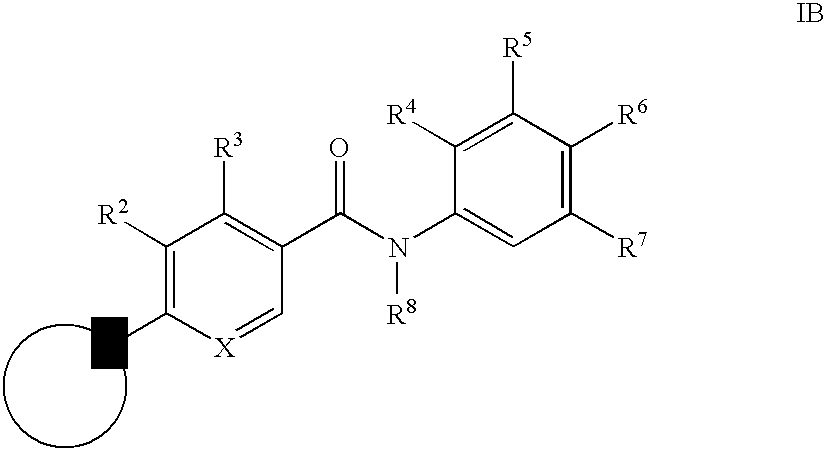
- wherein
-
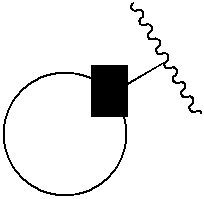
- is a cyclic amine group, selected from morpholin-4-yl, pyrrolidin-1-yl, pyrazol-1-yl, piperidin-1-yl, 4-methyl-piperidin-1-yl, 4-cyano-piperidin-1-yl, 4-trifluoromethyl-piperidin-1-yl, piperazin-1-yl, 4-methyl-piperazin-1-yl, 3,5-dimethyl-piperidin-1-yl, piperazin-1-yl substituted by C(O) O-lower alkyl, 1,1-dioxoisothiazolidin-1-yl, azepan-1-yl and azetidin-1-yl;
-
- R2 is hydrogen, halogen, lower alkyl, lower alkoxy, lower alkyl substituted by halogen, lower alkoxy substituted by halogen, cyano, NO2, —(CH2)oS(O)2R, —OS(O)2NR′R″, lower alkyl-O—C(═CH2)—, —C(O)-lower alkyl, tetrahydro-furan-2-yl, morpholin-4-yl, pyrazol-1-yl, or —OC(O)-lower alkyl;
- R3 is hydrogen, halogen, lower alkyl or lower alkoxy;
- R4 is hydrogen, lower alkoxy or halogen;
- R5 and R7 are each independently hydrogen, halogen, lower alkyl, lower alkoxy, NO2, cyano, lower alkyl substituted by halogen, lower alkoxy substituted by halogen, phenyl, O-phenyl, —(CH2)oS(O)2R, NHC(O)-lower alkyl, C(O)-lower alkyl, C(O)O-lower alkyl or 2,5-dimethyl-imidazol-1-yl-methyl;
- R6 is hydrogen, lower alkoxy, cyano, nitro, lower alkyl, phenyl, lower alkyl substituted by halogen, lower alkoxy substituted by halogen, C(O)O-lower alkyl, C(O)O—(CH2)2—NR′R″, oxazol-5-yl or halogen; or
- R5 and R6 together with the corresponding C-atoms form a ring comprising —CH═CH—CH═CH—;
- R8 is hydrogen or lower alkyl;
- X is —C(R9)═ or —N═;
- R9 is hydrogen, lower alkoxy, NO2, or halogen;
- R is lower alkyl, morpholin-4-yl, pyrrolidin-1-yl, phenyl optionally substituted by halogen, CH2CN, NR′R″, piperidin-1-yl, piperazin-1-yl, 3,5-dimethyl-piperidin-1-yl, azetidin-1-yl or azepane-1-yl;
- R′ and R″ are each independently hydrogen, lower alkyl, (CH2)n-4-methylpiperidin-1-yl, (CH2)n—C(O)-lower alkyl, (CH2)n-phenyl optionally substituted by halogen or (CH2)n-O-lower alkyl;
- n is 0, 1, 2 or 3, and
- o is 0 or 1,
- or a pharmaceutically acceptable acid addition salt thereof;
- Such compounds are for example
- N-(3-methoxy-phenyl)-4-(4-methyl-piperidin-1-yl)-3-nitro-benzamide,
- 4-azetidin-1-yl-N-(3-methoxy-phenyl)-3-nitro-benzamide,
- N-(3-methoxy-phenyl)-3-nitro-4-pyrrolidin-1-yl-benzamide,
- N-(3-methoxy-phenyl)-3-nitro-4-piperidin-1-yl-benzamide,
- N-(3-methoxy-phenyl)-4-pyrrolidin-1-yl-3-trifluoromethyl-benzamide,
- 4-azetidin-1-yl-N-(3-methoxy-phenyl)-3-trifluoromethyl-benzamide,
- N-(3-methoxy-phenyl)-4-piperidin-1-yl-3-trifluoromethyl-benzamide,
- N-(3-methoxy-phenyl)-4-(4-methyl-piperidin-1-yl)-3-trifluoromethyl-benzamide,
- N-(3-methoxy-phenyl)-4-morpholin-4-yl-3-trifluoromethyl-benzamide,
- N-(3-ethyl-phenyl)-4-pyrrolidin-1-yl-3-trifluoromethyl-benzamide,
- N-(3-ethoxy-phenyl)-4-pyrrolidin-1-yl-3-trifluoromethyl-benzamide,
- N-(3-isopropyl-phenyl)-4-pyrrolidin-1-yl-3-trifluoromethyl-benzamide,
- N-(3-isopropoxy-phenyl)-4-pyrrolidin-1-yl-3-trifluoromethyl-benzamide,
- N-(3-acetyl-phenyl)-4-pyrrolidin-1-yl-3-trifluoromethyl-benzamide,
- N-(3-fluoro-phenyl)-4-pyrrolidin-1-yl-3-trifluoromethyl-benzamide,
- N-(3-chloro-phenyl)-4-pyrrolidin-1-yl-3-trifluoromethyl-benzamide,
- N-(3-bromo-phenyl)-4-pyrrolidin-1-yl-3-trifluoromethyl-benzamide,
- 4-pyrrolidin-1-yl-N-m-tolyl-3-trifluoromethyl-benzamide,
- N-(3-difluoromethoxy-phenyl)-4-pyrrolidin-1-yl-3-trifluoromethyl-benzamide,
- 4-pyrrolidin-1-yl-N-[3-(1,1,2,2-tetrafluoro-ethoxy)-phenyl]-3-trifluoromethyl-benzamide,
- (rac,meso)-4-(3,5-dimethyl-piperidin-1-yl)-N-(3-methoxy-phenyl)-3-trifluoromethyl-benzamide,
- 4-azepan-1-yl-N-(3-methoxy-phenyl)-3-trifluoromethyl-benzamide,
- 4-(4-cyano-piperidin-1-yl)-N-(3-methoxy-phenyl)-3-trifluoromethyl-benzamide,
- N-(3-methoxy-phenyl)-3-trifluoromethyl-4-(4-trifluoromethyl-piperidin-1-yl)-benzamide,
- 4-methyl-3′-trifluoromethyl-3,4,5,6-tetrahydro-2H-[1,2′]bipyridinyl-5′-carboxylic acid (3-methoxy-phenyl)-amide,
- 5-chloro-N-(3-methoxy-phenyl)-6-pyrrolidin-1-yl-nicotinamide,
- 3′-chloro-3,4,5,6-tetrahydro-2H-[1,2′]bipyridinyl-5′-carboxylic acid (3-methoxy-phenyl)-amide,
- 3′-chloro-4-methyl-3,4,5,6-tetrahydro-2H-[1,2′]bipyridinyl-5′-carboxylic acid (3-methoxy-phenyl)-amide, and
- 5-chloro-N-(3-chloro-phenyl)-6-piperazin-1-yl-nicotinamide.
- Some of the compounds of formula I are known compounds and they are either commercially available or can be prepared by methods disclosed in WO 97/03967; WO 99/65449; WO 02/053544; WO 02/059080 or U.S. 2003/0105135 A1;
- Scheme I describes a general method for preparing all compounds disclosed in formula I:
- The starting materials of formula II are known in the art.
-

- To a solution of N-(3-dimethylaminopropyl)-N′-ethylcarbodiimide hydrochloride (EDC—HCl) in dichloromethane is added a compound of formula III, for example 3-methoxy-aniline and the solution is stirred at ambient temperature for 5 min. To this mixture an acid of formula II, for example 4-fluoro-3-nitrobenzoic acid, is added and the solution is stirred at ambient temperature for about 2 hours.
-

- The reaction described in scheme 2 also works with a Cl-substituted compound of formula I-1 instead of a F-substitution.
- A solution of a compound of formula I-1 and a compound of formula IV (amine) or V (cyclic amine) in N,N-dimethylformamide or N-methylpyrrolidin-2-one is stirred under microwave irradiation at about 250° C. for 15 minutes. Then the reaction mixture is evaporated and purified to obtain a compound of formula IA or IB.
- R′ and R″ in formula IV are independently from each other hydrogen, lower alkyl, (CH2)n-4-methylpiperidin-1-yl, (CH2)n—C(O)-lower alkyl, (CH2)n-phenyl optionally substituted by halogen or (CH2)—O-lower alkyl;
-

- in scheme 2 is a cyclic amine, such as morpholine, pyrrolidine, pyrazole, piperidine, 4-methyl-piperidine, 4-cyano-piperidine, 4-trifluoromethyl-piperidine, piperazine, 4-methyl-piperazine, 3,5-dimethyl-piperidine, piperazine substituted by C(O)O-lower alkyl, 1,1-dioxoisothiazolidine, azepane and azetidine.
-

- Hal is Cl or Br, n is 1 or 2 and the other definitions are as described above. Following procedures known in the art, stannanes were coupled under Pd catalysis with halo-(het)aryl benzanilides and the resulting vinyl ethers reduced to the saturated ethers.
- a) Pd2dba3, P(o-furyl)3, NEt3, dioxane, rt, 24 h; b) H2, PtO2, EtOH, rt, 30 min;
-

- Following procedures known in the art, vinyl ethers were coupled under Pd catalysis with halogenated aryl benzanilides and the resulting vinyl ethers hydrolyzed under acidic conditions to the corresponding ketones.
- The preparation of compounds of formula I of the present invention can be carried out in sequential or convergent synthetic routes. Syntheses of the compounds of the invention are shown in the examples. The skills required for carrying out the reaction and purification of the resulting products are known to those skilled in the art. In more detail, the compounds of formula I can be manufactured by the methods given in the examples or by analogous methods. Appropriate reaction conditions for the individual reaction steps are known to a person skilled in the art. The reaction sequence is not limited to the one displayed in the examples, however, depending on the starting materials and their respective reactivity the sequence of reaction steps can be freely altered. Starting materials are either commercially available or can be prepared by methods analogous to the methods described in references cited in the description or in the examples, or by methods known in the art.
- The salt formation is effected at room temperature in accordance with methods which are known per se and which are familiar to any person skilled in the art. Not only salts with inorganic acids, but also salts with organic acids come into consideration. Hydrochlorides, hydrobromides, sulphates, nitrates, citrates, acetates, maleates, succinates, methan-sulphonates, p-toluenesulphonates and the like are examples of such salts.
- The compounds of formula I and their pharmaceutically usable addition salts possess valuable pharmacological properties. Specifically, it has been found that the compounds of the present invention have a good affinity to the trace amine associated receptors (TAARs), especially TAAR1.
- The compounds were investigated in accordance with the test given hereinafter.
- For the construction of expression plasmids the coding sequences of human, rat and mouse TAAR 1 were amplified from genomic DNA essentially as described by Lindemann et al. [(2005) Genomics 85, 372-385]. The Expand High Fidelity PCR System (Roche Diagnostics) was used with 1.5 mM Mg2+ and purified PCR products were cloned into pCR2.1-TOPO cloning vector (Invitrogen) following the instructions of the manufacturer. PCR products were subcloned into the pIRESneo2 vector (BD Clontech, Palo Alto, Calif.), and expression vectors were sequence verified before introduction in cell lines.
- HEK293 cells (ATCC #CRL-1573) were cultured essentially as described Lindemann et al. (2005). For the generation of stably transfected cell lines HEK293 cells were transfected with the pIRESneo2 expression plasmids containing the TAAR coding sequences (described above) with Lipofectamine 2000 (Invitrogen) according to the instructions of the manufacturer, and 24 hrs post transfection the culture medium was supplemented with 1 mg/ml G418 (Sigma, Buchs, Switzerland). After a culture period of about 10 d clones were isolated, expanded and tested for responsiveness to trace amines (all compounds purchased from Sigma) with the cAMP Biotrak Enzyme immunoassay (EIA) System (Amersham) following the non-acetylation EIA procedure provided by the manufacturer. Monoclonal cell lines which displayed a stable EC50 for a culture period of 15 passages were used for all subsequent studies.
- Cells at confluence were rinsed with ice-cold phosphate buffered saline without Ca2+ and Mg2+ containing 10 mM EDTA and pelleted by centrifugation at 1000 rpm for 5 min at 4° C. The pellet was then washed twice with ice-cold phosphate buffered saline and cell pellet was frozen immediately by immersion in liquid nitrogen and stored until use at −80° C. Cell pellet was then suspended in 20 ml HEPES-NaOH (20 mM), pH 7.4 containing 10 mM EDTA, and homogenized with a Polytron (PT 3000, Kinematica) at 10,000 rpm for 10 s. The homogenate was centrifuged at 48,000×g for 30 min at 4° C. and the pellet resuspended in 20 ml HEPES-NaOH (20 mM), pH 7.4 containing 0.1 mM EDTA (buffer A), and homogenized with a Polytron at 10,000 rpm for 10 s. The homogenate was then centrifuged at 48,000×g for 30 min at 4° C. and the pellet resuspended in 20 ml buffer A, and homogenized with a Polytron at 10,000 rpm for 10 s. Protein concentration was determined by the method of Pierce (Rockford, Ill.). The homogenate was then centrifuged at 48,000×g for 10 min at 4° C., resuspended in HEPES-NaOH (20 mM), pH 7.0 including MgCl2 (10 mM) and CaCl2 g protein per ml and (2 mM) (buffer B) at 200 homogenized with a Polytron at 10,000 rpm for 10 s.
- Binding assay was performed at 4° C. in a final volume of 1 ml, and with an incubation time of 30 min. The radioligand [3H]-rac-2-(1,2,3,4-tetrahydro-1-naphthyl)-2-imidazoline was used at a concentration equal to the calculated Kd value of 60 nM to give a bound at around 0.1% of the total added radioligand concentration, and a specific binding which represented approximately 70-80% of the total binding. Non-specific binding was defined as the amount of [3H]-rac-2-(1,2,3,4-tetrahydro-1-naphthyl)-2-imidazoline bound in the presence of the appropriate unlabelled ligand (10 μM). Competing ligands were tested in a wide range of concentrations (10 pM-30 μM). The final dimethylsulphoxide concentration in the assay was 2%, and it did not affect radioligand binding. Each experiment was performed in duplicate. All incubations were terminated by rapid filtration through UniFilter-96 plates (Packard Instrument Company) and glass filter GF/C, pre-soaked for at least 2 h in polyethylenimine 0.3%, and using a Filtermate 96 Cell Harvester (Packard Instrument Company). The tubes and filters were then washed 3 times with 1 ml aliquots of cold buffer B. Filters were not dried and soaked in Ultima gold (45 μl/well, Packard Instrument Company) and bound radioactivity was counted by a TopCount Microplate Scintillation Counter (Packard Instrument Company).
- The preferred compounds show a Ki value (μM) in mouse on TAAR1 in the range of 0.002-0.100. Representative compounds are shown in the table below.
-
TABLE 1 Ki value (μM) Example in mouse 6 0.098 12 0.037 27 0.002 42 0.021 47 0.079 70 0.100 71 0.056 73 0.030 78 0.048 84 0.076 85 0.090 87 0.004 88 0.005 90 0.024 91 0.012 92 0.029 93 0.013 94 0.012 97 0.029 135 0.009 137 0.002 139 0.077 140 0.016 141 0.038 143 0.007 144 0.032 145 0.010 147 0.005 148 0.022 149 0.022 150 0.086 151 0.096 152 0.027 153 0.035 154 0.014 155 0.023 156 0.039 157 0.011 158 0.008 162 0.042 163 0.038 164 0.001 167 0.004 170 0.024 177 0.049 178 0.008 179 0.002 180 0.021 181 0.001 182 0.065 183 0.007 184 0.026 185 0.009 186 0.020 187 0.046 189 0.016 190 0.012 192 0.039 194 0.007 195 0.011 196 0.022 197 0.003 199 0.0056 200 0.0597 201 0.0017 205 0.0101 206 0.0207 207 0.0098 208 0.0463 210 0.0348 216 0.0058 217 0.054 218 0.060 219 0.067 220 0.068 283 0.06 319 0.0543 324 0.0674 - The present invention also provides pharmaceutical compositions containing compounds of the invention, for example, compounds of formula I or pharmaceutically acceptable salts thereof and a pharmaceutically acceptable carrier. Such pharmaceutical compositions can be in the form of tablets, coated tablets, dragées, hard and soft gelatin capsules, solutions, emulsions or suspensions. The pharmaceutical compositions also can be in the form of suppositories or injectable solutions.
- The pharmaceutical compositions of the invention, in addition to one or more compounds of the invention, contain a pharmaceutically acceptable carrier. Suitable pharmaceutically acceptable carriers include pharmaceutically inert, inorganic or organic carriers. Lactose, corn starch or derivatives thereof, talc, stearic acids or its salts and the like can be used, for example, as such carriers for tablets, coated tablets, dragées and hard gelatine capsules. Suitable carriers for soft gelatine capsules are, for example, vegetable oils, waxes, fats, semi-solid and liquid polyols and the like. Depending on the nature of the active substance no carriers are however usually required in the case of soft gelatine capsules. Suitable carriers for the production of solutions and syrups are, for example, water, polyols, glycerol, vegetable oil and the like. Suitable carriers for suppositories are, for example, natural or hardened oils, waxes, fats, semi-liquid or liquid polyols and the like.
- The pharmaceutical compositions can, moreover, contain preservatives, solubilizers, stabilizers, wetting agents, emulsifiers, sweeteners, colorants, flavorants, salts for varying the osmotic pressure, buffers, masking agents or antioxidants. They can also contain still other therapeutically valuable substances.
- The present invention also provides a method for the manufacture of pharmaceutical compositions. Such process comprises bringing one or more compounds of formula I and/or pharmaceutically acceptable acid addition salts thereof and, if desired, one or more other therapeutically valuable substances into a galenical administration form together with one or more therapeutically inert carriers.
- The most preferred indications in accordance with the present invention are those, which include disorders of the central nervous system, for example the treatment or prevention of schizophrenia, depression, cognitive impairment and Alzheimer's disease.
- The dosage at which compounds of the invention can be administered can vary within wide limits and will, of course, have to be adjusted to the individual requirements in each particular case. In the case of oral administration the dosage for adults can vary from about 0.01 mg to about 1000 mg per day of a compound of general formula I or of the corresponding amount of a pharmaceutically acceptable salt thereof. The daily dosage can be administered as single dose or in divided doses and, in addition, the upper limit can also be exceeded when this is found to be indicated.
-
Tablet Formulation (Wet Granulation) mg/tablet Item Ingredients 5 mg 25 mg 100 mg 500 mg 1. Compound of formula I 5 25 100 500 2. Lactose Anhydrous DTG 125 105 30 150 3. Sta-Rx 1500 6 6 6 30 4. Microcrystalline Cellulose 30 30 30 150 5. Magnesium Stearate 1 1 1 1 Total 167 167 167 831 - 1. Mix items 1, 2, 3 and 4 and granulate with purified water.
- 2. Dry the granules at 50° C.
- 3. Pass the granules through suitable milling equipment.
- 4. Add item 5 and mix for three minutes; compress on a suitable press.
-
Capsule Formulation mg/capsule Item Ingredients 5 mg 25 mg 100 mg 500 mg 1. Compound of formula I 5 25 100 500 2. Hydrous Lactose 159 123 148 — 3. Corn Starch 25 35 40 70 4. Talc 10 15 10 25 5. Magnesium Stearate 1 2 2 5 Total 200 200 300 600 - 1. Mix items 1, 2 and 3 in a suitable mixer for 30 minutes.
- 2. Add items 4 and 5 and mix for 3 minutes.
- 3. Fill into a suitable capsule.
- The following Examples illustrate the present invention without limiting it. All temperatures are given in degrees Celsius.
- HPLC=high-performance liquid chromatography;
- MS=mass spectroscopy.
- The following examples are not encompassed by the present claims: 80, 81, 82, 83, 117 and 198.
-

- To a solution of 143.8 mg (0.75 mmol) N-(3-dimethylaminopropyl)-N′-ethylcarbodiimide hydrochloride (EDC.HCl) and 91.6 mg (0.75 mmol) 4-dimethylaminopyridine (DMAP) in 2 ml dichloromethane were added 92.3 mg (83.9 μL, 0.75 mmol) 3-methoxy-aniline and the solution stirred at ambient temperature for 5 min. Then this solution was added to 100 mg (0.5 mmol) 4-methanesulfonyl-benzoic acid and the solution stirred at ambient temperature for 18 hours. The reaction mixture was filtered through a cartridge filled with 5 g SCX/silica gel 2:3, pre-washed with 10 ml methanol and 20 ml dichloromethane, and the reaction product eluted with 50 ml dichloromethane. 4-methanesulfonyl-N-(3-methoxy-phenyl)-benzamide was obtained as colourless solid: MS (ISN): 304.4 ((M−H)−.).
- In analogy to Example 1 were prepared Examples 2 to 83:
-
MS MS Chemical (ISN): (ISP): Name of the (M − (M + Expl. Structure RCOOH R′NHR″ Product MW H)− H)+ 2 
3-(4-Chloro-benzenesulfonyl-methyl)-4-nitro-benzoic 3-Methoxy-aniline 3-(4-Chloro-benzenesulfonyl-methyl)-N-(3-methoxy-phenyl)-4-nitro-benzamide 460.89 459.1 3 
4-Methanesulfonyl-methyl-benzoic acid 3-Methoxy-aniline 4-Methanesulfonyl-methyl-N-(3-methoxy-phenyl)-benzamide 319.38 318.0 4 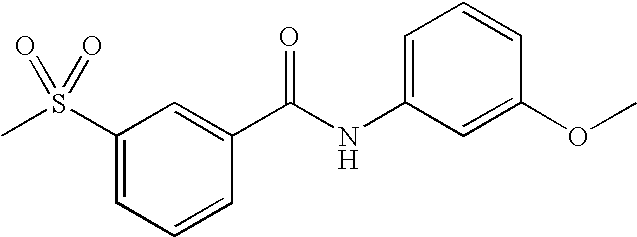
3-Methanesulfonyl-benzoic acid 3-Methoxy-aniline 3-Methanesulfonyl-N-(3-methoxy-phenyl)-benzamide 305.35 304.2 5 
3-Cyano-4-fluoro-benzoic acid 3-Methoxy-aniline 3-Cyano-4-fluoro-N-(3-methoxy-phenyl)-benzamide 270.26 269.2 6 
4-Chloro-3-trifluoromethyl-benzoic acid Aniline 4-Chloro-N-phenyl-3-trifluoromethyl-benzamide 299.68 300.1and302.2 7 
3,4-Dichloro-benzoic acid 4-Methoxy-aniline 3,4-Dichloro-N-(4-methoxy-phenyl)-benzamide 296.15 296.0and298.0 8 
4-Chloro-benzoic acid 5-Chloro-2,4-dimethoxy-aniline 4-chloro-N-(5-chloro-2,4-dimethoxy-phenyl)-benzamide 326.18 326.0and328.1 9 
4-Methyl-benzoic acid 3,4-Dimethoxy-aniline N-(3,4-Dimethoxy-phenyl)-4-methyl-benzamide 271.32 270.4 10 
4-Bromo-benzoic acid 3,4-Dimethoxy-aniline 4-Bromo-N-(3,4-dimethoxy-phenyl)-benzamide 336.19 334.1and336.1 11 
3-Chloro-benzoic acid 3-Methoxy-aniline 3-Chloro-N-(3-methoxy-phenyl)-benzamide 261.71 260and262.1 12 
4-Chloro-3-nitro-benzoic acid 3-Methoxy-aniline 4-Chloro-N-(3-methoxy-phenyl)-3-nitro-benzamide 306.71 305.1 13 
3-Methyl-benzoic acid 3-Methoxy-aniline N-(3-Methoxy-phenyl)-3-methyl-benzamide 241.29 240.3 14 
3-Bromo-benzoic acid 3-Methoxy-aniline 3-Bromo-N-(3-methoxy-phenyl)-benzamide 306.16 304.1and306.2 15 
4-Butoxy-benzoic acid 3-Amino-benzoicacidmethylester 3-(4-Butoxy-benzoylamino)-benzoic acidmethyl ester 327.38 326.3 16 
Biphenyl-4-carboxylicacid 3-Methoxy-aniline Biphenyl-4-carboxylic acid(3-methoxy-phenyl)-amide 303.35 302.2 17 
3,5-Dimethoxy-benzoic acid 3-Methoxy-aniline 3,5-Dimethoxy-N-(3-methoxy-phenyl)-benzamide 287.31 286.1 18 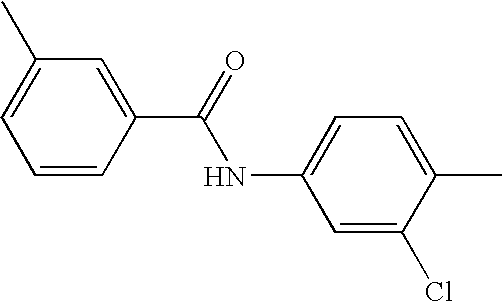
3-Methyl-benzoic acid 3-Chloro-4-methyl-aniline N-(3-Chloro-4-methyl-phenyl)-3-methyl-benzamide 259.73 257.9and260.0 19 
3-Methyl-benzoic acid 3-Nitro-aniline 3-Methyl-N-(3-nitro-phenyl)-benzamide 256.26 255.1 20 
3,4-Dichloro-benzoic acid 3-Methoxy-aniline 3,4-Dichloro-N-(3-methoxy-phenyl)-benzamide 296.15 296.0 21 
3,4-Dimethoxy-benzoic acid 4-Amino-benzoicacid 2-diethyl-amino-ethylester 4-(3,4-Dimethoxy-benzoylamino)-benzoic acid2-diethylamino-ethyl ester 400.48 401.3 22 
4-Methyl-3-(morpholine-4-sulfonyl)-benzoic acid Aniline 4-Methyl-3-(morpholine-4-sulfonyl)-N-phenyl-benzamide 360.43 361.1 23 
3-(Morpholine-4-sulfonyl)-benzoic acid Aniline 3-(Morpholine-4-sulfonyl)-N-phenyl-benzamide 346.4 345.2 24 
4-Morpholin-4-yl-benzoicacid Aniline 4-Morpholin-4-yl-N-phenyl-benzamide 282.34 283.0 25 
4-Pyrrolidin-1-yl-benzoicacid Aniline N-Phenyl-4-pyrrolidin-1-yl-benzamide 266.34 267.0 26 
4-Pyrazol-1-yl-benzoicacid Aniline N-Phenyl-4-pyrazol-1-yl-benzamide 263.3 263.9 27 
4-(4-Methyl-piperidin-1-yl)-3-nitro-benzoic acid 3-Methoxy-aniline N-(3-Methoxy-phenyl)-4-(4-methyl-piperidin-1-yl)-3-nitro-benzamide 369.419 370.1 28 
4-[3-(4-Methyl-piperidin-1-yl)-propylamino]-3-nitro-benzoic acid 3-Methoxy-aniline N-(3-Methoxy-phenyl)-4-[3-(4-methyl-piperidin-1-yl)-propylamino]-3-nitro-benzamide 426.52 427.3 29 
2-Fluoro-benzoic acid 3,4-Dichloro-phenyl-amine N-(3,4-Dichloro-phenyl)-2-fluoro-benzamide 284.12 282.0and283.1 30 
3-Trifluoromethyl-benzoic acid 4-Amino-2-methoxy-benzoicacidmethylester 2-Methoxy-4-(3-trifluoromethyl-benzoylamino)-benzoic acidmethyl ester 353.30 352.1 31 
3,4-Dichloro-benzoic acid 4-Amino-2-methoxy-benzoicacidmethylester 4-(3,4-Dichloro-benzoylamino)-2-methoxy-benzoic acidmethyl ester 354.19 352.0and354.1 32 
3-Nitro-4-pyrazol-1-yl-benzoic acid 3-Methoxy-aniline N-(3-Methoxy-phenyl)-3-nitro-4-pyrazol-1-yl-benzamide 338.33 337.2 33 
4-(2,2,2-Trifluoro-acetyl)-benzoic acid 2,4-Dichloro-5-methoxy-phenyl-amine N-(2,4-Dichloro-5-methoxy-phenyl)-4-(2,2,2-trifluoro-acetyl)-benzamide 392.16 392.1and394.2 34 
3-Methoxy-benzoic acid 4-Amino-benzoicacid 2-diethyl-amino-ethylester 4-(3-Methoxy-benzoylamino)-benzoic acid2-diethylamino-ethyl ester 370.45 371.1 35 
6-Morpholin-4-yl-nicotinicacid 4-Chloro-phenyl-amine N-(4-Chloro-phenyl)-6-morpholin-4-yl-nicotinamide 317.77 318.2 36 
3-Propionyloxy-benzoic acid 3-Methoxy-aniline Propionic acid3-(3-methoxy-phenyl-carbamoyl)-phenyl ester 299.33 300.1 37 
3-Nitro-benzoic acid 3-Methoxy-4-oxazol-5-yl-phenyl-amine N-(3-Methoxy-4-oxazol-5-yl-phenyl)-3-nitro-benzamide 339.31 340.0 38 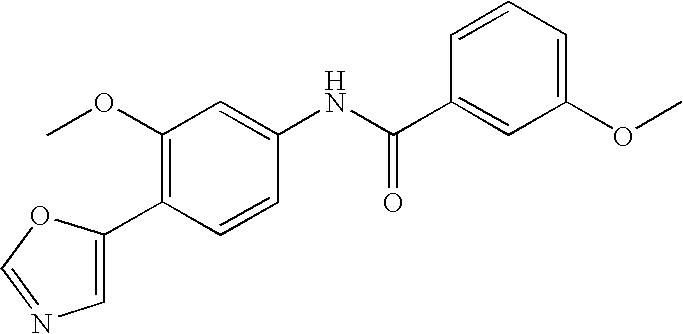
3-Methoxy-benzoic acid 3-Methoxy-4-oxazol-5-yl-phenyl-amine 3-Methoxy-N-(3-methoxy-4-oxazol-5-yl-phenyl)-benzamide 324.34 325.3 39 
3-Methyl-benzoic acid 3-Methoxy-4-oxazol-5-yl-phenyl-amine N-(3-Methoxy-4-oxazol-5-yl-phenyl)-3-methyl-benzamide 308.34 309.3 40 
3-Dimethyl-sulfamoyloxy-benzoic acid 3-Chloro-phenyl-amine Dimethyl-sulfamic acid3-(3-chloro-phenyl-carbamoyl)-phenyl ester 354.82 355.0and357.1 41 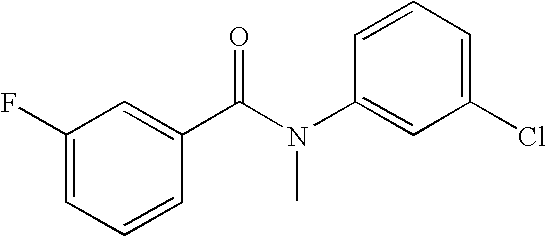
3-Fluoro-benzoic acid (3-Chloro-phenyl)-methyl-amine N-(3-Chloro-phenyl)-3-fluoro-N-methyl-benzamide 263.70 263.8and265.9 42 
4-Bromo-3-nitro-benzoic acid 3-Methoxy-aniline 4-Bromo-N-(3-methoxy-phenyl)-3-nitro-benzamide 351.16 349.0and351.1 43 
4-Chloro-3-methoxy-5-nitro-benzoic acid 3-Methoxy-aniline 4-Chloro-3-methoxy-N-(3-methoxy-phenyl)-5-nitro-benzamide 336.73 335.2and337.1 44 
6-Pyrazol-1-yl-nicotinicacid N-(3-Chloro-phenyl)-6-imidazol-1-yl-nicotinamide 298.73 299.0 45 
6-Morpholin-4-yl-nicotinicacid 3-Chloro-phenyl-amine N-(3-Chloro-phenyl)-6-morpholin-4-yl-nicotinamide 317.77 318.8and320.9 46 
4-(5-Carboxy-pyridin-2-yl)-piperazine-1-carboxylicacid tert-butyl ester 3-Chloro-phenyl-amine 4-[5-(3-Chloro-phenylcarbamoyl)-pyridin-2-yl]-piperazine-1-carboxylicacid tert-butyl ester 416.91 415.2 47 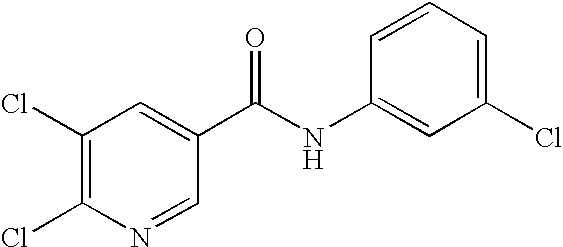
5,6-Dichloro-nicotinic acid 3-Chloro-phenyl-amine 5,6-Dichloro-N-(3-chloro-phenyl)-nicotinamide 301.56 301.0and302.9and305.0 48 
6-Fluoro-nicotinic acid 3-Chloro-phenyl-amine N-(3-Chloro-phenyl)-6-fluoro-nicotinamide 250.66 249.0and251.1 49 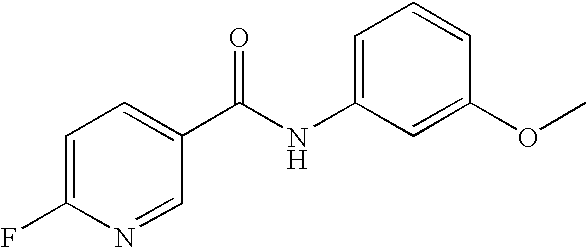
6-Fluoro-nicotinic acid 3-Methoxy-aniline 6-Fluoro-N-(3-methoxy-phenyl)-nicotinamide 246.24 247.2 50 
6-Fluoro-nicotinic acid 3,4-Dichloro-phenyl-amine N-(3,4-Dichloro-phenyl)-6-fluoro-nicotinamide 285.10 282.9and284.0 51 
3-Methyl-benzoic acid 4-Chloro-3-methoxy-phenyl-amine N-(4-Chloro-3-methoxy-phenyl)-3-methyl-benzamide 275.73 276.0and278.1 52 
2-Methyl-benzoic acid 3-Amino-benzo-nitrile N-(3-Cyano-phenyl)-3-methyl-benzamide 236.27 237.0 53 
3-Cyano-4-fluoro-benzoic acid 3-Chloro-phenyl-amine N-(3-Chloro-phenyl)-3-cyano-4-fluoro-benzamide 274.68 273.1and275.2 54 
4-Cyano-methane-sulfonylmethyl-benzoic acid 3-Methoxy-aniline 4-Cyanomethane-sulfonylmethyl-N-(3-methoxy-phenyl)-benzamide 344.39 343.0 55 
4-Chloro-3-trifluoro-methyl-benzoic acid 3,4-Dichloro-phenyl-amine 4-Chloro-N-(3,4-dichloro-phenyl)-3-trifluoromethyl-benzamide 368.57 365.9and367.9and371.0 56 
4-Nitro-3-trifluoro-methyl-benzoic acid 3,4-Dichloro-phenyl-amine N-(3,4-Dichloro-phenyl)-4-nitro-3-trifluoromethyl-benzamide 379.12 377.0and379.0and381.0 57 
4-Cyclohexyl-benzoic acid 3,4-Dichloro-phenyl-amine 4-Cyclohexyl-N-(3,4-dichloro-phenyl)-benzamide 348.27 345.9and348.0and350.1 58 
4-Ethylamino-benzoic acid 3-Methoxy-aniline 4-Ethylamino-N-(3-methoxy-phenyl)-benzamide 270.33 269.1 59 
4-Piperidin-1-yl-benzoicacid 3-Methoxy-aniline N-(3-Methoxy-phenyl)-4-piperidin-1-yl-benzamide 310.40 309.3 60 
4-(1,1-Dioxoiso-thiazolidin-2-yl)benzoicacid 3-Methoxy-aniline 4-(1,1-Dioxo-1,l,6-isothiazolidin-2-yl)-N-(3-methoxy-phenyl)-benzamide 346.40 345.0 61 
3-(4-Bromo-phenyl-sulfamoyl)-benzoic acid 3-Methoxy-aniline 3-(4-Bromo-phenyl-sulfamoyl)-N-(3-methoxy-phenyl)-benzamide 461.34 459.0and460.9 62 
4-Methylamino-benzoic acid 3-Methoxy-aniline N-(3-Methoxy-phenyl)-4-methylamino-benzamide 256.30 257.1 63 
4-Dimethyl-amino-benzoicacid 3-Methoxy-aniline 4-Dimethyl-amino-N-(3-methoxy-phenyl)-benzamide 270.33 271.1 64 
4-Diethylamino-benzoic acid 3-Methoxy-aniline 4-Diethylamino-N-(3-methoxy-phenyl)-benzamide 298.39 299.1 65 
4-Methyl-3-(morpholine-4-sulfonyl)-benzoic acid 3-Methoxy-aniline N-(3-Methoxy-phenyl)-4-methyl-3-(morpholine-4-sulfonyl)-benzamide 390.46 391.0 66 
4-Pyrrolidin-1-yl-benzoicacid 3-Methoxy-aniline N-(3-Methoxy-phenyl)-4-pyrrolidin-1-yl-benzamide 296.37 295.4 67 
4-Pyrazol-1-yl-benzoicacid 3-Methoxy-aniline N-(3-Methoxy-phenyl)-4-pyrazol-1-yl-benzamide 293.33 292.1 68 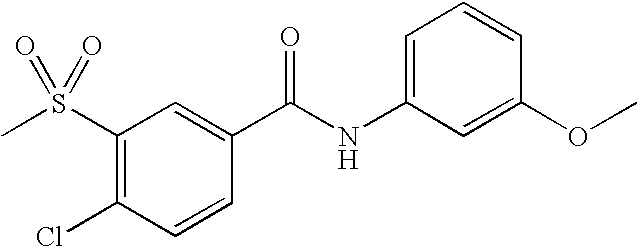
4-Chloro-3-methanesulfonyl-benzoic acid 3-Methoxy-aniline 4-Chloro-3-methanesulfonyl-N-(3-methoxy-phenyl)-benzamide 339.80 338.0and340.1 340.0and342.1 69 
3,4-Difluoro-benzoic acid 3-Methoxy-aniline 3,4-Difluoro-N-(3-methoxy-phenyl)-benzamide 263.24 263.8 70 
3-Chloro-4-fluoro-benzoic acid 3-Methoxy-aniline 3-Chloro-4-fluoro-N-(3-methoxy-phenyl)-benzamide 279.70 278.1and280.1 71 
3-Bromo-4-fluoro-benzoic acid 3-Methoxy-aniline 3-Bromo-4-fluoro-N-(3-methoxy-phenyl)-benzamide 324.15 322.0and324.1 72 
4-Fluoro-3-methyl-benzoic acid 3-Methoxy-aniline 4-Fluoro-N-(3-methoxy-phenyl)-3-methyl-benzamide 259.28 258.0 73 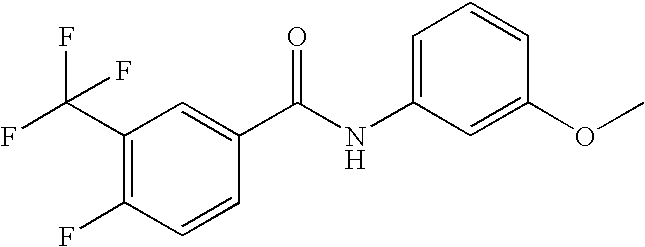
4-Fluoro-3-trifluoromethyl-benzoic acid 3-Methoxy-aniline 4-Fluoro-N-(3-methoxy-phenyl)-3-trifluoromethyl-benzamide 313.25 312.0 74 
4,5-Difluoro-2-methoxy-benzoic acid 3-Methoxy-aniline 4,5-Difluoro-2-methoxy-N-(3-methoxy-phenyl)-benzamide 293.27 292.1 75 
3-Cyano-benzoic acid 3-Methoxy-aniline 3-Cyanl-N-(3-methoxy-phenyl)-benzamide 252.27 251.2 76 
3-(Morpholine-4-sulfonyl)-benzoic acid 3-Chloro-phenyl-amine N-(3-Chloro-phenyl)-3-(morpholine-4-sulfonyl)-benzamide 380.85 379.0and381.1 77 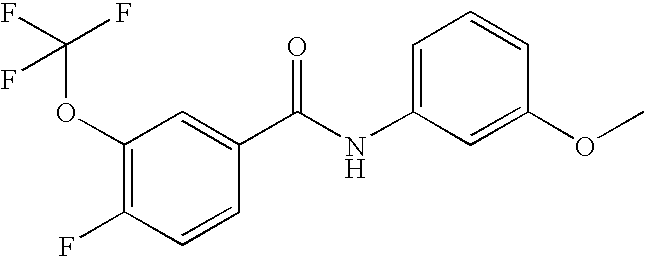
4-Fluoro-3-trifluoro-methoxy-benzoic acid 3-Methoxyaniline 4-Fluoro-N-(3-methoxy-phenyl)-3-trifluoromethoxy-benzamide 329.25 328.0 78 
5,6-Dichloro-nicotinic acid 3-Methoxy-aniline 5,6-Dichloro-N-(3-methoxy-phenyl)-nicotinamide 297.14 295.0and297.1 79 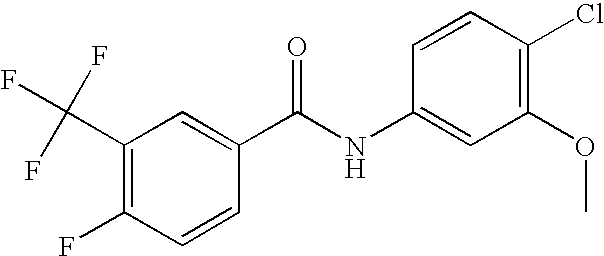
4-Fluoro-3-trifluoromethyl-benzoic acid 4-Chloro-3-methoxy-phenyl-amine N-(4-Chloro-3-methoxy-phenyl)-4-fluoro-3-trifluoromethyl-benzamide 347.69 346.1and348.2 80 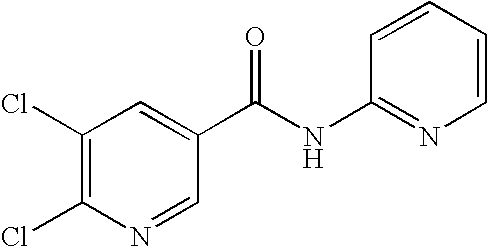
5,6-Dichloro-nicotinic acid Pyridin-2-ylamine 5,6-Dichloro-N-pyridin-2-yl-nicotinamide 268.10 265.9and268.0 81 
4-Fluoro-3-trifluoromethyl-benzoic acid Pyrimidin-4-ylamine 4-Fluoro-N-pyrimidin-4-yl-3-trifluoromethyl-benzamide 285.20 284.0 82 
4-Fluoro-3-trifluoromethyl-benzoic acid 2-Chloro-pyridin-4-ylamine N-(2-Chloro-pyridin-4-yl)-4-fluoro-3-trifluoromethyl-benzamide 318.66 317.0and319.1 83 
4-Fluoro-3-trifluoromethyl-benzoic acid 2-Methoxy-pyridin-4-ylamine 4-Fluoro-N-(2-methoxy-pyridin-4-yl)-3-trifluoro-methyl-benzamide 314.24 313.0 -

- To a solution of 30 mg (0.072 mmol) 4-[5-(3-chloro-phenylcarbamoyl)-pyridin-2-yl]-piperazine-1-carboxylic acid tert-butyl ester (Example 46) in 0.5 ml ethanol were added 1 ml aqueous 1N HCl and the mixture stirred at ambient temperature for 20 hours. Then the mixture was evaporated, the residue taken up in 1N NaOH and extracted three times with tert-butyl methyl ether. The combined organic extracts were washed with brine, dried over Na2SO4, filtered and evaporated. N-(3-Chloro-phenyl)-6-piperazin-1-yl-nicotinamide was obtained as an off-white solid: MS (EI): 316.1 and 318.1 (M+.).
-

- To a solution of 14.38 g (75 mmol) N-(3-dimethylaminopropyl)-N′-ethylcarbodiimide hydrochloride (EDC.HCl) in 150 ml dichloromethane were added 9.26 g (75 mmol) 3-methoxy-aniline and the solution stirred at ambient temperature for 5 min. To this mixture 9.26 g (50 mmol) 4-fluoro-3-nitrobenzoic acid were added and the solution stirred at ambient temperature for 4 hours. Then 150 ml 2N HCl were added, stirred for a few minutes, the organic phase separated and the aqueous phase washed with 50 ml dichloromethane. The two organic extracts were washed successively with 50 ml brine then combined, dried over Na2SO4, filtered and evaporated. Re-crystallization of the residue provided 11.11 g 4-fluoro-N-(3-methoxy-phenyl)-3-nitro-benzamide as yellow solid: m.p. 145-146° C.; MS (ISN): 289.0 ((M−H)−.).
-

- N-(3,4-Dichloro-phenyl)-4-fluoro-3-nitro-benzamide was prepared from 3,4-dichloroaniline and 4-fluoro-3-nitro-benzoic acid in analogy to Example 85: colourless solid: MS (ISN): 327.1, 329.1 and 331.1 ((M−H)−.).
-

- A solution of 35.5 mg (1.1 mmol) propylamine and 145 mg (0.5 mmol) 4-fluoro-N-(3-methoxy-phenyl)-3-nitro-benzamide in 2 ml tetrahydrofuran was stirred at ambient temperature for 70 hours. The reaction mixture was filtered through a cartridge filled with 3 g SCX/silica gel 1:1, pre-washed with 20 ml methanol and 10 ml dichloromethane, and the reaction product eluted with 20 ml dichloromethane. N-(3-methoxy-phenyl)-3-nitro-4-propylamino-benzamide was obtained as orange solid: MS (ISP): 330.1 ((M+H)+.).
- In analogy to Example 87 were prepared Examples 88 to 96:
-
Chemical MS 4-fluoro- Name of the (ISP): Expl. Structure benzamide R′NHR″ Product MW (M + H).+ 88 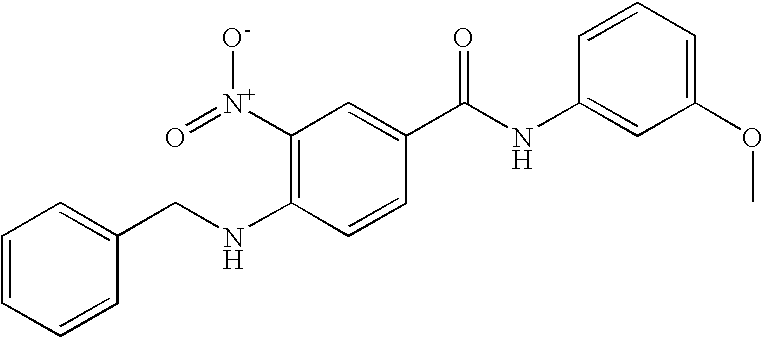
4-Fluoro-N-(3-methoxy-phenyl)-3-nitro-benzamide benzylamine 4-Benzylamino-N-(3-methoxy-phenyl)-3-nitro-benzamide 377.40 378.1 89 
4-Fluoro-N-(3-methoxy-phenyl)-3-nitro-benzamide methylamine N-(3-Methoxy-phenyl)-4-methylamino-3-nitro-benzamide 301.30 302.0 90 
4-Fluoro-N-(3-methoxy-phenyl)-3-nitro-benzamide ethylamine 4-Ethylamino-N-(3-methoxy-phenyl)-3-nitro-benzamide 315.33 316.0 91 
4-Fluoro-N-(3-methoxy-phenyl)-3-nitro-benzamide iso-propylamine 4-Isopropylamino-N-(3-methoxy-phenyl)-3-nitro-benzamide 329.35 330.2 92 
4-Fluoro-N-(3-methoxy-phenyl)-3-nitro-benzamide azetidine 4-Azetidin-1-yl-N-(3-methoxy-phenyl)-3-nitro-benzamide 327.34 328.0 93 
4-Fluoro-N-(3-methoxy-phenyl)-3-nitro-benzamide pyrrolidine N-(3-Methoxy-phenyl)-3-nitro-4-pyrrolidin-1-yl-benzamide 341.37 342.1 94 
4-Fluoro-N-(3-methoxy-phenyl)-3-nitro-benzamide piperidine N-(3-Methoxy-phenyl)-3-nitro-4-piperidin-1-yl-benzamide 355.39 356.2 95 
4-Fluoro-N-(3-methoxy-phenyl)-3-nitro-benzamide morpholine N-(3-Methoxy-phenyl)-4-morpholin-4-yl-3-nitro-benzamide 357.36 358.0 96 
4-Fluoro-N-(3-methoxy-phenyl)-3-nitro-benzamide 1-methylpiprazine N-(3-Methoxy-phenyl)-4-(4-methyl-piperazin-1-yl)-3-nitro-benzamide 370.41 371.1 -

- A solution of 102.4 mg (1.1 mmol) aniline and 145 mg (0.5 mmol) 4-fluoro-N-(3-methoxy-phenyl)-3-nitro-benzamide in 2 ml tetrahydrofuran was stirred at 50° C. for 70 hours. The reaction mixture was filtered through a cartridge filled with 4 g SCX/silica gel 1:1, pre-washed with 20 ml methanol and 10 ml dichloromethane, and the reaction product eluted with 20 ml dichloromethane. N-(3-Methoxy-phenyl)-3-nitro-4-phenylamino-benzamide was obtained as orange solid: MS (ISP): 364.0 ((M+H)+.).
-
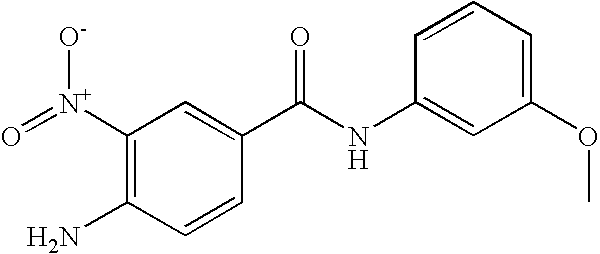
- To a solution of 145 mg (0.5 mmol) 4-fluoro-N-(3-methoxy-phenyl)-3-nitro-benzamide in 2 ml N,N-dimethylformamide were added 5 ml of a 25% ammonium hydroxide solution: yellow crystals began to precipitate. After stirring at ambient temperature for 2.5 hours the suspension is diluted with 50 ml tert-butyl methyl ether, the aqueous phase separated and washed twice with tert-butyl methyl ether. The combined organic extracts were washed with brine, dried over Na2SO4, filtered and evaporated. 4-Amino-N-(3-methoxy-phenyl)-3-nitro-benzamide was obtained as yellow solid: MS (ISP): 287.9 ((M+H)+.).
- General Procedure: 1 equivalent nicotinic acid and 1 equivalent (2(1H-7-azabenzotriasol-1-yl)-1,1,3,3-tetramethyl-uronium hexafluoro phosphate (HATU) were dissolved in N,N-dimethylformamide, kept at ambient temperature for 30 minutes and then 1 equivalent N-ethyl-diisopropylamine added. To this solution was added 1 equivalent amine dissolved in N,N-dimethylformamide and the reaction mixture shaken at ambient temperature for 18 hours. The reaction went to completion for all mixtures by heating to 50° C. for additional 20 hours. For purification the reaction mixtures were directly submitted to preparative HPLC.
-
Chemical MS MS Ex- 4-fluoro- Name of the (ISN): (ISP): ample Structure benzamide R′NHR″ Product MW (M − H).− (M + H).+ 99 
4-Morpholin-4-yl-3-nitro-benzoic acid 4-Fluoro-phenylamine N-(4-Fluoro-phenyl)-4-morpholin-4-yl-3-nitro-benzamide 345.33 344.2 100 
4-Morpholin-4-yl-3-nitro-benzoic acid p-Tolylamine 4-Morpholin-4-yl-3-nitro-N-p-tolyl-benzamide 341.37 342.2 101 
4-Morpholin-4-yl-3-nitro-benzoic acid 4-Trifluoromethoxy-phenylamine 4-Morpholin-4-yl-3-nitro-N-(4-trifluoromethoxy-phenyl)-benzamide 411.34 410.2 102 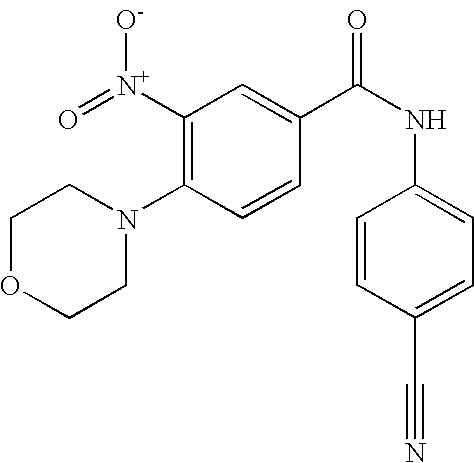
4-Morpholin-4-yl-3-nitro-benzoic acid 4-Amino-benzonitrile N-(4-Cyano-phenyl)-4-morpholin-4-yl-3-nitro-benzamide 352.35 351.2 103 
4-Morpholin-4-yl-3-nitro-benzoic acid 3-Amino-benzonitrile N-(3-Cyano-phenyl)-4-morpholin-4-yl-3-nitro-benzamide 352.35 351.2 104 
4-Morpholin-4-yl-3-nitro-benzoic acid 3,5-Dichloro-phenylamine N-(3,5-Dichloro-phenyl)-4-morpholin-4-yl-3-nitro-benzamide 396.23 394.1and396.2 105 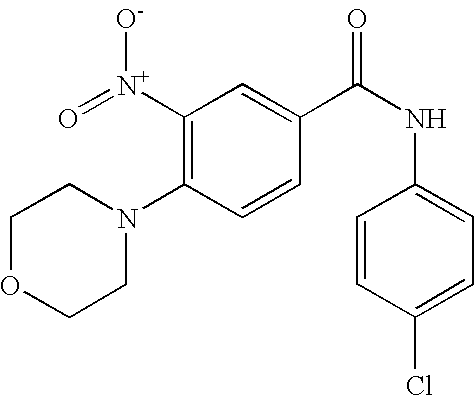
4-Morpholin-4-yl-3-nitro-benzoic acid 4-Chloro-phenylamine N-(4-Chloro-phenyl)-4-morpholin-4-yl-3-nitro-benzamide 361.78 360.2 106 
4-Morpholin-4-yl-3-nitro-benzoic acid 4-Bromo-phenylamine N-(4-Bromo-phenyl)-4-morpholin-4-yl-3-nitro-benzamide 406.24 404.1and406.1 107 
4-Morpholin-4-yl-3-nitro-benzoic acid 4-Methoxy-phenylamine N-(4-Methoxy-phenyl)-4-morpholin-4-yl-3-nitro-benzamide 357.37 358.2 108 
4-Morpholin-4-yl-3-nitro-benzoic acid Biphenyl-4-ylamine N-Biphenyl-4-yl-4-morpholin-4-yl-3-nitro-benzamide 403.44 402.2 109 
4-Morpholin-4-yl-3-nitro-benzoic acid 3-Chloro-phenylamine N-(3-Chloro-phenyl)-4-morpholin-4-yl-3-nitro-benzamide 361.78 360.2 110 
4-Morpholin-4-yl-3-nitro-benzoic acid 3-Fluoro-phenylamine N-(3-Fluoro-phenyl)-4-morpholin-4-yl-3-nitro-benzamide 345.33 344.2 111 
4-Morpholin-4-yl-3-nitro-benzoic acid 3-Trifluoromethoxy-phenylamine 4-Morpholin-4-yl-3-nitro-N-(3-trifluoromethoxy-phenyl)-benzamide 411.34 410.2 112 
4-Morpholin-4-yl-3-nitro-benzoic acid 3-Trifluoromethyl-phenylamine 4-Morpholin-4-yl-3-nitro-N-(3-trifluoromethyl-phenyl)-benzamide 395.34 394.2 113 
4-Morpholin-4-yl-3-nitro-benzoic acid Biphenyl-3-ylamine N-Biphenyl-3-yl-4-morpholin-4-yl-3-nitro-benzamide 403.44 404.3 114 
4-Morpholin-4-yl-3-nitro-benzoic acid 3-Methane-sulfonyl-phenylamine N-(3-Methane-sulfonyl-phenyl)-4-morpholin-4-yl-3-nitro-benzamide 405.43 404.2 115 
4-Morpholin-4-yl-3-nitro-benzoic acid N-(3-Amino-phenyl)-acetamide N-(3-Acetylamino-phenyl)-4-morpholin-4-yl-3-nitro-benzamide 384.39 385.2 116 
4-Morpholin-4-yl-3-nitro-benzoic acid 4-Chloro-3-methoxy-phenylamine N-(4-Chloro-3-methoxy-phenyl)-4-morpholin-4-yl-3-nitro-benzamide 391.81 390.2 117 
4-Morpholin-4-yl-3-nitro-benzoic acid 4-Methyl-pyridin-2-ylamine N-(4-Methyl-pyridin-2-yl)-4-morpholin-4-yl-3-nitro-benzamide 342.35 343.2 118 
4-Morpholin-4-yl-3-nitro-benzoic acid Naphthalen-2-ylamine 4-Morpholin-4-yl-N-naphthalen-2-yl-3-nitro-benzamide 377.40 376.3 119 
6-Morpholin-4-yl-nicotinicacid p-Tolylamine 6-Morpholin-4-yl-N-p-tolyl-nicotinamide 297.36 298.2 120 
6-Morpholin-4-yl-nicotinicacid 4-Trifluoromethoxy-phenylamine 6-Morpholin-4-yl-N-(4-trifluoromethoxy-phenyl)-nicotinamide 367.33 368.2 121 
6-Morpholin-4-yl-nicotinicacid 3-Fluoro-phenylamine N-(3-Fluoro-phenyl)-6-morpholin-4-yl-nicotinamide 301.32 300.2 122 
6-Morpholin-4-yl-nicotinicacid 3-Trifluoromethoxy-phenylamine 6-Morpholin-4-yl-N-(3-trifluoromethoxy-phenyl)-nicotinamide 367.33 366.2 123 
6-Morpholin-4-yl-nicotinicacid Naphthalen-2-ylamine 6-Morpholin-4-yl-N-naphthalen-2-yl-nicotinamide 333.39 334.2 124 
6-Morpholin-4-yl-nicotinicacid 3,5-Dichloro-phenylamine ′N-(3,5-Dichloro-phenyl)-6-morpholin-4-yl-nicotinamide 352.22 352.1and354.1 -
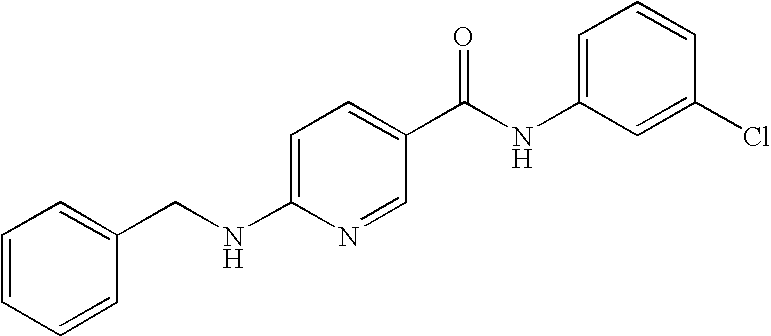
- A solution of 80 mg (0.32 mmol) N-(3-chloro-phenyl)-6-fluoro-nicotinamide (Example 48) and 51 mg (0.48 mmol) benzylamine in 1 ml N,N-dimethylformamide was stirred at ambient temperature for 20 hours. Then the reaction mixture was evaporated under reduced pressure and the residue purified by flash-chromatography on silica gel with heptane/ethyl acetate 1:1 as eluent. 6-Benzylamino-N-(3-chloro-phenyl)-nicotinamide was obtained as colourless solid: MS (ISP): 337.9 and 340.0 ((M+H)+.).
- In analogy to Example 125 were prepared Examples 126 to 141:
-
4-fluoro- Chemical MS MS nicotin-or Name of the (ISN): (ISP): Expl. Structure benz-amide R′NHR″ Product MW (M − H).− (M + H).+ 126 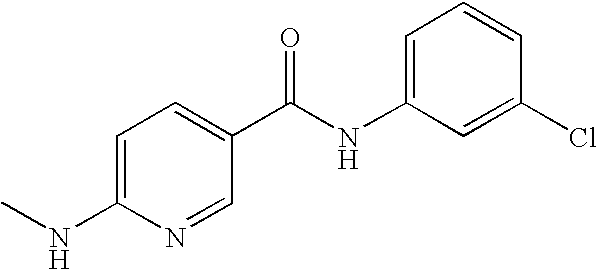
N-(3-Chloro-phenyl)-6-fluoro-nicotinamide Methylamine N-(3-Chloro-phenyl)-6-methylamino-nicotinamide 261.71 261.9and264.0 127 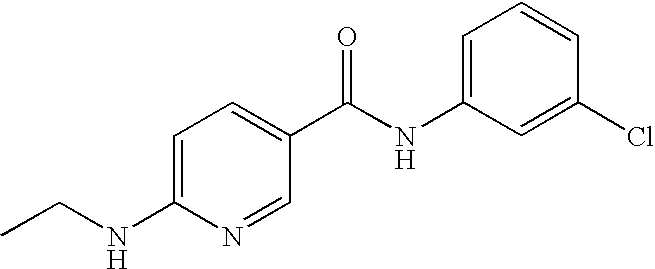
N-(3-Chloro-phenyl)-6-fluoro-nicotinamide Ethylamine N-(3-Chloro-phenyl)-6-ethylamino-nicotinamide 275.74 276.0and278.1 128 
N-(3-Chloro-phenyl)-6-fluoro-nicotinamide Propylamine N-(3-Chloro-phenyl)-6-propylamino-nicotinamide 289.76 290.0and292.1 129 
N-(3-Chloro-phenyl)-6-fluoro-nicotinamide iso-Propylamine N-(3-Chloro-phenyl)-6-isopropylamino-nicotinamide 289.76 290.0and292.1 130 
N-(3-Chloro-phenyl)-6-fluoro-nicotinamide 2-Methoxy-ethylamine N-(3-Chloro-phenyl)-6-(2-methoxy-ethylamino)-nicotinamide 305.76 306.1and308.1 131 
N-(3-Chloro-phenyl)-6-fluoro-nicotinamide Azetidine 6-Azetidin-1-yl-N-(3-chloro-phenyl)-nicotinamide 287.75 287.9and290.0 132 
N-(3-Chloro-phenyl)-6-fluoro-nicotinamide Pyrrolidine N-(3-Chloro-phenyl)-6-pyrrolidin-1-yl-nicotinamide 301.78 302.0and304.1 133 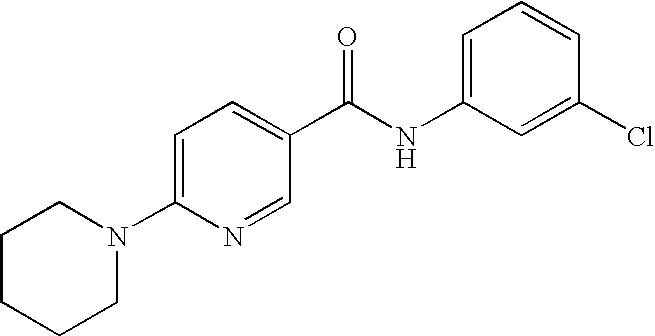
N-(3-Chloro-phenyl)-6-fluoro-nicotinamide Piperidine 3,4,5,6-Tetrahydro-2H-[1,2′]bipyridinyl-5′-carboxylicacid (3-chloro-phenyl)-amide 315.80 316.0and318.1 134 
N-(3-Chloro-phenyl)-6-fluoro-nicotinamide 4-Methyl-piperidine 4-Methyl-3,4,5,6-tetrahydro-2H-[1,2′]bipyridinyl-5′-carboxylicacid (3-chloro-phenyl)-amide 329.83 328.1and330.1 135 
N-(3-Chloro-phenyl)-6-fluoro-nicotinamide 1-Methyl-piprazine N-(3-Chloro-phenyl)-6-(4-methyl-piperazin-1-yl)-nicotinamide 330.82 331.1and333.2 136 
N-(3-Chloro-phenyl)-6-fluoro-nicotinamide Butylamine 6-Butylamino-N-(3-chloro-phenyl)-nicotinamide 303.79 304.0and306.1 137 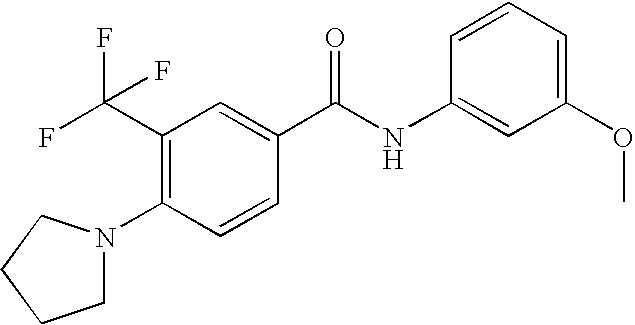
4-Fluoro-N-(3-methoxy-phenyl)-3-trifluoro-methyl-benzamide Pyrrolidine N-(3-Methoxy-phenyl)-4-pyrrolidin-1-yl-3-trifluoromethyl-benzamide 364.37 365.0 138 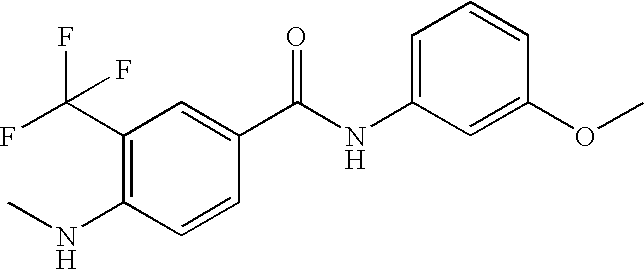
4-Fluoro-N-(3-methoxy-phenyl)-3-trifluoro-methyl-benzamide Methylamine N-(3-Methoxy-phenyl)-4-methylamino-3-trifluoromethyl-benzamide 324.30 325.3 139 
4-Fluoro-N-(3-methoxy-phenyl)-3-trifluoro-methyl-benzamide 2-Methoxy-ethylamine 4-(2-Methoxy-ethylamino)-N-(3-methoxy-phenyl)-3-trifluoromethyl-benzamide 368.35 369.1 140 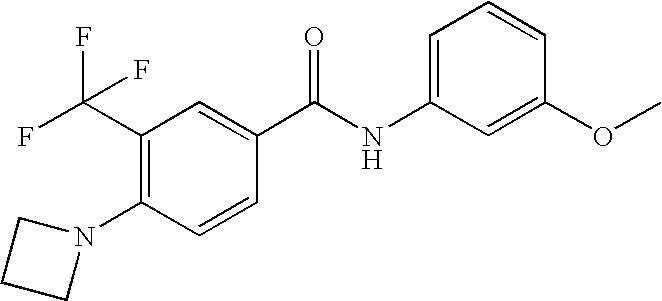
4-Fluoro-N-(3-methoxy-phenyl)-3-trifluoro-methyl-benzamide Azetidine 4-Azetidin-1-yl-N-(3-methoxy-phenyl)-3-trifluoromethyl-benzamide 350.34 351.1 141 
4-Fluoro-N-(3-methoxy-phenyl)-3-trifluoro-methyl-benzamide Piperidine N-(3-Methoxy-phenyl)-4-piperidin-1-yl-3-trifluoromethyl-benzamide 378.39 379.2 -

- A solution of 80 mg (0.32 mmol) N-(3-chloro-phenyl)-6-fluoro-nicotinamide (Example 48) in 1 ml N,N-dimethylformamide was stirred under microwave irradiation at 200° C. for 45 minutes. Then the reaction mixture was evaporated under reduced pressure and the residue purified by flash-chromatography on silica gel with heptane/ethyl acetate 1:1 as eluent. N-(3-chloro-phenyl)-6-dimethylamino-nicotinamide was obtained as colourless solid: MS (ISP): 276.0 and 278.1 ((M+H)+.).
-

- A solution of 100 mg (0.32 mmol) 4-fluoro-N-(3-methoxy-phenyl)-3-trifluoromethyl-benzamide (Example 73) and 57 mg (0.97 mmo;) propylamine in 1 ml 1-methyl-2-pyrrolidinone was stirred under microwave irradiation at 250° C. for 15 minutes. Then the reaction mixture was evaporated under reduced pressure and the residue purified by flash-chromatography on silica gel with a heptane/ethyl acetate gradient with 10% to 20% ethyl acetate as eluent. N-(3-Methoxy-phenyl)-4-(4-methyl-piperidin-1-yl)-3-trifluoromethyl-benzamide was obtained as colorless solid: MS (ISP): 392.9 ((M+H)+.).
- In analogy to Example 143 were prepared Examples 144 to 165:
-
Chemical Rxn Rxn MS MS 4-fluoro- Name of the Temp. time (ISN): (ISP): Expl. Structure benzamide R′NHR″ Product (° C.) min. (M − H).− (M + H).+ 144 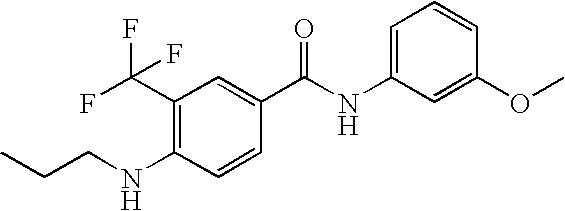
4-Fluoro-N-(3-methoxy-phenyl)-3-trifluoromethyl-benzamide Propylamine N-(3-Methoxy-phenyl)-4-propylamino-3-trifluoromethyl-benzamide 200 15 353.1 145 
4-Fluoro-N-(3-methoxy-phenyl)-3-trifluoromethyl-benzamide Butylamine 4-Butylamino-N-(3-methoxy-phenyl)-3-trifluoromethyl-benzamide 200 15 367.0 146 
4-Fluoro-N-(3-methoxy-phenyl)-3-trifluoromethyl-benzamide 1-Methyl-piprazine N-(3-Methoxy-phenyl)-4-(4-methyl-piperazin-1-yl)-3-trifluoromethyl-benzamide 200 15 394.0 147 
4-Fluoro-N-(3-methoxy-phenyl)-3-trifluoromethyl-benzamide Benzylamine 4-Benzylamino-N-(3-methoxy-phenyl)-3-trifluoromethyl-benzamide 250 15 401.2 148 
4-Fluoro-N-(3-methoxy-phenyl)-3-trifluoromethyl-benzamide Ethylamine 4-Ethylamino-N-(3-methoxy-phenyl)-3-trifluoromethyl-benzamide 250 15 337.1 149 
4-Fluoro-N-(3-methoxy-phenyl)-3-trifluoromethyl-benzamide iso-Propylamine 4-Isopropylamino-N-(3-methoxy-phenyl)-3-trifluoromethyl-benzamide 250 15 351.3 150 
4-Fluoro-N-(3-methoxy-phenyl)-3-trifluoromethyl-benzamide Morpholine N-(3-Methoxy-phenyl)-4-morpholin-4-yl-3-trifluoromethyl-benzamide 250 15 381.2 151 
5,6-Dichloro-N-(3-chloro-phenyl)-nicotinamide Methylamine 5-Chloro-N-(3-chloro-phenyl)-6-methylamino-nicotinamide 120 15 294.0and296.1 152 
5,6-Dichloro-N-(3-chloro-phenyl)-nicotinamide iso-Propylamine 5-Chloro-N-(3-chloro-phenyl)-6-isopropylamino-nicotinamide 120 15 324.1and326.0 153 
5,6-Dichloro-N-(3-chloro-phenyl)-nicotinamide 2-Methoxy-ethylamine 5-Chloro-N-(3-chloro-phenyl)-6-(2-methoxy-ethylamino)-nicotinamide 120 15 339.9and342.0and344.1 154 
5,6-Dichloro-N-(3-chloro-phenyl)-nicotinamide Pyrrolidine 5-Chloro-N-(3-chloro-phenyl)-6-pyrrolidin-1-yl-nicotinamide 120 15 336.0and338.0and340.0 155 
5,6-Dichloro-N-(3-chloro-phenyl)-nicotinamide 4-Methyl-piperidine 3′-Chloro-4-methyl-3,4,5,6-tetrahydro-2H-[1,2′]bipyridinyl-5′-carboxylicacid (3-chloro-phenyl)-amide 250 15 363.9and366.0 156 
5,6-Dichloro-N-(3-chloro-phenyl)-nicotinamide Ethylamine 5-Chloro-N-(3-chloro-phenyl)-6-ethylamino-nicotinamide 120 15 309.9and312.0 157 
5,6-Dichloro-N-(3-chloro-phenyl)-nicotinamide Propylamine 5-Chloro-N-(3-chloro-phenyl)-6-propylamino-nicotinamide 120 15 324.0and326.1 158 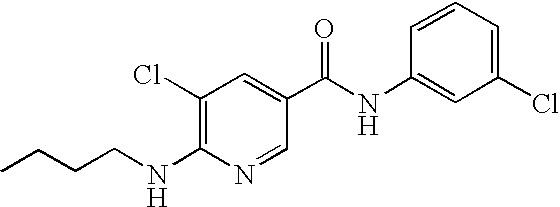
5,6-Dichloro-N-(3-chloro-phenyl)-nicotinamide Butylamine 6-Butylamino-5-chloro-N-(3-chloro-phenyl)-nicotinamide 120 15 337.9and339.9 159 
5,6-Dichloro-N-(3-chloro-phenyl)-nicotinamide Dimethylamine 5-Chloro-N-(3-chloro-phenyl)-6-dimethylamino-nicotinamide 120 15 309.9and312.0 160 
5,6-Dichloro-N-(3-chloro-phenyl)-nicotinamide Morpholine 5-Chloro-N-(3-chloro-phenyl)-6-morpholin-4-yl-nicotinamide 120 15 352.0and354.1 161 
5,6-Dichloro-N-(3-chloro-phenyl)-nicotinamide Benzylamine 6-Benzylamino-5-chloro-N-(3-chloro-phenyl)-nicotinamide 120 15 370.0and372.0 162 
5,6-Dichloro-N-(3-chloro-phenyl)-nicotinamide Azetidine 6-Azetidin-1-yl-5-chloro-N-(3-chloro-phenyl)-nicotinamide 120 15 322.1and324.1 163 
5,6-Dichloro-N-(3-chloro-phenyl)-nicotinamide Piperidine 3′-Chloro-3,4,5,6-tetrahydro-2H-[1,2′]bipyridinyl-5′-carboxylicacid (3-chloro-phenyl)-amide 180 15 350.1and352.1 164 
5,6-Dichloro-N-(3-chloro-phenyl)-nicotinamide 1-Methyl-piprazine 5-Chloro-N-(3-chloro-phenyl)-6-(4-methyl-piperazin-1-yl)-nicotinamide 120 15 364.9and367.0 165 
N-(4-Chloro-3-methoxy-phenyl)-4-fluoro-3-trifluoromethyl-benzamide Pyrrolidine N-(4-Chloro-3-methoxy-phenyl)-4-pyrrolidin-1-yl-3-trifluoromethyl-benzamide 150 15 399.0and401.1 -

- To a cooled solution of 220 mg (1 mmol) of 3-chlorosulfonyl-benzoic acid in 1 ml acetonitrile were added 745 mg (4 mmol) piperazine-1-carboxylic acid tert-butyl ester and 304 mg (3 mmol) triethylamine and then stirred at ambient temperature for 60 hours. The reaction mixture is concentrated under reduced pressure, the residue taken up in 2N NaOH and extracted with ethyl acetate. The aqueous phase is set to pH 1 with concentrated hydrochloric acid and extracted three times with ethyl acetate. The combined organic extracts were washed with brine, dried over Na2SO4, filtered and evaporated. 4-(3-Carboxy-benzenesulfonyl)-piperazine-1-carboxylic acid tert-butyl ester was obtained as solid: MS (ISN): 368.8 ((M−H)−.).
-

- 4-[3-(3-Methoxy-phenylcarbamoyl)-benzenesulfonyl]-piperazine-1-carboxylic acid tert-butyl ester was prepared in analogy to Example 1 from 4-(3-carboxy-benzenesulfonyl)-piperazine-1-carboxylic acid tert-butyl ester and 3-methoxy-aniline: colorless solid, MS (ISP): 476.0 ((M+H)+.), 420.1 ((((M+H)-tBu))+.) 98%), 376.3 ((((M+H)-Boc))+.) 100%).
-

- A solution of 110 mg (0.23 mmol) 4-[3-(3-methoxy-phenylcarbamoyl)-benzenesulfonyl]-piperazine-1-carboxylic acid tert-butyl ester in 1 ml ethanol and 10 ml 2N HCl was stirred at 50° C. for 30 min and then concentrated under reduced pressure. The residue was taken up in 2N NaOH and extracted with ethyl acetate. The combined organic extracts were washed with brine, dried over Na2SO4, filtered and evaporated. The residue was purified by flash-chromatography on silica gel with dichloromethane/methanol 9:1 as eluent. N-(3-methoxy-phenyl)-3-(piperazine-1-sulfonyl)-benzamide was obtained as colourless solid: MS (ISP): 376.3 ((M+H)+.).
-

- (rac,meso)-3-(3,5-Dimethyl-piperidine-1-sulfonyl)-4-fluoro-benzoic acid was prepared in analogy to Example 166 a) from 3-Chlorosulfonyl-4-fluoro-benzoic acid and racemic (cis,trans-3,5-dimethylpiperidine: colorless solid, MS (ISN): 314.1 ((M−H)−.).
-
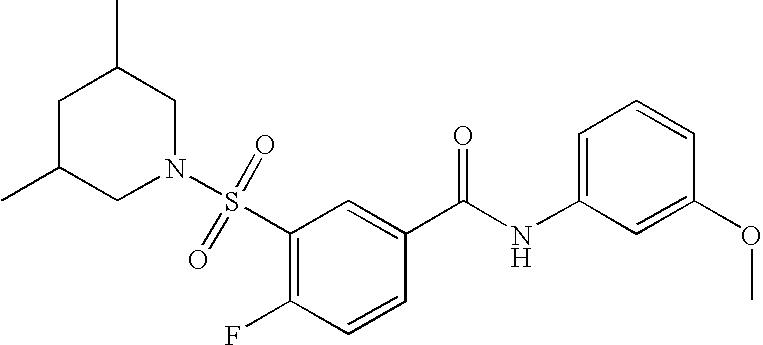
- (rac,meso)-3-(3,5-Dimethyl-piperidine-1-sulfonyl)-4-fluoro-N-(3-methoxy-phenyl)-benzamide was prepared in analogy to Example 1 from (rac,meso)-3-(3,5-dimethyl-piperidine-1-sulfonyl)-4-fluoro-benzoic acid and 3-methoxy-aniline: colorless solid, MS (ISP): 421.0 ((M+H)+.).
- In analogy to Example 167 were prepared from benzoic acid derivatives known in the literature or commercially available Examples 168 to 176:
-
Chemical MS MS Name of the (ISN): (ISP): Expl. Structure RCOOH R′NHR″ Product MW (M − H).− (M + H).+ 168 
4-Fluoro-3-(piperidine-1-sulfonyl)-benzoic acid 3-Methoxy-aniline 4-Fluoro-N-(3-methoxy-phenyl)-3-(piperidine-1-sulfonyl)-benzamide 392.45 393.0 169 
3-(Azetidine-1-sulfonyl)-benzoic acid 3-Methoxy-aniline 3-(Azetidine-1-sulfonyl)-N-(3-methoxy-phenyl)-benzamide 346.41 347.1 170 
3-(Azepane-1-sulfonyl)-benzoic acid 3-Methoxy-aniline 3-(Azepane-1-sulfonyl)-N-(3-methoxy-phenyl)-benzamide 388.49 389.1 171 
(rac,meso)-3-(3,5-Dimethyl-piperidine-1-sulfonyl)-benzoic acid 3-Methoxy-aniline 3-(3,5-Dimethyl-piperidine-1-sulfonyl)-N-(3-methoxy-phenyl)-benzamide 402.51 403.2 172 
3-Dimethyl-sulfamoyl-benzoic acid 3-Methoxy-aniline 3-Dimethyl-sulfamoyl-N-(3-methoxy-phenyl)-benzamide 334.39 335.0 173 
3-Methylsulfamoyl-benzoic acid 3-Methoxy-aniline N-(3-Methoxy-phenyl)-3-methylsulfamoyl-benzamide 320.37 321.0 174 
3-(Pyrrolidine-1-sulfonyl)-benzoic acid 3-Methoxy-aniline N-(3-Methoxy-phenyl)-3-(pyrrolidine-1-sulfonyl)-benzamide 360.43 361.1 175 
3-(Piperidine-1-sulfonyl)-benzoic acid 3-Methoxy-aniline N-(3-Methoxy-phenyl)-3-(piperidine-1-sulfonyl)-benzamide 374.46 375.3 176 
4-Fluoro-3-sulfamoyl-benzoic acid 3-Methoxy-aniline 4-Fluoro-N-(3-methoxy-phenyl)-3-sulfamoyl-benzamide 324.33 323.3 -

- A solution of 300 mg (1.39 mmol) 3-nitrobenzyl bromide and 192 mg (1.39 mmol) 1-(2,4-dimethyl-imidazol-1-yl)-ethanone in 2 ml acetonitrile was stirred under microwave irradiation at 160° C. for 15 minutes. Then the reaction mixture was evaporated under reduced pressure, the residue taken up in 2M NaOH and heated to reflux for 15 min. Then the reaction mixture was extracted three times with dichloromethane. The combined organic extracts were washed with brine, dried over Na2SO4, filtered and evaporated. The crude product was purified by flash-chromatography on silica gel with a dichloromethane/methanol gradient with 5% to 10% methanol as eluent. 2,5-Dimethyl-1-(3-nitro-benzyl)-1H-imidazole was isolated as yellow liquid, MS (ISP): 231.9 ((M+H)+.).
-

- 3-(2,5-Dimethyl-imidazol-1-ylmethyl)-phenylamine was prepared from 2,5-dimethyl-1-(3-nitro-benzyl)-1H-imidazole by catalytic hydrogenation with 10% Pd/C in ethyl acetate at ambient temperature for 3 hours: yellow solid, MS (ISP): 202.1 ((M+H)+.).
-

- 3,4-Dichloro-N-[3-(2,5-dimethyl-imidazol-1-ylmethyl)-phenyl]-benzamide was prepared in analogy to Example 1 from 3-(2,5-dimethyl-imidazol-1-ylmethyl)-phenylamine and 3,4-dichlorobenzoic acid: colorless solid, MS (ISP): 374.1 and 376.1 ((M+H)+.).
-
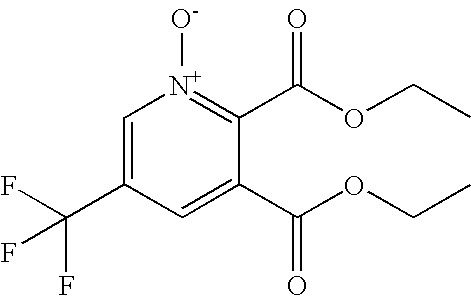
- To a solution of 12.3 g (42 mmol) 5-frifluoromethyl-pyridine-2,3-dicarboxylic acid diethyl ester in 100 ml dichloromethane were added 8.34 g (89 mmol) hydrogen peroxide-urea adduct and the mixture cooled to 0° C. Drop-wise 11.75 ml (17.74 g, 84 mmol) trifluoroacetic acid anhydride were added and the mixture stirred at 0° C. for 3 hours. Then 25 ml 25% aqueous sodium sulfite solution were added and stirring continued for another 15 minutes. The mixture was poured onto 1N HCl and extracted twice with dichloromethane. The combined organic extracts were washed with brine, dried over Na2SO4, filtered and evaporated. The crude product was purified by flash-chromatography on silica gel with a heptane/ethyl acetate gradient with 0% to 50% ethyl acetate as eluent. 1-Oxy-5-trifluoromethyl-pyridine-2,3-dicarboxylic acid diethyl ester was isolated as colourless solid, MS (ISP): 308.1 ((M+H)+.).
-

- A solution of 11.0 g (36 mmol) 1-oxy-5-trifluoromethyl-pyridine-2,3-dicarboxylic acid diethyl ester in 33 ml (55 g, 360 mmol) phosphorous oxychloride was heated to reflux for 1 hour. Then the reaction mixture was evaporated under reduced pressure and the residue purified by flash-chromatography on silica gel with a heptane/ethyl acetate gradient with 5% to 20% ethyl acetate as eluent. 6-Chloro-5-trifluoromethyl-pyridine-2,3-dicarboxylic acid diethyl ester was isolated as colourless solid, MS (ISP): 326.3 and 328.4 ((M+H)+.).
-
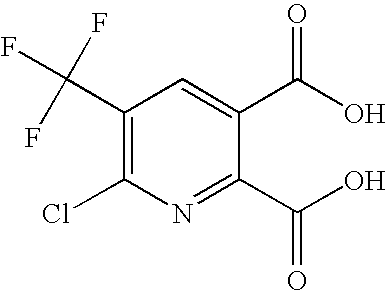
- A solution of 9.60 g (29 mmol) 6-chloro-5-trifluoromethyl-pyridine-2,3-dicarboxylic acid diethyl ester in 30 ml tetrahydrofuran was cooled to 0° C. then 5 ml water and drop-wise 29.5 ml 2N NaOH. The stirred reaction mixture was allowed to come to ambient temperature within 30 minutes. Then the solution was saturated with sodium chloride and acidified with 2N HCl. The solution was extracted three times with ethyl acetate, the combined organic extracts washed with brine, dried over Na2SO4, filtered and evaporated. 6-Chloro-5-trifluoromethyl-pyridine-2,3-dicarboxylic acid was obtained as colourless solid, MS (ISN): 268.3 and 270.4 ((M−H)−.).
-

- A solution of 400 mg (1.5 mmol) 6-chloro-5-trifluoromethyl-pyridine-2,3-dicarboxylic acid in 5 ml dioxane is heated under microwave irradiation to 165° C. for 15 minutes. The solvent was evaporated and the residue recrystallised from water. 6-Chloro-5-trifluoromethyl-nicotinic acid was obtained as colourless solid, MS (ISN): 224.0 and 226.1 ((M−H)−.).
-

- 6-Chloro-N-(3-methoxy-phenyl)-5-trifluoromethyl-nicotinamide was prepared in analogy to Example 1 from 6-chloro-5-trifluoromethyl-nicotinic acid and 3-methoxy-aniline acid: colorless solid, MS (ISP): 374.1 and 376.1 ((M+H)+.).
-

- N-(3-Methoxy-phenyl)-6-pyrrolidin-1-yl-5-trifluoromethyl-nicotinamide was prepared in analogy to Example 143 from 6-chloro-N-(3-methoxy-phenyl)-5-trifluoromethyl-nicotinamide and pyrrolidine heated to 150° C. by microwave irradiation: colorless solid, MS (ISP): 366.0 ((M+H)+.).
-

- A solution of 1.00 g (4.8 mmol) 4-fluoro-3-(trifluoromethyl)-benzoic acid and 2.4 ml (2.06 g, 28.8 mmol) pyrrolidine in 3.8 ml dimethylsulfoxide was heated to 100° C. for 24 hours. The reaction mixture is cooled to ambient temperature, diluted with water and the pH adjusted to 3 with 4N HCR. The colourless precipitate was filtered, washed with water and dried: (2,4-Pyrrolidin-1-yl-3-trifluoromethyl-benzoic acid was obtained as slightly brown solid, MS (ISN): 258.0 ((M−H)−.).
-

- N-(3-Ethyl-phenyl)-4-pyrrolidin-1-yl-3-trifluoromethyl-benzamide was prepared in analogy to Example 1 from 4-pyrrolidin-1-yl-3-trifluoromethyl-benzoic acid and 3-ethyl-aniline: colorless solid, MS (ISP): 363.2 ((M+H)+.)
- In analogy to Example 180 were prepared Examples 181 to 193:
-
Chemical MS Name of the (ISP): Expl. Structure RCOOH R′NHR″ Product MW (M + H)+ 181 
4-Pyrrolidin-1-yl-3-trifluoro-methyl-benzoic acid 3-Ethoxy-aniline N-(3-Ethoxy-phenyl)-4-pyrrolidin-1-yl-3-trifluoro-methyl-benzamide 378.39 379.3 182 
4-Pyrrolidin-1-yl-3-trifluoro-methyl-benzoic acid 3-iso-Propyl-aniline N-(3-Isopropyl-phenyl)-4-pyrrolidin-1-yl-3-trifluoro-methyl-benzamide 376.42 377.3 183 
4-Pyrrolidin-1-yl-3-trifluoro-methyl-benzoic acid 3-iso-Propoxy-aniline N-(3-Isopropoxy-phenyl)-4-pyrrolidin-1-yl-3-trifluoro-methyl-benzamide 392.42 393.1 184 
4-Pyrrolidin-1-yl-3-trifluoro-methyl-benzoic acid 1-(3-Amino-phenyl)-ethanone N-(3-Acetyl-phenyl)-4-pyrrolidin-1-yl-3-tri-fluoromethyl-benzamide 376.38 377.3 185 
4-Pyrrolidin-1-yl-3-trifluoro-methyl-benzoic acid 3-Fluoro-aniline N-(3-Fluoro-phenyl)-4-pyrrolidin-1-yl-3-trifluoro-methyl-benzamide 352.33 353.1 186 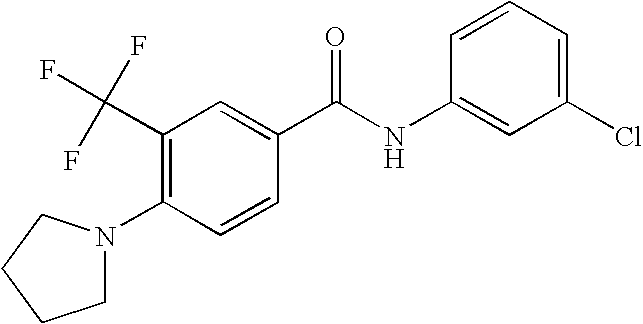
4-Pyrrolidin-1-yl-3-trifluoro-methyl-benzoic acid 3-Chloro-aniline N-(3-Chloro-phenyl)-4-pyrrolidin-1-yl-3-trifluoro-methyl-benzamide 368.79 369.0and371.1 187 
4-Pyrrolidin-1-yl-3-trifluoro-methyl-benzoic acid 3-Bromo-aniline N-(3-Bromo-phenyl)-4-pyrrolidin-1-yl-3-trifluoro-methyl-benzamide 413.24 413.1and415.1 188 
4-Pyrrolidin-1-yl-3-trifluoro-methyl-benzoic acid 3-Trifluoro-methoxy-aniline 4-Pyrrolidin-1-yl-N-(3-trifluoro-methoxy-phenyl)-3-trifluoro-methyl-benzamide 418.34 419.3 189 
4-Pyrrolidin-1-yl-3-trifluoro-methyl-benzoic acid 3-Methyl-aniline 4-Pyrrolidin-1-yl-N-m-tolyl-3-trifluoro-methyl-benzamide 348.37 349.3 190 
4-Pyrrolidin-1-yl-3-trifluoro-methyl-benzoic acid 3-Difluoro-methoxy-aniline N-(3-Difluoro-methoxy-phenyl)-4-pyrrolidin-1-yl-3-trifluoro-methyl-benzamide 400.35 401.4 191 
4-Pyrrolidin-1-yl-3-trifluoro-methyl-benzoic acid 5-tert-Butyl-2-methoxy-aniline N-(5-tert-Butyl-2-methoxy-phenyl)-4-pyrrolidin-1-yl-3-trifluoro-methyl-benzamide 420.00 421.1 192 
4-Pyrrolidin-1-yl-3-trifluoro-methyl-benzoic acid 3-(1,1,2,2-Tetra-fluoro-ethoxy)-aniline 4-Pyrrolidin-1-yl-N-[3-(1,1,2,2-tetrafluoro-ethoxy)-phenyl]-3-trifluoro-methyl-benzamide 450.35 451.2 193 
4-Pyrrolidin-1-yl-3-trifluoro-methyl-benzoic acid 3-Phenoxy-aniline N-(3-Phenoxy-phenyl)-4-pyrrolidin-1-yl-3-trifluoro-methyl-benzamide 426.44 427.2 -

- (rac,meso)-4-(3,5-Dimethyl-piperidin-1-yl)-3-trifluoromethyl-benzoic acid was prepared in analogy to Example 180 a) from 4-fluoro-3-(trifluoromethyl)-benzoic acid and (rac,meso)-3,5-dimethyl-piperidine: colorless solid, MS (ISN): 300.5 ((M−H)−.).
-

- (rac,meso)-4-(3,5-Dimethyl-piperidin-1-yl)-N-(3-methoxy-phenyl)-3-trifluoromethyl-benzamide was prepared in analogy to Example 1 from (rac,meso)-4-(3,5-dimethyl-piperidin-1-yl)-3-trifluoromethyl-benzoic acid and 3-methoxy-aniline: colorless solid, MS (ISP): 407.5 ((M+H)+.).
-

- 4-Azepan-1-yl-3-trifluoromethyl-benzoic acid was prepared in analogy to Example 180 a) from 4-fluoro-3-(trifluoromethyl)-benzoic acid and azepane: colorless solid, MS (ISN): 286.4 ((M−H)−.).
-

- 4-Azepan-1-yl-N-(3-methoxy-phenyl)-3-trifluoromethyl-benzamide was prepared in analogy to Example 1 from 4-azepan-1-yl-3-trifluoromethyl-benzoic acid and 3-methoxy-aniline: colorless solid, MS (ISP): 393.0 ((M+H)+.).
-

- 4-(4-Cyano-piperidin-1-yl)-3-trifluoromethyl-benzoic acid was prepared in analogy to Example 180 a) from 4-fluoro-3-(trifluoromethyl)-benzoic acid and piperidine-4-carbonitrile: colorless solid, MS (ISN): 297.5 ((M−H)−.).
-

- 4-(4-Cyano-piperidin-1-yl)-N-(3-methoxy-phenyl)-3-trifluoromethyl-benzamide was prepared in analogy to Example 1 from 4-(4-cyano-piperidin-1-yl)-3-trifluoromethyl-benzoic acid and 3-methoxy-aniline: colorless solid, MS (ISP): 404.4 ((M+H)+.).
-

- 3-Trifluoromethyl-4-(4-trifluoromethyl-piperidin-1-yl)-benzoic acid was prepared in analogy to Example 180 a) from 4-fluoro-3-(trifluoromethyl)-benzoic acid and 4-trifluoromethyl-piperidine: colorless solid, MS (ISN): 340.3 ((M−H)−.).
-

- N-(3-Methoxy-phenyl)-3-trifluoromethyl-4-(4-trifluoromethyl-piperidin-1-yl)-benzamide was prepared in analogy to Example 1 from 3-trifluoromethyl-4-(4-trifluoromethyl-piperidin-1-yl)-benzoic acid and 3-methoxy-aniline: colorless solid, MS (ISP): 447.1 ((M+H)+.).
-

- 2-Pyrrolidin-1-yl-pyrimidine-5-carboxylic acid (3-methoxy-phenyl)-amide was prepared in analogy to Example 1 from 2-pyrrolidin-1-yl-pyrimidine-5-carboxylic acid and 3-methoxy-aniline: colorless solid, MS (ISP): 299.0 ((M+H)+.).
- In analogy to examples 143 were prepared examples 199 to 209:
-
Ex- Rxn Rxn MS am- 6-chloro- Temp. time (ISN): ple Structure nicotinamide R′NHR″ (° C.) (min.) MW (M − H)− 199 
6-Chloro-N-(3-methoxy-phenyl)-5-trifluoromethyl-nicotinamide Benzyl-amine 250 15 401.39 400.3 200 
6-Chloro-N-(3-methoxy-phenyl)-5-trifluoromethyl-nicotinamide iso-Propyl-amine 250 15 353.34 352.2 201 
6-Chloro-N-(3-methoxy-phenyl)-5-trifluoromethyl-nicotinamide 4-Methyl-piperi-dine 250 15 393.41 392.1 202 
5,6-Dichloro-N-(3-methoxy-phenyl)-nicotinamide Propyl-amine 180 15 319.79 203 
5,6-Dichloro-N-(3-methoxy-phenyl)-nicotinamide iso-Propyl-amine 180 15 319.79 204 
5,6-Dichloro-N-(3-methoxy-phenyl)-nicotinamide 2-Meth-oxy-ethylamine 180 15 335.79 205 
5,6-Dichloro-N-(3-methoxy-phenyl)-nicotinamide Pyrrol-idine 180 15 331.80 206 
5,6-Dichloro-N-(3-methoxy-phenyl)-nicotinamide Piperi-dine 250 15 345.83 207 
5,6-Dichloro-N-(3-methoxy-phenyl)-nicotinamide 4-Methyl-piperi-dine 250 15 359.86 208 
5,6-Dichloro-N-(3-methoxy-phenyl)-nicotinamide Butyl-amine 180 15 333.82 209 
5,6-Dichloro-N-(3-methoxy-phenyl)-nicotinamide Piper-azine-1-car-boxylicacid tert-butylester 120 15 451.35 -

- To a solution of 200 mg (0.443 mmol) 4-[3-chloro-5-(3-chloro-phenylcarbamoyl)-pyridin-2-yl]-piperazine-1-carboxylic acid tert-butyl ester (Example 209) in 2 ml ethanol were added 2 ml aqueous 1N HCR and the mixture stirred at 80° C. for 1.5 hours. Then the mixture was cooled to ambient temperature neutralized with 2N NaOH and extracted with dichloromethane. The combined organic extracts were washed with brine, dried over Na2SO4, filtered and evaporated. 5-Chloro-N-(3-chloro-phenyl)-6-piperazin-1-yl-nicotinamide was obtained as a colourless solid: MS (ISP): 351.2 and 353.2 ((M+H)+.).
-

- A mixture of 300 mg (0.925 mmol) 3-bromo-4-fluoro-N-(3-methoxy-phenyl)-benzamide (Example 71), 8 mg (0.037 mmol) Pd(II) acetate, 31 mg (0.075 mmol) 1,3-bis(diphenylphosphino)propane in 2 ml DMSO and 0.2 ml 1-butyl-3-methylimidazolium tetrafluoroborate was stirred at ambient temperature and degassed 3 times. To the mixture were added 185 mg (0.24 ml, 1.85 mmol) N-butyl vinyl ether and 112 mg (0.16 ml, 1.11 mmol) diisopropylamine and the sealed tube stirred under microwave irradiation at 170° C. for 15 minutes. The resulting reaction mixture was evaporated and the residue purified by flash-chromatography on silica gel with heptane/ethyl acetate 78:22 as eluent. 3-(1-Butoxy-vinyl)-4-fluoro-N-(3-methoxy-phenyl)-benzamide was obtained as yellow oil: MS (ISP): 344.2 ((M+H)+.).
-

- To a solution of 140 mg (0.533 mmol) 6-chloro-N-(3-methoxy-phenyl)-nicotinamide (Example 277) in 4 ml dioxane were added 20 mg (0.086 mmol) tri(2-furyl)phosphine, 9 mg (0.016 mmol) bis(benzylidenacetone) palladium and 80.8 mg (111 ul, 0.800 mmol) triethylamine and stirred at ambient temperature for 10 min. Then 298 mg (0.800 mmol) tributyl-(5,6-dihydro-4H-pyran-2-yl)-stannane were added and the mixture heated to 110° C. for 24 hours. The cooled reaction mixture was filtered through Dicalite, the filtrate diluted with ethyl acetate and extracted with water. The organic phase was washed with brine, dried over Na2SO4, filtered and evaporated. The residue was purified by flash-chromatography on silica gel with a gradient of heptane/ethyl acetate 60:40 to 40:60 as eluent. 6-(5,6-Dihydro-4H-pyran-2-yl)-N-(3-methoxy-phenyl)-nicotinamide was obtained as a colourless solid: MS (ISP): 311.1 ((M+H)+.).
-

- To a solution of 90 mg (0.26 mmol) 3-(1-butoxy-vinyl)-4-fluoro-N-(3-methoxy-phenyl)-benzamide (Example 211) in 2 ml dioxane were added 2 ml 2N HCl and the mixture stirred at ambient temperature for 30 minutes. The reaction mixture was extracted with with dichloromethane. The combined organic extracts were washed with brine, dried over Na2SO4, filtered and evaporated. The residue was purified by flash-chromatography on silica gel with heptane/ethyl acetate 70:30 as eluent. 3-Acetyl-4-fluoro-N-(3-methoxy-phenyl)-benzamide was obtained as a colourless solid: MS (ISN): 286.1 ((M−H)−.).
-

- To a solution of 30 mg (0.097 mmol) 6-(5,6-dihydro-4H-pyran-2-yl)-N-(3-methoxy-phenyl)-nicotinamide in 3 ml ethyl acetate was added a tip of a spatula platinum oxide and the mixture stirred under a hydrogen atmosphere at ambient temperature for 1 hour. Then the reaction mixture is filtered, evaporated and the residue was purified by flash-chromatography on silica gel with heptane/ethyl acetate 1:2 as eluent. rac-N-(3-Methoxy-phenyl)-6-(tetrahydro-pyran-2-yl)-nicotinamide was obtained as a colourless solid: MS (ISN): 313.0 ((M−H)−.).
-

- 3-(4,5-Dihydro-furan-2-yl)-4-fluoro-N-(3-methoxy-phenyl)-benzamide was prepared in analogy to Example 212 from 6-chloro-N-(3-methoxy-phenyl)-nicotinamide (Example 277) and tributyl-(4,5-dihydro-furan-2-yl)-stannane under microwave irradiation at 170° C. for 15 minutes: viscous colorless oil, MS (ISP): 314.1 ((M+H)+.).
-

- rac-4-Fluoro-N-(3-methoxy-phenyl)-3-(tetrahydro-furan-2-yl)-benzamide was prepared in analogy to Example 214 from 3-(4,5-dihydro-furan-2-yl)-4-fluoro-N-(3-methoxy-phenyl)-benzamide: viscous colorless oil, MS (ISP): 316.0 ((M+H)+.).
-

- 4-Chloro-N-(3-methoxy-phenyl)-3-trifluoromethyl-benzamide was prepared in analogy to Example 1 from 3-methoxy-aniline and 4-chloro-3-trifluoromethyl-benzoic acid: beige solid, MS (ISN): 328.0 ((M−H)−.).
- The following are known compounds, and they are commercially available or disclosed in the references.
-
Example Structure Chemical name Reference 217 
3,4-Dichloro-N-phenyl-benzamide Monatshefte fuerChemie (1966), 97(1),271-80. 218 
3,3′,4-Trichlorobenzanilide CH 609558 219 
3-Trifluoromethyl-4-nitro-N-phenyl-benzamide Macromolecular RapidCommunications(2002), 23(12),665-671. 220 
N-(3,4-Dichloro-phenyl)-3-methyl-benzamide Journal of Agriculturaland Food Chemistry(1986), 34 (4), 725-32. 221 
3,4-Dichloro-N-p-tolyl-benzamide Monatshefte fuerChemie (1966), 97(1),271-80. 222 
N-(3-Methoxy-phenyl)-3-nitro-benzamide Journal ofCombinatorialChemistry (2002), 4(6),549-551. 223 
3-Bromo-N-(3-fluoro-phenyl)-benzamide Pharmazie (1998),53(3), 193-195. 224 
N-(4-Chloro-phenyl)-3-methyl-benzamide Bulletin de la SocieteChimique de France(1963), (4), 862-72. 225 
N-Phenyl-4-trifluoromethyl-benzamide Journal of OrganicChemistry (1996),61(21), 7482-7485. 226 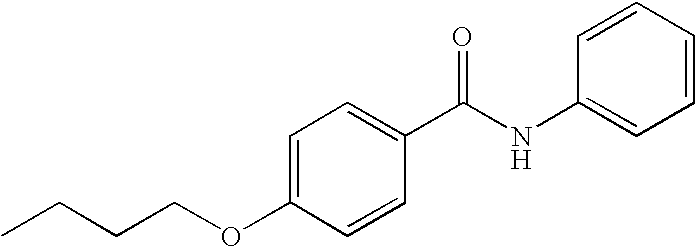
4-Butoxy-N-phenyl-benzamide Journal of the Chemicalsociety (1949), 3043-6. 227 
N-(3,5-Dimethoxy-phenyl)-4-nitro-benzamide Journal of MedicinalChemistry (1996),39(17), 3375-3384. 228 
2,4-Dichloro-N-phenyl-benzamide Journal of OrganicChemistry (1983),48(23), 4391-3. 229 
N-(3,4-Dichloro-phenyl)-benzamide Helvetica Chimica Acta(1964), 47(1), 162-5. 230 
N-(3,4-Dichloro-phenyl)-3-fluoro-benzamide Agricultural andBiological Chemistry(1976), 40(1), 213-14. 231 
3-Nitro-N-phenyl-benzamide Journal of MedicinalChemistry (1986),29(8), 1534-7. 232 
3,4-Dichloro-N-(4-chloro-phenyl)-benzamide Journal of the AmericanChemical Society(1957), 79 1236-45. 233 
N-(3-Chloro-phenyl)-3-methyl-benzamide Chemische Berichte(1990), 123(11),2191-4. 234 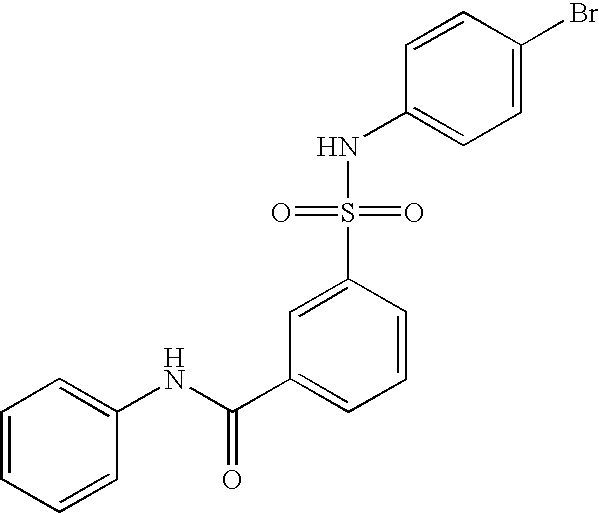
3-(4-Bromo-phenylsulfamoyl)-N-phenyl-benzamide WO 2005087217 235 
4-Chlorobenzanilide Chemische Berichte(1964), 97(2), 472-9. 236 
3-Methyl-N-p-tolyl-benzamide US 2004235888 237 
4-Chloro-N-(3-chloro-phenyl)-benzamide Chemische Berichte(1990), 123(11),2191-4. 238 
4-tert-Butyl-N-(3-methoxy-phenyl)-benzamide DE 3830054 239 
N-Phenyl-4-nitrobenzenecarboxamide Journal of OrganicChemistry (2006),71(9), 3375-3380. 240 
3-Fluoro-N-(3-methoxy-phenyl)-benzamid Magnetic Resonance inChemistry (1997),35(8), 543-548. 241 
4-Acetylamino-3-nitro-N-phenyl-benzamide Journal of MedicinalChemistry (1984),27(8), 1083-9. 242 
3,4-dimethyl-N-phenylbenzamide Journal of the ChemicalSociety (1931), 2323-31. 243 
3-Methoxy-N-(3-methoxy-phenyl)-benzamide Journal of OrganicChemistry (1958), 23,349-53. 244 
3-Methyl-N-m-tolyl-benzamide Helvetica Chimica Acta(1963), 46(4), 1148-50. 245 
N-(3,4-Dichloro-phenyl)-4-trifluoromethyl-benzamide CH 609558 246 
N-(3,4-Dichloro-phenyl)-2-methyl-benzamide Pesticide Biochemistryand Physiology (1989),34(3), 255-76. 247 
2-Chloro-N-(3,4-dichloro-phenyl)-benzamide Zhurnal ObshcheiKhimii (1966), 36(4),638-9. 248 
4-Bromo-N-(3-methoxy-phenyl)-benzamide Journal of the ChemicalSociety, Transactions(1925), 127, 990-5. 249 
4-Isopropyl-N-phenyl-benzamide Helvetica Chimica Acta(1958), 41, 1606-32. 250 
4-Chloro-N-(3-methoxy-phenyl)-benzamide Taehan Hwahakhoe Chi(1972), 17(3), 193-7. 251 
4-tert-Butyl-N-phenyl-benzamide Nippon NoyakuGakkaishi (1985), 10(4),697-702. 252 
4-Diethylamino-N-phenyl-benzamide Tetrahedron Letters(1971), (4), 321-2. 253 
N-(4-Chloro-phenyl)-benzamide Journal of MedicinalChemistry (1989),32(5), 1033-8. 254 
N-(3,5-Dimethoxy-phenyl)-4-methoxy-benzamide Monatshefte fuerChemie (1931), 5763-70. 255 
N-(4-Methoxy-phenyl)-3-methyl-benzamide Journal ofCombinatorialChemistry (2002),4(6), 549-551. 256 
N-(3-Chloro-phenyl)-4-methoxy-benzamide Journal of PhysicalOrganic Chemistry(1994), 7(6), 273-9. 257 
3-Methyl-N-phenyl-benzamide Chemische Berichte(1990), 123(11),2191-4. 258 
4-Methyl-N-phenyl-benzamide Chemische Berichte(1990), 123(11),2191-4. 259 
N-(3-Chloro-phenyl)-4-methyl-benzamide Journal of PhysicalOrganic Chemistry(1994), 7(6), 273-9. 260 
N-(3-Chloro-phenyl)-benzamide Journal of PhysicalOrganic Chemistry(1994), 7(6), 273-9. 261 
N-(3,4-Dichloro-phenyl)-2-methoxy-benzamide Archiv der Pharmazie(Weinheim, Germany)(1988), 321(7), 419-22. 262 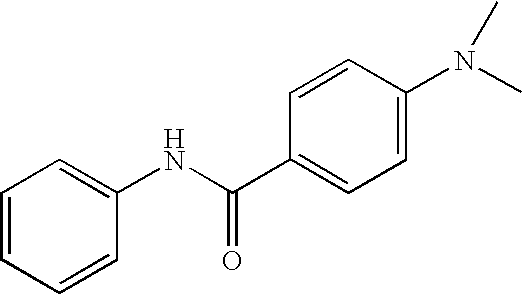
4-Dimethylamino-N-phenyl-benzamide Helvetica ChimicaActa (1919), 2, 717-9. 263 
2,4-Dichloro-N-(3,4-dichloro-phenyl)-benzamide Journal of Pharmacyand Pharmacology(1964), 16(3), 163-73. 264 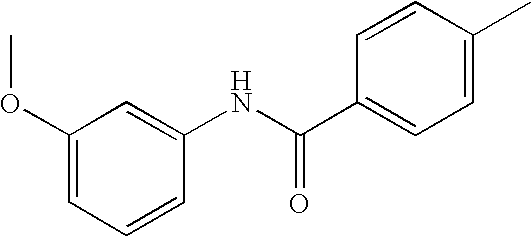
N-(3-Methoxy-phenyl)-4-methyl-benzamide Journal of MedicinalChemistry (1986),29(5), 820-5. 265 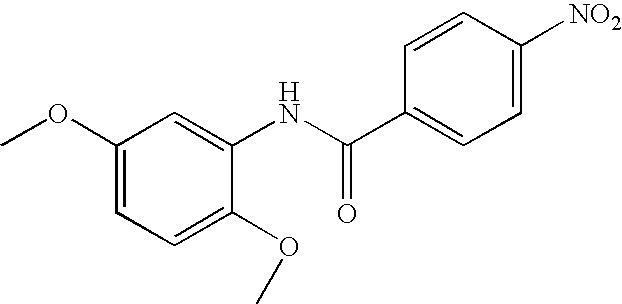
N-(2,5-Dimethoxy-phenyl)-4-nitro-benzamide EP 661266 266 
4-Methoxy-N-(3-methoxy-phenyl)-benzamide Australian Journal ofChemistry (1984),37(4), 831-44. 267 
3,4-Dichloro-N-methyl-N-phenyl-benzamide Farmaco, EdizioneScientifica (1969),24(12), 1025-37. 268 
3,4-Dimethoxy-N-(3-methoxy-phenyl)-benzamide Bulletin de la SocieteChimique de France(1965), (3), 848-58. 269 
4-Methoxy-N-phenyl-benzamide Journal of PhysicalOrganic Chemistry(1994), 7(6), 273-9. 270 
N-Phenyl-benzamide Journal of PhysicalOrganic Chemistry(1994), 7(6), 273-9. 271 
N-(3-Methoxy-phenyl)-benzamide Journal of the AmericanChemical Society(1958), 80 3328-32. 272 
N-p-Tolyl-benzamide Journal of PhysicalOrganic Chemistry(1994), 7(6), 273-9. 273 
4-Chloro-N-(2,5-dimethoxy-phenyl)-benzamide Perkin 1 (2000), (2),205-210. 274 
N-(2,5-Dimethoxy-phenyl)-3-nitro-benzamide EP 440195 275 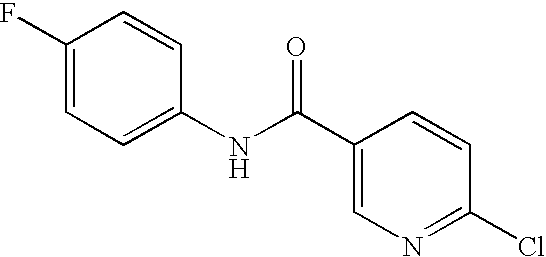
6-Chloro-N-(4-fluoro-phenyl)-nicotinamide WO02/053544 -
Reference Example Structure Chemical name (SciFinder) 276 N-Phenyl-benzamide 
93-98-1 277 N-(4-Chloro-phenyl)-benzamide 
2866-82-2 278 4-Methoxy-N-phenyl-benzamide 
7465-88-5 279 4-Methyl-N-phenyl-benzamide 
6833-18-7 280 4-Chloro-N-phenyl-benzamide 
6833-15-4 281 4-Chloro-N-(3-chloro-phenyl)-benzamide 
2447-96-3 282 3,4-Dichloro-N-(4-chloro-phenyl)-benzamide 
06.04.2448 283 3,4-Dichloro-N-(3-chloro-phenyl)-benzamide 
05.03.2448 284 N-(3,4-Dichloro-phenyl)-4-trifluoromethyl-benzamide 
56661-54-2 285 Ethyl p-(2,3,4,5-tetrahydro-1-benzothiepin-7-carboxamido)benzoate 
129790-95-0 286 4-Methoxy-N-(3-methoxy-phenyl)-benzamide 
91099-22-8 287 N-(3-Chloro-phenyl)-4-methoxy-benzamide 
7465-93-2 288 N-(3-Methoxy-phenyl)-benzamide 
13031-49-7 289 4-Nitro-N-phenyl-benzamide 
3460-11-5 290 4-tert-Butyl-N-(3-methoxy-phenyl)-benzamide 
129504-97-8 291 N-(3,5-Dimethoxy-phenyl)-4-nitro-benzamide 
152586-91-9 292 3-Fluoro-N-(3-methoxy-phenyl)-benzamide 
195378-99-5 293 N-(3,4-Dichloro-phenyl)-2-methoxy-benzamide 
117367-18-7 294 N-(3,5-Dimethoxy-phenyl)-4-methoxy-benzamide 
134029-84-8 295 N-(4-Chloro-phenyl)-3-methyl-benzamide 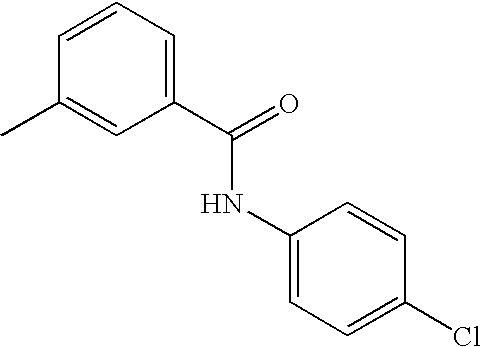
81636-14-8 296 3-Methyl-N-m-tolyl-benzamide 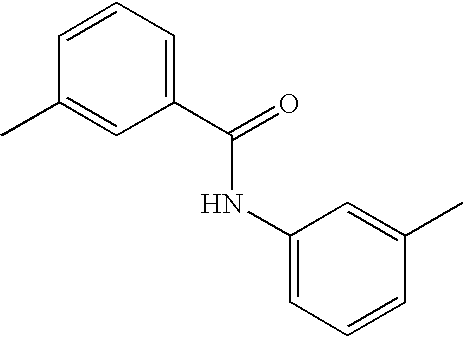
53205-69-9 297 3-Bromo-N-(3-fluoro-phenyl)-benzamide 
206062-09-1 298 N-(3-Chloro-phenyl)-3-methyl-benzamide 
96749-32-5 299 N-(3,4-Dichloro-phenyl)-3-methyl-benzamide 
102587-39-3 300 N-(2,5-Dimethoxy-phenyl)-4-nitro-benzamide 
169945-47-5 301 3-Methyl-N-phenyl-benzamide 
23099-05-0 302 4-Bromo-N-(3-methoxy-phenyl)-benzamide 
313268-57-4 303 N-(3-Methoxy-phenyl)-3-nitro-benzamide 
107915-06-0 304 Naphthalene-2-carboxylicacid (3-methoxy-phenyl)-amide 
88606-02-4 305 4-Chloro-N-(3-methoxy-phenyl)-benzamide 
42182-03-6 306 3,4-Dimethoxy-N-(3-methoxy-phenyl)-benzamide 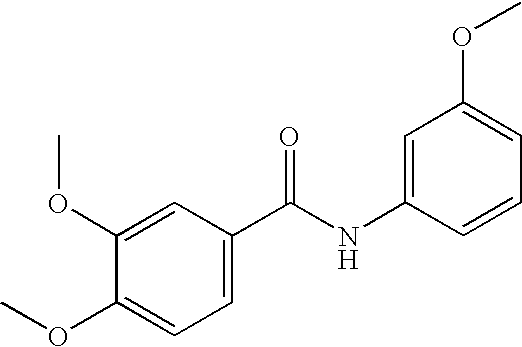
1718-91-8 307 3-Methoxy-N-(3-methoxy-phenyl)-benzamide 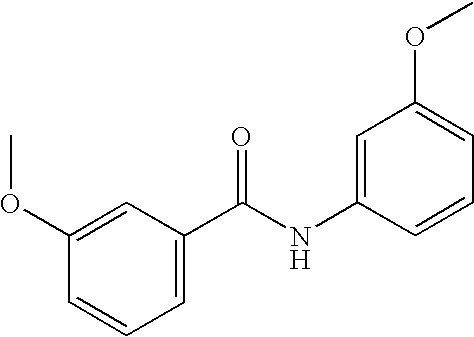
97492-32-5 308 4-Chloro-N-(2,5-dimethoxy-phenyl)-benzamide 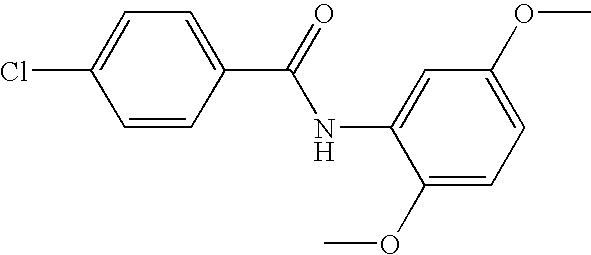
262436-40-8 309 N-(3,4-Dichloro-phenyl)-benzamide 
10286-75-6 310 2-Chloro-N-(3,4-dichloro-phenyl)-benzamide 
7017-22-3 311 N-(2,5-Dimethoxy-phenyl)-3-nitro-benzamide 
142000-62-2 312 3-Nitro-N-phenyl-benzamide 
2243-73-4 313 N-p-Tolyl-benzamide 
582-78-5 314 N-(3-Methoxy-phenyl)-4-methyl-benzamide 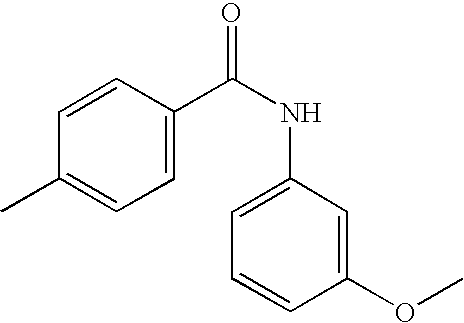
101078-45-9 315 N-(3-Chloro-phenyl)-benzamide 
6004-21-3 316 4-tert!-Butyl-N-phenyl-benzamide 
65861-72-5 317 N-Phenyl-4-trifluoromethyl-benzamide 
347-80-8 318 3-(4-bromo-phenylsulfamoyl)-N-phenyl-benzamide 
347-80-8 319 3,4-Dichloro-N-phenyl-benzamide 
6043-42-1 320 4-Butoxy-N-phenyl-benzamide 
33707-64-1 321 3,4-Dimethyl-N-phenyl-benzamide 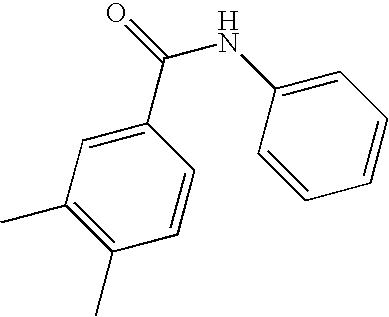
164290-86-2 322 2,4-Dichloro-N-phenyl-benzamide 
6043-39-6 323 N-(3,4-Dichloro-phenyl)-3-fluoro-benzamide 
58954-98-6 324 4-Nitro-N-phenyl-3-trifluoromethyl-benzamide 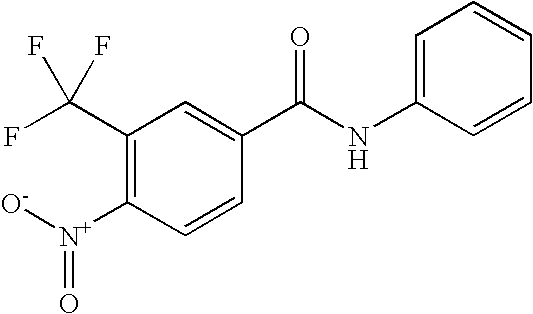
478797-87-4 325 4-Isopropyl-N-phenyl-benzamide 
15088-90-1 326 3,4-Dichloro-N-p-tolyl-benzamide 
6043-43-2 327 3,4-Dichloro-N-methyl-N-phenyl-benzamide 
26094-80-4 328 N-(3-Chloro-phenyl)-4-methyl-benzamide 
81636-13-7 329 3-Methyl-N-p-tolyl-benzamide 
97405-27-1 330 N-(4-Methoxy-phenyl)-3-methyl-benzamide 
313367-17-8 331 2,4-Dichloro-N-(3,4-dichloro-phenyl)-benzamide 
83426-48-6 332 N-(3,4-Dichloro-phenyl)-2-methyl-benzamide 
71267-58-8 333 6-Chloro-N-(3-methoxy-phenyl)-nicotinamide 
224817-08-7
Claims (26)


Applications Claiming Priority (2)
| Application Number | Priority Date | Filing Date | Title |
|---|---|---|---|
| EP07113657.6 | 2007-08-02 | ||
| EP07113657 | 2007-08-02 |
Publications (1)
| Publication Number | Publication Date |
|---|---|
| US20090036420A1 true US20090036420A1 (en) | 2009-02-05 |
Family
ID=39748897
Family Applications (1)
| Application Number | Title | Priority Date | Filing Date |
|---|---|---|---|
| US12/180,566 Abandoned US20090036420A1 (en) | 2007-08-02 | 2008-07-28 | Benzamide derivatives and their use for treating cns disorders |
Country Status (13)
| Country | Link |
|---|---|
| US (1) | US20090036420A1 (en) |
| EP (1) | EP2182935A1 (en) |
| JP (1) | JP2010535172A (en) |
| KR (1) | KR20100039429A (en) |
| CN (1) | CN101765425A (en) |
| AR (1) | AR068049A1 (en) |
| AU (1) | AU2008281877A1 (en) |
| BR (1) | BRPI0815038A2 (en) |
| CA (1) | CA2695071A1 (en) |
| CL (1) | CL2008002246A1 (en) |
| PE (1) | PE20090509A1 (en) |
| TW (1) | TW200911736A (en) |
| WO (1) | WO2009016088A1 (en) |
Cited By (39)
| Publication number | Priority date | Publication date | Assignee | Title |
|---|---|---|---|---|
| US20100113782A1 (en) * | 2008-10-30 | 2010-05-06 | David Robert Bolin | Diacylglycerol Acyltransferase Inhibitors |
| US20110009622A1 (en) * | 2008-04-24 | 2011-01-13 | Makoto Jitsuoka | Long-chain fatty acyl elongase inhibitor comprising arylsulfonyl derivative as active ingredient |
| WO2011076678A1 (en) * | 2009-12-22 | 2011-06-30 | F. Hoffmann-La Roche Ag | Substituted benzamide derivatives |
| CN103068379A (en) * | 2010-08-02 | 2013-04-24 | 霍夫曼-拉罗奇有限公司 | Combinations containing atypical antipsychotics and TAAR1 agonists |
| WO2014106019A3 (en) * | 2012-12-27 | 2014-09-18 | Philadelphia Health & Education Corporation, D/B/A Drexel | Novel antiviral agents against hbv infection |
| US8912336B2 (en) | 2009-11-06 | 2014-12-16 | Vanderbilt University | Aryl and heteroaryl sulfones as mGluR4 allosteric potentiators, compositions, and methods of treating neurological dysfunction |
| US9029370B2 (en) | 2011-06-10 | 2015-05-12 | Hoffmann-La Roche Inc. | Substituted benzamide derivatives |
| US9169212B2 (en) | 2014-01-16 | 2015-10-27 | Novira Therapeutics, Inc. | Azepane derivatives and methods of treating hepatitis B infections |
| US9181288B2 (en) | 2014-01-16 | 2015-11-10 | Novira Therapeutics, Inc. | Azepane derivatives and methods of treating hepatitis B infections |
| US9206125B2 (en) | 2010-02-10 | 2015-12-08 | Public University Corporation Yokohama City University | Use of compound binding to mSin3B that specifically binds to neuron restrictive silencer factor (NRSF) |
| US9884831B2 (en) | 2015-03-19 | 2018-02-06 | Novira Therapeutics, Inc. | Azocane and azonane derivatives and methods of treating hepatitis B infections |
| US9884818B2 (en) | 2013-05-17 | 2018-02-06 | Janssen Sciences Ireland Uc | Sulphamoylpyrrolamide derivatives and the use thereof as medicaments for the treatment of hepatitis B |
| US9895349B2 (en) | 2013-04-03 | 2018-02-20 | Janssen Sciences Ireland Us | N-phenyl-carboxamide derivatives and the use thereof as medicaments for the treatment of hepatitis B |
| US10071961B2 (en) | 2013-10-23 | 2018-09-11 | Janssen Sciences Ireland Uc | Carboxamide derivatives and the use thereof as medicaments for the treatment of hepatitis B |
| US10077239B2 (en) | 2015-09-29 | 2018-09-18 | Novira Therapeutics, Inc. | Crystalline forms of a hepatitis B antiviral agent |
| US10125094B2 (en) | 2013-02-28 | 2018-11-13 | Janssen Sciences Ireland Uc | Sulfamoyl-arylamides and the use thereof as medicaments for the treatment of hepatitis B |
| WO2018232264A1 (en) * | 2017-06-15 | 2018-12-20 | The Board Of Regents Of The University Of Oklahoma | Benzamide derivatives for inhibiting endoplasmic reticulum (er) stress |
| US10160743B2 (en) | 2013-05-17 | 2018-12-25 | Janssen Sciences Ireland Uc | Sulphamoylthiophenamide derivatives and the use thereof as medicaments for the treatment of hepatitis B |
| US10196376B2 (en) | 2011-12-21 | 2019-02-05 | Novira Therapeutics, Inc. | Hepatitis B antiviral agents |
| US10213420B2 (en) | 2014-02-05 | 2019-02-26 | Novira Therapeutics, Inc. | Combination therapy for treatment of HBV infections |
| US10392349B2 (en) | 2014-01-16 | 2019-08-27 | Novira Therapeutics, Inc. | Azepane derivatives and methods of treating hepatitis B infections |
| US10441589B2 (en) | 2016-04-15 | 2019-10-15 | Novira Therapeutics, Inc. | Combinations and methods comprising a capsid assembly inhibitor |
| US10450270B2 (en) | 2013-07-25 | 2019-10-22 | Janssen Sciences Ireland Uc | Glyoxamide substituted pyrrolamide derivatives and the use thereof as medicaments for the treatment of hepatitis B |
| US10508107B2 (en) | 2016-03-17 | 2019-12-17 | Hoffmann-La Roche Inc. | Morpholine derivative |
| US10676429B2 (en) | 2012-08-28 | 2020-06-09 | Janssen Sciences Ireland Uc | Sulfamoyl-arylamides and the use thereof as medicaments for the treatment of hepatitis B |
| WO2020168096A1 (en) * | 2019-02-13 | 2020-08-20 | Yale University | Methods of treating epilepsy |
| US10875876B2 (en) | 2015-07-02 | 2020-12-29 | Janssen Sciences Ireland Uc | Cyclized sulfamoylarylamide derivatives and the use thereof as medicaments for the treatment of hepatitis B |
| US10934306B2 (en) | 2016-03-07 | 2021-03-02 | Enanta Pharmaceuticals, Inc. | Hepatitis B antiviral agents |
| US10973801B2 (en) | 2018-03-14 | 2021-04-13 | Janssen Sciences Ireland Unlimited Company | Capsid assembly modulator dosing regimen |
| US11078193B2 (en) | 2014-02-06 | 2021-08-03 | Janssen Sciences Ireland Uc | Sulphamoylpyrrolamide derivatives and the use thereof as medicaments for the treatment of hepatitis B |
| US11096931B2 (en) | 2019-02-22 | 2021-08-24 | Janssen Sciences Ireland Unlimited Company | Amide derivatives useful in the treatment of HBV infection or HBV-induced diseases |
| US11236108B2 (en) | 2019-09-17 | 2022-02-01 | Enanta Pharmaceuticals, Inc. | Functionalized heterocycles as antiviral agents |
| US20220048866A1 (en) * | 2018-09-13 | 2022-02-17 | University Of Southern California | Novel inhibitors of guanosine monophosphate synthetase as therapeutic agents |
| US11377450B2 (en) | 2018-09-21 | 2022-07-05 | Enanta Pharmaceuticals, Inc. | Functionalized heterocycles as antiviral agents |
| US11491148B2 (en) | 2019-05-06 | 2022-11-08 | Janssen Sciences Ireland Unlimited Company | Amide derivatives useful in the treatment of HBV infection or HBV-induced diseases |
| US11596611B2 (en) | 2017-08-28 | 2023-03-07 | Enanta Pharmaceuticals, Inc. | Hepatitis B antiviral agents |
| US11738019B2 (en) | 2019-07-11 | 2023-08-29 | Enanta Pharmaceuticals, Inc. | Substituted heterocycles as antiviral agents |
| US11802125B2 (en) | 2020-03-16 | 2023-10-31 | Enanta Pharmaceuticals, Inc. | Functionalized heterocyclic compounds as antiviral agents |
| US11891393B2 (en) | 2018-11-21 | 2024-02-06 | Enanta Pharmaceuticals, Inc. | Functionalized heterocycles as antiviral agents |
Families Citing this family (29)
| Publication number | Priority date | Publication date | Assignee | Title |
|---|---|---|---|---|
| EP3725775A1 (en) | 2009-02-17 | 2020-10-21 | Syntrix Biosystems, Inc. | Pyridine- and pyrimidinecarboxamides as cxcr2 modulators |
| JP2011057661A (en) * | 2009-08-14 | 2011-03-24 | Bayer Cropscience Ag | Pesticidal carboxamides |
| WO2011048525A1 (en) * | 2009-10-20 | 2011-04-28 | Pfizer Inc. | Novel heteroaryl imidazoles and heteroaryl triazoles as gamma-secretase modulators |
| US10640457B2 (en) | 2009-12-10 | 2020-05-05 | The Trustees Of Columbia University In The City Of New York | Histone acetyltransferase activators and uses thereof |
| EP2509590B1 (en) * | 2009-12-10 | 2019-10-30 | The Trustees of Columbia University in the City of New York | Histone acetyltransferase activators and uses thereof |
| JP5733839B2 (en) * | 2010-03-26 | 2015-06-10 | 国立大学法人北海道大学 | Drugs for neurodegenerative diseases |
| EP2608672B1 (en) * | 2010-08-23 | 2020-12-16 | Syntrix Biosystems, Inc. | Aminopyridine- and aminopyrimidinecarboxamides as cxcr2 modulators |
| ES2820863T3 (en) | 2010-12-22 | 2021-04-22 | Univ Columbia | Histone acetyltransferase modulators and their uses |
| US8802673B2 (en) * | 2011-03-24 | 2014-08-12 | Hoffmann-La Roche Inc | Heterocyclic amine derivatives |
| WO2013006394A1 (en) * | 2011-07-01 | 2013-01-10 | Institute For Hepatitis And Virus Research | Sulfamoylbenzamide derivatives as antiviral agents against hbv infection |
| EA201492007A1 (en) | 2012-05-15 | 2015-03-31 | Новартис Аг | DERIVATIVES OF BENZAMIDE FOR INHIBITION OF ABL1, ABL2 AND BCR-ABL1 ACTIVITY |
| BR112014027584B1 (en) | 2012-05-15 | 2023-01-24 | Novartis Ag | USE OF INHIBITORS OF ABL1, ABL2 AND BCR-ABL1 ACTIVITY, AND PHARMACEUTICAL COMPOSITION |
| SG11201407152XA (en) | 2012-05-15 | 2014-11-27 | Novartis Ag | Benzamide derivatives for inhibiting the activity of abl1, abl2 and bcr-abl1 |
| CN104379574B (en) | 2012-05-15 | 2017-03-01 | 诺华股份有限公司 | For suppressing the heterocyclic carbamate derivatives of the activity of ABL1, ABL2 and BCR ABL1 |
| MX2015003330A (en) * | 2012-09-13 | 2015-06-05 | Hoffmann La Roche | 2-oxo-2,3-dihydro-indoles for the treatment of cns disorders. |
| JP6293770B2 (en) * | 2012-11-05 | 2018-03-14 | ナント ホールディングス アイピー,エルエルシー | Cyclic sulfonamide-containing derivatives as hedgehog signaling pathway inhibitors |
| MX2015005721A (en) * | 2012-11-07 | 2015-09-08 | Hoffmann La Roche | Pyrazine derivatives. |
| WO2014165128A2 (en) | 2013-03-12 | 2014-10-09 | Novira Therapeutics, Inc. | Hepatitis b antiviral agents |
| US10046002B2 (en) | 2013-08-02 | 2018-08-14 | Syntrix Biosystems Inc. | Method for treating cancer using chemokine antagonists |
| US10561676B2 (en) | 2013-08-02 | 2020-02-18 | Syntrix Biosystems Inc. | Method for treating cancer using dual antagonists of CXCR1 and CXCR2 |
| US8969365B2 (en) | 2013-08-02 | 2015-03-03 | Syntrix Biosystems, Inc. | Thiopyrimidinecarboxamides as CXCR1/2 modulators |
| US9400280B2 (en) | 2014-03-27 | 2016-07-26 | Novira Therapeutics, Inc. | Piperidine derivatives and methods of treating hepatitis B infections |
| WO2016001452A1 (en) * | 2014-07-04 | 2016-01-07 | Universität Zürich | Compounds, in particular for use in the treatment of a disease or condition for which a bromodomain inhibitor is indicated |
| EP3463359A4 (en) * | 2016-06-02 | 2020-08-26 | Purdue Pharma LP | SPURENAMINE-ASSOCIATED RECEPTOR-1 AGONISTS AND PARTIAL AGONISTS FOR PAIN MANAGEMENT |
| US10660909B2 (en) | 2016-11-17 | 2020-05-26 | Syntrix Biosystems Inc. | Method for treating cancer using chemokine antagonists |
| JP7402467B2 (en) * | 2019-01-30 | 2023-12-21 | 慶應義塾 | Parkinson's disease drug |
| CN112480106B (en) * | 2020-11-17 | 2022-09-02 | 南京海纳医药科技股份有限公司 | Preparation method of Alvatripopa maleate impurity |
| CN114478360B (en) * | 2022-02-10 | 2023-08-15 | 江苏海洋大学 | Benzamide derivative and preparation method and application thereof |
| WO2024223320A1 (en) * | 2023-04-24 | 2024-10-31 | Unilever Ip Holdings B.V. | Cosmetic compositions for maintaining and restoring skin barrier function |
Citations (44)
| Publication number | Priority date | Publication date | Assignee | Title |
|---|---|---|---|---|
| US2161938A (en) * | 1934-07-31 | 1939-06-13 | Soc Of Chemical Ind | Imidazolines |
| US2368723A (en) * | 1941-06-24 | 1945-02-06 | Celanese Corp | Dyeing of cellulose derivatives with nitro dyes |
| US2457047A (en) * | 1946-02-13 | 1948-12-21 | Monsanto Chemicals | 2-(2'-thenyl)-4, 5-dihydroimidazoles and process for making the same |
| US2731471A (en) * | 1956-01-17 | Nxg hi | ||
| US2744910A (en) * | 1955-06-27 | 1956-05-08 | Bristol Lab Inc | 2-(ortho-benzylbenzyl)-imidazoline and acid addition salts |
| US2744909A (en) * | 1955-06-27 | 1956-05-08 | Bristol Lab Inc | 2-(ortho-phenylbenzyl) imidazoline and acid addition salts |
| US2778836A (en) * | 1954-04-02 | 1957-01-22 | Union Chimique Belge Sa | Substituted 2-methyl-delta2 imidazolines |
| US2919274A (en) * | 1957-09-17 | 1959-12-29 | Sahyun Melville | Amidines |
| US3161653A (en) * | 1960-11-23 | 1964-12-15 | Merck Ag E | 2-[(2'-methyl-benzo-thienyl-3')-methyl]-delta2-imidazoline and its pharmaceutically aceptable acid addition salts |
| US3354175A (en) * | 1962-04-12 | 1967-11-21 | Merck Ag E | 2-(2', 5'-dialkoxybenzyl)-2-imidazolines and related compounds |
| US3377247A (en) * | 1967-04-28 | 1968-04-09 | Dow Chemical Co | Antidepressant method |
| US3586695A (en) * | 1968-01-26 | 1971-06-22 | Dow Chemical Co | Substituted imidazolinyl indoles |
| US3622579A (en) * | 1969-08-28 | 1971-11-23 | Boehringer Sohn Ingelheim | Derivatives of 2-anilino-1,3-diazacyclopentene-(2) |
| US3660423A (en) * | 1970-02-13 | 1972-05-02 | Dow Chemical Co | 2-(substituted benzyl)methyl-2-imidazolines |
| US3758476A (en) * | 1969-08-13 | 1973-09-11 | Hoechst Ag | 2-(thienyl-3'-amino)-1,3-diazacycloalkenes |
| US3818094A (en) * | 1969-08-28 | 1974-06-18 | Boehringer Sohn Ingelheim | Hypotensive pharmaceutical compositions containing certain 2-anilino-1,3-diazacyclopentenes-(2) |
| US3818035A (en) * | 1971-01-27 | 1974-06-18 | Labaz | 2{8 (2-ALKYLBENZO{8 b{9 {11 FURAN-3 yl)METHYL{9 -{66 {11 IMIDAZOLINE |
| US3863007A (en) * | 1971-05-21 | 1975-01-28 | Jr Paul L Warner | Sunscreening method containing 4-di (lower)alkylaminobenzamides |
| US3981814A (en) * | 1973-09-18 | 1976-09-21 | Givaudan Corporation | Bacteriostatic substituted benzanilide compositions and methods for their use |
| US3992403A (en) * | 1975-05-30 | 1976-11-16 | Schering Corporation | 2-Imidazolines and their use as hypoglycemic agents |
| US4125620A (en) * | 1974-10-01 | 1978-11-14 | Boehringer Ingelheim Gmbh | 2-[(2',6'-Disubstituted-phenyl)-imino]-imidazolidines and salts thereof |
| US4146647A (en) * | 1976-01-26 | 1979-03-27 | Laboratoire L. Lafon | Substituted phenyl-amidines |
| US4284813A (en) * | 1978-12-05 | 1981-08-18 | Hodogaya Chemical Co., Ltd. | Benzamide derivatives and herbicidal composition containing the same |
| US4311840A (en) * | 1980-11-13 | 1982-01-19 | E. R. Squibb & Sons, Inc. | 2,3,6,7-Tetrahydro-2-thioxo-4H-oxazolo[3,2-a]-1,3,5 triazin-4-ones |
| US4323570A (en) * | 1978-11-15 | 1982-04-06 | Beiersdorf Aktiengesellschaft | Substituted aminopyrimidines |
| US4379165A (en) * | 1981-05-18 | 1983-04-05 | Research Corporation | Anti-convulsant |
| US4638014A (en) * | 1985-08-26 | 1987-01-20 | Research Corporation | Anticonvulsant method and formulations |
| US4642379A (en) * | 1985-08-30 | 1987-02-10 | Eli Lilly And Company | Intermediates for anticonvulsant agents |
| US4665095A (en) * | 1985-12-11 | 1987-05-12 | Abbott Laboratories | Use of 2-[(3,5-dihalo-4-aminobenzyl)]imidazolines to stimulate alpha-1 adrenergic receptors and to treat nasal congestion |
| US5135949A (en) * | 1988-09-03 | 1992-08-04 | Boehringer Mannheim Gmbh | Pharmaceutical compositions containing phenylamides |
| US5610174A (en) * | 1995-06-02 | 1997-03-11 | Synaptic Pharmaceutical Corporation | Use of α1A -selective adrenoceptor agonists for the treatment of urinary incontinence |
| US5658938A (en) * | 1994-12-14 | 1997-08-19 | U C B S.A. | Substituted 1H-imidazoles |
| US5854245A (en) * | 1996-06-28 | 1998-12-29 | Merck & Co., Inc. | Fibrinogen receptor antagonists |
| US6268389B1 (en) * | 1995-04-20 | 2001-07-31 | Boehringer Ingelheim Kg | Treatment of urinary incontinence by administration of α1L-adrenoceptor agonists |
| US20010044445A1 (en) * | 1999-04-08 | 2001-11-22 | Bamaung Nwe Y. | Azole inhibitors of cytokine production |
| US20020019390A1 (en) * | 1997-04-11 | 2002-02-14 | Synaptic Pharmaceutical Corporation | Imidazole and imidazoline derivatives and uses thereof |
| US20020091122A1 (en) * | 1999-08-04 | 2002-07-11 | Icagen, Inc. | Benzanilides as potassium channel openers |
| US20030105135A1 (en) * | 1999-12-17 | 2003-06-05 | Bovy Philippe R | Phenoxypropanolamines, preparation and therapeutic use thereof |
| US20030181354A1 (en) * | 2002-01-31 | 2003-09-25 | Muhammad Abdulrazik | Method for central nervous system targeting through the ocular route of drug delivery |
| US20030236274A1 (en) * | 1998-04-23 | 2003-12-25 | Akihiro Tasaka | Naphthalene derivatives, their production and use |
| US20040235888A1 (en) * | 2001-09-14 | 2004-11-25 | Teruo Yamamori | Utilities of amide compounds |
| US20050085512A1 (en) * | 2003-10-16 | 2005-04-21 | Chih-Hung Lee | Amides that inhibit vanilloid receptor subtype 1 (VR1) receptor |
| US20050171103A1 (en) * | 2002-04-05 | 2005-08-04 | Astrazeneca Ab | Benzamide derivatives useful as histone deacetylase inhibitors |
| US20070238733A1 (en) * | 2006-04-11 | 2007-10-11 | Pramod Joshi | Compositions useful as inhibitors of voltage-gated sodium channels |
Family Cites Families (7)
| Publication number | Priority date | Publication date | Assignee | Title |
|---|---|---|---|---|
| JPH111456A (en) * | 1997-06-13 | 1999-01-06 | Otsuka Pharmaceut Co Ltd | Amide derivative |
| IL162859A0 (en) * | 2002-02-05 | 2005-11-20 | Novo Nordisk As | Novel aryl-and heteroarylpiperazines |
| EP1535609A4 (en) * | 2002-06-10 | 2009-01-07 | Inst Med Molecular Design Inc | NF-KB ACTIVATION INHIBITORS |
| GB0421908D0 (en) * | 2004-10-01 | 2004-11-03 | Angeletti P Ist Richerche Bio | New uses |
| KR20060067738A (en) * | 2004-12-15 | 2006-06-20 | 주식회사 대웅제약 | Novel N-arylamide derivatives exhibiting potent analgesic effects as antagonists of vanilloid receptors and pharmaceutical compositions containing them |
| WO2007049262A1 (en) * | 2005-10-27 | 2007-05-03 | Berand Limited | Methods and compositions for the promotion of neuronal growth and the treatment of asociality and affective disorders |
| JPWO2008029912A1 (en) * | 2006-09-07 | 2010-01-21 | 国立大学法人 岡山大学 | Compound having benzamide as skeleton having cyclooxygenase 1 (COX-1) selective inhibitory activity |
-
2008
- 2008-07-24 BR BRPI0815038 patent/BRPI0815038A2/en not_active IP Right Cessation
- 2008-07-24 AU AU2008281877A patent/AU2008281877A1/en not_active Abandoned
- 2008-07-24 CN CN200880101002A patent/CN101765425A/en active Pending
- 2008-07-24 EP EP08786390A patent/EP2182935A1/en not_active Withdrawn
- 2008-07-24 KR KR1020107004579A patent/KR20100039429A/en not_active Ceased
- 2008-07-24 CA CA2695071A patent/CA2695071A1/en not_active Abandoned
- 2008-07-24 JP JP2010518626A patent/JP2010535172A/en active Pending
- 2008-07-24 WO PCT/EP2008/059698 patent/WO2009016088A1/en not_active Ceased
- 2008-07-28 US US12/180,566 patent/US20090036420A1/en not_active Abandoned
- 2008-07-30 AR ARP080103286A patent/AR068049A1/en unknown
- 2008-07-31 PE PE2008001288A patent/PE20090509A1/en not_active Application Discontinuation
- 2008-07-31 CL CL2008002246A patent/CL2008002246A1/en unknown
- 2008-08-01 TW TW097129398A patent/TW200911736A/en unknown
Patent Citations (44)
| Publication number | Priority date | Publication date | Assignee | Title |
|---|---|---|---|---|
| US2731471A (en) * | 1956-01-17 | Nxg hi | ||
| US2161938A (en) * | 1934-07-31 | 1939-06-13 | Soc Of Chemical Ind | Imidazolines |
| US2368723A (en) * | 1941-06-24 | 1945-02-06 | Celanese Corp | Dyeing of cellulose derivatives with nitro dyes |
| US2457047A (en) * | 1946-02-13 | 1948-12-21 | Monsanto Chemicals | 2-(2'-thenyl)-4, 5-dihydroimidazoles and process for making the same |
| US2778836A (en) * | 1954-04-02 | 1957-01-22 | Union Chimique Belge Sa | Substituted 2-methyl-delta2 imidazolines |
| US2744910A (en) * | 1955-06-27 | 1956-05-08 | Bristol Lab Inc | 2-(ortho-benzylbenzyl)-imidazoline and acid addition salts |
| US2744909A (en) * | 1955-06-27 | 1956-05-08 | Bristol Lab Inc | 2-(ortho-phenylbenzyl) imidazoline and acid addition salts |
| US2919274A (en) * | 1957-09-17 | 1959-12-29 | Sahyun Melville | Amidines |
| US3161653A (en) * | 1960-11-23 | 1964-12-15 | Merck Ag E | 2-[(2'-methyl-benzo-thienyl-3')-methyl]-delta2-imidazoline and its pharmaceutically aceptable acid addition salts |
| US3354175A (en) * | 1962-04-12 | 1967-11-21 | Merck Ag E | 2-(2', 5'-dialkoxybenzyl)-2-imidazolines and related compounds |
| US3377247A (en) * | 1967-04-28 | 1968-04-09 | Dow Chemical Co | Antidepressant method |
| US3586695A (en) * | 1968-01-26 | 1971-06-22 | Dow Chemical Co | Substituted imidazolinyl indoles |
| US3758476A (en) * | 1969-08-13 | 1973-09-11 | Hoechst Ag | 2-(thienyl-3'-amino)-1,3-diazacycloalkenes |
| US3622579A (en) * | 1969-08-28 | 1971-11-23 | Boehringer Sohn Ingelheim | Derivatives of 2-anilino-1,3-diazacyclopentene-(2) |
| US3818094A (en) * | 1969-08-28 | 1974-06-18 | Boehringer Sohn Ingelheim | Hypotensive pharmaceutical compositions containing certain 2-anilino-1,3-diazacyclopentenes-(2) |
| US3660423A (en) * | 1970-02-13 | 1972-05-02 | Dow Chemical Co | 2-(substituted benzyl)methyl-2-imidazolines |
| US3818035A (en) * | 1971-01-27 | 1974-06-18 | Labaz | 2{8 (2-ALKYLBENZO{8 b{9 {11 FURAN-3 yl)METHYL{9 -{66 {11 IMIDAZOLINE |
| US3863007A (en) * | 1971-05-21 | 1975-01-28 | Jr Paul L Warner | Sunscreening method containing 4-di (lower)alkylaminobenzamides |
| US3981814A (en) * | 1973-09-18 | 1976-09-21 | Givaudan Corporation | Bacteriostatic substituted benzanilide compositions and methods for their use |
| US4125620A (en) * | 1974-10-01 | 1978-11-14 | Boehringer Ingelheim Gmbh | 2-[(2',6'-Disubstituted-phenyl)-imino]-imidazolidines and salts thereof |
| US3992403A (en) * | 1975-05-30 | 1976-11-16 | Schering Corporation | 2-Imidazolines and their use as hypoglycemic agents |
| US4146647A (en) * | 1976-01-26 | 1979-03-27 | Laboratoire L. Lafon | Substituted phenyl-amidines |
| US4323570A (en) * | 1978-11-15 | 1982-04-06 | Beiersdorf Aktiengesellschaft | Substituted aminopyrimidines |
| US4284813A (en) * | 1978-12-05 | 1981-08-18 | Hodogaya Chemical Co., Ltd. | Benzamide derivatives and herbicidal composition containing the same |
| US4311840A (en) * | 1980-11-13 | 1982-01-19 | E. R. Squibb & Sons, Inc. | 2,3,6,7-Tetrahydro-2-thioxo-4H-oxazolo[3,2-a]-1,3,5 triazin-4-ones |
| US4379165A (en) * | 1981-05-18 | 1983-04-05 | Research Corporation | Anti-convulsant |
| US4638014A (en) * | 1985-08-26 | 1987-01-20 | Research Corporation | Anticonvulsant method and formulations |
| US4642379A (en) * | 1985-08-30 | 1987-02-10 | Eli Lilly And Company | Intermediates for anticonvulsant agents |
| US4665095A (en) * | 1985-12-11 | 1987-05-12 | Abbott Laboratories | Use of 2-[(3,5-dihalo-4-aminobenzyl)]imidazolines to stimulate alpha-1 adrenergic receptors and to treat nasal congestion |
| US5135949A (en) * | 1988-09-03 | 1992-08-04 | Boehringer Mannheim Gmbh | Pharmaceutical compositions containing phenylamides |
| US5658938A (en) * | 1994-12-14 | 1997-08-19 | U C B S.A. | Substituted 1H-imidazoles |
| US6268389B1 (en) * | 1995-04-20 | 2001-07-31 | Boehringer Ingelheim Kg | Treatment of urinary incontinence by administration of α1L-adrenoceptor agonists |
| US5610174A (en) * | 1995-06-02 | 1997-03-11 | Synaptic Pharmaceutical Corporation | Use of α1A -selective adrenoceptor agonists for the treatment of urinary incontinence |
| US5854245A (en) * | 1996-06-28 | 1998-12-29 | Merck & Co., Inc. | Fibrinogen receptor antagonists |
| US20020019390A1 (en) * | 1997-04-11 | 2002-02-14 | Synaptic Pharmaceutical Corporation | Imidazole and imidazoline derivatives and uses thereof |
| US20030236274A1 (en) * | 1998-04-23 | 2003-12-25 | Akihiro Tasaka | Naphthalene derivatives, their production and use |
| US20010044445A1 (en) * | 1999-04-08 | 2001-11-22 | Bamaung Nwe Y. | Azole inhibitors of cytokine production |
| US20020091122A1 (en) * | 1999-08-04 | 2002-07-11 | Icagen, Inc. | Benzanilides as potassium channel openers |
| US20030105135A1 (en) * | 1999-12-17 | 2003-06-05 | Bovy Philippe R | Phenoxypropanolamines, preparation and therapeutic use thereof |
| US20040235888A1 (en) * | 2001-09-14 | 2004-11-25 | Teruo Yamamori | Utilities of amide compounds |
| US20030181354A1 (en) * | 2002-01-31 | 2003-09-25 | Muhammad Abdulrazik | Method for central nervous system targeting through the ocular route of drug delivery |
| US20050171103A1 (en) * | 2002-04-05 | 2005-08-04 | Astrazeneca Ab | Benzamide derivatives useful as histone deacetylase inhibitors |
| US20050085512A1 (en) * | 2003-10-16 | 2005-04-21 | Chih-Hung Lee | Amides that inhibit vanilloid receptor subtype 1 (VR1) receptor |
| US20070238733A1 (en) * | 2006-04-11 | 2007-10-11 | Pramod Joshi | Compositions useful as inhibitors of voltage-gated sodium channels |
Cited By (69)
| Publication number | Priority date | Publication date | Assignee | Title |
|---|---|---|---|---|
| US8420823B2 (en) * | 2008-04-24 | 2013-04-16 | Msd K.K. | Long-chain fatty acyl elongase inhibitor comprising arylsulfonyl derivative as active ingredient |
| US20110009622A1 (en) * | 2008-04-24 | 2011-01-13 | Makoto Jitsuoka | Long-chain fatty acyl elongase inhibitor comprising arylsulfonyl derivative as active ingredient |
| US20100113782A1 (en) * | 2008-10-30 | 2010-05-06 | David Robert Bolin | Diacylglycerol Acyltransferase Inhibitors |
| US8324385B2 (en) * | 2008-10-30 | 2012-12-04 | Madrigal Pharmaceuticals, Inc. | Diacylglycerol acyltransferase inhibitors |
| US8912336B2 (en) | 2009-11-06 | 2014-12-16 | Vanderbilt University | Aryl and heteroaryl sulfones as mGluR4 allosteric potentiators, compositions, and methods of treating neurological dysfunction |
| CN102686563A (en) * | 2009-12-22 | 2012-09-19 | 霍夫曼-拉罗奇有限公司 | Substituted benzamide derivatives |
| TWI409261B (en) * | 2009-12-22 | 2013-09-21 | Hoffmann La Roche | Substituted benzamide derivative |
| EP3187490A1 (en) * | 2009-12-22 | 2017-07-05 | F. Hoffmann-La Roche AG | Substituted benzamide derivatives |
| US9452980B2 (en) | 2009-12-22 | 2016-09-27 | Hoffmann-La Roche Inc. | Substituted benzamides |
| KR101461296B1 (en) | 2009-12-22 | 2014-11-12 | 에프. 호프만-라 로슈 아게 | Substituted benzamide derivatives |
| WO2011076678A1 (en) * | 2009-12-22 | 2011-06-30 | F. Hoffmann-La Roche Ag | Substituted benzamide derivatives |
| CN105254623A (en) * | 2009-12-22 | 2016-01-20 | 霍夫曼-拉罗奇有限公司 | Substituted benzamides |
| US9206125B2 (en) | 2010-02-10 | 2015-12-08 | Public University Corporation Yokohama City University | Use of compound binding to mSin3B that specifically binds to neuron restrictive silencer factor (NRSF) |
| US20130345201A1 (en) * | 2010-08-02 | 2013-12-26 | Hoffmann-La Roche Inc. | Pharmaceutical combination |
| CN103068379A (en) * | 2010-08-02 | 2013-04-24 | 霍夫曼-拉罗奇有限公司 | Combinations containing atypical antipsychotics and TAAR1 agonists |
| US9132136B2 (en) | 2010-08-02 | 2015-09-15 | Hoffmann-La Roche Inc. | Pharmaceutical combination |
| US9029370B2 (en) | 2011-06-10 | 2015-05-12 | Hoffmann-La Roche Inc. | Substituted benzamide derivatives |
| US10196376B2 (en) | 2011-12-21 | 2019-02-05 | Novira Therapeutics, Inc. | Hepatitis B antiviral agents |
| US10676429B2 (en) | 2012-08-28 | 2020-06-09 | Janssen Sciences Ireland Uc | Sulfamoyl-arylamides and the use thereof as medicaments for the treatment of hepatitis B |
| US10995064B2 (en) | 2012-08-28 | 2021-05-04 | Janssen Sciences Ireland Uc | Sulfamoyl-arylamides and the use thereof as medicaments for the treatment of hepatitis B |
| US9938236B2 (en) | 2012-12-27 | 2018-04-10 | Drexel University | Antiviral agents against HBV infection |
| WO2014106019A3 (en) * | 2012-12-27 | 2014-09-18 | Philadelphia Health & Education Corporation, D/B/A Drexel | Novel antiviral agents against hbv infection |
| US10941113B2 (en) | 2013-02-28 | 2021-03-09 | Janssen Sciences Ireland Uc | Sulfamoyl-arylamides and the use thereof as medicaments for the treatment of hepatitis B |
| US10125094B2 (en) | 2013-02-28 | 2018-11-13 | Janssen Sciences Ireland Uc | Sulfamoyl-arylamides and the use thereof as medicaments for the treatment of hepatitis B |
| US10398677B2 (en) | 2013-04-03 | 2019-09-03 | Janssen Sciences Ireland Uc | N-phenyl-carboxamide derivatives and the use thereof as medicaments for the treatment of hepatitis B |
| US9895349B2 (en) | 2013-04-03 | 2018-02-20 | Janssen Sciences Ireland Us | N-phenyl-carboxamide derivatives and the use thereof as medicaments for the treatment of hepatitis B |
| US10457638B2 (en) | 2013-05-17 | 2019-10-29 | Janssen Sciences Ireland Uc | Sulphamoylpyrrolamide derivatives and the use thereof as medicaments for the treatment of hepatitis B |
| US9884818B2 (en) | 2013-05-17 | 2018-02-06 | Janssen Sciences Ireland Uc | Sulphamoylpyrrolamide derivatives and the use thereof as medicaments for the treatment of hepatitis B |
| US10160743B2 (en) | 2013-05-17 | 2018-12-25 | Janssen Sciences Ireland Uc | Sulphamoylthiophenamide derivatives and the use thereof as medicaments for the treatment of hepatitis B |
| US10450270B2 (en) | 2013-07-25 | 2019-10-22 | Janssen Sciences Ireland Uc | Glyoxamide substituted pyrrolamide derivatives and the use thereof as medicaments for the treatment of hepatitis B |
| US10071961B2 (en) | 2013-10-23 | 2018-09-11 | Janssen Sciences Ireland Uc | Carboxamide derivatives and the use thereof as medicaments for the treatment of hepatitis B |
| US10377709B2 (en) | 2013-10-23 | 2019-08-13 | Janssen Sciences Ireland Uc | Carboxamide derivatives and the use thereof as medicaments for the treatment of hepatitis B |
| US10392349B2 (en) | 2014-01-16 | 2019-08-27 | Novira Therapeutics, Inc. | Azepane derivatives and methods of treating hepatitis B infections |
| US9873671B2 (en) | 2014-01-16 | 2018-01-23 | Novira Therapeutics, Inc. | Azepane derivatives and methods of treating hepatitis B infections |
| US9169212B2 (en) | 2014-01-16 | 2015-10-27 | Novira Therapeutics, Inc. | Azepane derivatives and methods of treating hepatitis B infections |
| US9339510B2 (en) | 2014-01-16 | 2016-05-17 | Novira Therapeutics, Inc. | Azepane derivatives and methods of treating hepatitis B infections |
| US9181288B2 (en) | 2014-01-16 | 2015-11-10 | Novira Therapeutics, Inc. | Azepane derivatives and methods of treating hepatitis B infections |
| US9505722B2 (en) | 2014-01-16 | 2016-11-29 | Novira Therapeutics, Inc. | Azepane derivatives and methods of treating hepatitis B infections |
| US10632112B2 (en) | 2014-02-05 | 2020-04-28 | Novira Therapeutics, Inc. | Combination therapy for treatment of HBV infections |
| US10213420B2 (en) | 2014-02-05 | 2019-02-26 | Novira Therapeutics, Inc. | Combination therapy for treatment of HBV infections |
| US11078193B2 (en) | 2014-02-06 | 2021-08-03 | Janssen Sciences Ireland Uc | Sulphamoylpyrrolamide derivatives and the use thereof as medicaments for the treatment of hepatitis B |
| US10537580B2 (en) | 2015-03-19 | 2020-01-21 | Novira Therapeutics, Inc. | Azocane and azonane derivatives and methods of treating hepatitis B infections |
| US9884831B2 (en) | 2015-03-19 | 2018-02-06 | Novira Therapeutics, Inc. | Azocane and azonane derivatives and methods of treating hepatitis B infections |
| US10875876B2 (en) | 2015-07-02 | 2020-12-29 | Janssen Sciences Ireland Uc | Cyclized sulfamoylarylamide derivatives and the use thereof as medicaments for the treatment of hepatitis B |
| US10077239B2 (en) | 2015-09-29 | 2018-09-18 | Novira Therapeutics, Inc. | Crystalline forms of a hepatitis B antiviral agent |
| US12054493B2 (en) | 2016-03-07 | 2024-08-06 | Enanta Pharmaceuticals, Inc. | Hepatitis B antiviral agents |
| US10934306B2 (en) | 2016-03-07 | 2021-03-02 | Enanta Pharmaceuticals, Inc. | Hepatitis B antiviral agents |
| US10508107B2 (en) | 2016-03-17 | 2019-12-17 | Hoffmann-La Roche Inc. | Morpholine derivative |
| US11312711B2 (en) | 2016-03-17 | 2022-04-26 | Hoffmann-La Roche Inc. | Morpholine derivative |
| US11129834B2 (en) | 2016-04-15 | 2021-09-28 | Novira Therapeutics, Inc. | Combinations and methods comprising a capsid assembly inhibitor |
| US10441589B2 (en) | 2016-04-15 | 2019-10-15 | Novira Therapeutics, Inc. | Combinations and methods comprising a capsid assembly inhibitor |
| US11203582B2 (en) | 2017-06-15 | 2021-12-21 | The Board Of Regents Of The University Of Oklahoma | Benzamide derivatives for inhibiting endoplasmic reticulum (ER) stress |
| WO2018232264A1 (en) * | 2017-06-15 | 2018-12-20 | The Board Of Regents Of The University Of Oklahoma | Benzamide derivatives for inhibiting endoplasmic reticulum (er) stress |
| US11596611B2 (en) | 2017-08-28 | 2023-03-07 | Enanta Pharmaceuticals, Inc. | Hepatitis B antiviral agents |
| US12496282B2 (en) | 2017-08-28 | 2025-12-16 | Enanta Pharmaceuticals, Inc. | Hepatitis B antiviral agents |
| US12011425B2 (en) | 2017-08-28 | 2024-06-18 | Enanta Pharmaceuticals, Inc. | Hepatitis B antiviral agents |
| US10973801B2 (en) | 2018-03-14 | 2021-04-13 | Janssen Sciences Ireland Unlimited Company | Capsid assembly modulator dosing regimen |
| US20220048866A1 (en) * | 2018-09-13 | 2022-02-17 | University Of Southern California | Novel inhibitors of guanosine monophosphate synthetase as therapeutic agents |
| US12240821B2 (en) * | 2018-09-13 | 2025-03-04 | University Of Southern California | Inhibitors of guanosine monophosphate synthetase as therapeutic agents |
| US11377450B2 (en) | 2018-09-21 | 2022-07-05 | Enanta Pharmaceuticals, Inc. | Functionalized heterocycles as antiviral agents |
| US12264159B2 (en) | 2018-11-21 | 2025-04-01 | Enanta Pharmaceuticals, Inc. | Functionalized heterocycles as antiviral agents |
| US11891393B2 (en) | 2018-11-21 | 2024-02-06 | Enanta Pharmaceuticals, Inc. | Functionalized heterocycles as antiviral agents |
| WO2020168096A1 (en) * | 2019-02-13 | 2020-08-20 | Yale University | Methods of treating epilepsy |
| US12186307B2 (en) | 2019-02-13 | 2025-01-07 | Yale University | Methods of treating epilepsy |
| US11096931B2 (en) | 2019-02-22 | 2021-08-24 | Janssen Sciences Ireland Unlimited Company | Amide derivatives useful in the treatment of HBV infection or HBV-induced diseases |
| US11491148B2 (en) | 2019-05-06 | 2022-11-08 | Janssen Sciences Ireland Unlimited Company | Amide derivatives useful in the treatment of HBV infection or HBV-induced diseases |
| US11738019B2 (en) | 2019-07-11 | 2023-08-29 | Enanta Pharmaceuticals, Inc. | Substituted heterocycles as antiviral agents |
| US11236108B2 (en) | 2019-09-17 | 2022-02-01 | Enanta Pharmaceuticals, Inc. | Functionalized heterocycles as antiviral agents |
| US11802125B2 (en) | 2020-03-16 | 2023-10-31 | Enanta Pharmaceuticals, Inc. | Functionalized heterocyclic compounds as antiviral agents |
Also Published As
| Publication number | Publication date |
|---|---|
| TW200911736A (en) | 2009-03-16 |
| AU2008281877A8 (en) | 2010-03-11 |
| BRPI0815038A2 (en) | 2015-03-17 |
| EP2182935A1 (en) | 2010-05-12 |
| CN101765425A (en) | 2010-06-30 |
| WO2009016088A1 (en) | 2009-02-05 |
| PE20090509A1 (en) | 2009-04-29 |
| CA2695071A1 (en) | 2009-02-05 |
| CL2008002246A1 (en) | 2009-05-22 |
| AR068049A1 (en) | 2009-11-04 |
| KR20100039429A (en) | 2010-04-15 |
| JP2010535172A (en) | 2010-11-18 |
| AU2008281877A1 (en) | 2009-02-05 |
Similar Documents
| Publication | Publication Date | Title |
|---|---|---|
| US20090036420A1 (en) | Benzamide derivatives and their use for treating cns disorders | |
| US8008305B2 (en) | TAAR1 ligands | |
| US11697636B2 (en) | Substituted benzamides | |
| US7601868B2 (en) | Amine derivative | |
| US4478836A (en) | 1-Aryl 2-aminomethyl cyclopropane carboxyamide (Z) derivatives and their use as useful drugs in the treatment of disturbances of the central nervous system | |
| US9029370B2 (en) | Substituted benzamide derivatives | |
| US20100022523A1 (en) | 3-aminobenzamide compounds and vanilloid receptor subtype 1 (vr1) inhibitors | |
| US8354441B2 (en) | Oxazoline derivatives | |
| US20090286806A1 (en) | Isoxazole derivatives as calcium channel blockers | |
| CZ2001384A3 (en) | Amide derivatives that are useful as inhibitors of cytokine, process of their preparation and pharmaceutical preparation in which they are comprised | |
| CN103763921A (en) | Uses of histone acetyltransferase activators | |
| US20070197569A1 (en) | Method for treating central nervous system disorders with substituted 2-imidazoline derivatives | |
| US9663530B2 (en) | 5-oxa-2-azabicyclo[2.2.2]OCTAN-4-yl and 5-oxa-2-azabicyclo[2.2.1]heptan-4-yl derivatives | |
| CN101765587A (en) | 2-azetidinemethanamines and 2-pyrrolidinemethanamines as TAAR ligands | |
| KR20070101397A (en) | Diamine calcium channel blocker | |
| NZ616820B2 (en) | Substituted benzamide derivatives |
Legal Events
| Date | Code | Title | Description |
|---|---|---|---|
| AS | Assignment |
Owner name: F. HOFFMANN-LA ROCHE AG, SWITZERLAND Free format text: ASSIGNMENT OF ASSIGNORS INTEREST;ASSIGNORS:GALLEY, GUIDO;GROEBKE ZBINDEN, KATRIN;NORCROSS, ROGER;AND OTHERS;REEL/FRAME:021504/0216 Effective date: 20080721 Owner name: HOFFMAN-LA ROCHE, INC., NEW YORK Free format text: ASSIGNMENT OF ASSIGNORS INTEREST;ASSIGNOR:F. HOFFMANN-LA ROCHE AG;REEL/FRAME:021504/0465 Effective date: 20080722 |
|
| STCB | Information on status: application discontinuation |
Free format text: ABANDONED -- FAILURE TO RESPOND TO AN OFFICE ACTION |