US20080269214A1 - Pyrrole Derivatives as Dna Gyrase and Topoisomerase Inhibitors - Google Patents
Pyrrole Derivatives as Dna Gyrase and Topoisomerase Inhibitors Download PDFInfo
- Publication number
- US20080269214A1 US20080269214A1 US11/817,629 US81762906A US2008269214A1 US 20080269214 A1 US20080269214 A1 US 20080269214A1 US 81762906 A US81762906 A US 81762906A US 2008269214 A1 US2008269214 A1 US 2008269214A1
- Authority
- US
- United States
- Prior art keywords
- methyl
- amino
- alkyl
- dichloro
- compound
- Prior art date
- Legal status (The legal status is an assumption and is not a legal conclusion. Google has not performed a legal analysis and makes no representation as to the accuracy of the status listed.)
- Abandoned
Links
- 239000003534 dna topoisomerase inhibitor Substances 0.000 title 1
- 239000002271 gyrase inhibitor Substances 0.000 title 1
- 150000003233 pyrroles Chemical class 0.000 title 1
- 229940044693 topoisomerase inhibitor Drugs 0.000 title 1
- 150000001875 compounds Chemical class 0.000 claims abstract description 233
- 238000000034 method Methods 0.000 claims abstract description 70
- 150000003839 salts Chemical class 0.000 claims abstract description 69
- 230000008569 process Effects 0.000 claims abstract description 39
- 238000011282 treatment Methods 0.000 claims abstract description 24
- 239000008194 pharmaceutical composition Substances 0.000 claims abstract description 20
- -1 nitro, hydroxy Chemical group 0.000 claims description 435
- 125000005843 halogen group Chemical group 0.000 claims description 83
- 229910052799 carbon Inorganic materials 0.000 claims description 81
- OKTJSMMVPCPJKN-UHFFFAOYSA-N Carbon Chemical compound [C] OKTJSMMVPCPJKN-UHFFFAOYSA-N 0.000 claims description 79
- 125000002924 primary amino group Chemical group [H]N([H])* 0.000 claims description 72
- 125000004178 (C1-C4) alkyl group Chemical group 0.000 claims description 67
- 125000003917 carbamoyl group Chemical group [H]N([H])C(*)=O 0.000 claims description 66
- IJGRMHOSHXDMSA-UHFFFAOYSA-N nitrogen Substances N#N IJGRMHOSHXDMSA-UHFFFAOYSA-N 0.000 claims description 58
- 229910052739 hydrogen Inorganic materials 0.000 claims description 52
- 125000000623 heterocyclic group Chemical group 0.000 claims description 51
- 239000001257 hydrogen Substances 0.000 claims description 51
- 125000002496 methyl group Chemical group [H]C([H])([H])* 0.000 claims description 51
- 125000002861 (C1-C4) alkanoyl group Chemical group 0.000 claims description 50
- 125000000229 (C1-C4)alkoxy group Chemical group 0.000 claims description 49
- 229910052757 nitrogen Inorganic materials 0.000 claims description 47
- 125000005913 (C3-C6) cycloalkyl group Chemical group 0.000 claims description 36
- QJGQUHMNIGDVPM-UHFFFAOYSA-N nitrogen group Chemical group [N] QJGQUHMNIGDVPM-UHFFFAOYSA-N 0.000 claims description 32
- 241001465754 Metazoa Species 0.000 claims description 30
- 150000002431 hydrogen Chemical group 0.000 claims description 30
- 125000001424 substituent group Chemical group 0.000 claims description 27
- 125000004093 cyano group Chemical group *C#N 0.000 claims description 25
- GOJUJUVQIVIZAV-UHFFFAOYSA-N 2-amino-4,6-dichloropyrimidine-5-carbaldehyde Chemical group NC1=NC(Cl)=C(C=O)C(Cl)=N1 GOJUJUVQIVIZAV-UHFFFAOYSA-N 0.000 claims description 22
- 125000006239 protecting group Chemical group 0.000 claims description 21
- 241000282414 Homo sapiens Species 0.000 claims description 20
- PVNIIMVLHYAWGP-UHFFFAOYSA-N Niacin Chemical compound OC(=O)C1=CC=CN=C1 PVNIIMVLHYAWGP-UHFFFAOYSA-N 0.000 claims description 20
- 125000004452 carbocyclyl group Chemical group 0.000 claims description 20
- 239000002253 acid Substances 0.000 claims description 18
- 125000003754 ethoxycarbonyl group Chemical group C(=O)(OCC)* 0.000 claims description 17
- 125000001495 ethyl group Chemical group [H]C([H])([H])C([H])([H])* 0.000 claims description 17
- 235000001968 nicotinic acid Nutrition 0.000 claims description 16
- 239000011664 nicotinic acid Substances 0.000 claims description 16
- 125000001951 carbamoylamino group Chemical group C(N)(=O)N* 0.000 claims description 15
- 125000002334 N-hydroxyacetimidoyl group Chemical group [H]C([H])([H])C([*])=NO[H] 0.000 claims description 14
- 238000004519 manufacturing process Methods 0.000 claims description 14
- 125000002524 organometallic group Chemical group 0.000 claims description 14
- 125000001309 chloro group Chemical group Cl* 0.000 claims description 13
- 125000004435 hydrogen atom Chemical group [H]* 0.000 claims description 13
- 125000001160 methoxycarbonyl group Chemical group [H]C([H])([H])OC(*)=O 0.000 claims description 12
- 125000001797 benzyl group Chemical group [H]C1=C([H])C([H])=C(C([H])=C1[H])C([H])([H])* 0.000 claims description 10
- 125000001559 cyclopropyl group Chemical group [H]C1([H])C([H])([H])C1([H])* 0.000 claims description 10
- 125000003236 benzoyl group Chemical group [H]C1=C([H])C([H])=C(C([H])=C1[H])C(*)=O 0.000 claims description 9
- 125000001584 benzyloxycarbonyl group Chemical group C(=O)(OCC1=CC=CC=C1)* 0.000 claims description 9
- 108020000946 Bacterial DNA Proteins 0.000 claims description 8
- UFHFLCQGNIYNRP-UHFFFAOYSA-N Hydrogen Chemical compound [H][H] UFHFLCQGNIYNRP-UHFFFAOYSA-N 0.000 claims description 8
- HSFWRNGVRCDJHI-UHFFFAOYSA-N alpha-acetylene Natural products C#C HSFWRNGVRCDJHI-UHFFFAOYSA-N 0.000 claims description 8
- 125000002534 ethynyl group Chemical group [H]C#C* 0.000 claims description 8
- 125000004170 methylsulfonyl group Chemical group [H]C([H])([H])S(*)(=O)=O 0.000 claims description 8
- UYWQUFXKFGHYNT-UHFFFAOYSA-N phenylmethyl ester of formic acid Natural products O=COCC1=CC=CC=C1 UYWQUFXKFGHYNT-UHFFFAOYSA-N 0.000 claims description 8
- 229910052705 radium Inorganic materials 0.000 claims description 8
- 229910052701 rubidium Inorganic materials 0.000 claims description 8
- 125000000391 vinyl group Chemical group [H]C([*])=C([H])[H] 0.000 claims description 8
- ZZHJFFBAMFOOPV-FWGMWULZSA-N (5r,6s)-3-[3-chloro-4-(1h-pyrrole-2-carbonylamino)phenyl]-6-[(1r)-1-hydroxyethyl]-7-oxo-1-azabicyclo[3.2.0]hept-2-ene-2-carboxylic acid Chemical compound C([C@@H]1[C@H](C(N1C=1C(O)=O)=O)[C@H](O)C)C=1C(C=C1Cl)=CC=C1NC(=O)C1=CC=CN1 ZZHJFFBAMFOOPV-FWGMWULZSA-N 0.000 claims description 7
- MMCNTMLFWSYCTH-SMHULIPUSA-N 2,2-dimethylpropanoyloxymethyl (5r,6s)-3-[3-chloro-4-(1h-pyrrole-2-carbonylamino)phenyl]-6-[(1r)-1-hydroxyethyl]-7-oxo-1-azabicyclo[3.2.0]hept-2-ene-2-carboxylate Chemical compound C([C@@H]1[C@H](C(N1C=1C(=O)OCOC(=O)C(C)(C)C)=O)[C@H](O)C)C=1C(C=C1Cl)=CC=C1NC(=O)C1=CC=CN1 MMCNTMLFWSYCTH-SMHULIPUSA-N 0.000 claims description 7
- 125000004356 hydroxy functional group Chemical group O* 0.000 claims description 7
- XOLKVTDSPGGFNP-UHFFFAOYSA-N n-[4-(6,8-dichloro-2-methyl-3,4-dihydro-1h-isoquinolin-4-yl)phenyl]-1h-pyrrole-2-carboxamide Chemical compound C12=CC(Cl)=CC(Cl)=C2CN(C)CC1C(C=C1)=CC=C1NC(=O)C1=CC=CN1 XOLKVTDSPGGFNP-UHFFFAOYSA-N 0.000 claims description 7
- CJKOAUWXSZLXLP-UHFFFAOYSA-N n-[4-(6,8-dichloro-2-methyl-3,4-dihydro-1h-isoquinolin-4-yl)phenyl]-4-nitro-1h-pyrrole-2-carboxamide Chemical compound C12=CC(Cl)=CC(Cl)=C2CN(C)CC1C(C=C1)=CC=C1NC(=O)C1=CC([N+]([O-])=O)=CN1 CJKOAUWXSZLXLP-UHFFFAOYSA-N 0.000 claims description 7
- 125000000449 nitro group Chemical group [O-][N+](*)=O 0.000 claims description 7
- 125000001997 phenyl group Chemical group [H]C1=C([H])C([H])=C(*)C([H])=C1[H] 0.000 claims description 7
- 125000000876 trifluoromethoxy group Chemical group FC(F)(F)O* 0.000 claims description 7
- 125000002023 trifluoromethyl group Chemical group FC(F)(F)* 0.000 claims description 7
- 125000003178 carboxy group Chemical group [H]OC(*)=O 0.000 claims description 6
- 239000003085 diluting agent Substances 0.000 claims description 6
- 125000003349 3-pyridyl group Chemical group N1=C([H])C([*])=C([H])C([H])=C1[H] 0.000 claims description 5
- ILWJAOPQHOZXAN-UHFFFAOYSA-N 1,3-dithianyl Chemical group [CH]1SCCCS1 ILWJAOPQHOZXAN-UHFFFAOYSA-N 0.000 claims description 4
- FLOJNXXFMHCMMR-UHFFFAOYSA-N 1,3-dithiolanyl Chemical group [CH]1SCCS1 FLOJNXXFMHCMMR-UHFFFAOYSA-N 0.000 claims description 4
- 125000004105 2-pyridyl group Chemical group N1=C([*])C([H])=C([H])C([H])=C1[H] 0.000 claims description 4
- 125000001664 diethylamino group Chemical group [H]C([H])([H])C([H])([H])N(*)C([H])([H])C([H])([H])[H] 0.000 claims description 4
- WCFTYAGDENWHGG-UHFFFAOYSA-N ethyl 5-[4-[(3,4-dichloro-5-methyl-1h-pyrrole-2-carbonyl)amino]phenyl]pyridine-3-carboxylate Chemical compound CCOC(=O)C1=CN=CC(C=2C=CC(NC(=O)C3=C(C(Cl)=C(C)N3)Cl)=CC=2)=C1 WCFTYAGDENWHGG-UHFFFAOYSA-N 0.000 claims description 4
- 230000002401 inhibitory effect Effects 0.000 claims description 4
- 125000004499 isoxazol-5-yl group Chemical group O1N=CC=C1* 0.000 claims description 4
- 229960003512 nicotinic acid Drugs 0.000 claims description 4
- 125000004287 oxazol-2-yl group Chemical group [H]C1=C([H])N=C(*)O1 0.000 claims description 4
- 125000004527 pyrimidin-4-yl group Chemical group N1=CN=C(C=C1)* 0.000 claims description 4
- 125000000714 pyrimidinyl group Chemical group 0.000 claims description 4
- 125000000437 thiazol-2-yl group Chemical group [H]C1=C([H])N=C(*)S1 0.000 claims description 4
- 125000001425 triazolyl group Chemical group 0.000 claims description 4
- DCEBXJIMJDVOTQ-UHFFFAOYSA-N 2-[4-[4-[(3,4-dichloro-5-methyl-1h-pyrrole-2-carbonyl)amino]phenyl]triazol-1-yl]acetic acid Chemical compound ClC1=C(C)NC(C(=O)NC=2C=CC(=CC=2)C=2N=NN(CC(O)=O)C=2)=C1Cl DCEBXJIMJDVOTQ-UHFFFAOYSA-N 0.000 claims description 3
- IQTDQYUDHIUDCA-UHFFFAOYSA-N 4-[4-[4-[(3,4-dichloro-5-methyl-1h-pyrrole-2-carbonyl)amino]phenyl]triazol-1-yl]benzoic acid Chemical compound ClC1=C(C)NC(C(=O)NC=2C=CC(=CC=2)C=2N=NN(C=2)C=2C=CC(=CC=2)C(O)=O)=C1Cl IQTDQYUDHIUDCA-UHFFFAOYSA-N 0.000 claims description 3
- DYVFGZNXXZOQSG-UHFFFAOYSA-N 5-[4-[(3,4-dichloro-5-methyl-1h-pyrrole-2-carbonyl)amino]phenyl]pyridine-3-carboxylic acid Chemical compound ClC1=C(C)NC(C(=O)NC=2C=CC(=CC=2)C=2C=C(C=NC=2)C(O)=O)=C1Cl DYVFGZNXXZOQSG-UHFFFAOYSA-N 0.000 claims description 3
- 125000000842 isoxazolyl group Chemical group 0.000 claims description 3
- FYHCCLXQSDLSLH-UHFFFAOYSA-N methyl 2-[4-[(3,4-dichloro-5-methyl-1h-pyrrole-2-carbonyl)amino]phenyl]-1,3-thiazole-5-carboxylate Chemical compound S1C(C(=O)OC)=CN=C1C(C=C1)=CC=C1NC(=O)C1=C(Cl)C(Cl)=C(C)N1 FYHCCLXQSDLSLH-UHFFFAOYSA-N 0.000 claims description 3
- 125000004076 pyridyl group Chemical group 0.000 claims description 3
- 125000000335 thiazolyl group Chemical group 0.000 claims description 3
- QEMVLZNNIVAKLN-UHFFFAOYSA-N 2-[4-[(3,4-dichloro-5-methyl-1h-pyrrole-2-carbonyl)amino]phenyl]-1,3-thiazole-5-carboxylic acid Chemical compound ClC1=C(C)NC(C(=O)NC=2C=CC(=CC=2)C=2SC(=CN=2)C(O)=O)=C1Cl QEMVLZNNIVAKLN-UHFFFAOYSA-N 0.000 claims description 2
- XRCOMIAFPUFCAK-UHFFFAOYSA-N 2-[4-[(3,4-dichloro-5-methyl-1h-pyrrole-2-carbonyl)amino]phenyl]pyridine-4-carboxylic acid Chemical compound ClC1=C(C)NC(C(=O)NC=2C=CC(=CC=2)C=2N=CC=C(C=2)C(O)=O)=C1Cl XRCOMIAFPUFCAK-UHFFFAOYSA-N 0.000 claims description 2
- QSZZZZFNZUZBRA-UHFFFAOYSA-N 2-chloro-5-[4-[(3,4-dichloro-5-methyl-1h-pyrrole-2-carbonyl)amino]phenyl]pyridine-3-carboxylic acid Chemical compound ClC1=C(C)NC(C(=O)NC=2C=CC(=CC=2)C=2C=C(C(Cl)=NC=2)C(O)=O)=C1Cl QSZZZZFNZUZBRA-UHFFFAOYSA-N 0.000 claims description 2
- FSBYREFAKNBJGV-UHFFFAOYSA-N 2-chloro-6-[4-[(3,4-dichloro-5-methyl-1h-pyrrole-2-carbonyl)amino]phenyl]pyrimidine-4-carboxylic acid Chemical compound ClC1=C(C)NC(C(=O)NC=2C=CC(=CC=2)C=2N=C(Cl)N=C(C=2)C(O)=O)=C1Cl FSBYREFAKNBJGV-UHFFFAOYSA-N 0.000 claims description 2
- XLASXJCAASLSTQ-UHFFFAOYSA-N 3,4-dichloro-5-methyl-n-[4-(2h-tetrazol-5-yl)phenyl]-1h-pyrrole-2-carboxamide Chemical compound ClC1=C(C)NC(C(=O)NC=2C=CC(=CC=2)C=2NN=NN=2)=C1Cl XLASXJCAASLSTQ-UHFFFAOYSA-N 0.000 claims description 2
- QCASFRWOCWEKIC-UHFFFAOYSA-N 3,4-dichloro-5-methyl-n-[6-(2h-tetrazol-5-yl)pyridin-3-yl]-1h-pyrrole-2-carboxamide Chemical compound ClC1=C(C)NC(C(=O)NC=2C=NC(=CC=2)C=2NN=NN=2)=C1Cl QCASFRWOCWEKIC-UHFFFAOYSA-N 0.000 claims description 2
- CJXPXEMQUUYOMZ-UHFFFAOYSA-N 5-[4-[(3,4-dichloro-5-methyl-1h-pyrrole-2-carbonyl)amino]phenyl]-2-(2-hydroxyethylamino)pyridine-3-carboxylic acid Chemical compound ClC1=C(C)NC(C(=O)NC=2C=CC(=CC=2)C=2C=C(C(NCCO)=NC=2)C(O)=O)=C1Cl CJXPXEMQUUYOMZ-UHFFFAOYSA-N 0.000 claims description 2
- OVVUMUXXPLBSAE-UHFFFAOYSA-N 5-[4-[(3,4-dichloro-5-methyl-1h-pyrrole-2-carbonyl)amino]phenyl]-2-(2-methoxyethylamino)pyridine-3-carboxylic acid Chemical compound C1=C(C(O)=O)C(NCCOC)=NC=C1C(C=C1)=CC=C1NC(=O)C1=C(Cl)C(Cl)=C(C)N1 OVVUMUXXPLBSAE-UHFFFAOYSA-N 0.000 claims description 2
- ZQVZGGTZSBLCQN-UHFFFAOYSA-N 5-[4-[(3,4-dichloro-5-methyl-1h-pyrrole-2-carbonyl)amino]phenyl]-2-(2-morpholin-4-ylethylamino)pyridine-3-carboxylic acid Chemical compound ClC1=C(C)NC(C(=O)NC=2C=CC(=CC=2)C=2C=C(C(NCCN3CCOCC3)=NC=2)C(O)=O)=C1Cl ZQVZGGTZSBLCQN-UHFFFAOYSA-N 0.000 claims description 2
- PKIRUEZFDSBONN-UHFFFAOYSA-N 5-[4-[(3,4-dichloro-5-methyl-1h-pyrrole-2-carbonyl)amino]phenyl]-2-methoxypyridine-3-carboxylic acid Chemical compound C1=C(C(O)=O)C(OC)=NC=C1C(C=C1)=CC=C1NC(=O)C1=C(Cl)C(Cl)=C(C)N1 PKIRUEZFDSBONN-UHFFFAOYSA-N 0.000 claims description 2
- ZHDJIKWRCIZSRI-UHFFFAOYSA-N 5-[4-[(3,4-dichloro-5-methyl-1h-pyrrole-2-carbonyl)amino]phenyl]-2-morpholin-4-ylpyridine-3-carboxylic acid Chemical compound ClC1=C(C)NC(C(=O)NC=2C=CC(=CC=2)C=2C=C(C(N3CCOCC3)=NC=2)C(O)=O)=C1Cl ZHDJIKWRCIZSRI-UHFFFAOYSA-N 0.000 claims description 2
- HBINJWBXOOYZSP-UHFFFAOYSA-N 5-[4-[(3,4-dichloro-5-methyl-1h-pyrrole-2-carbonyl)amino]phenyl]-2-oxo-1h-pyridine-3-carboxylic acid Chemical compound ClC1=C(C)NC(C(=O)NC=2C=CC(=CC=2)C=2C=C(C(=O)NC=2)C(O)=O)=C1Cl HBINJWBXOOYZSP-UHFFFAOYSA-N 0.000 claims description 2
- DHLGXTMUYUWHDP-UHFFFAOYSA-N 5-[4-[(3,4-dichloro-5-methyl-1h-pyrrole-2-carbonyl)amino]phenyl]furan-2-carboxylic acid Chemical compound ClC1=C(C)NC(C(=O)NC=2C=CC(=CC=2)C=2OC(=CC=2)C(O)=O)=C1Cl DHLGXTMUYUWHDP-UHFFFAOYSA-N 0.000 claims description 2
- SKWSVGYZYUIAKD-UHFFFAOYSA-N 5-[5-[(3,4-dichloro-5-methyl-1h-pyrrole-2-carbonyl)amino]pyridin-2-yl]-2-(methylamino)pyridine-3-carboxylic acid Chemical compound C1=C(C(O)=O)C(NC)=NC=C1C(N=C1)=CC=C1NC(=O)C1=C(Cl)C(Cl)=C(C)N1 SKWSVGYZYUIAKD-UHFFFAOYSA-N 0.000 claims description 2
- YYCULVOIAKAODP-UHFFFAOYSA-N 5-[5-[(3,4-dichloro-5-methyl-1h-pyrrole-2-carbonyl)amino]pyridin-2-yl]pyridine-3-carboxylic acid Chemical compound ClC1=C(C)NC(C(=O)NC=2C=NC(=CC=2)C=2C=C(C=NC=2)C(O)=O)=C1Cl YYCULVOIAKAODP-UHFFFAOYSA-N 0.000 claims description 2
- VTAJEQLDDIYEPP-UHFFFAOYSA-N 6-[4-[(3,4-dichloro-5-methyl-1h-pyrrole-2-carbonyl)amino]phenyl]imidazo[1,2-a]pyridine-8-carboxylic acid Chemical compound ClC1=C(C)NC(C(=O)NC=2C=CC(=CC=2)C2=CN3C=CN=C3C(C(O)=O)=C2)=C1Cl VTAJEQLDDIYEPP-UHFFFAOYSA-N 0.000 claims description 2
- WLGXZGPZWDHSMC-UHFFFAOYSA-N ethyl 5-[4-[(3,4-dichloro-5-methyl-1h-pyrrole-2-carbonyl)amino]phenyl]-1,2-oxazole-3-carboxylate Chemical compound O1N=C(C(=O)OCC)C=C1C(C=C1)=CC=C1NC(=O)C1=C(Cl)C(Cl)=C(C)N1 WLGXZGPZWDHSMC-UHFFFAOYSA-N 0.000 claims description 2
- ACCBNOJPDXDRSZ-UHFFFAOYSA-N ethyl 5-[5-[(3,4-dichloro-5-methyl-1h-pyrrole-2-carbonyl)amino]pyridin-2-yl]pyridine-3-carboxylate Chemical compound CCOC(=O)C1=CN=CC(C=2N=CC(NC(=O)C3=C(C(Cl)=C(C)N3)Cl)=CC=2)=C1 ACCBNOJPDXDRSZ-UHFFFAOYSA-N 0.000 claims description 2
- 125000005946 imidazo[1,2-a]pyridyl group Chemical group 0.000 claims description 2
- ZYVALIJTHRAVHL-UHFFFAOYSA-N methyl 2-(2-acetyloxyethylamino)-5-[4-[(3,4-dichloro-5-methyl-1h-pyrrole-2-carbonyl)amino]phenyl]pyridine-3-carboxylate Chemical compound N1=C(NCCOC(C)=O)C(C(=O)OC)=CC(C=2C=CC(NC(=O)C3=C(C(Cl)=C(C)N3)Cl)=CC=2)=C1 ZYVALIJTHRAVHL-UHFFFAOYSA-N 0.000 claims description 2
- UTHKYRHPIVNEQJ-UHFFFAOYSA-N methyl 2-[4-[(3,4-dichloro-5-methyl-1h-pyrrole-2-carbonyl)amino]phenyl]pyridine-4-carboxylate Chemical compound COC(=O)C1=CC=NC(C=2C=CC(NC(=O)C3=C(C(Cl)=C(C)N3)Cl)=CC=2)=C1 UTHKYRHPIVNEQJ-UHFFFAOYSA-N 0.000 claims description 2
- VWTSFGMQKCBXIU-UHFFFAOYSA-N methyl 2-chloro-5-[4-[(3,4-dichloro-5-methyl-1h-pyrrole-2-carbonyl)amino]phenyl]pyridine-3-carboxylate Chemical compound N1=C(Cl)C(C(=O)OC)=CC(C=2C=CC(NC(=O)C3=C(C(Cl)=C(C)N3)Cl)=CC=2)=C1 VWTSFGMQKCBXIU-UHFFFAOYSA-N 0.000 claims description 2
- MNHQEMJJGZYMSD-UHFFFAOYSA-N methyl 2-chloro-6-[4-[(3,4-dichloro-5-methyl-1h-pyrrole-2-carbonyl)amino]phenyl]pyrimidine-4-carboxylate Chemical compound ClC1=NC(C(=O)OC)=CC(C=2C=CC(NC(=O)C3=C(C(Cl)=C(C)N3)Cl)=CC=2)=N1 MNHQEMJJGZYMSD-UHFFFAOYSA-N 0.000 claims description 2
- PWPJPEKZKHYVHL-UHFFFAOYSA-N methyl 5-[4-[(3,4-dichloro-5-methyl-1h-pyrrole-2-carbonyl)amino]phenyl]-2-(2-methoxyethylamino)pyridine-3-carboxylate Chemical compound C1=C(C(=O)OC)C(NCCOC)=NC=C1C(C=C1)=CC=C1NC(=O)C1=C(Cl)C(Cl)=C(C)N1 PWPJPEKZKHYVHL-UHFFFAOYSA-N 0.000 claims description 2
- VBVZIMXSTZFRFD-UHFFFAOYSA-N methyl 5-[4-[(3,4-dichloro-5-methyl-1h-pyrrole-2-carbonyl)amino]phenyl]-2-(2-morpholin-4-ylethylamino)pyridine-3-carboxylate Chemical compound COC(=O)C1=CC(C=2C=CC(NC(=O)C3=C(C(Cl)=C(C)N3)Cl)=CC=2)=CN=C1NCCN1CCOCC1 VBVZIMXSTZFRFD-UHFFFAOYSA-N 0.000 claims description 2
- GKUWJSCARBYOIR-UHFFFAOYSA-N methyl 5-[4-[(3,4-dichloro-5-methyl-1h-pyrrole-2-carbonyl)amino]phenyl]-2-(methylamino)pyridine-3-carboxylate Chemical compound C1=C(C(=O)OC)C(NC)=NC=C1C(C=C1)=CC=C1NC(=O)C1=C(Cl)C(Cl)=C(C)N1 GKUWJSCARBYOIR-UHFFFAOYSA-N 0.000 claims description 2
- LQTVIAGYRNNMJR-UHFFFAOYSA-N methyl 5-[4-[(3,4-dichloro-5-methyl-1h-pyrrole-2-carbonyl)amino]phenyl]-2-methoxypyridine-3-carboxylate Chemical compound N1=C(OC)C(C(=O)OC)=CC(C=2C=CC(NC(=O)C3=C(C(Cl)=C(C)N3)Cl)=CC=2)=C1 LQTVIAGYRNNMJR-UHFFFAOYSA-N 0.000 claims description 2
- OGWRFMKAKRXTPN-UHFFFAOYSA-N methyl 5-[4-[(3,4-dichloro-5-methyl-1h-pyrrole-2-carbonyl)amino]phenyl]-2-morpholin-4-ylpyridine-3-carboxylate Chemical compound COC(=O)C1=CC(C=2C=CC(NC(=O)C3=C(C(Cl)=C(C)N3)Cl)=CC=2)=CN=C1N1CCOCC1 OGWRFMKAKRXTPN-UHFFFAOYSA-N 0.000 claims description 2
- XBLGMOQGWJVZGH-UHFFFAOYSA-N methyl 5-[4-[(3,4-dichloro-5-methyl-1h-pyrrole-2-carbonyl)amino]phenyl]-2-oxo-1h-pyridine-3-carboxylate Chemical compound N1C(=O)C(C(=O)OC)=CC(C=2C=CC(NC(=O)C3=C(C(Cl)=C(C)N3)Cl)=CC=2)=C1 XBLGMOQGWJVZGH-UHFFFAOYSA-N 0.000 claims description 2
- CRFIAMJTQWLFMV-UHFFFAOYSA-N methyl 5-[4-[(3,4-dichloro-5-methyl-1h-pyrrole-2-carbonyl)amino]phenyl]furan-2-carboxylate Chemical compound O1C(C(=O)OC)=CC=C1C(C=C1)=CC=C1NC(=O)C1=C(Cl)C(Cl)=C(C)N1 CRFIAMJTQWLFMV-UHFFFAOYSA-N 0.000 claims description 2
- BBRGCQAJDCFBSD-UHFFFAOYSA-N methyl 5-[5-[(3,4-dichloro-5-methyl-1h-pyrrole-2-carbonyl)amino]pyridin-2-yl]-2-(methylamino)pyridine-3-carboxylate Chemical compound C1=C(C(=O)OC)C(NC)=NC=C1C(N=C1)=CC=C1NC(=O)C1=C(Cl)C(Cl)=C(C)N1 BBRGCQAJDCFBSD-UHFFFAOYSA-N 0.000 claims description 2
- BXGIOTYTQDZXRB-UHFFFAOYSA-N methyl 6-[4-[(3,4-dichloro-5-methyl-1h-pyrrole-2-carbonyl)amino]phenyl]imidazo[1,2-a]pyridine-8-carboxylate Chemical compound C=1N2C=CN=C2C(C(=O)OC)=CC=1C(C=C1)=CC=C1NC(=O)C=1NC(C)=C(Cl)C=1Cl BXGIOTYTQDZXRB-UHFFFAOYSA-N 0.000 claims description 2
- 125000002971 oxazolyl group Chemical group 0.000 claims description 2
- 125000003831 tetrazolyl group Chemical group 0.000 claims description 2
- 239000003814 drug Substances 0.000 abstract description 18
- 208000035143 Bacterial infection Diseases 0.000 abstract description 11
- 208000022362 bacterial infectious disease Diseases 0.000 abstract description 11
- 238000002360 preparation method Methods 0.000 abstract description 9
- 239000000543 intermediate Substances 0.000 description 95
- XEKOWRVHYACXOJ-UHFFFAOYSA-N Ethyl acetate Chemical compound CCOC(C)=O XEKOWRVHYACXOJ-UHFFFAOYSA-N 0.000 description 58
- 0 *.CC.[1*]C1=C(C)C([3*])=C(C(=O)[W]C2=[Y]([Y][Y])C=C(CC)C=C2)N1 Chemical compound *.CC.[1*]C1=C(C)C([3*])=C(C(=O)[W]C2=[Y]([Y][Y])C=C(CC)C=C2)N1 0.000 description 52
- 239000000203 mixture Substances 0.000 description 44
- OKKJLVBELUTLKV-UHFFFAOYSA-N Methanol Chemical compound OC OKKJLVBELUTLKV-UHFFFAOYSA-N 0.000 description 36
- 239000000243 solution Substances 0.000 description 35
- 238000005481 NMR spectroscopy Methods 0.000 description 34
- YMWUJEATGCHHMB-UHFFFAOYSA-N Dichloromethane Chemical compound ClCCl YMWUJEATGCHHMB-UHFFFAOYSA-N 0.000 description 30
- 125000002915 carbonyl group Chemical group [*:2]C([*:1])=O 0.000 description 30
- 235000019439 ethyl acetate Nutrition 0.000 description 29
- 239000002904 solvent Substances 0.000 description 27
- XLYOFNOQVPJJNP-UHFFFAOYSA-N water Substances O XLYOFNOQVPJJNP-UHFFFAOYSA-N 0.000 description 26
- 238000006243 chemical reaction Methods 0.000 description 25
- 239000000047 product Substances 0.000 description 23
- 239000007787 solid Substances 0.000 description 22
- 108010054814 DNA Gyrase Proteins 0.000 description 20
- RTZKZFJDLAIYFH-UHFFFAOYSA-N Diethyl ether Chemical compound CCOCC RTZKZFJDLAIYFH-UHFFFAOYSA-N 0.000 description 18
- VEXZGXHMUGYJMC-UHFFFAOYSA-N Hydrochloric acid Chemical compound Cl VEXZGXHMUGYJMC-UHFFFAOYSA-N 0.000 description 16
- 239000007858 starting material Substances 0.000 description 15
- 125000000389 2-pyrrolyl group Chemical group [H]N1C([*])=C([H])C([H])=C1[H] 0.000 description 13
- 230000000844 anti-bacterial effect Effects 0.000 description 13
- 125000004429 atom Chemical group 0.000 description 13
- VLKZOEOYAKHREP-UHFFFAOYSA-N n-Hexane Chemical class CCCCCC VLKZOEOYAKHREP-UHFFFAOYSA-N 0.000 description 13
- WEVYAHXRMPXWCK-UHFFFAOYSA-N Acetonitrile Chemical compound CC#N WEVYAHXRMPXWCK-UHFFFAOYSA-N 0.000 description 12
- LFQSCWFLJHTTHZ-UHFFFAOYSA-N Ethanol Chemical compound CCO LFQSCWFLJHTTHZ-UHFFFAOYSA-N 0.000 description 12
- CDBYLPFSWZWCQE-UHFFFAOYSA-L Sodium Carbonate Chemical compound [Na+].[Na+].[O-]C([O-])=O CDBYLPFSWZWCQE-UHFFFAOYSA-L 0.000 description 12
- HEMHJVSKTPXQMS-UHFFFAOYSA-M Sodium hydroxide Chemical compound [OH-].[Na+] HEMHJVSKTPXQMS-UHFFFAOYSA-M 0.000 description 12
- WYURNTSHIVDZCO-UHFFFAOYSA-N Tetrahydrofuran Chemical compound C1CCOC1 WYURNTSHIVDZCO-UHFFFAOYSA-N 0.000 description 12
- 108020004414 DNA Proteins 0.000 description 11
- 102000053602 DNA Human genes 0.000 description 11
- VYPSYNLAJGMNEJ-UHFFFAOYSA-N Silicium dioxide Chemical compound O=[Si]=O VYPSYNLAJGMNEJ-UHFFFAOYSA-N 0.000 description 11
- 239000004480 active ingredient Substances 0.000 description 11
- 239000012267 brine Substances 0.000 description 11
- 230000005764 inhibitory process Effects 0.000 description 11
- 239000000546 pharmaceutical excipient Substances 0.000 description 11
- HPALAKNZSZLMCH-UHFFFAOYSA-M sodium;chloride;hydrate Chemical compound O.[Na+].[Cl-] HPALAKNZSZLMCH-UHFFFAOYSA-M 0.000 description 11
- 239000000725 suspension Substances 0.000 description 11
- RYHBNJHYFVUHQT-UHFFFAOYSA-N 1,4-Dioxane Chemical compound C1COCCO1 RYHBNJHYFVUHQT-UHFFFAOYSA-N 0.000 description 10
- 239000003153 chemical reaction reagent Substances 0.000 description 10
- JGFZNNIVVJXRND-UHFFFAOYSA-N N,N-Diisopropylethylamine (DIPEA) Chemical compound CCN(C(C)C)C(C)C JGFZNNIVVJXRND-UHFFFAOYSA-N 0.000 description 9
- ZMXDDKWLCZADIW-UHFFFAOYSA-N N,N-Dimethylformamide Chemical compound CN(C)C=O ZMXDDKWLCZADIW-UHFFFAOYSA-N 0.000 description 9
- NINIDFKCEFEMDL-UHFFFAOYSA-N Sulfur Chemical compound [S] NINIDFKCEFEMDL-UHFFFAOYSA-N 0.000 description 9
- 238000010511 deprotection reaction Methods 0.000 description 9
- 230000000694 effects Effects 0.000 description 9
- 239000011541 reaction mixture Substances 0.000 description 9
- 229920006395 saturated elastomer Polymers 0.000 description 9
- 239000000741 silica gel Substances 0.000 description 9
- 229910002027 silica gel Inorganic materials 0.000 description 9
- LSFAQGJWQMNXLP-UHFFFAOYSA-N tert-butyl n-(6-bromopyridin-3-yl)carbamate Chemical compound CC(C)(C)OC(=O)NC1=CC=C(Br)N=C1 LSFAQGJWQMNXLP-UHFFFAOYSA-N 0.000 description 9
- IAZDPXIOMUYVGZ-UHFFFAOYSA-N Dimethylsulphoxide Chemical compound CS(C)=O IAZDPXIOMUYVGZ-UHFFFAOYSA-N 0.000 description 8
- SECXISVLQFMRJM-UHFFFAOYSA-N N-Methylpyrrolidone Chemical compound CN1CCCC1=O SECXISVLQFMRJM-UHFFFAOYSA-N 0.000 description 8
- HEDRZPFGACZZDS-MICDWDOJSA-N Trichloro(2H)methane Chemical compound [2H]C(Cl)(Cl)Cl HEDRZPFGACZZDS-MICDWDOJSA-N 0.000 description 8
- 125000002252 acyl group Chemical group 0.000 description 8
- 239000002585 base Substances 0.000 description 8
- 230000015572 biosynthetic process Effects 0.000 description 8
- WMFOQBRAJBCJND-UHFFFAOYSA-M lithium hydroxide Inorganic materials [Li+].[OH-] WMFOQBRAJBCJND-UHFFFAOYSA-M 0.000 description 8
- 239000007859 condensation product Substances 0.000 description 7
- 238000001035 drying Methods 0.000 description 7
- 150000002148 esters Chemical class 0.000 description 7
- 230000007062 hydrolysis Effects 0.000 description 7
- 238000006460 hydrolysis reaction Methods 0.000 description 7
- 125000002950 monocyclic group Chemical group 0.000 description 7
- 150000007660 quinolones Chemical class 0.000 description 7
- 238000003786 synthesis reaction Methods 0.000 description 7
- CSCPPACGZOOCGX-UHFFFAOYSA-N Acetone Chemical compound CC(C)=O CSCPPACGZOOCGX-UHFFFAOYSA-N 0.000 description 6
- XKRFYHLGVUSROY-UHFFFAOYSA-N Argon Chemical compound [Ar] XKRFYHLGVUSROY-UHFFFAOYSA-N 0.000 description 6
- CIWBSHSKHKDKBQ-JLAZNSOCSA-N Ascorbic acid Chemical compound OC[C@H](O)[C@H]1OC(=O)C(O)=C1O CIWBSHSKHKDKBQ-JLAZNSOCSA-N 0.000 description 6
- 108010041052 DNA Topoisomerase IV Proteins 0.000 description 6
- 108090000790 Enzymes Proteins 0.000 description 6
- 102000004190 Enzymes Human genes 0.000 description 6
- IAYPIBMASNFSPL-UHFFFAOYSA-N Ethylene oxide Chemical compound C1CO1 IAYPIBMASNFSPL-UHFFFAOYSA-N 0.000 description 6
- PEDCQBHIVMGVHV-UHFFFAOYSA-N Glycerine Chemical compound OCC(O)CO PEDCQBHIVMGVHV-UHFFFAOYSA-N 0.000 description 6
- 241000282412 Homo Species 0.000 description 6
- KDLHZDBZIXYQEI-UHFFFAOYSA-N Palladium Chemical compound [Pd] KDLHZDBZIXYQEI-UHFFFAOYSA-N 0.000 description 6
- KWYUFKZDYYNOTN-UHFFFAOYSA-M Potassium hydroxide Chemical compound [OH-].[K+] KWYUFKZDYYNOTN-UHFFFAOYSA-M 0.000 description 6
- ZMANZCXQSJIPKH-UHFFFAOYSA-N Triethylamine Chemical compound CCN(CC)CC ZMANZCXQSJIPKH-UHFFFAOYSA-N 0.000 description 6
- DTQVDTLACAAQTR-UHFFFAOYSA-N Trifluoroacetic acid Chemical compound OC(=O)C(F)(F)F DTQVDTLACAAQTR-UHFFFAOYSA-N 0.000 description 6
- 239000003937 drug carrier Substances 0.000 description 6
- 238000010828 elution Methods 0.000 description 6
- 239000007788 liquid Substances 0.000 description 6
- 125000006501 nitrophenyl group Chemical group 0.000 description 6
- 239000003755 preservative agent Substances 0.000 description 6
- 229910000029 sodium carbonate Inorganic materials 0.000 description 6
- 239000003765 sweetening agent Substances 0.000 description 6
- 230000001225 therapeutic effect Effects 0.000 description 6
- ZKHQWZAMYRWXGA-KQYNXXCUSA-J ATP(4-) Chemical compound C1=NC=2C(N)=NC=NC=2N1[C@@H]1O[C@H](COP([O-])(=O)OP([O-])(=O)OP([O-])([O-])=O)[C@@H](O)[C@H]1O ZKHQWZAMYRWXGA-KQYNXXCUSA-J 0.000 description 5
- ZKHQWZAMYRWXGA-UHFFFAOYSA-N Adenosine triphosphate Natural products C1=NC=2C(N)=NC=NC=2N1C1OC(COP(O)(=O)OP(O)(=O)OP(O)(O)=O)C(O)C1O ZKHQWZAMYRWXGA-UHFFFAOYSA-N 0.000 description 5
- 241000894006 Bacteria Species 0.000 description 5
- 239000007832 Na2SO4 Substances 0.000 description 5
- PMZURENOXWZQFD-UHFFFAOYSA-L Sodium Sulfate Chemical compound [Na+].[Na+].[O-]S([O-])(=O)=O PMZURENOXWZQFD-UHFFFAOYSA-L 0.000 description 5
- 239000005864 Sulphur Substances 0.000 description 5
- 101710183280 Topoisomerase Proteins 0.000 description 5
- 239000003242 anti bacterial agent Substances 0.000 description 5
- 229940088710 antibiotic agent Drugs 0.000 description 5
- QVGXLLKOCUKJST-UHFFFAOYSA-N atomic oxygen Chemical compound [O] QVGXLLKOCUKJST-UHFFFAOYSA-N 0.000 description 5
- 125000002619 bicyclic group Chemical group 0.000 description 5
- 239000003795 chemical substances by application Substances 0.000 description 5
- 238000004587 chromatography analysis Methods 0.000 description 5
- 235000014113 dietary fatty acids Nutrition 0.000 description 5
- 239000000194 fatty acid Substances 0.000 description 5
- 229930195729 fatty acid Natural products 0.000 description 5
- 150000004665 fatty acids Chemical class 0.000 description 5
- 239000000796 flavoring agent Substances 0.000 description 5
- 244000000059 gram-positive pathogen Species 0.000 description 5
- 239000012074 organic phase Substances 0.000 description 5
- 239000001301 oxygen Substances 0.000 description 5
- 229910052760 oxygen Inorganic materials 0.000 description 5
- 230000036961 partial effect Effects 0.000 description 5
- 229910052938 sodium sulfate Inorganic materials 0.000 description 5
- 238000012360 testing method Methods 0.000 description 5
- WIKBZUXHNPONPP-UHFFFAOYSA-N 1,1,1,3,3,3-hexafluoro-2-iodo-2-(trifluoromethyl)propane Chemical compound FC(F)(F)C(I)(C(F)(F)F)C(F)(F)F WIKBZUXHNPONPP-UHFFFAOYSA-N 0.000 description 4
- KMRITLBIYXWLBO-UHFFFAOYSA-N 3,4-dichloro-5-methyl-1h-pyrrole-2-carbonyl chloride Chemical compound CC=1NC(C(Cl)=O)=C(Cl)C=1Cl KMRITLBIYXWLBO-UHFFFAOYSA-N 0.000 description 4
- VTYYLEPIZMXCLO-UHFFFAOYSA-L Calcium carbonate Chemical compound [Ca+2].[O-]C([O-])=O VTYYLEPIZMXCLO-UHFFFAOYSA-L 0.000 description 4
- CSNNHWWHGAXBCP-UHFFFAOYSA-L Magnesium sulfate Chemical compound [Mg+2].[O-][S+2]([O-])([O-])[O-] CSNNHWWHGAXBCP-UHFFFAOYSA-L 0.000 description 4
- YNAVUWVOSKDBBP-UHFFFAOYSA-N Morpholine Chemical compound C1COCCN1 YNAVUWVOSKDBBP-UHFFFAOYSA-N 0.000 description 4
- NBIIXXVUZAFLBC-UHFFFAOYSA-N Phosphoric acid Chemical compound OP(O)(O)=O NBIIXXVUZAFLBC-UHFFFAOYSA-N 0.000 description 4
- JUJWROOIHBZHMG-UHFFFAOYSA-N Pyridine Chemical compound C1=CC=NC=C1 JUJWROOIHBZHMG-UHFFFAOYSA-N 0.000 description 4
- UIIMBOGNXHQVGW-UHFFFAOYSA-M Sodium bicarbonate Chemical compound [Na+].OC([O-])=O UIIMBOGNXHQVGW-UHFFFAOYSA-M 0.000 description 4
- QAOWNCQODCNURD-UHFFFAOYSA-N Sulfuric acid Chemical compound OS(O)(=O)=O QAOWNCQODCNURD-UHFFFAOYSA-N 0.000 description 4
- 125000003435 aroyl group Chemical group 0.000 description 4
- ZYGHJZDHTFUPRJ-UHFFFAOYSA-N benzo-alpha-pyrone Natural products C1=CC=C2OC(=O)C=CC2=C1 ZYGHJZDHTFUPRJ-UHFFFAOYSA-N 0.000 description 4
- 239000003054 catalyst Substances 0.000 description 4
- 238000005859 coupling reaction Methods 0.000 description 4
- 229960001760 dimethyl sulfoxide Drugs 0.000 description 4
- 239000002270 dispersing agent Substances 0.000 description 4
- 239000003112 inhibitor Substances 0.000 description 4
- 239000002198 insoluble material Substances 0.000 description 4
- 238000002955 isolation Methods 0.000 description 4
- 239000003921 oil Substances 0.000 description 4
- 235000019198 oils Nutrition 0.000 description 4
- BWHMMNNQKKPAPP-UHFFFAOYSA-L potassium carbonate Chemical compound [K+].[K+].[O-]C([O-])=O BWHMMNNQKKPAPP-UHFFFAOYSA-L 0.000 description 4
- 239000000843 powder Substances 0.000 description 4
- 239000000126 substance Substances 0.000 description 4
- 239000000375 suspending agent Substances 0.000 description 4
- DYHSDKLCOJIUFX-UHFFFAOYSA-N tert-butoxycarbonyl anhydride Chemical compound CC(C)(C)OC(=O)OC(=O)OC(C)(C)C DYHSDKLCOJIUFX-UHFFFAOYSA-N 0.000 description 4
- 239000000080 wetting agent Substances 0.000 description 4
- LWSYSCQGRROTHV-UHFFFAOYSA-N *.CC.CCC Chemical compound *.CC.CCC LWSYSCQGRROTHV-UHFFFAOYSA-N 0.000 description 3
- ZCUDZMXRASVDPM-HCLDKOLZSA-N *.CC.CCC1=C[Y]([Y][Y])=C(O)C=C1 Chemical compound *.CC.CCC1=C[Y]([Y][Y])=C(O)C=C1 ZCUDZMXRASVDPM-HCLDKOLZSA-N 0.000 description 3
- OISVCGZHLKNMSJ-UHFFFAOYSA-N 2,6-dimethylpyridine Chemical compound CC1=CC=CC(C)=N1 OISVCGZHLKNMSJ-UHFFFAOYSA-N 0.000 description 3
- HZAXFHJVJLSVMW-UHFFFAOYSA-N 2-Aminoethan-1-ol Chemical compound NCCO HZAXFHJVJLSVMW-UHFFFAOYSA-N 0.000 description 3
- SMNDYUVBFMFKNZ-UHFFFAOYSA-N 2-furoic acid Chemical compound OC(=O)C1=CC=CO1 SMNDYUVBFMFKNZ-UHFFFAOYSA-N 0.000 description 3
- HIXZMJPBUJFSPJ-UHFFFAOYSA-N 3,4-dichloro-5-methyl-1h-pyrrole-2-carboxylic acid Chemical compound CC=1NC(C(O)=O)=C(Cl)C=1Cl HIXZMJPBUJFSPJ-UHFFFAOYSA-N 0.000 description 3
- FLUGBJOYJSNYLW-UHFFFAOYSA-N 3,4-dichloro-n-(4-ethynylphenyl)-5-methyl-1h-pyrrole-2-carboxamide Chemical compound ClC1=C(C)NC(C(=O)NC=2C=CC(=CC=2)C#C)=C1Cl FLUGBJOYJSNYLW-UHFFFAOYSA-N 0.000 description 3
- PAYRUJLWNCNPSJ-UHFFFAOYSA-N Aniline Chemical compound NC1=CC=CC=C1 PAYRUJLWNCNPSJ-UHFFFAOYSA-N 0.000 description 3
- UHOVQNZJYSORNB-UHFFFAOYSA-N Benzene Chemical compound C1=CC=CC=C1 UHOVQNZJYSORNB-UHFFFAOYSA-N 0.000 description 3
- 239000004150 EU approved colour Substances 0.000 description 3
- LYCAIKOWRPUZTN-UHFFFAOYSA-N Ethylene glycol Chemical compound OCCO LYCAIKOWRPUZTN-UHFFFAOYSA-N 0.000 description 3
- AFVFQIVMOAPDHO-UHFFFAOYSA-N Methanesulfonic acid Chemical compound CS(O)(=O)=O AFVFQIVMOAPDHO-UHFFFAOYSA-N 0.000 description 3
- YNHIGQDRGKUECZ-UHFFFAOYSA-L PdCl2(PPh3)2 Substances [Cl-].[Cl-].[Pd+2].C1=CC=CC=C1P(C=1C=CC=CC=1)C1=CC=CC=C1.C1=CC=CC=C1P(C=1C=CC=CC=1)C1=CC=CC=C1 YNHIGQDRGKUECZ-UHFFFAOYSA-L 0.000 description 3
- DNIAPMSPPWPWGF-UHFFFAOYSA-N Propylene glycol Chemical compound CC(O)CO DNIAPMSPPWPWGF-UHFFFAOYSA-N 0.000 description 3
- 241000193998 Streptococcus pneumoniae Species 0.000 description 3
- 125000002777 acetyl group Chemical group [H]C([H])([H])C(*)=O 0.000 description 3
- 239000000443 aerosol Substances 0.000 description 3
- 125000000217 alkyl group Chemical group 0.000 description 3
- 239000003963 antioxidant agent Substances 0.000 description 3
- 235000006708 antioxidants Nutrition 0.000 description 3
- 239000007900 aqueous suspension Substances 0.000 description 3
- 229910052786 argon Inorganic materials 0.000 description 3
- 238000007080 aromatic substitution reaction Methods 0.000 description 3
- 235000010323 ascorbic acid Nutrition 0.000 description 3
- 229960005070 ascorbic acid Drugs 0.000 description 3
- 239000011668 ascorbic acid Substances 0.000 description 3
- 238000003556 assay Methods 0.000 description 3
- 230000001580 bacterial effect Effects 0.000 description 3
- 230000003115 biocidal effect Effects 0.000 description 3
- 150000001721 carbon Chemical group 0.000 description 3
- 150000001732 carboxylic acid derivatives Chemical class 0.000 description 3
- 235000001671 coumarin Nutrition 0.000 description 3
- 230000008878 coupling Effects 0.000 description 3
- 238000010168 coupling process Methods 0.000 description 3
- 229960004132 diethyl ether Drugs 0.000 description 3
- 229940079593 drug Drugs 0.000 description 3
- 239000000839 emulsion Substances 0.000 description 3
- GMYNQETXULKSQI-UHFFFAOYSA-N ethyl 2-[4-[4-[(3,4-dichloro-5-methyl-1h-pyrrole-2-carbonyl)amino]phenyl]triazol-1-yl]acetate Chemical compound N1=NN(CC(=O)OCC)C=C1C(C=C1)=CC=C1NC(=O)C1=C(Cl)C(Cl)=C(C)N1 GMYNQETXULKSQI-UHFFFAOYSA-N 0.000 description 3
- 238000003818 flash chromatography Methods 0.000 description 3
- 235000003599 food sweetener Nutrition 0.000 description 3
- 125000000524 functional group Chemical group 0.000 description 3
- 244000000058 gram-negative pathogen Species 0.000 description 3
- 238000005984 hydrogenation reaction Methods 0.000 description 3
- TWBYWOBDOCUKOW-UHFFFAOYSA-M isonicotinate Chemical compound [O-]C(=O)C1=CC=NC=C1 TWBYWOBDOCUKOW-UHFFFAOYSA-M 0.000 description 3
- 229940057995 liquid paraffin Drugs 0.000 description 3
- FDZZZRQASAIRJF-UHFFFAOYSA-M malachite green Chemical compound [Cl-].C1=CC(N(C)C)=CC=C1C(C=1C=CC=CC=1)=C1C=CC(=[N+](C)C)C=C1 FDZZZRQASAIRJF-UHFFFAOYSA-M 0.000 description 3
- 229940107698 malachite green Drugs 0.000 description 3
- 239000000463 material Substances 0.000 description 3
- 238000012986 modification Methods 0.000 description 3
- 230000004048 modification Effects 0.000 description 3
- 229930014626 natural product Natural products 0.000 description 3
- 239000004006 olive oil Substances 0.000 description 3
- 235000008390 olive oil Nutrition 0.000 description 3
- 238000010992 reflux Methods 0.000 description 3
- SQGYOTSLMSWVJD-UHFFFAOYSA-N silver(1+) nitrate Chemical compound [Ag+].[O-]N(=O)=O SQGYOTSLMSWVJD-UHFFFAOYSA-N 0.000 description 3
- 239000011734 sodium Substances 0.000 description 3
- 241000894007 species Species 0.000 description 3
- 238000010561 standard procedure Methods 0.000 description 3
- 229940031000 streptococcus pneumoniae Drugs 0.000 description 3
- 231100000419 toxicity Toxicity 0.000 description 3
- 230000001988 toxicity Effects 0.000 description 3
- CCRMAATUKBYMPA-UHFFFAOYSA-N trimethyltin Chemical compound C[Sn](C)C.C[Sn](C)C CCRMAATUKBYMPA-UHFFFAOYSA-N 0.000 description 3
- PUPZLCDOIYMWBV-UHFFFAOYSA-N (+/-)-1,3-Butanediol Chemical compound CC(O)CCO PUPZLCDOIYMWBV-UHFFFAOYSA-N 0.000 description 2
- ZORQXIQZAOLNGE-UHFFFAOYSA-N 1,1-difluorocyclohexane Chemical compound FC1(F)CCCCC1 ZORQXIQZAOLNGE-UHFFFAOYSA-N 0.000 description 2
- 125000001359 1,2,3-triazol-4-yl group Chemical group [H]N1N=NC([*])=C1[H] 0.000 description 2
- WSLDOOZREJYCGB-UHFFFAOYSA-N 1,2-Dichloroethane Chemical compound ClCCCl WSLDOOZREJYCGB-UHFFFAOYSA-N 0.000 description 2
- YZVFSQQHQPPKNX-UHFFFAOYSA-N 1,3-thiazole-5-carboxylic acid Chemical compound OC(=O)C1=CN=CS1 YZVFSQQHQPPKNX-UHFFFAOYSA-N 0.000 description 2
- PAMIQIKDUOTOBW-UHFFFAOYSA-N 1-methylpiperidine Chemical compound CN1CCCCC1 PAMIQIKDUOTOBW-UHFFFAOYSA-N 0.000 description 2
- IIZPXYDJLKNOIY-JXPKJXOSSA-N 1-palmitoyl-2-arachidonoyl-sn-glycero-3-phosphocholine Chemical compound CCCCCCCCCCCCCCCC(=O)OC[C@H](COP([O-])(=O)OCC[N+](C)(C)C)OC(=O)CCC\C=C/C\C=C/C\C=C/C\C=C/CCCCC IIZPXYDJLKNOIY-JXPKJXOSSA-N 0.000 description 2
- SMYTUBMIBZOXTH-UHFFFAOYSA-N 2-(methylamino)pyridine-3-carboxylic acid Chemical compound CNC1=NC=CC=C1C(O)=O SMYTUBMIBZOXTH-UHFFFAOYSA-N 0.000 description 2
- TVCXVUHHCUYLGX-UHFFFAOYSA-N 2-Methylpyrrole Chemical compound CC1=CC=CN1 TVCXVUHHCUYLGX-UHFFFAOYSA-N 0.000 description 2
- IBRSSZOHCGUTHI-UHFFFAOYSA-N 2-chloropyridine-3-carboxylic acid Chemical compound OC(=O)C1=CC=CN=C1Cl IBRSSZOHCGUTHI-UHFFFAOYSA-N 0.000 description 2
- 125000004200 2-methoxyethyl group Chemical group [H]C([H])([H])OC([H])([H])C([H])([H])* 0.000 description 2
- FTEZJSXSARPZHJ-UHFFFAOYSA-N 2-methoxypyridine-3-carboxylic acid Chemical compound COC1=NC=CC=C1C(O)=O FTEZJSXSARPZHJ-UHFFFAOYSA-N 0.000 description 2
- YDUPMJIUJMCXAL-UHFFFAOYSA-N 2-morpholin-4-ylpyridine-3-carboxylic acid Chemical compound OC(=O)C1=CC=CN=C1N1CCOCC1 YDUPMJIUJMCXAL-UHFFFAOYSA-N 0.000 description 2
- JRLTTZUODKEYDH-UHFFFAOYSA-N 8-methylquinoline Chemical group C1=CN=C2C(C)=CC=CC2=C1 JRLTTZUODKEYDH-UHFFFAOYSA-N 0.000 description 2
- 244000215068 Acacia senegal Species 0.000 description 2
- 235000006491 Acacia senegal Nutrition 0.000 description 2
- QTBSBXVTEAMEQO-UHFFFAOYSA-N Acetic acid Chemical compound CC(O)=O QTBSBXVTEAMEQO-UHFFFAOYSA-N 0.000 description 2
- 235000003911 Arachis Nutrition 0.000 description 2
- 244000105624 Arachis hypogaea Species 0.000 description 2
- 108010011485 Aspartame Proteins 0.000 description 2
- 241000416162 Astragalus gummifer Species 0.000 description 2
- 102100033735 Bactericidal permeability-increasing protein Human genes 0.000 description 2
- GAWIXWVDTYZWAW-UHFFFAOYSA-N C[CH]O Chemical group C[CH]O GAWIXWVDTYZWAW-UHFFFAOYSA-N 0.000 description 2
- 230000007035 DNA breakage Effects 0.000 description 2
- QOSSAOTZNIDXMA-UHFFFAOYSA-N Dicylcohexylcarbodiimide Chemical compound C1CCCCC1N=C=NC1CCCCC1 QOSSAOTZNIDXMA-UHFFFAOYSA-N 0.000 description 2
- 241000588724 Escherichia coli Species 0.000 description 2
- 108010015899 Glycopeptides Proteins 0.000 description 2
- 102000002068 Glycopeptides Human genes 0.000 description 2
- 239000007818 Grignard reagent Substances 0.000 description 2
- 229920000084 Gum arabic Polymers 0.000 description 2
- 239000007821 HATU Substances 0.000 description 2
- 101000871785 Homo sapiens Bactericidal permeability-increasing protein Proteins 0.000 description 2
- OAKJQQAXSVQMHS-UHFFFAOYSA-N Hydrazine Chemical compound NN OAKJQQAXSVQMHS-UHFFFAOYSA-N 0.000 description 2
- DGAQECJNVWCQMB-PUAWFVPOSA-M Ilexoside XXIX Chemical compound C[C@@H]1CC[C@@]2(CC[C@@]3(C(=CC[C@H]4[C@]3(CC[C@@H]5[C@@]4(CC[C@@H](C5(C)C)OS(=O)(=O)[O-])C)C)[C@@H]2[C@]1(C)O)C)C(=O)O[C@H]6[C@@H]([C@H]([C@@H]([C@H](O6)CO)O)O)O.[Na+] DGAQECJNVWCQMB-PUAWFVPOSA-M 0.000 description 2
- 239000005909 Kieselgur Substances 0.000 description 2
- 239000002841 Lewis acid Substances 0.000 description 2
- WHXSMMKQMYFTQS-UHFFFAOYSA-N Lithium Chemical compound [Li] WHXSMMKQMYFTQS-UHFFFAOYSA-N 0.000 description 2
- TWRXJAOTZQYOKJ-UHFFFAOYSA-L Magnesium chloride Chemical compound [Mg+2].[Cl-].[Cl-] TWRXJAOTZQYOKJ-UHFFFAOYSA-L 0.000 description 2
- 241000124008 Mammalia Species 0.000 description 2
- RJQXTJLFIWVMTO-TYNCELHUSA-N Methicillin Chemical compound COC1=CC=CC(OC)=C1C(=O)N[C@@H]1C(=O)N2[C@@H](C(O)=O)C(C)(C)S[C@@H]21 RJQXTJLFIWVMTO-TYNCELHUSA-N 0.000 description 2
- YJQPYGGHQPGBLI-UHFFFAOYSA-N Novobiocin Natural products O1C(C)(C)C(OC)C(OC(N)=O)C(O)C1OC1=CC=C(C(O)=C(NC(=O)C=2C=C(CC=C(C)C)C(O)=CC=2)C(=O)O2)C2=C1C YJQPYGGHQPGBLI-UHFFFAOYSA-N 0.000 description 2
- 229920003171 Poly (ethylene oxide) Polymers 0.000 description 2
- PXIPVTKHYLBLMZ-UHFFFAOYSA-N Sodium azide Chemical compound [Na+].[N-]=[N+]=[N-] PXIPVTKHYLBLMZ-UHFFFAOYSA-N 0.000 description 2
- 241000295644 Staphylococcaceae Species 0.000 description 2
- 241000187747 Streptomyces Species 0.000 description 2
- CZMRCDWAGMRECN-UGDNZRGBSA-N Sucrose Chemical compound O[C@H]1[C@H](O)[C@@H](CO)O[C@@]1(CO)O[C@@H]1[C@H](O)[C@@H](O)[C@H](O)[C@@H](CO)O1 CZMRCDWAGMRECN-UGDNZRGBSA-N 0.000 description 2
- 229930006000 Sucrose Natural products 0.000 description 2
- 229920001615 Tragacanth Polymers 0.000 description 2
- 239000007983 Tris buffer Substances 0.000 description 2
- 108010059993 Vancomycin Proteins 0.000 description 2
- WERKSKAQRVDLDW-ANOHMWSOSA-N [(2s,3r,4r,5r)-2,3,4,5,6-pentahydroxyhexyl] (z)-octadec-9-enoate Chemical compound CCCCCCCC\C=C/CCCCCCCC(=O)OC[C@H](O)[C@@H](O)[C@H](O)[C@H](O)CO WERKSKAQRVDLDW-ANOHMWSOSA-N 0.000 description 2
- 235000010489 acacia gum Nutrition 0.000 description 2
- 125000003668 acetyloxy group Chemical group [H]C([H])([H])C(=O)O[*] 0.000 description 2
- 150000008044 alkali metal hydroxides Chemical class 0.000 description 2
- 125000004453 alkoxycarbonyl group Chemical group 0.000 description 2
- VSCWAEJMTAWNJL-UHFFFAOYSA-K aluminium trichloride Chemical compound Cl[Al](Cl)Cl VSCWAEJMTAWNJL-UHFFFAOYSA-K 0.000 description 2
- 150000001412 amines Chemical class 0.000 description 2
- 239000011609 ammonium molybdate Substances 0.000 description 2
- APUPEJJSWDHEBO-UHFFFAOYSA-P ammonium molybdate Chemical compound [NH4+].[NH4+].[O-][Mo]([O-])(=O)=O APUPEJJSWDHEBO-UHFFFAOYSA-P 0.000 description 2
- 235000018660 ammonium molybdate Nutrition 0.000 description 2
- 229940010552 ammonium molybdate Drugs 0.000 description 2
- 150000001450 anions Chemical class 0.000 description 2
- 239000004599 antimicrobial Substances 0.000 description 2
- 239000000010 aprotic solvent Substances 0.000 description 2
- 125000005101 aryl methoxy carbonyl group Chemical group 0.000 description 2
- 125000005002 aryl methyl group Chemical group 0.000 description 2
- IAOZJIPTCAWIRG-QWRGUYRKSA-N aspartame Chemical compound OC(=O)C[C@H](N)C(=O)N[C@H](C(=O)OC)CC1=CC=CC=C1 IAOZJIPTCAWIRG-QWRGUYRKSA-N 0.000 description 2
- 239000000605 aspartame Substances 0.000 description 2
- 229960003438 aspartame Drugs 0.000 description 2
- 235000010357 aspartame Nutrition 0.000 description 2
- 125000001246 bromo group Chemical group Br* 0.000 description 2
- 125000004744 butyloxycarbonyl group Chemical group 0.000 description 2
- 229910000019 calcium carbonate Inorganic materials 0.000 description 2
- 239000001506 calcium phosphate Substances 0.000 description 2
- 235000011010 calcium phosphates Nutrition 0.000 description 2
- 229950005499 carbon tetrachloride Drugs 0.000 description 2
- 150000007942 carboxylates Chemical class 0.000 description 2
- 150000001768 cations Chemical class 0.000 description 2
- 210000004027 cell Anatomy 0.000 description 2
- 238000000451 chemical ionisation Methods 0.000 description 2
- 238000013375 chromatographic separation Methods 0.000 description 2
- MYSWGUAQZAJSOK-UHFFFAOYSA-N ciprofloxacin Chemical compound C12=CC(N3CCNCC3)=C(F)C=C2C(=O)C(C(=O)O)=CN1C1CC1 MYSWGUAQZAJSOK-UHFFFAOYSA-N 0.000 description 2
- 238000004040 coloring Methods 0.000 description 2
- 238000007796 conventional method Methods 0.000 description 2
- OPHUWKNKFYBPDR-UHFFFAOYSA-N copper lithium Chemical compound [Li].[Cu] OPHUWKNKFYBPDR-UHFFFAOYSA-N 0.000 description 2
- 150000004775 coumarins Chemical class 0.000 description 2
- 125000001995 cyclobutyl group Chemical group [H]C1([H])C([H])([H])C([H])(*)C1([H])[H] 0.000 description 2
- 125000000113 cyclohexyl group Chemical group [H]C1([H])C([H])([H])C([H])([H])C([H])(*)C([H])([H])C1([H])[H] 0.000 description 2
- 238000001514 detection method Methods 0.000 description 2
- 238000011161 development Methods 0.000 description 2
- YNHIGQDRGKUECZ-UHFFFAOYSA-N dichloropalladium;triphenylphosphanium Chemical compound Cl[Pd]Cl.C1=CC=CC=C1[PH+](C=1C=CC=CC=1)C1=CC=CC=C1.C1=CC=CC=C1[PH+](C=1C=CC=CC=1)C1=CC=CC=C1 YNHIGQDRGKUECZ-UHFFFAOYSA-N 0.000 description 2
- 238000010790 dilution Methods 0.000 description 2
- 239000012895 dilution Substances 0.000 description 2
- 230000002255 enzymatic effect Effects 0.000 description 2
- HVPSQDJWEZDWFW-UHFFFAOYSA-N ethyl 3,4-dichloro-5-methyl-1h-pyrrole-2-carboxylate Chemical compound CCOC(=O)C=1NC(C)=C(Cl)C=1Cl HVPSQDJWEZDWFW-UHFFFAOYSA-N 0.000 description 2
- JMHKIUJEHVQSHK-UHFFFAOYSA-N ethyl 5-(4-aminophenyl)pyridine-3-carboxylate Chemical compound CCOC(=O)C1=CN=CC(C=2C=CC(N)=CC=2)=C1 JMHKIUJEHVQSHK-UHFFFAOYSA-N 0.000 description 2
- DPPJTPRTQKMTBV-UHFFFAOYSA-N ethyl 5-(4-nitrophenyl)pyridine-3-carboxylate Chemical compound CCOC(=O)C1=CN=CC(C=2C=CC(=CC=2)[N+]([O-])=O)=C1 DPPJTPRTQKMTBV-UHFFFAOYSA-N 0.000 description 2
- PCPIANOJERKFJI-UHFFFAOYSA-N ethyl 5-bromopyridine-3-carboxylate Chemical compound CCOC(=O)C1=CN=CC(Br)=C1 PCPIANOJERKFJI-UHFFFAOYSA-N 0.000 description 2
- RIUNZXNCMZMRMP-UHFFFAOYSA-N ethyl 5-methyl-1h-pyrrole-2-carboxylate Chemical compound CCOC(=O)C1=CC=C(C)N1 RIUNZXNCMZMRMP-UHFFFAOYSA-N 0.000 description 2
- 239000004403 ethyl p-hydroxybenzoate Substances 0.000 description 2
- 235000010228 ethyl p-hydroxybenzoate Nutrition 0.000 description 2
- 239000000706 filtrate Substances 0.000 description 2
- 238000001914 filtration Methods 0.000 description 2
- 235000013355 food flavoring agent Nutrition 0.000 description 2
- 238000009472 formulation Methods 0.000 description 2
- 239000007903 gelatin capsule Substances 0.000 description 2
- 239000008187 granular material Substances 0.000 description 2
- 150000004795 grignard reagents Chemical class 0.000 description 2
- BXWNKGSJHAJOGX-UHFFFAOYSA-N hexadecan-1-ol Chemical compound CCCCCCCCCCCCCCCCO BXWNKGSJHAJOGX-UHFFFAOYSA-N 0.000 description 2
- FBPFZTCFMRRESA-UHFFFAOYSA-N hexane-1,2,3,4,5,6-hexol Chemical compound OCC(O)C(O)C(O)C(O)CO FBPFZTCFMRRESA-UHFFFAOYSA-N 0.000 description 2
- 238000004128 high performance liquid chromatography Methods 0.000 description 2
- 229930195733 hydrocarbon Natural products 0.000 description 2
- 150000002430 hydrocarbons Chemical class 0.000 description 2
- RCCPEORTSYDPMB-UHFFFAOYSA-N hydroxy benzenecarboximidothioate Chemical compound OSC(=N)C1=CC=CC=C1 RCCPEORTSYDPMB-UHFFFAOYSA-N 0.000 description 2
- 125000002887 hydroxy group Chemical group [H]O* 0.000 description 2
- 208000015181 infectious disease Diseases 0.000 description 2
- 238000007918 intramuscular administration Methods 0.000 description 2
- 150000002500 ions Chemical class 0.000 description 2
- TWBYWOBDOCUKOW-UHFFFAOYSA-N isonicotinic acid Chemical compound OC(=O)C1=CC=NC=C1 TWBYWOBDOCUKOW-UHFFFAOYSA-N 0.000 description 2
- 235000010445 lecithin Nutrition 0.000 description 2
- 239000000787 lecithin Substances 0.000 description 2
- 229940067606 lecithin Drugs 0.000 description 2
- 150000007517 lewis acids Chemical class 0.000 description 2
- 238000004895 liquid chromatography mass spectrometry Methods 0.000 description 2
- 239000003120 macrolide antibiotic agent Substances 0.000 description 2
- 229940041033 macrolides Drugs 0.000 description 2
- HQKMJHAJHXVSDF-UHFFFAOYSA-L magnesium stearate Chemical compound [Mg+2].CCCCCCCCCCCCCCCCCC([O-])=O.CCCCCCCCCCCCCCCCCC([O-])=O HQKMJHAJHXVSDF-UHFFFAOYSA-L 0.000 description 2
- 229910052943 magnesium sulfate Inorganic materials 0.000 description 2
- OEGHIHHRWCSTLX-UHFFFAOYSA-N methyl 2-chloro-5-[5-[(2-methylpropan-2-yl)oxycarbonylamino]pyridin-2-yl]pyridine-3-carboxylate Chemical compound N1=C(Cl)C(C(=O)OC)=CC(C=2N=CC(NC(=O)OC(C)(C)C)=CC=2)=C1 OEGHIHHRWCSTLX-UHFFFAOYSA-N 0.000 description 2
- AVSUZRZMMBBGKN-UHFFFAOYSA-N methyl 5-[4-[(2-methylpropan-2-yl)oxycarbonylamino]phenyl]furan-2-carboxylate Chemical compound O1C(C(=O)OC)=CC=C1C1=CC=C(NC(=O)OC(C)(C)C)C=C1 AVSUZRZMMBBGKN-UHFFFAOYSA-N 0.000 description 2
- HVNRXVYXTRSZKM-UHFFFAOYSA-N methyl 6-bromoimidazo[1,2-a]pyridine-8-carboxylate Chemical compound COC(=O)C1=CC(Br)=CN2C=CN=C12 HVNRXVYXTRSZKM-UHFFFAOYSA-N 0.000 description 2
- 229960003085 meticillin Drugs 0.000 description 2
- 239000002480 mineral oil Substances 0.000 description 2
- 235000010446 mineral oil Nutrition 0.000 description 2
- 125000004573 morpholin-4-yl group Chemical group N1(CCOCC1)* 0.000 description 2
- 229960002950 novobiocin Drugs 0.000 description 2
- YJQPYGGHQPGBLI-KGSXXDOSSA-M novobiocin(1-) Chemical compound O1C(C)(C)[C@H](OC)[C@@H](OC(N)=O)[C@@H](O)[C@@H]1OC1=CC=C(C([O-])=C(NC(=O)C=2C=C(CC=C(C)C)C(O)=CC=2)C(=O)O2)C2=C1C YJQPYGGHQPGBLI-KGSXXDOSSA-M 0.000 description 2
- QIQXTHQIDYTFRH-UHFFFAOYSA-N octadecanoic acid Chemical compound CCCCCCCCCCCCCCCCCC(O)=O QIQXTHQIDYTFRH-UHFFFAOYSA-N 0.000 description 2
- 229940006093 opthalmologic coloring agent diagnostic Drugs 0.000 description 2
- 239000012044 organic layer Substances 0.000 description 2
- 230000003647 oxidation Effects 0.000 description 2
- 238000007254 oxidation reaction Methods 0.000 description 2
- 239000012071 phase Substances 0.000 description 2
- 229910000027 potassium carbonate Inorganic materials 0.000 description 2
- 230000003389 potentiating effect Effects 0.000 description 2
- 230000000069 prophylactic effect Effects 0.000 description 2
- 125000001436 propyl group Chemical group [H]C([*])([H])C([H])([H])C([H])([H])[H] 0.000 description 2
- 235000010232 propyl p-hydroxybenzoate Nutrition 0.000 description 2
- 239000004405 propyl p-hydroxybenzoate Substances 0.000 description 2
- QELSKZZBTMNZEB-UHFFFAOYSA-N propylparaben Chemical compound CCCOC(=O)C1=CC=C(O)C=C1 QELSKZZBTMNZEB-UHFFFAOYSA-N 0.000 description 2
- 238000000746 purification Methods 0.000 description 2
- UMJSCPRVCHMLSP-UHFFFAOYSA-N pyridine Natural products COC1=CC=CN=C1 UMJSCPRVCHMLSP-UHFFFAOYSA-N 0.000 description 2
- ZSKGQVFRTSEPJT-UHFFFAOYSA-N pyrrole-2-carboxaldehyde Chemical compound O=CC1=CC=CN1 ZSKGQVFRTSEPJT-UHFFFAOYSA-N 0.000 description 2
- 238000002390 rotary evaporation Methods 0.000 description 2
- 125000003808 silyl group Chemical group [H][Si]([H])([H])[*] 0.000 description 2
- 239000002002 slurry Substances 0.000 description 2
- 229910052708 sodium Inorganic materials 0.000 description 2
- 235000015424 sodium Nutrition 0.000 description 2
- 229910000030 sodium bicarbonate Inorganic materials 0.000 description 2
- 235000011069 sorbitan monooleate Nutrition 0.000 description 2
- 239000001593 sorbitan monooleate Substances 0.000 description 2
- 229940035049 sorbitan monooleate Drugs 0.000 description 2
- 239000005720 sucrose Substances 0.000 description 2
- 239000006188 syrup Substances 0.000 description 2
- 235000020357 syrup Nutrition 0.000 description 2
- 239000007916 tablet composition Substances 0.000 description 2
- 125000000999 tert-butyl group Chemical group [H]C([H])([H])C(*)(C([H])([H])[H])C([H])([H])[H] 0.000 description 2
- OANFMZJSMUVIIE-UHFFFAOYSA-N tert-butyl n-(4-trimethylstannylphenyl)carbamate Chemical compound CC(C)(C)OC(=O)NC1=CC=C([Sn](C)(C)C)C=C1 OANFMZJSMUVIIE-UHFFFAOYSA-N 0.000 description 2
- APXVJBOLRBUAAB-UHFFFAOYSA-N tert-butyl n-(6-trimethylstannylpyridin-3-yl)carbamate Chemical compound CC(C)(C)OC(=O)NC1=CC=C([Sn](C)(C)C)N=C1 APXVJBOLRBUAAB-UHFFFAOYSA-N 0.000 description 2
- VZGDMQKNWNREIO-UHFFFAOYSA-N tetrachloromethane Chemical compound ClC(Cl)(Cl)Cl VZGDMQKNWNREIO-UHFFFAOYSA-N 0.000 description 2
- FYSNRJHAOHDILO-UHFFFAOYSA-N thionyl chloride Chemical compound ClS(Cl)=O FYSNRJHAOHDILO-UHFFFAOYSA-N 0.000 description 2
- VZCYOOQTPOCHFL-UHFFFAOYSA-N trans-butenedioic acid Natural products OC(=O)C=CC(O)=O VZCYOOQTPOCHFL-UHFFFAOYSA-N 0.000 description 2
- 230000001052 transient effect Effects 0.000 description 2
- QORWJWZARLRLPR-UHFFFAOYSA-H tricalcium bis(phosphate) Chemical compound [Ca+2].[Ca+2].[Ca+2].[O-]P([O-])([O-])=O.[O-]P([O-])([O-])=O QORWJWZARLRLPR-UHFFFAOYSA-H 0.000 description 2
- 125000000026 trimethylsilyl group Chemical group [H]C([H])([H])[Si]([*])(C([H])([H])[H])C([H])([H])[H] 0.000 description 2
- DLQYXUGCCKQSRJ-UHFFFAOYSA-N tris(furan-2-yl)phosphane Chemical compound C1=COC(P(C=2OC=CC=2)C=2OC=CC=2)=C1 DLQYXUGCCKQSRJ-UHFFFAOYSA-N 0.000 description 2
- MYPYJXKWCTUITO-LYRMYLQWSA-N vancomycin Chemical compound O([C@@H]1[C@@H](O)[C@H](O)[C@@H](CO)O[C@H]1OC1=C2C=C3C=C1OC1=CC=C(C=C1Cl)[C@@H](O)[C@H](C(N[C@@H](CC(N)=O)C(=O)N[C@H]3C(=O)N[C@H]1C(=O)N[C@H](C(N[C@@H](C3=CC(O)=CC(O)=C3C=3C(O)=CC=C1C=3)C(O)=O)=O)[C@H](O)C1=CC=C(C(=C1)Cl)O2)=O)NC(=O)[C@@H](CC(C)C)NC)[C@H]1C[C@](C)(N)[C@H](O)[C@H](C)O1 MYPYJXKWCTUITO-LYRMYLQWSA-N 0.000 description 2
- 229960003165 vancomycin Drugs 0.000 description 2
- MYPYJXKWCTUITO-UHFFFAOYSA-N vancomycin Natural products O1C(C(=C2)Cl)=CC=C2C(O)C(C(NC(C2=CC(O)=CC(O)=C2C=2C(O)=CC=C3C=2)C(O)=O)=O)NC(=O)C3NC(=O)C2NC(=O)C(CC(N)=O)NC(=O)C(NC(=O)C(CC(C)C)NC)C(O)C(C=C3Cl)=CC=C3OC3=CC2=CC1=C3OC1OC(CO)C(O)C(O)C1OC1CC(C)(N)C(O)C(C)O1 MYPYJXKWCTUITO-UHFFFAOYSA-N 0.000 description 2
- 235000015112 vegetable and seed oil Nutrition 0.000 description 2
- 239000008158 vegetable oil Substances 0.000 description 2
- 150000003952 β-lactams Chemical class 0.000 description 2
- CYPYTURSJDMMMP-WVCUSYJESA-N (1e,4e)-1,5-diphenylpenta-1,4-dien-3-one;palladium Chemical compound [Pd].[Pd].C=1C=CC=CC=1\C=C\C(=O)\C=C\C1=CC=CC=C1.C=1C=CC=CC=1\C=C\C(=O)\C=C\C1=CC=CC=C1.C=1C=CC=CC=1\C=C\C(=O)\C=C\C1=CC=CC=C1 CYPYTURSJDMMMP-WVCUSYJESA-N 0.000 description 1
- DQJCDTNMLBYVAY-ZXXIYAEKSA-N (2S,5R,10R,13R)-16-{[(2R,3S,4R,5R)-3-{[(2S,3R,4R,5S,6R)-3-acetamido-4,5-dihydroxy-6-(hydroxymethyl)oxan-2-yl]oxy}-5-(ethylamino)-6-hydroxy-2-(hydroxymethyl)oxan-4-yl]oxy}-5-(4-aminobutyl)-10-carbamoyl-2,13-dimethyl-4,7,12,15-tetraoxo-3,6,11,14-tetraazaheptadecan-1-oic acid Chemical compound NCCCC[C@H](C(=O)N[C@@H](C)C(O)=O)NC(=O)CC[C@H](C(N)=O)NC(=O)[C@@H](C)NC(=O)C(C)O[C@@H]1[C@@H](NCC)C(O)O[C@H](CO)[C@H]1O[C@H]1[C@H](NC(C)=O)[C@@H](O)[C@H](O)[C@@H](CO)O1 DQJCDTNMLBYVAY-ZXXIYAEKSA-N 0.000 description 1
- LNAZSHAWQACDHT-XIYTZBAFSA-N (2r,3r,4s,5r,6s)-4,5-dimethoxy-2-(methoxymethyl)-3-[(2s,3r,4s,5r,6r)-3,4,5-trimethoxy-6-(methoxymethyl)oxan-2-yl]oxy-6-[(2r,3r,4s,5r,6r)-4,5,6-trimethoxy-2-(methoxymethyl)oxan-3-yl]oxyoxane Chemical compound CO[C@@H]1[C@@H](OC)[C@H](OC)[C@@H](COC)O[C@H]1O[C@H]1[C@H](OC)[C@@H](OC)[C@H](O[C@H]2[C@@H]([C@@H](OC)[C@H](OC)O[C@@H]2COC)OC)O[C@@H]1COC LNAZSHAWQACDHT-XIYTZBAFSA-N 0.000 description 1
- NWZSZGALRFJKBT-KNIFDHDWSA-N (2s)-2,6-diaminohexanoic acid;(2s)-2-hydroxybutanedioic acid Chemical compound OC(=O)[C@@H](O)CC(O)=O.NCCCC[C@H](N)C(O)=O NWZSZGALRFJKBT-KNIFDHDWSA-N 0.000 description 1
- HMHQWJDFNVJCHA-BTZKOOKSSA-N (2s)-2-[[(5r,8s)-8-[[(2s,3r)-1-[(2s)-2-amino-3-hydroxypropanoyl]-3-hydroxypyrrolidine-2-carbonyl]amino]-14,16-dihydroxy-13-methyl-7,11-dioxo-10-oxa-3-thia-6-azabicyclo[10.4.0]hexadeca-1(16),12,14-triene-5-carbonyl]amino]propanoic acid Chemical compound N([C@H]1COC(=O)C2=C(C)C(O)=CC(O)=C2CSC[C@H](NC1=O)C(=O)N[C@@H](C)C(O)=O)C(=O)[C@@H]1[C@H](O)CCN1C(=O)[C@@H](N)CO HMHQWJDFNVJCHA-BTZKOOKSSA-N 0.000 description 1
- BRFXCDOSNZVQAQ-UHFFFAOYSA-N (4-nitrophenyl) pyridine-3-carboxylate Chemical compound C1=CC([N+](=O)[O-])=CC=C1OC(=O)C1=CC=CN=C1 BRFXCDOSNZVQAQ-UHFFFAOYSA-N 0.000 description 1
- 125000004846 (C1-C4) allyl group Chemical group 0.000 description 1
- 125000004169 (C1-C6) alkyl group Chemical group 0.000 description 1
- 125000005871 1,3-benzodioxolyl group Chemical group 0.000 description 1
- NOLHRFLIXVQPSZ-UHFFFAOYSA-N 1,3-thiazolidin-4-one Chemical compound O=C1CSCN1 NOLHRFLIXVQPSZ-UHFFFAOYSA-N 0.000 description 1
- VHJLVAABSRFDPM-UHFFFAOYSA-N 1,4-dithiothreitol Chemical compound SCC(O)C(O)CS VHJLVAABSRFDPM-UHFFFAOYSA-N 0.000 description 1
- YZBQHRLRFGPBSL-UHFFFAOYSA-N 1-azabicyclo[3.2.0]hept-2-en-7-one Chemical compound C1C=CN2C(=O)CC21 YZBQHRLRFGPBSL-UHFFFAOYSA-N 0.000 description 1
- NFDXQGNDWIPXQL-UHFFFAOYSA-N 1-cyclooctyldiazocane Chemical compound C1CCCCCCC1N1NCCCCCC1 NFDXQGNDWIPXQL-UHFFFAOYSA-N 0.000 description 1
- MHVSMFDBVMPRGT-UHFFFAOYSA-N 1-methoxyethanamine Chemical compound COC(C)N MHVSMFDBVMPRGT-UHFFFAOYSA-N 0.000 description 1
- IXPNQXFRVYWDDI-UHFFFAOYSA-N 1-methyl-2,4-dioxo-1,3-diazinane-5-carboximidamide Chemical compound CN1CC(C(N)=N)C(=O)NC1=O IXPNQXFRVYWDDI-UHFFFAOYSA-N 0.000 description 1
- 125000006017 1-propenyl group Chemical group 0.000 description 1
- 125000000530 1-propynyl group Chemical group [H]C([H])([H])C#C* 0.000 description 1
- RLOQBKJCOAXOLR-UHFFFAOYSA-N 1h-pyrrole-2-carboxamide Chemical compound NC(=O)C1=CC=CN1 RLOQBKJCOAXOLR-UHFFFAOYSA-N 0.000 description 1
- VKZUOGVHBCUWMI-UHFFFAOYSA-N 2,2,2-trichloro-1-(5-methyl-1h-pyrrol-2-yl)ethanone Chemical compound CC1=CC=C(C(=O)C(Cl)(Cl)Cl)N1 VKZUOGVHBCUWMI-UHFFFAOYSA-N 0.000 description 1
- UWKQJZCTQGMHKD-UHFFFAOYSA-N 2,6-di-tert-butylpyridine Chemical compound CC(C)(C)C1=CC=CC(C(C)(C)C)=N1 UWKQJZCTQGMHKD-UHFFFAOYSA-N 0.000 description 1
- UEYQJQVBUVAELZ-UHFFFAOYSA-N 2-Hydroxynicotinic acid Chemical compound OC(=O)C1=CC=CN=C1O UEYQJQVBUVAELZ-UHFFFAOYSA-N 0.000 description 1
- QSKPIOLLBIHNAC-UHFFFAOYSA-N 2-chloro-acetaldehyde Chemical compound ClCC=O QSKPIOLLBIHNAC-UHFFFAOYSA-N 0.000 description 1
- 125000000954 2-hydroxyethyl group Chemical group [H]C([*])([H])C([H])([H])O[H] 0.000 description 1
- XWKFPIODWVPXLX-UHFFFAOYSA-N 2-methyl-5-methylpyridine Natural products CC1=CC=C(C)N=C1 XWKFPIODWVPXLX-UHFFFAOYSA-N 0.000 description 1
- 125000003903 2-propenyl group Chemical group [H]C([*])([H])C([H])=C([H])[H] 0.000 description 1
- 125000001494 2-propynyl group Chemical group [H]C#CC([H])([H])* 0.000 description 1
- AVXWWBFBRTXBRM-UHFFFAOYSA-N 3-bromopyridine-4-carboxylic acid Chemical compound OC(=O)C1=CC=NC=C1Br AVXWWBFBRTXBRM-UHFFFAOYSA-N 0.000 description 1
- XTPRJRYOVQDBID-UHFFFAOYSA-N 4,6-dichloropyrimidine-2-carboxylic acid Chemical compound OC(=O)C1=NC(Cl)=CC(Cl)=N1 XTPRJRYOVQDBID-UHFFFAOYSA-N 0.000 description 1
- PQXPAFTXDVNANI-UHFFFAOYSA-N 4-azidobenzoic acid Chemical compound OC(=O)C1=CC=C(N=[N+]=[N-])C=C1 PQXPAFTXDVNANI-UHFFFAOYSA-N 0.000 description 1
- JXYITCJMBRETQX-UHFFFAOYSA-N 4-ethynylaniline Chemical compound NC1=CC=C(C#C)C=C1 JXYITCJMBRETQX-UHFFFAOYSA-N 0.000 description 1
- GCNTZFIIOFTKIY-UHFFFAOYSA-N 4-hydroxypyridine Chemical compound OC1=CC=NC=C1 GCNTZFIIOFTKIY-UHFFFAOYSA-N 0.000 description 1
- YDZYREHHCRHTRZ-UHFFFAOYSA-N 4-methylbenzenesulfonyl iodide Chemical compound CC1=CC=C(S(I)(=O)=O)C=C1 YDZYREHHCRHTRZ-UHFFFAOYSA-N 0.000 description 1
- RGUKYNXWOWSRET-UHFFFAOYSA-N 4-pyrrolidin-1-ylpyridine Chemical compound C1CCCN1C1=CC=NC=C1 RGUKYNXWOWSRET-UHFFFAOYSA-N 0.000 description 1
- CETDUWNFRJWXRN-UHFFFAOYSA-N 5-pyridin-2-ylpyridine-3-carboxylic acid Chemical compound OC(=O)C1=CN=CC(C=2N=CC=CC=2)=C1 CETDUWNFRJWXRN-UHFFFAOYSA-N 0.000 description 1
- FRHCFCFBEVMIHX-UHFFFAOYSA-N 6-(2h-tetrazol-5-yl)pyridin-3-amine Chemical compound N1=CC(N)=CC=C1C1=NN=NN1 FRHCFCFBEVMIHX-UHFFFAOYSA-N 0.000 description 1
- KDVBYUUGYXUXNL-UHFFFAOYSA-N 6-aminopyridine-3-carbonitrile Chemical compound NC1=CC=C(C#N)C=N1 KDVBYUUGYXUXNL-UHFFFAOYSA-N 0.000 description 1
- XTHKRYHULUJQHN-UHFFFAOYSA-N 6-bromopyridin-3-amine Chemical compound NC1=CC=C(Br)N=C1 XTHKRYHULUJQHN-UHFFFAOYSA-N 0.000 description 1
- 108091006112 ATPases Proteins 0.000 description 1
- 102000057290 Adenosine Triphosphatases Human genes 0.000 description 1
- 229920001817 Agar Polymers 0.000 description 1
- GUBGYTABKSRVRQ-XLOQQCSPSA-N Alpha-Lactose Chemical compound O[C@@H]1[C@@H](O)[C@@H](O)[C@@H](CO)O[C@H]1O[C@@H]1[C@@H](CO)O[C@H](O)[C@H](O)[C@H]1O GUBGYTABKSRVRQ-XLOQQCSPSA-N 0.000 description 1
- 239000005995 Aluminium silicate Substances 0.000 description 1
- NLXLAEXVIDQMFP-UHFFFAOYSA-N Ammonia chloride Chemical compound [NH4+].[Cl-] NLXLAEXVIDQMFP-UHFFFAOYSA-N 0.000 description 1
- USFZMSVCRYTOJT-UHFFFAOYSA-N Ammonium acetate Chemical compound N.CC(O)=O USFZMSVCRYTOJT-UHFFFAOYSA-N 0.000 description 1
- 239000005695 Ammonium acetate Substances 0.000 description 1
- 229930183010 Amphotericin Natural products 0.000 description 1
- QGGFZZLFKABGNL-UHFFFAOYSA-N Amphotericin A Natural products OC1C(N)C(O)C(C)OC1OC1C=CC=CC=CC=CCCC=CC=CC(C)C(O)C(C)C(C)OC(=O)CC(O)CC(O)CCC(O)C(O)CC(O)CC(O)(CC(O)C2C(O)=O)OC2C1 QGGFZZLFKABGNL-UHFFFAOYSA-N 0.000 description 1
- 244000144730 Amygdalus persica Species 0.000 description 1
- 208000036487 Arthropathies Diseases 0.000 description 1
- 241000972773 Aulopiformes Species 0.000 description 1
- 108091003079 Bovine Serum Albumin Proteins 0.000 description 1
- LXXVZVMMSWNKGX-UHFFFAOYSA-N CC1=C[Y]([Y][Y])=C(C)[Y]=C1.I[IH]I Chemical compound CC1=C[Y]([Y][Y])=C(C)[Y]=C1.I[IH]I LXXVZVMMSWNKGX-UHFFFAOYSA-N 0.000 description 1
- JGLMVXWAHNTPRF-CMDGGOBGSA-N CCN1N=C(C)C=C1C(=O)NC1=NC2=CC(=CC(OC)=C2N1C\C=C\CN1C(NC(=O)C2=CC(C)=NN2CC)=NC2=CC(=CC(OCCCN3CCOCC3)=C12)C(N)=O)C(N)=O Chemical compound CCN1N=C(C)C=C1C(=O)NC1=NC2=CC(=CC(OC)=C2N1C\C=C\CN1C(NC(=O)C2=CC(C)=NN2CC)=NC2=CC(=CC(OCCCN3CCOCC3)=C12)C(N)=O)C(N)=O JGLMVXWAHNTPRF-CMDGGOBGSA-N 0.000 description 1
- OYPRJOBELJOOCE-UHFFFAOYSA-N Calcium Chemical compound [Ca] OYPRJOBELJOOCE-UHFFFAOYSA-N 0.000 description 1
- 241000282472 Canis lupus familiaris Species 0.000 description 1
- 206010048610 Cardiotoxicity Diseases 0.000 description 1
- 241000282693 Cercopithecidae Species 0.000 description 1
- VEXZGXHMUGYJMC-UHFFFAOYSA-M Chloride anion Chemical compound [Cl-] VEXZGXHMUGYJMC-UHFFFAOYSA-M 0.000 description 1
- KRKNYBCHXYNGOX-UHFFFAOYSA-K Citrate Chemical compound [O-]C(=O)CC(O)(CC([O-])=O)C([O-])=O KRKNYBCHXYNGOX-UHFFFAOYSA-K 0.000 description 1
- 241001112695 Clostridiales Species 0.000 description 1
- 108010065152 Coagulase Proteins 0.000 description 1
- 208000035473 Communicable disease Diseases 0.000 description 1
- RYGMFSIKBFXOCR-UHFFFAOYSA-N Copper Chemical compound [Cu] RYGMFSIKBFXOCR-UHFFFAOYSA-N 0.000 description 1
- 229910021592 Copper(II) chloride Inorganic materials 0.000 description 1
- 229920002261 Corn starch Polymers 0.000 description 1
- FBPFZTCFMRRESA-FSIIMWSLSA-N D-Glucitol Natural products OC[C@H](O)[C@H](O)[C@@H](O)[C@H](O)CO FBPFZTCFMRRESA-FSIIMWSLSA-N 0.000 description 1
- FBPFZTCFMRRESA-JGWLITMVSA-N D-glucitol Chemical compound OC[C@H](O)[C@@H](O)[C@H](O)[C@H](O)CO FBPFZTCFMRRESA-JGWLITMVSA-N 0.000 description 1
- FEWJPZIEWOKRBE-JCYAYHJZSA-N Dextrotartaric acid Chemical compound OC(=O)[C@H](O)[C@@H](O)C(O)=O FEWJPZIEWOKRBE-JCYAYHJZSA-N 0.000 description 1
- BWLUMTFWVZZZND-UHFFFAOYSA-N Dibenzylamine Chemical compound C=1C=CC=CC=1CNCC1=CC=CC=C1 BWLUMTFWVZZZND-UHFFFAOYSA-N 0.000 description 1
- KCXVZYZYPLLWCC-UHFFFAOYSA-N EDTA Chemical compound OC(=O)CN(CC(O)=O)CCN(CC(O)=O)CC(O)=O KCXVZYZYPLLWCC-UHFFFAOYSA-N 0.000 description 1
- 241000194031 Enterococcus faecium Species 0.000 description 1
- 241000206602 Eukaryota Species 0.000 description 1
- 241000282326 Felis catus Species 0.000 description 1
- KRHYYFGTRYWZRS-UHFFFAOYSA-M Fluoride anion Chemical compound [F-] KRHYYFGTRYWZRS-UHFFFAOYSA-M 0.000 description 1
- VZCYOOQTPOCHFL-OWOJBTEDSA-N Fumaric acid Chemical compound OC(=O)\C=C\C(O)=O VZCYOOQTPOCHFL-OWOJBTEDSA-N 0.000 description 1
- 230000005526 G1 to G0 transition Effects 0.000 description 1
- 244000068988 Glycine max Species 0.000 description 1
- 235000010469 Glycine max Nutrition 0.000 description 1
- 241000606768 Haemophilus influenzae Species 0.000 description 1
- CPELXLSAUQHCOX-UHFFFAOYSA-N Hydrogen bromide Chemical compound Br CPELXLSAUQHCOX-UHFFFAOYSA-N 0.000 description 1
- AAWFOGYSSVYINI-UHFFFAOYSA-K I[V](I)I Chemical compound I[V](I)I AAWFOGYSSVYINI-UHFFFAOYSA-K 0.000 description 1
- 208000012659 Joint disease Diseases 0.000 description 1
- 238000000023 Kugelrohr distillation Methods 0.000 description 1
- GUBGYTABKSRVRQ-QKKXKWKRSA-N Lactose Natural products OC[C@H]1O[C@@H](O[C@H]2[C@H](O)[C@@H](O)C(O)O[C@@H]2CO)[C@H](O)[C@@H](O)[C@H]1O GUBGYTABKSRVRQ-QKKXKWKRSA-N 0.000 description 1
- KDXKERNSBIXSRK-UHFFFAOYSA-N Lysine Natural products NCCCCC(N)C(O)=O KDXKERNSBIXSRK-UHFFFAOYSA-N 0.000 description 1
- 239000004472 Lysine Substances 0.000 description 1
- FYYHWMGAXLPEAU-UHFFFAOYSA-N Magnesium Chemical compound [Mg] FYYHWMGAXLPEAU-UHFFFAOYSA-N 0.000 description 1
- BAVYZALUXZFZLV-UHFFFAOYSA-N Methylamine Chemical compound NC BAVYZALUXZFZLV-UHFFFAOYSA-N 0.000 description 1
- 241000588655 Moraxella catarrhalis Species 0.000 description 1
- 241000699670 Mus sp. Species 0.000 description 1
- FXHOOIRPVKKKFG-UHFFFAOYSA-N N,N-Dimethylacetamide Chemical compound CN(C)C(C)=O FXHOOIRPVKKKFG-UHFFFAOYSA-N 0.000 description 1
- HTLZVHNRZJPSMI-UHFFFAOYSA-N N-ethylpiperidine Chemical compound CCN1CCCCC1 HTLZVHNRZJPSMI-UHFFFAOYSA-N 0.000 description 1
- MBBZMMPHUWSWHV-BDVNFPICSA-N N-methylglucamine Chemical compound CNC[C@H](O)[C@@H](O)[C@H](O)[C@H](O)CO MBBZMMPHUWSWHV-BDVNFPICSA-N 0.000 description 1
- 206010029155 Nephropathy toxic Diseases 0.000 description 1
- 241000283973 Oryctolagus cuniculus Species 0.000 description 1
- 229910019142 PO4 Inorganic materials 0.000 description 1
- 235000019483 Peanut oil Nutrition 0.000 description 1
- 229930182555 Penicillin Natural products 0.000 description 1
- JGSARLDLIJGVTE-MBNYWOFBSA-N Penicillin G Chemical compound N([C@H]1[C@H]2SC([C@@H](N2C1=O)C(O)=O)(C)C)C(=O)CC1=CC=CC=C1 JGSARLDLIJGVTE-MBNYWOFBSA-N 0.000 description 1
- 239000004698 Polyethylene Substances 0.000 description 1
- 235000006040 Prunus persica var persica Nutrition 0.000 description 1
- GIIWGCBLYNDKBO-UHFFFAOYSA-N Quinoline 1-oxide Chemical compound C1=CC=C2[N+]([O-])=CC=CC2=C1 GIIWGCBLYNDKBO-UHFFFAOYSA-N 0.000 description 1
- 241000700159 Rattus Species 0.000 description 1
- 206010057190 Respiratory tract infections Diseases 0.000 description 1
- 229910006024 SO2Cl2 Inorganic materials 0.000 description 1
- 229910006124 SOCl2 Inorganic materials 0.000 description 1
- 241000191967 Staphylococcus aureus Species 0.000 description 1
- 229920002472 Starch Polymers 0.000 description 1
- 235000021355 Stearic acid Nutrition 0.000 description 1
- WKDDRNSBRWANNC-UHFFFAOYSA-N Thienamycin Natural products C1C(SCCN)=C(C(O)=O)N2C(=O)C(C(O)C)C21 WKDDRNSBRWANNC-UHFFFAOYSA-N 0.000 description 1
- 229910021626 Tin(II) chloride Inorganic materials 0.000 description 1
- GSEJCLTVZPLZKY-UHFFFAOYSA-N Triethanolamine Chemical compound OCCN(CCO)CCO GSEJCLTVZPLZKY-UHFFFAOYSA-N 0.000 description 1
- 108091068141 Type II family Proteins 0.000 description 1
- 206010046306 Upper respiratory tract infection Diseases 0.000 description 1
- FJAQNRBDVKIIKK-LFLQOBSNSA-N [(3r,4s,5r,6s)-6-[8-chloro-4-hydroxy-3-[[4-hydroxy-3-(3-methylbut-2-enyl)benzoyl]amino]-2-oxochromen-7-yl]oxy-5-hydroxy-3-methoxy-2,2-dimethyloxan-4-yl] 5-methyl-1h-pyrrole-2-carboxylate Chemical compound O([C@@H]1[C@H](C(O[C@@H](OC=2C(=C3OC(=O)C(NC(=O)C=4C=C(CC=C(C)C)C(O)=CC=4)=C(O)C3=CC=2)Cl)[C@@H]1O)(C)C)OC)C(=O)C1=CC=C(C)N1 FJAQNRBDVKIIKK-LFLQOBSNSA-N 0.000 description 1
- 238000002835 absorbance Methods 0.000 description 1
- 238000010521 absorption reaction Methods 0.000 description 1
- DPXJVFZANSGRMM-UHFFFAOYSA-N acetic acid;2,3,4,5,6-pentahydroxyhexanal;sodium Chemical compound [Na].CC(O)=O.OCC(O)C(O)C(O)C(O)C=O DPXJVFZANSGRMM-UHFFFAOYSA-N 0.000 description 1
- 150000008043 acidic salts Chemical class 0.000 description 1
- 239000013543 active substance Substances 0.000 description 1
- 230000006978 adaptation Effects 0.000 description 1
- OQIQSTLJSLGHID-WNWIJWBNSA-N aflatoxin B1 Chemical compound C=1([C@@H]2C=CO[C@@H]2OC=1C=C(C1=2)OC)C=2OC(=O)C2=C1CCC2=O OQIQSTLJSLGHID-WNWIJWBNSA-N 0.000 description 1
- 239000008272 agar Substances 0.000 description 1
- 125000003158 alcohol group Chemical group 0.000 description 1
- 229910052783 alkali metal Inorganic materials 0.000 description 1
- 150000001447 alkali salts Chemical class 0.000 description 1
- 229910052784 alkaline earth metal Inorganic materials 0.000 description 1
- 150000004703 alkoxides Chemical class 0.000 description 1
- 150000003973 alkyl amines Chemical class 0.000 description 1
- 125000004644 alkyl sulfinyl group Chemical group 0.000 description 1
- 125000004390 alkyl sulfonyl group Chemical group 0.000 description 1
- 125000004414 alkyl thio group Chemical group 0.000 description 1
- 230000029936 alkylation Effects 0.000 description 1
- 238000005804 alkylation reaction Methods 0.000 description 1
- 125000002947 alkylene group Chemical group 0.000 description 1
- AWUCVROLDVIAJX-UHFFFAOYSA-N alpha-glycerophosphate Natural products OCC(O)COP(O)(O)=O AWUCVROLDVIAJX-UHFFFAOYSA-N 0.000 description 1
- 229910000147 aluminium phosphate Inorganic materials 0.000 description 1
- 235000012211 aluminium silicate Nutrition 0.000 description 1
- 230000009435 amidation Effects 0.000 description 1
- 238000007112 amidation reaction Methods 0.000 description 1
- 150000001413 amino acids Chemical class 0.000 description 1
- 125000003277 amino group Chemical group 0.000 description 1
- 229940126575 aminoglycoside Drugs 0.000 description 1
- 235000019257 ammonium acetate Nutrition 0.000 description 1
- 229940043376 ammonium acetate Drugs 0.000 description 1
- 239000012378 ammonium molybdate tetrahydrate Substances 0.000 description 1
- 229940009444 amphotericin Drugs 0.000 description 1
- APKFDSVGJQXUKY-INPOYWNPSA-N amphotericin B Chemical compound O[C@H]1[C@@H](N)[C@H](O)[C@@H](C)O[C@H]1O[C@H]1/C=C/C=C/C=C/C=C/C=C/C=C/C=C/[C@H](C)[C@@H](O)[C@@H](C)[C@H](C)OC(=O)C[C@H](O)C[C@H](O)CC[C@@H](O)[C@H](O)C[C@H](O)C[C@](O)(C[C@H](O)[C@H]2C(O)=O)O[C@H]2C1 APKFDSVGJQXUKY-INPOYWNPSA-N 0.000 description 1
- 238000010171 animal model Methods 0.000 description 1
- 230000000843 anti-fungal effect Effects 0.000 description 1
- 230000000845 anti-microbial effect Effects 0.000 description 1
- 229940121375 antifungal agent Drugs 0.000 description 1
- 229960005475 antiinfective agent Drugs 0.000 description 1
- 230000003078 antioxidant effect Effects 0.000 description 1
- 239000011260 aqueous acid Substances 0.000 description 1
- FIXLYHHVMHXSCP-UHFFFAOYSA-H azane;dihydroxy(dioxo)molybdenum;trioxomolybdenum;tetrahydrate Chemical compound N.N.N.N.N.N.O.O.O.O.O=[Mo](=O)=O.O=[Mo](=O)=O.O=[Mo](=O)=O.O=[Mo](=O)=O.O[Mo](O)(=O)=O.O[Mo](O)(=O)=O.O[Mo](O)(=O)=O FIXLYHHVMHXSCP-UHFFFAOYSA-H 0.000 description 1
- 210000003578 bacterial chromosome Anatomy 0.000 description 1
- 244000052616 bacterial pathogen Species 0.000 description 1
- 235000013871 bee wax Nutrition 0.000 description 1
- 239000012166 beeswax Substances 0.000 description 1
- 239000011230 binding agent Substances 0.000 description 1
- 230000036983 biotransformation Effects 0.000 description 1
- CWBHKBKGKCDGDM-UHFFFAOYSA-N bis[(2,2,2-trifluoroacetyl)oxy]boranyl 2,2,2-trifluoroacetate Chemical compound FC(F)(F)C(=O)OB(OC(=O)C(F)(F)F)OC(=O)C(F)(F)F CWBHKBKGKCDGDM-UHFFFAOYSA-N 0.000 description 1
- 229940098773 bovine serum albumin Drugs 0.000 description 1
- 230000005587 bubbling Effects 0.000 description 1
- 229910052791 calcium Inorganic materials 0.000 description 1
- 239000011575 calcium Substances 0.000 description 1
- 235000010216 calcium carbonate Nutrition 0.000 description 1
- 229910000389 calcium phosphate Inorganic materials 0.000 description 1
- 229940041011 carbapenems Drugs 0.000 description 1
- 125000001589 carboacyl group Chemical group 0.000 description 1
- PFKFTWBEEFSNDU-UHFFFAOYSA-N carbonyldiimidazole Chemical compound C1=CN=CN1C(=O)N1C=CN=C1 PFKFTWBEEFSNDU-UHFFFAOYSA-N 0.000 description 1
- 239000001768 carboxy methyl cellulose Substances 0.000 description 1
- 125000002057 carboxymethyl group Chemical group [H]OC(=O)C([H])([H])[*] 0.000 description 1
- 231100000259 cardiotoxicity Toxicity 0.000 description 1
- 229960000541 cetyl alcohol Drugs 0.000 description 1
- 230000008859 change Effects 0.000 description 1
- 239000003610 charcoal Substances 0.000 description 1
- MYPYJXKWCTUITO-KIIOPKALSA-N chembl3301825 Chemical compound O([C@@H]1[C@@H](O)[C@H](O)[C@@H](CO)O[C@H]1OC1=C2C=C3C=C1OC1=CC=C(C=C1Cl)[C@@H](O)[C@H](C(N[C@@H](CC(N)=O)C(=O)N[C@H]3C(=O)N[C@H]1C(=O)N[C@H](C(N[C@H](C3=CC(O)=CC(O)=C3C=3C(O)=CC=C1C=3)C(O)=O)=O)[C@H](O)C1=CC=C(C(=C1)Cl)O2)=O)NC(=O)[C@@H](CC(C)C)NC)[C@H]1C[C@](C)(N)C(O)[C@H](C)O1 MYPYJXKWCTUITO-KIIOPKALSA-N 0.000 description 1
- 238000001311 chemical methods and process Methods 0.000 description 1
- 150000001805 chlorine compounds Chemical class 0.000 description 1
- 229910001914 chlorine tetroxide Inorganic materials 0.000 description 1
- FJAQNRBDVKIIKK-UHFFFAOYSA-N chlorobiocin Natural products OC1C(OC=2C(=C3OC(=O)C(NC(=O)C=4C=C(CC=C(C)C)C(O)=CC=4)=C(O)C3=CC=2)Cl)OC(C)(C)C(OC)C1OC(=O)C1=CC=C(C)N1 FJAQNRBDVKIIKK-UHFFFAOYSA-N 0.000 description 1
- WGXZDYPGLJYBJW-UHFFFAOYSA-N chloroform;propan-2-ol Chemical compound CC(C)O.ClC(Cl)Cl WGXZDYPGLJYBJW-UHFFFAOYSA-N 0.000 description 1
- 229960003405 ciprofloxacin Drugs 0.000 description 1
- 239000011248 coating agent Substances 0.000 description 1
- 239000003240 coconut oil Substances 0.000 description 1
- 235000019864 coconut oil Nutrition 0.000 description 1
- 229910052802 copper Inorganic materials 0.000 description 1
- 239000010949 copper Substances 0.000 description 1
- ORTQZVOHEJQUHG-UHFFFAOYSA-L copper(II) chloride Chemical compound Cl[Cu]Cl ORTQZVOHEJQUHG-UHFFFAOYSA-L 0.000 description 1
- 239000008120 corn starch Substances 0.000 description 1
- 229960000956 coumarin Drugs 0.000 description 1
- WTIJXIZOODAMJT-DHFGXMAYSA-N coumermycin A1 Chemical compound O([C@@H]1[C@H](C(O[C@@H](OC=2C(=C3OC(=O)C(NC(=O)C=4C(=C(C(=O)NC=5C(OC6=C(C)C(O[C@H]7[C@@H]([C@H](OC(=O)C=8NC(C)=CC=8)[C@@H](OC)C(C)(C)O7)O)=CC=C6C=5O)=O)NC=4)C)=C(O)C3=CC=2)C)[C@@H]1O)(C)C)OC)C(=O)C1=CC=C(C)N1 WTIJXIZOODAMJT-DHFGXMAYSA-N 0.000 description 1
- 239000006071 cream Substances 0.000 description 1
- 239000013058 crude material Substances 0.000 description 1
- 125000000596 cyclohexenyl group Chemical group C1(=CCCCC1)* 0.000 description 1
- 125000002433 cyclopentenyl group Chemical group C1(=CCCC1)* 0.000 description 1
- 125000001511 cyclopentyl group Chemical group [H]C1([H])C([H])([H])C([H])([H])C([H])(*)C1([H])[H] 0.000 description 1
- HMHQWJDFNVJCHA-UHFFFAOYSA-N cyclothialidine Natural products O=C1NC(C(=O)NC(C)C(O)=O)CSCC2=C(O)C=C(O)C(C)=C2C(=O)OCC1NC(=O)C1C(O)CCN1C(=O)C(N)CO HMHQWJDFNVJCHA-UHFFFAOYSA-N 0.000 description 1
- 108010083968 cyclothialidine Proteins 0.000 description 1
- DEZRYPDIMOWBDS-UHFFFAOYSA-N dcm dichloromethane Chemical compound ClCCl.ClCCl DEZRYPDIMOWBDS-UHFFFAOYSA-N 0.000 description 1
- 239000012973 diazabicyclooctane Substances 0.000 description 1
- 238000006193 diazotization reaction Methods 0.000 description 1
- KJOZJSGOIJQCGA-UHFFFAOYSA-N dichloromethane;2,2,2-trifluoroacetic acid Chemical compound ClCCl.OC(=O)C(F)(F)F KJOZJSGOIJQCGA-UHFFFAOYSA-N 0.000 description 1
- IUNMPGNGSSIWFP-UHFFFAOYSA-N dimethylaminopropylamine Chemical compound CN(C)CCCN IUNMPGNGSSIWFP-UHFFFAOYSA-N 0.000 description 1
- UXGNZZKBCMGWAZ-UHFFFAOYSA-N dimethylformamide dmf Chemical compound CN(C)C=O.CN(C)C=O UXGNZZKBCMGWAZ-UHFFFAOYSA-N 0.000 description 1
- 201000010099 disease Diseases 0.000 description 1
- 208000037265 diseases, disorders, signs and symptoms Diseases 0.000 description 1
- UZZWBUYVTBPQIV-UHFFFAOYSA-N dme dimethoxyethane Chemical compound COCCOC.COCCOC UZZWBUYVTBPQIV-UHFFFAOYSA-N 0.000 description 1
- CETRZFQIITUQQL-UHFFFAOYSA-N dmso dimethylsulfoxide Chemical compound CS(C)=O.CS(C)=O CETRZFQIITUQQL-UHFFFAOYSA-N 0.000 description 1
- 239000002552 dosage form Substances 0.000 description 1
- 229920001971 elastomer Polymers 0.000 description 1
- 239000003974 emollient agent Substances 0.000 description 1
- 239000003995 emulsifying agent Substances 0.000 description 1
- 125000004185 ester group Chemical group 0.000 description 1
- 230000032050 esterification Effects 0.000 description 1
- 238000005886 esterification reaction Methods 0.000 description 1
- 229940031098 ethanolamine Drugs 0.000 description 1
- 239000012259 ether extract Substances 0.000 description 1
- HVJJYOAPXBPQQV-UHFFFAOYSA-N ethyl 2-azidoacetate Chemical compound CCOC(=O)CN=[N+]=[N-] HVJJYOAPXBPQQV-UHFFFAOYSA-N 0.000 description 1
- UIJNMHMFZROBNP-UHFFFAOYSA-N ethyl 5-[5-[(2-methylpropan-2-yl)oxycarbonylamino]pyridin-2-yl]pyridine-3-carboxylate Chemical compound CCOC(=O)C1=CN=CC(C=2N=CC(NC(=O)OC(C)(C)C)=CC=2)=C1 UIJNMHMFZROBNP-UHFFFAOYSA-N 0.000 description 1
- VJMQZWNVBFOPTL-UHFFFAOYSA-N ethyl 5-iodo-1,2-oxazole-3-carboxylate Chemical compound CCOC(=O)C=1C=C(I)ON=1 VJMQZWNVBFOPTL-UHFFFAOYSA-N 0.000 description 1
- 125000000031 ethylamino group Chemical group [H]C([H])([H])C([H])([H])N([H])[*] 0.000 description 1
- 125000006260 ethylaminocarbonyl group Chemical group [H]N(C(*)=O)C([H])([H])C([H])([H])[H] 0.000 description 1
- 238000011156 evaluation Methods 0.000 description 1
- 238000001704 evaporation Methods 0.000 description 1
- 230000008020 evaporation Effects 0.000 description 1
- 238000000605 extraction Methods 0.000 description 1
- 238000010265 fast atom bombardment Methods 0.000 description 1
- 239000006260 foam Substances 0.000 description 1
- 210000001035 gastrointestinal tract Anatomy 0.000 description 1
- 239000000499 gel Substances 0.000 description 1
- 101150070420 gyrA gene Proteins 0.000 description 1
- 101150013736 gyrB gene Proteins 0.000 description 1
- 150000004820 halides Chemical class 0.000 description 1
- 239000007902 hard capsule Substances 0.000 description 1
- 125000001072 heteroaryl group Chemical group 0.000 description 1
- IKDUDTNKRLTJSI-UHFFFAOYSA-N hydrazine monohydrate Substances O.NN IKDUDTNKRLTJSI-UHFFFAOYSA-N 0.000 description 1
- 235000010979 hydroxypropyl methyl cellulose Nutrition 0.000 description 1
- 239000001866 hydroxypropyl methyl cellulose Substances 0.000 description 1
- 229920003088 hydroxypropyl methyl cellulose Polymers 0.000 description 1
- UFVKGYZPFZQRLF-UHFFFAOYSA-N hydroxypropyl methyl cellulose Chemical compound OC1C(O)C(OC)OC(CO)C1OC1C(O)C(O)C(OC2C(C(O)C(OC3C(C(O)C(O)C(CO)O3)O)C(CO)O2)O)C(CO)O1 UFVKGYZPFZQRLF-UHFFFAOYSA-N 0.000 description 1
- 125000002883 imidazolyl group Chemical group 0.000 description 1
- ZSKVGTPCRGIANV-ZXFLCMHBSA-N imipenem Chemical compound C1C(SCC\N=C\N)=C(C(O)=O)N2C(=O)[C@H]([C@H](O)C)[C@H]21 ZSKVGTPCRGIANV-ZXFLCMHBSA-N 0.000 description 1
- 229960002182 imipenem Drugs 0.000 description 1
- 238000000338 in vitro Methods 0.000 description 1
- 238000001727 in vivo Methods 0.000 description 1
- 125000003392 indanyl group Chemical group C1(CCC2=CC=CC=C12)* 0.000 description 1
- 125000001041 indolyl group Chemical group 0.000 description 1
- 230000006698 induction Effects 0.000 description 1
- 239000003701 inert diluent Substances 0.000 description 1
- 229940102223 injectable solution Drugs 0.000 description 1
- 229940102213 injectable suspension Drugs 0.000 description 1
- 238000001990 intravenous administration Methods 0.000 description 1
- 125000001449 isopropyl group Chemical group [H]C([H])([H])C([H])(*)C([H])([H])[H] 0.000 description 1
- VDBNYAPERZTOOF-UHFFFAOYSA-N isoquinolin-1(2H)-one Chemical compound C1=CC=C2C(=O)NC=CC2=C1 VDBNYAPERZTOOF-UHFFFAOYSA-N 0.000 description 1
- 125000001786 isothiazolyl group Chemical group 0.000 description 1
- NLYAJNPCOHFWQQ-UHFFFAOYSA-N kaolin Chemical compound O.O.O=[Al]O[Si](=O)O[Si](=O)O[Al]=O NLYAJNPCOHFWQQ-UHFFFAOYSA-N 0.000 description 1
- 239000008101 lactose Substances 0.000 description 1
- 239000010410 layer Substances 0.000 description 1
- 230000000670 limiting effect Effects 0.000 description 1
- 239000008263 liquid aerosol Substances 0.000 description 1
- 239000007937 lozenge Substances 0.000 description 1
- 239000000314 lubricant Substances 0.000 description 1
- 229910052749 magnesium Inorganic materials 0.000 description 1
- 239000011777 magnesium Substances 0.000 description 1
- 229910001629 magnesium chloride Inorganic materials 0.000 description 1
- 235000019359 magnesium stearate Nutrition 0.000 description 1
- 235000019341 magnesium sulphate Nutrition 0.000 description 1
- VZCYOOQTPOCHFL-UPHRSURJSA-N maleic acid Chemical compound OC(=O)\C=C/C(O)=O VZCYOOQTPOCHFL-UPHRSURJSA-N 0.000 description 1
- 238000001819 mass spectrum Methods 0.000 description 1
- 238000005259 measurement Methods 0.000 description 1
- 230000010534 mechanism of action Effects 0.000 description 1
- QSHDDOUJBYECFT-UHFFFAOYSA-N mercury Chemical compound [Hg] QSHDDOUJBYECFT-UHFFFAOYSA-N 0.000 description 1
- 229910052753 mercury Inorganic materials 0.000 description 1
- DMJNNHOOLUXYBV-PQTSNVLCSA-N meropenem Chemical compound C=1([C@H](C)[C@@H]2[C@H](C(N2C=1C(O)=O)=O)[C@H](O)C)S[C@@H]1CN[C@H](C(=O)N(C)C)C1 DMJNNHOOLUXYBV-PQTSNVLCSA-N 0.000 description 1
- 229960002260 meropenem Drugs 0.000 description 1
- XJVRAMCKBKIEQC-UHFFFAOYSA-N methyl 2-(2-morpholin-4-ylethylamino)-5-(4-nitrophenyl)pyridine-3-carboxylate Chemical compound COC(=O)C1=CC(C=2C=CC(=CC=2)[N+]([O-])=O)=CN=C1NCCN1CCOCC1 XJVRAMCKBKIEQC-UHFFFAOYSA-N 0.000 description 1
- VSDFXXHMBFBZHC-UHFFFAOYSA-N methyl 2-(4-aminophenyl)-1,3-thiazole-5-carboxylate Chemical compound S1C(C(=O)OC)=CN=C1C1=CC=C(N)C=C1 VSDFXXHMBFBZHC-UHFFFAOYSA-N 0.000 description 1
- POWKBBOOIZBIRZ-UHFFFAOYSA-N methyl 2-amino-5-bromopyridine-3-carboxylate Chemical compound COC(=O)C1=CC(Br)=CN=C1N POWKBBOOIZBIRZ-UHFFFAOYSA-N 0.000 description 1
- PAFZOHIIGLMDOD-UHFFFAOYSA-N methyl 2-chloro-5-(4-nitrophenyl)pyridine-3-carboxylate Chemical compound N1=C(Cl)C(C(=O)OC)=CC(C=2C=CC(=CC=2)[N+]([O-])=O)=C1 PAFZOHIIGLMDOD-UHFFFAOYSA-N 0.000 description 1
- FJCFRIXHMMPCEW-UHFFFAOYSA-N methyl 5-(4-aminophenyl)furan-2-carboxylate;hydrochloride Chemical compound Cl.O1C(C(=O)OC)=CC=C1C1=CC=C(N)C=C1 FJCFRIXHMMPCEW-UHFFFAOYSA-N 0.000 description 1
- DWHAEGOJZLCNLL-UHFFFAOYSA-N methyl 5-(5-aminopyridin-2-yl)-2-(methylamino)pyridine-3-carboxylate Chemical compound C1=C(C(=O)OC)C(NC)=NC=C1C1=CC=C(N)C=N1 DWHAEGOJZLCNLL-UHFFFAOYSA-N 0.000 description 1
- MOMQDEDQGJAKII-UHFFFAOYSA-N methyl 5-bromo-2-chloropyridine-3-carboxylate Chemical compound COC(=O)C1=CC(Br)=CN=C1Cl MOMQDEDQGJAKII-UHFFFAOYSA-N 0.000 description 1
- FBPIDMAELBIRLE-UHFFFAOYSA-N methyl 5-bromofuran-2-carboxylate Chemical compound COC(=O)C1=CC=C(Br)O1 FBPIDMAELBIRLE-UHFFFAOYSA-N 0.000 description 1
- GHZOWPZFVBVMLJ-UHFFFAOYSA-N methyl 6-(4-nitrophenyl)imidazo[1,2-a]pyridine-8-carboxylate Chemical compound C=1N2C=CN=C2C(C(=O)OC)=CC=1C1=CC=C([N+]([O-])=O)C=C1 GHZOWPZFVBVMLJ-UHFFFAOYSA-N 0.000 description 1
- 229920000609 methyl cellulose Polymers 0.000 description 1
- 125000000250 methylamino group Chemical group [H]N(*)C([H])([H])[H] 0.000 description 1
- 125000004458 methylaminocarbonyl group Chemical group [H]N(C(*)=O)C([H])([H])[H] 0.000 description 1
- 235000010981 methylcellulose Nutrition 0.000 description 1
- 239000001923 methylcellulose Substances 0.000 description 1
- 230000002906 microbiologic effect Effects 0.000 description 1
- 238000012544 monitoring process Methods 0.000 description 1
- 239000012452 mother liquor Substances 0.000 description 1
- 230000035772 mutation Effects 0.000 description 1
- WBGPDYJIPNTOIB-UHFFFAOYSA-N n,n-dibenzylethanamine Chemical compound C=1C=CC=CC=1CN(CC)CC1=CC=CC=C1 WBGPDYJIPNTOIB-UHFFFAOYSA-N 0.000 description 1
- PSHKMPUSSFXUIA-UHFFFAOYSA-N n,n-dimethylpyridin-2-amine Chemical compound CN(C)C1=CC=CC=N1 PSHKMPUSSFXUIA-UHFFFAOYSA-N 0.000 description 1
- RWIVICVCHVMHMU-UHFFFAOYSA-N n-aminoethylmorpholine Chemical compound NCCN1CCOCC1 RWIVICVCHVMHMU-UHFFFAOYSA-N 0.000 description 1
- 125000001624 naphthyl group Chemical group 0.000 description 1
- 230000007694 nephrotoxicity Effects 0.000 description 1
- 231100000417 nephrotoxicity Toxicity 0.000 description 1
- 231100000252 nontoxic Toxicity 0.000 description 1
- 230000003000 nontoxic effect Effects 0.000 description 1
- OQCDKBAXFALNLD-UHFFFAOYSA-N octadecanoic acid Natural products CCCCCCCC(C)CCCCCCCCC(O)=O OQCDKBAXFALNLD-UHFFFAOYSA-N 0.000 description 1
- 239000002674 ointment Substances 0.000 description 1
- 150000007524 organic acids Chemical class 0.000 description 1
- 230000020477 pH reduction Effects 0.000 description 1
- YJVFFLUZDVXJQI-UHFFFAOYSA-L palladium(ii) acetate Chemical compound [Pd+2].CC([O-])=O.CC([O-])=O YJVFFLUZDVXJQI-UHFFFAOYSA-L 0.000 description 1
- NFHFRUOZVGFOOS-UHFFFAOYSA-N palladium;triphenylphosphane Chemical compound [Pd].C1=CC=CC=C1P(C=1C=CC=CC=1)C1=CC=CC=C1.C1=CC=CC=C1P(C=1C=CC=CC=1)C1=CC=CC=C1.C1=CC=CC=C1P(C=1C=CC=CC=1)C1=CC=CC=C1.C1=CC=CC=C1P(C=1C=CC=CC=1)C1=CC=CC=C1 NFHFRUOZVGFOOS-UHFFFAOYSA-N 0.000 description 1
- 101150012629 parE gene Proteins 0.000 description 1
- 239000012188 paraffin wax Substances 0.000 description 1
- 238000007911 parenteral administration Methods 0.000 description 1
- 239000000312 peanut oil Substances 0.000 description 1
- 230000035515 penetration Effects 0.000 description 1
- 229940049954 penicillin Drugs 0.000 description 1
- 125000000538 pentafluorophenyl group Chemical group FC1=C(F)C(F)=C(*)C(F)=C1F 0.000 description 1
- 238000005897 peptide coupling reaction Methods 0.000 description 1
- VLTRZXGMWDSKGL-UHFFFAOYSA-M perchlorate Chemical compound [O-]Cl(=O)(=O)=O VLTRZXGMWDSKGL-UHFFFAOYSA-M 0.000 description 1
- 229940124531 pharmaceutical excipient Drugs 0.000 description 1
- 230000000144 pharmacologic effect Effects 0.000 description 1
- NBIIXXVUZAFLBC-UHFFFAOYSA-K phosphate Chemical compound [O-]P([O-])([O-])=O NBIIXXVUZAFLBC-UHFFFAOYSA-K 0.000 description 1
- 239000010452 phosphate Substances 0.000 description 1
- 125000000612 phthaloyl group Chemical group C(C=1C(C(=O)*)=CC=CC1)(=O)* 0.000 description 1
- 125000004193 piperazinyl group Chemical group 0.000 description 1
- 229920000573 polyethylene Polymers 0.000 description 1
- 235000010482 polyoxyethylene sorbitan monooleate Nutrition 0.000 description 1
- 239000000244 polyoxyethylene sorbitan monooleate Substances 0.000 description 1
- 229920000053 polysorbate 80 Polymers 0.000 description 1
- 239000001267 polyvinylpyrrolidone Substances 0.000 description 1
- 235000013855 polyvinylpyrrolidone Nutrition 0.000 description 1
- BDAWXSQJJCIFIK-UHFFFAOYSA-N potassium methoxide Chemical compound [K+].[O-]C BDAWXSQJJCIFIK-UHFFFAOYSA-N 0.000 description 1
- LPNYRYFBWFDTMA-UHFFFAOYSA-N potassium tert-butoxide Chemical compound [K+].CC(C)(C)[O-] LPNYRYFBWFDTMA-UHFFFAOYSA-N 0.000 description 1
- 239000002244 precipitate Substances 0.000 description 1
- 238000001556 precipitation Methods 0.000 description 1
- 230000002335 preservative effect Effects 0.000 description 1
- MFDFERRIHVXMIY-UHFFFAOYSA-N procaine Chemical compound CCN(CC)CCOC(=O)C1=CC=C(N)C=C1 MFDFERRIHVXMIY-UHFFFAOYSA-N 0.000 description 1
- 229960004919 procaine Drugs 0.000 description 1
- 238000011165 process development Methods 0.000 description 1
- 239000003380 propellant Substances 0.000 description 1
- 238000011321 prophylaxis Methods 0.000 description 1
- 125000001501 propionyl group Chemical group O=C([*])C([H])([H])C([H])([H])[H] 0.000 description 1
- 125000002572 propoxy group Chemical group [*]OC([H])([H])C(C([H])([H])[H])([H])[H] 0.000 description 1
- 125000004309 pyranyl group Chemical group O1C(C=CC=C1)* 0.000 description 1
- 125000003373 pyrazinyl group Chemical group 0.000 description 1
- 150000003217 pyrazoles Chemical class 0.000 description 1
- 125000003226 pyrazolyl group Chemical group 0.000 description 1
- 125000002098 pyridazinyl group Chemical group 0.000 description 1
- ILVXOBCQQYKLDS-UHFFFAOYSA-N pyridine N-oxide Chemical compound [O-][N+]1=CC=CC=C1 ILVXOBCQQYKLDS-UHFFFAOYSA-N 0.000 description 1
- HNJBEVLQSNELDL-UHFFFAOYSA-N pyrrolidin-2-one Chemical compound O=C1CCCN1 HNJBEVLQSNELDL-UHFFFAOYSA-N 0.000 description 1
- 125000000719 pyrrolidinyl group Chemical group 0.000 description 1
- 125000001422 pyrrolinyl group Chemical group 0.000 description 1
- 125000000168 pyrrolyl group Chemical group 0.000 description 1
- 229940072132 quinolone antibacterials Drugs 0.000 description 1
- 125000005493 quinolyl group Chemical group 0.000 description 1
- 230000035484 reaction time Effects 0.000 description 1
- 238000001953 recrystallisation Methods 0.000 description 1
- 230000009467 reduction Effects 0.000 description 1
- 230000002829 reductive effect Effects 0.000 description 1
- 238000009877 rendering Methods 0.000 description 1
- 230000010076 replication Effects 0.000 description 1
- 208000020029 respiratory tract infectious disease Diseases 0.000 description 1
- CVHZOJJKTDOEJC-UHFFFAOYSA-N saccharin Chemical compound C1=CC=C2C(=O)NS(=O)(=O)C2=C1 CVHZOJJKTDOEJC-UHFFFAOYSA-N 0.000 description 1
- 235000019515 salmon Nutrition 0.000 description 1
- 239000000523 sample Substances 0.000 description 1
- 239000008159 sesame oil Substances 0.000 description 1
- 235000011803 sesame oil Nutrition 0.000 description 1
- 229910000108 silver(I,III) oxide Inorganic materials 0.000 description 1
- AWUCVROLDVIAJX-GSVOUGTGSA-N sn-glycerol 3-phosphate Chemical compound OC[C@@H](O)COP(O)(O)=O AWUCVROLDVIAJX-GSVOUGTGSA-N 0.000 description 1
- 235000010413 sodium alginate Nutrition 0.000 description 1
- 239000000661 sodium alginate Substances 0.000 description 1
- 229940005550 sodium alginate Drugs 0.000 description 1
- 229910001467 sodium calcium phosphate Inorganic materials 0.000 description 1
- 235000019812 sodium carboxymethyl cellulose Nutrition 0.000 description 1
- 229920001027 sodium carboxymethylcellulose Polymers 0.000 description 1
- 159000000000 sodium salts Chemical class 0.000 description 1
- GGCZERPQGJTIQP-UHFFFAOYSA-N sodium;9,10-dioxoanthracene-2-sulfonic acid Chemical compound [Na+].C1=CC=C2C(=O)C3=CC(S(=O)(=O)O)=CC=C3C(=O)C2=C1 GGCZERPQGJTIQP-UHFFFAOYSA-N 0.000 description 1
- 239000007901 soft capsule Substances 0.000 description 1
- 239000000600 sorbitol Substances 0.000 description 1
- 230000003595 spectral effect Effects 0.000 description 1
- 238000001228 spectrum Methods 0.000 description 1
- 239000008107 starch Substances 0.000 description 1
- 235000019698 starch Nutrition 0.000 description 1
- 239000008117 stearic acid Substances 0.000 description 1
- 238000007920 subcutaneous administration Methods 0.000 description 1
- 238000000967 suction filtration Methods 0.000 description 1
- YBBRCQOCSYXUOC-UHFFFAOYSA-N sulfuryl dichloride Chemical compound ClS(Cl)(=O)=O YBBRCQOCSYXUOC-UHFFFAOYSA-N 0.000 description 1
- 239000001117 sulphuric acid Substances 0.000 description 1
- 235000011149 sulphuric acid Nutrition 0.000 description 1
- 239000000829 suppository Substances 0.000 description 1
- 238000003239 susceptibility assay Methods 0.000 description 1
- 239000012622 synthetic inhibitor Substances 0.000 description 1
- 238000010189 synthetic method Methods 0.000 description 1
- 239000003826 tablet Substances 0.000 description 1
- 239000000454 talc Substances 0.000 description 1
- 235000012222 talc Nutrition 0.000 description 1
- 229910052623 talc Inorganic materials 0.000 description 1
- 229940095064 tartrate Drugs 0.000 description 1
- 238000003419 tautomerization reaction Methods 0.000 description 1
- CGALRQWBJFDAKN-UHFFFAOYSA-N tert-butyl n-(4-iodophenyl)carbamate Chemical compound CC(C)(C)OC(=O)NC1=CC=C(I)C=C1 CGALRQWBJFDAKN-UHFFFAOYSA-N 0.000 description 1
- YLQBMQCUIZJEEH-UHFFFAOYSA-N tetrahydrofuran Natural products C=1C=COC=1 YLQBMQCUIZJEEH-UHFFFAOYSA-N 0.000 description 1
- WHRNULOCNSKMGB-UHFFFAOYSA-N tetrahydrofuran thf Chemical compound C1CCOC1.C1CCOC1 WHRNULOCNSKMGB-UHFFFAOYSA-N 0.000 description 1
- 125000001412 tetrahydropyranyl group Chemical group 0.000 description 1
- 125000005329 tetralinyl group Chemical group C1(CCCC2=CC=CC=C12)* 0.000 description 1
- CZDYPVPMEAXLPK-UHFFFAOYSA-N tetramethylsilane Chemical compound C[Si](C)(C)C CZDYPVPMEAXLPK-UHFFFAOYSA-N 0.000 description 1
- 125000004299 tetrazol-5-yl group Chemical group [H]N1N=NC(*)=N1 0.000 description 1
- WROMPOXWARCANT-UHFFFAOYSA-N tfa trifluoroacetic acid Chemical compound OC(=O)C(F)(F)F.OC(=O)C(F)(F)F WROMPOXWARCANT-UHFFFAOYSA-N 0.000 description 1
- 229940124597 therapeutic agent Drugs 0.000 description 1
- 125000001113 thiadiazolyl group Chemical group 0.000 description 1
- 125000001984 thiazolidinyl group Chemical group 0.000 description 1
- 239000002562 thickening agent Substances 0.000 description 1
- 125000001544 thienyl group Chemical group 0.000 description 1
- 125000003396 thiol group Chemical group [H]S* 0.000 description 1
- 125000005505 thiomorpholino group Chemical group 0.000 description 1
- JOXIMZWYDAKGHI-UHFFFAOYSA-N toluene-4-sulfonic acid Chemical compound CC1=CC=C(S(O)(=O)=O)C=C1 JOXIMZWYDAKGHI-UHFFFAOYSA-N 0.000 description 1
- 230000000699 topical effect Effects 0.000 description 1
- 231100000331 toxic Toxicity 0.000 description 1
- 230000002588 toxic effect Effects 0.000 description 1
- 150000003852 triazoles Chemical class 0.000 description 1
- DBGVGMSCBYYSLD-UHFFFAOYSA-N tributylstannane Chemical compound CCCC[SnH](CCCC)CCCC DBGVGMSCBYYSLD-UHFFFAOYSA-N 0.000 description 1
- ITMCEJHCFYSIIV-UHFFFAOYSA-M triflate Chemical compound [O-]S(=O)(=O)C(F)(F)F ITMCEJHCFYSIIV-UHFFFAOYSA-M 0.000 description 1
- UKHQRARQNZOXRL-UHFFFAOYSA-N trimethyltin Chemical compound C[SnH](C)C UKHQRARQNZOXRL-UHFFFAOYSA-N 0.000 description 1
- LENZDBCJOHFCAS-UHFFFAOYSA-N tris Chemical compound OCC(N)(CO)CO LENZDBCJOHFCAS-UHFFFAOYSA-N 0.000 description 1
- 125000001493 tyrosinyl group Chemical group [H]OC1=C([H])C([H])=C(C([H])=C1[H])C([H])([H])C([H])(N([H])[H])C(*)=O 0.000 description 1
- 229920002554 vinyl polymer Polymers 0.000 description 1
- 238000010626 work up procedure Methods 0.000 description 1
Classifications
-
- C—CHEMISTRY; METALLURGY
- C07—ORGANIC CHEMISTRY
- C07D—HETEROCYCLIC COMPOUNDS
- C07D471/00—Heterocyclic compounds containing nitrogen atoms as the only ring hetero atoms in the condensed system, at least one ring being a six-membered ring with one nitrogen atom, not provided for by groups C07D451/00 - C07D463/00
- C07D471/02—Heterocyclic compounds containing nitrogen atoms as the only ring hetero atoms in the condensed system, at least one ring being a six-membered ring with one nitrogen atom, not provided for by groups C07D451/00 - C07D463/00 in which the condensed system contains two hetero rings
- C07D471/04—Ortho-condensed systems
-
- A—HUMAN NECESSITIES
- A61—MEDICAL OR VETERINARY SCIENCE; HYGIENE
- A61P—SPECIFIC THERAPEUTIC ACTIVITY OF CHEMICAL COMPOUNDS OR MEDICINAL PREPARATIONS
- A61P31/00—Antiinfectives, i.e. antibiotics, antiseptics, chemotherapeutics
- A61P31/04—Antibacterial agents
-
- A—HUMAN NECESSITIES
- A61—MEDICAL OR VETERINARY SCIENCE; HYGIENE
- A61P—SPECIFIC THERAPEUTIC ACTIVITY OF CHEMICAL COMPOUNDS OR MEDICINAL PREPARATIONS
- A61P43/00—Drugs for specific purposes, not provided for in groups A61P1/00-A61P41/00
-
- C—CHEMISTRY; METALLURGY
- C07—ORGANIC CHEMISTRY
- C07D—HETEROCYCLIC COMPOUNDS
- C07D401/00—Heterocyclic compounds containing two or more hetero rings, having nitrogen atoms as the only ring hetero atoms, at least one ring being a six-membered ring with only one nitrogen atom
- C07D401/02—Heterocyclic compounds containing two or more hetero rings, having nitrogen atoms as the only ring hetero atoms, at least one ring being a six-membered ring with only one nitrogen atom containing two hetero rings
- C07D401/12—Heterocyclic compounds containing two or more hetero rings, having nitrogen atoms as the only ring hetero atoms, at least one ring being a six-membered ring with only one nitrogen atom containing two hetero rings linked by a chain containing hetero atoms as chain links
-
- C—CHEMISTRY; METALLURGY
- C07—ORGANIC CHEMISTRY
- C07D—HETEROCYCLIC COMPOUNDS
- C07D403/00—Heterocyclic compounds containing two or more hetero rings, having nitrogen atoms as the only ring hetero atoms, not provided for by group C07D401/00
- C07D403/02—Heterocyclic compounds containing two or more hetero rings, having nitrogen atoms as the only ring hetero atoms, not provided for by group C07D401/00 containing two hetero rings
- C07D403/12—Heterocyclic compounds containing two or more hetero rings, having nitrogen atoms as the only ring hetero atoms, not provided for by group C07D401/00 containing two hetero rings linked by a chain containing hetero atoms as chain links
-
- C—CHEMISTRY; METALLURGY
- C07—ORGANIC CHEMISTRY
- C07D—HETEROCYCLIC COMPOUNDS
- C07D405/00—Heterocyclic compounds containing both one or more hetero rings having oxygen atoms as the only ring hetero atoms, and one or more rings having nitrogen as the only ring hetero atom
- C07D405/02—Heterocyclic compounds containing both one or more hetero rings having oxygen atoms as the only ring hetero atoms, and one or more rings having nitrogen as the only ring hetero atom containing two hetero rings
- C07D405/12—Heterocyclic compounds containing both one or more hetero rings having oxygen atoms as the only ring hetero atoms, and one or more rings having nitrogen as the only ring hetero atom containing two hetero rings linked by a chain containing hetero atoms as chain links
-
- C—CHEMISTRY; METALLURGY
- C07—ORGANIC CHEMISTRY
- C07D—HETEROCYCLIC COMPOUNDS
- C07D413/00—Heterocyclic compounds containing two or more hetero rings, at least one ring having nitrogen and oxygen atoms as the only ring hetero atoms
- C07D413/02—Heterocyclic compounds containing two or more hetero rings, at least one ring having nitrogen and oxygen atoms as the only ring hetero atoms containing two hetero rings
- C07D413/12—Heterocyclic compounds containing two or more hetero rings, at least one ring having nitrogen and oxygen atoms as the only ring hetero atoms containing two hetero rings linked by a chain containing hetero atoms as chain links
-
- C—CHEMISTRY; METALLURGY
- C07—ORGANIC CHEMISTRY
- C07D—HETEROCYCLIC COMPOUNDS
- C07D417/00—Heterocyclic compounds containing two or more hetero rings, at least one ring having nitrogen and sulfur atoms as the only ring hetero atoms, not provided for by group C07D415/00
- C07D417/02—Heterocyclic compounds containing two or more hetero rings, at least one ring having nitrogen and sulfur atoms as the only ring hetero atoms, not provided for by group C07D415/00 containing two hetero rings
- C07D417/12—Heterocyclic compounds containing two or more hetero rings, at least one ring having nitrogen and sulfur atoms as the only ring hetero atoms, not provided for by group C07D415/00 containing two hetero rings linked by a chain containing hetero atoms as chain links
Definitions
- the present invention relates to compounds which demonstrate antibacterial activity, processes for their preparation, pharmaceutical compositions containing them as the active ingredient, to their use as medicaments and to their use in the manufacture of medicaments for use in the treatment of bacterial infections in warm-blooded animals such as humans.
- this invention relates to compounds useful for the treatment of bacterial infections in warm-blooded animals such as humans, more particularly to the use of these compounds in the manufacture of medicaments for use in the treatment of bacterial infections in warm-blooded animals such as humans.
- bacterial pathogens may be classified as either Gram-positive or Gram-negative pathogens.
- Antibiotic compounds with effective activity against both Gram-positive and Gram-negative pathogens are generally regarded as having a broad spectrum of activity.
- the compounds of the present invention are regarded as effective against both Gram-positive and certain Gram-negative pathogens.
- Gram-positive pathogens for example Staphylococci, Enterococci, Streptococci and mycobacteria
- Staphylococci Enterococci
- Streptococci mycobacteria
- MRSA methicillin resistant staphylococcus aureus
- MRCNS methicillin resistant coagulase negative staphylococci
- penicillin resistant Streptococcus pneumoniae and multiple resistant Enterococcus faecium.
- Vancomycin is a glycopeptide and is associated with various toxicities, including nephrotoxicity. Furthermore, and most importantly, antibacterial resistance to vancomycin and other glycopeptides is also appearing. This resistance is increasing at a steady rate rendering these agents less and less effective in the treatment of Gram-positive pathogens. There is also now increasing resistance appearing towards agents such as ⁇ -lactams, quinolones and macrolides used for the treatment of upper respiratory tract infections, also caused by certain Gram negative strains including H. influenzae and M. catarrhalis.
- DNA gyrase is a member of the type II family of topoisomerases that control the topological state of DNA in cells (Champoux, J. J.; 2001. Ann. Rev. Biochem. 70: 369-413). Type II topoisomerases use the free energy from adenosine triphosphate (ATP) hydrolysis to alter the topology of DNA by introducing transient double-stranded breaks in the DNA, catalyzing strand passage through the break and resealing the DNA.
- ATP adenosine triphosphate
- DNA gyrase is an essential and conserved enzyme in bacteria and is unique among topoisomerases in its ability to introduce negative supercoils into DNA.
- the enzyme consists of two subunits, encoded by gyrA and gyrB, forming an A 2 B 2 tetrameric complex.
- the A subunit of gyrase (GyrA) is involved in DNA breakage and resealing and contains a conserved tyrosine residue that forms the transient covalent link to DNA during strand passage.
- the B subunit (GyrB) catalyzes the hydrolysis of ATP and interacts with the A subunit to translate the free energy from hydrolysis to the conformational change in the enzyme that enables strand-passage and DNA resealing.
- topoisomerase IV Another conserved and essential type II topoisomerase in bacteria, called topoisomerase IV, is primarily responsible for separating the linked closed circular bacterial chromosomes produced in replication. This enzyme is closely related to DNA gyrase and has a similar tetrameric structure formed from subunits homologous to Gyr A and to Gyr B. The overall sequence identity between gyrase and topoisomerase IV in different bacterial species is high. Therefore, compounds that target bacterial type II topoisomerases have the potential to inhibit two targets in cells, DNA gyrase and topoisomerase IV; as is the case for existing quinolone antibacterials (Maxwell, A. 1997, Trends Microbiol. 5: 102-109).
- DNA gyrase is a well-validated target of antibacterials, including the quinolones and the coumarins.
- the quinolones e.g. ciprofloxacin
- ciprofloxacin are broad-spectrum antibacterials that inhibit the DNA breakage and reunion activity of the enzyme and trap the GyrA subunit covalently complexed with DNA (Drlica, K., and X. Zhao, 1997, Microbiol. Molec. Biol. Rev. 61: 377-392).
- Members of this class of antibacterials also inhibit topoisomerase IV and as a result, the primary target of these compounds varies among species.
- quinolones are successful antibacterials, resistance generated primarily by mutations in the target (DNA gyrase and topoisomerase IV) is becoming an increasing problem in several organisms, including S. aureus and Streptococcus pneumoniae (Hooper, D. C., 2002, The Lancet Infectious Diseases 2: 530-538).
- quinolones as a chemical class, suffer from toxic side effects, including arthropathy that prevents their use in children (Lipsky, B. A. and Baker, C. A., 1999, Clin. Infect. Dis. 28: 352-364).
- cardiotoxicity as predicted by prolongation of the QT c interval, has been cited as a toxicity concern for quinolones.
- cyclothialidines Another natural product class of compounds that targets the GyrB subunit is the cyclothialidines, which are isolated from Streptomyces filipensis (Watanabe, J. et al 1994, J. Antibiot. 47: 32-36). Despite potent activity against DNA gyrase, cyclothialidine is a poor antibacterial agent showing activity only against some eubacterial species (Nakada, N, 1993, Antimicrob. Agents Chemotlier. 37: 2656-2661).
- Synthetic inhibitors that target the B subunit of DNA gyrase and topoisomeraseIV are known in the art.
- coumarin-containing compounds are described in patent application number WO 99/35155
- 5,6-bicyclic heteroaromatic compounds are described in patent application WO 02/060879
- pyrazole compounds are described in patent application WO 01/52845 (U.S. Pat. No. 6,608,087).
- R 1 is selected from hydrogen, nitro, hydroxy, halo, cyano, C 1-4 alkyl, C 1-4 alkoxy, C 2-4 alkenyl, C 2-4 alkynyl, C 1-4 alkanoyl, C 1-4 alkylS(O) a wherein a is 0 to 2 and C 3-6 cycloalkyl; wherein R 1 may be optionally substituted on carbon by one or more halo or cyclopropyl;
- R 2 is selected from hydrogen, nitro, hydroxy, halo, cyano, C 1-4 alkyl, C 1-4 alkoxy, C 2-4 alkenyl, C 2-4 alkynyl, C 1-4 alkanoyl, C 1-4 alkylS(O) a wherein a is 0 to 2 and C 3-6 cycloalkyl; wherein R 2 may be optionally substituted on carbon by one or more halo or C 3-6 cycloalkyl;
- R 3 is selected from hydrogen, nitro, hydroxy, halo, cyano, C 1-4 alkyl, C 1-4 alkoxy, C 2-4 alkenyl, C 2-4 alkynyl, C 1-4 alkanoyl, alkoxyiminomethyl, C 1-4 alkylS(O) a wherein a is 0 to 2 and C 3-6 cycloalkyl; wherein R 3 may be optionally substituted on carbon by one or more halo or C 3-6 cycloalkyl;
- W is —O—, —N(R 5 )— or —C(R 6 )(R 7 )—;
- Y 1 , Y 2 , Y 3 and Y 4 are independently selected from —N ⁇ or —C(R 8 ) ⁇ ;
- X is a direct bond, —CH 2 —, —C(O)— or S(O) q — (wherein q is 1 or 2);
- Ring A is carbocyclyl or a carbon linked heterocyclyl; wherein if said heterocyclyl contains an —NH— moiety that nitrogen may be optionally substituted by a group selected from R 9 ;
- R 4 is a substituent on carbon and is selected from halo, nitro, cyano, hydroxy, trifluoromethoxy, amino, carboxy, carbamoyl, mercapto, sulphamoyl, sulfo, formyl, ureido, hydroxyiminomethyl, N-hydroxyformamido, hydrazinocarbonyl, N-hydroxyethanimidoyl, amino(hydroxyimino)methyl, alkoxyiminomethyl, C 1-4 allyl, C 2-4 alkenyl, C 2-4 alkynyl, C 1-4 alkoxy, C 1-4 alkanoyl, C 1-4 alkanoyloxy, N—(C 1-4 alkyl)amino, N,N—(C 1-4 alkyl) 2 -amino, C 1-4 alkanoylamino, N—(C 1-4 alkyl)carbamoyl, N,N—(C 1-4 alkyl) 2 -carb
- n 0-4; wherein the values of R 4 may be the same or different;
- R 5 , R 6 and R 7 are independently selected from hydrogen or C 1-4 alkyl
- R 8 is a substituent on carbon and is selected from hydrogen, halo, nitro, cyano, hydroxy, trifluoromethoxy, amino, carboxy, carbamoyl, mercapto, sulphamoyl, sulfo, formyl, ureido, hydroxyiminomethyl, N-hydroxyformamido, hydrazinocarbonyl, N-hydroxyethanimidoyl, amino(hydroxyimino)methyl, C 1-4 alkyl, C 2-4 alkenyl, C 2-4 alkynyl, C 1-4 alkoxy, C 1-4 alkanoyl, C 1-4 alkanoyloxy, N—(C 1-4 alkyl)amino, N,N—(C 1-4 alkyl) 2 amino, C 1-4 alkanoylamino, N—(C 1-4 alkyl)carbamoyl, N,N—(C 1-4 alkyl) 2 -carbamoyl, N—(C
- R 12 and R 16 are independently selected from halo, nitro, cyano, hydroxy, trifluoromethoxy, amino, carboxy, carbamoyl, mercapto, sulphamoyl, C 1-4 alkyl, C 2-4 alkenyl, C 2-4 alkynyl, C 1-4 alkoxy, C 1-4 alkanoyl, C 1-4 alkanoyloxy, N—(C 1-4 alkyl)amino, N,N—(C 1-4 alkyl) 2 amino, C 1-4 alkanoylamino, N—(C 1-4 alkyl)carbamoyl, N,N—(C 1-4 alkyl) 2 carbamoyl, C 1-4 alkylS(O) a wherein a is 0 to 2, C 1-4 alkoxycarbonyl, N—(C 1-4 alkyl)sulphamoyl, N,N—(C 1-4 alkyl) 2 sulphamoyl, C 1-4 alky
- R 9 , R 13 , R 17 and R 21 are independently selected from C 1-4 alkyl, C 1-4 alkanoyl, C 1-4 alkylsulphonyl, C 1-4 alkoxycarbonyl, carbamoyl, N—(C 1-4 alkyl)carbamoyl, N,N—(C 1-4 alkyl) 2 carbamoyl, carbocyclyl, benzyl, benzyloxycarbonyl, benzoyl and phenylsulphonyl; wherein R 9 , R 13 , R 17 and R 21 may be independently optionally substituted by R 22 ;
- R 10 , R 11 , R 14 , R 15 , R 18 and R 19 are independently selected from a direct bond, —O—, —N(R 23 )—, —C(O)—, —N(R 24 )C(O)—, —C(O)N(R 25 )—, —S(O) p —, —SO 2 N(R 26 )— or —N(R 27 )SO 2 —; wherein R 23 , R 24 , R 25 , R 26 and R 27 are independently selected from hydrogen or C 1-4 alkyl and p is 0-2;
- R 20 and R 22 are independently selected from halo, nitro, cyano, hydroxy, trifluoromethoxy, trifluoromethyl, amino, carboxy, carbamoyl, mercapto, sulphamoyl, methyl, ethyl, ethenyl, ethynyl, methoxy, ethoxy, acetyl, acetoxy, methylamino, ethylamino, dimethylamino, diethylamino, N-methyl-N-ethylamino, acetylamino, N-methylcarbamoyl, N-ethylcarbamoyl, N,N-dimethylcarbamoyl, N,N-diethylcarbamoyl, N-methyl-N-ethylcarbamoyl, methylthio, ethylthio, methylsulphinyl, ethylsulphinyl, me
- the present invention also provides a compound of formula (IA):
- R 1 is selected from hydrogen, nitro, hydroxy, halo, cyano, C 1-4 alkyl, C 1-4 alkoxy, C 2-4 alkenyl, C 2-4 alkynyl, C 1-4 alkanoyl, C 1-4 alkylS(O) a wherein a is 0 to 2 and C 3-6 cycloalkyl; wherein R 1 may be optionally substituted on carbon by one or more halo or cyclopropyl;
- R 2 is selected from hydrogen, nitro, hydroxy, halo, cyano, C 1-4 alkyl, C 1-4 alkoxy, C 2-4 alkenyl, C 2-4 alkynyl, C 1-4 alkanoyl, C 1-4 alkylS(O) a wherein a is 0 to 2 and C 3-6 cycloalkyl; wherein R 2 may be optionally substituted on carbon by one or more halo or C 3-6 cycloalkyl;
- R 3 is selected from hydrogen, nitro, hydroxy, halo, cyano, C 1-4 alkyl, C 1-4 alkoxy, C 2-4 alkenyl, C 2-4 alkynyl, C 1-4 alkanoyl, alkoxyiminomethyl, C 1-4 alkylS(O) a wherein a is 0 to 2 and C 3-6 cycloalkyl; wherein R 3 may be optionally substituted on carbon by one or more halo or C 3-6 cycloalkyl;
- Y 1 , Y 2 , Y 3 and Y 4 are independently selected from —N ⁇ or —C(R 8 ) ⁇ ;
- X is a direct bond, —CH 2 —, —C(O)— or S(O) q — (wherein q is 1 or 2);
- Ring A is carbocyclyl or a carbon linked heterocyclyl; wherein if said heterocyclyl contains an —NH— moiety that nitrogen may be optionally substituted by a group selected from R 9 ;
- R 4 is a substituent on carbon and is selected from halo, nitro, cyano, hydroxy, trifluoromethoxy, amino, carboxy, carbamoyl, mercapto, sulphamoyl, sulfo, formyl, ureido, hydroxyiminomethyl, N-hydroxyformamido, hydrazinocarbonyl, N-hydroxyethanimidoyl, amino(hydroxyimino)methyl, alkoxyiminomethyl, C 1-4 alkyl, C 2-4 alkenyl, C 2-4 alkynyl, C 1-4 alkoxy, C 1-4 alkanoyl, C 1-4 alkanoyloxy, N—(C 1-4 alkyl)amino, N,N—(C 1-4 alkyl) 2 amino, C 1-4 alkanoylamino, N—(C 1-4 alkyl)carbamoyl, N,N—(C 1-4 alkyl) 2 carbamoyl, N—
- n 0-4; wherein the values of R 4 may be the same or different;
- R 5 , R 6 and R 7 are independently selected from hydrogen or C 1-4 alkyl
- R 8 is a substituent on carbon and is selected from hydrogen, halo, nitro, cyano, hydroxy, trifluoromethoxy, amino, carboxy, carbamoyl, mercapto, sulphamoyl, sulfo, formyl, ureido, hydroxyiminomethyl, N-hydroxyformamido, hydrazinocarbonyl, N-hydroxyethanimidoyl, amino(hydroxyimino)methyl, C 1-4 alkyl, C 2-4 alkenyl, C 2-4 alkynyl, C 1-4 alkoxy, C 1-4 alkanoyl, C 1-4 alkanoyloxy, N—(C 1-4 alkyl)amino, N,N—(C 1-4 alkyl) 2 amino, C 1-4 alkanoylamino, N—(C 1-4 alkyl)carbamoyl, N,N—(C 1-4 alkyl) 2 carbamoyl, N—(C 1-4 alk
- R 12 and R 16 are independently selected from halo, nitro, cyano, hydroxy, trifluoromethoxy, amino, carboxy, carbamoyl, mercapto, sulphamoyl, C 1-4 alkyl, C 2-4 alkenyl, C 2-4 alkynyl, C 1-4 alkoxy, C 1-4 alkanoyl, C 1-4 alkanoyloxy, N—(C 1-4 alkyl)amino, N,N—(C 1-4 alkyl) 2 amino, C 1-4 alkanoylamino, N—(C 1-4 alkyl)carbamoyl, N,N—(C 1-4 alkyl) 2 carbamoyl, C 1-4 alkylS(O) a wherein a is 0 to 2, C 1-4 alkoxycarbonyl, N—(C 1-4 alkyl)sulphamoyl, N,N—(C 1-4 alkyl) 2 sulphamoyl, C 1-4 alky
- R 9 , R 13 , R 17 and R 21 are independently selected from C 1-4 alkyl, C 1-4 alkanoyl, C 1-4 alkylsulphonyl, C 1-4 alkoxycarbonyl, carbamoyl, N—(C 1-4 alkyl)carbamoyl, N,N—(C 1-4 alkyl) 2 carbamoyl, carbocyclyl, benzyl, benzyloxycarbonyl, benzoyl and phenylsulphonyl; wherein R 9 , R 13 , R 17 and R 21 may be independently optionally substituted by R 22 ;
- R 10 , R 11 , R 14 , R 15 , R 18 and R 19 are independently selected from a direct bond, —O—, —N(R 23 )—, —C(O)—, —N(R 24 )C(O)—, —C(O)N(R 25 )—, —S(O) p —, —SO 2 N(R 26 )— or —N(R 27 )SO 2 —; wherein R 23 , R 24 , R 25 , R 26 and R 27 are independently selected from hydrogen or C 4 alkyl and p is 0-2;
- R 20 and R 22 are independently selected from halo, nitro, cyano, hydroxy, trifluoromethoxy, trifluoromethyl, amino, carboxy, carbamoyl, mercapto, sulphamoyl, methyl, ethyl, ethenyl, ethynyl, methoxy, ethoxy, acetyl, acetoxy, methylamino, ethylamino, dimethylamino, diethylamino, N-methyl-N-ethylamino, acetylamino, N-methylcarbamoyl, N-ethylcarbamoyl, N,N-dimethylcarbamoyl, N,N-diethylcarbamoyl, N-methyl-N-ethylcarbamoyl, methylthio, ethylthio, methylsulphinyl, ethylsulphinyl, me
- the present invention also provides a compound of formula (IB):
- R 1 is selected from hydrogen, nitro, hydroxy, halo, cyano, C 1-4 alkyl, C 1-4 alkoxy, C 2-4 alkenyl, C 2-4 alkynyl, C 1-4 alkanoyl, C 1-4 alkylS(O) a wherein a is 0 to 2 and C 3-6 cycloalkyl; wherein R 1 may be optionally substituted on carbon by one or more halo or cyclopropyl;
- R 2 is selected from hydrogen, nitro, hydroxy, halo, cyano, C 1-4 alkyl, C 1-4 alkoxy, C 2-4 alkenyl, C 2-4 alkynyl, C 1-4 alkanoyl, C 1-4 alkylS(O) a wherein a is 0 to 2 and C 3-6 cycloalkyl; wherein R 2 may be optionally substituted on carbon by one or more halo or C 3-6 cycloalkyl;
- R 3 is selected from hydrogen, nitro, hydroxy, halo, cyano, C 1-4 alkyl, C 1-4 alkoxy, C 2-4 alkenyl, C 2-4 alkynyl, C 1-4 alkanoyl, alkoxyiminomethyl, C 1-4 alkylS(O) a wherein a is 0 to 2 and C 3-6 cycloalkyl; wherein R 3 may be optionally substituted on carbon by one or more halo or C 3-6 cycloalkyl;
- Y 1 , Y 2 , Y 3 and Y 4 are independently selected from —N ⁇ or —C(R 8 ) ⁇ ;
- Ring A is carbocyclyl or a carbon linked heterocyclyl; wherein if said heterocyclyl contains an —NH— moiety that nitrogen may be optionally substituted by a group selected from R 9 ;
- R 4 is a substituent on carbon and is selected from halo, nitro, cyano, hydroxy, trifluoromethoxy, amino, carboxy, carbamoyl, mercapto, sulphamoyl, sulfo, formyl, ureido, hydroxyiminomethyl, N-hydroxyformamido, hydrazinocarbonyl, N-hydroxyethanimidoyl, amino(hydroxyimino)methyl, alkoxyiminomethyl, C 1-4 alkyl, C 2-4 alkenyl, C 2-4 alkynyl, C 1-4 alkoxy, C 1-4 alkanoyl, C 1-4 alkanoyloxy, N—(C 1-4 alkyl)amino, N N—(C 1-4 alkyl) 2 amino, C 1-4 alkanoylamino, N—(C 1-4 alkyl)carbamoyl, N,N—(C 1-4 alkyl) 2 carbamoyl, N—(
- n 0-4; wherein the values of R 4 may be the same or different;
- R 5 , R 6 and R 7 are independently selected from hydrogen or C 1-4 alkyl
- R 8 is a substituent on carbon and is selected from hydrogen, halo, nitro, cyano, hydroxy, trifluoromethoxy, amino, carboxy, carbamoyl, mercapto, sulphamoyl, sulfo, formyl, ureido, hydroxyiminomethyl, N-hydroxyformamido, hydrazinocarbonyl, N-hydroxyethanimidoyl, amino(hydroxyimino)methyl, C 1-4 alkyl, C 2-4 alkenyl, C 2-4 alkynyl, C 1-4 alkoxy, C 1-4 alkanoyl, C 1-4 alkanoyloxy, N—(C 1-4 alkyl)amino, N,N—(C 1-4 alkyl) 2 amino, C 1-4 alkanoylamino, N—(C 1-4 alkyl)carbamoyl, N N—(C 1-4 alkyl) 2 carbamoyl, N—(C 1-4 alkoxy
- R 12 and R 16 are independently selected from halo, nitro, cyano, hydroxy, trifluoromethoxy, amino, carboxy, carbamoyl, mercapto, sulphamoyl, C 1-4 alkyl, C 2-4 alkenyl, C 2-4 alkynyl, C 1-4 alkoxy, C 1-4 alkanoyl, C 1-4 alkanoyloxy, N—(C 1-4 alkyl)amino, N,N—(C 1-4 alkyl) 2 amino, C 1-4 alkanoylamino, N—(C 1-4 alkyl)carbamoyl, N,N—(C 1-4 alkyl) 2 carbamoyl, C 1-4 alkylS(O) a wherein a is 0 to 2, C 1-4 alkoxycarbonyl, N—(C 1-4 alkyl)sulphamoyl, N,N—(C 1-4 alkyl) 2 sulphamoyl, C 1-4 alky
- R 9 , R 13 , R 17 and R 21 are independently selected from C 1-4 alkyl, C 1-4 alkanoyl, C 1-4 alkylsulphonyl, C 1-4 alkoxycarbonyl, carbamoyl, N—(C 1-4 alkyl)carbamoyl, N,N—(C 1-4 alkyl) 2 carbamoyl, carbocyclyl, benzyl, benzyloxycarbonyl, benzoyl and phenylsulphonyl; wherein R 9 , R 13 , R 17 and R 21 may be independently optionally substituted by R 2 ;
- R 10 , R 11 , R 14 , R 15 , R 18 and R 19 are independently selected from a direct bond, —O—, —N(R 23 )—, —C(O)—, —N(R 24 )C(O)—, —C(O)N(R 25 )—, —S(O)P—, —SO 2 N(R 26 )— or —N(R 27 )SO 2 —; wherein R 3 , R 24 , R 25 , R 26 and R 27 are independently selected from hydrogen or C 1-4 alkyl and p is 0-2;
- R 20 and R 22 are independently selected from halo, nitro, cyano, hydroxy, trifluoromethoxy, trifluoromethyl, amino, carboxy, carbamoyl, mercapto, sulphamoyl, methyl, ethyl, ethenyl, ethynyl, methoxy, ethoxy, acetyl, acetoxy, methylamino, ethylamino, dimethylamino, diethylamino, N-methyl-N-ethylamino, acetylamino, N-methylcarbamoyl, N-ethylcarbamoyl, N,N-dimethylcarbamoyl, N,N-diethylcarbamoyl, N-methyl-N-ethylcarbamoyl, methylthio, ethylthio, methylsulphinyl, ethylsulphinyl, me
- the present invention also provides a compound of formula (IC):
- R 1 is selected from hydrogen, nitro, hydroxy, halo, cyano, C 1-4 alkyl, C 1-4 alkoxy, C 2-4 alkenyl, C 2-4 alkynyl, C 1-4 alkanoyl, C 1-4 alkylS(O) a wherein a is 0 to 2 and C 3-6 cycloalkyl; wherein R 1 may be optionally substituted on carbon by one or more halo or cyclopropyl;
- R 2 is selected from hydrogen, nitro, hydroxy, halo, cyano, C 1-4 alkyl, C 1-4 alkoxy, C 2-4 alkenyl, C 2-4 alkynyl, C 1-4 alkanoyl, C 1-4 alkylS(O) a wherein a is 0 to 2 and C 3-6 cycloalkyl; wherein R 1 may be optionally substituted on carbon by one or more halo or C 3-6 cycloalkyl;
- R 3 is selected from hydrogen, nitro, hydroxy, halo, cyano, C 1-4 alkyl, C 1-4 alkoxy, C 2-4 alkenyl, C 2-4 alkynyl, C 1-4 alkanoyl, alkoxyiminomethyl, C 1-4 alkylS(O) a wherein a is 0 to 2 and C 3-6 cycloalkyl; wherein R 3 may be optionally substituted on carbon by one or more halo or C 3-6 cycloalkyl;
- Y 1 , Y 2 , Y 3 and Y 4 are independently selected from —N ⁇ or —C(R 8 ) ⁇ ;
- Ring A is carbocyclyl or a carbon linked heterocyclyl; wherein if said heterocyclyl contains an —NH— moiety that nitrogen may be optionally substituted by a group selected from R 9 ;
- R 4 is a substituent on carbon and is selected from halo, nitro, cyano, hydroxy, trifluoromethoxy, amino, carboxy, carbamoyl, mercapto, sulphamoyl, sulfo, formyl, ureido, hydroxyiminomethyl, N-hydroxyformamido, hydrazinocarbonyl, N-hydroxyethanimidoyl, amino(hydroxyimino)methyl, alkoxyiminomethyl, C 1-4 alkyl, C 2-4 alkenyl, C 2-4 alkynyl, C 1-4 alkoxy, C 1-4 alkanoyl, C 1-4 alkanoyloxy, N—(C 1-4 alkyl)amino, N,N—(C 1-4 alkyl) 2 amino, C 1-4 alkanoylamino, N—(C 1-4 alkyl)carbamoyl, N,N—(C 1-4 alkyl) 2 carbamoyl, N—
- n 0-4; wherein the values of R 4 may be the same or different;
- R 5 and R 7 are independently selected from hydrogen or C 1-4 alkyl
- R 8 is a substituent on carbon and is selected from hydrogen, halo, nitro, cyano, hydroxy, trifluoromethoxy, amino, carboxy, carbamoyl, mercapto, sulphamoyl, sulfo, formyl, ureido, hydroxyiminomethyl, N-hydroxyformamido, hydrazinocarbonyl, N-hydroxyethanimidoyl, amino(hydroxyimino)methyl, C 1-4 alkyl, C 2-4 alkenyl, C 2-4 alkynyl, C 1-4 alkoxy, C 1-4 alkanoyl, C 1-4 alkanoyloxy, N—(C 1-4 alkyl)amino, N,N—(C 1-4 alkyl) 2 amino, C 1-4 alkanoylamino, N—(C 1-4 alkyl)carbamoyl, N,N—(C 1-4 alkyl) 2 carbamoyl, N—(C 1-4 alk
- R 12 and R 16 are independently selected from halo, nitro, cyano, hydroxy, trifluoromethoxy, amino, carboxy, carbamoyl, mercapto, sulphamoyl, C 1-4 alkyl, C 2-4 alkenyl, C 2-4 alkynyl, C 1-4 alkoxy, C 1-4 alkanoyl, C 1-4 alkanoyloxy, N—(C 1-4 alkyl)amino, N,N—(C 1-4 alkyl) 2 amino, C 1-4 alkanoylamino, N—(C 1-4 alkyl)carbamoyl, N,N—(C 1-4 alkyl) 2 carbamoyl, C 1-4 alkylS(O) a wherein a is 0 to 2, C 1-4 alkoxycarbonyl, N—(C 1-4 alkyl)sulphamoyl, N,N—(C 1-4 alkyl) 2 sulphamoyl, C 1-4 alky
- R 9 , R 13 , R 17 and R 21 are independently selected from C 1-4 alkyl, C 1-4 alkanoyl, C 1-4 alkylsulphonyl, C 1-4 alkoxycarbonyl, carbamoyl, N—(C 1-4 alkyl)carbamoyl, N,N—(C 1-4 alkyl) 2 carbamoyl, carbocyclyl, benzyl, benzyloxycarbonyl, benzoyl and phenylsulphonyl; wherein R 9 , R 13 , R 17 and R 21 may be independently optionally substituted by R 22 ;
- R 10 , R 11 , R 14 , R 15 , R 18 and R 19 are independently selected from a direct bond, —O—, —N(R 23 )—, —C(O)—, —N(R 24 )C(O)—, —C(O)N(R 25 )—, —S(O) p —, —SO 2 N(R 26 )— or —N(R 27 )SO 2 —; wherein R 23 , R 24 , R 25 , R 26 and R 27 are independently selected from hydrogen or C 1-4 alkyl and p is 0-2;
- R 20 and R 22 are independently selected from halo, nitro, cyano, hydroxy, trifluoromethoxy, trifluoromethyl, amino, carboxy, carbamoyl, mercapto, sulphamoyl, methyl, ethyl, ethenyl, ethynyl, methoxy, ethoxy, acetyl, acetoxy, methylamino, ethylamino, dimethylamino, diethylamino, N-methyl-N-ethylamino, acetylamino, N-methylcarbamoyl, N-ethylcarbamoyl, N,N-dimethylcarbamoyl, N,N-diethylcarbamoyl, N-methyl-N-ethylcarbamoyl, methylthio, ethylthio, methylsulphinyl, ethylsulphinyl, me
- the present invention also provides a compound of formula (ID):
- R 1 is selected from hydrogen, nitro, hydroxy, halo, cyano, C 1-4 alkyl, C 1-4 alkoxy, C 2-4 alkenyl, C 2-4 alkynyl, C 1-4 alkanoyl, C 1-4 alkylS(O) a wherein a is 0 to 2 and C 3-6 cycloalkyl; wherein R 1 may be optionally substituted on carbon by one or more halo or cyclopropyl;
- R 2 is selected from hydrogen, nitro, hydroxy, halo, cyano, C 1-4 alkyl, C 1-4 alkoxy, C 2-4 alkenyl, C 2-4 alkynyl, C 1-4 alkanoyl, C 1-4 alkylS(O) a wherein a is 0 to 2 and C 3-6 cycloalkyl; wherein R 2 may be optionally substituted on carbon by one or more halo or C 3-6 cycloalkyl;
- R 3 is selected from hydrogen, nitro, hydroxy, halo, cyano, C 1-4 alkyl, C 1-4 alkoxy, C 2-4 alkenyl, C 2-4 alkynyl, C 1-4 alkanoyl, alkoxyiminomethyl, C 1-4 alkylS(O) a wherein a is 0 to 2 and C 3-6 cycloalkyl; wherein R 3 may be optionally substituted on carbon by one or more halo or C 3-6 cycloalkyl;
- Y 2 and Y 3 are independently selected from —N ⁇ or —C(R 8 ) ⁇ ;
- Ring A is carbocyclyl or a carbon linked heterocyclyl; wherein if said heterocyclyl contains an —NH— moiety that nitrogen may be optionally substituted by a group selected from R 9 ;
- R 4 is a substituent on carbon and is selected from halo, nitro, cyano, hydroxy, trifluoromethoxy, amino, carboxy, carbamoyl, mercapto, sulphamoyl, sulfo, formyl, ureido, hydroxyiminomethyl, N-hydroxyformamido, hydrazinocarbonyl, N-hydroxyethanimidoyl, amino(hydroxyimino)methyl, alkoxyiminomethyl, C 1-4 alkyl, C 2-4 alkenyl, C 2-4 alkynyl, C 1-4 alkoxy, C 1-4 alkanoyl, C 1-4 alkanoyloxy, N—(C 1-4 alkyl)amino, N,N—(C 1-4 alkyl) 2 amino, C 1-4 alkanoylamino, N—(C 1-4 alkyl)carbamoyl, N N—(C 1-4 alkyl) 2 carbamoyl, N—(
- n 0-4; wherein the values of R 4 may be the same or different;
- R 5 and R 7 are independently selected from hydrogen or C 1-4 alkyl
- R 8 is a substituent on carbon and is selected from hydrogen, halo, nitro, cyano, hydroxy, trifluoromethoxy, amino, carboxy, carbamoyl, mercapto, sulphamoyl, sulfo, formyl, ureido, hydroxyiminomethyl, N-hydroxyformamido, hydrazinocarbonyl, N-hydroxyethanimidoyl, amino(hydroxyimino)methyl, C 1-4 alkyl, C 2-4 alkenyl, C 2-4 alkynyl, C 1-4 alkoxy, C 1-4 alkanoyl, C 1-4 alkanoyloxy, N—(C 1-4 alkyl)amino, N,N—(C 1-4 alkyl) 2 amino, C 1-4 alkanoylamino, N—(C 1-4 alkyl)carbamoyl, N,N—(C 1-4 alkyl) 2 carbamoyl, N—(C 1-4 alk
- R 12 and R 16 are independently selected from halo, nitro, cyano, hydroxy, trifluoromethoxy, amino, carboxy, carbamoyl, mercapto, sulphamoyl, C 1-4 alkyl, C 2-4 alkenyl, C 2-4 alkynyl, C 1-4 alkoxy, C 1-4 alkanoyl, C 1-4 alkanoyloxy, N—(C 1-4 alkyl)amino, N,N—(C 1-4 alkyl) 2 amino, C 1-4 alkanoylamino, N—(C 1-4 alkyl)carbamoyl, N,N—(C 1-4 alkyl) 2 carbamoyl, C 1-4 alkylS(O) a wherein a is 0 to 2, C 1-4 alkoxycarbonyl, N—(C 1-4 alkyl)sulphamoyl, N,N—(C 1-4 alkyl) 2 sulphamoyl, C 1-4 alky
- R 9 , R 13 , R 17 and R 21 are independently selected from C 1-4 alkyl, C 1-4 alkanoyl, C 1-4 alkylsulphonyl, C 1-4 alkoxycarbonyl, carbamoyl, N—(C 1-4 alkyl)carbamoyl, N,N—(C 1-4 alkyl) 2 carbamoyl, carbocyclyl, benzyl, benzyloxycarbonyl, benzoyl and phenylsulphonyl; wherein R 9 , R 13 , R 17 and R 21 may be independently optionally substituted by R 22 ;
- R 10 , R 11 , R 14 , R 15 , R 18 and R 19 are independently selected from a direct bond, —O—, —N(R 23 )—, —C(O)—, —N(R 24 )C(O)—, —C(O)N(R 25 )—, —S(O) p —, —SO 2 N(R 26 )— or —N(R 27 )SO 2 —; wherein R 23 , R 24 , R 25 , R 26 and R 27 are independently selected from hydrogen or C 1-4 alkyl and p is 0-2;
- R 20 and R 22 are independently selected from halo, nitro, cyano, hydroxy, trifluoromethoxy, trifluoromethyl, amino, carboxy, carbamoyl, mercapto, sulphamoyl, methyl, ethyl, ethenyl, ethynyl, methoxy, ethoxy, acetyl, acetoxy, methylamino, ethylamino, dimethylamino, diethylamino, N-methyl-N-ethylamino, acetylamino, N-methylcarbamoyl, N-ethylcarbamoyl, N,N-dimethylcarbamoyl, N,N-diethylcarbamoyl, N-methyl-N-ethylcarbamoyl, methylthio, ethylthio, methylsulphinyl, ethylsulphinyl, me
- the present invention also provides a compound of formula (IE):
- R 1 is selected from hydrogen, nitro, hydroxy, halo, cyano, C 1-4 alkyl, C 1-4 alkoxy, C 2-4 alkenyl, C 2-4 alkynyl, C 1-4 alkanoyl, C 1-4 alkylS(O) a wherein a is 0 to 2 and C 3-6 cycloalkyl; wherein R 1 may be optionally substituted on carbon by one or more halo or cyclopropyl;
- R 2 is selected from hydrogen, nitro, hydroxy, halo, cyano, C 1-4 alkyl, C 1-4 alkoxy, C 2-4 alkenyl, C 2-4 alkynyl, C 1-4 alkanoyl, C 1-4 alkylS(O) a wherein a is 0 to 2 and C 3-6 cycloalkyl; wherein R 2 may be optionally substituted on carbon by one or more halo or C 3-6 cycloalkyl;
- R 3 is selected from hydrogen, nitro, hydroxy, halo, cyano, C 1-4 alkyl, C 1-4 alkoxy, C 2-4 alkenyl, C 2-4 alkynyl, C 1-4 alkanoyl, alkoxyiminomethyl, C 1-4 alkylS(O) a wherein a is 0 to 2 and C 3-6 cycloalkyl; wherein R 3 may be optionally substituted on carbon by one or more halo or C 3-6 cycloalkyl;
- Ring A is carbon linked heterocyclyl; wherein if said heterocyclyl contains an —NH-moiety that nitrogen may be optionally substituted by a group selected from R 9 ;
- R 4 is a substituent on carbon and is selected from halo, nitro, cyano, hydroxy, trifluoromethoxy, amino, carboxy, carbamoyl, mercapto, sulphamoyl, sulfo, formyl, ureido, hydroxyiminomethyl, N-hydroxyformamido, hydrazinocarbonyl, N-hydroxyethanimidoyl, amino(hydroxyimino)methyl, alkoxyiminomethyl, C 1-4 alkyl, C 2-4 alkenyl, C 2-4 alkynyl, C 1-4 alkoxy, C 1-4 alkanoyl, C 1-4 alkanoyloxy, N—(C 1-4 alkyl)amino, N,N—(C 1-4 alkyl) 2 amino, C 1-4 alkanoylamino, N—(C 1-4 alkyl)carbamoyl, N,N—(C 1-4 alkyl) 2 carbamoyl, N—
- n 0-4; wherein the values of R 4 may be the same or different;
- R 5 and R 7 are independently selected from hydrogen or C 1-4 alkyl
- R 8 is a substituent on carbon and is selected from hydrogen, halo, nitro, cyano, hydroxy, trifluoromethoxy, amino, carboxy, carbamoyl, mercapto, sulphamoyl, sulfo, formyl, ureido, hydroxyiminomethyl, N-hydroxyformamido, hydrazinocarbonyl, N-hydroxyethanimidoyl, amino(hydroxyimino)methyl, C 1-4 alkyl, C 2-4 alkenyl, C 2-4 alkynyl, C 1-4 alkoxy, C 1-4 alkanoyl, C 1-4 alkanoyloxy, N—(C 1-4 alkyl)amino, N,N—(C 1-4 alkyl) 2 amino, C 1-4 alkanoylamino, N—(C 1-4 alkyl)carbamoyl, N,N—(C 1-4 alkyl) 2 carbamoyl, N—(C 1-4 alk
- R 12 and R 16 are independently selected from halo, nitro, cyano, hydroxy, trifluoromethoxy, amino, carboxy, carbamoyl, mercapto, sulphamoyl, C 1-4 alkyl, C 2-4 alkenyl, C 2-4 alkynyl, C 1-4 alkoxy, C 1-4 alkanoyl, C 1-4 alkanoyloxy, N—(C 1-4 alkyl)amino, N,N—(C 1-4 alkyl) 2 amino, C 1-4 alkanoylamino, N—(C 1-4 alkyl)carbamoyl, N,N—(C 1-4 alkyl) 2 carbamoyl, C 1-4 alkylS(O) a wherein a is 0 to 2, C 1-4 alkoxycarbonyl, N—(C 1-4 alkyl)sulphamoyl, N,N—(C 1-4 alkyl) 2 sulphamoyl, C 1-4 alky
- R 9 , R 13 , R 17 and R 21 are independently selected from C 1-4 alkyl, C 1-4 alkanoyl, C 1-4 alkylsulphonyl, C 1-4 alkoxycarbonyl, carbamoyl, N—(C 1-4 alkyl)carbamoyl, N,N—(C 1-4 alkyl) 2 carbamoyl, carbocyclyl, benzyl, benzyloxycarbonyl, benzoyl and phenylsulphonyl; wherein R 9 , R 13 , R 17 and R 21 may be independently optionally substituted by R 22 ;
- R 10 , R 11 , R 14 , R 15 , R 18 and R 19 are independently selected from a direct bond, —O—, —N(R 23 )—, —C(O)—, —N(R 24 )C(O)—, —C(O)N(R 25 )—, —S(O) p —, —SO 2 N(R 26 )— or —N(R 27 )SO 2 —; wherein R 23 , R 24 , R 25 , R 26 and R 27 are independently selected from hydrogen or C 1-4 alkyl and p is 0-2;
- R 20 and R 22 are independently selected from halo, nitro, cyano, hydroxy, trifluoromethoxy, trifluoromethyl, amino, carboxy, carbamoyl, mercapto, sulphamoyl, methyl, ethyl, ethenyl, ethynyl, methoxy, ethoxy, acetyl, acetoxy, methylamino, ethylamino, dimethylamino, diethylamino, N-methyl-N-ethylamino, acetylamino, N-methylcarbamoyl, N-ethylcarbamoyl, N,N-dimethylcarbamoyl, N,N-diethylcarbamoyl, N-methyl-N-ethylcarbamoyl, methylthio, ethylthio, methylsulphinyl, ethylsulphinyl, me
- the invention also provides a compound which is:
- the invention also provides a pharmaceutical composition that comprises a compound of formula I, IA, IB, IC, ID, or IE, or a pharmaceutically-acceptable salt thereof, and a pharmaceutically-acceptable diluent or carrier.
- the invention also provides a method of treating a bacterial infection in a warm-blooded animal, such as a human being, in need of such treatment, which comprises administering to said animal an effective amount of a compound of formula I, IA, IB, IC, ID, or IE, or a pharmaceutically-acceptable salt thereof.
- the invention also provides a method for inhibiting bacterial DNA gyrase in a warm-blooded animal, such as a human being, in need of such treatment which comprises administering to said animal an effective amount of a compound of formula I, IA, IB, IC, ID, or IE, or a pharmaceutically acceptable salt.
- the invention also provides a compound of formula I, IA, IB, IC, ID, or IE, and pharmaceutically acceptable salts thereof for use as a medicament.
- the invention also provides the use of a compound of formula I, IA, IB, IC, ID, or IE, or a pharmaceutically acceptable salt thereof in the manufacture of a medicament for use in the production of an anti-bacterial effect in a warm-blooded animal such as a human being.
- the invention also provides the use of a compound of formula I, IA, IB, IC, ID, or IE, a pharmaceutically acceptable salt thereof in the manufacture of a medicament for use in the treatment of a bacterial infection in a warm-blooded animal such as a human being.
- the invention also provides the present invention also provides that the compounds of the formula I, IA, IB, IC, ID, or IE and pharmaceutically-acceptable salts thereof, can be prepared by a process as follows (wherein the variables are as defined above unless otherwise stated):
- R a is cyano and R b is dimethyamino or diethylamino; or R a and R b are independently selected from C 1-4 alkylthio; or R a and R b together form 1,3-dithianyl or 1,3-dithiolanyl; into a compound of formula (I); Process b) for compounds of formula (I) wherein W is —O—; reacting a compound of formula (III):
- G and Z is an organometallic group and the other is a displaceable group; and thereafter if necessary: i) converting a compound of the formula (I) into another compound of the formula (I); ii) removing any protecting groups; iii) forming a pharmaceutically acceptable salt.
- alkyl includes both straight and branched chain alkyl groups.
- C 1-4 alkyl includes methyl, ethyl, propyl, isopropyl and t-butyl.
- references to individual alkyl groups such as propyl are specific for the straight chain version only. An analogous convention applies to other generic terms.
- a “heterocyclyl” is a saturated, partially saturated or unsaturated, mono or bicyclic ring containing 4-12 atoms of which at least one atom is chosen from nitrogen, sulphur or oxygen, which may, unless otherwise specified, be carbon or nitrogen linked, wherein a —CH 2 — group can optionally be replaced by a —C(O)— and a ring nitrogen and/or a ring sulphur atom may be optionally oxidised to form the N- or S-oxide(s).
- a “heterocyclyl” is a saturated, partially saturated or unsaturated, monocyclic ring containing 5 or 6 atoms of which at least one atom is chosen from nitrogen, sulphur or oxygen, it may, unless otherwise specified, be carbon or nitrogen linked, a —CH 2 — group can optionally be replaced by a —C(O)— and a ring sulphur atom may be optionally oxidised to form the S-oxides.
- a “heterocyclyl” is an unsaturated, carbon-linked, monocyclic ring containing 5 or 6 atoms of which at least one atom is chosen from nitrogen, sulphur or oxygen.
- heterocyclyl examples and suitable values of the term “heterocyclyl” are morpholino, piperidyl, pyridyl, pyranyl, pyrrolyl, pyrazolyl, isothiazolyl, indolyl, quinolyl, thienyl, 1,3-benzodioxolyl, thiadiazolyl, piperazinyl, thiazolidinyl, pyrrolidinyl, thiomorpholino, pyrrolinyl, homopiperazinyl, 3,5-dioxapiperidinyl, tetrahydropyranyl, imidazolyl, pyrimidyl, pyrazinyl, pyridazinyl, isoxazolyl, N-methylpyrrolyl, 4-pyridone, 1-isoquinolone, 2-pyrrolidone, 4-thiazolidone, pyridine-N-oxide and quinoline-N-oxide.
- Ring A is a “carbon linked heterocyclyl”.
- a “carbon linked heterocyclyl” is a saturated, partially saturated or unsaturated, mono or bicyclic ring containing 4-12 atoms of which at least one atom is chosen from nitrogen, sulphur or oxygen, which is joined to the X group of formula (I) by a carbon atom in the ring, wherein a —CH 2 — group can optionally be replaced by a —C(O)— and a ring nitrogen and/or a ring sulphur atom may be optionally oxidised to form the N- or S-oxide(s).
- Ring A a “carbon linked heterocyclyl”
- Ring A is a fully unsaturated, mono or bicyclic ring containing 4-12 atoms of which at least one atom is chosen from nitrogen, sulphur or oxygen, which is joined to the X group of formula (I) by a carbon atom in the ring.
- Suitable values for a “carbon linked heterocyclyl” include thiazolyl and pyrimidinyl.
- Ring A is not 1-azabicyclo[3.2.0]hept-2-en-7-one.
- a “carbocyclyl” is a saturated, partially saturated or unsaturated, mono or bicyclic carbon ring that contains 3-12 atoms; wherein a —CH 2 — group can optionally be replaced by a —C(O)—.
- Particularly “carbocyclyl” is a monocyclic ring containing 5 or 6 atoms or a bicyclic ring containing 9 or 10 atoms.
- Suitable values for “carbocyclyl” include cyclopropyl, cyclobutyl, 1-oxocyclopentyl, cyclopentyl, cyclopentenyl, cyclohexyl, cyclohexenyl, phenyl, naphthyl, tetralinyl, indanyl or 1-oxoindanyl.
- a particular example of “carbocyclyl” is phenyl.
- C 1-4 alkanoyloxy is acetoxy.
- C 1-4 alkoxycarbonyl include methoxycarbonyl, ethoxycarbonyl, n- and t-butoxycarbonyl.
- C 1-4 alkoxycarbonylamino include methoxycarbonylamino, ethoxycarbonylamino, n- and t-butoxycarbonylamino.
- Examples of “C 1-4 alkoxy” include methoxy, ethoxy and propoxy.
- Examples of “C 1-4 alkanoylamino” include formamido, acetamido and propionylamino.
- Examples of “C 1-4 alkylS(O) a wherein a is 0 to 2” include methylthio, ethylthio, methylsulphinyl, ethylsulphinyl, mesyl and ethylsulphonyl.
- Examples of “C 1-4 alkanoyl” include propionyl and acetyl.
- Examples of “N—(C 1-4 alkyl)amino” include methylamino and ethylamino.
- Examples of “N,N—(C 1-4 alkyl) 2 amino” include di-N-methylamino, di-(N-ethyl)amino and N-ethyl-N-methylamino.
- Examples of “C 2-4 alkenyl” are vinyl, allyl and 1-propenyl.
- Examples of “C 2-4 alkynyl” are ethynyl, 1-propynyl and 2-propynyl.
- Examples of “N—(C 1-4 alkyl)sulphamoyl” are N-(methyl)sulphamoyl and N-(ethyl)sulphamoyl.
- Examples of “N,N—(C 1-4 alkyl) 2 sulphamoyl” are N,N-(dimethyl)sulphamoyl and N-(methyl)-N-(ethyl)sulphamoyl.
- N—(C 1-4 alkyl)carbamoyl are methylaminocarbonyl and ethylaminocarbonyl.
- Examples of “N,N—(C 1-4 alkyl) 2 carbamoyl” are dimethylaminocarbonyl and methylethylaminocarbonyl.
- Examples of “N—(C 1-4 alkoxy)carbamoyl” are methoxyaminocarbonyl and isopropoxyaminocarbonyl.
- N—(C 1-4 alkyl)-N—(C 1-4 alkoxy)carbamoyl are N-methyl-N-methoxyaminocarbonyl and N-methyl-N-ethoxyaminocarbonyl.
- Examples of “C 3-6 cycloalkyl” are cyclopropyl, cyclobutyl, cyclopropyl and cyclohexyl.
- Examples of “N′—(C 1-4 alkyl)ureido” are N′-methylureido and N′-isopropylureido.
- Examples of “N′,N′—(C 1-4 alkyl) 2 ureido” are N′N′-dimethylureido and N′-methyl-N′-isopropylureido.
- Examples of “N′—(C 1-4 alkyl)hydrazinocarbonyl” are N′-methylhydrazinocarbonyl and N′-isopropylhydrazinocarbonyl.
- N′,N′—(C 1-4 alkyl) 2 hydrazinocarbonyl are N′N′-dimethylhydrazinocarbonyl and N′-methyl-N′-isopropylhydrazinocarbonyl.
- C 1-4 alkylsulphonylamino include methylsulphonylamino, isopropylsulphonylamino and t-butylsulphonylamino.
- Examples of “C 1-4 alkylsulphonylaminocarbonyl” include methylsulphonylaminocarbonyl, isopropylsulphonylaminocarbonyl and t-butylsulphonylaminocarbonyl.
- C 1-4 alkylsulphonyl include methylsulphonyl, isopropylsulphonyl and t-butylsulphonyl.
- a compound of formula (I) may form stable acid or basic salts, and in such cases administration of a compound as a salt may be appropriate, and pharmaceutically acceptable salts may be made by conventional methods such as those described following.
- Suitable pharmaceutically-acceptable salts include acid addition salts such as methanesulfonate, tosylate, ⁇ -glycerophosphate. fumarate, hydrochloride, citrate, maleate, tartrate and (less preferably) hydrobromide. Also suitable are salts formed with phosphoric and sulfuric acid.
- suitable salts are base salts such as an alkali metal salt for example sodium, an alkaline earth metal salt for example calcium or magnesium, an organic amine salt for example triethylamine, morpholine, N-methylpiperidine, N-ethylpiperidine, procaine, dibenzylamine, N,N-dibenzylethylamine, tris-(2-hydroxyethyl)amine, N-methyl d-glucamine and amino acids such as lysine.
- a preferred pharmaceutically-acceptable salt is the sodium salt.
- salts which are less soluble in the chosen solvent may be preferred whether pharmaceutically-acceptable or not.
- a compound of the formula (I) or a salt thereof may exhibit the phenomenon of tautomerism and that the formulae drawings within this specification can represent only one of the possible tautomeric forms. It is to be understood that the invention encompasses any tautomeric form which inhibits DNA gyrase and is not to be limited merely to any one tautomeric form utilised within the formulae drawings.
- the formulae drawings within this specification can represent only one of the possible tautomeric forms and it is to be understood that the specification encompasses all possible tautomeric forms of the compounds drawn not just those forms which it has been possible to show graphically herein. The same applies to compound names.
- the present invention encompasses any racemic, optically-active, polymorphic or stereoisomeric form, or mixtures thereof, which form possesses properties useful in the inhibition of DNA gyrase, it being well known in the art how to prepare optically-active forms (for example, by resolution of the racemic form by recrystallization techniques, by synthesis from optically-active starting materials, by chiral synthesis, by enzymatic resolution, by biotransformation, or by chromatographic separation using a chiral stationary phase) and how to determine efficacy for the inhibition of DNA gyrase by the standard tests described hereinafter.
- R 1 is selected from C 1-4 alkyl.
- R 1 is selected from methyl.
- R 2 is selected from halo.
- R 2 is selected from chloro.
- R 3 is selected from halo.
- R 3 is selected from chloro.
- W is —O—.
- W is —N(R 5 )—.
- W is —NH—.
- W is —C(R 6 )(R 7 )—.
- Y 1 , Y 2 , Y 3 and Y 4 are all —C(R 8 ) ⁇ ; wherein R 8 is hydrogen.
- Y 2 is —N ⁇ and Y 1 , Y 3 and Y 4 are independently selected from —C(R 8 ) ⁇ wherein R 8 is hydrogen.
- Y 1 , Y 2 , Y 3 and Y 4 are all —C(R 8 ) ⁇ or Y 2 is —N ⁇ and Y 1 , Y 3 and Y 4 are independently selected from —C(R 8 ) ⁇ ; wherein R 8 is hydrogen.
- X is a direct bond
- X is —CH 2 —.
- X is —C(O)—.
- X is S(O) q — (wherein q is 1 or 2).
- Ring A is carbocyclyl
- Ring A is a carbon linked heterocyclyl; wherein if said heterocyclyl contains an —NH-moiety that nitrogen may be optionally substituted by a group selected from R 9 ; wherein:
- R 9 is selected from C 1-4 alkyl or carbocyclyl; wherein R 9 may be optionally substituted by R 22 ; and
- R 22 is selected carboxy or ethoxycarbonyl.
- Ring A is thiazolyl, pyridyl, triazolyl, tetrazolyl, pyrimidinyl, imidazo[1,2-a]pyridyl, isoxazolyl or oxazolyl; wherein said triazolyl may be optionally substituted on nitrogen by a group selected from R 9 ; wherein:
- R 9 is selected from methyl or phenyl; wherein R 9 may be optionally substituted by R 22 ; and
- R 22 is selected carboxy or ethoxycarbonyl.
- Ring A is thiazol-2-yl, pyrid-2-yl, pyrid-3-yl, 1,2,3-triazol-4-yl, 1,2,3,4-tetrazol-5-yl, pyrimidin-4-yl, imidazo[1,2-a]pyrid-6-yl, isoxazol-5-yl or oxazol-2-yl; wherein said 1,2,3-triazol-4-yl may be optionally substituted on nitrogen by a group selected from R 9 ; wherein:
- R 9 is 4-carboxyphenyl, ethoxycarbonylmethyl and carboxymethyl.
- Ring A is thiazol-2-yl, pyrid-2-yl, pyrid-3-yl, 1-(4-carboxyphenyl)-1,2,3-triazol-4-yl, 1-(ethoxycarbonylmethyl)-1,2,3-triazol-4-yl, 1-(carboxymethyl)-1,2,3-triazol-4-yl, 1,2,3,4-tetrazol-5-yl, pyrimidin-4-yl, imidazo[1,2-a]pyrid-6-yl, isoxazol-5-yl or oxazol-2-yl.
- R 4 is selected from halo, hydroxy, carboxy, C 1-4 alkoxy, N—(C 1-4 alkyl)amino, C 1-4 alkoxycarbonyl or heterocyclyl-R 1 —; wherein R 4 may be optionally substituted on carbon by one or more R 12 ;
- R 12 is selected from hydroxy, C 1-4 alkoxy, C 1-4 alkanoyloxy or heterocyclyl-R 19 —;
- R 11 and R 19 are a direct bond.
- R 4 is selected from chloro, hydroxy, carboxy, methoxy, methylamino, ethylamino, methoxycarbonyl, ethoxycarbonyl or morpholino; wherein R 4 may be optionally substituted on carbon by one or more R 12 ;
- R 12 is selected from hydroxy, methoxy, acetyloxy or morpholino
- R 4 is selected from methoxycarbonyl, ethoxycarbonyl, carboxy, methylamino, chloro, 2-morpholinoethylamino, methoxy, 2-methoxyethylamino, hydroxy, morpholino, 2-(acetyloxy)ethylamino or 2-hydroxyethylamino.
- n 2; wherein the values of R 4 may be the same or different.
- n 0-2; wherein the values of R 4 may be the same or different.
- R 5 is hydrogen
- R 1 is selected from C 1-4 alkyl
- R 2 is selected from halo
- R 3 is selected from halo
- W is —NH—
- Y 1 , Y 2 , Y 3 and Y 4 are all —C(R 8 ) ⁇ or Y 2 is —N ⁇ and Y 1 , Y 3 and Y 4 are independently selected from —C(R 8 ) ⁇ ;
- X is a direct bond
- Ring A is a carbon linked heterocyclyl; wherein if said heterocyclyl contains an —NH-moiety that nitrogen may be optionally substituted by a group selected from R 9 ;
- R 4 is selected from halo, hydroxy, carboxy, C 1-4 alkoxy, N—(C 1-4 alkyl)amino, C 1-4 alkoxycarbonyl or heterocyclyl-R 11 —; wherein R 4 may be optionally substituted on carbon by one or more R 12 ;
- n 0-2; wherein the values of R 4 may be the same or different;
- R 8 is hydrogen
- R 9 is selected from C 1-4 alkyl or carbocyclyl; wherein R 9 may be optionally substituted by R 22 ;
- R 12 is selected from hydroxy, C 1-4 alkoxy, C 1-4 alkanoyloxy or heterocyclyl-R 19 —;
- R 11 and R 19 are a direct bond
- R 22 is selected carboxy or ethoxycarbonyl
- R 1 is selected from methyl
- R 2 is selected from chloro
- R 3 is selected from chloro
- W is —NH—
- Y 1 , Y 2 , Y 3 and Y 4 are all —CH ⁇ or Y 2 is —N ⁇ and Y 1 , Y 3 and Y 4 are independently selected from —CH ⁇ ;
- X is a direct bond
- Ring A is thiazol-2-yl, pyrid-2-yl, pyrid-3-yl, 1-(4-carboxyphenyl)-1,2,3-triazol-4-yl, 1-(ethoxycarbonylmethyl)-1,2,3-triazol-4-yl, 1-(carboxymethyl)-1,2,3-triazol-4-yl, 1,2,3,4-tetrazol-5-yl, pyrimidin-4-yl, imidazo[1,2-a]pyrid-6-yl, isoxazol-5-yl or oxazol-2-yl;
- R 4 is selected from methoxycarbonyl, ethoxycarbonyl, carboxy, methylamino, chloro, 2-morpholinoethylamino, methoxy, 2-methoxyethylamino, hydroxy, morpholino, 2-(acetyloxy)ethylamino or 2-hydroxyethylamino; and
- n 0-2; wherein the values of R 4 may be the same or different;
- Particular compounds of the invention are the compounds of the Examples, each of which provides a further independent aspect of the invention.
- the present invention also comprises any two or more compounds of the Examples.
- the invention provides a compound of formula I which is a compound of formula IA.
- the invention provides a compound of formula IA which is a compound of formula IB.
- the invention provides a compound of formula IB which is a compound of formula IC.
- the invention provides a compound of formula IC which is a compound of formula ID.
- the invention provides a compound of formula ID which is a compound of formula IE.
- A is a carbon linked heterocyclyl; wherein if said heterocyclyl contains an —NH— moiety that nitrogen may be optionally substituted by a group selected from R 9 .
- the present invention provides a process for preparing a compound of formula (I) or a pharmaceutically-acceptable salt thereof.
- the present invention also provides that the compounds of the formula (I) and pharmaceutically-acceptable salts thereof, can be prepared by a process as follows (wherein the variables are as defined above unless otherwise stated):
- R a is cyano and R b is dimethyamino or diethylamino; or R a and R b are independently selected from C 1-4 alkylthio; or R a and R b together form 1,3-dithianyl or 1,3-dithiolanyl; into a compound of formula (I); Process b) for compounds of formula (I) wherein W is —O—; reacting a compound of formula (III):
- G and Z is an organometallic group and the other is a displaceable group; and thereafter if necessary: i) converting a compound of the formula (I) into another compound of the formula (I); ii) removing any protecting groups; iii) forming a pharmaceutically acceptable salt.
- L is a displaceable group. Suitable values for L include halo, for example chloro and bromo, pentafluorophenoxy and 2,5-oxopyrrolidin-1-yloxy.
- M is an organometallic group
- suitable values for M include organocuprates, for example CuLi, organozincs, Zn, or a Grignard reagent for example MgG where G is halo for example chloro.
- G and Z is an organometallic group suitable values for this organometallic group include an organoborate, for example B(OR a ) wherein R a is hydrogen or C 1-4 alkyl, organocuprates, for example CuLi, organozincs, Zn, a Grignard reagent for example MgJ where J is halo for example chloro, or an organostannane, for example trimethylstannane or tributylstannane.
- organoborate for example B(OR a ) wherein R a is hydrogen or C 1-4 alkyl
- organocuprates for example CuLi
- organozincs Zn
- a Grignard reagent for example MgJ where J is halo for example chloro
- an organostannane for example trimethylstannane or tributylstannane.
- G and Z is a displaceable group suitable values for this displaceable group include halo, for example chloro, bromo or iodo, tosyl, trifluoromethylsulphonate or mesylate.
- R a and R b are independently selected from C 1-4 alkylthio; or R a and R b together form 1,3-dithianyl or 1,3-dithiolanyl; in the presence of a reagent such as a mercury, copper or silver salt for example Hg(ClO 4 ) 2 , CuCl 2 or AgNO 3 /Ag 2 O in the presence of a suitable solvent for example methanol, acetone or ethanol from a temperature ranging from room temperature to reflux.
- a reagent such as a mercury, copper or silver salt for example Hg(ClO 4 ) 2 , CuCl 2 or AgNO 3 /Ag 2 O
- a suitable solvent for example methanol, acetone or ethanol from a temperature ranging from room temperature to reflux.
- Pg is a hydroxy protecting group as defined hereinbelow; one of G and Z is an organometallic group as defined hereinabove and the other is a displaceable group as defined hereinabove; and D is a displaceable group.
- Suitable values for D include halo, for example chloro, bromo and iodo, tosylate and mesylate.
- FGI Functional Group Interconversion
- Process b) Compounds of formula (III) and (IV) may be reacted together in the presence of a coupling reagent, for example dicyclohexylcarbodiimide or EDC, in a suitable solvent, for example dichloromethane, THF or diethylether.
- a coupling reagent for example dicyclohexylcarbodiimide or EDC
- a suitable solvent for example dichloromethane, THF or diethylether.
- Pg is a hydroxy protecting group as defined hereinbelow; and one of G and Z is an organometallic group and the other is a displaceable group as defined hereinabove.
- Process c) Compounds of formula (V) and (IV) may be coupled together in the presence of a suitable coupling reagent.
- Standard peptide coupling reagents known in the art can be employed as suitable coupling reagents, or for example carbonyldiimidazole and dicyclohexyl-carbodiimide, optionally in the presence of a catalyst such as dimethylaminopyridine or 4-pyrrolidinopyridine, optionally in the presence of a base for example triethylamine, pyridine, or 2,6-di-alkyl-pyridines such as 2,6-lutidine or 2,6-di-tert-butylpyridine.
- Suitable solvents include dimethylacetamide, dichloromethane, benzene, tetrahydrofuran and dimethylformamide.
- the coupling reaction may conveniently be performed at a temperature in the range of ⁇ 40 to 40° C.
- Suitable activated acid derivatives include acid halides, for example acid chlorides, and active esters, for example pentafluorophenyl esters.
- the reaction of these types of compounds with amines is well known in the art, for example they may be reacted in the presence of a base, such as those described above, and in a suitable solvent, such as those described above.
- the reaction may conveniently be performed at a temperature in the range of ⁇ 40 to 40° C.
- Pg is a amino protecting group as defined hereinbelow; and one of G and Z is an organometallic group and the other is a displaceable group as defined hereinabove.
- R 5 is hydrogen, this hydrogen may also need protecting by way of a suitable protecting group.
- R a OC(O) is an ester group; and one of G and Z is an organometallic group and the other is a displaceable group as defined hereinabove.
- Suitable values for R a include C 1-6 alkyl.
- Deprotection of the R a carboxy protecting group may be achieved under standard conditions, for example acid or base hydrolysis, such as those conditions give hereinbelow.
- FGI Functional Group Interconversion
- Process e Compounds of formula (VIII) and (IX) may be reacted in a suitable aprotic solvent such as THF or ether, at temperatures in the range of ⁇ 78° C. to 0° C.
- a suitable aprotic solvent such as THF or ether
- Process f) Compounds of formula (X) and (XI) may be reacted in a suitable aprotic solvent such as THF or ether, at temperatures in the range of ⁇ 78° C. to 0° C.
- a suitable aprotic solvent such as THF or ether
- M is an organometallic group as defined hereinabove.
- Introduction of substituents into a ring may convert one compound of the formula (I) into another compound of the formula (I).
- Such reactions and modifications include, for example, introduction of a substituent by means of an aromatic substitution reaction, reduction of substituents, alkylation of substituents, oxidation of substituents, esterification of substituents, amidation of substituents, formation of heteroaryl rings.
- aromatic substitution reactions include the introduction of alkoxides, diazotization reactions followed by introduction of thiol group, alcohol group, halogen group.
- modifications include; oxidation of alkylthio to alkylsulphinyl or alkylsulphonyl.
- the skilled organic chemist will be able to use and adapt the information contained and referenced within the above references, and accompanying Examples therein and also the Examples herein, to obtain necessary starting materials, and products.
- the necessary starting materials for the procedures such as those described above may be made by procedures which are selected from standard organic chemical techniques, techniques which are analogous to the synthesis of known, structurally similar compounds, or techniques which are analogous to the above described procedure or the procedures described in the examples. It is noted that many of the starting materials for synthetic methods as described above are commercially available and/or widely reported in the scientific literature, or could be made from commercially available compounds using adaptations of processes reported in the scientific literature. The reader is further referred to Advanced Organic Chemistry, 4 th Edition, by Jerry March, published by John Wiley & Sons 1992, for general guidance on reaction conditions and reagents.
- a suitable protecting group for a hydroxy group is, for example, an acyl group, for example an alkanoyl group such as acetyl, an aroyl group, for example benzoyl, a silyl group such as trimethylsilyl or an arylmethyl group, for example benzyl.
- the deprotection conditions for the above protecting groups will necessarily vary with the choice of protecting group.
- an acyl group such as an alkanoyl or an aroyl group may be removed, for example, by hydrolysis with a suitable base such as an alkali metal hydroxide, for example lithium or sodium hydroxide.
- silyl group such as trimethylsilyl may be removed, for example, by fluoride or by aqueous acid; or an arylmethyl group such as a benzyl group may be removed, for example, by hydrogenation in the presence of a catalyst such as palladium-on-carbon.
- a suitable protecting group for an amino group is, for example, an acyl group, for example an alkanoyl group such as acetyl, an alkoxycarbonyl group, for example a methoxycarbonyl, ethoxycarbonyl or t-butoxycarbonyl group, an arylmethoxycarbonyl group, for example benzyloxycarbonyl, or an aroyl group, for example benzoyl.
- the deprotection conditions for the above protecting groups necessarily vary with the choice of protecting group.
- an acyl group such as an alkanoyl or alkoxycarbonyl group or an aroyl group may be removed for example, by hydrolysis with a suitable base such as an alkali metal hydroxide, for example lithium or sodium hydroxide.
- a suitable base such as an alkali metal hydroxide, for example lithium or sodium hydroxide.
- an acyl group such as a t-butoxycarbonyl group may be removed, for example, by treatment with a suitable acid as hydrochloric, sulphuric or phosphoric acid or trifluoroacetic acid and an arylmethoxycarbonyl group such as a benzyloxycarbonyl group may be removed, for example, by hydrogenation over a catalyst such as palladium-on-carbon, or by treatment with a Lewis acid for example boron tris(trifluoroacetate).
- a suitable acid as hydrochloric, sulphuric or phosphoric acid or trifluoroacetic acid
- an arylmethoxycarbonyl group such as a benzyloxycarbonyl group
- a suitable alternative protecting group for a primary amino group is, for example, a phthaloyl group which may be removed by treatment with an alkylamine, for example dimethylaminopropylamine or 2-hydroxyethylamine, or with hydrazine.
- a suitable protecting group for a carboxy group is, for example, an esterifying group, for example a methyl or an ethyl group which may be removed, for example, by hydrolysis with a base such as sodium hydroxide, or for example a t-butyl group which may be removed, for example, by treatment with an acid, for example an organic acid such as trifluoroacetic acid, or for example a benzyl group which may be removed, for example, by hydrogenation over a catalyst such as palladium-on-carbon.
- a base such as sodium hydroxide
- a t-butyl group which may be removed, for example, by treatment with an acid, for example an organic acid such as trifluoroacetic acid, or for example a benzyl group which may be removed, for example, by hydrogenation over a catalyst such as palladium-on-carbon.
- the protecting groups may be removed at any convenient stage in the synthesis using conventional techniques well known in the chemical art, or they may be removed during a later reaction step or work-up.
- an optically active form of a compound of the invention When an optically active form of a compound of the invention is required, it may be obtained by carrying out one of the above procedures using an optically active starting material (formed, for example, by asymmetric induction of a suitable reaction step), or by resolution of a racemic form of the compound or intermediate using a standard procedure, or by chromatographic separation of diastereoisomers (when produced). Enzymatic techniques may also be useful for the preparation of optically active compounds and/or intermediates.
- a pure regioisomer of a compound of the invention when required, it may be obtained by carrying out one of the above procedures using a pure regioisomer as a starting material, or by resolution of a mixture of the regioisomers or intermediates using a standard procedure.
- Assays were performed in multiwell plates in 100 ⁇ l reactions containing: 50 mM TRIS buffer pH 7.5, 75 mM ammonium acetate, 5.5 mM magnesium chloride, 0.5 mM ethylenediaminetetraacetic acid, 5% glycerol, 1 mM 1,4-Dithio-DL-threitol, 200 nM bovine serum albumin, 16 ⁇ g/ml sheared salmon sperm DNA, 4 nM E. coli GyrA, 4 nM E. coli GyrB, 250 ⁇ M ATP, and compound in dimethylsulfoxide.
- Reactions were quenched with 150 ⁇ l of ammonium molybdate/malachite green detection reagent containing 1.2 mM malachite green hydrochloride, 8.5 mM ammonium molybdate tetrahydrate, and 1 M hydrochloric acid. Plates were read in an absorbance plate reader at 625 nm and percent inhibition values were calculated using dimethylsulfoxide (2%)-containing reactions as 0% inhibition and novobiocin-containing (2 ⁇ M) reactions as 100% inhibition controls. Compound potency was based on IC 50 measurements determined from reactions performed in the presence of 10 different compound concentrations.
- Compounds of the Examples generally have an IC 50 of ⁇ 20 ⁇ g/ml.
- Compounds were tested for antimicrobial activity by susceptibility testing in liquid media. Compounds were dissolved in dimethylsulfoxide and tested in 10 doubling dilutions in the susceptibility assays. The organisms used in the assay were grown overnight on suitable agar media and then suspended in a liquid medium appropriate for the growth of the organism. The suspension was a 0.5 McFarland and a further 1 in 10 dilution was made into the same liquid medium to prepare the final organism suspension in 100 ⁇ L. Plates were incubated under appropriate conditions at 37 degrees C. for 24 hrs prior to reading. The Minimum Inhibitory Concentration was determined as the lowest drug concentration able to reduce growth by 80% or more.
- Example 30 had an MIC of 1 ⁇ g/ml against Streptococcus pneumoniae .
- Other examples are provided in the following table.
- a method for producing an antibacterial effect in a warm blooded animal, such as man, in need of such treatment which comprises administering to said animal an effective amount of a compound of the present invention, or a pharmaceutically-acceptable salt thereof.
- a method for inhibition of bacterial DNA gyrase and/or topoisomeraseIV in a warm-blooded animal, such as a human being, in need of such treatment which comprises administering to said animal an effective amount of a compound of formula (I) or a pharmaceutically acceptable salt thereof as defined hereinbefore.
- a method of treating a bacterial infection in a warm-blooded animal which comprises administering to said animal an effective amount of a compound of formula (I) or a pharmaceutically acceptable salt thereof as defined hereinbefore.
- a further feature of the present invention is a compound of formula (I) and pharmaceutically acceptable salts thereof for use as a medicament.
- the medicament is an antibacterial agent.
- a compound of formula (I), or a pharmaceutically acceptable salt thereof in the manufacture of a medicament for use in the production of an anti-bacterial effect in a warm-blooded animal such as a human being.
- a compound of formula (I), or a pharmaceutically acceptable salt thereof in the manufacture of a medicament for use in inhibition of bacterial DNA gyrase and/or topoisomeraseIV in a warm-blooded animal such as a human being.
- a compound of formula (I), or a pharmaceutically acceptable salt thereof for use in the production of an anti-bacterial effect in a warm-blooded animal such as a human being.
- a compound of formula (I), or a pharmaceutically acceptable salt thereof for use in the treatment of a bacterial infection in a warm-blooded animal such as a human being.
- a compound of the formula (I) or a pharmaceutically-acceptable salt thereof for the therapeutic (including prophylactic) treatment of mammals including humans, in particular in treating infection, it is normally formulated in accordance with standard pharmaceutical practice as a pharmaceutical composition.
- the present invention provides a pharmaceutical composition that comprises a compound of the formula (I) or a pharmaceutically-acceptable salt thereof, and a pharmaceutically-acceptable diluent or carrier.
- a pharmaceutical composition that comprises a compound of formula (I) as defined hereinbefore or a pharmaceutically acceptable salt thereof, in association with a pharmaceutically acceptable excipient or carrier for use in producing an anti-bacterial effect in an warm-blooded animal, such as a human being.
- a pharmaceutical composition that comprises a compound of formula (I) as defined hereinbefore or a pharmaceutically acceptable salt thereof, in association with a pharmaceutically acceptable excipient or carrier for use in inhibition of bacterial DNA gyrase and/or topoisomeraseIV in an warm-blooded animal, such as a human being.
- a pharmaceutical composition that comprises a compound of formula (I) as defined hereinbefore or a pharmaceutically acceptable salt thereof, in association with a pharmaceutically acceptable excipient or carrier for use in the treatment of a bacterial infection in an warm-blooded animal, such as a human being.
- a compound of the formula (I) or a pharmaceutically-acceptable salt thereof for the therapeutic (including prophylactic) treatment of mammals including humans, in particular in treating infection, it is normally formulated in accordance with standard pharmaceutical practice as a pharmaceutical composition.
- the present invention provides a pharmaceutical composition which comprises a compound of the formula (I) or a pharmaceutically-acceptable salt thereof, and a pharmaceutically-acceptable diluent or carrier.
- a pharmaceutical composition which comprises a compound of formula (I) as defined hereinbefore or a pharmaceutically acceptable salt thereof, in association with a pharmaceutically acceptable excipient or carrier for use in producing an anti-bacterial effect in an warm-blooded animal, such as a human being.
- a pharmaceutical composition which comprises a compound of formula (I) as defined hereinbefore or a pharmaceutically acceptable salt thereof, in association with a pharmaceutically acceptable excipient or carrier for use in inhibition of bacterial DNA gyrase in an warm-blooded animal, such as a human being.
- a pharmaceutical composition which comprises a compound of formula (I) as defined hereinbefore or a pharmaceutically acceptable salt thereof, in association with a pharmaceutically acceptable excipient or carrier for use in the treatment of a bacterial infection in an warm-blooded animal, such as a human being.
- compositions of the invention may be in a form suitable for oral use (for example as tablets, lozenges, hard or soft capsules, aqueous or oily suspensions, emulsions, dispersible powders or granules, syrups or elixirs), for topical use (for example as creams, ointments, gels, or aqueous or oily solutions or suspensions), for administration by inhalation (for example as a finely divided powder or a liquid aerosol), for administration by insufflation (for example as a finely divided powder) or for parenteral administration (for example as a sterile aqueous or oily solution for intravenous, subcutaneous, intramuscular or intramuscular dosing or as a suppository for rectal dosing).
- oral use for example as tablets, lozenges, hard or soft capsules, aqueous or oily suspensions, emulsions, dispersible powders or granules, syrups or elixir
- compositions of the invention may be obtained by conventional procedures using conventional pharmaceutical excipients, well known in the art.
- compositions intended for oral use may contain, for example, one or more colouring, sweetening, flavouring and/or preservative agents.
- Suitable pharmaceutically acceptable excipients for a tablet formulation include, for example, inert diluents such as lactose, sodium carbonate, calcium phosphate or calcium carbonate, granulating and disintegrating agents such as corn starch or algenic acid; binding agents such as starch; lubricating agents such as magnesium stearate, stearic acid or talc; preservative agents such as ethyl or propyl p-hydroxybenzoate, and anti-oxidants, such as ascorbic acid. Tablet formulations may be uncoated or coated either to modify their disintegration and the subsequent absorption of the active ingredient within the gastrointestinal tract, or to improve their stability and/or appearance, in either case, using conventional coating agents and procedures well known in the art.
- inert diluents such as lactose, sodium carbonate, calcium phosphate or calcium carbonate
- granulating and disintegrating agents such as corn starch or algenic acid
- binding agents such as starch
- lubricating agents
- Compositions for oral use may be in the form of hard gelatin capsules in which the active ingredient is mixed with an inert solid diluent, for example, calcium carbonate, calcium phosphate or kaolin, or as soft gelatin capsules in which the active ingredient is mixed with water or an oil such as peanut oil, liquid paraffin, or olive oil.
- an inert solid diluent for example, calcium carbonate, calcium phosphate or kaolin
- water or an oil such as peanut oil, liquid paraffin, or olive oil.
- Aqueous suspensions generally contain the active ingredient in finely powdered form together with one or more suspending agents, such as sodium carboxymethylcellulose, methylcellulose, hydroxypropylmethylcellulose, sodium alginate, polyvinyl-pyrrolidone, gum tragacanth and gum acacia; dispersing or wetting agents such as lecithin or condensation products of an alkylene oxide with fatty acids (for example polyoxethylene stearate), or condensation products of ethylene oxide with long chain aliphatic alcohols, for example heptadecaethyleneoxycetanol, or condensation products of ethylene oxide with partial esters derived from fatty acids and a hexitol such as polyoxyethylene sorbitol monooleate, or condensation products of ethylene oxide with long chain aliphatic alcohols, for example heptadecaethyleneoxycetanol, or condensation products of ethylene oxide with partial esters derived from fatty acids and a hexitol such as polyoxyethylene sorbitol
- the aqueous suspensions may also contain one or more preservatives (such as ethyl or propyl p-hydroxybenzoate, anti-oxidants (such as ascorbic acid), colouring agents, flavouring agents, and/or sweetening agents (such as sucrose, saccharine or aspartame).
- preservatives such as ethyl or propyl p-hydroxybenzoate, anti-oxidants (such as ascorbic acid), colouring agents, flavouring agents, and/or sweetening agents (such as sucrose, saccharine or aspartame).
- Oily suspensions may be formulated by suspending the active ingredient in a vegetable oil (such as arachis oil, olive oil, sesame oil or coconut oil) or in a mineral oil (such as liquid paraffin).
- the oily suspensions may also contain a thickening agent such as beeswax, hard paraffin or cetyl alcohol. Sweetening agents such as those set out above, and flavouring agents may be added to provide a palatable oral preparation. These compositions may be preserved by the addition of an anti-oxidant such as ascorbic acid.
- Dispersible powders and granules suitable for preparation of an aqueous suspension by the addition of water generally contain the active ingredient together with a dispersing or wetting agent, suspending agent and one or more preservatives. Suitable dispersing or wetting agents and suspending agents are exemplified by those already mentioned above. Additional excipients such as sweetening, flavouring and colouring agents, may also be present.
- the pharmaceutical compositions of the invention may also be in the form of oil-in-water emulsions.
- the oily phase may be a vegetable oil, such as olive oil or arachis oil, or a mineral oil, such as for example liquid paraffin or a mixture of any of these.
- Suitable emulsifying agents may be, for example, naturally-occurring gums such as gum acacia or gum tragacanth, naturally-occurring phosphatides such as soya bean, lecithin, an esters or partial esters derived from fatty acids and hexitol anhydrides (for example sorbitan monooleate) and condensation products of the said partial esters with ethylene oxide such as polyoxyethylene sorbitan monooleate.
- the emulsions may also contain sweetening, flavouring and preservative agents.
- Syrups and elixirs may be formulated with sweetening agents such as glycerol, propylene glycol, sorbitol, aspartame or sucrose, and may also contain a demulcent, preservative, flavouring and/or colouring agent.
- sweetening agents such as glycerol, propylene glycol, sorbitol, aspartame or sucrose, and may also contain a demulcent, preservative, flavouring and/or colouring agent.
- compositions may also be in the form of a sterile injectable aqueous or oily suspension, which may be formulated according to known procedures using one or more of the appropriate dispersing or wetting agents and suspending agents, which have been mentioned above.
- a sterile injectable preparation may also be a sterile injectable solution or suspension in a non-toxic parenterally-acceptable diluent or solvent, for example a solution in 1,3-butanediol.
- Compositions for administration by inhalation may be in the form of a conventional pressurised aerosol arranged to dispense the active ingredient either as an aerosol containing finely divided solid or liquid droplets.
- Conventional aerosol propellants such as volatile fluorinated hydrocarbons or hydrocarbons may be used and the aerosol device is conveniently arranged to dispense a metered quantity of active ingredient.
- the amount of active ingredient that is combined with one or more excipients to produce a single dosage form will necessarily vary depending upon the host treated and the particular route of administration.
- a formulation intended for oral administration to humans will generally contain, for example, from 0.5 mg to 2 g of active agent compounded with an appropriate and convenient amount of excipients which may vary from about 5 to about 98 percent by weight of the total composition.
- Dosage unit forms will generally contain about 1 mg to about 500 mg of an active ingredient.
- the pharmaceutical composition of this invention may also contain or be co-administered (simultaneously, sequentially or separately) with one or more known drugs selected from other clinically useful antibacterial agents (for example, macrolides, quinolones, ⁇ -lactams or aminoglycosides) and/or other anti-infective agents (for example, an antifungal triazole or amphotericin).
- drugs selected from other clinically useful antibacterial agents (for example, macrolides, quinolones, ⁇ -lactams or aminoglycosides) and/or other anti-infective agents (for example, an antifungal triazole or amphotericin).
- drugs for example, macrolides, quinolones, ⁇ -lactams or aminoglycosides
- other anti-infective agents for example, an antifungal triazole or amphotericin.
- carbapenems for example meropenem or imipenem, to broaden the therapeutic effectiveness
- the size of the dose required for the therapeutic or prophylactic treatment of a particular disease state will necessarily be varied depending on the host treated, the route of administration and the severity of the illness being treated.
- a daily dose in the range of 1-50 mg/kg is employed.
- the daily dose will necessarily be varied depending upon the host treated, the particular route of administration, and the severity of the illness being treated. Accordingly the optimum dosage may be determined by the practitioner who is treating any particular patient.
- compounds of formula (I) and their pharmaceutically acceptable salts are also useful as pharmacological tools in the development and standardisation of in-vitro and in-vivo test systems for the evaluation of the effects of inhibitors of DNA gyrase in laboratory animals such as cats, dogs, rabbits, monkeys, rats and mice, as part of the search for new therapeutic agents.
- temperatures are given in degrees Celsius (° C.); operations were carried out at room or ambient temperature, that is, at a temperature in the range of 18-25° C.;
- organic solutions were dried over anhydrous magnesium sulphate; evaporation of solvent was carried out using a rotary evaporator under reduced pressure (600-4000 Pascals; 4.5-30 mmHg) with a bath temperature of up to 60° C.;
- final products had satisfactory proton nuclear magnetic resonance (NMR) spectra and/or mass spectral data;
- yields are given for illustration only and are not necessarily those which can be obtained by diligent process development; preparations were repeated if more material was required;
- NMR data is in the form of delta values for major diagnostic protons, given in parts per million (ppm) relative to tetramethylsilane (TMS) as an internal standard, determined at 300 MHz using per
- Ethyl [4-(4- ⁇ [(3,4-dichloro-5-methyl-1H-pyrrol-2-yl)carbonyl]amino ⁇ phenyl)-1H-1,2,3-triazol-1-yl]acetate (Example 1; 1.4 g, 3.4 mmol) was dissolved in a 1:1 mixture of EtOH (10 ml) and 2N KOH (10 ml). The reaction mixture was stirred at room temperature for 3 days. The solution was cooled to 0° C. and acidified with 2N HCl to pH 7. The mixture was concentrated to dryness and purified by HPLC (15-95% acetonitrile/0.1% TFA over 35 min.).
- tert-Butyl 4-iodophenylcarbamate prepared using the method described in Bioorganic and Med. Chem. Lett., 2000, 8, 1203; 1.77 g, 5.55 mmol
- trans-dichlorobis (triphenylphosphine) palladium (II) 195 mg, 0.28 mmol
- 1,4-dioxane 30 ml
- the hexamethylditin (2.00 g, 6.10 mmol) was dissolved in 5 ml of 1,4-dioxane, and the solution was added to the mixture.
- the suspension was heated at 90° C.
- 6-carboxylate 5 Ethyl 5- ⁇ 4-[(tert- 333 (CDCl 3 ) 1.36 (t, 3H), Intermediate 2 and butoxycarbonyl)amino]phenyl ⁇ isoxazole- 1.46 (s, 9H), 4.39 (q, ethyl 5- 3-carboxylate 2H), 6.76 (s, 1H), iodoisoxazole-3- 7.43 (d, 2H), 7.66 (d, 2H).
- tert-Butyl 6-bromopyridin-3-ylcarbamate (Intermediate 1; 1.67 g, 6.11 mmol), and trans-dichlorobis(triphenylphosphine) palladium (II) (214 mg, 0.30 mmol) were weighed into a flask. The flask was degassed and placed under argon, and 1,4-dioxane (30 ml) was added. Hexamethylditin (2.00 g, 6.10 mmol) was dissolved in 5 ml of 1,4-dioxane, and the solution was added to the mixture. The suspension was heated at 90° C. for ca.
Landscapes
- Chemical & Material Sciences (AREA)
- Organic Chemistry (AREA)
- Health & Medical Sciences (AREA)
- Life Sciences & Earth Sciences (AREA)
- General Health & Medical Sciences (AREA)
- Chemical Kinetics & Catalysis (AREA)
- General Chemical & Material Sciences (AREA)
- Medicinal Chemistry (AREA)
- Nuclear Medicine, Radiotherapy & Molecular Imaging (AREA)
- Pharmacology & Pharmacy (AREA)
- Veterinary Medicine (AREA)
- Animal Behavior & Ethology (AREA)
- Public Health (AREA)
- Oncology (AREA)
- Communicable Diseases (AREA)
- Engineering & Computer Science (AREA)
- Bioinformatics & Cheminformatics (AREA)
- Pharmaceuticals Containing Other Organic And Inorganic Compounds (AREA)
- Plural Heterocyclic Compounds (AREA)
- Nitrogen Condensed Heterocyclic Rings (AREA)
Abstract
Compounds of formula (I) and their pharmaceutically acceptable salts are described: Formula (I). Processes for their preparation, pharmaceutical compositions containing them, their use as medicaments and their use in the treatment of bacterial infections are also described.
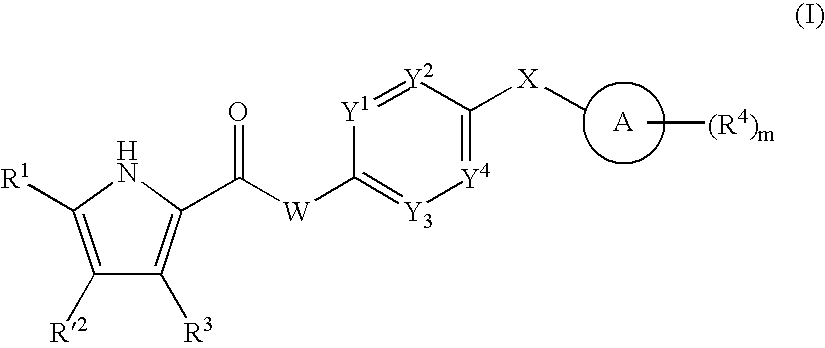
Description
- The present invention relates to compounds which demonstrate antibacterial activity, processes for their preparation, pharmaceutical compositions containing them as the active ingredient, to their use as medicaments and to their use in the manufacture of medicaments for use in the treatment of bacterial infections in warm-blooded animals such as humans. In particular this invention relates to compounds useful for the treatment of bacterial infections in warm-blooded animals such as humans, more particularly to the use of these compounds in the manufacture of medicaments for use in the treatment of bacterial infections in warm-blooded animals such as humans.
- The international microbiological community continues to express serious concern that the evolution of antibiotic resistance could result in strains against which currently available antibacterial agents will be ineffective. In general, bacterial pathogens may be classified as either Gram-positive or Gram-negative pathogens. Antibiotic compounds with effective activity against both Gram-positive and Gram-negative pathogens are generally regarded as having a broad spectrum of activity. The compounds of the present invention are regarded as effective against both Gram-positive and certain Gram-negative pathogens.
- Gram-positive pathogens, for example Staphylococci, Enterococci, Streptococci and mycobacteria, are particularly important because of the development of resistant strains which are both difficult to treat and difficult to eradicate from the hospital environment once established. Examples of such strains are methicillin resistant staphylococcus aureus (MRSA), methicillin resistant coagulase negative staphylococci (MRCNS), penicillin resistant Streptococcus pneumoniae and multiple resistant Enterococcus faecium.
- The preferred clinically effective antibiotic for treatment of last resort of such resistant Gram-positive pathogens is vancomycin. Vancomycin is a glycopeptide and is associated with various toxicities, including nephrotoxicity. Furthermore, and most importantly, antibacterial resistance to vancomycin and other glycopeptides is also appearing. This resistance is increasing at a steady rate rendering these agents less and less effective in the treatment of Gram-positive pathogens. There is also now increasing resistance appearing towards agents such as β-lactams, quinolones and macrolides used for the treatment of upper respiratory tract infections, also caused by certain Gram negative strains including H. influenzae and M. catarrhalis.
- Consequently, in order to overcome the threat of widespread multi-drug resistant organisms, there is an on-going need to develop new antibiotics, particularly those with either a novel mechanism of action and/or containing new pharmacophoric groups.
- Deoxyribonucleic acid (DNA) gyrase is a member of the type II family of topoisomerases that control the topological state of DNA in cells (Champoux, J. J.; 2001. Ann. Rev. Biochem. 70: 369-413). Type II topoisomerases use the free energy from adenosine triphosphate (ATP) hydrolysis to alter the topology of DNA by introducing transient double-stranded breaks in the DNA, catalyzing strand passage through the break and resealing the DNA. DNA gyrase is an essential and conserved enzyme in bacteria and is unique among topoisomerases in its ability to introduce negative supercoils into DNA. The enzyme consists of two subunits, encoded by gyrA and gyrB, forming an A2B2 tetrameric complex. The A subunit of gyrase (GyrA) is involved in DNA breakage and resealing and contains a conserved tyrosine residue that forms the transient covalent link to DNA during strand passage. The B subunit (GyrB) catalyzes the hydrolysis of ATP and interacts with the A subunit to translate the free energy from hydrolysis to the conformational change in the enzyme that enables strand-passage and DNA resealing.
- Another conserved and essential type II topoisomerase in bacteria, called topoisomerase IV, is primarily responsible for separating the linked closed circular bacterial chromosomes produced in replication. This enzyme is closely related to DNA gyrase and has a similar tetrameric structure formed from subunits homologous to Gyr A and to Gyr B. The overall sequence identity between gyrase and topoisomerase IV in different bacterial species is high. Therefore, compounds that target bacterial type II topoisomerases have the potential to inhibit two targets in cells, DNA gyrase and topoisomerase IV; as is the case for existing quinolone antibacterials (Maxwell, A. 1997, Trends Microbiol. 5: 102-109).
- DNA gyrase is a well-validated target of antibacterials, including the quinolones and the coumarins. The quinolones (e.g. ciprofloxacin) are broad-spectrum antibacterials that inhibit the DNA breakage and reunion activity of the enzyme and trap the GyrA subunit covalently complexed with DNA (Drlica, K., and X. Zhao, 1997, Microbiol. Molec. Biol. Rev. 61: 377-392). Members of this class of antibacterials also inhibit topoisomerase IV and as a result, the primary target of these compounds varies among species. Although the quinolones are successful antibacterials, resistance generated primarily by mutations in the target (DNA gyrase and topoisomerase IV) is becoming an increasing problem in several organisms, including S. aureus and Streptococcus pneumoniae (Hooper, D. C., 2002, The Lancet Infectious Diseases 2: 530-538). In addition, quinolones, as a chemical class, suffer from toxic side effects, including arthropathy that prevents their use in children (Lipsky, B. A. and Baker, C. A., 1999, Clin. Infect. Dis. 28: 352-364). Furthermore, the potential for cardiotoxicity, as predicted by prolongation of the QTc interval, has been cited as a toxicity concern for quinolones.
- There are several known natural product inhibitors of DNA gyrase that compete with ATP for binding the GyrB subunit (Maxwell, A. and Lawson, D. M. 2003, Curr. Topics in Med. Chem. 3: 283-303). The coumarins are natural products isolated from Streptomyces spp., examples of which are novobiocin, chlorobiocin and coumermycin A1. Although these compounds are potent inhibitors of DNA gyrase, their therapeutic utility is limited due to toxicity in eukaryotes and poor penetration in Gram-negative bacteria (Maxwell, A. 1997, Trends Microbiol. 5: 102-109). Another natural product class of compounds that targets the GyrB subunit is the cyclothialidines, which are isolated from Streptomyces filipensis (Watanabe, J. et al 1994, J. Antibiot. 47: 32-36). Despite potent activity against DNA gyrase, cyclothialidine is a poor antibacterial agent showing activity only against some eubacterial species (Nakada, N, 1993, Antimicrob. Agents Chemotlier. 37: 2656-2661).
- Synthetic inhibitors that target the B subunit of DNA gyrase and topoisomeraseIV are known in the art. For example, coumarin-containing compounds are described in patent application number WO 99/35155, 5,6-bicyclic heteroaromatic compounds are described in patent application WO 02/060879, and pyrazole compounds are described in patent application WO 01/52845 (U.S. Pat. No. 6,608,087).
- We have discovered a new class of compounds which are useful for inhibiting DNA gyrase and topoisomerase IV.
- Therefore the present invention provides a compound of formula (I):
-

- wherein:
- R1 is selected from hydrogen, nitro, hydroxy, halo, cyano, C1-4alkyl, C1-4alkoxy, C2-4alkenyl, C2-4alkynyl, C1-4alkanoyl, C1-4alkylS(O)a wherein a is 0 to 2 and C3-6cycloalkyl; wherein R1 may be optionally substituted on carbon by one or more halo or cyclopropyl;
- R2 is selected from hydrogen, nitro, hydroxy, halo, cyano, C1-4alkyl, C1-4alkoxy, C2-4alkenyl, C2-4alkynyl, C1-4alkanoyl, C1-4alkylS(O)a wherein a is 0 to 2 and C3-6cycloalkyl; wherein R2 may be optionally substituted on carbon by one or more halo or C3-6cycloalkyl;
- R3 is selected from hydrogen, nitro, hydroxy, halo, cyano, C1-4alkyl, C1-4alkoxy, C2-4alkenyl, C2-4alkynyl, C1-4alkanoyl, alkoxyiminomethyl, C1-4alkylS(O)a wherein a is 0 to 2 and C3-6cycloalkyl; wherein R3 may be optionally substituted on carbon by one or more halo or C3-6cycloalkyl;
- W is —O—, —N(R5)— or —C(R6)(R7)—;
- Y1, Y2, Y3 and Y4 are independently selected from —N═ or —C(R8)═;
- X is a direct bond, —CH2—, —C(O)— or S(O)q— (wherein q is 1 or 2);
- Ring A is carbocyclyl or a carbon linked heterocyclyl; wherein if said heterocyclyl contains an —NH— moiety that nitrogen may be optionally substituted by a group selected from R9;
- R4 is a substituent on carbon and is selected from halo, nitro, cyano, hydroxy, trifluoromethoxy, amino, carboxy, carbamoyl, mercapto, sulphamoyl, sulfo, formyl, ureido, hydroxyiminomethyl, N-hydroxyformamido, hydrazinocarbonyl, N-hydroxyethanimidoyl, amino(hydroxyimino)methyl, alkoxyiminomethyl, C1-4allyl, C2-4alkenyl, C2-4alkynyl, C1-4alkoxy, C1-4alkanoyl, C1-4alkanoyloxy, N—(C1-4alkyl)amino, N,N—(C1-4alkyl)2-amino, C1-4alkanoylamino, N—(C1-4alkyl)carbamoyl, N,N—(C1-4alkyl)2-carbamoyl, N—(C1-4alkoxy)carbamoyl, N′—(C1-4alkyl)ureido, N′,N′—(C1-4alkyl)2ureido, N—(C1-4alkyl)-N—(C1-4alkoxy)carbamoyl, C1-4alkylS(O)a wherein a is 0 to 2, C1-4alkoxycarbonyl, C1-4alkoxycarbonylamino, N—(C1-4alkyl)sulphamoyl, N,N—(C1-4alkyl)2sulphamoyl, C1-4alkylsulphonylamino, C1-4alkylsulphonylaminocarbonyl, N′—(C1-4alkyl)hydrazinocarbonyl, N′,N′—(C1-4alkyl)2hydrazinocarbonyl, carbocyclyl-R10— or heterocyclyl-R11—; wherein R4 may be optionally substituted on carbon by one or more R12; and wherein if said heterocyclyl contains an —NH— moiety that nitrogen may be optionally substituted by a group selected from R13;
- m is 0-4; wherein the values of R4 may be the same or different;
- R5, R6 and R7 are independently selected from hydrogen or C1-4alkyl;
- R8 is a substituent on carbon and is selected from hydrogen, halo, nitro, cyano, hydroxy, trifluoromethoxy, amino, carboxy, carbamoyl, mercapto, sulphamoyl, sulfo, formyl, ureido, hydroxyiminomethyl, N-hydroxyformamido, hydrazinocarbonyl, N-hydroxyethanimidoyl, amino(hydroxyimino)methyl, C1-4alkyl, C2-4alkenyl, C2-4alkynyl, C1-4alkoxy, C1-4alkanoyl, C1-4alkanoyloxy, N—(C1-4alkyl)amino, N,N—(C1-4alkyl)2amino, C1-4alkanoylamino, N—(C1-4alkyl)carbamoyl, N,N—(C1-4alkyl)2-carbamoyl, N—(C1-4alkoxy)carbamoyl, N′—(C1-4alkyl)ureido, N′,N′—(C1-4alkyl)2ureido, N—(C1-4alkyl)-N—(C1-4alkoxy)carbamoyl, C1-4alkylS(O)a wherein a is 0 to 2, C1-4alkoxycarbonyl, C1-4alkoxycarbonylamino, N—(C1-4alkyl)sulphamoyl, N,N—(C1-4alkyl)2sulphamoyl, C1-4alkylsulphonylamino, C1-4alkylsulphonylaminocarbonyl, N′—(C1-4alkyl)hydrazinocarbonyl, N′,N′—(C1-4alkyl)2hydrazinocarbonyl, carbocyclyl-R14— or heterocyclyl-R15—; wherein R8 may be optionally substituted on carbon by one or more R16; and wherein if said heterocyclyl contains an —NH— moiety that nitrogen may be optionally substituted by a group selected from R17;
- R12 and R16 are independently selected from halo, nitro, cyano, hydroxy, trifluoromethoxy, amino, carboxy, carbamoyl, mercapto, sulphamoyl, C1-4alkyl, C2-4alkenyl, C2-4alkynyl, C1-4alkoxy, C1-4alkanoyl, C1-4alkanoyloxy, N—(C1-4alkyl)amino, N,N—(C1-4alkyl)2amino, C1-4alkanoylamino, N—(C1-4alkyl)carbamoyl, N,N—(C1-4alkyl)2carbamoyl, C1-4alkylS(O)a wherein a is 0 to 2, C1-4alkoxycarbonyl, N—(C1-4alkyl)sulphamoyl, N,N—(C1-4alkyl)2sulphamoyl, C1-4alkylsulphonylamino, C1-4alkoxycarbonylamino, carbocyclyl-R18— or heterocyclyl-R19—; wherein R12 and R16 may be independently optionally substituted on carbon by one or more R20; and wherein if said heterocyclyl contains an —NH— moiety that nitrogen may be optionally substituted by a group selected from R21;
- R9, R13, R17 and R21 are independently selected from C1-4alkyl, C1-4alkanoyl, C1-4alkylsulphonyl, C1-4alkoxycarbonyl, carbamoyl, N—(C1-4alkyl)carbamoyl, N,N—(C1-4alkyl)2carbamoyl, carbocyclyl, benzyl, benzyloxycarbonyl, benzoyl and phenylsulphonyl; wherein R9, R13, R17 and R21 may be independently optionally substituted by R22;
- R10, R11, R14, R15, R18 and R19 are independently selected from a direct bond, —O—, —N(R23)—, —C(O)—, —N(R24)C(O)—, —C(O)N(R25)—, —S(O)p—, —SO2N(R26)— or —N(R27)SO2—; wherein R23, R24, R25, R26 and R27 are independently selected from hydrogen or C1-4alkyl and p is 0-2;
- R20 and R22 are independently selected from halo, nitro, cyano, hydroxy, trifluoromethoxy, trifluoromethyl, amino, carboxy, carbamoyl, mercapto, sulphamoyl, methyl, ethyl, ethenyl, ethynyl, methoxy, ethoxy, acetyl, acetoxy, methylamino, ethylamino, dimethylamino, diethylamino, N-methyl-N-ethylamino, acetylamino, N-methylcarbamoyl, N-ethylcarbamoyl, N,N-dimethylcarbamoyl, N,N-diethylcarbamoyl, N-methyl-N-ethylcarbamoyl, methylthio, ethylthio, methylsulphinyl, ethylsulphinyl, mesyl, ethylsulphonyl, methoxycarbonyl, ethoxycarbonyl, N-methylsulphamoyl, N-ethylsulphamoyl, N,N-dimethylsulphamoyl, N,N-diethylsulphamoyl or N-methyl-N-ethylsulphamoyl;
- or a pharmaceutically acceptable salt thereof;
with the proviso that said compound is not: - (5R,6S)-3-{3-chloro-4-[(1H-pyrrol-2-ylcarbonyl)amino]phenyl}-6-[(1R)-1-hydroxyethyl]-7-oxo-1-azabicyclo[3.2.0]hept-2-ene-2-carboxylic acid;
- [(2,2-dimethylpropanoyl)oxy]methyl (5R,6S)-3-{3-chloro-4-[(1H-pyrrol-2-ylcarbonyl)amino]phenyl}-6-[(1R)-1-hydroxyethyl]-7-oxo-1-azabicyclo[3.2.0]hept-2-ene-2-carboxylate;
- N-[4-(6,8-dichloro-2-methyl-1,2,3,4-tetrahydroisoquinolin-4-yl)phenyl]-1H-pyrrole-2-carboxamide; or
- N-[4-(6,8-dichloro-2-methyl-1,2,3,4-tetrahydroisoquinolin-4-yl)phenyl]-4-nitro-1H-pyrrole-2-carboxamide.
- The present invention also provides a compound of formula (IA):
-
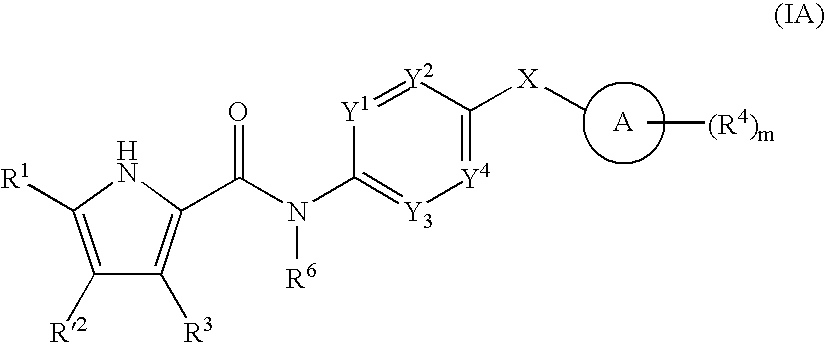
- wherein:
- R1 is selected from hydrogen, nitro, hydroxy, halo, cyano, C1-4alkyl, C1-4alkoxy, C2-4alkenyl, C2-4alkynyl, C1-4alkanoyl, C1-4alkylS(O)a wherein a is 0 to 2 and C3-6cycloalkyl; wherein R1 may be optionally substituted on carbon by one or more halo or cyclopropyl;
- R2 is selected from hydrogen, nitro, hydroxy, halo, cyano, C1-4alkyl, C1-4alkoxy, C2-4alkenyl, C2-4alkynyl, C1-4alkanoyl, C1-4alkylS(O)a wherein a is 0 to 2 and C3-6cycloalkyl; wherein R2 may be optionally substituted on carbon by one or more halo or C3-6cycloalkyl;
- R3 is selected from hydrogen, nitro, hydroxy, halo, cyano, C1-4alkyl, C1-4alkoxy, C2-4alkenyl, C2-4alkynyl, C1-4alkanoyl, alkoxyiminomethyl, C1-4alkylS(O)a wherein a is 0 to 2 and C3-6cycloalkyl; wherein R3 may be optionally substituted on carbon by one or more halo or C3-6cycloalkyl;
- Y1, Y2, Y3 and Y4 are independently selected from —N═ or —C(R8)═;
- X is a direct bond, —CH2—, —C(O)— or S(O)q— (wherein q is 1 or 2);
- Ring A is carbocyclyl or a carbon linked heterocyclyl; wherein if said heterocyclyl contains an —NH— moiety that nitrogen may be optionally substituted by a group selected from R9;
- R4 is a substituent on carbon and is selected from halo, nitro, cyano, hydroxy, trifluoromethoxy, amino, carboxy, carbamoyl, mercapto, sulphamoyl, sulfo, formyl, ureido, hydroxyiminomethyl, N-hydroxyformamido, hydrazinocarbonyl, N-hydroxyethanimidoyl, amino(hydroxyimino)methyl, alkoxyiminomethyl, C1-4alkyl, C2-4alkenyl, C2-4alkynyl, C1-4alkoxy, C1-4alkanoyl, C1-4alkanoyloxy, N—(C1-4alkyl)amino, N,N—(C1-4alkyl)2amino, C1-4alkanoylamino, N—(C1-4alkyl)carbamoyl, N,N—(C1-4alkyl)2carbamoyl, N—(C1-4alkoxy)carbamoyl, N′—(C1-4alkyl)ureido, N′,N′—(C1-4alkyl)2ureido, N—(C1-4alkyl)-N—(C1-4alkoxy)carbamoyl, C1-4alkylS(O)a wherein a is 0 to 2, C1-4alkoxycarbonyl, C1-4alkoxycarbonylamino, N—(C1-4alkyl)sulphamoyl, N,N—(C1-4alkyl)2sulphamoyl, C1-4alkylsulphonylamino, C1-4alkylsulphonylaminocarbonyl, N′—(C1-4alkyl)hydrazinocarbonyl, N′,N′—(C1-4alkyl)2hydrazinocarbonyl, carbocyclyl-R10— or heterocyclyl-R11—; wherein R4 may be optionally substituted on carbon by one or more R12; and wherein if said heterocyclyl contains an —NH— moiety that nitrogen may be optionally substituted by a group selected from R13;
- m is 0-4; wherein the values of R4 may be the same or different;
- R5, R6 and R7 are independently selected from hydrogen or C1-4alkyl;
- R8 is a substituent on carbon and is selected from hydrogen, halo, nitro, cyano, hydroxy, trifluoromethoxy, amino, carboxy, carbamoyl, mercapto, sulphamoyl, sulfo, formyl, ureido, hydroxyiminomethyl, N-hydroxyformamido, hydrazinocarbonyl, N-hydroxyethanimidoyl, amino(hydroxyimino)methyl, C1-4alkyl, C2-4alkenyl, C2-4alkynyl, C1-4alkoxy, C1-4alkanoyl, C1-4alkanoyloxy, N—(C1-4alkyl)amino, N,N—(C1-4alkyl)2amino, C1-4alkanoylamino, N—(C1-4alkyl)carbamoyl, N,N—(C1-4alkyl)2carbamoyl, N—(C1-4alkoxy)carbamoyl, N′—(C1-4alkyl)ureido, N′,N′—(C1-4alkyl)2ureido, N—(C1-4alkyl)-N—(C1-4alkoxy)carbamoyl, C1-4alkylS(O)a wherein a is 0 to 2, C1-4alkoxycarbonyl, C1-4alkoxycarbonylamino, N—(C1-4alkyl)sulphamoyl, N,N—(C1-4alkyl)2sulphamoyl, C1-4alkylsulphonylamino, C1-4alkylsulphonylaminocarbonyl, N′—(C1-4alkyl)hydrazinocarbonyl, N′,N′—(C1-4alkyl)2hydrazinocarbonyl, carbocyclyl-R14— or heterocyclyl-R15—; wherein R8 may be optionally substituted on carbon by one or more R16; and wherein if said heterocyclyl contains an —NH— moiety that nitrogen may be optionally substituted by a group selected from R17;
- R12 and R16 are independently selected from halo, nitro, cyano, hydroxy, trifluoromethoxy, amino, carboxy, carbamoyl, mercapto, sulphamoyl, C1-4alkyl, C2-4alkenyl, C2-4alkynyl, C1-4alkoxy, C1-4alkanoyl, C1-4alkanoyloxy, N—(C1-4alkyl)amino, N,N—(C1-4alkyl)2amino, C1-4alkanoylamino, N—(C1-4alkyl)carbamoyl, N,N—(C1-4alkyl)2carbamoyl, C1-4alkylS(O)a wherein a is 0 to 2, C1-4alkoxycarbonyl, N—(C1-4alkyl)sulphamoyl, N,N—(C1-4alkyl)2sulphamoyl, C1-4alkylsulphonylamino, C1-4alkoxycarbonylamino, carbocyclyl-R18— or heterocyclyl-R19—; wherein R12 and R16 may be independently optionally substituted on carbon by one or more R20; and wherein if said heterocyclyl contains an —NH— moiety that nitrogen may be optionally substituted by a group selected from R21;
- R9, R13, R17 and R21 are independently selected from C1-4alkyl, C1-4alkanoyl, C1-4alkylsulphonyl, C1-4alkoxycarbonyl, carbamoyl, N—(C1-4alkyl)carbamoyl, N,N—(C1-4alkyl)2carbamoyl, carbocyclyl, benzyl, benzyloxycarbonyl, benzoyl and phenylsulphonyl; wherein R9, R13, R17 and R21 may be independently optionally substituted by R22;
- R10, R11, R14, R15, R18 and R19 are independently selected from a direct bond, —O—, —N(R23)—, —C(O)—, —N(R24)C(O)—, —C(O)N(R25)—, —S(O)p—, —SO2N(R26)— or —N(R27)SO2—; wherein R23, R24, R25, R26 and R27 are independently selected from hydrogen or C4alkyl and p is 0-2;
- R20 and R22 are independently selected from halo, nitro, cyano, hydroxy, trifluoromethoxy, trifluoromethyl, amino, carboxy, carbamoyl, mercapto, sulphamoyl, methyl, ethyl, ethenyl, ethynyl, methoxy, ethoxy, acetyl, acetoxy, methylamino, ethylamino, dimethylamino, diethylamino, N-methyl-N-ethylamino, acetylamino, N-methylcarbamoyl, N-ethylcarbamoyl, N,N-dimethylcarbamoyl, N,N-diethylcarbamoyl, N-methyl-N-ethylcarbamoyl, methylthio, ethylthio, methylsulphinyl, ethylsulphinyl, mesyl, ethylsulphonyl, methoxycarbonyl, ethoxycarbonyl, N-methylsulphamoyl, N-ethylsulphamoyl, N,N-dimethylsulphamoyl, N,N-diethylsulphamoyl or N-methyl-N-ethylsulphamoyl;
- or a pharmaceutically acceptable salt thereof;
with the proviso that said compound is not: - (5R,6S)-3-{3-chloro-4-[(1H-pyrrol-2-ylcarbonyl)amino]phenyl}-6-[(1R)-1-hydroxyethyl]-7-oxo-1-azabicyclo[3.2.0]hept-2-ene-2-carboxylic acid;
- [(2,2-dimethylpropanoyl)oxy]methyl (5R,6S)-3-{3-chloro-4-[(1H-pyrrol-2-ylcarbonyl)amino]phenyl}-6-[(1R)-1-hydroxyethyl]-7-oxo-1-azabicyclo[3.2.0]hept-2-ene-2-carboxylate;
- N-[4-(6,8-dichloro-2-methyl-1,2,3,4-tetrahydroisoquinolin-4-yl)phenyl]-1H-pyrrole-2-carboxamide; or
- N-[4-(6,8-dichloro-2-methyl-1,2,3,4-tetrahydroisoquinolin-4-yl)phenyl]-4-nitro-1H-pyrrole-2-carboxamide.
- The present invention also provides a compound of formula (IB):
-

- wherein:
- R1 is selected from hydrogen, nitro, hydroxy, halo, cyano, C1-4alkyl, C1-4alkoxy, C2-4alkenyl, C2-4alkynyl, C1-4alkanoyl, C1-4alkylS(O)a wherein a is 0 to 2 and C3-6cycloalkyl; wherein R1 may be optionally substituted on carbon by one or more halo or cyclopropyl;
- R2 is selected from hydrogen, nitro, hydroxy, halo, cyano, C1-4alkyl, C1-4alkoxy, C2-4alkenyl, C2-4alkynyl, C1-4alkanoyl, C1-4alkylS(O)a wherein a is 0 to 2 and C3-6cycloalkyl; wherein R2 may be optionally substituted on carbon by one or more halo or C3-6cycloalkyl;
- R3 is selected from hydrogen, nitro, hydroxy, halo, cyano, C1-4alkyl, C1-4alkoxy, C2-4alkenyl, C2-4alkynyl, C1-4alkanoyl, alkoxyiminomethyl, C1-4alkylS(O)a wherein a is 0 to 2 and C3-6cycloalkyl; wherein R3 may be optionally substituted on carbon by one or more halo or C3-6cycloalkyl;
- Y1, Y2, Y3 and Y4 are independently selected from —N═ or —C(R8)═;
- Ring A is carbocyclyl or a carbon linked heterocyclyl; wherein if said heterocyclyl contains an —NH— moiety that nitrogen may be optionally substituted by a group selected from R9;
- R4 is a substituent on carbon and is selected from halo, nitro, cyano, hydroxy, trifluoromethoxy, amino, carboxy, carbamoyl, mercapto, sulphamoyl, sulfo, formyl, ureido, hydroxyiminomethyl, N-hydroxyformamido, hydrazinocarbonyl, N-hydroxyethanimidoyl, amino(hydroxyimino)methyl, alkoxyiminomethyl, C1-4alkyl, C2-4alkenyl, C2-4alkynyl, C1-4alkoxy, C1-4alkanoyl, C1-4alkanoyloxy, N—(C1-4alkyl)amino, N N—(C1-4alkyl)2amino, C1-4alkanoylamino, N—(C1-4alkyl)carbamoyl, N,N—(C1-4alkyl)2carbamoyl, N—(C1-4alkoxy)carbamoyl, N′—(C1-4alkyl)ureido, N′,N′—(C1-4alkyl)2ureido, N—(C1-4alkyl)-N—(C1-4alkoxy)carbamoyl, C1-4alkylS(O)a wherein a is 0 to 2, C1-4alkoxycarbonyl, C1-4alkoxycarbonylamino, N—(C1-4alkyl)sulphamoyl, N,N—(C1-4alkyl)2sulphamoyl, C1-4alkylsulphonylamino, C1-4alkylsulphonylaminocarbonyl, N′—(C1-4alkyl)hydrazinocarbonyl, N′,N′—(C1-4alkyl)2hydrazinocarbonyl, carbocyclyl-R10— or heterocyclyl-R11—; wherein R4 may be optionally substituted on carbon by one or more R12; and wherein if said heterocyclyl contains an —NH— moiety that nitrogen may be optionally substituted by a group selected from R13;
- m is 0-4; wherein the values of R4 may be the same or different;
- R5, R6 and R7 are independently selected from hydrogen or C1-4alkyl;
- R8 is a substituent on carbon and is selected from hydrogen, halo, nitro, cyano, hydroxy, trifluoromethoxy, amino, carboxy, carbamoyl, mercapto, sulphamoyl, sulfo, formyl, ureido, hydroxyiminomethyl, N-hydroxyformamido, hydrazinocarbonyl, N-hydroxyethanimidoyl, amino(hydroxyimino)methyl, C1-4alkyl, C2-4alkenyl, C2-4alkynyl, C1-4alkoxy, C1-4alkanoyl, C1-4alkanoyloxy, N—(C1-4alkyl)amino, N,N—(C1-4alkyl)2amino, C1-4alkanoylamino, N—(C1-4alkyl)carbamoyl, N N—(C1-4alkyl)2carbamoyl, N—(C1-4alkoxy)carbamoyl, N′—(C1-4alkyl)ureido, N′,N′—(C1-4alkyl)2ureido, N—(C1-4alkyl)-N—(C1-4alkoxy)carbamoyl, C1-4alkylS(O)a wherein a is 0 to 2, C1-4alkoxycarbonyl, C1-4alkoxycarbonylamino, N—(C1-4alkyl)sulphamoyl, N,N—(C1-4alkyl)2sulphamoyl, C1-4alkylsulphonylamino, C1-4alkylsulphonylaminocarbonyl, N′—(C1-4alkyl)hydrazinocarbonyl, N′,N′—(C1-4alkyl)2hydrazinocarbonyl, carbocyclyl-R14— or heterocyclyl-R15—; wherein R8 may be optionally substituted on carbon by one or more R16; and wherein if said heterocyclyl contains an —NH— moiety that nitrogen may be optionally substituted by a group selected from R17;
- R12 and R16 are independently selected from halo, nitro, cyano, hydroxy, trifluoromethoxy, amino, carboxy, carbamoyl, mercapto, sulphamoyl, C1-4alkyl, C2-4alkenyl, C2-4alkynyl, C1-4alkoxy, C1-4alkanoyl, C1-4alkanoyloxy, N—(C1-4alkyl)amino, N,N—(C1-4alkyl)2amino, C1-4alkanoylamino, N—(C1-4alkyl)carbamoyl, N,N—(C1-4alkyl)2carbamoyl, C1-4alkylS(O)a wherein a is 0 to 2, C1-4alkoxycarbonyl, N—(C1-4alkyl)sulphamoyl, N,N—(C1-4alkyl)2sulphamoyl, C1-4alkylsulphonylamino, C1-4alkoxycarbonylamino, carbocyclyl-R18— or heterocyclyl-R19—; wherein R12 and R16 may be independently optionally substituted on carbon by one or more R20; and wherein if said heterocyclyl contains an —NH— moiety that nitrogen may be optionally substituted by a group selected from R21;
- R9, R13, R17 and R21 are independently selected from C1-4alkyl, C1-4alkanoyl, C1-4alkylsulphonyl, C1-4alkoxycarbonyl, carbamoyl, N—(C1-4alkyl)carbamoyl, N,N—(C1-4alkyl)2carbamoyl, carbocyclyl, benzyl, benzyloxycarbonyl, benzoyl and phenylsulphonyl; wherein R9, R13, R17 and R21 may be independently optionally substituted by R2;
- R10, R11, R14, R15, R18 and R19 are independently selected from a direct bond, —O—, —N(R23)—, —C(O)—, —N(R24)C(O)—, —C(O)N(R25)—, —S(O)P—, —SO2N(R26)— or —N(R27)SO2—; wherein R3, R24, R25, R26 and R27 are independently selected from hydrogen or C1-4alkyl and p is 0-2;
- R20 and R22 are independently selected from halo, nitro, cyano, hydroxy, trifluoromethoxy, trifluoromethyl, amino, carboxy, carbamoyl, mercapto, sulphamoyl, methyl, ethyl, ethenyl, ethynyl, methoxy, ethoxy, acetyl, acetoxy, methylamino, ethylamino, dimethylamino, diethylamino, N-methyl-N-ethylamino, acetylamino, N-methylcarbamoyl, N-ethylcarbamoyl, N,N-dimethylcarbamoyl, N,N-diethylcarbamoyl, N-methyl-N-ethylcarbamoyl, methylthio, ethylthio, methylsulphinyl, ethylsulphinyl, mesyl, ethylsulphonyl, methoxycarbonyl, ethoxycarbonyl, N-methylsulphamoyl, N-ethylsulphamoyl, N,N-dimethylsulphamoyl, N,N-diethylsulphamoyl or N-methyl-N-ethylsulphamoyl;
- or a pharmaceutically acceptable salt thereof;
with the proviso that said compound is not: - (5R,6S)-3-{3-chloro-4-[(1H-pyrrol-2-ylcarbonyl)amino]phenyl}-6-[(1R)-1-hydroxyethyl]-7-oxo-1-azabicyclo[3.2.0]hept-2-ene-2-carboxylic acid;
- [(2,2-dimethylpropanoyl)oxy]methyl (5R,6S)-3-{3-chloro-4-[(1H-pyrrol-2-ylcarbonyl)amino]phenyl}-6-[(1R)-1-hydroxyethyl]-7-oxo-1-azabicyclo[3.2.0]hept-2-ene-2-carboxylate;
- N-[4-(6,8-dichloro-2-methyl-1,2,3,4-tetrahydroisoquinolin-4-yl)phenyl]-1H-pyrrole-2-carboxamide; or
- N-[4-(6,8-dichloro-2-methyl-1,2,3,4-tetrahydroisoquinolin-4-yl)phenyl]-4-nitro-1H-pyrrole-2-carboxamide.
- The present invention also provides a compound of formula (IC):
-

- wherein:
- R1 is selected from hydrogen, nitro, hydroxy, halo, cyano, C1-4alkyl, C1-4alkoxy, C2-4alkenyl, C2-4alkynyl, C1-4alkanoyl, C1-4alkylS(O)a wherein a is 0 to 2 and C3-6cycloalkyl; wherein R1 may be optionally substituted on carbon by one or more halo or cyclopropyl;
- R2 is selected from hydrogen, nitro, hydroxy, halo, cyano, C1-4alkyl, C1-4alkoxy, C2-4alkenyl, C2-4alkynyl, C1-4alkanoyl, C1-4alkylS(O)a wherein a is 0 to 2 and C3-6cycloalkyl; wherein R1 may be optionally substituted on carbon by one or more halo or C3-6cycloalkyl;
- R3 is selected from hydrogen, nitro, hydroxy, halo, cyano, C1-4alkyl, C1-4alkoxy, C2-4alkenyl, C2-4alkynyl, C1-4alkanoyl, alkoxyiminomethyl, C1-4alkylS(O)a wherein a is 0 to 2 and C3-6cycloalkyl; wherein R3 may be optionally substituted on carbon by one or more halo or C3-6cycloalkyl;
- Y1, Y2, Y3 and Y4 are independently selected from —N═ or —C(R8)═;
- Ring A is carbocyclyl or a carbon linked heterocyclyl; wherein if said heterocyclyl contains an —NH— moiety that nitrogen may be optionally substituted by a group selected from R9;
- R4 is a substituent on carbon and is selected from halo, nitro, cyano, hydroxy, trifluoromethoxy, amino, carboxy, carbamoyl, mercapto, sulphamoyl, sulfo, formyl, ureido, hydroxyiminomethyl, N-hydroxyformamido, hydrazinocarbonyl, N-hydroxyethanimidoyl, amino(hydroxyimino)methyl, alkoxyiminomethyl, C1-4alkyl, C2-4alkenyl, C2-4alkynyl, C1-4alkoxy, C1-4alkanoyl, C1-4alkanoyloxy, N—(C1-4alkyl)amino, N,N—(C1-4alkyl)2amino, C1-4alkanoylamino, N—(C1-4alkyl)carbamoyl, N,N—(C1-4alkyl)2carbamoyl, N—(C1-4alkoxy)carbamoyl, N′—(C1-4alkyl)ureido, N′,N′—(C1-4alkyl)2ureido, N—(C1-4alkyl)-N—(C1-4alkoxy)carbamoyl, C1-4alkylS(O)a wherein a is 0 to 2, C1-4alkoxycarbonyl, C1-4alkoxycarbonylamino, N—(C1-4alkyl)sulphamoyl, N,N—(C1-4alkyl)2sulphamoyl, C1-4alkylsulphonylamino, C1-4alkylsulphonylaminocarbonyl, N′—(C1-4alkyl)hydrazinocarbonyl, N′,N′—(C1-4alkyl)2hydrazinocarbonyl, carbocyclyl-R10— or heterocyclyl-R11—; wherein R4 may be optionally substituted on carbon by one or more R12; and wherein if said heterocyclyl contains an —NH— moiety that nitrogen may be optionally substituted by a group selected from R13;
- m is 0-4; wherein the values of R4 may be the same or different;
- R5 and R7 are independently selected from hydrogen or C1-4alkyl;
- R8 is a substituent on carbon and is selected from hydrogen, halo, nitro, cyano, hydroxy, trifluoromethoxy, amino, carboxy, carbamoyl, mercapto, sulphamoyl, sulfo, formyl, ureido, hydroxyiminomethyl, N-hydroxyformamido, hydrazinocarbonyl, N-hydroxyethanimidoyl, amino(hydroxyimino)methyl, C1-4alkyl, C2-4alkenyl, C2-4alkynyl, C1-4alkoxy, C1-4alkanoyl, C1-4alkanoyloxy, N—(C1-4alkyl)amino, N,N—(C1-4alkyl)2amino, C1-4alkanoylamino, N—(C1-4alkyl)carbamoyl, N,N—(C1-4alkyl)2carbamoyl, N—(C1-4alkoxy)carbamoyl, N′—(C1-4alkyl)ureido, N′,N′—(C1-4alkyl)2ureido, N—(C1-4alkyl)-N—(C1-4alkoxy)carbamoyl, C1-4alkylS(O)a wherein a is 0 to 2, C1-4alkoxycarbonyl, C1-4alkoxycarbonylamino, N—(C1-4alkyl)sulphamoyl, N,N—(C1-4alkyl)2sulphamoyl, C1-4alkylsulphonylamino, C1-4alkylsulphonylaminocarbonyl, N′—(C1-4alkyl)hydrazinocarbonyl, N′,N′—(C1-4alkyl)2hydrazinocarbonyl, carbocyclyl-R14— or heterocyclyl-R15—; wherein R8 may be optionally substituted on carbon by one or more R16; and wherein if said heterocyclyl contains an —NH— moiety that nitrogen may be optionally substituted by a group selected from R17;
- R12 and R16 are independently selected from halo, nitro, cyano, hydroxy, trifluoromethoxy, amino, carboxy, carbamoyl, mercapto, sulphamoyl, C1-4alkyl, C2-4alkenyl, C2-4alkynyl, C1-4alkoxy, C1-4alkanoyl, C1-4alkanoyloxy, N—(C1-4alkyl)amino, N,N—(C1-4alkyl)2amino, C1-4alkanoylamino, N—(C1-4alkyl)carbamoyl, N,N—(C1-4alkyl)2carbamoyl, C1-4alkylS(O)a wherein a is 0 to 2, C1-4alkoxycarbonyl, N—(C1-4alkyl)sulphamoyl, N,N—(C1-4alkyl)2sulphamoyl, C1-4alkylsulphonylamino, C1-4alkoxycarbonylamino, carbocyclyl-R18— or heterocyclyl-R19—; wherein R12 and R16 may be independently optionally substituted on carbon by one or more R20; and wherein if said heterocyclyl contains an —NH— moiety that nitrogen may be optionally substituted by a group selected from R21;
- R9, R13, R17 and R21 are independently selected from C1-4alkyl, C1-4alkanoyl, C1-4alkylsulphonyl, C1-4alkoxycarbonyl, carbamoyl, N—(C1-4alkyl)carbamoyl, N,N—(C1-4alkyl)2carbamoyl, carbocyclyl, benzyl, benzyloxycarbonyl, benzoyl and phenylsulphonyl; wherein R9, R13, R17 and R21 may be independently optionally substituted by R22;
- R10, R11, R14, R15, R18 and R19 are independently selected from a direct bond, —O—, —N(R23)—, —C(O)—, —N(R24)C(O)—, —C(O)N(R25)—, —S(O)p—, —SO2N(R26)— or —N(R27)SO2—; wherein R23, R24, R25, R26 and R27 are independently selected from hydrogen or C1-4alkyl and p is 0-2;
- R20 and R22 are independently selected from halo, nitro, cyano, hydroxy, trifluoromethoxy, trifluoromethyl, amino, carboxy, carbamoyl, mercapto, sulphamoyl, methyl, ethyl, ethenyl, ethynyl, methoxy, ethoxy, acetyl, acetoxy, methylamino, ethylamino, dimethylamino, diethylamino, N-methyl-N-ethylamino, acetylamino, N-methylcarbamoyl, N-ethylcarbamoyl, N,N-dimethylcarbamoyl, N,N-diethylcarbamoyl, N-methyl-N-ethylcarbamoyl, methylthio, ethylthio, methylsulphinyl, ethylsulphinyl, mesyl, ethylsulphonyl, methoxycarbonyl, ethoxycarbonyl, N-methylsulphamoyl, N-ethylsulphamoyl, N,N-dimethylsulphamoyl, N,N-diethylsulphamoyl or N-methyl-N-ethylsulphamoyl;
- or a pharmaceutically acceptable salt thereof;
with the proviso that said compound is not: - (5R,6S)-3-{3-chloro-4-[(1H-pyrrol-2-ylcarbonyl)amino]phenyl}-6-[(1R)-1-hydroxyethyl]-7-oxo-1-azabicyclo[3.2.0]hept-2-ene-2-carboxylic acid;
- [(2,2-dimethylpropanoyl)oxy]methyl (5R,6S)-3-{3-chloro-4-[(1H-pyrrol-2-ylcarbonyl)amino]phenyl}-6-[(1R)-1-hydroxyethyl]-7-oxo-1-azabicyclo[3.2.0]hept-2-ene-2-carboxylate;
- N-[4-(6,8-dichloro-2-methyl-1,2,3,4-tetrahydroisoquinolin-4-yl)phenyl]-1H-pyrrole-2-carboxamide; or
- N-[4-(6,8-dichloro-2-methyl-1,2,3,4-tetrahydroisoquinolin-4-yl)phenyl]-4-nitro-1H-pyrrole-2-carboxamide.
- The present invention also provides a compound of formula (ID):
-
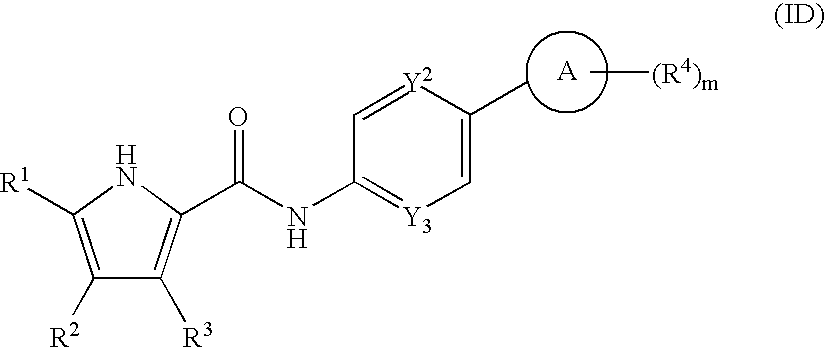
- wherein:
- R1 is selected from hydrogen, nitro, hydroxy, halo, cyano, C1-4alkyl, C1-4alkoxy, C2-4alkenyl, C2-4alkynyl, C1-4alkanoyl, C1-4alkylS(O)a wherein a is 0 to 2 and C3-6cycloalkyl; wherein R1 may be optionally substituted on carbon by one or more halo or cyclopropyl;
- R2 is selected from hydrogen, nitro, hydroxy, halo, cyano, C1-4alkyl, C1-4alkoxy, C2-4alkenyl, C2-4alkynyl, C1-4alkanoyl, C1-4alkylS(O)a wherein a is 0 to 2 and C3-6cycloalkyl; wherein R2 may be optionally substituted on carbon by one or more halo or C3-6cycloalkyl;
- R3 is selected from hydrogen, nitro, hydroxy, halo, cyano, C1-4alkyl, C1-4alkoxy, C2-4alkenyl, C2-4alkynyl, C1-4alkanoyl, alkoxyiminomethyl, C1-4alkylS(O)a wherein a is 0 to 2 and C3-6cycloalkyl; wherein R3 may be optionally substituted on carbon by one or more halo or C3-6cycloalkyl;
- Y2 and Y3 are independently selected from —N═ or —C(R8)═;
- Ring A is carbocyclyl or a carbon linked heterocyclyl; wherein if said heterocyclyl contains an —NH— moiety that nitrogen may be optionally substituted by a group selected from R9;
- R4 is a substituent on carbon and is selected from halo, nitro, cyano, hydroxy, trifluoromethoxy, amino, carboxy, carbamoyl, mercapto, sulphamoyl, sulfo, formyl, ureido, hydroxyiminomethyl, N-hydroxyformamido, hydrazinocarbonyl, N-hydroxyethanimidoyl, amino(hydroxyimino)methyl, alkoxyiminomethyl, C1-4alkyl, C2-4alkenyl, C2-4alkynyl, C1-4alkoxy, C1-4alkanoyl, C1-4alkanoyloxy, N—(C1-4alkyl)amino, N,N—(C1-4alkyl)2amino, C1-4alkanoylamino, N—(C1-4alkyl)carbamoyl, N N—(C1-4alkyl)2carbamoyl, N—(C1-4alkoxy)carbamoyl, N′—(C1-4alkyl)ureido, N′,N′—(C1-4alkyl)2ureido, N—(C1-4alkyl)-N—(C1-4alkoxy)carbamoyl, C1-4alkylS(O)a wherein a is 0 to 2, C1-4alkoxycarbonyl, C1-4alkoxycarbonylamino, N—(C1-4alkyl)sulphamoyl, N,N—(C1-4alkyl)2sulphamoyl, C1-4alkylsulphonylamino, C1-4alkylsulphonylaminocarbonyl, N′—(C1-4alkyl)hydrazinocarbonyl, N′,N′—(C1-4alkyl)2hydrazinocarbonyl, carbocyclyl-R10— or heterocyclyl-R11—; wherein R4 may be optionally substituted on carbon by one or more R12; and wherein if said heterocyclyl contains an —NH— moiety that nitrogen may be optionally substituted by a group selected from R13;
- m is 0-4; wherein the values of R4 may be the same or different;
- R5 and R7 are independently selected from hydrogen or C1-4alkyl;
- R8 is a substituent on carbon and is selected from hydrogen, halo, nitro, cyano, hydroxy, trifluoromethoxy, amino, carboxy, carbamoyl, mercapto, sulphamoyl, sulfo, formyl, ureido, hydroxyiminomethyl, N-hydroxyformamido, hydrazinocarbonyl, N-hydroxyethanimidoyl, amino(hydroxyimino)methyl, C1-4alkyl, C2-4alkenyl, C2-4alkynyl, C1-4alkoxy, C1-4alkanoyl, C1-4alkanoyloxy, N—(C1-4alkyl)amino, N,N—(C1-4alkyl)2amino, C1-4alkanoylamino, N—(C1-4alkyl)carbamoyl, N,N—(C1-4alkyl)2carbamoyl, N—(C1-4alkoxy)carbamoyl, N′—(C1-4alkyl)ureido, N′,N′—(C1-4alkyl)2ureido, N—(C1-4alkyl)-N—(C1-4alkoxy)carbamoyl, C1-4alkylS(O)a wherein a is 0 to 2, C1-4alkoxycarbonyl, C1-4alkoxycarbonylamino, N—(C1-4alkyl)sulphamoyl, N,N—(C1-4alkyl)2sulphamoyl, C1-4alkylsulphonylamino, C1-4alkylsulphonylaminocarbonyl, N′—(C1-4alkyl)hydrazinocarbonyl, N′,N′—(C1-4alkyl)2hydrazinocarbonyl, carbocyclyl-R14— or heterocyclyl-R15—; wherein R8 may be optionally substituted on carbon by one or more R16; and wherein if said heterocyclyl contains an —NH— moiety that nitrogen may be optionally substituted by a group selected from R17;
- R12 and R16 are independently selected from halo, nitro, cyano, hydroxy, trifluoromethoxy, amino, carboxy, carbamoyl, mercapto, sulphamoyl, C1-4alkyl, C2-4alkenyl, C2-4alkynyl, C1-4alkoxy, C1-4alkanoyl, C1-4alkanoyloxy, N—(C1-4alkyl)amino, N,N—(C1-4alkyl)2amino, C1-4alkanoylamino, N—(C1-4alkyl)carbamoyl, N,N—(C1-4alkyl)2carbamoyl, C1-4alkylS(O)a wherein a is 0 to 2, C1-4alkoxycarbonyl, N—(C1-4alkyl)sulphamoyl, N,N—(C1-4alkyl)2sulphamoyl, C1-4alkylsulphonylamino, C1-4alkoxycarbonylamino, carbocyclyl-R18— or heterocyclyl-R19—; wherein R12 and R16 may be independently optionally substituted on carbon by one or more R20; and wherein if said heterocyclyl contains an —NH— moiety that nitrogen may be optionally substituted by a group selected from R21;
- R9, R13, R17 and R21 are independently selected from C1-4alkyl, C1-4alkanoyl, C1-4alkylsulphonyl, C1-4alkoxycarbonyl, carbamoyl, N—(C1-4alkyl)carbamoyl, N,N—(C1-4alkyl)2carbamoyl, carbocyclyl, benzyl, benzyloxycarbonyl, benzoyl and phenylsulphonyl; wherein R9, R13, R17 and R21 may be independently optionally substituted by R22;
- R10, R11, R14, R15, R18 and R19 are independently selected from a direct bond, —O—, —N(R23)—, —C(O)—, —N(R24)C(O)—, —C(O)N(R25)—, —S(O)p—, —SO2N(R26)— or —N(R27)SO2—; wherein R23, R24, R25, R26 and R27 are independently selected from hydrogen or C1-4alkyl and p is 0-2;
- R20 and R22 are independently selected from halo, nitro, cyano, hydroxy, trifluoromethoxy, trifluoromethyl, amino, carboxy, carbamoyl, mercapto, sulphamoyl, methyl, ethyl, ethenyl, ethynyl, methoxy, ethoxy, acetyl, acetoxy, methylamino, ethylamino, dimethylamino, diethylamino, N-methyl-N-ethylamino, acetylamino, N-methylcarbamoyl, N-ethylcarbamoyl, N,N-dimethylcarbamoyl, N,N-diethylcarbamoyl, N-methyl-N-ethylcarbamoyl, methylthio, ethylthio, methylsulphinyl, ethylsulphinyl, mesyl, ethylsulphonyl, methoxycarbonyl, ethoxycarbonyl, N-methylsulphamoyl, N-ethylsulphamoyl, N,N-dimethylsulphamoyl, N,N-diethylsulphamoyl or N-methyl-N-ethylsulphamoyl;
- or a pharmaceutically acceptable salt thereof;
with the proviso that said compound is not: - (5R,6S)-3-{3-chloro-4-[(1H-pyrrol-2-ylcarbonyl)amino]phenyl}-6-[(1R)-1-hydroxyethyl]-7-oxo-1-azabicyclo[3.2.0]hept-2-ene-2-carboxylic acid;
- [(2,2-dimethylpropanoyl)oxy]methyl (5R,6S)-3-{3-chloro-4-[(1H-pyrrol-2-ylcarbonyl)amino]phenyl}-6-[(1R)-1-hydroxyethyl]-7-oxo-1-azabicyclo[3.2.0]hept-2-ene-2-carboxylate;
- N-[4-(6,8-dichloro-2-methyl-1,2,3,4-tetrahydroisoquinolin-4-yl)phenyl]-1H-pyrrole-2-carboxamide; or
- N-[4-(6,8-dichloro-2-methyl-1,2,3,4-tetrahydroisoquinolin-4-yl)phenyl]-4-nitro-1H-pyrrole-2-carboxamide.
- The present invention also provides a compound of formula (IE):
-

- wherein:
- R1 is selected from hydrogen, nitro, hydroxy, halo, cyano, C1-4alkyl, C1-4alkoxy, C2-4alkenyl, C2-4alkynyl, C1-4alkanoyl, C1-4alkylS(O)a wherein a is 0 to 2 and C3-6cycloalkyl; wherein R1 may be optionally substituted on carbon by one or more halo or cyclopropyl;
- R2 is selected from hydrogen, nitro, hydroxy, halo, cyano, C1-4alkyl, C1-4alkoxy, C2-4alkenyl, C2-4alkynyl, C1-4alkanoyl, C1-4alkylS(O)a wherein a is 0 to 2 and C3-6cycloalkyl; wherein R2 may be optionally substituted on carbon by one or more halo or C3-6cycloalkyl;
- R3 is selected from hydrogen, nitro, hydroxy, halo, cyano, C1-4alkyl, C1-4alkoxy, C2-4alkenyl, C2-4alkynyl, C1-4alkanoyl, alkoxyiminomethyl, C1-4alkylS(O)a wherein a is 0 to 2 and C3-6cycloalkyl; wherein R3 may be optionally substituted on carbon by one or more halo or C3-6cycloalkyl;
- Ring A is carbon linked heterocyclyl; wherein if said heterocyclyl contains an —NH-moiety that nitrogen may be optionally substituted by a group selected from R9;
- R4 is a substituent on carbon and is selected from halo, nitro, cyano, hydroxy, trifluoromethoxy, amino, carboxy, carbamoyl, mercapto, sulphamoyl, sulfo, formyl, ureido, hydroxyiminomethyl, N-hydroxyformamido, hydrazinocarbonyl, N-hydroxyethanimidoyl, amino(hydroxyimino)methyl, alkoxyiminomethyl, C1-4alkyl, C2-4alkenyl, C2-4alkynyl, C1-4alkoxy, C1-4alkanoyl, C1-4alkanoyloxy, N—(C1-4alkyl)amino, N,N—(C1-4alkyl)2amino, C1-4alkanoylamino, N—(C1-4alkyl)carbamoyl, N,N—(C1-4alkyl)2carbamoyl, N—(C1-4alkoxy)carbamoyl, N′—(C1-4alkyl)ureido, N′,N′—(C1-4alkyl)2ureido, N—(C1-4alkyl)-N—(C1-4alkoxy)carbamoyl, C1-4alkylS(O)a wherein a is 0 to 2, C1-4alkoxycarbonyl, C1-4alkoxycarbonylamino, N—(C1-4alkyl)sulphamoyl, N,N—(C1-4alkyl)2sulphamoyl, C1-4alkylsulphonylamino, C1-4alkylsulphonylaminocarbonyl, N′—(C1-4alkyl)hydrazinocarbonyl, N′,N′—(C1-4alkyl)2hydrazinocarbonyl, carbocyclyl-R10— or heterocyclyl-R11—; wherein R4 may be optionally substituted on carbon by one or more R12; and wherein if said heterocyclyl contains an —NH— moiety that nitrogen may be optionally substituted by a group selected from R13;
- m is 0-4; wherein the values of R4 may be the same or different;
- R5 and R7 are independently selected from hydrogen or C1-4alkyl;
- R8 is a substituent on carbon and is selected from hydrogen, halo, nitro, cyano, hydroxy, trifluoromethoxy, amino, carboxy, carbamoyl, mercapto, sulphamoyl, sulfo, formyl, ureido, hydroxyiminomethyl, N-hydroxyformamido, hydrazinocarbonyl, N-hydroxyethanimidoyl, amino(hydroxyimino)methyl, C1-4alkyl, C2-4alkenyl, C2-4alkynyl, C1-4alkoxy, C1-4alkanoyl, C1-4alkanoyloxy, N—(C1-4alkyl)amino, N,N—(C1-4alkyl)2amino, C1-4alkanoylamino, N—(C1-4alkyl)carbamoyl, N,N—(C1-4alkyl)2carbamoyl, N—(C1-4alkoxy)carbamoyl, N′—(C1-4alkyl)ureido, N′,N′—(C1-4alkyl)2ureido, N—(C1-4alkyl)-N—(C1-4alkoxy)carbamoyl, C1-4alkylS(O)a wherein a is 0 to 2, C1-4alkoxycarbonyl, C1-4alkoxycarbonylamino, N—(C1-4alkyl)sulphamoyl, N,N—(C1-4alkyl)2sulphamoyl, C1-4alkylsulphonylamino, C1-4alkylsulphonylaminocarbonyl, N′—(C1-4alkyl)hydrazinocarbonyl, N′,N′—(C1-4alkyl)2hydrazinocarbonyl, carbocyclyl-R14— or heterocyclyl-R5—; wherein R8 may be optionally substituted on carbon by one or more R16; and wherein if said heterocyclyl contains an —NH— moiety that nitrogen may be optionally substituted by a group selected from R17;
- R12 and R16 are independently selected from halo, nitro, cyano, hydroxy, trifluoromethoxy, amino, carboxy, carbamoyl, mercapto, sulphamoyl, C1-4alkyl, C2-4alkenyl, C2-4alkynyl, C1-4alkoxy, C1-4alkanoyl, C1-4alkanoyloxy, N—(C1-4alkyl)amino, N,N—(C1-4alkyl)2amino, C1-4alkanoylamino, N—(C1-4alkyl)carbamoyl, N,N—(C1-4alkyl)2carbamoyl, C1-4alkylS(O)a wherein a is 0 to 2, C1-4alkoxycarbonyl, N—(C1-4alkyl)sulphamoyl, N,N—(C1-4alkyl)2sulphamoyl, C1-4alkylsulphonylamino, C1-4alkoxycarbonylamino, carbocyclyl-R18— or heterocyclyl-R19—; wherein R12 and R16 may be independently optionally substituted on carbon by one or more R20; and wherein if said heterocyclyl contains an —NH— moiety that nitrogen may be optionally substituted by a group selected from R21;
- R9, R13, R17 and R21 are independently selected from C1-4alkyl, C1-4alkanoyl, C1-4alkylsulphonyl, C1-4alkoxycarbonyl, carbamoyl, N—(C1-4alkyl)carbamoyl, N,N—(C1-4alkyl)2carbamoyl, carbocyclyl, benzyl, benzyloxycarbonyl, benzoyl and phenylsulphonyl; wherein R9, R13, R17 and R21 may be independently optionally substituted by R22;
- R10, R11, R14, R15, R18 and R19 are independently selected from a direct bond, —O—, —N(R23)—, —C(O)—, —N(R24)C(O)—, —C(O)N(R25)—, —S(O)p—, —SO2N(R26)— or —N(R27)SO2—; wherein R23, R24, R25, R26 and R27 are independently selected from hydrogen or C1-4alkyl and p is 0-2;
- R20 and R22 are independently selected from halo, nitro, cyano, hydroxy, trifluoromethoxy, trifluoromethyl, amino, carboxy, carbamoyl, mercapto, sulphamoyl, methyl, ethyl, ethenyl, ethynyl, methoxy, ethoxy, acetyl, acetoxy, methylamino, ethylamino, dimethylamino, diethylamino, N-methyl-N-ethylamino, acetylamino, N-methylcarbamoyl, N-ethylcarbamoyl, N,N-dimethylcarbamoyl, N,N-diethylcarbamoyl, N-methyl-N-ethylcarbamoyl, methylthio, ethylthio, methylsulphinyl, ethylsulphinyl, mesyl, ethylsulphonyl, methoxycarbonyl, ethoxycarbonyl, N-methylsulphamoyl, N-ethylsulphamoyl, N,N-dimethylsulphamoyl, N,N-diethylsulphamoyl or N-methyl-N-ethylsulphamoyl;
- or a pharmaceutically acceptable salt thereof;
with the proviso that said compound is not: - (5R,6S)-3-{3-chloro-4-[(1H-pyrrol-2-ylcarbonyl)amino]phenyl}-6-[(1R)-1-hydroxyethyl]-7-oxo-1-azabicyclo[3.2.0]hept-2-ene-2-carboxylic acid;
- [(2,2-dimethylpropanoyl)oxy]methyl (5R,6S)-3-{3-chloro-4-[(1H-pyrrol-2-ylcarbonyl)amino]phenyl}-6-[(1R)-1-hydroxyethyl]-7-oxo-1-azabicyclo[3.2.0]hept-2-ene-2-carboxylate;
- N-[4-(6,8-dichloro-2-methyl-1,2,3,4-tetrahydroisoquinolin-4-yl)phenyl]-1H-pyrrole-2-carboxamide; or
- N-[4-(6,8-dichloro-2-methyl-1,2,3,4-tetrahydroisoquinolin-4-yl)phenyl]-4-nitro-1H-pyrrole-2-carboxamide.
- The invention also provides a compound which is:
- Ethyl [4-(4-{[(3,4-dichloro-5-methyl-1H-pyrrol-2-yl)carbonyl]amino}phenyl)-1H-1,2,3-triazol-1-yl]acetate;
- [4-(4-{[(3,4-Dichloro-5-methyl-1H-pyrrol-2-yl)carbonyl]amino}phenyl)-1H-1,2,3-triazol-1-yl]acetic acid;
- 4-[4-(4-{[(3,4-Dichloro-5-methyl-1H-pyrrol-2-yl)carbonyl]amino}phenyl)-1H-1,2,3-triazol-1-yl]benzoic acid;
- Ethyl 5-(4-{[(3,4-dichloro-5-methyl-1H-pyrrol-2-yl)carbonyl]amino}phenyl)nicotinate;
- Methyl 2-(4-{[(3,4-dichloro-5-methyl-1H-pyrrol-2-yl)carbonyl]amino}phenyl)-1,3-thiazole-5-carboxylate;
- 3,4-Dichloro-5-methyl-N-[6-(1H-tetrazol-5-yl)pyridin-3-yl]-1H-pyrrole-2-carboxamide;
- 3,4-Dichloro-5-methyl-N-[4-(1H-tetrazol-5-yl)phenyl]-1H-pyrrole-2-carboxamide;
- Methyl 5-(4-{[(3,4-dichloro-5-methyl-1H-pyrrol-2-yl)carbonyl]amino}phenyl)-2-(methylamino)nicotinate;
- Methyl 2-chloro-5-(4-{[(3,4-dichloro-5-methyl-1H-pyrrol-2-yl)carbonyl]amino}phenyl)nicotinate;
- Methyl 2-(4-{[(3,4-dichloro-5-methyl-1H-pyrrol-2-yl)carbonyl]amino}phenyl)isonicotinate;
- Methyl 5-(4-{[(3,4-dichloro-5-methyl-1H-pyrrol-2-yl)carbonyl]amino}phenyl)-2-methoxynicotinate;
- Methyl 6-(4-{[(3,4-dichloro-5-methyl-1H-pyrrol-2-yl)carbonyl]amino}phenyl)imidazo[1,2-a]pyridine-8-carboxylate;
- Methyl 5-(4-{[(3,4-dichloro-5-methyl-1H-pyrrol-2-yl)carbonyl]amino}phenyl)-2-[(2-morpholin-4-ylethyl)amino]nicotinate;
- Methyl 5-(4-{[(3,4-dichloro-5-methyl-1H-pyrrol-2-yl)carbonyl]amino}phenyl)-2-[(2-methoxyethyl)amino]nicotinate;
- Methyl 5-(4-{[(3,4-dichloro-5-methyl-1H-pyrrol-2-yl)carbonyl]amino}phenyl)-2-morpholin-4-ylnicotinate;
- Methyl 2-{[2-(acetyloxy)ethyl]amino}-5-(4-{[(3,4-dichloro-5-methyl-1H-pyrrol-2-yl)carbonyl]amino}phenyl)nicotinate;
- Methyl 5-(4-{[(3,4-dichloro-5-methyl-1H-pyrrol-2-yl)carbonyl]amino}phenyl)-2-oxo-1,2-dihydropyridine-3-carboxylate;
- Methyl 5-{[(3,4-dichloro-5-methyl-1H-pyrrol-2-yl)carbonyl]amino}-6′-(methylamino)-2,3′-bipyridine-5′-carboxylate;
- Methyl 5-(4-{[(3,4-dichloro-5-methyl-1H-pyrrol-2-yl)carbonyl]amino}phenyl)-2-furoate;
- Methyl 2-chloro-6-(4-{[(3,4-dichloro-5-methyl-1H-pyrrol-2-yl)carbonyl]amino}phenyl)pyrimidine-4-carboxylate;
- Ethyl 5-{[(3,4-dichloro-5-methyl-1H-pyrrol-2-yl)carbonyl]amino}-2,3′-bipyridine-5′-carboxylate;
- Ethyl 5-(4-{[(3,4-dichloro-5-methyl-1H-pyrrol-2-yl)carbonyl]amino}phenyl)isoxazole-3-carboxylate;
- 5-[4-[[(3,4-Dichloro-5-methyl-1H-pyrrol-2-yl)carbonyl]amino]phenyl]-3-pyridinecarboxylic acid;
- 2-(4-{[(3,4-Dichloro-5-methyl-1H-pyrrol-2-yl)carbonyl]amino}phenyl)-1,3-thiazole-5-carboxylic acid;
- 5-(4-{[(3,4-Dichloro-5-methyl-1H-pyrrol-2-yl)carbonyl]amino}phenyl)-2-(methylmino)nicotinic acid;
- 2-Chloro-5-(4-{[(3,4-dichloro-5-methyl-1H-pyrrol-2-yl)carbonyl]amino}phenyl)nicotinic acid;
- 2-(4-{[(3,4-Dichloro-5-methyl-1H-pyrrol-2-yl)carbonyl]amino}phenyl)isonicotinic acid;
- 6-(4-{[(3,4-Dichloro-5-methyl-1H-pyrrol-2-yl)carbonyl]amino}phenyl)imidazo[1,2-a]pyridine-8-carboxylic acid;
- 5-(4-{[(3,4-Dichloro-5-methyl-1H-pyrrol-2-yl)carbonyl]amino}phenyl)-2-[(2-morpholin-4-ylethyl)amino]nicotinic acid;
- 5-(4-{[(3,4-Dichloro-5-methyl-1H-pyrrol-2-yl)carbonyl]amino}phenyl)-2-methoxynicotinic acid
- 5-(4-{[(3,4-Dichloro-5-methyl-1H-pyrrol-2-yl)carbonyl]amino}phenyl)-2-[(2-methoxyethyl)amino]nicotinic acid;
- 5-(4-{[(3,4-Dichloro-5-methyl-1H-pyrrol-2-yl)carbonyl]amino}phenyl)-2-oxo-1,2-dihydropyridine-3-carboxylic acid;
- 5-(4-{[(3,4-Dichloro-5-methyl-1H-pyrrol-2-yl)carbonyl]amino}phenyl)-2-morpholin-4-ylnicotinic acid;
- 5-(4-{[(3,4-Dichloro-5-methyl-1H-pyrrol-2-yl)carbonyl]amino}phenyl)-2-[(2-hydroxyethyl)amino]nicotinic acid;
- 5-{[(3,4-Dichloro-5-methyl-1H-pyrrol-2-yl)carbonyl]amino}-6′-(methylamino)-2,3′-bipyridine-5′-carboxylic acid;
- 5-(4-{[(3,4-Dichloro-5-methyl-1H-pyrrol-2-yl)carbonyl]amino}phenyl)-2-furoic acid;
- 2-Chloro-6-(4-{[(3,4-dichloro-5-methyl-1H-pyrrol-2-yl)carbonyl]amino}phenyl)pyrimidine-4-carboxylic acid; or
- 5-{[(3,4-Dichloro-5-methyl-1H-pyrrol-2-yl)carbonyl]amino}-2,3′-bipyridine-5′-carboxylic acid;
- or a pharmaceutically acceptable salt thereof.
- The invention also provides a pharmaceutical composition that comprises a compound of formula I, IA, IB, IC, ID, or IE, or a pharmaceutically-acceptable salt thereof, and a pharmaceutically-acceptable diluent or carrier.
- The invention also provides a method of treating a bacterial infection in a warm-blooded animal, such as a human being, in need of such treatment, which comprises administering to said animal an effective amount of a compound of formula I, IA, IB, IC, ID, or IE, or a pharmaceutically-acceptable salt thereof.
- The invention also provides a method for inhibiting bacterial DNA gyrase in a warm-blooded animal, such as a human being, in need of such treatment which comprises administering to said animal an effective amount of a compound of formula I, IA, IB, IC, ID, or IE, or a pharmaceutically acceptable salt.
- The invention also provides a compound of formula I, IA, IB, IC, ID, or IE, and pharmaceutically acceptable salts thereof for use as a medicament.
- The invention also provides the use of a compound of formula I, IA, IB, IC, ID, or IE, or a pharmaceutically acceptable salt thereof in the manufacture of a medicament for use in the production of an anti-bacterial effect in a warm-blooded animal such as a human being.
- The invention also provides the use of a compound of formula I, IA, IB, IC, ID, or IE, a pharmaceutically acceptable salt thereof in the manufacture of a medicament for use in the treatment of a bacterial infection in a warm-blooded animal such as a human being.
- The invention also provides the present invention also provides that the compounds of the formula I, IA, IB, IC, ID, or IE and pharmaceutically-acceptable salts thereof, can be prepared by a process as follows (wherein the variables are as defined above unless otherwise stated):
- Process a) for compounds of formula (I) wherein W is —C(R6)(R7)—; converting a compound of formula (II):
-

- wherein Ra is cyano and Rb is dimethyamino or diethylamino; or Ra and Rb are independently selected from C1-4alkylthio; or Ra and Rb together form 1,3-dithianyl or 1,3-dithiolanyl; into a compound of formula (I);
Process b) for compounds of formula (I) wherein W is —O—; reacting a compound of formula (III): -

- with a compound of formula (IV):
-

- Process c) for compounds of formula (I) wherein W is —N(R5)—; reacting a compound of formula (V):
-

- with a compound of formula (IV) or an activated acid derivative thereof;
Process d) for compounds of formula (I) wherein W is —C(R6)(R7)—; reacting a compound of formula (VI): -

- wherein L is a displaceable group; with a compound of formula (VII):
-
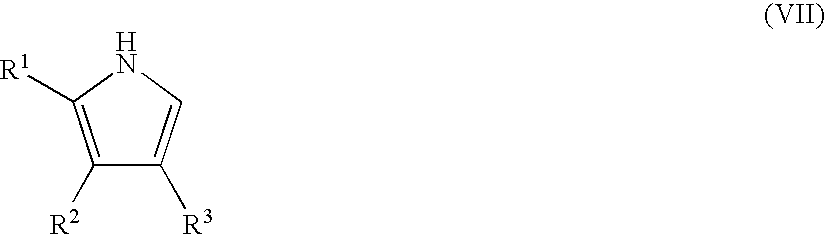
- Process e) for compounds of formula (I) wherein W is —C(R6)(R7)—; reacting a compound of formula (VIII):
-
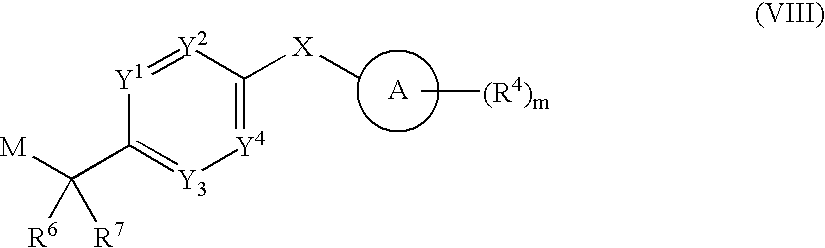
- wherein M is an organometallic group; with a compound of formula (IX):
-

- wherein L is a displaceable group;
Process f) reacting a compound of formula (X): -

- with a compound of formula (XI):
-

- wherein one of G and Z is an organometallic group and the other is a displaceable group;
and thereafter if necessary:
i) converting a compound of the formula (I) into another compound of the formula (I);
ii) removing any protecting groups;
iii) forming a pharmaceutically acceptable salt. - In this specification the term alkyl includes both straight and branched chain alkyl groups. For example, “C1-4alkyl” includes methyl, ethyl, propyl, isopropyl and t-butyl. However references to individual alkyl groups such as propyl are specific for the straight chain version only. An analogous convention applies to other generic terms.
- Where optional substituents are chosen from one or more groups it is to be understood that this definition includes all substituents being chosen from one of the specified groups or the substituents being chosen from two or more of the specified groups.
- A “heterocyclyl” is a saturated, partially saturated or unsaturated, mono or bicyclic ring containing 4-12 atoms of which at least one atom is chosen from nitrogen, sulphur or oxygen, which may, unless otherwise specified, be carbon or nitrogen linked, wherein a —CH2— group can optionally be replaced by a —C(O)— and a ring nitrogen and/or a ring sulphur atom may be optionally oxidised to form the N- or S-oxide(s). In one aspect of the invention a “heterocyclyl” is a saturated, partially saturated or unsaturated, monocyclic ring containing 5 or 6 atoms of which at least one atom is chosen from nitrogen, sulphur or oxygen, it may, unless otherwise specified, be carbon or nitrogen linked, a —CH2— group can optionally be replaced by a —C(O)— and a ring sulphur atom may be optionally oxidised to form the S-oxides. In a further aspect of the invention a “heterocyclyl” is an unsaturated, carbon-linked, monocyclic ring containing 5 or 6 atoms of which at least one atom is chosen from nitrogen, sulphur or oxygen. Examples and suitable values of the term “heterocyclyl” are morpholino, piperidyl, pyridyl, pyranyl, pyrrolyl, pyrazolyl, isothiazolyl, indolyl, quinolyl, thienyl, 1,3-benzodioxolyl, thiadiazolyl, piperazinyl, thiazolidinyl, pyrrolidinyl, thiomorpholino, pyrrolinyl, homopiperazinyl, 3,5-dioxapiperidinyl, tetrahydropyranyl, imidazolyl, pyrimidyl, pyrazinyl, pyridazinyl, isoxazolyl, N-methylpyrrolyl, 4-pyridone, 1-isoquinolone, 2-pyrrolidone, 4-thiazolidone, pyridine-N-oxide and quinoline-N-oxide.
- Ring A is a “carbon linked heterocyclyl”. A “carbon linked heterocyclyl” is a saturated, partially saturated or unsaturated, mono or bicyclic ring containing 4-12 atoms of which at least one atom is chosen from nitrogen, sulphur or oxygen, which is joined to the X group of formula (I) by a carbon atom in the ring, wherein a —CH2— group can optionally be replaced by a —C(O)— and a ring nitrogen and/or a ring sulphur atom may be optionally oxidised to form the N- or S-oxide(s). Suitably Ring A, a “carbon linked heterocyclyl”, is a fully unsaturated, mono or bicyclic ring containing 4-12 atoms of which at least one atom is chosen from nitrogen, sulphur or oxygen, which is joined to the X group of formula (I) by a carbon atom in the ring. Suitable values for a “carbon linked heterocyclyl” include thiazolyl and pyrimidinyl. Ring A is not 1-azabicyclo[3.2.0]hept-2-en-7-one.
- A “carbocyclyl” is a saturated, partially saturated or unsaturated, mono or bicyclic carbon ring that contains 3-12 atoms; wherein a —CH2— group can optionally be replaced by a —C(O)—. Particularly “carbocyclyl” is a monocyclic ring containing 5 or 6 atoms or a bicyclic ring containing 9 or 10 atoms. Suitable values for “carbocyclyl” include cyclopropyl, cyclobutyl, 1-oxocyclopentyl, cyclopentyl, cyclopentenyl, cyclohexyl, cyclohexenyl, phenyl, naphthyl, tetralinyl, indanyl or 1-oxoindanyl. A particular example of “carbocyclyl” is phenyl.
- An example of “C1-4alkanoyloxy” is acetoxy. Examples of “C1-4alkoxycarbonyl” include methoxycarbonyl, ethoxycarbonyl, n- and t-butoxycarbonyl. Examples of “C1-4alkoxycarbonylamino” include methoxycarbonylamino, ethoxycarbonylamino, n- and t-butoxycarbonylamino. Examples of “C1-4alkoxy” include methoxy, ethoxy and propoxy. Examples of “C1-4alkanoylamino” include formamido, acetamido and propionylamino. Examples of “C1-4alkylS(O)a wherein a is 0 to 2” include methylthio, ethylthio, methylsulphinyl, ethylsulphinyl, mesyl and ethylsulphonyl. Examples of “C1-4alkanoyl” include propionyl and acetyl. Examples of “N—(C1-4alkyl)amino” include methylamino and ethylamino. Examples of “N,N—(C1-4alkyl)2amino” include di-N-methylamino, di-(N-ethyl)amino and N-ethyl-N-methylamino. Examples of “C2-4alkenyl” are vinyl, allyl and 1-propenyl. Examples of “C2-4alkynyl” are ethynyl, 1-propynyl and 2-propynyl. Examples of “N—(C1-4alkyl)sulphamoyl” are N-(methyl)sulphamoyl and N-(ethyl)sulphamoyl. Examples of “N,N—(C1-4alkyl)2sulphamoyl” are N,N-(dimethyl)sulphamoyl and N-(methyl)-N-(ethyl)sulphamoyl. Examples of “N—(C1-4alkyl)carbamoyl” are methylaminocarbonyl and ethylaminocarbonyl. Examples of “N,N—(C1-4alkyl)2carbamoyl” are dimethylaminocarbonyl and methylethylaminocarbonyl. Examples of “N—(C1-4alkoxy)carbamoyl” are methoxyaminocarbonyl and isopropoxyaminocarbonyl. Examples of “N—(C1-4alkyl)-N—(C1-4alkoxy)carbamoyl” are N-methyl-N-methoxyaminocarbonyl and N-methyl-N-ethoxyaminocarbonyl. Examples of “C3-6cycloalkyl” are cyclopropyl, cyclobutyl, cyclopropyl and cyclohexyl. Examples of “N′—(C1-4alkyl)ureido” are N′-methylureido and N′-isopropylureido. Examples of “N′,N′—(C1-4alkyl)2ureido” are N′N′-dimethylureido and N′-methyl-N′-isopropylureido. Examples of “N′—(C1-4alkyl)hydrazinocarbonyl” are N′-methylhydrazinocarbonyl and N′-isopropylhydrazinocarbonyl. Examples of “N′,N′—(C1-4alkyl)2hydrazinocarbonyl” are N′N′-dimethylhydrazinocarbonyl and N′-methyl-N′-isopropylhydrazinocarbonyl. Examples of “C1-4alkylsulphonylamino” include methylsulphonylamino, isopropylsulphonylamino and t-butylsulphonylamino. Examples of “C1-4alkylsulphonylaminocarbonyl” include methylsulphonylaminocarbonyl, isopropylsulphonylaminocarbonyl and t-butylsulphonylaminocarbonyl. Examples of “C1-4alkylsulphonyl” include methylsulphonyl, isopropylsulphonyl and t-butylsulphonyl.
- A compound of formula (I) may form stable acid or basic salts, and in such cases administration of a compound as a salt may be appropriate, and pharmaceutically acceptable salts may be made by conventional methods such as those described following.
- Suitable pharmaceutically-acceptable salts include acid addition salts such as methanesulfonate, tosylate, α-glycerophosphate. fumarate, hydrochloride, citrate, maleate, tartrate and (less preferably) hydrobromide. Also suitable are salts formed with phosphoric and sulfuric acid. In another aspect suitable salts are base salts such as an alkali metal salt for example sodium, an alkaline earth metal salt for example calcium or magnesium, an organic amine salt for example triethylamine, morpholine, N-methylpiperidine, N-ethylpiperidine, procaine, dibenzylamine, N,N-dibenzylethylamine, tris-(2-hydroxyethyl)amine, N-methyl d-glucamine and amino acids such as lysine. There may be more than one cation or anion depending on the number of charged functions and the valency of the cations or anions. A preferred pharmaceutically-acceptable salt is the sodium salt.
- However, to facilitate isolation of the salt during preparation, salts which are less soluble in the chosen solvent may be preferred whether pharmaceutically-acceptable or not.
- Within the present invention it is to be understood that a compound of the formula (I) or a salt thereof may exhibit the phenomenon of tautomerism and that the formulae drawings within this specification can represent only one of the possible tautomeric forms. It is to be understood that the invention encompasses any tautomeric form which inhibits DNA gyrase and is not to be limited merely to any one tautomeric form utilised within the formulae drawings. The formulae drawings within this specification can represent only one of the possible tautomeric forms and it is to be understood that the specification encompasses all possible tautomeric forms of the compounds drawn not just those forms which it has been possible to show graphically herein. The same applies to compound names.
- It will be appreciated by those skilled in the art that certain compounds of formula (I) contain an asymmetrically substituted carbon and/or sulphur atom, and accordingly may exist in, and be isolated in, optically-active and racemic forms. Some compounds may exhibit polymorphism. It is to be understood that the present invention encompasses any racemic, optically-active, polymorphic or stereoisomeric form, or mixtures thereof, which form possesses properties useful in the inhibition of DNA gyrase, it being well known in the art how to prepare optically-active forms (for example, by resolution of the racemic form by recrystallization techniques, by synthesis from optically-active starting materials, by chiral synthesis, by enzymatic resolution, by biotransformation, or by chromatographic separation using a chiral stationary phase) and how to determine efficacy for the inhibition of DNA gyrase by the standard tests described hereinafter.
- It is also to be understood that certain compounds of the formula (I) and salts thereof can exist in solvated as well as unsolvated forms such as, for example, hydrated forms. It is to be understood that the invention encompasses all such solvated forms which inhibit DNA gyrase.
- There follow particular and suitable values for certain substituents and groups referred to in this specification. These values may be used where appropriate with any of the definitions and embodiments disclosed hereinbefore, or hereinafter. For the avoidance of doubt each stated species represents a particular and independent aspect of this invention.
- R1 is selected from C1-4alkyl.
- R1 is selected from methyl.
- R2 is selected from halo.
- R2 is selected from chloro.
- R3 is selected from halo.
- R3 is selected from chloro.
- W is —O—.
- W is —N(R5)—.
- W is —NH—.
- W is —C(R6)(R7)—.
- Y1, Y2, Y3 and Y4 are all —C(R8)═; wherein R8 is hydrogen.
- Y2 is —N═ and Y1, Y3 and Y4 are independently selected from —C(R8)═ wherein R8 is hydrogen.
- Y1, Y2, Y3 and Y4 are all —C(R8)═ or Y2 is —N═ and Y1, Y3 and Y4 are independently selected from —C(R8)═; wherein R8 is hydrogen.
- X is a direct bond.
- X is —CH2—.
- X is —C(O)—.
- X is S(O)q— (wherein q is 1 or 2).
- Ring A is carbocyclyl.
- Ring A is a carbon linked heterocyclyl; wherein if said heterocyclyl contains an —NH-moiety that nitrogen may be optionally substituted by a group selected from R9; wherein:
- R9 is selected from C1-4alkyl or carbocyclyl; wherein R9 may be optionally substituted by R22; and
- R22 is selected carboxy or ethoxycarbonyl.
- Ring A is thiazolyl, pyridyl, triazolyl, tetrazolyl, pyrimidinyl, imidazo[1,2-a]pyridyl, isoxazolyl or oxazolyl; wherein said triazolyl may be optionally substituted on nitrogen by a group selected from R9; wherein:
- R9 is selected from methyl or phenyl; wherein R9 may be optionally substituted by R22; and
- R22 is selected carboxy or ethoxycarbonyl.
- Ring A is thiazol-2-yl, pyrid-2-yl, pyrid-3-yl, 1,2,3-triazol-4-yl, 1,2,3,4-tetrazol-5-yl, pyrimidin-4-yl, imidazo[1,2-a]pyrid-6-yl, isoxazol-5-yl or oxazol-2-yl; wherein said 1,2,3-triazol-4-yl may be optionally substituted on nitrogen by a group selected from R9; wherein:
- R9 is 4-carboxyphenyl, ethoxycarbonylmethyl and carboxymethyl.
- Ring A is thiazol-2-yl, pyrid-2-yl, pyrid-3-yl, 1-(4-carboxyphenyl)-1,2,3-triazol-4-yl, 1-(ethoxycarbonylmethyl)-1,2,3-triazol-4-yl, 1-(carboxymethyl)-1,2,3-triazol-4-yl, 1,2,3,4-tetrazol-5-yl, pyrimidin-4-yl, imidazo[1,2-a]pyrid-6-yl, isoxazol-5-yl or oxazol-2-yl.
- R4 is selected from halo, hydroxy, carboxy, C1-4alkoxy, N—(C1-4alkyl)amino, C1-4alkoxycarbonyl or heterocyclyl-R1—; wherein R4 may be optionally substituted on carbon by one or more R12;
- R12 is selected from hydroxy, C1-4alkoxy, C1-4alkanoyloxy or heterocyclyl-R19—;
- R11 and R19 are a direct bond.
- R4 is selected from chloro, hydroxy, carboxy, methoxy, methylamino, ethylamino, methoxycarbonyl, ethoxycarbonyl or morpholino; wherein R4 may be optionally substituted on carbon by one or more R12;
- R12 is selected from hydroxy, methoxy, acetyloxy or morpholino;
- R4 is selected from methoxycarbonyl, ethoxycarbonyl, carboxy, methylamino, chloro, 2-morpholinoethylamino, methoxy, 2-methoxyethylamino, hydroxy, morpholino, 2-(acetyloxy)ethylamino or 2-hydroxyethylamino.
- m is 0.
- m is 1.
- m is 2; wherein the values of R4 may be the same or different.
- m is 0-2; wherein the values of R4 may be the same or different.
- R5 is hydrogen.
- Therefore in a further aspect of the invention there is provided a compound of formula (I) (as depicted above) wherein:
- R1 is selected from C1-4alkyl;
- R2 is selected from halo;
- R3 is selected from halo;
- W is —NH—;
- Y1, Y2, Y3 and Y4 are all —C(R8)═ or Y2 is —N═ and Y1, Y3 and Y4 are independently selected from —C(R8)═;
- X is a direct bond;
- Ring A is a carbon linked heterocyclyl; wherein if said heterocyclyl contains an —NH-moiety that nitrogen may be optionally substituted by a group selected from R9;
- R4 is selected from halo, hydroxy, carboxy, C1-4alkoxy, N—(C1-4alkyl)amino, C1-4alkoxycarbonyl or heterocyclyl-R11—; wherein R4 may be optionally substituted on carbon by one or more R12;
- m is 0-2; wherein the values of R4 may be the same or different;
- R8 is hydrogen;
- R9 is selected from C1-4alkyl or carbocyclyl; wherein R9 may be optionally substituted by R22;
- R12 is selected from hydroxy, C1-4alkoxy, C1-4alkanoyloxy or heterocyclyl-R19—;
- R11 and R19 are a direct bond; and
- R22 is selected carboxy or ethoxycarbonyl;
- or a pharmaceutically acceptable salt thereof.
- Therefore in a further aspect of the invention there is provided a compound of formula (I) (as depicted above) wherein:
- R1 is selected from methyl;
- R2 is selected from chloro;
- R3 is selected from chloro;
- W is —NH—;
- Y1, Y2, Y3 and Y4 are all —CH═ or Y2 is —N═ and Y1, Y3 and Y4 are independently selected from —CH═;
- X is a direct bond;
- Ring A is thiazol-2-yl, pyrid-2-yl, pyrid-3-yl, 1-(4-carboxyphenyl)-1,2,3-triazol-4-yl, 1-(ethoxycarbonylmethyl)-1,2,3-triazol-4-yl, 1-(carboxymethyl)-1,2,3-triazol-4-yl, 1,2,3,4-tetrazol-5-yl, pyrimidin-4-yl, imidazo[1,2-a]pyrid-6-yl, isoxazol-5-yl or oxazol-2-yl;
- R4 is selected from methoxycarbonyl, ethoxycarbonyl, carboxy, methylamino, chloro, 2-morpholinoethylamino, methoxy, 2-methoxyethylamino, hydroxy, morpholino, 2-(acetyloxy)ethylamino or 2-hydroxyethylamino; and
- m is 0-2; wherein the values of R4 may be the same or different;
- or a pharmaceutically acceptable salt thereof.
- Particular compounds of the invention are the compounds of the Examples, each of which provides a further independent aspect of the invention. In further aspects, the present invention also comprises any two or more compounds of the Examples.
- In one embodiment of the invention are provided compounds of formula (I), in an alternative embodiment are provided pharmaceutically-acceptable salts of compounds of formula (I).
- In a further embodiment the invention provides a compound of formula I which is a compound of formula IA.
-

- In a further embodiment the invention provides a compound of formula IA which is a compound of formula IB.
-

- In a further embodiment the invention provides a compound of formula IB which is a compound of formula IC.
-

- In a further embodiment the invention provides a compound of formula IC which is a compound of formula ID.
-

- In a further embodiment the invention provides a compound of formula ID which is a compound of formula IE.
-
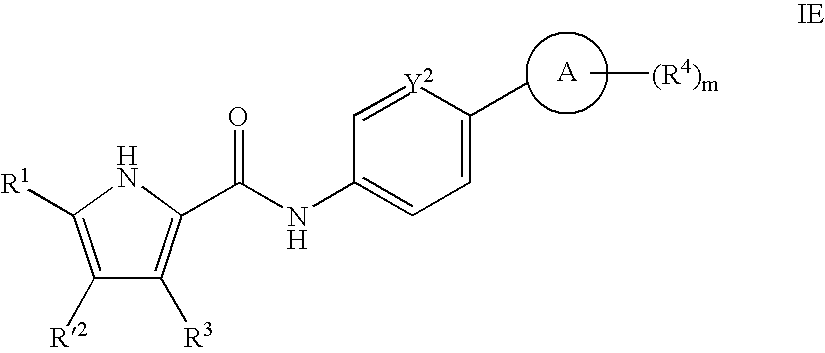
- wherein A is a carbon linked heterocyclyl; wherein if said heterocyclyl contains an —NH— moiety that nitrogen may be optionally substituted by a group selected from R9.
- In a further aspect the present invention provides a process for preparing a compound of formula (I) or a pharmaceutically-acceptable salt thereof.
- Thus, the present invention also provides that the compounds of the formula (I) and pharmaceutically-acceptable salts thereof, can be prepared by a process as follows (wherein the variables are as defined above unless otherwise stated):
- Process a) for compounds of formula (I) wherein W is —C(R6)(R7)—; converting a compound of formula (II):
-

- wherein Ra is cyano and Rb is dimethyamino or diethylamino; or Ra and Rb are independently selected from C1-4alkylthio; or Ra and Rb together form 1,3-dithianyl or 1,3-dithiolanyl; into a compound of formula (I);
Process b) for compounds of formula (I) wherein W is —O—; reacting a compound of formula (III): -

- with a compound of formula (IV):
-

- Process c) for compounds of formula (I) wherein W is —N(R5)—; reacting a compound of formula (V):
-
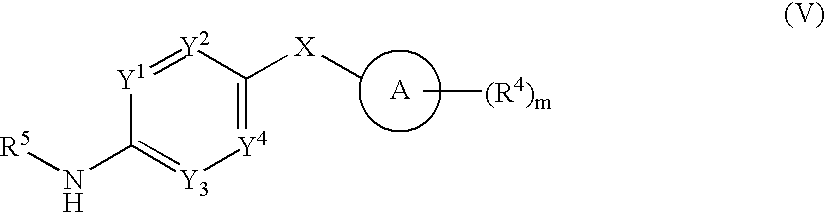
- with a compound of formula (IV) or an activated acid derivative thereof;
Process d) for compounds of formula (I) wherein W is —C(R6)(R7)—; reacting a compound of formula (VI): -

- wherein L is a displaceable group; with a compound of formula (VII):
-

- Process e) for compounds of formula (I) wherein W is —C(R6)(R7)—; reacting a compound of formula (VIII):
-

- wherein M is an organometallic group; with a compound of formula (IX):
-

- wherein L is a displaceable group;
Process f) reacting a compound of formula (X): -

- with a compound of formula (XI):
-

- wherein one of G and Z is an organometallic group and the other is a displaceable group; and thereafter if necessary:
i) converting a compound of the formula (I) into another compound of the formula (I);
ii) removing any protecting groups;
iii) forming a pharmaceutically acceptable salt. - L is a displaceable group. Suitable values for L include halo, for example chloro and bromo, pentafluorophenoxy and 2,5-oxopyrrolidin-1-yloxy.
- M is an organometallic group, suitable values for M include organocuprates, for example CuLi, organozincs, Zn, or a Grignard reagent for example MgG where G is halo for example chloro.
- One of G and Z is an organometallic group suitable values for this organometallic group include an organoborate, for example B(ORa) wherein Ra is hydrogen or C1-4alkyl, organocuprates, for example CuLi, organozincs, Zn, a Grignard reagent for example MgJ where J is halo for example chloro, or an organostannane, for example trimethylstannane or tributylstannane.
- One of G and Z is a displaceable group suitable values for this displaceable group include halo, for example chloro, bromo or iodo, tosyl, trifluoromethylsulphonate or mesylate.
- Specific reaction conditions for the above reaction are as follows.
- Process a) Compounds of formula (II) may be converted into compounds of formula (I):
(i) where Ra is cyano and Rb is dimethyamino or diethylamino; in the presence of a base for example sodium hydroxide, in a suitable solvent for example aqueous methanol at room temperature.
(ii) wherein or Ra and Rb are independently selected from C1-4alkylthio; or Ra and Rb together form 1,3-dithianyl or 1,3-dithiolanyl; in the presence of a reagent such as a mercury, copper or silver salt for example Hg(ClO4)2, CuCl2 or AgNO3/Ag2O in the presence of a suitable solvent for example methanol, acetone or ethanol from a temperature ranging from room temperature to reflux. - Compounds of formula (II) may be prepared according to Scheme 1:
-

- wherein Pg is a hydroxy protecting group as defined hereinbelow; one of G and Z is an organometallic group as defined hereinabove and the other is a displaceable group as defined hereinabove; and D is a displaceable group. Suitable values for D include halo, for example chloro, bromo and iodo, tosylate and mesylate.
- Deprotection of hydroxy protecting groups are well known in the art. Examples of such deprotections are given hereinbelow.
- FGI stands for Functional Group Interconversion. In the above scheme such conversions between a hydroxy group and a D group are well known in the art and are well within the capabilities of a person skilled in the art.
- Compounds of formula (IIa) and (IId) are known in the literature, or they are prepared by standard processes known in the art.
- Process b) Compounds of formula (III) and (IV) may be reacted together in the presence of a coupling reagent, for example dicyclohexylcarbodiimide or EDC, in a suitable solvent, for example dichloromethane, THF or diethylether.
- Compounds of formula (III) may be prepared according to Scheme 2:
-

- wherein Pg is a hydroxy protecting group as defined hereinbelow; and one of G and Z is an organometallic group and the other is a displaceable group as defined hereinabove.
- Deprotection of hydroxy protecting groups are well known in the art. Examples of such deprotections are given hereinbelow.
- Compounds of formula (IIIa) and (IV) are commercially available compounds, or they are known in the literature, or they are prepared by standard processes known in the art.
- Process c) Compounds of formula (V) and (IV) may be coupled together in the presence of a suitable coupling reagent. Standard peptide coupling reagents known in the art can be employed as suitable coupling reagents, or for example carbonyldiimidazole and dicyclohexyl-carbodiimide, optionally in the presence of a catalyst such as dimethylaminopyridine or 4-pyrrolidinopyridine, optionally in the presence of a base for example triethylamine, pyridine, or 2,6-di-alkyl-pyridines such as 2,6-lutidine or 2,6-di-tert-butylpyridine. Suitable solvents include dimethylacetamide, dichloromethane, benzene, tetrahydrofuran and dimethylformamide. The coupling reaction may conveniently be performed at a temperature in the range of −40 to 40° C.
- Suitable activated acid derivatives include acid halides, for example acid chlorides, and active esters, for example pentafluorophenyl esters. The reaction of these types of compounds with amines is well known in the art, for example they may be reacted in the presence of a base, such as those described above, and in a suitable solvent, such as those described above. The reaction may conveniently be performed at a temperature in the range of −40 to 40° C.
- Compounds of formula (V) may be prepared according to Scheme 3:
-

- wherein Pg is a amino protecting group as defined hereinbelow; and one of G and Z is an organometallic group and the other is a displaceable group as defined hereinabove. The skilled reader will appreciate that where R5 is hydrogen, this hydrogen may also need protecting by way of a suitable protecting group.
- Deprotection of amino protecting groups are well known in the art. Examples of such deprotections are given hereinbelow.
- Compounds of formula (Va) are commercially available compounds, or they are known in the literature, or they are prepared by standard processes known in the art.
- Process d) Compounds of formula (VI) and (VII) may be reacted in a suitable solvent such a DCM or 1,2-dichloroethane, optionally in the presence of a Lewis acid, for example AlCl3, from 0° C. to room temperature.
Compounds of formula (VI) may be prepared according to Scheme 4: -

- wherein RaOC(O) is an ester group; and one of G and Z is an organometallic group and the other is a displaceable group as defined hereinabove.
- Suitable values for Ra include C1-6alkyl. Deprotection of the Ra carboxy protecting group may be achieved under standard conditions, for example acid or base hydrolysis, such as those conditions give hereinbelow.
- FGI stands for Functional Group Interconversion. In the above scheme such conversions between an acid group and a —C(O)L group are well known in the art and are well within the capabilities of a person skilled in the art.
- Compounds of formula (VIa) and (VII) are commercially available compounds, or they are known in the literature, or they are prepared by standard processes known in the art.
- Process e) Compounds of formula (VIII) and (IX) may be reacted in a suitable aprotic solvent such as THF or ether, at temperatures in the range of −78° C. to 0° C.
- Compounds of formula (VIII) may be prepared from compounds of formula (IIc) under standard conditions known in the art. For example where M is an organocuprous reagent such compounds could be prepared according to Scheme 5:
-

- Compounds of formula (IX) are commercially available compounds, or they are known in the literature, or they are prepared by standard processes known in the art.
- Process f) Compounds of formula (X) and (XI) may be reacted in a suitable aprotic solvent such as THF or ether, at temperatures in the range of −78° C. to 0° C.
- Compounds of formula (X) may be prepared according to Scheme 6:
-
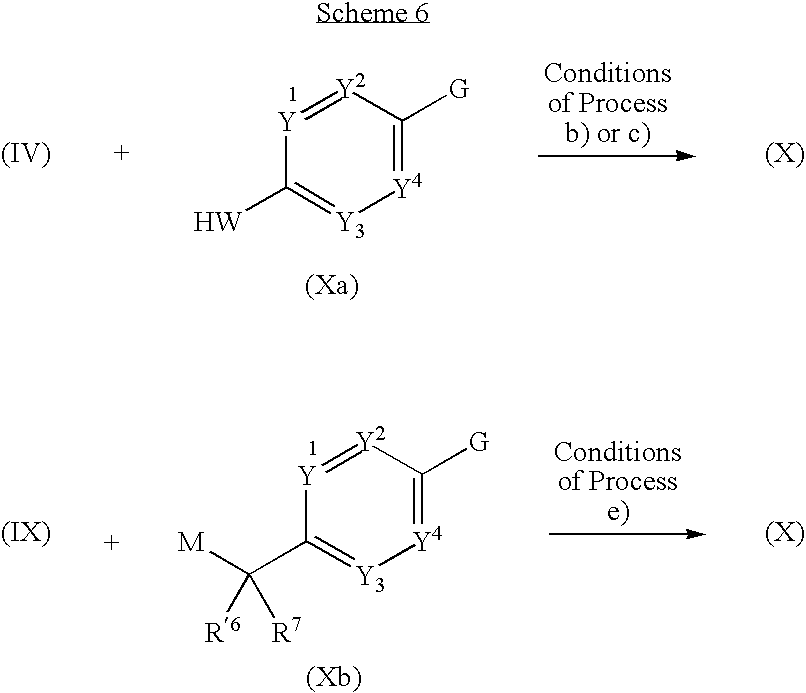
- wherein M is an organometallic group as defined hereinabove.
- Compounds of formula (Xa), (Xb) and (XI) are commercially available compounds, or they are known in the literature, or they are prepared by standard processes known in the art.
- The formation of a pharmaceutically-acceptable salt is within the skill of an ordinary organic chemist using standard techniques.
- It will be appreciated that certain of the various ring substituents in the compounds of the present invention may be introduced by standard aromatic substitution reactions or generated by conventional functional group modifications either prior to or immediately following the processes mentioned above, and as such are included in the process aspect of the invention. The reagents used to introduce such ring substituents are either commercially available or are made by processes known in the art.
- Introduction of substituents into a ring may convert one compound of the formula (I) into another compound of the formula (I). Such reactions and modifications include, for example, introduction of a substituent by means of an aromatic substitution reaction, reduction of substituents, alkylation of substituents, oxidation of substituents, esterification of substituents, amidation of substituents, formation of heteroaryl rings. The reagents and reaction conditions for such procedures are well known in the chemical art. Particular examples of aromatic substitution reactions include the introduction of alkoxides, diazotization reactions followed by introduction of thiol group, alcohol group, halogen group. Examples of modifications include; oxidation of alkylthio to alkylsulphinyl or alkylsulphonyl.
- The skilled organic chemist will be able to use and adapt the information contained and referenced within the above references, and accompanying Examples therein and also the Examples herein, to obtain necessary starting materials, and products. If not commercially available, the necessary starting materials for the procedures such as those described above may be made by procedures which are selected from standard organic chemical techniques, techniques which are analogous to the synthesis of known, structurally similar compounds, or techniques which are analogous to the above described procedure or the procedures described in the examples. It is noted that many of the starting materials for synthetic methods as described above are commercially available and/or widely reported in the scientific literature, or could be made from commercially available compounds using adaptations of processes reported in the scientific literature. The reader is further referred to Advanced Organic Chemistry, 4th Edition, by Jerry March, published by John Wiley & Sons 1992, for general guidance on reaction conditions and reagents.
- It will also be appreciated that in some of the reactions mentioned herein it may be necessary/desirable to protect any sensitive groups in compounds. The instances where protection is necessary or desirable are known to those skilled in the art, as are suitable methods for such protection. Conventional protecting groups may be used in accordance with standard practice (for illustration see T. W. Greene, Protective Groups in Organic Synthesis, John Wiley and Sons, 1991).
- Examples of a suitable protecting group for a hydroxy group is, for example, an acyl group, for example an alkanoyl group such as acetyl, an aroyl group, for example benzoyl, a silyl group such as trimethylsilyl or an arylmethyl group, for example benzyl. The deprotection conditions for the above protecting groups will necessarily vary with the choice of protecting group. Thus, for example, an acyl group such as an alkanoyl or an aroyl group may be removed, for example, by hydrolysis with a suitable base such as an alkali metal hydroxide, for example lithium or sodium hydroxide. Alternatively a silyl group such as trimethylsilyl may be removed, for example, by fluoride or by aqueous acid; or an arylmethyl group such as a benzyl group may be removed, for example, by hydrogenation in the presence of a catalyst such as palladium-on-carbon.
- A suitable protecting group for an amino group is, for example, an acyl group, for example an alkanoyl group such as acetyl, an alkoxycarbonyl group, for example a methoxycarbonyl, ethoxycarbonyl or t-butoxycarbonyl group, an arylmethoxycarbonyl group, for example benzyloxycarbonyl, or an aroyl group, for example benzoyl. The deprotection conditions for the above protecting groups necessarily vary with the choice of protecting group. Thus, for example, an acyl group such as an alkanoyl or alkoxycarbonyl group or an aroyl group may be removed for example, by hydrolysis with a suitable base such as an alkali metal hydroxide, for example lithium or sodium hydroxide. Alternatively an acyl group such as a t-butoxycarbonyl group may be removed, for example, by treatment with a suitable acid as hydrochloric, sulphuric or phosphoric acid or trifluoroacetic acid and an arylmethoxycarbonyl group such as a benzyloxycarbonyl group may be removed, for example, by hydrogenation over a catalyst such as palladium-on-carbon, or by treatment with a Lewis acid for example boron tris(trifluoroacetate). A suitable alternative protecting group for a primary amino group is, for example, a phthaloyl group which may be removed by treatment with an alkylamine, for example dimethylaminopropylamine or 2-hydroxyethylamine, or with hydrazine.
- A suitable protecting group for a carboxy group is, for example, an esterifying group, for example a methyl or an ethyl group which may be removed, for example, by hydrolysis with a base such as sodium hydroxide, or for example a t-butyl group which may be removed, for example, by treatment with an acid, for example an organic acid such as trifluoroacetic acid, or for example a benzyl group which may be removed, for example, by hydrogenation over a catalyst such as palladium-on-carbon.
- The protecting groups may be removed at any convenient stage in the synthesis using conventional techniques well known in the chemical art, or they may be removed during a later reaction step or work-up.
- When an optically active form of a compound of the invention is required, it may be obtained by carrying out one of the above procedures using an optically active starting material (formed, for example, by asymmetric induction of a suitable reaction step), or by resolution of a racemic form of the compound or intermediate using a standard procedure, or by chromatographic separation of diastereoisomers (when produced). Enzymatic techniques may also be useful for the preparation of optically active compounds and/or intermediates.
- Similarly, when a pure regioisomer of a compound of the invention is required, it may be obtained by carrying out one of the above procedures using a pure regioisomer as a starting material, or by resolution of a mixture of the regioisomers or intermediates using a standard procedure.
- Compounds were tested for inhibition of GyrB ATPase activity using an ammonium molybdate/malachite green-based phosphate detection assay (Lanzetta, P. A., L. J. Alvarez, P. S. Reinach, and O. A. Candia, 1979, 100: 95-97). Assays were performed in multiwell plates in 100 μl reactions containing: 50 mM TRIS buffer pH 7.5, 75 mM ammonium acetate, 5.5 mM magnesium chloride, 0.5 mM ethylenediaminetetraacetic acid, 5% glycerol, 1 mM 1,4-Dithio-DL-threitol, 200 nM bovine serum albumin, 16 μg/ml sheared salmon sperm DNA, 4 nM E. coli GyrA, 4 nM E. coli GyrB, 250 □M ATP, and compound in dimethylsulfoxide. Reactions were quenched with 150 μl of ammonium molybdate/malachite green detection reagent containing 1.2 mM malachite green hydrochloride, 8.5 mM ammonium molybdate tetrahydrate, and 1 M hydrochloric acid. Plates were read in an absorbance plate reader at 625 nm and percent inhibition values were calculated using dimethylsulfoxide (2%)-containing reactions as 0% inhibition and novobiocin-containing (2 μM) reactions as 100% inhibition controls. Compound potency was based on IC50 measurements determined from reactions performed in the presence of 10 different compound concentrations.
- Compounds of the Examples generally have an IC50 of <20 μg/ml.
- Compounds were tested for antimicrobial activity by susceptibility testing in liquid media. Compounds were dissolved in dimethylsulfoxide and tested in 10 doubling dilutions in the susceptibility assays. The organisms used in the assay were grown overnight on suitable agar media and then suspended in a liquid medium appropriate for the growth of the organism. The suspension was a 0.5 McFarland and a further 1 in 10 dilution was made into the same liquid medium to prepare the final organism suspension in 100 □L. Plates were incubated under appropriate conditions at 37 degrees C. for 24 hrs prior to reading. The Minimum Inhibitory Concentration was determined as the lowest drug concentration able to reduce growth by 80% or more.
- Example 30 had an MIC of 1 μg/ml against Streptococcus pneumoniae. Other examples are provided in the following table.
-
Example No. MIC SPN548 MIC SAU516 MIC HIN446 23 0.13 4 2 25 1 2 4 26 1 32 8 27 0.13 2 2 36 0.25 2 1 - We have found that compounds of the present invention inhibit bacterial DNA gyrase and are therefore of interest for their antibacterial effects.
- According to a further feature of the present invention there is provided a method for producing an antibacterial effect in a warm blooded animal, such as man, in need of such treatment, which comprises administering to said animal an effective amount of a compound of the present invention, or a pharmaceutically-acceptable salt thereof.
- According to a further feature of the invention there is provided a method for inhibition of bacterial DNA gyrase and/or topoisomeraseIV in a warm-blooded animal, such as a human being, in need of such treatment which comprises administering to said animal an effective amount of a compound of formula (I) or a pharmaceutically acceptable salt thereof as defined hereinbefore.
- According to a further feature of the invention there is provided a method of treating a bacterial infection in a warm-blooded animal, such as a human being, in need of such treatment which comprises administering to said animal an effective amount of a compound of formula (I) or a pharmaceutically acceptable salt thereof as defined hereinbefore.
- A further feature of the present invention is a compound of formula (I) and pharmaceutically acceptable salts thereof for use as a medicament. Suitably the medicament is an antibacterial agent.
- According to a further aspect of the invention there is provided the use of a compound of formula (I), or a pharmaceutically acceptable salt thereof in the manufacture of a medicament for use in the production of an anti-bacterial effect in a warm-blooded animal such as a human being.
- According to a further aspect of the invention there is provided the use of a compound of formula (I), or a pharmaceutically acceptable salt thereof in the manufacture of a medicament for use in inhibition of bacterial DNA gyrase and/or topoisomeraseIV in a warm-blooded animal such as a human being.
- Thus according to a further aspect of the invention there is provided the use of a compound of formula (I), or a pharmaceutically acceptable salt thereof in the manufacture of a medicament for use in the treatment of a bacterial infection in a warm-blooded animal such as a human being.
- According to a further aspect of the invention there is provided a compound of formula (I), or a pharmaceutically acceptable salt thereof for use in the production of an anti-bacterial effect in a warm-blooded animal such as a human being.
- According to a further aspect of the invention there is provided a compound of formula (I), or a pharmaceutically acceptable salt thereof for use in inhibition of bacterial DNA gyrase and/or topoisomeraseIV in a warm-blooded animal such as a human being.
- Thus according to a further aspect of the invention there is provided a compound of formula (I), or a pharmaceutically acceptable salt thereof for use in the treatment of a bacterial infection in a warm-blooded animal such as a human being.
- In order to use a compound of the formula (I) or a pharmaceutically-acceptable salt thereof, (hereinafter in this section relating to pharmaceutical composition “a compound of this invention”) for the therapeutic (including prophylactic) treatment of mammals including humans, in particular in treating infection, it is normally formulated in accordance with standard pharmaceutical practice as a pharmaceutical composition.
- Therefore in another aspect the present invention provides a pharmaceutical composition that comprises a compound of the formula (I) or a pharmaceutically-acceptable salt thereof, and a pharmaceutically-acceptable diluent or carrier.
- According to a further aspect of the invention there is provided a pharmaceutical composition that comprises a compound of formula (I) as defined hereinbefore or a pharmaceutically acceptable salt thereof, in association with a pharmaceutically acceptable excipient or carrier for use in producing an anti-bacterial effect in an warm-blooded animal, such as a human being.
- According to a further aspect of the invention there is provided a pharmaceutical composition that comprises a compound of formula (I) as defined hereinbefore or a pharmaceutically acceptable salt thereof, in association with a pharmaceutically acceptable excipient or carrier for use in inhibition of bacterial DNA gyrase and/or topoisomeraseIV in an warm-blooded animal, such as a human being.
- According to a further aspect of the invention there is provided a pharmaceutical composition that comprises a compound of formula (I) as defined hereinbefore or a pharmaceutically acceptable salt thereof, in association with a pharmaceutically acceptable excipient or carrier for use in the treatment of a bacterial infection in an warm-blooded animal, such as a human being.
- In order to use a compound of the formula (I) or a pharmaceutically-acceptable salt thereof, (hereinafter in this section relating to pharmaceutical composition “a compound of this invention”) for the therapeutic (including prophylactic) treatment of mammals including humans, in particular in treating infection, it is normally formulated in accordance with standard pharmaceutical practice as a pharmaceutical composition.
- Therefore in another aspect the present invention provides a pharmaceutical composition which comprises a compound of the formula (I) or a pharmaceutically-acceptable salt thereof, and a pharmaceutically-acceptable diluent or carrier.
- According to a further aspect of the invention there is provided a pharmaceutical composition which comprises a compound of formula (I) as defined hereinbefore or a pharmaceutically acceptable salt thereof, in association with a pharmaceutically acceptable excipient or carrier for use in producing an anti-bacterial effect in an warm-blooded animal, such as a human being.
- According to a further aspect of the invention there is provided a pharmaceutical composition which comprises a compound of formula (I) as defined hereinbefore or a pharmaceutically acceptable salt thereof, in association with a pharmaceutically acceptable excipient or carrier for use in inhibition of bacterial DNA gyrase in an warm-blooded animal, such as a human being.
- According to a further aspect of the invention there is provided a pharmaceutical composition which comprises a compound of formula (I) as defined hereinbefore or a pharmaceutically acceptable salt thereof, in association with a pharmaceutically acceptable excipient or carrier for use in the treatment of a bacterial infection in an warm-blooded animal, such as a human being.
- The compositions of the invention may be in a form suitable for oral use (for example as tablets, lozenges, hard or soft capsules, aqueous or oily suspensions, emulsions, dispersible powders or granules, syrups or elixirs), for topical use (for example as creams, ointments, gels, or aqueous or oily solutions or suspensions), for administration by inhalation (for example as a finely divided powder or a liquid aerosol), for administration by insufflation (for example as a finely divided powder) or for parenteral administration (for example as a sterile aqueous or oily solution for intravenous, subcutaneous, intramuscular or intramuscular dosing or as a suppository for rectal dosing).
- The compositions of the invention may be obtained by conventional procedures using conventional pharmaceutical excipients, well known in the art. Thus, compositions intended for oral use may contain, for example, one or more colouring, sweetening, flavouring and/or preservative agents.
- Suitable pharmaceutically acceptable excipients for a tablet formulation include, for example, inert diluents such as lactose, sodium carbonate, calcium phosphate or calcium carbonate, granulating and disintegrating agents such as corn starch or algenic acid; binding agents such as starch; lubricating agents such as magnesium stearate, stearic acid or talc; preservative agents such as ethyl or propyl p-hydroxybenzoate, and anti-oxidants, such as ascorbic acid. Tablet formulations may be uncoated or coated either to modify their disintegration and the subsequent absorption of the active ingredient within the gastrointestinal tract, or to improve their stability and/or appearance, in either case, using conventional coating agents and procedures well known in the art.
- Compositions for oral use may be in the form of hard gelatin capsules in which the active ingredient is mixed with an inert solid diluent, for example, calcium carbonate, calcium phosphate or kaolin, or as soft gelatin capsules in which the active ingredient is mixed with water or an oil such as peanut oil, liquid paraffin, or olive oil.
- Aqueous suspensions generally contain the active ingredient in finely powdered form together with one or more suspending agents, such as sodium carboxymethylcellulose, methylcellulose, hydroxypropylmethylcellulose, sodium alginate, polyvinyl-pyrrolidone, gum tragacanth and gum acacia; dispersing or wetting agents such as lecithin or condensation products of an alkylene oxide with fatty acids (for example polyoxethylene stearate), or condensation products of ethylene oxide with long chain aliphatic alcohols, for example heptadecaethyleneoxycetanol, or condensation products of ethylene oxide with partial esters derived from fatty acids and a hexitol such as polyoxyethylene sorbitol monooleate, or condensation products of ethylene oxide with long chain aliphatic alcohols, for example heptadecaethyleneoxycetanol, or condensation products of ethylene oxide with partial esters derived from fatty acids and a hexitol such as polyoxyethylene sorbitol monooleate, or condensation products of ethylene oxide with partial esters derived from fatty acids and hexitol anhydrides, for example polyethylene sorbitan monooleate. The aqueous suspensions may also contain one or more preservatives (such as ethyl or propyl p-hydroxybenzoate, anti-oxidants (such as ascorbic acid), colouring agents, flavouring agents, and/or sweetening agents (such as sucrose, saccharine or aspartame).
- Oily suspensions may be formulated by suspending the active ingredient in a vegetable oil (such as arachis oil, olive oil, sesame oil or coconut oil) or in a mineral oil (such as liquid paraffin). The oily suspensions may also contain a thickening agent such as beeswax, hard paraffin or cetyl alcohol. Sweetening agents such as those set out above, and flavouring agents may be added to provide a palatable oral preparation. These compositions may be preserved by the addition of an anti-oxidant such as ascorbic acid.
- Dispersible powders and granules suitable for preparation of an aqueous suspension by the addition of water generally contain the active ingredient together with a dispersing or wetting agent, suspending agent and one or more preservatives. Suitable dispersing or wetting agents and suspending agents are exemplified by those already mentioned above. Additional excipients such as sweetening, flavouring and colouring agents, may also be present.
- The pharmaceutical compositions of the invention may also be in the form of oil-in-water emulsions. The oily phase may be a vegetable oil, such as olive oil or arachis oil, or a mineral oil, such as for example liquid paraffin or a mixture of any of these. Suitable emulsifying agents may be, for example, naturally-occurring gums such as gum acacia or gum tragacanth, naturally-occurring phosphatides such as soya bean, lecithin, an esters or partial esters derived from fatty acids and hexitol anhydrides (for example sorbitan monooleate) and condensation products of the said partial esters with ethylene oxide such as polyoxyethylene sorbitan monooleate. The emulsions may also contain sweetening, flavouring and preservative agents.
- Syrups and elixirs may be formulated with sweetening agents such as glycerol, propylene glycol, sorbitol, aspartame or sucrose, and may also contain a demulcent, preservative, flavouring and/or colouring agent.
- The pharmaceutical compositions may also be in the form of a sterile injectable aqueous or oily suspension, which may be formulated according to known procedures using one or more of the appropriate dispersing or wetting agents and suspending agents, which have been mentioned above. A sterile injectable preparation may also be a sterile injectable solution or suspension in a non-toxic parenterally-acceptable diluent or solvent, for example a solution in 1,3-butanediol.
- Compositions for administration by inhalation may be in the form of a conventional pressurised aerosol arranged to dispense the active ingredient either as an aerosol containing finely divided solid or liquid droplets. Conventional aerosol propellants such as volatile fluorinated hydrocarbons or hydrocarbons may be used and the aerosol device is conveniently arranged to dispense a metered quantity of active ingredient.
- For further information on formulation the reader is referred to Chapter 25.2 in Volume 5 of Comprehensive Medicinal Chemistry (Corwin Hansch; Chairman of Editorial Board), Pergamon Press 1990.
- The amount of active ingredient that is combined with one or more excipients to produce a single dosage form will necessarily vary depending upon the host treated and the particular route of administration. For example, a formulation intended for oral administration to humans will generally contain, for example, from 0.5 mg to 2 g of active agent compounded with an appropriate and convenient amount of excipients which may vary from about 5 to about 98 percent by weight of the total composition. Dosage unit forms will generally contain about 1 mg to about 500 mg of an active ingredient. For further information on Routes of Administration and Dosage Regimes the reader is referred to Chapter 25.3 in Volume 5 of Comprehensive Medicinal Chemistry (Corwin Hansch; Chairman of Editorial Board), Pergamon Press 1990.
- In addition to the compounds of the present invention the pharmaceutical composition of this invention may also contain or be co-administered (simultaneously, sequentially or separately) with one or more known drugs selected from other clinically useful antibacterial agents (for example, macrolides, quinolones, β-lactams or aminoglycosides) and/or other anti-infective agents (for example, an antifungal triazole or amphotericin). These may include carbapenems, for example meropenem or imipenem, to broaden the therapeutic effectiveness. Compounds of this invention may also contain or be co-administered with bactericidal/permeability-increasing protein (BPI) products or efflux pump inhibitors to improve activity against gram negative bacteria and bacteria resistant to antimicrobial agents.
- As stated above the size of the dose required for the therapeutic or prophylactic treatment of a particular disease state will necessarily be varied depending on the host treated, the route of administration and the severity of the illness being treated. Preferably a daily dose in the range of 1-50 mg/kg is employed. However the daily dose will necessarily be varied depending upon the host treated, the particular route of administration, and the severity of the illness being treated. Accordingly the optimum dosage may be determined by the practitioner who is treating any particular patient.
- In addition to its use in therapeutic medicine, compounds of formula (I) and their pharmaceutically acceptable salts are also useful as pharmacological tools in the development and standardisation of in-vitro and in-vivo test systems for the evaluation of the effects of inhibitors of DNA gyrase in laboratory animals such as cats, dogs, rabbits, monkeys, rats and mice, as part of the search for new therapeutic agents.
- In the above other, pharmaceutical composition, process, method, use and medicament manufacture features, the alternative and particular embodiments of the compounds of the invention described herein also apply.
- The invention will now be illustrated by the following non limiting examples in which, unless stated otherwise:
- (i) temperatures are given in degrees Celsius (° C.); operations were carried out at room or ambient temperature, that is, at a temperature in the range of 18-25° C.;
(ii) organic solutions were dried over anhydrous magnesium sulphate; evaporation of solvent was carried out using a rotary evaporator under reduced pressure (600-4000 Pascals; 4.5-30 mmHg) with a bath temperature of up to 60° C.;
(iii) in general, the course of reactions was followed by TLC and reaction times are given for illustration only;
(iv) final products had satisfactory proton nuclear magnetic resonance (NMR) spectra and/or mass spectral data;
(v) yields are given for illustration only and are not necessarily those which can be obtained by diligent process development; preparations were repeated if more material was required;
(vii) when given, NMR data is in the form of delta values for major diagnostic protons, given in parts per million (ppm) relative to tetramethylsilane (TMS) as an internal standard, determined at 300 MHz using perdeuterio dimethyl sulphoxide (DMSO-d6) as solvent unless otherwise indicated;
(vii) chemical symbols have their usual meanings; SI units and symbols are used;
(viii) solvent ratios are given in volume:volume (v/v) terms; and
(ix) mass spectra were run with an electron energy of 70 electron volts in the chemical ionization (CI) mode using a direct exposure probe; where indicated ionization was effected by electron impact (EI), fast atom bombardment (FAB) or electrospray (ESP); values for m/z are given; generally, only ions which indicate the parent mass are reported; and unless otherwise stated, the mass ion quoted is (M+H)+;
(x) where a synthesis is described as being analogous to that described in a previous example the amounts used are the millimolar ratio equivalents to those used in the previous example;
(xi) the following abbreviations have been used: -
- HATU O-(7-azabenzotriazol-1-yl)-N,N,N′,N′-tetramethyluronium hexafluorophosphate;
- THF tetrahydrofuran;
- DIEA diisopropylethylamine;
- TFA trifluoroacetic acid;
- NMP N-methylpyrrolidinone;
- DME dimethoxyethane;
- DCM dichloromethane;
- DMF N,N-dimethylformamide; and
- DMSO dimethylsulphoxide.
- 3,4-Dichloro-N-(4-ethynylphenyl)-5-methyl-1H-pyrrole-2-carboxamide (Intermediate 11; 1 g, 3.4 mmol), CuI (1.3 g, 6.8 mmol, 2 eq.) and ethyl azidoacetate (880 mg, 6.8 mmol, 2 eq.) were combined and dissolved in DIEA (1.3 g, 10.1 mmol, 3 eq.) and 1,4 dioxane (20 ml). The slurry was heated to 100° C. for 6 hrs. The reaction was monitored by LC/MS. The solids were filtered and the mother liquor was concentrated to a foam. MS (ES) (M+H)+=422, 424; NMR: 1.22 (t, 3H), 2.24 (s, 3H), 4.18 (q, 2H), 5.54 (s, 2H), 7.74 (dd, 4H), 8.51 (s, 1H), 9.54 (s, 1H), 12.2 (s, 1H).
- Ethyl [4-(4-{[(3,4-dichloro-5-methyl-1H-pyrrol-2-yl)carbonyl]amino}phenyl)-1H-1,2,3-triazol-1-yl]acetate (Example 1; 1.4 g, 3.4 mmol) was dissolved in a 1:1 mixture of EtOH (10 ml) and 2N KOH (10 ml). The reaction mixture was stirred at room temperature for 3 days. The solution was cooled to 0° C. and acidified with 2N HCl to pH 7. The mixture was concentrated to dryness and purified by HPLC (15-95% acetonitrile/0.1% TFA over 35 min.). The product fractions were collected, the acetonitrile removed by rotary evaporation and the water froze and lyophilized. Isolation gave 60 mg of the title compound. M/z 393, 395; NMR: 2.17 (s, 3H), 5.25 (s, 2H), 7.67 (dd, 4H), 8.42 (s, 1H), 9.46 (s, 1H), 12.1 (s, 1H), 13.4 (broad s, 1H).
- 3,4-Dichloro-N-(4-ethynylphenyl)-5-methyl-1H-pyrrole-2-carboxamide (Intermediate 11; 500 mg, 1.7 mmol) was combined with 4-azidobenzoic acid (1.38 g, 8.5 mmol, 5 eq.) and dissolved in 1,4 dioxane (5 ml). The solution was heated to 90° C. for 24 hrs. The reaction was diluted with EtOAc and washed with H2O. The organic layer was dried over Na2SO4, filtered and concentrated. The product was purified by HPLC (50-70% acetonitrile/0.1% TFA over 15 min.). Isolation gave 33 mg of the title compound in a 4% yield. M/z 455, 457; NMR: 2.23 (s, 3H), 7.27 (d, 2H), 7.54 (d, 2H), 7.69 (d, 2H), 8.07 (d, 2H), 8.14 (s, 1H), 9.6 (s, 1H), 12.2 (s, 1H), 13.3 (broad s, 1H).
- A solution of 4-[5-(ethoxycarbonyl)pyridin-3-yl]benzenaminium (Intermediate 27; 132 mg, 0.55 mmol), 3,4-dichloro-5-methyl-1H-pyrrole-2-carbonyl chloride (Intermediate 41; 150 mg (0.71 mmol) and diisopropylethylamine (120 μl, 0.73 mmol) in DCM (10 ml) was stirred at ambient temperature overnight. The mixture was partitioned between water and EtOAc. Insoluble material was collected, washed with water and EtOAc and dried in vacuo to afford 96 mg of product. The EtOAc from the filtrate was separated and washed with brine. Drying and removal of solvent gave a solid that was triturated with EtOAc to afford 66 mg of additional product. M/z 418, 420; NMR: 1.4 (t, 3H), 2.2 (s, 3H), 4.4 (q, 2H), 7.8 (s, 4H), 8.5 (s, 1H), 9.05 (s, 1H), 9.15 (s, 1H), 9.6 (s, 1H), 12.2 (s, 1H).
- To a solution of 4-[5-(methoxycarbonyl)-1,3-thiazol-2-yl]benzenaminium (Intermediate 28; 150 mg, 0.64 mmol) in pyridine (5 ml) was added 3,4-dichloro-5-methyl-1H-pyrrole-2-carbonyl chloride (Intermediate 41; 180 mg, 0.85 mmol). The mixture was stirred at ambient temperature for 30 min. Solvent was removed, and the residue was partitioned between EtOAc and water. The mixture was filtered through diatomaceous earth rinsing well with EtOAc. The EtOAc was separated from the filtrate, washed with brine, dried and concentrated to give a gummy solid. Chromatography on silica gel (100% DCM followed by gradient elution to 10% MeOH in DCM) afforded 120 mg of product as a solid, M/z 410, 412; NMR: 2.2 (s, 3H), 3.9 (s, 3H), 7.85 (d, 2H), 8.0 (d, 2H), 8.5 (s, 1H), 9.8 (s, 1H), 12.3 (s, 1H).
- Using the procedure of Example 5 the following compounds were prepared from the appropriate amine (SM) and 3,4-dichloro-5-methyl-1H-pyrrole-2-carbonyl chloride (Intermediate 41).
-
Ex Compound M/z NMR SM 6 3,4-Dichloro-5-methyl-N-[6-(1H- 338, 2.3 (s, 1H), 8.2 (d, 2H), Intermediate tetrazol-5-yl)pyridin-3-yl]-1H- 340 9.0 (s, 1H), 9.9 (s, 1H) 26 pyrrole-2-carboxamide 7 3,4-Dichloro-5-methyl-N-[4-(1H- 337, 2.2 (s, 3H), 7.9 (d, 2H), 4-(1H- tetrazol-5-yl)phenyl]-1H-pyrrole- 339 8.0 (d, 2H), 9.8 (s, 1H), 12.2 (s, tetrazol-5- 2-carboxamide 1H) yl)aniline* 8 Methyl 5-(4-{[(3,4-dichloro-5- 432, 2.2 (s, 3H), 3.0 (s, 3H), Intermediate methyl-1H-pyrrol-2- 434 3.9 (s, 3H), 7.6 (d, 2H), 7.7 (d, 29 yl)carbonyl]amino}phenyl)-2- 2H), 7.9 (s, 1H), 8.3 (s, 1H), (methylamino)nicotinate 8.8 (s, 1H), 9.5 (s, 1H), 12.3 (s, 1H) 9 Methyl 2-chloro-5-(4-{[(3,4- 438, 2.2 (s, 3H), 3.9 (s, 3H), Intermediate dichloro-5-methyl-1H-pyrrol-2- 440 7.8 (s, 4H), 8.5 (s, 1H), 8.9 (s, 30 yl)carbonyl]amino}phenyl)nicotinate 1H), 9.7 (s, 1H), 12.3 (s, 1H) 10 Methyl 2-(4-{[(3,4-dichloro-5- 404, 2.2 (s, 3H), 3.9 (s, 3H), Intermediate methyl-1H-pyrrol-2- 406 7.75 (d, 1H), 7.8 (d, 2H), 8.1 (d, 31 yl)carbonyl]amino}phenyl)isonicotinate 2H), 8.3 (s, 1H), 8.9 (d, 1H), 9.65 (s, 1H), 12.2 (s, 1H) 11 Methyl 5-(4-{[(3,4-dichloro-5- 434, Intermediate methyl-1H-pyrrol-2- 436 32 yl)carbonyl]amino}phenyl)-2- methoxynicotinate 12 Methyl 6-(4-{[(3,4-dichloro-5- 443, 2.2 (s, 3H), 3.9 (s, 3H), Intermediate methyl-1H-pyrrol-2- 445 7.5-8.0 (m, 5H), 8.1 (d, 1H), 33 yl)carbonyl]amino}phenyl)imidazo[1,2- 9.2 (s, 1H), 9.8 (s, 1H), 12.5 (s, a]pyridine-8-carboxylate 1H) 13 Methyl 5-(4-{[(3,4-dichloro-5- 532, 2.2 (s, 3H), 2.4-2.6 (m, 6H), Intermediate methyl-1H-pyrrol-2- 534 3.6 (m, 6H), 3.9 (s, 3H), 34 yl)carbonyl]amino}phenyl)-2-[(2-morpholin-4- 7.6 (d, 2H), 7.7 (d, 2H), 8.2 (m, ylethyl)amino]nicotinate 1H), 8.3 (s, 1H), 8.7 (s, 1H), 9.5 (s, 1H), 12.2 (s, 1H) 14 Methyl 5-(4-{[(3,4-dichloro-5- 477, 2.2 (s, 3H), 3.4 (s, 3H), Intermediate methyl-1H-pyrrol-2- 479 3.6 (m, 2H), 3.7 (m, 2H), 3.9 (s, 35 yl)carbonyl]amino}phenyl)-2-[(2- 3H), 7.6 (s, 2H), 7.7 (s, 2H), methoxyethyl)amino]nicotinate 8.3 (m, 2H), 8.7 (s, 1H), 9.5 (s, 1H), 12.2 (s, 1H) 15 Methyl 5-(4-{[(3,4-dichloro-5- 489, 2.2 (s, 3H), 3.3 (m, 4H), Intermediate methyl-1H-pyrrol-2- 491 3.7 (m, 4H), 3.9 (s, 3H), 7.7 (d, 36 yl)carbonyl]amino}phenyl)-2- 2H), 7.8 (d, 2H), 8.2 (s, 1H), morpholin-4-ylnicotinate 8.7 (s, 1H), 9.5 (s, 1H), 12.2 (s, 1H) 16 Methyl 2-{[2- 505, 2.0 (s, 3H), 2.2 (s, 3H), Intermediate (acetyloxy)ethyl]amino}-5-(4- 507 3.8 (m, 2H), 3.9 (s, 3H), 4.2 (m, 37 {[(3,4-dichloro-5-methyl-1H- 2H), 7.6 (d, 2H), 7.8 (d, 2H), pyrrol-2- 8.1 (m, 1H), 8.3 (s, 1H), yl)carbonyl]amino}phenyl)nicotinate 8.7 (s, 1H), 9.8 (s, 1H), 12.5 (s, 1H) 17 Methyl 5-(4-{[(3,4-dichloro-5- 420, Intermediate methyl-1H-pyrrol-2- 422 38 yl)carbonyl]amino}phenyl)-2-oxo- 1,2-dihydropyridine-3-carboxylate 18 Methyl 5-{[(3,4-dichloro-5- 434, 2.2 (s, 3H), 3.0 (d, 3H), Intermediate methyl-1H-pyrrol-2- 436 3.9 (s, 3H), 7.9 (d, 1H), 8.0 (m, 40 yl)carbonyl]amino}-6′- 1H), 8.1 (d, 1H), 8.8 (s, 1H), (methylamino)-2,3′-bipyridine-5′- 8.9 (s, 1H), 9.0 (s, 1H), carboxylate 9.7 (s, 1H), 12.3 (s, 1H) 19 Methyl 5-(4-{[(3,4-dichloro-5- 393, 2.24 (s, 3H), 3.84 (s, 3H), Intermediate 7 methyl-1H-pyrrol-2- 395 7.11 (d, 1H), 7.43 (d, 1H), yl)carbonyl]amino}phenyl)-2- 7.81 (s, 4H), 9.65 (s, 1H), furoate 12.22 (s, 1H). 20 Methyl 2-chloro-6-(4-{[(3,4- 439, 2.25 (s, 3H), 3.97 (s, 3H), Intermediate 8 dichloro-5-methyl-1H-pyrrol-2- 441 7.89 (d, 2H), 8.31 (d, 2H), yl)carbonyl]amino}phenyl)pyrimidine- 8.50 (s, 1H), 9.84 (s, 1H), 4-carboxylate 12.26 (s, 1H). 21 Ethyl 5-{[(3,4-dichloro-5-methyl- 419, 1.37 (t, 3H), 2.24 (s, 3H), Intermediate 9 1H-pyrrol-2-yl)carbonyl]amino}- 421 4.40 (q, 2H), 8.18-8.29 (m, 2,3′-bipyridine-5′-carboxylate 2H), 8.88 (t, 1H), 9.00 (d, 1H), 9.10 (d, 1H), 9.47 (d, 1H), 9.85 (s, 1H), 12.29 (s, 1H). 22 Ethyl 5-(4-{[(3,4-dichloro-5- 408, 1.34 (t, 3H), 2.24 (s, 3H), Intermediate methyl-1H-pyrrol-2- 410 4.39 (q, 2H), 7.40 (s, 1H), 10 yl)carbonyl]amino}phenyl)isoxazole- 7.84 (d, 2H), 7.95 (d, 2H), 3-carboxylate 9.76 (s, 1H), 12.25 (s, 1H). *Koguro, Kiyoto; Oga, Toshikazu; Mitsui, Sunao; Orita, Ryozo. Synthesis (1998), (6), 910-914. - A solution of 2N LiOH (320 μl, 0.64 mmol) was added to a suspension of ethyl 5-(4-{[(3,4-dichloro-5-methyl-1H-pyrrol-2-yl)carbonyl]amino}phenyl)nicotinate (Example 4; 132 mg, 0.32 mmol) in methanol (4 ml), and the mixture was heated at 80° C. for 30 min in a microwave reactor. 1N HCl (640 μl, 0.64 mmol) was added, and the mixture was diluted with water. Insoluble material was collected, washed with water and dried in vacuo to give 65 mg of product. M/z 390, 392; NMR: 2.2 (s, 3H), 7.8 (s, 4H), 8.45 (s, 1H), 9.0 (s, 1H), 9.1 (s, 1H), 9.65 (s, 1H), 12.2 (s, 1H), 13.4 (s, 1H).
- Using the procedure of Example 23 the following compounds were made.
-
Ex Compound M/z NMR SM 24 2-(4-{[(3,4-Dichloro-5-methyl-1H- 396, 2.2 (s, 3H), 7.9 (m, 2H), Example 5 pyrrol-2-yl)carbonyl]amino}phenyl)- 398 8.0 (m, 2H), 8.35 (s, 1H), 9.1 (s, 1,3-thiazole-5-carboxylic 1H), 12.3 (s, 1H), 13.6 (s, 1H) acid 25 5-(4-{[(3,4-Dichloro-5-methyl-1H- 419, 2.2 (s, 3H), 3.0 (s, 3H), 7.6 (s, Example 8 pyrrol-2-yl)carbonyl]amino}phenyl)- 421 2H), 7.7 (s, 2H), 8.0 (s, 1H), 2-(methylamino)nicotinic 8.3 (s, 1H), 8.6 (s, 1H), 9.5 (s, acid 1H), 12.3 (s, 1H), 13.2 (s, 1H) 26 2-Chloro-5-(4-{[(3,4-dichloro-5- 424, 2.2 (s, 3H), 7.8 (s, 4H), 8.4 (s, Example 9 methyl-1H-pyrrol-2- 426 1H), 8.9 (s, 1H), 9.6 (s, 1H), yl)carbonyl]amino}phenyl)nicotinic acid 12.2 (s, 1H) 27 2-(4-{[(3,4-Dichloro-5-methyl-1H- 390, 2.2 (s, 3H), 7.8 (m, 3H), Example pyrrol-2- 392 8.1 (m, 2H), 8.7 (m, 1H), 9.6 (s, 10 yl)carbonyl]amino}phenyl)isonicotinic acid 1H), 12.2 (s, 1H), 13.7 (s, 1H) 28 6-(4-{[(3,4-Dichloro-5-methyl-1H- 429, 2.2 (s, 3H), 7.7 (m, 2H), 7.6 (s, Example pyrrol-2-yl)carbonyl]amino}phenyl)imidazo[1,2- 431 1H), 7.9 (m, 2H), 8.1 (s, 1H), 12 a]pyridine-8- 8.2 (s, 1H), 9.1 (s, 1H), 10.0 (s, carboxylic acid 1H), 12.7 (s, 1H) 29 5-(4-{[(3,4-Dichloro-5-methyl-1H- 518, 2.2 (s, 3H), 2.4-2.6 (m, 6H), Example pyrrol-2-yl)carbonyl]amino}phenyl)- 520 3.6 (m, 6H), 7.6 (d, 2H), 13 2-[(2-morpholin-4- 7.9 (d, 2H), 8.3 (s, 1H), 8.6 (s, ylethyl)amino]nicotinic acid 1H), 10.2 (s, 1H), 13.1 (s, 1H) 30 5-(4-{[(3,4-Dichloro-5-methyl-1H- 420, 2.3 (s, 3H), 3.9 (s, 3H), 7.6 (d, Example pyrrol-2-yl)carbonyl]amino}phenyl)- 422 2H), 7.9 (d, 2H), 8.0 (s, 1H), 11 2-methoxynicotinic acid 8.35 (s, 1H), 10.5 (s, 1H) 31 5-(4-{[(3,4-Dichloro-5-methyl-1H- 463, 2.2 (s, 3H), 3.3 (s, 3H), 3.5 (s, Example pyrrol-2-yl)carbonyl]amino}phenyl)- 465 2H), 3.7 (s, 2H), 3.9 (s, 3H), 14 2-[(2-methoxyethyl)amino]nicotinic 7.6 (s, 2H), 7.7 (s, 2H), 8.3 (m, acid 2H), 8.6 (s, 1H), 9.5 (s, 1H), 12.2 (s, 1H), 13.2 (s, 1H) 32 5-(4-{[(3,4-Dichloro-5-methyl-1H- 406, Example pyrrol-2-yl)carbonyl]amino}phenyl)- 408 17 2-oxo-1,2- dihydropyridine-3-carboxylic acid 33 5-(4-{[(3,4-Dichloro-5-methyl-1H- 475, 2.2 (s, 3H), 3.3 (m, 4H), Example pyrrol-2-yl)carbonyl]amino}phenyl)- 477 3.7 (m, 4H), 3.9 (s, 3H), 7.7 (s, 15 2-morpholin-4-ylnicotinic 2H), 7.8 (s, 2H), 8.2 (s, 1H), acid 8.6 (s, 1H), 9.6 (s, 1H), 12.3 (s, 1H), 13.3 (s, 1H) 34 5-(4-{[(3,4-Dichloro-5-methyl-1H- 449, 2.2 (s, 3H), 3.0-4.0 (m 4H), Example pyrrol-2-yl)carbonyl]amino}phenyl)- 451 4.2 (m, 2H), 7.6 (s, 2H), 7.7 (s, 16 2-[(2-hydroxyethyl)amino]nicotinic 2H), 8.3 (m, 2H), 8.6 (s, 1H), acid 9.5 (s, 1H), 12.2 (s, 1H), 13.2 (s, 1H) 35 5-{[(3,4-Dichloro-5-methyl-1H- 420, 2.2 (s, 3H), 3.0 (s, 3H), 7.9 (s, Example pyrrol-2-yl)carbonyl]amino}-6′- 422 1H), 8.1 (m, 1H), 8.5-9.0 (m, 18 (methylamino)-2,3′-bipyridine-5′- 3H), 8.6 (s, 1H), 9.7 (s, 1H), carboxylic acid 12.3 (s, 1H), 13.2 (s, 1H) 36 5-(4-{[(3,4-Dichloro-5-methyl-1H- 379, 2.24 (s, 3H), 7.07 (d, 1H), Example pyrrol-2-yl)carbonyl]amino}phenyl)- 381 7.32 (d, 1H), 7.79 (s, 4H), 9.64 (s, 19 2-furoic acid 1H), 12.22 (s, 1H), 13.07 (s, 1H). 37 2-Chloro-6-(4-{[(3,4-dichloro-5- 425, 2.24 (s, 3H), 7.87 (d, 2H), Example methyl-1H-pyrrol-2- 427 8.29 (d, 2H), 8.45 (s, 1H), 9.83 (s, 20 yl)carbonyl]amino}phenyl)pyrimidine-4- 1H), 12.26 (s, 1H), 14.23 (br s, carboxylic acid 1H). 38 5-{[(3,4-Dichloro-5-methyl-1H- 391, 2.24 (s, 3H), 8.17-8.29 (m, Example pyrrol-2-yl)carbonyl]amino}-2,3′- 393 2H), 8.87 (t, 1H), 9.00 (d, 1H), 21 bipyridine-5′-carboxylic acid 9.08 (d, 1H), 9.45 (d, 1H), 9.88 (s, 1H), 12.34 (s, 1H), 13.59 (br s, 1H). - Di-tert-butyl dicarbonate (1.90 g, 8.67 mmol) was added to a solution of 3-amino 6-bromopyridine (1.00 g, 5.78 mmol) in THF (20 ml) and the resulting solution was stirred at 70° C. After ca. 16 h additional di-tert-butyl dicarbonate (3.00 g, 13.74 mmol) was subsequently added in portions and the reaction was stirred an additional 48 h. The reaction mixture was concentrated to a brown solution that crystallized to give 1.18 g of the desired product. M/z 273, 275; NMR: 1.48 (9H), 7.53 (d, 1H), 7.82 (dd, 1H), 8.45 (d, 1H), 9.74 (s, 1H).
- tert-Butyl 4-iodophenylcarbamate (prepared using the method described in Bioorganic and Med. Chem. Lett., 2000, 8, 1203; 1.77 g, 5.55 mmol) and trans-dichlorobis (triphenylphosphine) palladium (II) (195 mg, 0.28 mmol) were weighed into a flask. The flask was degassed and placed under argon, and 1,4-dioxane (30 ml) was added. The hexamethylditin (2.00 g, 6.10 mmol) was dissolved in 5 ml of 1,4-dioxane, and the solution was added to the mixture. The suspension was heated at 90° C. for ca. 16 h. The mixture was adsorbed onto silica gel and concentrated under vacuum. The material was purified by flash chromatography on silica gel using 1% EtOAc/hexanes to give 860 mg of the desired product. NMR: 0.23 (s, 9H), 1.47 (s, 9H), 7.33 (d, 2H), 7.42 (d, 2H), 9.28 (s, 1H).
- Methyl 5-bromo-2-furoate (500 mg, 2.44 mmol), tris(dibenzylidineacetone)-dipalladium (0) (89 mg, 0.098 mmol) and tri(2-furyl)phosphine (45 mg, 0.19 mmol) were weighed into a flask. The mixture was degassed and placed under argon. NMP (5 ml) was added, followed by a solution of tert-butyl 4-(trimethylstannyl)phenylcarbamate (Intermediate 2) in 1 ml of NMP. The mixture was stirred at 50° C. for ca. 16 h. The reaction mixture was then cooled, diluted with EtOAc, and washed with water. The organic phase was dried, and concentrated under vacuum. The crude material was purified by chromatography on silica gel using 25% EtOAc/hexanes to give 587 mg of the desired product. M/z 318; NMR (CDCl3): 1.55 (s, 9H), 3.93 (s, 3H), 6.68 (d, 1H), 7.26 (d, 1H), 7.44 (d, 2H), 7.74 (d, 2H).
- Using the procedure of Intermediate 3, the following compounds were prepared.
-
Int Compound M/z NMR SM 4 Methyl 6-{4-[(tert- 364 1.50 (s, 9H), 3.95 (s, Intermediate 2 and butoxycarbonyl)amino]phenyl}-2- 3H), 7.66 (d, 2H), methyl 2,4- chloropyrimidine-4- 8.22 (d, H), 8.45 (s, 1H), dichloropyrimidine- carboxylate 9.85 (s, 1H). 6-carboxylate 5 Ethyl 5-{4-[(tert- 333 (CDCl3) 1.36 (t, 3H), Intermediate 2 and butoxycarbonyl)amino]phenyl}isoxazole- 1.46 (s, 9H), 4.39 (q, ethyl 5- 3-carboxylate 2H), 6.76 (s, 1H), iodoisoxazole-3- 7.43 (d, 2H), 7.66 (d, 2H). carboxylate* *Ethyl 5-iodoisoxazole-3-carboxylate was prepared using the method described in Takao Sakamoto et al, Tetrahedron, 1991, 47, 5111-5118. - tert-Butyl 6-bromopyridin-3-ylcarbamate (Intermediate 1; 1.67 g, 6.11 mmol), and trans-dichlorobis(triphenylphosphine) palladium (II) (214 mg, 0.30 mmol) were weighed into a flask. The flask was degassed and placed under argon, and 1,4-dioxane (30 ml) was added. Hexamethylditin (2.00 g, 6.10 mmol) was dissolved in 5 ml of 1,4-dioxane, and the solution was added to the mixture. The suspension was heated at 90° C. for ca. 3 h, then a solution of ethyl 5-bromonicotinate (1.41 g, 6.11 mmol) in 1,4-dioxane (5 ml) was added. The mixture was heated for an additional 16 h, then diluted with water, and extracted with DCM. The phases were separated, and the organic phase was adsorbed onto silica gel and concentrated under vacuum. The material was purified by flash chromatography on silica gel using 50% EtOAc/hexanes to give 756 mg of the desired product. M/z 344; NMR: 1.37 (t, 3H), 1.50 (s, 9H), 4.37 (q, 2H), 8.04-8.13 (m, 2H), 8.76 (m, 1H), 8.83 (m, 1H), 9.07 (m, 1H), 9.47 (m, 1H), 9.82 (br s, 1H).
- Methyl 5-{4-[(tert-butoxycarbonyl)amino]phenyl}-2-furoate (Intermediate 3; 587 mg, 1.85 mmol) was dissolved in a solution of dioxane (10 ml) and acetonitrile (10 ml). A solution of 4 N HCl in dioxane (2.00 ml) was slowly added, and the mixture was stirred at room temperature. After ca. 4 hours, the mixture was concentrated to a solid, and used without further purification. M/z=218.
- Using the procedure of Intermediate 7, the following compounds were prepared.
-
Int Compound M/z SM 8 Methyl 6-(4-aminophenyl)-2- 264 Intermediate 4 chloropyrimidine-4-carboxylate hydrochloride 9 Ethyl 5-amino-2,3′-bipyridine-5′-carboxylate 244 Intermediate 6 hydrochloride 10 Ethyl 5-(4-aminophenyl)isoxazole-3- 233 Intermediate 5 carboxylate hydrochloride - 3,4-Dichloro-5-methyl-1H-pyrrole-2-carboxylic acid (Intermediate 42; 2 g, 10.3 mmol) and HATU (4.3 g, 11.3 mmol, 1.1 eq.) were dissolved in dry DMF (100 ml) and DIEA (3.98 g, 30.9 mmol, 3 eq.). The reaction mixture was stirred at 0° C. for 30 minutes. The solution was warmed to room temperature and (4-ethynylphenyl)amine (1.2 g, 10.3 mmol, 1 eq.) was added in a single portion. The reaction was stirred for 3 days while monitoring by LC/MS. The reaction mixture was concentrated to 12 the volume via rotary evaporation, diluted with EtOAc and washed with H2O (3×50 ml) and brine. The organic phase was dried over Na2SO4, filtered and concentrated. The crude reaction mixture was purified by flash column chromatography (20% EtOAc/hexanes). Isolation gave 1.4 g of the title compound in a 46% yield. M/z 293, 295; NMR: 2.23 (s, 3H), 4.11 (s, 1H), 7.45 (d, 2H), 7.67 (d, 2H), 9.6 (s, 1H), 12.2 (s, 1H).
- A solution of methyl 2-amino-5-bromonicotinate (WO 2003/088897; 23 g, 13 mmol) and chloroacetaldehyde (6.8 ml, 39 mmol) in EtOH (50 ml) was heated at reflux for 7 h. The solvent was removed and the residue was partitioned between 3:1 CHCl3-isopropanol and aqueous Na2CO3. The organic layer was separated and washed with brine. Drying and removal of solvent gave a yellow solid that was triturated with ether and was dried in vacuo affording 2.9 g of product. M/z 255, 257; NMR: 3.9 (s, 3H), 7.7 (s, 1H), 7.9 (s, 1H), 8.0 (s, 1H), 9.2 (s, 1H).
- 4-Nitrophenylboronic acid (400 mg, 2.4 mmol), methyl 6-bromoimidazo[1,2-a]pyridine-8-carboxylate (Intermediate 12; 630 mg, 2.5 mmol), Na2CO3 (760 mg, 7.2 mmol) and (Ph3P)4Pd (300 mg) were placed in a sealed microwave reaction vessel which was purged with Ar. Water (10 ml) and DME (10 ml) were added and Ar was bubbled through the mixture for 20 min. The mixture was heated at 110° C. for 2 h via a microwave reactor. The mixture was diluted with MeOH and treated with 2 ml conc. HCl. Solvent was removed and the residue was taken up in methanol. Insoluble material was removed by filtering through diatomaceous earth, rinsing well with MeOH. The solvent was removed and the residue was dissolved in MeOH (60 ml) with conc. H2SO4 (2 ml). The mixture was heated in a sealed pressure vessel at 100° C. overnight. The mixture was poured into aqueous Na2CO3 and extracted twice with EtOAc. The EtOAc was washed with brine, dried and concentrated. Chromatography of silica gel (100% EtOAc with gradient elution to 20% MeOH in EtOAc) afforded product. M/z=298.
- Using the procedure of Intermediate 13, the following compound was prepared.
-
Int Compound M/z NMR SM 14 Methyl 2-(4- 259 4.0 (s, 1H), 7.9 s, 1H), 8.1 (d, 4-nitrophenylboronic acid nitrophenyl)isonicotinate 1H), 8.4 (d, 2H), 8.5 (d, 2H), and methyl 2- 9.0 (d, 1H) bromoisonicotinate - A solution of 4-nitrophenylboronic acid (0.5 g, 3 mmol), ethyl 5-bromonicotinate (0.49 g, 2.1 mmol), K2CO3 (1.25 g, 9 mmol), Pd(OAc)2 (67 mg, 0.3 mmol) and diazabicyclooctane (67 mg, 0.6 mmol) in acetone (5 ml) was purged with Ar in a microwave reaction vessel. The mixture was heated at 110° C. for 2 h via a microwave reactor, cooled to room temperature and diluted with EtOAc and water. Insoluble material was removed by filtration and washed well with additional EtOAc. The EtOAc was separated and washed with brine. Drying and removal of solvent gave a residue that was purified by chromatography, 100% DCM with gradient elution to 5% MeOH in DCM. A solid was obtained and was recrystallized from ethanol to give 320 mg of product as a solid. M/z=273; NMR: 1.37 (t, J=7.06 Hz, 3H), 4.34-4.45 (q, 2H), 8.13 (d, J=8.85 Hz, 2H), 8.36 (d, J=8.67 Hz, 2H), 8.60 (t, J=2.07 Hz, 1H), 9.17 (d, J=1.70 Hz, 1H), 9.26 (d, J=2.26 Hz, 1H).
- Using the procedure of Intermediate 15, the following compounds were prepared.
-
Int Compound M/z NMR SM 16 Methyl 2-(4-nitrophenyl)- 265 3.9 (s, 1H), 4-nitrophenylboronic acid 1,3-thiazole-5-carboxylate 8.3 (d, 2H), 8.4 (d, and methyl 2-bromo-1,3- 2H), 8.65 (s, 1H) thiazole-5-carboxylate 17 Methyl 2-chloro-5-(4- 243 3.9 (s, 1H), 4-nitrophenylboronic acid nitrophenyl)nicotinate 8.1 (d, 2H), 8.35 (d, and methyl 5-bromo-2- 2H), 8.65 (s, 1H), chloronicotinate 9.0 (s, 1H) - A solution of 3.07 g (11.2 mmol) of tert-butyl 6-bromopyridin-3-ylcarbamate (Example 1) and PdCl2(PPh3)2 (400 mg) in 15 ml dioxane was purged with Ar in a microwave reaction vessel. Hexamethylditin (7 gm, 21.4 mmol) was added via syringe and Ar was bubbled through for 15 min. The mixture was heated at 90° C. for 4 h. The mixture was partitioned between EtOAc and water. The EtOAc was separated and washed with brine. Drying (MgSO4) and removal of solvent gave a yellow solid that was purified by chromatography on a Biotage-NH2 column (100% hexanes with gradient elution to 100% CH2Cl2) to afford 2.8 g of a white solid, approximately 70% pure and used without further purification. NMR: 0.25 (s, 9H), 1.5 (s, 9H), 7.4 (d, 1H), 7.8 (d, 1H), 8.7 (s, 1H), 9.5 (s, 1H).
- A solution of methyl 2-chloro-5-(4-nitrophenyl)nicotinate (Intermediate 17; 200 mg, 0.68 mmol), diisopropylethylamine (146 μl), and 2-morpholin-4-ylethanamine (110 μl) in DME (3 ml) was heated at 80° C. for 30 min in a microwave reactor. The mixture was diluted with EtOAc and washed with aqueous Na2CO2 and brine. Drying and removal of solvent gave a solid that was triturated with ether affording 240 mg of product. M/z 387; NMR: 2.4 (m, 4H), 2.6 (m, 2H), 3.6 (m, 6H), 3.9 (s, 3H), 8.0 (d, 2H), 8.3 (d, 2H), 8.4 (t, 1), 8.5 (s, 1H), 8.8 (s, 1H).
- Using the procedure of Intermediate 19, the following compounds were prepared.
-
Int Compound M/z NMR SM 20 Methyl 2-(methylamino)-5- 288 Intermediate 17 and (4-nitrophenyl)nicotinate methylamine 21 Methyl 2-methoxy-5-(4- 289 Intermediate 17 and nitrophenyl)nicotinate potassium methoxide 22 Methyl 2-[(2- 332 3.3 (s, 3H), 3.5 (t, 2H), Intermediate 17 and 2- methoxyethyl)amino]-5-(4- 3.7 (m, 2H), 3.9 (s, methoxyethanamine nitrophenyl)nicotinate 3H), 7.9 (s, 1H), 8.0 (s, 1H), 8.3 (2s, 2H), 8.5 (d, 1H), 8.8 (s, 1H) 23 Methyl 2-morpholin-4-yl-5- 344 3.4 (m, 4H), 3.7 (m, Intermediate 17 and (4-nitrophenyl)nicotinate 4H), 3.9 (s, 3H), 8.0 (d, morpholine 2H), 8.3 (d, 3H), 8.35 (s, 1H), 8.8 (s, 1H) 24 Methyl 2-[(2- 318 3.6 (m, 4H), 3.9 (s, Intermediate 17 and hydroxyethyl)amino]-5-(4- 3H), 4.9 (s, 1H), 8.0 (d, ethanol amine nitrophenyl)nicotinate 2H), 8.25 (d, 2H), 8.3 (m, 1H), 8.5 (s, 1H), 8.8 (s, 1H) 25 Methyl 2-tert-butoxy-5-(4- 331 Intermediate 17 and nitrophenyl)nicotinate Potassium t-butoxide - A solution of 2-amino-5-cyanopyridine (500 mg, 4.2 mmol), NaN3 (3.3 g, 51 mmol) and NH4Cl (2.7 g, 51 mmol) in DMF (15 ml) was heated at 130° C. for 30 min. The solvent was decanted away from solids. The solids were rinsed with MeOH, and the combined liquids were concentrated. The residue was taken up in water and treated with aqueous NaHCO3. After extraction with EtOAc, the aqueous layer as acidified to about pH 6 with 1N HCl. The white precipitate that formed was filtered, washed with water and dried in vacuo to give 430 mg of product. M/z 161 (M−H)−, NMR: 6.1 (s, 1H), 7.1 (s, 1H), 7.9 (d, 1H), 8.1 (s, 1H).
- A solution of SnCl2 dihydrate (950 mg, 4.2 mmol) in conc. HCl (5 ml) was added to a solution of ethyl 5-(4-nitrophenyl)nicotinate (Intermediate 15; 295 mg, 0.93 mmol) in AcOH (15 ml), and the mixture was stirred overnight. The solvent was removed and the residue was dissolved in water. Saturated aqueous Na2CO3 was added causing a precipitation. The solids were collected and dried in vacuo to give 233 mg of product. M/z 243; NMR: 1.35 (t, J=7.06 Hz, 3H), 4.22-4.53 (q, 2H), 5.46 (s, 2H), 6.68 (d, J=8.48 Hz, 2H), 7.49 (d, J=8.48 Hz, 2H), 8.32 (s, 1H), 8.91 (s, 1H), 9.01 (s, 1H).
- Using the procedure of Intermediate 27, the following compounds were prepared.
-
Int Compound M/z NMR SM 28 4-[5-(Methoxycarbonyl)-1,3-thiazol- 235 3.8 (s, 1H), 6.0 (s, 2H), Intermediate 2-yl]benzenaminium 6.6 (d, 2H), 7.7 (d, 2H), 16 8.3 (s, 1H) 29 Methyl 5-(4-aminophenyl)-2- 257 3.0 (d, 3H), 3.8 (s, 3H), Intermediate (methylamino)nicotinate 5.2 (s, 2H), 6.6 (d, 2H), 20 7.3 (d, 2H), 7.8 (m, 1H), 8.2 (s, 1H), 8.6 (s, 1H) 30 Methyl 5-(4-aminophenyl)-2- 263 3.8 (s, 3H), 5.7 (s, 2H), Intermediate chloronicotinate 6.7 (d, 2H), 7.5 (d, 2H), 17 8.3 (s, 1H), 8.8 (s, 1H) 31 Methyl 2-(4- 229 3.9 (s, 3H), 5.6 (s, 2H), Intermediate aminophenyl)isonicotinate 6.6 (d, 2H), 7.6 (d, 1H), 14 7.85 (d, 2H), 8.1 (s, 1H), 8.7 (d, 1H) 32 Methyl 5-(4-aminophenyl)-2- 258 Intermediate methoxynicotinate 21 33 Methyl 6-(4- 268 3.9 (s, 3H), 5.4 (s, 2H), Intermediate aminophenyl)imidazo[1,2-a]pyridine- 6.7 (d, 2H), 7.4 (d, 2H), 13 8-carboxylate 7.7 (s, 1H), 8.0 (s, 1H), 9.0 (s, 1H) 34 Methyl 5-(4-aminophenyl)-2-[(2- 357 Intermediate morpholin-4-ylethyl)amino]nicotinate 19 35 Methyl 5-(4-aminophenyl)-2-[(2- 302 3.3 (s, 3H), 3.5 (m 2H), Intermediate methoxyethyl)amino]nicotinate 3.6 (m, 2H), 3.9 (s, 3H), 22 5.2 (s, 2H), 6.6 (d, 2H), 7.3 (d, 2H), 8.0 (t, 1H), 8.2 (s, 1H), 8.5 (s, 1H) 36 Methyl 5-(4-aminophenyl)-2- 314 3.3 (m, 4H), 3.7 (m 4H), Intermediate morpholin-4-ylnicotinate 3.8 (s, 3H), 5.3 (s, 2H), 23 6.6 (d, 2H), 7.3 (d, 2H), 8.1 (s, 1H), 8.5 (s, 1H) 37 Methyl 5-(4-aminophenyl)-2-[(2- 330 2.0 (s, 3H), 3.7 (m, 2H), Intermediate hydroxyethyl)amino]nicotinate 3.9 (s, 3H), 4.2 (m 2H), 24 5.2 (s, 2H), 6.6 (d, 2H), 7.3 (d, 2H), 8.0 (m, 1H), 8.2 (s, 1H), 8.5 (s, 1H) 38 Methyl 5-(4-aminophenyl)-2-oxo-1,2- 245 Intermediate dihydropyridine-3-carboxylate 25 - A solution of tert-butyl 6-(trimethylstannyl)pyridin-3-ylcarbamate (Intermediate 18; 2.2 g, 4.4 mmol), methyl 5-bromo-2-chloronicotinate (1.6 g, 6.4 mmol), Pd2dba3 (200 mg, 0.22 mmol) and trifurylphosphine (102 mg, 0.44 mmol) in DMF (15 ml) was de-aerated by bubbling through Ar for 15 min. The mixture was heated under Ar at 60° C. overnight. The mixture was diluted with EtOAc and washed with water and brine. Drying and removal of solvent gave a residue, which was chromatographed on silica gel (100% hexanes with gradient elution to 100% CH2Cl2) to afford 330 mg of product. M/z 349.
- A solution of methyl 5-[(tert-butoxycarbonyl)amino]-6′-chloro-2,3′-bipyridine-5′-carboxylate (Intermediate 39; 330 mg, 0.91 mmol) in 2N MeNH2 (3 ml) in THF was heated at 90° C. for 60 min in a microwave reactor. The solvent was removed and the residue was dissolved in of 1:1 TFA-DCM (10 ml) and stirred at ambient temperature for 2 h. The solvent was removed, and the residue was partitioned between EtOAc and aqueous Na2CO3. The EtOAc was separated and washed with brine. Drying and removal of solvent gave an oil that was chromatographed on silica gel (100% DCM with gradient elution to 100% EtOAc) affording 230 mg of product as a solid. M/z 259; NMR: 3.0 (d, 3H), 3.9 (s, 3H), 5.4 (s, 2H), 7.0 (d, 1H), 7.6 (d, 1H), 7.9 (m, 1H), 8.0 (s, 1H), 8.6 (s, 1H), 8.85 (s, 1H).
- A solution of 3,4-dichloro-5-methyl-1H-pyrrole-2-carboxylic acid (Intermediate 42) in SOCl2 (50 ml) was heated at reflux for 30 min. Solvent was removed and the residue was dried in vacuo. NMR (CDCl3): 9.0 (s, 1H); 2.4 (s, 3H).
- Ethyl 3,4-dichloro-5-methyl-1H-pyrrole-2-carboxylate (Intermediate 43; 7.765 g, 0.03496 mol) was dissolved in MeOH (80 ml) and DCM (10 ml) and slowly added to a 70° C. solution of 2 N LiOH (105 ml, 0.21 mol). After 2 h, the reaction mixture was cooled to room temperature and then in an ice bath, followed by acidification with 2 N HCl. The mixture was stirred at 0° C. for 1 h, and a purple solid was filtered, washed with water and lyophilized overnight to give 4.314 g (0.0222 mol, 64% yield) of the desired product. M/z (ES−): 192.13, 194.13 for C6H5Cl2NO2; NMR: 2.17 (s, 3H).
- A solution of ethyl 5-methyl-1H-pyrrole-2-carboxylate (Intermediate 44; 7.00 g, 0.0457 mol) in tetrachloromethane (30 ml) was cooled to 0° C. under nitrogen. The rubber septum used in the apparatus was pierced with a needle, and SO2Cl2 (7.8 ml, 0.096 mol) was then added dropwise over 25 minutes. Within 1 hr, the reaction mixture had formed a slurry. The solid was collected by suction filtration, washed with cold tetrachloromethane, and dried under vacuum overnight to give the title product as a peach coloured solid (7.84 g, 0.0353 mol, 77% yield). M/z (ES−): 222.00, 224.00 for C8H9Cl2NO2; NMR: 1.34-1.40 (t, 3H); 2.28 (s, 3H); 4.32-4.38 (m, 2H).
- Sodium (2.79 g, 0.121 mmol) was dissolved in anhydrous EtOH (100 ml), then 2,2,2-trichloro-1-(5-methyl-1H-pyrrol-2-yl)ethanone (Intermediate 45; 22.5 g, 0.099 mmol) was added in small portions. The dark brown solution was stirred at room temperature for 30 minutes then concentrated under vacuum to a small volume. The mixture was cooled in an ice bath and 3 N HCl was added slowly then extracted with diethyl ether (3×100 ml). The ether extracts were washed with 10% NaHCO3, water and brine, dried over Na2SO4 and concentrated in vacuo to give the title compound as a brown solid. (15.04 g). NMR: 1.32 (t, 3H); 2.1 (s, 3H); 4.371 (q, 2H); 5.96 (dd, 1H); 6.78 (dd, 1H); 11.67 (s, 1H).
- 2-Methyl-1H-pyrrole (Intermediate 46; 10 g, 0.123 mmol) in anhydrous diethyl ether (30 ml) was added dropwise over 1 h to a stirred solution of triacetyl chloride (29 g, 0.16 mmol) in anhydrous Et2O (100 ml). The mixture was stirred for a further 1 h then K2CO3 (10 g/30 ml) was added slowly through a dropping funnel. The organic phase was dried over Na2SO4 and treated with decolourizing charcoal (3 g) for 30 minutes at room temperature. The resulting purple solution was concentrated and triturated with n-hexanes to give the title compound as a purple solid. (16.72 g). NMR (CDCl3): 2.36 (s, 3H); 6.04 (dd, 1H); 7.45 (dd, 1H); 10.344 (s, 1H).
- Potassium hydroxide (50 g, 0.89 mmol) was added to a solution of ethylene glycol (750 ml) and 1H-pyrrole-2-carbaldehyde (50 g, 0.53 mmol). Hydrazine hydrate (37 ml, 0.745 mmol) was added slowly over 15 minutes. The reaction mixture was refluxed at 90° C. for 90 minutes. The mixture was cooled to room temperature and cold water (250 ml) was added. The aqueous mixture was extracted with DCM (250 ml). The organic phase was washed with water (250 ml), dried over Na2SO4 and concentrated in vacuo. Kugelrohr distillation gave the title compound as a clear colourless liquid (29.75 g). NMR: 2.1 (s, 3H); 5.77 (s, 1H); 5.9 (dd, 1H); 6.25 (dd, 1H); 10.54 (s, 1H).
Claims (20)
1. A compound of formula (I):

wherein:
R1 is selected from hydrogen, nitro, hydroxy, halo, cyano, C1-4alkyl, C1-4alkoxy, C2-4alkenyl, C2-4alkynyl, C1-4alkanoyl, C1-4alkylS(O)a wherein a is 0 to 2 and C3-6cycloalkyl; wherein R1 may be optionally substituted on carbon by one or more halo or cyclopropyl;
R2 is selected from hydrogen, nitro, hydroxy, halo, cyano, C1-4alkyl, C1-4alkoxy, C2-4alkenyl, C2-4alkynyl, C1-4alkanoyl, C1-4alkylS(O)a wherein a is 0 to 2 and C3-6cycloalkyl; wherein R2 may be optionally substituted on carbon by one or more halo or C3-6cycloalkyl;
R3 is selected from hydrogen, nitro, hydroxy, halo, cyano, C1-4alkyl, C1-4alkoxy, C2-4alkenyl, C2-4alkynyl, C1-4alkanoyl, C1-4alkylS(O)a wherein a is 0 to 2 and C3-6cycloalkyl; wherein R3 may be optionally substituted on carbon by one or more halo or C3-6cycloalkyl;
W is —O—, —N(R5)— or —C(R6)(R7)—;
Y1, Y2, Y3 and Y4 are independently selected from —N═ or —C(R3)═;
X is a direct bond, —CH2—, —C(O)— or S(O)q— (wherein q is 1 or 2);
Ring A is carbocyclyl or a carbon linked heterocyclyl; wherein if said heterocyclyl contains an —NH— moiety that nitrogen may be optionally substituted by a group selected from R9;
R4 is a substituent on carbon and is selected from halo, nitro, cyano, hydroxy, trifluoromethoxy, amino, carboxy, carbamoyl, mercapto, sulphamoyl, sulfo, formyl, ureido, hydroxyiminomethyl, N-hydroxyformamido, hydrazinocarbonyl, N-hydroxyethanimidoyl, amino(hydroxyimino)methyl, C1-4alkyl, C2-4alkenyl, C2-4alkynyl, C1-4alkoxy, C1-4alkanoyl, C1-4alkanoyloxy, N—(C1-4alkyl)amino, N,N—(C1-4alkyl)2amino, C1-4alkanoylamino, N—(C1-4alkyl)carbamoyl, N,N—(C1-4alkyl)2carbamoyl, N—(C1-4alkoxy)carbamoyl, N′—(C1-4alkyl)ureido, N,N′—(C1-4alkyl)2ureido, N—(C1-4alkyl)-N—(C1-4alkoxy)carbamoyl, C1-4alkylS(O)a wherein a is 0 to 2, C1-4alkoxycarbonyl, C1-4alkoxycarbonylamino, N—(C1-4alkyl)sulphamoyl, N,N—(C1-4alkyl)2sulphamoyl, C1-4alkylsulphonylamino, C1-4alkylsulphonylaminocarbonyl, N′—(C1-4alkyl)hydrazinocarbonyl, N′,N′—(C1-4alkyl)2hydrazinocarbonyl, carbocyclyl-R10— or heterocyclyl-R11—; wherein R4 may be optionally substituted on carbon by one or more R12; and wherein if said heterocyclyl contains an —NH— moiety that nitrogen may be optionally substituted by a group selected from R13;
m is 0-4; wherein the values of R4 may be the same or different;
R5, R6 and R7 are independently selected from hydrogen or C1-4alkyl;
R8 is a substituent on carbon and is selected from hydrogen, halo, nitro, cyano, hydroxy, trifluoromethoxy, amino, carboxy, carbamoyl, mercapto, sulphamoyl, sulfo, formyl, ureido, hydroxyiminomethyl, N-hydroxyformamido, hydrazinocarbonyl, N-hydroxyethanimidoyl, amino(hydroxyimino)methyl, C1-4alkyl, C2-4alkenyl, C2-4alkynyl, C1-4alkoxy, C1-4alkanoyl, C1-4alkanoyloxy, N—(C1-4alkyl)amino, N,N—(C1-4alkyl)2amino, C1-4alkanoylamino, N—(C1-4alkyl)carbamoyl, N,N—(C1-4alkyl)2carbamoyl, N—(C1-4alkoxy)carbamoyl, N′—(C1-4alkyl)ureido, N,N′—(C1-4alkyl)2ureido, N—(C1-4alkyl)-N—(C1-4alkoxy)carbamoyl, C1-4alkylS(O)a wherein a is 0 to 2, C1-4alkoxycarbonyl, C1-4alkoxycarbonylamino, N—(C1-4alkyl)sulphamoyl, N,N—(C1-4alkyl)2sulphamoyl, C1-4alkylsulphonylamino, C1-4alkylsulphonylaminocarbonyl, N′—(C1-4alkyl)hydrazinocarbonyl, N′,N′—(C1-4alkyl)2hydrazinocarbonyl, carbocyclyl-R14— or heterocyclyl-R15—; wherein R8 may be optionally substituted on carbon by one or more R16; and wherein if said heterocyclyl contains an —NH— moiety that nitrogen may be optionally substituted by a group selected from R17;
R12 and R16 are independently selected from halo, nitro, cyano, hydroxy, trifluoromethoxy, amino, carboxy, carbamoyl, mercapto, sulphamoyl, C1-4alkyl, C2-4alkenyl, C2-4alkynyl, C1-4alkoxy, C1-4alkanoyl, C1-4alkanoyloxy, N—(C1-4alkyl)amino, N,N—(C1-4alkyl)2amino, C1-4alkanoylamino, N—(C1-4alkyl)carbamoyl, N,N—(C1-4alkyl)2carbamoyl, C1-4alkylS(O)a wherein a is 0 to 2, C1-4alkoxycarbonyl, N—(C1-4alkyl)sulphamoyl, N,N—(C1-4alkyl)2sulphamoyl, C1-4alkylsulphonylamino, C1-4alkoxycarbonylamino, carbocyclyl-R18— or heterocyclyl-R19—; wherein R12 and R16 may be independently optionally substituted on carbon by one or more R20; and wherein if said heterocyclyl contains an —NH-moiety that nitrogen may be optionally substituted by a group selected from R21;
R9, R13, R17 and R21 are independently selected from C1-4alkyl, C1-4alkanoyl, C1-4alkylsulphonyl, C1-4alkoxycarbonyl, carbamoyl, N—(C1-4alkyl)carbamoyl, N,N—(C1-4alkyl)2carbamoyl, carbocyclyl, benzyl, benzyloxycarbonyl, benzoyl and phenylsulphonyl; wherein R9, R13, R17 and R21 may be independently optionally substituted by R22;
R10, R11, R14, R15, R18 and R19 are independently selected from a direct bond, —O—, —N(R23)—, —C(O)—, —N(R24)C(O)—, —C(O)N(R25)—, —S(O)p—, —SO2N(R26)— or —N(R27)SO2—; wherein R23, R24, R25, R26 and R27 are independently selected from hydrogen or C1-4alkyl and p is 0-2;
R20 and R22 are independently selected from halo, nitro, cyano, hydroxy, trifluoromethoxy, trifluoromethyl, amino, carboxy, carbamoyl, mercapto, sulphamoyl, methyl, ethyl, ethenyl, ethynyl, methoxy, ethoxy, acetyl, acetoxy, methylamino, ethylamino, dimethylamino, diethylamino, N-methyl-N-ethylamino, acetylamino, N-methylcarbamoyl, N-ethylcarbamoyl, N,N-dimethylcarbamoyl, N,N-diethylcarbamoyl, N-methyl-N-ethylcarbamoyl, methylthio, ethylthio, methylsulphinyl, ethylsulphinyl, mesyl, ethylsulphonyl, methoxycarbonyl, ethoxycarbonyl, N-methylsulphamoyl, N-ethylsulphamoyl, N,N-dimethylsulphamoyl, N,N-diethylsulphamoyl or N-methyl-N-ethylsulphamoyl;
or a pharmaceutically acceptable salt thereof;
with the proviso that said compound is not:
(5R,6S)-3-{3-chloro-4-[(1H-pyrrol-2-ylcarbonyl)amino]phenyl}-6-[(1R)-1-hydroxyethyl]-7-oxo-1-azabicyclo[3.2.0]hept-2-ene-2-carboxylic acid;
[(2,2-dimethylpropanoyl)oxy]methyl (5R,6S)-3-{3-chloro-4-[(1H-pyrrol-2-ylcarbonyl)amino]phenyl}-6-[(1R)-1-hydroxyethyl]-7-oxo-1-azabicyclo[3.2.0]hept-2-ene-2-carboxylate;
N-[4-(6,8-dichloro-2-methyl-1,2,3,4-tetrahydroisoquinolin-4-yl)phenyl]-1H-pyrrole-2-carboxamide; or
N-[4-(6,8-dichloro-2-methyl-1,2,3,4-tetrahydroisoquinolin-4-yl)phenyl]-4-nitro-1H-pyrrole-2-carboxamide.
2. The compound of claim 1 which is a compound of formula (IA).

3. The compound of claim 1 which is a compound of formula (IB).

4. The compound of claim 1 which is a compound of formula (IC).
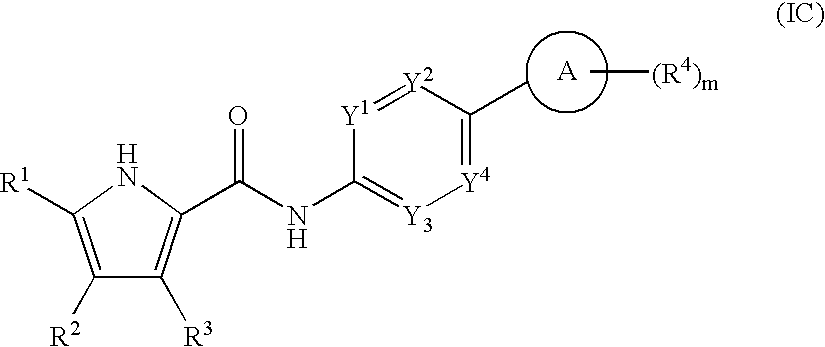
5. The compound of claim 1 which is a compound of formula (ID).

6. The compound of claim 1 which is a compound of formula (IE).

wherein Ring A is carbon linked heterocyclyl; wherein if said heterocyclyl contains an —NH-moiety that nitrogen may be optionally substituted by a group selected from R9.
7. The compound of claim 1 which is:
[4-(4-{[(3,4-Dichloro-5-methyl-1H-pyrrol-2-yl)carbonyl]amino}phenyl)-1H-1,2,3-triazol-1-yl]acetic acid;
4-[4-(4-{[(3,4-Dichloro-5-methyl-1H-pyrrol-2-yl)carbonyl]amino}phenyl)-1H-1,2,3-triazol-1-yl]benzoic acid;
Ethyl 5-(4-{[(3,4-dichloro-5-methyl-1H-pyrrol-2-yl)carbonyl]amino}phenyl)nicotinate;
Methyl 2-(4-{[(3,4-dichloro-5-methyl-1H-pyrrol-2-yl)carbonyl]amino}phenyl)-1,3-thiazole-5-carboxylate;
3,4-Dichloro-5-methyl-N-[6-(1H-tetrazol-5-yl)pyridin-3-yl]-1H-pyrrole-2-carboxamide;
3,4-Dichloro-5-methyl-N-[4-(1H-tetrazol-5-yl)phenyl]-1H-pyrrole-2-carboxamide;
Methyl 5-(4-{[(3,4-dichloro-5-methyl-1H-pyrrol-2-yl)carbonyl]amino}phenyl)-2-(methylamino)nicotinate;
Methyl 2-chloro-5-(4-{[(3,4-dichloro-5-methyl-1H-pyrrol-2-yl)carbonyl]amino}phenyl)nicotinate;
Methyl 2-(4-{[(3,4-dichloro-5-methyl-1H-pyrrol-2-yl)carbonyl]amino}phenyl)isonicotinate;
Methyl 5-(4-{[(3,4-dichloro-5-methyl-1H-pyrrol-2-yl)carbonyl]amino}phenyl)-2-methoxynicotinate;
Methyl 6-(4-{[(3,4-dichloro-5-methyl-1H-pyrrol-2-yl)carbonyl]amino}phenyl)imidazo[1,2-a]pyridine-8-carboxylate;
Methyl 5-(4-{[(3,4-dichloro-5-methyl-1H-pyrrol-2-yl)carbonyl]amino}phenyl)-2-[(2-morpholin-4-ylethyl)amino]nicotinate;
Methyl 5-(4-{[(3,4-dichloro-5-methyl-1H-pyrrol-2-yl)carbonyl]amino}phenyl)-2-[(2-methoxyethyl)amino]nicotinate;
Methyl 5-(4-{[(3,4-dichloro-5-methyl-1H-pyrrol-2-yl)carbonyl]amino}phenyl)-2-morpholin-4-ylnicotinate;
Methyl 2-{[2-(acetyloxy)ethyl]amino}-5-(4-{[(3,4-dichloro-5-methyl-1H-pyrrol-2-yl)carbonyl]amino}phenyl)nicotinate;
Methyl 5-(4-{[(3,4-dichloro-5-methyl-1H-pyrrol-2-yl)carbonyl]amino}phenyl)-2-oxo-1,2-dihydropyridine-3-carboxylate;
Methyl 5-{[(3,4-dichloro-5-methyl-1H-pyrrol-2-yl)carbonyl]amino}-6′-(methylamino)-2,3′-bipyridine-5′-carboxylate;
Methyl 5-(4-{[(3,4-dichloro-5-methyl-1H-pyrrol-2-yl)carbonyl]amino}phenyl)-2-furoate;
Methyl 2-chloro-6-(4-{[(3,4-dichloro-5-methyl-1H-pyrrol-2-yl)carbonyl]amino}phenyl)pyrimidine-4-carboxylate;
Ethyl 5-{[(3,4-dichloro-5-methyl-1H-pyrrol-2-yl)carbonyl]amino}-2,3′-bipyridine-5′-carboxylate;
Ethyl 5-(4-{[(3,4-dichloro-5-methyl-1H-pyrrol-2-yl)carbonyl]amino}phenyl)isoxazole-3-carboxylate;
5-[4-[[(3,4-Dichloro-5-methyl-1H-pyrrol-2-yl)carbonyl]amino]phenyl]-3-pyridinecarboxylic acid;
2-(4-{[(3,4-Dichloro-5-methyl-1H-pyrrol-2-yl)carbonyl]amino}phenyl)-1,3-thiazole-5-carboxylic acid;
5-(4-{[(3,4-Dichloro-5-methyl-1H-pyrrol-2-yl)carbonyl]amino}phenyl)-2-(methylmino)nicotinic acid;
2-Chloro-5-(4-{[(3,4-dichloro-5-methyl-1H-pyrrol-2-yl)carbonyl]amino}phenyl)nicotinic acid;
2-(4-{[(3,4-Dichloro-5-methyl-1H-pyrrol-2-yl)carbonyl]amino}phenyl)isonicotinic acid;
6-(4-{[(3,4-Dichloro-5-methyl-1H-pyrrol-2-yl)carbonyl]amino}phenyl)imidazo[1,2-a]pyridine-8-carboxylic acid;
5-(4-{[(3,4-Dichloro-5-methyl-1H-pyrrol-2-yl)carbonyl]amino}phenyl)-2-[(2-morpholin-4-ylethyl)amino]nicotinic acid;
5-(4-{[(3,4-Dichloro-5-methyl-1H-pyrrol-2-yl)carbonyl]amino}phenyl)-2-methoxynicotinic acid
5-(4-{[(3,4-Dichloro-5-methyl-1H-pyrrol-2-yl)carbonyl]amino}phenyl)-2-[(2-methoxyethyl)amino]nicotinic acid;
5-(4-{[(3,4-Dichloro-5-methyl-1H-pyrrol-2-yl)carbonyl]amino}phenyl)-2-oxo-1,2-dihydropyridine-3-carboxylic acid;
5-(4-{[(3,4-Dichloro-5-methyl-1H-pyrrol-2-yl)carbonyl]amino}phenyl)-2-morpholin-4-ylnicotinic acid;
5-(4-{[(3,4-Dichloro-5-methyl-1H-pyrrol-2-yl)carbonyl]amino}phenyl)-2-[(2-hydroxyethyl)amino]nicotinic acid;
5-{[(3,4-Dichloro-5-methyl-1H-pyrrol-2-yl)carbonyl]amino}-6′-(methylamino)-2,3′-bipyridine-5′-carboxylic acid;
5-(4-{[(3,4-Dichloro-5-methyl-1H-pyrrol-2-yl)carbonyl]amino}phenyl)-2-furoic acid;
2-Chloro-6-(4-{[(3,4-dichloro-5-methyl-1H-pyrrol-2-yl)carbonyl]amino}phenyl)pyrimidine-4-carboxylic acid; or
5-{[(3,4-Dichloro-5-methyl-1H-pyrrol-2-yl)carbonyl]amino}-2,3′-bipyridine-5′-carboxylic acid.
8. A pharmaceutical composition that comprises a compound of claim 1 , or a pharmaceutically-acceptable salt thereof, and a pharmaceutically-acceptable diluent or carrier.
9. (canceled)
10. A method for inhibiting bacterial DNA gyrase in a warm-blooded animal, such as a human being, in need of such treatment which comprises administering to said animal an effective amount of a compound of claim 1 , or a pharmaceutically acceptable salt.
11-13. (canceled)
14. A process for preparing a compound of claim 1 , or a pharmaceutically-acceptable salt thereof which comprises:
Process a) for compounds of formula (I) wherein W is —C(R6)(R7)—; converting a compound of formula (II):
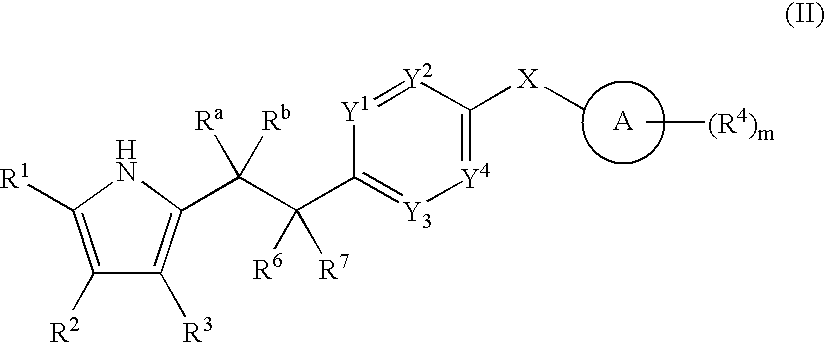
wherein Ra is cyano and Rb is dimethyamino or diethylamino; or Ra and Rb are independently selected from C1-4alkylthio; or Ra and Rb together form 1,3-dithianyl or 1,3-dithiolanyl; into a compound of formula (I); or
Process b) for compounds of formula (I) wherein W is —O—; reacting a compound of formula (III):
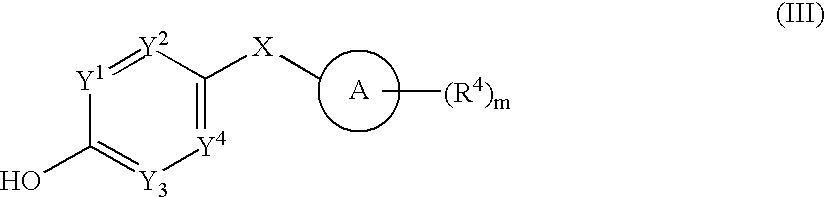
with a compound of formula (IV):

or
Process c) for compounds of formula (I) wherein W is —N(R5)—; reacting a compound of formula (V):
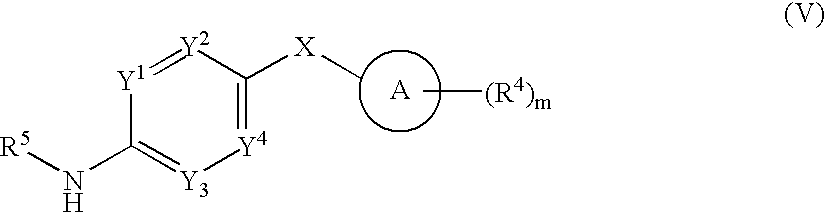
with a compound of formula (IV) or an activated acid derivative thereof;
or
Process d) for compounds of formula (I) wherein W is —C(R6)(R7)—; reacting a compound of formula (VI):

wherein L is a displaceable group; with a compound of formula (VII):
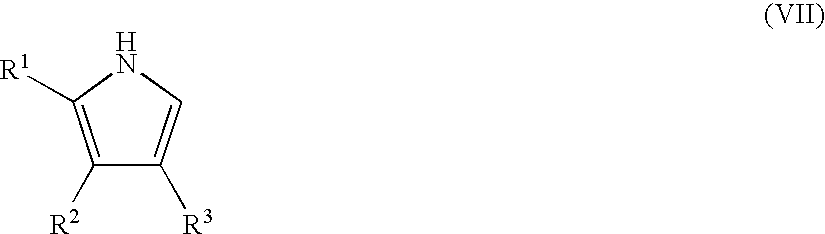
or
Process e) for compounds of formula (I) wherein W is —C(R6)(R7)—; reacting a compound of formula (VIII):

wherein M is an organometallic group; with a compound of formula (IX):
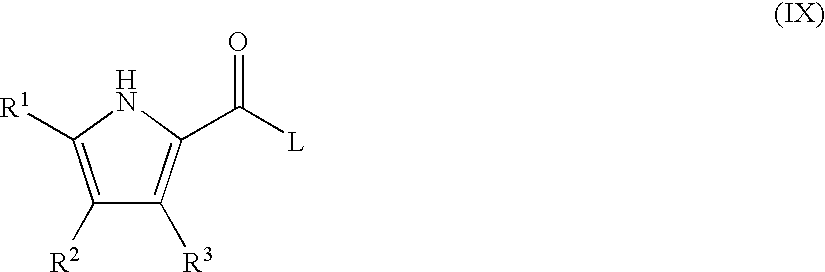
wherein L is a displaceable group; or
Process f) reacting a compound of formula (X):

with a compound of formula (XI):

wherein one of G and Z is an organometallic group and the other is a displaceable group;
and thereafter if necessary:
i) converting a compound of the formula (I) into another compound of the formula (I);
ii) removing any protecting groups;
iii) forming a pharmaceutically acceptable salt.
15. The compound of claim 1 or a pharmaceutically acceptable salt thereof wherein R1 is selected from methyl.
16. The compound of claim 1 or a pharmaceutically acceptable salt thereof wherein R2 is selected from chloro.
17. The compound of claim 1 or a pharmaceutically acceptable salt thereof wherein R3 is selected from chloro.
18. The compound of claim 1 or a pharmaceutically acceptable salt thereof wherein Y1, Y2, Y3 and Y4 are all —C(R8)═ or Y2 is —N═ and Y1, Y3 and Y4 are independently selected from —C(R8)═; wherein R8 is hydrogen.
19. The compound of claim 1 or a pharmaceutically acceptable salt thereof wherein Ring A is thiazolyl, pyridyl, triazolyl, tetrazolyl, pyrimidinyl, imidazo[1,2-a]pyridyl, isoxazolyl or oxazolyl; wherein said triazolyl may be optionally substituted on nitrogen by a group selected from R9; wherein:
R9 is selected from methyl or phenyl; wherein R9 may be optionally substituted by R22; and
R22 is selected carboxy or ethoxycarbonyl.
20. The compound of claim 1 or a pharmaceutically acceptable salt thereof wherein R4 is selected from halo, hydroxy, carboxy, C1-4alkoxy, N—(C1-4alkyl)amino, C1-4alkoxycarbonyl or heterocyclyl-R11—; wherein R4 may be optionally substituted on carbon by one or more R12;
R12 is selected from hydroxy, C1-4alkoxy, C1-4alkanoyloxy or heterocyclyl-R19—; and
R11 and R19 are a direct bond.
21. The compound of claim 1 or a pharmaceutically acceptable salt thereof wherein m is 0-2; wherein the values of R4 may be the same or different.
22. A compound of formula (I):

wherein:
R1 is selected from methyl;
R2 is selected from chloro;
R3 is selected from chloro;
W is —NH—;
Y1, Y2, Y3 and Y4 are all —CH═ or Y2 is —N═ and Y1, Y3 and Y4 are independently selected from —CH═;
X is a direct bond;
Ring A is thiazol-2-yl, pyrid-2-yl, pyrid-3-yl, 1-(4-carboxyphenyl)-1,2,3-triazol-4-yl, 1-(ethoxycarbonylmethyl)-1,2,3-triazol-4-yl, 1-(carboxymethyl)-1,2,3-triazol-4-yl, 1,2,3,4-tetrazol-5-yl, pyrimidin-4-yl, imidazo[1,2-a]pyrid-6-yl, isoxazol-5-yl or oxazol-2-yl;
R4 is selected from methoxycarbonyl, ethoxycarbonyl, carboxy, methylamino, chloro, 2-morpholinoethylamino, methoxy, 2-methoxyethylamino, hydroxy, morpholino, 2-(acetyloxy)ethylamino or 2-hydroxyethylamino; and
m is 0-2; wherein the values of R4 may be the same or different;
or a pharmaceutically acceptable salt thereof.
Priority Applications (1)
| Application Number | Priority Date | Filing Date | Title |
|---|---|---|---|
| US11/817,629 US20080269214A1 (en) | 2005-03-04 | 2006-03-02 | Pyrrole Derivatives as Dna Gyrase and Topoisomerase Inhibitors |
Applications Claiming Priority (3)
| Application Number | Priority Date | Filing Date | Title |
|---|---|---|---|
| US65889305P | 2005-03-04 | 2005-03-04 | |
| PCT/GB2006/000742 WO2006092599A2 (en) | 2005-03-04 | 2006-03-02 | Pyrrole derivatives as dna gyrase and topoisomerase inhibitors |
| US11/817,629 US20080269214A1 (en) | 2005-03-04 | 2006-03-02 | Pyrrole Derivatives as Dna Gyrase and Topoisomerase Inhibitors |
Publications (1)
| Publication Number | Publication Date |
|---|---|
| US20080269214A1 true US20080269214A1 (en) | 2008-10-30 |
Family
ID=36731879
Family Applications (1)
| Application Number | Title | Priority Date | Filing Date |
|---|---|---|---|
| US11/817,629 Abandoned US20080269214A1 (en) | 2005-03-04 | 2006-03-02 | Pyrrole Derivatives as Dna Gyrase and Topoisomerase Inhibitors |
Country Status (5)
| Country | Link |
|---|---|
| US (1) | US20080269214A1 (en) |
| EP (1) | EP1861393A2 (en) |
| JP (1) | JP2008531671A (en) |
| CN (1) | CN101171247A (en) |
| WO (1) | WO2006092599A2 (en) |
Families Citing this family (19)
| Publication number | Priority date | Publication date | Assignee | Title |
|---|---|---|---|---|
| TW200526626A (en) | 2003-09-13 | 2005-08-16 | Astrazeneca Ab | Chemical compounds |
| CN101163693B (en) | 2005-02-18 | 2013-03-06 | 阿斯利康(瑞典)有限公司 | Antibacterial piperidine derivatives |
| KR20090086629A (en) * | 2006-12-04 | 2009-08-13 | 아스트라제네카 아베 | Antibacterial Polycyclic Urea Compounds |
| TWI498115B (en) | 2007-12-27 | 2015-09-01 | Daiichi Sankyo Co Ltd | Imidazole carbonyl compound |
| BRPI0915471A2 (en) * | 2008-06-04 | 2017-06-27 | Astrazeneca Ab | compound, pharmaceutical composition, methods of inhibiting bacterial DNA gyrase and / or bacterial topoisomerase iv, to produce an antibacterial effect on a warm-blooded animal and to treat a bacterial infection in a warm-blooded animal, and use of a compound |
| US20090325902A1 (en) * | 2008-06-04 | 2009-12-31 | Astrazeneca Ab | Heterocyclic urea derivatives and methods of use thereof |
| TW201026695A (en) | 2008-12-12 | 2010-07-16 | Astrazeneca Ab | Piperidine compounds and uses thereof-596 |
| TW201102065A (en) * | 2009-05-29 | 2011-01-16 | Astrazeneca Ab | Heterocyclic urea derivatives and methods of use thereof |
| AR077971A1 (en) | 2009-08-26 | 2011-10-05 | Astrazeneca Ab | UREA HETEROCICLICAL DERIVATIVES AND METHODS OF USE OF THE SAME |
| TWI546298B (en) * | 2011-01-14 | 2016-08-21 | 維泰克斯製藥公司 | Gyrase and topoisomerase iv inhibitors |
| WO2013033258A1 (en) * | 2011-08-29 | 2013-03-07 | Ptc Therapeutics, Inc. | Antibacterial compounds and methods for use |
| FR3008975A1 (en) * | 2013-07-23 | 2015-01-30 | Servier Lab | NOVEL PYRROLE DERIVATIVES, PROCESS FOR THEIR PREPARATION AND PHARMACEUTICAL COMPOSITIONS CONTAINING THEM |
| CN105067814A (en) * | 2015-07-24 | 2015-11-18 | 中国科学院成都生物研究所 | Helicase hydrolysis ATP activity determination method |
| KR20180054650A (en) | 2015-09-30 | 2018-05-24 | 다이이찌 산쿄 가부시키가이샤 | Hydroxyalkyl thiadiazole derivative |
| US10752647B2 (en) | 2017-03-14 | 2020-08-25 | Daiichi Sankyo Company, Limited | N-phosphonoxymethyl prodrugs of hydroxyalkyl thiadiazole derivatives |
| RU2019133662A (en) | 2017-03-24 | 2021-04-26 | Тайсо Фармасьютикал Ко., Лтд. | DERIVATIVE OF 2 (1H) -QUINOLINONE |
| WO2020048949A1 (en) | 2018-09-03 | 2020-03-12 | Univerza V Ljubljani | New class of dna gyrase and/or topoisomerase iv inhibitors with activity against gram-positive and gram-negative bacteria |
| CN111057015B (en) * | 2020-01-03 | 2022-09-16 | 中国医科大学 | 2- (4-phenyl-1H-1, 2, 3-triazole-1-yl) acetic acid and acethydrazide compounds |
| US20250002455A1 (en) | 2020-12-17 | 2025-01-02 | Univerza V Ljubljani | New n-phenylpyrrolamide inhibitors of dna gyrase and topoisomerase iv with antibacterial activity |
Citations (7)
| Publication number | Priority date | Publication date | Assignee | Title |
|---|---|---|---|---|
| US3963480A (en) * | 1973-04-11 | 1976-06-15 | Sterling Drug Inc. | Herbicidal pyrrole-2-carboxamides |
| US4046775A (en) * | 1973-04-11 | 1977-09-06 | Sterling Drug Inc. | 4,5-Dihalopyrrole-2-carboxamides |
| US4791112A (en) * | 1987-02-02 | 1988-12-13 | The Boc Group, Inc. | N-heterocyclic-N-(4-piperidyl)amides and pharmaceutical compositions and methods employing such compounds |
| US4912109A (en) * | 1987-02-02 | 1990-03-27 | Boc, Inc. | N-heterocyclic-N-(4-piperidinyl) amides and pharmaceutical compositions and methods employing such compounds |
| US5712279A (en) * | 1995-02-21 | 1998-01-27 | Bristol-Myers Squibb Company | Inhibitors of microsomal triglyceride transfer protein and method |
| US20050234033A1 (en) * | 2004-04-01 | 2005-10-20 | Anandan Sampath K | Inhibitors of histone deacetylase |
| US20050250784A1 (en) * | 2004-03-08 | 2005-11-10 | Miikana Therapeutics Corporation | Inhibitors of histone deacetylase |
Family Cites Families (5)
| Publication number | Priority date | Publication date | Assignee | Title |
|---|---|---|---|---|
| IL23847A (en) * | 1964-08-07 | 1969-02-27 | Merck & Co Inc | Benzimidazoles useful as antifungals |
| BR0214753A (en) * | 2001-12-05 | 2004-12-14 | Aventis Pharma Gmbh | Substituted 4-phenylthetrahydroisoquinolines, processes for their preparation, their application as a medicine, as well as a medicine containing the same |
| CA2519794A1 (en) * | 2003-04-08 | 2004-10-21 | Sumitomo Pharmaceuticals Co., Ltd. | Novel carbapenem compounds |
| ES2611604T3 (en) * | 2004-10-22 | 2017-05-09 | Janssen Pharmaceutica Nv | C fms kinase inhibitors |
| CN101084208A (en) * | 2004-10-22 | 2007-12-05 | 詹森药业有限公司 | Aromatic amides as inhibitors of c-fms kinase |
-
2006
- 2006-03-02 US US11/817,629 patent/US20080269214A1/en not_active Abandoned
- 2006-03-02 EP EP06709966A patent/EP1861393A2/en not_active Withdrawn
- 2006-03-02 CN CNA2006800149768A patent/CN101171247A/en active Pending
- 2006-03-02 WO PCT/GB2006/000742 patent/WO2006092599A2/en not_active Ceased
- 2006-03-02 JP JP2007557586A patent/JP2008531671A/en active Pending
Patent Citations (8)
| Publication number | Priority date | Publication date | Assignee | Title |
|---|---|---|---|---|
| US3963480A (en) * | 1973-04-11 | 1976-06-15 | Sterling Drug Inc. | Herbicidal pyrrole-2-carboxamides |
| US4046775A (en) * | 1973-04-11 | 1977-09-06 | Sterling Drug Inc. | 4,5-Dihalopyrrole-2-carboxamides |
| US4791112A (en) * | 1987-02-02 | 1988-12-13 | The Boc Group, Inc. | N-heterocyclic-N-(4-piperidyl)amides and pharmaceutical compositions and methods employing such compounds |
| US4912109A (en) * | 1987-02-02 | 1990-03-27 | Boc, Inc. | N-heterocyclic-N-(4-piperidinyl) amides and pharmaceutical compositions and methods employing such compounds |
| US5739135A (en) * | 1993-09-03 | 1998-04-14 | Bristol-Myers Squibb Company | Inhibitors of microsomal triglyceride transfer protein and method |
| US5712279A (en) * | 1995-02-21 | 1998-01-27 | Bristol-Myers Squibb Company | Inhibitors of microsomal triglyceride transfer protein and method |
| US20050250784A1 (en) * | 2004-03-08 | 2005-11-10 | Miikana Therapeutics Corporation | Inhibitors of histone deacetylase |
| US20050234033A1 (en) * | 2004-04-01 | 2005-10-20 | Anandan Sampath K | Inhibitors of histone deacetylase |
Also Published As
| Publication number | Publication date |
|---|---|
| EP1861393A2 (en) | 2007-12-05 |
| CN101171247A (en) | 2008-04-30 |
| JP2008531671A (en) | 2008-08-14 |
| WO2006092599A2 (en) | 2006-09-08 |
| WO2006092599A3 (en) | 2006-12-21 |
Similar Documents
| Publication | Publication Date | Title |
|---|---|---|
| JP4058106B2 (en) | Antibacterial piperidine derivatives | |
| US20080269214A1 (en) | Pyrrole Derivatives as Dna Gyrase and Topoisomerase Inhibitors | |
| US20100137303A1 (en) | New compound 255 | |
| KR20090086629A (en) | Antibacterial Polycyclic Urea Compounds | |
| JP2012511561A (en) | 2- (Piperidin-1-yl) -4-heterocyclyl-thiazole-5-carboxylic acid derivatives against bacterial infections | |
| US20090325902A1 (en) | Heterocyclic urea derivatives and methods of use thereof | |
| KR20100038095A (en) | Piperidine compounds and uses thereof | |
| JP2011522026A (en) | Heterocyclic urea derivatives for the treatment of bacterial infections | |
| US20090253671A1 (en) | Tricyclic derivatives of azetidine and pyrrole with antibacterial activity | |
| US20080312211A1 (en) | Antibacterial Pyrrolopyridines, Pyrrolopyrimidines and Pyrroloazepines-154 | |
| KR20110094305A (en) | 2- (piperidin-1-yl) -4-azolyl-thiazole-5-carboxylic acid derivative against bacterial infection | |
| EP1856103A2 (en) | Pyrrole derivatives as dna gyrase and topoisomerase inhibitors | |
| US20080161306A1 (en) | Pyrrole Derivatives as Dna Gyrase and Topoisomerase Inhibitors | |
| HK1114376B (en) | Antibacterial piperidine derivatives |
Legal Events
| Date | Code | Title | Description |
|---|---|---|---|
| AS | Assignment |
Owner name: ASTRAZENECA AB, SWEDEN Free format text: ASSIGNMENT OF ASSIGNORS INTEREST;ASSIGNORS:BASARAB, GREGORY STEVEN;GRAVESTOCK, MICHAEL BARRY;HAUCK, SHEILA IRENE;REEL/FRAME:019854/0304;SIGNING DATES FROM 20070817 TO 20070903 |
|
| STCB | Information on status: application discontinuation |
Free format text: ABANDONED -- FAILURE TO RESPOND TO AN OFFICE ACTION |