US20080261974A1 - Novel Chemical Compounds - Google Patents
Novel Chemical Compounds Download PDFInfo
- Publication number
- US20080261974A1 US20080261974A1 US12/067,471 US6747106A US2008261974A1 US 20080261974 A1 US20080261974 A1 US 20080261974A1 US 6747106 A US6747106 A US 6747106A US 2008261974 A1 US2008261974 A1 US 2008261974A1
- Authority
- US
- United States
- Prior art keywords
- substituted
- alkyl
- amino
- aryl
- compound
- Prior art date
- Legal status (The legal status is an assumption and is not a legal conclusion. Google has not performed a legal analysis and makes no representation as to the accuracy of the status listed.)
- Abandoned
Links
- 150000001875 compounds Chemical class 0.000 title claims abstract description 176
- 238000000034 method Methods 0.000 claims abstract description 42
- 208000037265 diseases, disorders, signs and symptoms Diseases 0.000 claims abstract description 28
- 201000010099 disease Diseases 0.000 claims abstract description 26
- 230000000694 effects Effects 0.000 claims abstract description 13
- 230000002401 inhibitory effect Effects 0.000 claims abstract description 12
- 125000005842 heteroatom Chemical group 0.000 claims description 79
- 125000003118 aryl group Chemical group 0.000 claims description 73
- 229910052739 hydrogen Inorganic materials 0.000 claims description 72
- 125000000753 cycloalkyl group Chemical group 0.000 claims description 70
- 239000001257 hydrogen Substances 0.000 claims description 70
- 125000005346 substituted cycloalkyl group Chemical group 0.000 claims description 60
- 150000002431 hydrogen Chemical class 0.000 claims description 50
- 125000000217 alkyl group Chemical group 0.000 claims description 41
- 125000002023 trifluoromethyl group Chemical group FC(F)(F)* 0.000 claims description 37
- 208000007502 anemia Diseases 0.000 claims description 34
- 239000000651 prodrug Substances 0.000 claims description 30
- 229940002612 prodrug Drugs 0.000 claims description 30
- 150000003839 salts Chemical class 0.000 claims description 29
- 239000012453 solvate Substances 0.000 claims description 29
- 125000004178 (C1-C4) alkyl group Chemical group 0.000 claims description 27
- 125000003282 alkyl amino group Chemical group 0.000 claims description 27
- 229910052736 halogen Inorganic materials 0.000 claims description 25
- 150000002367 halogens Chemical class 0.000 claims description 25
- 125000002924 primary amino group Chemical group [H]N([H])* 0.000 claims description 24
- 125000004663 dialkyl amino group Chemical group 0.000 claims description 23
- 125000004093 cyano group Chemical group *C#N 0.000 claims description 22
- UFHFLCQGNIYNRP-UHFFFAOYSA-N Hydrogen Chemical compound [H][H] UFHFLCQGNIYNRP-UHFFFAOYSA-N 0.000 claims description 20
- 125000001769 aryl amino group Chemical group 0.000 claims description 20
- 125000000547 substituted alkyl group Chemical group 0.000 claims description 17
- 125000001424 substituent group Chemical group 0.000 claims description 16
- 125000003107 substituted aryl group Chemical group 0.000 claims description 16
- 241000124008 Mammalia Species 0.000 claims description 15
- 125000004043 oxo group Chemical group O=* 0.000 claims description 15
- 125000003545 alkoxy group Chemical group 0.000 claims description 14
- 210000000777 hematopoietic system Anatomy 0.000 claims description 14
- 125000000278 alkyl amino alkyl group Chemical group 0.000 claims description 13
- 125000004985 dialkyl amino alkyl group Chemical group 0.000 claims description 13
- 125000002887 hydroxy group Chemical group [H]O* 0.000 claims description 13
- 150000002825 nitriles Chemical class 0.000 claims description 13
- QJGQUHMNIGDVPM-UHFFFAOYSA-N nitrogen group Chemical group [N] QJGQUHMNIGDVPM-UHFFFAOYSA-N 0.000 claims description 10
- 239000003937 drug carrier Substances 0.000 claims description 9
- 208000032467 Aplastic anaemia Diseases 0.000 claims description 7
- 201000003793 Myelodysplastic syndrome Diseases 0.000 claims description 7
- 230000000925 erythroid effect Effects 0.000 claims description 7
- 239000008194 pharmaceutical composition Substances 0.000 claims description 7
- 206010065553 Bone marrow failure Diseases 0.000 claims description 6
- 206010033661 Pancytopenia Diseases 0.000 claims description 6
- 208000024389 cytopenia Diseases 0.000 claims description 6
- XMPPEQKACXVGHH-CHHVJCJISA-N (5z)-2-(2,6-dichloroanilino)-5-(quinazolin-6-ylmethylidene)-1,3-thiazol-4-one Chemical compound ClC1=CC=CC(Cl)=C1NC(S1)=NC(=O)\C1=C\C1=CC=C(N=CN=C2)C2=C1 XMPPEQKACXVGHH-CHHVJCJISA-N 0.000 claims description 5
- SHCOMSVDGKYHSP-WQRHYEAKSA-N (5z)-2-(2,6-dichloroanilino)-5-[(4-morpholin-4-ylquinazolin-6-yl)methylidene]-1,3-thiazol-4-one Chemical compound ClC1=CC=CC(Cl)=C1NC(S1)=NC(=O)\C1=C\C1=CC=C(N=CN=C2N3CCOCC3)C2=C1 SHCOMSVDGKYHSP-WQRHYEAKSA-N 0.000 claims description 5
- IRVJQWFJQFIXFX-DHDCSXOGSA-N (5z)-5-(cinnolin-6-ylmethylidene)-2-(2,6-dichloroanilino)-1,3-thiazol-4-one Chemical compound ClC1=CC=CC(Cl)=C1NC(S1)=NC(=O)\C1=C\C1=CC=C(N=NC=C2)C2=C1 IRVJQWFJQFIXFX-DHDCSXOGSA-N 0.000 claims description 5
- HWKRADWQTHMXHH-XKZIYDEJSA-N 4-[[6-[(z)-[2-(2,6-dichloroanilino)-4-oxo-1,3-thiazol-5-ylidene]methyl]quinazolin-4-yl]amino]-n,n-dimethylbenzenesulfonamide Chemical compound C1=CC(S(=O)(=O)N(C)C)=CC=C1NC(C1=C2)=NC=NC1=CC=C2\C=C/1C(=O)N=C(NC=2C(=CC=CC=2Cl)Cl)S\1 HWKRADWQTHMXHH-XKZIYDEJSA-N 0.000 claims description 5
- 239000003085 diluting agent Substances 0.000 claims description 5
- DEOZYVQSCNOOPK-DHDCSXOGSA-N ethyl 6-[(z)-[2-(2,6-dichloroanilino)-4-oxo-1,3-thiazol-5-ylidene]methyl]-1,2,4-benzotriazine-3-carboxylate Chemical compound C=1C2=NC(C(=O)OCC)=NN=C2C=CC=1\C=C(C(N=1)=O)/SC=1NC1=C(Cl)C=CC=C1Cl DEOZYVQSCNOOPK-DHDCSXOGSA-N 0.000 claims description 5
- 230000008569 process Effects 0.000 claims description 5
- HEVWMCMZFASYPR-SXGWCWSVSA-N (5z)-2-(2,6-dichloroanilino)-5-(imidazo[1,2-a]quinoxalin-8-ylmethylidene)-1,3-thiazol-4-one Chemical compound ClC1=CC=CC(Cl)=C1NC(S1)=NC(=O)\C1=C\C1=CC=C(N=CC=2N3C=CN=2)C3=C1 HEVWMCMZFASYPR-SXGWCWSVSA-N 0.000 claims description 4
- JVDIWUBVBNOAGI-AUWJEWJLSA-N (5z)-2-(2,6-dichloroanilino)-5-(tetrazolo[1,5-a]quinoxalin-8-ylmethylidene)-1,3-thiazol-4-one Chemical compound ClC1=CC=CC(Cl)=C1NC(S1)=NC(=O)\C1=C\C1=CC=C(N=CC=2N3N=NN=2)C3=C1 JVDIWUBVBNOAGI-AUWJEWJLSA-N 0.000 claims description 4
- ZZFJNLORQSKSKA-AUWJEWJLSA-N (5z)-2-(2,6-dichloroanilino)-5-[(4-oxo-1h-quinazolin-6-yl)methylidene]-1,3-thiazol-4-one Chemical compound ClC1=CC=CC(Cl)=C1NC(S1)=NC(=O)\C1=C\C1=CC=C(NC=NC2=O)C2=C1 ZZFJNLORQSKSKA-AUWJEWJLSA-N 0.000 claims description 4
- YTKMVZUNWMNNIE-SXGWCWSVSA-N (5z)-2-(2,6-dichloroanilino)-5-[[4-(dimethylamino)quinazolin-6-yl]methylidene]-1,3-thiazol-4-one Chemical compound C1=C2C(N(C)C)=NC=NC2=CC=C1\C=C(C(N=1)=O)/SC=1NC1=C(Cl)C=CC=C1Cl YTKMVZUNWMNNIE-SXGWCWSVSA-N 0.000 claims description 4
- 238000004519 manufacturing process Methods 0.000 claims description 4
- 150000003053 piperidines Chemical class 0.000 claims description 4
- JWYAXXKPFKLHIA-ZTXYIFKNSA-N (5z)-2-(2,6-dichloroanilino)-5-[[4-(methylamino)quinazolin-6-yl]methylidene]-1,3-thiazol-4-one;2,2,2-trifluoroacetic acid Chemical compound OC(=O)C(F)(F)F.C1=C2C(NC)=NC=NC2=CC=C1\C=C(C(N=1)=O)/SC=1NC1=C(Cl)C=CC=C1Cl JWYAXXKPFKLHIA-ZTXYIFKNSA-N 0.000 claims description 3
- ZWGMDVCHYHRXDY-KIUKIJHYSA-N (5z)-5-[(4-aminoquinazolin-6-yl)methylidene]-2-(2,6-dichloroanilino)-1,3-thiazol-4-one;2,2,2-trifluoroacetic acid Chemical compound OC(=O)C(F)(F)F.C1=C2C(N)=NC=NC2=CC=C1\C=C(C(N=1)=O)/SC=1NC1=C(Cl)C=CC=C1Cl ZWGMDVCHYHRXDY-KIUKIJHYSA-N 0.000 claims description 3
- ZKHPDEPDWCSHLV-PZTRBQFESA-N (5z)-5-[[4-(methylamino)quinazolin-6-yl]methylidene]-2-(2,4,6-trichloroanilino)-1,3-thiazol-4-one;hydrochloride Chemical compound Cl.C1=C2C(NC)=NC=NC2=CC=C1\C=C(C(N=1)=O)/SC=1NC1=C(Cl)C=C(Cl)C=C1Cl ZKHPDEPDWCSHLV-PZTRBQFESA-N 0.000 claims description 3
- IEWUZHCKVLWLRT-NHDPSOOVSA-N n-[4-chloro-3-[[(5z)-5-(imidazo[1,2-a]quinoxalin-8-ylmethylidene)-4-oxo-1,3-thiazol-2-yl]amino]phenyl]cyclobutanecarboxamide Chemical compound C1=C(NC=2SC(/C(=O)N=2)=C\C=2C=C3N4C=CN=C4C=NC3=CC=2)C(Cl)=CC=C1NC(=O)C1CCC1 IEWUZHCKVLWLRT-NHDPSOOVSA-N 0.000 claims description 3
- 239000000546 pharmaceutical excipient Substances 0.000 claims 2
- 102000004169 proteins and genes Human genes 0.000 abstract description 11
- 108090000623 proteins and genes Proteins 0.000 abstract description 11
- -1 3-isoquinolinyl Chemical group 0.000 description 83
- IAZDPXIOMUYVGZ-WFGJKAKNSA-N Dimethyl sulfoxide Chemical compound [2H]C([2H])([2H])S(=O)C([2H])([2H])[2H] IAZDPXIOMUYVGZ-WFGJKAKNSA-N 0.000 description 54
- OKKJLVBELUTLKV-UHFFFAOYSA-N Methanol Chemical compound OC OKKJLVBELUTLKV-UHFFFAOYSA-N 0.000 description 51
- 239000000203 mixture Substances 0.000 description 51
- XLYOFNOQVPJJNP-UHFFFAOYSA-N water Chemical compound O XLYOFNOQVPJJNP-UHFFFAOYSA-N 0.000 description 46
- 239000007787 solid Substances 0.000 description 44
- XEKOWRVHYACXOJ-UHFFFAOYSA-N Ethyl acetate Chemical compound CCOC(C)=O XEKOWRVHYACXOJ-UHFFFAOYSA-N 0.000 description 42
- LFQSCWFLJHTTHZ-UHFFFAOYSA-N Ethanol Chemical compound CCO LFQSCWFLJHTTHZ-UHFFFAOYSA-N 0.000 description 39
- 239000000243 solution Substances 0.000 description 36
- YMWUJEATGCHHMB-UHFFFAOYSA-N Dichloromethane Chemical compound ClCCl YMWUJEATGCHHMB-UHFFFAOYSA-N 0.000 description 34
- 238000005160 1H NMR spectroscopy Methods 0.000 description 33
- VYPSYNLAJGMNEJ-UHFFFAOYSA-N Silicium dioxide Chemical compound O=[Si]=O VYPSYNLAJGMNEJ-UHFFFAOYSA-N 0.000 description 32
- WEVYAHXRMPXWCK-UHFFFAOYSA-N Acetonitrile Chemical compound CC#N WEVYAHXRMPXWCK-UHFFFAOYSA-N 0.000 description 27
- 0 *N=C1NC(=O)C(=CC)S1 Chemical compound *N=C1NC(=O)C(=CC)S1 0.000 description 24
- ZMXDDKWLCZADIW-UHFFFAOYSA-N N,N-Dimethylformamide Chemical compound CN(C)C=O ZMXDDKWLCZADIW-UHFFFAOYSA-N 0.000 description 23
- NQRYJNQNLNOLGT-UHFFFAOYSA-N Piperidine Chemical compound C1CCNCC1 NQRYJNQNLNOLGT-UHFFFAOYSA-N 0.000 description 20
- 125000004169 (C1-C6) alkyl group Chemical group 0.000 description 19
- 235000002639 sodium chloride Nutrition 0.000 description 19
- VLKZOEOYAKHREP-UHFFFAOYSA-N n-Hexane Chemical class CCCCCC VLKZOEOYAKHREP-UHFFFAOYSA-N 0.000 description 18
- 239000000741 silica gel Substances 0.000 description 18
- 229910002027 silica gel Inorganic materials 0.000 description 18
- CSNNHWWHGAXBCP-UHFFFAOYSA-L Magnesium sulfate Chemical compound [Mg+2].[O-][S+2]([O-])([O-])[O-] CSNNHWWHGAXBCP-UHFFFAOYSA-L 0.000 description 16
- IAZDPXIOMUYVGZ-UHFFFAOYSA-N Dimethylsulphoxide Chemical compound CS(C)=O IAZDPXIOMUYVGZ-UHFFFAOYSA-N 0.000 description 15
- HEDRZPFGACZZDS-UHFFFAOYSA-N Chloroform Chemical compound ClC(Cl)Cl HEDRZPFGACZZDS-UHFFFAOYSA-N 0.000 description 14
- 238000000524 positive electrospray ionisation mass spectrometry Methods 0.000 description 14
- JQWHASGSAFIOCM-UHFFFAOYSA-M sodium periodate Chemical compound [Na+].[O-]I(=O)(=O)=O JQWHASGSAFIOCM-UHFFFAOYSA-M 0.000 description 14
- QTBSBXVTEAMEQO-UHFFFAOYSA-N Acetic acid Chemical compound CC(O)=O QTBSBXVTEAMEQO-UHFFFAOYSA-N 0.000 description 12
- 238000004587 chromatography analysis Methods 0.000 description 12
- 239000003112 inhibitor Substances 0.000 description 12
- 239000003814 drug Substances 0.000 description 11
- 238000000746 purification Methods 0.000 description 11
- 239000011541 reaction mixture Substances 0.000 description 11
- 239000000725 suspension Substances 0.000 description 11
- RYHBNJHYFVUHQT-UHFFFAOYSA-N 1,4-Dioxane Chemical compound C1COCCO1 RYHBNJHYFVUHQT-UHFFFAOYSA-N 0.000 description 10
- OISVCGZHLKNMSJ-UHFFFAOYSA-N 2,6-dimethylpyridine Chemical compound CC1=CC=CC(C)=N1 OISVCGZHLKNMSJ-UHFFFAOYSA-N 0.000 description 10
- VEXZGXHMUGYJMC-UHFFFAOYSA-N Hydrochloric acid Chemical compound Cl VEXZGXHMUGYJMC-UHFFFAOYSA-N 0.000 description 10
- DKGAVHZHDRPRBM-UHFFFAOYSA-N Tert-Butanol Chemical compound CC(C)(C)O DKGAVHZHDRPRBM-UHFFFAOYSA-N 0.000 description 10
- 150000003973 alkyl amines Chemical class 0.000 description 10
- 150000004982 aromatic amines Chemical class 0.000 description 10
- 125000003178 carboxy group Chemical group [H]OC(*)=O 0.000 description 10
- 210000004027 cell Anatomy 0.000 description 10
- 125000005265 dialkylamine group Chemical class 0.000 description 10
- 238000003818 flash chromatography Methods 0.000 description 10
- 239000000843 powder Substances 0.000 description 10
- 239000000047 product Substances 0.000 description 10
- 125000004547 quinazolin-6-yl group Chemical group N1=CN=CC2=CC(=CC=C12)* 0.000 description 10
- 206010028980 Neoplasm Diseases 0.000 description 9
- 125000004432 carbon atom Chemical group C* 0.000 description 9
- 125000000449 nitro group Chemical group [O-][N+](*)=O 0.000 description 9
- 239000012044 organic layer Substances 0.000 description 9
- 108091007914 CDKs Proteins 0.000 description 8
- 150000004677 hydrates Chemical class 0.000 description 8
- 229910052943 magnesium sulfate Inorganic materials 0.000 description 8
- 125000002496 methyl group Chemical group [H]C([H])([H])* 0.000 description 8
- 239000002904 solvent Substances 0.000 description 8
- FAPWRFPIFSIZLT-UHFFFAOYSA-M Sodium chloride Chemical compound [Na+].[Cl-] FAPWRFPIFSIZLT-UHFFFAOYSA-M 0.000 description 7
- HEDRZPFGACZZDS-MICDWDOJSA-N Trichloro(2H)methane Chemical compound [2H]C(Cl)(Cl)Cl HEDRZPFGACZZDS-MICDWDOJSA-N 0.000 description 7
- 201000011510 cancer Diseases 0.000 description 7
- 238000001816 cooling Methods 0.000 description 7
- IXCSERBJSXMMFS-UHFFFAOYSA-N hydrogen chloride Substances Cl.Cl IXCSERBJSXMMFS-UHFFFAOYSA-N 0.000 description 7
- 239000002244 precipitate Substances 0.000 description 7
- 238000010992 reflux Methods 0.000 description 7
- YNAVUWVOSKDBBP-UHFFFAOYSA-N Morpholine Chemical compound C1COCCN1 YNAVUWVOSKDBBP-UHFFFAOYSA-N 0.000 description 6
- 239000004480 active ingredient Substances 0.000 description 6
- 229940079593 drug Drugs 0.000 description 6
- 238000001914 filtration Methods 0.000 description 6
- RAXXELZNTBOGNW-UHFFFAOYSA-N imidazole Natural products C1=CNC=N1 RAXXELZNTBOGNW-UHFFFAOYSA-N 0.000 description 6
- 239000003999 initiator Substances 0.000 description 6
- 125000001624 naphthyl group Chemical group 0.000 description 6
- 229910000489 osmium tetroxide Inorganic materials 0.000 description 6
- NFHFRUOZVGFOOS-UHFFFAOYSA-N palladium;triphenylphosphane Chemical compound [Pd].C1=CC=CC=C1P(C=1C=CC=CC=1)C1=CC=CC=C1.C1=CC=CC=C1P(C=1C=CC=CC=1)C1=CC=CC=C1.C1=CC=CC=C1P(C=1C=CC=CC=1)C1=CC=CC=C1.C1=CC=CC=C1P(C=1C=CC=CC=1)C1=CC=CC=C1 NFHFRUOZVGFOOS-UHFFFAOYSA-N 0.000 description 6
- BWHMMNNQKKPAPP-UHFFFAOYSA-L potassium carbonate Chemical compound [K+].[K+].[O-]C([O-])=O BWHMMNNQKKPAPP-UHFFFAOYSA-L 0.000 description 6
- 108090000765 processed proteins & peptides Proteins 0.000 description 6
- RIOQSEWOXXDEQQ-UHFFFAOYSA-N triphenylphosphine Chemical compound C1=CC=CC=C1P(C=1C=CC=CC=1)C1=CC=CC=C1 RIOQSEWOXXDEQQ-UHFFFAOYSA-N 0.000 description 6
- LBQASGLFPCNRNA-UHFFFAOYSA-N 2-(2,6-dichloroanilino)-1,3-thiazol-4-one Chemical compound ClC1=CC=CC(Cl)=C1NC1=NC(=O)CS1 LBQASGLFPCNRNA-UHFFFAOYSA-N 0.000 description 5
- RTZKZFJDLAIYFH-UHFFFAOYSA-N Diethyl ether Chemical compound CCOCC RTZKZFJDLAIYFH-UHFFFAOYSA-N 0.000 description 5
- 102100023114 Dual specificity tyrosine-phosphorylation-regulated kinase 3 Human genes 0.000 description 5
- 102100032826 Homeodomain-interacting protein kinase 3 Human genes 0.000 description 5
- 101001049991 Homo sapiens Dual specificity tyrosine-phosphorylation-regulated kinase 3 Proteins 0.000 description 5
- 101001066389 Homo sapiens Homeodomain-interacting protein kinase 3 Proteins 0.000 description 5
- 208000001647 Renal Insufficiency Diseases 0.000 description 5
- 238000006243 chemical reaction Methods 0.000 description 5
- 238000004128 high performance liquid chromatography Methods 0.000 description 5
- 201000006370 kidney failure Diseases 0.000 description 5
- 239000003921 oil Substances 0.000 description 5
- 235000019198 oils Nutrition 0.000 description 5
- 238000002360 preparation method Methods 0.000 description 5
- 229920006395 saturated elastomer Polymers 0.000 description 5
- 239000000377 silicon dioxide Substances 0.000 description 5
- SJSSFUMSAFMFNM-NSHDSACASA-N (2s)-5-(diaminomethylideneamino)-2-(phenylmethoxycarbonylamino)pentanoic acid Chemical compound NC(N)=NCCC[C@@H](C(O)=O)NC(=O)OCC1=CC=CC=C1 SJSSFUMSAFMFNM-NSHDSACASA-N 0.000 description 4
- RXBMEHOLQJITJI-LEOXJPRUSA-N (4s)-5-amino-4-[[(2s)-2-[[(2s)-2-[[(4-bromophenyl)-hydroxyphosphoryl]methyl]-3-(3-phenyl-1,2-oxazol-5-yl)propanoyl]amino]-4-carboxybutanoyl]amino]-5-oxopentanoic acid Chemical compound C([C@@H](C(=O)N[C@@H](CCC(O)=O)C(=O)N[C@@H](CCC(O)=O)C(=O)N)CP(O)(=O)C=1C=CC(Br)=CC=1)C(ON=1)=CC=1C1=CC=CC=C1 RXBMEHOLQJITJI-LEOXJPRUSA-N 0.000 description 4
- FBEVTRXOEDMLKF-SXGWCWSVSA-N (5z)-2-(2,6-dichloroanilino)-5-(isoquinolin-3-ylmethylidene)-1,3-thiazol-4-one Chemical compound ClC1=CC=CC(Cl)=C1NC(S1)=NC(=O)\C1=C\C1=CC2=CC=CC=C2C=N1 FBEVTRXOEDMLKF-SXGWCWSVSA-N 0.000 description 4
- HWZOSEGRUUPNHW-NVNXTCNLSA-N (5z)-2-(2,6-dichloroanilino)-5-(quinoxalin-2-ylmethylidene)-1,3-thiazol-4-one Chemical compound ClC1=CC=CC(Cl)=C1NC(S1)=NC(=O)\C1=C\C1=CN=C(C=CC=C2)C2=N1 HWZOSEGRUUPNHW-NVNXTCNLSA-N 0.000 description 4
- IJGRMHOSHXDMSA-UHFFFAOYSA-N Atomic nitrogen Chemical compound N#N IJGRMHOSHXDMSA-UHFFFAOYSA-N 0.000 description 4
- 208000017667 Chronic Disease Diseases 0.000 description 4
- YLQBMQCUIZJEEH-UHFFFAOYSA-N Furan Chemical compound C=1C=COC=1 YLQBMQCUIZJEEH-UHFFFAOYSA-N 0.000 description 4
- GLUUGHFHXGJENI-UHFFFAOYSA-N Piperazine Chemical compound C1CNCCN1 GLUUGHFHXGJENI-UHFFFAOYSA-N 0.000 description 4
- JUJWROOIHBZHMG-UHFFFAOYSA-N Pyridine Chemical compound C1=CC=NC=C1 JUJWROOIHBZHMG-UHFFFAOYSA-N 0.000 description 4
- 240000004808 Saccharomyces cerevisiae Species 0.000 description 4
- UIIMBOGNXHQVGW-UHFFFAOYSA-M Sodium bicarbonate Chemical compound [Na+].OC([O-])=O UIIMBOGNXHQVGW-UHFFFAOYSA-M 0.000 description 4
- WYURNTSHIVDZCO-UHFFFAOYSA-N Tetrahydrofuran Chemical compound C1CCOC1 WYURNTSHIVDZCO-UHFFFAOYSA-N 0.000 description 4
- 238000003556 assay Methods 0.000 description 4
- 230000005784 autoimmunity Effects 0.000 description 4
- ZUOUZKKEUPVFJK-UHFFFAOYSA-N diphenyl Chemical compound C1=CC=CC=C1C1=CC=CC=C1 ZUOUZKKEUPVFJK-UHFFFAOYSA-N 0.000 description 4
- 239000004615 ingredient Substances 0.000 description 4
- 230000005764 inhibitory process Effects 0.000 description 4
- 239000007788 liquid Substances 0.000 description 4
- HQKMJHAJHXVSDF-UHFFFAOYSA-L magnesium stearate Chemical compound [Mg+2].CCCCCCCCCCCCCCCCCC([O-])=O.CCCCCCCCCCCCCCCCCC([O-])=O HQKMJHAJHXVSDF-UHFFFAOYSA-L 0.000 description 4
- 229910052757 nitrogen Inorganic materials 0.000 description 4
- XHXFXVLFKHQFAL-UHFFFAOYSA-N phosphoryl trichloride Chemical compound ClP(Cl)(Cl)=O XHXFXVLFKHQFAL-UHFFFAOYSA-N 0.000 description 4
- 239000011780 sodium chloride Substances 0.000 description 4
- LPXPTNMVRIOKMN-UHFFFAOYSA-M sodium nitrite Chemical compound [Na+].[O-]N=O LPXPTNMVRIOKMN-UHFFFAOYSA-M 0.000 description 4
- 239000000454 talc Substances 0.000 description 4
- 229910052623 talc Inorganic materials 0.000 description 4
- QIWRFOJWQSSRJZ-UHFFFAOYSA-N tributyl(ethenyl)stannane Chemical compound CCCC[Sn](CCCC)(CCCC)C=C QIWRFOJWQSSRJZ-UHFFFAOYSA-N 0.000 description 4
- 229920002554 vinyl polymer Polymers 0.000 description 4
- WVOHOUBCQAEHTO-BOPFTXTBSA-N (5z)-2-(2,6-dichloroanilino)-5-(naphthalen-2-ylmethylidene)-1,3-thiazol-4-one Chemical compound ClC1=CC=CC(Cl)=C1NC(S1)=NC(=O)\C1=C\C1=CC=C(C=CC=C2)C2=C1 WVOHOUBCQAEHTO-BOPFTXTBSA-N 0.000 description 3
- AZUYLZMQTIKGSC-UHFFFAOYSA-N 1-[6-[4-(5-chloro-6-methyl-1H-indazol-4-yl)-5-methyl-3-(1-methylindazol-5-yl)pyrazol-1-yl]-2-azaspiro[3.3]heptan-2-yl]prop-2-en-1-one Chemical compound ClC=1C(=C2C=NNC2=CC=1C)C=1C(=NN(C=1C)C1CC2(CN(C2)C(C=C)=O)C1)C=1C=C2C=NN(C2=CC=1)C AZUYLZMQTIKGSC-UHFFFAOYSA-N 0.000 description 3
- CXBAABOAUNPLDL-UHFFFAOYSA-N 3-(4-benzoylanilino)-4-(2-methoxyphenyl)pyrrole-2,5-dione Chemical compound COc1ccccc1C1=C(Nc2ccc(cc2)C(=O)c2ccccc2)C(=O)NC1=O CXBAABOAUNPLDL-UHFFFAOYSA-N 0.000 description 3
- HBAQYPYDRFILMT-UHFFFAOYSA-N 8-[3-(1-cyclopropylpyrazol-4-yl)-1H-pyrazolo[4,3-d]pyrimidin-5-yl]-3-methyl-3,8-diazabicyclo[3.2.1]octan-2-one Chemical class C1(CC1)N1N=CC(=C1)C1=NNC2=C1N=C(N=C2)N1C2C(N(CC1CC2)C)=O HBAQYPYDRFILMT-UHFFFAOYSA-N 0.000 description 3
- VHUUQVKOLVNVRT-UHFFFAOYSA-N Ammonium hydroxide Chemical compound [NH4+].[OH-] VHUUQVKOLVNVRT-UHFFFAOYSA-N 0.000 description 3
- PEDCQBHIVMGVHV-UHFFFAOYSA-N Glycerine Chemical compound OCC(O)CO PEDCQBHIVMGVHV-UHFFFAOYSA-N 0.000 description 3
- 101001059454 Homo sapiens Serine/threonine-protein kinase MARK2 Proteins 0.000 description 3
- KDLHZDBZIXYQEI-UHFFFAOYSA-N Palladium Chemical compound [Pd] KDLHZDBZIXYQEI-UHFFFAOYSA-N 0.000 description 3
- DNIAPMSPPWPWGF-UHFFFAOYSA-N Propylene glycol Chemical compound CC(O)CO DNIAPMSPPWPWGF-UHFFFAOYSA-N 0.000 description 3
- RWRDLPDLKQPQOW-UHFFFAOYSA-N Pyrrolidine Chemical compound C1CCNC1 RWRDLPDLKQPQOW-UHFFFAOYSA-N 0.000 description 3
- 102100028904 Serine/threonine-protein kinase MARK2 Human genes 0.000 description 3
- HEMHJVSKTPXQMS-UHFFFAOYSA-M Sodium hydroxide Chemical compound [OH-].[Na+] HEMHJVSKTPXQMS-UHFFFAOYSA-M 0.000 description 3
- 229920002472 Starch Polymers 0.000 description 3
- 235000021355 Stearic acid Nutrition 0.000 description 3
- 229930006000 Sucrose Natural products 0.000 description 3
- CZMRCDWAGMRECN-UGDNZRGBSA-N Sucrose Chemical compound O[C@H]1[C@H](O)[C@@H](CO)O[C@@]1(CO)O[C@@H]1[C@H](O)[C@@H](O)[C@H](O)[C@@H](CO)O1 CZMRCDWAGMRECN-UGDNZRGBSA-N 0.000 description 3
- ZMANZCXQSJIPKH-UHFFFAOYSA-N Triethylamine Chemical compound CCN(CC)CC ZMANZCXQSJIPKH-UHFFFAOYSA-N 0.000 description 3
- 229960000583 acetic acid Drugs 0.000 description 3
- 125000004423 acyloxy group Chemical group 0.000 description 3
- 239000000908 ammonium hydroxide Substances 0.000 description 3
- 238000002512 chemotherapy Methods 0.000 description 3
- 125000004122 cyclic group Chemical group 0.000 description 3
- 239000000706 filtrate Substances 0.000 description 3
- 239000007789 gas Substances 0.000 description 3
- 239000000543 intermediate Substances 0.000 description 3
- 125000001449 isopropyl group Chemical group [H]C([H])([H])C([H])(*)C([H])([H])[H] 0.000 description 3
- 125000000325 methylidene group Chemical group [H]C([H])=* 0.000 description 3
- QIQXTHQIDYTFRH-UHFFFAOYSA-N octadecanoic acid Chemical compound CCCCCCCCCCCCCCCCCC(O)=O QIQXTHQIDYTFRH-UHFFFAOYSA-N 0.000 description 3
- OQCDKBAXFALNLD-UHFFFAOYSA-N octadecanoic acid Natural products CCCCCCCC(C)CCCCCCCCC(O)=O OQCDKBAXFALNLD-UHFFFAOYSA-N 0.000 description 3
- 230000026731 phosphorylation Effects 0.000 description 3
- 238000006366 phosphorylation reaction Methods 0.000 description 3
- 125000003367 polycyclic group Chemical group 0.000 description 3
- 229910000027 potassium carbonate Inorganic materials 0.000 description 3
- 230000035755 proliferation Effects 0.000 description 3
- 230000019491 signal transduction Effects 0.000 description 3
- 239000002002 slurry Substances 0.000 description 3
- 239000008107 starch Substances 0.000 description 3
- 235000019698 starch Nutrition 0.000 description 3
- 239000008117 stearic acid Substances 0.000 description 3
- 238000003756 stirring Methods 0.000 description 3
- 239000000758 substrate Substances 0.000 description 3
- 239000005720 sucrose Substances 0.000 description 3
- 230000001225 therapeutic effect Effects 0.000 description 3
- IJXDWSHJCWTLOI-AUWJEWJLSA-N (5z)-5-[(4-aminoquinazolin-6-yl)methylidene]-2-(2,6-dichloroanilino)-1,3-thiazol-4-one Chemical compound C1=C2C(N)=NC=NC2=CC=C1\C=C(C(N=1)=O)/SC=1NC1=C(Cl)C=CC=C1Cl IJXDWSHJCWTLOI-AUWJEWJLSA-N 0.000 description 2
- FCEHBMOGCRZNNI-UHFFFAOYSA-N 1-benzothiophene Chemical compound C1=CC=C2SC=CC2=C1 FCEHBMOGCRZNNI-UHFFFAOYSA-N 0.000 description 2
- VBICKXHEKHSIBG-UHFFFAOYSA-N 1-monostearoylglycerol Chemical compound CCCCCCCCCCCCCCCCCC(=O)OCC(O)CO VBICKXHEKHSIBG-UHFFFAOYSA-N 0.000 description 2
- YBYIRNPNPLQARY-UHFFFAOYSA-N 1H-indene Chemical compound C1=CC=C2CC=CC2=C1 YBYIRNPNPLQARY-UHFFFAOYSA-N 0.000 description 2
- KISWVXRQTGLFGD-UHFFFAOYSA-N 2-[[2-[[6-amino-2-[[2-[[2-[[5-amino-2-[[2-[[1-[2-[[6-amino-2-[(2,5-diamino-5-oxopentanoyl)amino]hexanoyl]amino]-5-(diaminomethylideneamino)pentanoyl]pyrrolidine-2-carbonyl]amino]-3-hydroxypropanoyl]amino]-5-oxopentanoyl]amino]-5-(diaminomethylideneamino)p Chemical compound C1CCN(C(=O)C(CCCN=C(N)N)NC(=O)C(CCCCN)NC(=O)C(N)CCC(N)=O)C1C(=O)NC(CO)C(=O)NC(CCC(N)=O)C(=O)NC(CCCN=C(N)N)C(=O)NC(CO)C(=O)NC(CCCCN)C(=O)NC(C(=O)NC(CC(C)C)C(O)=O)CC1=CC=C(O)C=C1 KISWVXRQTGLFGD-UHFFFAOYSA-N 0.000 description 2
- IZHVBANLECCAGF-UHFFFAOYSA-N 2-hydroxy-3-(octadecanoyloxy)propyl octadecanoate Chemical compound CCCCCCCCCCCCCCCCCC(=O)OCC(O)COC(=O)CCCCCCCCCCCCCCCCC IZHVBANLECCAGF-UHFFFAOYSA-N 0.000 description 2
- XWKFPIODWVPXLX-UHFFFAOYSA-N 2-methyl-5-methylpyridine Natural products CC1=CC=C(C)N=C1 XWKFPIODWVPXLX-UHFFFAOYSA-N 0.000 description 2
- FMMPPXMXTZFWNB-UHFFFAOYSA-N 4-aminoquinazoline-6-carbaldehyde Chemical compound C1=C(C=O)C=C2C(N)=NC=NC2=C1 FMMPPXMXTZFWNB-UHFFFAOYSA-N 0.000 description 2
- FHCKWLXHKAPOBN-UHFFFAOYSA-N 6-bromoquinazolin-4-amine Chemical compound C1=C(Br)C=C2C(N)=NC=NC2=C1 FHCKWLXHKAPOBN-UHFFFAOYSA-N 0.000 description 2
- UIPNESGYWKXXLJ-UHFFFAOYSA-N 6-ethenylquinazolin-4-amine Chemical compound C1=C(C=C)C=C2C(N)=NC=NC2=C1 UIPNESGYWKXXLJ-UHFFFAOYSA-N 0.000 description 2
- QGZKDVFQNNGYKY-UHFFFAOYSA-N Ammonia Chemical compound N QGZKDVFQNNGYKY-UHFFFAOYSA-N 0.000 description 2
- NLXLAEXVIDQMFP-UHFFFAOYSA-N Ammonia chloride Chemical compound [NH4+].[Cl-] NLXLAEXVIDQMFP-UHFFFAOYSA-N 0.000 description 2
- XKRFYHLGVUSROY-UHFFFAOYSA-N Argon Chemical compound [Ar] XKRFYHLGVUSROY-UHFFFAOYSA-N 0.000 description 2
- VTYYLEPIZMXCLO-UHFFFAOYSA-L Calcium carbonate Chemical compound [Ca+2].[O-]C([O-])=O VTYYLEPIZMXCLO-UHFFFAOYSA-L 0.000 description 2
- OKTJSMMVPCPJKN-UHFFFAOYSA-N Carbon Chemical group [C] OKTJSMMVPCPJKN-UHFFFAOYSA-N 0.000 description 2
- 102000008130 Cyclic AMP-Dependent Protein Kinases Human genes 0.000 description 2
- 102000016736 Cyclin Human genes 0.000 description 2
- 108050006400 Cyclin Proteins 0.000 description 2
- 102000054300 EC 2.7.11.- Human genes 0.000 description 2
- 108700035490 EC 2.7.11.- Proteins 0.000 description 2
- KCXVZYZYPLLWCC-UHFFFAOYSA-N EDTA Chemical compound OC(=O)CN(CC(O)=O)CCN(CC(O)=O)CC(O)=O KCXVZYZYPLLWCC-UHFFFAOYSA-N 0.000 description 2
- ZHNUHDYFZUAESO-UHFFFAOYSA-N Formamide Chemical compound NC=O ZHNUHDYFZUAESO-UHFFFAOYSA-N 0.000 description 2
- 102400001301 Gasdermin-B, C-terminal Human genes 0.000 description 2
- 108010010803 Gelatin Proteins 0.000 description 2
- 102000005720 Glutathione transferase Human genes 0.000 description 2
- 108010070675 Glutathione transferase Proteins 0.000 description 2
- 241000282412 Homo Species 0.000 description 2
- SIKJAQJRHWYJAI-UHFFFAOYSA-N Indole Chemical compound C1=CC=C2NC=CC2=C1 SIKJAQJRHWYJAI-UHFFFAOYSA-N 0.000 description 2
- 102100032535 L-seryl-tRNA(Sec) kinase Human genes 0.000 description 2
- 101710088843 L-seryl-tRNA(Sec) kinase Proteins 0.000 description 2
- GUBGYTABKSRVRQ-QKKXKWKRSA-N Lactose Natural products OC[C@H]1O[C@@H](O[C@H]2[C@H](O)[C@@H](O)C(O)O[C@@H]2CO)[C@H](O)[C@@H](O)[C@H]1O GUBGYTABKSRVRQ-QKKXKWKRSA-N 0.000 description 2
- TWRXJAOTZQYOKJ-UHFFFAOYSA-L Magnesium chloride Chemical compound [Mg+2].[Cl-].[Cl-] TWRXJAOTZQYOKJ-UHFFFAOYSA-L 0.000 description 2
- UFWIBTONFRDIAS-UHFFFAOYSA-N Naphthalene Chemical compound C1=CC=CC2=CC=CC=C21 UFWIBTONFRDIAS-UHFFFAOYSA-N 0.000 description 2
- PXHVJJICTQNCMI-UHFFFAOYSA-N Nickel Chemical compound [Ni] PXHVJJICTQNCMI-UHFFFAOYSA-N 0.000 description 2
- KYQCOXFCLRTKLS-UHFFFAOYSA-N Pyrazine Chemical compound C1=CN=CC=N1 KYQCOXFCLRTKLS-UHFFFAOYSA-N 0.000 description 2
- KAESVJOAVNADME-UHFFFAOYSA-N Pyrrole Chemical compound C=1C=CNC=1 KAESVJOAVNADME-UHFFFAOYSA-N 0.000 description 2
- SMWDFEZZVXVKRB-UHFFFAOYSA-N Quinoline Chemical compound N1=CC=CC2=CC=CC=C21 SMWDFEZZVXVKRB-UHFFFAOYSA-N 0.000 description 2
- VMHLLURERBWHNL-UHFFFAOYSA-M Sodium acetate Chemical compound [Na+].CC([O-])=O VMHLLURERBWHNL-UHFFFAOYSA-M 0.000 description 2
- PXIPVTKHYLBLMZ-UHFFFAOYSA-N Sodium azide Chemical compound [Na+].[N-]=[N+]=[N-] PXIPVTKHYLBLMZ-UHFFFAOYSA-N 0.000 description 2
- YTPLMLYBLZKORZ-UHFFFAOYSA-N Thiophene Chemical compound C=1C=CSC=1 YTPLMLYBLZKORZ-UHFFFAOYSA-N 0.000 description 2
- HCHKCACWOHOZIP-UHFFFAOYSA-N Zinc Chemical compound [Zn] HCHKCACWOHOZIP-UHFFFAOYSA-N 0.000 description 2
- 150000001299 aldehydes Chemical class 0.000 description 2
- 150000001448 anilines Chemical class 0.000 description 2
- 125000004104 aryloxy group Chemical group 0.000 description 2
- 239000004305 biphenyl Substances 0.000 description 2
- 235000010290 biphenyl Nutrition 0.000 description 2
- 210000001185 bone marrow Anatomy 0.000 description 2
- 230000005587 bubbling Effects 0.000 description 2
- PASHVRUKOFIRIK-UHFFFAOYSA-L calcium sulfate dihydrate Chemical compound O.O.[Ca+2].[O-]S([O-])(=O)=O PASHVRUKOFIRIK-UHFFFAOYSA-L 0.000 description 2
- 229910052799 carbon Inorganic materials 0.000 description 2
- 239000000969 carrier Substances 0.000 description 2
- 238000004440 column chromatography Methods 0.000 description 2
- 230000001351 cycling effect Effects 0.000 description 2
- 208000035475 disorder Diseases 0.000 description 2
- 239000002552 dosage form Substances 0.000 description 2
- 210000003013 erythroid precursor cell Anatomy 0.000 description 2
- 150000002148 esters Chemical class 0.000 description 2
- 239000008273 gelatin Substances 0.000 description 2
- 229920000159 gelatin Polymers 0.000 description 2
- 239000007903 gelatin capsule Substances 0.000 description 2
- 235000019322 gelatine Nutrition 0.000 description 2
- 235000011852 gelatine desserts Nutrition 0.000 description 2
- 102000034356 gene-regulatory proteins Human genes 0.000 description 2
- 108091006104 gene-regulatory proteins Proteins 0.000 description 2
- RWSXRVCMGQZWBV-WDSKDSINSA-N glutathione Chemical compound OC(=O)[C@@H](N)CCC(=O)N[C@@H](CS)C(=O)NCC(O)=O RWSXRVCMGQZWBV-WDSKDSINSA-N 0.000 description 2
- 230000003834 intracellular effect Effects 0.000 description 2
- 239000008101 lactose Substances 0.000 description 2
- 235000019359 magnesium stearate Nutrition 0.000 description 2
- NUJOXMJBOLGQSY-UHFFFAOYSA-N manganese dioxide Chemical compound O=[Mn]=O NUJOXMJBOLGQSY-UHFFFAOYSA-N 0.000 description 2
- 239000000463 material Substances 0.000 description 2
- 238000002156 mixing Methods 0.000 description 2
- 239000001788 mono and diglycerides of fatty acids Substances 0.000 description 2
- 125000006574 non-aromatic ring group Chemical group 0.000 description 2
- 239000012285 osmium tetroxide Substances 0.000 description 2
- 238000007911 parenteral administration Methods 0.000 description 2
- 125000001997 phenyl group Chemical group [H]C1=C([H])C([H])=C(*)C([H])=C1[H] 0.000 description 2
- 208000037920 primary disease Diseases 0.000 description 2
- 230000002062 proliferating effect Effects 0.000 description 2
- UMJSCPRVCHMLSP-UHFFFAOYSA-N pyridine Natural products COC1=CC=CN=C1 UMJSCPRVCHMLSP-UHFFFAOYSA-N 0.000 description 2
- 239000000376 reactant Substances 0.000 description 2
- 229910000030 sodium bicarbonate Inorganic materials 0.000 description 2
- 235000010288 sodium nitrite Nutrition 0.000 description 2
- 239000007858 starting material Substances 0.000 description 2
- 239000012258 stirred mixture Substances 0.000 description 2
- 239000000126 substance Substances 0.000 description 2
- 239000006188 syrup Substances 0.000 description 2
- 235000020357 syrup Nutrition 0.000 description 2
- 235000012222 talc Nutrition 0.000 description 2
- 125000000999 tert-butyl group Chemical group [H]C([H])([H])C(*)(C([H])([H])[H])C([H])([H])[H] 0.000 description 2
- 150000003536 tetrazoles Chemical class 0.000 description 2
- 229940124597 therapeutic agent Drugs 0.000 description 2
- 238000002560 therapeutic procedure Methods 0.000 description 2
- 210000001519 tissue Anatomy 0.000 description 2
- 230000007704 transition Effects 0.000 description 2
- 238000010626 work up procedure Methods 0.000 description 2
- DGVVWUTYPXICAM-UHFFFAOYSA-N β‐Mercaptoethanol Chemical compound OCCS DGVVWUTYPXICAM-UHFFFAOYSA-N 0.000 description 2
- KUQHRGMPBWZVQR-UHFFFAOYSA-N (2,6-dichlorophenyl)thiourea Chemical compound NC(=S)NC1=C(Cl)C=CC=C1Cl KUQHRGMPBWZVQR-UHFFFAOYSA-N 0.000 description 1
- ZPQOPVIELGIULI-UHFFFAOYSA-N 1,3-dichlorobenzene Chemical compound ClC1=CC=CC(Cl)=C1 ZPQOPVIELGIULI-UHFFFAOYSA-N 0.000 description 1
- MITDXNUXOAYFGC-UHFFFAOYSA-N 1-prop-2-ynylbenzimidazole Chemical compound C1=CC=C2N(CC#C)C=NC2=C1 MITDXNUXOAYFGC-UHFFFAOYSA-N 0.000 description 1
- HYZJCKYKOHLVJF-UHFFFAOYSA-N 1H-benzimidazole Chemical compound C1=CC=C2NC=NC2=C1 HYZJCKYKOHLVJF-UHFFFAOYSA-N 0.000 description 1
- AVRPFRMDMNDIDH-UHFFFAOYSA-N 1h-quinazolin-2-one Chemical compound C1=CC=CC2=NC(O)=NC=C21 AVRPFRMDMNDIDH-UHFFFAOYSA-N 0.000 description 1
- QKWWDTYDYOFRJL-UHFFFAOYSA-N 2,2-dimethoxyethanamine Chemical compound COC(CN)OC QKWWDTYDYOFRJL-UHFFFAOYSA-N 0.000 description 1
- KELIOZMTDOSCMM-UHFFFAOYSA-N 2,3,3a,4-tetrahydro-1-benzothiophene Chemical compound C1C=CC=C2SCCC21 KELIOZMTDOSCMM-UHFFFAOYSA-N 0.000 description 1
- LSXODBXXBHBSFM-UHFFFAOYSA-N 2-(2,4,6-trichloroanilino)-1,3-thiazol-4-one Chemical group ClC1=CC(Cl)=CC(Cl)=C1NC1=NC(=O)CS1 LSXODBXXBHBSFM-UHFFFAOYSA-N 0.000 description 1
- JKMHFZQWWAIEOD-UHFFFAOYSA-N 2-[4-(2-hydroxyethyl)piperazin-1-yl]ethanesulfonic acid Chemical compound OCC[NH+]1CCN(CCS([O-])(=O)=O)CC1 JKMHFZQWWAIEOD-UHFFFAOYSA-N 0.000 description 1
- WMPTYRGXBUYONY-UHFFFAOYSA-N 2-chloroquinazoline Chemical compound C1=CC=CC2=NC(Cl)=NC=C21 WMPTYRGXBUYONY-UHFFFAOYSA-N 0.000 description 1
- DYKDFDSOCOSLQI-UHFFFAOYSA-N 2-methylsulfanyl-1,3-thiazol-4-one Chemical compound CSC1=NC(=O)CS1 DYKDFDSOCOSLQI-UHFFFAOYSA-N 0.000 description 1
- PJKVFARRVXDXAD-UHFFFAOYSA-N 2-naphthaldehyde Chemical compound C1=CC=CC2=CC(C=O)=CC=C21 PJKVFARRVXDXAD-UHFFFAOYSA-N 0.000 description 1
- GWCHTTSPSUWRBA-UHFFFAOYSA-N 3-chloro-1h-quinolin-4-one Chemical compound C1=CC=C2C(O)=C(Cl)C=NC2=C1 GWCHTTSPSUWRBA-UHFFFAOYSA-N 0.000 description 1
- HQJHKFWXUFPBHU-UHFFFAOYSA-N 4-(6-bromoquinazolin-4-yl)morpholine Chemical compound C12=CC(Br)=CC=C2N=CN=C1N1CCOCC1 HQJHKFWXUFPBHU-UHFFFAOYSA-N 0.000 description 1
- HWPBHIKOMIJGNZ-UHFFFAOYSA-N 4-(6-ethenylquinazolin-4-yl)morpholine Chemical compound C12=CC(C=C)=CC=C2N=CN=C1N1CCOCC1 HWPBHIKOMIJGNZ-UHFFFAOYSA-N 0.000 description 1
- BABGMPQXLCJMSK-UHFFFAOYSA-N 4-amino-n,n-dimethylbenzenesulfonamide Chemical group CN(C)S(=O)(=O)C1=CC=C(N)C=C1 BABGMPQXLCJMSK-UHFFFAOYSA-N 0.000 description 1
- ZCWBZRBJSPWUPG-UHFFFAOYSA-N 4-bromo-2-nitroaniline Chemical compound NC1=CC=C(Br)C=C1[N+]([O-])=O ZCWBZRBJSPWUPG-UHFFFAOYSA-N 0.000 description 1
- FOHHWGVAOVDVLP-UHFFFAOYSA-N 4-chloro-3-nitroaniline Chemical compound NC1=CC=C(Cl)C([N+]([O-])=O)=C1 FOHHWGVAOVDVLP-UHFFFAOYSA-N 0.000 description 1
- JTTYIRNYUCRXMC-UHFFFAOYSA-N 4-morpholin-4-ylquinazoline-6-carbaldehyde Chemical compound C12=CC(C=O)=CC=C2N=CN=C1N1CCOCC1 JTTYIRNYUCRXMC-UHFFFAOYSA-N 0.000 description 1
- DLOKNBKFOURBEQ-UHFFFAOYSA-N 4-oxo-1h-quinazoline-6-carbaldehyde Chemical compound N1C=NC(=O)C2=CC(C=O)=CC=C21 DLOKNBKFOURBEQ-UHFFFAOYSA-N 0.000 description 1
- SWGPIDCNYAYXMJ-UHFFFAOYSA-N 5-chloro-2-nitrobenzaldehyde Chemical compound [O-][N+](=O)C1=CC=C(Cl)C=C1C=O SWGPIDCNYAYXMJ-UHFFFAOYSA-N 0.000 description 1
- JFJNDMNYNYLFLJ-UHFFFAOYSA-N 6-bromo-4-chloroquinazoline Chemical compound C1=C(Br)C=C2C(Cl)=NC=NC2=C1 JFJNDMNYNYLFLJ-UHFFFAOYSA-N 0.000 description 1
- APKFPKLTEJAOJI-UHFFFAOYSA-N 6-butyldec-5-en-5-ylstannane Chemical compound CCCCC([SnH3])=C(CCCC)CCCC APKFPKLTEJAOJI-UHFFFAOYSA-N 0.000 description 1
- APZOSGVUMBJPDB-UHFFFAOYSA-N 6-chloroquinazoline Chemical compound N1=CN=CC2=CC(Cl)=CC=C21 APZOSGVUMBJPDB-UHFFFAOYSA-N 0.000 description 1
- HLAVFRVZXDTVFD-UHFFFAOYSA-N 6-ethenylquinazoline Chemical compound N1=CN=CC2=CC(C=C)=CC=C21 HLAVFRVZXDTVFD-UHFFFAOYSA-N 0.000 description 1
- PXVQWJPOMIRXQL-UHFFFAOYSA-N 7-bromo-1h-quinoxalin-2-one Chemical compound C1=CC(Br)=CC2=NC(O)=CN=C21 PXVQWJPOMIRXQL-UHFFFAOYSA-N 0.000 description 1
- AZUMKBQKUXTHCM-UHFFFAOYSA-N 7-bromo-2-chloroquinoxaline Chemical compound C1=CC(Br)=CC2=NC(Cl)=CN=C21 AZUMKBQKUXTHCM-UHFFFAOYSA-N 0.000 description 1
- CBBRHJDNAJIARU-UHFFFAOYSA-N 8-bromoimidazo[1,2-a]quinoxaline Chemical compound N1=CC2=NC=CN2C2=CC(Br)=CC=C21 CBBRHJDNAJIARU-UHFFFAOYSA-N 0.000 description 1
- IPXXYOQDYXLNFD-UHFFFAOYSA-N 8-bromotetrazolo[1,5-a]quinoxaline Chemical compound N1=CC2=NN=NN2C2=CC(Br)=CC=C21 IPXXYOQDYXLNFD-UHFFFAOYSA-N 0.000 description 1
- OXJQOFIOMQURPJ-UHFFFAOYSA-N 8-ethenylimidazo[1,2-a]quinoxaline Chemical compound N1=CC2=NC=CN2C2=CC(C=C)=CC=C21 OXJQOFIOMQURPJ-UHFFFAOYSA-N 0.000 description 1
- TVAMHYNTJRCXFP-UHFFFAOYSA-N 8-ethenyltetrazolo[1,5-a]quinoxaline Chemical compound N1=CC2=NN=NN2C2=CC(C=C)=CC=C21 TVAMHYNTJRCXFP-UHFFFAOYSA-N 0.000 description 1
- RZVAJINKPMORJF-UHFFFAOYSA-N Acetaminophen Chemical compound CC(=O)NC1=CC=C(O)C=C1 RZVAJINKPMORJF-UHFFFAOYSA-N 0.000 description 1
- 229920001817 Agar Polymers 0.000 description 1
- 229920000936 Agarose Polymers 0.000 description 1
- GUBGYTABKSRVRQ-XLOQQCSPSA-N Alpha-Lactose Chemical compound O[C@@H]1[C@@H](O)[C@@H](O)[C@@H](CO)O[C@H]1O[C@@H]1[C@@H](CO)O[C@H](O)[C@H](O)[C@H]1O GUBGYTABKSRVRQ-XLOQQCSPSA-N 0.000 description 1
- 206010065687 Bone loss Diseases 0.000 description 1
- 101001018362 Bos taurus Myelin basic protein Proteins 0.000 description 1
- CPELXLSAUQHCOX-UHFFFAOYSA-M Bromide Chemical compound [Br-] CPELXLSAUQHCOX-UHFFFAOYSA-M 0.000 description 1
- ACYSGKYSJAHENN-KIUKIJHYSA-N C1CCNCC1.O=C1N=CNC2=CC=C(/C=C3\S/C(=N\C4=C(Cl)C=CC=C4Cl)NC3=O)C=C12 Chemical compound C1CCNCC1.O=C1N=CNC2=CC=C(/C=C3\S/C(=N\C4=C(Cl)C=CC=C4Cl)NC3=O)C=C12 ACYSGKYSJAHENN-KIUKIJHYSA-N 0.000 description 1
- 125000006519 CCH3 Chemical group 0.000 description 1
- KFMJDSSHDFNCCG-WCSRMQSCSA-N CNC1=NC=NC2=CC=C(/C=C3\S/C(=N\C4=C(Cl)C=C(Cl)C=C4Cl)NC3=O)C=C21.Cl Chemical compound CNC1=NC=NC2=CC=C(/C=C3\S/C(=N\C4=C(Cl)C=C(Cl)C=C4Cl)NC3=O)C=C21.Cl KFMJDSSHDFNCCG-WCSRMQSCSA-N 0.000 description 1
- LDHOMPWYWGDBJB-NVNXTCNLSA-N CNC1=NC=NC2=CC=C(/C=C3\S/C(=N\C4=C(Cl)C=CC=C4Cl)NC3=O)C=C21.O=C(O)C(F)(F)F Chemical compound CNC1=NC=NC2=CC=C(/C=C3\S/C(=N\C4=C(Cl)C=CC=C4Cl)NC3=O)C=C21.O=C(O)C(F)(F)F LDHOMPWYWGDBJB-NVNXTCNLSA-N 0.000 description 1
- ZEMQQPGJCUSEQV-UHFFFAOYSA-N COC(=O)C([N+]([O-])=O)=NNC1=CC=C(Br)C=C1[N+]([O-])=O Chemical compound COC(=O)C([N+]([O-])=O)=NNC1=CC=C(Br)C=C1[N+]([O-])=O ZEMQQPGJCUSEQV-UHFFFAOYSA-N 0.000 description 1
- 102000000844 Cell Surface Receptors Human genes 0.000 description 1
- 108010001857 Cell Surface Receptors Proteins 0.000 description 1
- VEXZGXHMUGYJMC-UHFFFAOYSA-M Chloride anion Chemical compound [Cl-] VEXZGXHMUGYJMC-UHFFFAOYSA-M 0.000 description 1
- 108020004635 Complementary DNA Proteins 0.000 description 1
- 229910021595 Copper(I) iodide Inorganic materials 0.000 description 1
- 102000003909 Cyclin E Human genes 0.000 description 1
- 108090000257 Cyclin E Proteins 0.000 description 1
- 108010024986 Cyclin-Dependent Kinase 2 Proteins 0.000 description 1
- 108010025464 Cyclin-Dependent Kinase 4 Proteins 0.000 description 1
- 102100036239 Cyclin-dependent kinase 2 Human genes 0.000 description 1
- 102100036252 Cyclin-dependent kinase 4 Human genes 0.000 description 1
- 102000003903 Cyclin-dependent kinases Human genes 0.000 description 1
- 108090000266 Cyclin-dependent kinases Proteins 0.000 description 1
- FEWJPZIEWOKRBE-JCYAYHJZSA-N Dextrotartaric acid Chemical compound OC(=O)[C@H](O)[C@@H](O)C(O)=O FEWJPZIEWOKRBE-JCYAYHJZSA-N 0.000 description 1
- 241000275449 Diplectrum formosum Species 0.000 description 1
- 102000004190 Enzymes Human genes 0.000 description 1
- 108090000790 Enzymes Proteins 0.000 description 1
- KRHYYFGTRYWZRS-UHFFFAOYSA-M Fluoride anion Chemical compound [F-] KRHYYFGTRYWZRS-UHFFFAOYSA-M 0.000 description 1
- 108010024636 Glutathione Proteins 0.000 description 1
- 208000031886 HIV Infections Diseases 0.000 description 1
- 208000037357 HIV infectious disease Diseases 0.000 description 1
- 206010061598 Immunodeficiency Diseases 0.000 description 1
- 208000029462 Immunodeficiency disease Diseases 0.000 description 1
- 240000007472 Leucaena leucocephala Species 0.000 description 1
- 235000010643 Leucaena leucocephala Nutrition 0.000 description 1
- 206010025323 Lymphomas Diseases 0.000 description 1
- 241001465754 Metazoa Species 0.000 description 1
- MRLVFVTVXSKAMX-UHFFFAOYSA-N Methyl 4-amino-3-iodobenzoate Chemical compound COC(=O)C1=CC=C(N)C(I)=C1 MRLVFVTVXSKAMX-UHFFFAOYSA-N 0.000 description 1
- 102000047918 Myelin Basic Human genes 0.000 description 1
- 101710107068 Myelin basic protein Proteins 0.000 description 1
- 238000005481 NMR spectroscopy Methods 0.000 description 1
- 239000007832 Na2SO4 Substances 0.000 description 1
- GRYLNZFGIOXLOG-UHFFFAOYSA-N Nitric acid Chemical compound O[N+]([O-])=O GRYLNZFGIOXLOG-UHFFFAOYSA-N 0.000 description 1
- QWDJNAJMNLEMLV-GXHLCREISA-N O=C(/C(/S1)=C/c(cc23)ccc2NC=NC3=O)N/C1=N/c(c(Cl)cc(C1CNCCC1)c1)c1Cl Chemical compound O=C(/C(/S1)=C/c(cc23)ccc2NC=NC3=O)N/C1=N/c(c(Cl)cc(C1CNCCC1)c1)c1Cl QWDJNAJMNLEMLV-GXHLCREISA-N 0.000 description 1
- DGIIIUHETMAFMW-ODLFYWEKSA-N O=C1N/C(=N/C2=C(Cl)C=CC(NC(=O)C3CCC3)=C2Cl)S/C1=C\C1=CC=C2N=CC3=NC=CN3C2=C1 Chemical compound O=C1N/C(=N/C2=C(Cl)C=CC(NC(=O)C3CCC3)=C2Cl)S/C1=C\C1=CC=C2N=CC3=NC=CN3C2=C1 DGIIIUHETMAFMW-ODLFYWEKSA-N 0.000 description 1
- 108091034117 Oligonucleotide Proteins 0.000 description 1
- 235000019502 Orange oil Nutrition 0.000 description 1
- 229910019213 POCl3 Inorganic materials 0.000 description 1
- 208000030852 Parasitic disease Diseases 0.000 description 1
- 235000019483 Peanut oil Nutrition 0.000 description 1
- PCNDJXKNXGMECE-UHFFFAOYSA-N Phenazine Natural products C1=CC=CC2=NC3=CC=CC=C3N=C21 PCNDJXKNXGMECE-UHFFFAOYSA-N 0.000 description 1
- 102000004160 Phosphoric Monoester Hydrolases Human genes 0.000 description 1
- 108090000608 Phosphoric Monoester Hydrolases Proteins 0.000 description 1
- 229920001213 Polysorbate 20 Polymers 0.000 description 1
- 201000004681 Psoriasis Diseases 0.000 description 1
- WTKZEGDFNFYCGP-UHFFFAOYSA-N Pyrazole Chemical compound C=1C=NNC=1 WTKZEGDFNFYCGP-UHFFFAOYSA-N 0.000 description 1
- CZPWVGJYEJSRLH-UHFFFAOYSA-N Pyrimidine Chemical compound C1=CN=CN=C1 CZPWVGJYEJSRLH-UHFFFAOYSA-N 0.000 description 1
- 230000018199 S phase Effects 0.000 description 1
- 229910006074 SO2NH2 Inorganic materials 0.000 description 1
- 229920002684 Sepharose Polymers 0.000 description 1
- 206010040070 Septic Shock Diseases 0.000 description 1
- MTCFGRXMJLQNBG-UHFFFAOYSA-N Serine Natural products OCC(N)C(O)=O MTCFGRXMJLQNBG-UHFFFAOYSA-N 0.000 description 1
- PMZURENOXWZQFD-UHFFFAOYSA-L Sodium Sulfate Chemical compound [Na+].[Na+].[O-]S([O-])(=O)=O PMZURENOXWZQFD-UHFFFAOYSA-L 0.000 description 1
- 108010090804 Streptavidin Proteins 0.000 description 1
- NINIDFKCEFEMDL-UHFFFAOYSA-N Sulfur Chemical compound [S] NINIDFKCEFEMDL-UHFFFAOYSA-N 0.000 description 1
- ZCDNRPPFBQDQHR-SSYATKPKSA-N Syrosingopine Chemical compound C1=C(OC)C(OC(=O)OCC)=C(OC)C=C1C(=O)O[C@H]1[C@H](OC)[C@@H](C(=O)OC)[C@H]2C[C@@H]3C(NC=4C5=CC=C(OC)C=4)=C5CCN3C[C@H]2C1 ZCDNRPPFBQDQHR-SSYATKPKSA-N 0.000 description 1
- FZWLAAWBMGSTSO-UHFFFAOYSA-N Thiazole Chemical compound C1=CSC=N1 FZWLAAWBMGSTSO-UHFFFAOYSA-N 0.000 description 1
- AYFVYJQAPQTCCC-UHFFFAOYSA-N Threonine Natural products CC(O)C(N)C(O)=O AYFVYJQAPQTCCC-UHFFFAOYSA-N 0.000 description 1
- 239000004473 Threonine Substances 0.000 description 1
- 239000007983 Tris buffer Substances 0.000 description 1
- 239000013504 Triton X-100 Substances 0.000 description 1
- 229920004890 Triton X-100 Polymers 0.000 description 1
- JLCPHMBAVCMARE-UHFFFAOYSA-N [3-[[3-[[3-[[3-[[3-[[3-[[3-[[3-[[3-[[3-[[3-[[5-(2-amino-6-oxo-1H-purin-9-yl)-3-[[3-[[3-[[3-[[3-[[3-[[5-(2-amino-6-oxo-1H-purin-9-yl)-3-[[5-(2-amino-6-oxo-1H-purin-9-yl)-3-hydroxyoxolan-2-yl]methoxy-hydroxyphosphoryl]oxyoxolan-2-yl]methoxy-hydroxyphosphoryl]oxy-5-(5-methyl-2,4-dioxopyrimidin-1-yl)oxolan-2-yl]methoxy-hydroxyphosphoryl]oxy-5-(6-aminopurin-9-yl)oxolan-2-yl]methoxy-hydroxyphosphoryl]oxy-5-(6-aminopurin-9-yl)oxolan-2-yl]methoxy-hydroxyphosphoryl]oxy-5-(6-aminopurin-9-yl)oxolan-2-yl]methoxy-hydroxyphosphoryl]oxy-5-(6-aminopurin-9-yl)oxolan-2-yl]methoxy-hydroxyphosphoryl]oxyoxolan-2-yl]methoxy-hydroxyphosphoryl]oxy-5-(5-methyl-2,4-dioxopyrimidin-1-yl)oxolan-2-yl]methoxy-hydroxyphosphoryl]oxy-5-(4-amino-2-oxopyrimidin-1-yl)oxolan-2-yl]methoxy-hydroxyphosphoryl]oxy-5-(5-methyl-2,4-dioxopyrimidin-1-yl)oxolan-2-yl]methoxy-hydroxyphosphoryl]oxy-5-(5-methyl-2,4-dioxopyrimidin-1-yl)oxolan-2-yl]methoxy-hydroxyphosphoryl]oxy-5-(6-aminopurin-9-yl)oxolan-2-yl]methoxy-hydroxyphosphoryl]oxy-5-(6-aminopurin-9-yl)oxolan-2-yl]methoxy-hydroxyphosphoryl]oxy-5-(4-amino-2-oxopyrimidin-1-yl)oxolan-2-yl]methoxy-hydroxyphosphoryl]oxy-5-(4-amino-2-oxopyrimidin-1-yl)oxolan-2-yl]methoxy-hydroxyphosphoryl]oxy-5-(4-amino-2-oxopyrimidin-1-yl)oxolan-2-yl]methoxy-hydroxyphosphoryl]oxy-5-(6-aminopurin-9-yl)oxolan-2-yl]methoxy-hydroxyphosphoryl]oxy-5-(4-amino-2-oxopyrimidin-1-yl)oxolan-2-yl]methyl [5-(6-aminopurin-9-yl)-2-(hydroxymethyl)oxolan-3-yl] hydrogen phosphate Polymers Cc1cn(C2CC(OP(O)(=O)OCC3OC(CC3OP(O)(=O)OCC3OC(CC3O)n3cnc4c3nc(N)[nH]c4=O)n3cnc4c3nc(N)[nH]c4=O)C(COP(O)(=O)OC3CC(OC3COP(O)(=O)OC3CC(OC3COP(O)(=O)OC3CC(OC3COP(O)(=O)OC3CC(OC3COP(O)(=O)OC3CC(OC3COP(O)(=O)OC3CC(OC3COP(O)(=O)OC3CC(OC3COP(O)(=O)OC3CC(OC3COP(O)(=O)OC3CC(OC3COP(O)(=O)OC3CC(OC3COP(O)(=O)OC3CC(OC3COP(O)(=O)OC3CC(OC3COP(O)(=O)OC3CC(OC3COP(O)(=O)OC3CC(OC3COP(O)(=O)OC3CC(OC3COP(O)(=O)OC3CC(OC3COP(O)(=O)OC3CC(OC3CO)n3cnc4c(N)ncnc34)n3ccc(N)nc3=O)n3cnc4c(N)ncnc34)n3ccc(N)nc3=O)n3ccc(N)nc3=O)n3ccc(N)nc3=O)n3cnc4c(N)ncnc34)n3cnc4c(N)ncnc34)n3cc(C)c(=O)[nH]c3=O)n3cc(C)c(=O)[nH]c3=O)n3ccc(N)nc3=O)n3cc(C)c(=O)[nH]c3=O)n3cnc4c3nc(N)[nH]c4=O)n3cnc4c(N)ncnc34)n3cnc4c(N)ncnc34)n3cnc4c(N)ncnc34)n3cnc4c(N)ncnc34)O2)c(=O)[nH]c1=O JLCPHMBAVCMARE-UHFFFAOYSA-N 0.000 description 1
- 230000001594 aberrant effect Effects 0.000 description 1
- UTKBLLDLHPDWDU-ODZAUARKSA-N acetic acid;(z)-but-2-enedioic acid Chemical compound CC(O)=O.OC(=O)\C=C/C(O)=O UTKBLLDLHPDWDU-ODZAUARKSA-N 0.000 description 1
- 125000002777 acetyl group Chemical group [H]C([H])([H])C(*)=O 0.000 description 1
- 239000002253 acid Substances 0.000 description 1
- 239000012190 activator Substances 0.000 description 1
- 239000008272 agar Substances 0.000 description 1
- 235000010419 agar Nutrition 0.000 description 1
- 150000001408 amides Chemical class 0.000 description 1
- 150000001412 amines Chemical class 0.000 description 1
- 125000000539 amino acid group Chemical group 0.000 description 1
- 150000001413 amino acids Chemical class 0.000 description 1
- 235000019270 ammonium chloride Nutrition 0.000 description 1
- SOIFLUNRINLCBN-UHFFFAOYSA-N ammonium thiocyanate Chemical compound [NH4+].[S-]C#N SOIFLUNRINLCBN-UHFFFAOYSA-N 0.000 description 1
- 239000003708 ampul Substances 0.000 description 1
- 150000008064 anhydrides Chemical class 0.000 description 1
- 230000000692 anti-sense effect Effects 0.000 description 1
- 229910052786 argon Inorganic materials 0.000 description 1
- 239000012300 argon atmosphere Substances 0.000 description 1
- 125000004429 atom Chemical group 0.000 description 1
- QVGXLLKOCUKJST-UHFFFAOYSA-N atomic oxygen Chemical compound [O] QVGXLLKOCUKJST-UHFFFAOYSA-N 0.000 description 1
- 239000003637 basic solution Substances 0.000 description 1
- 239000011324 bead Substances 0.000 description 1
- MXMZCLLIUQEKSN-UHFFFAOYSA-N benzimidazoline Chemical compound C1=CC=C2NCNC2=C1 MXMZCLLIUQEKSN-UHFFFAOYSA-N 0.000 description 1
- PPDJNZTUDFPAHX-UHFFFAOYSA-N benzyltrimethylammonium dichloroiodate Chemical compound Cl[I-]Cl.C[N+](C)(C)CC1=CC=CC=C1 PPDJNZTUDFPAHX-UHFFFAOYSA-N 0.000 description 1
- 210000002960 bfu-e Anatomy 0.000 description 1
- 125000002619 bicyclic group Chemical group 0.000 description 1
- 238000010170 biological method Methods 0.000 description 1
- 230000015572 biosynthetic process Effects 0.000 description 1
- SIPUZPBQZHNSDW-UHFFFAOYSA-N bis(2-methylpropyl)aluminum Chemical compound CC(C)C[Al]CC(C)C SIPUZPBQZHNSDW-UHFFFAOYSA-N 0.000 description 1
- YNHIGQDRGKUECZ-UHFFFAOYSA-L bis(triphenylphosphine)palladium(ii) dichloride Chemical compound [Cl-].[Cl-].[Pd+2].C1=CC=CC=C1P(C=1C=CC=CC=1)C1=CC=CC=C1.C1=CC=CC=C1P(C=1C=CC=CC=1)C1=CC=CC=C1 YNHIGQDRGKUECZ-UHFFFAOYSA-L 0.000 description 1
- 210000004369 blood Anatomy 0.000 description 1
- 239000008280 blood Substances 0.000 description 1
- 238000009835 boiling Methods 0.000 description 1
- 210000002798 bone marrow cell Anatomy 0.000 description 1
- 239000012267 brine Substances 0.000 description 1
- 229910000019 calcium carbonate Inorganic materials 0.000 description 1
- OSGAYBCDTDRGGQ-UHFFFAOYSA-L calcium sulfate Chemical compound [Ca+2].[O-]S([O-])(=O)=O OSGAYBCDTDRGGQ-UHFFFAOYSA-L 0.000 description 1
- 239000002775 capsule Substances 0.000 description 1
- 239000007963 capsule composition Substances 0.000 description 1
- 230000022131 cell cycle Effects 0.000 description 1
- 230000025084 cell cycle arrest Effects 0.000 description 1
- 230000012820 cell cycle checkpoint Effects 0.000 description 1
- 230000024245 cell differentiation Effects 0.000 description 1
- 230000004663 cell proliferation Effects 0.000 description 1
- 230000009134 cell regulation Effects 0.000 description 1
- 230000001413 cellular effect Effects 0.000 description 1
- FOCAUTSVDIKZOP-UHFFFAOYSA-N chloroacetic acid Chemical compound OC(=O)CCl FOCAUTSVDIKZOP-UHFFFAOYSA-N 0.000 description 1
- 229940106681 chloroacetic acid Drugs 0.000 description 1
- IUOAENPIDJIQPS-UHFFFAOYSA-N cinnoline-6-carbaldehyde Chemical compound N1=NC=CC2=CC(C=O)=CC=C21 IUOAENPIDJIQPS-UHFFFAOYSA-N 0.000 description 1
- 230000005757 colony formation Effects 0.000 description 1
- 230000001332 colony forming effect Effects 0.000 description 1
- 238000007796 conventional method Methods 0.000 description 1
- LSXDOTMGLUJQCM-UHFFFAOYSA-M copper(i) iodide Chemical compound I[Cu] LSXDOTMGLUJQCM-UHFFFAOYSA-M 0.000 description 1
- JFWMYCVMQSLLOO-UHFFFAOYSA-N cyclobutanecarbonyl chloride Chemical compound ClC(=O)C1CCC1 JFWMYCVMQSLLOO-UHFFFAOYSA-N 0.000 description 1
- 125000001995 cyclobutyl group Chemical group [H]C1([H])C([H])([H])C([H])(*)C1([H])[H] 0.000 description 1
- 125000000113 cyclohexyl group Chemical group [H]C1([H])C([H])([H])C([H])([H])C([H])(*)C([H])([H])C1([H])[H] 0.000 description 1
- 125000001511 cyclopentyl group Chemical group [H]C1([H])C([H])([H])C([H])([H])C([H])(*)C1([H])[H] 0.000 description 1
- 125000001559 cyclopropyl group Chemical group [H]C1([H])C([H])([H])C1([H])* 0.000 description 1
- 125000004186 cyclopropylmethyl group Chemical group [H]C([H])(*)C1([H])C([H])([H])C1([H])[H] 0.000 description 1
- 230000006378 damage Effects 0.000 description 1
- 230000007423 decrease Effects 0.000 description 1
- 230000002950 deficient Effects 0.000 description 1
- 230000037430 deletion Effects 0.000 description 1
- 238000012217 deletion Methods 0.000 description 1
- 230000001419 dependent effect Effects 0.000 description 1
- 230000030609 dephosphorylation Effects 0.000 description 1
- 238000006209 dephosphorylation reaction Methods 0.000 description 1
- QPMLSUSACCOBDK-UHFFFAOYSA-N diazepane Chemical compound C1CCNNCC1 QPMLSUSACCOBDK-UHFFFAOYSA-N 0.000 description 1
- 125000004188 dichlorophenyl group Chemical group 0.000 description 1
- 235000005911 diet Nutrition 0.000 description 1
- 230000037213 diet Effects 0.000 description 1
- HPNMFZURTQLUMO-UHFFFAOYSA-N diethylamine Chemical compound CCNCC HPNMFZURTQLUMO-UHFFFAOYSA-N 0.000 description 1
- 125000002147 dimethylamino group Chemical group [H]C([H])([H])N(*)C([H])([H])[H] 0.000 description 1
- 231100000673 dose–response relationship Toxicity 0.000 description 1
- 238000009510 drug design Methods 0.000 description 1
- 239000012636 effector Substances 0.000 description 1
- 238000010828 elution Methods 0.000 description 1
- 239000000839 emulsion Substances 0.000 description 1
- 230000002708 enhancing effect Effects 0.000 description 1
- 210000003743 erythrocyte Anatomy 0.000 description 1
- 230000010437 erythropoiesis Effects 0.000 description 1
- DQAOMKRPWXBXFX-UHFFFAOYSA-N ethyl cinnoline-6-carboxylate Chemical compound N1=NC=CC2=CC(C(=O)OCC)=CC=C21 DQAOMKRPWXBXFX-UHFFFAOYSA-N 0.000 description 1
- 125000001495 ethyl group Chemical group [H]C([H])([H])C([H])([H])* 0.000 description 1
- 238000001704 evaporation Methods 0.000 description 1
- 230000008020 evaporation Effects 0.000 description 1
- 239000000284 extract Substances 0.000 description 1
- 230000001605 fetal effect Effects 0.000 description 1
- 238000011049 filling Methods 0.000 description 1
- 238000009472 formulation Methods 0.000 description 1
- 230000002538 fungal effect Effects 0.000 description 1
- 239000012362 glacial acetic acid Substances 0.000 description 1
- 229960003180 glutathione Drugs 0.000 description 1
- 229940074045 glyceryl distearate Drugs 0.000 description 1
- 229940075507 glyceryl monostearate Drugs 0.000 description 1
- 239000008187 granular material Substances 0.000 description 1
- 239000003102 growth factor Substances 0.000 description 1
- 239000000122 growth hormone Substances 0.000 description 1
- 230000003394 haemopoietic effect Effects 0.000 description 1
- 230000035876 healing Effects 0.000 description 1
- 125000000623 heterocyclic group Chemical group 0.000 description 1
- 229940088597 hormone Drugs 0.000 description 1
- 208000033519 human immunodeficiency virus infectious disease Diseases 0.000 description 1
- 150000002430 hydrocarbons Chemical group 0.000 description 1
- XMBWDFGMSWQBCA-UHFFFAOYSA-N hydrogen iodide Chemical compound I XMBWDFGMSWQBCA-UHFFFAOYSA-N 0.000 description 1
- 230000007062 hydrolysis Effects 0.000 description 1
- 238000006460 hydrolysis reaction Methods 0.000 description 1
- 125000002768 hydroxyalkyl group Chemical group 0.000 description 1
- 239000005457 ice water Substances 0.000 description 1
- PXPCERNQXDCOPZ-UHFFFAOYSA-N imidazo[1,2-a]quinoxaline-8-carbaldehyde Chemical compound N1=CC2=NC=CN2C2=CC(C=O)=CC=C21 PXPCERNQXDCOPZ-UHFFFAOYSA-N 0.000 description 1
- 150000002466 imines Chemical group 0.000 description 1
- 230000007813 immunodeficiency Effects 0.000 description 1
- 230000002779 inactivation Effects 0.000 description 1
- PZOUSPYUWWUPPK-UHFFFAOYSA-N indole Natural products CC1=CC=CC2=C1C=CN2 PZOUSPYUWWUPPK-UHFFFAOYSA-N 0.000 description 1
- RKJUIXBNRJVNHR-UHFFFAOYSA-N indolenine Natural products C1=CC=C2CC=NC2=C1 RKJUIXBNRJVNHR-UHFFFAOYSA-N 0.000 description 1
- 230000001939 inductive effect Effects 0.000 description 1
- 238000001802 infusion Methods 0.000 description 1
- 238000002347 injection Methods 0.000 description 1
- 239000007924 injection Substances 0.000 description 1
- 238000007918 intramuscular administration Methods 0.000 description 1
- 238000001990 intravenous administration Methods 0.000 description 1
- XOYMAJLARWXZBA-UHFFFAOYSA-N isoquinoline-3-carbaldehyde Chemical group C1=CC=C2C=NC(C=O)=CC2=C1 XOYMAJLARWXZBA-UHFFFAOYSA-N 0.000 description 1
- 208000017169 kidney disease Diseases 0.000 description 1
- 238000000021 kinase assay Methods 0.000 description 1
- 239000010410 layer Substances 0.000 description 1
- 208000032839 leukemia Diseases 0.000 description 1
- 239000003446 ligand Substances 0.000 description 1
- 238000004895 liquid chromatography mass spectrometry Methods 0.000 description 1
- 239000006194 liquid suspension Substances 0.000 description 1
- 239000012280 lithium aluminium hydride Substances 0.000 description 1
- 210000004185 liver Anatomy 0.000 description 1
- 229910001629 magnesium chloride Inorganic materials 0.000 description 1
- 239000012528 membrane Substances 0.000 description 1
- 125000000956 methoxy group Chemical group [H]C([H])([H])O* 0.000 description 1
- PEJSRIFRANZSLQ-UHFFFAOYSA-N methyl 4-(diethylaminodiazenyl)-3-ethynylbenzoate Chemical compound CCN(CC)N=NC1=CC=C(C(=O)OC)C=C1C#C PEJSRIFRANZSLQ-UHFFFAOYSA-N 0.000 description 1
- UVONPEMWOXUAHS-UHFFFAOYSA-N methyl 4-(diethylaminodiazenyl)-3-iodobenzoate Chemical compound CCN(CC)N=NC1=CC=C(C(=O)OC)C=C1I UVONPEMWOXUAHS-UHFFFAOYSA-N 0.000 description 1
- LZXXNPOYQCLXRS-UHFFFAOYSA-N methyl 4-aminobenzoate Chemical compound COC(=O)C1=CC=C(N)C=C1 LZXXNPOYQCLXRS-UHFFFAOYSA-N 0.000 description 1
- HZTDCUNCAAVNKP-UHFFFAOYSA-N methyl 6-bromo-1,2,4-benzotriazine-3-carboxylate Chemical compound C1=CC(Br)=CC2=NC(C(=O)OC)=NN=C21 HZTDCUNCAAVNKP-UHFFFAOYSA-N 0.000 description 1
- SLYUKVCKIWYRMM-UHFFFAOYSA-N methyl 6-ethenyl-1,2,4-benzotriazine-3-carboxylate Chemical compound C1=CC(C=C)=CC2=NC(C(=O)OC)=NN=C21 SLYUKVCKIWYRMM-UHFFFAOYSA-N 0.000 description 1
- UTLJRHICVMYIJM-UHFFFAOYSA-N methyl 6-formyl-1,2,4-benzotriazine-3-carboxylate Chemical compound C1=CC(C=O)=CC2=NC(C(=O)OC)=NN=C21 UTLJRHICVMYIJM-UHFFFAOYSA-N 0.000 description 1
- JMLKGGQGRGKUFU-UHFFFAOYSA-N methyl cinnoline-6-carboxylate Chemical compound N1=NC=CC2=CC(C(=O)OC)=CC=C21 JMLKGGQGRGKUFU-UHFFFAOYSA-N 0.000 description 1
- 125000000250 methylamino group Chemical group [H]N(*)C([H])([H])[H] 0.000 description 1
- 230000000813 microbial effect Effects 0.000 description 1
- BAVYZALUXZFZLV-UHFFFAOYSA-N mono-methylamine Natural products NC BAVYZALUXZFZLV-UHFFFAOYSA-N 0.000 description 1
- 230000035772 mutation Effects 0.000 description 1
- 210000003643 myeloid progenitor cell Anatomy 0.000 description 1
- FWSCSECFJSTIHR-UHFFFAOYSA-N n-(3-amino-4-chlorophenyl)cyclobutanecarboxamide Chemical compound C1=C(Cl)C(N)=CC(NC(=O)C2CCC2)=C1 FWSCSECFJSTIHR-UHFFFAOYSA-N 0.000 description 1
- RPQPVLXJHWVPAT-UHFFFAOYSA-N n-[(5-chloro-2-nitrophenyl)-formamidomethyl]formamide Chemical compound [O-][N+](=O)C1=CC=C(Cl)C=C1C(NC=O)NC=O RPQPVLXJHWVPAT-UHFFFAOYSA-N 0.000 description 1
- AHTPFQXHZIMXHQ-UHFFFAOYSA-N n-[4-chloro-3-[(4-oxo-1,3-thiazol-2-yl)amino]phenyl]cyclobutanecarboxamide Chemical compound C1=C(\N=C\2SCC(=O)N/2)C(Cl)=CC=C1NC(=O)C1CCC1 AHTPFQXHZIMXHQ-UHFFFAOYSA-N 0.000 description 1
- NGZYRKGJWYJGRS-UHFFFAOYSA-N n-methylpyrrolidin-3-amine Chemical compound CNC1CCNC1 NGZYRKGJWYJGRS-UHFFFAOYSA-N 0.000 description 1
- 229910052759 nickel Inorganic materials 0.000 description 1
- 229910017604 nitric acid Inorganic materials 0.000 description 1
- 231100000252 nontoxic Toxicity 0.000 description 1
- 230000003000 nontoxic effect Effects 0.000 description 1
- 239000004006 olive oil Substances 0.000 description 1
- 235000008390 olive oil Nutrition 0.000 description 1
- 239000006186 oral dosage form Substances 0.000 description 1
- 239000010502 orange oil Substances 0.000 description 1
- 238000006053 organic reaction Methods 0.000 description 1
- 229910052760 oxygen Inorganic materials 0.000 description 1
- 239000001301 oxygen Substances 0.000 description 1
- 229910052763 palladium Inorganic materials 0.000 description 1
- 230000007170 pathology Effects 0.000 description 1
- 239000000312 peanut oil Substances 0.000 description 1
- 239000001814 pectin Substances 0.000 description 1
- 235000010987 pectin Nutrition 0.000 description 1
- 229920001277 pectin Polymers 0.000 description 1
- 239000008177 pharmaceutical agent Substances 0.000 description 1
- 239000000825 pharmaceutical preparation Substances 0.000 description 1
- 238000003566 phosphorylation assay Methods 0.000 description 1
- 230000035790 physiological processes and functions Effects 0.000 description 1
- BASFCYQUMIYNBI-UHFFFAOYSA-N platinum Chemical compound [Pt] BASFCYQUMIYNBI-UHFFFAOYSA-N 0.000 description 1
- 239000000256 polyoxyethylene sorbitan monolaurate Substances 0.000 description 1
- 235000010486 polyoxyethylene sorbitan monolaurate Nutrition 0.000 description 1
- 229920001184 polypeptide Polymers 0.000 description 1
- 239000004810 polytetrafluoroethylene Substances 0.000 description 1
- 229920001343 polytetrafluoroethylene Polymers 0.000 description 1
- 230000002265 prevention Effects 0.000 description 1
- 102000004196 processed proteins & peptides Human genes 0.000 description 1
- 230000002035 prolonged effect Effects 0.000 description 1
- ROSDSFDQCJNGOL-UHFFFAOYSA-N protonated dimethyl amine Natural products CNC ROSDSFDQCJNGOL-UHFFFAOYSA-N 0.000 description 1
- 125000004076 pyridyl group Chemical group 0.000 description 1
- JWVCLYRUEFBMGU-UHFFFAOYSA-N quinazoline Chemical compound N1=CN=CC2=CC=CC=C21 JWVCLYRUEFBMGU-UHFFFAOYSA-N 0.000 description 1
- HGIYUCGNFWTGMD-UHFFFAOYSA-N quinazoline-6-carbaldehyde Chemical compound N1=CN=CC2=CC(C=O)=CC=C21 HGIYUCGNFWTGMD-UHFFFAOYSA-N 0.000 description 1
- UJEHWLFUEQHEEZ-UHFFFAOYSA-N quinoxaline-2-carbaldehyde Chemical compound C1=CC=CC2=NC(C=O)=CN=C21 UJEHWLFUEQHEEZ-UHFFFAOYSA-N 0.000 description 1
- 238000001959 radiotherapy Methods 0.000 description 1
- 102000005962 receptors Human genes 0.000 description 1
- 238000001953 recrystallisation Methods 0.000 description 1
- 230000009467 reduction Effects 0.000 description 1
- 230000001105 regulatory effect Effects 0.000 description 1
- 238000011160 research Methods 0.000 description 1
- 230000004044 response Effects 0.000 description 1
- 206010039073 rheumatoid arthritis Diseases 0.000 description 1
- 229930195734 saturated hydrocarbon Natural products 0.000 description 1
- 238000002821 scintillation proximity assay Methods 0.000 description 1
- 125000002914 sec-butyl group Chemical group [H]C([H])([H])C([H])([H])C([H])(*)C([H])([H])[H] 0.000 description 1
- 230000035945 sensitivity Effects 0.000 description 1
- 230000036303 septic shock Effects 0.000 description 1
- 230000011664 signaling Effects 0.000 description 1
- 239000011734 sodium Substances 0.000 description 1
- 239000001632 sodium acetate Substances 0.000 description 1
- 235000017281 sodium acetate Nutrition 0.000 description 1
- 235000017557 sodium bicarbonate Nutrition 0.000 description 1
- WBHQBSYUUJJSRZ-UHFFFAOYSA-M sodium bisulfate Chemical class [Na+].OS([O-])(=O)=O WBHQBSYUUJJSRZ-UHFFFAOYSA-M 0.000 description 1
- 229910052938 sodium sulfate Inorganic materials 0.000 description 1
- HPALAKNZSZLMCH-UHFFFAOYSA-M sodium;chloride;hydrate Chemical compound O.[Na+].[Cl-] HPALAKNZSZLMCH-UHFFFAOYSA-M 0.000 description 1
- 210000000130 stem cell Anatomy 0.000 description 1
- 238000007920 subcutaneous administration Methods 0.000 description 1
- 229910052717 sulfur Inorganic materials 0.000 description 1
- 239000011593 sulfur Substances 0.000 description 1
- 238000001356 surgical procedure Methods 0.000 description 1
- 238000013268 sustained release Methods 0.000 description 1
- 239000012730 sustained-release form Substances 0.000 description 1
- 238000003786 synthesis reaction Methods 0.000 description 1
- 239000007916 tablet composition Substances 0.000 description 1
- 229940095064 tartrate Drugs 0.000 description 1
- IXHFWEIMKJHXAF-UHFFFAOYSA-N tetrazolo[1,5-a]quinoxaline-8-carbaldehyde Chemical compound N1=CC2=NN=NN2C2=CC(C=O)=CC=C21 IXHFWEIMKJHXAF-UHFFFAOYSA-N 0.000 description 1
- 229930192474 thiophene Natural products 0.000 description 1
- 230000002110 toxicologic effect Effects 0.000 description 1
- 231100000759 toxicological effect Toxicity 0.000 description 1
- 230000026683 transduction Effects 0.000 description 1
- 238000010361 transduction Methods 0.000 description 1
- 125000000876 trifluoromethoxy group Chemical group FC(F)(F)O* 0.000 description 1
- CWMFRHBXRUITQE-UHFFFAOYSA-N trimethylsilylacetylene Chemical group C[Si](C)(C)C#C CWMFRHBXRUITQE-UHFFFAOYSA-N 0.000 description 1
- LENZDBCJOHFCAS-UHFFFAOYSA-N tris Chemical compound OCC(N)(CO)CO LENZDBCJOHFCAS-UHFFFAOYSA-N 0.000 description 1
- GPRLSGONYQIRFK-MNYXATJNSA-N triton Chemical compound [3H+] GPRLSGONYQIRFK-MNYXATJNSA-N 0.000 description 1
- 241000701447 unidentified baculovirus Species 0.000 description 1
- 229930195735 unsaturated hydrocarbon Natural products 0.000 description 1
- 229910052720 vanadium Inorganic materials 0.000 description 1
- 125000000391 vinyl group Chemical group [H]C([*])=C([H])[H] 0.000 description 1
- 230000003612 virological effect Effects 0.000 description 1
- 210000005253 yeast cell Anatomy 0.000 description 1
Classifications
-
- C—CHEMISTRY; METALLURGY
- C07—ORGANIC CHEMISTRY
- C07D—HETEROCYCLIC COMPOUNDS
- C07D417/00—Heterocyclic compounds containing two or more hetero rings, at least one ring having nitrogen and sulfur atoms as the only ring hetero atoms, not provided for by group C07D415/00
- C07D417/02—Heterocyclic compounds containing two or more hetero rings, at least one ring having nitrogen and sulfur atoms as the only ring hetero atoms, not provided for by group C07D415/00 containing two hetero rings
- C07D417/06—Heterocyclic compounds containing two or more hetero rings, at least one ring having nitrogen and sulfur atoms as the only ring hetero atoms, not provided for by group C07D415/00 containing two hetero rings linked by a carbon chain containing only aliphatic carbon atoms
-
- A—HUMAN NECESSITIES
- A61—MEDICAL OR VETERINARY SCIENCE; HYGIENE
- A61P—SPECIFIC THERAPEUTIC ACTIVITY OF CHEMICAL COMPOUNDS OR MEDICINAL PREPARATIONS
- A61P43/00—Drugs for specific purposes, not provided for in groups A61P1/00-A61P41/00
-
- A—HUMAN NECESSITIES
- A61—MEDICAL OR VETERINARY SCIENCE; HYGIENE
- A61P—SPECIFIC THERAPEUTIC ACTIVITY OF CHEMICAL COMPOUNDS OR MEDICINAL PREPARATIONS
- A61P7/00—Drugs for disorders of the blood or the extracellular fluid
-
- A—HUMAN NECESSITIES
- A61—MEDICAL OR VETERINARY SCIENCE; HYGIENE
- A61P—SPECIFIC THERAPEUTIC ACTIVITY OF CHEMICAL COMPOUNDS OR MEDICINAL PREPARATIONS
- A61P7/00—Drugs for disorders of the blood or the extracellular fluid
- A61P7/06—Antianaemics
-
- C—CHEMISTRY; METALLURGY
- C07—ORGANIC CHEMISTRY
- C07D—HETEROCYCLIC COMPOUNDS
- C07D487/00—Heterocyclic compounds containing nitrogen atoms as the only ring hetero atoms in the condensed system, not provided for by groups C07D451/00 - C07D477/00
- C07D487/02—Heterocyclic compounds containing nitrogen atoms as the only ring hetero atoms in the condensed system, not provided for by groups C07D451/00 - C07D477/00 in which the condensed system contains two hetero rings
- C07D487/04—Ortho-condensed systems
Definitions
- This invention relates to newly identified compounds for inhibiting hYAK3 proteins and methods for treating diseases associated with hYAK3 activity.
- PSTK regulatory protein serine/threonine kinases
- phosphatases regulatory protein serine/threonine kinases
- serine/threonine kinase activity has been implicated or is suspected in a number of pathologies such as rheumatoid arthritis, psoriasis, septic shock, bone loss, many cancers and other proliferative diseases. Accordingly, serine/threonine kinases and the signal transduction pathways which they are part of are potential targets for drug design.
- CDKs cyclin-dependent kinases
- cyclins cyclin-dependent kinases
- cyclins are activated by binding to regulatory proteins called cyclins and control passage of the cell through specific cell cycle checkpoints.
- CDK2 complexed with cyclin E allows cells to progress through the G1 to S phase transition.
- the complexes of CDKs and cyclins are subject to inhibition by low molecular weight proteins such as p16 (Serrano et al, Nature 1993: 366, 704), which binds to and inhibits CDK4.
- YAK1 a PSTK with sequence homology to CDKs, was originally identified in yeast as a mediator of cell cycle arrest caused by inactivation of the cAMP-dependent protein kinase PKA (Garrett et al, Mol Cell Biol. 1991: 11-6045-4052).
- YAK1 kinase activity is low in cycling yeast but increases dramatically when the cells are arrested prior to the S-G2 transition. Increased expression of YAK1 causes growth arrest in yeast cells deficient in PKA. Therefore, YAK1 can act as a cell cycle suppressor in yeast.
- hYAK3-2 two novel human homologs of yeast YAK1 termed hYAK3-2, one protein longer than the other by 20 amino acids.
- hYAK3-2 proteins are primarily localized in the nucleus.
- hYAK-2 proteins hereinafter simply referred as hYAK3 or hYAK3 proteins
- hYAK3 or hYAK3 proteins are present in hematopoietic tissues, such as bone marrow and fetal liver, but the RNA is expressed at significant levels only in erythroid or erthropoietin (EPO)-responsive cells.
- EPO erthropoietin
- REDK cDNAs Two forms appear to be alternative splice products.
- Antisense REDK oligonucleotides promote erythroid colony formation by human bone marrow cells, without affecting colony-forming unit (CFU)-GM, CFU-G, or CFU-GEMM numbers. Maximal numbers of CFU-E and burst-forming unit-erythroid were increased, and CFU-E displayed increased sensitivity to suboptimal EPO concentrations. The data indicate that REDK acts as a brake to retard erythropoiesis. Thus inhibitors of hYAK3 proteins are expected to stimulate proliferation of cells in which it is expressed.
- inhibitors of hYAK3 proteins are useful to treat or prevent diseases of the erythroid and hematopoietic systems associated with hYAK3 activity, including but not limited to anemia, anemias due to renal insufficiency or to chronic disease, such as autoimmunity, HIV, or cancer, and drug-induced anemias, myelodysplastic syndrome, aplastic anemia and myelosuppression, and cytopenia.
- This invention relates to a method of inhibiting hYAK3 in a mammal with compounds of Formula (I):
- R is selected form: aryl and substituted aryl
- This invention relates a method of inhibiting hYAK3 in a mammal; comprising administering to the mammal a therapeutically effective amount of a compound of the formula (I).
- This invention relates to a method of treating or preventing diseases of the erythroid and hematopoietic systems, caused by hYAK3 activity including, but not limited to, anemia, anemias due to renal insufficiency or to chronic disease, such as autoimmunity, HIV, or cancer, and drug-induced anemias, myelodysplastic syndrome, aplastic anemia and myelosuppression, and cytopenia; comprising administering to a mammal a therapeutically effective amount of a compound of formula (I).
- compositions that comprise a pharmaceutical carrier and compounds useful in the methods of the invention.
- Also included in the present invention are methods of co-administering the presently invented hYAK3 inhibiting compounds with further active ingredients.
- This invention relates to a method of inhibiting hYAK3 with compounds of Formula (I) as described above.
- This invention relates to compounds of Formula (I) as described above.
- This invention relates to a method as described above,
- This invention relates to compounds of Formula (I) as described above, wherein
- This invention relates to compounds of Formula (I) as described above, wherein at least one of A, D, and E is N.
- the presently invented compounds of Formula (I) inhibit hYAK3 activity.
- R is C 1 -C 12 aryl or substituted C 1 -C 12 aryl
- A, D, and E are CR 20
- G, K and L are selected from CR 20 and N
- R 20 is selected from the group consisting of: hydrogen, amino, alkylamino, substituted alkylamino, dialkylamino, substituted dialkylamino, hydroxy, alkylaminoalkyl, dialkylaminoalkyl, alkoxy, alkyl, substituted alkyl, aryl, substituted aryl, arylamino, substituted arylamino, halogen, cycloalkyl, substituted cycloalkyl, cycloalkyl containing from 1 to 4 heteroatoms, substituted cycloalkyl containing from 1 to 4 heteroatoms, oxo, —C(O)OR 10 , —C(O)NR 11 R 12 , cyano
- R 10 is selected from hydrogen, C 1 -C 4 alkyl, aryl and trifluoromethyl
- R 11 and R 12 are each independently selected from hydrogen, C 1 -C 4 alkyl, aryl and trifluoromethyl
- G and K together form a fused five-membered ring containing 1-4 nitrogens.
- R is C 1 -C 12 aryl or substituted C 1 -C 12 aryl
- A, D, L and E are CH
- G, K together form a five-membered ring containing one to four nitrogens; and/or a pharmaceutically acceptable salt, hydrate, solvate or pro-drug thereof.
- R is C 1 -C 12 aryl or substituted C 1 -C 12 aryl
- Q is a selected from a group consisting of: formula VI, VII, VIII
- R 20 is not a hydrogen
- novel compounds of current invention are compounds of formula V wherein Q is formula VI, and/or a pharmaceutically acceptable salt, hydrate, solvate or pro-drug thereof.
- novel compounds of current invention are compounds of formula V wherein Q is formula VII, and/or a pharmaceutically acceptable salt, hydrate, solvate or pro-drug thereof.
- R 20 is selected from a group consisting of: amino, alkylamino, dialkylamino, substituted alkylamino, arylamino, oxo, and substituted arylamino; and/or a pharmaceutically acceptable salt, hydrate, solvate or pro-drug thereof.
- novel compounds useful in the present invention are:
- the term “effective amount” means that amount of a drug or pharmaceutical agent that will elicit the biological or medical response of a tissue, system, animal or human that is being sought, for instance, by a researcher or clinician.
- therapeutically effective amount means any amount which, as compared to a corresponding subject who has not received such amount, results in improved treatment, healing, prevention, or amelioration of a disease, disorder, or side effect, or a decrease in the rate of advancement of a disease or disorder.
- the term also includes within its scope amounts effective to enhance normal physiological function.
- Compounds of Formula (I) are included in the pharmaceutical compositions of the invention and used in the methods of the invention.
- aryl as used herein, unless otherwise defined, is meant a cyclic or polycyclic aromatic ring containing from 1 to 14 carbon atoms and optionally containing from one to five heteroatoms, provided that when the number of carbon atoms is 1 the aromatic ring contains at least four heteroatoms, when the number of carbon atoms is 2 the aromatic ring contains at least three heteroatoms, when the number of carbons is 3 the aromatic ring contains at least two heteroatoms and when the number of carbon atoms is 4 the aromatic ring contains at least one heteroatom.
- C 1 -C 12 aryl as used herein, unless otherwise defined, is meant phenyl, naphthalene, 3,4-methylenedioxyphenyl, pyridine, biphenyl, quinoline, pyrimidine, quinazoline, thiophene, thiazole, furan, pyrrole, pyrazole, imidazole, indole, indene, pyrazine, 1,3-dihydro-2H-benzimidazol, benzimidazol, benzothiophene, tetrahydrobenzothiophene and tetrazole.
- substituted as used herein, unless otherwise defined, is meant that the subject chemical moiety has one or more substituents selected from the group consisting of: alkyl, cycloalkyl, cycloalkyl containing from 1 to 4 heteroatoms, acyloxy, aryloxy, hydroxy, alkoxy, oxo, cyano, amino, alkylamino, dialkylamino, trifluoromethyl, —SO 2 NR 61 R 62 , —N-acylamino, —CO 2 R 60 , —NC(O)R 70 , halogen, aryl, aryl substituted with one to five substituents selected from alkyl, C 1 -C 6 cycloalkyl, hydroxy, alkoxy, oxo, cyano, amino, alkylamino, dialkylamino, trifluoromethyl, —SO 2 NR 61 R 62 , N-acylamino, —CO 2 R
- naphthyridin-6-yl is meant 1,5-naphthyridin-6-yl, 1,7-naphthyridin-6-yl, and 1,8-naphthyridin-6-yl.
- alkoxy as used herein is meant -Oalkyl where alkyl is as described herein including —OCH 3 and —OC(CH 3 ) 2 CH 3 .
- cycloalkyl as used herein unless otherwise defined, is meant a nonaromatic, unsaturated or saturated, cyclic or polycyclic C 3 -C 12 .
- cycloalkyl and substituted cycloalkyl substituents as used herein include: cyclohexyl, aminocyclohexyl, cyclobutyl, aminocyclobutyl, 4-hydroxy-cyclohexyl, 2-ethylcyclohexyl, propyl-4-methoxycyclohexyl, 4-methoxycyclohexyl, 4-carboxycyclohexyl, cyclopropyl, aminocyclopentyl, and cyclopentyl.
- cycloalkyl containing from 1 to 4 heteroatoms and the term “cycloalkyl containing from 1 to 3 heteroatoms” as used herein unless otherwise defined, is meant a nonaromatic, unsaturated or saturated, cyclic or polycyclic ring containing from 1 to 12 carbons and containing from one to four heteroatoms or from one to three heteroatoms (respectively), provided that when the number of carbon atoms is 1 the aromatic ring contains at least four heteroatoms (applicable only where “cycloalkyl containing from 1 to 4 heteroatoms” is indicated), when the number of carbon atoms is 2 the aromatic ring contains at least three heteroatoms, when the number of carbon atoms is 3 the nonaromatic ring contains at least two heteroatoms and when the number of carbon atoms is 4 the nonaromatic ring contains at least one heteroatom.
- cycloalkyl containing from 1 to 4 heteroatoms examples include: piperidine, piperazine, pyrrolidine, 3-methylaminopyrrolidine, piperazine, tetrazole, hexahydrodiazepine and morpholine.
- acyloxy as used herein is meant —OC(O)alkyl where alkyl is as described herein.
- Examples of acyloxy substituents as used herein include: —OC(O)CH 3 , —OC(O)CH(CH 3 ) 2 and —OC(O)(CH 2 ) 3 CH 3 .
- N-acylamino as used herein is meant —N(H)C(O)alkyl, where alkyl is as described herein.
- Examples of N-acylamino substituents as used herein include: —N(H)C(O)CH 3 , —N(H)C(O)CH(CH 3 ) 2 and —N(H)C(O)(CH 2 ) 3 CH 3 .
- aryloxy as used herein is meant -Oaryl where aryl is phenyl, naphthyl, 3,4-methylenedioxyphenyl, pyridyl or biphenyl optionally substituted with one or more substituents selected from the group consisting of: alkyl, hydroxyalkyl, alkoxy, trifluoromethyl, acyloxy, amino, N-acylamino, hydroxy, —(CH 2 ) g C(O)OR 65 , —S(O) n R 65 , nitro, cyano, halogen and protected —OH, where g is 0-6, R 25 is hydrogen or alkyl, and n is 0-2.
- substituents as used herein include: phenoxy, 4-fluorophenyloxy and biphenyloxy.
- heteroatom oxygen, nitrogen or sulfur.
- halogen as used herein is meant a substituent selected from bromide, iodide, chloride and fluoride.
- alkyl and derivatives thereof and in all carbon chains as used herein, including alkyl chains defined by the term “—(CH 2 ) n ”, “—(CH 2 ) m ” and the like, is meant a linear or branched, saturated or unsaturated hydrocarbon chain, and unless otherwise defined, the carbon chain will contain from 1 to 12 carbon atoms.
- alkyl and substituted alkyl substituents as used herein include:
- treating and derivatives thereof as used herein, is meant prophylatic and therapeutic therapy.
- the term “optionally” means that the subsequently described event(s) may or may not occur, and includes both event(s), which occur, and events that do not occur.
- the crisscrossed double bond indicated by the symbol denotes Z and/or E stereochemistry around the double bond.
- a compound of Formula I can be either in the Z or E stereochemistry around this double bond, or a compound of Formula I can also be in a mixture of Z and E stereochemistry around the double bond.
- the preferred compounds have Z stereochemistry around the double bond to which radical Q is attached.
- the compounds of Formulas I and II naturally may exist in one tautomeric form or in a mixture of tautomeric forms.
- compounds of formula I and II are expressed in one tautomeric form, usually as an exo form, i.e.
- the present invention contemplates all possible tautomeric forms.
- Certain compounds described herein may contain one or more chiral atoms, or may otherwise be capable of existing as two enantiomers, or two or more diastereoisomers. Accordingly, the compounds of this invention include mixtures of enantiomers/diastereoisomers as well as purified enantiomers/diastereoisomers or enantiomerically/diastereoisomerically enriched mixtures. Also included within the scope of the invention are the individual isomers of the compounds represented by Formula I above as well as any wholly or partially equilibrated mixtures thereof. The present invention also covers the individual isomers of the compounds represented by the formulas above as mixtures with isomers thereof in which one or more chiral centers are inverted.
- tautomer is an oxo substituent in place of a hydroxy substituent. Also, as stated above, it is understood that all tautomers and mixtures of tautomers are included within the scope of the compounds of Formula I.
- esters can be employed, for example methyl, ethyl, pivaloyloxymethyl, and the like for —COOH, and acetate maleate and the like for —OH, and those esters known in the art for modifying solubility or hydrolysis characteristics, for use as sustained release or prodrug formulations.
- novel compounds of Formulas I and II are prepared as shown in Schemes I and II below, or by analogous methods, wherein the ‘Q’ and ‘R’ substituents are as defined in Formulas I and II respectively and provided that the ‘Q’ and ‘R’ substituents do not include any such substituents that render inoperative the processes of Schemes I to II. All of the starting materials are commercially available or are readily made from commercially available starting materials by those of skill in the art.
- a mixture of formula III compound, ClCH 2 CO 2 H (1 equivalent), and AcONa (1 equivalent) in AcOH is heated to reflux at around 110C.° for about 4 h.
- the mixture is poured onto water thereby a solid is typically formed, which is isolated by filtration.
- the solid is washed with a solvent such as MeOH to afford a compound of formula IV.
- a mixture of formula IV compound, an aldehyde of formula V (1 equivalent), an amine such as piperidine, and optionally acetic acid in AcOH is heated in a microwave reactor at about 150° C. for about 0.5 hours. After cooling, a small portion of water is added until the solid forms. The solid is filtered and washed with a solvent such as MeOH, followed by desiccation in vacuo to afford a target product of Formula I.
- Scheme 2 shows an alternative synthesis of the intermediate IV. Briefly in Scheme 2, a mixture of the known thiazolinone VI and aniline derivative RNH 2 in ethanol is heated under reflux to give the intermediate IV after appropriate work-up.
- additional compounds of the invention can also be synthesized whereby a compound of Formula I is first made by a process of Scheme 1 or 2 (or a variant thereof), and Q and R radicals in compounds of Formula I thus made are further converted by routine organic reaction techniques into different Q and R groups.
- co-administering and derivatives thereof as used herein is meant either simultaneous administration or any manner of separate sequential administration of a hYAK3 inhibiting compound, as described herein, and a further active ingredient or ingredients, known to be useful in treating diseases of the hematopoietic system, particularly anemias, including EPO or a derivative thereof.
- further active ingredient or ingredients includes any compound or therapeutic agent known to or that demonstrates advantageous properties when administered to a patient in need of treatment for diseases of the hematopoietic system, particularly anemias.
- the compounds are administered in a close time proximity to each other.
- the compounds are administered in the same dosage form, e.g. one compound may be administered topically and another compound may be administered orally.
- the pharmaceutically active compounds of the present invention are active as hYAK3 inhibitors they exhibit therapeutic utility in treating diseases of the hematopoietic system, particularly anemias.
- the pharmaceutically active compounds within the scope of this invention are useful as hYAK inhibitors in mammals, particularly humans, in need thereof.
- the present invention therefore provides a method of treating diseases of the hematopoietic system, particularly anemias and other conditions requiring hYAK inhibition, which comprises administering an effective compound of Formula (I) or a pharmaceutically acceptable salt, hydrate, solvate or pro-drug thereof.
- the compounds of Formula (I) also provide for a method of treating the above indicated disease states because of their ability to act as hYAK inhibitors.
- the drug may be administered to a patient in need thereof by any conventional route of administration, including, but not limited to, intravenous, intramuscular, oral, subcutaneous, intradermal, and parenteral.
- Solid or liquid pharmaceutical carriers are employed.
- Solid carriers include, starch, lactose, calcium sulfate dihydrate, terra alba, sucrose, talc, gelatin, agar, pectin, acacia, magnesium stearate, and stearic acid.
- Liquid carriers include syrup, peanut oil, olive oil, saline, and water.
- the carrier or diluent may include any prolonged release material, such as glyceryl monostearate or glyceryl distearate, alone or with a wax.
- the amount of solid carrier varies widely but, preferably, will be from about 25 mg to about 1 g per dosage unit.
- the preparation will be in the form of a syrup, elixir, emulsion, soft gelatin capsule, sterile injectable liquid such as an ampoule, or an aqueous or nonaqueous liquid suspension.
- the pharmaceutical preparations are made following conventional techniques of a pharmaceutical chemist involving mixing, granulating, and compressing, when necessary, for tablet forms, or mixing, filling and dissolving the ingredients, as appropriate, to give the desired oral or parenteral products.
- Doses of the presently invented pharmaceutically active compounds in a pharmaceutical dosage unit as described above will be an efficacious, nontoxic quantity preferably selected from the range of 0.001-100 mg/kg of active compound, preferably 0.001-50 mg/kg.
- the selected dose is administered preferably from 1-6 times daily, orally or parenterally.
- Preferred forms of parenteral administration include topically, rectally, transdermally, by injection and continuously by infusion.
- Oral dosage units for human administration preferably contain from 0.05 to 3500 mg of active compound. Oral administration, which uses lower dosages is preferred. Parenteral administration, at high dosages, however, also can be used when safe and convenient for the patient.
- Optimal dosages to be administered may be readily determined by those skilled in the art, and will vary with the particular hYAK inhibitor in use, the strength of the preparation, the mode of administration, and the advancement of the disease condition. Additional factors depending on the particular patient being treated will result in a need to adjust dosages, including patient age, weight, diet, and time of administration.
- the method of this invention of inducing hYAK inhibitory activity in mammals, including humans, comprises administering to a subject in need of such activity an effective hYAK inhibiting amount of a pharmaceutically active compound of the present invention.
- the invention also provides for the use of a compound of Formula (I) in the manufacture of a medicament for use as a hYAK inhibitor.
- the invention also provides for the use of a compound of Formula (I) in the manufacture of a medicament for use in therapy.
- the invention also provides for the use of a compound of Formula (I) in the manufacture of a medicament for use in treating diseases of the hematopoietic system, particularly anemias.
- the invention also provides for a pharmaceutical composition for use as a hYAK inhibitor which comprises a compound of Formula (I) and a pharmaceutically acceptable carrier.
- the invention also provides for a pharmaceutical composition for use in the treatment of diseases of the hematopoietic system, particularly anemias which comprises a compound of Formula (I) and a pharmaceutically acceptable carrier.
- the pharmaceutically active compounds of the present invention can be co-administered with further active ingredients, such as other compounds known to treat diseases of the hematopoietic system, particularly anemias, or compounds known to have utility when used in combination with a hYAK inhibitor.
- the regiochemistry around the double bonds in the chemical formulas in the Examples are drawn as fixed for ease of representation; however, a skilled in the art will readily appreciate that the compounds will naturally assume more thermodynamically stable structure around the C ⁇ N (the imine) double bond if it exits as exo form. Further compounds can also exit in endo form. As stated before, the invention contemplates both endo and exo forms as well as both regioisomers around the exo imine bond. Further it is intended that both E and Z isomers are encompassed around the C ⁇ C double bond.
- An oral dosage form for administering the present invention is produced by filing a standard two piece hard gelatin capsule with the ingredients in the proportions shown in Table I, below.
- An injectable form for administering the present invention is produced by stirring 1.5% by weight of (5Z)-2-[(2,6-Dichlorophenylyamino]-5-(6-quinazolinylmethylidene)-1,3-thiazol-4(5H)-one in 10% by volume propylene glycol in water.
- sucrose, calcium sulfate dihydrate and an hYAK inhibitor as shown in Table II below are mixed and granulated in the proportions shown with a 10% gelatin solution.
- the wet granules are screened, dried, mixed with the starch, talc and stearic acid, screened and compressed into a tablet.
- the compounds of the present invention are active as inhibitors of hYAK3 they exhibit therapeutic utility in treating diseases associated with hYAK3 activity, including but not limited to, anemia, anemias due to renal insufficiency or to chronic disease, such as autoimmunity, HIV, or cancer, and drug-induced anemias, myelodysplastic syndrome, aplastic anemia and myelosuppression, and cytopenia.
- diseases associated with hYAK3 activity including but not limited to, anemia, anemias due to renal insufficiency or to chronic disease, such as autoimmunity, HIV, or cancer, and drug-induced anemias, myelodysplastic syndrome, aplastic anemia and myelosuppression, and cytopenia.
- Substrate phosphorylation assays are carried out as follows:
- the source of Ser164 substrate peptide The biotinylated Ser164, S164A peptide (Biotinyl-LGGRDSRAGS*PMARR-OH), sequence derived from the C-terminus of bovine myelin basic protein (MBP) with Ser162 substituted as Ala162, is purchased from California Peptide Research Inc. (Napa, Calif.), and its purity is determined by HPLC. Phosphorylation occurs at position 164 (marked S* above). The calculated molecular mass of the peptide is 2166 dalton. Solid sample is dissolved at 10 mM in DMSO, aliquoted, and stored at ⁇ 20° C. until use.
- hYAK3 Glutathione-S-Transferase (GST)-hYak3-His6 containing amino acid residues 124-526 of human YAK3 (aa 124-526 of SEQ ID NO 2. in U.S. Pat. No. 6,323,318) is purified from baculovirus expression system in Sf9 cells using Glutathione Sepharose 4B column chromatography followed by Ni-NTA-Agarose column chromatography. Purity greater than 65% typically is achieved. Samples, in 50 mM Tris, 150 mM NaCl, 10% glycerol, 0.1% Triton, 250 mM imidazole, 10 mM ⁇ -mercapto ethanol, pH 8.0. are stored at ⁇ 80° C. until use.
- Kinase assay of purified hYAK3 Assays are performed in 96 well (Costar, Catalog No. 3789) or 384 well plates (Costar, Catalog No. 3705). Reaction (in 20, 25, or 40 ⁇ l volume) mix contained in final concentrations 25 mM Hepes buffer, pH 7.4; 10 mM MgCl 2 ; 10 mM ⁇ -mercapto ethanol; 0.0025% Tween-20; 0.001 mM ATP, 0.1 ⁇ Ci of [ ⁇ -33P]ATP; purified hYAK3 (7-14 ng/assay; 4 nM final); and 4 ⁇ M Ser164 peptide.
- the compounds of Formula I are useful for treating or preventing disease states in which hYAK3 proteins are implicated, especially diseases of the erythroid and hematopoietic systems, including but not limited to, anemias due to renal insufficiency or to chronic disease, such as autoimmunity, HIV, or cancer, and drug-induced anemias, myelodysplastic syndrome, aplastic anemia, myelosuppression, and cytopenia.
- the compounds of Formula I are useful in treating diseases of the hematopoietic system, particularly anemias.
- anemias include an anemia selected from the group comprising: aplastic anemia and myelodysplastic syndrome.
- Such anemias also include those wherein the anemia is a consequence of a primary disease selected from the group consisting of: cancer, leukemia and lymphoma.
- Such anemias also include those wherein the anemia is a consequence of a primary disease selected from the group consisting of: renal disease, failure or damage.
- Such anemias include those wherein the anemia is a consequence of chemotherapy or radiation therapy, in particular wherein the chemotherapy is chemotherapy for cancer or AZT treatment for HIV infection.
- Such anemias include those wherein the anemia is a consequence of a bone marrow transplant or a stem cell transplant. Such anemias also include anemia of newborn infants. Such anemias also include those which are a consequence of viral, fungal, microbial or parasitic infection.
- the compounds of Formula I are also useful for enhancing normal red blood cell numbers. Such enhancement is desirable for a variety of purposes, especially medical purposes such as preparation of a patient for transfusion and preparation of a patient for surgery.
Landscapes
- Organic Chemistry (AREA)
- Chemical & Material Sciences (AREA)
- Health & Medical Sciences (AREA)
- Pharmacology & Pharmacy (AREA)
- Bioinformatics & Cheminformatics (AREA)
- Veterinary Medicine (AREA)
- Chemical Kinetics & Catalysis (AREA)
- General Chemical & Material Sciences (AREA)
- Medicinal Chemistry (AREA)
- Nuclear Medicine, Radiotherapy & Molecular Imaging (AREA)
- Engineering & Computer Science (AREA)
- Life Sciences & Earth Sciences (AREA)
- Public Health (AREA)
- Animal Behavior & Ethology (AREA)
- General Health & Medical Sciences (AREA)
- Hematology (AREA)
- Diabetes (AREA)
- Pharmaceuticals Containing Other Organic And Inorganic Compounds (AREA)
- Plural Heterocyclic Compounds (AREA)
- Nitrogen Condensed Heterocyclic Rings (AREA)
- Medicines That Contain Protein Lipid Enzymes And Other Medicines (AREA)
Abstract
This invention relates to newly identified compounds for inhibiting hYAK3 proteins and methods for treating diseases associated with the imbalance or inappropriate activity of hYAK3 proteins.
Description
- This invention relates to newly identified compounds for inhibiting hYAK3 proteins and methods for treating diseases associated with hYAK3 activity.
- A number of polypeptide growth factors and hormones mediate their cellular effects through a signal transduction pathway. Transduction of signals from the cell surface receptors for these ligands to intracellular effectors frequently involves phosphorylation or dephosphorylation of specific protein substrates by regulatory protein serine/threonine kinases (PSTK) and phosphatases. Serine/threonine phosphorylation is a major mediator of signal transduction in multicellular organisms. Receptor-bound, membrane-bound and intracellular PSTKs regulate cell proliferation, cell differentiation and signalling processes in many cell types.
- Aberrant protein serine/threonine kinase activity has been implicated or is suspected in a number of pathologies such as rheumatoid arthritis, psoriasis, septic shock, bone loss, many cancers and other proliferative diseases. Accordingly, serine/threonine kinases and the signal transduction pathways which they are part of are potential targets for drug design.
- A subset of PSTKs are involved in regulation of cell cycling. These are the cyclin-dependent kinases or CDKs (Peter and Herskowitz, Cell 1994: 79, 181-184). CDKs are activated by binding to regulatory proteins called cyclins and control passage of the cell through specific cell cycle checkpoints. For example, CDK2 complexed with cyclin E allows cells to progress through the G1 to S phase transition. The complexes of CDKs and cyclins are subject to inhibition by low molecular weight proteins such as p16 (Serrano et al, Nature 1993: 366, 704), which binds to and inhibits CDK4. Deletions or mutations in p16 have been implicated in a variety of tumors (Kamb et al, Science 1994: 264, 436-440). Therefore, the proliferative state of cells and diseases associated with this state are dependent on the activity of CDKs and their associated regulatory molecules. In diseases such as cancer where inhibition of proliferation is desired, compounds that inhibit CDKs may be useful therapeutic agents. Conversely, activators of CDKs may be useful where enhancement of proliferation is needed, such as in the treatment of immunodeficiency.
- YAK1, a PSTK with sequence homology to CDKs, was originally identified in yeast as a mediator of cell cycle arrest caused by inactivation of the cAMP-dependent protein kinase PKA (Garrett et al, Mol Cell Biol. 1991: 11-6045-4052). YAK1 kinase activity is low in cycling yeast but increases dramatically when the cells are arrested prior to the S-G2 transition. Increased expression of YAK1 causes growth arrest in yeast cells deficient in PKA. Therefore, YAK1 can act as a cell cycle suppressor in yeast.
- U.S. Pat. No. 6,323,318 describes two novel human homologs of yeast YAK1 termed hYAK3-2, one protein longer than the other by 20 amino acids. hYAK3-2 proteins (otherwise reported as REDK-L and REDK-S in Blood, 1 May 2000, Vol 95, No. 9, pp 2838) are primarily localized in the nucleus. hYAK-2 proteins (hereinafter simply referred as hYAK3 or hYAK3 proteins) are present in hematopoietic tissues, such as bone marrow and fetal liver, but the RNA is expressed at significant levels only in erythroid or erthropoietin (EPO)-responsive cells. Two forms of REDK cDNAs appear to be alternative splice products. Antisense REDK oligonucleotides promote erythroid colony formation by human bone marrow cells, without affecting colony-forming unit (CFU)-GM, CFU-G, or CFU-GEMM numbers. Maximal numbers of CFU-E and burst-forming unit-erythroid were increased, and CFU-E displayed increased sensitivity to suboptimal EPO concentrations. The data indicate that REDK acts as a brake to retard erythropoiesis. Thus inhibitors of hYAK3 proteins are expected to stimulate proliferation of cells in which it is expressed. More particularly, inhibitors of hYAK3 proteins are useful to treat or prevent diseases of the erythroid and hematopoietic systems associated with hYAK3 activity, including but not limited to anemia, anemias due to renal insufficiency or to chronic disease, such as autoimmunity, HIV, or cancer, and drug-induced anemias, myelodysplastic syndrome, aplastic anemia and myelosuppression, and cytopenia.
- This invention relates to a method of inhibiting hYAK3 in a mammal with compounds of Formula (I):
-

- in which
- R is selected form: aryl and substituted aryl; and
-
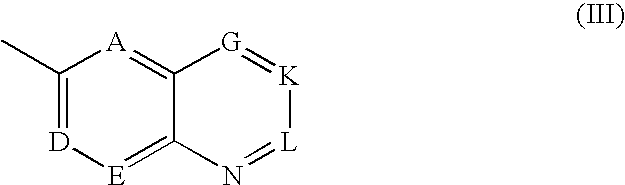
- wherein
-
- A, D and E are independently selected from CR20 and N, and
- G, K and L are independently selected from CR20 and N,
- G and K optionally form a five-membered ring containing 1-4 nitrogens,
- where each R20 is independently selected from the group consisting of: hydrogen, amino, alkylamino, substituted alkylamino, dialkylamino, substituted dialkylamino, hydroxy, alkylaminoalkyl, dialkylaminoalkyl, alkoxy, alkyl, substituted alkyl, aryl, substituted aryl, arylamino, substituted arylamino, halogen, cycloalkyl, substituted cycloalkyl, cycloalkyl containing from 1 to 4 heteroatoms, substituted cycloalkyl containing from 1 to 4 heteroatoms, oxo, —C(O)OR10, —C(O)NR11R12, cyano, and nitrile,
- where, R10 is selected form hydrogen, C1-C4alkyl, aryl and
- trifluoromethyl, and R11 and R12 are independently selected from hydrogen, C1-C4alkyl, aryl and trifluoromethyl;
and/or pharmaceutically acceptable salts, hydrates, solvates and pro-drugs thereof;
provided that not each of G, K and L are N,
further provided that when G is CR20, at least one of A, D, E, K, and L is N,
further provided that when G is N, Q must contain at least three nitrogens.
- This invention relates a method of inhibiting hYAK3 in a mammal; comprising administering to the mammal a therapeutically effective amount of a compound of the formula (I).
- This invention relates to a method of treating or preventing diseases of the erythroid and hematopoietic systems, caused by hYAK3 activity including, but not limited to, anemia, anemias due to renal insufficiency or to chronic disease, such as autoimmunity, HIV, or cancer, and drug-induced anemias, myelodysplastic syndrome, aplastic anemia and myelosuppression, and cytopenia; comprising administering to a mammal a therapeutically effective amount of a compound of formula (I).
- In a further aspect of the invention there is provided novel processes and novel intermediates useful in preparing the presently invented hYAK3 inhibiting compounds.
- Included in the present invention are pharmaceutical compositions that comprise a pharmaceutical carrier and compounds useful in the methods of the invention.
- Also included in the present invention are methods of co-administering the presently invented hYAK3 inhibiting compounds with further active ingredients.
- This invention relates to a method of inhibiting hYAK3 with compounds of Formula (I) as described above.
- This invention relates to compounds of Formula (I) as described above.
- This invention relates to a method as described above,
-
-
- A, D and E are independently selected from CR20 and N, and
- G, K and L are independently selected from CR20 and N,
- where each R20 is independently selected from the group consisting of: hydrogen, amino, alkylamino, substituted alkylamino, dialkylamino, substituted dialkylamino, hydroxy, alkylaminoalkyl, dialkylaminoalkyl, alkoxy, alkyl, substituted alkyl, aryl, substituted aryl, arylamino, substituted arylamino, halogen, cycloalkyl, substituted cycloalkyl, cycloalkyl containing from 1 to 4 heteroatoms, substituted cycloalkyl containing from 1 to 4 heteroatoms, oxo, —C(O)OR10, —C(O)NR11R12, cyano, and nitrile,
- where, R10 is selected form hydrogen, C1-C4alkyl, aryl and
- trifluoromethyl, and R11 and R12 are independently selected from hydrogen, C1-C4alkyl, aryl and trifluoromethyl;
and/or pharmaceutically acceptable salts, hydrates, solvates and pro-drugs thereof;
provided that not each of G, K and L are N,
further provided that when G is CR20, at least one of A, D, E, K, and L is N,
further provided that when G is N, Q must contain at least three nitrogens.
- This invention relates to compounds of Formula (I) as described above, wherein
-
- A, D and E are independently selected from CR20 and N, and
- G, K and L are independently selected from CR20 and N,
- where each R20 is independently selected from the group consisting of: hydrogen, amino, alkylamino, substituted alkylamino, dialkylamino, substituted dialkylamino, alkylaminoalkyl, dialkylaminoalkyl, alkyl, substituted alkyl, aryl, substituted aryl, arylamino, substituted arylamino, halogen, cycloalkyl, substituted cycloalkyl, cycloalkyl containing from 1 to 4 heteroatoms, substituted cycloalkyl containing from 1 to 4 heteroatoms, oxo, —C(O)OR10, —C(O)NR11R12, cyano, and nitrile,
- where, R10 is selected form hydrogen, C1-C4alkyl, aryl and
- trifluoromethyl, and R11 and R12 are independently selected from hydrogen, C1-C4alkyl, aryl and trifluoromethyl;
and/or pharmaceutically acceptable salts, hydrates, solvates and pro-drugs thereof;
provided that not each of G, K and L are N,
further provided that when G is CR20, at least one of A, D, E, K, and L is N,
further provided that when G is N, Q must contain at least three nitrogens.
- This invention relates to compounds of Formula (I) as described above, wherein at least one of A, D, and E is N.
- The presently invented compounds of Formula (I) inhibit hYAK3 activity.
- Included among the presently invented compounds of Formula (I) are those having Formula (II):
-

- in which
-
- R is selected form: C1-C12aryl and substituted C1-C12aryl; and
- Q is naphthyridin-6-yl, substituted naphthyridin-6-yl, naphthyl, 3-isoquinolinyl, 2-quinoxalinyl, quinazolin-6-yl, substituted quinazolin-6-yl, cinnolin-6-yl, substituted cinnolin-6-yl, or a substituent of formula (IV):
-
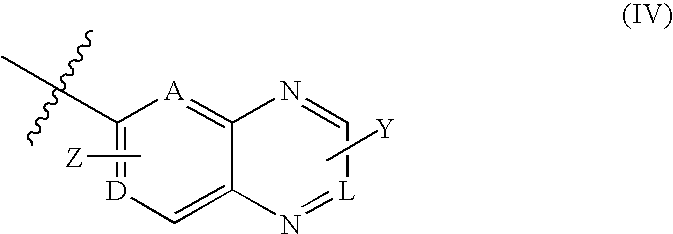
- wherein
-
- A, D and L are CR20 or N,
- where R20, Z and Y are independently selected from the group consisting of: hydrogen, amino, alkylamine, substituted alkylamine, dialkylamine, substituted dialkylamine, hydroxy, alkylaminoalkyl, dialkylaminoalkyl, alkoxy, alkyl, substituted alkyl, aryl, substituted aryl, arylamine, substituted arylamine, halogen, cycloalkyl, substituted cycloalkyl, cycloalkyl containing from 1 to 4 heteroatoms, substituted cycloalkyl containing from 1 to 4 heteroatoms, oxo, —C(O)OR10, —C(O)NR11R12, cyano, and nitrile,
- where, R10 is selected form hydrogen, C1-C4alkyl, aryl and
- trifluoromethyl, and R11 and R12 are independently selected from hydrogen, C1-C4alkyl, aryl and trifluoromethyl,
- provided that at least one of A, D and L is N;
and/or pharmaceutically acceptable salts, hydrates, solvates and pro-drugs thereof.
- Included among the presently invented compounds of Formulas (I) and (II) are those in which:
-
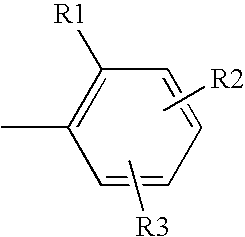
-
- in which R1 is hydrogen, halogen, —C1-6alkyl, substituted —C1-6alkyl, —SC1-6alkyl, substituted —SC1-6alkyl, —OC1-6alkyl, substituted —OC1-6alkyl, —NO2, —S(═O)—C1-6alkyl, —OH, —CF3, —CN, —CO2H, —OCF3, or —CO2C1-6alkyl; and
- R2 and R3 are independently hydrogen, halogen, —C1-6 alkyl, substituted —C1-6alkyl, C1-C12aryl, cycloalkyl, cycloalkyl containing from 1 to 4 heteroatoms, —SC1-6alkyl, substituted —SC1-6alkyl, —OC1-6alkyl, substituted —OC1-6alkyl, —NO2, —S(═O)—C1-6alkyl, —OH, —CF3, —CN, —CO2H, —CO2C1-6alkyl, —NH2, alkylamino, dialkylamino, —OCH2(C═O)OH, —OCH2CH2OCH3, —SO2NH2,
- —S(O)2NR40R30, where R30 is selected from alkyl, cycloalkyl, substituted cycloalkyl, cycloalkyl containing 1 to 4 heteroatoms, substituted cycloalkyl containing 1 to 4 heteroatoms and aryl, and R40 is selected from hydrogen and C1-C6alkyl,
- —NR41C(O)R31, where R31 is selected from aryl, -Oalkyl, -Oaryl, cycloalkyl, substituted cycloalkyl, cycloalkyl containing 1 to 4 heteroatoms, substituted cycloalkyl containing 1 to 4 heteroatoms, optionally substituted alkyl, and —NR32R33, where R32 and R33 are selected from alkyl and aryl,
- and R41 is selected from hydrogen and C1-C6alkyl,
- —NR44S(O)2R34, where R34 is selected from hydrogen, alkyl, cycloalkyl, substituted cycloalkyl, cycloalkyl containing 1 to 4 heteroatoms,
- substituted cycloalkyl containing 1 to 4 heteroatoms and aryl, and R44 is selected from hydrogen and C1-C6alkyl,
- —CONR45R35, where R35 is selected from alkyl, cycloalkyl, substituted cycloalkyl, cycloalkyl containing 1 to 4 heteroatoms, substituted cycloalkyl containing 1 to 4 heteroatoms and aryl, and R45 is selected from hydrogen and C1-C6alkyl, —CO2C1-6alkyl, —NH2, alkylamino, dialkylamino or —NH(C═NH)CH3; and
- Q is naphthyl, 3-isoquinolinyl, 2-quinoxalinyl, naphthyridin-6-yl, substituted naphthyridin-6-yl, quinazolin-6-yl, substituted quinazolin-6-yl, cinnolin-6-yl, substituted cinnolin-6-yl, or a substituent of formula (IV):
-

- wherein
-
- A, D and L are CR20 or N,
- where R20, Z and Y are independently selected from the group consisting of: hydrogen, amino, alkylamine, substituted alkylamine, dialkylamine, substituted dialkylamine, hydroxy, alkylaminoalkyl, dialkylaminoalkyl, alkoxy, alkyl, substituted alkyl, aryl, substituted aryl, arylamine, substituted arylamine, halogen, cycloalkyl, substituted cycloalkyl, cycloalkyl containing from 1 to 4 heteroatoms, substituted cycloalkyl containing from 1 to 4 heteroatoms, oxo, —C(O)OR10, —C(O)NR11R12, cyano, and nitrile,
- where, R10 is selected form hydrogen, C1-C4alkyl, aryl and
- trifluoromethyl, and R11 and R12 are independently selected from hydrogen, C1-C4alkyl, aryl and trifluoromethyl,
- provided that at least one of A, D and L is N;
and/or pharmaceutically acceptable salts, hydrates, solvates and pro-drugs thereof.
- Included among the presently invented compounds of Formulas (I) and (II) are those in which R is:
-

-
- in which R1 is halogen, —C1-6alkyl, substituted —C1-6alkyl, —SC1-6alkyl, substituted —SC1-6alkyl, —OC1-6alkyl, substituted —OC1-6alkyl, —NO2, —S(═O)—C1-6alkyl, —OH, —CF3, —CN, —CO2H, or —CO2C1-6alkyl; and
- R2 and R3 are independently hydrogen, halogen, —C1-6 alkyl, substituted —C1-6 alkyl, —SC1-6alkyl, substituted —SC1-6alkyl, —OC1-6alkyl, substituted —OC1-6alkyl, —NO2, —S(═O)—C1-6alkyl, —OH, —CF3, —CN, —CO2H, —S(O)2NR40R30, where R30 is selected from alkyl, cycloalkyl, substituted cycloalkyl, cycloalkyl containing 1 to 4 heteroatoms, substituted cycloalkyl containing 1 to 4 heteroatoms and aryl, and R40 is selected from hydrogen and C1-C6alkyl,
- —NR41C(O)R31, where R31 is selected from aryl, -Oalkyl, -Oaryl, cycloalkyl, substituted cycloalkyl, cycloalkyl containing 1 to 4 heteroatoms, substituted cycloalkyl containing 1 to 4 heteroatoms, optionally substituted alkyl, and —NR32R33, where R32 and R33 are selected from alkyl and aryl, and R41 is selected from hydrogen and C1-C6alkyl,
- —NR44S(O)2R34, where R34 is selected from hydrogen, alkyl, cycloalkyl, substituted cycloalkyl, cycloalkyl containing 1 to 4 heteroatoms,
- substituted cycloalkyl containing 1 to 4 heteroatoms and aryl, and R44 is selected from hydrogen and C1-C6alkyl,
- —CONR45R35, where R35 is selected from alkyl, cycloalkyl, substituted cycloalkyl, cycloalkyl containing 1 to 4 heteroatoms, substituted cycloalkyl containing 1 to 4 heteroatoms and aryl, and R45 is selected from hydrogen and C1-C6alkyl,
- —CO2C1-6alkyl, —NH2, alkylamino, dialkylamino or —NH(C═NH)CH3;
- and
- Q is naphthyl, 3-isoquinolinyl, 2-quinoxalinyl, naphthyridin-6-yl, substituted naphthyridin-6-yl, quinazolin-6-yl, substituted quinazolin-6-yl, cinnolin-6-yl, substituted cinnolin-6-yl, or a substituent of formula (IV):
-
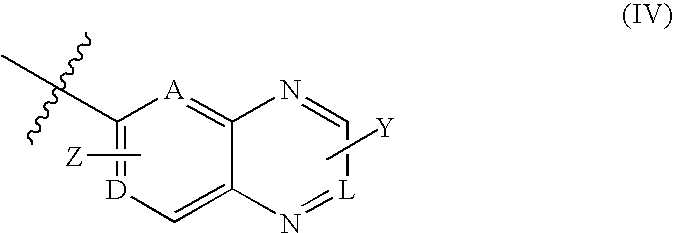
- wherein
-
- A, D and L are CR20 or N,
- where R20, Z and Y are independently selected from the group consisting of: hydrogen, amino, alkylamine, substituted alkylamine, dialkylamine, substituted dialkylamine, hydroxy, alkylaminoalkyl, dialkylaminoalkyl, alkoxy, alkyl, substituted alkyl, aryl, substituted aryl, arylamine, substituted arylamine, halogen, cycloalkyl, substituted cycloalkyl, cycloalkyl containing from 1 to 4 heteroatoms, substituted cycloalkyl containing from 1 to 4 heteroatoms, oxo, —C(O)OR10, —C(O)NR11R12, cyano, and nitrile,
- where, R10 is selected form hydrogen, C1-C4alkyl, aryl and
- trifluoromethyl, and R11 and R12 are independently selected from hydrogen, C1-C4alkyl, aryl and trifluoromethyl,
- provided that at least one of A, D and L is N;
and/or pharmaceutically acceptable salts, hydrates, solvates and pro-drugs thereof.
- Included among the presently invented compounds of Formulas (I) and (II) are those in which:
-
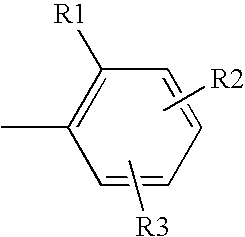
-
- in which R1 is halogen, —C1-6alkyl, substituted —C1-6alkyl, —SC1-6alkyl, substituted —SC1-6alkyl, —OC1-6alkyl, substituted —OC1-6alkyl, —NO2, —S(═O)—C1-6alkyl, —OH, —CF3, —CN, —CO2H, or —CO2C1-6alkyl;
- and
- R2 and R3 are independently hydrogen, halogen, —C1-6 alkyl, substituted —C1-6 alkyl, —SC1-6alkyl, substituted —SC1-6alkyl, —OC1-6alkyl, substituted —OC1-6alkyl, —NO2, —S(═O)—C1-6alkyl, —OH, —CF3, —CN, —CO2H,
- —S(O)2NR40R30, where R30 is selected from alkyl, cycloalkyl, substituted cycloalkyl, cycloalkyl containing 1 to 4 heteroatoms, substituted cycloalkyl containing 1 to 4 heteroatoms and aryl, and R40 is selected from hydrogen and C1-C6alkyl,
- —NR41C(O)R31, where R31 is selected from aryl, -Oalkyl, -Oaryl, cycloalkyl, substituted cycloalkyl, cycloalkyl containing 1 to 4 heteroatoms, substituted cycloalkyl containing 1 to 4 heteroatoms, optionally substituted alkyl, and —NR32R33, where R32 and R33 are selected from alkyl and aryl, and R41 is selected from hydrogen and C1-C6alkyl,
- —NR44S(O)2R34, where R34 is selected from hydrogen, alkyl, cycloalkyl, substituted cycloalkyl, cycloalkyl containing 1 to 4 heteroatoms, substituted cycloalkyl containing 1 to 4 heteroatoms and aryl, and R44 selected from hydrogen and C1-C6alkyl,
- —CONR45R35, where R35 is selected from alkyl, cycloalkyl, substituted cycloalkyl, cycloalkyl containing 1 to 4 heteroatoms, substituted cycloalkyl containing 1 to 4 heteroatoms and aryl, and R45 is selected from hydrogen and C1-C6alkyl,
- —CO2C1-6alkyl, —NH2, alkylamino or —NH(C═NH)CH3;
- and
- Q is naphthyl, 3-isoquinolinyl, 2-quinoxalinyl, naphthyridin-6-yl, substituted naphthyridin-6-yl, quinazolin-6-yl, substituted quinazolin-6-yl, cinnolin-6-yl, substituted cinnolin-6-yl, or a substituent of formula (IV):
-
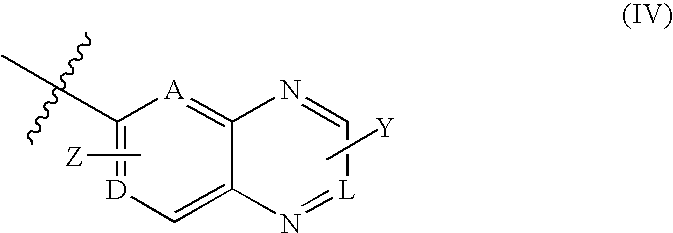
- wherein
-
- A, D and L are CR20 or N,
- where R20, Z and Y are independently selected from the group consisting of: hydrogen, amino, alkylamine, substituted alkylamine, dialkylamine, substituted dialkylamine, hydroxy, alkylaminoalkyl, dialkylaminoalkyl, alkoxy, alkyl, substituted alkyl, aryl, substituted aryl, arylamine, substituted arylamine, halogen, cycloalkyl, substituted cycloalkyl, cycloalkyl containing from 1 to 4 heteroatoms, substituted cycloalkyl containing from 1 to 4 heteroatoms, oxo, —C(O)OR10, —C(O)NR11R12, cyano, and nitrile,
- where, R10 is selected form hydrogen, C1-C4alkyl, aryl and
- trifluoromethyl, and R11 and R12 are independently selected from hydrogen, C1-C4alkyl, aryl and trifluoromethyl,
- provided that at least one of A, D and L is N;
- and/or pharmaceutically acceptable salts, hydrates, solvates and pro-drugs thereof.
- Included among the presently invented compounds of Formulas (I) and (II) are those in which:
-
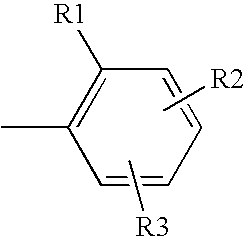
-
- in which R1 is halogen, —C1-6alkyl, substituted —C1-6alkyl, —SC1-6alkyl, substituted —SC1-6alkyl, —OC1-6alkyl, substituted —OC1-6alkyl, —NO2, —S(═O)—C1-6alkyl, —OH, —CF3, —CN, —CO2H, or —CO2C1-6alkyl;
- and
- R2 and R3 are independently hydrogen, halogen, —C1-6alkyl, substituted —C1-6alkyl, —SC1-6alkyl, substituted —SC1-6alkyl, —OC1-6alkyl, substituted —OC1-6alkyl, —NO2, —OH, —CF3, —CN, —CO2H,
- —S(O)2NR40R30, where R30 is selected from alkyl, cycloalkyl, substituted cycloalkyl, cycloalkyl containing 1 to 4 heteroatoms, substituted cycloalkyl containing 1 to 4 heteroatoms and aryl, and R40 is selected from hydrogen and C1-C6alkyl, —NR41C(O)R31, where R31 is selected from aryl, -Oalkyl, -Oaryl, cycloalkyl, substituted cycloalkyl, cycloalkyl containing 1 to 4 heteroatoms, substituted cycloalkyl containing 1 to 4 heteroatoms, optionally substituted alkyl, and —NR32R33, where R32 and R33 are selected from alkyl and aryl, and R41 is selected from hydrogen and C1-C6alkyl,
- —NR44S(O)2R34, where R34 is selected from hydrogen, alkyl, cycloalkyl, substituted cycloalkyl, cycloalkyl containing 1 to 4 heteroatoms, substituted cycloalkyl containing 1 to 4 heteroatoms and aryl, and R44 is selected from hydrogen and C1-C6alkyl, —CONR45R35, where R35 is selected from alkyl, cycloalkyl, substituted cycloalkyl, cycloalkyl containing 1 to 4 heteroatoms, substituted cycloalkyl containing 1 to 4 heteroatoms and aryl, and R45 is selected from hydrogen and C1-C6alkyl,
- —CO2C1-6alkyl, —NH2, alkylamino, or —NH(C═NH)CH3;
- and
- Q is naphthyl, 3-isoquinolinyl, 2-quinoxalinyl, naphthyridin-6-yl, substituted naphthyridin-6-yl, quinazolin-6-yl, substituted quinazolin-6-yl, cinnolin-6-yl, substituted cinnolin-6-yl, or a substituent of formula (IV):
-

- wherein
-
- A, D and L are CR20 or N,
- where R20, Z and Y are independently selected from the group consisting of: hydrogen, amino, alkylamine, substituted alkylamine, dialkylamine, substituted dialkylamine, hydroxy, alkylaminoalkyl, dialkylaminoalkyl, alkoxy, alkyl, substituted alkyl, aryl, substituted aryl, arylamine, substituted arylamine, halogen, cycloalkyl, substituted cycloalkyl, cycloalkyl containing from 1 to 4 heteroatoms, substituted cycloalkyl containing from 1 to 4 heteroatoms, oxo, —C(O)OR10, —C(O)NR11R12, cyano, and nitrile,
- where, R10 is selected form hydrogen, C1-C4alkyl, aryl and
- trifluoromethyl, and R11 and R12 are independently selected from hydrogen, C1-C4alkyl, aryl and trifluoromethyl,
- provided that at least one of A, D and L is N;
and/or pharmaceutically acceptable salts, hydrates, solvates and pro-drugs thereof.
- Also Included among the presently invented compounds of Formula (I) are those in which R is C1-C12aryl or substituted C1-C12aryl, A, D, and E are CR20, G, K and L are selected from CR20 and N, where R20 is selected from the group consisting of: hydrogen, amino, alkylamino, substituted alkylamino, dialkylamino, substituted dialkylamino, hydroxy, alkylaminoalkyl, dialkylaminoalkyl, alkoxy, alkyl, substituted alkyl, aryl, substituted aryl, arylamino, substituted arylamino, halogen, cycloalkyl, substituted cycloalkyl, cycloalkyl containing from 1 to 4 heteroatoms, substituted cycloalkyl containing from 1 to 4 heteroatoms, oxo, —C(O)OR10, —C(O)NR11R12, cyano, and nitrile,
- where, R10 is selected from hydrogen, C1-C4alkyl, aryl and trifluoromethyl, and R11 and R12 are each independently selected from hydrogen, C1-C4alkyl, aryl and trifluoromethyl;
- and/or a pharmaceutically acceptable salt, hydrate, solvate or pro-drug thereof;
- provided that when G is N, G and K together form a fused five-membered ring containing 1-4 nitrogens.
- Also Included among the presently invented compounds of Formula (I) are those in which R is C1-C12aryl or substituted C1-C12aryl, A, D, L and E are CH, G, K together form a five-membered ring containing one to four nitrogens; and/or a pharmaceutically acceptable salt, hydrate, solvate or pro-drug thereof.
- Also included among the presently invented compound are those of formula
-

- wherein R is C1-C12aryl or substituted C1-C12aryl,
- Q is a selected from a group consisting of: formula VI, VII, VIII
-
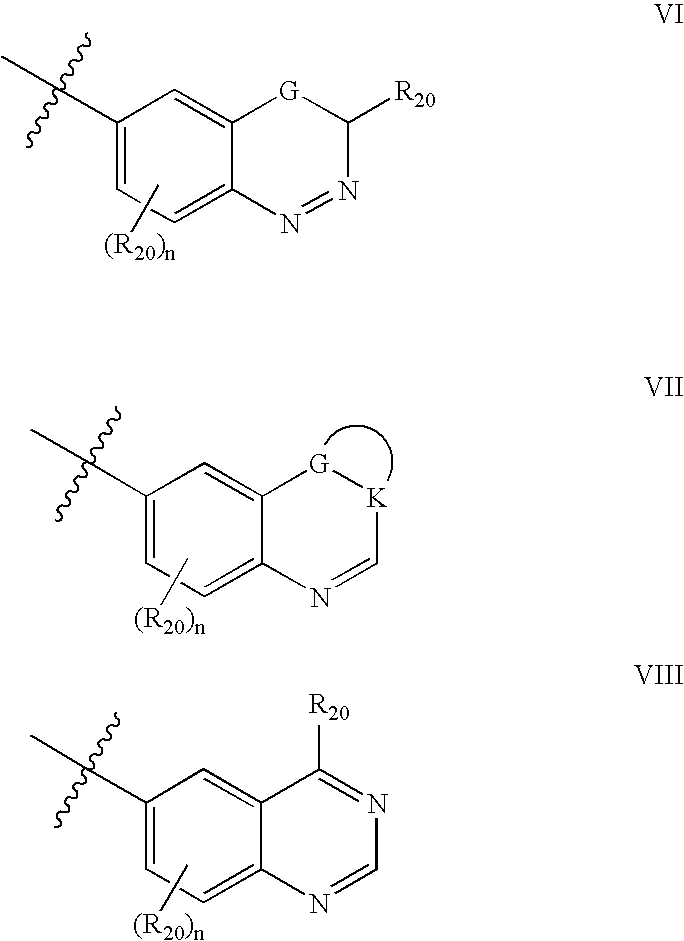
-
- where n is 0-3, G and K are each independently selected from N or CR20,
- G and K optionally form a five-membered ring containing 1-4 nitrogens, each R20 is independently selected from the group consisting of: hydrogen, amino, alkylamino, substituted alkylamino, dialkylamino, substituted dialkylamino, alkylaminoalkyl, dialkylaminoalkyl, alkyl, substituted alkyl, aryl, substituted aryl, arylamino, substituted arylamino, halogen, cycloalkyl, substituted cycloalkyl, cycloalkyl containing from 1 to 4 heteroatoms, substituted cycloalkyl containing from 1 to 4 heteroatoms, oxo, —C(O)OR10, —C(O)NR11R12, cyano, and nitrile,
- where, R10 is selected from hydrogen, C1-C4alkyl, aryl and
- trifluoromethyl, and R11 and R12 are each independently selected from hydrogen, C1-C4alkyl, aryl and trifluoromethyl;
and/or a pharmaceutically acceptable salt, hydrate, solvate or pro-drug thereof;
- provided that when Q is formula VIII, R20 is not a hydrogen,
- Also included among the novel compounds of current invention are compounds of formula V wherein Q is formula VI, and/or a pharmaceutically acceptable salt, hydrate, solvate or pro-drug thereof.
- Also included among the novel compounds of current invention are compounds of formula V wherein Q is formula VII, and/or a pharmaceutically acceptable salt, hydrate, solvate or pro-drug thereof.
- Also included among the novel compounds of current invention are compounds of formula V wherein Q is formula VIII, and R20 is selected from a group consisting of: amino, alkylamino, dialkylamino, substituted alkylamino, arylamino, oxo, and substituted arylamino; and/or a pharmaceutically acceptable salt, hydrate, solvate or pro-drug thereof.
- Included among the novel compounds useful in the present invention are:
- (5Z)-2-[(2,6-Dichlorophenyl)amino]-5-(6-quinazolinylmethylidene)-1,3-thiazol-4(5H)-one;
- (5Z)-2-[(2,6-Dichlorophenyl)amino]-5-{[4-(4-morpholinyl)-6-quinazolinyl]methylidene}-1,3-thiazol-4(5H)-one;
- (5Z)-5-(6-Cinnolinylmethylidene)-2-[(2,6-dichlorophenyl)amino]-1,3-thiazol-4(5H)-one;
- (5Z)-2-[(2,6-Dichlorophenyl)amino]-5-(imidazo[1,2-a]quinoxalin-8-ylmethylidene)-1,3-thiazol-4(5H)-one;
- N-(4-Chloro-3-{[(5Z)-5-(imidazo[1,2-a]quinoxalin-8-ylmethylidene)-4-oxo-4,5-dihydro-1,3-thiazol-2-yl]amino}phenyl)cyclobutanecarboxamide;
- (5Z)-2-[(2,6-Dichlorophenyl)amino]-5-(tetrazolo[1,5-a]quinoxalin-8-ylmethylidene)-1,3-thiazol-4(5H)-one;
- (5Z)-5-[(4-Amino-6-quinazolinyl)methylidene]-2-[(2,6-dichlorophenyl)amino]-1,3-thiazol-4(5H)-one trifluoroacetate;
- (5Z)-2-[(2,6-Dichlorophenyl)amino]-5-{[4-(methylamino)-6-quinazolinyl]methylidene}-1,3-thiazol-4(5H)-one trifluoroacetate;
- 6-{(Z)-[2-[(2,6-Dichlorophenyl)amino]-4-oxo-1,3-thiazol-5(4H)-ylidene]methyl}-4(1H)-quinazolinone, piperidine salt;
- (5Z)-2-[(2,6-Dichlorophenyl)amino]-5-{[4-(dimethylamino)-6-quinazolinyl]methylidene}-1,3-thiazol-4(5H)-one;
- (5Z)-5-{[4-(Methylamino)-6-quinazolinyl]methylidene}-2-[(2,4,6-trichlorophenyl)amino]-1,3-thiazol-4(5H)-one hydrochloride;
- 4-[(6-{(Z)-[2-[(2,6-Dichlorophenyl)amino]-4-oxo-1,3-thiazol-5(4H)-ylidene]methyl}-4-quinazolinyl)amino]-N,N-dimethylbenzenesulfonamide;
- (5Z)-2-[(2,6-Dichlorophenyl)amino]-5-(3-isoquinolinylmethylidene)-1,3-thiazol-4(5H)-one;
- (5Z)-2-[(2,6-Dichlorophenyl)amino]-5-(2-quinoxalinylmethylidene)-1,3-thiazol-4(5H)-one;
- Ethyl6-{(Z)-[2-[(2,6-dichlorophenyl)amino]-4-oxo-1,3-thiazol-5(4H)-ylidene]methyl}-1,2,4-benzotriazine-3-carboxylate; and
- (5Z)-2-[(2,6-Dichlorophenyl)amino]-5-(2-naphthalenylmethylidene)-1,3-thiazol-4(5H)-one.
- As used herein, the term “effective amount” means that amount of a drug or pharmaceutical agent that will elicit the biological or medical response of a tissue, system, animal or human that is being sought, for instance, by a researcher or clinician. Furthermore, the term “therapeutically effective amount” means any amount which, as compared to a corresponding subject who has not received such amount, results in improved treatment, healing, prevention, or amelioration of a disease, disorder, or side effect, or a decrease in the rate of advancement of a disease or disorder. The term also includes within its scope amounts effective to enhance normal physiological function.
- Compounds of Formula (I) are included in the pharmaceutical compositions of the invention and used in the methods of the invention.
- By the term “aryl” as used herein, unless otherwise defined, is meant a cyclic or polycyclic aromatic ring containing from 1 to 14 carbon atoms and optionally containing from one to five heteroatoms, provided that when the number of carbon atoms is 1 the aromatic ring contains at least four heteroatoms, when the number of carbon atoms is 2 the aromatic ring contains at least three heteroatoms, when the number of carbons is 3 the aromatic ring contains at least two heteroatoms and when the number of carbon atoms is 4 the aromatic ring contains at least one heteroatom.
- By the term “C1-C12aryl” as used herein, unless otherwise defined, is meant phenyl, naphthalene, 3,4-methylenedioxyphenyl, pyridine, biphenyl, quinoline, pyrimidine, quinazoline, thiophene, thiazole, furan, pyrrole, pyrazole, imidazole, indole, indene, pyrazine, 1,3-dihydro-2H-benzimidazol, benzimidazol, benzothiophene, tetrahydrobenzothiophene and tetrazole.
- The term “substituted” as used herein, unless otherwise defined, is meant that the subject chemical moiety has one or more substituents selected from the group consisting of: alkyl, cycloalkyl, cycloalkyl containing from 1 to 4 heteroatoms, acyloxy, aryloxy, hydroxy, alkoxy, oxo, cyano, amino, alkylamino, dialkylamino, trifluoromethyl, —SO2NR61R62, —N-acylamino, —CO2R60, —NC(O)R70, halogen, aryl, aryl substituted with one to five substituents selected from alkyl, C1-C6cycloalkyl, hydroxy, alkoxy, oxo, cyano, amino, alkylamino, dialkylamino, trifluoromethyl, —SO2NR61R62, N-acylamino, —CO2R60, —NC(O)R70, and halogen, where R61, R62, R60 and R70 are hydrogen, cycloalkyl or C1-C4alkyl.
- By the term “naphthyridin-6-yl” as used herein, is meant 1,5-naphthyridin-6-yl, 1,7-naphthyridin-6-yl, and 1,8-naphthyridin-6-yl.
- By the term “alkoxy” as used herein is meant -Oalkyl where alkyl is as described herein including —OCH3 and —OC(CH3)2CH3.
- The term “cycloalkyl” as used herein unless otherwise defined, is meant a nonaromatic, unsaturated or saturated, cyclic or polycyclic C3-C12.
- Examples of cycloalkyl and substituted cycloalkyl substituents as used herein include: cyclohexyl, aminocyclohexyl, cyclobutyl, aminocyclobutyl, 4-hydroxy-cyclohexyl, 2-ethylcyclohexyl, propyl-4-methoxycyclohexyl, 4-methoxycyclohexyl, 4-carboxycyclohexyl, cyclopropyl, aminocyclopentyl, and cyclopentyl.
- The term “cycloalkyl containing from 1 to 4 heteroatoms” and the term “cycloalkyl containing from 1 to 3 heteroatoms” as used herein unless otherwise defined, is meant a nonaromatic, unsaturated or saturated, cyclic or polycyclic ring containing from 1 to 12 carbons and containing from one to four heteroatoms or from one to three heteroatoms (respectively), provided that when the number of carbon atoms is 1 the aromatic ring contains at least four heteroatoms (applicable only where “cycloalkyl containing from 1 to 4 heteroatoms” is indicated), when the number of carbon atoms is 2 the aromatic ring contains at least three heteroatoms, when the number of carbon atoms is 3 the nonaromatic ring contains at least two heteroatoms and when the number of carbon atoms is 4 the nonaromatic ring contains at least one heteroatom.
- Examples of cycloalkyl containing from 1 to 4 heteroatoms, cycloalkyl containing from 1 to 3 heteroatoms, substituted cycloalkyl containing from 1 to 4 heteroatoms and substituted cycloalkyl containing from 1 to 3 heteroatoms as used herein include: piperidine, piperazine, pyrrolidine, 3-methylaminopyrrolidine, piperazine, tetrazole, hexahydrodiazepine and morpholine.
- By the term “acyloxy” as used herein is meant —OC(O)alkyl where alkyl is as described herein. Examples of acyloxy substituents as used herein include: —OC(O)CH3, —OC(O)CH(CH3)2 and —OC(O)(CH2)3CH3.
- By the term “N-acylamino” as used herein is meant —N(H)C(O)alkyl, where alkyl is as described herein. Examples of N-acylamino substituents as used herein include: —N(H)C(O)CH3, —N(H)C(O)CH(CH3)2 and —N(H)C(O)(CH2)3CH3.
- By the term “aryloxy” as used herein is meant -Oaryl where aryl is phenyl, naphthyl, 3,4-methylenedioxyphenyl, pyridyl or biphenyl optionally substituted with one or more substituents selected from the group consisting of: alkyl, hydroxyalkyl, alkoxy, trifluoromethyl, acyloxy, amino, N-acylamino, hydroxy, —(CH2)gC(O)OR65, —S(O)nR65, nitro, cyano, halogen and protected —OH, where g is 0-6, R25 is hydrogen or alkyl, and n is 0-2. Examples of aryloxy substituents as used herein include: phenoxy, 4-fluorophenyloxy and biphenyloxy.
- By the term “heteroatom” as used herein is meant oxygen, nitrogen or sulfur.
- By the term “halogen” as used herein is meant a substituent selected from bromide, iodide, chloride and fluoride.
- By the term “alkyl” and derivatives thereof and in all carbon chains as used herein, including alkyl chains defined by the term “—(CH2)n”, “—(CH2)m” and the like, is meant a linear or branched, saturated or unsaturated hydrocarbon chain, and unless otherwise defined, the carbon chain will contain from 1 to 12 carbon atoms.
- Examples of alkyl and substituted alkyl substituents as used herein include:
- —CH3, —CH2—CH3, —CH2—CH2—CH3, —CH(CH3)2, —CH2—CH2—C(CH3)3, —CH2—CF3, —C≡C—C(CH3)3, —C≡C—CH2—OH, cyclopropylmethyl, —CH2—C(CH3)2—CH2—NH2, —C≡C—C6H5, —C≡C—C(CH3)2—OH, —CH2—CH(OH)—CH(OH)—CH(OH)—CH(OH)—CH2—OH, piperidinylmethyl, methoxyphenylethyl, —C(CH3)3, —(CH2)3—CH3, —CH2—CH(CH3)2, —CH(CH3)—CH2—CH3, —CH═CH2, and —C≡C—CH3.
- By the term “treating” and derivatives thereof as used herein, is meant prophylatic and therapeutic therapy.
- As used herein, the term “optionally” means that the subsequently described event(s) may or may not occur, and includes both event(s), which occur, and events that do not occur.
- As used herein, the crisscrossed double bond indicated by the symboldenotes Z and/or E stereochemistry around the double bond. In other words a compound of Formula I can be either in the Z or E stereochemistry around this double bond, or a compound of Formula I can also be in a mixture of Z and E stereochemistry around the double bond. However, in formulas I and II, the preferred compounds have Z stereochemistry around the double bond to which radical Q is attached.

- A person of ordinary skill can readily appreciate that certain substituents may cause the double bonds of Q in Formula I or V to shift within the bicyclic ring. An example of such substituent is: oxo.
- The compounds of Formulas I and II naturally may exist in one tautomeric form or in a mixture of tautomeric forms. For example, for sake simplicity, compounds of formula I and II are expressed in one tautomeric form, usually as an exo form, i.e.
-
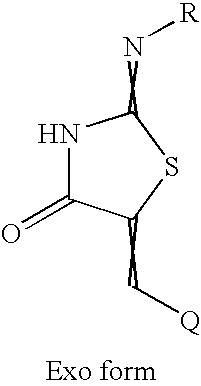
- However, a person of ordinary skill can readily appreciate, the compounds of formulas I and II can also exist in endo forms.
-

- The present invention contemplates all possible tautomeric forms.
- Certain compounds described herein may contain one or more chiral atoms, or may otherwise be capable of existing as two enantiomers, or two or more diastereoisomers. Accordingly, the compounds of this invention include mixtures of enantiomers/diastereoisomers as well as purified enantiomers/diastereoisomers or enantiomerically/diastereoisomerically enriched mixtures. Also included within the scope of the invention are the individual isomers of the compounds represented by Formula I above as well as any wholly or partially equilibrated mixtures thereof. The present invention also covers the individual isomers of the compounds represented by the formulas above as mixtures with isomers thereof in which one or more chiral centers are inverted. Further, an example of a possible tautomer is an oxo substituent in place of a hydroxy substituent. Also, as stated above, it is understood that all tautomers and mixtures of tautomers are included within the scope of the compounds of Formula I.
- Compounds of Formula (I) are included in the pharmaceutical compositions of the invention and used in the methods of the invention. Where a —COOH or —OH group is present, pharmaceutically acceptable esters can be employed, for example methyl, ethyl, pivaloyloxymethyl, and the like for —COOH, and acetate maleate and the like for —OH, and those esters known in the art for modifying solubility or hydrolysis characteristics, for use as sustained release or prodrug formulations.
- The novel compounds of Formulas I and II are prepared as shown in Schemes I and II below, or by analogous methods, wherein the ‘Q’ and ‘R’ substituents are as defined in Formulas I and II respectively and provided that the ‘Q’ and ‘R’ substituents do not include any such substituents that render inoperative the processes of Schemes I to II. All of the starting materials are commercially available or are readily made from commercially available starting materials by those of skill in the art.
-

- Briefly in Scheme 1, a mixture of aniline derivative of formula II (1 equivalent) and NH4SCN (about 1.3 equivalent) in an acid (typically 4N—HCl) is heated to reflux at about 110° C. for 6 hours. After cooling, the mixture is treated with H2O, which process usually forms a solid, followed by desiccation in vacuo to give a compound of formula III.
- A mixture of formula III compound, ClCH2CO2H (1 equivalent), and AcONa (1 equivalent) in AcOH is heated to reflux at around 110C.° for about 4 h. The mixture is poured onto water thereby a solid is typically formed, which is isolated by filtration. The solid is washed with a solvent such as MeOH to afford a compound of formula IV.
- A mixture of formula IV compound, an aldehyde of formula V (1 equivalent), an amine such as piperidine, and optionally acetic acid in AcOH is heated in a microwave reactor at about 150° C. for about 0.5 hours. After cooling, a small portion of water is added until the solid forms. The solid is filtered and washed with a solvent such as MeOH, followed by desiccation in vacuo to afford a target product of Formula I.
-

- Scheme 2 shows an alternative synthesis of the intermediate IV. Briefly in Scheme 2, a mixture of the known thiazolinone VI and aniline derivative RNH2 in ethanol is heated under reflux to give the intermediate IV after appropriate work-up.
- In Schemes 1 and 2, the meaning of R and Q are as defined in Formula I.
- In other embodiments, additional compounds of the invention can also be synthesized whereby a compound of Formula I is first made by a process of Scheme 1 or 2 (or a variant thereof), and Q and R radicals in compounds of Formula I thus made are further converted by routine organic reaction techniques into different Q and R groups.
- By the term “co-administering” and derivatives thereof as used herein is meant either simultaneous administration or any manner of separate sequential administration of a hYAK3 inhibiting compound, as described herein, and a further active ingredient or ingredients, known to be useful in treating diseases of the hematopoietic system, particularly anemias, including EPO or a derivative thereof. The term further active ingredient or ingredients, as used herein, includes any compound or therapeutic agent known to or that demonstrates advantageous properties when administered to a patient in need of treatment for diseases of the hematopoietic system, particularly anemias. Preferably, if the administration is not simultaneous, the compounds are administered in a close time proximity to each other. Furthermore, it does not matter if the compounds are administered in the same dosage form, e.g. one compound may be administered topically and another compound may be administered orally.
- Because the pharmaceutically active compounds of the present invention are active as hYAK3 inhibitors they exhibit therapeutic utility in treating diseases of the hematopoietic system, particularly anemias.
- The pharmaceutically active compounds within the scope of this invention are useful as hYAK inhibitors in mammals, particularly humans, in need thereof.
- The present invention therefore provides a method of treating diseases of the hematopoietic system, particularly anemias and other conditions requiring hYAK inhibition, which comprises administering an effective compound of Formula (I) or a pharmaceutically acceptable salt, hydrate, solvate or pro-drug thereof. The compounds of Formula (I) also provide for a method of treating the above indicated disease states because of their ability to act as hYAK inhibitors. The drug may be administered to a patient in need thereof by any conventional route of administration, including, but not limited to, intravenous, intramuscular, oral, subcutaneous, intradermal, and parenteral.
- The pharmaceutically active compounds of the present invention are incorporated into convenient dosage forms such as capsules, tablets, or injectable preparations. Solid or liquid pharmaceutical carriers are employed. Solid carriers include, starch, lactose, calcium sulfate dihydrate, terra alba, sucrose, talc, gelatin, agar, pectin, acacia, magnesium stearate, and stearic acid. Liquid carriers include syrup, peanut oil, olive oil, saline, and water. Similarly, the carrier or diluent may include any prolonged release material, such as glyceryl monostearate or glyceryl distearate, alone or with a wax. The amount of solid carrier varies widely but, preferably, will be from about 25 mg to about 1 g per dosage unit. When a liquid carrier is used, the preparation will be in the form of a syrup, elixir, emulsion, soft gelatin capsule, sterile injectable liquid such as an ampoule, or an aqueous or nonaqueous liquid suspension.
- The pharmaceutical preparations are made following conventional techniques of a pharmaceutical chemist involving mixing, granulating, and compressing, when necessary, for tablet forms, or mixing, filling and dissolving the ingredients, as appropriate, to give the desired oral or parenteral products.
- Doses of the presently invented pharmaceutically active compounds in a pharmaceutical dosage unit as described above will be an efficacious, nontoxic quantity preferably selected from the range of 0.001-100 mg/kg of active compound, preferably 0.001-50 mg/kg. When treating a human patient in need of a hYAK inhibitor, the selected dose is administered preferably from 1-6 times daily, orally or parenterally. Preferred forms of parenteral administration include topically, rectally, transdermally, by injection and continuously by infusion. Oral dosage units for human administration preferably contain from 0.05 to 3500 mg of active compound. Oral administration, which uses lower dosages is preferred. Parenteral administration, at high dosages, however, also can be used when safe and convenient for the patient.
- Optimal dosages to be administered may be readily determined by those skilled in the art, and will vary with the particular hYAK inhibitor in use, the strength of the preparation, the mode of administration, and the advancement of the disease condition. Additional factors depending on the particular patient being treated will result in a need to adjust dosages, including patient age, weight, diet, and time of administration.
- The method of this invention of inducing hYAK inhibitory activity in mammals, including humans, comprises administering to a subject in need of such activity an effective hYAK inhibiting amount of a pharmaceutically active compound of the present invention.
- The invention also provides for the use of a compound of Formula (I) in the manufacture of a medicament for use as a hYAK inhibitor.
- The invention also provides for the use of a compound of Formula (I) in the manufacture of a medicament for use in therapy.
- The invention also provides for the use of a compound of Formula (I) in the manufacture of a medicament for use in treating diseases of the hematopoietic system, particularly anemias.
- The invention also provides for a pharmaceutical composition for use as a hYAK inhibitor which comprises a compound of Formula (I) and a pharmaceutically acceptable carrier.
- The invention also provides for a pharmaceutical composition for use in the treatment of diseases of the hematopoietic system, particularly anemias which comprises a compound of Formula (I) and a pharmaceutically acceptable carrier.
- No unacceptable toxicological effects are expected when compounds of the invention are administered in accordance with the present invention.
- In addition, the pharmaceutically active compounds of the present invention can be co-administered with further active ingredients, such as other compounds known to treat diseases of the hematopoietic system, particularly anemias, or compounds known to have utility when used in combination with a hYAK inhibitor.
- Without further elaboration, it is believed that one skilled in the art can, using the preceding description, utilize the present invention to its fullest extent. The following Examples are, therefore, to be construed as merely illustrative and not a limitation of the scope of the present invention in any way.
- For ease of illustration, the regiochemistry around the double bonds in the chemical formulas in the Examples are drawn as fixed for ease of representation; however, a skilled in the art will readily appreciate that the compounds will naturally assume more thermodynamically stable structure around the C═N (the imine) double bond if it exits as exo form. Further compounds can also exit in endo form. As stated before, the invention contemplates both endo and exo forms as well as both regioisomers around the exo imine bond. Further it is intended that both E and Z isomers are encompassed around the C═C double bond.
- The compounds of Examples 1 to 6 are readily made according to Schemes I and II or by analogous methods.
-

-
-
- a) [(5-Chloro-2-nitrophenyl)methanediyl]diformamide. A slurry of 5-chloro-2-nitrobenzaldehyde (4 g, 21.6 mmol) in formamide (20 mL) was treated with HCl gas. An exothermic reaction resulted and the slurry dissolved rapidly. After 30 s. of bubbling HCl gas, a white precipitate formed and the HCl gas was removed. The r×n mixture was allowed to cool to RT over 1 h. Ethanol (50 mL) was added and the product collected via filtration to give a white powder. Recrystallization in boiling water followed by filtration yielded white needles (2.90 g, 52%) of the desired product. MS (ES+) m/e 258 [M+H]+.
- b) 6-Chloroquinazoline. To a mixture of the compound obtained in example 1a (2.9 g, 11.3 mmol) and zinc dust (8.3 g, 184 mmol) in acetic acid (11 g, 184 mmol) was added crushed ice (30 g) over 10 min. The mixture was shaken for ½ h and stirred vigorously for a further 1½ h adding a total of 1.5 g of additional zinc dust portion wise. The reaction mixture was filtered and the filtrate basified with NaOH and a white cloudy solution resulted. The basic solution was extracted with ether (4×100 mL). The organic layer was dried over Na2SO4, filtered and solvent removed under reduced pressure to give a white solid (500 mg, 27%) as the desired product. (ES+) m/e 165 [M+H]+.
- c) 6-Ethenylquinazoline. The chloroquinazoline from example 1b (200 mg, 1.22 mmol), tributyl vinyl tin (392 μL, 1.34 mmol) and palladium tetrakis triphenylphosphine (141 mg, 0.122 mmol) in dioxane (2 mL) and DMF (3 drops) were stirred and heated in a microwave reactor at 150° C. for 20 min. Purification by flash-chromatography (silica gel, 20-50% ethyl acetate in hexanes) afforded the title compound (65 mg; 34%) as an off white solid. C10H8N2 MS (ES+) m/e 157 [M+H]+
- d) 6-Quinazolinecarbaldehyde. A mixture of the vinyl compound from example 1c (65 mg, 0.416 mmol), 2.5% osmium tetraoxide in t-butanol (85 mg, 0.008 mmol), sodium periodate (356 mg, 1.66 mmol) and 2,6-lutidene (97 μL, 0.833 mmol) in dioxane (3 mL) and water (1 mL) was stirred at RT for 30 min. The reaction mixture was diluted with water (10 mL) and extracted with DCM (2×30 mL). The organic layer was dried over MgSO4, filtered and solvents removed under reduced pressure to yield the title compound (45 mg, 68%) which was used in the next step without further purification. C9H6N2O MS (ES+) m/e 159 [M+H]+
- e) (5Z)-2-[(2,6-Dichlorophenyl)amino]-5-(6-quinazolinylmethylidene)-1,3-thiazol-4(5H)-one. A solution of the compound from example 1d (45 mg, 0.284 mmol.), 2-[(2,6-dichlorophenyl)amino]-1,3-thiazol-4(5M-one (75 mg, 0.284 mmol.) and piperidine (28 μL, 0.284 mmol.) in ethanol (2.0 mL) was stirred and heated in a microwave reactor at 150° C. for 20 min. The mixture was purified by flash-chromatography (silica gel, 5-100% 10% methanol in chloroform) to afford the title compound (10.0 mg, 9%) as a pale-yellow powder. 1H NMR (400 MHz, DMSO-d6) d ppm 13.10 (s, 1H) 9.72 (s, 1H) 9.32 (s, 1H) 8.28 (s, 1H) 8.09 (s, 2H) 7.92 (s, 1H) 7.57 (s, 2H) 7.24 (s, 1H). C18H10Cl2N4OS MS (ES+) m/e 401 [M+H]+
-
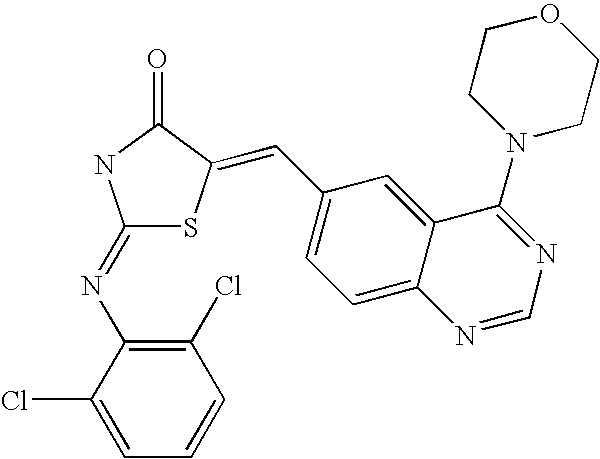
-
-
- a) 6-Ethenyl-4-(4-morpholinyl)quinazoline. A solution of 6-bromo-4-chloroquinazoline (147.7 mg, 0.608 mmol.) and morpholine (53 μL, 0.608 mmol.) in dioxane (2.0 mL) was stirred and heated in a microwave reactor at 150° C. for 20 min. An aliquot was analyzed by LCMS, MS (ES+) m/e 294 [M+H]+, and was 100% pure 6-bromo-4-(4-morpholinyl)quinazoline. Material used in next step without further workup. To the above mixture was added tributyl vinyl tin (195 μL, 0.608 mmol) and palladium tetrakis triphenylphosphine (70 mg, 0.0608 mmol) in DMF (2 mL). The reactants were stirred and heated in a microwave reactor at 150° C. for 20 min. Purification by flash-chromatography (silica gel, 10-100% 10% methanol in chloroform) afforded the title compound (125 mg; 85%) as an off white solid. C14H15N3O MS (ES+) m/e 242 [M+H]+
- b) 4-(4-Morpholinyl)-6-quinazolinecarbaldehyde. A mixture of the vinyl compound from example 2a (125 mg, 0.514 mmol), 2.5% osmium tetraoxide in t-butanol (105 mg, 0.010 mmol), sodium periodate (440 mg, 2.06 mmol) and 2,6-lutidene (120 μL, 1.03 mmol) in dioxane (6 mL) and water (1.5 mL) was stirred at RT for 30 min. The reaction mixture was diluted with water (10 mL) and extracted with DCM (2×30 mL). The organic layer was dried over MgSO4, filtered and solvents removed under reduced pressure to yield the title compound (120 mg, 96%) as a clear oil which was used in the next step without further purification. C13H13N3O2 MS (ES+) m/e 244 [M+H]+
- c) (5Z)-2-[(2,6-Dichlorophenyl)amino]-5-{[4-(4-morpholinyl)-6-quinazolinyl]methylidene}-1,3-thiazol-4(5H)-one. A solution of the aldehyde from example 2b (120 mg, 0.494 mmol.), 2-[(2,6-dichlorophenyl)amino]-1,3-thiazol-4(5H)-one (100 mg, 0.385 mmol.) and piperidine (40 μL, 0.385 mmol.) in ethanol (2.0 mL) was stirred and heated in a microwave reactor at 150° C. for 20 min. The mixture was purified by flash-chromatography (silica gel, 5-100% 10% methanol in chloroform) to afford the title compound (32.0 mg, 17%) as a yellow powder. 1H NMR (400 MHz, DMSO-d6) d ppm 13.04 (s, 1H) 8.64-8.69 (m, 1H) 8.02-8.08 (m, 1H) 7.90-7.97 (m, 2H) 7.83-7.89 (m, 1H) 7.54-7.62 (m, 2H) 7.20-7.29 (m, 1H) 3.64 (s, 8H). C22H17Cl2N5O2S MS (ES+) m/e 486 [M+H]+
-
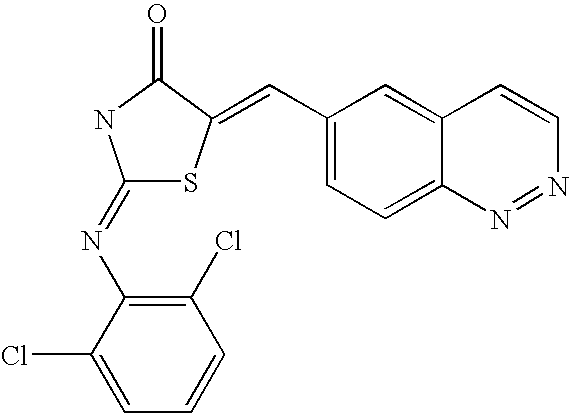
-
-
- a) Methyl 4-amino-3-iodobenzoate. A solution of methyl 4-aminobenzoate (5.0 g; 0.033 mol.), benzyltrimethylammonium dichloroiodate (22.1 g; 0.056 mol.) and calcium carbonate (5.0 g; 0.050 mol.) in a mixture of dichloromethane (200 ml) and methanol (100 mL) were stirred and heated under reflux overnight. The solution was cooled, washed with saturated sodium bisulphate, dried and evaporated to afford the desired product (9.6 g; quant.) which was used directly without further purification. 1 H NMR (400 MHz, DMSO-d6) δ ppm 3.75 (s, 3H) 6.09 (s, 2H) 6.75 (d, J=8.59 Hz, 1H) 7.66 (dd, J=8.59, 2.02 Hz, 1H) 8.11 (d, J=2.02 Hz, 1H).
- b) Methyl 4-(3,3-diethyl-1-triazen-1-yl)-3-iodobenzoate. A suspension of the compound from example 3a) (9.6 g; 0.033 mol.) in acetonitrile (35.0 mL) was treated with ice (12.5 g) and concentrated hydrochloric acid (8.5 mL) and then cooled to −5° C. This suspension was then treated dropwise with a solution of sodium nitrite (5.3 g; 0.076 mol.) in a mixture of acetonitrile (10.0 mL) and water (30.0 mL). The solution was then stirred at −5° C. for 30 min. then added dropwise via cannula to a cooled (0° C.) solution of diethylamine (35.9 mL; 0.35 mol.) and potassium carbonate (29.0 g; 0.21 mol.) in acetonitrile (88 mL) and water (262 mL). The mixture was then stirred and allowed to reach room temperature overnight. The mixture was diluted with dichloromethane (500 mL), the layers separated and the organic layer washed with sat. aqu. sodium hydrogen carbonate, dried and evaporated. The residue was purified by chromatography [silica gel, hexanes/ethyl acetate (95:5) then (9:1)] to give the title compound (5.3 g; 42%) as an orange oil. 1H NMR (400 MHz, DMSO-d6) δ ppm 1.26 (t, J=7.07 Hz, 3H) 1.31 (t, J=7.20 Hz, 3H) 3.79-3.89 (m, 7H) 7.38 (d, J=8.59 Hz, 1H) 7.90 (dd, J=8.46, 1.89 Hz, 1H) 8.35 (d, J=1.77 Hz, 1H).
- c) Methyl 4-(3,3-diethyl-1-triazen-1-yl)-3-ethynylbenzoate. A solution of the compound from example 3b) (5.0 g; 0.014 mol.), trimethylsilylacetylene (2.8 ml; 0.021 mol.), bis(triphenylphosphine)dichloropalladium (0.59 g; 0.8 mmol.) and copper (I) iodide (0.32 g; 1.7 mmol.) in triethylamine (139 mL) was stirred and heated at 50° C. under an argon atmosphere overnight. The mixture was cooled and evaporated then the residue was filtered through a silica gel pad with the aid of dichloromethane/hexanes (1:1) (500 mL). After evaporation of the organics the crude residue was dissolved in tetrahydrofuran (100 mL) and methanol (20.0 mL) then treated with potassium carbonate (19.1 g; 0.139 mol.) and the mixture was stirred at room temperature overnight. The mixture was diluted with diethyl ether (500 mL) then washed with sat. aqueous ammonium chloride, dried and evaporated. The residue was then purified by chromatography [silica gel, hexanes/dichloromethane (3:1) then (2:1)] to afford the title compound (1.6 g; 44%) as a yellow oil. 1H NMR (400 MHz, DMSO-d6) δ ppm 1.22 (t, J=7.07 Hz, 3H) 1.30 (t, J=7.20 Hz, 3H) 3.77-3.88 (m, 7H) 7.45 (d, J=8.59 Hz, 1H) 7.88 (dd, J=8.59, 2.02 Hz, 1H) 7.97 (d, J=2.02 Hz, 1H).
- d) Methyl 6-cinnolinecarboxylate. A solution of the compound from example 3c) (1.6 g; 6.2 mmol.) in 1,3-dichlorobenzene (65.0 mL) was stirred and heated at 200° C. in a sealed vessel for 20 h. The mixture was colled, evaporated and the residue purified by chromatography [silica gel, hexanes/ethyl acetate (1:1)] to afford the title compound (0.36 g; 31%) as a brown powder. 1H NMR (400 MHz, DMSO-d6) δ ppm 3.98 (s, 3H) 8.37 (dd, J=8.97, 1.89 Hz, 1H) 8.48 (d, J=5.05 Hz, 1H) 8.60 (d, J=8.84 Hz, 1H) 8.83 (d, J=1.77 Hz, 1H) 9.54 (d, J=5.81 Hz, 1H).
- e) 6-Cinnolinecarbaldehyde. A solution of the compound from example 3d) (345 mg; 1.8 mmol.) in anhydrous tetrahydrofuran (20.0 mL) was cooled to 5° C. for the portionwise addition of solid lithium aluminumhydride (70.0 mg; 1.8 mmol.) and stirred at 5° C. for 1 h. The mixture was quenched by the addition of ethyl acetate (50.0 mL) then water (5.0 mL), filtered through a pad of Celite and evaporated. The residue was dissolved in ethyl acetate (50.0 mL) and treated with manganese dioxide (0.50 g) and stirred at room temperature for 2 h. The mixture was filtered through a pad of Celite and evaporated to afford the title compound (169 mg; 60%) as a brown powder which was used directly in the following step without further purification.
- f) (5Z)-5-(6-Cinnolinylmethylidene)-2-[(2,6-dichlorophenyl)amino]-1,3-thiazol-4(5H)-one. A solution of the compound from example 3e) (158 mg; 1.0 mmol.), 2-[(2,6-dichlorophenyl)amino]-1,3-thiazol-4(5″-one (261 mg; 1.0 mmol.) and piperidine (0.11 mL; 1.1 mmol.) in ethanol (2.0 mL) was stirred and heated at 150° C. for 30 min. in a Biotage Initiator microwave synthesizer. The reaction mixture was then cooled and purified directly by chromatography [ODS silica, gradient elution with 10-100% acetonitrile/water (0.1% TFA)] to afford the title compound (53.0 mg; 7% over three steps from ethyl 6-cinnolinecarboxylate) as a brown powder. 1H NMR (400 MHz, DMSO-d6) δ ppm 7.25 (t, J=8.08 Hz, 1H) 7.59 (d, J=8.08 Hz, 2H) 7.94 (s, 1H) 8.05 (dd, J=8.97, 1.64 Hz, 1H) 8.20 (d, J=1.64 Hz, 1H) 8.35 (d, J=5.81 Hz, 1H) 8.52 (d, J=8.84 Hz, 1H) 9.40 (d, J=6.06 Hz, 1H) 13.15 (s, 1H). C18H10N4OSCl2.0.5H2O requires: % C, 52.7; % H, 2.7; % N, 13.6. found: % C, 53.2; % H, 2.7; % N, 13.1.
-

-
-
- a) 2-[(2,6-Dichlorophenyl)amino]-1,3-thiazol-4(5H)-one. A suspension of N-(2,6-dichlorophenyl)thiourea (103.7 g; 0.469 mol.) and chloroacetic acid (48.8 g; 0.516 mol.) in glacial acetic acid (600 mL) was stirred and heated under reflux for 2 h. The stirred mixture was allowed to cool to 40° C. then treated dropwise with water (1 L) during which a pale-yellow precipitate formed. The suspension was then filtered and the precipitate washed with water (1 L) to afford the title compound (94.0 g; 79%) as a yellow solid. 1H NMR (400 MHz, DMSO-d6) δ ppm 12.2 (s, 1H) 7.49 (d, J=8.08 Hz, 2H) 7.14 (t, J=8.08 Hz, 1H) 4.10 (s, 2H).
- b) 7-Bromo-2-chloroquinoxaline. A suspension of 7-bromo-2(1H)-quinoxalinone (prepared by the method of Linda, P; Marino, G. Ric. Sci. Rend., Ser. A. 1963, 3, 225-228) (24.0 g; 107 mmol) in phosphorus oxychloride (40.0 mL) was stirred and heated under reflux for 2 h. The stirred mixture was allowed to cool then carefully poured into ice-water. The suspension was then filtered and the precipitate washed with water to afford the title compound (25.0 g; 96%) as a beige solid. 1H NMR (400 MHz, DMSO-d6) δ ppm 9.05 (s, 1H) 8.34 (d, J=2.0 Hz, 1H) 8.11 (d, J=9.0 Hz, 1H) 8.05 (dd, J=8.9, 2.0 Hz, 1H).
- c) 8-Bromoimidazo[1,2-a]quinoxaline. A solution of the compound from Example 1b) (0.243 g; 1.00 mmol) and aminoacetaldehyde dimethyl acetal (0.119 mL; 1.10 mmol) in methanol (2.0 mL) was irradiated at 150° C. for 20 min. in a Biotage Initiator microwave synthesizer. Upon cooling, 6 M aq. HCl (1.0 mL) was added and the reaction mixture was irradiated at 120° C. for 20 min. in a Biotage Initiator microwave synthesizer. Upon cooling the reaction mixture was poured into a solution of saturated aq. NaHCO3, diluted with water, and extracted thrice with ethyl acetate. The combined organic layers were dried over MgSO4, filtered, and concentrated in vacuo to afford the title compound (0.200 g; 81%) as an orange solid. 1H NMR (400 MHz, CHLOROFORM-d) □ ppm 9.12 (s, 1H) 8.07-8.10 (m, 2H) 8.00 (d, J=8.8 Hz, 1H) 7.84 (d, J=1.3 Hz, 1H) 7.71 (dd, J=8.8, 2.0 Hz, 1H).
- d) 8-Ethenylimidazo[1,2-a]quinoxaline. A solution of the compound from Example 1c) (0.200 g; 0.806 mmol), tributyl(vinyl)tin (0.259 mL; 0.887 mmol), and tetrakis(triphenylphosphine)palladium (0.009 g; 0.008 mmol) in dioxane (2.0 mL) and N,N-dimethylformamide (3 drops) was irradiated at 150° C. for 20 min. in a Biotage Initiator microwave synthesizer. Upon cooling, the solution was concentrated onto silica gel and purified via flash column chromatography (silica gel, 50-80% ethyl acetate in hexanes) to afford the title compound (0.138 g; 88%) as a tan solid. 1H NMR (400 MHz, CHLOROFORM-d) □ ppm 9.05 (s, 1H) 8.11 (s, 1H) 8.03 (d, J=8.6 Hz, 1H) 7.81-7.82 (m, 1H) 7.80 (d, J=1.3 Hz, 1H) 7.65 (dd, J=8.6, 1.8 Hz, 1H) 6.87 (dd, J=17.6, 11.0 Hz, 1H) 5.95 (d, J=17.7 Hz, 1H) 5.47 (d, J=10.9 Hz, 1H).
- e) Imidazo[1,2-a]quinoxaline-8-carbaldehyde. To a suspension of the compound from Example 1d) (0.100 g; 0.512 mmol) in dioxane (3.0 mL) and water (1.0 mL) was added osmium tetroxide (2.5% soln. in t-BuOH; 0.104 g; 0.010 mmol), sodium periodate (0.438 g; 2.05 mmol), and 2,6-lutidine (0.119 mL; 1.02 mmol). After stirring 30 min. at ambient temperature, water was added and the reaction mixture was extracted twice with CH2Cl2. The combined organic layers were dried over MgSO4, filtered, and concentrated in vacuo to afford the title compound (0.091 g; 90%) as a light yellow solid. 1H NMR (400 MHz, CHLOROFORM-D) □ ppm 10.2 (s, 1H) 9.25 (s, 1H) 8.47 (d, J=1.3 Hz, 1H) 8.30 (d, J=8.3 Hz, 1H) 8.27 (s, 1H) 8.10 (dd, J=8.2, 1.4 Hz, 1H) 7.92 (s, 1H).
- f) (5Z)-2-[(2,6-Dichlorophenyl)amino]-5-(imidazo[1,2-a]quinoxalin-8-ylmethylidene)-1,3-thiazol-4(5″-one. A suspension of the compound from Example 1a) (0.093 g; 0.355 mmol), the compound from Example 1e) (0.070 g; 0.355 mmol), and piperidine (0.035 mL; 0.355 mmol) in ethanol (2.0 mL) was stirred and irradiated at 150° C. for 30 min. in a Biotage Initiator microwave synthesizer. Upon cooling, the reaction mixture was diluted with water and acidified with 1 M aq. HCl. The resulting suspension was filtered, washed with water, and dried in vacuo to afford the title compound (0.105 g, 67%) as a yellow solid. 1H NMR (400 MHz, DMSO-d6) □ ppm 13.1 (s, 1H) 9.15 (s, 1H) 8.75 (s, 2H) 8.14 (d, J=8.6 Hz, 1H) 7.90 (d, J=5.1 Hz, 2H) 7.62 (dd, J=8.6, 1.3 Hz, 1H) 7.58 (d, J=8.1 Hz, 2H) 7.24 (t, J=8.2 Hz, 1H).
-

-
-
- a) N-(3-Amino-4-chlorophenyl)cyclobutanecarboxamide. Cyclobutylcarbonyl chloride (3.64 mL, 31.9 mmol) was added dropwise to an ice-cooled, stirred solution of 4-chloro-3-nitroaniline (5.00 g, 29.0 mmol) and pyridine (3.5 mL, 43.2 mmol) in dichloromethane (30 mL) under argon. The mixture was allowed to warm to room temperature and stirred 1 h, then the solvent removed under reduced pressure. 0.5 M aqueous potassium carbonate (10 mL) and methanol (30 mL) was added and the mixture stirred 0.5 h, then diluted with water (200 mL) and extracted with ethyl acetate. The extracts were washed (1 M aq HCl, water, brine), dried (MgSO4) and evaporated to dryness under reduced pressure. A solution of the crude amide in methanol (150 mL) was stirred with Raney® nickel (˜0.5 g) under 1 atm of hydrogen for 18 h. After removal of the hydrogen, the mixture was filtered through a PTFE micropore filter, then evaporated under reduced pressure to give the title compound (6.52 g, 100%) as an oil. 1H NMR (400 MHz, DMSO-d6) δ1.80 (m, 1H), 1.92 (m, 1H), 2.03-2.11 (m, 2H), 2.14-2.24 (m, 2H), 3.18 (m, 1H), 5.32 (s, 2H), 6.73 (dd, J=8.6, 2.5 Hz, 1H), 7.05 (d, J=8.6 Hz, 1H), 7.20 (d, J=2.5 Hz, 1H), 9.56 (s, 1H).
- b) N-{4-Chloro-3-[(4-oxo-4,5-dihydro-1,3-thiazol-2-yl)amino]phenyl}cyclobutane-carboxamide. A mixture of the compound from example 47(a) (6.55 g, 29.0 mmol), 2-(methylthio)-1,3-thiazol-4(5H)-one (A. I. Khodair, J. Heterocyclic Chem., 2002, 39, 1153; 5.30 g, 36.0 mmol) and ethanol (36 mL) was heated under reflux for 18 h, then cooled. The solid was filtered, washed with ethanol and dried to give the title compound (8.33 g, 89%) as a brown solid. 1H NMR (400 MHz, DMSO-d6) δ1.82 (m, 1H), 1.95 (m, 1H), 2.10 (m, 2H), 2.21 (m, 2H), 3.21 (m, 1H), 4.03 (s, 2H), 7.30 (d, J=8.8 Hz, 1H), 7.38 (d, J=8.8 Hz, 1H), 7.45 (s, 1H), 9.85 (s, 1H), 11.99 (br s, 1H).
- c) Following the procedure of Example 1f), except substituting the compound from example 5(b) for the compound from Example 1a), the title compound was obtained as a brown solid. 1H NMR (400 MHz, DMSO-d6) □ ppm 12.8 (s, 1H) 9.96 (s, 1H) 9.15 (s, 1H) 8.76 (s, 1H) 8.72 (d, J=1.0 Hz, 1H) 8.14 (d, J=8.6 Hz, 1H) 7.88 (d, J=17.2 Hz, 2H) 7.66 (dd, J=8.3, 1.3 Hz, 1H) 7.51 (d, J=1.0 Hz, 1H) 7.46 (d, J=8.8 Hz, 1H) 7.41 (dd, J=8.4, 2.0 Hz, 1H) 3.19-3.28 (m, 1H) 2.15-2.26 (m, 2H) 2.03-2.14 (m, 2H) 1.85-1.99 (m, 1H) 1.72-1.84 (m, 1H).
-
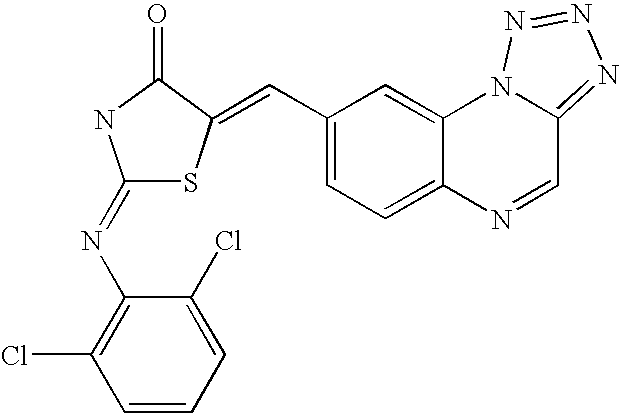
-
-
- a) 8-Bromotetrazolo[1,5-a]quinoxaline. A solution of the compound from Example 1b) (0.430 g; 1.77 mmol) and sodium azide (0.138 g; 2.12 mmol) in N,N-dimethylformamide (5.0 mL) was heated to 120° C. for 2 h. Upon cooling to ambient temperature, water was added and the resulting precipitate was collected by filtration, washed with water, and dried in vacuo to afford the title compound (0.403 g; 91%) as a light orange solid. 1H NMR (400 MHz, CHLOROFORM-d) □ ppm 9.58 (s, 1H) 8.84 (d, J=2.0 Hz, 1H) 8.20 (d, J=8.8 Hz, 1H) 7.99 (dd, J=8.7, 2.1 Hz, 1H).
- b) 8-Ethenyltetrazolo[1,5-a]quinoxaline. Following the procedure of Example 1d), except substituting the compound from Example 6a) for the compound from Example 1c), the title compound was obtained as an off-white solid. 1H NMR (400 MHz, CHLOROFORM-d) □ ppm 9.51 (s, 1H) 8.60 (d, J=1.8 Hz, 1H) 8.25 (d, J=8.6 Hz, 1H) 7.92 (dd, J=8.6, 1.8 Hz, 1H) 6.97 (dd, J=17.6, 11.0 Hz, 1H) 6.12 (d, J=17.4 Hz, 1H) 5.63 (d, J=10.9 Hz, 1H).
- c) Tetrazolo[1,5-a]quinoxaline-8-carbaldehyde. Following the procedure of Example 1e), except substituting the compound from Example 6b) for the compound from Example 1d), the title compound was obtained as a light yellow solid. 1H NMR (400 MHz, CHLOROFORM-D) □ ppm 10.3 (s, 1H) 9.70 (s, 1H) 9.14 (d, J=1.5 Hz, 1H) 8.51 (d, J=8.6 Hz, 1H) 8.38 (dd, J=8.5, 1.6 Hz, 1H).
- d) (5Z)-2-[(2,6-Dichlorophenyl)amino]-5-(tetrazolo[1,5-a]quinoxalin-8-ylmethylidene)-1,3-thiazol-4(5″-one. Following the procedure of Example 1f), except substituting the compound from Example 6c) for the compound from Example 1e), the title compound was obtained following purification via flash column chromatography (silica gel, 10-100% ethyl acetate in hexanes) as a yellow solid. 1H NMR (400 MHz, CHLOROFORM-d) □ ppm 9.59 (s, 1H) 8.64 (d, J=1.0 Hz, 1H) 8.35 (d, J=8.6 Hz, 1H) 7.96 (s, 1H, 7.89 (dd, J=8.3, 1.3 Hz, 1H) 7.42 (d, J=8.3 Hz, 2H) 7.14 (t, J=8.2 Hz, 1H).
-
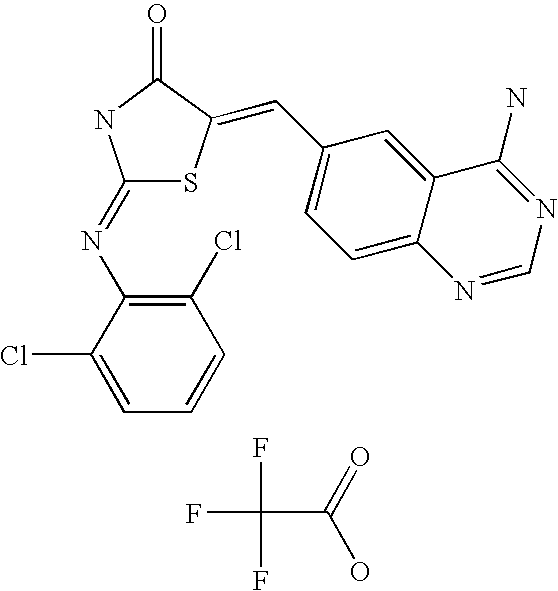
-
-
- a) 6-Bromo-4-quinazolinamine. Ammonia gas was bubbled through a solution of 6-bromoisotoic anhydride (2 g, 8.26 mmol) in DMF (20 mL) at r.t. for 15 min. The solution was then degassed by bubbling nitrogen into the solution for 5 min also removing (NH4)CO3 which was formed. The resulting solution was cooled to 0° C. and POCl3 (2 mL) was added dropwise. Upon complete addition the reaction was warmed to 50° C. for 30 minutes and then cooled to r.t. To the cooled solution were added water (6 mL) and 35% ammonium hydroxide (9 mL). The resulting solution was heated at 100° C. for 1 h and then allowed to cool to r.t. where a white precipitate formed. The solid was collected by filtration to give the product as a white solid (1.51 g, 82%). C8H6BrN3 MS (ES+) m/e 224 [M+H]+
- b) 6-Ethenyl-4-quinazolinamine. To 6-bromo-4-quinazolinamine (1 g, 4.48 mmol) in DMF (4 mL) was added tributyl vinyl tin (1.44 mL, 4.93 mmol) and palladium tetrakis triphenylphosphine (260 mg, 0.224 mmol). The reactants were stirred and heated in a microwave reactor at 150° C. for 25 min. Purification by flash-chromatography (silica gel, 10-100% 10% methanol in chloroform) afforded the title compound (392 mg; 51%) as a white solid. C10H9N3 MS (ES+) m/e 172 [M+H]+
- c) 4-Amino-6-quinazolinecarbaldehyde. A mixture of the vinyl compound (6-ethenyl-4-quinazolinamine) from example 7b (292 mg, 1.69 mmol), 2.5% osmium tetraoxide in t-butanol (345 mg, 0.034 mmol), sodium periodate (1.45 g, 6.79 mmol) and 2,6-lutidene (395 μL, 3.39 mmol) in dioxane (9 mL) and water (3 mL) was stirred at RT for 30 min. The reaction mixture was diluted with water (10 mL) and extracted with DCM (2×30 mL). The organic layer was dried over MgSO4, filtered and solvents removed under reduced pressure to yield the title compound (250 mg, 85%) as a clear oil which was used in the next step without further purification. C9H7N3O MS (ES+) m/e 174 [M+H]+
- d) (5Z)-5-[(4-Amino-6-quinazolinyl)methylidene]-2-[(2,6-dichlorophenyl)amino]-1,3-thiazol-4(5H)-one. A solution of crude 4-amino-6-quinazolinecarbaldehyde from Example 7c (200 mg, 1.17 mmol.), 2-[(2,6-dichlorophenyl)amino]-1,3-thiazol-4(5H)-one (100 mg, 0.385 mmol.) and piperidine (40 μL, 0.385 mmol.) in ethanol (3.0 mL) was stirred and heated in a microwave reactor at 150° C. for 20 min. The mixture was purified by HPLC chromatography (ODS silica, gradient 10-100% acetonitrile/water (0.1% TFA)) to afford the title compound (11.0 mg, 7%) as a yellow powder. 1H NMR (400 MHz, DMSO-d6) □ ppm 13.12 (s, 1H) 9.44 (s, 2H) 8.74 (s, 1H) 8.50 (d, J=1.26 Hz, 1H) 7.98 (d, J=8.59 Hz, 1H) 7.82 (d, J=8.59 Hz, 1H) 7.73 (s, 1H) 7.58 (d, J=8.08 Hz, 2H) 7.24 (t, J=8.08 Hz, 1H).
-
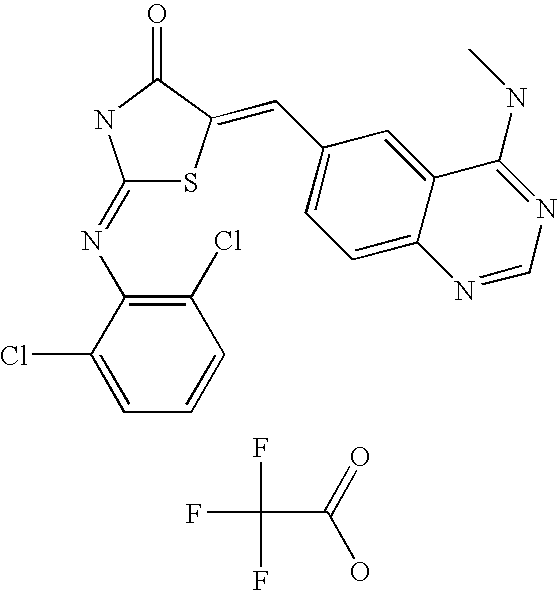
-
-
- The title compound was prepared following the procedure of example 7a-d except substituting methylamine for ammonium hydroxide. The final compound was purified by HPLC chromatography (ODS silica, gradient 10-100% acetonitrile/water (0.1% TFA)) to afford a yellow powder (12.0 mg, 7%). 1H NMR (400 MHz, DMSO-d6) □ ppm 13.13 (s, 1H) 10.07 (s, 1H) 8.87 (s, 1H) 8.52 (s, 1H) 7.98 (d, J=8.34 Hz, 1H) 7.85 (d, J=8.59 Hz, 1H) 7.74 (s, 1H) 7.58 (d, J=8.08 Hz, 2H) 7.24 (t, J=8.21 Hz, 1H) 3.18 (d, J=4.04 Hz, 3H). C19H13Cl2N5OS MS (ES+) m/e 430 [M+H]+
-

-
-
- a) 4-Oxo-1,4-dihydro-6-quinazolinecarbaldehyde. A mixture of the vinyl compound (6-ethenyl-4(1H-quinazolinone) obtained as a minor product from example 3a (400 mg, 2.32 mmol), 2.5% osmium tetraoxide in t-butanol (472 mg, 0.046 mmol), sodium periodate (994 mg, 4.65 mmol) and 2,6-lutidene (458 μL, 4.65 mmol) in dioxane (14 mL) and water (4 mL) was stirred at RT for 30 min. The reaction mixture was diluted with water (10 mL) and extracted with DCM (2×30 mL). The organic layer was dried over MgSO4, filtered and solvents removed under reduced pressure to yield the title compound (90 mg, 22%) as a clear oil which was used in the next step without further purification. C9H6N2O2 MS (ES+) m/e 174 [M+H]+
- b) 6-{(Z)-[2-[(2,6-Dichlorophenyl)amino]-4-oxo-1,3-thiazol-5(4H)-ylidene]methyl}-4(1H)-quinazolinone. A solution of crude 44-oxo-1,4-dihydro-6-quinazolinecarbaldehyde from Example 9a (90 mg, 0.517 mmol.), 2-[(2,6-dichlorophenyl)amino]-1,3-thiazol-4(5H)-one (134 mg, 0.517 mmol.) and piperidine (50 μL, 0.517 mmol.) in ethanol (2.0 mL) was stirred and heated in a microwave reactor at 150° C. for 20 min. The mixture was poured into water (20 mL) and the precipitate formed was collected and dried via filtration to afford the title compound (71.0 mg, 33%) as a piperidine salt which was light brown. 1H NMR (400 MHz, DMSO-d6) □ ppm 9.67 (s, 1H) 8.09 (s, 2 H) 7.87 (s, 1H) 7.69 (s, 1H) 7.36 (s, 3H) 7.02 (s, 1H) 2.96-3.04 (m, 4H) 1.60-1.67 (m, J=5.94, 5.62, 5.46, 5.46 Hz, 4H) 1.54 (dq, J=5.43, 5.18 Hz, 2H).
-

-
-
- The title compound was prepared following the procedure of example 3a-c except substituting dimethylamine for morpholine. The final compound was purified by flash-chromatography (silica gel, 10-100% 10% methanol in chloroform) to afford the title compound (14.2 mg; 4%) as a light brown solid 1H NMR (400 MHz, DMSO-d6) □ ppm 13.00 (s, 1H) 8.50 (s, 1H) 8.39 (s, 1H) 7.97 (s, 1H) 7.77 (s, 2H) 7.58 (d, J=8.08 Hz, 2H) 7.25 (t, J=8.08 Hz, 1H) 3.35 (s, 6H).
-
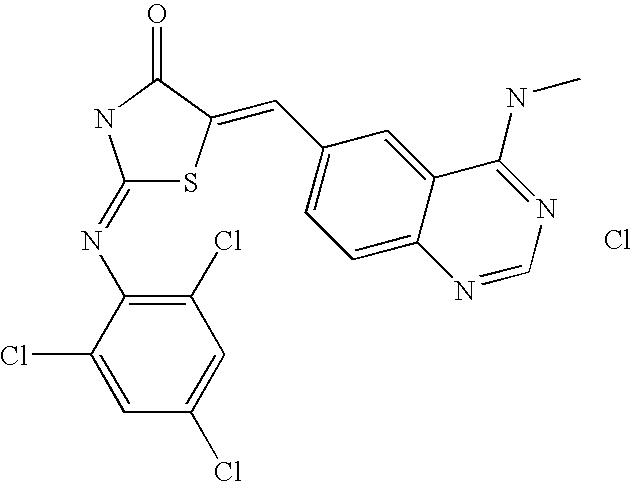
-
-
- The title compound was prepared following the procedure of example 7a-d except substituting 2-[(2,4,6-trichlorophenyl)amino]-1,3-thiazol-4(5H)-one for 2-[(2,6-dichlorophenyl)amino]-1,3-thiazol-4(5″-one. The final compound was purified by HPLC chromatography (ODS silica, gradient 10-100% acetonitrile/water (0.1% TFA)) to afford a yellow powder (60.2.0 mg, 15%). 1H NMR (400 MHz, DMSO-d6) □ ppm 13.17 (s, 1H) 10.13 (s, 1H) 8.90 (s, 1H) 8.53 (s, 1H) 8.02 (d, J=11.37 Hz, 1H) 7.85 (d, J=8.84 Hz, 1H) 7.82 (s, 2H) 7.74 (s, 1H) 3.19 (d, J=4.55 Hz, 3H).
-
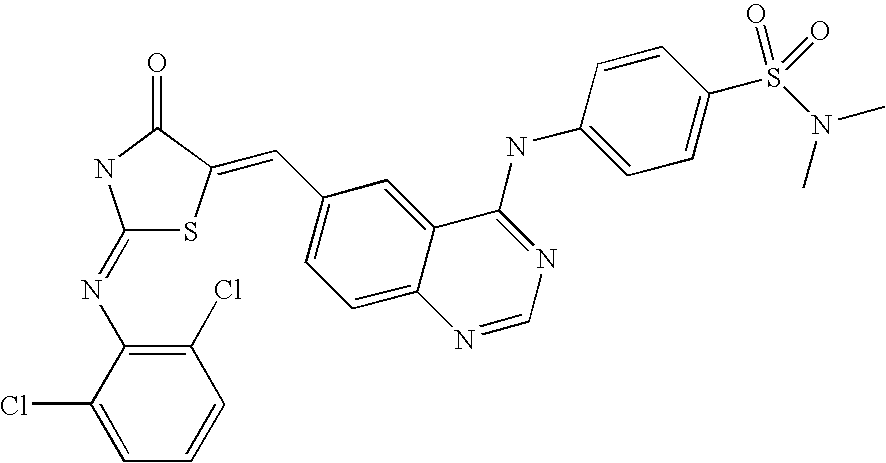
-
-
- The title compound was prepared following the procedure of example 7a-d except substituting 4-amino-N,N-dimethylbenzenesulfonamide for ammonium hydroxide. The final compound was purified by HPLC chromatography (ODS silica, gradient 10-100% acetonitrile/water (0.1% TFA)) to afford a yellow powder (6.0 mg, 3%). 1H NMR (400 MHz, DMSO-d6) □ ppm 13.06 (s, 1H) 10.17 (s, 1H) 8.87 (s, 1H) 8.76 (s, 1H) 8.21 (d, J=8.84 Hz, 2H) 7.84-7.94 (m, 3H) 7.81 (d, J=8.84 Hz, 2H) 7.58 (d, J=8.08 Hz, 2H) 7.24 (s, 1H) 2.64 (s, 6H).
-

-
-
- A mixture of 2-naphthalenecarbaldehyde (100 mg, 0.64 mmol), 2-[(2,6-dichlorophenyl)amino]-1,3-thiazol-4(5″-one (167 mg, 0.64 mmol) and piperidine (63 μL, 0.064 mmol) in ethanol (2 mL) was heated to 150° C. for half hour in a Biotage Initiator Synthesizer. The product was cooled, concentrated and purified via flash chromatography (0-10% methanol in methylene chloride) to afford the title compound as a yellow solid (90 mg, 35%). 1H NMR (400 MHz, DMSO-d6) m ppm 12.98 (br. s., 1H) 8.11 (s, 1H) 7.97-8.03 (m, 2H) 7.93 (d, J=7.83 Hz, 1H) 7.88 (s, 1H) 7.52-7.63 (m, 5H) 7.24 (t, J=8.08 Hz, 1H)
-
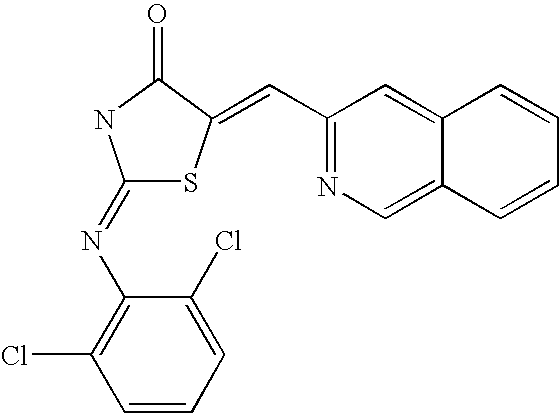
-
-
- Following the procedure of Example 1f), except substituting 3-isoquinolinecarbaldehyde (prepared by the method of Guanti, G.; Riva, R. Tet. Asymm. 2001, 12, 1185-1200) for the compound from Example 1e), the title compound was obtained as a beige solid. 1H NMR (400 MHz, DMSO-d6) □ ppm 12.7 (s, 1H) 9.37 (s, 1H) 8.29 (s, 1H) 8.08 (d, J=8.1 Hz, 1H) 8.00 (d, J=8.1 Hz, 1H) 7.86 (s, 1H) 7.84 (t, J=7.2 Hz, 1H) 7.75 (t, J=7.2 Hz, 1H) 7.57 (d, J=8.1 Hz, 2H) 7.23 (t, J=8.1 Hz, 1H).
-

- (5Z)-2-[(2,6-Dichlorophenyl)amino]-5-(2-quinoxalinylmethylidene)-1,3-thiazol-4(5H)-one
-
- a) 2-Quinoxalinecarbaldehyde. To a solution of ethyl 2-quinoxalinecarboxylate (0.303 g; 1.50 mmol) in CH2Cl2 (10.0 mL) at −78° C. was added diisobutylaluminum hydride (1 M soln. in CH2Cl2; 1.50 mL; 1.50 mmol). After stirring 1 h at −78° C., the reaction was quenched by the addition of methanol. A solution of saturated aq. Na/K tartrate was added and the reaction mixture was extracted thrice with CH2Cl2. The combined organic layers were dried over MgSO4, filtered, and concentrated in vacuo. Purification via flash column chromatography (silica gel, 10-20% ethyl acetate in hexanes) afforded the title compound (0.123 g; 52%) as an off-white solid.
- b) (5Z)-2-[(2,6-Dichlorophenyl)amino]-5-(2-quinoxalinylmethylidene)-1,3-thiazol-4(5H)-one. Following the procedure of Example 1f), except substituting the compound from Example 15a) for the compound from Example 1e), the title compound was obtained as a dull yellow solid. 1H NMR (400 MHz, DMSO-d6) □ ppm 13.0 (s, 1H) 9.29 (s, 1H) 8.09 (d, J=7.1 Hz, 1H) 8.05 (s, 1H) 7.77-7.88 (m, 2H) 7.61 (d, J=8.1 Hz, 2H) 7.49 (d, J=8.1 Hz, 1H) 7.27 (t, J=8.2 Hz, 1H).
-
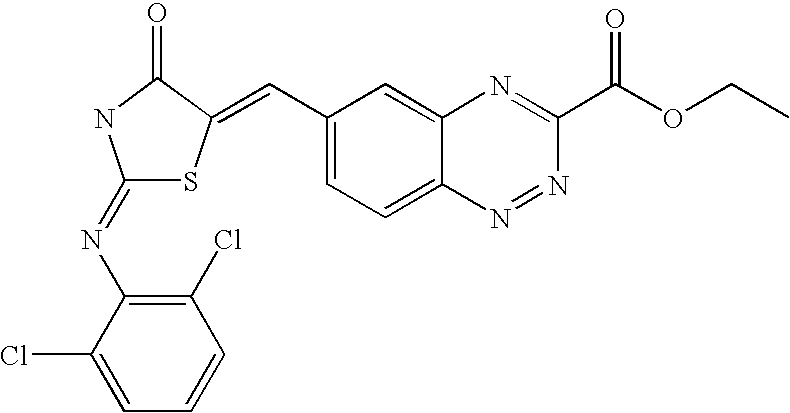
-
-
- a) Methyl [(4-bromo-2-nitrophenyl)hydrazono](nitro)ethanoate. A slurry of 4-bromo-2-nitroaniline (30.4 g; 0.14 mol.) in 2M aq. nitric acid (350 mL) was cooled to 5° C. then treated dropwise with a solution of sodium nitrite (9.7 g; 0.14 mol.) in water (75.0 mL). The solution was stirred at 5° C. for 15 min., quickly filtered then added dropwise to a suspension of methyl nitroacetate (6.3 g; 0.053 mol.) and sodium acetate (90.0 g) in water 200 mL) and ethanol (200 mL). The mixture was stirred at room temperature for 10 min. then filtered and the solid washed with water to afford the title compound (16.3 g; 89%) as a yellow solid. 1H NMR (400 MHz, DMSO-d6) □ ppm 3.98 (s, 3H) 7.83 (d, J=9.09 Hz, 1H) 8.06 (dd, J=9.09, 2.02 Hz, 1H) 8.41 (d, J=2.02 Hz, 1H) 13.24 (s, 1H).
- b) Methyl 6-bromo-1,2,4-benzotriazine-3-carboxylate. A solution of the compound from Example 22a) (6.4 g; 18 mmol.) in N,N-dimethylformamide (50.0 mL) was hydrogenated over 5% platinum-on-carbon (0.50 g) at room temperature and atmospheric pressure for 6 h. The mixture was filtered through a Celite pad and left overnight. The filtrate was evaporated and the residue purified by chromatography (silica gel, 0-5% methanol in chloroform) to afford a brown solid (3.2 g). A portion of this brown solid (1.3 g) was dissolved in N,N-dimethylformamide (10.0 mL), treated with 10% palladium-on-charcoal (0.30 g) and stirred at room temperature for 6 h. The mixture was filtered through a Celite pad and the filtrate was evaporated and the residue purified by chromatography (silica gel, 0-5% methanol in chloroform) to afford the title compound (0.262 g; 13% as an orange solid. 1H NMR (400 MHz, DMSO-d6) □ ppm 4.07 (s, 3H) 8.33 (dd, J=9.09, 2.02 Hz, 1H) 8.62 (s, 1H) 8.65 (dd, J=2.02, 1.52 Hz, 1H).
- c) Methyl 6-ethenyl-1,2,4-benzotriazine-3-carboxylate. A solution of the compound from Example 22b, (248 mg; 0.93 mmol.), tributylvinylstannane (370 mg; 1.2 mmol.) and tetrakis(triphenylphosphino)palladium (100 mg) in 1,4-dioxane (2.0 mL) and N,N-dimethylformamide (0.50 mL) was stirred and heated in a microwave reactor at 150° C. for 30 min. The mixture was cooled and purified by chromatography (silica gel, gradient 0-100% ethyl acetate in hexanes) to afford the title compound (85.0 mg; 43%) as a yellow solid. 1H NMR (400 MHz, DMSO-d6) □ ppm 4.06 (s, 3H) 5.76 (d, J=11.12 Hz, 1H) 6.42 (d, J=17.68 Hz, 1H) 7.12 (dd, J=17.68, 10.86 Hz, 1H) 8.30 (d, J=1.52 Hz, 1H) 8.44 (dd, J=8.97, 1.89 Hz, 1H) 8.64 (d, J=8.84 Hz, 1H).
- d) Methyl 6-formyl-1,2,4-benzotriazine-3-carboxylate. A solution of the compound from Example 22c) (76.9 mg; 0.36 mmol.), sodium periodate (153 mg; 0.72 mmol.), osmium tetroxide (2 mg) and 2,6-lutidine (0.042 mL; 0.72 mmol.) in 1,4-dioxane (2.0 mL) and water (0.50 mL) was stirred at room temperature for 3 h. The mixture was diluted with water (25.0 mL) and extracted with ethyl acetate (2×50.0 mL), washed with sat. aq. NaCl (50.0 mL), dried and evaporated to give a brown solid. This solid was dissolved in methanol (4.0 mL) and water (1.0 mL), treated with sodium periodate 9300 mg) and stirred at room temperature overnight. The mixture was diluted with water (25.0 mL) and extracted with ethyl acetate (2×50.0 mL), washed with sat. aq. NaCl (50.0 mL), dried and evaporated to give the title compound (70.0 mg; 90%) as a yellow solid. 1H NMR (400 MHz, DMSO-d6) □ ppm 4.09 (s, 3H) 8.48 (dd, J=8.72, 1.64 Hz, 1H) 8.86 (d, J=8.84 Hz, 1H) 8.94 (d, J=1.01 Hz, 1H) 10.37 (s, 1H).
- e) Ethyl 6-{(Z)-[2-[(2,6-dichlorophenyl)amino]-4-oxo-1,3-thiazol-5(4H)-ylidene]methyl}-1,2,4-benzotriazine-3-carboxylate. A suspension of 2-[(2,6-dichlorophenyl)amino]-1,3-thiazol-4(5H)-one (85 mg; 0.33 mmol.), the crude compound from Example 22d) (70 mg; 0.32 mmol.) and piperidine (0.40 mL) in ethanol (2.0 mL) was stirred and heated in a microwave reactor at 150° C. for 20 min. The mixture was cooled and poured into 1 M aq. Hydrochloric acid. The mixture was extracted with ethyl acetate (2×), dried and evaporated and the residue purified by chromatography (ODS silica gel, 10-90% acetonitrile in water (0.01% TFA)) to afford the title compound (15.0 mg; 10%) as a yellow solid. 1H NMR (400 MHz, DMSO-d6) □ ppm 1.42 (t, J=7.07 Hz, 3H) 4.53 (q, J=7.24 Hz, 2H) 7.26 (t, J=8.08 Hz, 1H) 7.60 (d, J=8.08 Hz, 2H) 8.06 (s, 1H) 8.24 (dd, J=8.84, 1.77 Hz, 1H) 8.34 (d, J=1.26 Hz, 1H) 8.73 (d, J=8.84 Hz, 1H) 13.28 (s, 1H).
- An oral dosage form for administering the present invention is produced by filing a standard two piece hard gelatin capsule with the ingredients in the proportions shown in Table I, below.
-
TABLE I INGREDIENTS AMOUNTS (5Z)-5-(6-Cinnolinylmethylidene)-2-[(2,6- 25 mg dichlorophenyl)amino]-1,3-thiazol-4(5H)-one Lactose 55 mg Talc 16 mg Magnesium Stearate 4 mg - An injectable form for administering the present invention is produced by stirring 1.5% by weight of (5Z)-2-[(2,6-Dichlorophenylyamino]-5-(6-quinazolinylmethylidene)-1,3-thiazol-4(5H)-one in 10% by volume propylene glycol in water.
- The sucrose, calcium sulfate dihydrate and an hYAK inhibitor as shown in Table II below, are mixed and granulated in the proportions shown with a 10% gelatin solution. The wet granules are screened, dried, mixed with the starch, talc and stearic acid, screened and compressed into a tablet.
-
TABLE II INGREDIENTS AMOUNTS (5Z)-2-[(2,6-Dichlorophenyl)amino]-5-{[4- 20 mg (4-morpholinyl)-6-quinazolinyl]methylidene}- 1,3-thiazol-4(5H)-one calcium sulfate dihydrate 30 mg sucrose 4 mg starch 2 mg talc 1 mg stearic acid 0.5 mg - Because the compounds of the present invention are active as inhibitors of hYAK3 they exhibit therapeutic utility in treating diseases associated with hYAK3 activity, including but not limited to, anemia, anemias due to renal insufficiency or to chronic disease, such as autoimmunity, HIV, or cancer, and drug-induced anemias, myelodysplastic syndrome, aplastic anemia and myelosuppression, and cytopenia.
- Substrate phosphorylation assays are carried out as follows:
- YAK3 Scintillation Proximity Assays Using Ser164 of Myelin Basic Protein as the Phosphoacceptor
- The source of Ser164 substrate peptide The biotinylated Ser164, S164A peptide (Biotinyl-LGGRDSRAGS*PMARR-OH), sequence derived from the C-terminus of bovine myelin basic protein (MBP) with Ser162 substituted as Ala162, is purchased from California Peptide Research Inc. (Napa, Calif.), and its purity is determined by HPLC. Phosphorylation occurs at position 164 (marked S* above). The calculated molecular mass of the peptide is 2166 dalton. Solid sample is dissolved at 10 mM in DMSO, aliquoted, and stored at −20° C. until use.
- The source of enzyme:
- hYAK3: Glutathione-S-Transferase (GST)-hYak3-His6 containing amino acid residues 124-526 of human YAK3 (aa 124-526 of SEQ ID NO 2. in U.S. Pat. No. 6,323,318) is purified from baculovirus expression system in Sf9 cells using Glutathione Sepharose 4B column chromatography followed by Ni-NTA-Agarose column chromatography. Purity greater than 65% typically is achieved. Samples, in 50 mM Tris, 150 mM NaCl, 10% glycerol, 0.1% Triton, 250 mM imidazole, 10 mM β-mercapto ethanol, pH 8.0. are stored at −80° C. until use.
- Kinase assay of purified hYAK3: Assays are performed in 96 well (Costar, Catalog No. 3789) or 384 well plates (Costar, Catalog No. 3705). Reaction (in 20, 25, or 40 μl volume) mix contained in final concentrations 25 mM Hepes buffer, pH 7.4; 10 mM MgCl2; 10 mM β-mercapto ethanol; 0.0025% Tween-20; 0.001 mM ATP, 0.1 δCi of [δ-33P]ATP; purified hYAK3 (7-14 ng/assay; 4 nM final); and 4 μM Ser164 peptide. Compounds, titrated in DMSO, are evaluated at concentrations ranging from 50 μM to 0.5 nM. Final assay concentrations of DMSO do not exceed 5%, resulting in less than 15% loss of YAK3 activity relative to controls without DMSO. Reactions are incubated for 2 hours at room temperature and are stopped by a 75 ul addition of 0.19 μg Streptavidin Scintillation Proximity beads (Amersham Pharmacia Biotech, Catalog No. RPNQ 0007) in PBS, pH 7.4, 10 mM EDTA, 0.1% Triton X-100, 1 mM ATP. Under the assay conditions defined above, the Km(apparent) for ATP is determined to be 7.2+/−2.4 μM.
- The data for compounds dose responses were plotted as % inhibition, calculated with the data reduction formula 100*(1−[U1−C2)/(C1−C2)]), versus concentration of compound, where U is the unknown value, C1 is the average control value obtained for DMSO, and C2 is the average control value obtained for 0.05M EDTA. DATA were fitted tot h curve described by: y=((Vmax*x)/(K+x)) were Vmax is the upper asymptote and K is the IC50. The results for each compound were recorded aspIC50 calculated as follows: pIC50=−Log 10(K).
- Utility of the Present Invention
- The compounds of Formula I are useful for treating or preventing disease states in which hYAK3 proteins are implicated, especially diseases of the erythroid and hematopoietic systems, including but not limited to, anemias due to renal insufficiency or to chronic disease, such as autoimmunity, HIV, or cancer, and drug-induced anemias, myelodysplastic syndrome, aplastic anemia, myelosuppression, and cytopenia.
- The compounds of Formula I are useful in treating diseases of the hematopoietic system, particularly anemias. Such anemias include an anemia selected from the group comprising: aplastic anemia and myelodysplastic syndrome. Such anemias also include those wherein the anemia is a consequence of a primary disease selected from the group consisting of: cancer, leukemia and lymphoma. Such anemias also include those wherein the anemia is a consequence of a primary disease selected from the group consisting of: renal disease, failure or damage. Such anemias include those wherein the anemia is a consequence of chemotherapy or radiation therapy, in particular wherein the chemotherapy is chemotherapy for cancer or AZT treatment for HIV infection. Such anemias include those wherein the anemia is a consequence of a bone marrow transplant or a stem cell transplant. Such anemias also include anemia of newborn infants. Such anemias also include those which are a consequence of viral, fungal, microbial or parasitic infection.
- The compounds of Formula I are also useful for enhancing normal red blood cell numbers. Such enhancement is desirable for a variety of purposes, especially medical purposes such as preparation of a patient for transfusion and preparation of a patient for surgery.
Claims (16)
1. A method of inhibiting hYAK3 in a mammal; comprising administering to the mammal a therapeutically effective amount of a compound of the Formula I,
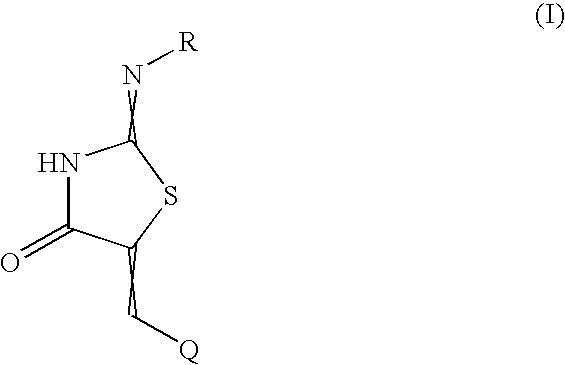
in which
R is selected from: aryl and substituted aryl; and
Q is a substituent of formula (III)
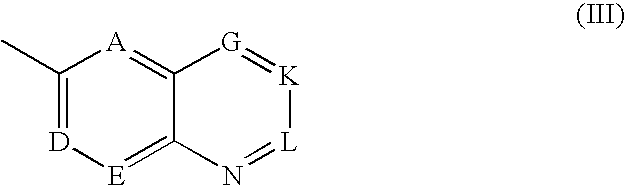
wherein
A, D and E are each independently selected from CR20 and N, and G, K and L are each independently selected from CR20 and N, G and K can optionally form a five-membered ring containing 1-4 nitrogens,
where each R20 is independently selected from the group consisting of: hydrogen, amino, alkylamino, substituted alkylamino, dialkylamino, substituted dialkylamino, hydroxy, alkylaminoalkyl, dialkylaminoalkyl, alkoxy, alkyl, substituted alkyl, aryl, substituted aryl, arylamino, substituted arylamino, halogen, cycloalkyl, substituted cycloalkyl, cycloalkyl containing from 1 to 4 heteroatoms, substituted cycloalkyl containing from 1 to 4 heteroatoms, oxo, —C(O)OR10, —C(O)NR11R12, cyano, and nitrile,
where, R10 is selected from hydrogen, C1-C4alkyl, aryl and
trifluoromethyl, and R11 and R12 are independently selected from hydrogen, C1-C4alkyl, aryl and trifluoromethyl;
and/or a pharmaceutically acceptable salt, hydrate, solvate, or pro-drug thereof;
provided that not each of G, K and L are N,
further provided that when G is CR20, at least one of A, D, E, K, and L is N,
further provided that when G is N, Q must contain at least three nitrogens.
2. A method of claim 1
in which
R is selected from: aryl and substituted aryl; and
Q is a substituent of formula (III)
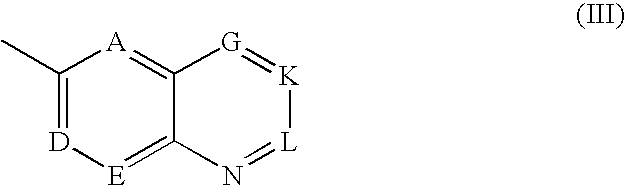
wherein
A, D and E are each independently selected from CR20 and N, and
G, K and L are each independently selected from CR20 and N,
where each R20 is independently selected from the group consisting of: hydrogen, amino, alkylamino, substituted alkylamino, dialkylamino, substituted dialkylamino, hydroxy, alkylaminoalkyl, dialkylaminoalkyl, alkoxy, alkyl, substituted alkyl, aryl, substituted aryl, arylamino, substituted arylamino, halogen, cycloalkyl, substituted cycloalkyl, cycloalkyl containing from 1 to 4 heteroatoms, substituted cycloalkyl containing from 1 to 4 heteroatoms, oxo, —C(O)OR10, —C(O)NR11R12, cyano, and nitrile,
where, R10 is selected from hydrogen, C1-C4alkyl, aryl and
trifluoromethyl, and R11 and R12 are independently selected from hydrogen, C1-C4alkyl, aryl and trifluoromethyl;
and/or a pharmaceutically acceptable salt, hydrate, solvate, or pro-drug thereof;
provided that not each of G, K and L are N,
further provided that when G is CR20, at least one of A, D, E, K, and L is N,
further provided that at least one of A, D, E, K, and L is N.
3. A compound of formula (V)

wherein R is C1-C12aryl or substituted C1-C12aryl,
Q is a selected from a group consisting of: formula VI, VII, VIII
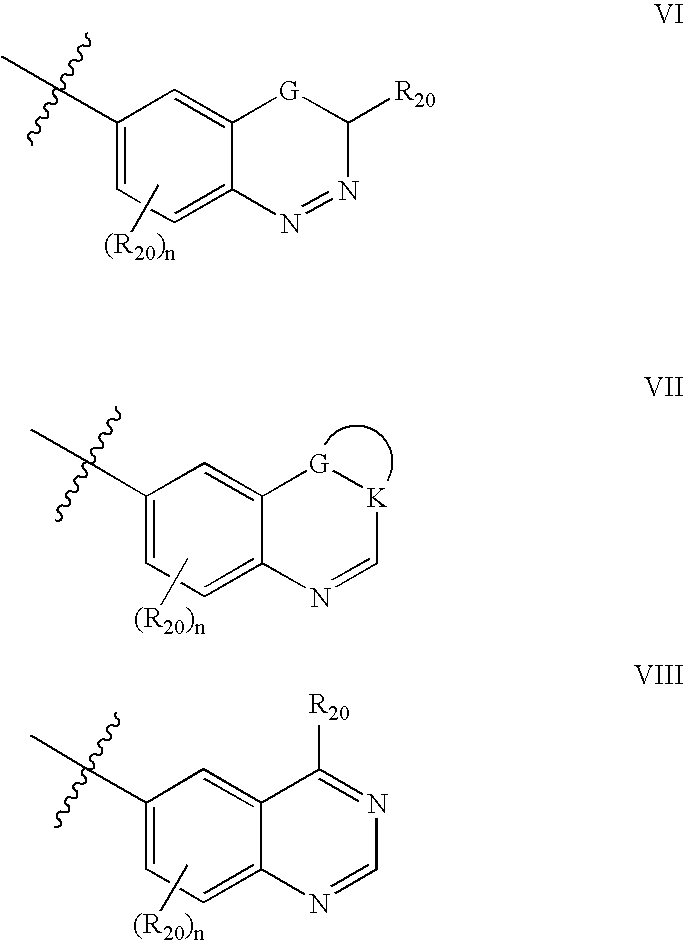
where n is 0-3, G and K are each independently selected from N or CR20,
G and K optionally form a five-membered ring containing 1-4 nitrogens, each R20 is independently selected from the group consisting of: hydrogen, amino, alkylamino, substituted alkylamino, dialkylamino, substituted dialkylamino, alkylaminoalkyl, dialkylaminoalkyl, alkyl, substituted alkyl, aryl, substituted aryl, arylamino, substituted arylamino, halogen, cycloalkyl, substituted cycloalkyl, cycloalkyl containing from 1 to 4 heteroatoms, substituted cycloalkyl containing from 1 to 4 heteroatoms, oxo, —C(O)OR10, —C(O)NR11R12, cyano, and nitrile,
where, R10 is selected from hydrogen, C1-C4alkyl, aryl and
trifluoromethyl, and R11 and R12 are each independently selected from hydrogen, C1-C4alkyl, aryl and trifluoromethyl;
and/or a pharmaceutically acceptable salt, hydrate, solvate or pro-drug thereof;
provided that when Q is formula VIII, R20 is not a hydrogen.
4. A compound of claim 3 wherein Q is formula VI; and/or a pharmaceutically acceptable salt, hydrate, solvate or pro-drug thereof.
5. A compound of claim 3 wherein Q is formula VII; and/or a pharmaceutically acceptable salt, hydrate, solvate or pro-drug thereof.
6. A compound of claim 3 wherein Q is formula VIII, and R20 is selected from a group consisting of: amino, alkylamino, dialkylamino, substituted alkylamino, arylamino, oxo, and substituted arylamino; and/or a pharmaceutically acceptable salt, hydrate, solvate or pro-drug thereof.
7. A method of inhibiting hYAK3 in a mammal; comprising administering to the mammal a therapeutically effective amount of a compound of claim 3 ; and/or a pharmaceutically acceptable salt, hydrate, solvate, or pro-drug thereof.
8. A compound of claim 3 selected from:
(5Z)-2-[(2,6-Dichlorophenyl)amino]-5-(6-quinazolinylmethylidene)-1,3-thiazol-4(5H)-one;
(5Z)-2-[(2,6-Dichlorophenyl)amino]-5-{[4-(4-morpholinyl)-6-quinazolinyl]methylidene}-1,3-thiazol-4(5H)-one;
(5Z)-5-(6-Cinnolinylmethylidene)-2-[(2,6-dichlorophenyl)amino]-1,3-thiazol-4(5H)-one;
(5Z)-2-[(2,6-Dichlorophenyl)amino]-5-(imidazo[1,2-a]quinoxalin-8-ylmethylidene)-1,3-thiazol-4(5H)-one;
N-(4-Chloro-3-{[(5Z)-5-(imidazo[1,2-a]quinoxalin-8-ylmethylidene)-4-oxo-4,5-dihydro-1,3-thiazol-2-yl]amino}phenyl)cyclobutanecarboxamide;
(5Z)-2-[(2,6-Dichlorophenyl)amino]-5-(tetrazolo[1,5-a]quinoxalin-8-ylmethylidene)-1,3-thiazol-4(5H)-one;
(5Z)-5-[(4-Amino-6-quinazolinyl)methylidene]-2-[(2,6-dichlorophenyl)amino]-1,3-thiazol-4(5H)-one trifluoroacetate;
(5Z)-2-[(2,6-Dichlorophenyl)amino]-5-{[4-(methylamino)-6-quinazolinyl]methylidene}-1,3-thiazol-4(5H)-one trifluoroacetate;
6-{(Z)-[2-[(2,6-Dichlorophenyl)amino]-4-oxo-1,3-thiazol-5(4H)-ylidene]methyl}-4(1H)-quinazolinone, piperidine salt;
(5Z)-2-[(2,6-Dichlorophenyl)amino]-5-{[4-(dimethylamino)-6-quinazolinyl]methylidene}-1,3-thiazol-4(5H)-one;
(5Z)-5-{[4-(Methylamino)-6-quinazolinyl]methylidene}-2-[(2,4,6-trichlorophenyl) amino]-1,3-thiazol-4(5H)-one hydrochloride;
4-[(6-{(Z)-[2-[(2,6-Dichlorophenyl)amino]-4-oxo-1,3-thiazol-5(4H)-ylidene]methyl}-4-quinazolinyl)amino]-N,N-dimethylbenzenesulfonamide;
and Ethyl 6-{(Z)-[2-[(2,6-dichlorophenyl)amino]-4-oxo-1,3-thiazol-5(4H)-ylidene]methyl}-1,2,4-benzotriazine-3-carboxylate.
9. A pharmaceutically acceptable salt, hydrate, solvate or pro-drug of a compound of claim 8 .
10. A pharmaceutical composition comprising a compound according to claim 3 or a pharmaceutically acceptable salt, hydrate, solvate or pro-drug thereof, and a pharmaceutically acceptable carrier.
11. A process for preparing a pharmaceutical composition containing a pharmaceutically acceptable carrier or diluent and an effective amount of a compound of Formula (V) as described in claim 3 or a pharmaceutically acceptable salt, hydrate, solvate or pro-drug thereof, which process comprises bringing the compound of Formula (V) or a pharmaceutically acceptable salt, hydrate, solvate or pro-drug thereof into association with a pharmaceutically acceptable carrier or diluent.
12. A method of treating or preventing diseases of the erythroid and hematopoietic systems, caused by the hYAK3 imbalance or inappropriate activity; comprising administering to a mammal a therapeutically effective amount of a compound of claim 3 , or a pharmaceutically acceptable salt, hydrate, solvate or pro-drug thereof and one or more of pharmaceutically acceptable carriers, diluents and excipients.
13. A method of treating or preventing diseases selected from the group consisting of: anemia, aplastic anemia, myelodysplastic syndrome, myelosuppression, and cytopenia; comprising, administering to a mammal a therapeutically effective amount of a compound of claim 1 , or a pharmaceutically acceptable salt, hydrate, solvate or pro-drug thereof and one or more of pharmaceutically acceptable carriers, diluents and excipients.
14. A method of claim 12 in which diseases of the erythroid and hematopoietic systems are selected from the group consisting of: anemia, aplastic anemia, myelodysplastic syndrome, myelosuppression, and cytopenia.
15. The method of claim 12 wherein the mammal is a human.
16. A method of treating diseases of the hematopoietic system, in a mammal in need thereof, which comprises: administering to such mammal a therapeutically effective amount of
a) a compound of Formula (V), as described in claim 3 and/or a pharmaceutically acceptable salt, hydrate, solvate or pro-drug thereof; and
b) EPO or a derivative thereof.
Priority Applications (1)
| Application Number | Priority Date | Filing Date | Title |
|---|---|---|---|
| US12/067,471 US20080261974A1 (en) | 2005-09-23 | 2006-09-22 | Novel Chemical Compounds |
Applications Claiming Priority (3)
| Application Number | Priority Date | Filing Date | Title |
|---|---|---|---|
| US71984105P | 2005-09-23 | 2005-09-23 | |
| US12/067,471 US20080261974A1 (en) | 2005-09-23 | 2006-09-22 | Novel Chemical Compounds |
| PCT/US2006/037090 WO2007038331A2 (en) | 2005-09-23 | 2006-09-22 | Novel chemical compounds |
Publications (1)
| Publication Number | Publication Date |
|---|---|
| US20080261974A1 true US20080261974A1 (en) | 2008-10-23 |
Family
ID=37900329
Family Applications (1)
| Application Number | Title | Priority Date | Filing Date |
|---|---|---|---|
| US12/067,471 Abandoned US20080261974A1 (en) | 2005-09-23 | 2006-09-22 | Novel Chemical Compounds |
Country Status (4)
| Country | Link |
|---|---|
| US (1) | US20080261974A1 (en) |
| EP (1) | EP1940812A2 (en) |
| JP (1) | JP2009509963A (en) |
| WO (1) | WO2007038331A2 (en) |
Cited By (1)
| Publication number | Priority date | Publication date | Assignee | Title |
|---|---|---|---|---|
| US20160112737A1 (en) * | 2014-09-05 | 2016-04-21 | Thomson Reuters (Markets) Llc | On-Demand Video News Programming |
Families Citing this family (4)
| Publication number | Priority date | Publication date | Assignee | Title |
|---|---|---|---|---|
| JP2010529032A (en) * | 2007-06-01 | 2010-08-26 | グラクソスミスクライン・リミテッド・ライアビリティ・カンパニー | Method of treatment |
| TW202208355A (en) | 2020-05-04 | 2022-03-01 | 美商安進公司 | Heterocyclic compounds as triggering receptor expressed on myeloid cells 2 agonists and methods of use |
| MX2022013838A (en) | 2020-05-04 | 2023-02-22 | Amgen Inc | Heterocyclic compounds as triggering receptor expressed on myeloid cells 2 agonists and methods of use. |
| EP4173674A1 (en) * | 2021-10-26 | 2023-05-03 | Perha Pharmaceuticals | Imidazolone derivatives as inhibitors of protein kinases in particular dyrk1a, clk1 and/or clk4 |
Citations (1)
| Publication number | Priority date | Publication date | Assignee | Title |
|---|---|---|---|---|
| US6323318B1 (en) * | 1999-02-01 | 2001-11-27 | Smithkline Beecham Corporation | Human protein kinases hYAK3-2 |
-
2006
- 2006-09-22 US US12/067,471 patent/US20080261974A1/en not_active Abandoned
- 2006-09-22 JP JP2008532441A patent/JP2009509963A/en not_active Withdrawn
- 2006-09-22 WO PCT/US2006/037090 patent/WO2007038331A2/en not_active Ceased
- 2006-09-22 EP EP06815236A patent/EP1940812A2/en not_active Withdrawn
Patent Citations (1)
| Publication number | Priority date | Publication date | Assignee | Title |
|---|---|---|---|---|
| US6323318B1 (en) * | 1999-02-01 | 2001-11-27 | Smithkline Beecham Corporation | Human protein kinases hYAK3-2 |
Cited By (1)
| Publication number | Priority date | Publication date | Assignee | Title |
|---|---|---|---|---|
| US20160112737A1 (en) * | 2014-09-05 | 2016-04-21 | Thomson Reuters (Markets) Llc | On-Demand Video News Programming |
Also Published As
| Publication number | Publication date |
|---|---|
| WO2007038331A2 (en) | 2007-04-05 |
| EP1940812A2 (en) | 2008-07-09 |
| WO2007038331A3 (en) | 2007-06-07 |
| WO2007038331A8 (en) | 2007-07-26 |
| JP2009509963A (en) | 2009-03-12 |
Similar Documents
| Publication | Publication Date | Title |
|---|---|---|
| US7767701B2 (en) | Chemical compounds | |
| US10087195B2 (en) | Certain protein kinase inhibitors | |
| CN113166156B (en) | Tyrosine kinase inhibitors, compositions and methods | |
| CN101595110A (en) | 7-substituted purine derivatives for immunosuppression | |
| EP1704145A1 (en) | Selective kinase inhibitors | |
| JP2008528705A (en) | Pyrrolopyrimidines useful as inhibitors of protein kinases | |
| EP1678180A1 (en) | Substituted 2h- 1,2,4 triazolo 4,3-a pyrazines as gsk-3 inhibitors | |
| JP2014024869A (en) | Deazapurine useful as inhibitor of janus kinase | |
| US5981551A (en) | 2,5-diimino-3a,6a-diaryl-1,2,3,3a,4,5,6,6a-octahydroimidazo[4,5-d]imidazoles which are effective as G-CSF mimetics | |
| EP3209651A1 (en) | Carbazole derivatives | |
| US20070249599A1 (en) | Novel Chemical Compounds | |
| US20080214455A1 (en) | Novel Chemical Compounds | |
| US20080261974A1 (en) | Novel Chemical Compounds | |
| TWI791444B (en) | Substituted pyrrolo[2,3-d]pyridazin-4-ones and pyrazolo[3,4-d]pyridazin-4-ones as protein kinase inhibitors | |
| US20080262027A1 (en) | Novel Chemical Compounds | |
| US20090203692A1 (en) | Novel chemical compounds | |
| HK1083443B (en) | Thiazolidin-4-ones for inhibiting hyak3 proteins |
Legal Events
| Date | Code | Title | Description |
|---|---|---|---|
| STCB | Information on status: application discontinuation |
Free format text: ABANDONED -- FAILURE TO RESPOND TO AN OFFICE ACTION |