US20080249272A1 - Modification Process For Polymer Surfaces, Notably For Hydroxylation Of Polymer Surfaces And Products So Obtained - Google Patents
Modification Process For Polymer Surfaces, Notably For Hydroxylation Of Polymer Surfaces And Products So Obtained Download PDFInfo
- Publication number
- US20080249272A1 US20080249272A1 US12/089,960 US8996006A US2008249272A1 US 20080249272 A1 US20080249272 A1 US 20080249272A1 US 8996006 A US8996006 A US 8996006A US 2008249272 A1 US2008249272 A1 US 2008249272A1
- Authority
- US
- United States
- Prior art keywords
- polymers
- hydroxylation
- process according
- group
- radicals
- Prior art date
- Legal status (The legal status is an assumption and is not a legal conclusion. Google has not performed a legal analysis and makes no representation as to the accuracy of the status listed.)
- Granted
Links
- 229920000642 polymer Polymers 0.000 title claims abstract description 87
- 238000005805 hydroxylation reaction Methods 0.000 title claims abstract description 40
- 230000033444 hydroxylation Effects 0.000 title claims abstract description 38
- 238000000034 method Methods 0.000 title claims description 59
- 230000008569 process Effects 0.000 title claims description 52
- 230000004048 modification Effects 0.000 title description 5
- 238000012986 modification Methods 0.000 title description 5
- 229920003229 poly(methyl methacrylate) Polymers 0.000 claims abstract description 18
- 239000004926 polymethyl methacrylate Substances 0.000 claims abstract description 18
- 125000000217 alkyl group Chemical group 0.000 claims abstract description 14
- 125000001931 aliphatic group Chemical group 0.000 claims abstract description 10
- 125000004435 hydrogen atom Chemical class [H]* 0.000 claims abstract description 10
- 125000003118 aryl group Chemical group 0.000 claims abstract description 9
- 229920002313 fluoropolymer Polymers 0.000 claims abstract description 9
- 239000001257 hydrogen Substances 0.000 claims abstract description 8
- 229910052739 hydrogen Inorganic materials 0.000 claims abstract description 8
- 229920002959 polymer blend Polymers 0.000 claims abstract description 8
- 125000002252 acyl group Chemical group 0.000 claims abstract description 5
- 230000002209 hydrophobic effect Effects 0.000 claims abstract description 5
- 125000003435 aroyl group Chemical group 0.000 claims abstract description 4
- 238000006243 chemical reaction Methods 0.000 claims description 50
- MHAJPDPJQMAIIY-UHFFFAOYSA-N Hydrogen peroxide Chemical compound OO MHAJPDPJQMAIIY-UHFFFAOYSA-N 0.000 claims description 37
- 239000004743 Polypropylene Substances 0.000 claims description 27
- 239000004698 Polyethylene Substances 0.000 claims description 24
- -1 polyethylene Polymers 0.000 claims description 22
- 229920000573 polyethylene Polymers 0.000 claims description 22
- CWYNVVGOOAEACU-UHFFFAOYSA-N Fe2+ Chemical compound [Fe+2] CWYNVVGOOAEACU-UHFFFAOYSA-N 0.000 claims description 16
- 125000002887 hydroxy group Chemical group [H]O* 0.000 claims description 10
- 239000000463 material Substances 0.000 claims description 9
- 229920001155 polypropylene Polymers 0.000 claims description 8
- 150000002500 ions Chemical class 0.000 claims description 7
- 229920002367 Polyisobutene Polymers 0.000 claims description 5
- 239000004372 Polyvinyl alcohol Substances 0.000 claims description 5
- 229920002037 poly(vinyl butyral) polymer Polymers 0.000 claims description 5
- 229920002239 polyacrylonitrile Polymers 0.000 claims description 5
- 239000011118 polyvinyl acetate Substances 0.000 claims description 5
- 229920002689 polyvinyl acetate Polymers 0.000 claims description 5
- 229920002451 polyvinyl alcohol Polymers 0.000 claims description 5
- 125000001997 phenyl group Chemical group [H]C1=C([H])C([H])=C(*)C([H])=C1[H] 0.000 claims description 4
- 239000004952 Polyamide Substances 0.000 claims description 3
- 238000002156 mixing Methods 0.000 claims description 3
- 229920002647 polyamide Polymers 0.000 claims description 3
- 229920000306 polymethylpentene Polymers 0.000 claims description 3
- 239000011116 polymethylpentene Substances 0.000 claims description 3
- 239000004800 polyvinyl chloride Substances 0.000 claims description 3
- 229920002554 vinyl polymer Polymers 0.000 claims description 3
- 125000000484 butyl group Chemical group [H]C([*])([H])C([H])([H])C([H])([H])C([H])([H])[H] 0.000 claims description 2
- 239000001913 cellulose Substances 0.000 claims description 2
- 229920002678 cellulose Polymers 0.000 claims description 2
- 125000003438 dodecyl group Chemical group [H]C([H])([H])C([H])([H])C([H])([H])C([H])([H])C([H])([H])C([H])([H])C([H])([H])C([H])([H])C([H])([H])C([H])([H])C([H])([H])C([H])([H])* 0.000 claims description 2
- 125000004432 carbon atom Chemical group C* 0.000 claims 6
- 238000002042 time-of-flight secondary ion mass spectrometry Methods 0.000 description 15
- XLYOFNOQVPJJNP-UHFFFAOYSA-N water Chemical compound O XLYOFNOQVPJJNP-UHFFFAOYSA-N 0.000 description 15
- 238000004458 analytical method Methods 0.000 description 14
- 239000000243 solution Substances 0.000 description 13
- 238000001228 spectrum Methods 0.000 description 13
- 238000011282 treatment Methods 0.000 description 12
- QAEDZJGFFMLHHQ-UHFFFAOYSA-N trifluoroacetic anhydride Chemical compound FC(F)(F)C(=O)OC(=O)C(F)(F)F QAEDZJGFFMLHHQ-UHFFFAOYSA-N 0.000 description 12
- DTQVDTLACAAQTR-UHFFFAOYSA-N Trifluoroacetic acid Chemical compound OC(=O)C(F)(F)F DTQVDTLACAAQTR-UHFFFAOYSA-N 0.000 description 11
- 239000004676 acrylonitrile butadiene styrene Substances 0.000 description 10
- HEMHJVSKTPXQMS-UHFFFAOYSA-M Sodium hydroxide Chemical compound [OH-].[Na+] HEMHJVSKTPXQMS-UHFFFAOYSA-M 0.000 description 9
- XECAHXYUAAWDEL-UHFFFAOYSA-N acrylonitrile butadiene styrene Chemical compound C=CC=C.C=CC#N.C=CC1=CC=CC=C1 XECAHXYUAAWDEL-UHFFFAOYSA-N 0.000 description 9
- 229920000122 acrylonitrile butadiene styrene Polymers 0.000 description 8
- 238000002329 infrared spectrum Methods 0.000 description 8
- 229910052760 oxygen Inorganic materials 0.000 description 8
- QVGXLLKOCUKJST-UHFFFAOYSA-N atomic oxygen Chemical compound [O] QVGXLLKOCUKJST-UHFFFAOYSA-N 0.000 description 7
- 239000001301 oxygen Substances 0.000 description 7
- WEVYAHXRMPXWCK-UHFFFAOYSA-N Acetonitrile Chemical compound CC#N WEVYAHXRMPXWCK-UHFFFAOYSA-N 0.000 description 6
- OKTJSMMVPCPJKN-UHFFFAOYSA-N Carbon Chemical compound [C] OKTJSMMVPCPJKN-UHFFFAOYSA-N 0.000 description 6
- RTZKZFJDLAIYFH-UHFFFAOYSA-N Diethyl ether Chemical compound CCOCC RTZKZFJDLAIYFH-UHFFFAOYSA-N 0.000 description 6
- PPBRXRYQALVLMV-UHFFFAOYSA-N Styrene Chemical compound C=CC1=CC=CC=C1 PPBRXRYQALVLMV-UHFFFAOYSA-N 0.000 description 6
- 229910052799 carbon Inorganic materials 0.000 description 6
- 229920001577 copolymer Polymers 0.000 description 6
- 238000005868 electrolysis reaction Methods 0.000 description 6
- 239000012634 fragment Substances 0.000 description 5
- BAUYGSIQEAFULO-UHFFFAOYSA-L iron(2+) sulfate (anhydrous) Chemical compound [Fe+2].[O-]S([O-])(=O)=O BAUYGSIQEAFULO-UHFFFAOYSA-L 0.000 description 5
- CSCPPACGZOOCGX-UHFFFAOYSA-N Acetone Chemical compound CC(C)=O CSCPPACGZOOCGX-UHFFFAOYSA-N 0.000 description 4
- IJGRMHOSHXDMSA-UHFFFAOYSA-N Atomic nitrogen Chemical compound N#N IJGRMHOSHXDMSA-UHFFFAOYSA-N 0.000 description 4
- 239000004342 Benzoyl peroxide Substances 0.000 description 4
- OMPJBNCRMGITSC-UHFFFAOYSA-N Benzoylperoxide Chemical compound C=1C=CC=CC=1C(=O)OOC(=O)C1=CC=CC=C1 OMPJBNCRMGITSC-UHFFFAOYSA-N 0.000 description 4
- KAKZBPTYRLMSJV-UHFFFAOYSA-N Butadiene Chemical compound C=CC=C KAKZBPTYRLMSJV-UHFFFAOYSA-N 0.000 description 4
- QAOWNCQODCNURD-UHFFFAOYSA-N Sulfuric acid Chemical compound OS(O)(=O)=O QAOWNCQODCNURD-UHFFFAOYSA-N 0.000 description 4
- 235000019400 benzoyl peroxide Nutrition 0.000 description 4
- 230000015572 biosynthetic process Effects 0.000 description 4
- 229920001600 hydrophobic polymer Polymers 0.000 description 4
- 238000000527 sonication Methods 0.000 description 4
- 239000000126 substance Substances 0.000 description 4
- 125000004044 trifluoroacetyl group Chemical group FC(C(=O)*)(F)F 0.000 description 4
- 238000005583 trifluoroacetylation reaction Methods 0.000 description 4
- WFDIJRYMOXRFFG-UHFFFAOYSA-N Acetic anhydride Chemical compound CC(=O)OC(C)=O WFDIJRYMOXRFFG-UHFFFAOYSA-N 0.000 description 3
- 239000007864 aqueous solution Substances 0.000 description 3
- 230000007423 decrease Effects 0.000 description 3
- 239000012153 distilled water Substances 0.000 description 3
- 150000002148 esters Chemical class 0.000 description 3
- 238000002474 experimental method Methods 0.000 description 3
- 229910000359 iron(II) sulfate Inorganic materials 0.000 description 3
- 150000002978 peroxides Chemical class 0.000 description 3
- 230000009467 reduction Effects 0.000 description 3
- XKRFYHLGVUSROY-UHFFFAOYSA-N Argon Chemical compound [Ar] XKRFYHLGVUSROY-UHFFFAOYSA-N 0.000 description 2
- QAOWNCQODCNURD-UHFFFAOYSA-L Sulfate Chemical compound [O-]S([O-])(=O)=O QAOWNCQODCNURD-UHFFFAOYSA-L 0.000 description 2
- 239000002253 acid Substances 0.000 description 2
- 230000002378 acidificating effect Effects 0.000 description 2
- 230000004913 activation Effects 0.000 description 2
- 150000001335 aliphatic alkanes Chemical group 0.000 description 2
- 125000003545 alkoxy group Chemical group 0.000 description 2
- 125000004429 atom Chemical group 0.000 description 2
- 230000005587 bubbling Effects 0.000 description 2
- 238000003776 cleavage reaction Methods 0.000 description 2
- 238000000576 coating method Methods 0.000 description 2
- 230000003247 decreasing effect Effects 0.000 description 2
- 230000008034 disappearance Effects 0.000 description 2
- FBAFATDZDUQKNH-UHFFFAOYSA-M iron chloride Chemical compound [Cl-].[Fe] FBAFATDZDUQKNH-UHFFFAOYSA-M 0.000 description 2
- 229910052757 nitrogen Inorganic materials 0.000 description 2
- 125000005740 oxycarbonyl group Chemical group [*:1]OC([*:2])=O 0.000 description 2
- 150000003138 primary alcohols Chemical class 0.000 description 2
- 102000004169 proteins and genes Human genes 0.000 description 2
- 108090000623 proteins and genes Proteins 0.000 description 2
- 230000005855 radiation Effects 0.000 description 2
- 229920005604 random copolymer Polymers 0.000 description 2
- 230000007017 scission Effects 0.000 description 2
- 238000001179 sorption measurement Methods 0.000 description 2
- 238000006692 trifluoromethylation reaction Methods 0.000 description 2
- UUFQTNFCRMXOAE-UHFFFAOYSA-N 1-methylmethylene Chemical compound C[CH] UUFQTNFCRMXOAE-UHFFFAOYSA-N 0.000 description 1
- NGNBDVOYPDDBFK-UHFFFAOYSA-N 2-[2,4-di(pentan-2-yl)phenoxy]acetyl chloride Chemical compound CCCC(C)C1=CC=C(OCC(Cl)=O)C(C(C)CCC)=C1 NGNBDVOYPDDBFK-UHFFFAOYSA-N 0.000 description 1
- NLHHRLWOUZZQLW-UHFFFAOYSA-N Acrylonitrile Chemical compound C=CC#N NLHHRLWOUZZQLW-UHFFFAOYSA-N 0.000 description 1
- 0 BB(C)BB*(C#CC#CC#CC)B(B(B)B)B(B)B(B)BC Chemical compound BB(C)BB*(C#CC#CC#CC)B(B(B)B)B(B)B(B)BC 0.000 description 1
- 229910014033 C-OH Inorganic materials 0.000 description 1
- TVUBIVMCDPWXSG-UHFFFAOYSA-N C.C.CCC(C)(C)C Chemical compound C.C.CCC(C)(C)C TVUBIVMCDPWXSG-UHFFFAOYSA-N 0.000 description 1
- JBXMVSFLLGHQTG-UHFFFAOYSA-N C.C.CCC(C)C Chemical compound C.C.CCC(C)C JBXMVSFLLGHQTG-UHFFFAOYSA-N 0.000 description 1
- CEPQCANXQDGRPS-UHFFFAOYSA-N C.C.CCC(C)C#N Chemical compound C.C.CCC(C)C#N CEPQCANXQDGRPS-UHFFFAOYSA-N 0.000 description 1
- VMXZZBGVGROZBZ-UHFFFAOYSA-N C.C.CCC(C)CC(C)C Chemical compound C.C.CCC(C)CC(C)C VMXZZBGVGROZBZ-UHFFFAOYSA-N 0.000 description 1
- FTCNSPXWGCQVDI-UHFFFAOYSA-N C.C.CCC(C)Cl Chemical compound C.C.CCC(C)Cl FTCNSPXWGCQVDI-UHFFFAOYSA-N 0.000 description 1
- HEBZEBFISQOTCV-UHFFFAOYSA-N C.C.CCC(C)O Chemical compound C.C.CCC(C)O HEBZEBFISQOTCV-UHFFFAOYSA-N 0.000 description 1
- JFKCEELSCBJUAO-UHFFFAOYSA-N C.C.CCC(C)OC(C)=O Chemical compound C.C.CCC(C)OC(C)=O JFKCEELSCBJUAO-UHFFFAOYSA-N 0.000 description 1
- UDDVMPHNQKRNNS-UHFFFAOYSA-N CCC1CCCC(C)C1 Chemical compound CCC1CCCC(C)C1 UDDVMPHNQKRNNS-UHFFFAOYSA-N 0.000 description 1
- COKDLPNDCUBLES-UHFFFAOYSA-N CCCC1CC(C)CC(CC)C1 Chemical compound CCCC1CC(C)CC(CC)C1 COKDLPNDCUBLES-UHFFFAOYSA-N 0.000 description 1
- 229910014570 C—OH Inorganic materials 0.000 description 1
- MYMOFIZGZYHOMD-UHFFFAOYSA-N Dioxygen Chemical compound O=O MYMOFIZGZYHOMD-UHFFFAOYSA-N 0.000 description 1
- 102000004190 Enzymes Human genes 0.000 description 1
- 108090000790 Enzymes Proteins 0.000 description 1
- LFQSCWFLJHTTHZ-UHFFFAOYSA-N Ethanol Chemical compound CCO LFQSCWFLJHTTHZ-UHFFFAOYSA-N 0.000 description 1
- VEXZGXHMUGYJMC-UHFFFAOYSA-N Hydrochloric acid Chemical compound Cl VEXZGXHMUGYJMC-UHFFFAOYSA-N 0.000 description 1
- 229910021578 Iron(III) chloride Inorganic materials 0.000 description 1
- 238000006751 Mitsunobu reaction Methods 0.000 description 1
- CXLCDLXDKAYBCB-UHFFFAOYSA-Q O.O.O=O.OO.[Fe+2].[Fe+3].[H+].[H+].[H+] Chemical compound O.O.O=O.OO.[Fe+2].[Fe+3].[H+].[H+].[H+] CXLCDLXDKAYBCB-UHFFFAOYSA-Q 0.000 description 1
- 229930040373 Paraformaldehyde Natural products 0.000 description 1
- 239000004696 Poly ether ether ketone Substances 0.000 description 1
- XUIMIQQOPSSXEZ-UHFFFAOYSA-N Silicon Chemical compound [Si] XUIMIQQOPSSXEZ-UHFFFAOYSA-N 0.000 description 1
- 238000006959 Williamson synthesis reaction Methods 0.000 description 1
- 238000010521 absorption reaction Methods 0.000 description 1
- 230000001476 alcoholic effect Effects 0.000 description 1
- 150000001336 alkenes Chemical class 0.000 description 1
- 150000001350 alkyl halides Chemical class 0.000 description 1
- 238000010640 amide synthesis reaction Methods 0.000 description 1
- 150000008064 anhydrides Chemical class 0.000 description 1
- 239000004599 antimicrobial Substances 0.000 description 1
- 229910052786 argon Inorganic materials 0.000 description 1
- JUPQTSLXMOCDHR-UHFFFAOYSA-N benzene-1,4-diol;bis(4-fluorophenyl)methanone Chemical compound OC1=CC=C(O)C=C1.C1=CC(F)=CC=C1C(=O)C1=CC=C(F)C=C1 JUPQTSLXMOCDHR-UHFFFAOYSA-N 0.000 description 1
- 229920001400 block copolymer Polymers 0.000 description 1
- 125000002915 carbonyl group Chemical group [*:2]C([*:1])=O 0.000 description 1
- 150000001732 carboxylic acid derivatives Chemical class 0.000 description 1
- 230000003197 catalytic effect Effects 0.000 description 1
- 238000006555 catalytic reaction Methods 0.000 description 1
- 125000001309 chloro group Chemical group Cl* 0.000 description 1
- 150000001875 compounds Chemical class 0.000 description 1
- 125000004093 cyano group Chemical group *C#N 0.000 description 1
- 125000004122 cyclic group Chemical group 0.000 description 1
- 238000006392 deoxygenation reaction Methods 0.000 description 1
- 238000000151 deposition Methods 0.000 description 1
- 229910001882 dioxygen Inorganic materials 0.000 description 1
- 150000002170 ethers Chemical class 0.000 description 1
- 125000000816 ethylene group Chemical group [H]C([H])([*:1])C([H])([H])[*:2] 0.000 description 1
- 230000008020 evaporation Effects 0.000 description 1
- 238000001704 evaporation Methods 0.000 description 1
- 229910001448 ferrous ion Inorganic materials 0.000 description 1
- 125000001153 fluoro group Chemical group F* 0.000 description 1
- 239000011521 glass Substances 0.000 description 1
- 150000004820 halides Chemical class 0.000 description 1
- 125000005842 heteroatom Chemical group 0.000 description 1
- 238000011221 initial treatment Methods 0.000 description 1
- 229910010272 inorganic material Inorganic materials 0.000 description 1
- 239000011147 inorganic material Substances 0.000 description 1
- RBTARNINKXHZNM-UHFFFAOYSA-K iron trichloride Chemical compound Cl[Fe](Cl)Cl RBTARNINKXHZNM-UHFFFAOYSA-K 0.000 description 1
- 239000012948 isocyanate Substances 0.000 description 1
- 150000002513 isocyanates Chemical class 0.000 description 1
- 238000005259 measurement Methods 0.000 description 1
- 230000007246 mechanism Effects 0.000 description 1
- QSHDDOUJBYECFT-UHFFFAOYSA-N mercury Chemical compound [Hg] QSHDDOUJBYECFT-UHFFFAOYSA-N 0.000 description 1
- 229910052753 mercury Inorganic materials 0.000 description 1
- 239000000203 mixture Substances 0.000 description 1
- JRZJOMJEPLMPRA-UHFFFAOYSA-N olefin Natural products CCCCCCCC=C JRZJOMJEPLMPRA-UHFFFAOYSA-N 0.000 description 1
- 239000011368 organic material Substances 0.000 description 1
- UHZYTMXLRWXGPK-UHFFFAOYSA-N phosphorus pentachloride Chemical compound ClP(Cl)(Cl)(Cl)Cl UHZYTMXLRWXGPK-UHFFFAOYSA-N 0.000 description 1
- 229920002285 poly(styrene-co-acrylonitrile) Polymers 0.000 description 1
- 229920002530 polyetherether ketone Polymers 0.000 description 1
- 229920000098 polyolefin Polymers 0.000 description 1
- 229920006324 polyoxymethylene Polymers 0.000 description 1
- 229920001296 polysiloxane Polymers 0.000 description 1
- 229920000915 polyvinyl chloride Polymers 0.000 description 1
- 239000002243 precursor Substances 0.000 description 1
- 238000002360 preparation method Methods 0.000 description 1
- 239000010453 quartz Substances 0.000 description 1
- 230000009257 reactivity Effects 0.000 description 1
- 230000008707 rearrangement Effects 0.000 description 1
- 230000001172 regenerating effect Effects 0.000 description 1
- 230000003252 repetitive effect Effects 0.000 description 1
- 239000012047 saturated solution Substances 0.000 description 1
- 229910052710 silicon Inorganic materials 0.000 description 1
- 239000010703 silicon Substances 0.000 description 1
- VYPSYNLAJGMNEJ-UHFFFAOYSA-N silicon dioxide Inorganic materials O=[Si]=O VYPSYNLAJGMNEJ-UHFFFAOYSA-N 0.000 description 1
- 239000002904 solvent Substances 0.000 description 1
- 230000003595 spectral effect Effects 0.000 description 1
- 229920000638 styrene acrylonitrile Polymers 0.000 description 1
- 125000001424 substituent group Chemical group 0.000 description 1
- 239000000758 substrate Substances 0.000 description 1
- 229910052717 sulfur Inorganic materials 0.000 description 1
- 239000008399 tap water Substances 0.000 description 1
- 235000020679 tap water Nutrition 0.000 description 1
- 238000012360 testing method Methods 0.000 description 1
- 150000003568 thioethers Chemical class 0.000 description 1
- 150000003573 thiols Chemical class 0.000 description 1
- 238000012546 transfer Methods 0.000 description 1
- 125000000876 trifluoromethoxy group Chemical group FC(F)(F)O* 0.000 description 1
- 125000002023 trifluoromethyl group Chemical group FC(F)(F)* 0.000 description 1
- 229920000785 ultra high molecular weight polyethylene Polymers 0.000 description 1
- 230000010148 water-pollination Effects 0.000 description 1
Classifications
-
- C—CHEMISTRY; METALLURGY
- C08—ORGANIC MACROMOLECULAR COMPOUNDS; THEIR PREPARATION OR CHEMICAL WORKING-UP; COMPOSITIONS BASED THEREON
- C08F—MACROMOLECULAR COMPOUNDS OBTAINED BY REACTIONS ONLY INVOLVING CARBON-TO-CARBON UNSATURATED BONDS
- C08F8/00—Chemical modification by after-treatment
-
- A—HUMAN NECESSITIES
- A61—MEDICAL OR VETERINARY SCIENCE; HYGIENE
- A61L—METHODS OR APPARATUS FOR STERILISING MATERIALS OR OBJECTS IN GENERAL; DISINFECTION, STERILISATION OR DEODORISATION OF AIR; CHEMICAL ASPECTS OF BANDAGES, DRESSINGS, ABSORBENT PADS OR SURGICAL ARTICLES; MATERIALS FOR BANDAGES, DRESSINGS, ABSORBENT PADS OR SURGICAL ARTICLES
- A61L29/00—Materials for catheters, medical tubing, cannulae, or endoscopes or for coating catheters
- A61L29/04—Macromolecular materials
-
- C—CHEMISTRY; METALLURGY
- C08—ORGANIC MACROMOLECULAR COMPOUNDS; THEIR PREPARATION OR CHEMICAL WORKING-UP; COMPOSITIONS BASED THEREON
- C08F—MACROMOLECULAR COMPOUNDS OBTAINED BY REACTIONS ONLY INVOLVING CARBON-TO-CARBON UNSATURATED BONDS
- C08F8/00—Chemical modification by after-treatment
- C08F8/18—Introducing halogen atoms or halogen-containing groups
-
- C—CHEMISTRY; METALLURGY
- C08—ORGANIC MACROMOLECULAR COMPOUNDS; THEIR PREPARATION OR CHEMICAL WORKING-UP; COMPOSITIONS BASED THEREON
- C08J—WORKING-UP; GENERAL PROCESSES OF COMPOUNDING; AFTER-TREATMENT NOT COVERED BY SUBCLASSES C08B, C08C, C08F, C08G or C08H
- C08J7/00—Chemical treatment or coating of shaped articles made of macromolecular substances
- C08J7/12—Chemical modification
-
- C—CHEMISTRY; METALLURGY
- C08—ORGANIC MACROMOLECULAR COMPOUNDS; THEIR PREPARATION OR CHEMICAL WORKING-UP; COMPOSITIONS BASED THEREON
- C08J—WORKING-UP; GENERAL PROCESSES OF COMPOUNDING; AFTER-TREATMENT NOT COVERED BY SUBCLASSES C08B, C08C, C08F, C08G or C08H
- C08J7/00—Chemical treatment or coating of shaped articles made of macromolecular substances
- C08J7/12—Chemical modification
- C08J7/16—Chemical modification with polymerisable compounds
- C08J7/18—Chemical modification with polymerisable compounds using wave energy or particle radiation
-
- C—CHEMISTRY; METALLURGY
- C08—ORGANIC MACROMOLECULAR COMPOUNDS; THEIR PREPARATION OR CHEMICAL WORKING-UP; COMPOSITIONS BASED THEREON
- C08J—WORKING-UP; GENERAL PROCESSES OF COMPOUNDING; AFTER-TREATMENT NOT COVERED BY SUBCLASSES C08B, C08C, C08F, C08G or C08H
- C08J2323/00—Characterised by the use of homopolymers or copolymers of unsaturated aliphatic hydrocarbons having only one carbon-to-carbon double bond; Derivatives of such polymers
- C08J2323/02—Characterised by the use of homopolymers or copolymers of unsaturated aliphatic hydrocarbons having only one carbon-to-carbon double bond; Derivatives of such polymers not modified by chemical after treatment
- C08J2323/04—Homopolymers or copolymers of ethene
- C08J2323/06—Polyethene
-
- C—CHEMISTRY; METALLURGY
- C08—ORGANIC MACROMOLECULAR COMPOUNDS; THEIR PREPARATION OR CHEMICAL WORKING-UP; COMPOSITIONS BASED THEREON
- C08J—WORKING-UP; GENERAL PROCESSES OF COMPOUNDING; AFTER-TREATMENT NOT COVERED BY SUBCLASSES C08B, C08C, C08F, C08G or C08H
- C08J2323/00—Characterised by the use of homopolymers or copolymers of unsaturated aliphatic hydrocarbons having only one carbon-to-carbon double bond; Derivatives of such polymers
- C08J2323/02—Characterised by the use of homopolymers or copolymers of unsaturated aliphatic hydrocarbons having only one carbon-to-carbon double bond; Derivatives of such polymers not modified by chemical after treatment
- C08J2323/10—Homopolymers or copolymers of propene
- C08J2323/12—Polypropene
-
- C—CHEMISTRY; METALLURGY
- C08—ORGANIC MACROMOLECULAR COMPOUNDS; THEIR PREPARATION OR CHEMICAL WORKING-UP; COMPOSITIONS BASED THEREON
- C08J—WORKING-UP; GENERAL PROCESSES OF COMPOUNDING; AFTER-TREATMENT NOT COVERED BY SUBCLASSES C08B, C08C, C08F, C08G or C08H
- C08J2355/00—Characterised by the use of homopolymers or copolymers, obtained by polymerisation reactions only involving carbon-to-carbon unsaturated bonds, not provided for in groups C08J2323/00 - C08J2353/00
- C08J2355/02—Acrylonitrile-Butadiene-Styrene [ABS] polymers
Definitions
- the object of the present invention concerns a modification process of polymer surfaces, and notably a hydroxylation process of polymer surfaces, as well as the surfaces so modified.
- Electrografting allows the functionalisation of electrical conducting and semi-conducting surfaces.
- One of the main benefits of electrografting is the energy that allows both the formation of interfacial bonds and the growth of films on the surface: therefore, it is the surface itself which generates its own functionalisation.
- This property has, for example, for consequence that the electrografted layers fill with great precision the surface topology on which they have been carried out, and even on a nanometric scale.
- On a macroscopic scale it also has for consequence that the electrografting delivers coatings on pieces having an arbitrary complex form with an even quality throughout: everywhere where the surface is wet by the electrografting solution, there will be an electrografted film formed.
- An object of the present invention is to provide a process for the preparation of modified surfaces from polymer surfaces, particularly by use of OH. or OR. radicals.
- a further object of the present invention is to provide modified polymer surfaces, particularly made hydrophilic, being able after to be used in subsequent functionalisation reactions.
- the present invention concerns the use of RO. radicals, R being a hydrogen, an alkyl group having 2 to 15 carbons, an acyl group —COR′ in which R′ represents an alkyl group having 2 to 15 carbons, or an aroyl group —COAr in which Ar represents an aromatic group having 6 to 15 carbons, for the hydroxylation, alkoxylation or oxycarbonylation of polymer surfaces, the said polymers being different from polymers chosen from: polymethylmethacrylate (PMMA) and fluorocarbon polymers when R represents a hydrogen, or polymer mixture surfaces particularly hydrophobic ones, the said polymers consisting in monomeric units of which at least 50% among these are aliphatic units and the said RO. radicals being generated by electrochemical or photochemical means.
- PMMA polymethylmethacrylate
- fluorocarbon polymers when R represents a hydrogen, or polymer mixture surfaces particularly hydrophobic ones
- the said polymers consisting in monomeric units of which at least 50% among these are aliphatic units and the said
- the present invention also concerns the use of HO. hydroxyl radicals, for the hydroxylation of hydrophobic polymer surfaces, the said polymers consisting in monomeric units of which at least 50% among these are aliphatic units and being different from polymers chosen from: polymethylmethacrylate (PMMA) and fluorocarbon polymers.
- PMMA polymethylmethacrylate
- surface hydroxylation means the binding of hydroxyl groups (—OH) on the said surfaces.
- surface alkoxylation means the binding of alkoxy groups (—OR) on the said surfaces, R being an alkyl group as defined above.
- surface oxycarbonylation means the binding of oxycarbonyl groups (—OCOR′ or —OCOAr, R′ and Ar being as defined above) on the said surfaces.
- polymer mixtures means a material obtained by mixing at least two polymers.
- the polymer Acrylonitrile-Butadiene-Styrene is a material obtained by dispersing a grafted elastomeric phase (butadiene) in a styrene phase: styrene-acrylonitrile copolymer.
- aliphatic units means units not containing aromatic groups, i.e. cyclic groups containing 4n+2 electrons delocalised in the entire cycle.
- the hydrophobic polymers to which is applied the hydroxylation process of the invention are polymers whose atoms on the main chain: carbon, nitrogen or oxygen, are not bound by single bonds.
- main chain means the longest chain that it is possible to find on a polymeric chain.
- the hydrophobic polymers to which is applied the hydroxylation process of the invention are polymers whose atoms on the main chain: carbon, nitrogen or oxygen, are not bound by single bonds, the substituents of side chains not being carboxylic groups or their esters or fluorine atoms, but being preferably hydrogen atoms, alkyl groups having 1 to 6 carbons, aryl groups having 6 to 14 carbons, et eventually heteroatoms chosen from: N, O and S, cyano groups or chlorine atoms.
- the hydrophobic polymers to which is applied the hydroxylation process of the invention are not silicon polymers.
- the present invention also concerns the use of the Fenton reaction, for the hydroxylation, alkoxylation or oxycarbonylation of polymer surface, the hydroxylation reaction being carried out on polymers different from polymers chosen from: polymethylmethacrylate (PMMA) and fluorocarbon polymers, or polymer mixture surfaces, the said polymers consisting in monomeric units of which at least 50% among these are aliphatic units, the Fenton reaction being carried out by electrochemical or photochemical means.
- PMMA polymethylmethacrylate
- fluorocarbon polymers or polymer mixture surfaces
- Fluorescence reaction means a reaction which allows to produce hydroxyl radicals by reaction of hydrogen peroxide with iron (II).
- This reaction can be represented by the following reaction scheme:
- Fenton reaction for surface hydroxylation, alkoxylation or oxycarbonylation allows to obtain hydroxyl, alcoxy or oxycarbonyle radicals in a simplest way than notably plasma or gamma radiation treatments.
- the present invention concerns the use such as defined above, characterised in that the Fenton reaction is realised by electrochemical means, i.e. by the use of the ElectroFenton reaction.
- the ElectroFenton reaction allows to continuously produce hydroxyl radicals by continually regenerating Fe 2+ at the cathode and by reducing dioxygen to hydrogen peroxide at the same cathode.
- This variant of the Fenton reaction allows to produce large quantities of radicals by living on the electrolysis for a sufficient amount of time.
- the surface oxycarbonylation has been carried out by introducing directly in the electrolysis cell the peroxide and this without deoxygenation of the solution.
- the present invention concerns the use as defined above, characterised in that the Fenton reaction is realised by photochemical means, i.e. by the use of the PhotoFenton reaction.
- the PhotoFenton reaction (Brillas, E.; Sauleda, R.; Casado, J. J. Electrochem. Soc. 1998, 145, 759) is a variant of the Fenton reaction, corresponding to the following mechanism:
- the PhotoFenton reaction allows to produce hydroxyl radicals by radiation of an aqueous solution of hydrogen peroxide and Fe(II). This reaction continuously regenerates Fe(II) and therefore allows hydroxyl radicals as long there is hydrogen peroxide. II therefore allows to continuously produce hydroxyl radicals.
- the present invention also concerns a hydroxylation, alkoxylation or oxycarbonylation process of a polymer surface, the said polymers being different form polymers chosen from: polymethylmethacrylate (PMMA) and fluorocarbon polymers regarding the hydroxylation process, or polymer mixture surface, the said polymers consisting in monomeric units of which at least 50% among these are aliphatic units, to obtain a hydroxylated, alkoxylated or oxycarbonylated surface, the said process being characterised in that it consists of reacting the said surface with RO.
- PMMA polymethylmethacrylate
- fluorocarbon polymers regarding the hydroxylation process, or polymer mixture surface
- the said polymers consisting in monomeric units of which at least 50% among these are aliphatic units, to obtain a hydroxylated, alkoxylated or oxycarbonylated surface, the said process being characterised in that it consists of reacting the said surface with RO.
- R being a hydrogen, an alkyl group having 2 to 15 carbons, an acyl group —COR′ in which R′ represents an alkyl group having 2 to 15 carbons, and in particular a butyl or lauryl group, or an aroyl group —COAr in which Ar represents an aromatic group having 6 to 15 carbons, in particular a phenyl group, the said RO. radicals being generated by electrochemical or photochemical means.
- hydroxylated surface means a surface containing hydroxyl groups (—OH).
- alkoxylated surface means a surface containing alkoxy groups (—OR), R representing an alkyl group as defined above.
- oxycarbonylated surface means a surface containing oxycarbonyl groups (—OCOR′ or —OCOAr, R′ and Ar being as defined above).
- the oxycarbonalyted surfaces obtained according to the process of the invention contain —COR′ or —COAr groups, R′ and Ar being as defined above.
- RO. radicals are obtained by cleavage of RO—OR peroxide catalysed by Iron (II).
- the HO, radicals are formed by cleavage par hydrogen peroxide 11202 catalysed by Iron (II).
- a preferred hydroxylation process according to the invention is characterised in that it involves reacting the surface with HO. hydroxyl radicals.
- the present invention also concerns a hydroxylation process of polymer surfaces, particularly hydrophobic ones, the said polymers consisting in monomeric units of which at least 50% among these are alkane units, to obtain a hydroxylated surface, the said process being characterised in that it involves reacting the said surface with HO. hydroxyl radicals obtained by the Fenton reaction, by electrochemical or photochemical means (ElectroFenton or PhotoFenton reaction).
- the present invention concerns the process as defined above, characterised in that the HO. hydroxyl radicals are obtained by mixing hydrogen peroxide and ferric (Fe 3+ ) or ferrous (Fe 2+ ) ions.
- the process of the invention is characterised in that the HO. hydroxyl radicals are obtained by the use of the ElectroFenton reaction.
- the process of the invention including the use of the ElectroFenton reaction, is characterised in that hydrogen peroxide is obtained directly by the electrochemical reduction of oxygen in an acidic medium, and in that the HO, hydroxyl radicals are provided from the reaction of ferrous ions with hydrogen peroxide.
- electrochemical reduction of oxygen means the transfer of two electrons and two protons to oxygen to give hydrogen peroxide.
- the term “acidic medium” means a medium where the pH is below 7 more particularly is between 2 and 4, more precisely equal to 3.
- the present invention also concerns a process as defined above characterised in that the HO. hydroxyl radicals are obtained by the use of the PhotoFenton reaction.
- the process of the invention is characterised in that the hydrogen peroxide is added to the polymer surface, and in that the HO. hydroxyl radicals are obtained by putting into contact the said surface with an aqueous solution containing hydrogen peroxide and a ferrous salt, particularly iron chloride or sulfate, and by irradiation of the said surface and the said solution.
- a ferrous salt particularly iron chloride or sulfate
- the term “irradiation of the said surface and the said solution” means the fact to illuminate the solution and the surface(s) with a lamp emitting appropriate wavelengths, particularly in the ultraviolet region, i.e. wavelengths below 400 nm.
- the present invention concerns the process as defined above, characterised in that the polymers are immerged in an aqueous solution containing hydrogen peroxide and a ferrous salt, particularly iron chloride or sulfate, and in that the said solution and the polymers are irradiated with a UV lamp.
- the present invention also concerns the process as defined above, characterised in that the polymers contain monomeric units having a molecular weight from about 500 to about 5 millions daltons.
- a molecular weight of 500 daltons corresponds to the lower limit of polymer molecular weights and a molecular weight of 5 million daltons corresponds to the mass of UHMW polyethylene (UltraHigh Molecular Weight).
- the present invention also concerns a process as defined above, characterised in that ies polymers are chosen from: polyethylene, polypropylene, polyisobutylene (P-IB), polymethylpentene, polyvinyl chloride (PVC), polyvinyl acetate (PVAC), polyvinyl butyral (PVB), polyvinyl formal (PVFM), polyvinyl alcohol (PVAL), different polyamides, polyoxomethylenes (POM), cellulose derivatives et polyacrylonitrile (PAN).
- ies polymers are chosen from: polyethylene, polypropylene, polyisobutylene (P-IB), polymethylpentene, polyvinyl chloride (PVC), polyvinyl acetate (PVAC), polyvinyl butyral (PVB), polyvinyl formal (PVFM), polyvinyl alcohol (PVAL), different polyamides, polyoxomethylenes (POM), cellulose derivatives et polyacrylonitrile (PAN).
- the preferred polymers for the process of the invention are chosen from:
- the polymers used for the process of the invention are polyolefins which are polymers obtained by olefin polymerisation, i.e. compounds having at least one double bond which can be broken to lead to the polymerisation.
- the polymers involved in the invention are different form polysiloxanes polymers.
- the present invention also concerns a process as defined above, characterised in that les polymers are composed of monomeric unit having at least one aromatic unit, in particular a pendant aryl group, and at least an alkane unit, the said polymers being chosen from: random copolymers, alternate copolymers et block copolymers (diblock, triblock, multiblock or radial).
- Alternate copolymers are polymers of the form: -ABABABAB-.
- Block or sequential copolymers are polymers of the form
- Random copolymers are polymers of the form:
- Bisequential copolymers are polymers of the form -(A) n -(B) t —
- Trisequential copolymers are polymers of the form: -(A) m -(B) n -(A) t -
- Star copolymers are polymers of the form
- the present invention also concerns the process as defined above, characterised in that the polymer surface is in the form of a sheet, a knitted material, a tube, for example a catheter, strands, nails or screws, balls, objects of different forms being able to serve as prostheses or extra or intraocular lenses.
- the process of the invention is characterised in that it does not include a reticulation step.
- the present invention also concerns a process as defined above, characterised in that the step to react HO. hydroxyl radicals is carried out for about 5 minutes to about 5 hours.
- the present invention also concerns a process as defined above, characterised in that it includes a subsequent functionalisation step on the hydroxyl groups bound on the polymer surface.
- esters by reaction with a carboxylic acid
- ethers by Williamson reaction with another alcohol
- halides by reaction with halide acids or PCl 5
- N-alkylamides by Mitsunobu reaction
- sulfides by reaction with thiols.
- post-functionnalisation allows one skilled in the art to place an organic function of choice on the surface for a targeted application, for example in the biomedical domain, adhesion and non-adhesion proteins, binding of pharmaceutical substances, antimicrobials.
- Subsequent functionalisation reactions allow to give specific properties on the surface: for example by binding biologically-active molecules (for example, enzymes) or molecules having pharmaceutical properties.
- biologically-active molecules for example, enzymes
- This can be carried out by binding the OH group on the surface either directly to the desired molecule or by an intermediate on an intermediate linkage.
- One can link alcoholic functionality by ester formation (by reaction with an anhydride, an acid chloride or even an acid), amide formation (by reaction with isocyanates) or ether formation (by reaction with alkyl halides).
- the present invention also concerns a hydroxylation process as defined below, characterised in that the contact angle measured between the drop of water and the hydroxylated surface obtained decreases to more than 5°, particularly, to more than 10° relative to the contact angle measured between a drop of water and a non-hydroxylated surface.
- the contact angle is measured by depositing a drop of water on the polymer surface with a syringe, then measuring with the help of a microscope the angle formed between the polymer surface and the tangent of the drop by its contact point with the polymer.
- the present invention also concerns a process as defined above, characterised in that the hydroxylated, alkoxylated or oxycarbonylated surfaces obtained are time stable, particularly during many weeks, according to the following test:
- the present invention also concerns hydroxylated, alkoxylated or oxycarbonylated surfaces obtained by the use of the process of the invention as defined above.
- the treated surfaces according to the hydroxylation process of the present invention have become hydrophilic and will be consequentially much more bio-compatible.
- the bond between the polymer and the OH group is a covalent bond whose energy is in the range of 390 (CH 3 OH) to 470 kJ/mol (C 6 H 5 OH).
- PE Polyethylene
- ABS Acrylonitrile-Butadiene-Styrene
- Anode carbon.
- Cathode carbon felt (approximately 10 cm 2 ).
- the polymer sheet or knitted material was tightened against one sheet or placed between two carbon felt sheets serving as the cathode.
- the negative ion is attributed to the trifluoroacetyl group.
- IR analysis of the surface showed, by difference with a non-treated sample, a band at 3419 cm ⁇ 1 which corresponded to a OH stretching vibration, a weak band at 1037 cm ⁇ 1 could be attributed to a C—OH deformation.
- the contact angle with water was measured before and after grafting: it went from about 91° to about 70°. This showed well that the polypropylene surface had been hydroxylated.
- the sample was trifluoroacetylated as above. To obtain a reference, the trifluoracetylation treatment was carried out on a sample which had not been hydroxylated.
- the contact angle with water was measured before and after grafting: it went from about 69° to about 37°.
- the sample was trifluoroacetylated as above. To obtain a reference, the trifluoracetylation treatment was carried out on a sample which had not been hydroxylated.
- PE Polyethylene
- ABS Acrylonitrile-Butadiene-Styrene
- a 2 L glass reactor equipped with a circulation pump, a thermostated double-jacket and a low pressure mercury lamp placed in the middle of the reactor in a quartz tube was filled with 2 L of a 1 mM HCl solution in water, 1 g of ferric chloride and 2 mL of hydrogen peroxide.
- the polymer samples were suspended in the solution.
- the pump and irradiation were started; after 2 h 30, the irradiation was stopped.
- the samples were rinsed for 15 minutes with distilled water under sonication then with acetone and dried under vacuum at 40° C. overnight.
- the ToF-SIMS spectra confirmed well the polymer grafting by the OCF 3 groups after treatment with acetic anhydride, therefore surface hydroxylation.
- Table 13 showed well the polyethylene grafting by OH groups and the subsequent trifluoroacetylations.
- the fragment at m/z—182 represented a fragment of PE chain containing a trifluoroacetyl group.
- Table 15 showed well the grafting by C 6 H 5 C( ⁇ O) or C 6 H 5 C( ⁇ O)O groups for PE and PP.
Landscapes
- Chemical & Material Sciences (AREA)
- Health & Medical Sciences (AREA)
- General Chemical & Material Sciences (AREA)
- Chemical Kinetics & Catalysis (AREA)
- Medicinal Chemistry (AREA)
- Polymers & Plastics (AREA)
- Organic Chemistry (AREA)
- Life Sciences & Earth Sciences (AREA)
- Epidemiology (AREA)
- Animal Behavior & Ethology (AREA)
- General Health & Medical Sciences (AREA)
- Public Health (AREA)
- Veterinary Medicine (AREA)
- Toxicology (AREA)
- Treatments Of Macromolecular Shaped Articles (AREA)
- Addition Polymer Or Copolymer, Post-Treatments, Or Chemical Modifications (AREA)
- Polyoxymethylene Polymers And Polymers With Carbon-To-Carbon Bonds (AREA)
Abstract
Description
- The object of the present invention concerns a modification process of polymer surfaces, and notably a hydroxylation process of polymer surfaces, as well as the surfaces so modified.
- Electrografting allows the functionalisation of electrical conducting and semi-conducting surfaces. One of the main benefits of electrografting is the energy that allows both the formation of interfacial bonds and the growth of films on the surface: therefore, it is the surface itself which generates its own functionalisation. This property has, for example, for consequence that the electrografted layers fill with great precision the surface topology on which they have been carried out, and even on a nanometric scale. On a macroscopic scale, it also has for consequence that the electrografting delivers coatings on pieces having an arbitrary complex form with an even quality throughout: everywhere where the surface is wet by the electrografting solution, there will be an electrografted film formed.
- It is clearly impossible to carry out electrografting on insulant surfaces, at least under its usual form, given that the direct activation of the insulant by its nature is impossible by electrical means.
- In order to propose functionalisations of similar quality on any type of surfaces, it is necessary to develop grafting processes on insulants, by searching—either in the molecular precursors, or in the surface activation techniques—specificities which allow to maintain the essential elements needed for the electrografting: interfacial bonding (covalent or non-covalent), conformity, homogeneity . . . .
- It is interesting to functionalise the polymer surfaces to impart them with specific properties of hydrophily, hydrophoby, adsorption or non-adsorption of proteins or other biological molecules, binding of any types of organic or inorganic materials, adherence, more generally any desirable property for the desired application and being able to refer to a modification of functions offered by the surface of the considered object. This can be realised directly or by post-functionalisation, after initial treatment destined to make the surface more reactive.
- An object of the present invention is to provide a process for the preparation of modified surfaces from polymer surfaces, particularly by use of OH. or OR. radicals.
- A further object of the present invention is to provide modified polymer surfaces, particularly made hydrophilic, being able after to be used in subsequent functionalisation reactions.
- The present invention concerns the use of RO. radicals, R being a hydrogen, an alkyl group having 2 to 15 carbons, an acyl group —COR′ in which R′ represents an alkyl group having 2 to 15 carbons, or an aroyl group —COAr in which Ar represents an aromatic group having 6 to 15 carbons, for the hydroxylation, alkoxylation or oxycarbonylation of polymer surfaces, the said polymers being different from polymers chosen from: polymethylmethacrylate (PMMA) and fluorocarbon polymers when R represents a hydrogen, or polymer mixture surfaces particularly hydrophobic ones, the said polymers consisting in monomeric units of which at least 50% among these are aliphatic units and the said RO. radicals being generated by electrochemical or photochemical means.
- The present invention also concerns the use of HO. hydroxyl radicals, for the hydroxylation of hydrophobic polymer surfaces, the said polymers consisting in monomeric units of which at least 50% among these are aliphatic units and being different from polymers chosen from: polymethylmethacrylate (PMMA) and fluorocarbon polymers.
- The term “surface hydroxylation” means the binding of hydroxyl groups (—OH) on the said surfaces.
- The term “surface alkoxylation” means the binding of alkoxy groups (—OR) on the said surfaces, R being an alkyl group as defined above.
- The term “surface oxycarbonylation” means the binding of oxycarbonyl groups (—OCOR′ or —OCOAr, R′ and Ar being as defined above) on the said surfaces.
- The term “polymer mixtures” means a material obtained by mixing at least two polymers. For example, the polymer Acrylonitrile-Butadiene-Styrene is a material obtained by dispersing a grafted elastomeric phase (butadiene) in a styrene phase: styrene-acrylonitrile copolymer.
- The term “monomeric units” means the repetitive units in the polymer.
- The term “aliphatic units” means units not containing aromatic groups, i.e. cyclic groups containing 4n+2 electrons delocalised in the entire cycle.
- According to a preferred embodiment, the hydrophobic polymers to which is applied the hydroxylation process of the invention are polymers whose atoms on the main chain: carbon, nitrogen or oxygen, are not bound by single bonds.
- The term “main chain” means the longest chain that it is possible to find on a polymeric chain.
- According to a preferred embodiment, the hydrophobic polymers to which is applied the hydroxylation process of the invention are polymers whose atoms on the main chain: carbon, nitrogen or oxygen, are not bound by single bonds, the substituents of side chains not being carboxylic groups or their esters or fluorine atoms, but being preferably hydrogen atoms, alkyl groups having 1 to 6 carbons, aryl groups having 6 to 14 carbons, et eventually heteroatoms chosen from: N, O and S, cyano groups or chlorine atoms.
- According to a preferred embodiment, the hydrophobic polymers to which is applied the hydroxylation process of the invention are not silicon polymers.
- The present invention also concerns the use of the Fenton reaction, for the hydroxylation, alkoxylation or oxycarbonylation of polymer surface, the hydroxylation reaction being carried out on polymers different from polymers chosen from: polymethylmethacrylate (PMMA) and fluorocarbon polymers, or polymer mixture surfaces, the said polymers consisting in monomeric units of which at least 50% among these are aliphatic units, the Fenton reaction being carried out by electrochemical or photochemical means.
- The term “Fenton reaction” means a reaction which allows to produce hydroxyl radicals by reaction of hydrogen peroxide with iron (II).
- This reaction can be represented by the following reaction scheme:
-
Fe2++H2O2+H+→Fe3++H2O+HO° k=55 M−1 s−1 - The reaction is particularly described in the following articles: Fenton, H., J., H. J. Chem. Soc. 1894, 65, 899; Haber, F.; Weiss, J. Proc. Roy. Soc. A. 1934, 134, 332 Barb.; W. G.; Baxendale, J., H.; George, P.; Hargrave, K. R. Nature 1949, 163, 692 Walling, C.; Weil, T. Int. J. Chem. Kinet. 1974, 6, 507; Gallard, H.; DeLaat, J.; Legube, B. Wat. Res. 1999, 33, 2929.
- This reaction has also been applied, in the scope of the current invention, by replacing hydrogen peroxide with a peroxide ROOR, R being as defined above.
- The use of the Fenton reaction for surface hydroxylation, alkoxylation or oxycarbonylation allows to obtain hydroxyl, alcoxy or oxycarbonyle radicals in a simplest way than notably plasma or gamma radiation treatments.
- It is particularly advantageous to use the Fenton, ElectroFenton and PhotoFenton reactions because they are applicable to polymers independently of their chemical structure: the reactions are therefore nonspecific of the chemical structures of the polymers.
- According to an advantageous embodiment, the present invention concerns the use such as defined above, characterised in that the Fenton reaction is realised by electrochemical means, i.e. by the use of the ElectroFenton reaction.
- The ElectroFenton reaction allows to continuously produce hydroxyl radicals by continually regenerating Fe2+ at the cathode and by reducing dioxygen to hydrogen peroxide at the same cathode. This variant of the Fenton reaction allows to produce large quantities of radicals by living on the electrolysis for a sufficient amount of time.
- The ElectroFenton reaction (Tomat, R.; Vecchi, A. J. Appl. Electrochem. 1971, 1, 185; Oturan, M. A.; Pinson, J. New J. Chem 1992, 16, 705; Fang, X.; Pam, X.; Rahman, A. P. Chem. Eur. J. 1995, 1, 423; Gallard, H.; DeLaat, J. Chemosphere 2001, 42, 405; Matsue. T., Fujihira, M.; Osa, T. J. Electrochem. Soc. 1981, 128, 2565; Fleszar, B.; Sobkoviak, A. Electrochim. Act. 1983, 28, 1315; Tzedakis, T.; Savall, A.; Clifton, M., J. J. Appl. Electrochem. 1989, 19, 911; Oturan, M. A.; Oturan, N.; Lahitte, C.; Trévin, S. J. Electranal. Chem. 2001, 507, 96; Brillas, E.; Casado, J. Chemosphere 2002, 47, 241) is a variant of the Fenton reaction and consists of a catalytic reaction where Fe2+ is regenerated continuously at the cathode at the same time as oxygen is reduced to give hydrogen peroxide.
- The catalytic cycle is described below:
-
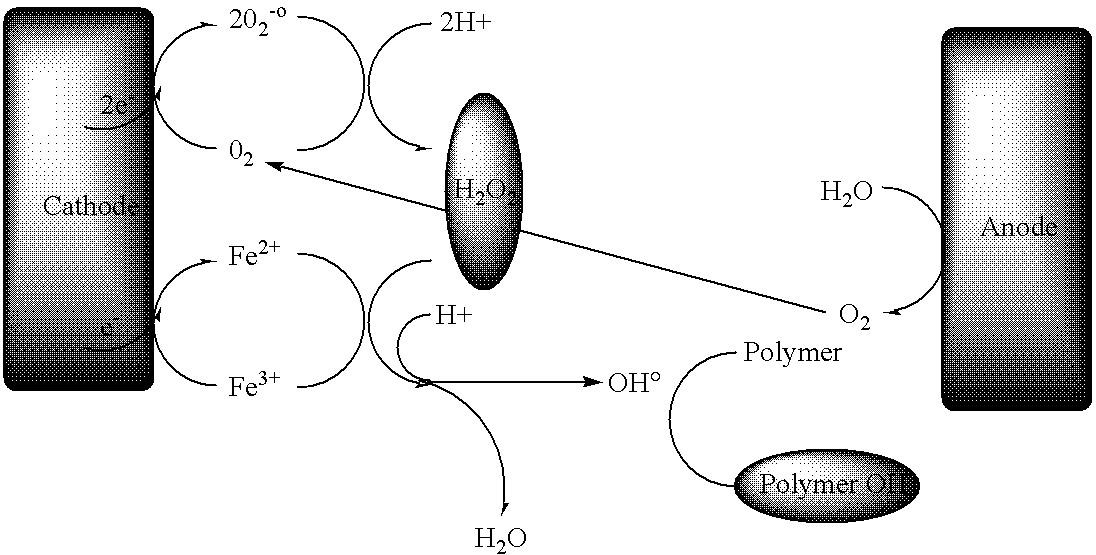
- In addition, regarding the process of the present invention, the surface oxycarbonylation has been carried out by introducing directly in the electrolysis cell the peroxide and this without deoxygenation of the solution.
- According to another advantageous embodiment, the present invention concerns the use as defined above, characterised in that the Fenton reaction is realised by photochemical means, i.e. by the use of the PhotoFenton reaction.
- The PhotoFenton reaction (Brillas, E.; Sauleda, R.; Casado, J. J. Electrochem. Soc. 1998, 145, 759) is a variant of the Fenton reaction, corresponding to the following mechanism:
-
H2O2+Fe2++H+→Fe3++H2O+HO° -
Fe3++H2O+hν→Fe2++HO°+H+ -
H2O2 +hν→2OH° - The PhotoFenton reaction allows to produce hydroxyl radicals by radiation of an aqueous solution of hydrogen peroxide and Fe(II). This reaction continuously regenerates Fe(II) and therefore allows hydroxyl radicals as long there is hydrogen peroxide. II therefore allows to continuously produce hydroxyl radicals.
- The present invention also concerns a hydroxylation, alkoxylation or oxycarbonylation process of a polymer surface, the said polymers being different form polymers chosen from: polymethylmethacrylate (PMMA) and fluorocarbon polymers regarding the hydroxylation process, or polymer mixture surface, the said polymers consisting in monomeric units of which at least 50% among these are aliphatic units, to obtain a hydroxylated, alkoxylated or oxycarbonylated surface, the said process being characterised in that it consists of reacting the said surface with RO. radicals, R being a hydrogen, an alkyl group having 2 to 15 carbons, an acyl group —COR′ in which R′ represents an alkyl group having 2 to 15 carbons, and in particular a butyl or lauryl group, or an aroyl group —COAr in which Ar represents an aromatic group having 6 to 15 carbons, in particular a phenyl group, the said RO. radicals being generated by electrochemical or photochemical means.
- The term “hydroxylated surface” means a surface containing hydroxyl groups (—OH).
- The term “alkoxylated surface” means a surface containing alkoxy groups (—OR), R representing an alkyl group as defined above.
- The term “oxycarbonylated surface” means a surface containing oxycarbonyl groups (—OCOR′ or —OCOAr, R′ and Ar being as defined above).
- According to a particular embodiment, the oxycarbonalyted surfaces obtained according to the process of the invention contain —COR′ or —COAr groups, R′ and Ar being as defined above.
- The RO. radicals are obtained by cleavage of RO—OR peroxide catalysed by Iron (II).
- The HO, radicals are formed by cleavage par hydrogen peroxide 11202 catalysed by Iron (II).
- A preferred hydroxylation process according to the invention is characterised in that it involves reacting the surface with HO. hydroxyl radicals.
- The present invention also concerns a hydroxylation process of polymer surfaces, particularly hydrophobic ones, the said polymers consisting in monomeric units of which at least 50% among these are alkane units, to obtain a hydroxylated surface, the said process being characterised in that it involves reacting the said surface with HO. hydroxyl radicals obtained by the Fenton reaction, by electrochemical or photochemical means (ElectroFenton or PhotoFenton reaction).
- The present invention concerns the process as defined above, characterised in that the HO. hydroxyl radicals are obtained by mixing hydrogen peroxide and ferric (Fe3+) or ferrous (Fe2+) ions.
- According to an advantageous embodiment, the process of the invention is characterised in that the HO. hydroxyl radicals are obtained by the use of the ElectroFenton reaction.
- According to an advantageous embodiment, the process of the invention, including the use of the ElectroFenton reaction, is characterised in that hydrogen peroxide is obtained directly by the electrochemical reduction of oxygen in an acidic medium, and in that the HO, hydroxyl radicals are provided from the reaction of ferrous ions with hydrogen peroxide.
- The term “electrochemical reduction of oxygen” means the transfer of two electrons and two protons to oxygen to give hydrogen peroxide.
- The term “acidic medium” means a medium where the pH is below 7 more particularly is between 2 and 4, more precisely equal to 3.
- The present invention also concerns a process as defined above characterised in that the HO. hydroxyl radicals are obtained by the use of the PhotoFenton reaction.
- According to an advantageous embodiment, concerning the use of the PhotoFenton reaction, the process of the invention is characterised in that the hydrogen peroxide is added to the polymer surface, and in that the HO. hydroxyl radicals are obtained by putting into contact the said surface with an aqueous solution containing hydrogen peroxide and a ferrous salt, particularly iron chloride or sulfate, and by irradiation of the said surface and the said solution.
- The term “irradiation of the said surface and the said solution” means the fact to illuminate the solution and the surface(s) with a lamp emitting appropriate wavelengths, particularly in the ultraviolet region, i.e. wavelengths below 400 nm.
- According to another advantageous embodiment, the present invention concerns the process as defined above, characterised in that the polymers are immerged in an aqueous solution containing hydrogen peroxide and a ferrous salt, particularly iron chloride or sulfate, and in that the said solution and the polymers are irradiated with a UV lamp.
- The present invention also concerns the process as defined above, characterised in that the polymers contain monomeric units having a molecular weight from about 500 to about 5 millions daltons.
- A molecular weight of 500 daltons corresponds to the lower limit of polymer molecular weights and a molecular weight of 5 million daltons corresponds to the mass of UHMW polyethylene (UltraHigh Molecular Weight).
- The present invention also concerns a process as defined above, characterised in that ies polymers are chosen from: polyethylene, polypropylene, polyisobutylene (P-IB), polymethylpentene, polyvinyl chloride (PVC), polyvinyl acetate (PVAC), polyvinyl butyral (PVB), polyvinyl formal (PVFM), polyvinyl alcohol (PVAL), different polyamides, polyoxomethylenes (POM), cellulose derivatives et polyacrylonitrile (PAN).
- The preferred polymers for the process of the invention are chosen from:
-
Polymère Motif Polyethylene —(CH2)n— Polypropylene 
Polyisobutylene 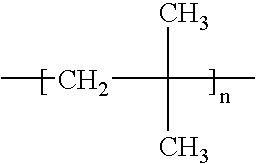
Polymethylpentene 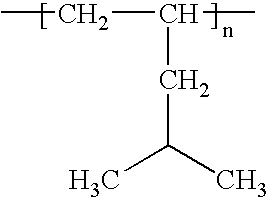
Polyvinyl chloride 
Polyvinyl acetate 
Polyacrylonitrile 
Polyvinyl alcohol 
Polyvinyl butyral 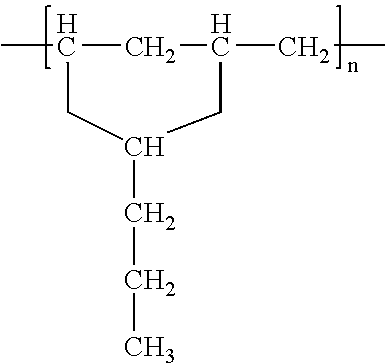
Polyvinyl formal 
Polyoxymethylene CH2—On Polyamide 
- Preferably, the polymers used for the process of the invention are polyolefins which are polymers obtained by olefin polymerisation, i.e. compounds having at least one double bond which can be broken to lead to the polymerisation.
- Preferably, the polymers involved in the invention are different form polysiloxanes polymers.
- The present invention also concerns a process as defined above, characterised in that les polymers are composed of monomeric unit having at least one aromatic unit, in particular a pendant aryl group, and at least an alkane unit, the said polymers being chosen from: random copolymers, alternate copolymers et block copolymers (diblock, triblock, multiblock or radial).
- Alternate copolymers are polymers of the form: -ABABABAB-.
- Block or sequential copolymers are polymers of the form
- -AAAAAABBBBBBAAAAAABBBBBBB- or
- -AAAAAABBBBBBCCCCCCAAAAAABBBBBB-
- Random copolymers are polymers of the form:
- -AABABBAAABABB-
- Bisequential copolymers are polymers of the form -(A)n-(B)t—
- Trisequential copolymers are polymers of the form: -(A)m-(B)n-(A)t-
- Star copolymers (or radical) are polymers of the form
-

- A, B and C representing monomeric units as defined above.
- The present invention also concerns the process as defined above, characterised in that the polymer surface is in the form of a sheet, a knitted material, a tube, for example a catheter, strands, nails or screws, balls, objects of different forms being able to serve as prostheses or extra or intraocular lenses.
- According to a preferred embodiment, the process of the invention is characterised in that it does not include a reticulation step.
- The present invention also concerns a process as defined above, characterised in that the step to react HO. hydroxyl radicals is carried out for about 5 minutes to about 5 hours.
- The present invention also concerns a process as defined above, characterised in that it includes a subsequent functionalisation step on the hydroxyl groups bound on the polymer surface.
- Among the subsequent functionalisation reactions, one can cite: the formation of esters by reaction with a carboxylic acid, ethers by Williamson reaction with another alcohol, halides by reaction with halide acids or PCl5, N-alkylamides by Mitsunobu reaction or sulfides by reaction with thiols.
- Generally, post-functionnalisation allows one skilled in the art to place an organic function of choice on the surface for a targeted application, for example in the biomedical domain, adhesion and non-adhesion proteins, binding of pharmaceutical substances, antimicrobials.
- Subsequent functionalisation reactions allow to give specific properties on the surface: for example by binding biologically-active molecules (for example, enzymes) or molecules having pharmaceutical properties. This can be carried out by binding the OH group on the surface either directly to the desired molecule or by an intermediate on an intermediate linkage. One can link alcoholic functionality by ester formation (by reaction with an anhydride, an acid chloride or even an acid), amide formation (by reaction with isocyanates) or ether formation (by reaction with alkyl halides).
- The present invention also concerns a hydroxylation process as defined below, characterised in that the contact angle measured between the drop of water and the hydroxylated surface obtained decreases to more than 5°, particularly, to more than 10° relative to the contact angle measured between a drop of water and a non-hydroxylated surface.
- The contact angle is measured by depositing a drop of water on the polymer surface with a syringe, then measuring with the help of a microscope the angle formed between the polymer surface and the tangent of the drop by its contact point with the polymer.
- The more the surface is hydrophilic, the more the measured contact angle is small, and the more the surface is hydrophobic, the more the measured contact angle is large.
- The present invention also concerns a process as defined above, characterised in that the hydroxylated, alkoxylated or oxycarbonylated surfaces obtained are time stable, particularly during many weeks, according to the following test:
- The infrared spectra of PET and PEEK samples, modified by a ElectroFenton reaction either during 10 minutes, or during 120 minutes, then trifluoroacetylated, are re-recorded after 74 days. By recording the spectral differences (t=0 and t=74 days), no significant differences and in particular no disappearance of characteristic bands corresponding to trifluoroacetyl groups are noted.
- The present invention also concerns hydroxylated, alkoxylated or oxycarbonylated surfaces obtained by the use of the process of the invention as defined above.
- As shown by the measurement of the contact angles reported in the following experimental part, the treated surfaces according to the hydroxylation process of the present invention have become hydrophilic and will be consequentially much more bio-compatible.
- The bond between the polymer and the OH group is a covalent bond whose energy is in the range of 390 (CH3OH) to 470 kJ/mol (C6H5OH).
- I—Electro-Fenton Reaction
- Hydroxylation of Polypropylene (PP)
- Of Polyethylene (PE) and
- Of Acrylonitrile-Butadiene-Styrene (ABS)
- Substrates—knitted PP and
-
- Goodfellow PP301400 sheet
- very high molecular weight PE (sheet) (Goodfellow ET301400)
- ABS plate (Goodfellow, AB3030090) [obtained by dispersing an elastomeric phase (butadiene) in a styrene phase (SAN) obtained by copolymerisation of acrylonitrile with styrene]
- Electrochemical Device:
- Non-separated compartment cell.
- Anode: carbon.
- Cathode: carbon felt (approximately 10 cm2).
- The polymer sheet or knitted material was tightened against one sheet or placed between two carbon felt sheets serving as the cathode.
- Solvent 0.1M H2SO4 brought to pH 3 with sodium hydroxide
- Catalyser 0.5 mM Fe2+ (FeSO4. 7H2O)
- Continuous Air Bubbling
- Galvanostatic method: Constant current: 10 mA or 5 mA according to the experiment
- Potentiostatic method: Constant potential E=−0.6V/SCE
- A) Hydroxylation of PP
- Hydroxylation of a PP sheet (Goodfellow)
- By galvanostatic i=5 mA, 2 hours, the counter-electrode was short-circuited on the reference. The cathode potential was increased from approximately −0.6V/SCE at the beginning of the experiment to approximately −2V/SCE at the end of the electrolysis, at this potential the protons were reduced and therefore the reduction efficiency of oxygen was reduced. The samples were carefully rinsed with distilled water during 10 minutes under sonication, then 10 minutes in acetonitrile (for analysis) and dried at 40° C. under vacuum overnight.
- By potentiostatic, the current decreased from approximately 30 to 10 mA. The samples were treated as described above.
- For IR analysis, the samples were treated with a solution of trifluoroacetic anhydride (1 mL) in ether (30 mL) overnight, rinsed with acetonitrile then dried under vacuum overnight. The results are shown in Table 1.
-
TABLE 1 IR analysis of a hydroxylated then trifluoroacetylated PP sheet* Band positions in cm−1 Attribution By comparison 1794 C═O ≈1813 cm−1 for (CF3CO)2O ≈1780 cm−1 for CF3COOH 1206 CF3 ≈1160, 1240 cm−1 for (CF3CO)2O 1179 ≈1190, 1240 cm−1 for CF3COOH Reference: non-treated PP sheet. - The CF3 band was larger on the spectrum corresponding to potentiostatic electrolysis than galvanostatic electrolysis, it seemed that the yield was greater with potentiostatic, however, there was no difference regarding the band position.
- The ToF-SIMS analysis confirmed well the surface trifluoromethylation
-
—OH+CF3(C═O)O(O═C)CF3→—O(C═O)CF3 - (see fragments described in Table 2 below).
-
TABLE 2 ToF-SIMS analysis of a hydroxylated then trifluoroacetylated PP sheet m/z Attributiona) 19 F− 97 C(═O)CF3 − or CH2CH2CF3 −b) 113 OC(═O)CF3 − 69 CF3 + 95 CH═CHCF3 + 97 CH2CH2CF3 + or C(═O)CF3 −b) 109 CH2CH═CHCF3 + 111 CH2CH2CH2CF3 +b) 123 CH2CH2CH═CHCF3 +b) 125 CH2CH2CH2CH2CF3 +b) 147 C≡CCH2CH2CH═CHCF3 +b) 207 CH2(CH2)5CH═CHCF3 +b) 221 CH2(CH2)6CH═CHCF3 +b) a)or isomer, b)CH2CH2 and C═O having the same mass, it would be possible to write the ions m/z = 97 (positives et negatives) under the two isomeric forms indicated. The negative ion is attributed to the trifluoroacetyl group. For the positive ion, the presence of ion at m/z = 95 seemed to indicate the loss of two hydrogens and therefore allowed to attribute the peak to the trifluoroethyl ion. - The presence of trifluoromethyl groups (ant in particular trifluoromethylated alkyl chains) confirmed that the surface was well hydroxylated then trichloromethylated. However, during the analysis there was probably a rearrangement of ions with the loss of CO2 as no fragments of type (CH2)nOC(═O)CF3 were observed.
- Analysis of the contact angle of water measured with non-treated PP was 124°, after treatment it decreased to 102° immediately after the deposit of the drop, et continued to slowly decrease after: 73° after 10 and 20 minutes (without notable evaporation of the drop).
- Hydroxylation of Knitted Material
- Electrolysis 1 hour. Galvanostatic method: i=10 mA
- IR analysis of the surface showed, by difference with a non-treated sample, a band at 3419 cm−1 which corresponded to a OH stretching vibration, a weak band at 1037 cm−1 could be attributed to a C—OH deformation.
- By ToF-SIMS, O and OH peaks observed were clearly larger than on the reference as well as the peaks non present on the reference shown in Table 3.
-
TABLE 3 Analysis of hydroxylated knitted Sofradim by ToF-SIMS m/z Attribution 32 CH3O− 60 HO—HC═CH—OH− 79 C5H3OH− 113 C7H13OH− - After trifluoromethylation, fluorinated peaks were observed: F−, CF3 −, OCOCF3 −, C7H15OCOCF3 −. This latter peak was particularly interesting, it contained a part of the polymer and the OH function which had been tritluoroacetylated, showing therefore that the OH function was well covalently attached to the surface. Few differences were observed between the sheet and knitted material spectra, this could be due either to the reproducibility of the experiments, or a different reactivity of the two substrates even tough they had an identical chemical composition.
- On the knitted material, the contact angle was very difficult to measure, however, after hydroxylation, the water drop passed through the surface.
- B) Hydroxylation of PE
- Surface modification was realised in a solution of 0.1N sulfuric acid brought to pH 3 by the addition of sodium hydroxide, in presence of 0.5 mM FeSO4, with air bubbling, in a potentiostatic mode at −0.6 V/SCE for 2 hours.
- The contact angle with water was measured before and after grafting: it went from about 91° to about 70°. This showed well that the polypropylene surface had been hydroxylated.
- The IR spectrum of the hydroxylated surface was recorded.
-
TABLE 4 IR spectrum of PE after treatment* Band position in cm−1 Attribution 3310 O—H 1047 C—O primary alcohol *after subtraction of the non-treated reference, the samples were dried under vacuum at 40° C. for two days, to assure that the OH bands did not come from superficial humidity. - The sample was trifluoroacetylated as above. To obtain a reference, the trifluoracetylation treatment was carried out on a sample which had not been hydroxylated.
-
TABLE 5 IR analysis of a hydroxylated then trifluoroacetylated PE sheet* Band position in cm−1 Attribution By comparison 1742 C═O ≈1813 cm−1 for (CF3CO)2O ≈1780 cm−1 for CF3COOH 1240 CF3 ≈1160, 1240 cm−1 for (CF3CO)2O 1170 ≈1190, 1240 cm−1 for CF3COOH Reference: non-hydroxylated PE sheet subjected to trifluoroacetylated treatment. -
TABLE 6 ToF-SIMS analysis of a hydroxylated then trifluoroacetylated PE sheet m/z Attribution 19 F− 69 CF3 −; CF3 + 97 C(═O)CF3 −; C(═O)CF3 + 113 OC(═O)CF3 − 119 (CH2)2CF2H− 131 C3H4OC(═O)CF3 + 155 (CH2)3OC(═O)CF3 + 169 (CH2)4OC(═O)CF3 + 181 C5H8OC(═O)CF3 + 193 C6H8OC(═O)CF3 + 265 CH3(CH2)10OC(═O)CF3 − - The variation of the contact angle, the IR spectra et more particularly the ToF-SIMS spectra showing the AlkylOC(═O)CF3 fragments, demonstrated well the hydroxylation and the post-functionalisation of the surface.
- C) Hydroxylation of ABS
- Under the same conditions as PE.
- The contact angle with water was measured before and after grafting: it went from about 69° to about 37°.
- The IR spectrum of the hydroxylated surface was recorded.
-
TABLE 7 IR spectrum of ABS after treatment. Band position in cm−1 Attribution 3240 O—H 1050 C—O primary alcohol *after subtraction of a non-treated reference, the samples were dried under vacuum at 40° C. for 2 days to assure that the OH bands did not come from residual humidity. - The sample was trifluoroacetylated as above. To obtain a reference, the trifluoracetylation treatment was carried out on a sample which had not been hydroxylated.
-
TABLE 8 IR analysis of a hydroxylated then trifluoroacetylated ABS sheet* Band Position in cm−1 Attribution By comparison 1765 C═O ≈1813 cm−1 for (CF3CO)2O ≈1780 cm−1 for CF3COOH 1245 shouldering CF3 ≈1160, 1240 cm−1 for (CF3CO)2O 1160 shouldering ≈1190, 1240 cm−1 for CF3COOH Reference: non-hydroxylated ABS sheet and subjected to trifluoroacetylation treatment. -
TABLE 9 ToF-SIMS analysis of a hydroxylated then trifluoroacetylated ABS sheet* m/z Attribution 19 F− 69 CF3− 97 C(═O)CF3−− 145 OC(═O)CF3− 228 NC—(CH2)5—OC(═O)CF3 + - Grafting Stability as a Function of Time
- After 74 days, the infrared spectra of a PP sample modified by the electroFenton reaction either for 10 minutes, or for 120 minutes then trifluoroacetylated were recorded. By recording the difference between the spectra (t=0 and t=74 days), no significant differences and in particular no disappearance of the characteristic trifluoroacetyl group bands were observed.
- II—Photo-Fenton Reaction
- Hydroxylation of Polypropylene (PP)
- Of Polyethylene (PE) and
- Of Acrylonitrile-Butadiene-Styrene (ABS)
- A) Hydroxylation of Polypropylene (PP)
- A 2 L glass reactor equipped with a circulation pump, a thermostated double-jacket and a low pressure mercury lamp placed in the middle of the reactor in a quartz tube was filled with 2 L of a 1 mM HCl solution in water, 1 g of ferric chloride and 2 mL of hydrogen peroxide. The polymer samples were suspended in the solution. The pump and irradiation were started; after 2 h 30, the irradiation was stopped. The samples were rinsed for 15 minutes with distilled water under sonication then with acetone and dried under vacuum at 40° C. overnight.
- IR analysis of the samples allowed to see the attributable bands of OH groups at 3343 and 3230 cm−1 (after subtraction of the PP spectrum itself).
- The calculation of contact angles with water was carried out before and after treatment.
-
TABLE 10 Contact angles of polymer samples treated by PhotoFenton. Contact angle before Contact angle after Sample treatment treatment PP 124 124a) 86 (after 10′)b) 80 (after 20′) a)Immediately after the deposit of the drop b)without notable decrease in the drop size. - The samples were then treated with trifluoroacetic anhydride (0.4 mL in 10 mL of ether) and analysed by IR. Bands towards 1206-1254 cm−1 and 1165-1185 cm−1 were well observed, which were attributed to the group CF3 vibrations by comparison with the spectra of trifluoroacetic acid and trifluoroacetic anhydride. The vibration corresponding to the carbonyl group (C═O)CF3 was observable. These spectra confirmed well the modification on the polymer surface.
-
TABLE 11 IR spectra of the trifluoroacetylated samples. IR Absorption Sample in cm−1 Attribution PPa ≈1800 vw C═O (≈1790 cm−1 for CF3COOH) 1206 s CF3 (1248 for CF3CO)2O and 1240 for CF3COOH) 1166 m CF3 (1195 for CF3CO)2O and 1177 for CF3COOH) -
TABLE 12 ToF-SIMS spectra of trifluoroacetylated samples Sample m/z Attribution PPa 19 F− 69 CF3 −, CF3 + 113 [O(C═O)CF3]− 182 [CF3(C═O)O CHCH3CH2CCH3]− - The ToF-SIMS spectra confirmed well the polymer grafting by the OCF3 groups after treatment with acetic anhydride, therefore surface hydroxylation.
- B) Hydroxylation of Polyethylene (PE)
- The hydroxylation and the trifluoroacetylation were carried out under the same conditions as for polypropylene. The samples were analysed by ToF-SIMS.
-
TABLE 13 ToF-SIMS spectra of trifluoroacetylated samples. Sample m/z Attribution PEa 19 F− 69 CF3 −, CF3 + 97 C(═O)CF3 − 113 [O(C═O)CF3]− 182 [CF3(C═O)O CH(CH2)4]− - Table 13 showed well the polyethylene grafting by OH groups and the subsequent trifluoroacetylations. In particular, the fragment at m/z—182 represented a fragment of PE chain containing a trifluoroacetyl group.
- C) Hydroxylation of ABS
- Under the same conditions as for PP, the samples were analysed by ToF-SIMS.
-
TABLE 14 ToF-SIMS spectra of trifluoroacetylated samples. Sample m/z Attribution PEa 19 F− 69 CF3 −, CF3 + 97 C(═O)CF3 − 113 [O(C═O)CF3]− 207 OC(═O)CF3 - The spectrum confirmed well the hydroxylation and trifluoroacetylation of ABS.
- Analogous Reaction to the Fenton Reaction, Using Benzoyl Peroxide
- In this reaction, hydrogen peroxide was replaced by benzoyl peroxide. Two samples of PP and PE were enveloped in carbon felt, and these coatings were used as the cathode. A solution was prepared by introducing 400 mg of benzoyl peroxide (saturated solution) and 55 mg of FeSO4, 7H2O in 400 ml of a 0.1N H2SO4 solution brought to pH 3 by the addition of sodium hydroxide. The solution was deoxygenated with argon. The potential was fixed at E=−0.6 V/SCE for 2 hours. The samples were then rinsed with tap water, twice with distilled water under sonication (10 minutes), then once with acetone under sonication and dried under vacuum.
- The samples were analysed by ToF-SIMS.
-
TABLE 15 ToF-SIMS spectra of samples treated with benzoyl peroxide under the conditions of the Fenton reaction. m/z Attribution PE 105 C6H5C(═O)+ 120 C6H5C(═O)CH3 + 163 C6H5C(═O)(CH2)3 + PP C6H5C(═O)+ 105 147 CH2CH(CH3)C(═O)C6H5 − 207 CH3CH(CH3)CH2CH(CH3)OC(═O)C6H5 - Table 15 showed well the grafting by C6H5C(═O) or C6H5C(═O)O groups for PE and PP.
Claims (17)
Applications Claiming Priority (3)
| Application Number | Priority Date | Filing Date | Title |
|---|---|---|---|
| FR0510371 | 2005-10-11 | ||
| FR0510371A FR2891835B1 (en) | 2005-10-11 | 2005-10-11 | PROCESS FOR MODIFYING SURFACES OF POLYMERS, IN PARTICULAR HYDROXYLATION OF POLYMER SURFACES, AND PRODUCTS SUCH AS OBTAINED |
| PCT/FR2006/002270 WO2007042659A1 (en) | 2005-10-11 | 2006-10-10 | Method for the modification of polymer surfaces, such as the hydroxylation of polymer surfaces, and products thus obtained |
Publications (2)
| Publication Number | Publication Date |
|---|---|
| US20080249272A1 true US20080249272A1 (en) | 2008-10-09 |
| US7968653B2 US7968653B2 (en) | 2011-06-28 |
Family
ID=36763632
Family Applications (1)
| Application Number | Title | Priority Date | Filing Date |
|---|---|---|---|
| US12/089,960 Expired - Fee Related US7968653B2 (en) | 2005-10-11 | 2006-10-10 | Modification process for polymer surfaces, notably for hydroxylation of polymer surfaces and products so obtained |
Country Status (10)
| Country | Link |
|---|---|
| US (1) | US7968653B2 (en) |
| EP (1) | EP1937759B1 (en) |
| JP (1) | JP2009511696A (en) |
| KR (1) | KR101367774B1 (en) |
| CN (1) | CN101326223B (en) |
| AT (1) | ATE504624T1 (en) |
| DE (1) | DE602006021206D1 (en) |
| ES (1) | ES2376327T3 (en) |
| FR (1) | FR2891835B1 (en) |
| WO (1) | WO2007042659A1 (en) |
Cited By (2)
| Publication number | Priority date | Publication date | Assignee | Title |
|---|---|---|---|---|
| US20100323119A1 (en) * | 2009-04-30 | 2010-12-23 | Commissariat A L'energie Atomique Et Aux Energies Alternatives | Process for the preparation of an organic film at the surface of a solid support with oxidizing treatment |
| US8647535B2 (en) | 2011-01-07 | 2014-02-11 | International Business Machines Corporation | Conductive metal and diffusion barrier seed compositions, and methods of use in semiconductor and interlevel dielectric substrates |
Citations (3)
| Publication number | Priority date | Publication date | Assignee | Title |
|---|---|---|---|---|
| US3925178A (en) * | 1970-04-17 | 1975-12-09 | Hymie D Gesser | Contact lenses |
| US4740282A (en) * | 1985-08-30 | 1988-04-26 | Gesser Hyman D | Hydrophilization of hydrophobic intraocular lenses |
| US5618887A (en) * | 1992-06-05 | 1997-04-08 | The University Of Liverpool | Functionalisation of polymers |
Family Cites Families (6)
| Publication number | Priority date | Publication date | Assignee | Title |
|---|---|---|---|---|
| US3418066A (en) * | 1966-11-08 | 1968-12-24 | Eastman Kodak Co | Surface oxidation and treatment of polymers |
| NL8702271A (en) | 1987-06-26 | 1989-01-16 | Stamicarbon | SURFACE TREATMENT OF POLYOLEFINE ARTICLES. |
| US4965026A (en) * | 1989-01-13 | 1990-10-23 | Ciba-Geigy Corporation | Process for hydroxylating hydrophobic polymer surfaces |
| HRP980496B1 (en) * | 1998-09-10 | 2007-03-31 | GlaxoSmithKline istra�iva�ki centar Zagreb d.o.o. | New thilozine hydroxy derivatives and a process for the preparation thereof |
| US7094451B2 (en) | 1999-04-07 | 2006-08-22 | Board Of Trustees Of Michigan State University | Chemical functionalization of material surfaces using optical energy and chemicals |
| CN1629083A (en) * | 2003-12-16 | 2005-06-22 | 中国科学院生态环境研究中心 | An electro-fenton method and device for removing multiple microcystins from water |
-
2005
- 2005-10-11 FR FR0510371A patent/FR2891835B1/en not_active Expired - Fee Related
-
2006
- 2006-10-10 WO PCT/FR2006/002270 patent/WO2007042659A1/en not_active Ceased
- 2006-10-10 ES ES06820176T patent/ES2376327T3/en active Active
- 2006-10-10 JP JP2008535058A patent/JP2009511696A/en not_active Withdrawn
- 2006-10-10 KR KR1020087011201A patent/KR101367774B1/en not_active Expired - Fee Related
- 2006-10-10 CN CN200680046263XA patent/CN101326223B/en active Active
- 2006-10-10 AT AT06820176T patent/ATE504624T1/en not_active IP Right Cessation
- 2006-10-10 DE DE602006021206T patent/DE602006021206D1/en active Active
- 2006-10-10 US US12/089,960 patent/US7968653B2/en not_active Expired - Fee Related
- 2006-10-10 EP EP06820176A patent/EP1937759B1/en not_active Not-in-force
Patent Citations (3)
| Publication number | Priority date | Publication date | Assignee | Title |
|---|---|---|---|---|
| US3925178A (en) * | 1970-04-17 | 1975-12-09 | Hymie D Gesser | Contact lenses |
| US4740282A (en) * | 1985-08-30 | 1988-04-26 | Gesser Hyman D | Hydrophilization of hydrophobic intraocular lenses |
| US5618887A (en) * | 1992-06-05 | 1997-04-08 | The University Of Liverpool | Functionalisation of polymers |
Cited By (4)
| Publication number | Priority date | Publication date | Assignee | Title |
|---|---|---|---|---|
| US20100323119A1 (en) * | 2009-04-30 | 2010-12-23 | Commissariat A L'energie Atomique Et Aux Energies Alternatives | Process for the preparation of an organic film at the surface of a solid support with oxidizing treatment |
| US8747954B2 (en) | 2009-04-30 | 2014-06-10 | Commissariat A L'energie Atomique Et Aux Energies Alternatives | Process for the preparation of an organic film at the surface of a solid support with oxidizing treatment |
| US8647535B2 (en) | 2011-01-07 | 2014-02-11 | International Business Machines Corporation | Conductive metal and diffusion barrier seed compositions, and methods of use in semiconductor and interlevel dielectric substrates |
| US8735284B2 (en) | 2011-01-07 | 2014-05-27 | International Business Machines Corporation | Conductive metal and diffusion barrier seed compositions, and methods of use in semiconductor and interlevel dielectric substrates |
Also Published As
| Publication number | Publication date |
|---|---|
| EP1937759A1 (en) | 2008-07-02 |
| WO2007042659A1 (en) | 2007-04-19 |
| JP2009511696A (en) | 2009-03-19 |
| FR2891835B1 (en) | 2007-12-14 |
| KR20080071985A (en) | 2008-08-05 |
| CN101326223B (en) | 2011-07-20 |
| KR101367774B1 (en) | 2014-02-27 |
| US7968653B2 (en) | 2011-06-28 |
| CN101326223A (en) | 2008-12-17 |
| ES2376327T3 (en) | 2012-03-13 |
| DE602006021206D1 (en) | 2011-05-19 |
| ATE504624T1 (en) | 2011-04-15 |
| EP1937759B1 (en) | 2011-04-06 |
| FR2891835A1 (en) | 2007-04-13 |
Similar Documents
| Publication | Publication Date | Title |
|---|---|---|
| JPH03503379A (en) | Low friction coefficient surface | |
| Guan et al. | Surface photo-grafting of polyurethane with 2-hydroxyethyl acrylate for promotion of human endothelial cell adhesion and growth | |
| Xin et al. | Surface functionalization of polyethylene via covalent immobilization of O-stearoyl-chitosan | |
| WO2013011314A1 (en) | Polymeric structure | |
| Ademovic et al. | Minimization of protein adsorption on poly (vinylidene fluoride) | |
| US7968653B2 (en) | Modification process for polymer surfaces, notably for hydroxylation of polymer surfaces and products so obtained | |
| Inoue et al. | Surface photografting of hydrophilic vinyl monomers onto diethyldithiocarbamated polydimethylsiloxane | |
| US7956099B2 (en) | Modification process for polymer surfaces, notably for hydroxylation of polymer surfaces and products so obtained | |
| EP3135311B1 (en) | Surface modification method and surface-modified elastic body | |
| Mantovani et al. | Ammonia RF-plasma treatment of tubular ePTFE vascular prostheses | |
| CA2374031C (en) | Functionalised solid surfaces | |
| Nho et al. | Introduction of phosphoric acid group to polypropylene film by radiation grafting and its blood compatibility | |
| Mas et al. | XPS analysis of poly [(3‐hydroxybutyric acid)‐co‐(3‐hydroxyvaleric acid)] film surfaces exposed to an allylamine low‐pressure plasma | |
| Guerrouani et al. | Fluorinated-plasma coating on polyhydroxyalcanoate PHBV: Effect on the biodegradation | |
| Zhai et al. | Radiation-induced grafting of perfluorinated vinyl ether into fluorinated polymer films | |
| Yun et al. | Photosensitive polymer brushes grafted onto PTFE film surface for micropatterning of proteins | |
| Lee et al. | Surface graft modification of styrene—butadiene—styrene triblock copolymer membrane by ultraviolet irradiation | |
| US20150065659A1 (en) | Polymeric structure | |
| JPS6020941A (en) | Grafting onto polyfluoroolefin molding | |
| Bose | Initiated chemical vapor deposition of polymer thin films and coatings for biological applications | |
| Rawlins et al. | In Commodity Plastics | |
| JPS5980443A (en) | Method for modifying surface |
Legal Events
| Date | Code | Title | Description |
|---|---|---|---|
| AS | Assignment |
Owner name: ALCHIMER, FRANCE Free format text: ASSIGNMENT OF ASSIGNORS INTEREST;ASSIGNORS:BUREAU, CHRISTOPHE;PINSON, JEAN;REEL/FRAME:021091/0454 Effective date: 20080520 |
|
| STCF | Information on status: patent grant |
Free format text: PATENTED CASE |
|
| CC | Certificate of correction | ||
| FPAY | Fee payment |
Year of fee payment: 4 |
|
| MAFP | Maintenance fee payment |
Free format text: PAYMENT OF MAINTENANCE FEE, 8TH YR, SMALL ENTITY (ORIGINAL EVENT CODE: M2552) Year of fee payment: 8 |
|
| FEPP | Fee payment procedure |
Free format text: MAINTENANCE FEE REMINDER MAILED (ORIGINAL EVENT CODE: REM.); ENTITY STATUS OF PATENT OWNER: SMALL ENTITY |
|
| LAPS | Lapse for failure to pay maintenance fees |
Free format text: PATENT EXPIRED FOR FAILURE TO PAY MAINTENANCE FEES (ORIGINAL EVENT CODE: EXP.); ENTITY STATUS OF PATENT OWNER: SMALL ENTITY |
|
| STCH | Information on status: patent discontinuation |
Free format text: PATENT EXPIRED DUE TO NONPAYMENT OF MAINTENANCE FEES UNDER 37 CFR 1.362 |
|
| FP | Lapsed due to failure to pay maintenance fee |
Effective date: 20230628 |