US20080206287A1 - Use of cyclosporin A to sensitize resistant cancer cells to death receptor ligands - Google Patents
Use of cyclosporin A to sensitize resistant cancer cells to death receptor ligands Download PDFInfo
- Publication number
- US20080206287A1 US20080206287A1 US11/901,582 US90158207A US2008206287A1 US 20080206287 A1 US20080206287 A1 US 20080206287A1 US 90158207 A US90158207 A US 90158207A US 2008206287 A1 US2008206287 A1 US 2008206287A1
- Authority
- US
- United States
- Prior art keywords
- cancer
- composition
- cyclosporin
- tnf
- cells
- Prior art date
- Legal status (The legal status is an assumption and is not a legal conclusion. Google has not performed a legal analysis and makes no representation as to the accuracy of the status listed.)
- Abandoned
Links
- PMATZTZNYRCHOR-CGLBZJNRSA-N Cyclosporin A Chemical compound CC[C@@H]1NC(=O)[C@H]([C@H](O)[C@H](C)C\C=C\C)N(C)C(=O)[C@H](C(C)C)N(C)C(=O)[C@H](CC(C)C)N(C)C(=O)[C@H](CC(C)C)N(C)C(=O)[C@@H](C)NC(=O)[C@H](C)NC(=O)[C@H](CC(C)C)N(C)C(=O)[C@H](C(C)C)NC(=O)[C@H](CC(C)C)N(C)C(=O)CN(C)C1=O PMATZTZNYRCHOR-CGLBZJNRSA-N 0.000 title claims abstract description 102
- 108010036949 Cyclosporine Proteins 0.000 title claims abstract description 94
- 229930105110 Cyclosporin A Natural products 0.000 title claims abstract description 90
- 229960001265 ciclosporin Drugs 0.000 title claims abstract description 90
- 239000003446 ligand Substances 0.000 title claims abstract description 79
- 108010049207 Death Domain Receptors Proteins 0.000 title claims abstract description 70
- 102000009058 Death Domain Receptors Human genes 0.000 title claims abstract description 70
- 208000016691 refractory malignant neoplasm Diseases 0.000 title description 4
- 239000000203 mixture Substances 0.000 claims abstract description 81
- 206010028980 Neoplasm Diseases 0.000 claims abstract description 64
- 101100369992 Homo sapiens TNFSF10 gene Proteins 0.000 claims abstract description 41
- 108700012411 TNFSF10 Proteins 0.000 claims abstract description 41
- 230000001404 mediated effect Effects 0.000 claims abstract description 29
- 150000001875 compounds Chemical class 0.000 claims description 150
- 238000000034 method Methods 0.000 claims description 48
- 201000011510 cancer Diseases 0.000 claims description 43
- 102100024598 Tumor necrosis factor ligand superfamily member 10 Human genes 0.000 claims description 42
- 230000002147 killing effect Effects 0.000 claims description 36
- 229930182912 cyclosporin Natural products 0.000 claims description 17
- 239000003795 chemical substances by application Substances 0.000 claims description 16
- 230000001965 increasing effect Effects 0.000 claims description 14
- 238000011282 treatment Methods 0.000 claims description 14
- 101100044298 Drosophila melanogaster fand gene Proteins 0.000 claims description 13
- 101150064015 FAS gene Proteins 0.000 claims description 13
- 101100335198 Pneumocystis carinii fol1 gene Proteins 0.000 claims description 13
- 229960005486 vaccine Drugs 0.000 claims description 13
- 239000002246 antineoplastic agent Substances 0.000 claims description 12
- 241000124008 Mammalia Species 0.000 claims description 11
- 208000000236 Prostatic Neoplasms Diseases 0.000 claims description 10
- 230000034994 death Effects 0.000 claims description 8
- 238000012360 testing method Methods 0.000 claims description 8
- 206010061535 Ovarian neoplasm Diseases 0.000 claims description 7
- 206010060862 Prostate cancer Diseases 0.000 claims description 7
- 239000000523 sample Substances 0.000 claims description 7
- 208000026310 Breast neoplasm Diseases 0.000 claims description 6
- 206010033128 Ovarian cancer Diseases 0.000 claims description 6
- 108060008682 Tumor Necrosis Factor Proteins 0.000 claims description 6
- 102000000852 Tumor Necrosis Factor-alpha Human genes 0.000 claims description 6
- 206010006187 Breast cancer Diseases 0.000 claims description 5
- 208000029742 colonic neoplasm Diseases 0.000 claims description 5
- MZOFCQQQCNRIBI-VMXHOPILSA-N (3s)-4-[[(2s)-1-[[(2s)-1-[[(1s)-1-carboxy-2-hydroxyethyl]amino]-4-methyl-1-oxopentan-2-yl]amino]-5-(diaminomethylideneamino)-1-oxopentan-2-yl]amino]-3-[[2-[[(2s)-2,6-diaminohexanoyl]amino]acetyl]amino]-4-oxobutanoic acid Chemical compound OC[C@@H](C(O)=O)NC(=O)[C@H](CC(C)C)NC(=O)[C@H](CCCN=C(N)N)NC(=O)[C@H](CC(O)=O)NC(=O)CNC(=O)[C@@H](N)CCCCN MZOFCQQQCNRIBI-VMXHOPILSA-N 0.000 claims description 4
- 101000679903 Homo sapiens Tumor necrosis factor receptor superfamily member 25 Proteins 0.000 claims description 4
- 108090000542 Lymphotoxin-alpha Proteins 0.000 claims description 4
- 102000004083 Lymphotoxin-alpha Human genes 0.000 claims description 4
- 101710187743 Tumor necrosis factor receptor superfamily member 1A Proteins 0.000 claims description 4
- 102100033732 Tumor necrosis factor receptor superfamily member 1A Human genes 0.000 claims description 4
- 206010009944 Colon cancer Diseases 0.000 claims description 3
- 241000282414 Homo sapiens Species 0.000 claims description 3
- 230000003042 antagnostic effect Effects 0.000 claims description 3
- 239000013068 control sample Substances 0.000 claims description 2
- 208000003174 Brain Neoplasms Diseases 0.000 claims 1
- 206010058467 Lung neoplasm malignant Diseases 0.000 claims 1
- 208000000453 Skin Neoplasms Diseases 0.000 claims 1
- 208000005718 Stomach Neoplasms Diseases 0.000 claims 1
- 206010017758 gastric cancer Diseases 0.000 claims 1
- 201000005787 hematologic cancer Diseases 0.000 claims 1
- 208000024200 hematopoietic and lymphoid system neoplasm Diseases 0.000 claims 1
- 201000007270 liver cancer Diseases 0.000 claims 1
- 208000014018 liver neoplasm Diseases 0.000 claims 1
- 201000005202 lung cancer Diseases 0.000 claims 1
- 208000020816 lung neoplasm Diseases 0.000 claims 1
- 201000000849 skin cancer Diseases 0.000 claims 1
- 201000011549 stomach cancer Diseases 0.000 claims 1
- 230000006907 apoptotic process Effects 0.000 abstract description 34
- 102000046283 TNF-Related Apoptosis-Inducing Ligand Human genes 0.000 abstract 1
- 210000004027 cell Anatomy 0.000 description 148
- -1 organic acid salts Chemical class 0.000 description 107
- 125000000217 alkyl group Chemical group 0.000 description 74
- 102100025752 CASP8 and FADD-like apoptosis regulator Human genes 0.000 description 52
- 101000914211 Homo sapiens CASP8 and FADD-like apoptosis regulator Proteins 0.000 description 49
- 125000000623 heterocyclic group Chemical group 0.000 description 44
- 125000002887 hydroxy group Chemical group [H]O* 0.000 description 42
- 125000003118 aryl group Chemical group 0.000 description 41
- 125000001072 heteroaryl group Chemical group 0.000 description 41
- 125000000753 cycloalkyl group Chemical group 0.000 description 40
- 230000000694 effects Effects 0.000 description 33
- 210000004881 tumor cell Anatomy 0.000 description 33
- 208000026149 Primary peritoneal carcinoma Diseases 0.000 description 32
- 230000006624 extrinsic pathway Effects 0.000 description 32
- 125000003342 alkenyl group Chemical group 0.000 description 31
- 125000003545 alkoxy group Chemical group 0.000 description 25
- 125000001188 haloalkyl group Chemical group 0.000 description 25
- 125000005843 halogen group Chemical group 0.000 description 25
- 150000003839 salts Chemical class 0.000 description 24
- 125000002768 hydroxyalkyl group Chemical group 0.000 description 23
- 125000002023 trifluoromethyl group Chemical group FC(F)(F)* 0.000 description 22
- 230000003833 cell viability Effects 0.000 description 21
- 125000000449 nitro group Chemical group [O-][N+](*)=O 0.000 description 20
- 108091003079 Bovine Serum Albumin Proteins 0.000 description 19
- 101000611023 Homo sapiens Tumor necrosis factor receptor superfamily member 6 Proteins 0.000 description 19
- 125000004093 cyano group Chemical group *C#N 0.000 description 19
- 230000014509 gene expression Effects 0.000 description 19
- 102100040403 Tumor necrosis factor receptor superfamily member 6 Human genes 0.000 description 18
- 125000003282 alkyl amino group Chemical group 0.000 description 18
- 101000964894 Bos taurus 14-3-3 protein zeta/delta Proteins 0.000 description 17
- 101000824278 Homo sapiens Acyl-[acyl-carrier-protein] hydrolase Proteins 0.000 description 17
- 239000004480 active ingredient Substances 0.000 description 17
- 125000004442 acylamino group Chemical group 0.000 description 17
- 125000002252 acyl group Chemical group 0.000 description 16
- 230000001270 agonistic effect Effects 0.000 description 16
- 125000004453 alkoxycarbonyl group Chemical group 0.000 description 16
- 125000004644 alkyl sulfinyl group Chemical group 0.000 description 16
- 125000004390 alkyl sulfonyl group Chemical group 0.000 description 16
- 125000004414 alkyl thio group Chemical group 0.000 description 16
- HKSZLNNOFSGOKW-UHFFFAOYSA-N ent-staurosporine Natural products C12=C3N4C5=CC=CC=C5C3=C3CNC(=O)C3=C2C2=CC=CC=C2N1C1CC(NC)C(OC)C4(C)O1 HKSZLNNOFSGOKW-UHFFFAOYSA-N 0.000 description 16
- HKSZLNNOFSGOKW-FYTWVXJKSA-N staurosporine Chemical compound C12=C3N4C5=CC=CC=C5C3=C3CNC(=O)C3=C2C2=CC=CC=C2N1[C@H]1C[C@@H](NC)[C@@H](OC)[C@]4(C)O1 HKSZLNNOFSGOKW-FYTWVXJKSA-N 0.000 description 16
- CGPUWJWCVCFERF-UHFFFAOYSA-N staurosporine Natural products C12=C3N4C5=CC=CC=C5C3=C3CNC(=O)C3=C2C2=CC=CC=C2N1C1CC(NC)C(OC)C4(OC)O1 CGPUWJWCVCFERF-UHFFFAOYSA-N 0.000 description 16
- 125000004181 carboxyalkyl group Chemical group 0.000 description 15
- 125000001424 substituent group Chemical group 0.000 description 15
- PBLQSFOIWOTFNY-UHFFFAOYSA-N 3-methylbut-2-enyl 4-methoxy-8-(3-methylbut-2-enoxy)quinoline-2-carboxylate Chemical compound C1=CC=C2C(OC)=CC(C(=O)OCC=C(C)C)=NC2=C1OCC=C(C)C PBLQSFOIWOTFNY-UHFFFAOYSA-N 0.000 description 14
- 125000002947 alkylene group Chemical group 0.000 description 14
- 150000003462 sulfoxides Chemical class 0.000 description 14
- 239000007788 liquid Substances 0.000 description 13
- VJJPUSNTGOMMGY-MRVIYFEKSA-N etoposide Chemical compound COC1=C(O)C(OC)=CC([C@@H]2C3=CC=4OCOC=4C=C3[C@@H](O[C@H]3[C@@H]([C@@H](O)[C@@H]4O[C@H](C)OC[C@H]4O3)O)[C@@H]3[C@@H]2C(OC3)=O)=C1 VJJPUSNTGOMMGY-MRVIYFEKSA-N 0.000 description 12
- 239000012091 fetal bovine serum Substances 0.000 description 12
- 230000006623 intrinsic pathway Effects 0.000 description 12
- 125000000325 methylidene group Chemical group [H]C([H])=* 0.000 description 12
- 239000000126 substance Substances 0.000 description 12
- 102000011727 Caspases Human genes 0.000 description 11
- 108010076667 Caspases Proteins 0.000 description 11
- 238000002474 experimental method Methods 0.000 description 11
- 230000007246 mechanism Effects 0.000 description 11
- 125000002496 methyl group Chemical group [H]C([H])([H])* 0.000 description 11
- 229910052760 oxygen Inorganic materials 0.000 description 11
- 125000004450 alkenylene group Chemical group 0.000 description 10
- 229960005420 etoposide Drugs 0.000 description 10
- 108090000623 proteins and genes Proteins 0.000 description 10
- TXGZJQLMVSIZEI-YASXASFSSA-N (4as,6ar,6bs,12as,14ar,14br)-11-cyano-2,2,6a,6b,9,9,12a-heptamethyl-10,14-dioxo-1,3,4,5,6,7,8,8a,14a,14b-decahydropicene-4a-carboxylic acid Chemical compound C1=C(C#N)C(=O)C(C)(C)C2CC[C@@]3(C)[C@]4(C)CC[C@@]5(C(O)=O)CCC(C)(C)C[C@@H]5[C@H]4C(=O)C=C3[C@]21C TXGZJQLMVSIZEI-YASXASFSSA-N 0.000 description 9
- 108010036941 Cyclosporins Proteins 0.000 description 9
- 238000004458 analytical method Methods 0.000 description 9
- 125000002915 carbonyl group Chemical group [*:2]C([*:1])=O 0.000 description 9
- 125000001495 ethyl group Chemical group [H]C([H])([H])C([H])([H])* 0.000 description 9
- 102000004169 proteins and genes Human genes 0.000 description 9
- 229910052717 sulfur Chemical group 0.000 description 9
- IAZDPXIOMUYVGZ-UHFFFAOYSA-N Dimethylsulphoxide Chemical compound CS(C)=O IAZDPXIOMUYVGZ-UHFFFAOYSA-N 0.000 description 8
- 102220497176 Small vasohibin-binding protein_T47D_mutation Human genes 0.000 description 8
- 230000004913 activation Effects 0.000 description 8
- 125000004432 carbon atom Chemical group C* 0.000 description 8
- 239000002552 dosage form Substances 0.000 description 8
- 238000003119 immunoblot Methods 0.000 description 8
- 239000000463 material Substances 0.000 description 8
- 125000004123 n-propyl group Chemical group [H]C([H])([H])C([H])([H])C([H])([H])* 0.000 description 8
- 230000035945 sensitivity Effects 0.000 description 8
- 230000001235 sensitizing effect Effects 0.000 description 8
- 238000006467 substitution reaction Methods 0.000 description 8
- 125000000446 sulfanediyl group Chemical group *S* 0.000 description 8
- 108020004459 Small interfering RNA Proteins 0.000 description 7
- FAPWRFPIFSIZLT-UHFFFAOYSA-M Sodium chloride Chemical compound [Na+].[Cl-] FAPWRFPIFSIZLT-UHFFFAOYSA-M 0.000 description 7
- RAHZWNYVWXNFOC-UHFFFAOYSA-N Sulphur dioxide Chemical compound O=S=O RAHZWNYVWXNFOC-UHFFFAOYSA-N 0.000 description 7
- 239000003242 anti bacterial agent Substances 0.000 description 7
- 125000003178 carboxy group Chemical group [H]OC(*)=O 0.000 description 7
- 239000012894 fetal calf serum Substances 0.000 description 7
- 239000002609 medium Substances 0.000 description 7
- IJGRMHOSHXDMSA-UHFFFAOYSA-N nitrogen Substances N#N IJGRMHOSHXDMSA-UHFFFAOYSA-N 0.000 description 7
- 231100000252 nontoxic Toxicity 0.000 description 7
- 230000003000 nontoxic effect Effects 0.000 description 7
- 239000000651 prodrug Substances 0.000 description 7
- 229940002612 prodrug Drugs 0.000 description 7
- 230000009467 reduction Effects 0.000 description 7
- 230000002829 reductive effect Effects 0.000 description 7
- 125000000472 sulfonyl group Chemical group *S(*)(=O)=O 0.000 description 7
- 125000000999 tert-butyl group Chemical group [H]C([H])([H])C(*)(C([H])([H])[H])C([H])([H])[H] 0.000 description 7
- 102000004091 Caspase-8 Human genes 0.000 description 6
- 108090000538 Caspase-8 Proteins 0.000 description 6
- LFQSCWFLJHTTHZ-UHFFFAOYSA-N Ethanol Chemical compound CCO LFQSCWFLJHTTHZ-UHFFFAOYSA-N 0.000 description 6
- 102100031181 Glyceraldehyde-3-phosphate dehydrogenase Human genes 0.000 description 6
- PEDCQBHIVMGVHV-UHFFFAOYSA-N Glycerine Chemical compound OCC(O)CO PEDCQBHIVMGVHV-UHFFFAOYSA-N 0.000 description 6
- 231100000070 MTS assay Toxicity 0.000 description 6
- 238000000719 MTS assay Methods 0.000 description 6
- 101100112138 Mesembryanthemum crystallinum PPCA gene Proteins 0.000 description 6
- 101150012928 PPC1 gene Proteins 0.000 description 6
- 101100028851 Saccharomyces cerevisiae (strain ATCC 204508 / S288c) PCK1 gene Proteins 0.000 description 6
- 229940088710 antibiotic agent Drugs 0.000 description 6
- 210000004369 blood Anatomy 0.000 description 6
- 239000008280 blood Substances 0.000 description 6
- 239000003814 drug Substances 0.000 description 6
- 108020004445 glyceraldehyde-3-phosphate dehydrogenase Proteins 0.000 description 6
- 230000012010 growth Effects 0.000 description 6
- 125000004435 hydrogen atom Chemical group [H]* 0.000 description 6
- 125000001449 isopropyl group Chemical group [H]C([H])([H])C([H])(*)C([H])([H])[H] 0.000 description 6
- 108020004999 messenger RNA Proteins 0.000 description 6
- 125000004108 n-butyl group Chemical group [H]C([H])([H])C([H])([H])C([H])([H])C([H])([H])* 0.000 description 6
- 229910052757 nitrogen Inorganic materials 0.000 description 6
- 238000002360 preparation method Methods 0.000 description 6
- 125000002914 sec-butyl group Chemical group [H]C([H])([H])C([H])([H])C([H])(*)C([H])([H])[H] 0.000 description 6
- 239000000243 solution Substances 0.000 description 6
- 238000001228 spectrum Methods 0.000 description 6
- 229960005322 streptomycin Drugs 0.000 description 6
- 239000003826 tablet Substances 0.000 description 6
- 231100000419 toxicity Toxicity 0.000 description 6
- 230000001988 toxicity Effects 0.000 description 6
- 238000001890 transfection Methods 0.000 description 6
- 125000000876 trifluoromethoxy group Chemical group FC(F)(F)O* 0.000 description 6
- 231100000002 MTT assay Toxicity 0.000 description 5
- 238000000134 MTT assay Methods 0.000 description 5
- 239000006146 Roswell Park Memorial Institute medium Substances 0.000 description 5
- 125000001309 chloro group Chemical group Cl* 0.000 description 5
- 230000007423 decrease Effects 0.000 description 5
- 230000003247 decreasing effect Effects 0.000 description 5
- 208000037265 diseases, disorders, signs and symptoms Diseases 0.000 description 5
- 229940079593 drug Drugs 0.000 description 5
- 238000001727 in vivo Methods 0.000 description 5
- 230000002401 inhibitory effect Effects 0.000 description 5
- 230000006667 mitochondrial pathway Effects 0.000 description 5
- GNYIJZMBLZXJEJ-UHFFFAOYSA-N n-[4-chloro-3-(trifluoromethyl)phenyl]-3-oxobutanamide Chemical compound CC(=O)CC(=O)NC1=CC=C(Cl)C(C(F)(F)F)=C1 GNYIJZMBLZXJEJ-UHFFFAOYSA-N 0.000 description 5
- 230000037361 pathway Effects 0.000 description 5
- 125000001997 phenyl group Chemical group [H]C1=C([H])C([H])=C(*)C([H])=C1[H] 0.000 description 5
- 150000003384 small molecules Chemical class 0.000 description 5
- 230000002195 synergetic effect Effects 0.000 description 5
- SEIVTORZVHMTBH-UHFFFAOYSA-N 1-(3,5-ditert-butyl-4-hydroxyphenyl)-2-(2-imino-3-methylbenzimidazol-1-yl)ethanone Chemical compound N=C1N(C)C2=CC=CC=C2N1CC(=O)C1=CC(C(C)(C)C)=C(O)C(C(C)(C)C)=C1 SEIVTORZVHMTBH-UHFFFAOYSA-N 0.000 description 4
- NJPVWDZXOABDQK-UHFFFAOYSA-N 1-(3,5-ditert-butyl-4-hydroxyphenyl)-2-(3-ethyl-2-iminobenzimidazol-1-yl)ethanone Chemical compound N=C1N(CC)C2=CC=CC=C2N1CC(=O)C1=CC(C(C)(C)C)=C(O)C(C(C)(C)C)=C1 NJPVWDZXOABDQK-UHFFFAOYSA-N 0.000 description 4
- AZKSAVLVSZKNRD-UHFFFAOYSA-M 3-(4,5-dimethylthiazol-2-yl)-2,5-diphenyltetrazolium bromide Chemical compound [Br-].S1C(C)=C(C)N=C1[N+]1=NC(C=2C=CC=CC=2)=NN1C1=CC=CC=C1 AZKSAVLVSZKNRD-UHFFFAOYSA-M 0.000 description 4
- 241000283707 Capra Species 0.000 description 4
- 239000004215 Carbon black (E152) Substances 0.000 description 4
- 239000006144 Dulbecco’s modified Eagle's medium Substances 0.000 description 4
- 102000007989 Effector Caspases Human genes 0.000 description 4
- 108010089510 Effector Caspases Proteins 0.000 description 4
- 108010068250 Herpes Simplex Virus Protein Vmw65 Proteins 0.000 description 4
- 241000699666 Mus <mouse, genus> Species 0.000 description 4
- NQRYJNQNLNOLGT-UHFFFAOYSA-N Piperidine Chemical compound C1CCNCC1 NQRYJNQNLNOLGT-UHFFFAOYSA-N 0.000 description 4
- 108010029485 Protein Isoforms Proteins 0.000 description 4
- 102000001708 Protein Isoforms Human genes 0.000 description 4
- 208000006265 Renal cell carcinoma Diseases 0.000 description 4
- 0 [10*]C(=C)[1*]C(=C)[9*]C1=CC=C([RaH])C(C(F)(F)F)=C1 Chemical compound [10*]C(=C)[1*]C(=C)[9*]C1=CC=C([RaH])C(C(F)(F)F)=C1 0.000 description 4
- 239000000556 agonist Substances 0.000 description 4
- 230000003321 amplification Effects 0.000 description 4
- 230000008485 antagonism Effects 0.000 description 4
- 238000003556 assay Methods 0.000 description 4
- 125000004429 atom Chemical group 0.000 description 4
- 108700000711 bcl-X Proteins 0.000 description 4
- 102000055104 bcl-X Human genes 0.000 description 4
- 230000015572 biosynthetic process Effects 0.000 description 4
- 210000000481 breast Anatomy 0.000 description 4
- 239000002775 capsule Substances 0.000 description 4
- 125000004122 cyclic group Chemical group 0.000 description 4
- LOKCTEFSRHRXRJ-UHFFFAOYSA-I dipotassium trisodium dihydrogen phosphate hydrogen phosphate dichloride Chemical compound P(=O)(O)(O)[O-].[K+].P(=O)(O)([O-])[O-].[Na+].[Na+].[Cl-].[K+].[Cl-].[Na+] LOKCTEFSRHRXRJ-UHFFFAOYSA-I 0.000 description 4
- 239000006185 dispersion Substances 0.000 description 4
- 125000005842 heteroatom Chemical group 0.000 description 4
- 229930195733 hydrocarbon Natural products 0.000 description 4
- 150000002430 hydrocarbons Chemical class 0.000 description 4
- 238000001802 infusion Methods 0.000 description 4
- 230000003834 intracellular effect Effects 0.000 description 4
- 125000000959 isobutyl group Chemical group [H]C([H])([H])C([H])(C([H])([H])[H])C([H])([H])* 0.000 description 4
- 230000003211 malignant effect Effects 0.000 description 4
- 238000005259 measurement Methods 0.000 description 4
- 239000012528 membrane Substances 0.000 description 4
- 125000000740 n-pentyl group Chemical group [H]C([H])([H])C([H])([H])C([H])([H])C([H])([H])C([H])([H])* 0.000 description 4
- 229930014626 natural product Natural products 0.000 description 4
- 238000003199 nucleic acid amplification method Methods 0.000 description 4
- 239000001301 oxygen Chemical group 0.000 description 4
- 230000001575 pathological effect Effects 0.000 description 4
- 239000002953 phosphate buffered saline Substances 0.000 description 4
- 239000013612 plasmid Substances 0.000 description 4
- 239000000843 powder Substances 0.000 description 4
- 125000002924 primary amino group Chemical group [H]N([H])* 0.000 description 4
- 150000003254 radicals Chemical class 0.000 description 4
- 238000012216 screening Methods 0.000 description 4
- 239000011780 sodium chloride Substances 0.000 description 4
- 239000007787 solid Substances 0.000 description 4
- UCSJYZPVAKXKNQ-HZYVHMACSA-N streptomycin Chemical compound CN[C@H]1[C@H](O)[C@@H](O)[C@H](CO)O[C@H]1O[C@@H]1[C@](C=O)(O)[C@H](C)O[C@H]1O[C@@H]1[C@@H](NC(N)=N)[C@H](O)[C@@H](NC(N)=N)[C@H](O)[C@H]1O UCSJYZPVAKXKNQ-HZYVHMACSA-N 0.000 description 4
- RCINICONZNJXQF-MZXODVADSA-N taxol Chemical compound O([C@@H]1[C@@]2(C[C@@H](C(C)=C(C2(C)C)[C@H](C([C@]2(C)[C@@H](O)C[C@H]3OC[C@]3([C@H]21)OC(C)=O)=O)OC(=O)C)OC(=O)[C@H](O)[C@@H](NC(=O)C=1C=CC=CC=1)C=1C=CC=CC=1)O)C(=O)C1=CC=CC=C1 RCINICONZNJXQF-MZXODVADSA-N 0.000 description 4
- XLYOFNOQVPJJNP-UHFFFAOYSA-N water Substances O XLYOFNOQVPJJNP-UHFFFAOYSA-N 0.000 description 4
- GYPVPAJHOZZMFS-QPJJXVBHSA-N 2-(4-chlorophenyl)-1-[4-[(e)-3-phenylprop-2-enyl]piperazin-1-yl]ethanone Chemical compound C1=CC(Cl)=CC=C1CC(=O)N1CCN(C\C=C\C=2C=CC=CC=2)CC1 GYPVPAJHOZZMFS-QPJJXVBHSA-N 0.000 description 3
- GVNVAWHJIKLAGL-UHFFFAOYSA-N 2-(cyclohexen-1-yl)cyclohexan-1-one Chemical compound O=C1CCCCC1C1=CCCCC1 GVNVAWHJIKLAGL-UHFFFAOYSA-N 0.000 description 3
- WEVYAHXRMPXWCK-UHFFFAOYSA-N Acetonitrile Chemical compound CC#N WEVYAHXRMPXWCK-UHFFFAOYSA-N 0.000 description 3
- 101710100501 CASP8 and FADD-like apoptosis regulator Proteins 0.000 description 3
- 101150065749 Churc1 gene Proteins 0.000 description 3
- 102000004190 Enzymes Human genes 0.000 description 3
- 108090000790 Enzymes Proteins 0.000 description 3
- XEKOWRVHYACXOJ-UHFFFAOYSA-N Ethyl acetate Chemical compound CCOC(C)=O XEKOWRVHYACXOJ-UHFFFAOYSA-N 0.000 description 3
- 108010010803 Gelatin Proteins 0.000 description 3
- 241000282412 Homo Species 0.000 description 3
- SIKJAQJRHWYJAI-UHFFFAOYSA-N Indole Chemical compound C1=CC=C2NC=CC2=C1 SIKJAQJRHWYJAI-UHFFFAOYSA-N 0.000 description 3
- 102000035195 Peptidases Human genes 0.000 description 3
- 108091005804 Peptidases Proteins 0.000 description 3
- DNIAPMSPPWPWGF-UHFFFAOYSA-N Propylene glycol Chemical compound CC(O)CO DNIAPMSPPWPWGF-UHFFFAOYSA-N 0.000 description 3
- 239000004365 Protease Substances 0.000 description 3
- 102100038239 Protein Churchill Human genes 0.000 description 3
- RWRDLPDLKQPQOW-UHFFFAOYSA-N Pyrrolidine Chemical compound C1CCNC1 RWRDLPDLKQPQOW-UHFFFAOYSA-N 0.000 description 3
- 206010070834 Sensitisation Diseases 0.000 description 3
- NINIDFKCEFEMDL-UHFFFAOYSA-N Sulfur Chemical compound [S] NINIDFKCEFEMDL-UHFFFAOYSA-N 0.000 description 3
- 108010000449 TNF-Related Apoptosis-Inducing Ligand Receptors Proteins 0.000 description 3
- 102000002259 TNF-Related Apoptosis-Inducing Ligand Receptors Human genes 0.000 description 3
- 239000002253 acid Substances 0.000 description 3
- 230000009471 action Effects 0.000 description 3
- 125000004423 acyloxy group Chemical group 0.000 description 3
- 125000003277 amino group Chemical group 0.000 description 3
- 230000001640 apoptogenic effect Effects 0.000 description 3
- 125000006270 aryl alkenylene group Chemical group 0.000 description 3
- QVGXLLKOCUKJST-UHFFFAOYSA-N atomic oxygen Chemical compound [O] QVGXLLKOCUKJST-UHFFFAOYSA-N 0.000 description 3
- 239000002585 base Substances 0.000 description 3
- XSCHRSMBECNVNS-UHFFFAOYSA-N benzopyrazine Natural products N1=CC=NC2=CC=CC=C21 XSCHRSMBECNVNS-UHFFFAOYSA-N 0.000 description 3
- 230000004071 biological effect Effects 0.000 description 3
- 239000000969 carrier Substances 0.000 description 3
- 239000000460 chlorine Substances 0.000 description 3
- 210000001072 colon Anatomy 0.000 description 3
- 239000002633 crown compound Substances 0.000 description 3
- 238000001514 detection method Methods 0.000 description 3
- 201000010099 disease Diseases 0.000 description 3
- 231100000673 dose–response relationship Toxicity 0.000 description 3
- 230000002708 enhancing effect Effects 0.000 description 3
- 108010052621 fas Receptor Proteins 0.000 description 3
- 102000018823 fas Receptor Human genes 0.000 description 3
- 238000000684 flow cytometry Methods 0.000 description 3
- 229920000159 gelatin Polymers 0.000 description 3
- 239000008273 gelatin Substances 0.000 description 3
- 235000019322 gelatine Nutrition 0.000 description 3
- 235000011852 gelatine desserts Nutrition 0.000 description 3
- 229910052739 hydrogen Inorganic materials 0.000 description 3
- RAXXELZNTBOGNW-UHFFFAOYSA-N imidazole Natural products C1=CNC=N1 RAXXELZNTBOGNW-UHFFFAOYSA-N 0.000 description 3
- 125000001841 imino group Chemical group [H]N=* 0.000 description 3
- 230000006882 induction of apoptosis Effects 0.000 description 3
- 230000001939 inductive effect Effects 0.000 description 3
- 108010027775 interleukin-1beta-converting enzyme inhibitor Proteins 0.000 description 3
- 230000037353 metabolic pathway Effects 0.000 description 3
- 239000002207 metabolite Substances 0.000 description 3
- 150000007522 mineralic acids Chemical class 0.000 description 3
- 230000004048 modification Effects 0.000 description 3
- 238000012986 modification Methods 0.000 description 3
- 125000000896 monocarboxylic acid group Chemical group 0.000 description 3
- 125000002950 monocyclic group Chemical group 0.000 description 3
- VZRQBDKLEYQGPP-UHFFFAOYSA-N n-[2-chloro-5-(trifluoromethyl)phenyl]-3-oxobutanamide Chemical compound CC(=O)CC(=O)NC1=CC(C(F)(F)F)=CC=C1Cl VZRQBDKLEYQGPP-UHFFFAOYSA-N 0.000 description 3
- 230000002611 ovarian Effects 0.000 description 3
- 239000000546 pharmaceutical excipient Substances 0.000 description 3
- 229920001223 polyethylene glycol Polymers 0.000 description 3
- 239000013641 positive control Substances 0.000 description 3
- 230000003389 potentiating effect Effects 0.000 description 3
- 230000002441 reversible effect Effects 0.000 description 3
- 239000011593 sulfur Substances 0.000 description 3
- 239000004094 surface-active agent Substances 0.000 description 3
- 208000024891 symptom Diseases 0.000 description 3
- 230000008685 targeting Effects 0.000 description 3
- 231100000331 toxic Toxicity 0.000 description 3
- 230000002588 toxic effect Effects 0.000 description 3
- YBJHBAHKTGYVGT-ZKWXMUAHSA-N (+)-Biotin Chemical compound N1C(=O)N[C@@H]2[C@H](CCCCC(=O)O)SC[C@@H]21 YBJHBAHKTGYVGT-ZKWXMUAHSA-N 0.000 description 2
- XBZYWSMVVKYHQN-MYPRUECHSA-N (4as,6as,6br,8ar,9r,10s,12ar,12br,14bs)-10-hydroxy-2,2,6a,6b,9,12a-hexamethyl-9-[(sulfooxy)methyl]-1,2,3,4,4a,5,6,6a,6b,7,8,8a,9,10,11,12,12a,12b,13,14b-icosahydropicene-4a-carboxylic acid Chemical compound C1C[C@H](O)[C@@](C)(COS(O)(=O)=O)[C@@H]2CC[C@@]3(C)[C@]4(C)CC[C@@]5(C(O)=O)CCC(C)(C)C[C@H]5C4=CC[C@@H]3[C@]21C XBZYWSMVVKYHQN-MYPRUECHSA-N 0.000 description 2
- 108091032973 (ribonucleotides)n+m Proteins 0.000 description 2
- LOZWAPSEEHRYPG-UHFFFAOYSA-N 1,4-dithiane Chemical compound C1CSCCS1 LOZWAPSEEHRYPG-UHFFFAOYSA-N 0.000 description 2
- VLFUEURXHMDROL-UHFFFAOYSA-N 1-(3,5-ditert-butyl-4-hydroxyphenyl)-2-(2-imino-3-methylbenzimidazol-1-yl)ethanone;hydrobromide Chemical compound Br.N=C1N(C)C2=CC=CC=C2N1CC(=O)C1=CC(C(C)(C)C)=C(O)C(C(C)(C)C)=C1 VLFUEURXHMDROL-UHFFFAOYSA-N 0.000 description 2
- ZVTWOSOFCVWPGY-UHFFFAOYSA-N 1-(3,5-ditert-butyl-4-hydroxyphenyl)-2-[2-imino-3-[(4-methylphenyl)methyl]benzimidazol-1-yl]ethanone;hydrobromide Chemical compound Br.C1=CC(C)=CC=C1CN1C(=N)N(CC(=O)C=2C=C(C(O)=C(C=2)C(C)(C)C)C(C)(C)C)C2=CC=CC=C21 ZVTWOSOFCVWPGY-UHFFFAOYSA-N 0.000 description 2
- SCDGIGZQDYZNQR-UHFFFAOYSA-N 2-(3-benzyl-2-iminobenzimidazol-1-yl)-1-(3,5-ditert-butyl-4-hydroxyphenyl)ethanone;hydrobromide Chemical compound Br.CC(C)(C)C1=C(O)C(C(C)(C)C)=CC(C(=O)CN2C(N(CC=3C=CC=CC=3)C3=CC=CC=C32)=N)=C1 SCDGIGZQDYZNQR-UHFFFAOYSA-N 0.000 description 2
- 125000004398 2-methyl-2-butyl group Chemical group CC(C)(CC)* 0.000 description 2
- 125000004918 2-methyl-2-pentyl group Chemical group CC(C)(CCC)* 0.000 description 2
- 125000004922 2-methyl-3-pentyl group Chemical group CC(C)C(CC)* 0.000 description 2
- FYVUACNVEYSULY-UHFFFAOYSA-N 3,4,5-trimethoxy-n'-[(5-methyloxolan-2-yl)methyl]benzohydrazide Chemical compound COC1=C(OC)C(OC)=CC(C(=O)NNCC2OC(C)CC2)=C1 FYVUACNVEYSULY-UHFFFAOYSA-N 0.000 description 2
- RZQZRHMSAFNHBO-UHFFFAOYSA-N 3,4-dimethyl-n-[(3,4,5-trimethoxyphenyl)methyl]aniline Chemical compound COC1=C(OC)C(OC)=CC(CNC=2C=C(C)C(C)=CC=2)=C1 RZQZRHMSAFNHBO-UHFFFAOYSA-N 0.000 description 2
- 125000004917 3-methyl-2-butyl group Chemical group CC(C(C)*)C 0.000 description 2
- 125000004919 3-methyl-2-pentyl group Chemical group CC(C(C)*)CC 0.000 description 2
- 125000004921 3-methyl-3-pentyl group Chemical group CC(CC)(CC)* 0.000 description 2
- FDFDFGDYDFYYCM-UHFFFAOYSA-N 4-(2,4-dichlorophenoxy)-n-hydroxybutanamide Chemical compound ONC(=O)CCCOC1=CC=C(Cl)C=C1Cl FDFDFGDYDFYYCM-UHFFFAOYSA-N 0.000 description 2
- 125000004920 4-methyl-2-pentyl group Chemical group CC(CC(C)*)C 0.000 description 2
- ASPDJZINBYYZRU-UHFFFAOYSA-N 5-amino-2-chlorobenzotrifluoride Chemical group NC1=CC=C(Cl)C(C(F)(F)F)=C1 ASPDJZINBYYZRU-UHFFFAOYSA-N 0.000 description 2
- KDCGOANMDULRCW-UHFFFAOYSA-N 7H-purine Chemical compound N1=CNC2=NC=NC2=C1 KDCGOANMDULRCW-UHFFFAOYSA-N 0.000 description 2
- UJOBWOGCFQCDNV-UHFFFAOYSA-N 9H-carbazole Chemical compound C1=CC=C2C3=CC=CC=C3NC2=C1 UJOBWOGCFQCDNV-UHFFFAOYSA-N 0.000 description 2
- 108090000672 Annexin A5 Proteins 0.000 description 2
- 102000004121 Annexin A5 Human genes 0.000 description 2
- 241000167854 Bourreria succulenta Species 0.000 description 2
- WIIISYUXFGTPHY-UHFFFAOYSA-N Br.CC(C)(C)C1=CC(C(=O)CN2C(=N)N(CC3=CC=CC=C3)C3=CC=CC=C32)=CC(C(C)(C)C)=C1O Chemical compound Br.CC(C)(C)C1=CC(C(=O)CN2C(=N)N(CC3=CC=CC=C3)C3=CC=CC=C32)=CC(C(C)(C)C)=C1O WIIISYUXFGTPHY-UHFFFAOYSA-N 0.000 description 2
- JUSKTBCBJMYXCI-UHFFFAOYSA-N Br.CC1=CC=C(CN2C(=N)N(CC(=O)C3=CC(C(C)(C)C)=C(O)C(C(C)(C)C)=C3)C3=CC=CC=C32)C=C1 Chemical compound Br.CC1=CC=C(CN2C(=N)N(CC(=O)C3=CC(C(C)(C)C)=C(O)C(C(C)(C)C)=C3)C3=CC=CC=C32)C=C1 JUSKTBCBJMYXCI-UHFFFAOYSA-N 0.000 description 2
- 238000009010 Bradford assay Methods 0.000 description 2
- AVEDPTZUFCVDIR-UHFFFAOYSA-N CC(C)(C)C1=CC(C(=O)CN2C(=N)N(CCN3CCCCC3)C3=CC=CC=C32)=CC(C(C)(C)C)=C1O.Cl Chemical compound CC(C)(C)C1=CC(C(=O)CN2C(=N)N(CCN3CCCCC3)C3=CC=CC=C32)=CC(C(C)(C)C)=C1O.Cl AVEDPTZUFCVDIR-UHFFFAOYSA-N 0.000 description 2
- BLWFQIMAEXAPAZ-UHFFFAOYSA-N CC(C)CCOC1=CC=C(CN(C(=N)N)C(=N)N)C=C1Cl Chemical compound CC(C)CCOC1=CC=C(CN(C(=N)N)C(=N)N)C=C1Cl BLWFQIMAEXAPAZ-UHFFFAOYSA-N 0.000 description 2
- 229940100513 Caspase 8 inhibitor Drugs 0.000 description 2
- 229920002261 Corn starch Polymers 0.000 description 2
- 102100030497 Cytochrome c Human genes 0.000 description 2
- 108010075031 Cytochromes c Proteins 0.000 description 2
- 102000004127 Cytokines Human genes 0.000 description 2
- 108090000695 Cytokines Proteins 0.000 description 2
- RTZKZFJDLAIYFH-UHFFFAOYSA-N Diethyl ether Chemical compound CCOCC RTZKZFJDLAIYFH-UHFFFAOYSA-N 0.000 description 2
- KCXVZYZYPLLWCC-UHFFFAOYSA-N EDTA Chemical compound OC(=O)CN(CC(O)=O)CCN(CC(O)=O)CC(O)=O KCXVZYZYPLLWCC-UHFFFAOYSA-N 0.000 description 2
- LYCAIKOWRPUZTN-UHFFFAOYSA-N Ethylene glycol Chemical compound OCCO LYCAIKOWRPUZTN-UHFFFAOYSA-N 0.000 description 2
- RFSUNEUAIZKAJO-ARQDHWQXSA-N Fructose Chemical compound OC[C@H]1O[C@](O)(CO)[C@@H](O)[C@@H]1O RFSUNEUAIZKAJO-ARQDHWQXSA-N 0.000 description 2
- 229930091371 Fructose Natural products 0.000 description 2
- 239000005715 Fructose Substances 0.000 description 2
- 101000911074 Homo sapiens FAS-associated death domain protein Proteins 0.000 description 2
- 108010001336 Horseradish Peroxidase Proteins 0.000 description 2
- KFZMGEQAYNKOFK-UHFFFAOYSA-N Isopropanol Chemical compound CC(C)O KFZMGEQAYNKOFK-UHFFFAOYSA-N 0.000 description 2
- 229930194542 Keto Natural products 0.000 description 2
- ZDXPYRJPNDTMRX-VKHMYHEASA-N L-glutamine Chemical compound OC(=O)[C@@H](N)CCC(N)=O ZDXPYRJPNDTMRX-VKHMYHEASA-N 0.000 description 2
- 229930182816 L-glutamine Natural products 0.000 description 2
- 108060001084 Luciferase Proteins 0.000 description 2
- 239000005089 Luciferase Substances 0.000 description 2
- 241001465754 Metazoa Species 0.000 description 2
- 102000029749 Microtubule Human genes 0.000 description 2
- 108091022875 Microtubule Proteins 0.000 description 2
- YNAVUWVOSKDBBP-UHFFFAOYSA-N Morpholine Chemical compound C1COCCN1 YNAVUWVOSKDBBP-UHFFFAOYSA-N 0.000 description 2
- 241000699670 Mus sp. Species 0.000 description 2
- 239000000020 Nitrocellulose Substances 0.000 description 2
- 108091034117 Oligonucleotide Proteins 0.000 description 2
- 229930012538 Paclitaxel Natural products 0.000 description 2
- 229930182555 Penicillin Natural products 0.000 description 2
- JGSARLDLIJGVTE-MBNYWOFBSA-N Penicillin G Chemical compound N([C@H]1[C@H]2SC([C@@H](N2C1=O)C(O)=O)(C)C)C(=O)CC1=CC=CC=C1 JGSARLDLIJGVTE-MBNYWOFBSA-N 0.000 description 2
- PCNDJXKNXGMECE-UHFFFAOYSA-N Phenazine Natural products C1=CC=CC2=NC3=CC=CC=C3N=C21 PCNDJXKNXGMECE-UHFFFAOYSA-N 0.000 description 2
- ISWSIDIOOBJBQZ-UHFFFAOYSA-N Phenol Chemical compound OC1=CC=CC=C1 ISWSIDIOOBJBQZ-UHFFFAOYSA-N 0.000 description 2
- GLUUGHFHXGJENI-UHFFFAOYSA-N Piperazine Chemical compound C1CNCCN1 GLUUGHFHXGJENI-UHFFFAOYSA-N 0.000 description 2
- KYQCOXFCLRTKLS-UHFFFAOYSA-N Pyrazine Chemical compound C1=CN=CC=N1 KYQCOXFCLRTKLS-UHFFFAOYSA-N 0.000 description 2
- JUJWROOIHBZHMG-UHFFFAOYSA-N Pyridine Chemical compound C1=CC=NC=C1 JUJWROOIHBZHMG-UHFFFAOYSA-N 0.000 description 2
- KAESVJOAVNADME-UHFFFAOYSA-N Pyrrole Chemical compound C=1C=CNC=1 KAESVJOAVNADME-UHFFFAOYSA-N 0.000 description 2
- SMWDFEZZVXVKRB-UHFFFAOYSA-N Quinoline Chemical compound N1=CC=CC2=CC=CC=C21 SMWDFEZZVXVKRB-UHFFFAOYSA-N 0.000 description 2
- 239000012980 RPMI-1640 medium Substances 0.000 description 2
- VYPSYNLAJGMNEJ-UHFFFAOYSA-N Silicium dioxide Chemical compound O=[Si]=O VYPSYNLAJGMNEJ-UHFFFAOYSA-N 0.000 description 2
- CZMRCDWAGMRECN-UGDNZRGBSA-N Sucrose Chemical compound O[C@H]1[C@H](O)[C@@H](CO)O[C@@]1(CO)O[C@@H]1[C@H](O)[C@@H](O)[C@H](O)[C@@H](CO)O1 CZMRCDWAGMRECN-UGDNZRGBSA-N 0.000 description 2
- 229930006000 Sucrose Natural products 0.000 description 2
- 239000007983 Tris buffer Substances 0.000 description 2
- 239000013504 Triton X-100 Substances 0.000 description 2
- 229920004890 Triton X-100 Polymers 0.000 description 2
- 102100040247 Tumor necrosis factor Human genes 0.000 description 2
- 102100031988 Tumor necrosis factor ligand superfamily member 6 Human genes 0.000 description 2
- 108050002568 Tumor necrosis factor ligand superfamily member 6 Proteins 0.000 description 2
- 102100022203 Tumor necrosis factor receptor superfamily member 25 Human genes 0.000 description 2
- JLCPHMBAVCMARE-UHFFFAOYSA-N [3-[[3-[[3-[[3-[[3-[[3-[[3-[[3-[[3-[[3-[[3-[[5-(2-amino-6-oxo-1H-purin-9-yl)-3-[[3-[[3-[[3-[[3-[[3-[[5-(2-amino-6-oxo-1H-purin-9-yl)-3-[[5-(2-amino-6-oxo-1H-purin-9-yl)-3-hydroxyoxolan-2-yl]methoxy-hydroxyphosphoryl]oxyoxolan-2-yl]methoxy-hydroxyphosphoryl]oxy-5-(5-methyl-2,4-dioxopyrimidin-1-yl)oxolan-2-yl]methoxy-hydroxyphosphoryl]oxy-5-(6-aminopurin-9-yl)oxolan-2-yl]methoxy-hydroxyphosphoryl]oxy-5-(6-aminopurin-9-yl)oxolan-2-yl]methoxy-hydroxyphosphoryl]oxy-5-(6-aminopurin-9-yl)oxolan-2-yl]methoxy-hydroxyphosphoryl]oxy-5-(6-aminopurin-9-yl)oxolan-2-yl]methoxy-hydroxyphosphoryl]oxyoxolan-2-yl]methoxy-hydroxyphosphoryl]oxy-5-(5-methyl-2,4-dioxopyrimidin-1-yl)oxolan-2-yl]methoxy-hydroxyphosphoryl]oxy-5-(4-amino-2-oxopyrimidin-1-yl)oxolan-2-yl]methoxy-hydroxyphosphoryl]oxy-5-(5-methyl-2,4-dioxopyrimidin-1-yl)oxolan-2-yl]methoxy-hydroxyphosphoryl]oxy-5-(5-methyl-2,4-dioxopyrimidin-1-yl)oxolan-2-yl]methoxy-hydroxyphosphoryl]oxy-5-(6-aminopurin-9-yl)oxolan-2-yl]methoxy-hydroxyphosphoryl]oxy-5-(6-aminopurin-9-yl)oxolan-2-yl]methoxy-hydroxyphosphoryl]oxy-5-(4-amino-2-oxopyrimidin-1-yl)oxolan-2-yl]methoxy-hydroxyphosphoryl]oxy-5-(4-amino-2-oxopyrimidin-1-yl)oxolan-2-yl]methoxy-hydroxyphosphoryl]oxy-5-(4-amino-2-oxopyrimidin-1-yl)oxolan-2-yl]methoxy-hydroxyphosphoryl]oxy-5-(6-aminopurin-9-yl)oxolan-2-yl]methoxy-hydroxyphosphoryl]oxy-5-(4-amino-2-oxopyrimidin-1-yl)oxolan-2-yl]methyl [5-(6-aminopurin-9-yl)-2-(hydroxymethyl)oxolan-3-yl] hydrogen phosphate Polymers Cc1cn(C2CC(OP(O)(=O)OCC3OC(CC3OP(O)(=O)OCC3OC(CC3O)n3cnc4c3nc(N)[nH]c4=O)n3cnc4c3nc(N)[nH]c4=O)C(COP(O)(=O)OC3CC(OC3COP(O)(=O)OC3CC(OC3COP(O)(=O)OC3CC(OC3COP(O)(=O)OC3CC(OC3COP(O)(=O)OC3CC(OC3COP(O)(=O)OC3CC(OC3COP(O)(=O)OC3CC(OC3COP(O)(=O)OC3CC(OC3COP(O)(=O)OC3CC(OC3COP(O)(=O)OC3CC(OC3COP(O)(=O)OC3CC(OC3COP(O)(=O)OC3CC(OC3COP(O)(=O)OC3CC(OC3COP(O)(=O)OC3CC(OC3COP(O)(=O)OC3CC(OC3COP(O)(=O)OC3CC(OC3COP(O)(=O)OC3CC(OC3CO)n3cnc4c(N)ncnc34)n3ccc(N)nc3=O)n3cnc4c(N)ncnc34)n3ccc(N)nc3=O)n3ccc(N)nc3=O)n3ccc(N)nc3=O)n3cnc4c(N)ncnc34)n3cnc4c(N)ncnc34)n3cc(C)c(=O)[nH]c3=O)n3cc(C)c(=O)[nH]c3=O)n3ccc(N)nc3=O)n3cc(C)c(=O)[nH]c3=O)n3cnc4c3nc(N)[nH]c4=O)n3cnc4c(N)ncnc34)n3cnc4c(N)ncnc34)n3cnc4c(N)ncnc34)n3cnc4c(N)ncnc34)O2)c(=O)[nH]c1=O JLCPHMBAVCMARE-UHFFFAOYSA-N 0.000 description 2
- 238000002835 absorbance Methods 0.000 description 2
- 238000010521 absorption reaction Methods 0.000 description 2
- QQSYMWNHDZOJQD-UHFFFAOYSA-N ac1lnt3f Chemical compound C=1C2=C(C3=4)CCCC=4N(C)C=C[N+]3=C2C=CC=1C1CCCCC1 QQSYMWNHDZOJQD-UHFFFAOYSA-N 0.000 description 2
- VFHWCZMTMRVBAN-UHFFFAOYSA-N acetaldehyde hydrobromide Chemical compound Br.CC=O VFHWCZMTMRVBAN-UHFFFAOYSA-N 0.000 description 2
- ZVDDJPSHRNMSKV-UHFFFAOYSA-N acetaldehyde;hydrochloride Chemical compound Cl.CC=O ZVDDJPSHRNMSKV-UHFFFAOYSA-N 0.000 description 2
- 230000002378 acidificating effect Effects 0.000 description 2
- DZBUGLKDJFMEHC-UHFFFAOYSA-N acridine Chemical compound C1=CC=CC2=CC3=CC=CC=C3N=C21 DZBUGLKDJFMEHC-UHFFFAOYSA-N 0.000 description 2
- 230000000996 additive effect Effects 0.000 description 2
- 208000026935 allergic disease Diseases 0.000 description 2
- 150000001413 amino acids Chemical class 0.000 description 2
- 230000005775 apoptotic pathway Effects 0.000 description 2
- 125000000732 arylene group Chemical group 0.000 description 2
- 239000012298 atmosphere Substances 0.000 description 2
- 230000008901 benefit Effects 0.000 description 2
- 125000001797 benzyl group Chemical group [H]C1=C([H])C([H])=C(C([H])=C1[H])C([H])([H])* 0.000 description 2
- 125000002619 bicyclic group Chemical group 0.000 description 2
- 230000037396 body weight Effects 0.000 description 2
- 210000004556 brain Anatomy 0.000 description 2
- 229910052794 bromium Inorganic materials 0.000 description 2
- 239000000872 buffer Substances 0.000 description 2
- 229910052799 carbon Inorganic materials 0.000 description 2
- CREMABGTGYGIQB-UHFFFAOYSA-N carbon carbon Chemical compound C.C CREMABGTGYGIQB-UHFFFAOYSA-N 0.000 description 2
- 239000011203 carbon fibre reinforced carbon Substances 0.000 description 2
- 150000001732 carboxylic acid derivatives Chemical group 0.000 description 2
- 230000030833 cell death Effects 0.000 description 2
- 238000010822 cell death assay Methods 0.000 description 2
- 230000001413 cellular effect Effects 0.000 description 2
- 230000008859 change Effects 0.000 description 2
- 238000003115 checkerboard titration Methods 0.000 description 2
- 238000006243 chemical reaction Methods 0.000 description 2
- 239000003153 chemical reaction reagent Substances 0.000 description 2
- 238000002512 chemotherapy Methods 0.000 description 2
- 235000019693 cherries Nutrition 0.000 description 2
- 229910052801 chlorine Inorganic materials 0.000 description 2
- OSASVXMJTNOKOY-UHFFFAOYSA-N chlorobutanol Chemical compound CC(C)(O)C(Cl)(Cl)Cl OSASVXMJTNOKOY-UHFFFAOYSA-N 0.000 description 2
- 239000002299 complementary DNA Substances 0.000 description 2
- 239000008120 corn starch Substances 0.000 description 2
- 230000000875 corresponding effect Effects 0.000 description 2
- 125000002993 cycloalkylene group Chemical group 0.000 description 2
- 210000000172 cytosol Anatomy 0.000 description 2
- 231100000135 cytotoxicity Toxicity 0.000 description 2
- 230000003013 cytotoxicity Effects 0.000 description 2
- KXGVEGMKQFWNSR-LLQZFEROSA-N deoxycholic acid Chemical compound C([C@H]1CC2)[C@H](O)CC[C@]1(C)[C@@H]1[C@@H]2[C@@H]2CC[C@H]([C@@H](CCC(O)=O)C)[C@@]2(C)[C@@H](O)C1 KXGVEGMKQFWNSR-LLQZFEROSA-N 0.000 description 2
- 229960003964 deoxycholic acid Drugs 0.000 description 2
- 230000001419 dependent effect Effects 0.000 description 2
- 238000011161 development Methods 0.000 description 2
- 235000014113 dietary fatty acids Nutrition 0.000 description 2
- 229940042399 direct acting antivirals protease inhibitors Drugs 0.000 description 2
- 208000035475 disorder Diseases 0.000 description 2
- 239000003534 dna topoisomerase inhibitor Substances 0.000 description 2
- 238000001378 electrochemiluminescence detection Methods 0.000 description 2
- 239000000284 extract Substances 0.000 description 2
- 239000000194 fatty acid Substances 0.000 description 2
- 229930195729 fatty acid Natural products 0.000 description 2
- 229910052731 fluorine Inorganic materials 0.000 description 2
- 235000003599 food sweetener Nutrition 0.000 description 2
- 238000009472 formulation Methods 0.000 description 2
- 125000000524 functional group Chemical group 0.000 description 2
- 125000002541 furyl group Chemical group 0.000 description 2
- 239000000499 gel Substances 0.000 description 2
- 239000011544 gradient gel Substances 0.000 description 2
- 125000005549 heteroarylene group Chemical group 0.000 description 2
- 238000013537 high throughput screening Methods 0.000 description 2
- 239000001257 hydrogen Substances 0.000 description 2
- 125000004356 hydroxy functional group Chemical group O* 0.000 description 2
- 230000006698 induction Effects 0.000 description 2
- 239000004615 ingredient Substances 0.000 description 2
- 239000003112 inhibitor Substances 0.000 description 2
- 238000002347 injection Methods 0.000 description 2
- 239000007924 injection Substances 0.000 description 2
- 229910052500 inorganic mineral Inorganic materials 0.000 description 2
- 239000000543 intermediate Substances 0.000 description 2
- 229910052740 iodine Inorganic materials 0.000 description 2
- 125000002346 iodo group Chemical group I* 0.000 description 2
- AWJUIBRHMBBTKR-UHFFFAOYSA-N isoquinoline Chemical compound C1=NC=CC2=CC=CC=C21 AWJUIBRHMBBTKR-UHFFFAOYSA-N 0.000 description 2
- 125000000468 ketone group Chemical group 0.000 description 2
- 208000032839 leukemia Diseases 0.000 description 2
- 239000002502 liposome Substances 0.000 description 2
- 210000004185 liver Anatomy 0.000 description 2
- 210000004072 lung Anatomy 0.000 description 2
- 239000012139 lysis buffer Substances 0.000 description 2
- HQKMJHAJHXVSDF-UHFFFAOYSA-L magnesium stearate Chemical compound [Mg+2].CCCCCCCCCCCCCCCCCC([O-])=O.CCCCCCCCCCCCCCCCCC([O-])=O HQKMJHAJHXVSDF-UHFFFAOYSA-L 0.000 description 2
- 230000036210 malignancy Effects 0.000 description 2
- 238000004519 manufacturing process Methods 0.000 description 2
- 244000005700 microbiome Species 0.000 description 2
- 210000004688 microtubule Anatomy 0.000 description 2
- 239000011707 mineral Substances 0.000 description 2
- 210000003470 mitochondria Anatomy 0.000 description 2
- SVLPTSFNXDYPJY-UHFFFAOYSA-N n-[2-chloro-5-(trifluoromethyl)phenyl]-3-phenylpropanamide Chemical compound FC(F)(F)C1=CC=C(Cl)C(NC(=O)CCC=2C=CC=CC=2)=C1 SVLPTSFNXDYPJY-UHFFFAOYSA-N 0.000 description 2
- HPALZGZHLFNVMM-UHFFFAOYSA-N n-[4-chloro-2-(trifluoromethyl)phenyl]-3-phenylpropanamide Chemical compound FC(F)(F)C1=CC(Cl)=CC=C1NC(=O)CCC1=CC=CC=C1 HPALZGZHLFNVMM-UHFFFAOYSA-N 0.000 description 2
- 125000001280 n-hexyl group Chemical group C(CCCCC)* 0.000 description 2
- 125000001624 naphthyl group Chemical group 0.000 description 2
- 229920001220 nitrocellulos Polymers 0.000 description 2
- 150000007524 organic acids Chemical class 0.000 description 2
- 235000005985 organic acids Nutrition 0.000 description 2
- 229960001592 paclitaxel Drugs 0.000 description 2
- 229940049954 penicillin Drugs 0.000 description 2
- 125000003538 pentan-3-yl group Chemical group [H]C([H])([H])C([H])([H])C([H])(*)C([H])([H])C([H])([H])[H] 0.000 description 2
- 239000000137 peptide hydrolase inhibitor Substances 0.000 description 2
- RDOWQLZANAYVLL-UHFFFAOYSA-N phenanthridine Chemical compound C1=CC=C2C3=CC=CC=C3C=NC2=C1 RDOWQLZANAYVLL-UHFFFAOYSA-N 0.000 description 2
- 239000006187 pill Substances 0.000 description 2
- 239000003755 preservative agent Substances 0.000 description 2
- XJMOSONTPMZWPB-UHFFFAOYSA-M propidium iodide Chemical compound [I-].[I-].C12=CC(N)=CC=C2C2=CC=C(N)C=C2[N+](CCC[N+](C)(CC)CC)=C1C1=CC=CC=C1 XJMOSONTPMZWPB-UHFFFAOYSA-M 0.000 description 2
- 210000002307 prostate Anatomy 0.000 description 2
- 125000000714 pyrimidinyl group Chemical group 0.000 description 2
- 208000015347 renal cell adenocarcinoma Diseases 0.000 description 2
- BOLDJAUMGUJJKM-LSDHHAIUSA-N renifolin D Natural products CC(=C)[C@@H]1Cc2c(O)c(O)ccc2[C@H]1CC(=O)c3ccc(O)cc3O BOLDJAUMGUJJKM-LSDHHAIUSA-N 0.000 description 2
- 238000011160 research Methods 0.000 description 2
- 238000003757 reverse transcription PCR Methods 0.000 description 2
- 125000006413 ring segment Chemical group 0.000 description 2
- 229920006395 saturated elastomer Polymers 0.000 description 2
- 230000011664 signaling Effects 0.000 description 2
- 210000003491 skin Anatomy 0.000 description 2
- 238000002415 sodium dodecyl sulfate polyacrylamide gel electrophoresis Methods 0.000 description 2
- 239000002904 solvent Substances 0.000 description 2
- 238000010186 staining Methods 0.000 description 2
- 210000002784 stomach Anatomy 0.000 description 2
- 238000003860 storage Methods 0.000 description 2
- 239000005720 sucrose Substances 0.000 description 2
- 235000000346 sugar Nutrition 0.000 description 2
- 239000003765 sweetening agent Substances 0.000 description 2
- 238000003786 synthesis reaction Methods 0.000 description 2
- 239000006188 syrup Substances 0.000 description 2
- 235000020357 syrup Nutrition 0.000 description 2
- 230000001225 therapeutic effect Effects 0.000 description 2
- 125000000464 thioxo group Chemical group S=* 0.000 description 2
- 229940044693 topoisomerase inhibitor Drugs 0.000 description 2
- 238000012546 transfer Methods 0.000 description 2
- URAYPUMNDPQOKB-UHFFFAOYSA-N triacetin Chemical compound CC(=O)OCC(OC(C)=O)COC(C)=O URAYPUMNDPQOKB-UHFFFAOYSA-N 0.000 description 2
- LENZDBCJOHFCAS-UHFFFAOYSA-N tris Chemical compound OCC(N)(CO)CO LENZDBCJOHFCAS-UHFFFAOYSA-N 0.000 description 2
- 238000011144 upstream manufacturing Methods 0.000 description 2
- 235000015112 vegetable and seed oil Nutrition 0.000 description 2
- 239000008158 vegetable oil Substances 0.000 description 2
- 125000000391 vinyl group Chemical group [H]C([*])=C([H])[H] 0.000 description 2
- 238000005406 washing Methods 0.000 description 2
- WNXJIVFYUVYPPR-UHFFFAOYSA-N 1,3-dioxolane Chemical compound C1COCO1 WNXJIVFYUVYPPR-UHFFFAOYSA-N 0.000 description 1
- RYHBNJHYFVUHQT-UHFFFAOYSA-N 1,4-Dioxane Chemical compound C1COCCO1 RYHBNJHYFVUHQT-UHFFFAOYSA-N 0.000 description 1
- WJFKNYWRSNBZNX-UHFFFAOYSA-N 10H-phenothiazine Chemical compound C1=CC=C2NC3=CC=CC=C3SC2=C1 WJFKNYWRSNBZNX-UHFFFAOYSA-N 0.000 description 1
- TZMSYXZUNZXBOL-UHFFFAOYSA-N 10H-phenoxazine Chemical compound C1=CC=C2NC3=CC=CC=C3OC2=C1 TZMSYXZUNZXBOL-UHFFFAOYSA-N 0.000 description 1
- BAXOFTOLAUCFNW-UHFFFAOYSA-N 1H-indazole Chemical compound C1=CC=C2C=NNC2=C1 BAXOFTOLAUCFNW-UHFFFAOYSA-N 0.000 description 1
- HBEDSQVIWPRPAY-UHFFFAOYSA-N 2,3-dihydrobenzofuran Chemical compound C1=CC=C2OCCC2=C1 HBEDSQVIWPRPAY-UHFFFAOYSA-N 0.000 description 1
- VEPOHXYIFQMVHW-XOZOLZJESA-N 2,3-dihydroxybutanedioic acid (2S,3S)-3,4-dimethyl-2-phenylmorpholine Chemical compound OC(C(O)C(O)=O)C(O)=O.C[C@H]1[C@@H](OCCN1C)c1ccccc1 VEPOHXYIFQMVHW-XOZOLZJESA-N 0.000 description 1
- 125000005273 2-acetoxybenzoic acid group Chemical group 0.000 description 1
- 125000004493 2-methylbut-1-yl group Chemical group CC(C*)CC 0.000 description 1
- VLRSADZEDXVUPG-UHFFFAOYSA-N 2-naphthalen-1-ylpyridine Chemical compound N1=CC=CC=C1C1=CC=CC2=CC=CC=C12 VLRSADZEDXVUPG-UHFFFAOYSA-N 0.000 description 1
- 125000003903 2-propenyl group Chemical group [H]C([*])([H])C([H])=C([H])[H] 0.000 description 1
- RSEBUVRVKCANEP-UHFFFAOYSA-N 2-pyrroline Chemical compound C1CC=CN1 RSEBUVRVKCANEP-UHFFFAOYSA-N 0.000 description 1
- VHMICKWLTGFITH-UHFFFAOYSA-N 2H-isoindole Chemical compound C1=CC=CC2=CNC=C21 VHMICKWLTGFITH-UHFFFAOYSA-N 0.000 description 1
- MGADZUXDNSDTHW-UHFFFAOYSA-N 2H-pyran Chemical compound C1OC=CC=C1 MGADZUXDNSDTHW-UHFFFAOYSA-N 0.000 description 1
- MCGBIXXDQFWVDW-UHFFFAOYSA-N 4,5-dihydro-1h-pyrazole Chemical compound C1CC=NN1 MCGBIXXDQFWVDW-UHFFFAOYSA-N 0.000 description 1
- JHSXDAWGLCZYSM-UHFFFAOYSA-N 4-(4-chloro-2-methylphenoxy)-N-hydroxybutanamide Chemical compound CC1=CC(Cl)=CC=C1OCCCC(=O)NO JHSXDAWGLCZYSM-UHFFFAOYSA-N 0.000 description 1
- 125000006181 4-methyl benzyl group Chemical group [H]C1=C([H])C(=C([H])C([H])=C1C([H])([H])[H])C([H])([H])* 0.000 description 1
- MRUWJENAYHTDQG-UHFFFAOYSA-N 4H-pyran Chemical compound C1C=COC=C1 MRUWJENAYHTDQG-UHFFFAOYSA-N 0.000 description 1
- GDRVFDDBLLKWRI-UHFFFAOYSA-N 4H-quinolizine Chemical compound C1=CC=CN2CC=CC=C21 GDRVFDDBLLKWRI-UHFFFAOYSA-N 0.000 description 1
- 125000002471 4H-quinolizinyl group Chemical group C=1(C=CCN2C=CC=CC12)* 0.000 description 1
- 125000006043 5-hexenyl group Chemical group 0.000 description 1
- ZCYVEMRRCGMTRW-UHFFFAOYSA-N 7553-56-2 Chemical compound [I] ZCYVEMRRCGMTRW-UHFFFAOYSA-N 0.000 description 1
- QTBSBXVTEAMEQO-UHFFFAOYSA-M Acetate Chemical compound CC([O-])=O QTBSBXVTEAMEQO-UHFFFAOYSA-M 0.000 description 1
- GUBGYTABKSRVRQ-XLOQQCSPSA-N Alpha-Lactose Chemical compound O[C@@H]1[C@@H](O)[C@@H](O)[C@@H](CO)O[C@H]1O[C@@H]1[C@@H](CO)O[C@H](O)[C@H](O)[C@H]1O GUBGYTABKSRVRQ-XLOQQCSPSA-N 0.000 description 1
- 108020000948 Antisense Oligonucleotides Proteins 0.000 description 1
- 102000010565 Apoptosis Regulatory Proteins Human genes 0.000 description 1
- 108010063104 Apoptosis Regulatory Proteins Proteins 0.000 description 1
- 102100021569 Apoptosis regulator Bcl-2 Human genes 0.000 description 1
- 108010011485 Aspartame Proteins 0.000 description 1
- 241000416162 Astragalus gummifer Species 0.000 description 1
- 102100026596 Bcl-2-like protein 1 Human genes 0.000 description 1
- WKBOTKDWSSQWDR-UHFFFAOYSA-N Bromine atom Chemical compound [Br] WKBOTKDWSSQWDR-UHFFFAOYSA-N 0.000 description 1
- COVZYZSDYWQREU-UHFFFAOYSA-N Busulfan Chemical compound CS(=O)(=O)OCCCCOS(C)(=O)=O COVZYZSDYWQREU-UHFFFAOYSA-N 0.000 description 1
- CAEDZJCTHUHIPR-RVEHOXKZSA-N C(C)(=O)N[C@@H]([C@@H](C)CC)C(=O)N[C@@H](CCC(O)=O)C(=O)N[C@@H]([C@H](O)C)C(=O)N[C@@H](CC(O)=O)C(=O)C(F)C(=O)C(C([C@@H](NC([C@@H](NC([C@@H](NC([C@@H](NC(C)=O)[C@@H](C)CC)=O)CCC(O)=O)=O)[C@H](O)C)=O)CC(O)=O)=O)F Chemical compound C(C)(=O)N[C@@H]([C@@H](C)CC)C(=O)N[C@@H](CCC(O)=O)C(=O)N[C@@H]([C@H](O)C)C(=O)N[C@@H](CC(O)=O)C(=O)C(F)C(=O)C(C([C@@H](NC([C@@H](NC([C@@H](NC([C@@H](NC(C)=O)[C@@H](C)CC)=O)CCC(O)=O)=O)[C@H](O)C)=O)CC(O)=O)=O)F CAEDZJCTHUHIPR-RVEHOXKZSA-N 0.000 description 1
- TTXNXCLRUOIMAI-PGGKNCGUSA-N C/C(CC(=O)NC1=CC(C(F)(F)F)=C(Cl)C=C1)=N\NC(=O)C1=NC=CN=C1 Chemical compound C/C(CC(=O)NC1=CC(C(F)(F)F)=C(Cl)C=C1)=N\NC(=O)C1=NC=CN=C1 TTXNXCLRUOIMAI-PGGKNCGUSA-N 0.000 description 1
- FULALBNPPSERCQ-UHFFFAOYSA-N C=C(C)CC[Rb]C1=C(C)C=C(C)C=C1 Chemical compound C=C(C)CC[Rb]C1=C(C)C=C(C)C=C1 FULALBNPPSERCQ-UHFFFAOYSA-N 0.000 description 1
- VHBORPTUTGXANE-UHFFFAOYSA-N C=C(C)N(CC1=CC=C(CC)C([Ru])=C1)C(=C)C Chemical compound C=C(C)N(CC1=CC=C(CC)C([Ru])=C1)C(=C)C VHBORPTUTGXANE-UHFFFAOYSA-N 0.000 description 1
- QDYHYCFACQKBFM-UHFFFAOYSA-N C=C(C)[Rh]C1=CC=C([Rf])C=C1 Chemical compound C=C(C)[Rh]C1=CC=C([Rf])C=C1 QDYHYCFACQKBFM-UHFFFAOYSA-N 0.000 description 1
- QWXYIGWNKKBSLB-UHFFFAOYSA-N C=C(CCC[Rn])C1=CC(C)=C(C)C(C)=C1 Chemical compound C=C(CCC[Rn])C1=CC(C)=C(C)C(C)=C1 QWXYIGWNKKBSLB-UHFFFAOYSA-N 0.000 description 1
- HUZDPSYQJGSFFQ-UHFFFAOYSA-N CC1=CC(CCC2=CC(C)=C(C)C=C2)=CC(C)=C1C Chemical compound CC1=CC(CCC2=CC(C)=C(C)C=C2)=CC(C)=C1C HUZDPSYQJGSFFQ-UHFFFAOYSA-N 0.000 description 1
- 241000282472 Canis lupus familiaris Species 0.000 description 1
- OKTJSMMVPCPJKN-UHFFFAOYSA-N Carbon Chemical compound [C] OKTJSMMVPCPJKN-UHFFFAOYSA-N 0.000 description 1
- 229940123169 Caspase inhibitor Drugs 0.000 description 1
- 241000282693 Cercopithecidae Species 0.000 description 1
- VEXZGXHMUGYJMC-UHFFFAOYSA-M Chloride anion Chemical compound [Cl-] VEXZGXHMUGYJMC-UHFFFAOYSA-M 0.000 description 1
- ZAMOUSCENKQFHK-UHFFFAOYSA-N Chlorine atom Chemical compound [Cl] ZAMOUSCENKQFHK-UHFFFAOYSA-N 0.000 description 1
- 101800004419 Cleaved form Proteins 0.000 description 1
- 108020004635 Complementary DNA Proteins 0.000 description 1
- 108020004414 DNA Proteins 0.000 description 1
- 235000019739 Dicalciumphosphate Nutrition 0.000 description 1
- MYMOFIZGZYHOMD-UHFFFAOYSA-N Dioxygen Chemical group O=O MYMOFIZGZYHOMD-UHFFFAOYSA-N 0.000 description 1
- 241000283086 Equidae Species 0.000 description 1
- 108700039887 Essential Genes Proteins 0.000 description 1
- OTMSDBZUPAUEDD-UHFFFAOYSA-N Ethane Chemical compound CC OTMSDBZUPAUEDD-UHFFFAOYSA-N 0.000 description 1
- VGGSQFUCUMXWEO-UHFFFAOYSA-N Ethene Chemical compound C=C VGGSQFUCUMXWEO-UHFFFAOYSA-N 0.000 description 1
- 239000005977 Ethylene Substances 0.000 description 1
- 102100026693 FAS-associated death domain protein Human genes 0.000 description 1
- 241000282326 Felis catus Species 0.000 description 1
- 108090000331 Firefly luciferases Proteins 0.000 description 1
- PXGOKWXKJXAPGV-UHFFFAOYSA-N Fluorine Chemical compound FF PXGOKWXKJXAPGV-UHFFFAOYSA-N 0.000 description 1
- BDAGIHXWWSANSR-UHFFFAOYSA-M Formate Chemical compound [O-]C=O BDAGIHXWWSANSR-UHFFFAOYSA-M 0.000 description 1
- 101000971171 Homo sapiens Apoptosis regulator Bcl-2 Proteins 0.000 description 1
- 101001056180 Homo sapiens Induced myeloid leukemia cell differentiation protein Mcl-1 Proteins 0.000 description 1
- UFHFLCQGNIYNRP-UHFFFAOYSA-N Hydrogen Chemical group [H][H] UFHFLCQGNIYNRP-UHFFFAOYSA-N 0.000 description 1
- 206010020751 Hypersensitivity Diseases 0.000 description 1
- 206010021143 Hypoxia Diseases 0.000 description 1
- WRYCSMQKUKOKBP-UHFFFAOYSA-N Imidazolidine Chemical compound C1CNCN1 WRYCSMQKUKOKBP-UHFFFAOYSA-N 0.000 description 1
- 102100026539 Induced myeloid leukemia cell differentiation protein Mcl-1 Human genes 0.000 description 1
- 102000001483 Initiator Caspases Human genes 0.000 description 1
- 108010054031 Initiator Caspases Proteins 0.000 description 1
- GUBGYTABKSRVRQ-QKKXKWKRSA-N Lactose Natural products OC[C@H]1O[C@@H](O[C@H]2[C@H](O)[C@@H](O)C(O)O[C@@H]2CO)[C@H](O)[C@@H](O)[C@H]1O GUBGYTABKSRVRQ-QKKXKWKRSA-N 0.000 description 1
- 235000010643 Leucaena leucocephala Nutrition 0.000 description 1
- 240000007472 Leucaena leucocephala Species 0.000 description 1
- 206010025323 Lymphomas Diseases 0.000 description 1
- 244000246386 Mentha pulegium Species 0.000 description 1
- 235000016257 Mentha pulegium Nutrition 0.000 description 1
- 235000004357 Mentha x piperita Nutrition 0.000 description 1
- 229920000168 Microcrystalline cellulose Polymers 0.000 description 1
- 241000238367 Mya arenaria Species 0.000 description 1
- 206010061309 Neoplasm progression Diseases 0.000 description 1
- QQIPOUWAVIMCDF-UHFFFAOYSA-N O=C(CCC1=CC=CC=C1)NC1=CC(C(F)(F)F)=C(Cl)C=C1 Chemical compound O=C(CCC1=CC=CC=C1)NC1=CC(C(F)(F)F)=C(Cl)C=C1 QQIPOUWAVIMCDF-UHFFFAOYSA-N 0.000 description 1
- AXOASDYOEDOHAJ-UHFFFAOYSA-N O=C(NC1=CC(C(F)(F)F)=C(Cl)C=C1)C1=CC=CS1 Chemical compound O=C(NC1=CC(C(F)(F)F)=C(Cl)C=C1)C1=CC=CS1 AXOASDYOEDOHAJ-UHFFFAOYSA-N 0.000 description 1
- 108700020796 Oncogene Proteins 0.000 description 1
- 239000002202 Polyethylene glycol Substances 0.000 description 1
- WTKZEGDFNFYCGP-UHFFFAOYSA-N Pyrazole Chemical compound C=1C=NNC=1 WTKZEGDFNFYCGP-UHFFFAOYSA-N 0.000 description 1
- CZPWVGJYEJSRLH-UHFFFAOYSA-N Pyrimidine Chemical compound C1=CN=CN=C1 CZPWVGJYEJSRLH-UHFFFAOYSA-N 0.000 description 1
- 238000011529 RT qPCR Methods 0.000 description 1
- 241000700159 Rattus Species 0.000 description 1
- 238000010818 SYBR green PCR Master Mix Methods 0.000 description 1
- 229920001800 Shellac Polymers 0.000 description 1
- 210000001744 T-lymphocyte Anatomy 0.000 description 1
- 229920001615 Tragacanth Polymers 0.000 description 1
- 108010067390 Viral Proteins Proteins 0.000 description 1
- DGEZNRSVGBDHLK-UHFFFAOYSA-N [1,10]phenanthroline Chemical compound C1=CN=C2C3=NC=CC=C3C=CC2=C1 DGEZNRSVGBDHLK-UHFFFAOYSA-N 0.000 description 1
- VOECERUYXYGTDL-UHFFFAOYSA-M [I-].C12=CC=CC=C2N2C=C[N+](C)=C3CCCC1=C32 Chemical compound [I-].C12=CC=CC=C2N2C=C[N+](C)=C3CCCC1=C32 VOECERUYXYGTDL-UHFFFAOYSA-M 0.000 description 1
- 239000002250 absorbent Substances 0.000 description 1
- 230000002745 absorbent Effects 0.000 description 1
- 125000000641 acridinyl group Chemical group C1(=CC=CC2=NC3=CC=CC=C3C=C12)* 0.000 description 1
- 239000000654 additive Substances 0.000 description 1
- 230000001464 adherent effect Effects 0.000 description 1
- 239000002671 adjuvant Substances 0.000 description 1
- 239000000443 aerosol Substances 0.000 description 1
- 239000007801 affinity label Substances 0.000 description 1
- 150000001298 alcohols Chemical class 0.000 description 1
- 239000000783 alginic acid Substances 0.000 description 1
- 235000010443 alginic acid Nutrition 0.000 description 1
- 229920000615 alginic acid Polymers 0.000 description 1
- 229960001126 alginic acid Drugs 0.000 description 1
- 150000004781 alginic acids Chemical class 0.000 description 1
- 150000001335 aliphatic alkanes Chemical class 0.000 description 1
- 239000003513 alkali Substances 0.000 description 1
- 150000001336 alkenes Chemical class 0.000 description 1
- 125000004183 alkoxy alkyl group Chemical group 0.000 description 1
- 230000007815 allergy Effects 0.000 description 1
- PNEYBMLMFCGWSK-UHFFFAOYSA-N aluminium oxide Inorganic materials [O-2].[O-2].[O-2].[Al+3].[Al+3] PNEYBMLMFCGWSK-UHFFFAOYSA-N 0.000 description 1
- 150000001412 amines Chemical class 0.000 description 1
- 238000010171 animal model Methods 0.000 description 1
- 239000005557 antagonist Substances 0.000 description 1
- 125000005428 anthryl group Chemical group [H]C1=C([H])C([H])=C2C([H])=C3C(*)=C([H])C([H])=C([H])C3=C([H])C2=C1[H] 0.000 description 1
- 230000000844 anti-bacterial effect Effects 0.000 description 1
- 230000001093 anti-cancer Effects 0.000 description 1
- 229940124650 anti-cancer therapies Drugs 0.000 description 1
- 230000003110 anti-inflammatory effect Effects 0.000 description 1
- 230000002141 anti-parasite Effects 0.000 description 1
- 238000011319 anticancer therapy Methods 0.000 description 1
- 229940121375 antifungal agent Drugs 0.000 description 1
- 239000003429 antifungal agent Substances 0.000 description 1
- 239000004599 antimicrobial Substances 0.000 description 1
- 229940041181 antineoplastic drug Drugs 0.000 description 1
- 239000003096 antiparasitic agent Substances 0.000 description 1
- 239000000074 antisense oligonucleotide Substances 0.000 description 1
- 238000012230 antisense oligonucleotides Methods 0.000 description 1
- 238000013459 approach Methods 0.000 description 1
- 239000007864 aqueous solution Substances 0.000 description 1
- 125000003710 aryl alkyl group Chemical group 0.000 description 1
- IAOZJIPTCAWIRG-QWRGUYRKSA-N aspartame Chemical compound OC(=O)C[C@H](N)C(=O)N[C@H](C(=O)OC)CC1=CC=CC=C1 IAOZJIPTCAWIRG-QWRGUYRKSA-N 0.000 description 1
- 239000000605 aspartame Substances 0.000 description 1
- 229960003438 aspartame Drugs 0.000 description 1
- 235000010357 aspartame Nutrition 0.000 description 1
- 230000009286 beneficial effect Effects 0.000 description 1
- 150000001558 benzoic acid derivatives Chemical class 0.000 description 1
- WPYMKLBDIGXBTP-UHFFFAOYSA-N benzoic acid group Chemical group C(C1=CC=CC=C1)(=O)O WPYMKLBDIGXBTP-UHFFFAOYSA-N 0.000 description 1
- 125000001164 benzothiazolyl group Chemical group S1C(=NC2=C1C=CC=C2)* 0.000 description 1
- 125000002618 bicyclic heterocycle group Chemical group 0.000 description 1
- 239000011230 binding agent Substances 0.000 description 1
- 230000003851 biochemical process Effects 0.000 description 1
- 229960002685 biotin Drugs 0.000 description 1
- 235000020958 biotin Nutrition 0.000 description 1
- 239000011616 biotin Substances 0.000 description 1
- 230000036765 blood level Effects 0.000 description 1
- GDTBXPJZTBHREO-UHFFFAOYSA-N bromine Substances BrBr GDTBXPJZTBHREO-UHFFFAOYSA-N 0.000 description 1
- 125000001246 bromo group Chemical group Br* 0.000 description 1
- 239000006189 buccal tablet Substances 0.000 description 1
- 239000001506 calcium phosphate Substances 0.000 description 1
- 238000004364 calculation method Methods 0.000 description 1
- 125000000609 carbazolyl group Chemical group C1(=CC=CC=2C3=CC=CC=C3NC12)* 0.000 description 1
- 125000002837 carbocyclic group Chemical group 0.000 description 1
- 150000001735 carboxylic acids Chemical class 0.000 description 1
- 239000003054 catalyst Substances 0.000 description 1
- 230000003915 cell function Effects 0.000 description 1
- 239000013592 cell lysate Substances 0.000 description 1
- 235000010980 cellulose Nutrition 0.000 description 1
- 229920002678 cellulose Polymers 0.000 description 1
- 238000012512 characterization method Methods 0.000 description 1
- 239000007958 cherry flavor Substances 0.000 description 1
- 229960004926 chlorobutanol Drugs 0.000 description 1
- 125000003016 chromanyl group Chemical group O1C(CCC2=CC=CC=C12)* 0.000 description 1
- 125000004230 chromenyl group Chemical group O1C(C=CC2=CC=CC=C12)* 0.000 description 1
- WCZVZNOTHYJIEI-UHFFFAOYSA-N cinnoline Chemical compound N1=NC=CC2=CC=CC=C21 WCZVZNOTHYJIEI-UHFFFAOYSA-N 0.000 description 1
- 239000004927 clay Substances 0.000 description 1
- 238000012761 co-transfection Methods 0.000 description 1
- 238000000576 coating method Methods 0.000 description 1
- 238000011284 combination treatment Methods 0.000 description 1
- 230000002301 combined effect Effects 0.000 description 1
- 230000000052 comparative effect Effects 0.000 description 1
- 238000002247 constant time method Methods 0.000 description 1
- 230000002596 correlated effect Effects 0.000 description 1
- 125000006165 cyclic alkyl group Chemical group 0.000 description 1
- 125000000392 cycloalkenyl group Chemical group 0.000 description 1
- 125000001995 cyclobutyl group Chemical group [H]C1([H])C([H])([H])C([H])(*)C1([H])[H] 0.000 description 1
- 125000000113 cyclohexyl group Chemical group [H]C1([H])C([H])([H])C([H])([H])C([H])(*)C([H])([H])C1([H])[H] 0.000 description 1
- 125000000640 cyclooctyl group Chemical group [H]C1([H])C([H])([H])C([H])([H])C([H])([H])C([H])(*)C([H])([H])C([H])([H])C1([H])[H] 0.000 description 1
- 125000002433 cyclopentenyl group Chemical group C1(=CCCC1)* 0.000 description 1
- 125000001511 cyclopentyl group Chemical group [H]C1([H])C([H])([H])C([H])([H])C([H])(*)C1([H])[H] 0.000 description 1
- 125000001559 cyclopropyl group Chemical group [H]C1([H])C([H])([H])C1([H])* 0.000 description 1
- 230000001461 cytolytic effect Effects 0.000 description 1
- 230000001086 cytosolic effect Effects 0.000 description 1
- 239000003405 delayed action preparation Substances 0.000 description 1
- 238000000326 densiometry Methods 0.000 description 1
- 238000013461 design Methods 0.000 description 1
- UZVGSSNIUNSOFA-UHFFFAOYSA-N dibenzofuran-1-carboxylic acid Chemical compound O1C2=CC=CC=C2C2=C1C=CC=C2C(=O)O UZVGSSNIUNSOFA-UHFFFAOYSA-N 0.000 description 1
- NEFBYIFKOOEVPA-UHFFFAOYSA-K dicalcium phosphate Chemical compound [Ca+2].[Ca+2].[O-]P([O-])([O-])=O NEFBYIFKOOEVPA-UHFFFAOYSA-K 0.000 description 1
- 229940038472 dicalcium phosphate Drugs 0.000 description 1
- 229910000390 dicalcium phosphate Inorganic materials 0.000 description 1
- 235000005911 diet Nutrition 0.000 description 1
- 230000037213 diet Effects 0.000 description 1
- UGMCXQCYOVCMTB-UHFFFAOYSA-K dihydroxy(stearato)aluminium Chemical compound CCCCCCCCCCCCCCCCCC(=O)O[Al](O)O UGMCXQCYOVCMTB-UHFFFAOYSA-K 0.000 description 1
- 230000003467 diminishing effect Effects 0.000 description 1
- 239000002612 dispersion medium Substances 0.000 description 1
- 150000002148 esters Chemical class 0.000 description 1
- BEFDCLMNVWHSGT-UHFFFAOYSA-N ethenylcyclopentane Chemical compound C=CC1CCCC1 BEFDCLMNVWHSGT-UHFFFAOYSA-N 0.000 description 1
- 125000000219 ethylidene group Chemical group [H]C(=[*])C([H])([H])[H] 0.000 description 1
- 238000013213 extrapolation Methods 0.000 description 1
- 150000004665 fatty acids Chemical class 0.000 description 1
- 150000002191 fatty alcohols Chemical class 0.000 description 1
- 239000000796 flavoring agent Substances 0.000 description 1
- 239000012530 fluid Substances 0.000 description 1
- 125000003983 fluorenyl group Chemical group C1(=CC=CC=2C3=CC=CC=C3CC12)* 0.000 description 1
- 239000011737 fluorine Substances 0.000 description 1
- 125000001153 fluoro group Chemical group F* 0.000 description 1
- 235000013305 food Nutrition 0.000 description 1
- 235000013355 food flavoring agent Nutrition 0.000 description 1
- 239000012634 fragment Substances 0.000 description 1
- 239000003205 fragrance Substances 0.000 description 1
- 238000004108 freeze drying Methods 0.000 description 1
- 230000006870 function Effects 0.000 description 1
- 125000003838 furazanyl group Chemical group 0.000 description 1
- 239000007903 gelatin capsule Substances 0.000 description 1
- 230000030279 gene silencing Effects 0.000 description 1
- 238000012226 gene silencing method Methods 0.000 description 1
- 125000005908 glyceryl ester group Chemical group 0.000 description 1
- 239000001087 glyceryl triacetate Substances 0.000 description 1
- 235000013773 glyceryl triacetate Nutrition 0.000 description 1
- 150000002334 glycols Chemical class 0.000 description 1
- 239000003102 growth factor Substances 0.000 description 1
- 229910052736 halogen Inorganic materials 0.000 description 1
- 150000002367 halogens Chemical class 0.000 description 1
- 230000036541 health Effects 0.000 description 1
- 150000002391 heterocyclic compounds Chemical class 0.000 description 1
- 238000004128 high performance liquid chromatography Methods 0.000 description 1
- 238000012203 high throughput assay Methods 0.000 description 1
- 235000001050 hortel pimenta Nutrition 0.000 description 1
- XMBWDFGMSWQBCA-UHFFFAOYSA-N hydrogen iodide Chemical compound I XMBWDFGMSWQBCA-UHFFFAOYSA-N 0.000 description 1
- WGCNASOHLSPBMP-UHFFFAOYSA-N hydroxyacetaldehyde Natural products OCC=O WGCNASOHLSPBMP-UHFFFAOYSA-N 0.000 description 1
- UWYVPFMHMJIBHE-OWOJBTEDSA-N hydroxymaleic acid group Chemical group O/C(/C(=O)O)=C/C(=O)O UWYVPFMHMJIBHE-OWOJBTEDSA-N 0.000 description 1
- 230000007954 hypoxia Effects 0.000 description 1
- 125000002632 imidazolidinyl group Chemical group 0.000 description 1
- MTNDZQHUAFNZQY-UHFFFAOYSA-N imidazoline Chemical compound C1CN=CN1 MTNDZQHUAFNZQY-UHFFFAOYSA-N 0.000 description 1
- 125000002636 imidazolinyl group Chemical group 0.000 description 1
- 125000002883 imidazolyl group Chemical group 0.000 description 1
- 150000002466 imines Chemical class 0.000 description 1
- 210000002865 immune cell Anatomy 0.000 description 1
- 239000012642 immune effector Substances 0.000 description 1
- 230000037451 immune surveillance Effects 0.000 description 1
- 229940121354 immunomodulator Drugs 0.000 description 1
- 230000001506 immunosuppresive effect Effects 0.000 description 1
- 238000009169 immunotherapy Methods 0.000 description 1
- 230000001976 improved effect Effects 0.000 description 1
- 238000000338 in vitro Methods 0.000 description 1
- 125000003453 indazolyl group Chemical group N1N=C(C2=C1C=CC=C2)* 0.000 description 1
- PZOUSPYUWWUPPK-UHFFFAOYSA-N indole Natural products CC1=CC=CC2=C1C=CN2 PZOUSPYUWWUPPK-UHFFFAOYSA-N 0.000 description 1
- RKJUIXBNRJVNHR-UHFFFAOYSA-N indolenine Natural products C1=CC=C2CC=NC2=C1 RKJUIXBNRJVNHR-UHFFFAOYSA-N 0.000 description 1
- 125000003387 indolinyl group Chemical group N1(CCC2=CC=CC=C12)* 0.000 description 1
- HOBCFUWDNJPFHB-UHFFFAOYSA-N indolizine Chemical compound C1=CC=CN2C=CC=C21 HOBCFUWDNJPFHB-UHFFFAOYSA-N 0.000 description 1
- 125000001041 indolyl group Chemical group 0.000 description 1
- 239000003701 inert diluent Substances 0.000 description 1
- 239000007972 injectable composition Substances 0.000 description 1
- 230000003993 interaction Effects 0.000 description 1
- 238000007918 intramuscular administration Methods 0.000 description 1
- 238000001990 intravenous administration Methods 0.000 description 1
- 238000010253 intravenous injection Methods 0.000 description 1
- 230000034727 intrinsic apoptotic signaling pathway Effects 0.000 description 1
- 239000011630 iodine Substances 0.000 description 1
- 239000013038 irreversible inhibitor Substances 0.000 description 1
- 230000007794 irritation Effects 0.000 description 1
- 125000001977 isobenzofuranyl group Chemical group C=1(OC=C2C=CC=CC12)* 0.000 description 1
- 125000003384 isochromanyl group Chemical group C1(OCCC2=CC=CC=C12)* 0.000 description 1
- 125000004594 isoindolinyl group Chemical group C1(NCC2=CC=CC=C12)* 0.000 description 1
- 125000000904 isoindolyl group Chemical group C=1(NC=C2C=CC=CC12)* 0.000 description 1
- 238000002955 isolation Methods 0.000 description 1
- 125000001972 isopentyl group Chemical group [H]C([H])([H])C([H])(C([H])([H])[H])C([H])([H])C([H])([H])* 0.000 description 1
- 125000000654 isopropylidene group Chemical group C(C)(C)=* 0.000 description 1
- 125000005956 isoquinolyl group Chemical group 0.000 description 1
- ZLTPDFXIESTBQG-UHFFFAOYSA-N isothiazole Chemical compound C=1C=NSC=1 ZLTPDFXIESTBQG-UHFFFAOYSA-N 0.000 description 1
- 125000001786 isothiazolyl group Chemical group 0.000 description 1
- 239000007951 isotonicity adjuster Substances 0.000 description 1
- CTAPFRYPJLPFDF-UHFFFAOYSA-N isoxazole Chemical compound C=1C=NOC=1 CTAPFRYPJLPFDF-UHFFFAOYSA-N 0.000 description 1
- 125000000842 isoxazolyl group Chemical group 0.000 description 1
- 239000008101 lactose Substances 0.000 description 1
- XMGQYMWWDOXHJM-UHFFFAOYSA-N limonene Chemical compound CC(=C)C1CCC(C)=CC1 XMGQYMWWDOXHJM-UHFFFAOYSA-N 0.000 description 1
- 239000006210 lotion Substances 0.000 description 1
- 239000000314 lubricant Substances 0.000 description 1
- 235000019359 magnesium stearate Nutrition 0.000 description 1
- 238000012423 maintenance Methods 0.000 description 1
- 239000003550 marker Substances 0.000 description 1
- 230000010534 mechanism of action Effects 0.000 description 1
- 201000001441 melanoma Diseases 0.000 description 1
- 230000004060 metabolic process Effects 0.000 description 1
- 125000001434 methanylylidene group Chemical group [H]C#[*] 0.000 description 1
- 235000010270 methyl p-hydroxybenzoate Nutrition 0.000 description 1
- OSWPMRLSEDHDFF-UHFFFAOYSA-N methyl salicylate Chemical compound COC(=O)C1=CC=CC=C1O OSWPMRLSEDHDFF-UHFFFAOYSA-N 0.000 description 1
- 235000019813 microcrystalline cellulose Nutrition 0.000 description 1
- 239000008108 microcrystalline cellulose Substances 0.000 description 1
- 229940016286 microcrystalline cellulose Drugs 0.000 description 1
- 238000007431 microscopic evaluation Methods 0.000 description 1
- 230000002438 mitochondrial effect Effects 0.000 description 1
- 230000000877 morphologic effect Effects 0.000 description 1
- TTXNXCLRUOIMAI-UHFFFAOYSA-N n-[[4-[4-chloro-3-(trifluoromethyl)anilino]-4-oxobutan-2-ylidene]amino]pyrazine-2-carboxamide Chemical compound C=1N=CC=NC=1C(=O)NN=C(C)CC(=O)NC1=CC=C(Cl)C(C(F)(F)F)=C1 TTXNXCLRUOIMAI-UHFFFAOYSA-N 0.000 description 1
- 125000004593 naphthyridinyl group Chemical group N1=C(C=CC2=CC=CN=C12)* 0.000 description 1
- QJGQUHMNIGDVPM-UHFFFAOYSA-N nitrogen group Chemical group [N] QJGQUHMNIGDVPM-UHFFFAOYSA-N 0.000 description 1
- 239000012457 nonaqueous media Substances 0.000 description 1
- 239000003921 oil Substances 0.000 description 1
- 235000019198 oils Nutrition 0.000 description 1
- 239000002674 ointment Substances 0.000 description 1
- 239000007968 orange flavor Substances 0.000 description 1
- 239000003960 organic solvent Substances 0.000 description 1
- 210000001672 ovary Anatomy 0.000 description 1
- 230000002018 overexpression Effects 0.000 description 1
- 125000002971 oxazolyl group Chemical group 0.000 description 1
- 125000004043 oxo group Chemical group O=* 0.000 description 1
- 239000002245 particle Substances 0.000 description 1
- 239000006072 paste Substances 0.000 description 1
- 125000005327 perimidinyl group Chemical group N1C(=NC2=CC=CC3=CC=CC1=C23)* 0.000 description 1
- 150000002978 peroxides Chemical class 0.000 description 1
- 239000008194 pharmaceutical composition Substances 0.000 description 1
- 125000004934 phenanthridinyl group Chemical group C1(=CC=CC2=NC=C3C=CC=CC3=C12)* 0.000 description 1
- 125000004625 phenanthrolinyl group Chemical group N1=C(C=CC2=CC=C3C=CC=NC3=C12)* 0.000 description 1
- 125000004624 phenarsazinyl group Chemical group C1(=CC=CC2=NC3=CC=CC=C3[As]=C12)* 0.000 description 1
- 125000001791 phenazinyl group Chemical group C1(=CC=CC2=NC3=CC=CC=C3N=C12)* 0.000 description 1
- 229960003742 phenol Drugs 0.000 description 1
- 229950000688 phenothiazine Drugs 0.000 description 1
- 125000001484 phenothiazinyl group Chemical group C1(=CC=CC=2SC3=CC=CC=C3NC12)* 0.000 description 1
- 125000005954 phenoxathiinyl group Chemical group 0.000 description 1
- 125000001644 phenoxazinyl group Chemical group C1(=CC=CC=2OC3=CC=CC=C3NC12)* 0.000 description 1
- WLJVXDMOQOGPHL-UHFFFAOYSA-N phenylacetic acid Chemical compound OC(=O)CC1=CC=CC=C1 WLJVXDMOQOGPHL-UHFFFAOYSA-N 0.000 description 1
- 229910052698 phosphorus Inorganic materials 0.000 description 1
- LFSXCDWNBUNEEM-UHFFFAOYSA-N phthalazine Chemical compound C1=NN=CC2=CC=CC=C21 LFSXCDWNBUNEEM-UHFFFAOYSA-N 0.000 description 1
- 125000004592 phthalazinyl group Chemical group C1(=NN=CC2=CC=CC=C12)* 0.000 description 1
- 230000000704 physical effect Effects 0.000 description 1
- 125000004193 piperazinyl group Chemical group 0.000 description 1
- 125000005936 piperidyl group Chemical group 0.000 description 1
- 230000036470 plasma concentration Effects 0.000 description 1
- 229920005862 polyol Polymers 0.000 description 1
- 150000003077 polyols Chemical class 0.000 description 1
- 229920001592 potato starch Polymers 0.000 description 1
- 230000036515 potency Effects 0.000 description 1
- 230000002335 preservative effect Effects 0.000 description 1
- 238000002203 pretreatment Methods 0.000 description 1
- 230000002265 prevention Effects 0.000 description 1
- 108090000765 processed proteins & peptides Proteins 0.000 description 1
- 238000012545 processing Methods 0.000 description 1
- 230000035755 proliferation Effects 0.000 description 1
- 230000002035 prolonged effect Effects 0.000 description 1
- 230000001737 promoting effect Effects 0.000 description 1
- 238000011321 prophylaxis Methods 0.000 description 1
- 235000010232 propyl p-hydroxybenzoate Nutrition 0.000 description 1
- QQONPFPTGQHPMA-UHFFFAOYSA-N propylene Natural products CC=C QQONPFPTGQHPMA-UHFFFAOYSA-N 0.000 description 1
- 125000004805 propylene group Chemical group [H]C([H])([H])C([H])([*:1])C([H])([H])[*:2] 0.000 description 1
- OSFBJERFMQCEQY-UHFFFAOYSA-N propylidene Chemical compound [CH]CC OSFBJERFMQCEQY-UHFFFAOYSA-N 0.000 description 1
- 201000001514 prostate carcinoma Diseases 0.000 description 1
- 230000001681 protective effect Effects 0.000 description 1
- CPNGPNLZQNNVQM-UHFFFAOYSA-N pteridine Chemical compound N1=CN=CC2=NC=CN=C21 CPNGPNLZQNNVQM-UHFFFAOYSA-N 0.000 description 1
- 125000001042 pteridinyl group Chemical group N1=C(N=CC2=NC=CN=C12)* 0.000 description 1
- 125000000561 purinyl group Chemical group N1=C(N=C2N=CNC2=C1)* 0.000 description 1
- 125000004309 pyranyl group Chemical group O1C(C=CC=C1)* 0.000 description 1
- 125000003373 pyrazinyl group Chemical group 0.000 description 1
- USPWKWBDZOARPV-UHFFFAOYSA-N pyrazolidine Chemical compound C1CNNC1 USPWKWBDZOARPV-UHFFFAOYSA-N 0.000 description 1
- 125000003072 pyrazolidinyl group Chemical group 0.000 description 1
- 125000002755 pyrazolinyl group Chemical group 0.000 description 1
- 125000003226 pyrazolyl group Chemical group 0.000 description 1
- PBMFSQRYOILNGV-UHFFFAOYSA-N pyridazine Chemical compound C1=CC=NN=C1 PBMFSQRYOILNGV-UHFFFAOYSA-N 0.000 description 1
- 125000002098 pyridazinyl group Chemical group 0.000 description 1
- UMJSCPRVCHMLSP-UHFFFAOYSA-N pyridine Natural products COC1=CC=CN=C1 UMJSCPRVCHMLSP-UHFFFAOYSA-N 0.000 description 1
- 125000004076 pyridyl group Chemical group 0.000 description 1
- ZVJHJDDKYZXRJI-UHFFFAOYSA-N pyrroline Natural products C1CC=NC1 ZVJHJDDKYZXRJI-UHFFFAOYSA-N 0.000 description 1
- 125000000168 pyrrolyl group Chemical group 0.000 description 1
- 150000003242 quaternary ammonium salts Chemical class 0.000 description 1
- JWVCLYRUEFBMGU-UHFFFAOYSA-N quinazoline Chemical compound N1=CN=CC2=CC=CC=C21 JWVCLYRUEFBMGU-UHFFFAOYSA-N 0.000 description 1
- 125000002294 quinazolinyl group Chemical group N1=C(N=CC2=CC=CC=C12)* 0.000 description 1
- 125000005493 quinolyl group Chemical group 0.000 description 1
- 125000001567 quinoxalinyl group Chemical group N1=C(C=NC2=CC=CC=C12)* 0.000 description 1
- SBYHFKPVCBCYGV-UHFFFAOYSA-N quinuclidine Chemical compound C1CC2CCN1CC2 SBYHFKPVCBCYGV-UHFFFAOYSA-N 0.000 description 1
- 239000011541 reaction mixture Substances 0.000 description 1
- 108700015048 receptor decoy activity proteins Proteins 0.000 description 1
- 230000007115 recruitment Effects 0.000 description 1
- 230000008261 resistance mechanism Effects 0.000 description 1
- 230000004044 response Effects 0.000 description 1
- 230000008313 sensitization Effects 0.000 description 1
- 238000000926 separation method Methods 0.000 description 1
- 239000004208 shellac Substances 0.000 description 1
- ZLGIYFNHBLSMPS-ATJNOEHPSA-N shellac Chemical compound OCCCCCC(O)C(O)CCCCCCCC(O)=O.C1C23[C@H](C(O)=O)CCC2[C@](C)(CO)[C@@H]1C(C(O)=O)=C[C@@H]3O ZLGIYFNHBLSMPS-ATJNOEHPSA-N 0.000 description 1
- 229940113147 shellac Drugs 0.000 description 1
- 235000013874 shellac Nutrition 0.000 description 1
- 239000000377 silicon dioxide Substances 0.000 description 1
- 239000000344 soap Substances 0.000 description 1
- 239000008247 solid mixture Substances 0.000 description 1
- 239000007892 solid unit dosage form Substances 0.000 description 1
- 235000010199 sorbic acid Nutrition 0.000 description 1
- 229940075582 sorbic acid Drugs 0.000 description 1
- 239000004334 sorbic acid Substances 0.000 description 1
- 230000001954 sterilising effect Effects 0.000 description 1
- 238000004659 sterilization and disinfection Methods 0.000 description 1
- 230000000638 stimulation Effects 0.000 description 1
- 238000007920 subcutaneous administration Methods 0.000 description 1
- 150000008163 sugars Chemical class 0.000 description 1
- 125000004434 sulfur atom Chemical group 0.000 description 1
- 230000008093 supporting effect Effects 0.000 description 1
- 230000001629 suppression Effects 0.000 description 1
- 239000000725 suspension Substances 0.000 description 1
- 239000011885 synergistic combination Substances 0.000 description 1
- 238000010189 synthetic method Methods 0.000 description 1
- 229920001059 synthetic polymer Polymers 0.000 description 1
- 239000000454 talc Substances 0.000 description 1
- 229910052623 talc Inorganic materials 0.000 description 1
- 125000003718 tetrahydrofuranyl group Chemical group 0.000 description 1
- 125000000383 tetramethylene group Chemical group [H]C([H])([*:1])C([H])([H])C([H])([H])C([H])([H])[*:2] 0.000 description 1
- 229940124597 therapeutic agent Drugs 0.000 description 1
- 238000002560 therapeutic procedure Methods 0.000 description 1
- 125000001113 thiadiazolyl group Chemical group 0.000 description 1
- 125000004627 thianthrenyl group Chemical group C1(=CC=CC=2SC3=CC=CC=C3SC12)* 0.000 description 1
- 125000000335 thiazolyl group Chemical group 0.000 description 1
- 239000002562 thickening agent Substances 0.000 description 1
- 125000001544 thienyl group Chemical group 0.000 description 1
- RTKIYNMVFMVABJ-UHFFFAOYSA-L thimerosal Chemical compound [Na+].CC[Hg]SC1=CC=CC=C1C([O-])=O RTKIYNMVFMVABJ-UHFFFAOYSA-L 0.000 description 1
- 229940033663 thimerosal Drugs 0.000 description 1
- BRNULMACUQOKMR-UHFFFAOYSA-N thiomorpholine Chemical compound C1CSCCN1 BRNULMACUQOKMR-UHFFFAOYSA-N 0.000 description 1
- 210000001519 tissue Anatomy 0.000 description 1
- 238000011200 topical administration Methods 0.000 description 1
- 230000000699 topical effect Effects 0.000 description 1
- 229960002622 triacetin Drugs 0.000 description 1
- 125000001425 triazolyl group Chemical group 0.000 description 1
- 125000006168 tricyclic group Chemical group 0.000 description 1
- 230000005751 tumor progression Effects 0.000 description 1
- 230000034512 ubiquitination Effects 0.000 description 1
- 238000010798 ubiquitination Methods 0.000 description 1
- 238000001291 vacuum drying Methods 0.000 description 1
- 239000003981 vehicle Substances 0.000 description 1
- 229920002554 vinyl polymer Polymers 0.000 description 1
- 230000003612 virological effect Effects 0.000 description 1
- 235000012431 wafers Nutrition 0.000 description 1
- 239000001993 wax Substances 0.000 description 1
- 239000009637 wintergreen oil Substances 0.000 description 1
- 125000001834 xanthenyl group Chemical group C1=CC=CC=2OC3=CC=CC=C3C(C12)* 0.000 description 1
Images


Classifications
-
- A—HUMAN NECESSITIES
- A61—MEDICAL OR VETERINARY SCIENCE; HYGIENE
- A61K—PREPARATIONS FOR MEDICAL, DENTAL OR TOILETRY PURPOSES
- A61K38/00—Medicinal preparations containing peptides
- A61K38/04—Peptides having up to 20 amino acids in a fully defined sequence; Derivatives thereof
- A61K38/12—Cyclic peptides, e.g. bacitracins; Polymyxins; Gramicidins S, C; Tyrocidins A, B or C
- A61K38/13—Cyclosporins
-
- A—HUMAN NECESSITIES
- A61—MEDICAL OR VETERINARY SCIENCE; HYGIENE
- A61K—PREPARATIONS FOR MEDICAL, DENTAL OR TOILETRY PURPOSES
- A61K38/00—Medicinal preparations containing peptides
- A61K38/16—Peptides having more than 20 amino acids; Gastrins; Somatostatins; Melanotropins; Derivatives thereof
- A61K38/17—Peptides having more than 20 amino acids; Gastrins; Somatostatins; Melanotropins; Derivatives thereof from animals; from humans
- A61K38/1703—Peptides having more than 20 amino acids; Gastrins; Somatostatins; Melanotropins; Derivatives thereof from animals; from humans from vertebrates
- A61K38/1709—Peptides having more than 20 amino acids; Gastrins; Somatostatins; Melanotropins; Derivatives thereof from animals; from humans from vertebrates from mammals
-
- A—HUMAN NECESSITIES
- A61—MEDICAL OR VETERINARY SCIENCE; HYGIENE
- A61K—PREPARATIONS FOR MEDICAL, DENTAL OR TOILETRY PURPOSES
- A61K38/00—Medicinal preparations containing peptides
- A61K38/16—Peptides having more than 20 amino acids; Gastrins; Somatostatins; Melanotropins; Derivatives thereof
- A61K38/17—Peptides having more than 20 amino acids; Gastrins; Somatostatins; Melanotropins; Derivatives thereof from animals; from humans
- A61K38/1703—Peptides having more than 20 amino acids; Gastrins; Somatostatins; Melanotropins; Derivatives thereof from animals; from humans from vertebrates
- A61K38/1709—Peptides having more than 20 amino acids; Gastrins; Somatostatins; Melanotropins; Derivatives thereof from animals; from humans from vertebrates from mammals
- A61K38/1761—Apoptosis related proteins, e.g. Apoptotic protease-activating factor-1 (APAF-1), Bax, Bax-inhibitory protein(s)(BI; bax-I), Myeloid cell leukemia associated protein (MCL-1), Inhibitor of apoptosis [IAP] or Bcl-2
-
- A—HUMAN NECESSITIES
- A61—MEDICAL OR VETERINARY SCIENCE; HYGIENE
- A61K—PREPARATIONS FOR MEDICAL, DENTAL OR TOILETRY PURPOSES
- A61K38/00—Medicinal preparations containing peptides
- A61K38/16—Peptides having more than 20 amino acids; Gastrins; Somatostatins; Melanotropins; Derivatives thereof
- A61K38/17—Peptides having more than 20 amino acids; Gastrins; Somatostatins; Melanotropins; Derivatives thereof from animals; from humans
- A61K38/18—Growth factors; Growth regulators
- A61K38/185—Nerve growth factor [NGF]; Brain derived neurotrophic factor [BDNF]; Ciliary neurotrophic factor [CNTF]; Glial derived neurotrophic factor [GDNF]; Neurotrophins, e.g. NT-3
-
- A—HUMAN NECESSITIES
- A61—MEDICAL OR VETERINARY SCIENCE; HYGIENE
- A61K—PREPARATIONS FOR MEDICAL, DENTAL OR TOILETRY PURPOSES
- A61K38/00—Medicinal preparations containing peptides
- A61K38/16—Peptides having more than 20 amino acids; Gastrins; Somatostatins; Melanotropins; Derivatives thereof
- A61K38/17—Peptides having more than 20 amino acids; Gastrins; Somatostatins; Melanotropins; Derivatives thereof from animals; from humans
- A61K38/19—Cytokines; Lymphokines; Interferons
- A61K38/191—Tumor necrosis factors [TNF], e.g. lymphotoxin [LT], i.e. TNF-beta
Definitions
- the invention was supported, at least in part, by a grant from the Government of the United States of America (grant no. CA78040 from the National Institutes of Health). The Government may have certain rights to the invention.
- Vaccine strategies partially rely on cytolytic T lymphocytes (CTLs) and natural killer (NK) cells to eliminate malignant cells by inducing rapid apoptosis.
- CTLs cytolytic T lymphocytes
- NK natural killer cells
- TNF ⁇ tumor necrosis factor- ⁇
- FAS-L tumor necrosis factor- ⁇
- TRAIL tumor necrosis factor- ⁇
- TNF-family death receptors trigger apoptosis through a mechanism involving recruitment of certain caspase-family proteases to their cytosolic domains (e.g., caspases-8 and 10 in humans), resulting in formation of a death-inducing signaling complex (DISC).
- DISC death-inducing signaling complex
- Upstream initiator caspases activated at the DISC then enter the cytosol, where they cleave and activate downstream effector caspases, resulting in apoptosis.
- This mechanism for achieving caspase activation is referred to as the “extrinsic” pathway, standing in contrast to another apoptosis pathway that involves mitochondria, and which has been termed the “intrinsic” pathway (Schimmer et al., Blood 98:3541-3553, 2001).
- Stimuli that activate the intrinsic pathway include DNA damaging anticancer drugs, ⁇ -irradiation, hypoxia, and growth factor deprivation, causing mitochondria to release cytochrome c and other apoptogenic proteins into the cytosol, resulting in caspase activation (Hajra and Liu, Apoptosis 9:691-704, 2004).
- c-FLIP a protein resembling caspases-8 and -10, which can bind and prevent their activation at the DISC (Irmler et al., Nature 388:190-195, 1997; Scaffidi et al., J. Biol. Chem. 274:1541-1548, 1999).
- cyclosporin A enhances the sensitivity of tumor cells that express TNF-family death receptors on the cell surface and are resistant to TNF-family death receptor to ligand-mediated apoptosis.
- methods for treating a cancer in a mammal in need of such treatment, such methods comprising administrating to the mammal an amount of a composition comprising cyclosporin A that is effective to increase killing of cells of the cancer mediated by a TNF-family death receptor ligand.
- TNF-family death receptor ligands as, for example, TNF- ⁇ , Fas, lymphotoxin- ⁇ , TRAIL, DR3 ligand, DR6 ligand, NGF, and antagonistic antibody directed against TNFR1, FAS, DR3, DR4, DR5, DR6, or P75NTR.
- a composition comprising additional substances is administered (whether co-administered or administered before or after the cyclosporin A-containing composition), including, but not limited to, one or more of the following: TNF-family death receptor ligand(s); compound(s) of formulas (I)-(VII) as described below, or anti-cancer agent(s);
- the composition comprising cyclosporin A may further comprise the TNF-family death receptor ligand(s), compound(s) of formulas (I)-(VII), anti-cancer agent(s), etc.
- Cancers that can be treated by the methods of the present invention include, but are not limited to, cancers of the lung, colon, breast, prostate, stomach, ovarian, liver, brain, skin, and blood, for example.
- methods for increasing killing of cells of a cancer that is resistant to killing mediated by a TNF-family death receptor ligand, such methods comprising contacting the cells ex vivo with an effective amount of a composition comprising cyclosporin A.
- methods for enhancing the efficacy of a vaccine against a cancer, such methods comprising administering to a mammal having a cancer an effective amount of the vaccine and administering an amount of a composition comprising cyclosporin A that is effective to increase killing of cells of the cancer.
- the vaccine and the composition comprising cyclosporin A may be co-administered, or the composition comprising cyclosporin A may be administered before or after the vaccine.
- methods for identifying an agent that enhances killing of cells of a cancer that is resistant to killing mediated by a TNF-family death receptor ligand, such methods comprising: (a) contacting a test sample of the cells under suitable conditions with: a composition comprising cyclosporin A; a composition comprising the agent; and a composition comprising the ligand; and (b) comparing death of the cells in the test sample to death of the cells in a control sample lacking the agent.
- compositions for treating a cancer that is resistant to killing mediated by a TNF-family death receptor ligand, such compositions comprising the ligand and an amount of cyclosporin A that is effective to increase killing of the cancer mediated by the ligand.
- kits for treating a cancer that is resistant to killing mediated by a TNF-family death receptor ligand, such kits comprising a composition comprising an amount of cyclosporin A that is effective to increase killing of the cancer mediated by the ligand, a composition comprising the ligand, and instructions for use.
- kits may comprise a composition comprising the ligand and an amount of cyclosporin A that is effective to increase killing of the cancer mediated by the ligand, and instructions for use.
- FIG. 1 shows a summary of the results of screening of 2000 compounds using PPC-1 cells and agonistic Fas antibody (CH-11) for compounds that produced a reduction in cell viability of greater than or equal to 50 percent as determined by MTS assay.
- CH-11 agonistic Fas antibody
- FIG. 2 shows that CsA sensitizes tumor cells to apoptosis induction by extrinsic pathway stimuli (agonistic anti-Fas antibody and TNF-family ligand TRAIL) but not intrinsic pathway stimuli VP16 (topoisomerase inhibitor) and Staurosporine (STS).
- extrinsic pathway stimuli agonistic anti-Fas antibody and TNF-family ligand TRAIL
- VP16 topoisomerase inhibitor
- Staurosporine STS
- Cyclosporin A (0, 0.5, 1, 2, and 4 ⁇ M) in combination with varying concentrations of one of the following stimuli: Fas (0, 25, 50, 100, 200 ng/ml), TRAIL (0, 50, 100, 200, 400 ng/ml), VP-16 (0, 25, 50, 100, 200 ⁇ M) or STS (0, 0.25, 0.5, 1.0, and 2.0 nM).
- Fas (0, 25, 50, 100, 200 ng/ml)
- TRAIL 0., 50, 100, 200, 400 ng/ml
- VP-16 (0, 25, 50, 100, 200 ⁇ M)
- STS (0, 0.25, 0.5, 1.0, and 2.0 nM).
- MTS was added and incubated for 4 hours.
- FIG. 3 shows results from a similar experiment performed using OVCAR-3 ovarian cancer cells, comparing the extrinsic pathway stimulus TRAIL with intrinsic pathway stimuli, VP16 and Paclitaxel (TAXOL) (microtubule aggregator).
- OVCAR-3 cells (1 ⁇ 10 4 ) were seeded overnight in 96-well plates. Cells were treated varying concentrations of Cyclosporin A (0, 0.5, 1, 2, and 4 ⁇ M) in combination with varying concentrations of one of the following stimuli: TRAIL (0, 50, 100, 200, 400 ng/ml), VP-16 (0, 25, 50, 100, 200 uM) or TAXOL (0, 25, 0.50, 100, and 200 nM).
- FIG. 4 shows examples of additional tumor cell lines where CsA sensitized to apoptosis induced by agonistic anti-Fas antibody CH11.
- Tumor cell lines included T47D and BT-549 breast cancers, HCT-15 colon cancer, IGROV-1 ovarian cancer, PPC1, ALVA-31, Du-145, and LNCaP prostate cancers, and U031, A498, 786-0, and RXF-393 renal cell cancer cell lines.
- Tumor cells were seeded overnight at 1 ⁇ 10 4 to 5 ⁇ 10 4 (based on cell type, size, and rate of growth) in RPMI, DMEM, McCoy's 5A MM, or Iscove's MEM containing 10% fetal bovine serum (FBS) with 2% Penicillin-Streptomycin in 96-well plates. Cells were then treated with increasing concentrations of Cyclosporin A (0 to 100 ⁇ M) in the presence or absence of agonistic Fas antibody (CH-11) at 100 ng/ml in the appropriate medium containing 2.5% FBS and antibiotics. After 20 to 24 hours, MTS was added and incubated for 4 hours. OD 490 measurements were taken and cell viability numbers were calculated as percent of control values.
- FIG. 5 shows results from a similar experiment that was performed to examine the ability of CsA to sensitize various tumor cell lines to TRAIL, a cytokine member of the TNF family that also activates the extrinsic pathway for apoptosis.
- Tumor cell lines including T47D, BT-549, MDA-MB-231, and MDA-MB-435 breast cancers, HT29, HCT116, HCT15, KM12, and COL0205 colon cancers, SK-OV3, OVCAR-3, and OVCAR-5 ovarian cancers, ALVA-31, PPC-1, PC3, and LNCaP prostate cancers, and A498, 786-0, and RXF-393 renal cell carcinoma cells, were seeded overnight at 1 ⁇ 10 4 to 5 ⁇ 10 4 (based on cell type, size, and rate of growth) in RPMI, DMEM, McCoy's SA MM, or Iscove's MEM containing 10% fetal bovine serum (FBS) with 2% Penicillin-Streptomycin in 96-well plates.
- FBS fetal bovine serum
- Tumor cells were then treated with increasing concentrations of Cyclosporine A (0 to 100 ⁇ M) in the presence or absence of recombinant TRAIL (Apo2L) at 100 ng/ml in the appropriate medium containing 2.5% FBS and antibiotics. After 20 to 24 hours, MTS was added and incubated for 4 hours. OD 490 measurements were performed and percentage cell viability was calculated by comparison to control untreated cells.
- FIG. 6 shows results of isobologram analysis that was performed to mathematically explore synergy of CsA with extrinsic pathway stimuli anti-FAS and TRAIL.
- isobologram analysis was performed using BioSyn software.
- the combination index (CI) was calculated with respect to the effective dose to achieve killing of 50%, 75%, or 90% of cells. CI values ⁇ 0.3 indicate strong synergism.
- the invention provides compositions, kits and methods for sensitizing TNF-family death receptor ligand-resistant cells to one or more TNF-family death receptor ligands using cyclosporin A, e.g., compositions and methods for sensitizing FAS ligand-resistant cancer cells to anti-FAS antibody-mediated killing.
- cyclosporin A e.g., compositions and methods for sensitizing FAS ligand-resistant cancer cells to anti-FAS antibody-mediated killing.
- the invention provides compositions and methods for inducing apoptosis of cancer cells that are resistant to TNF-family death receptor ligand-mediated apoptosis.
- Cyclosporin A may alter extrinsic pathway apoptosis, or both extrinsic and intrinsic pathway apoptosis.
- cyclosporin A alters extrinsic pathway apoptosis but does not alter FLIP expression in cells. In another embodiment, cyclosporin A alters extrinsic pathway apoptosis and alters FLIP expression.
- compositions of the invention may be employed to sensitize a cancer to any TNF-family death receptor ligand.
- TNF-family death receptor ligands include, but are not limited to, TNF- ⁇ , lymphotoxin- ⁇ , TRAIL, DR3 ligand, DR6 ligand, and NGF, as well as agonistic antibodies directed against TNFR1, FAS, DR3, DR4, DR5, DR6 or P75NTR.
- Such cancers include, but are not limited to, cancers of the lung, colon, breast, prostate, stomach, ovary, liver, brain, skin (e.g., melanoma), and blood (including, but not limited to, leukemia and lymphomas, and other forms of cancer, and other diseases of proliferation).
- cyclosporin A enhanced anti-FAS antibody-mediated killing of FAS ligand-resistant PPC-1 prostate cancer cells.
- PPC-1 cells are resistant to apoptosis induced by TRAIL and to agonistic antibodies targeting TNF-family death receptor FAS (CD95), despite expressing FAS and TRAIL receptors on their surface and expressing the requisite intracellular caspase activation machinery, including adaptor protein FADD and pro-caspases (Kim et al., J. Biol. Chem. 277:22320-22329, 2002).
- Cyclosporin A selectively sensitized PPC-1 cells to anti-FAS antibody, an extrinsic pathway agonist, without altering sensitivity to staurosporine and etoposide (VP16), which are intrinsic pathway agonists. Cyclosporin A did not increase FAS surface levels, and besides sensitizing PPC-1 cells to apoptosis induced by an agonistic anti-FAS antibody, also sensitized PPC-1 cells to apoptosis induced by TNF-family member TRAIL, consistent with a post-receptor mechanism. Cyclosporin A reduced expression of c-FLIP, an intracellular antagonist of the extrinsic pathway.
- cyclosporin A generally sensitized resistant cells to extrinsic pathway agonists. Cyclosporin A is active in a variety of tumor cells and so is useful with TNF-family death receptor- or ligand-based anti-cancer therapies.
- Cyclosporin A may be used to sensitize TNF-family death receptor ligand-resistant cells to one or more TNF-family death receptor ligands alone or in combination with other active ingredients.
- cyclosporin A may be used in combination with one or more compounds of formula (I)-(8) described herein below.
- cyclosporin A may be used in combination with other known anti-cancer agents.
- cyclosporin A refers to cyclosporin A, cyclosporin A analogs, and any pharmaceutically acceptable salt thereof.
- a number of cyclosporin A analogs are known in the art. Since the original discovery of cyclosporin, a wide variety of naturally occurring cyclosporins have been isolated and identified and many further non-natural cyclosporins have been prepared by total- or semi-synthetic means or by the application of modified culture techniques. The class comprised by the cyclosporins is thus now substantial and includes, for example, the naturally occurring cyclosporins A through Z (see, for example, Traber et al., Helv. Chim.
- Ciclosporin ciclosporin
- cyclosporine cyclosporine
- Cyclosporine are interchangeable and refer to cyclosporin.
- agent refers to any substance that has a desired biological activity.
- An “anti-cancer agent” has detectable biological activity in treating cancer, e.g., in killing a cancer cell, treating or preventing cancer, reducing or stopping growth of a cancer, or reducing a symptom of a cancer, in a host.
- TNF-family death receptor ligand-resistant cells refers to tumor cells that express TNF-family death receptors on the cell surface and are resistant to TNF-family death receptor ligand-mediated apoptosis.
- To “sensitize” such cells refers to treating the cells (1) an agonistic TNF-family death receptor ligand and (2) an amount of a composition comprising cyclosporin A that is effective to increase killing of the tumor cells relative to tumor cells contacted with the agonistic TNF-family death receptor ligand but not the composition comprising cyclosporin A.
- an “effective amount” refers to an amount of a composition that causes a detectable difference in an observable biological effect, for example, a statistically significant difference in such an effect.
- the detectable difference may result from a single substance in the composition, from a combination of substances in the composition, or from the combined effects of administration of more than one composition.
- an “effective amount” of a composition comprising cyclosporin A may refer to an amount of the composition that sensitizes TNF-family death receptor ligand-resistant cells to a TNF-family death receptor ligands, or another desired effect, e.g., to kill a cancer cell, to treat or prevent cancer or another disease or disorder, or to treat the symptoms of cancer or another disease or disorder, in a host.
- a combination of cyclosporin A and another substance, e.g., a compound of formula (I)-(VIII), an anti-cancer agent, or other active ingredient, in a given composition or treatment may be a synergistic combination.
- Synergy as described for example by Chou and Talalay, Adv. Enzyme Regul. 22:27-55 (1984), occurs when the effect of the compounds when administered in combination is greater than the additive effect of the compounds when administered alone as a single agent. In general, a synergistic effect is most clearly demonstrated at suboptimal concentrations of the compounds. Synergy can be in terms of lower cytotoxicity, increased activity, or some other beneficial effect of the combination compared with the individual components.
- treating includes (i) preventing a pathologic condition from occurring (e.g. prophylaxis); (ii) inhibiting the pathologic condition or arresting its development; (iii) relieving the pathologic condition; and/or diminishing symptoms associated with the pathologic condition.
- a pathologic condition e.g. prophylaxis
- the term “patient” refers to organisms to be treated by the compositions and methods of the present invention. Such organisms include, but are not limited to, “mammals,” including, but not limited to, humans, monkeys, dogs, cats, horses, rats, mice, etc.
- the term “subject” generally refers to an individual who will receive or who has received treatment (e.g., administration of a compound of the invention, and optionally one or more anticancer agents) for cancer.
- pharmaceutically acceptable salts refer to derivatives of cyclosporin A or other disclosed compounds wherein the parent compound is modified by making acid or base salts thereof.
- pharmaceutically acceptable salts include, but are not limited to, mineral or organic acid salts of basic residues such as amines; alkali or organic salts of acidic residues such as carboxylic acids; and the like.
- the pharmaceutically acceptable salts include the conventional non-toxic salts or the quaternary ammonium salts of the parent compound formed, for example, from non-toxic inorganic or organic acids.
- such conventional non-toxic salts include those derived from inorganic acids such as hydrochloric, hydrobromic, sulfuric, sulfamic, phosphoric, nitric and the like; and the salts prepared from organic acids such as acetic, propionic, succinic, glycolic, stearic, lactic, malic, tartaric, citric, ascorbic, pamoic, maleic, hydroxymaleic, phenylacetic, glutamic, benzoic, salicylic, sulfanilic, 2-acetoxybenzoic, fumaric, toluenesulfonic, methanesulfonic, ethane disulfonic, oxalic, isethionic, and the like.
- inorganic acids such as hydrochloric, hydrobromic, sulfuric, sulfamic, phosphoric, nitric and the like
- organic acids such as acetic, propionic, succinic, glycolic, stearic, lactic,
- the pharmaceutically acceptable salts of cyclosporin A or other compounds useful in the present invention can be synthesized from the parent compound, which contains a basic or acidic moiety, by conventional chemical methods.
- such salts can be prepared by reacting the free acid or base forms of these compounds with a stoichiometric amount of the appropriate base or acid in water or in an organic solvent, or in a mixture of the two; generally, nonaqueous media like ether, ethyl acetate, ethanol, isopropanol, or acetonitrile are preferred.
- Lists of suitable salts are found in Remington's Pharmaceutical Sciences, 17th ed., Mack Publishing Company, Easton, Pa., p. 1418 (1985), the disclosure of which is hereby incorporated by reference.
- phrases “pharmaceutically acceptable” is employed herein to refer to those compounds, materials, compositions, and/or dosage forms which are, within the scope of sound medical judgment, suitable for use in contact with the tissues of human beings and animals without excessive toxicity, irritation, allergic response, or other problem or complication commensurate with a reasonable benefit/risk ratio.
- One diastereomer of a compound disclosed herein may display superior activity compared with the other.
- separation of the racemic material can be achieved by HPLC using a chiral column or by a resolution using a resolving agent such as camphonic chloride as in Thomas J. Tucker, et al., J. Med. Chem. 1994 37, 2437-2444.
- a chiral compound of Formula I may also be directly synthesized using a chiral catalyst or a chiral ligand, e.g. Mark A. Huffman, et al., J. Org. Chem. 1995, 60, 1590-1594.
- “Stable compound” and “stable structure” are meant to indicate a compound that is sufficiently robust to survive isolation to a useful degree of purity from a reaction mixture, and formulation into an efficacious therapeutic agent. Only stable compounds are contemplated by the present invention.
- Substituted is intended to indicate that one or more hydrogens on the atom indicated in the expression using “substituted” is replaced with a selection from the indicated group(s), provided that the indicated atom's normal valency is not exceeded, and that the substitution results in a stable compound.
- Suitable indicated groups include, e.g., alkyl, alkenyl, alkylidenyl, alkenylidenyl, alkoxy, halo, haloalkyl, hydroxy, hydroxyalkyl, aryl, heteroaryl, heterocycle, cycloalkyl, alkanoyl, alkoxycarbonyl, amino, imino, alkylamino, acylamino, nitro, trifluoromethyl, trifluoromethoxy, carboxy, carboxyalkyl, keto, thioxo, alkylthio, alkylsulfinyl, alkylsulfonyl, cyano, NR x R y and/or COOR x , wherein each R x and R y are independently H, alkyl, alkenyl, aryl, heteroaryl, heterocycle, cycloalkyl or hydroxy.
- keto i.e., ⁇ O
- Interrupted is intended to indicate that in between two or more adjacent carbon atoms, and the hydrogen atoms to which they are attached (e.g., methyl (CH 3 ), methylene (CH 2 ) or methine (CH)), indicated in the expression using “interrupted” is inserted with a selection from the indicated group(s), provided that the each of the indicated atoms' normal valency is not exceeded, and that the interruption results in a stable compound.
- Such suitable indicated groups include, e.g., non-peroxide oxy (—O—), thio (—S—), carbonyl (—C( ⁇ O)—), carboxy (—C( ⁇ O)O—), imine (C ⁇ NH), sulfonyl (SO) or sulfoxide (SO 2 ).
- Alkyl refers to a C 1 -C 18 hydrocarbon containing normal, secondary, tertiary or cyclic carbon atoms.
- Examples are methyl (Me, —CH 3 ), ethyl (Et, —CH 2 CH 3 ), 1-propyl (n-Pr, n-propyl, —CH 2 CH 2 CH 3 ), 2-propyl (i-Pr, i-propyl, —CH(CH 3 ) 2 ), 1-butyl (n-Bu, n-butyl, —CH 2 CH 2 CH 2 CH 3 ), 2-methyl-1-propyl (i-Bu, i-butyl, —CH 2 CH(CH 3 ) 2 ), 2-butyl (s-Bu, s-butyl, —CH(CH 3 )CH 2 CH 3 ), 2-methyl-2-propyl (t-Bu, t-butyl, —C(CH 3 ) 3 ), 1-pentyl (n-pentyl, —CH 2 CH 2 CH 2 CH 3 ), 2-pentyl (—CH(CH 3 )CH 2 CH 2 CH 3 ), 3-
- the alkyl can optionally be substituted with one or more alkenyl, alkylidenyl, alkenylidenyl, alkoxy, halo, haloalkyl, hydroxy, hydroxyalkyl, aryl, heteroaryl, heterocycle, cycloalkyl, alkanoyl, alkoxycarbonyl, amino, imino, alkylamino, acylamino, nitro, trifluoromethyl, trifluoromethoxy, carboxy, carboxyalkyl, keto, thioxo, alkylthio, alkylsulfinyl, alkylsulfonyl, cyano, NR x R y and/or COOR x , wherein each R x and R y are independently H, alkyl, alkenyl, aryl, heteroaryl, heterocycle, cycloalkyl or hydroxyl.
- the alkyl can optionally be interrupted with one or more non-peroxide oxy (—O—), thio (—S—), carbonyl (—C( ⁇ O)—), carboxy (—C( ⁇ O)O—), sulfonyl (SO) or sulfoxide (SO 2 ). Additionally, the alkyl can optionally be at least partially unsaturated, thereby providing an alkenyl.
- Alkenyl refers to a C 2 -C 18 hydrocarbon containing normal, secondary, tertiary or cyclic carbon atoms with at least one site of unsaturation, i.e. a carbon-carbon, sp2 double bond. Examples include, but are not limited to: ethylene or vinyl (—CH ⁇ CH 2 ), allyl (—CH 2 CH ⁇ CH 2 ), cyclopentenyl (—C 5 H 7 ), and 5-hexenyl (—CH 2 CH 2 CH 2 CH 2 CH ⁇ CH 2 ).
- the alkenyl can optionally be substituted with one or more alkyl, alkylidenyl, alkenylidenyl, alkoxy, halo, haloalkyl, hydroxy, hydroxyalkyl, aryl, heteroaryl, heterocycle, cycloalkyl, alkanoyl, alkoxycarbonyl, amino, imino, alkylamino, acylamino, nitro, trifluoromethyl, trifluoromethoxy, carboxy, carboxyalkyl, keto, thioxo, alkylthio, alkylsulfinyl, alkylsulfonyl, cyano, NR x R y and/or COOR x , wherein each R x and R y are independently H, alkyl, alkenyl, aryl, heteroaryl, heterocycle, cycloalkyl or hydroxyl.
- alkenyl can optionally be interrupted with one or more non-peroxide oxy (—O—), thio (—S—), carbonyl (—C( ⁇ O)—), carboxy (—C( ⁇ O)O—), sulfonyl (SO) or sulfoxide (SO 2 ).
- Alkylidenyl refers to a C 1 -C 18 hydrocarbon containing normal, secondary, tertiary or cyclic carbon atoms. Examples are methylidenyl ( ⁇ CH 2 ), ethylidenyl ( ⁇ CHCH 3 ), 1-propylidenyl ( ⁇ CHCH 2 CH 3 ), 2-propylidenyl ( ⁇ C(CH 3 ) 2 ), 1-butylidenyl ( ⁇ CHCH 2 CH 2 CH 3 ), 2-methyl-1-propylidenyl ( ⁇ CHCH(CH 3 ) 2 ), 2-butylidenyl ( ⁇ C(CH 3 )CH 2 CH 3 ), 1-pentyl ( ⁇ CHCH 2 CH 2 CH 2 CH 3 ), 2-pentylidenyl ( ⁇ C(CH 3 )CH 2 CH 2 CH 3 ), 3-pentylidenyl ( ⁇ C(CH 2 CH 3 ) 2 ), 3-methyl-2-butylidenyl ( ⁇ C(CH 3 )CH(CH 3 ) 2 ), 3-
- the alkylidenyl can optionally be substituted with one or more alkyl, alkenyl, alkenylidenyl, alkoxy, halo, haloalkyl, hydroxy, hydroxyalkyl, aryl, heteroaryl, heterocycle, cycloalkyl, alkanoyl, alkoxycarbonyl, amino, imino, alkylamino, acylamino, nitro, trifluoromethyl, trifluoromethoxy, carboxy, carboxyalkyl, keto, thioxo, alkylthio, alkylsulfinyl, alkylsulfonyl, cyano, NR x R y and/or COOR x , wherein each R x and R y are independently H, alkyl, alkenyl, aryl, heteroaryl, heterocycle, cycloalkyl or hydroxyl.
- alkylidenyl can optionally be interrupted with one or more non-peroxide oxy (—O—), thio (—S—), carbonyl (—C( ⁇ O)—), carboxy (—C( ⁇ O)O—), sulfonyl (SO) or sulfoxide (SO 2 ).
- Alkenylidenyl refers to a C 2 -C 18 hydrocarbon containing normal, secondary, tertiary or cyclic carbon atoms with at least one site of unsaturation, i.e. a carbon-carbon, sp 2 double bond. Examples include, but are not limited to: allylidenyl ( ⁇ CHCH ⁇ CH 2 ), and 5-hexenylidenyl ( ⁇ CHCH 2 CH 2 CH 2 CH ⁇ CH 2 ).
- the alkenylidenyl can optionally be substituted with one or more alkyl, alkenyl, alkylidenyl, alkoxy, halo, haloalkyl, hydroxy, hydroxyalkyl, aryl, heteroaryl, heterocycle, cycloalkyl, alkanoyl, alkoxycarbonyl, amino, imino, alkylamino, acylamino, nitro, trifluoromethyl, trifluoromethoxy, carboxy, carboxyalkyl, keto, thioxo, alkylthio, alkylsulfinyl, alkylsulfonyl, cyano, NR x R y and/or COOR x , wherein each R x and R y are independently H, alkyl, alkenyl, aryl, heteroaryl, heterocycle, cycloalkyl or hydroxyl.
- alkenylidenyl can optionally be interrupted with one or more non-peroxide oxy (—O—), thio (—S—), carbonyl (—C( ⁇ O)—), carboxy (—C( ⁇ O)O—), sulfonyl (SO) or sulfoxide (SO 2 ).
- Alkylene refers to a saturated, branched or straight chain or cyclic hydrocarbon radical of 1-18 carbon atoms, and having two monovalent radical centers derived by the removal of two hydrogen atoms from the same or different carbon atoms of a parent alkane.
- Typical alkylene radicals include, but are not limited to: methylene (—CH 2 —) 1,2-ethyl (—CH 2 CH 2 —), 1,3-propyl (—CH 2 CH 2 CH 2 —), 1,4-butyl (—CH 2 CH 2 CH 2 CH 2 —), and the like.
- the alkylene can optionally be substituted with one or more alkyl, alkenyl, alkylidenyl, alkenylidenyl, alkoxy, halo, haloalkyl, hydroxy, hydroxyalkyl, aryl, heteroaryl, heterocycle, cycloalkyl, alkanoyl, alkoxycarbonyl, amino, imino, alkylamino, acylamino, nitro, trifluoromethyl, trifluoromethoxy, carboxy, carboxyalkyl, keto, thioxo, alkylthio, alkylsulfinyl, alkylsulfonyl, cyano, NR x R y and/or COOR x , wherein each R x and R y are independently H, alkyl, alkenyl, aryl, heteroaryl, heterocycle, cycloalkyl or hydroxyl.
- the alkylene can optionally be interrupted with one or more non-peroxide oxy (—O—), thio (—S—), carbonyl (—C( ⁇ O)—), carboxy (—C( ⁇ O)O—), sulfonyl (SO) or sulfoxide (SO 2 ). Moreover, the alkylene can optionally be at least partially unsaturated, thereby providing an alkenylene.
- Alkenylene refers to an unsaturated, branched or straight chain or cyclic hydrocarbon radical of 2-18 carbon atoms, and having two monovalent radical centers derived by the removal of two hydrogen atoms from the same or two different carbon atoms of a parent alkene.
- Typical alkenylene radicals include, but are not limited to: 1,2-ethylene (—CH ⁇ CH—).
- the alkenylene can optionally be substituted with one or more alkyl, alkenyl, alkylidenyl, alkenylidenyl, alkoxy, halo, haloalkyl, hydroxy, hydroxyalkyl, aryl, heteroaryl, heterocycle, cycloalkyl, alkanoyl, alkoxycarbonyl, amino, imino, alkylamino, acylamino, nitro, trifluoromethyl, trifluoromethoxy, carboxy, carboxyalkyl, keto, thioxo, alkylthio, alkylsulfinyl, alkylsulfonyl, cyano, NR x R y and/or COOR x , wherein each R x and R y are independently H, alkyl, alkenyl, aryl, heteroaryl, heterocycle, cycloalkyl or hydroxyl.
- the alkenylene can optionally be interrupted with one or more non-peroxide oxy (—O—), thio (—S—), carbonyl (—C( ⁇ O)—), carboxy (—C( ⁇ O)O—), sulfonyl (SO) or sulfoxide (SO 2 ).
- alkoxy refers to the groups alkyl-O—, where alkyl is defined herein.
- Preferred alkoxy groups include, e.g., methoxy, ethoxy, n-propoxy, iso-propoxy, n-butoxy, tert-butoxy, sec-butoxy, n-pentoxy, n-hexoxy, 1,2-dimethylbutoxy, and the like.
- the alkoxy can optionally be substituted with one or more alkyl, alkylidenyl, alkenylidenyl, halo, haloalkyl, hydroxy, hydroxyalkyl, aryl, heteroaryl, heterocycle, cycloalkyl, alkanoyl, alkoxycarbonyl, amino, imino, alkylamino, acylamino, nitro, trifluoromethyl, trifluoromethoxy, carboxy, carboxyalkyl, keto, thioxo, alkylthio, alkylsulfinyl, alkylsulfonyl, cyano, NR x R y and COOR x , wherein each R x and R y are independently H, alkyl, aryl, heteroaryl, heterocycle, cycloalkyl or hydroxyl.
- aryl refers to an unsaturated aromatic carbocyclic group of from 6 to 20 carbon atoms having a single ring (e.g., phenyl) or multiple condensed (fused) rings, wherein at least one ring is aromatic (e.g., naphthyl, dihydrophenanthrenyl, fluorenyl, or anthryl).
- Preferred aryls include phenyl, naphthyl and the like.
- the aryl can optionally be substituted with one or more alkyl, alkenyl, alkoxy, halo, haloalkyl, hydroxy, hydroxyalkyl, heteroaryl, heterocycle, cycloalkyl, alkanoyl, alkoxycarbonyl, amino, imino, alkylamino, acylamino, nitro, trifluoromethyl, trifluoromethoxy, carboxy, carboxyalkyl, keto, thioxo, alkylthio, alkylsulfinyl, alkylsulfonyl, cyano, NR x R y and COOR x , wherein each R x and R y are independently H, alkyl, aryl, heteroaryl, heterocycle, cycloalkyl or hydroxyl.
- cycloalkyl refers to cyclic alkyl groups of from 3 to 20 carbon atoms having a single cyclic ring or multiple condensed rings.
- Such cycloalkyl groups include, by way of example, single ring structures such as cyclopropyl, cyclobutyl, cyclopentyl, cyclooctyl, and the like, or multiple ring structures such as adamantanyl, and the like.
- the cycloalkyl can optionally be substituted with one or more alkyl, alkenyl, alkoxy, halo, haloalkyl, hydroxy, hydroxyalkyl, aryl, heteroaryl, heterocycle, alkanoyl, alkoxycarbonyl, amino, imino, alkylamino, acylamino, nitro, trifluoromethyl, trifluoromethoxy, carboxy, carboxyalkyl, keto, thioxo, alkylthio, alkylsulfinyl, alkylsulfonyl, cyano, NR x R y and COOR x , wherein each R x and R y are independently H, alkyl, aryl, heteroaryl, heterocycle, cycloalkyl or hydroxyl.
- the cycloalkyl can optionally be at least partially unsaturated, thereby providing a cycloalkenyl.
- halo refers to fluoro, chloro, bromo, and iodo.
- halogen refers to fluorine, chlorine, bromine, and iodine.
- Haloalkyl refers to alkyl as defined herein substituted by 1-4 halo groups as defined herein, which may be the same or different.
- Representative haloalkyl groups include, by way of example, trifluoromethyl, 3-fluorododecyl, 12,12,12-trifluorododecyl, 2-bromooctyl, 3-bromo-6-chloroheptyl, and the like.
- heteroaryl is defined herein as a monocyclic, bicyclic, or tricyclic ring system containing one, two, or three aromatic rings and containing at least one nitrogen, oxygen, or sulfur atom in an aromatic ring, and which can be unsubstituted or substituted, for example, with one or more, and in particular one to three, substituents, like halo, alkyl, hydroxy, hydroxyalkyl, alkoxy, alkoxyalkyl, haloalkyl, nitro, amino, alkylamino, acylamino, alkylthio, alkylsulfinyl, and alkylsulfonyl.
- heteroaryl groups include, but are not limited to, 2H-pyrrolyl, 3H-indolyl, 4H-quinolizinyl, 4nH-carbazolyl, acridinyl, benzo[b]thienyl, benzothiazolyl, P3-carbolinyl, carbazolyl, chromenyl, cinnaolinyl, dibenzo[b,d]furanyl, furazanyl, furyl, imidazolyl, imidizolyl, indazolyl, indolisinyl, indolyl, isobenzofuranyl, isoindolyl, isoquinolyl, isothiazolyl, isoxazolyl, naphthyridinyl, naptho[2,3-b], oxazolyl, perimidinyl, phenanthridinyl, phenanthrolinyl, phenarsazinyl, phenazinyl,
- heteroaryl denotes a monocyclic aromatic ring containing five or six ring atoms containing carbon and 1, 2, 3, or 4 heteroatoms independently selected from the group non-peroxide oxygen, sulfur, and N(Z) wherein Z is absent or is H, O, alkyl, phenyl or benzyl.
- heteroaryl denotes an ortho-fused bicyclic heterocycle of about eight to ten ring atoms derived therefrom, particularly a benz-derivative or one derived by fusing a propylene, or tetramethylene diradical thereto.
- the heteroaryl can optionally be substituted with one or more alkyl, alkenyl, alkoxy, halo, haloalkyl, hydroxy, hydroxyalkyl, aryl, heterocycle, cycloalkyl, alkanoyl, alkoxycarbonyl, amino, imino, alkylamino, acylamino, nitro, trifluoromethyl, trifluoromethoxy, carboxy, carboxyalkyl, keto, thioxo, alkylthio, alkylsulfinyl, alkylsulfonyl, cyano, NR x R y and COOR x , wherein each R x and R y are independently H, alkyl, aryl, heteroaryl, heterocycle, cycloalkyl or hydroxyl.
- heterocycle refers to a saturated or partially unsaturated ring system, containing at least one heteroatom selected from the group oxygen, nitrogen, and sulfur, and optionally substituted with alkyl or C( ⁇ O)OR b , wherein R b is hydrogen or alkyl.
- heterocycle is a monocyclic, bicyclic, or tricyclic group containing one or more heteroatoms selected from the group oxygen, nitrogen, and sulfur.
- a heterocycle group also can contain an oxo group ( ⁇ O) attached to the ring.
- heterocycle groups include 1,3-dihydrobenzofuran, 1,3-dioxolane, 1,4-dioxane, 1,4-dithiane, 2H-pyran, 2-pyrazoline, 4H-pyran, chromanyl, imidazolidinyl, imidazolinyl, indolinyl, isochromanyl, isoindolinyl, morpholine, piperazinyl, piperidine, piperidyl, pyrazolidine, pyrazolidinyl, pyrazolinyl, pyrrolidine, pyrroline, quinuclidine, and thiomorpholine.
- the heterocycle can optionally be substituted with one or more alkyl, alkenyl, alkoxy, halo, haloalkyl, hydroxy, hydroxyalkyl, aryl, heteroaryl, cycloalkyl, alkanoyl, alkoxycarbonyl, amino, imino, alkylamino, acylamino, nitro, trifluoromethyl, trifluoromethoxy, carboxy, carboxyalkyl, keto, thioxo, alkylthio, alkylsulfinyl, alkylsulfonyl, cyano, NR x R y and COOR x , wherein each R x and R y are independently H, alkyl, aryl, heteroaryl, heterocycle, cycloalkyl or hydroxyl.
- nitrogen heterocycles and heteroaryls include, but are not limited to, pyrrole, imidazole, pyrazole, pyridine, pyrazine, pyrimidine, pyridazine, indolizine, isoindole, indole, indazole, purine, quinolizine, isoquinoline, quinoline, phthalazine, naphthylpyridine, quinoxaline, quinazoline, cinnoline, pteridine, carbazole, carboline, phenanthridine, acridine, phenanthroline, isothiazole, phenazine, isoxazole, phenoxazine, phenothiazine, imidazolidine, imidazoline, piperidine, piperazine, indoline, morpholino, piperidinyl, tetrahydrofuranyl, and the like as well as N-alkoxy-nitrogen containing
- crown compounds refers to a specific class of heterocyclic compounds having one or more repeating units of the formula [—(CH 2 —) a A-] where a is equal to or greater than 2, and A at each separate occurrence can be O, N, S or P.
- Examples of crown compounds include, by way of example only, [—(CH 2 ) 3 —NH—] 3 , [—((CH 2 ) 2 —O) 4 —((CH 2 ) 2 —NH) 2 ] and the like.
- crown compounds can have from 4 to 10 heteroatoms and 8 to 40 carbon atoms.
- alkanoyl refers to C( ⁇ O)R, wherein R is an alkyl group as previously defined.
- acyloxy refers to —O—C( ⁇ O)R, wherein R is an alkyl group as previously defined.
- examples of acyloxy groups include, but are not limited to, acetoxy, propanoyloxy, butanoyloxy, and pentanoyloxy. Any alkyl group as defined above can be used to form an acyloxy group.
- alkoxycarbonyl refers to C( ⁇ O)OR, wherein R is an alkyl group as previously defined.
- amino refers to —NH 2
- alkylamino refers to —NR 2 , wherein at least one R is alkyl and the second R is alkyl or hydrogen.
- acylamino refers to RC( ⁇ O)N, wherein R is alkyl or aryl.
- amino refers to —C ⁇ NH.
- nitro refers to —NO 2 .
- trifluoromethyl refers to —CF 3 .
- trifluoromethoxy refers to —OCF 3 .
- cyano refers to —CN.
- hydroxy or “hydroxyl” refers to —OH.
- oxy refers to —O—.
- keto refers to ( ⁇ O).
- any of the above groups which contain one or more substituents, it is understood, of course, that such groups do not contain any substitution or substitution patterns which are sterically impractical and/or synthetically non-feasible.
- the compounds of this invention include all stereochemical isomers arising from the substitution of these compounds.
- substituents within the compounds described herein are present to a recursive degree.
- “recursive substituent” means that a substituent may recite another instance of itself. Because of the recursive nature of such substituents, theoretically, a large number may be present in any given claim.
- One of ordinary skill in the art of medicinal chemistry understands that the total number of such substituents is reasonably limited by the desired properties of the compound intended. Such properties include, by of example and not limitation, physical properties such as molecular weight, solubility or log P, application properties such as activity against the intended target, and practical properties such as ease of synthesis.
- Recursive substituents are an intended aspect of the invention.
- One of ordinary skill in the art of medicinal and organic chemistry understands the versatility of such substituents.
- the compounds described herein can be administered as the parent compound, a pro-drug of the parent compound, or an active metabolite of the parent compound.
- Pro-drugs are intended to include any covalently bonded substances which release the active parent drug or other formulas or compounds of the present invention in vivo when such pro-drug is administered to a mammalian subject.
- Pro-drugs of a compound of the present invention are prepared by modifying functional groups present in the compound in such a way that the modifications are cleaved, either in routine manipulation in vivo, to the parent compound.
- Pro-drugs include compounds of the present invention wherein the carbonyl, carboxylic acid, hydroxy or amino group is bonded to any group that, when the pro-drug is administered to a mammalian subject, cleaves to form a free carbonyl, carboxylic acid, hydroxy or amino group.
- Examples of pro-drugs include, but are not limited to, acetate, formate and benzoate derivatives of alcohol and amine functional groups in the compounds of the present invention, and the like.
- Metal refers to any substance resulting from biochemical processes by which living cells interact with the active parent drug or other formulas or compounds of the present invention in vivo, when such active parent drug or other formulas or compounds of the present are administered to a mammalian subject. Metabolites include products or intermediates from any metabolic pathway.
- Metal pathway refers to a sequence of enzyme-mediated reactions that transform one compound to another and provide intermediates and energy for cellular functions.
- the metabolic pathway can be linear or cyclic.
- R 1 is alkylene, alkenylene, arylene, heteroarylene, heterocyclene or cycloalkylene;
- R a is F, Cl, Br or I
- R 9 is O or NR x ;
- each R zz is independently O, NR x or S;
- R 10 is alkyl, alkenyl, alkoxy, halo, haloalkyl, hydroxy, hydroxyalkyl, heteroaryl, heterocycle, cycloalkyl, amino, alkylamino, NR x R y or COOR x ;
- each R x and R y is independently H, alkyl, alkenyl, aryl, heteroaryl, heterocycle, cycloalkyl or hydroxyl;
- n 0-5;
- R b is O, S or NR z , wherein R z is H or alkyl
- R c is alkylene, alkenylene, arylene, heteroarylene, heterocyclene or cycloalkylene;
- each R d is independently halo, haloalkyl, hydroxyl, hydroxyalkyl, nitro, trifluoromethyl, trifluoromethoxy, cyano, or COOH;
- R zz is O or NH
- R x and R y are each independently H, alkyl, alkenyl, aryl, heteroaryl, heterocycle, cycloalkyl or hydroxyl;
- R f is halo, haloalkyl, hydroxyl, hydroxyalkyl, nitro, trifluoromethyl, trifluoromethoxy, cyano, or COOH;
- R g is CR i R j or NR i R j , wherein each R i and R j is independently alkyl, alkenyl, alkoxy, haloalkyl, hydroxy, hydroxyalkyl, aryl, heteroaryl, heterocycle, cycloalkyl, or R i and R j together form a heteroaryl or heterocycle optionally substituted with an arylalkenylene, arylalkylene, heteroarylalkylene, or heteroarylalkenylene;
- R h is alkylene or alkenylene
- R zz is O, NH or S
- n 1-4;
- each R k is independently H, alkyl or alkenyl
- R 1 is O, alkylene, alkenylene or NR z , wherein R z is H or alkyl;
- R m is O, alkylene, alkenylene or NR z , wherein R z is H or alkyl;
- R n is alkyl, alkenyl, alkoxy, haloalkyl, hydroxyalkyl, aryl, heteroaryl, heterocycle, or cycloalkyl;
- R zz is O, NH or S
- n 1-4;
- each R o is independently H, alkyl, alkoxy or alkenyl
- R p is O or NR z , wherein R z is H or alkyl
- each R q is independently alkoxy or trifluoromethoxy
- each R s is independently H or alkyl
- each R t is independently H or alkyl
- R u is halo, haloalkyl, hydroxyl, hydroxyalkyl, nitro, trifluoromethyl, trifluoromethoxy, cyano, or COOH;
- R v is O Or NR z ;
- R z is H or alkyl
- R w is alkyl, alkenyl, alkoxy, haloalkyl, hydroxyalkyl, aryl, heteroaryl, heterocycle, or cycloalkyl;
- each R zz is independently O, NH or S;
- R 2 is alkyl or alkenyl
- each R 3 is independently H, alkyl, alkylidenyl, alkenylidenyl, alkoxy, halo, haloalkyl, hydroxy, hydroxyalkyl, heteroaryl, heterocycle, cycloalkyl, alkanoyl, alkoxycarbonyl, amino, imino, alkylamino, acylamino, nitro, trifluoromethyl, trifluoromethoxy, carboxy, carboxyalkyl, keto, thioxo, alkylthio, alkylsulfinyl, alkylsulfonyl, cyano, imino, keto, thioxo, NR x R y or COOR x ;
- each R 4 is independently H, alkyl, alkoxy, halo, haloalkyl, hydroxy, hydroxyalkyl, heteroaryl, heterocycle, cycloalkyl, alkanoyl, alkoxycarbonyl, amino, alkylamino, acylamino, nitro, trifluoromethyl, trifluoromethoxy, carboxy, carboxyalkyl, keto, thioxo, alkylthio, alkylsulfinyl, alkylsulfonyl, cyano, NR x R y or COOR x ;
- each R x and R y are independently H, alkyl, aryl, heteroaryl, heterocycle, cycloalkyl or hydroxyl;
- n 0-3;
- n 0-5;
- X is a suitable counterion
- each R 4 is independently H, alkyl, alkoxy, halo, haloalkyl, hydroxy, hydroxyalkyl, heteroaryl, heterocycle, cycloalkyl, alkanoyl, alkoxycarbonyl, amino, alkylamino, acylamino, nitro, trifluoromethyl, trifluoromethoxy, carboxy, carboxyalkyl, alkylthio, alkylsulfinyl, alkylsulfonyl, cyano, NR x R y and COOR x ;
- each R x and R y are independently H, alkyl, aryl, heteroaryl, heterocycle, cycloalkyl or hydroxyl;
- R 5 is H, alkyl, arylalkyl, or alkenyl
- R 6 is alkylene or alkenylene
- each R zz is independently O, NR x or S;
- each m is independently 0-5;
- R 1 is alkylene
- R 1 Another specific value for R 1 is methylene.
- R a is Cl.
- a specific value for R 9 is NR x .
- R 9 Another specific value for R 9 is NH.
- R x is H.
- R 10 is alkyl
- R 10 Another specific value for R 10 is methyl.
- n 0.
- a specific value for R b is O.
- R c is alkylene
- R c is n-propylene.
- a specific value for each R d is halo.
- R d Another specific value for each R d is chloro.
- R zz is O.
- R x is H.
- R y is hydroxyl
- R f is halo
- R f is chloro
- R g is NR i R j , wherein R i and R j together form a heterocycle, substituted with an arylalkenylene, arylalkylene, heteroarylalkylene, or heteroarylalkenylene.
- R g is NR i R j , wherein R i and R j together form a heterocycle, substituted with an arylalkenylene.
- R h is alkylene
- R h Another specific value for R h is methylene.
- R zz is O.
- n 1
- a specific value for each R k is alkyl.
- R k Another specific value for each R k is methyl.
- R 1 is NR z , wherein R z is H.
- R m is NR z , wherein R z is H.
- R n is heterocycle.
- R zz is O.
- n 1
- a specific value for each R o is alkyl.
- R o Another specific value for each R o is methyl.
- R o is NR z , wherein R z is H.
- a specific value for each R q is alkoxy.
- a specific value for each R s is H.
- a specific value for each R t is H.
- R u A specific value for R u is halo.
- R u is chloro
- R v is O.
- R w is alkyl
- R w sec-butyl
- a specific value for each R zz is NH.
- R 2 is alkyl
- R 2 Another specific value for R 2 is methyl.
- a specific value for each R 3 is H.
- a specific value for each R 4 is cycloalkyl.
- a specific value for each R 4 is cyclohexyl.
- n 1
- a specific value for m is 1.
- a specific value for X is iodo.
- R 4 is independently H, alkyl or hydroxyl.
- R 4 is independently H, tert-butyl or hydroxyl.
- R 5 is alkyl
- R 5 Another specific value for R 5 is alkyl, which is optionally substituted with aryl, which is optionally substituted with alkyl.
- R 5 Another specific value for R 5 is alkyl, which is optionally substituted with aryl.
- R 5 Another specific value for R 5 is alkyl, which is optionally substituted with cycloalkyl.
- R 5 Another specific value for R 5 is methyl.
- R 5 Another specific value for R 5 is ethyl.
- R 5 Another specific value for R 5 is 1-ethylpiperidinyl.
- R 5 Another specific value for R 5 is 4-methyl benzyl.
- R 5 Another specific value for R 5 is benzyl.
- R 6 is alkylene
- R 6 Another specific value for R 6 is methylene.
- R zz is independently O or NR x .
- R zz is independently O or NR x , wherein R x is H.
- a specific value for each m is 1.
- compositions of the invention can be formulated as pharmaceutical compositions and administered to a mammalian host, such as a human patient, in a variety of forms adapted to the chosen route of administration, i.e., orally or parenterally, by intravenous, intramuscular, topical or subcutaneous routes.
- compositions may be systemically administered in vivo by a variety of routes.
- they may be administered orally, in combination with a pharmaceutically acceptable excipients such as an inert diluent or an assimilable edible carrier. They may be enclosed in hard or soft shell gelatin capsules, may be compressed into tablets, or may be incorporated directly with the food of the patient's diet.
- the active ingredient or ingredients may be combined with one or more excipients and used in the form of ingestible tablets, buccal tablets, troches, capsules, elixirs, suspensions, syrups, wafers, and the like.
- Such compositions and preparations should contain at least 0.1% of active compound.
- the percentage of the compositions and preparations may, of course, be varied and may conveniently be between about 2 to about 60% of the weight of a given unit dosage form. The amount of active ingredient in such useful compositions is such that an effective dosage level will be obtained.
- the tablets, troches, pills, capsules, and the like may also contain the following: binders such as gum tragacanth, acacia, corn starch or gelatin; excipients such as dicalcium phosphate; a disintegrating agent such as corn starch, potato starch, alginic acid and the like; a lubricant such as magnesium stearate; and a sweetening agent such as sucrose, fructose, lactose or aspartame or a flavoring agent such as peppermint, oil of wintergreen, or cherry flavoring may be added.
- a liquid carrier such as a vegetable oil or a polyethylene glycol.
- any material used in preparing any unit dosage form should be pharmaceutically acceptable and substantially non-toxic in the amounts employed.
- the active compound may be incorporated into sustained-release preparations and devices.
- compositions may also be administered intravenously or intraperitoneally by infusion or injection.
- Solutions of the cyclosporin, its salts and other active ingredients can be prepared in water, optionally mixed with a nontoxic surfactant.
- Dispersions can also be prepared in glycerol, liquid polyethylene glycols, triacetin, and mixtures thereof and in oils. Under ordinary conditions of storage and use, these preparations contain a preservative to prevent the growth of microorganisms.
- the pharmaceutical dosage forms suitable for injection or infusion can include sterile aqueous solutions or dispersions or sterile powders comprising the active ingredient which are adapted for the extemporaneous preparation of sterile injectable or infusible solutions or dispersions, optionally encapsulated in liposomes.
- the ultimate dosage form should be sterile, fluid and stable under the conditions of manufacture and storage.
- the liquid carrier or vehicle can be a solvent or liquid dispersion medium comprising, for example, water, ethanol, a polyol (for example, glycerol, propylene glycol, liquid polyethylene glycols, and the like), vegetable oils, nontoxic glyceryl esters, and suitable mixtures thereof.
- the proper fluidity can be maintained, for example, by the formation of liposomes, by the maintenance of the required particle size in the case of dispersions or by the use of surfactants.
- the prevention of the action of microorganisms can be brought about by various antibacterial and antifungal agents, for example, parabens, chlorobutanol, phenol, sorbic acid, thimerosal, and the like. In many cases, it will be preferable to include isotonic agents, for example, sugars, buffers or sodium chloride. Prolonged absorption of the injectable compositions can be brought about by the use in the compositions of agents delaying absorption, for example, aluminum monostearate and gelatin.
- Sterile injectable solutions are prepared by incorporating cyclosporin A or other active ingredients in the required amount in the appropriate solvent with various of the other ingredients enumerated above, as required, followed by filter sterilization.
- the preferred methods of preparation are vacuum drying and the freeze drying techniques, which yield a powder of the active ingredient plus any additional desired ingredient present in the previously sterile-filtered solutions.
- cyclosporin A and other active ingredients may be applied in pure form, i.e., when they are liquids.
- a dermatologically acceptable carrier which may be a solid or a liquid.
- Useful solid carriers include finely divided solids such as talc, clay, microcrystalline cellulose, silica, alumina and the like.
- Useful liquid carriers include water, alcohols or glycols or water-alcohol/glycol blends, in which the present compounds can be dissolved or dispersed at effective levels, optionally with the aid of non-toxic surfactants.
- Adjuvants such as fragrances and additional antimicrobial agents can be added to optimize the properties for a given use.
- the resultant liquid compositions can be applied from absorbent pads, used to impregnate bandages and other dressings, or sprayed onto the affected area using pump-type or aerosol sprayers.
- Thickeners such as synthetic polymers, fatty acids, fatty acid salts and esters, fatty alcohols, modified celluloses or modified mineral materials can also be employed with liquid carriers to form spreadable pastes, gels, ointments, soaps, and the like, for application directly to the skin of the user.
- Useful dosages of cyclosporin A or other active ingredients can be determined by comparing their in vitro activity and in vivo activity in animal models. Methods for the extrapolation of effective dosages in mice, and other animals, to humans are known to the art; for example, see U.S. Pat. No. 4,938,949.
- the concentration of cyclosporin or other active ingredients of the invention in a liquid composition will be from about 0.1-25 wt-%, preferably from about 0.5-10 wt-%.
- concentration in a semi-solid or solid composition such as a gel or a powder will be about 0.1-5 wt-%, preferably about 0.5-2.5 wt-%.
- the amount of the compound, or an active salt or derivative thereof, required for use alone or with other anticancer compounds will vary not only with the particular salt selected but also with the route of administration, the nature of the condition being treated and the age and condition of the patient and will be ultimately at the discretion of the attendant physician or clinician.
- a suitable dose may be in the range of from about 0.5 to about 100 mg/kg, e.g., from about 1 to about 75 mg/kg of body weight per day, or 1.5 to about 50 mg per kilogram body weight of the recipient per day, or about 2 to about 30 mg/kg/day, or about 2.5 to about 15 mg/kg/day.
- the compound may be conveniently administered in unit dosage form; for example, containing 5 to 1000 mg, conveniently 10 to 750 mg, most conveniently, 50 to 500 mg of active ingredient per unit dosage form.
- the active ingredient may be administered to achieve peak plasma concentrations of the active compound of from about 0.5 to about 75 ⁇ M, preferably, about 1 to 50 ⁇ M, most preferably, about 2 to about 30 mM. This may be achieved, for example, by the intravenous injection of a 0.05 to 5% solution of the active ingredient, optionally in saline, or orally administered as a bolus containing about 1-100 mg of the active ingredient. Desirable blood levels may be maintained by continuous infusion to provide about 0.01-5.0 mg/kg/hr or by intermittent infusions containing about 0.4-15 mg/kg of the active ingredient(s).
- the desired dose may conveniently be presented in a single dose or as divided doses administered at appropriate intervals, for example, as two, three, four or more sub-doses per day.
- the sub-dose itself may be further divided, e.g., into a number of discrete loosely spaced administrations; such as multiple inhalations from an insufflator or by application of a plurality of drops into the eye.
- a patient may also be treated by ex vivo administration of compositions according to the present invention according to known protocols.
- Cells of the patient that include TNF-family death receptor ligand-resistant cancer cells are removed from the patient, treated under suitable conditions with cyclosporin A, an appropriate TNF-family death receptor ligand, and other agents as desired to kill the cancer cells, and returned to the patient's body.
- Cell lines were maintained in RPMI 1640 supplemented with 2.5-10% fetal calf serum (FCS) (Hyclone, Tulare, Calif.), 1 mM L-glutamine and antibiotics (streptomycin/penicillin). Cells were cultured at 37° C. in a humid atmosphere with 5% CO 2 .
- FCS fetal calf serum
- Cell death assays Cell viability was measured by MTT and MTS assays, essentially as described in Schimmer et al. (Cancer Cell 5:25-35, 2004). Absorbance readings were plotted against a standard curve to derive the corresponding cell number, and cell viability was expressed as a percentage relative to untreated cells. Apoptosis was measured by flow cytometric analysis of Annexin V surface expression after staining cells with FITC-anti-Annexin V and propidium iodide (PI) (Biovision, Mountain View, Calif.), as described in Pedersen et al. (Blood 100:2965-72, 2002).
- PI propidium iodide
- PPC-1 cells (2 ⁇ 10 5 ) were seeded in 35 mm diameter plates in RPMI with 10% FCS. The next day the cells were co-transfected using Lipofectamine Plus (Invitrogen, Carlsbad, Calif.) with 0.5 ⁇ g GFP-encoding plasmid pEGFP (Invitrogen) in combination with 1.5 Hg of plasmids encoding Bcl-XL, the viral caspase-8 inhibitor Crm A, or empty vector. At 2 days post-transfection, cells were incubated with various concentrations of CH-11 antibody and the test compounds for 24 hours, then the percentage apoptosis was scored by UV-microscopic analysis of the GFP-positive cells, counting a minimum of 200 cells. Cells that had rounded up and were floating in the medium were counted as non-viable, while cells that remained adherent to the plate with normal morphological features were counted as viable.
- Protein extracts were obtained by washing cells with phosphate-buffered saline (PBS) [pH 7.4] and suspending the cells in lysis buffer [10 mM Tris (pH 7.4), 150 mM NaCl, 0.1% Triton X-100, 0.5% sodium deoxycholate, and 5 mM EDTA] containing protease inhibitors (Complete tablets; Roche, Indianapolis, Ind.). Immunoblot assays were performed as described in Carter et al. (Blood 105:4043-4050, 2005). Briefly, equal amounts of protein as determined by a Bradford assay (Bradford, Anal. Biochem.
- siRNA oligonucleotides were transfected into cells with Lipofectamine according to the manufacturer's instructions.
- Double-stranded SMARTPOOL siRNA oligonucleotides targeting c-FLIP mRNA and double-stranded firefly luciferase control siRNA (Dharmacon Research, Lafayette, Colo.) (10 nM) were transfected into cells with Lipofectamine according to the manufacturer's instructions.
- the cDNAs encoding the long isoform of FLIPL and GAPDH were amplified using the following primer pairs: 5′-CCTAGGAATCTGCCTGATAATCGA-3′ (forward primer for FLIP; SEQ ID NO:1), 5′-TGGGATATACCATGCATACTGAGATG-3′ (reverse primer for FLIP; SEQ ID NO:2), 5′-GAAGGTGAAGGTCGGAGTC-3′ (forward primer for GAPDH; SEQ ID NO:3), and 5′-GAAGATGGTGATGGGATTTC-3′ (reverse primer for GAPDH; SEQ ID NO:4).
- Equal amounts of cDNA for each sample were added to a prepared master mix (SYBR Green PCR Master mix, Applied Biosystems, Foster City, Calif.).
- Real-time quantitative PCR reactions were performed on an ABI Prism 7700 sequence detection system (Applied Biosystems, Foster City, Calif., USA).
- the relative abundance of a transcript was represented by the threshold cycle of amplification (C T ), which is inversely correlated to the amount of target RNA/first strand cDNA being amplified.
- C T threshold cycle of amplification
- the comparative C T method was calculated as per manufacturer's instructions.
- the expression level of FLIP relative to the baseline level was calculated as 2 ⁇ CT(FLIP) , where ⁇ CT is (average FLIP C T -average GAPDH C T ) and ⁇ C T is (average ⁇ C T untreated sample ⁇ average ACT treated sample.
- FAS sensitizers Resistance to death receptor ligands may permit malignant cells to escape immune surveillance and limit the clinical efficacy of recombinant death receptor ligands such as TRAIL.
- a cell-based high throughput screen was performed using the FAS and TRAIL-resistant prostate cancer cell line PPC-1 and a commercially available 50,000 compound library. The screens were performed in 96 well plates, to which compounds were added at 7.5 ⁇ g/ml (about 25 ⁇ M), followed by agonistic anti-FAS monoclonal antibody CH-11 (100 ng/mL). Cell viability was measured 24 hours later by MTT assay.
- Each plate included controls of untreated cells, cells treated only with CH-11, and cells treated with a positive control compound, 2-cyano-3,12-dioxooleana-1,9-dien-28-oic acid (CDDO), previously determined to sensitize PPC-1 cells to TNF-family death receptors and ligands (Kim et al., J. Biol. Chem. 277:22320-22329, 2002).
- CDDO 2-cyano-3,12-dioxooleana-1,9-dien-28-oic acid
- the coefficient of variation (CV) for PPC-1 cells treated with CH-11 alone was determined to be 5%, based on 90 replicate determinations. A 50% decrease in cell viability was used as a cut-off for scoring hits.
- the identified molecules included compounds 5809354 (4-(4-chloro-2-methylphenoxy))-N-hydroxybutanamide and 6094911 (N-[4-chloro-3-(trifluoromethyl)phenyl]-3-oxobutanamide), which displayed little direct toxicity at concentrations up to 80 ⁇ M, but which sensitized PPC-1 cells to 100 ng/mL CH-11 with LD 50 of 20+2 ⁇ M and 35+4 ⁇ M, respectively.
- PPC-1 cells were treated with various concentrations of compounds with or without CH-11, TRAIL, VP-16, or STS, and 24 hours later, cell viability was measured by MTT assays.
- nine candidate compounds eight sensitized PPC-1 cells to FAS and TRAIL (death receptor pathway stimuli) but not VP-16 or STS (intrinsic pathway stimuli), suggesting they selectively modulate the extrinsic pathway.
- compound 5362611 sensitized to both the death receptor (extrinsic) and mitochondrial pathway (intrinsic) stimuli, suggesting it operates downstream at the point of convergence of these two apoptotic pathways.
- Similar experiments were performed for compounds 6094911, 5809354, and 5569100 using OVCAR-3 and T47D tumor lines, confirming that the results are not unique to PPC-1 cells.
- Apoptosis was then measured by Annexin V staining. Consistent with a caspase-dependent mechanism of action, zVAD-fmk blocked sensitization to CH-11. Likewise, the caspase-8 inhibitory compounds acetyl-Isoleucinyl-Glutamyl-Threoninyl-Aspartyl-fluoromethylketone (Ac-IETD-fmk) (Calbiochem, San Diego, Calif.) also inhibited apoptosis induced by CH-11 in combination with these FAS-sensitizing compounds.
- PPC-1 cells were transfected with plasmids encoding CrmA, a viral protein that blocks the extrinsic pathway by inhibiting caspase-8 (Zhou et al., J. Biol. Chem. 272:7797-7800, 1997) or encoding Bcl-xL, a mitochondria-targeting protein that blocks the intrinsic pathway by inhibiting release of cytochrome c (Boise et al., Cell 74:597-608, 1993; Kharbanda et al., Proc. Natl. Acad. Sci.
- CDDO triterpenoid
- the levels of the short isoform of FLIP were less than 5% of total FLIP protein as measured by immunoblotting and quantitative densitometry. Therefore, given the very low levels of the short isoform, the analysis was limited to the effects of the compounds on the long isoform of FLIP.
- Compounds 5809354 and 5569100 decreased levels of FLIP protein.
- Pre-treatment with z-VAD-fmk did not prevent reductions in FLIP protein, indicating that the changes in FLIP were not a secondary event mediated by caspase activation.
- the other FAS-sensitizing compounds did not alter FLIP expression, indicating that they act through different mechanisms. Similar reductions in FLIP protein were observed after treating OVCAR-3, and T47D cells with 5809354.
- levels of FLIP were decreased in the non-responding cell lines DU145 and MDA-MB-468 after treatment with 5809354. While these compounds reduced levels of FLIP protein, no change in levels of Bcl-2, FADD, caspase-8, or Mcl-1 were observed after treatment with these compounds.
- FLIP mRNA expression was measured by Quantitative RT-PCR in cells treated with 5809354 or buffer control. Treatment with 5809354 reduced expression of FLIP mRNA in the responding and non-responding cell lines. In contrast, compounds 5569100 and 6094911 did not reduce FLIP mRNA.
- 5569100 is approximately 5-times more potent than 5541203 as a FAS-sensitizer in PPC1 cells
- differences among compounds likely reflect different mechanisms of action and different cellular targets, combined with differences in FAS-resistance mechanisms among tumor cell lines.
- Differences in activity between cell lines may also reflect differential requirements for amplification of death receptor stimuli through the mitochondrial pathway.
- type II cells require amplification of death receptor stimuli through the mitochondrial pathway of caspase activation to effectively induce apoptosis (Scaffidi et al., EMBO J. 17:1675-87, 1998).
- blocks in the mitochondrial pathway can render these cells resistant to FAS, and thus could potentially account for resistance to the identified compounds.
- the compounds could be derivatized at this position with affinity labels (i.e., biotin) that could results very useful to identify cellular targets of 6094911.
- affinity labels i.e., biotin
- the initial SAR data reported here provide some guidance for the design and synthesis of second generation compounds that may be more potent than the parent and potentially more amenable to clinical use.
- compounds were identified that sensitize a spectrum of resistant cancer cells to death receptor ligand stimulation. These compounds may serve as prototypes for development of novel therapeutic adjuncts for the treatment of malignancy based on immune-based treatments such as recombinant TRAIL, agonistic anti-TRAIL antibodies, or tumor vaccines. In addition, these compounds provide new research tools for chemical biological experiments aimed at understanding mechanisms of resistance to TNF-family death ligands and death receptors.
- the 2,000-compound Spectrum Collection chemical library consisting of biologically active compounds from a collection of natural products, known drugs, and experimental biological active compounds was obtained from Microsource Discovery Systems, Inc. (Gaylordsville, Conn.).
- the anti-FAS monoclonal antibody CH-11 was purchased from MBL (MBL, Co. Ltd., Nagoya, Japan).
- TRAIL was obtained from Biomol (Plymouth Meeting, Pa.).
- VP-16 and Staurosporine were purchased from Sigma (Sigma Inc., Milwaukee, Wis.).
- 2-cyano-3,12-dioxooleana-1,9-dien-28-oic acid (CDDO) was synthesized as described (Honda et al., Bioorg Med Chem. Lett. 8: 2711-2714, 1998).
- Cell lines were maintained in RPMI 1640 supplemented with 2.5-10% fetal calf serum (FCS) (Hyclone, Tulare, Calif.), 1 mM L-glutamine and antibiotics (streptomycin/penicillin). Cells were cultured at 37° C. in a humidified atmosphere with 5% CO 2 .
- FCS fetal calf serum
- High throughput screening Screens were performed using a fully integrated, programmable robotic liquid handling system (Biomek® FX, Beckman-Coulter Inc., Fullerton, Calif.), with integrated plate reader (LJL analyst HT 96-384, Sunnyvale, Calif.) and environmentally controlled plate carousel set at 37° C. and 5% CO 2 /95% air.
- PPC-1 cells (1 ⁇ 10 4 ) were seeded overnight into 96-well, flat-bottom plates (Costar, Cambridge, Mass.) in 100 ⁇ L of medium containing 2.5% FCS. The next day, aliquots from the 2,000 compound Spectrum Collection library were added at a final concentration of 25 ⁇ M in a final concentration of 0.5% (v:v) dimethylsulfoxide (DMSO).
- CH-11 antibody 100 ng/mL was then added, and the cells were incubated for 24 hrs before assessing cell viability by 3-(4,5-Dimethylthiazol-2-yl)-2,5-diphenyltetrazolium Bromide (MTT) dye reduction assay (Sigma).
- MTT 3-(4,5-Dimethylthiazol-2-yl)-2,5-diphenyltetrazolium Bromide
- Cell death assays Cell viability was measured by MTT and MTS assays, essentially as previously described (Schimmer, Cancer Cell 5:25-35, 2004). Absorbance readings were plotted against a standard curve to derive the corresponding cell number and cell viability was expressed as a percentage relative to untreated cells.
- Protein extracts were obtained by washing cells with phosphate-buffered saline (PBS) (pH 7.4) and suspending in lysis buffer (10 mM Tris [pH 7.4], 150 mM NaCl, 0.1% Triton X-100, 0.5% sodium deoxycholate, and 5 mM EDTA) containing protease inhibitors (Complete tablets; Roche, Indianapolis, Ind.). Immunoblot assays were performed as described previously (Carter et al., Blood 105:4043-50, 2005). Briefly, equal amounts of protein as determined by Bradford assay (Bradford, Anal. Biochem.
- Cyclosporine A increases sensitivity of tumor cells to stimuli of the extrinsic but not intrinsic apoptosis pathway.
- FIG. 2 shows that CsA sensitizes tumor cells to apoptosis induction by extrinsic pathway stimuli (agonistic anti-Fas antibody and TNF-family ligand TRAIL) but not intrinsic pathway stimuli VP16 (topoisomerase inhibitor) and Staurosporine (STS).
- extrinsic pathway stimuli agonistic anti-Fas antibody and TNF-family ligand TRAIL
- VP16 topoisomerase inhibitor
- Staurosporine STS
- Cyclosporin A (0, 0.5, 1, 2, and 4 uM) in combination with varying concentrations of one of the following stimuli: Fas (0, 25, 50, 100, 200 ng/ml), TRAIL (0, 50, 100, 200, 400 ng/ml), VP-16 (0, 25, 50, 100, 200 uM) or STS (0, 0.25, 0.5, 1.0, and 2.0 nM).
- Fas (0, 25, 50, 100, 200 ng/ml)
- TRAIL 0., 50, 100, 200, 400 ng/ml
- VP-16 (0, 25, 50, 100, 200 uM)
- STS (0, 0.25, 0.5, 1.0, and 2.0 nM).
- MTS was added and incubated for 4 hours.
- FIG. 3 shows results from similar experiment performed using OVCAR-3 ovarian cancer cells, comparing the extrinsic pathway stimulus TRAIL with intrinsic pathway stimuli, VP16 and Paclitaxel (TAXOL) (microtubule aggregator).
- OVCAR-3 cells (1 ⁇ 10 4 ) were seeded overnight in 96-well plates. Cells were treated varying concentrations of Cyclosporin A (0, 0.5, 1, 2, and 4 uM) in combination with varying concentrations of one of the following stimuli: TRAIL (0, 50, 100, 200, 400 ng/ml), VP-16 (0, 25, 50, 100, 200 uM) or TAXOL (0, 25, 0.50, 100, and 200 nM).
- FIG. 4 shows examples of additional tumor cell lines where CsA sensitized to apoptosis induced by agonistic anti-Fas antibody CH11.
- Tumor cell lines included T47D and BT-549 breast cancers, HCT-15 colon cancer, IGROV-1 ovarian cancer, PPC1, ALVA-31, Du-145, and LNCaP prostate cancers, and U031, A498, 786-0, and RXF-393 renal cell cancer cell lines.
- Tumor cells were seeded overnight at 1 ⁇ 10 4 to 5 ⁇ 10 4 (based on cell type, size, and rate of growth) in RPMI, DMEM, McCoy's 5A MM, or Iscove's MEM containing 10% fetal bovine serum (FBS) with 2% Penicillin-Streptomycin in 96-well plates. Cells were then treated with increasing concentrations of Cyclosporin A (0 to 100 uM) in the presence or absence of agonistic Fas antibody (CH-11) at 100 ng/ml in the appropriate medium containing 2.5% FBS and antibiotics. After 20 to 24 hours, MTS was added and incubated for 4 hours. OD 490 measurements were taken and cell viability numbers were calculated as percent of control values.
- FIG. 5 shows results from a similar experiment that was performed to examine the ability of CsA to sensitize various tumor cell lines to TRAIL, a cytokine member of the TNF family that also activates the extrinsic pathway for apoptosis.
- Tumor cell lines including T47D, BT-549, MDA-MB-231, and MDA-MB-435 breast cancers, HT29, HCT116, HCT15, KM12, and COL0205 colon cancers, SK-OV3, OVCAR-3, and OVCAR-5 ovarian cancers, ALVA-31, PPC-1, PC3, and LNCaP prostate cancers, and
- A498, 786-0, and RXF-393 renal cell carcinoma cells were seeded overnight at 1 ⁇ 10 4 to 5 ⁇ 10 4 (based on cell type, size, and rate of growth) in RPMI, DMEM, McCoy's 5A MM, or Iscove's MEM containing 10% fetal bovine serum (FBS) with 2% Penicillin-Streptomycin in 96-well plates. Tumor cells were then treated with increasing concentrations of Cyclosporine A (0 to 100 ⁇ M) in the presence or absence of recombinant TRAIL (Apo2L) at 100 ng/ml in the appropriate medium containing 2.5% FBS and antibiotics. After 20 to 24 hours, MTS was added and incubated for four hours. OD 490 measurements were performed and percentage cell viability was calculated by comparison to control untreated cells.
- FIG. 6 shows results of isobologram analysis that was performed to mathematically explore synergy of CsA with extrinsic pathway stimuli anti-FAS and TRAIL.
- isobologram analysis was performed using BioSyn software.
- the combination index (CI) was calculated with respect to the effective dose to achieve killing of 50%, 75%, or 90% of cells. CI values ⁇ 0.3 indicate strong synergism.
Landscapes
- Health & Medical Sciences (AREA)
- Life Sciences & Earth Sciences (AREA)
- Engineering & Computer Science (AREA)
- Public Health (AREA)
- Veterinary Medicine (AREA)
- General Health & Medical Sciences (AREA)
- Animal Behavior & Ethology (AREA)
- Gastroenterology & Hepatology (AREA)
- Chemical & Material Sciences (AREA)
- Epidemiology (AREA)
- Bioinformatics & Cheminformatics (AREA)
- Immunology (AREA)
- Medicinal Chemistry (AREA)
- Pharmacology & Pharmacy (AREA)
- Proteomics, Peptides & Aminoacids (AREA)
- Zoology (AREA)
- Marine Sciences & Fisheries (AREA)
- Molecular Biology (AREA)
- Hematology (AREA)
- Oncology (AREA)
- Biomedical Technology (AREA)
- Neurology (AREA)
- Neurosurgery (AREA)
- Psychology (AREA)
- Medicines That Contain Protein Lipid Enzymes And Other Medicines (AREA)
Abstract
Cyclosporin A has been discovered to sensitize cancers resistant to TNF-family death receptors such as TRAIL and Fas to ligand-mediated apoptosis. Therefore, compositions that include cyclosporin A are useful in treating such cancers.
Description
- This Application claims the benefit, under 35 U.S.C. § 119(e), of: U.S. Provisional Application No. 60/845,716, which was filed on Sep. 18, 2006, was of same title and named John C. Reed and Michael Paul Thomas, as inventors. The entirety of this application and document is incorporated by reference.
- The invention was supported, at least in part, by a grant from the Government of the United States of America (grant no. CA78040 from the National Institutes of Health). The Government may have certain rights to the invention.
- Interest in tumor vaccines is increasing with recent announcements of promising clinical trials. Vaccine strategies partially rely on cytolytic T lymphocytes (CTLs) and natural killer (NK) cells to eliminate malignant cells by inducing rapid apoptosis. In part, these immune cells use death receptor ligands such as tumor necrosis factor-α (TNFα), FAS-L, and TRAIL to stimulate certain TNF-family death receptors on tumor target cells, resulting in activation of caspase-family proteases and triggering of apoptosis (Takeda et al., Nat. Med. 7:94-100, 2001; Montel et al., Cell Immunol. 165:312-317, 1995; Montel et al., Cell Immunol. 166:236-46, 1995; Sayers et al., J. Immunol. 161:3957-3965, 1998). Attempts to exploit these immune effector molecules as anticancer agents have resulted in early stage clinical trials that employ a recombinant soluble fragment of TRAIL and agonistic monoclonal antibodies targeting TRAIL receptors (Nagane et al., Apoptosis 6:191-197, 2001). A limitation of such therapies, however, is acquired or intrinsic resistance to TNF-family death ligands and death receptors, which commonly occurs in advanced malignancies (Wuchter et al., Leukemia 15:921-928, 2001).
- TNF-family death receptors trigger apoptosis through a mechanism involving recruitment of certain caspase-family proteases to their cytosolic domains (e.g., caspases-8 and 10 in humans), resulting in formation of a death-inducing signaling complex (DISC). Upstream initiator caspases activated at the DISC then enter the cytosol, where they cleave and activate downstream effector caspases, resulting in apoptosis. This mechanism for achieving caspase activation is referred to as the “extrinsic” pathway, standing in contrast to another apoptosis pathway that involves mitochondria, and which has been termed the “intrinsic” pathway (Schimmer et al., Blood 98:3541-3553, 2001). Stimuli that activate the intrinsic pathway include DNA damaging anticancer drugs, γ-irradiation, hypoxia, and growth factor deprivation, causing mitochondria to release cytochrome c and other apoptogenic proteins into the cytosol, resulting in caspase activation (Hajra and Liu, Apoptosis 9:691-704, 2004).
- Diverse mechanisms can create roadblocks to apoptosis within the extrinsic or intrinsic pathways, occurring commonly in many cancers during tumor progression and thus creating impediments to successful treatment. Documented resistance mechanisms relevant to the extrinsic pathway include reduced expression of TNF-family death receptors, shedding of soluble death receptors and expression of ligand-binding decoy receptors, reduced expression of caspases-8 and -10, and overexpression of intracellular caspase inhibitors (Wang and El-Deiry, Oncogene 22:8628-8633, 2003). Among the endogenous caspase inhibitors affecting the extrinsic pathway is c-FLIP, a protein resembling caspases-8 and -10, which can bind and prevent their activation at the DISC (Irmler et al., Nature 388:190-195, 1997; Scaffidi et al., J. Biol. Chem. 274:1541-1548, 1999).
- Thus, there is a need for molecules that restore sensitivity of tumor cells to TNF-family death receptors and so are useful therapeutic adjuncts to anti-cancer agents such as recombinant TRAIL and tumor vaccines.
- We have discovered that cyclosporin A enhances the sensitivity of tumor cells that express TNF-family death receptors on the cell surface and are resistant to TNF-family death receptor to ligand-mediated apoptosis.
- According to one embodiment of the invention, methods are provided for treating a cancer in a mammal in need of such treatment, such methods comprising administrating to the mammal an amount of a composition comprising cyclosporin A that is effective to increase killing of cells of the cancer mediated by a TNF-family death receptor ligand. Such methods are useful for enhancing the sensitivity of cancers that are resistant to killing mediated by such TNF-family death receptor ligands as, for example, TNF-α, Fas, lymphotoxin-α, TRAIL, DR3 ligand, DR6 ligand, NGF, and antagonistic antibody directed against TNFR1, FAS, DR3, DR4, DR5, DR6, or P75NTR. According to other embodiments of the invention, in addition to administration of a composition comprising cyclosporin A, a composition comprising additional substances is administered (whether co-administered or administered before or after the cyclosporin A-containing composition), including, but not limited to, one or more of the following: TNF-family death receptor ligand(s); compound(s) of formulas (I)-(VII) as described below, or anti-cancer agent(s); Alternatively, the composition comprising cyclosporin A may further comprise the TNF-family death receptor ligand(s), compound(s) of formulas (I)-(VII), anti-cancer agent(s), etc. Cancers that can be treated by the methods of the present invention include, but are not limited to, cancers of the lung, colon, breast, prostate, stomach, ovarian, liver, brain, skin, and blood, for example.
- According to another embodiment of the invention, methods are provided for increasing killing of cells of a cancer that is resistant to killing mediated by a TNF-family death receptor ligand, such methods comprising contacting the cells ex vivo with an effective amount of a composition comprising cyclosporin A.
- According to another embodiment of the invention, methods are provided for enhancing the efficacy of a vaccine against a cancer, such methods comprising administering to a mammal having a cancer an effective amount of the vaccine and administering an amount of a composition comprising cyclosporin A that is effective to increase killing of cells of the cancer. The vaccine and the composition comprising cyclosporin A may be co-administered, or the composition comprising cyclosporin A may be administered before or after the vaccine.
- According to another embodiment of the invention, methods are provided for identifying an agent that enhances killing of cells of a cancer that is resistant to killing mediated by a TNF-family death receptor ligand, such methods comprising: (a) contacting a test sample of the cells under suitable conditions with: a composition comprising cyclosporin A; a composition comprising the agent; and a composition comprising the ligand; and (b) comparing death of the cells in the test sample to death of the cells in a control sample lacking the agent.
- According to another aspect of the invention, compositions are provided for treating a cancer that is resistant to killing mediated by a TNF-family death receptor ligand, such compositions comprising the ligand and an amount of cyclosporin A that is effective to increase killing of the cancer mediated by the ligand.
- According to another aspect of the invention, kits are provided for treating a cancer that is resistant to killing mediated by a TNF-family death receptor ligand, such kits comprising a composition comprising an amount of cyclosporin A that is effective to increase killing of the cancer mediated by the ligand, a composition comprising the ligand, and instructions for use. Alternatively, such kits may comprise a composition comprising the ligand and an amount of cyclosporin A that is effective to increase killing of the cancer mediated by the ligand, and instructions for use.
- The foregoing and other aspects of the invention will become more apparent from the following detailed description, accompanying drawings, and the claims.
- Unless otherwise defined, all technical and scientific terms used herein have the same meaning as commonly understood by one of ordinary skill in the art to which this invention pertains. Although methods and materials similar or equivalent to those described herein can be used in the practice or testing of the present invention, suitable methods and materials are described below.
-
FIG. 1 shows a summary of the results of screening of 2000 compounds using PPC-1 cells and agonistic Fas antibody (CH-11) for compounds that produced a reduction in cell viability of greater than or equal to 50 percent as determined by MTS assay. Of 89 hits, six compounds selectively sensitized PPC-1 cells to Fas at 2.5, 5, 10, and 25 μM and did not kill PPC-1 cells when applied without anti-Fas antibody. These six compounds were then tested for ability to sensitize other tumor cell lines besides PPC-1 to anti-Fas antibody. Of these six compounds, only cyclosporin A (CsA) displayed an ability to sensitize multiple tumor cell lines. -
FIG. 2 shows that CsA sensitizes tumor cells to apoptosis induction by extrinsic pathway stimuli (agonistic anti-Fas antibody and TNF-family ligand TRAIL) but not intrinsic pathway stimuli VP16 (topoisomerase inhibitor) and Staurosporine (STS). PPC-1 prostate cancer cells (1×10⁴) were seeded overnight in 96-well plates. Cells were then treated overnight with varying concentrations of Cyclosporin A (0, 0.5, 1, 2, and 4 μM) in combination with varying concentrations of one of the following stimuli: Fas (0, 25, 50, 100, 200 ng/ml), TRAIL (0, 50, 100, 200, 400 ng/ml), VP-16 (0, 25, 50, 100, 200 μM) or STS (0, 0.25, 0.5, 1.0, and 2.0 nM). After 20-24 hours treatment, MTS was added and incubated for 4 hours. OD490 was measured and cell viability numbers were calculated as percent of control values (mean ±SEM; n=3). -
FIG. 3 shows results from a similar experiment performed using OVCAR-3 ovarian cancer cells, comparing the extrinsic pathway stimulus TRAIL with intrinsic pathway stimuli, VP16 and Paclitaxel (TAXOL) (microtubule aggregator). OVCAR-3 cells (1×10⁴) were seeded overnight in 96-well plates. Cells were treated varying concentrations of Cyclosporin A (0, 0.5, 1, 2, and 4 μM) in combination with varying concentrations of one of the following stimuli: TRAIL (0, 50, 100, 200, 400 ng/ml), VP-16 (0, 25, 50, 100, 200 uM) or TAXOL (0, 25, 0.50, 100, and 200 nM). Cell viability was determined by MTS assay one day later (mean ±SEM; n=3). Concentrations of CsA and TRAIL that resulted in synergistic induction of apoptosis are shown at the right side of the figure. -
FIG. 4 shows examples of additional tumor cell lines where CsA sensitized to apoptosis induced by agonistic anti-Fas antibody CH11. Tumor cell lines included T47D and BT-549 breast cancers, HCT-15 colon cancer, IGROV-1 ovarian cancer, PPC1, ALVA-31, Du-145, and LNCaP prostate cancers, and U031, A498, 786-0, and RXF-393 renal cell cancer cell lines. Tumor cells were seeded overnight at 1×10⁴ to 5×10⁴ (based on cell type, size, and rate of growth) in RPMI, DMEM, McCoy's 5A MM, or Iscove's MEM containing 10% fetal bovine serum (FBS) with 2% Penicillin-Streptomycin in 96-well plates. Cells were then treated with increasing concentrations of Cyclosporin A (0 to 100 μM) in the presence or absence of agonistic Fas antibody (CH-11) at 100 ng/ml in the appropriate medium containing 2.5% FBS and antibiotics. After 20 to 24 hours, MTS was added and incubated for 4 hours. OD490 measurements were taken and cell viability numbers were calculated as percent of control values. -
FIG. 5 shows results from a similar experiment that was performed to examine the ability of CsA to sensitize various tumor cell lines to TRAIL, a cytokine member of the TNF family that also activates the extrinsic pathway for apoptosis. Tumor cell lines, including T47D, BT-549, MDA-MB-231, and MDA-MB-435 breast cancers, HT29, HCT116, HCT15, KM12, and COL0205 colon cancers, SK-OV3, OVCAR-3, and OVCAR-5 ovarian cancers, ALVA-31, PPC-1, PC3, and LNCaP prostate cancers, and A498, 786-0, and RXF-393 renal cell carcinoma cells, were seeded overnight at 1×10⁴ to 5×10⁴ (based on cell type, size, and rate of growth) in RPMI, DMEM, McCoy's SA MM, or Iscove's MEM containing 10% fetal bovine serum (FBS) with 2% Penicillin-Streptomycin in 96-well plates. Tumor cells were then treated with increasing concentrations of Cyclosporine A (0 to 100 μM) in the presence or absence of recombinant TRAIL (Apo2L) at 100 ng/ml in the appropriate medium containing 2.5% FBS and antibiotics. After 20 to 24 hours, MTS was added and incubated for 4 hours. OD490 measurements were performed and percentage cell viability was calculated by comparison to control untreated cells. -
FIG. 6 shows results of isobologram analysis that was performed to mathematically explore synergy of CsA with extrinsic pathway stimuli anti-FAS and TRAIL. Using data from PPC-1 cells, where checker-board titrations were performed at fixed molar ratios of CsA:Fas or CsA:TRAIL, isobologram analysis was performed using BioSyn software. The combination index (CI) was calculated with respect to the effective dose to achieve killing of 50%, 75%, or 90% of cells. CI values<0.3 indicate strong synergism. - The invention provides compositions, kits and methods for sensitizing TNF-family death receptor ligand-resistant cells to one or more TNF-family death receptor ligands using cyclosporin A, e.g., compositions and methods for sensitizing FAS ligand-resistant cancer cells to anti-FAS antibody-mediated killing. Thus, the invention provides compositions and methods for inducing apoptosis of cancer cells that are resistant to TNF-family death receptor ligand-mediated apoptosis. Cyclosporin A may alter extrinsic pathway apoptosis, or both extrinsic and intrinsic pathway apoptosis. In one embodiment, cyclosporin A alters extrinsic pathway apoptosis but does not alter FLIP expression in cells. In another embodiment, cyclosporin A alters extrinsic pathway apoptosis and alters FLIP expression.
- The compositions of the invention may be employed to sensitize a cancer to any TNF-family death receptor ligand. Such TNF-family death receptor ligands include, but are not limited to, TNF-α, lymphotoxin-α, TRAIL, DR3 ligand, DR6 ligand, and NGF, as well as agonistic antibodies directed against TNFR1, FAS, DR3, DR4, DR5, DR6 or P75NTR. Such cancers include, but are not limited to, cancers of the lung, colon, breast, prostate, stomach, ovary, liver, brain, skin (e.g., melanoma), and blood (including, but not limited to, leukemia and lymphomas, and other forms of cancer, and other diseases of proliferation).
- As described hereinbelow, cyclosporin A enhanced anti-FAS antibody-mediated killing of FAS ligand-resistant PPC-1 prostate cancer cells. PPC-1 cells are resistant to apoptosis induced by TRAIL and to agonistic antibodies targeting TNF-family death receptor FAS (CD95), despite expressing FAS and TRAIL receptors on their surface and expressing the requisite intracellular caspase activation machinery, including adaptor protein FADD and pro-caspases (Kim et al., J. Biol. Chem. 277:22320-22329, 2002). Cyclosporin A selectively sensitized PPC-1 cells to anti-FAS antibody, an extrinsic pathway agonist, without altering sensitivity to staurosporine and etoposide (VP16), which are intrinsic pathway agonists. Cyclosporin A did not increase FAS surface levels, and besides sensitizing PPC-1 cells to apoptosis induced by an agonistic anti-FAS antibody, also sensitized PPC-1 cells to apoptosis induced by TNF-family member TRAIL, consistent with a post-receptor mechanism. Cyclosporin A reduced expression of c-FLIP, an intracellular antagonist of the extrinsic pathway. Characterization of the effects of cyclosporin A on a panel of 27 cancer cell lines revealed that cyclosporin A generally sensitized resistant cells to extrinsic pathway agonists. Cyclosporin A is active in a variety of tumor cells and so is useful with TNF-family death receptor- or ligand-based anti-cancer therapies.
- Cyclosporin A may be used to sensitize TNF-family death receptor ligand-resistant cells to one or more TNF-family death receptor ligands alone or in combination with other active ingredients. For example, cyclosporin A may be used in combination with one or more compounds of formula (I)-(8) described herein below. In addition, cyclosporin A may be used in combination with other known anti-cancer agents.
- As used herein, “cyclosporin A” refers to cyclosporin A, cyclosporin A analogs, and any pharmaceutically acceptable salt thereof. A number of cyclosporin A analogs are known in the art. Since the original discovery of cyclosporin, a wide variety of naturally occurring cyclosporins have been isolated and identified and many further non-natural cyclosporins have been prepared by total- or semi-synthetic means or by the application of modified culture techniques. The class comprised by the cyclosporins is thus now substantial and includes, for example, the naturally occurring cyclosporins A through Z (see, for example, Traber et al., Helv. Chim. Acta 60:1247-1255, 1977; Traber et al., Helv. Chim. Acta 65:1655-1667, 1982; Kobel et al., Europ. J. Applied Microbiology and Biotechnology 14:237-240, 1982; and von Wartburg et al., Progress in Allergy 38:28-45, 1986), as well as various non-natural cyclosporin derivatives and artificial or synthetic cyclosporins including the dihydro- and iso-cyclosporins; derivatized cyclosporins (e.g., in which the 3′-O-atom of the -MeBmt-residue is acylated or a further substituent is introduced at the .alpha.-carbon atom of the sarcosyl residue at the 3-position); cyclosporins in which the -MeBmt-residue is present in isomeric form (e.g., in which the configuration across
positions 6′ and 7′ of the -MeBmt-residue is cis rather than trans); and cyclosporins wherein variant amino acids are incorporated at specific positions within the peptide sequence employing, e.g., the total synthetic method for the production of cyclosporins developed by R. Wenger (see, for example, Traber et al., Helv. Chim. Acta 60:1247-1255, 1977; Traber et al., Helv. Chim. Acta 65:1655-1667, 1982; and Kobel et al., Europ. J. Applied Microbiology and Biotechnology 14:237-240, 1982; U.S. Pat. Nos. 4,108,985, 4,210,581, 4,220,641, 4,288,431, 4,554,351 and 4,396,542; European Patent Publications Nos. 0 034 567 and 0 056 782; International Patent Publication No. WO 86/02080; Wenger, Transpl. Proc. 15 [Suppl. 1] 2230, 1983; Wenger, Angew. Chem. Int. Ed., 24:77, 1985; and Wenger, Progress in the Chemistry of Organic Natural Products 50:123, 1986). Cyclosporin A analogues containing modified amino acids in the 1-position are reported by Rich et al., J. Med. Chem. 29:978, 1986. Immunosuppressive, anti-inflammatory, and anti-parasitic cyclosporin A analogues are described in U.S. Pat. Nos. 4,384,996; 4,771,122; 5,284,826; and 5,525,590, all assigned to Sandoz. Additional cyclosporin analogues are disclosed in WO 99/18120, assigned to Isotechnika. These and other cyclosporin A analogs may be used in the practice of the present invention. - The terms Ciclosporin, ciclosporin, cyclosporine, and Cyclosporine are interchangeable and refer to cyclosporin.
- As used herein, “agent” refers to any substance that has a desired biological activity. An “anti-cancer agent” has detectable biological activity in treating cancer, e.g., in killing a cancer cell, treating or preventing cancer, reducing or stopping growth of a cancer, or reducing a symptom of a cancer, in a host.
- As used herein, the statement “sensitize TNF-family death receptor ligand-resistant cells to one or more TNF-family death receptor ligands” refers to tumor cells that express TNF-family death receptors on the cell surface and are resistant to TNF-family death receptor ligand-mediated apoptosis. To “sensitize” such cells refers to treating the cells (1) an agonistic TNF-family death receptor ligand and (2) an amount of a composition comprising cyclosporin A that is effective to increase killing of the tumor cells relative to tumor cells contacted with the agonistic TNF-family death receptor ligand but not the composition comprising cyclosporin A.
- As used herein, “effective amount” refers to an amount of a composition that causes a detectable difference in an observable biological effect, for example, a statistically significant difference in such an effect. The detectable difference may result from a single substance in the composition, from a combination of substances in the composition, or from the combined effects of administration of more than one composition. For example, an “effective amount” of a composition comprising cyclosporin A may refer to an amount of the composition that sensitizes TNF-family death receptor ligand-resistant cells to a TNF-family death receptor ligands, or another desired effect, e.g., to kill a cancer cell, to treat or prevent cancer or another disease or disorder, or to treat the symptoms of cancer or another disease or disorder, in a host. A combination of cyclosporin A and another substance, e.g., a compound of formula (I)-(VIII), an anti-cancer agent, or other active ingredient, in a given composition or treatment may be a synergistic combination. Synergy, as described for example by Chou and Talalay, Adv. Enzyme Regul. 22:27-55 (1984), occurs when the effect of the compounds when administered in combination is greater than the additive effect of the compounds when administered alone as a single agent. In general, a synergistic effect is most clearly demonstrated at suboptimal concentrations of the compounds. Synergy can be in terms of lower cytotoxicity, increased activity, or some other beneficial effect of the combination compared with the individual components.
- As used herein, “treating” or “treat” includes (i) preventing a pathologic condition from occurring (e.g. prophylaxis); (ii) inhibiting the pathologic condition or arresting its development; (iii) relieving the pathologic condition; and/or diminishing symptoms associated with the pathologic condition.
- As used herein, the term “patient” refers to organisms to be treated by the compositions and methods of the present invention. Such organisms include, but are not limited to, “mammals,” including, but not limited to, humans, monkeys, dogs, cats, horses, rats, mice, etc. In the context of the invention, the term “subject” generally refers to an individual who will receive or who has received treatment (e.g., administration of a compound of the invention, and optionally one or more anticancer agents) for cancer.
- As used herein, “pharmaceutically acceptable salts” refer to derivatives of cyclosporin A or other disclosed compounds wherein the parent compound is modified by making acid or base salts thereof. Examples of pharmaceutically acceptable salts include, but are not limited to, mineral or organic acid salts of basic residues such as amines; alkali or organic salts of acidic residues such as carboxylic acids; and the like. The pharmaceutically acceptable salts include the conventional non-toxic salts or the quaternary ammonium salts of the parent compound formed, for example, from non-toxic inorganic or organic acids. For example, such conventional non-toxic salts include those derived from inorganic acids such as hydrochloric, hydrobromic, sulfuric, sulfamic, phosphoric, nitric and the like; and the salts prepared from organic acids such as acetic, propionic, succinic, glycolic, stearic, lactic, malic, tartaric, citric, ascorbic, pamoic, maleic, hydroxymaleic, phenylacetic, glutamic, benzoic, salicylic, sulfanilic, 2-acetoxybenzoic, fumaric, toluenesulfonic, methanesulfonic, ethane disulfonic, oxalic, isethionic, and the like.
- The pharmaceutically acceptable salts of cyclosporin A or other compounds useful in the present invention can be synthesized from the parent compound, which contains a basic or acidic moiety, by conventional chemical methods. Generally, such salts can be prepared by reacting the free acid or base forms of these compounds with a stoichiometric amount of the appropriate base or acid in water or in an organic solvent, or in a mixture of the two; generally, nonaqueous media like ether, ethyl acetate, ethanol, isopropanol, or acetonitrile are preferred. Lists of suitable salts are found in Remington's Pharmaceutical Sciences, 17th ed., Mack Publishing Company, Easton, Pa., p. 1418 (1985), the disclosure of which is hereby incorporated by reference.
- The phrase “pharmaceutically acceptable” is employed herein to refer to those compounds, materials, compositions, and/or dosage forms which are, within the scope of sound medical judgment, suitable for use in contact with the tissues of human beings and animals without excessive toxicity, irritation, allergic response, or other problem or complication commensurate with a reasonable benefit/risk ratio.
- One diastereomer of a compound disclosed herein may display superior activity compared with the other. When required, separation of the racemic material can be achieved by HPLC using a chiral column or by a resolution using a resolving agent such as camphonic chloride as in Thomas J. Tucker, et al., J. Med. Chem. 1994 37, 2437-2444. A chiral compound of Formula I may also be directly synthesized using a chiral catalyst or a chiral ligand, e.g. Mark A. Huffman, et al., J. Org. Chem. 1995, 60, 1590-1594.
- “Stable compound” and “stable structure” are meant to indicate a compound that is sufficiently robust to survive isolation to a useful degree of purity from a reaction mixture, and formulation into an efficacious therapeutic agent. Only stable compounds are contemplated by the present invention.
- “Substituted” is intended to indicate that one or more hydrogens on the atom indicated in the expression using “substituted” is replaced with a selection from the indicated group(s), provided that the indicated atom's normal valency is not exceeded, and that the substitution results in a stable compound. Suitable indicated groups include, e.g., alkyl, alkenyl, alkylidenyl, alkenylidenyl, alkoxy, halo, haloalkyl, hydroxy, hydroxyalkyl, aryl, heteroaryl, heterocycle, cycloalkyl, alkanoyl, alkoxycarbonyl, amino, imino, alkylamino, acylamino, nitro, trifluoromethyl, trifluoromethoxy, carboxy, carboxyalkyl, keto, thioxo, alkylthio, alkylsulfinyl, alkylsulfonyl, cyano, NRxRy and/or COORx, wherein each Rx and Ry are independently H, alkyl, alkenyl, aryl, heteroaryl, heterocycle, cycloalkyl or hydroxy. When a substituent is keto (i.e., ═O) or thioxo (i.e., ═S) group, then 2 hydrogens on the atom are replaced.
- “Interrupted” is intended to indicate that in between two or more adjacent carbon atoms, and the hydrogen atoms to which they are attached (e.g., methyl (CH3), methylene (CH2) or methine (CH)), indicated in the expression using “interrupted” is inserted with a selection from the indicated group(s), provided that the each of the indicated atoms' normal valency is not exceeded, and that the interruption results in a stable compound. Such suitable indicated groups include, e.g., non-peroxide oxy (—O—), thio (—S—), carbonyl (—C(═O)—), carboxy (—C(═O)O—), imine (C═NH), sulfonyl (SO) or sulfoxide (SO2).
- Specific and preferred values listed below for radicals, substituents, and ranges, are for illustration only; they do not exclude other defined values or other values within defined ranges for the radicals and substituents “Alkyl” refers to a C1-C18 hydrocarbon containing normal, secondary, tertiary or cyclic carbon atoms. Examples are methyl (Me, —CH3), ethyl (Et, —CH2CH3), 1-propyl (n-Pr, n-propyl, —CH2CH2CH3), 2-propyl (i-Pr, i-propyl, —CH(CH3)2), 1-butyl (n-Bu, n-butyl, —CH2CH2CH2CH3), 2-methyl-1-propyl (i-Bu, i-butyl, —CH2CH(CH3)2), 2-butyl (s-Bu, s-butyl, —CH(CH3)CH2CH3), 2-methyl-2-propyl (t-Bu, t-butyl, —C(CH3)3), 1-pentyl (n-pentyl, —CH2CH2CH2CH2CH3), 2-pentyl (—CH(CH3)CH2CH2CH3), 3-pentyl (—CH(CH2CH3)2), 2-methyl-2-butyl (—C(CH3)2CH2CH3), 3-methyl-2-butyl (—CH(CH3)CH(CH3)2), 3-methyl-1-butyl (—CH2CH2CH(CH3)2), 2-methyl-1-butyl (—CH2CH(CH3)CH2CH3), 1-hexyl (—CH2CH2CH2CH2CH2CH3), 2-hexyl (—CH(CH3)CH2CH2CH2CH3), 3-hexyl (—CH(CH2CH3)(CH2CH2CH3)), 2-methyl-2-pentyl (—C(CH3)2CH2CH2CH3), 3-methyl-2-pentyl (—CH(CH3)CH(CH3)CH2CH3), 4-methyl-2-pentyl (—CH(CH3)CH2CH(CH3)2), 3-methyl-3-pentyl (—C(CH3)(CH2CH3)2), 2-methyl-3-pentyl (—CH(CH2CH3)CH(CH3)2), 2,3-dimethyl-2-butyl (—C(CH3)2CH(CH3)2), 3,3-dimethyl-2-butyl (—CH(CH3)C(CH3)3.
- The alkyl can optionally be substituted with one or more alkenyl, alkylidenyl, alkenylidenyl, alkoxy, halo, haloalkyl, hydroxy, hydroxyalkyl, aryl, heteroaryl, heterocycle, cycloalkyl, alkanoyl, alkoxycarbonyl, amino, imino, alkylamino, acylamino, nitro, trifluoromethyl, trifluoromethoxy, carboxy, carboxyalkyl, keto, thioxo, alkylthio, alkylsulfinyl, alkylsulfonyl, cyano, NRxRy and/or COORx, wherein each Rx and Ry are independently H, alkyl, alkenyl, aryl, heteroaryl, heterocycle, cycloalkyl or hydroxyl. The alkyl can optionally be interrupted with one or more non-peroxide oxy (—O—), thio (—S—), carbonyl (—C(═O)—), carboxy (—C(═O)O—), sulfonyl (SO) or sulfoxide (SO2). Additionally, the alkyl can optionally be at least partially unsaturated, thereby providing an alkenyl.
- “Alkenyl” refers to a C2-C18 hydrocarbon containing normal, secondary, tertiary or cyclic carbon atoms with at least one site of unsaturation, i.e. a carbon-carbon, sp2 double bond. Examples include, but are not limited to: ethylene or vinyl (—CH═CH2), allyl (—CH2CH═CH2), cyclopentenyl (—C5H7), and 5-hexenyl (—CH2 CH2CH2CH2CH═CH2).
- The alkenyl can optionally be substituted with one or more alkyl, alkylidenyl, alkenylidenyl, alkoxy, halo, haloalkyl, hydroxy, hydroxyalkyl, aryl, heteroaryl, heterocycle, cycloalkyl, alkanoyl, alkoxycarbonyl, amino, imino, alkylamino, acylamino, nitro, trifluoromethyl, trifluoromethoxy, carboxy, carboxyalkyl, keto, thioxo, alkylthio, alkylsulfinyl, alkylsulfonyl, cyano, NRxRy and/or COORx, wherein each Rx and Ry are independently H, alkyl, alkenyl, aryl, heteroaryl, heterocycle, cycloalkyl or hydroxyl. Additionally, the alkenyl can optionally be interrupted with one or more non-peroxide oxy (—O—), thio (—S—), carbonyl (—C(═O)—), carboxy (—C(═O)O—), sulfonyl (SO) or sulfoxide (SO2).
- “Alkylidenyl” refers to a C1-C18 hydrocarbon containing normal, secondary, tertiary or cyclic carbon atoms. Examples are methylidenyl (═CH2), ethylidenyl (═CHCH3), 1-propylidenyl (═CHCH2CH3), 2-propylidenyl (═C(CH3)2), 1-butylidenyl (═CHCH2CH2CH3), 2-methyl-1-propylidenyl (═CHCH(CH3)2), 2-butylidenyl (═C(CH3)CH2CH3), 1-pentyl (═CHCH2CH2CH2CH3), 2-pentylidenyl (═C(CH3)CH2CH2CH3), 3-pentylidenyl (═C(CH2CH3)2), 3-methyl-2-butylidenyl (═C(CH3)CH(CH3)2), 3-methyl-1-butylidenyl (═CHCH2CH(CH3)2), 2-methyl-1-butylidenyl (═CHCH(CH3)CH2CH3), 1-hexylidenyl (═CHCH2CH2CH2CH2CH3), 2-hexylidenyl (═C(CH3)CH2CH2CH2CH3), 3-hexylidenyl (═C(CH2CH3)(CH2CH2CH3)), 3-methyl-2-pentylidenyl (═C(CH3)CH(CH3)CH2CH3), 4-methyl-2-pentylidenyl (═C(CH3)CH2CH(CH3)2), 2-methyl-3-pentylidenyl (═C(CH2CH3)CH(CH3)2), and 3,3-dimethyl-2-butylidenyl (═C(CH3)C(CH3)3.
- The alkylidenyl can optionally be substituted with one or more alkyl, alkenyl, alkenylidenyl, alkoxy, halo, haloalkyl, hydroxy, hydroxyalkyl, aryl, heteroaryl, heterocycle, cycloalkyl, alkanoyl, alkoxycarbonyl, amino, imino, alkylamino, acylamino, nitro, trifluoromethyl, trifluoromethoxy, carboxy, carboxyalkyl, keto, thioxo, alkylthio, alkylsulfinyl, alkylsulfonyl, cyano, NRxRy and/or COORx, wherein each Rx and Ry are independently H, alkyl, alkenyl, aryl, heteroaryl, heterocycle, cycloalkyl or hydroxyl. Additionally, the alkylidenyl can optionally be interrupted with one or more non-peroxide oxy (—O—), thio (—S—), carbonyl (—C(═O)—), carboxy (—C(═O)O—), sulfonyl (SO) or sulfoxide (SO2).
- “Alkenylidenyl” refers to a C2-C18 hydrocarbon containing normal, secondary, tertiary or cyclic carbon atoms with at least one site of unsaturation, i.e. a carbon-carbon, sp2 double bond. Examples include, but are not limited to: allylidenyl (═CHCH═CH2), and 5-hexenylidenyl (═CHCH2CH2CH2CH═CH2).
- The alkenylidenyl can optionally be substituted with one or more alkyl, alkenyl, alkylidenyl, alkoxy, halo, haloalkyl, hydroxy, hydroxyalkyl, aryl, heteroaryl, heterocycle, cycloalkyl, alkanoyl, alkoxycarbonyl, amino, imino, alkylamino, acylamino, nitro, trifluoromethyl, trifluoromethoxy, carboxy, carboxyalkyl, keto, thioxo, alkylthio, alkylsulfinyl, alkylsulfonyl, cyano, NRxRy and/or COORx, wherein each Rx and Ry are independently H, alkyl, alkenyl, aryl, heteroaryl, heterocycle, cycloalkyl or hydroxyl. Additionally, the alkenylidenyl can optionally be interrupted with one or more non-peroxide oxy (—O—), thio (—S—), carbonyl (—C(═O)—), carboxy (—C(═O)O—), sulfonyl (SO) or sulfoxide (SO2).
- “Alkylene” refers to a saturated, branched or straight chain or cyclic hydrocarbon radical of 1-18 carbon atoms, and having two monovalent radical centers derived by the removal of two hydrogen atoms from the same or different carbon atoms of a parent alkane. Typical alkylene radicals include, but are not limited to: methylene (—CH2—) 1,2-ethyl (—CH2CH2—), 1,3-propyl (—CH2CH2CH2—), 1,4-butyl (—CH2CH2CH2CH2—), and the like.
- The alkylene can optionally be substituted with one or more alkyl, alkenyl, alkylidenyl, alkenylidenyl, alkoxy, halo, haloalkyl, hydroxy, hydroxyalkyl, aryl, heteroaryl, heterocycle, cycloalkyl, alkanoyl, alkoxycarbonyl, amino, imino, alkylamino, acylamino, nitro, trifluoromethyl, trifluoromethoxy, carboxy, carboxyalkyl, keto, thioxo, alkylthio, alkylsulfinyl, alkylsulfonyl, cyano, NRxRy and/or COORx, wherein each Rx and Ry are independently H, alkyl, alkenyl, aryl, heteroaryl, heterocycle, cycloalkyl or hydroxyl. Additionally, the alkylene can optionally be interrupted with one or more non-peroxide oxy (—O—), thio (—S—), carbonyl (—C(═O)—), carboxy (—C(═O)O—), sulfonyl (SO) or sulfoxide (SO2). Moreover, the alkylene can optionally be at least partially unsaturated, thereby providing an alkenylene.
- “Alkenylene” refers to an unsaturated, branched or straight chain or cyclic hydrocarbon radical of 2-18 carbon atoms, and having two monovalent radical centers derived by the removal of two hydrogen atoms from the same or two different carbon atoms of a parent alkene. Typical alkenylene radicals include, but are not limited to: 1,2-ethylene (—CH═CH—).
- The alkenylene can optionally be substituted with one or more alkyl, alkenyl, alkylidenyl, alkenylidenyl, alkoxy, halo, haloalkyl, hydroxy, hydroxyalkyl, aryl, heteroaryl, heterocycle, cycloalkyl, alkanoyl, alkoxycarbonyl, amino, imino, alkylamino, acylamino, nitro, trifluoromethyl, trifluoromethoxy, carboxy, carboxyalkyl, keto, thioxo, alkylthio, alkylsulfinyl, alkylsulfonyl, cyano, NRxRy and/or COORx, wherein each Rx and Ry are independently H, alkyl, alkenyl, aryl, heteroaryl, heterocycle, cycloalkyl or hydroxyl. Additionally, The alkenylene can optionally be interrupted with one or more non-peroxide oxy (—O—), thio (—S—), carbonyl (—C(═O)—), carboxy (—C(═O)O—), sulfonyl (SO) or sulfoxide (SO2).
- The term “alkoxy” refers to the groups alkyl-O—, where alkyl is defined herein. Preferred alkoxy groups include, e.g., methoxy, ethoxy, n-propoxy, iso-propoxy, n-butoxy, tert-butoxy, sec-butoxy, n-pentoxy, n-hexoxy, 1,2-dimethylbutoxy, and the like.
- The alkoxy can optionally be substituted with one or more alkyl, alkylidenyl, alkenylidenyl, halo, haloalkyl, hydroxy, hydroxyalkyl, aryl, heteroaryl, heterocycle, cycloalkyl, alkanoyl, alkoxycarbonyl, amino, imino, alkylamino, acylamino, nitro, trifluoromethyl, trifluoromethoxy, carboxy, carboxyalkyl, keto, thioxo, alkylthio, alkylsulfinyl, alkylsulfonyl, cyano, NRxRy and COORx, wherein each Rx and Ry are independently H, alkyl, aryl, heteroaryl, heterocycle, cycloalkyl or hydroxyl.
- The term “aryl” refers to an unsaturated aromatic carbocyclic group of from 6 to 20 carbon atoms having a single ring (e.g., phenyl) or multiple condensed (fused) rings, wherein at least one ring is aromatic (e.g., naphthyl, dihydrophenanthrenyl, fluorenyl, or anthryl). Preferred aryls include phenyl, naphthyl and the like.
- The aryl can optionally be substituted with one or more alkyl, alkenyl, alkoxy, halo, haloalkyl, hydroxy, hydroxyalkyl, heteroaryl, heterocycle, cycloalkyl, alkanoyl, alkoxycarbonyl, amino, imino, alkylamino, acylamino, nitro, trifluoromethyl, trifluoromethoxy, carboxy, carboxyalkyl, keto, thioxo, alkylthio, alkylsulfinyl, alkylsulfonyl, cyano, NRxRy and COORx, wherein each Rx and Ry are independently H, alkyl, aryl, heteroaryl, heterocycle, cycloalkyl or hydroxyl.
- The term “cycloalkyl” refers to cyclic alkyl groups of from 3 to 20 carbon atoms having a single cyclic ring or multiple condensed rings. Such cycloalkyl groups include, by way of example, single ring structures such as cyclopropyl, cyclobutyl, cyclopentyl, cyclooctyl, and the like, or multiple ring structures such as adamantanyl, and the like.
- The cycloalkyl can optionally be substituted with one or more alkyl, alkenyl, alkoxy, halo, haloalkyl, hydroxy, hydroxyalkyl, aryl, heteroaryl, heterocycle, alkanoyl, alkoxycarbonyl, amino, imino, alkylamino, acylamino, nitro, trifluoromethyl, trifluoromethoxy, carboxy, carboxyalkyl, keto, thioxo, alkylthio, alkylsulfinyl, alkylsulfonyl, cyano, NRxRy and COORx, wherein each Rx and Ry are independently H, alkyl, aryl, heteroaryl, heterocycle, cycloalkyl or hydroxyl.
- The cycloalkyl can optionally be at least partially unsaturated, thereby providing a cycloalkenyl.
- The term “halo” refers to fluoro, chloro, bromo, and iodo. Similarly, the term “halogen” refers to fluorine, chlorine, bromine, and iodine.
- “Haloalkyl” refers to alkyl as defined herein substituted by 1-4 halo groups as defined herein, which may be the same or different. Representative haloalkyl groups include, by way of example, trifluoromethyl, 3-fluorododecyl, 12,12,12-trifluorododecyl, 2-bromooctyl, 3-bromo-6-chloroheptyl, and the like.
- The term “heteroaryl” is defined herein as a monocyclic, bicyclic, or tricyclic ring system containing one, two, or three aromatic rings and containing at least one nitrogen, oxygen, or sulfur atom in an aromatic ring, and which can be unsubstituted or substituted, for example, with one or more, and in particular one to three, substituents, like halo, alkyl, hydroxy, hydroxyalkyl, alkoxy, alkoxyalkyl, haloalkyl, nitro, amino, alkylamino, acylamino, alkylthio, alkylsulfinyl, and alkylsulfonyl. Examples of heteroaryl groups include, but are not limited to, 2H-pyrrolyl, 3H-indolyl, 4H-quinolizinyl, 4nH-carbazolyl, acridinyl, benzo[b]thienyl, benzothiazolyl, P3-carbolinyl, carbazolyl, chromenyl, cinnaolinyl, dibenzo[b,d]furanyl, furazanyl, furyl, imidazolyl, imidizolyl, indazolyl, indolisinyl, indolyl, isobenzofuranyl, isoindolyl, isoquinolyl, isothiazolyl, isoxazolyl, naphthyridinyl, naptho[2,3-b], oxazolyl, perimidinyl, phenanthridinyl, phenanthrolinyl, phenarsazinyl, phenazinyl, phenothiazinyl, phenoxathiinyl, phenoxazinyl, phthalazinyl, pteridinyl, purinyl, pyranyl, pyrazinyl, pyrazolyl, pyridazinyl, pyridyl, pyrimidinyl, pyrimidinyl, pyrrolyl, quinazolinyl, quinolyl, quinoxalinyl, thiadiazolyl, thianthrenyl, thiazolyl, thienyl, triazolyl, and xanthenyl. In one embodiment the term “heteroaryl” denotes a monocyclic aromatic ring containing five or six ring atoms containing carbon and 1, 2, 3, or 4 heteroatoms independently selected from the group non-peroxide oxygen, sulfur, and N(Z) wherein Z is absent or is H, O, alkyl, phenyl or benzyl. In another embodiment heteroaryl denotes an ortho-fused bicyclic heterocycle of about eight to ten ring atoms derived therefrom, particularly a benz-derivative or one derived by fusing a propylene, or tetramethylene diradical thereto.
- The heteroaryl can optionally be substituted with one or more alkyl, alkenyl, alkoxy, halo, haloalkyl, hydroxy, hydroxyalkyl, aryl, heterocycle, cycloalkyl, alkanoyl, alkoxycarbonyl, amino, imino, alkylamino, acylamino, nitro, trifluoromethyl, trifluoromethoxy, carboxy, carboxyalkyl, keto, thioxo, alkylthio, alkylsulfinyl, alkylsulfonyl, cyano, NRxRy and COORx, wherein each Rx and Ry are independently H, alkyl, aryl, heteroaryl, heterocycle, cycloalkyl or hydroxyl.
- The term “heterocycle” refers to a saturated or partially unsaturated ring system, containing at least one heteroatom selected from the group oxygen, nitrogen, and sulfur, and optionally substituted with alkyl or C(═O)ORb, wherein Rb is hydrogen or alkyl. Typically heterocycle is a monocyclic, bicyclic, or tricyclic group containing one or more heteroatoms selected from the group oxygen, nitrogen, and sulfur. A heterocycle group also can contain an oxo group (═O) attached to the ring. Non-limiting examples of heterocycle groups include 1,3-dihydrobenzofuran, 1,3-dioxolane, 1,4-dioxane, 1,4-dithiane, 2H-pyran, 2-pyrazoline, 4H-pyran, chromanyl, imidazolidinyl, imidazolinyl, indolinyl, isochromanyl, isoindolinyl, morpholine, piperazinyl, piperidine, piperidyl, pyrazolidine, pyrazolidinyl, pyrazolinyl, pyrrolidine, pyrroline, quinuclidine, and thiomorpholine.
- The heterocycle can optionally be substituted with one or more alkyl, alkenyl, alkoxy, halo, haloalkyl, hydroxy, hydroxyalkyl, aryl, heteroaryl, cycloalkyl, alkanoyl, alkoxycarbonyl, amino, imino, alkylamino, acylamino, nitro, trifluoromethyl, trifluoromethoxy, carboxy, carboxyalkyl, keto, thioxo, alkylthio, alkylsulfinyl, alkylsulfonyl, cyano, NRxRy and COORx, wherein each Rx and Ry are independently H, alkyl, aryl, heteroaryl, heterocycle, cycloalkyl or hydroxyl.
- Examples of nitrogen heterocycles and heteroaryls include, but are not limited to, pyrrole, imidazole, pyrazole, pyridine, pyrazine, pyrimidine, pyridazine, indolizine, isoindole, indole, indazole, purine, quinolizine, isoquinoline, quinoline, phthalazine, naphthylpyridine, quinoxaline, quinazoline, cinnoline, pteridine, carbazole, carboline, phenanthridine, acridine, phenanthroline, isothiazole, phenazine, isoxazole, phenoxazine, phenothiazine, imidazolidine, imidazoline, piperidine, piperazine, indoline, morpholino, piperidinyl, tetrahydrofuranyl, and the like as well as N-alkoxy-nitrogen containing heterocycles. In one specific embodiment of the invention, the nitrogen heterocycle can be 3-methyl-5,6-dihydro-4H-pyrazino[3,2,1-jk]carbazol-3-ium iodide.
- Another class of heterocyclics is known as “crown compounds” which refers to a specific class of heterocyclic compounds having one or more repeating units of the formula [—(CH2—)aA-] where a is equal to or greater than 2, and A at each separate occurrence can be O, N, S or P. Examples of crown compounds include, by way of example only, [—(CH2)3—NH—]3, [—((CH2)2—O)4—((CH2)2—NH)2] and the like. Typically such crown compounds can have from 4 to 10 heteroatoms and 8 to 40 carbon atoms.
- The term “alkanoyl” refers to C(═O)R, wherein R is an alkyl group as previously defined.
- The term “acyloxy” refers to —O—C(═O)R, wherein R is an alkyl group as previously defined. Examples of acyloxy groups include, but are not limited to, acetoxy, propanoyloxy, butanoyloxy, and pentanoyloxy. Any alkyl group as defined above can be used to form an acyloxy group.
- The term “alkoxycarbonyl” refers to C(═O)OR, wherein R is an alkyl group as previously defined.
- The term “amino” refers to —NH2, and the term “alkylamino” refers to —NR2, wherein at least one R is alkyl and the second R is alkyl or hydrogen. The term “acylamino” refers to RC(═O)N, wherein R is alkyl or aryl.
- The term “imino” refers to —C═NH.
- The term “nitro” refers to —NO2.
- The term “trifluoromethyl” refers to —CF3.
- The term “trifluoromethoxy” refers to —OCF3.
- The term “cyano” refers to —CN.
- The term “hydroxy” or “hydroxyl” refers to —OH.
- The term “oxy” refers to —O—.
- The term “thio” refers to —S—.
- The term “thioxo” refers to (═S).
- The term “keto” refers to (═O).
- As to any of the above groups, which contain one or more substituents, it is understood, of course, that such groups do not contain any substitution or substitution patterns which are sterically impractical and/or synthetically non-feasible. In addition, the compounds of this invention include all stereochemical isomers arising from the substitution of these compounds.
- Selected substituents within the compounds described herein are present to a recursive degree. In this context, “recursive substituent” means that a substituent may recite another instance of itself. Because of the recursive nature of such substituents, theoretically, a large number may be present in any given claim. One of ordinary skill in the art of medicinal chemistry understands that the total number of such substituents is reasonably limited by the desired properties of the compound intended. Such properties include, by of example and not limitation, physical properties such as molecular weight, solubility or log P, application properties such as activity against the intended target, and practical properties such as ease of synthesis.
- Recursive substituents are an intended aspect of the invention. One of ordinary skill in the art of medicinal and organic chemistry understands the versatility of such substituents. To the degree that recursive substituents are present in an claim of the invention, the total number will be determined as set forth above.
- The compounds described herein can be administered as the parent compound, a pro-drug of the parent compound, or an active metabolite of the parent compound.
- “Pro-drugs” are intended to include any covalently bonded substances which release the active parent drug or other formulas or compounds of the present invention in vivo when such pro-drug is administered to a mammalian subject. Pro-drugs of a compound of the present invention are prepared by modifying functional groups present in the compound in such a way that the modifications are cleaved, either in routine manipulation in vivo, to the parent compound. Pro-drugs include compounds of the present invention wherein the carbonyl, carboxylic acid, hydroxy or amino group is bonded to any group that, when the pro-drug is administered to a mammalian subject, cleaves to form a free carbonyl, carboxylic acid, hydroxy or amino group. Examples of pro-drugs include, but are not limited to, acetate, formate and benzoate derivatives of alcohol and amine functional groups in the compounds of the present invention, and the like.
- “Metabolite” refers to any substance resulting from biochemical processes by which living cells interact with the active parent drug or other formulas or compounds of the present invention in vivo, when such active parent drug or other formulas or compounds of the present are administered to a mammalian subject. Metabolites include products or intermediates from any metabolic pathway.
- “Metabolic pathway” refers to a sequence of enzyme-mediated reactions that transform one compound to another and provide intermediates and energy for cellular functions. The metabolic pathway can be linear or cyclic.
- Obviously, numerous modifications and variations of the present invention are possible in light of the above teachings. It is therefore to be understood that within the scope of the appended claims, the invention may be practiced otherwise than as specifically described herein.
- A specific group of compounds of the invention have the formula (I):
-

- wherein,
- R1 is alkylene, alkenylene, arylene, heteroarylene, heterocyclene or cycloalkylene;
- Ra is F, Cl, Br or I;
- R9 is O or NRx;
- each Rzz is independently O, NRx or S;
- R10 is alkyl, alkenyl, alkoxy, halo, haloalkyl, hydroxy, hydroxyalkyl, heteroaryl, heterocycle, cycloalkyl, amino, alkylamino, NRxRy or COORx; and
- each Rx and Ry is independently H, alkyl, alkenyl, aryl, heteroaryl, heterocycle, cycloalkyl or hydroxyl;
- or a pharmaceutically acceptable salt thereof.
- A specific group of compounds of the invention have the formula (II):
-

- wherein,
- n is 0-5;
- Rb is O, S or NRz, wherein Rz is H or alkyl;
- Rc is alkylene, alkenylene, arylene, heteroarylene, heterocyclene or cycloalkylene;
- each Rd is independently halo, haloalkyl, hydroxyl, hydroxyalkyl, nitro, trifluoromethyl, trifluoromethoxy, cyano, or COOH;
- Rzz is O or NH;
- Rx and Ry are each independently H, alkyl, alkenyl, aryl, heteroaryl, heterocycle, cycloalkyl or hydroxyl;
- or a pharmaceutically acceptable salt thereof.
- A specific group of compounds of the invention have the formula (III):
-

- wherein,
- Rf is halo, haloalkyl, hydroxyl, hydroxyalkyl, nitro, trifluoromethyl, trifluoromethoxy, cyano, or COOH;
- Rg is CRiRj or NRiRj, wherein each Ri and Rj is independently alkyl, alkenyl, alkoxy, haloalkyl, hydroxy, hydroxyalkyl, aryl, heteroaryl, heterocycle, cycloalkyl, or Ri and Rj together form a heteroaryl or heterocycle optionally substituted with an arylalkenylene, arylalkylene, heteroarylalkylene, or heteroarylalkenylene;
- Rh is alkylene or alkenylene; and
- Rzz is O, NH or S;
- or a pharmaceutically acceptable salt thereof.
- A specific group of compounds of the invention have the formula (IV):
-

- wherein,
- n is 1-4;
- each Rk is independently H, alkyl or alkenyl;
- R1 is O, alkylene, alkenylene or NRz, wherein Rz is H or alkyl;
- Rm is O, alkylene, alkenylene or NRz, wherein Rz is H or alkyl;
- Rn is alkyl, alkenyl, alkoxy, haloalkyl, hydroxyalkyl, aryl, heteroaryl, heterocycle, or cycloalkyl; and
- Rzz is O, NH or S;
- or a pharmaceutically acceptable salt thereof.
- A specific group of compounds of the invention have the formula (V):
-

- wherein,
- n is 1-4;
- each Ro is independently H, alkyl, alkoxy or alkenyl;
- Rp is O or NRz, wherein Rz is H or alkyl;
- each Rq is independently alkoxy or trifluoromethoxy;
- or a pharmaceutically acceptable salt thereof.
- A specific group of compounds of the invention have the formula (VI):
-

- wherein,
- each Rs is independently H or alkyl;
- each Rt is independently H or alkyl;
- Ru is halo, haloalkyl, hydroxyl, hydroxyalkyl, nitro, trifluoromethyl, trifluoromethoxy, cyano, or COOH;
- Rv is O Or NRz;
- Rz is H or alkyl;
- Rw is alkyl, alkenyl, alkoxy, haloalkyl, hydroxyalkyl, aryl, heteroaryl, heterocycle, or cycloalkyl; and
- each Rzz is independently O, NH or S;
- or a pharmaceutically acceptable salt thereof.
- A specific group of compounds of the invention have the formula (VII):
-

- wherein,
- R2 is alkyl or alkenyl;
- each R3 is independently H, alkyl, alkylidenyl, alkenylidenyl, alkoxy, halo, haloalkyl, hydroxy, hydroxyalkyl, heteroaryl, heterocycle, cycloalkyl, alkanoyl, alkoxycarbonyl, amino, imino, alkylamino, acylamino, nitro, trifluoromethyl, trifluoromethoxy, carboxy, carboxyalkyl, keto, thioxo, alkylthio, alkylsulfinyl, alkylsulfonyl, cyano, imino, keto, thioxo, NRxRy or COORx;
- each R4 is independently H, alkyl, alkoxy, halo, haloalkyl, hydroxy, hydroxyalkyl, heteroaryl, heterocycle, cycloalkyl, alkanoyl, alkoxycarbonyl, amino, alkylamino, acylamino, nitro, trifluoromethyl, trifluoromethoxy, carboxy, carboxyalkyl, keto, thioxo, alkylthio, alkylsulfinyl, alkylsulfonyl, cyano, NRxRy or COORx;
- each Rx and Ry are independently H, alkyl, aryl, heteroaryl, heterocycle, cycloalkyl or hydroxyl;
- n is 0-3;
- m is 0-5; and
- X is a suitable counterion;
- or a pharmaceutically acceptable salt thereof.
- A specific group of compounds of the invention have the formula (VIII):
-

- wherein,
- each R4 is independently H, alkyl, alkoxy, halo, haloalkyl, hydroxy, hydroxyalkyl, heteroaryl, heterocycle, cycloalkyl, alkanoyl, alkoxycarbonyl, amino, alkylamino, acylamino, nitro, trifluoromethyl, trifluoromethoxy, carboxy, carboxyalkyl, alkylthio, alkylsulfinyl, alkylsulfonyl, cyano, NRxRy and COORx;
- each Rx and Ry are independently H, alkyl, aryl, heteroaryl, heterocycle, cycloalkyl or hydroxyl;
- R5 is H, alkyl, arylalkyl, or alkenyl;
- R6 is alkylene or alkenylene;
- each Rzz is independently O, NRx or S; and
- each m is independently 0-5;
- or a pharmaceutically acceptable salt thereof.
- Specific ranges, values, and embodiments provided below are for illustration purposes only and do not otherwise limit the scope of the invention, as defined by the claims.
- For the compound of formula (I):
- A specific value for R1 is alkylene.
- Another specific value for R1 is methylene.
- A specific value for Ra is Cl.
- A specific value for R9 is NRx.
- Another specific value for R9 is NH.
- Another specific value for each Rzz is O.
- A specific value for Rx is H.
- A specific value for R10 is alkyl.
- Another specific value for R10 is methyl.
- For the compound of formula (II):
- A specific value for n is 0.
- A specific value for Rb is O.
- A specific value for Rc is alkylene.
- Another specific value for Rc is n-propylene.
- A specific value for each Rd is halo.
- Another specific value for each Rd is chloro.
- A specific value for Rzz is O.
- A specific value for Rx is H.
- A specific value for Ry is hydroxyl.
- or a pharmaceutically acceptable salt thereof.
- For the compound of formula (III):
- A specific value for Rf is halo.
- Another specific value for Rf is chloro.
- A specific value for Rg is NRiRj, wherein Ri and Rj together form a heterocycle, substituted with an arylalkenylene, arylalkylene, heteroarylalkylene, or heteroarylalkenylene.
- Another specific value for Rg is NRiRj, wherein Ri and Rj together form a heterocycle, substituted with an arylalkenylene.
- A specific value for Rh is alkylene.
- Another specific value for Rh is methylene.
- A specific value for Rzz is O.
- For the compound of formula (IV):
- A specific value for n is 1.
- A specific value for each Rk is alkyl.
- Another specific value for each Rk is methyl.
- A specific value for R1 is NRz, wherein Rz is H.
- A specific value for Rm is NRz, wherein Rz is H.
- A specific value for Rn is heterocycle.
- A specific value for Rzz is O.
- For the compound of formula (V):
- A specific value for n is 1.
- A specific value for each Ro is alkyl.
- Another specific value for each Ro is methyl.
- A specific value for Ro is NRz, wherein Rz is H.
- A specific value for each Rq is alkoxy.
- For the compound of formula (VI):
- A specific value for each Rs is H.
- A specific value for each Rt is H.
- A specific value for Ru is halo.
- Another specific value for Ru is chloro.
- A specific value for Rv is O.
- A specific value for Rw is alkyl.
- Another specific value for Rw is sec-butyl.
- A specific value for each Rzz is NH.
- For the compound of formula (VII):
- A specific value for R2 is alkyl.
- Another specific value for R2 is methyl.
- A specific value for each R3 is H.
- A specific value for each R4 is cycloalkyl.
- A specific value for each R4 is cyclohexyl.
- A specific value for n is 1.
- A specific value for m is 1.
- A specific value for X is iodo.
- For the compound of formula (VIII):
- A specific value for each R4 is independently H, alkyl or hydroxyl.
- Another specific value for each R4 is independently H, tert-butyl or hydroxyl.
- A specific value for R5 is alkyl.
- Another specific value for R5 is alkyl, which is optionally substituted with aryl, which is optionally substituted with alkyl.
- Another specific value for R5 is alkyl, which is optionally substituted with aryl.
- Another specific value for R5 is alkyl, which is optionally substituted with cycloalkyl.
- Another specific value for R5 is methyl.
- Another specific value for R5 is ethyl.
- Another specific value for R5 is 1-ethylpiperidinyl.
- Another specific value for R5 is 4-methyl benzyl.
- Another specific value for R5 is benzyl.
- A specific value for R6 is alkylene.
- Another specific value for R6 is methylene.
- A specific value for each Rzz is independently O or NRx.
- A specific value for each Rzz is independently O or NRx, wherein Rx is H.
- A specific value for each m is 1.
- Another specific value for m is 2.
- Another specific value for m is 3.
- The compositions of the invention can be formulated as pharmaceutical compositions and administered to a mammalian host, such as a human patient, in a variety of forms adapted to the chosen route of administration, i.e., orally or parenterally, by intravenous, intramuscular, topical or subcutaneous routes.
- Such compositions may be systemically administered in vivo by a variety of routes. For example, they may be administered orally, in combination with a pharmaceutically acceptable excipients such as an inert diluent or an assimilable edible carrier. They may be enclosed in hard or soft shell gelatin capsules, may be compressed into tablets, or may be incorporated directly with the food of the patient's diet. For oral administration, the active ingredient or ingredients may be combined with one or more excipients and used in the form of ingestible tablets, buccal tablets, troches, capsules, elixirs, suspensions, syrups, wafers, and the like. Such compositions and preparations should contain at least 0.1% of active compound. The percentage of the compositions and preparations may, of course, be varied and may conveniently be between about 2 to about 60% of the weight of a given unit dosage form. The amount of active ingredient in such useful compositions is such that an effective dosage level will be obtained.
- The tablets, troches, pills, capsules, and the like may also contain the following: binders such as gum tragacanth, acacia, corn starch or gelatin; excipients such as dicalcium phosphate; a disintegrating agent such as corn starch, potato starch, alginic acid and the like; a lubricant such as magnesium stearate; and a sweetening agent such as sucrose, fructose, lactose or aspartame or a flavoring agent such as peppermint, oil of wintergreen, or cherry flavoring may be added. When the unit dosage form is a capsule, it may contain, in addition to materials of the above type, a liquid carrier, such as a vegetable oil or a polyethylene glycol. Various other materials may be present as coatings or to otherwise modify the physical form of the solid unit dosage form. For instance, tablets, pills, or capsules may be coated with gelatin, wax, shellac or sugar and the like. A syrup or elixir may contain the active compound, sucrose or fructose as a sweetening agent, methyl and propylparabens as preservatives, a dye and flavoring such as cherry or orange flavor. Of course, any material used in preparing any unit dosage form should be pharmaceutically acceptable and substantially non-toxic in the amounts employed. In addition, the active compound may be incorporated into sustained-release preparations and devices.
- The compositions may also be administered intravenously or intraperitoneally by infusion or injection. Solutions of the cyclosporin, its salts and other active ingredients can be prepared in water, optionally mixed with a nontoxic surfactant. Dispersions can also be prepared in glycerol, liquid polyethylene glycols, triacetin, and mixtures thereof and in oils. Under ordinary conditions of storage and use, these preparations contain a preservative to prevent the growth of microorganisms.
- The pharmaceutical dosage forms suitable for injection or infusion can include sterile aqueous solutions or dispersions or sterile powders comprising the active ingredient which are adapted for the extemporaneous preparation of sterile injectable or infusible solutions or dispersions, optionally encapsulated in liposomes. In all cases, the ultimate dosage form should be sterile, fluid and stable under the conditions of manufacture and storage. The liquid carrier or vehicle can be a solvent or liquid dispersion medium comprising, for example, water, ethanol, a polyol (for example, glycerol, propylene glycol, liquid polyethylene glycols, and the like), vegetable oils, nontoxic glyceryl esters, and suitable mixtures thereof. The proper fluidity can be maintained, for example, by the formation of liposomes, by the maintenance of the required particle size in the case of dispersions or by the use of surfactants. The prevention of the action of microorganisms can be brought about by various antibacterial and antifungal agents, for example, parabens, chlorobutanol, phenol, sorbic acid, thimerosal, and the like. In many cases, it will be preferable to include isotonic agents, for example, sugars, buffers or sodium chloride. Prolonged absorption of the injectable compositions can be brought about by the use in the compositions of agents delaying absorption, for example, aluminum monostearate and gelatin.
- Sterile injectable solutions are prepared by incorporating cyclosporin A or other active ingredients in the required amount in the appropriate solvent with various of the other ingredients enumerated above, as required, followed by filter sterilization. In the case of sterile powders for the preparation of sterile injectable solutions, the preferred methods of preparation are vacuum drying and the freeze drying techniques, which yield a powder of the active ingredient plus any additional desired ingredient present in the previously sterile-filtered solutions.
- For topical administration, cyclosporin A and other active ingredients may be applied in pure form, i.e., when they are liquids. However, it will generally be desirable to administer them to the skin as compositions or formulations, in combination with a dermatologically acceptable carrier, which may be a solid or a liquid.
- Useful solid carriers include finely divided solids such as talc, clay, microcrystalline cellulose, silica, alumina and the like. Useful liquid carriers include water, alcohols or glycols or water-alcohol/glycol blends, in which the present compounds can be dissolved or dispersed at effective levels, optionally with the aid of non-toxic surfactants. Adjuvants such as fragrances and additional antimicrobial agents can be added to optimize the properties for a given use. The resultant liquid compositions can be applied from absorbent pads, used to impregnate bandages and other dressings, or sprayed onto the affected area using pump-type or aerosol sprayers.
- Thickeners such as synthetic polymers, fatty acids, fatty acid salts and esters, fatty alcohols, modified celluloses or modified mineral materials can also be employed with liquid carriers to form spreadable pastes, gels, ointments, soaps, and the like, for application directly to the skin of the user.
- Useful dosages of cyclosporin A or other active ingredients can be determined by comparing their in vitro activity and in vivo activity in animal models. Methods for the extrapolation of effective dosages in mice, and other animals, to humans are known to the art; for example, see U.S. Pat. No. 4,938,949.
- Generally, the concentration of cyclosporin or other active ingredients of the invention in a liquid composition, such as a lotion, will be from about 0.1-25 wt-%, preferably from about 0.5-10 wt-%. The concentration in a semi-solid or solid composition such as a gel or a powder will be about 0.1-5 wt-%, preferably about 0.5-2.5 wt-%.
- The amount of the compound, or an active salt or derivative thereof, required for use alone or with other anticancer compounds will vary not only with the particular salt selected but also with the route of administration, the nature of the condition being treated and the age and condition of the patient and will be ultimately at the discretion of the attendant physician or clinician.
- In general, however, a suitable dose may be in the range of from about 0.5 to about 100 mg/kg, e.g., from about 1 to about 75 mg/kg of body weight per day, or 1.5 to about 50 mg per kilogram body weight of the recipient per day, or about 2 to about 30 mg/kg/day, or about 2.5 to about 15 mg/kg/day.
- The compound may be conveniently administered in unit dosage form; for example, containing 5 to 1000 mg, conveniently 10 to 750 mg, most conveniently, 50 to 500 mg of active ingredient per unit dosage form.
- The active ingredient may be administered to achieve peak plasma concentrations of the active compound of from about 0.5 to about 75 μM, preferably, about 1 to 50 μM, most preferably, about 2 to about 30 mM. This may be achieved, for example, by the intravenous injection of a 0.05 to 5% solution of the active ingredient, optionally in saline, or orally administered as a bolus containing about 1-100 mg of the active ingredient. Desirable blood levels may be maintained by continuous infusion to provide about 0.01-5.0 mg/kg/hr or by intermittent infusions containing about 0.4-15 mg/kg of the active ingredient(s).
- The desired dose may conveniently be presented in a single dose or as divided doses administered at appropriate intervals, for example, as two, three, four or more sub-doses per day. The sub-dose itself may be further divided, e.g., into a number of discrete loosely spaced administrations; such as multiple inhalations from an insufflator or by application of a plurality of drops into the eye.
- A patient may also be treated by ex vivo administration of compositions according to the present invention according to known protocols. Cells of the patient that include TNF-family death receptor ligand-resistant cancer cells are removed from the patient, treated under suitable conditions with cyclosporin A, an appropriate TNF-family death receptor ligand, and other agents as desired to kill the cancer cells, and returned to the patient's body.
- The following invention will be further described by the following nonlimiting example.
- Reagents. A 50,000 compound Diversa chemical library was obtained from Chembridge (San Diego, Calif.). The anti-FAS monoclonal antibody CH-11 was purchased from MBL (MBL, Co. Ltd., Nagoya, Japan). TRAIL was obtained from Alexis (San Diego, Calif.). VP-16 and staurosporine were purchased from Sigma (Sigma Inc., Milwaukee, Wis.). 2-cyano-3,12-dioxooleana-1,9-dien-28-oic acid (CDDO) was a generous gift from Michael Sporn (Dartmouth University).
- Cell Lines. Cell lines were maintained in RPMI 1640 supplemented with 2.5-10% fetal calf serum (FCS) (Hyclone, Tulare, Calif.), 1 mM L-glutamine and antibiotics (streptomycin/penicillin). Cells were cultured at 37° C. in a humid atmosphere with 5% CO2.
- High throughput screening. Screens were performed using a fully integrated, programmable robotic liquid handling system (Biomek® FX, Beckman-Coulter Inc., Fullerton, Calif.), with integrated plate reader (LJL analyst HT 96-384, Sunnyvale, Calif.) and environmentally controlled plate carousel set at 37° C. and 5% CO2:95% air. PPC-1 cells (1×10⁴) were seeded overnight into 96 well, flat-bottom plates (Costar, Cambridge, Mass.) in 100 μL of medium containing 2.5% FCS. The next day, aliquots from the 50,000 compound Diversa library were added at a final concentration of 7.5 μg/mL (about 25 μM) in a final concentration of 0.5% (v:v) dimethylsulfoxide (DMSO). CH-11 antibody (100 ng/mL) was then added, and the cells were incubated for 24 hours before assessing cell viability by a 3-(4,5-Dimethylthiazol-2-yl)-2,5-diphenyltetrazolium Bromide (MTT) dye reduction assay (Sigma).
- Cell death assays. Cell viability was measured by MTT and MTS assays, essentially as described in Schimmer et al. (Cancer Cell 5:25-35, 2004). Absorbance readings were plotted against a standard curve to derive the corresponding cell number, and cell viability was expressed as a percentage relative to untreated cells. Apoptosis was measured by flow cytometric analysis of Annexin V surface expression after staining cells with FITC-anti-Annexin V and propidium iodide (PI) (Biovision, Mountain View, Calif.), as described in Pedersen et al. (Blood 100:2965-72, 2002).
- Cell transfections. PPC-1 cells (2×10⁵) were seeded in 35 mm diameter plates in RPMI with 10% FCS. The next day the cells were co-transfected using Lipofectamine Plus (Invitrogen, Carlsbad, Calif.) with 0.5 μg GFP-encoding plasmid pEGFP (Invitrogen) in combination with 1.5 Hg of plasmids encoding Bcl-XL, the viral caspase-8 inhibitor Crm A, or empty vector. At 2 days post-transfection, cells were incubated with various concentrations of CH-11 antibody and the test compounds for 24 hours, then the percentage apoptosis was scored by UV-microscopic analysis of the GFP-positive cells, counting a minimum of 200 cells. Cells that had rounded up and were floating in the medium were counted as non-viable, while cells that remained adherent to the plate with normal morphological features were counted as viable.
- Immunoblot analysis. Protein extracts were obtained by washing cells with phosphate-buffered saline (PBS) [pH 7.4] and suspending the cells in lysis buffer [10 mM Tris (pH 7.4), 150 mM NaCl, 0.1% Triton X-100, 0.5% sodium deoxycholate, and 5 mM EDTA] containing protease inhibitors (Complete tablets; Roche, Indianapolis, Ind.). Immunoblot assays were performed as described in Carter et al. (Blood 105:4043-4050, 2005). Briefly, equal amounts of protein as determined by a Bradford assay (Bradford, Anal. Biochem. 72:248-54, 1976) were subjected to SDS-PAGE (4-20% gradient gels from ISC BioExpress, Kaysville, Utah), followed by transfer to nitrocellulose membranes. Membranes were incubated with mouse monoclonal anti-human FLIP (NF6 clone) (1:500 v/v) (Alexis, San Diego, Calif.), 1:1,000 (v/v) anti-aspase-8 clone 5F7 (Upstate) and mouse monoclonal anti-tubulin (1:2000 v/v) (Sigma Inc). Secondary antibodies consisted of horseradish peroxidase-conjugated goat anti-rabbit IgG or goat anti-mouse IgG (Bio-Rad, Hercules, Calif.). Detection was performed by the enhanced chemiluminescence method (Pierce, Rockford, Ill.).
- Transfection of siRNA oligonucleotides. Double-stranded SMARTPOOL siRNA oligonucleotides targeting c-FLIP mRNA and double-stranded firefly luciferase control siRNA (Dharmacon Research, Lafayette, Colo.) (10 nM) were transfected into cells with Lipofectamine according to the manufacturer's instructions.
- Quantitative RT-PCR. The cDNAs encoding the long isoform of FLIPL and GAPDH were amplified using the following primer pairs: 5′-CCTAGGAATCTGCCTGATAATCGA-3′ (forward primer for FLIP; SEQ ID NO:1), 5′-TGGGATATACCATGCATACTGAGATG-3′ (reverse primer for FLIP; SEQ ID NO:2), 5′-GAAGGTGAAGGTCGGAGTC-3′ (forward primer for GAPDH; SEQ ID NO:3), and 5′-GAAGATGGTGATGGGATTTC-3′ (reverse primer for GAPDH; SEQ ID NO:4). Equal amounts of cDNA for each sample were added to a prepared master mix (SYBR Green PCR Master mix, Applied Biosystems, Foster City, Calif.). Real-time quantitative PCR reactions were performed on an ABI Prism 7700 sequence detection system (Applied Biosystems, Foster City, Calif., USA). The relative abundance of a transcript was represented by the threshold cycle of amplification (CT), which is inversely correlated to the amount of target RNA/first strand cDNA being amplified. To normalize for equal amounts of the latter, the transcript levels of the putative housekeeping gene GAPDH were assayed. The comparative CT method was calculated as per manufacturer's instructions. To normalize the CT of FLIP for each sample, the following ratio was calculated: CT(FLIP)/CT(GAPDH). The expression level of FLIP relative to the baseline level was calculated as 2−ΔΔCT(FLIP), where ΔCT is (average FLIP CT-average GAPDH CT) and ΔΔCT is (average ΔCT untreated sample−average ACT treated sample.
- Statistics. Cytotoxicity induced by compounds used in combination with conventional agents (e.g., CH-11, TRAIL, VP-16 and staurosporine) was evaluated for evidence of synergy toxicity by comparing the slopes of the dose-response curves. If the combination of the potential sensitizing compound with the conventional agent increased the slope of the dose-response curve compared to the slopes of either the sensitizer or the conventional agent alone, then the interaction was considered synergistic. If the slopes of the curves were not significantly different, it was concluded that the enhanced toxicity was additive but not synergistic. Statistical significance was defined as a p<0.01, using two-sided tests. Synergy was confirmed by performing multiple drug dose-effect calculations using the Median Effect methods as described in Chou (“The Median-Effect Principle and the Combination Index for Quantitation of Synergism and Antagonism.” In: D. C. Rideout and T. C. Chou (eds.), Synergism and Antagonism in Chemotherapy, pp. 61-102: Academic Press, Inc., 1991).
- Identification of small molecule FAS sensitizers. Resistance to death receptor ligands may permit malignant cells to escape immune surveillance and limit the clinical efficacy of recombinant death receptor ligands such as TRAIL. To identify small molecules that restore sensitivity to death receptor ligands, a cell-based high throughput screen was performed using the FAS and TRAIL-resistant prostate cancer cell line PPC-1 and a commercially available 50,000 compound library. The screens were performed in 96 well plates, to which compounds were added at 7.5 μg/ml (about 25 μM), followed by agonistic anti-FAS monoclonal antibody CH-11 (100 ng/mL). Cell viability was measured 24 hours later by MTT assay. Each plate included controls of untreated cells, cells treated only with CH-11, and cells treated with a positive control compound, 2-cyano-3,12-dioxooleana-1,9-dien-28-oic acid (CDDO), previously determined to sensitize PPC-1 cells to TNF-family death receptors and ligands (Kim et al., J. Biol. Chem. 277:22320-22329, 2002). The coefficient of variation (CV) for PPC-1 cells treated with CH-11 alone was determined to be 5%, based on 90 replicate determinations. A 50% decrease in cell viability was used as a cut-off for scoring hits.
- From the primary screen of 50,000 compounds, 313 reproducible hits were obtained. To determine whether any of the 313 compounds were toxic molecules as opposed to FAS-sensitizers, the 313 compounds were evaluated in secondary screens where PPC-1 cells were treated with increasing concentrations of the compounds in the presence or absence of CH-11 antibody. Through these secondary screens, nine sensitizers were identified that increased CH-11-mediated killing above the cell death produced by treatment of the cells with the compound alone (Table 1). In contrast, the remaining 304 compounds displayed toxicity as single agents, and did not potentiate CH-11-killing.
-
TABLE 1 Chembridge ID IUPAC Name Structure 6094911 N-[4-chloro-3-(trifluoromethyl)phenyl]-3-oxobutanamide 
5809354 4-(2,4-dichlorophenoxy)-N-hydroxybutanamide 
5703229 1-[(4-chlorophenyl)acetyl]-4-[(2e)3-phenylprop-2-enyl]piperazine 
5687158 3,4,5-trimethoxy-N′-((5-methyltetrahydrofuran-2-yl)methyl)benzohydrazide 
5557608 3,4-dimethyl-N-(3,4,5-trimethoxybenzyl)aniline 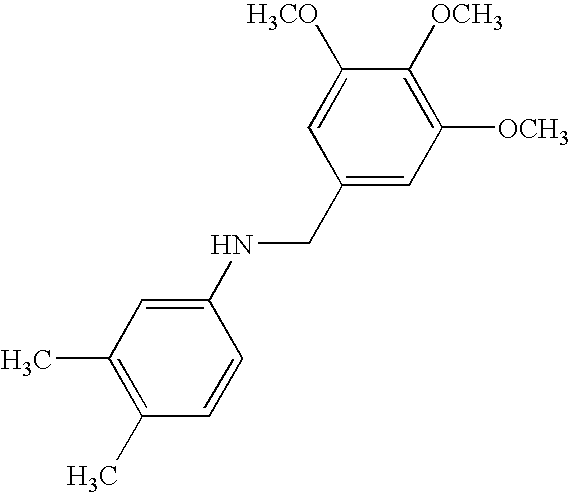
5647994 N-(3-chloro-4-(isopentyloxy)benzyl)-imidodicarbonimidamide 
5362611 8-Cyclohexyl-3-methyl-5,6-dihydro-4H-pyrazino[3,2,1-jk]carbazol-3-ium; iodide 
5541203 1-(3,5-Di-tert-butyl-4-hydroxy-phenyl)-2-(2-imino-3-methyl-2,3-dihydro-benzoimidazol-1-yl)-ethanone 
5569100 1-(3,5-Di-tert-butyl-4-hydroxy-phenyl)-2-(3-ethyl-2-imino-2,3-dihydro-benzoimidazol-1-yl)-ethanone 
5529457 1-(3,5-di-tert-butyl-4-hydroxyphenyl)-2-(2-imino-3-(2-(piperidin-1-yl)ethyl)-2,3-dihydro-1H-benzo[d]imidazol-1-yl)ethanonehydrochloride 
5651311 1-(3,5-di-tert-butyl-4-hydroxyphenyl)-2-(2-imino-3-(4-methylbenzyl)-2,3-dihydro-1H-benzo[d]imidazol-1-yl)ethanonehydrobromide 
5657593 2-(3-benzyl-2-imino-2,3-dihydro-1H-benzo[d]imidazol-1-yl)-1-(3,5-di-tert-butyl-4-hydroxyphenyl)ethanonehydrobromide 
5569100 1-(3,5-di-tert-butyl-4-hydroxyphenyl)-2-(3-ethyl-2-imino-2,3-dihydro-1H-benzo[d]imidazol-1-yl)ethanonehydrobromide 
5541203 1-(3,5-di-tert-butyl-4-hydroxyphenyl)-2-(2-imino-3-methyl-2,3-dihydro-1H-benzo[d]imidazol-1-yl)ethanonehydrobromide 
- The identified molecules included compounds 5809354 (4-(4-chloro-2-methylphenoxy))-N-hydroxybutanamide and 6094911 (N-[4-chloro-3-(trifluoromethyl)phenyl]-3-oxobutanamide), which displayed little direct toxicity at concentrations up to 80 μM, but which sensitized PPC-1 cells to 100 ng/mL CH-11 with LD50 of 20+2 μM and 35+4 μM, respectively. In contrast, other compounds such as 5703229 (1-[(4-chlorophenyl)acetyl]-4-[(2E)3-phenylprop-2-enyl]piperazine) were directly toxic with LD50 of 50+5 μM, but sensitized to CH-11 at lower concentrations with an LD50 of 34+4 μM. Compounds 5809354, 6094911, and 5703229 demonstrated synergy when combined with CH-11 using the median-dose combination index (Chou, “The Median-Effect Principle and the Combination Index for Quantitation of Synergism and Antagonism.” In: D.C. Rideout and T. C. Chou (eds.), Synergism and Antagonism in Chemotherapy, pp. 61-102: Academic Press, Inc., 1991; combination Index (CI)<1). In contrast, compound 5569100 did not demonstrate synergy with this method, likely reflecting the narrow range of concentrations over which 5569100 enhanced CH-11 killing.
- Effects of small molecule sensitizers on CH-11 killing of a spectrum of malignant cell lines. To assess the spectrum of activity of the small molecule FAS sensitizers, an additional nine malignant cell lines derived from breast, ovarian, and prostate carcinomas were treated with increasing concentrations of the sensitizers in the presence or absence of CH-11. Compound 6094911 sensitized four of ten tumor cell lines to CH-11, including OVCAR-3 (ovarian), T47D (breast), HT29 (colon), and PPC-1 (prostate cancer) cells. Compound 5809354 sensitized the same tumor lines with the exception of HT29. None of the other compounds sensitized more than four of ten tumor lines to CH-11. Among the non-responding tumor cell lines, for which 6094911 and 5809354 failed to sensitize, all except MDA-MB-468 expressed FAS antigen on the cell surface, as measured by flow cytometry using a specific fluorescinated antibody. Also, all of the non-responding cell lines, except Colo 205, had detectable levels of FLIP by immunoblotting. Thus, the failure of 609411 and 5809354 to sensitize these tumor lines to anti-FAS antibody was not due to either lack of FAS expression or absence of FLIP, with rare exception.
- Identification of small molecules that specifically sensitize to extrinsic pathway. The nine compounds identified using anti-FAS antibody screening theoretically could non-specifically sensitize tumor cells to apoptotic stimuli or they could be selective for the extrinsic pathway. To distinguish between these two possibilities, the effects of compounds on apoptosis induced by extrinsic pathway stimuli (e.g., CH-11 antibody; TRAIL) were compared to the effects on the intrinsic pathway stimuli (e.g., etoposide [VP16]; staurosporine [STS]). Accordingly, PPC-1 cells were treated with various concentrations of compounds with or without CH-11, TRAIL, VP-16, or STS, and 24 hours later, cell viability was measured by MTT assays. Of the nine candidate compounds, eight sensitized PPC-1 cells to FAS and TRAIL (death receptor pathway stimuli) but not VP-16 or STS (intrinsic pathway stimuli), suggesting they selectively modulate the extrinsic pathway. In contrast, compound 5362611 sensitized to both the death receptor (extrinsic) and mitochondrial pathway (intrinsic) stimuli, suggesting it operates downstream at the point of convergence of these two apoptotic pathways. Similar experiments were performed for compounds 6094911, 5809354, and 5569100 using OVCAR-3 and T47D tumor lines, confirming that the results are not unique to PPC-1 cells.
- Caspase-dependent induction of apoptosis by combination treatment with CH-11 and FAS-sensitizing compounds. To further assess the mechanism of the 8 compounds that selectively modulated tumor sensitivity to extrinsic pathway stimuli, the effects of benzoyl-Val-Ala-Asp-fluoromethylketone (zVAD-fmk), a broad-spectrum irreversible inhibitor of caspase-family proteases (Enzyme Systems, Dublin, Calif.) was tested. Accordingly, PPC-1 cells were treated with CH-11 and sensitizers such as 6094911, 5809354, and 5569100 with and without zVAD-fmk (100 μM) for 12 hours. Apoptosis was then measured by Annexin V staining. Consistent with a caspase-dependent mechanism of action, zVAD-fmk blocked sensitization to CH-11. Likewise, the caspase-8 inhibitory compounds acetyl-Isoleucinyl-Glutamyl-Threoninyl-Aspartyl-fluoromethylketone (Ac-IETD-fmk) (Calbiochem, San Diego, Calif.) also inhibited apoptosis induced by CH-11 in combination with these FAS-sensitizing compounds.
- To further address the specificity of the compounds for the extrinsic pathway, the effects of selective apoptosis inhibitory genes were examined. For these experiments, PPC-1 cells were transfected with plasmids encoding CrmA, a viral protein that blocks the extrinsic pathway by inhibiting caspase-8 (Zhou et al., J. Biol. Chem. 272:7797-7800, 1997) or encoding Bcl-xL, a mitochondria-targeting protein that blocks the intrinsic pathway by inhibiting release of cytochrome c (Boise et al., Cell 74:597-608, 1993; Kharbanda et al., Proc. Natl. Acad. Sci. USA 94:6939-6942, 1997). After transfection, cells were treated with CH-11 antibody and compounds 6094911, 5809354, or 55619100 scoring the percentage of apoptotic cells among the successfully transfected cells as determined by co-transfection of a GFP-marker plasmid.
- CrmA almost completely protected against apoptosis induced by the combination of CH-11 and either 6094911, 580935, or 5569100 while Bcl-XL had no protective effect. As a positive control, transfection of Bcl-XL but not Crm A protected PPC-1 cells from STS-induced apoptosis. Taken together, these results indicate that molecules such as 6094911, 5809354, and 5569100 specifically target the death receptor (extrinsic) pathway proximal to its convergence with the mitochondrial (intrinsic) pathway at the level of downstream effector caspases. Furthermore, since these compounds sensitize to both FAS and TRAIL, they presumably act distal to death receptors. Supporting this hypothesis, treatment of PPC-1 cells with either 6094911, 5809354 or 5569100 did not change the surface expression of FAS or TRAIL receptors, as measured by flow cytometry using specific fluorescinated antibodies.
- Effects of sensitizing compounds on FLIP protein. Since FAS-sensitizing compounds 6094911 and 5809354 modulate the extrinsic pathway downstream of TNF-family death receptors but upstream of effector caspases, the effects of those compounds on expression of FLIP, an intracellular antiapoptotic protein that binds caspases-8 and -10 and is capable of suppressing death receptor signaling at a proximal point within the extrinsic pathway, was examined. For these experiments, PPC-1 cells were treated with sensitizing compounds in the presence or absence of CH-11 antibody, then cell lysates were prepared 24 hours later, and analyzed by immunoblotting for FLIP. Comparisons were made with the triterpenoid, CDDO, which was previously shown to reduce FLIP protein levels and restore sensitivity of tumor cells to FAS and TRAIL (Kim et al., J. Biol. Chem. 277:22320-22329, 2002), thus serving as a positive control.
- The levels of the short isoform of FLIP were less than 5% of total FLIP protein as measured by immunoblotting and quantitative densitometry. Therefore, given the very low levels of the short isoform, the analysis was limited to the effects of the compounds on the long isoform of FLIP. Compounds 5809354 and 5569100 decreased levels of FLIP protein. Pre-treatment with z-VAD-fmk did not prevent reductions in FLIP protein, indicating that the changes in FLIP were not a secondary event mediated by caspase activation. In contrast, the other FAS-sensitizing compounds did not alter FLIP expression, indicating that they act through different mechanisms. Similar reductions in FLIP protein were observed after treating OVCAR-3, and T47D cells with 5809354. Likewise, levels of FLIP were decreased in the non-responding cell lines DU145 and MDA-MB-468 after treatment with 5809354. While these compounds reduced levels of FLIP protein, no change in levels of Bcl-2, FADD, caspase-8, or Mcl-1 were observed after treatment with these compounds.
- To determine whether the reductions in FLIP protein occurred at the level of mRNA or protein, FLIP mRNA expression was measured by Quantitative RT-PCR in cells treated with 5809354 or buffer control. Treatment with 5809354 reduced expression of FLIP mRNA in the responding and non-responding cell lines. In contrast, compounds 5569100 and 6094911 did not reduce FLIP mRNA.
- To determine whether the compounds activate the DISC in the presence of CH-11, processing of caspase-8 was analyzed by immunoblotting. Treatment of cells with the sensitizers and CH-11 activated caspase-8, as evidenced by a decrease in the proform of caspase-8 and an increase in the cleaved form.
- To test the functional importance of decreases in FLIP by 5809354, it was determined whether knocking down FLIP could recapitulate the activity of the molecule and abrogate 5809354's ability to sensitize cells to CH-11. PPC-1 cells were transfected with double stranded siRNA that targeted FLIP or luciferase as a control. At 24 hours after transfection, cells were treated with increasing concentrations of 5809354 with or without CH-11. FLIP siRNA, but not luciferase double-strand ds RNA control, sensitized PPC-1, OVCAR-3, and T47D, but not MDA-MB-468 and DU 145 cells, to CH-11, thereby recapitulating the effects of 5809354. Furthermore, in the presence of FLIP siRNA, 5809354 the longer enhanced CH-11-mediated killing. Thus, taken together, the data suggest that decreases in FLIP by 5809354 are functionally important.
- To begin exploring the relationship between the structure and function of the FAS sensitizing compounds, a series of structurally related analogs of 6094911 were evaluated. PPC-1 cells were treated with increasing concentrations of the analogues, with and without CH-11 (100 ng/mL), and cell viability was measured by a MTT assay 24 hours later, and approximate LD50 values determined (Table 2, LD50 is the concentration of compound that reduces cell viability by 50%; the chloride-substituted 3-trifluor-methyl-phenyl-amide represents the core pharmacore responsible for FAS-sensitizing activity of 6094911). Comparison of the analogs indicated that modifications of the 4-chloro-3-(trifluoromethyl)-phenyl group abolished or significantly reduced activity of the compounds. Conversely, various substituents are well tolerated in the R position (Table 2). These results suggest that the N-[4-chloro-3-(trifluoromethyl)-phenyl]-amide moiety contains a pharmacophore for the activity of 6094911, while the methyl-keto moiety is expendable (Table 2).
-
TABLE 2 LD50 (μM) LD50 (PPC1, (μM) Name Structure CH-11) (PPC1) N-[4-chloro-3-(trifluoromethyl)phenyl]-3-oxobutanamide 
35 ± 4 >100 N-[4-chloro-3-(trifluoromethyl)-phenyl]-3-phenyl-proionamide 
11 ± 1 85 ± 3 N-(4-Chloro-3-trifluoromethyl-phenyl)-3-[(pyrazine-2-carbonyl)-hydrazono]-butyramide 
11 ± 3 67 ± 3 N-[4-chloro-3-(trifluoromethyl)phenyl]-2-thiophenecar-boxamide 
35 ± 11 96 ± 1 N-[2-chloro-5-(trifluoromethyl)phenyl]-3-oxobutanamide 
65 ± 5 75 ± 1 N-[2-chloro-5-(trifluoromethyl)phenyl]-3-phenylpropan-amide 
>100 >100 N-[4-chloro-2-(trifluoromethyl)phenyl]-3-phenylpropan-amide 
>100 >100 1-(3,5-di-tert-butyl-4-hydroxyphenyl)-2-(2-imino-3-(2-(piperidin-1-yl)ethyl)-2,3-dihydro-1H-benzo[d]imidazol-1-yl)ethanonehydrochloride 
3.7 7.5 1-(3,5-di-tert-butyl-4-hydroxyphenyl)-2-(2-imino-3-(4-methylbenzyl)-2,3-dihydro-1H-benzo[d]imidazol-1-yl)ethanonehydrobromide 
9 19 2-(3-benzyl-2-imino-2,3-dihydro-1H-benzo[d]imidazol-1-yl)-1-(3,5-di-tert-butyl-4-hydroxyphenyl)ethanonehydrobromide 
3.4 9.1 1-(3,5-di-tert-butyl-4-hydroxyphenyl)-2-(3-ethyl-2-imino-2,3-dihydro-1H-benzo[d]imidazol-1-yl)ethanonehydrobromide 
5.6 15 1-(3,5-di-tert-butyl-4-hydroxyphenyl)-2-(2-imino-3-methyl-2,3-dihydro-1H-benzo[d]imidazol-1-yl)ethanonehydrobromide 
25.7 45.4 - Among the nine active compounds originally identified, two have very similar structures, 5569100 and 5541203 (Table 1). These compounds differ only by the presence of an ethyl versus a methyl substitution on the
position 3 of the dihydrobenzoimidazol group, in 5569100 and 5541203, respectively. 5569100 is approximately 5-times more potent than 5541203 as a FAS-sensitizer in PPC1 cells - (EC50 5.6 μM versus 25.7 μM) but also is three times more toxic when added alone
- (without anti-FAS antibody) to cultures of PPC1 cells (LD50 15 μM versus 45 μM). Interestingly, while 5569100 reduced FLIP expression when applied to tumor cells by itself (without anti-FAS antibody), 5541203 had little effect. This observation implies that substitution of long alkyl groups to the dihydro-benzoimidazol ring may favor FLIP suppression. Additional substitutions at this position in the dihydro-benzoimidazol ring of 5569100 may provide further compounds with improved potencies.
- Most high throughput screens are designed to identify molecules that interact with specific protein targets. In contrast, the study described here utilized a chemical biology approach to identify molecules that reverse the phenotype of FAS resistance. With the cell-based, high throughput assay, nine compounds were identified from a library of 50,000 that reversed resistance of PPC-1 cells to CH-11 anti-FAS antibody. The molecules differed in their dose-response curves with some compounds displaying FAS-independent toxicity at higher doses, while enhancing death receptor-mediated killing at lower concentrations. Some compounds such as 5934859 reversed FAS resistance only for PPC-1 cells, while other compounds such as 6094911 were more broadly acting, sensitizing 4 of 10 tumor lines to extrinsic pathway stimuli. These differences among compounds likely reflect different mechanisms of action and different cellular targets, combined with differences in FAS-resistance mechanisms among tumor cell lines. Differences in activity between cell lines may also reflect differential requirements for amplification of death receptor stimuli through the mitochondrial pathway. For example, type II cells require amplification of death receptor stimuli through the mitochondrial pathway of caspase activation to effectively induce apoptosis (Scaffidi et al., EMBO J. 17:1675-87, 1998). In these cells, blocks in the mitochondrial pathway can render these cells resistant to FAS, and thus could potentially account for resistance to the identified compounds. In type I cells, in contrast, death receptor stimuli do not require amplification through the mitochondrial pathway (Scaffidi et al., EMBO J. 17:1675-87, 1998). Of course, variations in uptake and metabolism of compounds may also contribute to the heterogeneous responses among tumor lines.
- Of the nine sensitizers to CH-11 identified by this screen, eight sensitized to the extrinsic pathway agonists CH-11 and TRAIL but not to cell death stimuli that trigger the intrinsic pathway such as VP-16 and staurosporine. Furthermore, FAS-sensitization by these eight compounds was inhibited by CrmA but not Bcl-XL, consistent with a selective effect on the extrinsic pathway. These results indicate that these compounds act selectively on targets in the extrinsic pathway, operating distal to death receptors but proximal to downstream effector caspases.
- Previous studies have shown that PPC-1 cell resistance to FAS and TRAIL can be reversed by decreasing the levels of the caspase-8 inhibitor FLIP using antisense oligonucleotides or the triterpenoid CDDO, which reduces FLIP expression (Kim et al., J. Biol. Chem. 277:22320-22329, 2002). Therefore, the effects of some of the compounds on levels of FLIP protein was assessed. Two of the compounds identified decreased levels of FLIP protein. The decrease in FLIP was not secondary to caspase activation, based on experiments using broad-spectrum caspase inhibitor zVAD-fmk. Reducing expression of endogenous FLIP using siRNA-based gene silencing recapitulated the ability of 5809354 to sensitize tumor cells to CH-11 and abrogated the ability of 5809354 to sensitize tumors further to CH-11. These data argue that FLIP is an important target of this compound, since the absence of the target nullifies the actions of 5809354 with respect to FAS-sensitization. 5809354 decreased FLIP mRNA and thus appears to act through a mechanism different than CDDO, which reduces FLIP protein by promoting its ubiquitination (Kim et al., J. Biol. Chem. 277:22320-22329, 2002). Of note, other extrinsic pathway modulating compounds such as 6094911 did not alter levels of FLIP protein, indicating that they act through different mechanisms.
- A preliminary analysis was conducted to determine functional groups important for the activity of one of the compounds, 6094911, which enhanced FAS-induced killing of several tumor cell lines. For compound 6094911, the N-[4-chloro-3-(trifluoromethyl)-phenyl]-amide moiety appeared necessary for activity. Moving the trifluoromethyl group from the third position of the phenyl ring abolished activity of an active analog, as did moving the chloro atom from the fourth position. In contrast, a variety of substitutions are well tolerated at the R group suggesting that this position is not critical for the FAS-sensitizing activity of the compounds. Accordingly, the compounds could be derivatized at this position with affinity labels (i.e., biotin) that could results very useful to identify cellular targets of 6094911. Furthermore, the initial SAR data reported here provide some guidance for the design and synthesis of second generation compounds that may be more potent than the parent and potentially more amenable to clinical use.
- In summary, compounds were identified that sensitize a spectrum of resistant cancer cells to death receptor ligand stimulation. These compounds may serve as prototypes for development of novel therapeutic adjuncts for the treatment of malignancy based on immune-based treatments such as recombinant TRAIL, agonistic anti-TRAIL antibodies, or tumor vaccines. In addition, these compounds provide new research tools for chemical biological experiments aimed at understanding mechanisms of resistance to TNF-family death ligands and death receptors.
- Reagents: The 2,000-compound Spectrum Collection chemical library consisting of biologically active compounds from a collection of natural products, known drugs, and experimental biological active compounds was obtained from Microsource Discovery Systems, Inc. (Gaylordsville, Conn.). The anti-FAS monoclonal antibody CH-11 was purchased from MBL (MBL, Co. Ltd., Nagoya, Japan). TRAIL was obtained from Biomol (Plymouth Meeting, Pa.). VP-16 and Staurosporine were purchased from Sigma (Sigma Inc., Milwaukee, Wis.). 2-cyano-3,12-dioxooleana-1,9-dien-28-oic acid (CDDO) was synthesized as described (Honda et al., Bioorg Med Chem. Lett. 8: 2711-2714, 1998).
- Cell Lines: Cell lines were maintained in RPMI 1640 supplemented with 2.5-10% fetal calf serum (FCS) (Hyclone, Tulare, Calif.), 1 mM L-glutamine and antibiotics (streptomycin/penicillin). Cells were cultured at 37° C. in a humidified atmosphere with 5% CO2.
- High throughput screening: Screens were performed using a fully integrated, programmable robotic liquid handling system (Biomek® FX, Beckman-Coulter Inc., Fullerton, Calif.), with integrated plate reader (LJL analyst HT 96-384, Sunnyvale, Calif.) and environmentally controlled plate carousel set at 37° C. and 5% CO2/95% air. PPC-1 cells (1×10⁴) were seeded overnight into 96-well, flat-bottom plates (Costar, Cambridge, Mass.) in 100 μL of medium containing 2.5% FCS. The next day, aliquots from the 2,000 compound Spectrum Collection library were added at a final concentration of 25 μM in a final concentration of 0.5% (v:v) dimethylsulfoxide (DMSO). CH-11 antibody (100 ng/mL) was then added, and the cells were incubated for 24 hrs before assessing cell viability by 3-(4,5-Dimethylthiazol-2-yl)-2,5-diphenyltetrazolium Bromide (MTT) dye reduction assay (Sigma).
- Cell death assays: Cell viability was measured by MTT and MTS assays, essentially as previously described (Schimmer, Cancer Cell 5:25-35, 2004). Absorbance readings were plotted against a standard curve to derive the corresponding cell number and cell viability was expressed as a percentage relative to untreated cells.
- Immunoblot analysis: Protein extracts were obtained by washing cells with phosphate-buffered saline (PBS) (pH 7.4) and suspending in lysis buffer (10 mM Tris [pH 7.4], 150 mM NaCl, 0.1% Triton X-100, 0.5% sodium deoxycholate, and 5 mM EDTA) containing protease inhibitors (Complete tablets; Roche, Indianapolis, Ind.). Immunoblot assays were performed as described previously (Carter et al., Blood 105:4043-50, 2005). Briefly, equal amounts of protein as determined by Bradford assay (Bradford, Anal. Biochem. 72:248-54, 1976) were subjected to SDS-PAGE (4-20% gradient gels from ISC BioExpress, Kaysville, Utah), followed by transfer to nitrocellulose membranes. Membranes were incubated with mouse monoclonal anti-human FLIP (NF6 clone) (1:500 v/v) (Alexis, San Diego, Calif.), 1:1,000 (v/v) anti-caspase-8 clone 5F7 (Upstate) and mouse monoclonal anti-tubulin (1:2000 v/v) (Sigma Inc). Secondary antibodies consisted of horseradish peroxidase-conjugated goat anti-rabbit IgG or goat anti-mouse IgG (Bio-Rad, Hercules, Calif.). Detection was performed by the enhanced chemiluminescence method (Pierce, Rockford, Ill.).
- Screening of a library of natural products identifies Cyclosporine A as Fas-sensitizer. The Spectrum Collection (Microsource Discovery Systems, Inc.) of 2,000 natural products library was screened using PPC-1 cells and agonistic Fas antibody (CH-11) as described above. Of the 2,000 compounds screened, 89 produced a reduction in cell viability>50% as determined by the MTS assay. Of these 89 hits, six compounds selectively sensitized PPC-1 cells to Fas at 2.5, 5, 10, and 25 uM and did not kill PPC-1 cells when applied without anti-Fas antibody. These six compounds were then tested for ability to sensitize other tumor cell lines besides PPC-1 to anti-Fas antibody. Of these six compounds, only Cyclosporin A (CsA) displayed an ability to sensitize multiple tumor cell lines. A summary of the screening results is provided in
FIG. 1 . - Cyclosporine A (CsA) increases sensitivity of tumor cells to stimuli of the extrinsic but not intrinsic apoptosis pathway.
FIG. 2 shows that CsA sensitizes tumor cells to apoptosis induction by extrinsic pathway stimuli (agonistic anti-Fas antibody and TNF-family ligand TRAIL) but not intrinsic pathway stimuli VP16 (topoisomerase inhibitor) and Staurosporine (STS). PPC-1 prostate cancer cells (1×10⁴) were seeded overnight in 96-well plates. Cells were then treated overnight with varying concentrations of Cyclosporin A (0, 0.5, 1, 2, and 4 uM) in combination with varying concentrations of one of the following stimuli: Fas (0, 25, 50, 100, 200 ng/ml), TRAIL (0, 50, 100, 200, 400 ng/ml), VP-16 (0, 25, 50, 100, 200 uM) or STS (0, 0.25, 0.5, 1.0, and 2.0 nM). After 20-24 hours treatment, MTS was added and incubated for 4 hours. OD490 was measured and cell viability numbers were calculated as percent of control values (mean ±SEM; n=3). -
FIG. 3 shows results from similar experiment performed using OVCAR-3 ovarian cancer cells, comparing the extrinsic pathway stimulus TRAIL with intrinsic pathway stimuli, VP16 and Paclitaxel (TAXOL) (microtubule aggregator). OVCAR-3 cells (1×10⁴) were seeded overnight in 96-well plates. Cells were treated varying concentrations of Cyclosporin A (0, 0.5, 1, 2, and 4 uM) in combination with varying concentrations of one of the following stimuli: TRAIL (0, 50, 100, 200, 400 ng/ml), VP-16 (0, 25, 50, 100, 200 uM) or TAXOL (0, 25, 0.50, 100, and 200 nM). Cell viability was determined by MTS assay one day later (mean ±SEM; n=3). Concentrations of CsA and TRAIL that resulted in synergistic induction of apoptosis are shown at the right side of the figure. -
FIG. 4 shows examples of additional tumor cell lines where CsA sensitized to apoptosis induced by agonistic anti-Fas antibody CH11. Tumor cell lines included T47D and BT-549 breast cancers, HCT-15 colon cancer, IGROV-1 ovarian cancer, PPC1, ALVA-31, Du-145, and LNCaP prostate cancers, and U031, A498, 786-0, and RXF-393 renal cell cancer cell lines. Tumor cells were seeded overnight at 1×10⁴ to 5×10⁴ (based on cell type, size, and rate of growth) in RPMI, DMEM, McCoy's 5A MM, or Iscove's MEM containing 10% fetal bovine serum (FBS) with 2% Penicillin-Streptomycin in 96-well plates. Cells were then treated with increasing concentrations of Cyclosporin A (0 to 100 uM) in the presence or absence of agonistic Fas antibody (CH-11) at 100 ng/ml in the appropriate medium containing 2.5% FBS and antibiotics. After 20 to 24 hours, MTS was added and incubated for 4 hours. OD490 measurements were taken and cell viability numbers were calculated as percent of control values. -
FIG. 5 shows results from a similar experiment that was performed to examine the ability of CsA to sensitize various tumor cell lines to TRAIL, a cytokine member of the TNF family that also activates the extrinsic pathway for apoptosis. Tumor cell lines, including T47D, BT-549, MDA-MB-231, and MDA-MB-435 breast cancers, HT29, HCT116, HCT15, KM12, and COL0205 colon cancers, SK-OV3, OVCAR-3, and OVCAR-5 ovarian cancers, ALVA-31, PPC-1, PC3, and LNCaP prostate cancers, and - A498, 786-0, and RXF-393 renal cell carcinoma cells, were seeded overnight at 1×10⁴ to 5×10⁴ (based on cell type, size, and rate of growth) in RPMI, DMEM, McCoy's 5A MM, or Iscove's MEM containing 10% fetal bovine serum (FBS) with 2% Penicillin-Streptomycin in 96-well plates. Tumor cells were then treated with increasing concentrations of Cyclosporine A (0 to 100 μM) in the presence or absence of recombinant TRAIL (Apo2L) at 100 ng/ml in the appropriate medium containing 2.5% FBS and antibiotics. After 20 to 24 hours, MTS was added and incubated for four hours. OD490 measurements were performed and percentage cell viability was calculated by comparison to control untreated cells.
-
FIG. 6 shows results of isobologram analysis that was performed to mathematically explore synergy of CsA with extrinsic pathway stimuli anti-FAS and TRAIL. Using data from PPC-1 cells, where checker-board titrations were performed at fixed molar ratios of CsA: Fas or CsA:TRAIL, isobologram analysis was performed using BioSyn software. The combination index (CI) was calculated with respect to the effective dose to achieve killing of 50%, 75%, or 90% of cells. CI values<0.3 indicate strong synergism. - All publications, patents and patent applications are incorporated herein by reference. While in the foregoing specification, this invention has been described in relation to certain preferred embodiments thereof, and many details have been set forth for purposes of illustration, it will be apparent to those skilled in the art that the invention is susceptible to additional embodiments and that certain of the details herein may be varied considerably without departing from the basic principles of the invention.
Claims (29)
1. A method of treating a cancer in a mammal in need of such treatment, comprising administrating to the mammal an amount of a composition comprising cyclosporin A that is effective to increase killing of cells of the cancer mediated by a TNF-family death receptor ligand.
2. The method of claim 1 wherein the TNF-family death receptor ligand is selected from the group consisting of TNF-α, Fas, lymphotoxin-α, TRAIL, DR3 ligand, DR6 ligand, and NGF.
3. The method of claim 2 wherein the TNF-family death receptor ligand is TRAIL.
4. The method of claim 2 wherein the TNF-family death receptor ligand is Fas.
5. The method of claim 1 wherein the TNF-family death receptor ligand is an antagonistic antibody directed against a member of the group consisting of TNFR1, FAS, DR3, DR4, DR5, DR6, and P75NTR.
6. The method of claim 1 further comprising administering to the mammal a composition comprising the TNF-family death receptor ligand.
7. The method of claim 6 comprising co-administering the composition comprising cyclosporin and the composition comprising the TNF-family death receptor ligand.
8. The method of claim 1 wherein the composition comprising cyclosporin A further comprises the TNF-family death receptor ligand.
9. The method of claim 1 further comprising administering to the mammal a composition comprising a compound of formulas (I)-(VII).
10. The method of claim 9 comprising co-administering the composition comprising cyclosporin and the composition comprising a compound of formulas (I)-(VII).
11. The method of claim 1 wherein the composition comprising cyclosporin A further comprises a compound of formulas (I)-(VII).
12. The method of claim 1 further comprising administering to the mammal a composition comprising an anti-cancer agent.
13. The method of claim 12 comprising co-administering the composition comprising cyclosporin A and the composition comprising the anti-cancer agent.
14. The method of claim 1 wherein the composition comprising cyclosporin A further comprises an anti-cancer agent.
15. The method of claim 1 wherein the cancer is selected from the group consisting of lung cancer, colon cancer, breast cancer, prostate cancer, stomach cancer, ovarian cancer, liver cancer, brain cancer, skin cancer, and blood cancer.
16. The method of claim 1 wherein the mammal is a human.
17. A method of increasing killing of cells of a cancer that is resistant to killing mediated by a TNF-family death receptor ligand, the method comprising contacting the cells ex vivo with an effective amount of a composition comprising cyclosporin A.
18. A method to enhance the efficacy of a vaccine against a cancer, comprising administering to a mammal having a cancer an effective amount of the vaccine and administering an amount of a composition comprising cyclosporin A that is effective to increase killing of cells of the cancer.
19. The method of claim 18 comprising co-administering the composition comprising cyclosporin A and the vaccine.
20. The method of claim 19 comprising administering the composition comprising cyclosporin A after administering the vaccine.
21. The method of claim 19 comprising administering the composition comprising cyclosporin A before administering the vaccine.
22. A method for identifying an agent that enhances killing of cells of a cancer that is resistant to killing mediated by a TNF-family death receptor ligand, the method comprising: (a) contacting a test sample of the cells under suitable conditions with: a composition comprising cyclosporin A; a composition comprising the agent; and a composition comprising the ligand; and (b) comparing death of the cells in the test sample to death of the cells in a control sample lacking the agent.
23. A composition for treating a cancer that is resistant to killing mediated by a TNF-family death receptor ligand, the composition comprising the ligand and an amount of cyclosporin A that is effective to increase killing of the cancer mediated by the ligand.
24. The composition of claim 23 wherein the TNF-family death receptor ligand is selected from the group consisting of TNF-α, Fas, lymphotoxin-α, TRAIL, DR3 ligand, DR6 ligand, and NGF.
25. The composition of claim 24 wherein the TNF-family death receptor ligand is TRAIL.
26. The composition of claim 24 wherein the TNF-family death receptor ligand is Fas.
27. The composition of claim 23 wherein the TNF-family death receptor ligand is an antagonistic antibody directed against a member of the group consisting of TNFR1, FAS, DR3, DR4, DR5, DR6, and P75NTR.
28. A kit for treating a cancer that is resistant to killing mediated by a TNF-family death receptor ligand, the kit comprising a composition comprising an amount of cyclosporin A that is effective to increase killing of the cancer mediated by the ligand, a composition comprising the ligand, and instructions for use.
29. A kit for treating a cancer that is resistant to killing mediated by a TNF-family death receptor ligand, the kit comprising (a) a composition comprising the ligand and an amount of cyclosporin A that is effective to increase killing of the cancer mediated by the ligand, and (b) instructions for use.
Priority Applications (1)
| Application Number | Priority Date | Filing Date | Title |
|---|---|---|---|
| US11/901,582 US20080206287A1 (en) | 2006-09-18 | 2007-09-17 | Use of cyclosporin A to sensitize resistant cancer cells to death receptor ligands |
Applications Claiming Priority (2)
| Application Number | Priority Date | Filing Date | Title |
|---|---|---|---|
| US84571606P | 2006-09-18 | 2006-09-18 | |
| US11/901,582 US20080206287A1 (en) | 2006-09-18 | 2007-09-17 | Use of cyclosporin A to sensitize resistant cancer cells to death receptor ligands |
Publications (1)
| Publication Number | Publication Date |
|---|---|
| US20080206287A1 true US20080206287A1 (en) | 2008-08-28 |
Family
ID=39200807
Family Applications (1)
| Application Number | Title | Priority Date | Filing Date |
|---|---|---|---|
| US11/901,582 Abandoned US20080206287A1 (en) | 2006-09-18 | 2007-09-17 | Use of cyclosporin A to sensitize resistant cancer cells to death receptor ligands |
Country Status (2)
| Country | Link |
|---|---|
| US (1) | US20080206287A1 (en) |
| WO (1) | WO2008036244A1 (en) |
Cited By (2)
| Publication number | Priority date | Publication date | Assignee | Title |
|---|---|---|---|---|
| WO2012145426A1 (en) * | 2011-04-18 | 2012-10-26 | The Trustees Of Columbia University In The City Of New York | Methods to treat cancer using cyclosporine and cyclosporine derivatives |
| WO2013165606A1 (en) * | 2012-05-04 | 2013-11-07 | The United States Of America, As Represented By The Secretary, Department Of Health And Human Services | Modulators of the relaxin receptor 1 |
Families Citing this family (2)
| Publication number | Priority date | Publication date | Assignee | Title |
|---|---|---|---|---|
| CN104619687A (en) * | 2012-06-01 | 2015-05-13 | 诺格拉制药有限公司 | Bicyclic heterocycles capable of modulating t-cell responses, and methods of using same |
| US9013997B2 (en) | 2012-06-01 | 2015-04-21 | Broadcom Corporation | System for performing distributed data cut-through |
Citations (12)
| Publication number | Priority date | Publication date | Assignee | Title |
|---|---|---|---|---|
| US4108985A (en) * | 1975-11-04 | 1978-08-22 | Sandoz Ltd. | Dihydrocyclosporin c |
| US4210581A (en) * | 1975-11-04 | 1980-07-01 | Sandoz Ltd. | Organic compounds |
| US4220641A (en) * | 1977-05-10 | 1980-09-02 | Sandoz Ltd. | Organic compounds |
| US4288431A (en) * | 1978-10-18 | 1981-09-08 | Sandoz Ltd. | Cyclosporin derivatives, their production and pharmaceutical compositions containing them |
| US4384996A (en) * | 1981-01-09 | 1983-05-24 | Sandoz Ltd. | Novel cyclosporins |
| US4396542A (en) * | 1980-02-14 | 1983-08-02 | Sandoz Ltd. | Method for the total synthesis of cyclosporins, novel cyclosporins and novel intermediates and methods for their production |
| US4554351A (en) * | 1980-02-14 | 1985-11-19 | Sandoz Ltd. | Method for the total synthesis of cyclosporins, novel cyclosporins and novel intermediates and methods for their production |
| US4771122A (en) * | 1985-03-11 | 1988-09-13 | Sandoz Ltd. | Novel cyclosporins |
| US4938949A (en) * | 1988-09-12 | 1990-07-03 | University Of New York | Treatment of damaged bone marrow and dosage units therefor |
| US5284826A (en) * | 1989-07-24 | 1994-02-08 | Sandoz Ltd. | 0-hydroxyethyl and acyloxyethyl derivatives of [ser]8 cyclosporins |
| US5525590A (en) * | 1987-06-17 | 1996-06-11 | Sandoz Ltd. | Cyclosporins and their use as pharmaceuticals |
| US20040147433A1 (en) * | 2001-06-14 | 2004-07-29 | Marcus Keep | Neuroimmunophilins for selective neuronal radioprotection |
Family Cites Families (1)
| Publication number | Priority date | Publication date | Assignee | Title |
|---|---|---|---|---|
| US6811788B2 (en) * | 2000-01-19 | 2004-11-02 | Baofa Yu | Combinations and methods for treating neoplasms |
-
2007
- 2007-09-17 WO PCT/US2007/020157 patent/WO2008036244A1/en not_active Ceased
- 2007-09-17 US US11/901,582 patent/US20080206287A1/en not_active Abandoned
Patent Citations (12)
| Publication number | Priority date | Publication date | Assignee | Title |
|---|---|---|---|---|
| US4108985A (en) * | 1975-11-04 | 1978-08-22 | Sandoz Ltd. | Dihydrocyclosporin c |
| US4210581A (en) * | 1975-11-04 | 1980-07-01 | Sandoz Ltd. | Organic compounds |
| US4220641A (en) * | 1977-05-10 | 1980-09-02 | Sandoz Ltd. | Organic compounds |
| US4288431A (en) * | 1978-10-18 | 1981-09-08 | Sandoz Ltd. | Cyclosporin derivatives, their production and pharmaceutical compositions containing them |
| US4396542A (en) * | 1980-02-14 | 1983-08-02 | Sandoz Ltd. | Method for the total synthesis of cyclosporins, novel cyclosporins and novel intermediates and methods for their production |
| US4554351A (en) * | 1980-02-14 | 1985-11-19 | Sandoz Ltd. | Method for the total synthesis of cyclosporins, novel cyclosporins and novel intermediates and methods for their production |
| US4384996A (en) * | 1981-01-09 | 1983-05-24 | Sandoz Ltd. | Novel cyclosporins |
| US4771122A (en) * | 1985-03-11 | 1988-09-13 | Sandoz Ltd. | Novel cyclosporins |
| US5525590A (en) * | 1987-06-17 | 1996-06-11 | Sandoz Ltd. | Cyclosporins and their use as pharmaceuticals |
| US4938949A (en) * | 1988-09-12 | 1990-07-03 | University Of New York | Treatment of damaged bone marrow and dosage units therefor |
| US5284826A (en) * | 1989-07-24 | 1994-02-08 | Sandoz Ltd. | 0-hydroxyethyl and acyloxyethyl derivatives of [ser]8 cyclosporins |
| US20040147433A1 (en) * | 2001-06-14 | 2004-07-29 | Marcus Keep | Neuroimmunophilins for selective neuronal radioprotection |
Non-Patent Citations (4)
| Title |
|---|
| Dermer, Bio-Technology, 1994, 12:320 * |
| Freshney, Culture of Animal Cells, A Manual of Basic Technique, Alan R. Liss, Inc. 1983, New York, p4 * |
| Gura, Science, 1997, vol. 278, pp-1041-1042 * |
| Micheau et al., J. Natl. Cancer Inst. 1997; 89; 783-9 * |
Cited By (6)
| Publication number | Priority date | Publication date | Assignee | Title |
|---|---|---|---|---|
| WO2012145426A1 (en) * | 2011-04-18 | 2012-10-26 | The Trustees Of Columbia University In The City Of New York | Methods to treat cancer using cyclosporine and cyclosporine derivatives |
| US20140154340A1 (en) * | 2011-04-18 | 2014-06-05 | The Trustees Of Columbia University In The City Of New York | Methods to treat cancer using cyclosporine and cyclosporine derivatives |
| US9387230B2 (en) * | 2011-04-18 | 2016-07-12 | The Trustees Of Columbia University In The City Of New York | Methods to treat cancer using cyclosporine and cyclosporine derivatives |
| WO2013165606A1 (en) * | 2012-05-04 | 2013-11-07 | The United States Of America, As Represented By The Secretary, Department Of Health And Human Services | Modulators of the relaxin receptor 1 |
| US9452973B2 (en) | 2012-05-04 | 2016-09-27 | The United States Of America, As Represented By The Secretary Department Of Health And Human Services | Modulators of the relaxin receptor 1 |
| US10125112B2 (en) | 2012-05-04 | 2018-11-13 | The United States Of America, As Represented By The Secretary, Department Of Health And Human Services | Modulators of the relaxin receptor 1 |
Also Published As
| Publication number | Publication date |
|---|---|
| WO2008036244A1 (en) | 2008-03-27 |
Similar Documents
| Publication | Publication Date | Title |
|---|---|---|
| EP3213752B1 (en) | Composition for treating cancer stem cells | |
| CA2520406A1 (en) | Cxcr4 antagonists and methods of their use | |
| KR102358632B1 (en) | Composition for preventing or treating colon cancer comprising streptonigrin and anticancer agent | |
| US9795595B2 (en) | Methods for treating cancer | |
| Mihailidou et al. | Superior efficacy of the antifungal agent ciclopirox olamine over gemcitabine in pancreatic cancer models | |
| US8008354B2 (en) | Death receptor sensitizing compounds and methods of use therefor | |
| US20200368180A1 (en) | Deacetylnemorone Abietane Diterpenoids for Use in Cancer Treatment | |
| US20080206287A1 (en) | Use of cyclosporin A to sensitize resistant cancer cells to death receptor ligands | |
| US20220047546A1 (en) | Combination cancer therapies | |
| US20110306671A1 (en) | Amide derivatives of ethacrynic acid | |
| WO2019113155A1 (en) | Oxabicycloheptanes for treatment of secondary acute myeloid leukemia | |
| US20090176888A1 (en) | Composition comprising phytosphingosine or derivative thereof | |
| US12521425B2 (en) | Method of liver cancer treatment with safranal-based formulations | |
| US20180153870A1 (en) | Biperiden for treating cancer | |
| US20090163577A1 (en) | METHODS AND COMPOSITIONS FOR ANTAGONIZING ANTI-APOPTOTIC Bcl-2-FAMILY PROTEINS | |
| US20250144054A1 (en) | Small molecule stat3 inhibitor for treating triple negative breast cancer | |
| US20180353439A1 (en) | Pimarane Diterpenoids for Use in Cancer Treatment | |
| WO2005072528A1 (en) | Anticancer glycoside compounds | |
| US20200253890A1 (en) | Suppression and Inhibition of CDC25B with Safranal-Based Formulations | |
| US20260027126A1 (en) | Combination therapy for treating cancers | |
| EP4365590B1 (en) | Agent targeting double-membrane organelle dna | |
| AU2019264662B2 (en) | Suppression and inhibition of cdc25b with safranal-based formulations | |
| US10420747B2 (en) | Cancer treatment method using ailanthone compounds | |
| KR20230009454A (en) | Myristoyl derivatives of 9-amino-doxycycline for cancer stem cell targeting and metastasis prevention | |
| HK1229695A1 (en) | Novel methods for treating cancer |
Legal Events
| Date | Code | Title | Description |
|---|---|---|---|
| STCB | Information on status: application discontinuation |
Free format text: ABANDONED -- FAILURE TO RESPOND TO AN OFFICE ACTION |