US20080200510A1 - Combination of Organic Compounds - Google Patents
Combination of Organic Compounds Download PDFInfo
- Publication number
- US20080200510A1 US20080200510A1 US11/995,251 US99525106A US2008200510A1 US 20080200510 A1 US20080200510 A1 US 20080200510A1 US 99525106 A US99525106 A US 99525106A US 2008200510 A1 US2008200510 A1 US 2008200510A1
- Authority
- US
- United States
- Prior art keywords
- pharmaceutically acceptable
- combination
- dpp
- disease
- acceptable salt
- Prior art date
- Legal status (The legal status is an assumption and is not a legal conclusion. Google has not performed a legal analysis and makes no representation as to the accuracy of the status listed.)
- Abandoned
Links
- 150000002894 organic compounds Chemical class 0.000 title 1
- 208000037265 diseases, disorders, signs and symptoms Diseases 0.000 claims abstract description 115
- 102100025012 Dipeptidyl peptidase 4 Human genes 0.000 claims abstract description 113
- 108010067722 Dipeptidyl Peptidase 4 Proteins 0.000 claims abstract description 110
- 239000003112 inhibitor Substances 0.000 claims abstract description 97
- 208000035475 disorder Diseases 0.000 claims abstract description 66
- 150000003839 salts Chemical class 0.000 claims abstract description 60
- 238000011282 treatment Methods 0.000 claims abstract description 45
- 229940124802 CB1 antagonist Drugs 0.000 claims abstract description 43
- 201000009032 substance abuse Diseases 0.000 claims abstract description 23
- 208000011117 substance-related disease Diseases 0.000 claims abstract description 21
- 231100000736 substance abuse Toxicity 0.000 claims abstract description 19
- 230000002265 prevention Effects 0.000 claims abstract description 18
- 230000005764 inhibitory process Effects 0.000 claims abstract description 17
- 238000002360 preparation method Methods 0.000 claims abstract description 8
- 208000037765 diseases and disorders Diseases 0.000 claims abstract description 7
- 150000001875 compounds Chemical class 0.000 claims description 159
- 201000010099 disease Diseases 0.000 claims description 48
- 238000000034 method Methods 0.000 claims description 45
- SYOKIDBDQMKNDQ-XWTIBIIYSA-N vildagliptin Chemical compound C1C(O)(C2)CC(C3)CC1CC32NCC(=O)N1CCC[C@H]1C#N SYOKIDBDQMKNDQ-XWTIBIIYSA-N 0.000 claims description 43
- JZCPYUJPEARBJL-UHFFFAOYSA-N rimonabant Chemical compound CC=1C(C(=O)NN2CCCCC2)=NN(C=2C(=CC(Cl)=CC=2)Cl)C=1C1=CC=C(Cl)C=C1 JZCPYUJPEARBJL-UHFFFAOYSA-N 0.000 claims description 41
- 229960001254 vildagliptin Drugs 0.000 claims description 38
- 229960003015 rimonabant Drugs 0.000 claims description 37
- 208000024827 Alzheimer disease Diseases 0.000 claims description 29
- 206010012601 diabetes mellitus Diseases 0.000 claims description 29
- 210000000577 adipose tissue Anatomy 0.000 claims description 27
- 208000031226 Hyperlipidaemia Diseases 0.000 claims description 26
- 230000001771 impaired effect Effects 0.000 claims description 25
- 208000008589 Obesity Diseases 0.000 claims description 23
- 235000020824 obesity Nutrition 0.000 claims description 23
- -1 GSK23A Chemical compound 0.000 claims description 22
- 241001465754 Metazoa Species 0.000 claims description 21
- 208000001072 type 2 diabetes mellitus Diseases 0.000 claims description 21
- 230000009467 reduction Effects 0.000 claims description 19
- 208000018737 Parkinson disease Diseases 0.000 claims description 18
- 239000008103 glucose Substances 0.000 claims description 17
- WQZGKKKJIJFFOK-GASJEMHNSA-N Glucose Natural products OC[C@H]1OC(O)[C@H](O)[C@@H](O)[C@@H]1O WQZGKKKJIJFFOK-GASJEMHNSA-N 0.000 claims description 16
- 230000001965 increasing effect Effects 0.000 claims description 16
- 208000010125 myocardial infarction Diseases 0.000 claims description 16
- 208000010877 cognitive disease Diseases 0.000 claims description 14
- 230000002526 effect on cardiovascular system Effects 0.000 claims description 14
- 201000000980 schizophrenia Diseases 0.000 claims description 14
- 208000002705 Glucose Intolerance Diseases 0.000 claims description 13
- 230000003920 cognitive function Effects 0.000 claims description 13
- 201000009104 prediabetes syndrome Diseases 0.000 claims description 13
- 125000002924 primary amino group Chemical group [H]N([H])* 0.000 claims description 12
- 102100040214 Apolipoprotein(a) Human genes 0.000 claims description 10
- 101710115418 Apolipoprotein(a) Proteins 0.000 claims description 10
- 201000001320 Atherosclerosis Diseases 0.000 claims description 10
- 208000025865 Ulcer Diseases 0.000 claims description 9
- 230000007278 cognition impairment Effects 0.000 claims description 9
- 239000003937 drug carrier Substances 0.000 claims description 9
- 206010012289 Dementia Diseases 0.000 claims description 8
- 241000124008 Mammalia Species 0.000 claims description 8
- 230000036269 ulceration Effects 0.000 claims description 8
- 208000018522 Gastrointestinal disease Diseases 0.000 claims description 7
- 230000004153 glucose metabolism Effects 0.000 claims description 7
- 208000027061 mild cognitive impairment Diseases 0.000 claims description 7
- 208000007342 Diabetic Nephropathies Diseases 0.000 claims description 6
- 208000032131 Diabetic Neuropathies Diseases 0.000 claims description 6
- 206010012689 Diabetic retinopathy Diseases 0.000 claims description 6
- 206010042434 Sudden death Diseases 0.000 claims description 6
- 208000026106 cerebrovascular disease Diseases 0.000 claims description 6
- 208000033679 diabetic kidney disease Diseases 0.000 claims description 6
- QGJUIPDUBHWZPV-SGTAVMJGSA-N saxagliptin Chemical compound C1C(C2)CC(C3)CC2(O)CC13[C@H](N)C(=O)N1[C@H](C#N)C[C@@H]2C[C@@H]21 QGJUIPDUBHWZPV-SGTAVMJGSA-N 0.000 claims description 6
- MFFMDFFZMYYVKS-SECBINFHSA-N sitagliptin Chemical compound C([C@H](CC(=O)N1CC=2N(C(=NN=2)C(F)(F)F)CC1)N)C1=CC(F)=C(F)C=C1F MFFMDFFZMYYVKS-SECBINFHSA-N 0.000 claims description 6
- AJFFBPZYXRNAIC-UHFFFAOYSA-N 1-(2,4-dichlorophenyl)-5-(4-iodophenyl)-4-methyl-N-(4-morpholinyl)-3-pyrazolecarboxamide Chemical compound CC=1C(C(=O)NN2CCOCC2)=NN(C=2C(=CC(Cl)=CC=2)Cl)C=1C1=CC=C(I)C=C1 AJFFBPZYXRNAIC-UHFFFAOYSA-N 0.000 claims description 5
- BUZAJRPLUGXRAB-UHFFFAOYSA-N AM-251 Chemical compound CC=1C(C(=O)NN2CCCCC2)=NN(C=2C(=CC(Cl)=CC=2)Cl)C=1C1=CC=C(I)C=C1 BUZAJRPLUGXRAB-UHFFFAOYSA-N 0.000 claims description 5
- 208000032928 Dyslipidaemia Diseases 0.000 claims description 5
- 208000017170 Lipid metabolism disease Diseases 0.000 claims description 5
- 206010039966 Senile dementia Diseases 0.000 claims description 5
- 229960004937 saxagliptin Drugs 0.000 claims description 5
- 108010033693 saxagliptin Proteins 0.000 claims description 5
- 229960004034 sitagliptin Drugs 0.000 claims description 5
- DLFVBJFMPXGRIB-UHFFFAOYSA-N thioacetamide Natural products CC(N)=O DLFVBJFMPXGRIB-UHFFFAOYSA-N 0.000 claims description 4
- NKOHRVBBQISBSB-UHFFFAOYSA-N 5-[(4-hydroxyphenyl)methyl]-1,3-thiazolidine-2,4-dione Chemical compound C1=CC(O)=CC=C1CC1C(=O)NC(=O)S1 NKOHRVBBQISBSB-UHFFFAOYSA-N 0.000 claims description 2
- 229940100389 Sulfonylurea Drugs 0.000 claims description 2
- 230000003178 anti-diabetic effect Effects 0.000 claims description 2
- 239000003472 antidiabetic agent Substances 0.000 claims description 2
- XZWYZXLIPXDOLR-UHFFFAOYSA-N metformin Chemical compound CN(C)C(=N)NC(N)=N XZWYZXLIPXDOLR-UHFFFAOYSA-N 0.000 claims description 2
- 229960003105 metformin Drugs 0.000 claims description 2
- 239000008194 pharmaceutical composition Substances 0.000 abstract description 23
- 230000000694 effects Effects 0.000 description 52
- HVYWMOMLDIMFJA-DPAQBDIFSA-N cholesterol Chemical compound C1C=C2C[C@@H](O)CC[C@]2(C)[C@@H]2[C@@H]1[C@@H]1CC[C@H]([C@H](C)CCCC(C)C)[C@@]1(C)CC2 HVYWMOMLDIMFJA-DPAQBDIFSA-N 0.000 description 35
- 230000037396 body weight Effects 0.000 description 31
- 238000012360 testing method Methods 0.000 description 26
- 239000000126 substance Substances 0.000 description 23
- 239000003814 drug Substances 0.000 description 22
- 230000002354 daily effect Effects 0.000 description 21
- 241000700159 Rattus Species 0.000 description 20
- 235000019789 appetite Nutrition 0.000 description 17
- 230000036528 appetite Effects 0.000 description 17
- 229940079593 drug Drugs 0.000 description 17
- 235000012631 food intake Nutrition 0.000 description 16
- 208000016261 weight loss Diseases 0.000 description 16
- 108010007622 LDL Lipoproteins Proteins 0.000 description 15
- 102000007330 LDL Lipoproteins Human genes 0.000 description 15
- 239000005557 antagonist Substances 0.000 description 15
- 208000029078 coronary artery disease Diseases 0.000 description 14
- 239000000203 mixture Substances 0.000 description 14
- 230000004580 weight loss Effects 0.000 description 14
- PEDCQBHIVMGVHV-UHFFFAOYSA-N Glycerine Chemical compound OCC(O)CO PEDCQBHIVMGVHV-UHFFFAOYSA-N 0.000 description 12
- 210000004027 cell Anatomy 0.000 description 12
- 235000012000 cholesterol Nutrition 0.000 description 12
- 230000003647 oxidation Effects 0.000 description 12
- 238000007254 oxidation reaction Methods 0.000 description 12
- 239000003826 tablet Substances 0.000 description 12
- 102000009132 CB1 Cannabinoid Receptor Human genes 0.000 description 11
- 108010073366 CB1 Cannabinoid Receptor Proteins 0.000 description 11
- 241000282414 Homo sapiens Species 0.000 description 11
- 239000004480 active ingredient Substances 0.000 description 11
- 229930003827 cannabinoid Natural products 0.000 description 11
- 239000003557 cannabinoid Substances 0.000 description 11
- 230000037406 food intake Effects 0.000 description 11
- 239000000825 pharmaceutical preparation Substances 0.000 description 11
- 235000014113 dietary fatty acids Nutrition 0.000 description 10
- 229930195729 fatty acid Natural products 0.000 description 10
- 239000000194 fatty acid Substances 0.000 description 10
- 150000004665 fatty acids Chemical class 0.000 description 10
- 235000013305 food Nutrition 0.000 description 10
- 238000005259 measurement Methods 0.000 description 10
- 239000000047 product Substances 0.000 description 10
- 230000001225 therapeutic effect Effects 0.000 description 10
- 102000004190 Enzymes Human genes 0.000 description 9
- 108090000790 Enzymes Proteins 0.000 description 9
- LFQSCWFLJHTTHZ-UHFFFAOYSA-N Ethanol Chemical compound CCO LFQSCWFLJHTTHZ-UHFFFAOYSA-N 0.000 description 9
- 108010010234 HDL Lipoproteins Proteins 0.000 description 9
- 102000015779 HDL Lipoproteins Human genes 0.000 description 9
- 102100040918 Pro-glucagon Human genes 0.000 description 9
- 230000009286 beneficial effect Effects 0.000 description 9
- 210000004369 blood Anatomy 0.000 description 9
- 239000008280 blood Substances 0.000 description 9
- 150000002632 lipids Chemical class 0.000 description 9
- 229940044551 receptor antagonist Drugs 0.000 description 9
- 239000002464 receptor antagonist Substances 0.000 description 9
- 230000002792 vascular Effects 0.000 description 9
- 102000018208 Cannabinoid Receptor Human genes 0.000 description 8
- 108050007331 Cannabinoid receptor Proteins 0.000 description 8
- DTHNMHAUYICORS-KTKZVXAJSA-N Glucagon-like peptide 1 Chemical compound C([C@@H](C(=O)N[C@@H]([C@@H](C)CC)C(=O)N[C@@H](C)C(=O)N[C@@H](CC=1C2=CC=CC=C2NC=1)C(=O)N[C@@H](CC(C)C)C(=O)N[C@@H](C(C)C)C(=O)N[C@@H](CCCCN)C(=O)NCC(=O)N[C@@H](CCCNC(N)=N)C(N)=O)NC(=O)[C@H](CCC(O)=O)NC(=O)[C@H](CCCCN)NC(=O)[C@H](C)NC(=O)[C@H](C)NC(=O)[C@H](CCC(N)=O)NC(=O)CNC(=O)[C@H](CCC(O)=O)NC(=O)[C@H](CC(C)C)NC(=O)[C@H](CC=1C=CC(O)=CC=1)NC(=O)[C@H](CO)NC(=O)[C@H](CO)NC(=O)[C@@H](NC(=O)[C@H](CC(O)=O)NC(=O)[C@H](CO)NC(=O)[C@@H](NC(=O)[C@H](CC=1C=CC=CC=1)NC(=O)[C@@H](NC(=O)CNC(=O)[C@H](CCC(O)=O)NC(=O)[C@H](C)NC(=O)[C@@H](N)CC=1N=CNC=1)[C@@H](C)O)[C@@H](C)O)C(C)C)C1=CC=CC=C1 DTHNMHAUYICORS-KTKZVXAJSA-N 0.000 description 8
- 101800000224 Glucagon-like peptide 1 Proteins 0.000 description 8
- 102000004895 Lipoproteins Human genes 0.000 description 8
- 108090001030 Lipoproteins Proteins 0.000 description 8
- 206010033307 Overweight Diseases 0.000 description 8
- 208000006011 Stroke Diseases 0.000 description 8
- 108010062497 VLDL Lipoproteins Proteins 0.000 description 8
- 239000013543 active substance Substances 0.000 description 8
- NOESYZHRGYRDHS-UHFFFAOYSA-N insulin Chemical compound N1C(=O)C(NC(=O)C(CCC(N)=O)NC(=O)C(CCC(O)=O)NC(=O)C(C(C)C)NC(=O)C(NC(=O)CN)C(C)CC)CSSCC(C(NC(CO)C(=O)NC(CC(C)C)C(=O)NC(CC=2C=CC(O)=CC=2)C(=O)NC(CCC(N)=O)C(=O)NC(CC(C)C)C(=O)NC(CCC(O)=O)C(=O)NC(CC(N)=O)C(=O)NC(CC=2C=CC(O)=CC=2)C(=O)NC(CSSCC(NC(=O)C(C(C)C)NC(=O)C(CC(C)C)NC(=O)C(CC=2C=CC(O)=CC=2)NC(=O)C(CC(C)C)NC(=O)C(C)NC(=O)C(CCC(O)=O)NC(=O)C(C(C)C)NC(=O)C(CC(C)C)NC(=O)C(CC=2NC=NC=2)NC(=O)C(CO)NC(=O)CNC2=O)C(=O)NCC(=O)NC(CCC(O)=O)C(=O)NC(CCCNC(N)=N)C(=O)NCC(=O)NC(CC=3C=CC=CC=3)C(=O)NC(CC=3C=CC=CC=3)C(=O)NC(CC=3C=CC(O)=CC=3)C(=O)NC(C(C)O)C(=O)N3C(CCC3)C(=O)NC(CCCCN)C(=O)NC(C)C(O)=O)C(=O)NC(CC(N)=O)C(O)=O)=O)NC(=O)C(C(C)CC)NC(=O)C(CO)NC(=O)C(C(C)O)NC(=O)C1CSSCC2NC(=O)C(CC(C)C)NC(=O)C(NC(=O)C(CCC(N)=O)NC(=O)C(CC(N)=O)NC(=O)C(NC(=O)C(N)CC=1C=CC=CC=1)C(C)C)CC1=CN=CN1 NOESYZHRGYRDHS-UHFFFAOYSA-N 0.000 description 8
- 210000004185 liver Anatomy 0.000 description 8
- 102000005962 receptors Human genes 0.000 description 8
- 108020003175 receptors Proteins 0.000 description 8
- SNICXCGAKADSCV-JTQLQIEISA-N (-)-Nicotine Chemical compound CN1CCC[C@H]1C1=CC=CN=C1 SNICXCGAKADSCV-JTQLQIEISA-N 0.000 description 7
- 229960002715 nicotine Drugs 0.000 description 7
- SNICXCGAKADSCV-UHFFFAOYSA-N nicotine Natural products CN1CCCC1C1=CC=CN=C1 SNICXCGAKADSCV-UHFFFAOYSA-N 0.000 description 7
- 229940049964 oleate Drugs 0.000 description 7
- 208000037803 restenosis Diseases 0.000 description 7
- 238000004458 analytical method Methods 0.000 description 6
- 230000008901 benefit Effects 0.000 description 6
- 239000003795 chemical substances by application Substances 0.000 description 6
- 238000002648 combination therapy Methods 0.000 description 6
- 235000005911 diet Nutrition 0.000 description 6
- 239000002552 dosage form Substances 0.000 description 6
- 231100000673 dose–response relationship Toxicity 0.000 description 6
- 235000019441 ethanol Nutrition 0.000 description 6
- 239000003925 fat Substances 0.000 description 6
- 235000019197 fats Nutrition 0.000 description 6
- 241000894007 species Species 0.000 description 6
- 101710187010 Cannabinoid receptor 1 Proteins 0.000 description 5
- 206010048554 Endothelial dysfunction Diseases 0.000 description 5
- 241000282412 Homo Species 0.000 description 5
- 206010020772 Hypertension Diseases 0.000 description 5
- ONIBWKKTOPOVIA-BYPYZUCNSA-N L-Proline Chemical group OC(=O)[C@@H]1CCCN1 ONIBWKKTOPOVIA-BYPYZUCNSA-N 0.000 description 5
- 108010001831 LDL receptors Proteins 0.000 description 5
- 102100024640 Low-density lipoprotein receptor Human genes 0.000 description 5
- 241000699670 Mus sp. Species 0.000 description 5
- ONIBWKKTOPOVIA-UHFFFAOYSA-N Proline Natural products OC(=O)C1CCCN1 ONIBWKKTOPOVIA-UHFFFAOYSA-N 0.000 description 5
- 239000000556 agonist Substances 0.000 description 5
- 230000008694 endothelial dysfunction Effects 0.000 description 5
- 125000000031 ethylamino group Chemical group [H]C([H])([H])C([H])([H])N([H])[*] 0.000 description 5
- 238000001727 in vivo Methods 0.000 description 5
- 230000037356 lipid metabolism Effects 0.000 description 5
- 239000002207 metabolite Substances 0.000 description 5
- 150000003217 pyrazoles Chemical class 0.000 description 5
- 210000002966 serum Anatomy 0.000 description 5
- 239000000758 substrate Substances 0.000 description 5
- 230000002195 synergetic effect Effects 0.000 description 5
- 210000001519 tissue Anatomy 0.000 description 5
- 239000003981 vehicle Substances 0.000 description 5
- ZHUTVLURGLOKMO-ZETCQYMHSA-N (2s)-1-acetylpyrrolidine-2-carbonitrile Chemical compound CC(=O)N1CCC[C@H]1C#N ZHUTVLURGLOKMO-ZETCQYMHSA-N 0.000 description 4
- CZMRCDWAGMRECN-UHFFFAOYSA-N 2-{[3,4-dihydroxy-2,5-bis(hydroxymethyl)oxolan-2-yl]oxy}-6-(hydroxymethyl)oxane-3,4,5-triol Chemical compound OCC1OC(CO)(OC2OC(CO)C(O)C(O)C2O)C(O)C1O CZMRCDWAGMRECN-UHFFFAOYSA-N 0.000 description 4
- 206010002383 Angina Pectoris Diseases 0.000 description 4
- 102000009135 CB2 Cannabinoid Receptor Human genes 0.000 description 4
- 108010073376 CB2 Cannabinoid Receptor Proteins 0.000 description 4
- 229940123158 Cannabinoid CB1 receptor antagonist Drugs 0.000 description 4
- 102100033868 Cannabinoid receptor 1 Human genes 0.000 description 4
- 208000035150 Hypercholesterolemia Diseases 0.000 description 4
- 108010046315 IDL Lipoproteins Proteins 0.000 description 4
- 102000004877 Insulin Human genes 0.000 description 4
- 108090001061 Insulin Proteins 0.000 description 4
- 125000004060 L-alloisoleucine group Chemical group [H]N([H])[C@]([H])(C(=O)[*])[C@@](C([H])([H])[H])([H])C(C([H])([H])[H])([H])[H] 0.000 description 4
- 241000208125 Nicotiana Species 0.000 description 4
- 235000002637 Nicotiana tabacum Nutrition 0.000 description 4
- JHOTYHDSLIUKCJ-UHFFFAOYSA-N [6-iodo-2-methyl-1-[2-(4-morpholinyl)ethyl]-3-indolyl]-(4-methoxyphenyl)methanone Chemical group C1=CC(OC)=CC=C1C(=O)C(C1=CC=C(I)C=C11)=C(C)N1CCN1CCOCC1 JHOTYHDSLIUKCJ-UHFFFAOYSA-N 0.000 description 4
- 239000002253 acid Substances 0.000 description 4
- 230000009471 action Effects 0.000 description 4
- 230000001154 acute effect Effects 0.000 description 4
- 230000002411 adverse Effects 0.000 description 4
- 235000004279 alanine Nutrition 0.000 description 4
- 125000003545 alkoxy group Chemical group 0.000 description 4
- 239000002775 capsule Substances 0.000 description 4
- ZPUCINDJVBIVPJ-LJISPDSOSA-N cocaine Chemical compound O([C@H]1C[C@@H]2CC[C@@H](N2C)[C@H]1C(=O)OC)C(=O)C1=CC=CC=C1 ZPUCINDJVBIVPJ-LJISPDSOSA-N 0.000 description 4
- 229940090124 dipeptidyl peptidase 4 (dpp-4) inhibitors for blood glucose lowering Drugs 0.000 description 4
- 230000006870 function Effects 0.000 description 4
- 229910052739 hydrogen Inorganic materials 0.000 description 4
- 239000001257 hydrogen Substances 0.000 description 4
- 229940125396 insulin Drugs 0.000 description 4
- 239000003446 ligand Substances 0.000 description 4
- 238000004519 manufacturing process Methods 0.000 description 4
- 238000012544 monitoring process Methods 0.000 description 4
- ZQPPMHVWECSIRJ-KTKRTIGZSA-N oleic acid Chemical compound CCCCCCCC\C=C/CCCCCCCC(O)=O ZQPPMHVWECSIRJ-KTKRTIGZSA-N 0.000 description 4
- 230000000144 pharmacologic effect Effects 0.000 description 4
- 239000000651 prodrug Substances 0.000 description 4
- 229940002612 prodrug Drugs 0.000 description 4
- 239000002469 receptor inverse agonist Substances 0.000 description 4
- 235000000346 sugar Nutrition 0.000 description 4
- RWRDLPDLKQPQOW-UHFFFAOYSA-N tetrahydropyrrole Natural products C1CCNC1 RWRDLPDLKQPQOW-UHFFFAOYSA-N 0.000 description 4
- 0 *N(CCC1)C1C(NOC(c1ccccc1)=O)=O Chemical compound *N(CCC1)C1C(NOC(c1ccccc1)=O)=O 0.000 description 3
- VFFZWMWTUSXDCB-ZDUSSCGKSA-N 6-[2-[[2-[(2s)-2-cyanopyrrolidin-1-yl]-2-oxoethyl]amino]ethylamino]pyridine-3-carbonitrile Chemical compound N1([C@@H](CCC1)C#N)C(=O)CNCCNC1=CC=C(C#N)C=N1 VFFZWMWTUSXDCB-ZDUSSCGKSA-N 0.000 description 3
- VNACOBVZDCLAEV-GXKRWWSZSA-N 6-[2-[[2-[(2s)-2-cyanopyrrolidin-1-yl]-2-oxoethyl]amino]ethylamino]pyridine-3-carbonitrile;dihydrochloride Chemical compound Cl.Cl.N1([C@@H](CCC1)C#N)C(=O)CNCCNC1=CC=C(C#N)C=N1 VNACOBVZDCLAEV-GXKRWWSZSA-N 0.000 description 3
- 208000024172 Cardiovascular disease Diseases 0.000 description 3
- 208000028698 Cognitive impairment Diseases 0.000 description 3
- 206010009900 Colitis ulcerative Diseases 0.000 description 3
- 206010012335 Dependence Diseases 0.000 description 3
- 208000032781 Diabetic cardiomyopathy Diseases 0.000 description 3
- 101000908391 Homo sapiens Dipeptidyl peptidase 4 Proteins 0.000 description 3
- VEXZGXHMUGYJMC-UHFFFAOYSA-N Hydrochloric acid Chemical compound Cl VEXZGXHMUGYJMC-UHFFFAOYSA-N 0.000 description 3
- 206010022489 Insulin Resistance Diseases 0.000 description 3
- QNAYBMKLOCPYGJ-REOHCLBHSA-N L-alanine Chemical compound C[C@H](N)C(O)=O QNAYBMKLOCPYGJ-REOHCLBHSA-N 0.000 description 3
- 241000699666 Mus <mouse, genus> Species 0.000 description 3
- 206010028980 Neoplasm Diseases 0.000 description 3
- 208000005764 Peripheral Arterial Disease Diseases 0.000 description 3
- 208000030831 Peripheral arterial occlusive disease Diseases 0.000 description 3
- 208000018262 Peripheral vascular disease Diseases 0.000 description 3
- 201000006704 Ulcerative Colitis Diseases 0.000 description 3
- 238000009825 accumulation Methods 0.000 description 3
- 125000000217 alkyl group Chemical group 0.000 description 3
- 239000002269 analeptic agent Substances 0.000 description 3
- 230000003042 antagnostic effect Effects 0.000 description 3
- 230000006399 behavior Effects 0.000 description 3
- 238000004166 bioassay Methods 0.000 description 3
- 201000011510 cancer Diseases 0.000 description 3
- 239000003555 cannabinoid 1 receptor antagonist Substances 0.000 description 3
- 230000000747 cardiac effect Effects 0.000 description 3
- 230000030833 cell death Effects 0.000 description 3
- 230000008859 change Effects 0.000 description 3
- 230000001684 chronic effect Effects 0.000 description 3
- 230000001149 cognitive effect Effects 0.000 description 3
- 125000004093 cyano group Chemical group *C#N 0.000 description 3
- 230000003247 decreasing effect Effects 0.000 description 3
- 230000007547 defect Effects 0.000 description 3
- 238000013461 design Methods 0.000 description 3
- 238000011161 development Methods 0.000 description 3
- 230000037213 diet Effects 0.000 description 3
- 230000000378 dietary effect Effects 0.000 description 3
- 238000009509 drug development Methods 0.000 description 3
- 230000004129 fatty acid metabolism Effects 0.000 description 3
- 229910052736 halogen Inorganic materials 0.000 description 3
- 150000002367 halogens Chemical class 0.000 description 3
- 229940088597 hormone Drugs 0.000 description 3
- 239000005556 hormone Substances 0.000 description 3
- 230000006872 improvement Effects 0.000 description 3
- 238000000338 in vitro Methods 0.000 description 3
- 206010021654 increased appetite Diseases 0.000 description 3
- 230000003993 interaction Effects 0.000 description 3
- 150000002576 ketones Chemical class 0.000 description 3
- 201000002818 limb ischemia Diseases 0.000 description 3
- 208000002780 macular degeneration Diseases 0.000 description 3
- 210000003205 muscle Anatomy 0.000 description 3
- 210000000663 muscle cell Anatomy 0.000 description 3
- 230000002107 myocardial effect Effects 0.000 description 3
- 208000015122 neurodegenerative disease Diseases 0.000 description 3
- 230000002829 reductive effect Effects 0.000 description 3
- 238000007634 remodeling Methods 0.000 description 3
- 238000012216 screening Methods 0.000 description 3
- 125000001424 substituent group Chemical group 0.000 description 3
- 150000008163 sugars Chemical class 0.000 description 3
- 208000024891 symptom Diseases 0.000 description 3
- XLYOFNOQVPJJNP-UHFFFAOYSA-N water Substances O XLYOFNOQVPJJNP-UHFFFAOYSA-N 0.000 description 3
- DBGIVFWFUFKIQN-VIFPVBQESA-N (+)-Fenfluramine Chemical compound CCN[C@@H](C)CC1=CC=CC(C(F)(F)F)=C1 DBGIVFWFUFKIQN-VIFPVBQESA-N 0.000 description 2
- DBGIVFWFUFKIQN-UHFFFAOYSA-N (+-)-Fenfluramine Chemical compound CCNC(C)CC1=CC=CC(C(F)(F)F)=C1 DBGIVFWFUFKIQN-UHFFFAOYSA-N 0.000 description 2
- XGNBIYXILDDDQR-DTWKUNHWSA-N (2s)-1-[(2s)-2-amino-3,3-dimethylbutanoyl]pyrrolidine-2-carbonitrile Chemical compound CC(C)(C)[C@H](N)C(=O)N1CCC[C@H]1C#N XGNBIYXILDDDQR-DTWKUNHWSA-N 0.000 description 2
- WCRLBFHWFPELKW-YUMQZZPRSA-N (2s,3s)-2-amino-3-methyl-1-(1,3-thiazolidin-3-yl)pentan-1-one Chemical compound CC[C@H](C)[C@H](N)C(=O)N1CCSC1 WCRLBFHWFPELKW-YUMQZZPRSA-N 0.000 description 2
- 125000004178 (C1-C4) alkyl group Chemical group 0.000 description 2
- 102100031786 Adiponectin Human genes 0.000 description 2
- 108010076365 Adiponectin Proteins 0.000 description 2
- 208000032841 Bulimia Diseases 0.000 description 2
- 206010006550 Bulimia nervosa Diseases 0.000 description 2
- 229940122820 Cannabinoid receptor antagonist Drugs 0.000 description 2
- 208000014882 Carotid artery disease Diseases 0.000 description 2
- 208000002177 Cataract Diseases 0.000 description 2
- 206010065559 Cerebral arteriosclerosis Diseases 0.000 description 2
- 108010004103 Chylomicrons Proteins 0.000 description 2
- 206010012218 Delirium Diseases 0.000 description 2
- 206010014476 Elevated cholesterol Diseases 0.000 description 2
- 206010014486 Elevated triglycerides Diseases 0.000 description 2
- 208000010228 Erectile Dysfunction Diseases 0.000 description 2
- 201000001376 Familial Combined Hyperlipidemia Diseases 0.000 description 2
- 102000051325 Glucagon Human genes 0.000 description 2
- 108060003199 Glucagon Proteins 0.000 description 2
- DHMQDGOQFOQNFH-UHFFFAOYSA-N Glycine Chemical compound NCC(O)=O DHMQDGOQFOQNFH-UHFFFAOYSA-N 0.000 description 2
- LELOWRISYMNNSU-UHFFFAOYSA-N Hydrocyanic acid Natural products N#C LELOWRISYMNNSU-UHFFFAOYSA-N 0.000 description 2
- 208000000563 Hyperlipoproteinemia Type II Diseases 0.000 description 2
- 206010063743 Hypophagia Diseases 0.000 description 2
- 206010021403 Illusion Diseases 0.000 description 2
- 208000026350 Inborn Genetic disease Diseases 0.000 description 2
- 206010022562 Intermittent claudication Diseases 0.000 description 2
- 208000032382 Ischaemic stroke Diseases 0.000 description 2
- 239000004367 Lipase Substances 0.000 description 2
- 102000004882 Lipase Human genes 0.000 description 2
- 108090001060 Lipase Proteins 0.000 description 2
- 125000001429 N-terminal alpha-amino-acid group Chemical group 0.000 description 2
- 206010028851 Necrosis Diseases 0.000 description 2
- 241000283973 Oryctolagus cuniculus Species 0.000 description 2
- 206010036618 Premenstrual syndrome Diseases 0.000 description 2
- YASAKCUCGLMORW-UHFFFAOYSA-N Rosiglitazone Chemical compound C=1C=CC=NC=1N(C)CCOC(C=C1)=CC=C1CC1SC(=O)NC1=O YASAKCUCGLMORW-UHFFFAOYSA-N 0.000 description 2
- 208000007271 Substance Withdrawal Syndrome Diseases 0.000 description 2
- 208000037063 Thinness Diseases 0.000 description 2
- YTPLMLYBLZKORZ-UHFFFAOYSA-N Thiophene Chemical compound C=1C=CSC=1 YTPLMLYBLZKORZ-UHFFFAOYSA-N 0.000 description 2
- 208000030886 Traumatic Brain injury Diseases 0.000 description 2
- 206010048214 Xanthoma Diseases 0.000 description 2
- 206010048215 Xanthomatosis Diseases 0.000 description 2
- 230000002159 abnormal effect Effects 0.000 description 2
- 230000004913 activation Effects 0.000 description 2
- 210000001789 adipocyte Anatomy 0.000 description 2
- 235000001014 amino acid Nutrition 0.000 description 2
- 206010002022 amyloidosis Diseases 0.000 description 2
- 206010002026 amyotrophic lateral sclerosis Diseases 0.000 description 2
- 238000002399 angioplasty Methods 0.000 description 2
- 239000002249 anxiolytic agent Substances 0.000 description 2
- 230000000949 anxiolytic effect Effects 0.000 description 2
- 235000021407 appetite control Nutrition 0.000 description 2
- RYYVLZVUVIJVGH-UHFFFAOYSA-N caffeine Chemical compound CN1C(=O)N(C)C(=O)C2=C1N=CN2C RYYVLZVUVIJVGH-UHFFFAOYSA-N 0.000 description 2
- 239000003536 cannabinoid receptor antagonist Substances 0.000 description 2
- 150000001720 carbohydrates Chemical class 0.000 description 2
- 235000014633 carbohydrates Nutrition 0.000 description 2
- 239000003874 central nervous system depressant Substances 0.000 description 2
- 229960003920 cocaine Drugs 0.000 description 2
- 230000003931 cognitive performance Effects 0.000 description 2
- 230000002301 combined effect Effects 0.000 description 2
- 238000004891 communication Methods 0.000 description 2
- 208000018631 connective tissue disease Diseases 0.000 description 2
- 150000001907 coumarones Chemical class 0.000 description 2
- 235000019788 craving Nutrition 0.000 description 2
- 210000004748 cultured cell Anatomy 0.000 description 2
- 230000007423 decrease Effects 0.000 description 2
- 230000007812 deficiency Effects 0.000 description 2
- 229960004597 dexfenfluramine Drugs 0.000 description 2
- 208000010643 digestive system disease Diseases 0.000 description 2
- VYFYYTLLBUKUHU-UHFFFAOYSA-N dopamine Chemical compound NCCC1=CC=C(O)C(O)=C1 VYFYYTLLBUKUHU-UHFFFAOYSA-N 0.000 description 2
- 238000001647 drug administration Methods 0.000 description 2
- 238000007876 drug discovery Methods 0.000 description 2
- 201000006549 dyspepsia Diseases 0.000 description 2
- 230000002255 enzymatic effect Effects 0.000 description 2
- 229960001582 fenfluramine Drugs 0.000 description 2
- 229910052731 fluorine Inorganic materials 0.000 description 2
- 239000011737 fluorine Substances 0.000 description 2
- 238000009472 formulation Methods 0.000 description 2
- 230000002496 gastric effect Effects 0.000 description 2
- 230000005176 gastrointestinal motility Effects 0.000 description 2
- 208000018685 gastrointestinal system disease Diseases 0.000 description 2
- 208000016361 genetic disease Diseases 0.000 description 2
- 206010061989 glomerulosclerosis Diseases 0.000 description 2
- MASNOZXLGMXCHN-ZLPAWPGGSA-N glucagon Chemical compound C([C@@H](C(=O)N[C@H](C(=O)N[C@@H](CCC(N)=O)C(=O)N[C@@H](CC=1C2=CC=CC=C2NC=1)C(=O)N[C@@H](CC(C)C)C(=O)N[C@@H](CCSC)C(=O)N[C@@H](CC(N)=O)C(=O)N[C@@H]([C@@H](C)O)C(O)=O)C(C)C)NC(=O)[C@H](CC(O)=O)NC(=O)[C@H](CCC(N)=O)NC(=O)[C@H](C)NC(=O)[C@H](CCCNC(N)=N)NC(=O)[C@H](CCCNC(N)=N)NC(=O)[C@H](CO)NC(=O)[C@H](CC(O)=O)NC(=O)[C@H](CC(C)C)NC(=O)[C@H](CC=1C=CC(O)=CC=1)NC(=O)[C@H](CCCCN)NC(=O)[C@H](CO)NC(=O)[C@H](CC=1C=CC(O)=CC=1)NC(=O)[C@H](CC(O)=O)NC(=O)[C@H](CO)NC(=O)[C@@H](NC(=O)[C@H](CC=1C=CC=CC=1)NC(=O)[C@@H](NC(=O)CNC(=O)[C@H](CCC(N)=O)NC(=O)[C@H](CO)NC(=O)[C@@H](N)CC=1NC=NC=1)[C@@H](C)O)[C@@H](C)O)C1=CC=CC=C1 MASNOZXLGMXCHN-ZLPAWPGGSA-N 0.000 description 2
- 229960004666 glucagon Drugs 0.000 description 2
- 150000002431 hydrogen Chemical group 0.000 description 2
- 125000002887 hydroxy group Chemical group [H]O* 0.000 description 2
- 230000001631 hypertensive effect Effects 0.000 description 2
- 208000006575 hypertriglyceridemia Diseases 0.000 description 2
- 230000000147 hypnotic effect Effects 0.000 description 2
- 201000001881 impotence Diseases 0.000 description 2
- MGXWVYUBJRZYPE-YUGYIWNOSA-N incretin Chemical class C([C@@H](C(=O)N[C@@H](CO)C(=O)N[C@@H]([C@@H](C)CC)C(=O)N[C@@H](C)C(=O)N[C@@H](CCSC)C(=O)N[C@@H](CC(O)=O)C(=O)N[C@@H](CCCCN)C(=O)N[C@@H]([C@@H](C)CC)C(=O)N[C@@H](CC=1NC=NC=1)C(=O)N[C@@H](CCC(N)=O)C(=O)N[C@@H](CCC(N)=O)C(=O)N[C@@H](CC(O)=O)C(=O)N[C@@H](CC=1C=CC=CC=1)C(=O)N[C@@H](C(C)C)C(=O)N[C@@H](CC(N)=O)C(=O)N[C@@H](CC=1C2=CC=CC=C2NC=1)C(=O)N[C@@H](CC(C)C)C(=O)N[C@@H](CC(C)C)C(=O)N[C@@H](C)C(=O)N[C@@H](CCC(N)=O)C(=O)N[C@@H](CCCCN)C(=O)NCC(=O)N[C@@H](CCCCN)C(=O)N[C@@H](CCCCN)C(=O)N[C@@H](CC(N)=O)C(=O)N[C@@H](CC(O)=O)C(=O)N[C@@H](CC=1C2=CC=CC=C2NC=1)C(=O)N[C@@H](CCCCN)C(=O)N[C@@H](CC=1NC=NC=1)C(=O)N[C@@H](CC(N)=O)C(=O)N[C@@H]([C@@H](C)CC)C(=O)N[C@@H]([C@@H](C)O)C(=O)N[C@@H](CCC(N)=O)C(O)=O)NC(=O)[C@H](CC(O)=O)NC(=O)[C@H](CO)NC(=O)[C@@H](NC(=O)[C@H](CC=1C=CC=CC=1)NC(=O)[C@@H](NC(=O)CNC(=O)[C@H](CCC(O)=O)NC(=O)[C@H](C)NC(=O)[C@@H](N)CC=1C=CC(O)=CC=1)[C@@H](C)O)[C@@H](C)CC)C1=CC=C(O)C=C1 MGXWVYUBJRZYPE-YUGYIWNOSA-N 0.000 description 2
- 239000000859 incretin Substances 0.000 description 2
- 238000011534 incubation Methods 0.000 description 2
- 230000003914 insulin secretion Effects 0.000 description 2
- 208000021156 intermittent vascular claudication Diseases 0.000 description 2
- 201000005851 intracranial arteriosclerosis Diseases 0.000 description 2
- 235000019421 lipase Nutrition 0.000 description 2
- 240000004308 marijuana Species 0.000 description 2
- 230000006996 mental state Effects 0.000 description 2
- 230000035772 mutation Effects 0.000 description 2
- 239000004081 narcotic agent Substances 0.000 description 2
- 230000017074 necrotic cell death Effects 0.000 description 2
- 230000001962 neuropharmacologic effect Effects 0.000 description 2
- 125000000449 nitro group Chemical group [O-][N+](*)=O 0.000 description 2
- 229910052757 nitrogen Inorganic materials 0.000 description 2
- 125000004433 nitrogen atom Chemical group N* 0.000 description 2
- 125000001151 peptidyl group Chemical group 0.000 description 2
- VLTRZXGMWDSKGL-UHFFFAOYSA-N perchloric acid Chemical compound OCl(=O)(=O)=O VLTRZXGMWDSKGL-UHFFFAOYSA-N 0.000 description 2
- HYAFETHFCAUJAY-UHFFFAOYSA-N pioglitazone Chemical compound N1=CC(CC)=CC=C1CCOC(C=C1)=CC=C1CC1C(=O)NC(=O)S1 HYAFETHFCAUJAY-UHFFFAOYSA-N 0.000 description 2
- 230000008092 positive effect Effects 0.000 description 2
- 230000000291 postprandial effect Effects 0.000 description 2
- 230000003389 potentiating effect Effects 0.000 description 2
- 239000002243 precursor Substances 0.000 description 2
- 230000008569 process Effects 0.000 description 2
- 108090000765 processed proteins & peptides Proteins 0.000 description 2
- 238000012552 review Methods 0.000 description 2
- 230000028327 secretion Effects 0.000 description 2
- 239000000932 sedative agent Substances 0.000 description 2
- 230000001624 sedative effect Effects 0.000 description 2
- 230000035945 sensitivity Effects 0.000 description 2
- QZAYGJVTTNCVMB-UHFFFAOYSA-N serotonin Chemical compound C1=C(O)C=C2C(CCN)=CNC2=C1 QZAYGJVTTNCVMB-UHFFFAOYSA-N 0.000 description 2
- 238000009097 single-agent therapy Methods 0.000 description 2
- 208000017520 skin disease Diseases 0.000 description 2
- 239000012453 solvate Substances 0.000 description 2
- 208000011580 syndromic disease Diseases 0.000 description 2
- 229940124597 therapeutic agent Drugs 0.000 description 2
- 238000002560 therapeutic procedure Methods 0.000 description 2
- 150000003626 triacylglycerols Chemical class 0.000 description 2
- 206010048828 underweight Diseases 0.000 description 2
- 210000002700 urine Anatomy 0.000 description 2
- 239000013585 weight reducing agent Substances 0.000 description 2
- 238000011680 zucker rat Methods 0.000 description 2
- ZSOPWZQRZHWYFY-NUXPJIRBSA-N (2s,3s)-2-amino-3-methyl-1-(1,3-thiazolidin-3-yl)pentan-1-one;(e)-but-2-enedioic acid Chemical compound OC(=O)\C=C\C(O)=O.CC[C@H](C)[C@H](N)C(=O)N1CCSC1 ZSOPWZQRZHWYFY-NUXPJIRBSA-N 0.000 description 1
- AXBAPGQMEIHAJE-ZPQOTBKHSA-N (2s,4s)-1-[(2r)-2-amino-3-[(4-methoxyphenyl)methylsulfonyl]-3-methylbutanoyl]-4-fluoropyrrolidine-2-carbonitrile;hydrochloride Chemical compound Cl.C1=CC(OC)=CC=C1CS(=O)(=O)C(C)(C)[C@H](N)C(=O)N1[C@H](C#N)C[C@H](F)C1 AXBAPGQMEIHAJE-ZPQOTBKHSA-N 0.000 description 1
- IQFYVLUXQXSJJN-SBSPUUFOSA-N (3r)-3-amino-1-[3-(trifluoromethyl)-6,8-dihydro-5h-[1,2,4]triazolo[4,3-a]pyrazin-7-yl]-4-(2,4,5-trifluorophenyl)butan-1-one;phosphoric acid Chemical compound OP(O)(O)=O.C([C@H](CC(=O)N1CC=2N(C(=NN=2)C(F)(F)F)CC1)N)C1=CC(F)=C(F)C=C1F IQFYVLUXQXSJJN-SBSPUUFOSA-N 0.000 description 1
- NMOHILMYXVQGHO-NRFANRHFSA-N (4r)-5-(4-chlorophenyl)-n'-methyl-4-phenyl-n-[4-(trifluoromethyl)phenyl]sulfonyl-3,4-dihydropyrazole-2-carboximidamide Chemical compound C=1C=C(Cl)C=CC=1C([C@@H](C1)C=2C=CC=CC=2)=NN1C(NC)=NS(=O)(=O)C1=CC=C(C(F)(F)F)C=C1 NMOHILMYXVQGHO-NRFANRHFSA-N 0.000 description 1
- 125000006273 (C1-C3) alkyl group Chemical group 0.000 description 1
- 125000006274 (C1-C3)alkoxy group Chemical group 0.000 description 1
- 125000006715 (C1-C5) alkylthio group Chemical group 0.000 description 1
- KWTSXDURSIMDCE-QMMMGPOBSA-N (S)-amphetamine Chemical compound C[C@H](N)CC1=CC=CC=C1 KWTSXDURSIMDCE-QMMMGPOBSA-N 0.000 description 1
- PLRACCBDVIHHLZ-UHFFFAOYSA-N 1-methyl-4-phenyl-1,2,3,6-tetrahydropyridine Chemical compound C1N(C)CCC(C=2C=CC=CC=2)=C1 PLRACCBDVIHHLZ-UHFFFAOYSA-N 0.000 description 1
- 125000004214 1-pyrrolidinyl group Chemical group [H]C1([H])N(*)C([H])([H])C([H])([H])C1([H])[H] 0.000 description 1
- GRUJQJHXDWLGHQ-UHFFFAOYSA-N 2-[3-(aminomethyl)-4-butoxy-2-(2,2-dimethylpropyl)-1-oxoisoquinolin-6-yl]oxyacetamide;hydrochloride Chemical compound Cl.C1=C(OCC(N)=O)C=C2C(OCCCC)=C(CN)N(CC(C)(C)C)C(=O)C2=C1 GRUJQJHXDWLGHQ-UHFFFAOYSA-N 0.000 description 1
- MCGBIXXDQFWVDW-UHFFFAOYSA-N 4,5-dihydro-1h-pyrazole Chemical class C1CC=NN1 MCGBIXXDQFWVDW-UHFFFAOYSA-N 0.000 description 1
- HMXDWDSNPRNUKI-UHFFFAOYSA-N 5-(4-bromophenyl)-1-(2,4-dichlorophenyl)-4-ethyl-N-(1-piperidinyl)-3-pyrazolecarboxamide Chemical compound CCC=1C(C(=O)NN2CCCCC2)=NN(C=2C(=CC(Cl)=CC=2)Cl)C=1C1=CC=C(Br)C=C1 HMXDWDSNPRNUKI-UHFFFAOYSA-N 0.000 description 1
- REOYOKXLUFHOBV-UHFFFAOYSA-N 5-(4-chlorophenyl)-1-(2,4-dichlorophenyl)-4-methyl-n-piperidin-1-ylpyrazole-3-carboxamide;hydron;chloride Chemical compound Cl.CC=1C(C(=O)NN2CCCCC2)=NN(C=2C(=CC(Cl)=CC=2)Cl)C=1C1=CC=C(Cl)C=C1 REOYOKXLUFHOBV-UHFFFAOYSA-N 0.000 description 1
- QFSMMXJBEBXTJP-UHFFFAOYSA-N 7-benzyl-1,3-dimethyl-8-piperazin-1-yl-3,7-dihydropurine-2,6-dione Chemical compound C=1C=CC=CC=1CN1C=2C(=O)N(C)C(=O)N(C)C=2N=C1N1CCNCC1 QFSMMXJBEBXTJP-UHFFFAOYSA-N 0.000 description 1
- 208000004998 Abdominal Pain Diseases 0.000 description 1
- 206010000060 Abdominal distension Diseases 0.000 description 1
- 206010000087 Abdominal pain upper Diseases 0.000 description 1
- 102100029457 Adenine phosphoribosyltransferase Human genes 0.000 description 1
- 108010024223 Adenine phosphoribosyltransferase Proteins 0.000 description 1
- 208000000103 Anorexia Nervosa Diseases 0.000 description 1
- 208000019901 Anxiety disease Diseases 0.000 description 1
- 102100029470 Apolipoprotein E Human genes 0.000 description 1
- 101710095339 Apolipoprotein E Proteins 0.000 description 1
- 239000004475 Arginine Substances 0.000 description 1
- 206010003591 Ataxia Diseases 0.000 description 1
- 208000006096 Attention Deficit Disorder with Hyperactivity Diseases 0.000 description 1
- 206010003805 Autism Diseases 0.000 description 1
- 208000020706 Autistic disease Diseases 0.000 description 1
- 208000003174 Brain Neoplasms Diseases 0.000 description 1
- LSUOUGNGEJWFQW-DNSMMRBLSA-N C.N#C[C@@H]1CCCN1C(=O)CNC12CC3CC(CC(O)(C3)C1)C2 Chemical compound C.N#C[C@@H]1CCCN1C(=O)CNC12CC3CC(CC(O)(C3)C1)C2 LSUOUGNGEJWFQW-DNSMMRBLSA-N 0.000 description 1
- DNNLSKBBFBSNKF-UHFFFAOYSA-N CC.[H]N(OC(=O)C1=CC=CC=C1)C(=O)C1CCCN1[Re] Chemical compound CC.[H]N(OC(=O)C1=CC=CC=C1)C(=O)C1CCCN1[Re] DNNLSKBBFBSNKF-UHFFFAOYSA-N 0.000 description 1
- WCRLBFHWFPELKW-SFYZADRCSA-N CC[C@@H](C)[C@H](N)C(=O)N1CCSC1.O=C(O)/C=C/C(=O)O Chemical compound CC[C@@H](C)[C@H](N)C(=O)N1CCSC1.O=C(O)/C=C/C(=O)O WCRLBFHWFPELKW-SFYZADRCSA-N 0.000 description 1
- NMOHILMYXVQGHO-OAQYLSRUSA-N CN/C(=N/S(=O)(=O)C1=CC=C(C(F)(F)F)C=C1)N1C[C@H](C2=CC=CC=C2)C(C2=CC=C(Cl)C=C2)=N1 Chemical compound CN/C(=N/S(=O)(=O)C1=CC=C(C(F)(F)F)C=C1)N1C[C@H](C2=CC=CC=C2)C(C2=CC=C(Cl)C=C2)=N1 NMOHILMYXVQGHO-OAQYLSRUSA-N 0.000 description 1
- 101100435266 Caenorhabditis elegans arf-1.1 gene Proteins 0.000 description 1
- 235000021490 Caloric beverage Nutrition 0.000 description 1
- 241000282472 Canis lupus familiaris Species 0.000 description 1
- 244000025254 Cannabis sativa Species 0.000 description 1
- 235000012766 Cannabis sativa ssp. sativa var. sativa Nutrition 0.000 description 1
- 235000012765 Cannabis sativa ssp. sativa var. spontanea Nutrition 0.000 description 1
- 241000700198 Cavia Species 0.000 description 1
- 241000700199 Cavia porcellus Species 0.000 description 1
- 206010008111 Cerebral haemorrhage Diseases 0.000 description 1
- 206010008635 Cholestasis Diseases 0.000 description 1
- 208000031288 Combined hyperlipidaemia Diseases 0.000 description 1
- 206010010774 Constipation Diseases 0.000 description 1
- 241000557626 Corvus corax Species 0.000 description 1
- 208000011231 Crohn disease Diseases 0.000 description 1
- 208000014311 Cushing syndrome Diseases 0.000 description 1
- 206010012225 Delirium tremens Diseases 0.000 description 1
- 206010051153 Diabetic gastroparesis Diseases 0.000 description 1
- 206010012666 Diabetic gastropathy Diseases 0.000 description 1
- 206010012735 Diarrhoea Diseases 0.000 description 1
- 201000010374 Down Syndrome Diseases 0.000 description 1
- 206010059186 Early satiety Diseases 0.000 description 1
- 206010015137 Eructation Diseases 0.000 description 1
- 206010059183 Familial hypertriglyceridaemia Diseases 0.000 description 1
- 241000282326 Felis catus Species 0.000 description 1
- PMVSDNDAUGGCCE-TYYBGVCCSA-L Ferrous fumarate Chemical class [Fe+2].[O-]C(=O)\C=C\C([O-])=O PMVSDNDAUGGCCE-TYYBGVCCSA-L 0.000 description 1
- PXGOKWXKJXAPGV-UHFFFAOYSA-N Fluorine Chemical compound FF PXGOKWXKJXAPGV-UHFFFAOYSA-N 0.000 description 1
- 206010056465 Food craving Diseases 0.000 description 1
- 201000011240 Frontotemporal dementia Diseases 0.000 description 1
- VZCYOOQTPOCHFL-OWOJBTEDSA-N Fumaric acid Chemical compound OC(=O)\C=C\C(O)=O VZCYOOQTPOCHFL-OWOJBTEDSA-N 0.000 description 1
- 210000000712 G cell Anatomy 0.000 description 1
- 206010052105 Gastrointestinal hypomotility Diseases 0.000 description 1
- 101000930822 Giardia intestinalis Dipeptidyl-peptidase 4 Proteins 0.000 description 1
- 208000010412 Glaucoma Diseases 0.000 description 1
- 239000004471 Glycine Substances 0.000 description 1
- 101001090860 Homo sapiens Myeloblastin Proteins 0.000 description 1
- 208000023105 Huntington disease Diseases 0.000 description 1
- UFHFLCQGNIYNRP-UHFFFAOYSA-N Hydrogen Chemical compound [H][H] UFHFLCQGNIYNRP-UHFFFAOYSA-N 0.000 description 1
- 206010020651 Hyperkinesia Diseases 0.000 description 1
- 208000000269 Hyperkinesis Diseases 0.000 description 1
- 208000001021 Hyperlipoproteinemia Type I Diseases 0.000 description 1
- 201000010252 Hyperlipoproteinemia Type III Diseases 0.000 description 1
- 108010091358 Hypoxanthine Phosphoribosyltransferase Proteins 0.000 description 1
- 102100029098 Hypoxanthine-guanine phosphoribosyltransferase Human genes 0.000 description 1
- 206010021143 Hypoxia Diseases 0.000 description 1
- 206010021518 Impaired gastric emptying Diseases 0.000 description 1
- 206010021639 Incontinence Diseases 0.000 description 1
- 201000005081 Intestinal Pseudo-Obstruction Diseases 0.000 description 1
- LPHGQDQBBGAPDZ-UHFFFAOYSA-N Isocaffeine Natural products CN1C(=O)N(C)C(=O)C2=C1N(C)C=N2 LPHGQDQBBGAPDZ-UHFFFAOYSA-N 0.000 description 1
- ROHFNLRQFUQHCH-YFKPBYRVSA-N L-leucine Chemical compound CC(C)C[C@H](N)C(O)=O ROHFNLRQFUQHCH-YFKPBYRVSA-N 0.000 description 1
- KDXKERNSBIXSRK-YFKPBYRVSA-N L-lysine Chemical compound NCCCC[C@H](N)C(O)=O KDXKERNSBIXSRK-YFKPBYRVSA-N 0.000 description 1
- COLNVLDHVKWLRT-QMMMGPOBSA-N L-phenylalanine Chemical compound OC(=O)[C@@H](N)CC1=CC=CC=C1 COLNVLDHVKWLRT-QMMMGPOBSA-N 0.000 description 1
- 238000008214 LDL Cholesterol Methods 0.000 description 1
- ROHFNLRQFUQHCH-UHFFFAOYSA-N Leucine Natural products CC(C)CC(N)C(O)=O ROHFNLRQFUQHCH-UHFFFAOYSA-N 0.000 description 1
- 102000057248 Lipoprotein(a) Human genes 0.000 description 1
- 108010033266 Lipoprotein(a) Proteins 0.000 description 1
- KDXKERNSBIXSRK-UHFFFAOYSA-N Lysine Natural products NCCCCC(N)C(O)=O KDXKERNSBIXSRK-UHFFFAOYSA-N 0.000 description 1
- 239000004472 Lysine Substances 0.000 description 1
- 206010026749 Mania Diseases 0.000 description 1
- 101710151321 Melanostatin Proteins 0.000 description 1
- 101001135571 Mus musculus Tyrosine-protein phosphatase non-receptor type 2 Proteins 0.000 description 1
- 102100034681 Myeloblastin Human genes 0.000 description 1
- 150000001200 N-acyl ethanolamides Chemical class 0.000 description 1
- QVLMCRFQGHWOPM-ZKWNWVNESA-N N-arachidonoyl vanillylamine Chemical compound CCCCC\C=C/C\C=C/C\C=C/C\C=C/CCCC(=O)NCC1=CC=C(O)C(OC)=C1 QVLMCRFQGHWOPM-ZKWNWVNESA-N 0.000 description 1
- 206010028813 Nausea Diseases 0.000 description 1
- 238000011887 Necropsy Methods 0.000 description 1
- 102400000064 Neuropeptide Y Human genes 0.000 description 1
- 239000005642 Oleic acid Substances 0.000 description 1
- 208000002193 Pain Diseases 0.000 description 1
- 239000000132 Peptide PHI Substances 0.000 description 1
- 108010084214 Peptide PHI Proteins 0.000 description 1
- 208000000609 Pick Disease of the Brain Diseases 0.000 description 1
- 206010054048 Postoperative ileus Diseases 0.000 description 1
- 241000288906 Primates Species 0.000 description 1
- 208000028017 Psychotic disease Diseases 0.000 description 1
- 206010067171 Regurgitation Diseases 0.000 description 1
- 208000001647 Renal Insufficiency Diseases 0.000 description 1
- 241000283984 Rodentia Species 0.000 description 1
- KQXDHUJYNAXLNZ-XQSDOZFQSA-N Salinomycin Chemical compound O1[C@@H]([C@@H](CC)C(O)=O)CC[C@H](C)[C@@H]1[C@@H](C)[C@H](O)[C@H](C)C(=O)[C@H](CC)[C@@H]1[C@@H](C)C[C@@H](C)[C@@]2(C=C[C@@H](O)[C@@]3(O[C@@](C)(CC3)[C@@H]3O[C@@H](C)[C@@](O)(CC)CC3)O2)O1 KQXDHUJYNAXLNZ-XQSDOZFQSA-N 0.000 description 1
- 108010022999 Serine Proteases Proteins 0.000 description 1
- 102000012479 Serine Proteases Human genes 0.000 description 1
- 241000187747 Streptomyces Species 0.000 description 1
- 208000011962 Substance-induced mood disease Diseases 0.000 description 1
- 231100000395 Substance-induced mood disorder Toxicity 0.000 description 1
- 206010043118 Tardive Dyskinesia Diseases 0.000 description 1
- 206010044688 Trisomy 21 Diseases 0.000 description 1
- 206010067584 Type 1 diabetes mellitus Diseases 0.000 description 1
- 206010060751 Type III hyperlipidaemia Diseases 0.000 description 1
- 206010045261 Type IIa hyperlipidaemia Diseases 0.000 description 1
- 201000004810 Vascular dementia Diseases 0.000 description 1
- 206010047700 Vomiting Diseases 0.000 description 1
- ZGCARHCMCUHTKQ-UHFFFAOYSA-N [H]N(OC(=O)C1=CC=C([N+](=O)[O-])C=C1)C(=O)C1CCCN1C(=O)C(C)N Chemical compound [H]N(OC(=O)C1=CC=C([N+](=O)[O-])C=C1)C(=O)C1CCCN1C(=O)C(C)N ZGCARHCMCUHTKQ-UHFFFAOYSA-N 0.000 description 1
- SCJLBSUVLVWJKA-CPUCHLNUSA-N [H][C@@]1(NS(=O)(=O)C2=CC=C(S(C)(=O)=O)C=C2)CC[C@@]([H])([C@H](N)C(=O)N2CCCC2)C1 Chemical compound [H][C@@]1(NS(=O)(=O)C2=CC=C(S(C)(=O)=O)C=C2)CC[C@@]([H])([C@H](N)C(=O)N2CCCC2)C1 SCJLBSUVLVWJKA-CPUCHLNUSA-N 0.000 description 1
- FHKYMEGVIVZQAD-UHFFFAOYSA-N [N].ON Chemical group [N].ON FHKYMEGVIVZQAD-UHFFFAOYSA-N 0.000 description 1
- 210000001015 abdomen Anatomy 0.000 description 1
- 206010000059 abdominal discomfort Diseases 0.000 description 1
- 230000005856 abnormality Effects 0.000 description 1
- 238000010521 absorption reaction Methods 0.000 description 1
- 150000007513 acids Chemical class 0.000 description 1
- 125000003670 adamantan-2-yl group Chemical group [H]C1([H])C(C2([H])[H])([H])C([H])([H])C3([H])C([*])([H])C1([H])C([H])([H])C2([H])C3([H])[H] 0.000 description 1
- 239000000654 additive Substances 0.000 description 1
- 230000000996 additive effect Effects 0.000 description 1
- 125000003295 alanine group Chemical group N[C@@H](C)C(=O)* 0.000 description 1
- 208000029650 alcohol withdrawal Diseases 0.000 description 1
- 208000006246 alcohol withdrawal delirium Diseases 0.000 description 1
- 125000004644 alkyl sulfinyl group Chemical group 0.000 description 1
- 125000004390 alkyl sulfonyl group Chemical group 0.000 description 1
- 150000001371 alpha-amino acids Chemical class 0.000 description 1
- 235000008206 alpha-amino acids Nutrition 0.000 description 1
- GTQLIPQFXVKRKJ-UNSMHXHVSA-N altropane Chemical compound C1([C@H]2C[C@@H]3CC[C@@H](N3C\C=C\I)[C@H]2C(=O)OC)=CC=C(F)C=C1 GTQLIPQFXVKRKJ-UNSMHXHVSA-N 0.000 description 1
- 229950004560 altropane Drugs 0.000 description 1
- 150000001413 amino acids Chemical class 0.000 description 1
- 230000003109 amnesic effect Effects 0.000 description 1
- 229940025084 amphetamine Drugs 0.000 description 1
- LGEQQWMQCRIYKG-DOFZRALJSA-N anandamide Chemical compound CCCCC\C=C/C\C=C/C\C=C/C\C=C/CCCC(=O)NCCO LGEQQWMQCRIYKG-DOFZRALJSA-N 0.000 description 1
- 238000010171 animal model Methods 0.000 description 1
- 230000008485 antagonism Effects 0.000 description 1
- 239000000883 anti-obesity agent Substances 0.000 description 1
- 230000000648 anti-parkinson Effects 0.000 description 1
- 239000000939 antiparkinson agent Substances 0.000 description 1
- 230000001640 apoptogenic effect Effects 0.000 description 1
- LGEQQWMQCRIYKG-UHFFFAOYSA-N arachidonic acid ethanolamide Natural products CCCCCC=CCC=CCC=CCC=CCCCC(=O)NCCO LGEQQWMQCRIYKG-UHFFFAOYSA-N 0.000 description 1
- SCJNCDSAIRBRIA-DOFZRALJSA-N arachidonyl-2'-chloroethylamide Chemical compound CCCCC\C=C/C\C=C/C\C=C/C\C=C/CCCC(=O)NCCCl SCJNCDSAIRBRIA-DOFZRALJSA-N 0.000 description 1
- GLGAUBPACOBAMV-DOFZRALJSA-N arachidonylcyclopropylamide Chemical compound CCCCC\C=C/C\C=C/C\C=C/C\C=C/CCCC(=O)NC1CC1 GLGAUBPACOBAMV-DOFZRALJSA-N 0.000 description 1
- ODKSFYDXXFIFQN-UHFFFAOYSA-N arginine Natural products OC(=O)C(N)CCCNC(N)=N ODKSFYDXXFIFQN-UHFFFAOYSA-N 0.000 description 1
- 101150050389 arl6 gene Proteins 0.000 description 1
- 125000003435 aroyl group Chemical group 0.000 description 1
- 238000003556 assay Methods 0.000 description 1
- 230000003935 attention Effects 0.000 description 1
- 208000035707 autosomal dominant type B hypercholesterolemia Diseases 0.000 description 1
- 150000001539 azetidines Chemical class 0.000 description 1
- 239000002585 base Substances 0.000 description 1
- 238000013542 behavioral therapy Methods 0.000 description 1
- 230000003542 behavioural effect Effects 0.000 description 1
- 229940049706 benzodiazepine Drugs 0.000 description 1
- 125000003310 benzodiazepinyl group Chemical class N1N=C(C=CC2=C1C=CC=C2)* 0.000 description 1
- WPYMKLBDIGXBTP-UHFFFAOYSA-N benzoic acid Chemical compound OC(=O)C1=CC=CC=C1 WPYMKLBDIGXBTP-UHFFFAOYSA-N 0.000 description 1
- 125000003236 benzoyl group Chemical group [H]C1=C([H])C([H])=C(C([H])=C1[H])C(*)=O 0.000 description 1
- 239000002876 beta blocker Substances 0.000 description 1
- 229940097320 beta blocking agent Drugs 0.000 description 1
- WQZGKKKJIJFFOK-VFUOTHLCSA-N beta-D-glucose Chemical compound OC[C@H]1O[C@@H](O)[C@H](O)[C@@H](O)[C@@H]1O WQZGKKKJIJFFOK-VFUOTHLCSA-N 0.000 description 1
- 239000003613 bile acid Substances 0.000 description 1
- 238000012455 bioassay technique Methods 0.000 description 1
- 230000004071 biological effect Effects 0.000 description 1
- 208000024330 bloating Diseases 0.000 description 1
- 230000036765 blood level Effects 0.000 description 1
- 230000036772 blood pressure Effects 0.000 description 1
- 230000006583 body weight regulation Effects 0.000 description 1
- 208000025698 brain inflammatory disease Diseases 0.000 description 1
- 244000309464 bull Species 0.000 description 1
- 229960001948 caffeine Drugs 0.000 description 1
- VJEONQKOZGKCAK-UHFFFAOYSA-N caffeine Natural products CN1C(=O)N(C)C(=O)C2=C1C=CN2C VJEONQKOZGKCAK-UHFFFAOYSA-N 0.000 description 1
- 229940121376 cannabinoid receptor agonist Drugs 0.000 description 1
- 239000003537 cannabinoid receptor agonist Substances 0.000 description 1
- 238000012754 cardiac puncture Methods 0.000 description 1
- 230000007211 cardiovascular event Effects 0.000 description 1
- 239000000969 carrier Substances 0.000 description 1
- 230000015556 catabolic process Effects 0.000 description 1
- 210000000170 cell membrane Anatomy 0.000 description 1
- 238000006243 chemical reaction Methods 0.000 description 1
- 230000007870 cholestasis Effects 0.000 description 1
- 231100000359 cholestasis Toxicity 0.000 description 1
- 150000001840 cholesterol esters Chemical class 0.000 description 1
- 235000020974 cholesterol intake Nutrition 0.000 description 1
- 238000003776 cleavage reaction Methods 0.000 description 1
- 238000011260 co-administration Methods 0.000 description 1
- 239000011248 coating agent Substances 0.000 description 1
- 238000000576 coating method Methods 0.000 description 1
- 231100000870 cognitive problem Toxicity 0.000 description 1
- 229940125904 compound 1 Drugs 0.000 description 1
- 239000000039 congener Substances 0.000 description 1
- 230000001276 controlling effect Effects 0.000 description 1
- 239000003246 corticosteroid Substances 0.000 description 1
- 229960001334 corticosteroids Drugs 0.000 description 1
- 238000002425 crystallisation Methods 0.000 description 1
- 230000008025 crystallization Effects 0.000 description 1
- 238000012258 culturing Methods 0.000 description 1
- 230000002950 deficient Effects 0.000 description 1
- 230000006735 deficit Effects 0.000 description 1
- 238000006731 degradation reaction Methods 0.000 description 1
- 238000001739 density measurement Methods 0.000 description 1
- 230000001419 dependent effect Effects 0.000 description 1
- 230000001627 detrimental effect Effects 0.000 description 1
- 150000005690 diesters Chemical class 0.000 description 1
- 235000013367 dietary fats Nutrition 0.000 description 1
- 239000003085 diluting agent Substances 0.000 description 1
- 238000002224 dissection Methods 0.000 description 1
- 239000002934 diuretic Substances 0.000 description 1
- 229940030606 diuretics Drugs 0.000 description 1
- DLNKOYKMWOXYQA-UHFFFAOYSA-N dl-pseudophenylpropanolamine Natural products CC(N)C(O)C1=CC=CC=C1 DLNKOYKMWOXYQA-UHFFFAOYSA-N 0.000 description 1
- 229960003638 dopamine Drugs 0.000 description 1
- 230000009977 dual effect Effects 0.000 description 1
- 238000000835 electrochemical detection Methods 0.000 description 1
- 238000002635 electroconvulsive therapy Methods 0.000 description 1
- 206010014599 encephalitis Diseases 0.000 description 1
- 239000002621 endocannabinoid Substances 0.000 description 1
- 230000002708 enhancing effect Effects 0.000 description 1
- 230000006862 enzymatic digestion Effects 0.000 description 1
- 239000002532 enzyme inhibitor Substances 0.000 description 1
- 201000010063 epididymitis Diseases 0.000 description 1
- 150000002148 esters Chemical class 0.000 description 1
- 229940011871 estrogen Drugs 0.000 description 1
- 239000000262 estrogen Substances 0.000 description 1
- 238000011156 evaluation Methods 0.000 description 1
- 230000003203 everyday effect Effects 0.000 description 1
- 230000029142 excretion Effects 0.000 description 1
- 230000001747 exhibiting effect Effects 0.000 description 1
- 201000001386 familial hypercholesterolemia Diseases 0.000 description 1
- 210000003608 fece Anatomy 0.000 description 1
- 238000009093 first-line therapy Methods 0.000 description 1
- ODKNJVUHOIMIIZ-RRKCRQDMSA-N floxuridine Chemical compound C1[C@H](O)[C@@H](CO)O[C@H]1N1C(=O)NC(=O)C(F)=C1 ODKNJVUHOIMIIZ-RRKCRQDMSA-N 0.000 description 1
- LPEPZBJOKDYZAD-UHFFFAOYSA-N flufenamic acid Chemical compound OC(=O)C1=CC=CC=C1NC1=CC=CC(C(F)(F)F)=C1 LPEPZBJOKDYZAD-UHFFFAOYSA-N 0.000 description 1
- 125000001153 fluoro group Chemical group F* 0.000 description 1
- 125000004216 fluoromethyl group Chemical group [H]C([H])(F)* 0.000 description 1
- 239000012458 free base Substances 0.000 description 1
- 238000011990 functional testing Methods 0.000 description 1
- 150000002240 furans Chemical class 0.000 description 1
- 208000020694 gallbladder disease Diseases 0.000 description 1
- 208000021302 gastroesophageal reflux disease Diseases 0.000 description 1
- 208000001288 gastroparesis Diseases 0.000 description 1
- 230000009395 genetic defect Effects 0.000 description 1
- 230000002068 genetic effect Effects 0.000 description 1
- ZDXPYRJPNDTMRX-UHFFFAOYSA-N glutamine Natural products OC(=O)C(N)CCC(N)=O ZDXPYRJPNDTMRX-UHFFFAOYSA-N 0.000 description 1
- 150000002308 glutamine derivatives Chemical class 0.000 description 1
- 230000002641 glycemic effect Effects 0.000 description 1
- 230000036449 good health Effects 0.000 description 1
- 239000008187 granular material Substances 0.000 description 1
- 238000005469 granulation Methods 0.000 description 1
- 230000003179 granulation Effects 0.000 description 1
- 230000002650 habitual effect Effects 0.000 description 1
- 239000000380 hallucinogen Substances 0.000 description 1
- 230000036541 health Effects 0.000 description 1
- 210000002064 heart cell Anatomy 0.000 description 1
- 208000019622 heart disease Diseases 0.000 description 1
- 208000018578 heart valve disease Diseases 0.000 description 1
- 208000024798 heartburn Diseases 0.000 description 1
- 210000003494 hepatocyte Anatomy 0.000 description 1
- 230000003054 hormonal effect Effects 0.000 description 1
- 125000004435 hydrogen atom Chemical group [H]* 0.000 description 1
- 230000002706 hydrostatic effect Effects 0.000 description 1
- 208000020887 hyperlipoproteinemia type 3 Diseases 0.000 description 1
- 208000000522 hyperlipoproteinemia type IV Diseases 0.000 description 1
- 235000006796 hypocaloric diet Nutrition 0.000 description 1
- 208000003532 hypothyroidism Diseases 0.000 description 1
- 230000002989 hypothyroidism Effects 0.000 description 1
- 230000007954 hypoxia Effects 0.000 description 1
- 125000002883 imidazolyl group Chemical group 0.000 description 1
- 230000001939 inductive effect Effects 0.000 description 1
- 201000006747 infectious mononucleosis Diseases 0.000 description 1
- 239000004615 ingredient Substances 0.000 description 1
- 230000002401 inhibitory effect Effects 0.000 description 1
- 238000013101 initial test Methods 0.000 description 1
- 230000002473 insulinotropic effect Effects 0.000 description 1
- 210000000936 intestine Anatomy 0.000 description 1
- 208000002551 irritable bowel syndrome Diseases 0.000 description 1
- 230000009916 joint effect Effects 0.000 description 1
- 210000003734 kidney Anatomy 0.000 description 1
- 201000006370 kidney failure Diseases 0.000 description 1
- 238000011694 lewis rat Methods 0.000 description 1
- 210000005229 liver cell Anatomy 0.000 description 1
- 230000007774 longterm Effects 0.000 description 1
- 235000015263 low fat diet Nutrition 0.000 description 1
- 235000020845 low-calorie diet Nutrition 0.000 description 1
- 238000012423 maintenance Methods 0.000 description 1
- 230000014759 maintenance of location Effects 0.000 description 1
- 235000012054 meals Nutrition 0.000 description 1
- 230000007246 mechanism Effects 0.000 description 1
- 230000010534 mechanism of action Effects 0.000 description 1
- 230000001404 mediated effect Effects 0.000 description 1
- 206010027175 memory impairment Diseases 0.000 description 1
- 230000003923 mental ability Effects 0.000 description 1
- 230000004066 metabolic change Effects 0.000 description 1
- CWWARWOPSKGELM-SARDKLJWSA-N methyl (2s)-2-[[(2s)-2-[[2-[[(2s)-2-[[(2s)-2-[[(2s)-5-amino-2-[[(2s)-5-amino-2-[[(2s)-1-[(2s)-6-amino-2-[[(2s)-1-[(2s)-2-amino-5-(diaminomethylideneamino)pentanoyl]pyrrolidine-2-carbonyl]amino]hexanoyl]pyrrolidine-2-carbonyl]amino]-5-oxopentanoyl]amino]-5 Chemical compound C([C@@H](C(=O)NCC(=O)N[C@@H](CC(C)C)C(=O)N[C@@H](CCSC)C(=O)OC)NC(=O)[C@H](CC=1C=CC=CC=1)NC(=O)[C@H](CCC(N)=O)NC(=O)[C@H](CCC(N)=O)NC(=O)[C@H]1N(CCC1)C(=O)[C@H](CCCCN)NC(=O)[C@H]1N(CCC1)C(=O)[C@@H](N)CCCN=C(N)N)C1=CC=CC=C1 CWWARWOPSKGELM-SARDKLJWSA-N 0.000 description 1
- 244000005700 microbiome Species 0.000 description 1
- 238000002156 mixing Methods 0.000 description 1
- 125000000896 monocarboxylic acid group Chemical group 0.000 description 1
- 150000004682 monohydrates Chemical class 0.000 description 1
- 125000004573 morpholin-4-yl group Chemical group N1(CCOCC1)* 0.000 description 1
- 206010028417 myasthenia gravis Diseases 0.000 description 1
- 210000003007 myelin sheath Anatomy 0.000 description 1
- 125000005185 naphthylcarbonyl group Chemical group C1(=CC=CC2=CC=CC=C12)C(=O)* 0.000 description 1
- 230000008693 nausea Effects 0.000 description 1
- 210000005036 nerve Anatomy 0.000 description 1
- 210000000653 nervous system Anatomy 0.000 description 1
- 238000010855 neuropsychological testing Methods 0.000 description 1
- 239000002547 new drug Substances 0.000 description 1
- URPYMXQQVHTUDU-OFGSCBOVSA-N nucleopeptide y Chemical compound C([C@@H](C(=O)N[C@@H]([C@@H](C)CC)C(=O)N[C@@H](CC(N)=O)C(=O)N[C@@H](CC(C)C)C(=O)N[C@@H]([C@@H](C)CC)C(=O)N[C@@H]([C@@H](C)O)C(=O)N[C@@H](CCCNC(N)=N)C(=O)N[C@@H](CCC(N)=O)C(=O)N[C@@H](CCCNC(N)=N)C(=O)N[C@@H](CC=1C=CC(O)=CC=1)C(N)=O)NC(=O)[C@H](CC=1NC=NC=1)NC(=O)[C@H](CCCNC(N)=N)NC(=O)[C@H](CC(C)C)NC(=O)[C@H](C)NC(=O)[C@H](CO)NC(=O)[C@H](CC=1C=CC(O)=CC=1)NC(=O)[C@H](CC=1C=CC(O)=CC=1)NC(=O)[C@H](CCCNC(N)=N)NC(=O)[C@H](C)NC(=O)[C@H](CC(C)C)NC(=O)[C@H](CC(O)=O)NC(=O)[C@H](CCC(O)=O)NC(=O)[C@H](C)NC(=O)[C@H]1N(CCC1)C(=O)[C@H](C)NC(=O)[C@H](CC(O)=O)NC(=O)[C@H](CCC(O)=O)NC(=O)CNC(=O)[C@H]1N(CCC1)C(=O)[C@H](CC(N)=O)NC(=O)[C@H](CC(O)=O)NC(=O)[C@H]1N(CCC1)C(=O)[C@H](CCCCN)NC(=O)[C@H](CO)NC(=O)[C@H]1N(CCC1)C(=O)[C@@H](N)CC=1C=CC(O)=CC=1)C1=CC=C(O)C=C1 URPYMXQQVHTUDU-OFGSCBOVSA-N 0.000 description 1
- 239000002773 nucleotide Substances 0.000 description 1
- 125000003729 nucleotide group Chemical group 0.000 description 1
- 229940127240 opiate Drugs 0.000 description 1
- 229940005483 opioid analgesics Drugs 0.000 description 1
- 239000006186 oral dosage form Substances 0.000 description 1
- 238000007410 oral glucose tolerance test Methods 0.000 description 1
- AHLBNYSZXLDEJQ-FWEHEUNISA-N orlistat Chemical compound CCCCCCCCCCC[C@H](OC(=O)[C@H](CC(C)C)NC=O)C[C@@H]1OC(=O)[C@H]1CCCCCC AHLBNYSZXLDEJQ-FWEHEUNISA-N 0.000 description 1
- 229960001243 orlistat Drugs 0.000 description 1
- 201000008482 osteoarthritis Diseases 0.000 description 1
- 238000012261 overproduction Methods 0.000 description 1
- 235000020825 overweight Nutrition 0.000 description 1
- 238000004806 packaging method and process Methods 0.000 description 1
- 239000006201 parenteral dosage form Substances 0.000 description 1
- 239000002245 particle Substances 0.000 description 1
- 230000037361 pathway Effects 0.000 description 1
- YLBIOQUUAYXLJJ-WZUUGAJWSA-N peptide histidine methionine Chemical compound C([C@@H](C(=O)N[C@@H](CC(C)C)C(=O)N[C@@H](CCC(O)=O)C(=O)N[C@@H](CO)C(=O)N[C@@H](CC(C)C)C(=O)N[C@@H](CCSC)C(N)=O)NC(=O)[C@H](CCCCN)NC(=O)[C@H](CCCCN)NC(=O)[C@H](C)NC(=O)[C@H](CO)NC(=O)[C@H](CC(C)C)NC(=O)[C@H](CCC(N)=O)NC(=O)CNC(=O)[C@H](CC(C)C)NC(=O)[C@H](CC(C)C)NC(=O)[C@H](CCCCN)NC(=O)[C@H](CO)NC(=O)[C@H](CC=1C=CC=CC=1)NC(=O)[C@H](CC(O)=O)NC(=O)[C@H](CO)NC(=O)[C@@H](NC(=O)[C@H](CC=1C=CC=CC=1)NC(=O)[C@@H](NC(=O)CNC(=O)[C@H](CC(O)=O)NC(=O)[C@H](C)NC(=O)[C@@H](N)CC=1N=CNC=1)C(C)C)[C@@H](C)O)C1=CC=C(O)C=C1 YLBIOQUUAYXLJJ-WZUUGAJWSA-N 0.000 description 1
- 230000002093 peripheral effect Effects 0.000 description 1
- 230000000079 pharmacotherapeutic effect Effects 0.000 description 1
- 238000001050 pharmacotherapy Methods 0.000 description 1
- JTJMJGYZQZDUJJ-UHFFFAOYSA-N phencyclidine Chemical compound C1CCCCN1C1(C=2C=CC=CC=2)CCCCC1 JTJMJGYZQZDUJJ-UHFFFAOYSA-N 0.000 description 1
- 229950010883 phencyclidine Drugs 0.000 description 1
- COLNVLDHVKWLRT-UHFFFAOYSA-N phenylalanine Natural products OC(=O)C(N)CC1=CC=CC=C1 COLNVLDHVKWLRT-UHFFFAOYSA-N 0.000 description 1
- DLNKOYKMWOXYQA-APPZFPTMSA-N phenylpropanolamine Chemical compound C[C@@H](N)[C@H](O)C1=CC=CC=C1 DLNKOYKMWOXYQA-APPZFPTMSA-N 0.000 description 1
- 229960000395 phenylpropanolamine Drugs 0.000 description 1
- 239000006187 pill Substances 0.000 description 1
- 229960005095 pioglitazone Drugs 0.000 description 1
- 125000004194 piperazin-1-yl group Chemical group [H]N1C([H])([H])C([H])([H])N(*)C([H])([H])C1([H])[H] 0.000 description 1
- 125000000587 piperidin-1-yl group Chemical group [H]C1([H])N(*)C([H])([H])C([H])([H])C([H])([H])C1([H])[H] 0.000 description 1
- 230000036470 plasma concentration Effects 0.000 description 1
- 230000001376 precipitating effect Effects 0.000 description 1
- 230000002028 premature Effects 0.000 description 1
- GCYXWQUSHADNBF-AAEALURTSA-N preproglucagon 78-108 Chemical compound C([C@@H](C(=O)N[C@@H]([C@@H](C)CC)C(=O)N[C@@H](C)C(=O)N[C@@H](CC=1C2=CC=CC=C2NC=1)C(=O)N[C@@H](CC(C)C)C(=O)N[C@@H](C(C)C)C(=O)N[C@@H](CCCCN)C(=O)NCC(=O)N[C@@H](CCCNC(N)=N)C(=O)NCC(O)=O)NC(=O)[C@H](CCC(O)=O)NC(=O)[C@H](CCCCN)NC(=O)[C@H](C)NC(=O)[C@H](C)NC(=O)[C@H](CCC(N)=O)NC(=O)CNC(=O)[C@H](CCC(O)=O)NC(=O)[C@H](CC(C)C)NC(=O)[C@H](CC=1C=CC(O)=CC=1)NC(=O)[C@H](CO)NC(=O)[C@H](CO)NC(=O)[C@@H](NC(=O)[C@H](CC(O)=O)NC(=O)[C@H](CO)NC(=O)[C@@H](NC(=O)[C@H](CC=1C=CC=CC=1)NC(=O)[C@@H](NC(=O)CNC(=O)[C@H](CCC(O)=O)NC(=O)[C@H](C)NC(=O)[C@@H](N)CC=1N=CNC=1)[C@@H](C)O)[C@@H](C)O)C(C)C)C1=CC=CC=C1 GCYXWQUSHADNBF-AAEALURTSA-N 0.000 description 1
- 201000009395 primary hyperaldosteronism Diseases 0.000 description 1
- 238000012545 processing Methods 0.000 description 1
- 230000000750 progressive effect Effects 0.000 description 1
- 125000001500 prolyl group Chemical group [H]N1C([H])(C(=O)[*])C([H])([H])C([H])([H])C1([H])[H] 0.000 description 1
- 230000000069 prophylactic effect Effects 0.000 description 1
- 235000018102 proteins Nutrition 0.000 description 1
- 102000004169 proteins and genes Human genes 0.000 description 1
- 108090000623 proteins and genes Proteins 0.000 description 1
- 230000035484 reaction time Effects 0.000 description 1
- 235000018770 reduced food intake Nutrition 0.000 description 1
- 230000001105 regulatory effect Effects 0.000 description 1
- 238000011160 research Methods 0.000 description 1
- 230000000241 respiratory effect Effects 0.000 description 1
- 230000004141 reverse cholesterol transport Effects 0.000 description 1
- 238000004007 reversed phase HPLC Methods 0.000 description 1
- 229960004586 rosiglitazone Drugs 0.000 description 1
- 229920006395 saturated elastomer Polymers 0.000 description 1
- 235000021003 saturated fats Nutrition 0.000 description 1
- 230000007017 scission Effects 0.000 description 1
- 230000004799 sedative–hypnotic effect Effects 0.000 description 1
- 229940076279 serotonin Drugs 0.000 description 1
- UNAANXDKBXWMLN-UHFFFAOYSA-N sibutramine Chemical compound C=1C=C(Cl)C=CC=1C1(C(N(C)C)CC(C)C)CCC1 UNAANXDKBXWMLN-UHFFFAOYSA-N 0.000 description 1
- 229960004425 sibutramine Drugs 0.000 description 1
- 230000019491 signal transduction Effects 0.000 description 1
- 210000002363 skeletal muscle cell Anatomy 0.000 description 1
- 201000002859 sleep apnea Diseases 0.000 description 1
- 208000019116 sleep disease Diseases 0.000 description 1
- 208000020685 sleep-wake disease Diseases 0.000 description 1
- 230000005586 smoking cessation Effects 0.000 description 1
- 239000012439 solid excipient Substances 0.000 description 1
- 239000002904 solvent Substances 0.000 description 1
- 238000001228 spectrum Methods 0.000 description 1
- 239000003270 steroid hormone Substances 0.000 description 1
- 150000003431 steroids Chemical class 0.000 description 1
- 201000006152 substance dependence Diseases 0.000 description 1
- 238000006467 substitution reaction Methods 0.000 description 1
- AYVBXTCIPLYEBG-NMAPHRJESA-N sulphostin Chemical compound N[C@H]1CCCN([P@@](N)(=O)NS(O)(=O)=O)C1=O AYVBXTCIPLYEBG-NMAPHRJESA-N 0.000 description 1
- 239000006228 supernatant Substances 0.000 description 1
- 239000000829 suppository Substances 0.000 description 1
- 238000001356 surgical procedure Methods 0.000 description 1
- 239000012622 synthetic inhibitor Substances 0.000 description 1
- 229930192474 thiophene Natural products 0.000 description 1
- 239000006211 transdermal dosage form Substances 0.000 description 1
- 230000032258 transport Effects 0.000 description 1
- 230000009529 traumatic brain injury Effects 0.000 description 1
- 125000002023 trifluoromethyl group Chemical group FC(F)(F)* 0.000 description 1
- UFTFJSFQGQCHQW-UHFFFAOYSA-N triformin Chemical compound O=COCC(OC=O)COC=O UFTFJSFQGQCHQW-UHFFFAOYSA-N 0.000 description 1
- 231100000397 ulcer Toxicity 0.000 description 1
- 208000009935 visceral pain Diseases 0.000 description 1
- 230000008673 vomiting Effects 0.000 description 1
- 238000005303 weighing Methods 0.000 description 1
- DUYGSAPQVOBOCS-UHFFFAOYSA-N win 54,461 Chemical compound C1=CC(OC)=CC=C1C(=O)C(C1=CC=C(Br)C=C11)=C(C)N1CCN1CCOCC1 DUYGSAPQVOBOCS-UHFFFAOYSA-N 0.000 description 1
Classifications
-
- A—HUMAN NECESSITIES
- A61—MEDICAL OR VETERINARY SCIENCE; HYGIENE
- A61K—PREPARATIONS FOR MEDICAL, DENTAL OR TOILETRY PURPOSES
- A61K31/00—Medicinal preparations containing organic active ingredients
- A61K31/16—Amides, e.g. hydroxamic acids
- A61K31/165—Amides, e.g. hydroxamic acids having aromatic rings, e.g. colchicine, atenolol, progabide
-
- A—HUMAN NECESSITIES
- A61—MEDICAL OR VETERINARY SCIENCE; HYGIENE
- A61K—PREPARATIONS FOR MEDICAL, DENTAL OR TOILETRY PURPOSES
- A61K31/00—Medicinal preparations containing organic active ingredients
- A61K31/33—Heterocyclic compounds
- A61K31/395—Heterocyclic compounds having nitrogen as a ring hetero atom, e.g. guanethidine or rifamycins
- A61K31/40—Heterocyclic compounds having nitrogen as a ring hetero atom, e.g. guanethidine or rifamycins having five-membered rings with one nitrogen as the only ring hetero atom, e.g. sulpiride, succinimide, tolmetin, buflomedil
- A61K31/401—Proline; Derivatives thereof, e.g. captopril
-
- A—HUMAN NECESSITIES
- A61—MEDICAL OR VETERINARY SCIENCE; HYGIENE
- A61K—PREPARATIONS FOR MEDICAL, DENTAL OR TOILETRY PURPOSES
- A61K31/00—Medicinal preparations containing organic active ingredients
- A61K31/33—Heterocyclic compounds
- A61K31/395—Heterocyclic compounds having nitrogen as a ring hetero atom, e.g. guanethidine or rifamycins
- A61K31/41—Heterocyclic compounds having nitrogen as a ring hetero atom, e.g. guanethidine or rifamycins having five-membered rings with two or more ring hetero atoms, at least one of which being nitrogen, e.g. tetrazole
- A61K31/425—Thiazoles
-
- A—HUMAN NECESSITIES
- A61—MEDICAL OR VETERINARY SCIENCE; HYGIENE
- A61K—PREPARATIONS FOR MEDICAL, DENTAL OR TOILETRY PURPOSES
- A61K31/00—Medicinal preparations containing organic active ingredients
- A61K31/33—Heterocyclic compounds
- A61K31/395—Heterocyclic compounds having nitrogen as a ring hetero atom, e.g. guanethidine or rifamycins
- A61K31/435—Heterocyclic compounds having nitrogen as a ring hetero atom, e.g. guanethidine or rifamycins having six-membered rings with one nitrogen as the only ring hetero atom
- A61K31/44—Non condensed pyridines; Hydrogenated derivatives thereof
- A61K31/445—Non condensed piperidines, e.g. piperocaine
-
- A—HUMAN NECESSITIES
- A61—MEDICAL OR VETERINARY SCIENCE; HYGIENE
- A61K—PREPARATIONS FOR MEDICAL, DENTAL OR TOILETRY PURPOSES
- A61K31/00—Medicinal preparations containing organic active ingredients
- A61K31/33—Heterocyclic compounds
- A61K31/395—Heterocyclic compounds having nitrogen as a ring hetero atom, e.g. guanethidine or rifamycins
- A61K31/435—Heterocyclic compounds having nitrogen as a ring hetero atom, e.g. guanethidine or rifamycins having six-membered rings with one nitrogen as the only ring hetero atom
- A61K31/44—Non condensed pyridines; Hydrogenated derivatives thereof
- A61K31/445—Non condensed piperidines, e.g. piperocaine
- A61K31/4523—Non condensed piperidines, e.g. piperocaine containing further heterocyclic ring systems
- A61K31/454—Non condensed piperidines, e.g. piperocaine containing further heterocyclic ring systems containing a five-membered ring with nitrogen as a ring hetero atom, e.g. pimozide, domperidone
-
- A—HUMAN NECESSITIES
- A61—MEDICAL OR VETERINARY SCIENCE; HYGIENE
- A61K—PREPARATIONS FOR MEDICAL, DENTAL OR TOILETRY PURPOSES
- A61K45/00—Medicinal preparations containing active ingredients not provided for in groups A61K31/00 - A61K41/00
- A61K45/06—Mixtures of active ingredients without chemical characterisation, e.g. antiphlogistics and cardiaca
-
- A—HUMAN NECESSITIES
- A61—MEDICAL OR VETERINARY SCIENCE; HYGIENE
- A61P—SPECIFIC THERAPEUTIC ACTIVITY OF CHEMICAL COMPOUNDS OR MEDICINAL PREPARATIONS
- A61P1/00—Drugs for disorders of the alimentary tract or the digestive system
-
- A—HUMAN NECESSITIES
- A61—MEDICAL OR VETERINARY SCIENCE; HYGIENE
- A61P—SPECIFIC THERAPEUTIC ACTIVITY OF CHEMICAL COMPOUNDS OR MEDICINAL PREPARATIONS
- A61P13/00—Drugs for disorders of the urinary system
- A61P13/12—Drugs for disorders of the urinary system of the kidneys
-
- A—HUMAN NECESSITIES
- A61—MEDICAL OR VETERINARY SCIENCE; HYGIENE
- A61P—SPECIFIC THERAPEUTIC ACTIVITY OF CHEMICAL COMPOUNDS OR MEDICINAL PREPARATIONS
- A61P25/00—Drugs for disorders of the nervous system
- A61P25/14—Drugs for disorders of the nervous system for treating abnormal movements, e.g. chorea, dyskinesia
- A61P25/16—Anti-Parkinson drugs
-
- A—HUMAN NECESSITIES
- A61—MEDICAL OR VETERINARY SCIENCE; HYGIENE
- A61P—SPECIFIC THERAPEUTIC ACTIVITY OF CHEMICAL COMPOUNDS OR MEDICINAL PREPARATIONS
- A61P25/00—Drugs for disorders of the nervous system
- A61P25/18—Antipsychotics, i.e. neuroleptics; Drugs for mania or schizophrenia
-
- A—HUMAN NECESSITIES
- A61—MEDICAL OR VETERINARY SCIENCE; HYGIENE
- A61P—SPECIFIC THERAPEUTIC ACTIVITY OF CHEMICAL COMPOUNDS OR MEDICINAL PREPARATIONS
- A61P25/00—Drugs for disorders of the nervous system
- A61P25/28—Drugs for disorders of the nervous system for treating neurodegenerative disorders of the central nervous system, e.g. nootropic agents, cognition enhancers, drugs for treating Alzheimer's disease or other forms of dementia
-
- A—HUMAN NECESSITIES
- A61—MEDICAL OR VETERINARY SCIENCE; HYGIENE
- A61P—SPECIFIC THERAPEUTIC ACTIVITY OF CHEMICAL COMPOUNDS OR MEDICINAL PREPARATIONS
- A61P25/00—Drugs for disorders of the nervous system
- A61P25/30—Drugs for disorders of the nervous system for treating abuse or dependence
-
- A—HUMAN NECESSITIES
- A61—MEDICAL OR VETERINARY SCIENCE; HYGIENE
- A61P—SPECIFIC THERAPEUTIC ACTIVITY OF CHEMICAL COMPOUNDS OR MEDICINAL PREPARATIONS
- A61P25/00—Drugs for disorders of the nervous system
- A61P25/30—Drugs for disorders of the nervous system for treating abuse or dependence
- A61P25/34—Tobacco-abuse
-
- A—HUMAN NECESSITIES
- A61—MEDICAL OR VETERINARY SCIENCE; HYGIENE
- A61P—SPECIFIC THERAPEUTIC ACTIVITY OF CHEMICAL COMPOUNDS OR MEDICINAL PREPARATIONS
- A61P27/00—Drugs for disorders of the senses
- A61P27/02—Ophthalmic agents
-
- A—HUMAN NECESSITIES
- A61—MEDICAL OR VETERINARY SCIENCE; HYGIENE
- A61P—SPECIFIC THERAPEUTIC ACTIVITY OF CHEMICAL COMPOUNDS OR MEDICINAL PREPARATIONS
- A61P3/00—Drugs for disorders of the metabolism
-
- A—HUMAN NECESSITIES
- A61—MEDICAL OR VETERINARY SCIENCE; HYGIENE
- A61P—SPECIFIC THERAPEUTIC ACTIVITY OF CHEMICAL COMPOUNDS OR MEDICINAL PREPARATIONS
- A61P3/00—Drugs for disorders of the metabolism
- A61P3/04—Anorexiants; Antiobesity agents
-
- A—HUMAN NECESSITIES
- A61—MEDICAL OR VETERINARY SCIENCE; HYGIENE
- A61P—SPECIFIC THERAPEUTIC ACTIVITY OF CHEMICAL COMPOUNDS OR MEDICINAL PREPARATIONS
- A61P3/00—Drugs for disorders of the metabolism
- A61P3/08—Drugs for disorders of the metabolism for glucose homeostasis
-
- A—HUMAN NECESSITIES
- A61—MEDICAL OR VETERINARY SCIENCE; HYGIENE
- A61P—SPECIFIC THERAPEUTIC ACTIVITY OF CHEMICAL COMPOUNDS OR MEDICINAL PREPARATIONS
- A61P3/00—Drugs for disorders of the metabolism
- A61P3/08—Drugs for disorders of the metabolism for glucose homeostasis
- A61P3/10—Drugs for disorders of the metabolism for glucose homeostasis for hyperglycaemia, e.g. antidiabetics
-
- A—HUMAN NECESSITIES
- A61—MEDICAL OR VETERINARY SCIENCE; HYGIENE
- A61P—SPECIFIC THERAPEUTIC ACTIVITY OF CHEMICAL COMPOUNDS OR MEDICINAL PREPARATIONS
- A61P43/00—Drugs for specific purposes, not provided for in groups A61P1/00-A61P41/00
-
- A—HUMAN NECESSITIES
- A61—MEDICAL OR VETERINARY SCIENCE; HYGIENE
- A61P—SPECIFIC THERAPEUTIC ACTIVITY OF CHEMICAL COMPOUNDS OR MEDICINAL PREPARATIONS
- A61P9/00—Drugs for disorders of the cardiovascular system
- A61P9/06—Antiarrhythmics
-
- A—HUMAN NECESSITIES
- A61—MEDICAL OR VETERINARY SCIENCE; HYGIENE
- A61P—SPECIFIC THERAPEUTIC ACTIVITY OF CHEMICAL COMPOUNDS OR MEDICINAL PREPARATIONS
- A61P9/00—Drugs for disorders of the cardiovascular system
- A61P9/10—Drugs for disorders of the cardiovascular system for treating ischaemic or atherosclerotic diseases, e.g. antianginal drugs, coronary vasodilators, drugs for myocardial infarction, retinopathy, cerebrovascula insufficiency, renal arteriosclerosis
Definitions
- This invention relates to a pharmaceutical combination comprising of cannabinoid receptor-1 (CB1) antagonists and a DPP-IV inhibitors, in particular for the prevention, delay of progression or treatment of diseases and disorders that may be inhibited by DPP IV inhibition, appetency disorders or substance abuse disorders.
- CBD1 cannabinoid receptor-1
- DPP-IV inhibitors in particular for the prevention, delay of progression or treatment of diseases and disorders that may be inhibited by DPP IV inhibition, appetency disorders or substance abuse disorders.
- Weight loss is desirable in the case of diabetes, obesity and overweight individuals. Weight loss can help to prevent many of these harmful consequences, particularly with respect to diabetes and cardiovascular disease (CVD). Weight loss may also reduce blood pressure in both overweight hypertensive and non-hypertensive individuals; serum triglycerides levels and increases the beneficial high-density lipoprotein (HDL)-form of cholesterol. Weight loss also generally reduces somewhat the total serum cholesterol and low-density lipoprotein (LDL)-cholesterol levels. Weight loss may also reduce blood glucose levels in overweight and obese persons.
- HDL high-density lipoprotein
- LDL low-density lipoprotein
- Weight loss, and hypocaloric diets are also a primary goals for the control of plasma glucose levels in the treatment of type 2 diabetes. Thus appetite control and weight loss are desirable for the treatment of type 2 diabetes.
- the pharmacopeia of weight loss is relatively bare.
- a preferred way to reduce body weight is to reduce the appetite for foods and caloric beverages.
- Drugs such as sibutramine, dexfenfluramine, orlistat, phenylpropanolamine, phenteramine, or fenfluramine can facilitate weight loss in obese adults when used for prolonged periods.
- the safety of long-term administration of pharmaco-therapeutic weight loss agents is unknown.
- fenfluramine and dexfenfluramine have been withdrawn from the market.
- a combination comprising at least one CB1 antagonist e.g., as defined below, and a DPP-IV inhibitor as co-agent, e.g., as defined below, has a beneficial effect and is useful in the treatment of obesity, appetency disorders, substance abuse disorders or conditions/disorders that might be treated by DPP-IV inhibition.
- the present invention relates to combinations, such as a combined preparation or pharmaceutical composition, respectively, comprising;
- the present invention relates to a combination (pharmaceutical combination), such as a combined preparation or pharmaceutical composition, respectively, comprising;
- the combination is a pharmaceutical composition or a combined pharmaceutical preparation.
- the combination partners (i) and (ii) can be administered together, one after the other or separately in one combined unit dosage form or in two separate unit dosage forms.
- the unit dosage form may also be a fixed combination.
- At least one therapeutic agent shall mean that in addition to the DPP IV inhibitor one or more, for example two, furthermore three, active ingredients as specified according to the present invention can be combined. Preferably one or two CB1 inhibitors.
- DPP-IV dipeptidyl peptidase IV, also known as CD26.
- DPP-IV a serine protease belonging to the group of post-proline/alanine cleaving amino-dipeptidases, specifically removes the two N-terminal amino acids from proteins having proline or alanine in position 2.
- DPP-IV can be used in the control of glucose metabolism because its substrates include the insulinotropic hormones glucagon like peptide-1 (GLP-1) and gastric inhibitory peptide (GIP). GLP-1 and GIP are active only in their intact forms; removal of their two N-terminal amino acids inactivates them.
- GLP-1 insulinotropic hormones glucagon like peptide-1
- GIP gastric inhibitory peptide
- DPP-IV inhibitor is intended to indicate a molecule that exhibits inhibition of the enzymatic activity of DPP-IV and functionally related enzymes, such as from 1-100% or 20-80% inhibition, and specially preserves the action of substrate molecules, including but not limited to GLP-1, GIP, peptide histidine methionine, substance P, neuropeptide Y, and other molecules typically containing alanine or proline residues in the second amino terminal position. Treatment with DPP-IV inhibitors prolongs the duration of action of peptide substrates and increases levels of their intact, undegraded forms leading to a spectrum of biological activities relevant to the disclosed invention.
- CD26/DPP-IV For that purpose, chemical compounds are tested for their ability to inhibit the enzyme activity of purified CD26/DPP-IV. Briefly, the activity of CD26/DPP-IV is measured in vitro by its ability to cleave the synthetic substrate Gly-Pro-p-nitroanilide (Gly-Pro-pNA). Cleavage of Gly-Pro-pNA by DPP-IV liberates the product p-nitroanilide (pNA), whose rate of appearance is directly proportional to the enzyme activity. Inhibition of the enzyme activity by specific enzyme inhibitors slows down the generation of pNA. Stronger interaction between an inhibitor and the enzyme results in a slower rate of generation of pNA.
- Gly-Pro-pNA Gly-Pro-pNA
- the degree of inhibition of the rate of accumulation of pNA is a direct measure of the strength of enzyme inhibition.
- the accumulation of pNA is measured spectrophotometrically.
- the inhibition constant, Ki, for each compound is determined by incubating fixed amounts of enzyme with several different concentrations of inhibitor and substrate.
- a DPP-IV inhibitor is also intended to comprise active metabolites and prodrugs thereof, such as active metabolites and prodrugs of DPP-IV inhibitors.
- An active “metabolite” is an active derivative of a DPP-IV inhibitor produced when the DPP-IV inhibitor is metabolized.
- a “prodrug” is a compound that is either metabolized to a DPP-IV inhibitor or is metabolized to the same metabolite(s) as a DPP-IV inhibitor.
- DPP-IV inhibitors are known in the art.
- DPP-IV inhibitors are in each case generically and specifically disclosed e.g. in WO 98/19998, DE19616 486 A1, WO 00/34241, WO 95/15309, WO 01/72290, WO01/52825, WO 9310127, WO 9925719, WO 9938501, WO 9946272, WO 9967278 and WO 9967279.
- WO 02053548 especially compounds 1001 to 1293 and examples 1 to 124
- WO 02067918 especially compounds 1000 to 1278 and 2001 to 2159
- WO 02066627 especially the described examples
- WO 02/068420 especially all the compounds specifically listed in the examples I to LXIII and the described corresponding analogues, even preferred compounds are 2(28), 2(88), 2(119), 2(136) described in the table reporting IC50
- WO 02083128 especially examples 1 to 13, US 2003096846 especially the specifically described compounds
- WO 2004/037181 especially examples 1 to 33
- WO 0168603 especially compounds of examples 1 to 109
- EP1258480 especially compounds of examples 1 to 60
- WO 0181337 especially examples 1 to 118
- WO 02083109 especially examples 1A to 1D
- WO 030003250 especially compounds of examples 1 to 166, most preferably 1 to 8, WO 03035067 especially the compounds described in the examples, WO 03/0350
- WO 0155105 especially the compounds listed in the examples 1 and 2
- WO 0202560 especially examples 1 to 166
- WO 03004496 especially examples 1 to 103
- WO 03/024965 especially examples 1 to 54
- WO 0303727 especially examples 1 to 209
- WO 0368757 especially examples 1 to 88
- WO 03074500 especially examples 1 to 72, examples 4.1 to 4.23, examples 5.1 to 5.10, examples 6.1 to 6.30, examples 7.1 to 7.23, examples 8.1 to 8.10, examples 9.1 to 9.30
- WO 02038541 especially examples 1 to 53
- WO 02062764 especially examples 1 to 293, preferably the compound of example 95 (2- ⁇ 3-(Aminomethyl)-4-butoxy-2-neopentyl-1-oxo-1,2 dihydro-6-isoquinolinyl ⁇ oxy ⁇ acetamide hydrochloride),
- WO 02308090 especially examples 1-1 to 1-109, examples 2-1 to 2-9
- WO 03/000250 especially the compounds specifically described, such as the compounds 1 to 166, preferably compounds of examples 1 to 9, WO 03/024942 especially the compounds specifically described, such compounds 1 to 59, compounds of table 1 (1 to 68), compounds of claims 6, 7, 8, 9, WO 03024965 especially the compounds specifically described, such compounds 1 to 54, WO 03002593 especially the compounds specifically described, such compounds table 1 or of claims 2 to 15, WO03037327 especially the compounds specifically described, such compounds of examples 1 to 209, WO0238541 especially the compounds specifically described, such compounds of examples 1 to 53, WO 03/002531 especially the compounds specifically described preferably the compounds listed on page 9 to 13, most preferably the compounds of examples 1 to 46 and even preferred compound of example 9, U.S. Pat.
- DPP-IV inhibitors include the specific examples disclosed in U.S. Pat. No. 6,124,305 and U.S. Pat. No. 6,107,317, International Patent Applications, Publication Numbers WO 95153 09 and WO 9818763.
- N-(N′-substituted glycyl)-2-cyano pyrrolidines in particular 1-[2-[5-Cyanopyridin-2-yl]amino]-ethylamino]acetyl-2-cyano-(S)-pyrrolidine (NVP-DPP728).
- WO01/52825 specially discloses (S)-1- ⁇ 2-[5-cyanopyridin-2yl)amino]ethyl-aminoacetyl)-2-cyano-pyrrolidine or (S)-1-[(3-hydroxy-1-adamantyl)amino]acetyl-2-cyano-pyrrolidine.
- DPP-IV inhibitors are the compounds of formula I, II or III disclosed in the patent application WO 03/057200 on page 14 to 27. Most preferred DPP-IV inhibitors are the compounds specifically described on pages 28 and 29.
- the DPP-IV inhibitor is a N-peptidyl-O-aroyl hydroxylamine or a pharmaceutically acceptable salt thereof.
- Aroyl is, for example, naphthylcarbonyl; or benzoyl which is unsubstituted or mono- or disubstituted, for example, by lower alkoxy, lower alkyl, halogen or, preferably, nitro.
- the peptidyl moiety comprises preferably two ⁇ -amino acids, e.g. glycine, alanine, leucine, phenylalanine, lysine or proline, of which the one attached directly to the hydroxylamine nitrogen atom is preferably proline.
- N-peptidyl-O-aroyl hydroxylamine is a compound of formula VII
- j 0, 1 or 2;
- R ⁇ 1 represents the side chain of a natural amino acid
- R ⁇ 2 represents lower alkoxy, lower alkyl, halogen or nitro
- N-peptidyl-O-aroyl hydroxylamine is a compound of formula VIIa
- N-Peptidyl-O-aroyl hydroxylamines e.g. of formula VII or VIIa, and their preparation are described by H. U. Demuth et al. in J. Enzyme Inhibition 1988, Vol. 2, pages 129-142, especially on pages 130-132.
- Preferred DPP-IV inhibitors are N-substituted adamantyl-amino-acetyl-2-cyano pyrrolidines, N (substituted glycyl)-4-cyano pyrrolidines, N—(N′-substituted glycyl)-2-cyanopyrrolidines, N-aminoacyl thiazolidines, N-aminoacyl pyrrolidines, L-allo-isoleucyl thiazolidine, L-threo-isoleucyl pyrrolidine, and L-allo-isoleucyl pyrrolidine, 1-[2-[(5-cyanopyridin-2-yl)amino]ethylamino]acetyl-2-cyano-(S)-pyrrolidine and pharmaceutical salts thereof.
- Preferred DPP-IV inhibitors are those described by Mona Patel and col. (Expert Opinion Investig Drugs. 2003 April;12(4):623-33) on the paragraph 5, especially P32/98, K-364, FE-999011, BDPX, NVP-DDP-728 and others, which publication is hereby incorporated by reference especially the described DPP-IV inhibitors.
- Another preferred inhibitor is the compound BMS-477118 disclosed in WO 2001068603 or U.S. Pat. No. 6,395,767 (compound of example 60) also known as is (1S,3S,5S)-2-[(2S)-2-amino-2-(3-hydroxytricyclo[3.3.1.1 3,7 ]dec-1-yl)-1-oxoethyl]-2-azabicyclo[3.1.0]hexane-3-carbonitrile, benzoate (1:1) as depicted in Formula M of the patent application WO 2004/052850 on page 2, and the corresponding free base, (IS,3S,5S)-2-[(2S)-2-amino-2-(3-hydroxy-tricyclo[3.3.1.1 3,7 ]dec-1-yl)-1-oxoethyl]-2-azabicyclo-[3.1.0]hexane-3-carbonitrile (M′) and its monohydrate (M′′) as depicted in Formula M of the patent application WO
- GSK23A disclosed in WO 03/002531 (example 9) also known as (2S,4S)-1-((2R)-2-Amino-3-[(4-methoxybenzyl)sulfonyl]-3-methylbutanoyl)-4-fluoropyrrolidine-2-carbonitrile hydrochloride.
- FE-999011 is described in the patent application WO 95/15309 page 14, as compound No. 18.
- P32/98 or P3298 also known as 3-[(2S,3S)-2-amino-3-methyl-1-oxopentyl]thiazolidine can be used as 3-[(2S,3S)-2-amino-3-methyl-1-oxopentyl]thiazolidine and (2E)-2-butenedioate (2:1) mixture such as shown below
- DPP-IV inhibitors of the invention are described in the International patent application WO 02/076450 (especially the examples 1 to 128) and by Wallace T. Ashton (Bioorganic & Medicinal Chemistry Letters 14 (2004) 859-863 ) especially the compound 1 and the compounds listed in the tables 1 and 2.
- the preferred compound is the compound 21e (table 1) of formula:
- DPP-IV inhibitors are described in the patent applications WO 2004/037169 especially those described in the examples 1 to 48 and WO 02/062764 especially the described examples 1 to 293, even preferred are the compounds 3-(aminomethyl)-2-isobuthyl-1-oxo-4-phenyl-1,2-dihydro-6-isoquinolinecarboxamide and 2- ⁇ [3-(aminomethyl)-2-isobuthyl-4-phenyl-1-oxo-1,2-dihydro-6-isoquinolyl]oxy ⁇ acetamide described on page 7 and also in the patent application WO2004/024184 especially in the reference examples 1 to 4.
- DPP-IV inhibitors are described in the patent application WO 03/004498 especially examples 1 to 33 and most preferably the compound of the formula
- Preferred DPP-IV inhibitors are also described in the patent application WO 2004/037181 especially examples 1 to 33 and most preferably the compounds described in the claims 3 to 5.
- Preferred DPP-IV inhibitors are N-substituted adamantyl-amino-acetyl-2-cyano pyrrolidines, N (substituted glycyl)-4-cyano pyrrolidines, N-(N′-substituted glycyl)-2-cyanopyrrolidines, N-aminoacyl thiazolidines, N-aminoacyl pyrrolidines, L-allo-isoleucyl thiazolidine, L-threo-isoleucyl pyrrolidine, and L-allo-isoleucyl pyrrolidine, 1-[2-[(5-cyanopyridin-2-yl) amino]ethylamino]acetyl-2-cyano-(S)-pyrrolidine, MK-431 and pharmaceutical salts thereof.
- DPP-IV inhibitors are selected from [S]-1-[2-(5-cyano-2-pyridinylamino)ethylamino]acetyl-2-pyrolidine carbonitrile monohydrochloride, (S)-1-[(3-hydroxy-1-adamantyl)amino]acetyl-2-cyano-pyrrolidine and L-threo-isoleucyl thiazolidine (compound code according to Probiodrug: P32/98 as described above), MK-0431, 3-(aminomethyl)-2-isobuthyl-1-oxo-4-phenyl-1,2-dihydro-6-isoquinolinecarboxamide and 2- ⁇ [3-(aminomethyl)-2-isobuthyl-4-phenyl-1-oxo-1,2-dihydro-6-isoquinolyl]oxy ⁇ acetamide and optionally pharmaceutical salts thereof.
- DPP728 1- ⁇ 2-[(5-cyanopyridin-2-yl)amino]ethylamino ⁇ acetyl-2(S)-cyano-pyrrolidine dihydrochloride (DPP728) (also named [S]-1-[2-(5-cyano-2-pyridinylamino)ethylamino]acetyl-2-pyrolidine carbonitrile monohydrochloride), of formula
- DPP728 and vildagliptin are specifically disclosed in Example 3 of WO 98/19998 and Example 1 of WO 00/34241, respectively.
- the DPP-IV inhibitor P32/98 (see above) is specifically described in Diabetes 1998, 47, 1253-1258.
- DPP728 and LAF237 can be formulated as described on page 20 of WO 98/19998 or in WO 00/34241 or in the International Patent Application No. EP2005/000400 (application number).
- orally active DPP-IV inhibitors are especially preferred.
- An antagonist of the CB1 cannabinoid receptor is a compound which binds to the receptor and lacks any substantial ability to activate the receptor itself.
- An antagonist can thereby prevent or reduce the functional activation or occupation of the receptor by an agonist such as anandamide when the agonist is present.
- the antagonist has an IC 50 from about 1 ⁇ M to about 1 nM.
- the antagonist has an IC 50 of from about 0.1 ⁇ M to 0.01 ⁇ M, 1.0 ⁇ M to 0.1 ⁇ M, or 0.01 ⁇ M to 1 nM.
- the antagonist competes with the agonist for binding to a shared binding site on the receptor.
- a first group of suitable cannabinoid CB1 receptor antagonists are pyrazole derivatives.
- Patent applications EP-A-576 357 and EP-A-658 546 describe exemplary pyrazole derivatives which have an affinity for the cannabinoid receptors. More particularly, patent application EP-A-656 354 discloses exemplary pyrazole derivatives and claims N-piperidino-5-(4-chlorophenyl)-1-(2,4-dichlorophenyl)-4-methylpyrazole-3-carboxamide, or SR 141716, and its pharmaceutically acceptable salts, which have a very good affinity for the central cannabinoid receptors. Additional exemplary CB1 receptor antagonists are disclosed in U.S. Pat. No.
- a cannabinoid antagonist is selective for the CB1 receptor and has an IC 50 for the CB1 receptor which is one-fourth or less than that of the CB2 receptor or, more preferably, is one-tenth or less than the IC 50 for the CB2 receptor, or even more preferably, an IC 50 with respect to the CB1 receptor which is one-hundredth that for the CB2 receptor.
- IC 50 for the CB1 receptor which is one-fourth or less than that of the CB2 receptor or, more preferably, is one-tenth or less than the IC 50 for the CB2 receptor, or even more preferably, an IC 50 with respect to the CB1 receptor which is one-hundredth that for the CB2 receptor.
- AM-630 is a CB 1 receptor antagonist, but sometimes behaves as a weak partial agonist (Hosohata, K.; Quock, R. M.; Hosohata, Y.; Burkey, T. H.; Makriyannis, A.; Consroe, P.; Roeske, W. R.; Yamamura, H. I. Life Sc. 1997, 61, PL1 15). More recently, researchers from Eli Lilly described arylaroyl substituted benzofurans as selective CB 1 receptor antagonists (e.g. LY-320135) (Felder, C. C.; Joyce, K. E.; Briley, E.
- the cannabinoid antagonists of the following formula are also particularly useful according to the invention:
- R 1 is hydrogen, a fluorine, a hydroxyl, a (C 1 -C 5 )alkoxy, a (C 1 -C 5 )alkylthio, a hydroxy(C 1 -C 5 )alkoxy, a group —NR 10 R 11 , a cyano, a (C 1 -C 5 )alkylsulfonyl or a (C 1 -C 5 ) alkylsulfinyl;
- R 2 and R 3 are a (C 1 -C 4 )alkyl or, together with the nitrogen atom to which they are bonded, form a saturated or unsaturated 5- to 10-membered heterocyclic radical which is unsubstituted or monosubstituted or polysubstituted by a (C 1 -C 3 )alkyl or by a (C 1 -C 3 )alkoxy;
- R 4 , R 5 , R 6 , R 7 , R 8 and R 9 are each independently hydrogen, a halogen or a trifluoromethyl, and if R 1 is a fluorine, R 4 , R 5 , R 6 , R 7 , R 8 and/or R 9 can also be a fluoromethyl, with the proviso that at least one of the substituents R 4 or R 7 is other than hydrogen; and
- R 10 and R 11 are each independently hydrogen or a (C 1 -C 5 )alkyl, or R 10 and R 11 , together with the nitrogen atom to which they are bonded, form a heterocyclic radical selected from pyrrolidin-1-yl, piperidin-1-yl, morpholin-4-yl and piperazin-1-yl, which is unsubstituted or substituted by a (C 1 -C 4 )alkyl,
- selective CB 1 antagonistic compounds which are useful in the context of the present invention include (without being limited thereto):
- Diarylpyrazole congeners disclosed by Sanofi as selective CB 1 receptor antagonists e.g. as representative example the compounds SR-141716A, SR-147778, SR-140098 and rimonabant and related compounds described e.g. in EP 0969835 or EP 1150961(Central mediation of the cannabinoid cue: activity of a selective CB 1 antagonist, SR 141716A Perio A, Rinaldi-Carmona M, Maruani J Behavioural Pharmacology 1996, 7:1 (65-71)); WIN-54461 disclosed by Sanofi-Winthrop (Cannabinoid receptor ligands: Clinical and neuropharmacological considerations relevant to future drug discovery and development.
- SR 141616 N-piperidino-5-(4-chlorophenyl)-1-(2,4-dichlorophenyl)-4-methylpyrazole-3-carboxamide
- SR 141616 N-piperidino-5-(4-chlorophenyl)-1-(2,4-dichlorophenyl)-4-methylpyrazole-3-carboxamide
- SR 141616 (pINN: rimonabant) is represented by the formula:
- Rimonabant is specifically described in EP-B-656 354 or in an article from M. Rinaldi-Carmona et al. (FEBS Lett., 1994, 350, 240-244).
- EP1446384 A1 describes new polymorphs of rimonabant, formulation comprising rimonabant are described in WO2003082256, and the use of rimonabant in apetite disorders is described in WO99/00119.
- CB 1 receptor antagonists e.g. as a representative example the compound Iodopravadoline (AM-630),
- Aryl-aroyl substituted benzofurans described by Eli Lilly as selective CB 1 receptor antagonists e.g. LY-320135 (Cannabinoid receptor ligands: Clinical and neuropharmacological considerations relevant to future drug discovery and development. Pertwee R G, Expert Opinion on Investigational Drugs 1996, 5:10 (1245-1253)
- Compounds described by Merck & Co e.g. AM 251 and AM 281 (Conference: 31st Annual Meeting of the Society for Neuroscience, San Diego, USA, 10-15.11.2001), and substituted imidazolyl derivatives disclosed e.g. in U.S. 2003-114495 or WO 03/007887,
- HU-210 International Association for the Study of Pain—Ninth World Congress (Part II) Vienna, Austria, Dickenson A H, Carpenter K, Suzuki R, IDDB MEETING REPORT 1999, August 22-27
- HU-243 Cannabinoid receptor agonists and antagonists, Barth F, Current Opinion in Therapeutic Patents 1998, 8:3 (301-313)
- CB1 receptor antagonists are pyrazole derivatives according to Formula (I) Of U.S. Pat. No. 6,028,084 which is incorporated by reference in its entirety.
- the CB1 cannabinoid antagonist is a 4,5,dihydro-1H-pyrazole derivative having CB1-antagonist activity as taught in U.S. Pat. No. 5,747,524 and U.S. Patent Application No. 2001/0053788A1 published on Dec. 20, 2001.
- the CB1 receptor antagonist is a 4,5,dihydro-1H-pyrazole derivative having CB1-antagonistic activity as taught in U.S. Patent Application No. 2001/0053788A1 and particularly disclosed by formula (I) therein.
- U.S. Patent Application No. 2001/0053788A1 published on Dec. 20, 2001 and is incorporated by reference in its entirety.
- Solvay CB1 receptor antagonists are described in the examples of the patent applications WO2005040130 A1, WO2005028456 A1, WO2005020988 A1, WO2004026301 A1, WO2003078413 A1, WO2003027076 A2, WO2003026648 A1, WO2003026647 A1, WO2002076949 A1, WO0170700 A1.
- the dosage of CB1 antagonist administered will also be generally dependent upon the health of the subject being treated, the extent of treatment desired, the nature and kind of concurrent therapy, if any, and the frequency of treatment and nature of the effect desired.
- the dosage of the agent is generally in the range of from about 0.001 to about 50 mg/kg body weight of the subject per day, preferably from about 0.1 to about 10 mg/kg body weight of the subject per day, administered as a single or divided dose.
- some variability in the general dosage range may also be required depending upon the age, weight, and species of the patient, the intended route of administration, and the progress and degree of severity of the disease or condition being treated.
- Daily dosages of the agent interacting with a CB1 antagonist required in practicing the method of the present invention will vary depending upon, for example the mode of administration and the severity of the condition to be treated.
- An indicated daily dose is in the range of from about 1 to about 500 mg, e.g. from 1 to 100 mg of active agent for oral use, conveniently administered once or in divided dosages.
- a DPP-IV inhibitor preferably vildagliptin or a pharmaceutically accepted salt thereof
- an active agent selected from the group consisting of Rimonabant, AM-630, AM251, AM281, LY-320135, HU-210, HU-243, O-823, O-2093, SLV 326 or in any case a pharmaceutically accepted salt thereof.
- the corresponding active ingredients or a pharmaceutically acceptable salt thereof may also be used in form of a solvate, such as a hydrate or including other solvents, used for crystallization.
- the compounds to be combined can be present as pharmaceutically acceptable salts. If these compounds have, for example, at least one basic center, they can form acid addition salts. Corresponding acid addition salts can also be formed having, if desired, an additionally present basic center.
- the compounds having an acid group for example COOH can also form salts with bases.
- the structure of the active agents identified by generic or tradenames may be taken from the actual edition of the standard compendium “The Merck Index” or from databases, e.g. Patents International (e.g. IMS World Publications). The corresponding content thereof is hereby incorporated by reference. Any person skilled in the art is fully enabled to identify the active agents and, based on these references, likewise enabled to manufacture and test the pharmaceutical indications and properties in standard test models, both in vitro and in vivo.
- Potentiation shall mean an increase of a corresponding pharmacological activity or therapeutical effect, respectively.
- Potentiation of one component of the combination according to the present invention by co-administration of another component according to the present invention means that an effect is being achieved that is greater than that achieved with one component alone.
- the term “synergistic” shall mean that the drugs, when taken together, produce a total joint effect that is greater than the sum of the effects of each drug when taken alone.
- both active ingredients are administered as a fixed combination, i.e. as a single tablet, in all cases described herein. Taking a single tablet is even easier to handle than taking two tablets at the same time. Furthermore, the packaging can be accomplished with less effort.
- the pharmaceutical activities as effected by administration of the combination of the active agents used according to the present invention can be demonstrated e.g. by using corresponding pharmacological models known in the pertinent art.
- the insulin secretion enhancing properties of the combination according to the present invention may be determined by following the methodology as disclosed, for example, in the publication of T. Ikenoue et al. Biol. Pharm. Bull. 29(4), 354-359 (1997).
- the combination according to the present invention may be used, e.g., for the prevention, delay of progression or treatment of diseases and disorders that may be inhibited by DPP IV inhibition and/or appetency disorders or nicotinic addiction.
- the present invention concerns the use of a combination comprising
- the invention furthermore relates to a method for the prevention of, delay of progression of, treatment of diseases and disorders that may be inhibited by DPP IV inhibition and/or appetency disorders and/or substance abuse disorders,
- a warm-blooded animal comprising administering to a warm-blooded animal, including man, in need thereof a jointly effective amount of a combination of a DPP IV inhibitor or a pharmaceutically acceptable salt thereof with at least one cannabinoid antagonist preferably a CB1 antagonist, or a pharmaceutically acceptable salt thereof;
- the invention furthermore relates to a pharmaceutical composition for the prevention of, delay of progression of, treatment of a disease or condition selected from diseases and disorders that may be inhibited by DPP IV inhibition and/or appetency disorders and/or substance abuse disorders, comprising a combination of a DPP IV inhibitor or a pharmaceutically acceptable salt thereof with at least one therapeutic agent selected from a cannabinoid antagonist preferably a CB1 antagonist, or a pharmaceutically acceptable salt thereof;
- the disease or condition is selected from insulin resistance, impaired glucose metabolism, conditions of impaired glucose tolerance, conditions of impaired fasting plasma glucose, diabetes particularly type 2 diabetes mellitus, obesity, diabetic retinopathy, macular degeneration, cataracts, diabetic nephropathy, glomerulos
- the disease or condition is selected from impaired glucose metabolism, conditions of impaired glucose tolerance, conditions of impaired fasting plasma glucose, diabetes particularly type 2 diabetes mellitus, obesity, diabetic retinopathy, diabetic nephropathy, diabetic neuropathy, foot ulcerations, diseases or conditions associated with diabetes, Parkinson's disease, schizophrenia, Alzheimer's disease, dementia, senile dementia, mild cognitive impairment or Alzheimer type dementia, cognitive deficits associated with schizophrenia, impaired cognitive function associated with Alzheimer's disease, impaired cognitive function associated with Parkinson's disease, appetency disorders or substance abuse disorders, or for body fat reduction.
- compositions, methods or uses as described above, wherein the disease or condition is selected from obesity, diabetes, IGT, type 2 diabetes, Parkinson's disease, schizophrenia, Alzheimer's disease, or appetency disorders.
- compositions, methods or uses as described above, wherein the disease or condition is selected from obesity, diabetes, IGT, type 2 diabetes, Parkinson's disease, schizophrenia, Alzheimer's disease, atherosclerosis, increased cardiovascular morbidity; excess cerebrovascular diseases; increased cardiovascular mortality and sudden death; myocardial infarction, hyperlipidemia, dyslipidemia or appetency disorders.
- compositions, methods or uses as described above, wherein the disease or condition is selected from atherosclerosis, increased cardiovascular morbidity; excess cerebrovascular diseases; increased cardiovascular mortality and sudden death; and myocardial infarction.
- compositions, methods or uses as described above, wherein the disease or condition is selected from obesity, diabetes, IGT, type 2 diabetes, Parkinson's disease, schizophrenia, Alzheimer's disease, atherosclerosis, hyperlipidemia or appetency disorders.
- compositions, methods or uses as described above, wherein the disease or condition is a gastrointestinal disease or disorder are provided.
- compositions, methods or uses as described above, wherein the disease or condition is selected from hyperlipidemia, or conditions associated with hyperlipidemia.
- compositions, methods or uses as described above, for lowering VLDL, LDL and Lp(a) levels in a mammal are provided.
- compositions, methods or uses as described above, for modulating hyperlipidemia, or for modulating conditions associated with hyperlipidemia are provided.
- compositions, methods or uses as described above, wherein the disease or condition is selected from mortality and morbidity after myocardial infarction, adverse cardiac remodeling after myocardial infarction, microvascular complications; increased cardiovascular morbidity; excess cerebrovascular diseases; increased cardiovascular mortality and sudden death; higher incidences and mortality rates of malignant neoplasms.
- the herein described methods, uses and compositions are used for the prevention, or delay of progression of type 2 diabetes.
- the herein described methods, uses and compositions are used for the prevention, of type 2 diabetes in patients suffering from impaired glucose metabolism, impaired glucose tolerance (IGT) or impaired fasting plasma glucose.
- the herein described methods, uses and compositions are used to suppress the increased appetite associated with nicotine or tobacco withdrawal.
- the herein described methods, uses and compositions are used for body fat reduction.
- the herein described combinations, methods, uses and compositions are used in combination with a further antidiabetic compound which is preferably selected form a glitazone (pioglitazone or rosiglitazone), metformin, or sulfonylureas.
- a further antidiabetic compound which is preferably selected form a glitazone (pioglitazone or rosiglitazone), metformin, or sulfonylureas.
- a “disease or condition which may be inhibited by a DPP-IV inhibitor” as defined in this application comprises, but is not limited to insulin resistance, impaired glucose metabolism, conditions of impaired glucose tolerance (IGT), conditions of impaired fasting plasma glucose, diabetes particularly type 2 diabetes mellitus, obesity, diabetic retinopathy, macular degeneration, cataracts, diabetic nephropathy, glomerulosclerosis, diabetic neuropathy, erectile dysfunction, premenstrual syndrome, coronary heart disease, hypertension, angina pectoris, myocardial infarction, stroke, vascular restenosis, skin and connective tissue disorders, foot ulcerations and ulcerative colitis, endothelial dysfunction and impaired vascular compliance, diseases or conditions associated with diabetes, neurodegenerative disorders, cognitive disorders and memory and learning ability problems.
- ITT impaired glucose tolerance
- the neurodegenerative disorder is selected from Parkinson's disease, schizophrenia, dementia, senile dementia, mild cognitive impairment, Alzheimer related dementia, Huntington's chorea, tardive dyskinesia, hyperkinesias, mania, Morbus Parkinson, steel-Richard syndrome, Down's syndrome, myasthenia gravis, nerve and brain trauma, vascular amyloidosis, cerebral haemorrhage with amyloidosis, brain inflammation, Friedrich's ataxia, acute confusion disorders, acute confusion disorders in which apoptotic necrocytosis plays a part, amyotrophic lateral sclerosis, glaucoma, and Alzheimer's disease.
- the cognitive disorder is selected from cognitive deficits associated with schizophrenia, age-induced memory impairment, cognitive deficits associated with psychosis, cognitive impairment associated with diabetes, cognitive deficits associated with post-stroke, memory defects associated with hypoxia, cognitive and attention deficits associated with senile dementia, attention-deficit disorders, memory problems associated with mild cognitive impairment, impaired cognitive function associated with dementias, impaired cognitive function associated with Alzheimer's disease, impaired cognitive function associated with Parkinson's disease, impaired cognitive function associated with vascular dementia, cognitive problems associated with brain tumors, Pick's disease, cognitive deficits due to autism, cognitive deficits post electroconvulsive therapy, cognitive deficits associated with traumatic brain injury, amnesic disorders, deliriums, dementias.
- a “disease or condition which may be inhibited by a DPP-IV inhibitor” does also cover diseases, disorders or conditions related to diabetes, mortality and morbidity after myocardial infarction, adverse cardiac remodeling after myocardial infarction, microvascular complications; increased cardiovascular morbidity; excess cerebrovascular diseases; increased cardiovascular mortality and sudden death; higher incidences and mortality rates of malignant neoplasms.
- a “disease or condition which may be inhibited by a DPP-IV inhibitor” does also cover gastrointestinal diseases and disorders selected from altered gastrointestinal motility, sensitivity and/or secretion disorder(s) which include, but are not limited to, heartburn, bloating, postoperative ileus, abdominal pain and discomfort, early satiety, epigastric pain, nausea, vomiting, burbulence, regurgitation, intestinal pseudoobstruction, anal incontinence, GERD, IBS, dyspepsia, chronic constipation or diarrhea, diabetic gastropathy, gastroparesis, e.g. diabetic gastroparesis, ulcerative colitis, Crohn's disease, ulcers and the visceral pain associated therewith.
- gastrointestinal diseases and disorders selected from altered gastrointestinal motility, sensitivity and/or secretion disorder(s) which include, but are not limited to, heartburn, bloating, postoperative ileus, abdominal pain and discomfort, early satiety, epigastric pain, nausea, vomiting, burbul
- a “disease or condition which may be inhibited by a DPP-IV inhibitor” does also cover hyperlipidemia and/or conditions associated with hyperlipidemia.
- Hyperlipidemia is an important precipitating factor for the premature development of atherosclerosis and increased rate of cardiovascular and peripheral vascular diseases. Hyperlipidemia is a condition generally characterized by an abnormal increase in serum lipids in the bloodstream and is an important risk factor in developing atherosclerosis and heart disease.
- disorders of lipid metabolism see, e.g., Wilson, et al., Ed., Disorders of Lipid Metabolism, Chapter 23, Textbook of Endocrinology, 9 th Edition, W.B. Sanders Company, Philadelphia, Pa. (1998); this reference and all references cited therein are herein incorporated by reference.
- Serum lipoproteins are the carriers for lipids in the circulation and include chylomicrons, very low-density lipoproteins (VLDL), intermediate density lipoproteins (IDL), low density lipoproteins (LDL) and high density lipoproteins (HDL) and lipoprotein a (Lp(a)).
- VLDL very low-density lipoproteins
- IDL intermediate density lipoproteins
- LDL low density lipoproteins
- HDL high density lipoproteins
- Lp(a) lipoprotein a
- Hyperlipidemia is usually classified as primary or secondary hyperlipidemia. Primary hyperlipidemia is generally caused by genetic defects, while secondary hyperlipidemia is generally caused by other factors, such as various disease states, drugs and dietary factors. Alternatively, hyperlipidemia can result from both a combination of primary and secondary causes of hyperlipidemia. Elevated cholesterol levels are associated with a number of disease states, including coronary artery disease, angina pectoris, carotid artery disease, strokes, cerebral
- LDL is a “bad” cholesterol.
- Lp(a) is a modified form of LDL. Elevated levels of Lp(a) are believed to be detrimental and associated with a higher risk for coronary heart disease (CHD) (see Assman et al., Am. J. Card., Vol. 77, pp. 1179-1184 (1996); and Bostom et al., JAMA, Vol. 276, No. 7, pp. 544-548 (1996)).
- CHD coronary heart disease
- hyperlipidemia refers to the presence of an abnormally elevated level of lipids in the blood. Hyperlipidemia can appear in at least three forms: (1) hypercholesterolemia, i.e., an elevated cholesterol level; (2) hypertriglyceridemia, i.e., an elevated triglyceride level; and (3) combined hyperlipidemia, i.e., a combination of hypercholesterolemia and hypertriglyceridemia. This term also refers to elevated levels of one or more lipoproteins, e.g., elevated levels of Lp(a), LDL and/or VLDL.
- Lp(a) as used herein shall mean levels of Lp(a) which subjects the patient to the risk of vascular, particularly cardiovascular diseases, mediated by Lp(a), including but not limited to CHD, ischemic stroke, restenosis after angioplasty, peripheral vascular disease, intermittent claudication, myocardial infarction (e.g. reduction in necrosis), dyslipidemia and post-prandial lipemia.
- cholesterol refers to a steroid alcohol that is an essential component of cell membranes and myelin sheaths and, as used herein, incorporates its common usage. Cholesterol also serves as a precursor for steroid hormones and bile acids.
- TGs triglyceride(s)
- TGs consist of three fatty acid molecules esterified to a glycerol molecule and serve to store fatty acids which are used by muscle cells for energy production or are taken up and stored in adipose tissue.
- Lipoproteins are water insoluble, they must be packaged in special molecular complexes known as “lipoproteins” in order to be transported in the plasma. Lipoproteins can accumulate in the plasma due to overproduction and/or deficient removal. There are at least five distinct lipoproteins differing in size, composition, density and function. In the cells of the small of the intestine, dietary lipids are packaged into large lipoprotein complexes called “chylomicrons”, which have a high TG and low cholesterol content. In the liver, TG and cholesterol esters are packaged and released into plasma as TG-rich lipoprotein called VLDL, whose primary function is the endogenous transport of TGs made in the liver or released by adipose tissue.
- VLDL TG-rich lipoprotein
- VLDL can be either reduced and taken up by the liver, or transformed into IDL.
- IDL is in turn, either taken up by the liver, or is further modified to form the LDL.
- LDL is either taken up and broken down by the liver, or is taken up by extrahepatic tissue.
- HDL helps remove cholesterol from peripheral tissues in a process called reverse cholesterol transport.
- Exemplary primary hyperlipidemia include, but are not limited to, the following:
- Familial hyperchylomicronemia a rare genetic disorder which causes a deficiency in an enzyme, LP lipase, that breaks down fat molecules.
- the LP lipase deficiency can cause the accumulation of large quantities of fat or lipoproteins in the blood;
- Familial hypercholesterolemia a relatively common genetic disorder caused where the underlying defect is a series of mutations in the LDL receptor gene that result in malfunctioning LDL receptors and/or absence of the LDL receptors. This brings about ineffective clearance of LDL by the LDL receptors resulting in elevated LDL and total cholesterol levels in the plasma;
- Familial combined hyperlipidemia also known as multiple lipoprotein-type hyperlipidemia; an inherited disorder where patients and their affected first-degree relatives can at various times manifest high cholesterol and high triglycerides. Levels of HDL cholesterol are often moderately decreased;
- Familial defective apolipoprotein B-100 is a relatively common autosomal dominant genetic abnormality.
- the defect is caused by a single nucleotide mutation that produces a substitution of glutamine for arginine which can cause reduced affinity of LDL particles for the LDL receptor. Consequently, this can cause high plasma LDL and total cholesterol levels;
- Familial dysbetaliproteinemia also referred to as Type III hyperlipoproteinemia, is an uncommon inherited disorder resulting in moderate to severe elevations of serum TG and cholesterol levels with abnormal apolipoprotein E function. HDL levels are usually normal; and
- Familial hypertriglyceridemia is a common inherited disorder in which the concentration of plasma VLDL is elevated. This can cause mild to moderately elevated triglyceride levels (and usually not cholesterol levels) and can often be associated with low plasma HDL levels.
- Risk factors in exemplary secondary hyperlipidemia include, but are not limited to, the following: (1) disease risk factors, such as a history of Type 1 diabetes, Type 2 diabetes, Cushing's syndrome, hypothyroidism, cholestasis and certain types of renal failure; (2) drug risk factors, which include, birth control pills; hormones, such as estrogen and corticosteroids; certain diuretics; and various ⁇ -blockers; (3) dietary risk factors include dietary fat intake per total calories greater than 40%; saturated fat intake per total calories greater than 10%; cholesterol intake greater than 300 mg per day; habitual and excessive alcohol use; bulimia, anorexia nervosa, and obesity.
- disease risk factors such as a history of Type 1 diabetes, Type 2 diabetes, Cushing's syndrome, hypothyroidism, cholestasis and certain types of renal failure
- drug risk factors which include, birth control pills; hormones, such as estrogen and corticosteroids; certain diuretics; and various ⁇ -blockers
- dietary risk factors include dietary fat intake
- conditions associated with hyperlipidemia are selected from the group consisting of atherosclerosis, angina pectoris, carotid artery disease, cerebral arteriosclerosis, xanthoma, CHD, ischemic stroke, restenosis after angioplasty, peripheral vascular disease, intermittent claudication, reduction in necrosis after myocardial infarction, dyslipidemia, post-prandial lipemia.
- a “disease or condition which may be inhibited by a DPP-IV inhibitor” is selected from impaired glucose metabolism, conditions of impaired glucose tolerance, conditions of impaired fasting plasma glucose, diabetes particularly type 2 diabetes mellitus, obesity, diabetic retinopathy, diabetic nephropathy, diabetic neuropathy, foot ulcerations, diseases or conditions associated with diabetes, Parkinson's disease, schizophrenia, Alzheimer's disease, dementia, senile dementia, mild cognitive impairment or Alzheimer type dementia, cognitive deficits associated with schizophrenia, impaired cognitive function associated with Alzheimer's disease, impaired cognitive function associated with Parkinson's disease.
- a “disease or condition which may be inhibited by a DPP-IV inhibitor” is selected from hyperlipidemia, conditions associated with hyperlipidemia and/or high blood level of VLDL, LDL and Lp(a) levels in a mammal.
- a “disease or condition which may be inhibited by a DPP-IV inhibitor” is selected from mortality and morbidity after myocardial infarction, adverse cardiac remodeling after myocardial infarction, microvascular complications; increased cardiovascular morbidity; excess cerebrovascular diseases; increased cardiovascular mortality and sudden death; higher incidences and mortality rates of malignant neoplasms.
- a “disease or condition which may be inhibited by a DPP-IV inhibitor” is selected from coronary heart disease, myocardial infarction, diabetic cardiomyopathy, myocardial cell death, coronary artery diseases, peripheral arterial disease, stroke, limb ischemia, vascular restenosis, foot ulcerations, endothelial dysfunction and/or atherosclerosis.
- curative means efficacy in treating ongoing diseases, disorder or conditions.
- prophylactic means the prevention of the onset or recurrence of diseases, disorders or conditions to be treated.
- delay of progression means administration of the combination to patients being in a pre-stage or in an early phase of the disease to be treated, in which patients for example a pre-form of the corresponding disease is diagnosed or which patients are in a condition, e.g. during a medical treatment or a condition resulting from an accident, under which it is likely that a corresponding disease will develop.
- Appetency disorders are understood as meaning disorders associated with a substance and especially abuse of a substance and/or dependency on a substance, disorders of food behaviors, especially those liable to cause excess weight, irrespective of its origin, for example: bulimia, appetency for sugars, non-insulin-dependent diabetes.
- Appetizing substances are therefore understood as meaning substances to be taken into the body and for which an appetite or craving for such consumption by any route of entry.
- Appetizing substances include, but are not limited to, foods, and their appetizing ingredients such as sugars, carbohydrates, or fats, as well as drinking alcohol or drugs of abuse or excess consumption.
- an “appetite” may be directed toward such substances as foods, sugars, carbohydrates, fats, as well as ethanol or drugs of abuse or addiction or excess consumption (e.g., tobacco, CNS depressants, CNS stimulants).
- the disorder is increased appetite associated with nicotine or tobacco withdrawal.
- applying disorders covers also treatment for reducing body weight or reducing body fat or reducing appetite for food or reducing food intake or consumption or causing hypophagia in mammals (e.g., humans, cats or dogs).
- the term “appetency disorders” can also cover a treatment to reduce appetite for food.
- substance abuse disorders includes substance dependence or abuse with or without physiological dependence.
- the substances associated with these disorders are: alcohol, amphetamines (or amphetamine-like substances), caffeine, cannabis, cocaine, hallucinogens, inhalants, marijuana, nicotine, opioids, phencyclidine (or phencyclidine-like compounds), sedative-hypnotics or benzodiazepines, and other (or unknown) substances and combinations of all of the above.
- the term “substance abuse disorders” includes drug withdrawal disorders such as alcohol withdrawal with or without perceptual disturbances; alcohol withdrawal delirium; amphetamine withdrawal; cocaine withdrawal; nicotine withdrawal; opioid withdrawal; sedative, hypnotic or; anxiolytic withdrawal with or without perceptual disturbances; sedative, hypnotic or anxiolytic withdrawal delirium; and withdrawal symptoms due to other substances.
- drug withdrawal disorders such as alcohol withdrawal with or without perceptual disturbances; alcohol withdrawal delirium; amphetamine withdrawal; cocaine withdrawal; nicotine withdrawal; opioid withdrawal; sedative, hypnotic or; anxiolytic withdrawal with or without perceptual disturbances; sedative, hypnotic or anxiolytic withdrawal delirium; and withdrawal symptoms due to other substances.
- the term “substance abuse disorders” covers also a treatment to suppress the increased appetite associated with nicotine or tobacco withdrawal, or the treatment of addiction to psychoactive substances such as narcotics, CNS stimulants, CNS depressants, and anxyiolytics.
- reference to treatment of nicotine withdrawal includes the treatment of symptoms associated with smoking cessation.
- substance abuse disorders include substance-induced anxiety disorder with onset during withdrawal; substance-induced mood disorder with onset during withdrawal; and substance-induced sleep disorder with onset during withdrawal.
- body fat reduction means loss of a portion of body fat.
- BMI Body Mass Index
- BMI cutpoints for human adults are one fixed number, regardless of age or sex, using the following guidelines: Overweight human adults individuals have a BMI of 25.0 to 29.9. Obese human adults have a BMI of 30.0 or more. Underweight adults have a BMI less of than 18.5. A normal body weight range for an adult is defined as a BMI between 18.5 and 25. BMI cutpoints for children under 16 are defined according to percentiles: Overweight is defined as a BMI for age greater than>85th percentile and obesity is defined as a BMI-for-age>95th percentile. Underweight is a BMI-for-age ⁇ 5th percentile. A normal body weight range for a child is defined as a BMI above the 5th percentile and below the 85 percentile.
- combined pharmaceutical preparation means that the active ingredients, e.g. rimonabant and a DPP-IV inhibitor preferably LAF237, are both administered to a patient as separate entities either simultaneously, concurrently or sequentially with no specific time limits, wherein such administration provides therapeutically effective levels of the two compounds in the body, preferably at the same time.
- a non-fixed combination would be two capsules each containing one active ingredient where the purpose is to have the patient achieve treatment with both active ingredients together in the body.
- fatty acid oxidation relates to the conversion of fatty acids (e.g., oleate) into ketone bodies.
- modulate means to induce any change including increasing or decreasing. (e.g., a modulator of fatty acid oxidation increases or decreases the rate of fatty oxidation, a modulator of a receptor includes both agonists and antagonists of the receptor).
- muscle cells refers to cells derived from the predominant cells of muscle tissue. Muscle cells may be freshly isolated from muscle tissue or established cell lines.
- weight loss refers to loss of a portion of total body weight.
- treat or “treatment” encompasses the complete range of therapeutically positive effects associated with pharmaceutical medication including reduction of, alleviation of and relief from the symptoms or illness which affect the organism.
- the jointly therapeutically effective amounts of the active agents according to the combination of the present invention can be administered simultaneously or sequentially in any order, e.g. separately (combined pharmaceutical preparation) or in a fixed combination.
- the diseases, disorders or conditions related to diabetes includes but are not limited to diabetic nephropathy, diabetic retinopathy and diabetic neuropathy, macular degeneration, coronary heart disease, myocardial infarction, diabetic cardiomyopathy, myocardial cell death, coronary artery diseases, peripheral arterial disease, stroke, limb ischemia, vascular restenosis, foot ulcerations, endothelial dysfunction and/or atherosclerosis.
- lower doses of the individual drugs to be combined according to the present invention can be used to reduce the dosage, for example, that the dosages need not only often be smaller but are also applied less frequently, or can be used in order to diminish the incidence of side effects. This is in accordance with the desires and requirements of the patients to be treated.
- the combination according to the present invention provides benefit especially in the treatment of diabetic patients, e.g. reducing the risk of negative cardiovascular events, reducing risk of side effects, controlling increase of weight (in diabetic patients) or in patients suffering from an altered gastrointestinal motility, sensitivity and/or secretion disorder(s).
- composition according to the present invention as described herein before and hereinafter may be used for simultaneous use or sequential use in any order, for separate use or as a fixed combination.
- kits-of-parts combination, method or use as described herein, wherein the DPP-IV inhibitor is vildagliptin or and wherein the CB1 antagonist is preferably selected from the group consisting of Rimonabant, AM-630, AM251, AM281, LY-320135, HU-210, HU-243, O-823, O-2093, SLV 326, or in each case, a pharmaceutically acceptable salt thereof.
- kits-of-parts combination, method or use as described above, wherein the DPP-IV inhibitor is vildagliptin and wherein the CB1 antagonist is Rimonabant, or in each case, a pharmaceutically acceptable salt thereof.
- the DPP-IV inhibitors, and the CB1 antagonist when the DPP-IV inhibitors, and the CB1 antagonist are administered together, such administration can be sequential in time or simultaneous with, the simultaneous method being generally preferred.
- the DPP-IV inhibitor, and the CB1 antagonist can be administered in any order. It is generally preferred that such administration be oral. It is especially preferred that the administration be oral and simultaneous. However, if the subject being treated is unable to swallow, or oral absorption is otherwise impaired or undesirable, parenteral or transdermal administration will be appropriate.
- the DPP-IV inhibitor, and the CB1 antagonist are administered sequentially, the administration of each can be by the same method or by different methods.
- a further aspect of the present invention is a kit for the prevention of, delay of progression of, treatment of a disease or condition according to the present invention comprising
- the present invention likewise relates to a “kit-of-parts”, for example, in the sense that the components to be combined according to the present invention can be dosed independently or by use of different fixed combinations with distinguished amounts of the components, i.e. simultaneously or at different time points.
- the parts of the kit of parts can then e.g. be administered simultaneously or chronologically staggered, that is at different time points and with equal or different time intervals for any part of the kit of parts.
- the time intervals are chosen such that the effect on the treated disease or condition in the combined use of the parts is larger than the effect that would be obtained by use of only any one of the components.
- the present invention thus also relates to a kit of parts comprising
- the invention furthermore relates to a commercial package comprising the combination according to the present invention together with instructions for simultaneous, separate or sequential use.
- the (commercial) product is a commercial package comprising as active ingredients the combination according to the present invention (in the form of two or three or more separate units of the components (a) or (b)), together with instructions for its simultaneous, separate or sequential use, or any combination thereof, in the delay of progression or treatment of the diseases as mentioned herein.
- the present invention concerns;
- compositions are for enteral, such as oral, and also rectal or parenteral, administration to homeotherms, with the preparations comprising the pharmacological active compound either alone or together with customary pharmaceutical auxiliary substances.
- the pharmaceutical preparations consist of from about 0.1% to 90%, preferably of from about 1% to about 80%, of the active compound.
- Pharmaceutical preparations for enteral or parenteral, and also for ocular, administration are, for example, in unit dose forms, such as coated tablets, tablets, capsules or suppositories and also ampoules. These are prepared in a manner that is known per se, for example using conventional mixing, granulation, coating, solubulizing or lyophilizing processes.
- compositions for oral use can be obtained by combining the active compound(s) with solid excipients, if desired granulating a mixture which has been obtained, and, if required or necessary, processing the mixture or granulate into tablets or coated tablet cores after having added suitable auxiliary substances.
- the dosage of the active compound can depend on a variety of factors, such as mode of administration, homeothermic species, age and/or individual condition.
- Preferred dosages for the active ingredients of the pharmaceutical combination according to the present invention are therapeutically effective dosages, especially those which are commercially available.
- an approximate daily dose of from about 1 mg to about 360 mg is to be estimated e.g. for a patient of approximately 75 kg in weight.
- the dosage of the active compound can depend on a variety of factors, such as mode of administration, homeothermic species, age and/or individual condition.
- the pharmaceutical preparation will be supplied in the form of suitable dosage unit form, for example, a capsule or tablet, and comprising an amount, being together with the further component(s) jointly effective, e.g. 100 mg or 50 mg of vildagliptin.
- composition according to the present invention as described hereinbefore may be used for simultaneous use or sequential use in any order, for separate use or as a fixed combination.
- a DPP-IV inhibitor is administered with a CB1 antagonist, preferably in the form of a fixed pharmaceutical composition comprising a pharmaceutically acceptable carrier, vehicle or diluent.
- a DPP-IV inhibitor of this invention can be administered with a CB1 antagonist as a fixed combination, in any conventional oral, parenteral or transdermal dosage form.
- the doses of DPP-IV inhibitor of formula (I) to be administered to warm-blooded animals, for example human beings, of, for example, approximately 70 kg body weight, especially the doses effective in the inhibition of the DPP-IV enzyme, are from approximately 3 mg to approximately 3 g, preferably from approximately 10 mg to approximately 1 g, for example approximately from 20 mg to 200 mg, per person per day, divided preferably into 1 to 4 single doses which may, for example, be of the same size. Usually, children receive about half of the adult dose.
- the dose necessary for each individual can be monitored, for example by measuring the serum concentration of the active ingredient, and adjusted to an optimum level.
- Single doses comprise, for example, 10, 40, 50, 100 or 150 mg per adult patient.
- the dosage of vildagliptin is preferably between 10 and 150 mg daily, most preferably between 25 and 150 mg, 25 and 100 mg or 25 and 50 mg or 50-100 mg daily.
- Preferred examples of daily oral dosage are 25, 30, 35, 45, 50, 55, 60, 80, 100 or 150 mg.
- the application of the active ingredient may occur up to three times a day, preferably one or two times a day.
- CB1 antagonists will be supplied in the form of suitable dosage unit form, for example, a capsule or tablet, and comprising a therapeutically effective amount, e.g. from about 2 to about 200 mg, as already described herein and in the prior art.
- a therapeutically effective amount e.g. from about 2 to about 200 mg, as already described herein and in the prior art.
- the application of the active ingredient may occur up to three times a day, preferably one or two times a day.
- the same preferred dosage are selected for the fixed combinations.
- Daily rimonabant dosages required in practicing the method of the present invention will vary depending upon, for example the mode of administration and the severity of the condition to be treated.
- An indicated daily dose is in the range of from about 1 to about 100 mg, e.g. from 5 to 50 mg or from 5 to 20 mg, of active agent for oral use, conveniently administered once or in divided dosages.
- Corresponding doses may be taken, for example, in the morning, at mid-day or in the evening.
- the invention concerns a “kit-of-parts”, combination, use or a method as described herein, comprising or wherein the daily administration is;
- the invention concerns a “kit-of-parts”, combination or use or a method as described herein, comprising or wherein the daily administration is;
- the dose(s) administered to the animal are sufficient to determine if the compounds or combination therapy has a desired effect, for example, an appetite, body weight, body fat, and/or fatty acid oxidation over time.
- a desired effect for example, an appetite, body weight, body fat, and/or fatty acid oxidation over time.
- Such dose(s) can be determined according to the efficacy of the particular candidate compound(s) employed and the condition of the animal, as well as the body weight or surface area of the animal.
- the size of the dose(s) also will be determined by the existence, nature, and extent of any adverse side effects that accompany the administration of a candidate compound or combination; the LD50 of the candidate compound or combination; and the side-effects of the candidate compound or combination at various concentrations.
- the initial test dosage(s) may range, for example, from 0.1-50 mg per kg, preferably 1-25 mg per kg, most preferably 1-20 mg per kg body weight for each of the compound or combination.
- the determination of dose response relationships is well known to one of ordinary skill in the art.
- Test animals subjects can be, for example, obese or normal mammals (e.g., humans, primates, guinea pigs, rats, mice, or rabbits).
- Suitable rats include, but are not limited to, Zucker rats.
- Suitable mice include, but are not limited to, for example, ALS/LtJ, C3.
- SW-H-2b/SnJ (NON/LtJ ⁇ NZO/HIJ)F1, NZO/H1J, ALR/LtJ, NON/LtJ, KK.Cg-AALR/LtJ, NON/LtJ, KK.Cg-Ay/J, B6.HRS(BKS)-Cpefat+, B6.129P2-Gcktm/Efr, B6.V-Lepob, BKS.Cg-m+/+Leprdb, and C57BL/6J with Diet Induced Obesity.
- DPP-IV inhibitors e.g., sugar, ethanol, a psychoactive substance such as nicotine, narcotics, opiates, CNS stimulants or depressants, anxyiolytic
- an appetite for appetizing substance e.g., sugar, ethanol, a psychoactive substance such as nicotine, narcotics, opiates, CNS stimulants or depressants, anxyiolytic
- test subjects e.g., measuring the amount (e.g., by volume or weight) Consumed or used or not consumed and not used, use of consumption diaries)
- tissue levels e.g., blood, plasma
- excretion levels e.g., urine, feces levels
- the effect of the compounds and combinations on appetite can also be assessed by subjective means including questionnaires as to appetite or cravings levels by human subjects.
- the techniques for these assessments are well known to those of ordinary skill in the art.
- the studies may be acute, subacute, chronic, or subchronic with respect to the duration of administration and or follow-up of the effects of the administration. See also U.S. Pat. No. 6,344,474.
- the effect of the candidate compounds and combinations i.e. DPP-IV inhibitors (vildagliptin) and CB1 antagonists (rimonabant) or combination of such compounds on the appetite for food or in inducing hypophagia or reduced food intake can be directly assessed, for instance, by monitoring the food consumption of the test subjects (e. g., measuring the amount eaten or not eaten by a subject in terms of food weight or caloric content).
- the effect on food consumption can be indirectly measured by monitoring body weight.
- the effect of the compounds on appetite can also be assessed by food consumption diaries, or subjective means including questionnaires as to appetite or food cravings levels by human subjects.
- the techniques for these assessments are well known to those of ordinary skill in the art.
- the studies may be acute, subacute, chronic, or subchronic with respect to the duration of administration and or follow-up of the effects of the administration.
- Body fat reduction is typically determined by direct measurements of the change in body fat or by loss of body weight.
- Body fat and/or body weight of the animals is determined before, during, and after the administration of the candidate compounds or combinations.
- Test compounds DPP-IV inhibitors (vildagliptin) and CB1 antagonists (rimonabant)
- appropriate vehicle or caloric controls can be administered by any of a number of routes (e.g., the oral route, a parenteral route) to experimental subjects and the weight of the subjects can be monitored over the course of therapy.
- the experimental subjects can be humans as well as surrogate test animals (e. g., rats, mice).
- Changes in body fat are measured by any means known in the art such as, for example, fat fold measurements with calipers, bioelectrical impedance, hydrostatic weighing, or dual x-ray absorbiometry.
- animals demonstrate at least 2%, 5%, 8%, or 10% loss of body fat.
- Changes in body weight can be measured by any means known in the art such as, for example, on a portable scale, on a digital scale, on a balance scale, on a floor scale, or a table scale.
- animals demonstrate at least 2%, 5%, 10%, or 15% loss of body weight.
- Body weight reduction is measured before administration of the candidate compound or combination and at regular intervals during and after treatment.
- body weight is measured every 5 days, more preferably every 4 days, even more preferably every 3 days, yet more preferably every 2 days, most preferably every day.
- the effect of the candidate compounds and combinations on total body fat can be determined by taking direct measurements of the rat's body fat using skin fold calipers. Skin on the subjects' backs, abdomen, chest, front and rear legs can be pinched with calipers to obtain measurements before administration of the test compound and at daily or longer intervals (e.g., every 48 hours) during and after administration of candidate compounds and combinations. Differences in measurements in one or more of the “pinched” sites reflect the change in the rat's total body fat.
- the animal may selected from any test species, including but not limited to, mammals, the mouse, a rat, a guinea pig, or a rabbit.
- the animal may also be an ob/ob mouse, a db/db mouse, or a Zucker rat or other animal model for a weight-associated disease.
- Clinical studies in humans may also be conducted.
- body density measurements or estimates of percent body fat may also be used to assess body fat reduction.
- the candidate compounds and combinations i.e. DPP-IV inhibitors (vildagliptin) and CB1 antagonists (rimonabant) or combinations of such compounds can also be assayed for their effect on fatty acid metabolism.
- the effect of the candidate compounds and combinations on fatty acid metabolism can be measured by measurements of fatty acid oxidation in primary cultures of liver cells as taught for instance in U.S. patent application Ser. No.10/112,509 filed on Mar. 27, 2002 and assigned to the same assignee as the present application and incorporated by reference.
- Changes in fatty acid metabolism can be measured, for instance, by looking at fatty acid oxidation in cells from major fat burning tissues such as, for example, liver (Beynen, et al., Diabetes, 28:828 (1979)), muscle (Chiasson Lab. Anat. of Rat (1980)), heart (Flink, et al., J. Biol. Chem., 267: 9917 (1992)), and adipocytes (Rodbell, J. Biol. Chem., 239: 375 (1964)), Cells may be from primary cultures or from cell lines. Cells may be prepared for primary cultures by any means known in the art including, for example, enzymatic digestion and dissection. Suitable cell lines are known to those in the art.
- Suitable hepatocyte lines are, for example, Fao, MH1C1, H-4-II-E, H4TG, H4-II-E-C3, McA-RH7777, McA-RH8994, N1-S1 Fudr, N1-S1, ARL-6, Hepa 1-6, Hepa-1c1c7, BpRc1, tao BpRc1, NCTC clone 1469, PLC/PRF/5, Hep 3B2.1-7 [Hep 3B], Hep G2 [HepG2], SK-HEP-1, WCH-17.
- Suitable skeletal muscle cell lines are, for example, L6, L8, C8, NOR-10, BLO-11, BC3H1, G-7, G-8, C2C12, P19, Sol8, SJRH30 [RMS 13], QM7.
- Suitable cardiac cell lines are, for example, H9c2(2-1), P19, CCD-32Lu, CCD-32Sk, Girardi, FBHE.
- Suitable adipocyte lines are, for example, NCTC clone 929 [derivative of Strain L; L-929; L cell], NCTC 2071, L-M, L-M(TK-) [LMTK-; LM(tk-)], A9 (APRT and HPRT negative derivative of Strain L), NCTC clone 2472, NCTC clone 2555, 3T3-L1, J26, J27-neo, J27-B7, MTKP 97-12 pMp97B [TKMp97-12], L-NGC-5HT2, Ltk-11, L-alpha-1b, L-alpha-2A, L-alpha-2C, B82.
- the rate of fatty acid oxidation may be measured by 14C-oleate oxidation to ketone bodies (Guzmán and Geelen Biochem. J. 287:487 (1982)) and/or 14C-oleate oxidation to CO 2 (Fruebis, PNAS, 98:2005 (2001); Blazquez, et al., J. Neurochem, 71: 1597 (1998) ). Lypolysis may be measured by fatty acid or glycerol release by using appropriate labeled precursors or spectrophotometric assays (Serradeil-Le Gal, FEBS Lett, 475: 150 (2000)).
- freshly isolated cells or cultured cell lines can be incubated with 14C-oleic acid for an appropriate time, such as, for example, 30, 60, 90, 120, or 180 minutes.
- the amount of 14C radioactivity in the incubation medium can be measured to determine their rate of oleate oxidation.
- Oleate oxidation can be expressed as nmol oleate produced in x minutes per g cells.
- freshly isolated cells or cultured cells lines can be washed then incubated for an appropriate time.
- the amount of glycerol released into the incubation media can provide an index for lypolysis.
- the pharmacological activity of the compounds i.e. DPP-IV inhibitors (vildagliptin) and CB1 antagonists (rimonabant) and combinations of such compounds according to the invention in improving cognitive function may, for example, be assessed using tests known to a person skilled in the art such as standardized psychometric tests (e.g. Wechsler Memory Scale, the Wechsler Adult Intelligence Scale, Raven's Standard Progressive Matrices, Schaie-Thurstone Adult Mental Abilities Test), neuropsychological tests (e.g. Luria-Nebraska), metacognitive self-evaluations (e.g. Metamemory Questionnaire), visual-spatial screening tests (e.g.
- ADAS-cog Alzheimer's Disease Assessment Scale
- Doraiswamy Neurology. 1997 June;48(6):1511-7
- US20040024043 describes also an in vivo test model in rodents in example 5 and a clinical Study Design in example 9. Another clinical Study Design is described by U.S. Pat. No. 6369046 (example 1) which are incorporated herein by reference.
- mice Male C57/BL6 mice are injected once daily for 7 days with MPTP (30 mg/kg, i.p.). Vildagliptin and/or rimonabant are administered once or twice daily for 14 days. On day 28, striata are removed, homogenized in perchloric acid, and centrifuged. The supernatant is removed and analyzed for dopamine and other monoamines such as serotonin by reverse-phase HPLC and electrochemical detection. Anti-Parkinson activity of the combination Vildagliptin and rimonabant is assessed in comparison to the mono-therapy with either Vildagliptin or rimonabant alone.
- a DPP-IV inhibitors such as vildagliptin and CB1 antagonists
- rimonabant in a model of Parkinson disease.
- MMSE Minimum Mental State Examination
- a subject having e.g. mild cognitive impairment is identified using the MMSE or similar diagnostic tool e.g. ADAS-cog.
- a 50 mg tablet of vildagliptin or 20 mg of rimionabant or a combination of 50 mg of vildagliptin and 20 mg of rimionabant are administered daily with water to said subject.
- the subject is monitored periodically using the MMSE or similar tool e.g. ADAS-cog, to assess the evolution of Alzheimer's Disease and the cognitive impairment.
- the subject is also monitored for clinical symptoms of dementia.
- Preferred dosages of the CB1 antagonist and DPP-IV inhibitor to be used in a combination therapy can be determined experimentally by first conducting separate dose response studies for the CB1 antagonist and DPP-IV inhibitor to be used. Methods of performing such dose response studies in a test species or the species of the intended subject (e.g., a human) are well known to one of ordinary skill in the art.
- the endpoint of the study is preferably selected according to the effect or endpoint of interest (e.g., appetite reduction, weight loss, body fat reduction, changes in lipid metabolism, changed food seeking behavior) Or the dose response of the underlying mechanism of action (e.g., receptor activation or antagonism). Alternatively, the established dose response relationships may be used if an agent is already well-characterized as to dose response.
- Preferred bioassay methods include those described above and those presented in the Examples.
- the CB 1 receptor inverse agonist rimonabant by itself shows a reduction in body weight with a decrease in food intake
- DPP-4 inhibitor Vildagliptin alone improves glycemia by preserving the incretin effects.
- these two agents can interact to produce an enhanced effect on glycemia, plasma lipids and/or on body weight and food intake that can be quantified as additive or synergistic in nature.
- rimonabant The newly developed CB 1 receptor inverse agonist rimonabant (Sanofi-Aventis) has been shown to be highly effective to produce body weight reduction in clinic. In preclinical studies, rimonabant was effective in reversing diet-induced obesity by decreasing body weight, food intake, and by regulating circulating lipids and energy balance.
- the aim of the current study is to evaluate if there is any interaction between a CB1 receptor inverse agonist e.g. rimonabant and DPP-4 inhibitors e.g. vildagliptin that can produce an improvement in the glycemic control and body weight regulation. Furthermore, the study do evaluate if there is a combined effect on improved insulin sensitivity and plasma lipids.
- the ‘cross talk’ between the centrally and peripherally located CB 1 receptor with the elevated endogenous incretin levels acting at the entero-insular axis can led to metabolic changes due to an interaction between the two pathways.
- the current study is performed in insulin resistant male Zucker fa/fa rats. Groups of rats are treated once daily for 19 days with either vehicle, 2 doses of rimonabant alone, 1 dose of DPP-4 inhibitor Vildagliptin alone, or 2 doses of rimonabant and Vildagliptin in combination. Rats are monitored for changes in body weight, food intake, glucose tolerance, effect on GLP-1 levels, side effects such as gastrointestinal side effects and plasma lipid excursion as described below. In addition, plasma drug exposure has been measured at the end of the treatment.
- vildagliptin is replaced by 1-[(2-adamantyl)amino]acetyl-2-cyano-(S)-pyrrolidine (described in the patent application WO9819998A2—example 47).
- mice Ten weeks old male zucker fa/fa rats are maintained on a regular chow diet (D12492) ad ibitum from their arrival till the end of the study. Rats are housed one per cage in a reversed light cycle (9:45 am to 9:45 pm), under ACUC protocol 05 DB0062. Following a week after arrival, all rats (at 11 weeks old) are grouped as per their body weights and treated according to their group assignments (Table 1). There are two cohorts of each group that are treated 24 h apart for the entire study (cohort 1: animals #1-4, cohort 2:animals #5-8).
- Body weights and tail blood samples are taken in the morning of day ⁇ 1. Blood glucose values are determined (via glucometer) and rats are sorted according to their body weight and glucose levels.
- the animals are dosed orally (at 5 ml/kg) for 19 days once daily 1 h prior to the beginning of the dark cycle (before 9:45 am), with either vehicle, rimonabant or Vildagliptin alone, or in combination as shown in the Table 1.
- Body weight and food intake is measured daily during the study prior to drug administration.
- Basal levels parameters on day 1 Freely fed basal blood glucose is measured and plasma samples is collected via tail-bleed to determine insulin, glucagon, GLP-1, FFA, TG, TC, adiponectin prior to dosing on day 1.
- Oral glucose tolerance test is performed on day 6 and day 15. Rats are fasted overnight, and 1-h following drug administration rats are given an oral glucose load (1 g/kg). Blood glucose and plasma samples are collected via tail-bleed at 0, 5, 10, 15, 30, 60, 120 and 180 min post-glucose load for GLP-1, insulin and glucagon measurement. In addition, at 0 min, plasma samples are collected for FFA, TG, TC measurements.
- Plasma analysis on days 19-20 On day 19, plasma samples are collected via tail-bleed at 0 (just prior to drug dosing), 1, 2, 4, 8, and 24 h (day 20) for plasma drug concentration measurement. Plasma DPP-4 activity (5 uL) are measured at the same timepoints. Plasma GLP-1 levels are measured on day 19 at 0 (just prior to dosing), 1 h (this timepoint is right at the beginning of the food/dark cycle at 9:45 am), 1.5 h and 2 h after the drug dosing.
Landscapes
- Health & Medical Sciences (AREA)
- Medicinal Chemistry (AREA)
- Veterinary Medicine (AREA)
- Public Health (AREA)
- General Health & Medical Sciences (AREA)
- Animal Behavior & Ethology (AREA)
- Life Sciences & Earth Sciences (AREA)
- Chemical & Material Sciences (AREA)
- Pharmacology & Pharmacy (AREA)
- Engineering & Computer Science (AREA)
- Bioinformatics & Cheminformatics (AREA)
- Chemical Kinetics & Catalysis (AREA)
- Organic Chemistry (AREA)
- General Chemical & Material Sciences (AREA)
- Nuclear Medicine, Radiotherapy & Molecular Imaging (AREA)
- Epidemiology (AREA)
- Neurology (AREA)
- Neurosurgery (AREA)
- Biomedical Technology (AREA)
- Diabetes (AREA)
- Hematology (AREA)
- Psychiatry (AREA)
- Obesity (AREA)
- Addiction (AREA)
- Heart & Thoracic Surgery (AREA)
- Urology & Nephrology (AREA)
- Cardiology (AREA)
- Emergency Medicine (AREA)
- Endocrinology (AREA)
- Child & Adolescent Psychology (AREA)
- Psychology (AREA)
- Hospice & Palliative Care (AREA)
- Ophthalmology & Optometry (AREA)
- Vascular Medicine (AREA)
- Pharmaceuticals Containing Other Organic And Inorganic Compounds (AREA)
- Medicines That Contain Protein Lipid Enzymes And Other Medicines (AREA)
- Acyclic And Carbocyclic Compounds In Medicinal Compositions (AREA)
Abstract
The present invention relates to a combination, such as a combined preparation or pharmaceutical composition, respectively, comprising of a DPP IV inhibitor or a pharmaceutically acceptable salt thereof and comprising at least one CB1 antagonist, or a pharmaceutically acceptable salt thereof.
The present invention furthermore relates to the use of such a combination for the prevention of, delay of progression of, treatment of diseases and disorders that may be inhibited by DPP IV inhibition, appetency disorders or substance abuse disorders.
Description
- This invention relates to a pharmaceutical combination comprising of cannabinoid receptor-1 (CB1) antagonists and a DPP-IV inhibitors, in particular for the prevention, delay of progression or treatment of diseases and disorders that may be inhibited by DPP IV inhibition, appetency disorders or substance abuse disorders.
- Obesity and overweight greatly increase the risk of many diseases such as hypertension; type 2 diabetes; dyslipidemia; coronary heart disease; stroke; gallbladder disease; osteoarthritis; sleep apnea and other respiratory problems.
- Weight loss is desirable in the case of diabetes, obesity and overweight individuals. Weight loss can help to prevent many of these harmful consequences, particularly with respect to diabetes and cardiovascular disease (CVD). Weight loss may also reduce blood pressure in both overweight hypertensive and non-hypertensive individuals; serum triglycerides levels and increases the beneficial high-density lipoprotein (HDL)-form of cholesterol. Weight loss also generally reduces somewhat the total serum cholesterol and low-density lipoprotein (LDL)-cholesterol levels. Weight loss may also reduce blood glucose levels in overweight and obese persons.
- Weight loss, and hypocaloric diets, are also a primary goals for the control of plasma glucose levels in the treatment of type 2 diabetes. Thus appetite control and weight loss are desirable for the treatment of type 2 diabetes.
- While weight loss and appetite control are desirable, it is hard to achieve. Many treatments for the management of appetite, overweight and obesity and the maintenance of weight loss exist. However, recidivism is rampant. Approximately 40 percent of women and 24 percent of men are trying to actively lose weight at any given time. These treatments include, but are not limited to, low-calorie diets and low-fat diets; increased physical exercise; behavioral therapies directed toward reducing food intake; pharmacotherapy; surgery; and combinations of the above.
- The pharmacopeia of weight loss is relatively bare. A preferred way to reduce body weight is to reduce the appetite for foods and caloric beverages. Drugs such as sibutramine, dexfenfluramine, orlistat, phenylpropanolamine, phenteramine, or fenfluramine can facilitate weight loss in obese adults when used for prolonged periods. In general, however, the safety of long-term administration of pharmaco-therapeutic weight loss agents is unknown. For instance, recently due to concerns about valvular heart disease observed in patients, fenfluramine and dexfenfluramine have been withdrawn from the market. In the face of the slim pharmacopeia and the high prevalence of obesity and overweight, there is a need for new pharmaceutical methods and compositions to promote and maintain weight loss, for the treatment or prevention of diabetes, obesity, appetency disorders or substance abuse disorders.
- It has now been found that a combination comprising at least one CB1 antagonist e.g., as defined below, and a DPP-IV inhibitor as co-agent, e.g., as defined below, has a beneficial effect and is useful in the treatment of obesity, appetency disorders, substance abuse disorders or conditions/disorders that might be treated by DPP-IV inhibition.
- Thus, the present invention relates to combinations, such as a combined preparation or pharmaceutical composition, respectively, comprising;
-
- i) a DPP IV inhibitor or a pharmaceutically acceptable salt thereof, and
- ii) at least one CB1 antagonist, or a pharmaceutically acceptable salt thereof.
- Preferably the present invention relates to a combination (pharmaceutical combination), such as a combined preparation or pharmaceutical composition, respectively, comprising;
-
- i) a DPP IV inhibitor or a pharmaceutically acceptable salt thereof, and
- ii) at least one CB1 antagonist, or a pharmaceutically acceptable salt thereof, and at least one additional pharmaceutically acceptable carrier.
- Preferably the combination is a pharmaceutical composition or a combined pharmaceutical preparation.
- In this pharmaceutical composition, the combination partners (i) and (ii) can be administered together, one after the other or separately in one combined unit dosage form or in two separate unit dosage forms. The unit dosage form may also be a fixed combination.
- The term “at least one therapeutic agent” shall mean that in addition to the DPP IV inhibitor one or more, for example two, furthermore three, active ingredients as specified according to the present invention can be combined. Preferably one or two CB1 inhibitors.
- The term “DPP-IV” as used herein is intended to mean dipeptidyl peptidase IV, also known as CD26. DPP-IV, a serine protease belonging to the group of post-proline/alanine cleaving amino-dipeptidases, specifically removes the two N-terminal amino acids from proteins having proline or alanine in position 2. DPP-IV can be used in the control of glucose metabolism because its substrates include the insulinotropic hormones glucagon like peptide-1 (GLP-1) and gastric inhibitory peptide (GIP). GLP-1 and GIP are active only in their intact forms; removal of their two N-terminal amino acids inactivates them.
- In vivo administration of synthetic inhibitors of DPP-IV prevents N-terminal degradation of GLP-1 and GIP, resulting in higher plasma concentrations of these hormones, increased insulin secretion and, therefore, improved glucose tolerance.
- The term “DPP-IV inhibitor” is intended to indicate a molecule that exhibits inhibition of the enzymatic activity of DPP-IV and functionally related enzymes, such as from 1-100% or 20-80% inhibition, and specially preserves the action of substrate molecules, including but not limited to GLP-1, GIP, peptide histidine methionine, substance P, neuropeptide Y, and other molecules typically containing alanine or proline residues in the second amino terminal position. Treatment with DPP-IV inhibitors prolongs the duration of action of peptide substrates and increases levels of their intact, undegraded forms leading to a spectrum of biological activities relevant to the disclosed invention.
- For that purpose, chemical compounds are tested for their ability to inhibit the enzyme activity of purified CD26/DPP-IV. Briefly, the activity of CD26/DPP-IV is measured in vitro by its ability to cleave the synthetic substrate Gly-Pro-p-nitroanilide (Gly-Pro-pNA). Cleavage of Gly-Pro-pNA by DPP-IV liberates the product p-nitroanilide (pNA), whose rate of appearance is directly proportional to the enzyme activity. Inhibition of the enzyme activity by specific enzyme inhibitors slows down the generation of pNA. Stronger interaction between an inhibitor and the enzyme results in a slower rate of generation of pNA. Thus, the degree of inhibition of the rate of accumulation of pNA is a direct measure of the strength of enzyme inhibition. The accumulation of pNA is measured spectrophotometrically. The inhibition constant, Ki, for each compound is determined by incubating fixed amounts of enzyme with several different concentrations of inhibitor and substrate.
- In the present context “a DPP-IV inhibitor” is also intended to comprise active metabolites and prodrugs thereof, such as active metabolites and prodrugs of DPP-IV inhibitors. An active “metabolite” is an active derivative of a DPP-IV inhibitor produced when the DPP-IV inhibitor is metabolized. A “prodrug” is a compound that is either metabolized to a DPP-IV inhibitor or is metabolized to the same metabolite(s) as a DPP-IV inhibitor.
- DPP-IV inhibitors are known in the art. For example, DPP-IV inhibitors are in each case generically and specifically disclosed e.g. in WO 98/19998, DE19616 486 A1, WO 00/34241, WO 95/15309, WO 01/72290, WO01/52825, WO 9310127, WO 9925719, WO 9938501, WO 9946272, WO 9967278 and WO 9967279.
- Preferred DPP-IV inhibitors are described in the following patent applications; WO 02053548 especially compounds 1001 to 1293 and examples 1 to 124, WO 02067918 especially compounds 1000 to 1278 and 2001 to 2159, WO 02066627 especially the described examples, WO 02/068420 especially all the compounds specifically listed in the examples I to LXIII and the described corresponding analogues, even preferred compounds are 2(28), 2(88), 2(119), 2(136) described in the table reporting IC50, WO 02083128 especially examples 1 to 13, US 2003096846 especially the specifically described compounds, WO 2004/037181 especially examples 1 to 33, WO 0168603 especially compounds of examples 1 to 109, EP1258480 especially compounds of examples 1 to 60, WO 0181337 especially examples 1 to 118, WO 02083109 especially examples 1A to 1D, WO 030003250 especially compounds of examples 1 to 166, most preferably 1 to 8, WO 03035067 especially the compounds described in the examples, WO 03/035057 especially the compounds described in the examples, US2003216450 especially examples 1 to 450, WO 99/46272 especially compounds of claims 12, 14, 15 and 17, WO 0197808 especially compounds of claim 2, WO 03002553 especially compounds of examples 1 to 33, WO 01/34594 especially the compounds described in the examples 1 to 4, WO 02051836 especially examples 1 to 712, EP1245568 especially examples 1 to 7, EP1258476 especially examples 1 to 32, US 2003087950 especially the described examples, WO 02/076450 especially examples 1 to 128, WO 03000180 especially examples 1 to 162, WO 03000181 especially examples 1 to 66, WO 03004498 especially examples 1 to 33, WO 0302942 especially examples 1 to 68, U.S. Pat. No. 6,482,844 especially the described examples, WO 0155105 especially the compounds listed in the examples 1 and 2, WO 0202560 especially examples 1 to 166, WO 03004496 especially examples 1 to 103, WO 03/024965 especially examples 1 to 54, WO 0303727 especially examples 1 to 209, WO 0368757 especially examples 1 to 88, WO 03074500 especially examples 1 to 72, examples 4.1 to 4.23, examples 5.1 to 5.10, examples 6.1 to 6.30, examples 7.1 to 7.23, examples 8.1 to 8.10, examples 9.1 to 9.30, WO 02038541 especially examples 1 to 53, WO 02062764 especially examples 1 to 293, preferably the compound of example 95 (2-{{3-(Aminomethyl)-4-butoxy-2-neopentyl-1-oxo-1,2 dihydro-6-isoquinolinyl}oxy}acetamide hydrochloride), WO 02308090 especially examples 1-1 to 1-109, examples 2-1 to 2-9, example 3, examples 4-1 to 4-19, examples 5-1 to 5-39, examples 6-1 to 6-4, examples 7-1 to 7-10, examples 8-1 to 8-8, examples 7-1 to 7-7 of page 90, examples 8-1 to 8-59 of pages 91 to 95, examples 9-1 to 9-33, examples 10-1 to 10-20, US 2003225102 especially compounds 1 to 115, compounds of examples 1 to 121, preferably compounds a) to z), aa) to az), ba) to bz), ca) to cz) and da) to dk), WO 0214271 especially examples 1 to 320 and US 2003096857 and WO 2004/052850 especially the specifically described compounds such as examples 1 to 42 and compounds of claim 1, DE 102 56 264 A1 especially the described compounds such as examples 1 to 181 and the compounds of claim 5, WO 04/076433 especially the compounds specifically described, such as listed in table A, preferably the compounds listed in table B, preferably compounds I to XXXXVII, or compounds of claims 6 to 49, WO 04/071454 especially the specifically described compounds e.g. compounds 1 to 53 or compounds of tables Ia to If, or compounds of claims 2 to 55, WO 02/068420 especially the compounds specifically described, such as the compounds I to LXIII or Beispiele I and analogues 1 to 140 or Beispiele 2 and analogues 1 to 174 or Beispiele 3 and analogues 1, or Beispiele 4 to 5, or Beispiele 6 and analogues 1 to 5, or Beispiele 7 and analogues 1-3, or Beispiele 8 and analogue 1, or Beispiele 9, or Beispiele 10 and analogues 1 to 531 even preferred are compounds of claim 13, WO 03/000250 especially the compounds specifically described, such as the compounds 1 to 166, preferably compounds of examples 1 to 9, WO 03/024942 especially the compounds specifically described, such compounds 1 to 59, compounds of table 1 (1 to 68), compounds of claims 6, 7, 8, 9, WO 03024965024942 especially the compounds specifically described, such compounds 1 to 54, Wo03002593 especially the compounds specifically described, such compounds table 1 or of claims 2 to 15, WO03037327 especially the compounds specifically described, such compounds of examples 1 to 209 WO 03/000250 especially the compounds specifically described, such as the compounds 1 to 166, preferably compounds of examples 1 to 9, WO 03/024942 especially the compounds specifically described, such compounds 1 to 59, compounds of table 1 (1 to 68), compounds of claims 6, 7, 8, 9, WO 03024965024942 especially the compounds specifically described, such compounds 1 to 54, Wo03002593 especially the compounds specifically described, such compounds table 1 or of claims 2 to 15, WO03037327 especially the compounds specifically described, such compounds of examples 1 to 209, WO0238541, WO0230890.
- WO 03/000250 especially the compounds specifically described, such as the compounds 1 to 166, preferably compounds of examples 1 to 9, WO 03/024942 especially the compounds specifically described, such compounds 1 to 59, compounds of table 1 (1 to 68), compounds of claims 6, 7, 8, 9, WO 03024965 especially the compounds specifically described, such compounds 1 to 54, WO 03002593 especially the compounds specifically described, such compounds table 1 or of claims 2 to 15, WO03037327 especially the compounds specifically described, such compounds of examples 1 to 209, WO0238541 especially the compounds specifically described, such compounds of examples 1 to 53, WO 03/002531 especially the compounds specifically described preferably the compounds listed on page 9 to 13, most preferably the compounds of examples 1 to 46 and even preferred compound of example 9, U.S. Pat. No. 6,395,767 preferably compound of examples 1 to 109 most preferably compound of example 60, U.S. application Ser. No. 09/788,173 filed Feb. 16, 2001 (attorney file LA50) especially the described examples, WO99/38501 especially the described examples, WO99/46272 especially the described examples and DE19616 486 A1 especially val-pyr, val-thiazolidide, isoleucyl-thiazolidide, isoleucyl-pyrrolidide, and fumar salts of isoleucyl-thiazolidide and isoleucyl-pyrrolidide.
- Further preferred DPP-IV inhibitors include the specific examples disclosed in U.S. Pat. No. 6,124,305 and U.S. Pat. No. 6,107,317, International Patent Applications, Publication Numbers WO 95153 09 and WO 9818763.
- In each case in particular in the compound claims and the final products of the working examples, the subject matter of the final products, the pharmaceutical preparations and the claims are hereby incorporated into the present application by reference to these publications.
- Published patent application WO 9819998 discloses N-(N′-substituted glycyl)-2-cyano pyrrolidines, in particular 1-[2-[5-Cyanopyridin-2-yl]amino]-ethylamino]acetyl-2-cyano-(S)-pyrrolidine (NVP-DPP728).
- Published patent application WO 0034241 and published patent U.S. Pat. No. 6,110,949 disclose N-substituted adamantyl-amino-acetyl-2-cyano pyrrolidines and W (substituted glycyl)-4-cyano pyrrolidines respectively. DPP-IV inhibitors of interest are specially those cited in claims 1 to 4. In particular these applications describe the compound 1-[[(3-Hydroxy-1-adamantyl) amino]acetyl]-2-cyano-(S)-pyrrolidine (also known as LAF237 or vildagliptin).
- Published patent application WO 9515309 discloses amino acid 2-cyanopyrrolidine amides as inhibitors of DPP-IV Published patent application WO 9529691 discloses peptidyl derivates of diesters of alpha-aminoalkylphosphonic acids, particularly those with proline or related structures. DPP-IV inhibitors of interest are specially those cited in Table 1 to 8.
- In WO 01/72290 DPP-IV inhibitors of interest are specially those cited in example 1 and claims 1, 4, and 6.
- WO01/52825 specially discloses (S)-1-{2-[5-cyanopyridin-2yl)amino]ethyl-aminoacetyl)-2-cyano-pyrrolidine or (S)-1-[(3-hydroxy-1-adamantyl)amino]acetyl-2-cyano-pyrrolidine.
- Published patent application WO 9310127 discloses proline boronic esters useful as DPP-IV inhibitors. DPP-IV inhibitors of interest are specially those cited in examples 1 to 19.
- Published patent application WO 9925719 discloses sulphostin, a DPP-IV inhibitor prepared by culturing a Streptomyces microorganism.
- Published patent application WO 9938501 discloses N-substituted 4-8 membered heterocyclic rings. DPP-IV inhibitors of interest are specially those cited in claims 15 to 20.
- Published patent application WO 9946272 discloses phosphoric compounds as inhibitors of DPP-IV. DPP-IV inhibitors of interest are specially those cited in claims 1 to 23.
- Published patent applications WO 9967278 and WO 9967279 disclose DPP-IV prodrugs and inhibitors of the form A-B-C where C is either a stable or unstable inhibitor of DPP-IV.
- Other preferred DPP-IV inhibitors are the compounds of formula I, II or III disclosed in the patent application WO 03/057200 on page 14 to 27. Most preferred DPP-IV inhibitors are the compounds specifically described on pages 28 and 29.
- Any of the substances disclosed in the above mentioned patent documents, hereby included by reference, are considered potentially useful as DPP-IV inhibitors to be used in carrying out the present invention.
- In a further preferred embodiment, the DPP-IV inhibitor is a N-peptidyl-O-aroyl hydroxylamine or a pharmaceutically acceptable salt thereof. Aroyl is, for example, naphthylcarbonyl; or benzoyl which is unsubstituted or mono- or disubstituted, for example, by lower alkoxy, lower alkyl, halogen or, preferably, nitro. The peptidyl moiety comprises preferably two α-amino acids, e.g. glycine, alanine, leucine, phenylalanine, lysine or proline, of which the one attached directly to the hydroxylamine nitrogen atom is preferably proline.
- Preferably, the N-peptidyl-O-aroyl hydroxylamine is a compound of formula VII
-

- wherein
- j is 0, 1 or 2;
- Rε1 represents the side chain of a natural amino acid; and
- Rε2 represents lower alkoxy, lower alkyl, halogen or nitro;
- or a pharmaceutically acceptable salt thereof.
- In a very preferred embodiment of the invention, the N-peptidyl-O-aroyl hydroxylamine is a compound of formula VIIa
-

- or a pharmaceutically acceptable salt thereof.
- N-Peptidyl-O-aroyl hydroxylamines, e.g. of formula VII or VIIa, and their preparation are described by H. U. Demuth et al. in J. Enzyme Inhibition 1988, Vol. 2, pages 129-142, especially on pages 130-132.
- Preferred DPP-IV inhibitors are N-substituted adamantyl-amino-acetyl-2-cyano pyrrolidines, N (substituted glycyl)-4-cyano pyrrolidines, N—(N′-substituted glycyl)-2-cyanopyrrolidines, N-aminoacyl thiazolidines, N-aminoacyl pyrrolidines, L-allo-isoleucyl thiazolidine, L-threo-isoleucyl pyrrolidine, and L-allo-isoleucyl pyrrolidine, 1-[2-[(5-cyanopyridin-2-yl)amino]ethylamino]acetyl-2-cyano-(S)-pyrrolidine and pharmaceutical salts thereof.
- Preferred DPP-IV inhibitors are those described by Mona Patel and col. (Expert Opinion Investig Drugs. 2003 April;12(4):623-33) on the paragraph 5, especially P32/98, K-364, FE-999011, BDPX, NVP-DDP-728 and others, which publication is hereby incorporated by reference especially the described DPP-IV inhibitors.
- Another preferred inhibitor is the compound BMS-477118 disclosed in WO 2001068603 or U.S. Pat. No. 6,395,767 (compound of example 60) also known as is (1S,3S,5S)-2-[(2S)-2-amino-2-(3-hydroxytricyclo[3.3.1.13,7]dec-1-yl)-1-oxoethyl]-2-azabicyclo[3.1.0]hexane-3-carbonitrile, benzoate (1:1) as depicted in Formula M of the patent application WO 2004/052850 on page 2, and the corresponding free base, (IS,3S,5S)-2-[(2S)-2-amino-2-(3-hydroxy-tricyclo[3.3.1.13,7]dec-1-yl)-1-oxoethyl]-2-azabicyclo-[3.1.0]hexane-3-carbonitrile (M′) and its monohydrate (M″) as depicted in Formula M of the patent application WO 2004/052850 on page 3. The compound BMS-477118 is also known as saxagliptin.
- Another preferred inhibitor is the compound GSK23A disclosed in WO 03/002531 (example 9) also known as (2S,4S)-1-((2R)-2-Amino-3-[(4-methoxybenzyl)sulfonyl]-3-methylbutanoyl)-4-fluoropyrrolidine-2-carbonitrile hydrochloride.
- FE-999011 is described in the patent application WO 95/15309 page 14, as compound No. 18.
- P32/98 or P3298 (CAS number: 251572-86-8) also known as 3-[(2S,3S)-2-amino-3-methyl-1-oxopentyl]thiazolidine can be used as 3-[(2S,3S)-2-amino-3-methyl-1-oxopentyl]thiazolidine and (2E)-2-butenedioate (2:1) mixture such as shown below
-
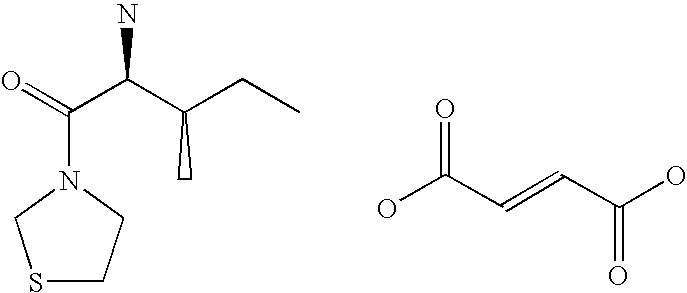
- and is described in WO 99/61431 and also in Diabetes 1998, 47, 1253-1258, in the name of Probiodrug, as well as the compound P93/01 described by the same company.
- Other very preferred DPP-IV inhibitors of the invention are described in the International patent application WO 02/076450 (especially the examples 1 to 128) and by Wallace T. Ashton (Bioorganic & Medicinal Chemistry Letters 14 (2004) 859-863 ) especially the compound 1 and the compounds listed in the tables 1 and 2. The preferred compound is the compound 21e (table 1) of formula:
-

- Other preferred DPP-IV inhibitors are described in the patent applications WO 2004/037169 especially those described in the examples 1 to 48 and WO 02/062764 especially the described examples 1 to 293, even preferred are the compounds 3-(aminomethyl)-2-isobuthyl-1-oxo-4-phenyl-1,2-dihydro-6-isoquinolinecarboxamide and 2-{[3-(aminomethyl)-2-isobuthyl-4-phenyl-1-oxo-1,2-dihydro-6-isoquinolyl]oxy}acetamide described on page 7 and also in the patent application WO2004/024184 especially in the reference examples 1 to 4.
- Other preferred DPP-IV inhibitors are described in the patent application WO 03/004498 especially examples 1 to 33 and most preferably the compound of the formula
-
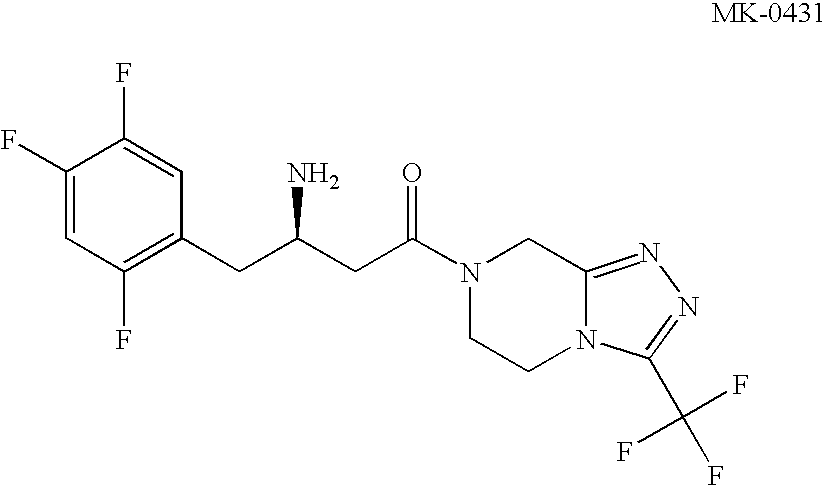
- described by the example 7 and also known as MK-0431 or Sitagliptin.
- Preferred DPP-IV inhibitors are also described in the patent application WO 2004/037181 especially examples 1 to 33 and most preferably the compounds described in the claims 3 to 5.
- Preferred DPP-IV inhibitors are N-substituted adamantyl-amino-acetyl-2-cyano pyrrolidines, N (substituted glycyl)-4-cyano pyrrolidines, N-(N′-substituted glycyl)-2-cyanopyrrolidines, N-aminoacyl thiazolidines, N-aminoacyl pyrrolidines, L-allo-isoleucyl thiazolidine, L-threo-isoleucyl pyrrolidine, and L-allo-isoleucyl pyrrolidine, 1-[2-[(5-cyanopyridin-2-yl) amino]ethylamino]acetyl-2-cyano-(S)-pyrrolidine, MK-431 and pharmaceutical salts thereof.
- Most preferred DPP-IV inhibitors are selected from [S]-1-[2-(5-cyano-2-pyridinylamino)ethylamino]acetyl-2-pyrolidine carbonitrile monohydrochloride, (S)-1-[(3-hydroxy-1-adamantyl)amino]acetyl-2-cyano-pyrrolidine and L-threo-isoleucyl thiazolidine (compound code according to Probiodrug: P32/98 as described above), MK-0431, 3-(aminomethyl)-2-isobuthyl-1-oxo-4-phenyl-1,2-dihydro-6-isoquinolinecarboxamide and 2-{[3-(aminomethyl)-2-isobuthyl-4-phenyl-1-oxo-1,2-dihydro-6-isoquinolyl]oxy}acetamide and optionally pharmaceutical salts thereof.
- Especially preferred are 1-{2-[(5-cyanopyridin-2-yl)amino]ethylamino}acetyl-2(S)-cyano-pyrrolidine dihydrochloride (DPP728) (also named [S]-1-[2-(5-cyano-2-pyridinylamino)ethylamino]acetyl-2-pyrolidine carbonitrile monohydrochloride), of formula
-

- especially the dihydrochloride and monohydrochloride thereof, and 1-[(3-hydroxy-1-adamantyl)amino]acetyl-2-cyano-, (S) (also named (S)-1-[(3-hydroxy-1-adamantyl)amino]acetyl-2-cyano-pyrrolidine, LAF237 or vildagliptin) of formula
-

- and L-threo-isoleucyl thiazolidine (compound code according to Probiodrug: P32/98 as described above), MK-0431, GSK23A, saxagliptin, 3-(aminomethyl)-2-isobuthyl-1-oxo-4-phenyl-1,2-dihydro-6-isoquinolinecarboxamide and 2-{[3-(aminomethyl)-2-isobuthyl-4-phenyl-1-oxo-1,2-dihydro-6-isoquinolyl]oxy}acetamide and optionally pharmaceutical salts thereof.
- DPP728 and vildagliptin are specifically disclosed in Example 3 of WO 98/19998 and Example 1 of WO 00/34241, respectively. The DPP-IV inhibitor P32/98 (see above) is specifically described in Diabetes 1998, 47, 1253-1258. DPP728 and LAF237 can be formulated as described on page 20 of WO 98/19998 or in WO 00/34241 or in the International Patent Application No. EP2005/000400 (application number).
- Especially preferred are orally active DPP-IV inhibitors.
- Any of the substances disclosed in the above mentioned patent documents or scientific publications, hereby included by reference, are considered potentially useful as DPP-IV inhibitors to be used in carrying out the present invention.
- In each case in particular in the compound claims and the final products of the working examples, the subject matter of the final products, the pharmaceutical preparations and the claims are hereby incorporated into the present application by reference to these publications.
- An antagonist of the CB1 cannabinoid receptor is a compound which binds to the receptor and lacks any substantial ability to activate the receptor itself. An antagonist can thereby prevent or reduce the functional activation or occupation of the receptor by an agonist such as anandamide when the agonist is present. In some embodiments, the antagonist has an IC50 from about 1 μM to about 1 nM. In other embodiments, the antagonist has an IC50 of from about 0.1 μM to 0.01 μM, 1.0 μM to 0.1 μM, or 0.01 μM to 1 nM. In some embodiments, the antagonist competes with the agonist for binding to a shared binding site on the receptor.
- A first group of suitable cannabinoid CB1 receptor antagonists are pyrazole derivatives. Patent applications EP-A-576 357 and EP-A-658 546 describe exemplary pyrazole derivatives which have an affinity for the cannabinoid receptors. More particularly, patent application EP-A-656 354 discloses exemplary pyrazole derivatives and claims N-piperidino-5-(4-chlorophenyl)-1-(2,4-dichlorophenyl)-4-methylpyrazole-3-carboxamide, or SR 141716, and its pharmaceutically acceptable salts, which have a very good affinity for the central cannabinoid receptors. Additional exemplary CB1 receptor antagonists are disclosed in U.S. Pat. No. 5,596,106 which discloses both arylbenzo[b]thiophene and benzo[b]furan compounds to block or inhibit cannabinoid receptors in mammals. Preferably, such a cannabinoid antagonist is selective for the CB1 receptor and has an IC50 for the CB1 receptor which is one-fourth or less than that of the CB2 receptor or, more preferably, is one-tenth or less than the IC50 for the CB2 receptor, or even more preferably, an IC50 with respect to the CB1 receptor which is one-hundredth that for the CB2 receptor. Each of the above references is incorporated by reference in its entirety.
- Another representative example is Iodopravadoline (AM-630), which was introduced in 1995. AM-630 is a CB1 receptor antagonist, but sometimes behaves as a weak partial agonist (Hosohata, K.; Quock, R. M.; Hosohata, Y.; Burkey, T. H.; Makriyannis, A.; Consroe, P.; Roeske, W. R.; Yamamura, H. I. Life Sc. 1997, 61, PL1 15). More recently, researchers from Eli Lilly described arylaroyl substituted benzofurans as selective CB1 receptor antagonists (e.g. LY-320135) (Felder, C. C.; Joyce, K. E.; Briley, E. J.; Glass, M.; Mackie, K. P.; Fahey, K. J.; Cullinan, G. J.; Hunden, D. C.; Johnson, D. W.; Chaney, M. O.; Koppel, G. A.; Brownstein, M. J. Pharmacol. Exp. Ther. 1998, 284, 291). Recently, 3-alkyl-5,5′-diphenylimidazolidinediones were described as cannabinoid receptor ligands, which were indicated to be cannabinoid antagonists (Kanyonyo, M.; Govaerts, S. J.; Hermans, E.; Poupaert, J. H., Lambert, D. M. Biorg. Med. Chem. Lett. 1999, 9, 2233). Interestingly, many CB1 receptor antagonists have been reported to behave as inverse agonists in vitro (Landsman, R. S.; Burkey, T. H.; Consroe, P.; Roeske, W. R.; Yamamura, H. I. Eur. J. Pharmacol. 1997, 334, R1). Recent reviews provide a nice overview of the current status in the cannabinoid research area (Mechoulam, R.; Hanus, L.; Fride, E. Prog. Med. Chem. 1998, 35, 199. Lambert, D. M. Curr. Med. Chem. 1999, 6, 635. Mechoulam, R.; Fride, E.; Di Marzo, V. Eur. J. Pharmacol. 1998, 359, 1). From the international patent application WO 01/70700 4,5-dihydro-1H-pyrazole compounds are known which exhibit potent and selective cannabis CB1-receptor antagonistic activity.
- Also useful are the cannabinoid CB1 receptor antagonist compounds of the formula
-

- wherein the substituents R1, R2, R3, R4, and R5 are defined as recited in U.S. Pat. No. 5,596,106 which is incorporated by reference in its entirety. Related reference U.S. Pat. No. 5,747,524 is also incorporated by reference in its entirety. This reference discloses additional exemplary aryl-benzo[b] thiophene and arylbenzo[b]furan derivatives for use according to the invention.
- The cannabinoid antagonists of the following formula are also particularly useful according to the invention:
-
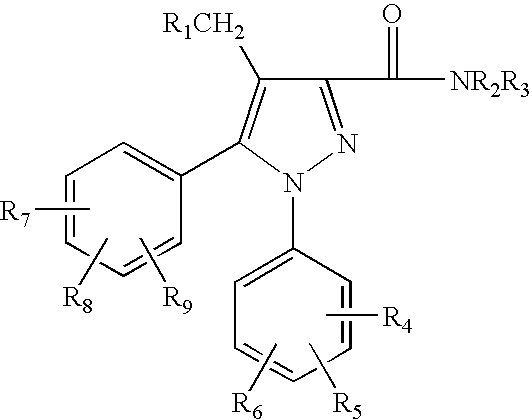
- wherein R1 is hydrogen, a fluorine, a hydroxyl, a (C1-C5)alkoxy, a (C1-C5)alkylthio, a hydroxy(C1-C5)alkoxy, a group —NR10R11, a cyano, a (C1-C5)alkylsulfonyl or a (C1-C5) alkylsulfinyl;
- R2 and R3 are a (C1-C4)alkyl or, together with the nitrogen atom to which they are bonded, form a saturated or unsaturated 5- to 10-membered heterocyclic radical which is unsubstituted or monosubstituted or polysubstituted by a (C1-C3)alkyl or by a (C1-C3)alkoxy;
- R4, R5, R6, R7, R8 and R9 are each independently hydrogen, a halogen or a trifluoromethyl, and if R1 is a fluorine, R4, R5, R6, R7, R8and/or R9 can also be a fluoromethyl, with the proviso that at least one of the substituents R4 or R7 is other than hydrogen; and
- R10 and R11 are each independently hydrogen or a (C1-C5)alkyl, or R10 and R11, together with the nitrogen atom to which they are bonded, form a heterocyclic radical selected from pyrrolidin-1-yl, piperidin-1-yl, morpholin-4-yl and piperazin-1-yl, which is unsubstituted or substituted by a (C1-C4)alkyl,
- and their salts and their solvates.
- Other examples of selective CB1 antagonistic compounds which are useful in the context of the present invention include (without being limited thereto):
- 1) Diarylpyrazole congeners disclosed by Sanofi as selective CB1 receptor antagonists, e.g. as representative example the compounds SR-141716A, SR-147778, SR-140098 and rimonabant and related compounds described e.g. in EP 0969835 or EP 1150961(Central mediation of the cannabinoid cue: activity of a selective CB1 antagonist, SR 141716A Perio A, Rinaldi-Carmona M, Maruani J Behavioural Pharmacology 1996, 7:1 (65-71)); WIN-54461 disclosed by Sanofi-Winthrop (Cannabinoid receptor ligands: Clinical and neuropharmacological considerations relevant to future drug discovery and development. Pertwee R G, Expert Opinion on Investigational Drugs 1996, 5:10 (1245-1253)). N-piperidino-5-(4-chlorophenyl)-1-(2,4-dichlorophenyl)-4-methylpyrazole-3-carboxamide (SR 141616—CAS number: 168273-06-1), its pharmaceutically acceptable salts and their solvates were described for the preparation of drugs useful in the treatment of appetency disorders. SR 141616, (pINN: rimonabant) is represented by the formula:
-

- Rimonabant is specifically described in EP-B-656 354 or in an article from M. Rinaldi-Carmona et al. (FEBS Lett., 1994, 350, 240-244). EP1446384 A1 describes new polymorphs of rimonabant, formulation comprising rimonabant are described in WO2003082256, and the use of rimonabant in apetite disorders is described in WO99/00119.
- 2) Aminoalkylindoles having been disclosed as CB1 receptor antagonists, e.g. as a representative example the compound Iodopravadoline (AM-630),
- 3) Aryl-aroyl substituted benzofurans described by Eli Lilly as selective CB1 receptor antagonists, e.g. LY-320135 (Cannabinoid receptor ligands: Clinical and neuropharmacological considerations relevant to future drug discovery and development. Pertwee R G, Expert Opinion on Investigational Drugs 1996, 5:10 (1245-1253)), 4) Compounds described by Merck & Co, e.g. AM 251 and AM 281 (Conference: 31st Annual Meeting of the Society for Neuroscience, San Diego, USA, 10-15.11.2001), and substituted imidazolyl derivatives disclosed e.g. in U.S. 2003-114495 or WO 03/007887,
- 5) Azetidine derivatives described by Aventis Pharma e.g. in WO 02/28346 or EP 1328269,
- 6) CP-55940 from Pfizer Inc. (Comparison of the pharmacology and signal transduction of the human cannabinoid CB1 and CB2 receptors, Felder C C, Joyce K E, Briley E M, Mansouri J, Mackie K, Blond 0, Lai Y, Ma A L, Mitchell R L, Molecular Pharmacology 1995, 48:3 (443)),
- 6′) The Pfizer compounds described in the patent applications EP1622876, EP1622902, EP1622903, EP162290, EP1622909, EP1638570, EP1594872, EP1592691, EP1558615, EP1556373, EP1572662 especially the specific examples described therein, especially CP-945598.
- 7) Diaryl-pyrazine-amide derivatives from Astra Zeneca described e.g. in the WO 03/051851,
- 8) ACPA and ACEA from Med. Coll. Wisconsin (Univ. Aberdeen), (“Effects of AM 251 & AM 281, cannabinoid CB1 antagonists, on palatable food intake in lewis rats” J. Pharmacol. Exp. Ther. 289, No 3, 1427-33, 1999),
- 9) Pyrazole derivatives described by the University of Conneticut e.g. in the WO 01/29007,
- 10) HU-210 (International Association for the Study of Pain—Ninth World Congress (Part II) Vienna, Austria, Dickenson A H, Carpenter K, Suzuki R, IDDB MEETING REPORT 1999, August 22-27) and HU-243 (Cannabinoid receptor agonists and antagonists, Barth F, Current Opinion in Therapeutic Patents 1998, 8:3 (301-313)) from Yissum R&D Co Hebrew Univ. of Jerusalem,
- 11) O-823 from Organix Inc. (Drug development pipeline: O-585, O-823, 0-689, O-1072, nonamines, Organix, Altropane Organix Inc, Company Communication Aug. 10, 1999; IDDb database) and O-2093 from Consiglio Nazionale delle Ricerche (“A structure/activity relationship study on arvanil, endocannabinoid and vanilloid hybrid.”, Marzo D V, Griffin G, Petrocellis L, Brandi I, Bisogno T, Journal of Pharmacology and Experimental Therapeutics 2002, 300:3 (984-991)),
- 12) 3-Alkyl-5,5′-diphenylimidazolidinediones which were described as cannabinoid receptor ligands,
- 13) CB1 antagonistic compounds currently under development by Bayer AG (IDDb database: company communication Feb. 28, 2002).
- 14) CB1 receptor antagonists are pyrazole derivatives according to Formula (I) Of U.S. Pat. No. 6,028,084 which is incorporated by reference in its entirety.
- 15) U.S. Pat. No. 6,017,919 discloses another group of suitable cannabinoid receptor antagonists for use according to the invention. These antagonists are of the following general formula:
-

- wherein the substituents are as defined in U.S. Pat. No. 6,017,919 which is incorporated herein by reference in its entirety.
- 16) The CB1 cannabinoid antagonist is a 4,5,dihydro-1H-pyrazole derivative having CB1-antagonist activity as taught in U.S. Pat. No. 5,747,524 and U.S. Patent Application No. 2001/0053788A1 published on Dec. 20, 2001.
- 17) The CB1 receptor antagonist is a 4,5,dihydro-1H-pyrazole derivative having CB1-antagonistic activity as taught in U.S. Patent Application No. 2001/0053788A1 and particularly disclosed by formula (I) therein. U.S. Patent Application No. 2001/0053788A1 published on Dec. 20, 2001 and is incorporated by reference in its entirety.
- 18) The CB1 receptor antagonists described in WO2005049615 especially the compounds of example 1 to 8.
- 19) The CB1 receptor antagonists described in WO2005047285 especially the compounds of example 1 to 99.
- 20) The CB1 receptor antagonist (4R)-3-(4-chlorophenyl)-4,5-dihydro-N-methyl-4-phenyl-N′-[[4-(trifluoromethyl)phenyl]sulfonyl]-1H-pyrazole-1-carboximidamide (SLV 326—34th Neuroscience, Abs 1009.4, October 2004)
-

- developed by the company Solvay (WO0170700 A1).
- Solvay CB1 receptor antagonists are described in the examples of the patent applications WO2005040130 A1, WO2005028456 A1, WO2005020988 A1, WO2004026301 A1, WO2003078413 A1, WO2003027076 A2, WO2003026648 A1, WO2003026647 A1, WO2002076949 A1, WO0170700 A1.
- In each case in particular in the compound claims and the final products of the working examples, the subject matter of the final products, the pharmaceutical preparations and the claims are hereby incorporated into the present application by reference to these publications.
- The dosage of CB1 antagonist administered will also be generally dependent upon the health of the subject being treated, the extent of treatment desired, the nature and kind of concurrent therapy, if any, and the frequency of treatment and nature of the effect desired. In general, the dosage of the agent is generally in the range of from about 0.001 to about 50 mg/kg body weight of the subject per day, preferably from about 0.1 to about 10 mg/kg body weight of the subject per day, administered as a single or divided dose. However, some variability in the general dosage range may also be required depending upon the age, weight, and species of the patient, the intended route of administration, and the progress and degree of severity of the disease or condition being treated.
- Daily dosages of the agent interacting with a CB1 antagonist required in practicing the method of the present invention will vary depending upon, for example the mode of administration and the severity of the condition to be treated. An indicated daily dose is in the range of from about 1 to about 500 mg, e.g. from 1 to 100 mg of active agent for oral use, conveniently administered once or in divided dosages.
- Preferred are combinations, such as combined preparations or pharmaceutical compositions, respectively, comprising a DPP-IV inhibitor preferably vildagliptin or a pharmaceutically accepted salt thereof and as second active agent an active agent selected from the group consisting of Rimonabant, AM-630, AM251, AM281, LY-320135, HU-210, HU-243, O-823, O-2093, SLV 326 or in any case a pharmaceutically accepted salt thereof.
- The corresponding active ingredients or a pharmaceutically acceptable salt thereof may also be used in form of a solvate, such as a hydrate or including other solvents, used for crystallization.
- The compounds to be combined can be present as pharmaceutically acceptable salts. If these compounds have, for example, at least one basic center, they can form acid addition salts. Corresponding acid addition salts can also be formed having, if desired, an additionally present basic center. The compounds having an acid group (for example COOH) can also form salts with bases.
- All of these marketed products may be utilized in as such for combination therapy according to the present invention.
- The structure of the active agents identified by generic or tradenames may be taken from the actual edition of the standard compendium “The Merck Index” or from databases, e.g. Patents International (e.g. IMS World Publications). The corresponding content thereof is hereby incorporated by reference. Any person skilled in the art is fully enabled to identify the active agents and, based on these references, likewise enabled to manufacture and test the pharmaceutical indications and properties in standard test models, both in vitro and in vivo.
- All the more surprising is the experimental finding that the combined administration of a DPP IV inhibitor or a salt thereof and at least one CB1 antagonist or a salt thereof, results not only in a beneficial, especially a synergistic, therapeutic effect, but also in additional benefits resulting from the combined treatment and further surprising beneficial effects compared to a monotherapy applying only one of the pharmaceutically active compounds used in the combinations disclosed herein. The combination results in an unexpected improvement of the safety profile and therapeutic profile. Additional benefits are e.g. reduction of gastrointestinal diseases an disorders, especially when induced by the CB1 antagonist, reduction of nervous system side effect, especially when induced by the CB1 antagonist. The combination results in an unexpected improvement of the safety profile and therapeutic profile.
- It can be shown by established test models and especially those test models described herein that the combination of the DPP-IV inhibitor with at least one CB1 antagonist results in a more effective prevention or preferably treatment of diseases specified in the following. In particular, it can be shown by established test models and especially those test models described herein that the combination of the present invention results in a more effective prevention or preferably treatment of diseases specified hereinafter.
- If taken simultaneously, this results not only in a further enhanced beneficial, especially a synergistic, therapeutic effect, but also in additional benefits resulting from the simultaneous treatment such as a surprising prolongation of efficacy, a broader variety of therapeutic treatment and surprising beneficial effects on obesity, appetency disorders or substance abuse disorders, and conditions/disorders that might be treated by DPP-IV inhibition, in particular obesity, diabetes especially type II diabetes, IGT and diseases and conditions associated with diabetes mellitus, IGT, obesity, Parkinson's disease, schizophrenia, Alzheimer's disease, or appetency disorders, for a number of combinations as described herein.
- The term “potentiation” shall mean an increase of a corresponding pharmacological activity or therapeutical effect, respectively. Potentiation of one component of the combination according to the present invention by co-administration of another component according to the present invention means that an effect is being achieved that is greater than that achieved with one component alone.
- The term “synergistic” shall mean that the drugs, when taken together, produce a total joint effect that is greater than the sum of the effects of each drug when taken alone.
- Moreover, for a human patient, especially for elderly people, it is more convenient and easier to remember to take two tablets at the same time, e.g. before a meal, than staggered in time, i.e. according to a more complicated treatment schedule. More preferably, both active ingredients are administered as a fixed combination, i.e. as a single tablet, in all cases described herein. Taking a single tablet is even easier to handle than taking two tablets at the same time. Furthermore, the packaging can be accomplished with less effort.
- The person skilled in the pertinent art is fully enabled to select a relevant and standard animal test model to prove the hereinbefore and hereinafter indicated therapeutic indications and beneficial effects.
- The pharmaceutical activities as effected by administration of the combination of the active agents used according to the present invention can be demonstrated e.g. by using corresponding pharmacological models known in the pertinent art.
- The insulin secretion enhancing properties of the combination according to the present invention may be determined by following the methodology as disclosed, for example, in the publication of T. Ikenoue et al. Biol. Pharm. Bull. 29(4), 354-359 (1997).
- The corresponding subject matter of these references is herewith incorporated by reference in this specification.
- Accordingly, the combination according to the present invention may be used, e.g., for the prevention, delay of progression or treatment of diseases and disorders that may be inhibited by DPP IV inhibition and/or appetency disorders or nicotinic addiction.
- Thus in a further aspect the present invention concerns the use of a combination comprising
-
- i) a DPP IV inhibitor or a pharmaceutically acceptable salt thereof, and
- ii) at least one CB1 antagonist, or a pharmaceutically acceptable salt thereof for the manufacture of a medicament for the prevention, delay of progression or treatment of diseases and disorders that may be inhibited by DPP IV inhibition and/or appetency disorders and/or substance abuse disorders.
- The invention furthermore relates to a method for the prevention of, delay of progression of, treatment of diseases and disorders that may be inhibited by DPP IV inhibition and/or appetency disorders and/or substance abuse disorders,
- comprising administering to a warm-blooded animal, including man, in need thereof a jointly effective amount of a combination of a DPP IV inhibitor or a pharmaceutically acceptable salt thereof with at least one cannabinoid antagonist preferably a CB1 antagonist, or a pharmaceutically acceptable salt thereof;
- and at least one additional pharmaceutically acceptable carrier.
- The invention furthermore relates to a pharmaceutical composition for the prevention of, delay of progression of, treatment of a disease or condition selected from diseases and disorders that may be inhibited by DPP IV inhibition and/or appetency disorders and/or substance abuse disorders, comprising a combination of a DPP IV inhibitor or a pharmaceutically acceptable salt thereof with at least one therapeutic agent selected from a cannabinoid antagonist preferably a CB1 antagonist, or a pharmaceutically acceptable salt thereof;
- and at least one additional pharmaceutically acceptable carrier.
- Pharmaceutical composition, methods or uses as described above, wherein the disease or condition is selected from insulin resistance, impaired glucose metabolism, conditions of impaired glucose tolerance, conditions of impaired fasting plasma glucose, diabetes particularly type 2 diabetes mellitus, obesity, diabetic retinopathy, macular degeneration, cataracts, diabetic nephropathy, glomerulosclerosis, diabetic neuropathy, erectile dysfunction, premenstrual syndrome, coronary heart disease, hypertension, angina pectoris, myocardial infarction, stroke, vascular restenosis, skin and connective tissue disorders, foot ulcerations, ulcerative colitis, endothelial dysfunction, impaired vascular compliance, neurodegenerative disorders, cognitive disorders, memory and learning ability problems, appetency disorders and substance abuse disorders or for body fat reduction.
- Pharmaceutical composition, methods or uses as described above, wherein, the disease or condition is selected from impaired glucose metabolism, conditions of impaired glucose tolerance, conditions of impaired fasting plasma glucose, diabetes particularly type 2 diabetes mellitus, obesity, diabetic retinopathy, diabetic nephropathy, diabetic neuropathy, foot ulcerations, diseases or conditions associated with diabetes, Parkinson's disease, schizophrenia, Alzheimer's disease, dementia, senile dementia, mild cognitive impairment or Alzheimer type dementia, cognitive deficits associated with schizophrenia, impaired cognitive function associated with Alzheimer's disease, impaired cognitive function associated with Parkinson's disease, appetency disorders or substance abuse disorders, or for body fat reduction.
- Pharmaceutical composition, methods or uses as described above, wherein the disease or condition is selected from obesity, diabetes, IGT, type 2 diabetes, Parkinson's disease, schizophrenia, Alzheimer's disease, or appetency disorders.
- Pharmaceutical composition, methods or uses as described above, wherein the disease or condition is selected from obesity, diabetes, IGT, type 2 diabetes, Parkinson's disease, schizophrenia, Alzheimer's disease, atherosclerosis, increased cardiovascular morbidity; excess cerebrovascular diseases; increased cardiovascular mortality and sudden death; myocardial infarction, hyperlipidemia, dyslipidemia or appetency disorders.
- Pharmaceutical composition, methods or uses as described above, wherein the disease or condition is selected from atherosclerosis, increased cardiovascular morbidity; excess cerebrovascular diseases; increased cardiovascular mortality and sudden death; and myocardial infarction.
- Pharmaceutical composition, methods or uses as described above, wherein the disease or condition is selected from obesity, diabetes, IGT, type 2 diabetes, Parkinson's disease, schizophrenia, Alzheimer's disease, atherosclerosis, hyperlipidemia or appetency disorders.
- Pharmaceutical composition, methods or uses as described above, wherein the disease or condition is a gastrointestinal disease or disorder.
- Pharmaceutical composition, methods or uses as described above, wherein the disease or condition is selected from hyperlipidemia, or conditions associated with hyperlipidemia.
- Pharmaceutical composition, methods or uses as described above, for lowering VLDL, LDL and Lp(a) levels in a mammal.
- Pharmaceutical composition, methods or uses as described above, for modulating hyperlipidemia, or for modulating conditions associated with hyperlipidemia.
- Pharmaceutical composition, methods or uses as described above, wherein the disease or condition is selected from mortality and morbidity after myocardial infarction, adverse cardiac remodeling after myocardial infarction, microvascular complications; increased cardiovascular morbidity; excess cerebrovascular diseases; increased cardiovascular mortality and sudden death; higher incidences and mortality rates of malignant neoplasms.
- Pharmaceutical composition, methods or uses as described above, wherein the disease or condition is selected from coronary heart disease, myocardial infarction, diabetic cardiomyopathy, myocardial cell death, coronary artery diseases, peripheral arterial disease, stroke, limb ischemia, vascular restenosis, foot ulcerations, endothelial dysfunction and/or atherosclerosis.
- In one further embodiment, the herein described methods, uses and compositions are used for the prevention, or delay of progression of type 2 diabetes.
- In one further embodiment, the herein described methods, uses and compositions are used for the prevention, of type 2 diabetes in patients suffering from impaired glucose metabolism, impaired glucose tolerance (IGT) or impaired fasting plasma glucose.
- In one further embodiment, the herein described methods, uses and compositions are used to suppress the increased appetite associated with nicotine or tobacco withdrawal.
- In one further embodiment, the herein described methods, uses and compositions are used for body fat reduction.
- In one further embodiment, the herein described combinations, methods, uses and compositions are used in combination with a further antidiabetic compound which is preferably selected form a glitazone (pioglitazone or rosiglitazone), metformin, or sulfonylureas.
- Preferred combinations for the described uses or methods are described herein.
- A “disease or condition which may be inhibited by a DPP-IV inhibitor” as defined in this application comprises, but is not limited to insulin resistance, impaired glucose metabolism, conditions of impaired glucose tolerance (IGT), conditions of impaired fasting plasma glucose, diabetes particularly type 2 diabetes mellitus, obesity, diabetic retinopathy, macular degeneration, cataracts, diabetic nephropathy, glomerulosclerosis, diabetic neuropathy, erectile dysfunction, premenstrual syndrome, coronary heart disease, hypertension, angina pectoris, myocardial infarction, stroke, vascular restenosis, skin and connective tissue disorders, foot ulcerations and ulcerative colitis, endothelial dysfunction and impaired vascular compliance, diseases or conditions associated with diabetes, neurodegenerative disorders, cognitive disorders and memory and learning ability problems. The neurodegenerative disorder is selected from Parkinson's disease, schizophrenia, dementia, senile dementia, mild cognitive impairment, Alzheimer related dementia, Huntington's chorea, tardive dyskinesia, hyperkinesias, mania, Morbus Parkinson, steel-Richard syndrome, Down's syndrome, myasthenia gravis, nerve and brain trauma, vascular amyloidosis, cerebral haemorrhage with amyloidosis, brain inflammation, Friedrich's ataxia, acute confusion disorders, acute confusion disorders in which apoptotic necrocytosis plays a part, amyotrophic lateral sclerosis, glaucoma, and Alzheimer's disease. The cognitive disorder is selected from cognitive deficits associated with schizophrenia, age-induced memory impairment, cognitive deficits associated with psychosis, cognitive impairment associated with diabetes, cognitive deficits associated with post-stroke, memory defects associated with hypoxia, cognitive and attention deficits associated with senile dementia, attention-deficit disorders, memory problems associated with mild cognitive impairment, impaired cognitive function associated with dementias, impaired cognitive function associated with Alzheimer's disease, impaired cognitive function associated with Parkinson's disease, impaired cognitive function associated with vascular dementia, cognitive problems associated with brain tumors, Pick's disease, cognitive deficits due to autism, cognitive deficits post electroconvulsive therapy, cognitive deficits associated with traumatic brain injury, amnesic disorders, deliriums, dementias.
- The term a “disease or condition which may be inhibited by a DPP-IV inhibitor” does also cover diseases, disorders or conditions related to diabetes, mortality and morbidity after myocardial infarction, adverse cardiac remodeling after myocardial infarction, microvascular complications; increased cardiovascular morbidity; excess cerebrovascular diseases; increased cardiovascular mortality and sudden death; higher incidences and mortality rates of malignant neoplasms.
- The term a “disease or condition which may be inhibited by a DPP-IV inhibitor” does also cover gastrointestinal diseases and disorders selected from altered gastrointestinal motility, sensitivity and/or secretion disorder(s) which include, but are not limited to, heartburn, bloating, postoperative ileus, abdominal pain and discomfort, early satiety, epigastric pain, nausea, vomiting, burbulence, regurgitation, intestinal pseudoobstruction, anal incontinence, GERD, IBS, dyspepsia, chronic constipation or diarrhea, diabetic gastropathy, gastroparesis, e.g. diabetic gastroparesis, ulcerative colitis, Crohn's disease, ulcers and the visceral pain associated therewith.
- The term a “disease or condition which may be inhibited by a DPP-IV inhibitor” does also cover hyperlipidemia and/or conditions associated with hyperlipidemia.
- Hyperlipidemia is an important precipitating factor for the premature development of atherosclerosis and increased rate of cardiovascular and peripheral vascular diseases. Hyperlipidemia is a condition generally characterized by an abnormal increase in serum lipids in the bloodstream and is an important risk factor in developing atherosclerosis and heart disease. For a review of disorders of lipid metabolism, see, e.g., Wilson, et al., Ed., Disorders of Lipid Metabolism, Chapter 23, Textbook of Endocrinology, 9th Edition, W.B. Sanders Company, Philadelphia, Pa. (1998); this reference and all references cited therein are herein incorporated by reference. Serum lipoproteins are the carriers for lipids in the circulation and include chylomicrons, very low-density lipoproteins (VLDL), intermediate density lipoproteins (IDL), low density lipoproteins (LDL) and high density lipoproteins (HDL) and lipoprotein a (Lp(a)). Hyperlipidemia is usually classified as primary or secondary hyperlipidemia. Primary hyperlipidemia is generally caused by genetic defects, while secondary hyperlipidemia is generally caused by other factors, such as various disease states, drugs and dietary factors. Alternatively, hyperlipidemia can result from both a combination of primary and secondary causes of hyperlipidemia. Elevated cholesterol levels are associated with a number of disease states, including coronary artery disease, angina pectoris, carotid artery disease, strokes, cerebral arteriosclerosis, and xanthoma.
- There are several forms of circulating blood cholesterol which occur naturally in mammals. Some forms are considered “bad” cholesterol, while other forms are considered “good” cholesterol and are essential for good health. The good form of cholesterol has been established to be HDL. LDL is a “bad” cholesterol. Another form of LDL cholesterol, the primary bad form, is Lp(a) which is a modified form of LDL. Elevated levels of Lp(a) are believed to be detrimental and associated with a higher risk for coronary heart disease (CHD) (see Assman et al., Am. J. Card., Vol. 77, pp. 1179-1184 (1996); and Bostom et al., JAMA, Vol. 276, No. 7, pp. 544-548 (1996)).
- The term “hyperlipidemia” refers to the presence of an abnormally elevated level of lipids in the blood. Hyperlipidemia can appear in at least three forms: (1) hypercholesterolemia, i.e., an elevated cholesterol level; (2) hypertriglyceridemia, i.e., an elevated triglyceride level; and (3) combined hyperlipidemia, i.e., a combination of hypercholesterolemia and hypertriglyceridemia. This term also refers to elevated levels of one or more lipoproteins, e.g., elevated levels of Lp(a), LDL and/or VLDL.
- The term “elevated levels of Lp(a)” as used herein shall mean levels of Lp(a) which subjects the patient to the risk of vascular, particularly cardiovascular diseases, mediated by Lp(a), including but not limited to CHD, ischemic stroke, restenosis after angioplasty, peripheral vascular disease, intermittent claudication, myocardial infarction (e.g. reduction in necrosis), dyslipidemia and post-prandial lipemia.
- The term “cholesterol” refers to a steroid alcohol that is an essential component of cell membranes and myelin sheaths and, as used herein, incorporates its common usage. Cholesterol also serves as a precursor for steroid hormones and bile acids.
- The term “triglyceride(s)” (TGs), as used herein, incorporates its common usage. TGs consist of three fatty acid molecules esterified to a glycerol molecule and serve to store fatty acids which are used by muscle cells for energy production or are taken up and stored in adipose tissue.
- Because cholesterol and TGs are water insoluble, they must be packaged in special molecular complexes known as “lipoproteins” in order to be transported in the plasma. Lipoproteins can accumulate in the plasma due to overproduction and/or deficient removal. There are at least five distinct lipoproteins differing in size, composition, density and function. In the cells of the small of the intestine, dietary lipids are packaged into large lipoprotein complexes called “chylomicrons”, which have a high TG and low cholesterol content. In the liver, TG and cholesterol esters are packaged and released into plasma as TG-rich lipoprotein called VLDL, whose primary function is the endogenous transport of TGs made in the liver or released by adipose tissue. Through enzymatic action, VLDL can be either reduced and taken up by the liver, or transformed into IDL. IDL, is in turn, either taken up by the liver, or is further modified to form the LDL. LDL is either taken up and broken down by the liver, or is taken up by extrahepatic tissue. HDL helps remove cholesterol from peripheral tissues in a process called reverse cholesterol transport.
- Exemplary primary hyperlipidemia include, but are not limited to, the following:
- 1) Familial hyperchylomicronemia, a rare genetic disorder which causes a deficiency in an enzyme, LP lipase, that breaks down fat molecules. The LP lipase deficiency can cause the accumulation of large quantities of fat or lipoproteins in the blood;
- 2) Familial hypercholesterolemia, a relatively common genetic disorder caused where the underlying defect is a series of mutations in the LDL receptor gene that result in malfunctioning LDL receptors and/or absence of the LDL receptors. This brings about ineffective clearance of LDL by the LDL receptors resulting in elevated LDL and total cholesterol levels in the plasma;
- 3) Familial combined hyperlipidemia, also known as multiple lipoprotein-type hyperlipidemia; an inherited disorder where patients and their affected first-degree relatives can at various times manifest high cholesterol and high triglycerides. Levels of HDL cholesterol are often moderately decreased;
- 4) Familial defective apolipoprotein B-100 is a relatively common autosomal dominant genetic abnormality. The defect is caused by a single nucleotide mutation that produces a substitution of glutamine for arginine which can cause reduced affinity of LDL particles for the LDL receptor. Consequently, this can cause high plasma LDL and total cholesterol levels;
- 5) Familial dysbetaliproteinemia, also referred to as Type III hyperlipoproteinemia, is an uncommon inherited disorder resulting in moderate to severe elevations of serum TG and cholesterol levels with abnormal apolipoprotein E function. HDL levels are usually normal; and
- 6) Familial hypertriglyceridemia, is a common inherited disorder in which the concentration of plasma VLDL is elevated. This can cause mild to moderately elevated triglyceride levels (and usually not cholesterol levels) and can often be associated with low plasma HDL levels. Risk factors in exemplary secondary hyperlipidemia include, but are not limited to, the following: (1) disease risk factors, such as a history of Type 1 diabetes, Type 2 diabetes, Cushing's syndrome, hypothyroidism, cholestasis and certain types of renal failure; (2) drug risk factors, which include, birth control pills; hormones, such as estrogen and corticosteroids; certain diuretics; and various β-blockers; (3) dietary risk factors include dietary fat intake per total calories greater than 40%; saturated fat intake per total calories greater than 10%; cholesterol intake greater than 300 mg per day; habitual and excessive alcohol use; bulimia, anorexia nervosa, and obesity.
- The term conditions associated with hyperlipidemia are selected from the group consisting of atherosclerosis, angina pectoris, carotid artery disease, cerebral arteriosclerosis, xanthoma, CHD, ischemic stroke, restenosis after angioplasty, peripheral vascular disease, intermittent claudication, reduction in necrosis after myocardial infarction, dyslipidemia, post-prandial lipemia.
- In a first embodiment, a “disease or condition which may be inhibited by a DPP-IV inhibitor” is selected from impaired glucose metabolism, conditions of impaired glucose tolerance, conditions of impaired fasting plasma glucose, diabetes particularly type 2 diabetes mellitus, obesity, diabetic retinopathy, diabetic nephropathy, diabetic neuropathy, foot ulcerations, diseases or conditions associated with diabetes, Parkinson's disease, schizophrenia, Alzheimer's disease, dementia, senile dementia, mild cognitive impairment or Alzheimer type dementia, cognitive deficits associated with schizophrenia, impaired cognitive function associated with Alzheimer's disease, impaired cognitive function associated with Parkinson's disease.
- In a second embodiment a “disease or condition which may be inhibited by a DPP-IV inhibitor” is selected from hyperlipidemia, conditions associated with hyperlipidemia and/or high blood level of VLDL, LDL and Lp(a) levels in a mammal.
- In a second embodiment a “disease or condition which may be inhibited by a DPP-IV inhibitor” is selected from mortality and morbidity after myocardial infarction, adverse cardiac remodeling after myocardial infarction, microvascular complications; increased cardiovascular morbidity; excess cerebrovascular diseases; increased cardiovascular mortality and sudden death; higher incidences and mortality rates of malignant neoplasms.
- In a third embodiment a “disease or condition which may be inhibited by a DPP-IV inhibitor” is selected from coronary heart disease, myocardial infarction, diabetic cardiomyopathy, myocardial cell death, coronary artery diseases, peripheral arterial disease, stroke, limb ischemia, vascular restenosis, foot ulcerations, endothelial dysfunction and/or atherosclerosis.
- The term “curative” as used herein means efficacy in treating ongoing diseases, disorder or conditions.
- The term “prophylactic” means the prevention of the onset or recurrence of diseases, disorders or conditions to be treated.
- The term “delay of progression” as used herein means administration of the combination to patients being in a pre-stage or in an early phase of the disease to be treated, in which patients for example a pre-form of the corresponding disease is diagnosed or which patients are in a condition, e.g. during a medical treatment or a condition resulting from an accident, under which it is likely that a corresponding disease will develop.
- In the present description and in the claims, “appetency disorders” are understood as meaning disorders associated with a substance and especially abuse of a substance and/or dependency on a substance, disorders of food behaviors, especially those liable to cause excess weight, irrespective of its origin, for example: bulimia, appetency for sugars, non-insulin-dependent diabetes. Appetizing substances are therefore understood as meaning substances to be taken into the body and for which an appetite or craving for such consumption by any route of entry. Appetizing substances include, but are not limited to, foods, and their appetizing ingredients such as sugars, carbohydrates, or fats, as well as drinking alcohol or drugs of abuse or excess consumption. An “appetite” may be directed toward such substances as foods, sugars, carbohydrates, fats, as well as ethanol or drugs of abuse or addiction or excess consumption (e.g., tobacco, CNS depressants, CNS stimulants). In one embodiment, the disorder is increased appetite associated with nicotine or tobacco withdrawal. Thus the term “appetency disorders” covers also treatment for reducing body weight or reducing body fat or reducing appetite for food or reducing food intake or consumption or causing hypophagia in mammals (e.g., humans, cats or dogs). The term “appetency disorders” can also cover a treatment to reduce appetite for food.
- As used herein, the term “substance abuse disorders” includes substance dependence or abuse with or without physiological dependence. The substances associated with these disorders are: alcohol, amphetamines (or amphetamine-like substances), caffeine, cannabis, cocaine, hallucinogens, inhalants, marijuana, nicotine, opioids, phencyclidine (or phencyclidine-like compounds), sedative-hypnotics or benzodiazepines, and other (or unknown) substances and combinations of all of the above.
- In particular, the term “substance abuse disorders” includes drug withdrawal disorders such as alcohol withdrawal with or without perceptual disturbances; alcohol withdrawal delirium; amphetamine withdrawal; cocaine withdrawal; nicotine withdrawal; opioid withdrawal; sedative, hypnotic or; anxiolytic withdrawal with or without perceptual disturbances; sedative, hypnotic or anxiolytic withdrawal delirium; and withdrawal symptoms due to other substances. Thus the term “substance abuse disorders” covers also a treatment to suppress the increased appetite associated with nicotine or tobacco withdrawal, or the treatment of addiction to psychoactive substances such as narcotics, CNS stimulants, CNS depressants, and anxyiolytics.
- It will be appreciated that reference to treatment of nicotine withdrawal includes the treatment of symptoms associated with smoking cessation.
- Other “substance abuse disorders” include substance-induced anxiety disorder with onset during withdrawal; substance-induced mood disorder with onset during withdrawal; and substance-induced sleep disorder with onset during withdrawal.
- The term “body fat reduction” means loss of a portion of body fat.
- The formula for Body Mass Index (BMI) is [Weight in pounds÷Height in inches÷Height in inches]×703. BMI cutpoints for human adults are one fixed number, regardless of age or sex, using the following guidelines: Overweight human adults individuals have a BMI of 25.0 to 29.9. Obese human adults have a BMI of 30.0 or more. Underweight adults have a BMI less of than 18.5. A normal body weight range for an adult is defined as a BMI between 18.5 and 25. BMI cutpoints for children under 16 are defined according to percentiles: Overweight is defined as a BMI for age greater than>85th percentile and obesity is defined as a BMI-for-age>95th percentile. Underweight is a BMI-for-age<5th percentile. A normal body weight range for a child is defined as a BMI above the 5th percentile and below the 85 percentile.
- The term “combined pharmaceutical preparation” as that term is used herein means that the active ingredients, e.g. rimonabant and a DPP-IV inhibitor preferably LAF237, are both administered to a patient as separate entities either simultaneously, concurrently or sequentially with no specific time limits, wherein such administration provides therapeutically effective levels of the two compounds in the body, preferably at the same time. As an example, a non-fixed combination would be two capsules each containing one active ingredient where the purpose is to have the patient achieve treatment with both active ingredients together in the body.
- The term “fatty acid oxidation” relates to the conversion of fatty acids (e.g., oleate) into ketone bodies.
- The term “modulate” means to induce any change including increasing or decreasing. (e.g., a modulator of fatty acid oxidation increases or decreases the rate of fatty oxidation, a modulator of a receptor includes both agonists and antagonists of the receptor).
- The term “muscle cells” refers to cells derived from the predominant cells of muscle tissue. Muscle cells may be freshly isolated from muscle tissue or established cell lines.
- The term “weight loss” refers to loss of a portion of total body weight.
- The term “treat” or “treatment” encompasses the complete range of therapeutically positive effects associated with pharmaceutical medication including reduction of, alleviation of and relief from the symptoms or illness which affect the organism.
- Preferably, the jointly therapeutically effective amounts of the active agents according to the combination of the present invention can be administered simultaneously or sequentially in any order, e.g. separately (combined pharmaceutical preparation) or in a fixed combination.
- Under certain circumstances, drugs with different mechanisms of action may be combined. However, just considering any combination of drugs having different modes of action but acting in the similar field does not necessarily lead to combinations with advantageous effects.
- All the more surprising is the experimental finding that the combined administration of a DPP-IV inhibitor according to the present invention, or, in each case, a pharmaceutically acceptable form thereof, results not only in a beneficial, especially a potentiating or a synergistic, therapeutic effect. Independent thereof, additional benefits resulting from combined treatment can be achieved such as a surprising prolongation of efficacy, a broader variety of therapeutic treatment and surprising beneficial effects on diseases and conditions associated with diabetes (e.g. less appetite, less gain of weight or less cardiovascular side effects).
- The diseases, disorders or conditions related to diabetes, particularly type 2 diabetes mellitus, includes but are not limited to diabetic nephropathy, diabetic retinopathy and diabetic neuropathy, macular degeneration, coronary heart disease, myocardial infarction, diabetic cardiomyopathy, myocardial cell death, coronary artery diseases, peripheral arterial disease, stroke, limb ischemia, vascular restenosis, foot ulcerations, endothelial dysfunction and/or atherosclerosis.
- Further benefits are that lower doses of the individual drugs to be combined according to the present invention can be used to reduce the dosage, for example, that the dosages need not only often be smaller but are also applied less frequently, or can be used in order to diminish the incidence of side effects. This is in accordance with the desires and requirements of the patients to be treated.
- For example, it has turned out that the combination according to the present invention provides benefit especially in the treatment of diabetic patients, e.g. reducing the risk of negative cardiovascular events, reducing risk of side effects, controlling increase of weight (in diabetic patients) or in patients suffering from an altered gastrointestinal motility, sensitivity and/or secretion disorder(s).
- In view of reduced dose of the DPP-IV inhibitor or CB1 antagonist, used according to the present invention, there is a considerable safety profile of the combination making it suitable for first line therapy.
- The pharmaceutical composition according to the present invention as described herein before and hereinafter may be used for simultaneous use or sequential use in any order, for separate use or as a fixed combination.
- Method or use as described above, wherein the DPP-IV inhibitor and the CB1 antagonist are administered in the form of a combination of the present invention such as a fixed combination or combined preparation or kit of part.
- “kit-of-parts”, combination, method or use as described herein, wherein the DPP-IV inhibitor is vildagliptin or and wherein the CB1 antagonist is preferably selected from the group consisting of Rimonabant, AM-630, AM251, AM281, LY-320135, HU-210, HU-243, O-823, O-2093, SLV 326, or in each case, a pharmaceutically acceptable salt thereof.
- “kit-of-parts”, combination, method or use as described above, wherein the DPP-IV inhibitor is vildagliptin and wherein the CB1 antagonist is Rimonabant, or in each case, a pharmaceutically acceptable salt thereof.
- According the invention, when the DPP-IV inhibitors, and the CB1 antagonist are administered together, such administration can be sequential in time or simultaneous with, the simultaneous method being generally preferred. For sequential administration, the DPP-IV inhibitor, and the CB1 antagonist can be administered in any order. It is generally preferred that such administration be oral. It is especially preferred that the administration be oral and simultaneous. However, if the subject being treated is unable to swallow, or oral absorption is otherwise impaired or undesirable, parenteral or transdermal administration will be appropriate. When the DPP-IV inhibitor, and the CB1 antagonist are administered sequentially, the administration of each can be by the same method or by different methods.
- A further aspect of the present invention is a kit for the prevention of, delay of progression of, treatment of a disease or condition according to the present invention comprising
- (a) an amount of a DPP IV inhibitor or a pharmaceutically acceptable salt thereof in a first unit dosage form;
- (b) an amount of at least one CB1 antagonist or, in each case, where appropriate, a pharmaceutically acceptable salt thereof in a second etc. unit dosage form; and
- (c) a container for containing said first, second etc. unit forms.
- In a variation thereof, the present invention likewise relates to a “kit-of-parts”, for example, in the sense that the components to be combined according to the present invention can be dosed independently or by use of different fixed combinations with distinguished amounts of the components, i.e. simultaneously or at different time points. The parts of the kit of parts can then e.g. be administered simultaneously or chronologically staggered, that is at different time points and with equal or different time intervals for any part of the kit of parts. Preferably, the time intervals are chosen such that the effect on the treated disease or condition in the combined use of the parts is larger than the effect that would be obtained by use of only any one of the components.
- The present invention thus also relates to a kit of parts comprising
- (a) an amount of a DPP IV inhibitor or a pharmaceutically acceptable salt thereof in a first unit dosage form;
- (b) an amount of at least one CB1 antagonist or, in each case, where appropriate, a pharmaceutically acceptable salt thereof,
- in the form of two or three or more separate units of the components (a) to (b), especially for the prevention of, delay of progression of, treatment of a disease or condition according to the present invention.
- The invention furthermore relates to a commercial package comprising the combination according to the present invention together with instructions for simultaneous, separate or sequential use.
- In a preferred embodiment, the (commercial) product is a commercial package comprising as active ingredients the combination according to the present invention (in the form of two or three or more separate units of the components (a) or (b)), together with instructions for its simultaneous, separate or sequential use, or any combination thereof, in the delay of progression or treatment of the diseases as mentioned herein.
- All the preferences mentioned herein apply to the combination, composition, use, method of treatment, “kit of parts” and commercial package of the invention.
- In an additional embodiment, the present invention concerns;
-
- 1. the use of a DPP IV inhibitor or a pharmaceutically acceptable salt thereof, for the manufacture of a medicament for the prevention, delay of progression or treatment of appetency disorders, substance abuse disorders or for body fat reduction.
- 2. a method for the prevention of, delay of progression of, treatment of appetency disorders and/or substance abuse disorders and/or for body fat reduction, comprising administering to a warm-blooded animal, including man, in need thereof an effective amount of a DPP IV inhibitor or a pharmaceutically acceptable salt thereof and at least one additional pharmaceutically acceptable carrier.
- 3. a pharmaceutical composition for the prevention of, delay of progression of, treatment of appetency disorders and/or substance abuse disorders, comprising a DPP IV inhibitor or a pharmaceutically acceptable salt thereof;
and at least one additional pharmaceutically acceptable carrier.
- These pharmaceutical preparations are for enteral, such as oral, and also rectal or parenteral, administration to homeotherms, with the preparations comprising the pharmacological active compound either alone or together with customary pharmaceutical auxiliary substances. For example, the pharmaceutical preparations consist of from about 0.1% to 90%, preferably of from about 1% to about 80%, of the active compound. Pharmaceutical preparations for enteral or parenteral, and also for ocular, administration are, for example, in unit dose forms, such as coated tablets, tablets, capsules or suppositories and also ampoules. These are prepared in a manner that is known per se, for example using conventional mixing, granulation, coating, solubulizing or lyophilizing processes. Thus, pharmaceutical preparations for oral use can be obtained by combining the active compound(s) with solid excipients, if desired granulating a mixture which has been obtained, and, if required or necessary, processing the mixture or granulate into tablets or coated tablet cores after having added suitable auxiliary substances.
- The dosage of the active compound can depend on a variety of factors, such as mode of administration, homeothermic species, age and/or individual condition.
- Preferred dosages for the active ingredients of the pharmaceutical combination according to the present invention are therapeutically effective dosages, especially those which are commercially available.
- Normally, in the case of oral administration, an approximate daily dose of from about 1 mg to about 360 mg is to be estimated e.g. for a patient of approximately 75 kg in weight. The dosage of the active compound can depend on a variety of factors, such as mode of administration, homeothermic species, age and/or individual condition.
- The pharmaceutical preparation will be supplied in the form of suitable dosage unit form, for example, a capsule or tablet, and comprising an amount, being together with the further component(s) jointly effective, e.g. 100 mg or 50 mg of vildagliptin.
- The pharmaceutical composition according to the present invention as described hereinbefore may be used for simultaneous use or sequential use in any order, for separate use or as a fixed combination.
- Thus according to a further embodiment, a DPP-IV inhibitor, is administered with a CB1 antagonist, preferably in the form of a fixed pharmaceutical composition comprising a pharmaceutically acceptable carrier, vehicle or diluent. Accordingly, a DPP-IV inhibitor of this invention, can be administered with a CB1 antagonist as a fixed combination, in any conventional oral, parenteral or transdermal dosage form.
- The doses of DPP-IV inhibitor of formula (I) to be administered to warm-blooded animals, for example human beings, of, for example, approximately 70 kg body weight, especially the doses effective in the inhibition of the DPP-IV enzyme, are from approximately 3 mg to approximately 3 g, preferably from approximately 10 mg to approximately 1 g, for example approximately from 20 mg to 200 mg, per person per day, divided preferably into 1 to 4 single doses which may, for example, be of the same size. Usually, children receive about half of the adult dose. The dose necessary for each individual can be monitored, for example by measuring the serum concentration of the active ingredient, and adjusted to an optimum level. Single doses comprise, for example, 10, 40, 50, 100 or 150 mg per adult patient.
- The dosage of vildagliptin is preferably between 10 and 150 mg daily, most preferably between 25 and 150 mg, 25 and 100 mg or 25 and 50 mg or 50-100 mg daily. Preferred examples of daily oral dosage are 25, 30, 35, 45, 50, 55, 60, 80, 100 or 150 mg. The application of the active ingredient may occur up to three times a day, preferably one or two times a day.
- The preferred herein mentioned CB1 antagonists will be supplied in the form of suitable dosage unit form, for example, a capsule or tablet, and comprising a therapeutically effective amount, e.g. from about 2 to about 200 mg, as already described herein and in the prior art. The application of the active ingredient may occur up to three times a day, preferably one or two times a day. The same preferred dosage are selected for the fixed combinations.
- Combination, composition, method or use, as described herein, wherein the CB1 antagonist or a pharmaceutically acceptable salt thereof, is administered in an amount between 5 and 80 mg or between 5 and 20 mg daily.
- Daily rimonabant dosages required in practicing the method of the present invention will vary depending upon, for example the mode of administration and the severity of the condition to be treated. An indicated daily dose is in the range of from about 1 to about 100 mg, e.g. from 5 to 50 mg or from 5 to 20 mg, of active agent for oral use, conveniently administered once or in divided dosages.
- Corresponding doses may be taken, for example, in the morning, at mid-day or in the evening.
- In a preferred aspect, the invention concerns a “kit-of-parts”, combination, use or a method as described herein, comprising or wherein the daily administration is;
-
- i) between 25 and 150 mg or between 50 and 100 mg of vildagliptin, and
- ii) between 5 and 50 mg or between 5 and 20 mg of rimonabant,
or in any case, a pharmaceutically acceptable salt thereof.
- In a preferred aspect, the invention concerns a “kit-of-parts”, combination or use or a method as described herein, comprising or wherein the daily administration is;
-
- i) 50, 100 or 150 mg of vildagliptin, and
- ii) 5, 10 or 20 mg of rimonabant,
or in any case, a pharmaceutically acceptable salt thereof.
- Preferably, in case of free combinations, preferred are those dosages for launched products that have been approved and that have been marketed.
- Especially preferred are low dose combinations.
- To further illustrate the invention, but not by way of limitation, the following examples are provided.
- A) Bioassay Methods for Assessing the Effects of Compounds and Combination Therapies on Appetite(s), Body Fat Reduction, Body Weight, and Lipid Metabolism.
- The dose(s) administered to the animal are sufficient to determine if the compounds or combination therapy has a desired effect, for example, an appetite, body weight, body fat, and/or fatty acid oxidation over time. Such dose(s) can be determined according to the efficacy of the particular candidate compound(s) employed and the condition of the animal, as well as the body weight or surface area of the animal. The size of the dose(s) also will be determined by the existence, nature, and extent of any adverse side effects that accompany the administration of a candidate compound or combination; the LD50 of the candidate compound or combination; and the side-effects of the candidate compound or combination at various concentrations. Depending upon the compound or combination and the above factors, for instance, the initial test dosage(s) may range, for example, from 0.1-50 mg per kg, preferably 1-25 mg per kg, most preferably 1-20 mg per kg body weight for each of the compound or combination. The determination of dose response relationships is well known to one of ordinary skill in the art.
- Test animals subjects can be, for example, obese or normal mammals (e.g., humans, primates, guinea pigs, rats, mice, or rabbits). Suitable rats include, but are not limited to, Zucker rats. Suitable mice include, but are not limited to, for example, ALS/LtJ, C3. SW-H-2b/SnJ, (NON/LtJ×NZO/HIJ)F1, NZO/H1J, ALR/LtJ, NON/LtJ, KK.Cg-AALR/LtJ, NON/LtJ, KK.Cg-Ay/J, B6.HRS(BKS)-Cpefat+, B6.129P2-Gcktm/Efr, B6.V-Lepob, BKS.Cg-m+/+Leprdb, and C57BL/6J with Diet Induced Obesity.
- A. Assessing Effects on Appetite, Including Food Consumption.
- The effect of the candidate compounds and combinations i.e. DPP-IV inhibitors (vildagliptin) and CB1 antagonists (rimonabant) or combination of such compounds on an appetite for appetizing substance (e.g., sugar, ethanol, a psychoactive substance such as nicotine, narcotics, opiates, CNS stimulants or depressants, anxyiolytic) can be assessed, for instance, by monitoring the consumption of the substance by test subjects (e.g., measuring the amount (e.g., by volume or weight) Consumed or used or not consumed and not used, use of consumption diaries) Or tissue levels (e.g., blood, plasma) Or excretion levels (e.g., urine, feces levels) of the appetitive substance or its metabolites or by monitoring behaviors seeking the appetitive substance. The effect of the compounds and combinations on appetite can also be assessed by subjective means including questionnaires as to appetite or cravings levels by human subjects. The techniques for these assessments are well known to those of ordinary skill in the art. The studies may be acute, subacute, chronic, or subchronic with respect to the duration of administration and or follow-up of the effects of the administration. See also U.S. Pat. No. 6,344,474.
- The effect of the candidate compounds and combinations i.e. DPP-IV inhibitors (vildagliptin) and CB1 antagonists (rimonabant) or combination of such compounds on the appetite for food or in inducing hypophagia or reduced food intake can be directly assessed, for instance, by monitoring the food consumption of the test subjects (e. g., measuring the amount eaten or not eaten by a subject in terms of food weight or caloric content). The effect on food consumption can be indirectly measured by monitoring body weight. The effect of the compounds on appetite can also be assessed by food consumption diaries, or subjective means including questionnaires as to appetite or food cravings levels by human subjects. The techniques for these assessments are well known to those of ordinary skill in the art. The studies may be acute, subacute, chronic, or subchronic with respect to the duration of administration and or follow-up of the effects of the administration.
- B) Assessing Effects on Body Fat Reduction.
- Effects on body fat can be identified in vivo using animal bioassay techniques well known to those of ordinary skill in the art. Body fat reduction is typically determined by direct measurements of the change in body fat or by loss of body weight. Body fat and/or body weight of the animals is determined before, during, and after the administration of the candidate compounds or combinations. Test compounds (DPP-IV inhibitors (vildagliptin) and CB1 antagonists (rimonabant)) or combinations thereof and appropriate vehicle or caloric controls can be administered by any of a number of routes (e.g., the oral route, a parenteral route) to experimental subjects and the weight of the subjects can be monitored over the course of therapy. The experimental subjects can be humans as well as surrogate test animals (e. g., rats, mice).
- Changes in body fat are measured by any means known in the art such as, for example, fat fold measurements with calipers, bioelectrical impedance, hydrostatic weighing, or dual x-ray absorbiometry. Preferably animals demonstrate at least 2%, 5%, 8%, or 10% loss of body fat. Changes in body weight can be measured by any means known in the art such as, for example, on a portable scale, on a digital scale, on a balance scale, on a floor scale, or a table scale. Preferably animals demonstrate at least 2%, 5%, 10%, or 15% loss of body weight. Body weight reduction is measured before administration of the candidate compound or combination and at regular intervals during and after treatment. Preferably, body weight is measured every 5 days, more preferably every 4 days, even more preferably every 3 days, yet more preferably every 2 days, most preferably every day.
- For instance, the effect of the candidate compounds and combinations on total body fat can be determined by taking direct measurements of the rat's body fat using skin fold calipers. Skin on the subjects' backs, abdomen, chest, front and rear legs can be pinched with calipers to obtain measurements before administration of the test compound and at daily or longer intervals (e.g., every 48 hours) during and after administration of candidate compounds and combinations. Differences in measurements in one or more of the “pinched” sites reflect the change in the rat's total body fat. The animal may selected from any test species, including but not limited to, mammals, the mouse, a rat, a guinea pig, or a rabbit. The animal may also be an ob/ob mouse, a db/db mouse, or a Zucker rat or other animal model for a weight-associated disease. Clinical studies in humans may also be conducted. In humans, body density measurements or estimates of percent body fat may also be used to assess body fat reduction.
- C) Assessing Effects on Lipid Metabolism.
- The candidate compounds and combinations i.e. DPP-IV inhibitors (vildagliptin) and CB1 antagonists (rimonabant) or combinations of such compounds can also be assayed for their effect on fatty acid metabolism. The effect of the candidate compounds and combinations on fatty acid metabolism can be measured by measurements of fatty acid oxidation in primary cultures of liver cells as taught for instance in U.S. patent application Ser. No.10/112,509 filed on Mar. 27, 2002 and assigned to the same assignee as the present application and incorporated by reference.
- Changes in fatty acid metabolism can be measured, for instance, by looking at fatty acid oxidation in cells from major fat burning tissues such as, for example, liver (Beynen, et al., Diabetes, 28:828 (1979)), muscle (Chiasson Lab. Anat. of Rat (1980)), heart (Flink, et al., J. Biol. Chem., 267: 9917 (1992)), and adipocytes (Rodbell, J. Biol. Chem., 239: 375 (1964)), Cells may be from primary cultures or from cell lines. Cells may be prepared for primary cultures by any means known in the art including, for example, enzymatic digestion and dissection. Suitable cell lines are known to those in the art. Suitable hepatocyte lines are, for example, Fao, MH1C1, H-4-II-E, H4TG, H4-II-E-C3, McA-RH7777, McA-RH8994, N1-S1 Fudr, N1-S1, ARL-6, Hepa 1-6, Hepa-1c1c7, BpRc1, tao BpRc1, NCTC clone 1469, PLC/PRF/5, Hep 3B2.1-7 [Hep 3B], Hep G2 [HepG2], SK-HEP-1, WCH-17. Suitable skeletal muscle cell lines are, for example, L6, L8, C8, NOR-10, BLO-11, BC3H1, G-7, G-8, C2C12, P19, Sol8, SJRH30 [RMS 13], QM7. Suitable cardiac cell lines are, for example, H9c2(2-1), P19, CCD-32Lu, CCD-32Sk, Girardi, FBHE. Suitable adipocyte lines are, for example, NCTC clone 929 [derivative of Strain L; L-929; L cell], NCTC 2071, L-M, L-M(TK-) [LMTK-; LM(tk-)], A9 (APRT and HPRT negative derivative of Strain L), NCTC clone 2472, NCTC clone 2555, 3T3-L1, J26, J27-neo, J27-B7, MTKP 97-12 pMp97B [TKMp97-12], L-NGC-5HT2, Ltk-11, L-alpha-1b, L-alpha-2A, L-alpha-2C, B82.
- The rate of fatty acid oxidation may be measured by 14C-oleate oxidation to ketone bodies (Guzmán and Geelen Biochem. J. 287:487 (1982)) and/or 14C-oleate oxidation to CO2 (Fruebis, PNAS, 98:2005 (2001); Blazquez, et al., J. Neurochem, 71: 1597 (1998) ). Lypolysis may be measured by fatty acid or glycerol release by using appropriate labeled precursors or spectrophotometric assays (Serradeil-Le Gal, FEBS Lett, 475: 150 (2000)). For analysis of 14C-oleate oxidation to ketone bodies, freshly isolated cells or cultured cell lines can be incubated with 14C-oleic acid for an appropriate time, such as, for example, 30, 60, 90, 120, or 180 minutes. The amount of 14C radioactivity in the incubation medium can be measured to determine their rate of oleate oxidation. Oleate oxidation can be expressed as nmol oleate produced in x minutes per g cells. For analysis of lypolysis/glycerol release, freshly isolated cells or cultured cells lines can be washed then incubated for an appropriate time. The amount of glycerol released into the incubation media can provide an index for lypolysis.
- D) Cannabinoid Receptor Activity Screening.
- A variety of means may be used to screen cannabinoid CB1 receptor activity in order to identify the compounds according to the invention. A variety of such methods are taught in U.S. Pat. No. 5,747,524 and U.S. Pat. No. 6,017,919.
- E) Bioassay Methods for Assessing the Effects of Compounds, and Combination Therapies on Alzheimer's Disease, Parkinson's Disease, Cognitive Disorders, Memory and Learning Ability Problems.
- The pharmacological activity of the compounds i.e. DPP-IV inhibitors (vildagliptin) and CB1 antagonists (rimonabant) and combinations of such compounds according to the invention in improving cognitive function may, for example, be assessed using tests known to a person skilled in the art such as standardized psychometric tests (e.g. Wechsler Memory Scale, the Wechsler Adult Intelligence Scale, Raven's Standard Progressive Matrices, Schaie-Thurstone Adult Mental Abilities Test), neuropsychological tests (e.g. Luria-Nebraska), metacognitive self-evaluations (e.g. Metamemory Questionnaire), visual-spatial screening tests (e.g. Poppelreuter's Figures, Clock Recognition, Honeycomb Drawing and Cancellation), cognitive screening tests (e.g. Folstein's Mini Mental State Test) and reaction time tests. Such standardized tests as listed above are described in Ruoppila, I. and Suutama, T. (1997) Scand. J. Soc. Med. Suppl. 53, 44-65 and serve as examples, said reference is incorporated in its entirety herein. The term “cognitive function” includes the functions assessed by any such test.
- A clinical protocol to show the positive effect of a the combination of the invention for treating the Alzheimer's disease development is described in the patent application WO 2004/082706 on pages 31-37, which is incorporated herein by reference.
- The examples 2-4 described in the patent application WO2005009349 describe a further protocols to assess the activity of the compounds and combinations of the present invention to treat or prevent, X syndrome, Alzheimer's disease and Parkinson's' disease which is incorporated herein by reference.
- Other standard tests for cognitive performance e.g. the Alzheimer's Disease Assessment Scale (ADAS-cog) are described by Doraiswamy (Neurology. 1997 June;48(6):1511-7) and in the patents US20040024043 and U.S. Pat. No. 6369046. The ADAS-cog is a multi-item instrument for measuring cognitive performance which include elements of memory, orientation, retention, reasoning, language and praxis. US20040024043 describes also an in vivo test model in rodents in example 5 and a clinical Study Design in example 9. Another clinical Study Design is described by U.S. Pat. No. 6369046 (example 1) which are incorporated herein by reference.
- A further useful in vivo protocol which can be used to show that DPP-IV inhibitors can improving cognitive function is described in the European Patent No.1310258 (examples 5-8), which is incorporated herein by reference.
- The effects of the herein described combinations i.e. comprising a DPP-IV inhibitors such as vildagliptin and CB1 antagonists such as rimonabant in a model of Parkinson disease are investigated in mice. Male C57/BL6 mice are injected once daily for 7 days with MPTP (30 mg/kg, i.p.). Vildagliptin and/or rimonabant are administered once or twice daily for 14 days. On day 28, striata are removed, homogenized in perchloric acid, and centrifuged. The supernatant is removed and analyzed for dopamine and other monoamines such as serotonin by reverse-phase HPLC and electrochemical detection. Anti-Parkinson activity of the combination Vildagliptin and rimonabant is assessed in comparison to the mono-therapy with either Vildagliptin or rimonabant alone.
- One 50 mg tablet of vildagliptin, or 20 mg of rimionabant or a combination of 50 mg of vildagliptin and 20 mg of rimionabant are administered daily with water to subjects in need of such treatment. The cognitive status of the subject is monitored periodically using the MMSE (Mini Mental State Examination (MMSE) with norms adjusted for age and education (Folstein et al., J. Psych. Res., 12 (1975), 196-198, Anthony et al., Psychological Med.' 12 (1982), 397-408; Cockrell et al., Psychopharmacology, 24 (1988), 689-692; Crum et al., J. Am. Med. Assoc'n. 18 (1993), 2386-2391) or similar tool.
- A subject having e.g. mild cognitive impairment, is identified using the MMSE or similar diagnostic tool e.g. ADAS-cog.
- A 50 mg tablet of vildagliptin or 20 mg of rimionabant or a combination of 50 mg of vildagliptin and 20 mg of rimionabant are administered daily with water to said subject. The subject is monitored periodically using the MMSE or similar tool e.g. ADAS-cog, to assess the evolution of Alzheimer's Disease and the cognitive impairment. The subject is also monitored for clinical symptoms of dementia.
- F. Determining the Combination Therapy Dosages.
- Preferred dosages of the CB1 antagonist and DPP-IV inhibitor to be used in a combination therapy can be determined experimentally by first conducting separate dose response studies for the CB1 antagonist and DPP-IV inhibitor to be used. Methods of performing such dose response studies in a test species or the species of the intended subject (e.g., a human) are well known to one of ordinary skill in the art. The endpoint of the study is preferably selected according to the effect or endpoint of interest (e.g., appetite reduction, weight loss, body fat reduction, changes in lipid metabolism, changed food seeking behavior) Or the dose response of the underlying mechanism of action (e.g., receptor activation or antagonism). Alternatively, the established dose response relationships may be used if an agent is already well-characterized as to dose response. Preferred bioassay methods include those described above and those presented in the Examples.
- The CB1 receptor inverse agonist rimonabant by itself shows a reduction in body weight with a decrease in food intake, and DPP-4 inhibitor (Vildagliptin) alone improves glycemia by preserving the incretin effects. When given in combination, these two agents can interact to produce an enhanced effect on glycemia, plasma lipids and/or on body weight and food intake that can be quantified as additive or synergistic in nature.
- The newly developed CB1 receptor inverse agonist rimonabant (Sanofi-Aventis) has been shown to be highly effective to produce body weight reduction in clinic. In preclinical studies, rimonabant was effective in reversing diet-induced obesity by decreasing body weight, food intake, and by regulating circulating lipids and energy balance.
- The aim of the current study is to evaluate if there is any interaction between a CB1 receptor inverse agonist e.g. rimonabant and DPP-4 inhibitors e.g. vildagliptin that can produce an improvement in the glycemic control and body weight regulation. Furthermore, the study do evaluate if there is a combined effect on improved insulin sensitivity and plasma lipids. The ‘cross talk’ between the centrally and peripherally located CB1 receptor with the elevated endogenous incretin levels acting at the entero-insular axis can led to metabolic changes due to an interaction between the two pathways.
- The current study is performed in insulin resistant male Zucker fa/fa rats. Groups of rats are treated once daily for 19 days with either vehicle, 2 doses of rimonabant alone, 1 dose of DPP-4 inhibitor Vildagliptin alone, or 2 doses of rimonabant and Vildagliptin in combination. Rats are monitored for changes in body weight, food intake, glucose tolerance, effect on GLP-1 levels, side effects such as gastrointestinal side effects and plasma lipid excursion as described below. In addition, plasma drug exposure has been measured at the end of the treatment. Alternatively, in the below experience, vildagliptin is replaced by 1-[(2-adamantyl)amino]acetyl-2-cyano-(S)-pyrrolidine (described in the patent application WO9819998A2—example 47).
- Study Design and Detailed Protocol:
- Study Protocol:
- Animals: Ten weeks old male zucker fa/fa rats are maintained on a regular chow diet (D12492) ad ibitum from their arrival till the end of the study. Rats are housed one per cage in a reversed light cycle (9:45 am to 9:45 pm), under ACUC protocol 05 DB0062. Following a week after arrival, all rats (at 11 weeks old) are grouped as per their body weights and treated according to their group assignments (Table 1). There are two cohorts of each group that are treated 24 h apart for the entire study (cohort 1: animals #1-4, cohort 2:animals #5-8).
-
TABLE 1 Group assignments Rat IDs Dose Group N/group Male Zucker fa/fa (mg/kg/day) A Vehicle (1% MC) 8 A1-A8 0 B Rimonabant 8 B1-B8 3 C Rimonabant 8 C1-C8 10 D Vildagliptin 8 D1-D8 3 E Rimonabant + 8 E1-E8 3 + 3 Vildagliptin F Rimonabant + 8 F1-F8 10 + 3 Vildagliptin Rimonabant = NVP-XSA007-AA-3(salt form): drugs are dissolved with 1% MC and preferably same is used for the combo formulation. Dosing solutions are prepared each week. - Flow Chart of the Study:
- daily dosing, body weight & food intake
-

- 1. Preconditioning and Sorting of Rats: Day −1
- Body weights and tail blood samples are taken in the morning of day −1. Blood glucose values are determined (via glucometer) and rats are sorted according to their body weight and glucose levels.
- 2. Dosing: Days 1 to 19
- The animals are dosed orally (at 5 ml/kg) for 19 days once daily 1 h prior to the beginning of the dark cycle (before 9:45 am), with either vehicle, rimonabant or Vildagliptin alone, or in combination as shown in the Table 1.
- 3. Functional Tests:
- a. Daily Body Weight and Food Intake Measurements:
- Body weight and food intake is measured daily during the study prior to drug administration.
- b. Basal levels parameters on day 1: Freely fed basal blood glucose is measured and plasma samples is collected via tail-bleed to determine insulin, glucagon, GLP-1, FFA, TG, TC, adiponectin prior to dosing on day 1.
- c. Oral glucose tolerance test (OGTT) is performed on day 6 and day 15. Rats are fasted overnight, and 1-h following drug administration rats are given an oral glucose load (1 g/kg). Blood glucose and plasma samples are collected via tail-bleed at 0, 5, 10, 15, 30, 60, 120 and 180 min post-glucose load for GLP-1, insulin and glucagon measurement. In addition, at 0 min, plasma samples are collected for FFA, TG, TC measurements.
- d. Plasma analysis on days 19-20: On day 19, plasma samples are collected via tail-bleed at 0 (just prior to drug dosing), 1, 2, 4, 8, and 24 h (day 20) for plasma drug concentration measurement. Plasma DPP-4 activity (5 uL) are measured at the same timepoints. Plasma GLP-1 levels are measured on day 19 at 0 (just prior to dosing), 1 h (this timepoint is right at the beginning of the food/dark cycle at 9:45 am), 1.5 h and 2 h after the drug dosing.
- 4. Terminal necropsy: day 20: Twenty-four hours after the last dose (day 20), plasma samples are collected via tail-bleed for glucose, insulin, GLP-1 glucagon, FFA, TG, TC, adiponectin. Following tail-bleed, rats are euthanized with CO2 (4 min apart) and plasma samples are collected via cardiac puncture for AMP analysis (other hormonal parameters, liver and kidney safety markers in plasma). Urine is collected for analysis (AMP). Weights of liver and epididymal fat pads are taken at tissues are frozen (for TK analysis, if needed).
- Results: This study do confirm the herein described unexpected effects of the herein described combinations.
- Although the present invention has been described in considerable detail with reference to certain preferred versions thereof, other versions are possible without departing from the spirit and scope of the preferred versions contained herein. All references and Patents (U.S. and others) referred to herein are hereby incorporated by reference in their entirety as if set forth herein in full.
Claims (22)
1. Combination comprising
i) a DPP IV inhibitor or a pharmaceutically acceptable salt thereof, and
ii) at least one CB1 antagonist, or a pharmaceutically acceptable salt thereof.
2. Combination according to claim 1 comprising
i) a DPP IV inhibitor or a pharmaceutically acceptable salt thereof, and
ii) at least one CB1 antagonist, or a pharmaceutically acceptable salt thereof, and at least one additional pharmaceutically acceptable carrier.
3. Combination according to claim 1 , in the form of a combined preparation or a fixed combination.
4. (cancel)
5. A method for the prevention of, delay of progression of, treatment of, diseases and disorders that may be inhibited by DPP IV inhibition, appetency disorders or substance abuse disorders, comprising administering to a warm-blooded animal, including man, in need thereof a jointly effective amount of a combination of a DPP IV inhibitor or a pharmaceutically acceptable salt thereof with at least one CB1 antagonist, or a pharmaceutically acceptable salt thereof;
and at least one additional pharmaceutically acceptable carrier.
6. The method according to claim 5 , wherein the disease or condition is selected from impaired glucose metabolism, conditions of impaired glucose tolerance, conditions of impaired fasting plasma glucose, diabetes particularly type 2 diabetes mellitus, obesity, diabetic retinopathy, diabetic nephropathy, diabetic neuropathy, foot ulcerations, diseases or conditions associated with diabetes, Parkinson's disease, schizophrenia, Alzheimer's disease, dementia, senile dementia, mild cognitive impairment or Alzheimer type dementia, cognitive deficits associated with schizophrenia, impaired cognitive function associated with Alzheimer's disease, impaired cognitive function associated with Parkinson's disease, appetency disorders or substance abuse disorders, or for body fat reduction.
7. The method according to claim 6 , wherein the disease or condition is selected from obesity, diabetes, type 2 diabetes, IGT, Parkinson's disease, schizophrenia, Alzheimer's disease, and appetency disorders.
8. The method according to claim 5 , wherein the disease or condition is selected from obesity, diabetes, IGT, type 2 diabetes, Parkinson's disease, schizophrenia, Alzheimer's disease, atherosclerosis, increased cardiovascular morbidity; excess cerebrovascular diseases; increased cardiovascular mortality and sudden death; myocardial infarction, hyperlipidemia, dyslipidemia, gastrointestinal diseases or disorders or appetency disorders.
9. A method for modulating hyperlipidemia, for modulating conditions associated with hyperlipidemia and/or for lowering VLDL, LDL and Lp(a) levels in a mammal, comprising administering to a warm-blooded animal, including man, in need thereof a jointly effective amount of a combination of a DPP IV inhibitor or a Pharmaceutically acceptable salt thereof with at least one CB1 antagonist, or a pharmaceutically acceptable salt thereof;
and at least one additional pharmaceutically acceptable carrier.
10-13. (canceled)
14. The combination according to claim 1 , wherein the DPP-IV inhibitor is selected from (S)-1-{2-[5-cyanopyridin-2yl)amino]ethyl-aminoacetyl)-2-cyano-pyrrolidine, vildagliptin, Sitagliptin, GSK23A, saxagliptin, 3-(aminomethyl)-2-isobuthyl-1-oxo-4-phenyl-1,2-dihydro-6-isoquinolinecarboxamide and 2-{[3-(aminomethyl)-2-isobuthyl-4-phenyl-1-oxo-1,2-dihydro-6-isoquinolyl]oxy}acetamide, or in each case, a pharmaceutically acceptable salt thereof.
15. Combination, according to claim 1 , wherein the DPP-IV inhibitor is vildagliptin or a pharmaceutically acceptable salt thereof.
16. Combination, according to claim 1 , wherein the CB1 antagonist is selected from the group consisting CP-945598, rimanobant, LY-320135, AM251, AM281 and SVL326, or in each case, a pharmaceutically acceptable salt thereof.
17. Combination, according to claim 1 , wherein the CB1 antagonist is rimanobant or a pharmaceutically acceptable salt thereof.
18-23. (canceled)
24. Combination, according to claim 1 , wherein vildagliptin or a pharmaceutically acceptable salt thereof, is administered in an amount between 25 and 150 mg or between 50 and 100 mg daily.
25. Combination, according to claim 1 , previous claims, wherein the CB1 antagonist or a pharmaceutically acceptable salt thereof, is administered in an amount between 5 and 80 mg or between 5 and 20 mg daily.
26. Combination, according to claim 16 , wherein rimonabant or a pharmaceutically acceptable salt thereof, is administered in an amount between 5 and 40 mg or between 5 and 20 mg daily.
27. A combination comprising
i) vildagliptin in an amount between 25 and 150 mg or between 50 and 100 mg daily, and
ii) rimonabant in an amount between 5 and 40 mg or between 5 and 20 mg daily,
or in any case or a pharmaceutically acceptable salt thereof.
28. Combination, according to claim 27 , wherein;
i) 50, 100, or 150 mg of vildagliptin is administered daily, and
ii) 5, 10 or 20 mg of rimonabant is administered daily,
or in any case or a pharmaceutically acceptable salt thereof.
29. (canceled)
30. Combination, according to claim 1 , wherein the combination comprises a further antidiabetic compound, which is selected form a glitazone, metformin, and sulfonylureas.
Priority Applications (1)
| Application Number | Priority Date | Filing Date | Title |
|---|---|---|---|
| US11/995,251 US20080200510A1 (en) | 2005-07-12 | 2006-07-11 | Combination of Organic Compounds |
Applications Claiming Priority (3)
| Application Number | Priority Date | Filing Date | Title |
|---|---|---|---|
| US69830405P | 2005-07-12 | 2005-07-12 | |
| PCT/EP2006/064117 WO2007006790A2 (en) | 2005-07-12 | 2006-07-11 | Combination of a dpp-iv inhibitor and a cannabinoid cb1 receptor antagonist |
| US11/995,251 US20080200510A1 (en) | 2005-07-12 | 2006-07-11 | Combination of Organic Compounds |
Publications (1)
| Publication Number | Publication Date |
|---|---|
| US20080200510A1 true US20080200510A1 (en) | 2008-08-21 |
Family
ID=37478965
Family Applications (1)
| Application Number | Title | Priority Date | Filing Date |
|---|---|---|---|
| US11/995,251 Abandoned US20080200510A1 (en) | 2005-07-12 | 2006-07-11 | Combination of Organic Compounds |
Country Status (10)
| Country | Link |
|---|---|
| US (1) | US20080200510A1 (en) |
| EP (1) | EP1904058A2 (en) |
| JP (1) | JP2009501192A (en) |
| KR (1) | KR20080028422A (en) |
| CN (1) | CN101222919A (en) |
| AU (1) | AU2006268650A1 (en) |
| BR (1) | BRPI0613735A2 (en) |
| CA (1) | CA2614834A1 (en) |
| MX (1) | MX2008000468A (en) |
| WO (1) | WO2007006790A2 (en) |
Cited By (2)
| Publication number | Priority date | Publication date | Assignee | Title |
|---|---|---|---|---|
| US20100041650A1 (en) * | 2008-08-13 | 2010-02-18 | Jenrin Discovery | Purine compounds as cannabinoid receptor blockers |
| US9238027B2 (en) | 2009-01-12 | 2016-01-19 | Fundacion Del Hospital Nacional De Paraplejicos Para La Investigacion Y La Integracion (Fuhnpaiin) | Use of CB1 antagonists and/or inverse agonists for the preparation of drugs that increase motor neuron excitability |
Families Citing this family (6)
| Publication number | Priority date | Publication date | Assignee | Title |
|---|---|---|---|---|
| AU2006242219A1 (en) * | 2005-05-02 | 2006-11-09 | Merck & Co., Inc. | Combination of dipeptidyl peptidase-IV inhibitor and a cannabinoid CB1 receptor antagonist for the treatment of diabetes and obesity |
| WO2010018856A1 (en) * | 2008-08-13 | 2010-02-18 | 持田製薬株式会社 | Prophylactic/ameliorating or therapeutic agent for cannabinoid receptor-related disease |
| EP2411005A1 (en) * | 2009-03-27 | 2012-02-01 | Bristol-Myers Squibb Company | Methods for preventing major adverse cardiovascular events with dpp-iv inhibitors |
| CN105412096A (en) * | 2015-12-15 | 2016-03-23 | 上海壹志医药科技有限公司 | Drug application of jateorhizine |
| CN112007156A (en) * | 2019-05-30 | 2020-12-01 | 复旦大学 | Application of cannabinoid receptor drug in preparation of drug for treating myocardial cell necrotic apoptosis |
| CN112755189A (en) * | 2019-11-02 | 2021-05-07 | 复旦大学 | Use of type 1 cannabinoid receptor antagonists for the preparation of a medicament for the treatment of myocardial cell apoptosis |
Family Cites Families (3)
| Publication number | Priority date | Publication date | Assignee | Title |
|---|---|---|---|---|
| CO5150173A1 (en) * | 1998-12-10 | 2002-04-29 | Novartis Ag | COMPOUNDS N- (REPLACED GLYCLE) -2-DIPEPTIDYL-IV PEPTIDASE INHIBITING CYANOPIRROLIDINS (DPP-IV) WHICH ARE EFFECTIVE IN THE TREATMENT OF CONDITIONS MEDIATED BY DPP-IV INHIBITION |
| DK1741446T3 (en) * | 2000-01-21 | 2008-06-02 | Novartis Pharma Ag | Combinations containing dipeptidyl peptidase IV inhibitors and antidiabetic agents |
| AU2006242219A1 (en) * | 2005-05-02 | 2006-11-09 | Merck & Co., Inc. | Combination of dipeptidyl peptidase-IV inhibitor and a cannabinoid CB1 receptor antagonist for the treatment of diabetes and obesity |
-
2006
- 2006-07-11 CN CNA2006800256365A patent/CN101222919A/en active Pending
- 2006-07-11 MX MX2008000468A patent/MX2008000468A/en not_active Application Discontinuation
- 2006-07-11 BR BRPI0613735-0A patent/BRPI0613735A2/en not_active IP Right Cessation
- 2006-07-11 US US11/995,251 patent/US20080200510A1/en not_active Abandoned
- 2006-07-11 KR KR1020087000865A patent/KR20080028422A/en not_active Withdrawn
- 2006-07-11 EP EP06777713A patent/EP1904058A2/en not_active Withdrawn
- 2006-07-11 AU AU2006268650A patent/AU2006268650A1/en not_active Abandoned
- 2006-07-11 WO PCT/EP2006/064117 patent/WO2007006790A2/en not_active Ceased
- 2006-07-11 CA CA002614834A patent/CA2614834A1/en not_active Abandoned
- 2006-07-11 JP JP2008520872A patent/JP2009501192A/en not_active Withdrawn
Cited By (4)
| Publication number | Priority date | Publication date | Assignee | Title |
|---|---|---|---|---|
| US20100041650A1 (en) * | 2008-08-13 | 2010-02-18 | Jenrin Discovery | Purine compounds as cannabinoid receptor blockers |
| US8252791B2 (en) * | 2008-08-13 | 2012-08-28 | Jenrin Discovery, Inc. | Purine compounds as cannabinoid receptor blockers |
| US9238027B2 (en) | 2009-01-12 | 2016-01-19 | Fundacion Del Hospital Nacional De Paraplejicos Para La Investigacion Y La Integracion (Fuhnpaiin) | Use of CB1 antagonists and/or inverse agonists for the preparation of drugs that increase motor neuron excitability |
| US9592237B2 (en) | 2009-01-12 | 2017-03-14 | Fundacion Del Hospital Nacional De Paraplejicos Para La Investigacion Y La Integracion (Fuhnpaiin) | Use of CB1 antagonists and/or inverse agonists for the preparation of drugs that increase motor neuron excitability |
Also Published As
| Publication number | Publication date |
|---|---|
| AU2006268650A1 (en) | 2007-01-18 |
| WO2007006790A2 (en) | 2007-01-18 |
| EP1904058A2 (en) | 2008-04-02 |
| WO2007006790A3 (en) | 2007-12-21 |
| CN101222919A (en) | 2008-07-16 |
| BRPI0613735A2 (en) | 2011-02-01 |
| KR20080028422A (en) | 2008-03-31 |
| MX2008000468A (en) | 2008-03-11 |
| JP2009501192A (en) | 2009-01-15 |
| CA2614834A1 (en) | 2007-01-18 |
Similar Documents
| Publication | Publication Date | Title |
|---|---|---|
| CN101035522B (en) | Combination of DPP-IV inhibitor, PPAR antidiabetic and metformin | |
| JP6312502B2 (en) | Use of dipeptidyl peptidase IV inhibitors | |
| US20070149451A1 (en) | Combination of a dpp IV inhibitor and an antiobesity or appetite regulating agent | |
| US20100160408A1 (en) | Vildagliptin for treating general peripheral neuropathies | |
| AU2007213069B2 (en) | Combination of organic compounds | |
| US20080070922A1 (en) | Combination of Organic Compounds | |
| WO2007149797A2 (en) | Use of organic compounds | |
| JP2009508955A (en) | Use of a DPP-IV inhibitor to reduce hypoglycemic events | |
| JP2008517976A (en) | A pharmaceutical composition for the treatment of diabetes mellitus type 1, obesity and related symptoms, comprising a CB1 cannabinoid receptor antagonist and a potassium channel opener | |
| US20080200510A1 (en) | Combination of Organic Compounds | |
| KR20070032375A (en) | Combination of PDP-IV Inhibitors and 5-HTH3 and / or 5-HTH4 Receptor Regulatory Compounds |
Legal Events
| Date | Code | Title | Description |
|---|---|---|---|
| STCB | Information on status: application discontinuation |
Free format text: ABANDONED -- FAILURE TO RESPOND TO AN OFFICE ACTION |