US20070262704A1 - Carbazole-based Compounds and Their Application - Google Patents
Carbazole-based Compounds and Their Application Download PDFInfo
- Publication number
- US20070262704A1 US20070262704A1 US11/749,133 US74913307A US2007262704A1 US 20070262704 A1 US20070262704 A1 US 20070262704A1 US 74913307 A US74913307 A US 74913307A US 2007262704 A1 US2007262704 A1 US 2007262704A1
- Authority
- US
- United States
- Prior art keywords
- carbazole
- based compound
- fused ring
- alkyl
- multiple fused
- Prior art date
- Legal status (The legal status is an assumption and is not a legal conclusion. Google has not performed a legal analysis and makes no representation as to the accuracy of the status listed.)
- Abandoned
Links
- UJOBWOGCFQCDNV-UHFFFAOYSA-N 9H-carbazole Chemical compound C1=CC=C2C3=CC=CC=C3NC2=C1 UJOBWOGCFQCDNV-UHFFFAOYSA-N 0.000 title claims abstract description 101
- 150000001875 compounds Chemical class 0.000 title claims abstract description 52
- 125000003118 aryl group Chemical group 0.000 claims abstract description 17
- 125000005842 heteroatom Chemical group 0.000 claims abstract description 16
- 125000000623 heterocyclic group Chemical group 0.000 claims abstract description 16
- 239000010410 layer Substances 0.000 claims description 29
- 125000000217 alkyl group Chemical group 0.000 claims description 25
- 239000000463 material Substances 0.000 claims description 22
- AWXGSYPUMWKTBR-UHFFFAOYSA-N 4-carbazol-9-yl-n,n-bis(4-carbazol-9-ylphenyl)aniline Chemical compound C12=CC=CC=C2C2=CC=CC=C2N1C1=CC=C(N(C=2C=CC(=CC=2)N2C3=CC=CC=C3C3=CC=CC=C32)C=2C=CC(=CC=2)N2C3=CC=CC=C3C3=CC=CC=C32)C=C1 AWXGSYPUMWKTBR-UHFFFAOYSA-N 0.000 claims description 12
- 101000837344 Homo sapiens T-cell leukemia translocation-altered gene protein Proteins 0.000 claims description 12
- 102100028692 T-cell leukemia translocation-altered gene protein Human genes 0.000 claims description 12
- -1 cyclic alkyl Chemical group 0.000 claims description 12
- 150000001336 alkenes Chemical class 0.000 claims description 8
- 150000001345 alkine derivatives Chemical class 0.000 claims description 8
- 150000004657 carbamic acid derivatives Chemical class 0.000 claims description 8
- 230000005525 hole transport Effects 0.000 claims description 8
- 229910052710 silicon Inorganic materials 0.000 claims description 8
- 125000001424 substituent group Chemical group 0.000 claims description 8
- 239000012044 organic layer Substances 0.000 claims description 6
- 239000000126 substance Substances 0.000 claims description 5
- ZOSISXPKNIMGRP-UHFFFAOYSA-N 2-n,2-n,2-n',2-n'-tetraphenyl-9,9'-spirobi[fluorene]-2,2'-diamine Chemical compound C1=CC=CC=C1N(C=1C=C2C3(C4=CC(=CC=C4C4=CC=CC=C43)N(C=3C=CC=CC=3)C=3C=CC=CC=3)C3=CC=CC=C3C2=CC=1)C1=CC=CC=C1 ZOSISXPKNIMGRP-UHFFFAOYSA-N 0.000 claims description 4
- 230000009477 glass transition Effects 0.000 claims description 4
- FJXNABNMUQXOHX-UHFFFAOYSA-N 4-(9h-carbazol-1-yl)-n,n-bis[4-(9h-carbazol-1-yl)phenyl]aniline Chemical compound C12=CC=CC=C2NC2=C1C=CC=C2C(C=C1)=CC=C1N(C=1C=CC(=CC=1)C=1C=2NC3=CC=CC=C3C=2C=CC=1)C(C=C1)=CC=C1C1=C2NC3=CC=CC=C3C2=CC=C1 FJXNABNMUQXOHX-UHFFFAOYSA-N 0.000 claims description 3
- 125000004435 hydrogen atom Chemical group [H]* 0.000 claims description 3
- MILUBEOXRNEUHS-UHFFFAOYSA-N iridium(3+) Chemical compound [Ir+3] MILUBEOXRNEUHS-UHFFFAOYSA-N 0.000 claims description 3
- SIOXPEMLGUPBBT-UHFFFAOYSA-M picolinate Chemical compound [O-]C(=O)C1=CC=CC=N1 SIOXPEMLGUPBBT-UHFFFAOYSA-M 0.000 claims description 3
- GZSUIHUAFPHZSU-UHFFFAOYSA-N 9-ethyl-2,3-dihydro-1h-carbazol-4-one Chemical compound C12=CC=CC=C2N(CC)C2=C1C(=O)CCC2 GZSUIHUAFPHZSU-UHFFFAOYSA-N 0.000 claims 1
- 125000003545 alkoxy group Chemical group 0.000 claims 1
- HDCXQTPVTAIPNZ-UHFFFAOYSA-N n-({[4-(aminosulfonyl)phenyl]amino}carbonyl)-4-methylbenzenesulfonamide Chemical compound C1=CC(C)=CC=C1S(=O)(=O)NC(=O)NC1=CC=C(S(N)(=O)=O)C=C1 HDCXQTPVTAIPNZ-UHFFFAOYSA-N 0.000 claims 1
- 238000000034 method Methods 0.000 abstract description 9
- WIHKEPSYODOQJR-UHFFFAOYSA-N [9-(4-tert-butylphenyl)-6-triphenylsilylcarbazol-3-yl]-triphenylsilane Chemical compound C1=CC(C(C)(C)C)=CC=C1N1C2=CC=C([Si](C=3C=CC=CC=3)(C=3C=CC=CC=3)C=3C=CC=CC=3)C=C2C2=CC([Si](C=3C=CC=CC=3)(C=3C=CC=CC=3)C=3C=CC=CC=3)=CC=C21 WIHKEPSYODOQJR-UHFFFAOYSA-N 0.000 description 44
- 229910016460 CzSi Inorganic materials 0.000 description 37
- 0 *N1C2=C(C=C(C)C=C2)C2=C1/C=C\C(C)=C/2 Chemical compound *N1C2=C(C=C(C)C=C2)C2=C1/C=C\C(C)=C/2 0.000 description 16
- 238000005424 photoluminescence Methods 0.000 description 13
- 101100117387 Catharanthus roseus DPAS gene Proteins 0.000 description 12
- HEDRZPFGACZZDS-MICDWDOJSA-N Trichloro(2H)methane Chemical compound [2H]C(Cl)(Cl)Cl HEDRZPFGACZZDS-MICDWDOJSA-N 0.000 description 12
- 238000005401 electroluminescence Methods 0.000 description 10
- VLKZOEOYAKHREP-UHFFFAOYSA-N n-Hexane Chemical compound CCCCCC VLKZOEOYAKHREP-UHFFFAOYSA-N 0.000 description 9
- IBHBKWKFFTZAHE-UHFFFAOYSA-N n-[4-[4-(n-naphthalen-1-ylanilino)phenyl]phenyl]-n-phenylnaphthalen-1-amine Chemical group C1=CC=CC=C1N(C=1C2=CC=CC=C2C=CC=1)C1=CC=C(C=2C=CC(=CC=2)N(C=2C=CC=CC=2)C=2C3=CC=CC=C3C=CC=2)C=C1 IBHBKWKFFTZAHE-UHFFFAOYSA-N 0.000 description 9
- 150000003852 triazoles Chemical class 0.000 description 9
- 150000001716 carbazoles Chemical class 0.000 description 8
- 239000010408 film Substances 0.000 description 7
- 238000004402 ultra-violet photoelectron spectroscopy Methods 0.000 description 7
- YMWUJEATGCHHMB-UHFFFAOYSA-N Dichloromethane Chemical compound ClCCl YMWUJEATGCHHMB-UHFFFAOYSA-N 0.000 description 6
- YXFVVABEGXRONW-UHFFFAOYSA-N Toluene Chemical compound CC1=CC=CC=C1 YXFVVABEGXRONW-UHFFFAOYSA-N 0.000 description 6
- 238000000151 deposition Methods 0.000 description 6
- 230000008021 deposition Effects 0.000 description 6
- 238000005259 measurement Methods 0.000 description 6
- 238000006467 substitution reaction Methods 0.000 description 6
- 239000010409 thin film Substances 0.000 description 6
- 238000002484 cyclic voltammetry Methods 0.000 description 5
- 230000000877 morphologic effect Effects 0.000 description 5
- 239000000243 solution Substances 0.000 description 5
- 238000012546 transfer Methods 0.000 description 5
- HEDRZPFGACZZDS-UHFFFAOYSA-N Chloroform Chemical compound ClC(Cl)Cl HEDRZPFGACZZDS-UHFFFAOYSA-N 0.000 description 4
- 229920001609 Poly(3,4-ethylenedioxythiophene) Polymers 0.000 description 4
- 125000000609 carbazolyl group Chemical group C1(=CC=CC=2C3=CC=CC=C3NC12)* 0.000 description 4
- 230000021615 conjugation Effects 0.000 description 4
- 230000003647 oxidation Effects 0.000 description 4
- 238000007254 oxidation reaction Methods 0.000 description 4
- 239000000047 product Substances 0.000 description 4
- 238000001228 spectrum Methods 0.000 description 4
- 238000001644 13C nuclear magnetic resonance spectroscopy Methods 0.000 description 3
- 238000005160 1H NMR spectroscopy Methods 0.000 description 3
- WCKADLRYWIXOEW-UHFFFAOYSA-N 9-(4-tert-butylphenyl)carbazole Chemical compound C1=CC(C(C)(C)C)=CC=C1N1C2=CC=CC=C2C2=CC=CC=C21 WCKADLRYWIXOEW-UHFFFAOYSA-N 0.000 description 3
- UHOVQNZJYSORNB-UHFFFAOYSA-N Benzene Chemical compound C1=CC=CC=C1 UHOVQNZJYSORNB-UHFFFAOYSA-N 0.000 description 3
- 230000015572 biosynthetic process Effects 0.000 description 3
- MNKYQPOFRKPUAE-UHFFFAOYSA-N chloro(triphenyl)silane Chemical compound C=1C=CC=CC=1[Si](C=1C=CC=CC=1)(Cl)C1=CC=CC=C1 MNKYQPOFRKPUAE-UHFFFAOYSA-N 0.000 description 3
- 239000002019 doping agent Substances 0.000 description 3
- 238000001194 electroluminescence spectrum Methods 0.000 description 3
- 230000005284 excitation Effects 0.000 description 3
- 238000002347 injection Methods 0.000 description 3
- 239000007924 injection Substances 0.000 description 3
- DLEDOFVPSDKWEF-UHFFFAOYSA-N lithium butane Chemical compound [Li+].CCC[CH2-] DLEDOFVPSDKWEF-UHFFFAOYSA-N 0.000 description 3
- 239000000178 monomer Substances 0.000 description 3
- MZRVEZGGRBJDDB-UHFFFAOYSA-N n-Butyllithium Substances [Li]CCCC MZRVEZGGRBJDDB-UHFFFAOYSA-N 0.000 description 3
- 230000008569 process Effects 0.000 description 3
- 238000006862 quantum yield reaction Methods 0.000 description 3
- 230000002441 reversible effect Effects 0.000 description 3
- 229910000077 silane Inorganic materials 0.000 description 3
- 150000004756 silanes Chemical class 0.000 description 3
- 239000000758 substrate Substances 0.000 description 3
- 238000003786 synthesis reaction Methods 0.000 description 3
- 230000007704 transition Effects 0.000 description 3
- GEQBRULPNIVQPP-UHFFFAOYSA-N 2-[3,5-bis(1-phenylbenzimidazol-2-yl)phenyl]-1-phenylbenzimidazole Chemical compound C1=CC=CC=C1N1C2=CC=CC=C2N=C1C1=CC(C=2N(C3=CC=CC=C3N=2)C=2C=CC=CC=2)=CC(C=2N(C3=CC=CC=C3N=2)C=2C=CC=CC=2)=C1 GEQBRULPNIVQPP-UHFFFAOYSA-N 0.000 description 2
- JIWBCHGVZITSFJ-UHFFFAOYSA-N 3,6-dibromo-9-(4-tert-butylphenyl)carbazole Chemical compound C1=CC(C(C)(C)C)=CC=C1N1C2=CC=C(Br)C=C2C2=CC(Br)=CC=C21 JIWBCHGVZITSFJ-UHFFFAOYSA-N 0.000 description 2
- CSCPPACGZOOCGX-UHFFFAOYSA-N Acetone Chemical compound CC(C)=O CSCPPACGZOOCGX-UHFFFAOYSA-N 0.000 description 2
- IJGRMHOSHXDMSA-UHFFFAOYSA-N Atomic nitrogen Chemical compound N#N IJGRMHOSHXDMSA-UHFFFAOYSA-N 0.000 description 2
- 229910021607 Silver chloride Inorganic materials 0.000 description 2
- UIIMBOGNXHQVGW-UHFFFAOYSA-M Sodium bicarbonate Chemical compound [Na+].OC([O-])=O UIIMBOGNXHQVGW-UHFFFAOYSA-M 0.000 description 2
- 238000010521 absorption reaction Methods 0.000 description 2
- 238000004458 analytical method Methods 0.000 description 2
- 239000002585 base Substances 0.000 description 2
- 230000008901 benefit Effects 0.000 description 2
- 230000000903 blocking effect Effects 0.000 description 2
- 238000004440 column chromatography Methods 0.000 description 2
- 230000001419 dependent effect Effects 0.000 description 2
- 230000000694 effects Effects 0.000 description 2
- 239000011521 glass Substances 0.000 description 2
- PCHJSUWPFVWCPO-UHFFFAOYSA-N gold Chemical compound [Au] PCHJSUWPFVWCPO-UHFFFAOYSA-N 0.000 description 2
- 239000010931 gold Substances 0.000 description 2
- 229910052737 gold Inorganic materials 0.000 description 2
- 238000012986 modification Methods 0.000 description 2
- 230000004048 modification Effects 0.000 description 2
- 229910052757 nitrogen Inorganic materials 0.000 description 2
- 238000001296 phosphorescence spectrum Methods 0.000 description 2
- 239000000843 powder Substances 0.000 description 2
- 239000002244 precipitate Substances 0.000 description 2
- 230000009467 reduction Effects 0.000 description 2
- HKZLPVFGJNLROG-UHFFFAOYSA-M silver monochloride Chemical compound [Cl-].[Ag+] HKZLPVFGJNLROG-UHFFFAOYSA-M 0.000 description 2
- 239000007787 solid Substances 0.000 description 2
- 238000012360 testing method Methods 0.000 description 2
- 238000002207 thermal evaporation Methods 0.000 description 2
- STTGYIUESPWXOW-UHFFFAOYSA-N 2,9-dimethyl-4,7-diphenyl-1,10-phenanthroline Chemical compound C=12C=CC3=C(C=4C=CC=CC=4)C=C(C)N=C3C2=NC(C)=CC=1C1=CC=CC=C1 STTGYIUESPWXOW-UHFFFAOYSA-N 0.000 description 1
- ZVFQEOPUXVPSLB-UHFFFAOYSA-N 3-(4-tert-butylphenyl)-4-phenyl-5-(4-phenylphenyl)-1,2,4-triazole Chemical compound C1=CC(C(C)(C)C)=CC=C1C(N1C=2C=CC=CC=2)=NN=C1C1=CC=C(C=2C=CC=CC=2)C=C1 ZVFQEOPUXVPSLB-UHFFFAOYSA-N 0.000 description 1
- JHNLZOVBAQWGQU-UHFFFAOYSA-N 380814_sial Chemical compound CS(O)(=O)=O.O=P(=O)OP(=O)=O JHNLZOVBAQWGQU-UHFFFAOYSA-N 0.000 description 1
- MZYDBGLUVPLRKR-UHFFFAOYSA-N 9-(3-carbazol-9-ylphenyl)carbazole Chemical compound C12=CC=CC=C2C2=CC=CC=C2N1C1=CC(N2C3=CC=CC=C3C3=CC=CC=C32)=CC=C1 MZYDBGLUVPLRKR-UHFFFAOYSA-N 0.000 description 1
- XUPHFLNNUVKICJ-UHFFFAOYSA-N 9-(4-tert-butylphenyl)-3,6-ditritylcarbazole Chemical compound C1=CC(C(C)(C)C)=CC=C1N1C2=CC=C(C(C=3C=CC=CC=3)(C=3C=CC=CC=3)C=3C=CC=CC=3)C=C2C2=CC(C(C=3C=CC=CC=3)(C=3C=CC=CC=3)C=3C=CC=CC=3)=CC=C21 XUPHFLNNUVKICJ-UHFFFAOYSA-N 0.000 description 1
- CRSOQBOWXPBRES-UHFFFAOYSA-N CC(C)(C)C Chemical compound CC(C)(C)C CRSOQBOWXPBRES-UHFFFAOYSA-N 0.000 description 1
- KFISLNAMVGKPMB-UHFFFAOYSA-N CC(C)(C)C1=CC=C(N2C3=C(C=C(Br)C=C3)C3=C2/C=C\C(Br)=C/3)C=C1.CC(C)(C)C1=CC=C(N2C3=C(C=C([Si](C4=CC=CC=C4)(C4=CC=CC=C4)C4=CC=CC=C4)C=C3)C3=C2/C=C\C([Si](C2=CC=CC=C2)(C2=CC=CC=C2)C2=CC=CC=C2)=C/3)C=C1 Chemical compound CC(C)(C)C1=CC=C(N2C3=C(C=C(Br)C=C3)C3=C2/C=C\C(Br)=C/3)C=C1.CC(C)(C)C1=CC=C(N2C3=C(C=C([Si](C4=CC=CC=C4)(C4=CC=CC=C4)C4=CC=CC=C4)C=C3)C3=C2/C=C\C([Si](C2=CC=CC=C2)(C2=CC=CC=C2)C2=CC=CC=C2)=C/3)C=C1 KFISLNAMVGKPMB-UHFFFAOYSA-N 0.000 description 1
- RGZABWGEOWXZGN-UHFFFAOYSA-N CC(C)(C)C1=CC=C(N2C3=C(C=C(C(C4=CC=CC=C4)(C4=CC=CC=C4)C4=CC=CC=C4)C=C3)C3=C2/C=C\C(Br)=C/3)C=C1.CC(C)(C)C1=CC=C(N2C3=C(C=C(C(C4=CC=CC=C4)(C4=CC=CC=C4)C4=CC=CC=C4)C=C3)C3=C\C(C(C4=CC=CC=C4)(C4=CC=CC=C4)C4=CC=CC=C4)=C/C=C\32)C=C1 Chemical compound CC(C)(C)C1=CC=C(N2C3=C(C=C(C(C4=CC=CC=C4)(C4=CC=CC=C4)C4=CC=CC=C4)C=C3)C3=C2/C=C\C(Br)=C/3)C=C1.CC(C)(C)C1=CC=C(N2C3=C(C=C(C(C4=CC=CC=C4)(C4=CC=CC=C4)C4=CC=CC=C4)C=C3)C3=C\C(C(C4=CC=CC=C4)(C4=CC=CC=C4)C4=CC=CC=C4)=C/C=C\32)C=C1 RGZABWGEOWXZGN-UHFFFAOYSA-N 0.000 description 1
- MMUDSIWQBSLOIV-UHFFFAOYSA-N CC(C)(C)C1=CC=C(N2C3=C(C=C(C(C4=CC=CC=C4)(C4=CC=CC=C4)C4=CC=CC=C4)C=C3)C3=C\C(C(C4=CC=CC=C4)(C4=CC=CC=C4)C4=CC=CC=C4)=C/C=C\32)C=C1.CC(C)(C)C1=CC=C(N2C3=C(C=CC=C3)C3=C2/C=C\C=C/3)C=C1 Chemical compound CC(C)(C)C1=CC=C(N2C3=C(C=C(C(C4=CC=CC=C4)(C4=CC=CC=C4)C4=CC=CC=C4)C=C3)C3=C\C(C(C4=CC=CC=C4)(C4=CC=CC=C4)C4=CC=CC=C4)=C/C=C\32)C=C1.CC(C)(C)C1=CC=C(N2C3=C(C=CC=C3)C3=C2/C=C\C=C/3)C=C1 MMUDSIWQBSLOIV-UHFFFAOYSA-N 0.000 description 1
- KWCYJDDDMLFMAB-UHFFFAOYSA-N CC1=CC2=C(C=C1)C1=C(C=CC=C1)C21C2=C(C=CC=C2)C2=C1/C=C(C)\C=C/2 Chemical compound CC1=CC2=C(C=C1)C1=C(C=CC=C1)C21C2=C(C=CC=C2)C2=C1/C=C(C)\C=C/2 KWCYJDDDMLFMAB-UHFFFAOYSA-N 0.000 description 1
- 239000002879 Lewis base Substances 0.000 description 1
- AFVFQIVMOAPDHO-UHFFFAOYSA-N Methanesulfonic acid Chemical compound CS(O)(=O)=O AFVFQIVMOAPDHO-UHFFFAOYSA-N 0.000 description 1
- 239000004793 Polystyrene Substances 0.000 description 1
- XUIMIQQOPSSXEZ-UHFFFAOYSA-N Silicon Chemical compound [Si] XUIMIQQOPSSXEZ-UHFFFAOYSA-N 0.000 description 1
- YOYPMZNPWPBUOE-UHFFFAOYSA-N [9-(4-tert-butylphenyl)-6-tritylcarbazol-3-yl]-triphenylsilane Chemical compound C1=CC(C(C)(C)C)=CC=C1N1C2=CC=C([Si](C=3C=CC=CC=3)(C=3C=CC=CC=3)C=3C=CC=CC=3)C=C2C2=CC(C(C=3C=CC=CC=3)(C=3C=CC=CC=3)C=3C=CC=CC=3)=CC=C21 YOYPMZNPWPBUOE-UHFFFAOYSA-N 0.000 description 1
- JXLHNMVSKXFWAO-UHFFFAOYSA-N azane;7-fluoro-2,1,3-benzoxadiazole-4-sulfonic acid Chemical compound N.OS(=O)(=O)C1=CC=C(F)C2=NON=C12 JXLHNMVSKXFWAO-UHFFFAOYSA-N 0.000 description 1
- 230000009286 beneficial effect Effects 0.000 description 1
- 238000012512 characterization method Methods 0.000 description 1
- 239000002322 conducting polymer Substances 0.000 description 1
- 229920001940 conductive polymer Polymers 0.000 description 1
- 238000002425 crystallisation Methods 0.000 description 1
- 230000008025 crystallization Effects 0.000 description 1
- 238000000354 decomposition reaction Methods 0.000 description 1
- 238000013461 design Methods 0.000 description 1
- 238000011161 development Methods 0.000 description 1
- 238000000113 differential scanning calorimetry Methods 0.000 description 1
- 230000002708 enhancing effect Effects 0.000 description 1
- 230000005281 excited state Effects 0.000 description 1
- 238000003306 harvesting Methods 0.000 description 1
- 238000004770 highest occupied molecular orbital Methods 0.000 description 1
- 238000011065 in-situ storage Methods 0.000 description 1
- AMGQUBHHOARCQH-UHFFFAOYSA-N indium;oxotin Chemical compound [In].[Sn]=O AMGQUBHHOARCQH-UHFFFAOYSA-N 0.000 description 1
- 150000007527 lewis bases Chemical class 0.000 description 1
- 239000007788 liquid Substances 0.000 description 1
- 238000004020 luminiscence type Methods 0.000 description 1
- 238000004519 manufacturing process Methods 0.000 description 1
- 230000007246 mechanism Effects 0.000 description 1
- 229910052751 metal Inorganic materials 0.000 description 1
- 239000002184 metal Substances 0.000 description 1
- 239000000203 mixture Substances 0.000 description 1
- 239000012299 nitrogen atmosphere Substances 0.000 description 1
- 125000004433 nitrogen atom Chemical group N* 0.000 description 1
- 230000003287 optical effect Effects 0.000 description 1
- 150000002894 organic compounds Chemical class 0.000 description 1
- 230000037361 pathway Effects 0.000 description 1
- 230000002093 peripheral effect Effects 0.000 description 1
- 125000001997 phenyl group Chemical group [H]C1=C([H])C([H])=C(*)C([H])=C1[H] 0.000 description 1
- PARWUHTVGZSQPD-UHFFFAOYSA-N phenylsilane Chemical class [SiH3]C1=CC=CC=C1 PARWUHTVGZSQPD-UHFFFAOYSA-N 0.000 description 1
- 238000000103 photoluminescence spectrum Methods 0.000 description 1
- 238000006116 polymerization reaction Methods 0.000 description 1
- 229920002223 polystyrene Polymers 0.000 description 1
- 238000012545 processing Methods 0.000 description 1
- 238000000746 purification Methods 0.000 description 1
- 238000010791 quenching Methods 0.000 description 1
- 230000000171 quenching effect Effects 0.000 description 1
- 238000011160 research Methods 0.000 description 1
- 239000010703 silicon Substances 0.000 description 1
- 229910000030 sodium bicarbonate Inorganic materials 0.000 description 1
- 235000017557 sodium bicarbonate Nutrition 0.000 description 1
- 125000006850 spacer group Chemical group 0.000 description 1
- 230000003595 spectral effect Effects 0.000 description 1
- 238000004528 spin coating Methods 0.000 description 1
- 238000003756 stirring Methods 0.000 description 1
- 238000000859 sublimation Methods 0.000 description 1
- 230000008022 sublimation Effects 0.000 description 1
- 239000003115 supporting electrolyte Substances 0.000 description 1
- 238000002411 thermogravimetry Methods 0.000 description 1
- 229910052723 transition metal Inorganic materials 0.000 description 1
- 150000003624 transition metals Chemical class 0.000 description 1
- LZTRCELOJRDYMQ-UHFFFAOYSA-N triphenylmethanol Chemical compound C=1C=CC=CC=1C(C=1C=CC=CC=1)(O)C1=CC=CC=C1 LZTRCELOJRDYMQ-UHFFFAOYSA-N 0.000 description 1
- 238000007738 vacuum evaporation Methods 0.000 description 1
- XLYOFNOQVPJJNP-UHFFFAOYSA-N water Substances O XLYOFNOQVPJJNP-UHFFFAOYSA-N 0.000 description 1
- 230000004580 weight loss Effects 0.000 description 1
Images


Classifications
-
- C—CHEMISTRY; METALLURGY
- C09—DYES; PAINTS; POLISHES; NATURAL RESINS; ADHESIVES; COMPOSITIONS NOT OTHERWISE PROVIDED FOR; APPLICATIONS OF MATERIALS NOT OTHERWISE PROVIDED FOR
- C09K—MATERIALS FOR MISCELLANEOUS APPLICATIONS, NOT PROVIDED FOR ELSEWHERE
- C09K11/00—Luminescent, e.g. electroluminescent, chemiluminescent materials
- C09K11/06—Luminescent, e.g. electroluminescent, chemiluminescent materials containing organic luminescent materials
-
- C—CHEMISTRY; METALLURGY
- C07—ORGANIC CHEMISTRY
- C07C—ACYCLIC OR CARBOCYCLIC COMPOUNDS
- C07C211/00—Compounds containing amino groups bound to a carbon skeleton
- C07C211/43—Compounds containing amino groups bound to a carbon skeleton having amino groups bound to carbon atoms of six-membered aromatic rings of the carbon skeleton
- C07C211/57—Compounds containing amino groups bound to a carbon skeleton having amino groups bound to carbon atoms of six-membered aromatic rings of the carbon skeleton having amino groups bound to carbon atoms of six-membered aromatic rings being part of condensed ring systems of the carbon skeleton
- C07C211/61—Compounds containing amino groups bound to a carbon skeleton having amino groups bound to carbon atoms of six-membered aromatic rings of the carbon skeleton having amino groups bound to carbon atoms of six-membered aromatic rings being part of condensed ring systems of the carbon skeleton with at least one of the condensed ring systems formed by three or more rings
-
- C—CHEMISTRY; METALLURGY
- C07—ORGANIC CHEMISTRY
- C07D—HETEROCYCLIC COMPOUNDS
- C07D209/00—Heterocyclic compounds containing five-membered rings, condensed with other rings, with one nitrogen atom as the only ring hetero atom
- C07D209/56—Ring systems containing three or more rings
- C07D209/80—[b, c]- or [b, d]-condensed
- C07D209/82—Carbazoles; Hydrogenated carbazoles
- C07D209/86—Carbazoles; Hydrogenated carbazoles with only hydrogen atoms, hydrocarbon or substituted hydrocarbon radicals, directly attached to carbon atoms of the ring system
-
- C—CHEMISTRY; METALLURGY
- C07—ORGANIC CHEMISTRY
- C07F—ACYCLIC, CARBOCYCLIC OR HETEROCYCLIC COMPOUNDS CONTAINING ELEMENTS OTHER THAN CARBON, HYDROGEN, HALOGEN, OXYGEN, NITROGEN, SULFUR, SELENIUM OR TELLURIUM
- C07F7/00—Compounds containing elements of Groups 4 or 14 of the Periodic Table
- C07F7/02—Silicon compounds
- C07F7/08—Compounds having one or more C—Si linkages
- C07F7/0803—Compounds with Si-C or Si-Si linkages
- C07F7/081—Compounds with Si-C or Si-Si linkages comprising at least one atom selected from the elements N, O, halogen, S, Se or Te
- C07F7/0812—Compounds with Si-C or Si-Si linkages comprising at least one atom selected from the elements N, O, halogen, S, Se or Te comprising a heterocyclic ring
-
- H—ELECTRICITY
- H05—ELECTRIC TECHNIQUES NOT OTHERWISE PROVIDED FOR
- H05B—ELECTRIC HEATING; ELECTRIC LIGHT SOURCES NOT OTHERWISE PROVIDED FOR; CIRCUIT ARRANGEMENTS FOR ELECTRIC LIGHT SOURCES, IN GENERAL
- H05B33/00—Electroluminescent light sources
- H05B33/12—Light sources with substantially two-dimensional radiating surfaces
- H05B33/20—Light sources with substantially two-dimensional radiating surfaces characterised by the chemical or physical composition or the arrangement of the material in which the electroluminescent material is embedded
-
- H—ELECTRICITY
- H10—SEMICONDUCTOR DEVICES; ELECTRIC SOLID-STATE DEVICES NOT OTHERWISE PROVIDED FOR
- H10K—ORGANIC ELECTRIC SOLID-STATE DEVICES
- H10K85/00—Organic materials used in the body or electrodes of devices covered by this subclass
- H10K85/40—Organosilicon compounds, e.g. TIPS pentacene
-
- H—ELECTRICITY
- H10—SEMICONDUCTOR DEVICES; ELECTRIC SOLID-STATE DEVICES NOT OTHERWISE PROVIDED FOR
- H10K—ORGANIC ELECTRIC SOLID-STATE DEVICES
- H10K85/00—Organic materials used in the body or electrodes of devices covered by this subclass
- H10K85/60—Organic compounds having low molecular weight
- H10K85/649—Aromatic compounds comprising a hetero atom
- H10K85/657—Polycyclic condensed heteroaromatic hydrocarbons
- H10K85/6572—Polycyclic condensed heteroaromatic hydrocarbons comprising only nitrogen in the heteroaromatic polycondensed ring system, e.g. phenanthroline or carbazole
-
- C—CHEMISTRY; METALLURGY
- C07—ORGANIC CHEMISTRY
- C07C—ACYCLIC OR CARBOCYCLIC COMPOUNDS
- C07C2603/00—Systems containing at least three condensed rings
- C07C2603/02—Ortho- or ortho- and peri-condensed systems
- C07C2603/04—Ortho- or ortho- and peri-condensed systems containing three rings
- C07C2603/06—Ortho- or ortho- and peri-condensed systems containing three rings containing at least one ring with less than six ring members
- C07C2603/10—Ortho- or ortho- and peri-condensed systems containing three rings containing at least one ring with less than six ring members containing five-membered rings
- C07C2603/12—Ortho- or ortho- and peri-condensed systems containing three rings containing at least one ring with less than six ring members containing five-membered rings only one five-membered ring
- C07C2603/18—Fluorenes; Hydrogenated fluorenes
-
- C—CHEMISTRY; METALLURGY
- C09—DYES; PAINTS; POLISHES; NATURAL RESINS; ADHESIVES; COMPOSITIONS NOT OTHERWISE PROVIDED FOR; APPLICATIONS OF MATERIALS NOT OTHERWISE PROVIDED FOR
- C09K—MATERIALS FOR MISCELLANEOUS APPLICATIONS, NOT PROVIDED FOR ELSEWHERE
- C09K2211/00—Chemical nature of organic luminescent or tenebrescent compounds
- C09K2211/10—Non-macromolecular compounds
- C09K2211/1003—Carbocyclic compounds
- C09K2211/1007—Non-condensed systems
-
- C—CHEMISTRY; METALLURGY
- C09—DYES; PAINTS; POLISHES; NATURAL RESINS; ADHESIVES; COMPOSITIONS NOT OTHERWISE PROVIDED FOR; APPLICATIONS OF MATERIALS NOT OTHERWISE PROVIDED FOR
- C09K—MATERIALS FOR MISCELLANEOUS APPLICATIONS, NOT PROVIDED FOR ELSEWHERE
- C09K2211/00—Chemical nature of organic luminescent or tenebrescent compounds
- C09K2211/10—Non-macromolecular compounds
- C09K2211/1018—Heterocyclic compounds
- C09K2211/1022—Heterocyclic compounds bridged by heteroatoms, e.g. N, P, Si or B
-
- C—CHEMISTRY; METALLURGY
- C09—DYES; PAINTS; POLISHES; NATURAL RESINS; ADHESIVES; COMPOSITIONS NOT OTHERWISE PROVIDED FOR; APPLICATIONS OF MATERIALS NOT OTHERWISE PROVIDED FOR
- C09K—MATERIALS FOR MISCELLANEOUS APPLICATIONS, NOT PROVIDED FOR ELSEWHERE
- C09K2211/00—Chemical nature of organic luminescent or tenebrescent compounds
- C09K2211/10—Non-macromolecular compounds
- C09K2211/1018—Heterocyclic compounds
- C09K2211/1025—Heterocyclic compounds characterised by ligands
- C09K2211/1029—Heterocyclic compounds characterised by ligands containing one nitrogen atom as the heteroatom
-
- C—CHEMISTRY; METALLURGY
- C09—DYES; PAINTS; POLISHES; NATURAL RESINS; ADHESIVES; COMPOSITIONS NOT OTHERWISE PROVIDED FOR; APPLICATIONS OF MATERIALS NOT OTHERWISE PROVIDED FOR
- C09K—MATERIALS FOR MISCELLANEOUS APPLICATIONS, NOT PROVIDED FOR ELSEWHERE
- C09K2211/00—Chemical nature of organic luminescent or tenebrescent compounds
- C09K2211/18—Metal complexes
- C09K2211/185—Metal complexes of the platinum group, i.e. Os, Ir, Pt, Ru, Rh or Pd
-
- H—ELECTRICITY
- H10—SEMICONDUCTOR DEVICES; ELECTRIC SOLID-STATE DEVICES NOT OTHERWISE PROVIDED FOR
- H10K—ORGANIC ELECTRIC SOLID-STATE DEVICES
- H10K2101/00—Properties of the organic materials covered by group H10K85/00
- H10K2101/10—Triplet emission
-
- H—ELECTRICITY
- H10—SEMICONDUCTOR DEVICES; ELECTRIC SOLID-STATE DEVICES NOT OTHERWISE PROVIDED FOR
- H10K—ORGANIC ELECTRIC SOLID-STATE DEVICES
- H10K50/00—Organic light-emitting devices
- H10K50/10—OLEDs or polymer light-emitting diodes [PLED]
- H10K50/11—OLEDs or polymer light-emitting diodes [PLED] characterised by the electroluminescent [EL] layers
Definitions
- the present invention is generally related to carbazole-based compounds, and more particularly to carbazole-based compounds which can be used as host materials in light-emitting devices.
- the triplet level of the host be larger than that of the triplet emitter to prevent reverse energy transfer from the guest back to the host and to effectively confine triplet excitons on guest molecules.
- Such a requirement becomes particularly challenging when blue electrophosphorescence is of interest, in which the conjugation in the host molecules must be extremely confined to achieve a triplet energy level larger than photon energies of blue light (i.e. ⁇ 2.7 eV).
- host materials reported for blue electrophosphorescence have thus far been rare and among them, materials based on the carbazole moiety are the only electrically active systems that had been spotted to meet such a requirement.
- the molecule size must be extended beyond one carbazole monomer to obtain bulky and steric molecular configurations. Since conjugation beyond one carbazole would result in substantial reduction of the triplet energy, thus far there exist only a very limited number of carbazole-based compounds suitable for blue electrophosphorescence (i.e. having both large enough triplet energies and acceptable morphological stability). These rare cases in general involve connecting the carbazole moieties through its 9 position (i.e. the nitrogen atom) to a central linkage with even more limited conjugation (e.g. benzene or phenylsilanes), since such a connection appears to have little effect on conjugation.
- 9 position i.e. the nitrogen atom
- mCP 1,3-bis(9-carbazolyl)benzene
- the present invention provides a new carbazole-based compound to fulfill the requirements of this industry.
- One object of the present invention is to employ a novel molecular design strategy of retaining the large triplet energy of carbazole yet enhancing morphological stability by non-conjugated substitution of its C3 and C6 with bulky and large-gap moieties (i.e. triphenylsilyl groups).
- the electrochemically active sites of carbazole are blocked, giving the compounds an extra electrochemical stability.
- the present invention does have the economic advantages for industrial applications.
- the present invention discloses a carbazole-based compound with a general formula as following: , wherein Q is a non-conjugate moiety, A comprises one of the following group: aryl moiety, hetero cycle, multiple fused ring, multiple fused ring with hetero atom(s).
- the present invention discloses a method for forming the carbazole-based compound.
- FIG. 1 shows repeated cyclic voltammograms of (a) CzSi (5 cycles), and (b) mCP (5 cycles).
- Inset of (a) is the optimized molecular structure of CzSi and inset of (b) is the molecular structure of mCP;
- FIG. 2 shows room-temperature absorption, fluorescence and 77 K phosphorescence spectra of CzSi in toluene (1 ⁇ 10 ⁇ 5 M), in comparison with those of the unsubstituted carbazole monomer in toluene;
- FIG. 3 shows PL spectra of a CzSi film doped with 8 wt. % of FIrpic at the room temperature and 25 K, along with the EL spectrum of the device.
- Inset PL intensity of the FIrpic-doped CzSi film as a function of temperature;
- FIG. 4 shows chemical structures of (a) TCTA, (b) FIrpic and (c) TAZ. (d) Energy levels of related compounds in thin films;
- FIG. 5 shows (a) I-V-L characteristics, and (b) external EL quantum efficiency/power efficiency vs. current density of the device;
- FIG. 6 shows the detected characteristics of the devices respectively with CzSi, CzC, and CzCSi as the host material in the light-emitting layer
- FIG. 7 shows EL spectra of the devices with respectively with CzSi, CzC, and CzCSi as the host material in the light-emitting layer.
- the first embodiment of the present invention discloses a carbazole-based compound with a general formula as following: , wherein Q is a non-pi-conjugated moiety.
- A comprises one of the following group: aryl moiety, hetero cycle, multiple fused ring, multiple fused ring with hetero atom(s).
- the glass transition temperature of the carbazole-based compound is equal to or higher than 100° C.
- the compound can be used as host material in organic electroluminescence devices.
- the carbazole-based compound has a general formula as following: , wherein G 1 and G 2 are identical or different, G 1 and G 2 are independently selected from C, Si. B 1 , B 2 and B 3 are identical or different, and B 1 , B 2 and B 3 are independently selected from the group consisting of: linear alkyl, branched alkyl, cyclic alkyl, aryl moiety, hetero cycle, multiple fused ring, multiple fused ring with hetero atom(s), and alkyl with at least one substituent of alkene or alkyne or carbamates.
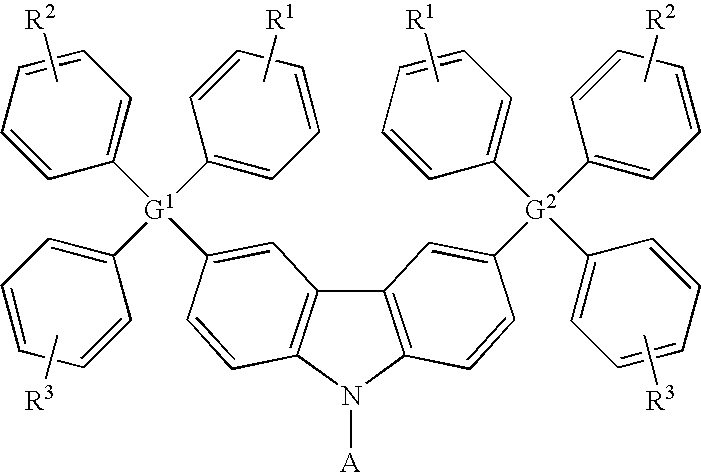
- the carbazole-based compound has a general formula as following: wherein G 1 and G 2 are identical or different, G 1 and G 2 are independently selected from C, Si. R 1 , R 2 and R 3 are identical or different, and R 1 , R 2 and R 3 are independently selected from the group consisting of: hydrogen atom, linear alkyl, branched alkyl, cyclic alkyl, aryl moiety, hetero cycle, multiple fused ring, multiple fused ring with hetero atom(s), and alkyl with at least one substituent of alkene or alkyne or carbamates.
- CV Cyclic voltammetry
- FIG. 2 shows the room-temperature absorption, fluorescence and 77 K phosphorescence spectra of CzSi, which are nearly identical to those of the unsubstituted carbazole monomer ( FIG. 2 ) and thus can be unambiguously attributed to the lowest ⁇ - ⁇ * transition of the central carbazole chromophore in CzSi.
- the tetrahedral Si therefore serves as an effective spacer blocking the ⁇ -conjugation of the carbazole core from extending to the peripheral substitution.
- the phenyl substitution at the 9 position of carbazole has no effect on these photophysical characteristics either, consistent with previous observations.
- the triplet energy of CzSi is estimated to be as high as 3.02 eV, same as that of the unsubstituted cabazole.
- CzSi is considered as a promising host for blue electrophosphorescence.
- the most reliable means for testing the effectiveness of a host for a phosphorescent dopant is to perform temperature-dependent photoluminescence (PL) of the host-guest system.
- PL temperature-dependent photoluminescence
- the host-to-guest energy transfer is endothermic (and thus thermally activated) and the exciton confinement is not effective enough, at low temperatures the host-to-guest energy transfer would be substantially retarded and the back energy transfer might occur.
- fluorescence and/or phosphorescence from the host and substantial reduction of the overall luminescence efficiency due to larger probability of relaxation from the less efficient host molecules.
- FIG. 3 shows temperature dependence of PL of a CzSi film doped with 8 wt. % of the typical blue phosphorescent dopant iridium(III)bis [4,6-difluorophenyl]-pyridinato-N,C 2 ′]picolinate (FIrpic, FIG. 4 ).
- the FIrpic-doped CzSi shows only emission of FIrpic and no emission of CzSi (either fluorescence or phosphorescence) could be observed ( FIG. 3 ).
- the PL intensity is rather independent of the temperature (inset of FIG. 3 ).
- PL of organic thin films was measured using a CCD spectragraph and the 325-nm line of the He—Cd laser as the excitation source.
- the samples were mounted in a vacuum chamber equipped with a temperature controller.
- the samples were mounted in a calibrated integrating sphere coupled to the CCD spectragraph.
- Phosphorescence of CzSi was measured at 77° K (the liquid nitrogen temperature) using a 5-ms delay time between the excitation with a microsecond flash lamp and the measurement.
- the second embodiment of the present invention discloses an organic light emitting device comprising a multilayer structure for producing electroluminescence, wherein the multilayer structure comprises: a substrate, an anode layer, a first hole transporting layer comprising 4,4′-bis[N-(1-naphthyl)-N-phenyl-amino]biphenyl ( ⁇ -NPD) or 2,2′-bis (N,N-disubstituted amine)-9,9′-spirobifluorene, a second hole transporting layer, an emitting layer comprising a host material and a guest material, wherein the host material comprises carbazole-based compound, an electron transporting layer, and a cathode layer.
- a first hole transporting layer comprising 4,4′-bis[N-(1-naphthyl)-N-phenyl-amino]biphenyl ( ⁇ -NPD) or 2,2′-bis (N,N-disubstituted
- the general formula of the 2,2′-bis (N,N-disubstituted amine)-9,9′-spirobifluorene is as following: , wherein B 4 is selected from the group consisting of: linear alkyl, branched alkyl, cyclic alkyl, aryl moiety, hetero cycle, multiple fused ring, multiple fused ring with hetero atom(s), and alkyl with at least one substituent of alkene or alkyne or carbamates.
- the general formula of the carbazole-based compound is as following: , wherein Q of the carbazole-based compound is a non-conjugate moiety, A comprises one of the following group: aryl moiety, hetero cycle, multiple fused ring, multiple fused ring with hetero atom(s).
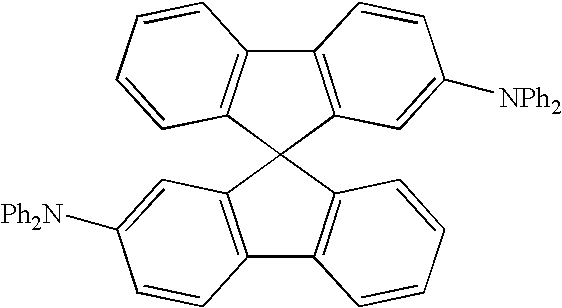
- the chemical structure of one preferred example of the 2,2′-bis (N,N-disubstituted amine)-9,9′-spirobifluorene is 2,2′-Bis(diphenylamino)-9,9′-spirobifluorene (hereinafter referred to as DPAS) as the following:
- the second hole transporting layer can comprise 4,4′,4′′-tri(N-carbazolyl) triphenylamine (TCTA).
- the guest material comprises iridium(III)bis[4,6-difluorophenyl]-pyridinato-N,C 2 ′]picolinate (FIrpic). Additionally, the carbazole-based compound is described in the first embodiment of this invention.
- the OLEDs were fabricated on glass substrates with the typical structure of multiple organic layers sandwiched between the bottom indium tin oxide (ITO) anode and the top metal cathode (Al).
- the PEDT:PSS layer was prepared by spin coating, and other material layers were deposited by vacuum evaporation in a vacuum chamber with a base pressure of ⁇ 10 ⁇ 6 torr.
- the deposition system permits the fabrication of the complete device structure in a single vacuum pump-down without breaking vacuum.
- the deposition rate of organic layers was kept at ⁇ 0.2 nm/s.
- the active area of the device is 2 ⁇ 2 mm 2 , as defined by the shadow mask for cathode deposition.
- the device structure used was ITO/PEDT:PSS ( ⁇ 300 ⁇ )/DPAS or ⁇ -NPD (175 ⁇ )/TCTA (25 ⁇ )/CzSi doped with 8 wt. % FIrpic (250 ⁇ )/TAZ (500 ⁇ )/LiF (5 ⁇ )/Al (1500 ⁇ ), where the conducting polymer polyethylene dioxythiophene/polystyrene sulphonate (PEDT:PSS) was used as the hole-injection layer, DPAS, 4,4′-bis[N-(1-naphthyl)-N-phenyl-amino]biphenyl ( ⁇ -NPD), and 4,4′,4′′-tri(N-carbazolyl) triphenylamine (TCTA) as the hole-transport layers, CzSi with a nearly optimized concentration (8 wt.
- PEDT:PSS conducting polymer polyethylene dioxythiophene/polystyrene
- FIrpic As the emitting layer, 3-(4-biphenylyl)-4-phenyl-5-(4-tert-butylphenyl)-1,2,4- triazole (TAZ) as the electron-transport layer, and LiF as the electron-injection layer.
- IP ionization potentials
- EA Electron affinities
- IP's of thin films of organic compounds were measured by ultraviolet photoemission spectroscopy (UPS).
- the deposition and the UPS measurements of thin-film samples were performed in two interconnected ultra-high vacuum chambers.
- Organic thin films were deposited on gold-coated silicon substrates by thermal evaporation in the deposition chamber, and then transferred in situ to the analysis chamber.
- UPS was carried out using the He I (21.22 eV) and He II (40.8 eV) photon lines and the double-pass cylindrical mirror analyzer to measure energy spectrum of photo-excited electrons.
- the overall resolution of the UPS measurement is about 0.15 eV.
- the energy scale of UPS spectra is referenced to the Fermi level of the system, which is measured on the gold surface before deposition of organic thin films. IP's of molecular films can be deduced from the energy difference between the HOMO level and the vacuum level (inferred from the low-energy onset of the UPS spectrum).
- EL of the device using the DPAS/TCTA hole-transport layers is identical to PL of FIrpic-doped CzSi, indicating the effectiveness of the present device structure in injecting both holes and electrons into the emitting layer.
- I-V-L characteristics, external EL quantum efficiency and power efficiency of the device are shown in FIG. 5 ( a ) and FIG. 5 ( b ).
- the current-voltage-brightness (I-V-L) characterization of the light-emitting devices was performed with a source-measurement unit (SMU) and a Si photodiode calibrated with Photo Research PR650. EL spectra of devices were collected by a calibrated CCD spectragraph.
- the present device exhibits a rather low turn-on voltage of ⁇ 3 V (defined as the voltage where EL becomes detectable) and a low operation voltage (100 cd/m 2 at 5V), as shown in FIG. 5 ( a ).
- ⁇ 3 V defined as the voltage where EL becomes detectable
- a low operation voltage 100 cd/m 2 at 5V
- FIG. 5 ( a ) A high external EL quantum efficiency of 15.7% photon/electron (30.6 cd/A, maximum) and a maximum brightness as high as ⁇ 59000 cd/m 2 (at 14.5 V) were observed.
- High quantum efficiency along with low voltage gives maximal power efficiency of 26.7 lm/W.
- Similar device performances were also obtained by using the ⁇ -NPD/TCTA hole-transport layers, yet DPAS has a higher Tg (and thus thermal stability) than ⁇ -NPD ( ⁇ 110° C. vs.
- the power efficiency of the present device is also nearly double of the highest values previously reported for blue electrophosphorescence ( ⁇ 14 lm/W).
- These improved characteristics may, in part, be attributed to the judicious use of two hole-transport layers (DPAS/TCTA or ⁇ -NPD/TCTA) with a stepwise increase in IP's to match IP of CzSi, and choice of the electron-transport layer (TAZ).
- DPAS/TCTA or ⁇ -NPD/TCTA two hole-transport layers
- TAZ electron-transport layer
- Adopting other electron-transport and hole-blocking layers widely used in phosphorescent OLEDs such as BCP (2,9-dimethyl-4,7-diphenyl-1,10-phenanthroline) or TPBI (2,2′,2′′-(1,3,5-benzenetriyl)tris[1-phenyl-1H-benzimidazole]), also substantially reduces the device efficiency.
- Efficiency roll-off at higher currents which is typical in phosphorescent OLEDs and may be associated with triplet-triplet annihilation, is also observed here, yet at the practical brightness of 100 cd/M 2 (5 V, 0.36 mA/cm 2 ), the efficiencies remain above 12%, 24 cd/A and 16 lm/W.
- FIG. 6 and FIG. 7 some detected spectra of the above-mentioned device are shown in FIG. 6 and FIG. 7 .
- the third embodiment of the present invention discloses a method for forming a carbazole-based compound. As shown in Scheme 1, first a dihalo derivative of carbazole, a halo-trisubstituted silane and a Lewis base as auxiliary are provided, and then a substitution reaction is performed to react the dihalo derivative of carbazole with the halo-trisubstituted silane to produce the carbazole-based compound.
- X 1 and X 2 are independently selected from the group consisting of: Cl, Br and I.
- the dihalo derivative of carbazole has a general formula as following: wherein A comprises one of the following group: aryl moiety, hetero cycle, multiple fused ring, multiple fused ring with hetero atom(s).
- the halo-trisubstituted silane has a general formula as following: , wherein G comprises one of the following group: C, Si.
- B 1 , B 2 and B 3 are identical or different, and B 1 , B 2 and B 3 are independently selected from the group consisting of: linear alkyl, branched alkyl, cyclic alkyl, aryl moiety, hetero cycle, multiple fused ring, multiple fused ring with hetero atom(s), and alkyl with at least one substituent of alkene or alkyne or carbamates.
- the carbazole-based compound has a general formula as following: wherein A, G, B 1 , B 2 and B 3 are described above.
- 3,6-bissubstituted carbazole is provided as an effective host material for blue electrophosphorescence.
- the new compound retains the large triplet energy of carbazole yet exhibits much enhanced morphological stability and electrochemical stability in comparison with previous carbazole-based host materials.
- CzSi is used as host material
- blue phosphorescent OLEDs having high efficiencies up to 16%, 30.6 cd/A and 26.7 lm/W are demonstrated.
- blue devices are reported here, such a large-gap host materials may also be of use for green and red phosphorescent devices. Indeed, our preliminary results on green phosphorescent devices using the same device structure have shown comparable quantum efficiencies.
- the present invention discloses a carbazole-based compound with a general formula as following: , wherein Q is a non-pi-conjugate moiety, A comprises one of the following group: aryl moiety, hetero cycle, multiple fused ring, multiple fused ring with hetero atom(s).
- the present invention discloses a method for forming the carbazole-based compound.
Landscapes
- Chemical & Material Sciences (AREA)
- Organic Chemistry (AREA)
- Engineering & Computer Science (AREA)
- Materials Engineering (AREA)
- Physics & Mathematics (AREA)
- Spectroscopy & Molecular Physics (AREA)
- Electroluminescent Light Sources (AREA)
- Indole Compounds (AREA)
Abstract
The present invention discloses a carbazole-based compound with a general formula as following:
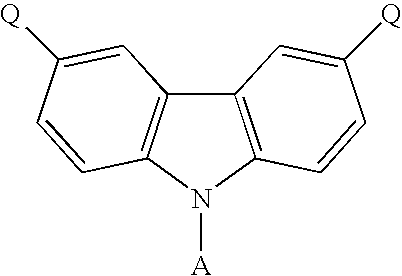
, wherein Q is a non-conjugate moiety, A comprises one of the following group: aryl moiety, hetero cycle, multiple fused ring, multiple fused ring with hetero atom(s). In addition, the present invention discloses a method for forming the carbazole-based compound.
Description
- 1. Field of the Invention
- The present invention is generally related to carbazole-based compounds, and more particularly to carbazole-based compounds which can be used as host materials in light-emitting devices.
- 2. Description of the Prior Art
- Recent development of efficient phosphorescent emitters containing transition metals renders possible harvesting both electro-generated singlet and triplet excitons for emission from organic light-emitting devices (OLEDs) and realizing nearly 100% internal quantum efficiencies of electroluminescence (EL). In phosphorescent OLEDs, to reduce quenching associated with relatively long excited-state lifetimes of triplet emitters and triplet-triplet annihilation etc., triplet emitters are normally used as emitting guests in a host material. Effective host materials are thus of equal importance for efficient phosphorescent OLEDs. For efficient electrophosphorescence from triplet guests, it is essential that the triplet level of the host be larger than that of the triplet emitter to prevent reverse energy transfer from the guest back to the host and to effectively confine triplet excitons on guest molecules. Such a requirement becomes particularly challenging when blue electrophosphorescence is of interest, in which the conjugation in the host molecules must be extremely confined to achieve a triplet energy level larger than photon energies of blue light (i.e. ≧2.7 eV). As such, host materials reported for blue electrophosphorescence have thus far been rare and among them, materials based on the carbazole moiety are the only electrically active systems that had been spotted to meet such a requirement.
- For molecules to form morphologically stable and uniform amorphous films with typical processing techniques, the molecule size must be extended beyond one carbazole monomer to obtain bulky and steric molecular configurations. Since conjugation beyond one carbazole would result in substantial reduction of the triplet energy, thus far there exist only a very limited number of carbazole-based compounds suitable for blue electrophosphorescence (i.e. having both large enough triplet energies and acceptable morphological stability). These rare cases in general involve connecting the carbazole moieties through its 9 position (i.e. the nitrogen atom) to a central linkage with even more limited conjugation (e.g. benzene or phenylsilanes), since such a connection appears to have little effect on conjugation. One distinguished example of such compounds is 1,3-bis(9-carbazolyl)benzene (hereinafter named as mCP, inset of
FIG. 1 (b)). Although such a molecular configuration has proved successful in improving morphological stability, one notices that all these materials have left unprotected their highly electrochemically active sites (C3 and C6 of carbazoles), which may cause issues in electrochemical stability. In light of the above-mentioned matter, it is required to develop a novel host material in OLEDs to obtain electrochemical stability and higher efficiency. - According to the above, the present invention provides a new carbazole-based compound to fulfill the requirements of this industry.
- One object of the present invention is to employ a novel molecular design strategy of retaining the large triplet energy of carbazole yet enhancing morphological stability by non-conjugated substitution of its C3 and C6 with bulky and large-gap moieties (i.e. triphenylsilyl groups). In addition, with such a configuration, the electrochemically active sites of carbazole are blocked, giving the compounds an extra electrochemical stability. According to the above, the present invention does have the economic advantages for industrial applications.
- According to above-mentioned objectives, the present invention discloses a carbazole-based compound with a general formula as following:
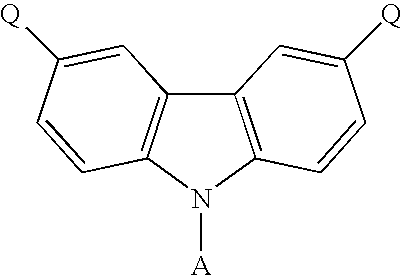
, wherein Q is a non-conjugate moiety, A comprises one of the following group: aryl moiety, hetero cycle, multiple fused ring, multiple fused ring with hetero atom(s). In addition, the present invention discloses a method for forming the carbazole-based compound. -
FIG. 1 shows repeated cyclic voltammograms of (a) CzSi (5 cycles), and (b) mCP (5 cycles). Inset of (a) is the optimized molecular structure of CzSi and inset of (b) is the molecular structure of mCP; -
FIG. 2 shows room-temperature absorption, fluorescence and 77 K phosphorescence spectra of CzSi in toluene (1×10⁻⁵ M), in comparison with those of the unsubstituted carbazole monomer in toluene; -
FIG. 3 shows PL spectra of a CzSi film doped with 8 wt. % of FIrpic at the room temperature and 25 K, along with the EL spectrum of the device. Inset: PL intensity of the FIrpic-doped CzSi film as a function of temperature; -
FIG. 4 shows chemical structures of (a) TCTA, (b) FIrpic and (c) TAZ. (d) Energy levels of related compounds in thin films; -
FIG. 5 shows (a) I-V-L characteristics, and (b) external EL quantum efficiency/power efficiency vs. current density of the device; -
FIG. 6 shows the detected characteristics of the devices respectively with CzSi, CzC, and CzCSi as the host material in the light-emitting layer; and -
FIG. 7 shows EL spectra of the devices with respectively with CzSi, CzC, and CzCSi as the host material in the light-emitting layer. - What is probed into the invention is carbazole-based compound and their application. Detail descriptions of the structure and elements will be provided in the following in order to make the invention thoroughly understood. Obviously, the application of the invention is not confined to specific details familiar to those who are skilled in the art. On the other hand, the common structures and elements that are known to everyone are not described in details to avoid unnecessary limits of the invention. Some preferred embodiments of the present invention will now be described in greater detail in the following. However, it should be recognized that the present invention can be practiced in a wide range of other embodiments besides those explicitly described, that is, this invention can also be applied extensively to other embodiments, and the scope of the present invention is expressly not limited except as specified in the accompanying claims.
- The first embodiment of the present invention discloses a carbazole-based compound with a general formula as following:

, wherein Q is a non-pi-conjugated moiety. A comprises one of the following group: aryl moiety, hetero cycle, multiple fused ring, multiple fused ring with hetero atom(s). Additionally, the glass transition temperature of the carbazole-based compound is equal to or higher than 100° C. Furthermore, the compound can be used as host material in organic electroluminescence devices. - In a preferred example of this embodiment, the carbazole-based compound has a general formula as following:
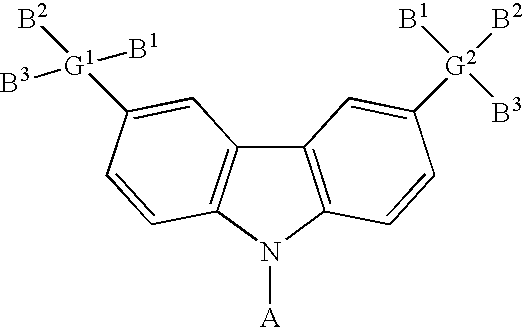
, wherein G1 and G2 are identical or different, G1 and G2 are independently selected from C, Si. B1, B2 and B3 are identical or different, and B1, B2 and B3 are independently selected from the group consisting of: linear alkyl, branched alkyl, cyclic alkyl, aryl moiety, hetero cycle, multiple fused ring, multiple fused ring with hetero atom(s), and alkyl with at least one substituent of alkene or alkyne or carbamates. - In another preferred example of this embodiment, the carbazole-based compound has a general formula as following:
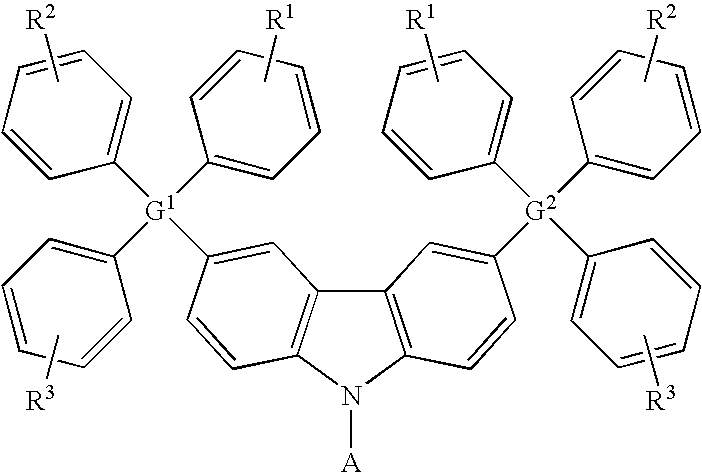
wherein G1 and G2 are identical or different, G1 and G2 are independently selected from C, Si. R1, R2 and R3 are identical or different, and R1, R2 and R3 are independently selected from the group consisting of: hydrogen atom, linear alkyl, branched alkyl, cyclic alkyl, aryl moiety, hetero cycle, multiple fused ring, multiple fused ring with hetero atom(s), and alkyl with at least one substituent of alkene or alkyne or carbamates. -

- CzSi: 9-(4-tert-butylphenyl)-3,6-dibromo-carbazole (1.8 g, 4 mmol) in THF (150 mL) were treated with n-BuLi (7.5 ml, 12 mmol) at −78° C. and quenched with a solution of chlorotriphenylsilane (3.54 g, 12 mmol) in THF (50 mL). The desired product was purified by column chromatography, eluting with CHCl3/Hexane (1/4) to provide the product as a white solid. (1.2 g, 35%).
- CzSi: m.p. 354° C. (DSC); IR (neat) ν 2960, 2359, 1681, 1428, 1260, 1025, 801, 699, 512 cm−1; 1H NMR (CDCl3, 400 MHz) δ 8.21 (s, 2H), 7.61-7.55 (m, 16H), 7.49-7.41 (m, 2H), 7.44-7.40 (m, 8H), 7.37-7.34 (m, 12H) 1.42 (s, 9H); 13C NMR (CDCl3, 100 MHz) δ 150.1, 141.5, 136.0, 134.4, 134.0, 133.4, 129.0, 128.5, 127.4, 126.3, 126.1, 123.5, 122.7, 109.5, 35.1, 31.7; MS (m/z, FAB+) 815 (4); HRMS (m/z, FAB+) Calcd for C58H49NSi2 815.3404, found 815.3403; Anal. Calcd. For C58H49NSi2: C, 85.35; H, 6.05. Found: C, 85.10; H, 6.07.
-
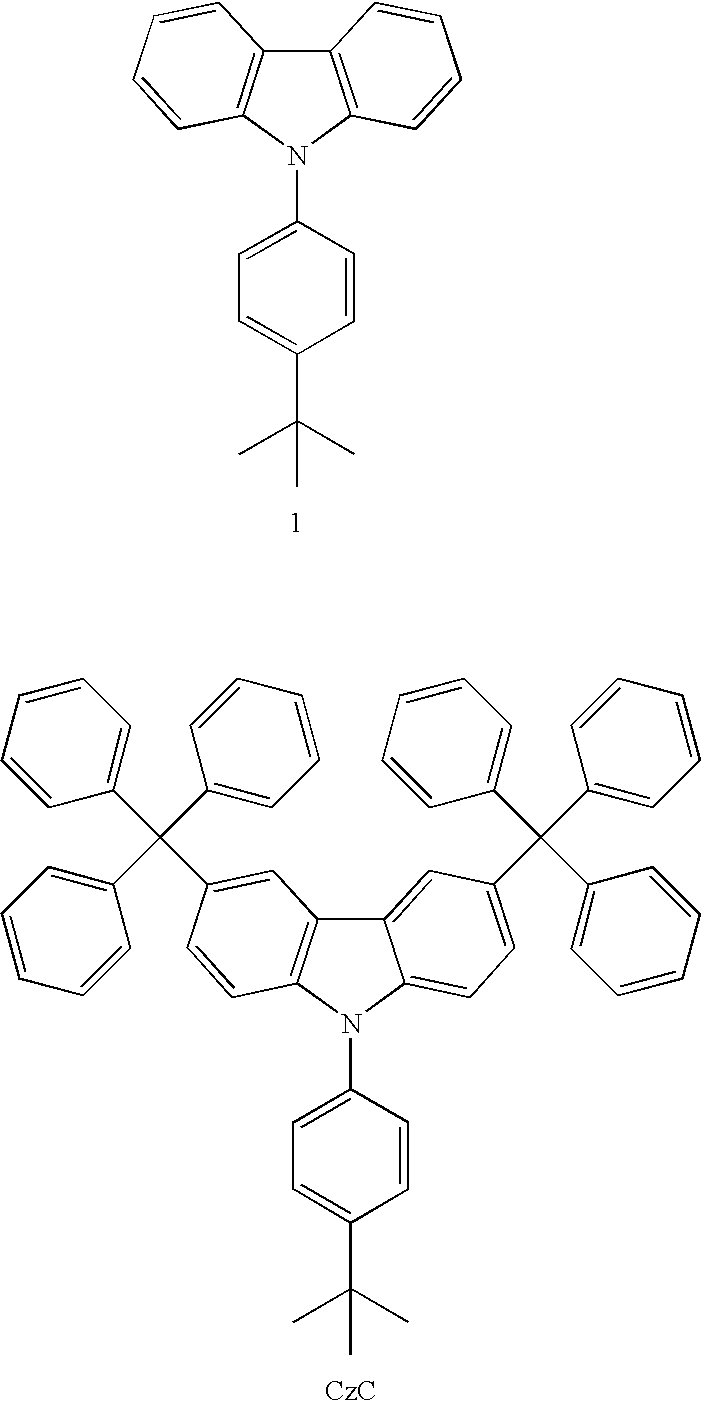
- CzC: 9-(4-tert-Butylphenyl)carbazole (1) (2.99 g, 10 mmol) and triphenyl methanol (5.47 g, 21 mmol) was dissolved in CH2Cl2 (70 mL), Eaton's reagent (7.7 wt % P2O5 in CH3SO3H) was added dropwise at 25° C. under a nitrogen atmosphere. After 24 h, the precipitate was filtered and washed with water (50 mL×2) and dilute aqueous sodium bicarbonate solution (×1). The crude in acetone was refluxed for 1 h, and refluxed for another 1 h in CH2Cl2. The white powder were filtered and dried: yield 6.6 g (84%).
- CzC: mp 372˜374° C. (DSC); 1H NMR (CDCl3, 400 MHz) δ 7.79 (d, J=1.6 Hz, 2H), 7.53 (dd, J=8.8 Hz, 2H), 7.47 (dd, J=8.8 Hz, 2H), 7.30 (s, 1H), 7.30˜7.26 (m, 4H), 7.26-7.16 (m, 27H), 7.12 (dd, J=8.8, 2.0 Hz, 2H), 1.40 (s, 9H); 13C NMR (CDCl3, 400 MHz) δ 150.0, 147.1, 139.0, 138.4, 134.8, 131.1, 130.4, 127.2, 126.4, 126.0, 125.6, 122.3, 121.3, 108.9, 64.9, 34.8, 31.5; MS(m/z, FAB+) 783 (0.41); HRMS (M+, FAB+) Calcd. for C60H49N 783.3865, Found 783.3871.
-
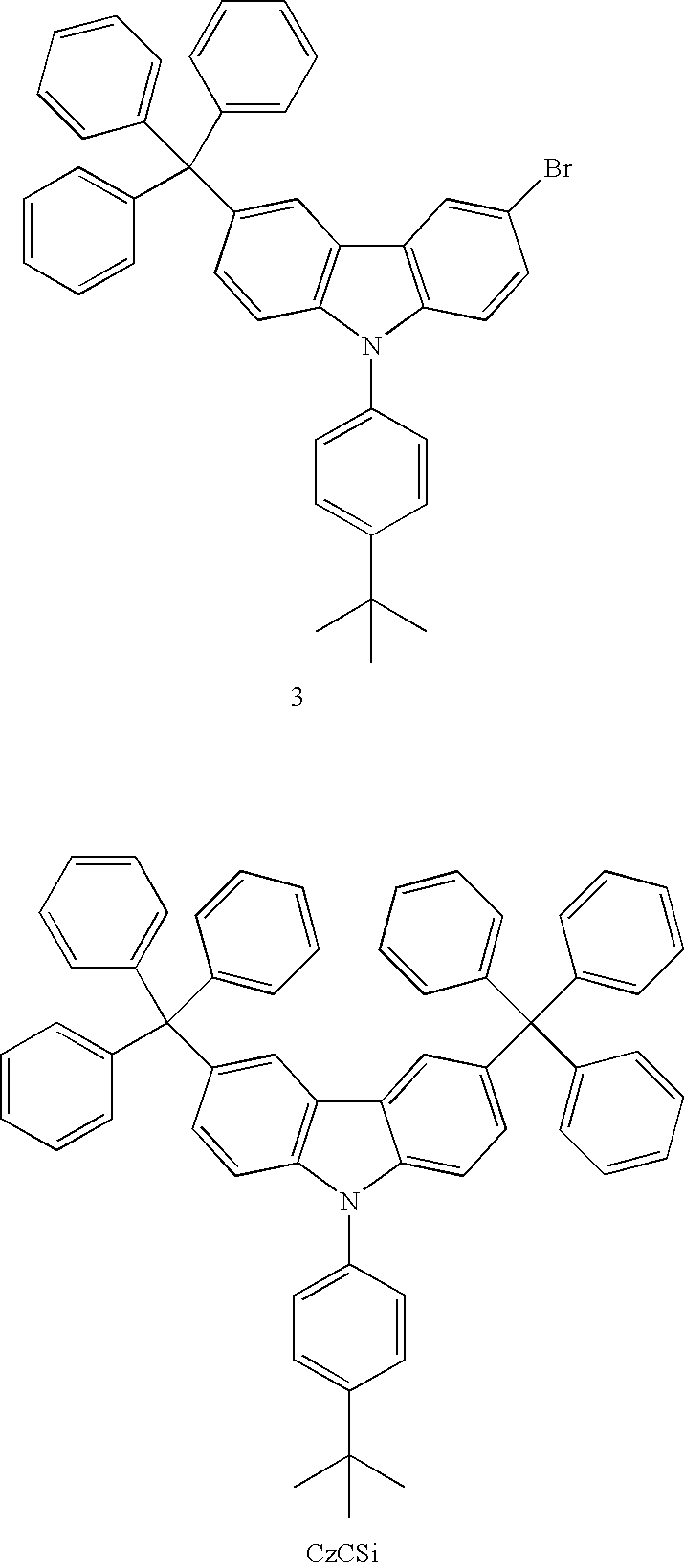
- CzCSi: n-BuLi (5.5 mmol, 3.4 ml of 1.6 molL−1 solution) was dropwised slowly to a degassed THF solution (50 mL) of 3-bromo-6-tripheylmethyl-9-(4-tert-Butylphenyl)-carbazol (3) (3.1 g, 5 mmol) at −78° C. After stirring for 1 h at −78° C., chlorotriphenylsilane (1.62 g, 5.5 mmol) in THF (30 mL) was added in one portion. The resulting mixture was immediately warmed to room temperatrure. The precipitate was filtered and washed with hexane (50 mL) to provide the white powder: yield 2.4 g (60%).
- CzCSi: mp 357˜360° C. (DSC); 1H NMR (CDCl3, 400 MHz) δ 8.11 (s, 1H), 7.88 (d, J=1.2 Hz, 1H), 7.61-7.59 (m, 5H), 7.54 (t, 4H), 7.48 (s, 2H), 7.46 (s, 1H), 7.42 (dd, J=7.8, 5.4 Hz, 5H), 7.36 (t, J=7 Hz, 7H), 7.3 (s, 1H), 7.28 (d, J=5.6 Hz, 3H), 7.24-7.15 (m, 10H), 1.40 (s, 9H); 13C NMR (CDCl3, 400 MHz) δ 150.2, 147.1, 142.0, 138.9, 138.7, 136.3, 134.8, 134.6, 133.4, 131.1, 130.6, 129.3, 128.6, 127.7, 127.2, 126.5, 126.1, 125.7, 123.3, 123.2, 122.0, 121.6, 109.7, 108.9, 64.9, 34.8, 31.5; MS(m/z, FAB+) 799 (100)
- As shown in the optimized molecular structure of CzSi (inset of
FIG. 1 (a)), linking triphenylsilyl groups to C3 and C6 of carbazole renders the molecule rather steric, rigid, and bulky. Such a molecular configuration is strongly beneficial to the thermal stability, as indicated by the high decomposition temperature (Td, corresponding to 5% weight loss in the thermogravimetric analysis) of 392° C. and the rather high glass transition temperature (Tg) of 131° C. determined by differential scanning calorimetry. Such a Tg is more than double of mCP's Tg (<60° C.). With a high Tg and thus resistance against crystallization, CzSi is able to form homogeneous and stable amorphous films by thermal evaporation. - The electrochemical properties of CzSi are investigated by cyclic voltammetry and are shown in
FIG. 1 (a). Synthesized compounds were subject to purification by temperature-gradient sublimation in high vacuum before use in subsequent studies. Cyclic voltammetry (CV) was performed at a scan rate of 100 mV/s using the glass electrode as the working electrode and Ag/AgCl as a reference electrode. Oxidation CV was performed in CH2Cl2 with 0.1 M of nBu4NPF6 as a supporting electrolyte, and then a reversible oxidation process [E1/2=1.37 V (vs. Ag/AgCl)] was observed. In contrast, without blocking the electrochemically active sites (C3 and C6 of carbazoles), the oxidation process of mCP is not reversible, with the oxidation potential gradually shifting to lower potentials and the current increasing during repeated CV scans (FIG. 1 (b)). As revealed in literature, such characteristics are signatures of electrochemical polymerization of carbazoles through the active C3 and C6 sites. These electrochemical results indicate that in addition to the morphological benefits, the introduction of triphenylsilyl substitutions brings enhanced electrochemical stability as they block the electrochemically active sites (C3 and C6) of carbazole. -
FIG. 2 shows the room-temperature absorption, fluorescence and 77 K phosphorescence spectra of CzSi, which are nearly identical to those of the unsubstituted carbazole monomer (FIG. 2 ) and thus can be unambiguously attributed to the lowest π-π* transition of the central carbazole chromophore in CzSi. The tetrahedral Si therefore serves as an effective spacer blocking the π-conjugation of the carbazole core from extending to the peripheral substitution. Furthermore, it is noticed that the phenyl substitution at the 9 position of carbazole has no effect on these photophysical characteristics either, consistent with previous observations. By taking the highest-energy peak of phosphorescence as the transition energy of T1→S0, which corresponds to the vibronic 0-0 transition between these two electronic states, the triplet energy of CzSi is estimated to be as high as 3.02 eV, same as that of the unsubstituted cabazole. - With the high triplet energy, CzSi is considered as a promising host for blue electrophosphorescence. The most reliable means for testing the effectiveness of a host for a phosphorescent dopant is to perform temperature-dependent photoluminescence (PL) of the host-guest system. In general, if the host-to-guest energy transfer is endothermic (and thus thermally activated) and the exciton confinement is not effective enough, at low temperatures the host-to-guest energy transfer would be substantially retarded and the back energy transfer might occur. As such, one may observe fluorescence and/or phosphorescence from the host and substantial reduction of the overall luminescence efficiency due to larger probability of relaxation from the less efficient host molecules.
FIG. 3 shows temperature dependence of PL of a CzSi film doped with 8 wt. % of the typical blue phosphorescent dopant iridium(III)bis [4,6-difluorophenyl]-pyridinato-N,C2′]picolinate (FIrpic,FIG. 4 ). For the whole temperature range of 25-300 K investigated, the FIrpic-doped CzSi shows only emission of FIrpic and no emission of CzSi (either fluorescence or phosphorescence) could be observed (FIG. 3 ). Furthermore, the PL intensity is rather independent of the temperature (inset ofFIG. 3 ). These results indicate efficient exothermic energy transfer from CzSi to FIrpic and effective confinement of triplet excitons on dopants. Along with the high PL quantum yield of 92% for the FIrpic-doped CzSi, the temperature-independent PL also suggests thermally activated nonradiative decay processes in the present host-guest system are much weaker than FIrpic phosphorescence. - PL of organic thin films was measured using a CCD spectragraph and the 325-nm line of the He—Cd laser as the excitation source. During temperature-dependent PL measurements, the samples were mounted in a vacuum chamber equipped with a temperature controller. For determining PL quantum yields, the samples were mounted in a calibrated integrating sphere coupled to the CCD spectragraph. By comparing the spectral intensities of the excitation laser and the PL emission, PL quantum yields were determined. Phosphorescence of CzSi was measured at 77° K (the liquid nitrogen temperature) using a 5-ms delay time between the excitation with a microsecond flash lamp and the measurement.
- The second embodiment of the present invention discloses an organic light emitting device comprising a multilayer structure for producing electroluminescence, wherein the multilayer structure comprises: a substrate, an anode layer, a first hole transporting layer comprising 4,4′-bis[N-(1-naphthyl)-N-phenyl-amino]biphenyl (α-NPD) or 2,2′-bis (N,N-disubstituted amine)-9,9′-spirobifluorene, a second hole transporting layer, an emitting layer comprising a host material and a guest material, wherein the host material comprises carbazole-based compound, an electron transporting layer, and a cathode layer. Furthermore, the general formula of the 2,2′-bis (N,N-disubstituted amine)-9,9′-spirobifluorene is as following:
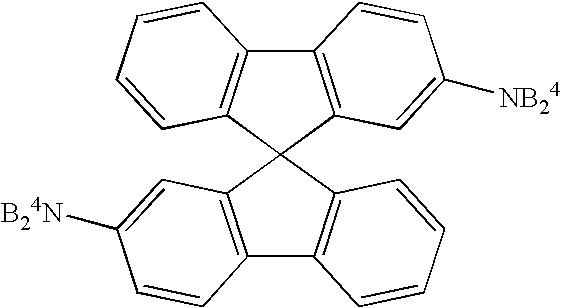
, wherein B4 is selected from the group consisting of: linear alkyl, branched alkyl, cyclic alkyl, aryl moiety, hetero cycle, multiple fused ring, multiple fused ring with hetero atom(s), and alkyl with at least one substituent of alkene or alkyne or carbamates. Moreover, the general formula of the carbazole-based compound is as following:
, wherein Q of the carbazole-based compound is a non-conjugate moiety, A comprises one of the following group: aryl moiety, hetero cycle, multiple fused ring, multiple fused ring with hetero atom(s). - In this embodiment, the chemical structure of one preferred example of the 2,2′-bis (N,N-disubstituted amine)-9,9′-spirobifluorene is 2,2′-Bis(diphenylamino)-9,9′-spirobifluorene (hereinafter referred to as DPAS) as the following:
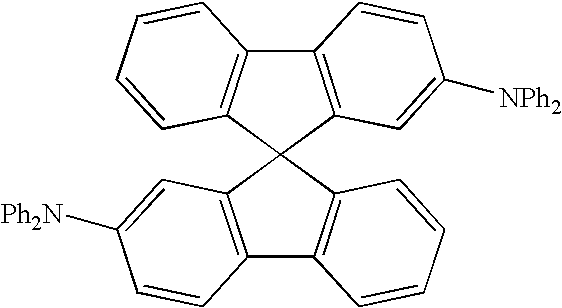
The second hole transporting layer can comprise 4,4′,4″-tri(N-carbazolyl) triphenylamine (TCTA). The guest material comprises iridium(III)bis[4,6-difluorophenyl]-pyridinato-N,C2′]picolinate (FIrpic). Additionally, the carbazole-based compound is described in the first embodiment of this invention. - CzSi has been subjected to electrophosphorescence studies. The OLEDs were fabricated on glass substrates with the typical structure of multiple organic layers sandwiched between the bottom indium tin oxide (ITO) anode and the top metal cathode (Al). The PEDT:PSS layer was prepared by spin coating, and other material layers were deposited by vacuum evaporation in a vacuum chamber with a base pressure of <10−6 torr. The deposition system permits the fabrication of the complete device structure in a single vacuum pump-down without breaking vacuum. The deposition rate of organic layers was kept at ˜0.2 nm/s. The active area of the device is 2×2 mm2, as defined by the shadow mask for cathode deposition. The device structure used was ITO/PEDT:PSS (˜300 Å)/DPAS or α-NPD (175 Å)/TCTA (25 Å)/CzSi doped with 8 wt. % FIrpic (250 Å)/TAZ (500 Å)/LiF (5 Å)/Al (1500 Å), where the conducting polymer polyethylene dioxythiophene/polystyrene sulphonate (PEDT:PSS) was used as the hole-injection layer, DPAS, 4,4′-bis[N-(1-naphthyl)-N-phenyl-amino]biphenyl (α-NPD), and 4,4′,4″-tri(N-carbazolyl) triphenylamine (TCTA) as the hole-transport layers, CzSi with a nearly optimized concentration (8 wt. %) of FIrpic as the emitting layer, 3-(4-biphenylyl)-4-phenyl-5-(4-tert-butylphenyl)-1,2,4- triazole (TAZ) as the electron-transport layer, and LiF as the electron-injection layer. Chemical structures of related compounds and their energy levels are shown in
FIG. 4 , in which ionization potentials (IP) of molecular compounds in films were determined by our own measurements with ultraviolet photoemission spectroscopy while IP of FIrpic was taken from the literature. Electron affinities (EA) of all compounds were derived by subtracting IP's with optical energy gaps. - IP's of thin films of organic compounds were measured by ultraviolet photoemission spectroscopy (UPS). The deposition and the UPS measurements of thin-film samples were performed in two interconnected ultra-high vacuum chambers. Organic thin films were deposited on gold-coated silicon substrates by thermal evaporation in the deposition chamber, and then transferred in situ to the analysis chamber. In the analysis chamber with base pressure less than 1×10⁻¹⁰ Torr, UPS was carried out using the He I (21.22 eV) and He II (40.8 eV) photon lines and the double-pass cylindrical mirror analyzer to measure energy spectrum of photo-excited electrons. The overall resolution of the UPS measurement is about 0.15 eV. The energy scale of UPS spectra is referenced to the Fermi level of the system, which is measured on the gold surface before deposition of organic thin films. IP's of molecular films can be deduced from the energy difference between the HOMO level and the vacuum level (inferred from the low-energy onset of the UPS spectrum).
- As shown in
FIG. 3 , EL of the device using the DPAS/TCTA hole-transport layers is identical to PL of FIrpic-doped CzSi, indicating the effectiveness of the present device structure in injecting both holes and electrons into the emitting layer. I-V-L characteristics, external EL quantum efficiency and power efficiency of the device are shown inFIG. 5 (a) andFIG. 5 (b). The current-voltage-brightness (I-V-L) characterization of the light-emitting devices was performed with a source-measurement unit (SMU) and a Si photodiode calibrated with Photo Research PR650. EL spectra of devices were collected by a calibrated CCD spectragraph. The present device exhibits a rather low turn-on voltage of ˜3 V (defined as the voltage where EL becomes detectable) and a low operation voltage (100 cd/m2 at 5V), as shown inFIG. 5 (a). A high external EL quantum efficiency of 15.7% photon/electron (30.6 cd/A, maximum) and a maximum brightness as high as ˜59000 cd/m2 (at 14.5 V) were observed. High quantum efficiency along with low voltage gives maximal power efficiency of 26.7 lm/W. Similar device performances were also obtained by using the α-NPD/TCTA hole-transport layers, yet DPAS has a higher Tg (and thus thermal stability) than α-NPD (˜110° C. vs. ˜90° C.). In addition to achieving an external quantum efficiency among the highest ever reported for blue electrophosphorescence, the power efficiency of the present device is also nearly double of the highest values previously reported for blue electrophosphorescence (˜14 lm/W). These improved characteristics may, in part, be attributed to the judicious use of two hole-transport layers (DPAS/TCTA or α-NPD/TCTA) with a stepwise increase in IP's to match IP of CzSi, and choice of the electron-transport layer (TAZ). Using only single hole-transport layer of α-NPD, DPAS or TCTA results in lower efficiency and higher voltage. Adopting other electron-transport and hole-blocking layers widely used in phosphorescent OLEDs, such as BCP (2,9-dimethyl-4,7-diphenyl-1,10-phenanthroline) or TPBI (2,2′,2″-(1,3,5-benzenetriyl)tris[1-phenyl-1H-benzimidazole]), also substantially reduces the device efficiency. Efficiency roll-off at higher currents, which is typical in phosphorescent OLEDs and may be associated with triplet-triplet annihilation, is also observed here, yet at the practical brightness of 100 cd/M2 (5 V, 0.36 mA/cm2), the efficiencies remain above 12%, 24 cd/A and 16 lm/W. - Finally, to gain further insights of charge transport and emission mechanisms in the devices, three testing devices with doping only a portion of the 25-nm CzSi emitting layer (device A: doping 8 nm next to DPAS/TCTA; device B: doping 8 nm at the center; device C: doping 8 nm next to TAZ) were also fabricated and tested. Although all three devices show emission dominantly from FIrpic, devices A and B show much lower quantum efficiencies (5% and 6%, respectively) than device C (14%). The results indicate the EL emission mainly takes place near the CzSi/TAZ interface, where electrons inject either onto CzSi or directly onto FIrpic. This in turn suggests the hole-transport capability of CzSi and feasible hole injection from DPAS/TCTA onto CzSi.
- Moreover, as shown in
FIG. 6 andFIG. 7 , CzSi, CzC, CzCSi have been individually subjected to electrophosphorescence studies. Using the mentioned method, the light-emitting devices having the following structures were produced: -
- ITO/DPAS (300 Å)/8 wt. % FIrpic in CzSi (250 Å)/TAZ (500 Å)/LiF (5 Å)/Al (1500 Å)
- ITO/DPAS (300 Å)/8 wt. % FIrpic in CzC (250 Å)/TAZ (500 Å)/LiF (5 Å)/Al (1500 Å)
- ITO/DPAS (300 Å)/8 wt. % FIrpic in CzCSi (250 Å)/TAZ (500 Å)/LiF (5 Å)/Al (1500 Å)
- And, some detected spectra of the above-mentioned device are shown in
FIG. 6 andFIG. 7 . - The third embodiment of the present invention discloses a method for forming a carbazole-based compound. As shown in
Scheme 1, first a dihalo derivative of carbazole, a halo-trisubstituted silane and a Lewis base as auxiliary are provided, and then a substitution reaction is performed to react the dihalo derivative of carbazole with the halo-trisubstituted silane to produce the carbazole-based compound. X1 and X2 are independently selected from the group consisting of: Cl, Br and I.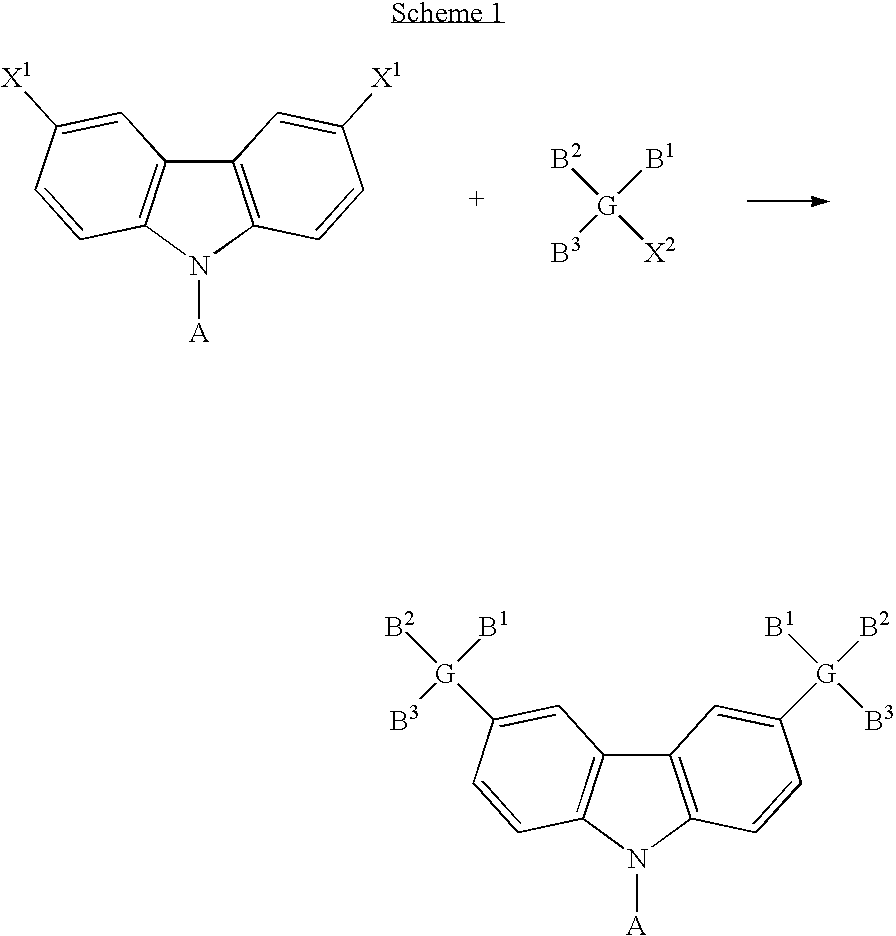
- In this embodiment, the dihalo derivative of carbazole has a general formula as following:
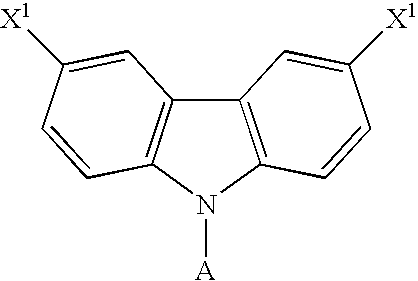
wherein A comprises one of the following group: aryl moiety, hetero cycle, multiple fused ring, multiple fused ring with hetero atom(s). The halo-trisubstituted silane has a general formula as following:
, wherein G comprises one of the following group: C, Si. Additionally, B1, B2 and B3 are identical or different, and B1, B2 and B3 are independently selected from the group consisting of: linear alkyl, branched alkyl, cyclic alkyl, aryl moiety, hetero cycle, multiple fused ring, multiple fused ring with hetero atom(s), and alkyl with at least one substituent of alkene or alkyne or carbamates. Moreover, the carbazole-based compound has a general formula as following: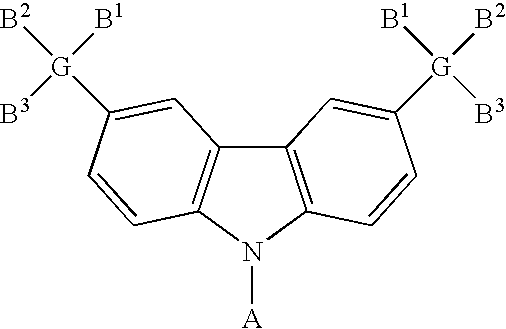
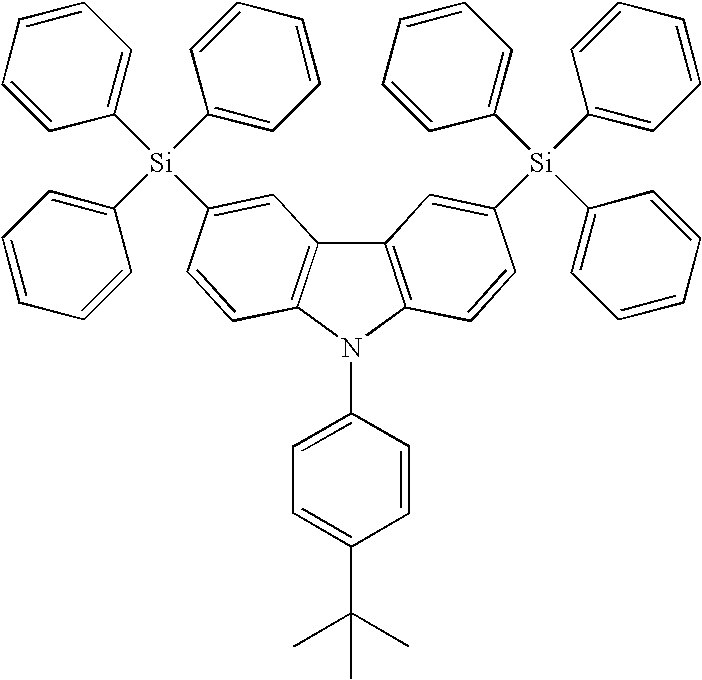
wherein A, G, B1, B2 and B3 are described above. - The synthetic pathway of the targeted compound, 9-(4-tert-butylphenyl)-3,6-bis(triphenylsilyl)-9H-carbazole (hereinafter named as CzSi), is shown in
Scheme 2. 9-(4-tert-butylphenyl)-3,6-dibromo-carbazole (1.8 g, 4 mmol) in THF (150 mL) were treated with n-BuLi (7.5 ml, 12 mmol) at −78° C. and quenched with a solution of chlorotriphenylsilane (3.54 g, 12 mmol) in THF (50 mL). The desired product was purified by column chromatography, eluting with CHCl3/Hexane (1/4) to provide the product as a white solid. (1.2 g, 35%);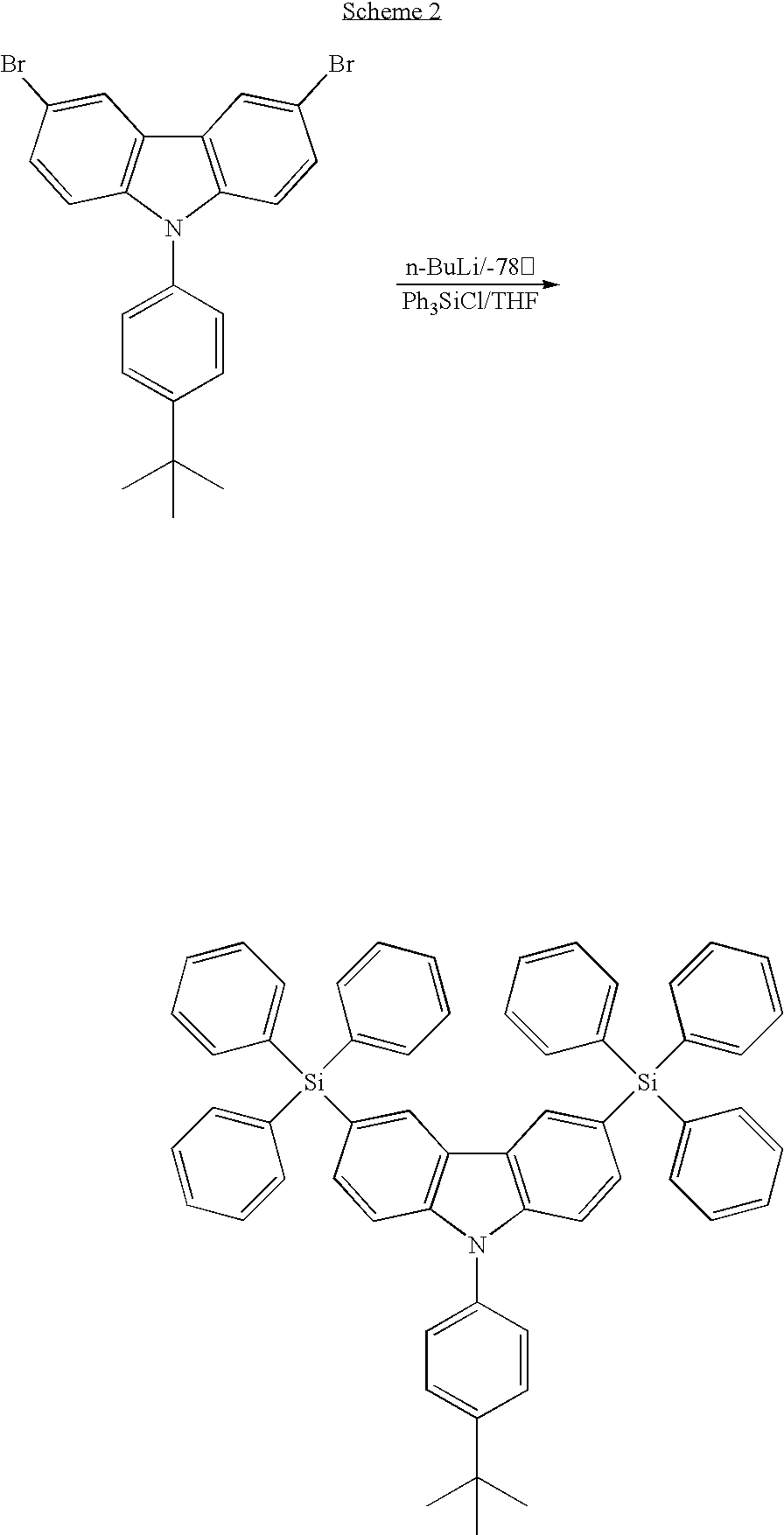
- In the embodiments, 3,6-bissubstituted carbazole is provided as an effective host material for blue electrophosphorescence. By non-conjugated substitution of the electrochemically active C3 and C6 sites of carbazole with the steric, bulky and large-gap triphenylsilyls, the new compound retains the large triplet energy of carbazole yet exhibits much enhanced morphological stability and electrochemical stability in comparison with previous carbazole-based host materials. For example, when CzSi is used as host material, blue phosphorescent OLEDs having high efficiencies up to 16%, 30.6 cd/A and 26.7 lm/W are demonstrated. Although mainly blue devices are reported here, such a large-gap host materials may also be of use for green and red phosphorescent devices. Indeed, our preliminary results on green phosphorescent devices using the same device structure have shown comparable quantum efficiencies.
- To sum up, the present invention discloses a carbazole-based compound with a general formula as following:

, wherein Q is a non-pi-conjugate moiety, A comprises one of the following group: aryl moiety, hetero cycle, multiple fused ring, multiple fused ring with hetero atom(s). In addition, the present invention discloses a method for forming the carbazole-based compound. - Obviously many modifications and variations are possible in light of the above teachings. It is therefore to be understood that within the scope of the appended claims the present invention can be practiced otherwise than as specifically described herein. Although specific embodiments have been illustrated and described herein, it is obvious to those skilled in the art that many modifications of the present invention may be made without departing from what is intended to be limited solely by the appended claims.
Claims (16)
1. A carbazole-based compound with a general formula as following:
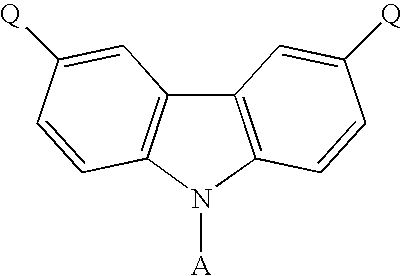
, wherein Q is a non-pi-conjugate moiety; and A comprises one of the following groups: aryl moiety, hetero cycle, multiple fused ring, multiple fused ring with hetero atom(s).
3. The carbazole-based compound as claimed in claim 1 , wherein the glass transition temperature of the carbazole-based compound is equal to or higher than 100° C.
4. The carbazole-based compound as claimed in claim 1 , wherein the carbazole-based compound has a general formula as following:
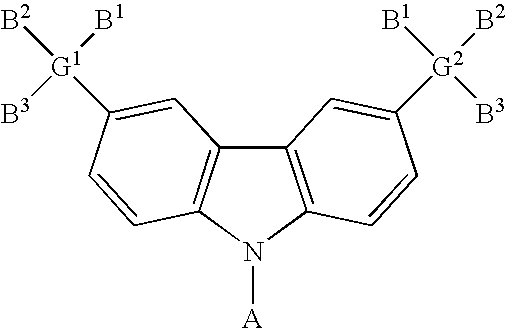
wherein G1 and G2 are identical or different, G1 and G2 are independently selected from C, Si; and B1, B2 and B3 are either identical or different from one another(redundant, may as well be deleted), and B1, B2 and B3 are independently selected from the group consisting of: linear alkyl, branched alkyl, cyclic alkyl, aryl moiety, hetero cycle, multiple fused ring, multiple fused ring with hetero atom(s), and alkyl with at least one substituent of alkene or alkyne or carbamates.
5. The carbazole-based compound as claimed in claim 1 , wherein the carbazole-based compound has a general formula as following:
wherein G1 and G2 are identical or different, G1 and G2 are independently selected from C, Si; and R1, R2 and R3 are either identical or different form one another, and R1, R2 and R3 are independently selected from the group consisting of: hydrogen atom, alkoxyl group, NR2 (R is alkyl or aryl), linear alkyl, branched alkyl, cyclic alkyl, aryl moiety, hetero cycle, multiple fused ring, multiple fused ring with hetero atom(s), and alkyl with at least one substituent of alkene or alkyne or carbamates.
6. The carbazole-based compound as claimed in claim 1 , wherein the chemical structure of the carbazole-based compound is as following:
7. The compound as claimed in claim 1 , wherein the carbazole-based compound is used in organic electroluminescent devices.
8. The compound as claimed in claim 1 , wherein the carbazole-based compound is used as host material in organic electroluminescent devices.
9. A light-emitting device comprising a pair of electrodes and one or more organic layers disposed between said electrodes, said one or more organic layers comprising a light-emitting layer, wherein at least one of said one or more organic layer comprises a carbazole-based compound with a moiety represented by the following formula:
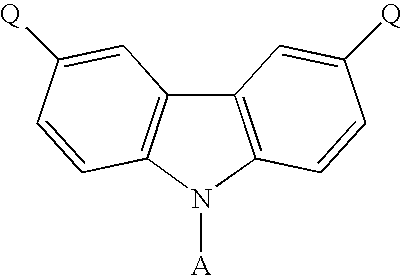
wherein Q is a non-pi-conjugate moiety, A comprises one of the following groups: aryl moiety, hetero cycle, multiple fused ring, multiple fused ring with hetero atom(s).
10. The light-emitting device as claimed in claim 9 , wherein the carbazole-based compound has a general formula as following:

wherein G1 and G2 are identical or different, G1 and G2 are independently selected from C, Si; and B1, B2 and B3 are either identical or different from one another, and B1, B2 and B3 are independently selected from the group consisting of: linear alkyl, branched alkyl, cyclic alkyl, aryl moiety, hetero cycle, multiple fused ring, multiple fused ring with hetero atom(s), and alkyl with at least one substituent of alkene or alkyne or carbamates.
11. The device as claimed in claim 9 , wherein the carbazole-based compound has a general formula as following:

wherein G1 and G2 are identical or different, G1 and G2 are independently selected from C, Si; and R1, R2 and R3 are either identical or different from one another, and R1, R2 and R3 are independently selected from the group consisting of: hydrogen atom, linear alkyl, branched alkyl, cyclic alkyl, aryl moiety, hetero cycle, multiple fused ring, multiple fused ring with hetero atom(s), and alkyl with at least one substituent of alkene or alkyne or carbamates.
12. The light-emitting device as claimed in claim 9 , wherein said carbazol-based compound is a host material in the light-emitting layer.
13. The light-emitting device as claimed in claim 9 , wherein said light-emitting layer comprises iridium(III)bis[4,6-difluorophenyl]-pyridinato-N,C2′]picolinate (FIrpic) as a guest material.
14. The light-emitting device as claimed in claim 9 , wherein said one or more organic layer further comprises a hole transport layer comprising 2,2′-Bis(diphenylamino)-9,9′-spirobifluorene:
15. The light-emitting device as claimed in claim 14 , wherein the hole transport layer further comprises 4,4′,4″-tri(N-carbazolyl) triphenylamine (TCTA).
16. The light-emitting device as claimed in claim 9 , wherein the glass transition temperature of the carbazole-based compound is at or above 100° C.
17. The device as claimed in claim 9 , wherein the chemical structure of the carbazole-based compound is as following:
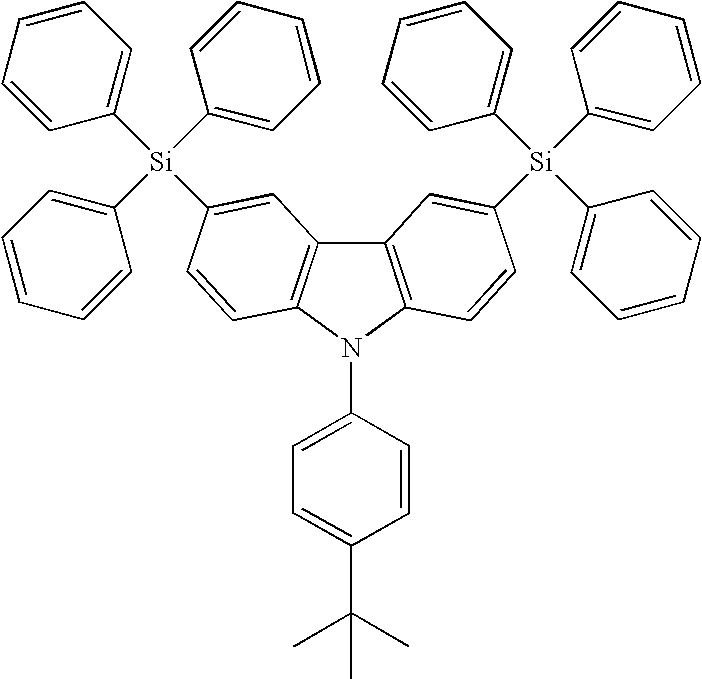
Priority Applications (1)
| Application Number | Priority Date | Filing Date | Title |
|---|---|---|---|
| US11/749,133 US20070262704A1 (en) | 2006-05-15 | 2007-05-15 | Carbazole-based Compounds and Their Application |
Applications Claiming Priority (2)
| Application Number | Priority Date | Filing Date | Title |
|---|---|---|---|
| US80001906P | 2006-05-15 | 2006-05-15 | |
| US11/749,133 US20070262704A1 (en) | 2006-05-15 | 2007-05-15 | Carbazole-based Compounds and Their Application |
Publications (1)
| Publication Number | Publication Date |
|---|---|
| US20070262704A1 true US20070262704A1 (en) | 2007-11-15 |
Family
ID=38684497
Family Applications (1)
| Application Number | Title | Priority Date | Filing Date |
|---|---|---|---|
| US11/749,133 Abandoned US20070262704A1 (en) | 2006-05-15 | 2007-05-15 | Carbazole-based Compounds and Their Application |
Country Status (1)
| Country | Link |
|---|---|
| US (1) | US20070262704A1 (en) |
Cited By (15)
| Publication number | Priority date | Publication date | Assignee | Title |
|---|---|---|---|---|
| JP2009179627A (en) * | 2007-12-31 | 2009-08-13 | Gracel Display Inc | Organic electroluminescent compound and light emitting diode using the same |
| WO2010043691A1 (en) | 2008-10-16 | 2010-04-22 | Solvay Sa | N-phenyl carbazole-based host material for light-emitting diodes |
| WO2010079051A1 (en) * | 2009-01-07 | 2010-07-15 | Basf Se | Silyl and heteroatom substituted compounds selected from carbazoles, dibenzofurans, dibenzothiophenes and dibenzo phospholes and the application thereof in organic electronics |
| US20110031477A1 (en) * | 2007-07-05 | 2011-02-10 | Basf Se | Organic light-emitting diodes comprising at least one disilyl compound selected from disilylcarbazoles, disilyldibenzofurans, disilyldibenzothiophenes, disilyldibenzopholes, disilyldibenzothiophene s-oxides and disilyldibenzothiophene s,s-dioxides |
| US20110198579A1 (en) * | 2008-10-16 | 2011-08-18 | Solvay Sa | Host material for light-emitting diodes |
| CN102439111A (en) * | 2009-05-27 | 2012-05-02 | 檀国大学校产学协力团 | Carbazole-based phosphine oxide compound and organic electroluminescent device comprising the compound |
| WO2012002671A3 (en) * | 2010-06-29 | 2012-05-18 | 단국대학교 산학협력단 | Highly efficient carbazole-based compound, and organic electroluminescence device comprising same |
| WO2012005458A3 (en) * | 2010-07-07 | 2012-05-18 | 단국대학교 산학협력단 | Compound for high-efficiency organic electroluminescent device, and organic electroluminescent device containing same |
| CN105440279A (en) * | 2016-01-21 | 2016-03-30 | 吉林大学 | Polyarylether containing 3, 6-bi(triphenyl) methyl-9-hydrogen carbazole side base and preparation method of polyarylether |
| US20160141525A1 (en) * | 2014-11-18 | 2016-05-19 | Universal Display Corporation | Organic light-emitting materials and devices |
| US10109802B2 (en) | 2015-01-05 | 2018-10-23 | Board Of Supervisors Of Louisiana State University And Agricultural And Mechanical College | Carbazole-based gumbos for highly efficient blue OLEDs |
| KR20200083925A (en) * | 2018-12-28 | 2020-07-09 | 삼성전자주식회사 | Quantum dot electroluminescence device |
| KR20210092336A (en) * | 2012-02-14 | 2021-07-23 | 메르크 파텐트 게엠베하 | Spirobifluorene compounds for organic electroluminescent devices |
| US11631815B2 (en) * | 2018-12-28 | 2023-04-18 | Samsung Electronics Co., Ltd. | Quantum dot electroluminescence device |
| JP2025003465A (en) * | 2017-05-19 | 2025-01-09 | 株式会社半導体エネルギー研究所 | Electronic Devices |
-
2007
- 2007-05-15 US US11/749,133 patent/US20070262704A1/en not_active Abandoned
Cited By (32)
| Publication number | Priority date | Publication date | Assignee | Title |
|---|---|---|---|---|
| US20110031477A1 (en) * | 2007-07-05 | 2011-02-10 | Basf Se | Organic light-emitting diodes comprising at least one disilyl compound selected from disilylcarbazoles, disilyldibenzofurans, disilyldibenzothiophenes, disilyldibenzopholes, disilyldibenzothiophene s-oxides and disilyldibenzothiophene s,s-dioxides |
| US8697255B2 (en) * | 2007-07-05 | 2014-04-15 | Basf Se | Organic light-emitting diodes comprising at least one disilyl compound selected from disilylcarbazoles, disilyldibenzofurans, disilyldibenzothiophenes, disilyldibenzopholes, disilyldibenzothiophene S-oxides and disilyldibenzothiophene S,S-dioxides |
| JP2009179627A (en) * | 2007-12-31 | 2009-08-13 | Gracel Display Inc | Organic electroluminescent compound and light emitting diode using the same |
| US20110198579A1 (en) * | 2008-10-16 | 2011-08-18 | Solvay Sa | Host material for light-emitting diodes |
| WO2010043691A1 (en) | 2008-10-16 | 2010-04-22 | Solvay Sa | N-phenyl carbazole-based host material for light-emitting diodes |
| US8586973B2 (en) * | 2008-10-16 | 2013-11-19 | Solvay Sa | Host material for light-emitting diodes |
| CN102341403A (en) * | 2009-01-07 | 2012-02-01 | 巴斯夫欧洲公司 | Silyl- and heteroatom-substituted compounds selected from carbazoles, dibenzofurans, dibenzothiophenes and dibenzophospholes, and use thereof in organic electronics |
| US9458182B2 (en) | 2009-01-07 | 2016-10-04 | Basf Se | Silyl- and heteroatom-substituted compounds selected from carbazoles, dibenzofurans, dibenzothiophenes and dibenzophospholes, and use thereof in organic electronics |
| WO2010079051A1 (en) * | 2009-01-07 | 2010-07-15 | Basf Se | Silyl and heteroatom substituted compounds selected from carbazoles, dibenzofurans, dibenzothiophenes and dibenzo phospholes and the application thereof in organic electronics |
| KR20120057556A (en) * | 2009-01-07 | 2012-06-05 | 바스프 에스이 | Silyl- and heteroatom-substituted compounds selected from carbazoles, dibenzofurans, dibenzothiophenes and dibenzophospholes, and use thereof in organic electronics |
| KR101693903B1 (en) | 2009-01-07 | 2017-01-06 | 바스프 에스이 | Silyl- and heteroatom-substituted compounds selected from carbazoles, dibenzofurans, dibenzothiophenes and dibenzophospholes, and use thereof in organic electronics |
| CN102341403B (en) * | 2009-01-07 | 2014-12-03 | 巴斯夫欧洲公司 | Silyl- and heteroatom-substituted compounds selected from carbazoles, dibenzofurans, dibenzothiophenes and dibenzophospholes, and use thereof in organic electronics |
| CN102439111A (en) * | 2009-05-27 | 2012-05-02 | 檀国大学校产学协力团 | Carbazole-based phosphine oxide compound and organic electroluminescent device comprising the compound |
| CN102439111B (en) * | 2009-05-27 | 2015-02-11 | Sk化学株式会社 | Carbazole-based phosphine oxide compound and organic electroluminescent device comprising the compound |
| WO2012002671A3 (en) * | 2010-06-29 | 2012-05-18 | 단국대학교 산학협력단 | Highly efficient carbazole-based compound, and organic electroluminescence device comprising same |
| CN102959040A (en) * | 2010-06-29 | 2013-03-06 | 檀国大学校产学协力团 | High-efficiency carbazole-based compounds and organic electroluminescent devices containing it |
| KR101211471B1 (en) | 2010-06-29 | 2012-12-12 | 단국대학교 산학협력단 | Highly Efficient Carbazole Type Compound and Organic Light Emitting Device Including the Same |
| CN102959040B (en) * | 2010-06-29 | 2015-05-20 | Sk化学株式会社 | High-efficiency carbazole-based compounds and organic electroluminescent devices containing it |
| US9142784B2 (en) | 2010-06-29 | 2015-09-22 | Sk Chemicals Co., Ltd. | Highly efficient carbazole-based compound, and organic electroluminescence device comprising same |
| WO2012005458A3 (en) * | 2010-07-07 | 2012-05-18 | 단국대학교 산학협력단 | Compound for high-efficiency organic electroluminescent device, and organic electroluminescent device containing same |
| KR101211475B1 (en) | 2010-07-07 | 2012-12-12 | 단국대학교 산학협력단 | Compound with High Efficiency and Organic Light Emitting Device Including the Same |
| KR20210092336A (en) * | 2012-02-14 | 2021-07-23 | 메르크 파텐트 게엠베하 | Spirobifluorene compounds for organic electroluminescent devices |
| KR102357439B1 (en) | 2012-02-14 | 2022-02-08 | 메르크 파텐트 게엠베하 | Spirobifluorene compounds for organic electroluminescent devices |
| US20160141525A1 (en) * | 2014-11-18 | 2016-05-19 | Universal Display Corporation | Organic light-emitting materials and devices |
| US9761814B2 (en) * | 2014-11-18 | 2017-09-12 | Universal Display Corporation | Organic light-emitting materials and devices |
| US10109802B2 (en) | 2015-01-05 | 2018-10-23 | Board Of Supervisors Of Louisiana State University And Agricultural And Mechanical College | Carbazole-based gumbos for highly efficient blue OLEDs |
| CN105440279A (en) * | 2016-01-21 | 2016-03-30 | 吉林大学 | Polyarylether containing 3, 6-bi(triphenyl) methyl-9-hydrogen carbazole side base and preparation method of polyarylether |
| JP2025003465A (en) * | 2017-05-19 | 2025-01-09 | 株式会社半導体エネルギー研究所 | Electronic Devices |
| KR20200083925A (en) * | 2018-12-28 | 2020-07-09 | 삼성전자주식회사 | Quantum dot electroluminescence device |
| US11631815B2 (en) * | 2018-12-28 | 2023-04-18 | Samsung Electronics Co., Ltd. | Quantum dot electroluminescence device |
| US11997917B2 (en) | 2018-12-28 | 2024-05-28 | Samsung Electronics Co., Ltd. | Quantum dot electroluminescence device |
| KR102772918B1 (en) | 2018-12-28 | 2025-02-25 | 삼성전자주식회사 | Quantum dot electroluminescence device |
Similar Documents
| Publication | Publication Date | Title |
|---|---|---|
| US20070262704A1 (en) | Carbazole-based Compounds and Their Application | |
| KR101759966B1 (en) | Organic electroluminescent device | |
| EP4035217B1 (en) | First and second organic semiconductor layer and organic electronic device comprising the same | |
| KR101434632B1 (en) | Arylamine compounds and electronic devices | |
| KR20110007233A (en) | Compound for organic electroluminescent device and organic electroluminescent device | |
| EP3670504A1 (en) | Compound and an organic semiconducting layer, an organic electronic device and a display device comprising the same | |
| TWI895241B (en) | N-heteroarylene compounds with low lumo energies, an organic semiconductor layer, and an organic electronic device | |
| KR20200068712A (en) | Organic electronic device comprising an organic semiconductor layer | |
| KR102450200B1 (en) | Compounds for electronic devices, electronic devices and display devices | |
| WO2023148215A1 (en) | 3,6-bis(cyanomethylidene)cyclohexa-1,4-diene compounds and their use in organic electronic devices | |
| KR102037375B1 (en) | Organometallic complex and Organic light emitting diode comprising the same | |
| CN111448188B (en) | Triazine compound and organic semiconductor layer comprising the same | |
| CN112055707A (en) | Compound, preparation method thereof, organic semiconductor layer, organic electronic device, display device and lighting device including the same | |
| EP3798213B1 (en) | Organic semiconductor layer, organic electronic device comprising the same and compounds therefor | |
| US10985326B2 (en) | Compounds comprising triazine group, fluorene-group and aryl group | |
| KR20230168201A (en) | Organic electroluminescent device comprising a compound of formula (I) and a compound of formula (II), a display device comprising an organic electroluminescent device | |
| KR20230168202A (en) | Organic electroluminescent device comprising a compound of formula (I) and a compound of formula (II), a display device comprising an organic electroluminescent device | |
| US20220231234A1 (en) | Compounds comprising a hetero-fluorene group | |
| EP2282358A1 (en) | Host material for light-emitting devices | |
| US20070155981A1 (en) | Arylene derivative and organic light emitting device manufactured using the same | |
| EP3527557A1 (en) | N-heteroarylene compounds | |
| KR102103961B1 (en) | Organometallic complex and Organic light emitting diode comprising the same | |
| EP4387414A1 (en) | Organic electroluminescent device comprising a compound of formula (i) and a compound of formula (ii), and display device comprising the organic electroluminescent device | |
| Tsai et al. | 11.4: Highly Efficient Blue Organic Electrophosphorescent Devices Based on 3, 6‐Bis (triphenylsilyl) Carbazole as the Host Material | |
| Fang et al. | Highly efficient blue phosphorescent OLEDs using large bandgap host materials |
Legal Events
| Date | Code | Title | Description |
|---|---|---|---|
| AS | Assignment |
Owner name: WONG, KEN-TSUNG, TAIWAN Free format text: ASSIGNMENT OF ASSIGNORS INTEREST;ASSIGNORS:TSAI, MING-HAN;LIN, HAO-WU;SU, HAI-CHING;AND OTHERS;REEL/FRAME:019582/0982;SIGNING DATES FROM 20070524 TO 20070604 |
|
| STCB | Information on status: application discontinuation |
Free format text: ABANDONED -- FAILURE TO RESPOND TO AN OFFICE ACTION |