US20070248672A1 - Indole and Azaindole Derivatives with Antitumor Action - Google Patents
Indole and Azaindole Derivatives with Antitumor Action Download PDFInfo
- Publication number
- US20070248672A1 US20070248672A1 US11/579,237 US57923705A US2007248672A1 US 20070248672 A1 US20070248672 A1 US 20070248672A1 US 57923705 A US57923705 A US 57923705A US 2007248672 A1 US2007248672 A1 US 2007248672A1
- Authority
- US
- United States
- Prior art keywords
- dimethoxy
- indole
- phenyl
- methoxyphenyl
- carboxylic acid
- Prior art date
- Legal status (The legal status is an assumption and is not a legal conclusion. Google has not performed a legal analysis and makes no representation as to the accuracy of the status listed.)
- Abandoned
Links
- 230000000259 anti-tumor effect Effects 0.000 title abstract description 20
- SIKJAQJRHWYJAI-UHFFFAOYSA-N Indole Chemical compound C1=CC=C2NC=CC2=C1 SIKJAQJRHWYJAI-UHFFFAOYSA-N 0.000 title abstract description 6
- 125000005334 azaindolyl group Chemical class N1N=C(C2=CC=CC=C12)* 0.000 title abstract description 3
- PZOUSPYUWWUPPK-UHFFFAOYSA-N indole Natural products CC1=CC=CC2=C1C=CN2 PZOUSPYUWWUPPK-UHFFFAOYSA-N 0.000 title abstract description 3
- RKJUIXBNRJVNHR-UHFFFAOYSA-N indolenine Natural products C1=CC=C2CC=NC2=C1 RKJUIXBNRJVNHR-UHFFFAOYSA-N 0.000 title abstract description 3
- 150000001875 compounds Chemical class 0.000 claims abstract description 213
- 206010028980 Neoplasm Diseases 0.000 claims abstract description 48
- 238000011282 treatment Methods 0.000 claims abstract description 42
- 238000000034 method Methods 0.000 claims abstract description 35
- 239000003814 drug Substances 0.000 claims abstract description 24
- 229940041181 antineoplastic drug Drugs 0.000 claims abstract description 16
- 239000008194 pharmaceutical composition Substances 0.000 claims abstract description 12
- -1 hydroxypropyl Chemical group 0.000 claims description 60
- 125000000217 alkyl group Chemical group 0.000 claims description 41
- 229910052757 nitrogen Inorganic materials 0.000 claims description 27
- 125000003118 aryl group Chemical group 0.000 claims description 17
- 125000005842 heteroatom Chemical group 0.000 claims description 15
- 125000004433 nitrogen atom Chemical group N* 0.000 claims description 15
- 229910052760 oxygen Inorganic materials 0.000 claims description 12
- 125000001997 phenyl group Chemical group [H]C1=C([H])C([H])=C(*)C([H])=C1[H] 0.000 claims description 12
- 229910052717 sulfur Inorganic materials 0.000 claims description 12
- 229910052799 carbon Inorganic materials 0.000 claims description 11
- 125000003710 aryl alkyl group Chemical group 0.000 claims description 10
- 125000002768 hydroxyalkyl group Chemical group 0.000 claims description 10
- 239000002253 acid Substances 0.000 claims description 9
- 150000002148 esters Chemical group 0.000 claims description 9
- 125000000623 heterocyclic group Chemical group 0.000 claims description 9
- 238000002360 preparation method Methods 0.000 claims description 9
- OKTJSMMVPCPJKN-UHFFFAOYSA-N Carbon Chemical compound [C] OKTJSMMVPCPJKN-UHFFFAOYSA-N 0.000 claims description 8
- 125000005078 alkoxycarbonylalkyl group Chemical group 0.000 claims description 8
- 150000001408 amides Chemical group 0.000 claims description 8
- 125000003545 alkoxy group Chemical group 0.000 claims description 7
- 125000000278 alkyl amino alkyl group Chemical group 0.000 claims description 7
- 125000004985 dialkyl amino alkyl group Chemical group 0.000 claims description 6
- 125000004183 alkoxy alkyl group Chemical group 0.000 claims description 5
- 125000004689 alkyl amino carbonyl alkyl group Chemical group 0.000 claims description 5
- 125000004103 aminoalkyl group Chemical group 0.000 claims description 5
- 125000005097 aminocarbonylalkyl group Chemical group 0.000 claims description 5
- 125000002887 hydroxy group Chemical group [H]O* 0.000 claims description 5
- 239000000725 suspension Substances 0.000 claims description 5
- 125000004457 alkyl amino carbonyl group Chemical group 0.000 claims description 4
- 125000004448 alkyl carbonyl group Chemical group 0.000 claims description 4
- 125000004390 alkyl sulfonyl group Chemical group 0.000 claims description 4
- 125000005100 aryl amino carbonyl group Chemical group 0.000 claims description 4
- 125000005129 aryl carbonyl group Chemical group 0.000 claims description 4
- 125000004391 aryl sulfonyl group Chemical group 0.000 claims description 4
- 229910052801 chlorine Inorganic materials 0.000 claims description 4
- 125000004966 cyanoalkyl group Chemical group 0.000 claims description 4
- 229910052736 halogen Inorganic materials 0.000 claims description 4
- 150000002367 halogens Chemical class 0.000 claims description 4
- 125000001072 heteroaryl group Chemical group 0.000 claims description 4
- YFEYHWKORAOCAF-UHFFFAOYSA-N methyl 1-(2-aminoethyl)-5,6-dimethoxy-3-(4-methoxyphenyl)indole-2-carboxylate;hydrochloride Chemical compound Cl.C12=CC(OC)=C(OC)C=C2N(CCN)C(C(=O)OC)=C1C1=CC=C(OC)C=C1 YFEYHWKORAOCAF-UHFFFAOYSA-N 0.000 claims description 4
- 150000002825 nitriles Chemical group 0.000 claims description 4
- 239000000546 pharmaceutical excipient Substances 0.000 claims description 4
- 239000006187 pill Substances 0.000 claims description 4
- 125000000876 trifluoromethoxy group Chemical group FC(F)(F)O* 0.000 claims description 4
- 125000002023 trifluoromethyl group Chemical group FC(F)(F)* 0.000 claims description 4
- PKQALAZFZVHRNK-UHFFFAOYSA-N 2-[5,6-dimethoxy-3-(4-methoxyphenyl)-1H-indol-2-yl]-5-methyl-1,3,4-oxadiazole Chemical compound C1=CC(OC)=CC=C1C1=C(C=2OC(C)=NN=2)NC2=CC(OC)=C(OC)C=C12 PKQALAZFZVHRNK-UHFFFAOYSA-N 0.000 claims description 3
- GOMKJZNSPXZXQI-UHFFFAOYSA-N 5,6-dimethoxy-3-(4-methoxyphenyl)-1-(2-morpholin-4-ylethyl)indole-2-carbonitrile;hydrochloride Chemical compound Cl.C1=CC(OC)=CC=C1C(C1=CC(OC)=C(OC)C=C11)=C(C#N)N1CCN1CCOCC1 GOMKJZNSPXZXQI-UHFFFAOYSA-N 0.000 claims description 3
- 229940045799 anthracyclines and related substance Drugs 0.000 claims description 3
- 150000001721 carbon Chemical group 0.000 claims description 3
- 125000002915 carbonyl group Chemical group [*:2]C([*:1])=O 0.000 claims description 3
- 239000008187 granular material Substances 0.000 claims description 3
- KXFOXHRUJNNQAQ-UHFFFAOYSA-N methyl 1-(cyanomethyl)-5,6-dimethoxy-3-(4-methoxyphenyl)indole-2-carboxylate Chemical compound C12=CC(OC)=C(OC)C=C2N(CC#N)C(C(=O)OC)=C1C1=CC=C(OC)C=C1 KXFOXHRUJNNQAQ-UHFFFAOYSA-N 0.000 claims description 3
- QOPYGQMLZKFFPO-UHFFFAOYSA-N methyl 1-[2-(dimethylamino)-2-oxoethyl]-5,6-dimethoxy-3-(4-methoxyphenyl)indole-2-carboxylate Chemical compound C12=CC(OC)=C(OC)C=C2N(CC(=O)N(C)C)C(C(=O)OC)=C1C1=CC=C(OC)C=C1 QOPYGQMLZKFFPO-UHFFFAOYSA-N 0.000 claims description 3
- 239000006188 syrup Substances 0.000 claims description 3
- 235000020357 syrup Nutrition 0.000 claims description 3
- AEIDURNZWCNQIM-UHFFFAOYSA-N 1,2,3,4-tetrahydropyrazino[1,2-a]indole Chemical class C1=CC=C2N3CCNCC3=CC2=C1 AEIDURNZWCNQIM-UHFFFAOYSA-N 0.000 claims description 2
- XBNNAWXSOZXJGU-UHFFFAOYSA-N 2,4-dihydro-1h-pyrazino[1,2-a]indol-3-one Chemical class C1=CC=C2N3CC(=O)NCC3=CC2=C1 XBNNAWXSOZXJGU-UHFFFAOYSA-N 0.000 claims description 2
- 125000000022 2-aminoethyl group Chemical group [H]C([*])([H])C([H])([H])N([H])[H] 0.000 claims description 2
- HVZAFNRIZAKUQS-UHFFFAOYSA-N 3,4-dihydro-1h-[1,4]oxazino[4,3-a]indole Chemical class C1=CC=C2N3CCOCC3=CC2=C1 HVZAFNRIZAKUQS-UHFFFAOYSA-N 0.000 claims description 2
- KRRWBFJXTNMYOZ-UHFFFAOYSA-N 3,4-dihydro-2h-pyrazino[1,2-a]indol-1-one Chemical class C1=CC=C2N3CCNC(=O)C3=CC2=C1 KRRWBFJXTNMYOZ-UHFFFAOYSA-N 0.000 claims description 2
- UCNZPMHYGWAUKW-UHFFFAOYSA-N 7,8-dimethoxy-10-(4-methoxyphenyl)-3,4-dihydro-1h-[1,4]oxazino[4,3-a]indole Chemical compound C1=CC(OC)=CC=C1C(C1=CC(OC)=C(OC)C=C11)=C2N1CCOC2 UCNZPMHYGWAUKW-UHFFFAOYSA-N 0.000 claims description 2
- LRXXWNGXTYIZBE-UHFFFAOYSA-N 7,8-dimethoxy-10-phenyl-3,4-dihydro-2h-pyrazino[1,2-a]indol-1-one Chemical compound C=12C(=O)NCCN2C=2C=C(OC)C(OC)=CC=2C=1C1=CC=CC=C1 LRXXWNGXTYIZBE-UHFFFAOYSA-N 0.000 claims description 2
- GAWIXWVDTYZWAW-UHFFFAOYSA-N C[CH]O Chemical group C[CH]O GAWIXWVDTYZWAW-UHFFFAOYSA-N 0.000 claims description 2
- 229940045985 antineoplastic platinum compound Drugs 0.000 claims description 2
- 125000001797 benzyl group Chemical group [H]C1=C([H])C([H])=C(C([H])=C1[H])C([H])([H])* 0.000 claims description 2
- 210000000988 bone and bone Anatomy 0.000 claims description 2
- 210000000481 breast Anatomy 0.000 claims description 2
- 210000003169 central nervous system Anatomy 0.000 claims description 2
- 210000002249 digestive system Anatomy 0.000 claims description 2
- 239000000839 emulsion Substances 0.000 claims description 2
- 239000003623 enhancer Substances 0.000 claims description 2
- 125000003754 ethoxycarbonyl group Chemical group C(=O)(OCC)* 0.000 claims description 2
- JPDIBWCNNQFQEP-UHFFFAOYSA-N ethyl 3-phenyl-1h-indole-2-carboxylate Chemical compound CCOC(=O)C=1NC2=CC=CC=C2C=1C1=CC=CC=C1 JPDIBWCNNQFQEP-UHFFFAOYSA-N 0.000 claims description 2
- 125000001495 ethyl group Chemical group [H]C([H])([H])C([H])([H])* 0.000 claims description 2
- 229910052731 fluorine Inorganic materials 0.000 claims description 2
- 239000007902 hard capsule Substances 0.000 claims description 2
- 238000001802 infusion Methods 0.000 claims description 2
- 201000001441 melanoma Diseases 0.000 claims description 2
- 125000001160 methoxycarbonyl group Chemical group [H]C([H])([H])OC(*)=O 0.000 claims description 2
- KPDNFZPAGRGBCO-UHFFFAOYSA-N methyl 1-[3-(dimethylamino)propyl]-5,6-dimethoxy-3-(4-methoxyphenyl)indole-2-carboxylate;hydrochloride Chemical compound Cl.C12=CC(OC)=C(OC)C=C2N(CCCN(C)C)C(C(=O)OC)=C1C1=CC=C(OC)C=C1 KPDNFZPAGRGBCO-UHFFFAOYSA-N 0.000 claims description 2
- JQORPSVTMQXKID-UHFFFAOYSA-N methyl 5,6-dimethoxy-3-(4-methoxyphenyl)-1-(2-pyrrolidin-1-ylethyl)indole-2-carboxylate;hydrochloride Chemical compound Cl.C12=CC(OC)=C(OC)C=C2N(CCN2CCCC2)C(C(=O)OC)=C1C1=CC=C(OC)C=C1 JQORPSVTMQXKID-UHFFFAOYSA-N 0.000 claims description 2
- 239000003094 microcapsule Substances 0.000 claims description 2
- 229940124531 pharmaceutical excipient Drugs 0.000 claims description 2
- 150000003058 platinum compounds Chemical class 0.000 claims description 2
- 239000000843 powder Substances 0.000 claims description 2
- 238000001959 radiotherapy Methods 0.000 claims description 2
- 239000007901 soft capsule Substances 0.000 claims description 2
- 239000000829 suppository Substances 0.000 claims description 2
- 230000002485 urinary effect Effects 0.000 claims description 2
- 125000001424 substituent group Chemical group 0.000 claims 3
- ZSSWJHZXOLCNPO-UHFFFAOYSA-N 7,8-dimethoxy-10-(4-methoxyphenyl)-2-methyl-3,4-dihydro-1H-pyrazino[1,2-a]indole 5,6-dimethoxy-3-(4-methoxyphenyl)-1-[2-(4-methylpiperazin-1-yl)ethyl]indole-2-carbonitrile dihydrochloride Chemical compound COC=1C(=CC=2C(=C3N(C2C1)CCN(C3)C)C3=CC=C(C=C3)OC)OC.Cl.Cl.COC=3C=C1C(=C(N(C1=CC3OC)CCN3CCN(CC3)C)C#N)C3=CC=C(C=C3)OC ZSSWJHZXOLCNPO-UHFFFAOYSA-N 0.000 claims 2
- NQYJMBAGDRTSJQ-UHFFFAOYSA-N COc1cc2[nH]c(C3=NCCO3)c(-c3ccccc3)c2cc1OC.CNC(=O)Cn1c(C(=O)OC)c(-c2ccc(OC)cc2)c2cc(OC)c(OC)cc12 Chemical compound COc1cc2[nH]c(C3=NCCO3)c(-c3ccccc3)c2cc1OC.CNC(=O)Cn1c(C(=O)OC)c(-c2ccc(OC)cc2)c2cc(OC)c(OC)cc12 NQYJMBAGDRTSJQ-UHFFFAOYSA-N 0.000 claims 2
- IPCALRJXOCFYPB-UHFFFAOYSA-N methyl 1-benzyl-5,6-dimethoxy-3-(4-methoxyphenyl)indole-2-carboxylate methyl 5,6-dimethoxy-1-(2-methoxy-2-oxoethyl)-3-(4-methoxyphenyl)indole-2-carboxylate Chemical compound COC(=O)Cn1c(C(=O)OC)c(-c2ccc(OC)cc2)c2cc(OC)c(OC)cc12.COC(=O)c1c(-c2ccc(OC)cc2)c2cc(OC)c(OC)cc2n1Cc1ccccc1 IPCALRJXOCFYPB-UHFFFAOYSA-N 0.000 claims 2
- WJVVFSOLGLUBGL-UHFFFAOYSA-N 1-(2-hydroxyethyl)-5,6-dimethoxy-3-(4-methoxyphenyl)indole-2-carboxylic acid methyl 1-[2-(dimethylamino)ethyl]-5,6-dimethoxy-3-(4-methoxyphenyl)indole-2-carboxylate hydrochloride Chemical compound OCCN1C(=C(C2=CC(=C(C=C12)OC)OC)C1=CC=C(C=C1)OC)C(=O)O.Cl.COC(=O)C=1N(C2=CC(=C(C=C2C1C1=CC=C(C=C1)OC)OC)OC)CCN(C)C WJVVFSOLGLUBGL-UHFFFAOYSA-N 0.000 claims 1
- NHMFWQRNVUTILF-UHFFFAOYSA-N COc1cc2c(c(C#N)n(CCO)c2cc1OC)-c1ccccc1.COC(=O)c1c(-c2ccc(OC)cc2)c2cc(OC)c(OC)cc2n1CCCO Chemical compound COc1cc2c(c(C#N)n(CCO)c2cc1OC)-c1ccccc1.COC(=O)c1c(-c2ccc(OC)cc2)c2cc(OC)c(OC)cc2n1CCCO NHMFWQRNVUTILF-UHFFFAOYSA-N 0.000 claims 1
- 239000002257 antimetastatic agent Substances 0.000 claims 1
- 229940102223 injectable solution Drugs 0.000 claims 1
- 230000002265 prevention Effects 0.000 claims 1
- 239000002534 radiation-sensitizing agent Substances 0.000 claims 1
- 229940079593 drug Drugs 0.000 abstract description 23
- 230000008569 process Effects 0.000 abstract description 17
- 230000000694 effects Effects 0.000 abstract description 14
- 239000003795 chemical substances by application Substances 0.000 abstract description 13
- 239000008280 blood Substances 0.000 abstract description 2
- 210000004369 blood Anatomy 0.000 abstract description 2
- YMWUJEATGCHHMB-UHFFFAOYSA-N Dichloromethane Chemical compound ClCCl YMWUJEATGCHHMB-UHFFFAOYSA-N 0.000 description 78
- 0 [1*]N1C2=[Y]C=CC=C2/C(C)=C\1[2*].[3*]C.[4*]C.[5*]C.[6*]C Chemical compound [1*]N1C2=[Y]C=CC=C2/C(C)=C\1[2*].[3*]C.[4*]C.[5*]C.[6*]C 0.000 description 43
- 210000004027 cell Anatomy 0.000 description 43
- 239000002904 solvent Substances 0.000 description 42
- 239000000203 mixture Substances 0.000 description 41
- OKKJLVBELUTLKV-UHFFFAOYSA-N Methanol Chemical compound OC OKKJLVBELUTLKV-UHFFFAOYSA-N 0.000 description 39
- RTZKZFJDLAIYFH-UHFFFAOYSA-N Diethyl ether Chemical compound CCOCC RTZKZFJDLAIYFH-UHFFFAOYSA-N 0.000 description 37
- 239000000047 product Substances 0.000 description 37
- 229960000303 topotecan Drugs 0.000 description 33
- UCFGDBYHRUNTLO-QHCPKHFHSA-N topotecan Chemical compound C1=C(O)C(CN(C)C)=C2C=C(CN3C4=CC5=C(C3=O)COC(=O)[C@]5(O)CC)C4=NC2=C1 UCFGDBYHRUNTLO-QHCPKHFHSA-N 0.000 description 33
- 239000000243 solution Substances 0.000 description 31
- HEDRZPFGACZZDS-MICDWDOJSA-N Trichloro(2H)methane Chemical compound [2H]C(Cl)(Cl)Cl HEDRZPFGACZZDS-MICDWDOJSA-N 0.000 description 26
- 238000005160 1H NMR spectroscopy Methods 0.000 description 22
- IJGRMHOSHXDMSA-UHFFFAOYSA-N Atomic nitrogen Chemical compound N#N IJGRMHOSHXDMSA-UHFFFAOYSA-N 0.000 description 22
- XLYOFNOQVPJJNP-UHFFFAOYSA-N water Substances O XLYOFNOQVPJJNP-UHFFFAOYSA-N 0.000 description 22
- 238000006243 chemical reaction Methods 0.000 description 21
- 239000012043 crude product Substances 0.000 description 21
- WYURNTSHIVDZCO-UHFFFAOYSA-N Tetrahydrofuran Chemical compound C1CCOC1 WYURNTSHIVDZCO-UHFFFAOYSA-N 0.000 description 20
- 239000007832 Na2SO4 Substances 0.000 description 19
- PMZURENOXWZQFD-UHFFFAOYSA-L Sodium Sulfate Chemical compound [Na+].[Na+].[O-]S([O-])(=O)=O PMZURENOXWZQFD-UHFFFAOYSA-L 0.000 description 19
- 229910052938 sodium sulfate Inorganic materials 0.000 description 19
- 239000003480 eluent Substances 0.000 description 18
- XEKOWRVHYACXOJ-UHFFFAOYSA-N Ethyl acetate Chemical compound CCOC(C)=O XEKOWRVHYACXOJ-UHFFFAOYSA-N 0.000 description 16
- HEMHJVSKTPXQMS-UHFFFAOYSA-M Sodium hydroxide Chemical compound [OH-].[Na+] HEMHJVSKTPXQMS-UHFFFAOYSA-M 0.000 description 15
- YXFVVABEGXRONW-UHFFFAOYSA-N Toluene Chemical compound CC1=CC=CC=C1 YXFVVABEGXRONW-UHFFFAOYSA-N 0.000 description 15
- 210000004881 tumor cell Anatomy 0.000 description 15
- QTBSBXVTEAMEQO-UHFFFAOYSA-N Acetic acid Chemical compound CC(O)=O QTBSBXVTEAMEQO-UHFFFAOYSA-N 0.000 description 14
- 238000003756 stirring Methods 0.000 description 14
- IAZDPXIOMUYVGZ-UHFFFAOYSA-N Dimethylsulphoxide Chemical compound CS(C)=O IAZDPXIOMUYVGZ-UHFFFAOYSA-N 0.000 description 13
- LFQSCWFLJHTTHZ-UHFFFAOYSA-N Ethanol Chemical compound CCO LFQSCWFLJHTTHZ-UHFFFAOYSA-N 0.000 description 13
- 239000001257 hydrogen Substances 0.000 description 13
- 229910052739 hydrogen Inorganic materials 0.000 description 13
- ZMANZCXQSJIPKH-UHFFFAOYSA-N Triethylamine Chemical compound CCN(CC)CC ZMANZCXQSJIPKH-UHFFFAOYSA-N 0.000 description 12
- 238000004587 chromatography analysis Methods 0.000 description 12
- 239000012074 organic phase Substances 0.000 description 12
- 239000011541 reaction mixture Substances 0.000 description 12
- VEXZGXHMUGYJMC-UHFFFAOYSA-N Hydrochloric acid Chemical compound Cl VEXZGXHMUGYJMC-UHFFFAOYSA-N 0.000 description 11
- 241000699670 Mus sp. Species 0.000 description 11
- KDLHZDBZIXYQEI-UHFFFAOYSA-N Palladium Chemical compound [Pd] KDLHZDBZIXYQEI-UHFFFAOYSA-N 0.000 description 10
- DTQVDTLACAAQTR-UHFFFAOYSA-N Trifluoroacetic acid Chemical compound OC(=O)C(F)(F)F DTQVDTLACAAQTR-UHFFFAOYSA-N 0.000 description 10
- 230000001028 anti-proliverative effect Effects 0.000 description 10
- 238000002474 experimental method Methods 0.000 description 9
- 125000004435 hydrogen atom Chemical class [H]* 0.000 description 9
- 230000005764 inhibitory process Effects 0.000 description 9
- AOJJSUZBOXZQNB-TZSSRYMLSA-N Doxorubicin Chemical compound O([C@H]1C[C@@](O)(CC=2C(O)=C3C(=O)C=4C=CC=C(C=4C(=O)C3=C(O)C=21)OC)C(=O)CO)[C@H]1C[C@H](N)[C@H](O)[C@H](C)O1 AOJJSUZBOXZQNB-TZSSRYMLSA-N 0.000 description 8
- JUJWROOIHBZHMG-UHFFFAOYSA-N Pyridine Chemical compound C1=CC=NC=C1 JUJWROOIHBZHMG-UHFFFAOYSA-N 0.000 description 8
- 239000002609 medium Substances 0.000 description 8
- 239000000523 sample Substances 0.000 description 8
- UORVGPXVDQYIDP-UHFFFAOYSA-N borane Chemical compound B UORVGPXVDQYIDP-UHFFFAOYSA-N 0.000 description 7
- IYNGKMZSLRPOQX-UHFFFAOYSA-N methyl 5,6-dimethoxy-3-(4-methoxyphenyl)-1h-indole-2-carboxylate Chemical compound COC(=O)C=1NC2=CC(OC)=C(OC)C=C2C=1C1=CC=C(OC)C=C1 IYNGKMZSLRPOQX-UHFFFAOYSA-N 0.000 description 7
- 229910000104 sodium hydride Inorganic materials 0.000 description 7
- 238000002560 therapeutic procedure Methods 0.000 description 7
- WEVYAHXRMPXWCK-UHFFFAOYSA-N Acetonitrile Chemical compound CC#N WEVYAHXRMPXWCK-UHFFFAOYSA-N 0.000 description 6
- 206010059866 Drug resistance Diseases 0.000 description 6
- 229910010084 LiAlH4 Inorganic materials 0.000 description 6
- UIIMBOGNXHQVGW-UHFFFAOYSA-M Sodium bicarbonate Chemical compound [Na+].OC([O-])=O UIIMBOGNXHQVGW-UHFFFAOYSA-M 0.000 description 6
- 102000011731 Vacuolar Proton-Translocating ATPases Human genes 0.000 description 6
- 108010037026 Vacuolar Proton-Translocating ATPases Proteins 0.000 description 6
- 239000008346 aqueous phase Substances 0.000 description 6
- 229910052796 boron Inorganic materials 0.000 description 6
- 201000011510 cancer Diseases 0.000 description 6
- KRKNYBCHXYNGOX-UHFFFAOYSA-N citric acid Chemical compound OC(=O)CC(O)(C(O)=O)CC(O)=O KRKNYBCHXYNGOX-UHFFFAOYSA-N 0.000 description 6
- 231100000433 cytotoxic Toxicity 0.000 description 6
- 229940127089 cytotoxic agent Drugs 0.000 description 6
- 239000002254 cytotoxic agent Substances 0.000 description 6
- 230000001472 cytotoxic effect Effects 0.000 description 6
- 238000001727 in vivo Methods 0.000 description 6
- 239000012280 lithium aluminium hydride Substances 0.000 description 6
- 239000007921 spray Substances 0.000 description 6
- 230000002195 synergetic effect Effects 0.000 description 6
- 230000001225 therapeutic effect Effects 0.000 description 6
- LNNACIBBZHRDSK-UHFFFAOYSA-N 2-[5,6-dimethoxy-3-(4-methoxyphenyl)-1H-indol-2-yl]acetamide Chemical compound COC=1C=C2C(=C(NC2=CC=1OC)CC(=O)N)C1=CC=C(C=C1)OC LNNACIBBZHRDSK-UHFFFAOYSA-N 0.000 description 5
- LCVAOECWSZESHN-UHFFFAOYSA-N 5,6-dimethoxy-3-(4-methoxyphenyl)-1h-indole-2-carboxylic acid Chemical compound C1=CC(OC)=CC=C1C1=C(C(O)=O)NC2=CC(OC)=C(OC)C=C12 LCVAOECWSZESHN-UHFFFAOYSA-N 0.000 description 5
- 125000003342 alkenyl group Chemical group 0.000 description 5
- PFKFTWBEEFSNDU-UHFFFAOYSA-N carbonyldiimidazole Chemical compound C1=CN=CN1C(=O)N1C=CN=C1 PFKFTWBEEFSNDU-UHFFFAOYSA-N 0.000 description 5
- 239000000460 chlorine Substances 0.000 description 5
- 231100000599 cytotoxic agent Toxicity 0.000 description 5
- 230000002018 overexpression Effects 0.000 description 5
- 239000008188 pellet Substances 0.000 description 5
- 239000003208 petroleum Substances 0.000 description 5
- 239000002244 precipitate Substances 0.000 description 5
- 230000009467 reduction Effects 0.000 description 5
- 238000006722 reduction reaction Methods 0.000 description 5
- GDJLZLJTRKUMEJ-UHFFFAOYSA-N 5,6-dimethoxy-3-(4-methoxyphenyl)-1h-indole-2-carbonitrile Chemical compound C1=CC(OC)=CC=C1C1=C(C#N)NC2=CC(OC)=C(OC)C=C12 GDJLZLJTRKUMEJ-UHFFFAOYSA-N 0.000 description 4
- VHUUQVKOLVNVRT-UHFFFAOYSA-N Ammonium hydroxide Chemical compound [NH4+].[OH-] VHUUQVKOLVNVRT-UHFFFAOYSA-N 0.000 description 4
- 102100022595 Broad substrate specificity ATP-binding cassette transporter ABCG2 Human genes 0.000 description 4
- 208000002966 Giant Cell Tumor of Bone Diseases 0.000 description 4
- 101000823298 Homo sapiens Broad substrate specificity ATP-binding cassette transporter ABCG2 Proteins 0.000 description 4
- UFHFLCQGNIYNRP-UHFFFAOYSA-N Hydrogen Chemical compound [H][H] UFHFLCQGNIYNRP-UHFFFAOYSA-N 0.000 description 4
- 206010027476 Metastases Diseases 0.000 description 4
- 229930006000 Sucrose Natural products 0.000 description 4
- CZMRCDWAGMRECN-UGDNZRGBSA-N Sucrose Chemical compound O[C@H]1[C@H](O)[C@@H](CO)O[C@@]1(CO)O[C@@H]1[C@H](O)[C@@H](O)[C@H](O)[C@@H](CO)O1 CZMRCDWAGMRECN-UGDNZRGBSA-N 0.000 description 4
- 230000009471 action Effects 0.000 description 4
- 230000029936 alkylation Effects 0.000 description 4
- 238000005804 alkylation reaction Methods 0.000 description 4
- 239000003054 catalyst Substances 0.000 description 4
- 238000009903 catalytic hydrogenation reaction Methods 0.000 description 4
- 239000003153 chemical reaction reagent Substances 0.000 description 4
- 239000003638 chemical reducing agent Substances 0.000 description 4
- 238000011161 development Methods 0.000 description 4
- 229960004679 doxorubicin Drugs 0.000 description 4
- 235000019441 ethanol Nutrition 0.000 description 4
- 239000007789 gas Substances 0.000 description 4
- 230000014509 gene expression Effects 0.000 description 4
- IKDUDTNKRLTJSI-UHFFFAOYSA-N hydrazine hydrate Chemical compound O.NN IKDUDTNKRLTJSI-UHFFFAOYSA-N 0.000 description 4
- 238000000338 in vitro Methods 0.000 description 4
- 230000003993 interaction Effects 0.000 description 4
- 239000007788 liquid Substances 0.000 description 4
- NUJOXMJBOLGQSY-UHFFFAOYSA-N manganese dioxide Chemical compound O=[Mn]=O NUJOXMJBOLGQSY-UHFFFAOYSA-N 0.000 description 4
- 230000009401 metastasis Effects 0.000 description 4
- BDAGIHXWWSANSR-UHFFFAOYSA-N methanoic acid Natural products OC=O BDAGIHXWWSANSR-UHFFFAOYSA-N 0.000 description 4
- 238000010232 migration assay Methods 0.000 description 4
- 229960001156 mitoxantrone Drugs 0.000 description 4
- KKZJGLLVHKMTCM-UHFFFAOYSA-N mitoxantrone Chemical compound O=C1C2=C(O)C=CC(O)=C2C(=O)C2=C1C(NCCNCCO)=CC=C2NCCNCCO KKZJGLLVHKMTCM-UHFFFAOYSA-N 0.000 description 4
- CTSLXHKWHWQRSH-UHFFFAOYSA-N oxalyl chloride Chemical compound ClC(=O)C(Cl)=O CTSLXHKWHWQRSH-UHFFFAOYSA-N 0.000 description 4
- XHXFXVLFKHQFAL-UHFFFAOYSA-N phosphoryl trichloride Chemical compound ClP(Cl)(Cl)=O XHXFXVLFKHQFAL-UHFFFAOYSA-N 0.000 description 4
- BWHMMNNQKKPAPP-UHFFFAOYSA-L potassium carbonate Chemical compound [K+].[K+].[O-]C([O-])=O BWHMMNNQKKPAPP-UHFFFAOYSA-L 0.000 description 4
- 102000004169 proteins and genes Human genes 0.000 description 4
- 108090000623 proteins and genes Proteins 0.000 description 4
- UMJSCPRVCHMLSP-UHFFFAOYSA-N pyridine Natural products COC1=CC=CN=C1 UMJSCPRVCHMLSP-UHFFFAOYSA-N 0.000 description 4
- 239000007787 solid Substances 0.000 description 4
- 239000005720 sucrose Substances 0.000 description 4
- 238000003786 synthesis reaction Methods 0.000 description 4
- YLQBMQCUIZJEEH-UHFFFAOYSA-N tetrahydrofuran Natural products C=1C=COC=1 YLQBMQCUIZJEEH-UHFFFAOYSA-N 0.000 description 4
- 230000001988 toxicity Effects 0.000 description 4
- 231100000419 toxicity Toxicity 0.000 description 4
- QAEDZJGFFMLHHQ-UHFFFAOYSA-N trifluoroacetic anhydride Chemical compound FC(F)(F)C(=O)OC(=O)C(F)(F)F QAEDZJGFFMLHHQ-UHFFFAOYSA-N 0.000 description 4
- IOOMXAQUNPWDLL-UHFFFAOYSA-N 2-[6-(diethylamino)-3-(diethyliminiumyl)-3h-xanthen-9-yl]-5-sulfobenzene-1-sulfonate Chemical compound C=12C=CC(=[N+](CC)CC)C=C2OC2=CC(N(CC)CC)=CC=C2C=1C1=CC=C(S(O)(=O)=O)C=C1S([O-])(=O)=O IOOMXAQUNPWDLL-UHFFFAOYSA-N 0.000 description 3
- YTHPVJLMDNATDB-UHFFFAOYSA-N 5,6-dimethoxy-3-(4-methoxyphenyl)-1h-indole-2-carbaldehyde Chemical compound C1=CC(OC)=CC=C1C1=C(C=O)NC2=CC(OC)=C(OC)C=C12 YTHPVJLMDNATDB-UHFFFAOYSA-N 0.000 description 3
- KMTHJDFUUPIDOC-UHFFFAOYSA-N 5,6-dimethoxy-3-(4-methoxyphenyl)-2-(1H-1,2,4-triazol-5-yl)-1H-indole Chemical compound C1=CC(OC)=CC=C1C1=C(C=2NN=CN=2)NC2=CC(OC)=C(OC)C=C12 KMTHJDFUUPIDOC-UHFFFAOYSA-N 0.000 description 3
- KTROSXPIJJZINL-UHFFFAOYSA-N 7,8-dimethoxy-10-(4-methoxyphenyl)-3,4-dihydro-2h-pyrazino[1,2-a]indol-1-one Chemical compound C1=CC(OC)=CC=C1C(C1=CC(OC)=C(OC)C=C11)=C2N1CCNC2=O KTROSXPIJJZINL-UHFFFAOYSA-N 0.000 description 3
- FJHBVJOVLFPMQE-QFIPXVFZSA-N 7-Ethyl-10-Hydroxy-Camptothecin Chemical compound C1=C(O)C=C2C(CC)=C(CN3C(C4=C([C@@](C(=O)OC4)(O)CC)C=C33)=O)C3=NC2=C1 FJHBVJOVLFPMQE-QFIPXVFZSA-N 0.000 description 3
- 108091006112 ATPases Proteins 0.000 description 3
- WFDIJRYMOXRFFG-UHFFFAOYSA-N Acetic anhydride Chemical compound CC(=O)OC(C)=O WFDIJRYMOXRFFG-UHFFFAOYSA-N 0.000 description 3
- 102000057290 Adenosine Triphosphatases Human genes 0.000 description 3
- YVHKLBHLBVKGFC-UHFFFAOYSA-N CC(C)C1=NN=CO1.CC1=NN=C(C(C)C)O1 Chemical compound CC(C)C1=NN=CO1.CC1=NN=C(C(C)C)O1 YVHKLBHLBVKGFC-UHFFFAOYSA-N 0.000 description 3
- IGXWBGJHJZYPQS-SSDOTTSWSA-N D-Luciferin Chemical compound OC(=O)[C@H]1CSC(C=2SC3=CC=C(O)C=C3N=2)=N1 IGXWBGJHJZYPQS-SSDOTTSWSA-N 0.000 description 3
- DGAQECJNVWCQMB-PUAWFVPOSA-M Ilexoside XXIX Chemical compound C[C@@H]1CC[C@@]2(CC[C@@]3(C(=CC[C@H]4[C@]3(CC[C@@H]5[C@@]4(CC[C@@H](C5(C)C)OS(=O)(=O)[O-])C)C)[C@@H]2[C@]1(C)O)C)C(=O)O[C@H]6[C@@H]([C@H]([C@@H]([C@H](O6)CO)O)O)O.[Na+] DGAQECJNVWCQMB-PUAWFVPOSA-M 0.000 description 3
- ZMXDDKWLCZADIW-UHFFFAOYSA-N N,N-Dimethylformamide Chemical compound CN(C)C=O ZMXDDKWLCZADIW-UHFFFAOYSA-N 0.000 description 3
- 206010034133 Pathogen resistance Diseases 0.000 description 3
- DNIAPMSPPWPWGF-UHFFFAOYSA-N Propylene glycol Chemical compound CC(O)CO DNIAPMSPPWPWGF-UHFFFAOYSA-N 0.000 description 3
- 239000012980 RPMI-1640 medium Substances 0.000 description 3
- 239000007983 Tris buffer Substances 0.000 description 3
- ZPNHUDGWQZCXLX-UHFFFAOYSA-N [5,6-dimethoxy-3-(4-methoxyphenyl)-1h-indol-2-yl]methanol Chemical compound C1=CC(OC)=CC=C1C1=C(CO)NC2=CC(OC)=C(OC)C=C12 ZPNHUDGWQZCXLX-UHFFFAOYSA-N 0.000 description 3
- 230000004913 activation Effects 0.000 description 3
- 239000008186 active pharmaceutical agent Substances 0.000 description 3
- 230000001476 alcoholic effect Effects 0.000 description 3
- 125000005080 alkoxycarbonylalkenyl group Chemical group 0.000 description 3
- AZDRQVAHHNSJOQ-UHFFFAOYSA-N alumane Chemical compound [AlH3] AZDRQVAHHNSJOQ-UHFFFAOYSA-N 0.000 description 3
- 229910000091 aluminium hydride Inorganic materials 0.000 description 3
- 150000001412 amines Chemical class 0.000 description 3
- XDHNQDDQEHDUTM-UHFFFAOYSA-N bafliomycin A1 Natural products COC1C=CC=C(C)CC(C)C(O)C(C)C=C(C)C=C(OC)C(=O)OC1C(C)C(O)C(C)C1(O)OC(C(C)C)C(C)C(O)C1 XDHNQDDQEHDUTM-UHFFFAOYSA-N 0.000 description 3
- 230000008901 benefit Effects 0.000 description 3
- 230000015572 biosynthetic process Effects 0.000 description 3
- 230000037396 body weight Effects 0.000 description 3
- 229910000085 borane Inorganic materials 0.000 description 3
- 238000011278 co-treatment Methods 0.000 description 3
- 230000034994 death Effects 0.000 description 3
- 230000007123 defense Effects 0.000 description 3
- 230000018044 dehydration Effects 0.000 description 3
- 238000006297 dehydration reaction Methods 0.000 description 3
- PVKRDBCQHZFPAX-UHFFFAOYSA-N ethyl 5,6-dimethoxy-3-phenyl-1h-indole-2-carboxylate Chemical compound CCOC(=O)C=1NC2=CC(OC)=C(OC)C=C2C=1C1=CC=CC=C1 PVKRDBCQHZFPAX-UHFFFAOYSA-N 0.000 description 3
- 239000000945 filler Substances 0.000 description 3
- 238000011049 filling Methods 0.000 description 3
- 238000011534 incubation Methods 0.000 description 3
- 239000003112 inhibitor Substances 0.000 description 3
- 229960004768 irinotecan Drugs 0.000 description 3
- UWKQSNNFCGGAFS-XIFFEERXSA-N irinotecan Chemical compound C1=C2C(CC)=C3CN(C(C4=C([C@@](C(=O)OC4)(O)CC)C=4)=O)C=4C3=NC2=CC=C1OC(=O)N(CC1)CCC1N1CCCCC1 UWKQSNNFCGGAFS-XIFFEERXSA-N 0.000 description 3
- 210000004072 lung Anatomy 0.000 description 3
- 239000003120 macrolide antibiotic agent Substances 0.000 description 3
- 229940041033 macrolides Drugs 0.000 description 3
- YGLHNIWIMOFCRJ-UHFFFAOYSA-N methyl 1-(2-hydroxyethyl)-5,6-dimethoxy-3-(4-methoxyphenyl)indole-2-carboxylate Chemical compound C12=CC(OC)=C(OC)C=C2N(CCO)C(C(=O)OC)=C1C1=CC=C(OC)C=C1 YGLHNIWIMOFCRJ-UHFFFAOYSA-N 0.000 description 3
- DZYDQRZYZTVOGA-UHFFFAOYSA-N methyl 5,6-dimethoxy-3-phenyl-1h-indole-2-carboxylate Chemical compound COC(=O)C=1NC2=CC(OC)=C(OC)C=C2C=1C1=CC=CC=C1 DZYDQRZYZTVOGA-UHFFFAOYSA-N 0.000 description 3
- 230000003228 microsomal effect Effects 0.000 description 3
- 229910052763 palladium Inorganic materials 0.000 description 3
- 239000012071 phase Substances 0.000 description 3
- 239000011734 sodium Substances 0.000 description 3
- 229910000030 sodium bicarbonate Inorganic materials 0.000 description 3
- 238000007920 subcutaneous administration Methods 0.000 description 3
- JLTRXTDYQLMHGR-UHFFFAOYSA-N trimethylaluminium Chemical compound C[Al](C)C JLTRXTDYQLMHGR-UHFFFAOYSA-N 0.000 description 3
- 230000004614 tumor growth Effects 0.000 description 3
- 238000005406 washing Methods 0.000 description 3
- 125000004178 (C1-C4) alkyl group Chemical group 0.000 description 2
- 125000004209 (C1-C8) alkyl group Chemical group 0.000 description 2
- RYHBNJHYFVUHQT-UHFFFAOYSA-N 1,4-Dioxane Chemical compound C1COCCO1 RYHBNJHYFVUHQT-UHFFFAOYSA-N 0.000 description 2
- PJKNOXRGHPXFBD-UHFFFAOYSA-N 1-[2-(dimethylamino)ethyl]-5,6-dimethoxy-3-(4-methoxyphenyl)indole-2-carbonitrile;hydrochloride Chemical compound Cl.C1=CC(OC)=CC=C1C1=C(C#N)N(CCN(C)C)C2=CC(OC)=C(OC)C=C12 PJKNOXRGHPXFBD-UHFFFAOYSA-N 0.000 description 2
- RIISVPNZAKUVAQ-UHFFFAOYSA-N 1-[5,6-dimethoxy-3-(4-methoxyphenyl)-1h-indol-2-yl]-n-methylmethanamine;hydrochloride Chemical compound Cl.CNCC=1NC2=CC(OC)=C(OC)C=C2C=1C1=CC=C(OC)C=C1 RIISVPNZAKUVAQ-UHFFFAOYSA-N 0.000 description 2
- RXJHLXAVBRYSHX-UHFFFAOYSA-N 2-(4,5-dihydro-1h-imidazol-2-yl)-5,6-dimethoxy-3-(4-methoxyphenyl)-1h-indole;2,2,2-trifluoroacetic acid Chemical compound OC(=O)C(F)(F)F.C1=CC(OC)=CC=C1C1=C(C=2NCCN=2)NC2=CC(OC)=C(OC)C=C12 RXJHLXAVBRYSHX-UHFFFAOYSA-N 0.000 description 2
- HSRNLHYWTSAYGK-UHFFFAOYSA-N 2-[5,6-dimethoxy-3-(4-methoxyphenyl)-1H-indol-2-yl]-1,3,4-oxadiazole Chemical compound C1=CC(OC)=CC=C1C1=C(C=2OC=NN=2)NC2=CC(OC)=C(OC)C=C12 HSRNLHYWTSAYGK-UHFFFAOYSA-N 0.000 description 2
- OSWFIVFLDKOXQC-UHFFFAOYSA-N 4-(3-methoxyphenyl)aniline Chemical compound COC1=CC=CC(C=2C=CC(N)=CC=2)=C1 OSWFIVFLDKOXQC-UHFFFAOYSA-N 0.000 description 2
- PRQSNEXRIAQYHR-UHFFFAOYSA-N 5,6-dimethoxy-3-(4-methoxyphenyl)-n-methylsulfonyl-1h-indole-2-carboxamide Chemical compound C1=CC(OC)=CC=C1C1=C(C(=O)NS(C)(=O)=O)NC2=CC(OC)=C(OC)C=C12 PRQSNEXRIAQYHR-UHFFFAOYSA-N 0.000 description 2
- WNEPZYOYIRGIQT-UHFFFAOYSA-N 5,6-dimethoxy-3-phenyl-1h-indole-2-carboxylic acid Chemical compound C1=2C=C(OC)C(OC)=CC=2NC(C(O)=O)=C1C1=CC=CC=C1 WNEPZYOYIRGIQT-UHFFFAOYSA-N 0.000 description 2
- FLFYNTHFAXXVOE-UHFFFAOYSA-N 7,8-dimethoxy-10-(4-methoxyphenyl)-1,2,3,4-tetrahydropyrazino[1,2-a]indole;hydrochloride Chemical compound Cl.C1=CC(OC)=CC=C1C(C1=CC(OC)=C(OC)C=C11)=C2N1CCNC2 FLFYNTHFAXXVOE-UHFFFAOYSA-N 0.000 description 2
- 102100033350 ATP-dependent translocase ABCB1 Human genes 0.000 description 2
- NLXLAEXVIDQMFP-UHFFFAOYSA-N Ammonia chloride Chemical class [NH4+].[Cl-] NLXLAEXVIDQMFP-UHFFFAOYSA-N 0.000 description 2
- 241000283690 Bos taurus Species 0.000 description 2
- AJNQPSCMOSUVKK-UHFFFAOYSA-N CC(C)C1=NC=NN1 Chemical compound CC(C)C1=NC=NN1 AJNQPSCMOSUVKK-UHFFFAOYSA-N 0.000 description 2
- NMWDYLYNWRFEMR-UHFFFAOYSA-N CC1=CC=CC=N1.CC1=CC=CC=N1 Chemical compound CC1=CC=CC=N1.CC1=CC=CC=N1 NMWDYLYNWRFEMR-UHFFFAOYSA-N 0.000 description 2
- 201000009030 Carcinoma Diseases 0.000 description 2
- 206010009944 Colon cancer Diseases 0.000 description 2
- 238000006546 Horner-Wadsworth-Emmons reaction Methods 0.000 description 2
- OAKJQQAXSVQMHS-UHFFFAOYSA-N Hydrazine Chemical compound NN OAKJQQAXSVQMHS-UHFFFAOYSA-N 0.000 description 2
- 108060001084 Luciferase Proteins 0.000 description 2
- 239000005089 Luciferase Substances 0.000 description 2
- CSNNHWWHGAXBCP-UHFFFAOYSA-L Magnesium sulfate Chemical compound [Mg+2].[O-][S+2]([O-])([O-])[O-] CSNNHWWHGAXBCP-UHFFFAOYSA-L 0.000 description 2
- 108010047230 Member 1 Subfamily B ATP Binding Cassette Transporter Proteins 0.000 description 2
- 241001465754 Metazoa Species 0.000 description 2
- 241000699666 Mus <mouse, genus> Species 0.000 description 2
- 241000699660 Mus musculus Species 0.000 description 2
- 206010029260 Neuroblastoma Diseases 0.000 description 2
- 229910019213 POCl3 Inorganic materials 0.000 description 2
- 229930012538 Paclitaxel Natural products 0.000 description 2
- KEAYESYHFKHZAL-UHFFFAOYSA-N Sodium Chemical compound [Na] KEAYESYHFKHZAL-UHFFFAOYSA-N 0.000 description 2
- WETWJCDKMRHUPV-UHFFFAOYSA-N acetyl chloride Chemical compound CC(Cl)=O WETWJCDKMRHUPV-UHFFFAOYSA-N 0.000 description 2
- 239000012346 acetyl chloride Substances 0.000 description 2
- 239000000654 additive Substances 0.000 description 2
- 230000009435 amidation Effects 0.000 description 2
- 238000007112 amidation reaction Methods 0.000 description 2
- 239000002246 antineoplastic agent Substances 0.000 description 2
- 230000006907 apoptotic process Effects 0.000 description 2
- 239000000010 aprotic solvent Substances 0.000 description 2
- 238000003556 assay Methods 0.000 description 2
- XDHNQDDQEHDUTM-JQWOJBOSSA-N bafilomycin A1 Chemical compound CO[C@H]1\C=C\C=C(C)\C[C@H](C)[C@H](O)[C@H](C)\C=C(/C)\C=C(OC)\C(=O)O[C@@H]1[C@@H](C)[C@@H](O)[C@H](C)[C@]1(O)O[C@H](C(C)C)[C@@H](C)[C@H](O)C1 XDHNQDDQEHDUTM-JQWOJBOSSA-N 0.000 description 2
- XDHNQDDQEHDUTM-ZGOPVUMHSA-N bafilomycin A1 Natural products CO[C@H]1C=CC=C(C)C[C@H](C)[C@H](O)[C@H](C)C=C(C)C=C(OC)C(=O)O[C@@H]1[C@@H](C)[C@@H](O)[C@H](C)[C@]1(O)O[C@H](C(C)C)[C@@H](C)[C@H](O)C1 XDHNQDDQEHDUTM-ZGOPVUMHSA-N 0.000 description 2
- 229910052794 bromium Inorganic materials 0.000 description 2
- 244000309464 bull Species 0.000 description 2
- 230000010261 cell growth Effects 0.000 description 2
- 238000002512 chemotherapy Methods 0.000 description 2
- 229960004316 cisplatin Drugs 0.000 description 2
- DQLATGHUWYMOKM-UHFFFAOYSA-L cisplatin Chemical compound N[Pt](N)(Cl)Cl DQLATGHUWYMOKM-UHFFFAOYSA-L 0.000 description 2
- 239000003086 colorant Substances 0.000 description 2
- 125000004122 cyclic group Chemical group 0.000 description 2
- 238000007405 data analysis Methods 0.000 description 2
- 230000008260 defense mechanism Effects 0.000 description 2
- 238000010511 deprotection reaction Methods 0.000 description 2
- 239000007884 disintegrant Substances 0.000 description 2
- QPOAFAGAUHINQW-UHFFFAOYSA-N ethyl 3-[5,6-dimethoxy-3-(4-methoxyphenyl)-1h-indol-2-yl]propanoate Chemical compound CCOC(=O)CCC=1NC2=CC(OC)=C(OC)C=C2C=1C1=CC=C(OC)C=C1 QPOAFAGAUHINQW-UHFFFAOYSA-N 0.000 description 2
- 239000000706 filtrate Substances 0.000 description 2
- 238000005755 formation reaction Methods 0.000 description 2
- 235000019253 formic acid Nutrition 0.000 description 2
- 238000009472 formulation Methods 0.000 description 2
- 238000009650 gentamicin protection assay Methods 0.000 description 2
- 239000001963 growth medium Substances 0.000 description 2
- 238000005984 hydrogenation reaction Methods 0.000 description 2
- 150000002475 indoles Chemical class 0.000 description 2
- 230000002452 interceptive effect Effects 0.000 description 2
- 230000003834 intracellular effect Effects 0.000 description 2
- 229910052740 iodine Chemical group 0.000 description 2
- 231100000518 lethal Toxicity 0.000 description 2
- 230000001665 lethal effect Effects 0.000 description 2
- 208000032839 leukemia Diseases 0.000 description 2
- 239000000314 lubricant Substances 0.000 description 2
- 238000004020 luminiscence type Methods 0.000 description 2
- HQKMJHAJHXVSDF-UHFFFAOYSA-L magnesium stearate Chemical compound [Mg+2].CCCCCCCCCCCCCCCCCC([O-])=O.CCCCCCCCCCCCCCCCCC([O-])=O HQKMJHAJHXVSDF-UHFFFAOYSA-L 0.000 description 2
- 108010082117 matrigel Proteins 0.000 description 2
- 210000004379 membrane Anatomy 0.000 description 2
- 239000012528 membrane Substances 0.000 description 2
- 239000002207 metabolite Substances 0.000 description 2
- 230000001394 metastastic effect Effects 0.000 description 2
- 206010061289 metastatic neoplasm Diseases 0.000 description 2
- HNQIVZYLYMDVSB-UHFFFAOYSA-N methanesulfonimidic acid Chemical compound CS(N)(=O)=O HNQIVZYLYMDVSB-UHFFFAOYSA-N 0.000 description 2
- KFZGADIVBKXPKF-UHFFFAOYSA-N methyl 3-(3,4-dimethoxyphenyl)-5,6-dimethoxy-1h-indole-2-carboxylate Chemical compound COC(=O)C=1NC2=CC(OC)=C(OC)C=C2C=1C1=CC=C(OC)C(OC)=C1 KFZGADIVBKXPKF-UHFFFAOYSA-N 0.000 description 2
- AZSXHQAYXGZVCY-UHFFFAOYSA-N methyl 3-(4-methoxyphenyl)-1h-indole-2-carboxylate Chemical compound COC(=O)C=1NC2=CC=CC=C2C=1C1=CC=C(OC)C=C1 AZSXHQAYXGZVCY-UHFFFAOYSA-N 0.000 description 2
- RZACXYWBWBAXKO-UHFFFAOYSA-N methyl 5,6-dimethoxy-1-(2-methoxy-2-oxoethyl)-3-(4-methoxyphenyl)indole-2-carboxylate Chemical compound C12=CC(OC)=C(OC)C=C2N(CC(=O)OC)C(C(=O)OC)=C1C1=CC=C(OC)C=C1 RZACXYWBWBAXKO-UHFFFAOYSA-N 0.000 description 2
- UCOFWTALVXAQCE-UHFFFAOYSA-N methyl 5,6-dimethoxy-3-(4-methoxyphenyl)-1-propylindole-2-carboxylate Chemical compound C12=CC(OC)=C(OC)C=C2N(CCC)C(C(=O)OC)=C1C1=CC=C(OC)C=C1 UCOFWTALVXAQCE-UHFFFAOYSA-N 0.000 description 2
- 238000002156 mixing Methods 0.000 description 2
- UAZIEQFZSVQFEC-UHFFFAOYSA-N n-[[5,6-dimethoxy-3-(4-methoxyphenyl)-1h-indol-2-yl]methyl]acetamide Chemical compound C1=CC(OC)=CC=C1C1=C(CNC(C)=O)NC2=CC(OC)=C(OC)C=C12 UAZIEQFZSVQFEC-UHFFFAOYSA-N 0.000 description 2
- 238000010899 nucleation Methods 0.000 description 2
- 238000011580 nude mouse model Methods 0.000 description 2
- 230000003287 optical effect Effects 0.000 description 2
- 230000003647 oxidation Effects 0.000 description 2
- 238000007254 oxidation reaction Methods 0.000 description 2
- 229960001592 paclitaxel Drugs 0.000 description 2
- 229910000027 potassium carbonate Inorganic materials 0.000 description 2
- NTTOTNSKUYCDAV-UHFFFAOYSA-N potassium hydride Chemical compound [KH] NTTOTNSKUYCDAV-UHFFFAOYSA-N 0.000 description 2
- 229910000105 potassium hydride Inorganic materials 0.000 description 2
- 238000002953 preparative HPLC Methods 0.000 description 2
- 239000003755 preservative agent Substances 0.000 description 2
- 230000002035 prolonged effect Effects 0.000 description 2
- LEHBURLTIWGHEM-UHFFFAOYSA-N pyridinium chlorochromate Chemical compound [O-][Cr](Cl)(=O)=O.C1=CC=[NH+]C=C1 LEHBURLTIWGHEM-UHFFFAOYSA-N 0.000 description 2
- 238000010992 reflux Methods 0.000 description 2
- 238000011160 research Methods 0.000 description 2
- 239000011347 resin Substances 0.000 description 2
- 229920005989 resin Polymers 0.000 description 2
- 238000006798 ring closing metathesis reaction Methods 0.000 description 2
- YGSDEFSMJLZEOE-UHFFFAOYSA-N salicylic acid Chemical compound OC(=O)C1=CC=CC=C1O YGSDEFSMJLZEOE-UHFFFAOYSA-N 0.000 description 2
- 239000013049 sediment Substances 0.000 description 2
- 239000012312 sodium hydride Substances 0.000 description 2
- 230000002269 spontaneous effect Effects 0.000 description 2
- 238000010254 subcutaneous injection Methods 0.000 description 2
- 239000006228 supernatant Substances 0.000 description 2
- 230000004083 survival effect Effects 0.000 description 2
- 238000011806 swiss nude mouse Methods 0.000 description 2
- RCINICONZNJXQF-MZXODVADSA-N taxol Chemical compound O([C@@H]1[C@@]2(C[C@@H](C(C)=C(C2(C)C)[C@H](C([C@]2(C)[C@@H](O)C[C@H]3OC[C@]3([C@H]21)OC(C)=O)=O)OC(=O)C)OC(=O)[C@H](O)[C@@H](NC(=O)C=1C=CC=CC=1)C=1C=CC=CC=1)O)C(=O)C1=CC=CC=C1 RCINICONZNJXQF-MZXODVADSA-N 0.000 description 2
- FYSNRJHAOHDILO-UHFFFAOYSA-N thionyl chloride Chemical compound ClS(Cl)=O FYSNRJHAOHDILO-UHFFFAOYSA-N 0.000 description 2
- 239000000080 wetting agent Substances 0.000 description 2
- YNZXLMPHTZVKJN-VBKCWIKWSA-N (3z,5e,7r,8r,9s,10s,11r,13e,15e,17s,18r)-18-[(2s,3r,4s)-4-[(2r,4r,5s,6r)-2,4-dihydroxy-5-methyl-6-[(e)-prop-1-enyl]oxan-2-yl]-3-hydroxypentan-2-yl]-9-ethyl-8,10-dihydroxy-3,17-dimethoxy-5,7,11,13-tetramethyl-1-oxacyclooctadeca-3,5,13,15-tetraen-2-one Chemical compound O1C(=O)\C(OC)=C\C(\C)=C\[C@@H](C)[C@@H](O)[C@@H](CC)[C@@H](O)[C@H](C)C\C(C)=C\C=C\[C@H](OC)[C@H]1[C@@H](C)[C@@H](O)[C@H](C)[C@]1(O)O[C@H](\C=C\C)[C@@H](C)[C@H](O)C1 YNZXLMPHTZVKJN-VBKCWIKWSA-N 0.000 description 1
- LORDQUKLQXTKPZ-UHFFFAOYSA-N (5,6-dimethoxy-3-phenyl-1h-indol-2-yl)-morpholin-4-ylmethanone Chemical compound C=1C=CC=CC=1C=1C=2C=C(OC)C(OC)=CC=2NC=1C(=O)N1CCOCC1 LORDQUKLQXTKPZ-UHFFFAOYSA-N 0.000 description 1
- KZPYGQFFRCFCPP-UHFFFAOYSA-N 1,1'-bis(diphenylphosphino)ferrocene Chemical compound [Fe+2].C1=CC=C[C-]1P(C=1C=CC=CC=1)C1=CC=CC=C1.C1=CC=C[C-]1P(C=1C=CC=CC=1)C1=CC=CC=C1 KZPYGQFFRCFCPP-UHFFFAOYSA-N 0.000 description 1
- ZORQXIQZAOLNGE-UHFFFAOYSA-N 1,1-difluorocyclohexane Chemical compound FC1(F)CCCCC1 ZORQXIQZAOLNGE-UHFFFAOYSA-N 0.000 description 1
- 150000000178 1,2,4-triazoles Chemical class 0.000 description 1
- VRDSTBRNIXSFGB-UHFFFAOYSA-N 1-(2-hydroxyethyl)-5,6-dimethoxy-3-(4-methoxyphenyl)indole-2-carbonitrile Chemical compound C1=CC(OC)=CC=C1C1=C(C#N)N(CCO)C2=CC(OC)=C(OC)C=C12 VRDSTBRNIXSFGB-UHFFFAOYSA-N 0.000 description 1
- JZQJPQWAGWVGEO-UHFFFAOYSA-N 1-(2-hydroxyethyl)-5,6-dimethoxy-3-phenylindole-2-carbonitrile Chemical compound N#CC=1N(CCO)C=2C=C(OC)C(OC)=CC=2C=1C1=CC=CC=C1 JZQJPQWAGWVGEO-UHFFFAOYSA-N 0.000 description 1
- WRTBVIVYFUTKTG-UHFFFAOYSA-N 1-(3-hydroxypropyl)-5,6-dimethoxy-3-(4-methoxyphenyl)indole-2-carbonitrile Chemical compound C1=CC(OC)=CC=C1C1=C(C#N)N(CCCO)C2=CC(OC)=C(OC)C=C12 WRTBVIVYFUTKTG-UHFFFAOYSA-N 0.000 description 1
- HOADMTXRGXJPFH-UHFFFAOYSA-N 1-[2-(dimethylamino)ethyl]-5,6-dimethoxy-3-phenylindole-2-carbonitrile;hydrochloride Chemical compound Cl.N#CC=1N(CCN(C)C)C=2C=C(OC)C(OC)=CC=2C=1C1=CC=CC=C1 HOADMTXRGXJPFH-UHFFFAOYSA-N 0.000 description 1
- OQNIVCOOZCMYBB-UHFFFAOYSA-N 1-[3-(dimethylamino)propyl]-5,6-dimethoxy-3-(4-methoxyphenyl)indole-2-carbonitrile Chemical compound C1=CC(OC)=CC=C1C1=C(C#N)N(CCCN(C)C)C2=CC(OC)=C(OC)C=C12 OQNIVCOOZCMYBB-UHFFFAOYSA-N 0.000 description 1
- OEKNNPPXKIXUBZ-UHFFFAOYSA-N 1-[7,8-dimethoxy-10-(4-methoxyphenyl)-3,4-dihydro-1h-pyrazino[1,2-a]indol-2-yl]ethanone Chemical compound C1=CC(OC)=CC=C1C(C1=CC(OC)=C(OC)C=C11)=C2N1CCN(C(C)=O)C2 OEKNNPPXKIXUBZ-UHFFFAOYSA-N 0.000 description 1
- IIZPXYDJLKNOIY-JXPKJXOSSA-N 1-palmitoyl-2-arachidonoyl-sn-glycero-3-phosphocholine Chemical compound CCCCCCCCCCCCCCCC(=O)OC[C@H](COP([O-])(=O)OCC[N+](C)(C)C)OC(=O)CCC\C=C/C\C=C/C\C=C/C\C=C/CCCCC IIZPXYDJLKNOIY-JXPKJXOSSA-N 0.000 description 1
- GCUOLJOTJRUDIZ-UHFFFAOYSA-N 2-(2-bromoethoxy)oxane Chemical compound BrCCOC1CCCCO1 GCUOLJOTJRUDIZ-UHFFFAOYSA-N 0.000 description 1
- FEINRNIWVDWBIG-UHFFFAOYSA-N 2-(4-methylphenyl)sulfonyl-1h-imidazole Chemical compound C1=CC(C)=CC=C1S(=O)(=O)C1=NC=CN1 FEINRNIWVDWBIG-UHFFFAOYSA-N 0.000 description 1
- KPJCTLDXBGZBOO-UHFFFAOYSA-N 2-(5,6-dimethoxy-3-phenyl-1h-indol-2-yl)-4,5-dihydro-1,3-oxazole Chemical compound C=1C=CC=CC=1C=1C=2C=C(OC)C(OC)=CC=2NC=1C1=NCCO1 KPJCTLDXBGZBOO-UHFFFAOYSA-N 0.000 description 1
- DAACTXYLMQNTLO-UHFFFAOYSA-N 2-[5,6-dimethoxy-3-(4-methoxyphenyl)-2-(5-methyl-1,3,4-oxadiazol-2-yl)indol-1-yl]-n,n-dimethylethanamine Chemical compound C1=CC(OC)=CC=C1C(C1=CC(OC)=C(OC)C=C1N1CCN(C)C)=C1C1=NN=C(C)O1 DAACTXYLMQNTLO-UHFFFAOYSA-N 0.000 description 1
- LENZMQGXLVYFBT-UHFFFAOYSA-N 2-[5,6-dimethoxy-3-(4-methoxyphenyl)-2-(5-methyl-1,3,4-oxadiazol-2-yl)indol-1-yl]ethanol Chemical compound C1=CC(OC)=CC=C1C(C1=CC(OC)=C(OC)C=C1N1CCO)=C1C1=NN=C(C)O1 LENZMQGXLVYFBT-UHFFFAOYSA-N 0.000 description 1
- IZQAUUVBKYXMET-UHFFFAOYSA-N 2-bromoethanamine Chemical compound NCCBr IZQAUUVBKYXMET-UHFFFAOYSA-N 0.000 description 1
- ONRREFWJTRBDRA-UHFFFAOYSA-N 2-chloroethanamine;hydron;chloride Chemical compound [Cl-].[NH3+]CCCl ONRREFWJTRBDRA-UHFFFAOYSA-N 0.000 description 1
- AOJJSUZBOXZQNB-VTZDEGQISA-N 4'-epidoxorubicin Chemical compound O([C@H]1C[C@@](O)(CC=2C(O)=C3C(=O)C=4C=CC=C(C=4C(=O)C3=C(O)C=21)OC)C(=O)CO)[C@H]1C[C@H](N)[C@@H](O)[C@H](C)O1 AOJJSUZBOXZQNB-VTZDEGQISA-N 0.000 description 1
- 125000002373 5 membered heterocyclic group Chemical group 0.000 description 1
- TZAJMZPWHHOSDR-UHFFFAOYSA-N 5,6-dimethoxy-3-(4-methoxyphenyl)-1-(2-pyrrolidin-1-ylethyl)indole-2-carbonitrile;hydrochloride Chemical compound Cl.C1=CC(OC)=CC=C1C(C1=CC(OC)=C(OC)C=C11)=C(C#N)N1CCN1CCCC1 TZAJMZPWHHOSDR-UHFFFAOYSA-N 0.000 description 1
- MJIIFQSGKWOMJQ-UHFFFAOYSA-N 5,6-dimethoxy-3-(4-methoxyphenyl)-1-[2-(4-methylpiperazin-1-yl)ethyl]indole-2-carbonitrile;dihydrochloride Chemical compound Cl.Cl.C1=CC(OC)=CC=C1C(C1=CC(OC)=C(OC)C=C11)=C(C#N)N1CCN1CCN(C)CC1 MJIIFQSGKWOMJQ-UHFFFAOYSA-N 0.000 description 1
- AJERQQRSMOEODA-UHFFFAOYSA-N 5,6-dimethoxy-3-(4-methoxyphenyl)-1-methylindol-2-amine Chemical compound C1=CC(OC)=CC=C1C1=C(N)N(C)C2=CC(OC)=C(OC)C=C12 AJERQQRSMOEODA-UHFFFAOYSA-N 0.000 description 1
- OEIFLAQQRKWHQE-UHFFFAOYSA-N 5,6-dimethoxy-3-(4-methoxyphenyl)-1-methylindol-2-amine;hydrochloride Chemical compound Cl.C1=CC(OC)=CC=C1C1=C(N)N(C)C2=CC(OC)=C(OC)C=C12 OEIFLAQQRKWHQE-UHFFFAOYSA-N 0.000 description 1
- LGLHLZSYVNKXDW-UHFFFAOYSA-N 5,6-dimethoxy-3-(4-methoxyphenyl)-1h-indole-2-carbohydrazide Chemical compound C1=CC(OC)=CC=C1C1=C(C(=O)NN)NC2=CC(OC)=C(OC)C=C12 LGLHLZSYVNKXDW-UHFFFAOYSA-N 0.000 description 1
- TUYBZVBOPJMOCY-UHFFFAOYSA-N 5,6-dimethoxy-3-(4-methoxyphenyl)-2-(2H-tetrazol-5-yl)-1H-indole Chemical compound C1=CC(OC)=CC=C1C1=C(C=2NN=NN=2)NC2=CC(OC)=C(OC)C=C12 TUYBZVBOPJMOCY-UHFFFAOYSA-N 0.000 description 1
- SRLBTZMZYZDXTF-UHFFFAOYSA-N 5,6-dimethoxy-3-phenyl-1-propylindole-2-carbonitrile Chemical compound C12=CC(OC)=C(OC)C=C2N(CCC)C(C#N)=C1C1=CC=CC=C1 SRLBTZMZYZDXTF-UHFFFAOYSA-N 0.000 description 1
- MOUMUITYHSHJGQ-UHFFFAOYSA-N 5,6-dimethoxy-3-phenyl-1h-indole-2-carbonitrile Chemical compound C1=2C=C(OC)C(OC)=CC=2NC(C#N)=C1C1=CC=CC=C1 MOUMUITYHSHJGQ-UHFFFAOYSA-N 0.000 description 1
- LRJRYRFBXQZDRU-UHFFFAOYSA-N 5,6-dimethoxy-3-phenyl-1h-indole-2-carboxamide Chemical compound C1=2C=C(OC)C(OC)=CC=2NC(C(N)=O)=C1C1=CC=CC=C1 LRJRYRFBXQZDRU-UHFFFAOYSA-N 0.000 description 1
- ILIFMLLAFSCLJM-UHFFFAOYSA-N 5,6-dimethoxy-3-phenyl-2-(1H-1,2,4-triazol-5-yl)-1H-indole Chemical compound C=1C=CC=CC=1C=1C=2C=C(OC)C(OC)=CC=2NC=1C1=NN=CN1 ILIFMLLAFSCLJM-UHFFFAOYSA-N 0.000 description 1
- GEDABJRCUZMZJI-UHFFFAOYSA-N 5,6-dimethoxy-n,n-dimethyl-3-phenyl-1h-indole-2-carboxamide Chemical compound C1=2C=C(OC)C(OC)=CC=2NC(C(=O)N(C)C)=C1C1=CC=CC=C1 GEDABJRCUZMZJI-UHFFFAOYSA-N 0.000 description 1
- PNBJSBFFPBYBOR-UHFFFAOYSA-N 5,6-dimethoxy-n-methyl-3-phenyl-1h-indole-2-carboxamide Chemical compound CNC(=O)C=1NC2=CC(OC)=C(OC)C=C2C=1C1=CC=CC=C1 PNBJSBFFPBYBOR-UHFFFAOYSA-N 0.000 description 1
- 125000004070 6 membered heterocyclic group Chemical group 0.000 description 1
- 125000003341 7 membered heterocyclic group Chemical group 0.000 description 1
- OSMBPVBPUKXOQW-UHFFFAOYSA-N 7,8-dimethoxy-10-(4-methoxyphenyl)-2,4-dihydro-1h-pyrazino[1,2-a]indol-3-one Chemical compound C1=CC(OC)=CC=C1C(C1=CC(OC)=C(OC)C=C11)=C2N1CC(=O)NC2 OSMBPVBPUKXOQW-UHFFFAOYSA-N 0.000 description 1
- JQDPWKYSIKYUBZ-UHFFFAOYSA-N 7,8-dimethoxy-10-(4-methoxyphenyl)-2-(4-methylphenyl)sulfonyl-3,4-dihydro-1h-pyrazino[1,2-a]indole Chemical compound C1=CC(OC)=CC=C1C(C1=CC(OC)=C(OC)C=C11)=C2N1CCN(S(=O)(=O)C=1C=CC(C)=CC=1)C2 JQDPWKYSIKYUBZ-UHFFFAOYSA-N 0.000 description 1
- NBKOJGYFPMCRLC-UHFFFAOYSA-N 7,8-dimethoxy-10-(4-methoxyphenyl)-2-methyl-3,4-dihydro-1h-pyrazino[1,2-a]indole;hydrochloride Chemical compound Cl.C1=CC(OC)=CC=C1C(C1=CC(OC)=C(OC)C=C11)=C2N1CCN(C)C2 NBKOJGYFPMCRLC-UHFFFAOYSA-N 0.000 description 1
- CCVOMIOATVNKPF-UHFFFAOYSA-N 7,8-dimethoxy-10-(4-methoxyphenyl)-2-methylsulfonyl-3,4-dihydro-1h-pyrazino[1,2-a]indole Chemical compound C1=CC(OC)=CC=C1C(C1=CC(OC)=C(OC)C=C11)=C2N1CCN(S(C)(=O)=O)C2 CCVOMIOATVNKPF-UHFFFAOYSA-N 0.000 description 1
- WKFLURXVXBOZPW-UHFFFAOYSA-N 7,8-dimethoxy-10-(4-methoxyphenyl)-2-propan-2-yl-3,4-dihydro-1h-pyrazino[1,2-a]indole;hydrochloride Chemical compound Cl.C1=CC(OC)=CC=C1C(C1=CC(OC)=C(OC)C=C11)=C2N1CCN(C(C)C)C2 WKFLURXVXBOZPW-UHFFFAOYSA-N 0.000 description 1
- CROSEMLHHCGFEG-UHFFFAOYSA-N 7,8-dimethoxy-10-(4-methoxyphenyl)-2-propan-2-ylsulfonyl-3,4-dihydro-1h-pyrazino[1,2-a]indole Chemical compound C1=CC(OC)=CC=C1C(C1=CC(OC)=C(OC)C=C11)=C2N1CCN(S(=O)(=O)C(C)C)C2 CROSEMLHHCGFEG-UHFFFAOYSA-N 0.000 description 1
- KAAZZEBFTFXGJQ-UHFFFAOYSA-N 7,8-dimethoxy-10-(4-methoxyphenyl)-n-methyl-3,4-dihydro-1h-pyrazino[1,2-a]indole-2-carboxamide Chemical compound C1N(C(=O)NC)CCN(C2=CC(OC)=C(OC)C=C22)C1=C2C1=CC=C(OC)C=C1 KAAZZEBFTFXGJQ-UHFFFAOYSA-N 0.000 description 1
- RSWFMUPFLONLLK-UHFFFAOYSA-N 7,8-dimethoxy-10-phenyl-1,2,3,4-tetrahydropyrazino[1,2-a]indole;hydrochloride Chemical compound Cl.C=12CNCCN2C=2C=C(OC)C(OC)=CC=2C=1C1=CC=CC=C1 RSWFMUPFLONLLK-UHFFFAOYSA-N 0.000 description 1
- ZCYVEMRRCGMTRW-UHFFFAOYSA-N 7553-56-2 Chemical group [I] ZCYVEMRRCGMTRW-UHFFFAOYSA-N 0.000 description 1
- 102000041092 ABC transporter family Human genes 0.000 description 1
- 108091060858 ABC transporter family Proteins 0.000 description 1
- 235000019489 Almond oil Nutrition 0.000 description 1
- GUBGYTABKSRVRQ-XLOQQCSPSA-N Alpha-Lactose Chemical compound O[C@@H]1[C@@H](O)[C@@H](O)[C@@H](CO)O[C@H]1O[C@@H]1[C@@H](CO)O[C@H](O)[C@H](O)[C@H]1O GUBGYTABKSRVRQ-XLOQQCSPSA-N 0.000 description 1
- 229940078581 Bone resorption inhibitor Drugs 0.000 description 1
- 206010006187 Breast cancer Diseases 0.000 description 1
- 208000026310 Breast neoplasm Diseases 0.000 description 1
- CPELXLSAUQHCOX-UHFFFAOYSA-M Bromide Chemical compound [Br-] CPELXLSAUQHCOX-UHFFFAOYSA-M 0.000 description 1
- BTYIFQSAIPDZQW-UHFFFAOYSA-N CC(C)C1=NCCN1 Chemical compound CC(C)C1=NCCN1 BTYIFQSAIPDZQW-UHFFFAOYSA-N 0.000 description 1
- FVEZUCIZWRDMSJ-UHFFFAOYSA-N CC(C)C1=NCCO1 Chemical compound CC(C)C1=NCCO1 FVEZUCIZWRDMSJ-UHFFFAOYSA-N 0.000 description 1
- IYKCETRGBFKTRU-UHFFFAOYSA-N CC(C)C1=NN=CO1 Chemical compound CC(C)C1=NN=CO1 IYKCETRGBFKTRU-UHFFFAOYSA-N 0.000 description 1
- RFFXUEDBNNOGDO-UHFFFAOYSA-N CC(C)C1=NN=NN1 Chemical compound CC(C)C1=NN=NN1 RFFXUEDBNNOGDO-UHFFFAOYSA-N 0.000 description 1
- RHZBHOOOAJTZQF-UHFFFAOYSA-N COC1=CC=C(C2=C(C#N)N(CCN(C)C)C3=CC(OC)=C(OC)C=C32)C=C1 Chemical compound COC1=CC=C(C2=C(C#N)N(CCN(C)C)C3=CC(OC)=C(OC)C=C32)C=C1 RHZBHOOOAJTZQF-UHFFFAOYSA-N 0.000 description 1
- DSSDLLQWEGUHFR-UHFFFAOYSA-N COC1=CC=C(C2=C3CNCCN3C3=CC(OC)=C(OC)C=C32)C=C1 Chemical compound COC1=CC=C(C2=C3CNCCN3C3=CC(OC)=C(OC)C=C32)C=C1 DSSDLLQWEGUHFR-UHFFFAOYSA-N 0.000 description 1
- 229920002134 Carboxymethyl cellulose Polymers 0.000 description 1
- 102100035882 Catalase Human genes 0.000 description 1
- 108010053835 Catalase Proteins 0.000 description 1
- KZBUYRJDOAKODT-UHFFFAOYSA-N Chlorine Chemical compound ClCl KZBUYRJDOAKODT-UHFFFAOYSA-N 0.000 description 1
- ZAMOUSCENKQFHK-UHFFFAOYSA-N Chlorine atom Chemical group [Cl] ZAMOUSCENKQFHK-UHFFFAOYSA-N 0.000 description 1
- FBPFZTCFMRRESA-FSIIMWSLSA-N D-Glucitol Natural products OC[C@H](O)[C@H](O)[C@@H](O)[C@H](O)CO FBPFZTCFMRRESA-FSIIMWSLSA-N 0.000 description 1
- FBPFZTCFMRRESA-KVTDHHQDSA-N D-Mannitol Chemical compound OC[C@@H](O)[C@@H](O)[C@H](O)[C@H](O)CO FBPFZTCFMRRESA-KVTDHHQDSA-N 0.000 description 1
- 108090000323 DNA Topoisomerases Proteins 0.000 description 1
- 102000003915 DNA Topoisomerases Human genes 0.000 description 1
- QOSSAOTZNIDXMA-UHFFFAOYSA-N Dicylcohexylcarbodiimide Chemical compound C1CCCCC1N=C=NC1CCCCC1 QOSSAOTZNIDXMA-UHFFFAOYSA-N 0.000 description 1
- KCXVZYZYPLLWCC-UHFFFAOYSA-N EDTA Chemical compound OC(=O)CN(CC(O)=O)CCN(CC(O)=O)CC(O)=O KCXVZYZYPLLWCC-UHFFFAOYSA-N 0.000 description 1
- 239000006145 Eagle's minimal essential medium Substances 0.000 description 1
- HTIJFSOGRVMCQR-UHFFFAOYSA-N Epirubicin Natural products COc1cccc2C(=O)c3c(O)c4CC(O)(CC(OC5CC(N)C(=O)C(C)O5)c4c(O)c3C(=O)c12)C(=O)CO HTIJFSOGRVMCQR-UHFFFAOYSA-N 0.000 description 1
- IAYPIBMASNFSPL-UHFFFAOYSA-N Ethylene oxide Chemical compound C1CO1 IAYPIBMASNFSPL-UHFFFAOYSA-N 0.000 description 1
- PIICEJLVQHRZGT-UHFFFAOYSA-N Ethylenediamine Chemical compound NCCN PIICEJLVQHRZGT-UHFFFAOYSA-N 0.000 description 1
- 108010010803 Gelatin Proteins 0.000 description 1
- 208000032612 Glial tumor Diseases 0.000 description 1
- 206010018338 Glioma Diseases 0.000 description 1
- 102000005720 Glutathione transferase Human genes 0.000 description 1
- 108010070675 Glutathione transferase Proteins 0.000 description 1
- 239000004354 Hydroxyethyl cellulose Substances 0.000 description 1
- 229920000663 Hydroxyethyl cellulose Polymers 0.000 description 1
- 206010021143 Hypoxia Diseases 0.000 description 1
- GUBGYTABKSRVRQ-QKKXKWKRSA-N Lactose Natural products OC[C@H]1O[C@@H](O[C@H]2[C@H](O)[C@@H](O)C(O)O[C@@H]2CO)[C@H](O)[C@@H](O)[C@H]1O GUBGYTABKSRVRQ-QKKXKWKRSA-N 0.000 description 1
- 235000010643 Leucaena leucocephala Nutrition 0.000 description 1
- 240000007472 Leucaena leucocephala Species 0.000 description 1
- GDBQQVLCIARPGH-UHFFFAOYSA-N Leupeptin Natural products CC(C)CC(NC(C)=O)C(=O)NC(CC(C)C)C(=O)NC(C=O)CCCN=C(N)N GDBQQVLCIARPGH-UHFFFAOYSA-N 0.000 description 1
- WHXSMMKQMYFTQS-UHFFFAOYSA-N Lithium Chemical compound [Li] WHXSMMKQMYFTQS-UHFFFAOYSA-N 0.000 description 1
- 206010058467 Lung neoplasm malignant Diseases 0.000 description 1
- 206010025323 Lymphomas Diseases 0.000 description 1
- 229930195725 Mannitol Natural products 0.000 description 1
- 206010027458 Metastases to lung Diseases 0.000 description 1
- AFVFQIVMOAPDHO-UHFFFAOYSA-N Methanesulfonic acid Chemical compound CS(O)(=O)=O AFVFQIVMOAPDHO-UHFFFAOYSA-N 0.000 description 1
- 229920000881 Modified starch Polymers 0.000 description 1
- ZSXGLVDWWRXATF-UHFFFAOYSA-N N,N-dimethylformamide dimethyl acetal Chemical compound COC(OC)N(C)C ZSXGLVDWWRXATF-UHFFFAOYSA-N 0.000 description 1
- ZDZOTLJHXYCWBA-VCVYQWHSSA-N N-debenzoyl-N-(tert-butoxycarbonyl)-10-deacetyltaxol Chemical compound O([C@H]1[C@H]2[C@@](C([C@H](O)C3=C(C)[C@@H](OC(=O)[C@H](O)[C@@H](NC(=O)OC(C)(C)C)C=4C=CC=CC=4)C[C@]1(O)C3(C)C)=O)(C)[C@@H](O)C[C@H]1OC[C@]12OC(=O)C)C(=O)C1=CC=CC=C1 ZDZOTLJHXYCWBA-VCVYQWHSSA-N 0.000 description 1
- 229910020889 NaBH3 Inorganic materials 0.000 description 1
- 108700020796 Oncogene Proteins 0.000 description 1
- 208000001132 Osteoporosis Diseases 0.000 description 1
- 206010033128 Ovarian cancer Diseases 0.000 description 1
- 229930184117 Oximidine Natural products 0.000 description 1
- 229910019142 PO4 Inorganic materials 0.000 description 1
- 229930040373 Paraformaldehyde Natural products 0.000 description 1
- NFHFRUOZVGFOOS-UHFFFAOYSA-N Pd(PPh3)4 Substances [Pd].C1=CC=CC=C1P(C=1C=CC=CC=1)C1=CC=CC=C1.C1=CC=CC=C1P(C=1C=CC=CC=1)C1=CC=CC=C1.C1=CC=CC=C1P(C=1C=CC=CC=1)C1=CC=CC=C1.C1=CC=CC=C1P(C=1C=CC=CC=1)C1=CC=CC=C1 NFHFRUOZVGFOOS-UHFFFAOYSA-N 0.000 description 1
- 229920002685 Polyoxyl 35CastorOil Polymers 0.000 description 1
- ZLMJMSJWJFRBEC-UHFFFAOYSA-N Potassium Chemical compound [K] ZLMJMSJWJFRBEC-UHFFFAOYSA-N 0.000 description 1
- WTKZEGDFNFYCGP-UHFFFAOYSA-N Pyrazole Chemical compound C=1C=NNC=1 WTKZEGDFNFYCGP-UHFFFAOYSA-N 0.000 description 1
- VYPSYNLAJGMNEJ-UHFFFAOYSA-N Silicium dioxide Chemical compound O=[Si]=O VYPSYNLAJGMNEJ-UHFFFAOYSA-N 0.000 description 1
- FAPWRFPIFSIZLT-UHFFFAOYSA-M Sodium chloride Chemical compound [Na+].[Cl-] FAPWRFPIFSIZLT-UHFFFAOYSA-M 0.000 description 1
- DBMJMQXJHONAFJ-UHFFFAOYSA-M Sodium laurylsulphate Chemical compound [Na+].CCCCCCCCCCCCOS([O-])(=O)=O DBMJMQXJHONAFJ-UHFFFAOYSA-M 0.000 description 1
- 229920002472 Starch Polymers 0.000 description 1
- NINIDFKCEFEMDL-UHFFFAOYSA-N Sulfur Chemical compound [S] NINIDFKCEFEMDL-UHFFFAOYSA-N 0.000 description 1
- 238000006069 Suzuki reaction reaction Methods 0.000 description 1
- 239000004809 Teflon Substances 0.000 description 1
- 229920006362 Teflon® Polymers 0.000 description 1
- GLNADSQYFUSGOU-GPTZEZBUSA-J Trypan blue Chemical compound [Na+].[Na+].[Na+].[Na+].C1=C(S([O-])(=O)=O)C=C2C=C(S([O-])(=O)=O)C(/N=N/C3=CC=C(C=C3C)C=3C=C(C(=CC=3)\N=N\C=3C(=CC4=CC(=CC(N)=C4C=3O)S([O-])(=O)=O)S([O-])(=O)=O)C)=C(O)C2=C1N GLNADSQYFUSGOU-GPTZEZBUSA-J 0.000 description 1
- 102000004142 Trypsin Human genes 0.000 description 1
- 108090000631 Trypsin Proteins 0.000 description 1
- 102000007537 Type II DNA Topoisomerases Human genes 0.000 description 1
- 108010046308 Type II DNA Topoisomerases Proteins 0.000 description 1
- 108010067973 Valinomycin Proteins 0.000 description 1
- MLYGDGACKNESQN-UHFFFAOYSA-N [5,6-dimethoxy-3-(4-methoxyphenyl)-1h-indol-2-yl]methanamine;hydrochloride Chemical compound Cl.C1=CC(OC)=CC=C1C1=C(CN)NC2=CC(OC)=C(OC)C=C12 MLYGDGACKNESQN-UHFFFAOYSA-N 0.000 description 1
- 238000009825 accumulation Methods 0.000 description 1
- 239000012345 acetylating agent Substances 0.000 description 1
- 230000003213 activating effect Effects 0.000 description 1
- 239000013543 active substance Substances 0.000 description 1
- 230000000996 additive effect Effects 0.000 description 1
- 230000001464 adherent effect Effects 0.000 description 1
- 239000002671 adjuvant Substances 0.000 description 1
- 210000004100 adrenal gland Anatomy 0.000 description 1
- 150000001350 alkyl halides Chemical class 0.000 description 1
- 230000002152 alkylating effect Effects 0.000 description 1
- 239000008168 almond oil Substances 0.000 description 1
- CEGOLXSVJUTHNZ-UHFFFAOYSA-K aluminium tristearate Chemical compound [Al+3].CCCCCCCCCCCCCCCCCC([O-])=O.CCCCCCCCCCCCCCCCCC([O-])=O.CCCCCCCCCCCCCCCCCC([O-])=O CEGOLXSVJUTHNZ-UHFFFAOYSA-K 0.000 description 1
- 125000003368 amide group Chemical group 0.000 description 1
- 125000003277 amino group Chemical group 0.000 description 1
- 239000011609 ammonium molybdate Substances 0.000 description 1
- APUPEJJSWDHEBO-UHFFFAOYSA-P ammonium molybdate Chemical compound [NH4+].[NH4+].[O-][Mo]([O-])(=O)=O APUPEJJSWDHEBO-UHFFFAOYSA-P 0.000 description 1
- 235000018660 ammonium molybdate Nutrition 0.000 description 1
- 229940010552 ammonium molybdate Drugs 0.000 description 1
- 238000004458 analytical method Methods 0.000 description 1
- 230000003042 antagnostic effect Effects 0.000 description 1
- 230000002424 anti-apoptotic effect Effects 0.000 description 1
- 230000002001 anti-metastasis Effects 0.000 description 1
- 229940054051 antipsychotic indole derivative Drugs 0.000 description 1
- 229930193106 apicularen Natural products 0.000 description 1
- 239000008365 aqueous carrier Substances 0.000 description 1
- QVGXLLKOCUKJST-UHFFFAOYSA-N atomic oxygen Chemical compound [O] QVGXLLKOCUKJST-UHFFFAOYSA-N 0.000 description 1
- DVQHYTBCTGYNNN-UHFFFAOYSA-N azane;cyclobutane-1,1-dicarboxylic acid;platinum Chemical compound N.N.[Pt].OC(=O)C1(C(O)=O)CCC1 DVQHYTBCTGYNNN-UHFFFAOYSA-N 0.000 description 1
- 229930192649 bafilomycin Natural products 0.000 description 1
- 210000002469 basement membrane Anatomy 0.000 description 1
- 235000019445 benzyl alcohol Nutrition 0.000 description 1
- 150000003938 benzyl alcohols Chemical class 0.000 description 1
- AGEZXYOZHKGVCM-UHFFFAOYSA-N benzyl bromide Chemical compound BrCC1=CC=CC=C1 AGEZXYOZHKGVCM-UHFFFAOYSA-N 0.000 description 1
- 230000002146 bilateral effect Effects 0.000 description 1
- 239000011230 binding agent Substances 0.000 description 1
- 239000002617 bone density conservation agent Substances 0.000 description 1
- 229910010277 boron hydride Inorganic materials 0.000 description 1
- 125000005620 boronic acid group Chemical class 0.000 description 1
- GDTBXPJZTBHREO-UHFFFAOYSA-N bromine Substances BrBr GDTBXPJZTBHREO-UHFFFAOYSA-N 0.000 description 1
- 125000001246 bromo group Chemical group Br* 0.000 description 1
- 239000008366 buffered solution Substances 0.000 description 1
- 239000006172 buffering agent Substances 0.000 description 1
- 239000002775 capsule Substances 0.000 description 1
- 125000004432 carbon atom Chemical group C* 0.000 description 1
- 229960004562 carboplatin Drugs 0.000 description 1
- 125000003178 carboxy group Chemical group [H]OC(*)=O 0.000 description 1
- 239000001768 carboxy methyl cellulose Substances 0.000 description 1
- 235000010948 carboxy methyl cellulose Nutrition 0.000 description 1
- 239000008112 carboxymethyl-cellulose Substances 0.000 description 1
- 210000000170 cell membrane Anatomy 0.000 description 1
- 239000006285 cell suspension Substances 0.000 description 1
- 230000001413 cellular effect Effects 0.000 description 1
- 239000001913 cellulose Substances 0.000 description 1
- 229920002678 cellulose Polymers 0.000 description 1
- 238000005119 centrifugation Methods 0.000 description 1
- 230000035572 chemosensitivity Effects 0.000 description 1
- 210000003737 chromaffin cell Anatomy 0.000 description 1
- 238000011281 clinical therapy Methods 0.000 description 1
- 239000003240 coconut oil Substances 0.000 description 1
- 235000019864 coconut oil Nutrition 0.000 description 1
- 210000001072 colon Anatomy 0.000 description 1
- 230000000052 comparative effect Effects 0.000 description 1
- FCFNRCROJUBPLU-UHFFFAOYSA-N compound M126 Natural products CC(C)C1NC(=O)C(C)OC(=O)C(C(C)C)NC(=O)C(C(C)C)OC(=O)C(C(C)C)NC(=O)C(C)OC(=O)C(C(C)C)NC(=O)C(C(C)C)OC(=O)C(C(C)C)NC(=O)C(C)OC(=O)C(C(C)C)NC(=O)C(C(C)C)OC1=O FCFNRCROJUBPLU-UHFFFAOYSA-N 0.000 description 1
- 229930184793 concanamycin Natural products 0.000 description 1
- 238000011443 conventional therapy Methods 0.000 description 1
- 239000007822 coupling agent Substances 0.000 description 1
- 239000013078 crystal Substances 0.000 description 1
- 230000009089 cytolysis Effects 0.000 description 1
- 230000010013 cytotoxic mechanism Effects 0.000 description 1
- 239000012351 deprotecting agent Substances 0.000 description 1
- 239000003599 detergent Substances 0.000 description 1
- 239000003085 diluting agent Substances 0.000 description 1
- 239000012153 distilled water Substances 0.000 description 1
- 239000003534 dna topoisomerase inhibitor Substances 0.000 description 1
- 231100000673 dose–response relationship Toxicity 0.000 description 1
- 239000003596 drug target Substances 0.000 description 1
- 238000001035 drying Methods 0.000 description 1
- 239000008157 edible vegetable oil Substances 0.000 description 1
- 239000003995 emulsifying agent Substances 0.000 description 1
- 238000005516 engineering process Methods 0.000 description 1
- 230000002708 enhancing effect Effects 0.000 description 1
- DANUORFCFTYTSZ-UHFFFAOYSA-N epinigericin Natural products O1C2(C(CC(C)(O2)C2OC(C)(CC2)C2C(CC(O2)C2C(CC(C)C(O)(CO)O2)C)C)C)C(C)C(OC)CC1CC1CCC(C)C(C(C)C(O)=O)O1 DANUORFCFTYTSZ-UHFFFAOYSA-N 0.000 description 1
- 229960001904 epirubicin Drugs 0.000 description 1
- 125000004185 ester group Chemical group 0.000 description 1
- BEFDCLMNVWHSGT-UHFFFAOYSA-N ethenylcyclopentane Chemical compound C=CC1CCCC1 BEFDCLMNVWHSGT-UHFFFAOYSA-N 0.000 description 1
- WPSZEOLLJCAPED-UHFFFAOYSA-N ethyl 3-pyridin-3-yl-1h-indole-2-carboxylate Chemical compound CCOC(=O)C=1NC2=CC=CC=C2C=1C1=CC=CN=C1 WPSZEOLLJCAPED-UHFFFAOYSA-N 0.000 description 1
- HKYLCXWKYSZDBP-UHFFFAOYSA-N ethyl 5,6-dimethoxy-3-pyridin-4-yl-1h-indole-2-carboxylate Chemical compound CCOC(=O)C=1NC2=CC(OC)=C(OC)C=C2C=1C1=CC=NC=C1 HKYLCXWKYSZDBP-UHFFFAOYSA-N 0.000 description 1
- FSLOLRKVZPTMHC-UHFFFAOYSA-N ethyl 5-chloro-3-phenyl-1h-indole-2-carboxylate Chemical compound CCOC(=O)C=1NC2=CC=C(Cl)C=C2C=1C1=CC=CC=C1 FSLOLRKVZPTMHC-UHFFFAOYSA-N 0.000 description 1
- XBBONQKRNZIXTH-UHFFFAOYSA-N ethyl 5-fluoro-3-phenyl-1h-indole-2-carboxylate Chemical compound CCOC(=O)C=1NC2=CC=C(F)C=C2C=1C1=CC=CC=C1 XBBONQKRNZIXTH-UHFFFAOYSA-N 0.000 description 1
- LLBDOBISQBECLH-UHFFFAOYSA-N ethyl 5-hydroxy-3-phenyl-1h-indole-2-carboxylate Chemical compound CCOC(=O)C=1NC2=CC=C(O)C=C2C=1C1=CC=CC=C1 LLBDOBISQBECLH-UHFFFAOYSA-N 0.000 description 1
- DOIDLAVLCKENCM-UHFFFAOYSA-N ethyl 5-methoxy-3-phenyl-1h-indole-2-carboxylate Chemical compound CCOC(=O)C=1NC2=CC=C(OC)C=C2C=1C1=CC=CC=C1 DOIDLAVLCKENCM-UHFFFAOYSA-N 0.000 description 1
- WBJINCZRORDGAQ-UHFFFAOYSA-N ethyl formate Chemical compound CCOC=O WBJINCZRORDGAQ-UHFFFAOYSA-N 0.000 description 1
- 230000007717 exclusion Effects 0.000 description 1
- 239000003925 fat Substances 0.000 description 1
- 235000019197 fats Nutrition 0.000 description 1
- 238000001914 filtration Methods 0.000 description 1
- LIYGYAHYXQDGEP-UHFFFAOYSA-N firefly oxyluciferin Natural products Oc1csc(n1)-c1nc2ccc(O)cc2s1 LIYGYAHYXQDGEP-UHFFFAOYSA-N 0.000 description 1
- 239000000796 flavoring agent Substances 0.000 description 1
- 235000019634 flavors Nutrition 0.000 description 1
- 239000012530 fluid Substances 0.000 description 1
- 230000006870 function Effects 0.000 description 1
- 239000000499 gel Substances 0.000 description 1
- 239000008273 gelatin Substances 0.000 description 1
- 229920000159 gelatin Polymers 0.000 description 1
- 235000019322 gelatine Nutrition 0.000 description 1
- 235000011852 gelatine desserts Nutrition 0.000 description 1
- 231100000024 genotoxic Toxicity 0.000 description 1
- 230000001738 genotoxic effect Effects 0.000 description 1
- 239000011521 glass Substances 0.000 description 1
- 150000002314 glycerols Chemical class 0.000 description 1
- 230000012010 growth Effects 0.000 description 1
- 150000004820 halides Chemical class 0.000 description 1
- 230000002440 hepatic effect Effects 0.000 description 1
- 239000003906 humectant Substances 0.000 description 1
- XMBWDFGMSWQBCA-UHFFFAOYSA-N hydrogen iodide Chemical compound I XMBWDFGMSWQBCA-UHFFFAOYSA-N 0.000 description 1
- 230000007062 hydrolysis Effects 0.000 description 1
- 238000006460 hydrolysis reaction Methods 0.000 description 1
- 235000019447 hydroxyethyl cellulose Nutrition 0.000 description 1
- 230000001146 hypoxic effect Effects 0.000 description 1
- 238000010191 image analysis Methods 0.000 description 1
- 239000002054 inoculum Substances 0.000 description 1
- 150000007529 inorganic bases Chemical class 0.000 description 1
- 229910052816 inorganic phosphate Inorganic materials 0.000 description 1
- 238000010253 intravenous injection Methods 0.000 description 1
- 239000011630 iodine Chemical group 0.000 description 1
- 239000008101 lactose Substances 0.000 description 1
- 239000000787 lecithin Substances 0.000 description 1
- 235000010445 lecithin Nutrition 0.000 description 1
- 229940067606 lecithin Drugs 0.000 description 1
- GDBQQVLCIARPGH-ULQDDVLXSA-N leupeptin Chemical compound CC(C)C[C@H](NC(C)=O)C(=O)N[C@@H](CC(C)C)C(=O)N[C@H](C=O)CCCN=C(N)N GDBQQVLCIARPGH-ULQDDVLXSA-N 0.000 description 1
- 108010052968 leupeptin Proteins 0.000 description 1
- 229910052744 lithium Inorganic materials 0.000 description 1
- 229910000103 lithium hydride Inorganic materials 0.000 description 1
- 229910003002 lithium salt Inorganic materials 0.000 description 1
- 159000000002 lithium salts Chemical class 0.000 description 1
- 210000004185 liver Anatomy 0.000 description 1
- 229930193684 lobatamide Natural products 0.000 description 1
- 239000003589 local anesthetic agent Substances 0.000 description 1
- 229960005015 local anesthetics Drugs 0.000 description 1
- 238000007422 luminescence assay Methods 0.000 description 1
- 201000005296 lung carcinoma Diseases 0.000 description 1
- 235000019359 magnesium stearate Nutrition 0.000 description 1
- 229910052943 magnesium sulfate Inorganic materials 0.000 description 1
- 229940107698 malachite green Drugs 0.000 description 1
- FDZZZRQASAIRJF-UHFFFAOYSA-M malachite green Chemical compound [Cl-].C1=CC(N(C)C)=CC=C1C(C=1C=CC=CC=1)=C1C=CC(=[N+](C)C)C=C1 FDZZZRQASAIRJF-UHFFFAOYSA-M 0.000 description 1
- 239000000594 mannitol Substances 0.000 description 1
- 235000010355 mannitol Nutrition 0.000 description 1
- 239000000463 material Substances 0.000 description 1
- 238000005259 measurement Methods 0.000 description 1
- 125000000956 methoxy group Chemical group [H]C([H])([H])O* 0.000 description 1
- KVDJLKCCIRQYTG-UHFFFAOYSA-N methyl 1-(2-amino-2-oxoethyl)-5,6-dimethoxy-3-(4-methoxyphenyl)indole-2-carboxylate Chemical compound C12=CC(OC)=C(OC)C=C2N(CC(N)=O)C(C(=O)OC)=C1C1=CC=C(OC)C=C1 KVDJLKCCIRQYTG-UHFFFAOYSA-N 0.000 description 1
- FCBGCWBDDDUSLI-UHFFFAOYSA-N methyl 1-(3-hydroxypropyl)-5,6-dimethoxy-3-(4-methoxyphenyl)indole-2-carboxylate Chemical compound C12=CC(OC)=C(OC)C=C2N(CCCO)C(C(=O)OC)=C1C1=CC=C(OC)C=C1 FCBGCWBDDDUSLI-UHFFFAOYSA-N 0.000 description 1
- KSBIKQMUESKOMW-UHFFFAOYSA-N methyl 1-[2-(dimethylamino)ethyl]-5,6-dimethoxy-3-(4-methoxyphenyl)indole-2-carboxylate;hydrochloride Chemical compound Cl.C12=CC(OC)=C(OC)C=C2N(CCN(C)C)C(C(=O)OC)=C1C1=CC=C(OC)C=C1 KSBIKQMUESKOMW-UHFFFAOYSA-N 0.000 description 1
- PIFNRGUHVQRYKQ-UHFFFAOYSA-N methyl 1-benzyl-5,6-dimethoxy-3-(4-methoxyphenyl)indole-2-carboxylate Chemical compound C12=CC(OC)=C(OC)C=C2N(CC=2C=CC=CC=2)C(C(=O)OC)=C1C1=CC=C(OC)C=C1 PIFNRGUHVQRYKQ-UHFFFAOYSA-N 0.000 description 1
- ANPAARMRTPITCS-UHFFFAOYSA-N methyl 1h-indole-2-carboxylate;dihydrochloride Chemical compound Cl.Cl.C1=CC=C2NC(C(=O)OC)=CC2=C1 ANPAARMRTPITCS-UHFFFAOYSA-N 0.000 description 1
- CHXQLKJUJCVMTK-UHFFFAOYSA-N methyl 3-(2-chlorophenyl)-5,6-dimethoxy-1h-indole-2-carboxylate Chemical compound COC(=O)C=1NC2=CC(OC)=C(OC)C=C2C=1C1=CC=CC=C1Cl CHXQLKJUJCVMTK-UHFFFAOYSA-N 0.000 description 1
- NQCOHWFQRSVAHH-UHFFFAOYSA-N methyl 3-(3-chlorophenyl)-5,6-dimethoxy-1h-indole-2-carboxylate Chemical compound COC(=O)C=1NC2=CC(OC)=C(OC)C=C2C=1C1=CC=CC(Cl)=C1 NQCOHWFQRSVAHH-UHFFFAOYSA-N 0.000 description 1
- HLNDMBOAQWCCGQ-UHFFFAOYSA-N methyl 3-(4-chlorophenyl)-5,6-dimethoxy-1h-indole-2-carboxylate Chemical compound COC(=O)C=1NC2=CC(OC)=C(OC)C=C2C=1C1=CC=C(Cl)C=C1 HLNDMBOAQWCCGQ-UHFFFAOYSA-N 0.000 description 1
- RWBHWSUJSFZICA-UHFFFAOYSA-N methyl 3-(4-fluorophenyl)-5,6-dimethoxy-1h-indole-2-carboxylate Chemical compound COC(=O)C=1NC2=CC(OC)=C(OC)C=C2C=1C1=CC=C(F)C=C1 RWBHWSUJSFZICA-UHFFFAOYSA-N 0.000 description 1
- FHLHBJCFQGAUSD-UHFFFAOYSA-N methyl 5,6-dimethoxy-1-(2-methoxyethyl)-3-(4-methoxyphenyl)indole-2-carboxylate Chemical compound C12=CC(OC)=C(OC)C=C2N(CCOC)C(C(=O)OC)=C1C1=CC=C(OC)C=C1 FHLHBJCFQGAUSD-UHFFFAOYSA-N 0.000 description 1
- ZLZSBGQEXCNVHA-UHFFFAOYSA-N methyl 5,6-dimethoxy-3-(4-methoxyphenyl)-1-(2-morpholin-4-ylethyl)indole-2-carboxylate;hydrochloride Chemical compound Cl.C12=CC(OC)=C(OC)C=C2N(CCN2CCOCC2)C(C(=O)OC)=C1C1=CC=C(OC)C=C1 ZLZSBGQEXCNVHA-UHFFFAOYSA-N 0.000 description 1
- MXCOSTUYBATMQM-UHFFFAOYSA-N methyl 5,6-dimethoxy-3-(4-methoxyphenyl)-1-[2-(methylamino)-2-oxoethyl]indole-2-carboxylate Chemical compound C12=CC(OC)=C(OC)C=C2N(CC(=O)NC)C(C(=O)OC)=C1C1=CC=C(OC)C=C1 MXCOSTUYBATMQM-UHFFFAOYSA-N 0.000 description 1
- PVFSUKCFXLNXNT-UHFFFAOYSA-N methyl 5,6-dimethoxy-3-(4-methylphenyl)-1h-indole-2-carboxylate Chemical compound COC(=O)C=1NC2=CC(OC)=C(OC)C=C2C=1C1=CC=C(C)C=C1 PVFSUKCFXLNXNT-UHFFFAOYSA-N 0.000 description 1
- LFWJSDFFEOXJSR-UHFFFAOYSA-N methyl 5,6-dimethoxy-3-[4-(trifluoromethyl)phenyl]-1h-indole-2-carboxylate Chemical compound COC(=O)C=1NC2=CC(OC)=C(OC)C=C2C=1C1=CC=C(C(F)(F)F)C=C1 LFWJSDFFEOXJSR-UHFFFAOYSA-N 0.000 description 1
- 125000006533 methyl amino methyl group Chemical group [H]N(C([H])([H])[H])C([H])([H])* 0.000 description 1
- 229920000609 methyl cellulose Polymers 0.000 description 1
- 125000002496 methyl group Chemical group [H]C([H])([H])* 0.000 description 1
- 239000004292 methyl p-hydroxybenzoate Substances 0.000 description 1
- 235000010270 methyl p-hydroxybenzoate Nutrition 0.000 description 1
- NQMRYBIKMRVZLB-UHFFFAOYSA-N methylamine hydrochloride Chemical compound [Cl-].[NH3+]C NQMRYBIKMRVZLB-UHFFFAOYSA-N 0.000 description 1
- 239000001923 methylcellulose Substances 0.000 description 1
- 235000010981 methylcellulose Nutrition 0.000 description 1
- 230000005012 migration Effects 0.000 description 1
- 239000002480 mineral oil Substances 0.000 description 1
- 235000010446 mineral oil Nutrition 0.000 description 1
- 235000019426 modified starch Nutrition 0.000 description 1
- 238000010172 mouse model Methods 0.000 description 1
- 230000036457 multidrug resistance Effects 0.000 description 1
- YDMRTTSUWXXRBQ-UHFFFAOYSA-N n'-acetyl-5,6-dimethoxy-3-(4-methoxyphenyl)-1h-indole-2-carbohydrazide Chemical compound C1=CC(OC)=CC=C1C1=C(C(=O)NNC(C)=O)NC2=CC(OC)=C(OC)C=C12 YDMRTTSUWXXRBQ-UHFFFAOYSA-N 0.000 description 1
- DSWNRHCOGVRDOE-UHFFFAOYSA-N n,n-dimethylmethanimidamide Chemical compound CN(C)C=N DSWNRHCOGVRDOE-UHFFFAOYSA-N 0.000 description 1
- AGJPJYIUJKCZIX-UHFFFAOYSA-N n-(dimethylaminomethylidene)-5,6-dimethoxy-3-(4-methoxyphenyl)-1h-indole-2-carboxamide Chemical compound C1=CC(OC)=CC=C1C1=C(C(=O)N=CN(C)C)NC2=CC(OC)=C(OC)C=C12 AGJPJYIUJKCZIX-UHFFFAOYSA-N 0.000 description 1
- 229930014626 natural product Natural products 0.000 description 1
- DANUORFCFTYTSZ-BIBFWWMMSA-N nigericin Chemical compound C([C@@H]1C[C@H]([C@H]([C@]2([C@@H](C[C@](C)(O2)C2O[C@@](C)(CC2)C2[C@H](CC(O2)[C@@H]2[C@H](C[C@@H](C)[C@](O)(CO)O2)C)C)C)O1)C)OC)[C@H]1CC[C@H](C)C([C@@H](C)C(O)=O)O1 DANUORFCFTYTSZ-BIBFWWMMSA-N 0.000 description 1
- 208000002154 non-small cell lung carcinoma Diseases 0.000 description 1
- 231100000028 nontoxic concentration Toxicity 0.000 description 1
- 150000007530 organic bases Chemical class 0.000 description 1
- 239000012044 organic layer Substances 0.000 description 1
- WCPAKWJPBJAGKN-UHFFFAOYSA-N oxadiazole Chemical compound C1=CON=N1 WCPAKWJPBJAGKN-UHFFFAOYSA-N 0.000 description 1
- 239000007800 oxidant agent Substances 0.000 description 1
- 230000001590 oxidative effect Effects 0.000 description 1
- JJVOROULKOMTKG-UHFFFAOYSA-N oxidized Photinus luciferin Chemical compound S1C2=CC(O)=CC=C2N=C1C1=NC(=O)CS1 JJVOROULKOMTKG-UHFFFAOYSA-N 0.000 description 1
- QUANRIQJNFHVEU-UHFFFAOYSA-N oxirane;propane-1,2,3-triol Chemical compound C1CO1.OCC(O)CO QUANRIQJNFHVEU-UHFFFAOYSA-N 0.000 description 1
- 239000001301 oxygen Substances 0.000 description 1
- 210000000496 pancreas Anatomy 0.000 description 1
- FJKROLUGYXJWQN-UHFFFAOYSA-N papa-hydroxy-benzoic acid Natural products OC(=O)C1=CC=C(O)C=C1 FJKROLUGYXJWQN-UHFFFAOYSA-N 0.000 description 1
- 229920002866 paraformaldehyde Polymers 0.000 description 1
- 238000007911 parenteral administration Methods 0.000 description 1
- 239000003182 parenteral nutrition solution Substances 0.000 description 1
- 108010091212 pepstatin Proteins 0.000 description 1
- FAXGPCHRFPCXOO-LXTPJMTPSA-N pepstatin A Chemical compound OC(=O)C[C@H](O)[C@H](CC(C)C)NC(=O)[C@H](C)NC(=O)C[C@H](O)[C@H](CC(C)C)NC(=O)[C@H](C(C)C)NC(=O)[C@H](C(C)C)NC(=O)CC(C)C FAXGPCHRFPCXOO-LXTPJMTPSA-N 0.000 description 1
- 230000000144 pharmacologic effect Effects 0.000 description 1
- 238000011422 pharmacological therapy Methods 0.000 description 1
- NBIIXXVUZAFLBC-UHFFFAOYSA-K phosphate Chemical compound [O-]P([O-])([O-])=O NBIIXXVUZAFLBC-UHFFFAOYSA-K 0.000 description 1
- 239000010452 phosphate Substances 0.000 description 1
- 239000008389 polyethoxylated castor oil Substances 0.000 description 1
- 239000001267 polyvinylpyrrolidone Substances 0.000 description 1
- 229920000036 polyvinylpyrrolidone Polymers 0.000 description 1
- 235000013855 polyvinylpyrrolidone Nutrition 0.000 description 1
- 239000011591 potassium Substances 0.000 description 1
- 229910052700 potassium Inorganic materials 0.000 description 1
- 150000003138 primary alcohols Chemical class 0.000 description 1
- 150000003140 primary amides Chemical class 0.000 description 1
- 239000004405 propyl p-hydroxybenzoate Substances 0.000 description 1
- 235000010232 propyl p-hydroxybenzoate Nutrition 0.000 description 1
- QELSKZZBTMNZEB-UHFFFAOYSA-N propylparaben Chemical compound CCCOC(=O)C1=CC=C(O)C=C1 QELSKZZBTMNZEB-UHFFFAOYSA-N 0.000 description 1
- 125000006239 protecting group Chemical group 0.000 description 1
- 238000000746 purification Methods 0.000 description 1
- 239000012429 reaction media Substances 0.000 description 1
- 230000035484 reaction time Effects 0.000 description 1
- 238000011084 recovery Methods 0.000 description 1
- 238000006268 reductive amination reaction Methods 0.000 description 1
- 230000010076 replication Effects 0.000 description 1
- 238000007363 ring formation reaction Methods 0.000 description 1
- 229960004889 salicylic acid Drugs 0.000 description 1
- 238000007789 sealing Methods 0.000 description 1
- 150000003335 secondary amines Chemical class 0.000 description 1
- 239000012679 serum free medium Substances 0.000 description 1
- 229910052708 sodium Inorganic materials 0.000 description 1
- 239000001509 sodium citrate Substances 0.000 description 1
- NLJMYIDDQXHKNR-UHFFFAOYSA-K sodium citrate Chemical compound O.O.[Na+].[Na+].[Na+].[O-]C(=O)CC(O)(CC([O-])=O)C([O-])=O NLJMYIDDQXHKNR-UHFFFAOYSA-K 0.000 description 1
- BEOOHQFXGBMRKU-UHFFFAOYSA-N sodium cyanoborohydride Chemical compound [Na+].[B-]C#N BEOOHQFXGBMRKU-UHFFFAOYSA-N 0.000 description 1
- 235000019333 sodium laurylsulphate Nutrition 0.000 description 1
- 229920003109 sodium starch glycolate Polymers 0.000 description 1
- 239000008109 sodium starch glycolate Substances 0.000 description 1
- 229940079832 sodium starch glycolate Drugs 0.000 description 1
- 239000012321 sodium triacetoxyborohydride Substances 0.000 description 1
- 239000011343 solid material Substances 0.000 description 1
- 239000007790 solid phase Substances 0.000 description 1
- 239000004334 sorbic acid Substances 0.000 description 1
- 235000010199 sorbic acid Nutrition 0.000 description 1
- 229940075582 sorbic acid Drugs 0.000 description 1
- 239000001593 sorbitan monooleate Substances 0.000 description 1
- 235000011069 sorbitan monooleate Nutrition 0.000 description 1
- 229940035049 sorbitan monooleate Drugs 0.000 description 1
- 239000000600 sorbitol Substances 0.000 description 1
- 235000010356 sorbitol Nutrition 0.000 description 1
- KXCAEQNNTZANTK-UHFFFAOYSA-N stannane Chemical compound [SnH4] KXCAEQNNTZANTK-UHFFFAOYSA-N 0.000 description 1
- 229910000080 stannane Inorganic materials 0.000 description 1
- 229940032147 starch Drugs 0.000 description 1
- 239000008107 starch Substances 0.000 description 1
- 235000019698 starch Nutrition 0.000 description 1
- 230000001954 sterilising effect Effects 0.000 description 1
- 210000002784 stomach Anatomy 0.000 description 1
- 239000007929 subcutaneous injection Substances 0.000 description 1
- 125000003107 substituted aryl group Chemical group 0.000 description 1
- 239000011593 sulfur Substances 0.000 description 1
- 239000004094 surface-active agent Substances 0.000 description 1
- 239000000375 suspending agent Substances 0.000 description 1
- 238000013268 sustained release Methods 0.000 description 1
- 239000012730 sustained-release form Substances 0.000 description 1
- 230000009885 systemic effect Effects 0.000 description 1
- 229940063683 taxotere Drugs 0.000 description 1
- 230000002381 testicular Effects 0.000 description 1
- 238000012360 testing method Methods 0.000 description 1
- 150000003536 tetrazoles Chemical class 0.000 description 1
- 231100001274 therapeutic index Toxicity 0.000 description 1
- JOXIMZWYDAKGHI-UHFFFAOYSA-N toluene-4-sulfonic acid Chemical compound CC1=CC=C(S(O)(=O)=O)C=C1 JOXIMZWYDAKGHI-UHFFFAOYSA-N 0.000 description 1
- 231100000331 toxic Toxicity 0.000 description 1
- 230000002588 toxic effect Effects 0.000 description 1
- 238000007056 transamidation reaction Methods 0.000 description 1
- 230000009466 transformation Effects 0.000 description 1
- 230000001131 transforming effect Effects 0.000 description 1
- ZGYICYBLPGRURT-UHFFFAOYSA-N tri(propan-2-yl)silicon Chemical compound CC(C)[Si](C(C)C)C(C)C ZGYICYBLPGRURT-UHFFFAOYSA-N 0.000 description 1
- 150000003852 triazoles Chemical class 0.000 description 1
- JKVRTUCVPZTEQZ-UHFFFAOYSA-N tributyltin azide Chemical compound CCCC[Sn](CCCC)(CCCC)N=[N+]=[N-] JKVRTUCVPZTEQZ-UHFFFAOYSA-N 0.000 description 1
- GGUBFICZYGKNTD-UHFFFAOYSA-N triethyl phosphonoacetate Chemical compound CCOC(=O)CP(=O)(OCC)OCC GGUBFICZYGKNTD-UHFFFAOYSA-N 0.000 description 1
- JBWKIWSBJXDJDT-UHFFFAOYSA-N triphenylmethyl chloride Chemical compound C=1C=CC=CC=1C(C=1C=CC=CC=1)(Cl)C1=CC=CC=C1 JBWKIWSBJXDJDT-UHFFFAOYSA-N 0.000 description 1
- LENZDBCJOHFCAS-UHFFFAOYSA-N tris Chemical compound OCC(N)(CO)CO LENZDBCJOHFCAS-UHFFFAOYSA-N 0.000 description 1
- GPRLSGONYQIRFK-MNYXATJNSA-N triton Chemical compound [3H+] GPRLSGONYQIRFK-MNYXATJNSA-N 0.000 description 1
- 125000002221 trityl group Chemical group [H]C1=C([H])C([H])=C([H])C([H])=C1C([*])(C1=C(C(=C(C(=C1[H])[H])[H])[H])[H])C1=C([H])C([H])=C([H])C([H])=C1[H] 0.000 description 1
- 239000012588 trypsin Substances 0.000 description 1
- 238000009827 uniform distribution Methods 0.000 description 1
- FCFNRCROJUBPLU-DNDCDFAISA-N valinomycin Chemical compound CC(C)[C@@H]1NC(=O)[C@H](C)OC(=O)[C@@H](C(C)C)NC(=O)[C@@H](C(C)C)OC(=O)[C@H](C(C)C)NC(=O)[C@H](C)OC(=O)[C@@H](C(C)C)NC(=O)[C@@H](C(C)C)OC(=O)[C@H](C(C)C)NC(=O)[C@H](C)OC(=O)[C@@H](C(C)C)NC(=O)[C@@H](C(C)C)OC1=O FCFNRCROJUBPLU-DNDCDFAISA-N 0.000 description 1
- 230000035899 viability Effects 0.000 description 1
- 238000004260 weight control Methods 0.000 description 1
- 238000012447 xenograft mouse model Methods 0.000 description 1
Images


Classifications
-
- A—HUMAN NECESSITIES
- A61—MEDICAL OR VETERINARY SCIENCE; HYGIENE
- A61K—PREPARATIONS FOR MEDICAL, DENTAL OR TOILETRY PURPOSES
- A61K31/00—Medicinal preparations containing organic active ingredients
- A61K31/33—Heterocyclic compounds
- A61K31/395—Heterocyclic compounds having nitrogen as a ring hetero atom, e.g. guanethidine or rifamycins
- A61K31/40—Heterocyclic compounds having nitrogen as a ring hetero atom, e.g. guanethidine or rifamycins having five-membered rings with one nitrogen as the only ring hetero atom, e.g. sulpiride, succinimide, tolmetin, buflomedil
- A61K31/403—Heterocyclic compounds having nitrogen as a ring hetero atom, e.g. guanethidine or rifamycins having five-membered rings with one nitrogen as the only ring hetero atom, e.g. sulpiride, succinimide, tolmetin, buflomedil condensed with carbocyclic rings, e.g. carbazole
- A61K31/404—Indoles, e.g. pindolol
-
- A—HUMAN NECESSITIES
- A61—MEDICAL OR VETERINARY SCIENCE; HYGIENE
- A61K—PREPARATIONS FOR MEDICAL, DENTAL OR TOILETRY PURPOSES
- A61K31/00—Medicinal preparations containing organic active ingredients
-
- A—HUMAN NECESSITIES
- A61—MEDICAL OR VETERINARY SCIENCE; HYGIENE
- A61K—PREPARATIONS FOR MEDICAL, DENTAL OR TOILETRY PURPOSES
- A61K31/00—Medicinal preparations containing organic active ingredients
- A61K31/28—Compounds containing heavy metals
- A61K31/282—Platinum compounds
-
- A—HUMAN NECESSITIES
- A61—MEDICAL OR VETERINARY SCIENCE; HYGIENE
- A61K—PREPARATIONS FOR MEDICAL, DENTAL OR TOILETRY PURPOSES
- A61K31/00—Medicinal preparations containing organic active ingredients
- A61K31/33—Heterocyclic compounds
- A61K31/335—Heterocyclic compounds having oxygen as the only ring hetero atom, e.g. fungichromin
- A61K31/337—Heterocyclic compounds having oxygen as the only ring hetero atom, e.g. fungichromin having four-membered rings, e.g. taxol
-
- A—HUMAN NECESSITIES
- A61—MEDICAL OR VETERINARY SCIENCE; HYGIENE
- A61P—SPECIFIC THERAPEUTIC ACTIVITY OF CHEMICAL COMPOUNDS OR MEDICINAL PREPARATIONS
- A61P35/00—Antineoplastic agents
-
- A—HUMAN NECESSITIES
- A61—MEDICAL OR VETERINARY SCIENCE; HYGIENE
- A61P—SPECIFIC THERAPEUTIC ACTIVITY OF CHEMICAL COMPOUNDS OR MEDICINAL PREPARATIONS
- A61P35/00—Antineoplastic agents
- A61P35/02—Antineoplastic agents specific for leukemia
-
- A—HUMAN NECESSITIES
- A61—MEDICAL OR VETERINARY SCIENCE; HYGIENE
- A61P—SPECIFIC THERAPEUTIC ACTIVITY OF CHEMICAL COMPOUNDS OR MEDICINAL PREPARATIONS
- A61P35/00—Antineoplastic agents
- A61P35/04—Antineoplastic agents specific for metastasis
Definitions
- the present invention relates to the field of antitumour pharmacology.
- the preparation and the use of indole and azaindole derivatives in tumour treatment are described.
- tumour cells Drug resistance of tumour cells is a complex and multifactoral phenomenon.
- Some specific changes in the tumour cell can modify the expression of a drug target (for example, DNA topoisomerase) or can increase the capacity for repairing cytotoxic damage or can reduce susceptibility to apoptosis (for example via the overexpression of antiapoptotic factors). All these changes are directed to increase the survival ability of tumour cells.
- the tumour cell during the progression process, increases its defense abilities allowing it to survive and proliferate in unfavourable stressful conditions, such as the hypoxic/acid environment typical of the bulky masses of solid tumours, and to tolerate potentially lethal damage such as genotoxic damage.
- multi-drug resistance-MDR multi-drug resistance-MDR
- EP 0449196 A2 describes some indole derivatives as bone resorption inhibitors useful for treating osteoporosis.
- R1 is chosen from H, alkyl, arylalkyl, hydroxyalkyl, alkoxyalkyl, aminoalkyl, alkylaminoalkyl, dialkylaminoalkyl, alkylCOOalkyl, alkoxycarbonylalkyl, aminocarbonylalkyl, alkylaminocarbonylalkyl, dialkylaminocarbonylalkyl, alkylCONalkyl, cyanoalkyl, or a group R′R′′Nalkyl, in which R′ and R′′, together with the nitrogen atom to which they are attached, may form a 5, 6 or 7 membered ring, optionally containing a heteroatom chosen from O, S and N, and where said N atom may be substituted by alkyl; R2 is chosen from alkyl, alkenyl, aryl, heterocyclyl optionally substituted by alkyl or aryl, acid, este
- tumours and tumours of the blood such as leukaemias. This use is particularly indicated in tumours associated with the resistance phenomenon.
- the aforesaid compounds are able to enhance, in doses lower than those proven to be pharmacologically active, the activity of known cytotoxic agents. They can therefore either be used alone as antitumour drugs or in synergy with the action of known tumour agents.
- the compounds of formula (I) are partly new and partly described in the aforementioned patent application EP 0449196.
- the present application describes processes for preparing said compounds, their use in the treatment of tumours and resistance to antitumour drugs and their use as enhancers of the action of antitumour drugs.
- pharmaceutical compositions containing the compounds of formula (I) are described, possibly associated with known antitumour drugs the action of which is to be enhanced.
- the compounds of the present invention are also useful as radiosensitizers to reduce resistance to radiation therapy, a well known phenomenon occurring in many tumors.
- FIG. 1 results of the co-treatment (72 hours) of HT29 cells with topotecan and compound of example 1 (representation according to Kern with illustration of synergism);
- FIG. 2 results of the co-treatment (72 hours) of HT29/Mit resistant cells with topotecan and compound of example 1 (representation according to Kern with illustration of synergism);
- FIG. 3 activity of the combination of topotecan and compound of example 1 in HT29/Mit xenograft mice model
- the alkyl residue can be indifferently linear, branched or cyclic, preferably a C1-C8 alkyl, more preferably C1-C4.
- the alkenyl residue can be indifferently linear, branched or cyclic, preferably a C1-C8 alkyl, more preferably C1-C4.
- the aryl residue is preferably a phenyl.
- acid groups means COOH groups.
- ester groups means COOR groups where R is an alkyl as aforedefined.
- alkoxy groups means OR groups where R is an alkyl as aforedefined.
- amide groups means CONR′R′′ groups where R′ and R′′ are H or an alkyl as aforedefined, or R′ and R′′, together with the nitrogen atom to which they are attached may form a 5, 6 or 7 membered ring, optionally containing a heteroatom chosen from O, S and N.
- R1 is an alkyl, it is preferably Me, Et or Pr; when R1 is an arylalkyl, it is preferably benzyl; when R1 is a hydroxyalkyl, it is preferably hydroxyethyl or hydroxypropyl; when R1 is alkoxyalkyl, it is preferably methoxyethyl; when R1 is an aminoalkyl, it is preferably aminoethyl; when R1 is an alkylaminoalkyl, it is preferably methylaminoethyl; when R1 is a dialkylaminoalkyl, it is preferably dimethylaminoethyl or dimethylaminopropyl; when R1 is alkoxycarbonylalkyl, it is preferably CH 2 COOMe 2 ; when R1 is aminocarbonylalkyl, it is preferably CH 2 CONH 2 ; when R1 is alkylaminocarbonylalkyl, it is preferably CH 2 CONHMe
- R2 is an alkoxycarbonylalkyl, it is preferably CH 2 —CH 2 COOEt; when R2 is an ester, it is preferably COOMe or COOEt, when R2 is an alkylaminoalkyl, it is preferably methylaminomethyl; when R2 is a heterocyclyl, it is preferably a 5-membered heterocycle containing from 2 to 4 heteroatoms chosen from N and O, more preferably a diazole, triazole, tetrazole or oxadiazole, which may be substituted with an alkyl or aryl group.
- the resulting compound is preferably a substituted 1,2,3,4-tetrahydro-pyrazino[1,2-a]indole, 3,4-dihydro-2H-pyrazino[1,2-a]indol-1-one, 1,2-dihydro-pyrazino[1,2-a]indol-3-one or 3,4-dihydro-1H-[1,4]oxazino[4,3-a]indole
- R3, R4, R5, R6 represents an alkyl
- the alkyl group is preferably Me, Et; when they represent an alkoxy, the alkoxy group is preferably OMe, OEt; when they represent a halogen, it is preferably Cl or F.
- An aspect of the invention consists of the use of the compounds of formula (I) as aforedescribed in the preparation of a drug useful as an antitumour agent.
- the invention comprises in addition a method for the treatment of tumours, characterised by the administration of a compound of formula (I) to a patient requiring it.
- tumours that have already developed resistance to conventional antitumour therapy or which are particularly open to the development of resistance; it particularly concerns tumours with a high level of expression in the transport systems responsible for the MDR phenomenon (multi-drug resistance or cross resistance), such as BCRP and PgP; examples of those tumours particularly exposed to the development of resistance are tumours of the digestive system such as carcinomas of the stomach, colon, liver and pancreas, tumours of the urinary system, tumours of the central nervous system such as neuroblastoma and glioma, tumour of the breast, of the bones and melanoma (Ouar Z., Biochem. J.
- the compounds of the present invention are able to enhance the activity of known cytotoxic agents at doses lower than those demonstrated to be pharmacologically active.
- Examples of conventional antitumour drugs which can give rise to various manifestations of drug resistance and which can benefit combined treatment with the compounds of formula (I) are anthracyclines (for example doxorubicin, epirubicin, mitoxantrone), camptothecins (for example topotecan, irinotecan), platinum compounds (for example cisplatin, carboplatin) and taxans (for example taxol and taxotere).
- anthracyclines for example doxorubicin, epirubicin, mitoxantrone
- camptothecins for example topotecan, irinotecan
- platinum compounds for example cisplatin, carboplatin
- taxans for example taxol and taxotere
- a further aspect of the invention consists of pharmaceutical compositions comprising one or more compounds of formula (I) as aforedefined possibly combined with one or more antitumour agents, and in the presence of suitable pharmaceutical excipients.
- the dosage units of these pharmaceutical compositions contain the compound of formula (I) in a quantity between 1 and 1000 mg; said units are administered so that in the patient dosages per Kg are achieved which are preferably within the aforementioned range.
- the antitumour agent present in the compositions with the compound of formula (I), is used in the normal amounts at which it is already known to be active, or in a possibly lower amount by virtue of the synergistic enhancement effect acheived by the present invention.
- Non-limiting reference limits for antitumour drug content, combined with the compound of formula (I) in the dosage unit, are between 0.1 and 1000 mg.
- compositions of the invention can be adapted for the various administration routes, and can be provided for example in the form of injectable solutions, solutions for infusion, solutions for inhalation, suspensions, emulsions, syrups, elixirs, drops, suppositories, possibly coated pills, hard or soft capsules, microcapsules, granules, dispersible powders etc.
- excipients contained in these compositions are those commonly used in pharmaceutical technology, and can be used in the manner and quantity commonly known to the expert of the art.
- Solid administration forms such as pills and capsules for oral administration, are normally supplied in dosage units. They contain conventional excipients such as binders, fillers, diluents, tabletting agents, lubricants, detergents, disintegrants, colorants and wetting agents and can be coated in accordance with methods well known in the art.
- the fillers include for example cellulose, mannitol, lactose and similar agents.
- the disintegrants include starch, polyvinylpyrrolidone and starch derivatives such as sodium starch glycolate; the lubricants include, for example, magnesium stearate; the wetting agents include for example sodium lauryl sulfate.
- These solid oral compositions can be prepared with conventional mixing, filling or tabletting methods. The mixing operations can be repeated to disperse the active agent in compositions containing large quantities of fillers. These are conventional operations.
- the liquid preparations can be provided as such or in the form of a dry product to be reconstituted with water or with a suitable carrier at the time of use.
- These liquid preparations can contain conventional additives such as suspending agents, for example sorbitol, syrup, methylcellulose, gelatin, hydroxyethylcellulose, carboxymethylcellulose, aluminium stearate gel or hydrogenated edible fats, emulsifying agents, for example lecithin, sorbitan monooleate, or acacia; non aqueous carriers (which can include edible oil) for example almond oil, fractionated coconut oil, oily esters such a glycerin esters, propylene glycol or ethyl alcohol; preservatives, for example methyl or propyl p-hydroxybenzoate or sorbic acid and if desired, conventional flavours or colorants.
- the oral formulations also include sustained release conventional formulations, such as enteric coated pills or granules.
- fluid dosage units can be prepared containing the compound and a sterile carrier.
- the compound depending on the carrier and concentration, can be suspended or dissolved.
- the parenteral solutions are normally prepared by dissolving the compound in a carrier and sterilizing by filtration, before filling suitable vials or ampoules and sealing.
- Adjuvants such as local anesthetics, preservatives and buffering agents can be advantageously dissolved in the carrier.
- the composition can be frozen after filling the vial and the water removed under vacuum.
- the parenteral suspensions are prepared essentially in the same way, with the difference that the compound can be suspended rather than dissolved in the carrier, and can be sterilized by exposure to ethylene oxide prior to being suspended in the sterile carrier.
- a surfactant or humectant can be advantageously included in the composition to facilitate uniform distribution of the compound of the invention.
- compositions are normally accompanied by written or printed instructions, for use in the treatment concerned.
- a part of the compounds of formula (I) are new. These concern the compounds of formula (I) in which X, Y, A, R1, R2, R3, R4, R5, R6 have the previously defined meanings, with the exception of compounds in which X, Y are carbon, A is phenyl, R1 is H or alkyl and, simultaneously, R2 is chosen from acid, ester, amide or hydroxyalkyl.
- a sub-group of new compounds in accordance with the invention consists of compounds of formula (I) in which X, Y, A, R1, R2, R3, R4, R5, R6 have the previously defined meanings, with the exception of the compounds in which X, Y are carbon, A is phenyl, R1 is H or alkyl and, simultaneously, R2 is chosen from acid, ester, amide, hydroxyalkyl, CH 2 NHCOCH 3 , CONHSO 2 CH 3 , alkoxycarbonylalkyl or alkoxycarbonylalkenyl.
- the invention also includes the use of the new compounds of the invention for therapy, particularly for the aforementioned antitumour treatments, as well as pharmaceutical compositions which comprise them, possibly in association with known antitumour drugs.
- the compounds of formula (I) can be obtained by alkylation of the compound of formula (II) wherein X, Y, A, R 2 , R 3 , R 4 , R 5 and R 6 are as aforedefined for the compounds of formula (I), with a halide of formula R 1 X 1 wherein R 1 is as defined for formula (I) and X 1 is bromine, chlorine or iodine.
- the reaction is conducted under conventional alkylation conditions, for example in an aprotic solvent such as tetrahydrofuran or dimethylformamide in the presence of a suitable base such as sodium or potassium hydride or the lithium salt of a secondary amine.
- a suitable base such as sodium or potassium hydride or the lithium salt of a secondary amine.
- the reaction temperature can be between 25° C. and 50° C.; the reaction time is comprised for example between 30 minutes and 24 hours.
- the compounds R 1 X 1 are known compounds, available commercially or preparable by methods used to produce known compounds.
- the compound of formula (III), wherein X, Y, A, R1, R3, R4, R5 and R6 are as defined for the compounds of formula (I), can be obtained from the compound of formula (IV) wherein X, Y, A, R1, R3, R4, R5 and R6 are as defined for the compound of formula (I).
- the heterocycle formation reaction can be conducted by reacting with Bu 3 SnN 3 at 120° C. in a solvent such as DMF or without solvent followed by hydrolysis of the corresponding stannane with aqueous HCl.
- Compounds of formula (IV) may be obtained by dehydration of compounds of formula (V) wherein X, Y, A, R1, R3, R4, R5 and R6 are as defined for formula (I), R7 and R8 are hydrogen, alkyl or, together with the nitrogen atom to which they are attached, may form a 5, 6 or 7 membered ring optionally containing a heteroatom chosen from N, O or S, with the proviso that the described process is possible when both R7 and R8 are hydrogen.
- Dehydration can be conducted with all the reagents commonly used for dehydration of primary amides, for example trifluoroacetic anhydride, at a suitable temperature for forming the desired product, for example from 0° C. to ambient temperature, in the presence of suitable solvents such as pyridine or dioxane.
- a suitable temperature for forming the desired product for example from 0° C. to ambient temperature, in the presence of suitable solvents such as pyridine or dioxane.
- the compound of formula (V) can be obtained from the compound of formula (VI), wherein X, Y, A, R1, R3, R4, R5 and R6 are as defined for the compounds of formula (I), and an amine of formula HNR7R8 following the reaction process described in EP 449196.
- Compounds of formula HNR7R8 are known compounds which are commercially available or can be prepared by using methods analogous to those used for preparing known compounds; for example the methods described in Chemistry of the Amino Group, Patais (Ed.), Interscience, New York 1968; Advanced Organic Chemistry, March J, John Wiley & Sons, New York, 1992.
- the compound of formula (VI) can be obtained from the compound of formula (VII), wherein X, Y, A, R1, R3, R4, R5 and R6 are as defined for the compounds of formula (I), and Q is C 1-4 alkyl, following the reaction process described in EP 449196.
- the compound of formula (VII) can be obtained from the compound of formula (VIII), wherein X, Y, A, R3, R4, R5 and R6 are as defined for the compounds of formula (I), and Q is as defined for compounds of formula (VII), following the process described for preparation of the compounds of formula (I).
- compounds of formula (VIII) may be obtained reacting compounds of formula (IX), wherein X, Y, R5 and R6 are as defined for formula (I) and Q is C 1-4 alkyl, with boronic acids of formula (X), wherein A, R3 and R4 are as defined for formula (I), and a palladium catalyst such as Pd(PPh 3 ) 4 or Pd(dppf)Cl 2 under Suzuki coupling conditions, as described for example in Chem. Rev. 1995, 95, 2457-2483
- Compounds of formula (IX) are either known or commercially available, or may be prepared as described for example in Chem. Pharm. Bull. 1988, 36, 2248-2252.
- Compounds of formula (X) are either known or commercially available, or may be prepared as described for example in Chem. Rev. 1995, 95, 2457-2483.
- the compound of formula (XI), wherein X, Y, A, R1, R3, R4, R5 and R6 are as defined for compounds of formula (I), can be obtained from the compound of formula (V) in which R7 and R8 are hydrogen, as described in J. Org. Chem. 1979, 44, 4160-4164 for the generic synthesis of 1,2,4 triazoles.
- the compound of formula (XII), wherein X, Y, A, R1, R3, R4, R5 and R6 are as defined for the compounds of formula (I), can be obtained from the compound of formula (VI) as described in J. Med. Chem. 1987, 30, 1555-1562.
- the compound of formula (XIII), wherein X, Y, A, R1, R3, R4, R5 and R6 are as defined for the compounds of formula (I), and W is Hydrogen or an Alkyl Group as Previously Defined or an Aryl group, can be obtained from the compound of formula (XIV). wherein X, Y, A, R1, R3, R4, R5 and R6 are as defined for the compounds of formula (I), as described in Bull. Soc. Chim. Fr. 1977, 333-336.
- the compound of formula (XIV) can be obtained reacting the compound of formula (VI) with hydrazine following the general amidation conditions described in EP449196.
- the compound of formula (XV), wherein X, Y, A, R1, R3, R4, R5 and R6 are as defined for the compounds of formula (I) can be obtained from the compound of formula (XVI) wherein X, Y, A, R1, R3, R4, R5 and R6 are as defined for the compounds of formula (I).
- the reaction can be conducted by reacting the compound of formula (XVI) with acetylating agents such as acetyl chloride or acetic anhydride, in the presence of an organic or inorganic base, for example triethylamine (TEA) in a chlorinated or aprotic solvent, for example methylene chloride, at any temperature which supplies a suitable percentage of the required product, for example at ambient temperature.
- acetylating agents such as acetyl chloride or acetic anhydride
- the compound of formula (XVI) can be obtained from the compound of formula (V) in which R7 and R8 are hydrogen, by reduction with a suitable reducing agent, for example with an aluminium hydride or a borane in an ether solvent, for example tetrahydrofuran, at any temperature which provides a suitable percentage of the required product, for example from ambient temperature to 50° C.
- a suitable reducing agent for example with an aluminium hydride or a borane in an ether solvent, for example tetrahydrofuran
- the compound of formula (XVII), wherein X, Y, A, R1, R3, R4, R5 and R6 are as defined for the compounds of formula (I), can be obtained from the compound of formula (VI) following the process described in Bioorg. Med. Chem. Lett. 2002, 12, 125-128.
- R9 is H or is an alkyl group as previously defined and n is 1, 2, or 3, may be obtained by reduction of compounds of formula (XIX) wherein X, Y, A, R3, R4, R5 and R6 are as defined for the compounds of formula (I), R9 is H or is an alkyl group as previously defined and n is 1, 2, or 3, using a suitable reducing agent, for example an aluminium hydride or a borane in an ether solvent, for example tetrahydrofuran, at any temperature which provides a suitable percentage of the required product, for example from ambient temperature to 50° C.
- a suitable reducing agent for example an aluminium hydride or a borane in an ether solvent, for example tetrahydrofuran
- R9 is hydrogen or alkyl
- X, Y, A, R3, R4, R5 and R6 are as defined for the compounds of formula (I)
- Q is as previously defined
- n is 1, 2, or 3
- R9 is as defined for the compounds of formula (XIX) and R10 has the same meanings of R9, or R9 and R10 taken together with the nitrogen atom to which they are attached may form a 5, 6 or 7 membered heterocyclic ring optionally containing a heteroatom chosen from N, O and S, and when said heteroatom is N, it may be substituted by alkyl, with the proviso that the described process is possible when R10 is hydrogen.
- the described process is typically a transamidation reaction using a suitable reagent for direct amidation, for example trimethyl aluminium in toluene, at any temperature which provides a suitable percentage of the required product, for example from 80° C. to 120° C.
- a suitable reagent for direct amidation for example trimethyl aluminium in toluene
- Compounds of formula (XX) may be obtained from compounds of formula (XXI) wherein X, Y, A, R3, R4, R5 and R6 are as defined for the compounds of formula (I), Q is as previously defined and n is 1, 2, or 3, by transforming the hydroxy group into a suitable leaving group such as bromide, iodide, mesylate or tosylate, followed by reaction with an amine of formula R9R10NH, wherein R9 and R10 are as defined for the compounds of formula (XX)
- Compounds of formula (XXI) may be obtained from compounds of formula (VII) under conditions described above for compounds of formula (I).
- Compounds of formula (XX) in which both R9 and R10 are hydrogen may be obtained from compounds of formula (XXII) wherein X, Y, A, R3, R4, R5 and R6 are as defined for the compounds of formula (I), Q is as defined previously and n is 1, 2, or 3, by catalytic hydrogenation in an acid environment.
- Catalytic hydrogenation can be conducted in an alcoholic solvent or ethyl acetate and using a suitable catalyst, for example palladium supported on carbon under a suitable hydrogenation pressure, for example 45 psi.
- the compound of formula (XXIV), wherein X, Y, A, R1, R3, R4, R5 and R6 are as defined for the compounds of formula (I) can be obtained from the compound of formula (XXV), wherein X, Y, A, R1, R3, R4, R5 and R6 are as defined for the compounds of formula (I,) by Horner-Emmons reaction followed by catalytic hydrogenation of the double bond.
- the Horner-Emmons reaction can be conducted with an ethyl alkylphosphonoacetate, a base such as a lithium, sodium or potassium hydride, a sodium or potassium alcoholate, lithium alkyl derivatives and the like, in an ether solvent.
- Catalytic hydrogenation can be conducted in an alcoholic solvent or ethyl acetate and using a suitable catalyst, for example palladium supported on carbon under a suitable hydrogen pressure, for example 45 psi.
- a suitable catalyst for example palladium supported on carbon under a suitable hydrogen pressure, for example 45 psi.
- the compound of formula (XXV) can be obtained by the oxidation of the compound of formula (XXVI), wherein X, Y, A, R1, R3, R4, R5 and R6 are as defined for the compounds of formula (I), using one of the known reactions in the literature for oxidizing primary and benzyl alcohols.
- the oxidation can be conducted with conventional oxidizing agents such as manganese dioxide, pyridinium-chloro-chromate, dimethylsulfoxide and oxalyl chloride.
- the solvent can be a chlorinated solvent or an ether solvent.
- the compound of formula (XXVI) can be obtained by reduction of the compound of formula (VII) using a suitable reducing agent, for example an aluminium hydride or a borane in an ether solvent, for example tetrahydrofuran, at any temperature which provides a suitable percentage of the required product, for example from ambient temperature to 50° C.
- a suitable reducing agent for example an aluminium hydride or a borane in an ether solvent, for example tetrahydrofuran
- the compound of formula (XXVII), wherein X, Y, A, R1, R3, R4, R5 and R6 are as defined for the compounds of formula (I) and R7 and R8 are as previously defined in the description of formula (V), can be obtained from the compound of formula (XXV) by reductive amination reaction with the compounds of formula HNR7R8 and a boron hydride such as sodium cyanoborohydride and sodium triacetoxy borohydride and an alcoholic solvent such as methanol at a temperature which supplies a suitable percentage of the required product, for example ambient temperature.
- a boron hydride such as sodium cyanoborohydride and sodium triacetoxy borohydride
- an alcoholic solvent such as methanol
- Compounds of formula (XXX) may be obtained from compounds of formula (XXVII) in which R1, R7 and R8 are hydrogen, by protection with a suitable agent, such as trityl chloride.
- Compounds of formula (XXXII) may be prepared from compounds of formula (XXXIII) wherein X, Y, A, R2, R3, R4, R5 and R6 are as defined for the compounds of formula (I) and n is 1, 2, or 3 by deprotection with for example trifluoroacetic acid or HCl/diethyl ether.
- compounds of formula (XXXI) in which R7 and R8 are hydrogen may be prepared on solid phase, reacting a Sieber resin with bromoacetic acid and a suitable coupling agent such as dicyclohexylcarbodiimide, then adding a suitable base such as sodium hydride and a compound of formula (II) in a suitable solvent such as DMF, and finally cleaving the product from the resin with a suitable cleaving reagent, such as a mixture of trifluoroacetic acid and triisopropylsilane in methylene chloride.
- a suitable cleaving reagent such as a mixture of trifluoroacetic acid and triisopropylsilane in methylene chloride.
- Compounds of formula (XXXIV) wherein X, Y, A, R3, R4, R5 and R6 are as defined for the compounds of formula (I), may be prepared from compounds of formula (XXXV) wherein X, Y, A, R3, R4, R5 and R6 are as defined for the compounds of formula (I), by simultaneous activation and ring closure with a suitable combination of an activating agent and a base, such as tosylimidazole and sodium hydride.
- Compounds of formula (XXXV) may be obtained from compounds of formula (XXXII), in which R2 is a group COOQ where Q is as defined previously, by reduction with a suitable reducing agent such as LiAlH 4 in a suitable solvent, such as THF.
- a suitable reducing agent such as LiAlH 4 in a suitable solvent, such as THF.
- Compounds of formula (XXXVI) wherein X, Y, A, R1, R3, R4, R5 and R6 are as defined for the compounds of formula (I), may be prepared from compounds of formula (VI) by activation of the carboxylic moiety as described above for compounds of formula (XXXI) and formation of amide with simultaneous ring closure with 2-bromoethylamine.
- Non-limiting examples of compounds of formula (I) useful for the purposes of the invention are the following:
- the reaction is quenched with H 2 O and with 1 N NaOH, the precipitate obtained is filtered off then washed with Et 2 O.
- the organic phase is washed with 0.1 N HCl, the aqueous phase is basified with 0.1 N NaOH and extracted with CH 2 Cl 2 .
- the organic phase is dried over Na 2 SO 4 and the solvent evaporated under vacuum.
- the crude product obtained is purified by means of a chromatographic column (eluent: CH 2 Cl 2 20, MeOH 1.2, 30% NH 4 OH 0.1).
- the product obtained is dissolved in Et 2 O and treated with a solution of HCl in Et 2 O.
- the precipitate is filtered and dried under vacuum. 32 mg of product are obtained. Yield: 37%.
- the reaction is quenched with H 2 O, the mixture is extracted with AcOEt and dried with anhydrous Na 2 SO 4 .
- the solvent is evaporated under vacuum.
- the crude product obtained is purified by chromatography (eluent: CH 2 Cl 2 100, ACOEt 2.5, 30% NH 4 OH 0.25).
- the product obtained is dissolved in 5 ml of absolute EtOH, 5 ml of AcOEt and a drop of pyridine. 12 mg of 10% Pd/C are added and hydrogenation is carried out at 30 psi for 1.5 hours.
- the catalyst is filtered off, the filtrate is dried, re-dissolved in AcOEt and washed with 0.1 N HCl and with 5% NaHCO 3 . After drying over anhydrous Na 2 SO 4 the solvent is evaporated under vacuum.
- the crude product is purified by chromatography (eluent: AcOEt 1, petroleum ether 3). 95 mg of product are obtained. Yield: 64%
- the reaction is quenched with a 5% K 2 CO 3 solution, the phases are separated and the aqueous phase is extracted with CH 2 Cl 2 . The phases are combined, dried over anhydrous Na 2 SO 4 and the solvent evaporated under vacuum.
- the crude product obtained is purified by preparative HPLC (column: Symmetry C18, 5 ⁇ M; eluentA: H 2 O, 0.1% TFA, eluent B: CH 3 CN, 0.1% TFA; gradient: 2 min 100% A, 18 min from 100% A to 100% B, 2 min 100% B). 18 mg of product are obtained. Yield: 7%.
- a mixture of 80 mg (0.260 mmol) 5,6-dimethoxy-3-(4-methoxyphenyl)-1H-indol-2-carbonitrile and 400 ⁇ l Bu 3 SnN 3 are heated at 110° C. for 24 hours under stirring. Another 400 ⁇ l of Bu 3 SnN 3 are added and the mixture is heated at 130° C. for 5 hours. The temperature is brought to ambient, 4 ml of a solution of 1 ml concentrated HCl and 3 ml MeOH are added; the mixture is left at ambient temperature for 24 hours. 10 ml of H 2 O are added then the mixture is extracted with CH 2 Cl 2 . The organic phase is dried over anhydrous Na 2 SO 4 and the solvent evaporated under vacuum.
- the crude product is purified by preparative HPLC (column: Symmetry C18, 5 ⁇ M; eluentA: H 2 O 90, CH 3 CN 10, TFA 0.05, eluent B: H 2 O 10, CH 3 CN 90, TFA 0.05; gradient: 3 min 5% B, 27 min from 5% B to 100% B, 4 min 100% B). 15 mg of product are obtained. Yield: 16%.
- the mixture is diluted with CH 2 Cl 2 and washed with H 2 O.
- the phases are separated and the aqueous phase is extracted with CH 2 Cl 2 .
- the organic phases are combined, dried over anhydrous Na 2 SO 4 and the solvent evaporated under vacuum.
- the crude product obtained is purified by chromatography (eluent: CH 2 Cl 2 20, MeOH 1).
- the formic acid is evaporated under vacuum, the crude product is taken up in CH 2 Cl 2 , petroleum ether is added and the precipitate filtered. 90 mg of a white solid are obtained. A mixture of 90 mg of the solid obtained and 375 ⁇ l POCl 3 is heated at 80° C. for 15 minutes. The POCl 3 is evaporated, the remainder is taken up in CH 2 Cl 2 and washed with H 2 O; the aqueous phase is extracted with CH 2 Cl 2 . The organic phases are combined, dried over anhydrous Na 2 SO 4 and the solvent evaporated under vacuum. The crude product obtained is purified by chromatography (eluent: CH 2 Cl 2 100, MeOH 1).
- the mixture is basified with 5% K 2 CO 3 , extracted with CH 2 Cl 2 , dried over anhydrous Na 2 SO 4 and the solvent evaporated under vacuum.
- the product obtained is dissolved in 10 ml anhydrous toluene, 303 ⁇ l of 2M AlMe 3 in toluene are added and the mixture is heated at 80° C. for 10 minutes. It is brought to ambient temperature, the reaction is quenched with H 2 O and the mixture extracted with AcOEt. The organic phase is washed with NaClss, dried over anhydrous Na 2 SO 4 and the solvent evaporated under vacuum.
- the crude product obtained is purified by chromatography (eluent: CH 2 Cl 2 100, MeOH 1.5). 91 mg of product are obtained. Yield: 64%.
- Fmoc protected Sieber resin 100 mg, 0.017 mmol was treated twice with 2 ml of a solution of 20% piperidine in DMF (2 ⁇ 5 min) and after washing (DMF), bromoacetic acid (23 mg, 0.17 mmol) and dicyclohexylcarbodiimide (27 ml, 0.17 mmol) in DMF were added.
- Osteoclast-like giant cells isolated from human osteoclastoma are homogenized using a glass-teflon homogeniser (1000 rpm) and the material is centrifuged for 20 minutes at 6000 g. The resultant pellet is resuspended and centrifuged at 100000 g for 60 minutes to sediment the microsomal fraction. The resultant pellet is resuspended in medium at pH 7.4 and stored under liquid nitrogen.
- Inhibition of bafilomycin sensitive ATPase activity is assayed by measuring the release of inorganic phosphate during 30 minutes of incubation, at 37° C., of the human osteoclastoma microsomal fraction in 96-well plates.
- the reaction medium contains 1 mM ATP, 10 mM Hepes-Tris buffer pH 8, 50 mM KCl, 5 ⁇ M valinomycin, 5 ⁇ M nigericin, 1 mM CDTA-Tris, 100 ⁇ M ammonium molybdate, 0.2 M sucrose and the microsomal fraction (20 ⁇ g protein/ml).
- the reaction is initiated by adding MgSO 4 and terminated, after 30 minutes, by adding 4 volumes of the reagent malachite green, prepared according to Chan K., Anal. Biochem. 157, 375-380, 1986.
- the resultant pellet is resuspended and stratified through a sucrose gradient formed of a lower part of 15 ml 1.5 M sucrose and an upper part of 10 ml 1.2 M sucrose. After overnight centrifugation at 4° C. with a SW28 rotor at 20000 rpm, the chromaffiln cells sediment into a pellet. This latter is resuspended, centrifuged at 3000 g for 10 minutes, and the supernatant obtained is centrifuged at 200000 g for 60 minutes. The pellet is then resuspended in 4 ml of a suitable medium containing 0.2 ⁇ g/ml pepstatin A and 0.4 ⁇ g/ml leupeptin and stored under liquid nitrogen.
- the method for ATPase inhibition assay is the same as that followed for the osteoclastoma.
- HT29 and HT29/Mit (line obtained by prolonged exposure to mitoxantrone, and characterised by overexpression of BCRP, which confers cross resistance to topotecan, irinotecan and to its metabolite SN38): maintained in McCoy 5A medium+10% FCS.
- LoVo and LoVo/Dx (line obtained by prolonged exposure to doxorubicin and characterised by overexpression of P-glycoprotein, which confers resistance to doxorubicin): maintained in HAM-F12 medium+10% FCS.
- HCT116 maintained in RPMI 1640 medium+10% FCS.
- SH-SY5Y and SK-N-BE(2) maintained in HAM-F12 medium+10% FCS.
- HepG2 maintained in EMEM medium+10% FCS.
- A2780 maintained in RPMI 1640 medium+10% FCS.
- H460 maintained in RPMI1640 medium+10% FCS.
- the cells (HT29 and HT29/Mit: 40,000 cells/ml, LoVo, LoVo/Dx and HCT116: 50,000 cells/ml) are seeded in 100 ⁇ l of the respective culture media in 96-well plates. 24 hours after seeding, an aliquot (10 ⁇ l) of drug at the various concentrations is added. In the samples in which the effect of the combination of two compounds is to be tested the inhibitor is added immediately before the cytotoxic. For each dose or combination of doses/drugs the effect of the treatment is determined in 4-8 replicates.
- the antiproliferative effect is evaluated using the sulforhodamine B (SRB) assay: the cells are fixed by adding 25 ⁇ l of 50% TCA to each well and left for 1 hour at 4° C. After washing them with water and allowing them to dry, 100 ⁇ l of 0.4% SRB in 1% acetic acid are added and left for 30 minutes at room temperature. After 4 washes in 1% acetic acid, they are left to dry then the dye fixed by the proteins is dissolved under basic conditions with 100 ⁇ l 10 mM cold Tris and the solution is read using a spectrophotometer at 550 nm.
- SRB sulforhodamine B
- Percentage cell growth is calculated as the optical density of treated samples compared to the optical density of controls (untreated cells).
- the cells (concentration: 30,000 cells/ml) are seeded in 90 ⁇ l of the respective culture media in 96-well plates. 24 hours after seeding, an aliquot (10 ⁇ l) of the drug at the various concentrations is added (for each concentration there are 3 replicates). After 48 hours of treatment the antiproliferative effect is evaluated with a luminescence assay (Perkin Elmer Life Sciences ATPlite):
- ATP present in all the metabolically active cells brings about the transformation reaction of D-luciferin, catalysed by luciferase, to produce a luminescent signal as described in the following scheme: ATP+D-luciferin+O 2 ⁇ Oxyluciferin+AMP+PP 1 +CO 2 +Light
- the luminescence produced (expressed in counts per second, CPS) is measured by means of a microplate scintillation analyzer (Perkin Elmer Life Sciences Top Count).
- Percentage inhibition of luminescence in the treated cells compared to the control is calculated; concentration-response curves are then analysed using Grafit v.5.0.
- HT29 cells (50,000 cells/ml) were seeded and 24 h later they were irradiated with a 137Cs source delivering 0.13 Gy/s, in presence and in absence with the test compound. After 72 h treatment, adherent cells were collected, washed in PBS and counted to evaluate the cytotoxic effect of the treatment.
- H460 cells were seeded in complete medium and treated with different compound concentrations for 24 h. Then, cells were harvested and transferred to 24-well Transwell chambers (Costar) in serum-free medium in the following ways:
- the cell pharmacology study was conducted in the system comprising the original HT29 line and its variant HT29/Mit, selected in the presence of mitoxantrone and characterised by overexpression of the BCRP transport system.
- This phenotype confers cross-resistance to topotecan and irinotecan (and its metabolite SN38).
- the parental line produces tumours in nude mice which are poorly sensitive to topotecan and to DNA topoisomerase inhibitors.
- the state of resistance is further increased in the model selected for resistance to mitoxantrone (HT29/Mit).
- the comparative study of the two cell lines has highlighted a surprising activity (after 72 hours of treatment) of the compounds of examples 1, 3, 4, 12, 18, 23, 26, 28 in the resistant line with IC 50 values within the range 0.1-3 ⁇ M being substantially lower than those found in the sensitive line, with IC 50 values in the range 5-42 ⁇ M.
- IC 50 values within the range 0.1-3 ⁇ M being substantially lower than those found in the sensitive line, with IC 50 values in the range 5-42 ⁇ M.
- the fact that the antiproliferative activity of the aforecited compounds increases in a very significant manner (from 7 to 370 times) in the resistant line compared to the sensitive line strongly support their therapeutic use in resistant tumours, also administered alone.
- the compound of example 1 has produced marked synergistic effects in combination with numerous cytotoxic agents of interest in clinical therapy, such as topotecan, SN38, taxol, doxorubicin and anthracyclines.
- the synergism is particularly evident at subtoxic doses of the inhibitor (4-8 ⁇ M) on the activity of topotecan in the tumour cell line HT29, as illustrated in FIG. 1 .
- the combination of topotecan with the compound of example 1 at two concentrations (4 ⁇ M—3 experiments; 8 ⁇ M—2 experiments) highlight a clear synergistic effect, the data being expressed as Combination Index according to Kern (see in vitro studies 2.2).
- the compound of example 1 has shown to be particularly effective in enhancing the activity of topotecan in the resistant model (HT29/Mit), as it causes synergism at non-toxic concentrations in a wide range of pharmacologically significant concentrations (0.01-0.1 ⁇ M).
- mice Female athymic Swiss nude mice (8-10 weeks old) (Charles River, Calco, Italy) were used for the experiments.
- the animals were maintained at constant temperature and humidity, and were allowed to eat and drink freely.
- the experimental protocol was approved by the Ethics Committee for Animal Experimentation of the Istituto Nazionale Tumori of Milan.
- tumour cells were implanted in vivo via subcutaneous injection of 10 7 cells taken from in vitro cultures. Randomized groups of five mice with bilateral subcutaneous tumours were used for the experiment.
- Topotecan or other known antitumour agents dissolved in distilled water or an appropriate solvent
- Cremophor EL ethanol: saline solution in the proportions 5:5:90, or in an appropriate solvent
- Cremophor EL ethanol: saline solution in the proportions 5:5:90, or in an appropriate solvent
- the weight (or volume) of the tumour in treated mice compared to controls is represented graphically on the y-axis against time (x-axis).
- mice Female athymic Swiss nude mice (8-10 weeks old) (Charles River, Calco, Italy) were used for the experiments, as described above.
- H460 cells were injected i.p. into nude mice, adapted to grow as ascitis and maintained in vivo by i.p. passages (5 ⁇ 10 6 cells/mouse in 0.5 ml PBS) (Pratesi G., Br. J. Cancer 63, 71-74, 1991). Briefly, cells were collected from the donor mice about 7 days after inoculum. After washing, cell number and viability were determined by trypan blue exclusion. Such process allowed to obtain a single cell suspension easily available for s.c or i.v. injection.
- tumor-bearing mice were sacrificed by cervical dislocation and their lungs were removed and weighed. Lung lobes were spliced between two glass slides and the metastatic nodules were macroscopically counted against a bright light (Corti C, J. Cancer Res. Clin. Oncol. 122, 154-60, 1996). Spontaneous lung metastases were present in 100% of control mice. Reading of metastasis was performed by two independent observers, unaware of the experimental group, with an interobserver reproducibility >95%. The metastatic nature of these areas was confirmed by histological analysis of digital images obtained by Image Analysis System software (Delta System, Rome, Italy).
Landscapes
- Health & Medical Sciences (AREA)
- General Health & Medical Sciences (AREA)
- Chemical & Material Sciences (AREA)
- Veterinary Medicine (AREA)
- Medicinal Chemistry (AREA)
- Public Health (AREA)
- Pharmacology & Pharmacy (AREA)
- Life Sciences & Earth Sciences (AREA)
- Animal Behavior & Ethology (AREA)
- Epidemiology (AREA)
- Nuclear Medicine, Radiotherapy & Molecular Imaging (AREA)
- Organic Chemistry (AREA)
- General Chemical & Material Sciences (AREA)
- Chemical Kinetics & Catalysis (AREA)
- Oncology (AREA)
- Hematology (AREA)
- Pharmaceuticals Containing Other Organic And Inorganic Compounds (AREA)
- Nitrogen Condensed Heterocyclic Rings (AREA)
- Plural Heterocyclic Compounds (AREA)
- Nitrogen And Oxygen Or Sulfur-Condensed Heterocyclic Ring Systems (AREA)
- Medicinal Preparation (AREA)
- Indole Compounds (AREA)
Abstract
Description
- The present invention relates to the field of antitumour pharmacology. The preparation and the use of indole and azaindole derivatives in tumour treatment are described.
- Systemic tumour therapy involves the use of numerous drugs belonging to different classes. Despite substantial advances in tumour cell biology knowledge and the identification of possible cell targets useful for specific therapeutic interventions, the most effective drugs in current clinical use continue to be cytotoxic agents. These drugs react by interfering with critical cell processes such as DNA functions and cell replication, possessing high cytotoxic or antiproliferative potential. For this reason an important drawback of these drugs is their toxicity and low therapeutic index. However, the most critical limitation of conventional antitumour drugs is the phenomenon of cellular drug resistance which manifests itself in the majority of solid tumours. Indeed, with some exceptions (lymphomas, leukaemias, testicular tumours) in which conventional therapy results in a significant number of recoveries, human tumours in the advanced stage develop a state of resistance which is responsible for therapeutic failure. In these cases, even high dose intensive treatments and support therapies to reduce toxic effects have not produced advantageous therapeutic results. Therefore inherent resistance and acquired resistance, which manifests itself following an initial therapeutic benefit, are the principle problems of antitumour chemotherapy. In addition to the research of innovative molecules able to control tumour development using cytotoxic mechanisms or in a specific manner, a promising strategy for improving the effectiveness of pharmacological therapy appears to be the identification of molecules that can block the defense and survival abilities of the tumour during cytotoxic therapy treatment. It must therefore be presumed that a rational combination of cytotoxic drugs with molecules capable of interfering with relevant processes and/or defense mechanisms can substantially increase the chemosensitivity of tumour cells.
- Drug resistance of tumour cells is a complex and multifactoral phenomenon. Some specific changes in the tumour cell can modify the expression of a drug target (for example, DNA topoisomerase) or can increase the capacity for repairing cytotoxic damage or can reduce susceptibility to apoptosis (for example via the overexpression of antiapoptotic factors). All these changes are directed to increase the survival ability of tumour cells. In addition the tumour cell, during the progression process, increases its defense abilities allowing it to survive and proliferate in unfavourable stressful conditions, such as the hypoxic/acid environment typical of the bulky masses of solid tumours, and to tolerate potentially lethal damage such as genotoxic damage. The expression of various defense factors (transport system, vacuolar ATPase) which play a role in reducing intracellular concentration of the drug or in its sub-cellular compartmentalization to hinder the interaction of the drug with the intracellular target, characterise a phenotype with multiple resistance which is typical of intrinsic resistance. Therefore, a pharmacological intervention aimed at these defense mechanisms, using well tolerated agents, should produce significant therapeutic advantages, improving the effectiveness of the cytotoxic drug without a substantial increase in toxicity (Oxford Textbook of Oncology, Second Edition, 2002, editors R. L. Souhami, L Tannock, P. Hohenberger, J. C. Horiot, Oxford University Press).
- The phenomenon of drug resistance (multi-drug resistance-MDR) in tumour cells is therefore characterised by the development of a resistance to drug treatment, and is the major obstacle to chemotherapy.
- A large amount of clinical evidence (Hirose M., J. Med. Invest 50, 126-135, 2003; Lin J. H., Drug Metab. Rev. 35, 417-454, 2003) shows that the MDR phenotype in tumours is associated with overexpression of proteins belonging to the ABC transporter family (P-glycoprotein or PgP, MDR, MRP, BCRP, etc.) which causes a reduction in the accumulation of a range of cytotoxic agents. The MDR phenomenon can be associated with expression changes of other proteins found on the cell membrane or within the tumour cell, such as DNA topoisomerase II (Jarvinen T. A., Breast Cancer Res. Treat 78, 299-311, 2003), glutathione S-transferase (Townsend D. M., Oncogene 22, 7369-7375, 2003), catalase (Tome M. E., Cancer Res., 61, 2766-2773, 2001) and vacuolar ATPase (V-ATPase) (Torigoe T., J. Biol. Chem. 277, 36534-36543, 2002).
- Highly effective compounds have recently been found in the so called “unusual macrolides” class (bafilomycin A1 and concanamycin) and the macrolides derived from salicylic acid (salicylhalamide, lobatamide, oximidine and apicularen). Recent data in the literature demonstrate that these products can inhibit tumour cell growth in vitro (Boyd M. R., J. P. E. T. 297, 114-120, 2001; Bowman E. J., J. Biol. Chem. 278, 44147-44152, 2003). In-depth research on these products has proved to be extremely difficult due to the unavailability of sufficient amounts of the natural products and because of the fact that the synthesis processes to obtain them, if available, are lengthy, very complicated and very expensive. These difficulties, together with the known intrinsic toxicity of some of the aforementioned macrolides, limit their potential use in therapy.
- The patent application EP 0449196 A2 describes some indole derivatives as bone resorption inhibitors useful for treating osteoporosis.
- We have now discovered that the indole compounds of formula (I),
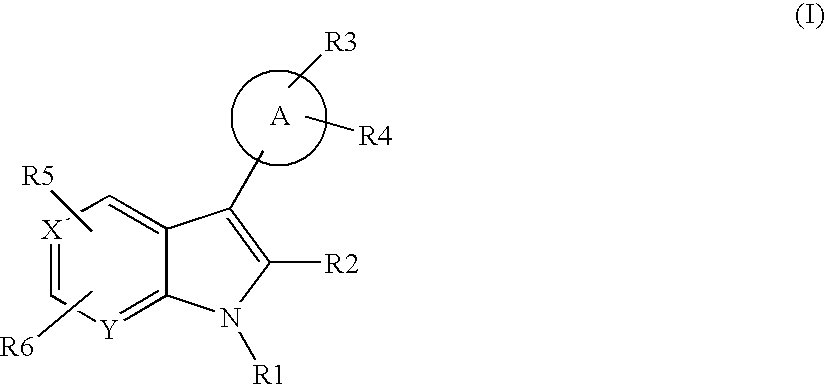
wherein:
R1 is chosen from H, alkyl, arylalkyl, hydroxyalkyl, alkoxyalkyl, aminoalkyl, alkylaminoalkyl, dialkylaminoalkyl, alkylCOOalkyl, alkoxycarbonylalkyl, aminocarbonylalkyl, alkylaminocarbonylalkyl, dialkylaminocarbonylalkyl, alkylCONalkyl, cyanoalkyl, or a group R′R″Nalkyl, in which R′ and R″, together with the nitrogen atom to which they are attached, may form a 5, 6 or 7 membered ring, optionally containing a heteroatom chosen from O, S and N, and where said N atom may be substituted by alkyl;
R2 is chosen from alkyl, alkenyl, aryl, heterocyclyl optionally substituted by alkyl or aryl, acid, ester, amide, nitrile, aminoalkyl, alkylaminoalkyl, dialkylaminoalkyl, hydroxyalkyl, CH2NHCOCH3, CONHSO2CH3, alkoxycarbonylalkyl, alkoxycarbonylalkenyl; or R1 and R2 together form a 5, 6 or 7 membered ring containing optionally a heteroatom chosen from O, S, N and containing optionally a carbonyl function which can be attached to any carbon atom of said ring, and where said N atom may be substituted by alkyl, aryl, arylalkyl, heteroaryl, alkylsulfonyl, arylsulfonyl, alkylcarbonyl, arylcarbonyl, alkylaminocarbonyl, arylaminocarbonyl;
R3, R4, R5, R6 each independently represent H, alkyl, alkoxy, hydroxy, halogen, trifluoromethyl, trifluoromethyloxy;
X and Y each independently represent carbon or nitrogen;
A is chosen from a phenyl or a heterocyclic ring with 5 or 6 members containing up to two heteroatoms chosen from nitrogen, oxygen and sulfur,
are inhibitors of vacuolar ATPase, possessing marked antiproliferative activity. They can therefore be used in the treatment of solid tumours and tumours of the blood such as leukaemias. This use is particularly indicated in tumours associated with the resistance phenomenon. In addition, the aforesaid compounds are able to enhance, in doses lower than those proven to be pharmacologically active, the activity of known cytotoxic agents. They can therefore either be used alone as antitumour drugs or in synergy with the action of known tumour agents. The compounds of formula (I) are partly new and partly described in the aforementioned patent application EP 0449196. - Additionally, the present application describes processes for preparing said compounds, their use in the treatment of tumours and resistance to antitumour drugs and their use as enhancers of the action of antitumour drugs. Moreover, pharmaceutical compositions containing the compounds of formula (I) are described, possibly associated with known antitumour drugs the action of which is to be enhanced.
- The compounds of the present invention are also useful as radiosensitizers to reduce resistance to radiation therapy, a well known phenomenon occurring in many tumors.
- Furthermore, the ability of compounds of the present invention to reduce in vitro chemoinvasion and in vivo metastasis, alone and in combination with known antitumor drugs, represents an excellent characteristic for a new antitumor agent, considering that metastasis is one of the major causes of death from cancer.
-
FIG. 1 : results of the co-treatment (72 hours) of HT29 cells with topotecan and compound of example 1 (representation according to Kern with illustration of synergism); - ▪: Topotecan+compound of example 1 at 4 μM (124%);
- ◯: Topotecan+compound of example 1 at 8 μM (93%);
- ●: Topotecan+compound of example 1 at 4 μM (101%);
- Δ: Topotecan+compound of example 1 at 8 μM (129%);
- ▴: Topotecan+compound of example 1 at 4 μM (135%)
-
FIG. 2 : results of the co-treatment (72 hours) of HT29/Mit resistant cells with topotecan and compound of example 1 (representation according to Kern with illustration of synergism); - ◯: Topotecan+compound of example 10.at 1 μM (78%);
- ●: Topotecan+compound of example 1 at 0.01 μM (122%).
-
FIG. 3 : activity of the combination of topotecan and compound of example 1 in HT29/Mit xenograft mice model; - X: controls
- ◯: Topotecan (1 mg/kg) p.o.
- Δ: Topotecan (2 mg/kg) p.o.
- ●: Topotecan (1 mg/kg) p.o.+compound of the example 1 (30 mg/kg) p.o.
- ▾: Topotecan (2 mg/kg) p.o.+compound of the example 1 (30 mg/kg) p.o.
- In all the alkyl substituents of formula (I), and in those containing an alkyl group (for example hydroxyalkyl, alkylaminoalkyl), the alkyl residue can be indifferently linear, branched or cyclic, preferably a C1-C8 alkyl, more preferably C1-C4.
- In all the alkenyl substitutents or those containing an alkenyl group (for example alkoxycarbonylalkenyl), the alkenyl residue can be indifferently linear, branched or cyclic, preferably a C1-C8 alkyl, more preferably C1-C4.
- In the case of cyclic alkyls or alkenyls it is of course intended that the minimum number of carbon atoms cannot be less than 3.
- In all the aryl substituents of formula (I), and in those containing an aryl group (for example arylalkyl), the aryl residue is preferably a phenyl.
- The term “acid groups” means COOH groups. The term “ester groups” means COOR groups where R is an alkyl as aforedefined. The term “alkoxy groups” means OR groups where R is an alkyl as aforedefined. The term “amide groups” means CONR′R″ groups where R′ and R″ are H or an alkyl as aforedefined, or R′ and R″, together with the nitrogen atom to which they are attached may form a 5, 6 or 7 membered ring, optionally containing a heteroatom chosen from O, S and N.
- More specifically, when R1 is an alkyl, it is preferably Me, Et or Pr; when R1 is an arylalkyl, it is preferably benzyl; when R1 is a hydroxyalkyl, it is preferably hydroxyethyl or hydroxypropyl; when R1 is alkoxyalkyl, it is preferably methoxyethyl; when R1 is an aminoalkyl, it is preferably aminoethyl; when R1 is an alkylaminoalkyl, it is preferably methylaminoethyl; when R1 is a dialkylaminoalkyl, it is preferably dimethylaminoethyl or dimethylaminopropyl; when R1 is alkoxycarbonylalkyl, it is preferably CH2COOMe2; when R1 is aminocarbonylalkyl, it is preferably CH2CONH2; when R1 is alkylaminocarbonylalkyl, it is preferably CH2CONHMe; when R1 is dialkylaminocarbonylalkyl, it is preferably CH2CONMe2; when R1 is a cyanoalkyl, it is preferably CH2CN; when R1 is R′R″Nalkyl, it is preferably pyrrolidinylethyl, morpholinylethyl or N-methylpiperazinylethyl.
- When R2 is an alkoxycarbonylalkyl, it is preferably CH2—CH2COOEt; when R2 is an ester, it is preferably COOMe or COOEt, when R2 is an alkylaminoalkyl, it is preferably methylaminomethyl; when R2 is a heterocyclyl, it is preferably a 5-membered heterocycle containing from 2 to 4 heteroatoms chosen from N and O, more preferably a diazole, triazole, tetrazole or oxadiazole, which may be substituted with an alkyl or aryl group.
- When R1 and R2 together form a 6 membered ring, the resulting compound is preferably a substituted 1,2,3,4-tetrahydro-pyrazino[1,2-a]indole, 3,4-dihydro-2H-pyrazino[1,2-a]indol-1-one, 1,2-dihydro-pyrazino[1,2-a]indol-3-one or 3,4-dihydro-1H-[1,4]oxazino[4,3-a]indole
- When one or more of R3, R4, R5, R6 represents an alkyl, the alkyl group is preferably Me, Et; when they represent an alkoxy, the alkoxy group is preferably OMe, OEt; when they represent a halogen, it is preferably Cl or F. An aspect of the invention consists of the use of the compounds of formula (I) as aforedescribed in the preparation of a drug useful as an antitumour agent. The invention comprises in addition a method for the treatment of tumours, characterised by the administration of a compound of formula (I) to a patient requiring it.
- The use/method of antitumour treatment is particularly indicated, although not exclusively, for the treatment of those tumours that have already developed resistance to conventional antitumour therapy or which are particularly open to the development of resistance; it particularly concerns tumours with a high level of expression in the transport systems responsible for the MDR phenomenon (multi-drug resistance or cross resistance), such as BCRP and PgP; examples of those tumours particularly exposed to the development of resistance are tumours of the digestive system such as carcinomas of the stomach, colon, liver and pancreas, tumours of the urinary system, tumours of the central nervous system such as neuroblastoma and glioma, tumour of the breast, of the bones and melanoma (Ouar Z., Biochem. J. 370, 185-193, 2003; Ohta T., J. Pathol. 185, 324-330, 1998, Nakashima S., J. Biochem.-Tokyo-134, 359-64, 2003; Altan N., J. Exp. Med. 187, 1583-1598, 1998; Martinez-Zaguilan R., Biochem. Pharmacol. 57, 1037-1046, 1999).
- Moreover, the compounds of the present invention are able to enhance the activity of known cytotoxic agents at doses lower than those demonstrated to be pharmacologically active.
- Examples of conventional antitumour drugs which can give rise to various manifestations of drug resistance and which can benefit combined treatment with the compounds of formula (I) are anthracyclines (for example doxorubicin, epirubicin, mitoxantrone), camptothecins (for example topotecan, irinotecan), platinum compounds (for example cisplatin, carboplatin) and taxans (for example taxol and taxotere).
- The antitumour use claimed, therefore also encompasses using said compounds to synergistically enhance the action of known antitumour agents and to treat the phenomenon of drug resistance having developed following antitumour therapies. A further aspect of the invention consists of pharmaceutical compositions comprising one or more compounds of formula (I) as aforedefined possibly combined with one or more antitumour agents, and in the presence of suitable pharmaceutical excipients. The dosage units of these pharmaceutical compositions contain the compound of formula (I) in a quantity between 1 and 1000 mg; said units are administered so that in the patient dosages per Kg are achieved which are preferably within the aforementioned range. The antitumour agent present in the compositions with the compound of formula (I), is used in the normal amounts at which it is already known to be active, or in a possibly lower amount by virtue of the synergistic enhancement effect acheived by the present invention. Non-limiting reference limits for antitumour drug content, combined with the compound of formula (I) in the dosage unit, are between 0.1 and 1000 mg.
- The pharmaceutical compositions of the invention can be adapted for the various administration routes, and can be provided for example in the form of injectable solutions, solutions for infusion, solutions for inhalation, suspensions, emulsions, syrups, elixirs, drops, suppositories, possibly coated pills, hard or soft capsules, microcapsules, granules, dispersible powders etc.
- The excipients contained in these compositions are those commonly used in pharmaceutical technology, and can be used in the manner and quantity commonly known to the expert of the art.
- Solid administration forms, such as pills and capsules for oral administration, are normally supplied in dosage units. They contain conventional excipients such as binders, fillers, diluents, tabletting agents, lubricants, detergents, disintegrants, colorants and wetting agents and can be coated in accordance with methods well known in the art.
- The fillers include for example cellulose, mannitol, lactose and similar agents. The disintegrants include starch, polyvinylpyrrolidone and starch derivatives such as sodium starch glycolate; the lubricants include, for example, magnesium stearate; the wetting agents include for example sodium lauryl sulfate. These solid oral compositions can be prepared with conventional mixing, filling or tabletting methods. The mixing operations can be repeated to disperse the active agent in compositions containing large quantities of fillers. These are conventional operations.
- The liquid preparations can be provided as such or in the form of a dry product to be reconstituted with water or with a suitable carrier at the time of use. These liquid preparations can contain conventional additives such as suspending agents, for example sorbitol, syrup, methylcellulose, gelatin, hydroxyethylcellulose, carboxymethylcellulose, aluminium stearate gel or hydrogenated edible fats, emulsifying agents, for example lecithin, sorbitan monooleate, or acacia; non aqueous carriers (which can include edible oil) for example almond oil, fractionated coconut oil, oily esters such a glycerin esters, propylene glycol or ethyl alcohol; preservatives, for example methyl or propyl p-hydroxybenzoate or sorbic acid and if desired, conventional flavours or colorants. The oral formulations also include sustained release conventional formulations, such as enteric coated pills or granules.
- For parenteral administration, fluid dosage units can be prepared containing the compound and a sterile carrier. The compound, depending on the carrier and concentration, can be suspended or dissolved. The parenteral solutions are normally prepared by dissolving the compound in a carrier and sterilizing by filtration, before filling suitable vials or ampoules and sealing. Adjuvants such as local anesthetics, preservatives and buffering agents can be advantageously dissolved in the carrier. In order to increase stability, the composition can be frozen after filling the vial and the water removed under vacuum. The parenteral suspensions are prepared essentially in the same way, with the difference that the compound can be suspended rather than dissolved in the carrier, and can be sterilized by exposure to ethylene oxide prior to being suspended in the sterile carrier. A surfactant or humectant can be advantageously included in the composition to facilitate uniform distribution of the compound of the invention.
- As is the common practise, the compositions are normally accompanied by written or printed instructions, for use in the treatment concerned.
- A part of the compounds of formula (I) are new. These concern the compounds of formula (I) in which X, Y, A, R1, R2, R3, R4, R5, R6 have the previously defined meanings, with the exception of compounds in which X, Y are carbon, A is phenyl, R1 is H or alkyl and, simultaneously, R2 is chosen from acid, ester, amide or hydroxyalkyl.
- A sub-group of new compounds in accordance with the invention consists of compounds of formula (I) in which X, Y, A, R1, R2, R3, R4, R5, R6 have the previously defined meanings, with the exception of the compounds in which X, Y are carbon, A is phenyl, R1 is H or alkyl and, simultaneously, R2 is chosen from acid, ester, amide, hydroxyalkyl, CH2NHCOCH3, CONHSO2CH3, alkoxycarbonylalkyl or alkoxycarbonylalkenyl.
- The invention also includes the use of the new compounds of the invention for therapy, particularly for the aforementioned antitumour treatments, as well as pharmaceutical compositions which comprise them, possibly in association with known antitumour drugs.
- The compounds of formula (I) can be obtained by alkylation of the compound of formula (II)

wherein X, Y, A, R2, R3, R4, R5 and R6 are as aforedefined for the compounds of formula (I), with a halide of formula R1X1 wherein R1 is as defined for formula (I) and X1 is bromine, chlorine or iodine. - The reaction is conducted under conventional alkylation conditions, for example in an aprotic solvent such as tetrahydrofuran or dimethylformamide in the presence of a suitable base such as sodium or potassium hydride or the lithium salt of a secondary amine. The reaction temperature can be between 25° C. and 50° C.; the reaction time is comprised for example between 30 minutes and 24 hours.
- The compounds R1X1 are known compounds, available commercially or preparable by methods used to produce known compounds.
- The compound of formula (III),
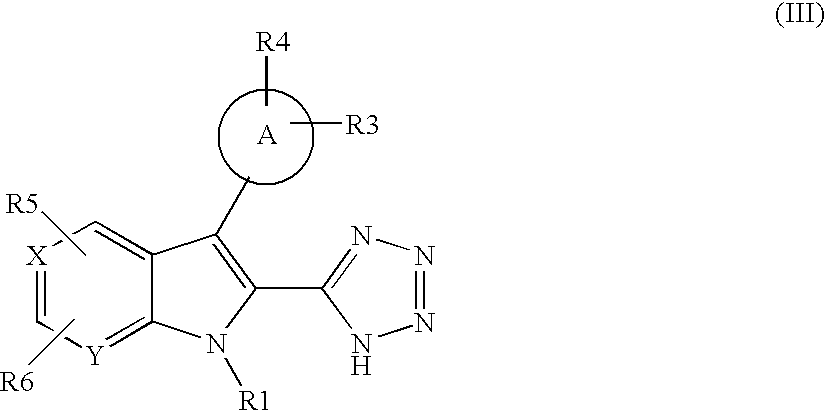
wherein X, Y, A, R1, R3, R4, R5 and R6 are as defined for the compounds of formula (I), can be obtained from the compound of formula (IV)
wherein X, Y, A, R1, R3, R4, R5 and R6 are as defined for the compound of formula (I). The heterocycle formation reaction can be conducted by reacting with Bu3SnN3 at 120° C. in a solvent such as DMF or without solvent followed by hydrolysis of the corresponding stannane with aqueous HCl. - Compounds of formula (IV) may be obtained by dehydration of compounds of formula (V)
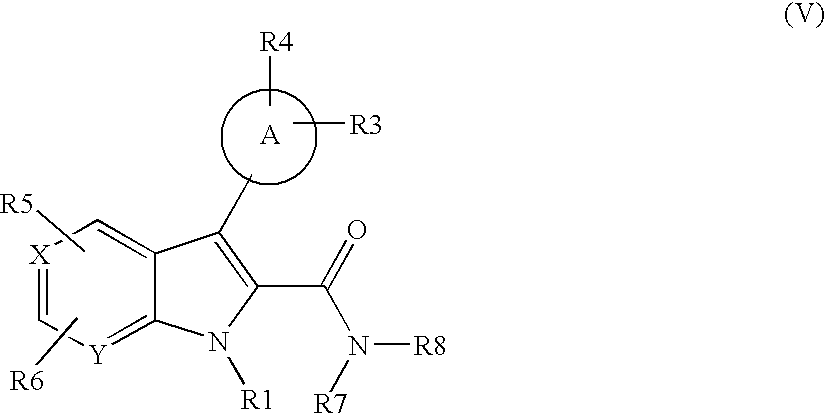
wherein X, Y, A, R1, R3, R4, R5 and R6 are as defined for formula (I), R7 and R8 are hydrogen, alkyl or, together with the nitrogen atom to which they are attached, may form a 5, 6 or 7 membered ring optionally containing a heteroatom chosen from N, O or S, with the proviso that the described process is possible when both R7 and R8 are hydrogen. - Dehydration can be conducted with all the reagents commonly used for dehydration of primary amides, for example trifluoroacetic anhydride, at a suitable temperature for forming the desired product, for example from 0° C. to ambient temperature, in the presence of suitable solvents such as pyridine or dioxane.
- The compound of formula (V) can be obtained from the compound of formula (VI),
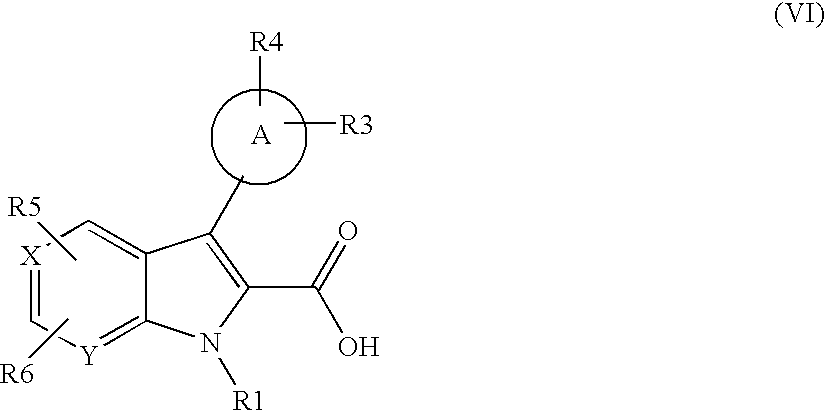
wherein X, Y, A, R1, R3, R4, R5 and R6 are as defined for the compounds of formula (I), and an amine of formula HNR7R8 following the reaction process described in EP 449196. Compounds of formula HNR7R8 are known compounds which are commercially available or can be prepared by using methods analogous to those used for preparing known compounds; for example the methods described in Chemistry of the Amino Group, Patais (Ed.), Interscience, New York 1968; Advanced Organic Chemistry, March J, John Wiley & Sons, New York, 1992. - The compound of formula (VI) can be obtained from the compound of formula (VII),
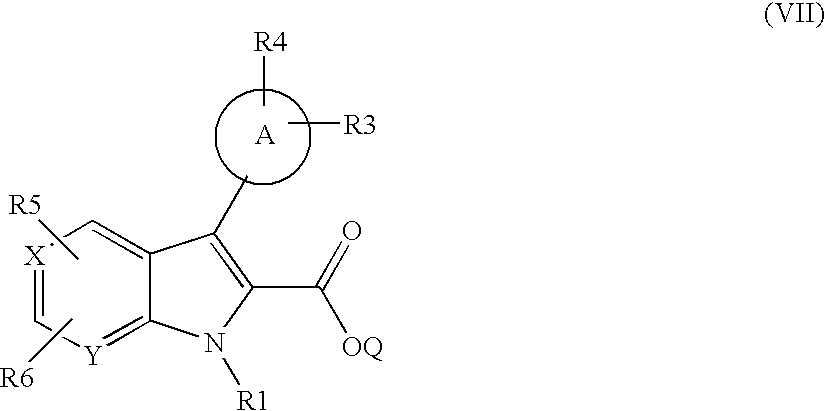
wherein X, Y, A, R1, R3, R4, R5 and R6 are as defined for the compounds of formula (I), and Q is C1-4alkyl, following the reaction process described in EP 449196. The compound of formula (VII) can be obtained from the compound of formula (VIII),
wherein X, Y, A, R3, R4, R5 and R6 are as defined for the compounds of formula (I), and Q is as defined for compounds of formula (VII), following the process described for preparation of the compounds of formula (I). - Compounds of formula (VIII) may be obtained following processes described in EP 449196.
- Alternatively, compounds of formula (VIII) may be obtained reacting compounds of formula (IX),

wherein X, Y, R5 and R6 are as defined for formula (I) and Q is C1-4 alkyl, with boronic acids of formula (X),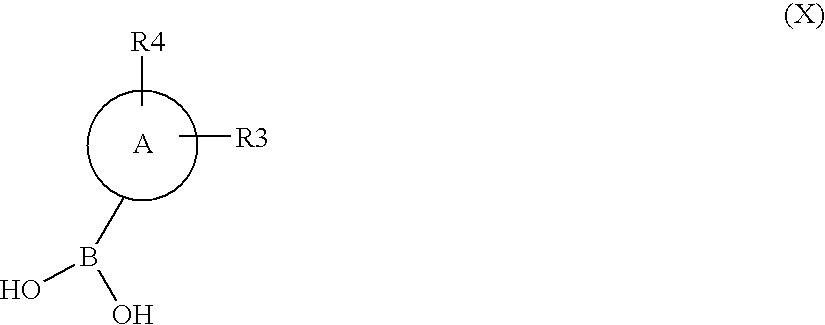
wherein A, R3 and R4 are as defined for formula (I), and a palladium catalyst such as Pd(PPh3)4 or Pd(dppf)Cl2 under Suzuki coupling conditions, as described for example in Chem. Rev. 1995, 95, 2457-2483 - Compounds of formula (IX) are either known or commercially available, or may be prepared as described for example in Chem. Pharm. Bull. 1988, 36, 2248-2252. Compounds of formula (X) are either known or commercially available, or may be prepared as described for example in Chem. Rev. 1995, 95, 2457-2483.
- The compound of formula (XI),

wherein X, Y, A, R1, R3, R4, R5 and R6 are as defined for compounds of formula (I), can be obtained from the compound of formula (V) in which R7 and R8 are hydrogen, as described in J. Org. Chem. 1979, 44, 4160-4164 for the generic synthesis of 1,2,4 triazoles. - The compound of formula (XII),
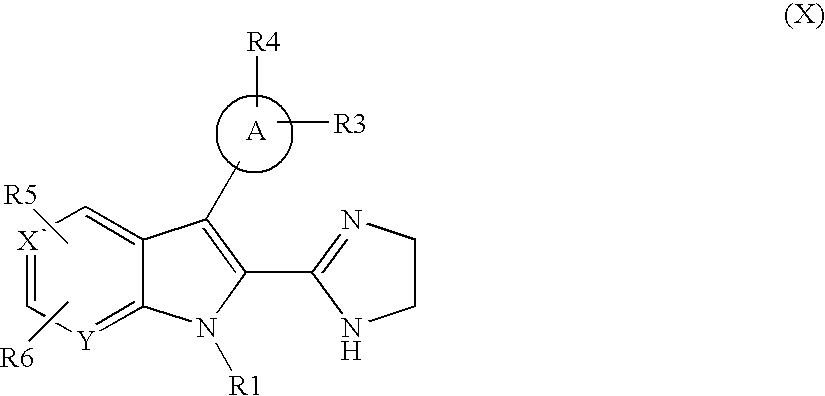
wherein X, Y, A, R1, R3, R4, R5 and R6 are as defined for the compounds of formula (I), can be obtained from the compound of formula (VI) as described in J. Med. Chem. 1987, 30, 1555-1562. - The compound of formula (XIII),
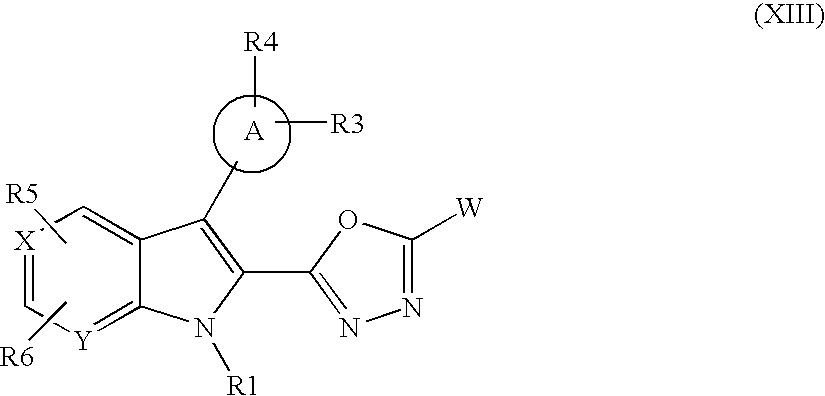
wherein X, Y, A, R1, R3, R4, R5 and R6 are as defined for the compounds of formula (I), and W is Hydrogen or an Alkyl Group as Previously Defined or an Aryl group, can be obtained from the compound of formula (XIV).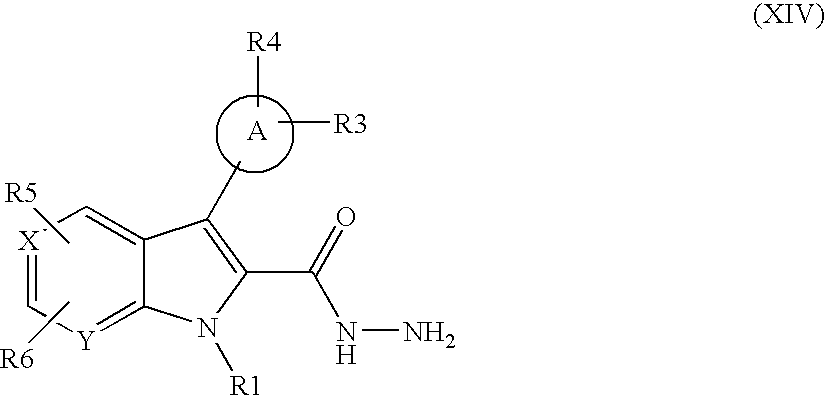
wherein X, Y, A, R1, R3, R4, R5 and R6 are as defined for the compounds of formula (I), as described in Bull. Soc. Chim. Fr. 1977, 333-336. - The compound of formula (XIV) can be obtained reacting the compound of formula (VI) with hydrazine following the general amidation conditions described in EP449196.
- The compound of formula (XV),
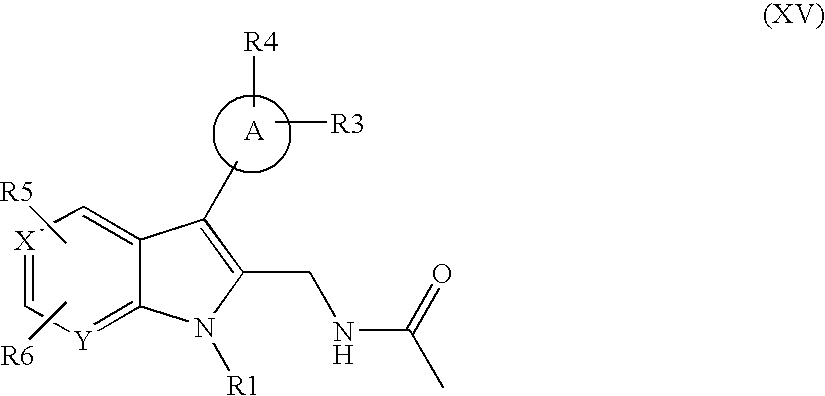
wherein X, Y, A, R1, R3, R4, R5 and R6 are as defined for the compounds of formula (I) can be obtained from the compound of formula (XVI)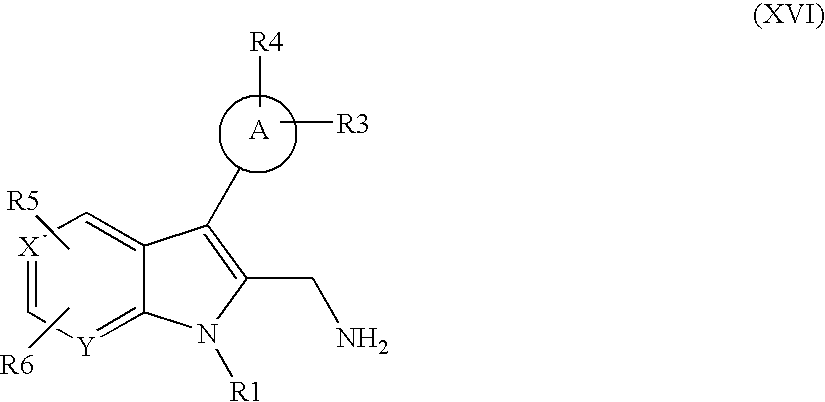
wherein X, Y, A, R1, R3, R4, R5 and R6 are as defined for the compounds of formula (I). The reaction can be conducted by reacting the compound of formula (XVI) with acetylating agents such as acetyl chloride or acetic anhydride, in the presence of an organic or inorganic base, for example triethylamine (TEA) in a chlorinated or aprotic solvent, for example methylene chloride, at any temperature which supplies a suitable percentage of the required product, for example at ambient temperature. - The compound of formula (XVI) can be obtained from the compound of formula (V) in which R7 and R8 are hydrogen, by reduction with a suitable reducing agent, for example with an aluminium hydride or a borane in an ether solvent, for example tetrahydrofuran, at any temperature which provides a suitable percentage of the required product, for example from ambient temperature to 50° C.
- The compound of formula (XVII),

wherein X, Y, A, R1, R3, R4, R5 and R6 are as defined for the compounds of formula (I), can be obtained from the compound of formula (VI) following the process described in Bioorg. Med. Chem. Lett. 2002, 12, 125-128.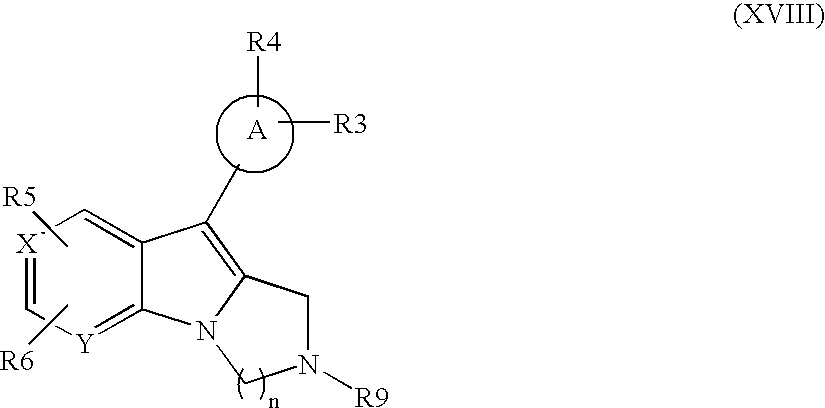
wherein X, Y, A, R3, R4, R5 and R6 are as defined for the compounds of formula (I), R9 is H or is an alkyl group as previously defined and n is 1, 2, or 3, may be obtained by reduction of compounds of formula (XIX)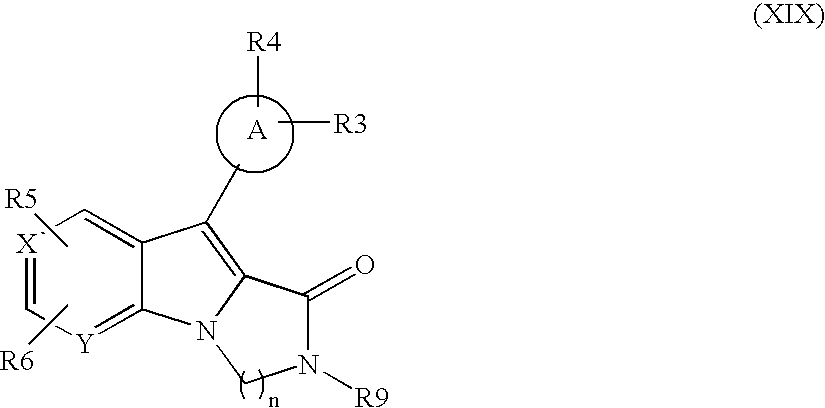
wherein X, Y, A, R3, R4, R5 and R6 are as defined for the compounds of formula (I), R9 is H or is an alkyl group as previously defined and n is 1, 2, or 3, using a suitable reducing agent, for example an aluminium hydride or a borane in an ether solvent, for example tetrahydrofuran, at any temperature which provides a suitable percentage of the required product, for example from ambient temperature to 50° C. - Compounds of formula (XIX) in which R9 is alkyl may be obtained alkylating compounds of formula (XIX) in which R9 is hydrogen with alkyl halides of formula R9-X1, in which R9 is alkyl and X1 is Cl, Br, I, under conditions described above for the preparation of compounds of formula (I).
- Compounds of formula (XIX) in which R9 is hydrogen or alkyl may be obtained from compounds of formula (XX)

wherein X, Y, A, R3, R4, R5 and R6 are as defined for the compounds of formula (I), Q is as previously defined, n is 1, 2, or 3, R9 is as defined for the compounds of formula (XIX) and R10 has the same meanings of R9, or R9 and R10 taken together with the nitrogen atom to which they are attached may form a 5, 6 or 7 membered heterocyclic ring optionally containing a heteroatom chosen from N, O and S, and when said heteroatom is N, it may be substituted by alkyl, with the proviso that the described process is possible when R10 is hydrogen. - The described process is typically a transamidation reaction using a suitable reagent for direct amidation, for example trimethyl aluminium in toluene, at any temperature which provides a suitable percentage of the required product, for example from 80° C. to 120° C.
- Compounds of formula (XX) may be obtained from compounds of formula (XXI)
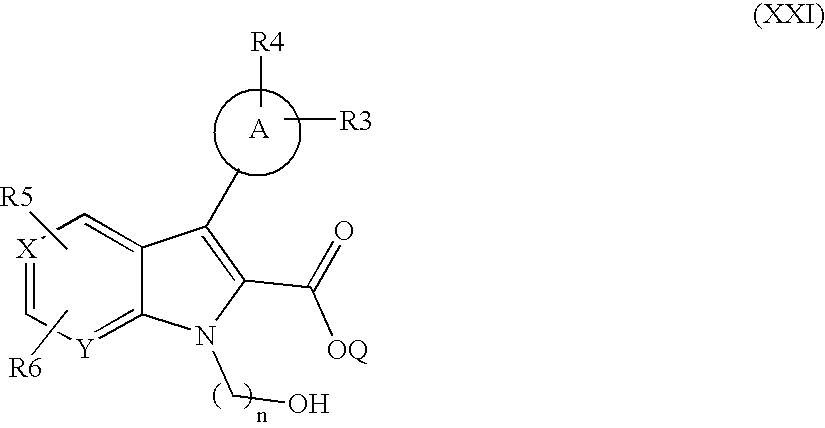
wherein X, Y, A, R3, R4, R5 and R6 are as defined for the compounds of formula (I), Q is as previously defined and n is 1, 2, or 3, by transforming the hydroxy group into a suitable leaving group such as bromide, iodide, mesylate or tosylate, followed by reaction with an amine of formula R9R10NH, wherein R9 and R10 are as defined for the compounds of formula (XX) - Compounds of formula (XXI) may be obtained from compounds of formula (VII) under conditions described above for compounds of formula (I).
- Compounds of formula (XX) in which both R9 and R10 are hydrogen may be obtained from compounds of formula (XXII)

wherein X, Y, A, R3, R4, R5 and R6 are as defined for the compounds of formula (I), Q is as defined previously and n is 1, 2, or 3, by catalytic hydrogenation in an acid environment. Catalytic hydrogenation can be conducted in an alcoholic solvent or ethyl acetate and using a suitable catalyst, for example palladium supported on carbon under a suitable hydrogenation pressure, for example 45 psi. - Compounds of formula (XXII) can be obtained by alkylation of the compound of formula (VII), wherein X, Y, A, R3, R4, R5 and R6 are as defined for the compounds of formula (I), with haloalkylnitriles, following the general methodology described for the preparation of the compounds of formula (I).
- Compounds of formula (XXIII)

wherein X, Y, A, R3, R4, R5 and R6 are as defined for the compounds of formula (I), n is 1, 2, or 3, R11 is —SO2R12, —COR12 or —CONHR12 and R12 is alkyl as previously defined or optionally substituted aryl, may be obtained reacting compounds of formula (XVIII) in which R9 is hydrogen, with compounds of formula R12SO2Cl, R12COCl, R12COOCOR12 or R12NCO, in a suitable solvent such as dichloromethane and in presence, if necessary, of a suitable base such as triethylamine or pyridine. - Compounds of formula R12SO2Cl, R12COCl, R12COOCOR12 or R12NCO are known or commercially available or may be prepared as described in standard reference texts of organic synthesis such as J. March, Advanced Organic Chemistry, 3rd Edition (1985), Wiley Interscience.
- The compound of formula (XXIV),
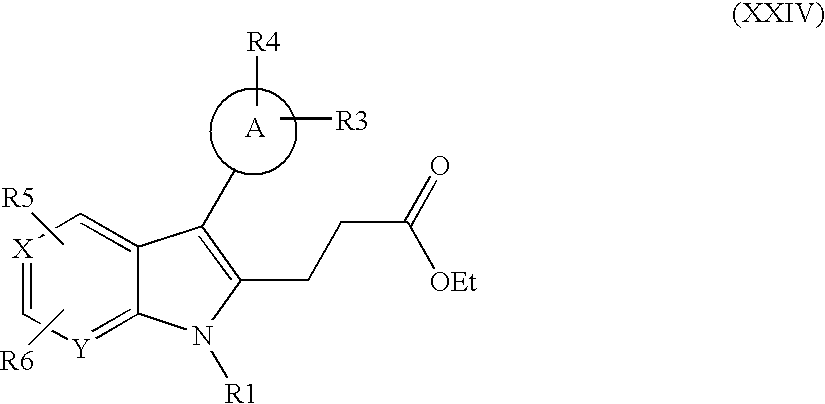
wherein X, Y, A, R1, R3, R4, R5 and R6 are as defined for the compounds of formula (I) can be obtained from the compound of formula (XXV),
wherein X, Y, A, R1, R3, R4, R5 and R6 are as defined for the compounds of formula (I,) by Horner-Emmons reaction followed by catalytic hydrogenation of the double bond. The Horner-Emmons reaction can be conducted with an ethyl alkylphosphonoacetate, a base such as a lithium, sodium or potassium hydride, a sodium or potassium alcoholate, lithium alkyl derivatives and the like, in an ether solvent. - Catalytic hydrogenation can be conducted in an alcoholic solvent or ethyl acetate and using a suitable catalyst, for example palladium supported on carbon under a suitable hydrogen pressure, for example 45 psi.
- The compound of formula (XXV) can be obtained by the oxidation of the compound of formula (XXVI),

wherein X, Y, A, R1, R3, R4, R5 and R6 are as defined for the compounds of formula (I), using one of the known reactions in the literature for oxidizing primary and benzyl alcohols. The oxidation can be conducted with conventional oxidizing agents such as manganese dioxide, pyridinium-chloro-chromate, dimethylsulfoxide and oxalyl chloride. The solvent can be a chlorinated solvent or an ether solvent. - The compound of formula (XXVI) can be obtained by reduction of the compound of formula (VII) using a suitable reducing agent, for example an aluminium hydride or a borane in an ether solvent, for example tetrahydrofuran, at any temperature which provides a suitable percentage of the required product, for example from ambient temperature to 50° C.
- The compound of formula (XXVII),
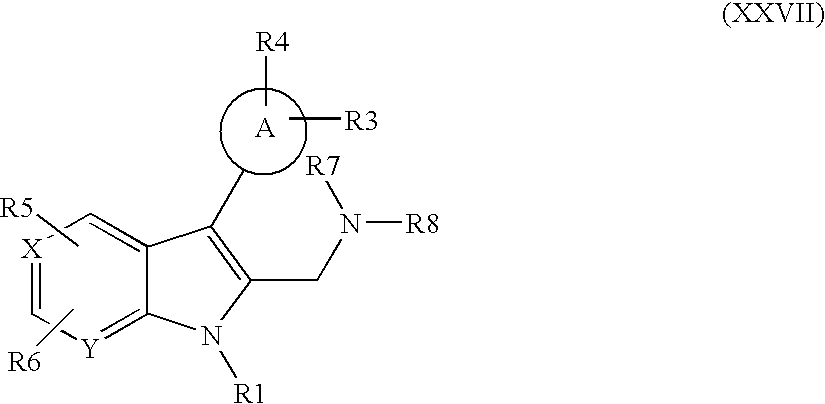
wherein X, Y, A, R1, R3, R4, R5 and R6 are as defined for the compounds of formula (I) and R7 and R8 are as previously defined in the description of formula (V), can be obtained from the compound of formula (XXV) by reductive amination reaction with the compounds of formula HNR7R8 and a boron hydride such as sodium cyanoborohydride and sodium triacetoxy borohydride and an alcoholic solvent such as methanol at a temperature which supplies a suitable percentage of the required product, for example ambient temperature. - Compounds of formula (XXVIII)
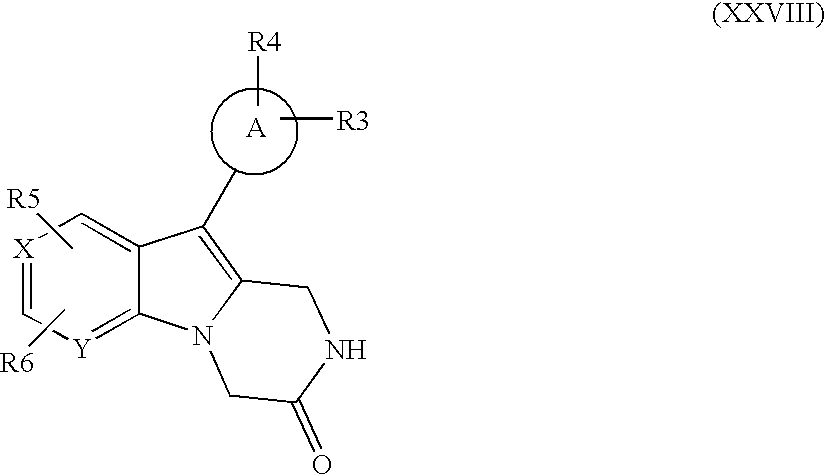
wherein X, Y, A, R3, R4, R5 and R6 are as defined for the compounds of formula (I), may be obtained by reaction of compounds of formula (XXIX)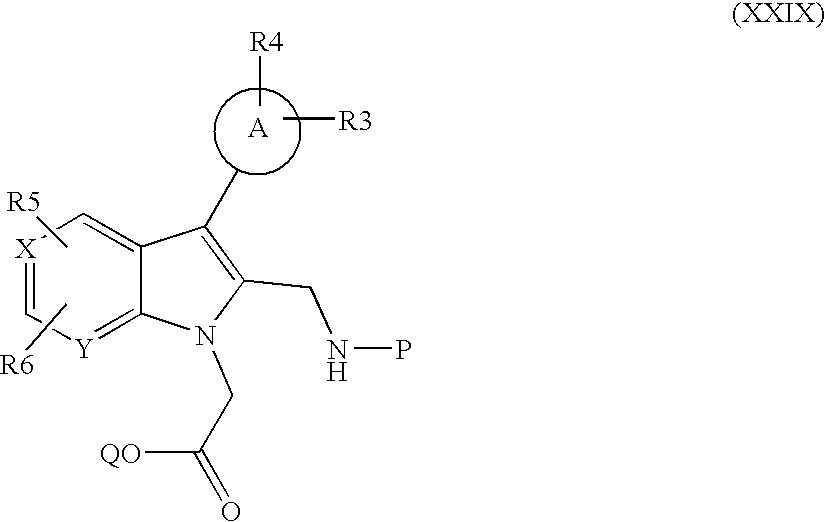
wherein X, Y, A, R3, R4, R5 and R6 are as defined for the compounds of formula (I), P is a suitable protecting group such as trityl and Q is as previously defined, by simultaneous deprotection and cyclization after treatment with a suitable deprotecting agent, such as trifluoroacetic acid. - Compounds of formula (XXIX) may be obtained from compounds of formula (XXX)
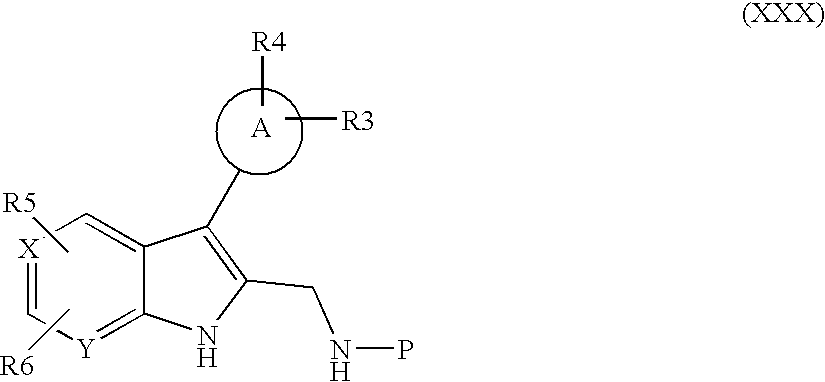
wherein X, Y, A, R3, R4, R5 and R6 are as defined for the compounds of formula (I), and P is as previously defined, by alkylation with BrCH2COOQ under conditions described for the preparation of compounds of formula (I) - Compounds of formula (XXX) may be obtained from compounds of formula (XXVII) in which R1, R7 and R8 are hydrogen, by protection with a suitable agent, such as trityl chloride.
- Compounds of formula (XXXI)

wherein X, Y, A, R2, R3, R4, R5 and R6 are as defined for the compounds of formula (I), R7 and R8 are as previously defined and n is 1, 2, or 3, may be prepared from compounds of formula (XXXII)
wherein X, Y, A, R2, R3, R4, R5 and R6 are as defined for the compounds of formula (I) and n is 1, 2, or 3, by activation of the carboxylic moiety with for example thionyl chloride or oxalyl chloride or carbonyldiimidazole and reaction with an amine of formula R7R8NH. - Compounds of formula (XXXII) may be prepared from compounds of formula (XXXIII)

wherein X, Y, A, R2, R3, R4, R5 and R6 are as defined for the compounds of formula (I) and n is 1, 2, or 3 by deprotection with for example trifluoroacetic acid or HCl/diethyl ether. - Compounds of formula (XXXIII) may be prepared from compounds of formula (II) as described above for compounds of formula (I)
- Alternatively, compounds of formula (XXXI) in which R7 and R8 are hydrogen may be prepared on solid phase, reacting a Sieber resin with bromoacetic acid and a suitable coupling agent such as dicyclohexylcarbodiimide, then adding a suitable base such as sodium hydride and a compound of formula (II) in a suitable solvent such as DMF, and finally cleaving the product from the resin with a suitable cleaving reagent, such as a mixture of trifluoroacetic acid and triisopropylsilane in methylene chloride.
- Compounds of formula (XXXIV)
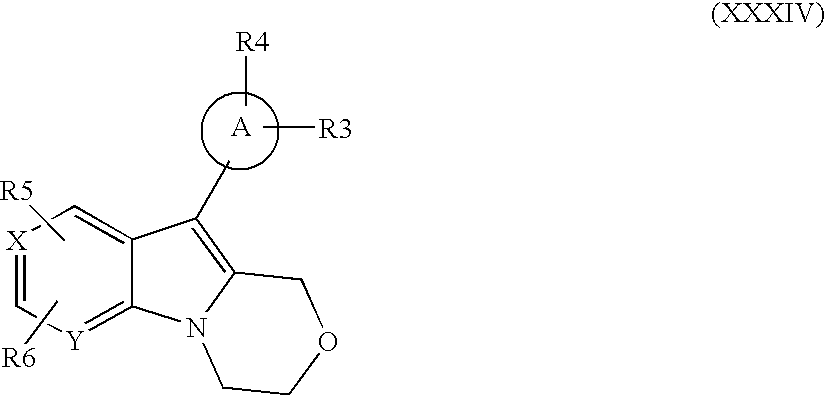
wherein X, Y, A, R3, R4, R5 and R6 are as defined for the compounds of formula (I), may be prepared from compounds of formula (XXXV)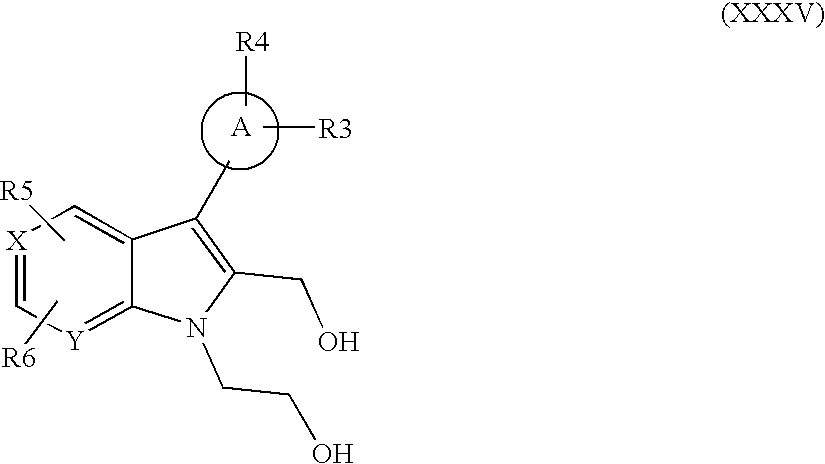
wherein X, Y, A, R3, R4, R5 and R6 are as defined for the compounds of formula (I), by simultaneous activation and ring closure with a suitable combination of an activating agent and a base, such as tosylimidazole and sodium hydride. Compounds of formula (XXXV) may be obtained from compounds of formula (XXXII), in which R2 is a group COOQ where Q is as defined previously, by reduction with a suitable reducing agent such as LiAlH4 in a suitable solvent, such as THF. - Compounds of formula (XXXVI)
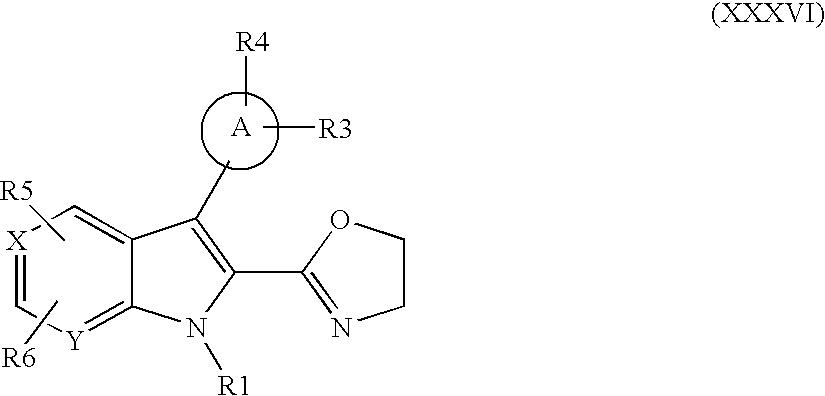
wherein X, Y, A, R1, R3, R4, R5 and R6 are as defined for the compounds of formula (I), may be prepared from compounds of formula (VI) by activation of the carboxylic moiety as described above for compounds of formula (XXXI) and formation of amide with simultaneous ring closure with 2-bromoethylamine. - Non-limiting examples of compounds of formula (I) useful for the purposes of the invention are the following:
- 5,6-Dimethoxy-3-(4-methoxy-phenyl)-1H-indole-2-carboxylic acid methylester
- 3-(3,4-Dimethoxy-phenyl)-5,6-dimethoxy-1H-indole-2-carboxylic acid methylester
- 5,6-Dimethoxy-3-phenyl-1H-indole-2-carboxylic acid methylester
- 5,6-Dimethoxy-3-phenyl-1H-indole-2-carboxylic acid ethylester
- 3-(4-Methoxy phenyl)-1H-indole-2-carboxylic acid methylester
- 1-Benzyl-5,6-dimethoxy-3-(4-methoxyphenyl)-1H-indole-2-carboxylic acid methylester
- 5,6-Dimethoxy-1-methoxycarbonylmethyl-3-(4-methoxyphenyl)-1H-indole-2-carboxylic acid methylester
- 1-Dimethylcarbamoylmethyl-5,6-dimethoxy-3-(4-methoxyphenyl)-1H-indole-2-carboxylic acid methylester
- 5,6-Dimethoxy-3-(4-methoxyphenyl)-1-propyl-1H-indole-2-carboxylic acid methylester
- 1-Cyanomethyl-5,6-dimethoxy-3-(4-methoxyphenyl)-1H-indole-2-carboxylic acid methylester
- 1-(2-Dimethylaminoethyl)-5,6-dimethoxy-3-(4-methoxyphenyl)-1H-indole-2 carboxylic acid methylester hydrochloride
- 1-(2-Hydroxyethyl)-5,6-dimethoxy-3-(4-methoxyphenyl)-1H-indole-2-carboxylic acid methylester
- 5,6-Dimethoxy-3-(4-methoxyphenyl)-1H-indole-2-carboxylic acid
- 5,6-Dimethoxy-3-(4-methoxyphenyl)-1H-indole-2-carboxyamide
- 2-Aminomethyl-5,6-dimethoxy-3-(4-methoxyphenyl)-1H-indole hydrochloride
- N-[5,6-dimethoxy-3-(4-methoxyphenyl)-1H-indol-2-ylmethyl]-acetamide
- 5,6-Dimethoxy-3-(4-methoxyphenyl)-1H-indole-2-carbonitrile
- 1-(2-Dimethylaminoethyl)-5,6-dimethoxy-3-(4-methoxy-phenyl)-1H-indole-2-carbonitrile hydrochloride
- N-[5,6-dimethoxy-3-(4-methoxyphenyl)-1H-indole-2-carbonyl]-methanesulfonamide
- [5,6-Dimethoxy-3-(4-methoxyphenyl)-1H-indol-2-yl]-methanol
- [5,6-Dimethoxy-3-(4-methoxyphenyl)-1H-indol-2-ylmethyl]-methylamine hydrochloride
- 3-[5,6-dimethoxy-3-(4-methoxyphenyl)-1H-indol-2-yl]-propionic acid ethyl ester
- 5,6-Dimethoxy-3-(4-methoxyphenyl)-2-(2H-[1,2,4]triazol-3-yl)-1H-indole
- 2-(4,5-Dihydro-1H-imidazol-2-yl)-5,6-dimethoxy-3-(4-methoxy-phenyl)-1H-indole trifluoroacetate
- 5,6-Dimethoxy-3-(4-methoxyphenyl)-2-(1H-tetrazol-5-yl)-1H-indole
- 5,6-Dimethoxy-3-(4-methoxyphenyl)-2-[1,3,4]oxadiazol-2-yl-1H-indole
- 7,8-Dimethoxy-10-(4-methoxyphenyl)-3,4-dihydro-2H-pyrazino[1,2-a]indol-1-one
- 7,8-Dimethoxy-10-(4-methoxyphenyl)-1,2,3,4-tetrahydro-pyrazino[1,2-a]indole hydrochloride
- 5,6-Dimethoxy-3-phenyl-1H-indole-2-carboxylic acid
- 3-(4-Chlorophenyl)-5,6-dimethoxy-1H-indole-2-carboxylic acid methyl ester
- 3-(4-(Trifluoromethyl)phenyl)-5,6-dimethoxy-1H-indole-2-carboxylic acid methyl ester
- 5,6-Dimethoxy-3-p-tolyl-1H-indole-2-carboxylic acid methyl ester
- 3-(4-Fluorophenyl)-5,6-dimethoxy-1H-indole-2-carboxylic acid methyl ester
- 3-(2-Chlorophenyl)-5,6-dimethoxy-1H-indole-2-carboxylic acid methyl ester
- 3-(3-Chlorophenyl)-5,6-dimethoxy-1H-indole-2-carboxylic acid methyl ester
- 5-Chloro-3-phenyl-1H-indole-2-carboxylic acid ethyl ester
- 5-Fluoro-3-phenyl-1H-indole-2-carboxylic acid ethyl ester
- 5-Methoxy-3-phenyl-1H-indole-2-carboxylic acid ethyl ester
- 5,6-Dimethoxy-1-(2-methoxyethyl)-3-(4-methoxyphenyl)-1H-indole-2-carboxylic acid methyl ester
- 1-(2-Hydroxyethyl)-5,6-dimethoxy-3-phenyl-1H-indole-2-carbonitrile
- 1-(3-Hydroxypropyl)-5,6-dimethoxy-3-(4-methoxyphenyl)-1H-indole-2-carboxylic acid methyl ester
- 1-(2-Hydroxyethyl)-5,6-dimethoxy-3-(4-methoxyphenyl)-1H-indole-2-carbonitrile
- 2-(5,6-Dimethoxy-3-(4-methoxyphenyl)-2-(5-methyl-1,3,4-oxadiazol-2-yl)-1H-indol-1-yl)ethanol
- 1-(3-Hydroxypropyl)-5,6-dimethoxy-3-(4-methoxyphenyl)-1H-indole-2-carbonitrile
- 5,6-Dimethoxy-3-phenyl-1H-indole-2-carboxylic acid amide
- 5,6-Dimethoxy-3-phenyl-1H-indole-2-carboxylic acid dimethylamide
- (5,6-Dimethoxy-3-phenyl-1H-indol-2-yl)-morpholin-4-yl-methanone
- 5,6-Dimethoxy-3-phenyl-1H-indole-2-carboxylic acid methylamide
- 5,6-Dimethoxy-3-phenyl-1H-indole-2-carbonitrile
- 5,6-Dimethoxy-3-phenyl-1-propyl-1H-indole-2-carbonitrile
- 1-(2-(Dimethylamino)ethyl)-5,6-dimethoxy-3-phenyl-1H-indole-2-carbonitrile hydrochloride
- 5,6-Dimethoxy-3-(4-methoxyphenyl)-1-(2-(pyrrolidin-1-yl)ethyl)-1H-indole-2-carboxylic acid methyl ester hydrochloride
- 1-(3-(Dimethylamino)propyl)-5,6-dimethoxy-3-(4-methoxyphenyl)-1H-indole-2-carboxylic acid methyl ester hydrochloride
- 5,6-Dimethoxy-3-(4-methoxyphenyl)-1-(2-(pyrrolidin-1-yl)ethyl)-1H-indole-2-carbonitrile hydrochloride
- 1-(3-(Dimethylamino)propyl)-5,6-dimethoxy-3-(4-methoxyphenyl)-1H-indole-2-carbonitrile
- 5,6-Dimethoxy-3-(4-methoxyphenyl)-1-(2-morpholinoethyl)-1H-indole-2-carbonitrile hydrochloride
- 2-(5,6-Dimethoxy-3-(4-methoxyphenyl)-2-(5-methyl-1,3,4-oxadiazol-2-yl)-1H-indol-1-yl)-N,N-dimethylethanamine
- 5,6-Dimethoxy-3-phenyl-2-(4H-1,2,4-triazol-3-yl)-1H-indole
- 3,4-Dihydro-7,8-dimethoxy-10-phenylpyrazino[1,2-a]indol-1(2H)-one
- 1-(2-Amino-ethyl)-5,6-dimethoxy-3-(4-methoxy-phenyl)-1H-indole-2-carboxylic acid methyl ester hydrochloride
- 7,8-Dimethoxy-10-phenyl-1,2,3,4-tetrahydro-pyrazino[1,2-a]indole hydrochloride
- 5,6-Dimethoxy-3-(4-methoxyphenyl)-1-[2-(4-methylpiperazin-1-yl)-ethyl]
- 1H-indole-2-carboxylic acid methyl ester dihydrochloride
- 5,6-Dimethoxy-3-(4-methoxyphenyl)-1-(2-morpholinoethyl)-1H-indole-2-carboxylic acid methyl ester hydrochloride
- 5,6-Dimethoxy-3-(4-methoxyphenyl)-1-(2-(4-methylpiperazin-1-yl)ethyl)-1H-indole-2-carbonitrile dihydrochloride
- 7,8-Dimethoxy-10-(4-methoxyphenyl)-2-methyl-1,2,3,4-tetrahydro-pyrazino[1,2-a]indole hydrocloride
- 7,8-Dimethoxy-10-(4-methoxyphenyl)-1,2-dihydropyrazino[1,2-a]indol-3-one
- 2-Methanesulfonyl-7,8-dimethoxy-10-(4-methoxyphenyl)-1,2,3,4-tetrahydro-pyrazino[1,2-a]indole
- 7,8-Dimethoxy-10-(4-methoxyphenyl)-2-(propane-2-sulfonyl)-1,2,3,4-tetrahydropyrazino[1,2-a]indole
- 7,8-Dimethoxy-10-(4-methoxyphenyl)-2-(toluene-4-sulfonyl)-1,2,3,4-tetrahydropyrazino[1,2-a]indole
- 1-[7,8-Dimethoxy-10-(4-methoxyphenyl)-3,4-dihydro-1H-pyrazino[1,2-a]indol-2-yl]-ethanone
- 7,8-Dimethoxy-10-(4-methoxyphenyl)-3,4-dihydro-1H-pyrazino[1,2-a]indole-2-carboxylic acid methylamide
- 2-Isopropyl-7,8-dimethoxy-10-(4-methoxyphenyl)-1,2,3,4-tetrahydro-pyrazino[1,2-a]indole hydrochloride
- 1-Carbamoylmethyl-5,6-dimethoxy-3-(4-methoxyphenyl)-1H-indole-2-carboxylic acid methyl ester
- 2-(4,5-Dihydrooxazol-2-yl)-5,6-dimethoxy-3-phenyl-1H-indole
- 5,6-Dimethoxy-3-(4-methoxyphenyl)-1-methylcarbamoylmethyl-1H-indole-2-carboxylic acid methyl ester
- 3,4-Dihydro-7,8-dimethoxy-10-(4-methoxyphenyl)-1H-[1,4]oxazino[4,3-a]indole
- 5,6-Dimethoxy-3-(4-methoxyphenyl)-2-(5-methyl-1,3,4-oxadiazol-2-yl)-1H-indole
- 5-Hydroxy-3-phenyl-1H-indole-2-carboxylic acid ethyl ester
- 3-Pyridin-3-yl-1H-indole-2-carboxylic acid ethyl ester
- 3-Phenyl-1H-indole-2-carboxylic acid ethyl ester
- 5,6-Dimethoxy-3-pyridin-4-yl-1H-indole-2-carboxylic acid ethyl ester
- The experimental section which follows further illustrates the invention without limiting it.
- Experimental Part
- The compound was obtained as described in EP 449196
- The compound was obtained as described in EP 449196
- The compound was obtained as described in EP 449196.
- The compounds described in Table 1 in examples 4-5 were synthesised following the process described in EP 449196 as for example 1.
- TSQ 700, 400 uA, 70V, 50-300° C.; MS (m/z): 325 (M+)
- 1H-NMR (CDCl3) δ: 8.81 (s br, 1H); 7.55 (d, 2H); 7.46 (dd, 2H); 7.37 (dd, 1H); 6.96 (s, 1H); 6.87 (s, 1H); 4.26 (q, 2H); 3.96 (s, 3H); 3.85 (s, 3H); 1.22 (t, 3H).
- ESI Pos, 3.5 KV, 20V, 300° C.; MS (m/z): 282.1 (MH+)
- 1H-NMR (D6−DMSO) δ: 11.83 (s br, 1H); 7.49 (m, 2H); 7.42 (d, 2H); 7.29 (dd, 1H); 7.07 (dd, 1H); 7.02 (d, 2H); 3.82 (s, 3H); 3.76 (s, 3H).
- 80 mg (0.234) mmol of 5,6-dimethoxy-3-(4-methoxyphenyl)-1H-indole-2-carboxylic acid methyl ester are dissolved in 3 ml of anhydrous DMF under nitrogen. The solution is brought to 0° C. and 11.2 mg (0.281 mmol) of NaH (60% suspension in mineral oil) are added. The reaction mixture is maintained under stirring at ambient temperature for 1 hour.
- 33 μl (0.281 mmol) of benzyl bromide are added and the reaction mixture is left under stirring for 15 minutes. The mixture is diluted with Et2O and the reaction is quenched with a saturated NH4Cl solution. The organic phase is separated and the aqueous phase is extracted with Et2O. The organic phases are combined, washed with NaClss, dried over anhydrous Na2SO4 and the solvent is evaporated under vacuum. The crude product obtained is purified by chromatography (eluent:
AcOEt 1, petroleum ether 4). 70 mg of product are obtained. Yield: 69% ZQ, ESI POS,spray 3,25 KV/source 30 V/probe 250 C; MS (m/z): 432 (MH+) - 1H-NMR (CDCl3) δ: 7.38 (d, 2H); 7.28 (dd, 2H); 7.22 (d, 1H); 7.10 (d, 2H); 7.00 (d, 2H); 6.92 (s, 1H); 6.74 (s, 1H); 5.77 (s, 2H); 3.89 (s, 3H); 3.87 (s, 3H); 3.84 (s, 3H); 3.61 (s, 3H).
- The compounds described in Table 1 in examples 7-11 were synthesised following the process described in example 6.
- ZQ, ESI POS,
spray 3,25 KV/source 30 V/probe 250 C; MS (m/z): 414 (MH+) - 1H-NMR (CDCl3) δ: 7.38 (d, 2H); 6.99 (d, 2H); 6.89 (s, 1H); 6.69 (s, 1H); 5.26 (s, 2H); 3.97 (s, 3H); 3.89 (s, 3H); 3.83 (s, 3H); 3.79 (s, 3H); 3.65 (s, 3H).
- ZQ, ESI POS,
spray 3,25 KV/source 30 V/probe 250 C; MS (m/z): 427 (MH+) - 1H-NMR (CDCl3) δ: 7.37 (d, 2H); 6.97 (d, 2H); 6.87 (s, 1H); 6.70 (s, 1H); 5.36 (s, 2H); 3.96 (s, 3H); 3.88 (s, 3H); 3.82 (s, 3H); 3.61 (s, 3H); 3.20 (s br, 3H); 3.03 (s br, 3H).
- AQA, ESI POS,
spray 3,25 KV/source 30 V/probe 250 C; MS (m/z): 384.1 (MH+) - 1H-NMR (CDCl3) δ: 7.35 (d, 2H); 7.98 (d, 2H); 6.89 (s, 1H); 6.79 (s, 1H); 4.46 (dd, 2H); 3.99 (s, 3H); 3.88 (s, 3H); 3.83 (s, 3H); 3.66 (s, 3H); 1.86 (m, 2H); 0.98 (t, 3H).
- ESI Pos, 3.5 KV, 30V, 250° C.; MS (m/z): 381.0 (MH+)
- 1H-NMR (CDCl3) δ: 7.34 (d, 2H); 7.00 (d, 2H); 6.88 (s, 1H); 6.81 (s, 1H); 5.58 (s, 2H); 4.02 (s, 3H); 3.89 (s, 3H); 3.84 (s, 3H); 3.71 (s, 3H).
- AQA, ESI POS,
spray 3,25 KV/source 30 V/probe 250 C; MS (m/z): 413.1 (MH+) - 1H-NMR (CDCl3) 6 (determined as base): 7.34 (d, 2H); 6.98 (d, 2H); 6.88 (s, 1H); 6.86 (s, 1H); 4.62 (m, 2H); 3.98 (s, 3H); 3.88 (s, 3H); 3.83 (s, 3H); 3.67 (s, 3H); 2.70 (m, 2H); 2.37 (s, 6H).
- 80 mg (0.234) mmol of 5,6-dimethoxy-3-(4-methoxyphenyl)-1H-indole-2-carboxylic acid methyl ester are dissolved in 3 ml of anhydrous DMF under nitrogen. The solution is brought to 0° C. and 11.2 mg (0.281 mmol) of NaH (60% suspension in mineral oil) are added. The reaction mixture is maintained under stirring at ambient temperature for 1 hour.
- 42 μl (0.281 mmol) of 2-(2-bromoethoxy)-tetrahydropyran are added and the mixture is left under stirring at ambient temperature for 24 hours. The mixture is diluted with Et2O and the reaction is quenched with a saturated NH4Cl solution. The organic phase is separated and the aqueous phase is extracted with Et2O. The organic phases are combined, washed with NaClss, dried over anhydrous Na2SO4 and the solvent evaporated under vacuum. The crude product obtained is purified by chromatography (eluent:
AcOEt 1, petroleum ether 1). 35 mg of product are obtained. Yield: 34%. - ZQ, ESI POS,
spray 3,25 KV/source 30 V/probe 250 C; MS (m/z): 386 (MH+) - 1H-NMR (CDCl3) δ: 7.34 (d, 2H); 6.99 (d, 2H); 6.87 (s, 1H); 6.86 (s, 1H); 4.65 (dd, 2H); 4.08 (dd, 2H); 3.98 (s, 3H); 3.89 (s, 3H); 3.83 (s, 3H); 3.66 (s, 3H).
- The compound was obtained as described in EP 449196.
- 690 mg (2.110 mmol) of 5,6-dimethoxy-3-(4-methoxyphenyl)-1H-indole-2-carboxylic acid are dissolved in 12.5 ml acetonitrile; 359 mg (2.215 mmol) of N,N′-carbonyldiimidazole are added and the mixture is refluxed for 2 hours while under stirring. The reaction mixture is cooled to 40° C., 30 ml of 30% NH4OH are added and refluxed for 30 minutes. The solvent is evaporated under vacuum. The residue is re-dissolved with CH2Cl2, washed with H2O and NaClss then dried over anhydrous Na2SO4. The solvent is evaporated under vacuum and 650 mg of crude product are obtained. The product is purified by means of a chromatographic column (eluent:
AcOEt 2, CH2Cl2 1). 580 mg of product are obtained. Yield: 84%. - API2000, ESI pos, Direct inj, DP30, FP 200, EP10, T350 C, gas 130,
gas 2 50; MS (m/z): 327.3 (MH+) - 1H-NMR (CDCl3) δ: 9.09 (s br, 1H); 7.44 (d, 2H); 7.08 (d, 2H); 6.88 (s, 1H); 7.77 (s, 1H); 5.74 (s br, 1H); 5.31 (s br, 1H); 3.96 (s, 3H); 3.90 (s, 3H); 3.83 (s, 3H).
- 80 mg (0.245 mmol) of 5,6-dimethoxy-3-(4-methoxyphenyl)-1H-indole-2-carboxyamide are suspended in 3 ml of anhydrous THF under N2. A 1 M solution of LiAlH4 in THF (1.101 ml) is added drop-wise and the suspension is brought to 50° C. for 6 hours.
- The reaction is quenched with H2O and with 1 N NaOH, the precipitate obtained is filtered off then washed with Et2O. The organic phase is washed with 0.1 N HCl, the aqueous phase is basified with 0.1 N NaOH and extracted with CH2Cl2. The organic phase is dried over Na2SO4 and the solvent evaporated under vacuum. The crude product obtained is purified by means of a chromatographic column (eluent: CH2Cl2 20, MeOH 1.2, 30% NH4OH 0.1). The product obtained is dissolved in Et2O and treated with a solution of HCl in Et2O. The precipitate is filtered and dried under vacuum. 32 mg of product are obtained. Yield: 37%.
- ESI POS 3.5 kV, 30V, 250 C; MS (m/z): 296.3 ([MH+]-NH3)
- 1H-NMR (D6−DMSO) δ: 11.05 (s, 1H); 8.40 (s br, 3H); 7.44 (d, 2H); 7.08 (d, 2H); 7.02 (s, 1H); 6.95 (s, 1H); 4.13 (s, 2H); 3.83 (s, 3H); 3.82 (s, 3H); 3.70 (s, 3H).
- 60 mg (0.192 mmol) of 2-amino-methyl-5,6-dimethoxy-3-(4-methoxyphenyl)-1H-indole are dissolved in 3 ml of CH2Cl2. 40 μl (0.288 mmol) of triethylamine are added and the reaction mixture is brought to 0° C. 15 μl (1.1 mmol) of acetyl chloride are added and the temperature is brought to ambient. After 15 min the mixture is diluted with CH2Cl2, washed with a 5% citric acid solution, dried over Na2SO4 and the solvent evaporated under vacuum. The crude product obtained is purified by chromatography (eluent: CH2Cl2 100, MeOH 3). 57 mg of product are obtained. Yield: 84%.
- API 2000, ESI pos, direct inj,
EP 30, FP 200,EP 10, T 350 C,gas 1 30,gas 2 50; MS (m/z): 355.4 (MH+) - 1H-NMR (CDCl3) δ: 9.01 (s br, 1H); 7.34 (d br, 2H); 7.02 (d, 2H); 7.01 (s, 1H); 6.88 (s, 1H); 5.97 (t br, 1H); 4.48 (d br, 2H); 3.92 (s, 3H); 3.88 (s, 3H); 3.85 (s, 3H); 2.01 (s, 3H).
- 100 mg (0.306 mmol) of 5,6-dimethoxy-3-(4-methoxyphenyl)-1H-indole-2-carboxyamide are dissolved in a solution of dioxane (1 ml) and pyridine (1 ml). The solution is brought to 0° C. and 1 ml of trifluoroacetic anhydride are added drop-wise. The reaction mixture is maintained at 0° C. for 30 minutes. The reaction is quenched with H2O and extracted with Et2O; the organic phase is washed with 1 N HCl, 5% NaHCO3 and NaClss then dried over anhydrous Na2SO4. The solvent is evaporated under vacuum. The crude product obtained is purified by means of a chromatograph column (eluent: AcOEt 3, petroleum ether 1). 50 mg of product are obtained. Yield: 53%.
- ZQ, ESI POS,
spray 3,25 KV/source 30 V/probe 250 C; MS (m/z): 309 (MH+) - 1H-NMR (CDCl3) δ: 8.36 (s br, 1H); 7.62 (d, 2H); 7.14 (s, 1H); 7.07 (d, 2H); 6.85 (s, 1H); 3.95 (s, 3H); 3.90 (s, 3H); 3.89 (s, 3H).
- 80 mg (0.259 mmol) of 5,6-dimethoxy-3-(4-methoxyphenyl)-1H-indole-2-carbonitrile are dissolved in 3 ml of anhydrous DMF under nitrogen. The solution is brought to 0° C., 33 mg (0.829 mmol) of 60% NaH are added and left for 1 hour under stirring at ambient temperature. 56 mg (0.388 mmol) of 2-chloroethylamine hydrochloride are added and the mixture is left for 24 hours under stirring at ambient temperature. The reaction is quenched with NH4Clss, the mixture is extracted with Et2O, the organic phase is washed with NaClss and dried over anhydrous Na2SO4. The solvent is evaporated under vacuum. The crude product obtained is purified by chromatography (eluent CH2Cl2 100, MeOH 4). The product is treated with Et2O/HCl and filtered. 78 mg of product are obtained. Yield: 72%.
- TSQ 700, 400 uA, 70V, 50-300° C.; MS (m/z): 370 (M+)
- 1H-NMR (D6−DMSO) δ: 11.20 (s br, 1H); 7.61 (d, 2H); 7.49 (s, 1H); 7.14 (d, 2H); 7.10 (s, 1H); 4.76 (m, 2H); 3.94 (s, 3H); 3.84 (s, 3H); 3.76 (s, 3H); 3.45 (m, 2H); 2.84 (s, 6H).
- 112 mg (0.342 mmol) of 5,6-dimethoxy-3-(4-methoxyphenyl)-1H-indole-2-carboxylic acid are dissolved in 6 ml of anhydrous CH2Cl2 under nitrogen. 58 mg (0.358 mmol) of N,N′-carbonyldiimidazole are added and the mixture is heated under reflux for 15 minutes. The temperature is brought to ambient and a solution of 49 mg (0.513 mmol) of methanesulfonamide and 66 μl (0.444 mmol) of DBU in 3 ml of anhydrous CH2Cl2 is added. The mixture is refluxed for 2 hours. A solution of 16 mg (0.171 mmol) of methanesulfonamide and 22 μl (0.148 mmol) of DBU in 1 ml of anhydrous CH2Cl2 is added and the mixture is heated under reflux for 1 hour. The mixture is diluted with CH2Cl2, washed with a solution of 5% citric acid, dried over anhydrous Na2SO4 and the solvent evaporated under vacuum. The crude product obtained is purified by means of a chromatographic column (eluent CH2Cl2 100,
MeOH 1, AcOH 0.05). 43 mg of product are obtained. Yield: 31%. API 2000, ESI pos, direct inj,DP 30, FP 200,EP 10, T 350 C,gas 1 30,gas 2 50; MS (m/z): 405.6 (MH+) - 1H-NMR (CDCl3) δ: 9.45 (s br, 1H); 8.02 (s br, 1H); 7.44 (d, 2H); 7.13 (d, 2H); 6.95 (s, 1H); 6.74 (s, 1H); 3.97 (s, 3H); 3.91 (s, 3H); 3.83 (s, 3H); 3.33 (s, 3H).
- 1.29 g (3.783 mmol) of 5,6-dimethoxy-3-(4-methoxyphenyl)-1H-indole-2-carboxylic acid methyl ester are dissolved in 18 ml of anhydrous THF, under nitrogen. The solution is brought to 0° C. and 215 mg (5.673 mmol) of LiAlH4 are added in portions. The mixture is brought to ambient temperature. After 1 hour a further 71 mg (1.891 mmol) of LiAlH4 are added then it is left to react for 30 minutes when a further 71 mg of LiAlH4 are added. After 30 minutes the reaction mixture is cooled to 0° C. 350 μl of H2O, 1.225 ml of 15% NaOH, 350 μl of H2O are slowly added and then left under stirring for 15 minutes. The precipitate is filtered off, the solution is washed with NaClss and the solvent evaporated under vacuum. The crude product is triturated in Et2O and filtered. 1.070 g of product are obtained. Yield: 90%.
- TSQ700, EI, 70V, 200 uA, 50-300 C; MS (m/z): 313 (M+)
- 1H-NMR (D6−DMSO) δ: 10.88 (s, 1H); 7.42 (d, 2H); 7.02 (d, 2H); 7.00 (s, 1H); 6.92 (s, 1H); 5.16 (t br, 1H); 4.55 (d, 2H); 3.80 (s, 3H); 3.78 (s, 3H); 3.72 (s, 3H).
- 1.015 g (3.243 mmol) of [5,6-dimethoxy-3-(4-methoxyphenyl)-1H-indol-2-yl]methanol are suspended in 45 ml of CH2Cl2. 3.31 g (32.43 mmol) of 85% MnO2 are added and the mixture is left under vigorous stirring for 1.5 hours. The reaction mixture is filtered through celite and the solvent is evaporated under vacuum. The crude product obtained is triturated in Et2O and filtered. 770 mg of 5,6-dimethoxy-3-(4-methoxy-phenyl)-1H-indole-2-carbaldehyde are obtained. Yield: 76%.
- 1H-NMR: 300 MHz, DMSO, δ: 11.72 (s br, 1H); 9.60 (s, 1H); 7.55 (d, 2H); 7.11 (d, 2H); 7.02 (s, 1H); 6.91 (s, 1H); 3.83 (s, 6H); 3.75 (s, 3H). 100 mg (0.321 mmol) of 5,6-dimethoxy-3-(4-methoxyphenyl)-1H-indole-2-carbaldehyde are dissolved in 4 ml of CH2Cl2 and 1 ml of MeOH. 43 mg (0.642 mmol) of methylamine hydrochloride are added and the mixture is left under stirring for 2 hours at ambient temperature. 30 mg (0.481 mmol) of NaBH3CN are added and the mixture is left under stirring for 20 hours. The reaction is quenched with H2O, then the mixture is basified with 1 M NaOH, extracted with CH2Cl2 and dried over anhydrous Na2SO4. The solvent is evaporated under vacuum. The crude product obtained is purified by chromatography (eluent: CH2Cl2 100,
MeOH - TSQ 700, E.I, 400 uA, 1000 eV, 70V, T 50-300 C; MS (m/z): 326.1 (M+)
- 1H-NMR (D6−DMSO) δ: 11.14 (s, 1H); 9.16 (s br, 1H); 7.42 (d, 2H); 7.07 (d, 2H); 7.01 (s, 1H); 6.92 (s, 1H); 4.21 (s, 2H); 3.82 (s, 3H); 3.81 (s, 3H); 3.71 (s, 3H); 2.50 (s, 3H).
- 232 μl (1.158 mmol) of triethyl phosphonoacetate are dissolved in 3 ml of anhydrous THF, under nitrogen. The solution is brought to 0° C., 48 mg (1.197 mmol) of 60% NaH are added and left under stirring for 15 minutes. 120 mg (0.386 mmol) of 5,6-dimethoxy-3-(4-methoxyphenyl)-1H-indole-2-carbaldehyde are added and the mixture is left at ambient temperature for 1 hour.
- The reaction is quenched with H2O, the mixture is extracted with AcOEt and dried with anhydrous Na2SO4. The solvent is evaporated under vacuum. The crude product obtained is purified by chromatography (eluent: CH2Cl2 100, ACOEt 2.5, 30% NH4OH 0.25). The product obtained is dissolved in 5 ml of absolute EtOH, 5 ml of AcOEt and a drop of pyridine. 12 mg of 10% Pd/C are added and hydrogenation is carried out at 30 psi for 1.5 hours. The catalyst is filtered off, the filtrate is dried, re-dissolved in AcOEt and washed with 0.1 N HCl and with 5% NaHCO3. After drying over anhydrous Na2SO4 the solvent is evaporated under vacuum. The crude product is purified by chromatography (eluent:
AcOEt 1, petroleum ether 3). 95 mg of product are obtained. Yield: 64% - TSQ 700, E.I; 400 uA, 70V, 180° C. source, probe 50-250° C.; MS (m/z): 383.1 (M+)
- 1H-NMR (D6−DMSO) δ: 10.72 (s, 1H); 7.35 (d, 2H); 7.02 (d, 2H); 6.89 (s, 1H); 6.88 (s, 1H); 4.02 (q, 2H); 3.80 (s, 3H); 3.77 (s, 3H); 3.69 (s, 3H); 2.99 (m, 2H); 2.67 (m, 2H); 1.13 (t, 3H).
- 200 mg (0.613 mmol) of 5,6-dimethoxy-3-(4-methoxyphenyl)-1H-indole-2-carboxyamide are suspended in 1.6 ml of N,N-dimethylformamide dimethyl acetal and heated at 120° C. for 1.5 hours, then dried under vacuum. 236 mg of 5,6-dimethoxy-3-(4-methoxy-phenyl)-1H-indole-2-carboxylic acid 1-dimethylamino-methylideneamide are obtained. 1 ml of acetic acid is placed in a flask, 14 μl (0.288 mmol) of hydrazine monohydrate and 100 mg (0.262 mmol) of 1-dimethylamino-methylideneamide of 5,6-dimethoxy-3-(4-methoxy-phenyl)-1H-indole-2-carboxylic acid are added. The mixture is heated at 90° C. for 15 minutes, diluted with CH2Cl2, washed with a 5% NaHCO3 solution and dried over anhydrous Na2SO4. The solvent is evaporated under vacuum. The crude product obtained is purified by chromatography (eluent: CH2Cl2 100, MeOH 2). 57 mg of product are obtained. Yield: 62%.
- API 2000, ESI pos, direct inj, DP30, FP 200,
EP 10, T350 C,gas 1 30,gas 2 60; MS (m/z): 351.2 (MH+) - 1H-NMR (CDCl3) δ: 9.52 (s br, 1H); 7.95 (s, 1H); 7.48 (d, 2H); 7.11 (d, 2H); 6.92 (s, 1H); 6.87 (s, 1H); 3.96 (s, 3H); 3.92 (s, 3H); 3.86 (s, 3H).
- 2.25 ml of anhydrous toluene are placed under nitrogen and 586 μl of a 2M AlMe3 solution in toluene are added; the solution obtained is brought to 0° C. 78 μl (1.172 mmol) of ethylene diamine are added. The solution is left under stirring for 1 hour at ambient temperature after which the temperature is brought to 0° C. 200 mg (0.586 mmol) of 5,6-dimethoxy-3-(4-methoxyphenyl)-1H-indole-2-carboxylic acid methyl ester are added, the reaction mixture is refluxed for 30 minutes and is then diluted with CH2Cl2. The reaction is quenched with a 5% K2CO3 solution, the phases are separated and the aqueous phase is extracted with CH2Cl2. The phases are combined, dried over anhydrous Na2SO4 and the solvent evaporated under vacuum. The crude product obtained is purified by preparative HPLC (column: Symmetry C18, 5 μM; eluentA: H2O, 0.1% TFA, eluent B: CH3CN, 0.1% TFA; gradient: 2
min 100% A, 18 min from 100% A to 100% B, 2min 100% B). 18 mg of product are obtained. Yield: 7%. - ESI Pos, 3.5 KV, 30V, 250° C.; MS (m/z): 352.1 (MH+)
- 1H-NMR (CDCl3) δ: 12.67 (s br, 1H); 8.83 (s br, 2H); 7.39 (d, 2H); 7.11 (d, 2H); 7.02 (s, 1H); 6.63 (s, 1H); 3.98 (s, 3H); 3.93 (s, 3H); 3.92 (s, 4H); 3.81 (s, 3H).
- A mixture of 80 mg (0.260 mmol) 5,6-dimethoxy-3-(4-methoxyphenyl)-1H-indol-2-carbonitrile and 400 μl Bu3SnN3 are heated at 110° C. for 24 hours under stirring. Another 400 μl of Bu3SnN3 are added and the mixture is heated at 130° C. for 5 hours. The temperature is brought to ambient, 4 ml of a solution of 1 ml concentrated HCl and 3 ml MeOH are added; the mixture is left at ambient temperature for 24 hours. 10 ml of H2O are added then the mixture is extracted with CH2Cl2. The organic phase is dried over anhydrous Na2SO4 and the solvent evaporated under vacuum. The crude product is purified by preparative HPLC (column: Symmetry C18, 5 μM; eluentA: H2O 90, CH3CN 10, TFA 0.05, eluent B: H2O 10, CH3CN 90, TFA 0.05; gradient: 3
min 5% B, 27 min from 5% B to 100% B, 4min 100% B). 15 mg of product are obtained. Yield: 16%. - ESI Pos, 3.5 KV, 30V, 250° C.; MS (m/z): 352.1 (MH+)
- 1H-NMR (D6−DMSO) δ: 11.60 (s br, 1H); 7.36 (d, 2H); 7.01 (d, 2H); 6.99 (s, 1H); 6.98 (s, 1H); 3.82 (s, 3H); 3.81 (s, 3H); 3.74 (s, 3H).
- 200 mg (0.612 mmol) of 5,6-dimethoxy-3-(4-methoxyphenyl)-1H-indole-2-carboxylic acid are dissolved in 10 ml of anhydrous CH2Cl2 under nitrogen. 104 mg (0.641 mmol) of N,N′-carbonyldiimidazole are added and the mixture is refluxed for 30 minutes. The reaction mixture is brought to ambient temperature, 60 μl (1.224 mmol) of hydrazine monohydrate are added and then left under stirring for 30 minutes.
- The mixture is diluted with CH2Cl2 and washed with H2O. The phases are separated and the aqueous phase is extracted with CH2Cl2. The organic phases are combined, dried over anhydrous Na2SO4 and the solvent evaporated under vacuum. The crude product obtained is purified by chromatography (eluent: CH2Cl2 20, MeOH 1).
- 197 mg of product are obtained. Yield: 94%.
- 1H-NMR (D6−DMSO) δ: 11.28 (s br, 1H); 8.12 (s br, 1H); 7.40 (d, 2H); 7.04 (d, 2H); 6.92 s, 1H); 6.81 (s, 1H); 4.36 (d br, 2H); 3.82 (s, 3H); 3.80 (s, 3H); 3.69 (s, 3H). A mixture of 120 mg (0.352 mmol) 5,6-dimethoxy-3-(4-methoxyphenyl)-1H-indole-2-carboxyhydrazide and 900 μl formic acid is heated at 80° C. for 30 minutes. The formic acid is evaporated under vacuum, the crude product is taken up in CH2Cl2, petroleum ether is added and the precipitate filtered. 90 mg of a white solid are obtained. A mixture of 90 mg of the solid obtained and 375 μl POCl3 is heated at 80° C. for 15 minutes. The POCl3 is evaporated, the remainder is taken up in CH2Cl2 and washed with H2O; the aqueous phase is extracted with CH2Cl2. The organic phases are combined, dried over anhydrous Na2SO4 and the solvent evaporated under vacuum. The crude product obtained is purified by chromatography (eluent: CH2Cl2 100, MeOH 1).
- 54 mg of product are obtained. Yield: 44%.
- ESI Pos, 3.5 KV, 20V, 300° C.; MS (m/z): 352.1 (MH+)
- 1H-NMR (D6−DMSO) δ: 11.90 (s br, 1H); 9.15 (s, 1H); 7.47 (d, 2H); 7.05 (d, 2H); 6.98 (s, 1H); 6.90 (s, 1H); 3.83 (s, 6H); 3.73 (s, 3H).
- 250 mg (0.657 mmol) of 1-cyanomethyl-5,6-dimethoxy-3-(4-methoxyphenyl)-1H-indole-2-carboxylic acid methyl ester are suspended in 10 ml of absolute EtOH. 246 μl of 12% HCl and 20 mg of 10% Pd/C are added and the mixture is hydrogenated at 43 psi for 24 hours. 15 ml of AcOEt are added to better solubilize the starting product, a further 246 μl of 12% HCl are added then a further 20 mg of 10% Pd/C. The mixture is hydrogenated at 43 psi for 24 hours. A further 15 mg of 10% Pd/C are added and the mixture is hydrogenated for 24 hours. The mixture is filtered over paper and the solvent evaporated under vacuum. 242 mg of 1-(2-amino-ethyl)-5,6-dimethoxy-3-(4-methoxyphenyl)-1H-indole-2-carboxylic acid methyl ester hydrochloride are obtained. Yield: 87%. 170 mg (0.404 mmol) of 1-(2-amino-ethyl)-5,6-dimethoxy-3-(4-methoxyphenyl)-1H -indole-2-carboxylic acid methyl ester hydrochloride are dissolved in H2O. The mixture is basified with 5% K2CO3, extracted with CH2Cl2, dried over anhydrous Na2SO4 and the solvent evaporated under vacuum. The product obtained is dissolved in 10 ml anhydrous toluene, 303 μl of 2M AlMe3 in toluene are added and the mixture is heated at 80° C. for 10 minutes. It is brought to ambient temperature, the reaction is quenched with H2O and the mixture extracted with AcOEt. The organic phase is washed with NaClss, dried over anhydrous Na2SO4 and the solvent evaporated under vacuum. The crude product obtained is purified by chromatography (eluent: CH2Cl2 100, MeOH 1.5). 91 mg of product are obtained. Yield: 64%.
- TSQ 700, EI, 200 uA, 70V, 50-300 C; MS (m/z): 352.1 (M+)
- 1H-NMR (D6−DMSO) δ: 7.81 (t br, 1H); 7.48 (d, 2H); 7.13 (s, 1H); 6.97 (d, 2H); 6.93 (s, 1H); 4.25 (m, 2H); 3.86 (s, 3H); 3.81 (s, 3H); 3.72 (s, 3H); 3.61 (m, 2H).
- 60 mg (0.170 mmol) of 7,8-dimethoxy-10-(4-methoxyphenyl)-3,4-dihydro-2H-pyrazino[1,2-a]indol-1-one are suspended in 2.5 ml of anhydrous THF, under nitrogen. The mixture is brought to 0° C. and 22 mg (0.595 mmol) of LiAlH4 are added. The reaction mixture is heated at 60° C. for 4 hours. The reaction is quenched with H2O and 1M NaOH. The precipitate is filtered off, the solution dried over anhydrous Na2SO4 and the solvent evaporated under vacuum. The crude product obtained is purified by chromatography (eluent: CH2Cl2 100, MeOH 2). The product obtained is treated with Et2O/HCl and filtered. 30 mg of product are obtained. Yield: 47%.
- TSQ 700, EI, 200 uA, 70V, source 180 C, MS (m/z): 338.3 (M+)
- 1H-NMR (D6−DMSO) δ: 9.50 (s br, 1H); 7.37 (d, 2H); 7.13 (s, 1H); 7.07 (d, 2H); 7.07 (s, 1H); 4.50 (s, 2H); 4.28 (m, 2H); 3.84 (s, 3H); 3.81 (s, 3H); 3.75 (s, 3H); 3.69 (m, 2H).
- Prepared following process described in EP 449196 EI, 70 eV, 150° C., 50-300° C.; MS (m/z): 297.1 (M+)
- 1H-NMR (CDCl3): δ 8.99 (s br, 1H); 7.57 (dd, 2H); 7.47 (dd, 2H); 7.39 (dd, 1H); 7.35 (s br, 1H); 6.94 (s, 1H); 6.82 (s, 1H); 3.93 (s, 3H); 3.84 (s, 3H).
- Prepared following process described in EP 449196
- ESI POS, 3.5 KV, 20V, 300° C.; MS (m/z): 346.2 (MH+)
- 1H-NMR (CDCl3): δ 8.82 (s, 1H), 7.49-7.43 (m, 4H), 6.90 (s, 1H), 6.86 (s, 1H), 3.96 (s, 3H), 3.85 (s, 3H), 3.80 (s, 3H).
- Prepared following process described in EP 449196
- ESI POS, 3.5 KV, 20V, 300° C.; MS (m/z): 380.2 (MH+)
- 1H-NMR (CDCl3) δ 8.95 (s, 1H), 7.74 (d, 2H), 7.67 (d, 2H), 6.90 (s, 1H), 6.89 (s, 1H), 3.98 (s, 3H), 3.88 (s, 3H), 3.82 (s, 3H).
- Prepared following process described in EP 449196
- ESI POS, 3.5 KV, 20V, 300° C.; MS (m/z): 326.3 (MH+)
- 1H-NMR (CDCl3) δ 8.92 (s, 1H), 7.47 (d, 2H), 7.30 (d, 2H), 6.97 (s, 1H), 6.86 (s, 1H), 3.96 (s, 3H), 3.86 (s, 3H), 3.80 (s, 3H), 2.45 (s, 3H).
- Prepared following process described in EP 449196
- ESI POS, 3.5 KV, 20V, 300° C.; MS (m/z): 330.2 (MH+)
- 1H-NMR (CDCl3) δ (ppm): 8.94 (s, 1H), 7.52 (dd, 2H), 7.18 (dd, 2H), 6.91 (s, 1H), 6.88 (s, 1H), 3.97 (s, 3H), 3.87 (s, 3H), 3.81 (s, 3H).
- Prepared following process described in EP 449196
- ESI POS, 3.5 KV, 20V, 300° C.; MS (m/z): 346.2 (MH+)
- 1H-NMR (CDCl3) δ (ppm): 8.87 (s, 1H), 7.55-7.51 (m, 1H), 7.43-7.38 (m, 1H), 7.37-7.32 (m, 2H), 6.88 (s, 1H), 6.71 (s, 1H), 3.96 (s, 3H), 3.83 (s, 3H), 3.75 (s, 3H).
- Prepared following process described in EP 449196
- ESI POS, 3.5 KV, 20V, 300° C.; MS (m/z): 346.2 (MH+)
- 1H-NMR (CDCl3) δ (ppm): 8.91 (s, 1H), 7.54 (s, 1H), 7.43-7.37 (m, 3H), 6.91 (s, 1H), 6.87 (s, 1H), 3.96 (s, 3H), 3.86 (s, 3H), 3.80 (s, 3H).
- Prepared following process described in EP 449196
- ESI POS, 3.2 KV, 20V, 300° C.; MS (m/z): 300.1 (MH+)
- 1H-NMR (CDCl3) δ (ppm): 8.98 (s br, 1H); 7.60-7.27 (m, BH); 4.29 (q, 2H); 1.23 (t, 3H).
- Prepared following process described in EP 449196
- ESI POS, 3.2 KV, 20V, 300° C.; MS (m/z): 284.1 (MH+)
- 1H-NMR (CDCl3) δ (ppm): 8.97 (s br, 1H); 7.58-7.51 (m, 6H); 7.26 (dd, 1H); 7.11 (ddd, 1H); 4.28 (q, 2H); 1.23 (t, 3H).
- Prepared following process described in EP 449196
- ESI POS, 3.2 KV, 20V, 300° C.; MS (m/z): 296.2 (MH+)
- 1H-NMR (CDCl3) δ (ppm): 8.86 (s br, 1H); 7.55 (dd, 2H); 7.46 (dd, 2H); 7.40 (dd, 1H); 7.34 (d, 1H); 7.03 (dd, 1H); 7.00 (d, 1H); 4.28 (q, 2H); 3.79 (s, 3H); 1.22 (t, 3H).
- Prepared following process described in Example 6
- ESI Pos, 3.2 KV, 20V, 300° C.; MS (m/z): 400.1 (MH+)
- 1H-NMR (CDCl3) δ (ppm): 7.35 (d, 2H); 6.99 (d, 2H); 6.94 (s, 1H); 6.86 (s, 1H); 4.66 (t, 2H); 3.98 (s, 3H); 3.89 (s, 3H); 3.83 (s, 3H); 3.79 (t, 2H); 3.66 (s, 3H); 3.34 (s, 3H).
- Prepared following process described in Example 12
- ESI POS, spray 3 KV, 20V, 300° C.; MS (m/z): 323.3 (MH+)
- 1H-NMR (CDCl3) δ (ppm): 7.90 (d, 2H), 7.76 (m, 3H), 7.64 (m, 1H), 7.38 (s, 1H), 7.12 (s, 1H), 4.67 (m, 2H), 4.36-4.27 (m, 3H), 4.21 (s, 3H), 4.12 (s, 3H).
- Prepared following process described in Example 12
- ESI POS, spray 3 KV, 20V, 300° C.; MS (m/z): 400.3 (MH+)
- 1H-NMR (CDCl3) δ (ppm): 7.33 (d, 2H), 6.99 (d, 2H), 6.88 (s, 2H), 4.64 (t, 2H), 3.98 (s, 3H), 3.89 (s, 3H), 3,83 (s, 3H), 3,65 (s, 3H), 3,62 (t, 2H), 2.12 (m, 2H).
- Prepared following process described in Example 12
- ESI POS, spray 3 KV, 20V, 300° C.; MS (m/z): 353.3 (MH+)
- 1H-NMR (CDCl3) δ (ppm): 7.62 (d, 2H), 7.13 (s, 1H), 7.07 (d, 2H), 6.88 (s, 1H), 4.43 (t, 2H), 4.08 (m, 2H), 3.98 (s, 3H), 3.90 (s, 3H), 3.88 (s, 3H).
- Prepared following process described in Example 12
- ESI POS, spray 3 KV, 20V, 300° C.; MS (m/z): 410.4 (MH+)
- 1H-NMR (CDCl3) δ (ppm): 7.35 (d, 2H), 6.99 (d, 2H), 6,96 (s, 1H), 6.88 (s, 1H), 4.71 (t, 2H), 4.14 (t, 2H), 3.99 (s, 3H), 3.89 (s, 3H), 3.86 (s, 3H), 2.40 (s, 3H).
- Prepared following process described in Example 12
- ESI POS, 3.5 KV, 20V, 3000° C.; MS (m/z): 367.2 (MH+).
- 1H-NMR (CDCl3): δ 7.62 (d, 2H), 7.13 (s, 1H), 7.08 (d, 2H), 6.91 (s, 1H), 4.45 (t, 2H), 4.00 (s, 3H), 3.92 (s, 3H), 3.89 (s, 3H), 3.70 (t, 2H), 2.18-2.11 (m, 2H).
- Prepared following process described in Example 14
- ESI POS, spray 3.5 KV, source 20V, probe 300° C.; MS (m/z): 297.3 (MH+)
- 1H-NMR (CDCl3) δ (ppm): 9.10 (s, 1H), 7.60-7.40 (m, 5H), 6.88 (s, 1H), 6.78 (s, 1H), 5.73 (b s, 1H), 5.24 (b s, 1H), 3.96 (s, 3H), 3.82 (s, 3H).
- Prepared following process described in Example 14
- ESI Pos, 3.2 KV, 20V, 300° C.; MS (m/z): 325.2 (MH+).
- 1H-NMR (CDCl3) δ (ppm): 8.94 (s br, 1H); 7.50-7.42 (m, 4H); 7.35 (m, 1H); 7.14 (s, 1H); 6.91 (s, 1H); 3.93 (s, 3H); 3.89 (s, 3H); 2.98-2.49 (s br, 6H).
- Prepared following process described in Example 14
- ESI Pos, 3.2 KV, 20V, 300° C.; MS (m/z): 367.1 (MH+).
- 1H-NMR (CDCl3) δ (ppm): 8.79 (s br, 1H); 7.53-7.44 (m, 4H); 7.44-7.34 (m, 1H); 7.09 (s, 1H); 6.90 (s, 1H); 3.94 (s, 3H); 3.88 (s, 3H); 3.37 (m br, 4H); 3.23 (m br, 4H).
- Prepared following process described in Example 14
- ESI Pos, 3.2 KV, 20V, 300° C.; MS (m/z): 311.1 (MH+).
- 1H-NMR (CDCl3) δ (ppm): 9.26 (s br, 1H); 7.60-7.43 (m, 5H); 6.91 (s, 1H); 6.79 (s, 1H); 5.80 (m br, 1H); 3.95 (s, 3H); 3.82 (s, 3H); 2.81 (d, 3H).
- Prepared following process described in Example 17
- ESI POS, spray 3.5 KV, source 20V, probe 300° C.; MS (m/z): 279.2 (MH+)
- 1H-NMR (CDCl3): δ 8.37 (s, 1H), 7.70 (d, 2H), 7.54 (t, 2H), 7.43 (t, 1H), 7.16 (s, 1H), 6.87 (s, 1H), 3.97 (s, 3H), 3.91 (s, 3H).
- Prepared following process described in Example 18
- ESI POS, spray 3 KV, 20V, 300° C.; MS (m/z): 321.3 (MH+)
- 1H-NMR (CDCl3) δ (ppm): 7.68 (d, 2H), 7.52 (t, 2H) 7.39 (m, 2H), 7.17 (s, 1H), 6.75 (s, 1H), 4.25 (t, 2H), 3.99 (s, 3H), 3.91 (s, 3H), 1.97-1.91 (m, 2H), 1.54 (s, 6H), 1.01 (m, 3H).
- Prepared following process described in Example 18
- ESI POS, spray 3 KV, 20V, 300° C.; MS (m/z): 350.3 (MH+)
- 1H-NMR (DMSO-d6) δ (ppm): 10.95 (s, 1H), 7.67 (d, 2H), 7.56 (t, 2H) 7.45 (m, 2H), 7.11 (s, 1H), 4.77 (t, 2H), 3.93 (s, 3H), 3.77 (s, 3H), 3.48 (m, 2H), 2.86 (d, 6H).
- Prepared following process described in Example 18
- ESI POS, spray 3 KV, 20V, 300° C.; MS (m/z): 439.3 (MH+)
- 1H-NMR (DMSO-d6) δ (ppm): 11.06 (s, 1H), 7.38 (s, 1H), 7.29 (d, 2H) 6.99 (d, 2H), 6.78 (s, 1H), 4.85 (m, 2H), 3.92 (s, 3H), 3.80 (s, 3H), 3.67 (s, 3H) 3.61 (s, 3H), 3.60-3.45 (m, 4H), 3.01 (m, 2H), 2.06-1.80 (m, 4H).
- Prepared following process described in Example 18
- ESI POS, spray 3 KV, 20V, 300° C.; MS (m/z): 427.3 (MH+)
- 1H-NMR (DMSO-d6) δ (ppm): 10.27 (s, 1H), 7.28 (d, 2H), 7.20 (s, 1H) 6.98 (d, 2H), 6.78 (s, 1H), 4.55 (t, 2H), 3.88 (s, 3H), 3.85 (s, 3H), 3.82 (s, 3H) 3.79 (s, 3H), 3.12 (m, 2H), 2.74 (s, 3H), 2.72 (s, 3H), 2.12 (m, 2H).
- Prepared following process described in Example 18
- ESI POS, spray 3 KV, 20V, 300° C.; MS (m/z): 406.3 (MH+)
- 1H-NMR (DMSO-d6) δ (ppm): 10.72 (s, 1H), 7.62 (d, 2H), 7.38 (s, 1H) 7.14 (d, 2H), 7.11 (s, 1H), 4.73 (t, 2H), 3.93 (s, 3H), 3.84 (s, 3H), 3.79 (s, 3H), 3.61 (m, 4H), 3.08 (m, 2H), 2.03 (m, 2H), 1.87 (m, 2H).
- Prepared following process described in Example 18 ESI POS, spray 3 KV, 20V, 300° C.; MS (m/z): 394.3 (MH+)
- 1H-NMR (DMSO-d6) δ (ppm): 7.61 (d, 2H), 7.23 (s, 1H) 7.13 (d, 2H), 7.10 (s, 1H), 4.40 (t, 2H), 3.90 (s, 3H), 3.84 (s, 3H), 3.78 (s, 3H), 3.29 (s, BH), 2.15 (m, 2H).
- Prepared following process described in Example 18
- ESI POS, spray 3 KV, 20V, 300° C.; MS (m/z): 422.3 (MH+)
- 1H-NMR (DMSO-d6) δ (ppm): 12.26 (s, 1H), 7.61 (d, 3H), 7.14 (d, 2H), 7.10 (s, 1H), 4.85 (t b, 2H), 3.94 (s, 3H), 3.83 (s, 3H), 3.78 (s, 3H), 3.50 (m, 4H), 3.07 (s, 4H).
- Prepared following process described in Example 18
- ESI POS, spray 3 KV, 20V, 300° C.; MS (m/z): 437.5 (MH+)
- 1H-NMR (CDCl3) δ (ppm): 7.34 (d, 2H), 6.97 (m, 4H), 4.76 (t b, 2H), 4.01 (s, 3H), 3.88 (s, 3H), 3.86 (s, 3H), 2.79 (t, 2H), 2.40 (s b, 9H).
- Prepared following process described in Example 23
- 1H-NMR (CDCl3): δ 9.77 (s, 1H), 8.00 (s, 1H), 7.62-7.59 (m, 5H), 6.96 (s, 1H), 6.88 (s, 1H), 3.99 (s, 3H), 3.87 (s, 3H).
- ESI POS, 3.5 KV, 20V, 300° C.; MS (m/z): 321.3 (MH+), 641(2 MH+).
- Prepared following process described in Example 27
- ESI POS, spray 3 KV, 20V, 300° C.; MS (m/z): 323.3 (MH+)
- 1H-NMR (DMSO-d6) δ (ppm): 7.88 (s, 1H), 7.54 (d, 2H), 7.40 (t, 2H), 7.29 (t, 1H), 7.15 (s, 1H), 6.93 (s, 1H), 4.27 (t, 2H), 3.86 (s, 3H), 3.71 (s, 3H), 3.62 (bt, 2H)
- The title compound was obtained as described in Example 27 and purified by trituration using a mixture of diethyl ether/dichloromethane (9.4 mg, 10% yield).
- ESI POS, spray 3 KV, 20V, 300° C.; MS (m/z): 385.3 (MH+)
- 1H-NMR (DMSO-d6) δ (ppm): 8.25 (s, 1H), 7.52 (d, 3H), 7.51 (s, 1H), 7.21 (d, 2H), 7.01 (s, 1H), 4.90 (t, 2H), 4.11 (s, 3H), 4.02 (s, 3H), 3.90 (s, 3H), 3.82 (s, 3H), 3.44 (t, 2H).
- Prepared following process described in Example 28
- ESI POS, 3.5 KV, 20V, 300° C.; MS (m/z): 309.2 (MH+)
- 1H-NMR (DMSO-d6) δ (ppm): 9.10 (b s, 1H), 7.52-7.43 (m, 4H), 7.36-7.29 (m, 1H), 7.15 (s, 1H), 7.13 (s, 1H), 4.52 (s, 2H), 4.27 (t, 2H), 3.85 (s, 3H), 3.76 (s, 3H), 3.68 (t, 2H).
- To a solution of 5,6-dimethoxy-3-(4-methoxyphenyl)-1-(2-hydroxyethyl)-1H-indole-2-carboxylic acid methyl ester (51.7 mg, 0.13 mmol) and 4-(N,N-dimethylaminopyridine) (19.5 mg, 0.16 mmol) in 5 ml of dichloromethane, tosyl chloride (30.6 mg, 0.16 mmol) was added at 0° C. The mixture was stirred at room temperature for 3 hours. The solvent was evaporated under vacuum and the crude residue was purified by silica gel column chromatography (CH2Cl2/MeOH, 99:1) to yield 54 mg of 5,6-dimethoxy-3-(4-methoxyphenyl)-1-[2-(toluene-4-sulfonyloxy)-ethyl]-1H-indole-2-carboxylic acid methyl ester (75% yield) as a yellowish solid.
- ESI POS, spray 3 KV, cono 20V, 300° C.; MS (m/z): 540.3 (MH+)
- To a solution of 5,6-dimethoxy-3-(4-methoxyphenyl)-1-[2-(toluene-4-sulfonyloxy)-ethyl]-1H-indole-2-carboxylic acid methyl ester (54 mg, 0.1 mmol) in 3 ml of dry acetonitrile, 1-methyl-piperazine (444 μl, 4.0 mmol) was added and the resulting mixture was stirred overnight at 65° C. After solvent evaporation under reduced pressure, the residue was dissolved in dichloromethane and washed sequentially with saturated aqueous NH4Cl and brine. The organic phase was dried over Na2SO4 and dichloromethane was removed under reduced pressure. The residue was purified by flash chromatography (CH2Cl2/MeOH, 98:2) to give a colourless oil that was dissolved in diethyl ether and transformed into the correspondent hydrochloride adding few drops of concentrated HCl. The white solid was filtered, washed with diethyl ether and dried to yield the title compound (26 mg, 48% yield).
- ESI POS, spray 3 KV, 20V, 300° C.; MS (m/z): 468 (MH+)
- 1H-NMR (DMSO-d6) δ (ppm): 7.31 (d, 3H), 7.01 (d, 2H), 6.80 (s, 1H), 4.81 (b s, 2H), 3.91 (s, 3H), 3.69 (s, 3H), 3.63 (s, 3H), 3.38 (b s 12H), 2.81 (b s, 3H).
- Prepared following process described in Example 62
- ESI POS, spray 3 KV, 20V, 300° C.; MS (m/z): 455.3 (MH+)
- 1H-NMR (DMSO-d6) δ (ppm): 11.4 (s, 1H), 7.42 (s, 1H), 7.30 (d, 2H), 7.00 (d, 2H), 6.79 (s, 1H), 5.01-4.88 (m, 2H), 4.06-3.16 (m, 10H,), 3.93 (s, 3H), 3.81 (s, 3H), 3.69 (s, 3H) 3.64 (s, 3H).
- Prepared following process described in Example 62
- ESI POS, spray 3 KV, 20V, 300° C.; MS (m/z): 435.3 (MH+)
- 1H-NMR (DMSO-d6) δ (ppm): 7.61 (d, 2H), 7.21 (s, 1H), 7.13 (d, 2H), 7.08 (s, 1H), 4.42 (b t, 2H), 3.89 (s, 3H), 3.83 (s, 3H), 3.77 (s, 3H), 3.02 (d, 2H), 2.93 (d, 2H), 2.74 (m, 5H), 2.51-2.32 (4H, m).
- To a solution of 5,6-dimethoxy-3-(4-methoxyphenyl)-1-(2-hydroxyethyl)-1H-indole-2-carboxylic acid methyl ester (195 mg, 0.50 mmol) and diisopropylethylamine (351 μl, 2.01 mmol) in dry THF (8 ml), methanesulfonic anhydride (174.2 mg, 1.0 mmol) in 2 ml of dry THF was added dropwise at 0° C. The solution was stirred for 2 hours at r.t. After evaporation of the solvent, the residue was dissolved in dichloromethane, washed with diluted aqueous NH4Cl, dried over Na2SO4 and concentrated. The resulting crude 1-(2-methanesulfonyloxy-ethyl)-5,6-dimethoxy-3-(4-methoxy-phenyl)-1H-indole-2-carboxylic acid methyl ester was used in the following step without any further purification.
- 1-(2-Methanesulfonyloxy-ethyl)-5,6-dimethoxy-3-(4-methoxy-phenyl)-1H-indole-2-carboxylic acid methyl ester (127 mg, 0.27 mmol) was dissolved in the minimum amount of DMF and 33% methylamine in ethanol (1.5 ml), was added. The solution was left stirring overnight at 60° C. Ethanol was evaporated and the residue was dissolved in diethyl ether (50 ml) and washed with saturated aqueous NH4Cl (2×20 ml), brine (20 ml), dried over Na2SO4 and evaporated under reduced pressure. The crude was purified by flash chromatography (CH2Cl2/MeOH, 98:2) to give a yellowish oil, crystallised with pentane/ethyl acetate (100:3) to afford 7,8-dimethoxy-10-(4-methoxyphenyl)-2-methyl-3,4-dihydro-2H-pyrazino[1,2-a]indol-1-one as a light-brown solid (23.7 mg, 24% yield).
- ESI POS, spray 3 KV, 20V, 300° C.; MS (m/z): 367 (MH+)
- 1H-NMR (CDCl3) δ (ppm): 7.56 (d, 2H), 7.03 (s, 1H), 7.02 (d, 2H), 6.75 (s, 1H), 4.29 (t, 2H), 3.99 (s, 3H), 3.88 (s, 3H), 3.87 (s, 3H), 3.81 (t, 2H), 3.14 (s, 3H). LiAlH4 (11 mg, 0.29 mmol) was added to a solution of 7,8-dimethoxy-10-(4-methoxyphenyl)-2-methyl-3,4-dihydro-2H-pyrazino[1,2-a]indol-1-one (23.7 mg, 0.06 mmol) in 2 ml of dry THF at 0° C. and the resulting mixture was stirred at room temperature for 3 hours. The reaction was stopped by adding few drops of 1N NaOH. The solution was evaporated under reduced pressure and the residue was purified by flash chromatography on silica gel (CH2Cl2/MeOH, 99:1). The collected fractions were concentrated to give a brown solid which was dissolved in diethyl ether and after addition of concentrated HCl, the title compound was isolated in form of hydrochloride, as a white solid (10.7 mg, 43% yield).
- ESI POS, spray 3 KV, 20V, 300° C.; MS (m/z): 353 (MH+)
- 1H-NMR (DMSOd6) δ (ppm): 11.25 (s, 1H), 7.36 (d, 2H), 7.15 (s, 1H), 7.08 (d, 3H), 4.62 (m, 2H), 4.52 (m, 1H), 4.19 (m, 1H) 3.84 (s, 3H), 3.81 (s, 3H), 3.75 (s, 3H), 3.37 (m, 2H), 2.97 (s, 3H).
- To a mixture of 5,6-dimethoxy-3-(4-methoxyphenyl)-1H-indol-2-yl-methylamine (98.1 mg, 0.31 mmol), diisopropylethylamine (54 μl, 0.31 mmol) and 5 ml of anhydrous dichloromethane, a solution of trityl chloride (87.5 mg, 0.31 mmol) in 1.5 ml of dry dichloromethane was slowly added at 0° C. The solution was stirred for 2 hours at room temperature. The organic phase washed with water (10 ml) and dried over Na2SO4. The solvent was evaporated and the residue was purified on silica gel column cromatography eluting with CH2Cl2/Et3N (0.1%). The collected fractions were evaporated to yield [5,6-dimethoxy-3-(4-methoxy-phenyl)-1H-indol-2-ylmethyl]-trityl-amine as a white solid (132 mg, 74% yield).
- ESI POS, spray 3 KV, 20V, 300° C.; MS (m/z): 296.2 (M-TrtNH2).
- To a solution of [5,6-dimethoxy-3-(4-methoxy-phenyl)-1H-indol-2-ylmethyl]-trityl-amine (132 mg, 0.23 mmol) in 3 ml of dry DMF, NaH (12 mg, 0.28 mmol) was added at 0° C. After stirring at room temperature for 1 hour, methyl bromoacetate (26 μl, 0.28 mmol) was added and the solution was stirred for 3 hours. After addition of a saturated solution of NH4Cl and diethyl ether, the organic layer was separated and washed with brine (20 ml), dried over Na2SO4 and evaporated to yield 133 mg of crude {5,6-dimethoxy-3-(4-methoxyphenyl)-2-[(tritylamino)-methyl]-indol-1-yl}acetic acid methyl ester which was used in the following reaction step.
- ESI POS, spray 3 KV, 20V, 300° C.; MS (m/z): 627.5 (MH+).
- {5,6-Dimethoxy-3-(4-methoxy-phenyl)-2-[(tritylamino)-methyl]-indol-1-yl}-acetic acid methyl ester was dissolved in 1.5 ml of a mixture CH2Cl2/TFA/TIS (50:50:1). The solution was stirred for 1 hour. The mixture was diluted with dichloromethane (30 ml) and the organic phase was extracted with 1M HCl (2×50 ml). The aqueous phase was treated with 1M NaOH to pH 13 and then extracted with dichloromethane (3×50 ml). The organic layers were dried over Na2SO4 and evaporated under reduced pressure to give a residue which was purified by silica gel flash chromatography (CH2Cl2/MeOH, 99:1). The title compound was obtained as a light-brown solid (6.3 mg, 11% yield with the respect to [5,6-dimethoxy-3-(4-methoxyphenyl)-1H-indol-2-ylmethyl]-tritylamine).
- ESI POS, spray 3 KV, 20V, 300° C.; MS (m/z): 353.3 (MH+)
- 1H-NMR (CDCl3) δ (ppm): 7.35 (d, 2H), 7.15 (s, 1H), 7.02 (d, 2H), 6.79 (s, 1H), 4.81 (s b, 2H), 4.75 (s, 2H), 3.97 (s, 3H), 3.90 (s, 3H), 3.87 (s, 3H), 3.80 (d, 1H).
- To a solution of 7,8-dimethoxy-10-(4-methoxyphenyl)-1,2,3,4-tetrahydropyrazino[1,2-a]indole (14.5 mg, 0.04 mmol) and N-methyl morpholine (10 μl, 0.05 mmol) in 2 ml of dry dichloromethane a solution of methanesulfonic anhydride (9 mg, 0.05 mmol) in dry dichloromethane (1 ml) was slowly added at 0° C. and the mixture was stirred overnight. The solution was diluted with dichloromethane (30 ml) and washed with 1N HCl (2×5 ml), brine (10 ml), dried over Na2SO4 and evaporated under reduced pressure to give the title compound as a pale yellow oil (16.3 mg, 93% yield).
- ESI POS, spray 3 KV, 20V, 300° C.; MS (m/z): 417.2 (MH+)
- 1H-NMR (CDCl3) δ (ppm): 7.34 (d, 2H), 7.12 (s, 1H), 7.02 (d, 2H), 6.80 (s, 1H), 4.69 (s, 2H), 4.17 (t, 2H), 3.96 (s, 3H), 3.89 (s, 3H), 3.87 (s, 3H), 3.86 (t, 2H), 2.85 (s, 3H).
- Prepared following process described in Example 67
- ESI POS, spray 3 KV, 20V, 300° C.; MS (m/z): 445.3 (MH+)
- 1H-NMR (CDCl3) δ (ppm): 7.35 (d, 2H), 7.12 (s, 1H), 7.02 (d, 2H), 6.79 (s, 1H), 4.72 (s, 2H), 4.13 (t, 2H), 3.96 (s, 3H), 3.92 (t, 2H), 3.89 (s, 3H), 3.87 (s, 3H), 3.30-3.18 (m, 1H) 1.34 (d, 6H).
- Prepared following process described in Example 67
- ESI POS, spray 3 KV, 20V, 300° C.; MS (m/z): 493.3 (MH+)
- 1H-NMR (CDCl3) δ (ppm): 7.69 (d, 2H), 7.31 (d, 4H), 7.08 (s, 1H), 7.03 (d, 2H), 6.71 (s, 1H), 4.47 (s, 2H), 4.08 (t, 2H), 3.93 (s, 3H), 3.88 (s, 3H), 3.87 (s, 3H), 3.64 (t, 2H), 2.41 (s, 3H).
- To a solution of 7,8-dimethoxy-10-(4-methoxyphenyl)-1,2,3,4-tetrahydropyrazino[1,2-a]indole (18 mg, 0.05 mmol) and pyridine (10 μl, 0.10 mmol) in 2 ml of anhydrous dichloromethane at 0° C., acetic anhydride (11.2 mg, 0.10 mmol) was added and the reaction mixture was stirred for 6 hours. The mixture was diluted with dichloromethane and washed with 1M HCl, saturated NaHCO3, brine, dried over Na2SO4 and evaporated to give a crude which was purified by silica gel flash chromatography (CH2Cl2/MeOH, 98:2). The title compound was obtained as a colourless oil (6.3 mg, 33% yield).
- ESI POS, spray 3 KV, 20V, 300° C.; MS (m/z): 381.3 (MH+)
- 1H-NMR (CDCl3) δ (ppm): 7.37 (d, 2H), 7.12 (s, 1H), 7.05 (d, 2H), 6.80 (s, 1H), 4.87 (s, 2H), 4.18+4.09 (m, 4H), 3.97 (s, 3H), 3.89 (s, 3H), 3.88 (s, 3H), 2.13 (s, 3H).
- 7,8-Dimethoxy-10-(4-methoxyphenyl)-1,2,3,4-tetrahydropyrazino[1,2-a]indole (16.4 mg, 0.04 mmol) and N,N-carbonyldiimidazole (9.4 mg, 0.05 mmol) were dissolved in 2 ml of dry THF and refluxed for 1 hour. Solvent was evaporated and the residue dissolved in dichloromethane. The organic phase washed with water and brine. After drying over Na2SO4, the solvent was evaporated under reduced pressure and the crude (32 mg) was dissolved in dry acetonitrile. MeI (400 μl, 6.42 mmol) was added and the solution was stirred overnight. After evaporation of the solvent, the residue was dissolved in 3 ml of 2M methylamine in THF and the mixture was stirred for 3 hours. After evaporation of THF, the residue was dissolved in CH2Cl2 (50 ml) and washed with 0.5 M HCl, brine, dried over Na2SO4, filtered and evaporated to a crude which was purified by silica gel column chromatography, yielding the title compound as a colourless oil (7.3 mg, 38.5% yield).
- ESI POS, spray 3 KV, 20V, 300° C.; MS (m/z): 396.2 (MH+)
- 1H-NMR (CDCl3) δ (ppm): 7.37 (d, 2H), 7.12 (s, 1H), 7.04 (d, 2H), 6.80 (s, 1H), 4.70 (s, 2H), 4.11 (t, 2H), 4.00 (t, 2H), 3.96 (s, 3H), 3.88 (s, 3H), 3.87 (s, 3H), 2.81 (d, 3H).
- To a solution of 7,8-dimethoxy-10-(4-methoxyphenyl)-3,4-dihydro-2H-pyrazino[1,2-a]indol-1-one (73 mg, 0.20 mmol) in 1.5 ml of dry DMF at 0° C., NaH (20 mg, 0.82 mmol) was added and the solution left under stirring for 2 hours. Isopropyl bromide (41 μl, 0.44 mmol) was added and the solution was stirred for 48 hours. The mixture was diluted with diethyl ether (30 ml) and NaH was quenched by adding saturated NH4Cl. The organic layer washed with brine and dried over Na2SO4. Diethyl ether was evaporated to yield 91.0 mg of 2-isopropyl-7,8-dimethoxy-10-(4-methoxyphenyl)-3,4-dihydro-2H-pyrazino[1,2-a]indol-1-one which was used in the following reaction step without any further purification.
- ESI POS, spray 3 KV, 20V, 300° C.; MS (m/z): 395.3 (MH+).
- To a solution of crude 2-isopropyl-7,8-dimethoxy-10-(4-methoxyphenyl)-3,4-dihydro-2H-pyrazino[1,2-a]indol-1-one (91 mg) in 5 ml of dry THF at 0° C., LiAlH4 (50 mg, 1.52 mmol) was added and the mixture was stirred overnight at r.t. After addition of water and 15% NaOH, the solvent was evaporated and the residue was suspended in dichloromethane. The suspension was filtered and the solution was concentrated to a residue which was purified by silica gel column chromatography (CH2Cl2/MeOH, 99:1). The collected fractions were evaporated to give a colourless oil (25 mg). The material was dissolved in diethyl ether and the formation of a precipitate was observed on adding few droplets of 1M HCl in MeOH. The collected solid crystallized upon trituration with diethyl ether/acetone (100:1), to give the title compound (12.5 mg, 16% yield with the respect to lactam).
- ESI POS, spray 3 KV, 20V, 300° C.; MS (m/z): 381.3 (MH+)
- 1H-NMR (CDCl3) δ (ppm): 13.34 (s, 1H), 7.31 (d, 2H), 7.08 (s, 1H), 7.03 (d, 2H), 6.79 (s, 1H), 4.65 (d, 2H), 4.40-4.28 (m, 2H), 3.95 (s, 3H), 3.92-3.76 (m, 7H), 3.67-3.42 (m, 2H) 1.55-1.43 (d, 6H).
- Fmoc protected Sieber resin (100 mg, 0.017 mmol) was treated twice with 2 ml of a solution of 20% piperidine in DMF (2×5 min) and after washing (DMF), bromoacetic acid (23 mg, 0.17 mmol) and dicyclohexylcarbodiimide (27 ml, 0.17 mmol) in DMF were added. After 2 hours the resin washed with DMF and a solution of NaH (25 mg, 0.625 mmol) and
methyl 5,6-dimethoxy-3-(4-methoxyphenyl)-1H-indole-2-carboxylate (73 mg, 0.214 mmol) in 1 ml of dry DMF (previously stirred for 40 min), was added. The product was cleaved from the resin after 24 hours, using a mixture of 7% TFA, 1% TIS, 92% CH2Cl2 (3×2 min). After evaporation by nitrogen flow, the crude was purified by silica gel column chromatography (CH2Cl2/MeOH 50:1) to afford the title compound (6 mg 88% yield) as a yellowish solid. - ESI POS, spray 3 KV, 20V, 300° C.; MS (m/z): 399.2 (MH+)
- 1H-NMR (CDCl3) δ (ppm): 7.43 (d, 2H), 7.05 (d, 1H), 6.77 (s, 1H), 6.71 (s, 1H) 5.35 (s, 2H), 3.97 (s, 3H), 3.89 (s, 3H), 3.82 (s, 3H), 3.79 (t, 2H).
- A solution of 5,6-dimethoxy-3-phenyl-1H-indole-2-carboxylic acid (56 mg, 0.188 mmol) in 2 ml of SOCl2 was stirred at 60° C. for 2 hours. After evaporation of the solvent, the residue was dissolved in dry CH2Cl2, and a solution of bromoethylamine (42.8 mg, 0.21 mmol), triethylamine (60 μl, 0.38 mmol) in 2 ml of dry CH2Cl2 was added dropwise. The reaction mixture was stirred overnight at r.t. After diluting with CH2Cl2, the solution washed with a saturated NaHCO3, 1M HCl, brine, dried over Na2SO4 filtered and concentrated. The resulting oil was purified by silica gel column chromatography (ethyl acetate-CH2Cl2 9:1) to afford the title compound (22 mg, 37% yield).
- ESI POS, spray 3 KV, 20V, 300° C.; MS (m/z): 323.1 (MH+)
- 1H-NMR (CDCl3) δ (ppm): 9.19 (s, 1H), 7.54 (d, 2H) 7A6 (m, 2H) 7.37 (m, 2H), 6.97 (s, 1H), 6.85 (s, 1H) 4.33 (t, 2H), 4,13 (s, 3H), 3.98-3.94 (m, 10H), 3.85 (s, 3H).
- Sodium hydride (60% mineral oil) (40 mg, 0.98 mmol) was added to a solution of
methyl 5,6-dimethoxy-3-(4-methoxyphenyl)-1H-indole-2-carboxylate (280 mg, 0.82 mmol) in DMF (4 ml) at 0° C. and after 1 hour stirring, tert-butyl 2-bromoacetate (133 μl, 0.902 mmol) was added dropwise. The reaction mixture was stirred overnight at r. t. After this time the reaction mixture was diluted with diethyl ether and washed with a saturated solution of NH4Cl and brine. The organic layer was dried over Na2SO4, filtered and evaporated under vacuum. The crude was dissolved in CH2Cl2 (20 ml) and a solution of trifluoroacetic acid (5 ml) and Et3SiH (200 μl) was added. After 3 hours of stirring at r.t. the solvent was evaporated and 310 mg of 2-(2-(methoxycarbonyl)-5,6-dimethoxy-3-(4-methoxyphenyl)-1H-indol-1-yl)acetic acid were obtained. - ESI POS., 3.5 KV, 20V, 300° C.; MS (m/z): 400.3 (MH+).
- To a solution of 2-(2-(methoxycarbonyl)-5,6-dimethoxy-3-(4-methoxyphenyl)-1H-indol-1-yl)acetic acid (200 mg, 0.501 mmol) in 6 ml of dioxane at 0° C., was added SOCl2 (141 μL, 2.01 mmol) dropwise and the reaction mixture was stirred at 75° C. for 3 hours. After evaporation of the solvent, the crude was dissolved in dry THF (1 ml) and was added dropwise at 0° C. to a solution of 2M MeNH2 in THF (10 ml, 20 mmol). The reaction mixture was stirred overnight at r.t. The solvent was evaporated and the crude was purified by silica gel column chromatography (CH2Cl2/MeOH, 100:1) to yield the title compound (145 mg, 70%)
- ESI POS., 3.5 KV, 20V, 300° C.; MS (m/z): 413.3 (MH+)
- 1H-NMR (CDCl3) δ (ppm): 7.36 (d, 2H), 7.00 (d, 2H), 6.88 (s, 1H), 6.87 (s, 1H), 6.23 (d, 1H), 5.05 (s, 2H), 3.98 (s, 3H), 3.89 (s, 3H), 3.83 (s, 3H), 3.69 (s, 3H), 2.00 (d, 3H).
- To a solution of 2-(2-(methoxycarbonyl)-5,6-dimethoxy-3-(4-methoxyphenyl)-1H-indol-1-yl)acetic acid (100 mg 0.250 mmol) in 3 ml of dry THF under N2 at 0° C., LiAlH4 (38 mg, 1.0 mmol) was added and the mixture was stirred at r.t. for 30 min. Afterwards 200 μl of water and 100 μl of 15% NaOH were added, the solvent (THF) was evaporated and the residue was dissolved in CH2Cl2. The organic layer washed with brine, dried over NaSO4, filtered and evaporated under vacuum to afford 85 mg of 2-(2-(hydroxymethyl)-5,6-dimethoxy-3-(4-methoxyphenyl)-1H-indol-1-yl)ethanol.
- ESI POS, 3.5 KV, 20V, 300° C.; MS (m/z): 358.2 (MH+)
- To a solution of 85 mg of 2-(2-(hydroxymethyl)-5,6-dimethoxy-3-(4-methoxyphenyl)-1H-indol-1-yl)ethanol in dry THF (4 ml) at 0° C. NaH (24 mg, 0.59 mmol) was added and the reaction was stirred for 30 min at r.t. Afterwards tosylimidazole (26 mg, 0.119 mmol) was added at 0° C. and the reaction mixture was stirred for additional 30 min. After this time a saturated solution of NH4Cl was added to the reaction mixture and THF was evaporated. The crude was dissolved in CH2Cl2 and washed with brine. The aqueous phase was extracted several times with CH2Cl2 and the organic layers were dried over NaSO4 filtered and evaporated to afford a crude that was chromatographed over silica gel (Petroleum ether/ethyl acetate, 8:2-1:1). to afford 42 mg (49% yield) of the title compound.
- ESI POS 3.5 KV, 20V, 300° C.; MS (m/z): 340.3 (MH+)
- 1H-NMR (CDCl3) δ (ppm): 7.34 (d, 2H), 7.18 (s, 1H), 7.01 (d, 2H), 6.82 (s, 1H), 5.02 (s, 2H), 4.21 (t, 2H), 4.07 (t, 2H), 3.97 (s, 3H), 3.90 (s, 3H), 3.87 (s, 3H).
- 350 mg (1.026 mmol) of 5,6-dimethoxy-3-(4-methoxyphenyl)-1H-indole-2-carbohydrazide (prepared as described in Example 26) was dissolved in 5 ml of acetic acid and refluxed for 3 hours. The solution was diluted with dichloromethane and washed with water. The organic layer was dried over NaSO4, filtrated and evaporated to afford crude N′-acetyl-5,6-dimethoxy-3-(4-methoxyphenyl)-1H-indole-2-carbohydrazide (165 mg) that was used in the next step without any further purification.
- ESI POS, 3.5 KV, 20V, 300° C.; MS (m/z): 384.2 (MH+)
- A solution of N′-acetyl-5,6-dimethoxy-3-(4-methoxyphenyl)-1H-indole-2-carbohydrazide (160 mg, 0.41 mmol) in POCl3 (700 μl) was stirred at 80° C. for 35 min. After evaporation of the solvent the residue was dissolved in dichloromethane and washed with water. The organic layer was dried over NaSO4 filtered and evaporated. The crude was chromatographed (Petroleum ether/ethyl acetate, 8:2) to afford 27.5 mg (19% yield) of the title compound.
- ESI POS, 3.5 KV, 20V, 300° C.; MS (m/z): 366.2 (MH+)
- 1H-NMR (CDCl3) δ (ppm): 9.52 (s, 1H), 7.04 (d, 2H), 7.48 (d, 2H), 6.97 (s, 1H), 6.95 (s, 1H), 3.97 (s, 3H), 3.91 (s, 3H), 3.87 (s, 3H), 2.47 (s, 3H).
- A solution of 5-methoxy-3-phenyl-1H-indole-2-carboxylic acid ethyl ester (295 mg, 1 mmol) in 5 ml of CH2Cl2 was added dropwise at room temperature and under a nitrogen atmosphere to a solution of BBr3 (260 μl, 2.75 mmol) in 20 ml of CH2Cl2. The reaction mixture was stirred 1 h, then it was cooled to −5° C. and 4 ml of EtOH were added. The solvents were evaporated and the resulting residue was crystallized from (i-Pr)2O, yielding 208 mg (74% yield) of the title compound.
- ESI POS, 3.2 KV, 20V, 300° C.; MS (m/z): 282.1 (MH+)
- 1H-NMR (CDCl3) δ (ppm): 8.85 (s br, 1H); 7.52 (dd, 2H); 7.43 (dd, 2H); 7.38 (dd, 1H); 7.31 (d, 1H); 6.98 (d, 1H); 6.96 (dd, 1H); 4.56 (s br, 1H); 4.27 (q, 2H); 1.22 (t, 3H).
- A solution of 0.2 g (0.63 mmol) of 3-iodoindole-2-carboxylic acid ethyl ester (prepared as described in Chem. Pharm. Bull. 36(6), 2248-2252, 1988) in 1,2-dimethoxyethane (5 ml) was treated with [1,1′-bis-(diphenylphospino) ferrocenedichloropalladium(II)] (25.3 mg, 0.031 mmol) and the resulting mixture was degassed under vacuum for 5 min. Pyridine-3-boronic acid (0.085 g, 0.69 mmol) was added followed by 2M K2CO3 aqueous solution (0.78 ml, 1.57 mmol). The reaction mixture was stirred at 85° C. under N2 for 18 h. The solvent was evaporated under reduced pressure. The residue was dissolved in DCM (2 ml) and directly loaded on silica cartridge (5 g). Elution with petroleum ether/ethyl acetate (10:0 to 1:1) afforded the title compound as a pale yellow solid (0.124 g, 74% yield).
- ESI POS, 3.2 KV, 20V, 300° C.; MS (m/z): 267.1 (MH+)
- 1H-NMR (CDCl3) δ (ppm): 9.27 (s br, 1H); 8.81 (d, 1H); 8.63 (dd, 1H); 7.91 (ddd, 1H); 7.60 (d, 1H); 7.51-7.35 (m, 3H); 7.18 (ddd, 1H); 4.31 (q, 2H); 1.24 (t, 3H).
- Prepared as described in Example 79
- ESI POS, 3.2 KV, 20V, 300° C.; MS (m/z): 266.2 (MH+)
- 1H-NMR (CDCl3) δ (ppm): 9.00 (s br, 1H); 7.64 (dd, 1H); 7.56 (dd, 2H); 7.49-7.33 (m, 5H); 7.15 (ddd, 1H); 4.30 (q, 2H); 1.24 (t, 3H).
- Prepared following process described in EP 449196
- ESI POS, 3.2 KV, 20V, 300° C.; MS (m/z): 327.2 (MH+)
- 1H-NMR (CDCl3) δ (ppm): 9.11 (s br, 1H); 8.70 (s br, 2H), 7.52 (d, 2H); 6.90 (d, 2H); 4.29 (q, 2H); 3.95 (s, 3H); 3.86 (s, 3H); 1.25 (t, 3H).
- Compounds described in Examples 1-81 are summarised in Table 1
TABLE 1 
Example R1 R2 A R3 R4 R5 R6 1 H COOMe Ph p-OMe H 5-OMe 6-OMe 2 H COOMe Ph p-OMe m-OMe 5-OMe 6-OMe 3 H COOMe Ph H H 5-OMe 6-OMe 4 H COOEt Ph H H 5-OMe 6-OMe 5 H COOMe Ph p-OMe H H H 6 CH2Ph COOMe Ph p-OMe H 5-OMe 6-OMe 7 CH2COOCH3 COOMe Ph p-OMe H 5-OMe 6-OMe 8 CH2CON(CH3)2 COOMe Ph p-OMe H 5-OMe 6-OMe 9 CH2CH2CH3 COOMe Ph p-OMe H 5-OMe 6-OMe 10 CH2CN COOMe Ph p-OMe H 5-OMe 6-OMe 11 CH2CH2N(CH3)2 COOMe Ph p-OMe H 5-OMe 6-OMe 12 CH2CH2OH COOMe Ph p-OMe H 5-OMe 6-OMe 13 H COOH Ph p-OMe H 5-OMe 6-OMe 14 H CONH2 Ph p-OMe H 5-OMe 6-OMe 15 H CH2NH2 Ph p-OMe H 5-OMe 6-OMe 16 H CH2NHCOCH3 Ph p-OMe H 5-OMe 6-OMe 17 H CN Ph p-OMe H 5-OMe 6-OMe 18 CH2CH2N(CH3)2 CN Ph p-OMe H 5-OMe 6-OMe 19 H CONHSO2CH3 Ph p-OMe H 5-OMe 6-OMe 20 H CH2OH Ph p-OMe H 5-OMe 6-OMe 21 H CH2NHCH3 Ph p-OMe H 5-OMe 6-OMe 22 H CH2CH2COOEt Ph p-OMe H 5-OMe 6-OMe 23 H 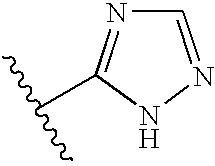
Ph p-OMe H 5-OMe 6-OMe 24 H 
Ph p-OMe H 5-OMe 6-OMe 25 H 
Ph p-OMe H 5-OMe 6-OMe 26 H 
Ph p-OMe H 5-OMe 6-OMe 27 —CH2CH2NHCO— Ph p-OMe H 5-OMe 6-OMe 28 —CH2CH2NHCH2— Ph p-OMe H 5-OMe 6-OMe 29 H COOH Ph H H 5-OMe 6-OMe 30 H COOMe Ph p-Cl H 5-OMe 6-OMe 31 H COOMe Ph p-CF3 H 5-OMe 6-OMe 32 H COOMe Ph p-CH3 H 5-OMe 6-OMe 33 H COOMe Ph p-F H 5-OMe 6-OMe 34 H COOMe Ph o-Cl H 5-OMe 6-OMe 35 H COOMe Ph m-Cl H 5-OMe 6-OMe 36 H COOEt Ph H H 5-Cl H 37 H COOEt Ph H H 5-F H 38 H COOEt Ph H H 5-OMe H 39 CH2CH2OMe COOMe Ph p-OMe H 5-OMe 6-OMe 40 CH2CH2OH CN Ph H H 5-OMe 6-OMe 41 CH2CH2CH2OH COOMe Ph p-OMe H 5-OMe 6-OMe 42 CH2CH2OH CN Ph p-OMe H 5-OMe 6-OMe 43 CH2CH2OH 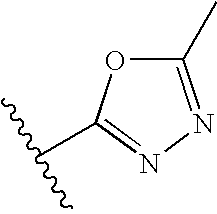
Ph p-OMe H 5-OMe 6-OMe 44 CH2CH2CH2OH CN Ph p-OMe H 5-OMe 6-OMe 45 H CONH2 Ph H H 5-OMe 6-OMe 46 H CONMe2 Ph H H 5-OMe 6-OMe 47 H CON(CH2CH2)2O Ph H H 5-OMe 6-OMe 48 H CONHMe Ph H H 5-OMe 6-OMe 49 H CN Ph H H 5-OMe 6-OMe 50 CH2CH2CH3 CN Ph H H 5-OMe 6-OMe 51 CH2CH2N(CH3)2 CN Ph H H 5-OMe 6-OMe 52 CH2CH2N(CH2)4 COOMe Ph p-OMe H 5-OMe 6-OMe 53 CH2CH2CH2N(CH3)2 COOMe Ph p-OMe H 5-OMe 6-OMe 54 CH2CH2N(CH2)4 CN Ph p-OMe H 5-OMe 6-OMe 55 CH2CH2CH2N(CH3)2 CN Ph p-OMe H 5-OMe 6-OMe 56 CH2CH2N(CH2CH2)2O CN Ph p-OMe H 5-OMe 6-OMe 57 CH2CH2N(CH3)2 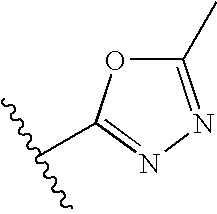
Ph p-OMe H 5-OMe 6-OMe 58 H 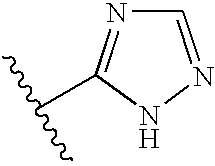
Ph H H 5-OMe 6-OMe 59 —CH2CH2NHCO— Ph H H 5-OMe 6-OMe 60 CH2CH2NH2 COOMe Ph p-OMe H 5-OMe 6-OMe 61 —CH2CH2NHCH2— Ph H H 5-OMe 6-OMe 62 CH2CH2N(CH2CH2)2NCH3 COOMe Ph p-OMe H 5-OMe 6-OMe 63 CH2CH2N(CH2CH2)2O COOMe Ph p-OMe H 5-OMe 6-OMe 64 CH2CH2N(CH2CH2)2NCH3 CN Ph p-OMe H 5-OMe 6-OMe 65 —CH2CH2N(CH3)CH2— Ph p-OMe H 5-OMe 6-OMe 66 —CH2CONHCH2— Ph p-OMe H 5-OMe 6-OMe 67 —CH2CH2N(SO2CH3)CH2— Ph p-OMe H 5-OMe 6-OMe 68 —CH2CH2N(SO2i-Pr)CH2— Ph p-OMe H 5-OMe 6-OMe 69 —CH2CH2N(SO2C6H4p-CH3)CH2— Ph p-OMe H 5-OMe 6-OMe 70 —CH2CH2N(COCH3)CH2— Ph p-OMe H 5-OMe 6-OMe 71 —CH2CH2N(CONHCH3)CH2— Ph p-OMe H 5-OMe 6-OMe 72 —CH2CH2N(i-Pr)CH2— Ph p-OMe H 5-OMe 6-OMe 73 CH2CONH2 COOMe Ph p-OMe H 5-OMe 6-OMe 74 H 
Ph H H 5-OMe 6-OMe 75 CH2CONHCH3 COOMe Ph p-OMe H 5-OMe 6-OMe 76 —CH2CH2OCH2— Ph p-OMe H 5-OMe 6-OMe 77 H 
Ph p-OMe H 5-OMe 6-OMe 78 H COOEt Ph H H 5-OH H 79 H COOEt 3-pyridyl H H H H 80 H COOEt Ph H H H H 81 H COOEt 4-pyridyl H H 5-OMe 6-OMe - 1. Biochemistry
- 1.1 Determination of Vacuolar ATpase Inhibition in Human Osteoclastoma (hOc)
- Osteoclast-like giant cells isolated from human osteoclastoma are homogenized using a glass-teflon homogeniser (1000 rpm) and the material is centrifuged for 20 minutes at 6000 g. The resultant pellet is resuspended and centrifuged at 100000 g for 60 minutes to sediment the microsomal fraction. The resultant pellet is resuspended in medium at pH 7.4 and stored under liquid nitrogen.
- Inhibition of bafilomycin sensitive ATPase activity is assayed by measuring the release of inorganic phosphate during 30 minutes of incubation, at 37° C., of the human osteoclastoma microsomal fraction in 96-well plates. The reaction medium contains 1 mM ATP, 10 mM Hepes-
Tris buffer pH 8, 50 mM KCl, 5 μM valinomycin, 5 μM nigericin, 1 mM CDTA-Tris, 100 μM ammonium molybdate, 0.2 M sucrose and the microsomal fraction (20 μg protein/ml). The reaction is initiated by adding MgSO4 and terminated, after 30 minutes, by adding 4 volumes of the reagent malachite green, prepared according to Chan K., Anal. Biochem. 157, 375-380, 1986. - 1.2 Determination of Vacuolar ATpase Inhibition in the Bovine Chromaffin Cells Membranes (BCG)
- About 20 adrenal glands (Cidon S., J. Biol. Chem. 258, 2892-2898, 1983) are removed from healthy bovines; the medulla is quickly separated from the cortex, which is discarded. The medulla is homogenised at 4° C. with a suitable medium at pH 7.5, then filtered. The remaining solid material is further homogenised, filtered and recombined with the preceding filtrate, resuspended and centrifuged at 1000 g for 15 minutes; the supernatant obtained is centrifuged at 10000 g for 20 minutes. The resultant pellet is resuspended and stratified through a sucrose gradient formed of a lower part of 15 ml 1.5 M sucrose and an upper part of 10 ml 1.2 M sucrose. After overnight centrifugation at 4° C. with a SW28 rotor at 20000 rpm, the chromaffiln cells sediment into a pellet. This latter is resuspended, centrifuged at 3000 g for 10 minutes, and the supernatant obtained is centrifuged at 200000 g for 60 minutes. The pellet is then resuspended in 4 ml of a suitable medium containing 0.2 μg/ml pepstatin A and 0.4 μg/ml leupeptin and stored under liquid nitrogen.
- The method for ATPase inhibition assay is the same as that followed for the osteoclastoma.
- 2. Cell Pharmacology
- 2.1 Cell Lines and Culture Conditions
- Human Colon Carcinoma:
- HT29 and HT29/Mit (line obtained by prolonged exposure to mitoxantrone, and characterised by overexpression of BCRP, which confers cross resistance to topotecan, irinotecan and to its metabolite SN38): maintained in McCoy 5A medium+10% FCS.
- LoVo and LoVo/Dx (line obtained by prolonged exposure to doxorubicin and characterised by overexpression of P-glycoprotein, which confers resistance to doxorubicin): maintained in HAM-F12 medium+10% FCS. HCT116 maintained in RPMI 1640 medium+10% FCS.
- Human Neuroblastoma:
- SH-SY5Y and SK-N-BE(2): maintained in HAM-F12 medium+10% FCS.
- Human Hepatic Carcinoma:
- HepG2: maintained in EMEM medium+10% FCS.
- Human Ovarian Carcinoma:
- A2780: maintained in RPMI 1640 medium+10% FCS.
- Human Lung Carcinoma:
- H460: maintained in RPMI1640 medium+10% FCS.
- 2.2 Scheme of the Antiproliferative Activity Experiment (Treatment Time: 72 Hours)
- The cells (HT29 and HT29/Mit: 40,000 cells/ml, LoVo, LoVo/Dx and HCT116: 50,000 cells/ml) are seeded in 100 μl of the respective culture media in 96-well plates. 24 hours after seeding, an aliquot (10 μl) of drug at the various concentrations is added. In the samples in which the effect of the combination of two compounds is to be tested the inhibitor is added immediately before the cytotoxic. For each dose or combination of doses/drugs the effect of the treatment is determined in 4-8 replicates.
- After 72 hours of treatment the antiproliferative effect is evaluated using the sulforhodamine B (SRB) assay: the cells are fixed by adding 25 μl of 50% TCA to each well and left for 1 hour at 4° C. After washing them with water and allowing them to dry, 100 μl of 0.4% SRB in 1% acetic acid are added and left for 30 minutes at room temperature. After 4 washes in 1% acetic acid, they are left to dry then the dye fixed by the proteins is dissolved under basic conditions with 100
μl 10 mM cold Tris and the solution is read using a spectrophotometer at 550 nm. - Data Analysis
- Percentage cell growth is calculated as the optical density of treated samples compared to the optical density of controls (untreated cells).
- The Combination Index (C.I.) was determined according to Kern's method, 1988 (who continued from Drewinko B, 1976) (Kem D. H., Cancer Res. 48, 117-121, 1988; Drewinko B., Cancer Biochem. Biophys. 1, 187-195, 1976) by means of the following formula: (Sfa+SFb)/Sfab, where SFa and SFb are the fractions of cells surviving to treatment with compound a and b, respectively; SFab is the fraction surviving to the combination of compounds a and b. If the result is =1, the interaction between the two compounds is additive; if it is >1, the interaction between the two compounds is synergistic; if it is <1, the interaction between the two compounds is antagonistic.
- 2.3 Scheme of the Antiproliferative Activity Experiment (Treatment Time: 48 Hours)
- The cells (concentration: 30,000 cells/ml) are seeded in 90 μl of the respective culture media in 96-well plates. 24 hours after seeding, an aliquot (10 μl) of the drug at the various concentrations is added (for each concentration there are 3 replicates). After 48 hours of treatment the antiproliferative effect is evaluated with a luminescence assay (Perkin Elmer Life Sciences ATPlite):
- 50 μl of a lysis solution are added to each well followed by an equal volume of a solution containing luciferase and D-luciferin. The ATP present in all the metabolically active cells brings about the transformation reaction of D-luciferin, catalysed by luciferase, to produce a luminescent signal as described in the following scheme:
ATP+D-luciferin+O2→Oxyluciferin+AMP+PP1+CO2+Light - The luminescence produced (expressed in counts per second, CPS) is measured by means of a microplate scintillation analyzer (Perkin Elmer Life Sciences Top Count).
- Data Analysis
- Percentage inhibition of luminescence in the treated cells compared to the control is calculated; concentration-response curves are then analysed using Grafit v.5.0.
- 2.4 Scheme of Apoptosis Experiment
- 1.5×10⁶ cells/sample are seeded. After 24 hours the cells are treated with the compounds for 48 or 72 hours. At the end of the treatment, the cells are detached with Trypsin/EDTA, washed in PBS (phosphate buffered solution) and incubated for 45 minutes at room temperature in 1 ml of 4% paraformaldehyde. The cells are then washed with PBS and resuspended in 100 μl of permeabilizing solution (0.1% triton in 0.1% sodium citrate) for 2 minutes in ice. After a further wash, the cells are resuspended in 50 μl of Tunel reaction mix (Boehringer Mannheim) and left at 37° C. for 1 hour in the dark. After washing in PBS, the cells are resuspended in PBS and analysed by cytofluorimeter or examined by fluorescence microscope.
- 2.5 Scheme of Irradiation Experiment
- HT29 cells (50,000 cells/ml) were seeded and 24 h later they were irradiated with a 137Cs source delivering 0.13 Gy/s, in presence and in absence with the test compound. After 72 h treatment, adherent cells were collected, washed in PBS and counted to evaluate the cytotoxic effect of the treatment.
- 2.6 Scheme of migration and invasion assays
- H460 cells were seeded in complete medium and treated with different compound concentrations for 24 h. Then, cells were harvested and transferred to 24-well Transwell chambers (Costar) in serum-free medium in the following ways:
-
- migration assay: 1.2×10⁵ cells/well were seeded in the upper chamber, and the drug was added, in the same concentrations utilized before, in both upper and lower chambers. After 4 h of incubation at 37° C., migrated cells were fixed in 95% ethanol, stained with a 2% crystal violet in 70% ethanol solution, and counted by an inverted microscope.
- invasion assay: Transwell membranes were coated with 12.5 μg/well of Matrigel (BD Biosciences) and dried for 24 h. After this, 2.4×10⁵ cells/well were seeded onto the artificial basement membrane in upper chamber, and drug was added as described for migration assay. After 24 h of incubation at 37° C., cells that invaded the Matrigel and migrated to the lower chamber were stained and counted as described for migration assay.
2.7 Results
Antiproliferative Effect on Tumour Cells (Single Treatment)
- The results are given in the following Table 2
ATPase Antiproliferative activity activity (IC50 ± S.D., μM) (IC50, μm) HT-29 HepG2 Compound Structure hOc BCG 72 h treatment HT-29/Mit 48 h treatment Cisplatin 6.8 >25 Topotecan 0.07 ± 0.01 50.6 Bafilomycin A1 0.0001 0.003 ± 0.002 0.005 <0.006 Example 1 
0.500 0.644 14.4 ± 2.1 1.0 ± 0.9 24.4 ± 7.9 Example 2 
35.2 ± 5.2 15.2 ± 0.3 25.5 ± 4.5 Example 3 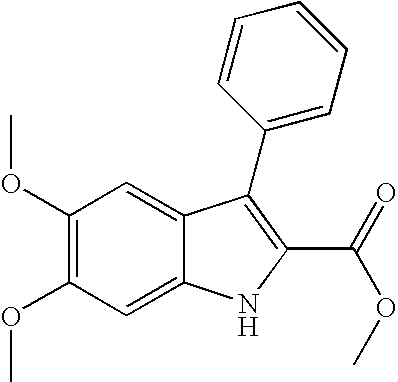
0.628 37.3 0.15 Example 4 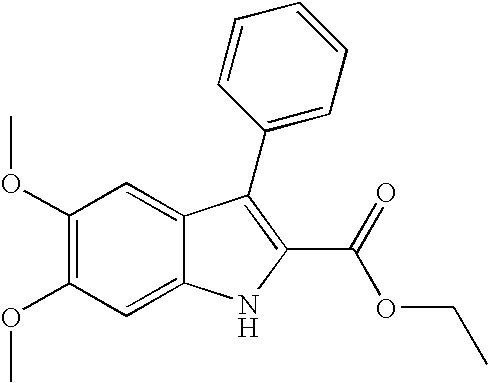
0.350 37.3 <0.1 Example 12 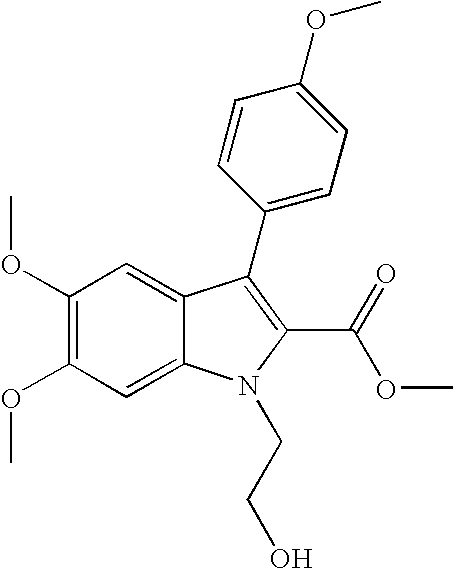
0.247 4.6 0.66 ± 0.30 Example 17 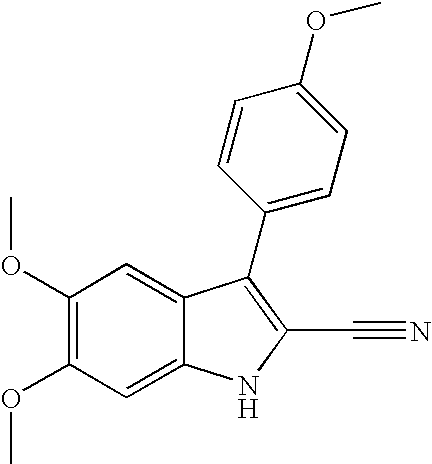
0.273 4.9 ± 0.5 2.5 Example 18 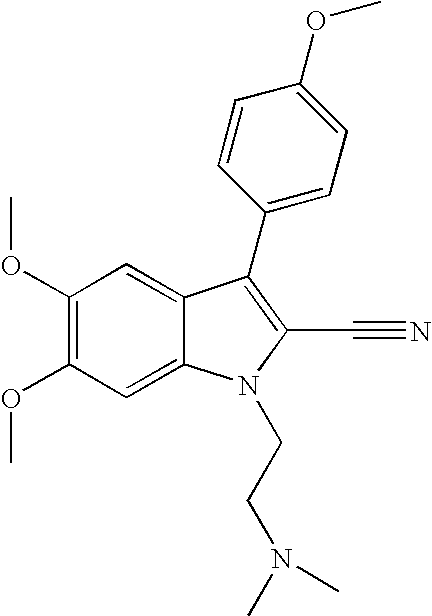
0.567 16.7 0.15 Example 23 
0.470 41.9 2.3 Example 26 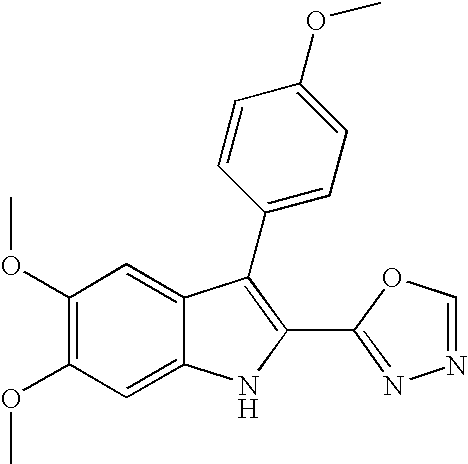
0.710 40.3 2.7 Example 27 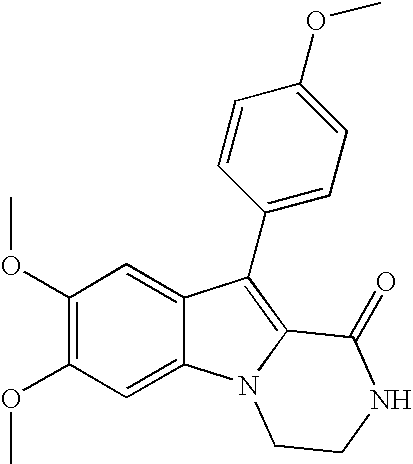
0.248 5.2 2.9 Example 28 
1.269 37.3 0.53 - The cell pharmacology study was conducted in the system comprising the original HT29 line and its variant HT29/Mit, selected in the presence of mitoxantrone and characterised by overexpression of the BCRP transport system. This phenotype confers cross-resistance to topotecan and irinotecan (and its metabolite SN38). The parental line produces tumours in nude mice which are poorly sensitive to topotecan and to DNA topoisomerase inhibitors. The state of resistance is further increased in the model selected for resistance to mitoxantrone (HT29/Mit).
- The comparative study of the two cell lines has highlighted a surprising activity (after 72 hours of treatment) of the compounds of examples 1, 3, 4, 12, 18, 23, 26, 28 in the resistant line with IC50 values within the range 0.1-3 μM being substantially lower than those found in the sensitive line, with IC50 values in the range 5-42 μM. The fact that the antiproliferative activity of the aforecited compounds increases in a very significant manner (from 7 to 370 times) in the resistant line compared to the sensitive line strongly support their therapeutic use in resistant tumours, also administered alone.
- Antiproliferative Effect on Tumour Cells (Combined Treatment with Known Antitumour Agents)
- The compound of example 1 has produced marked synergistic effects in combination with numerous cytotoxic agents of interest in clinical therapy, such as topotecan, SN38, taxol, doxorubicin and anthracyclines. The synergism is particularly evident at subtoxic doses of the inhibitor (4-8 μM) on the activity of topotecan in the tumour cell line HT29, as illustrated in
FIG. 1 . The combination of topotecan with the compound of example 1 at two concentrations (4 μM—3 experiments; 8 μM—2 experiments) highlight a clear synergistic effect, the data being expressed as Combination Index according to Kern (see in vitro studies 2.2). - In addition, the compound of example 1 has shown to be particularly effective in enhancing the activity of topotecan in the resistant model (HT29/Mit), as it causes synergism at non-toxic concentrations in a wide range of pharmacologically significant concentrations (0.01-0.1 μM).
- In
FIG. 2 , it can be seen that the co-treatment of HT29/Mit cells with the compound of example 1 (at two concentrations which are not active by themselves) and with topotecan produces a clear synergistic effect. - It is extremely interesting that the compounds of examples 12, 23, and 26 demonstrated synergistic effects in combination with topotecan both in HT29 and HT29/Mit cells.
- In Vivo Studies
- 1.1 Model of HT29/Mit human colon carcinoma xenografts-Antitumor activity
- Female athymic Swiss nude mice (8-10 weeks old) (Charles River, Calco, Italy) were used for the experiments.
- The animals were maintained at constant temperature and humidity, and were allowed to eat and drink freely. The experimental protocol was approved by the Ethics Committee for Animal Experimentation of the Istituto Nazionale Tumori of Milan.
- The antitumour effectiveness of the compounds of the invention under discussion was tested on athymic mouse models implanted with HT29 and/or HT29/Mit tumour cells: this latter variety is highly resistant to topotecan treatment. The tumour cells were implanted in vivo via subcutaneous injection of 107 cells taken from in vitro cultures. Randomized groups of five mice with bilateral subcutaneous tumours were used for the experiment.
- Topotecan or other known antitumour agents (dissolved in distilled water or an appropriate solvent) and the compounds of the invention (dissolved in Cremophor EL: ethanol: saline solution in the proportions 5:5:90, or in an appropriate solvent) were administered orally from the third day, alone or in combination, in agreement with a treatment scheme selected in an appropriate manner depending on the type of compound to be studied.
- The weight (or volume) of the tumour in treated mice compared to controls is represented graphically on the y-axis against time (x-axis).
- 1.2 Model of H460 Human Non-Small Cell Lung Carcinoma Xenograft-Antitumor and Antimetastatic Activities
- Female athymic Swiss nude mice (8-10 weeks old) (Charles River, Calco, Italy) were used for the experiments, as described above.
- H460 cells were injected i.p. into nude mice, adapted to grow as ascitis and maintained in vivo by i.p. passages (5×10⁶ cells/mouse in 0.5 ml PBS) (Pratesi G., Br. J. Cancer 63, 71-74, 1991). Briefly, cells were collected from the donor mice about 7 days after inoculum. After washing, cell number and viability were determined by trypan blue exclusion. Such process allowed to obtain a single cell suspension easily available for s.c or i.v. injection.
- The effects of the compounds of the invention and/or topotecan on the growth of primary tumors and spontaneous lung metastasis were tested in mice inoculated s.c. in the right flank with H460 ascitic tumor cells (2×10⁶/mouse). Each control or drug-treated group included 9-11 mice. The s.c. tumor growth was followed by biweekly measurements of tumor diameters with a Vernier caliper. Drug treatment was delivered orally, for 8 weeks, from
day 1. Topotecan was delivered at the dose of 1 mg/kg and compounds of the invention were delivered at the dose of 30 mg/kg; in the combination group the compounds of the invention were delivered almost 1 hour after topotecan treatment. Control mice were solvent-treated orally in parallel with drug treatments. - Drug efficacy was assessed as mean percentage tumor weight inhibition in drug-treated versus control mice expressed as tumor weight inhibition % (TWI %)=100−(mean tumor weight treated/mean tumor weight control×100), evaluated during and after drug treatment. Drug tolerability was assessed in tumor-bearing mice as either lethal toxicity, i.e., any death in treated mice occurring before any control death, or percentage body weight loss (BWL %)=100−(body weight on day x/body weight on
day 1×100), where x represents a day after or during the treatment period. - At day 63, tumor-bearing mice were sacrificed by cervical dislocation and their lungs were removed and weighed. Lung lobes were spliced between two glass slides and the metastatic nodules were macroscopically counted against a bright light (Corti C, J. Cancer Res. Clin. Oncol. 122, 154-60, 1996). Spontaneous lung metastases were present in 100% of control mice. Reading of metastasis was performed by two independent observers, unaware of the experimental group, with an interobserver reproducibility >95%. The metastatic nature of these areas was confirmed by histological analysis of digital images obtained by Image Analysis System software (Delta System, Rome, Italy).
- 1.3 Results
- Antitumor Activity (HT291Mit Xenograft Model)
- In vivo results have been displayed in
FIG. 3 . - In HT29/Mit xenograft in vivo model, the oral treatment with topotecan (1 and 2 mg/kg, schedule described in
FIG. 3 ) produced a clear antitumor effect (62% and 80% tumor growth inhibition) at 1 and 2 mg/kg respectively. The combined administration with the compound of example 1 given at 30 mg/kg p.o. with topotecan produced an increased antitumoral efficacy (statistically significant when 1 mg topotecan was utilized). - Compound of example 1, administered alone in the same model (data not shown), was able to produce a 43% statistically significant tumor growth inhibition at 30 mg/kg p.o. after 7 days of treatment.
Claims (17)
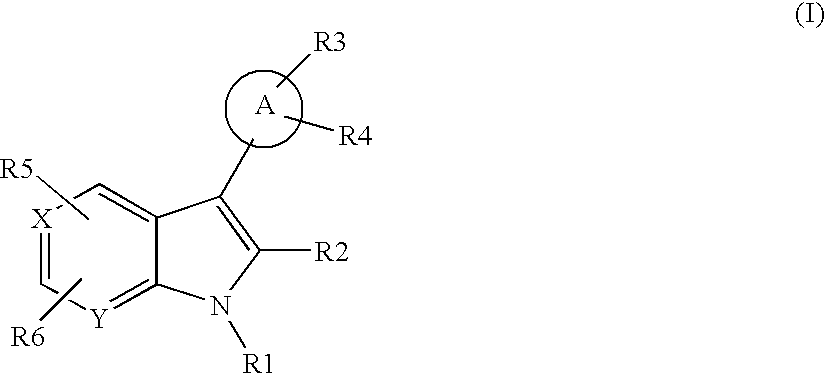


R═C6H5,X═Cl a)
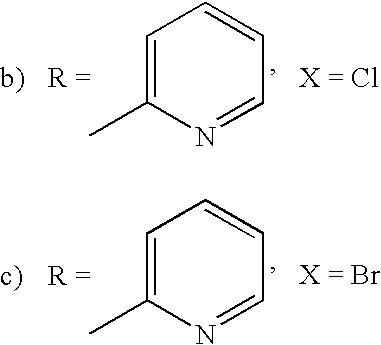
R═C6H5,X═Cl d)
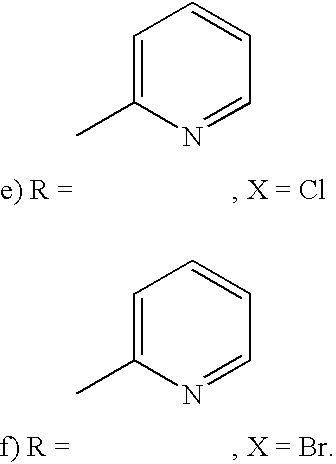
Applications Claiming Priority (3)
| Application Number | Priority Date | Filing Date | Title |
|---|---|---|---|
| ITMI2004A000874 | 2004-04-30 | ||
| IT000874A ITMI20040874A1 (en) | 2004-04-30 | 2004-04-30 | INDOLIC AND AZAINDOLIC DERIVATIVES WITH ANTI-TUMORAL ACTION |
| PCT/EP2005/051908 WO2005105213A2 (en) | 2004-04-30 | 2005-04-27 | Indole and azaindole derivatives with antitumor action |
Publications (1)
| Publication Number | Publication Date |
|---|---|
| US20070248672A1 true US20070248672A1 (en) | 2007-10-25 |
Family
ID=34968098
Family Applications (1)
| Application Number | Title | Priority Date | Filing Date |
|---|---|---|---|
| US11/579,237 Abandoned US20070248672A1 (en) | 2004-04-30 | 2005-04-27 | Indole and Azaindole Derivatives with Antitumor Action |
Country Status (7)
| Country | Link |
|---|---|
| US (1) | US20070248672A1 (en) |
| EP (1) | EP1750687A2 (en) |
| JP (1) | JP2007535520A (en) |
| AU (1) | AU2005237788A1 (en) |
| CA (1) | CA2564249A1 (en) |
| IT (1) | ITMI20040874A1 (en) |
| WO (1) | WO2005105213A2 (en) |
Cited By (2)
| Publication number | Priority date | Publication date | Assignee | Title |
|---|---|---|---|---|
| US20110038852A1 (en) * | 2009-06-10 | 2011-02-17 | 3-V Biosciences, Inc. | Antivirals that target transporters, carriers, and ion channels |
| US9586891B2 (en) | 2011-08-04 | 2017-03-07 | Karo Pharma Ab | Estrogen receptor ligands |
Families Citing this family (35)
| Publication number | Priority date | Publication date | Assignee | Title |
|---|---|---|---|---|
| KR101298951B1 (en) | 2004-03-30 | 2013-09-30 | 버텍스 파마슈티칼스 인코포레이티드 | Azaindoles useful as inhibitors of JAK and other protein kinases |
| EP1779848A1 (en) | 2005-10-28 | 2007-05-02 | Nikem Research S.R.L. | V-ATPase inhibitors for the treatment of inflammatory and autoimmune diseases |
| EP1779849A1 (en) * | 2005-10-28 | 2007-05-02 | Nikem Research S.R.L. | V-ATPase inhibitors for the treatment of septic shock |
| WO2008033464A2 (en) | 2006-09-15 | 2008-03-20 | Schering Corporation | Azetidinone derivatives for the treatment of disorders of the lipid metabolism |
| EP2815750A1 (en) | 2006-12-21 | 2014-12-24 | Vertex Pharmaceuticals Incorporated | 5-cyano-4-(pyrrolo [2,3b] pyridine-3-yl)-pyrimidine derivatives useful as protein kinase inhibitors |
| WO2008121836A1 (en) * | 2007-03-30 | 2008-10-09 | Brigham And Women's Hospital, Inc. | Compounds and methods for enhancing mhc class ii therapies |
| PL2134685T3 (en) | 2007-04-16 | 2016-02-29 | Abbvie Inc | 7-nonsubstituted indole derivatives as mcl-1 inhibitors |
| PE20120508A1 (en) | 2009-06-17 | 2012-05-09 | Vertex Pharma | INHIBITORS OF THE REPLICATION OF FLU VIRUSES |
| DK2486010T3 (en) * | 2009-10-07 | 2019-09-23 | Karo Pharma Ab | Estrogen receptor ligands |
| US8691830B2 (en) | 2010-10-25 | 2014-04-08 | G1 Therapeutics, Inc. | CDK inhibitors |
| PL2632467T3 (en) | 2010-10-25 | 2016-12-30 | Cdk inhibitors | |
| WO2012083117A1 (en) | 2010-12-16 | 2012-06-21 | Vertex Pharmaceuticals Incorporated | Inhibitors of influenza viruses replication |
| UA118010C2 (en) | 2011-08-01 | 2018-11-12 | Вертекс Фармасьютікалз Інкорпорейтед | INFLUENCES OF INFLUENZA VIRUS REPLICATION |
| EP2825542B1 (en) | 2012-03-16 | 2016-09-14 | Vitae Pharmaceuticals, Inc. | Liver x receptor modulators |
| KR102069912B1 (en) | 2012-03-16 | 2020-01-23 | 비타이 파마슈티컬즈, 엘엘씨 | Liver x receptor modulators |
| CA2868966C (en) | 2012-03-29 | 2021-01-26 | Francis Xavier Tavares | Lactam kinase inhibitors |
| BR112015006370B1 (en) * | 2012-09-21 | 2022-04-12 | Vivolux Ab | Cytotoxic compound, pharmaceutically acceptable salt thereof, mixture, pharmaceutical composition and use of said compound |
| WO2014144326A1 (en) | 2013-03-15 | 2014-09-18 | G1 Therapeutics, Inc. | Transient protection of normal cells during chemotherapy |
| WO2014144740A2 (en) | 2013-03-15 | 2014-09-18 | G1 Therapeutics, Inc. | Highly active anti-neoplastic and anti-proliferative agents |
| PT2989104T (en) * | 2013-04-23 | 2019-11-26 | Esteve Pharmaceuticals Sa | Pyrazino[1,2-a]indole compounds, their preparation and use in medicaments |
| SG10201804026WA (en) | 2013-11-13 | 2018-06-28 | Vertex Pharma | Inhibitors of influenza viruses replication |
| SI3421468T1 (en) | 2013-11-13 | 2021-03-31 | Vertex Pharmaceuticals Incorporated | Methods of preparing inhibitors of influenza viruses replication |
| WO2015161283A1 (en) | 2014-04-17 | 2015-10-22 | G1 Therapeutics, Inc. | Tricyclic lactams for use in hspc-sparing treatments for rb-positive abnormal cellular proliferation |
| WO2016040848A1 (en) | 2014-09-12 | 2016-03-17 | G1 Therapeutics, Inc. | Treatment of rb-negative tumors using topoisomerase inhibitors in combination with cyclin dependent kinase 4/6 inhibitors |
| WO2016040858A1 (en) | 2014-09-12 | 2016-03-17 | G1 Therapeutics, Inc. | Combinations and dosing regimes to treat rb-positive tumors |
| WO2016183116A1 (en) | 2015-05-13 | 2016-11-17 | Vertex Pharmaceuticals Incorporated | Methods of preparing inhibitors of influenza viruses replication |
| EP3294735B8 (en) | 2015-05-13 | 2022-01-05 | Vertex Pharmaceuticals Incorporated | Inhibitors of influenza viruses replication |
| PL3310784T3 (en) * | 2015-06-17 | 2021-03-08 | Pfizer Inc. | Tricyclic compounds and their use as phosphodiesterase inhibitors. |
| WO2017077535A1 (en) * | 2015-11-02 | 2017-05-11 | Carmel-Haifa University Economic Corporation Ltd. | Apoptosis related protein in the tgf-beta signaling pathway (arts) mimetic compounds, compositions, methods and uses thereof in induction of differentiation and/or apoptosis of premalignant and malignant cells, thereby restoring their normal-like phenotype |
| GB201521059D0 (en) | 2015-11-30 | 2016-01-13 | Isis Innovation | Inhibitors of metallo-beta-lactamases |
| MX2019008158A (en) | 2017-01-06 | 2019-12-09 | G1 Therapeutics Inc | Combination therapy for the treatment of cancer. |
| MX392531B (en) | 2017-06-29 | 2025-03-24 | G1 Therapeutics Inc | MORPHIC FORMS OF G1T38 AND METHODS OF PREPARING THE SAME. |
| CN112839657B (en) | 2018-08-24 | 2025-07-25 | 法码科思莫斯控股有限公司 | Improved synthesis of 1, 4-diazaspiro [5.5] undecan-3-one |
| US10988479B1 (en) | 2020-06-15 | 2021-04-27 | G1 Therapeutics, Inc. | Morphic forms of trilaciclib and methods of manufacture thereof |
| WO2022137085A1 (en) * | 2020-12-22 | 2022-06-30 | Novartis Ag | Indole derivatives useful in treating conditions associated with cgas |
Citations (2)
| Publication number | Priority date | Publication date | Assignee | Title |
|---|---|---|---|---|
| US105140A (en) * | 1870-07-05 | Improvement in cigar-wrapping machines | ||
| US20050014769A1 (en) * | 2001-11-09 | 2005-01-20 | Mathias Osswald | Use of endothelin receptor antogonists for the treatment of tumour diseases |
Family Cites Families (12)
| Publication number | Priority date | Publication date | Assignee | Title |
|---|---|---|---|---|
| DE2005845A1 (en) * | 1969-02-12 | 1970-09-03 | Sumitomo Chemical Company, Ltd., Osaka (Japan) | Process for the preparation of benzodiazepines and their salts |
| CA1012147A (en) * | 1972-09-25 | 1977-06-14 | Hoffmann-La Roche Limited | Indolo quinoline derivatives |
| AR205437A1 (en) * | 1972-09-25 | 1976-05-07 | Hoffmann La Roche | PROCEDURE FOR THE PREPARATION OF INDOLOQUINOLINONE DERIVATIVES |
| US4225711A (en) * | 1978-10-02 | 1980-09-30 | Schering Corporation | Substituted 2-[(methylsulfinyl)acetyl]-3-heterocyclicindoles and their use as immunosuppressants |
| CA2038925A1 (en) * | 1990-03-26 | 1991-09-27 | Takashi Sohda | Indole derivatives, their production and use |
| JPH04211651A (en) * | 1990-03-26 | 1992-08-03 | Takeda Chem Ind Ltd | Bone-resorption inhibiting agent and indole derivative |
| GB9319100D0 (en) * | 1993-09-15 | 1993-11-03 | Pfizer Ltd | 3-(3-pyridinyl)h-indoles |
| JP2001122855A (en) * | 1999-10-27 | 2001-05-08 | Japan Tobacco Inc | Indole compound and its pharmaceutical use |
| US6323228B1 (en) * | 2000-09-15 | 2001-11-27 | Abbott Laboratories | 3-substituted indole angiogenesis inhibitors |
| WO2002102301A2 (en) * | 2000-12-07 | 2002-12-27 | Cytovia, Inc. | Substituted indole-2-carboxylic acid benzylidene-hydrazides and analogs as activators of caspases and inducers of apoptosis and the use thereof |
| WO2002094830A2 (en) * | 2001-05-23 | 2002-11-28 | Merck Frosst Canada & Co. | DIHYDROPYRROLO[1,2-A]INDOLE AND TETRAHYDROPYRIDO[1,2-a]-INDOLE DERIVATIVES AS PROSTAGLANDIN D2 RECEPTOR ANTAGONISTS |
| US7268159B2 (en) * | 2003-09-25 | 2007-09-11 | Wyeth | Substituted indoles |
-
2004
- 2004-04-30 IT IT000874A patent/ITMI20040874A1/en unknown
-
2005
- 2005-04-27 EP EP05743013A patent/EP1750687A2/en not_active Withdrawn
- 2005-04-27 AU AU2005237788A patent/AU2005237788A1/en not_active Abandoned
- 2005-04-27 WO PCT/EP2005/051908 patent/WO2005105213A2/en not_active Ceased
- 2005-04-27 US US11/579,237 patent/US20070248672A1/en not_active Abandoned
- 2005-04-27 JP JP2007510035A patent/JP2007535520A/en active Pending
- 2005-04-27 CA CA002564249A patent/CA2564249A1/en not_active Abandoned
Patent Citations (2)
| Publication number | Priority date | Publication date | Assignee | Title |
|---|---|---|---|---|
| US105140A (en) * | 1870-07-05 | Improvement in cigar-wrapping machines | ||
| US20050014769A1 (en) * | 2001-11-09 | 2005-01-20 | Mathias Osswald | Use of endothelin receptor antogonists for the treatment of tumour diseases |
Cited By (2)
| Publication number | Priority date | Publication date | Assignee | Title |
|---|---|---|---|---|
| US20110038852A1 (en) * | 2009-06-10 | 2011-02-17 | 3-V Biosciences, Inc. | Antivirals that target transporters, carriers, and ion channels |
| US9586891B2 (en) | 2011-08-04 | 2017-03-07 | Karo Pharma Ab | Estrogen receptor ligands |
Also Published As
| Publication number | Publication date |
|---|---|
| CA2564249A1 (en) | 2005-11-10 |
| WO2005105213A3 (en) | 2006-06-22 |
| ITMI20040874A1 (en) | 2004-07-30 |
| AU2005237788A1 (en) | 2005-11-10 |
| WO2005105213A2 (en) | 2005-11-10 |
| JP2007535520A (en) | 2007-12-06 |
| EP1750687A2 (en) | 2007-02-14 |
Similar Documents
| Publication | Publication Date | Title |
|---|---|---|
| US20070248672A1 (en) | Indole and Azaindole Derivatives with Antitumor Action | |
| US10851092B2 (en) | Pyridine compound | |
| JP2006508981A (en) | Combined administration of indolinone and chemotherapeutics to treat cancer | |
| JP2005511540A (en) | Treatment of acute myeloid leukemia with indolinone compounds | |
| US8153630B2 (en) | Kinase inhibitors | |
| JP2021107456A (en) | Uses of indolinone compounds | |
| CN104159893A (en) | Novel piperidine compound or salt thereof | |
| WO2021231653A1 (en) | Mono- and combination therapies | |
| US20060235006A1 (en) | Combinations, methods and compositions for treating cancer | |
| AU2010333083B2 (en) | 3-(indolyl)- or 3-(azaindolyl)-4-arylmaleimide compounds and their use in tumor treatment | |
| CN104662022A (en) | Means and method for treating solid tumours | |
| KR102382771B1 (en) | Combination Therapy for Proliferative Diseases | |
| WO2023143356A1 (en) | Methionine adenosyltransferase 2a inhibitor for treating mtap deletion-type cancer | |
| CN115403583B (en) | Compound for targeted degradation of FAK protein and application thereof | |
| ES2263835T3 (en) | COMBINED THERAPY AGAINST TUMORS UNDERSTANDING DERIVED FROM DISTAMYCIN ACRILOIL SUBSTITUTED AND INHIBITORS PROTEIN QUINASE (SERINE / TREONINE QUINASE). | |
| TWI906299B (en) | Mono- and combination therapies | |
| KR20180045781A (en) | Compound as TRAP1 inhibitor and pharmaceutical composition for anticancer comprising the same | |
| EP3397632A1 (en) | 3-(5-fluoroindolyl)-4-arylmaleimide compounds and their use in tumor treatment | |
| WO2016153394A1 (en) | Use of novel chemical compounds (variants) as nuak1 kinase inhibitors for treating oncological diseases | |
| KR20060007368A (en) | Pharmaceutical compositions comprising N- (3-chloro-lH-indol-7-yl) -4-sulfamoylbenzenesulfonamide and inhibitors of cell proliferation | |
| HK1120406A (en) | Combination administration of an indolinone with a chemotherapeutic agent for cell proliferation disorders | |
| HK1199730B (en) | Piperidine compound or salt thereof | |
| CN101198253A (en) | Combinations, methods and compositions for treating cancer |
Legal Events
| Date | Code | Title | Description |
|---|---|---|---|
| AS | Assignment |
Owner name: NIKEM RESEARCH S.R.L., ITALY Free format text: ASSIGNMENT OF ASSIGNORS INTEREST;ASSIGNORS:FARINA, CARLO;GAGLIARDI, STEFANIA;MISIANO, PAOLA;AND OTHERS;REEL/FRAME:018518/0065 Effective date: 20050527 Owner name: ISTITUTO NAZIONALE PER LO STUDIO E LA CURA DEI TRM Free format text: ASSIGNMENT OF ASSIGNORS INTEREST;ASSIGNORS:FARINA, CARLO;GAGLIARDI, STEFANIA;MISIANO, PAOLA;AND OTHERS;REEL/FRAME:018518/0065 Effective date: 20050527 |
|
| STCB | Information on status: application discontinuation |
Free format text: ABANDONED -- FAILURE TO RESPOND TO AN OFFICE ACTION |