US20070232532A1 - Use of cyclosporin alkene analogues for preventing or treating viral-induced disorders - Google Patents
Use of cyclosporin alkene analogues for preventing or treating viral-induced disorders Download PDFInfo
- Publication number
- US20070232532A1 US20070232532A1 US11/391,027 US39102706A US2007232532A1 US 20070232532 A1 US20070232532 A1 US 20070232532A1 US 39102706 A US39102706 A US 39102706A US 2007232532 A1 US2007232532 A1 US 2007232532A1
- Authority
- US
- United States
- Prior art keywords
- cyclosporin
- mmol
- group
- mixture
- acetate
- Prior art date
- Legal status (The legal status is an assumption and is not a legal conclusion. Google has not performed a legal analysis and makes no representation as to the accuracy of the status listed.)
- Abandoned
Links
- 230000003612 virological effect Effects 0.000 title claims abstract description 27
- 229960001265 ciclosporin Drugs 0.000 title description 309
- 108010036949 Cyclosporine Proteins 0.000 title description 277
- 229930105110 Cyclosporin A Natural products 0.000 title description 273
- 229930182912 cyclosporin Natural products 0.000 title description 228
- -1 cyclosporin alkene Chemical class 0.000 title description 99
- 150000001875 compounds Chemical class 0.000 claims abstract description 62
- 238000000034 method Methods 0.000 claims abstract description 51
- 241000124008 Mammalia Species 0.000 claims abstract description 14
- 150000003839 salts Chemical class 0.000 claims abstract description 7
- 229910052740 iodine Inorganic materials 0.000 claims abstract description 5
- 239000000203 mixture Substances 0.000 claims description 126
- 208000037265 diseases, disorders, signs and symptoms Diseases 0.000 claims description 36
- 241000725303 Human immunodeficiency virus Species 0.000 claims description 25
- OKTJSMMVPCPJKN-UHFFFAOYSA-N Carbon Chemical group [C] OKTJSMMVPCPJKN-UHFFFAOYSA-N 0.000 claims description 24
- 108010050904 Interferons Proteins 0.000 claims description 23
- 102000014150 Interferons Human genes 0.000 claims description 23
- 229940079322 interferon Drugs 0.000 claims description 21
- 229910052736 halogen Inorganic materials 0.000 claims description 16
- 150000002367 halogens Chemical class 0.000 claims description 16
- 229920006395 saturated elastomer Polymers 0.000 claims description 15
- 229910052739 hydrogen Inorganic materials 0.000 claims description 14
- 239000001257 hydrogen Substances 0.000 claims description 12
- 241000711549 Hepacivirus C Species 0.000 claims description 10
- 125000004453 alkoxycarbonyl group Chemical group 0.000 claims description 9
- 125000004457 alkyl amino carbonyl group Chemical group 0.000 claims description 9
- 125000005098 aryl alkoxy carbonyl group Chemical group 0.000 claims description 9
- 125000005125 aryl alkyl amino carbonyl group Chemical group 0.000 claims description 9
- 125000005100 aryl amino carbonyl group Chemical group 0.000 claims description 9
- 125000003118 aryl group Chemical group 0.000 claims description 9
- 125000005161 aryl oxy carbonyl group Chemical group 0.000 claims description 9
- 125000001589 carboacyl group Chemical group 0.000 claims description 9
- 125000000753 cycloalkyl group Chemical group 0.000 claims description 9
- 125000001072 heteroaryl group Chemical group 0.000 claims description 9
- 239000002726 nonnucleoside reverse transcriptase inhibitor Substances 0.000 claims description 9
- 239000003419 rna directed dna polymerase inhibitor Substances 0.000 claims description 9
- 102100040018 Interferon alpha-2 Human genes 0.000 claims description 8
- 108010079944 Interferon-alpha2b Proteins 0.000 claims description 8
- WHBIGIKBNXZKFE-UHFFFAOYSA-N delavirdine Chemical compound CC(C)NC1=CC=CN=C1N1CCN(C(=O)C=2NC3=CC=C(NS(C)(=O)=O)C=C3C=2)CC1 WHBIGIKBNXZKFE-UHFFFAOYSA-N 0.000 claims description 8
- CBOIHMRHGLHBPB-UHFFFAOYSA-N hydroxymethyl Chemical compound O[CH2] CBOIHMRHGLHBPB-UHFFFAOYSA-N 0.000 claims description 8
- NQDJXKOVJZTUJA-UHFFFAOYSA-N nevirapine Chemical group C12=NC=CC=C2C(=O)NC=2C(C)=CC=NC=2N1C1CC1 NQDJXKOVJZTUJA-UHFFFAOYSA-N 0.000 claims description 8
- 229940122313 Nucleoside reverse transcriptase inhibitor Drugs 0.000 claims description 7
- 229940042402 non-nucleoside reverse transcriptase inhibitor Drugs 0.000 claims description 7
- 230000015572 biosynthetic process Effects 0.000 claims description 6
- 125000005842 heteroatom Chemical group 0.000 claims description 6
- 239000000137 peptide hydrolase inhibitor Substances 0.000 claims description 6
- 229910052794 bromium Inorganic materials 0.000 claims description 5
- 229910052805 deuterium Inorganic materials 0.000 claims description 5
- 230000004927 fusion Effects 0.000 claims description 5
- 239000003112 inhibitor Substances 0.000 claims description 5
- BXZVVICBKDXVGW-NKWVEPMBSA-N Didanosine Chemical compound O1[C@H](CO)CC[C@@H]1N1C(NC=NC2=O)=C2N=C1 BXZVVICBKDXVGW-NKWVEPMBSA-N 0.000 claims description 4
- XPOQHMRABVBWPR-UHFFFAOYSA-N Efavirenz Natural products O1C(=O)NC2=CC=C(Cl)C=C2C1(C(F)(F)F)C#CC1CC1 XPOQHMRABVBWPR-UHFFFAOYSA-N 0.000 claims description 4
- 108010032976 Enfuvirtide Proteins 0.000 claims description 4
- NCDNCNXCDXHOMX-UHFFFAOYSA-N Ritonavir Natural products C=1C=CC=CC=1CC(NC(=O)OCC=1SC=NC=1)C(O)CC(CC=1C=CC=CC=1)NC(=O)C(C(C)C)NC(=O)N(C)CC1=CSC(C(C)C)=N1 NCDNCNXCDXHOMX-UHFFFAOYSA-N 0.000 claims description 4
- XNKLLVCARDGLGL-JGVFFNPUSA-N Stavudine Chemical compound O=C1NC(=O)C(C)=CN1[C@H]1C=C[C@@H](CO)O1 XNKLLVCARDGLGL-JGVFFNPUSA-N 0.000 claims description 4
- 229940124522 antiretrovirals Drugs 0.000 claims description 4
- 239000003903 antiretrovirus agent Substances 0.000 claims description 4
- 229910052801 chlorine Inorganic materials 0.000 claims description 4
- 125000004122 cyclic group Chemical group 0.000 claims description 4
- 229960005319 delavirdine Drugs 0.000 claims description 4
- 229960002656 didanosine Drugs 0.000 claims description 4
- 229940042399 direct acting antivirals protease inhibitors Drugs 0.000 claims description 4
- 229960003804 efavirenz Drugs 0.000 claims description 4
- XPOQHMRABVBWPR-ZDUSSCGKSA-N efavirenz Chemical compound C([C@]1(C2=CC(Cl)=CC=C2NC(=O)O1)C(F)(F)F)#CC1CC1 XPOQHMRABVBWPR-ZDUSSCGKSA-N 0.000 claims description 4
- PEASPLKKXBYDKL-FXEVSJAOSA-N enfuvirtide Chemical group C([C@@H](C(=O)N[C@@H](CO)C(=O)N[C@@H](CC(C)C)C(=O)N[C@@H]([C@@H](C)CC)C(=O)N[C@@H](CCC(O)=O)C(=O)N[C@@H](CCC(O)=O)C(=O)N[C@@H](CO)C(=O)N[C@@H](CCC(N)=O)C(=O)N[C@@H](CC(N)=O)C(=O)N[C@@H](CCC(N)=O)C(=O)N[C@@H](CCC(N)=O)C(=O)N[C@@H](CCC(O)=O)C(=O)N[C@@H](CCCCN)C(=O)N[C@@H](CC(N)=O)C(=O)N[C@@H](CCC(O)=O)C(=O)N[C@@H](CCC(N)=O)C(=O)N[C@@H](CCC(O)=O)C(=O)N[C@@H](CC(C)C)C(=O)N[C@@H](CC(C)C)C(=O)N[C@@H](CCC(O)=O)C(=O)N[C@@H](CC(C)C)C(=O)N[C@@H](CC(O)=O)C(=O)N[C@@H](CCCCN)C(=O)N[C@@H](CC=1C2=CC=CC=C2NC=1)C(=O)N[C@@H](C)C(=O)N[C@@H](CO)C(=O)N[C@@H](CC(C)C)C(=O)N[C@@H](CC=1C2=CC=CC=C2NC=1)C(=O)N[C@@H](CC(N)=O)C(=O)N[C@@H](CC=1C2=CC=CC=C2NC=1)C(=O)N[C@@H](CC=1C=CC=CC=1)C(N)=O)NC(=O)[C@@H](NC(=O)[C@H](CC(C)C)NC(=O)[C@H](CO)NC(=O)[C@@H](NC(=O)[C@H](CC=1C=CC(O)=CC=1)NC(C)=O)[C@@H](C)O)[C@@H](C)CC)C1=CN=CN1 PEASPLKKXBYDKL-FXEVSJAOSA-N 0.000 claims description 4
- 229960002062 enfuvirtide Drugs 0.000 claims description 4
- VUWZPRWSIVNGKG-UHFFFAOYSA-N fluoromethane Chemical group F[CH2] VUWZPRWSIVNGKG-UHFFFAOYSA-N 0.000 claims description 4
- CBVCZFGXHXORBI-PXQQMZJSSA-N indinavir Chemical compound C([C@H](N(CC1)C[C@@H](O)C[C@@H](CC=2C=CC=CC=2)C(=O)N[C@H]2C3=CC=CC=C3C[C@H]2O)C(=O)NC(C)(C)C)N1CC1=CC=CN=C1 CBVCZFGXHXORBI-PXQQMZJSSA-N 0.000 claims description 4
- 229960001936 indinavir Drugs 0.000 claims description 4
- 229960001627 lamivudine Drugs 0.000 claims description 4
- JTEGQNOMFQHVDC-NKWVEPMBSA-N lamivudine Chemical compound O=C1N=C(N)C=CN1[C@H]1O[C@@H](CO)SC1 JTEGQNOMFQHVDC-NKWVEPMBSA-N 0.000 claims description 4
- 229960000689 nevirapine Drugs 0.000 claims description 4
- 229960000311 ritonavir Drugs 0.000 claims description 4
- NCDNCNXCDXHOMX-XGKFQTDJSA-N ritonavir Chemical compound N([C@@H](C(C)C)C(=O)N[C@H](C[C@H](O)[C@H](CC=1C=CC=CC=1)NC(=O)OCC=1SC=NC=1)CC=1C=CC=CC=1)C(=O)N(C)CC1=CSC(C(C)C)=N1 NCDNCNXCDXHOMX-XGKFQTDJSA-N 0.000 claims description 4
- 229960001203 stavudine Drugs 0.000 claims description 4
- 125000000391 vinyl group Chemical group [H]C([*])=C([H])[H] 0.000 claims description 4
- 229960002555 zidovudine Drugs 0.000 claims description 4
- HBOMLICNUCNMMY-XLPZGREQSA-N zidovudine Chemical compound O=C1NC(=O)C(C)=CN1[C@@H]1O[C@H](CO)[C@@H](N=[N+]=[N-])C1 HBOMLICNUCNMMY-XLPZGREQSA-N 0.000 claims description 4
- 125000006519 CCH3 Chemical group 0.000 claims description 3
- YZCKVEUIGOORGS-OUBTZVSYSA-N Deuterium Chemical compound [2H] YZCKVEUIGOORGS-OUBTZVSYSA-N 0.000 claims description 3
- 125000004390 alkyl sulfonyl group Chemical group 0.000 claims description 3
- 125000003277 amino group Chemical group 0.000 claims description 3
- 125000004391 aryl sulfonyl group Chemical group 0.000 claims description 3
- WBLIXGSTEMXDSM-UHFFFAOYSA-N chloromethane Chemical group Cl[CH2] WBLIXGSTEMXDSM-UHFFFAOYSA-N 0.000 claims description 3
- 229940125777 fusion inhibitor Drugs 0.000 claims description 3
- 125000000956 methoxy group Chemical group [H]C([H])([H])O* 0.000 claims description 3
- 125000002023 trifluoromethyl group Chemical group FC(F)(F)* 0.000 claims description 3
- 125000001559 cyclopropyl group Chemical group [H]C1([H])C([H])([H])C1([H])* 0.000 claims description 2
- 229910052731 fluorine Inorganic materials 0.000 claims description 2
- 150000002431 hydrogen Chemical class 0.000 claims 4
- 229940124158 Protease/peptidase inhibitor Drugs 0.000 claims 2
- PMATZTZNYRCHOR-CGLBZJNRSA-N Cyclosporin A Chemical class CC[C@@H]1NC(=O)[C@H]([C@H](O)[C@H](C)C\C=C\C)N(C)C(=O)[C@H](C(C)C)N(C)C(=O)[C@H](CC(C)C)N(C)C(=O)[C@H](CC(C)C)N(C)C(=O)[C@@H](C)NC(=O)[C@H](C)NC(=O)[C@H](CC(C)C)N(C)C(=O)[C@H](C(C)C)NC(=O)[C@H](CC(C)C)N(C)C(=O)CN(C)C1=O PMATZTZNYRCHOR-CGLBZJNRSA-N 0.000 description 241
- XEKOWRVHYACXOJ-UHFFFAOYSA-N Ethyl acetate Chemical compound CCOC(C)=O XEKOWRVHYACXOJ-UHFFFAOYSA-N 0.000 description 202
- HEDRZPFGACZZDS-MICDWDOJSA-N Trichloro(2H)methane Chemical compound [2H]C(Cl)(Cl)Cl HEDRZPFGACZZDS-MICDWDOJSA-N 0.000 description 173
- OKKJLVBELUTLKV-UHFFFAOYSA-N Methanol Chemical compound OC OKKJLVBELUTLKV-UHFFFAOYSA-N 0.000 description 144
- QTBSBXVTEAMEQO-UHFFFAOYSA-M Acetate Chemical compound CC([O-])=O QTBSBXVTEAMEQO-UHFFFAOYSA-M 0.000 description 110
- 238000002330 electrospray ionisation mass spectrometry Methods 0.000 description 91
- 239000007787 solid Substances 0.000 description 91
- 238000002360 preparation method Methods 0.000 description 90
- 238000005160 1H NMR spectroscopy Methods 0.000 description 89
- BWHMMNNQKKPAPP-UHFFFAOYSA-L potassium carbonate Chemical compound [K+].[K+].[O-]C([O-])=O BWHMMNNQKKPAPP-UHFFFAOYSA-L 0.000 description 86
- YMWUJEATGCHHMB-UHFFFAOYSA-N Dichloromethane Chemical compound ClCCl YMWUJEATGCHHMB-UHFFFAOYSA-N 0.000 description 83
- WYURNTSHIVDZCO-UHFFFAOYSA-N Tetrahydrofuran Chemical compound C1CCOC1 WYURNTSHIVDZCO-UHFFFAOYSA-N 0.000 description 80
- 239000000243 solution Substances 0.000 description 79
- 238000011894 semi-preparative HPLC Methods 0.000 description 78
- PMZURENOXWZQFD-UHFFFAOYSA-L Sodium Sulfate Chemical compound [Na+].[Na+].[O-]S([O-])(=O)=O PMZURENOXWZQFD-UHFFFAOYSA-L 0.000 description 74
- 235000019439 ethyl acetate Nutrition 0.000 description 73
- 239000012267 brine Substances 0.000 description 60
- HPALAKNZSZLMCH-UHFFFAOYSA-M sodium;chloride;hydrate Chemical compound O.[Na+].[Cl-] HPALAKNZSZLMCH-UHFFFAOYSA-M 0.000 description 60
- 229910052938 sodium sulfate Inorganic materials 0.000 description 51
- 238000004128 high performance liquid chromatography Methods 0.000 description 48
- 229910000027 potassium carbonate Inorganic materials 0.000 description 43
- IJGRMHOSHXDMSA-UHFFFAOYSA-N Atomic nitrogen Chemical compound N#N IJGRMHOSHXDMSA-UHFFFAOYSA-N 0.000 description 40
- 235000011152 sodium sulphate Nutrition 0.000 description 37
- 230000000694 effects Effects 0.000 description 35
- 238000006243 chemical reaction Methods 0.000 description 34
- XLYOFNOQVPJJNP-UHFFFAOYSA-N water Substances O XLYOFNOQVPJJNP-UHFFFAOYSA-N 0.000 description 34
- 230000001506 immunosuppresive effect Effects 0.000 description 31
- GHXZPUGJZVBLGC-UHFFFAOYSA-N iodoethene Chemical compound IC=C GHXZPUGJZVBLGC-UHFFFAOYSA-N 0.000 description 31
- 239000012043 crude product Substances 0.000 description 27
- 108010072220 Cyclophilin A Proteins 0.000 description 26
- UIIMBOGNXHQVGW-UHFFFAOYSA-M Sodium bicarbonate Chemical class [Na+].OC([O-])=O UIIMBOGNXHQVGW-UHFFFAOYSA-M 0.000 description 24
- 102100034539 Peptidyl-prolyl cis-trans isomerase A Human genes 0.000 description 23
- BZHJMEDXRYGGRV-UHFFFAOYSA-N Vinyl chloride Chemical compound ClC=C BZHJMEDXRYGGRV-UHFFFAOYSA-N 0.000 description 23
- INLLPKCGLOXCIV-UHFFFAOYSA-N bromoethene Chemical compound BrC=C INLLPKCGLOXCIV-UHFFFAOYSA-N 0.000 description 23
- 238000011282 treatment Methods 0.000 description 23
- 239000002904 solvent Substances 0.000 description 22
- 239000012044 organic layer Substances 0.000 description 21
- RTZKZFJDLAIYFH-UHFFFAOYSA-N Diethyl ether Chemical compound CCOCC RTZKZFJDLAIYFH-UHFFFAOYSA-N 0.000 description 20
- 210000004027 cell Anatomy 0.000 description 20
- 229910052757 nitrogen Inorganic materials 0.000 description 20
- VEXZGXHMUGYJMC-UHFFFAOYSA-M Chloride anion Chemical compound [Cl-] VEXZGXHMUGYJMC-UHFFFAOYSA-M 0.000 description 19
- 150000001299 aldehydes Chemical class 0.000 description 19
- 239000011541 reaction mixture Substances 0.000 description 19
- HEDRZPFGACZZDS-UHFFFAOYSA-N Chloroform Chemical compound ClC(Cl)Cl HEDRZPFGACZZDS-UHFFFAOYSA-N 0.000 description 18
- 239000012299 nitrogen atmosphere Substances 0.000 description 18
- 238000003756 stirring Methods 0.000 description 18
- 230000005764 inhibitory process Effects 0.000 description 17
- 239000000463 material Substances 0.000 description 16
- 125000000746 allylic group Chemical group 0.000 description 15
- 208000035475 disorder Diseases 0.000 description 15
- 230000003389 potentiating effect Effects 0.000 description 15
- NLXLAEXVIDQMFP-UHFFFAOYSA-N Ammonia chloride Chemical compound [NH4+].[Cl-] NLXLAEXVIDQMFP-UHFFFAOYSA-N 0.000 description 14
- 239000007832 Na2SO4 Substances 0.000 description 14
- 0 *[C@H](C(=O)N(C)[C@@H](CC(C)C)C(=O)N[C@@H](C(=O)N(C)[C@@H](C)CC(C)C)C(C)C)N(C)C(=O)[C@@H](CC)NC(=O)C(C)[C@H](C)[C@H](C)C/C=C(\[1*])[2*].CC(=O)N[C@H](C)C(=O)N[C@@H](C)C(=O)N(C)[C@H](CC(C)C)C(=O)N(C)[C@H](CC(C)C)C(=O)N(C)[C@@H](C(=O)N(C)C)C(C)C Chemical compound *[C@H](C(=O)N(C)[C@@H](CC(C)C)C(=O)N[C@@H](C(=O)N(C)[C@@H](C)CC(C)C)C(C)C)N(C)C(=O)[C@@H](CC)NC(=O)C(C)[C@H](C)[C@H](C)C/C=C(\[1*])[2*].CC(=O)N[C@H](C)C(=O)N[C@@H](C)C(=O)N(C)[C@H](CC(C)C)C(=O)N(C)[C@H](CC(C)C)C(=O)N(C)[C@@H](C(=O)N(C)C)C(C)C 0.000 description 13
- 108010062580 Concanavalin A Proteins 0.000 description 13
- 229910021554 Chromium(II) chloride Inorganic materials 0.000 description 12
- 229920002554 vinyl polymer Polymers 0.000 description 12
- WFDIJRYMOXRFFG-UHFFFAOYSA-N Acetic anhydride Chemical compound CC(=O)OC(C)=O WFDIJRYMOXRFFG-UHFFFAOYSA-N 0.000 description 11
- 238000003556 assay Methods 0.000 description 11
- 239000012047 saturated solution Substances 0.000 description 11
- 210000004988 splenocyte Anatomy 0.000 description 11
- KRHYYFGTRYWZRS-UHFFFAOYSA-M Fluoride anion Chemical compound [F-] KRHYYFGTRYWZRS-UHFFFAOYSA-M 0.000 description 10
- 241000713772 Human immunodeficiency virus 1 Species 0.000 description 10
- 102000009658 Peptidylprolyl Isomerase Human genes 0.000 description 10
- 108010020062 Peptidylprolyl Isomerase Proteins 0.000 description 10
- JUJWROOIHBZHMG-UHFFFAOYSA-N Pyridine Chemical compound C1=CC=NC=C1 JUJWROOIHBZHMG-UHFFFAOYSA-N 0.000 description 10
- 150000001336 alkenes Chemical class 0.000 description 10
- 230000000840 anti-viral effect Effects 0.000 description 10
- PNPBGYBHLCEVMK-UHFFFAOYSA-L benzylidene(dichloro)ruthenium;tricyclohexylphosphane Chemical compound Cl[Ru](Cl)=CC1=CC=CC=C1.C1CCCCC1P(C1CCCCC1)C1CCCCC1.C1CCCCC1P(C1CCCCC1)C1CCCCC1 PNPBGYBHLCEVMK-UHFFFAOYSA-L 0.000 description 10
- XBWRJSSJWDOUSJ-UHFFFAOYSA-L chromium(ii) chloride Chemical compound Cl[Cr]Cl XBWRJSSJWDOUSJ-UHFFFAOYSA-L 0.000 description 10
- YMWUJEATGCHHMB-DICFDUPASA-N dichloromethane-d2 Chemical compound [2H]C([2H])(Cl)Cl YMWUJEATGCHHMB-DICFDUPASA-N 0.000 description 10
- JRZJOMJEPLMPRA-UHFFFAOYSA-N olefin Natural products CCCCCCCC=C JRZJOMJEPLMPRA-UHFFFAOYSA-N 0.000 description 10
- RWRDLPDLKQPQOW-UHFFFAOYSA-N tetrahydropyrrole Substances C1CCNC1 RWRDLPDLKQPQOW-UHFFFAOYSA-N 0.000 description 10
- 102000004631 Calcineurin Human genes 0.000 description 9
- 108010042955 Calcineurin Proteins 0.000 description 9
- 125000002777 acetyl group Chemical group [H]C([H])([H])C(*)=O 0.000 description 9
- 239000003054 catalyst Substances 0.000 description 9
- 239000013058 crude material Substances 0.000 description 9
- 201000010099 disease Diseases 0.000 description 9
- 229940079593 drug Drugs 0.000 description 9
- 239000003814 drug Substances 0.000 description 9
- OKJPEAGHQZHRQV-UHFFFAOYSA-N iodoform Chemical compound IC(I)I OKJPEAGHQZHRQV-UHFFFAOYSA-N 0.000 description 9
- VLKZOEOYAKHREP-UHFFFAOYSA-N n-Hexane Chemical compound CCCCCC VLKZOEOYAKHREP-UHFFFAOYSA-N 0.000 description 9
- UFHFLCQGNIYNRP-UHFFFAOYSA-N Hydrogen Chemical compound [H][H] UFHFLCQGNIYNRP-UHFFFAOYSA-N 0.000 description 8
- 238000005686 cross metathesis reaction Methods 0.000 description 8
- 230000029812 viral genome replication Effects 0.000 description 8
- OBWGMYALGNDUNM-UHFFFAOYSA-N 3,3-dimethoxyprop-1-ene Chemical compound COC(OC)C=C OBWGMYALGNDUNM-UHFFFAOYSA-N 0.000 description 7
- WEVYAHXRMPXWCK-UHFFFAOYSA-N Acetonitrile Chemical compound CC#N WEVYAHXRMPXWCK-UHFFFAOYSA-N 0.000 description 7
- 102100034347 Integrase Human genes 0.000 description 7
- MZRVEZGGRBJDDB-UHFFFAOYSA-N N-Butyllithium Chemical compound [Li]CCCC MZRVEZGGRBJDDB-UHFFFAOYSA-N 0.000 description 7
- 238000001816 cooling Methods 0.000 description 7
- 239000005457 ice water Substances 0.000 description 7
- 238000000338 in vitro Methods 0.000 description 7
- 239000000543 intermediate Substances 0.000 description 7
- 239000010410 layer Substances 0.000 description 7
- 108090000623 proteins and genes Proteins 0.000 description 7
- 230000002829 reductive effect Effects 0.000 description 7
- 230000010076 replication Effects 0.000 description 7
- FDMFUZHCIRHGRG-UHFFFAOYSA-N 3,3,3-trifluoroprop-1-ene Chemical compound FC(F)(F)C=C FDMFUZHCIRHGRG-UHFFFAOYSA-N 0.000 description 6
- 108010036941 Cyclosporins Proteins 0.000 description 6
- QMMFVYPAHWMCMS-UHFFFAOYSA-N Dimethyl sulfide Chemical compound CSC QMMFVYPAHWMCMS-UHFFFAOYSA-N 0.000 description 6
- WSFSSNUMVMOOMR-UHFFFAOYSA-N Formaldehyde Chemical compound O=C WSFSSNUMVMOOMR-UHFFFAOYSA-N 0.000 description 6
- 101710177291 Gag polyprotein Proteins 0.000 description 6
- VEXZGXHMUGYJMC-UHFFFAOYSA-N Hydrochloric acid Chemical compound Cl VEXZGXHMUGYJMC-UHFFFAOYSA-N 0.000 description 6
- BAVYZALUXZFZLV-UHFFFAOYSA-N Methylamine Chemical compound NC BAVYZALUXZFZLV-UHFFFAOYSA-N 0.000 description 6
- YNAVUWVOSKDBBP-UHFFFAOYSA-N Morpholine Chemical compound C1COCCN1 YNAVUWVOSKDBBP-UHFFFAOYSA-N 0.000 description 6
- NQRYJNQNLNOLGT-UHFFFAOYSA-N Piperidine Chemical compound C1CCNCC1 NQRYJNQNLNOLGT-UHFFFAOYSA-N 0.000 description 6
- YXFVVABEGXRONW-UHFFFAOYSA-N Toluene Chemical compound CC1=CC=CC=C1 YXFVVABEGXRONW-UHFFFAOYSA-N 0.000 description 6
- ZMANZCXQSJIPKH-UHFFFAOYSA-N Triethylamine Chemical compound CCN(CC)CC ZMANZCXQSJIPKH-UHFFFAOYSA-N 0.000 description 6
- 241000700605 Viruses Species 0.000 description 6
- 150000001242 acetic acid derivatives Chemical class 0.000 description 6
- DIKBFYAXUHHXCS-UHFFFAOYSA-N bromoform Chemical compound BrC(Br)Br DIKBFYAXUHHXCS-UHFFFAOYSA-N 0.000 description 6
- 239000000499 gel Substances 0.000 description 6
- 102000004169 proteins and genes Human genes 0.000 description 6
- 229910000030 sodium bicarbonate Inorganic materials 0.000 description 6
- 235000017557 sodium bicarbonate Nutrition 0.000 description 6
- WRIKHQLVHPKCJU-UHFFFAOYSA-N sodium bis(trimethylsilyl)amide Chemical compound C[Si](C)(C)N([Na])[Si](C)(C)C WRIKHQLVHPKCJU-UHFFFAOYSA-N 0.000 description 6
- 239000000725 suspension Substances 0.000 description 6
- 108010030583 (melle-4)cyclosporin Proteins 0.000 description 5
- SBYMUDUGTIKLCR-UHFFFAOYSA-N 2-chloroethenylbenzene Chemical compound ClC=CC1=CC=CC=C1 SBYMUDUGTIKLCR-UHFFFAOYSA-N 0.000 description 5
- VHYFNPMBLIVWCW-UHFFFAOYSA-N 4-Dimethylaminopyridine Chemical compound CN(C)C1=CC=NC=C1 VHYFNPMBLIVWCW-UHFFFAOYSA-N 0.000 description 5
- OLROWHGDTNFZBH-XEMWPYQTSA-N Alisporivir Chemical compound CC[C@@H]1NC(=O)[C@H]([C@H](O)[C@H](C)C\C=C\C)N(C)C(=O)[C@H](C(C)C)N(C)C(=O)[C@H](CC(C)C)N(C)C(=O)[C@H](CC(C)C)N(C)C(=O)[C@@H](C)NC(=O)[C@H](C)NC(=O)[C@H](CC(C)C)N(C)C(=O)[C@H](C(C)C)NC(=O)[C@H](C(C)C)N(CC)C(=O)[C@@H](C)N(C)C1=O OLROWHGDTNFZBH-XEMWPYQTSA-N 0.000 description 5
- 108091003079 Bovine Serum Albumin Proteins 0.000 description 5
- 208000031886 HIV Infections Diseases 0.000 description 5
- 241001529936 Murinae Species 0.000 description 5
- VYPSYNLAJGMNEJ-UHFFFAOYSA-N Silicium dioxide Chemical compound O=[Si]=O VYPSYNLAJGMNEJ-UHFFFAOYSA-N 0.000 description 5
- 210000001744 T-lymphocyte Anatomy 0.000 description 5
- 108010058359 alisporivir Proteins 0.000 description 5
- 235000019270 ammonium chloride Nutrition 0.000 description 5
- 239000003937 drug carrier Substances 0.000 description 5
- 239000012894 fetal calf serum Substances 0.000 description 5
- 239000000706 filtrate Substances 0.000 description 5
- XMBWDFGMSWQBCA-UHFFFAOYSA-N hydrogen iodide Chemical compound I XMBWDFGMSWQBCA-UHFFFAOYSA-N 0.000 description 5
- 239000003018 immunosuppressive agent Substances 0.000 description 5
- 208000015181 infectious disease Diseases 0.000 description 5
- 230000003993 interaction Effects 0.000 description 5
- 230000007246 mechanism Effects 0.000 description 5
- RPJPZDVUUKWPGT-FOIHOXPVSA-N nim811 Chemical compound CC[C@H](C)[C@@H]1N(C)C(=O)CN(C)C(=O)[C@H](CC)NC(=O)[C@H]([C@H](O)[C@H](C)C\C=C\C)N(C)C(=O)[C@H](C(C)C)N(C)C(=O)[C@H](CC(C)C)N(C)C(=O)[C@H](CC(C)C)N(C)C(=O)[C@@H](C)NC(=O)[C@H](C)NC(=O)[C@H](CC(C)C)N(C)C(=O)[C@H](C(C)C)NC1=O RPJPZDVUUKWPGT-FOIHOXPVSA-N 0.000 description 5
- 239000003921 oil Substances 0.000 description 5
- 235000019198 oils Nutrition 0.000 description 5
- 238000000746 purification Methods 0.000 description 5
- UMJSCPRVCHMLSP-UHFFFAOYSA-N pyridine Natural products COC1=CC=CN=C1 UMJSCPRVCHMLSP-UHFFFAOYSA-N 0.000 description 5
- 238000012360 testing method Methods 0.000 description 5
- 210000002845 virion Anatomy 0.000 description 5
- DYLIWHYUXAJDOJ-OWOJBTEDSA-N (e)-4-(6-aminopurin-9-yl)but-2-en-1-ol Chemical compound NC1=NC=NC2=C1N=CN2C\C=C\CO DYLIWHYUXAJDOJ-OWOJBTEDSA-N 0.000 description 4
- 208000030507 AIDS Diseases 0.000 description 4
- DLFVBJFMPXGRIB-UHFFFAOYSA-N Acetamide Chemical compound CC(N)=O DLFVBJFMPXGRIB-UHFFFAOYSA-N 0.000 description 4
- XKRFYHLGVUSROY-UHFFFAOYSA-N Argon Chemical compound [Ar] XKRFYHLGVUSROY-UHFFFAOYSA-N 0.000 description 4
- CPELXLSAUQHCOX-UHFFFAOYSA-M Bromide Chemical compound [Br-] CPELXLSAUQHCOX-UHFFFAOYSA-M 0.000 description 4
- 229910021555 Chromium Chloride Inorganic materials 0.000 description 4
- 108010068682 Cyclophilins Proteins 0.000 description 4
- 102000001493 Cyclophilins Human genes 0.000 description 4
- IAZDPXIOMUYVGZ-UHFFFAOYSA-N Dimethylsulphoxide Chemical compound CS(C)=O IAZDPXIOMUYVGZ-UHFFFAOYSA-N 0.000 description 4
- 101710170658 Endogenous retrovirus group K member 10 Gag polyprotein Proteins 0.000 description 4
- 101710186314 Endogenous retrovirus group K member 21 Gag polyprotein Proteins 0.000 description 4
- 101710162093 Endogenous retrovirus group K member 24 Gag polyprotein Proteins 0.000 description 4
- 101710094596 Endogenous retrovirus group K member 8 Gag polyprotein Proteins 0.000 description 4
- 101710177443 Endogenous retrovirus group K member 9 Gag polyprotein Proteins 0.000 description 4
- 208000005176 Hepatitis C Diseases 0.000 description 4
- 101710203526 Integrase Proteins 0.000 description 4
- 239000012980 RPMI-1640 medium Substances 0.000 description 4
- 230000006044 T cell activation Effects 0.000 description 4
- 238000005865 alkene metathesis reaction Methods 0.000 description 4
- 150000001413 amino acids Chemical class 0.000 description 4
- 230000036436 anti-hiv Effects 0.000 description 4
- 239000012298 atmosphere Substances 0.000 description 4
- QSWDMMVNRMROPK-UHFFFAOYSA-K chromium(3+) trichloride Chemical compound [Cl-].[Cl-].[Cl-].[Cr+3] QSWDMMVNRMROPK-UHFFFAOYSA-K 0.000 description 4
- 238000004440 column chromatography Methods 0.000 description 4
- SWIOGPHKKZUDIC-UHFFFAOYSA-L dichlororuthenium(2+) Chemical compound Cl[Ru+2]Cl SWIOGPHKKZUDIC-UHFFFAOYSA-L 0.000 description 4
- 239000007789 gas Substances 0.000 description 4
- 230000001861 immunosuppressant effect Effects 0.000 description 4
- 238000010348 incorporation Methods 0.000 description 4
- 230000002401 inhibitory effect Effects 0.000 description 4
- ZCSHNCUQKCANBX-UHFFFAOYSA-N lithium diisopropylamide Chemical compound [Li+].CC(C)[N-]C(C)C ZCSHNCUQKCANBX-UHFFFAOYSA-N 0.000 description 4
- 230000002265 prevention Effects 0.000 description 4
- 238000010992 reflux Methods 0.000 description 4
- 239000000741 silica gel Substances 0.000 description 4
- 229910002027 silica gel Inorganic materials 0.000 description 4
- VZGDMQKNWNREIO-UHFFFAOYSA-N tetrachloromethane Chemical compound ClC(Cl)(Cl)Cl VZGDMQKNWNREIO-UHFFFAOYSA-N 0.000 description 4
- WLPUWLXVBWGYMZ-UHFFFAOYSA-N tricyclohexylphosphine Chemical compound C1CCCCC1P(C1CCCCC1)C1CCCCC1 WLPUWLXVBWGYMZ-UHFFFAOYSA-N 0.000 description 4
- 230000009385 viral infection Effects 0.000 description 4
- PVOAHINGSUIXLS-UHFFFAOYSA-N 1-Methylpiperazine Chemical compound CN1CCNCC1 PVOAHINGSUIXLS-UHFFFAOYSA-N 0.000 description 3
- 238000004293 19F NMR spectroscopy Methods 0.000 description 3
- QCMKXHXKNIOBBC-UHFFFAOYSA-N 3-fluoroprop-1-ene Chemical compound FCC=C QCMKXHXKNIOBBC-UHFFFAOYSA-N 0.000 description 3
- CSCPPACGZOOCGX-UHFFFAOYSA-N Acetone Chemical compound CC(C)=O CSCPPACGZOOCGX-UHFFFAOYSA-N 0.000 description 3
- UHOVQNZJYSORNB-UHFFFAOYSA-N Benzene Chemical compound C1=CC=CC=C1 UHOVQNZJYSORNB-UHFFFAOYSA-N 0.000 description 3
- 208000003556 Dry Eye Syndromes Diseases 0.000 description 3
- 206010013774 Dry eye Diseases 0.000 description 3
- 101000878213 Homo sapiens Inactive peptidyl-prolyl cis-trans isomerase FKBP6 Proteins 0.000 description 3
- 102100036984 Inactive peptidyl-prolyl cis-trans isomerase FKBP6 Human genes 0.000 description 3
- 241001465754 Metazoa Species 0.000 description 3
- 241000699670 Mus sp. Species 0.000 description 3
- CBENFWSGALASAD-UHFFFAOYSA-N Ozone Chemical compound [O-][O+]=O CBENFWSGALASAD-UHFFFAOYSA-N 0.000 description 3
- KDLHZDBZIXYQEI-UHFFFAOYSA-N Palladium Chemical compound [Pd] KDLHZDBZIXYQEI-UHFFFAOYSA-N 0.000 description 3
- DNIAPMSPPWPWGF-UHFFFAOYSA-N Propylene glycol Chemical compound CC(O)CO DNIAPMSPPWPWGF-UHFFFAOYSA-N 0.000 description 3
- 108010092799 RNA-directed DNA polymerase Proteins 0.000 description 3
- FAPWRFPIFSIZLT-UHFFFAOYSA-M Sodium chloride Chemical compound [Na+].[Cl-] FAPWRFPIFSIZLT-UHFFFAOYSA-M 0.000 description 3
- 208000036142 Viral infection Diseases 0.000 description 3
- 239000004480 active ingredient Substances 0.000 description 3
- 238000013459 approach Methods 0.000 description 3
- YNHIGQDRGKUECZ-UHFFFAOYSA-L bis(triphenylphosphine)palladium(ii) dichloride Chemical compound [Cl-].[Cl-].[Pd+2].C1=CC=CC=C1P(C=1C=CC=CC=1)C1=CC=CC=C1.C1=CC=CC=C1P(C=1C=CC=CC=1)C1=CC=CC=C1 YNHIGQDRGKUECZ-UHFFFAOYSA-L 0.000 description 3
- 229950005228 bromoform Drugs 0.000 description 3
- 239000011203 carbon fibre reinforced carbon Substances 0.000 description 3
- 239000003153 chemical reaction reagent Substances 0.000 description 3
- 230000001419 dependent effect Effects 0.000 description 3
- 238000011161 development Methods 0.000 description 3
- UAOMVDZJSHZZME-UHFFFAOYSA-N diisopropylamine Chemical compound CC(C)NC(C)C UAOMVDZJSHZZME-UHFFFAOYSA-N 0.000 description 3
- 238000009472 formulation Methods 0.000 description 3
- 206010073071 hepatocellular carcinoma Diseases 0.000 description 3
- 150000007857 hydrazones Chemical class 0.000 description 3
- 229940124589 immunosuppressive drug Drugs 0.000 description 3
- 238000001727 in vivo Methods 0.000 description 3
- 230000003834 intracellular effect Effects 0.000 description 3
- 230000007774 longterm Effects 0.000 description 3
- 230000004048 modification Effects 0.000 description 3
- 238000012986 modification Methods 0.000 description 3
- 231100000252 nontoxic Toxicity 0.000 description 3
- 230000003000 nontoxic effect Effects 0.000 description 3
- 239000002674 ointment Substances 0.000 description 3
- 210000000056 organ Anatomy 0.000 description 3
- 150000002923 oximes Chemical class 0.000 description 3
- 239000008194 pharmaceutical composition Substances 0.000 description 3
- 239000000843 powder Substances 0.000 description 3
- 239000000047 product Substances 0.000 description 3
- 210000000952 spleen Anatomy 0.000 description 3
- 208000024891 symptom Diseases 0.000 description 3
- 238000003786 synthesis reaction Methods 0.000 description 3
- BRNULMACUQOKMR-UHFFFAOYSA-N thiomorpholine Chemical compound C1CSCCN1 BRNULMACUQOKMR-UHFFFAOYSA-N 0.000 description 3
- 230000000699 topical effect Effects 0.000 description 3
- RHUYHJGZWVXEHW-UHFFFAOYSA-N 1,1-Dimethyhydrazine Chemical compound CN(C)N RHUYHJGZWVXEHW-UHFFFAOYSA-N 0.000 description 2
- 229960000549 4-dimethylaminophenol Drugs 0.000 description 2
- RBWNDBNSJFCLBZ-UHFFFAOYSA-N 7-methyl-5,6,7,8-tetrahydro-3h-[1]benzothiolo[2,3-d]pyrimidine-4-thione Chemical compound N1=CNC(=S)C2=C1SC1=C2CCC(C)C1 RBWNDBNSJFCLBZ-UHFFFAOYSA-N 0.000 description 2
- 241000416162 Astragalus gummifer Species 0.000 description 2
- 210000004366 CD4-positive T-lymphocyte Anatomy 0.000 description 2
- 229910021595 Copper(I) iodide Inorganic materials 0.000 description 2
- ROSDSFDQCJNGOL-UHFFFAOYSA-N Dimethylamine Chemical compound CNC ROSDSFDQCJNGOL-UHFFFAOYSA-N 0.000 description 2
- 241000792859 Enema Species 0.000 description 2
- LFQSCWFLJHTTHZ-UHFFFAOYSA-N Ethanol Chemical compound CCO LFQSCWFLJHTTHZ-UHFFFAOYSA-N 0.000 description 2
- 238000006546 Horner-Wadsworth-Emmons reaction Methods 0.000 description 2
- 206010062016 Immunosuppression Diseases 0.000 description 2
- 102000000588 Interleukin-2 Human genes 0.000 description 2
- 108010002350 Interleukin-2 Proteins 0.000 description 2
- 101710125418 Major capsid protein Proteins 0.000 description 2
- KJTLSVCANCCWHF-UHFFFAOYSA-N Ruthenium Chemical compound [Ru] KJTLSVCANCCWHF-UHFFFAOYSA-N 0.000 description 2
- 238000003477 Sonogashira cross-coupling reaction Methods 0.000 description 2
- 229920002472 Starch Polymers 0.000 description 2
- 238000006619 Stille reaction Methods 0.000 description 2
- PPBRXRYQALVLMV-UHFFFAOYSA-N Styrene Chemical compound C=CC1=CC=CC=C1 PPBRXRYQALVLMV-UHFFFAOYSA-N 0.000 description 2
- QJJXYPPXXYFBGM-LFZNUXCKSA-N Tacrolimus Chemical compound C1C[C@@H](O)[C@H](OC)C[C@@H]1\C=C(/C)[C@@H]1[C@H](C)[C@@H](O)CC(=O)[C@H](CC=C)/C=C(C)/C[C@H](C)C[C@H](OC)[C@H]([C@H](C[C@H]2C)OC)O[C@@]2(O)C(=O)C(=O)N2CCCC[C@H]2C(=O)O1 QJJXYPPXXYFBGM-LFZNUXCKSA-N 0.000 description 2
- IQFYYKKMVGJFEH-XLPZGREQSA-N Thymidine Chemical compound O=C1NC(=O)C(C)=CN1[C@@H]1O[C@H](CO)[C@@H](O)C1 IQFYYKKMVGJFEH-XLPZGREQSA-N 0.000 description 2
- 229920001615 Tragacanth Polymers 0.000 description 2
- XLOMVQKBTHCTTD-UHFFFAOYSA-N Zinc monoxide Chemical compound [Zn]=O XLOMVQKBTHCTTD-UHFFFAOYSA-N 0.000 description 2
- 230000009471 action Effects 0.000 description 2
- 230000004913 activation Effects 0.000 description 2
- 239000002671 adjuvant Substances 0.000 description 2
- 150000001345 alkine derivatives Chemical class 0.000 description 2
- 239000003443 antiviral agent Substances 0.000 description 2
- 229910052786 argon Inorganic materials 0.000 description 2
- 239000012300 argon atmosphere Substances 0.000 description 2
- 208000006673 asthma Diseases 0.000 description 2
- 230000008901 benefit Effects 0.000 description 2
- 230000037396 body weight Effects 0.000 description 2
- YFTMLUSIDVFTKU-UHFFFAOYSA-M bromomethyl(triphenyl)phosphanium;bromide Chemical compound [Br-].C=1C=CC=CC=1[P+](C=1C=CC=CC=1)(CBr)C1=CC=CC=C1 YFTMLUSIDVFTKU-UHFFFAOYSA-M 0.000 description 2
- YSHOWEKUVWPFNR-UHFFFAOYSA-N burgess reagent Chemical compound CC[N+](CC)(CC)S(=O)(=O)N=C([O-])OC YSHOWEKUVWPFNR-UHFFFAOYSA-N 0.000 description 2
- 239000001913 cellulose Substances 0.000 description 2
- 229920002678 cellulose Polymers 0.000 description 2
- 235000010980 cellulose Nutrition 0.000 description 2
- 230000001684 chronic effect Effects 0.000 description 2
- LSXDOTMGLUJQCM-UHFFFAOYSA-M copper(i) iodide Chemical compound I[Cu] LSXDOTMGLUJQCM-UHFFFAOYSA-M 0.000 description 2
- 239000006071 cream Substances 0.000 description 2
- 150000001993 dienes Chemical class 0.000 description 2
- 239000002552 dosage form Substances 0.000 description 2
- 238000007876 drug discovery Methods 0.000 description 2
- 239000000839 emulsion Substances 0.000 description 2
- 239000007920 enema Substances 0.000 description 2
- 229940095399 enema Drugs 0.000 description 2
- MMXKVMNBHPAILY-UHFFFAOYSA-N ethyl laurate Chemical compound CCCCCCCCCCCC(=O)OCC MMXKVMNBHPAILY-UHFFFAOYSA-N 0.000 description 2
- 238000002474 experimental method Methods 0.000 description 2
- 208000010710 hepatitis C virus infection Diseases 0.000 description 2
- 210000003494 hepatocyte Anatomy 0.000 description 2
- 239000004030 hiv protease inhibitor Substances 0.000 description 2
- 230000013632 homeostatic process Effects 0.000 description 2
- BHEPBYXIRTUNPN-UHFFFAOYSA-N hydridophosphorus(.) (triplet) Chemical compound [PH] BHEPBYXIRTUNPN-UHFFFAOYSA-N 0.000 description 2
- JYGXADMDTFJGBT-VWUMJDOOSA-N hydrocortisone Chemical compound O=C1CC[C@]2(C)[C@H]3[C@@H](O)C[C@](C)([C@@](CC4)(O)C(=O)CO)[C@@H]4[C@@H]3CCC2=C1 JYGXADMDTFJGBT-VWUMJDOOSA-N 0.000 description 2
- 230000001900 immune effect Effects 0.000 description 2
- 238000002347 injection Methods 0.000 description 2
- 239000007924 injection Substances 0.000 description 2
- 229940047124 interferons Drugs 0.000 description 2
- 239000007788 liquid Substances 0.000 description 2
- KWGKDLIKAYFUFQ-UHFFFAOYSA-M lithium chloride Chemical compound [Li+].[Cl-] KWGKDLIKAYFUFQ-UHFFFAOYSA-M 0.000 description 2
- 239000006210 lotion Substances 0.000 description 2
- HQKMJHAJHXVSDF-UHFFFAOYSA-L magnesium stearate Chemical compound [Mg+2].CCCCCCCCCCCCCCCCCC([O-])=O.CCCCCCCCCCCCCCCCCC([O-])=O HQKMJHAJHXVSDF-UHFFFAOYSA-L 0.000 description 2
- 238000005649 metathesis reaction Methods 0.000 description 2
- 229940023490 ophthalmic product Drugs 0.000 description 2
- 239000006072 paste Substances 0.000 description 2
- 239000008188 pellet Substances 0.000 description 2
- 239000008177 pharmaceutical agent Substances 0.000 description 2
- 239000000546 pharmaceutical excipient Substances 0.000 description 2
- 239000013641 positive control Substances 0.000 description 2
- 239000003755 preservative agent Substances 0.000 description 2
- QELSKZZBTMNZEB-UHFFFAOYSA-N propylparaben Chemical compound CCCOC(=O)C1=CC=C(O)C=C1 QELSKZZBTMNZEB-UHFFFAOYSA-N 0.000 description 2
- 230000012846 protein folding Effects 0.000 description 2
- 238000011160 research Methods 0.000 description 2
- 229910052707 ruthenium Inorganic materials 0.000 description 2
- 238000009097 single-agent therapy Methods 0.000 description 2
- 239000007921 spray Substances 0.000 description 2
- 235000019698 starch Nutrition 0.000 description 2
- 230000000707 stereoselective effect Effects 0.000 description 2
- 239000000758 substrate Substances 0.000 description 2
- 239000000829 suppository Substances 0.000 description 2
- 239000000454 talc Substances 0.000 description 2
- 235000012222 talc Nutrition 0.000 description 2
- 229910052623 talc Inorganic materials 0.000 description 2
- 231100001274 therapeutic index Toxicity 0.000 description 2
- 231100000419 toxicity Toxicity 0.000 description 2
- 230000001988 toxicity Effects 0.000 description 2
- 239000000196 tragacanth Substances 0.000 description 2
- 235000010487 tragacanth Nutrition 0.000 description 2
- 229940116362 tragacanth Drugs 0.000 description 2
- 238000002054 transplantation Methods 0.000 description 2
- RIOQSEWOXXDEQQ-UHFFFAOYSA-N triphenylphosphine Chemical compound C1=CC=CC=C1P(C=1C=CC=CC=1)C1=CC=CC=C1 RIOQSEWOXXDEQQ-UHFFFAOYSA-N 0.000 description 2
- 150000003648 triterpenes Chemical class 0.000 description 2
- 239000001993 wax Substances 0.000 description 2
- JIAARYAFYJHUJI-UHFFFAOYSA-L zinc dichloride Chemical compound [Cl-].[Cl-].[Zn+2] JIAARYAFYJHUJI-UHFFFAOYSA-L 0.000 description 2
- DGVVWUTYPXICAM-UHFFFAOYSA-N β‐Mercaptoethanol Chemical compound OCCS DGVVWUTYPXICAM-UHFFFAOYSA-N 0.000 description 2
- YUXKOWPNKJSTPQ-AXWWPMSFSA-N (2s,3r)-2-amino-3-hydroxybutanoic acid;(2s)-2-amino-3-hydroxypropanoic acid Chemical compound OC[C@H](N)C(O)=O.C[C@@H](O)[C@H](N)C(O)=O YUXKOWPNKJSTPQ-AXWWPMSFSA-N 0.000 description 1
- 108091032973 (ribonucleotides)n+m Proteins 0.000 description 1
- 102000040650 (ribonucleotides)n+m Human genes 0.000 description 1
- GETTZEONDQJALK-UHFFFAOYSA-N (trifluoromethyl)benzene Chemical compound FC(F)(F)C1=CC=CC=C1 GETTZEONDQJALK-UHFFFAOYSA-N 0.000 description 1
- ZRPFJAPZDXQHSM-UHFFFAOYSA-L 1,3-bis(2,4,6-trimethylphenyl)-4,5-dihydroimidazole;dichloro-[(2-propan-2-yloxyphenyl)methylidene]ruthenium Chemical compound CC(C)OC1=CC=CC=C1C=[Ru](Cl)(Cl)=C1N(C=2C(=CC(C)=CC=2C)C)CCN1C1=C(C)C=C(C)C=C1C ZRPFJAPZDXQHSM-UHFFFAOYSA-L 0.000 description 1
- ZNEMGFATAVGQSF-UHFFFAOYSA-N 1-(2-amino-6,7-dihydro-4H-[1,3]thiazolo[4,5-c]pyridin-5-yl)-2-[5-[2-(2,3-dihydro-1H-inden-2-ylamino)pyrimidin-5-yl]-1,3,4-oxadiazol-2-yl]ethanone Chemical compound NC=1SC2=C(CN(CC2)C(CC=2OC(=NN=2)C=2C=NC(=NC=2)NC2CC3=CC=CC=C3C2)=O)N=1 ZNEMGFATAVGQSF-UHFFFAOYSA-N 0.000 description 1
- HBOMLICNUCNMMY-KJFJCRTCSA-N 1-[(4s,5s)-4-azido-5-(hydroxymethyl)oxolan-2-yl]-5-methylpyrimidine-2,4-dione Chemical compound O=C1NC(=O)C(C)=CN1C1O[C@H](CO)[C@@H](N=[N+]=[N-])C1 HBOMLICNUCNMMY-KJFJCRTCSA-N 0.000 description 1
- ZQXCQTAELHSNAT-UHFFFAOYSA-N 1-chloro-3-nitro-5-(trifluoromethyl)benzene Chemical compound [O-][N+](=O)C1=CC(Cl)=CC(C(F)(F)F)=C1 ZQXCQTAELHSNAT-UHFFFAOYSA-N 0.000 description 1
- NHBKXEKEPDILRR-UHFFFAOYSA-N 2,3-bis(butanoylsulfanyl)propyl butanoate Chemical compound CCCC(=O)OCC(SC(=O)CCC)CSC(=O)CCC NHBKXEKEPDILRR-UHFFFAOYSA-N 0.000 description 1
- JKMHFZQWWAIEOD-UHFFFAOYSA-N 2-[4-(2-hydroxyethyl)piperazin-1-yl]ethanesulfonic acid Chemical compound OCC[NH+]1CCN(CCS([O-])(=O)=O)CC1 JKMHFZQWWAIEOD-UHFFFAOYSA-N 0.000 description 1
- KKBHSBATGOQADJ-UHFFFAOYSA-N 2-ethenyl-1,3-dioxolane Chemical compound C=CC1OCCO1 KKBHSBATGOQADJ-UHFFFAOYSA-N 0.000 description 1
- LQAPOTKKMIZDGP-UHFFFAOYSA-N 3,3,4,4,5,5,5-heptafluoropent-1-ene Chemical compound FC(F)(F)C(F)(F)C(F)(F)C=C LQAPOTKKMIZDGP-UHFFFAOYSA-N 0.000 description 1
- GVEUEBXMTMZVSD-UHFFFAOYSA-N 3,3,4,4,5,5,6,6,6-nonafluorohex-1-ene Chemical compound FC(F)(F)C(F)(F)C(F)(F)C(F)(F)C=C GVEUEBXMTMZVSD-UHFFFAOYSA-N 0.000 description 1
- 206010001513 AIDS related complex Diseases 0.000 description 1
- 229920001817 Agar Polymers 0.000 description 1
- OSDWBNJEKMUWAV-UHFFFAOYSA-N Allyl chloride Chemical compound ClCC=C OSDWBNJEKMUWAV-UHFFFAOYSA-N 0.000 description 1
- GUBGYTABKSRVRQ-XLOQQCSPSA-N Alpha-Lactose Chemical compound O[C@@H]1[C@@H](O)[C@@H](O)[C@@H](CO)O[C@H]1O[C@@H]1[C@@H](CO)O[C@H](O)[C@H](O)[C@H]1O GUBGYTABKSRVRQ-XLOQQCSPSA-N 0.000 description 1
- 208000023275 Autoimmune disease Diseases 0.000 description 1
- 238000011725 BALB/c mouse Methods 0.000 description 1
- PMATZTZNYRCHOR-XCLVPHDOSA-N C/C=C/C[C@@H](C)[C@@H](O)C1C(=O)N[C@H](CC)C(=O)N(C)CC(=O)N(C)[C@@H](CC(C)C)C(=O)N[C@H](C(C)C)C(=O)N(C)[C@H](CC(C)C)C(=O)N[C@H](C)C(=O)N[C@@H](C)C(=O)N(C)[C@H](CC(C)C)C(=O)N(C)[C@H](CC(C)C)C(=O)N(C)[C@H](C(C)C)C(=O)N1C Chemical compound C/C=C/C[C@@H](C)[C@@H](O)C1C(=O)N[C@H](CC)C(=O)N(C)CC(=O)N(C)[C@@H](CC(C)C)C(=O)N[C@H](C(C)C)C(=O)N(C)[C@H](CC(C)C)C(=O)N[C@H](C)C(=O)N[C@@H](C)C(=O)N(C)[C@H](CC(C)C)C(=O)N(C)[C@H](CC(C)C)C(=O)N(C)[C@H](C(C)C)C(=O)N1C PMATZTZNYRCHOR-XCLVPHDOSA-N 0.000 description 1
- FDNQOOVHFSJCGV-HWERLIPBSA-N C/C=C/C[C@@H](C)[C@@H](O)[C@H](CC)C(=O)C(C)[C@H](CO)C(=O)CC.C/C=C/C[C@@H](C)[C@@H](O)[C@H](CC)C(C)=O.CCC Chemical compound C/C=C/C[C@@H](C)[C@@H](O)[C@H](CC)C(=O)C(C)[C@H](CO)C(=O)CC.C/C=C/C[C@@H](C)[C@@H](O)[C@H](CC)C(C)=O.CCC FDNQOOVHFSJCGV-HWERLIPBSA-N 0.000 description 1
- CUJDGDIIZXHEHR-ITFBHRBWSA-N C/C=C/C[C@@H](C)[C@@H](O)[C@H](CC)C(C)=O.CCC Chemical compound C/C=C/C[C@@H](C)[C@@H](O)[C@H](CC)C(C)=O.CCC CUJDGDIIZXHEHR-ITFBHRBWSA-N 0.000 description 1
- 108090000565 Capsid Proteins Proteins 0.000 description 1
- 102100023321 Ceruloplasmin Human genes 0.000 description 1
- 206010008909 Chronic Hepatitis Diseases 0.000 description 1
- 208000006154 Chronic hepatitis C Diseases 0.000 description 1
- 206010009137 Chronic sinusitis Diseases 0.000 description 1
- 108090000317 Chymotrypsin Proteins 0.000 description 1
- 102000003813 Cis-trans-isomerases Human genes 0.000 description 1
- 108090000175 Cis-trans-isomerases Proteins 0.000 description 1
- 206010009900 Colitis ulcerative Diseases 0.000 description 1
- 229920002261 Corn starch Polymers 0.000 description 1
- 229920000742 Cotton Polymers 0.000 description 1
- 108090000695 Cytokines Proteins 0.000 description 1
- KCXVZYZYPLLWCC-UHFFFAOYSA-N EDTA Chemical compound OC(=O)CN(CC(O)=O)CCN(CC(O)=O)CC(O)=O KCXVZYZYPLLWCC-UHFFFAOYSA-N 0.000 description 1
- LVGKNOAMLMIIKO-UHFFFAOYSA-N Elaidinsaeure-aethylester Natural products CCCCCCCCC=CCCCCCCCC(=O)OCC LVGKNOAMLMIIKO-UHFFFAOYSA-N 0.000 description 1
- 238000006952 Enyne metathesis reaction Methods 0.000 description 1
- VGGSQFUCUMXWEO-UHFFFAOYSA-N Ethene Chemical compound C=C VGGSQFUCUMXWEO-UHFFFAOYSA-N 0.000 description 1
- 239000001856 Ethyl cellulose Substances 0.000 description 1
- ZZSNKZQZMQGXPY-UHFFFAOYSA-N Ethyl cellulose Chemical compound CCOCC1OC(OC)C(OCC)C(OCC)C1OC1C(O)C(O)C(OC)C(CO)O1 ZZSNKZQZMQGXPY-UHFFFAOYSA-N 0.000 description 1
- 239000005977 Ethylene Substances 0.000 description 1
- 108010010803 Gelatin Proteins 0.000 description 1
- WQZGKKKJIJFFOK-GASJEMHNSA-N Glucose Natural products OC[C@H]1OC(O)[C@H](O)[C@@H](O)[C@@H]1O WQZGKKKJIJFFOK-GASJEMHNSA-N 0.000 description 1
- 239000007995 HEPES buffer Substances 0.000 description 1
- 208000037357 HIV infectious disease Diseases 0.000 description 1
- 229940122440 HIV protease inhibitor Drugs 0.000 description 1
- 241000282412 Homo Species 0.000 description 1
- 101001067833 Homo sapiens Peptidyl-prolyl cis-trans isomerase A Proteins 0.000 description 1
- 101000600434 Homo sapiens Putative uncharacterized protein encoded by MIR7-3HG Proteins 0.000 description 1
- 241000713340 Human immunodeficiency virus 2 Species 0.000 description 1
- 206010020751 Hypersensitivity Diseases 0.000 description 1
- XQFRJNBWHJMXHO-RRKCRQDMSA-N IDUR Chemical compound C1[C@H](O)[C@@H](CO)O[C@H]1N1C(=O)NC(=O)C(I)=C1 XQFRJNBWHJMXHO-RRKCRQDMSA-N 0.000 description 1
- 206010061218 Inflammation Diseases 0.000 description 1
- 102100037850 Interferon gamma Human genes 0.000 description 1
- 108010074328 Interferon-gamma Proteins 0.000 description 1
- 208000009319 Keratoconjunctivitis Sicca Diseases 0.000 description 1
- 239000005909 Kieselgur Substances 0.000 description 1
- GUBGYTABKSRVRQ-QKKXKWKRSA-N Lactose Natural products OC[C@H]1O[C@@H](O[C@H]2[C@H](O)[C@@H](O)C(O)O[C@@H]2CO)[C@H](O)[C@@H](O)[C@H]1O GUBGYTABKSRVRQ-QKKXKWKRSA-N 0.000 description 1
- 241000713666 Lentivirus Species 0.000 description 1
- 241000699666 Mus <mouse, genus> Species 0.000 description 1
- GXCLVBGFBYZDAG-UHFFFAOYSA-N N-[2-(1H-indol-3-yl)ethyl]-N-methylprop-2-en-1-amine Chemical compound CN(CCC1=CNC2=C1C=CC=C2)CC=C GXCLVBGFBYZDAG-UHFFFAOYSA-N 0.000 description 1
- 238000006411 Negishi coupling reaction Methods 0.000 description 1
- 206010028980 Neoplasm Diseases 0.000 description 1
- 239000004677 Nylon Substances 0.000 description 1
- 229930040373 Paraformaldehyde Natural products 0.000 description 1
- 235000019483 Peanut oil Nutrition 0.000 description 1
- 208000037581 Persistent Infection Diseases 0.000 description 1
- 102000045595 Phosphoprotein Phosphatases Human genes 0.000 description 1
- 108700019535 Phosphoprotein Phosphatases Proteins 0.000 description 1
- ABLZXFCXXLZCGV-UHFFFAOYSA-N Phosphorous acid Chemical class OP(O)=O ABLZXFCXXLZCGV-UHFFFAOYSA-N 0.000 description 1
- 201000004681 Psoriasis Diseases 0.000 description 1
- 102100037401 Putative uncharacterized protein encoded by MIR7-3HG Human genes 0.000 description 1
- 208000035415 Reinfection Diseases 0.000 description 1
- 235000019485 Safflower oil Nutrition 0.000 description 1
- DWAQJAXMDSEUJJ-UHFFFAOYSA-M Sodium bisulfite Chemical compound [Na+].OS([O-])=O DWAQJAXMDSEUJJ-UHFFFAOYSA-M 0.000 description 1
- DBMJMQXJHONAFJ-UHFFFAOYSA-M Sodium laurylsulphate Chemical compound [Na+].CCCCCCCCCCCCOS([O-])(=O)=O DBMJMQXJHONAFJ-UHFFFAOYSA-M 0.000 description 1
- 108091027544 Subgenomic mRNA Proteins 0.000 description 1
- CZMRCDWAGMRECN-UGDNZRGBSA-N Sucrose Chemical compound O[C@H]1[C@H](O)[C@@H](CO)O[C@@]1(CO)O[C@@H]1[C@H](O)[C@@H](O)[C@H](O)[C@@H](CO)O1 CZMRCDWAGMRECN-UGDNZRGBSA-N 0.000 description 1
- 229930006000 Sucrose Natural products 0.000 description 1
- 238000006069 Suzuki reaction reaction Methods 0.000 description 1
- 230000006052 T cell proliferation Effects 0.000 description 1
- 230000005867 T cell response Effects 0.000 description 1
- 241001149960 Tolypocladium inflatum Species 0.000 description 1
- 102000040945 Transcription factor Human genes 0.000 description 1
- 108091023040 Transcription factor Proteins 0.000 description 1
- 206010052779 Transplant rejections Diseases 0.000 description 1
- RHQDFWAXVIIEBN-UHFFFAOYSA-N Trifluoroethanol Chemical compound OCC(F)(F)F RHQDFWAXVIIEBN-UHFFFAOYSA-N 0.000 description 1
- GLNADSQYFUSGOU-GPTZEZBUSA-J Trypan blue Chemical compound [Na+].[Na+].[Na+].[Na+].C1=C(S([O-])(=O)=O)C=C2C=C(S([O-])(=O)=O)C(/N=N/C3=CC=C(C=C3C)C=3C=C(C(=CC=3)\N=N\C=3C(=CC4=CC(=CC(N)=C4C=3O)S([O-])(=O)=O)S([O-])(=O)=O)C)=C(O)C2=C1N GLNADSQYFUSGOU-GPTZEZBUSA-J 0.000 description 1
- 201000006704 Ulcerative Colitis Diseases 0.000 description 1
- 108010067390 Viral Proteins Proteins 0.000 description 1
- 238000007239 Wittig reaction Methods 0.000 description 1
- 238000002835 absorbance Methods 0.000 description 1
- DHKHKXVYLBGOIT-UHFFFAOYSA-N acetaldehyde Diethyl Acetal Natural products CCOC(C)OCC DHKHKXVYLBGOIT-UHFFFAOYSA-N 0.000 description 1
- 150000001241 acetals Chemical class 0.000 description 1
- DPXJVFZANSGRMM-UHFFFAOYSA-N acetic acid;2,3,4,5,6-pentahydroxyhexanal;sodium Chemical compound [Na].CC(O)=O.OCC(O)C(O)C(O)C(O)C=O DPXJVFZANSGRMM-UHFFFAOYSA-N 0.000 description 1
- GLRAHDCHUZLKKC-UHFFFAOYSA-N acetonitrile;2,2,2-trifluoroacetic acid;hydrate Chemical compound O.CC#N.OC(=O)C(F)(F)F GLRAHDCHUZLKKC-UHFFFAOYSA-N 0.000 description 1
- 230000021736 acetylation Effects 0.000 description 1
- 238000006640 acetylation reaction Methods 0.000 description 1
- HGINCPLSRVDWNT-UHFFFAOYSA-N acrylaldehyde Natural products C=CC=O HGINCPLSRVDWNT-UHFFFAOYSA-N 0.000 description 1
- 125000002015 acyclic group Chemical group 0.000 description 1
- 239000008272 agar Substances 0.000 description 1
- 239000003732 agents acting on the eye Substances 0.000 description 1
- 239000000783 alginic acid Substances 0.000 description 1
- 235000010443 alginic acid Nutrition 0.000 description 1
- 229920000615 alginic acid Polymers 0.000 description 1
- 229960001126 alginic acid Drugs 0.000 description 1
- 150000004781 alginic acids Chemical class 0.000 description 1
- 208000026935 allergic disease Diseases 0.000 description 1
- 230000007815 allergy Effects 0.000 description 1
- XAGFODPZIPBFFR-UHFFFAOYSA-N aluminium Chemical compound [Al] XAGFODPZIPBFFR-UHFFFAOYSA-N 0.000 description 1
- 229910052782 aluminium Inorganic materials 0.000 description 1
- WNROFYMDJYEPJX-UHFFFAOYSA-K aluminium hydroxide Chemical compound [OH-].[OH-].[OH-].[Al+3] WNROFYMDJYEPJX-UHFFFAOYSA-K 0.000 description 1
- 230000003110 anti-inflammatory effect Effects 0.000 description 1
- 230000030741 antigen processing and presentation Effects 0.000 description 1
- 239000003963 antioxidant agent Substances 0.000 description 1
- 235000006708 antioxidants Nutrition 0.000 description 1
- 238000011225 antiretroviral therapy Methods 0.000 description 1
- 239000007864 aqueous solution Substances 0.000 description 1
- 230000001363 autoimmune Effects 0.000 description 1
- 208000037979 autoimmune inflammatory disease Diseases 0.000 description 1
- 230000009286 beneficial effect Effects 0.000 description 1
- 235000012216 bentonite Nutrition 0.000 description 1
- PNPBGYBHLCEVMK-UHFFFAOYSA-N benzylidene(dichloro)ruthenium;tricyclohexylphosphanium Chemical compound Cl[Ru](Cl)=CC1=CC=CC=C1.C1CCCCC1[PH+](C1CCCCC1)C1CCCCC1.C1CCCCC1[PH+](C1CCCCC1)C1CCCCC1 PNPBGYBHLCEVMK-UHFFFAOYSA-N 0.000 description 1
- 125000000051 benzyloxy group Chemical group [H]C1=C([H])C([H])=C(C([H])=C1[H])C([H])([H])O* 0.000 description 1
- WQZGKKKJIJFFOK-VFUOTHLCSA-N beta-D-glucose Chemical compound OC[C@H]1O[C@@H](O)[C@H](O)[C@@H](O)[C@@H]1O WQZGKKKJIJFFOK-VFUOTHLCSA-N 0.000 description 1
- 238000004166 bioassay Methods 0.000 description 1
- 238000012925 biological evaluation Methods 0.000 description 1
- 230000005540 biological transmission Effects 0.000 description 1
- 125000005620 boronic acid group Chemical class 0.000 description 1
- 239000000872 buffer Substances 0.000 description 1
- 239000006172 buffering agent Substances 0.000 description 1
- GKPOMITUDGXOSB-UHFFFAOYSA-N but-3-yn-2-ol Chemical compound CC(O)C#C GKPOMITUDGXOSB-UHFFFAOYSA-N 0.000 description 1
- 239000006227 byproduct Substances 0.000 description 1
- 201000011510 cancer Diseases 0.000 description 1
- 239000001768 carboxy methyl cellulose Substances 0.000 description 1
- 239000012876 carrier material Substances 0.000 description 1
- 230000003197 catalytic effect Effects 0.000 description 1
- 238000000423 cell based assay Methods 0.000 description 1
- 230000003833 cell viability Effects 0.000 description 1
- 230000001413 cellular effect Effects 0.000 description 1
- 229920002301 cellulose acetate Polymers 0.000 description 1
- 230000008859 change Effects 0.000 description 1
- 239000003795 chemical substances by application Substances 0.000 description 1
- SXYFAZGVNNYGJQ-UHFFFAOYSA-M chloromethyl(triphenyl)phosphanium;chloride Chemical compound [Cl-].C=1C=CC=CC=1[P+](C=1C=CC=CC=1)(CCl)C1=CC=CC=C1 SXYFAZGVNNYGJQ-UHFFFAOYSA-M 0.000 description 1
- 208000037976 chronic inflammation Diseases 0.000 description 1
- 208000037893 chronic inflammatory disorder Diseases 0.000 description 1
- 208000027157 chronic rhinosinusitis Diseases 0.000 description 1
- 229960002376 chymotrypsin Drugs 0.000 description 1
- 208000019425 cirrhosis of liver Diseases 0.000 description 1
- 238000003776 cleavage reaction Methods 0.000 description 1
- 229940110456 cocoa butter Drugs 0.000 description 1
- 235000019868 cocoa butter Nutrition 0.000 description 1
- 210000001072 colon Anatomy 0.000 description 1
- 239000003086 colorant Substances 0.000 description 1
- 235000005687 corn oil Nutrition 0.000 description 1
- 239000002285 corn oil Substances 0.000 description 1
- 239000008120 corn starch Substances 0.000 description 1
- 235000012343 cottonseed oil Nutrition 0.000 description 1
- 239000002385 cottonseed oil Substances 0.000 description 1
- 230000008878 coupling Effects 0.000 description 1
- 238000010168 coupling process Methods 0.000 description 1
- 238000005859 coupling reaction Methods 0.000 description 1
- 230000001086 cytosolic effect Effects 0.000 description 1
- 230000006196 deacetylation Effects 0.000 description 1
- 238000003381 deacetylation reaction Methods 0.000 description 1
- 230000003247 decreasing effect Effects 0.000 description 1
- 230000005595 deprotonation Effects 0.000 description 1
- 238000010537 deprotonation reaction Methods 0.000 description 1
- 238000013461 design Methods 0.000 description 1
- OKJPEAGHQZHRQV-MICDWDOJSA-N deuterio(triiodo)methane Chemical compound [2H]C(I)(I)I OKJPEAGHQZHRQV-MICDWDOJSA-N 0.000 description 1
- DHCWLIOIJZJFJE-UHFFFAOYSA-L dichlororuthenium Chemical compound Cl[Ru]Cl DHCWLIOIJZJFJE-UHFFFAOYSA-L 0.000 description 1
- AIPRAPZUGUTQKX-UHFFFAOYSA-N diethoxyphosphorylmethylbenzene Chemical compound CCOP(=O)(OCC)CC1=CC=CC=C1 AIPRAPZUGUTQKX-UHFFFAOYSA-N 0.000 description 1
- 238000009792 diffusion process Methods 0.000 description 1
- 229940043279 diisopropylamine Drugs 0.000 description 1
- 239000003085 diluting agent Substances 0.000 description 1
- 238000009826 distribution Methods 0.000 description 1
- 238000003182 dose-response assay Methods 0.000 description 1
- 231100000673 dose–response relationship Toxicity 0.000 description 1
- 239000012039 electrophile Substances 0.000 description 1
- 210000003743 erythrocyte Anatomy 0.000 description 1
- 150000002148 esters Chemical class 0.000 description 1
- 235000019441 ethanol Nutrition 0.000 description 1
- 235000019325 ethyl cellulose Nutrition 0.000 description 1
- 229920001249 ethyl cellulose Polymers 0.000 description 1
- 125000001495 ethyl group Chemical group [H]C([H])([H])C([H])([H])* 0.000 description 1
- LVGKNOAMLMIIKO-QXMHVHEDSA-N ethyl oleate Chemical compound CCCCCCCC\C=C/CCCCCCCC(=O)OCC LVGKNOAMLMIIKO-QXMHVHEDSA-N 0.000 description 1
- 229940093471 ethyl oleate Drugs 0.000 description 1
- SLAFUPJSGFVWPP-UHFFFAOYSA-M ethyl(triphenyl)phosphanium;iodide Chemical compound [I-].C=1C=CC=CC=1[P+](C=1C=CC=CC=1)(CC)C1=CC=CC=C1 SLAFUPJSGFVWPP-UHFFFAOYSA-M 0.000 description 1
- 230000002349 favourable effect Effects 0.000 description 1
- 239000000945 filler Substances 0.000 description 1
- 238000001914 filtration Methods 0.000 description 1
- 239000000796 flavoring agent Substances 0.000 description 1
- 239000012530 fluid Substances 0.000 description 1
- 239000011888 foil Substances 0.000 description 1
- 125000000524 functional group Chemical group 0.000 description 1
- 239000008273 gelatin Substances 0.000 description 1
- 229920000159 gelatin Polymers 0.000 description 1
- 235000019322 gelatine Nutrition 0.000 description 1
- 235000011852 gelatine desserts Nutrition 0.000 description 1
- 239000011521 glass Substances 0.000 description 1
- 239000008103 glucose Substances 0.000 description 1
- 150000002334 glycols Chemical class 0.000 description 1
- 239000008187 granular material Substances 0.000 description 1
- 239000011984 grubbs catalyst Substances 0.000 description 1
- 239000007902 hard capsule Substances 0.000 description 1
- 230000036541 health Effects 0.000 description 1
- 208000006454 hepatitis Diseases 0.000 description 1
- 231100000844 hepatocellular carcinoma Toxicity 0.000 description 1
- 239000011987 hoveyda–grubbs catalyst Substances 0.000 description 1
- 208000033519 human immunodeficiency virus infectious disease Diseases 0.000 description 1
- 150000002429 hydrazines Chemical class 0.000 description 1
- 229960000890 hydrocortisone Drugs 0.000 description 1
- 230000003301 hydrolyzing effect Effects 0.000 description 1
- XNXVOSBNFZWHBV-UHFFFAOYSA-N hydron;o-methylhydroxylamine;chloride Chemical compound Cl.CON XNXVOSBNFZWHBV-UHFFFAOYSA-N 0.000 description 1
- 150000002443 hydroxylamines Chemical class 0.000 description 1
- 229960004716 idoxuridine Drugs 0.000 description 1
- 230000005934 immune activation Effects 0.000 description 1
- 230000036737 immune function Effects 0.000 description 1
- 230000028993 immune response Effects 0.000 description 1
- 239000002955 immunomodulating agent Substances 0.000 description 1
- 229940121354 immunomodulator Drugs 0.000 description 1
- 230000002584 immunomodulator Effects 0.000 description 1
- 229960003444 immunosuppressant agent Drugs 0.000 description 1
- 229940125721 immunosuppressive agent Drugs 0.000 description 1
- 230000001771 impaired effect Effects 0.000 description 1
- 230000004054 inflammatory process Effects 0.000 description 1
- 238000001802 infusion Methods 0.000 description 1
- 102000027411 intracellular receptors Human genes 0.000 description 1
- 108091008582 intracellular receptors Proteins 0.000 description 1
- 238000007918 intramuscular administration Methods 0.000 description 1
- 238000001990 intravenous administration Methods 0.000 description 1
- NAVMMSRRNOXQMJ-UHFFFAOYSA-M iodomethyl(triphenyl)phosphanium;iodide Chemical compound [I-].C=1C=CC=CC=1[P+](C=1C=CC=CC=1)(CI)C1=CC=CC=C1 NAVMMSRRNOXQMJ-UHFFFAOYSA-M 0.000 description 1
- 238000006317 isomerization reaction Methods 0.000 description 1
- 239000008101 lactose Substances 0.000 description 1
- 239000003446 ligand Substances 0.000 description 1
- 238000012417 linear regression Methods 0.000 description 1
- DLEDOFVPSDKWEF-UHFFFAOYSA-N lithium butane Chemical compound [Li+].CCC[CH2-] DLEDOFVPSDKWEF-UHFFFAOYSA-N 0.000 description 1
- 210000004185 liver Anatomy 0.000 description 1
- 201000007270 liver cancer Diseases 0.000 description 1
- 208000014018 liver neoplasm Diseases 0.000 description 1
- 239000007937 lozenge Substances 0.000 description 1
- 239000000314 lubricant Substances 0.000 description 1
- 210000004072 lung Anatomy 0.000 description 1
- 239000012139 lysis buffer Substances 0.000 description 1
- VTHJTEIRLNZDEV-UHFFFAOYSA-L magnesium dihydroxide Chemical compound [OH-].[OH-].[Mg+2] VTHJTEIRLNZDEV-UHFFFAOYSA-L 0.000 description 1
- 239000000347 magnesium hydroxide Substances 0.000 description 1
- 229910001862 magnesium hydroxide Inorganic materials 0.000 description 1
- 235000019359 magnesium stearate Nutrition 0.000 description 1
- QBNOPZJAURRQCE-UHFFFAOYSA-M magnesium;prop-1-yne;bromide Chemical compound [Mg+2].[Br-].CC#[C-] QBNOPZJAURRQCE-UHFFFAOYSA-M 0.000 description 1
- 230000014759 maintenance of location Effects 0.000 description 1
- 230000035800 maturation Effects 0.000 description 1
- 239000002207 metabolite Substances 0.000 description 1
- 238000002156 mixing Methods 0.000 description 1
- 201000006417 multiple sclerosis Diseases 0.000 description 1
- 239000006199 nebulizer Substances 0.000 description 1
- 229940063121 neoral Drugs 0.000 description 1
- 230000007935 neutral effect Effects 0.000 description 1
- 229920001778 nylon Polymers 0.000 description 1
- HYDZPXNVHXJHBG-UHFFFAOYSA-N o-benzylhydroxylamine;hydron;chloride Chemical compound Cl.NOCC1=CC=CC=C1 HYDZPXNVHXJHBG-UHFFFAOYSA-N 0.000 description 1
- NUXCOKIYARRTDC-UHFFFAOYSA-N o-ethylhydroxylamine;hydron;chloride Chemical compound Cl.CCON NUXCOKIYARRTDC-UHFFFAOYSA-N 0.000 description 1
- GYCKQBWUSACYIF-UHFFFAOYSA-N o-hydroxybenzoic acid ethyl ester Natural products CCOC(=O)C1=CC=CC=C1O GYCKQBWUSACYIF-UHFFFAOYSA-N 0.000 description 1
- 239000004006 olive oil Substances 0.000 description 1
- 235000008390 olive oil Nutrition 0.000 description 1
- 238000007248 oxidative elimination reaction Methods 0.000 description 1
- 229910052763 palladium Inorganic materials 0.000 description 1
- 229920002866 paraformaldehyde Polymers 0.000 description 1
- 230000036961 partial effect Effects 0.000 description 1
- 239000000312 peanut oil Substances 0.000 description 1
- 125000001151 peptidyl group Chemical group 0.000 description 1
- 125000005003 perfluorobutyl group Chemical group FC(F)(F)C(F)(F)C(F)(F)C(F)(F)* 0.000 description 1
- 125000005009 perfluoropropyl group Chemical group FC(C(C(F)(F)F)(F)F)(F)* 0.000 description 1
- 239000002304 perfume Substances 0.000 description 1
- 230000002085 persistent effect Effects 0.000 description 1
- 238000002733 pharmacodynamic assay Methods 0.000 description 1
- 230000000144 pharmacologic effect Effects 0.000 description 1
- 239000008363 phosphate buffer Substances 0.000 description 1
- 150000004714 phosphonium salts Chemical class 0.000 description 1
- 230000004962 physiological condition Effects 0.000 description 1
- 229920003023 plastic Polymers 0.000 description 1
- 239000004033 plastic Substances 0.000 description 1
- 229920001223 polyethylene glycol Polymers 0.000 description 1
- 229920001296 polysiloxane Polymers 0.000 description 1
- 239000011736 potassium bicarbonate Substances 0.000 description 1
- 229910000028 potassium bicarbonate Inorganic materials 0.000 description 1
- TYJJADVDDVDEDZ-UHFFFAOYSA-M potassium hydrogencarbonate Chemical compound [K+].OC([O-])=O TYJJADVDDVDEDZ-UHFFFAOYSA-M 0.000 description 1
- 229920001592 potato starch Polymers 0.000 description 1
- 230000008569 process Effects 0.000 description 1
- 108090000765 processed proteins & peptides Proteins 0.000 description 1
- 238000012545 processing Methods 0.000 description 1
- 230000035755 proliferation Effects 0.000 description 1
- 238000011321 prophylaxis Methods 0.000 description 1
- 238000009790 rate-determining step (RDS) Methods 0.000 description 1
- 230000035484 reaction time Effects 0.000 description 1
- 230000001177 retroviral effect Effects 0.000 description 1
- 238000012552 review Methods 0.000 description 1
- 206010039073 rheumatoid arthritis Diseases 0.000 description 1
- 238000007142 ring opening reaction Methods 0.000 description 1
- 235000005713 safflower oil Nutrition 0.000 description 1
- 239000003813 safflower oil Substances 0.000 description 1
- 229940063122 sandimmune Drugs 0.000 description 1
- FSYKKLYZXJSNPZ-UHFFFAOYSA-N sarcosine Chemical group C[NH2+]CC([O-])=O FSYKKLYZXJSNPZ-UHFFFAOYSA-N 0.000 description 1
- 230000007017 scission Effects 0.000 description 1
- 230000003248 secreting effect Effects 0.000 description 1
- 238000000926 separation method Methods 0.000 description 1
- 239000008159 sesame oil Substances 0.000 description 1
- 235000011803 sesame oil Nutrition 0.000 description 1
- RMAQACBXLXPBSY-UHFFFAOYSA-N silicic acid Chemical compound O[Si](O)(O)O RMAQACBXLXPBSY-UHFFFAOYSA-N 0.000 description 1
- 235000012239 silicon dioxide Nutrition 0.000 description 1
- 235000019812 sodium carboxymethyl cellulose Nutrition 0.000 description 1
- 229920001027 sodium carboxymethylcellulose Polymers 0.000 description 1
- 239000011780 sodium chloride Substances 0.000 description 1
- 229940079827 sodium hydrogen sulfite Drugs 0.000 description 1
- 235000010267 sodium hydrogen sulphite Nutrition 0.000 description 1
- 235000019333 sodium laurylsulphate Nutrition 0.000 description 1
- 239000007901 soft capsule Substances 0.000 description 1
- 239000003549 soybean oil Substances 0.000 description 1
- 235000012424 soybean oil Nutrition 0.000 description 1
- 241000894007 species Species 0.000 description 1
- 238000010186 staining Methods 0.000 description 1
- 239000008107 starch Substances 0.000 description 1
- 239000007858 starting material Substances 0.000 description 1
- 239000002294 steroidal antiinflammatory agent Substances 0.000 description 1
- 238000005556 structure-activity relationship Methods 0.000 description 1
- 239000007929 subcutaneous injection Substances 0.000 description 1
- 238000010254 subcutaneous injection Methods 0.000 description 1
- 238000006467 substitution reaction Methods 0.000 description 1
- 239000005720 sucrose Substances 0.000 description 1
- 235000000346 sugar Nutrition 0.000 description 1
- 150000008163 sugars Chemical class 0.000 description 1
- 239000006228 supernatant Substances 0.000 description 1
- 239000006188 syrup Substances 0.000 description 1
- 235000020357 syrup Nutrition 0.000 description 1
- 230000009885 systemic effect Effects 0.000 description 1
- 239000003826 tablet Substances 0.000 description 1
- 229960001967 tacrolimus Drugs 0.000 description 1
- QJJXYPPXXYFBGM-SHYZHZOCSA-N tacrolimus Natural products CO[C@H]1C[C@H](CC[C@@H]1O)C=C(C)[C@H]2OC(=O)[C@H]3CCCCN3C(=O)C(=O)[C@@]4(O)O[C@@H]([C@H](C[C@H]4C)OC)[C@@H](C[C@H](C)CC(=C[C@@H](CC=C)C(=O)C[C@H](O)[C@H]2C)C)OC QJJXYPPXXYFBGM-SHYZHZOCSA-N 0.000 description 1
- 230000004489 tear production Effects 0.000 description 1
- YLQBMQCUIZJEEH-UHFFFAOYSA-N tetrahydrofuran Natural products C=1C=COC=1 YLQBMQCUIZJEEH-UHFFFAOYSA-N 0.000 description 1
- 230000001225 therapeutic effect Effects 0.000 description 1
- 238000002560 therapeutic procedure Methods 0.000 description 1
- 210000001519 tissue Anatomy 0.000 description 1
- 239000012049 topical pharmaceutical composition Substances 0.000 description 1
- 230000032258 transport Effects 0.000 description 1
- ULYLMHUHFUQKOE-UHFFFAOYSA-N trimethyl(prop-2-ynyl)silane Chemical compound C[Si](C)(C)CC#C ULYLMHUHFUQKOE-UHFFFAOYSA-N 0.000 description 1
- CWMFRHBXRUITQE-UHFFFAOYSA-N trimethylsilylacetylene Chemical group C[Si](C)(C)C#C CWMFRHBXRUITQE-UHFFFAOYSA-N 0.000 description 1
- 241001430294 unidentified retrovirus Species 0.000 description 1
- 235000015112 vegetable and seed oil Nutrition 0.000 description 1
- 235000019871 vegetable fat Nutrition 0.000 description 1
- 239000008158 vegetable oil Substances 0.000 description 1
- 239000003981 vehicle Substances 0.000 description 1
- 210000003462 vein Anatomy 0.000 description 1
- 239000011592 zinc chloride Substances 0.000 description 1
- 235000005074 zinc chloride Nutrition 0.000 description 1
- 239000011787 zinc oxide Substances 0.000 description 1
- 235000014692 zinc oxide Nutrition 0.000 description 1
Images

Classifications
-
- A—HUMAN NECESSITIES
- A61—MEDICAL OR VETERINARY SCIENCE; HYGIENE
- A61K—PREPARATIONS FOR MEDICAL, DENTAL OR TOILETRY PURPOSES
- A61K38/00—Medicinal preparations containing peptides
- A61K38/04—Peptides having up to 20 amino acids in a fully defined sequence; Derivatives thereof
- A61K38/12—Cyclic peptides, e.g. bacitracins; Polymyxins; Gramicidins S, C; Tyrocidins A, B or C
- A61K38/13—Cyclosporins
-
- A—HUMAN NECESSITIES
- A61—MEDICAL OR VETERINARY SCIENCE; HYGIENE
- A61K—PREPARATIONS FOR MEDICAL, DENTAL OR TOILETRY PURPOSES
- A61K38/00—Medicinal preparations containing peptides
- A61K38/16—Peptides having more than 20 amino acids; Gastrins; Somatostatins; Melanotropins; Derivatives thereof
- A61K38/17—Peptides having more than 20 amino acids; Gastrins; Somatostatins; Melanotropins; Derivatives thereof from animals; from humans
- A61K38/19—Cytokines; Lymphokines; Interferons
- A61K38/21—Interferons [IFN]
- A61K38/212—IFN-alpha
Definitions
- the present invention discloses novel cyclosporin analogues and their utilities as pharmaceutical agents for prevention and treatment of viral-induced diseases. Methods for preparation of such analogues are also disclosed.
- Cyclosporin A (CsA), a neutral cyclic undecapeptide isolated from the fungus Tolypocladium inflatum and currently marketed as Neoral® and Sandimmune® (Novartis, Basel, Switzerland), has been widely used for the prevention of organ transplant rejection.
- the molecular basis for the immunosuppressant activity of cyclosporin A and cyclosporin analogues begins with the passive diffusion of the cyclosporin (Cs) molecule into the cell, followed by binding to its intracellular receptor, cyclophilin A (CypA).
- CypA belongs to a family of proteins that catalyze cis-trans peptidyl-prolyl isomerization, i.e., PPIase, a rate-limiting step in protein folding.
- CsA and other cyclosporin analogues bind to the active site of CypA.
- immunosuppression is not believed to be due to the inhibition of CypA PPIase activity.
- the target of the CsA-CypA complex is a Ca 2+ -calmodulin-dependent serine-threonine-specific protein phosphatase, calcineurin.
- NFAT nuclear factor of activated T-cells
- CsA and other immunosuppressive cyclosporin derivatives inhibit calcineurin which results in the inhibition of expression of cytokine genes, e.g., interleukin-2 (IL-2) that promotes T-cell activation and proliferation, i.e., immunosuppressive activity.
- IL-2 interleukin-2
- HWs Human immunodeficiency viruses
- lentiviruses a family of mammalian retroviruses evolved to establish chronic persistent infection with gradual onset of clinical symptoms.
- HIV-1 HIV-1
- HIV-2 HIV-2 is a close relative whose distribution is concentrated in western Africa.
- cyclophilins A and B have been identified as cellular proteins which bind specifically to HIV-1 Gag polyprotein, p555 gag .
- Gag proteins play a major role in several steps of the virus life cycle, including the assembly and release of virions (Willis et al., “Form, Function, and Use of Retroviral Gag Proteins,” AIDS 5:639-654 (1991)).
- a cleavage product of the Gag polyprotein, the capsid protein has been shown to bind specifically to cyclophilin A.
- Cyclophilin A is functionally associated with the HIV-1 virions through interaction with the Gag polyprotein.
- Cyclosporin A has demonstrated in vitro-antiviral activity against HIV-1 (Karpas et al., “Inhibition of Human Immunodeficiency Virus and Growth of Infected T-cells by the Immunosuppressive Drugs Cyclosporin A and FK 506 ,” Proc. Natl. Acad. Sci. USA 89:8351-8355 (1992)); however, initial in vivo studies in which cyclosporin A was administered as a monotherapy in HIV-infected patients at advanced stages of disease did not show a beneficial effect from the treatment (Levy et al., “Long-Term Follow-Up of HIV Positive Asymptomatic Patients Having Received Cyclosporin A,” Adv. Ex. Med. Biol.
- HAART Highly active antiretroviral therapy
- HAART covers a broad range of antiretroviral agents that include nucleoside reverse transcriptase inhibitors (“NRTI”), nonnucleoside reverse transcriptase inhibitors (“NNRTI”), HIV protease inhibitors, and fusion inhibitors.
- NRTI nucleoside reverse transcriptase inhibitors
- NRTI nonnucleoside reverse transcriptase inhibitors
- HIV protease inhibitors HIV protease inhibitors
- fusion inhibitors fusion inhibitors.
- antiviral agents from each of these families include: Zidovudine, Didanosine, Stavudine, and Lamivudine from the NRTI antiviral class; Nevirapine, Efavirenz, and Delavirdine from the NNRTI antiviral class; Saquinovir, Indinavir, and Ritonavir from the HIV protease inhibitor class; and Enfuvirtide from the fusion inhibitor antiviral class.
- a strategy aimed at the broadest immune reconstitution, possibly overcoming the limitations of HAART, consists in the adjuvant use of immunomodulants.
- the goal is to contain the immune activation, either virus-specific or owing to non-specific “by-stander” activation.
- SDZ NIM 811 is a cyclosporin analogue that is completely devoid of immunosuppressive activity but exhibits potent and selective anti-HIV-1 activity (Mlynar et al., “The Non-Immunosuppressive Cyclosporin A Analogue SDZ NIM 811 Inhibits Cyclophilin A Incorporation Into Virions and Virus Replication in Human Immunodeficiency Virus Type-1-Infected Primary and Growth-Arrested Cells,” J. General Virology 78:825-835 (1997)). SDZ NIM 811 does not prevent the activation of CD4+ T-cell activation as cyclosporin A does. In a manner similar to cyclosporin A, it is proposed that SDZ NIM 811 interferes with the HIV-1 Gag-cyclophilin A interaction to effect its antiviral activity.
- SDZ NIM 811 does not inhibit calcineurin and possesses none of the immunosuppressive activity of cyclosporin A.
- the potent inhibition of calcineurin by cyclosporin in addition to being responsible for the potent immunosuppressive activity of cyclosporin A, is also believed to be the cause of the toxicity and the narrow therapeutic index of this drug. Separation of immunosuppressive and antiviral activity could lead to novel antiviral cyclosporins with fewer side effects and improved therapeutic index.
- cyclosporin A the most widely prescribed immunosuppressive drug, was reported to be clinically effective against hepatitis C viral (HCV) infection (Nakagawa et al., “Specific Inhibition of Hepatitis C Virus Replication by Cyclosporin A,” Biochem. Biophys. Res. Commun. 313:42-47 (2004)).
- HCV hepatitis C viral
- PCT International Patent Publication No. WO 2006/005610 recently described the use of a combination of cyclosporin A and pegylated interferon for treating hepatitis C viral infection.
- PCT International Patent Publication No. WO 2005/021028 relates to the use of non-immunosuppressive cyclosporins for treatment of HCV disorders.
- the cyclosporin derivative DEBIO-025 is also effective for the treatment of HIV-1 (Rosenwirth et al., “Debio-025, A Novel Non-Immunosuppressive Cyclosporine Analog with Potent Anti-Human Immunodeficiency Virus Type 1 Activity: Pharmacological Properties and Mode of Action,” Antiviral Research 65(3):A42-A43 (2005)).
- Debio-025 does possess potent binding affinity for cyclophilin A.
- the present invention is directed to achieving these objectives.
- the present invention relates to a method of preventing or treating a mammal with a viral-induced disorder.
- the method involves administering to the mammal a therapeutically effective amount of a compound having the following formula: where: X is OH or OAc; R 0 is H or CH 2 OR 3 ; R 1 is H or D; R 2 is selected from the group consisting of:
- the present invention also relates to a method of preventing or treating a mammal with a viral-induced disorder.
- the method involves administering to the mammal a therapeutically effective amount of a compound having the following formula: where: X is OH or OAc; R 0 is H or CH 2 OR 3 ; R 1 is halogen; R 2 is selected from the group consisting of:
- the present invention discloses novel cyclosporin derivatives that are chemically modified from cyclosporin A.
- the present invention discloses cyclosporin analogues containing a chemically modified side chain at the position one amino acid and optionally a substitution at the position three amino acid of cyclosporin A.
- the present invention discloses novel cyclosporin analogues which are effective as antiviral agents.
- the cyclosporin derivatives of the present invention used to treat viral infections may possess potent immunosuppressive activity (via inhibition of calcineurin) or may be completely devoid of immunosuppressive activity (do not inhibit calcineurin).
- the mechanism that the immunosuppressive and non-immunosuppressive cyclosporin compounds share is their activity at cyclophilin A.
- FIG. 1 depicts the results from a concanavalin A (ConA)-stimulated splenocyte assay, where the novel cyclosporin analogue compounds of the present invention (disclosed in Examples 9 and 11) are shown to possess enhanced potency in immunosuppression, compared to cyclosporin A.
- ConA concanavalin A
- the present invention relates to a method of preventing or treating a mammal with a viral-induced disorder.
- the method involves administering to the mammal a therapeutically effective amount of a compound having the following formula: where: X is OH or OAc; R 0 is H or CH 2 OR 3 ; R 1 is H or D; R 2 is selected from the group consisting of:
- R 1 H or D
- R 2 Cl, Br, I, CF 3 , C 3 F 7 , C 4 F 9 , CH 2 F, CH 2 Cl, -cyclopropyl, —CH ⁇ CHCl, —CH ⁇ CHBr, —CH ⁇ CHI, —CH ⁇ CHCF 3 , —C(CF 3 ) ⁇ CH 2 , —C ⁇ CC 4 H 9 , —CH ⁇ CH—C ⁇ CH, —CH ⁇ CH—C ⁇ CCH 3 , —CH ⁇ CH—C ⁇ CSi(CH 3 ) 3 , —CH ⁇ CH—C ⁇ C—CH ⁇ CH 2 , —CH ⁇ CH—C ⁇ C—CH(OH)CH 3 , —CH 2 NHCH 3 , —CH 2 N(CH 3 ) 2 , —CH 2 N(CH 3 )(Ac), —CH 2 -pyrrolidine, —CH 2 -piperidine, —CH 2 -morphorline, —CH 2 -thiomopholine, —CH
- R 0 CH 2 OH or CH 2 OAc
- R 2 Cl, Br, I, CF 3 , CH 2 F, Ph, —CH ⁇ CHCl, —CH ⁇ CHBr, —CH ⁇ CHI, —CH ⁇ CH 2 , or —CH ⁇ CD 2 .
- the present invention also relates to a method of preventing or treating a mammal with a viral-induced disorder.
- the method involves administering to the mammal a therapeutically effective amount of a compound having the following formula: where: X is OH or OAc; R 0 is H or CH 2 OR 3 ; R 1 is halogen; R 2 is selected from the group consisting of:
- Another embodiment of the present invention relates to the compound of Formula Ib, where:
- R 1 Cl
- R 2 H, D, C 1 , CF 3 , or Ph.
- Another embodiment of the present invention relates to the compound of Formula Ib, where:
- R 1 Br or I
- R 2 H, D, or CH 3 .
- the present invention relates to novel halogenated cyclosporin analogues, including cyclosporin vinyl halides and allylic halides.
- the present invention also discloses methods for preparation of novel cyclosporin analogue compounds represented by Formula Ia and Formula Ib and their utility as pharmaceutical agents for treatment of various diseases.
- the present invention also describes the utility of halogenated cyclosporin analogues (vinyl halides and allylic halides) as synthetic intermediates that can be transformed into additional novel cyclosporin derivatives.
- the starting material for the preparation of the compounds of the present invention is cyclosporin A.
- the structure of cyclosporin A, a cycloundecapeptide, and the position numbering for each amino acid in the ring is shown below:
- Cyclosporin A can also be represented by Formula Ia, as shown below:
- novel cyclosporin analogues of the present invention are derived from cyclosporin A or a key intermediate prepared by modification at the position three amino acid of cyclosporin A.
- a key intermediate (Formula IIb) can be prepared by deprotonation of cyclosporin A with lithium diisopropylamide (LDA), followed by treatment with formaldehyde (Seebach et al, “Modification of Cyclosporin A: Generation of an Enolate at the Sarcosine Residue and Reaction With Electrophiles,” Helv. Chim. Acta, 76:1564-1590 (1993), which is hereby incorporated by reference in its entirety).
- LDA lithium diisopropylamide
- novel cyclosporin vinyl halides can be prepared by employing Takai reaction as a key step, as outlined in Scheme 2.
- the acetyl protection group(s) can be removed by treatment with potassium carbonate in methanol (see Scheme 2).
- novel cyclosporin vinyl halides of Formula Ib in the present invention can be prepared via an alternative approach by application of phosphorous ylide chemistry (Wittig reaction, Horner-Emmons reaction, or other modified Wittig conditions), as shown in Scheme 3.
- This chemistry converts the cyclosporin aldehyde of Formula III to the halogenated olefin of Formula Ib effectively.
- the reaction generates either the cis-isomer of the olefin or a separable mixture of cis- and trans-isomers.
- the phosphorous ylide species under Wittig, Horner-Emmons, or other modified Wittig conditions are generated by treatment of various phosphonium salts or phosphonates with a strong base, such as n-butyllithium or sodium bis(trimethylsilyl)amide.
- a strong base such as n-butyllithium or sodium bis(trimethylsilyl)amide.
- the deacetylation is conducted under the same conditions as described in Scheme 2.
- halogenated cyclosporin diene can be prepared via a Takai reaction with ⁇ , ⁇ -unsaturated aldehyde of Formula IV, which is generated by application of olefin cross metathesis on cyclosporin (Scheme 4).
- Scheme 4 olefin cross metathesis on cyclosporin
- ruthenium catalyzed olefin metathesis has emerged as a powerful synthetic tool for the formation of carbon-carbon bonds (Chatterjee et al, “A General Model for Selectivity in Olefin Cross Metathesis,” J. Am. Chem. Soc., 125:11360-11370 (2003); Connon et al, “Recent Development in Olefin Cross Metathesis,” Angew. Chem. Int.
- olefin cross metathesis has numerous advantages: (1) the process is catalytic (typically 1-5 mol % of catalyst required); (2) high yield can be obtained under mild conditions in a relatively short reaction time; (3) a wide range of functional groups are tolerated, with minimal substrate protection necessary; and (4) the reaction is relatively atom-economic, and gaseous ethylene is usually the only byproduct, which is an important consideration in industrial applications (Connon et al, “Recent Development in Olefin Cross Metathesis,” Angew. Chem. Int. Ed., 42:1900-1923 (2003), which is hereby incorporated by reference in its entirety).
- olefin cross metathesis of acetyl-protected cyclosporin A or cyclosporin diol is carried out with acrolein acetals (such as acrolein dimethyl acetal and 2-vinyl-1,3-dioxolane) in the presence of Grubbs' catalyst in methylene chloride or toluene.
- the reaction provides an acetal intermediate which is hydrolyzed during purification by high pressure liquid chromatography, using acetonitrile-water-trifluoroacetic acid as a solvent system to afford trans- ⁇ , ⁇ -unsaturated aldehyde of Formula IV directly in good to excellent yield (60-80%).
- the catalyst can be either Grubbs' catalyst 2 nd generation (Schwab et al, “A Series of Well-Defined Metathesis Catalysts-Synthesis of [RuCl 2 ( ⁇ CHR′)(PR 3 ) 2 ] and Its Reactions,” Angew. Chem. Int.
- cyclosporin vinyl halides can be used as powerful synthetic intermediates for palladium or nickel-catalyzed couplings (such as Stille coupling, Suzuki coupling, Negishi coupling, and Sonogashira coupling) to build a new carbon-carbon bond.
- Stille coupling of the cyclosporin vinyl iodide of Formula VI with organotin reagents, in the presence of Pd(CH 3 CN) 2 Cl 2 affords a novel cyclosporin cyclopropyl derivative and a diene analogue respectively, while Sonogashira coupling with alkyne provides enyne analogue.
- Similar reactions can be performed on the halogenated diene of Formula V with organotin reagents, organozinc reagents, boronic acids, or alkynes to prepare novel cyclosporin analogues.
- cyclosporin allylic halides can be prepared via olefin cross metathesis with a Grubbs catalyst, as shown in Scheme 6. Utilizing an allylic chloride of Formula VII as a key intermediate, various cyclosporin amine derivatives can be obtained.
- Another embodiment of the present invention relates to a so-called “soft drug” strategy (Lazarova et al., “Synthesis a n d Biological Evaluation of Novel Cyclosporin A Analogues: Potential Soft Drugs for the Treatment of Autoimmune Diseases,” Journal of Medicinal Chemistry, 46:674-676 (2003); Little et al., “Soft Drugs Based on Hydrocortisone: The Inactive Metabolite Approach and Its Application to Steroidal Anti-inflammatory Agents,” Pharm. Res., 16:961-967 (11999), which are hereby incorporated by reference in their entirety).
- the compounds disclosed in the present invention are useful as immunosuppressive agents. Administration of these compounds suppresses the immune response in organ transplant patients and, thus, prevents allograft rejection.
- the compounds of the present invention may possess immunosuppressive activity similar to or more potent than cyclosporin A.
- the novel cyclosporin analogue compounds disclosed in Examples 9 and 11 possess enhanced potency in immunosuppresion in the concanavalin A stimulated splenocyte assay, compared to cyclosporin A.
- Table 1 shows the immunosuppressive activities of several novel cyclosporin analogue compounds disclosed in the present application.
- the compounds disclosed in the present invention are useful for the prevention or treatment of viral-induced disorders that are dependent upon the presence of cyclophilin A.
- the compounds of the present invention used to treat these viral infections may possess potent immunosuppressive activity (via inhibition of calcineurin) or may be completely devoid of immunosuppressive activity (do not inhibit calcineurin).
- the mechanism that the immunosuppressive and non-immunosuppressive cyclosporin compounds share is their activity at cyclophilin A.
- Cyclophilin A enzyme activity i.e., peptidyl-prolyl cis-trans isomerase activity, is important to the folding and trafficking of proteins.
- the HIV infectivity of CD4+ T-cells and viral replication are dependent upon the incorporation of cyclophilin A into HIV-1 virions through interactions with the Gag polyprotein. Inhibition of the cyclophilin A enzyme activity is necessary and sufficient for anti-HIV-1 activity.
- the viral-induced disorder is a human immunodeficiency virus (HIV)-induced disorder.
- HAV human immunodeficiency virus
- compounds of the present invention that lack immunosuppressant activity as determined by the Concanavalin A (Con A)-stimulated murine splenocyte assay but retain potent peptidyl prolyl isomerase (PPIase) inhibitory (cyclophilin A) activity may possess anti-HIV activity.
- PPIase peptidyl prolyl isomerase
- compounds of the present invention that have immunosuppressive activity as determined by the Con A-stimulated murine, splenocyte assay and also possess potent PPIase inhibitory (cyclophilin A) activity may possess anti-HIV activity.
- in vitro anti-HIV activity of compounds of the present invention can be measured in established cell line cultures as described by Mayaux et al., “Triterpene Derivatives That Block Entry of Human Immunodeficiency Virus Type 1 Into Cells,” Proc. Natl. Acad. Sci. USA 91:3564-3568 (1994), which is hereby incorporated by reference in its entirety.
- the compound of the present invention is administered in combination with antiretroviral agents, such as nucleoside reverse transcriptase inhibitors, nonnucleoside reverse transcriptase inhibitors, human immunodeficiency virus protease inhibitors, fusion inhibitors, and combinations thereof.
- antiretroviral agents such as nucleoside reverse transcriptase inhibitors, nonnucleoside reverse transcriptase inhibitors, human immunodeficiency virus protease inhibitors, fusion inhibitors, and combinations thereof.
- nucleoside reverse transcriptase inhibitors include, but are not limited to, Zidovudine, Didanosine, Stavudine, and Lamivudine.
- nonnucleoside reverse transcriptase inhibitors include, but are not limited to, Nevirapine, Efavirenz, and Delavirdine.
- human immunodeficiency virus protease inhibitors include, but are not limited to, Saquinovir, Indinavir, and Ritonavir.
- the viral-induced disorder is a HCV-induced disorder.
- Hepatitis C infections or HCV induced disorders are, for example, chronic hepatitis, liver cirrhosis, or liver cancer (e.g., hepatocellular carcinoma).
- compounds of the present invention that lack immunosuppressant activity as determined by the Concanavalin A (Con A)-stimulated murine splenocyte assay but retain potent peptidyl prolyl isomerase (PPIase) inhibitory (cyclophilin A) activity may possess anti-HCV activity.
- compounds of the present invention that have immunosuppressive activity as determined by the Con A-stimulated murine splenocyte assay and also possess potent PPIase inhibitory (cyclophilin A) activity may possess anti-HCV activity.
- the compounds of the present invention may also be used as a prophylactic treatment for neonates born to HCV-infected mothers, for healthcare workers exposed to the virus, or for transplant recipients, e.g., organ or tissue transplant (e.g. liver transplant) recipients, to eliminate possible recurrent infection after transplantation.
- transplant recipients e.g., organ or tissue transplant (e.g. liver transplant) recipients, to eliminate possible recurrent infection after transplantation.
- the compound of the present invention is administered in combination with an interferon.
- interferons include, but are not limited to, interferon ⁇ 2a and interferon ⁇ 2b.
- the interferon can be a pegylated interferon.
- interferons include, but are not limited to, pegylated interferon ⁇ 2a or pegylated interferon ⁇ 2b.
- Some of the compounds disclosed in the present invention also possess utility in the treatment of autoimmune and chronic inflammatory diseases such as asthma, rheumatoid arthritis, multiple sclerosis, psoriasis, and ulcerative colitis, to name only a few.
- the compounds disclosed in the present invention are also useful for the treatment of ocular allergy and dry eye.
- Allergan is currently marketing a topical formulation of cyclosporin A called RestasisTM (cyclosporin ophthalmic emulsion) for the treatment of keratoconjunctivitis sicca or chronic dry eye syndrome in patients whose tear production is presumed to be suppressed due to ocular inflammation.
- RestasisTM cyclosporin ophthalmic emulsion
- therapeutically effective doses of the compounds of the present invention may be administered orally, topically, parenterally, by inhalation spray, or rectally in dosage unit formulations containing conventional non-toxic pharmaceutically acceptable carriers, adjuvants, and vehicles.
- parenteral includes subcutaneous injections, intravenous, intramuscular, intrasternal injection, or infusion techniques.
- compositions containing the active ingredient may be in the form suitable for oral use, for example, as tablets, troches, lozenges, aqueous or oily suspensions, dispersible powders or granules, emulsions, hard or soft capsules, or syrups or elixirs.
- the pharmaceutical compositions of the present invention contain the active ingredient formulated with one or more pharmaceutically acceptable carriers.
- pharmaceutically acceptable carrier means a non-toxic, inert solid, semi-solid or liquid filler, diluent, encapsulating material, or formulation auxiliary of any type.
- Some examples of pharmaceutically acceptable carriers are sugars such as lactose, glucose, and sucrose; starches such as corn starch or potato starch; cellulose and its derivatives such as sodium carboxymethyl cellulose, ethyl cellulose, and cellulose acetate; powdered tragacanth; malt; gelatin; talc; excipients such as cocoa butter and suppository waxes; oils such as peanut oil, cottonseed oil, safflower oil, sesame oil, olive oil, corn oil, and soybean oil; glycols such as propylene glycol; esters such as ethyl oleate and ethyl laurate; agar; buffering agents such as magnesium hydroxide and aluminum hydroxide; alginic acid; pyrogen-free water; isotonic saline; Ringer's solution; ethyl alcohol; phosphate buffer solutions; non-toxic, compatible lubricants such as sodium lauryl sulfate and magnesium stea
- Dosage forms for topical or transdermal administration of the compounds disclosed in the present invention include ointments, pastes, creams, lotions, gels, plasters, cataplasms, powders, solutions, sprays, inhalants, or patches.
- the active component is admixed under sterile conditions with a pharmaceutically acceptable carrier and any needed preservatives or buffers, as may be required.
- the ointments, pastes, creams and gels may contain, in addition to an active compound of the present invention, excipients such as animal and vegetable fats, oils, waxes, paraffins, starch, tragacanth, cellulose derivatives, polyethylene glycols, silicones, bentonites, silicic acid, talc and zinc oxide, or mixtures thereof.
- excipients such as animal and vegetable fats, oils, waxes, paraffins, starch, tragacanth, cellulose derivatives, polyethylene glycols, silicones, bentonites, silicic acid, talc and zinc oxide, or mixtures thereof.
- the compounds disclosed in the present invention can be administered, as suitable, in liquid or powdered form from a nasal applicator.
- Forms suitable for ophthalmic use will include lotions, tinctures, gels, ointment and ophthalmic inserts, as known in the art.
- compounds of the present invention may be administered in suppository or enema form, in solution in particular, for example in vegetable oil or in an oily system for use as a retention enema.
- the compounds disclosed in the present invention may be delivered to the lungs by the inhaled route either in nebulizer form or as a dry powder.
- the advantage of the inhaled route, over the systemic route, in the treatment of asthma and other diseases of airflow obstruction and/or chronic sinusitis, is that patients are exposed to very small quantities of the drug and the compound is delivered directly to the site of action.
- Dosages of the compounds of the present invention employed for the treatment of the maladies identified in the present invention will vary depending on the site of treatment, the particular condition to be treated, the severity of the condition, the subject to be treated (who may vary in body weight, age, general health, sex, and other factors), as well as the effect desired.
- Dosage levels ranging from about 0.05 mg to about 50 mg per kilogram of body weight per day are useful for the treatment of the conditions or diseases identified in the present invention. This means the amount of the compound disclosed in the present invention that is administered will range from 2.5 mg to about 2.5 gm per patient per day.
- the amount of active ingredient that may be combined with the pharmaceutical carrier materials to produce a single dosage form will vary depending upon the host treated and the particular mode of administration.
- a formulation intended for the oral administration of humans may contain from 2.5 mg to 2.5 gm of active compound of the present invention compounded with an appropriate and convenient amount of carrier material which may vary from about 5 to 95 percent of the total composition.
- Dosage unit forms will generally contain between from about 5 mg to about 500 mg of active compound of the present invention.
- Dosage for topical preparation will, in general be less (one tenth to one hundredth) of the dose required for an oral preparation.
- Ozone was bubbled into a solution of cyclosporin acetate from Example 1 (3.0 g, 2.4 mmol) in methylene chloride (70 mL) at ⁇ 78° C. until a blue color was developed.
- the mixture was degassed with nitrogen for a few minutes and dimethylsulfide (3 mL) was added at ⁇ 78° C.
- the reaction mixture was allowed to warm to room temperature and stirred for 3 h.
- Chromium (II) chloride (235 mg, 1.92 mmol) was added to a solution of the acetate of cyclosporin ⁇ , ⁇ -unsaturated aldehyde from Example 24 (80 mg, 0.64 mmol) and chloroform (0.05 mL, 0.064 mmol) in THF (3 mL) at room temperature. The mixture was stirred at 50° C. for 4 h and then cooled to room temperature, quenched with water, extracted with ethyl acetate. The combined organic layers were washed with brine, dried over sodium sulfate, filtered, and concentrated in vacuo.
- Chromium (II) chloride (235 mg, 1.92 mmol) was added to a solution of the acetate of cyclosporin ⁇ , ⁇ -unsaturated aldehyde from Example 24 (80 mg, 0.064 mmol) and bromoform (0.084 mL, 0.96 mmol) in THF (3 mL) at room temperature. The mixture was stirred under nitrogen for 4 h and then quenched with water, extracted with ethyl acetate. The combined organic layers were washed with brine, dried over sodium sulfate, filtered, and concentrated in vacuo.
- Chromium(II) chloride (340 mg, 2.76 mmol) was added to a solution of the acetate of cyclosporin ⁇ , ⁇ -unsaturated aldehyde from Example 24 (174 mg, 0.138 mmol) and iodoform (540 mg, 1.38 mmol) in THF (5 mL) at ⁇ 40° C. The mixture was allowed to warm to 0° C. and stirred under nitrogen for 1 h. The mixture was poured into ice water, extracted with ethyl acetate. The combined organic layers were washed with brine, dried over sodium sulfate, filtered, and concentrated in vacuo.
- Acetyl-protected cyclosporine A (100 mg, 0.08 mmol) was dissolved in 5 mL of CH 2 Cl 2 , and then allyl chloride (61 mg, 0.8 mmol) and Grubbs' catalyst 3 rd generation (25 mg, 0.04 mmol) were added. The mixture was refluxed under N 2 for 48 h.
- Zinc chloride 1.0 M in ether, 0.62 mL, 0.62 mmol
- a solution of 1-propynylmagnesium bromide 0.5 M in THF, 1.24 mL, 0.62 mmol
- THF 1 mL
- the acetate of cyclosporin vinyl iodide from Example 29 85 mg, 0.062 mmol
- THF 2 mL
- bis(triphenylphosphine)dichloropalladium(II) 4.3 mg, 0.0062 mmol.
- Ethyl triphenylphosphonium iodide (203 mg, 0.49 mmol) was dissolved in THF (3 mL) and treated with n-BuLi (0.4 mL, 2.5 M in hexanes, 0.98 mmol) at room temperature under N 2 atmosphere. Reaction mixture was cooled to ⁇ 78° C. and treated with a solution of 12 (109 mg, 0.43 mmol) in THF (2 mL). Mixture was stirred for 5 min and then warmed to ⁇ 15° C. for 5 min. Next, the reaction was treated with sodium bis(trimethylsilyl)amide (0.4 mL, 1 M in THF, 0.41 mmol) and stirred for an additional 5 min.
- Methoxyamine hydrochloride (4.3 mg, 0.052 mmol) was added to a solution of the acetate of cyclosporin ⁇ , ⁇ -unsaturated aldehyde from Example 24 (65 mg, 0.052 mmol) in pyridine (1 mL) at room temperature. The mixture was stirred under nitrogen for 1 h and then diluted with ether, washed with 0.2 N HCl and brine, dried over sodium sulfate, filtered, and concentrated in vacuo.
- O-Ethylhydroxylamine hydrochloride (3.1 mg, 0.032 mmol) was added to a solution of the acetate of cyclosporin ⁇ , ⁇ -unsaturated aldehyde from Example 24 (40 mg, 0.032 mmol) in pyridine (0.5 mL) at room temperature. The mixture was stirred under nitrogen for 1 h and then diluted with ethyl acetate, washed with 1 N HCl and brine, dried over sodium sulfate, filtered, and concentrated in vacuo.
- O-Benzylhydroxylamine hydrochloride (5.1 mg, 0.032 mmol) was added to a solution of the acetate of cyclosporin ⁇ , ⁇ -unsaturated aldehyde from Example 24 (40 mg, 0.032 mmol) in pyridine (0.5 mL) at room temperature. The mixture was stirred under nitrogen for 1 h and then diluted with ethyl acetate, washed with 1 N HCl and brine, dried over sodium sulfate, filtered, and concentrated in vacuo.
- 1,1-Dimethylhydrazine (2.4 ⁇ L, 0.032 mmol) was added to a solution of the acetate of cyclosporin ⁇ , ⁇ -unsaturated aldehyde from Example 24 (40 mg, 0.032 mmol) in methanol (1 mL) at room temperature. The mixture was stirred under nitrogen for 2 h and then diluted with ethyl acetate, washed with brine, dried over sodium sulfate, filtered and concentrated in vacuo.
- reaction mixture was quenched with water (10 mL). The mixture was allowed to warm to room temperature, diluted with ethyl acetate (150 mL) and washed with water (2 ⁇ 50 mL). The organic layer was separated, dried over anhydrous sodium sulfate and concentrated under vacuum.
- Ozone was bubbled into a solution of cyclosporin diacetate from Example 64 (0.22 g, 0.17 mmol) in methylene chloride (10 mL) at ⁇ 78° C. until a blue color was developed.
- the mixture was degassed with nitrogen for a few min and dimethylsulfide (0.4 mL) was added at ⁇ 78° C.
- the reaction mixture was allowed to warm to room temperature and stirred for 3 h.
- mice Male BALB/c mice, at 5 to 7 weeks of age, were sacrificed by CO 2 inhalation. Spleens were removed and dissociated by pushing through a nylon cell strainer. The splenocytes were washed in RPMI 1640/5% fetal calf serum (FCS) and pelleted at 400 ⁇ g. Red blood cells were then lysed by resuspending the cell pellet in ACK lysis buffer (150 mM NH 4 Cl, 1 mM KHCO 3 , 0.1 mM EDTA, 3 mL per spleen) for 10 min at room temperature. After pelleting at 400 ⁇ g, the cells were washed by resuspending in RPMI 1640/5% FCS and repelleting.
- FCS fetal calf serum
- the cell pellet was resuspended in RPMI 1640/5% FCS and again passed through a cell strainer to remove cell aggregates. The cells were then counted and adjusted to 2 ⁇ 10 6 cells/ml in RPMI 1640/10% FCS/50 ⁇ M 2-mercaptoethanol. Cell viability was assessed by Trypan blue staining. Cyclosporin A or the test compound and two micrograms of concanavalin A were added to the wells of a 96 well plate, prior to the addition of 2 ⁇ 10 5 splenocytes. The cells were cultured in a 37° C. CO 2 incubator for 2 days and then pulsed with 1 ⁇ Ci of [ 3 H]thymidine for 6 hours.
- the concanavalin A-stimulated splenocyte activity can be assessed in vivo using a method previously described by Peterson et al. (Peterson et al., “A Tacrolimus-Related Immunosuppressant with Biochemical Properties Distinct from Those of Tacrolimus,” Transplantation, 65:10-18 (1998), which is hereby incorporated by reference in its entirety) or a slightly modified version thereof.
- Optimal doses of cyclosporin A or an immunosuppressive compound of the present invention (four different doses of test drug plus a control set of animals with no drug) was administered orally or intravenously to male BALB/c or female C57BL mice. Three mice were tested at each dose.
- Concanavalin A was injected into the tail vein of the mouse at 4 hours after the administration of cyclosporin A or the immunosuppressive compound. One hour after the concanavalin A injection, the mice were euthanized, the spleens were removed under sterile conditions, and the extent of splenocyte proliferation was measured in a similar manner as described in Example 85.
- the percent inhibition relative to control was plotted graphically versus the dose of the immunosuppressive compound and an ED 50 value was determined.
- Each dose-response assay for the compound of the present invention was accompanied by a cyclosporin control at a single dose equal to the ED 50 .
- the assay for inhibition of peptidyl prolyl isomerase activity of cyclophilin A is a modification of the procedure described by Kofron et al., “Determination of Kinetic Constants for Peptidyl Prolyl cis-trans Isomerases by an Improved Spectrophotometric Assay,” Biochemistry 30:6127-6134 (1991), which is hereby incorporated by reference in its entirety.
- Recombinant human cyclophilin A in 50 mM HEPES, 100 mM NaCl pH 8.0 is precooled to 4° C.
- Test compounds and the cyclosporin positive control are dissolved in dimethyl sulfoxide (DMSO) and introduced over a range of concentrations.
- DMSO dimethyl sulfoxide
- Chymotrypsin is then added to a final concentration of 6 mg/ml.
- the peptide substrate, Suc-Ala-Ala-Pro-Phe-pNA is dissolved in 470 mM LiCl in trifluoroethanol and then added to 25 ⁇ g/ml to initiate the reaction. After rapid mixing, the absorbance at 390 nm is monitored over a 90 second time course.
- the in vitro anti-HIV activity of compounds of the present invention is measured in established cell line cultures as described by Mayaux et al., “Triterpene Derivatives That Block Entry of Human Immunodeficiency Virus Type 1 Into Cells,” Proc. Natl. Acad. Sci. USA 91:3564-3568 (1994), which is hereby incorporated by reference in its entirety.
- the CEM4 cell line was infected with HIV-1 Lai strain.
- the inhibition of HIV replication in the culture is estimated by the measure of the reverse transcriptase (RT) produced in the supernatant.
- Anti-viral activity is expressed as the IC 50 RT, the concentration required to reduce replication of HIV by 50%, and is determined by linear regression.
- the effect of the cyclosporin compounds of the present invention on the intracellular replication of the HCV genome in vitro, using an HCV replicon system in a cultured human hepatoma Huh7 cell line is determined by the method of Lohmann et al., “Replication of Subgenomic Hepatitis C Virus RNAs in a Hepatoma Cell Line,” Science 285:110-113 (1999), which is hereby incorporated by reference in its entirety.
Landscapes
- Health & Medical Sciences (AREA)
- Life Sciences & Earth Sciences (AREA)
- Medicinal Chemistry (AREA)
- Pharmacology & Pharmacy (AREA)
- Chemical & Material Sciences (AREA)
- Engineering & Computer Science (AREA)
- Bioinformatics & Cheminformatics (AREA)
- Immunology (AREA)
- Veterinary Medicine (AREA)
- Gastroenterology & Hepatology (AREA)
- Proteomics, Peptides & Aminoacids (AREA)
- Epidemiology (AREA)
- Animal Behavior & Ethology (AREA)
- General Health & Medical Sciences (AREA)
- Public Health (AREA)
- Zoology (AREA)
- Medicines That Contain Protein Lipid Enzymes And Other Medicines (AREA)
Abstract
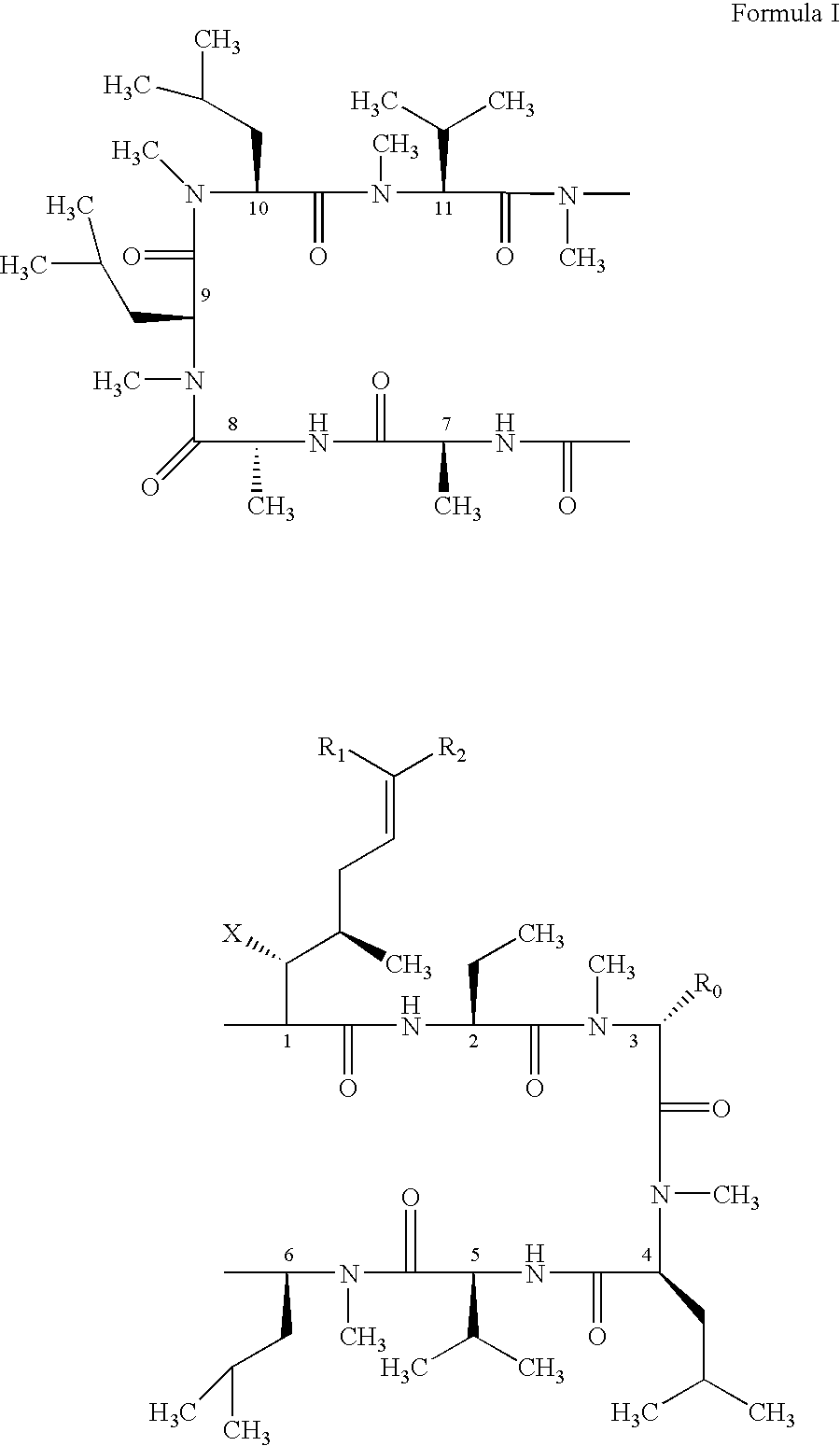
or a pharmaceutically acceptable salt thereof, with X, R0, R1, and R2 defined herein, under conditions effective to prevent or treat the viral-induced disorder.
Description
- The present invention discloses novel cyclosporin analogues and their utilities as pharmaceutical agents for prevention and treatment of viral-induced diseases. Methods for preparation of such analogues are also disclosed.
- Cyclosporin A (CsA), a neutral cyclic undecapeptide isolated from the fungus Tolypocladium inflatum and currently marketed as Neoral® and Sandimmune® (Novartis, Basel, Switzerland), has been widely used for the prevention of organ transplant rejection. The molecular basis for the immunosuppressant activity of cyclosporin A and cyclosporin analogues begins with the passive diffusion of the cyclosporin (Cs) molecule into the cell, followed by binding to its intracellular receptor, cyclophilin A (CypA). CypA belongs to a family of proteins that catalyze cis-trans peptidyl-prolyl isomerization, i.e., PPIase, a rate-limiting step in protein folding. CsA and other cyclosporin analogues bind to the active site of CypA. However, immunosuppression is not believed to be due to the inhibition of CypA PPIase activity. The target of the CsA-CypA complex is a Ca2+-calmodulin-dependent serine-threonine-specific protein phosphatase, calcineurin. In T-cells responding to antigen presentation, an increase in intracellular Ca2+ activates calcineurin, which subsequently dephosphorylates the transcription factor called the nuclear factor of activated T-cells (“NFAT”). Dephosphorylated NFAT undergoes a molecular change, e.g., homodimerization that allows it to cross into the nucleus, and promotes the expression of T-cell activation genes. CsA and other immunosuppressive cyclosporin derivatives inhibit calcineurin which results in the inhibition of expression of cytokine genes, e.g., interleukin-2 (IL-2) that promotes T-cell activation and proliferation, i.e., immunosuppressive activity.
- Human Immunodeficiency Viruses and Cyclosporin A or Non-Immunosuppressive Cyclosporins
- Human immunodeficiency viruses (“HWs”) are lentiviruses, a family of mammalian retroviruses evolved to establish chronic persistent infection with gradual onset of clinical symptoms. There are two major families of HIV. Most of the epidemic involves HIV-1; HIV-2 is a close relative whose distribution is concentrated in western Africa.
- Human cyclophilins A and B have been identified as cellular proteins which bind specifically to HIV-1 Gag polyprotein, p555gag. Gag proteins play a major role in several steps of the virus life cycle, including the assembly and release of virions (Willis et al., “Form, Function, and Use of Retroviral Gag Proteins,” AIDS 5:639-654 (1991)). A cleavage product of the Gag polyprotein, the capsid protein, has been shown to bind specifically to cyclophilin A. Cyclophilin A is functionally associated with the HIV-1 virions through interaction with the Gag polyprotein. This interaction between cyclophilin A and Gag proteins is inhibited by the immunosuppressive drug, cyclosporin A (Thali et al., “Functional Association of Cyclophilin A With HIV-1 Virions,” Nature 372:363-365 (1994)).
- Cyclosporin A has demonstrated in vitro-antiviral activity against HIV-1 (Karpas et al., “Inhibition of Human Immunodeficiency Virus and Growth of Infected T-cells by the Immunosuppressive Drugs Cyclosporin A and FK 506,” Proc. Natl. Acad. Sci. USA 89:8351-8355 (1992)); however, initial in vivo studies in which cyclosporin A was administered as a monotherapy in HIV-infected patients at advanced stages of disease did not show a beneficial effect from the treatment (Levy et al., “Long-Term Follow-Up of HIV Positive Asymptomatic Patients Having Received Cyclosporin A,” Adv. Ex. Med. Biol. 374:229-234 (1995)). U.S. Pat. No. 4,814,323 to Andrieu et al. reported that administration of cyclosporins may be used for the prevention of AIDS in patients infected with the virus before the appearance of the AIDS symptoms, that is patients with no symptoms or patients with AIDS related complex.
- Highly active antiretroviral therapy (“HAART”) has dramatically decreased the HIV-related morbidity and mortality rates among HIV-infected patients and the transmission of HIV from mother to child by efficiently suppressing viral replication (Palella et al., “Declining Morbidity and Mortality Among Patients With Advanced Human Immunodeficiency Virus Infection,” N. Eng. J. Med. 338:853-860 (1998)). Limitations of HAART have become better understood. Thus, the virus can be suppressed to undetectable levels but not eradicated. In addition, there is an ever-growing list of side effects, the eventual development of resistance, and the cost and complexity of HAART regimens that must be contended with.
- HAART covers a broad range of antiretroviral agents that include nucleoside reverse transcriptase inhibitors (“NRTI”), nonnucleoside reverse transcriptase inhibitors (“NNRTI”), HIV protease inhibitors, and fusion inhibitors. Specific examples of antiviral agents from each of these families include: Zidovudine, Didanosine, Stavudine, and Lamivudine from the NRTI antiviral class; Nevirapine, Efavirenz, and Delavirdine from the NNRTI antiviral class; Saquinovir, Indinavir, and Ritonavir from the HIV protease inhibitor class; and Enfuvirtide from the fusion inhibitor antiviral class.
- From an immunological standpoint, the introduction of HAART allows for only a partial immune reconstitution. Indeed, ex vivo measures of immune function do not generally normalize and, most importantly, HIV-specific T cell responses remain almost invariably impaired. Though several variables have been identified that correlate with the degree of immune reconstitution during HAART, the actual underlying mechanism(s) responsible for such an incomplete immune reconstitution are still poorly understood and likely reflect the severe HIV-driven perturbations in T cell dynamics and homeostasis and the interaction between host and viral factors (Douek, “Disrupting T-Cell Homeostasis: How HIV-1 Infection Causes Disease,” AIDS Rev. 5:172-177 (2003)).
- A strategy aimed at the broadest immune reconstitution, possibly overcoming the limitations of HAART, consists in the adjuvant use of immunomodulants. By combining cyclosporin A with HAART, the goal is to contain the immune activation, either virus-specific or owing to non-specific “by-stander” activation. Results from pilot studies in HIV-infected patients has shown that the rapid shutdown of T-cell activation induced by cyclosporin A has produced a more rapid and stable increase in CD4+ T-cells and a significant long-term increase in IFN-γ secreting CD4+ and CD4+ CCR7-T-cells, establishing a more favorable immunological set-point (Bandera et al., “Immunomodulants in HIV Infection,”Expert Opin. Ther. Patents 15(9): 1115-1131 (2005)). Determination of the long-term efficacy must be assessed in order to understand if this approach truly has value.
- SDZ NIM 811 is a cyclosporin analogue that is completely devoid of immunosuppressive activity but exhibits potent and selective anti-HIV-1 activity (Mlynar et al., “The Non-Immunosuppressive Cyclosporin A Analogue SDZ NIM 811 Inhibits Cyclophilin A Incorporation Into Virions and Virus Replication in Human Immunodeficiency Virus Type-1-Infected Primary and Growth-Arrested Cells,” J. General Virology 78:825-835 (1997)). SDZ NIM 811 does not prevent the activation of CD4+ T-cell activation as cyclosporin A does. In a manner similar to cyclosporin A, it is proposed that SDZ NIM 811 interferes with the HIV-1 Gag-cyclophilin A interaction to effect its antiviral activity.
- SDZ NIM 811 does not inhibit calcineurin and possesses none of the immunosuppressive activity of cyclosporin A. The potent inhibition of calcineurin by cyclosporin, in addition to being responsible for the potent immunosuppressive activity of cyclosporin A, is also believed to be the cause of the toxicity and the narrow therapeutic index of this drug. Separation of immunosuppressive and antiviral activity could lead to novel antiviral cyclosporins with fewer side effects and improved therapeutic index. Elucidation of structure activity relationships for cyclosporins permits the design of non-immunosuppressive cyclosporin derivatives that retain potent (cyclophilin A) PPIase activity to achieve this goal (Bartz et al., “Inhibition of Human Immunodeficiency Virus Replication by Non-Immunosuppressive Analogs of Cyclosporin A,” Proc. Natl. Acad. Sci. USA 92:5381-5385 (1995)). European Patent No. 484 281, U.S. Pat. No. 5,767,069, U.S. Pat. No. 5,948,884, and French Patent Nos. 2,757,520, 2,757,521, and 2,757,522 disclose non-immunosuppressive cyclosporins with antiviral activity.
- Hepatitis C Virus and Cyclosporin A
- Recently, cyclosporin A, the most widely prescribed immunosuppressive drug, was reported to be clinically effective against hepatitis C viral (HCV) infection (Nakagawa et al., “Specific Inhibition of Hepatitis C Virus Replication by Cyclosporin A,” Biochem. Biophys. Res. Commun. 313:42-47 (2004)). The authors of the Nakagawa et al. paper state that certain chaperone activities, such as those of cyclophilins, may be crucial for the processing and maturation of the viral proteins and for viral replication.
- A subsequent controlled clinical trial showed that a combination of cyclosporin A with interferon α2b is more effective than interferon monotherapy, especially in patients with high viral loads (Inoue et al., “Combined Interferon α2b and Cyclosporin A in the Treatment of Chronic Hepatitis C: Controlled Trial,” J. Gastroenterol. 38:567-572 (2003)).
- PCT International Patent Publication No. WO 2006/005610 recently described the use of a combination of cyclosporin A and pegylated interferon for treating hepatitis C viral infection. In addition, PCT International Patent Publication No. WO 2005/021028 relates to the use of non-immunosuppressive cyclosporins for treatment of HCV disorders. Also, Paeshuyse et al., “Potent and Selective Inhibition of Hepatitis C Virus Replication by the Non-Immunosuppressive Cyclosporin Analogue DEBIO-025,” Antiviral Research 65(3):A41 (2005) recently published results for a non-immunosuppressive cyclosporin analogue, DEBIO-025, that exhibited potent and selective inhibition of hepatitis C virus replication. Notably, the cyclosporin derivative DEBIO-025 is also effective for the treatment of HIV-1 (Rosenwirth et al., “Debio-025, A Novel Non-Immunosuppressive Cyclosporine Analog with Potent Anti-Human Immunodeficiency Virus Type 1 Activity: Pharmacological Properties and Mode of Action,” Antiviral Research 65(3):A42-A43 (2005)). Debio-025 does possess potent binding affinity for cyclophilin A.
- There is still a large need for novel cyclosporin analogues that have therapeutic utility in the treatment of viral-induced diseases.
- The present invention is directed to achieving these objectives.
- The present invention relates to a method of preventing or treating a mammal with a viral-induced disorder. The method involves administering to the mammal a therapeutically effective amount of a compound having the following formula:

where:
X is OH or OAc;
R0 is H or CH2OR3;
R1 is H or D;
R2 is selected from the group consisting of: -
- halogen,
- C1-C6 halogenated saturated straight or branched carbon chain,
- C2-C6 halogenated unsaturated straight or branched carbon chain,
- C3-C6 substituted and unsubstituted cycloalkyl,
- C1-C6 saturated straight or branched carbon chain containing amino group,
- —CH═N—OR4, and
- —CH═N—NR4R5;
R3 is selected from the group consisting of: - hydrogen,
- alkanoyl,
- alkenoyl,
- alkynoyl,
- aryloyl,
- arylalkanoyl,
- alkylaminocarbonyl,
- aryl aminocarbonyl,
- arylalkylaminocarbonyl,
- alkyloxycarbonyl,
- aryloxycarbonyl, and
- arylalkyloxycarbonyl;
R4 and R5 are the same or different and independently selected from the group consisting of: - hydrogen,
- C1-C6 saturated straight or branched carbon chain,
- C3-C6 unsaturated straight or branched carbon chain,
- C3-C6-substituted and unsubstituted cycloalkyl,
- C1-C4 carbon chain containing an aryl or heteroaryl,
- substituted and unsubstituted aryl,
- substituted and unsubstituted heteroaryl,
- alkanoyl,
- alkenoyl,
- alkynoyl,
- aryloyl,
- arylalkanoyl,
- alkylaminocarbonyl,
- arylaminocarbonyl,
- arylalkylaminocarbonyl,
- alkyloxycarbonyl,
- aryloxycarbonyl,
- arylalkyloxycarbonyl,
- alkylsulfonyl, and
- arylsulfonyl; and
R4 together with R5 results in the formation of a cyclic moiety of C2-C6 optionally containing heteroatom or heteroatoms,
wherein the compound is a cis geometric isomer, a trans geometric isomer, or a mixture of the cis and the trans geometric isomers or a pharmaceutically acceptable salt thereof,
under conditions effective to prevent or treat the viral-induced disorder.
- The present invention also relates to a method of preventing or treating a mammal with a viral-induced disorder. The method involves administering to the mammal a therapeutically effective amount of a compound having the following formula:

where:
X is OH or OAc;
R0 is H or CH2OR3;
R1 is halogen;
R2 is selected from the group consisting of: -
- hydrogen,
- deuterium,
- halogen,
- C1-C6 saturated straight or branched carbon chain, optionally containing halogen,
- C2-C6 unsaturated straight or branched carbon chain, optionally containing halogen,
- C3-C6 substituted and unsubstituted cycloalkyl,
- substituted and unsubstituted aryl, and
- substituted and unsubstituted heteroaryl; and
R3 is selected from the group consisting of: - hydrogen,
- alkanoyl,
- alkenoyl,
- alkynoyl,
- aryloyl,
- arylalkanoyl,
- alkylaminocarbonyl,
- arylaminocarbonyl,
- arylalkylaminocarbonyl,
- alkyloxycarbonyl,
- aryloxycarbonyl, and
- arylalkyloxycarbonyl,
wherein the compound is a cis geometric isomer, a trans geometric isomer, or a mixture of the cis and the trans geometric isomers or a pharmaceutically acceptable salt thereof,
under conditions effective to prevent or treat the viral-induced disorder.
- The present invention discloses novel cyclosporin derivatives that are chemically modified from cyclosporin A. In particular, the present invention discloses cyclosporin analogues containing a chemically modified side chain at the position one amino acid and optionally a substitution at the position three amino acid of cyclosporin A.
- The present invention discloses novel cyclosporin analogues which are effective as antiviral agents. The cyclosporin derivatives of the present invention used to treat viral infections may possess potent immunosuppressive activity (via inhibition of calcineurin) or may be completely devoid of immunosuppressive activity (do not inhibit calcineurin). However, the mechanism that the immunosuppressive and non-immunosuppressive cyclosporin compounds share is their activity at cyclophilin A.
-
FIG. 1 depicts the results from a concanavalin A (ConA)-stimulated splenocyte assay, where the novel cyclosporin analogue compounds of the present invention (disclosed in Examples 9 and 11) are shown to possess enhanced potency in immunosuppression, compared to cyclosporin A. - The present invention relates to a method of preventing or treating a mammal with a viral-induced disorder. The method involves administering to the mammal a therapeutically effective amount of a compound having the following formula:
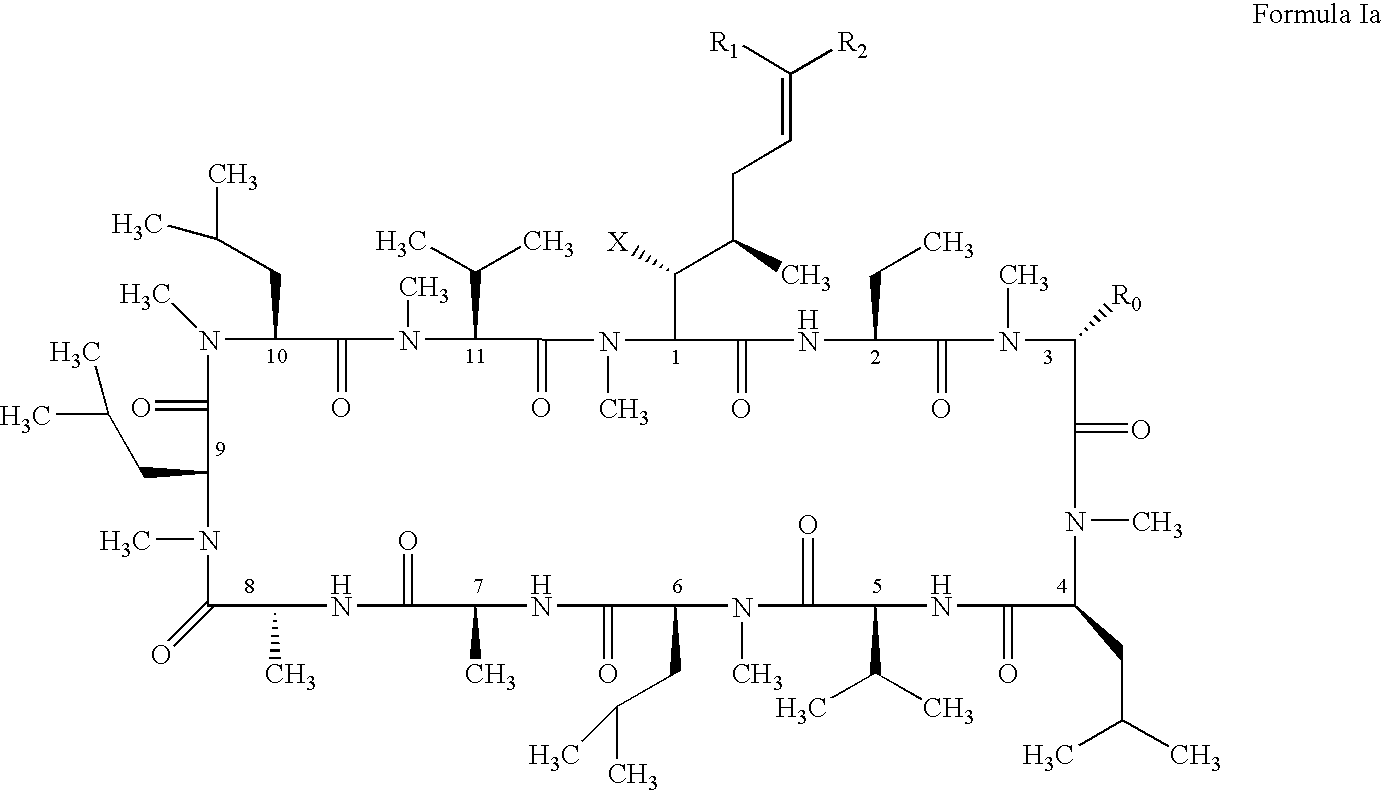
where:
X is OH or OAc;
R0 is H or CH2OR3;
R1 is H or D;
R2 is selected from the group consisting of: -
- halogen,
- C1-C6 halogenated saturated straight or branched carbon chain,
- C2-C6 halogenated unsaturated straight or branched carbon chain,
- C3-C6 substituted and unsubstituted cycloalkyl,
- C1-C6 saturated straight or branched carbon chain containing amino group,
- —CH═N—OR4, and
- —CH═N—NR4R5;
R3 is selected from the group consisting of: - hydrogen,
- alkanoyl,
- alkenoyl,
- alkynoyl,
- aryloyl,
- arylalkanoyl,
- alkylaminocarbonyl,
- arylaminocarbonyl,
- arylalkylaminocarbonyl,
- alkyloxycarbonyl,
- aryloxycarbonyl, and
- arylalkyloxycarbonyl;
R4 and R5 are the same or different and independently selected from the group consisting of: - hydrogen,
- C1-C6 saturated straight or branched carbon chain,
- C3-C6 unsaturated straight or branched carbon chain,
- C3-C6-substituted and unsubstituted cycloalkyl,
- C1-C4 carbon chain containing an aryl or heteroaryl,
- substituted and unsubstituted aryl,
- substituted and unsubstituted heteroaryl,
- alkanoyl,
- alkenoyl,
- alkynoyl,
- aryloyl,
- arylalkanoyl,
- alkylaminocarbonyl,
- arylaminocarbonyl,
- arylalkylaminocarbonyl,
- alkyloxycarbonyl,
- aryloxycarbonyl,
- arylalkyloxycarbonyl,
- alkylsulfonyl, and
- arylsulfonyl; and
R4 together with R5 results in the formation of a cyclic moiety of C2-C6 optionally containing heteroatom or heteroatoms,
wherein the compound is a cis geometric isomer, a trans geometric isomer, or a mixture of the cis and the trans geometric isomers or a pharmaceutically acceptable salt thereof,
under conditions effective to prevent or treat the viral-induced disorder.
- One embodiment of the present invention relates to the above compound of Formula Ia, where: X=OH or OAc; R0=H, CH2OH, or CH2OAc; R1=H or D; and R2═F, Cl, Br, or I.
- Another embodiment of the present invention relates to the above compound of Formula Ia, where: X=OH or OAc; R0=H, CH2OH, or CH2OAc; R1=H or D; and R2=CF3, CH2F, or CH2Cl.
- Another embodiment of the present invention relates to the above compound of Formula Ia, where: X=OH or OAc; R0=H, CH2OH, or CH2OAc; R1=H or D; and R2=—CH═CHF, —CH═CHCl, —CH═CHBr, or —CH═CHI.
- Another embodiment of the present invention relates to the above compound of Formula Ia, where: X=OH or OAc; R0=H, CH2OH, or CH2OAc; R1=H or D; and R2=—CH═CH—C≡CH, —CH═CH—C≡C—CH3, or —CH═CH—C≡C—CH═CH2.
- Another embodiment of the present invention relates to the above compound of Formula Ia, where: X=OH or OAc; R0=H, CH2OH, or CH2OAc; R1=H or D; and R2 is cyclopropyl.
- Another embodiment of the present invention relates to the above compound of Formula Ia, where: X=OH or OAc; R0=H, CH2OH, or CH2OAc; R1=H or D; and R2=—CH═N—OH, —CH═N—OCH3, —CH═N—OCH2CH3, —CH═N—NHCH3, or —CH═N—N(CH3)2.
- Another embodiment of the present invention relates to the above compound of Formula Ia, where:
- X=OH or OAc,
- R0=H,
- R1=H or D, and
- R2=Cl, Br, I, CF3, C3F7, C4F9, CH2F, CH2Cl, -cyclopropyl, —CH═CHCl, —CH═CHBr, —CH═CHI, —CH═CHCF3, —C(CF3)═CH2, —C≡CC4H9, —CH═CH—C≡CH, —CH═CH—C≡CCH3, —CH═CH—C≡CSi(CH3)3, —CH═CH—C≡C—CH═CH2, —CH═CH—C≡C—CH(OH)CH3, —CH2NHCH3, —CH2N(CH3)2, —CH2N(CH3)(Ac), —CH2-pyrrolidine, —CH2-piperidine, —CH2-morphorline, —CH2-thiomopholine, —CH2-methylpiperizine, —CH═N—OH, —CH═N—OCH3, —CH═N—OCH2CH3, —CH═N—OCH2CH═CH2, —CH═N—OCH2Ph, —CH═N—N(CH3)2, —CH═N—NHCH3, or —CH═N—NHSO2C6H4CH3.
- Another embodiment of the present invention relates to the above compound of Formula Ia, where:
- X=OH or OAc,
- R0=CH2OH or CH2OAc,
- R1=H, and
- R2=Cl, Br, I, CF3, CH2F, Ph, —CH═CHCl, —CH═CHBr, —CH═CHI, —CH═CH2, or —CH═CD2.
- The present invention also relates to a method of preventing or treating a mammal with a viral-induced disorder. The method involves administering to the mammal a therapeutically effective amount of a compound having the following formula:
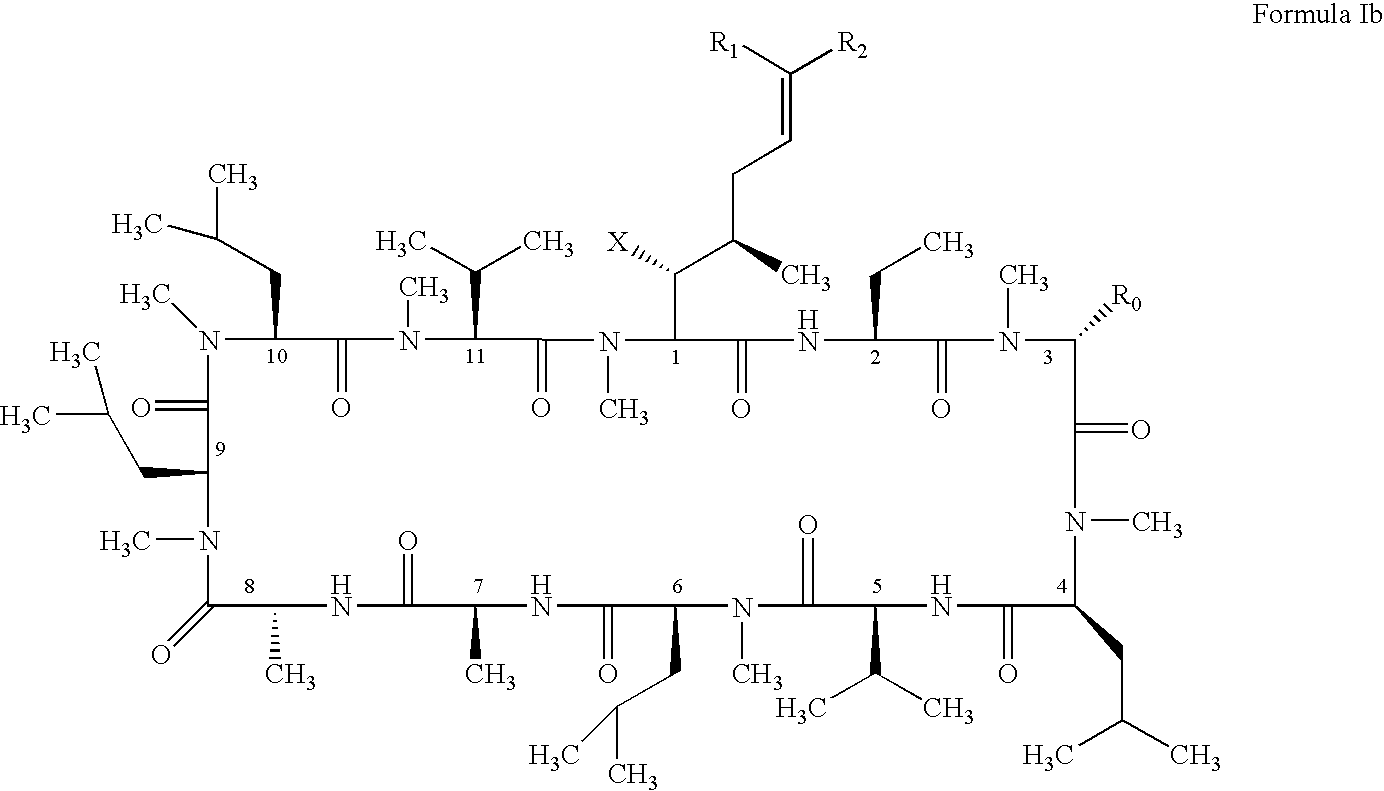
where:
X is OH or OAc;
R0 is H or CH2OR3;
R1 is halogen;
R2 is selected from the group consisting of: -
- hydrogen,
- deuterium,
- halogen,
- C1-C6 saturated straight or branched carbon chain, optionally containing halogen,
- C2-C6 unsaturated straight or branched carbon chain, optionally containing halogen,
- C3-C6 substituted and unsubstituted cycloalkyl,
- substituted and unsubstituted aryl, and
- substituted and unsubstituted heteroaryl; and
R3 is selected from the group consisting of: - hydrogen,
- alkanoyl,
- alkenoyl,
- alkynoyl,
- aryloyl,
- arylalkanoyl,
- alkylaminocarbonyl,
- arylaminocarbonyl,
- arylalkylaminocarbonyl,
- alkyloxycarbonyl,
- aryloxycarbonyl, and
- arylalkyloxycarbonyl,
wherein the compound is a cis geometric isomer, a trans geometric isomer, or a mixture of the cis and the trans geometric isomers or a pharmaceutically acceptable salt thereof,
under conditions effective to prevent or treat the viral-induced disorder.
- Another embodiment of the present invention relates to the compound of Formula Ib, where:
- X=OH or OAc,
- R0=H,
- R1=Cl, and
- R2=H, D, C1, CF3, or Ph.
- Another embodiment of the present invention relates to the compound of Formula Ib, where:
- X=OH or OAc,
- R0=H,
- R1=Br or I, and
- R2=H, D, or CH3.
- In particular, the present invention relates to novel halogenated cyclosporin analogues, including cyclosporin vinyl halides and allylic halides.
- The present invention also discloses methods for preparation of novel cyclosporin analogue compounds represented by Formula Ia and Formula Ib and their utility as pharmaceutical agents for treatment of various diseases. The present invention also describes the utility of halogenated cyclosporin analogues (vinyl halides and allylic halides) as synthetic intermediates that can be transformed into additional novel cyclosporin derivatives.
- The starting material for the preparation of the compounds of the present invention is cyclosporin A. The structure of cyclosporin A, a cycloundecapeptide, and the position numbering for each amino acid in the ring is shown below:

- Cyclosporin A can also be represented by Formula Ia, as shown below:

- The novel cyclosporin analogues of the present invention are derived from cyclosporin A or a key intermediate prepared by modification at the position three amino acid of cyclosporin A. As shown in Scheme 1, such a key intermediate (Formula IIb) can be prepared by deprotonation of cyclosporin A with lithium diisopropylamide (LDA), followed by treatment with formaldehyde (Seebach et al, “Modification of Cyclosporin A: Generation of an Enolate at the Sarcosine Residue and Reaction With Electrophiles,” Helv. Chim. Acta, 76:1564-1590 (1993), which is hereby incorporated by reference in its entirety).
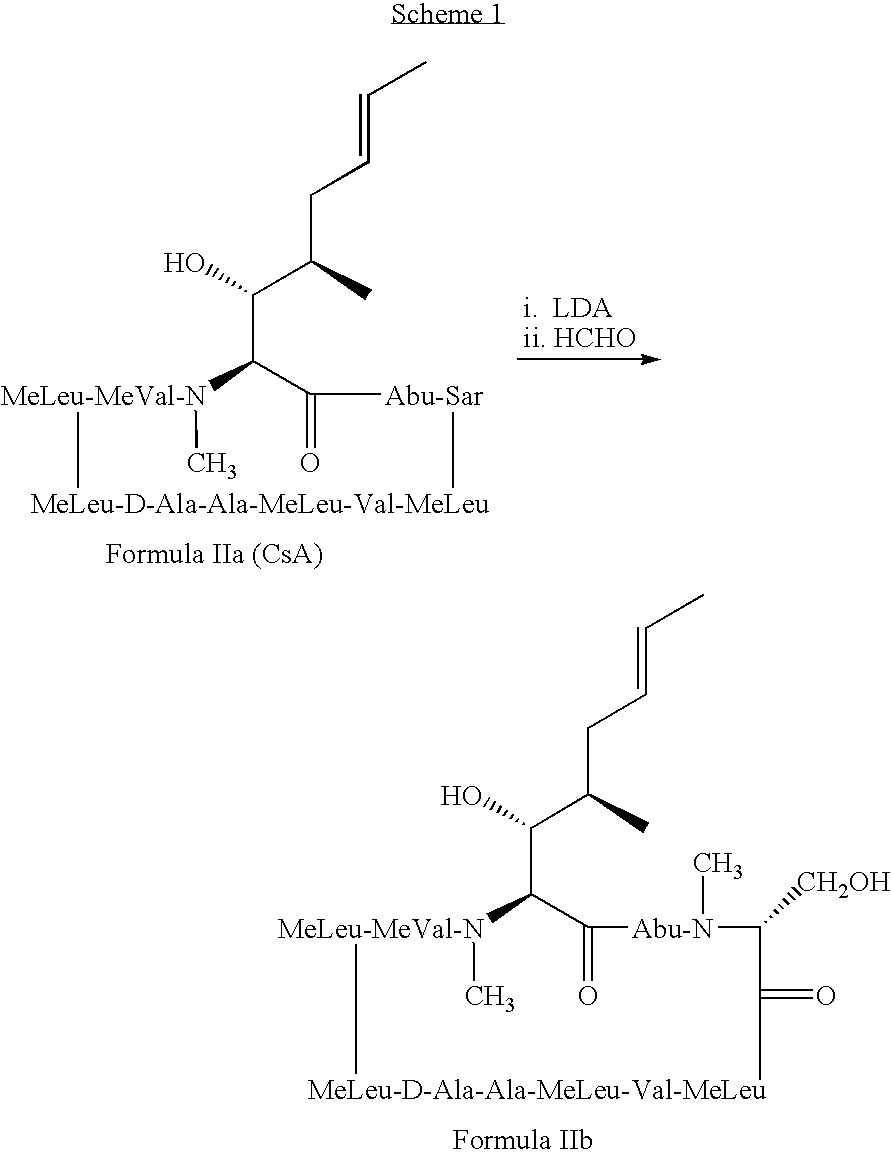
- According to one embodiment of the present invention, novel cyclosporin vinyl halides can be prepared by employing Takai reaction as a key step, as outlined in Scheme 2. Acetylation of cyclosporin A (Formula Ia) or cyclosporin diol intermediate of Formula IIb with acetic anhydride, followed by oxidative cleavage of the double bond with ozone, generates cyclosporin aldehyde of Formula III smoothly. Treatment of the cyclosporin aldehyde with haloform-CrCl2 complex affords novel cyclosporin vinyl halides of Formula Ia (Takai et al, “Simple and Selective Method for RCHO→(E)-RCH═CHX Conversion by Means of a CHX3—CrCl2 System,” J. Am. Chem. Soc., 108:7408-7410 (1986), which is hereby incorporated by reference in its entirety). Various haloforms, such as chloroform, bromoform, and iodoform can be applied. Usage of excess haloform and CrCl2 seems to be necessary to obtain the desired vinyl halide in good to excellent yield (50-80%). This stereoselective chemistry provided a halogenated olefin of Formula Ia in exclusively the trans-configuration (R1=H or D; R2=halogen). The acetyl protection group(s) can be removed by treatment with potassium carbonate in methanol (see Scheme 2).

- The novel cyclosporin vinyl halides of Formula Ib in the present invention can be prepared via an alternative approach by application of phosphorous ylide chemistry (Wittig reaction, Horner-Emmons reaction, or other modified Wittig conditions), as shown in Scheme 3. This chemistry converts the cyclosporin aldehyde of Formula III to the halogenated olefin of Formula Ib effectively. The reaction generates either the cis-isomer of the olefin or a separable mixture of cis- and trans-isomers. Typically, the phosphorous ylide species under Wittig, Horner-Emmons, or other modified Wittig conditions are generated by treatment of various phosphonium salts or phosphonates with a strong base, such as n-butyllithium or sodium bis(trimethylsilyl)amide. The deacetylation is conducted under the same conditions as described in Scheme 2.
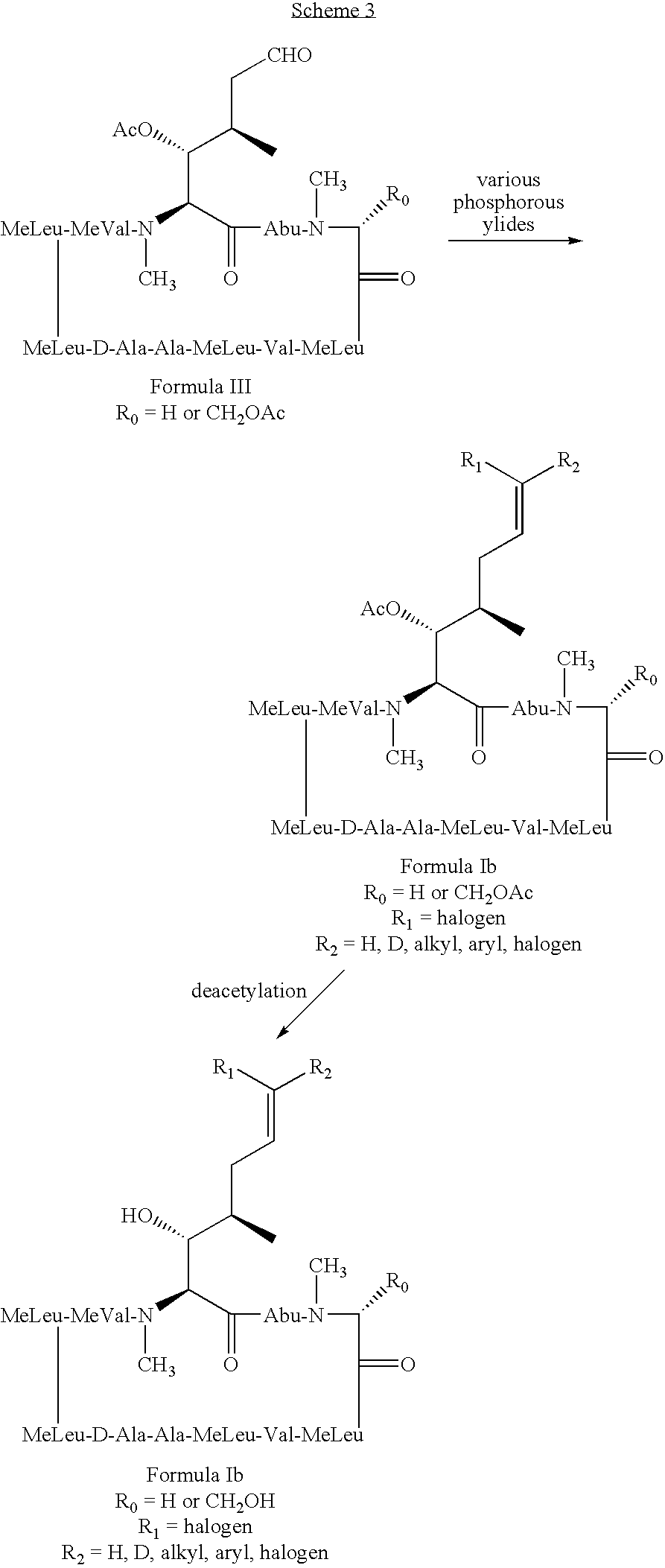
- Utilizing the same strategy described in Scheme 2, halogenated cyclosporin diene can be prepared via a Takai reaction with α,β-unsaturated aldehyde of Formula IV, which is generated by application of olefin cross metathesis on cyclosporin (Scheme 4). In the last decade, ruthenium catalyzed olefin metathesis has emerged as a powerful synthetic tool for the formation of carbon-carbon bonds (Chatterjee et al, “A General Model for Selectivity in Olefin Cross Metathesis,” J. Am. Chem. Soc., 125:11360-11370 (2003); Connon et al, “Recent Development in Olefin Cross Metathesis,” Angew. Chem. Int. Ed., 42:1900-1923 (2003), which are hereby incorporated by reference in their entirety). There are three main variations on olefin metathesis: (a) cross metathesis; (b) ring opening/close metathesis; and (c) intermolecular enyne metathesis. As an acyclic carbon-carbon bond-forming method, olefin cross metathesis has numerous advantages: (1) the process is catalytic (typically 1-5 mol % of catalyst required); (2) high yield can be obtained under mild conditions in a relatively short reaction time; (3) a wide range of functional groups are tolerated, with minimal substrate protection necessary; and (4) the reaction is relatively atom-economic, and gaseous ethylene is usually the only byproduct, which is an important consideration in industrial applications (Connon et al, “Recent Development in Olefin Cross Metathesis,” Angew. Chem. Int. Ed., 42:1900-1923 (2003), which is hereby incorporated by reference in its entirety).

- As shown in Scheme 4, olefin cross metathesis of acetyl-protected cyclosporin A or cyclosporin diol is carried out with acrolein acetals (such as acrolein dimethyl acetal and 2-vinyl-1,3-dioxolane) in the presence of Grubbs' catalyst in methylene chloride or toluene. The reaction provides an acetal intermediate which is hydrolyzed during purification by high pressure liquid chromatography, using acetonitrile-water-trifluoroacetic acid as a solvent system to afford trans-α,β-unsaturated aldehyde of Formula IV directly in good to excellent yield (60-80%). The catalyst can be either Grubbs' catalyst 2nd generation (Schwab et al, “A Series of Well-Defined Metathesis Catalysts-Synthesis of [RuCl2(═CHR′)(PR3)2] and Its Reactions,” Angew. Chem. Int. Ed., 34:2039-2041 (1995), which is hereby incorporated by reference in its entirety) or Hoveyda-Grubbs catalyst (Scholl et al, “Synthesis and Activity of a New Generation of Ruthenium-Based Olefin Metathesis Catalysts Coordinated with 1,3-Dimesityl-4,5-dihydroimidazol-2-ylidene Ligands,” Org. Lett., 1:953 (1999); Sanford et al, “Mechanism and Activity of Ruthenium Olefin Metathesis Catalysts,” J. Am. Chem. Soc., 123:6543-6554 (2001), which are hereby incorporated by reference in their entirety). This stereoselective chemistry provides an α,β-unsaturated aldehyde of Formula IV exclusively in the trans-geometric isomer.
- Treatment of α,β-unsaturated aldehyde of Formula IV with haloform and CrCl2 in tetrahydrofuran provides a halogenated cyclosporin diene of Formula V as a trans-isomer. Only a small amount of cis-isomer is observed under these conditions. Finally, acetyl protection group(s) can be removed with potassium carbonate in methanol (Scheme 4).
- According to another embodiment of the present invention, cyclosporin vinyl halides can be used as powerful synthetic intermediates for palladium or nickel-catalyzed couplings (such as Stille coupling, Suzuki coupling, Negishi coupling, and Sonogashira coupling) to build a new carbon-carbon bond. As shown in Scheme 5, Stille coupling of the cyclosporin vinyl iodide of Formula VI with organotin reagents, in the presence of Pd(CH3CN)2Cl2, affords a novel cyclosporin cyclopropyl derivative and a diene analogue respectively, while Sonogashira coupling with alkyne provides enyne analogue. Similar reactions can be performed on the halogenated diene of Formula V with organotin reagents, organozinc reagents, boronic acids, or alkynes to prepare novel cyclosporin analogues.

- According to another embodiment of the present invention, cyclosporin allylic halides can be prepared via olefin cross metathesis with a Grubbs catalyst, as shown in Scheme 6. Utilizing an allylic chloride of Formula VII as a key intermediate, various cyclosporin amine derivatives can be obtained.
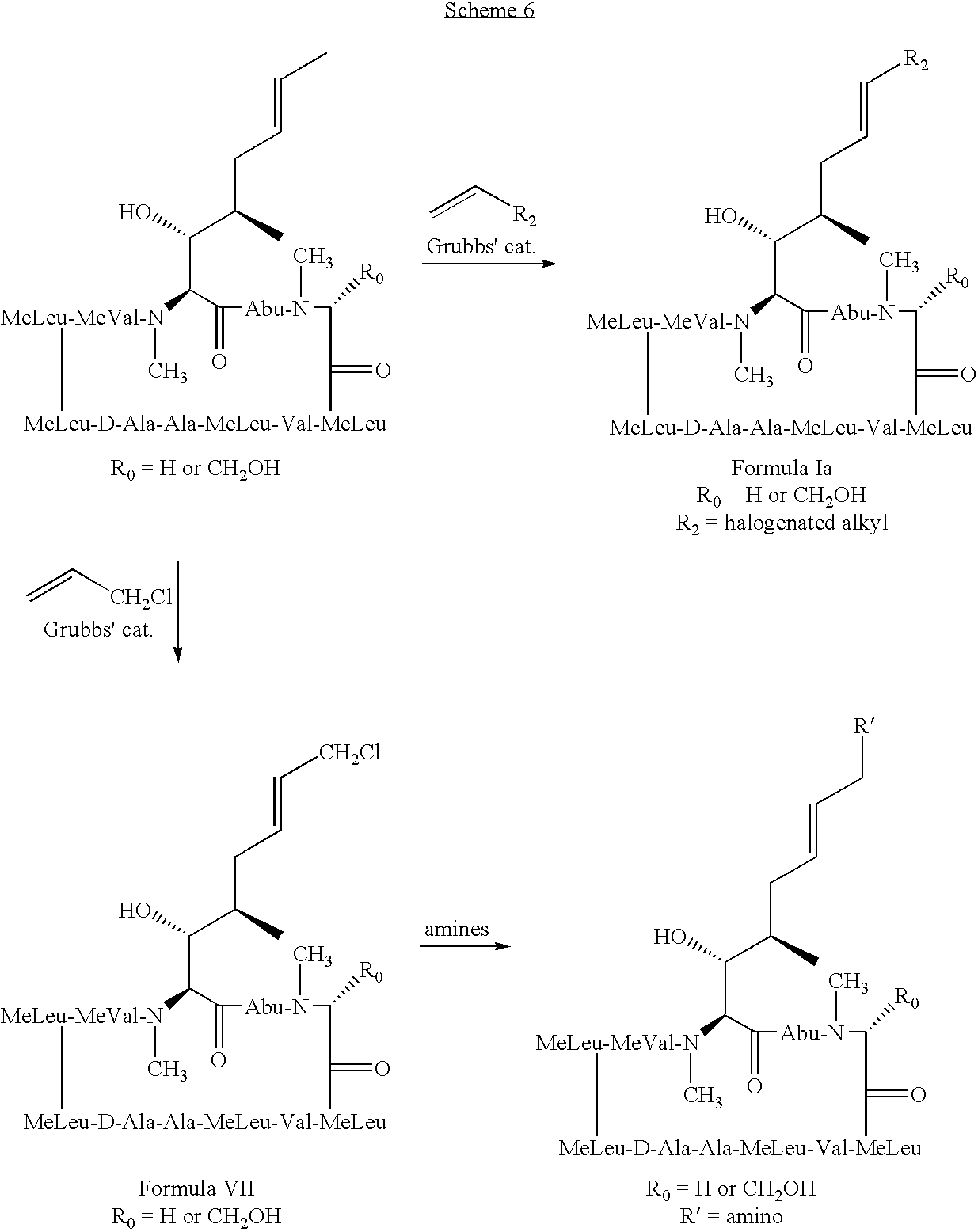
- Another embodiment of the present invention relates to a so-called “soft drug” strategy (Lazarova et al., “Synthesis a n d Biological Evaluation of Novel Cyclosporin A Analogues: Potential Soft Drugs for the Treatment of Autoimmune Diseases,” Journal of Medicinal Chemistry, 46:674-676 (2003); Little et al., “Soft Drugs Based on Hydrocortisone: The Inactive Metabolite Approach and Its Application to Steroidal Anti-inflammatory Agents,” Pharm. Res., 16:961-967 (11999), which are hereby incorporated by reference in their entirety). Incorporation of a C—N bond leads to the preparation of α-unsaturated oximes (C═N—OR) and hydrazones (C═N—NR2) of Formula VIII. The active α,β-unsaturated oximes (C═N—OR) and hydrazones (C═N—NR2) of the present invention can be hydrolyzed and inactivated under physiological conditions. Therefore, the C═N moiety of the novel cyclosporin analogues of Formula VIII provides a simple means to control the hydrolytic half-life of the soft drug, thus minimizing system exposure and toxicity. As shown in
Scheme 7, the treatment of α,β-unsaturated aldehyde of Formula IV with hydroxylamines or alkyloxyamines (RONH2) and hydrazines (R2NNH2) affords the corresponding α,β-unsaturated oximes (C═N—OR) and hydrazones (C═N—NR2) of Formula VIII, respectively.
- Some of the compounds disclosed in the present invention are useful as immunosuppressive agents. Administration of these compounds suppresses the immune response in organ transplant patients and, thus, prevents allograft rejection. The compounds of the present invention may possess immunosuppressive activity similar to or more potent than cyclosporin A. For example, as shown in
FIG. 1 , the novel cyclosporin analogue compounds disclosed in Examples 9 and 11 possess enhanced potency in immunosuppresion in the concanavalin A stimulated splenocyte assay, compared to cyclosporin A. Table 1 shows the immunosuppressive activities of several novel cyclosporin analogue compounds disclosed in the present application. (The third column in Table 1 contains cyclosporin A positive control values included for comparison.)TABLE 1 Immunosuppressive Activities of Novel Cyclosporin Analogue Compounds of the Present Invention Example where the Novel Cyclosporin Analogue Compound is Disclosed IC50 (ng/mL) IC50 (ng/mL) of CsA Example 5 22 25 Example 6 11 25 Example 9 7 31 Example 11 13 31 Example 19 9 6 Example 26 5 9 Example 31 38 8 Example 34 12 5 Example 56 15 31 Example 58 42 31 Example 67 7 6 Example 69 4 9 Example 71 8 6 Example 72 5 6 - The compounds disclosed in the present invention are useful for the prevention or treatment of viral-induced disorders that are dependent upon the presence of cyclophilin A. The compounds of the present invention used to treat these viral infections may possess potent immunosuppressive activity (via inhibition of calcineurin) or may be completely devoid of immunosuppressive activity (do not inhibit calcineurin). However, the mechanism that the immunosuppressive and non-immunosuppressive cyclosporin compounds share is their activity at cyclophilin A.
- Cyclophilin A enzyme activity, i.e., peptidyl-prolyl cis-trans isomerase activity, is important to the folding and trafficking of proteins. The HIV infectivity of CD4+ T-cells and viral replication are dependent upon the incorporation of cyclophilin A into HIV-1 virions through interactions with the Gag polyprotein. Inhibition of the cyclophilin A enzyme activity is necessary and sufficient for anti-HIV-1 activity.
- In one embodiment of the present invention, the viral-induced disorder is a human immunodeficiency virus (HIV)-induced disorder. Thus, compounds of the present invention that lack immunosuppressant activity as determined by the Concanavalin A (Con A)-stimulated murine splenocyte assay but retain potent peptidyl prolyl isomerase (PPIase) inhibitory (cyclophilin A) activity may possess anti-HIV activity. In addition, compounds of the present invention that have immunosuppressive activity as determined by the Con A-stimulated murine, splenocyte assay and also possess potent PPIase inhibitory (cyclophilin A) activity may possess anti-HIV activity.
- In vitro biological assays that allow the determination of binding affinity to cyclophilin A or allow the determination of inhibition of peptidyl cis-trans isomerase activity are described in Handschumacher et al., “Cyclophilin: A Specific Cytosolic Binding Protein for Cyclosporin A,” Science 226:544-547 (1984) and Kofron et al., “Determination of Kinetic Constants for Peptidyl Prolyl cis-Trans Isomerases by an Improved Spectrophotometric Assay,” Biochemistry 30:6127-6134 (1991), respectively, which are both hereby incorporated by reference in their entirety.
- The in vitro anti-HIV activity of compounds of the present invention can be measured in established cell line cultures as described by Mayaux et al., “Triterpene Derivatives That Block Entry of Human Immunodeficiency Virus Type 1 Into Cells,” Proc. Natl. Acad. Sci. USA 91:3564-3568 (1994), which is hereby incorporated by reference in its entirety.
- In another embodiment of the present invention, the compound of the present invention is administered in combination with antiretroviral agents, such as nucleoside reverse transcriptase inhibitors, nonnucleoside reverse transcriptase inhibitors, human immunodeficiency virus protease inhibitors, fusion inhibitors, and combinations thereof. Examples of nucleoside reverse transcriptase inhibitors include, but are not limited to, Zidovudine, Didanosine, Stavudine, and Lamivudine. Examples of nonnucleoside reverse transcriptase inhibitors include, but are not limited to, Nevirapine, Efavirenz, and Delavirdine. Examples of human immunodeficiency virus protease inhibitors include, but are not limited to, Saquinovir, Indinavir, and Ritonavir. Examples of fusion inhibitors include, but are not limited to, Enfuvirtide.
- Although cyclophilin PPIase activity would appear to be implicated in anti-HCV activity as it is for anti-HIV-1 activity, the hepatitis C virus (HCV) proteins that may interact with cyclophilin A have yet to be identified. In another embodiment of the present invention, the viral-induced disorder is a HCV-induced disorder. Hepatitis C infections or HCV induced disorders are, for example, chronic hepatitis, liver cirrhosis, or liver cancer (e.g., hepatocellular carcinoma). Thus, compounds of the present invention that lack immunosuppressant activity as determined by the Concanavalin A (Con A)-stimulated murine splenocyte assay but retain potent peptidyl prolyl isomerase (PPIase) inhibitory (cyclophilin A) activity may possess anti-HCV activity. In addition, compounds of the present invention that have immunosuppressive activity as determined by the Con A-stimulated murine splenocyte assay and also possess potent PPIase inhibitory (cyclophilin A) activity may possess anti-HCV activity. The compounds of the present invention may also be used as a prophylactic treatment for neonates born to HCV-infected mothers, for healthcare workers exposed to the virus, or for transplant recipients, e.g., organ or tissue transplant (e.g. liver transplant) recipients, to eliminate possible recurrent infection after transplantation.
- In another embodiment of the present invention, the compound of the present invention is administered in combination with an interferon. Examples of interferons include, but are not limited to, interferon α2a and interferon α2b. The interferon can be a pegylated interferon. Examples of interferons include, but are not limited to, pegylated interferon α2a or pegylated interferon α2b.
- Utility of the immunosuppressive or non-immunosuppressive cyclosporin compounds of the present invention in treating diseases or conditions from HCV infection can be demonstrated in standard animal or clinical tests in accordance with the methods described in Examples 89 and 90, for example.
- Some of the compounds disclosed in the present invention also possess utility in the treatment of autoimmune and chronic inflammatory diseases such as asthma, rheumatoid arthritis, multiple sclerosis, psoriasis, and ulcerative colitis, to name only a few.
- The compounds disclosed in the present invention are also useful for the treatment of ocular allergy and dry eye. Allergan is currently marketing a topical formulation of cyclosporin A called Restasis™ (cyclosporin ophthalmic emulsion) for the treatment of keratoconjunctivitis sicca or chronic dry eye syndrome in patients whose tear production is presumed to be suppressed due to ocular inflammation. While the exact mechanism of Restasis™ is unknown, it is thought to act as an immunomodulator with anti-inflammatory effects (“Annual Update 2003: Ophthalmic Drugs” Drugs of the Future, 28(3): 287-307 (2003); Clark et al., “Ophthalmic Drug Discovery,” Nature Reviews in Drug Discovery, 2:448-459 (2003), which are hereby incorporated by reference in their entirety).
- For treatment of the above-mentioned diseases, therapeutically effective doses of the compounds of the present invention may be administered orally, topically, parenterally, by inhalation spray, or rectally in dosage unit formulations containing conventional non-toxic pharmaceutically acceptable carriers, adjuvants, and vehicles. The term parenteral, as used herein, includes subcutaneous injections, intravenous, intramuscular, intrasternal injection, or infusion techniques.
- The pharmaceutical compositions containing the active ingredient may be in the form suitable for oral use, for example, as tablets, troches, lozenges, aqueous or oily suspensions, dispersible powders or granules, emulsions, hard or soft capsules, or syrups or elixirs. The pharmaceutical compositions of the present invention contain the active ingredient formulated with one or more pharmaceutically acceptable carriers. As used herein, the term “pharmaceutical acceptable carrier” means a non-toxic, inert solid, semi-solid or liquid filler, diluent, encapsulating material, or formulation auxiliary of any type. Some examples of pharmaceutically acceptable carriers are sugars such as lactose, glucose, and sucrose; starches such as corn starch or potato starch; cellulose and its derivatives such as sodium carboxymethyl cellulose, ethyl cellulose, and cellulose acetate; powdered tragacanth; malt; gelatin; talc; excipients such as cocoa butter and suppository waxes; oils such as peanut oil, cottonseed oil, safflower oil, sesame oil, olive oil, corn oil, and soybean oil; glycols such as propylene glycol; esters such as ethyl oleate and ethyl laurate; agar; buffering agents such as magnesium hydroxide and aluminum hydroxide; alginic acid; pyrogen-free water; isotonic saline; Ringer's solution; ethyl alcohol; phosphate buffer solutions; non-toxic, compatible lubricants such as sodium lauryl sulfate and magnesium stearate; as well as coloring agents, releasing agents, sweetening, and flavoring and perfuming agents. Preservatives and antioxidants, such as ethyl or n-propyl p-hydroxybenzoate, can also be included in the pharmaceutical compositions.
- Dosage forms for topical or transdermal administration of the compounds disclosed in the present invention include ointments, pastes, creams, lotions, gels, plasters, cataplasms, powders, solutions, sprays, inhalants, or patches. The active component is admixed under sterile conditions with a pharmaceutically acceptable carrier and any needed preservatives or buffers, as may be required. The ointments, pastes, creams and gels may contain, in addition to an active compound of the present invention, excipients such as animal and vegetable fats, oils, waxes, paraffins, starch, tragacanth, cellulose derivatives, polyethylene glycols, silicones, bentonites, silicic acid, talc and zinc oxide, or mixtures thereof.
- For nasal administration, the compounds disclosed in the present invention can be administered, as suitable, in liquid or powdered form from a nasal applicator. Forms suitable for ophthalmic use will include lotions, tinctures, gels, ointment and ophthalmic inserts, as known in the art. For rectal administration (topical therapy of the colon), compounds of the present invention may be administered in suppository or enema form, in solution in particular, for example in vegetable oil or in an oily system for use as a retention enema.
- The compounds disclosed in the present invention may be delivered to the lungs by the inhaled route either in nebulizer form or as a dry powder. The advantage of the inhaled route, over the systemic route, in the treatment of asthma and other diseases of airflow obstruction and/or chronic sinusitis, is that patients are exposed to very small quantities of the drug and the compound is delivered directly to the site of action.
- Dosages of the compounds of the present invention employed for the treatment of the maladies identified in the present invention will vary depending on the site of treatment, the particular condition to be treated, the severity of the condition, the subject to be treated (who may vary in body weight, age, general health, sex, and other factors), as well as the effect desired.
- Dosage levels ranging from about 0.05 mg to about 50 mg per kilogram of body weight per day are useful for the treatment of the conditions or diseases identified in the present invention. This means the amount of the compound disclosed in the present invention that is administered will range from 2.5 mg to about 2.5 gm per patient per day.
- The amount of active ingredient that may be combined with the pharmaceutical carrier materials to produce a single dosage form will vary depending upon the host treated and the particular mode of administration. For example, a formulation intended for the oral administration of humans may contain from 2.5 mg to 2.5 gm of active compound of the present invention compounded with an appropriate and convenient amount of carrier material which may vary from about 5 to 95 percent of the total composition. Dosage unit forms will generally contain between from about 5 mg to about 500 mg of active compound of the present invention. Dosage for topical preparation will, in general be less (one tenth to one hundredth) of the dose required for an oral preparation.
- The following examples are provided to illustrate embodiments of the present invention but are by no means intended to limit its scope.
- A solution of cyclosporin A (5.0 g, 4.16 mmol), acetic anhydride (7.80 mL, 83.2 mmol), and DMAP (760 mg, 6.2 mmol) in methylene chloride (40 mL) was stirred overnight at room temperature under a N2 atmosphere. Saturated sodium bicarbonate solution (200 mL) was added to the solution and stirred for an additional 2 h. The mixture was extracted with ether, washed with 1 N HCl, neutralized with saturated sodium bicarbonate solution, washed with brine, dried over sodium sulfate, and concentrated in vacuo to afford cyclosporin acetate (4.92 g, 95%) as a white solid: 1H NMR (300 MHz, CDCl3) δ 8.57 (d, J=9.6 Hz, 1H), 8.04 (d, J=6.9 Hz, 1H), 7.51 (d, J=9.4 Hz, 1H), 7.47 (d, J=7.8 Hz, 1H), 5.67 (dd, J=11.0, 4.0 Hz, 1H), 5.60-5.44 (m, 2H), 5.39 (dd, J=11.7, 3.7 Hz, 1H), 5.32-5.13 (m, 4H), 5.06-4.93 (m, 2H), 4.85 (t, J=7.2 Hz, 1H), 4.77 (t, J=9.6 Hz, 1H), 4.65 (d, J=13.7 Hz, 1H), 4.41 (t, J=7.0 Hz, 1H), 3.46 (s, 3H), 3.26 (s, 3H), 3.24 (s, 3H), 3.21 (s, 3H), 3.10 (s, 3H), 2.68 (s, 3H), 2.66 (s, 3H), 2.50-2.35 (m, 1H), 2.25-1.80 (m, 6H), 2.08 (s, 3H), 2.01 (s, 3H), 1.75-1.55 (m, 6H), 1.45-0.75 (m, 55H); ESI MS m/z 1245 [C64H113N11O13+H]+.
- Ozone was bubbled into a solution of cyclosporin acetate from Example 1 (3.0 g, 2.4 mmol) in methylene chloride (70 mL) at −78° C. until a blue color was developed. The mixture was degassed with nitrogen for a few minutes and dimethylsulfide (3 mL) was added at −78° C. The reaction mixture was allowed to warm to room temperature and stirred for 3 h. The reaction mixture was concentrated in vacuo and the residue was dissolved in ethyl acetate (300 mL), washed with water (2×70 mL) and brine (70 mL), dried over sodium sulfate, filtered, and concentrated in vacuo to afford acetyl cyclosporin aldehyde (2.79 g, 94%) as a white solid. The crude was carried to the next step without further purification: 1H NMR (300 MHz, CDCl3) δ 9.60 (d, J=3.5 Hz, 1H), 8.55 (d, J=9.7 Hz, 1H), 7.96 (d, J=6.8 Hz, 1H), 7.52 (d, J=7.7 Hz, 1H), 7.46 (d, J=9.0 Hz, 1H), 5.67 (dd, J=11.0, 3.8 Hz, 1H), 5.60-5.45 (m, 2H), 5.32 (dd, J=12.1, 3.3 Hz, 1H), 5.24-5.10 (m, 2H), 5.08-4.90 (m, 2H), 4.84 (t, J=7.1 Hz, 1H), 4.73 (t, J=9.6 Hz, 1H), 4.64 (d, J=13.8 Hz, 1H), 4.41 (t, J=7.0 Hz, 1H), 3.46 (s, 3H), 3.29 (s, 6H), 3.21 (s, 3H), 3.08 (s, 3H), 2.67 (s, 3H), 2.65 (s, 3H), 2.50-2.35 (m, 2H), 2.25-1.80 (m, 6H), 1.99 (s, 3H), 1.75-1.55 (m, 3H), 1.50-0.75 (m, 57H); ESI MS m/z 1233 [C62H109N11O14+H]+.
- Anhydrous CrCl2 (100 mg, 0.81 mmol) was suspended in THF (3 mL) under an argon atmosphere and, then, a solution of acetyl cyclosporin aldehyde from Example 2 (100 mg, 0.081 mmol) and CHCl3 (29 mg, 0.243 mmol) in THF (1 mL) were added. The mixture was stirred at 40° C. under argon for 64 h. After cooling down to room temperature, the solvent was removed in vacuo and the residue was purified via semi-preparative HPLC to give the desired acetyl cyclosporin vinyl chloride (25 mg, 24%) as a white solid: 1H NMR (CDCl3, 500 MHz) δ 8.46 (d, J=9.3 Hz, 1H), 8.00 (d, J=6.9 Hz, 1H), 7.64 (d, J=9.0 Hz, 1H), 7.58 (d, J=7.8 Hz, 1H), 5.83 (m, 1H), 5.68 (d, J=7.2 Hz, 1H), 5.56 (d, J=1.1 Hz, 2H), 5.44 (d, J=13.5, 3.8 Hz, 1H), 5.22 (m, 1H), 5.06-4.94 (m, 3H), 4.85 (t, J=7.2 Hz, 1H), 4.77 (d, J=10.6 Hz, 1H), 4.64 (d, J=13.5 Hz, 1H), 4.43 (t, J=6.6 Hz, 1H), 3.77 (q, J=6.9 Hz, 1H), 3.42 (s, 3H), 3.26 (s, 3H), 3.24 (s, 3H), 3.20 (s, 3H), 3.11 (s, 3H), 2.88 (m, 2H), 2.68 (s, 3H), 2.67 (s, 3H), 2.42 (m, 1H), 2.22-2.10 (m, 5H), 2.01 (s, 3H), 1.92-0.62 (m, 60H); ESI MS m/z 1265 [C63H110ClN11O13+H]+.
- Acetyl protected cyclosporin vinyl chloride from Example 3 (20 mg, 0.016 mmol) was dissolved in 4 mL of methanol and, then, K2CO3 (100 mg, 0.725 mmol) was added. The mixture was stirred at room temperature overnight, then diluted with 100 mL of EtOAc, washed with brine (3×10 mL), and dried over Na2SO4. Solvents were removed in vacuo, and the residue was purified via semi-preparative HPLC to give cyclosporin vinyl chloride (13 mg, 67%) as a white solid:
- 1H NMR (CDCl3, 500 MHz) δ 7.98 (d, J=9.7 Hz, 1H), 7.64 (d, J=7.4 Hz, 1H), 7.42 (d, J=8.4 Hz, 1H), 7.18 (d, J=7.9 Hz, 1H), 5.95 (m, 1H), 5.85 (d, J=13.3 Hz, 1H), 5.46 (d, J=4.5 Hz, 1H), 5.32 (dd, J=11.3, 3.8 Hz, 1H), 5.16-4.94 (m, 5H), 4.85 (t, J=6.9 Hz, 1H), 4.72 (d, J=14.0 Hz, 1H), 4.66 (t, J=8.8 Hz, 1H), 4.54 (t, J=7.2 Hz, 1H), 3.86 (t, J=6.5 Hz, 1H), 3.51 (s, 3H), 3.39 (s, 3H), 3.26 (s, 3H), 3.18 (m, 2H), 3.11 (s, 6H), 2.69 (s, 3H), 2.68 (s, 3H), 2.42 (m, 2H), 2.22-0.62 (m, 65H); ESI MS m/z 1223 [C61H108ClN11O12+H]+; HPLC 94.6% (AUC), tR=15.3 min.
- To an ice-cooled suspension of chromium (II) chloride (1.0 g, 8.2 mmol) in THF (25 mL) was added a solution of acetyl cyclosporin aldehyde from Example 2 (0.50 g, 0.41 mmol) and iodoform (1.29 g, 3.28 mmol) in THF (25 mL). After 7 h at 0° C., the reaction mixture was poured into ice-water (50 mL). The water layer was extracted with ethyl acetate (3×60 mL). The combined organics were dried over anhydrous sodium sulfate and concentrated. The material was purified by semi-preparative HPLC to afford acetyl cyclosporin vinyl iodide (290 mg, 52%) as a white solid: 1H NMR (300 MHz, CDCl3) δ 8.47 (d, J=9.8 Hz, 1H), 8.01 (d, J=6.4 Hz, 1H), 7.56 (d, J=8.8 Hz, 1H), 7.54 (d, J=7.5 Hz, 1H), 6.50-6.40 (m, 1H), 5.84 (d, J=14.3 Hz, 1H), 5.69-5.10 (m, 6H), 4.97 (d, J=11.1 Hz, 2H), 4.87-4.73 (m, 2H), 4.64 (d, J=13.8 Hz, 1H), 4.43 (t, J=7.0 Hz, 1H), 3.43 (s, 3H), 3.28 (s, 3H), 3.26 (s, 3H), 3.20 (s, 3H), 3.12 (s, 3H), 2.68 (s, 3H), 2.66 (s, 3H), 2.45-2.35 (m, 1H), 2.28-1.80 (m, 8H), 2.06 (s, 3H), 1.77-1.60 (m, 3H), 1.50-0.75 (m, 56H); ESI MS m/z 1357 [C63H110IN11O13+H]+.
- To a stirred solution of acetyl cyclosporin vinyl iodide from Example 5 (42 mg, 0.030 mmol) in methanol (4 mL) was added potassium carbonate (104 mg, 0.750 mmol) at room temperature. After 12 h at room temperature, methanol was evaporated. Water (20 mL) was added and the mixture was extracted with ethyl acetate (3×70 mL). The organic layer was separated, dried over anhydrous sodium sulfate, and concentrated under vacuum to afford the crude product. The material was purified by semi-preparative HPLC to afford cyclosporin vinyl iodide (30 mg, 78%) as a white solid: 1H NMR (300 MHz, CDCl3) δ 7.90 (d, J=9.3 Hz, 1H), 7.66 (d, J=6.5 Hz, 1H), 7.49 (d, J=8.5 Hz, 1H), 7.26 (overlapped with CHCl3, 1H), 6.55-6.43 (m, 1H), 5.93 (d, J=14.0 Hz, 1H), 5.69 (d, J=8.1 Hz, 1H), 5.47 (d, J=5.9 Hz, 1H), 5.32 (d, J=8.0 Hz, 1H), 5.12-4.92 (m, 4H), 4.82 (t, J=6.2 Hz, 1H), 4.74 (d, J=14.8 Hz, 1H), 4.67 (t, J=9.1 Hz, 1H), 4.53 (t, J=7.2 Hz, 1H), 3.82 (t, J=6.2 Hz, 1H), 3.50 (s, 3H), 3.37 (s, 3H), 3.25 (s, 3H), 3.11 (s, 6H), 2.72 (s, 3H), 2.69 (s, 3H), 2.48-1.90 (m, 8H), 1.80-1.53 (m, 6H), 1.50-0.72 (m, 55H); ESI MS m/z 1315 [C61H108IN11O12+H]+; HPLC 94.3% (AUC), tR=15.82 min.
- A mixture of acetyl cyclosporin aldehyde from Example 2 (500 mg, 0.40 mmol) and iodoform-d (1.35 g, 4.0 mmol) in anhydrous THF (10 mL) was cooled to −78° C. After cooling, chromium chloride (1.0 g, 8.0 mmol) was quickly added to the reaction. The mixture was allowed to warm to 0° C. and stirred under N2 atmosphere for 5 h. The mixture was poured into ice-water (300 mL) and extracted with ethyl acetate (3×200 mL). Combined organic layers were washed with brine, dried over sodium sulfate, and concentrated in vacuo. The crude product was purified by semi-preparative HPLC to afford the acetate of trans-deuterated cyclosporin vinyl iodide (220 mg, 40%) as a light brown solid: 1H NMR (300 MHz, CDCl3) δ 8.47 (d, J=9.6 Hz, 1H), 8.01 (d, J=6.8 Hz, 1H), 7.57 (t, J=8.6 Hz, 2H), 6.44 (dd, J=8.6, 6.1 Hz, 2H), 6.01-5.56 (m, 4H), 5.52 (d, J=10.3 Hz, 2H), 5.28 (d, J=3.4 Hz, 1H), 5.24 (d, J=3.4 Hz, 1H), 4.97 (d, J=10.9 Hz, 3H), 4.85-4.76 (m, 5H), 4.64 (d, J=13.9 Hz, 2H), 4.43 (t, J=7.0 Hz, 2H), 3.43 (s, 3H), 3.25 (s, 3H), 3.24 (s, 3H), 3.20 (s, 3H), 3.11 (s, 3H), 2.67 (s, 3H), 2.66 (s, 3H), 2.01 (s, 2H), 1.32 (d, J=7.1 Hz, 4H), 1.28 (d, J=6.9 Hz, 4H), 1.06-0.74 (m, 52H); ESI MS m/z 1357 [C63H109DIN11O13+H]+; and the acetate of cis-deuterated cyclosporin vinyl iodide (40 mg, 7%) as a light brown solid: 1H NMR (300 MHz, CDCl3) δ 8.57 (d, J=9.6 Hz, 1H), 8.02 (d, J=6.8 Hz, 1H), 7.66 (d, J=9.0 Hz, 1H), 7.53 (d, J=7.7 Hz, 1H), 6.02-5.92 (m, 2H), 5.69 (dd, J=11.0, 3.9 Hz, 1H), 5.54 (d, J=3.9 Hz, 3H), 5.33-5.13 (m, 5H), 4.98 (d, J=11.1 Hz, 3H), 4.82 (t, J=7.3 Hz, 2H), 4.74 (t, J=9.5 Hz, 2H), 4.64 (d, J=13.8 Hz, 2H), 4.32 (t, J=7.0 Hz, 2H), 3.44 (s, 3H), 3.28 (s, 3H), 3.25 (s, 3H), 3.20 (s, 3H), 3.11 (s, 3H), 2.67 (s, 3H), 2.66 (s, 3H), 2.05 (s, 2H), 1.29 (d, J=5.5 Hz, 4H), 1.24 (d, J=11.9 Hz, 4H), 1.05 (d, J=6.4 Hz, 2H), 1.02-0.64 (m, 50H); ESI MS m/z 1357 [C63H109DIN11O13+H]+.
- A solution of the acetate of cis-deuterated cyclosporin vinyl iodide from Example 7 (40 mg, 0.029 mmol) in methanol (2 mL) was stirred at room temperature. Reaction mixture was treated with potassium carbonate (50 mg, 0.36 mmol) and was allowed to keep stirring under N2 atmosphere overnight. Mixture was diluted with ethyl acetate, washed with saturated sodium bicarbonate solution and brine, dried over sodium sulfate, and concentrated in vacuo. The crude product was purified by semi-preparative HPLC to afford cis-deuterated cyclosporin vinyl iodide (20 mg, 53%) as a white solid: 1H NMR (300 MHz, CDCl3) δ 8.03 (d, J=9.7 Hz, 1H), 7.65 (d, J=7.2 Hz, 1H), 7.47 (d, J=8.3 Hz, 1H), 7.26 (hidden by solvent peak, 1H), 6.17 (dd, J=7.8, 5.6 Hz, 1H), 5.69 (dd, J=10.8, 3.8 Hz, 1H), 5.43 (d, J=7.3 Hz, 2H), 5.31 (dd, J=11.4, 3.8 Hz, 1H), 5.11-4.99 (m, 7H), 4.84 (t, J=7.2 Hz, 2H), 4.83-4.62 (m, 6H), 4.49 (t, J=7.2 Hz, 2H), 3.96 (t, J=6.6 Hz, 2H), 3.51 (s, 3H), 3.40 (s, 3H), 3.24 (s, 3H), 3.12 (s, 3H), 3.11 (s, 3H), 2.69 (s, 3H), 2.68 (s, 3H), 1.35 (d, J=7.2 Hz, 4H), 1.25 (t, J=2.6 Hz, 4H), 1.07-0.81 (m, 50H); ESI MS m/z 1316 [C61H107DIN11O12+H]+; HPLC>99% (AUC), tR=20.40 min.
- A solution of the acetate of trans-deuterated cyclosporin vinyl iodide from Example 7 (50 mg, 0.037 mmol) in methanol (2 mL) was stirred at room temperature. Reaction mixture was treated with potassium carbonate (60 mg, 0.43 mmol) and was allowed to keep stirring under N2 atmosphere overnight. Mixture was diluted with ethyl acetate, washed with saturated sodium bicarbonate solution and brine, dried over sodium sulfate, and concentrated in vacuo. The crude product was purified by semi-preparative HPLC to afford trans-deuterated cyclosporin vinyl iodide (29 mg, 60%) as a white solid: 1H NMR (300 MHz, CDCl3) δ 7.95 (d, J=9.8 Hz, 1H), 7.63 (d, J=7.4 Hz, 1H), 7.43 (d, J=8.3 Hz, 1H), 7.17 (d, J=6.2 Hz, 1H), 6.50 (t, J=8.0 Hz, 1H), 5.70 (dd, J=10.9, 3.8 Hz, 1H), 5.49 (d, J=6.2 Hz, 2H), 5.31 (dd, J=10.8, 3.8 Hz, 1H), 5.10-4.62 (m, 15H), 4.50 (t, J=7.2 Hz, 2H), 3.82 (t, J=6.3 Hz, 2H), 3.51 (s, 3H), 3.39 (s, 3H), 3.26 (s, 3H), 3.11 (s, 3H), 3.10 (s, 3H), 2.69 (s, 3H), 2.68 (s, 3H), 1.34 (d, J=7.1 Hz, 4H), 1.25 (d, J=4.7 Hz, 4H), 1.08-0.81 (m, 48H), 0.74 (d, J=8.0 Hz, 2H); ESI MS m/z 1316 [C61H107DIN11O2+H]+; HPLC>99% (AUC), tR=20.17 min.
- A mixture of acetyl cyclosporin aldehyde from Example 2 (500 mg, 0.40 mmol) and chloroform-d (0.32 mL, 4.0 mmol) in anhydrous THF (5 mL) was cooled to −78° C. After cooling, chromium chloride (1.0 g, 8.0 mmol) was quickly added to the reaction. Mixture was allowed to warm to 0° C. and stirred under N2 atmosphere for 4 h. Mixture was poured into ice-water (300 mL) and extracted with ethyl acetate (3×200 mL). Combined organic layers were washed with brine, dried over sodium sulfate, and concentrated in vacuo. The crude product was purified by semi-preparative HPLC to afford the acetate of trans-deuterated cyclosporin vinyl chloride (136 mg, 27%) as a light brown solid: 1H NMR (300 MHz, CDCl3) δ 8.48 (d, J=9.6 Hz, 1H), 8.00 (d, J=6.8 Hz, 1H), 7.65 (d, J=9.1 Hz, 1H), 7.59 (d, J=7.8 Hz, 1H), 5.84 (dd, J=9.3, 5.6 Hz, 2H), 5.68 (dd, J=1.1, 3.8 Hz, 2H), 5.57 (d, J=4.8 Hz, 1H), 5.53 (d, J=8.5 Hz, 1H), 5.48-4.97 (m, 1H), 4.87-4.76 (m, 3H), 4.64 (d, J=12.2 Hz, 2H), 4.43 (t, J=7.0 Hz, 2H), 3.43 (s, 3H), 3.26 (s, 3H), 3.24 (s, 3H), 3.20 (s, 3H), 3.11 (s, 3H), 2.67 (s, 3H), 2.66 (s, 3H), 2.01 (s, 2H), 1.42-1.27 (m, 8H), 1.06-0.74 (m, 50H); ESI MS m/z 1267 [C63H109DClN11O13+H]+; and the acetate of cis-deuterated cyclosporin vinyl chloride (32 mg, 6%) as a light brown solid: 1H NMR (300 MHz, CDCl3) δ 8.54 (d, J=9.6 Hz, 1H), 8.03 (d, J=6.8 Hz, 1H), 7.74 (d, J=9.0 Hz, 1H), 7.58 (d, J=7.7 Hz, 1H), 5.71-5.58 (m, 3H), 5.53 (d, J=7.0 Hz, 2H), 5.40-5.10 (m, 6H), 4.98 (d, J=1.0 Hz, 3H), 4.85 (t, J=7.3 Hz, 2H), 4.75 (t, J=9.5 Hz, 2H), 4.64 (d, J=13.8 Hz, 2H), 4.44 (t, J=7.0 Hz, 2H), 3.44 (s, 3H), 3.27 (s, 3H), 3.22 (s, 3H), 3.19 (s, 3H), 3.11 (s, 3H), 2.68 (s, 3H), 2.67 (s, 3H), 2.04 (s, 2H), 1.34-1.27 (m, 8H), 1.05 (d, J=6.4 Hz, 2H), 1.02-0.79 (m, 50H); ESI MS m/z 1267 [C63H109DClN11O13+H]+.
- A solution of the acetate of trans-deuterated cyclosporin vinyl chloride from Example 10 (30 mg, 0.024 mmol) in methanol (2 mL) was stirred at room temperature. Reaction mixture was treated with potassium carbonate (35 mg, 0.25 mmol) and was allowed to keep stirring under N2 atmosphere overnight. Mixture was diluted with ethyl acetate, washed with saturated sodium bicarbonate solution and brine, dried over sodium sulfate, and concentrated in vacuo. The crude product was purified by semi-preparative HPLC to afford trans-deuterated cyclosporin vinyl chloride (17 mg, 60%) as a white solid: 1H NMR (300 MHz, CDCl3) δ 7.96 (d, J=9.6 Hz, 1H), 7.65 (d, J=7.3 Hz, 1H), 7.45 (d, J=8.2 Hz, 1H), 7.21 (d, J=7.8 Hz, 1H), 5.92 (t, J=8.4 Hz, 2H), 5.69 (dd, J=11.0, 4.1 Hz, 1H), 5.48 (d, J=6.4 Hz, 2H), 5.33 (dd, J=11.4, 3.9 Hz, 1H), 5.17-4.62 (m, 16H), 4.51 (t, J=7.2 Hz, 2H), 4.85 (t, J=6.4 Hz, 2H), 3.51 (s, 3H), 3.39 (s, 3H), 3.26 (s, 3H), 3.11 (s, 6H), 2.70 (s, 3H), 2.68 (s, 3H), 1.34 (d, J=7.2 Hz, 2H), 1.26 (d, J=6.6 Hz, 2H), 1.08-0.75 (m, 50H), 0.66 (d, J=5.2 Hz, 2H); ESI MS m/z 1224 [C61H107DClN11O12+H]+; HPLC>99% (AUC), tR=19.57 min.
- A solution of the acetate of cis-deuterated cyclosporin vinyl chloride from example 10 (32 mg, 0.025 mmol) in methanol (2 mL) was stirred at room temperature. Reaction mixture was treated with potassium carbonate (38 mg, 0.27 mmol) and was allowed to keep stirring under N2 atmosphere overnight. Mixture was diluted with ethyl acetate, washed with saturated sodium bicarbonate solution and brine, dried over sodium sulfate, and concentrated in vacuo. The crude product was purified by semi-preparative HPLC to afford cis-deuterated cyclosporin vinyl chloride (17 mg, 55%) as a white solid: 1H NMR (300 MHz, CDCl3) δ 8.05 (d, J=9.7 Hz, 1H), 7.68 (d, J=7.1 Hz, 1H), 7.50 (d, J=8.3 Hz, 1H), 7.28 (d, J=9.0 Hz, 1H), 5.83-5.77 (m, 2H), 5.69 (dd, J=10.9, 4.0 Hz, 1H), 5.42 (d, J=7.3 Hz, 2H), 5.29 (dd, J=11.3, 3.8 Hz, 1H), 5.11-4.98 (m, 7H), 4.82 (t, J=7.3 Hz, 2H), 4.78-4.62 (m, 7H), 4.49 (t, J=7.1 Hz, 2H), 3.94 (t, J=6.7 Hz, 2H), 3.51 (s, 3H), 3.40 (s, 3H), 3.24 (s, 3H), 3.12 (s, 3H), 3.11 (s, 3H), 2.69 (s, 3H), 2.68 (s, 3H), 1.34 (d, J=7.2 Hz, 2H), 1.26 (d, J=6.6 Hz, 2H), 1.07-0.76 (m, 52H); ESI MS m/z 1224 [C61H107DClN11O12+H]+; HPLC>99% (AUC), tR=19.82 min.
- NaHMDS (1.0 M in THF, 0.4 mL, 0.4 mmol) was added to a mixture of (chloromethyl)triphenylphosphonium chloride (140 mg, 0.4 mmol) and 4 mL of THF at −78° C. under nitrogen, the mixture was stirred at −78° C. for 1 h, followed by the addition of a solution of acetyl cyclosporin aldehyde from Example 2 (100 mg, 0.08 mmol) in 3 mL of THF. The resulted mixture was stirred at −78° C. for 2 h, quenched with 4 mL of saturated aqueous NH4Cl, extracted with ether (3×30 mL). Combined organic layers were washed with brine, dried over Na2SO4. After that, the solvent was removed in vacuo, and the residue was purified via semi-preparative HPLC to give the acetate of the cis-isomer of cyclosporin vinyl chloride (13 mg, 12%) as a white solid: 1H NMR (CDCl3, 300 MHz) δ 8.56 (d, J=9.6 Hz, 1H), 8.03 (d, J=6.9 Hz, 1H), 7.67 (d, J=9.3 Hz, 1H), 7.54 (d, J=7.8 Hz, 1H), 5.92 (d, J=6.9 Hz, 1H), 5.67 (m, 2H), 5.53 (d, J=6.0 Hz, 2H), 5.28-5.11 (m, 10H), 4.97 (d, J=11.1 Hz, 3H), 4.85 (t, J=7.2 Hz, 1H), 4.74 (t, J=6.6 Hz, 1H), 4.63 (d, J=13.8 Hz, 1H), 4.43 (t, J=6.9 Hz, 1H), 3.44 (s, 3H), 3.27 (s, 3H), 3.24 (m, 2H), 3.23 (s, 3H), 3.20 (s, 3H), 3.09 (s, 3H), 2.67 (s, 3H), 2.65 (s, 3H), 2.42 (m, 1H), 2.23-2.10 (m, 6H), 2.00 (s, 3H), 1.98-0.62 (m, 51H); ESI MS m/z 1265 [C63H110ClN11O13+H]+; and the acetate of the trans-isomer of cyclosporin vinyl chloride (10 mg, 9.7%) as a white solid: 1H NMR (CDCl3, 500 MHz) δ 8.46 (d, J=9.3 Hz, 1H), 8.00 (d, J=6.9 Hz, 1H), 7.64 (d, J=9.0 Hz, 1H), 7.58 (d, J=7.8 Hz, 1H), 5.83 (m, 1H), 5.68 (d, J=7.2 Hz, 1H), 5.56 (d, J=11.1 Hz, 2H), 5.44 (d, J=13.5, 3.8 Hz, 1H), 5.22 (m, 1H), 5.06-4.94 (m, 3H), 4.85 (t, J=7.2 Hz, 1H), 4.77 (d, J=10.6 Hz, 1H), 4.64 (d, J=13.5 Hz, 1H), 4.43 (t, J=6.6 Hz, 1H), 3.77 (q, J=6.9 Hz, 1H), 3.42 (s, 3H), 3.26 (s, 3H), 3.24 (s, 3H), 3.20 (s, 3H), 3.11 (s, 3H), 2.88 (m, 2H), 2.68 (s, 3H), 2.67 (s, 3H), 2.42 (m, 1H), 2.22-2.10 (m, 5H), 2.01 (s, 3H), 1.92-0.62 (m, 60H); ESI MS m/z 1265 [C63H110ClN11O13+H]+.
- The acetate of the cis-isomer of cyclosporin vinyl chloride from Example 13 (13 mg, 0.01 mmol) was dissolved in 3 mL of methanol, and then K2CO3 (50 mg, 0.36 mmol) was added. The mixture was stirred at room temperature overnight, then diluted with 100 mL of EtOAc, washed with brine (3×10 mL), dried over Na2SO4. Solvents were removed in vacuo, and the residue was purified via semi-preparative HPLC to give the cis-isomer of cyclosporin chloride (9 mg, 71%) as a white solid: 1H NMR (CDCl3, 500 MHz) δ 8.04 (d, J=9.7 Hz, 1H), 7.68 (d, J=7.3 Hz, 1H), 7.49 (d, J=8.5 Hz, 1H), 7.27 (d, J=9.8 Hz, 1H), 6.98 (s, 1H), 5.99 (d, J=7.1 Hz, 1H), 5.80 (q, J=7.6 Hz, 1H), 5.68 (dd, J=11.0, 4.2 Hz, 1H), 5.42 (d, J=7.4 Hz, 1H), 5.28(dd, J=11.4, 3.8 Hz, 1H), 5.10 (m, 2H), 5.06-4.94 (m, 3H), 4.82 (t, J=7.2 Hz, 1H), 4.70 (d, J=14.0 Hz, 1H), 4.66 (t, J=9.2 Hz, 1H), 4.50 (t, J=7.2 Hz, 1H), 3.95 (t, J=6.5 Hz, 1H), 3.51 (s, 3H), 3.40 (s, 3H), 3.25 (s, 3H), 3.20 (m, 2H), 3.12 (s, 3H), 3.11 (s, 3H), 2.70 (s, 3H), 2.69 (s, 3H), 2.42 (m, 2H), 2.22-0.62 (m, 63H); ESI MS m/z 1223 [C61H108ClN11O12+H]+; HPLC 94.6% (AUC), tR=15.8 min.
- To a vigorously stirred suspension of (iodomethyl)triphenylphosphonium iodide (1.3 g, 2.4 mmol) in dry THF (18 mL) under nitrogen, was added sodium bis(trimethylsilyl)amide (2.4 mL, 1 M in THF, 2.4 mmol). After 10 min at room temperature, the mixture was cooled to 0° C. and acetyl cyclosporin aldehyde from Example 2 (300 mg, 0.240 mmol) in anhydrous THF (10 mL) was added dropwise. After 10 min at 0° C., the reaction was quenched with a saturated solution of ammonium chloride (10 mL), and then allowed to warm to room temperature. The resulting solid was filtered off through a plug of diatomaceous earth and washed with ethyl acetate (200 mL). The organic layer was washed with an aqueous solution of sodium hydrogensulfite (20%, 200 mL), then dried over anhydrous sodium sulfate and concentrated under vacuum to afford the crude product (540 mg). The material was purified by semi-preparative HPLC to afford the acetate of the cis-isomer of cyclosporin vinyl iodide (150 mg, 46%) as a pale-brown oil: 1H NMR (300 MHz, CDCl3) δ 8.53 (d, J=9.8 Hz, 1H), 8.15 (d, J=6.5 Hz, 1H), 7.82 (d, J=9.0 Hz, 1H), 7.63 (d, J=8.2 Hz, 1H), 6.10 (d, J=7.4 Hz, 1H), 6.02-5.94 (m, 1H), 5.69 (dd, J=10.9, 3.8 Hz, 1H), 5.61-5.48 (m, 2H), 5.38-5.13 (m, 3H), 4.98 (d, J=10.9 Hz, 2H), 4.87 (t, J=7.4 Hz, 1H), 4.78 (t, J=9.6 Hz, 1H), 4.63 (d, J=14.2 Hz, 1H), 4.47 (t, J=7.0 Hz, 1H), 3.98 (s, 3H), 3.43 (s, 3H), 3.27 (s, 3H), 3.21 (s, 3H), 3.19 (s, 3H), 3.14 (s, 3H), 2.69 (s, 3H), 2.42-2.30 (m, 1H), 2.22-1.85 (m, 8H), 2.06 (s, 3H), 1.77-1.60 (m, 3H), 1.54-0.75 (m, 56H); ESI MS m/z 1357 [C63H110IN11O13+H]+.
- To a stirred solution of the acetate of the cis-isomer of cyclosporin vinyl iodide from Example 15 (70 mg, 0.052 mmol) in methanol (8 mL) was added potassium carbonate (180 mg, 1.30 mmol) at room temperature. After 12 h at room temperature, methanol was evaporated. Water (20 mL) was added and the mixture was extracted with ethyl acetate (3×70 mL). The organic layer was separated, dried over anhydrous sodium sulfate, and concentrated under vacuum to afford the crude product (47 mg). The material was purified by semi-preparative HPLC to afford cis-cyclosporin vinyl iodide (−19 mg, 28%) as a white solid: 1H NMR (300 MHz, CDCl3) δ 8.01 (d, J=9.8 Hz, 1H), 7.65 (d, J=7.2 Hz, 1H), 7.48 (d, J=8.4 Hz, 1H), 7.27 (d, J=7.8 Hz, 1H), 6.17 (s, 2H), 5.69 (dd, J=11.0, 4.0 Hz, 1H), 5.43 (d, J=7.3 Hz, 1H), 5.31 (dd, J=11.3, 3.7 Hz, 1H), 5.12-4.95 (m, 4H), 4.84 (t, J=7.5 Hz, 1H), 4.71 (d, J=13.7 Hz, 1H), 4.67 (t, J=9.5 Hz, 1H), 4.47 (t, J=7.0 Hz, 1H), 3.96 (t, J=6.7 Hz, 1H), 3.52 (s, 3H), 3.40 (s, 3H), 3.25 (s, 3H), 3.12 (s, 6H), 2.69 (s, 6H), 2.48-1.95 (m, 8H), 1.89-1.53 (m, 6H), 1.50-0.72 (m, 55H); ESI MS m/z 1315 [C61H108IN11O12+H]+; HPLC 89.7% (AUC), tR=24.46 min.
- NaHMDS (1.0 M in THF, 0.8 mL, 0.8 mmol) was added to a mixture of (bromomethyl)triphenyl phosphonium bromide (348 mg, 0.8 mmol) and 8 mL of THF at −78° C. under nitrogen, the mixture was stirred at −78° C. for 1 h, followed by the addition of a solution of acetyl cyclosporin aldehyde from Example 2 (200 mg, 0.16 mmol) in 4 mL of THF. The resulted mixture was stirred −78° C. for 2 h, quenched with 8 mL of saturated aqueous NH4Cl, extracted with ether (3×30 mL). Combined organic layers were washed with brine, dried over Na2SO4. After that, the solvent was removed in vacuo, and the residue was purified via semi-preparative HPLC to give the acetate of the trans-isomer of cyclosporin vinyl bromide (4 mg, 1.9%) as a white solid: 1H NMR (CDCl3, 500 MHz) δ 8.50 (d, J=9.8 Hz, 1H), 7.98 (d, J=6.9 Hz, 1H), 7.48 (d, J=8.1 Hz, 1H), 7.41 (d, J=9.2 Hz, 1H), 6.18 (m, 1H), 5.86 (d, J=13.6 Hz, 1H), 5.68 (dd, J=11.2, 4.6 Hz, 1H), 5.52 (q, J=12.1 Hz, 2H), 5.40 (dd, J=11.6, 4.1 Hz, 1H), 5.28 (dd, J=14.3, 3.6 Hz, 1H), 5.14 (dd, J=13.8, 6.0 Hz, 1H), 4.96 (dd, J=16.5, 5.5 Hz, 2H), 4.84 (t, J=7.4 Hz, 1H), 4.77 (t, J=9.6 Hz, 1H), 4.64 (d, J=13.8 Hz, 1H), 4.41 (t, J=7.0 Hz, 1H), 3.43 (s, 3H), 3.27 (s, 3H), 3.26 (s, 3H), 3.23 (s, 3H), 3.15 (m, 2H), 3.10 (s, 3H), 2.67 (s, 3H), 2.65 (s, 3H), 2.42 (m, 1H), 2.22-0.62 (m, 68H); ESI MS m/z 1309 [C63H10N11O13+H]+; and the acetate of the cis-isomer of cyclosporin vinyl bromide (13 mg, 6.1%) as a white solid:
- 1H NMR (CDCl3, 300 MHz) δ 8.57 (d, J=9.6 Hz, 1H), 8.04 (d, J=6.6 Hz, 1H), 7.76 (d, J=9.1 Hz, 1H), 7.59 (d, J=7.8 Hz, 1H), 6.04 (m, 2H), 5.70 (dd, J=10.8, 3.6 Hz, 1H), 5.53 (t, J=11.7 Hz, 1H), 5.32-5.14 (m, 4H), 5.01 (d, J=8.1 Hz, 2H), 4.86 (t, J=7.2 Hz, 1H), 4.76 (t, J=9.6 Hz, 1H), 4.63 (d, J=14.1 Hz, 1H), 4.44 (t, J=6.6 Hz, 1H), 3.45 (s, 3H), 3.30 (s, 3H), 3.27 (s, 3H), 3.26 (s, 3H), 3.24 (m, 2H), 3.12 (s, 3H), 2.68 (s, 3H), 2.67 (s, 3H), 2.42 (m, 1H), 2.22-0.62 (m, 68H); ESI MS m/z 1309 [C63H110N11O13+H]+.
- The acetate of the cis-isomer of cyclosporin vinyl bromide from Example 17 (13 mg, 0.01 mmol) was dissolved in 3 mL of methanol, and then K2CO3 (50 mg, 0.36 mmol) was added. The mixture was stirred at room temperature overnight, then diluted with 100 mL of EtOAc, washed with brine (3×10 mL), dried over Na2SO4. Solvents were removed in vacuo, the residue was purified via semi-preparative HPLC to give the cis-cyclosporin vinyl bromide (5.1 mg, 40%) as a white solid: 1H NMR (CDCl3, 500 MHz) δ 8.05 (d, J=9.8 Hz, 1H), 7.67 (d, J=7.2 Hz, 1H), 7.46 (d, J=8.3 Hz, 1H), 7.23 (d, J=9.2 Hz, 2H), 6.98 (s, 1H), 6.10 (m, 2H), 5.68 (dd, J=10.9, 4.3 Hz, 1H), 5.42 (d, J=7.5 Hz, 1H), 5.28 (dd, J=11.5, 4.0 Hz, 1H), 5.10-5.00 (m, 4H), 4.82 (t, J=6.8 Hz, 1H), 4.69 (d, J=13.9 Hz, 1H), 4.65 (t, J=9.4 Hz, 1H), 4.49 (t, J=7.2 Hz, 1H), 3.96 (t, J=6.1 Hz, 1H), 3.51 (s, 3H), 3.41 (s, 3H), 3.25 (s, 3H), 3.18 (m, 2H), 3.12 (s, 3H), 3.10 (s, 3H), 2.70 (s, 3H), 2.68 (s, 3H), 2.42 (m, 1H), 2.22-0.62 (m, 64H); ESI MS m/z 1267 [C61H108N11O12+H]+; HPLC 98.3% (AUC), tR=16.1 min.
- The acetate of the trans-isomer of cyclosporin vinyl bromide from Example 17 (7 mg, 0.005 mmol) was dissolved in 3 mL of methanol, and then K2CO3 (50 mg, 0.36 mmol) was added. The mixture was stirred at room temperature overnight, then diluted with 100 mL of EtOAc, washed with brine (3×10 mL), dried over Na2SO4. Solvents were removed in vacuo, and the residue was purified by semi-preparative HPLC to give trans-cyclosporin vinyl bromide (4.0 mg, 55%) as a white solid: 1H NMR (CDCl3, 500 MHz) δ 7.96 (d, J=8.5 Hz, 1H), 7.63 (d, J=7.0 Hz, 1H), 7.41 (d, J=8.6 Hz, 1H), 7.17 (d, J=8.2 Hz, 1H), 6.20 (ddd, J=22.4, 13.8, 8.9 Hz, 1H), 5.94 (d, J=13.3 Hz, 1H), 5.70 (dd, J=11.2, 4.2 Hz, 1H), 5.49 (d, J=6.5 Hz, 1H), 5.32 (dd, J=7.9, 4.0 Hz, 1H), 5.13-5.02 (m, 4H), 4.96 (dd, J=10.2, 5.6 Hz, 1H), 4.83 (t, J=7.2 Hz, 1H), 4.72 (d, J=13.6 Hz, 1H), 4.65 (dd, J=17.7, 9.0 Hz, 1H), 4.61 (t, J=7.2 Hz, 1H), 3.85 (t, J=6.1 Hz, 1H), 3.51 (s, 3H), 3.39 (s, 3H), 3.26 (s, 3H), 3.18 (d, J=14.2 Hz, 2H), 3.11 (s, 6H), 2.70 (s, 3H), 2.68 (s, 3H), 2.45-2.40 (m, 2H), 2.12-2.02 (m, 7H), 1.85-0.76 (m, 57H); ESI MS m/z 1267 [C61H108BrN11O12+H]+; HPLC 98.9% (AUC), tR=16.4 min.
- To a mixture of acetyl cyclosporin aldehyde from Example 2 (150 mg, 0.120 mmol) and triphenylphosphine (630 mg, 2.40 mmol) in acetonitrile (2 mL) was added carbon tetrachloride (0.12 mL, 1.2 mmol) in one portion at 0° C. The mixture was allowed to warm to room temperature. After 2 h at room temperature, water (5 mL) was added into the solution and then the mixture was extracted with ethyl acetate (100 mL). The organic layer washed with brine (20 mL), dried over anhydrous sodium sulfate, and concentrated. The crude product was purified by semi-preparative HPLC to afford the acetate of cyclosporin vinyl dichloride (50 mg, 32%) as a white solid: 1H NMR (300 MHz, CDCl3) δ 8.49 (d, J=9.7 Hz, 1H), 8.01 (d, J=6.8 Hz, 1H), 7.60 (app t, J=7.2 Hz, 2H), 5.99 (dd, J=8.9, 5.6 Hz, 1H), 5.68 (dd, J=11.0, 3.9 Hz, 1H), 5.60-5.45 (m, 2H), 5.41 (dd, J=12.0, 3.8 Hz, 1H), 5.30-4.75 (m, 6H), 4.63 (d, J=14.0 Hz, 1H), 4.43 (t, J=7.0 Hz, 1H), 3.43 (s, 3H), 3.28 (s, 3H), 3.26 (s, 3H), 3.20 (s, 3H), 3.11 (s, 3H), 2.68 (s, 3H), 2.67 (s, 3H), 2.45-2.35 (m, 1H), 2.28-1.85 (m, 8H), 2.03 (s, 3H), 1.75-1.60 (m, 3H), 1.45-0.75 (m, 56H); ESI MS m/z 1299 [C63H109Cl2N11O13+H]+.
- To a stirred solution of the acetate of cyclosporin vinyl dichloride from Example 20 (45 mg, 0.040 mmol) in methanol (4 mL) was added potassium carbonate (121 mg, 0.870 mmol) at room temperature. After 12 h at room temperature, methanol was evaporated. Water (20 mL) was added and the mixture was extracted with ethyl acetate (3×70 mL). The organic layer was separated, dried over anhydrous sodium sulfate, and concentrated under vacuum to afford the crude product. The material was purified by semi-preparative HPLC to afford cyclosporin vinyl dichloride (25 mg, 57%) as an off-white solid: 1H NMR (300 MHz, CDCl3) δ 7.98 (d, J=9.9 Hz, 1H), 7.69 (d, J=7.2 Hz, 1H), 7.42 (d, J=8.5 Hz, 1H), 7.28 (overlapped with CHCl3, 1H), 6.02 (t, J=8.1 Hz, 1H), 5.69 (dd, J=7.0, 3.9 Hz, 1H), 5.43 (d, J=8.3 Hz, 1H), 5.34 (dd, J=11.7, 3.8 Hz, 1H), 5.15-4.95 (m, 4H), 4.83 (t, J=7.0 Hz, 1H), 4.7144.63 (m, 2H), 4.49 (t, J=7.2 Hz, 1H), 3.92 (t, J=6.5 Hz, 1H), 3.50 (s, 3H), 3.39 (s, 3H), 3.26 (s, 3H), 3.13 (s, 3H), 3.11 (s, 3H), 2.70 (s, 3H), 2.68 (s, 3H), 2.48-2.34 (m, 2H), 2.20-1.92 (m, 6H), 1.80-1.53 (m, 6H), 1.50-0.75 (m, 55H); ESI MS m/z 1257 [C61H107Cl2N11O12+H]+; HPLC 97.3% (AUC), tR=16.42 min.
- To a solution of diethyl benzylphosphonate (0.50 mL, 2.4 mmol) in THF (2 mL) at −78° C. was added n-butyllithium (1.1 mL, 2.5 M in hexane, 2.6 mmol) dropwise. After 15 min at −78° C., a solution of carbon tetrachloride (0.23 mL, 2.4 mmol) in THF (1 mL) was added. After 15 min at −78° C., a solution of acetyl cyclosporin aldehyde from Example 2 (150 mg, 0.120 mmol) in THF (1 mL) was added. After 15 min at −78° C., the reaction was allowed to warm to room temperature over 1 h. The reaction was quenched with water (2 mL), and then extracted with ethyl acetate (2×50 mL). The combined organics were dried over anhydrous sodium sulfate and concentrated. The crude product was purified by semi-preparative HPLC to afford the acetate of cyclosporin phenylvinyl chloride (118 mg, 73%) as a mixture of cis and trans-isomers and a pale-brown solid: 1H NMR (300 MHz, CDCl3) δ 8.49 (d, J=9.0 Hz, 1H), 8.07 (d, J=6.5 Hz, 0.5H), 8.00 (d, J=6.5 Hz, 0.5H), 7.76 (d, J=8.9 Hz, 1H), 7.66 (d, J=8.1 Hz, 0.5H), 7.61 (d, J=8.1 Hz, 0.5H), 7.46-7.28 (m, 5H), 6.00 (t, J=5.7 Hz, 1H), 5.68-4.82 (m, 10H), 4.70-4.40 (m, 2H), 3.45 (s, 3H), 3.25 (s, 3H), 3.19 (s, 1.5H), 3.18 (s, 1.5H), 3.15 (s, 3H), 3.07 (s, 3H), 2.70 (s, 1.5H), 2.68 (s, 1.5H), 2.66 (s, 1.5H), 2.64 (s, 1.5H), 2.45-2.35 (m, 1H), 2.20-1.85 (m, 8H), 2.03 (s, 3H), 1.75-1.55 (m, 3H), 1.45-0.50 (m, 56H); ESI MS m/z 1341 [C69H114ClN11O13+H]+.
- To a stirred solution of the acetate of cyclosporin phenylvinyl chloride from Example 22 (59 mg, 0.040 mmol) in methanol (5 mL) was added potassium carbonate (149 mg, 1.07 mmol) at room temperature. After 12 h at room temperature, methanol was evaporated. Water (20 mL) was added and the mixture was extracted with ethyl acetate (3×70 mL). The organic layer was separated, dried over anhydrous sodium sulfate, and concentrated under vacuum to afford the crude product. The material was purified by semi-preparative HPLC to afford cyclosporin phenylvinyl chloride (35 mg, 63%) as a mixture of cis- and trans-isomers and a white solid: 1H NMR (300 MHz, CDCl3) δ 8.10-7.92 (m, 1H), 7.70 (br s, 1H), 7.54 (d, J=6.9 Hz, 2H), 7.38-7.28 (m, 5H), 6.18 (t, J=6.2 Hz, 0.5H), 6.05 (t, J=6.2 Hz, 0.5H), 5.69 (d, J=8.6 Hz, 1H), 5.55 (br s, 1H), 5.37 (dd, J=13.2, 3.8 Hz, 1H), 5.15-4.45 (m, 8H), 3.81 (br s, 1H), 3.53 (s, 1.5H), 3.49 (s, 1.5H), 3.40 (s, 1.5H), 3.38 (s, 1.5H), 3.26 (s, 3H), 3.11 (s, 6H), 2.72 (s, 3H), 2.69 (s, 3H), 2.48-1.53 (m, 14H), 1.50-0.75 (m, 55H); ESI MS m/z 1299 [C67H112ClN11O12+H]+; HPLC>99% (AUC), tR=16.65 min.
- A mixture of acetyl-protected cyclosporin A from Example 1 (100 mg, 0.08 mmol), acrolein dimethyl acetal (0.018 mL, 0.16 mmol), Grubbs' catalyst 2nd generation (25 mg, 0.029 mmol) and methylene chloride (1 mL) was heated at 60° C. in a sealed tube for 12 h. The catalyst (25 mg) and acrolein dimethyl acetal (0.018 mL) were refilled, and the mixture was stirred at the same temperature for an additional 12 h, cooled to room temperature, and concentrated in vacuo. The residue was purified by semi-preparative HPLC to afford the acetate of cyclosporin α,β-unsaturated aldehyde (65 mg, 64%) as an off-white solid: 1H NMR (300 MHz, CDCl3) δ 9.42 (d, J=7.9 Hz, 1H), 8.55 (d, J=9.6 Hz, 1H), 8.02 (d, J=6.8 Hz, 1H), 7.71 (d, J=8.8 Hz, 1H), 7.53 (d, J=7.5 Hz, 1H), 6.73 (ddd, J=15.5, 10.0, 4.5 Hz, 1H), 5.60 (dd, J=15.5, 7.9 Hz, 1H), 5.70-4.40 (m, 12H), 3.46 (s, 3H), 3.27 (s, 3H), 3.22 (s, 3H), 3.21 (s, 3H), 3.13 (s, 3H), 2.68 (s, 3H), 2.66 (s, 3H), 2.50-1.50 (m, 10H), 2.04 (s, 3H), 1.40-0.75 (m, 58H); ESI MS m/z 1259 [C64H111N11O14+H]+.
- Chromium (II) chloride (235 mg, 1.92 mmol) was added to a solution of the acetate of cyclosporin α,β-unsaturated aldehyde from Example 24 (80 mg, 0.64 mmol) and chloroform (0.05 mL, 0.064 mmol) in THF (3 mL) at room temperature. The mixture was stirred at 50° C. for 4 h and then cooled to room temperature, quenched with water, extracted with ethyl acetate. The combined organic layers were washed with brine, dried over sodium sulfate, filtered, and concentrated in vacuo. The residue was purified by semi-preparative HPLC to afford the acetate of cyclosporin vinyl chloride (25 mg, 30%) as a white solid: 1H NMR (300 MHz, CDCl3) δ 8.55 (t, J=9.4 Hz, 1H), 8.05 (t, J=6.8 Hz, 1H), 7.76 (t, J=9.2 Hz, 1H), 7.55 (d, J=7.3 Hz, 1H), 6.42 (dd, J=13.1, 10.8 Hz, 1H), 6.06 (d, J=13.1 Hz, 1H), 5.82 (dd, J=15.0, 10.6 Hz, 1H), 5.70-4.35 (m, 13H), 3.44 (s, 3H), 3.25 (s, 3H), 3.23 (s, 3H), 3.20 (s, 3H), 3.11 (s, 3H), 2.68 (s, 3H), 2.66 (s, 3H), 2.50-1.50 (m, 10H), 2.02 (s, 3H), 1.40-0.82 (m, 58H); ESI MS m/z 1291 [C65H112ClN11O13+H]+.
- A mixture of the acetate of cyclosporin vinyl chloride from Example 25 (25 mg, 0.019 mmol), potassium carbonate (50 mg, 0.36 mmol) and methanol (1 mL) was stirred at room temperature overnight, and then diluted with ethyl acetate, washed with water and brine, dried over sodium sulfate, filtered, and concentrated in vacuo. The residue was purified by semi-preparative HPLC to afford cyclosporin vinyl chloride (15 mg, 61%) as a white solid: 1H NMR (300 MHz, CDCl3) δ 7.98 (d, J=9.2 Hz, 1H), 7.63 (d, J=7.4 Hz, 1H), 7.57 (t, J=7.7 Hz, 1H), 7.22 (d, J=7.8 Hz, 1H), 6.43 (dd, J=13.1, 10.8 Hz, 1H), 6.07 (d, J=13.1 Hz, 1H), 5.91 (dd, J=15.0, 10.8 Hz, 1H), 5.72-3.80 (m, 13H), 3.50 (s, 3H), 3.39 (s, 3H), 3.25 (s, 3H), 3.11 (s, 3H), 3.10 (s, 3H), 2.70 (s, 3H), 2.69 (s, 3H), 2.50-1.50 (m, 1H), 1.40-0.82 (m, 58H); ESI MS m/z 1249 [C63H110ClN11O12+H]+; HPLC>99% (AUC), tR=14.43 min.
- Chromium (II) chloride (235 mg, 1.92 mmol) was added to a solution of the acetate of cyclosporin α,β-unsaturated aldehyde from Example 24 (80 mg, 0.064 mmol) and bromoform (0.084 mL, 0.96 mmol) in THF (3 mL) at room temperature. The mixture was stirred under nitrogen for 4 h and then quenched with water, extracted with ethyl acetate. The combined organic layers were washed with brine, dried over sodium sulfate, filtered, and concentrated in vacuo. The residue was purified by semi-preparative HPLC to afford the acetate of cyclosporin vinyl bromide (13 mg, 15%) as a white solid: 1H NMR (300 MHz, CDCl3) δ 8.55 (d, J=9.4 Hz, 1H), 8.05 (d, J=6.8 Hz, 1H), 7.71 (d, J=9.2 Hz, 1H), 7.51 (d, J=7.7 Hz, 1H), 6.70 (dd, J=13.4, 10.8 Hz, 1H), 6.16 (d, J=13.4 Hz, 1H), 5.81 (dd, J=15.5, 11.1 Hz, 1H), 5.70-4.35 (m, 13H), 3.44 (s, 3H), 3.25 (s, 3H), 3.23 (s, 3H), 3.20 (s, 3H), 3.11 (s, 3H), 2.68 (s, 3H), 2.66 (s, 3H), 2.50-1.50 (m, 10H), 2.02 (s, 3H), 1.40-0.82 (m, 58H); ESI MS m/z 1334 [C65H112BrN11O13+H]+.
- A mixture of the acetate of cyclosporin vinyl bromide from Example 27 (13 mg, 0.01 mmol), potassium carbonate (30 mg, 0.22 mmol) and methanol (1 mL) was stirred at room temperature overnight, and then diluted with ethyl acetate, washed with water and brine, dried over sodium sulfate, filtered, and concentrated in vacuo. The residue was purified by semi-preparative HPLC to afford cyclosporin vinyl bromide (4 mg, 31%) as a white solid: 1H NMR (300 MHz, CDCl3) δ 7.95 (d, J=9.8 Hz, 1H), 7.64 (d, J=7.4 Hz, 1H), 7.53 (t, J=8.1 Hz, 1H), 7.20 (d, J=7.4 Hz, 1H), 6.70 (dd, J=13.1, 10.7 Hz, 1H), 6.17 (d, J=13.4 Hz, 1H), 5.90 (dd, J=15.0, 10.7 Hz, 1H), 5.72-3.75 (m, 13H), 3.50 (s, 3H), 3.39 (s, 3H), 3.25 (s, 3H), 3.11 (s, 3H), 3.10 (s, 3H), 2.70 (s, 3H), 2.69 (s, 3H), 2.50-1.50 (m, 1H), 1.40-0.82 (m, 58H); ESI MS m/z 1292 [C63H110BrN11O12+H]+; HPLC>99% (AUC), tR=14.30 min.
- Chromium(II) chloride (340 mg, 2.76 mmol) was added to a solution of the acetate of cyclosporin α,β-unsaturated aldehyde from Example 24 (174 mg, 0.138 mmol) and iodoform (540 mg, 1.38 mmol) in THF (5 mL) at −40° C. The mixture was allowed to warm to 0° C. and stirred under nitrogen for 1 h. The mixture was poured into ice water, extracted with ethyl acetate. The combined organic layers were washed with brine, dried over sodium sulfate, filtered, and concentrated in vacuo. The residue was purified by semi-preparative HPLC to afford the acetate of cyclosporin vinyl iodide (125 mg, 65%) as a light yellow solid: 1H NMR (300 MHz, CDCl3) δ 8.55 (d, J=9.4 Hz, 1H), 8.07 (d, J=6.8 Hz, 1H), 7.84 (d, J=9.2 Hz, 1H), 7.59 (d, J=7.3 Hz, 1H), 6.95 (dd, J=14.2, 10.6 Hz, 1H), 6.16 (d, J=14.4 Hz, 1H), 5.82 (dd, J=14.9, 10.6 Hz, 1H), 5.70-4.40 (m, 13H), 3.44 (s, 3H), 3.24 (s, 3H), 3.22 (s, 3H), 3.19 (s, 3H), 3.12 (s, 3H), 2.68 (s, 3H), 2.67 (s, 3H), 2.50-1.50 (m, 10H), 2.02 (s, 3H), 1.40-0.82 (m, 58H); ESI MS m/z 1383 [C65H112IN11O13+H]+.
- A mixture of the acetate of cyclosporin vinyl iodide from Example 29 (27 mg, 0.02 mmol), potassium carbonate (40 mg, 0.29 mmol) and methanol (1 mL) was stirred at room temperature for 4 h, and then diluted with ethyl acetate, washed with water and brine, dried over sodium sulfate, filtered, and concentrated in vacuo. The residue was purified by semi-preparative HPLC to afford cyclosporin vinyl iodide (14 mg, 54%) as a white solid: 1H NMR (300 MHz, CDCl3) δ 7.95 (d, J=9.7 Hz, 1H), 7.64 (d, J=7.5 Hz, 2H), 7.28 (d, J=7.3 Hz, 1H), 6.99 (dd, J=14.6, 10.8 Hz, 1H), 6.20-3.80 (m, 15H), 3.50 (s, 3H), 3.39 (s, 3H), 3.25 (s, 3H), 3.12 (s, 3H), 3.10 (s, 3H), 2.70 (s, 3H), 2.69 (s, 3H), 2.50-1.50 (m, 1H), 1.40-0.82 (m, 58H); ESI MS m/z 1340 [C63H110IN11O12+H]+; HPLC>99% (AUC), tR=14.38 min.
- A 25 mL round bottom flask was charged with cyclosporin A (90 mg, 0.072 mmol), α,α,α-trifluorotoluene (5 mL), 3,3,3-trifluoropropene (200 mg, 2.08 mmol), and tricyclohexylphosphine[1,3-bis(2,4,6-trimethylphenyl)-4,5-dihydroimidazol-2-yl-ene][benzylidine]ruthenium(IV)dichloride (15 mg, 0.018 mmol). The atmosphere was maintained via a balloon filled with 3,3,3-trifluoropropene. The mixture was stirred at 50° C. for 72 h with 3,3,3-trifluoropropene refilled every 24 h. After cooling down to room temperature, solvent was removed in vacuo, the residue was pre-purified by column chromatography (silical gel, 6:1 EtOAc/CH3CN) to give 40 mg of light brown solid. The obtained solid was purified via semi-preparative HPLC to give cyclosporin fluoride (12 mg, 12.7%) as a white solid: 1H NMR (CDCl3, 500 MHz) δ 8.25 (d, J=9.8 Hz, 1H), 8.01 (d, J=7.4 Hz, 1H), 7.87 (d, J=7.7 Hz, 1H), 7.56 (d, J=7.3 Hz, 1H), 6.62 (m, 1H), 5.93-5.84 (m, 2H), 5.73 (d, J=6.0 Hz, 1H), 5.51-5.47 (m, 1H), 5.48-5.30 (m, 4H), 5.14 (dd, J=6.3, 3.1 Hz, 1H), 5.03 (t, J=7.5 Hz, 1H), 4.95 (d, J=14.6 Hz, 1H), 4.86 (t, J=8.4 Hz, 1H), 4.73 (t, J=8.5 Hz, 1H), 3.97 (t, J=6.7 Hz, 1H), 3.66 (s, 3H), 3.52 (s, 3H), 3.38 (s, 3H), 3.37 (m, 2H), 3.24 (s, 3H), 3.20 (m, 2H), 2.85 (s, 3H), 2.81 (s, 3H), 2.70 (m, 1H), 2.48 (m, 1H), 2.32-2.05 (m, 7H), 1.90-1.65 (m, 9H), 1.68-0.78 (m, 49H); 19F NMR (CDCl3, 282 MHz) δ −64.1, −76.3; ESI MS m/z 1256 [C62H108F3N11O12+H]+; HPLC 95.2% (AUC), tR=16.65 min.
- A 25 mL round bottom flask was charged with cyclosporin A (100 mg, 0.08 mmol), dichloromethane (5 mL), 1H,1H,2H-heptafluoropent-1-ene (200 mg, 1.02 mmol), and tricyclohexylphosphine[1,3-bis(2,4,6-trimethylphenyl)-4,5-dihydroimidazol-2-yl-ene][benzylidine]ruthenium(IV)dichloride (16 mg, 0.019 mmol). The mixture was refluxed at 50° C. for 48 h. After cooling down to room temperature, solvent was removed in vacuo, the residue was pre-purified by column chromatography (silical gel, 6:1 EtOAc/CH3CN) to give 40 mg light brown solid. The obtained solid was purified via semi-preparative HPLC to give cyclosporin fluoride (12 mg, 10.6%) as a white solid: 1H NMR (CDCl3, 500 MHz) δ 8.02 (d, J=9.9 Hz, 1H), 7.69 (d, J=7.7 Hz, 1H), 7.49 (d, J=8.1 Hz, 1H), 7.16 (d, J=7.8 Hz, 1H), 6.40 (m, 1H), 5.69 (dd, J=10.1, 4.2 Hz, 1H), 5.53 (d, J=6.0 Hz, 1H), 5.26 (dd, J=16.2, 6.9 Hz, 1H), 5.04-4.99 (m, 2H), 4.92 (dd, J=9.8, 6.0 Hz, 1H), 4.82 (t, J=7.4 Hz, 1H), 4.72 (d, J=14.0 Hz, 1H), 4.62 (t, J=9.5 Hz, 1H), 4.53 (t, J=7.4 Hz, 1H), 3.78 (t, J=8.5 Hz, 1H), 3.52 (s, 3H), 3.38 (s, 3H), 3.25 (s, 3H), 3.12 (s, 3H), 3.11(s, 3H), 2.72 (s, 3H), 2.69 (s, 3H), 2.40 (m, 1H), 2.20-1.50 (m, 1H), 1.48-0.67 (m, 59H); 19F NMR (CDCl3, 282 MHz): 6-76.3, −80.8, −112.6, −128.3; ESI MS m/z 1357 [C64H108F7N11O12+H]+; HPLC 97.7% (AUC), tR=17.66 min.
- A 25 mL round bottom flask was charged with cyclosporin A (100 mg, 0.08 mmol), dichloromethane (4 mL), 1H,1H,2H-Perfluoro-1-hexene (200 mg, 1.37 mmol), and tricyclohexylphosphine[1,3-bis(2,4,6-trimethylphenyl)-4,5-dihydroimidazol-2-yl-ene][benzylidine]ruthenium(IV)dichloride (15 mg, 0.018 mmol). The mixture was refluxed under nitrogen at 50° C. for 20 h. After cooling down to room temperature, solvent was removed in vacuo, the residue was pre-purified by column chromatography (silical gel, 6:1 EtOAc/CH3CN) to give 90 mg light brown solid. The obtained solid was purified via semi-preparative HPLC to give the target cyclosporin fluoride (22 mg, 18.8%) as white solid: 1H NMR (CDCl3, 500 MHz) δ 8.00 (d, J=9.9 Hz, 1H), 7.67 (d, J=7.7 Hz, 1H), 7.47 (d, J=8.1 Hz, 1H), 7.14 (d, J=7.8 Hz, 1H), 6.38 (m, 1H), 5.67 (dd, J=10.1, 4.2 Hz, 1H), 5.51 (d, J=6.0 Hz, 1H), 5.24 (dd, J=16.2, 6.9 Hz, 1H), 5.04-4.99 (m, 2H), 4.90 (dd, J=9.8, 6.0 Hz, 1H), 4.80 (t, J=7.4 Hz, 1H), 4.70 (d, J=14.0 Hz, 1H), 4.60 (t, J=9.5 Hz, 1H), 4.51 (t, J=7.4 Hz, 1H), 3.78 (t, J=8.5 Hz, 1H), 3.50 (s, 3H), 3.36 (s, 3H), 3.23 (s, 3H), 3.08 (s, 3H), 3.07 (s, 3H), 2.68 (s, 3H), 2.65 (s, 3H), 2.40 (m, 1H), 2.18-1.88 (m, 6H), 1.87-1.50 (m, 9H), 1.48-0.67 (m, 55H); 19F NMR (CDCl3, 282 MHz) 6-76.3, −81.5, −112.0, −124.6, −126.2; ESI MS m/z 1406 [C65H108F9N11O12+H]+; HPLC>99.1% (AUC), tR=30.84 min.
- A 25 mL round bottom flask was charged with cyclosporin A (100 mg, 0.083 mmol), allyl fluoride (50 mg, 0.83 mmol), and tricyclohexylphosphine[1,3-bis(2,4,6-trimethylphenyl)-4,5-dihydroimidazol-2-yl-ene][benzylidine]ruthenium(IV) dichloride (34 mg, 0.04 mmol) and 5 mL of CH2Cl2. The mixture was refluxed under nitrogen overnight. After cooling down to room temperature, solvent was removed in vacuo. The residue was pre-purified by column chromatography (silica gel, 1:1 hexane/acetone) then purified via semi-preparative HPLC to give cyclosporin allylic fluoride (52 mg, 51.2%) as a white solid: 1H NMR (CDCl3, 300 MHz) δ 8.04 (d, J=9.6 Hz, 1H), 7.68 (d, J=7.3 Hz, 1H), 7.57 (d, J=8.2 Hz, 1H), 7.23 (d, J=7.8 Hz, 1H), 5.80-5.62 (m, 6H), 5.50 (d, J=6.2 Hz, 1H), 5.30 (dd, J=6.9, 3.5 Hz, 1H), 5.11-4.93 (m, 5H), 4.84 (d, J=5.6 Hz, 2H), 4.78 (d, J=15.6 Hz, 1H), 4.68 (d, J=7.1 Hz, 1H), 4.62 (d, J=8.9 Hz, 1H), 4.51 (t, J=7.3 Hz, 1H), 3.81 (t, J=6.4 Hz, 1H), 3.50 (s, 3H), 3.40 (s, 3H), 3.25 (s, 3H), 3.12 (s, 3H), 3.11 (s, 3H), 2.71 (s, 3H), 2.69 (s, 3H), 2.20-0.62 (m, 65H); ESI MS m/z 1221 [C62H110FN11O12+H]+; HPLC 94.1% (AUC), tR=15.0 min.
- Acetyl-protected cyclosporine A (100 mg, 0.08 mmol) was dissolved in 5 mL of CH2Cl2, and then allyl chloride (61 mg, 0.8 mmol) and Grubbs' catalyst 3rd generation (25 mg, 0.04 mmol) were added. The mixture was refluxed under N2 for 48 h. After that, the solvent was removed in vacuo, and the residue was purified via silica gel column (EtOAc) to give the acetate of cyclosporin allylic chloride (97 mg, yield 94%) as a light yellow solid: 1H NMR (CDCl3, 300 MHz) δ 8.54 (d, J=9.6 Hz, 1H), 8.04 (d, J=6.9 Hz, 1H), 7.70 (d, J=9.0 Hz, 1H), 7.51 (d, J=7.8 Hz, 1H), 5.68 (dd, J=1.1, 3.9 Hz, 1H), 5.53-5.47 (m, 6H), 5.17 (d, J=7.8 Hz, 2H), 4.97 (d, J=11.1 Hz, 3H), 4.84 (t, J=7.2 Hz, 1H), 4.75 (t, J=9.9 Hz, 1H), 4.64 (d, J=13.8 Hz, 1H), 4.43 (t, J=6.9 Hz, 1H), 3.98 (d, J=4.5 Hz, 2H), 3.45 (s, 3H), 3.25 (s, 3H), 3.24 (s, 3H), 3.20 (s, 3H), 3.16 (m, 2H), 3.11 (s, 3H), 2.67 (s, 3H), 2.66 (s, 3H), 2.41 (m, 1H), 2.22-0.78 (m, 66H); ESI MS m/z 1279 [C64H112ClN11O13+H]+.
- The acetate of cyclosporin allylic chloride from Example 35 (30 mg, 0.023 mmol) was dissolved in 2 mL of methanol, and then K2CO3 (190 mg, 1.127 mmol) was added. The mixture was stirred at room temperature for 1.5 h, and then diluted with 100 mL of EtOAc, washed with H2O (10 mL), brine (10 mL), dried over Na2SO4, solvent was removed in vacuo, the residue was purified via semi-preparative HPLC to give cyclosporin allylic chloride (15 mg, 51%) as a white solid:
- 1H NMR (CDCl3, 500 MHz) δ 8.05 (d, J=10.1 Hz, 1H), 7.65 (d, J=7.3 Hz, 1H), 7.49 (d, J=8.1 Hz, 1H), 7.16 (d, J=7.8 Hz, 1H), 5.70 (m, 2H), 5.57 (t, J=7.8 Hz, 1H), 5.49 (d, J=6.4 Hz, 1H), 5.28 (m, 1H), 5.12-4.94 (m, 4H), 4.82 (q, J=7.0 Hz, 1H), 4.72 (d, J=13.9 Hz, 1H), 4.65 (t, J=7.0 Hz, 1H), 4.53 (t, J=7.2 Hz, 1H), 4.02 (d, J=7.0 Hz, 1H), 3.82 (t, J=6.6 Hz, 1H), 3.51 (s, 3H), 3.40 (s, 3H), 3.26 (s, 3H), 3.11 (s, 6H), 2.70 (s, 3H), 2.68 (s, 3H), 2.48 (m, 2H), 2.22-0.62 (m, 68H); ESI MS m/z 1237 [C62H110ClN11O12+H]+; HPLC 97.9% (AUC), tR=15.5 min.
- The acetate of cyclosporin allylic chloride from Example 35 (35 mg, 0.027 mmol) was mixed with dimethyl amine in THF (1.0 M, 6.0 mL, 6.0 mmol). The mixture was stirred under nitrogen at room temperature overnight. After that, the solvent was removed in vacuo to give the crude acetyl cyclosporin amine (40 mg). The crude product (40 mg, 0.03 mmol) was dissolved in 3 mL of methanol, and then K2CO3 (215 mg, 1.55 mmol) was added. The mixture was stirred at room temperature for 4 h, then diluted with 100 mL of EtOAc, washed with brine (3×10 mL), dried over Na2SO4. Solvent was removed in vacuo, and the residue was purified via semi-preparative HPLC to give cyclosporin amine (10.1 mg, 26%) as a white solid: 1H NMR (CDCl3, 300 MHz) δ 8.18 (d, J=9.6 Hz, 1H), 7.75 (d, J=7.5 Hz, 1H), 7.64 (d, J=8.1 Hz, 1H), 7.24 (d, J=8.2 Hz, 1H), 5.92 (m, 1H), 5.69 (dd, J=11.2, 3.7 Hz, 2H), 5.50 (m, 4H), 5.23 (dd, J=11.6, 3.3 Hz, 2H), 5.11-4.96 (m, 8H), 4.85 (t, J=7.2 Hz, 2H), 4.69 (d, J=13.6 Hz, 1H), 4.62 (t, J=8.8 Hz, 1H), 4.52 (t, J=7.4 Hz, 1H), 3.59 (t, J=6.4 Hz, 1H), 3.49 (s, 3H), 3.39 (s, 3H), 3.24 (s, 3H), 3.14 (s, 3H), 3.11 (s, 3H), 2.78 (dd, J=9.1, 3.1 Hz, 8H), 2.69 (s, 3H), 2.68 (s, 3H), 2.50-0.62 (m, 60H); ESI MS m/z 1246 [C64H116N12O12+H]+; HPLC 97.3% (AUC), tR =13.5 min.
- The acetate of cyclosporin allylic chloride from Example 35 (13 mg, 0.01 mmol) and pyrrolidine (7 mg, 0.1 mmol) were dissolved in 2 mL of CH2Cl2, and the mixture was stirred at room temperature under nitrogen for 48 h. The solvent was removed in vacuo to give the crude acetyl pyrrolidine compound (13 mg). The crude product (13 mg, 0.01 mmol) was dissolved in 2 mL of methanol, and then K2CO3 (50 mg, 0.36 mmol) was added. The mixture was stirred at room temperature for 48 h, then diluted with 100 mL of EtOAc, washed with brine (3×10 mL), dried over Na2SO4. Solvent was removed in vacuo, and the residue was purified via semi-preparative HPLC to give cyclosporin pyrrolidine (3 mg, 23%) as a white solid: 1H NMR (CDCl3, 500 MHz) δ 8.20 (d, J=9.6 Hz, 1H), 7.74 (d, J=7.2 Hz, 1H), 7.60 (d, J=8.2 Hz, 1H), 7.22 (d, J=7.7 Hz, 1H), 5.82 (m, 1H), 5.70 (dd, J=11.0, 3.9 Hz, 1H), 5.52 (m, 1H), 5.45 (d, J=6.3 Hz, 1H), 5.23 (dd, J=12.0, 4.8 Hz, 1H), 5.15-4.94 (m, 6H), 4.83 (t, J=7.3 Hz, 1H), 4.70 (d, J=13.8 Hz, 1H), 4.62 (t, J=8.8 Hz, 1H), 4.52 (t, J=7.4 Hz, 1H), 3.90 (m, 1H), 3.72 (m, 2H), 3.50 (s, 3H), 3.41 (s, 3H), 3.26 (s, 3H), 3.25 (m, 2H), 3.15 (s, 3H), 3.14 (s, 3H), 3.02-2.85 (m, 10H), 2.69 (s, 3H), 2.67 (s, 3H), 2.42 (m, 2H), 2.22-0.62 (m, 61H); ESI MS m/z 1272 [C66H118N12O12+H]+; HPLC 96.6% (AUC), tR=14.4 min.
- The acetate of cyclosporin allylic chloride from Example 35 (30 mg, 0.023 mmol) was mixed with methylamine in THF (2.0 M, 4.0 mL, 8.0 mmol). The mixture was stirred at room temperature under nitrogen overnight. After that, the solvent was removed in vacuo to give the crude acetyl cyclosporin methylamine (30 mg). The methylamine (30 mg, 0.024 mmol) was dissolved in 4 mL of CH2Cl2, and then Ac2O (48 mg, 0.47 mmol), pyridine (37 mg, 0.47 mmol) and DMAP (3 mg, 0.024 mmol) were added. The mixture was stirred under nitrogen at room temperature overnight, then diluted with 100 mL of EtOAc, washed with brine (3×10 mL), and dried over Na2SO4. Solvents were removed in vacuo, and the residue was purified via semi-preparative HPLC to give cyclosporin acetamide (12 mg, 39%) as a white solid. 1H NMR (CDCl3, 300 MHz) δ 8.49 (d, J=8.1 Hz, 1H), 8.04 (d, J=6.9 Hz, 1H), 7.82 (t, J=6.9 Hz, 1H), 7.55 (d, J=6.0 Hz, 1H), 5.68 (dd, J=12.2, 4.0 Hz, 1H), 5.28 (m, 3H), 5.17 (t, J=6.0 Hz, 2H), 4.96 (d, J=11.1 Hz, 3H), 4.84 (t, J=7.2 Hz, 2H), 4.68 (d, J=14.1 Hz, 3H), 4.44 (t, J=7.5 Hz, 1H), 3.88 (d, J=5.1 Hz, 1H), 3.48 (s, 3H), 3.25 (s, 3H), 3.22 (s, 3H), 3.20 (s, 3H), 3.10 (s, 3H), 2.93 (d, J=6.9 Hz, 4H), 2.68 (s, 3H), 2.67 (s, 3H), 2.24-2.18 (m, 7H), 2.01 (s, 3H), 2.12-0.62 (m, 63H); ESI MS m/z 1315 [C67H118N12O14+H]+.
- Cyclosporin amide from Example 39 (12 mg, 0.009 mmol) was dissolved in 2 mL of methanol, and then K2CO3 (63 mg, 0.456 mmol) was added. The mixture was stirred at room temperature for 4 h, then diluted with 100 mL of EtOAc, washed with brine (3×10 mL), dried over Na2SO4. Solvents were removed in vacuo, and the residue was purified via semi-preparative HPLC to give cyclosporin amide (4.5 mg, 38%) as a white solid: 1H NMR (CD2Cl2, 500 MHz) δ 8.00 (d, J=10.5 Hz, 1H), 7.59 (d, J=4.5 Hz, 2H), 7.25 (s, 1H), 5.69 (dd, J=10.5, 4.0 Hz, 1H), 5.63 (m, 1H), 5.47 (d, J=4.5 Hz, 2H), 5.28 (m, 1H), 5.07 (d, J=6.5 Hz, 3H), 5.00 (t, J=7.0 Hz, 2H), 4.81 (t, J=7.0 Hz, 2H), 4.70 (d, J=14.0 Hz, 1H), 4.62 (t, J=9.0 Hz, 1H), 4.47 (t, J=7.5 Hz, 1H), 4.00-3.87 (m, 3H), 3.80 (t, J=6.5 Hz, 1H), 3.45 (s, 3H), 3.36 (s, 3H), 3.22 (s, 3H), 3.10 (s, 6H), 2.93 (d, J=9.0 Hz, 6H), 2.70 (s, 3H), 2.66 (s, 3H), 2.45 (m, 2H), 2.17 (s, 3H), 2.12-0.62 (m, 6H); ESI MS m/z 1274 [C65H116N12O13+H]+; HPLC 93.7% (AUC), tR=14.3 min.
- A solution of the acetate of cyclosporin allylic chloride from Example 35 (50 mg, 0.04 mmol) and piperidine (33 mg, 0.4 mmol) in methylene chloride (3 mL) was stirred overnight at room temperature under N2 atmosphere. Mixture was diluted with ether and extracted with 1 N HCl. Aqueous layer was neutralized with saturated sodium bicarbonate solution, extracted with ethyl acetate, washed with brine, dried over sodium sulfate, and concentrated in vacuo to afford the crude cyclosporin acetate (12 mg) as an off-white solid. A solution of the crude acetate (12 mg, 0.009 mmol) and potassium carbonate (13 mg, 0.099 mmol) in methanol (1 mL) was stirred overnight at room temperature under N2 atmosphere. Mixture was diluted with ethyl acetate, washed with saturated sodium bicarbonate solution and brine, dried over sodium sulfate, and concentrated in vacuo. The crude product was purified by semi-preparative HPLC to afford cyclosporin piperidine (8.3 mg, 17%) as an off-white solid: 1H NMR (300 MHz, CD2Cl2) δ 8.15 (d, J=9.7 Hz, 1H), 7.70 (d, J=7.3 Hz, 1H), 7.61 (d, J=8.3 Hz, 1H), 7.25 (d, J=7.8 Hz, 1H), 5.71 (d, J=6.8 Hz, 1H), 5.44 (d, J=7.5 Hz, 1H), 5.40-4.90 (m, 6H), 4.84 (t, J=4.38 Hz, 2H), 4.79 (s, 1H), 4.69 (dd, J=17.4, 14.0 Hz, 2H), 4.47 (t, J=14.3 Hz, 2H), 4.16 (d, J=10.7 Hz, 2H), 3.47 (s, 3H), 3.41 (s, 3H), 3.39 (s, 3H), 3.26 (s, 3H), 3.15 (s, 3H), 2.71 (s, 3H), 2.69 (s, 3H), 1.51 (d, J=7.3 Hz, 2H), 1.40-1.20 (m, 22H), 1.40-0.80 (m, 54H); ESI MS m/z 1286 [C67H120N12O12+H]+; HPLC 96.4% (AUC), tR=14.69 min.
- A solution of the acetate of cyclosporin allylic chloride from Example 35 (75 mg, 0.058 mmol) and morpholine (51 mg, 0.58 mmol) in methylene chloride (3 mL) was stirred overnight at room temperature under N2 atmosphere. The mixture was concentrated in vacuo. The residue and potassium carbonate (114 mg, 0.83 mmol) were dissolved in methanol (3 mL) and allowed to stir overnight at room temperature under N2 atmosphere. The mixture was diluted with ethyl acetate, washed with saturated sodium bicarbonate solution and brine, dried over sodium sulfate, and concentrated in vacuo. The crude product was purified by semi-preparative HPLC to afford cyclosporin morpholine (28.2 mg, 29%) as a pale yellow solid: 1H NMR (300 MHz, CD2Cl2) δ 7.97 (d, J=9.6 Hz, 1H), 7.57 (d, J=6.9 Hz, 1H), 7.44 (d, J=7.4 Hz, 1H), 7.15 (d, J=7.6 Hz, 1H), 5.67 (d, J=6.8 Hz, 1H), 5.44 (d, J=6.2 Hz, 1H), 5.10-4.90 (m, 1H), 4.79 (t, J=14.5 Hz, 2H), 4.72 (s, 1H), 4.63 (dd, J=14.7, 6.4 Hz, 2H), 4.42 (t, J=14.2 Hz, 2H), 3.45 (s, 3H), 3.36 (s, 3H), 3.21 (s, 3H), 3.09 (s, 3H), 3.08 (s, 3H), 2.68 (s, 3H), 2.56 (s, 3H), 2.50-1.40 (m, 19H), 1.27-0.70 (m, 54H); ESI MS m/z 1288 [C66H118N12O13+H]+; HPLC>99% (AUC), tR=15.16 min.
- A solution of the acetate of cyclosporin allylic chloride from Example 35 (60 mg, 0.047 mmol) and thiomorpholine (48 mg, 0.47 mmol) in methylene chloride (3 mL) was stirred overnight at room temperature under N2 atmosphere. The mixture was concentrated in vacuo. The residue and potassium carbonate (102 mg, 0.740 mmol) were dissolved in methanol (3 mL) and allowed to stir overnight at room temperature under N2 atmosphere. The mixture was diluted with ethyl acetate, washed with saturated sodium bicarbonate solution and brine, dried over sodium sulfate, and concentrated in vacuo. The crude product was purified by semi-preparative HPLC to afford cyclosporine thiomorpholine (28.8 mg, 33%) as a white solid: 1H NMR (300 MHz, CD2Cl2) δ 7.96 (d, J=9.7 Hz, 1H), 7.59 (d, J=7.2 Hz, 1H), 7.44 (d, J=7.4 Hz, 1H), 7.15 (d, J=7.7 Hz, 1H), 5.67 (dd, J=10.9, 4.1 Hz, 1H), 5.05-5.48 (m, 9H), 5.43 (d, J=6.6 Hz, 2H), 5.28 (d, J=3.8 Hz, 1H), 5.24 (d, J=3.8 Hz, 1H), 5.15-4.89 (m, 5H), 4.79 (t, J=14.5 Hz, 2H), 4.72 (s, 1H), 4.64 (dd, J=14.8, 5.8 Hz, 2H), 4.23 (t, J=14.5 Hz, 2H), 3.44 (s, 3H), 3.35 (s, 3H), 3.21(s, 3H), 3.09 (s, 3H), 3.08 (s, 3H), 2.68 (s, 3H), 2.65 (s, 3H), 2.50-1.40 (m, 15H), 1.27-0.70 (m, 54H): ESI MS m/z 1304 [C66H118N12O12S+H]+; HPLC>99% (AUC), tR=13.00 min.
- A solution of the acetate of cyclosporin allylic chloride from Example 35 (75 mg, 0.058 mmol) and methylpiperazine (58 mg, 0.58 mmol) in methylene chloride (3 mL) was stirred overnight at room temperature under N2 atmosphere. The mixture was concentrated in vacuo. The residue and potassium carbonate (102 mg, 0.740 mmol) were dissolved in methanol (3 mL) and allowed to stir overnight at room temperature under N2 atmosphere. The mixture was diluted with ethyl acetate, washed with saturated sodium bicarbonate solution and brine, dried over sodium sulfate, and concentrated in vacuo. The crude product was purified by semi-preparative HPLC to afford cyclosporin methylpiperazine (36.2 mg, 42%) as an off-white solid: 1H NMR (300 MHz, CD2Cl2) δ 7.95 (d, J=9.6 Hz, 1H), 7.58 (d, J=7.1 Hz, 1H), 7.42 (d, J=8.2 Hz, 1H), 7.15 (d, J=7.5 Hz, 1H), 5.67 (d, J=7.1 Hz, 1H), 5.43 (d, J=6.3 Hz, 1H), 5.15-4.90 (m, 10H), 4.79 (t, J=14.6 Hz, 2H), 4.72 (s, 1H), 4.64 (dd, J=14.3, 5.3 Hz, 2H), 4.42 (t, J=14.4 Hz, 2H), 3.45 (s, 3H), 3.36 (s, 3H), 3.21 (s, 3H), 3.09 (s, 3H), 3.07 (s, 3H), 2.69 (s, 3H), 2.65 (s, 3H), 2.28 (s, 3H), 2.15-1.40 (m, 19H), 1.27-0.70 (m, 55H); ESI MS m/z 1301 [C67H121N13O12+H]+; HPLC>99% (AUC), tR=15.89 min.
- Zinc chloride (1.0 M in ether, 0.62 mL, 0.62 mmol) was added to a solution of 1-propynylmagnesium bromide (0.5 M in THF, 1.24 mL, 0.62 mmol) in THF (1 mL) at 0° C. and the mixture was stirred under nitrogen for 10 min. The ice bath was removed and the mixture was warmed to room temperature. The acetate of cyclosporin vinyl iodide from Example 29 (85 mg, 0.062 mmol) in THF (2 mL) was added, followed by addition of bis(triphenylphosphine)dichloropalladium(II) (4.3 mg, 0.0062 mmol). The mixture was stirred at room temperature for 1 h, quenched with saturated aqueous ammonium chloride, extracted with ethyl acetate. The combined organic layers were washed with brine, dried over sodium sulfate, filtered and concentrated in vacuo. The residue was purified by semi-preparative HPLC to afford the acetate of cyclosporin ene-ene-yne (17 mg, 22%) as a yellow oil: 1H NMR (300 MHz, CDCl3) δ 8.56 (d, J=9.7 Hz, 1H), 8.05 (d, J=6.8 Hz, 1H), 7.64 (d, J=9.2 Hz, 1H), 7.50 (d, J=7.6 Hz, 1H), 6.45 (dd, J=15.5, 10.8 Hz, 1H), 5.90 (dd, J=15.3, 10.8 Hz, 1H), 5.70-4.40 (m, 14H), 3.44 (s, 3H), 3.25 (s, 3H), 3.20 (s, 6H), 3.10 (s, 3H), 2.68 (s, 3H), 2.66 (s, 3H), 2.50-1.50 (m, 10H), 2.01 (s, 3H), 1.96 (d, J=2.0 Hz, 3H), 1.40-0.82 (m, 58H); ESI MS m/z 1295 [C68H115N11O13+H]+.
- A mixture of the acetate of cyclosporin ene-ene-yne from Example 45 (17 mg, 0.013 mmol), potassium carbonate (30 mg, 0.22 mmol) and methanol (1 mL) was stirred at room temperature overnight, and then diluted with ethyl acetate, washed with water and brine, dried over sodium sulfate, filtered, and concentrated in vacuo. The residue was purified by semi-preparative HPLC to afford cyclosporin ene-ene-yne (6 mg, 36%) as a white solid: 1H NMR (300 MHz, CDCl3) δ 7.98 (d, J=9.4 Hz, 1H), 7.65 (d, J=7.4 Hz, 1H), 7.52 (d, J=8.2 Hz, 1H), 7.19 (d, J=7.8 Hz, 1H), 6.47 (dd, J=15.5, 10.8 Hz, 1H), 5.99 (dd, J=15.1, 10.8 Hz, 1H), 5.78-3.75 (m, 14H), 3.51 (s, 3H), 3.39 (s, 3H), 3.25 (s, 3H), 3.11 (s, 3H), 3.10 (s, 3H), 2.71 (s, 3H), 2.69 (s, 3H), 2.50-1.50 (m, 1H), 1.96 (d, J=2.0 Hz, 3H), 1.40-0.82 (m, 58H); ESI MS m/z 1252 [C66H113N11O12+H]+; HPLC>99% (AUC), tR=14.09 min.
- A mixture of the acetate of cyclosporin vinyl iodide from Example 29 (250 mg, 0.180 mmol), 3-butyn-2-ol (0.13 mL, 1.8 mmol), bis(triphenylphosphine)dichloropalladium(II) (13 mg, 0.018 mmol), copper(I) iodide (7 mg, 0.036 mmol) and triethylamine (2 mL) was stirred under nitrogen at room temperature for 4 h. The mixture was diluted with ethyl acetate, filtered through a pad of silica gel, washed with ethyl acetate. The filtrate was concentrated in vacuo and the residue was purified by semi-preparative HPLC to afford the acetate of cyclosporin ene-ene-yne (166 mg, 70%) as a white solid: 1H NMR (300 MHz, CDCl3) δ 8.53 (d, J=9.5 Hz, 1H), 8.05 (d, J=7.0 Hz, 1H), 7.72 (d, J=9.0 Hz, 1H), 7.53 (d, J=7.6 Hz, 1H), 6.50 (dd, J=15.5, 10.8 Hz, 1H), 5.93 (dd, J=15.0, 10.8 Hz, 1H), 5.75-4.40 (m, 15H), 3.44 (s, 3H), 3.25 (s, 3H), 3.22 (s, 3H), 3.20 (s, 3H), 3.10 (s, 3H), 2.68 (s, 3H), 2.67 (s, 3H), 2.50-1.50 (m, 10H), 2.02 (s, 3H), 1.40-0.82 (m, 62H); ESI MS m/z 1324 [C69H117N11O14+H]+.
- A mixture of the acetate of cyclosporin ene-ene-yne from Example 47 (11 mg, 0.008 mmol), potassium carbonate (30 mg, 0.22 mmol) and methanol (1 mL) was stirred at room temperature overnight, and then diluted with ethyl acetate, washed with water and brine, dried over sodium sulfate, filtered, and concentrated in vacuo. The residue was purified by semi-preparative HPLC to afford cyclosporin ene-ene-yne (5 mg, 45%) as a white solid: 1H NMR (300 MHz, CDCl3) δ 7.79 (t, J=9.5 Hz, 1H), 7.56 (d, J=8.0 Hz, 1H), 7.48 (d, J=9.0 Hz, 1H), 7.18 (d, J=7.6 Hz, 1H), 6.50 (dd, J=15.5, 10.8 Hz, 1H), 6.02 (dd, J=15.2, 10.8 Hz, 1H), 5.75-3.75 (m, 15H), 3.51 (s, 3H), 3.38 (s, 3H), 3.24 (s, 3H), 3.11 (s, 3H), 3.09 (s, 3H), 2.70 (s, 3H), 2.69 (s, 3H), 2.50-1.50 (m, 1H), 1.40-0.82 (m, 62H); ESI MS m/z 1282 [C67H115N11O13+H]+; HPLC>99% (AUC), tR=13.42 min.
- A mixture of the crude acetate of cyclosporin ene-ene-yne from Example 47 (136 mg, 0.10 mmol), Burgess reagent (119 mg, 0.50 mmol) and benzene (2 mL) was heated at 70° C. for 5 h, and then cooled to room temperature, diluted with ether, washed with water and brine, dried over sodium sulfate, filtered, and concentrated in vacuo. The residue was purified by semi-preparative HPLC to afford the desired acetate of cyclosporin ene-ene-yne-ene (10 mg, 7%) as a white solid: 1H NMR (300 MHz, CDCl3) δ 8.53 (d, J=9.8 Hz, 1H), 8.05 (d, J=6.8 Hz, 1H), 7.76 (d, J=9.0 Hz, 1H), 7.56 (d, J=7.6 Hz, 1H), 6.57 (dd, J=14.5, 11.0 Hz, 1H), 5.93 (dd, J=14.3, 10.8 Hz, 1H), 5.76-4.40 (m, 17H), 3.44 (s, 3H), 3.26 (s, 3H), 3.23 (s, 3H), 3.20 (s, 3H), 3.11 (s, 3H), 2.67 (s, 3H), 2.66 (s, 3H), 2.50-1.50 (m, 10H), 2.02 (s, 3H), 1.40-0.82 (m, 58H); ESI MS m/z 1307 [C69H115N11O13+H]+.
- A mixture of the acetate of cyclosporin ene-ene-yne-ene from Example 49 (10 mg, 0.008 mmol), potassium carbonate (30 mg, 0.22 mmol) and methanol (1 mL) was stirred at room temperature for 8 h, and then diluted with ethyl acetate, washed with water and brine, dried over sodium sulfate, filtered, and concentrated in vacuo. The residue was purified by semi-preparative HPLC to afford cyclosporin ene-ene-yne-ene (3 mg, 30%) as a white solid: 1H NMR (300 MHz, CDCl3) δ 8.01 (d, J=10.0 Hz, 1H), 7.63 (d, J=7.0 Hz, 1H), 7.48 (d, J=9.0 Hz, 1H), 7.16 (d, J=8.5 Hz, 1H), 6.57 (dd, J=15.5, 10.5 Hz, 1H), 6.03 (dd, J=14.5, 10.5 Hz, 1H), 5.93 (ddd, J=17.5, 11.0, 2.0 Hz, 1H), 5.72-3.75 (m, 16H), 3.51 (s, 3H), 3.39 (s, 3H), 3.26 (s, 3H), 3.11 (s, 6H), 2.70 (s, 3H), 2.68 (s, 3H), 2.50-1.50 (m, 1H), 1.40-0.82 (m, 58H); ESI MS m/z 1265 [C67H113N11O12+H]+; HPLC 90.8% (AUC), tR=14.55 min.
- A mixture of the acetate of cyclosporin vinyl iodide from Example 29 (56 mg, 0.041 mmol), (trimethylsilyl)acetylene (0.056 mL, 0.41 mmol), bis(triphenylphosphine)dichloropalladium(II) (5.7 mg, 0.0082 mmol), copper(I) iodide (3.1 mg, 0.016 mmol), and triethylamine (1 mL) was stirred under nitrogen at room temperature for 1 h, and then diluted with ethyl acetate, washed with brine, dried over sodium sulfate, filtered, and concentrated in vacuo. The residue was purified by semi-preparative HPLC to afford the acetate of cyclosporin ene-ene-yne (34 mg, 64%) as a light yellow solid: 1H NMR (300 MHz, CDCl3) δ 8.55 (d, J=9.2 Hz, 1H), 8.04 (d, J=6.8 Hz, 1H), 7.68 (d, J=9.0 Hz, 1H), 7.53 (d, J=7.2 Hz, 1H), 6.55 (dd, J=15.5, 10.8 Hz, 1H), 5.90 (dd, J=14.8, 10.8 Hz, 1H), 5.70-4.40 (m, 14H), 3.43 (s, 3H), 3.24 (s, 3H), 3.22 (s, 3H), 3.19 (s, 3H), 3.10 (s, 3H), 2.67 (s, 3H), 2.65 (s, 3H), 2.50-1.50 (m, 10H), 2.00 (s, 3H), 1.40-0.82 (m, 58H), 0.17 (s, 9H); ESI MS m/z 1353 [C70H121N11O13Si+H]+.
- A mixture of the acetate of cyclosporin ene-ene-yne from Example 51 (34 mg, 0.025 mmol), potassium carbonate (30 mg, 0.22 mmol) and methanol (1 mL) was stirred at room temperature overnight, and then diluted with ethyl acetate, washed with water and brine, dried over sodium sulfate, filtered, and concentrated in vacuo. The residue was purified by semi-preparative HPLC to afford cyclosporin ene-ene-yne (15 mg, 48%) as a white solid: 1H NMR (300 MHz, CDCl3) δ 7.98 (d, J=9.2 Hz, 1H), 7.65 (d, J=6.8 Hz, 1H), 7.61 (d, J=9.0 Hz, 1H), 7.25 (d, J=7.2 Hz, 1H), 6.64 (dd, J=15.6, 10.7 Hz, 1H), 6.02 (dd, J=14.9, 10.7 Hz, 1H), 5.80-3.75 (m, 14H), 3.50 (s, 3H), 3.39 (s, 3H), 3.25 (s, 3H), 3.12 (s, 3H), 3.10 (s, 3H), 2.98 (d, J=2.2 Hz, 1H), 2.70 (s, 3H), 2.69 (s, 3H), 2.50-1.50 (m, 1H), 1.4(00.82 (m, 58H); ESI MS m/z 1239 [C65H111N11O12+H]+; HPLC>99% (AUC), tR=19.40 min.
- Ethyl triphenylphosphonium iodide (203 mg, 0.49 mmol) was dissolved in THF (3 mL) and treated with n-BuLi (0.4 mL, 2.5 M in hexanes, 0.98 mmol) at room temperature under N2 atmosphere. Reaction mixture was cooled to −78° C. and treated with a solution of 12 (109 mg, 0.43 mmol) in THF (2 mL). Mixture was stirred for 5 min and then warmed to −15° C. for 5 min. Next, the reaction was treated with sodium bis(trimethylsilyl)amide (0.4 mL, 1 M in THF, 0.41 mmol) and stirred for an additional 5 min. Acetyl cyclosporin aldehyde from Example 2 (500 mg, 0.4 mmol) was added to the reaction, stirred at −15° C. for 10 min, and then allowed to warm to room temperature. Reaction was poured into a saturated solution of NH4Cl and extracted with ether. Organic layer washed with brine, dried over sodium sulfate, and concentrated in vacuo. The crude product was purified by semi-preparative HPLC to afford the acetate of the cis-cyclosporin vinyl iodide (13 mg, 2%) as an off-white solid: 1H NMR (300 MHz, CDCl3) δ 8.56 (d, J=9.6 Hz, 1H), 8.04 (d, J=6.8 Hz, 1H), 7.65 (d, J=9.1 Hz, 1H), 7.49 (d, J=7.7 Hz, 1H), 5.68 (dd, J=10.9, 3.8 Hz, 1H), 5.57 (s, 1H), 5.52 (d, J=6.1 Hz, 2H), 5.38 (dd, J=11.8, 3.5 Hz, 1H), 5.28-5.13 (m, 8H), 5.02 (d, J=10.5 Hz, 3H), 4.84 (t, J=7.3 Hz, 2H), 4.77 (t, J=9.5 Hz, 2H), 4.64 (d, J=13.8 Hz, 2H), 4.42 (t, J=7.0 Hz, 2H), 3.44 (s, 3H), 3.27 (s, 3H), 3.24 (s, 3H), 3.20 (s, 3H), 3.11 (s, 3H), 2.67 (s, 3H), 2.66 (s, 3H), 2.46 (s, 3H), 2.05 (s, 2H), 1.32 (d, J=7.1 Hz, 4H), 1.27 (d, J=7.1 Hz, 4H), 1.02-0.79 (m, 52H); ESI MS m/z 1371 [C64H112IN11O13+H]+.
- A solution of the acetate of cis-cyclosporin vinyl iodide from Example 53 (13 mg, 0.009 mmol) in methanol (1 mL) was stirred at room temperature. Reaction mixture was treated with potassium carbonate (15 mg, 0.11 mmol) and was allowed to keep stirring under N2 atmosphere overnight. Mixture was diluted with ethyl acetate, washed with saturated sodium bicarbonate solution and brine, dried over sodium sulfate, and concentrated in vacuo. The crude product was purified by semi-preparative HPLC to afford cis-cyclosporin vinyl iodide (6 mg, 47%) as a white solid: 1H NMR (300 MHz, CDCl3) δ 7.93 (d, J=9.8 Hz, 1H), 7.61 (d, J=7.2 Hz, 1H), 7.44 (d, J=8.3 Hz, 1H), 7.22 (d, J=8.0 Hz, 1H), 5.68 (dd, J=11.0, 4.2 Hz, 1H), 5.45 (d, J=6.7 Hz, 2H), 5.39-5.33 (m, 4H), 5.13-4.96 (m, 1H), 4.81 (t, J=7.5 Hz, 2H), 4.74-4.63 (m, 6H), 4.50 (t, J=7.2 Hz, 2H), 3.51 (s, 3H), 3.39 (s, 3H), 3.24 (s, 3H), 3.11 (s, 6H), 2.69 (s, 6H), 2.48 (s, 2H), 1.35 (d, J=7.2 Hz, 2H), 1.27-1.24 (m, 4H), 1.08-0.83 (m, 48H), 0.79 (d, J=6.6 Hz, 1H); ESI MS m/z 1329 [C62H110IN11O12+H]+; HPLC>99% (AUC), tR=21.02 min.
- Methoxyamine hydrochloride (4.3 mg, 0.052 mmol) was added to a solution of the acetate of cyclosporin α,β-unsaturated aldehyde from Example 24 (65 mg, 0.052 mmol) in pyridine (1 mL) at room temperature. The mixture was stirred under nitrogen for 1 h and then diluted with ether, washed with 0.2 N HCl and brine, dried over sodium sulfate, filtered, and concentrated in vacuo. The residue was purified by semi-preparative HPLC to afford the desired acetate of cyclosporin oxime (31 mg, 47%) as a white solid and a mixture of two isomers: 1H NMR (300 MHz, CDCl3) δ 8.54 (d, J=9.5 Hz, 1H), 8.04 (d, J=6.8 Hz, 1H), 7.70 (d, J=9.8 Hz, 2H), 7.51 (d, J=7.5 Hz, 1H), 6.51 (dd, J=15.5, 9.0 Hz, 1H), 6.00 (dd, J=15.5, 9.5 Hz, 1H), 5.70-4.41 (m, 12H), 3.86 (s, 3H), 3.45 (s, 3H), 3.25 (s, 3H), 3.22 (s, 3H), 3.20 (s, 3H), 3.11 (s, 3H), 2.68 (s, 3H), 2.66 (s, 3H), 2.50-1.50 (m, 10H), 2.02 (s, 3H), 1.40-0.82 (m, 58H); ESI MS m/z 1288 [C65H114N12O14+H]+.
- A mixture of the acetate of cyclosporin oxime from Example 55 (24 mg, 0.019 mmol), potassium carbonate (30 mg, 0.22 mmol) and methanol (1 mL) was stirred at room temperature overnight, and then diluted with ethyl acetate, washed with water and brine, dried over sodium sulfate, filtered, and concentrated in vacuo. The residue was dissolved in methylene chloride and filtered through a microfilter (0.2 μm), and the filtrate was concentrated and dried under vacuum to afford cyclosporin oxime (21 mg, 90%) as a white solid: 1H NMR (300 MHz, CDCl3) δ 8.04 (d, J=9.5 Hz, 1H), 7.71 (d, J=9.5 Hz, 1H), 7.65 (d, J=7.5 Hz, 1H), 7.49 (d, J=8.5 Hz, 1H), 7.16 (d, J=7.8 Hz, 1H), 6.07 (dd, J=15.5, 9.5 Hz, 1H), 5.93 (ddd, J=15.4, 8.0, 6.0 Hz, 1H), 5.72-3.82 (m, 12H), 3.85 (s, 3H), 3.51 (s, 3H), 3.40 (s, 3H), 3.26 (s, 3H), 3.12 (s, 3H), 3.11 (s, 3H), 2.69 (s, 3H), 2.68 (s, 3H), 2.50-1.50 (m, 1H), 1.40-0.82 (m, 58H); ESI MS m/z 1246 [C63H112N12O13+H]+; HPLC>99% (AUC), tR =13.31 min.
- O-Ethylhydroxylamine hydrochloride (3.1 mg, 0.032 mmol) was added to a solution of the acetate of cyclosporin α,β-unsaturated aldehyde from Example 24 (40 mg, 0.032 mmol) in pyridine (0.5 mL) at room temperature. The mixture was stirred under nitrogen for 1 h and then diluted with ethyl acetate, washed with 1 N HCl and brine, dried over sodium sulfate, filtered, and concentrated in vacuo. The residue was purified by semi-preparative HPLC to afford the acetate of the desired cyclosporin oxime (8 mg, 20%) as a white solid and a mixture of two isomers: 1H NMR (300 MHz, CDCl3) δ 8.53 (d, J=9.5 Hz, 1H), 8.05 (d, J=6.8 Hz, 1H), 7.72 (d, J=9.8 Hz, 1H), 7.69 (d, J=9.8 Hz, 1H), 7.58 (d, J=7.5 Hz, 1H), 6.53 (dd, J=15.5, 9.0 Hz, 1H), 6.04 (dd, J=15.5, 9.1 Hz, 1H), 5.75-4.10 (m, 14H), 3.44 (s, 3H), 3.25 (s, 3H), 3.21 (s, 3H), 3.20 (s, 3H), 3.12 (s, 3H), 2.68 (s, 3H), 2.67 (s, 3H), 2.50-1.50 (m, 10H), 2.02 (s, 3H), 1.40-0.82 (m, 61H); ESI MS m/z 1302 [C66H116N12O14+H]+.
- A mixture of the acetate of cyclosporin oxime from Example 57 (8 mg, 0.006 mmol), potassium carbonate (30 mg, 0.22 mmol) and methanol (1 mL) was stirred at room temperature for 4 h, and then diluted with ethyl acetate, washed with water and brine, dried over sodium sulfate, filtered, and concentrated in vacuo. The residue was dissolved in methylene chloride and filtered through a microfilter (0.2 μm), and the filtrate was concentrated and dried under vacuum to afford cyclosporin oxime (7 mg, 88%) as a white solid: 1H NMR (500 MHz, CDCl3) δ 8.04 (d, J=9.5 Hz, 1H), 7.72 (d, J=9.5 Hz, 1H), 7.63 (d, J=7.5 Hz, 1H), 7.49 (d, J=8.5 Hz, 1H), 7.16 (d, J=8.0 Hz, 1H), 6.07 (dd, J=15.5, 9.5 Hz, 1H), 5.92 (ddd, J=15.5, 8.5, 6.5 Hz, 1H), 5.71-3.82 (m, 14H), 3.51 (s, 3H), 3.40 (s, 3H), 3.26 (s, 3H), 3.11 (s, 3H), 3.11 (s, 3H), 2.69 (s, 3H), 2.68 (s, 3H), 2.50-1.50 (m, 1H), 1.40-0.82 (m, 61H); ESI MS m/z 1260 [C64H114N12O13+H]+; HPLC 95.0% (AUC), tR=16.91 min.
- O-Benzylhydroxylamine hydrochloride (5.1 mg, 0.032 mmol) was added to a solution of the acetate of cyclosporin α,β-unsaturated aldehyde from Example 24 (40 mg, 0.032 mmol) in pyridine (0.5 mL) at room temperature. The mixture was stirred under nitrogen for 1 h and then diluted with ethyl acetate, washed with 1 N HCl and brine, dried over sodium sulfate, filtered, and concentrated in vacuo. The residue was purified by semi-preparative HPLC to afford the desired acetate of cyclosporin oxime (7 mg, 16%) as a white solid and a mixture of two isomers: 1H NMR (300 MHz, CDCl3) δ 8.53 (d, J=9.5 Hz, 1H), 8.05 (d, J=6.8 Hz, 1H), 7.81 (d, J=9.3 Hz, 1H), 7.76 (d, J=9.9 Hz, 1H), 7.70-7.28 (m, 6H), 6.56 (dd, J=15.7, 9.4 Hz, 1H), 6.02 (dd, J=15.5, 10.2 Hz, 1H), 5.75-4.41 (m, 14H), 3.44 (s, 3H), 3.24 (s, 3H), 3.19 (s, 6H), 3.11 (s, 3H), 2.68 (s, 3H), 2.67 (s, 3H), 2.50-1.50 (m, 10H), 2.02 (s, 3H), 1.40-0.82 (m, 58H); ESI MS m/z 1364 [C71H118N12O14+H]+.
- A mixture of the acetate of cyclosporin oxime from Example 59 (7 mg, 0.005 mmol), potassium carbonate (30 mg, 0.22 mmol) and methanol (1 mL) was stirred at room temperature for 4 h, and then diluted with ethyl acetate, washed with water and brine, dried over sodium sulfate, filtered and concentrated in vacuo. The residue was dissolved in methylene chloride and filtered through a microfilter (0.2 μm), and the filtrate was concentrated and dried under vacuum to afford cyclosporin oxime (6 mg, 86%) as a white solid: 1H NMR (500 MHz, CDCl3) δ 8.03 (d, J=9.5 Hz, 1H), 7.79 (d, J=10.0 Hz, 1H), 7.63 (d, J=7.5 Hz, 1H), 7.48 (d, J=8.0 Hz, 1H), 7.38-7.28 (m, 5H), 7.16 (d, J=8.0 Hz, 1H), 6.07 (dd, J=15.5, 10.0 Hz, 1H), 5.94 (ddd, J=15.5, 8.5, 6.5 Hz, 1H), 5.71-3.85 (m, 14H), 3.51 (s, 3H), 3.40 (s, 3H), 3.25 (s, 3H), 3.11 (s, 6H), 2.69 (s, 3H), 2.68 (s, 3H), 2.50-1.50 (m, 1H), 1.40-0.82 (m, 58H); ESI MS m/z 1322 [C69H116N12O13+H]+; HPLC 97.5% (AUC), tR=20.40 min.
- 1,1-Dimethylhydrazine (2.4 μL, 0.032 mmol) was added to a solution of the acetate of cyclosporin α,β-unsaturated aldehyde from Example 24 (40 mg, 0.032 mmol) in methanol (1 mL) at room temperature. The mixture was stirred under nitrogen for 2 h and then diluted with ethyl acetate, washed with brine, dried over sodium sulfate, filtered and concentrated in vacuo. The residue was purified by semi-preparative HPLC to afford the desired acetate of cyclosporin hydrazone (15 mg, 36%) as a white solid and a mixture of two isomers: 1H NMR (500 MHz, CDCl3) δ 8.42 (d, J=9.5 Hz, 1H), 8.20 (d, J=9.5 Hz, 1H), 8.03 (d, J=7.0 Hz, 1H), 7.78 (d, J=9.0 Hz, 1H), 7.45 (d, J=7.5 Hz, 1H), 6.35 (dt, J=15.5, 8.0 Hz, 1H), 6.11 (dd, J=15.5, 9.5 Hz, 1H), 5.71-4.41 (m, 12H), 3.46 (s, 3H), 3.25 (s, 3H), 3.21 (s, 3H), 3.20 (s, 3H), 3.11 (s, 9H), 2.68 (s, 3H), 2.66 (s, 3H), 2.50-1.50 (m, 10H), 2.02 (s, 3H), 1.40-0.82 (m, 58H); ESI MS m/z 1301 [C66H117N13O13+H]+.
- A mixture of the acetate of cyclosporin hydrazone from Example 61 (15 mg, 0.011 mmol), potassium carbonate (40 mg, 0.29 mmol) and methanol (1 mL) was stirred at room temperature for 6 h, and then diluted with ethyl acetate, washed with water and brine, dried over sodium sulfate, filtered and concentrated in vacuo. The residue was dissolved in methylene chloride and filtered through a microfilter (0.2 μm), and the filtrate was concentrated and dried under vacuum to afford cyclosporin hydrazone (12 mg, 82%) as a white solid: 1H NMR (300 MHz, CDCl3) δ 8.03 (d, J=9.8 Hz, 1H), 7.61 (d, J=7.4 Hz, 1H), 7.51 (d, J=8.3 Hz, 1H), 7.15 (d, J=7.9 Hz, 1H), 7.05 (d, J=8.9 Hz, 1H), 6.15 (dd, J=15.7, 8.9 Hz, 1H), 5.71-3.75 (m, 13H), 3.51 (s, 3H), 3.41 (s, 3H), 3.24 (s, 3H), 3.11 (s, 3H), 3.10 (s, 3H), 2.85 (s, 6H), 2.70 (s, 3H), 2.69 (s, 3H), 2.50-1.50 (m, 1H), 1.40-0.82 (m, 58H); ESI MS m/z 1259 [C64H115N13O12+H]+.
- To a mechanically stirred solution of diisopropylamine (2.6 mL, 18 mmol) in THF (50 mL) at −78° C. was added dropwise n-butyllithium (6.6 mL, 2.5 M in hexane, 17 mmol), then the mixture was stirred for 0.5 h. A solution of cyclosporin A (1.0 g, 0.83 mmol) in THF (8 mL) was added, and then the mixture was stirred for 2 h at −78° C. Paraformaldehyde (8.0 g) was heated to 170° C. and the resulting formaldehyde gas was transferred into the reaction via a glass tube which was wrapped with cotton and aluminum foil over 2 h. After stirred another 1 h at −78° C., the reaction mixture was quenched with water (10 mL). The mixture was allowed to warm to room temperature, diluted with ethyl acetate (150 mL) and washed with water (2×50 mL). The organic layer was separated, dried over anhydrous sodium sulfate and concentrated under vacuum. The crude material was purified by semi-preparative HPLC to afford cyclosporin diol (0.45 g, 44%) as a white solid: 1H NMR (300 MHz, CDCl3) δ 8.09 (d, J=9.9 Hz, 1H), 7.70 (d, J=7.4 Hz, 1H), 7.57 (d, J=8.2 Hz, 1H), 7.15 (overlapped with CHCl3, 1H), 5.70 (dd, J=11.0, 4.0 Hz, 1H), 5.49 (d, J=6.4 Hz, 1H), 5.38-5.30 (m, 3H), 5.16-4.93 (m, 5H), 4.83 (t, J=7.2 Hz, 1H), 4.65 (t, J=9.5 Hz, 1H), 4.54 (t, J=7.2 Hz, 1H), 4.05 (d, J=6.8 Hz, 2H), 3.73 (t, J=6.3 Hz, 1H), 3.49 (s, 3H), 3.30 (s, 3H), 3.25 (s, 3H), 3.15 (s, 3H), 3.11 (s, 3H), 2.70 (s, 3H), 2.69 (s, 3H), 2.50-2.38 (m, 2H), 2.20-1.92 (m, 6H), 1.75-0.65 (m, 64H); ESI MS m/z 1233 [C63H113N11O13+H]+.
- To a solution of cyclosporin diol from Example 63 (0.43 g, 0.35 mmol) in methylene chloride (5 mL) was added pyridine (0.57 mL, 7.0 mmol) followed by 4-(dimethylamino)pyridine (86 mg, 0.70 mmol) and acetic anhydride (1.0 mL, 10.5 mmol). The reaction mixture was stirred for 2 days at room temperature. The reaction was diluted with ethyl ether (150 mL), washed with a saturated solution of sodium bicarbonate (30 mL), 1N HCl solution (30 mL) and brine (30 mL). The organic layer was separated, dried over anhydrous sodium sulfate and concentrated under vacuum. The crude material was purified by semi-preparative HPLC to afford cyclosporin diacetate (0.23 g, 50%) as a white solid: 1H NMR (300 MHz, CDCl3) δ 8.60 (d, J=9.8 Hz, 1H), 8.05 (d, J=6.6 Hz, 1H), 7.55 (d, J=7.8 Hz, 1H), 7.49 (d, J=9.3 Hz, 1H), 5.68 (dd, J=11.0, 4.0 Hz, 1H), 5.49 (s, 2H), 5.40-4.95 (m, 8H), 4.85 (t, J=7.5 Hz, 1H), 4.76 (t, J=9.3 Hz, 1H), 4.58-4.34 (m, 3H), 3.37 (s, 3H), 3.27 (s, 3H), 3.23 (s, 3H), 3.20 (s, 3H), 3.14 (s, 3H), 2.67 (s, 3H), 2.66 (s, 3H), 2.48-2.35 (m, 1H), 2.10 (s, 3H), 2.01 (s, 3H), 1.98-1.85 (m, 2H), 1.75-0.65 (m, 67H); ESI MS m/z 1317 [C67H117N11O15+H]+.
- Ozone was bubbled into a solution of cyclosporin diacetate from Example 64 (0.22 g, 0.17 mmol) in methylene chloride (10 mL) at −78° C. until a blue color was developed. The mixture was degassed with nitrogen for a few min and dimethylsulfide (0.4 mL) was added at −78° C. The reaction mixture was allowed to warm to room temperature and stirred for 3 h. The reaction mixture was concentrated in vacuo and the residue was dissolved in ethyl acetate (120 mL), washed with water (2×20 mL) and brine (30 mL), dried over sodium sulfate, filtered, and concentrated in vacuo to afford cyclosporin aldehyde (0.19 g, 86%) as a white solid. The crude was carried to the next step without further purification: 1H NMR (300 MHz, CDCl3) δ 9.55 (d, J=3.4 Hz, 1H), 8.60 (d, J=9.9 Hz, 1H), 7.96 (d, J=7.1 Hz, 1H), 7.53 (d, J=7.7 Hz, 1H), 7.33 (d, J=9.1 Hz, 1H), 5.68 (dd, J=11.0, 4.0 Hz, 1H), 5.53 (d, J=11.2 Hz, 1H), 5.47 (d, J=11.2 Hz, 1H), 5.30 (dd, J=12.3, 3.6 Hz, 1H), 5.18-4.92 (m, 5H), 4.84 (t, J=6.9 Hz, 1H), 4.72 (t, J=9.6 Hz, 1H), 4.55-4.35 (m, 3H), 3.39 (s, 3H), 3.30 (s, 3H), 3.29 (s, 3H), 3.21 (s, 3H), 3.12 (s, 3H), 2.66 (s, 3H), 2.65 (s, 3H), 2.48-2.30 (m, 3H), 2.10 (s, 3H), 1.99 (s, 3H), 1.80-0.75 (m, 64H); ESI MS m/z 1305 [C65H113N11O16+H]+.
- To a suspension of bis(cyclopentadienyl)zirconiumchloride hydride (199 mg, 0.77 mmol) in methylene chloride (2 mL) was added propargyltrimethylsilane (0.12 mL, 0.81 mmol), and then the mixture was stirred at room temperature for 10 min. To this solution was sequentially added a solution of cyclosporin aldehyde from Example 65 (100 mg, 0.077 mmol) in methylene chloride (1 mL) and then silver perchlorate (3 mg, 0.015 mmol). The resulting mixture was stirred at room temperature for 12 h, and then poured into a saturated solution of sodium bicarbonate (10 mL). The organic layer was separated and the aqueous layer was extracted with methylene chloride (2×20 mL). The combined organics were dried over anhydrous sodium sulfate and concentrated under vacuum to afford the crude product. The material was purified by semi-preparative HPLC to afford the diacetate of trans-cyclosporin diene (47 mg, 46%) as a white solid: 1H NMR (300 MHz, CDCl3) δ 8.61 (d, J=9.5 Hz, 1H), 8.06 (d, J=6.8 Hz, 1H), 7.62 (d, J=9.2 Hz, 1H), 7.49 (d, J=7.7 Hz, 1H), 6.22 (dt, J=16.9, 10.2 Hz, 1H), 5.88 (dd, J=15.0, 10.5 Hz, 1H), 5.68 (dd, J=11.0, 4.0 Hz, 1H), 5.50 (s, 2H), 5.40-4.95 (m, 8H), 4.85 (t, J=7.5 Hz, 1H), 4.77 (t, J=9.3 Hz, 1H), 4.58-4.34 (m, 3H), 3.37 (s, 3H), 3.26 (s, 3H), 3.21 (s, 3H), 3.19 (s, 3H), 3.14 (s, 3H), 2.68 (s, 6H), 2.48-2.35 (m, 1H), 2.10 (s, 3H), 2.02 (s, 3H), 1.80-1.65 (m, 5H), 1.50-0.80 (m, 62H); ESI MS m/z 1329 [C68H117N11O15+H]+.
- To a stirred solution of the diacetate of trans-cyclosporin diene from Example 66 (45 mg, 0.034 mmol) in methanol (2 mL) was added potassium carbonate (140 mg, 1.02 mmol) at room temperature. After 12 h at room temperature, the reaction mixture was diluted with ethyl acetate (100 mL) and washed with water (20 mL). The aqueous layer was separated and extracted with ethyl acetate (30 mL). The combined organics were dried over anhydrous sodium sulfate, and concentrated under vacuum to afford the crude product. The material was purified by semi-preparative HPLC to afford trans-cyclosporin diene (11 mg, 26%) as a white solid:
- 1H NMR (300 MHz, CDCl3) δ 8.07 (d, J=9.8 Hz, 1H), 7.66 (d, J=7.5 Hz, 1H), 7.52 (d, J=8.2 Hz, 1H), 7.18 (d, J=7.8 Hz, 1H), 6.29 (dt, J=16.9, 10.3 Hz, 1H), 5.98 (dd, J=15.0, 10.5 Hz, 1H), 5.69 (dd, J=11.0, 4.0 Hz, 1H), 5.65-5.55 (m, 1H), 5.51 (d, J=6.2 Hz, 1H), 5.30 (dd, J=11.6, 3.7 Hz, 1H), 5.15-4.93 (m 7H), 4.82 (t, J=7.5 Hz, 1H), 4.64 (t, J=9.4 Hz, 1H), 4.54 (t, J=7.4 Hz, 1H), 4.04 (d, J=6.7 Hz, 2H), 3.74 (t, J=6.9 Hz, 1H), 3.51 (s, 3H), 3.30 (s, 3H), 3.26 (s, 3H), 345 (s, 3H), 3.11 (s, 3H), 2.70 (s, 3H), 2.69 (s, 3H), 2.55-2.38 (m, 2H), 2.20-1.95 (m, 5H), 1.80-1.60 (m, 5H), 1.50-0.70 (m, 57H); ESI MS m/z 1245 [C64H113N11O13+H]+; HPLC>99% (AUC), tR=14.05 min.
- To a suspension of bis(cyclopentadienyl)zirconiumchloride hydride (199 mg, 0.77 mmol) in methylene chloride (2 mL) was added d2-propargyltrimethylsilane (92 mg, 0.81 mmol), and then the mixture was stirred at room temperature for 10 min. To this solution was sequentially added a solution of cyclosporin aldehyde from Example 65 (100 mg, 0.077 mmol) in methylene chloride (1 mL) and then silver perchlorate (3 mg, 0.015 mmol). The resulting mixture was stirred at room temperature for 12 h, and then poured into a saturated solution of sodium bicarbonate (10 mL). The organic layer was separated and the aqueous layer was extracted with methylene chloride (2×20 mL). The combined organics were dried over anhydrous sodium sulfate and concentrated under vacuum to afford the crude product. The material was purified by semi-preparative HPLC to afford the acetate of deuterated trans-cyclosporin diene (20 mg, 20%) as a white solid: 1H NMR (300 MHz, CDCl3) δ 8.61 (d, J=9.5 Hz, 1H), 8.05 (d, J=6.8 Hz, 1H), 7.65-7.58 (m, 2H), 6.20 (d, J=10.5 Hz, 1H), 5.88 (dd, J=15.0, 10.5 Hz, 1H), 5.69 (d, J=7.5 Hz, 1H), 5.50 (s, 2H), 5.40-4.70 (m, 10H), 4.55-4.35 (m, 4H), 3.37 (s, 3H), 3.26 (s, 3H), 3.21 (s, 3H), 3.19 (s, 3H), 3.14 (s, 3H), 2.68 (s, 6H), 2.48-2.35 (m, 1H), 2.10 (s, 3H), 2.02 (s, 3H), 1.80-1.65 (m, 5H), 1.50-0.80 (m, 59H); ESI MS m/z 1331 [C68H115D2N11O15+H]+.
- To a stirred solution of the acetate of deuterated trans-cyclosporin diene from Example 68 (17 mg, 0.013 mmol) in methanol (3 mL) was added potassium carbonate (54 mg, 0.39 mmol) at room temperature. After 12 h at room temperature, the reaction mixture was diluted with ethyl acetate (100 mL) and washed with water (20 mL). The aqueous layer was separated and extracted with ethyl acetate (30 mL). The combined organics were dried over anhydrous sodium sulfate, and concentrated under vacuum to afford crude product. The material was purified by semi-preparative HPLC to afford trans-cyclosporin diene-d2 (5 mg, 31%) as a white solid: 1H NMR (300 MHz, CDCl3) δ 8.06 (d, J=9.7 Hz, 1H), 7.66 (d, J=7.4 Hz, 1H), 7.48 (d, J=8.3 Hz, 1H), 7.16 (d, J=7.9 Hz, 1H), 6.29 (d, J=10.3 Hz, 1H), 5.98 (dd, J=15.0, 10.5 Hz, 1H), 5.69 (dd, J=11.0, 4.0 Hz, 1H), 5.65-5.55 (m, 1H), 5.51 (d, J=6.2 Hz, 1H), 5.30 (dd, J=11.6, 3.7 Hz, 1H), 5.15-4.75 (m, 8H), 4.65 (t, J=9.4 Hz, 1H), 4.53 (t, J=7.4 Hz, 1H), 4.04 (d, J=6.7 Hz, 2H), 3.75 (t, J=6.9 Hz, 1H), 3.51 (s, 3H), 3.31 (s, 3H), 3.26 (s, 3H), 3.15 (s, 3H), 3.11 (s, 3H), 2.70 (s, 3H), 2.68 (s, 3H), 2.55-2.30 (m, 2H), 2.20-1.60 (m, 10H), 1.50-0.70 (m, 55H); ESI MS m/z 1247 [C64H111D2N11O13+H]+; HPLC 96.7% (AUC), tR=13.76 min.
- Anhydrous CrCl2 (119 mg, 0.97 mmol) was added to a solution of cyclosporin aldehyde from Example 65 (126 mg, 0.097 mmol) and CHCl3 (30 mg, 0.25 mmol) in THF (4 mL) under argon atmosphere. The mixture was stirred at 40° C. under argon for 24 h, and then cooled down to room temperature, and filtered through a short silica gel column (EtOAc). The combined filtration washed with water (3×10 mL) and brine (3×10 mL), dried over Na2SO4, and concentrated to dryness. The residue was purified by semi-preparative HPLC to give the acetate of cyclosporin vinyl chloride (71 mg, 55%) as a white solid: 1H NMR (CDCl3, 300 MHz) δ 8.57 (d, J=9.7 Hz, 1H), 8.00 (d, J=6.6 Hz, 1H), 7.71 (d, J=7.5 Hz, 1H), 7.63 (d, J=9.0 Hz, 1H), 5.82-5.71 (m, 2H), 5.68 (dd, J=11.0, 4.2 Hz, 1H), 5.48 (d, J=6.8 Hz, 1H), 5.43 (dd, J=11.7, 3.8 Hz, 1H), 5.27 (dd, J=12.0, 3.9 Hz, 1H), 5.17 (t, J=7.5 Hz, 1H), 5.08-4.95 (m, 5H), 4.85 (t, J=7.2 Hz, 1H), 4.78 (t, J=9.6 Hz, 1H), 4.55-4.35 (m, 3H), 3.25 (s, 3H), 3.27 (s, 3H), 3.24 (s, 3H), 3.19 (s, 3H), 3.15 (s, 3H), 2.68 (s, 6H), 2.41-2.37 (m, 2H), 2.14-1.99 (m, 12H), 1.72-0.75 (m, 58H); ESI MS m/z 1337 [C66H114ClN11O15+H]+.
- The acetate of cyclosporin vinyl chloride from Example 70 (71 mg, 0.053 mmol) was dissolved in MeOH (7 mL), and then K2CO3 (200 mg, 1.449 mmol) was added. The mixture was stirred at room temperature under N2 for 6 h, and then diluted with EtOAc (200 mL), washed with brine (3×10 mL), dried over Na2SO4, and concentrated to dryness. The residue was purified by semi-preparative HPLC to give cyclosporin vinyl chloride (35 mg, 53%) as a white solid: 1H NMR (CDCl3, 500 MHz) δ 8.08 (d, J=9.9 Hz, 1H), 7.69 (d, J=7.3 Hz, 1H), 7.50 (d, J=8.3 Hz, 1H), 7.26 (d, J=8.9 Hz, 1H), 5.92-5.84 (m, 2H), 5.70 (dd, J=11.0, 4.2 Hz, 1H), 5.48 (d, J=6.8 Hz, 1H), 5.33 (dd, J=11.7, 3.8 Hz, 1H), 5.10-4.95 (m, 5H), 4.83 (t, J=7.3 Hz, 1H), 4.65 (t, J=9.0 Hz, 1H), 4.50 (t, J=7.3 Hz, 1H), 4.04 (d, J=6.7 Hz, 2H), 3.80 (t, J=6.5 Hz, 1H), 3.50 (s, 3H), 3.31 (s, 3H), 3.27 (s, 3H), 3.15 (s, 3H), 3.12 (s, 3H), 2.69 (s, 3H), 2.68 (s, 3H), 2.41-2.37 (m, 2H), 2.14-1.99 (m, 6H), 1.78-1.64 (m, 7H), 1.34-0.80 (m, 54H); ESI MS m/z 1253 [C62H110ClN11O13+H]+; HPLC>99% (AUC), tR=14.0 min.
- To an ice-cooled solution of cyclosporin aldehyde from Example 65 (200 mg, 0.15 mmol) in THF (5 mL) was added anhydrous CrCl2 (184 mg, 1.5 mmol) and CHI3 (206 mg, 0.6 mmol), and then the mixture was stirred at 0° C. under N2 for 24 h. The reaction mixture was diluted with EtOAc (200 mL), washed with water (4×10 mL), dried over mgSO4, and concentrated to dryness. The residue was purified by semi-preparative HPLC to give the diacetate of cyclosporin vinyl iodide (57 mg, 26%) as a pale yellow oil: ESI MS m/z 1429 [C66H114IN11O15+H]+.
- The above diacetate of cyclosporine vinyl iodide (57 mg, 0.04 mmol) was dissolved in MeOH (10 mL), and then K2CO3 (200 mg, 1.45 mmol) was added. The mixture was stirred at room temperature under N2 overnight, and then diluted with EtOAc (200 mL), washed with brine (3×10 mL), dried over Na2SO4, and concentrated to dryness. The residue was purified by semi-preparative HPLC to give cyclosporin vinyl iodide (19 mg, 35%) as a white solid: 1H NMR (CDCl3,500 MHz) δ 8.05 (d, J=9.8 Hz, 1H), 7.68 (d, J=7.4 Hz, 1H), 7.48 (d, J=9.1 Hz, 1H), 7.22 (d, J=7.8 Hz, 1H), 6.49 (ddd, J=14.5, 8.5, 6.3 Hz, 1H), 5.91 (d, J=14.3 Hz, 1H), 5.70 (dd, J=10.9, 4.0 Hz, 1H), 5.49 (d, J=6.6 Hz, 1H), 5.31 (dd, J=12.7, 3.8 Hz, 1H), 5.09-5.04 (m, 4H), 4.98-4.94 (m, 2H), 4.84 (t, J=7.2 Hz, 1H), 4.65 (dd, J=9.6, 8.5 Hz, 1H), 4.53 (t, J=7.3 Hz, 1H), 4.04 (d, J=6.7 Hz, 1H), 3.76 (t, J=6.5 Hz, 1H), 3.50 (s, 3H), 3.30 (s, 3H), 3.27 (s, 3H), 3.15 (s, 3H), 3.11 (s, 3H), 2.69 (s, 3H), 2.68 (s, 3H), 2.45-2.40 (m, 2H), 1.78-1.64 (m, 7H), 1.43-0.76 (m, 60H); ESI MS m/z 1344 [C62H110IN11O13+H]+; HPLC 95.6% (AUC), tR=14.1 min.
- To a suspension of (bromomethyl)triphenylphosphonium bromide (700 mg, 1.6 mmol) in THF (5 mL) at −78° C. was added dropwise sodium bis(trimethylsilyl)amide (1.6 mL, 1 M in THF, 1.6 mmol), then the mixture was stirred for 1 h. A solution of cyclosporin aldehyde from Example 65 (0.21 g, 0.16 mmol) in THF (5 mL) was added, and then the mixture was stirred for 2 h at −78° C. The reaction mixture was quenched with a saturated solution of ammonium chloride. After warmed to room temperature, the mixture was diluted with ethyl ether (100 mL), washed with brine (30 mL), dried over anhydrous sodium sulfate and concentrated under vacuum. The crude material was purified by semi-preparative HPLC to afford the acetate of cis-cyclosporin vinyl bromide (50 mg, 23%): 1H NMR (CDCl3, 300 MHz) δ 8.62 (d, J=9.7 Hz, 1H), 8.01 (d, J=6.6 Hz, 1H), 7.60 (d, J=7.8 Hz, 1H), 7.54 (d, J=9.0 Hz, 1H), 6.04 (d, J=7.7 Hz, 1H), 6.02-5.92 (m, 1H), 5.69 (dd, J=10.8, 3.9 Hz, 1H), 5.50 (dd, J=16.5, 11.5 Hz, 2H), 5.24 (dd, J=12.2, 3.7 Hz, 2H), 5.15 (dd, J=7.5, 6.0 Hz, 1H), 5.10-4.93 (m, 3H), 4.95 (t, J=7.5 Hz, 1H), 4.73 (t, J=9.6 Hz, 1H), 4.55-4.38 (m, 4H), 3.37 (s, 3H), 3.29 (s, 3H), 3.23 (s, 3H), 3.19 (s, 3H), 3.14 (s, 3H), 2.67 (s, 3H), 2.66 (s, 3H), 2.45-2.35 (m, 1H), 2.20-2.15 (m, 2H), 2.10 (s, 3H), 2.04 (s, 3H), 2.00-1.82 (m, 3H), 1.80-1.60 (m, 3H), 1.48-0.82 (m, 57H); ESI MS m/z 1381 [C66H114BrN11O15+H]+; and the acetate of trans-cyclosporin vinyl bromide (8 mg, 4%): 1H NMR (CDCl3, 300 MHz) δ 8.54 (d, J=9.9 Hz, 1H), 7.99 (d, J=6.9 Hz, 1H), 7.56 (d, J=7.8 Hz, 1H), 7.38 (d, J=9.2 Hz, 1H), 6.15-5.92 (m, 1H), 5.85 (d, J=13.8 Hz, 1H), 5.72-5.65 (m, 1H), 5.54-5.43 (m, 2H), 5.38 (dd, J=11.7, 3.9 Hz, 1H), 5.78-5.69 (m, 1H), 5.15 (t, J=5.7 Hz, 1H), 5.04-4.70 (m, 5H), 4.54-4.30 (m, 2H), 4.04 (t, J=4.0 Hz, 1H), 3.35 (s, 3H), 3.28 (s, 3H), 3.26 (s, 3H), 3.20 (s, 3H), 3.14 (s, 3H), 2.67 (s, 3H), 2.66 (s, 3H), 2.42-2.33 (m, 1H), 2.25-2.12 (m, 2H), 2.10 (s, 3H), 2.02 (s, 3H), 1.90-1.62 (m, 6H), 1.45-0.85 (m, 58H); ESI MS m/z 1381 [C66H114BrN11O15+H]+.
- To a stirred solution of the acetate of cis-cyclosporin vinyl bromide from Example 73 (24 mg, 0.017 mmol) in methanol (3 mL) was added potassium carbonate (120 mg, 0.86 mmol) at room temperature. After 12 h at room temperature, the reaction mixture was quenched with a saturated solution of ammonium chloride (20 mL), and then extracted with ethyl acetate (3×30 mL). The combined organics were dried over anhydrous sodium sulfate and concentrated under vacuum to afford the crude product. The material was purified by semi-preparative HPLC to afford cis-cyclosporin vinyl bromide (8 mg, 36%) as a white solid: 1H NMR (300 MHz, CDCl3) δ 8.15 (d, J=9.9 Hz, 1H), 7.74 (d, J=7.2 Hz, 1H), 7.62 (d, J=8.1 Hz, 1H), 7.39 (d, J=8.0 Hz, 1H), 6.14-6.02 (m, 2H), 5.69 (dd, J=11.1, 3.9 Hz, 1H), 5.43 (d, J=7.2 Hz, 1H), 5.30 (dd, J=11.4, 3.6 Hz, 1H), 5.15-5.38 (m, 6H), 4.83 (t, J=6.9 Hz, 1H), 4.66 (t, J=9.0 Hz, 1H), 4.52 (t, J=7.2 Hz, 1H), 4.05 (d, J=6.6 Hz, 2H), 3.90 (t, J=6.6 Hz, 1H), 3.50 (s, 3H), 3.31 (s, 3H), 3.25 (s, 3H), 3.15 (s, 3H), 3.12 (s, 3H), 2.70 (s, 3H), 2.69 (s, 3H), 2.43-1.90 (m, 8H), 1.80-1.57 (m, 5H), 1.45-0.75 (m, 55H); ESI MS m/z 1297 [C62H11BrN11O13+H]+; HPLC 97.0% (AUC), tR=13.95 min.
- To a stirred solution of the acetate of trans-cyclosporin vinyl bromide from Example 73 (10 mg, 0.007 mmol) in methanol (2 mL) was added potassium carbonate (50 mg, 0.36 mmol) at room temperature. After 12 h at room temperature, the reaction mixture was quenched with a saturated solution of ammonium chloride (15 mL), and then extracted with ethyl acetate (3×30 mL). The combined organics were dried over anhydrous sodium sulfate and concentrated under vacuum to afford the crude product. The material was purified by semi-preparative HPLC to afford trans-cyclosporin vinyl bromide (4 mg, 44%) as a white solid: 1H NMR (300 MHz, CDCl3) δ 8.08 (d, J=9.9 Hz, 1H), 7.71 (d, J=7.2 Hz, 1H), 7.56 (d, J=8.1 Hz, 1H), 7.31 (d, J=8.0 Hz, 1H), 6.20-6.05 (m, 1H), 5.94 (d, J=13.4 Hz, 1H), 5.70 (dd, J=10.8, 3.6 Hz, 1H), 5.49 (d, J=6.6 Hz, 1H), 5.34 (dd, J=11.4, 3.6 Hz, 1H), 5.12-4.95 (m, 6H), 4.83 (t, J=6.9 Hz, 1H), 4.66 (t, J=9.0 Hz, 1H), 4.51 (t, J=7.2 Hz, 1H), 4.05 (d, J=6.6 Hz, 2H), 3.78 (t, J=6.0 Hz, 1H), 3.50 (s, 3H), 3.30 (s, 3H), 3.26 (s, 3H), 3.15 (s, 3H), 3.11 (s, 3H), 2.70 (s, 3H), 2.69 (s, 3H), 2.42-2.33 (m, 2H), 2.20-1.89 (m, 6H), 1.80-1.60 (m, 5H), 1.45-0.75 (m, 55H); ESI MS m/z 1297 [C62H110BrN11O13+H]+; HPLC 97.0% (AUC), tR=13.74 min.
- To a stirred solution of cyclosporin diol from Example 63 (57 mg, 0.040 mmol) in methylene chloride was added styrene (42 mg, 0.400 mmol) and Grubbs' catalyst 2nd generation (2.5 mg, 0.004 mmol). The resulting mixture was stirred overnight while refluxing at 50° C. in a nitrogen atmosphere. The reaction was then cooled to 25° C. and concentrated to dryness. The crude mixture was purified by semi-preparative HPLC twice to afford the desired product (8.8 mg, 17%) as a white solid: 1H NMR (300 MHz, CDCl3); δ 8.09 (d, J=9.9 Hz, 1H), 7.70 (d, J=7.7 Hz, 1H), 7.60-7.08 (m, 6H), 6.98-6.90 (m, 1H), 6.33 (d, J=15.7 Hz, 1H), 6.20-6.12 (m, 1H), 5.69 (dd, J=10.8, 4.0 Hz, 1H), 5.58 (d, J=5.6 Hz, 1H), 5.32 (dd, J=11.6, 3.6 Hz, 1H), 5.1144.91 (m, 5H), 4.82 (t, J=7.1 Hz, 1H), 4.68-4.50 (m, 2H), 4.04 (d, J=6.8 Hz, 2H), 3.72 (t, J=6.0 Hz, 1H), 3.53 (s, 3H), 3.31 (s, 3H), 3.27 (s, 3H), 3.16 (s, 3H), 3.10 (s, 3H), 2.71 (s, 3H), 2.68 (s, 3H), 2.45-2.35 (m, 1H), 2.15-1.90 (m, 5H), 1.78-1.52 (m, 7H), 1.48-0.65 (m, 56H); ESI MS m/z 1295 [C68H115N11O13+H]+; HPLC 93.8% (AUC), tR=14.26 min.
- A flask charged with a solution of cyclosporin diol from Example 63 (50 mg, 0.410 mmol) in methylene chloride (2 mL) was cooled to −78° C. Allyl Fluoride (1.5 g, 90.11 mmol) was bubbled through the solution. The reaction was allowed to warm to room temperature and Grubbs' catalyst 2nd generation (18 mg, 0.021 mmol) was added. The resulting mixture was stirred overnight while refluxing at 50° C. in an atmosphere of allyl fluoride (via attached balloon). After 16 h, the reaction was concentrated to dryness under reduced pressure. Purification by semi-preparative HPLC yielded 11.3 mg (22%) of the cyclosporin fluoride as an off-white solid: 1H NMR (500 MHz, CDCl3) 8.11 (d, J=9.5 Hz, 1H), 7.69 (d, J=7.5 Hz, 1H), 7.59 (d, J=8.0 Hz, 1H), 7.25 (overlapped with CHCl3, 1H), 5.79-5.57 (m, 3H), 5.51 (d, J=6.5 Hz, 1H), 5.29 (dd, J=12.0, 4.0 Hz, 1H), 5.12-4.94 (m, 5H), 4.87-4.79 (m, 2H), 4.72 (d, J=6.0 Hz, 1H), 4.64 (t, J=8.5 Hz, 1H), 4.55 (t, J=7.5 Hz, 1H), 4.04 (d, J=6.5 Hz, 2H), 3.75 (t, J=7.0 Hz, 1H), 3.50 (s, 3H), 3.23 (s, 3H), 3.26 (s, 3H), 3.15 (s, 3H), 3.11 (s, 3H), 2.70 (s, 3H), 2.69 (s, 3H), 2.53-2.37 (m, 2H), 2.18-1.9(m, 6H), 1.82-1.60 (m, 7H), 1.52-0.70 (m, 54H); ESI MS m/z 1291 [C63H112FN11O13+H]+; HPLC 98.3% (AUC), tR=13.42 min.
- To a dried 25 mL flask charged with a solution of cyclosporin diol from Example 63 (50 mg, 0.041 mmol) in methylene chloride (2 mL) was added 3,3,3-trifluoropropene gas (39 mg, 0.41 mmol). The solution was treated with Grubbs' catalyst 2nd generation (18 mg, 0.021 mmol) and the resulting mixture was allowed to stir while refluxing overnight at 50° C. in an atmosphere of 3,3,3-trifluoropropene gas (via attached balloon). After 17 h, Grubbs' catalyst 2nd generation (18 mg, 0.021 mmol) was added and the reaction was left to reflux overnight at 50° C. in an atmosphere of 3,3,3-trifluoropropene gas. The reaction was concentrated to dryness under reduced pressure. Purification by semi-preparative HPLC yielded the desired product (2 mg, 4%) as a pink solid: 1H NMR (300 MHz, CDCl3) δ 8.06 (d, J=10.0 Hz, 1H), 7.68 (d, J=8.0 Hz, 1H), 7.52 (d, J=8.5 Hz, 1H), 7.20 (d, J=8.5 Hz, 1H), 6.42-6.33 (m, 1H), 5.70 (dd, J=11.0, 8.5 Hz, 1H), 5.62-5.53 (m, 2H), 5.26 (dd, J=12.0, 4.0 Hz, 1H), 5.11-5.03 (m, 4H), 5.01-4.92 (m, 2H), 4.83 (t, J=7.0 Hz, 1H), 4.63 (t, J=9.5 Hz, 1H), 4.55 (t, J=7.0 Hz, 1H), 4.04 (d, J=6.0 Hz, 2H), 3.76 (t, J=7.0 Hz, 1H), 3.52 (s, 3H), 3.30 (s, 3H), 3.27 (s, 3H), 3.16 (s, 3H), 3.11 (s, 3H), 2.70 (s, 3H), 2.68 (s, 3H), 2.63-2.52 (m, 1H), 2.47-2.31 (m, 2H), 2.19-0.71 (m, 65H); ESI MS m/z 1287 [C63H110F3N11O13+H]+; HPLC 94.3% (AUC), tR=13.17 min.
- A mixture of cyclosporin diacetate from Example 64 (100 mg, 0.076 mmol), acrolein dimethyl acetal (0.087 mL, 0.76 mmol), Grubbs' catalyst 2nd generation (12.7 mg, 0.015 mmol) and toluene (2 mL) was heated at 55° C. in a 25 mL flask overnight. The catalyst (12.7 mg) and acrolein dimethyl acetal (0.087 mL) were refilled and the mixture was stirred at the same temperature for an additional 24 h. The catalyst (12.7 mg) was again refilled and the reaction was allowed to stir at 55° C. for 6 h. An additional 20 mg of catalyst was added and the reaction was allowed to stir at 55° C. overnight. The catalyst (32.3 mg) was refilled again and an additional 1 mL of acrolein dimethyl acetal was added. After 2 days at 55° C., 20 mg of Grubbs' catalyst was added as well as 0.017 mL of acrolein dimethyl acetal. After 24 h, the reaction was cooled to room temperature and concentrated in vacuo. The residue was purified by semi-preparative HPLC to afford the acetate of cyclosporin α,β-unsaturated aldehyde (40 mg, 40%): 1H NMR (300 MHz, CDCl3) δ 9.41 (d, J=7.9 Hz, 1H), 8.60 (d, J=9.7 Hz, 1H), 8.01 (d, J=6.8 Hz, 1H), 7.60 (d, J=8.0 Hz, 2H), 6.82-6.67 (m, 1H), 5.99 (dd, J=15.4, 7.8 Hz, 1H), 5.68 (dd, J=11.0, 3.9 Hz, 1H), 5.54 (s, 2H), 5.33-5.12 (m, 3H), 5.09-4.92 (m, 3H), 4.84 (t, J=7.2 Hz, 1H), 4.68 (t, J=9.4 Hz, 1H), 4.56-4.32 (m, 3H) 3.38 (s, 3H), 3.28 (s, 3H), 3.22 (s, 3H), 3.20 (s, 3H), 3.16 (s, 3H), 2.68 (s, 3H), 2.67 (s, 3H), 2.51-2.13 (m, 3H), 2.11 (s, 3H), 2.04 (s, 3H), 1.99-1.58 (m, 7H), 1.51-0.79 (m, 57H); ESI MS m/z 1331 [C67H115N11O16+H]+.
- To a dried 25 mL flask charged with a solution of the acetate of cyclosporin α,β-unsaturated aldehyde from Example 79 (71 mg, 0.053 mmol) and chloroform (63 mg, 0.53 mmol) in THF (3 mL) was added chromium chloride (195 mg, 1.59 mmol). The resulting mixture was heated to 50° C. and stirred under N2 for 2 h. The reaction was then cooled to room temperature and poured into 200 mL of ice-water with vigorously stirring. The aqueous layer was then extracted with ethyl acetate (3×200 mL). The combined organics were washed with brine (80 mL) and dried over anhydrous sodium sulfate, and then concentrated under vacuum. The crude material was purified by semi-preparative HPLC to yield the acetate of cyclosporin dienyl chloride (44 mg, 63%) as a white solid: 1H NMR (300 MHz, CDCl3) δ 8.64 (d, J=9.9 Hz, 1H), 8.05 (d, J=13.3 Hz, 1H), 7.69 (d, J=9.0 Hz, 1H), 7.64 (d, J=7.8 Hz, 1H), 6.39 (dd, J=13.2, 10.7 Hz, 1H), 6.06 (d, J=13.3 Hz, 1H), 5.92-5.67 (m, 1H), 5.50 (s, 2H) 5.41-5.25 (m, 2H), 5.23-5.13 (m, 1H), 5.09-4.93 (m, 3H), 4.85 (t, J=7.1 Hz, 1H), 4.77 (t, J=9.4 Hz, 1H), 4.57-4.34 (m, 2H), 3.67 (s, 3H), 3.26 (s, 3H), 3.23 (s, 3H), 3.19 (s, 3H), 3.14 (s, 3H), 2.68 (s, 6H), 2.48-2.31 (m, 1H), 2.11 (s, 3H), 2.02 (s, 3H), 1.82-1.63 (m, 4H), 1.48-0.68 (m, 65H); ESI MS m/z 1364 [C68H116ClN11O15+H]+.
- A solution of the acetate of cyclosporin dienyl chloride from Example 80 (44 mg, 0.03 mmol) in MeOH (1 mL) was treated with potassium carbonate (83 mg, 0.60 mmol). This was allowed to stir at room temperature overnight. The reaction was then diluted with ethyl acetate (30 mL), washed with a saturated solution of sodium bicarbonate (20 mL), washed with brine (20 mL) and then dried over anhydrous sodium sulfate. It was then concentrated under reduced pressure. The crude material was purified by semi-preparative HPLC to yield cyclosporin dienyl chloride (6 mg, 16%): 1H NMR (300 MHz, CDCl3) δ 8.10 (d, J=9.9 Hz, 1H), 7.68 (d, J=7.5 Hz, 1H), 7.62 (d, J=8.8 Hz, 1H), 7.27 (d, J=6.4 Hz, 1H), 6.42 (dd, J=13.0, 10.8 Hz, 1H), 6.07 (d, J=13.1 Hz, 1H), 5.91 (dd, J=15.2, 10.9 Hz, 1H), 5.69 (dd, J=10.5, 3.6 Hz, 1H), 5.47-5.52 (m, 1H), 5.50 (d, J=6.3 Hz, 1H), 5.29 (dd, J=11.6, 3.9 Hz, 1H), 5.12-4.92 (m, 3H), 4.83 (t, J=7.3 Hz, 1H), 4.68-4.60 (m, 1H), 4.54 (t, J=7.2 Hz, 1H), 3.49 (s, 3H), 3.30 (s, 3H), 3.26 (s, 3H), 3.16 (s, 3H), 3.11 (s, 3H), 2.70 (s, 3H), 2.69 (s, 3H), 2.57-2.32 (m, 1H), 2.21-1.91 (m, 4H), 1.61-0.69 (m, 69H); ESI MS m/z 1280 [C64H122ClN11O13+H]+; HPLC 96.9% (AUC), tR=13.98 min.
- A 25 mL flask charged with a solution of the acetate of cyclosporin α,β-unsaturated aldehyde from Example 79 (36 mg, 0.027 mmol) in THF (2 mL) was treated with iodoform (108 mg, 0.027 mmol). It was then cooled to −78° C. and chromium chloride (99 mg, 0.81 mmol) was added to the solution. The mixture was stirred at −78° C. for 10 min and then warmed to 0° C., at which it was stirred for 1.5 h. The reaction was then poured into 70 mL of vigorously stirring ice water. The material was extracted with 100 mL of ethyl acetate. The organic layer was rinsed with 15 mL of brine, dried over anhydrous sodium sulfate, and concentrated under reduced pressure. The crude material was purified by semi-preparative HPLC to yield the acetate of cyclosporin dienyl iodide (14 mg, 35%): 1H NMR (300 MHz, CDCl3) δ 8.64 (d, J=9.8 Hz, 1H), 8.05 (d, J=6.9 Hz, 1H), 7.71 (d, J=8.9 Hz, 1H), 7.66 (d, J=7.7 Hz, 1H), 6.95 (dd, J=14.2, 10.6 Hz, 1H), 6.15 (d, J=14.4 Hz, 1H), 5.81 (dd, J=14.8, 10.6 Hz, 1H), 5.69 (dd, J=10.8, 3.9 Hz, 1H), 5.50 (s, 2H), 5.43-5.27 (m, 3H), 5.22-5.13 (m, 1H), 5.09-4.95 (m, 3H), 4.85 (t, J=7.1 Hz, 1H), 4.78 (t, J=9.2 Hz, 1H), 4.58-4.32 (m, 3H), 3.37 (s, 3H), 3.25 (s, 3H), 3.19 (s, 3H), 3.14 (s, 3H), 2.68 (s, 6H), 2.49-2.32 (m, 1H), 2.11 (s, 3H), 2.02 (s, 3H), 1.97-1.57 (m, 4H), 1.48-0.71 (m, 65H); ESI MS m/z 1455 [C68H116IN11O15+H]+.
- A solution of the acetate of cyclosporin dienyl iodide from Example 82 (13.7 mg, 0.003 mmol) in MeOH (1 mL) was treated with potassium carbonate (26 mg, 0.19 mmol). This was allowed to stir at room temperature overnight. The reaction was then diluted with 30 mL of ethyl acetate, washed with a saturated solution of sodium bicarbonate (20 mL), washed with 20 mL of brine and then dried over anhydrous sodium sulfate. It was then concentrated under reduced pressure. The crude material was purified by semi-preparative HPLC to yield cyclosporin dienyl iodide (7.3 mg, 59%) as a white solid and a mixture of cis and trans-isomers:
- 1H NMR (300 MHz, CDCl3) δ 8.08 (d, J=10.1 Hz, 1H), 7.66 (d, J=7.3 Hz, 1H), 7.54-7.47 (m, 1H), 7.19 (d, J=7.8 Hz, 1H), 7.01 (dd, J=14.2, 10.8 Hz, 0.8H), 6.69 (dd, J=9.7, 7.4 Hz, 0.2H), 6.22-6.07 (m, 1H), 5.96-5.83 (m, 1H), 5.73-5.53 (m, 1H), 5.49 (t, J=6.9 Hz, 1H), 5.33-5.24 (m, 1H), 5.13-4.92 (m, 6H), 4.83 (t, J=7.3 Hz, 1H), 4.65 (t, J=8.6 Hz, 1H), 4.58-4.46 (m, 1H), 4.04 (d, J=6.7 Hz, 1H), 3.51 (s, 0.6H), 3.50 (s, 2.4H), 3.31(s, 3H), 3.27 (s, 2.4H), 3.26 (s, 0.6H), 3.15 (s, 3H), 3.12 (s, 3H), 2.69 (s, 1.2H), 2.68 (s, 4.8H) 2.52-2.43 (m, 1H), 2.32-0.72 (m, 70H); ESI MS m/z 1371 [C64H112IN11O13+H]+; HPLC 94.0% (AUC), tR=14.22 min.
- A 25 mL flask charged with a solution of the acetate of cyclosporin α,β-unsaturated aldehyde from Example 79 (49 mg, 0.04 mmol) in THF (2 mL) was cooled to 0° C. and treated with bromoform (0.04 mL, 0.40 mmol). Chromium(II) chloride (147 mg, 1.20 mmol) was added to the solution. The mixture was stirred at 0° C. for 1.5 h and then the ice bath was removed. The mixture was left to stir at room temperature overnight. The reaction was then poured into 70 mL of vigorously stirring ice water. The material was extracted with 150 mL of ethyl acetate. The organic layer was rinsed with 25 mL of brine, dried over anhydrous sodium sulfate, and concentrated under reduced pressure. The crude material was purified by semi-preparative HPLC to yield the acetate of cyclosporin dienyl bromide (5.2 mg, 9%): ESI MS m/z 1408 [C68H115BrN11O15+H]+.
- A solution of the above acetate of cyclosporin dienyl bromide (5.2 mg, 0.004 mmol) in MeOH (1 mL) was treated with potassium carbonate (21 mg, 0.15 mmol). This was allowed to stir at room temperature for 7 h. The reaction was then diluted with 60 mL of ethyl acetate, washed with a saturated solution of sodium bicarbonate (10 mL), washed with 10 mL of brine and then dried over anhydrous sodium sulfate. It was then concentrated under reduced pressure. The crude material was purified using semi-preparative HPLC to yield cyclosporin dienyl bromide (2.1 mg, 40%): 1H NMR (300 MHz, CDCl3) δ 8.10 (d, J=9.9 Hz, 1H), 7.73-7.62 (m, 1H), 7.58-7.58 (m, 1H), 7.18 (d, J=7.5 Hz, 1H), 6.70 (dd, J=13.4, 10.7 Hz, 1H), 6.16 (d, J=13.4 Hz, 1H), 5.88 (dd, J=15.0, 10.8 Hz, 1H), 5.73-5.57 (m, 1H), 5.48 (d, J=6.5 Hz, 1H), 5.38-5.23 (m, 2H), 5.12-4.92 (m, 6H), 4.83 (t, J=7.4 Hz, 1H), 4.65 (t, J=8.5 Hz, 1H), 4.52 (t, J=7.4 Hz, 1H), 4.22 (dd, J=5.7, 3.6 Hz, 1H), 4.04 (d, J=6.5 Hz, 1H), 3.50 (s, 3H), 3.31 (s, 3H), 3.27 (s, 3H), 3.15 (s, 3H), 3.12 (s, 3H), 2.69 (s, 3H), 2.68 (s, 3H), 2.49-2.26 (m, 1H), 2.22-0.67 (m, 68H); ESI MS m/z 1323 [C64H112BrN11O13+H]+; HPLC>99% (AUC), tR=13.93 min.
- Male BALB/c mice, at 5 to 7 weeks of age, were sacrificed by CO2 inhalation. Spleens were removed and dissociated by pushing through a nylon cell strainer. The splenocytes were washed in RPMI 1640/5% fetal calf serum (FCS) and pelleted at 400×g. Red blood cells were then lysed by resuspending the cell pellet in ACK lysis buffer (150 mM NH4Cl, 1 mM KHCO3, 0.1 mM EDTA, 3 mL per spleen) for 10 min at room temperature. After pelleting at 400×g, the cells were washed by resuspending in RPMI 1640/5% FCS and repelleting. The cell pellet was resuspended in RPMI 1640/5% FCS and again passed through a cell strainer to remove cell aggregates. The cells were then counted and adjusted to 2×10⁶ cells/ml in RPMI 1640/10% FCS/50 μM 2-mercaptoethanol. Cell viability was assessed by Trypan blue staining. Cyclosporin A or the test compound and two micrograms of concanavalin A were added to the wells of a 96 well plate, prior to the addition of 2×10⁵ splenocytes. The cells were cultured in a 37° C. CO2 incubator for 2 days and then pulsed with 1 μCi of [3H]thymidine for 6 hours. Cells were harvested onto filtermats with a TomTec 96 well plate harvester and lysed with H2O. The filtermat and scintillation fluid were sealed in a plastic sleeve. [3H]thymidine incorporation was measured with a Wallac Trilux plate counter. Initial screens were done at a fixed value of 100 ng/ml test compound. IC50s were calculated from 7 point concentration-response curves using GraphPad software.
- In vivo immunosuppressive activity can be determined for cyclosporin
- A and the disclosed cyclosporin analogs, as described below. The concanavalin A-stimulated splenocyte activity can be assessed in vivo using a method previously described by Peterson et al. (Peterson et al., “A Tacrolimus-Related Immunosuppressant with Biochemical Properties Distinct from Those of Tacrolimus,”Transplantation, 65:10-18 (1998), which is hereby incorporated by reference in its entirety) or a slightly modified version thereof.
- Optimal doses of cyclosporin A or an immunosuppressive compound of the present invention (four different doses of test drug plus a control set of animals with no drug) was administered orally or intravenously to male BALB/c or female C57BL mice. Three mice were tested at each dose. Concanavalin A was injected into the tail vein of the mouse at 4 hours after the administration of cyclosporin A or the immunosuppressive compound. One hour after the concanavalin A injection, the mice were euthanized, the spleens were removed under sterile conditions, and the extent of splenocyte proliferation was measured in a similar manner as described in Example 85. The percent inhibition relative to control was plotted graphically versus the dose of the immunosuppressive compound and an ED50 value was determined. Each dose-response assay for the compound of the present invention was accompanied by a cyclosporin control at a single dose equal to the ED50.
- The assay for inhibition of peptidyl prolyl isomerase activity of cyclophilin A is a modification of the procedure described by Kofron et al., “Determination of Kinetic Constants for Peptidyl Prolyl cis-trans Isomerases by an Improved Spectrophotometric Assay,” Biochemistry 30:6127-6134 (1991), which is hereby incorporated by reference in its entirety. Recombinant human cyclophilin A in 50 mM HEPES, 100 mM NaCl pH 8.0 is precooled to 4° C. Test compounds and the cyclosporin positive control are dissolved in dimethyl sulfoxide (DMSO) and introduced over a range of concentrations. Chymotrypsin is then added to a final concentration of 6 mg/ml. The peptide substrate, Suc-Ala-Ala-Pro-Phe-pNA, is dissolved in 470 mM LiCl in trifluoroethanol and then added to 25 μg/ml to initiate the reaction. After rapid mixing, the absorbance at 390 nm is monitored over a 90 second time course.
- The in vitro anti-HIV activity of compounds of the present invention is measured in established cell line cultures as described by Mayaux et al., “Triterpene Derivatives That Block Entry of Human Immunodeficiency Virus Type 1 Into Cells,” Proc. Natl. Acad. Sci. USA 91:3564-3568 (1994), which is hereby incorporated by reference in its entirety. The CEM4 cell line was infected with HIV-1Lai strain. The inhibition of HIV replication in the culture is estimated by the measure of the reverse transcriptase (RT) produced in the supernatant. Anti-viral activity is expressed as the IC50 RT, the concentration required to reduce replication of HIV by 50%, and is determined by linear regression.
- The effect of the cyclosporin compounds of the present invention on the intracellular replication of the HCV genome in vitro, using an HCV replicon system in a cultured human hepatoma Huh7 cell line is determined by the method of Lohmann et al., “Replication of Subgenomic Hepatitis C Virus RNAs in a Hepatoma Cell Line,” Science 285:110-113 (1999), which is hereby incorporated by reference in its entirety.
- The in vitro HCV infection experiment is performed as described by Kato et al., “Replication of Hepatitis C Virus in Cultured Non-Neoplastic Human Hepatocytes,” Jpn. J. Cancer Res. 87:787-792 (1996), which is hereby incorporated by reference in its entirety, and Ikada et al., “Human Hepatocyte Clonal Cell Lines That Support Persistent Replication of Hepatitis C Virus,” Virus Res. 56:157-167 (1998), which is hereby incorporated by reference in its entirety.
- Although the invention has been described in detail for the purpose of illustration, it is understood that such detail is solely for that purpose, and variations can be made therein by those skilled in the art without departing from the spirit and scope of the invention which is defined by the following claims.
Claims (31)

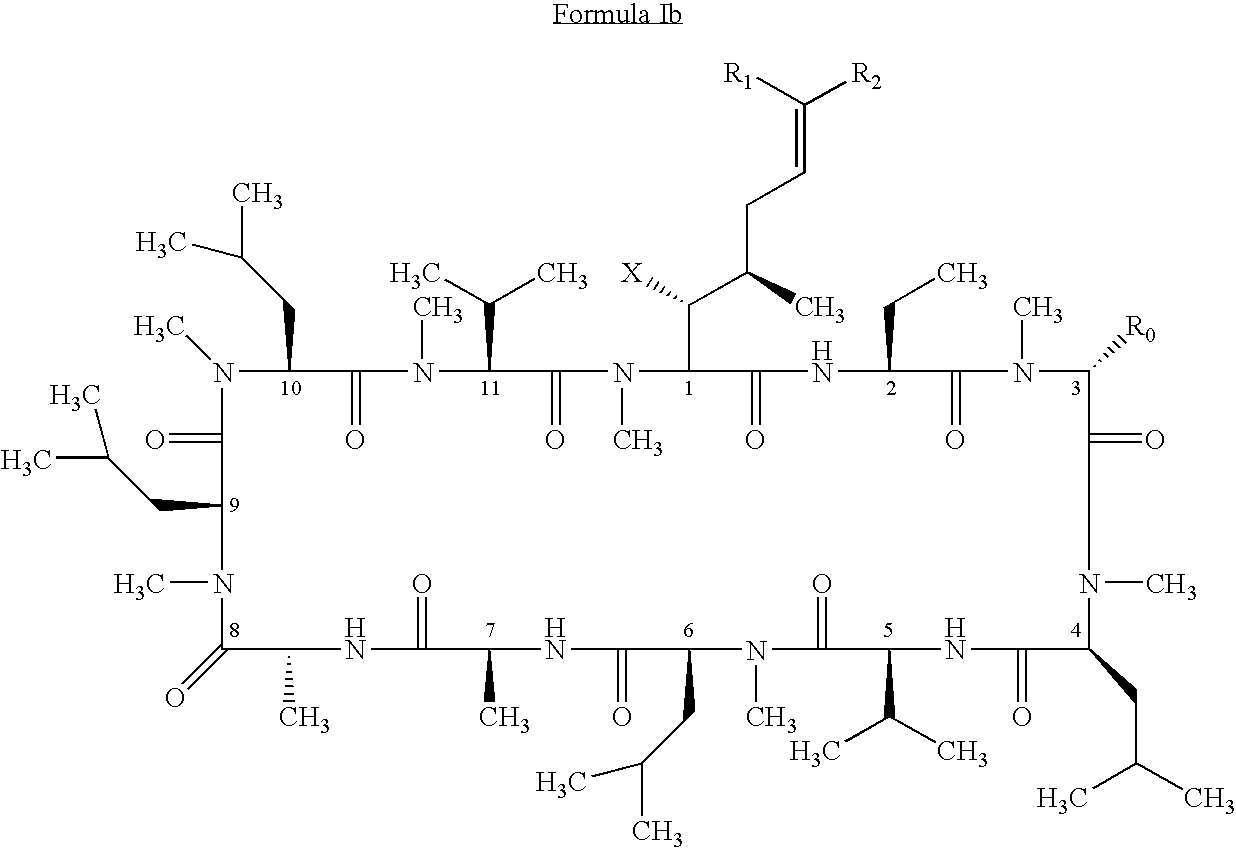
Priority Applications (2)
| Application Number | Priority Date | Filing Date | Title |
|---|---|---|---|
| US11/391,027 US20070232532A1 (en) | 2006-03-28 | 2006-03-28 | Use of cyclosporin alkene analogues for preventing or treating viral-induced disorders |
| PCT/US2007/064917 WO2007112345A2 (en) | 2006-03-28 | 2007-03-26 | Use of cyclosporin alkene analogues for preventing or treating viral-induced disorders |
Applications Claiming Priority (1)
| Application Number | Priority Date | Filing Date | Title |
|---|---|---|---|
| US11/391,027 US20070232532A1 (en) | 2006-03-28 | 2006-03-28 | Use of cyclosporin alkene analogues for preventing or treating viral-induced disorders |
Publications (1)
| Publication Number | Publication Date |
|---|---|
| US20070232532A1 true US20070232532A1 (en) | 2007-10-04 |
Family
ID=38541840
Family Applications (1)
| Application Number | Title | Priority Date | Filing Date |
|---|---|---|---|
| US11/391,027 Abandoned US20070232532A1 (en) | 2006-03-28 | 2006-03-28 | Use of cyclosporin alkene analogues for preventing or treating viral-induced disorders |
Country Status (2)
| Country | Link |
|---|---|
| US (1) | US20070232532A1 (en) |
| WO (1) | WO2007112345A2 (en) |
Cited By (7)
| Publication number | Priority date | Publication date | Assignee | Title |
|---|---|---|---|---|
| US20040235716A1 (en) * | 2003-03-17 | 2004-11-25 | Molino Bruce F. | Novel cyclosporins |
| US20070232531A1 (en) * | 2006-03-28 | 2007-10-04 | Amr Technology, Inc. | Use of cyclosporin alkyne/alkene analogues for preventing or treating viral-induced disorders |
| US20070232530A1 (en) * | 2006-03-28 | 2007-10-04 | Amr Technology, Inc. | Use of cyclosporin alkyne analogues for preventing or treating viral-induced disorders |
| US20080241289A1 (en) * | 2007-02-23 | 2008-10-02 | Auspex Pharmaceuticals, Inc. | Preparation and utility of non-nucleoside reverse transcriptase inhibitors |
| US20130190223A1 (en) * | 2008-07-30 | 2013-07-25 | Isotechnika Pharma Inc. | Nonimmunosuppressive cyclosporine analogue molecules |
| US9200038B2 (en) | 2010-12-15 | 2015-12-01 | Ciclofilin Pharmaceuticals Corp. | Cyclosporine analogue molecules modified at amino acid 1 and 3 |
| US20230159593A1 (en) * | 2020-05-14 | 2023-05-25 | Ucl Business Ltd | Cyclosporine analogues |
Families Citing this family (12)
| Publication number | Priority date | Publication date | Assignee | Title |
|---|---|---|---|---|
| AU2010208071C1 (en) | 2009-01-30 | 2013-06-20 | Enanta Pharmaceuticals, Inc. | Cyclosporin analogues for preventing or treating hepatitis C infection |
| US8481483B2 (en) | 2009-02-19 | 2013-07-09 | Enanta Pharmaceuticals, Inc. | Cyclosporin analogues |
| US8685917B2 (en) | 2009-07-09 | 2014-04-01 | Enanta Pharmaceuticals, Inc. | Cyclosporin analogues |
| US8367053B2 (en) | 2009-07-09 | 2013-02-05 | Enanta Pharmaceuticals, Inc. | Cyclosporin analogues |
| US8349312B2 (en) | 2009-07-09 | 2013-01-08 | Enanta Pharmaceuticals, Inc. | Proline substituted cyclosporin analogues |
| US8623814B2 (en) | 2010-02-23 | 2014-01-07 | Enanta Pharmaceuticals, Inc. | Antiviral agents |
| CN104487449A (en) | 2012-06-01 | 2015-04-01 | 阿勒根公司 | Cyclosporin A analogs |
| CN104603146B (en) | 2012-09-29 | 2018-01-02 | 诺华股份有限公司 | Cyclic peptide compound and its purposes as medicine |
| WO2014085623A1 (en) | 2012-11-28 | 2014-06-05 | Enanta Pharmaceuticals, Inc. | Novel [n-me-4-hydroxyleucine]-9-cyclosporin analogues |
| KR20160045136A (en) | 2013-08-26 | 2016-04-26 | 이난타 파마슈티칼스, 인코포레이티드 | Cyclosporin analogues for preventing or treating hepatitis c |
| US9669095B2 (en) | 2014-11-03 | 2017-06-06 | Enanta Pharmaceuticals, Inc. | Cyclosporin analogues for preventing or treating hepatitis C infection |
| EP4201952A1 (en) | 2021-12-21 | 2023-06-28 | Curia Spain, S.A.U. | Process for the controlled synthesis of voclosporin |
Citations (6)
| Publication number | Priority date | Publication date | Assignee | Title |
|---|---|---|---|---|
| US4814323A (en) * | 1986-03-25 | 1989-03-21 | Andrieu J M | Process for the treatment and the prevention of AIDS and other disorders induced by the LAV/HTLV III virus |
| US5948884A (en) * | 1995-07-17 | 1999-09-07 | C-Chem Ag | Cyclosporin derivatives with anti-HIV effect |
| US6506777B1 (en) * | 1999-06-11 | 2003-01-14 | Merck & Co., Inc. | Cyclopentyl modulators of chemokine receptor activity |
| US20040247624A1 (en) * | 2003-06-05 | 2004-12-09 | Unger Evan Charles | Methods of making pharmaceutical formulations for the delivery of drugs having low aqueous solubility |
| US20060069015A1 (en) * | 2004-09-29 | 2006-03-30 | Amr Technology, Inc. | Novel cyclosporin analogues and their pharmaceutical uses |
| US20060235716A1 (en) * | 2005-04-15 | 2006-10-19 | General Electric Company | Real-time interactive completely transparent collaboration within PACS for planning and consultation |
Family Cites Families (2)
| Publication number | Priority date | Publication date | Assignee | Title |
|---|---|---|---|---|
| CA2487039A1 (en) * | 2001-06-11 | 2002-12-19 | Transition Therapeutics Inc. | Combination therapies using vitamin b12 and interferon for treatment of viral, proliferative and inflammatory diseases |
| ES2266564T3 (en) * | 2001-10-19 | 2007-03-01 | Isotechnika Inc. | SYNTHESIS OF CYCLOPORINE ANALOGS. |
-
2006
- 2006-03-28 US US11/391,027 patent/US20070232532A1/en not_active Abandoned
-
2007
- 2007-03-26 WO PCT/US2007/064917 patent/WO2007112345A2/en not_active Ceased
Patent Citations (6)
| Publication number | Priority date | Publication date | Assignee | Title |
|---|---|---|---|---|
| US4814323A (en) * | 1986-03-25 | 1989-03-21 | Andrieu J M | Process for the treatment and the prevention of AIDS and other disorders induced by the LAV/HTLV III virus |
| US5948884A (en) * | 1995-07-17 | 1999-09-07 | C-Chem Ag | Cyclosporin derivatives with anti-HIV effect |
| US6506777B1 (en) * | 1999-06-11 | 2003-01-14 | Merck & Co., Inc. | Cyclopentyl modulators of chemokine receptor activity |
| US20040247624A1 (en) * | 2003-06-05 | 2004-12-09 | Unger Evan Charles | Methods of making pharmaceutical formulations for the delivery of drugs having low aqueous solubility |
| US20060069015A1 (en) * | 2004-09-29 | 2006-03-30 | Amr Technology, Inc. | Novel cyclosporin analogues and their pharmaceutical uses |
| US20060235716A1 (en) * | 2005-04-15 | 2006-10-19 | General Electric Company | Real-time interactive completely transparent collaboration within PACS for planning and consultation |
Cited By (11)
| Publication number | Priority date | Publication date | Assignee | Title |
|---|---|---|---|---|
| US20040235716A1 (en) * | 2003-03-17 | 2004-11-25 | Molino Bruce F. | Novel cyclosporins |
| US7538084B2 (en) | 2003-03-17 | 2009-05-26 | Amr Technology, Inc. | Cyclosporins |
| US20070232531A1 (en) * | 2006-03-28 | 2007-10-04 | Amr Technology, Inc. | Use of cyclosporin alkyne/alkene analogues for preventing or treating viral-induced disorders |
| US20070232530A1 (en) * | 2006-03-28 | 2007-10-04 | Amr Technology, Inc. | Use of cyclosporin alkyne analogues for preventing or treating viral-induced disorders |
| US7696166B2 (en) | 2006-03-28 | 2010-04-13 | Albany Molecular Research, Inc. | Use of cyclosporin alkyne/alkene analogues for preventing or treating viral-induced disorders |
| US7696165B2 (en) | 2006-03-28 | 2010-04-13 | Albany Molecular Research, Inc. | Use of cyclosporin alkyne analogues for preventing or treating viral-induced disorders |
| US20080241289A1 (en) * | 2007-02-23 | 2008-10-02 | Auspex Pharmaceuticals, Inc. | Preparation and utility of non-nucleoside reverse transcriptase inhibitors |
| US20130190223A1 (en) * | 2008-07-30 | 2013-07-25 | Isotechnika Pharma Inc. | Nonimmunosuppressive cyclosporine analogue molecules |
| US9200038B2 (en) | 2010-12-15 | 2015-12-01 | Ciclofilin Pharmaceuticals Corp. | Cyclosporine analogue molecules modified at amino acid 1 and 3 |
| US9714271B2 (en) | 2010-12-15 | 2017-07-25 | Contravir Pharmaceuticals, Inc. | Cyclosporine analogue molecules modified at amino acid 1 and 3 |
| US20230159593A1 (en) * | 2020-05-14 | 2023-05-25 | Ucl Business Ltd | Cyclosporine analogues |
Also Published As
| Publication number | Publication date |
|---|---|
| WO2007112345A8 (en) | 2009-11-05 |
| WO2007112345A2 (en) | 2007-10-04 |
| WO2007112345A3 (en) | 2007-11-29 |
Similar Documents
| Publication | Publication Date | Title |
|---|---|---|
| US7696166B2 (en) | Use of cyclosporin alkyne/alkene analogues for preventing or treating viral-induced disorders | |
| US7511013B2 (en) | Cyclosporin analogues and their pharmaceutical uses | |
| WO2007112345A2 (en) | Use of cyclosporin alkene analogues for preventing or treating viral-induced disorders | |
| WO2007112357A2 (en) | Use of cyclosporin alkyne analogues for preventing or treating viral-induced disorders | |
| EP1793844B1 (en) | Use of [d-meala]3-[etval]4-cyclosporin for the treatment of hepatitis c infection | |
| US20080249002A1 (en) | Cyclosporin alkyne analogues and their pharmaceutical uses | |
| US7632807B2 (en) | Cyclosporin alkynes and their utility as pharmaceutical agents | |
| US20100173837A1 (en) | Dosing forms and regimens comprising 3-[(r)-2-(n,n-dimethylamino)ethylthio-sar]-4-(gammahydroxymethylleucine)cyclosporine | |
| US7538084B2 (en) | Cyclosporins | |
| CN105169369A (en) | Methods and pharmaceutical compositions for the treatment and prevention of hepatitis C infection | |
| CN101316606B (en) | Methods and pharmaceutical compositions for treating and preventing hepatitis C infection | |
| US20080139463A1 (en) | Use Of [D-Meala]3-[Etval]4-Cyclosporin For The Treatment Of Hepatitis C Infection And Pharmaceutical Composition Comprising Said [D-Meala]3-[Etval]4-Cyclosporin |
Legal Events
| Date | Code | Title | Description |
|---|---|---|---|
| AS | Assignment |
Owner name: AMR TECHNOLOGY, INC., VERMONT Free format text: ASSIGNMENT OF ASSIGNORS INTEREST;ASSIGNOR:MOLINO, BRUCE F.;REEL/FRAME:017860/0125 Effective date: 20060413 |
|
| AS | Assignment |
Owner name: AMR TECHNOLOGY, INC., VERMONT Free format text: CORRECTIVE ASSIGNMENT TO CORRECT THE ASSIGNEE ADDRESS PREVIOUSLY RECORDED ON REEL 017860 FRAME 0125;ASSIGNOR:MOLINO, BRUCE F.;REEL/FRAME:019213/0366 Effective date: 20060413 |
|
| STCB | Information on status: application discontinuation |
Free format text: ABANDONED -- FAILURE TO RESPOND TO AN OFFICE ACTION |
|
| AS | Assignment |
Owner name: ALBANY MOLECULAR RESEARCH, INC., NEW YORK Free format text: ASSIGNMENT OF ASSIGNORS INTEREST;ASSIGNOR:AMR TECHNOLOGY, INC.;REEL/FRAME:021998/0550 Effective date: 20081211 Owner name: ALBANY MOLECULAR RESEARCH, INC.,NEW YORK Free format text: ASSIGNMENT OF ASSIGNORS INTEREST;ASSIGNOR:AMR TECHNOLOGY, INC.;REEL/FRAME:021998/0550 Effective date: 20081211 |