US20070221884A1 - Liminescent Silicon Oxide Flakes - Google Patents
Liminescent Silicon Oxide Flakes Download PDFInfo
- Publication number
- US20070221884A1 US20070221884A1 US11/631,446 US63144605A US2007221884A1 US 20070221884 A1 US20070221884 A1 US 20070221884A1 US 63144605 A US63144605 A US 63144605A US 2007221884 A1 US2007221884 A1 US 2007221884A1
- Authority
- US
- United States
- Prior art keywords
- chr
- alkyl
- group
- sio
- porous
- Prior art date
- Legal status (The legal status is an assumption and is not a legal conclusion. Google has not performed a legal analysis and makes no representation as to the accuracy of the status listed.)
- Abandoned
Links
- 229910052814 silicon oxide Inorganic materials 0.000 title claims abstract description 157
- VYPSYNLAJGMNEJ-UHFFFAOYSA-N Silicium dioxide Chemical compound O=[Si]=O VYPSYNLAJGMNEJ-UHFFFAOYSA-N 0.000 title description 19
- 239000000203 mixture Substances 0.000 claims abstract description 65
- 150000001875 compounds Chemical class 0.000 claims abstract description 61
- -1 benzocoumarins Chemical class 0.000 claims description 225
- 229910052736 halogen Inorganic materials 0.000 claims description 50
- 150000002367 halogens Chemical class 0.000 claims description 48
- 239000003086 colorant Substances 0.000 claims description 46
- 229910052739 hydrogen Inorganic materials 0.000 claims description 41
- 239000001257 hydrogen Substances 0.000 claims description 36
- 125000001997 phenyl group Chemical group [H]C1=C([H])C([H])=C(*)C([H])=C1[H] 0.000 claims description 34
- 125000003118 aryl group Chemical group 0.000 claims description 32
- 125000004093 cyano group Chemical group *C#N 0.000 claims description 28
- 150000002431 hydrogen Chemical group 0.000 claims description 28
- 239000000463 material Substances 0.000 claims description 27
- 125000001072 heteroaryl group Chemical group 0.000 claims description 23
- 125000000217 alkyl group Chemical group 0.000 claims description 19
- 125000004209 (C1-C8) alkyl group Chemical group 0.000 claims description 17
- 238000007639 printing Methods 0.000 claims description 17
- 239000012190 activator Substances 0.000 claims description 16
- 229910052760 oxygen Inorganic materials 0.000 claims description 16
- 125000004178 (C1-C4) alkyl group Chemical group 0.000 claims description 15
- 239000002537 cosmetic Substances 0.000 claims description 15
- 230000003287 optical effect Effects 0.000 claims description 15
- 239000011701 zinc Substances 0.000 claims description 15
- 125000002887 hydroxy group Chemical group [H]O* 0.000 claims description 14
- 239000000976 ink Substances 0.000 claims description 14
- 238000002360 preparation method Methods 0.000 claims description 14
- 239000011572 manganese Substances 0.000 claims description 13
- 125000001424 substituent group Chemical group 0.000 claims description 13
- 239000000758 substrate Substances 0.000 claims description 13
- 125000002023 trifluoromethyl group Chemical group FC(F)(F)* 0.000 claims description 13
- OAICVXFJPJFONN-UHFFFAOYSA-N Phosphorus Chemical compound [P] OAICVXFJPJFONN-UHFFFAOYSA-N 0.000 claims description 12
- 239000003446 ligand Substances 0.000 claims description 12
- 229920003023 plastic Polymers 0.000 claims description 12
- 239000004033 plastic Substances 0.000 claims description 12
- 229910019142 PO4 Inorganic materials 0.000 claims description 11
- 125000003545 alkoxy group Chemical group 0.000 claims description 10
- ZYGHJZDHTFUPRJ-UHFFFAOYSA-N benzo-alpha-pyrone Natural products C1=CC=C2OC(=O)C=CC2=C1 ZYGHJZDHTFUPRJ-UHFFFAOYSA-N 0.000 claims description 10
- 238000000576 coating method Methods 0.000 claims description 10
- 238000009472 formulation Methods 0.000 claims description 10
- 229910052749 magnesium Inorganic materials 0.000 claims description 10
- 229910052725 zinc Inorganic materials 0.000 claims description 10
- VVZRKVYGKNFTRR-UHFFFAOYSA-N 12h-benzo[a]xanthene Chemical class C1=CC=CC2=C3CC4=CC=CC=C4OC3=CC=C21 VVZRKVYGKNFTRR-UHFFFAOYSA-N 0.000 claims description 9
- 125000003282 alkyl amino group Chemical group 0.000 claims description 9
- 239000011368 organic material Substances 0.000 claims description 9
- UFHFLCQGNIYNRP-UHFFFAOYSA-N Hydrogen Chemical compound [H][H] UFHFLCQGNIYNRP-UHFFFAOYSA-N 0.000 claims description 8
- 229910052748 manganese Inorganic materials 0.000 claims description 8
- 229910052761 rare earth metal Inorganic materials 0.000 claims description 8
- 125000006850 spacer group Chemical group 0.000 claims description 8
- 125000001273 sulfonato group Chemical group [O-]S(*)(=O)=O 0.000 claims description 8
- SWAGSGUXOCHFHN-UHFFFAOYSA-N 12h-benzo[b]xanthene Chemical class C1=CC=C2C=C3CC4=CC=CC=C4OC3=CC2=C1 SWAGSGUXOCHFHN-UHFFFAOYSA-N 0.000 claims description 7
- 229910052801 chlorine Inorganic materials 0.000 claims description 7
- 239000011248 coating agent Substances 0.000 claims description 7
- 235000001671 coumarin Nutrition 0.000 claims description 7
- 125000004663 dialkyl amino group Chemical group 0.000 claims description 7
- 150000003467 sulfuric acid derivatives Chemical class 0.000 claims description 7
- 125000004650 C1-C8 alkynyl group Chemical group 0.000 claims description 6
- PWHULOQIROXLJO-UHFFFAOYSA-N Manganese Chemical compound [Mn] PWHULOQIROXLJO-UHFFFAOYSA-N 0.000 claims description 6
- HCHKCACWOHOZIP-UHFFFAOYSA-N Zinc Chemical compound [Zn] HCHKCACWOHOZIP-UHFFFAOYSA-N 0.000 claims description 6
- WUKWITHWXAAZEY-UHFFFAOYSA-L calcium difluoride Chemical compound [F-].[F-].[Ca+2] WUKWITHWXAAZEY-UHFFFAOYSA-L 0.000 claims description 6
- 229910001634 calcium fluoride Inorganic materials 0.000 claims description 6
- 150000004775 coumarins Chemical class 0.000 claims description 6
- 229910052731 fluorine Inorganic materials 0.000 claims description 6
- 150000004820 halides Chemical class 0.000 claims description 6
- 125000005179 haloacetyl group Chemical group 0.000 claims description 6
- 229910052751 metal Inorganic materials 0.000 claims description 6
- 239000002184 metal Substances 0.000 claims description 6
- 229910001508 alkali metal halide Inorganic materials 0.000 claims description 5
- 150000008045 alkali metal halides Chemical class 0.000 claims description 5
- 125000003178 carboxy group Chemical group [H]OC(*)=O 0.000 claims description 5
- 229910052709 silver Inorganic materials 0.000 claims description 5
- 150000004763 sulfides Chemical group 0.000 claims description 5
- 150000003852 triazoles Chemical class 0.000 claims description 5
- WADCPEMKIBAJHH-UHFFFAOYSA-N 3,4-diphenylpyrrole-2,5-dione Chemical class O=C1NC(=O)C(C=2C=CC=CC=2)=C1C1=CC=CC=C1 WADCPEMKIBAJHH-UHFFFAOYSA-N 0.000 claims description 4
- HUKPVYBUJRAUAG-UHFFFAOYSA-N 7-benzo[a]phenalenone Chemical class C1=CC(C(=O)C=2C3=CC=CC=2)=C2C3=CC=CC2=C1 HUKPVYBUJRAUAG-UHFFFAOYSA-N 0.000 claims description 4
- GJCOSYZMQJWQCA-UHFFFAOYSA-N 9H-xanthene Chemical compound C1=CC=C2CC3=CC=CC=C3OC2=C1 GJCOSYZMQJWQCA-UHFFFAOYSA-N 0.000 claims description 4
- 229910006069 SO3H Inorganic materials 0.000 claims description 4
- BQCADISMDOOEFD-UHFFFAOYSA-N Silver Chemical compound [Ag] BQCADISMDOOEFD-UHFFFAOYSA-N 0.000 claims description 4
- GCPWJFKTWGFEHH-UHFFFAOYSA-N acetoacetamide Chemical class CC(=O)CC(N)=O GCPWJFKTWGFEHH-UHFFFAOYSA-N 0.000 claims description 4
- 150000004645 aluminates Chemical class 0.000 claims description 4
- COHDHYZHOPQOFD-UHFFFAOYSA-N arsenic pentoxide Chemical compound O=[As](=O)O[As](=O)=O COHDHYZHOPQOFD-UHFFFAOYSA-N 0.000 claims description 4
- XJHABGPPCLHLLV-UHFFFAOYSA-N benzo[de]isoquinoline-1,3-dione Chemical class C1=CC(C(=O)NC2=O)=C3C2=CC=CC3=C1 XJHABGPPCLHLLV-UHFFFAOYSA-N 0.000 claims description 4
- 150000001907 coumarones Chemical class 0.000 claims description 4
- 150000004826 dibenzofurans Chemical class 0.000 claims description 4
- 239000011521 glass Substances 0.000 claims description 4
- HUVCZKYUWFGVLS-UHFFFAOYSA-N imidazo[4,5-e]thiazine Chemical class C1=NSC2=NC=NC2=C1 HUVCZKYUWFGVLS-UHFFFAOYSA-N 0.000 claims description 4
- QDLAGTHXVHQKRE-UHFFFAOYSA-N lichenxanthone Natural products COC1=CC(O)=C2C(=O)C3=C(C)C=C(OC)C=C3OC2=C1 QDLAGTHXVHQKRE-UHFFFAOYSA-N 0.000 claims description 4
- 125000001434 methanylylidene group Chemical group [H]C#[*] 0.000 claims description 4
- 150000002894 organic compounds Chemical class 0.000 claims description 4
- 125000000843 phenylene group Chemical group C1(=C(C=CC=C1)*)* 0.000 claims description 4
- 125000005543 phthalimide group Chemical class 0.000 claims description 4
- 150000003216 pyrazines Chemical class 0.000 claims description 4
- 150000003230 pyrimidines Chemical class 0.000 claims description 4
- 239000004332 silver Substances 0.000 claims description 4
- 229910001631 strontium chloride Inorganic materials 0.000 claims description 4
- AHBGXTDRMVNFER-UHFFFAOYSA-L strontium dichloride Chemical compound [Cl-].[Cl-].[Sr+2] AHBGXTDRMVNFER-UHFFFAOYSA-L 0.000 claims description 4
- 125000000020 sulfo group Chemical group O=S(=O)([*])O[H] 0.000 claims description 4
- 150000003918 triazines Chemical class 0.000 claims description 4
- LSGOVYNHVSXFFJ-UHFFFAOYSA-N vanadate(3-) Chemical class [O-][V]([O-])([O-])=O LSGOVYNHVSXFFJ-UHFFFAOYSA-N 0.000 claims description 4
- 150000000183 1,3-benzoxazoles Chemical class 0.000 claims description 3
- YOSZEPWSVKKQOV-UHFFFAOYSA-N 12h-benzo[a]phenoxazine Chemical class C1=CC=CC2=C3NC4=CC=CC=C4OC3=CC=C21 YOSZEPWSVKKQOV-UHFFFAOYSA-N 0.000 claims description 3
- BDDQPKXDNUKVCC-UHFFFAOYSA-N 12h-benzo[b]phenoxazine Chemical class C1=CC=C2C=C3NC4=CC=CC=C4OC3=CC2=C1 BDDQPKXDNUKVCC-UHFFFAOYSA-N 0.000 claims description 3
- ZWCZPVMIHLKVLD-UHFFFAOYSA-N 2,5-diphenyl-3,4-dihydropyrazole Chemical class C1CC(C=2C=CC=CC=2)=NN1C1=CC=CC=C1 ZWCZPVMIHLKVLD-UHFFFAOYSA-N 0.000 claims description 3
- JRSLDSNZKFSCGW-UHFFFAOYSA-N 4-phenylhexa-1,3,5-trien-3-ylbenzene Chemical class C=1C=CC=CC=1C(C=C)=C(C=C)C1=CC=CC=C1 JRSLDSNZKFSCGW-UHFFFAOYSA-N 0.000 claims description 3
- VDISGEKPIVMONQ-UHFFFAOYSA-N 7h-benzo[c]phenoxazine Chemical class C1=CC2=CC=CC=C2C2=C1NC1=CC=CC=C1O2 VDISGEKPIVMONQ-UHFFFAOYSA-N 0.000 claims description 3
- RGHINSLFCBMCFS-UHFFFAOYSA-N 7h-benzo[c]xanthene Chemical class C1=CC2=CC=CC=C2C2=C1CC1=CC=CC=C1O2 RGHINSLFCBMCFS-UHFFFAOYSA-N 0.000 claims description 3
- RYGMFSIKBFXOCR-UHFFFAOYSA-N Copper Chemical compound [Cu] RYGMFSIKBFXOCR-UHFFFAOYSA-N 0.000 claims description 3
- BKQMNPVDJIHLPD-UHFFFAOYSA-N OS(=O)(=O)[Se]S(O)(=O)=O Chemical class OS(=O)(=O)[Se]S(O)(=O)=O BKQMNPVDJIHLPD-UHFFFAOYSA-N 0.000 claims description 3
- 229910009372 YVO4 Inorganic materials 0.000 claims description 3
- 125000004414 alkyl thio group Chemical group 0.000 claims description 3
- 150000001556 benzimidazoles Chemical class 0.000 claims description 3
- 239000012876 carrier material Substances 0.000 claims description 3
- 229910052802 copper Inorganic materials 0.000 claims description 3
- 239000010949 copper Substances 0.000 claims description 3
- 150000002240 furans Chemical class 0.000 claims description 3
- PCHJSUWPFVWCPO-UHFFFAOYSA-N gold Chemical compound [Au] PCHJSUWPFVWCPO-UHFFFAOYSA-N 0.000 claims description 3
- 229910052737 gold Inorganic materials 0.000 claims description 3
- 239000010931 gold Substances 0.000 claims description 3
- 150000002484 inorganic compounds Chemical class 0.000 claims description 3
- 229910010272 inorganic material Inorganic materials 0.000 claims description 3
- WPBNNNQJVZRUHP-UHFFFAOYSA-L manganese(2+);methyl n-[[2-(methoxycarbonylcarbamothioylamino)phenyl]carbamothioyl]carbamate;n-[2-(sulfidocarbothioylamino)ethyl]carbamodithioate Chemical compound [Mn+2].[S-]C(=S)NCCNC([S-])=S.COC(=O)NC(=S)NC1=CC=CC=C1NC(=S)NC(=O)OC WPBNNNQJVZRUHP-UHFFFAOYSA-L 0.000 claims description 3
- 150000004893 oxazines Chemical class 0.000 claims description 3
- 150000002991 phenoxazines Chemical class 0.000 claims description 3
- 235000021317 phosphate Nutrition 0.000 claims description 3
- 150000002910 rare earth metals Chemical class 0.000 claims description 3
- 239000004753 textile Substances 0.000 claims description 3
- 150000004897 thiazines Chemical class 0.000 claims description 3
- 150000003732 xanthenes Chemical class 0.000 claims description 3
- 125000006702 (C1-C18) alkyl group Chemical group 0.000 claims description 2
- 125000004317 1,3,5-triazin-2-yl group Chemical group [H]C1=NC(*)=NC([H])=N1 0.000 claims description 2
- BRVWNIITDBKNRV-UHFFFAOYSA-N 2-[2-(2-phenylethenyl)phenyl]triazole Chemical class C=1C=CC=CC=1C=CC1=CC=CC=C1N1N=CC=N1 BRVWNIITDBKNRV-UHFFFAOYSA-N 0.000 claims description 2
- DJHGAFSJWGLOIV-UHFFFAOYSA-K Arsenate3- Chemical class [O-][As]([O-])([O-])=O DJHGAFSJWGLOIV-UHFFFAOYSA-K 0.000 claims description 2
- 229910004829 CaWO4 Inorganic materials 0.000 claims description 2
- 229910002420 LaOCl Inorganic materials 0.000 claims description 2
- 229910001477 LaPO4 Inorganic materials 0.000 claims description 2
- 229910017672 MgWO4 Inorganic materials 0.000 claims description 2
- 229910052936 alkali metal sulfate Inorganic materials 0.000 claims description 2
- 125000004171 alkoxy aryl group Chemical group 0.000 claims description 2
- RCUAPGYXYWSYKO-UHFFFAOYSA-J barium(2+);phosphonato phosphate Chemical compound [Ba+2].[Ba+2].[O-]P([O-])(=O)OP([O-])([O-])=O RCUAPGYXYWSYKO-UHFFFAOYSA-J 0.000 claims description 2
- 150000001642 boronic acid derivatives Chemical class 0.000 claims description 2
- 239000000919 ceramic Substances 0.000 claims description 2
- 229960000956 coumarin Drugs 0.000 claims description 2
- 229910001635 magnesium fluoride Inorganic materials 0.000 claims description 2
- 150000003013 phosphoric acid derivatives Chemical class 0.000 claims description 2
- 150000003346 selenoethers Chemical class 0.000 claims description 2
- 150000004760 silicates Chemical class 0.000 claims description 2
- XTQHKBHJIVJGKJ-UHFFFAOYSA-N sulfur monoxide Chemical class S=O XTQHKBHJIVJGKJ-UHFFFAOYSA-N 0.000 claims description 2
- JOPDZQBPOWAEHC-UHFFFAOYSA-H tristrontium;diphosphate Chemical compound [Sr+2].[Sr+2].[Sr+2].[O-]P([O-])([O-])=O.[O-]P([O-])([O-])=O JOPDZQBPOWAEHC-UHFFFAOYSA-H 0.000 claims description 2
- 229910019901 yttrium aluminum garnet Inorganic materials 0.000 claims description 2
- 229910000165 zinc phosphate Inorganic materials 0.000 claims description 2
- 150000002979 perylenes Chemical class 0.000 claims 4
- 150000001565 benzotriazoles Chemical class 0.000 claims 2
- 229910052733 gallium Inorganic materials 0.000 claims 1
- 229910052716 thallium Inorganic materials 0.000 claims 1
- 230000007774 longterm Effects 0.000 abstract description 2
- LFQSCWFLJHTTHZ-UHFFFAOYSA-N Ethanol Chemical compound CCO LFQSCWFLJHTTHZ-UHFFFAOYSA-N 0.000 description 43
- 125000000319 biphenyl-4-yl group Chemical group [H]C1=C([H])C([H])=C([H])C([H])=C1C1=C([H])C([H])=C([*])C([H])=C1[H] 0.000 description 34
- 0 *C1=CC=C2C=C([2*])C(=O)OC2=C1 Chemical compound *C1=CC=C2C=C([2*])C(=O)OC2=C1 0.000 description 33
- 239000011734 sodium Substances 0.000 description 32
- 239000000049 pigment Substances 0.000 description 26
- 239000000243 solution Substances 0.000 description 25
- 239000002245 particle Substances 0.000 description 23
- 239000000725 suspension Substances 0.000 description 22
- 239000003795 chemical substances by application Substances 0.000 description 21
- 125000002496 methyl group Chemical group [H]C([H])([H])* 0.000 description 21
- 238000000034 method Methods 0.000 description 19
- 239000011148 porous material Substances 0.000 description 19
- 239000000047 product Substances 0.000 description 16
- 238000003756 stirring Methods 0.000 description 16
- SJRJJKPEHAURKC-UHFFFAOYSA-N CN1CCOCC1 Chemical compound CN1CCOCC1 SJRJJKPEHAURKC-UHFFFAOYSA-N 0.000 description 13
- QVGXLLKOCUKJST-UHFFFAOYSA-N atomic oxygen Chemical compound [O] QVGXLLKOCUKJST-UHFFFAOYSA-N 0.000 description 13
- 125000000753 cycloalkyl group Chemical group 0.000 description 13
- 239000001301 oxygen Substances 0.000 description 13
- 239000002904 solvent Substances 0.000 description 13
- 125000001637 1-naphthyl group Chemical group [H]C1=C([H])C([H])=C2C(*)=C([H])C([H])=C([H])C2=C1[H] 0.000 description 10
- IJGRMHOSHXDMSA-UHFFFAOYSA-N Atomic nitrogen Chemical compound N#N IJGRMHOSHXDMSA-UHFFFAOYSA-N 0.000 description 10
- 229910052771 Terbium Inorganic materials 0.000 description 10
- 230000004913 activation Effects 0.000 description 10
- 239000000460 chlorine Chemical group 0.000 description 10
- 230000005284 excitation Effects 0.000 description 10
- 238000010304 firing Methods 0.000 description 10
- 238000004519 manufacturing process Methods 0.000 description 10
- OPKOKAMJFNKNAS-UHFFFAOYSA-N CNCCO Chemical compound CNCCO OPKOKAMJFNKNAS-UHFFFAOYSA-N 0.000 description 9
- 229910052693 Europium Inorganic materials 0.000 description 9
- 238000006243 chemical reaction Methods 0.000 description 9
- 239000007859 condensation product Substances 0.000 description 9
- 125000000524 functional group Chemical group 0.000 description 9
- CRVGTESFCCXCTH-UHFFFAOYSA-N CN(CCO)CCO Chemical compound CN(CCO)CCO CRVGTESFCCXCTH-UHFFFAOYSA-N 0.000 description 8
- ZMXDDKWLCZADIW-UHFFFAOYSA-N N,N-Dimethylformamide Chemical compound CN(C)C=O ZMXDDKWLCZADIW-UHFFFAOYSA-N 0.000 description 8
- XUIMIQQOPSSXEZ-UHFFFAOYSA-N Silicon Chemical compound [Si] XUIMIQQOPSSXEZ-UHFFFAOYSA-N 0.000 description 8
- FAPWRFPIFSIZLT-UHFFFAOYSA-M Sodium chloride Chemical compound [Na+].[Cl-] FAPWRFPIFSIZLT-UHFFFAOYSA-M 0.000 description 8
- 229910052784 alkaline earth metal Inorganic materials 0.000 description 8
- 230000000694 effects Effects 0.000 description 8
- PQXKHYXIUOZZFA-UHFFFAOYSA-M lithium fluoride Chemical compound [Li+].[F-] PQXKHYXIUOZZFA-UHFFFAOYSA-M 0.000 description 8
- 239000011777 magnesium Substances 0.000 description 8
- 230000008569 process Effects 0.000 description 8
- 229910052710 silicon Inorganic materials 0.000 description 8
- 239000010703 silicon Substances 0.000 description 8
- XLYOFNOQVPJJNP-UHFFFAOYSA-N water Substances O XLYOFNOQVPJJNP-UHFFFAOYSA-N 0.000 description 8
- 125000001622 2-naphthyl group Chemical group [H]C1=C([H])C([H])=C2C([H])=C(*)C([H])=C([H])C2=C1[H] 0.000 description 7
- WSFSSNUMVMOOMR-UHFFFAOYSA-N Formaldehyde Chemical compound O=C WSFSSNUMVMOOMR-UHFFFAOYSA-N 0.000 description 7
- XSQUKJJJFZCRTK-UHFFFAOYSA-N Urea Chemical compound NC(N)=O XSQUKJJJFZCRTK-UHFFFAOYSA-N 0.000 description 7
- 125000003342 alkenyl group Chemical group 0.000 description 7
- 125000000304 alkynyl group Chemical group 0.000 description 7
- 125000003917 carbamoyl group Chemical group [H]N([H])C(*)=O 0.000 description 7
- 239000008367 deionised water Substances 0.000 description 7
- OGPBJKLSAFTDLK-UHFFFAOYSA-N europium atom Chemical compound [Eu] OGPBJKLSAFTDLK-UHFFFAOYSA-N 0.000 description 7
- 125000000555 isopropenyl group Chemical group [H]\C([H])=C(\*)C([H])([H])[H] 0.000 description 7
- 238000004020 luminiscence type Methods 0.000 description 7
- 125000000449 nitro group Chemical group [O-][N+](*)=O 0.000 description 7
- 229920000642 polymer Polymers 0.000 description 7
- 230000005855 radiation Effects 0.000 description 7
- 150000003254 radicals Chemical class 0.000 description 7
- 229920005989 resin Polymers 0.000 description 7
- 239000011347 resin Substances 0.000 description 7
- 230000003595 spectral effect Effects 0.000 description 7
- 125000003903 2-propenyl group Chemical group [H]C([*])([H])C([H])=C([H])[H] 0.000 description 6
- 229910052684 Cerium Inorganic materials 0.000 description 6
- HEDRZPFGACZZDS-UHFFFAOYSA-N Chloroform Chemical compound ClC(Cl)Cl HEDRZPFGACZZDS-UHFFFAOYSA-N 0.000 description 6
- ZMANZCXQSJIPKH-UHFFFAOYSA-N Triethylamine Chemical compound CCN(CC)CC ZMANZCXQSJIPKH-UHFFFAOYSA-N 0.000 description 6
- 125000003710 aryl alkyl group Chemical group 0.000 description 6
- 125000001797 benzyl group Chemical group [H]C1=C([H])C([H])=C(C([H])=C1[H])C([H])([H])* 0.000 description 6
- 125000000956 methoxy group Chemical group [H]C([H])([H])O* 0.000 description 6
- 229910052757 nitrogen Inorganic materials 0.000 description 6
- 239000003973 paint Substances 0.000 description 6
- 125000002080 perylenyl group Chemical class C1(=CC=C2C=CC=C3C4=CC=CC5=CC=CC(C1=C23)=C45)* 0.000 description 6
- 239000000126 substance Substances 0.000 description 6
- 238000006467 substitution reaction Methods 0.000 description 6
- 229910052717 sulfur Inorganic materials 0.000 description 6
- GZCRRIHWUXGPOV-UHFFFAOYSA-N terbium atom Chemical compound [Tb] GZCRRIHWUXGPOV-UHFFFAOYSA-N 0.000 description 6
- DRDVZXDWVBGGMH-UHFFFAOYSA-N zinc;sulfide Chemical compound [S-2].[Zn+2] DRDVZXDWVBGGMH-UHFFFAOYSA-N 0.000 description 6
- 125000000229 (C1-C4)alkoxy group Chemical group 0.000 description 5
- ZAMOUSCENKQFHK-UHFFFAOYSA-N Chlorine atom Chemical group [Cl] ZAMOUSCENKQFHK-UHFFFAOYSA-N 0.000 description 5
- ROSDSFDQCJNGOL-UHFFFAOYSA-N Dimethylamine Chemical compound CNC ROSDSFDQCJNGOL-UHFFFAOYSA-N 0.000 description 5
- 229910052692 Dysprosium Inorganic materials 0.000 description 5
- 206010056740 Genital discharge Diseases 0.000 description 5
- NINIDFKCEFEMDL-UHFFFAOYSA-N Sulfur Chemical compound [S] NINIDFKCEFEMDL-UHFFFAOYSA-N 0.000 description 5
- 239000002253 acid Substances 0.000 description 5
- 125000003172 aldehyde group Chemical group 0.000 description 5
- 239000012298 atmosphere Substances 0.000 description 5
- 239000011230 binding agent Substances 0.000 description 5
- 239000011575 calcium Substances 0.000 description 5
- ZMIGMASIKSOYAM-UHFFFAOYSA-N cerium Chemical compound [Ce][Ce][Ce][Ce][Ce][Ce][Ce][Ce][Ce][Ce][Ce][Ce][Ce][Ce][Ce][Ce][Ce][Ce][Ce][Ce][Ce][Ce][Ce][Ce][Ce][Ce][Ce][Ce][Ce][Ce][Ce][Ce][Ce][Ce][Ce][Ce][Ce][Ce] ZMIGMASIKSOYAM-UHFFFAOYSA-N 0.000 description 5
- 238000001035 drying Methods 0.000 description 5
- 125000004185 ester group Chemical group 0.000 description 5
- 125000001495 ethyl group Chemical group [H]C([H])([H])C([H])([H])* 0.000 description 5
- 125000000623 heterocyclic group Chemical group 0.000 description 5
- 125000000468 ketone group Chemical group 0.000 description 5
- 150000002576 ketones Chemical class 0.000 description 5
- 125000004108 n-butyl group Chemical group [H]C([H])([H])C([H])([H])C([H])([H])C([H])([H])* 0.000 description 5
- 125000001037 p-tolyl group Chemical group [H]C1=C([H])C(=C([H])C([H])=C1*)C([H])([H])[H] 0.000 description 5
- 230000000485 pigmenting effect Effects 0.000 description 5
- IJDNQMDRQITEOD-UHFFFAOYSA-N sec-butylidene Natural products CCCC IJDNQMDRQITEOD-UHFFFAOYSA-N 0.000 description 5
- 125000005401 siloxanyl group Chemical group 0.000 description 5
- 125000003808 silyl group Chemical group [H][Si]([H])([H])[*] 0.000 description 5
- 125000001544 thienyl group Chemical group 0.000 description 5
- 238000007740 vapor deposition Methods 0.000 description 5
- 125000000954 2-hydroxyethyl group Chemical group [H]C([*])([H])C([H])([H])O[H] 0.000 description 4
- VQGHOUODWALEFC-UHFFFAOYSA-N 2-phenylpyridine Chemical compound C1=CC=CC=C1C1=CC=CC=N1 VQGHOUODWALEFC-UHFFFAOYSA-N 0.000 description 4
- WKBOTKDWSSQWDR-UHFFFAOYSA-N Bromine atom Chemical group [Br] WKBOTKDWSSQWDR-UHFFFAOYSA-N 0.000 description 4
- PTGGBKQSJXRBAY-UHFFFAOYSA-N CC1=C(C)C(C)=C(C)C(C)=C1C.CC1=NC(C)=C(C)C(C)=C1C.CC1=NC(C)=C(C)C(C)=C1C.CC1=NC(C)=C(C)C(C)=C1C Chemical compound CC1=C(C)C(C)=C(C)C(C)=C1C.CC1=NC(C)=C(C)C(C)=C1C.CC1=NC(C)=C(C)C(C)=C1C.CC1=NC(C)=C(C)C(C)=C1C PTGGBKQSJXRBAY-UHFFFAOYSA-N 0.000 description 4
- YMWUJEATGCHHMB-UHFFFAOYSA-N Dichloromethane Chemical compound ClCCl YMWUJEATGCHHMB-UHFFFAOYSA-N 0.000 description 4
- QOSSAOTZNIDXMA-UHFFFAOYSA-N Dicylcohexylcarbodiimide Chemical compound C1CCCCC1N=C=NC1CCCCC1 QOSSAOTZNIDXMA-UHFFFAOYSA-N 0.000 description 4
- PPBRXRYQALVLMV-UHFFFAOYSA-N Styrene Chemical compound C=CC1=CC=CC=C1 PPBRXRYQALVLMV-UHFFFAOYSA-N 0.000 description 4
- 229910052775 Thulium Inorganic materials 0.000 description 4
- 238000004833 X-ray photoelectron spectroscopy Methods 0.000 description 4
- 238000010521 absorption reaction Methods 0.000 description 4
- 229920000180 alkyd Polymers 0.000 description 4
- 125000003277 amino group Chemical group 0.000 description 4
- HNYOPLTXPVRDBG-UHFFFAOYSA-N barbituric acid Chemical compound O=C1CC(=O)NC(=O)N1 HNYOPLTXPVRDBG-UHFFFAOYSA-N 0.000 description 4
- 125000003354 benzotriazolyl group Chemical class N1N=NC2=C1C=CC=C2* 0.000 description 4
- GDTBXPJZTBHREO-UHFFFAOYSA-N bromine Chemical group BrBr GDTBXPJZTBHREO-UHFFFAOYSA-N 0.000 description 4
- 229910052794 bromium Chemical group 0.000 description 4
- 229910052791 calcium Inorganic materials 0.000 description 4
- 229920002678 cellulose Polymers 0.000 description 4
- 229910052681 coesite Inorganic materials 0.000 description 4
- 229910052906 cristobalite Inorganic materials 0.000 description 4
- 125000004122 cyclic group Chemical group 0.000 description 4
- 125000000392 cycloalkenyl group Chemical group 0.000 description 4
- 125000000113 cyclohexyl group Chemical group [H]C1([H])C([H])([H])C([H])([H])C([H])(*)C([H])([H])C1([H])[H] 0.000 description 4
- ZUOUZKKEUPVFJK-UHFFFAOYSA-N diphenyl Chemical compound C1=CC=CC=C1C1=CC=CC=C1 ZUOUZKKEUPVFJK-UHFFFAOYSA-N 0.000 description 4
- 239000011737 fluorine Substances 0.000 description 4
- 125000000262 haloalkenyl group Chemical group 0.000 description 4
- 125000001188 haloalkyl group Chemical group 0.000 description 4
- 238000010348 incorporation Methods 0.000 description 4
- 150000002500 ions Chemical class 0.000 description 4
- 125000000959 isobutyl group Chemical group [H]C([H])([H])C([H])(C([H])([H])[H])C([H])([H])* 0.000 description 4
- 125000001449 isopropyl group Chemical group [H]C([H])([H])C([H])(*)C([H])([H])[H] 0.000 description 4
- 229910052747 lanthanoid Inorganic materials 0.000 description 4
- 150000002602 lanthanoids Chemical class 0.000 description 4
- BDAGIHXWWSANSR-UHFFFAOYSA-N methanoic acid Natural products OC=O BDAGIHXWWSANSR-UHFFFAOYSA-N 0.000 description 4
- 125000004123 n-propyl group Chemical group [H]C([H])([H])C([H])([H])C([H])([H])* 0.000 description 4
- 238000001556 precipitation Methods 0.000 description 4
- 238000005001 rutherford backscattering spectroscopy Methods 0.000 description 4
- 150000003839 salts Chemical class 0.000 description 4
- 238000000926 separation method Methods 0.000 description 4
- 239000000377 silicon dioxide Substances 0.000 description 4
- LIVNPJMFVYWSIS-UHFFFAOYSA-N silicon monoxide Chemical compound [Si-]#[O+] LIVNPJMFVYWSIS-UHFFFAOYSA-N 0.000 description 4
- 239000011780 sodium chloride Substances 0.000 description 4
- 229910052682 stishovite Inorganic materials 0.000 description 4
- 239000011593 sulfur Substances 0.000 description 4
- 229920001169 thermoplastic Polymers 0.000 description 4
- 229910052905 tridymite Inorganic materials 0.000 description 4
- 239000002966 varnish Substances 0.000 description 4
- 229910052727 yttrium Inorganic materials 0.000 description 4
- 229910052984 zinc sulfide Inorganic materials 0.000 description 4
- SJECZPVISLOESU-UHFFFAOYSA-N 3-trimethoxysilylpropan-1-amine Chemical compound CO[Si](OC)(OC)CCCN SJECZPVISLOESU-UHFFFAOYSA-N 0.000 description 3
- KOHBEDRJXKOYHL-UHFFFAOYSA-N CNCCOC Chemical compound CNCCOC KOHBEDRJXKOYHL-UHFFFAOYSA-N 0.000 description 3
- OYPRJOBELJOOCE-UHFFFAOYSA-N Calcium Chemical class [Ca] OYPRJOBELJOOCE-UHFFFAOYSA-N 0.000 description 3
- 229920000877 Melamine resin Polymers 0.000 description 3
- OKKJLVBELUTLKV-UHFFFAOYSA-N Methanol Chemical compound OC OKKJLVBELUTLKV-UHFFFAOYSA-N 0.000 description 3
- 239000000020 Nitrocellulose Substances 0.000 description 3
- 239000005083 Zinc sulfide Substances 0.000 description 3
- FJWGYAHXMCUOOM-QHOUIDNNSA-N [(2s,3r,4s,5r,6r)-2-[(2r,3r,4s,5r,6s)-4,5-dinitrooxy-2-(nitrooxymethyl)-6-[(2r,3r,4s,5r,6s)-4,5,6-trinitrooxy-2-(nitrooxymethyl)oxan-3-yl]oxyoxan-3-yl]oxy-3,5-dinitrooxy-6-(nitrooxymethyl)oxan-4-yl] nitrate Chemical compound O([C@@H]1O[C@@H]([C@H]([C@H](O[N+]([O-])=O)[C@H]1O[N+]([O-])=O)O[C@H]1[C@@H]([C@@H](O[N+]([O-])=O)[C@H](O[N+]([O-])=O)[C@@H](CO[N+]([O-])=O)O1)O[N+]([O-])=O)CO[N+](=O)[O-])[C@@H]1[C@@H](CO[N+]([O-])=O)O[C@@H](O[N+]([O-])=O)[C@H](O[N+]([O-])=O)[C@H]1O[N+]([O-])=O FJWGYAHXMCUOOM-QHOUIDNNSA-N 0.000 description 3
- 239000000654 additive Substances 0.000 description 3
- 125000004429 atom Chemical group 0.000 description 3
- 235000010290 biphenyl Nutrition 0.000 description 3
- 229910052793 cadmium Inorganic materials 0.000 description 3
- BDOSMKKIYDKNTQ-UHFFFAOYSA-N cadmium atom Chemical compound [Cd] BDOSMKKIYDKNTQ-UHFFFAOYSA-N 0.000 description 3
- 239000004202 carbamide Substances 0.000 description 3
- 239000001913 cellulose Substances 0.000 description 3
- 125000000259 cinnolinyl group Chemical group N1=NC(=CC2=CC=CC=C12)* 0.000 description 3
- 238000000975 co-precipitation Methods 0.000 description 3
- 238000004040 coloring Methods 0.000 description 3
- 239000013078 crystal Substances 0.000 description 3
- 125000002147 dimethylamino group Chemical group [H]C([H])([H])N(*)C([H])([H])[H] 0.000 description 3
- KBQHZAAAGSGFKK-UHFFFAOYSA-N dysprosium atom Chemical compound [Dy] KBQHZAAAGSGFKK-UHFFFAOYSA-N 0.000 description 3
- 238000000921 elemental analysis Methods 0.000 description 3
- 150000002148 esters Chemical class 0.000 description 3
- 238000001704 evaporation Methods 0.000 description 3
- 239000006081 fluorescent whitening agent Substances 0.000 description 3
- 125000001153 fluoro group Chemical group F* 0.000 description 3
- 125000000232 haloalkynyl group Chemical group 0.000 description 3
- 238000010438 heat treatment Methods 0.000 description 3
- RAXXELZNTBOGNW-UHFFFAOYSA-N imidazole Natural products C1=CNC=N1 RAXXELZNTBOGNW-UHFFFAOYSA-N 0.000 description 3
- 125000000904 isoindolyl group Chemical group C=1(NC=C2C=CC=CC12)* 0.000 description 3
- 239000007788 liquid Substances 0.000 description 3
- 125000001280 n-hexyl group Chemical group C(CCCCC)* 0.000 description 3
- 125000004593 naphthyridinyl group Chemical group N1=C(C=CC2=CC=CN=C12)* 0.000 description 3
- 125000001971 neopentyl group Chemical group [H]C([*])([H])C(C([H])([H])[H])(C([H])([H])[H])C([H])([H])[H] 0.000 description 3
- 229920001220 nitrocellulos Polymers 0.000 description 3
- 238000007645 offset printing Methods 0.000 description 3
- 150000003891 oxalate salts Chemical class 0.000 description 3
- 125000004592 phthalazinyl group Chemical group C1(=NN=CC2=CC=CC=C12)* 0.000 description 3
- 239000004014 plasticizer Substances 0.000 description 3
- 229910052697 platinum Inorganic materials 0.000 description 3
- 229920000728 polyester Polymers 0.000 description 3
- 229920000098 polyolefin Polymers 0.000 description 3
- 229920002635 polyurethane Polymers 0.000 description 3
- 239000004814 polyurethane Substances 0.000 description 3
- 229910021426 porous silicon Inorganic materials 0.000 description 3
- 230000001376 precipitating effect Effects 0.000 description 3
- 125000002924 primary amino group Chemical group [H]N([H])* 0.000 description 3
- 238000012545 processing Methods 0.000 description 3
- 125000004076 pyridyl group Chemical group 0.000 description 3
- 239000011541 reaction mixture Substances 0.000 description 3
- 125000000467 secondary amino group Chemical group [H]N([*:1])[*:2] 0.000 description 3
- 229910052708 sodium Inorganic materials 0.000 description 3
- 125000000999 tert-butyl group Chemical group [H]C([H])([H])C(*)(C([H])([H])[H])C([H])([H])[H] 0.000 description 3
- 125000003396 thiol group Chemical group [H]S* 0.000 description 3
- 230000000007 visual effect Effects 0.000 description 3
- RYHBNJHYFVUHQT-UHFFFAOYSA-N 1,4-Dioxane Chemical compound C1COCCO1 RYHBNJHYFVUHQT-UHFFFAOYSA-N 0.000 description 2
- GPYLCFQEKPUWLD-UHFFFAOYSA-N 1h-benzo[cd]indol-2-one Chemical compound C1=CC(C(=O)N2)=C3C2=CC=CC3=C1 GPYLCFQEKPUWLD-UHFFFAOYSA-N 0.000 description 2
- FYGHRTSDRSCANY-UHFFFAOYSA-N 2,4-dimethoxy-6-pyren-1-yl-1,3,5-triazine Chemical compound COC1=NC(OC)=NC(C=2C3=CC=C4C=CC=C5C=CC(C3=C54)=CC=2)=N1 FYGHRTSDRSCANY-UHFFFAOYSA-N 0.000 description 2
- DGPBVJWCIDNDPN-UHFFFAOYSA-N 2-(dimethylamino)benzaldehyde Chemical compound CN(C)C1=CC=CC=C1C=O DGPBVJWCIDNDPN-UHFFFAOYSA-N 0.000 description 2
- 125000001698 2H-pyranyl group Chemical group O1C(C=CC=C1)* 0.000 description 2
- 125000006186 3,5-dimethyl benzyl group Chemical group [H]C1=C(C([H])=C(C([H])=C1C([H])([H])[H])C([H])([H])*)C([H])([H])[H] 0.000 description 2
- IJFXRHURBJZNAO-UHFFFAOYSA-N 3-hydroxybenzoic acid Chemical compound OC(=O)C1=CC=CC(O)=C1 IJFXRHURBJZNAO-UHFFFAOYSA-N 0.000 description 2
- OSWFIVFLDKOXQC-UHFFFAOYSA-N 4-(3-methoxyphenyl)aniline Chemical compound COC1=CC=CC(C=2C=CC(N)=CC=2)=C1 OSWFIVFLDKOXQC-UHFFFAOYSA-N 0.000 description 2
- VXIXUWQIVKSKSA-UHFFFAOYSA-N 4-hydroxycoumarin Chemical compound C1=CC=CC2=C1OC(=O)C=C2O VXIXUWQIVKSKSA-UHFFFAOYSA-N 0.000 description 2
- OEDUIFSDODUDRK-UHFFFAOYSA-N 5-phenyl-1h-pyrazole Chemical compound N1N=CC=C1C1=CC=CC=C1 OEDUIFSDODUDRK-UHFFFAOYSA-N 0.000 description 2
- KLZUFWVZNOTSEM-UHFFFAOYSA-K Aluminium flouride Chemical compound F[Al](F)F KLZUFWVZNOTSEM-UHFFFAOYSA-K 0.000 description 2
- 241001237961 Amanita rubescens Species 0.000 description 2
- QGZKDVFQNNGYKY-UHFFFAOYSA-N Ammonia Chemical compound N QGZKDVFQNNGYKY-UHFFFAOYSA-N 0.000 description 2
- QGZKDVFQNNGYKY-UHFFFAOYSA-O Ammonium Chemical compound [NH4+] QGZKDVFQNNGYKY-UHFFFAOYSA-O 0.000 description 2
- VHUUQVKOLVNVRT-UHFFFAOYSA-N Ammonium hydroxide Chemical compound [NH4+].[OH-] VHUUQVKOLVNVRT-UHFFFAOYSA-N 0.000 description 2
- XKRFYHLGVUSROY-UHFFFAOYSA-N Argon Chemical compound [Ar] XKRFYHLGVUSROY-UHFFFAOYSA-N 0.000 description 2
- ROFVEXUMMXZLPA-UHFFFAOYSA-N Bipyridyl Chemical group N1=CC=CC=C1C1=CC=CC=N1 ROFVEXUMMXZLPA-UHFFFAOYSA-N 0.000 description 2
- KAKZBPTYRLMSJV-UHFFFAOYSA-N Butadiene Chemical compound C=CC=C KAKZBPTYRLMSJV-UHFFFAOYSA-N 0.000 description 2
- SQNZLBOJCWQLGQ-UHFFFAOYSA-N CC(C)(C)C(=O)CC(=O)C(F)(F)C(F)(F)C(F)(F)F Chemical compound CC(C)(C)C(=O)CC(=O)C(F)(F)C(F)(F)C(F)(F)F SQNZLBOJCWQLGQ-UHFFFAOYSA-N 0.000 description 2
- KAKOUNRRKSHVJO-UHFFFAOYSA-N CC.CC1=CC=CC=C1 Chemical compound CC.CC1=CC=CC=C1 KAKOUNRRKSHVJO-UHFFFAOYSA-N 0.000 description 2
- KINZBJFIDFZQCB-VAWYXSNFSA-N CC1=CC=C(/C=C/C2=CC=C(C)C=C2)C=C1 Chemical compound CC1=CC=C(/C=C/C2=CC=C(C)C=C2)C=C1 KINZBJFIDFZQCB-VAWYXSNFSA-N 0.000 description 2
- IFRAFVGTPWYBBQ-RVDMUPIBSA-N CC1=CC=C(/C=C2/N=C(C3=CC=CC=C3)OC2=O)C=C1 Chemical compound CC1=CC=C(/C=C2/N=C(C3=CC=CC=C3)OC2=O)C=C1 IFRAFVGTPWYBBQ-RVDMUPIBSA-N 0.000 description 2
- GWQOOADXMVQEFT-UHFFFAOYSA-N CC1=CC=C(C)S1 Chemical compound CC1=CC=C(C)S1 GWQOOADXMVQEFT-UHFFFAOYSA-N 0.000 description 2
- QUSNBJAOOMFDIB-UHFFFAOYSA-N CCN Chemical compound CCN QUSNBJAOOMFDIB-UHFFFAOYSA-N 0.000 description 2
- UWKDZWSATBBGBN-UHFFFAOYSA-N CCN(C)CCO Chemical compound CCN(C)CCO UWKDZWSATBBGBN-UHFFFAOYSA-N 0.000 description 2
- FFDGPVCHZBVARC-UHFFFAOYSA-M CN(C)CC(=O)[O-].[Na+] Chemical compound CN(C)CC(=O)[O-].[Na+] FFDGPVCHZBVARC-UHFFFAOYSA-M 0.000 description 2
- UEEJHVSXFDXPFK-UHFFFAOYSA-N CN(C)CCO Chemical compound CN(C)CCO UEEJHVSXFDXPFK-UHFFFAOYSA-N 0.000 description 2
- MCLITRXWHZUNCQ-UHFFFAOYSA-N CNC#N Chemical compound CNC#N MCLITRXWHZUNCQ-UHFFFAOYSA-N 0.000 description 2
- FSYKKLYZXJSNPZ-UHFFFAOYSA-M CNCC(=O)[O-].[Na+] Chemical compound CNCC(=O)[O-].[Na+] FSYKKLYZXJSNPZ-UHFFFAOYSA-M 0.000 description 2
- VDIPNVCWMXZNFY-UHFFFAOYSA-M CNCCC(=O)[O-].[Na+] Chemical compound CNCCC(=O)[O-].[Na+] VDIPNVCWMXZNFY-UHFFFAOYSA-M 0.000 description 2
- OKTJSMMVPCPJKN-UHFFFAOYSA-N Carbon Chemical group [C] OKTJSMMVPCPJKN-UHFFFAOYSA-N 0.000 description 2
- DQEFEBPAPFSJLV-UHFFFAOYSA-N Cellulose propionate Chemical compound CCC(=O)OCC1OC(OC(=O)CC)C(OC(=O)CC)C(OC(=O)CC)C1OC1C(OC(=O)CC)C(OC(=O)CC)C(OC(=O)CC)C(COC(=O)CC)O1 DQEFEBPAPFSJLV-UHFFFAOYSA-N 0.000 description 2
- RTZKZFJDLAIYFH-UHFFFAOYSA-N Diethyl ether Chemical compound CCOCC RTZKZFJDLAIYFH-UHFFFAOYSA-N 0.000 description 2
- IAZDPXIOMUYVGZ-WFGJKAKNSA-N Dimethyl sulfoxide Chemical compound [2H]C([2H])([2H])S(=O)C([2H])([2H])[2H] IAZDPXIOMUYVGZ-WFGJKAKNSA-N 0.000 description 2
- SNRUBQQJIBEYMU-UHFFFAOYSA-N Dodecane Natural products CCCCCCCCCCCC SNRUBQQJIBEYMU-UHFFFAOYSA-N 0.000 description 2
- 241000196324 Embryophyta Species 0.000 description 2
- 229910052688 Gadolinium Inorganic materials 0.000 description 2
- ZRALSGWEFCBTJO-UHFFFAOYSA-N Guanidine Chemical compound NC(N)=N ZRALSGWEFCBTJO-UHFFFAOYSA-N 0.000 description 2
- TWRXJAOTZQYOKJ-UHFFFAOYSA-L Magnesium chloride Chemical compound [Mg+2].[Cl-].[Cl-] TWRXJAOTZQYOKJ-UHFFFAOYSA-L 0.000 description 2
- NBIIXXVUZAFLBC-UHFFFAOYSA-N Phosphoric acid Chemical compound OP(O)(O)=O NBIIXXVUZAFLBC-UHFFFAOYSA-N 0.000 description 2
- 239000004952 Polyamide Substances 0.000 description 2
- 239000004698 Polyethylene Substances 0.000 description 2
- 239000004743 Polypropylene Substances 0.000 description 2
- 239000004793 Polystyrene Substances 0.000 description 2
- WCUXLLCKKVVCTQ-UHFFFAOYSA-M Potassium chloride Chemical compound [Cl-].[K+] WCUXLLCKKVVCTQ-UHFFFAOYSA-M 0.000 description 2
- NRCMAYZCPIVABH-UHFFFAOYSA-N Quinacridone Chemical class N1C2=CC=CC=C2C(=O)C2=C1C=C1C(=O)C3=CC=CC=C3NC1=C2 NRCMAYZCPIVABH-UHFFFAOYSA-N 0.000 description 2
- 229910052772 Samarium Inorganic materials 0.000 description 2
- UCKMPCXJQFINFW-UHFFFAOYSA-N Sulphide Chemical compound [S-2] UCKMPCXJQFINFW-UHFFFAOYSA-N 0.000 description 2
- 125000000641 acridinyl group Chemical group C1(=CC=CC2=NC3=CC=CC=C3C=C12)* 0.000 description 2
- XECAHXYUAAWDEL-UHFFFAOYSA-N acrylonitrile butadiene styrene Chemical compound C=CC=C.C=CC#N.C=CC1=CC=CC=C1 XECAHXYUAAWDEL-UHFFFAOYSA-N 0.000 description 2
- 229920000122 acrylonitrile butadiene styrene Polymers 0.000 description 2
- 239000004676 acrylonitrile butadiene styrene Substances 0.000 description 2
- 150000001299 aldehydes Chemical class 0.000 description 2
- 229910052915 alkaline earth metal silicate Inorganic materials 0.000 description 2
- 125000002877 alkyl aryl group Chemical group 0.000 description 2
- 125000002490 anilino group Chemical group [H]N(*)C1=C([H])C([H])=C([H])C([H])=C1[H] 0.000 description 2
- MWPLVEDNUUSJAV-UHFFFAOYSA-N anthracene Chemical compound C1=CC=CC2=CC3=CC=CC=C3C=C21 MWPLVEDNUUSJAV-UHFFFAOYSA-N 0.000 description 2
- 125000002178 anthracenyl group Chemical group C1(=CC=CC2=CC3=CC=CC=C3C=C12)* 0.000 description 2
- 229910052787 antimony Inorganic materials 0.000 description 2
- POJOORKDYOPQLS-UHFFFAOYSA-L barium(2+) 5-chloro-2-[(2-hydroxynaphthalen-1-yl)diazenyl]-4-methylbenzenesulfonate Chemical compound [Ba+2].C1=C(Cl)C(C)=CC(N=NC=2C3=CC=CC=C3C=CC=2O)=C1S([O-])(=O)=O.C1=C(Cl)C(C)=CC(N=NC=2C3=CC=CC=C3C=CC=2O)=C1S([O-])(=O)=O POJOORKDYOPQLS-UHFFFAOYSA-L 0.000 description 2
- BEHLMOQXOSLGHN-UHFFFAOYSA-N benzenamine sulfate Chemical compound OS(=O)(=O)NC1=CC=CC=C1 BEHLMOQXOSLGHN-UHFFFAOYSA-N 0.000 description 2
- HUMNYLRZRPPJDN-UHFFFAOYSA-N benzenecarboxaldehyde Natural products O=CC1=CC=CC=C1 HUMNYLRZRPPJDN-UHFFFAOYSA-N 0.000 description 2
- 125000000499 benzofuranyl group Chemical group O1C(=CC2=C1C=CC=C2)* 0.000 description 2
- 125000004541 benzoxazolyl group Chemical group O1C(=NC2=C1C=CC=C2)* 0.000 description 2
- 230000015572 biosynthetic process Effects 0.000 description 2
- 239000004305 biphenyl Substances 0.000 description 2
- 125000006268 biphenyl-3-yl group Chemical group [H]C1=C([H])C([H])=C(C([H])=C1[H])C1=C([H])C(*)=C([H])C([H])=C1[H] 0.000 description 2
- FRLJSGOEGLARCA-UHFFFAOYSA-N cadmium sulfide Chemical class [S-2].[Cd+2] FRLJSGOEGLARCA-UHFFFAOYSA-N 0.000 description 2
- 125000000609 carbazolyl group Chemical group C1(=CC=CC=2C3=CC=CC=C3NC12)* 0.000 description 2
- 125000002837 carbocyclic group Chemical group 0.000 description 2
- 125000004623 carbolinyl group Chemical group 0.000 description 2
- 229920002301 cellulose acetate Polymers 0.000 description 2
- 229920006218 cellulose propionate Polymers 0.000 description 2
- 229910010293 ceramic material Inorganic materials 0.000 description 2
- 125000003790 chinazolinyl group Chemical group 0.000 description 2
- 125000003787 chinoxalinyl group Chemical group 0.000 description 2
- 239000000470 constituent Substances 0.000 description 2
- 238000001816 cooling Methods 0.000 description 2
- 150000004696 coordination complex Chemical group 0.000 description 2
- 125000000582 cycloheptyl group Chemical group [H]C1([H])C([H])([H])C([H])([H])C([H])([H])C([H])(*)C([H])([H])C1([H])[H] 0.000 description 2
- 125000004956 cyclohexylene group Chemical group 0.000 description 2
- 125000000640 cyclooctyl group Chemical group [H]C1([H])C([H])([H])C([H])([H])C([H])([H])C([H])(*)C([H])([H])C([H])([H])C1([H])[H] 0.000 description 2
- 125000001511 cyclopentyl group Chemical group [H]C1([H])C([H])([H])C([H])([H])C([H])(*)C1([H])[H] 0.000 description 2
- 125000002704 decyl group Chemical group [H]C([H])([H])C([H])([H])C([H])([H])C([H])([H])C([H])([H])C([H])([H])C([H])([H])C([H])([H])C([H])([H])C([H])([H])* 0.000 description 2
- 230000001419 dependent effect Effects 0.000 description 2
- 238000001514 detection method Methods 0.000 description 2
- UZVGSSNIUNSOFA-UHFFFAOYSA-N dibenzofuran-1-carboxylic acid Chemical compound O1C2=CC=CC=C2C2=C1C=CC=C2C(=O)O UZVGSSNIUNSOFA-UHFFFAOYSA-N 0.000 description 2
- 239000000539 dimer Substances 0.000 description 2
- 239000006185 dispersion Substances 0.000 description 2
- 125000003438 dodecyl group Chemical group [H]C([H])([H])C([H])([H])C([H])([H])C([H])([H])C([H])([H])C([H])([H])C([H])([H])C([H])([H])C([H])([H])C([H])([H])C([H])([H])C([H])([H])* 0.000 description 2
- 229920001971 elastomer Polymers 0.000 description 2
- 238000000295 emission spectrum Methods 0.000 description 2
- 239000003822 epoxy resin Substances 0.000 description 2
- 230000008020 evaporation Effects 0.000 description 2
- 238000001125 extrusion Methods 0.000 description 2
- 239000000945 filler Substances 0.000 description 2
- 238000001914 filtration Methods 0.000 description 2
- 239000007850 fluorescent dye Substances 0.000 description 2
- 235000019253 formic acid Nutrition 0.000 description 2
- 239000012634 fragment Substances 0.000 description 2
- 125000003838 furazanyl group Chemical group 0.000 description 2
- 125000002541 furyl group Chemical group 0.000 description 2
- UIWYJDYFSGRHKR-UHFFFAOYSA-N gadolinium atom Chemical compound [Gd] UIWYJDYFSGRHKR-UHFFFAOYSA-N 0.000 description 2
- JVZRCNQLWOELDU-UHFFFAOYSA-N gamma-Phenylpyridine Natural products C1=CC=CC=C1C1=CC=NC=C1 JVZRCNQLWOELDU-UHFFFAOYSA-N 0.000 description 2
- 239000007789 gas Substances 0.000 description 2
- YBMRDBCBODYGJE-UHFFFAOYSA-N germanium dioxide Chemical compound O=[Ge]=O YBMRDBCBODYGJE-UHFFFAOYSA-N 0.000 description 2
- 238000000227 grinding Methods 0.000 description 2
- LNEPOXFFQSENCJ-UHFFFAOYSA-N haloperidol Chemical compound C1CC(O)(C=2C=CC(Cl)=CC=2)CCN1CCCC(=O)C1=CC=C(F)C=C1 LNEPOXFFQSENCJ-UHFFFAOYSA-N 0.000 description 2
- 125000005842 heteroatom Chemical group 0.000 description 2
- 125000002883 imidazolyl group Chemical group 0.000 description 2
- 125000003453 indazolyl group Chemical group N1N=C(C2=C1C=CC=C2)* 0.000 description 2
- 125000003406 indolizinyl group Chemical group C=1(C=CN2C=CC=CC12)* 0.000 description 2
- 125000001041 indolyl group Chemical group 0.000 description 2
- 229910052741 iridium Inorganic materials 0.000 description 2
- 125000001977 isobenzofuranyl group Chemical group C=1(OC=C2C=CC=CC12)* 0.000 description 2
- 125000002510 isobutoxy group Chemical group [H]C([H])([H])C([H])(C([H])([H])[H])C([H])([H])O* 0.000 description 2
- QQVIHTHCMHWDBS-UHFFFAOYSA-N isophthalic acid Chemical compound OC(=O)C1=CC=CC(C(O)=O)=C1 QQVIHTHCMHWDBS-UHFFFAOYSA-N 0.000 description 2
- 125000001786 isothiazolyl group Chemical group 0.000 description 2
- 150000002540 isothiocyanates Chemical class 0.000 description 2
- 125000000842 isoxazolyl group Chemical group 0.000 description 2
- 229910052746 lanthanum Inorganic materials 0.000 description 2
- FZLIPJUXYLNCLC-UHFFFAOYSA-N lanthanum atom Chemical compound [La] FZLIPJUXYLNCLC-UHFFFAOYSA-N 0.000 description 2
- 150000002605 large molecules Chemical class 0.000 description 2
- KWGKDLIKAYFUFQ-UHFFFAOYSA-M lithium chloride Chemical compound [Li+].[Cl-] KWGKDLIKAYFUFQ-UHFFFAOYSA-M 0.000 description 2
- 238000011068 loading method Methods 0.000 description 2
- DJZHPOJZOWHJPP-UHFFFAOYSA-N magnesium;dioxido(dioxo)tungsten Chemical compound [Mg+2].[O-][W]([O-])(=O)=O DJZHPOJZOWHJPP-UHFFFAOYSA-N 0.000 description 2
- JDSHMPZPIAZGSV-UHFFFAOYSA-N melamine Chemical compound NC1=NC(N)=NC(N)=N1 JDSHMPZPIAZGSV-UHFFFAOYSA-N 0.000 description 2
- 239000013335 mesoporous material Substances 0.000 description 2
- 125000002950 monocyclic group Chemical group 0.000 description 2
- 239000000178 monomer Substances 0.000 description 2
- 125000001421 myristyl group Chemical group [H]C([*])([H])C([H])([H])C([H])([H])C([H])([H])C([H])([H])C([H])([H])C([H])([H])C([H])([H])C([H])([H])C([H])([H])C([H])([H])C([H])([H])C([H])([H])C([H])([H])[H] 0.000 description 2
- 125000003136 n-heptyl group Chemical group [H]C([H])([H])C([H])([H])C([H])([H])C([H])([H])C([H])([H])C([H])([H])C([H])([H])* 0.000 description 2
- 125000000740 n-pentyl group Chemical group [H]C([H])([H])C([H])([H])C([H])([H])C([H])([H])C([H])([H])* 0.000 description 2
- 150000002823 nitrates Chemical class 0.000 description 2
- 239000003921 oil Substances 0.000 description 2
- 235000019198 oils Nutrition 0.000 description 2
- 239000003960 organic solvent Substances 0.000 description 2
- 239000003791 organic solvent mixture Substances 0.000 description 2
- 125000006505 p-cyanobenzyl group Chemical group [H]C1=C([H])C(=C([H])C([H])=C1C#N)C([H])([H])* 0.000 description 2
- 229910052763 palladium Inorganic materials 0.000 description 2
- 125000000913 palmityl group Chemical group [H]C([*])([H])C([H])([H])C([H])([H])C([H])([H])C([H])([H])C([H])([H])C([H])([H])C([H])([H])C([H])([H])C([H])([H])C([H])([H])C([H])([H])C([H])([H])C([H])([H])C([H])([H])C([H])([H])[H] 0.000 description 2
- QNGNSVIICDLXHT-UHFFFAOYSA-N para-ethylbenzaldehyde Natural products CCC1=CC=C(C=O)C=C1 QNGNSVIICDLXHT-UHFFFAOYSA-N 0.000 description 2
- 125000003538 pentan-3-yl group Chemical group [H]C([H])([H])C([H])([H])C([H])(*)C([H])([H])C([H])([H])[H] 0.000 description 2
- 125000005327 perimidinyl group Chemical group N1C(=NC2=CC=CC3=CC=CC1=C23)* 0.000 description 2
- 125000004934 phenanthridinyl group Chemical group C1(=CC=CC2=NC=C3C=CC=CC3=C12)* 0.000 description 2
- 125000004625 phenanthrolinyl group Chemical group N1=C(C=CC2=CC=C3C=CC=NC3=C12)* 0.000 description 2
- 125000005561 phenanthryl group Chemical group 0.000 description 2
- 125000001791 phenazinyl group Chemical group C1(=CC=CC2=NC3=CC=CC=C3N=C12)* 0.000 description 2
- NFBAXHOPROOJAW-UHFFFAOYSA-N phenindione Chemical group O=C1C2=CC=CC=C2C(=O)C1C1=CC=CC=C1 NFBAXHOPROOJAW-UHFFFAOYSA-N 0.000 description 2
- KJFMBFZCATUALV-UHFFFAOYSA-N phenolphthalein Chemical compound C1=CC(O)=CC=C1C1(C=2C=CC(O)=CC=2)C2=CC=CC=C2C(=O)O1 KJFMBFZCATUALV-UHFFFAOYSA-N 0.000 description 2
- 125000001484 phenothiazinyl group Chemical group C1(=CC=CC=2SC3=CC=CC=C3NC12)* 0.000 description 2
- 125000001644 phenoxazinyl group Chemical group C1(=CC=CC=2OC3=CC=CC=C3NC12)* 0.000 description 2
- 229910052698 phosphorus Inorganic materials 0.000 description 2
- 239000011574 phosphorus Substances 0.000 description 2
- 238000005424 photoluminescence Methods 0.000 description 2
- XNGIFLGASWRNHJ-UHFFFAOYSA-N phthalic acid Chemical compound OC(=O)C1=CC=CC=C1C(O)=O XNGIFLGASWRNHJ-UHFFFAOYSA-N 0.000 description 2
- 230000019612 pigmentation Effects 0.000 description 2
- 230000008635 plant growth Effects 0.000 description 2
- 229920002647 polyamide Polymers 0.000 description 2
- 238000006068 polycondensation reaction Methods 0.000 description 2
- 229920000647 polyepoxide Polymers 0.000 description 2
- 229920000573 polyethylene Polymers 0.000 description 2
- 229920001155 polypropylene Polymers 0.000 description 2
- 229920002223 polystyrene Polymers 0.000 description 2
- 239000004800 polyvinyl chloride Substances 0.000 description 2
- 229920000915 polyvinyl chloride Polymers 0.000 description 2
- 229910052700 potassium Inorganic materials 0.000 description 2
- BWHMMNNQKKPAPP-UHFFFAOYSA-L potassium carbonate Chemical compound [K+].[K+].[O-]C([O-])=O BWHMMNNQKKPAPP-UHFFFAOYSA-L 0.000 description 2
- NROKBHXJSPEDAR-UHFFFAOYSA-M potassium fluoride Chemical compound [F-].[K+] NROKBHXJSPEDAR-UHFFFAOYSA-M 0.000 description 2
- 239000000843 powder Substances 0.000 description 2
- 125000001042 pteridinyl group Chemical group N1=C(N=CC2=NC=CN=C12)* 0.000 description 2
- 125000000561 purinyl group Chemical group N1=C(N=C2N=CNC2=C1)* 0.000 description 2
- 125000003373 pyrazinyl group Chemical group 0.000 description 2
- 125000003226 pyrazolyl group Chemical group 0.000 description 2
- 125000001725 pyrenyl group Chemical group 0.000 description 2
- 125000002098 pyridazinyl group Chemical group 0.000 description 2
- 125000000714 pyrimidinyl group Chemical group 0.000 description 2
- 125000000168 pyrrolyl group Chemical group 0.000 description 2
- 238000006862 quantum yield reaction Methods 0.000 description 2
- 230000002829 reductive effect Effects 0.000 description 2
- 229910052702 rhenium Inorganic materials 0.000 description 2
- 229910052703 rhodium Inorganic materials 0.000 description 2
- 239000005060 rubber Substances 0.000 description 2
- 239000012266 salt solution Substances 0.000 description 2
- 238000007650 screen-printing Methods 0.000 description 2
- CXMXRPHRNRROMY-UHFFFAOYSA-N sebacic acid Chemical compound OC(=O)CCCCCCCCC(O)=O CXMXRPHRNRROMY-UHFFFAOYSA-N 0.000 description 2
- PUZPDOWCWNUUKD-UHFFFAOYSA-M sodium fluoride Chemical compound [F-].[Na+] PUZPDOWCWNUUKD-UHFFFAOYSA-M 0.000 description 2
- 238000001228 spectrum Methods 0.000 description 2
- 125000004079 stearyl group Chemical group [H]C([*])([H])C([H])([H])C([H])([H])C([H])([H])C([H])([H])C([H])([H])C([H])([H])C([H])([H])C([H])([H])C([H])([H])C([H])([H])C([H])([H])C([H])([H])C([H])([H])C([H])([H])C([H])([H])C([H])([H])C([H])([H])[H] 0.000 description 2
- 125000003107 substituted aryl group Chemical group 0.000 description 2
- 238000003786 synthesis reaction Methods 0.000 description 2
- 229920001187 thermosetting polymer Polymers 0.000 description 2
- 239000004416 thermosoftening plastic Substances 0.000 description 2
- 125000004627 thianthrenyl group Chemical group C1(=CC=CC=2SC3=CC=CC=C3SC12)* 0.000 description 2
- UMGDCJDMYOKAJW-UHFFFAOYSA-N thiourea Chemical compound NC(N)=S UMGDCJDMYOKAJW-UHFFFAOYSA-N 0.000 description 2
- 125000003944 tolyl group Chemical group 0.000 description 2
- 229910052723 transition metal Inorganic materials 0.000 description 2
- 125000004306 triazinyl group Chemical group 0.000 description 2
- ARCGXLSVLAOJQL-UHFFFAOYSA-N trimellitic acid Chemical compound OC(=O)C1=CC=C(C(O)=O)C(C(O)=O)=C1 ARCGXLSVLAOJQL-UHFFFAOYSA-N 0.000 description 2
- 238000002604 ultrasonography Methods 0.000 description 2
- VWQVUPCCIRVNHF-UHFFFAOYSA-N yttrium atom Chemical compound [Y] VWQVUPCCIRVNHF-UHFFFAOYSA-N 0.000 description 2
- YPHUCAYHHKWBSR-UHFFFAOYSA-N yttrium(3+);trisilicate Chemical compound [Y+3].[Y+3].[Y+3].[Y+3].[O-][Si]([O-])([O-])[O-].[O-][Si]([O-])([O-])[O-].[O-][Si]([O-])([O-])[O-] YPHUCAYHHKWBSR-UHFFFAOYSA-N 0.000 description 2
- UQMZPFKLYHOJDL-UHFFFAOYSA-N zinc;cadmium(2+);disulfide Chemical class [S-2].[S-2].[Zn+2].[Cd+2] UQMZPFKLYHOJDL-UHFFFAOYSA-N 0.000 description 2
- BYOBCYXURWDEDS-IUCAKERBSA-N (2s,3s)-2-amino-3-phenylmethoxybutanedioic acid Chemical compound OC(=O)[C@@H](N)[C@@H](C(O)=O)OCC1=CC=CC=C1 BYOBCYXURWDEDS-IUCAKERBSA-N 0.000 description 1
- 125000006274 (C1-C3)alkoxy group Chemical group 0.000 description 1
- 125000004169 (C1-C6) alkyl group Chemical group 0.000 description 1
- 125000003161 (C1-C6) alkylene group Chemical group 0.000 description 1
- 125000005913 (C3-C6) cycloalkyl group Chemical group 0.000 description 1
- YJTKZCDBKVTVBY-UHFFFAOYSA-N 1,3-Diphenylbenzene Chemical group C1=CC=CC=C1C1=CC=CC(C=2C=CC=CC=2)=C1 YJTKZCDBKVTVBY-UHFFFAOYSA-N 0.000 description 1
- BCMCBBGGLRIHSE-UHFFFAOYSA-N 1,3-benzoxazole Chemical compound C1=CC=C2OC=NC2=C1 BCMCBBGGLRIHSE-UHFFFAOYSA-N 0.000 description 1
- 125000004955 1,4-cyclohexylene group Chemical group [H]C1([H])C([H])([H])C([H])([*:1])C([H])([H])C([H])([H])C1([H])[*:2] 0.000 description 1
- 125000001140 1,4-phenylene group Chemical group [H]C1=C([H])C([*:2])=C([H])C([H])=C1[*:1] 0.000 description 1
- KPAPHODVWOVUJL-UHFFFAOYSA-N 1-benzofuran;1h-indene Chemical compound C1=CC=C2CC=CC2=C1.C1=CC=C2OC=CC2=C1 KPAPHODVWOVUJL-UHFFFAOYSA-N 0.000 description 1
- UUFQTNFCRMXOAE-UHFFFAOYSA-N 1-methylmethylene Chemical compound C[CH] UUFQTNFCRMXOAE-UHFFFAOYSA-N 0.000 description 1
- 125000004343 1-phenylethyl group Chemical group [H]C1=C([H])C([H])=C(C([H])=C1[H])C([H])(*)C([H])([H])[H] 0.000 description 1
- WJFKNYWRSNBZNX-UHFFFAOYSA-N 10H-phenothiazine Chemical compound C1=CC=C2NC3=CC=CC=C3SC2=C1 WJFKNYWRSNBZNX-UHFFFAOYSA-N 0.000 description 1
- TZMSYXZUNZXBOL-UHFFFAOYSA-N 10H-phenoxazine Chemical compound C1=CC=C2NC3=CC=CC=C3OC2=C1 TZMSYXZUNZXBOL-UHFFFAOYSA-N 0.000 description 1
- 238000005160 1H NMR spectroscopy Methods 0.000 description 1
- HYZJCKYKOHLVJF-UHFFFAOYSA-N 1H-benzimidazole Chemical compound C1=CC=C2NC=NC2=C1 HYZJCKYKOHLVJF-UHFFFAOYSA-N 0.000 description 1
- YBYIRNPNPLQARY-UHFFFAOYSA-N 1H-indene Natural products C1=CC=C2CC=CC2=C1 YBYIRNPNPLQARY-UHFFFAOYSA-N 0.000 description 1
- 125000002152 1H-pyrrolizinyl group Chemical group C1(C=CN2C=CC=C12)* 0.000 description 1
- ADVGKWPZRIDURE-UHFFFAOYSA-N 2'-Hydroxyacetanilide Chemical compound CC(=O)NC1=CC=CC=C1O ADVGKWPZRIDURE-UHFFFAOYSA-N 0.000 description 1
- LBLYYCQCTBFVLH-UHFFFAOYSA-N 2-Methylbenzenesulfonic acid Chemical compound CC1=CC=CC=C1S(O)(=O)=O LBLYYCQCTBFVLH-UHFFFAOYSA-N 0.000 description 1
- GLIKXZUJKIVGIE-UHFFFAOYSA-N 2-[2-(2-phenylethenyl)phenyl]-1,3-benzoxazole Chemical class C=1C=CC=C(C=2OC3=CC=CC=C3N=2)C=1C=CC1=CC=CC=C1 GLIKXZUJKIVGIE-UHFFFAOYSA-N 0.000 description 1
- SCVJRXQHFJXZFZ-KVQBGUIXSA-N 2-amino-9-[(2r,4s,5r)-4-hydroxy-5-(hydroxymethyl)oxolan-2-yl]-3h-purine-6-thione Chemical compound C1=2NC(N)=NC(=S)C=2N=CN1[C@H]1C[C@H](O)[C@@H](CO)O1 SCVJRXQHFJXZFZ-KVQBGUIXSA-N 0.000 description 1
- 125000004204 2-methoxyphenyl group Chemical group [H]C1=C([H])C(*)=C(OC([H])([H])[H])C([H])=C1[H] 0.000 description 1
- JWOLVTCKNXRZOD-UHFFFAOYSA-N 2-phenylcyclohexa-2,4-diene-1,1-dicarboxylic acid Chemical compound OC(=O)C1(C(O)=O)CC=CC=C1C1=CC=CC=C1 JWOLVTCKNXRZOD-UHFFFAOYSA-N 0.000 description 1
- 125000000094 2-phenylethyl group Chemical group [H]C1=C([H])C([H])=C(C([H])=C1[H])C([H])([H])C([H])([H])* 0.000 description 1
- 150000005360 2-phenylpyridines Chemical class 0.000 description 1
- 125000000850 2H-chromenyl group Chemical group O1C(C=CC2=CC=CC=C12)* 0.000 description 1
- BCHZICNRHXRCHY-UHFFFAOYSA-N 2h-oxazine Chemical compound N1OC=CC=C1 BCHZICNRHXRCHY-UHFFFAOYSA-N 0.000 description 1
- AGIJRRREJXSQJR-UHFFFAOYSA-N 2h-thiazine Chemical compound N1SC=CC=C1 AGIJRRREJXSQJR-UHFFFAOYSA-N 0.000 description 1
- ACNUVXZPCIABEX-UHFFFAOYSA-N 3',6'-diaminospiro[2-benzofuran-3,9'-xanthene]-1-one Chemical compound O1C(=O)C2=CC=CC=C2C21C1=CC=C(N)C=C1OC1=CC(N)=CC=C21 ACNUVXZPCIABEX-UHFFFAOYSA-N 0.000 description 1
- ALKYHXVLJMQRLQ-UHFFFAOYSA-N 3-Hydroxy-2-naphthoate Chemical compound C1=CC=C2C=C(O)C(C(=O)O)=CC2=C1 ALKYHXVLJMQRLQ-UHFFFAOYSA-N 0.000 description 1
- IQDVGIBHYSRSEU-UHFFFAOYSA-N 3-[4-[2-[4-(2-cyanoethenyl)phenyl]ethenyl]phenyl]prop-2-enenitrile Chemical group C1=CC(C=CC#N)=CC=C1C=CC1=CC=C(C=CC#N)C=C1 IQDVGIBHYSRSEU-UHFFFAOYSA-N 0.000 description 1
- QWZHDKGQKYEBKK-UHFFFAOYSA-N 3-aminochromen-2-one Chemical class C1=CC=C2OC(=O)C(N)=CC2=C1 QWZHDKGQKYEBKK-UHFFFAOYSA-N 0.000 description 1
- 125000006279 3-bromobenzyl group Chemical group [H]C1=C([H])C(=C([H])C(Br)=C1[H])C([H])([H])* 0.000 description 1
- GLISZRPOUBOZDL-UHFFFAOYSA-N 3-bromopropyl(trimethoxy)silane Chemical compound CO[Si](OC)(OC)CCCBr GLISZRPOUBOZDL-UHFFFAOYSA-N 0.000 description 1
- 125000003852 3-chlorobenzyl group Chemical group [H]C1=C([H])C(=C([H])C(Cl)=C1[H])C([H])([H])* 0.000 description 1
- MJKVTPMWOKAVMS-UHFFFAOYSA-N 3-hydroxy-1-benzopyran-2-one Chemical class C1=CC=C2OC(=O)C(O)=CC2=C1 MJKVTPMWOKAVMS-UHFFFAOYSA-N 0.000 description 1
- MCSXGCZMEPXKIW-UHFFFAOYSA-N 3-hydroxy-4-[(4-methyl-2-nitrophenyl)diazenyl]-N-(3-nitrophenyl)naphthalene-2-carboxamide Chemical compound Cc1ccc(N=Nc2c(O)c(cc3ccccc23)C(=O)Nc2cccc(c2)[N+]([O-])=O)c(c1)[N+]([O-])=O MCSXGCZMEPXKIW-UHFFFAOYSA-N 0.000 description 1
- 125000006497 3-methoxybenzyl group Chemical group [H]C1=C([H])C(=C([H])C(OC([H])([H])[H])=C1[H])C([H])([H])* 0.000 description 1
- 125000006506 3-phenyl benzyl group Chemical group [H]C1=C([H])C([H])=C(C([H])=C1[H])C1=C([H])C([H])=C([H])C(=C1[H])C([H])([H])* 0.000 description 1
- UUEWCQRISZBELL-UHFFFAOYSA-N 3-trimethoxysilylpropane-1-thiol Chemical compound CO[Si](OC)(OC)CCCS UUEWCQRISZBELL-UHFFFAOYSA-N 0.000 description 1
- VPWNQTHUCYMVMZ-UHFFFAOYSA-N 4,4'-sulfonyldiphenol Chemical compound C1=CC(O)=CC=C1S(=O)(=O)C1=CC=C(O)C=C1 VPWNQTHUCYMVMZ-UHFFFAOYSA-N 0.000 description 1
- IHDBZCJYSHDCKF-UHFFFAOYSA-N 4,6-dichlorotriazine Chemical compound ClC1=CC(Cl)=NN=N1 IHDBZCJYSHDCKF-UHFFFAOYSA-N 0.000 description 1
- 125000004172 4-methoxyphenyl group Chemical group [H]C1=C([H])C(OC([H])([H])[H])=C([H])C([H])=C1* 0.000 description 1
- 125000006181 4-methyl benzyl group Chemical group [H]C1=C([H])C(=C([H])C([H])=C1C([H])([H])[H])C([H])([H])* 0.000 description 1
- SNGPHFVJWBKEDG-UHFFFAOYSA-N 4-oxo-1h-pyridine-2,6-dicarboxylic acid;hydrate Chemical compound O.OC(=O)C1=CC(=O)C=C(C(O)=O)N1 SNGPHFVJWBKEDG-UHFFFAOYSA-N 0.000 description 1
- 125000006189 4-phenyl benzyl group Chemical group [H]C1=C([H])C([H])=C(C([H])=C1[H])C1=C([H])C([H])=C(C([H])=C1[H])C([H])([H])* 0.000 description 1
- 125000002373 5 membered heterocyclic group Chemical group 0.000 description 1
- PQKKXHAZEZTNFG-UHFFFAOYSA-N 5,7-dimethyl-2-[4-[2-(4-phenylphenyl)ethenyl]phenyl]-1,3-benzoxazole Chemical compound N=1C2=CC(C)=CC(C)=C2OC=1C(C=C1)=CC=C1C=CC(C=C1)=CC=C1C1=CC=CC=C1 PQKKXHAZEZTNFG-UHFFFAOYSA-N 0.000 description 1
- VFZDNKRDYPTSTP-UHFFFAOYSA-N 5,8,8-trimethyl-3-oxabicyclo[3.2.1]octane-2,4-dione Chemical compound O=C1OC(=O)C2(C)CCC1C2(C)C VFZDNKRDYPTSTP-UHFFFAOYSA-N 0.000 description 1
- BSYNRYMUTXBXSQ-FOQJRBATSA-N 59096-14-9 Chemical compound CC(=O)OC1=CC=CC=C1[14C](O)=O BSYNRYMUTXBXSQ-FOQJRBATSA-N 0.000 description 1
- 125000004070 6 membered heterocyclic group Chemical group 0.000 description 1
- JKOCGAMDKVAHCI-UHFFFAOYSA-N 6,7-Benzocoumarin Chemical class C1=CC=C2C=C(OC(=O)C=C3)C3=CC2=C1 JKOCGAMDKVAHCI-UHFFFAOYSA-N 0.000 description 1
- CJIJXIFQYOPWTF-UHFFFAOYSA-N 7-hydroxycoumarin Natural products O1C(=O)C=CC2=CC(O)=CC=C21 CJIJXIFQYOPWTF-UHFFFAOYSA-N 0.000 description 1
- ZEKAXIFHLIITGV-UHFFFAOYSA-N 7-methoxycoumarin-4-acetic acid Chemical compound OC(=O)CC1=CC(=O)OC2=CC(OC)=CC=C21 ZEKAXIFHLIITGV-UHFFFAOYSA-N 0.000 description 1
- ZCYVEMRRCGMTRW-UHFFFAOYSA-N 7553-56-2 Chemical compound [I] ZCYVEMRRCGMTRW-UHFFFAOYSA-N 0.000 description 1
- WUXYGIQVWKDVTJ-UHFFFAOYSA-N 8-hydroxyquinoline-5-sulfonic acid;hydrate Chemical compound O.C1=CN=C2C(O)=CC=C(S(O)(=O)=O)C2=C1 WUXYGIQVWKDVTJ-UHFFFAOYSA-N 0.000 description 1
- PQJUJGAVDBINPI-UHFFFAOYSA-N 9H-thioxanthene Chemical compound C1=CC=C2CC3=CC=CC=C3SC2=C1 PQJUJGAVDBINPI-UHFFFAOYSA-N 0.000 description 1
- 229920000178 Acrylic resin Polymers 0.000 description 1
- 239000004925 Acrylic resin Substances 0.000 description 1
- NLHHRLWOUZZQLW-UHFFFAOYSA-N Acrylonitrile Chemical compound C=CC#N NLHHRLWOUZZQLW-UHFFFAOYSA-N 0.000 description 1
- RGCKGOZRHPZPFP-UHFFFAOYSA-N Alizarin Natural products C1=CC=C2C(=O)C3=C(O)C(O)=CC=C3C(=O)C2=C1 RGCKGOZRHPZPFP-UHFFFAOYSA-N 0.000 description 1
- 108010017443 B 43 Proteins 0.000 description 1
- 229910000906 Bronze Inorganic materials 0.000 description 1
- IJOVTOROQXIFTD-FYXHUZNQSA-N C.C=C1C2=C(C=CC=C2)N=C2/C=C3/C4=CC=CC=C4C(=O)C4C=CC=C(C34)N12.CC1=CC=C2C3=C(C=CC=C13)C1=CC=C(C(=O)OCC(C)C)/C3=C/C=C/C2=C\13.CCCC(=O)NC1=CC(C)=C2/N=C\N=C3\C4=CC=CC=C4C(=O)C1=C23.CS(=O)(=O)C1=C2C=CC3=NN(C4=CC(S(=O)(=O)O)=C(/C=C/C5=CC=C(/C=C/C6=C(S(=O)(=O)O)C=C(N7N=C8C=CC9=C(S(=O)(=O)O)C=C(S(=O)(=O)O)C=C9C8=N7)C=C6)C=C5)C=C4)N=C3C2=CC(S(=O)(=O)O)=C1.O=C1C(C2=CC=CC=C2)=C2C3=C(C=CC=C3)N3C(=O)/C(C4=CC=CC=C4)=C4/C5=C(C=CC=C5)N1C4=C23 Chemical compound C.C=C1C2=C(C=CC=C2)N=C2/C=C3/C4=CC=CC=C4C(=O)C4C=CC=C(C34)N12.CC1=CC=C2C3=C(C=CC=C13)C1=CC=C(C(=O)OCC(C)C)/C3=C/C=C/C2=C\13.CCCC(=O)NC1=CC(C)=C2/N=C\N=C3\C4=CC=CC=C4C(=O)C1=C23.CS(=O)(=O)C1=C2C=CC3=NN(C4=CC(S(=O)(=O)O)=C(/C=C/C5=CC=C(/C=C/C6=C(S(=O)(=O)O)C=C(N7N=C8C=CC9=C(S(=O)(=O)O)C=C(S(=O)(=O)O)C=C9C8=N7)C=C6)C=C5)C=C4)N=C3C2=CC(S(=O)(=O)O)=C1.O=C1C(C2=CC=CC=C2)=C2C3=C(C=CC=C3)N3C(=O)/C(C4=CC=CC=C4)=C4/C5=C(C=CC=C5)N1C4=C23 IJOVTOROQXIFTD-FYXHUZNQSA-N 0.000 description 1
- IAQRGUVFOMOMEM-ONEGZZNKSA-N C/C=C/C Chemical compound C/C=C/C IAQRGUVFOMOMEM-ONEGZZNKSA-N 0.000 description 1
- LSMSSYSRCUNIFX-ONEGZZNKSA-N C/C=C/C1=CC=C(C)C=C1 Chemical compound C/C=C/C1=CC=C(C)C=C1 LSMSSYSRCUNIFX-ONEGZZNKSA-N 0.000 description 1
- NFTMRLQNASWHHZ-UHFFFAOYSA-N C1=CC=C(CCC2=CC=CC=C2)C=C1.CC.CC.CCN1C(=O)C2=CC=C3C4=C(/C=C\C(=C24)C1=O)C1=C2C4=C(C=C1)C(=O)N(CC)C(=O)/C4=C/C=C/32.CCNC(=O)CC(=O)NCC Chemical compound C1=CC=C(CCC2=CC=CC=C2)C=C1.CC.CC.CCN1C(=O)C2=CC=C3C4=C(/C=C\C(=C24)C1=O)C1=C2C4=C(C=C1)C(=O)N(CC)C(=O)/C4=C/C=C/32.CCNC(=O)CC(=O)NCC NFTMRLQNASWHHZ-UHFFFAOYSA-N 0.000 description 1
- XOQRFQVAPKZPJP-UHFFFAOYSA-N C1=CC=C2OC(C3=CC=C(C4=CC=C(C5=CC6=C(C=CC=C6)O5)C=C4)C=C3)=CC2=C1.CC Chemical compound C1=CC=C2OC(C3=CC=C(C4=CC=C(C5=CC6=C(C=CC=C6)O5)C=C4)C=C3)=CC2=C1.CC XOQRFQVAPKZPJP-UHFFFAOYSA-N 0.000 description 1
- CJMGFVKKBLDPKP-KBJZJHATSA-O C1CCCC1.CCN(CC)C1=CC=C2C(=C1)OC1=CC(=[N+](CC)CC)C=CC1=C2C1=C(C(=O)O)C=CC=C1.CCO[Si](CCCN)(OCC)OCC.O=C1C=CC2=C(C3=C(C(=O)NCCCC4CCCC4)C=CC=C3)C3=CC=C(O)C=C3OC2=C1.[2H]C#C Chemical compound C1CCCC1.CCN(CC)C1=CC=C2C(=C1)OC1=CC(=[N+](CC)CC)C=CC1=C2C1=C(C(=O)O)C=CC=C1.CCO[Si](CCCN)(OCC)OCC.O=C1C=CC2=C(C3=C(C(=O)NCCCC4CCCC4)C=CC=C3)C3=CC=C(O)C=C3OC2=C1.[2H]C#C CJMGFVKKBLDPKP-KBJZJHATSA-O 0.000 description 1
- UTASAPRGAJDAOO-KBJZJHATSA-N C1CCCC1.CCO[Si](CCCN)(OCC)OCC.COC1=CC=C2C(CC(=O)NCCCC3CCCC3)=CC(=O)OC2=C1.COC1=CC=C2C(CC(=O)O)=CC(=O)OC2=C1.[2H]C#C Chemical compound C1CCCC1.CCO[Si](CCCN)(OCC)OCC.COC1=CC=C2C(CC(=O)NCCCC3CCCC3)=CC(=O)OC2=C1.COC1=CC=C2C(CC(=O)O)=CC(=O)OC2=C1.[2H]C#C UTASAPRGAJDAOO-KBJZJHATSA-N 0.000 description 1
- 125000001313 C5-C10 heteroaryl group Chemical group 0.000 description 1
- 125000003031 C5-C7 cycloalkylene group Chemical group 0.000 description 1
- IBJAKSOKMRBNQC-UHFFFAOYSA-N CC(=O)C(C/C1=C2\C=CC=C\C2=C\C2=CC=CC=C21)C(C)=O.CC(=O)C1=C(O)N(C2=CC=CC=C2)N=C1C.CC1=NN(C2=CC=CC=C2)C(O)=C1C(=O)C(C)(C)C.CC1=NN(C2=CC=CC=C2)C(O)=C1C(=O)C1=CC=CC=C1.O=C(CC(=O)C1=CC=CO1)C1=CC=CC=C1.O=C(CC(=O)C1=CC=CO1)C1=CC=CO1.O=C(CC(=O)C1=CC=CS1)C1=CC=CC=C1.O=C(CC(=O)C1=CC=CS1)C1=CC=CS1 Chemical compound CC(=O)C(C/C1=C2\C=CC=C\C2=C\C2=CC=CC=C21)C(C)=O.CC(=O)C1=C(O)N(C2=CC=CC=C2)N=C1C.CC1=NN(C2=CC=CC=C2)C(O)=C1C(=O)C(C)(C)C.CC1=NN(C2=CC=CC=C2)C(O)=C1C(=O)C1=CC=CC=C1.O=C(CC(=O)C1=CC=CO1)C1=CC=CC=C1.O=C(CC(=O)C1=CC=CO1)C1=CC=CO1.O=C(CC(=O)C1=CC=CS1)C1=CC=CC=C1.O=C(CC(=O)C1=CC=CS1)C1=CC=CS1 IBJAKSOKMRBNQC-UHFFFAOYSA-N 0.000 description 1
- DIXMPFLFTIFBNB-UHFFFAOYSA-N CC(=O)C1=C(O)C=C(C)C=C1.CC(=O)C1=C(O)C=CC=C1 Chemical compound CC(=O)C1=C(O)C=C(C)C=C1.CC(=O)C1=C(O)C=CC=C1 DIXMPFLFTIFBNB-UHFFFAOYSA-N 0.000 description 1
- FMGHVZPHSXTYDR-UHFFFAOYSA-N CC(=O)CC(=O)C(C)(C)C.CC(=O)CC(=O)C(C)C.CC(=O)CC(=O)CC(C)C.CC(C)(C)C(=O)CC(=O)C(C)(C)C Chemical compound CC(=O)CC(=O)C(C)(C)C.CC(=O)CC(=O)C(C)C.CC(=O)CC(=O)CC(C)C.CC(C)(C)C(=O)CC(=O)C(C)(C)C FMGHVZPHSXTYDR-UHFFFAOYSA-N 0.000 description 1
- YRKCREAYFQTBPV-UHFFFAOYSA-N CC(=O)CC(C)=O Chemical compound CC(=O)CC(C)=O YRKCREAYFQTBPV-UHFFFAOYSA-N 0.000 description 1
- ZLDYRICIPMEJEK-UHFFFAOYSA-N CC(=O)OC1=CC=C([S+](C)C)C=C1 Chemical compound CC(=O)OC1=CC=C([S+](C)C)C=C1 ZLDYRICIPMEJEK-UHFFFAOYSA-N 0.000 description 1
- DISUFACCRVCPAB-UHFFFAOYSA-N CC(C)(C)C(=O)CC(=O)C(F)(F)F.CC(C)(C)C(=O)CC(=O)C1=CC=CC=C1.O=C(CC(=O)C1=CC=CC=C1)C1=CC=CC=C1 Chemical compound CC(C)(C)C(=O)CC(=O)C(F)(F)F.CC(C)(C)C(=O)CC(=O)C1=CC=CC=C1.O=C(CC(=O)C1=CC=CC=C1)C1=CC=CC=C1 DISUFACCRVCPAB-UHFFFAOYSA-N 0.000 description 1
- QOBDQLGFIZWKSV-UHFFFAOYSA-N CC(C)N.CCCCC Chemical compound CC(C)N.CCCCC QOBDQLGFIZWKSV-UHFFFAOYSA-N 0.000 description 1
- WTELQDTYDULSAP-UHFFFAOYSA-M CC1=C(C2=NN(C3=C/C=C4/C(=O)OC/C4=C\3)CC2CS(=O)(=O)O[Na])C=C(Cl)C(Cl)=C1 Chemical compound CC1=C(C2=NN(C3=C/C=C4/C(=O)OC/C4=C\3)CC2CS(=O)(=O)O[Na])C=C(Cl)C(Cl)=C1 WTELQDTYDULSAP-UHFFFAOYSA-M 0.000 description 1
- HPRGKPZDHZQYPZ-UHFFFAOYSA-N CC1=CC(C)=C(N2C(=O)C3=CC=C(N)/C4=C/C=C\C(=C34)C2=O)C=C1.CC1=CC=C(N2C(=O)C3=CC(S(=O)(=O)O)=C(N)/C4=C/C=C\C(=C34)C2=O)C=C1.COC1=C(C)C=C(N2C(=O)C3=CC(S(=O)(=O)O)=C(N)/C4=C/C=C\C(=C34)C2=O)C=C1 Chemical compound CC1=CC(C)=C(N2C(=O)C3=CC=C(N)/C4=C/C=C\C(=C34)C2=O)C=C1.CC1=CC=C(N2C(=O)C3=CC(S(=O)(=O)O)=C(N)/C4=C/C=C\C(=C34)C2=O)C=C1.COC1=C(C)C=C(N2C(=O)C3=CC(S(=O)(=O)O)=C(N)/C4=C/C=C\C(=C34)C2=O)C=C1 HPRGKPZDHZQYPZ-UHFFFAOYSA-N 0.000 description 1
- GOJIYVMWDWITIW-BUHFOSPRSA-N CC1=CC(N2N=CC(C3=CC=CC=C3)=N2)=CC=C1/C=C/C1=C(C)C=C(N2N=CC(C3=CC=CC=C3)=N2)C=C1 Chemical compound CC1=CC(N2N=CC(C3=CC=CC=C3)=N2)=CC=C1/C=C/C1=C(C)C=C(N2N=CC(C3=CC=CC=C3)=N2)C=C1 GOJIYVMWDWITIW-BUHFOSPRSA-N 0.000 description 1
- APQSQLNWAIULLK-UHFFFAOYSA-N CC1=CC=C(C)C2=CC=CC=C12 Chemical compound CC1=CC=C(C)C2=CC=CC=C12 APQSQLNWAIULLK-UHFFFAOYSA-N 0.000 description 1
- MLQCPUBXFVPSJO-UHFFFAOYSA-N CC1=CC=C(C2=CN(C3=CC=CC=C3)N=C2)O1 Chemical compound CC1=CC=C(C2=CN(C3=CC=CC=C3)N=C2)O1 MLQCPUBXFVPSJO-UHFFFAOYSA-N 0.000 description 1
- PNWJWSQAVUBDOX-UHFFFAOYSA-N CC1=CC=C(N2CCC(C3=CC=C(Cl)C=C3)=N2)C=C1 Chemical compound CC1=CC=C(N2CCC(C3=CC=C(Cl)C=C3)=N2)C=C1 PNWJWSQAVUBDOX-UHFFFAOYSA-N 0.000 description 1
- HWRKFSRMIVMYIK-UHFFFAOYSA-N CC1=CC=C2C3=C4C(=CC=C3)/C(C(=O)OCC(C)C)=C\C=C/4C3=C2/C1=C\C=C/3.O=C1C(C2=CC=CC=C2)=C2C3=C(C=CC=C3)N3C(=O)/C(C4=CC=CC=C4)=C4/C5=C(C=CC=C5)N1C4=C23 Chemical compound CC1=CC=C2C3=C4C(=CC=C3)/C(C(=O)OCC(C)C)=C\C=C/4C3=C2/C1=C\C=C/3.O=C1C(C2=CC=CC=C2)=C2C3=C(C=CC=C3)N3C(=O)/C(C4=CC=CC=C4)=C4/C5=C(C=CC=C5)N1C4=C23 HWRKFSRMIVMYIK-UHFFFAOYSA-N 0.000 description 1
- CYBDTZYBXBJZEM-UHFFFAOYSA-N CC1=CN(C)C2=C(/C=C3/C4=CC=CC=C4C(=O)C4=C3C2=CC=C4)C1=O.O=C1C2=C3C4=C(C=C2)N2C(=NC5=C2C=CC=C5)S/C4=C/C=C\3C2=NC3=C(C=CC=C3)N12 Chemical compound CC1=CN(C)C2=C(/C=C3/C4=CC=CC=C4C(=O)C4=C3C2=CC=C4)C1=O.O=C1C2=C3C4=C(C=C2)N2C(=NC5=C2C=CC=C5)S/C4=C/C=C\3C2=NC3=C(C=CC=C3)N12 CYBDTZYBXBJZEM-UHFFFAOYSA-N 0.000 description 1
- MBBLLJLPVZXHPL-BQYQJAHWSA-N CC1=NC(C)=NC(NC2=CC(C)=C(/C=C/C3=C(C)C=C(NC4=NC(C)=NC(C)=N4)C=C3)C=C2)=N1 Chemical compound CC1=NC(C)=NC(NC2=CC(C)=C(/C=C/C3=C(C)C=C(NC4=NC(C)=NC(C)=N4)C=C3)C=C2)=N1 MBBLLJLPVZXHPL-BQYQJAHWSA-N 0.000 description 1
- HNJOAIYFUCQZAA-UHFFFAOYSA-N CC1=NOC(C)=N1 Chemical compound CC1=NOC(C)=N1 HNJOAIYFUCQZAA-UHFFFAOYSA-N 0.000 description 1
- ZGRONFQGKNGBTD-UHFFFAOYSA-N CCCCC1=CC=N(CC)C=C1 Chemical compound CCCCC1=CC=N(CC)C=C1 ZGRONFQGKNGBTD-UHFFFAOYSA-N 0.000 description 1
- AFYCEAFSNDLKSX-UHFFFAOYSA-N CCN(CC)C1=CC=C2C(C)=CC(=O)OC2=C1 Chemical compound CCN(CC)C1=CC=C2C(C)=CC(=O)OC2=C1 AFYCEAFSNDLKSX-UHFFFAOYSA-N 0.000 description 1
- KOWIGDVPOVFBLV-ZMWAWYQKSA-N CCOC(=O)/C=C/C1=CC=C(/C=C/C2=CC=C(/C=C/C(=O)OCC)C=C2)C=C1 Chemical compound CCOC(=O)/C=C/C1=CC=C(/C=C/C2=CC=C(/C=C/C(=O)OCC)C=C2)C=C1 KOWIGDVPOVFBLV-ZMWAWYQKSA-N 0.000 description 1
- NAPLVLRBYHFCJP-UHFFFAOYSA-N CN(C)C1=CC=C(C=C2C(=O)NC(=O)NC2=O)C=C1 Chemical compound CN(C)C1=CC=C(C=C2C(=O)NC(=O)NC2=O)C=C1 NAPLVLRBYHFCJP-UHFFFAOYSA-N 0.000 description 1
- FSYKKLYZXJSNPZ-UHFFFAOYSA-N CNCC(=O)O Chemical compound CNCC(=O)O FSYKKLYZXJSNPZ-UHFFFAOYSA-N 0.000 description 1
- VDIPNVCWMXZNFY-UHFFFAOYSA-N CNCCC(O)=O Chemical compound CNCCC(O)=O VDIPNVCWMXZNFY-UHFFFAOYSA-N 0.000 description 1
- AHAVOXPDABUPJT-UHFFFAOYSA-N COC1=CC=C2C=C(C)OC2=C1 Chemical compound COC1=CC=C2C=C(C)OC2=C1 AHAVOXPDABUPJT-UHFFFAOYSA-N 0.000 description 1
- IMRVVUQHPUZLSC-UHFFFAOYSA-N COC1=CC=C2N=C(C)OC2=C1 Chemical compound COC1=CC=C2N=C(C)OC2=C1 IMRVVUQHPUZLSC-UHFFFAOYSA-N 0.000 description 1
- UXLMIWBCYJKRGW-UHFFFAOYSA-N COCCCN1C(=O)C2=C3C4=C(SC5=CC=CC=C5/C4=C(OC)/C=C\3C1=O)C(C)=C2 Chemical compound COCCCN1C(=O)C2=C3C4=C(SC5=CC=CC=C5/C4=C(OC)/C=C\3C1=O)C(C)=C2 UXLMIWBCYJKRGW-UHFFFAOYSA-N 0.000 description 1
- 239000004215 Carbon black (E152) Substances 0.000 description 1
- 229920000742 Cotton Polymers 0.000 description 1
- RWSOTUBLDIXVET-UHFFFAOYSA-N Dihydrogen sulfide Chemical compound S RWSOTUBLDIXVET-UHFFFAOYSA-N 0.000 description 1
- 229910052691 Erbium Inorganic materials 0.000 description 1
- 239000001856 Ethyl cellulose Substances 0.000 description 1
- ZZSNKZQZMQGXPY-UHFFFAOYSA-N Ethyl cellulose Chemical compound CCOCC1OC(OC)C(OCC)C(OCC)C1OC1C(O)C(O)C(OC)C(CO)O1 ZZSNKZQZMQGXPY-UHFFFAOYSA-N 0.000 description 1
- 229910016644 EuCl3 Inorganic materials 0.000 description 1
- PXGOKWXKJXAPGV-UHFFFAOYSA-N Fluorine Chemical compound FF PXGOKWXKJXAPGV-UHFFFAOYSA-N 0.000 description 1
- 229910052689 Holmium Inorganic materials 0.000 description 1
- VEXZGXHMUGYJMC-UHFFFAOYSA-N Hydrochloric acid Chemical compound Cl VEXZGXHMUGYJMC-UHFFFAOYSA-N 0.000 description 1
- 238000005684 Liebig rearrangement reaction Methods 0.000 description 1
- FYYHWMGAXLPEAU-UHFFFAOYSA-N Magnesium Chemical compound [Mg] FYYHWMGAXLPEAU-UHFFFAOYSA-N 0.000 description 1
- PEEHTFAAVSWFBL-UHFFFAOYSA-N Maleimide Chemical compound O=C1NC(=O)C=C1 PEEHTFAAVSWFBL-UHFFFAOYSA-N 0.000 description 1
- 229910021380 Manganese Chloride Inorganic materials 0.000 description 1
- GLFNIEUTAYBVOC-UHFFFAOYSA-L Manganese chloride Chemical compound Cl[Mn]Cl GLFNIEUTAYBVOC-UHFFFAOYSA-L 0.000 description 1
- 239000004594 Masterbatch (MB) Substances 0.000 description 1
- CHJJGSNFBQVOTG-UHFFFAOYSA-N N-methyl-guanidine Natural products CNC(N)=N CHJJGSNFBQVOTG-UHFFFAOYSA-N 0.000 description 1
- 229910002651 NO3 Inorganic materials 0.000 description 1
- 229910020341 Na2WO4.2H2O Inorganic materials 0.000 description 1
- GRSMWKLPSNHDHA-UHFFFAOYSA-N Naphthalic anhydride Chemical compound C1=CC(C(=O)OC2=O)=C3C2=CC=CC3=C1 GRSMWKLPSNHDHA-UHFFFAOYSA-N 0.000 description 1
- 229910052779 Neodymium Inorganic materials 0.000 description 1
- GRHYFDZMGZYXAP-UHFFFAOYSA-N O=C(C(F)C(=O)C(F)(F)F)C(F)(F)F Chemical compound O=C(C(F)C(=O)C(F)(F)F)C(F)(F)F GRHYFDZMGZYXAP-UHFFFAOYSA-N 0.000 description 1
- QAMFBRUWYYMMGJ-UHFFFAOYSA-N O=C(CC(=O)C(F)(F)F)C(F)(F)F Chemical compound O=C(CC(=O)C(F)(F)F)C(F)(F)F QAMFBRUWYYMMGJ-UHFFFAOYSA-N 0.000 description 1
- PBCBCIZDZONTSU-UHFFFAOYSA-N O=C(CC(=O)C(F)(F)F)C1=CC=CO1.O=C(CC(=O)C(F)(F)F)C1=CC=CS1 Chemical compound O=C(CC(=O)C(F)(F)F)C1=CC=CO1.O=C(CC(=O)C(F)(F)F)C1=CC=CS1 PBCBCIZDZONTSU-UHFFFAOYSA-N 0.000 description 1
- ZCQWOFVYLHDMMC-UHFFFAOYSA-N Oxazole Chemical compound C1=COC=N1 ZCQWOFVYLHDMMC-UHFFFAOYSA-N 0.000 description 1
- 229920002367 Polyisobutene Polymers 0.000 description 1
- 229920001328 Polyvinylidene chloride Polymers 0.000 description 1
- 229920000297 Rayon Polymers 0.000 description 1
- BUGBHKTXTAQXES-UHFFFAOYSA-N Selenium Chemical compound [Se] BUGBHKTXTAQXES-UHFFFAOYSA-N 0.000 description 1
- BLRPTPMANUNPDV-UHFFFAOYSA-N Silane Chemical compound [SiH4] BLRPTPMANUNPDV-UHFFFAOYSA-N 0.000 description 1
- 239000005864 Sulphur Substances 0.000 description 1
- SLGBZMMZGDRARJ-UHFFFAOYSA-N Triphenylene Natural products C1=CC=C2C3=CC=CC=C3C3=CC=CC=C3C2=C1 SLGBZMMZGDRARJ-UHFFFAOYSA-N 0.000 description 1
- 229920001807 Urea-formaldehyde Polymers 0.000 description 1
- XTXRWKRVRITETP-UHFFFAOYSA-N Vinyl acetate Chemical compound CC(=O)OC=C XTXRWKRVRITETP-UHFFFAOYSA-N 0.000 description 1
- BZHJMEDXRYGGRV-UHFFFAOYSA-N Vinyl chloride Chemical compound ClC=C BZHJMEDXRYGGRV-UHFFFAOYSA-N 0.000 description 1
- 229910009253 Y(NO3)3 Inorganic materials 0.000 description 1
- 229910052769 Ytterbium Inorganic materials 0.000 description 1
- GNZXSJGLMFKMCU-UHFFFAOYSA-N [Mg+2].[O-][Ge](F)=O.[O-][Ge](F)=O Chemical compound [Mg+2].[O-][Ge](F)=O.[O-][Ge](F)=O GNZXSJGLMFKMCU-UHFFFAOYSA-N 0.000 description 1
- MAMCHKZYNGWYAS-UHFFFAOYSA-N [Sm].[Ce] Chemical compound [Sm].[Ce] MAMCHKZYNGWYAS-UHFFFAOYSA-N 0.000 description 1
- 125000004054 acenaphthylenyl group Chemical group C1(=CC2=CC=CC3=CC=CC1=C23)* 0.000 description 1
- CUJRVFIICFDLGR-UHFFFAOYSA-N acetylacetonate Chemical compound CC(=O)[CH-]C(C)=O CUJRVFIICFDLGR-UHFFFAOYSA-N 0.000 description 1
- 125000005396 acrylic acid ester group Chemical group 0.000 description 1
- 230000009471 action Effects 0.000 description 1
- 230000010933 acylation Effects 0.000 description 1
- 238000005917 acylation reaction Methods 0.000 description 1
- 230000002776 aggregation Effects 0.000 description 1
- 238000004220 aggregation Methods 0.000 description 1
- 125000002723 alicyclic group Chemical group 0.000 description 1
- 125000001931 aliphatic group Chemical group 0.000 description 1
- 229910052783 alkali metal Inorganic materials 0.000 description 1
- 150000001340 alkali metals Chemical class 0.000 description 1
- 125000000033 alkoxyamino group Chemical group 0.000 description 1
- 125000004947 alkyl aryl amino group Chemical group 0.000 description 1
- 229910000147 aluminium phosphate Inorganic materials 0.000 description 1
- JNDMLEXHDPKVFC-UHFFFAOYSA-N aluminum;oxygen(2-);yttrium(3+) Chemical compound [O-2].[O-2].[O-2].[Al+3].[Y+3] JNDMLEXHDPKVFC-UHFFFAOYSA-N 0.000 description 1
- 229920003180 amino resin Polymers 0.000 description 1
- UYJXRRSPUVSSMN-UHFFFAOYSA-P ammonium sulfide Chemical compound [NH4+].[NH4+].[S-2] UYJXRRSPUVSSMN-UHFFFAOYSA-P 0.000 description 1
- PYKYMHQGRFAEBM-UHFFFAOYSA-N anthraquinone Natural products CCC(=O)c1c(O)c2C(=O)C3C(C=CC=C3O)C(=O)c2cc1CC(=O)OC PYKYMHQGRFAEBM-UHFFFAOYSA-N 0.000 description 1
- 150000004056 anthraquinones Chemical class 0.000 description 1
- WATWJIUSRGPENY-UHFFFAOYSA-N antimony atom Chemical compound [Sb] WATWJIUSRGPENY-UHFFFAOYSA-N 0.000 description 1
- 239000003963 antioxidant agent Substances 0.000 description 1
- 239000007864 aqueous solution Substances 0.000 description 1
- 125000001204 arachidyl group Chemical group [H]C([*])([H])C([H])([H])C([H])([H])C([H])([H])C([H])([H])C([H])([H])C([H])([H])C([H])([H])C([H])([H])C([H])([H])C([H])([H])C([H])([H])C([H])([H])C([H])([H])C([H])([H])C([H])([H])C([H])([H])C([H])([H])C([H])([H])C([H])([H])[H] 0.000 description 1
- 229910052786 argon Inorganic materials 0.000 description 1
- 125000002029 aromatic hydrocarbon group Chemical group 0.000 description 1
- BJTQUFONDOVFIJ-UHFFFAOYSA-N arsonooxyarsonic acid Chemical compound O[As](O)(=O)O[As](O)(O)=O BJTQUFONDOVFIJ-UHFFFAOYSA-N 0.000 description 1
- 125000001769 aryl amino group Chemical group 0.000 description 1
- 125000005013 aryl ether group Chemical group 0.000 description 1
- 150000004832 aryl thioethers Chemical group 0.000 description 1
- 125000002908 as-indacenyl group Chemical group C1(=CC=C2C=CC3=CC=CC3=C12)* 0.000 description 1
- 125000003828 azulenyl group Chemical group 0.000 description 1
- 125000002511 behenyl group Chemical group [H]C([*])([H])C([H])([H])C([H])([H])C([H])([H])C([H])([H])C([H])([H])C([H])([H])C([H])([H])C([H])([H])C([H])([H])C([H])([H])C([H])([H])C([H])([H])C([H])([H])C([H])([H])C([H])([H])C([H])([H])C([H])([H])C([H])([H])C([H])([H])C([H])([H])C([H])([H])[H] 0.000 description 1
- 230000008901 benefit Effects 0.000 description 1
- 150000004074 biphenyls Chemical class 0.000 description 1
- 229910052797 bismuth Inorganic materials 0.000 description 1
- 238000004061 bleaching Methods 0.000 description 1
- 229910021538 borax Inorganic materials 0.000 description 1
- 239000010974 bronze Substances 0.000 description 1
- CEKJAYFBQARQNG-UHFFFAOYSA-N cadmium zinc Chemical compound [Zn].[Cd] CEKJAYFBQARQNG-UHFFFAOYSA-N 0.000 description 1
- 238000003490 calendering Methods 0.000 description 1
- 150000001718 carbodiimides Chemical class 0.000 description 1
- 229910052799 carbon Inorganic materials 0.000 description 1
- 125000004432 carbon atom Chemical group C* 0.000 description 1
- 150000004649 carbonic acid derivatives Chemical class 0.000 description 1
- KXDHJXZQYSOELW-UHFFFAOYSA-N carbonic acid monoamide Natural products NC(O)=O KXDHJXZQYSOELW-UHFFFAOYSA-N 0.000 description 1
- 150000001768 cations Chemical class 0.000 description 1
- 229920003086 cellulose ether Polymers 0.000 description 1
- 238000005119 centrifugation Methods 0.000 description 1
- 230000008859 change Effects 0.000 description 1
- 125000002676 chrysenyl group Chemical group C1(=CC=CC=2C3=CC=C4C=CC=CC4=C3C=CC12)* 0.000 description 1
- 230000006690 co-activation Effects 0.000 description 1
- 230000003081 coactivator Effects 0.000 description 1
- 238000000748 compression moulding Methods 0.000 description 1
- KUNSUQLRTQLHQQ-UHFFFAOYSA-N copper tin Chemical compound [Cu].[Sn] KUNSUQLRTQLHQQ-UHFFFAOYSA-N 0.000 description 1
- XTVVROIMIGLXTD-UHFFFAOYSA-N copper(II) nitrate Chemical compound [Cu+2].[O-][N+]([O-])=O.[O-][N+]([O-])=O XTVVROIMIGLXTD-UHFFFAOYSA-N 0.000 description 1
- 239000006071 cream Substances 0.000 description 1
- 238000002425 crystallisation Methods 0.000 description 1
- 230000008025 crystallization Effects 0.000 description 1
- 125000000596 cyclohexenyl group Chemical group C1(=CCCCC1)* 0.000 description 1
- 125000006547 cyclononyl group Chemical group [H]C1([H])C([H])([H])C([H])([H])C([H])([H])C([H])([H])C([H])(*)C([H])([H])C([H])([H])C1([H])[H] 0.000 description 1
- 125000000058 cyclopentadienyl group Chemical group C1(=CC=CC1)* 0.000 description 1
- 125000002433 cyclopentenyl group Chemical group C1(=CCCC1)* 0.000 description 1
- 230000007423 decrease Effects 0.000 description 1
- ZQNBKZRLUKPGCF-UHFFFAOYSA-N diethyl 4-oxo-1h-pyridine-2,6-dicarboxylate Chemical compound CCOC(=O)C1=CC(O)=CC(C(=O)OCC)=N1 ZQNBKZRLUKPGCF-UHFFFAOYSA-N 0.000 description 1
- SWSQBOPZIKWTGO-UHFFFAOYSA-N dimethylaminoamidine Natural products CN(C)C(N)=N SWSQBOPZIKWTGO-UHFFFAOYSA-N 0.000 description 1
- 125000005982 diphenylmethyl group Chemical group [H]C1=C([H])C([H])=C(C([H])=C1[H])C([H])(*)C1=C([H])C([H])=C([H])C([H])=C1[H] 0.000 description 1
- AJFXNBUVIBKWBT-UHFFFAOYSA-N disodium;boric acid;hydrogen borate Chemical compound [Na+].[Na+].OB(O)O.OB(O)O.OB(O)O.OB([O-])[O-] AJFXNBUVIBKWBT-UHFFFAOYSA-N 0.000 description 1
- 238000004090 dissolution Methods 0.000 description 1
- 238000009826 distribution Methods 0.000 description 1
- AFOSIXZFDONLBT-UHFFFAOYSA-N divinyl sulfone Chemical compound C=CS(=O)(=O)C=C AFOSIXZFDONLBT-UHFFFAOYSA-N 0.000 description 1
- 239000000975 dye Substances 0.000 description 1
- 238000004043 dyeing Methods 0.000 description 1
- 238000004100 electronic packaging Methods 0.000 description 1
- 238000009503 electrostatic coating Methods 0.000 description 1
- 239000000839 emulsion Substances 0.000 description 1
- ZSWFCLXCOIISFI-UHFFFAOYSA-N endo-cyclopentadiene Natural products C1C=CC=C1 ZSWFCLXCOIISFI-UHFFFAOYSA-N 0.000 description 1
- 238000005516 engineering process Methods 0.000 description 1
- 229920001249 ethyl cellulose Polymers 0.000 description 1
- 235000019325 ethyl cellulose Nutrition 0.000 description 1
- QMABZEWAQYHYST-UHFFFAOYSA-N europium samarium Chemical compound [Sm][Eu] QMABZEWAQYHYST-UHFFFAOYSA-N 0.000 description 1
- GAGGCOKRLXYWIV-UHFFFAOYSA-N europium(3+);trinitrate Chemical class [Eu+3].[O-][N+]([O-])=O.[O-][N+]([O-])=O.[O-][N+]([O-])=O GAGGCOKRLXYWIV-UHFFFAOYSA-N 0.000 description 1
- NNMXSTWQJRPBJZ-UHFFFAOYSA-K europium(iii) chloride Chemical compound Cl[Eu](Cl)Cl NNMXSTWQJRPBJZ-UHFFFAOYSA-K 0.000 description 1
- 239000004744 fabric Substances 0.000 description 1
- 238000011049 filling Methods 0.000 description 1
- 238000009408 flooring Methods 0.000 description 1
- 125000003914 fluoranthenyl group Chemical group C1(=CC=C2C=CC=C3C4=CC=CC=C4C1=C23)* 0.000 description 1
- MHMNJMPURVTYEJ-UHFFFAOYSA-N fluorescein-5-isothiocyanate Chemical compound O1C(=O)C2=CC(N=C=S)=CC=C2C21C1=CC=C(O)C=C1OC1=CC(O)=CC=C21 MHMNJMPURVTYEJ-UHFFFAOYSA-N 0.000 description 1
- 230000004907 flux Effects 0.000 description 1
- 239000008187 granular material Substances 0.000 description 1
- 238000007646 gravure printing Methods 0.000 description 1
- 230000012010 growth Effects 0.000 description 1
- 125000005843 halogen group Chemical group 0.000 description 1
- 239000001307 helium Substances 0.000 description 1
- 229910052734 helium Inorganic materials 0.000 description 1
- SWQJXJOGLNCZEY-UHFFFAOYSA-N helium atom Chemical compound [He] SWQJXJOGLNCZEY-UHFFFAOYSA-N 0.000 description 1
- 125000000755 henicosyl group Chemical group [H]C([*])([H])C([H])([H])C([H])([H])C([H])([H])C([H])([H])C([H])([H])C([H])([H])C([H])([H])C([H])([H])C([H])([H])C([H])([H])C([H])([H])C([H])([H])C([H])([H])C([H])([H])C([H])([H])C([H])([H])C([H])([H])C([H])([H])C([H])([H])C([H])([H])[H] 0.000 description 1
- 125000003187 heptyl group Chemical group [H]C([*])([H])C([H])([H])C([H])([H])C([H])([H])C([H])([H])C([H])([H])C([H])([H])[H] 0.000 description 1
- 125000001633 hexacenyl group Chemical group C1(=CC=CC2=CC3=CC4=CC5=CC6=CC=CC=C6C=C5C=C4C=C3C=C12)* 0.000 description 1
- 125000004051 hexyl group Chemical group [H]C([H])([H])C([H])([H])C([H])([H])C([H])([H])C([H])([H])C([H])([H])* 0.000 description 1
- WJRBRSLFGCUECM-UHFFFAOYSA-N hydantoin Chemical compound O=C1CNC(=O)N1 WJRBRSLFGCUECM-UHFFFAOYSA-N 0.000 description 1
- 229940091173 hydantoin Drugs 0.000 description 1
- 229940042795 hydrazides for tuberculosis treatment Drugs 0.000 description 1
- 229930195733 hydrocarbon Natural products 0.000 description 1
- 150000002430 hydrocarbons Chemical class 0.000 description 1
- 229910000037 hydrogen sulfide Inorganic materials 0.000 description 1
- RXPAJWPEYBDXOG-UHFFFAOYSA-N hydron;methyl 4-methoxypyridine-2-carboxylate;chloride Chemical compound Cl.COC(=O)C1=CC(OC)=CC=N1 RXPAJWPEYBDXOG-UHFFFAOYSA-N 0.000 description 1
- 150000004679 hydroxides Chemical class 0.000 description 1
- 238000011065 in-situ storage Methods 0.000 description 1
- 125000003454 indenyl group Chemical group C1(C=CC2=CC=CC=C12)* 0.000 description 1
- 229910052738 indium Inorganic materials 0.000 description 1
- 238000001746 injection moulding Methods 0.000 description 1
- 238000007641 inkjet printing Methods 0.000 description 1
- 229910052500 inorganic mineral Inorganic materials 0.000 description 1
- 229910017053 inorganic salt Inorganic materials 0.000 description 1
- 229910001867 inorganic solvent Inorganic materials 0.000 description 1
- 239000003049 inorganic solvent Substances 0.000 description 1
- 229910052740 iodine Inorganic materials 0.000 description 1
- 239000011630 iodine Substances 0.000 description 1
- 239000012948 isocyanate Substances 0.000 description 1
- 238000002955 isolation Methods 0.000 description 1
- 239000004922 lacquer Substances 0.000 description 1
- 238000010330 laser marking Methods 0.000 description 1
- 229910052745 lead Inorganic materials 0.000 description 1
- 125000002463 lignoceryl group Chemical group [H]C([*])([H])C([H])([H])C([H])([H])C([H])([H])C([H])([H])C([H])([H])C([H])([H])C([H])([H])C([H])([H])C([H])([H])C([H])([H])C([H])([H])C([H])([H])C([H])([H])C([H])([H])C([H])([H])C([H])([H])C([H])([H])C([H])([H])C([H])([H])C([H])([H])C([H])([H])C([H])([H])C([H])([H])[H] 0.000 description 1
- 125000005647 linker group Chemical group 0.000 description 1
- 235000021388 linseed oil Nutrition 0.000 description 1
- 239000000944 linseed oil Substances 0.000 description 1
- 229910052744 lithium Inorganic materials 0.000 description 1
- 229910001629 magnesium chloride Inorganic materials 0.000 description 1
- VZCYOOQTPOCHFL-UPHRSURJSA-N maleic acid Chemical compound OC(=O)\C=C/C(O)=O VZCYOOQTPOCHFL-UPHRSURJSA-N 0.000 description 1
- 239000011656 manganese carbonate Substances 0.000 description 1
- 239000011565 manganese chloride Substances 0.000 description 1
- 229940099596 manganese sulfate Drugs 0.000 description 1
- 239000011702 manganese sulphate Substances 0.000 description 1
- 235000007079 manganese sulphate Nutrition 0.000 description 1
- 229910000016 manganese(II) carbonate Inorganic materials 0.000 description 1
- SQQMAOCOWKFBNP-UHFFFAOYSA-L manganese(II) sulfate Chemical compound [Mn+2].[O-]S([O-])(=O)=O SQQMAOCOWKFBNP-UHFFFAOYSA-L 0.000 description 1
- 125000002960 margaryl group Chemical group [H]C([*])([H])C([H])([H])C([H])([H])C([H])([H])C([H])([H])C([H])([H])C([H])([H])C([H])([H])C([H])([H])C([H])([H])C([H])([H])C([H])([H])C([H])([H])C([H])([H])C([H])([H])C([H])([H])C([H])([H])[H] 0.000 description 1
- 239000000155 melt Substances 0.000 description 1
- 238000002844 melting Methods 0.000 description 1
- 230000008018 melting Effects 0.000 description 1
- 229910000000 metal hydroxide Inorganic materials 0.000 description 1
- 150000004692 metal hydroxides Chemical class 0.000 description 1
- 229910044991 metal oxide Inorganic materials 0.000 description 1
- 150000004706 metal oxides Chemical class 0.000 description 1
- 125000005397 methacrylic acid ester group Chemical group 0.000 description 1
- 235000010755 mineral Nutrition 0.000 description 1
- 239000011707 mineral Substances 0.000 description 1
- KKZJGLLVHKMTCM-UHFFFAOYSA-N mitoxantrone Chemical compound O=C1C2=C(O)C=CC(O)=C2C(=O)C2=C1C(NCCNCCO)=CC=C2NCCNCCO KKZJGLLVHKMTCM-UHFFFAOYSA-N 0.000 description 1
- 229960001156 mitoxantrone Drugs 0.000 description 1
- 238000002156 mixing Methods 0.000 description 1
- MEFBJEMVZONFCJ-UHFFFAOYSA-N molybdate Chemical compound [O-][Mo]([O-])(=O)=O MEFBJEMVZONFCJ-UHFFFAOYSA-N 0.000 description 1
- 239000002362 mulch Substances 0.000 description 1
- 239000005543 nano-size silicon particle Substances 0.000 description 1
- 125000001624 naphthyl group Chemical group 0.000 description 1
- 125000004957 naphthylene group Chemical group 0.000 description 1
- 239000005445 natural material Substances 0.000 description 1
- 239000000025 natural resin Substances 0.000 description 1
- YCWSUKQGVSGXJO-NTUHNPAUSA-N nifuroxazide Chemical group C1=CC(O)=CC=C1C(=O)N\N=C\C1=CC=C([N+]([O-])=O)O1 YCWSUKQGVSGXJO-NTUHNPAUSA-N 0.000 description 1
- 125000004433 nitrogen atom Chemical group N* 0.000 description 1
- 239000004745 nonwoven fabric Substances 0.000 description 1
- 125000001400 nonyl group Chemical group [H]C([*])([H])C([H])([H])C([H])([H])C([H])([H])C([H])([H])C([H])([H])C([H])([H])C([H])([H])C([H])([H])[H] 0.000 description 1
- 102000039446 nucleic acids Human genes 0.000 description 1
- 108020004707 nucleic acids Proteins 0.000 description 1
- 150000007523 nucleic acids Chemical class 0.000 description 1
- 125000002347 octyl group Chemical group [H]C([*])([H])C([H])([H])C([H])([H])C([H])([H])C([H])([H])C([H])([H])C([H])([H])C([H])([H])[H] 0.000 description 1
- 239000002674 ointment Substances 0.000 description 1
- 125000000962 organic group Chemical group 0.000 description 1
- 239000012860 organic pigment Substances 0.000 description 1
- 230000001590 oxidative effect Effects 0.000 description 1
- 125000004430 oxygen atom Chemical group O* 0.000 description 1
- 238000004806 packaging method and process Methods 0.000 description 1
- 238000010422 painting Methods 0.000 description 1
- 239000008188 pellet Substances 0.000 description 1
- 125000002460 pentacosyl group Chemical group [H]C([*])([H])C([H])([H])C([H])([H])C([H])([H])C([H])([H])C([H])([H])C([H])([H])C([H])([H])C([H])([H])C([H])([H])C([H])([H])C([H])([H])C([H])([H])C([H])([H])C([H])([H])C([H])([H])C([H])([H])C([H])([H])C([H])([H])C([H])([H])C([H])([H])C([H])([H])C([H])([H])C([H])([H])C([H])([H])[H] 0.000 description 1
- 125000002958 pentadecyl group Chemical group [H]C([*])([H])C([H])([H])C([H])([H])C([H])([H])C([H])([H])C([H])([H])C([H])([H])C([H])([H])C([H])([H])C([H])([H])C([H])([H])C([H])([H])C([H])([H])C([H])([H])C([H])([H])[H] 0.000 description 1
- JQQSUOJIMKJQHS-UHFFFAOYSA-N pentaphenyl group Chemical group C1=CC=CC2=CC3=CC=C4C=C5C=CC=CC5=CC4=C3C=C12 JQQSUOJIMKJQHS-UHFFFAOYSA-N 0.000 description 1
- CSHWQDPOILHKBI-UHFFFAOYSA-N peryrene Natural products C1=CC(C2=CC=CC=3C2=C2C=CC=3)=C3C2=CC=CC3=C1 CSHWQDPOILHKBI-UHFFFAOYSA-N 0.000 description 1
- 229920001568 phenolic resin Polymers 0.000 description 1
- 229960005382 phenolphthalein Drugs 0.000 description 1
- 150000002989 phenols Chemical class 0.000 description 1
- 229950000688 phenothiazine Drugs 0.000 description 1
- 125000000951 phenoxy group Chemical group [H]C1=C([H])C([H])=C(O*)C([H])=C1[H] 0.000 description 1
- 150000008048 phenylpyrazoles Chemical class 0.000 description 1
- 125000003356 phenylsulfanyl group Chemical group [*]SC1=C([H])C([H])=C([H])C([H])=C1[H] 0.000 description 1
- NBIIXXVUZAFLBC-UHFFFAOYSA-K phosphate Chemical compound [O-]P([O-])([O-])=O NBIIXXVUZAFLBC-UHFFFAOYSA-K 0.000 description 1
- 239000010452 phosphate Substances 0.000 description 1
- 150000008300 phosphoramidites Chemical class 0.000 description 1
- XKJCHHZQLQNZHY-UHFFFAOYSA-N phthalimide Chemical compound C1=CC=C2C(=O)NC(=O)C2=C1 XKJCHHZQLQNZHY-UHFFFAOYSA-N 0.000 description 1
- 125000001388 picenyl group Chemical group C1(=CC=CC2=CC=C3C4=CC=C5C=CC=CC5=C4C=CC3=C21)* 0.000 description 1
- 229920003229 poly(methyl methacrylate) Polymers 0.000 description 1
- 229920002285 poly(styrene-co-acrylonitrile) Polymers 0.000 description 1
- 229920001707 polybutylene terephthalate Polymers 0.000 description 1
- 229920000515 polycarbonate Polymers 0.000 description 1
- 239000004417 polycarbonate Substances 0.000 description 1
- 229920000139 polyethylene terephthalate Polymers 0.000 description 1
- 239000005020 polyethylene terephthalate Substances 0.000 description 1
- 229920006254 polymer film Polymers 0.000 description 1
- 229920000193 polymethacrylate Polymers 0.000 description 1
- 239000004926 polymethyl methacrylate Substances 0.000 description 1
- 229920001184 polypeptide Polymers 0.000 description 1
- 150000008442 polyphenolic compounds Chemical class 0.000 description 1
- 235000013824 polyphenols Nutrition 0.000 description 1
- 229920001296 polysiloxane Polymers 0.000 description 1
- 150000003097 polyterpenes Chemical class 0.000 description 1
- 239000004810 polytetrafluoroethylene Substances 0.000 description 1
- 229920001343 polytetrafluoroethylene Polymers 0.000 description 1
- 239000005033 polyvinylidene chloride Substances 0.000 description 1
- 229920000036 polyvinylpyrrolidone Polymers 0.000 description 1
- 239000001267 polyvinylpyrrolidone Substances 0.000 description 1
- 235000013855 polyvinylpyrrolidone Nutrition 0.000 description 1
- 229910052573 porcelain Inorganic materials 0.000 description 1
- 150000004033 porphyrin derivatives Chemical class 0.000 description 1
- XAEFZNCEHLXOMS-UHFFFAOYSA-M potassium benzoate Chemical compound [K+].[O-]C(=O)C1=CC=CC=C1 XAEFZNCEHLXOMS-UHFFFAOYSA-M 0.000 description 1
- 229910000027 potassium carbonate Inorganic materials 0.000 description 1
- 239000001103 potassium chloride Substances 0.000 description 1
- 235000011164 potassium chloride Nutrition 0.000 description 1
- 239000011698 potassium fluoride Substances 0.000 description 1
- 235000003270 potassium fluoride Nutrition 0.000 description 1
- 239000002244 precipitate Substances 0.000 description 1
- 125000001844 prenyl group Chemical group [H]C([*])([H])C([H])=C(C([H])([H])[H])C([H])([H])[H] 0.000 description 1
- 108090000765 processed proteins & peptides Proteins 0.000 description 1
- 102000004196 processed proteins & peptides Human genes 0.000 description 1
- 150000003219 pyrazolines Chemical class 0.000 description 1
- 150000003220 pyrenes Chemical class 0.000 description 1
- 150000003222 pyridines Chemical class 0.000 description 1
- 125000005551 pyridylene group Chemical group 0.000 description 1
- 238000010791 quenching Methods 0.000 description 1
- 230000000171 quenching effect Effects 0.000 description 1
- 125000002294 quinazolinyl group Chemical group N1=C(N=CC2=CC=CC=C12)* 0.000 description 1
- 125000001567 quinoxalinyl group Chemical group N1=C(C=NC2=CC=CC=C12)* 0.000 description 1
- 239000002994 raw material Substances 0.000 description 1
- 230000009467 reduction Effects 0.000 description 1
- 238000010992 reflux Methods 0.000 description 1
- 230000004044 response Effects 0.000 description 1
- 230000000717 retained effect Effects 0.000 description 1
- 238000000518 rheometry Methods 0.000 description 1
- 125000006413 ring segment Chemical group 0.000 description 1
- CVHZOJJKTDOEJC-UHFFFAOYSA-N saccharin Chemical compound C1=CC=C2C(=O)NS(=O)(=O)C2=C1 CVHZOJJKTDOEJC-UHFFFAOYSA-N 0.000 description 1
- 229940081974 saccharin Drugs 0.000 description 1
- 235000019204 saccharin Nutrition 0.000 description 1
- 239000000901 saccharin and its Na,K and Ca salt Substances 0.000 description 1
- KZUNJOHGWZRPMI-UHFFFAOYSA-N samarium atom Chemical compound [Sm] KZUNJOHGWZRPMI-UHFFFAOYSA-N 0.000 description 1
- 229920006395 saturated elastomer Polymers 0.000 description 1
- 125000002914 sec-butyl group Chemical group [H]C([H])([H])C([H])([H])C([H])(*)C([H])([H])[H] 0.000 description 1
- 238000004062 sedimentation Methods 0.000 description 1
- 229910052711 selenium Inorganic materials 0.000 description 1
- 239000011669 selenium Substances 0.000 description 1
- 239000002453 shampoo Substances 0.000 description 1
- 238000007493 shaping process Methods 0.000 description 1
- 238000007873 sieving Methods 0.000 description 1
- 229910000077 silane Inorganic materials 0.000 description 1
- 239000011775 sodium fluoride Substances 0.000 description 1
- 235000013024 sodium fluoride Nutrition 0.000 description 1
- 235000010339 sodium tetraborate Nutrition 0.000 description 1
- WPZFLQRLSGVIAA-UHFFFAOYSA-N sodium tungstate dihydrate Chemical compound O.O.[Na+].[Na+].[O-][W]([O-])(=O)=O WPZFLQRLSGVIAA-UHFFFAOYSA-N 0.000 description 1
- 239000007787 solid Substances 0.000 description 1
- 239000003381 stabilizer Substances 0.000 description 1
- PJANXHGTPQOBST-UHFFFAOYSA-N stilbene Chemical class C=1C=CC=CC=1C=CC1=CC=CC=C1 PJANXHGTPQOBST-UHFFFAOYSA-N 0.000 description 1
- 150000001629 stilbenes Chemical class 0.000 description 1
- 235000021286 stilbenes Nutrition 0.000 description 1
- 229910052712 strontium Inorganic materials 0.000 description 1
- CIOAGBVUUVVLOB-UHFFFAOYSA-N strontium atom Chemical compound [Sr] CIOAGBVUUVVLOB-UHFFFAOYSA-N 0.000 description 1
- PWYYWQHXAPXYMF-UHFFFAOYSA-N strontium(2+) Chemical class [Sr+2] PWYYWQHXAPXYMF-UHFFFAOYSA-N 0.000 description 1
- ZEGFMFQPWDMMEP-UHFFFAOYSA-N strontium;sulfide Chemical class [S-2].[Sr+2] ZEGFMFQPWDMMEP-UHFFFAOYSA-N 0.000 description 1
- CADICXFYUNYKGD-UHFFFAOYSA-N sulfanylidenemanganese Chemical compound [Mn]=S CADICXFYUNYKGD-UHFFFAOYSA-N 0.000 description 1
- 229940124530 sulfonamide Drugs 0.000 description 1
- 150000003456 sulfonamides Chemical class 0.000 description 1
- BDHFUVZGWQCTTF-UHFFFAOYSA-N sulfonic acid Chemical group OS(=O)=O BDHFUVZGWQCTTF-UHFFFAOYSA-N 0.000 description 1
- 125000004434 sulfur atom Chemical group 0.000 description 1
- 229910019655 synthetic inorganic crystalline material Inorganic materials 0.000 description 1
- 229920005613 synthetic organic polymer Polymers 0.000 description 1
- TUNFSRHWOTWDNC-UHFFFAOYSA-N tetradecanoic acid Chemical compound CCCCCCCCCCCCCC(O)=O TUNFSRHWOTWDNC-UHFFFAOYSA-N 0.000 description 1
- PEQHIRFAKIASBK-UHFFFAOYSA-N tetraphenylmethane Chemical compound C1=CC=CC=C1C(C=1C=CC=CC=1)(C=1C=CC=CC=1)C1=CC=CC=C1 PEQHIRFAKIASBK-UHFFFAOYSA-N 0.000 description 1
- 150000003573 thiols Chemical class 0.000 description 1
- 229910052718 tin Inorganic materials 0.000 description 1
- KJAMZCVTJDTESW-UHFFFAOYSA-N tiracizine Chemical compound C1CC2=CC=CC=C2N(C(=O)CN(C)C)C2=CC(NC(=O)OCC)=CC=C21 KJAMZCVTJDTESW-UHFFFAOYSA-N 0.000 description 1
- VZCYOOQTPOCHFL-UHFFFAOYSA-N trans-butenedioic acid Natural products OC(=O)C=CC(O)=O VZCYOOQTPOCHFL-UHFFFAOYSA-N 0.000 description 1
- 150000003624 transition metals Chemical class 0.000 description 1
- FRGPKMWIYVTFIQ-UHFFFAOYSA-N triethoxy(3-isocyanatopropyl)silane Chemical compound CCO[Si](OCC)(OCC)CCCN=C=O FRGPKMWIYVTFIQ-UHFFFAOYSA-N 0.000 description 1
- GETQZCLCWQTVFV-UHFFFAOYSA-N trimethylamine Chemical compound CN(C)C GETQZCLCWQTVFV-UHFFFAOYSA-N 0.000 description 1
- 125000000026 trimethylsilyl group Chemical group [H]C([H])([H])[Si]([*])(C([H])([H])[H])C([H])([H])[H] 0.000 description 1
- 125000005580 triphenylene group Chemical group 0.000 description 1
- LZTRCELOJRDYMQ-UHFFFAOYSA-N triphenylmethanol Chemical compound C=1C=CC=CC=1C(C=1C=CC=CC=1)(O)C1=CC=CC=C1 LZTRCELOJRDYMQ-UHFFFAOYSA-N 0.000 description 1
- PBYZMCDFOULPGH-UHFFFAOYSA-N tungstate Chemical compound [O-][W]([O-])(=O)=O PBYZMCDFOULPGH-UHFFFAOYSA-N 0.000 description 1
- ORHBXUUXSCNDEV-UHFFFAOYSA-N umbelliferone Chemical compound C1=CC(=O)OC2=CC(O)=CC=C21 ORHBXUUXSCNDEV-UHFFFAOYSA-N 0.000 description 1
- 125000002948 undecyl group Chemical group [H]C([*])([H])C([H])([H])C([H])([H])C([H])([H])C([H])([H])C([H])([H])C([H])([H])C([H])([H])C([H])([H])C([H])([H])C([H])([H])[H] 0.000 description 1
- 229920006337 unsaturated polyester resin Polymers 0.000 description 1
- 239000003981 vehicle Substances 0.000 description 1
- 229920002554 vinyl polymer Polymers 0.000 description 1
- 238000005406 washing Methods 0.000 description 1
- 239000000080 wetting agent Substances 0.000 description 1
- 230000002087 whitening effect Effects 0.000 description 1
- 125000001834 xanthenyl group Chemical group C1=CC=CC=2OC3=CC=CC=C3C(C12)* 0.000 description 1
- NAWDYIZEMPQZHO-UHFFFAOYSA-N ytterbium Chemical compound [Yb] NAWDYIZEMPQZHO-UHFFFAOYSA-N 0.000 description 1
- BXJPTTGFESFXJU-UHFFFAOYSA-N yttrium(3+);trinitrate Chemical compound [Y+3].[O-][N+]([O-])=O.[O-][N+]([O-])=O.[O-][N+]([O-])=O BXJPTTGFESFXJU-UHFFFAOYSA-N 0.000 description 1
Classifications
-
- D—TEXTILES; PAPER
- D06—TREATMENT OF TEXTILES OR THE LIKE; LAUNDERING; FLEXIBLE MATERIALS NOT OTHERWISE PROVIDED FOR
- D06P—DYEING OR PRINTING TEXTILES; DYEING LEATHER, FURS OR SOLID MACROMOLECULAR SUBSTANCES IN ANY FORM
- D06P1/00—General processes of dyeing or printing textiles, or general processes of dyeing leather, furs, or solid macromolecular substances in any form, classified according to the dyes, pigments, or auxiliary substances employed
- D06P1/0004—General aspects of dyeing
- D06P1/0012—Effecting dyeing to obtain luminescent or phosphorescent dyeings
-
- A—HUMAN NECESSITIES
- A61—MEDICAL OR VETERINARY SCIENCE; HYGIENE
- A61K—PREPARATIONS FOR MEDICAL, DENTAL OR TOILETRY PURPOSES
- A61K8/00—Cosmetics or similar toiletry preparations
- A61K8/02—Cosmetics or similar toiletry preparations characterised by special physical form
- A61K8/0241—Containing particulates characterized by their shape and/or structure
- A61K8/0254—Platelets; Flakes
- A61K8/0258—Layered structure
-
- A—HUMAN NECESSITIES
- A61—MEDICAL OR VETERINARY SCIENCE; HYGIENE
- A61K—PREPARATIONS FOR MEDICAL, DENTAL OR TOILETRY PURPOSES
- A61K8/00—Cosmetics or similar toiletry preparations
- A61K8/02—Cosmetics or similar toiletry preparations characterised by special physical form
- A61K8/0241—Containing particulates characterized by their shape and/or structure
- A61K8/0279—Porous; Hollow
-
- A—HUMAN NECESSITIES
- A61—MEDICAL OR VETERINARY SCIENCE; HYGIENE
- A61K—PREPARATIONS FOR MEDICAL, DENTAL OR TOILETRY PURPOSES
- A61K8/00—Cosmetics or similar toiletry preparations
- A61K8/18—Cosmetics or similar toiletry preparations characterised by the composition
- A61K8/19—Cosmetics or similar toiletry preparations characterised by the composition containing inorganic ingredients
- A61K8/25—Silicon; Compounds thereof
-
- A—HUMAN NECESSITIES
- A61—MEDICAL OR VETERINARY SCIENCE; HYGIENE
- A61Q—SPECIFIC USE OF COSMETICS OR SIMILAR TOILETRY PREPARATIONS
- A61Q1/00—Make-up preparations; Body powders; Preparations for removing make-up
- A61Q1/02—Preparations containing skin colorants, e.g. pigments
-
- C—CHEMISTRY; METALLURGY
- C03—GLASS; MINERAL OR SLAG WOOL
- C03C—CHEMICAL COMPOSITION OF GLASSES, GLAZES OR VITREOUS ENAMELS; SURFACE TREATMENT OF GLASS; SURFACE TREATMENT OF FIBRES OR FILAMENTS MADE FROM GLASS, MINERALS OR SLAGS; JOINING GLASS TO GLASS OR OTHER MATERIALS
- C03C14/00—Glass compositions containing a non-glass component, e.g. compositions containing fibres, filaments, whiskers, platelets, or the like, dispersed in a glass matrix
- C03C14/004—Glass compositions containing a non-glass component, e.g. compositions containing fibres, filaments, whiskers, platelets, or the like, dispersed in a glass matrix the non-glass component being in the form of particles or flakes
-
- C—CHEMISTRY; METALLURGY
- C09—DYES; PAINTS; POLISHES; NATURAL RESINS; ADHESIVES; COMPOSITIONS NOT OTHERWISE PROVIDED FOR; APPLICATIONS OF MATERIALS NOT OTHERWISE PROVIDED FOR
- C09B—ORGANIC DYES OR CLOSELY-RELATED COMPOUNDS FOR PRODUCING DYES, e.g. PIGMENTS; MORDANTS; LAKES
- C09B11/00—Diaryl- or thriarylmethane dyes
- C09B11/02—Diaryl- or thriarylmethane dyes derived from diarylmethanes
-
- C—CHEMISTRY; METALLURGY
- C09—DYES; PAINTS; POLISHES; NATURAL RESINS; ADHESIVES; COMPOSITIONS NOT OTHERWISE PROVIDED FOR; APPLICATIONS OF MATERIALS NOT OTHERWISE PROVIDED FOR
- C09B—ORGANIC DYES OR CLOSELY-RELATED COMPOUNDS FOR PRODUCING DYES, e.g. PIGMENTS; MORDANTS; LAKES
- C09B11/00—Diaryl- or thriarylmethane dyes
- C09B11/04—Diaryl- or thriarylmethane dyes derived from triarylmethanes, i.e. central C-atom is substituted by amino, cyano, alkyl
- C09B11/06—Hydroxy derivatives of triarylmethanes in which at least one OH group is bound to an aryl nucleus and their ethers or esters
- C09B11/08—Phthaleins; Phenolphthaleins; Fluorescein
-
- C—CHEMISTRY; METALLURGY
- C09—DYES; PAINTS; POLISHES; NATURAL RESINS; ADHESIVES; COMPOSITIONS NOT OTHERWISE PROVIDED FOR; APPLICATIONS OF MATERIALS NOT OTHERWISE PROVIDED FOR
- C09B—ORGANIC DYES OR CLOSELY-RELATED COMPOUNDS FOR PRODUCING DYES, e.g. PIGMENTS; MORDANTS; LAKES
- C09B11/00—Diaryl- or thriarylmethane dyes
- C09B11/04—Diaryl- or thriarylmethane dyes derived from triarylmethanes, i.e. central C-atom is substituted by amino, cyano, alkyl
- C09B11/10—Amino derivatives of triarylmethanes
- C09B11/24—Phthaleins containing amino groups ; Phthalanes; Fluoranes; Phthalides; Rhodamine dyes; Phthaleins having heterocyclic aryl rings; Lactone or lactame forms of triarylmethane dyes
-
- C—CHEMISTRY; METALLURGY
- C09—DYES; PAINTS; POLISHES; NATURAL RESINS; ADHESIVES; COMPOSITIONS NOT OTHERWISE PROVIDED FOR; APPLICATIONS OF MATERIALS NOT OTHERWISE PROVIDED FOR
- C09B—ORGANIC DYES OR CLOSELY-RELATED COMPOUNDS FOR PRODUCING DYES, e.g. PIGMENTS; MORDANTS; LAKES
- C09B19/00—Oxazine dyes
-
- C—CHEMISTRY; METALLURGY
- C09—DYES; PAINTS; POLISHES; NATURAL RESINS; ADHESIVES; COMPOSITIONS NOT OTHERWISE PROVIDED FOR; APPLICATIONS OF MATERIALS NOT OTHERWISE PROVIDED FOR
- C09B—ORGANIC DYES OR CLOSELY-RELATED COMPOUNDS FOR PRODUCING DYES, e.g. PIGMENTS; MORDANTS; LAKES
- C09B19/00—Oxazine dyes
- C09B19/02—Bisoxazines prepared from aminoquinones
-
- C—CHEMISTRY; METALLURGY
- C09—DYES; PAINTS; POLISHES; NATURAL RESINS; ADHESIVES; COMPOSITIONS NOT OTHERWISE PROVIDED FOR; APPLICATIONS OF MATERIALS NOT OTHERWISE PROVIDED FOR
- C09B—ORGANIC DYES OR CLOSELY-RELATED COMPOUNDS FOR PRODUCING DYES, e.g. PIGMENTS; MORDANTS; LAKES
- C09B21/00—Thiazine dyes
-
- C—CHEMISTRY; METALLURGY
- C09—DYES; PAINTS; POLISHES; NATURAL RESINS; ADHESIVES; COMPOSITIONS NOT OTHERWISE PROVIDED FOR; APPLICATIONS OF MATERIALS NOT OTHERWISE PROVIDED FOR
- C09B—ORGANIC DYES OR CLOSELY-RELATED COMPOUNDS FOR PRODUCING DYES, e.g. PIGMENTS; MORDANTS; LAKES
- C09B23/00—Methine or polymethine dyes, e.g. cyanine dyes
- C09B23/0091—Methine or polymethine dyes, e.g. cyanine dyes having only one heterocyclic ring at one end of the methine chain, e.g. hemicyamines, hemioxonol
-
- C—CHEMISTRY; METALLURGY
- C09—DYES; PAINTS; POLISHES; NATURAL RESINS; ADHESIVES; COMPOSITIONS NOT OTHERWISE PROVIDED FOR; APPLICATIONS OF MATERIALS NOT OTHERWISE PROVIDED FOR
- C09B—ORGANIC DYES OR CLOSELY-RELATED COMPOUNDS FOR PRODUCING DYES, e.g. PIGMENTS; MORDANTS; LAKES
- C09B23/00—Methine or polymethine dyes, e.g. cyanine dyes
- C09B23/10—The polymethine chain containing an even number of >CH- groups
- C09B23/102—The polymethine chain containing an even number of >CH- groups two heterocyclic rings linked carbon-to-carbon
-
- C—CHEMISTRY; METALLURGY
- C09—DYES; PAINTS; POLISHES; NATURAL RESINS; ADHESIVES; COMPOSITIONS NOT OTHERWISE PROVIDED FOR; APPLICATIONS OF MATERIALS NOT OTHERWISE PROVIDED FOR
- C09B—ORGANIC DYES OR CLOSELY-RELATED COMPOUNDS FOR PRODUCING DYES, e.g. PIGMENTS; MORDANTS; LAKES
- C09B23/00—Methine or polymethine dyes, e.g. cyanine dyes
- C09B23/14—Styryl dyes
- C09B23/141—Bis styryl dyes containing two radicals C6H5-CH=CH-
-
- C—CHEMISTRY; METALLURGY
- C09—DYES; PAINTS; POLISHES; NATURAL RESINS; ADHESIVES; COMPOSITIONS NOT OTHERWISE PROVIDED FOR; APPLICATIONS OF MATERIALS NOT OTHERWISE PROVIDED FOR
- C09B—ORGANIC DYES OR CLOSELY-RELATED COMPOUNDS FOR PRODUCING DYES, e.g. PIGMENTS; MORDANTS; LAKES
- C09B23/00—Methine or polymethine dyes, e.g. cyanine dyes
- C09B23/14—Styryl dyes
- C09B23/148—Stilbene dyes containing the moiety -C6H5-CH=CH-C6H5
-
- C—CHEMISTRY; METALLURGY
- C09—DYES; PAINTS; POLISHES; NATURAL RESINS; ADHESIVES; COMPOSITIONS NOT OTHERWISE PROVIDED FOR; APPLICATIONS OF MATERIALS NOT OTHERWISE PROVIDED FOR
- C09B—ORGANIC DYES OR CLOSELY-RELATED COMPOUNDS FOR PRODUCING DYES, e.g. PIGMENTS; MORDANTS; LAKES
- C09B35/00—Disazo and polyazo dyes of the type A<-D->B prepared by diazotising and coupling
- C09B35/02—Disazo dyes
- C09B35/021—Disazo dyes characterised by two coupling components of the same type
- C09B35/035—Disazo dyes characterised by two coupling components of the same type in which the coupling component containing an activated methylene group
-
- C—CHEMISTRY; METALLURGY
- C09—DYES; PAINTS; POLISHES; NATURAL RESINS; ADHESIVES; COMPOSITIONS NOT OTHERWISE PROVIDED FOR; APPLICATIONS OF MATERIALS NOT OTHERWISE PROVIDED FOR
- C09B—ORGANIC DYES OR CLOSELY-RELATED COMPOUNDS FOR PRODUCING DYES, e.g. PIGMENTS; MORDANTS; LAKES
- C09B48/00—Quinacridones
-
- C—CHEMISTRY; METALLURGY
- C09—DYES; PAINTS; POLISHES; NATURAL RESINS; ADHESIVES; COMPOSITIONS NOT OTHERWISE PROVIDED FOR; APPLICATIONS OF MATERIALS NOT OTHERWISE PROVIDED FOR
- C09B—ORGANIC DYES OR CLOSELY-RELATED COMPOUNDS FOR PRODUCING DYES, e.g. PIGMENTS; MORDANTS; LAKES
- C09B5/00—Dyes with an anthracene nucleus condensed with one or more heterocyclic rings with or without carbocyclic rings
- C09B5/62—Cyclic imides or amidines of peri-dicarboxylic acids of the anthracene, benzanthrene, or perylene series
-
- C—CHEMISTRY; METALLURGY
- C09—DYES; PAINTS; POLISHES; NATURAL RESINS; ADHESIVES; COMPOSITIONS NOT OTHERWISE PROVIDED FOR; APPLICATIONS OF MATERIALS NOT OTHERWISE PROVIDED FOR
- C09B—ORGANIC DYES OR CLOSELY-RELATED COMPOUNDS FOR PRODUCING DYES, e.g. PIGMENTS; MORDANTS; LAKES
- C09B57/00—Other synthetic dyes of known constitution
-
- C—CHEMISTRY; METALLURGY
- C09—DYES; PAINTS; POLISHES; NATURAL RESINS; ADHESIVES; COMPOSITIONS NOT OTHERWISE PROVIDED FOR; APPLICATIONS OF MATERIALS NOT OTHERWISE PROVIDED FOR
- C09B—ORGANIC DYES OR CLOSELY-RELATED COMPOUNDS FOR PRODUCING DYES, e.g. PIGMENTS; MORDANTS; LAKES
- C09B57/00—Other synthetic dyes of known constitution
- C09B57/004—Diketopyrrolopyrrole dyes
-
- C—CHEMISTRY; METALLURGY
- C09—DYES; PAINTS; POLISHES; NATURAL RESINS; ADHESIVES; COMPOSITIONS NOT OTHERWISE PROVIDED FOR; APPLICATIONS OF MATERIALS NOT OTHERWISE PROVIDED FOR
- C09B—ORGANIC DYES OR CLOSELY-RELATED COMPOUNDS FOR PRODUCING DYES, e.g. PIGMENTS; MORDANTS; LAKES
- C09B57/00—Other synthetic dyes of known constitution
- C09B57/02—Coumarine dyes
-
- C—CHEMISTRY; METALLURGY
- C09—DYES; PAINTS; POLISHES; NATURAL RESINS; ADHESIVES; COMPOSITIONS NOT OTHERWISE PROVIDED FOR; APPLICATIONS OF MATERIALS NOT OTHERWISE PROVIDED FOR
- C09B—ORGANIC DYES OR CLOSELY-RELATED COMPOUNDS FOR PRODUCING DYES, e.g. PIGMENTS; MORDANTS; LAKES
- C09B57/00—Other synthetic dyes of known constitution
- C09B57/06—Naphtholactam dyes
-
- C—CHEMISTRY; METALLURGY
- C09—DYES; PAINTS; POLISHES; NATURAL RESINS; ADHESIVES; COMPOSITIONS NOT OTHERWISE PROVIDED FOR; APPLICATIONS OF MATERIALS NOT OTHERWISE PROVIDED FOR
- C09B—ORGANIC DYES OR CLOSELY-RELATED COMPOUNDS FOR PRODUCING DYES, e.g. PIGMENTS; MORDANTS; LAKES
- C09B57/00—Other synthetic dyes of known constitution
- C09B57/08—Naphthalimide dyes; Phthalimide dyes
-
- C—CHEMISTRY; METALLURGY
- C09—DYES; PAINTS; POLISHES; NATURAL RESINS; ADHESIVES; COMPOSITIONS NOT OTHERWISE PROVIDED FOR; APPLICATIONS OF MATERIALS NOT OTHERWISE PROVIDED FOR
- C09C—TREATMENT OF INORGANIC MATERIALS, OTHER THAN FIBROUS FILLERS, TO ENHANCE THEIR PIGMENTING OR FILLING PROPERTIES ; PREPARATION OF CARBON BLACK ; PREPARATION OF INORGANIC MATERIALS WHICH ARE NO SINGLE CHEMICAL COMPOUNDS AND WHICH ARE MAINLY USED AS PIGMENTS OR FILLERS
- C09C1/00—Treatment of specific inorganic materials other than fibrous fillers; Preparation of carbon black
- C09C1/0015—Pigments exhibiting interference colours, e.g. transparent platelets of appropriate thinness or flaky substrates, e.g. mica, bearing appropriate thin transparent coatings
-
- C—CHEMISTRY; METALLURGY
- C09—DYES; PAINTS; POLISHES; NATURAL RESINS; ADHESIVES; COMPOSITIONS NOT OTHERWISE PROVIDED FOR; APPLICATIONS OF MATERIALS NOT OTHERWISE PROVIDED FOR
- C09C—TREATMENT OF INORGANIC MATERIALS, OTHER THAN FIBROUS FILLERS, TO ENHANCE THEIR PIGMENTING OR FILLING PROPERTIES ; PREPARATION OF CARBON BLACK ; PREPARATION OF INORGANIC MATERIALS WHICH ARE NO SINGLE CHEMICAL COMPOUNDS AND WHICH ARE MAINLY USED AS PIGMENTS OR FILLERS
- C09C1/00—Treatment of specific inorganic materials other than fibrous fillers; Preparation of carbon black
- C09C1/0015—Pigments exhibiting interference colours, e.g. transparent platelets of appropriate thinness or flaky substrates, e.g. mica, bearing appropriate thin transparent coatings
- C09C1/0018—Pigments exhibiting interference colours, e.g. transparent platelets of appropriate thinness or flaky substrates, e.g. mica, bearing appropriate thin transparent coatings uncoated and unlayered plate-like particles
-
- C—CHEMISTRY; METALLURGY
- C09—DYES; PAINTS; POLISHES; NATURAL RESINS; ADHESIVES; COMPOSITIONS NOT OTHERWISE PROVIDED FOR; APPLICATIONS OF MATERIALS NOT OTHERWISE PROVIDED FOR
- C09D—COATING COMPOSITIONS, e.g. PAINTS, VARNISHES OR LACQUERS; FILLING PASTES; CHEMICAL PAINT OR INK REMOVERS; INKS; CORRECTING FLUIDS; WOODSTAINS; PASTES OR SOLIDS FOR COLOURING OR PRINTING; USE OF MATERIALS THEREFOR
- C09D11/00—Inks
- C09D11/02—Printing inks
- C09D11/03—Printing inks characterised by features other than the chemical nature of the binder
- C09D11/033—Printing inks characterised by features other than the chemical nature of the binder characterised by the solvent
-
- C—CHEMISTRY; METALLURGY
- C09—DYES; PAINTS; POLISHES; NATURAL RESINS; ADHESIVES; COMPOSITIONS NOT OTHERWISE PROVIDED FOR; APPLICATIONS OF MATERIALS NOT OTHERWISE PROVIDED FOR
- C09D—COATING COMPOSITIONS, e.g. PAINTS, VARNISHES OR LACQUERS; FILLING PASTES; CHEMICAL PAINT OR INK REMOVERS; INKS; CORRECTING FLUIDS; WOODSTAINS; PASTES OR SOLIDS FOR COLOURING OR PRINTING; USE OF MATERIALS THEREFOR
- C09D11/00—Inks
- C09D11/30—Inkjet printing inks
- C09D11/32—Inkjet printing inks characterised by colouring agents
- C09D11/322—Pigment inks
-
- C—CHEMISTRY; METALLURGY
- C09—DYES; PAINTS; POLISHES; NATURAL RESINS; ADHESIVES; COMPOSITIONS NOT OTHERWISE PROVIDED FOR; APPLICATIONS OF MATERIALS NOT OTHERWISE PROVIDED FOR
- C09D—COATING COMPOSITIONS, e.g. PAINTS, VARNISHES OR LACQUERS; FILLING PASTES; CHEMICAL PAINT OR INK REMOVERS; INKS; CORRECTING FLUIDS; WOODSTAINS; PASTES OR SOLIDS FOR COLOURING OR PRINTING; USE OF MATERIALS THEREFOR
- C09D7/00—Features of coating compositions, not provided for in group C09D5/00; Processes for incorporating ingredients in coating compositions
- C09D7/40—Additives
- C09D7/41—Organic pigments; Organic dyes
-
- C—CHEMISTRY; METALLURGY
- C09—DYES; PAINTS; POLISHES; NATURAL RESINS; ADHESIVES; COMPOSITIONS NOT OTHERWISE PROVIDED FOR; APPLICATIONS OF MATERIALS NOT OTHERWISE PROVIDED FOR
- C09D—COATING COMPOSITIONS, e.g. PAINTS, VARNISHES OR LACQUERS; FILLING PASTES; CHEMICAL PAINT OR INK REMOVERS; INKS; CORRECTING FLUIDS; WOODSTAINS; PASTES OR SOLIDS FOR COLOURING OR PRINTING; USE OF MATERIALS THEREFOR
- C09D7/00—Features of coating compositions, not provided for in group C09D5/00; Processes for incorporating ingredients in coating compositions
- C09D7/40—Additives
- C09D7/60—Additives non-macromolecular
- C09D7/61—Additives non-macromolecular inorganic
- C09D7/62—Additives non-macromolecular inorganic modified by treatment with other compounds
-
- C—CHEMISTRY; METALLURGY
- C09—DYES; PAINTS; POLISHES; NATURAL RESINS; ADHESIVES; COMPOSITIONS NOT OTHERWISE PROVIDED FOR; APPLICATIONS OF MATERIALS NOT OTHERWISE PROVIDED FOR
- C09D—COATING COMPOSITIONS, e.g. PAINTS, VARNISHES OR LACQUERS; FILLING PASTES; CHEMICAL PAINT OR INK REMOVERS; INKS; CORRECTING FLUIDS; WOODSTAINS; PASTES OR SOLIDS FOR COLOURING OR PRINTING; USE OF MATERIALS THEREFOR
- C09D7/00—Features of coating compositions, not provided for in group C09D5/00; Processes for incorporating ingredients in coating compositions
- C09D7/40—Additives
- C09D7/70—Additives characterised by shape, e.g. fibres, flakes or microspheres
-
- C—CHEMISTRY; METALLURGY
- C09—DYES; PAINTS; POLISHES; NATURAL RESINS; ADHESIVES; COMPOSITIONS NOT OTHERWISE PROVIDED FOR; APPLICATIONS OF MATERIALS NOT OTHERWISE PROVIDED FOR
- C09K—MATERIALS FOR MISCELLANEOUS APPLICATIONS, NOT PROVIDED FOR ELSEWHERE
- C09K11/00—Luminescent, e.g. electroluminescent, chemiluminescent materials
- C09K11/02—Use of particular materials as binders, particle coatings or suspension media therefor
-
- C—CHEMISTRY; METALLURGY
- C09—DYES; PAINTS; POLISHES; NATURAL RESINS; ADHESIVES; COMPOSITIONS NOT OTHERWISE PROVIDED FOR; APPLICATIONS OF MATERIALS NOT OTHERWISE PROVIDED FOR
- C09K—MATERIALS FOR MISCELLANEOUS APPLICATIONS, NOT PROVIDED FOR ELSEWHERE
- C09K11/00—Luminescent, e.g. electroluminescent, chemiluminescent materials
- C09K11/06—Luminescent, e.g. electroluminescent, chemiluminescent materials containing organic luminescent materials
-
- C—CHEMISTRY; METALLURGY
- C09—DYES; PAINTS; POLISHES; NATURAL RESINS; ADHESIVES; COMPOSITIONS NOT OTHERWISE PROVIDED FOR; APPLICATIONS OF MATERIALS NOT OTHERWISE PROVIDED FOR
- C09K—MATERIALS FOR MISCELLANEOUS APPLICATIONS, NOT PROVIDED FOR ELSEWHERE
- C09K11/00—Luminescent, e.g. electroluminescent, chemiluminescent materials
- C09K11/08—Luminescent, e.g. electroluminescent, chemiluminescent materials containing inorganic luminescent materials
-
- C—CHEMISTRY; METALLURGY
- C09—DYES; PAINTS; POLISHES; NATURAL RESINS; ADHESIVES; COMPOSITIONS NOT OTHERWISE PROVIDED FOR; APPLICATIONS OF MATERIALS NOT OTHERWISE PROVIDED FOR
- C09K—MATERIALS FOR MISCELLANEOUS APPLICATIONS, NOT PROVIDED FOR ELSEWHERE
- C09K11/00—Luminescent, e.g. electroluminescent, chemiluminescent materials
- C09K11/08—Luminescent, e.g. electroluminescent, chemiluminescent materials containing inorganic luminescent materials
- C09K11/77—Luminescent, e.g. electroluminescent, chemiluminescent materials containing inorganic luminescent materials containing rare earth metals
- C09K11/7728—Luminescent, e.g. electroluminescent, chemiluminescent materials containing inorganic luminescent materials containing rare earth metals containing europium
- C09K11/7737—Phosphates
- C09K11/7738—Phosphates with alkaline earth metals
- C09K11/7739—Phosphates with alkaline earth metals with halogens
-
- C—CHEMISTRY; METALLURGY
- C09—DYES; PAINTS; POLISHES; NATURAL RESINS; ADHESIVES; COMPOSITIONS NOT OTHERWISE PROVIDED FOR; APPLICATIONS OF MATERIALS NOT OTHERWISE PROVIDED FOR
- C09K—MATERIALS FOR MISCELLANEOUS APPLICATIONS, NOT PROVIDED FOR ELSEWHERE
- C09K11/00—Luminescent, e.g. electroluminescent, chemiluminescent materials
- C09K11/08—Luminescent, e.g. electroluminescent, chemiluminescent materials containing inorganic luminescent materials
- C09K11/77—Luminescent, e.g. electroluminescent, chemiluminescent materials containing inorganic luminescent materials containing rare earth metals
- C09K11/7766—Luminescent, e.g. electroluminescent, chemiluminescent materials containing inorganic luminescent materials containing rare earth metals containing two or more rare earth metals
- C09K11/7767—Chalcogenides
- C09K11/7769—Oxides
- C09K11/7771—Oxysulfides
-
- C—CHEMISTRY; METALLURGY
- C09—DYES; PAINTS; POLISHES; NATURAL RESINS; ADHESIVES; COMPOSITIONS NOT OTHERWISE PROVIDED FOR; APPLICATIONS OF MATERIALS NOT OTHERWISE PROVIDED FOR
- C09K—MATERIALS FOR MISCELLANEOUS APPLICATIONS, NOT PROVIDED FOR ELSEWHERE
- C09K11/00—Luminescent, e.g. electroluminescent, chemiluminescent materials
- C09K11/08—Luminescent, e.g. electroluminescent, chemiluminescent materials containing inorganic luminescent materials
- C09K11/77—Luminescent, e.g. electroluminescent, chemiluminescent materials containing inorganic luminescent materials containing rare earth metals
- C09K11/7783—Luminescent, e.g. electroluminescent, chemiluminescent materials containing inorganic luminescent materials containing rare earth metals containing two or more rare earth metals one of which being europium
- C09K11/7784—Chalcogenides
- C09K11/7787—Oxides
-
- D—TEXTILES; PAPER
- D06—TREATMENT OF TEXTILES OR THE LIKE; LAUNDERING; FLEXIBLE MATERIALS NOT OTHERWISE PROVIDED FOR
- D06L—DRY-CLEANING, WASHING OR BLEACHING FIBRES, FILAMENTS, THREADS, YARNS, FABRICS, FEATHERS OR MADE-UP FIBROUS GOODS; BLEACHING LEATHER OR FURS
- D06L4/00—Bleaching fibres, filaments, threads, yarns, fabrics, feathers or made-up fibrous goods; Bleaching leather or furs
- D06L4/60—Optical bleaching or brightening
-
- D—TEXTILES; PAPER
- D06—TREATMENT OF TEXTILES OR THE LIKE; LAUNDERING; FLEXIBLE MATERIALS NOT OTHERWISE PROVIDED FOR
- D06P—DYEING OR PRINTING TEXTILES; DYEING LEATHER, FURS OR SOLID MACROMOLECULAR SUBSTANCES IN ANY FORM
- D06P1/00—General processes of dyeing or printing textiles, or general processes of dyeing leather, furs, or solid macromolecular substances in any form, classified according to the dyes, pigments, or auxiliary substances employed
- D06P1/44—General processes of dyeing or printing textiles, or general processes of dyeing leather, furs, or solid macromolecular substances in any form, classified according to the dyes, pigments, or auxiliary substances employed using insoluble pigments or auxiliary substances, e.g. binders
-
- D—TEXTILES; PAPER
- D06—TREATMENT OF TEXTILES OR THE LIKE; LAUNDERING; FLEXIBLE MATERIALS NOT OTHERWISE PROVIDED FOR
- D06P—DYEING OR PRINTING TEXTILES; DYEING LEATHER, FURS OR SOLID MACROMOLECULAR SUBSTANCES IN ANY FORM
- D06P5/00—Other features in dyeing or printing textiles, or dyeing leather, furs, or solid macromolecular substances in any form
- D06P5/30—Ink jet printing
-
- G—PHYSICS
- G03—PHOTOGRAPHY; CINEMATOGRAPHY; ANALOGOUS TECHNIQUES USING WAVES OTHER THAN OPTICAL WAVES; ELECTROGRAPHY; HOLOGRAPHY
- G03G—ELECTROGRAPHY; ELECTROPHOTOGRAPHY; MAGNETOGRAPHY
- G03G9/00—Developers
- G03G9/08—Developers with toner particles
- G03G9/09—Colouring agents for toner particles
- G03G9/0902—Inorganic compounds
-
- G—PHYSICS
- G03—PHOTOGRAPHY; CINEMATOGRAPHY; ANALOGOUS TECHNIQUES USING WAVES OTHER THAN OPTICAL WAVES; ELECTROGRAPHY; HOLOGRAPHY
- G03G—ELECTROGRAPHY; ELECTROPHOTOGRAPHY; MAGNETOGRAPHY
- G03G9/00—Developers
- G03G9/08—Developers with toner particles
- G03G9/097—Plasticisers; Charge controlling agents
- G03G9/09708—Inorganic compounds
- G03G9/09716—Inorganic compounds treated with organic compounds
-
- A—HUMAN NECESSITIES
- A61—MEDICAL OR VETERINARY SCIENCE; HYGIENE
- A61K—PREPARATIONS FOR MEDICAL, DENTAL OR TOILETRY PURPOSES
- A61K2800/00—Properties of cosmetic compositions or active ingredients thereof or formulation aids used therein and process related aspects
- A61K2800/40—Chemical, physico-chemical or functional or structural properties of particular ingredients
- A61K2800/42—Colour properties
- A61K2800/43—Pigments; Dyes
- A61K2800/434—Luminescent, Fluorescent; Optical brighteners; Photosensitizers
-
- A—HUMAN NECESSITIES
- A61—MEDICAL OR VETERINARY SCIENCE; HYGIENE
- A61K—PREPARATIONS FOR MEDICAL, DENTAL OR TOILETRY PURPOSES
- A61K2800/00—Properties of cosmetic compositions or active ingredients thereof or formulation aids used therein and process related aspects
- A61K2800/40—Chemical, physico-chemical or functional or structural properties of particular ingredients
- A61K2800/56—Compounds, absorbed onto or entrapped into a solid carrier, e.g. encapsulated perfumes, inclusion compounds, sustained release forms
-
- A—HUMAN NECESSITIES
- A61—MEDICAL OR VETERINARY SCIENCE; HYGIENE
- A61K—PREPARATIONS FOR MEDICAL, DENTAL OR TOILETRY PURPOSES
- A61K2800/00—Properties of cosmetic compositions or active ingredients thereof or formulation aids used therein and process related aspects
- A61K2800/40—Chemical, physico-chemical or functional or structural properties of particular ingredients
- A61K2800/60—Particulates further characterized by their structure or composition
- A61K2800/61—Surface treated
- A61K2800/62—Coated
- A61K2800/621—Coated by inorganic compounds
-
- A—HUMAN NECESSITIES
- A61—MEDICAL OR VETERINARY SCIENCE; HYGIENE
- A61K—PREPARATIONS FOR MEDICAL, DENTAL OR TOILETRY PURPOSES
- A61K2800/00—Properties of cosmetic compositions or active ingredients thereof or formulation aids used therein and process related aspects
- A61K2800/40—Chemical, physico-chemical or functional or structural properties of particular ingredients
- A61K2800/60—Particulates further characterized by their structure or composition
- A61K2800/61—Surface treated
- A61K2800/62—Coated
- A61K2800/622—Coated by organic compounds
-
- A—HUMAN NECESSITIES
- A61—MEDICAL OR VETERINARY SCIENCE; HYGIENE
- A61K—PREPARATIONS FOR MEDICAL, DENTAL OR TOILETRY PURPOSES
- A61K2800/00—Properties of cosmetic compositions or active ingredients thereof or formulation aids used therein and process related aspects
- A61K2800/40—Chemical, physico-chemical or functional or structural properties of particular ingredients
- A61K2800/60—Particulates further characterized by their structure or composition
- A61K2800/61—Surface treated
- A61K2800/62—Coated
- A61K2800/623—Coating mediated by organosilicone compounds
-
- A—HUMAN NECESSITIES
- A61—MEDICAL OR VETERINARY SCIENCE; HYGIENE
- A61K—PREPARATIONS FOR MEDICAL, DENTAL OR TOILETRY PURPOSES
- A61K2800/00—Properties of cosmetic compositions or active ingredients thereof or formulation aids used therein and process related aspects
- A61K2800/40—Chemical, physico-chemical or functional or structural properties of particular ingredients
- A61K2800/60—Particulates further characterized by their structure or composition
- A61K2800/65—Characterized by the composition of the particulate/core
- A61K2800/651—The particulate/core comprising inorganic material
-
- C—CHEMISTRY; METALLURGY
- C01—INORGANIC CHEMISTRY
- C01P—INDEXING SCHEME RELATING TO STRUCTURAL AND PHYSICAL ASPECTS OF SOLID INORGANIC COMPOUNDS
- C01P2006/00—Physical properties of inorganic compounds
- C01P2006/12—Surface area
-
- C—CHEMISTRY; METALLURGY
- C01—INORGANIC CHEMISTRY
- C01P—INDEXING SCHEME RELATING TO STRUCTURAL AND PHYSICAL ASPECTS OF SOLID INORGANIC COMPOUNDS
- C01P2006/00—Physical properties of inorganic compounds
- C01P2006/16—Pore diameter
-
- C—CHEMISTRY; METALLURGY
- C08—ORGANIC MACROMOLECULAR COMPOUNDS; THEIR PREPARATION OR CHEMICAL WORKING-UP; COMPOSITIONS BASED THEREON
- C08K—Use of inorganic or non-macromolecular organic substances as compounding ingredients
- C08K3/00—Use of inorganic substances as compounding ingredients
- C08K3/34—Silicon-containing compounds
- C08K3/36—Silica
-
- C—CHEMISTRY; METALLURGY
- C08—ORGANIC MACROMOLECULAR COMPOUNDS; THEIR PREPARATION OR CHEMICAL WORKING-UP; COMPOSITIONS BASED THEREON
- C08K—Use of inorganic or non-macromolecular organic substances as compounding ingredients
- C08K7/00—Use of ingredients characterised by shape
- C08K7/22—Expanded, porous or hollow particles
- C08K7/24—Expanded, porous or hollow particles inorganic
- C08K7/26—Silicon- containing compounds
-
- C—CHEMISTRY; METALLURGY
- C08—ORGANIC MACROMOLECULAR COMPOUNDS; THEIR PREPARATION OR CHEMICAL WORKING-UP; COMPOSITIONS BASED THEREON
- C08K—Use of inorganic or non-macromolecular organic substances as compounding ingredients
- C08K9/00—Use of pretreated ingredients
- C08K9/04—Ingredients treated with organic substances
-
- C—CHEMISTRY; METALLURGY
- C09—DYES; PAINTS; POLISHES; NATURAL RESINS; ADHESIVES; COMPOSITIONS NOT OTHERWISE PROVIDED FOR; APPLICATIONS OF MATERIALS NOT OTHERWISE PROVIDED FOR
- C09C—TREATMENT OF INORGANIC MATERIALS, OTHER THAN FIBROUS FILLERS, TO ENHANCE THEIR PIGMENTING OR FILLING PROPERTIES ; PREPARATION OF CARBON BLACK ; PREPARATION OF INORGANIC MATERIALS WHICH ARE NO SINGLE CHEMICAL COMPOUNDS AND WHICH ARE MAINLY USED AS PIGMENTS OR FILLERS
- C09C2200/00—Compositional and structural details of pigments exhibiting interference colours
- C09C2200/10—Interference pigments characterized by the core material
- C09C2200/1037—Interference pigments characterized by the core material the core consisting of an inorganic suboxide or a mixture thereof, e.g. SiOx or TiOx
-
- C—CHEMISTRY; METALLURGY
- C09—DYES; PAINTS; POLISHES; NATURAL RESINS; ADHESIVES; COMPOSITIONS NOT OTHERWISE PROVIDED FOR; APPLICATIONS OF MATERIALS NOT OTHERWISE PROVIDED FOR
- C09C—TREATMENT OF INORGANIC MATERIALS, OTHER THAN FIBROUS FILLERS, TO ENHANCE THEIR PIGMENTING OR FILLING PROPERTIES ; PREPARATION OF CARBON BLACK ; PREPARATION OF INORGANIC MATERIALS WHICH ARE NO SINGLE CHEMICAL COMPOUNDS AND WHICH ARE MAINLY USED AS PIGMENTS OR FILLERS
- C09C2210/00—Special effects or uses of interference pigments
- C09C2210/50—Fluorescent, luminescent or photoluminescent properties
-
- C—CHEMISTRY; METALLURGY
- C09—DYES; PAINTS; POLISHES; NATURAL RESINS; ADHESIVES; COMPOSITIONS NOT OTHERWISE PROVIDED FOR; APPLICATIONS OF MATERIALS NOT OTHERWISE PROVIDED FOR
- C09K—MATERIALS FOR MISCELLANEOUS APPLICATIONS, NOT PROVIDED FOR ELSEWHERE
- C09K2211/00—Chemical nature of organic luminescent or tenebrescent compounds
- C09K2211/10—Non-macromolecular compounds
- C09K2211/1018—Heterocyclic compounds
- C09K2211/1025—Heterocyclic compounds characterised by ligands
- C09K2211/1029—Heterocyclic compounds characterised by ligands containing one nitrogen atom as the heteroatom
-
- C—CHEMISTRY; METALLURGY
- C09—DYES; PAINTS; POLISHES; NATURAL RESINS; ADHESIVES; COMPOSITIONS NOT OTHERWISE PROVIDED FOR; APPLICATIONS OF MATERIALS NOT OTHERWISE PROVIDED FOR
- C09K—MATERIALS FOR MISCELLANEOUS APPLICATIONS, NOT PROVIDED FOR ELSEWHERE
- C09K2211/00—Chemical nature of organic luminescent or tenebrescent compounds
- C09K2211/10—Non-macromolecular compounds
- C09K2211/1018—Heterocyclic compounds
- C09K2211/1025—Heterocyclic compounds characterised by ligands
- C09K2211/1029—Heterocyclic compounds characterised by ligands containing one nitrogen atom as the heteroatom
- C09K2211/1033—Heterocyclic compounds characterised by ligands containing one nitrogen atom as the heteroatom with oxygen
-
- C—CHEMISTRY; METALLURGY
- C09—DYES; PAINTS; POLISHES; NATURAL RESINS; ADHESIVES; COMPOSITIONS NOT OTHERWISE PROVIDED FOR; APPLICATIONS OF MATERIALS NOT OTHERWISE PROVIDED FOR
- C09K—MATERIALS FOR MISCELLANEOUS APPLICATIONS, NOT PROVIDED FOR ELSEWHERE
- C09K2211/00—Chemical nature of organic luminescent or tenebrescent compounds
- C09K2211/10—Non-macromolecular compounds
- C09K2211/1018—Heterocyclic compounds
- C09K2211/1025—Heterocyclic compounds characterised by ligands
- C09K2211/1029—Heterocyclic compounds characterised by ligands containing one nitrogen atom as the heteroatom
- C09K2211/1037—Heterocyclic compounds characterised by ligands containing one nitrogen atom as the heteroatom with sulfur
-
- C—CHEMISTRY; METALLURGY
- C09—DYES; PAINTS; POLISHES; NATURAL RESINS; ADHESIVES; COMPOSITIONS NOT OTHERWISE PROVIDED FOR; APPLICATIONS OF MATERIALS NOT OTHERWISE PROVIDED FOR
- C09K—MATERIALS FOR MISCELLANEOUS APPLICATIONS, NOT PROVIDED FOR ELSEWHERE
- C09K2211/00—Chemical nature of organic luminescent or tenebrescent compounds
- C09K2211/10—Non-macromolecular compounds
- C09K2211/1018—Heterocyclic compounds
- C09K2211/1025—Heterocyclic compounds characterised by ligands
- C09K2211/1088—Heterocyclic compounds characterised by ligands containing oxygen as the only heteroatom
Definitions
- the present invention relates to luminescent SiO z flakes, especially luminescent porous SiO z flakes, wherein 0.70 ⁇ z ⁇ 2.0, especially 0.95 ⁇ z ⁇ 2.0, comprising an organic, or inorganic luminescent compound, or composition, which can provide enhanced (long term) luminescent efficacy.
- luminescent SiO z flakes especially luminescent porous SiO z flakes, wherein 0.70 ⁇ z ⁇ 2.0, especially 0.95 ⁇ z ⁇ 2.0, very especially 1.40 ⁇ z ⁇ 2.0, comprising an organic, or inorganic luminescent compound, or composition.
- SiO z with 0.70 ⁇ z ⁇ 2.0 means that the molar ratio of oxygen to silicon at the average value of the silicon oxide substrate is from 0.70 to 2.0.
- the composition of the silicon oxide substrate can be determined by ESCA (electron spectroscopy for chemical analysis).
- the stoichiometry of silicon and oxygen of the silicon oxide substrate can be determined by RBS (Rutherford-Backscattering).
- SiO z flakes comprising a luminescent compound, or composition includes that the (whole) surface of the (porous) SiO z flakes is covered by the luminescent compound, or composition, that the pores or parts of the pores of the porous SiO z flakes are filled with the luminescent compound, or composition, and/or that the (porous) SiO z flakes are coated at individual points with the luminescent compound, or composition.
- the pores or parts of the pores of the porous SiO z flakes are filled with the luminescent compound, or composition.
- the size of the pores of the SiO z flakes can be controlled by the process for the production of the porous SiO z flakes to be in the range of from ca. 1 to ca. 50 nm, especially ca. 2 to ca. 20 nm, it is, for example, possible to create nanosized luminescent particles within the pores of SiO z flakes.
- the plate-like (plane-parallel) SiO z structures (SiO z flakes), especially porous SiO z flakes used according to the present invention have a length of from 1 ⁇ m to 5 mm, a width of from 1 ⁇ m to 2 mm, and a thickness of from 20 nm to 1.5 ⁇ m, and a ratio of length to thickness of at least 2:1, the particles having two substantially parallel faces, the distance between which is the shortest axis of the particles.
- the porous SiO z flakes are mesoporous materials, i.e. have pore widths of ca. 1 to ca. 50 nm, especially 2 to 20 nm.
- the pores are randomly inter-connected in a three-dimensional way.
- the passage blockage, which frequently occurs in SiO 2 flakes having a two-dimensional arrangement of pores can be prevented.
- the specific surface area of the SiO z flakes depends on the porosity and ranges from ca. 400 m 2 /g to more than 1000 m 2 /g.
- the porous SiO z flakes have a specific surface area of greater than 500 m 2 /g, especially greater than 600 m 2 /g.
- the BET specific surface area is determined according to DIN 66131 or DIN 66132 (R. Haul und G. Dümbgen, Chem.-Ing.-Techn. 32 (1960) 349 and 35 (1063) 586) using the Brunauer-Emmet-Teller method (J. Am. Chem. Soc. 60 (1938) 309).
- the SiO z flakes, especially porous SiO z flakes are not of a uniform shape. Nevertheless, for purposes of brevity, the flakes will be referred to as having a “diameter.”
- the SiO z flakes have a plane-parallelism and a defined thickness in the range of ⁇ 10%, especially ⁇ 5% of the average thickness.
- the SiO z flakes have a thickness of from 20 to 2000 nm, especially from 100 to 500 nm. It is presently preferred that the diameter of the flakes is in a preferred range of about 1-60 ⁇ m with a more preferred range of about 5-40 ⁇ m and a most preferred range of about 5-20 ⁇ m.
- the aspect ratio of the flakes of the present invention is in a preferred range of about 2.5 to 625 with a more preferred range of about 50 to 250.
- Non-porous SiO z flakes which can be prepared according to a process described in WO04/035693, are also suitable.
- porous SiO z flakes are obtainable by a process described in WO04/065295. Said process comprises the steps of:
- a substrate material comprising a porous SiO z film can be prepared, which subsequently can be treated with a luminescent organic or inorganic compound, or composition as described below.
- the platelike material can be produced in a variety of distinctable and reproducible variants by changing only two process parameters: the thickness of the mixed layer of SiO y and separating agent and the amount of the SiO y contained in the mixed layer.
- SiO y with 0.70 ⁇ y ⁇ 1.80 means that the molar ratio of oxygen to silicon at the average value of the silicon oxide layer is from 0.70 to 1.80.
- the composition of the silicon oxide layer can be determined by ESCA (electron spectroscopy for chemical analysis).
- the stoichiometry of silicon and oxygen of the silicon oxide layer can be determined by RBS (Rutherford-Backscattering).
- the separating agent vapor-deposited onto the carrier in step a) may be a lacquer (surface coating), a polymer, such as, for example, the (thermoplastic) polymers, in particular acryl- or styrene polymers or mixtures thereof, as described in U.S. Pat. No.
- an organic substance soluble in organic solvents or water and vaporisable in vacuo such as anthracene, anthraquinone, acetamidophenol, acetylsalicylic acid, camphoric anhydride, benzimidazole, benzene-1,2,4-tricarboxylic acid, biphenyl-2,2-dicarboxylic acid, bis(4-hydroxyphenyl)sulfone, dihydroxyanthraquinone, hydantoin, 3-hydroxybenzoic acid, 8-hydroxyquinoline-5-sulfonic acid monohydrate, 4-hydroxycoumarin, 7-hydroxycoumarin, 3-hydroxynaphthalene-2-carboxylic acid, isophthalic acid, 4,4-methylene-bis-3-hydroxynaphthalene-2-carboxylic acid, naphthalene-1,8-dicarboxylic anhydride, phthalimide and
- a salt for example NaCl
- SiO y silicon suboxide
- separating agent especially NaCl or an organic separating agent
- the mixed layer of silicon suboxide (SiO y ) and separating agent is vapor-deposited by two distinct vaporizers, which are each charged with one of the two materials and whose vapor beams overlap, wherein the separating agent is contained in the mixed layer in an amount of 1 to 60% by weight based on the total weight of the mixed layer.
- the thicknesses of salt vapor-deposited are about 20 nm to 100 nm, especially 30 to 60 nm, those of the mixed layer from 20 to 2000 nm, especially 50 to 500 nm depending upon the intended characteristics of the product.
- the carrier is immersed in a dissolution bath (water). With mechanical assistance, the separating agent (NaCl) layer rapidly dissolves and the product layer breaks up into flakes, which are then present in the solvent in the form of a suspension.
- the porous silicon oxide flakes can advantageously be produced using an apparatus described in U.S. Pat. No. 6,270,840.
- the suspension then present in both cases, comprising product structures and solvent, and the separating agent dissolved therein, is then separated in a further operation in accordance with a known technique.
- the product structures are first concentrated in the liquid and rinsed several times with fresh solvent in order to wash out the dissolved separating agent.
- the product in the form of a solid that is still wet, is then separated off by filtration, sedimentation, centrifugation, decanting or evaporation.
- a SiO 1.00-1.8 layer is formed preferably from silicon monoxide vapour produced in the vaporiser by reaction of a mixture of Si and SiO 2 at temperatures of more than 1300° C.
- a SiO 0.70-0.99 layer is formed preferably by evaporating silicon monoxide containing silicon in an amount up to 20% by weight at temperatures of more than 1300° C.
- porous SiO z flakes with z>1 can be achieved by providing additional oxygen during the evaporation.
- the vacuum chamber can be provided with a gas inlet, by which the oxygen partial pressure in the vacuum chamber can be controlled to a constant value.
- the product can be subjected to oxidative heat treatment.
- oxidative heat treatment Known methods are available for that purpose. Air or some other oxygen-containing gas is passed through the plane-parallel structures of SiO y wherein y is, depending on the vapor-deposition conditions, from 0.70, especially 1 to about 1.8, which are in the form of loose material or in a fluidised bed, at a temperature of more than 200° C., preferably more than 400° C. and especially from 500 to 1000° C. After several hours all the structures will have been oxidised to SiO z .
- the product can then be brought to the desired particle size by means of grinding or air-sieving, wherein comminution of the fragments of film to pigment size can be effected, for example, by means of ultrasound or by mechanical means using high-speed stirrers in a liquid medium, or after drying the fragments in an air-jet mill having a rotary classifer.
- the porous SiO y particles can be heated according to WO03/106569 in an oxygen-free atmosphere, i.e. an argon or helium atmosphere, or in a vacuum of less than 13 Pa (10 ⁇ 1 Torr), at a temperature above 400° C., especially 400 to 1100° C., whereby porous silicon oxide flakes containing Si nanoparticles can be obtained.
- an oxygen-free atmosphere i.e. an argon or helium atmosphere
- a vacuum of less than 13 Pa (10 ⁇ 1 Torr) or in a vacuum of less than 13 Pa (10 ⁇ 1 Torr
- SiO y disproportionates in SiO 2 and Si: SiO y ⁇ ( y/y+a )SiO y+a +(1 ⁇ y/y+a )Si
- SiO y+a flakes are formed, containing (1 ⁇ (y/y+a))Si, wherein 0.70 ⁇ y ⁇ 1.8, especially 0.70 ⁇ y ⁇ 0.99 or 1 ⁇ y ⁇ 1.8, 0.05 ⁇ a ⁇ 1.30, and the sum y and a is equal or less than 2.
- SiO y+a is an oxygen enriched silicon suboxide. SiO y ⁇ ( y/ 2)SiO 2 +(1 ⁇ ( y/ 2))Si
- the porous SiO z flakes should have a minimum thickness of 50 nm, to be processible.
- the maximum thickness is dependent on the desired application, but is in general in the range of from 150 to 500 nm.
- the porosity of the flakes ranges from 5 to 85%.
- the term “luminescence” means the emission of light in the visible, UV- and IR-range after input of energy.
- the luminescent material can be a fluorescent material, a phosphorescent material, an electroluminescent material, a chemoluminescent material, a triboluminescent material, or other like materials. Such luminescent materials exhibit a characteristic emission of electromagnetic energy in response to an energy source generally without any substantial rise in temperature.
- the present invention is directed to luminescent porous SiO z flakes, comprising an organic luminescent compound, or composition, i.e. a luminescent colorant, wherein the term colorant comprises dyes as well as pigments.
- Preferred fluorescent colorants are based on known colorants selected from coumarins, benzocoumarins, xanthenes, benzo[a]xanthenes, benzo[b]xanthenes, benzo[c]xanthenes, phenoxazines, benzo[a]phenoxazines, benzo[b]phenoxazines and benzo[c]phenoxazines, napthalimides, naphtholactams, azlactones, methines, oxazines and thiazines, diketopyrrolopyrroles, perylenes, quinacridones, benzoxanthenes, thio-epindolines, lactamimides, diphenylmaleimides, acetoacetamides, imidazothiazines, benzanthrones, perylenmonoimides, perylenes, phthalimides, benzotriazoles, pyrimidines, pyrazines,
- organic fluorescent colorants are:
- the xanthene colorants of formula I (as well as other formulae herein) will be present in isomeric or tautomeric forms which are included in this invention.
- xanthene colorants and thioxanthene colorants are particularly preferred:
- the benzocoumarin series of colorants are those of formula II in which R 2 and R 3 are combined to form a fused benzene ring, optionally substituted with one to four substituents selected from halogen cyano, carboxy, sulfo, hydroxy, amino, mono- or di(C 1 -C 8 )alkylamino, C 1 -C 8 alkyl, C 1 -C 8 alkylthio and C 1 -C 8 alkoxy.
- R 4 is —N(C 2 H 5 ) 2 and R 2 is a group of formula:
- naphthalimide colorants are known. Only a few important representative examples, which show exceptionally brilliant, greenish-yellow fluorescent colors, are shown below:
- Naphtholactam colorants have colors ranging from yellow to red. Only a few important representative examples are shown below: wherein R 300 is H, C 1 -C 8 alkyl, or C 1 -C 8 alkoxy.
- R 301 is C 1 -C 8 alkyl.
- R 302 is H, or methoxy.
- R 101 and R 102 are independently hydrogen or C 1 -C 18 alkyl, such as for example, methyl, ethyl, n-propyl, isopropyl, n-butyl, sec-butyl, isobutyl, tert-butyl, n-amyl, tert-amyl, hexyl, heptyl, octyl, 2-ethylhexyl, nonyl, decyl, dodecyl, tetradecyl, hexadecyl or octadecyl.
- R 101 and R 102 are methyl.
- the condensation product is of formula dimer are especially preferred.
- Barbituric acid can, for example, be diluted in a solvent, such as formic acid.
- a solvent such as formic acid.
- the porous SiO z flakes can be added under stirring. After stirring the suspension can be filtered and the residue can be dried at elevated temperature in vacuo.
- the obtained product can be redispersed in a solvent, such as ethanol, triethylamine can be added, the mixture can be heated to 78° C. Then a solution of dimethylaminobenzaldehyd in ethanol using a heatable dropping funnel can be slowly added while stirring.
- the condensation product of dialkylamino benzaldehyde and barbituric acid enhances plant growth in greenhouses, when incorporated into the thermoplastic polymer film covering the greenhouse. A part of the near UV light is filtered out by this condensation product and transformed into fluorescent light of substantially longer wavelength, which is believed to be responsible for the faster growth of many plants.
- the incorporation of the condensation product of dialkylamino benzaldehyde and barbituric acid into the pores of the SiO z flakes can significantly prolong the lifetime of the polymer film.
- the fluorescence of the condensation product remains high and the plant growth effect is retained over a long time.
- the condensation product itself is colored absorbing mainly in the near UV range, whereas the Stokes shift of the fluorescence light is large, emitting light of reddish color. This fluorescence increases the light transmitted in the red region of the visible light spectrum (maximum emission approximately at 635 nm) with significant effects on crop's yield and quality, such as stem's length, thickness and growing cycle.
- the product is very good compatible with a variety of polymers and with other frequently used additives. It can, therefore, be used in polymer compositions for agricultural applications in the form of films for greenhouses and small tunnel covers, films or filaments for shading nets and screens, mulch films, non-wovens or molded articles for the protection of young plants (cf. EP-A-1413599).
- SiO z flakes comprising luminescent compounds having a maximum emission at approximately 600 to 640 nm can be used for the same purpose.
- aryl group in the definition of Ar 1 and Ar 2 is typically C 6 -C 30 aryl, such as phenyl, indenyl, azulenyl, naphthyl, biphenyl, terphenylyl or quadphenylyl, as-indacenyl, s-indacenyl, acenaphthylenyl, phenanthryl, fluoranthenyl, triphenlenyl, chrysenyl, naphthacen, picenyl, perylenyl, pentaphenyl, hexacenyl, pyrenyl, or anthracenyl, preferably phenyl, 1-naphthyl, 2-naphthyl, 9-phenanthryl, 2- or 9-fluorenyl, 3- or 4-biphenyl, which may be unsubstituted or substituted.
- C 6 -C 18 aryl examples include phenyl, 1-naphthyl, 2-naphthyl, 3- or 4-biphenyl, 9-phenanthryl, 2- or 9-fluorenyl, which may be unsubstituted or substituted.
- heteroaryl group is a ring, wherein nitrogen, oxygen or sulfur are the possible hetero atoms, and is typically an unsaturated heterocyclic radical with five to 18 atoms having at least six conjugated 7-electrons such as thienyl, benzo[b]thienyl, dibenzo[b,d]thienyl, thianthrenyl, furyl, furfuryl, 2H-pyranyl, benzofuranyl, isobenzofuranyl, 2H-chromenyl, xanthenyl, dibenzofuranyl, phenoxythienyl, pyrrolyl, imidazolyl, pyrazolyl, pyridyl, bipyridyl, triazinyl, pyrimidinyl, pyrazinyl, 1H-pyrrolizinyl, isoindolyl, pyridazinyl, indolizinyl, is
- R 121 and R 122 may be the same or different and are preferably selected from a C 1 -C 25 alkyl group, which can be substituted by fluorine, chlorine or bromine, an allyl group, which can be substituted one to three times with C 1 -C 4 alkyl, a cycloalkyl group, a cycloalkyl group, which can be condensed one or two times by phenyl which can be substituted one to three times with C 1 -C 4 -alkyl, halogen, nitro or cyano, an alkenyl group, a cycloalkenyl group, an alkynyl group, a haloalkyl group, a haloalkenyl group, a haloalkynyl group, a ketone or aldehyde group, an ester group, a carbamoyl group, a ketone group, a silyl group, a siloxanyl group, A 3 or —
- Fluorescent diketopyrrolopyrroles (including compositions) of formula I are known and are described, for example, in EP-A-0133156, U.S. Pat. No. 4,585,878, EP-A-0353184, EP-A-0787730, WO98/25927, U.S. Pat. No. 5,919,944, EP-A-0787731, EP-A-0811625, WO98/25927, EP-A-1087005, EP-A-1087006, WO03/002672, WO03/022848, WO03/064558, WO04/009710, WO04/090046, WO05/005571, EP04106432.0, H. Langhals et al.
- the composition comprises, for example, as described in WO05/005571, a diketopyrrolo-pyrrole compound the absorption of which is in the range of from about 440 to about 500 nm, especially in the range of from about 450 to about 490 nm, and which shows photoluminescence the peak of which is in the range of from 530 to 570 nm, especially in the range of from 540 to 570 nm, and a fluorescent compound the absorption peak of which is in the range of from about 530 to about 570 nm and which shows photoluminescence the peak of which is in the range of from about 580 to about 650 nm.
- a diketopyrrolo-pyrrole compound the absorption of which is in the range of from about 440 to about 500 nm, especially in the range of from about 450 to about 490 nm, and which shows photoluminescence the peak of which is in the range of from 530 to 570 nm, especially in the range of from 540
- Fluorescent perylenes are known and are described, for example, in U.S. Pat. No. 5,650,513, U.S. Pat. No. 6,491,749, U.S. Pat. No. 6,491,749, EP-A-57436, EP-B-638613, EP-A-711812, EP-A-977754, and EP-A-1019388:
- m2 is 2, 3 or 4.
- Fluorescent quinacridones are known and are described, for example, in EP-A-0939972, US200210038867A1, WO/02/099432, WO04/039805 and PCT/EP2005/052841.
- Quinacridone compounds which can emit white light, as described in WO04/039805.
- Another class of luminescent compounds are optical brighteners.
- Optical brighteners or, more adequately, fluorescent whitening agents are colorless to weakly colored organic compounds that, in solution or applied to a substrate, absorb ultraviolet light (e.g., from daylight at ca. 300-430 nm) and reemit most of the absorbed energy as blue fluorescent light between ca. 400 and 500 nm.
- ultraviolet light e.g., from daylight at ca. 300-430 nm
- Stilbene derivatives such as, for example, polystyrystilbenes and triazinestilbenes, coumarin derivatives such as, for example, hydroxycoumarins and aminocoumarins, oxazole, benzoxazole, imidazole, triazole and pyrazoline derivatives, pyrene derivatives and porphyrin derivatives, and mixtures thereof, are known as optical brighteners.
- Such compounds are widely commercially available. They include, but are not limited to, the following derivatives:
- Another divinylstilbene brightener with an even higher efficacy is 4,4′-di(cyanovinyl)stilbene.
- Anilinosulfonic acid derivatives of bis(4,4′-triazinylamino)stilbene-2,2′-disulfonic acid R 203′ R 203 (position) R 204 (position) —NH—CH 2 CH 2 OH SO 3 Na (3) H —N(CH 2 CH 2 OH) 2 SO 3 Na (3) H —N(CH 2 CH(OH)CH 3 ) 2 SO 3 Na (4) H —N(CH 2 CH 2 OH) 2 SO 3 Na (4) H —N(CH 3 )(CH 2 CH 2 OH) SO 3 Na (4) H —N(C 2 H 5 ) 2 SO 3 Na (2) SO 3 Na (5) —N(CH 2 CH 2 OH) 2 SO 3 Na (2) SO 3 Na (5) SO 3 Na (2) SO 3 Na (5) —N(CH 2 CO 2 Na) 2 SO 3 Na (4) H
- Furans and benzo[b]furans are further building blocks for optical brighteners. They are used, for example, in combination with benzimidazoles and benzo[b]furans as biphenyl end groups.
- Nonionic and anionic 1,3-diphenyl-2-pyrazolines R 210 R 211 R 212 H H SO 2 CH 3 H H SO 2 CH 2 CH 2 OH H H SO 2 CH 2 CH 2 SO 3 Na H H COONa Cl CH 3 SO 2 CH 2 CH 2 SO 3 Na
- the 4-aminonaphthalimides and their N-alkylated derivatives are brilliant greenish yellow fluorescent colorants.
- Acylation of the amino group at the 4-position of the naphthalimide ring shifts the fluorescence toward blue, yielding compounds suitable for use as optical brighteners, such as 4-acetylamino-N-(n-butyl)naphthalimide.
- M represents H, Na, Li, K, Ca, Mg, ammonium, or ammonium that is mono-, di-, tri- or tetrasubstituted by C 1 -C 4 alkyl and/or C 2 -C 4 hydroxyalkyl; especially X 1 X 2 X 3 X 4 M —NH 2 —NH 2 Na —NH 2 —NH 2 Na —NH 2 —NH 2 Na —NH 2 —NH 2 Na —NH 2 —NH 2 Na —NH 2 —NH 2 Na —NH 2 —NH 2 Na —NH 2 —NH 2 Na Na —NH 2 —NH 2 Na —NH 2 —NH 2 Na Na Na Na Na Na —NH 2 —NH 2 —NH 2 —NH 2 —NH 2 NH 4 —NH 2 —NH 2 Na —NH 2 —NH 2 Na —NH 2 —NH 2 Na —NH 2 —NH 2 Na —NH 2 Na —NH 2 —NH 2 Na —NH
- Porous SiO z flakes charged with optical brighteners may be incorporated in variable amounts into cosmetic compositions.
- their content is adjusted so as to obtain a desired optical effect, i.e., a visual bleaching effect. Needless to say, their content may also be directly linked to emission power of optical brighteners they contain.
- the present invention relates also to a cosmetic composition for making up and/or caring for skin, comprising porous SiO z flakes containing at least one optical brightener, wherein the porous mineral particles are provided in a physiologically acceptable medium and to a cosmetic process for lightening the skin, comprising applying the above cosmetic composition to the skin.
- compositions according to the invention can give skin onto which they are applied, improved qualities in terms of uniformity, homogeneity, transparency and whiteness. This results in a visual effect of uniform porcelain type.
- the SiO z flakes comprising an organic, or inorganic luminescent compound, or composition can be obtained by a method, which comprises
- the procedure is such that the organic, or inorganic luminescent compound, or composition, is first dissolved in a suitable solvent (I) and then the SiO z flakes are dispersed in the resulting solution. It is, however, also possible, vice versa, for the SiO z flakes first to be dispersed in the solvent (I) and then for the organic, or inorganic luminescent compound, or composition to be added and dissolved.
- solvent any solvent that is miscible with the first solvent and that so reduces the solubility of the organic, or inorganic luminescent compound, or composition, that it is completely, or almost completely, deposited onto the substrate is suitable as solvent (II).
- solvent (II) any solvent that is miscible with the first solvent and that so reduces the solubility of the organic, or inorganic luminescent compound, or composition, that it is completely, or almost completely, deposited onto the substrate.
- solvent (II) solvent that is miscible with the first solvent and that so reduces the solubility of the organic, or inorganic luminescent compound, or composition, that it is completely, or almost completely, deposited onto the substrate.
- solvent (II) both inorganic solvents and also organic solvents come into consideration. Isolation of the coated substrate can then be carried out in conventional manner by filtering off, washing and drying.
- An alternative process for preparing luminescent SiO z particles comprises
- a substrate material comprising a luminescent SiO z film comprising a luminescent organic or inorganic compound can be prepared.
- halogen means fluorine, chlorine, bromine and iodine.
- C 1 -C 25 alkyl is typically linear or branched—where possible—methyl, ethyl, n-propyl, isopropyl, n-butyl, sec.-butyl, isobutyl, tert.-butyl, n-pentyl, 2-pentyl, 3-pentyl, 2,2-dimethylpropyl, n-hexyl, n-heptyl, n-octyl, 1,1,3,3-tetramethylbutyl and 2-ethylhexyl, n-nonyl, decyl, undecyl, dodecyl, tetradecyl, pentadecyl, hexadecyl, heptadecyl, octadecyl, eicosyl, heneicosyl, docosyl, tetracosyl or pentacosyl, preferably C 1 -C 8 al
- haloalkyl or halogen-substituted alkyl
- haloalkenyl and haloalkynyl mean groups given by partially or wholly substituting the above-mentioned alkyl group, alkenyl group and alkynyl group with halogen, such as trifluoromethyl etc.
- aldehyde group, ketone group, ester group, carbamoyl group and amino group include those substituted by an alkyl group, a cycloalkyl group, an aryl group, an aralkyl group or a heterocyclic group, wherein the alkyl group, the cycloalkyl group, the aryl group, the aralkyl group and the heterocyclic group may be unsubstituted or substituted.
- sil group means a group of formula —SiR 62 R 63 R 64 , wherein R 62 , R 63 and R 64 are independently of each other a C 1 -C 8 alkyl group, in particular a C 1 -C 4 alkyl group, a C 6 -C 24 aryl group or a C 7 -C 12 aralkyl group, such as a trimethylsilyl group.
- siloxanyl group means a group of formula —O—SiR 62 R 63 R 64 , wherein R 62 , R 63 and R 64 are as defined above, such as a trimethylsiloxanyl group.
- C 1 -C 8 alkoxy examples are methoxy, ethoxy, n-propoxy, isopropoxy, n-butoxy, sec.-butoxy, isobutoxy, tert.-butoxy, n-pentoxy, 2-pentoxy, 3-pentoxy, 2,2-dimethylpropoxy, n-hexoxy, n-heptoxy, n-octoxy, 1,1,3,3-tetramethylbutoxy and 2-ethylhexoxy, preferably C 1 -C 4 alkoxy such as typically methoxy, ethoxy, n-propoxy, isopropoxy, n-butoxy, sec.-butoxy, isobutoxy, tert.-butoxy.
- alkylthio group means the same groups as the alkoxy groups, except that the oxygen atom of ether linkage is replaced by a sulfur atom.
- aryl group is typically C 6 -C 24 aryl, such as phenyl, 1-naphthyl, 2-naphthyl, 4-biphenyl, phenanthryl, terphenyl, pyrenyl, 2- or 9-fluorenyl or anthracenyl, preferably C 6 -C 12 aryl such as phenyl, 1-naphthyl, 2-naphthyl, 4-biphenyl, which may be unsubstituted or substituted.
- aralkyl group is typically C 7 -C 24 aralkyl, such as benzyl, 2-benzyl-2-propyl, ⁇ -phenyl-ethyl, ⁇ , ⁇ -dimethylbenzyl, ⁇ -phenyl-butyl, ⁇ , ⁇ -dimethyl- ⁇ -phenyl-butyl, ⁇ -phenyl-dodecyl, ⁇ -phenyl-octadecyl, ⁇ -phenyl-eicosyl or ⁇ -phenyl-docosyl, preferably C 7 -C 18 aralkyl such as benzyl, 2-benzyl-2-propyl, ⁇ -phenyl-ethyl, ⁇ , ⁇ -dimethylbenzyl, ⁇ -phenyl-butyl, ⁇ , ⁇ -dimethyl- ⁇ -phenyl-butyl, ⁇ -phenyl-dodecyl or ⁇ -phenyl-ocyl
- aryl ether group is typically a C 6-24 aryloxy group, that is to say O—C 6-24 aryl, such as, for example, phenoxy or 4-methoxyphenyl.
- aryl thioether group is typically a C 6-24 arylthio group, that is to say S—C 6-24 aryl, such as, for example, phenylthio or 4-methoxyphenylthio.
- carbamoyl group is typically a C 1 - 18 carbamoyl radical, preferably C 1-8 carbamoyl radical, which may be unsubstituted or substituted, such as, for example, carbamoyl, methylcarbamoyl, ethylcarbamoyl, n-butylcarbamoyl, tert-butylcarbamoyl, dimethylcarbamoyloxy, morpholinocarbamoyl or pyrrolidinocarbamoyl.
- cycloalkyl group is typically C 5 -C 12 cycloalkyl, such as cyclopentyl, cyclohexyl, cycloheptyl, cyclooctyl, cyclononyl, cyclodecyl, cycloundecyl, cyclododecyl, preferably cyclopentyl, cyclohexyl, cycloheptyl, or cyclooctyl, which may be unsubstituted or substituted.
- cycloalkenyl group means an unsaturated alicyclic hydrocarbon group containing one or more double bonds, such as cyclopentenyl, cyclopentadienyl, cyclohexenyl and the like, which may be unsubstituted or substituted.
- the cycloalkyl group in particular a cyclohexyl group, can be condensed one or two times by phenyl which can be substituted one to three times with C 1 -C 4 -alkyl, halogen and cyano.
- Examples of such condensed cyclohexyl groups are: in particular wherein R 51 , R 52 , R 53 , R 54 , R 55 and R 56 are independently of each other C 1 -C 8 -alkyl, C 1 -C 8 -alkoxy, halogen and cyano, in particular hydrogen.
- heteroaryl or heterocyclic group is a ring with five to seven ring atoms, wherein nitrogen, oxygen or sulfur are the possible hetero atoms, and is typically an unsaturated heterocyclic radical with five to 18 atoms having at least six conjugated ⁇ -electrons such as thienyl, benzo[b]thienyl, dibenzo[b,d]thienyl, thianthrenyl, furyl, furfuryl, 2H-pyranyl, benzofuranyl, isobenzofuranyl, dibenzofuranyl, phenoxythienyl, pyrrolyl, imidazolyl, pyrazolyl, pyridyl, bipyridyl, triazinyl, pyrimidinyl, pyrazinyl, pyridazinyl, indolizinyl, isoindolyl, indolyl, indazolyl, purinyl, quinolizinyl
- aryl and “alkyl” in alkylamino groups, dialkylamino groups, alkylarylamino groups, arylamino groups and diaryl groups are typically C 1 -C 25 alkyl and C 6 -C 24 aryl, respectively.
- the above-mentioned groups can be substituted by a C 1 -C 8 alkyl, a hydroxyl group, a mercapto group, C 1 -C 8 alkoxy, C 1 -C 8 alkylthio, halogen, halo-C 1 -C 8 alkyl, a cyano group, an aldehyde group, a ketone group, a carboxyl group, an ester group, a carbamoyl group, an amino group, a nitro group, a silyl group or a siloxanyl group.
- the organic luminescent compound is chemically bonded to the SiO z flakes.
- OLC means an organic luminescent compound, especially one of the organic luminescent compounds mentioned above and x2 is 0, or 1.
- the SiO z bonding group X 3 is derived from a reactive group, which can react under suitable conditions with a functional group of the SiO z flakes.
- the functional group of the SiO z flakes is a hydroxy group
- the reactive group X 3 is derived from a group —Si(OR 113 ) 2 O—, wherein R 113 is an H, or —OSi—.
- Suitable spacer groups X 2 may contain 1-60 chain atoms selected from the group consisting of carbon, nitrogen, oxygen, sulphur and phosphorus.
- the spacer group may be:
- X 1 is a group derived from the reaction of a reactive group of the colorant and a functional group bonded to the spacer group X 2 , or vice versa.
- the functional group is, for example, selected from succinimidyl ester, sulpho-succinimidyl ester, isothiocyanate, maleimide, haloacetamide, acid halide, vinylsulphone, dichlorotriazine, carbodiimide, hydrazide and phosphoramidite.
- the reactive group of the colorant is a hydroxy group, or amino group.
- Reactive Groups Functional Groups succinimidyl esters primary amino, secondary amino, SH isothiocyanates amino groups
- SH isocyanates amino groups, hydroxy, SH haloacetamides sulphydryl, hydroxy, amino acid halides amino groups, OH, SH anhydrides primary amino, secondary amino, hydroxy, SH hydrazides aldehydes, ketones vinylsulphones amino groups, hydroxy, SH mono-, or dichlorotriazines amino groups
- the group X 1 is selected from —NR 114 C( ⁇ O)—, —OC( ⁇ O)—, —SC( ⁇ O)—, —C(R 114 ′) ⁇ N—NH—, —SO 2 —CH 2 —CH 2 —O—, —SO 2 —CH 2 —CH 2 —S—, —SO 2 —CH 2 —CH 2 —NH—, wherein R 115 is chloro, substituted amino group, OH, or OR 116 , wherein R 116 is C 1-4 alkyl; —C( ⁇ O)NH—, —S—CH 2 —C( ⁇ O)—NH—, —O—CH 2 —C( ⁇ O)—NH—, or —NH—CH 2 —C( ⁇ O)—NH—, —NH—C( ⁇ S)—NH—, —S—C( ⁇ S)—NH—, —NH—C( ⁇ O)—NH—, —S—C( ⁇ O)—NH—
- Reactive groups which are especially useful for bonding luminescent materials with available amino and hydroxyl functional groups are preferred.
- the present invention is directed to luminescent SiO z flakes, especially luminescent porous SiO z flakes, comprising an inorganic luminescent compound which is chemically bonded to the SiO z flake via a group —X 4 —(X 2 ) x2 —X 3 —: wherein x2 is 0, or 1, is an inorganic luminescent complex compound having a partial structure M-L-, wherein
- the inorganic luminescent colorant is preferably a metal complex of formula wherein M is terbium (Tb), praeseodym (Pr), europium (Eu), lanthanide (La) and dysprosium (Dy), especially Eu,
- the ligands L′ are preferably derived from compounds HL′, especially (2,4-pentanedionate [acac]), (2,2,6,6-tetramethyl-3,5-heptanedionate [TMH]), (1,3-diphenyl-1,3-propanedionate [DI]), (4,4,4-trifluoro-1-(2-thienyl)-1,3-butanedionate [TTFA]), (7,7-dimethyl-1,1,1,2,2,3,3-heptafluoro-4,6-octanedionate [FOD]), (1,1,1,3,5,5,5-heptafluoro-2,4-pentanedionate [F7acac]), (1,1,1,5,5,5-hexafluoro-2,4-pentanedionate [F6acac]), (1-phenyl-3-methyl-4-i-butyryl-pyrazolinonate [FMBP]),
- Suitable transition metals M′ include, but are not limited to Ir, Pt, Pd, Rh, Re, Os, Tl, Pb, Bi, In, Sn, Sb, Te, Au and Ag.
- the metal is selected from Ir, Rh and Re as well as Pt and Pd, wherein Ir is most preferred.
- the cyclometallated ligand, C—N may be selected from those known in the art.
- Preferred cyclometallating ligands are 2-phenylpyridines and phenylpyrazoles: and derivatives thereof.
- the phenylpyridine or phenylpyrazole cyclometallated ligand may be optionally substituted with one or more alkyl, alkenyl, alkynyl, alkylaryl, CN, CF 3 , CO 2 R 250 , C(O)R 250 , N(R 250 ) 2 , NO 2 , OR 250 , halo, aryl, heteroaryl, substituted aryl, substituted heteroaryl or a heterocyclic group, and additionally, or alternatively, any two adjacent substituted positions together form, independently, a fused 5- to 6-member cyclic group, wherein said cyclic group is cycloalkyl, cycloheteroalkyl, aryl, or heteroaryl, and wherein the fused
- Cyclometallated ligand is a term well known in the art and includes but is not limited to
- the inorganic luminescent colorant is preferably a metal complex of formula wherein L′′ is L′, or a cyclometallated ligand, which is not chemically bonded to the SiO z flakes.
- the SiO z particles can firstly be modified by reaction with a functional silane, such as 3-mercaptopropyl trimethoxysilane.
- a functional silane such as 3-mercaptopropyl trimethoxysilane.
- the porous SiO z flakes have a high surface area and are mesoporous materials, i.e. have pore widths of ca. 1 to ca. 50 nm, especially 2 to 20 nm, wherein the pores are randomly inter-connected in a three-dimensional way.
- Isothiocyanate modified fluorescent dyes can enter and react with thiol groups inside the pores.
- the clear silicon oxide shells of controlled thicknesses protect fluorescent signals.
- the particles are stable and useful for many purposes, particularly for optical bar coding in combinatorial synthesis of polymers such as nucleic acid, polypeptide, and other synthesized molecules.
- the present invention is directed to porous SiO z flakes, comprising inorganic phosphors.
- the absorption of the exciting radiation is strongly dependent on the particle size of the phosphors and decreases rapidly for particles having relative high particle sizes.
- porous SiO z flakes having pore sizes in the range of 1 to 50 nm, especially 2 to 20 nm it is possible to produce nanosized phosphors within the pores of the porous SiO z flakes.
- the raw materials for the production of sulfide phosphors are high-purity zinc and cadmium sulfides, which are precipitated from purified salt solutions by hydrogen sulfide or ammonium sulfide.
- the Zn 1-y Cd y S (0 ⁇ y ⁇ 0.3) can be produced by coprecipitation from mixed zinc-cadmium salt solutions.
- the most important activators for sulfide phosphors are copper and silver, followed by manganese, gold, rare earths, and zinc.
- the charge compensation of the host lattice is effected by coupled substitution with mono- or trivalent ions (e.g., Cl ⁇ or Al 3+ ).
- the sulfides are precipitated onto the porous SiO z flakes with readily decomposed compounds of the activators and coactivators and are fired.
- the luminescent properties can be influenced by the nature of the activators and coactivators, their concentrations, and the firing conditions. In addition, specific substitution of zinc or sulfur in the host lattice by cadmium or selenium is possible, which also influences the luminescent properties.
- Doping zinc sulfide with silver leads to the appearance of an intense emission band in the blue region of the spectrum at 440 nm, which has a short decay time.
- Activation with copper causes an emission in zinc sulfide which consists of a blue (460 nm) and a green band (525 nm) in varying ratios, depending on the preparation.
- Zinc sulfide forms a wide range of substitutionally mixed crystals with manganese sulfide.
- Manganese-activated zinc sulfide has an emission band in the yellow spectral region at 580 nm.
- the activators are added in the form of oxides, oxalates, carbonates, or other compounds which readily decompose at higher temperatures.
- Activated alkaline-earth metal sulfides have emission bands between the ultraviolet and near infrared. They are produced by precipitation of sulfates or selenites, optionally in the presence of activators, such as, for example, copper nitrate, manganese sulfate, or bismuth nitrate, onto the porous SiO z flakes, followed by reduction with Ar—H 2 and firing. Alkaline-earth halides or alkali-metal sulfates are sometimes added as fluxes.
- alkaline-earth sulfides such as MgS, or CaS, activated with rare earths, such as europium, cerium, or samarium, are of great importance:
- CaS:Ce 3+ is a green-emitting phosphor. On activation with 10 ⁇ 4 mol % cerium, the emission maximum occurs at 540 nm. Greater activator concentrations lead to a red shift; substitution of calcium by strontium, on the other hand, leads to a blue shift.
- MgS:Ce 3+ (0.1%) has two emission bands in the green and red spectral regions at 525 and 590 nm; MgS:Sm 3+ (0.1%) has three emission bands at 575 nm (green), 610 (red), and 660 nm (red).
- Calcium or strontium sulfides doubly activated with europium—samarium or cerium—samarium, can be stimulated by IR radiation. Emission occurs at europium or cerium and leads to orange-red (SrS:Eu 2+ , Sm 3+ ) or green (CaS:Ce 3+ , Sm 3+ ) luminescence.
- the main emission lines of Y 2 O 2 S:Eu 3+ occur at 565 and 627 nm.
- the intensity of the long-wavelength emission increases with the europium concentration, whereby the color of the emission shifts from orange to deep red.
- Terbium in Y 2 O 2 S has main emission bands in the blue (489 nm) and green spectral regions (545 and 587 nm), whose intensity ratio depends on the terbium concentration.
- Y 2 O 2 S:Tb 3+ luminesces blue-white, while at higher levels the color tends towards green.
- Gd 2 O 2 S:Tb 3+ exhibits green luminescence.
- Yttrium aluminate Y 3 Al 5 O 12 :Ce 3+ (YAG) is produced by precipitation of the hydroxides with NH 4 OH onto the porous SiO z flakes from a solution of the nitrates and subsequent firing.
- Cerium magnesium aluminate (CAT) Ce 0.65 Tb 0.35 MgAl 11 O 19 is produced by coprecipitation of the metal hydroxides onto the porous SiO z flakes from a solution of the nitrates with NH 4 OH and subsequent firing. A strongly reducing atmosphere is necessary to ensure that the rare earths are present as Ce 3+ and Tb 3+ .
- further aluminate phosphors are BaMg 2 Al 16 O 27 :Eu 2+ and Y 2 Al 3 Ga 2 O 12 :Tb 3+ .
- Long decay phosphors that are comprised of rare-earth activated divalent, boron-substituted aluminates are disclosed in U.S. Pat. No. 5,376,303.
- the long decay phosphors are comprised of MO a (Al 1-b B b ) 2 O 3 :c R 103 , wherein 0.5 ⁇ a ⁇ 10.0, 0.0001 ⁇ b ⁇ 0.5 and 0.0001 ⁇ c ⁇ 0.2, MO represents at least one divalent metal oxide selected from the group consisting of MgO, CaO, SrO and ZnO and R 103 represents Eu and at least one additional rare earth element.
- R 103 represents Eu and at least one additional rare earth element selected from the group consisting of Pt, Nd, Dy and Tm.
- ZnSiO 4 :Mn is used as a green phosphor. Its production involves the precipitation of a [Zn(NH 3 ) 4 ](OH) 2 and MnCO 3 solution onto the porous SiO z flakes, which are subsequently dried and fired.
- Yttrium orthosilicate Y 2 SiO 5 :Ce 3+ can be produced by treating an aqueous solution of (Y, Tb) (NO 3 ) 3 with the SiO z flakes, heating and by subsequent reductive firing under N 2 /H 2 .
- An yttrium orthosilicate can be doped with Ce, Tb, and Mn.
- Magnesium fluorogermanate, 3.5 MgO.0.5MgF 2 .GeO 2 :Mn 4+ is a brilliant red phosphor.
- the halophosphates are doubly activated phosphors, in which Sb 3+ and Mn 2+ function as sensitizer and activator, giving rise to two corresponding maxima in the emission spectrum.
- the antimony acts equally as sensitizer and activator.
- the chemical composition can be expressed most clearly as 3Ca 3 (PO 4 ) 2 .Ca(F, Cl) 2 :Sb 3+ , Mn 2+ .
- the following phosphate phosphors are preferred: (Sr,Mg) 3 (PO 4 ) 2 :Sn 2+ ; LaPO 4 :Ce 3+ , Tb 3+ ; Zn 3 (PO 4 ) 2 : Mn 2+ ; Cd 5 Cl(PO 4 ) 2 :Mn 2+ ; Sr 3 (PO 4 ) 2 .SrCl 2 :Eu 2+ ; and Ba 2 P 2 O 7 :Ti 4+ .
- 3Sr 3 (PO 4 ) 2 .SrCl 2 :Eu 2+ can be excited by radiation from the entire UV range.
- the excitation maximum lies at 375 nm and the emission maximum at 447 nm.
- the emission maximum shifts to 450 nm.
- the preparation of Y 2 O 3 :Eu 3+ is generally carried out by precipitating mixed oxalates from purified solutions of yttrium and europium nitrates onto the SiO z flakes. Firing the dried oxalates is followed by crystallization firing.
- Y 2 O 3 :Eu 3+ shows an intense emission line at 611.5 nm in the red region.
- the luminescence of this red emission line increases with increasing Eu concentration up to ca. 10 mol %.
- Small traces of Tb can enhance the Eu fluorescence of Y 2 O 3 :Eu 3+ .
- ZnO:Zn is a typical example of a self-activated phosphor.
- Magnesium arsenate 6MgO.As 2 O 5 :Mn 4+ is a very brilliant red phosphor. Its production comprises the precipitation of magnesium and manganese onto the SiO z flakes with pyroarsenic acid using solutions of MgCl 2 and MnCl 2 . The dried precipitate is fired.
- vanadates activated with rare earths YVO 4 :Eu 3+ are preferred, whereas vanadates with other activators (YVO 4 with Tm, Tb, Ho, Er, Dy, Sm, or In; GdVO 4 :Eu; LuVO 4 :Eu) are of less interest.
- the incorporation of Bi 3+ sensitizes the Eu 3+ emission and results in a shift of the luminescence color towards orange.
- Photoluminescent sulfates are obtained by activation with ions that absorb short-wavelength radiation, for example, Ce 3+ .
- Alkali-metal and alkaline-earth sulfates with Ce 3+ emit between 300 and 400 nm.
- the energy absorbed by Ce 3+ is transferred to manganese with a shift of the emission into the green to red region.
- Water-insoluble sulfates are precipitated together with the activators onto the porous SiO z flakes and fired below the melting point.
- the activator concentration is at least 0.5 mol %.
- Magnesium tungstate MgWO 4 and calcium tungstate CaWO 4 are the most important self-activated phosphors. Magnesium tungstate has a high quantum yield of 84% for the conversion of the 50-270-nm radiation into visible light. On additional activation with rare-earth ions their typical emission also occurs.
- One Example of a molybdate activated with Eu 3+ is Eu 2 (WO 4 ) 3 .
- Luminescent alkali-metal halides can be produced easily in high-purity and as large single crystals. Through the incorporation of foreign ions (e.g., Tl + , Ga + , In + ) into the crystal lattice, further luminescence centers are formed. The emission spectra are characteristic for the individual foreign ions.
- foreign ions e.g., Tl + , Ga + , In +
- porous SiO z flakes comprising the alkali-metal halide phosphors are produced by firing the corresponding alkali-metal halide and the activator under an inert atmosphere.
- alkaline-earth halide phosphors those doped with manganese or rare earths are preferred, e.g., CaF 2 :Mn; CaF 2 :Dy.
- halide phosphors are (Zn, Mg)F 2 :Mn 2+ , KMgF 3 :Mn 2+ , MgF 2 :Mn 2+ , (Zn, Mg)F 2 :Mn 2+ .
- the oxyhalides of yttrium, lanthanum, and gadolinium are good host lattices for activation with other rare-earth ions such as terbium, cerium, and thulium, such as LaOCl:Tb 3+ and LaOBr:Tb 3+ .
- the activator concentration (Tb, Tm) is 0.01-0.15 mol %.
- the amount of luminescent compound, or composition in the SiO z flakes can vary within wide limits and is advantageously in the range from 0.01 to 60% by weight, preferably more than 5% by weight to 50% by weight, based on total SiO z flake mass. Preference is given to percentages ranging from 7 to 40%, by weight, based on total SiO z flake mass.
- Particularly preferred inorganic luminescent compounds produce a phosphorescence effect on excitation by visible or ultraviolet radiation.
- the phosphorescence effect has the advantage of being a simple way to ensure machine readability and of permitting the separation in space of the site of excitation from the site of detection.
- the phosphorescence effect may be excited even by white light, so that visual observation in a darkened environment is sufficient for detection. This facilitates the checking of any security coding of products, such as textiles, and the checking of documents of value.
- the invention advantageously utilizes inorganic luminescent compounds which on excitation by visible or ultraviolet radiation in the wavelength range from 200 to 680 nm will, after the excitation has ended, emit visible light having spectral fractions in the wavelength range from 380 to 680 nm.
- zinc sulfides zinc cadmium sulfides, alkaline earth metal aluminates, alkaline earth metal sulfides or alkaline earth metal silicates, all doped with one or more transition metal elements or lanthanoid elements.
- copper-doped zinc sulfides produce green phosphorescence
- alkaline earth metal aluminates alkaline earth metal sulfides or alkaline earth metal silicates doped with lanthanoid elements produce green, blue or red phosphorescence
- copper-doped zinc cadmium sulfides produce yellow, orange or red phosphorescence, depending on the cadmium content.
- Particularly useful alkaline earth metal aluminates of the above-mentioned kind are described in EP-A-0 622 440 and U.S. Pat. No. 5,376,303, which are both incorporated herein in full by reference.
- Natural teeth exhibit blue-white fluorescence with a characteristic spectral distribution through the action of long-wavelength UV light.
- Porous SiO z flakes comprising inorganic phosphors, such as yttrium silicates doped with cerium, terbium, and manganese give the artificial teeth made from it blue-white fluorescence in the long-wavelength UV.
- a typical composition is (Y 0.937 Ce 0.021 Tb 0.033 Mn 0.009 ) 2 SiO 5 . The excitation maximum of these phosphors is in the range 325-370 nm.
- the luminescent SiO z flakes according to the invention can be used for all customary purposes, for example for colouring polymers in the mass, coatings (including effect finishes, including those for the automotive sector) and printing inks (including offset printing, intaglio printing, bronzing and flexographic printing; see, for example, WO03/068868), and also, for example, for applications in cosmetics (see, for example, WO04/020530), in ink-jet printing (see, for example, WO04/035684), for dyeing textiles (see, for example, WO04/035911), glazes for ceramics and glass.
- Such applications are known from reference works, for example “Industrielle Organische Pigmente” (W. Herbst and K. Hunger, VCH Verlagsgesellschaft mbH, Weinheim/New York, 2nd, completely revised edition, 1995).
- the luminescent SiO z flakes according to the invention can be used with excellent results for pigmenting high molecular weight organic material.
- the high molecular weight organic material for the pigmenting of which the pigments or pigment compositions according to the invention may be used may be of natural or synthetic origin. High molecular weight organic materials usually have molecular weights of about from 10 3 to 10 8 g/mol or even more.
- They may be, for example, natural resins, drying oils, rubber or cagein, or natural substances derived therefrom, such as chlorinated rubber, oil-modified alkyd resins, viscose, cellulose ethers or esters, such as ethylcellulose, cellulose acetate, cellulose propionate, cellulose acetobutyrate or nitrocellulose, but especially totally synthetic organic polymers (thermosetting plastics and thermoplastics), as are obtained by polymerisation, polycondensation or polyaddition.
- natural resins drying oils, rubber or cagein, or natural substances derived therefrom, such as chlorinated rubber, oil-modified alkyd resins, viscose, cellulose ethers or esters, such as ethylcellulose, cellulose acetate, cellulose propionate, cellulose acetobutyrate or nitrocellulose
- thermosetting plastics and thermoplastics thermoplastics
- polystyrene resins such as polyethylene, polypropylene or polyisobutylene
- substituted polyolefins such as polymerisation products of vinyl chloride, vinyl acetate, styrene, acrylonitrile, acrylic acid esters, methacrylic acid esters or butadiene, and also copolymerisation products of the said monomers, such as especially ABS or EVA.
- condensation products of formaldehyde with phenols so-called phenoplasts
- condensation products of formaldehyde with urea, thiourea or melamine so-called aminoplasts
- polyesters used as surface-coating resins either saturated, such as alkyd resins, or unsaturated, such as maleate resins; also linear polyesters and polyamides, polyurethanes or silicones.
- the said high molecular weight compounds may be present singly or in mixtures, in the form of plastic masses or melts. They may also be present in the form of their monomers or in the polymerised state in dissolved form as film-formers or binders for coatings or printing inks, such as, for example, boiled linseed oil, nitrocellulose, alkyd resins, melamine resins and urea-formaldehyde resins or acrylic resins.
- a composition comprising a high molecular weight organic material and from 0.01 to 80% by weight, preferably from 0.1 to 30% by weight, based on the high molecular weight organic material, of the luminescent SiO z flakes according to the invention is advantageous. Concentrations of from 1 to 20% by weight, especially of about 10% by weight, can often be used in practice.
- the pigmenting of high molecular weight organic substances with the luminescent SiO z flakes according to the invention is carried out, for example, by admixing such luminescent SiO z flakes, where appropriate in the form of a masterbatch, with the substrates using roll mills or mixing or grinding apparatuses.
- the pigmented material is then brought into the desired final form using methods known per se, such as calendering, compression moulding, extrusion, coating, pouring or injection moulding.
- Any additives customary in the plastics industry, such as plasticisers, fillers or stabilisers, can be added to the polymer, in customary amounts, before or after incorporation of the pigment.
- plasticisers for example esters of phosphoric acid, phthalic acid or sebacic acid, to the high molecular weight compounds prior to shaping.
- the high molecular weight organic materials and the luminescent SiO z flakes according to the invention where appropriate together with customary additives such as, for example, fillers, other pigments, siccatives or plasticisers, are finely dispersed or dissolved in the same organic solvent or solvent mixture, it being possible for the individual components to be dissolved or dispersed separately or for a number of components to be dissolved or dispersed together, and only thereafter for all the components to be brought together.
- Dispersing the luminescent SiO z flakes according to the invention in the high molecular weight organic material being pigmented, and processing a pigment composition according to the invention, are preferably carried out subject to conditions under which only relatively weak shear forces occur so that the flakes are not broken up into smaller portions.
- Plastics comprising the luminescent SiO z flakes of the invention in amounts of 0.1 to 50% by weight, in particular 0.5 to 7% by weight.
- the pigments of the invention are employed in amounts of 0.1 to 10% by weight.
- the pigmentation of binder systems for example for paints and printing inks for intaglio, offset or screen printing, the pigment is incorporated into the printing ink in amounts of 0.1 to 50% by weight, preferably 5 to 30% by weight and in particular 8 to 15% by weight.
- the luminescent SiO z flakes according to the invention are also suitable for making-up the lips or the skin and for colouring the hair or the nails.
- the invention accordingly relates also to a cosmetic preparation or formulation comprising from 0.0001 to 90% by weight of the luminescent SiO z flakes, according to the invention and from 10 to 99.9999% of a cosmetically suitable carrier material, based on the total weight of the cosmetic preparation or formulation.
- Such cosmetic preparations or formulations are, for example, lipsticks, blushers, foundations, nail varnishes and hair shampoos.
- the cosmetic preparations and formulations according to the invention preferably contain the pigment according to the invention in an amount from 0.005 to 50% by weight, based on the total weight of the preparation.
- Suitable carrier materials for the cosmetic preparations and formulations according to the invention include the customary materials used in such compositions.
- the cosmetic preparations and formulations according to the invention may be in the form of, for example, sticks, ointments, creams, emulsions, suspensions, dispersions, powders or solutions. They are, for example, lipsticks, mascara preparations, blushers, eye-shadows, foundations, eyeliners, powder or nail varnishes.
- the luminescent SiO z flakes of the present invention can be used as substrates of interference pigments which have luminescent and color-shifting properties.
- the layer structure of such interference pigment flakes is described in more detail in WO04/065295.
- the interference pigment flakes exhibit a discrete color shift so as to have a first color at a first angle of incident light or viewing and a second color different from the first color and a second angle of incident light or viewing.
- the interference pigment flakes can be interspersed into liquid media such as paints or inks to produce colorant materials for subsequent application to objects or papers.
- the luminescent color-shifting pigment flakes are particularly suited for use in applications where colorants of high chroma and durability are desired.
- high chroma durable paint or ink can be produced in which variable color effects are noticeable to the human eye.
- the luminescent color-shifting flakes of the invention have a wide range of color-shifting properties, including large shifts in chroma (degree of color purity) and also large shifts in hue (relative color) with a varying angle of view.
- an object colored with a paint containing the luminescent colorshifting flakes of the invention will change color depending upon variations in the viewing angle or the angle of the object relative to the viewing eye.
- the luminescent color-shifting flakes of the invention can be easily and economically utilized in paints and inks which can be applied to various objects or papers, such as motorized vehicles, currency and security documents, household appliances, architectural structures, flooring, fabrics, sporting goods, electronic packaging/housing, product packaging, etc.
- the luminescent color-shifting flakes can also be utilized in forming colored plastic materials, coating materials, extrusions, electrostatic coatings, glass, and ceramic materials.
- the platelet-shaped pigment is well oriented, i.e. is aligned as parallel as possible to the surface of the respective medium.
- This parallel orientation of the pigment particles is best carried out from a flow process, and is generally achieved in all known methods of plastic processing, painting, coating and printing.
- the luminescent SiO z flakes according to the invention are preferably used for the production of forgery-proof materials from paper and plastic.
- the pigment according to the invention can also be used in formulations such as paints, printing inks, varnishes, in plastics, ceramic materials and glasses, in cosmetics, for laser marking of paper and plastics and for the production of pigment preparations in the form of pellets, chips, granules, briquettes, etc.
- forgery-proof materials made from paper is taken to mean, for example, documents of value, such as banknotes, cheques, tax stamps, postage stamps, rail and air tickets, lottery tickets, gift certificates, entry cards, forms and shares.
- forgery-proof materials made from plastic is taken to mean, for example, cheque cards, credit cards, telephone cards and identity cards.
- the luminescent SiO z flakes are incorporated into binders which are usually suitable for printing inks.
- Suitable binders are cellulose, polyacrylate-polymethacrylate, alkyd, polyester, polyphenol, urea, melamine, polyterpene, polyvinyl, polyvinyl chloride and polyvinylpyrrolidone resins, polystyrenes, polyolefins, coumarone-indene, hydrocarbon, ketone, aldehyde and aromatic-formaldehyde resins, carbamic acid, sulfonamide and epoxy resins, polyurethanes and/or natural oils, or derivatives of the said substances.
- the printing ink comprises the conventional constituents, such as solvents, if desired water, antifoams, wetting agents, constituents which affect the rheology, antioxidants, etc.
- the luminescent SiO z flakes according to the invention can be employed for all known printing processes. Examples thereof are gravure printing, flexographic printing, screen printing, bronze printing and offset printing.
- plastics can be pigmented with pearlescent pigments
- the production of forgery-proof materials from plastic is not limited by the use of the luminescent SiO z flakes according to the invention. It is suitable for all mass colourings of thermoplastics and thermosetting plastics and for the pigmentation of printing inks and varnishes for surface finishing thereof.
- the pigment according to the invention can be used for pigmenting acrylonitrile-butadiene-styrene copolymers, cellulose acetate, cellulose acetobutyrate, cellulose nitrate, cellulose propionate, artificial horn, epoxy resins, polyamide, polycarbonate, polyethylene, polybutylene terephthalate, polyethylene terephthalate, polymethyl methacrylate, polypropylene, polystyrene, polytetrafluoroethylene, polyvinyl chloride, polyvinylidene chloride, polyurethane, styrene-acrylonitrile copolymers and unsaturated polyester resins.
- Diethyl-4-hydroxypyridine-2,6-dicarboxylate 1 was prepared in 64% yield by treatment of 7.0 g (34.8 mmol) chelidamic acid—monohydrate with 15 ml (325 mmol) absolute ethanol and 10 g toluenesulfonic acid in 330 ml CHCl 3 at reflux in analogy to a published procedure ( Inorg. Chem. 2000, Vol. 39, No. 21, 4678-4687).
- porous silicon oxide particles modified by reaction with 3-aminopropyl trimethoxysilane are placed in a vial and a solution of ethanol (500 microliters) and fluorescein isothiocyanate (1 milligram) are added.
- the colorant solution was removed from the vial after the reaction has been terminated.
- the particles are washed in ethanol five 15 times.
- the vial was then placed in an ultrasonic bath for one hour, and the particles washed 3 times.
- the amount of colorant incorporated into the particle is controlled by allowing the colorant to absorb into the particle for different periods of time.
- the colorants were firmly attached to the particles.
- the BET surface area dropped to 268 m 2 /g after filling the pores with Y 2 O 3 :Eu and to 186 m 2 /g after firing.
- the compound shows a red fluorescence at 611 nm with an excitation wavelength of 254 nm.
- 5.0 g barbituric acid is diluted in 250 ml formic acid.
- 5.0 g of porous SiO z flakes (BET: 712 m 2 /g) are added while stirring. After 18 h of stirring the suspension is filtered and the residue is dried at 120° C. in vacuo for 20 hours.
- the product is redispersed in 160 ml ethanol, 0.1 g triethylamine is added and the mixture is heated to 78° C.
- a solution of 1.5 g dimethylaminobenzaldehyd in ethanol using a heatable dropping funnel at 65° C. is slowly added while stirring.
- the suspension is stirred for 75 minutes, cooled, filtered, washed successively with ethanol and water, and the residue is dried at 100° C. in vacuo.
- the received compound shows a pore loading of 9% by weight of the fluorescent pigment and exhibits a red fluorescence at an excitation wavelength of 254 nm.
Landscapes
- Chemical & Material Sciences (AREA)
- Organic Chemistry (AREA)
- Engineering & Computer Science (AREA)
- Life Sciences & Earth Sciences (AREA)
- Materials Engineering (AREA)
- Inorganic Chemistry (AREA)
- Health & Medical Sciences (AREA)
- Wood Science & Technology (AREA)
- Animal Behavior & Ethology (AREA)
- General Health & Medical Sciences (AREA)
- Public Health (AREA)
- Veterinary Medicine (AREA)
- Textile Engineering (AREA)
- Epidemiology (AREA)
- Birds (AREA)
- Chemical Kinetics & Catalysis (AREA)
- General Physics & Mathematics (AREA)
- Physics & Mathematics (AREA)
- General Chemical & Material Sciences (AREA)
- Ceramic Engineering (AREA)
- Dispersion Chemistry (AREA)
- Geochemistry & Mineralogy (AREA)
- Luminescent Compositions (AREA)
- Compositions Of Macromolecular Compounds (AREA)
- Cosmetics (AREA)
- Pigments, Carbon Blacks, Or Wood Stains (AREA)
- Inks, Pencil-Leads, Or Crayons (AREA)
Abstract
The present invention relates to luminescent SiOz, flakes, especially porous luminescent SiOz flakes, wherein 0.70≦z≦2.0, especially 0.95≦z≦2.0, comprising an organic, or inorganic luminescent compound, or composition, which can provide enhanced (long term) luminescent efficacy.
Description
- The present invention relates to luminescent SiOz flakes, especially luminescent porous SiOz flakes, wherein 0.70≦z≦2.0, especially 0.95≦z≦2.0, comprising an organic, or inorganic luminescent compound, or composition, which can provide enhanced (long term) luminescent efficacy.
- It is the object of the present invention to provide luminescent SiOz particles having high luminescent efficacy.
- Said object has been solved by luminescent SiOz flakes, especially luminescent porous SiOz flakes, wherein 0.70≦z≦2.0, especially 0.95≦z≦2.0, very especially 1.40≦z≦2.0, comprising an organic, or inorganic luminescent compound, or composition.
- The term “SiOz with 0.70≦z≦2.0” means that the molar ratio of oxygen to silicon at the average value of the silicon oxide substrate is from 0.70 to 2.0. The composition of the silicon oxide substrate can be determined by ESCA (electron spectroscopy for chemical analysis). The stoichiometry of silicon and oxygen of the silicon oxide substrate can be determined by RBS (Rutherford-Backscattering).
- According to the present invention the term “SiOz flakes comprising a luminescent compound, or composition” includes that the (whole) surface of the (porous) SiOz flakes is covered by the luminescent compound, or composition, that the pores or parts of the pores of the porous SiOz flakes are filled with the luminescent compound, or composition, and/or that the (porous) SiOz flakes are coated at individual points with the luminescent compound, or composition. In one preferred embodiment, the pores or parts of the pores of the porous SiOz flakes are filled with the luminescent compound, or composition. As the size of the pores of the SiOz flakes can be controlled by the process for the production of the porous SiOz flakes to be in the range of from ca. 1 to ca. 50 nm, especially ca. 2 to ca. 20 nm, it is, for example, possible to create nanosized luminescent particles within the pores of SiOz flakes.
- The plate-like (plane-parallel) SiOz structures (SiOz flakes), especially porous SiOz flakes used according to the present invention have a length of from 1 μm to 5 mm, a width of from 1 μm to 2 mm, and a thickness of from 20 nm to 1.5 μm, and a ratio of length to thickness of at least 2:1, the particles having two substantially parallel faces, the distance between which is the shortest axis of the particles. The porous SiOz flakes are mesoporous materials, i.e. have pore widths of ca. 1 to ca. 50 nm, especially 2 to 20 nm. The pores are randomly inter-connected in a three-dimensional way. So, when used as a support, the passage blockage, which frequently occurs in SiO2 flakes having a two-dimensional arrangement of pores can be prevented. The specific surface area of the SiOz flakes depends on the porosity and ranges from ca. 400 m2/g to more than 1000 m2/g. Preferably, the porous SiOz flakes have a specific surface area of greater than 500 m2/g, especially greater than 600 m2/g. The BET specific surface area is determined according to DIN 66131 or DIN 66132 (R. Haul und G. Dümbgen, Chem.-Ing.-Techn. 32 (1960) 349 and 35 (1063) 586) using the Brunauer-Emmet-Teller method (J. Am. Chem. Soc. 60 (1938) 309).
- The SiOz flakes, especially porous SiOz flakes are not of a uniform shape. Nevertheless, for purposes of brevity, the flakes will be referred to as having a “diameter.” The SiOz flakes have a plane-parallelism and a defined thickness in the range of ±10%, especially ±5% of the average thickness. The SiOz flakes have a thickness of from 20 to 2000 nm, especially from 100 to 500 nm. It is presently preferred that the diameter of the flakes is in a preferred range of about 1-60 μm with a more preferred range of about 5-40 μm and a most preferred range of about 5-20 μm. Thus, the aspect ratio of the flakes of the present invention is in a preferred range of about 2.5 to 625 with a more preferred range of about 50 to 250.
- The present invention is illustrated in more detail on the basis of the porous SiOz flakes, but not limited thereto. Non-porous SiOz flakes, which can be prepared according to a process described in WO04/035693, are also suitable.
- The porous SiOz flakes are obtainable by a process described in WO04/065295. Said process comprises the steps of:
- a) vapor-deposition of a separating agent onto a carrier to produce a separating agent layer,
- b) the simultaneous vapor-deposition of SiOy and a separating agent onto the separating agent layer (a),
- c) the separation of SiOy from the separating agent, wherein 0.70≦y≦1.80.
- If in the above process step a) is omitted and the carrier is replaced by a substrate material, a substrate material comprising a porous SiOz film can be prepared, which subsequently can be treated with a luminescent organic or inorganic compound, or composition as described below. [Composition]
- The platelike material can be produced in a variety of distinctable and reproducible variants by changing only two process parameters: the thickness of the mixed layer of SiOy and separating agent and the amount of the SiOy contained in the mixed layer.
- The term “SiOy with 0.70≦y≦1.80” means that the molar ratio of oxygen to silicon at the average value of the silicon oxide layer is from 0.70 to 1.80. The composition of the silicon oxide layer can be determined by ESCA (electron spectroscopy for chemical analysis). The stoichiometry of silicon and oxygen of the silicon oxide layer can be determined by RBS (Rutherford-Backscattering).
- The separating agent vapor-deposited onto the carrier in step a) may be a lacquer (surface coating), a polymer, such as, for example, the (thermoplastic) polymers, in particular acryl- or styrene polymers or mixtures thereof, as described in U.S. Pat. No. 6,398,999, an organic substance soluble in organic solvents or water and vaporisable in vacuo (see, for example, WO021094945 and EP04104041.1), such as anthracene, anthraquinone, acetamidophenol, acetylsalicylic acid, camphoric anhydride, benzimidazole, benzene-1,2,4-tricarboxylic acid, biphenyl-2,2-dicarboxylic acid, bis(4-hydroxyphenyl)sulfone, dihydroxyanthraquinone, hydantoin, 3-hydroxybenzoic acid, 8-hydroxyquinoline-5-sulfonic acid monohydrate, 4-hydroxycoumarin, 7-hydroxycoumarin, 3-hydroxynaphthalene-2-carboxylic acid, isophthalic acid, 4,4-methylene-bis-3-hydroxynaphthalene-2-carboxylic acid, naphthalene-1,8-dicarboxylic anhydride, phthalimide and its potassium salt, phenolphthalein, phenothiazine, saccharin and its salts, tetraphenylmethane, triphenylene, triphenylmethanol or a mixture of at least two of those substances, or an inorganic salt soluble in water and vaporisable in vacuo (see, for example, DE 198 44 357), such as sodium chloride, potassium chloride, lithium chloride, sodium fluoride, potassium fluoride, lithium fluoride, calcium fluoride, sodium aluminium fluoride and disodium tetraborate.
- In detail, a salt, for example NaCl, followed successively by a layer of silicon suboxide (SiOy) and separating agent, especially NaCl or an organic separating agent, is vapor-deposited onto a carrier, which may be a continuous metal belt, passing by way of the vaporisers under a vacuum of <0.5 Pa.
- The mixed layer of silicon suboxide (SiOy) and separating agent is vapor-deposited by two distinct vaporizers, which are each charged with one of the two materials and whose vapor beams overlap, wherein the separating agent is contained in the mixed layer in an amount of 1 to 60% by weight based on the total weight of the mixed layer.
- The thicknesses of salt vapor-deposited are about 20 nm to 100 nm, especially 30 to 60 nm, those of the mixed layer from 20 to 2000 nm, especially 50 to 500 nm depending upon the intended characteristics of the product.
- The carrier is immersed in a dissolution bath (water). With mechanical assistance, the separating agent (NaCl) layer rapidly dissolves and the product layer breaks up into flakes, which are then present in the solvent in the form of a suspension. The porous silicon oxide flakes can advantageously be produced using an apparatus described in U.S. Pat. No. 6,270,840.
- The suspension then present in both cases, comprising product structures and solvent, and the separating agent dissolved therein, is then separated in a further operation in accordance with a known technique. For that purpose, the product structures are first concentrated in the liquid and rinsed several times with fresh solvent in order to wash out the dissolved separating agent. The product, in the form of a solid that is still wet, is then separated off by filtration, sedimentation, centrifugation, decanting or evaporation.
- A SiO1.00-1.8 layer is formed preferably from silicon monoxide vapour produced in the vaporiser by reaction of a mixture of Si and SiO2 at temperatures of more than 1300° C.
- A SiO0.70-0.99 layer is formed preferably by evaporating silicon monoxide containing silicon in an amount up to 20% by weight at temperatures of more than 1300° C.
- The production of porous SiOz flakes with z>1 can be achieved by providing additional oxygen during the evaporation. For this purpose the vacuum chamber can be provided with a gas inlet, by which the oxygen partial pressure in the vacuum chamber can be controlled to a constant value.
- Alternatively, after drying, the product can be subjected to oxidative heat treatment. Known methods are available for that purpose. Air or some other oxygen-containing gas is passed through the plane-parallel structures of SiOy wherein y is, depending on the vapor-deposition conditions, from 0.70, especially 1 to about 1.8, which are in the form of loose material or in a fluidised bed, at a temperature of more than 200° C., preferably more than 400° C. and especially from 500 to 1000° C. After several hours all the structures will have been oxidised to SiOz. The product can then be brought to the desired particle size by means of grinding or air-sieving, wherein comminution of the fragments of film to pigment size can be effected, for example, by means of ultrasound or by mechanical means using high-speed stirrers in a liquid medium, or after drying the fragments in an air-jet mill having a rotary classifer.
- Alternatively, after drying, the porous SiOy particles can be heated according to WO03/106569 in an oxygen-free atmosphere, i.e. an argon or helium atmosphere, or in a vacuum of less than 13 Pa (10−1 Torr), at a temperature above 400° C., especially 400 to 1100° C., whereby porous silicon oxide flakes containing Si nanoparticles can be obtained.
- It is assumed that by heating SiOy particles in an oxygen-free atmosphere, SiOy disproportionates in SiO2 and Si:
SiOy→(y/y+a)SiOy+a+(1−y/y+a)Si - In this disproportion porous SiOy+a flakes are formed, containing (1−(y/y+a))Si, wherein 0.70≦y≦1.8, especially 0.70≦y≦0.99 or 1≦y≦1.8, 0.05≦a≦1.30, and the sum y and a is equal or less than 2. SiOy+a is an oxygen enriched silicon suboxide.
SiOy→(y/2)SiO2+(1−(y/2))Si - The porous SiOz flakes should have a minimum thickness of 50 nm, to be processible. The maximum thickness is dependent on the desired application, but is in general in the range of from 150 to 500 nm. The porosity of the flakes ranges from 5 to 85%.
- The term “luminescence” means the emission of light in the visible, UV- and IR-range after input of energy. The luminescent material can be a fluorescent material, a phosphorescent material, an electroluminescent material, a chemoluminescent material, a triboluminescent material, or other like materials. Such luminescent materials exhibit a characteristic emission of electromagnetic energy in response to an energy source generally without any substantial rise in temperature.
- In one aspect the present invention is directed to luminescent porous SiOz flakes, comprising an organic luminescent compound, or composition, i.e. a luminescent colorant, wherein the term colorant comprises dyes as well as pigments.
- Preferred fluorescent colorants are based on known colorants selected from coumarins, benzocoumarins, xanthenes, benzo[a]xanthenes, benzo[b]xanthenes, benzo[c]xanthenes, phenoxazines, benzo[a]phenoxazines, benzo[b]phenoxazines and benzo[c]phenoxazines, napthalimides, naphtholactams, azlactones, methines, oxazines and thiazines, diketopyrrolopyrroles, perylenes, quinacridones, benzoxanthenes, thio-epindolines, lactamimides, diphenylmaleimides, acetoacetamides, imidazothiazines, benzanthrones, perylenmonoimides, perylenes, phthalimides, benzotriazoles, pyrimidines, pyrazines, triazoles, dibenzofurans and triazines.
- Examples of organic fluorescent colorants are:
- a) Xanthene colorants of formula
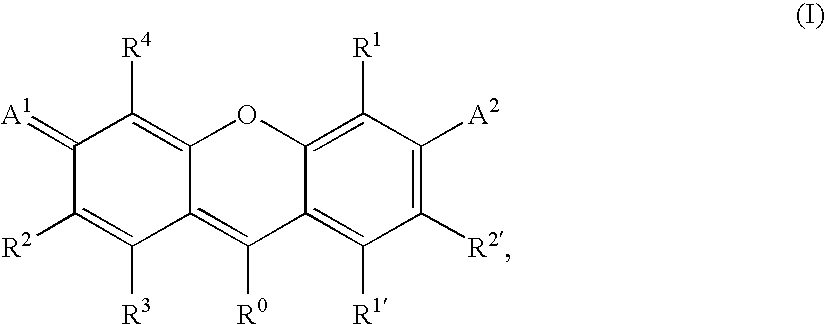
- wherein A1 represents O or N-Z in which Z is H or C1-C8alkyl, or is optionally combined with R2, or R4 to form a 5- or 6-membered ring, or is combined with each of R2 and R4 to form two fused 6-membered rings; A2 represents —OH or —NZ2; R1, R1′, R2, R2′, R3 and R4 are each independently selected from H, halogen, cyano, CF3, C1-C8alkyl, C1-C8alkylthio, C1-C8alkoxy, aryl and heteroaryl; wherein the alkyl portions of any of R1, R2′ or R1 through R4 are optionally substituted with halogen, carboxy, sulfo, amino, mono- or dialkylamino, alkoxy, cyano, haloacetyl or hydroxy; and the aryl or heteroaryl portions of any of R1′, R2′ or R1 through R4 are optionally substituted with from one to four substituents selected from the group consisting of halogen, cyano, carboxy, sulfo, hydroxy, amino, mono- or di(C1-C8)alkylamino, C1-C8alkyl, C1-C8alkylthio and C1-C8alkoxy; R0 is halogen, cyano, CF3, C1-C8alkyl, C1-C8alkenyl, C1-C8alkynyl, aryl or heteroaryl having the formula:
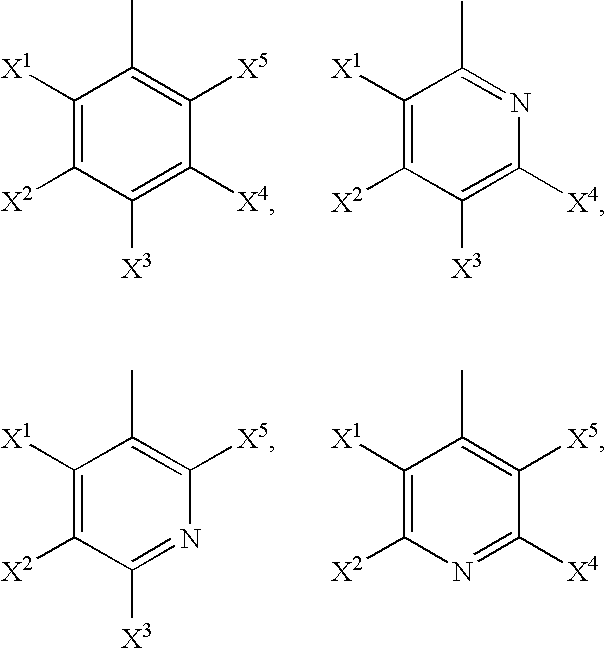
- wherein X1, X2, X3, X4 and X5 are each independently selected from the group consisting of H, halogen, cyano, CF3, C1-C8alkyl, C1-C8alkoxy, C1-C8alkylthio, C1-C8alkenyl, C1-C8alkynyl, SO3H and CO2H. Additionally, the alkyl portions of any of X1 through X5 can be further substituted with halogen, carboxy, sulfo, amino, mono- or dialkylamino, alkoxy, cyano, haloacetyl or hydroxy. Optionally, any two adjacent substituents X1 through X5 can be taken together to form a fused aromatic ring that is optionally further substituted with from one to four substituents selected from halogen, cyano, carboxy, sulfo, hydroxy, amino, mono- or di(C1-C8) alkylamino, (C1-C8)alkyl, (C1-C8)alkylthio and (C1-C8)alkoxy.
- In certain embodiments, the xanthene colorants of formula I (as well as other formulae herein) will be present in isomeric or tautomeric forms which are included in this invention.
- b) Benzo[a]xanthen colorants of formula
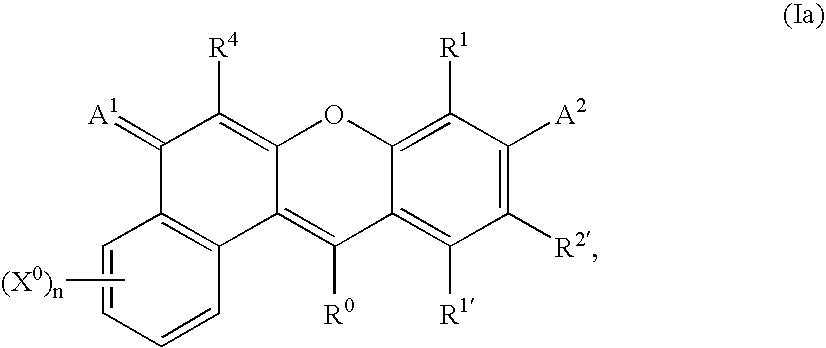
- wherein
- n is an integer of 0 to 4,
- each X0 is independently selected from the group consisting of H, halogen, cyano, CF3, C1-C8alkyl, C1-C8alkoxy, C1-C8alkylthio, C1-C8alkenyl, C1-C8alkynyl, aryl, heteroaryl, SO3H and CO2H;
- A1, A2, R0, R1, R1′, R2′, and R4 are as defined above, wherein the alkyl portions of X0 can be further substituted with halogen, carboxy, sulfo, amino, mono- or dialkylamino, alkoxy, cyano, haloacetyl or hydroxy, and the aryl or heteroaryl portions of any of R1, R1′, R2′, and R4 are optionally substituted with from one to four substituents selected from the group consisting of halogen, cyano, carboxy, sulfo, hydroxy, amino, mono- or di(C1-C8)alkylamino, C1-C8alkyl, C1-C8alkylthio and C1-C8alkoxy.
- c) Benzo[b]xanthen colorants of formula
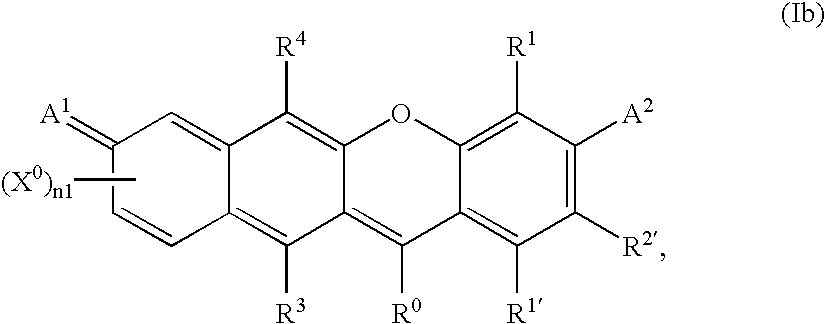
- wherein
- n1 is an integer of 0 to 3, X0, A1, A2, R0, R1, R1′, R2′, R3 and R4 are as defined above.
- d) Benzo[b]xanthen colorants of formula
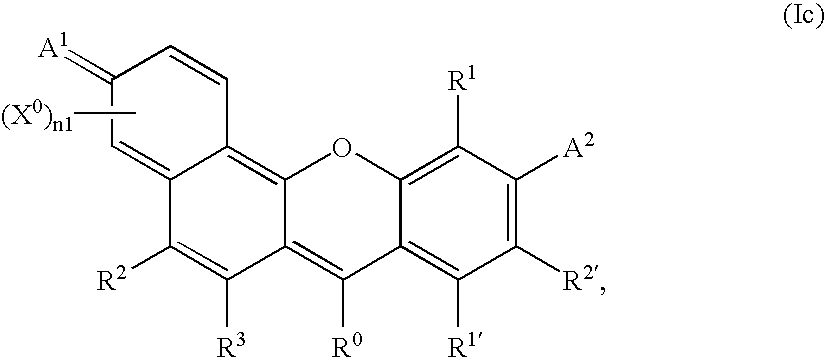
- wherein
- n1 is an integer of 0 to 3, X0, A1, A2, R0, R1, R1′, R2′, R2 and R3 are as defined above.
- The following xanthene colorants and thioxanthene colorants are particularly preferred:
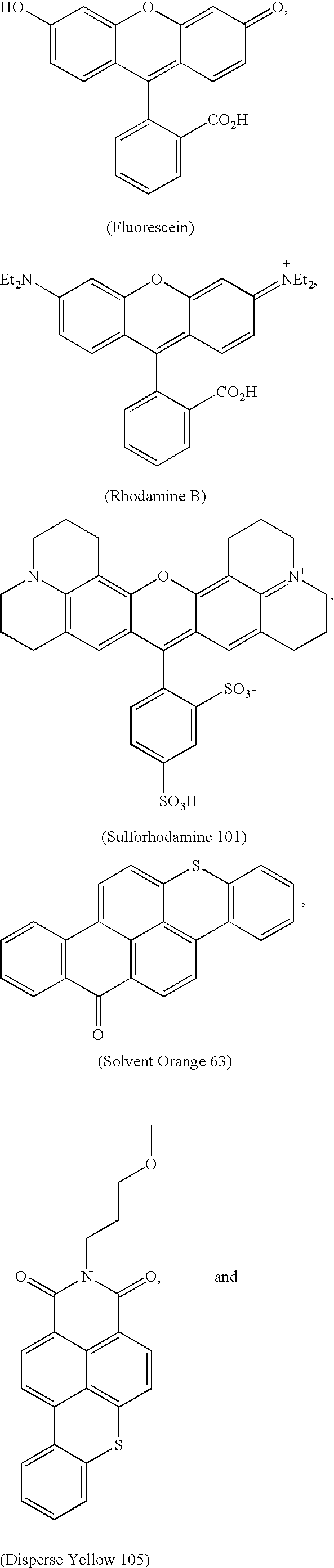
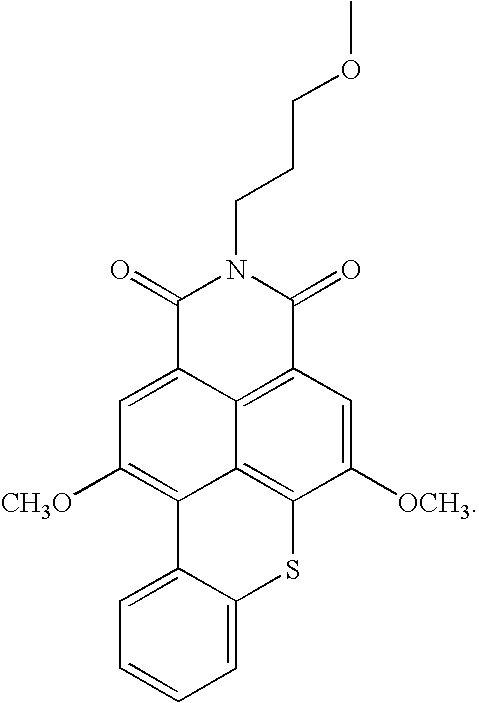
- e) Coumarin colorants of formula
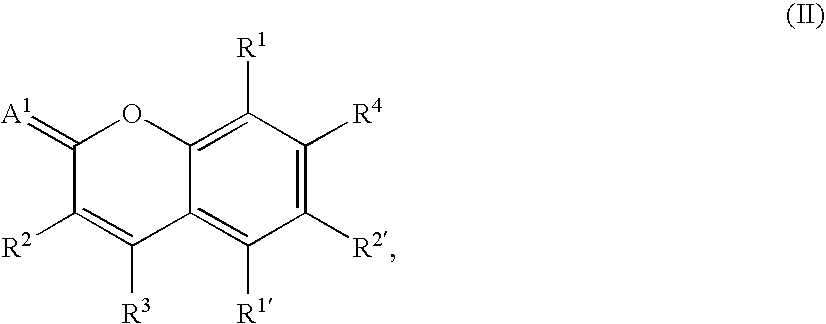
- wherein A1, R1, R1′, R2′, R2, R3, and R4 are as defined above. In certain embodiments R2 and R3 are independently of each other of halogen, cyano, CF3, C1-C8alkyl, aryl, or heteroaryl having the formula
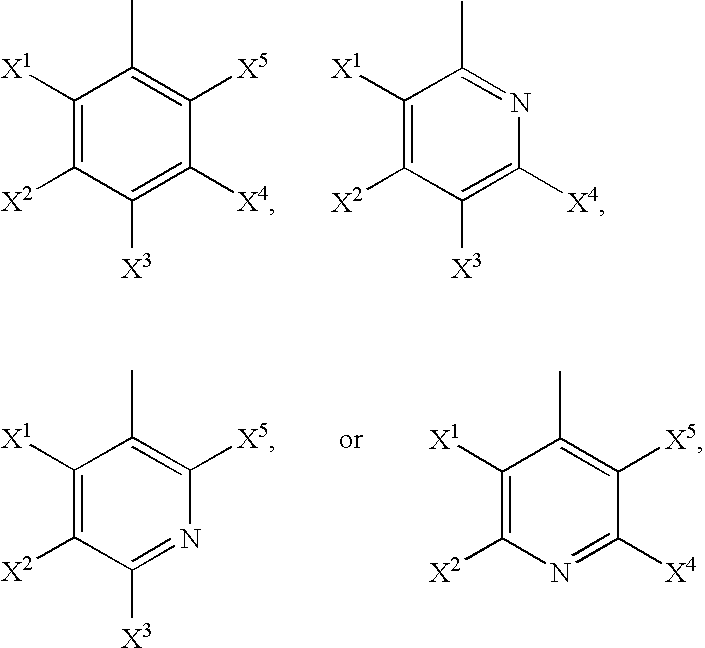
- wherein X1, X2, X3, X4 and X5 are as defined above.
- The benzocoumarin series of colorants are those of formula II in which R2 and R3 are combined to form a fused benzene ring, optionally substituted with one to four substituents selected from halogen cyano, carboxy, sulfo, hydroxy, amino, mono- or di(C1-C8)alkylamino, C1-C8alkyl, C1-C8alkylthio and C1-C8alkoxy.
- The following coumarine colorants are particularly preferred:
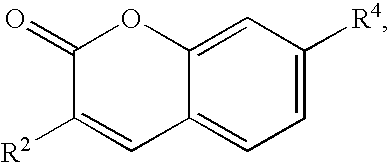
wherein R4 is —N(C2H5)2 and R2 is a group of formula: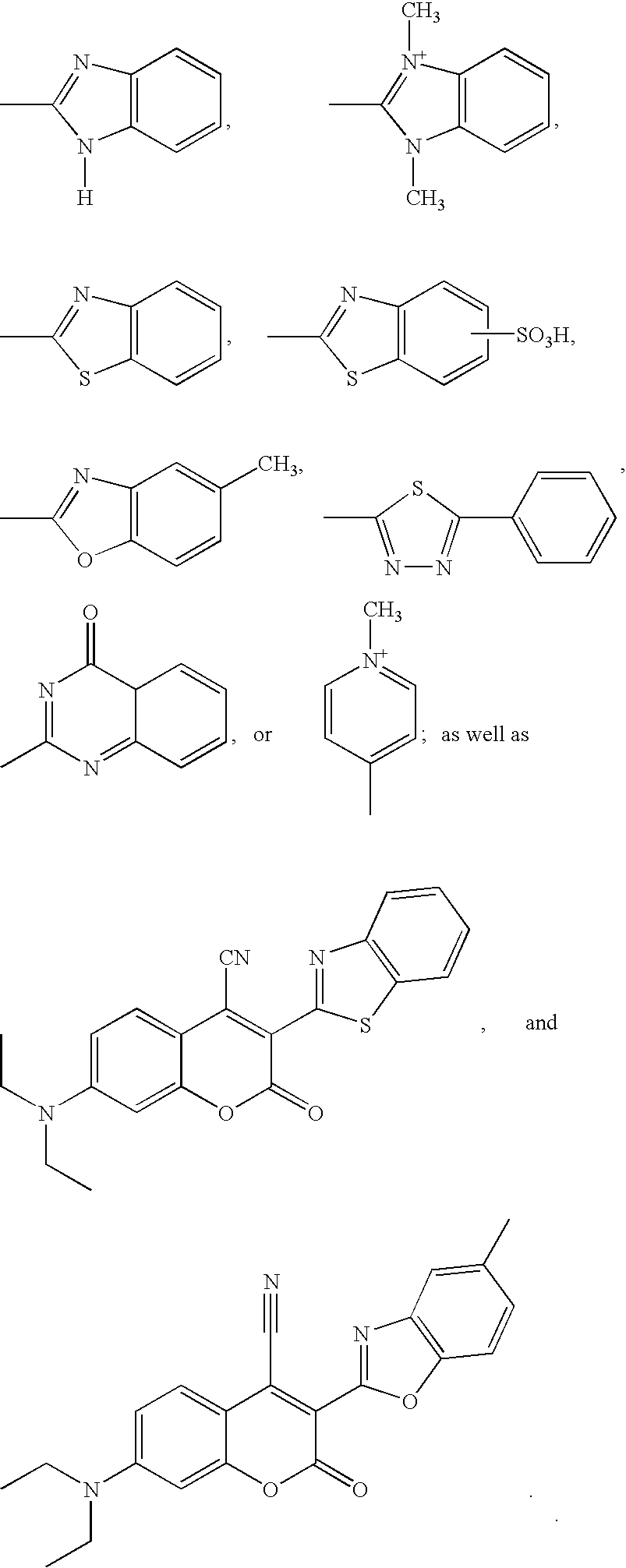
- f) Phenoxazine colorants of formula

- wherein R2″ has the meanings provided above for R2′. Optionally A1 can be combined with each of R2 and R4 to form a five- or six-membered ring or can be combined with each of R2 and R4 to form two fused six-membered rings, n1, X0, A1, R1, R1′, R2′, R2, R3 and R4 are as defined above.
- g) Napthalimide Colorants
- A very wide variety of naphthalimide colorants are known. Only a few important representative examples, which show exceptionally brilliant, greenish-yellow fluorescent colors, are shown below:
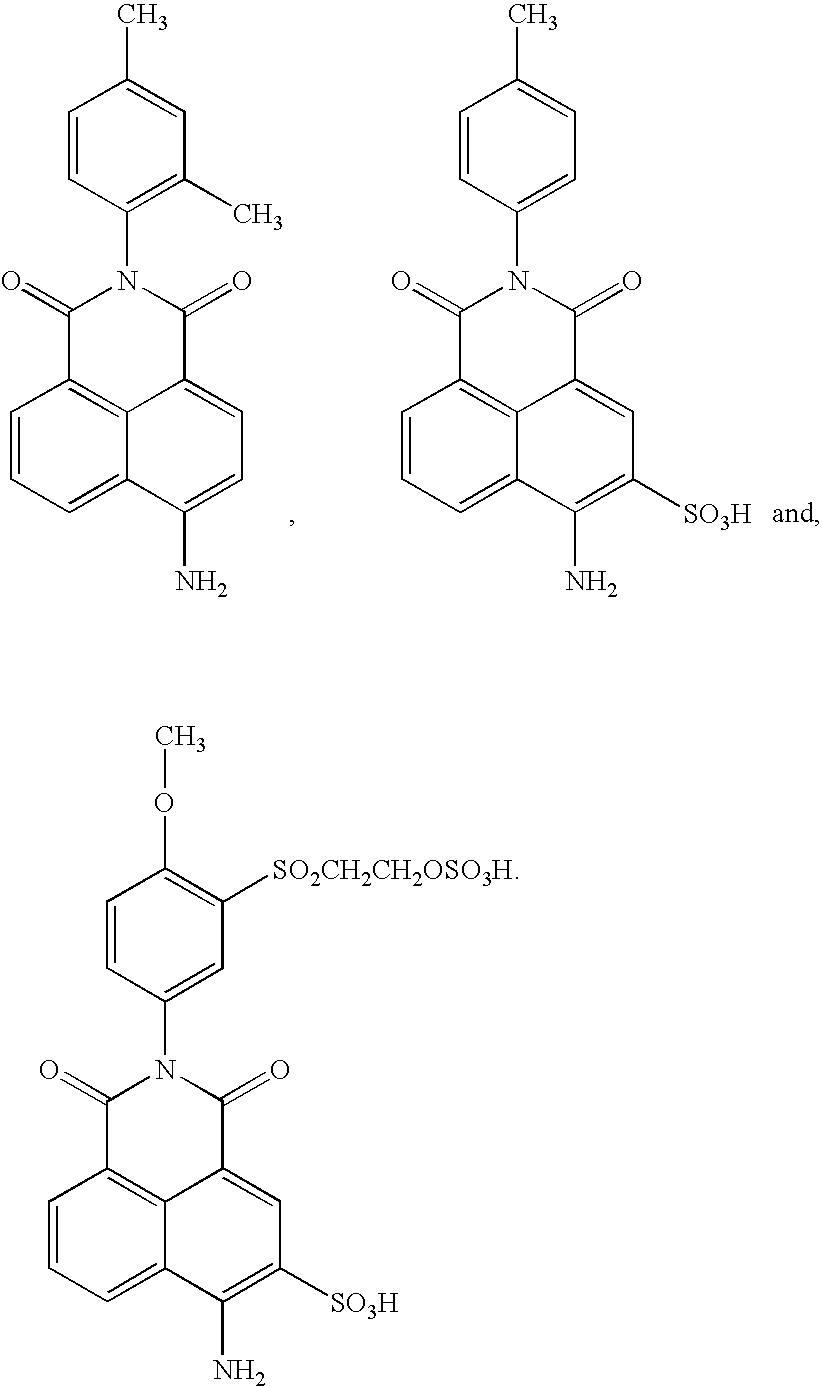
- h) Naphtholactam Colorants
- Naphtholactam colorants have colors ranging from yellow to red. Only a few important representative examples are shown below:

wherein R300 is H, C1-C8alkyl, or C1-C8alkoxy. - i) Aziactone Colorants:
- Only a few important representative examples are shown below:

wherein R301 is C1-C8alkyl.
wherein R302 is H, or methoxy. - j) Methine Colorants:
- Only a few important representative examples are shown below:
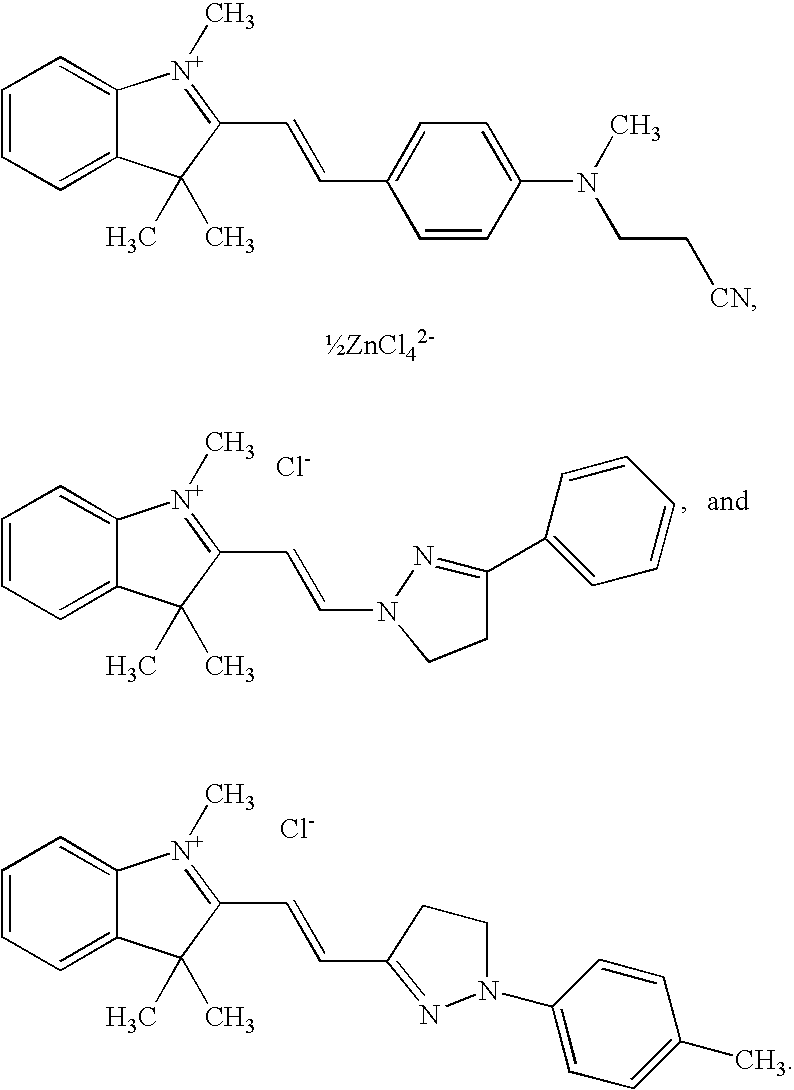
- k) Oxazine and Thiazine Colorants

- Examples of further preferred fluorescent colorants are:
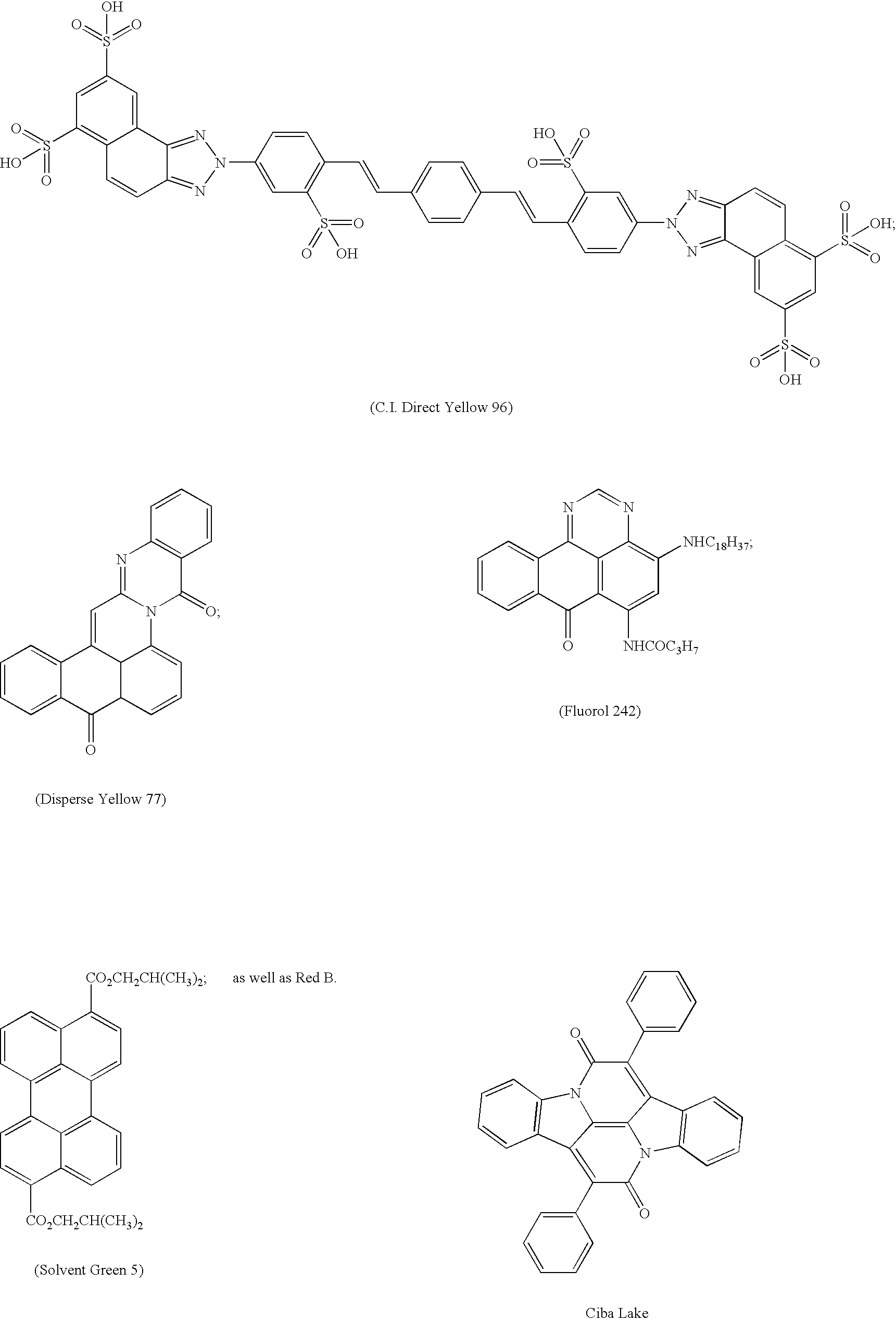
- Another preferred pigment is the condensation product of
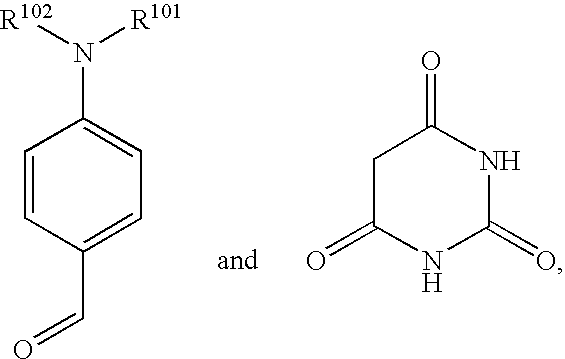
wherein R101 and R102 are independently hydrogen or C1-C18 alkyl, such as for example, methyl, ethyl, n-propyl, isopropyl, n-butyl, sec-butyl, isobutyl, tert-butyl, n-amyl, tert-amyl, hexyl, heptyl, octyl, 2-ethylhexyl, nonyl, decyl, dodecyl, tetradecyl, hexadecyl or octadecyl. Preferably R101 and R102 are methyl. The condensation product is of formula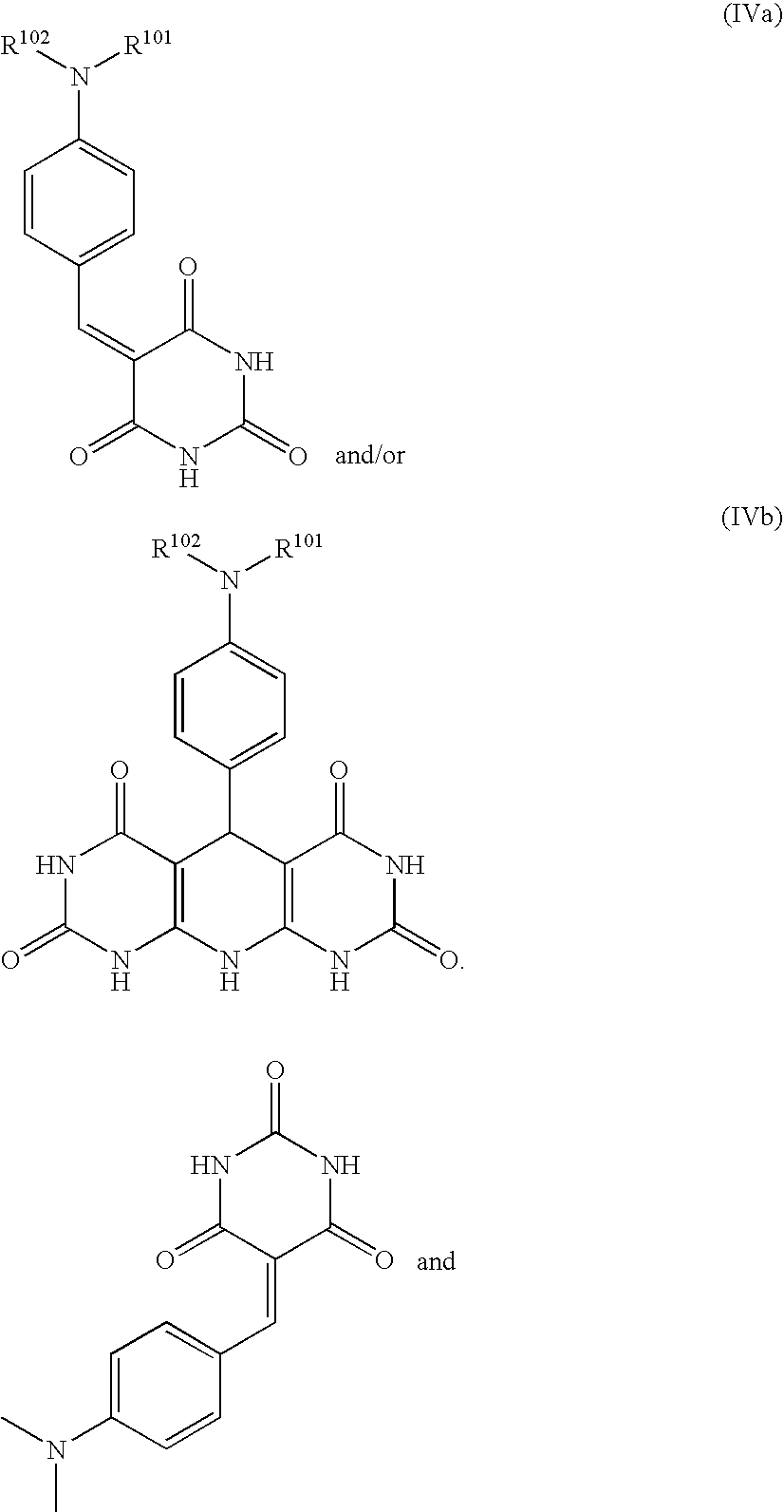
dimer are especially preferred. In case of the above pigment it is advantageous to produce the pigment in situ in the pores of the SiOz flakes. Barbituric acid can, for example, be diluted in a solvent, such as formic acid. To this solution the porous SiOz flakes can be added under stirring. After stirring the suspension can be filtered and the residue can be dried at elevated temperature in vacuo. The obtained product can be redispersed in a solvent, such as ethanol, triethylamine can be added, the mixture can be heated to 78° C. Then a solution of dimethylaminobenzaldehyd in ethanol using a heatable dropping funnel can be slowly added while stirring. - The condensation product of dialkylamino benzaldehyde and barbituric acid enhances plant growth in greenhouses, when incorporated into the thermoplastic polymer film covering the greenhouse. A part of the near UV light is filtered out by this condensation product and transformed into fluorescent light of substantially longer wavelength, which is believed to be responsible for the faster growth of many plants.
- The incorporation of the condensation product of dialkylamino benzaldehyde and barbituric acid into the pores of the SiOz flakes can significantly prolong the lifetime of the polymer film. The fluorescence of the condensation product remains high and the plant growth effect is retained over a long time. The condensation product itself is colored absorbing mainly in the near UV range, whereas the Stokes shift of the fluorescence light is large, emitting light of reddish color. This fluorescence increases the light transmitted in the red region of the visible light spectrum (maximum emission approximately at 635 nm) with significant effects on crop's yield and quality, such as stem's length, thickness and growing cycle.
- The product is very good compatible with a variety of polymers and with other frequently used additives. It can, therefore, be used in polymer compositions for agricultural applications in the form of films for greenhouses and small tunnel covers, films or filaments for shading nets and screens, mulch films, non-wovens or molded articles for the protection of young plants (cf. EP-A-1413599).
- SiOz flakes, comprising luminescent compounds having a maximum emission at approximately 600 to 640 nm can be used for the same purpose.
- l) diketopyrrolopyrroles:
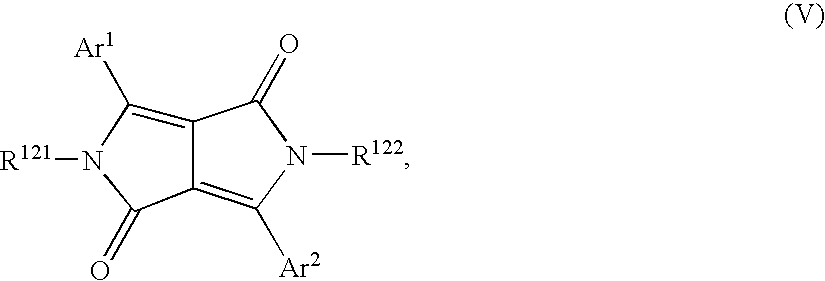
- wherein
- R121 and R122 are independently of each other an organic group, and
- Ar1 and Ar2 are independently of each other an aryl group or an heteroaryl group, which can optionally be substituted.
- The term “aryl group” in the definition of Ar1 and Ar2 is typically C6-C30aryl, such as phenyl, indenyl, azulenyl, naphthyl, biphenyl, terphenylyl or quadphenylyl, as-indacenyl, s-indacenyl, acenaphthylenyl, phenanthryl, fluoranthenyl, triphenlenyl, chrysenyl, naphthacen, picenyl, perylenyl, pentaphenyl, hexacenyl, pyrenyl, or anthracenyl, preferably phenyl, 1-naphthyl, 2-naphthyl, 9-phenanthryl, 2- or 9-fluorenyl, 3- or 4-biphenyl, which may be unsubstituted or substituted. Examples of C6-C18aryl are phenyl, 1-naphthyl, 2-naphthyl, 3- or 4-biphenyl, 9-phenanthryl, 2- or 9-fluorenyl, which may be unsubstituted or substituted.
- The term “heteroaryl group”, especially C2-C30heteroaryl, is a ring, wherein nitrogen, oxygen or sulfur are the possible hetero atoms, and is typically an unsaturated heterocyclic radical with five to 18 atoms having at least six conjugated 7-electrons such as thienyl, benzo[b]thienyl, dibenzo[b,d]thienyl, thianthrenyl, furyl, furfuryl, 2H-pyranyl, benzofuranyl, isobenzofuranyl, 2H-chromenyl, xanthenyl, dibenzofuranyl, phenoxythienyl, pyrrolyl, imidazolyl, pyrazolyl, pyridyl, bipyridyl, triazinyl, pyrimidinyl, pyrazinyl, 1H-pyrrolizinyl, isoindolyl, pyridazinyl, indolizinyl, isoindolyl, indolyl, 3H-indolyl, phthalazinyl, naphthyridinyl, quinoxalinyl, quinazolinyl, cinnolinyl, indazolyl, purinyl, quinolizinyl, chinolyl, isochinolyl, phthalazinyl, naphthyridinyl, chinoxalinyl, chinazolinyl, cinnolinyl, pteridinyl, carbazolyl, 4aH-carbazolyl, carbolinyl, benzotriazolyl, benzoxazolyl, phenanthridinyl, acridinyl, perimidinyl, phenanthrolinyl, phenazinyl, isothiazolyl, phenothiazinyl, isoxazolyl, furazanyl or phenoxazinyl, preferably the above-mentioned mono- or bicyclic heterocyclic radicals, which may be unsubstituted or substituted.
- R121 and R122 may be the same or different and are preferably selected from a C1-C25alkyl group, which can be substituted by fluorine, chlorine or bromine, an allyl group, which can be substituted one to three times with C1-C4alkyl, a cycloalkyl group, a cycloalkyl group, which can be condensed one or two times by phenyl which can be substituted one to three times with C1-C4-alkyl, halogen, nitro or cyano, an alkenyl group, a cycloalkenyl group, an alkynyl group, a haloalkyl group, a haloalkenyl group, a haloalkynyl group, a ketone or aldehyde group, an ester group, a carbamoyl group, a ketone group, a silyl group, a siloxanyl group, A3 or —CR127R128—(CH2)m-A3, wherein
- R127 and R128 independently from each other stand for hydrogen, or C1-C4alkyl, or phenyl, which can be substituted one to three times with C1-C4alkyl,
- A3 stands for aryl or heteroaryl, in particular phenyl or 1 - or 2-naphthyl, which can be substituted one to three times with C1-C8alkyl and/or C1-C8alkoxy, and m stands for 0, 1, 2, 3 or 4.
- Fluorescent diketopyrrolopyrroles (including compositions) of formula I are known and are described, for example, in EP-A-0133156, U.S. Pat. No. 4,585,878, EP-A-0353184, EP-A-0787730, WO98/25927, U.S. Pat. No. 5,919,944, EP-A-0787731, EP-A-0811625, WO98/25927, EP-A-1087005, EP-A-1087006, WO03/002672, WO03/022848, WO03/064558, WO04/009710, WO04/090046, WO05/005571, EP04106432.0, H. Langhals et al. Liebigs Ann. 1996, 679-682:
Abs. (nm) Fluores. (nm) Ar1 = Ar2 R121 = R122 [CHCl3] [CHCl3] phenyl phenyl 464, 484 520, 555 (sh) phenyl 4-methylphenyl 470, 488 521, 549 (sh) phenyl 2,3-dimethylphenyl 469, 492 524, 555 (sh) phenyl 4-t-bu-phenyl 467, 489 519, 553 (sh) phenyl phenyl & 4-t-bu-phenyl 467, 489 521, 560 (sh) US-A-5,354,869: Ar1 = Ar2 R121 = R122 Abs. (nm) Fluores. (nm) 2-methoxyphenyl methyl 454 514 2-methoxyphenyl & phenyl methyl 464 518
Compositions comprising DPPs are, for example, described in WO041090046, WO05/005571 and European patent application 04103025.5 (PCT/EP2005/______). - The composition comprises, for example, as described in WO05/005571, a diketopyrrolo-pyrrole compound the absorption of which is in the range of from about 440 to about 500 nm, especially in the range of from about 450 to about 490 nm, and which shows photoluminescence the peak of which is in the range of from 530 to 570 nm, especially in the range of from 540 to 570 nm, and a fluorescent compound the absorption peak of which is in the range of from about 530 to about 570 nm and which shows photoluminescence the peak of which is in the range of from about 580 to about 650 nm.
- The following DPP compounds V and Va are especially preferred:
Cpd. Ar1 = Ar2 R121 = R122 Abs. (nm) Fluores. (nm) A-1 3-methylphenyl 1-phenylethyl 460 520 A-2 phenyl 1-phenylethyl 464 520 A-3 4-methylphenyl 1-phenylpropyl 462 521 A-4 4-methylphenyl diphenylmethyl 463 521 A-5 4-methylphenyl 1-phenylethyl 464 521 A-6 3-methoxyphenyl 1-phenylethyl 466 522 A-7 3-methylphenyl 3-chlorobenzyl 466 526 A-8 3-methylphenyl 3-methylbenzyl 470 527 A-9 3-methylphenyl 3,5-di-t-butylbenzyl 470 527 A-10 4-methylphenyl 3,5-di-t-butylbenzyl 471 527 A-11 3-methylphenyl 3,5-dimethylbenzyl 472 528 A-12 4-methylphenyl 3-methoxybenzyl 475 528 A-13 phenyl 3,5-di-t-butylbenzyl 470 529 A-14 4-methylphenyl 4-t-butylbenzyl 474 529 A-15 4-methylphenyl 3-methylbenzyl 474 529 A-16 4-methylphenyl 4-phenylbenzyl 476 529 A-17 4-methylphenyl 2-methylbenzyl 486 529 A-18 phenyl n-hexyl 470 530 A-19 3-methoxyphenyl 3-chlorobenzyl 473 530 A-20 4-methylphenyl 3,5,-dimethylbenzyl 474 530 A-21 4-ethylphenyl 3-methylbenzyl 474 530 A-22 4-ethylphenyl 3,5-di-t-butylbenzyl 474 530 A-23 3-methoxyphenyl 3,5-di-t-butylbenzyl 475 530 A-24 4-methylphenyl 4-methylbenzyl 476 530 A-25 3-methylphenyl allyl 477 530 A-26 4-i-propylphenyl benzyl 478 530 A-27 4-i-propylphenyl 3,5-di-t-butylbenzyl 471 531 A-28 4-ethylphenyl benzyl 474 531 A-29 4-methylphenyl 2-naphthylmethyl 474 531 A-30 3-methoxyphenyl 3-methylbenzyl 476 531 A-31 4-i-propylphenyl 3,5-dimethylbenzyl 476 531 A-32 4-t-butylphenyl 3,5-di-t-butylbenzyl 477 531 A-33 4-ethylphenyl 3,5-dimethylbenzyl 478 531 A-34 4-methylphenyl 2-phenylbenzyl 479 531 A-35 phenyl —(CH2)6OC(O)C(CH3)═CH2 470 532 A-36 4-t-butylphenyl benzyl 476 532 A-37 4-i-propylphenyl 3-methylbenzyl 476 532 A-38 3-methoxyphenyl 3,5-dimethylbenzyl 478 532 A-39 3-methoxyphenyl allyl 478 532 A-40 4-t-butylphenyl 3-methylbenzyl 480 532 A-41 phenyl —(CH2)6—OH 470 533 A-42 3-methylphenyl 3-methyl-2-buten-yl 474 533 A-43 4-t-butylphenyl 3,5-dimethylbenzyl 484 533 A-44 4-methylphenyl methyl 485 533 A-45 4-methylphenyl n-butyl 475 534 A-46 3-(4-phenyl)phenyl 3,5-dimethylbenzyl 477 534 A-47 phenyl methyl 483 534 A-48 4-chlorophenyl 3,5-di-t-butylbenzyl 476 536 A-49 1-naphthyl ethyl 443 538 A-50 1-naphthyl n-butyl 447 538 A-51 1-naphthyl n-C12H25 447 538 A-52 1-naphthyl n-C18H37 450 543 A-53 3-(4-methyl- ethyl 478 537 phenyl)phenyl A-54 3,5-di-chlorophenyl 3,5-dimethylbenzyl 442 532 A-55 2-methoxyphenyl 3,5-dimethylbenzyl 443 519 A-56 1-naphthyl acetyl 439 524 A-57 1-naphthyl benzoyl 448 531 A-58 1-naphthyl n-hexyl 447 538 A-59 1-naphthyl —(CH2)6—OH 449 539 A-60 1-naphthyl —(CH2)6OC(O)C(CH3)═CH2 449 539 A-61 4-methylphenyl n-hexyl 475 534 A-62 4-methylphenyl —(CH2)6—OH 475 536 A-63 4-methylphenyl —(CH2)6OC(O)C(CH3)═CH2 475 536 A-64 3-methoxyphenyl n-hexyl 478 536 A-65 4-t-butylphenyl n-hexyl 480 537 A-66 3-methylphenyl n-hexyl 474 536 -
Cpd. Ar1 = Ar2 R121 = R122 Abs. (nm) Fluores. (nm) B-1 3-cyanophenyl 3,5-di-t-butylbenzyl 478 540 B-2 2-naphthyl 1-phenylethyl 479 544 B-3 4-biphenyl 1-phenylpropyl 479 544 B-4 phenyl, 4-biphenyl 3,5-di-t-butylbenzyl 479 544 B-5 4-bromo-3-methylphenyl ethyl 480 546 B-6 4-biphenyl diphenylmethyl 484 546 B-7 4-biphenyl 1-phenylethyl 481 547 B-8 phenyl, 4-biphenyl 3,5-dimethylbenzyl 482 547 B-9 4-(4-phenyl)-3- 3,5-dimethylbenzyl 485 547 methylphenyl B-10 4-biphenyl 2,2-dimethylpropyl 478 549 B-11 2-naphthyl 3-phenylbenzyl 487 552 B-12 4-biphenyl 3,5-di-t-butylbenzyl 490 552 B-13 4-biphenyl 3-methyl-2-butenyl 494 552 B-14 2-naphthyl 3,5-di-t-butylbenzyl 487 553 B-15 2-naphthyl 3-methoxybenzyl 491 553 B-16 2-naphthyl 4-phenylbenzyl 487 554 B-17 2-naphthyl benzyl 489 554 B-18 2-naphthyl 4-methylbenzyl 490 554 B-19 4-biphenyl 4-cyanobenzyl 486 555 B-20 4-biphenyl 3-phenylbenzyl 490 555 B-21 4-biphenyl 3-chlorobenzyl 491 555 B-22 2-naphthyl 2-methylbenzyl 494 555 B-23 2-naphthyl 3,5-dimethylbenzyl 490 556 B-24 4-biphenyl 3-methoxybenzyl 491 556 B-25 9-phenanthrenyl benzyl 454 557 B-26 4-biphenyl 4-methylbenzyl 489 557 B-27 4-biphenyl 4-phenylbenzyl 491 557 B-28 4-biphenyl 3,5-dimethylbenzyl 493 557 B-29 4-biphenyl 2-naphthylmethyl 495 557 B-30 6-methoxynaphth-2-yl 3,5-di-t-butylbenzyl 496 558 B-31 6-methoxynaphth-2-yl 3-methylbenzyl 498 558 B-32 2-naphthyl 2-phenylethyl 488 559 B-33 4-biphenyl 3-pheny-2-propenyl 492 559 B-34 6-methoxynaphth-2-yl 3-phenylbenzyl 496 559 B-35 9-phenanthryl n-butyl 447 561 B-36 4-biphenyl 2-phenylethyl 489 561 B-37 9-phenanthryl allyl 445 562 B-38 4-biphenyl n-butyl 492 562 B-39 4-phenoxyphenyl 3,5-dimethylbenzyl 487 539, 571 B-40 4-biphenyl n-hexyl 490 555 B-41 4-biphenyl —(CH2)6—OH 491 556 B-42 4-biphenyl —(CH2)6OC(O)C(CH3)═CH2 491 557 B-43 4-biphenyl n-C12H25 489 555 -

Abs. Fluores. Cpd. R125 R126 R123 = R124 (nm) (nm) C-1 CH3 CH3 3-bromobenzyl 541 582 C-2 phenyl phenyl methyl 544 590 C-3 phenyl 3,5-di-t-butylbenzyl methyl 533 591 C-4 phenyl 1-naphthyl methyl 536 591 C-5 phenyl phenyl allyl 540 591 C-6 phenyl phenyl benzyl 541 594 C-7 phenyl phenyl 3-methylbenzyl 542 594 C-8 phenyl phenyl 3,5-dimethylbenzyl 543 594 C-9 4-methylphenyl 4-methylphenyl n-butyl 533 596 C-10 4-methylphenyl 4-methylphenyl 3,5-di-t-butylbenzyl 536 596 C-11 Phenyl phenyl 4-fluorobenzyl 542 597 C-12 phenyl phenyl 3-bromobenzyl 543 597 C-13 phenyl phenyl 4-bromobenzyl 544 597 C-14 2-naphthyl 2-naphthyl n-butyl 537 599 C-15 phenyl phenyl 3,5-dibromobenzyl 542 599 C-16 phenyl 2-naphthyl benzyl 544 599 C-17 phenyl phenyl 2-bromobenzyl 553 600 C-18 phenyl phenyl 3-cyanobenzyl 544 601 C-19 phenyl phenyl 4-cyanobenzyl 549 601 C-20 4-methylphenyl 4-methylphenyl benzyl 551 602 C-21 2-naphthyl 2-naphthyl benzyl 547 603 C-22 4-methoxyphenyl 4-methoxyphenyl n-butyl 540 605 C-23 4-biphenyl phenyl methyl 547 606 C-24 phenyl phenyl 3,4-dicyanobenzyl 556 606 C-25 4-methylphenyl 4-methylphenyl 4-cyanobenzyl 557 612 C-26 4-methoxyphenyl 4-methoxyphenyl benzyl 550 613 C-27 4-methoxyphenyl 4-methoxyphenyl n-hexyl 542 606 C-28 4-methoxyphenyl 4-methoxyphenyl —(CH2)6—OH 543 608 C-29 4-methoxyphenyl 4-methoxyphenyl —(CH2)6OC(O)C(CH3)═CH2 543 608 C-30 phenyl phenyl n-hexyl 546 595 C-31 phenyl phenyl —(CH2)6—OH 546 598 C-32 phenyl phenyl —(CH2)6OC(O)C(CH3)═CH2 546 598 C-33 phenyl phenyl n-hexyl 536 598 C-34 4-methylphenyl 4-methylphenyl —(CH2)6—OH 548 604 C-35 4-methylphenyl 4-methylphenyl —(CH2)6OC(O)C(CH3)═CH2 542 602 C-36 4-methylphenyl 4-methylphenyl n-C12H25 543 598 - m) Perylenes:
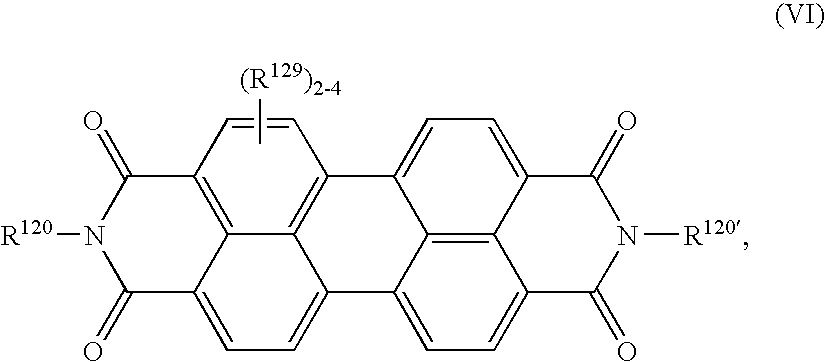
- wherein R120, R120′ and R129 are independently of each other organic substituents.
- R120 and R120′ controlls solubility, aggregation and photostability. R129 contrails absorption maximum (shade) and solubility.
- R120 and R120′ may be the same or different and are preferably selected from a C1-C25alkyl group, which can be substituted by fluorine, chlorine or bromine, an allyl group, which can be substituted one to three times with C1-C4alkyl, a cycloalkyl group, a cycloalkyl group, which can be condensed one or two times by phenyl which can be substituted one to three times with C1-C4alkyl, halogen, nitro or cyano, an alkenyl group, a cycloalkenyl group, an alkynyl A group, a haloalkyl group, a haloalkenyl group, a haloalkynyl group, a ketone or aldehyde group, an ester group, a carbamoyl group, a ketone group, a silyl group, a siloxanyl group, A3 or —CR127R128—(CH2)m-A3, wherein
- R127 and R128 independently from each other stand for hydrogen, or C1-C4alkyl, or phenyl, which can be substituted one to three times with C1-C4alkyl,
- A3 stands for aryl or heteroaryl, in particular phenyl or 1- or 2-naphthyl, which can be substituted one to three times with C1-C8alkyl and/or C1-C8alkoxy, and m stands for 0, 1, 2, 3 or 4.
- Fluorescent perylenes (including compositions) are known and are described, for example, in U.S. Pat. No. 5,650,513, U.S. Pat. No. 6,491,749, U.S. Pat. No. 6,491,749, EP-A-57436, EP-B-638613, EP-A-711812, EP-A-977754, and EP-A-1019388:
- Perylenmonoimides:

- wherein R129 and R120 are as defined above.
- Nucleus-extended perylenebisimides of general formulae
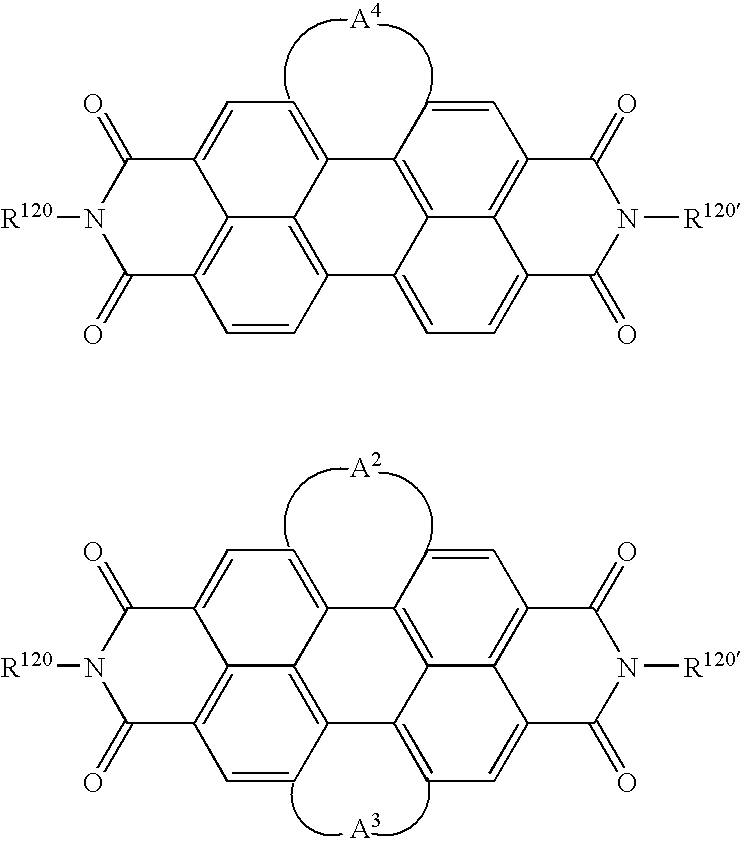
- wherein
- R120 and R120′ are each independently of the other unsubstituted or substituted C1-C24alkyl, C1-C24cycloalkyl, or C6-C10aryl, and
- A4 and A3 are each independently of the other —S—, —S—S—, —CH═CH—,
- R130OOC—C(−)═C(−)—COOR130, —N═N— or —N(R131)—, or a linkage selected from the group consisting of the organic radicals of formulae
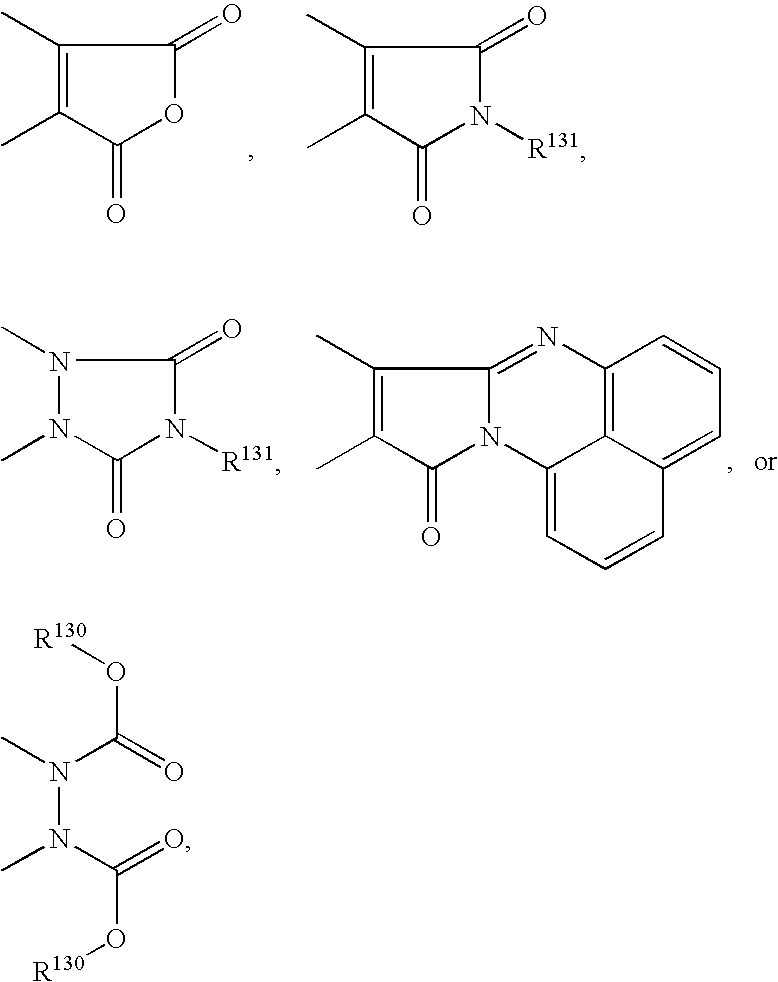
- wherein
- R130 is hydrogen, C1-C24alkyl or C1-C24cycloalkyl,
- R131 is unsubstituted or substituted C1-C24alkyl, C1-C24cycloalkyl, phenyl, benzyl, —CO—C1-C4alkyl, —CO—C6H5 or C1-C4alkylcarboxylic acid (C1-C4alkyl) ester, and
- A2 is a linkage of formula
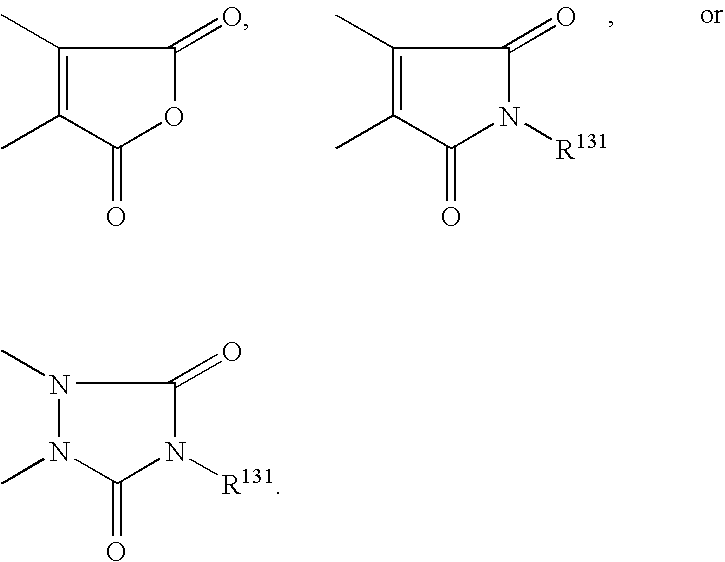
- Perylene amidine-imide colorants:

- where R120 is a secondary C7-41alkyl radical or a radical of the formula

- where R136 is a branched C3-8alkyl radical and m1 is 1, 2 or 3; A is C5-7cycloalkylene, phenylene, naphthylene, pyridylene, a more highly fused aromatic carbocyclic or heterocyclic radical or a bivalent radical of the formula
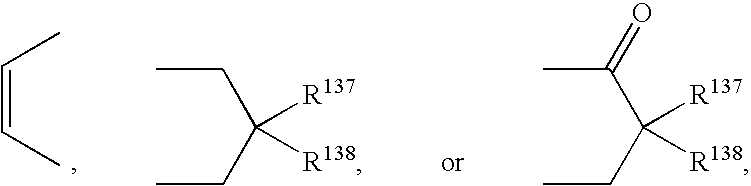
- and R120 and A may each be substituted by halogen, alkyl, cyano or nitro; R132 to R135 are each independently of the others hydrogen, alkyl, aryl, heteroaryl, halogen, cyano, nitro, —OR139, —COR139, —COOR139, —OCOR139, —CONR139R140, —OCONR139R140, —NR139R140, —NR139COR140, —NR139COOR140, —NR139SO2R140, —SO2R139, —SO3R139, —SO2NR139R140 or —N═N—R139; and R137 to R140 are each independently of the others C1-4alkyl, phenyl or 4-tolyl.
- Perylene-3,4:9,10-tetracarboxylic acid imides of the formula
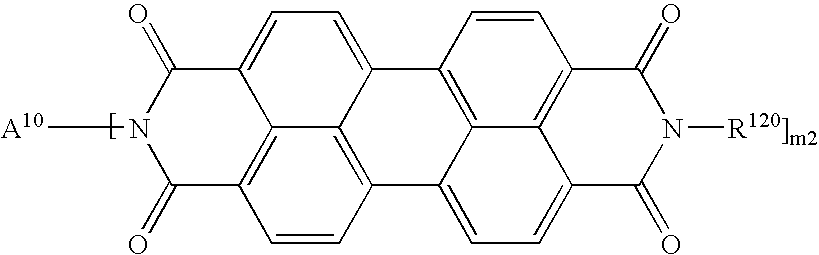
- in which A10 is a di-, tri- or tetravalent carbocyclic or heterocyclic aromatic radical,
- R120 is H, an alkyl, aralkyl or cycloalkyl group or a carbocyclic or heterocyclic aromatic radical and
- m2 is 2, 3 or 4.
Trade Designation Source Lumogen ® F 083 BASF AG Lumogen ® F Orange 240 BASF AG - n) Quinacridones:
- Fluorescent quinacridones (including compositions) are known and are described, for example, in EP-A-0939972, US200210038867A1, WO/02/099432, WO04/039805 and PCT/EP2005/052841.
- Quinacridone compounds of formula
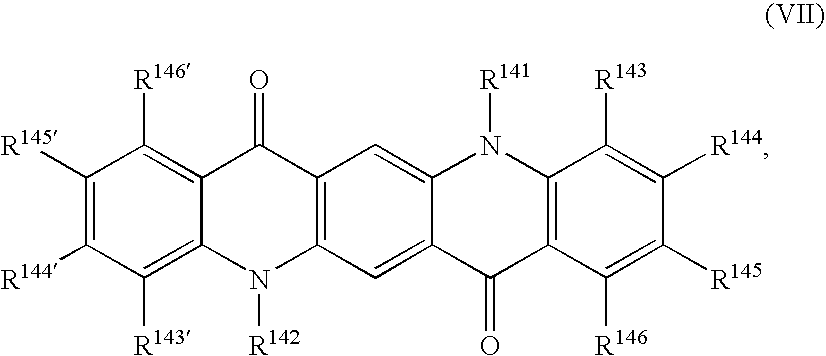
wherein - R141 and R142 may be the same or different and are selected from a C1-C25alkyl group, which can be substituted by fluorine, chlorine or bromine, an allyl group, which can be substituted one to three times with C1-C4alkyl, a cycloalkyl group, a cycloalkyl group, which can be condensed one or two times by phenyl which can be substituted one to three times with C1-C4-alkyl, halogen, nitro or cyano, an alkenyl group, a cycloalkenyl group, an alkynyl group, a haloalkyl group, a haloalkenyl group, a halalkynyl group, a ketone or aldehyde group, an ester group, a carbamoyl group, a ketone group, a silyl group, a siloxanyl group, A3 or —CR127R128—(CH2)m-A3, wherein
- R127 and R128 independently from each other stand for hydrogen, or C1-C4alkyl, or phenyl, which can be substituted one to three times with C1-C4alkyl,
- A3 stands for aryl or heteroaryl, in particular phenyl or 1- or 2-naphthyl, which can be substituted one to three times with C1-C8alkyl and/or C1-C8alkoxy, and m stands for 0, 1, 2, 3 or 4,
- R143, R143′, R146 and R146′, independently of one another, represent hydrogen, halogen, C1-C18alkyl, halogen-substituted C1-C18alkyl, C1-C18alkoxy, C1-C18alkylthio, cycloalkyl, optionally substituted aryl or arylalkyl, wherein the substituents are alkoxy, halogen or alkyl,
- R144 and R144′ are independently of each other R143, or a group —NAr1Ar2,
- R145 and R145′ are independently of each other R143, or a group —NAr3Ar4, or
- R143′ and R144′ and/or R143 and R144 together are a group

- R145′ and R146′ and/or R145 and R146 together are a group
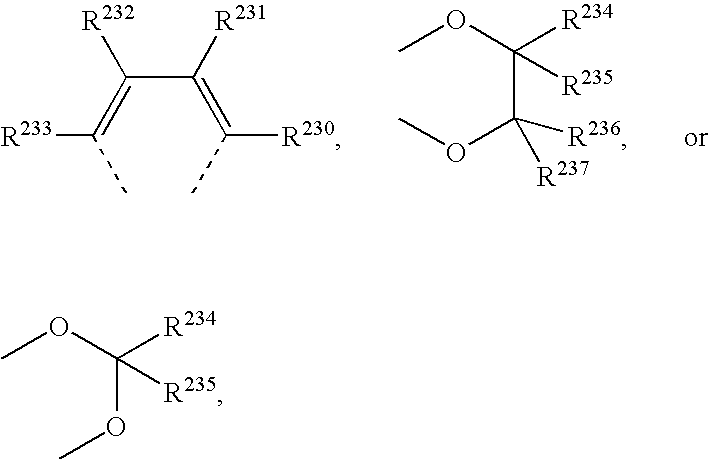
- wherein
- R230, R231, R232 and R233 are independently of each other hydrogen, C1-C18alkyl, halogen-substituted C1-C18alkyl, C1-C18alkoxy, or C1-C28alkylthio,
- R234, R235, R236 and R237 are independently of each other hydrogen, C1-C18alkyl, halogen-substituted C1-C18alkyl, C1-C18alkoxy, or C1-C28alkylthio,
- Ar1, Ar2, Ar3 and Ar4 are independently of each other an aryl group, which can optionally be substituted, or a heteroaryl group, which can optionally be substituted. According to European patent application no. 04103025.5 at least one of the groups R144, R144′, R145 and R145′ is a group —NAr1Ar2, or —NAr3Ar4.
- Quinacridone compounds, which can emit white light, as described in WO04/039805.
- o) (Thio)-Epindolines of formula:
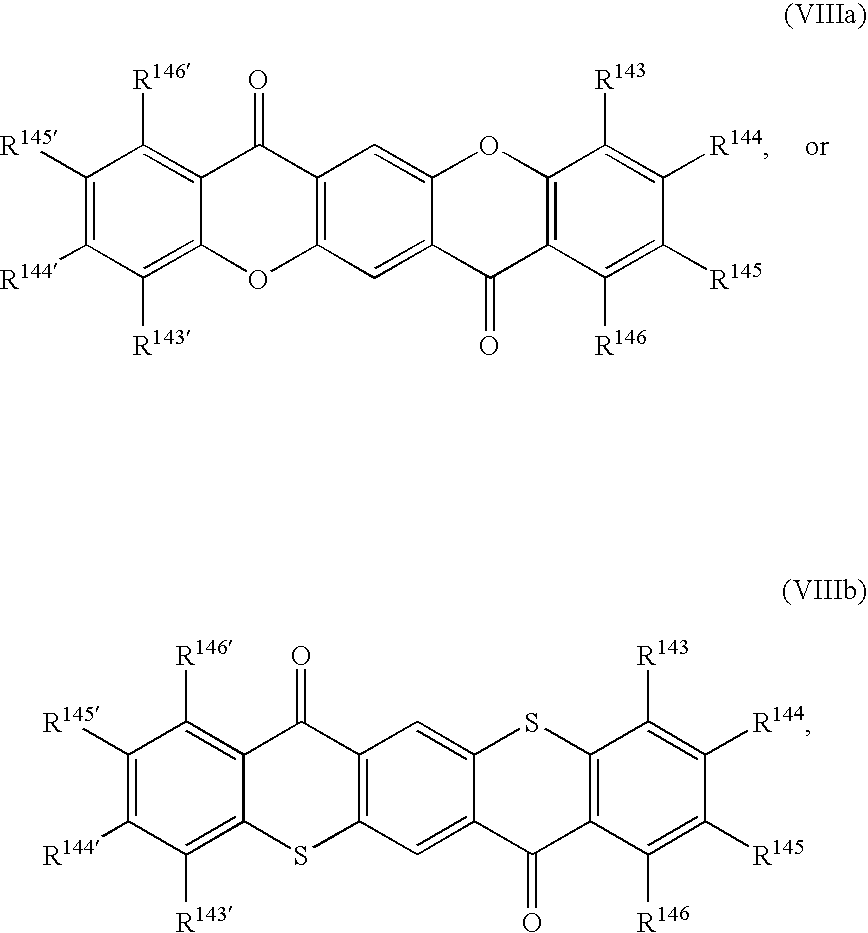
- wherein
- R143, R144, R145 and R146 as well as R143′, R144′, R145′ and R146′ are as defined above.
- p) Benzoxanthenes of formula:
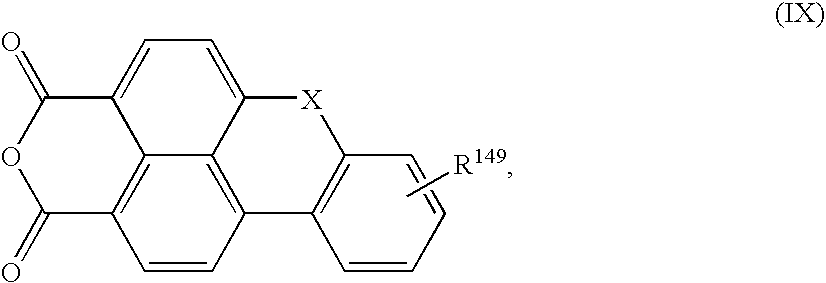
- wherein
- R149 is C1-8alkyl, C1-8alkoxy, C1-8thioalkyl, di(C1-8alkyl)amino, or halogen,
- X is O, S, NH, or NR150, wherein R150 is C1-8alkyl, hydroxy-C1-8alkyl, or C6-10aryl.
- q) Lactamimides:
- For, example, the naphthalenelactamimides described in U.S. Pat. No. 5,886,183:

in which - R151 and R152 independently of one another are C2-C25alkyl, where the alkyl group is unsubstituted or substituted by halogen, C6-C10aryl, C5-C10heteroaryl, or C3-C10cycloalkyl; C3-C10cycloalkyl or a radical of the formula

- A5 and B5 independently of one another are C1-C6alkyl, C3-C6cycloalkyl, C6-C10aryl, halogen, cyano, nitro, —OR136, —SR136, —COR136, —COOR136, —OCOR136, —CONR136R137, —OCONR136R137, —NR136R137, —NR136COR137, —NR136COOR137, —NR136SO2R137, —SO2R137, —SO3R137, —SO2NR136R137 or —N═N—R136,
- R133 to R135 independently of one another are halogen, C1-C12alkyl, phenyl or tolyl, where one R135 can also be hydrogen,
- R136 and R137 independently of one another are C1-C4alkyl, phenyl or 4-tolyl,
- n5 and m5 independently of one another are 0, 1 or 2,
- o is an integer from 0 to 4,
- p is an integer from 0 to 3 and
- q is 0 or 1.
- r) Diphenylmaleimides, for example those described in WO2001019939:
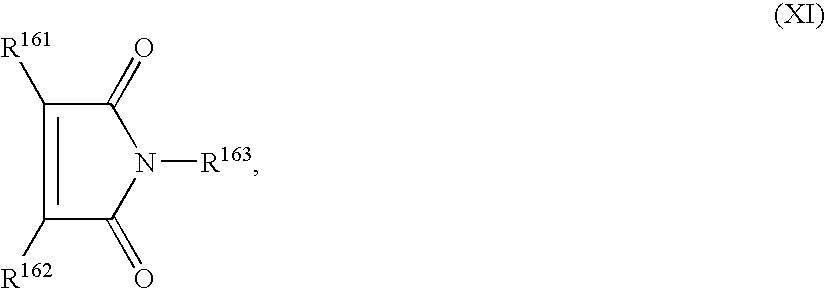
- wherein
- R161 and R162 independently from each other stand for

- wherein Q1 stands for hydrogen, halogen, phenyl, -E-C1-C8alkyl, -E-phenyl, wherein phenyl can be substituted up to three times with C1-C8alkyl, halogen, Cl-C8alkoxy, diphenylamino, —CH═CH-Q2, wherein Q2 stands for phenyl, pyridyl, or thiophenyl, which can be substituted up to three times with C1-C8alkyl, halogen, C1-C8alkoxy, —CN, wherein E stands for oxygen or sulfur, and wherein R168 stands for C1-C8alkyl, phenyl, which can be substituted up to three times with C1-C4alkyl, C1-C4alkoxy, or dimethylamino, and R169 and R170 independently from each other stand for hydrogen, R168, C1-C8alkoxy, or dimethylamino,
- or —NR164R165, wherein R164 and R165, independently from each other stand for hydrogen, phenyl, or C1-C8alkyl-carbonyl, or —NR164R165 stands for a five- or six-membered ring system, and R163 stands for allyl,

- wherein Q3 stands for hydrogen, halogen, C1-C8alkoxy, C1-C8alkyl-amido, unsubstituted or substituted C1-C8alkyl, unsubstituted or up to three times with halogen, —NH2, —OH, or C1-C8alkyl substituted phenyl,
- and Z stands for a di- or trivalent radical selected from the group consisting of substituted or unsubstituted cyclohexylene, preferably 1,4-cyclohexylene, triazin-2,4,6-triyl, C1-C6alkylene, 1,5-naphthylene,
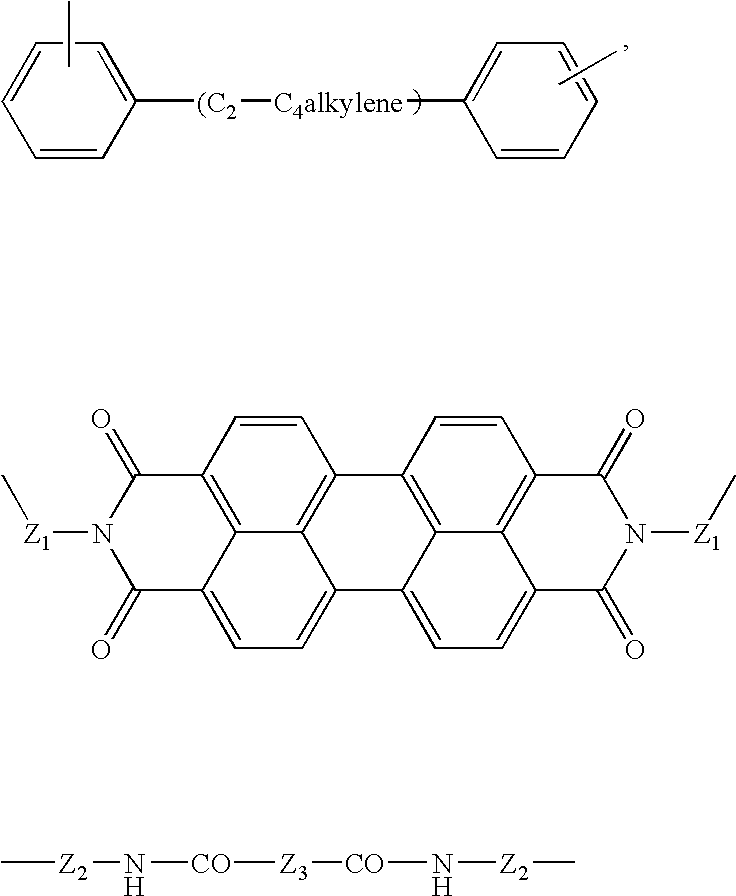
- wherein
- Z1, Z2 and Z3, independently from each other stand for cyclohexylene or up to three times with C1-C4alkyl substituted or unsubstituted phenylene, preferably unsubstituted or substituted 1,4-phenylene, and wherein R168 and R167, independently from each other, stand for

- n6 stands for 1, 2 or 3, and m stands for 1 or 2.
- s) Acetoacetamides, for example, those described in WO200346086:
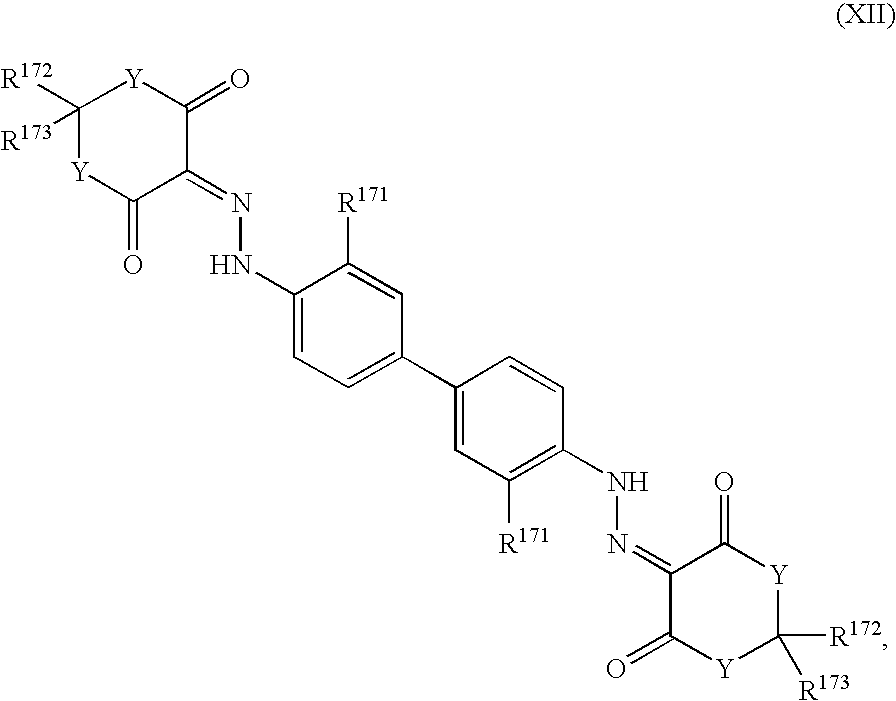
- wherein R171 stands for halogen, in particular for chlorine, or C1-C4alkoxy, in particular for methoxy, Y stands for —CH2— or —O—, preferably for —O—, and R172 and R173, independently from each other, stand for hydrogen, C1-C8alkyl, or C6-C14aryl, which may be substituted up to three times with C1-C8alkyl, C1-C4alkoxy or halogen, preferably for C1-C8 alkyl, in particular for methyl.
- t) Imidazothiazines:

- u) Benzanthrones:
- wherein R174 is C1-8alkyl, C7-12aralkyl, or C6-10aryl.
- v) Phthalimides, such as, for example, those described in EP-A456609:

- wherein R175 and R176 are independently of each other hydrogen, halogen, C1-5alkyl, or C1-3alkoxy.
- w) Benzotriazoles, such as, for example, those described in WO03/105538 and PCT/EP2004/053111.
- x) Pyrimidines, Triazines, Pyrazines, Pyridines, Triazoles and Dibenzofurans, such as, for example those described in WO04/039786, PCT/EP2004/050146, WO05/023960, PCT/EP2004/052984, and PCT/EP2005/051731, European patent application no. 05103497.3 and 05104599.5.
- Another class of luminescent compounds are optical brighteners.
- Optical brighteners or, more adequately, fluorescent whitening agents (FWA) are colorless to weakly colored organic compounds that, in solution or applied to a substrate, absorb ultraviolet light (e.g., from daylight at ca. 300-430 nm) and reemit most of the absorbed energy as blue fluorescent light between ca. 400 and 500 nm.
- Such compounds are described in “Fluorescent Whitening Agent, Encyclopedia of Chemical Technology, Kirk-Othmer,” 4th ed., 11: 227-241 (1994).
- Stilbene derivatives such as, for example, polystyrystilbenes and triazinestilbenes, coumarin derivatives such as, for example, hydroxycoumarins and aminocoumarins, oxazole, benzoxazole, imidazole, triazole and pyrazoline derivatives, pyrene derivatives and porphyrin derivatives, and mixtures thereof, are known as optical brighteners. Such compounds are widely commercially available. They include, but are not limited to, the following derivatives:
- a) Distyrylbenzenes
- Cyano-substituted 1,4-distyrylbenzenes:
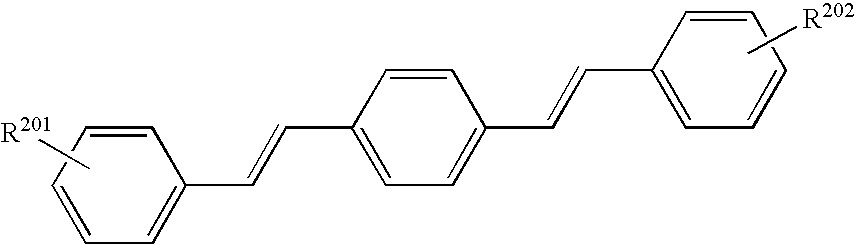
R201 (position) R202 (position) CN (2) CN (3) CN (2) CN (4) CN (3) CN (3) CN (3) CN (4) CN (4) CN (4) - b) Distyrylbiphenyls

R201 (position) R202 (position) SO3Na (3) Cl (4) OCH3 (2) H SO3Na (2) H - c) Divinylstilbenes
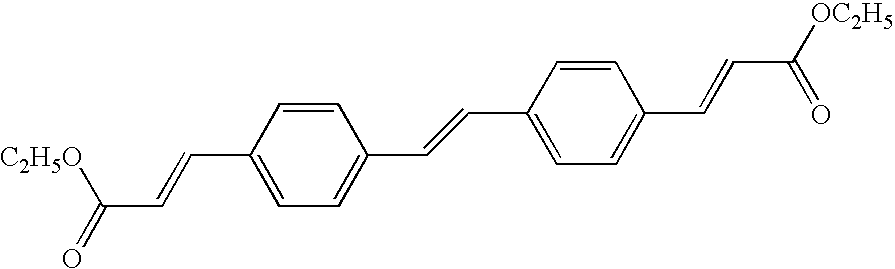
- Another divinylstilbene brightener with an even higher efficacy is 4,4′-di(cyanovinyl)stilbene.
- d) Triazinylaminostilbenes
- The tables below list the important anilino and anilinosulfonic acid representatives of bis(4,4′-triazinylamino)stilbene-2,2′-disulfonic acid. The latter can be employed over a wide pH range. All of the listed compounds are distinguished by high whitening effects, good efficiency, and adequate lightfastness.
- Anilino derivatives of bis(4,4′-triazinylamino)stilbene-2,2′-disulfonic acid

R —OCH3 —NH—CH3 —NH—C2H5 —NH—CH2CH2OH —N(CH3)(CH2CH2OH) —N(CH2CH2OH)2 
—NH—C6H5 —N(CH2CH2C(═O)NH)(CH2CH2OH) - Anilinosulfonic acid derivatives of bis(4,4′-triazinylamino)stilbene-2,2′-disulfonic acid

R203′ R203 (position) R204 (position) —NH—CH2CH2OH SO3Na (3) H —N(CH2CH2OH)2 SO3Na (3) H —N(CH2CH(OH)CH3)2 SO3Na (4) H —N(CH2CH2OH)2 SO3Na (4) H —N(CH3)(CH2CH2OH) SO3Na (4) H —N(C2H5)2 SO3Na (2) SO3Na (5) —N(CH2CH2OH)2 SO3Na (2) SO3Na (5) 
SO3Na (2) SO3Na (5) —N(CH2CO2Na)2 SO3Na (4) H - e) Stilbenyl-2H-triazoles
- Bis(1,2,3-trazol-2-yl)stilbenes
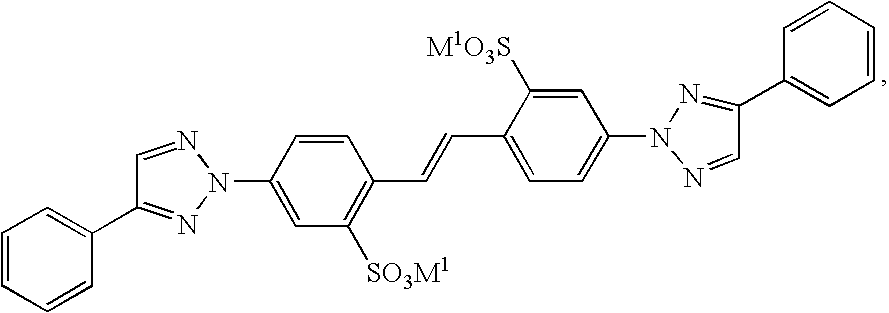
- wherein M1 is K, or Na.
- f) Benzoxazoles
- Stilbenylbenzoxazoles
- 5,7-dimethyl-2-(4′-phenylstilben-4-yl)benzoxazole
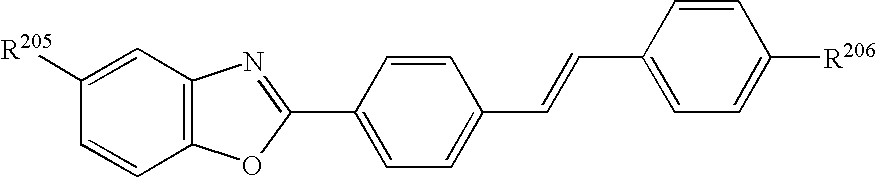
R205 R206 CH3 COOCH3 H 
- Bis(benzoxazoles)
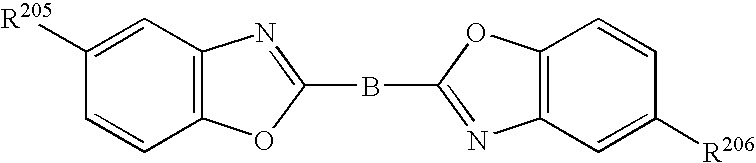
R205 R206 B CH3 CH3 
H H 
C(CH3)3 C(CH3)3 
H H 
CH3 CH3 
H H 
CH3 H 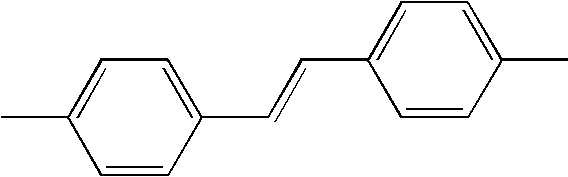
- g) Furans, Benzo[b]furans, and Benzimidazoles
- Furans and benzo[b]furans are further building blocks for optical brighteners. They are used, for example, in combination with benzimidazoles and benzo[b]furans as biphenyl end groups.
- Bis(benzo[b]furan-2-yl)biphenyls

- Cationic Benzimidazoles
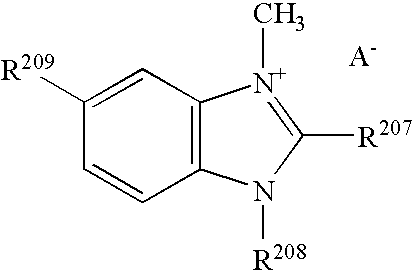
R207 R208 R209 A− 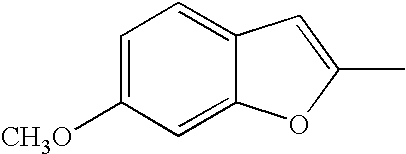
H —CH2CO2C2H5 Br−/Cl− 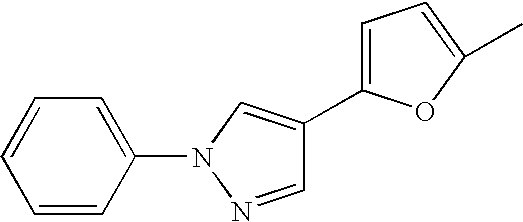
CH3 SO2CH3 CH3COO− 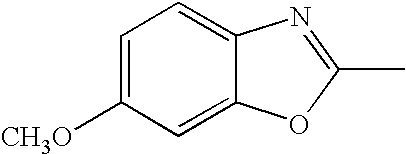
—CH2-Ph H CH3OSO3 − - h) 1,3-Diphenyl-2-pyrazolines
- 1-(4-Amidosulfonylphenyl)-3-(4-chlorophenyl)-2-pyrazoline
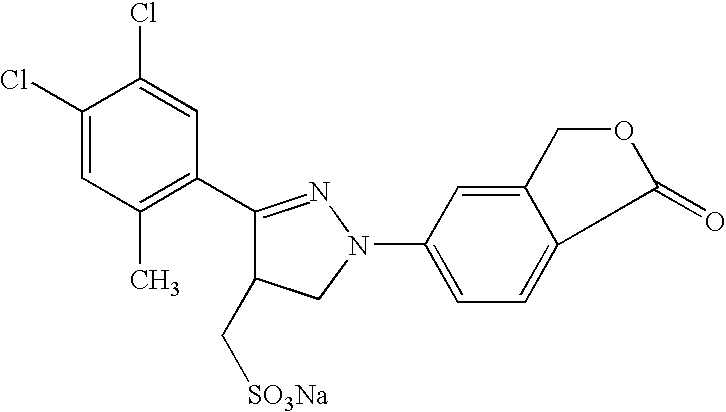
- Nonionic and anionic 1,3-diphenyl-2-pyrazolines
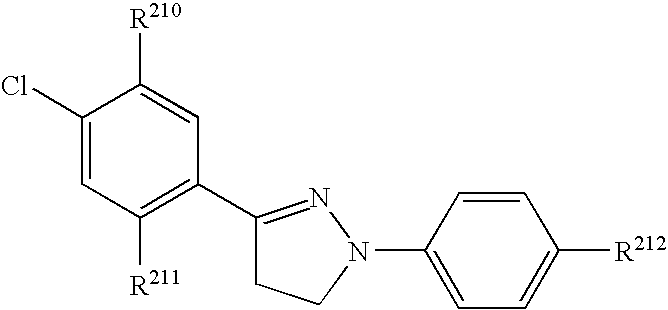
R210 R211 R212 H H SO2CH3 H H SO2CH2CH2OH H H SO2CH2CH2SO3Na H H COONa Cl CH3 SO2CH2CH2SO3Na - 1,3-Diphenyl-2-pyrazolines
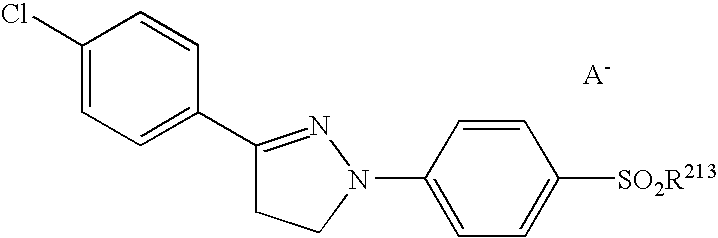
R213 A− —(CH2)2—+NH(CH3)2 H2PO3 − —(CH2)2—+NH(CH3)2 HCOO− —CH2—CH(CH3)+NH(CH3)2 CH3CH(OH)CO2 − —(CH2)2—C(═O)NH—(CH2)3—+NH(CH3)2 Cl− —(CH2)2—O—CH(CH3)—CH2—+NH(CH3)2 Cl− —NH—(CH2)3—+N(CH3)3 CH3OSO3 − —NH—(CH2)3—+N(CH3)2(CH2CH2OH) COO− - l) Coumarins
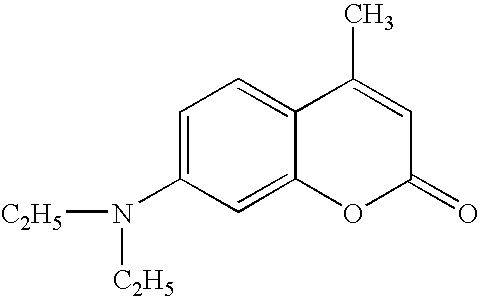
- j) Naphthalimides
- The 4-aminonaphthalimides and their N-alkylated derivatives are brilliant greenish yellow fluorescent colorants. Acylation of the amino group at the 4-position of the naphthalimide ring shifts the fluorescence toward blue, yielding compounds suitable for use as optical brighteners, such as 4-acetylamino-N-(n-butyl)naphthalimide.

R214 R215 R216 OCH3 H CH3 OC2H5 OC2H5 CH3 OCH3 H O(CH2)3CH3 - k) 1,3,5-Triazin-2-yl Derivatives
- Representative examples of this class of compounds are compounds of the formula
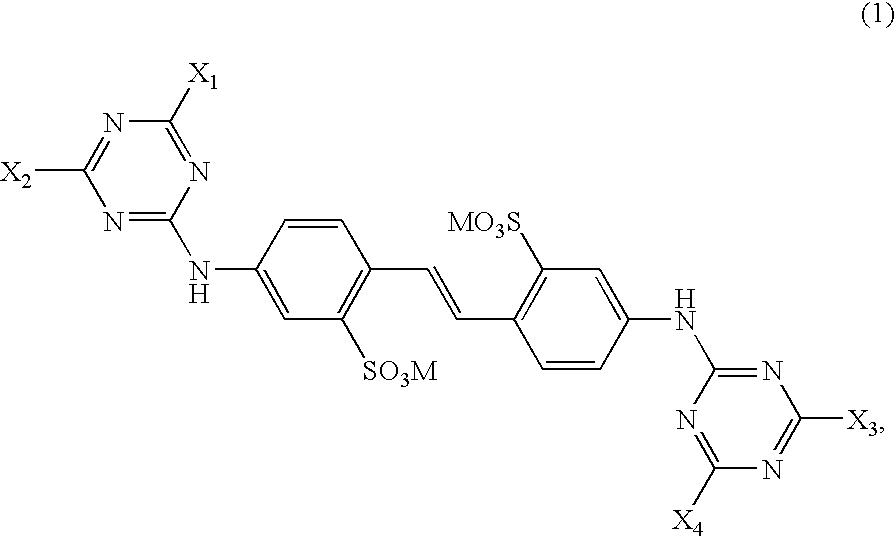
wherein - X1, X2, X3 and X4 each, independent of the other, represent —NR301R302 or —OR303, wherein R301 and R302 are, independently of each other,
- hydrogen, cyano, a C1-C4alkyl group, which is unsubstituted or substituted by one or two of the following residues selected from the group consisting of C1-C4alkoxy, hydroxy, carboxyl or a salt thereof (—CO2M), cyano, carbonamido, thiol, guanidine, substituted or unsubstituted phenyl, unsubstituted or C1-C4alkyl-substituted C5-C8cycloalkyl, halogen, a heterocycle and a sulphonic acid residue, and wherein the carbon chain of an alkyl group having two, three or four carbon atoms can be interrupted by oxygen,
- or, alternatively, a C5-C7cycloalkyl group or
- R301 and R302, together with the nitrogen atom linking them, complete a 5- or 6-membered heterocyclic ring;
- R303 represents C1-C4alkyl and
- M represents H, Na, Li, K, Ca, Mg, ammonium, or ammonium that is mono-, di-, tri- or tetrasubstituted by C1-C4alkyl and/or C2-C4hydroxyalkyl; especially
X1 X2 X3 X4 M —NH2 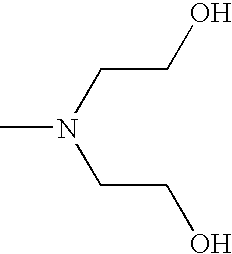
—NH2 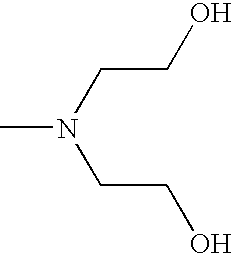
Na —NH2 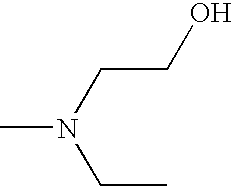
—NH2 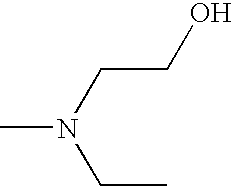
Na —NH2 
—NH2 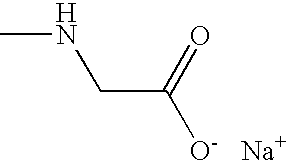
Na —NH2 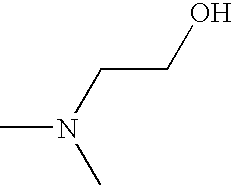
—NH2 
Na —NH2 
—NH2 
Na —NH2 
—NH2 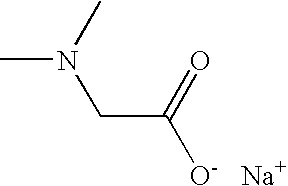
Na —NH2 
—NH2 
Na 


Na 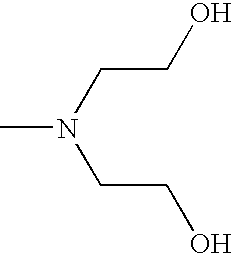
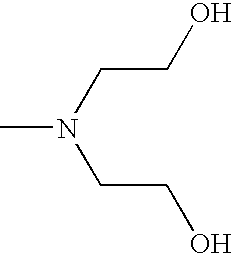
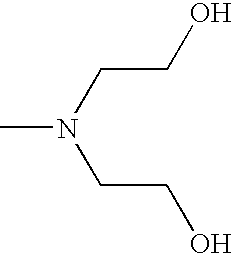

Na 

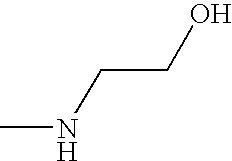

Na 

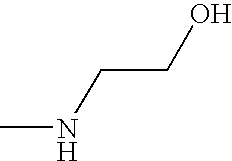

Na —NH2 —NH2 —NH2 —NH2 NH4 —NH2 
—NH2 
Na —NH2 
—NH2 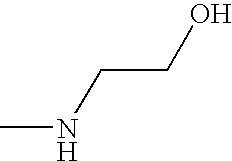
Na —NH2 
—NH2 
Na —NH2 
—NH2 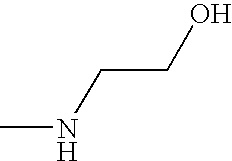
Na —NH2 
—NH2 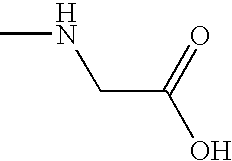
Na - or 1-(4,6-dimethoxy-1,3,5-triazin-2-yl)pyrene:
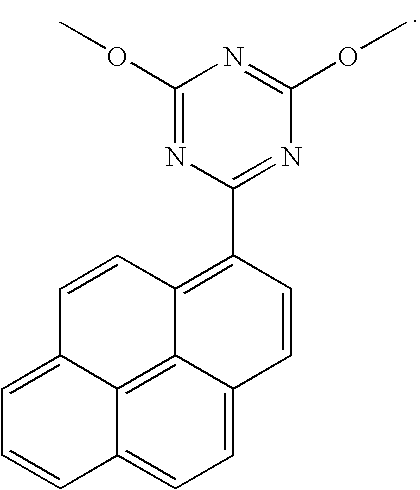
- Porous SiOz flakes charged with optical brighteners, i.e. one optical brightener or a mixture of optical brighteners, may be incorporated in variable amounts into cosmetic compositions. Generally, their content is adjusted so as to obtain a desired optical effect, i.e., a visual bleaching effect. Needless to say, their content may also be directly linked to emission power of optical brighteners they contain.
- Accordingly the present invention relates also to a cosmetic composition for making up and/or caring for skin, comprising porous SiOz flakes containing at least one optical brightener, wherein the porous mineral particles are provided in a physiologically acceptable medium and to a cosmetic process for lightening the skin, comprising applying the above cosmetic composition to the skin.
- Advantageously, compositions according to the invention can give skin onto which they are applied, improved qualities in terms of uniformity, homogeneity, transparency and whiteness. This results in a visual effect of uniform porcelain type.
- The SiOz flakes comprising an organic, or inorganic luminescent compound, or composition, can be obtained by a method, which comprises
- a) dispersing the SiOz flakes in a solution of the organic, or inorganic luminescent compound, or composition, adding the SiOz flakes to a solution of the organic, or inorganic luminescent compound, or composition, or adding the organic, or inorganic luminescent compound, or composition, to a dispersion of the SiOz flakes,
- b) optionally precipitating the organic, or inorganic luminescent compound, or composition, onto the SiOz flakes, and
- c) isolating the SiOz flakes comprising the organic, or inorganic luminescent compound, or composition.
- Preference is given to a method, which comprises
- a) adding the SiOz flakes to a solution of the organic, or inorganic luminescent compound, or composition,
- b) optionally precipitating the organic, or inorganic luminescent compound, or composition, onto the SiOz flakes, and
- c) subsequently isolating the SiOz flakes comprising the organic, or inorganic luminescent compound, or composition.
- Advantageously, the procedure is such that the organic, or inorganic luminescent compound, or composition, is first dissolved in a suitable solvent (I) and then the SiOz flakes are dispersed in the resulting solution. It is, however, also possible, vice versa, for the SiOz flakes first to be dispersed in the solvent (I) and then for the organic, or inorganic luminescent compound, or composition to be added and dissolved.
- Any solvent that is miscible with the first solvent and that so reduces the solubility of the organic, or inorganic luminescent compound, or composition, that it is completely, or almost completely, deposited onto the substrate is suitable as solvent (II). In this instance, both inorganic solvents and also organic solvents come into consideration. Isolation of the coated substrate can then be carried out in conventional manner by filtering off, washing and drying.
- An alternative process for preparing luminescent SiOz particles comprises
- a) vapor-deposition of a separating agent onto a carrier to produce a separating agent layer,
- b) then the simultaneous vapor-deposition of SiOy and a luminescent compound onto the separating agent layer (a),
- c) the separation of the luminescent SiOz particles from the separating agent, in particular by dissolving the separating agent in a solvent, and
- d) optionally separation of the luminescent SiOz particles from the solvent.
- If in the above process step a) is omitted and the carrier is replaced by a substrate material, a substrate material comprising a luminescent SiOz film comprising a luminescent organic or inorganic compound can be prepared.
- The term “halogen” means fluorine, chlorine, bromine and iodine.
- C1-C25alkyl is typically linear or branched—where possible—methyl, ethyl, n-propyl, isopropyl, n-butyl, sec.-butyl, isobutyl, tert.-butyl, n-pentyl, 2-pentyl, 3-pentyl, 2,2-dimethylpropyl, n-hexyl, n-heptyl, n-octyl, 1,1,3,3-tetramethylbutyl and 2-ethylhexyl, n-nonyl, decyl, undecyl, dodecyl, tetradecyl, pentadecyl, hexadecyl, heptadecyl, octadecyl, eicosyl, heneicosyl, docosyl, tetracosyl or pentacosyl, preferably C1-C8alkyl such as methyl, ethyl, n-propyl, isopropyl, n-butyl, sec.-butyl, isobutyl, tert.-butyl, n-pentyl, 2-pentyl, 3-pentyl, 2,2-dimethylpropyl, n-hexyl, n-heptyl, n-octyl, 1,1,3,3-tetramethylbutyl and 2-ethylhexyl, more preferably C1-C4alkyl such as typically methyl, ethyl, n-propyl, isopropyl, n-butyl, sec.-butyl, isobutyl, tert.-butyl.
- The terms “haloalkyl (or halogen-substituted alkyl), haloalkenyl and haloalkynyl” mean groups given by partially or wholly substituting the above-mentioned alkyl group, alkenyl group and alkynyl group with halogen, such as trifluoromethyl etc. The “aldehyde group, ketone group, ester group, carbamoyl group and amino group” include those substituted by an alkyl group, a cycloalkyl group, an aryl group, an aralkyl group or a heterocyclic group, wherein the alkyl group, the cycloalkyl group, the aryl group, the aralkyl group and the heterocyclic group may be unsubstituted or substituted. The term “silyl group” means a group of formula —SiR62R63R64, wherein R62, R63 and R64 are independently of each other a C1-C8alkyl group, in particular a C1-C4alkyl group, a C6-C24aryl group or a C7-C12aralkyl group, such as a trimethylsilyl group. The term “siloxanyl group” means a group of formula —O—SiR62R63R64, wherein R62, R63 and R64 are as defined above, such as a trimethylsiloxanyl group.
- Examples of C1-C8alkoxy are methoxy, ethoxy, n-propoxy, isopropoxy, n-butoxy, sec.-butoxy, isobutoxy, tert.-butoxy, n-pentoxy, 2-pentoxy, 3-pentoxy, 2,2-dimethylpropoxy, n-hexoxy, n-heptoxy, n-octoxy, 1,1,3,3-tetramethylbutoxy and 2-ethylhexoxy, preferably C1-C4alkoxy such as typically methoxy, ethoxy, n-propoxy, isopropoxy, n-butoxy, sec.-butoxy, isobutoxy, tert.-butoxy. The term “alkylthio group” means the same groups as the alkoxy groups, except that the oxygen atom of ether linkage is replaced by a sulfur atom.
- The term “aryl group” is typically C6-C24aryl, such as phenyl, 1-naphthyl, 2-naphthyl, 4-biphenyl, phenanthryl, terphenyl, pyrenyl, 2- or 9-fluorenyl or anthracenyl, preferably C6-C12aryl such as phenyl, 1-naphthyl, 2-naphthyl, 4-biphenyl, which may be unsubstituted or substituted.
- The term “aralkyl group” is typically C7-C24aralkyl, such as benzyl, 2-benzyl-2-propyl, β-phenyl-ethyl, α,α-dimethylbenzyl, ω-phenyl-butyl, ω,ω-dimethyl-ω-phenyl-butyl, ω-phenyl-dodecyl, ω-phenyl-octadecyl, ω-phenyl-eicosyl or ω-phenyl-docosyl, preferably C7-C18aralkyl such as benzyl, 2-benzyl-2-propyl, β-phenyl-ethyl, α,α-dimethylbenzyl, ω-phenyl-butyl, ω,ω-dimethyl-ω-phenyl-butyl, ω-phenyl-dodecyl or ω-phenyl-octadecyl, and particularly preferred C7-C12aralkyl such as benzyl, 2-benzyl-2-propyl, β-phenyl-ethyl, α,α-dimethylbenzyl, ω-phenyl-butyl, or ω,ω-dimethyl-ω-phenyl-butyl, in which both the aliphatic hydrocarbon group and aromatic hydrocarbon group may be unsubstituted or substituted.
- The term “aryl ether group” is typically a C6-24aryloxy group, that is to say O—C6-24aryl, such as, for example, phenoxy or 4-methoxyphenyl. The term “aryl thioether group” is typically a C6-24arylthio group, that is to say S—C6-24aryl, such as, for example, phenylthio or 4-methoxyphenylthio. The term “carbamoyl group” is typically a C1-18carbamoyl radical, preferably C1-8carbamoyl radical, which may be unsubstituted or substituted, such as, for example, carbamoyl, methylcarbamoyl, ethylcarbamoyl, n-butylcarbamoyl, tert-butylcarbamoyl, dimethylcarbamoyloxy, morpholinocarbamoyl or pyrrolidinocarbamoyl.
- The term “cycloalkyl group” is typically C5-C12cycloalkyl, such as cyclopentyl, cyclohexyl, cycloheptyl, cyclooctyl, cyclononyl, cyclodecyl, cycloundecyl, cyclododecyl, preferably cyclopentyl, cyclohexyl, cycloheptyl, or cyclooctyl, which may be unsubstituted or substituted. The term “cycloalkenyl group” means an unsaturated alicyclic hydrocarbon group containing one or more double bonds, such as cyclopentenyl, cyclopentadienyl, cyclohexenyl and the like, which may be unsubstituted or substituted. The cycloalkyl group, in particular a cyclohexyl group, can be condensed one or two times by phenyl which can be substituted one to three times with C1-C4-alkyl, halogen and cyano. Examples of such condensed cyclohexyl groups are:
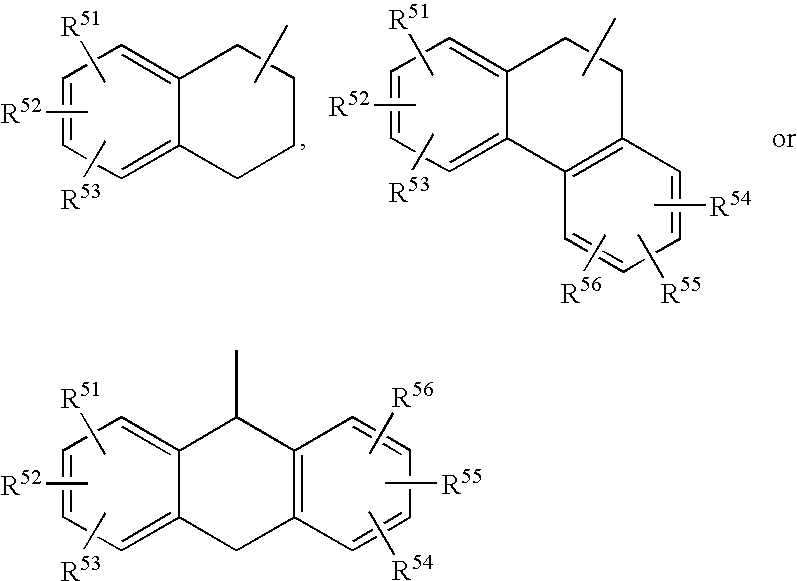
in particular
wherein R51, R52, R53, R54, R55 and R56 are independently of each other C1-C8-alkyl, C1-C8-alkoxy, halogen and cyano, in particular hydrogen. - The term “heteroaryl or heterocyclic group” is a ring with five to seven ring atoms, wherein nitrogen, oxygen or sulfur are the possible hetero atoms, and is typically an unsaturated heterocyclic radical with five to 18 atoms having at least six conjugated π-electrons such as thienyl, benzo[b]thienyl, dibenzo[b,d]thienyl, thianthrenyl, furyl, furfuryl, 2H-pyranyl, benzofuranyl, isobenzofuranyl, dibenzofuranyl, phenoxythienyl, pyrrolyl, imidazolyl, pyrazolyl, pyridyl, bipyridyl, triazinyl, pyrimidinyl, pyrazinyl, pyridazinyl, indolizinyl, isoindolyl, indolyl, indazolyl, purinyl, quinolizinyl, chinolyl, isochinolyl, phthalazinyl, naphthyridinyl, chinoxalinyl, chinazolinyl, cinnolinyl, pteridinyl, carbazolyl, carbolinyl, benzotriazolyl, benzoxazolyl, phenanthridinyl, acridinyl, perimidinyl, phenanthrolinyl, phenazinyl, isothiazolyl, phenothiazinyl, isoxazolyl, furazanyl or phenoxazinyl, preferably the above-mentioned mono- or bicyclic heterocyclic radicals.
- The terms “aryl” and “alkyl” in alkylamino groups, dialkylamino groups, alkylarylamino groups, arylamino groups and diaryl groups are typically C1-C25alkyl and C6-C24aryl, respectively.
- The above-mentioned groups can be substituted by a C1-C8alkyl, a hydroxyl group, a mercapto group, C1-C8alkoxy, C1-C8alkylthio, halogen, halo-C1-C8alkyl, a cyano group, an aldehyde group, a ketone group, a carboxyl group, an ester group, a carbamoyl group, an amino group, a nitro group, a silyl group or a siloxanyl group.
- In a further embodiment of the present invention the organic luminescent compound is chemically bonded to the SiOz flakes.

- OLC means an organic luminescent compound, especially one of the organic luminescent compounds mentioned above and x2 is 0, or 1.
- Suitably, the SiOz bonding group X3 is derived from a reactive group, which can react under suitable conditions with a functional group of the SiOz flakes.
- Preferably, the functional group of the SiOz flakes is a hydroxy group, and the reactive group X3 is derived from a group —Si(OR113)2O—, wherein R113 is an H, or —OSi—.
- Suitable spacer groups X2 may contain 1-60 chain atoms selected from the group consisting of carbon, nitrogen, oxygen, sulphur and phosphorus.
- For example, the spacer group may be:
- —(CHR′)p-
- {(CHR)q-O—(CHR′)r}s-
- —{(CHR′)q-S—(CHR′)r}-
- —{(CHR′)q-NR′—(CHR′)r}s-
- —{(CHR′)q-Si(R′)2—(CHR′)r}s-
- —{(CHR′)q-(CH═CH)—(CHR′)r}s-
- —{(CHR′)q-Ar—(CHR′)r}-
- —{(CHR′)q-CO—NR′—(CHR′)r}s-
- —{(CHR′)q-CO—Ar—NR′—(CHR′)r}s-,
where R′ is hydrogen, C1-4alkyl or aryl, which may be optionally substituted with sulphonate, Ar is phenylen, optionally substituted with sulphonate, p is 1-20, preferably 1-10, q is 1-10, r is 1-10 and s is 1-5. - X1 is a group derived from the reaction of a reactive group of the colorant and a functional group bonded to the spacer group X2, or vice versa.
- The functional group is, for example, selected from succinimidyl ester, sulpho-succinimidyl ester, isothiocyanate, maleimide, haloacetamide, acid halide, vinylsulphone, dichlorotriazine, carbodiimide, hydrazide and phosphoramidite. Preferably, the reactive group of the colorant is a hydroxy group, or amino group.
- Examples of possible reactive and functional groups are:
Reactive Groups Functional Groups succinimidyl esters primary amino, secondary amino, SH isothiocyanates amino groups, SH isocyanates amino groups, hydroxy, SH haloacetamides sulphydryl, hydroxy, amino acid halides amino groups, OH, SH anhydrides primary amino, secondary amino, hydroxy, SH hydrazides aldehydes, ketones vinylsulphones amino groups, hydroxy, SH mono-, or dichlorotriazines amino groups, SH carbodiimides carboxyl groups halogenide hydroxy, SH 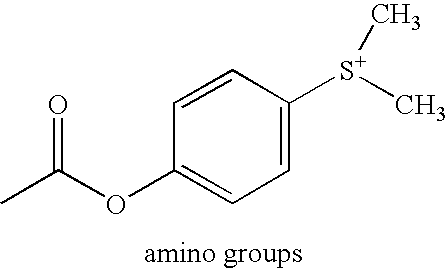
- Accordingly, the group X1 is selected from —NR114C(═O)—, —OC(═O)—, —SC(═O)—, —C(R114′)═N—NH—, —SO2—CH2—CH2—O—, —SO2—CH2—CH2—S—, —SO2—CH2—CH2—NH—,
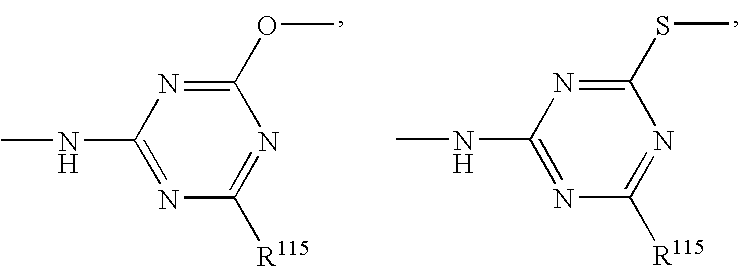
wherein R115 is chloro, substituted amino group, OH, or OR116, wherein R116 is C1-4alkyl; —C(═O)NH—, —S—CH2—C(═O)—NH—, —O—CH2—C(═O)—NH—, or —NH—CH2—C(═O)—NH—, —NH—C(═S)—NH—, —S—C(═S)—NH—, —NH—C(═O)—NH—, —S—C(═O)—NH—, —O—C(═O)—NH—, —NR114—, —S—, or —O—, wherein R114 is hydrogen, or C1-8alkyl, and R114′ is hydrogen, or C1-8alkyl. - Reactive groups which are especially useful for bonding luminescent materials with available amino and hydroxyl functional groups are preferred.
- In a further aspect the present invention is directed to luminescent SiOz flakes, especially luminescent porous SiOz flakes, comprising an inorganic luminescent compound which is chemically bonded to the SiOz flake via a group —X4—(X2)x2—X3—:

wherein x2 is 0, or 1,
is an inorganic luminescent complex compound having a partial structure M-L-, wherein - M is a metal, especially a rare earth metal, very especially terbium (Tb), praeseodym (Pr), europium (Eu), lanthanide (La) and dysprosium (Dy), and L is a ligand which is chemically bonded to X4, or

- is an inorganic luminescent complex compound having a partial structure

- wherein
- C—N is a cyclometallated ligand, which is chemically bonded to X4, M′ is a metal with an atomic weight of greater than 40, preferably of greater than 72,
- X3 is a group —Si(OR113)2O—, wherein R113 is H, or —OSi—,
- X2 is spacer group, especially
- —(CHR′)p-
- —{(CHR′)q-O—(CHR′)r}s-
- —{(CHR′)q-S—(CHR′)r}-
- —{(CHR′)q-NR′—(CHR′)r}s-
- —{(CHR′)q-Si(R′)2—(CHR′)r}s-
- —{(CHR′)q-(CH═CH)—(CHR′)r}s-
- —{(CHR′)q-Ar—(CHR′)r}-
- —{(CHR′)q-CO—NR′—(CHR′)r}s-
- —{(CHR′)q-CO—Ar—NR′—(CHR′)r}s-,
- where R′ is hydrogen, C1-4alkyl or aryl, which may be optionally substituted with sulphonate,
- Ar is phenylen, optionally substituted with sulphonate, p is 1-20, preferably 1-10, q is 1-10, r is 1-10 and s is 1-5,
- X4 is selected from —NR114C(═O)—, —OC(═O)—, —SC(═O)—, —C(R114′)═N—NH—, —SO2—CH2—CH2—O—, —SO2—CH2—CH2—S—, —SO2—CH2CH2—NH—,
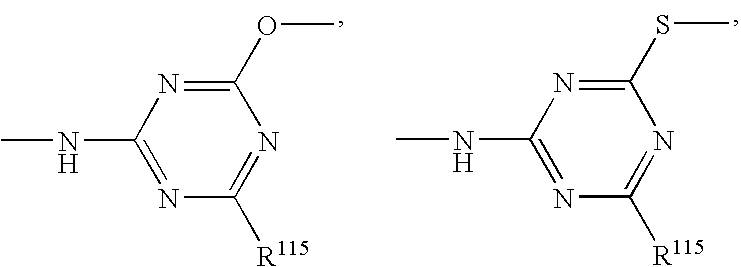
- wherein R115 is chloro, substituted amino group, OH, or OR116, wherein R116 is C1-4alkyl, —C(═O)NH—, —S—CH2—C(═O)—NH—, —O—CH2—C(═O)—NH—, or —NH—CH2—C(═O)—NH—, —NH—C(═S)—NH—, —S—C(═S)—NH—, —NH—C(═O)—NH—, —S—C(═O)—NH—, —O—C(═O)—NH—, —NR114—, —S—, or —O—, wherein R114 is hydrogen, or C1-8alkyl and R114′ is hydrogen, or C1-8alkyl.
- Examples of ligands, L, are


wherein - R221 and R225 are independently of each other hydrogen, C1-C8alkyl, C6-C18aryl, C2-C10heteroaryl, or C1-C8perfluoroalkyl,
- R222 and R226 are independently of each other hydrogen, or C1-C8alkyl, and
- R223 and R227 are independently of each other hydrogen, C1-C8alkyl, C6-C18aryl, C2-C10heteroaryl, C1-C8perfluoroalkyl, or C1-C8alkoxy, and
- R224 is C1-C8alkyl, C6-C10aryl, or C7-C11aralkyl,
- R228 is C6-C10aryl,
- R229 is C1-C8alkyl,
- R230 is C1-C8alkyl, or C6-C10aryl,
- R231 is hydrogen, C1-C8alkyl, or C1-C8alkoxy, which may be partially or fully fluorinated,
- R232 is C1-C8alkyl, C6-C10aryl, or C7-C11aralkyl,
- R233 is a hydroxy group, Cl, or NH2,
- R234 is a primary or secondary amino group,
with the proviso that one of the substituents R221, R222, R223, R225, R226, R227, R228, R229, R230, R231, R233, or R234 bear or is a reactive group that can react with a functional group to form the group X4 or an additional residue bearing a reactive group is present that can react with a functional group to form the group X4. - In said aspect of the present invention the inorganic luminescent colorant is preferably a metal complex of formula

wherein M is terbium (Tb), praeseodym (Pr), europium (Eu), lanthanide (La) and dysprosium (Dy), especially Eu, - X4 is selected from —NR114C(═O)—,

- wherein R115 is chloro, substituted amino group, OH, or OR116, wherein R116 is C1-4alkyl, —NH—CH2—C(═O)—NH—, —NH—C(═S)—NH—, —NH—C(═O)—NH—, —NR114—, wherein R114 is hydrogen, or C1-8alkyl, X2, x2, and X3 are as defined above.
- The ligands L′ are preferably derived from compounds HL′,
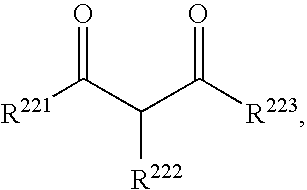
especially
(2,4-pentanedionate [acac]),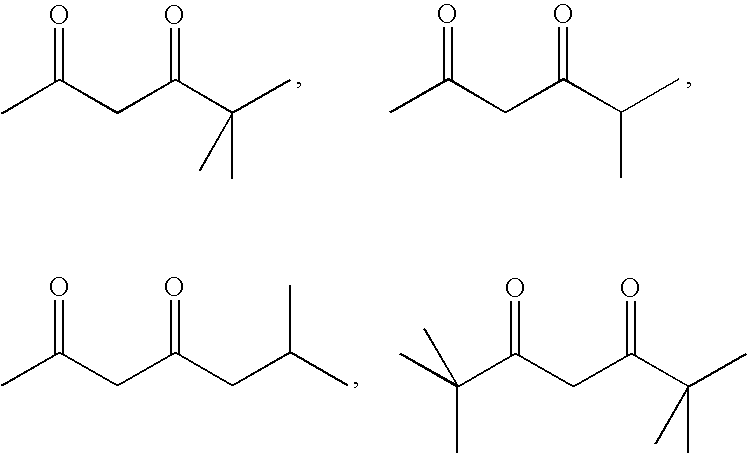
(2,2,6,6-tetramethyl-3,5-heptanedionate [TMH]),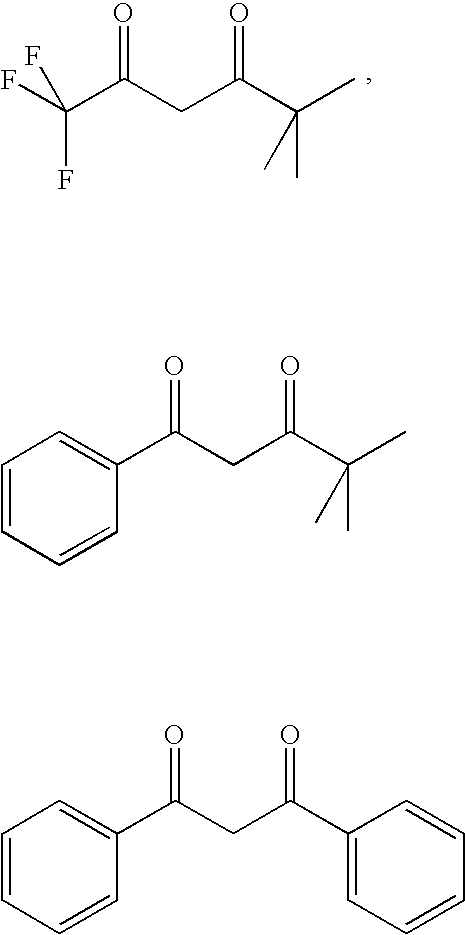
(1,3-diphenyl-1,3-propanedionate [DI]),
(4,4,4-trifluoro-1-(2-thienyl)-1,3-butanedionate [TTFA]),
(7,7-dimethyl-1,1,1,2,2,3,3-heptafluoro-4,6-octanedionate [FOD]),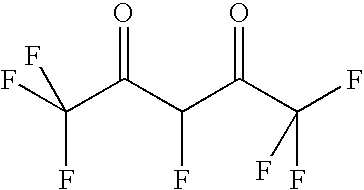
(1,1,1,3,5,5,5-heptafluoro-2,4-pentanedionate [F7acac]),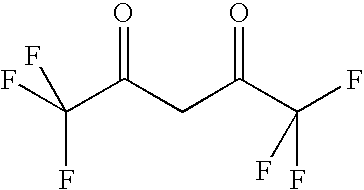
(1,1,1,5,5,5-hexafluoro-2,4-pentanedionate [F6acac]),
(1-phenyl-3-methyl-4-i-butyryl-pyrazolinonate [FMBP]),
- Suitable transition metals M′ include, but are not limited to Ir, Pt, Pd, Rh, Re, Os, Tl, Pb, Bi, In, Sn, Sb, Te, Au and Ag. Preferably the metal is selected from Ir, Rh and Re as well as Pt and Pd, wherein Ir is most preferred.
- The cyclometallated ligand, C—N, may be selected from those known in the art. Preferred cyclometallating ligands are 2-phenylpyridines and phenylpyrazoles:
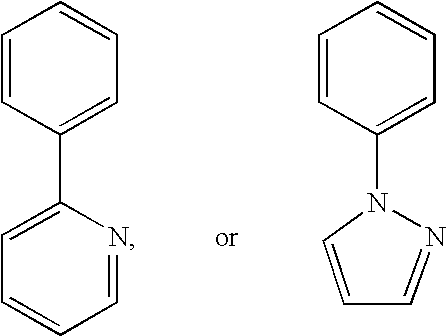
and derivatives thereof. The phenylpyridine or phenylpyrazole cyclometallated ligand may be optionally substituted with one or more alkyl, alkenyl, alkynyl, alkylaryl, CN, CF3, CO2R250, C(O)R250, N(R250)2, NO2, OR250, halo, aryl, heteroaryl, substituted aryl, substituted heteroaryl or a heterocyclic group, and additionally, or alternatively, any two adjacent substituted positions together form, independently, a fused 5- to 6-member cyclic group, wherein said cyclic group is cycloalkyl, cycloheteroalkyl, aryl, or heteroaryl, and wherein the fused 5- to 6-member cyclic group may be optionally substituted with one or more of alkyl, alkenyl, alkynyl, alkylaryl, CN, CF3, CO2R250, C(O)R250, N(R250)2, NO2, OR250, or halogen; and each R250 is independently alkyl, alkenyl, alkynyl, aralkyl, and aryl, with the proviso that the phenylpyridine or phenylpyrazole cyclometallated ligand bears a reactive group that can react with a functional group to form the group X4. - Cyclometallated ligand is a term well known in the art and includes but is not limited to

In said aspect of the present invention the inorganic luminescent colorant is preferably a metal complex of formula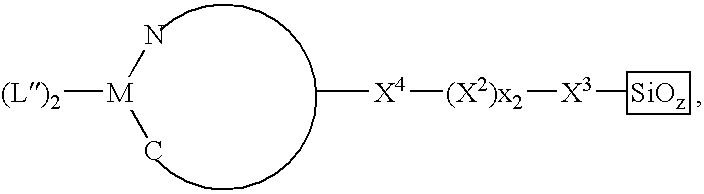
wherein L″ is L′, or a cyclometallated ligand, which is not chemically bonded to the SiOz flakes. - For example, the SiOz particles can firstly be modified by reaction with a functional silane, such as 3-mercaptopropyl trimethoxysilane. The porous SiOz flakes have a high surface area and are mesoporous materials, i.e. have pore widths of ca. 1 to ca. 50 nm, especially 2 to 20 nm, wherein the pores are randomly inter-connected in a three-dimensional way. Isothiocyanate modified fluorescent dyes can enter and react with thiol groups inside the pores. The clear silicon oxide shells of controlled thicknesses protect fluorescent signals. The particles are stable and useful for many purposes, particularly for optical bar coding in combinatorial synthesis of polymers such as nucleic acid, polypeptide, and other synthesized molecules.
- In a further aspect the present invention is directed to porous SiOz flakes, comprising inorganic phosphors. The absorption of the exciting radiation is strongly dependent on the particle size of the phosphors and decreases rapidly for particles having relative high particle sizes. By using porous SiOz flakes having pore sizes in the range of 1 to 50 nm, especially 2 to 20 nm, it is possible to produce nanosized phosphors within the pores of the porous SiOz flakes.
- I) Sulfides and Selenides
- a) Zinc and Cadmium Sulfides and Sulfoselenides
- The raw materials for the production of sulfide phosphors are high-purity zinc and cadmium sulfides, which are precipitated from purified salt solutions by hydrogen sulfide or ammonium sulfide. The Zn1-yCdyS (0≦y≦0.3) can be produced by coprecipitation from mixed zinc-cadmium salt solutions.
- The most important activators for sulfide phosphors are copper and silver, followed by manganese, gold, rare earths, and zinc. The charge compensation of the host lattice is effected by coupled substitution with mono- or trivalent ions (e.g., Cl− or Al3+).
- For the synthesis of phosphors, the sulfides are precipitated onto the porous SiOz flakes with readily decomposed compounds of the activators and coactivators and are fired.
- The luminescent properties can be influenced by the nature of the activators and coactivators, their concentrations, and the firing conditions. In addition, specific substitution of zinc or sulfur in the host lattice by cadmium or selenium is possible, which also influences the luminescent properties.
- Doping zinc sulfide with silver (silver activation) leads to the appearance of an intense emission band in the blue region of the spectrum at 440 nm, which has a short decay time.
- The substitution of zinc by cadmium in the ZnS:Ag phosphor leads to a shift of the emission maximum from the blue over to the green, yellow, red to the IR spectral region.
- Activation with copper causes an emission in zinc sulfide which consists of a blue (460 nm) and a green band (525 nm) in varying ratios, depending on the preparation.
- Zinc sulfide forms a wide range of substitutionally mixed crystals with manganese sulfide. Manganese-activated zinc sulfide has an emission band in the yellow spectral region at 580 nm.
- The activation of zinc sulfide with gold leads to luminescence in the yellow-green (550 nm) or blue (480 nm) spectral regions, depending on the preparation, whereas a blue-white luminescing phosphor is formed on activation with phosphorus.
- The activators are added in the form of oxides, oxalates, carbonates, or other compounds which readily decompose at higher temperatures.
- b) Alkaline-Earth Sulfides and Sulfoselenides
- Activated alkaline-earth metal sulfides have emission bands between the ultraviolet and near infrared. They are produced by precipitation of sulfates or selenites, optionally in the presence of activators, such as, for example, copper nitrate, manganese sulfate, or bismuth nitrate, onto the porous SiOz flakes, followed by reduction with Ar—H2 and firing. Alkaline-earth halides or alkali-metal sulfates are sometimes added as fluxes.
- The alkaline-earth sulfides, such as MgS, or CaS, activated with rare earths, such as europium, cerium, or samarium, are of great importance:
- CaS:Ce3+ is a green-emitting phosphor. On activation with 10−4 mol % cerium, the emission maximum occurs at 540 nm. Greater activator concentrations lead to a red shift; substitution of calcium by strontium, on the other hand, leads to a blue shift. MgS:Ce3+ (0.1%) has two emission bands in the green and red spectral regions at 525 and 590 nm; MgS:Sm3+ (0.1%) has three emission bands at 575 nm (green), 610 (red), and 660 nm (red).
- Calcium or strontium sulfides, doubly activated with europium—samarium or cerium—samarium, can be stimulated by IR radiation. Emission occurs at europium or cerium and leads to orange-red (SrS:Eu2+, Sm3+) or green (CaS:Ce3+, Sm3+) luminescence.
- c) Oxysulfides
- The main emission lines of Y2O2S:Eu3+ occur at 565 and 627 nm. The intensity of the long-wavelength emission increases with the europium concentration, whereby the color of the emission shifts from orange to deep red. Terbium in Y2O2S has main emission bands in the blue (489 nm) and green spectral regions (545 and 587 nm), whose intensity ratio depends on the terbium concentration. At low doping levels, Y2O2S:Tb3+ luminesces blue-white, while at higher levels the color tends towards green. Gd2O2S:Tb3+ exhibits green luminescence.
- II) Oxygen-Dominant Phosphors
- a) Borates:
- Sr3B12O20F2: Eu2+.
- b) Aluminates:
- Yttrium aluminate Y3Al5O12:Ce3+ (YAG) is produced by precipitation of the hydroxides with NH4OH onto the porous SiOz flakes from a solution of the nitrates and subsequent firing.
- Cerium magnesium aluminate (CAT) Ce0.65Tb0.35MgAl11O19 is produced by coprecipitation of the metal hydroxides onto the porous SiOz flakes from a solution of the nitrates with NH4OH and subsequent firing. A strongly reducing atmosphere is necessary to ensure that the rare earths are present as Ce3+ and Tb3+. Examples of further aluminate phosphors are BaMg2Al16O27:Eu2+ and Y2Al3Ga2O12:Tb3+.
- Long decay phosphors that are comprised of rare-earth activated divalent, boron-substituted aluminates are disclosed in U.S. Pat. No. 5,376,303. In particular, the long decay phosphors are comprised of MOa(Al1-bBb)2O3:c R103, wherein 0.5≦a≦10.0, 0.0001≦b≦0.5 and 0.0001≦c≦0.2, MO represents at least one divalent metal oxide selected from the group consisting of MgO, CaO, SrO and ZnO and R103 represents Eu and at least one additional rare earth element. Preferably, R103 represents Eu and at least one additional rare earth element selected from the group consisting of Pt, Nd, Dy and Tm.
- c) Silicates
- ZnSiO4:Mn is used as a green phosphor. Its production involves the precipitation of a [Zn(NH3)4](OH)2 and MnCO3 solution onto the porous SiOz flakes, which are subsequently dried and fired.
- Yttrium orthosilicate Y2SiO5:Ce3+ can be produced by treating an aqueous solution of (Y, Tb) (NO3)3 with the SiOz flakes, heating and by subsequent reductive firing under N2/H2. An yttrium orthosilicate can be doped with Ce, Tb, and Mn.
- d) Germanates
- Magnesium fluorogermanate, 3.5 MgO.0.5MgF2.GeO2:Mn4+ is a brilliant red phosphor.
- e) Halophosphates and Phosphates
- The halophosphates are doubly activated phosphors, in which Sb3+ and Mn2+ function as sensitizer and activator, giving rise to two corresponding maxima in the emission spectrum. The antimony acts equally as sensitizer and activator. The chemical composition can be expressed most clearly as 3Ca3(PO4)2.Ca(F, Cl)2:Sb3+, Mn2+.
- The following phosphate phosphors are preferred: (Sr,Mg)3(PO4)2:Sn2+; LaPO4:Ce3+, Tb3+; Zn3(PO4)2: Mn2+; Cd5Cl(PO4)2:Mn2+; Sr3(PO4)2.SrCl2:Eu2+; and Ba2P2O7:Ti4+.
- 3Sr3(PO4)2.SrCl2:Eu2+ can be excited by radiation from the entire UV range. The excitation maximum lies at 375 nm and the emission maximum at 447 nm. Upon successive substitution of Sr2+ by Ca2+ and Ba2+, the emission maximum shifts to 450 nm.
- f) Oxides:
- The preparation of Y2O3:Eu3+ is generally carried out by precipitating mixed oxalates from purified solutions of yttrium and europium nitrates onto the SiOz flakes. Firing the dried oxalates is followed by crystallization firing.
- Y2O3:Eu3+ shows an intense emission line at 611.5 nm in the red region. The luminescence of this red emission line increases with increasing Eu concentration up to ca. 10 mol %. Small traces of Tb can enhance the Eu fluorescence of Y2O3:Eu3+.
- ZnO:Zn is a typical example of a self-activated phosphor.
- g) Arsenates:
- Magnesium arsenate 6MgO.As2O5:Mn4+ is a very brilliant red phosphor. Its production comprises the precipitation of magnesium and manganese onto the SiOz flakes with pyroarsenic acid using solutions of MgCl2 and MnCl2. The dried precipitate is fired.
- h) Vanadates
- Of the vanadates activated with rare earths, YVO4:Eu3+ are preferred, whereas vanadates with other activators (YVO4 with Tm, Tb, Ho, Er, Dy, Sm, or In; GdVO4:Eu; LuVO4:Eu) are of less interest. The incorporation of Bi3+ sensitizes the Eu3+ emission and results in a shift of the luminescence color towards orange.
- i) Sulfates:
- Photoluminescent sulfates are obtained by activation with ions that absorb short-wavelength radiation, for example, Ce3+. Alkali-metal and alkaline-earth sulfates with Ce3+ emit between 300 and 400 nm. On additional manganese activation, the energy absorbed by Ce3+ is transferred to manganese with a shift of the emission into the green to red region. Water-insoluble sulfates are precipitated together with the activators onto the porous SiOz flakes and fired below the melting point. In the case of activation by Ce3+ and Mn2+ the activator concentration is at least 0.5 mol %.
- j) Tungstates and Molybdates
- Magnesium tungstate MgWO4 and calcium tungstate CaWO4 are the most important self-activated phosphors. Magnesium tungstate has a high quantum yield of 84% for the conversion of the 50-270-nm radiation into visible light. On additional activation with rare-earth ions their typical emission also occurs. One Example of a molybdate activated with Eu3+ is Eu2(WO4)3.
- III) Halide Phosphors
- Luminescent alkali-metal halides can be produced easily in high-purity and as large single crystals. Through the incorporation of foreign ions (e.g., Tl+, Ga+, In+) into the crystal lattice, further luminescence centers are formed. The emission spectra are characteristic for the individual foreign ions.
- The porous SiOz flakes comprising the alkali-metal halide phosphors are produced by firing the corresponding alkali-metal halide and the activator under an inert atmosphere.
- Some important alkali-metal halide phosphors are listed in Table below:
Host Crystal Activator LiI Eu NaI Tl CsI Tl CsI Na LiF Mg LiF Mg, Ti LiF Mg, Na - Of the alkaline-earth halide phosphors, those doped with manganese or rare earths are preferred, e.g., CaF2:Mn; CaF2:Dy.
- They are produced by co-precipitation of CaF2 and an activator from a solution of the corresponding cations onto the porous SiOz flakes, followed by firing.
- Other preferred halide phosphors are (Zn, Mg)F2:Mn2+, KMgF3:Mn2+, MgF2:Mn2+, (Zn, Mg)F2:Mn2+.
- The oxyhalides of yttrium, lanthanum, and gadolinium are good host lattices for activation with other rare-earth ions such as terbium, cerium, and thulium, such as LaOCl:Tb3+ and LaOBr:Tb3+. The activator concentration (Tb, Tm) is 0.01-0.15 mol %. By coactivation, with ytterbium, the afterglow can be reduced. Partial substitution of lanthanum by gadolinium in LaOBr:Ce3+ leads to an increase in the quantum yield upon electron excitation and an increase in the quenching temperature.
- The amount of luminescent compound, or composition in the SiOz flakes can vary within wide limits and is advantageously in the range from 0.01 to 60% by weight, preferably more than 5% by weight to 50% by weight, based on total SiOz flake mass. Preference is given to percentages ranging from 7 to 40%, by weight, based on total SiOz flake mass.
- Particularly preferred inorganic luminescent compounds produce a phosphorescence effect on excitation by visible or ultraviolet radiation. The phosphorescence effect has the advantage of being a simple way to ensure machine readability and of permitting the separation in space of the site of excitation from the site of detection. The phosphorescence effect may be excited even by white light, so that visual observation in a darkened environment is sufficient for detection. This facilitates the checking of any security coding of products, such as textiles, and the checking of documents of value.
- The invention advantageously utilizes inorganic luminescent compounds which on excitation by visible or ultraviolet radiation in the wavelength range from 200 to 680 nm will, after the excitation has ended, emit visible light having spectral fractions in the wavelength range from 380 to 680 nm.
- It is particularly advantageous to use zinc sulfides, zinc cadmium sulfides, alkaline earth metal aluminates, alkaline earth metal sulfides or alkaline earth metal silicates, all doped with one or more transition metal elements or lanthanoid elements. For instance, copper-doped zinc sulfides produce green phosphorescence, alkaline earth metal aluminates, alkaline earth metal sulfides or alkaline earth metal silicates doped with lanthanoid elements produce green, blue or red phosphorescence, and copper-doped zinc cadmium sulfides produce yellow, orange or red phosphorescence, depending on the cadmium content.
- Preference is given to alkaline earth metal aluminates doped with europium and alkaline earth metal aluminates which, as well as europium, include a further rare earth element as coactivator, especially dysprosium. Particularly useful alkaline earth metal aluminates of the above-mentioned kind are described in EP-A-0 622 440 and U.S. Pat. No. 5,376,303, which are both incorporated herein in full by reference.
- Natural teeth exhibit blue-white fluorescence with a characteristic spectral distribution through the action of long-wavelength UV light. Porous SiOz flakes, comprising inorganic phosphors, such as yttrium silicates doped with cerium, terbium, and manganese give the artificial teeth made from it blue-white fluorescence in the long-wavelength UV. A typical composition is (Y0.937Ce0.021Tb0.033Mn0.009)2SiO5. The excitation maximum of these phosphors is in the range 325-370 nm.
- The luminescent SiOz flakes according to the invention can be used for all customary purposes, for example for colouring polymers in the mass, coatings (including effect finishes, including those for the automotive sector) and printing inks (including offset printing, intaglio printing, bronzing and flexographic printing; see, for example, WO03/068868), and also, for example, for applications in cosmetics (see, for example, WO04/020530), in ink-jet printing (see, for example, WO04/035684), for dyeing textiles (see, for example, WO04/035911), glazes for ceramics and glass. Such applications are known from reference works, for example “Industrielle Organische Pigmente” (W. Herbst and K. Hunger, VCH Verlagsgesellschaft mbH, Weinheim/New York, 2nd, completely revised edition, 1995).
- The luminescent SiOz flakes according to the invention can be used with excellent results for pigmenting high molecular weight organic material.
- The high molecular weight organic material for the pigmenting of which the pigments or pigment compositions according to the invention may be used may be of natural or synthetic origin. High molecular weight organic materials usually have molecular weights of about from 103 to 108 g/mol or even more. They may be, for example, natural resins, drying oils, rubber or cagein, or natural substances derived therefrom, such as chlorinated rubber, oil-modified alkyd resins, viscose, cellulose ethers or esters, such as ethylcellulose, cellulose acetate, cellulose propionate, cellulose acetobutyrate or nitrocellulose, but especially totally synthetic organic polymers (thermosetting plastics and thermoplastics), as are obtained by polymerisation, polycondensation or polyaddition. From the class of the polymerisation resins there may be mentioned, especially, polyolefins, such as polyethylene, polypropylene or polyisobutylene, and also substituted polyolefins, such as polymerisation products of vinyl chloride, vinyl acetate, styrene, acrylonitrile, acrylic acid esters, methacrylic acid esters or butadiene, and also copolymerisation products of the said monomers, such as especially ABS or EVA.
- From the series of the polyaddition resins and polycondensation resins there may be mentioned, for example, condensation products of formaldehyde with phenols, so-called phenoplasts, and condensation products of formaldehyde with urea, thiourea or melamine, so-called aminoplasts, and the polyesters used as surface-coating resins, either saturated, such as alkyd resins, or unsaturated, such as maleate resins; also linear polyesters and polyamides, polyurethanes or silicones.
- The said high molecular weight compounds may be present singly or in mixtures, in the form of plastic masses or melts. They may also be present in the form of their monomers or in the polymerised state in dissolved form as film-formers or binders for coatings or printing inks, such as, for example, boiled linseed oil, nitrocellulose, alkyd resins, melamine resins and urea-formaldehyde resins or acrylic resins.
- A composition comprising a high molecular weight organic material and from 0.01 to 80% by weight, preferably from 0.1 to 30% by weight, based on the high molecular weight organic material, of the luminescent SiOz flakes according to the invention is advantageous. Concentrations of from 1 to 20% by weight, especially of about 10% by weight, can often be used in practice.
- The pigmenting of high molecular weight organic substances with the luminescent SiOz flakes according to the invention is carried out, for example, by admixing such luminescent SiOz flakes, where appropriate in the form of a masterbatch, with the substrates using roll mills or mixing or grinding apparatuses. The pigmented material is then brought into the desired final form using methods known per se, such as calendering, compression moulding, extrusion, coating, pouring or injection moulding. Any additives customary in the plastics industry, such as plasticisers, fillers or stabilisers, can be added to the polymer, in customary amounts, before or after incorporation of the pigment. In particular, in order to produce non-rigid shaped articles or to reduce their brittleness, it is desirable to add plasticisers, for example esters of phosphoric acid, phthalic acid or sebacic acid, to the high molecular weight compounds prior to shaping.
- For pigmenting coatings and printing inks, the high molecular weight organic materials and the luminescent SiOz flakes according to the invention, where appropriate together with customary additives such as, for example, fillers, other pigments, siccatives or plasticisers, are finely dispersed or dissolved in the same organic solvent or solvent mixture, it being possible for the individual components to be dissolved or dispersed separately or for a number of components to be dissolved or dispersed together, and only thereafter for all the components to be brought together.
- Dispersing the luminescent SiOz flakes according to the invention in the high molecular weight organic material being pigmented, and processing a pigment composition according to the invention, are preferably carried out subject to conditions under which only relatively weak shear forces occur so that the flakes are not broken up into smaller portions.
- Plastics comprising the luminescent SiOz flakes of the invention in amounts of 0.1 to 50% by weight, in particular 0.5 to 7% by weight. In the coating sector, the pigments of the invention are employed in amounts of 0.1 to 10% by weight. In the pigmentation of binder systems, for example for paints and printing inks for intaglio, offset or screen printing, the pigment is incorporated into the printing ink in amounts of 0.1 to 50% by weight, preferably 5 to 30% by weight and in particular 8 to 15% by weight.
- The luminescent SiOz flakes according to the invention are also suitable for making-up the lips or the skin and for colouring the hair or the nails.
- The invention accordingly relates also to a cosmetic preparation or formulation comprising from 0.0001 to 90% by weight of the luminescent SiOz flakes, according to the invention and from 10 to 99.9999% of a cosmetically suitable carrier material, based on the total weight of the cosmetic preparation or formulation.
- Such cosmetic preparations or formulations are, for example, lipsticks, blushers, foundations, nail varnishes and hair shampoos.
- The cosmetic preparations and formulations according to the invention preferably contain the pigment according to the invention in an amount from 0.005 to 50% by weight, based on the total weight of the preparation.
- Suitable carrier materials for the cosmetic preparations and formulations according to the invention include the customary materials used in such compositions.
- The cosmetic preparations and formulations according to the invention may be in the form of, for example, sticks, ointments, creams, emulsions, suspensions, dispersions, powders or solutions. They are, for example, lipsticks, mascara preparations, blushers, eye-shadows, foundations, eyeliners, powder or nail varnishes.
- In addition, the luminescent SiOz flakes of the present invention can be used as substrates of interference pigments which have luminescent and color-shifting properties. The layer structure of such interference pigment flakes is described in more detail in WO04/065295. The interference pigment flakes exhibit a discrete color shift so as to have a first color at a first angle of incident light or viewing and a second color different from the first color and a second angle of incident light or viewing. The interference pigment flakes can be interspersed into liquid media such as paints or inks to produce colorant materials for subsequent application to objects or papers.
- The luminescent color-shifting pigment flakes are particularly suited for use in applications where colorants of high chroma and durability are desired. By using the luminescent color-shifting pigment flakes in a colorant material, high chroma durable paint or ink can be produced in which variable color effects are noticeable to the human eye. The luminescent color-shifting flakes of the invention have a wide range of color-shifting properties, including large shifts in chroma (degree of color purity) and also large shifts in hue (relative color) with a varying angle of view. Thus, an object colored with a paint containing the luminescent colorshifting flakes of the invention will change color depending upon variations in the viewing angle or the angle of the object relative to the viewing eye.
- The luminescent color-shifting flakes of the invention can be easily and economically utilized in paints and inks which can be applied to various objects or papers, such as motorized vehicles, currency and security documents, household appliances, architectural structures, flooring, fabrics, sporting goods, electronic packaging/housing, product packaging, etc. The luminescent color-shifting flakes can also be utilized in forming colored plastic materials, coating materials, extrusions, electrostatic coatings, glass, and ceramic materials.
- In order to obtain an optimum optical effect, it should be ensutred during processing that the platelet-shaped pigment is well oriented, i.e. is aligned as parallel as possible to the surface of the respective medium. This parallel orientation of the pigment particles is best carried out from a flow process, and is generally achieved in all known methods of plastic processing, painting, coating and printing.
- Owing to its uncopyable optical effects, the luminescent SiOz flakes according to the invention are preferably used for the production of forgery-proof materials from paper and plastic. In addition, the pigment according to the invention can also be used in formulations such as paints, printing inks, varnishes, in plastics, ceramic materials and glasses, in cosmetics, for laser marking of paper and plastics and for the production of pigment preparations in the form of pellets, chips, granules, briquettes, etc.
- The term forgery-proof materials made from paper is taken to mean, for example, documents of value, such as banknotes, cheques, tax stamps, postage stamps, rail and air tickets, lottery tickets, gift certificates, entry cards, forms and shares. The term forgery-proof materials made from plastic is taken to mean, for example, cheque cards, credit cards, telephone cards and identity cards.
- For the production of printing inks, the luminescent SiOz flakes are incorporated into binders which are usually suitable for printing inks. Suitable binders are cellulose, polyacrylate-polymethacrylate, alkyd, polyester, polyphenol, urea, melamine, polyterpene, polyvinyl, polyvinyl chloride and polyvinylpyrrolidone resins, polystyrenes, polyolefins, coumarone-indene, hydrocarbon, ketone, aldehyde and aromatic-formaldehyde resins, carbamic acid, sulfonamide and epoxy resins, polyurethanes and/or natural oils, or derivatives of the said substances.
- Besides the film-forming, polymeric binder, the printing ink comprises the conventional constituents, such as solvents, if desired water, antifoams, wetting agents, constituents which affect the rheology, antioxidants, etc.
- The luminescent SiOz flakes according to the invention can be employed for all known printing processes. Examples thereof are gravure printing, flexographic printing, screen printing, bronze printing and offset printing.
- Since all known plastics can be pigmented with pearlescent pigments, the production of forgery-proof materials from plastic is not limited by the use of the luminescent SiOz flakes according to the invention. It is suitable for all mass colourings of thermoplastics and thermosetting plastics and for the pigmentation of printing inks and varnishes for surface finishing thereof. The pigment according to the invention can be used for pigmenting acrylonitrile-butadiene-styrene copolymers, cellulose acetate, cellulose acetobutyrate, cellulose nitrate, cellulose propionate, artificial horn, epoxy resins, polyamide, polycarbonate, polyethylene, polybutylene terephthalate, polyethylene terephthalate, polymethyl methacrylate, polypropylene, polystyrene, polytetrafluoroethylene, polyvinyl chloride, polyvinylidene chloride, polyurethane, styrene-acrylonitrile copolymers and unsaturated polyester resins.
- The Examples that follow illustrate the invention without limiting the scope thereof. Unless otherwise indicated, percentages and parts are percentages and parts by weight, respectively.
- a) Diethyl-4-hydroxypyridine-2,6-dicarboxylate 1 was prepared in 64% yield by treatment of 7.0 g (34.8 mmol) chelidamic acid—monohydrate with 15 ml (325 mmol) absolute ethanol and 10 g toluenesulfonic acid in 330 ml CHCl3 at reflux in analogy to a published procedure (Inorg. Chem. 2000, Vol. 39, No. 21, 4678-4687).
- Found: C: 55.15; H: 5.46; N: 5.77. Calc. for C11H13NO5: C: 55.23; H: 5.48; N: 5.24% 1H-NMR (DMSO-d6): δ 1.33 (t, 6H), 4.36 (q, 4H), 7.58 (s, 2H)
- b) 3-Bromopropyl-modified porous SiOz 2
- 1.0 g of porous SiOz (z≈1.4-1.6) obtained in analogy to example 1 of WO04/065295 are suspended in 100 ml absolute ethanol. Under nitrogen a solution of 2.82 ml (3.65 g) 3-bromopropyltrimethoxysilane in 25 ml absolute ethanol is added dropwise with continued stirring. The suspension is stirred for 1 hour, then heated to 50° C. and stirred for 22 hours at 50° C. The cooled suspension is filtered, washed with absolute ethanol and the residue is dried at 60° C. in vacuo. Yield: 0.99 g. Elemental analysis shows an organic shell proportion of w(C3H6Br)=1.5%.
- c) Diethyl-4-propyloxypyridine-2,6-dicarboxylate-modified porous SiOz 3
- 2.39 g (10 mmol) of 1 and 0.69 g (5 mmol) K2CO3 are suspended in 70 ml of DMF under nitrogen with stirring. After 1 hour of continued stirring 0.85 g of 2 are added with stirring at room temperature. The suspension is heated to 75° C. for 16 hours with continued stirring. After cooling the suspension is filtered, washed successively with DMF, de-ionized water and methanol and the residue is dried at 60° C. in vacuo. Yield: 0.81 g. Elemental analysis shows an organic shell proportion of w(C14H18NO5)=2.6%
- d) 0.2 g (0.5 mmol) EuCl3.6H2O are diluted in 30 ml of de-ionized water and the solution is adjusted to pH=6. 0.32 g of 3 are added and the suspension is stirred for 65 hours at pH=6. The suspension is filtered, washed repeatedly with de-ionized water and the residue is dried at 80° C. in vacuo. Yield: 0.30 g. Elemental analysis shows a Eu content of 3.67% wt and an organic shell proportion of w(C14H18NO5)=2.0%.
-

- 52.4 mg (3-triethoxysilyl)propylisocyanate are added to 50 mg 4′-aminofluorescein in 8 ml DMF and stirred until termination of the reaction. The reaction mixture is filtered. Porous SiOz flakes (z≈1.4-1.6) obtained in analogy to example 1 of WO04/065295 are added to the obtained yellow DMF solution. The suspension is stirred for 1 hour, then heated to 50° C. and stirred for 22 hours at 50° C. The cooled suspension is filtered, washed with absolute ethanol and the residue is dried at 60° C. in vacuo.
-

- 40 μl concentrated HCl are added to 50 mg Rhodamin B base in 1 ml water. The mixture is evaporated to dryness. 5 ml CH2Cl2 are added to the residue. 23.3 mg dicyclohexylcarbodiimide (DCC) and 20.3 mg (3-aminopropyl)trimethoxysilane are added, the reaction mixture is stirred until termination of the reaction and then filtered. Porous SiOz flakes (z≈1.4-1.6) obtained in analogy to example 1 of WO04/065295 are added to the obtained red CH2Cl2 solution. The suspension is stirred for 1 hour, then heated to 50° C. and stirred for 22 hours at 50° C. The cooled suspension is filtered, washed with absolute ethanol and the residue is dried at 60° C. in vacuo.
-
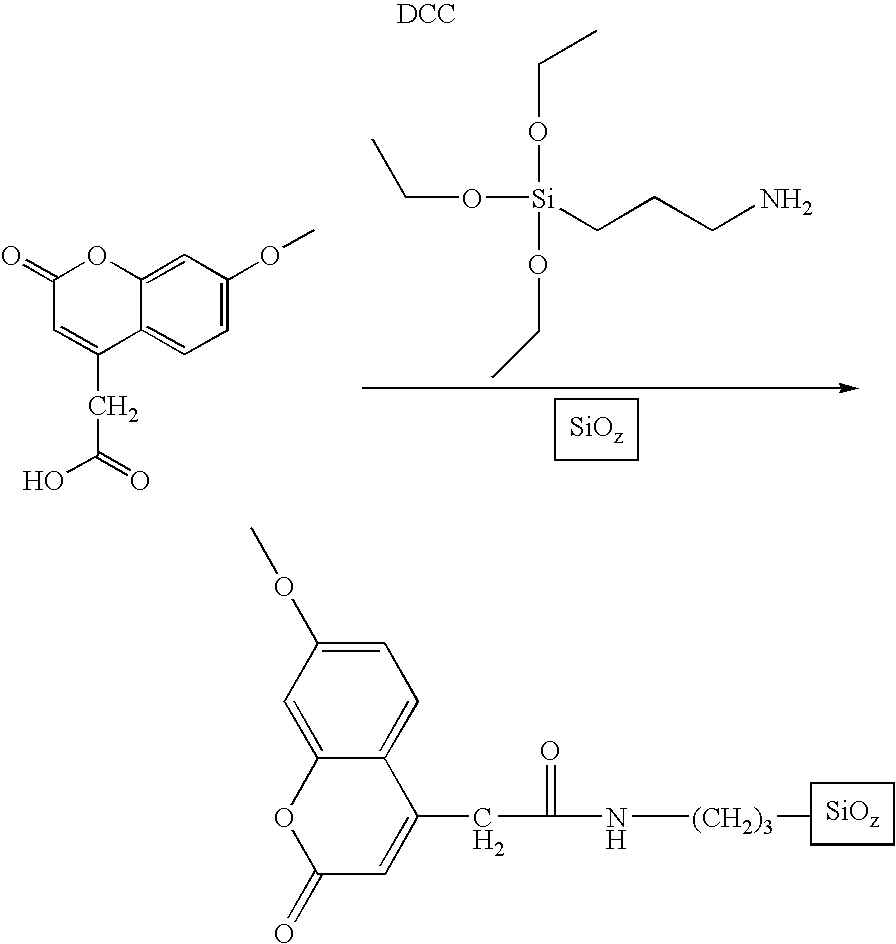
- 50 mg 7-methoxycoumarin-4-acetic acid are added to 4 ml dioxane. 44 mg dicyclohexylcarbodiimide (DCC) and 38.3 mg (3-aminopropyl)trimethoxysilane are added, the reaction mixture is stirred until termination of the reaction and then filtered. Porous SiOz flakes (z≈1.4-1.6) obtained in analogy to example 1 of WO04/065295 are added to the obtained red dioxane solution. The suspension is stirred for 1 hour, then heated to 50° C. and stirred for 22 hours at 50° C. The cooled suspension is filtered, washed with absolute ethanol and the residue is dried at 60° C. in vacuo.
-
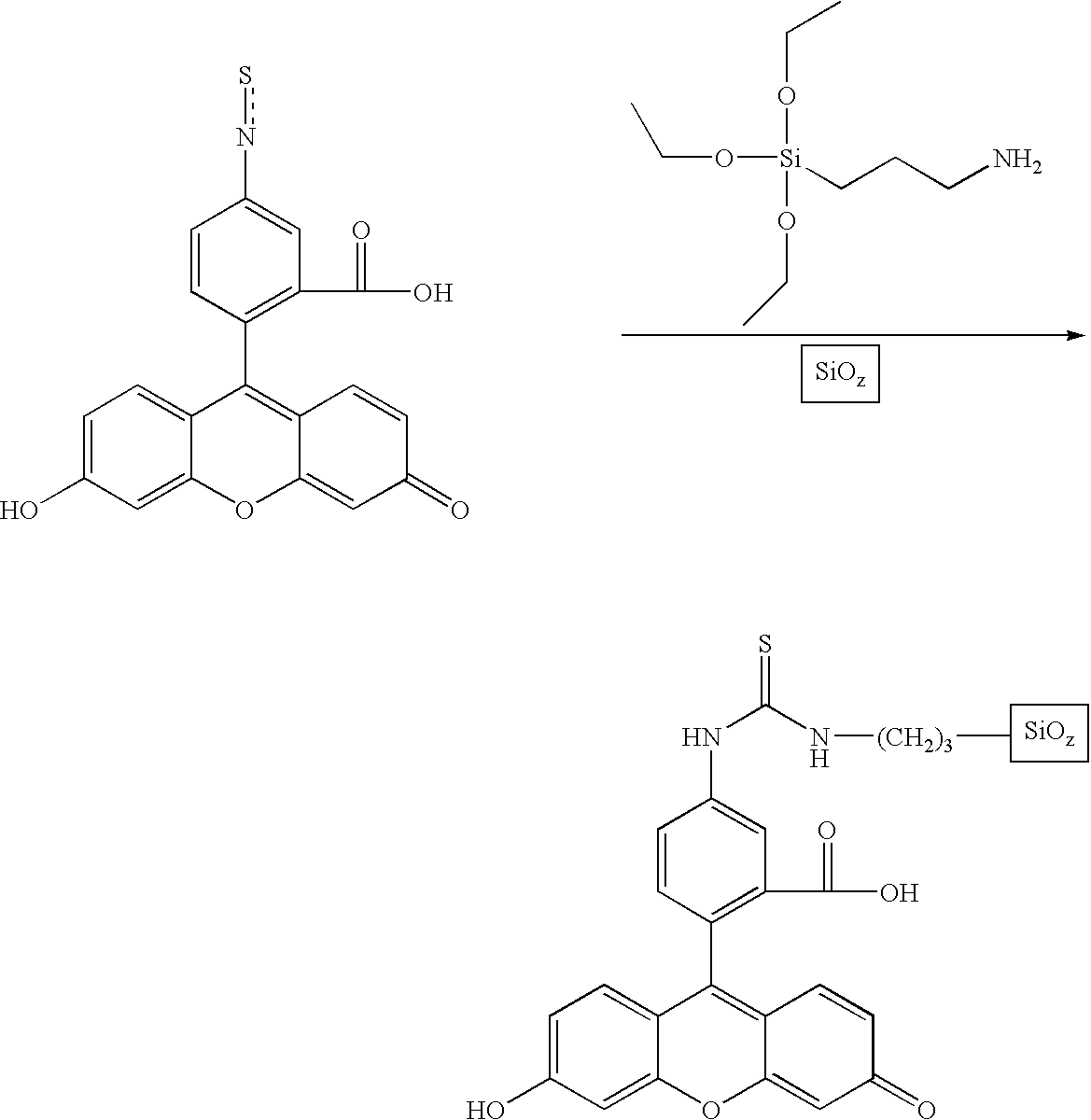
- 5 mg of porous silicon oxide particles modified by reaction with 3-aminopropyl trimethoxysilane are placed in a vial and a solution of ethanol (500 microliters) and fluorescein isothiocyanate (1 milligram) are added. The colorant solution was removed from the vial after the reaction has been terminated. The particles are washed in ethanol five 15 times. The vial was then placed in an ultrasonic bath for one hour, and the particles washed 3 times.
- The amount of colorant incorporated into the particle is controlled by allowing the colorant to absorb into the particle for different periods of time. The colorants were firmly attached to the particles.
- 1.0 g (3.6 mmol) of Y(NO3)3 and 0.134 g (0.36 mmol) EuCl3-hexahydrate are diluted in 50 ml of de-ionised water. 1 g of porous SiOz (BET: 647 m2/g, z≈1.74) is added to this solution while stirring. After 3 hours a solution of 9.0 g of urea in 50 ml de-ionised water is added with stirring at room temperature. The suspension is heated to 100° C. for 6 hours with continued stirring. After cooling the suspension is filtered through a cotton sieve, washed with de-ionised water, the residue is dried at 80° C. in vacuo and subsequently fired at 900° C. for 14 hours, followed by 1000° C. for 3 hours. Yield: 1.19 g. The BET surface area dropped to 268 m2/g after filling the pores with Y2O3:Eu and to 186 m2/g after firing. The compound shows a red fluorescence at 611 nm with an excitation wavelength of 254 nm.
- 2.0 g Na2WO4.2H2O are diluted in 10 ml de-ionized water. 1.2 g of porous SiOz (BET: 773 m2/g) are added while stirring. After 4 h of stirring the suspension is filtered and the residue is dried at 80° C. in vacuo. The product is redispersed in dried ethanol using ultrasound. A solution of 0.5 g EuCl3 in dried ethanol is slowly added. The suspension is filtered, washed successively with ethanol, ethanol/water 1:1, water and finally ethanol, and the residue is dried at 60° C. in vacuo. Subsequently the product is optionally fired at 600° C. The received compound shows a pore loading of 14% wt. Eu2(WO4)3 and exhibits a strong red fluorescence at an excitation wavelength of 254 nm.
-
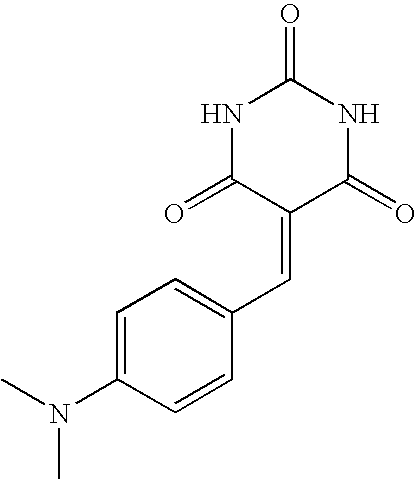
- 5.0 g barbituric acid is diluted in 250 ml formic acid. 5.0 g of porous SiOz flakes (BET: 712 m2/g) are added while stirring. After 18 h of stirring the suspension is filtered and the residue is dried at 120° C. in vacuo for 20 hours. The product is redispersed in 160 ml ethanol, 0.1 g triethylamine is added and the mixture is heated to 78° C. A solution of 1.5 g dimethylaminobenzaldehyd in ethanol using a heatable dropping funnel at 65° C. is slowly added while stirring. The suspension is stirred for 75 minutes, cooled, filtered, washed successively with ethanol and water, and the residue is dried at 100° C. in vacuo. The received compound shows a pore loading of 9% by weight of the fluorescent pigment and exhibits a red fluorescence at an excitation wavelength of 254 nm.
Claims (19)
1. A non-porous or porous SiOz flake, wherein 0.70≦z≦2.0, comprising an organic or inorganic luminescent compound or composition.
2. The porous SiOz flake according to claim 1 , wherein the luminescent compound, or composition comprises a fluorescent organic colorant which is selected from coumarins, benzocoumarins, xanthenes, benzo[a]xanthenes, benzo[b]xanthenes, benzo[c]xanthenes, phenoxazines, benzo[a]phenoxazines, benzo[b]phenoxazines and benzo[c]phenoxazines, napthalimides, naphtholactams, azlactones, methines, oxazines and thiazines, diketopyrrolopyrroles, perylenes, quinacridones, benzoxanthenes, thio-epindolines, lactamimides, diphenylmaleimides, acetoacetamides, imidazothiazines, benzanthrones, perylenmonoimides, perylenes, phthalimides, benzotriazoles, pyrimidines, pyrazines, triazoles, dibenzofurans and triazines.
3. The porous SiOz flake according to claim 2 , wherein the luminescent compound is selected from
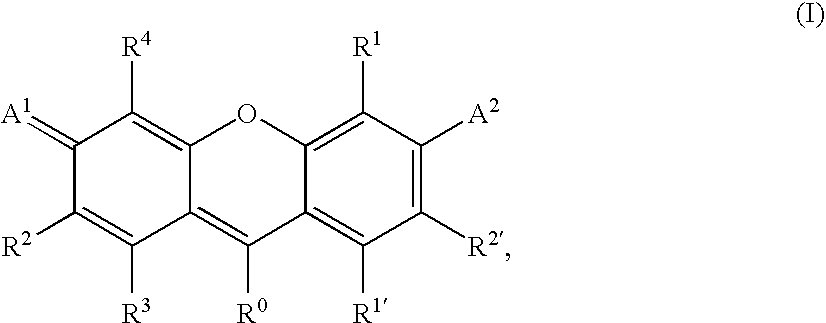

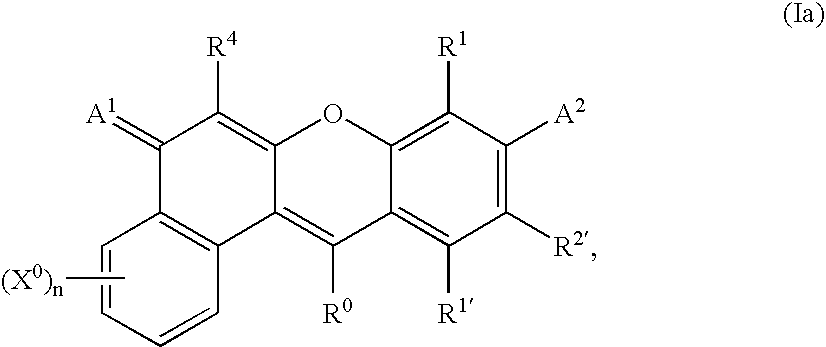
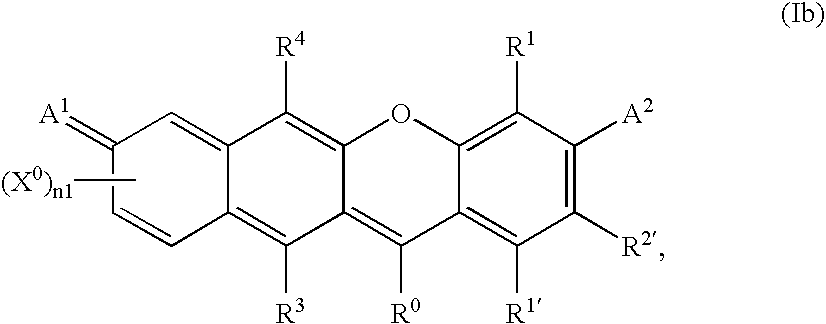
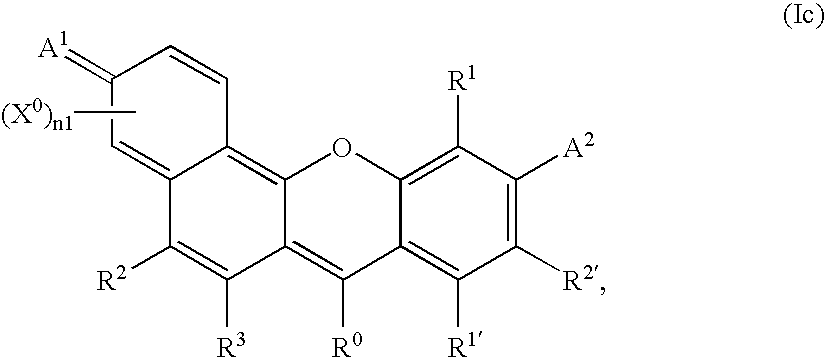
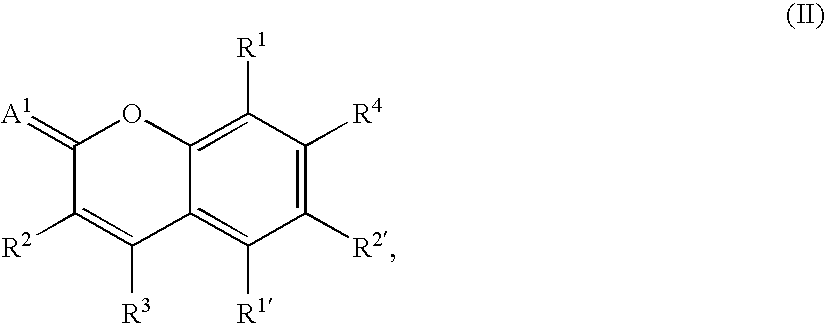
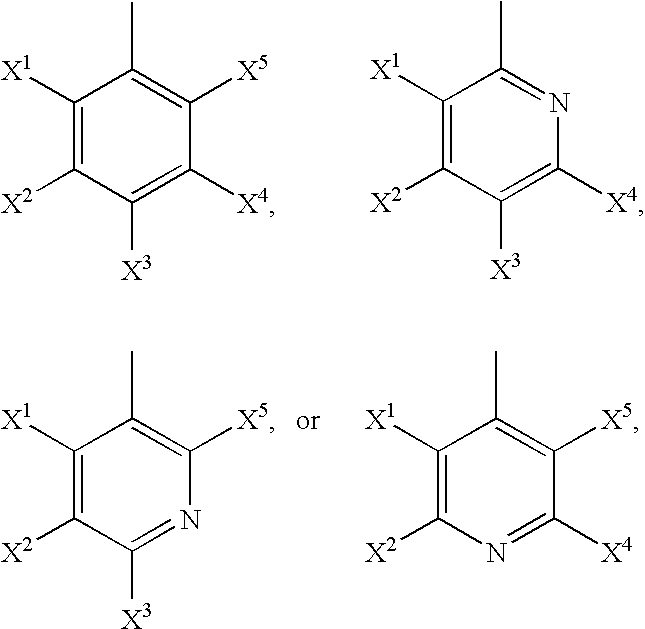
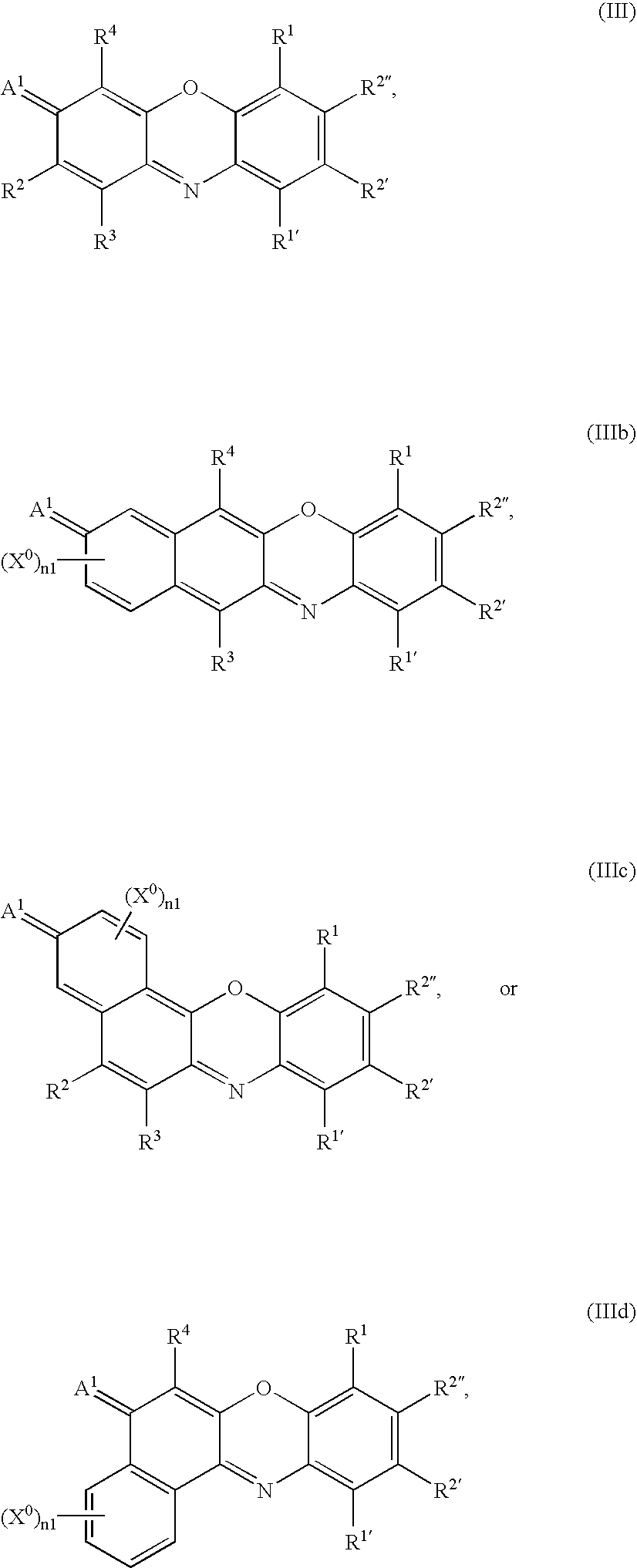
Xanthene colorants of formula
wherein A′ represents O or N-Z in which Z is H or C1-C8alkyl, or is optionally combined with R2, or R4 to form a 5- or 6-membered ring, or is combined with each of R2 and R4 to form two fused 6-membered rings; A2 represents —OH or —NZ2; R1, R1′, R2, R2′, R3 and R4 are each independently selected from H, halogen, cyano, CF3, C1-C8alkyl, C1-C8alkylthio, C1-C8alkoxy, aryl and heteroaryl; wherein the alkyl portions of any of R1′, R2′ or R1 through R4 are optionally substituted with halogen, carboxy, sulfo, amino, mono- or dialkylamino, alkoxy, cyano, haloacetyl or hydroxy; and the aryl or heteroaryl portions of any of R1′, R2′ or R1 through R4 are optionally substituted with from one to four substituents selected from the group consisting of halogen, cyano, carboxy, sulfo, hydroxy, amino, mono- or di(C1-C8)alkylamino, C1-C8alkyl, C1-C8alkylthio and C1-C8alkoxy; R0 is halogen, cyano, CF3, C1-C8alkyl, C1-C8alkenyl, C1-C8alkynyl, aryl or heteroaryl having the formula:
wherein X1, X2, X3, X4 and X5 are each independently selected from the group consisting of H, halogen, cyano, CF3, C1-C8alkyl, C1-C8alkoxy, C1-C8alkylthio, C1-C8alkenyl, C1-C8alkynyl, SO3H and CO2H, wherein, additionally, the alkyl portions of any of X1 through X5 can be further substituted with halogen, carboxy, sulfo, amino, mono- or dialkylamino, alkoxy, cyano, haloacetyl or hydroxy, and, optionally, any two adjacent substituents X1 through X5 can be taken together to form a fused aromatic ring that is optionally further substituted with from one to four substituents selected from halogen, cyano, carboxy, sulfo, hydroxy, amino, mono- or di(C1-C8) alkylamino, (C1-C8)alkyl, (C1-C8)alkylthio and (C1-C8)alkoxy;
Benzo[a]xanthen colorants of formula
wherein
n is an integer of 0 to 4,
each X0 is independently selected from the group consisting of H, halogen, cyano, CF3, C1-C8alkyl, C1-C8alkoxy, C1-C8alkylthio, C1-C8alkenyl, C1-C8alkynyl, aryl, heteroaryl, SO3H and CO2H;
A1, A2, R0, R1, R1′, R2′, and R4 are as defined above, wherein the alkyl portions of X0 can be further substituted with halogen, carboxy, sulfo, amino, mono- or dialkylamino, alkoxy, cyano, haloacetyl or hydroxy, and the aryl or heteroaryl portions of any of R1, R1′, R2′, and R4 are optionally substituted with from one to four substituents selected from the group consisting of halogen, cyano, carboxy, sulfo, hydroxy, amino, mono- or di(C1-C8)alkylamino, C1-C8alkyl, C1-C8alkylthio and C1-C8alkoxy;
Benzo[b]xanthen colorants of formula
wherein
n1 is an integer of 0 to 3, X0, A1, A2, R0, R1, R1′, R2′, R3 and R4 are as defined above;
Benzo[b]xanthen colorants of formula
wherein
n1 is an integer of 0 to 3, X0, A1, A2, R0, R1, R1′, R2′, R2 and R3 are as defined above;
Coumarin colorants of formula
wherein A1, R1, R1′, R2′, R2, R3, and R4 are as defined above, or R2 and R3 are independently of each other of halogen, cyano, CF3, C1-C8alkyl, aryl, or heteroaryl having the formula
wherein X1, X2, X3, X4 and X5 are as defined above, or R2 and R3 are combined to form a fused benzene ring, optionally substituted with one to four substituents selected from halogen cyano, carboxy, sulfo, hydroxy, amino, mono- or di(C1-C8)alkylamino, C1-C8alkyl, C1-C8alkylthio and C1-C8alkoxy;
wherein R2″has the meanings provided above for R2′, n1, X0, A1, R1, R1′, R2′, R2, R3 and R4 are as defined above.
4. The porous SiOz flake according to claim 2 , wherein the luminescent compound is selected from a compound of formula
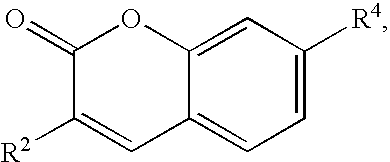
wherein R4 is —N(C2H5)2 and R2 is a group of formula:
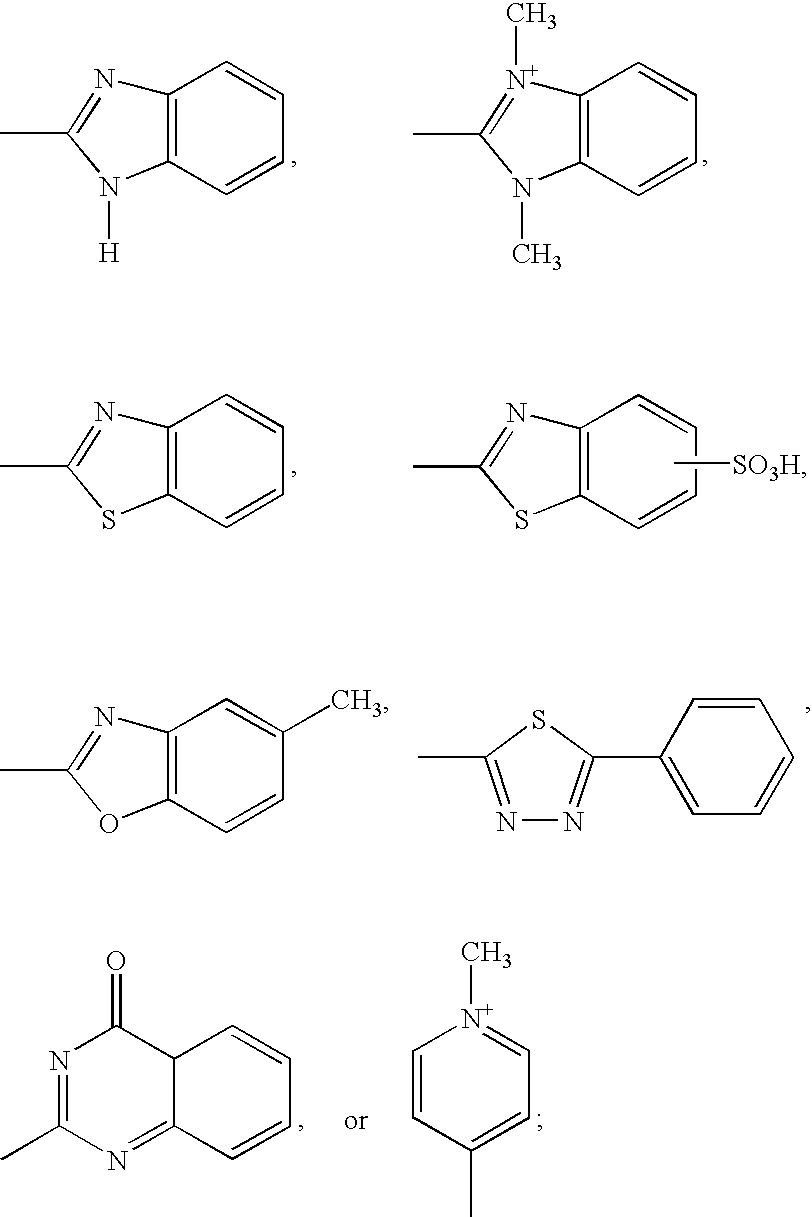
a compound of formulae

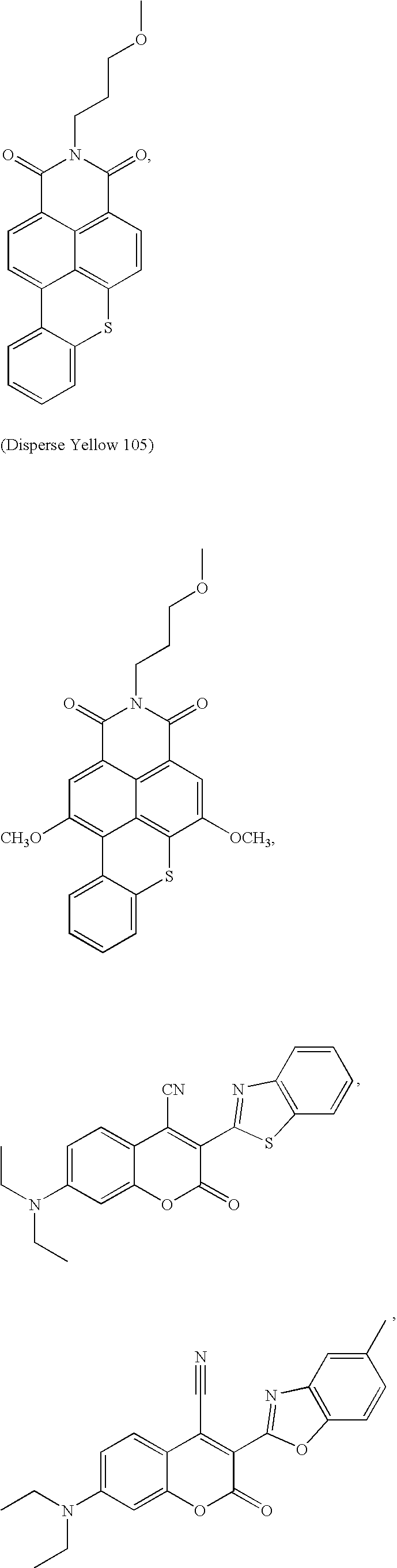


wherein R300 is H, C1-C8alkyl, or C1-C8alkoxy;
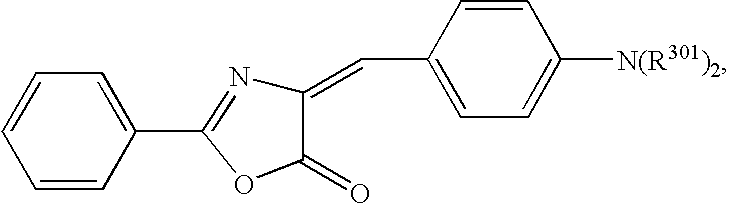
wherein R301 is C1-C8alkyl;

wherein R302 is H,
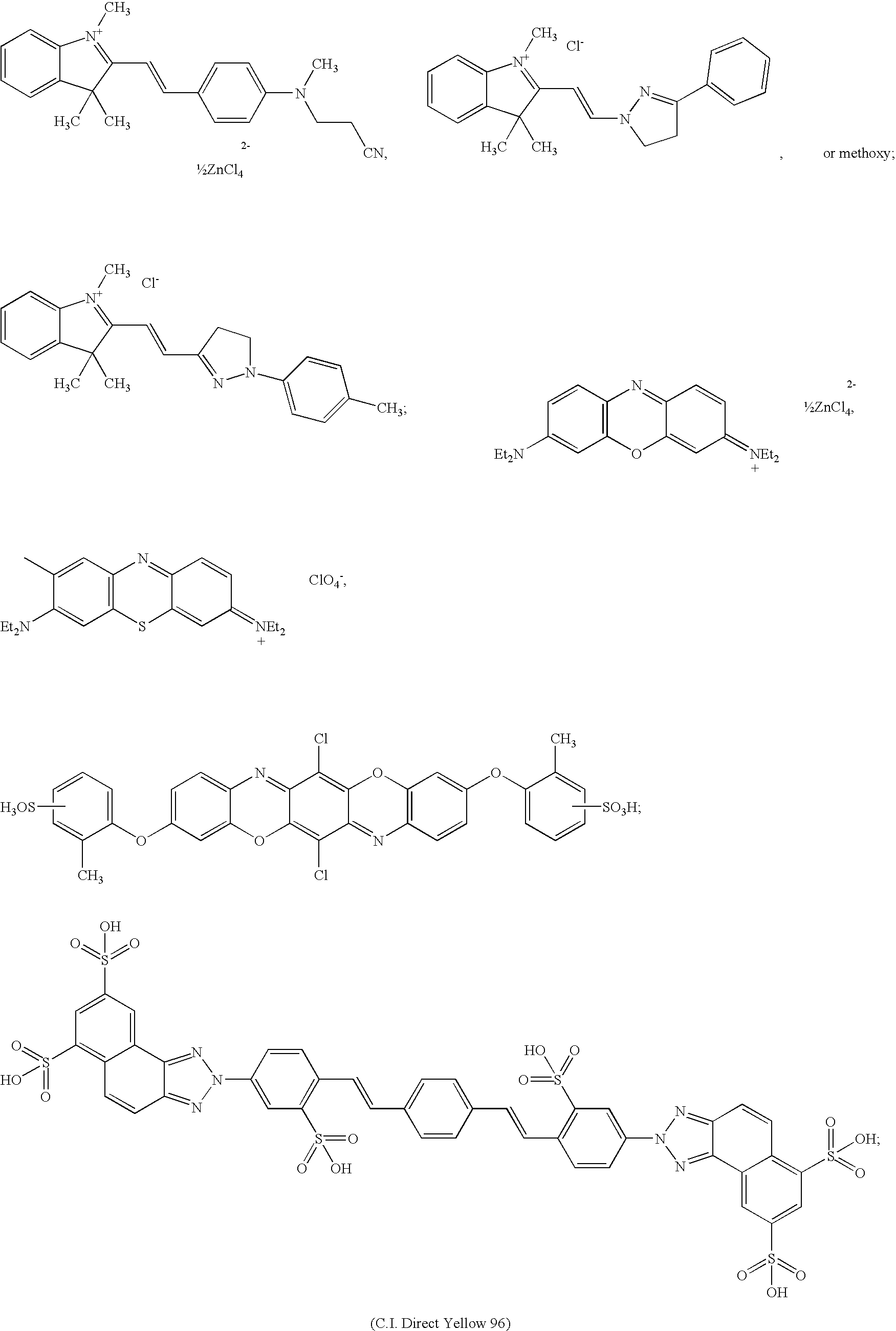

wherein R101 and R102 are independently hydrogen or C1-C18 alkyl;
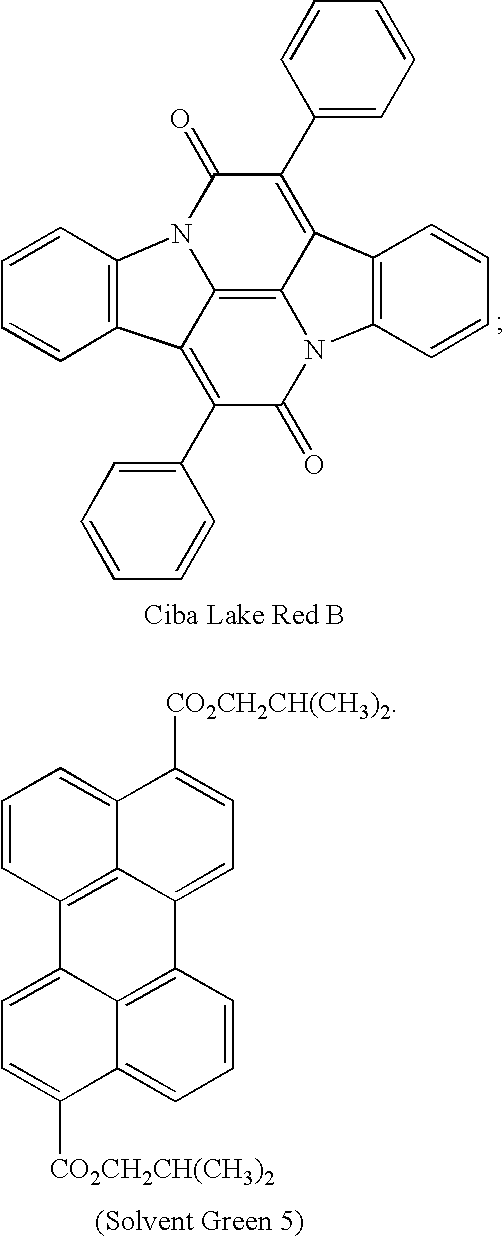
5. A non-porous or porous SiOz flake according to claim 1 , wherein the luminescent compound is chemically bonded to the SiOz flake.
6. A non-porous or porous SiOz flake according to claim 5 , wherein the luminescent compound is an organic luminescent compound and is chemically bonded to the SiOz flake via a group —X1—(X2)x2—X3—:

wherein

is an organic luminescent compound, x2 is 0, or 1,
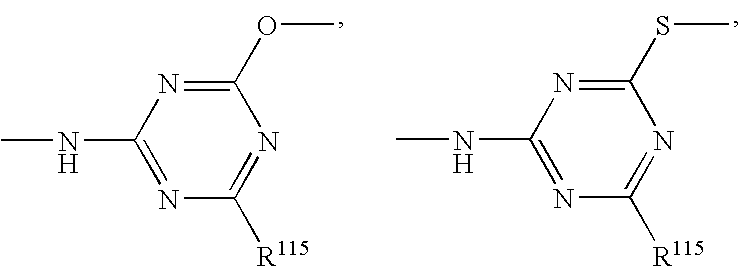
X3 is a group —Si(OR113)2O—, wherein R113 is H, or —OSi—,
X2 is spacer group,
X1 is selected from —NR114C(═O)—, —OC(═O)—, —SC(═O)—, —C(R114′)═N—NH—, —SO2—CH2—CH2—O—, —SO2—CH2—CH2—S—, —SO2—CH2—CH2—NH—,
wherein R115 is chloro, substituted amino group, OH, or OR116, wherein R116 is C1-4alkyl; —C(═O)NH—, —S—CH2—C(═O)—NH—, —O—CH2—C(═O)—NH—, or —NH—CH2—C(═O)—NH—, —NH—C(═S)—NH—, —S—C(═S)—NH—, —NH—C(═O)—NH—, —S—C(═O)—NH—, —O—C(═O)—NH—, —NR114—, —S—, or —O—, wherein R114 is hydrogen or C1-8alkyl and R114 is hydrogen or C1-8alkyl.
7. A non-porous or porous SiOz flake according to claim 6 , wherein the organic luminescent compound is selected from coumarins, benzocoumarins, xanthenes, benzo[a]xanthenes, benzo[b]xanthenes, benzo[c]xanthenes, phenoxazines, benzo[a]phenoxazines, benzo[b]phenoxazines and benzo[c]phenoxazines, napthalimides, naphtholactams, azlactones, methines, oxazines and thiazines, diketopyrrolopyrroles, perylenes, quinacridones, benzoxanthenes, thio-epindolines, lactamimides, diphenylmaleimides, acetoacetamides, imidazothiazines, benzanthrones, perylenmonoimides, perylenes, phthalimides, benzotriazoles, pyrimidines, pyrazines, triazoles, dibenzofurans and triazines.
8. A non-porous or porous SiOz flake according to claim 5 , wherein the luminescent colorant is an inorganic luminescent compound and is chemically bonded to the SiOz flake via a group —X4—(X2)x2—X3—:

wherein x2 is 0, or 1,

is inorganic luminescent complex compound having a partial structure M-L-, wherein
M is a metal and L is a ligand which is chemically bonded to X4, or

is an inorganic luminescent complex compound having a partial structure
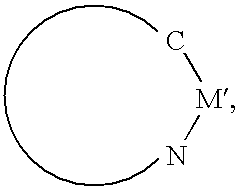
wherein
C—N is a cyclometallated ligand, which is chemically bonded to X4, M′ is a metal with an atomic weight of greater than 40,
X3 is a group —Si(OR113)2O—, wherein R113 is H, or —OSi—,
X2 is spacer group
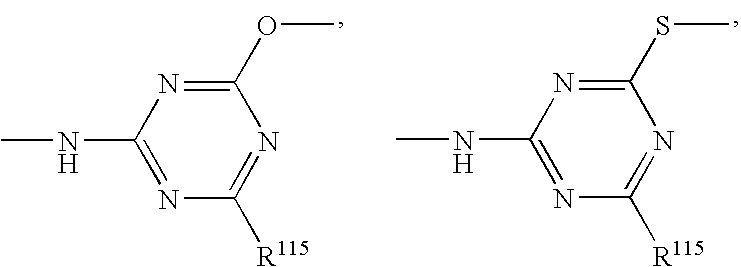
X4 is selected from —NR114C(═O)—, —OC(═O)—, —SC(═O)—, —C(R114′)═N—NH—, —SO2—CH2—CH2—O—, —SO2—CH2—CH2—S—, —SO2—CH2—CH2—NH—,
wherein R115 is chloro, substituted amino group, OH, or OR116, wherein R116 is C1-4alkyl, —C(═O)NH—, —S—CH2—C(═O)—NH—, —O—CH2—C(═O)—NH—, or —NH—CH2—C(═O)—NH—, —NH—C(═S)—NH—, —S—C(═S)—N H—, —NH—C(═O)—NH—, —S—C(═O)—NH—, —O—C(═O)—NH—, —NR114′—, —S—, or —O—, wherein R114 is hydrogen or C1-8alkyl and R114′ is hydrogen or C1-8alkyl.
9. The porous SiOz flake according to claim 1 , wherein the luminescent compound is an inorganic phosphor.
10. The porous SiOz flake according to claim 9 , wherein the inorganic phosphor is selected from sulfides, selenides, sulfoselenides, oxysulfides, borates, aluminates, silicates, halophosphates and phosphates, germanates, oxides, arsenates, vanadates, sulfates, tungstates, molybdates and halide phosphors.
11. The porous SiOz flake according to claim 10 , wherein the inorganic phosphor is selected from Zn1-yCdyS (0≦y≦0.3), optionally comprising copper, silver, manganese, gold, rare earths or zinc as an activator; MgS activated with rare earths, CaS activated with rare earths; Y2O2S:Eu3+, Y2O2S:Tb3+, Gd2O2S:Tb3+, Sr3B12O20F2:Eu2+, Y3Al5O12:Ce3+, Ce0.65Tb0.35MgAl11O19, BaMg2Al16O27:Eu2+, Y2Al3Ga2O12:Tb3+, ZnSiO4:Mn, Y2SiO5:Ce3+, 3Ca3(PO4)2.Ca(F, Cl)2:Sb3+, Mn2+, (Sr,Mg)3(PO4)2:Sn2+, LaPO4:Ce3+, Tb3+,Zn3(PO4)2:Mn2+, Cd5Cl(PO4)2:Mn2+, Sr3(PO4)2.SrCl2:Eu2+, Ba2P2O7:Ti4+, 3Sr3(PO4)2.SrCl2:Eu2+, Y2O3:Eu3+, Y2O3:Eu3+, Tb3+, ZnO:Zn, 6MgO.As2O5:Mn4+, YVO4:Eu3+, alkali-metal sulfates activated with Ce3+ and optionally manganese, alkaline-earth sulfates activated with Ce3+ and optionally manganese; MgWO4, CaWO4, alkali-metal halides optionally comprising Eu, Mg, Tl, Ga, or In; CaF2:Mn, CaF2:Dy, (Zn, Mg)F2:Mn2+, KMgF3:Mn2+, MgF2:Mn2+, (Zn, Mg)F2:Mn2+, Eu2(WO4)3, LaOCl:Tb3+, LaOBr:Tb3+ and LaOBr:Ce3+.
12. A non-porous or porous SiOz flake according to claim 1 , wherein the organic luminescent compound is an optical brightener selected from distyrylbenzenes, distyrylbiphenyls, divinylstilbenes, triazinylaminostilbenes, stilbenyl-2h-triazoles, benzoxazoles, furans, benzo[b]furans, benzimidazoles, 1,3-diphenyl-2-pyrazolines, coumarins, naphthalimides and 1,3,5-triazin-2-yl derivatives.
13. A textile surface coating, printing ink, plastic, cosmetic formulation or, glaze for ceramics and glass comprising a non-porous or porous SiOz flake according to claim 1 .
14. A composition comprising a high molecular weight organic material and from 0.01 to 80% by weight, based on the high molecular weight organic material, of the luminescent SiOz flakes according to claim 1 .
15. A cosmetic preparation or formulation, comprising from 0.0001 to 90% by weight of the luminescent SiOz flakes, according to claim 1 and from 10 to 99.9999% of a cosmetically suitable carrier material, based on the total weight of the cosmetic preparation or formulation.
16. A substrate material, comprising a porous SiOz film, which comprises a luminescent organic or inorganic compound, or composition according to claim 1 .
17. A non-porous or porous SiOz flake according to claim 6 , wherein the spacer group X2 is
—(CHR′)p-,
—{(CHR′)q-O—(CHR′)r}s-,
—{(CHR′)q-S—(CHR′)r}-,
—{(CHR′)q-NR′—(CHR′)r}s-,
—{(CHR′)q-Si(R′)2—(CHR′)r}s-,
—{(CHR′)q-(CH═CH)—(CHR′)r}s-,
—{(CHR′)q-Ar—(CHR′)r}-,
—{(CHR′)q-CO—NR′—(CHR′)r}s- or
—{(CHR′)q-CO—Ar—NR′—(CHR′)r}s-, wherein R′ is hydrogen, C1-4alkyl or aryl which may be optionally substituted with sulphonate, Ar is phenylene optionally substituted with sulphonate, p is 1-20, q is 1-10, r is 1-10 and s is 1-5.
18. A non-porous or porous SiOz flake according to claim 8 , wherein M is a rare earth metal.
19. A non-porous or porous SiOz flake according to claim 8 , wherein the spacer group X2 is
—(CHR′)p-,
—{(CHR′)q-O—(CHR′)r}s-,
—{(CHR′)q-S—(CHR′)r}-,
—{(CHR′)q-NR′—(CHR′)r}s-,
—{(CHR′)q-Si(R′)2—(CHR′)r}s-,
—{(CHR′)q-(CH═CH)—(CHR′)r}s-,
—{(CHR′)q-Ar—(CHR′)r}-,
—{(CHR′)q-CO—NR′—(CHR′)r}s- or
—{(CHR′)q-CO—Ar—NR′—(CHR′)r}s-, wherein R′ is hydrogen, C1-4alkyl or aryl which may be optionally substituted with sulphonate, Ar is phenylene optionally substituted with sulphonate, p is 1-20, q is 1-10, r is 1-10 and s is 1-5.
Applications Claiming Priority (3)
| Application Number | Priority Date | Filing Date | Title |
|---|---|---|---|
| EP04103409 | 2004-07-16 | ||
| EP04103-409.1 | 2004-07-16 | ||
| PCT/EP2005/053214 WO2006008239A2 (en) | 2004-07-16 | 2005-07-06 | Luminescent silicon oxide flakes |
Publications (1)
| Publication Number | Publication Date |
|---|---|
| US20070221884A1 true US20070221884A1 (en) | 2007-09-27 |
Family
ID=34929339
Family Applications (1)
| Application Number | Title | Priority Date | Filing Date |
|---|---|---|---|
| US11/631,446 Abandoned US20070221884A1 (en) | 2004-07-16 | 2005-07-06 | Liminescent Silicon Oxide Flakes |
Country Status (5)
| Country | Link |
|---|---|
| US (1) | US20070221884A1 (en) |
| EP (1) | EP1769049A2 (en) |
| JP (1) | JP2008506801A (en) |
| TW (1) | TW200613512A (en) |
| WO (1) | WO2006008239A2 (en) |
Cited By (14)
| Publication number | Priority date | Publication date | Assignee | Title |
|---|---|---|---|---|
| US20080057420A1 (en) * | 2006-08-31 | 2008-03-06 | Kabushiki Kaisha Toyota Chuo Kenkyusho | Light energy conversion material |
| WO2011089571A2 (en) | 2010-01-21 | 2011-07-28 | L'oreal | A cosmetic composition including at least one fluorophore compound |
| US20130026414A1 (en) * | 2010-04-13 | 2013-01-31 | Kenji Toda | Silicate-based phosphor and manufacturing method of silicate-based phosphor |
| US20140319416A1 (en) * | 2013-04-30 | 2014-10-30 | Danny Warren | Epoxy encapsulated fluorescent coating |
| US20150104626A1 (en) * | 2012-06-20 | 2015-04-16 | Ngk Insulators, Ltd. | Porous Plate-Shaped Filler, Coating Composition, Heat-Insulating Film, and Heat-Insulating Film Structure |
| US9204598B2 (en) | 2013-05-27 | 2015-12-08 | Saudi Basic Indsutries Corporation | Solar energy funneling using thermoplastics for agricultural applications |
| US20170023168A1 (en) * | 2014-04-17 | 2017-01-26 | Ngk Insulators, Ltd. | Porous plate-shaped filler, heat insulation film, and method for producing porous plate-shaped filler |
| CN106519733A (en) * | 2016-09-18 | 2017-03-22 | 大连理工大学 | A class of benzothrone liquid crystal dyes containing a 3-position substituent, its preparation method and application |
| WO2017114877A1 (en) * | 2015-12-29 | 2017-07-06 | L'oreal | Fluorescent particulate material |
| US20180094155A1 (en) * | 2016-10-04 | 2018-04-05 | Takuya Fujita | Inkjet ink and coloring composition |
| WO2019060916A3 (en) * | 2017-09-25 | 2019-06-06 | Northeastern University | Cosmetic and dermatological compositions based on phenoxazone and phenoxazine |
| US20220024243A1 (en) * | 2018-11-26 | 2022-01-27 | Korea Minting, Security Printing & Id Card Operating Corp. | Plastic product containing luminescent material and method for determining authenticity of same |
| US11566115B2 (en) | 2017-09-25 | 2023-01-31 | Northeastern University | Biologically-inspired compositions that enable visible through infrared color changing compositions |
| US20240352315A1 (en) * | 2018-08-03 | 2024-10-24 | Board Of Regents, The University Of Texas System | Methods and compositions for enhanced dispersion of phosphor in a polymeric matrix |
Families Citing this family (18)
| Publication number | Priority date | Publication date | Assignee | Title |
|---|---|---|---|---|
| JP2007245526A (en) * | 2006-03-16 | 2007-09-27 | Dainippon Printing Co Ltd | Paper for exclusive use of electronic pen |
| EP2015770B1 (en) | 2006-05-09 | 2012-09-26 | Novo Nordisk A/S | Insulin derivative |
| DE102006054331A1 (en) * | 2006-11-17 | 2008-05-21 | Merck Patent Gmbh | Phosphor body based on platelet-shaped substrates |
| DE102006054330A1 (en) * | 2006-11-17 | 2008-05-21 | Merck Patent Gmbh | Phosphor plates for LEDs made of structured foils |
| DE102007005646A1 (en) * | 2007-01-31 | 2008-08-07 | Henkel Ag & Co. Kgaa | Colorant containing luminescent pigments which can be excited by visible light |
| RU2407770C2 (en) * | 2007-03-09 | 2010-12-27 | Общество с ограниченной ответственностью Научно-производственная фирма "СВЕТ" | Light-converting material and composition for producing said material |
| WO2009019135A1 (en) * | 2007-08-03 | 2009-02-12 | Basf Se | Fluorescent whitening nanoparticles |
| DE102007058601A1 (en) * | 2007-12-04 | 2009-06-10 | Merck Patent Gmbh | security pigment |
| EP2085431B1 (en) * | 2008-01-24 | 2011-06-29 | Clariant Finance (BVI) Limited | Benzothioxanthene dyes with improved application and toxicological properties |
| WO2009095808A1 (en) * | 2008-01-30 | 2009-08-06 | L'oreal | A cosmetic composition |
| DE102008050924A1 (en) * | 2008-10-10 | 2010-04-15 | Merck Patent Gmbh | pigments |
| JP2013216590A (en) * | 2012-04-05 | 2013-10-24 | Hitachi Chemical Co Ltd | Particles for cosmetic, and cosmetic |
| KR101446318B1 (en) * | 2012-05-22 | 2014-10-07 | 한국생산기술연구원 | High functional composite nano particles and manufacturing method of the same |
| KR101947770B1 (en) * | 2017-04-04 | 2019-02-14 | 씨큐브 주식회사 | Method for preparing pearlescent pigment coating inorganic fluorescence for security and safety applications |
| KR101858414B1 (en) * | 2017-11-30 | 2018-05-16 | 씨큐브 주식회사 | Pearlescent pigment containing organic or inorganic fluorescent substance for security applications |
| KR102163095B1 (en) * | 2018-07-27 | 2020-10-07 | 디노 주식회사 | Functional cosmetic composition |
| DE102020001908B4 (en) | 2020-03-24 | 2024-06-06 | Ralf Poh | Filter bag fastening system and method for producing this filter bag fastening system |
| CN113234095B (en) * | 2021-04-30 | 2022-09-27 | 武汉工程大学 | Bitriazine group-containing compound and application thereof as three-dimensional electron acceptor material |
Citations (12)
| Publication number | Priority date | Publication date | Assignee | Title |
|---|---|---|---|---|
| US5203916A (en) * | 1992-04-10 | 1993-04-20 | Kerr-Mcgee Chemical Corporation | Titanium dioxide pigment and method of preparation |
| US5674635A (en) * | 1994-09-28 | 1997-10-07 | Xerox Corporation | Electroluminescent device |
| US20010030808A1 (en) * | 1998-08-06 | 2001-10-18 | Toru Komatsu | Anti-fog mirror and method for manufacturing the same |
| US20020071948A1 (en) * | 2000-10-09 | 2002-06-13 | Daniel-Gordon Duff | Composite particles |
| US6517628B1 (en) * | 1999-04-16 | 2003-02-11 | Merck Patent Gmbh | Pigment mixture |
| US20030047115A1 (en) * | 1991-10-18 | 2003-03-13 | Gerd Bauer | Colored and coated plateletlike pigments |
| US20030148878A1 (en) * | 2000-07-12 | 2003-08-07 | Vaughan Julian F.S. | Catalyst system |
| US20040131776A1 (en) * | 2001-05-21 | 2004-07-08 | Hilmar Weinert | Method for the production of plane-parallel platelets by using organic separating agents |
| US20050161678A1 (en) * | 2002-02-18 | 2005-07-28 | Hilmar Weinert | Methods of producing plane-parallel structures of silicon suboxide, silicon dioxide and/or silicon carbide, plane-parallel structures obtainable by such methods, and the use thereof |
| US20050252410A1 (en) * | 2002-06-18 | 2005-11-17 | Patrice Bujard | Plane-parallel structures of silicon/silicon oxide |
| US20060042507A1 (en) * | 2002-10-16 | 2006-03-02 | Patrice Bujard | Interference pigments on the basis of silicon oxides |
| US20060257662A1 (en) * | 2003-01-17 | 2006-11-16 | Patrice Bujard | Process for the production of porous inorganic materials or a matrix material containing nanoparticles |
Family Cites Families (9)
| Publication number | Priority date | Publication date | Assignee | Title |
|---|---|---|---|---|
| US3935119A (en) * | 1971-11-30 | 1976-01-27 | Owens-Illinois, Inc. | Luminescent device, process, composition, and article |
| JPH06345487A (en) * | 1993-06-03 | 1994-12-20 | Hitachi Ltd | Antireflection film for display and production thereof |
| JPH09132514A (en) * | 1995-11-10 | 1997-05-20 | Catalysts & Chem Ind Co Ltd | Flaky fine powder and cosmetic |
| DE19920627A1 (en) * | 1998-05-28 | 1999-12-02 | Merck Patent Gmbh | Pigment mixture useful for providing color flip effects in paints, lacquers, printing inks, plastics, cosmetics, foods, etc. |
| GB2353038A (en) * | 1999-08-12 | 2001-02-14 | Eastman Chem Co | Polyolefin composition comprising non-migrating optical brightener |
| JP2003201473A (en) * | 2001-10-31 | 2003-07-18 | Nittetsu Mining Co Ltd | Zinc oxide-silica based inorganic porous phosphor and method for producing the same |
| MXPA05001941A (en) * | 2002-10-16 | 2005-04-28 | Ciba Sc Holding Ag | REDUCING PIGMENTS. |
| JP2005041942A (en) * | 2003-07-24 | 2005-02-17 | Mitsubishi Chemicals Corp | Luminescent substance, light emitting device using the same, lighting device using light emitting device, and image display device |
| JP4125201B2 (en) * | 2003-08-05 | 2008-07-30 | ロレアル | Cosmetic composition containing porous particles encapsulating an optically active substance |
-
2005
- 2005-07-06 US US11/631,446 patent/US20070221884A1/en not_active Abandoned
- 2005-07-06 WO PCT/EP2005/053214 patent/WO2006008239A2/en not_active Ceased
- 2005-07-06 EP EP05767977A patent/EP1769049A2/en not_active Withdrawn
- 2005-07-06 JP JP2007520811A patent/JP2008506801A/en active Pending
- 2005-07-15 TW TW094124103A patent/TW200613512A/en unknown
Patent Citations (12)
| Publication number | Priority date | Publication date | Assignee | Title |
|---|---|---|---|---|
| US20030047115A1 (en) * | 1991-10-18 | 2003-03-13 | Gerd Bauer | Colored and coated plateletlike pigments |
| US5203916A (en) * | 1992-04-10 | 1993-04-20 | Kerr-Mcgee Chemical Corporation | Titanium dioxide pigment and method of preparation |
| US5674635A (en) * | 1994-09-28 | 1997-10-07 | Xerox Corporation | Electroluminescent device |
| US20010030808A1 (en) * | 1998-08-06 | 2001-10-18 | Toru Komatsu | Anti-fog mirror and method for manufacturing the same |
| US6517628B1 (en) * | 1999-04-16 | 2003-02-11 | Merck Patent Gmbh | Pigment mixture |
| US20030148878A1 (en) * | 2000-07-12 | 2003-08-07 | Vaughan Julian F.S. | Catalyst system |
| US20020071948A1 (en) * | 2000-10-09 | 2002-06-13 | Daniel-Gordon Duff | Composite particles |
| US20040131776A1 (en) * | 2001-05-21 | 2004-07-08 | Hilmar Weinert | Method for the production of plane-parallel platelets by using organic separating agents |
| US20050161678A1 (en) * | 2002-02-18 | 2005-07-28 | Hilmar Weinert | Methods of producing plane-parallel structures of silicon suboxide, silicon dioxide and/or silicon carbide, plane-parallel structures obtainable by such methods, and the use thereof |
| US20050252410A1 (en) * | 2002-06-18 | 2005-11-17 | Patrice Bujard | Plane-parallel structures of silicon/silicon oxide |
| US20060042507A1 (en) * | 2002-10-16 | 2006-03-02 | Patrice Bujard | Interference pigments on the basis of silicon oxides |
| US20060257662A1 (en) * | 2003-01-17 | 2006-11-16 | Patrice Bujard | Process for the production of porous inorganic materials or a matrix material containing nanoparticles |
Cited By (22)
| Publication number | Priority date | Publication date | Assignee | Title |
|---|---|---|---|---|
| US20080057420A1 (en) * | 2006-08-31 | 2008-03-06 | Kabushiki Kaisha Toyota Chuo Kenkyusho | Light energy conversion material |
| US8247680B2 (en) * | 2006-08-31 | 2012-08-21 | Kabushiki Kaisha Toyota Chuo Kenkyusho | Light energy conversion material |
| US8779277B2 (en) | 2006-08-31 | 2014-07-15 | Kabushiki Kaisha Toyota Chuo Kenkyusho | Light energy conversion material |
| WO2011089571A2 (en) | 2010-01-21 | 2011-07-28 | L'oreal | A cosmetic composition including at least one fluorophore compound |
| US20130026414A1 (en) * | 2010-04-13 | 2013-01-31 | Kenji Toda | Silicate-based phosphor and manufacturing method of silicate-based phosphor |
| US8734680B2 (en) * | 2010-04-13 | 2014-05-27 | Lead Chemical Company, Limited | Silicate-based phosphor and manufacturing method of silicate-based phosphor |
| US20150104626A1 (en) * | 2012-06-20 | 2015-04-16 | Ngk Insulators, Ltd. | Porous Plate-Shaped Filler, Coating Composition, Heat-Insulating Film, and Heat-Insulating Film Structure |
| US20140319416A1 (en) * | 2013-04-30 | 2014-10-30 | Danny Warren | Epoxy encapsulated fluorescent coating |
| US9204598B2 (en) | 2013-05-27 | 2015-12-08 | Saudi Basic Indsutries Corporation | Solar energy funneling using thermoplastics for agricultural applications |
| US10317004B2 (en) * | 2014-04-17 | 2019-06-11 | Ngk Insulators, Ltd. | Porous plate-shaped filler, heat insulation film, and method for producing porous plate-shaped filler |
| US20170023168A1 (en) * | 2014-04-17 | 2017-01-26 | Ngk Insulators, Ltd. | Porous plate-shaped filler, heat insulation film, and method for producing porous plate-shaped filler |
| WO2017114877A1 (en) * | 2015-12-29 | 2017-07-06 | L'oreal | Fluorescent particulate material |
| CN108473863A (en) * | 2015-12-29 | 2018-08-31 | 欧莱雅 | Fluorescence granular material |
| CN106519733A (en) * | 2016-09-18 | 2017-03-22 | 大连理工大学 | A class of benzothrone liquid crystal dyes containing a 3-position substituent, its preparation method and application |
| US20180094155A1 (en) * | 2016-10-04 | 2018-04-05 | Takuya Fujita | Inkjet ink and coloring composition |
| US10655029B2 (en) * | 2016-10-04 | 2020-05-19 | Ricoh Company, Ltd. | Inkjet ink and coloring composition |
| WO2019060916A3 (en) * | 2017-09-25 | 2019-06-06 | Northeastern University | Cosmetic and dermatological compositions based on phenoxazone and phenoxazine |
| US11464719B2 (en) | 2017-09-25 | 2022-10-11 | Northeastern University | Cosmetic and dermatological compositions |
| US11566115B2 (en) | 2017-09-25 | 2023-01-31 | Northeastern University | Biologically-inspired compositions that enable visible through infrared color changing compositions |
| US12514797B2 (en) | 2017-09-25 | 2026-01-06 | Northeastern University | Cosmetic and dermatological compositions |
| US20240352315A1 (en) * | 2018-08-03 | 2024-10-24 | Board Of Regents, The University Of Texas System | Methods and compositions for enhanced dispersion of phosphor in a polymeric matrix |
| US20220024243A1 (en) * | 2018-11-26 | 2022-01-27 | Korea Minting, Security Printing & Id Card Operating Corp. | Plastic product containing luminescent material and method for determining authenticity of same |
Also Published As
| Publication number | Publication date |
|---|---|
| WO2006008239A2 (en) | 2006-01-26 |
| TW200613512A (en) | 2006-05-01 |
| EP1769049A2 (en) | 2007-04-04 |
| WO2006008239A3 (en) | 2006-05-11 |
| JP2008506801A (en) | 2008-03-06 |
Similar Documents
| Publication | Publication Date | Title |
|---|---|---|
| US20070221884A1 (en) | Liminescent Silicon Oxide Flakes | |
| AU2020233571B2 (en) | Energy augmentation structures for use with energy emitters and collectors | |
| Kai et al. | Intermolecular energy transfer and photostability of luminescence-tuneable multicolour PMMA films doped with lanthanide–β-diketonate complexes | |
| EP3402845B1 (en) | Perylene bisimides with rigid 2,2'-biphenoxy bridges | |
| Kim et al. | Highly bright multicolor tunable ultrasmall β-Na (Y, Gd) F 4: Ce, Tb, Eu/β-NaYF 4 core/shell nanocrystals | |
| EP3072887B1 (en) | N,n'-bis(2,6-diisopropylphenyl)-1,7-di(2,6-diphenylphenoxy)perylene-3,4;9,10-tetracarboximide, n,n'-bis(2,6-diisopropylphenyl)-1,6-di(2,6-diphenylphenoxy)perylene-3,4;9,10-tetracarboximide and the use thereof | |
| JP2011506661A (en) | Inorganic luminescent material obtained by wet grinding | |
| GB2258659A (en) | An anti-stokes luminescent material | |
| EP3571201B1 (en) | 1,6,7,12-tetra-(2-isopropylphenoxy)-substituted perylene tetracarboxylic acid diimides as color converters | |
| KR20090078371A (en) | New 2,9-dichloroquinacridones in platelet form | |
| Shen et al. | Facile development of novel photochromic luminescent composite fiber for anticounterfeiting and wearable UV detector | |
| Molloy et al. | Sensitisation of visible and NIR lanthanide emission by InPZnS quantum dots in bi-luminescent hybrids | |
| Sudheendra et al. | Influence of Zn2+ doping on the lattice defects and photoluminescence studies of Sr2CeO4: Eu3+ nanophosphor: applications for data encryption strategies | |
| EP3101087B1 (en) | Multiple chromophores with a perylenediimide skeleton | |
| AU2021308879A1 (en) | Dithiolene metal complexes | |
| CN111849469B (en) | Excitation wavelength dependent multicolor long afterglow luminescent material and preparation method and application thereof | |
| TR201908242T4 (en) | Nanostructured phosphorescent pigment and its uses. | |
| Wang et al. | Tailoring photoluminescence and multifunctionalities of lanthanide coordination complexes employing ligand-controlled aggregation states | |
| JP2008523971A (en) | Method of using microwave deposition of metal oxides on organic substrates | |
| US20250122394A1 (en) | Luminescent printing ink for security printing, item having luminescent feature, and production method | |
| JP2000044828A (en) | Natural pigment-treated powder and cosmetics containing the same | |
| RU2758689C1 (en) | Composite luminescent material and method for production thereof | |
| Yu et al. | Optical properties and characteristics of ZnS: Mn prepared by Mn coating method | |
| Yengkhom et al. | Biocompatible luminescent Ce 3+-sensitized SrF 2: Tb 3+ for anticounterfeiting and forensic fingerprint detection | |
| KR0154522B1 (en) | Photochromic / luminescent inorganic pigments and manufacturing method thereof |
Legal Events
| Date | Code | Title | Description |
|---|---|---|---|
| AS | Assignment |
Owner name: CIBA SPECIALTY CHEMICALS CORP., NEW YORK Free format text: ASSIGNMENT OF ASSIGNORS INTEREST;ASSIGNORS:HOPPE, HOLGER;BUJARD, PATRICE;MULLER, MARTIN;AND OTHERS;REEL/FRAME:019642/0125;SIGNING DATES FROM 20061115 TO 20061130 |
|
| STCB | Information on status: application discontinuation |
Free format text: ABANDONED -- FAILURE TO RESPOND TO AN OFFICE ACTION |